US12104104B2 - Phosphor monomolecular compound, organic transistor using same, and water decomposition and hydrogen production photocatalytic system using same - Google Patents
Phosphor monomolecular compound, organic transistor using same, and water decomposition and hydrogen production photocatalytic system using same Download PDFInfo
- Publication number
- US12104104B2 US12104104B2 US17/048,654 US201917048654A US12104104B2 US 12104104 B2 US12104104 B2 US 12104104B2 US 201917048654 A US201917048654 A US 201917048654A US 12104104 B2 US12104104 B2 US 12104104B2
- Authority
- US
- United States
- Prior art keywords
- independently
- phosphor
- alkyl group
- monomolecular compound
- preparation example
- Prior art date
- Legal status (The legal status is an assumption and is not a legal conclusion. Google has not performed a legal analysis and makes no representation as to the accuracy of the status listed.)
- Active, expires
Links
Images


Classifications
-
- C—CHEMISTRY; METALLURGY
- C01—INORGANIC CHEMISTRY
- C01B—NON-METALLIC ELEMENTS; COMPOUNDS THEREOF; METALLOIDS OR COMPOUNDS THEREOF NOT COVERED BY SUBCLASS C01C
- C01B3/00—Hydrogen; Gaseous mixtures containing hydrogen; Separation of hydrogen from mixtures containing it; Purification of hydrogen; Reversible storage of hydrogen
- C01B3/02—Production of hydrogen; Production of gaseous mixtures containing hydrogen
- C01B3/04—Production of hydrogen; Production of gaseous mixtures containing hydrogen by decomposition of inorganic compounds
- C01B3/042—Decomposition of water
-
- C—CHEMISTRY; METALLURGY
- C07—ORGANIC CHEMISTRY
- C07D—HETEROCYCLIC COMPOUNDS
- C07D471/00—Heterocyclic compounds containing nitrogen atoms as the only ring hetero atoms in the condensed system, at least one ring being a six-membered ring with one nitrogen atom, not provided for by groups C07D451/00 - C07D463/00
- C07D471/02—Heterocyclic compounds containing nitrogen atoms as the only ring hetero atoms in the condensed system, at least one ring being a six-membered ring with one nitrogen atom, not provided for by groups C07D451/00 - C07D463/00 in which the condensed system contains two hetero rings
- C07D471/04—Ortho-condensed systems
-
- C—CHEMISTRY; METALLURGY
- C09—DYES; PAINTS; POLISHES; NATURAL RESINS; ADHESIVES; COMPOSITIONS NOT OTHERWISE PROVIDED FOR; APPLICATIONS OF MATERIALS NOT OTHERWISE PROVIDED FOR
- C09K—MATERIALS FOR MISCELLANEOUS APPLICATIONS, NOT PROVIDED FOR ELSEWHERE
- C09K11/00—Luminescent materials, e.g. electroluminescent or chemiluminescent
- C09K11/06—Luminescent materials, e.g. electroluminescent or chemiluminescent containing organic luminescent materials
-
- H—ELECTRICITY
- H10—SEMICONDUCTOR DEVICES; ELECTRIC SOLID-STATE DEVICES NOT OTHERWISE PROVIDED FOR
- H10K—ORGANIC ELECTRIC SOLID-STATE DEVICES
- H10K10/00—Organic devices specially adapted for rectifying, amplifying, oscillating or switching; Organic capacitors or resistors having potential barriers
- H10K10/40—Organic transistors
-
- H—ELECTRICITY
- H10—SEMICONDUCTOR DEVICES; ELECTRIC SOLID-STATE DEVICES NOT OTHERWISE PROVIDED FOR
- H10K—ORGANIC ELECTRIC SOLID-STATE DEVICES
- H10K10/00—Organic devices specially adapted for rectifying, amplifying, oscillating or switching; Organic capacitors or resistors having potential barriers
- H10K10/40—Organic transistors
- H10K10/46—Field-effect transistors, e.g. organic thin-film transistors [OTFT]
- H10K10/462—Insulated gate field-effect transistors [IGFETs]
-
- H—ELECTRICITY
- H10—SEMICONDUCTOR DEVICES; ELECTRIC SOLID-STATE DEVICES NOT OTHERWISE PROVIDED FOR
- H10K—ORGANIC ELECTRIC SOLID-STATE DEVICES
- H10K85/00—Organic materials used in the body or electrodes of devices covered by this subclass
- H10K85/60—Organic compounds having low molecular weight
- H10K85/615—Polycyclic condensed aromatic hydrocarbons, e.g. anthracene
- H10K85/626—Polycyclic condensed aromatic hydrocarbons, e.g. anthracene containing more than one polycyclic condensed aromatic rings, e.g. bis-anthracene
-
- H—ELECTRICITY
- H10—SEMICONDUCTOR DEVICES; ELECTRIC SOLID-STATE DEVICES NOT OTHERWISE PROVIDED FOR
- H10K—ORGANIC ELECTRIC SOLID-STATE DEVICES
- H10K85/00—Organic materials used in the body or electrodes of devices covered by this subclass
- H10K85/60—Organic compounds having low molecular weight
- H10K85/631—Amine compounds having at least two aryl rest on at least one amine-nitrogen atom, e.g. triphenylamine
-
- H—ELECTRICITY
- H10—SEMICONDUCTOR DEVICES; ELECTRIC SOLID-STATE DEVICES NOT OTHERWISE PROVIDED FOR
- H10K—ORGANIC ELECTRIC SOLID-STATE DEVICES
- H10K85/00—Organic materials used in the body or electrodes of devices covered by this subclass
- H10K85/60—Organic compounds having low molecular weight
- H10K85/649—Aromatic compounds comprising a hetero atom
- H10K85/653—Aromatic compounds comprising a hetero atom comprising only oxygen as heteroatom
-
- H—ELECTRICITY
- H10—SEMICONDUCTOR DEVICES; ELECTRIC SOLID-STATE DEVICES NOT OTHERWISE PROVIDED FOR
- H10K—ORGANIC ELECTRIC SOLID-STATE DEVICES
- H10K85/00—Organic materials used in the body or electrodes of devices covered by this subclass
- H10K85/60—Organic compounds having low molecular weight
- H10K85/649—Aromatic compounds comprising a hetero atom
- H10K85/654—Aromatic compounds comprising a hetero atom comprising only nitrogen as heteroatom
-
- H—ELECTRICITY
- H10—SEMICONDUCTOR DEVICES; ELECTRIC SOLID-STATE DEVICES NOT OTHERWISE PROVIDED FOR
- H10K—ORGANIC ELECTRIC SOLID-STATE DEVICES
- H10K85/00—Organic materials used in the body or electrodes of devices covered by this subclass
- H10K85/60—Organic compounds having low molecular weight
- H10K85/649—Aromatic compounds comprising a hetero atom
- H10K85/655—Aromatic compounds comprising a hetero atom comprising only sulfur as heteroatom
-
- H—ELECTRICITY
- H10—SEMICONDUCTOR DEVICES; ELECTRIC SOLID-STATE DEVICES NOT OTHERWISE PROVIDED FOR
- H10K—ORGANIC ELECTRIC SOLID-STATE DEVICES
- H10K85/00—Organic materials used in the body or electrodes of devices covered by this subclass
- H10K85/60—Organic compounds having low molecular weight
- H10K85/649—Aromatic compounds comprising a hetero atom
- H10K85/657—Polycyclic condensed heteroaromatic hydrocarbons
- H10K85/6572—Polycyclic condensed heteroaromatic hydrocarbons comprising only nitrogen in the heteroaromatic polycondensed ring system, e.g. phenanthroline or carbazole
-
- C—CHEMISTRY; METALLURGY
- C01—INORGANIC CHEMISTRY
- C01B—NON-METALLIC ELEMENTS; COMPOUNDS THEREOF; METALLOIDS OR COMPOUNDS THEREOF NOT COVERED BY SUBCLASS C01C
- C01B2203/00—Integrated processes for the production of hydrogen or synthesis gas
- C01B2203/02—Processes for making hydrogen or synthesis gas
- C01B2203/0266—Processes for making hydrogen or synthesis gas containing a decomposition step
- C01B2203/0277—Processes for making hydrogen or synthesis gas containing a decomposition step containing a catalytic decomposition step
-
- C—CHEMISTRY; METALLURGY
- C01—INORGANIC CHEMISTRY
- C01B—NON-METALLIC ELEMENTS; COMPOUNDS THEREOF; METALLOIDS OR COMPOUNDS THEREOF NOT COVERED BY SUBCLASS C01C
- C01B2203/00—Integrated processes for the production of hydrogen or synthesis gas
- C01B2203/10—Catalysts for performing the hydrogen forming reactions
- C01B2203/1041—Composition of the catalyst
-
- C—CHEMISTRY; METALLURGY
- C09—DYES; PAINTS; POLISHES; NATURAL RESINS; ADHESIVES; COMPOSITIONS NOT OTHERWISE PROVIDED FOR; APPLICATIONS OF MATERIALS NOT OTHERWISE PROVIDED FOR
- C09K—MATERIALS FOR MISCELLANEOUS APPLICATIONS, NOT PROVIDED FOR ELSEWHERE
- C09K2211/00—Chemical nature of organic luminescent or tenebrescent compounds
- C09K2211/10—Non-macromolecular compounds
- C09K2211/1018—Heterocyclic compounds
- C09K2211/1022—Heterocyclic compounds bridged by heteroatoms, e.g. N, P, Si or B
-
- C—CHEMISTRY; METALLURGY
- C09—DYES; PAINTS; POLISHES; NATURAL RESINS; ADHESIVES; COMPOSITIONS NOT OTHERWISE PROVIDED FOR; APPLICATIONS OF MATERIALS NOT OTHERWISE PROVIDED FOR
- C09K—MATERIALS FOR MISCELLANEOUS APPLICATIONS, NOT PROVIDED FOR ELSEWHERE
- C09K2211/00—Chemical nature of organic luminescent or tenebrescent compounds
- C09K2211/10—Non-macromolecular compounds
- C09K2211/1018—Heterocyclic compounds
- C09K2211/1025—Heterocyclic compounds characterised by ligands
- C09K2211/1029—Heterocyclic compounds characterised by ligands containing one nitrogen atom as the heteroatom
-
- C—CHEMISTRY; METALLURGY
- C09—DYES; PAINTS; POLISHES; NATURAL RESINS; ADHESIVES; COMPOSITIONS NOT OTHERWISE PROVIDED FOR; APPLICATIONS OF MATERIALS NOT OTHERWISE PROVIDED FOR
- C09K—MATERIALS FOR MISCELLANEOUS APPLICATIONS, NOT PROVIDED FOR ELSEWHERE
- C09K2211/00—Chemical nature of organic luminescent or tenebrescent compounds
- C09K2211/10—Non-macromolecular compounds
- C09K2211/1018—Heterocyclic compounds
- C09K2211/1025—Heterocyclic compounds characterised by ligands
- C09K2211/1029—Heterocyclic compounds characterised by ligands containing one nitrogen atom as the heteroatom
- C09K2211/1033—Heterocyclic compounds characterised by ligands containing one nitrogen atom as the heteroatom with oxygen
-
- C—CHEMISTRY; METALLURGY
- C09—DYES; PAINTS; POLISHES; NATURAL RESINS; ADHESIVES; COMPOSITIONS NOT OTHERWISE PROVIDED FOR; APPLICATIONS OF MATERIALS NOT OTHERWISE PROVIDED FOR
- C09K—MATERIALS FOR MISCELLANEOUS APPLICATIONS, NOT PROVIDED FOR ELSEWHERE
- C09K2211/00—Chemical nature of organic luminescent or tenebrescent compounds
- C09K2211/10—Non-macromolecular compounds
- C09K2211/1018—Heterocyclic compounds
- C09K2211/1025—Heterocyclic compounds characterised by ligands
- C09K2211/1029—Heterocyclic compounds characterised by ligands containing one nitrogen atom as the heteroatom
- C09K2211/1037—Heterocyclic compounds characterised by ligands containing one nitrogen atom as the heteroatom with sulfur
-
- C—CHEMISTRY; METALLURGY
- C09—DYES; PAINTS; POLISHES; NATURAL RESINS; ADHESIVES; COMPOSITIONS NOT OTHERWISE PROVIDED FOR; APPLICATIONS OF MATERIALS NOT OTHERWISE PROVIDED FOR
- C09K—MATERIALS FOR MISCELLANEOUS APPLICATIONS, NOT PROVIDED FOR ELSEWHERE
- C09K2211/00—Chemical nature of organic luminescent or tenebrescent compounds
- C09K2211/10—Non-macromolecular compounds
- C09K2211/1018—Heterocyclic compounds
- C09K2211/1025—Heterocyclic compounds characterised by ligands
- C09K2211/1029—Heterocyclic compounds characterised by ligands containing one nitrogen atom as the heteroatom
- C09K2211/104—Heterocyclic compounds characterised by ligands containing one nitrogen atom as the heteroatom with other heteroatoms
-
- H—ELECTRICITY
- H10—SEMICONDUCTOR DEVICES; ELECTRIC SOLID-STATE DEVICES NOT OTHERWISE PROVIDED FOR
- H10K—ORGANIC ELECTRIC SOLID-STATE DEVICES
- H10K10/00—Organic devices specially adapted for rectifying, amplifying, oscillating or switching; Organic capacitors or resistors having potential barriers
- H10K10/80—Constructional details
- H10K10/82—Electrodes
-
- H—ELECTRICITY
- H10—SEMICONDUCTOR DEVICES; ELECTRIC SOLID-STATE DEVICES NOT OTHERWISE PROVIDED FOR
- H10K—ORGANIC ELECTRIC SOLID-STATE DEVICES
- H10K50/00—Organic light-emitting devices
- H10K50/10—OLEDs or polymer light-emitting diodes [PLED]
- H10K50/11—OLEDs or polymer light-emitting diodes [PLED] characterised by the electroluminescent [EL] layers
-
- H—ELECTRICITY
- H10—SEMICONDUCTOR DEVICES; ELECTRIC SOLID-STATE DEVICES NOT OTHERWISE PROVIDED FOR
- H10K—ORGANIC ELECTRIC SOLID-STATE DEVICES
- H10K50/00—Organic light-emitting devices
- H10K50/10—OLEDs or polymer light-emitting diodes [PLED]
- H10K50/14—Carrier transporting layers
- H10K50/15—Hole transporting layers
-
- H—ELECTRICITY
- H10—SEMICONDUCTOR DEVICES; ELECTRIC SOLID-STATE DEVICES NOT OTHERWISE PROVIDED FOR
- H10K—ORGANIC ELECTRIC SOLID-STATE DEVICES
- H10K50/00—Organic light-emitting devices
- H10K50/30—Organic light-emitting transistors
-
- Y—GENERAL TAGGING OF NEW TECHNOLOGICAL DEVELOPMENTS; GENERAL TAGGING OF CROSS-SECTIONAL TECHNOLOGIES SPANNING OVER SEVERAL SECTIONS OF THE IPC; TECHNICAL SUBJECTS COVERED BY FORMER USPC CROSS-REFERENCE ART COLLECTIONS [XRACs] AND DIGESTS
- Y02—TECHNOLOGIES OR APPLICATIONS FOR MITIGATION OR ADAPTATION AGAINST CLIMATE CHANGE
- Y02E—REDUCTION OF GREENHOUSE GAS [GHG] EMISSIONS, RELATED TO ENERGY GENERATION, TRANSMISSION OR DISTRIBUTION
- Y02E60/00—Enabling technologies; Technologies with a potential or indirect contribution to GHG emissions mitigation
- Y02E60/30—Hydrogen technology
- Y02E60/36—Hydrogen production from non-carbon containing sources, e.g. by water electrolysis
Definitions
- the present invention relates to a phosphor monomolecular compound, an organic transistor using the same, and a water splitting and hydrogen production photocatalytic system using the same, and more particularly, to a novel phosphor monomolecular compound including a 1,5-naphthyridine-2,6-dione structure, an organic transistor and a water splitting and hydrogen production photocatalytic system with increased efficiency by using the same.
- Organic phosphors are inexpensive and may be synthesized via various pathways. Also, it is advantageous that they are synthesized and used according to their purposes for use by introducing various substituents. Extensive research has been conducted on organic phosphors having such advantages in the fields of biotechnology such as bio sensors, bio imaging, and cell monitoring and light-emitting devices such as organic light-emitting diodes (OLEDs) and organic light-emitting transistors (OLETs). Representatively, various organic phosphors such as Fluorecein, Anthracene, Coumarin, and BODIPY have been developed and commercially available, and thus applied in various fields.
- OLEDs organic light-emitting diodes
- OLETs organic light-emitting transistors
- Phosphors used in OLEDs or OLETs are required to emit light of a desired wavelength, and phosphors used in the biotechnology are required to be water-soluble.
- problems such as difficulty in controlling a molecular structure of the organic phosphor in order to emit light of a desired wavelength or low photoluminescent efficiency.
- the organic phosphor has hydrophobicity that is difficult to be applied to the biotechnology.
- the present invention has been proposed to solve various problems including the above problems, and an object of the present invention is to provide a water-soluble monomolecular compound including a 1,5-naphthyridine-2,6-dione structure as a phosphor capable of emitting light of a wide wavelengths and having a high photoluminescent efficiency.
- the present invention provides an organic transistor and a water splitting and hydrogen production photocatalytic system having enhanced performance by using the monomolecular compound.
- a phosphor monomolecular compound represented by Chemical Structural Formula 1 below.
- a phosphor monomolecular compound represented by Chemical Structural Formula 3 below.
- the R 1 , R 2 , R 3 , R 4 , R 5 , R 6 , and R′ may be each independently a C1-C26 alkyl group or a C6-C32 aryl group.
- the R 1 , R 2 , R 7 , R 8 , and R′ may be each independently a C1-C26 alkyl group or a C6-C32 aryl group.
- the R 1 , R 2 and R′ may be each independently a C1-C26 alkyl group or a C6-C32 aryl group.
- the R 1 and R 2 may be each independently a C5-C14 alkyl group.
- R 3 , R 4 , R 5 , and R 6 may be each independently a C9-C22 alkyl group.
- R 7 and R 8 may be each independently a C9-C22 alkyl group.
- an organic transistor including a substrate, a gate electrode formed on the substrate, an insulating layer formed on the gate electrode, a hole transport layer formed on the insulating layer, and a source electrode and a drain electrode both formed on the hole transport layer, wherein the hole transport layer includes a phosphor monomolecular compound represented by any one of Chemical Structural Formulae 1 to 3 below.
- a phosphor monomolecular compound represented by Chemical Structural Formula 2 below.
- a phosphor monomolecular compound represented by Chemical Structural Formula 3 below.
- R 9 and R 10 are each independently naphthalene
- a water splitting and hydrogen production photocatalytic system including a photocatalyst in an aqueous solution, wherein the photocatalyst includes a phosphor monomolecular compound represented by any one of Chemical Structural Formulae 1 to 3.
- a phosphor monomolecular compound represented by Chemical Structural Formula 2 below.
- a phosphor monomolecular compound represented by Chemical Structural Formula 3 below.
- n is an integer from 1 to 50.
- a water-soluble monomolecular compound including a 1,5-naphtyridine-2,6-dione structure capable of emitting light of a wide range of wavelengths and a high photoluminescent efficiency may be provided.
- the present invention may improve performance of an organic transistor and a water splitting and hydrogen production photocatalytic system by using the monomolecular compound.
- FIG. 1 is a schematic diagram illustrating a structure of an organic transistor according to an embodiment of the present invention.
- FIG. 2 is a schematic diagram illustrating a structure of a water splitting and hydrogen production photocatalytic system according to an embodiment of the present invention.
- FIGS. 3 A, 3 B and 3 C show graphs illustrating light absorption spectra of phosphor monomolecular compounds according to an embodiment of the present invention.
- FIGS. 4 A, 4 B, 4 C, 4 D, 4 E and 4 F show graphs illustrating transfer curves of organic transistors according to an embodiment of the present invention.
- FIGS. 5 A, 5 B and 5 C show graphs illustrating output curves of organic transistors according to an embodiment of the present invention.
- FIG. 6 is a graph illustrating hydrogen gas generation rates in water splitting and hydrogen production photocatalytic systems according to a comparative example and an example.
- a phosphor monomolecular compound according to the present invention has an excellent photoluminescent efficiency and may be used in an organic transistor or a water splitting and hydrogen production photocatalyst. That is, an embodiment of the present invention relates to a phosphor monomolecular compound represented by Chemical Structural Formula 1 below.
- the monomolecular compound according to the present invention as a novel monomolecular compound including a 1,5-naphthyridine-2,6-dione structure, has excellent photoluminescence and water solubility due to the chemical structure as described above and have high hole mobility due to excellent crystallinity and good morphology.
- an organic transistor having excellent photoluminescence quantum yield and high hole mobility may be manufactured.
- the phosphor monomolecular compound has a high visible light absorbance and easily forms a supramolecule due to strong intermolecular attraction.
- a specific surface area may be increased by controlling the structure of the supramolecule, a water splitting and hydrogen production photocatalyst having increased catalyst efficiency may be prepared.
- the monomolecular compounds represented by Chemical Structural Formulae 1 to 3 above may be prepared from 6-methoxy-1,5-naphthyridin-2(1H)-one compound represented by Chemical Formula 1 below.
- the monomolecular compound of the present invention may be manufactured by the Stille coupling reaction of the 6-methoxy-1,5-naphthyridin-2(1H)-one compound represented by Chemical Formula 1 above, without being limited thereto.
- the monomolecular compound is a compound which may be prepared from 6-methoxy-1,5-naphthyridin-2(1H)-one, the methoxy group of which is not substituted, may also be prepared from 1,5-naphthyridine-2,6-dione represented by Chemical Formula 2 below.
- the X 1 and X 2 may be each independently O, S, Se, NH, or NR′, wherein R's may be each independently a C1-C26 alkyl group or a C6-C32 aryl group.
- R's may be each independently a C1-C26 alkyl group or a C6-C32 aryl group.
- X 1 and X 2 may be each independently O or S.
- R 1 , R 2 , R 3 , R 4 , R 5 , R 6 , R 7 , and R 8 may be each independently H, F, Cl, Br, I, a C1-C50 alkyl group, a C6-C50 aryl group, —COOR′, —(CH 2 CH 2 O) n CH 3 , or NR′ 2 , wherein R's may be each independently a C1-C26 alkyl group or a C6-C32 aryl group.
- the R 1 , R 2 , R 3 , R 4 , R 5 , R 6 , R 7 , and R 8 may be each independently a C1-C46 alkyl group, a C1-C42 alkyl group, a C1-C38 alkyl group, a C1-C34 alkyl group, a C1-C30 alkyl group, a C1-C26 alkyl group, a C1-C22 alkyl group, a C6-C50 aryl group, a C6-C44 aryl group, a C6-C38 aryl group, a C6-C32 aryl group, a C6-C26 aryl group, or a C6-C20 aryl group.
- the R 1 , R 2 , R 3 , R 4 , and R′ may be each independently a C1-C26 alkyl group or a C6-C32 aryl group.
- R 1 , R 2 , R 3 , R 4 , R 5 , R 6 , R 7 , and R 8 are components that may define physical properties, such as hydrophilicity and hydrophobicity, of the monomolecular compound according to the present invention and may have an appropriate number range of carbon atoms.
- the R 1 and R 2 may be each independently a C5-C14 alkyl group
- the R 3 , R 4 , R 5 , R 6 , R 7 , and R 8 may be each independently a C9-C22 alkyl group.
- photoluminescent efficiency and hole mobility, as a phosphor may be controlled by adjusting physical properties of the target monomolecular compound. That is, efficiency of the organic transistor or the water splitting and hydrogen production catalyst may be increased.
- the n is an integer from 1 to 1,000. In a more specific example, the n may be an integer from 1 to 800, 1 to 700, 1 to 600, or 1 to 500.
- the phosphor monomolecular compound according to the present invention has not only water solubility but also excellent sunlight absorbance and low driving voltage. Also, the phosphor monomolecular compound has a high hole mobility due to excellent crystallinity.
- the monomolecular compound may have a photoluminescence quantum yield (PLQY) of 60% or more at a maximum absorption wavelength in a wavelength range of 300 nm to 1,000 nm and a hole mobility of 0.76 cm 2 /Vs or more.
- PLQY photoluminescence quantum yield
- the present invention also relates to an organic transistor including the monomolecular compound.
- the organic transistor may have high efficiency due to high hole mobility.
- the organic transistor according to an embodiment of the present invention may include a substrate, a gate electrode formed on the substrate, an insulating layer formed on the gate electrode, a hole transport layer formed on the insulating layer, and a source electrode and a drain electrode both formed on the hole transport layer, wherein the hole transport layer may include a phosphor monomolecular compound represented by any one of Chemical Structural Formulae 1 to 3 below.
- the organic transistor of the present invention may include the above-described monomolecular compound represented by any one of Chemical Structural Formulae 1 to 3 as a hole transport material in a hole transport layer, thereby having high hole mobility.
- FIG. 1 is a schematic diagram illustrating a structure of an organic transistor 1 according to an embodiment of the present invention.
- the organic transistor 1 may include a substrate 100 , a gate electrode 110 , an insulating layer 120 , a hole transport layer 130 , a source electrode 140 , and a drain electrode 150 .
- the organic transistor 1 of the present invention may have a structure in which the gate electrode 110 , the insulating layer 120 , and the hole transport layer 130 are stacked on the substrate 100 , and the source electrode 140 and the drain electrode 150 are disposed on the hole transport layer 130 to face each other as illustrated in FIG. 1 .
- the organic transistor 1 may have a top contact-bottom gate structure in which the source electrode 140 and the drain electrode 150 are formed on the hole transport layer 130 , and the gate electrode 110 is formed thereunder.
- the hole transport layer 130 may include the phosphor monomolecular compound represented by any one of Chemical Structural Formulae 1 to 3 above.
- the phosphor monomolecular compound represented by any one of Chemical Structural Formulae 1 to 3 has excellent hole mobility due to high flatness and excellent crystallinity and may realize a wide range of wavelengths due to high photoluminescent efficiency.
- the hole transport layer 130 may have excellent hole mobility at a low driving voltage by including the phosphor monomolecular compound represented by any one of Chemical Structural Formulae 1 to 3 described above as a hole transporting material.
- the organic transistor 1 may have a hole mobility of 0.7 cm 2 V ⁇ 1 s ⁇ 1 or more.
- An upper limit of the hole mobility may be 2.76 cm 2 V ⁇ 1 s ⁇ 1 .
- the present invention relates to a water splitting and hydrogen production photocatalytic system including the monomolecular compound.
- the water splitting and hydrogen production photocatalytic system has a high visible light absorbance and easily forms a supramolecule due to strong intermolecular attraction between catalyst molecules, thereby having excellent efficiency.
- the water splitting and hydrogen production photocatalytic system includes a photocatalyst in an aqueous solution, wherein the photocatalyst includes the phosphor monomolecular compound represented by any one of Chemical Structural Formulae 1 to 3 below.
- FIG. 2 is a schematic diagram illustrating a structure of a water splitting and hydrogen production photocatalytic system 2 according to the present invention.
- the water splitting and hydrogen production photocatalytic system 2 may include an aqueous solution 220 and a photocatalyst 240 .
- the photocatalyst 240 may include the phosphor monomolecular compound represented by any one of Chemical Structural Formulae 1 to 3 above.
- the photocatalyst 240 in the aqueous solution 220 absorbs visible light from sunlight entering from the outside to split water (H 2 O) into hydrogen gas (H 2 ).
- the water splitting and hydrogen production photocatalytic system may be manufactured by using the photocatalyst 240 including the same.
- the phosphor monomolecular compound represented by any one of Chemical Structural Formulae 1 to 3 above has excellent visible light absorbance, thereby having high light absorbing efficiency. That is, the phosphor monomolecular compound has excellent catalytic activity to sunlight.
- the phosphor monomolecular compound represented by any one of Chemical Structural Formulae 1 to 3 above has strong intermolecular attraction, thereby forming a supramolecule. Since the specific surface area may be controlled by adjusting the structure of the supramolecule, a sufficient reaction site may be provided. That is, the water splitting and hydrogen production photocatalytic system may have increased efficiency by including the phosphor monomolecular compound represented by any one of Chemical Structural Formulae 1 to 3 above.
- Synthesis Example 1 Synthesis of Novel Monomolecular Compound Including 1,5-naphthyridine-2,6-dione Structure (oct-NTD and oct-NTD-2Br)
- DMSO dimethyl sulfoxide
- AA acetic acid
- Various phosphor monomolecular compounds are synthesized by using the intermediate products of oct-NTD (Preparation Example 1) and oct-NTD-2Br (Preparation Example 2), prepared according to Synthesis Mechanism 1 above.
- Phosphor monomolecular compound oct-NTDT (Preparation Example 3) is synthesized using the oct-NTD-2Br (Preparation Example 2) as shown in Chemical Reaction Scheme 1 below.
- EA ethyl acetate
- Phosphor monomolecular compound oct-NTDT-2Br (Preparation Example 4) is synthesized using the oct-2NTDT (Preparation Example 3) as shown in Chemical Reaction Scheme 2 below.
- Phosphor monomolecular compound oct-NTDTP-NPh 2 (Preparation Example 5) is synthesized using the oct-NTDT-2Br (Preparation Example 4) as shown in Chemical Reaction Scheme 3 below.
- EA ethyl acetate
- Phosphor monomolecular compound oct-NTDTT (Preparation Example 6) is synthesized using the oct-NTD-2Br (Preparation Example 2) as shown in Chemical Reaction Scheme 4 below.
- EA ethyl acetate
- Phosphor monomolecular compound oct-NTDP (Preparation Example 7) is synthesized using the oct-NTD-2Br (Preparation Example 2) as shown in Chemical Reaction Scheme 5 below.
- Oct-NTD-2Br 0.1 g, 0.18 mmol
- phenylboronic acid 0.067 g, 0.55 mmol
- Pd(PPh 3 ) 4 0.021 g, 0.018 mmol
- a 1 M K 2 CO 3 aqueous solution 2 mL
- an organic material was extracted using ethyl acetate (EA) and water and the solvent was removed in a vacuum.
- EA ethyl acetate
- Phosphor monomolecular compound oct-NTDP-2Br (Preparation Example 8) is synthesized using the oct-NTD (Preparation Example 1) as shown in Chemical Reaction Scheme 6 below.
- Phosphor monomolecular compound oct-NTDP-OMe (Preparation Example 9) is synthesized using the oct-NTD-2Br (Preparation Example 2) as shown in Chemical Reaction Scheme 7 below.
- Oct-NTD-2Br 0.1 g, 0.18 mmol
- 4-methoxyphenylboronic acid 0.084 g, 0.55 mmol
- Pd(PPh 3 ) 4 0.021 g, 0.018 mmol
- a 1 M K 2 CO 3 aqueous solution 2 mL
- an organic material was extracted using ethyl acetate (EA) and water and the solvent was removed in a vacuum.
- EA ethyl acetate
- Phosphor monomolecular compound oct-NTDP-NMe 2 (Preparation Example 10) is synthesized using the oct-NTD-2Br (Preparation Example 2) as shown in Chemical Reaction Scheme 8 below.
- Oct-NTD-2Br 0.1 g, 0.18 mmol
- 4-(dimethylaminophenyl)boronic acid 0.091 g, 0.55 mmol
- Pd(PPh 3 ) 4 0.021 g, 0.018 mmol
- a 1 M K 2 CO 3 aqueous solution 2 mL
- an organic material was extracted using ethyl acetate (EA) and water and the solvent was removed in a vacuum.
- EA ethyl acetate
- Phosphor monomolecular compound oct-NTDP-NPh 2 (Preparation Example 11) is synthesized using the oct-NTD-2Br (Preparation Example 2) as shown in Chemical Reaction Scheme 9 below.
- EA ethyl acetate
- Phosphor monomolecular compound oct-NTDN1 (Preparation Example 12) is synthesized using the oct-NTD-2Br (Preparation Example 2) as shown in Chemical Reaction Scheme 10 below.
- EA ethyl acetate
- Phosphor monomolecular compound oct-NTDN2 (Preparation Example 13) is synthesized using the oct-NTD-2Br (Preparation Example 2) as shown in Chemical Reaction Scheme 11 below.
- EA ethyl acetate
- Phosphor monomolecular compound oct-NTDPy (Preparation Example 14) is synthesized using the oct-NTD-2Br (Preparation Example 2) as shown in Chemical Reaction Scheme 12 below.
- EA ethyl acetate
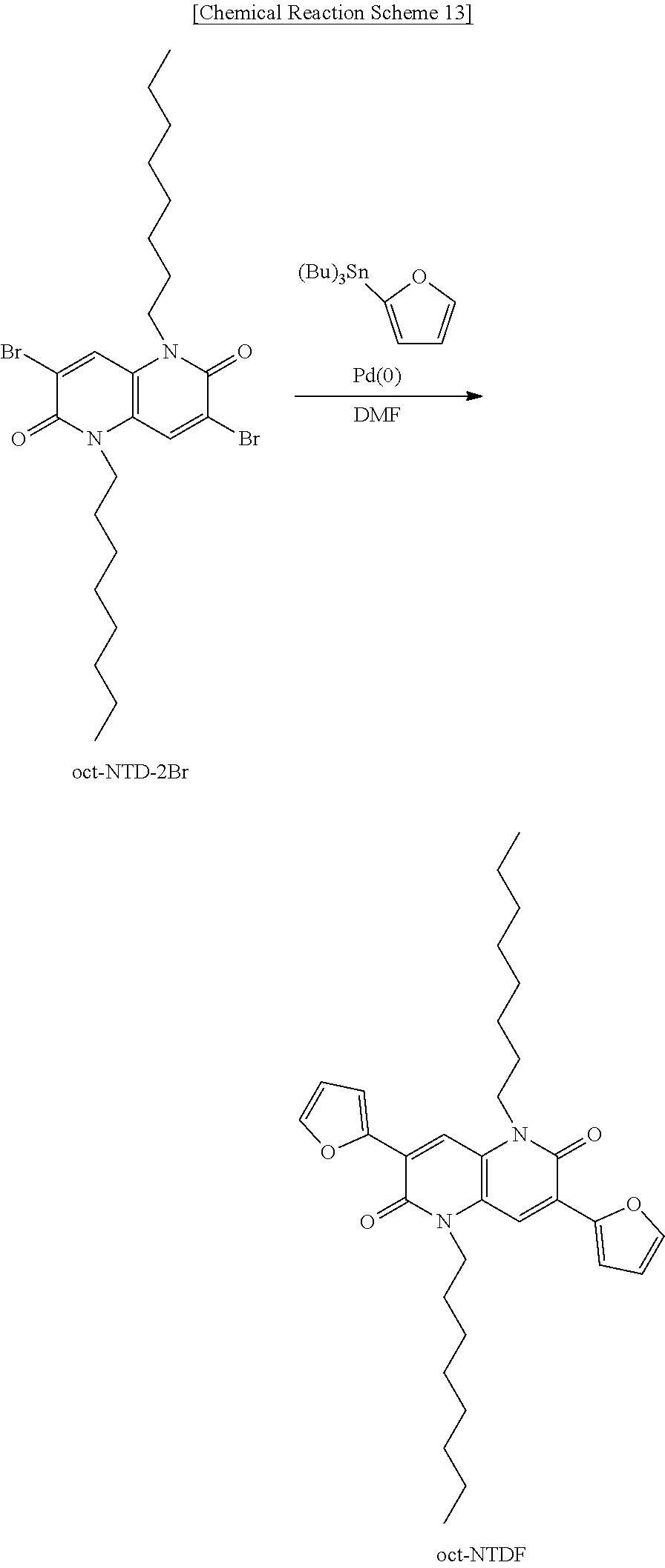
- Phosphor monomolecular compound oct-NTDF (Preparation Example 15) is synthesized using the oct-NTD-2Br (Preparation Example 2) as shown in Chemical Reaction Scheme 13 below.
- EA ethyl acetate
- Synthesis Example 2 Synthesis of Novel Monomolecular Compound Including 1,5-naphthyridine-2,6-dione Structure (TEG-NTD and TEG-NTD-2Br)
- AA acetic acid
- TEG-NTDT Phosphor monomolecular compound TEG-NTDT (Preparation Example 18) is synthesized using the TEG-NTD-2Br (Preparation Example 17) as shown in Chemical Reaction Scheme 14 below.
- EA ethyl acetate
- Table 1 below shows various monomolecular compounds prepared according to the synthesis methods as described above.
- FIGS. 3 A to 3 C show graphs illustrating light absorption spectra of phosphor monomolecular compounds according to an embodiment of the present invention.
- FIG. 3 A shows absorption spectra according to the preparation examples
- FIG. 3 B shows emission spectra
- FIG. 3 C shows average spectra.
- the phosphor monomolecular compounds according to the preparation examples of the present invention exhibit excellent absorption spectra in a wide range of wavelengths.
- a silicon substrate (SiO 2 /Si) was washed with acetone and isopropanol by sonication and treated with UV-ozone for 20 minutes.
- a silicon layer (SiO 2 ) of the substrate was treated with a gas-phase octadecyltrichlorosilane (OTS)
- OTS gas-phase octadecyltrichlorosilane
- the substrate was transferred to a glove box and the compound according to Preparation Example 3 was thermally deposited thereon in a high vacuum pressure (10 ⁇ 6 to 10 ⁇ 5 torr).
- FIGS. 4 A to 5 C show graphs illustrating results of performance evaluation on organic transistors according to an embodiment of the present invention.
- FIGS. 4 A to 4 F show transfer curves of organic transistors manufactured using the phosphor monomolecular compounds according to Preparation Examples 3, 6, 7, 12, 13, and 15, respectively
- FIGS. 5 A to 5 C show output curves of organic transistors manufactured using the phosphor monomolecular compounds according to Preparation Examples 3, 7, and 15, respectively.
- the organic transistors according to the preparation examples have high on-off ratios. It may also be confirmed that the curves are relatively linear with respect to gate voltage (Vg) and currents may flow in the organic transistors by a small voltage. That is, it may be confirmed that the organic transistors including the phosphor monomolecular compounds according to the present invention have excellent performance.
- Vg gate voltage
- FIG. 6 is a graph illustrating hydrogen gas generation rates in water splitting and hydrogen production photocatalytic systems according to a comparative example and an example.
- the phosphor monomolecular compounds according to the present invention have high visible light absorbance as described above in Experimental Example 1. Also, due to strong intermolecular attraction, a supramolecule is easily formed, and the specific surface area may be increased by controlling the structure. By adjusting solubility of the highly water-soluble phosphor monomolecular compounds, ⁇ - ⁇ interaction between molecules may be controlled, so that a crystal structure having a large specific surface area may be formed. Thus, the monomolecular compound according to the present invention may be used as a water splitting and hydrogen production catalyst, thereby exhibiting excellent performance.
- the water-soluble monomolecular compound including the 1,5-naphthyridine-2,6-dione structure according to the present invention may realize a wide range of wavelengths and may provide a phosphor having excellent photoluminescent efficiency, and thus the industrial applicability of the present invention may be considered high.
Landscapes
- Chemical & Material Sciences (AREA)
- Organic Chemistry (AREA)
- Engineering & Computer Science (AREA)
- Materials Engineering (AREA)
- Spectroscopy & Molecular Physics (AREA)
- Physics & Mathematics (AREA)
- General Health & Medical Sciences (AREA)
- Combustion & Propulsion (AREA)
- Inorganic Chemistry (AREA)
- Health & Medical Sciences (AREA)
- Nitrogen Condensed Heterocyclic Rings (AREA)
- Electroluminescent Light Sources (AREA)
- Organic Low-Molecular-Weight Compounds And Preparation Thereof (AREA)
- Pyridine Compounds (AREA)
Abstract
Description

-
- the X1 and X2 are each independently O, S, Se, NH, or NR′, and
- the R1, R2, R3, R4, R5, and R6 are each independently H, F, Cl, Br, I, a C1-C50 alkyl group, a C6-C50 aryl group, —COOR′, —(CH2CH2O)nCH3, or NR′2,
- wherein the R's are each independently a C1-C50 alkyl group or a C6-C50 aryl group, and
- the n is an integer from 1 to 50.

-
- the R1, R2, R7, and R8 are each independently H, F, Cl, Br, I, a C1-C50 alkyl group, a C6-C50 aryl group, —COOR′, —(CH2CH2O)nCH3, or NR′2,
- wherein the R's are each independently a C1-C50 alkyl group or a C6-C50 aryl group, and
- the n is an integer from 1 to 50.

-
- the R1 and R2 are each independently H, F, Cl, Br, I, a C1-C50 alkyl group, a C6-C50 aryl group, —COOR′, —(CH2CH2O)nCH3, or NR′2, and
- the R9 and R10 are each independently naphthalene

pyridine

or furan

-
- wherein the R's are each independently a C1-C50 alkyl group or a C6-C50 aryl group, and
- the n is an integer from 1 to 50.

-
- the X1 and X2 are each independently O, S, Se, NH, or NR′, and
- the R1, R2, R3, R4, R5, and R6 are each independently H, F, Cl, Br, I, a C1-C50 alkyl group, a C6-C50 aryl group, —COOR′, —(CH2CH2O)nCH3, or NR′2,
- wherein the R's are each independently a C1-C50 alkyl group or a C6-C50 aryl group, and
- the n is an integer from 1 to 50.

-
- the R1, R2, R7 and R8 are each independently H, F, Cl, Br, I, a C1-C50 alkyl group, a C6-C50 aryl group, —COOR′, —(CH2CH2O)nCH3, or NR′2,
- wherein the R's are each independently a C1-C50 alkyl group or a C6-C50 aryl group, and
- the n is an integer from 1 to 50.

-
- the R1 and R2 are each independently H, F, Cl, Br, I, a C1-C50 alkyl group, a C6-C50 aryl group, —COOR′, —(CH2CH2O)nCH3, or NR′2, and

pyridine

or furan

-
- wherein the R's are each independently a C1-C50 alkyl group or a C6-C50 aryl group, and
- the n is an integer from 1 to 50.

-
- the X1 and X2 are each independently O, S, Se, NH, or NR′, and
- the R1, R2, R3, R4, R5, and R6 are each independently H, F, Cl, Br, I, a C1-C50 alkyl group, a C6-C50 aryl group, —COOR′, —(CH2CH2O)nCH3, or NR′2,
- wherein the R's are each independently a C1-C50 alkyl group or a C6-C50 aryl group, and
- the n is an integer from 1 to 50.

-
- the R1, R2, R7 and R8 are each independently H, F, Cl, Br, I, a C1-C50 alkyl group, a C6-C50 aryl group, —COOR′, —(CH2CH2O)nCH3, or NR′2,
- wherein the R's are each independently a C1-C50 alkyl group or a C6-C50 aryl group, and
- the n is an integer from 1 to 50.

-
- the R1 and R2 are each independently H, F, Cl, Br, I, a C1-C50 alkyl group, a C6-C50 aryl group, —COOR′, —(CH2CH2O)nCH3, or NR′2, and
- the R9 and R10 are each independently naphthalene

pyridine

or furan

-
- wherein the R's are each independently a C1-C50 alkyl group or a C6-C50 aryl group, and

-
- the X1 and X2 are each independently O, S, Se, NH, or NR′, and
- the R1, R2, R3, R4, R5, and R6 are each independently H, F, Cl, Br, I, a C1-C50 alkyl group, a C6-C50 aryl group, —COOR′, —(CH2CH2O)nCH3, or NR′2,
- wherein the R's are each independently a C1-C50 alkyl group or a C6-C50 aryl group, and
- then is an integer from 1 to 50.

-
- the R1, R2, R7, and R8 are each independently H, F, Cl, Br, I, a C1-C50 alkyl group, a C6-C50 aryl group, —COOR′, —(CH2CH2O)nCH3, or NR′2,
- wherein the R's are each independently a C1-C50 alkyl group or a C6-C50 aryl group, and
- then is an integer from 1 to 50.

-
- the R1 and R2 are each independently H, F, Cl, Br, I, a C1-C50 alkyl group, a C6-C50 aryl group, —COOR′, —(CH2CH2O)nCH3, or NR′2, and
- the R9 and R10 are each independently naphthalene

pyridine

or furan

-
- wherein the R's are each independently a C1-C50 alkyl group or a C6-C50 aryl group, and
- then is an integer from 1 to 50.


-
- the X1 and X2 are each independently O, S, Se, NH, or NR′, and
- the R1, R2, R3, R4, R5, and R6 are each independently H, F, Cl, Br, I, a C1-C50 alkyl group, a C6-C50 aryl group, —COOR′, —(CH2CH2O)nCH3, or NR′2,
- wherein the R's are each independently a C1-C50 alkyl group or a C6-C50 aryl group, and
- the n is an integer from 1 to 50.

-
- the R1, R2, R7, and R8 are each independently H, F, Cl, Br, I, a C1-C50 alkyl group, a C6-C50 aryl group, —COOR′, —(CH2CH2O)nCH3, or NR′2,
- wherein the R's are each independently a C1-C50 alkyl group or a C6-C50 aryl group, and
- the n is an integer from 1 to 50.

-
- the R1 and R2 are each independently H, F, Cl, Br, I, a C1-C50 alkyl group, a C6-C50 aryl group, —COOR′, —(CH2CH2O)nCH3, or NR′2, and
- the R9 and R10 are each independently naphthalene

pyridine

or furan

-
- wherein the R's are each independently a C1-C50 alkyl group or a C6-C50 aryl group, and
- the n is an integer from 1 to 50.

-
- the X1 and X2 are each independently O, S, Se, NH, or NR′, and
- the R1, R2, R3, R4, R5, and R6 are each independently H, F, Cl, Br, I, a C1-C50 alkyl group, a C6-C50 aryl group, —COOR′, —(CH2CH2O)nCH3, or NR′2,
- wherein the R's are each independently a C1-C50 alkyl group or a C6-C50 aryl group, and
- then is an integer from 1 to 50.

-
- the R1, R2, R3, and R4 are each independently H, F, Cl, Br, I, a C1-C50 alkyl group, a C6-C50 aryl group, —COOR′, —(CH2CH2O)nCH3, or NR′2,
- wherein the R's are each independently a C1-C50 alkyl group or a C6-C50 aryl group, and
- then is an integer from 1 to 50.

-
- the R1 and R2 are each independently H, F, Cl, Br, I, a C1-C50 alkyl group, a C6-C50 aryl group, —COOR′, —(CH2CH2O)nCH3, or NR′2, and
- the R9 and R10 are each independently naphthalene

pyridine

or furan

-
- wherein the R's are each independently a C1-C50 alkyl group or a C6-C50 aryl group, and
- then is an integer from 1 to 50.




| TABLE 1 | |
 |
Preparation Example 1 |
 |
Preparation Example 2 |
 |
Preparation Example 3 |
 |
Preparation Example 4 |
 |
Preparation Example 5 |
 |
Preparation Example 6 |
 |
Preparation Example 7 |
 |
Preparation Example 8 |
 |
Preparation Example 9 |
 |
Preparation Example 10 |
 |
Preparation Example 11 |
 |
Preparation Example 12 |
 |
Preparation Example 13 |
 |
Preparation Example 14 |
 |
Preparation Example 15 |
 |
Preparation Example 16 |
 |
Preparation Example 17 |
 |
Preparation Example 18 |
| TABLE 2 | |
| Photoluminescence quantum yield (ϕrelative) | |
| Preparation Example 1 | 0.88 |
| Preparation Example 2 | 0.95 |
| Preparation Example 3 | 1 |
| Preparation Example 4 | 0.94 |
| Preparation Example 5 | 1 |
| Preparation Example 6 | 0.42 |
| Preparation Example 7 | 1 |
| Preparation Example 8 | 1 |
| Preparation Example 9 | 1 |
| Preparation Example 10 | 0.82 |
| Preparation Example 11 | 1 |
| Preparation Example 12 | 0.25 |
| Preparation Example 13 | 0.64 |
| Preparation Example 14 | 1 |
| Preparation Example 15 | 0.65 |
| Photoluminescence | Photoluminescence | |
| quantum yield | quantum yield | |
| (ϕabsolute), In H2O | (ϕabsolute), In CHCl3 | |
| Preparation Example 16 | 1 | 0.98 |
| Preparation Example 17 | 0.97 | 0.95 |
| Preparation Example 18 | 1 | 0.98 |
| TABLE 3 | |||
| Temperature | Average Hole | Maximum Hole | |
| Material | (Tsub) | Mobility (μp, avg) | Mobility (μp, max) |
| |
110° | C. | 1.08 | cm2/Vs | 2.76 | cm2/Vs |
| Example 3 | ||||||
| (oct-NTDT) | ||||||
| Preparation | 70° | C. | 0.086 | cm2/Vs | 0.17 | cm2/Vs |
| Example 6 | ||||||
| (oct-NTDTT) | ||||||
| Preparation | 25° | C. | 0.12 | cm2/Vs | 0.34 | cm2/Vs |
| Example 7 | ||||||
| (oct-NTDP) | ||||||
| Preparation | 70° | C. | 0.12 | cm2/Vs | 0.30 | cm2/Vs |
| Example 12 | ||||||
| (oct-NTDN1) | ||||||
| Preparation | 70° | C. | 0.022 | cm2/Vs | 0.036 | cm2/Vs |
| Example 13 | ||||||
| (oct-NTDN2) | ||||||
| Preparation | 25° | C. | 0.0097 | cm2/Vs | 0.018 | cm2/Vs |
| Example 15 | ||||||
| (oct-NTDF) | ||||||
Claims (9)


Applications Claiming Priority (3)
| Application Number | Priority Date | Filing Date | Title |
|---|---|---|---|
| KR1020180045675A KR102106295B1 (en) | 2018-04-19 | 2018-04-19 | Fluorescence monomolecular compounds, organic transistor using the same and photocatalyst system of water splitting hydrogen evolution using the same |
| KR10-2018-0045675 | 2018-04-19 | ||
| PCT/KR2019/003987 WO2019203481A1 (en) | 2018-04-19 | 2019-04-04 | Phosphor monomolecular compound, organic transistor using same, and water decomposition and hydrogen production photocatalytic system using same |
Related Parent Applications (1)
| Application Number | Title | Priority Date | Filing Date |
|---|---|---|---|
| PCT/KR2019/003987 A-371-Of-International WO2019203481A1 (en) | 2018-04-19 | 2019-04-04 | Phosphor monomolecular compound, organic transistor using same, and water decomposition and hydrogen production photocatalytic system using same |
Related Child Applications (1)
| Application Number | Title | Priority Date | Filing Date |
|---|---|---|---|
| US18/808,945 Division US20240409809A1 (en) | 2018-04-19 | 2024-08-19 | Phosphor monomolecular compound, organic transistor using same, and water decomposition and hydrogen production photocatalytic system using same |
Publications (2)
| Publication Number | Publication Date |
|---|---|
| US20210179933A1 US20210179933A1 (en) | 2021-06-17 |
| US12104104B2 true US12104104B2 (en) | 2024-10-01 |
Family
ID=68240202
Family Applications (2)
| Application Number | Title | Priority Date | Filing Date |
|---|---|---|---|
| US17/048,654 Active 2041-12-16 US12104104B2 (en) | 2018-04-19 | 2019-04-04 | Phosphor monomolecular compound, organic transistor using same, and water decomposition and hydrogen production photocatalytic system using same |
| US18/808,945 Pending US20240409809A1 (en) | 2018-04-19 | 2024-08-19 | Phosphor monomolecular compound, organic transistor using same, and water decomposition and hydrogen production photocatalytic system using same |
Family Applications After (1)
| Application Number | Title | Priority Date | Filing Date |
|---|---|---|---|
| US18/808,945 Pending US20240409809A1 (en) | 2018-04-19 | 2024-08-19 | Phosphor monomolecular compound, organic transistor using same, and water decomposition and hydrogen production photocatalytic system using same |
Country Status (3)
| Country | Link |
|---|---|
| US (2) | US12104104B2 (en) |
| KR (1) | KR102106295B1 (en) |
| WO (1) | WO2019203481A1 (en) |
Families Citing this family (2)
| Publication number | Priority date | Publication date | Assignee | Title |
|---|---|---|---|---|
| KR20220096214A (en) | 2020-12-30 | 2022-07-07 | 삼성전자주식회사 | Blue light absorbing film, photoelectric device, and image sensor and electronic device including the same |
| KR102883133B1 (en) * | 2022-11-25 | 2025-11-10 | 서울대학교산학협력단 | Compounds for a near-infrared absorption filter, a composition comprising the same, and a near-infrared absorption film comprising a cured product thereof |
Citations (2)
| Publication number | Priority date | Publication date | Assignee | Title |
|---|---|---|---|---|
| WO2013182262A1 (en) | 2012-06-04 | 2013-12-12 | Merck Patent Gmbh | Organic semiconductors |
| WO2017133752A1 (en) | 2016-02-04 | 2017-08-10 | Merck Patent Gmbh | [1,5]naphthyridine compounds and polymers as semiconductors |
-
2018
- 2018-04-19 KR KR1020180045675A patent/KR102106295B1/en active Active
-
2019
- 2019-04-04 WO PCT/KR2019/003987 patent/WO2019203481A1/en not_active Ceased
- 2019-04-04 US US17/048,654 patent/US12104104B2/en active Active
-
2024
- 2024-08-19 US US18/808,945 patent/US20240409809A1/en active Pending
Patent Citations (3)
| Publication number | Priority date | Publication date | Assignee | Title |
|---|---|---|---|---|
| WO2013182262A1 (en) | 2012-06-04 | 2013-12-12 | Merck Patent Gmbh | Organic semiconductors |
| KR20150023515A (en) * | 2012-06-04 | 2015-03-05 | 메르크 파텐트 게엠베하 | Organic semiconductors |
| WO2017133752A1 (en) | 2016-02-04 | 2017-08-10 | Merck Patent Gmbh | [1,5]naphthyridine compounds and polymers as semiconductors |
Non-Patent Citations (5)
| Title |
|---|
| Choi, M. W. In: Frontiers of Organic Semiconductor Lasers 2018, Guangzhou, 2018, 1-7. |
| Fu, C., Chem. Mater., 2017, pp. 2979-2987, Published Feb. 24, 2017. |
| Kim, J. H., ACS Appl. Mater. Interfaces, Jan. 30, 2019, 8301-8309. |
| Yoon, W. S., Adv. Energy Mater. 2018, 8, 1701467, 1-10. |
| Yoon, W. S., Macromolecules, 2016, 49, pp. 8489-8497, Published Nov. 3, 2016. |
Also Published As
| Publication number | Publication date |
|---|---|
| KR102106295B1 (en) | 2020-05-04 |
| US20240409809A1 (en) | 2024-12-12 |
| US20210179933A1 (en) | 2021-06-17 |
| KR20190122035A (en) | 2019-10-29 |
| WO2019203481A1 (en) | 2019-10-24 |
Similar Documents
| Publication | Publication Date | Title |
|---|---|---|
| US20240409809A1 (en) | Phosphor monomolecular compound, organic transistor using same, and water decomposition and hydrogen production photocatalytic system using same | |
| EP3514139B1 (en) | Fluorine-based compound, organic light-emitting device using same and method for preparing same | |
| US7355199B2 (en) | Substituted anthracenes and electronic devices containing the substituted anthracenes | |
| KR101556095B1 (en) | Novel heterocyclic compound and use thereof | |
| TWI548635B (en) | Naphthalene-diimineimine-heterocyclic-naphthalene diimine imine oligomer as organic semiconductor and transistor produced therefrom | |
| US7385221B1 (en) | Silylethynylated heteroacenes and electronic devices made therewith | |
| KR101859123B1 (en) | New compound for Hole blocking layer and/or electron transport layer of organic devices and Preparing method of organic film comprising the same compound and OLED | |
| US20090036689A1 (en) | Substituted indolocarbazoles | |
| US10714694B2 (en) | Delayed fluorescence material and organic light emitting device having the delayed fluorescence material | |
| US8609867B2 (en) | Substituted indolocarbazoles | |
| TW200920761A (en) | Diketopyrrolopyrrole-based derivatives for thin film transistors | |
| Dai et al. | Diacenopentalene dicarboximides as new n-type organic semiconductors for field-effect transistors | |
| US9893302B2 (en) | Heterocyclic fluorescent dyes and method of production thereof | |
| JP2014522393A (en) | Organic semiconductor materials | |
| KR20100006285A (en) | High-performance organic semiconductors based on 2,7-bis-(vinyl)[1]benzothieno[3,2-b]benzothiophene backbone and the organic semiconductor thin-film using the same and organic thin-film transistors using thereof | |
| US9508936B2 (en) | Organic semiconductor material | |
| JP2015501298A (en) | Pyrrolo-pyrroledione-thiophenequinone compound, preparation method and use thereof | |
| US8987447B2 (en) | Thienopyrazine compound and field effect transistor containing the same | |
| CN111989319A (en) | Organic light-emitting compound and organic electroluminescent element using the same | |
| JP5590491B2 (en) | Polymer compound, polymer organic semiconductor material and organic semiconductor device | |
| Wang et al. | Synthesis, characterization, and OFET and OLED properties of π-extended ladder-type heteroacenes based on indolodibenzothiophene | |
| KR100865703B1 (en) | Organic Semiconductor Compound of Arylacetylene Structure and Organic Thin Film Transistor Using the Same | |
| JP5637985B2 (en) | Diazaborol compound and field effect transistor containing the same | |
| CN114369106A (en) | Boron-nitrogen-containing carbazole indene compound and application thereof | |
| JP2015199670A (en) | Tetracene derivative, synthesis method thereof and organic electronic device using the same |
Legal Events
| Date | Code | Title | Description |
|---|---|---|---|
| AS | Assignment |
Owner name: SEOUL NATIONAL UNIVERSITY R&DB FOUNDATION, KOREA, REPUBLIC OF Free format text: ASSIGNMENT OF ASSIGNORS INTEREST;ASSIGNORS:PARK, SOO YOUNG;CHOI, MIN WOO;KIM, JIN HONG;AND OTHERS;SIGNING DATES FROM 20201008 TO 20201013;REEL/FRAME:054091/0620 |
|
| FEPP | Fee payment procedure |
Free format text: ENTITY STATUS SET TO UNDISCOUNTED (ORIGINAL EVENT CODE: BIG.); ENTITY STATUS OF PATENT OWNER: SMALL ENTITY |
|
| AS | Assignment |
Owner name: SEOUL NATIONAL UNIVERSITY R&DB FOUNDATION, KOREA, REPUBLIC OF Free format text: CORRECTIVE ASSIGNMENT TO CORRECT THE FOURTH NAMED INVENTOR PREVIOUSLY RECORDED ON REEL 054091 FRAME 0620. ASSIGNOR(S) HEREBY CONFIRMS THE ASSIGNMENT;ASSIGNORS:PARK, SOO YOUNG;CHOI, MIN WOO;KIM, JIN HONG;AND OTHERS;SIGNING DATES FROM 20201008 TO 20201013;REEL/FRAME:054190/0378 |
|
| FEPP | Fee payment procedure |
Free format text: ENTITY STATUS SET TO SMALL (ORIGINAL EVENT CODE: SMAL); ENTITY STATUS OF PATENT OWNER: SMALL ENTITY |
|
| STPP | Information on status: patent application and granting procedure in general |
Free format text: APPLICATION DISPATCHED FROM PREEXAM, NOT YET DOCKETED |
|
| STPP | Information on status: patent application and granting procedure in general |
Free format text: DOCKETED NEW CASE - READY FOR EXAMINATION |
|
| STPP | Information on status: patent application and granting procedure in general |
Free format text: NON FINAL ACTION MAILED |
|
| STPP | Information on status: patent application and granting procedure in general |
Free format text: RESPONSE TO NON-FINAL OFFICE ACTION ENTERED AND FORWARDED TO EXAMINER |
|
| STPP | Information on status: patent application and granting procedure in general |
Free format text: NON FINAL ACTION MAILED |
|
| STPP | Information on status: patent application and granting procedure in general |
Free format text: RESPONSE TO NON-FINAL OFFICE ACTION ENTERED AND FORWARDED TO EXAMINER |
|
| STPP | Information on status: patent application and granting procedure in general |
Free format text: EX PARTE QUAYLE ACTION MAILED |
|
| STPP | Information on status: patent application and granting procedure in general |
Free format text: RESPONSE TO EX PARTE QUAYLE ACTION ENTERED AND FORWARDED TO EXAMINER |
|
| STPP | Information on status: patent application and granting procedure in general |
Free format text: NOTICE OF ALLOWANCE MAILED -- APPLICATION RECEIVED IN OFFICE OF PUBLICATIONS |
|
| ZAAB | Notice of allowance mailed |
Free format text: ORIGINAL CODE: MN/=. |
|
| STPP | Information on status: patent application and granting procedure in general |
Free format text: PUBLICATIONS -- ISSUE FEE PAYMENT VERIFIED |
|
| STCF | Information on status: patent grant |
Free format text: PATENTED CASE |