US12104018B2 - Photocurable polymers, photocurable polymer compositions and lithographic processes including the same - Google Patents
Photocurable polymers, photocurable polymer compositions and lithographic processes including the same Download PDFInfo
- Publication number
- US12104018B2 US12104018B2 US17/283,321 US201917283321A US12104018B2 US 12104018 B2 US12104018 B2 US 12104018B2 US 201917283321 A US201917283321 A US 201917283321A US 12104018 B2 US12104018 B2 US 12104018B2
- Authority
- US
- United States
- Prior art keywords
- polymer
- formulation
- group
- mol
- recurring units
- Prior art date
- Legal status (The legal status is an assumption and is not a legal conclusion. Google has not performed a legal analysis and makes no representation as to the accuracy of the status listed.)
- Active, expires
Links
Images


Classifications
-
- C—CHEMISTRY; METALLURGY
- C08—ORGANIC MACROMOLECULAR COMPOUNDS; THEIR PREPARATION OR CHEMICAL WORKING-UP; COMPOSITIONS BASED THEREON
- C08G—MACROMOLECULAR COMPOUNDS OBTAINED OTHERWISE THAN BY REACTIONS ONLY INVOLVING UNSATURATED CARBON-TO-CARBON BONDS
- C08G65/00—Macromolecular compounds obtained by reactions forming an ether link in the main chain of the macromolecule
- C08G65/34—Macromolecular compounds obtained by reactions forming an ether link in the main chain of the macromolecule from hydroxy compounds or their metallic derivatives
- C08G65/38—Macromolecular compounds obtained by reactions forming an ether link in the main chain of the macromolecule from hydroxy compounds or their metallic derivatives derived from phenols
- C08G65/40—Macromolecular compounds obtained by reactions forming an ether link in the main chain of the macromolecule from hydroxy compounds or their metallic derivatives derived from phenols from phenols (I) and other compounds (II), e.g. OH-Ar-OH + X-Ar-X, where X is halogen atom, i.e. leaving group
-
- B—PERFORMING OPERATIONS; TRANSPORTING
- B29—WORKING OF PLASTICS; WORKING OF SUBSTANCES IN A PLASTIC STATE IN GENERAL
- B29C—SHAPING OR JOINING OF PLASTICS; SHAPING OF MATERIAL IN A PLASTIC STATE, NOT OTHERWISE PROVIDED FOR; AFTER-TREATMENT OF THE SHAPED PRODUCTS, e.g. REPAIRING
- B29C64/00—Additive manufacturing, i.e. manufacturing of three-dimensional [3D] objects by additive deposition, additive agglomeration or additive layering, e.g. by 3D printing, stereolithography or selective laser sintering
- B29C64/10—Processes of additive manufacturing
- B29C64/106—Processes of additive manufacturing using only liquids or viscous materials, e.g. depositing a continuous bead of viscous material
- B29C64/124—Processes of additive manufacturing using only liquids or viscous materials, e.g. depositing a continuous bead of viscous material using layers of liquid which are selectively solidified
-
- B—PERFORMING OPERATIONS; TRANSPORTING
- B29—WORKING OF PLASTICS; WORKING OF SUBSTANCES IN A PLASTIC STATE IN GENERAL
- B29C—SHAPING OR JOINING OF PLASTICS; SHAPING OF MATERIAL IN A PLASTIC STATE, NOT OTHERWISE PROVIDED FOR; AFTER-TREATMENT OF THE SHAPED PRODUCTS, e.g. REPAIRING
- B29C64/00—Additive manufacturing, i.e. manufacturing of three-dimensional [3D] objects by additive deposition, additive agglomeration or additive layering, e.g. by 3D printing, stereolithography or selective laser sintering
- B29C64/10—Processes of additive manufacturing
- B29C64/106—Processes of additive manufacturing using only liquids or viscous materials, e.g. depositing a continuous bead of viscous material
- B29C64/124—Processes of additive manufacturing using only liquids or viscous materials, e.g. depositing a continuous bead of viscous material using layers of liquid which are selectively solidified
- B29C64/129—Processes of additive manufacturing using only liquids or viscous materials, e.g. depositing a continuous bead of viscous material using layers of liquid which are selectively solidified characterised by the energy source therefor, e.g. by global irradiation combined with a mask
- B29C64/135—Processes of additive manufacturing using only liquids or viscous materials, e.g. depositing a continuous bead of viscous material using layers of liquid which are selectively solidified characterised by the energy source therefor, e.g. by global irradiation combined with a mask the energy source being concentrated, e.g. scanning lasers or focused light sources
-
- B—PERFORMING OPERATIONS; TRANSPORTING
- B33—ADDITIVE MANUFACTURING TECHNOLOGY
- B33Y—ADDITIVE MANUFACTURING, i.e. MANUFACTURING OF THREE-DIMENSIONAL [3D] OBJECTS BY ADDITIVE DEPOSITION, ADDITIVE AGGLOMERATION OR ADDITIVE LAYERING, e.g. BY 3D PRINTING, STEREOLITHOGRAPHY OR SELECTIVE LASER SINTERING
- B33Y70/00—Materials specially adapted for additive manufacturing
-
- C—CHEMISTRY; METALLURGY
- C08—ORGANIC MACROMOLECULAR COMPOUNDS; THEIR PREPARATION OR CHEMICAL WORKING-UP; COMPOSITIONS BASED THEREON
- C08G—MACROMOLECULAR COMPOUNDS OBTAINED OTHERWISE THAN BY REACTIONS ONLY INVOLVING UNSATURATED CARBON-TO-CARBON BONDS
- C08G65/00—Macromolecular compounds obtained by reactions forming an ether link in the main chain of the macromolecule
- C08G65/34—Macromolecular compounds obtained by reactions forming an ether link in the main chain of the macromolecule from hydroxy compounds or their metallic derivatives
- C08G65/38—Macromolecular compounds obtained by reactions forming an ether link in the main chain of the macromolecule from hydroxy compounds or their metallic derivatives derived from phenols
- C08G65/40—Macromolecular compounds obtained by reactions forming an ether link in the main chain of the macromolecule from hydroxy compounds or their metallic derivatives derived from phenols from phenols (I) and other compounds (II), e.g. OH-Ar-OH + X-Ar-X, where X is halogen atom, i.e. leaving group
- C08G65/4012—Other compound (II) containing a ketone group, e.g. X-Ar-C(=O)-Ar-X for polyetherketones
- C08G65/4056—(I) or (II) containing sulfur
-
- C—CHEMISTRY; METALLURGY
- C08—ORGANIC MACROMOLECULAR COMPOUNDS; THEIR PREPARATION OR CHEMICAL WORKING-UP; COMPOSITIONS BASED THEREON
- C08G—MACROMOLECULAR COMPOUNDS OBTAINED OTHERWISE THAN BY REACTIONS ONLY INVOLVING UNSATURATED CARBON-TO-CARBON BONDS
- C08G75/00—Macromolecular compounds obtained by reactions forming a linkage containing sulfur with or without nitrogen, oxygen, or carbon in the main chain of the macromolecule
- C08G75/20—Polysulfones
- C08G75/23—Polyethersulfones
-
- C—CHEMISTRY; METALLURGY
- C08—ORGANIC MACROMOLECULAR COMPOUNDS; THEIR PREPARATION OR CHEMICAL WORKING-UP; COMPOSITIONS BASED THEREON
- C08L—COMPOSITIONS OF MACROMOLECULAR COMPOUNDS
- C08L81/00—Compositions of macromolecular compounds obtained by reactions forming in the main chain of the macromolecule a linkage containing sulfur with or without nitrogen, oxygen or carbon only; Compositions of polysulfones; Compositions of derivatives of such polymers
- C08L81/06—Polysulfones; Polyethersulfones
-
- B—PERFORMING OPERATIONS; TRANSPORTING
- B33—ADDITIVE MANUFACTURING TECHNOLOGY
- B33Y—ADDITIVE MANUFACTURING, i.e. MANUFACTURING OF THREE-DIMENSIONAL [3D] OBJECTS BY ADDITIVE DEPOSITION, ADDITIVE AGGLOMERATION OR ADDITIVE LAYERING, e.g. BY 3D PRINTING, STEREOLITHOGRAPHY OR SELECTIVE LASER SINTERING
- B33Y10/00—Processes of additive manufacturing
-
- C—CHEMISTRY; METALLURGY
- C08—ORGANIC MACROMOLECULAR COMPOUNDS; THEIR PREPARATION OR CHEMICAL WORKING-UP; COMPOSITIONS BASED THEREON
- C08G—MACROMOLECULAR COMPOUNDS OBTAINED OTHERWISE THAN BY REACTIONS ONLY INVOLVING UNSATURATED CARBON-TO-CARBON BONDS
- C08G73/00—Macromolecular compounds obtained by reactions forming a linkage containing nitrogen with or without oxygen or carbon in the main chain of the macromolecule, not provided for in groups C08G12/00 - C08G71/00
- C08G73/06—Polycondensates having nitrogen-containing heterocyclic rings in the main chain of the macromolecule
- C08G73/10—Polyimides; Polyester-imides; Polyamide-imides; Polyamide acids or similar polyimide precursors
- C08G73/1067—Wholly aromatic polyimides, i.e. having both tetracarboxylic and diamino moieties aromatically bound
- C08G73/1071—Wholly aromatic polyimides containing oxygen in the form of ether bonds in the main chain
-
- C—CHEMISTRY; METALLURGY
- C08—ORGANIC MACROMOLECULAR COMPOUNDS; THEIR PREPARATION OR CHEMICAL WORKING-UP; COMPOSITIONS BASED THEREON
- C08L—COMPOSITIONS OF MACROMOLECULAR COMPOUNDS
- C08L79/00—Compositions of macromolecular compounds obtained by reactions forming in the main chain of the macromolecule a linkage containing nitrogen with or without oxygen or carbon only, not provided for in groups C08L61/00 - C08L77/00
- C08L79/04—Polycondensates having nitrogen-containing heterocyclic rings in the main chain; Polyhydrazides; Polyamide acids or similar polyimide precursors
- C08L79/08—Polyimides; Polyester-imides; Polyamide-imides; Polyamide acids or similar polyimide precursors
Definitions
- the present invention relates to a polymer formulation for three-dimensionally (3D) printing an article by stereolithography, the formulation comprising a functionalized polymer.
- the invention further relates to lithographic methods to form 3D objects that incorporate the aforementioned polymer formulation.
- lithographic processes for the photofabrication of 3D articles from polymeric materials have found recent popularity due to their relative speed and simplicity.
- lithographic processes involve the use of light, for example UV irradiation, to locally cure a polymerizable formulation at specific locations.
- the localized curing allows for the fabrication of 3-dimensional articles.
- Lithographic processes generally use polymerizable formulations that are liquid in order to obtain parts with a good resolution.
- Polymerizable formulations that are liquid at room temperature are easier to use in a printing process, but they generally lead to articles having moderate mechanical properties and thermal stability.
- Certain polymers used in the lithographic processes present a good mechanical property profile. These polymers need to be melt above their melting temperature to be used in liquid polymerizable formulations.
- One of the challenges in the identification of valuable polymers is that they need to remain thermally stable at the polymer melting temperature and be reactive in the printing process when irradiating the layer of polymerizable formulation.
- Another challenge in the identification of valuable polymerizable formulations to be used in lithographic processes is that they have to be capable of producing 3D articles that present good mechanical properties after photofabrication and substantially retain these mechanical properties after exposure to high temperature, for example above 150° C.
- the polymerizable formulations of the present invention provide a well-suited solution for high temperature 3D printing processes.
- the present invention relates to a polymer formulation (F) comprising a polymer (P) selected from the poly(aryl ethersulfone) (PAES) and the polyetherimide (PEI) polymers, wherein the polymer (P) comprises at least one terminal group of formula (M1) or (M2):
- This polymer formulation (F) can be for example used in photofabrication processes.
- the formulation (F) of the present invention can be incorporated into lithographic processes in which light is used to cure the functionalized polymers.
- the formulation (F) of the present invention can be turned into a liquid state at a temperature below or above the Tg of polymer (P) without noticeable change and then be cured by irradiation of UV light, producing high thermal properties materials having high Tg, high mechanical properties and high thermal stability.
- the formulation (F) of the invention can effectively be used in 3D printing lithographic processes.
- the present invention also relates to a method for manufacturing a three-dimensional (3D) article with an additive manufacturing system, comprising:
- the step of printing comprises irradiating the polymer formulation (F) with UV light.
- the UV light can for example be laser light.
- the present invention also relates to 3D article obtainable, at least in part, by the method described above, and the use of the polymer formulation (F), for the manufacture of 3D objects by stereolithography (SLA).
- F polymer formulation
- SLA stereolithography
- FIG. 1 is a schematic representation of the 3D object to be printed.
- FIG. 2 is a picture of the object printed from the comparative formulation 1.
- FIG. 3 is a picture of the object printed from the inventive formulation 2.
- the present invention relates to a polymer formulation (F) comprising at least one polymer (P) selected from the group consisting of poly(aryl ethersulfone) (PAES) polymer and polyetherimide (PEI) polymer, wherein the polymer (P) has been functionalized. More precisely, the polymer (P) comprises at least one terminal group of formula (M1) or (M2):
- the number average molecular weight (Mn) of the polymer (P) is of less than 40,000 g/mol, less than 35,000 g/mol, less than 30,000 g/mol, less than 25,000 g/mol, less than 20,000 g/mol, less than 15,000 g/mol, or less than 10,000 g/mol, as determined by gel permeation chromatography (GPC) using methylene chloride as a mobile phase and polystyrene standards.
- GPC gel permeation chromatography
- the number average molecular weight (Mn) of the polymer (P) is of less than less than 20,000 g/mol.
- the formulation (F) comprising the functionalized polymer (P) of the invention can be used in photofabrication processes.
- the polymer (P) and polymer formulation (F) of the present invention can be incorporated into lithographic processes in which light is used to cure the functionalized polymers.
- the formulation (F) of the present invention also comprises:
- the formulation (F) of the present invention is preferably liquid, for example at room temperature or above.
- a photoinitiator is a compound especially added to a formulation to convert absorbed light energy, UV or visible light, into chemical energy in the form of initiating species, for example free radicals or cations.
- a blocker is a compound added to either scavenge unused radicals created by the photoinitiator or absorb a portion of the incident UV energy. This compound allows for improving dimensional accuracy of the fabricated part.
- the polymer (P) described in the present invention is functionalized with a functional group, which is a (meth)acrylic moiety (M1) and/or a styrene (M2).
- the functional groups are introduced as a postpolymerization modification at at least one end of the polymer chain, for example at both ends of the polymer chain, and/or into side chains of the polymer backbone.
- the polymer (P) described in the present invention is functionalized at at least one end of the polymer chain, as a “terminal functionalization”.
- the polymer (P) of the present invention can be functionalized at both ends of the polymer chain.
- the polymer (P) of the present invention can also be functionalized within the polymer backbone, as an “internal functionalization”.
- one or more of the recurring units of the polymer (P) that are not disposed at the end of the polymer chain can be functionalized with a functional group, which is a (meth)acrylic moiety.
- the formulation (P) of the present invention can comprise more than one polymer (P), for example two of three distinct polymers (P).
- PAES Poly(aryl Ethersulfone)
- P is a PAES having recurring units (R PAES ) of formula (L):
- the polymer (P) of the present invention can comprise:
- the recurring units (R PAES ) are according to formula (L′):
- R 1 and i are as above-mentioned.
- terminal group(s) of the polymer (P) are according to formula (M′):
- R 1 , R and i are as above-mentioned.
- T is as above-mentioned.
- P is a PAES having at least 50 mol. % (based on the total number of moles in the polymer) of recurring units of formula (L), (L′) or (L′′) and comprises at least one at least one terminal group of formula (M), (M′) or (M′′).
- At least 60 mol. %, at least 70 mol. %, at least 80 mol. %, at least 90 mol. %, at least 95 mol. %, at least 99 mol. % (based on the total number of moles in the polymer) or all of the recurring units in the PAES are recurring units (R PAES ) of formula (L), (L′) or (L′′) and comprises at least one at least one terminal group of formula (M), (M′) or (M′′).
- P is a PAES wherein T is selected from the group consisting of a bond, —SO 2 — and —C(CH 3 ) 2 —.
- P is a PAES having at least 50 mol. % (based on the total number of moles in the polymer) of recurring units selected from the group consisting of formulas:
- R 1 and i are as above-mentioned.
- At least 60 mol. %, at least 70 mol. %, at least 80 mol. %, at least 90 mol. %, at least 95 mol. %, at least 99 mol. % (based on the total number of moles in the polymer) or all of the recurring units in the PAES are recurring units (R PAES ) of formula (L-A), formula (L-B) and/or formula (L-C).
- P is a PAES wherein T is a bond.
- P is a functionalized poly(biphenyl ether sulfone) (PPSU).
- P is a PPSU comprising:
- the PPSU polymer of the present invention can be a homopolymer or a copolymer. If it is a copolymer, it can be a random, alternate or block copolymer.
- At least 60 mol. %, at least 70 mol. %, at least 80 mol. %, at least 90 mol. %, at least 95 mol. %, at least 99 mol. % or all of the recurring units in the PPSU are recurring units (R PPSU ) of formula (L-A).
- the poly(biphenyl ether sulfone) (PPSU) is a copolymer, it can be made of recurring units (R* PPSU ), different from recurring units (R PPSU ), such as recurring units of formula (L-B) and/or formula (L-C), both above-described, and/or recurring units of formula (L-D):
- R 1 and i are as above-mentioned.
- the poly(biphenyl ether sulfone) can be prepared by any method known in the art. It can for example result from the condensation of 4,4′-dihydroxybiphenyl (biphenol) and 4,4′-dichlorodiphenyl sulfone in presence of a base. The reaction of monomer units takes place through nucleophilic aromatic substitution with the elimination of one unit of hydrogen halide as leaving group. It is to be noted however that the structure of the resulting poly(biphenyl ether sulfone) does not depend on the nature of the leaving group.
- the PPSU is then modified after polymerisation to introduce the functional group at at least one end of the polymer chain.
- the functional group is an alpha-olefin of formula CH 2 ⁇ CH—CH 2 —(CH 2 ) n — wherein n varies between 1 and 10.
- Alpha-olefin functional groups can also be introduced at both ends of the polymer chain, and/or into side chains of the polymer backbone.
- P is a PAES wherein T is —C(CH 3 ) 2 —.
- P is a functionalized polysulfone (PSU).
- P is a PSU comprising:
- the PSU polymer of the present invention can therefore be a homopolymer or a copolymer. If it is a copolymer, it can be a random, alternate or block copolymer.
- At least 60 mol. %, at least 70 mol. %, at least 80 mol. %, at least 90 mol. %, at least 95 mol. %, at least 99 mol. % or all of the recurring units in the PSU are recurring units (R PSU ) of formula (L-B).
- the polysulfone (PSU) when it is a copolymer, it can be made of recurring units (R* PSU ), different from recurring units (R PSU ), such as recurring units of formula (L-A), (L-C) and/or (L-D), all above-described.
- R* PSU recurring units of formula (L-A), (L-C) and/or (L-D), all above-described.
- P is a PAES wherein T is —SO 2 —.
- P is a functionalized polyethersulfone (PES).
- P is a PES comprising:
- the PES polymer of the present invention can therefore be a homopolymer or a copolymer. If it is a copolymer, it can be a random, alternate or block copolymer.
- At least 60 mol. %, at least 70 mol. %, at least 80 mol. %, at least 90 mol. %, at least 95 mol. %, at least 99 mol. % or all of the recurring units in the PES are recurring units (R PES ) of formula (L-C).
- the polyethersulfone (PES) is a copolymer
- it can be made of recurring units (R* PESU ), different from recurring units (R PESU ), such as recurring units of formula (L-A), (L-B) and/or (L-D), all above-described.
- P is a PEI having recurring units (R PEI ) comprising at least one aromatic ring, at least one imide group, as such and/or in its amic acid form, and at least one ether group.
- Recurring units (R PEI ) may optionally further comprise at least one amide group which is not included in the amic acid form of an imide group.
- the recurring units (R PEI ) are selected from the group consisting of following formulas (I), (II), (III), (IV), (V) and mixtures thereof:
- Ar is selected from the group consisting of formulas:
- X is a divalent moiety, having divalent bonds in the 3,3′, 3,4′, 4,3′′ or the 4,4′ positions and is selected from the group consisting of alkylenes of 1 to 6 carbon atoms, for example —C(CH 3 ) 2 and —C n H 2n — (n being an integer from 1 to 6); perfluoroalkylenes of 1 to 6 carbon atoms, for example —C(CF 3 ) 2 and —C n F 2n — (n being an integer from 1 to 6); cycloalkylenes of 4 to 8 carbon atoms; alkylidenes of 1 to 6 carbon atoms; cycloalkylidenes of 4 to 8 carbon atoms; —O—; —S—; —C(O)—; —SO 2 —; —SO—; or X is a group of the formula —O—Ar′′—O—, wherein Ar′′ is a aromatic moiety selected from the group consisting of a substitute
- Ar′ is selected from the group consisting of formulas:
- X is a divalent moiety, having divalent bonds in the 3,3′, 3,4′, 4,3′′ or the 4,4′ positions and is selected from the group consisting of alkylenes of 1 to 6 carbon atoms, for example —C(CH 3 ) 2 and —C n H 2n — (n being an integer from 1 to 6); perfluoroalkylenes of 1 to 6 carbon atoms, for example —C(CF 3 ) 2 and —C n F 2n — (n being an integer from 1 to 6); cycloalkylenes of 4 to 8 carbon atoms; alkylidenes of 1 to 6 carbon atoms; cycloalkylidenes of 4 to 8 carbon atoms; —O—; —S—; —C(O)—; —SO 2 —; —SO—; or X is a group of the formula —O—Ar′′—O—, wherein Ar′′ is a aromatic moiety selected from the group consisting of a substitute
- At least 50 mol. %, at least 60 mol. %, at least 70 mol. %, at least 80 mol. %, at least 90 mol. %, at least 95 mol. %, at least 99 mol. % or all of the recurring units in the PEI are recurring units (R PEI ) of formulas (I), (II), (Ill), (IV), (V) and/or mixtures thereof, as defined above.
- P is a PEI having at least 50 mol. %, based on the total number of moles in the polymer, of recurring units (R PEI ) of formula (VII):
- Ar′′ is of the general formula (VI), as detailed above; for example, Ar′′ is of formula (XIX):
- polyetherimides (PEI) of the present invention may be prepared by any of the methods well-known to those skilled in the art including the reaction of a diamino compound of the formula H 2 N—R—NH 2 (XX), where R is as defined before, with any aromatic bis(ether anhydride)s of the formula (XXI):
- the preparation can be carried out in solvents, e.g., o-dichlorobenzene, m-cresol/toluene, N,N-dimethylacetamide, at temperatures ranging from 20° C. to 250° C.
- solvents e.g., o-dichlorobenzene, m-cresol/toluene, N,N-dimethylacetamide
- these polyetherimides can be prepared by melt polymerization of any dianhydrides of formula (XXI) with any diamino compound of formula (XX) while heating the mixture of the ingredients at elevated temperatures with concurrent intermixing.
- aromatic bis(ether anhydride)s of formula (XXI) include, for example:
- the organic diamines of formula (XX) are chosen from the group consisting of m-phenylenediamine, p-phenylenediamine, 2,2-bis(p-aminophenyl)propane, 4,4′-diaminodiphenyl-methane, 4,4′-diaminodiphenyl sulfide, 4,4′-diamino diphenyl sulfone, 4,4′-diaminodiphenyl ether, 1,5-diaminonaphthalene, 3,3′-dimethylbenzidine, 3,3′-dimethoxybenzidine, and mixtures thereof; preferably, the organic diamines of formula (XX) are chosen from the group consisting of m-phenylenediamine and p-phenylenediamine and mixture thereof.
- P is a PEI comprising at least 50 mol. %, based on the total number of moles in the polymer, of recurring units (R PEI ) of formulas (XXIII) or (XXIV), in imide forms, or their corresponding amic acid forms and mixtures thereof:
- At least 50 mol. %, at least 60 mol. %, at least 70 mol. %, at least 80 mol. %, at least 90 mol. %, at least 95 mol. %, at least 99 mol. % or all of the recurring units in the PEI are recurring units (R PSI ) of formulas (XXIII) or (XXIV), in imide forms, or their corresponding amic acid forms and mixtures thereof.
- the concentration of the solvent may be between 1 to 80 wt. %, based on the total weight of the formulation (F), for example between 2 and 75 wt. %, between 5 and 70 wt. % or between 10 and 65 wt. %.
- the solvent is selected from the group consisting of N-methylpyrrolidone (NMP), N,Ndimethylformamide (DMF), N,N-dimethylacetamide (DMAC), 1,3-dimethyl-2-imidazolidinone, tetrahydrofuran (THF), dimethyl sulfoxide (DMSO) and sulfolane.
- NMP N-methylpyrrolidone
- DMF N,Ndimethylformamide
- DMAC N,N-dimethylacetamide
- THF tetrahydrofuran
- DMSO dimethyl sulfoxide
- sulfolane sulfolane
- the solvent is a dipolar aprotic solvent.
- the solvent is selected from the group consisting of N-methylpyrrolidone (NMP), dimethylacetamide (DMAc or DMA), N-Cyclohexyl-2-pyrrolidone (CHP) and dimethyl sulfoxide (DMSO).
- the photoinitiator is a compound especially added to a formulation to convert absorbed light energy, UV or visible light, into chemical energy in the form of initiating species, for example free radicals or cations. Based on the mechanism by which initiating radicals are formed, photoinitiators are generally divided into two classes:
- the concentration of the photoinitiator in the formulation (F) may be between 0.05 to 10 wt. %, based on the total weight of the formulation (F), for example between 0.1 and 5 wt. %, between 0.2 and 4 wt. % or between 0.5 and 3 wt. %.
- the photoinitiator is selected from the group consisting of:
- the photoinitiator is selected from the group consisting of 2,2-dimethoxy-2-phenylacetophenone (DMPA), Diphenyl(2,4,6-trimethylbenzoyl)phosphine oxide and Phenylbis(2,4,6-trimethylbenzoyl)phosphine oxide.
- DMPA 2,2-dimethoxy-2-phenylacetophenone
- Diphenyl(2,4,6-trimethylbenzoyl)phosphine oxide Diphenyl(2,4,6-trimethylbenzoyl)phosphine oxide
- Phenylbis(2,4,6-trimethylbenzoyl)phosphine oxide 2,2-dimethoxy-2-phenylacetophenone
- a blocker is a compound that is added to the formulation in order to (i) scavenge a predetermined amount of radicals formed by the photoinitiator while irradiated by UV light, (ii) scavenge unused radicals that may be present after the UV irradiation source has been turned off, and/or (iii) absorb a portion of the energy that is delivered to the system during UV irradiation.
- the concentration of the blocker in the formulation (F) may be between 0.05 to 10 wt. %, based on the total weight of the formulation (F), for example between 0.1 and 5 wt. %, between 0.2 and 4 wt. % or between 0.5 and 3 wt. %.
- the blocker is selected from the group consisting of:
- the blocker is selected from the group consisting of avobenzone and 2,5-Bis(5-tert-butyl-benzoxazol-2-yl)thiophene.
- the formulation of the present invention may comprise at least one additive, for example selected from the group consisting of fillers such as silica, antioxidants, antibacterial compounds and antistatic compounds.
- the additive may for example be a chemically inert species such as carbon black, silica (e.g. microsilica particles) and carbon nano tubes.
- the present invention also relates to a method for manufacturing a 3D article with an additive manufacturing system, comprising:
- the step of printing comprises irradiating the polymer formulation (F), for example a layer of such formulation (F) deposited onto the printing surface, with UV light.
- the layer preferably presents a size in the range of 10 ⁇ m to 300 ⁇ m, for example 50 ⁇ m to 150 ⁇ m.
- the UV light can for example be laser light.
- the irradiation is preferably of sufficient intensity to cause substantial curing of the polymer formulation (F), for example the layer of such formulation (F). Also, the irradiation is preferably of sufficient intensity to cause adhesion of the layers of polymer formulation (F).
- the method for manufacturing a 3D article with an additive manufacturing system comprises the steps of:
- the polymer formulation (F) is at room temperature during the process.
- the formulation can be heated before and/or during printing, especially if the polymer concentration in the formulation is high.
- the temperature can be heated up to 130° C., up to 120° C. or up to 110° C. before and/or during printing.
- the present invention also relates to the use of the polymer (P) of the present invention or of the polymer formulation (F) of the present invention, for the manufacture of 3D objects/articles.
- the present invention also relates to 3D objects or 3D articles obtainable, at least in part, from the method of manufacture of the present invention, using the polymer (P) or the polymer formulation (F) herein described.
- the 3D objects or articles obtainable by such method of manufacture can be used in a variety of final applications. Mention can be made in particular of implantable device, dental prostheses, brackets and complex shaped parts in the aerospace industry and under-the-hood parts in the automotive industry.
- Bis(4-chlorophenyl) sulfone (98%) and bisphenol A ( ⁇ 99%) were purchased from Sigma-Aldrich and recrystallized in toluene. Nitrogen gas (99.999%) was purchased from Praxair. All materials were used as received unless otherwise specified.
- Thermogravimetric analysis was performed from 25 to 600° C. at 10° C./min using a TA Instruments Q50 under constant N 2 flow.
- DSC Differential scanning calorimetry
- Photorheology was performed on a TA Instruments DHR-2 rheometer with 20 mm parallel plate geometry, Smart SwapTM UV curing accessory, and Omnicure S2000 light source with broad spectrum bulb and 320-500 nm filter installed, enabling wavelengths in this window to pass through to the sample.
- An oscillation analysis at 25° C. using 0.3% strain and 4 Hz was performed on the polymer. The sample was subjected to oscillation for 30 s prior to UV irradiation with an intensity of 250 mW/cm 2 for 200 s.
- PSU Polysulfone
- BPA bisphenol A monomer
- the formulations were transferred into a glass beaker and levelled to the focus of the projector.
- a ULTEM® build platform fabricated via filament extrusion, was inserted into the resin beaker.
- the build platform was flushed with the resin surface and then lowered into the resin by 100 ⁇ m.
- the STL file of the test specimen was sliced into 100 ⁇ m slices and converted into mono-chrome Bitmap images.
- the Bitmap image corresponding to the first layer of the part, was projected on the resin surface for 8 seconds using a 365 nm light source set to an intensity of 15 W/cm 2 .
- the build platform was then lowered into the resin for recoating with a fresh layer of resin.
- Subsequent layers were fabricated using an exposure time of 8 seconds/layer followed by the recoating step. The process was continued until the complete part was fabricated.
- the fabricated 3D parts were extracted from the build platform and rinsed with NMP to remove any residual uncured resin. The parts were then wiped dry with Kim WipesTM and transferred onto a glass slide for measurements.
- the part fabricated with comparative formulation 1 does not fully exhibit the designed porosity.
- the pores are either fully closed or partially closed. This can be attributed to overcuring.
- This formulation results in the fabrication of parts with poor feature resolution.
- the part fabricated with inventive formulation 2 exhibits all of the designed porosity. This can be attributed to the prevention of overcuring by the addition of the UV blocker, avobenzone. This formulation results in the fabrication of parts with superior feature resolution.
Landscapes
- Chemical & Material Sciences (AREA)
- Engineering & Computer Science (AREA)
- Materials Engineering (AREA)
- Physics & Mathematics (AREA)
- Optics & Photonics (AREA)
- Manufacturing & Machinery (AREA)
- Chemical Kinetics & Catalysis (AREA)
- Health & Medical Sciences (AREA)
- Medicinal Chemistry (AREA)
- Polymers & Plastics (AREA)
- Organic Chemistry (AREA)
- Mechanical Engineering (AREA)
- Compositions Of Macromolecular Compounds (AREA)
- Polyethers (AREA)
- Macromonomer-Based Addition Polymer (AREA)
- Polymers With Sulfur, Phosphorus Or Metals In The Main Chain (AREA)
- Polymerisation Methods In General (AREA)
Abstract
Description

-
- wherein
- R is H or CH3,
- X is a bond or (CH2)n with n ranging from 1 to 20, and
wherein the number average molecular weight (Mn) of the polymer (P) is of less than 40,000 g/mol, less than 35,000 g/mol, less than 30,000 g/mol, less than 25,000 g/mol, less than 20,000 g/mol, less than 15,000 g/mol, or less than 10,000 g/mol, as determined by gel permeation chromatography (GPC) using methylene chloride as a mobile phase and polystyrene standards.
- wherein
-
- providing a polymer formulation (F) according to the invention, and
- printing layers of the 3D article from the polymer formulation (F).

-
- wherein
- R is H or CH3,
- X is a bond or (CH2)n with n ranging from 1 to 20, for example from 1 to 10 or from 1 to 8.
- wherein
-
- at least one solvent,
- at least one photoinitiator, and
- at least one blocker.

-
- each R1 is independently selected from the group consisting of a halogen, alkyl, alkenyl, alkynyl, aryl, ether, thioether, carboxylic acid, ester, amide, imide, alkali or alkaline earth metal sulfonate, alkyl sulfonate, alkali or alkaline earth metal phosphonate, alkyl phosphonate, amine and quaternary ammonium;
- each i is an independently selected integer from 0 to 4 for each aromatic cycle;
- T is selected from the group consisting of a bond, —CH2—; —O—; —SO2—; —S—; —C(O)—; —C(CH3)2—; —C(CF3)2—; —C(═CCl2)—; —C(CH3)(CH2CH2COOH)—; —N═N—; —RaC═CRb—, where each Ra and Rb, independently of one another, is a hydrogen or a C1-C12-alkyl, C1-C12-alkoxy, or C6-C18-aryl group; —(CH2)m— and —(CF2)m— with m being an integer from 1 to 6; an aliphatic divalent group, linear or branched, of up to 6 carbon atoms; and combinations thereof;
- R is H or CH3.
-
- at least recurring units (RPAES) of formula (L):

and/or
-
- at least one terminal group of formula (M):

wherein:
-
- each R1 is independently selected from the group consisting of a halogen, alkyl, alkenyl, alkynyl, aryl, ether, thioether, carboxylic acid, ester, amide, imide, alkali or alkaline earth metal sulfonate, alkyl sulfonate, alkali or alkaline earth metal phosphonate, alkyl phosphonate, amine and quaternary ammonium;
- each i is an independently selected integer from 0 to 4 for each aromatic cycle;
- T is selected from the group consisting of a bond, —CH2—; —O—; —SO2—; —S—; —C(O)—; —C(CH3)2—; —C(CF3)2—; —C(═CCl2)—; —C(CH3)(CH2CH2COOH)—; —N═N—; —RaC═CRb—, where each Ra and Rb, independently of one another, is a hydrogen or a C1-C12-alkyl, C1-C12-alkoxy, or C6-C18-aryl group; —(CH2)m— and —(CF2)m— with m being an integer from 1 to 6; an aliphatic divalent group, linear or branched, of up to 6 carbon atoms; and combinations thereof;
- R is H or CH3.

wherein R1 and i are as above-mentioned.

wherein R1, R and i are as above-mentioned.
-
- the recurring units (RPAES) are units of formula (L″):

-
- and
- the terminal group(s) of the polymer (P) are according to formula (M″):

wherein T is as above-mentioned.

wherein R1 and i are as above-mentioned.
-
- at least 50 mol. % of the recurring units are recurring units (RPPSU) of formula (L-A):

- (the mol. % being based on the total number of moles in the polymer), wherein R1 and i are as above-mentioned, and
- at least one terminal group of formula (M1) or (M2):

-
-
- wherein
- R is H or CH3, and
- X is a bond or (CH2)n with n varying from 1 to 20, for example 1 to 10, preferably being equal to 1 or 2.
- wherein
-

wherein R1 and i are as above-mentioned.
-
- at least 50 mol. % of the recurring units are recurring units (RPSU) of formula (L-B):

- (the mol. % being based on the total number of moles in the polymer), wherein R1 and i are as above-mentioned, and
- at least one terminal group of formula (M1) or (M2):

-
-
- wherein
- R is H or CH3, and
- X is a bond or (CH2)n with n varying from 1 to 20, for example 1 to 10, preferably being equal to 1 or 2.
- wherein
-
-
- at least 50 mol. % of the recurring units are recurring units (RPES) of formula (L-C):

- (the mol. % being based on the total number of moles in the polymer), wherein R1 and i are as above-mentioned, and
- at least one terminal group of formula (M1) or (M2):

-
-
- wherein
- R is H or CH3, and
- X is a bond or (CH2)n with n varying from 1 to 20, for example 1 to 10, preferably being equal to 1 or 2.
- wherein
-

where
-
- Ar is a tetravalent aromatic moiety and is selected from the group consisting of a substituted or unsubstituted, saturated, unsaturated or aromatic monocyclic and polycyclic group having 5 to 50 carbon atoms;
- Ar′ is a trivalent aromatic moiety and is selected from the group consisting of a substituted, unsubstituted, saturated, unsaturated, aromatic monocyclic and aromatic polycyclic group having from 5 to 50 C atoms; and
- R is selected from the group consisting of substituted and unsubstituted divalent organic radicals, for example selected from the group consisting of
- (a) aromatic hydrocarbon radicals having 6 to 20 carbon atoms and halogenated derivatives thereof;
- (b) straight or branched chain alkylene radicals having 2 to 20 carbon atoms;
- (c) cycloalkylene radicals having 3 to 20 carbon atoms, and
- (d) divalent radicals of formula (VI):
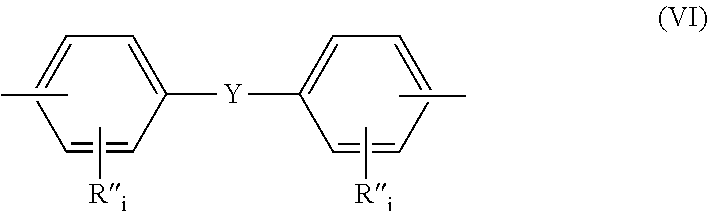
where
-
- Y is selected from the group consisting of alkylenes of 1 to 6 carbon atoms, for example —C(CH3)2 and —CnH2n— (n being an integer from 1 to 6); perfluoroalkylenes of 1 to 6 carbon atoms, for example —C(CF3)2 and —CnF2n—
(n being an integer from 1 to 6); cycloalkylenes of 4 to 8 carbon atoms; alkylidenes of 1 to 6 carbon atoms; cycloalkylidenes of 4 to 8 carbon atoms; —O—; —S—; —C(O)—; —SO2—; —SO—, and - R″ is selected from the group consisting of hydrogen, halogen, alkyl, alkenyl, alkynyl, aryl, ether, thioether, carboxylic acid, ester, amide, imide, alkali earth metal sulfonate, alkaline earth metal sulfonate, alkyl sulfonate, alkali earth metal phosphonate, alkaline earth metal phosphonate, alkyl phosphonate, amine and quaternary ammonium and
- i, for each R″, is independently zero or an integer ranging from 1 to 4, with the provisio that at least one of Ar, Ar′ and R comprise at least one ether group and that the ether group is present in the polymer chain backbone.
- Y is selected from the group consisting of alkylenes of 1 to 6 carbon atoms, for example —C(CH3)2 and —CnH2n— (n being an integer from 1 to 6); perfluoroalkylenes of 1 to 6 carbon atoms, for example —C(CF3)2 and —CnF2n—

where
X is a divalent moiety, having divalent bonds in the 3,3′, 3,4′, 4,3″ or the 4,4′ positions and is selected from the group consisting of alkylenes of 1 to 6 carbon atoms, for example —C(CH3)2 and —CnH2n— (n being an integer from 1 to 6); perfluoroalkylenes of 1 to 6 carbon atoms, for example —C(CF3)2 and —Cn F2n— (n being an integer from 1 to 6); cycloalkylenes of 4 to 8 carbon atoms; alkylidenes of 1 to 6 carbon atoms; cycloalkylidenes of 4 to 8 carbon atoms; —O—; —S—; —C(O)—; —SO2—; —SO—;
or X is a group of the formula —O—Ar″—O—, wherein Ar″ is a aromatic moiety selected from the group consisting of a substituted or unsubstituted, saturated, unsaturated or aromatic monocyclic and polycyclic group having 5 to 50 carbon atoms.

where
X is a divalent moiety, having divalent bonds in the 3,3′, 3,4′, 4,3″ or the 4,4′ positions and is selected from the group consisting of alkylenes of 1 to 6 carbon atoms, for example —C(CH3)2 and —CnH2n— (n being an integer from 1 to 6); perfluoroalkylenes of 1 to 6 carbon atoms, for example —C(CF3)2 and —CnF2n— (n being an integer from 1 to 6); cycloalkylenes of 4 to 8 carbon atoms; alkylidenes of 1 to 6 carbon atoms; cycloalkylidenes of 4 to 8 carbon atoms; —O—; —S—; —C(O)—; —SO2—; —SO—;
or X is a group of the formula —O—Ar″—O—, wherein Ar″ is a aromatic moiety selected from the group consisting of a substituted or unsubstituted, saturated, unsaturated or aromatic monocyclic and polycyclic group having 5 to 50 carbon atoms.

where
-
- R is selected from the group consisting of substituted and unsubstituted divalent organic radicals, for example selected from the group consisting of
- (a) aromatic hydrocarbon radicals having 6 to 20 carbon atoms and halogenated derivatives thereof;
- (b) straight or branched chain alkylene radicals having 2 to 20 carbon atoms;
- (c) cycloalkylene radicals having 3 to 20 carbon atoms, and
- (d) divalent radicals of formula (VI):

where
-
- Y is selected from the group consisting of alkylenes of 1 to 6 carbon atoms, for example —C(CH3)2 and —CnH2n— (n being an integer from 1 to 6); perfluoroalkylenes of 1 to 6 carbon atoms, for example —C(CF3)2 and —CnF2n—
- (n being an integer from 1 to 6); cycloalkylenes of 4 to 8 carbon atoms; alkylidenes of 1 to 6 carbon atoms; cycloalkylidenes of 4 to 8 carbon atoms; —O—; —S—; —C(O)—; —SO2—; —SO—, and
- R″ is selected from the group consisting of hydrogen, halogen, alkyl, alkenyl, alkynyl, aryl, ether, thioether, carboxylic acid, ester, amide, imide, alkali earth metal sulfonate, alkaline earth metal sulfonate, alkyl sulfonate, alkali earth metal phosphonate, alkaline earth metal phosphonate, alkyl phosphonate, amine and quaternary ammonium and
- i, for each R″, is independently zero or an integer ranging from 1 to 4, with the provisio that at least one of Ar, Ar′ and R comprise at least one ether group and that the ether group is present in the polymer chain backbone.
- T can either be
- —O— or —O—Ar″—O—
- wherein the divalent bonds of the —O— or the —O—Ar″—O— group are in the 3,3′, 3,4′, 4,3′, or the 4,4′ positions,
- wherein Ar″ is a aromatic moiety selected from the group consisting of a substituted or unsubstituted, saturated, unsaturated or aromatic monocyclic and polycyclic group having 5 to 50 carbon atoms, for example a substituted or unsubstituted phenylene, a substituted or unsubstituted biphenyl group, a substituted ou unsubstituted naphtalene group or a moiety comprising two substituted or unsubstituted phenylene.


where T as defined before.
- 2,2-bis[4-(2,3-dicarboxyphenoxy)phenyl]propane dianhydride;
- 4,4′-bis(2,3-dicarboxyphenoxy)diphenyl ether dianhydride;
- 1,3-bis(2,3-dicarboxyphenoxy)benzene dianhydride;
- 4,4′-bis(2,3-dicarboxyphenoxy)diphenyl sulfide dianhydride;
- 1,4-bis(2,3-dicarboxyphenoxy)benzene dianhydride;
- 4,4′-bis(2,3-dicarboxyphenoxy)benzophenone dianhydride;
- 4,4′-bis(2,3-dicarboxyphenoxy)diphenyl sulfone dianhydride;
- 2,2-bis[4 (3,4-dicarboxyphenoxy)phenyl]propane dianhydride;
- 4,4′-bis(3,4-dicarboxyphenoxy)diphenyl ether dianhydride;
- 4,4′-bis(3,4-dicarboxyphenoxy)diphenyl sulfide dianhydride;
- 1,3-bis(3,4-dicarboxyphenoxy)benzene dianhydride;
- 1,4-bis(3,4-dicarboxyphenoxy)benzene dianhydride;
- 4,4′-bis(3,4-dicarboxyphenoxy)benzophenone dianhydride;
- 4-(2,3-dicarboxyphenoxy)-4′-(3,4-dicarboxyphenoxy)diphenyl-2,2-propane dianhydride; and mixtures of such dianhydrides.

-
- Type I photoinitiators undergo a unimolecular bond cleavage upon irradiation to yield free radicals,
- Type II photoinitiators undergo a bimolecular reaction where the excited state of the photoinitiator interacts with a second molecule (a coinitiator) to generate free radicals.
- Acetophenone
- Anisoin
- Anthraquinone
- Anthraquinone-2-sulfonic acid, sodium salt monohydrate
- (Benzene) tricarbonylchromium
- Benzil
- Benzoin
- Benzoin ethyl ether, Benzoin isobutyl ether, Benzoin methyl ether and Benzophenone
- 3,3′,4,4′-Benzophenonetetracarboxylic dianhydride
- 4-Benzoylbiphenyl
- 2-Benzyl-2-(dimethylamino)-4′-morpholinobutyrophenone
- 4,4′-Bis(diethylamino)benzophenone
- 4,4′-Bis(dimethylamino)benzophenone
- Camphorquinone
- 2-Chlorothioxanthen-9-one
- (Cumene)cyclopentadienyliron(II) hexafluorophosphate
- Dibenzosuberenone
- 2,2-Diethoxyacetophenone
- 4,4′-Dihydroxybenzophenone
- 2,2-Dimethoxy-2-phenylacetophenone
- 4-(Dimethylamino)benzophenone
- 4,4′-Dimethylbenzil
- 2,5-Dimethylbenzophenone
- 3,4-Dimethylbenzophenone
- Diphenyl(2,4,6-trimethylbenzoyl)phosphine oxide, 2-Hydroxy-2-methylpropiophenone and blends (e.g. 50/50 blend)
- 4′-Ethoxyacetophenone
- 2-Ethylanthraquinone
- Ferrocene
- 3′-Hydroxyacetophenone, 4′-Hydroxyacetophenone, 3-Hydroxybenzophenone and 4-Hydroxybenzophenone
- 1-Hydroxycyclohexyl phenyl ketone
- 2-Hydroxy-2-methylpropiophenone
- 2-Methylbenzophenone or 3-Methylbenzophenone
- Methybenzoylformate
- 2-Methyl-4′-(methylthio)-2-morpholinopropiophenone
- Phenanthrenequinone
- 4′-Phenoxyacetophenone
- Phenylbis(2,4,6-trimethylbenzoyl)phosphine oxide
- Thioxanthen-9-one
- Triarylsulfonium hexafluoroantimonate salts, mixed, 50% in propylene carbonate
- Triarylsulfonium hexafluorophosphate salts, mixed, 50% in propylene carbonate, and
- mixture thereof.
- 2-hydroxy-4-methoxy benzophenone (oxybenzene)
- 1-(4-methoxyphenyl)-3-(4-tert-butylphenyl)propane-1,3-dione (avobenzone)
- disodium 2,2′-(1,4-phenylene)bis(6-sulfo-1H-benzimidazole-4-sulfonate) (bisdisulizole disodium)
- hexyl 2-[4-(diethylamino)-2-hydroxybenzoyl]benzoate (diethylamino hydroxybenzoyl hexyl benzoate)
- menthyl-o-aminobenzoate (menthyl anthranilate)
- 2,2′-[6-(4-methoxyphenyl)-1,3,5-triazine-2,4-diyl]bis{5-[(2-ethylhexyl)oxy]phenol}(bemotrizinol)
- 2,4-dihydroxybenzophenone
- 2,2′,4,4′-tetrahydroxybenzophenone
- 4-Hydroxy-2-methoxy-5-(oxo-phenylmethyl)benzenesulfonic acid (sulisobenzone)
- 2,2′-dihydroxy-4,4′-dimethoxybenzophenone
- 5-chloro-2-hydroxybenzophenone
- (2-hydroxy-4-methoxyphenyl)-(2-hydroxyphenyl)methanone (dioxybenzone)
- 2,5-Bis(5-tert-butyl-benzoxazol-2-yl)thiophene
- sodium 2,2′-dihydroxy-4,4′-dimethoxybenzophenone-5,5′-disulfonate
- (2-hydroxy-4-methoxyphenyl)(4-methylphenyl)methanone (mexenone)
- (2-hydroxy-4-octoxy-phenyl)-phenyl-methanone (octabenzone)
- 2-(1,2,3-Benzotriazol-2-yl)-4-methyl-6-[2-methyl-3-(2,2,4,6,6-pentamethyl-3,5-dioxa-2,4,6-trisilaheptan-4-yl)propyl]phenol (drometrizole trisiloxane)
- terephthalylidene dicamphor sulfonic acid (ecamsule)
- 2-ethylhexyl 2-cyano-3,3-diphenyl-2-propenoate (octocrylene)
- diethylhexyl butamido triazone (iscotrizinole)
- 2-Ethoxyethyl 3-(4-methoxyphenyl)propenoate (cinoxate)
- isopentyl 4-methoxycinnamate (amiloxate)
- 2,2′-methanediylbis[6-(2H-benzotriazol-2-yl)-4-(2,4,4-trimethylpentan-2-yl)phenol](bisoctrizole)
- 2-(2H-benzotriazol-2-yl)-4-(1,1,3,3-tetramethylbutyl)phenol
- 2,2′-methylenebis[6-(2H-benzotriazol-2-yl)-4-(1,1,3,3-tetramethylbutyl)phenol]
- 2-hydroxy-4-(octyloxy)benzophenone
- 2-ethyl-, 2-[4-(4,6-diphenyl-1,3,5-triazin-2-yl)-3-hydroxyphenoxy]ethyl ester 2-tert-butyl-6-(5-chloro-2H-benzotriazol-2-yl)-4-methylphenol
- 2-(2-hydroxy-5-methylphenyl)benzotriazole
- 2,4-dinitrophenylhydrazine
- N-(4-ethoxycarbonylphenyl)-N′-methyl-N′-phenylformamidine
- hexadecyl 3,5-bis-tert-butyl-4-hydroxybenzoate
- 2-ethyl-2′-ethoxy-oxalanilide, and
- mixture thereof.
-
- providing a polymer formulation (F) as above-described,
- printing layers of the 3D article from the polymer formulation (F).
-
- providing a polymer formulation (F) as above-described,
- printing layers of the 3D article from the polymer formulation (F) by:
- a) coating a layer of the formulation (F) onto a surface,
- b) irradiating the layer with UV light, c) coating a layer of the formulation (F) onto the former irradiated layer,
- d) irradiating the layer with UV light and
- e) repeating steps c) and d) a sufficient number of times to manufacture the 3D article.


-
- Target Mn: 6,000 g/mol
- GPC Mn: 5,700 g/mol
- PDI: 2.41
- Titration Mn: 7,260 g/mol
| TABLE 1 |
| Wt. |
| Formulation |
| 1 | Formulation 2 | |
| (comparative) | (inventive) | |
| Acrylate terminated | 29.9 | 29.9 | ||
| PSU (6K) | ||||
| DMPA | 0.30 | 0.3 | ||
| NMP | 69.8 | 69.78 | ||
| Avobenzone (UV | — | 0.015 | ||
| blocker) | ||||
Step 2—Printing
Claims (15)


Priority Applications (1)
| Application Number | Priority Date | Filing Date | Title |
|---|---|---|---|
| US17/283,321 US12104018B2 (en) | 2018-10-10 | 2019-10-01 | Photocurable polymers, photocurable polymer compositions and lithographic processes including the same |
Applications Claiming Priority (3)
| Application Number | Priority Date | Filing Date | Title |
|---|---|---|---|
| US201862743756P | 2018-10-10 | 2018-10-10 | |
| PCT/EP2019/076661 WO2020074332A1 (en) | 2018-10-10 | 2019-10-01 | Photocurable polymers, photocurable polymer compositions and lithographic processes including the same |
| US17/283,321 US12104018B2 (en) | 2018-10-10 | 2019-10-01 | Photocurable polymers, photocurable polymer compositions and lithographic processes including the same |
Publications (2)
| Publication Number | Publication Date |
|---|---|
| US20220002491A1 US20220002491A1 (en) | 2022-01-06 |
| US12104018B2 true US12104018B2 (en) | 2024-10-01 |
Family
ID=68138088
Family Applications (1)
| Application Number | Title | Priority Date | Filing Date |
|---|---|---|---|
| US17/283,321 Active 2041-09-23 US12104018B2 (en) | 2018-10-10 | 2019-10-01 | Photocurable polymers, photocurable polymer compositions and lithographic processes including the same |
Country Status (5)
| Country | Link |
|---|---|
| US (1) | US12104018B2 (en) |
| EP (1) | EP3864071A1 (en) |
| JP (1) | JP7607569B2 (en) |
| CN (1) | CN112823179B (en) |
| WO (1) | WO2020074332A1 (en) |
Cited By (1)
| Publication number | Priority date | Publication date | Assignee | Title |
|---|---|---|---|---|
| US20250136830A1 (en) * | 2021-08-20 | 2025-05-01 | Hewlett-Packard Development Company, L.P. | Solubilized avobenzone fusing agents |
Families Citing this family (1)
| Publication number | Priority date | Publication date | Assignee | Title |
|---|---|---|---|---|
| EP4132790B1 (en) | 2020-04-09 | 2025-07-09 | Solvay Specialty Polymers USA, LLC. | Photocurable polymer compositions |
Citations (5)
| Publication number | Priority date | Publication date | Assignee | Title |
|---|---|---|---|---|
| EP0106023A2 (en) * | 1982-06-30 | 1984-04-25 | Amoco Corporation | End-capped polyarylene polyethers, articles made therefrom and process for preparing such polyarylene polyethers |
| WO2017003846A1 (en) * | 2015-06-30 | 2017-01-05 | Sabic Global Technologies B.V. | Compatibilized compositions, articles formed therefrom, and methods of manufacture thereof |
| US20170022312A1 (en) | 2014-07-22 | 2017-01-26 | Full Spectrum Laser, LLC | Additive use for enhancing the performance of photopolymer resin for 3d printing |
| WO2017174546A1 (en) | 2016-04-08 | 2017-10-12 | Solvay Specialty Polymers Usa, Llc | Photocurable polymers, photocurable polymer compositions and lithographic processes including the same |
| CN108407291A (en) * | 2018-03-01 | 2018-08-17 | 辽宁聚高智造科技有限公司 | The more material lasers of polychrome cure Phthalazinone polyaryl ether-nitrile-sulfone ketone 3D printing method |
Family Cites Families (2)
| Publication number | Priority date | Publication date | Assignee | Title |
|---|---|---|---|---|
| JP3957262B2 (en) * | 2001-11-26 | 2007-08-15 | 三井化学株式会社 | Acrylic ester compounds and uses thereof |
| JP5178296B2 (en) * | 2008-04-16 | 2013-04-10 | 株式会社カネカ | Novel photosensitive resin composition, use thereof and method for producing insulating film |
-
2019
- 2019-10-01 JP JP2021546048A patent/JP7607569B2/en active Active
- 2019-10-01 EP EP19782996.3A patent/EP3864071A1/en active Pending
- 2019-10-01 WO PCT/EP2019/076661 patent/WO2020074332A1/en not_active Ceased
- 2019-10-01 US US17/283,321 patent/US12104018B2/en active Active
- 2019-10-01 CN CN201980066969.XA patent/CN112823179B/en active Active
Patent Citations (5)
| Publication number | Priority date | Publication date | Assignee | Title |
|---|---|---|---|---|
| EP0106023A2 (en) * | 1982-06-30 | 1984-04-25 | Amoco Corporation | End-capped polyarylene polyethers, articles made therefrom and process for preparing such polyarylene polyethers |
| US20170022312A1 (en) | 2014-07-22 | 2017-01-26 | Full Spectrum Laser, LLC | Additive use for enhancing the performance of photopolymer resin for 3d printing |
| WO2017003846A1 (en) * | 2015-06-30 | 2017-01-05 | Sabic Global Technologies B.V. | Compatibilized compositions, articles formed therefrom, and methods of manufacture thereof |
| WO2017174546A1 (en) | 2016-04-08 | 2017-10-12 | Solvay Specialty Polymers Usa, Llc | Photocurable polymers, photocurable polymer compositions and lithographic processes including the same |
| CN108407291A (en) * | 2018-03-01 | 2018-08-17 | 辽宁聚高智造科技有限公司 | The more material lasers of polychrome cure Phthalazinone polyaryl ether-nitrile-sulfone ketone 3D printing method |
Non-Patent Citations (5)
| Title |
|---|
| Carve M. et al., "3D-Printed Chips: Compatibility of Additive Manufacturing Photopolymeric Substrata with Biological Applications", Micromachines, 2018 (Feb. 23, 2018), vol. 9 No. 2, p. 91 (20 pages). |
| CN 108407291 A (abstract) (Year: 2018). * |
| Sangermano et al: "Synthesis, preparation and characterization of UV-cured methacrylated polysulfone-based membranes", Materials Today Communications, vol. 5, Dec. 1, 2015 (Dec. 1, 2015), pp. 64-69 (Year: 2015). * |
| Sangermano M. et al., "Synthesis, preparation and characterization of UV-cured methacrylated polysulfone-based membranes", Materials Today Communications, 2015 (Dec. 1, 2015), vol. 5, pp. 64-69, Elesevier Ltd. |
| Serbanescu et al. Polysulfone functionalized membranes: Properties and challenges; Materials Today Chemistry vol. 17, Sep. 2020, 100302 (Year: 2020). * |
Cited By (2)
| Publication number | Priority date | Publication date | Assignee | Title |
|---|---|---|---|---|
| US20250136830A1 (en) * | 2021-08-20 | 2025-05-01 | Hewlett-Packard Development Company, L.P. | Solubilized avobenzone fusing agents |
| US12480006B2 (en) * | 2021-08-20 | 2025-11-25 | Peridot Print Llc | Solubilized avobenzone fusing agents |
Also Published As
| Publication number | Publication date |
|---|---|
| US20220002491A1 (en) | 2022-01-06 |
| JP7607569B2 (en) | 2024-12-27 |
| EP3864071A1 (en) | 2021-08-18 |
| CN112823179A (en) | 2021-05-18 |
| WO2020074332A1 (en) | 2020-04-16 |
| JP2022508795A (en) | 2022-01-19 |
| CN112823179B (en) | 2025-04-08 |
Similar Documents
| Publication | Publication Date | Title |
|---|---|---|
| US8697332B2 (en) | Base generator, photosensitive resin composition, pattern forming material comprising the photosensitive resin composition, pattern forming method using the photosensitive resin composition and products comprising the same | |
| JP5712926B2 (en) | Base generator, photosensitive resin composition, pattern forming material comprising the photosensitive resin composition, pattern forming method and article using the photosensitive resin composition | |
| US11866582B2 (en) | Photocurable polymers, photocurable polymer compositions and lithographic processes including the same | |
| US20230027920A1 (en) | Polymers, compositions and method for manufacturing an article by 3d printing | |
| KR102429750B1 (en) | Black-colored composition | |
| TW200815498A (en) | Crosslinkable prepolymer, process for production thereof, and use thereof | |
| US20220002491A1 (en) | Photocurable polymers, photocurable polymer compositions and lithographic processes including the same | |
| JP5768348B2 (en) | Thermal base generator, polymer precursor composition, and article using the composition | |
| US11981775B2 (en) | Branched copolymer, and photosensitive resin composition, photosensitive resin film and optical device using the same | |
| US12473254B2 (en) | Photocurable polymer compositions | |
| Kim et al. | Improvement of surface hardness of transparent poly (amide-imide) films using fumed silica nanoparticles | |
| JP7046414B2 (en) | Polyimide copolymer, method for producing polyimide copolymer, photosensitive resin composition using the same, photosensitive resin film and optical device | |
| US20230340203A1 (en) | Polymers, compositions and method for manufacturing an article by 3d printing | |
| JP2011089116A (en) | Base generator, photosensitive resin composition, pattern forming material comprising the photosensitive resin composition, pattern forming method and article using the photosensitive resin composition | |
| US20230028395A1 (en) | Polymers, compositions and method for manufacturing an article by 3d printing |
Legal Events
| Date | Code | Title | Description |
|---|---|---|---|
| FEPP | Fee payment procedure |
Free format text: ENTITY STATUS SET TO UNDISCOUNTED (ORIGINAL EVENT CODE: BIG.); ENTITY STATUS OF PATENT OWNER: LARGE ENTITY |
|
| STPP | Information on status: patent application and granting procedure in general |
Free format text: DOCKETED NEW CASE - READY FOR EXAMINATION |
|
| STPP | Information on status: patent application and granting procedure in general |
Free format text: NON FINAL ACTION MAILED |
|
| STPP | Information on status: patent application and granting procedure in general |
Free format text: RESPONSE TO NON-FINAL OFFICE ACTION ENTERED AND FORWARDED TO EXAMINER |
|
| STPP | Information on status: patent application and granting procedure in general |
Free format text: NOTICE OF ALLOWANCE MAILED -- APPLICATION RECEIVED IN OFFICE OF PUBLICATIONS |
|
| ZAAA | Notice of allowance and fees due |
Free format text: ORIGINAL CODE: NOA |
|
| ZAAB | Notice of allowance mailed |
Free format text: ORIGINAL CODE: MN/=. |
|
| STPP | Information on status: patent application and granting procedure in general |
Free format text: NOTICE OF ALLOWANCE MAILED -- APPLICATION RECEIVED IN OFFICE OF PUBLICATIONS |
|
| AS | Assignment |
Owner name: VIRGINIA TECH INTELLECTUAL PROPERTIES, INC., VIRGINIA Free format text: ASSIGNMENT OF ASSIGNORS INTEREST;ASSIGNOR:VIRGINIA POLYTECHNIC INSTITUTE AND STATE UNIVERSITY;REEL/FRAME:068014/0967 Effective date: 20240717 Owner name: VIRGINIA POLYTECHNIC INSTITUTE AND STATE UNIVERSITY, VIRGINIA Free format text: ASSIGNMENT OF ASSIGNORS INTEREST;ASSIGNORS:MEENAKSHISUNDARM, VISWANATH;CHARTRAIN, NICHOLAS RAYMOND;HEIFFERON, KATHERINE V.;AND OTHERS;SIGNING DATES FROM 20230727 TO 20240717;REEL/FRAME:068014/0950 Owner name: SOLVAY SPECIALTY POLYMERS USA, LLC, GEORGIA Free format text: ASSIGNMENT OF ASSIGNORS INTEREST;ASSIGNORS:POLLINO, JOEL;JEOL, STEPHANE;KWAN, KERMIT S.;AND OTHERS;SIGNING DATES FROM 20220114 TO 20220119;REEL/FRAME:068014/0934 |
|
| STPP | Information on status: patent application and granting procedure in general |
Free format text: PUBLICATIONS -- ISSUE FEE PAYMENT VERIFIED |
|
| STCF | Information on status: patent grant |
Free format text: PATENTED CASE |