US12089669B2 - Personal protection system and method - Google Patents

Personal protection system and method Download PDF

Info

Publication number
US12089669B2
US12089669B2 US17/539,009 US202117539009A US12089669B2 US 12089669 B2 US12089669 B2 US 12089669B2 US 202117539009 A US202117539009 A US 202117539009A US 12089669 B2 US12089669 B2 US 12089669B2
Authority
US
United States
Prior art keywords
hook
hole
support
user
facial shield
Prior art date
Legal status (The legal status is an assumption and is not a legal conclusion. Google has not performed a legal analysis and makes no representation as to the accuracy of the status listed.)
Active, expires
Application number
US17/539,009
Other versions
US20220079271A1 (en
Inventor
Carlo C. Memita
Current Assignee (The listed assignees may be inaccurate. Google has not performed a legal analysis and makes no representation or warranty as to the accuracy of the list.)
Pabban Development Inc
Original Assignee
Pabban Development Inc
Priority date (The priority date is an assumption and is not a legal conclusion. Google has not performed a legal analysis and makes no representation as to the accuracy of the date listed.)
Filing date
Publication date
Application filed by Pabban Development Inc filed Critical Pabban Development Inc
Priority to US17/539,009 priority Critical patent/US12089669B2/en
Publication of US20220079271A1 publication Critical patent/US20220079271A1/en
Application granted granted Critical
Publication of US12089669B2 publication Critical patent/US12089669B2/en
Active legal-status Critical Current
Adjusted expiration legal-status Critical

Links

Images

Classifications

    • AHUMAN NECESSITIES
    • A41WEARING APPAREL
    • A41DOUTERWEAR; PROTECTIVE GARMENTS; ACCESSORIES
    • A41D13/00Professional, industrial or sporting protective garments, e.g. surgeons' gowns or garments protecting against blows or punches
    • A41D13/05Professional, industrial or sporting protective garments, e.g. surgeons' gowns or garments protecting against blows or punches protecting only a particular body part
    • A41D13/11Protective face masks, e.g. for surgical use, or for use in foul atmospheres
    • A41D13/1161Means for fastening to the user's head
    • AHUMAN NECESSITIES
    • A41WEARING APPAREL
    • A41DOUTERWEAR; PROTECTIVE GARMENTS; ACCESSORIES
    • A41D13/00Professional, industrial or sporting protective garments, e.g. surgeons' gowns or garments protecting against blows or punches
    • A41D13/05Professional, industrial or sporting protective garments, e.g. surgeons' gowns or garments protecting against blows or punches protecting only a particular body part
    • A41D13/11Protective face masks, e.g. for surgical use, or for use in foul atmospheres
    • A41D13/1184Protective face masks, e.g. for surgical use, or for use in foul atmospheres with protection for the eyes, e.g. using shield or visor
    • AHUMAN NECESSITIES
    • A42HEADWEAR
    • A42BHATS; HEAD COVERINGS
    • A42B3/00Helmets; Helmet covers ; Other protective head coverings
    • A42B3/04Parts, details or accessories of helmets
    • A42B3/18Face protection devices
    • A42B3/22Visors
    • A42B3/221Attaching visors to helmet shells, e.g. on motorcycle helmets
    • AHUMAN NECESSITIES
    • A61MEDICAL OR VETERINARY SCIENCE; HYGIENE
    • A61FFILTERS IMPLANTABLE INTO BLOOD VESSELS; PROSTHESES; DEVICES PROVIDING PATENCY TO, OR PREVENTING COLLAPSING OF, TUBULAR STRUCTURES OF THE BODY, e.g. STENTS; ORTHOPAEDIC, NURSING OR CONTRACEPTIVE DEVICES; FOMENTATION; TREATMENT OR PROTECTION OF EYES OR EARS; BANDAGES, DRESSINGS OR ABSORBENT PADS; FIRST-AID KITS
    • A61F9/00Methods or devices for treatment of the eyes; Devices for putting in contact-lenses; Devices to correct squinting; Apparatus to guide the blind; Protective devices for the eyes, carried on the body or in the hand
    • A61F9/04Eye-masks ; Devices to be worn on the face, not intended for looking through; Eye-pads for sunbathing
    • A61F9/045Eye-shades or visors; Shields beside, between or below the eyes
    • AHUMAN NECESSITIES
    • A42HEADWEAR
    • A42BHATS; HEAD COVERINGS
    • A42B3/00Helmets; Helmet covers ; Other protective head coverings
    • A42B3/04Parts, details or accessories of helmets
    • A42B3/18Face protection devices
    • A42B3/22Visors
    • A42B3/225Visors with full face protection, e.g. for industrial safety applications

Definitions

  • the field of the invention generally relates to personal protection systems, including, but not limited to personal environmental protections systems.
  • the personal protections systems often include a headgear structure which is worn by an individual to protect from particulate material.
  • the personal protection systems may provide filtered air to the user.
  • a protective headgear system includes a support configured to engage the head of a user, a facial shield including a polymeric sheet having an upper portion configured to be coupled to the support and a lower portion having a lower extremity, wherein the upper portion includes a first hole, a second hole, and a third hole, each one of the first, second, and third holes substantially spaced from the other two of the first, second, and third holes, and wherein the first and second holes are each substantially elongated, a first hook carried on the support, wherein the first hole is configured to be engaged with first hook, a second hook carried on the support, wherein the second hole is configured to be engaged with second hook, a third hook carried on the support, wherein the third hole is configured to be engaged with third hook, wherein the first hook includes a hook portion having a maximum hook width, the first hook located on a perimeter of the support between the second and third hooks, and wherein the first hole has a first hole gap and a first hole width, the first hole
  • a protective headgear system in another embodiment, includes a support configured to engage the head of a user, a facial shield including a polymeric sheet having an upper portion configured to be coupled to the support and a lower portion having a lower extremity, wherein the upper portion includes a first hole, a second hole, and a third hole, each one of the first, second, and third holes laterally spaced from the other two of the first, second, and third holes, a first hook carried on the support, wherein the first hole is configured to be engaged with first hook, a second hook carried on the support, wherein the second hole is configured to be engaged with second hook, a third hook carried on the support, wherein the third hole is configured to be engaged with third hook, wherein the first hook is located on a perimeter of the support between the second hook and the third hook, wherein the first hook includes a hook portion having a maximum hook width, and wherein the first hole has a lateral width greater than the maximum hook width of the hook portion of the first hook, and wherein the facial shield
  • a facial shield for a protective headgear system including a support configured to engage the head of a user and first, second, and third hooks carried on the support, wherein the first hook is located on a perimeter of the support between the second hook and the third hook, and wherein the first hook includes a hook portion having a maximum vertical dimension and a base coupled to the support and having a vertical base thickness, includes a polymeric sheet having an upper portion configured to be coupled to the support and a lower portion having a lower extremity, wherein the upper portion includes a first hole, a second hole, and a third hole, each one of the first, second, and third holes laterally spaced from the other two of the first, second, and third holes, and the first hole including a first section having a first hole gap and a second section laterally adjacent the first section and having a second hole gap, wherein the first hole gap of the first hole is greater than or equal to the maximum vertical dimension of the first hook, and wherein the second hole gap of the first hole is
  • a method for donning a protective headgear system including a support configured to engage the head of a user and first, second, and third hooks carried on the support, wherein the first hook is located on a perimeter of the support between the second hook and the third hook, and wherein the first hook includes a hook portion having a maximum vertical dimension and a base coupled to the support and having a vertical base thickness, includes providing a polymeric sheet having an upper portion configured to be coupled to the support and a lower portion having a lower extremity, wherein the upper portion includes a first hole, a second hole, and a third hole, each one of the first, second, and third holes laterally spaced from the other two of the first, second, and third holes, wherein the first hole includes a first section having a first hole gap and a second section laterally adjacent the first section and having a second hole gap, wherein the first hole gap of the first hole is greater than or equal to the maximum vertical dimension of the first hook, and wherein the second hole gap of the
  • FIG. 1 is a perspective view of a personal protection system in place on a user, according to an embodiment of the present disclosure.
  • FIG. 2 is an exploded view of the personal protection system of FIG. 1 .
  • FIG. 3 is a front view of the personal protection system of FIG. 1 .
  • FIG. 4 is a side view of a center clip of the personal protection system of FIG. 3 .
  • FIG. 5 is a perspective view of a side clip of the personal protection system of FIG. 3 .
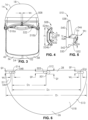
  • FIG. 6 is a facial shield configured to engage with the clips of the personal protection system of FIG. 3 , according to an embodiment of the present disclosure.
  • FIG. 7 is a facial shield in a first position in relation to a center clip, according to an embodiment of the present disclosure.
  • FIG. 8 is the facial shield of FIG. 7 is a second position in second, locked position in relation to the center clip.
  • FIG. 9 is a flow chart for a method for attaching a facial shield to a head support, according to an embodiment of the present disclosure.
  • FIG. 10 is a cross-sectional view of a facial shield being assembled onto a center clip, according to an embodiment of the present disclosure.
  • FIG. 12 is a cross-sectional view of the facial shield being assembled onto a side clip, according to an embodiment of the present disclosure.
  • FIG. 13 is a cross-sectional view of the facial shield further being assembled onto the side clip, according to an embodiment of the present disclosure.
  • FIG. 14 is a cross-sectional view of the facial shield in assembled configuration on the side clip.
  • FIG. 15 is a perspective view of the facial shield being attached to the center clip, according to an embodiment of the present disclosure.
  • FIG. 16 is a detail perspective view of the facial shield being locked to the center clip, according to an embodiment of the present disclosure.
  • FIG. 17 is a perspective view of the facial shield being adjusted prior to assembly to a first side clip, according to an embodiment of the present disclosure.
  • FIG. 18 is a perspective view of the facial shield being attached to the first side clip, according to an embodiment of the present disclosure.
  • FIG. 19 is a perspective view of the facial shield being locked to the first side clip, according to an embodiment of the present disclosure.
  • FIG. 20 is a perspective view of the facial shield being adjusted prior to assembly to a second side clip, according to an embodiment of the present disclosure.
  • FIG. 21 is a perspective view of the facial shield being attached to the second side clip, according to an embodiment of the present disclosure.
  • FIG. 22 is a perspective view of the facial shield being locked to the second side clip, according to an embodiment of the present disclosure.
  • FIG. 23 is a front view of the personal protection system of FIG. 3 with the facial shield coupled to the head support.
  • FIG. 24 is a front view of a personal protection system according to an embodiment of the present disclosure.
  • FIG. 25 is a perspective view of a side clip of the personal protection system of FIG. 24 .
  • FIG. 26 is a perspective view of a center clip of the personal protection system of FIG. 24 .
  • FIG. 27 is a facial shield configured to engage with the clips of the personal protection system of FIG. 24 , according to an embodiment of the present disclosure.
  • FIG. 28 is a perspective view of a personal protection system incorporating the facial shield and cuff of FIG. 27 , according to an embodiment of the present disclosure.
  • FIG. 29 is an underside view of the personal protection system of FIG. 28 .
  • FIG. 30 is a perspective view of an alternative personal protection system in place on a user, according to an embodiment of the present disclosure.
  • FIG. 31 is a hook strip assembly of the personal protection system of FIG. 30 .
  • Some of the existing systems include hoods, gowns, filters, and the like.
  • the air filters are built into the helmet structure.
  • Known units frequently include external sources of air such as gas cylinders, air lines or the like which are connected to the helmet structure by tubes, hoses or the like.
  • Currently available lens/facial seal combinations sometimes known as loose fitting hoods, are expensive to manufacture due to the geometries required for the facial seal to attach to the lens which is curved in a plane perpendicular to the seal to the face/head of the wearer.
  • Improvements described herein related to the interface between facial shields and headgear accommodate clean or sterile donning techniques, and improve the overall ease of donning the protective equipment and garments. In sterile procedures, any improvements that lower or minimize contact, or decomplicate the donning steps can significantly improve the likelihood of achievement and maintenance of sterility. These improvements can also minimize unnecessary contamination to other sites.
  • FIG. 1 illustrates a user 12 wearing a personal environmental protection system 14 .
  • the user 12 may be a surgeon, physician, or another medical personnel participating in a surgery or other medical procedure on a patient that has an ailment that is contagious in an otherwise standard, unprotected environment. This may also include any hospital or medical facility environment during an epidemic or pandemic that does or does not include the patient as a source of infection, such as the 2020 COVID-19 pandemic.
  • the personal environmental protection system 14 comprises a head support 16 having a top portion 18 and a concave underside 20 configured to engage with the head 22 of the user 12 .
  • the head support 16 may comprise a helmet or other type of headgear that is securely and comfortably maintainable on the head 22 of the user 12 during an entire medical procedure, to avoid the need for constant removal, adjustment or replacement.
  • a facial shield 518 (or lens) comprising a substantially optically clear material includes a lower extremity 26 configured to extend below the face 30 of the user 12 , and an upper portion 28 configured to be coupled to the head support 16 .
  • the user 12 is able to clearly view through the facial shield 518 while the head support 16 is engaged with the head 22 of the user 12 .
  • the head support 16 maintains the facial shield 518 in front of the face 30 of the user 12 .
  • a gown 32 or toga may be used by the user 12 to protect some, most, or all of the body of the user 12 below the head and neck, or at least to cover the upper torso of the user 12 .
  • the gown 32 may couple directly to the facial shield 518 , the head support 16 , or to both the facial shield 518 and the head support 16 .
  • the personal environmental protection system 14 may be configured to substantially control the breathing environment of the use 12 via air filtration, inflow, and/or outflow, and may utilize the operative elements for air filtration, inflow, and/or outflow in any of the embodiments described in U.S. Pat. No. 8,302,599 to Green issued Nov.
  • the personal environmental protection system 14 may additionally or alternatively utilize the operative elements for air filtration, inflow, and/or outflow in any of the embodiments described in U.S. Pat. No. 8,453,262 to Green issued Jun. 4, 2013, and entitled “Personal Environmental Protection Apparatus,” which is incorporated herein by reference in its entirety for all purposes.
  • the facial shield 518 may comprise a sheet comprising high clarity polymer such as polyethylene terephthalate glycol (PETG), polyethylene terephthalate (PET), or other polyesters or polyester copolymers, or acrylic, or polycarbonate, such that it can provide a relatively thin but tough barrier that does not significantly impede the vision of the user 12 .
  • the facial shield 518 may be configured to substantially control the breathing environment of the use 12 via air filtration, inflow, and/or outflow, and may utilize the operative elements for air filtration, inflow, and/or outflow in any of the embodiments has a permanent concave shape toward the user 12 and a permanent convex shape away from the user 12 .
  • PETG polyethylene terephthalate glycol
  • PET polyethylene terephthalate
  • acrylic acrylic
  • the facial shield 518 comprises a flat flexible sheet that can be produced by die cutting or other rapid processes.
  • the facial shield 518 is flexible and may conform to a variety of curves, such as the curve required to mate with the head support 16 .
  • the facial shield 518 may comprise polycarbonate having a thickness of between about 0.010 inch and about 0.020 inch, or between about 0.012 inch and about 0.018 inch, or between about 0.014 inch and about 0.016 inch.
  • the facial shield 518 may comprise PET having a thickness of between about 0.004 inch and about 0.012 inch, or between about 0.006 inch and about 0.010 inch, or between about 0.007 inch and about 0.009 inch.
  • the gown 32 may comprise a number of different materials and configurations.
  • Materials for the gown 32 may include a tri-laminate comprising a film held between two layers of non-woven plastic fabric. Bi-laminate materials are also possible, such as a material comprising a film layer and a non-woven plastic fabric.
  • the non-woven layer or layers may comprise a cellulose.
  • the non-woven layer may comprise spun materials such as spunbonded high density polyethylene (e.g., Tyvek®, a trademark of DuPont de Nemours, Inc.).
  • a spunbond meltblown spunbond commonly known as SMS, may be used, and comprises a tri-laminate non-woven fabric comprising a top layer of spunbond polypropylene, a middle layer of meltblown polypropylene and a bottom layer of spunbond polypropylene.
  • one or more of the non-woven layers may be replaced by a woven layer.
  • a chin bar 42 has a first end 44 connected to a first portion 48 of the head support 16 and a second end 46 connected to a second portion 50 the head support 16 .
  • the chin bar 42 may comprise a rigid polymeric material such as polyamide, for example nylon 6 , or polycarbonate. The substantial rigidity allows one of the dimensions of the chin bar 42 to be relatively thin, such that it has a generally rectangular cross-section.
  • the chin bar 42 may alternatively comprise high-density polyethylene or polypropylene, though the thin dimension would likely be thickened somewhat to maintain sufficient stiffness and resistance to extreme bending.
  • the chin bar 42 extends between the first end 44 and the second end 46 in a generally U-shape 52 having a lower apex 54 .
  • the lower apex 54 is located at the center of a lower portion 56 of the chin bar 42 having an externally-facing surface 58 and an internally-facing surface 60 .
  • FIG. 2 illustrates an exploded view of the personal environmental protection system 14 .
  • a filter frame 760 is carried on the head support 16 and includes a series of ribs 762 defining spaces 764 between the ribs 762 configured to allow the circulation of filtered air.
  • a fan (not shown) is configured to cause the flow of air within the system 14 .
  • a filter cartridge/hood assembly (not shown) comprises a filter cartridge within a hood, and is configured to sealably seat on the filter frame 760 .
  • the head support 16 carries a center hook 508 and two side hooks 510 a , 510 b .
  • the hooks 508 , 510 a , 510 b are configured to engage holes 512 , 514 , 516 of the facial shield 518 , illustrated in FIG. 6 .
  • the facial shield 518 can comprise a clear sheet of the material previously described herein.
  • the center hook 508 ( FIG. 4 ) has a base 520 configured to couple to an outer surface 522 of the head support 16 , and a hook portion 524 comprising an upper hook portion 524 a and a lower hook portion 524 b , and having a height h 1 and a maximum width W 1 .
  • Each of the side hooks 510 a , 510 b (side hook 510 , FIG. 5 ) has a base 526 configured to couple to the outer surface 522 of the head support 16 , and a hook portion 528 having a maximum width W 2 .
  • Holes 514 , 516 each have a width W 3 that is greater than the maximum width W 2 .
  • Holes 514 , 516 each have a gap g 2 that is greater than the base height b 2 .
  • the upper hook portion 524 a and the lower hook portion 524 b of the center hook 508 each have a maximum thickness t 1 .
  • the hook portion 528 of the side hooks 510 comprises an upper hook portion 540 and a lower hook portion 542 .
  • the upper hook portion 540 of the side hooks 510 has a maximum thickness t 2 .
  • Hole 512 comprises a first section 501 and a second section 503 , adjacent the first section 501 . Any of the holes 512 , 514 , 516 described herein may be formed as part of a die-cutting process, or may be added by use of a punch tool.
  • the first section 501 of hole 512 comprises a circular shape having a maximum gap g 1 that is at least slightly greater than the height h 1 of the center hook 508 .
  • the first section 501 of the hole 512 of the facial shield 518 may be placed completely over center hook 508 .
  • upper border 505 and lower border 507 are slid underneath the upper hook portion 524 a and the lower hook portion 524 b , respectively, thus locking the center hook 508 to the facial shield 518 , via the hole 512 .
  • Holes 514 , 516 each have a gap g 2 that is at least slightly greater than the maximum thickness t 2 of the upper hook portion 540 of the side hooks 510 , thus allowing each hole 514 , 516 to fit completely over each side hook 510 a , 510 b .
  • Center hook 508 has an upper recess 530 and a lower recess 532 ( FIG. 4 ), between the base 520 and the upper and lower hook portions 524 a , 524 b , respectively.
  • the hole 512 is first inserted over the center hook 508 , as in FIG. 7 , and then moved in the direction of the arrow in FIG. 8 , so that the hole 512 slides and locks to the center hook 508 .
  • the second section 503 of the hole 512 has a gap g 3 that is greater than the diameter of the base 520 .
  • the base 520 may be non-circular, and thus the gap g 3 is greater than a vertical height of the base 520 .
  • the second section 503 of the hole 512 now straddles the base 526 . As will be shown, with the first section 501 of the hole 512 around the center hook 508 , as in FIG.
  • the hole 514 does not align with the side hook 510 a
  • the hole 516 does not align with the side hook 510 b .
  • the hole 514 aligns with the side hook 510 a and the hole 516 aligns with the side hook 510 b .
  • a user 12 or a support personnel may first lock the facial shield 518 to the center hook 508 , and then, with the facial shield 518 securely coupled and also balanced around the center hook 508 , the user 12 or support personnel may proceed to fully attach the facial shield 518 to the side hooks 510 a , 510 b.
  • the hole 514 is inserted over the end 538 ( FIG. 5 ) of the upper hook portion 540 of the hook portion 528 of the hook 510 a and the right side 511 of the facial shield 518 is pulled down over the upper hook portion 540 toward the base 526 .
  • An upper edge 544 of the hole 514 is forced against an upper ledge 546 of the base 526 , and the right side 511 of the facial shield 518 is forced further downward, slightly opening the gap g 2 , such that a lower edge 548 of the hole 514 clears a bottom face 550 of a lower hook portion 542 of the hook portion 528 .
  • the lower edge 548 of the hole 514 is snapped into its locked, rest position, above the bottom face 550 , but below a lower ledge 552 of the base 526 .
  • the hole 514 is thus locked both in relation to the upper hook portion 540 and the lower hook portion 542 .
  • the facial shield 518 thus extends substantially vertically downward at its right side, as well as at its center.
  • the facial shield 518 can now be moved slightly to the left or right (e.g., by pulling on the left side 513 or the right side 511 of the facial shield 518 ), with the hole 514 sliding (though still in a locked position) along the side hook 510 a and with the second section 503 of the hole 512 sliding (though remaining in a locked position) along the base 520 of the center hook 508 .
  • the total width of the holes 512 , 514 , 516 in relation to the hooks 508 , 510 a , 510 b determines how much lateral play there is in the locked condition.
  • the snapping process of the hole 514 and the side hook 510 a can be repeated with the hole 516 and the side hook 510 b on the left side 513 of the facial shield 518 .
  • the facial shield 518 is now securely in place on the head support 16 , with a few quick and simple snap and slide actions, as shown in FIG. 23 .
  • the facial shield 518 can be attached to the head support 16 without the need for the user or support personnel (whichever is assembling the equipment) to touch the head support 16 in any way. This can significantly increase the likelihood of effective sterility.
  • the head support 16 is a reusable item while the facial shield 518 is supplied sterile.
  • the head support 16 may be cleanable and may even be sterilizable, the avoidance of contact can assure a higher probability of a sterile procedure.
  • FIG. 9 illustrates a method 100 for attaching the facial shield 518 to the head support 16 .
  • an assembler 104 ( FIG. 15 ), who may be a user or a support personnel, aligns the first section 501 of the hole 512 of the facial shield 518 over the center hook 508 .
  • the first section 501 and the second section 503 are oriented right-to-left in FIG. 15 , while they are shown left-to-right in FIG. 6 .
  • the facial shield 518 may reversible, such that it can be oriented on the head support 16 in either manner.
  • the facial shield 518 may have a non-reflective coating on only one side, and may be reversible, or non-reversible.
  • the facial shield 518 may have one or more clear peelable adhesively-attached coverings on the outer surface, which can be removed if soiled or contaminated, e.g., by splashing, or scratching.
  • the diameter (gap g 1 ) of the first section 501 of the hole 512 is shown just clearing the height h 1 of the center hook 508 during step 102 . This position is also shown in FIG. 7 .
  • the gap g 1 is at least slightly larger than the height h 1 such that the first section 501 can clear the center hook 508 , as the facial shield 518 is placed over it.
  • the gap g 1 ( FIG. 6 ) is the same dimension as the height h 1 , or slightly smaller than the height h 1 , such that the facial shield 518 can be forced over the center hook 508 without great effort from the assembler 104 .
  • step 106 the assembler 104 locks the facial shield 518 to the head support 16 by sliding the head support to the left (arrow), as shown in FIG. 16 , into the position shown in FIG. 8 .
  • the second section 503 of the hole 512 is now oriented around the base 520 of the center hook 508 .
  • the center hook 508 thus, locks the facial shield 518 to the head support 16 , because the gap g 3 ( FIG. 6 ) is less than the height h 1 . This can be seen in more detail in FIG. 11 .
  • the hole 516 cannot be placed over the side hook 510 a (see dashed lines in FIG. 15 ) when the facial shield 518 is wrapped around the outer surface 522 of the head support 16 .
  • the entirety of the hole 516 is offset from the entirety of the side hook 510 a by a distance L 2 .
  • the facial shield 518 is slid into the position shown in FIGS.
  • the hole 516 can be placed over the side hook 510 a .
  • the hole 512 must be attached and locked to center hook 508 first.
  • the facial shield 518 is significantly centered and balanced, with no portion of it able to significantly hang too low, where it may be damaged, soiled, or contaminated. This will be further described in the following steps.
  • the distance D 1 is between about 12.5 inches and about 18.5 inches, or between about 14 inches and about 17 inches, or between about 14.5 inches and about 16.5 inches, or about 15.5 inches;
  • the distance D 2 between the horizontal center of hole 514 and the horizontal center of hole 516 , is between about 11 inches and about 15 inches, or between about 12 inches and about 14 inches, or between about 12.5 inches and about 13.5 inches, or between about 12.75 inches and about 13.25 inches, or about 13 inches;
  • the gap g 1 is between about 0.60 inch and about 0.75 inch, or about 0.675 inch, and is formed by a hole having a diameter of between about 0.60 inch and about 0.75 inch, or about 0.675 inch, or greater;
  • the gap g 2 is between about 0.225 inch and about 0.680 inch, or between about 0.300 inch and about 0.450 inch, or between about 0.325 inch and about 0.425 inch, or about 0.375 inch;
  • the gap g 3 is between about 0.325 inch and about 0.425 inch, or about 0.375 inch
  • the assembler 104 wraps the facial shield 518 around the outer surface 522 of the head support 16 and places the hole 516 over the upper hook portion 540 of the side hook 510 a , as shown in FIG. 17 . As shown in detail in FIG. 12 , the assembler 104 passes the hole 516 over the end 538 and onto the upper hook portion 540 of the hook portion 528 of the hook 510 a . In step 110 , the assembler 104 pulls the facial shield 518 downward (arrow, FIG. 18 ) to force a lower margin 517 of material surrounding the hole 516 over the bottom face 550 of a lower hook portion 542 of the hook portion 528 , as shown in FIG. 13 and FIG. 19 .
  • An upper edge 544 of the hole 516 is forced against an upper ledge 546 of the base 526 , and the right side of the facial shield 518 is forced further downward, slightly opening the gap g 2 ( FIG. 6 ), such that a lower edge 548 of the hole 516 clears a bottom face 550 of a lower hook portion 542 of the hook portion 528 .
  • FIG. 14 when the hole 516 is released, and loses its slight deformation, the lower edge 548 of the hole 516 is snapped into its locked, rest position, above the bottom face 550 , but below a lower ledge 552 of the base 526 . The hole 516 is thus locked both in relation to the upper hook portion 540 and the lower hook portion 542 .
  • the assembler 104 wraps the opposite side of the facial shield 518 around the outer surface 522 of the head support 16 and places the hole 514 over the upper hook portion 540 of the side hook 510 b , as shown in FIG. 20 . As shown in detail in FIG. 12 , the assembler 104 passes the hole 514 over the end 538 and onto the upper hook portion 540 of the hook portion 528 of the hook 510 b . In step 114 , the assembler 104 pulls the facial shield 518 downward (arrow, FIG. 21 ) to force a lower margin 517 of material surrounding the hole 514 over the bottom face 550 of a lower hook portion 542 of the hook portion 528 , as shown in FIG. 13 and FIG. 22 .
  • FIG. 14 illustrates the facial shield 518 fully assembled onto the head support 16 . As shown in FIGS. 15 - 22 , the facial shield 518 can be easily and securely attached to the head support 16 without touching the head support 16 at all.
  • FIG. 9 further illustrates a method 116 for removal of the facial shield 518 from the head support 16 .
  • step 118 the user 104 unsnaps the hole 514 and removes the facial shield 518 from the side hook 510 b .
  • step 120 the user 104 unsnaps the hole 516 and removes the facial shield 518 from the side hook 510 a .
  • step 122 the user slides the facial shield 518 in relation to the head support 16 to unlock the hole 512 from the center hook 508 , thus placing the facial shield 518 into the position of FIGS. 7 , 10 , and 15 .
  • step 124 the user 104 completely removes the facial shield 518 from the head support 16 .
  • step 126 the user 14 discards the facial shield 126 . In some cases, the user 104 may also choose to discard the head support 16 .
  • any one or more of the holes 512 , 514 , 516 may be vertically elongated instead of horizontally elongated.
  • One or more of the holes 512 , 514 , 516 may even be diagonally elongated.
  • the facial shield 518 can be produced from standard sheet material and can be mass produced by a die cutting process thus significantly lowering the cost in comparison with traditional curved, single-shape facial shields. The locking and unlocking utilizing the hooks 508 , 510 and the holes 512 , 514 , 516 provides quick yet secure assembly and quick removal and cleaning or disposal.
  • a personal environmental protection system 602 is illustrated in FIGS. 24 - 27 and comprises a support portion 604 (e.g., head support) and a chin bar 606 .
  • the support portion 604 carries a center hook 608 and two side hooks 610 a , 610 b .
  • the hooks 608 , 610 a , 610 b are configured to engage holes 612 , 614 , 616 which extend through an upper extremity 627 of a facial shield 618 , illustrated in FIG. 27 .
  • the facial shield 618 can comprise a clear sheet of the material previously described herein.
  • the facial shield 618 further comprises a cuff 629 , which may comprise a woven protective barrier.
  • the cuff 629 is bonded to the facial shield by a seam 631 running substantially vertically along the right side 611 , substantially horizontally along the lower extremity 625 , and substantially vertically along the left side 613 of the facial shield 618 .
  • the cuff 629 includes an elastic inner perimeter 633 configured to fit snugly around a user's neck or lower head, to create a protected internal space 643 ( FIG. 28 ).
  • the center hook 608 has a base 620 configured to couple to an outer surface 622 of the support portion 604 , and a hook portion 624 having a maximum width W 4 .
  • the hook portion 624 may have a J-shape or an L-shape, or any other shape that may allow some level of hooking to occur.
  • Each of the side hooks 610 a , 610 b have a base 626 configured to couple to the outer surface 622 of the support portion 604 , and a hook portion 628 having a maximum width W 5 .
  • Each hole 614 , 616 has a width W 6 that is greater than the maximum width W 5
  • the hole 612 has a width W 7 that is greater than the maximum width W 4 , thus allowing each hole 612 , 614 , 616 to fit completely over each hook 608 , 610 a , 610 b .
  • the width W 6 may be configured to be at least 10% greater than the width W 5 , or at least 25% greater than the width W 5 .
  • the width W 7 may be configured to be at least 25% greater than the width W 4 , or at least 50% greater than the width W 4 , or at least 75% greater than the width W 4 , or at least 100% greater than the width W 4 .
  • the width W 6 may be configured to be between about 25% and about 100% greater than the width W 5 .
  • the width W 7 may be configured to be between about 25% and about 100% greater than the width W 4 .
  • the hole 616 has a first lateral edge 617 and a second lateral edge 619 .
  • Hole 614 may be described in the same manner.
  • the first and second lateral edges 617 , 619 can be simultaneously placed outside of the upper hook portion maximum width (width W 5 ) of an upper hook portion 640 of the side hook 610 b (or side hook 610 a ) while the hole 612 remains engaged on the center hook 608 , but only when the facial shield 618 is in a particular lateral position in relation to the center hook 608 . This relation may be adjusted via sliding adjustment.
  • the hook portion 624 of the center hook 608 has a maximum thickness t 3
  • the hook portion 628 of the side hooks 610 has a maximum thickness t 4
  • Hole 612 has a gap g 3 that is at least slightly greater than the maximum thickness t 3 , thus allowing the hole 612 to fit completely over center hook 608
  • Holes 614 , 616 each have a gap g 4 that is at least slightly greater than the maximum thickness t 4 , thus allowing each hole 614 , 616 to fit completely over each side hook 610 a , 610 b
  • Center hook 608 has an overhang 630 , and a recess 632 , between the overhang 630 and the base 626 .
  • hole 612 is first inserted over the end 634 of the overhang 630 and the facial shield 618 is pulled down over the hook portion 624 , toward the base 620 so that a border portion 636 of the facial shield 618 , that is peripheral to hole 612 , fits completely within the recess 632 , with the facial shield 618 extending substantially vertically downward.
  • the hole 612 is now locked over the base 620 of the center hook 608 in a somewhat similar manner, though not identical, to the way the second section 503 of the hole 512 is locked over the center hook 508 in FIG. 11 .
  • the locking is caused only by tension, with no sliding required.
  • a bottom portion 641 of the hole 612 can be configured to deform or flex, and snap over a bottom edge 649 of the center hook 608 , similar to the snapping of the lower edge 548 over the bottom face 550 in FIGS. 13 - 14 .
  • the facial shield 618 is then moved to the left so that the hole 612 slides to the far left on the hook portion 624 of the center hook 608 .
  • the hole 612 remains locked to the center hook 608 while being slid.
  • the hole 614 is inserted over the end 638 of an upper hook portion 640 of the hook portion 628 of the side hook 610 a , and the right side 611 of the facial shield 618 is pulled down over the upper hook portion 640 toward the base 626 .
  • An upper edge 644 of the hole 614 is forced against an upper ledge 646 of the base 626 , and the right side 611 of the facial shield 618 is forced further downward, slightly opening the gap g 4 , such that a lower edge 648 of the hole 614 clears a bottom face 650 of a lower hook portion 642 of the hook portion 628 of the side hook 610 a .
  • the lower edge 648 of the hole 614 is snapped into its locked, rest position, above the bottom face 650 , but below a lower ledge 652 of the base 626 .
  • the hole 614 is thus locked both in relation to the upper hook portion 640 and the lower hook portion 642 .
  • the facial shield 618 thus extends substantially vertically downward at its right side 611 , as well as at its center. If needed, the facial shield 618 can now be moved slightly to the left, with the hole 614 sliding (in a locked position) along the side hook 610 a and with the hole 612 sliding (in a locked position) along the center hook 608 . The snapping process of the hole 614 and the side hook 610 a can now be repeated with the hole 616 and the side hook 610 b . The facial shield 618 is now securely in place on the support portion 604 , with a few quick and simple snap and slide actions, as shown in FIG. 28 . Removal of the facial shield 618 can be performed by substantially reversing the actions and steps.
  • any one or more of the holes 612 , 614 , 616 may be vertically elongated instead of horizontally elongated.
  • One or more of the holes 612 , 614 , 616 may even be diagonally elongated.
  • the personal protection system 240 is illustrated in its assembled configuration in FIGS. 28 and 29 .
  • the cuff 629 extends from the seam 631 and terminates in the elastic inner perimeter 633 , forming an arc-shaped elastic window.
  • An elastic band 637 is coupled to the cuff 629 (e.g., by sewing) and has a central snap 635 configured to secure the cuff 629 to the support portion 604 via a cooperative snap (adjacent, but not shown) held thereon.
  • the elastic inner perimeter 633 is configured to fit snugly around a user's neck or lower head, to create the protected internal space 643 . In some cases, the elastic inner perimeter 633 can be worn on the user's ears. In other cases, the elastic perimeter can be worn below the user's ears.
  • the elastic inner perimeter 633 can be pulled completely above or substantially above the user's ears. This particular positioning above the ears is useful, for example, if the user needs to use a stethoscope, which requires access to both ears and extends below the ears. The positioning may also be useful if the user is using one or more earphones (e.g., over ear or earbuds), so that an assistant may remove one of the earphones at a certain time in a procedure. Alternatively, if the user is using one earphone only, the user may choose to have the elastic inner perimeter 633 pulled above one ear and below the other ear. In some embodiments, a woven cloth covering 639 may be carried on and over the support portion 604 .
  • the cuff 629 may be integral with the woven cloth covering 639 , such that the window formed by the elastic inner perimeter 633 is first placed over the head of the user, and subsequently the woven cloth covering 639 is attached to the top of the support portion 604 (e.g., stretched over it), and the facial shield 618 is attached to the support portion 604 , as described.
  • An adjustable strap 645 may be used to create the appropriate fit around the user's head.
  • the combination of the cuff 629 into the facial shield 618 allows disposability of portions of the personal environmental protection system 602 (facial shield 618 , cuff 629 , woven cloth covering 639 ) that may be more difficult to clean or maintain, while preserving reusability of the support portion 604 , which may be more easily cleaned and reused.
  • Any of the facial shields or cuffs described herein may be configured from biodegradable materials. Any of the materials described herein may be configured from reusable materials.
  • the cuff 629 may be incorporated with the facial shield 518 of FIG. 6 .
  • any of the holes 512 , 514 , 516 , 612 , 614 , 616 may be replaced by a hole, a notch, or a groove within a separate standoff or bracket that is attached to the facial shield 518 , 618 , or in a thickened portion of the facial shield 518 , 618 that acts like a standoff or bracket.
  • one or more of the hole/hook relationships may be replaced or augmented by a magnet/ferrous material relationship, or even a magnet/magnet relationship.
  • the facial shield 518 , 618 carries one or more steel or 400 series stainless steel buttons or plates that is/are configured to releasably attached to one or more magnet carried by the outer surface 522 , 622 .
  • FIG. 30 illustrates a user 12 wearing a personal environmental protection system 414 that is similar to the personal environmental protection system 14 of FIG. 1 .
  • a center hook 408 and two side hooks 410 a , 410 b are carried as a hook assembly 424 .
  • the center hook 408 and two side hooks 410 a , 410 b are carried are attached to a flexible strip 420 .
  • a back surface of the flexible strip 420 is attached to an outer surface 422 of a head support 416 .
  • the manufacture of the head support 416 can also be simplified, because it does not have to have contours (slits and/or projections) to accommodate each hook 408 , 410 a , 410 b .
  • the flexible strip 420 may have an adhesive strip carried on its back surface. A user can remove a protective cover from the adhesive strip and then attached the flexible strip to the outer surface 422 of the head support 416 via the adhesive strip.
  • the hook assembly can be centered and oriented on the head support 416 via a mark in the center of the head support 416 that corresponds to the location for the center hook 408 . Because the head support 416 does not have to have the additional features to accommodate each hook, the head support 416 is more readily cleanable and, if appropriate, sterilizable.
  • the hook assembly 424 can be disposable, or can be reusable, but may be configured for fewer reuses than the head support 416 .
  • the backing of the flexible strip 420 may comprise a hooks and loops structure corresponding to a hooks and loop structure carried on the outer surface 422 of the head support 416 .
  • ranges disclosed herein also encompass any and all overlap, sub-ranges, and combinations thereof.
  • the terms “approximately”, “about”, and “substantially” may refer to an amount that is within less than 10% of, within less than 5% of, within less than 1% of, within less than 0.1% of, and within less than 0.01% of the stated amount.

Landscapes

  • Health & Medical Sciences (AREA)
  • General Health & Medical Sciences (AREA)
  • Engineering & Computer Science (AREA)
  • Textile Engineering (AREA)
  • Physical Education & Sports Medicine (AREA)
  • Veterinary Medicine (AREA)
  • Life Sciences & Earth Sciences (AREA)
  • Animal Behavior & Ethology (AREA)
  • Biomedical Technology (AREA)
  • Public Health (AREA)
  • Heart & Thoracic Surgery (AREA)
  • Vascular Medicine (AREA)
  • Ophthalmology & Optometry (AREA)
  • Helmets And Other Head Coverings (AREA)
  • Communication Control (AREA)
  • Emergency Alarm Devices (AREA)
  • Details Of Garments (AREA)

Abstract

A facial shield for a protective headgear system includes a polymeric sheet having an upper portion configured to be coupled to a support and a lower portion having a lower extremity, wherein the upper portion includes a first hole, a second hole, and a third hole, each one of the first, second, and third holes laterally spaced from the other two of the first, second, and third holes, and the first hole including a first section having a first hole gap and a second section laterally adjacent the first section and having a second hole gap, wherein the first hole gap of the first hole is greater than or equal to the maximum vertical dimension of a first hook of the support, and wherein the second hole gap of the first hole is greater than a vertical base thickness of a base of the first hook and is less than the maximum vertical dimension of the first hook.

Description

INCORPORATION BY REFERENCE TO ANY PRIORITY APPLICATIONS
This application is a continuation of U.S. patent application Ser. No. 16/925,770, filed on Jul. 10, 2020, which claims the benefit of priority to U.S. Provisional Patent Application No. 62/989,416, filed on Mar. 13, 2020, both of which are incorporated by reference in their entirety herein for all purposes. Priority is claimed pursuant to 35 U.S.C. § 120 and 35 U.S.C. § 119.
BACKGROUND OF THE INVENTION Field of the Invention
The field of the invention generally relates to personal protection systems, including, but not limited to personal environmental protections systems. The personal protections systems often include a headgear structure which is worn by an individual to protect from particulate material. The personal protection systems may provide filtered air to the user.
SUMMARY OF THE INVENTION
In one embodiment of the present disclosure, a protective headgear system includes a support configured to engage the head of a user, a facial shield including a polymeric sheet having an upper portion configured to be coupled to the support and a lower portion having a lower extremity, wherein the upper portion includes a first hole, a second hole, and a third hole, each one of the first, second, and third holes substantially spaced from the other two of the first, second, and third holes, and wherein the first and second holes are each substantially elongated, a first hook carried on the support, wherein the first hole is configured to be engaged with first hook, a second hook carried on the support, wherein the second hole is configured to be engaged with second hook, a third hook carried on the support, wherein the third hole is configured to be engaged with third hook, wherein the first hook includes a hook portion having a maximum hook width, the first hook located on a perimeter of the support between the second and third hooks, and wherein the first hole has a first hole gap and a first hole width, the first hole width of the first hole at least about 25% greater than the maximum hook width of the hook portion of the first hook.
In another embodiment of the present disclosure, a protective headgear system includes a support configured to engage the head of a user, a facial shield including a polymeric sheet having an upper portion configured to be coupled to the support and a lower portion having a lower extremity, wherein the upper portion includes a first hole, a second hole, and a third hole, each one of the first, second, and third holes laterally spaced from the other two of the first, second, and third holes, a first hook carried on the support, wherein the first hole is configured to be engaged with first hook, a second hook carried on the support, wherein the second hole is configured to be engaged with second hook, a third hook carried on the support, wherein the third hole is configured to be engaged with third hook, wherein the first hook is located on a perimeter of the support between the second hook and the third hook, wherein the first hook includes a hook portion having a maximum hook width, and wherein the first hole has a lateral width greater than the maximum hook width of the hook portion of the first hook, and wherein the facial shield has a first position in relation to the support such that the first hole can be placed over the hook portion of the first hook and the second hole is not oriented to be coupled to the second hook, and wherein the first hole is laterally slidable in relation to the first hook such that the facial shield is locked to the first hook via the first hole and such that the facial shield has a second position in relation to the support, wherein the second hole is oriented to be coupled to the second hook.
In still another embodiment of the present disclosure, a facial shield for a protective headgear system including a support configured to engage the head of a user and first, second, and third hooks carried on the support, wherein the first hook is located on a perimeter of the support between the second hook and the third hook, and wherein the first hook includes a hook portion having a maximum vertical dimension and a base coupled to the support and having a vertical base thickness, includes a polymeric sheet having an upper portion configured to be coupled to the support and a lower portion having a lower extremity, wherein the upper portion includes a first hole, a second hole, and a third hole, each one of the first, second, and third holes laterally spaced from the other two of the first, second, and third holes, and the first hole including a first section having a first hole gap and a second section laterally adjacent the first section and having a second hole gap, wherein the first hole gap of the first hole is greater than or equal to the maximum vertical dimension of the first hook, and wherein the second hole gap of the first hole is greater than the vertical base thickness of the base of the first hook and is less than the maximum vertical dimension of the first hook.
In yet another embodiment of the present disclosure, a method for donning a protective headgear system including a support configured to engage the head of a user and first, second, and third hooks carried on the support, wherein the first hook is located on a perimeter of the support between the second hook and the third hook, and wherein the first hook includes a hook portion having a maximum vertical dimension and a base coupled to the support and having a vertical base thickness, includes providing a polymeric sheet having an upper portion configured to be coupled to the support and a lower portion having a lower extremity, wherein the upper portion includes a first hole, a second hole, and a third hole, each one of the first, second, and third holes laterally spaced from the other two of the first, second, and third holes, wherein the first hole includes a first section having a first hole gap and a second section laterally adjacent the first section and having a second hole gap, wherein the first hole gap of the first hole is greater than or equal to the maximum vertical dimension of the first hook, and wherein the second hole gap of the first hole is greater than the vertical base thickness of the base of the first hook and is less than the maximum vertical dimension of the first hook, placing the first hole over the first hook, sliding the polymeric sheet in relation to the support to lock the first hole to the first hook, attaching the second hook to the second hole, and attaching the third hook to the third hole.
BRIEF DESCRIPTION OF THE DRAWINGS
FIG. 1 is a perspective view of a personal protection system in place on a user, according to an embodiment of the present disclosure.
FIG. 2 is an exploded view of the personal protection system of FIG. 1 .
FIG. 3 is a front view of the personal protection system of FIG. 1 .
FIG. 4 is a side view of a center clip of the personal protection system of FIG. 3 .
FIG. 5 is a perspective view of a side clip of the personal protection system of FIG. 3 .
FIG. 6 is a facial shield configured to engage with the clips of the personal protection system of FIG. 3 , according to an embodiment of the present disclosure.
FIG. 7 is a facial shield in a first position in relation to a center clip, according to an embodiment of the present disclosure.
FIG. 8 is the facial shield of FIG. 7 is a second position in second, locked position in relation to the center clip.
FIG. 9 is a flow chart for a method for attaching a facial shield to a head support, according to an embodiment of the present disclosure.
FIG. 10 is a cross-sectional view of a facial shield being assembled onto a center clip, according to an embodiment of the present disclosure.
FIG. 11 is a cross-sectional view of the facial shield in assembled configuration on the center clip, according to an embodiment of the present disclosure.
FIG. 12 is a cross-sectional view of the facial shield being assembled onto a side clip, according to an embodiment of the present disclosure.
FIG. 13 is a cross-sectional view of the facial shield further being assembled onto the side clip, according to an embodiment of the present disclosure.
FIG. 14 is a cross-sectional view of the facial shield in assembled configuration on the side clip.
FIG. 15 is a perspective view of the facial shield being attached to the center clip, according to an embodiment of the present disclosure.
FIG. 16 is a detail perspective view of the facial shield being locked to the center clip, according to an embodiment of the present disclosure.
FIG. 17 is a perspective view of the facial shield being adjusted prior to assembly to a first side clip, according to an embodiment of the present disclosure.
FIG. 18 is a perspective view of the facial shield being attached to the first side clip, according to an embodiment of the present disclosure.
FIG. 19 is a perspective view of the facial shield being locked to the first side clip, according to an embodiment of the present disclosure.
FIG. 20 is a perspective view of the facial shield being adjusted prior to assembly to a second side clip, according to an embodiment of the present disclosure.
FIG. 21 is a perspective view of the facial shield being attached to the second side clip, according to an embodiment of the present disclosure.
FIG. 22 is a perspective view of the facial shield being locked to the second side clip, according to an embodiment of the present disclosure.
FIG. 23 is a front view of the personal protection system of FIG. 3 with the facial shield coupled to the head support.
FIG. 24 is a front view of a personal protection system according to an embodiment of the present disclosure.
FIG. 25 is a perspective view of a side clip of the personal protection system of FIG. 24 .
FIG. 26 is a perspective view of a center clip of the personal protection system of FIG. 24 .
FIG. 27 is a facial shield configured to engage with the clips of the personal protection system of FIG. 24 , according to an embodiment of the present disclosure.
FIG. 28 is a perspective view of a personal protection system incorporating the facial shield and cuff of FIG. 27 , according to an embodiment of the present disclosure.
FIG. 29 is an underside view of the personal protection system of FIG. 28 .
FIG. 30 is a perspective view of an alternative personal protection system in place on a user, according to an embodiment of the present disclosure.
FIG. 31 is a hook strip assembly of the personal protection system of FIG. 30 .
DETAILED DESCRIPTION OF THE ILLUSTRATED EMBODIMENTS
There are several types of air flow, filtration and protective systems which are known in the art. Several types of such systems are currently available on the market for use in surgical arenas, in “clean room” environments, or in hazardous/contaminated environments.
Some of the existing systems include hoods, gowns, filters, and the like. In some instances, the air filters are built into the helmet structure. Known units frequently include external sources of air such as gas cylinders, air lines or the like which are connected to the helmet structure by tubes, hoses or the like. Currently available lens/facial seal combinations, sometimes known as loose fitting hoods, are expensive to manufacture due to the geometries required for the facial seal to attach to the lens which is curved in a plane perpendicular to the seal to the face/head of the wearer. Improvements described herein related to the interface between facial shields and headgear (helmets, etc.) accommodate clean or sterile donning techniques, and improve the overall ease of donning the protective equipment and garments. In sterile procedures, any improvements that lower or minimize contact, or decomplicate the donning steps can significantly improve the likelihood of achievement and maintenance of sterility. These improvements can also minimize unnecessary contamination to other sites.
FIG. 1 illustrates a user 12 wearing a personal environmental protection system 14. The user 12 may be a surgeon, physician, or another medical personnel participating in a surgery or other medical procedure on a patient that has an ailment that is contagious in an otherwise standard, unprotected environment. This may also include any hospital or medical facility environment during an epidemic or pandemic that does or does not include the patient as a source of infection, such as the 2020 COVID-19 pandemic. The personal environmental protection system 14 comprises a head support 16 having a top portion 18 and a concave underside 20 configured to engage with the head 22 of the user 12. The head support 16 may comprise a helmet or other type of headgear that is securely and comfortably maintainable on the head 22 of the user 12 during an entire medical procedure, to avoid the need for constant removal, adjustment or replacement. A facial shield 518 (or lens) comprising a substantially optically clear material includes a lower extremity 26 configured to extend below the face 30 of the user 12, and an upper portion 28 configured to be coupled to the head support 16. The user 12 is able to clearly view through the facial shield 518 while the head support 16 is engaged with the head 22 of the user 12. Thus, upon movement of the head 22 of the user 12, the head support 16 maintains the facial shield 518 in front of the face 30 of the user 12. In some embodiments, a gown 32 or toga may be used by the user 12 to protect some, most, or all of the body of the user 12 below the head and neck, or at least to cover the upper torso of the user 12. In some embodiments, the gown 32 may couple directly to the facial shield 518, the head support 16, or to both the facial shield 518 and the head support 16. The personal environmental protection system 14 may be configured to substantially control the breathing environment of the use 12 via air filtration, inflow, and/or outflow, and may utilize the operative elements for air filtration, inflow, and/or outflow in any of the embodiments described in U.S. Pat. No. 8,302,599 to Green issued Nov. 6, 2012, and entitled “Protective Headgear System with Filter Protector,” which is incorporated herein by reference in its entirety for all purposes. The personal environmental protection system 14 may additionally or alternatively utilize the operative elements for air filtration, inflow, and/or outflow in any of the embodiments described in U.S. Pat. No. 8,453,262 to Green issued Jun. 4, 2013, and entitled “Personal Environmental Protection Apparatus,” which is incorporated herein by reference in its entirety for all purposes.
The facial shield 518 may comprise a sheet comprising high clarity polymer such as polyethylene terephthalate glycol (PETG), polyethylene terephthalate (PET), or other polyesters or polyester copolymers, or acrylic, or polycarbonate, such that it can provide a relatively thin but tough barrier that does not significantly impede the vision of the user 12. In some embodiments, the facial shield 518 may be configured to substantially control the breathing environment of the use 12 via air filtration, inflow, and/or outflow, and may utilize the operative elements for air filtration, inflow, and/or outflow in any of the embodiments has a permanent concave shape toward the user 12 and a permanent convex shape away from the user 12. In FIG. 1 , however, the facial shield 518 comprises a flat flexible sheet that can be produced by die cutting or other rapid processes. The facial shield 518 is flexible and may conform to a variety of curves, such as the curve required to mate with the head support 16. In some embodiments, the facial shield 518 may comprise polycarbonate having a thickness of between about 0.010 inch and about 0.020 inch, or between about 0.012 inch and about 0.018 inch, or between about 0.014 inch and about 0.016 inch. In some embodiments, the facial shield 518 may comprise PET having a thickness of between about 0.004 inch and about 0.012 inch, or between about 0.006 inch and about 0.010 inch, or between about 0.007 inch and about 0.009 inch.
The gown 32 may comprise a number of different materials and configurations. Materials for the gown 32 may include a tri-laminate comprising a film held between two layers of non-woven plastic fabric. Bi-laminate materials are also possible, such as a material comprising a film layer and a non-woven plastic fabric. In some embodiments, the non-woven layer or layers may comprise a cellulose. In some embodiments, the non-woven layer may comprise spun materials such as spunbonded high density polyethylene (e.g., Tyvek®, a trademark of DuPont de Nemours, Inc.). In one embodiment a spunbond meltblown spunbond, commonly known as SMS, may be used, and comprises a tri-laminate non-woven fabric comprising a top layer of spunbond polypropylene, a middle layer of meltblown polypropylene and a bottom layer of spunbond polypropylene. In other embodiments, one or more of the non-woven layers may be replaced by a woven layer.
A chin bar 42 has a first end 44 connected to a first portion 48 of the head support 16 and a second end 46 connected to a second portion 50 the head support 16. The chin bar 42 may comprise a rigid polymeric material such as polyamide, for example nylon 6, or polycarbonate. The substantial rigidity allows one of the dimensions of the chin bar 42 to be relatively thin, such that it has a generally rectangular cross-section. The chin bar 42 may alternatively comprise high-density polyethylene or polypropylene, though the thin dimension would likely be thickened somewhat to maintain sufficient stiffness and resistance to extreme bending. The chin bar 42 extends between the first end 44 and the second end 46 in a generally U-shape 52 having a lower apex 54. The lower apex 54 is located at the center of a lower portion 56 of the chin bar 42 having an externally-facing surface 58 and an internally-facing surface 60.
FIG. 2 illustrates an exploded view of the personal environmental protection system 14. A filter frame 760 is carried on the head support 16 and includes a series of ribs 762 defining spaces 764 between the ribs 762 configured to allow the circulation of filtered air. A fan (not shown) is configured to cause the flow of air within the system 14. A filter cartridge/hood assembly (not shown) comprises a filter cartridge within a hood, and is configured to sealably seat on the filter frame 760.
Turning to FIG. 3 , the head support 16 carries a center hook 508 and two side hooks 510 a, 510 b. The hooks 508, 510 a, 510 b are configured to engage holes 512, 514, 516 of the facial shield 518, illustrated in FIG. 6 . The facial shield 518 can comprise a clear sheet of the material previously described herein. The center hook 508 (FIG. 4 ) has a base 520 configured to couple to an outer surface 522 of the head support 16, and a hook portion 524 comprising an upper hook portion 524 a and a lower hook portion 524 b, and having a height h1 and a maximum width W1. Each of the side hooks 510 a, 510 b (side hook 510, FIG. 5 ) has a base 526 configured to couple to the outer surface 522 of the head support 16, and a hook portion 528 having a maximum width W2. Holes 514, 516 each have a width W3 that is greater than the maximum width W2. Holes 514, 516 each have a gap g2 that is greater than the base height b2.
The upper hook portion 524 a and the lower hook portion 524 b of the center hook 508 each have a maximum thickness t1. The hook portion 528 of the side hooks 510 comprises an upper hook portion 540 and a lower hook portion 542. The upper hook portion 540 of the side hooks 510 has a maximum thickness t2. Hole 512 comprises a first section 501 and a second section 503, adjacent the first section 501. Any of the holes 512, 514, 516 described herein may be formed as part of a die-cutting process, or may be added by use of a punch tool.
Turning to FIG. 7 , the first section 501 of hole 512 comprises a circular shape having a maximum gap g1 that is at least slightly greater than the height h1 of the center hook 508. Thus, as shown in FIG. 7 , the first section 501 of the hole 512 of the facial shield 518 may be placed completely over center hook 508. By then sliding the facial shield 518 in relation to the center hook 508 (arrow, FIG. 8 ), upper border 505 and lower border 507 are slid underneath the upper hook portion 524 a and the lower hook portion 524 b, respectively, thus locking the center hook 508 to the facial shield 518, via the hole 512. Holes 514, 516 each have a gap g2 that is at least slightly greater than the maximum thickness t2 of the upper hook portion 540 of the side hooks 510, thus allowing each hole 514, 516 to fit completely over each side hook 510 a, 510 b. Center hook 508 has an upper recess 530 and a lower recess 532 (FIG. 4 ), between the base 520 and the upper and lower hook portions 524 a, 524 b, respectively.
To attach the facial shield 518 to the head support 16, the hole 512 is first inserted over the center hook 508, as in FIG. 7 , and then moved in the direction of the arrow in FIG. 8 , so that the hole 512 slides and locks to the center hook 508. The second section 503 of the hole 512 has a gap g3 that is greater than the diameter of the base 520. In some embodiments, the base 520 may be non-circular, and thus the gap g3 is greater than a vertical height of the base 520. The second section 503 of the hole 512 now straddles the base 526. As will be shown, with the first section 501 of the hole 512 around the center hook 508, as in FIG. 7 , and the facial shield 518 wrapped around the outer surface 522 (perimeter) of the head support 16, the hole 514 does not align with the side hook 510 a, and the hole 516 does not align with the side hook 510 b. However, after the facial shield 518 has been locked in to the position of FIG. 8 , with the second section 503 of the hole 512 straddling the base 526, the hole 514 aligns with the side hook 510 a and the hole 516 aligns with the side hook 510 b. Thus, a user 12 or a support personnel may first lock the facial shield 518 to the center hook 508, and then, with the facial shield 518 securely coupled and also balanced around the center hook 508, the user 12 or support personnel may proceed to fully attach the facial shield 518 to the side hooks 510 a, 510 b.
To attach the hole 514 to the side hook 510 a, the hole 514 is inserted over the end 538 (FIG. 5 ) of the upper hook portion 540 of the hook portion 528 of the hook 510 a and the right side 511 of the facial shield 518 is pulled down over the upper hook portion 540 toward the base 526. An upper edge 544 of the hole 514 is forced against an upper ledge 546 of the base 526, and the right side 511 of the facial shield 518 is forced further downward, slightly opening the gap g2, such that a lower edge 548 of the hole 514 clears a bottom face 550 of a lower hook portion 542 of the hook portion 528. When the hole 514 is released, and loses its slight deformation, the lower edge 548 of the hole 514 is snapped into its locked, rest position, above the bottom face 550, but below a lower ledge 552 of the base 526. The hole 514 is thus locked both in relation to the upper hook portion 540 and the lower hook portion 542. The facial shield 518 thus extends substantially vertically downward at its right side, as well as at its center. If needed or desired, the facial shield 518 can now be moved slightly to the left or right (e.g., by pulling on the left side 513 or the right side 511 of the facial shield 518), with the hole 514 sliding (though still in a locked position) along the side hook 510 a and with the second section 503 of the hole 512 sliding (though remaining in a locked position) along the base 520 of the center hook 508. The total width of the holes 512, 514, 516 in relation to the hooks 508, 510 a, 510 b determines how much lateral play there is in the locked condition. The snapping process of the hole 514 and the side hook 510 a can be repeated with the hole 516 and the side hook 510 b on the left side 513 of the facial shield 518. Once all holes 512, 514, 516 have been coupled to the hooks 508, 510 a, 510 b, the facial shield 518 is now securely in place on the head support 16, with a few quick and simple snap and slide actions, as shown in FIG. 23 . Furthermore, the facial shield 518 can be attached to the head support 16 without the need for the user or support personnel (whichever is assembling the equipment) to touch the head support 16 in any way. This can significantly increase the likelihood of effective sterility. Oftentimes, the head support 16 is a reusable item while the facial shield 518 is supplied sterile. Though the head support 16 may be cleanable and may even be sterilizable, the avoidance of contact can assure a higher probability of a sterile procedure. In overtaxed, overwhelmed emergency rooms or surgical suites, either during pandemics or during out-of-control war or disaster situations, simplicity in setup can be important. Otherwise, mistakes can easily be made, with loss of sterility as one possible outcome.
FIG. 9 illustrates a method 100 for attaching the facial shield 518 to the head support 16. In step 102 an assembler 104 (FIG. 15 ), who may be a user or a support personnel, aligns the first section 501 of the hole 512 of the facial shield 518 over the center hook 508. Note that the first section 501 and the second section 503 are oriented right-to-left in FIG. 15 , while they are shown left-to-right in FIG. 6 . The facial shield 518 may reversible, such that it can be oriented on the head support 16 in either manner. In other embodiments, the facial shield 518 may have a non-reflective coating on only one side, and may be reversible, or non-reversible. In other embodiments, the facial shield 518 may have one or more clear peelable adhesively-attached coverings on the outer surface, which can be removed if soiled or contaminated, e.g., by splashing, or scratching. Turning to FIG. 10 , the diameter (gap g1) of the first section 501 of the hole 512 is shown just clearing the height h1 of the center hook 508 during step 102. This position is also shown in FIG. 7 . In some embodiments, the gap g1 is at least slightly larger than the height h1 such that the first section 501 can clear the center hook 508, as the facial shield 518 is placed over it. In some embodiments, the gap g1 (FIG. 6 ) is the same dimension as the height h1, or slightly smaller than the height h1, such that the facial shield 518 can be forced over the center hook 508 without great effort from the assembler 104.
In step 106, the assembler 104 locks the facial shield 518 to the head support 16 by sliding the head support to the left (arrow), as shown in FIG. 16 , into the position shown in FIG. 8 . The second section 503 of the hole 512 is now oriented around the base 520 of the center hook 508. The center hook 508, thus, locks the facial shield 518 to the head support 16, because the gap g3 (FIG. 6 ) is less than the height h1. This can be seen in more detail in FIG. 11 . Though the assembler 104 in FIGS. 15-22 is shown facing the outside of the head support 16, a user having the head support 16 upon their head may perform the same steps, for example, while looking at themself in a mirror or video monitor. In the position shown in FIG. 15 and FIG. 7 , the hole 516 cannot be placed over the side hook 510 a (see dashed lines in FIG. 15 ) when the facial shield 518 is wrapped around the outer surface 522 of the head support 16. Not only are the centers of the side hook 510 a and the hole 516 (dashed) offset by a distance L1, but the entirety of the hole 516 is offset from the entirety of the side hook 510 a by a distance L2. However, when the facial shield 518 is slid into the position shown in FIGS. 16-18 , the hole 516 can be placed over the side hook 510 a. Thus, it is not possible to assemble hole 516 onto the side hook 510 a before assembling and locking the hole 512 onto the center hook 508. The hole 512 must be attached and locked to center hook 508 first. Thus, it is assured that during the initial locked securement of the facial shield 518 to the head support 16, the facial shield 518 is significantly centered and balanced, with no portion of it able to significantly hang too low, where it may be damaged, soiled, or contaminated. This will be further described in the following steps.
In one particular embodiment: the distance D1 is between about 12.5 inches and about 18.5 inches, or between about 14 inches and about 17 inches, or between about 14.5 inches and about 16.5 inches, or about 15.5 inches; the distance D2, between the horizontal center of hole 514 and the horizontal center of hole 516, is between about 11 inches and about 15 inches, or between about 12 inches and about 14 inches, or between about 12.5 inches and about 13.5 inches, or between about 12.75 inches and about 13.25 inches, or about 13 inches; the gap g1 is between about 0.60 inch and about 0.75 inch, or about 0.675 inch, and is formed by a hole having a diameter of between about 0.60 inch and about 0.75 inch, or about 0.675 inch, or greater; the gap g2 is between about 0.225 inch and about 0.680 inch, or between about 0.300 inch and about 0.450 inch, or between about 0.325 inch and about 0.425 inch, or about 0.375 inch; the gap g3 is between about 0.325 inch and about 0.425 inch, or about 0.375 inch; the width W1 is between about 0.30 inch and about 0.40 inch, or about 0.35 inch; the width W2 is between about 0.35 inch and about 0.45 inch, or about 0.40 inch; the width W3 is between about 0.70 inch and about 0.80 inch, or about 0.75 inch; the height h1 is between about 0.61 inch and about 0.74 inch, or between about 0.65 inch and about 0.71 inch, or about 0.68 inch; the thickness t1 is between about 0.10 inch and about 0.18 inch, or between about 0.12 inch and about 0.16 inch, or about 0.14 inch; the thickness t2 is between about 0.06 inch and about 0.14 inch, or between about 0.08 inch and about 0.12 inch, or about 0.10 inch; the base height b2 is between about 0.225 inch and about 0.325 inch, or between about 0.250 inch and about 0.300 inch, or about 0.275 inch; the distance D3, between the horizontal center of hole 512, approximately where section 501 transitions to section 503, and the horizontal center of hole 514, is between about 6.0 inches and about 7.0 inches, or between about 6.25 inches and about 6.75 inches, or about 6.50 inches. In other embodiments, the gap g1 is greater than or equal to 0.68 inch.
In step 108, the assembler 104 wraps the facial shield 518 around the outer surface 522 of the head support 16 and places the hole 516 over the upper hook portion 540 of the side hook 510 a, as shown in FIG. 17 . As shown in detail in FIG. 12 , the assembler 104 passes the hole 516 over the end 538 and onto the upper hook portion 540 of the hook portion 528 of the hook 510 a. In step 110, the assembler 104 pulls the facial shield 518 downward (arrow, FIG. 18 ) to force a lower margin 517 of material surrounding the hole 516 over the bottom face 550 of a lower hook portion 542 of the hook portion 528, as shown in FIG. 13 and FIG. 19 . An upper edge 544 of the hole 516 is forced against an upper ledge 546 of the base 526, and the right side of the facial shield 518 is forced further downward, slightly opening the gap g2 (FIG. 6 ), such that a lower edge 548 of the hole 516 clears a bottom face 550 of a lower hook portion 542 of the hook portion 528. Turning to FIG. 14 , when the hole 516 is released, and loses its slight deformation, the lower edge 548 of the hole 516 is snapped into its locked, rest position, above the bottom face 550, but below a lower ledge 552 of the base 526. The hole 516 is thus locked both in relation to the upper hook portion 540 and the lower hook portion 542.
In step 112, the assembler 104 wraps the opposite side of the facial shield 518 around the outer surface 522 of the head support 16 and places the hole 514 over the upper hook portion 540 of the side hook 510 b, as shown in FIG. 20 . As shown in detail in FIG. 12 , the assembler 104 passes the hole 514 over the end 538 and onto the upper hook portion 540 of the hook portion 528 of the hook 510 b. In step 114, the assembler 104 pulls the facial shield 518 downward (arrow, FIG. 21 ) to force a lower margin 517 of material surrounding the hole 514 over the bottom face 550 of a lower hook portion 542 of the hook portion 528, as shown in FIG. 13 and FIG. 22 . An upper edge 544 of the hole 514 is forced against an upper ledge 546 of the base 526, and the right side of the facial shield 518 is forced further downward, slightly opening the gap g2 (FIG. 6 ), such that a lower edge 548 of the hole 514 clears a bottom face 550 of a lower hook portion 542 of the hook portion 528. Turning to FIG. 14 , when the hole 514 is released, and loses its slight deformation, the lower edge 548 of the hole 514 is snapped into its locked, rest position, above the bottom face 550, but below a lower ledge 552 of the base 526. The hole 514 is thus locked both in relation to the upper hook portion 540 and the lower hook portion 542. FIG. 23 illustrates the facial shield 518 fully assembled onto the head support 16. As shown in FIGS. 15-22 , the facial shield 518 can be easily and securely attached to the head support 16 without touching the head support 16 at all.
FIG. 9 further illustrates a method 116 for removal of the facial shield 518 from the head support 16. In step 118, the user 104 unsnaps the hole 514 and removes the facial shield 518 from the side hook 510 b. In step 120, the user 104 unsnaps the hole 516 and removes the facial shield 518 from the side hook 510 a. In step 122, the user slides the facial shield 518 in relation to the head support 16 to unlock the hole 512 from the center hook 508, thus placing the facial shield 518 into the position of FIGS. 7, 10, and 15 . In step 124, the user 104 completely removes the facial shield 518 from the head support 16. In step 126, the user 14 discards the facial shield 126. In some cases, the user 104 may also choose to discard the head support 16.
In other embodiments, any one or more of the holes 512, 514, 516 may be vertically elongated instead of horizontally elongated. One or more of the holes 512, 514, 516 may even be diagonally elongated. The facial shield 518 can be produced from standard sheet material and can be mass produced by a die cutting process thus significantly lowering the cost in comparison with traditional curved, single-shape facial shields. The locking and unlocking utilizing the hooks 508, 510 and the holes 512, 514, 516 provides quick yet secure assembly and quick removal and cleaning or disposal.
A personal environmental protection system 602 is illustrated in FIGS. 24-27 and comprises a support portion 604 (e.g., head support) and a chin bar 606. The support portion 604 carries a center hook 608 and two side hooks 610 a, 610 b. The hooks 608, 610 a, 610 b are configured to engage holes 612, 614, 616 which extend through an upper extremity 627 of a facial shield 618, illustrated in FIG. 27 . The facial shield 618 can comprise a clear sheet of the material previously described herein. The facial shield 618, however, further comprises a cuff 629, which may comprise a woven protective barrier. The cuff 629 is bonded to the facial shield by a seam 631 running substantially vertically along the right side 611, substantially horizontally along the lower extremity 625, and substantially vertically along the left side 613 of the facial shield 618. The cuff 629 includes an elastic inner perimeter 633 configured to fit snugly around a user's neck or lower head, to create a protected internal space 643 (FIG. 28 ). Turning to FIG. 25 , the center hook 608 has a base 620 configured to couple to an outer surface 622 of the support portion 604, and a hook portion 624 having a maximum width W4. The hook portion 624 may have a J-shape or an L-shape, or any other shape that may allow some level of hooking to occur. Each of the side hooks 610 a, 610 b have a base 626 configured to couple to the outer surface 622 of the support portion 604, and a hook portion 628 having a maximum width W5. Each hole 614, 616 has a width W6 that is greater than the maximum width W5, and the hole 612 has a width W7 that is greater than the maximum width W4, thus allowing each hole 612, 614, 616 to fit completely over each hook 608, 610 a, 610 b. In some embodiments, the width W6 may be configured to be at least 10% greater than the width W5, or at least 25% greater than the width W5. In some embodiments, the width W7 may be configured to be at least 25% greater than the width W4, or at least 50% greater than the width W4, or at least 75% greater than the width W4, or at least 100% greater than the width W4. In some embodiments, the width W6 may be configured to be between about 25% and about 100% greater than the width W5. In some embodiments, the width W7 may be configured to be between about 25% and about 100% greater than the width W4. In some embodiments, the hole 616 has a first lateral edge 617 and a second lateral edge 619. Hole 614 may be described in the same manner. In some embodiments the first and second lateral edges 617, 619 can be simultaneously placed outside of the upper hook portion maximum width (width W5) of an upper hook portion 640 of the side hook 610 b (or side hook 610 a) while the hole 612 remains engaged on the center hook 608, but only when the facial shield 618 is in a particular lateral position in relation to the center hook 608. This relation may be adjusted via sliding adjustment.
The hook portion 624 of the center hook 608 has a maximum thickness t3, and the hook portion 628 of the side hooks 610 has a maximum thickness t4. Hole 612 has a gap g3 that is at least slightly greater than the maximum thickness t3, thus allowing the hole 612 to fit completely over center hook 608. Holes 614, 616 each have a gap g4 that is at least slightly greater than the maximum thickness t4, thus allowing each hole 614, 616 to fit completely over each side hook 610 a, 610 b. Center hook 608 has an overhang 630, and a recess 632, between the overhang 630 and the base 626. To attach the facial shield 618 to the support portion 604, hole 612 is first inserted over the end 634 of the overhang 630 and the facial shield 618 is pulled down over the hook portion 624, toward the base 620 so that a border portion 636 of the facial shield 618, that is peripheral to hole 612, fits completely within the recess 632, with the facial shield 618 extending substantially vertically downward. The hole 612 is now locked over the base 620 of the center hook 608 in a somewhat similar manner, though not identical, to the way the second section 503 of the hole 512 is locked over the center hook 508 in FIG. 11 . However, the locking is caused only by tension, with no sliding required. In some embodiments, a bottom portion 641 of the hole 612 can be configured to deform or flex, and snap over a bottom edge 649 of the center hook 608, similar to the snapping of the lower edge 548 over the bottom face 550 in FIGS. 13-14 .
The facial shield 618 is then moved to the left so that the hole 612 slides to the far left on the hook portion 624 of the center hook 608. The hole 612 remains locked to the center hook 608 while being slid. Next, the hole 614 is inserted over the end 638 of an upper hook portion 640 of the hook portion 628 of the side hook 610 a, and the right side 611 of the facial shield 618 is pulled down over the upper hook portion 640 toward the base 626. An upper edge 644 of the hole 614 is forced against an upper ledge 646 of the base 626, and the right side 611 of the facial shield 618 is forced further downward, slightly opening the gap g4, such that a lower edge 648 of the hole 614 clears a bottom face 650 of a lower hook portion 642 of the hook portion 628 of the side hook 610 a. When the hole 614 is released, and loses its slight deformation, the lower edge 648 of the hole 614 is snapped into its locked, rest position, above the bottom face 650, but below a lower ledge 652 of the base 626. The hole 614 is thus locked both in relation to the upper hook portion 640 and the lower hook portion 642. The facial shield 618 thus extends substantially vertically downward at its right side 611, as well as at its center. If needed, the facial shield 618 can now be moved slightly to the left, with the hole 614 sliding (in a locked position) along the side hook 610 a and with the hole 612 sliding (in a locked position) along the center hook 608. The snapping process of the hole 614 and the side hook 610 a can now be repeated with the hole 616 and the side hook 610 b. The facial shield 618 is now securely in place on the support portion 604, with a few quick and simple snap and slide actions, as shown in FIG. 28 . Removal of the facial shield 618 can be performed by substantially reversing the actions and steps. In other embodiments, any one or more of the holes 612, 614, 616 may be vertically elongated instead of horizontally elongated. One or more of the holes 612, 614, 616 may even be diagonally elongated.
The personal protection system 240 is illustrated in its assembled configuration in FIGS. 28 and 29 . The cuff 629 extends from the seam 631 and terminates in the elastic inner perimeter 633, forming an arc-shaped elastic window. An elastic band 637 is coupled to the cuff 629 (e.g., by sewing) and has a central snap 635 configured to secure the cuff 629 to the support portion 604 via a cooperative snap (adjacent, but not shown) held thereon. The elastic inner perimeter 633 is configured to fit snugly around a user's neck or lower head, to create the protected internal space 643. In some cases, the elastic inner perimeter 633 can be worn on the user's ears. In other cases, the elastic perimeter can be worn below the user's ears. In other cases, the elastic inner perimeter 633 can be pulled completely above or substantially above the user's ears. This particular positioning above the ears is useful, for example, if the user needs to use a stethoscope, which requires access to both ears and extends below the ears. The positioning may also be useful if the user is using one or more earphones (e.g., over ear or earbuds), so that an assistant may remove one of the earphones at a certain time in a procedure. Alternatively, if the user is using one earphone only, the user may choose to have the elastic inner perimeter 633 pulled above one ear and below the other ear. In some embodiments, a woven cloth covering 639 may be carried on and over the support portion 604. In other embodiments, the cuff 629 may be integral with the woven cloth covering 639, such that the window formed by the elastic inner perimeter 633 is first placed over the head of the user, and subsequently the woven cloth covering 639 is attached to the top of the support portion 604 (e.g., stretched over it), and the facial shield 618 is attached to the support portion 604, as described. An adjustable strap 645 may be used to create the appropriate fit around the user's head. The combination of the cuff 629 into the facial shield 618 allows disposability of portions of the personal environmental protection system 602 (facial shield 618, cuff 629, woven cloth covering 639) that may be more difficult to clean or maintain, while preserving reusability of the support portion 604, which may be more easily cleaned and reused. Any of the facial shields or cuffs described herein may be configured from biodegradable materials. Any of the materials described herein may be configured from reusable materials. In other embodiments, the cuff 629 may be incorporated with the facial shield 518 of FIG. 6 . In alternative embodiments, any of the holes 512, 514, 516, 612, 614, 616 may be replaced by a hole, a notch, or a groove within a separate standoff or bracket that is attached to the facial shield 518, 618, or in a thickened portion of the facial shield 518, 618 that acts like a standoff or bracket. In other alternative embodiments, one or more of the hole/hook relationships may be replaced or augmented by a magnet/ferrous material relationship, or even a magnet/magnet relationship. For example, the facial shield 518, 618 carries one or more steel or 400 series stainless steel buttons or plates that is/are configured to releasably attached to one or more magnet carried by the outer surface 522, 622.
FIG. 30 illustrates a user 12 wearing a personal environmental protection system 414 that is similar to the personal environmental protection system 14 of FIG. 1 . However, as illustrated in FIG. 31 , a center hook 408 and two side hooks 410 a, 410 b are carried as a hook assembly 424. The center hook 408 and two side hooks 410 a, 410 b are carried are attached to a flexible strip 420. A back surface of the flexible strip 420 is attached to an outer surface 422 of a head support 416. By first constructing the hook assembly 424, a precision distance between each hook 408, 410 a, 410 b can be achieved. The manufacture of the head support 416 can also be simplified, because it does not have to have contours (slits and/or projections) to accommodate each hook 408, 410 a, 410 b. The flexible strip 420 may have an adhesive strip carried on its back surface. A user can remove a protective cover from the adhesive strip and then attached the flexible strip to the outer surface 422 of the head support 416 via the adhesive strip. The hook assembly can be centered and oriented on the head support 416 via a mark in the center of the head support 416 that corresponds to the location for the center hook 408. Because the head support 416 does not have to have the additional features to accommodate each hook, the head support 416 is more readily cleanable and, if appropriate, sterilizable. The hook assembly 424 can be disposable, or can be reusable, but may be configured for fewer reuses than the head support 416. In alternative embodiments, the backing of the flexible strip 420 may comprise a hooks and loops structure corresponding to a hooks and loop structure carried on the outer surface 422 of the head support 416.
While the foregoing is directed to embodiments of the present disclosure, other and further embodiments may be devised without departing from the basic scope thereof.
The ranges disclosed herein also encompass any and all overlap, sub-ranges, and combinations thereof. Language such as “up to,” “at least,” “greater than,” “less than,” “between,” and the like includes the number recited. Numbers preceded by a term such as “approximately”, “about”, and “substantially” as used herein include the recited numbers (e.g., about 10%=10%), and also represent an amount close to the stated amount that still performs a desired function or achieves a desired result. For example, the terms “approximately”, “about”, and “substantially” may refer to an amount that is within less than 10% of, within less than 5% of, within less than 1% of, within less than 0.1% of, and within less than 0.01% of the stated amount.
For purposes of the present disclosure and appended claims, the conjunction “or” is to be construed inclusively (e.g., “an apple or an orange” would be interpreted as “an apple, or an orange, or both”; e.g., “an apple, an orange, or an avocado” would be interpreted as “an apple, or an orange, or an avocado, or any two, or all three”), unless: (i) it is explicitly stated otherwise, e.g., by use of “either . . . or,” “only one of,” or similar language; or (ii) two or more of the listed alternatives are mutually exclusive within the particular context, in which case “or” would encompass only those combinations involving non-mutually-exclusive alternatives. For purposes of the present disclosure and appended claims, the words “comprising,” “including,” “having,” and variants thereof, wherever they appear, shall be construed as open-ended terminology, with the same meaning as if the phrase “at least” were appended after each instance thereof.

Claims (21)

What is claimed is:
1. A facial shield consisting of:
a substantially optically clear polymeric sheet, the sheet having a maximum width and comprising an upper portion configured to be coupled to a support that is configured to engage the head of a user and has a perimeter and first, second, and third hooks carried on the perimeter and horizontally spaced from each other, wherein the first hook is located between the second hook and the third hook at a front portion of the support, wherein the first hook comprises an outwardly extending hook portion having a maximum vertical dimension and a first hook base coupled to the support and having a vertical base thickness less than the maximum vertical dimension, and wherein the second and third hooks are located at opposite sides of the support from each other, the sheet further comprising a lower portion having a lower extremity, wherein the upper portion comprises a first hole centrally located in relation to the maximum width and configured to be coupled to the first hook of the support, a second hole configured to be coupled to the second hook of the support, and a third hole configured to be coupled to the third hook of the support, the second hole and the third hole separated from each other horizontally along the sheet by between about 11 inches and 15 inches such that the sheet is configured to wrap around an outer surface of the support, at least enough to protect a face of the user without significantly impeding vision, when the first, second, and third holes are coupled to the first, second, and third hooks,
wherein the first hole has a first portion having a maximum gap g1, the first portion configured to clear the first hook as the first portion is placed in a downward direction onto the outwardly extending hook portion of the first hook, and wherein the first hole has a second portion having a gap g3 that is less than maximum gap g1, the second portion extending in a single path from the first portion, wherein the first hole when in place over the outwardly extending hook portion of the first hook is configured to be slid in relation to the first hook in a second direction, transverse to the downward direction that brings the second portion toward the first hook, such that the facial shield is locked to the first hook over the first hook base via the second portion of the first hole,
wherein the second hole is configured to clear the second hook when the second hole is placed thereover, and to thereby rest against the second hook at a second hook base,
wherein the third hole is configured to clear the third hook when the third hole is placed thereover, and thereby rest against the third hook at a third hook base.
2. The facial shield of claim 1, where the second hole is configured to be slid over an upper hook portion of the second hook and snapped over a lower hook portion of the second hook, thereby locking the facial shield to the second hook via the second hole.
3. The facial shield of claim 2, where the third hole is configured to be slid over the upper hook portion of the third hook and snapped over the lower hook portion of the third hook, thereby locking the facial shield to the third hook via the third hole.
4. The facial shield of claim 1, wherein the first hole has a maximum dimension of between about 0.60 inch and about 0.75 inch.
5. The facial shield of claim 1, wherein the facial shield is configured to be coupled to the support by the user while wearing the support on the user's head, without requiring the user to touch the support.
6. The facial shield of claim 1, wherein the facial shield is configured to be coupled to the support by a person aiding the user while the user is wearing the support on the user's head, without requiring the person aiding the user or the user to touch the support.
7. The facial shield of claim 1, wherein the second hole and the third hole are separated from each other horizontally along the sheet by between about 12 inches and 14 inches.
8. A facial shield consisting of:
a substantially optically clear polymeric sheet, the sheet having a maximum width and comprising an upper portion configured to be coupled to a support that is configured to engage the head of a user and has a perimeter and first, second, and third hooks carried on the perimeter and horizontally spaced from each other, wherein the first hook is located between the second hook and the third hook at a front portion of the support, wherein the first hook comprises an outwardly extending hook portion having a maximum vertical dimension and a first hook base coupled to the support and having a vertical base thickness less than the maximum vertical dimension, and wherein the second and third hooks are located at opposite sides of the support from each other, the sheet further comprising a lower portion having a lower extremity, wherein the upper portion comprises a first hole centrally located in relation to the maximum width and configured to be coupled to the first hook of the support, a second hole configured to be coupled to the second hook of the support, and a third hole configured to be coupled to the third hook of the support, the second hole and the third hole separated from each other horizontally along the sheet such that the sheet is configured to wrap around an outer surface of the support, at least enough to protect a face of the user without significantly impeding vision, when the first, second, and third holes are coupled to the first, second, and third hooks,
wherein the first hole has a first portion having a maximum gap g1, the first portion configured to clear the first hook as the first portion is placed in a downward direction onto the outwardly extending hook portion of the first hook, and wherein the first hole has a second portion having a gap g3 that is less than maximum gap g1, the second portion extending in a single path from the first portion, wherein the first hole when in place over the outwardly extending hook portion of the first hook is configured to be slid in relation to the first hook in a second direction, transverse to the downward direction that brings the second portion toward the first hook, such that the facial shield is locked to the first hook over the first hook base via the second portion of the first hole,
wherein the second hole is configured to clear the second hook when the second hole is placed thereover, and to thereby engage the second hook at a second hook base,
wherein the third hole is configured to clear the third hook when the third hole is placed thereover, and to thereby engage the third hook at a third hook base.
9. The facial shield of claim 8, where the second hole is configured to be slid over an upper hook portion of the second hook and snapped over a lower hook portion of the second hook, thereby locking the facial shield to the second hook via the second hole.
10. The facial shield of claim 9, where the third hole is configured to be slid over the upper hook portion of the third hook and snapped over the lower hook portion of the third hook, thereby locking the facial shield to the third hook via the third hole.
11. The facial shield of claim 8, wherein the first hole has a maximum dimension of between about 0.60 inch and about 0.75 inch.
12. The facial shield of claim 8, wherein the facial shield is configured to be coupled to the support by the user while wearing the support on the user's head, without requiring the user to touch the support.
13. The facial shield of claim 8, wherein the facial shield is configured to be coupled to the support by a person aiding the user while the user is wearing the support on the user's head, without requiring the person aiding the user or the user to touch the support.
14. The facial shield of claim 8, wherein the second hole and the third hole are separated from each other horizontally along the sheet by between about 11 inches and 15 inches.
15. A facial shield consisting of:
a substantially optically clear polymeric sheet, the sheet having a maximum width and comprising an upper portion configured to be coupled to a support that is configured to engage the head of a user and has a perimeter and first, second, and third hooks carried on the perimeter and horizontally spaced from each other, wherein the first hook is located between the second hook and the third hook at a front portion of the support, wherein the first hook comprises an outwardly extending hook portion having a maximum vertical dimension and a first hook base coupled to the support and having a vertical base thickness less than the maximum vertical dimension, and wherein the second and third hooks are located at opposite sides of the support from each other, the sheet further comprising a lower portion having a lower extremity, wherein the upper portion comprises a first hole centrally located in relation to the maximum width and configured to be coupled to the first hook of the support, a second hole configured to be coupled to the second hook of the support, and a third hole configured to be coupled to the third hook of the support, the second hole and the third hole separated from each other horizontally along the sheet such that the sheet is configured to wrap around an outer surface of the support, at least enough to protect a face of the user without significantly impeding vision, when the first, second, and third holes are coupled to the first, second, and third hooks,
wherein the first hole has a first portion having a maximum gap g1, the first portion is configured to clear the first hook as the first portion is placed in a downward direction onto the outwardly extending hook portion of the first hook, and wherein the first hole has a second portion having a gap g3 that is less than maximum gap g1, the second portion extending in a single path from the first portion, wherein the first hole when in place over the outwardly extending hook portion of the first hook is configured to be slid in relation to the first hook in a second direction, transverse to the downward direction that brings the second portion toward the first hook, such that the facial shield is locked to the first hook over the first hook base via the second portion of the first hole,
wherein the second hole is sized to allow placement of the second hole over the second hook, and to thereby lock the second hole to the second hook at a second hook base,
wherein the third hole is sized to allow placement of the third hole over the third hook, and to thereby lock the third hole to the third hook at a third hook base.
16. The facial shield of claim 15, where the second hole is configured to be slid over an upper hook portion of the second hook and snapped over a lower hook portion of the second hook.
17. The facial shield of claim 16, where the third hole is configured to be slid over the upper hook portion of the third hook and snapped over the lower hook portion of the third hook.
18. The facial shield of claim 15, wherein the first hole has a maximum dimension of between about 0.60 inch and about 0.75 inch.
19. The facial shield of claim 15, wherein the facial shield is configured to be coupled to the support by the user while wearing the support on the user's head, without requiring the user to touch the support.
20. The facial shield of claim 15, wherein the facial shield is configured to be coupled to the support by a person aiding the user while the user is wearing the support on the user's head, without requiring the person aiding the user or the user to touch the support.
21. The facial shield of claim 15, wherein the second hole and the third hole are separated from each other horizontally along the sheet by between about 11 inches and 15 inches.
US17/539,009 2020-03-13 2021-11-30 Personal protection system and method Active 2040-11-29 US12089669B2 (en)

Priority Applications (1)

Application Number Priority Date Filing Date Title
US17/539,009 US12089669B2 (en) 2020-03-13 2021-11-30 Personal protection system and method

Applications Claiming Priority (3)

Application Number Priority Date Filing Date Title
US202062989416P 2020-03-13 2020-03-13
US16/925,770 US11219254B2 (en) 2020-03-13 2020-07-10 Personal protection system and method
US17/539,009 US12089669B2 (en) 2020-03-13 2021-11-30 Personal protection system and method

Related Parent Applications (1)

Application Number Title Priority Date Filing Date
US16/925,770 Continuation US11219254B2 (en) 2020-03-13 2020-07-10 Personal protection system and method

Publications (2)

Publication Number Publication Date
US20220079271A1 US20220079271A1 (en) 2022-03-17
US12089669B2 true US12089669B2 (en) 2024-09-17

Family

ID=77664008

Family Applications (2)

Application Number Title Priority Date Filing Date
US16/925,770 Active US11219254B2 (en) 2020-03-13 2020-07-10 Personal protection system and method
US17/539,009 Active 2040-11-29 US12089669B2 (en) 2020-03-13 2021-11-30 Personal protection system and method

Family Applications Before (1)

Application Number Title Priority Date Filing Date
US16/925,770 Active US11219254B2 (en) 2020-03-13 2020-07-10 Personal protection system and method

Country Status (7)

Country Link
US (2) US11219254B2 (en)
EP (1) EP4117477A4 (en)
JP (2) JP7338076B2 (en)
AU (1) AU2021234356A1 (en)
CA (1) CA3175300A1 (en)
IL (1) IL296345A (en)
WO (1) WO2021183984A1 (en)

Cited By (1)

* Cited by examiner, † Cited by third party
Publication number Priority date Publication date Assignee Title
US20250092660A1 (en) * 2023-09-14 2025-03-20 Aboutaleb Abarham Animal reverser device

Families Citing this family (9)

* Cited by examiner, † Cited by third party
Publication number Priority date Publication date Assignee Title
US12295447B2 (en) * 2019-01-25 2025-05-13 Stryker Corporation Personal protection system including medical garment with a shield
EP3967169A1 (en) * 2020-09-15 2022-03-16 3M Innovative Properties Company Chin protector, assembly and kit of parts therewith and method of retrofitting a chin protector
US20220160057A1 (en) * 2020-11-20 2022-05-26 David Schugar Combined face shield and mask assembly
US20220202128A1 (en) * 2020-12-31 2022-06-30 Erb Industries, Inc. Safety helmet with disposable sanitary face shield and method
US11318333B1 (en) * 2021-04-17 2022-05-03 Christopher T. Ellerbrake Respiratory protection system
US20230066913A1 (en) * 2021-09-02 2023-03-02 Ramiro M. Perez Protective apparatus face shield
EP4422762A4 (en) 2021-10-27 2025-03-12 Pabban Development, Inc. PERSONAL PROTECTION SYSTEM AND METHOD
US12527377B2 (en) 2021-11-18 2026-01-20 Husqvarna Ab Reinforced face protection accessories for hard hats
WO2025117891A1 (en) * 2023-11-29 2025-06-05 Pabban Development, Inc. Personal protection system and method

Citations (44)

* Cited by examiner, † Cited by third party
Publication number Priority date Publication date Assignee Title
US3214767A (en) 1962-12-20 1965-11-02 Chicago Eye Shield Company Face shield
GB1404873A (en) 1972-01-14 1975-09-03 Persson A Facial protection device
US4701965A (en) * 1985-10-11 1987-10-27 Landis Timothy J Visor-type mask for dentists
US4821340A (en) 1988-02-08 1989-04-18 Johnson April E Face shield
US5538014A (en) 1994-01-10 1996-07-23 James W. Wilson Deformable face shield with mouthpiece
US5765223A (en) * 1996-06-04 1998-06-16 Mccausland; Mary L. Face shield
US5887281A (en) 1995-10-05 1999-03-30 Biomedical Devices, Inc. Air filtration and control system including head gear
WO1999045808A1 (en) 1998-03-10 1999-09-16 Minnesota Mining And Manufacturing Company Face seal for respirator
US5970514A (en) * 1999-02-05 1999-10-26 Wang-Lee; Min-Young Face mask
US6536045B1 (en) 1999-11-24 2003-03-25 Racing Optics Tear-off optical stack having peripheral seal mount
US20030066121A1 (en) 2000-01-18 2003-04-10 Diaz Luis A. Air filtration system including a helmet assembly
US6622309B1 (en) 2001-04-10 2003-09-23 Joseph Edmonds Athletic face shield
WO2004006815A2 (en) 2002-07-15 2004-01-22 3M Innovative Properties Company Eye-wear articles for use with respiratory masks
US6918141B2 (en) 2003-09-23 2005-07-19 Pabbon Development, Inc. Protective headgear system
US20070050898A1 (en) 2005-08-09 2007-03-08 Larson Keith A Surgical protective system and assembly having a head gear assembly supporting a surgical garment and air delivery system
US7752682B2 (en) 2005-03-24 2010-07-13 Stryker Corporation Personal protection system including a helmet and a hood, the helmet including a ventilation system that blows air on the neck of the wearer
US20110265236A1 (en) 2010-04-28 2011-11-03 Walter Stoll Face shield
US8234722B2 (en) 2007-12-14 2012-08-07 Stryker Corporation Personal protection system with head unit having easy access controls and protective covering having glare avoiding face shield
US20120216341A1 (en) 2005-08-09 2012-08-30 Ecolab Usa Inc. Surgical protective system head gear assembly including high volume air delivery system
US8336123B2 (en) 2011-05-20 2012-12-25 Honeywell International, Inc. Latching mechanism for retention of face shield lens
US20130031693A1 (en) 2011-08-03 2013-02-07 Honeywell International, Inc. Universal dual-pivot face shield assembly for a hard hat
US8453262B2 (en) 2008-11-24 2013-06-04 Pabban Development, Inc. Personal environmental protection apparatus
US20130327333A1 (en) 2008-03-04 2013-12-12 Resmed Limited Mask system
US20140053308A1 (en) 2012-01-30 2014-02-27 Mubeen A. Cutchi Face Shield Attachment for Winter Jacket Hoods
US20140053307A1 (en) * 2012-08-27 2014-02-27 Polison Corporation Protecting mask
US20150113711A1 (en) 2013-10-30 2015-04-30 Balboa Manufacturing Company, Llc Balaclava with removable face mask
US20170196281A1 (en) 2016-01-07 2017-07-13 Giorgio Rosati Donnable barrier systems, devices, and methods with touchless control
US20170216099A1 (en) 2012-06-25 2017-08-03 Good.B, Llc Headwear with storable accessory
US10076627B2 (en) 2005-01-12 2018-09-18 Resmed Limited Forehead supports for facial masks
US10201207B2 (en) 2005-07-14 2019-02-12 Stryker Corporation Medical/surgical personal protection system including a helmet, the helmet having a fan and a fan housing that are curved to curve around the head of the individual wearing the helmet
US20190075877A1 (en) 2012-09-28 2019-03-14 Matscitechno Licensing Company Protective headgear system
US20190209912A1 (en) 2018-01-11 2019-07-11 Jonathan Isserow Protective Headgear with Adjustable Faceshield
US10384084B2 (en) 2017-10-18 2019-08-20 Stryker Corporation Personal protection system with control member
US10420386B1 (en) 2019-01-25 2019-09-24 Stryker Corporation Medical garment including a shield
US10449397B2 (en) 2013-03-14 2019-10-22 Stryker Corporation Medical/surgical personal protection system including a material or insert for providing improved transmission of sound
WO2021022018A1 (en) 2019-07-31 2021-02-04 Stryker Corporation Personal protection system including medical garment with a shield
US20210298370A1 (en) 2020-03-30 2021-09-30 AeroMed Leasing, LLC Upper Body Positive Pressure Protection Suit
US20210308499A1 (en) 2020-04-06 2021-10-07 Whirlpool Corporation Powered air-purifying respirator
USD936909S1 (en) 2019-07-31 2021-11-23 Stryker Corporation Surgical face shield for a surgical hood
US11253022B2 (en) 2017-09-22 2022-02-22 3M Innovative Properties Company Protective headgear with adjustable air supply
US11278077B2 (en) 2018-08-31 2022-03-22 Illinois Tool Works Inc. Method and apparatus for head protection and providing air flow
US11284655B2 (en) 2016-09-23 2022-03-29 Zimmer, Inc. Surgical helmet
US11291265B2 (en) 2019-01-25 2022-04-05 Stryker Corporation Surgical garment
US20220151321A1 (en) 2019-05-02 2022-05-19 Stryker Corporation Surgical Helmet Assembly With A Reconfigurable Chin Bar

Patent Citations (47)

* Cited by examiner, † Cited by third party
Publication number Priority date Publication date Assignee Title
US3214767A (en) 1962-12-20 1965-11-02 Chicago Eye Shield Company Face shield
GB1404873A (en) 1972-01-14 1975-09-03 Persson A Facial protection device
US4701965A (en) * 1985-10-11 1987-10-27 Landis Timothy J Visor-type mask for dentists
US4821340A (en) 1988-02-08 1989-04-18 Johnson April E Face shield
US5538014A (en) 1994-01-10 1996-07-23 James W. Wilson Deformable face shield with mouthpiece
US5887281A (en) 1995-10-05 1999-03-30 Biomedical Devices, Inc. Air filtration and control system including head gear
US5765223A (en) * 1996-06-04 1998-06-16 Mccausland; Mary L. Face shield
WO1999045808A1 (en) 1998-03-10 1999-09-16 Minnesota Mining And Manufacturing Company Face seal for respirator
US6016805A (en) 1998-03-10 2000-01-25 3M Innovative Properties Company Face seal for respirator
US5970514A (en) * 1999-02-05 1999-10-26 Wang-Lee; Min-Young Face mask
US6536045B1 (en) 1999-11-24 2003-03-25 Racing Optics Tear-off optical stack having peripheral seal mount
US20030066121A1 (en) 2000-01-18 2003-04-10 Diaz Luis A. Air filtration system including a helmet assembly
US6622309B1 (en) 2001-04-10 2003-09-23 Joseph Edmonds Athletic face shield
WO2004006815A2 (en) 2002-07-15 2004-01-22 3M Innovative Properties Company Eye-wear articles for use with respiratory masks
US6918141B2 (en) 2003-09-23 2005-07-19 Pabbon Development, Inc. Protective headgear system
US10076627B2 (en) 2005-01-12 2018-09-18 Resmed Limited Forehead supports for facial masks
US7752682B2 (en) 2005-03-24 2010-07-13 Stryker Corporation Personal protection system including a helmet and a hood, the helmet including a ventilation system that blows air on the neck of the wearer
US10201207B2 (en) 2005-07-14 2019-02-12 Stryker Corporation Medical/surgical personal protection system including a helmet, the helmet having a fan and a fan housing that are curved to curve around the head of the individual wearing the helmet
US20070050898A1 (en) 2005-08-09 2007-03-08 Larson Keith A Surgical protective system and assembly having a head gear assembly supporting a surgical garment and air delivery system
US20120216341A1 (en) 2005-08-09 2012-08-30 Ecolab Usa Inc. Surgical protective system head gear assembly including high volume air delivery system
AU2007284105B2 (en) 2006-08-08 2013-02-21 Medline Industries, Lp Surgical protective head gear assembly including high volume air delivery system
US8234722B2 (en) 2007-12-14 2012-08-07 Stryker Corporation Personal protection system with head unit having easy access controls and protective covering having glare avoiding face shield
US20130327333A1 (en) 2008-03-04 2013-12-12 Resmed Limited Mask system
US8453262B2 (en) 2008-11-24 2013-06-04 Pabban Development, Inc. Personal environmental protection apparatus
US20110265236A1 (en) 2010-04-28 2011-11-03 Walter Stoll Face shield
US8336123B2 (en) 2011-05-20 2012-12-25 Honeywell International, Inc. Latching mechanism for retention of face shield lens
US20130031693A1 (en) 2011-08-03 2013-02-07 Honeywell International, Inc. Universal dual-pivot face shield assembly for a hard hat
US20140053308A1 (en) 2012-01-30 2014-02-27 Mubeen A. Cutchi Face Shield Attachment for Winter Jacket Hoods
US20170216099A1 (en) 2012-06-25 2017-08-03 Good.B, Llc Headwear with storable accessory
US20140053307A1 (en) * 2012-08-27 2014-02-27 Polison Corporation Protecting mask
US20190075877A1 (en) 2012-09-28 2019-03-14 Matscitechno Licensing Company Protective headgear system
US10449397B2 (en) 2013-03-14 2019-10-22 Stryker Corporation Medical/surgical personal protection system including a material or insert for providing improved transmission of sound
US20150113711A1 (en) 2013-10-30 2015-04-30 Balboa Manufacturing Company, Llc Balaclava with removable face mask
US20170196281A1 (en) 2016-01-07 2017-07-13 Giorgio Rosati Donnable barrier systems, devices, and methods with touchless control
US11284655B2 (en) 2016-09-23 2022-03-29 Zimmer, Inc. Surgical helmet
US11253022B2 (en) 2017-09-22 2022-02-22 3M Innovative Properties Company Protective headgear with adjustable air supply
US10384084B2 (en) 2017-10-18 2019-08-20 Stryker Corporation Personal protection system with control member
US20190209912A1 (en) 2018-01-11 2019-07-11 Jonathan Isserow Protective Headgear with Adjustable Faceshield
US11278077B2 (en) 2018-08-31 2022-03-22 Illinois Tool Works Inc. Method and apparatus for head protection and providing air flow
US10420386B1 (en) 2019-01-25 2019-09-24 Stryker Corporation Medical garment including a shield
US11291265B2 (en) 2019-01-25 2022-04-05 Stryker Corporation Surgical garment
US11547169B2 (en) 2019-01-25 2023-01-10 Stryker Corporation Surgical apparel system
US20220151321A1 (en) 2019-05-02 2022-05-19 Stryker Corporation Surgical Helmet Assembly With A Reconfigurable Chin Bar
USD936909S1 (en) 2019-07-31 2021-11-23 Stryker Corporation Surgical face shield for a surgical hood
WO2021022018A1 (en) 2019-07-31 2021-02-04 Stryker Corporation Personal protection system including medical garment with a shield
US20210298370A1 (en) 2020-03-30 2021-09-30 AeroMed Leasing, LLC Upper Body Positive Pressure Protection Suit
US20210308499A1 (en) 2020-04-06 2021-10-07 Whirlpool Corporation Powered air-purifying respirator

Non-Patent Citations (3)

* Cited by examiner, † Cited by third party
Title
"New York couple uses 3D printers to create plastic face shields to protect health care workers from coronavirus," New York Daily News, Mar. 20, 2020 (12 pages).
Extended European Search Report dated Mar. 12, 2024, in EP App. No. 21767874.7, filed Mar. 13, 2021 (8 pages).
Rajendran V, Jayalalitha, S, Kumar, M, Panneerselvam, K, "Automatic Protective Headgear for Safer Ride," IEEE International Conference on Power, Control, Signals and Instrumentation Engineering, Sep. 21-22, 2017, pp. 1094-1099, IEEE conference, Chennai, India.

Cited By (2)

* Cited by examiner, † Cited by third party
Publication number Priority date Publication date Assignee Title
US20250092660A1 (en) * 2023-09-14 2025-03-20 Aboutaleb Abarham Animal reverser device
US12486657B2 (en) * 2023-09-14 2025-12-02 Aa Innovations Llc Animal reverser device

Also Published As

Publication number Publication date
US20220079271A1 (en) 2022-03-17
US11219254B2 (en) 2022-01-11
EP4117477A1 (en) 2023-01-18
CA3175300A1 (en) 2021-09-16
EP4117477A4 (en) 2024-04-10
JP2023511220A (en) 2023-03-16
AU2021234356A1 (en) 2022-10-06
US20210282476A1 (en) 2021-09-16
JP7338076B2 (en) 2023-09-04
WO2021183984A1 (en) 2021-09-16
IL296345A (en) 2022-11-01
JP2023162299A (en) 2023-11-08

Similar Documents

Publication Publication Date Title
US12089669B2 (en) Personal protection system and method
US5732410A (en) Face shield having closeable drape
US6055982A (en) Disposable face mask with enhanced fluid barrier
US5704349A (en) Surgical face mask with darkened glare-reducing strip and visor
EP1003590B1 (en) Protective system for face and respiratory protection
JP2020532666A (en) Face mask with a piece of clear plastic
EP0934704A2 (en) Disposable face mask with enhanced fluid barrier
US11400323B2 (en) Protective face coverings
SK36097A3 (en) Surgical face mask
US20220295920A1 (en) Personal protection equipment mask conversion
US12514320B2 (en) Single-use, disposable helmets, hoods, and helmet/hood assemblies, and methods of making and using the same
US20230120007A1 (en) Personal protection system and method
US12485300B2 (en) Single-use, disposable helmets, hoods, and helmet/hood assemblies, and methods of making and using the same
KR20070085345A (en) Friction-coupled blow helmet face seal
WO1998054991A1 (en) Apparatus and method for enhancing comfort and for fit testing of disposable face masks
US11871803B2 (en) Wearable physical shield
US20210331004A1 (en) Protective equipment
JP2025512275A (en) Face mask fixing device
US20220183418A1 (en) Single-use, disposable helmets, hoods, and helmet/hood assemblies, and methods of making and using the same
US20250169557A1 (en) Personal protection system and method
KR102559280B1 (en) Smart disposable gowns with quarantine masks
JP2021172905A (en) Medical mask
US12268462B2 (en) Surgical drape for anesthesia administration area
US11812802B2 (en) Protective shields and protective shield assemblies for individual respirators and face masks
CN218527775U (en) Face guard of operating room nursing usefulness

Legal Events

Date Code Title Description
FEPP Fee payment procedure

Free format text: ENTITY STATUS SET TO UNDISCOUNTED (ORIGINAL EVENT CODE: BIG.); ENTITY STATUS OF PATENT OWNER: SMALL ENTITY

FEPP Fee payment procedure

Free format text: ENTITY STATUS SET TO SMALL (ORIGINAL EVENT CODE: SMAL); ENTITY STATUS OF PATENT OWNER: SMALL ENTITY

STPP Information on status: patent application and granting procedure in general

Free format text: DOCKETED NEW CASE - READY FOR EXAMINATION

STPP Information on status: patent application and granting procedure in general

Free format text: NON FINAL ACTION MAILED

STPP Information on status: patent application and granting procedure in general

Free format text: RESPONSE TO NON-FINAL OFFICE ACTION ENTERED AND FORWARDED TO EXAMINER

STPP Information on status: patent application and granting procedure in general

Free format text: NON FINAL ACTION MAILED

STPP Information on status: patent application and granting procedure in general

Free format text: RESPONSE TO NON-FINAL OFFICE ACTION ENTERED AND FORWARDED TO EXAMINER

STPP Information on status: patent application and granting procedure in general

Free format text: NOTICE OF ALLOWANCE MAILED -- APPLICATION RECEIVED IN OFFICE OF PUBLICATIONS

STPP Information on status: patent application and granting procedure in general

Free format text: PUBLICATIONS -- ISSUE FEE PAYMENT RECEIVED

STPP Information on status: patent application and granting procedure in general

Free format text: PUBLICATIONS -- ISSUE FEE PAYMENT VERIFIED

STCF Information on status: patent grant

Free format text: PATENTED CASE