US12084545B2 - Diamine compound, and polyimide precursor and polyimide film using same - Google Patents
Diamine compound, and polyimide precursor and polyimide film using same Download PDFInfo
- Publication number
- US12084545B2 US12084545B2 US17/277,366 US201917277366A US12084545B2 US 12084545 B2 US12084545 B2 US 12084545B2 US 201917277366 A US201917277366 A US 201917277366A US 12084545 B2 US12084545 B2 US 12084545B2
- Authority
- US
- United States
- Prior art keywords
- group
- formula
- carbon atoms
- compound
- diamine
- Prior art date
- Legal status (The legal status is an assumption and is not a legal conclusion. Google has not performed a legal analysis and makes no representation as to the accuracy of the status listed.)
- Active, expires
Links
Classifications
-
- C—CHEMISTRY; METALLURGY
- C08—ORGANIC MACROMOLECULAR COMPOUNDS; THEIR PREPARATION OR CHEMICAL WORKING-UP; COMPOSITIONS BASED THEREON
- C08G—MACROMOLECULAR COMPOUNDS OBTAINED OTHERWISE THAN BY REACTIONS ONLY INVOLVING UNSATURATED CARBON-TO-CARBON BONDS
- C08G73/00—Macromolecular compounds obtained by reactions forming a linkage containing nitrogen with or without oxygen or carbon in the main chain of the macromolecule, not provided for in groups C08G12/00 - C08G71/00
- C08G73/06—Polycondensates having nitrogen-containing heterocyclic rings in the main chain of the macromolecule
- C08G73/10—Polyimides; Polyester-imides; Polyamide-imides; Polyamide acids or similar polyimide precursors
- C08G73/1003—Preparatory processes
- C08G73/1007—Preparatory processes from tetracarboxylic acids or derivatives and diamines
- C08G73/1028—Preparatory processes from tetracarboxylic acids or derivatives and diamines characterised by the process itself, e.g. steps, continuous
- C08G73/1032—Preparatory processes from tetracarboxylic acids or derivatives and diamines characterised by the process itself, e.g. steps, continuous characterised by the solvent(s) used
-
- C—CHEMISTRY; METALLURGY
- C07—ORGANIC CHEMISTRY
- C07D—HETEROCYCLIC COMPOUNDS
- C07D209/00—Heterocyclic compounds containing five-membered rings, condensed with other rings, with one nitrogen atom as the only ring hetero atom
- C07D209/02—Heterocyclic compounds containing five-membered rings, condensed with other rings, with one nitrogen atom as the only ring hetero atom condensed with one carbocyclic ring
- C07D209/44—Iso-indoles; Hydrogenated iso-indoles
- C07D209/48—Iso-indoles; Hydrogenated iso-indoles with oxygen atoms in positions 1 and 3, e.g. phthalimide
-
- C—CHEMISTRY; METALLURGY
- C07—ORGANIC CHEMISTRY
- C07D—HETEROCYCLIC COMPOUNDS
- C07D401/00—Heterocyclic compounds containing two or more hetero rings, having nitrogen atoms as the only ring hetero atoms, at least one ring being a six-membered ring with only one nitrogen atom
- C07D401/14—Heterocyclic compounds containing two or more hetero rings, having nitrogen atoms as the only ring hetero atoms, at least one ring being a six-membered ring with only one nitrogen atom containing three or more hetero rings
-
- C—CHEMISTRY; METALLURGY
- C07—ORGANIC CHEMISTRY
- C07D—HETEROCYCLIC COMPOUNDS
- C07D403/00—Heterocyclic compounds containing two or more hetero rings, having nitrogen atoms as the only ring hetero atoms, not provided for by group C07D401/00
- C07D403/02—Heterocyclic compounds containing two or more hetero rings, having nitrogen atoms as the only ring hetero atoms, not provided for by group C07D401/00 containing two hetero rings
- C07D403/10—Heterocyclic compounds containing two or more hetero rings, having nitrogen atoms as the only ring hetero atoms, not provided for by group C07D401/00 containing two hetero rings linked by a carbon chain containing aromatic rings
-
- C—CHEMISTRY; METALLURGY
- C07—ORGANIC CHEMISTRY
- C07D—HETEROCYCLIC COMPOUNDS
- C07D403/00—Heterocyclic compounds containing two or more hetero rings, having nitrogen atoms as the only ring hetero atoms, not provided for by group C07D401/00
- C07D403/14—Heterocyclic compounds containing two or more hetero rings, having nitrogen atoms as the only ring hetero atoms, not provided for by group C07D401/00 containing three or more hetero rings
-
- C—CHEMISTRY; METALLURGY
- C08—ORGANIC MACROMOLECULAR COMPOUNDS; THEIR PREPARATION OR CHEMICAL WORKING-UP; COMPOSITIONS BASED THEREON
- C08G—MACROMOLECULAR COMPOUNDS OBTAINED OTHERWISE THAN BY REACTIONS ONLY INVOLVING UNSATURATED CARBON-TO-CARBON BONDS
- C08G73/00—Macromolecular compounds obtained by reactions forming a linkage containing nitrogen with or without oxygen or carbon in the main chain of the macromolecule, not provided for in groups C08G12/00 - C08G71/00
- C08G73/06—Polycondensates having nitrogen-containing heterocyclic rings in the main chain of the macromolecule
- C08G73/10—Polyimides; Polyester-imides; Polyamide-imides; Polyamide acids or similar polyimide precursors
- C08G73/1003—Preparatory processes
- C08G73/1007—Preparatory processes from tetracarboxylic acids or derivatives and diamines
-
- C—CHEMISTRY; METALLURGY
- C08—ORGANIC MACROMOLECULAR COMPOUNDS; THEIR PREPARATION OR CHEMICAL WORKING-UP; COMPOSITIONS BASED THEREON
- C08G—MACROMOLECULAR COMPOUNDS OBTAINED OTHERWISE THAN BY REACTIONS ONLY INVOLVING UNSATURATED CARBON-TO-CARBON BONDS
- C08G73/00—Macromolecular compounds obtained by reactions forming a linkage containing nitrogen with or without oxygen or carbon in the main chain of the macromolecule, not provided for in groups C08G12/00 - C08G71/00
- C08G73/06—Polycondensates having nitrogen-containing heterocyclic rings in the main chain of the macromolecule
- C08G73/10—Polyimides; Polyester-imides; Polyamide-imides; Polyamide acids or similar polyimide precursors
- C08G73/1046—Polyimides containing oxygen in the form of ether bonds in the main chain
- C08G73/105—Polyimides containing oxygen in the form of ether bonds in the main chain with oxygen only in the diamino moiety
-
- C—CHEMISTRY; METALLURGY
- C08—ORGANIC MACROMOLECULAR COMPOUNDS; THEIR PREPARATION OR CHEMICAL WORKING-UP; COMPOSITIONS BASED THEREON
- C08G—MACROMOLECULAR COMPOUNDS OBTAINED OTHERWISE THAN BY REACTIONS ONLY INVOLVING UNSATURATED CARBON-TO-CARBON BONDS
- C08G73/00—Macromolecular compounds obtained by reactions forming a linkage containing nitrogen with or without oxygen or carbon in the main chain of the macromolecule, not provided for in groups C08G12/00 - C08G71/00
- C08G73/06—Polycondensates having nitrogen-containing heterocyclic rings in the main chain of the macromolecule
- C08G73/10—Polyimides; Polyester-imides; Polyamide-imides; Polyamide acids or similar polyimide precursors
- C08G73/1057—Polyimides containing other atoms than carbon, hydrogen, nitrogen or oxygen in the main chain
-
- C—CHEMISTRY; METALLURGY
- C08—ORGANIC MACROMOLECULAR COMPOUNDS; THEIR PREPARATION OR CHEMICAL WORKING-UP; COMPOSITIONS BASED THEREON
- C08J—WORKING-UP; GENERAL PROCESSES OF COMPOUNDING; AFTER-TREATMENT NOT COVERED BY SUBCLASSES C08B, C08C, C08F, C08G or C08H
- C08J5/00—Manufacture of articles or shaped materials containing macromolecular substances
- C08J5/18—Manufacture of films or sheets
-
- C—CHEMISTRY; METALLURGY
- C08—ORGANIC MACROMOLECULAR COMPOUNDS; THEIR PREPARATION OR CHEMICAL WORKING-UP; COMPOSITIONS BASED THEREON
- C08L—COMPOSITIONS OF MACROMOLECULAR COMPOUNDS
- C08L79/00—Compositions of macromolecular compounds obtained by reactions forming in the main chain of the macromolecule a linkage containing nitrogen with or without oxygen or carbon only, not provided for in groups C08L61/00 - C08L77/00
- C08L79/04—Polycondensates having nitrogen-containing heterocyclic rings in the main chain; Polyhydrazides; Polyamide acids or similar polyimide precursors
- C08L79/08—Polyimides; Polyester-imides; Polyamide-imides; Polyamide acids or similar polyimide precursors
-
- C—CHEMISTRY; METALLURGY
- C09—DYES; PAINTS; POLISHES; NATURAL RESINS; ADHESIVES; COMPOSITIONS NOT OTHERWISE PROVIDED FOR; APPLICATIONS OF MATERIALS NOT OTHERWISE PROVIDED FOR
- C09D—COATING COMPOSITIONS, e.g. PAINTS, VARNISHES OR LACQUERS; FILLING PASTES; CHEMICAL PAINT OR INK REMOVERS; INKS; CORRECTING FLUIDS; WOODSTAINS; PASTES OR SOLIDS FOR COLOURING OR PRINTING; USE OF MATERIALS THEREFOR
- C09D179/00—Coating compositions based on macromolecular compounds obtained by reactions forming in the main chain of the macromolecule a linkage containing nitrogen, with or without oxygen, or carbon only, not provided for in groups C09D161/00 - C09D177/00
- C09D179/04—Polycondensates having nitrogen-containing heterocyclic rings in the main chain; Polyhydrazides; Polyamide acids or similar polyimide precursors
- C09D179/08—Polyimides; Polyester-imides; Polyamide-imides; Polyamide acids or similar polyimide precursors
-
- C—CHEMISTRY; METALLURGY
- C08—ORGANIC MACROMOLECULAR COMPOUNDS; THEIR PREPARATION OR CHEMICAL WORKING-UP; COMPOSITIONS BASED THEREON
- C08J—WORKING-UP; GENERAL PROCESSES OF COMPOUNDING; AFTER-TREATMENT NOT COVERED BY SUBCLASSES C08B, C08C, C08F, C08G or C08H
- C08J2379/00—Characterised by the use of macromolecular compounds obtained by reactions forming in the main chain of the macromolecule a linkage containing nitrogen with or without oxygen, or carbon only, not provided for in groups C08J2361/00 - C08J2377/00
- C08J2379/04—Polycondensates having nitrogen-containing heterocyclic rings in the main chain; Polyhydrazides; Polyamide acids or similar polyimide precursors
- C08J2379/08—Polyimides; Polyester-imides; Polyamide-imides; Polyamide acids or similar polyimide precursors
Definitions
- the present invention relates to a novel diamine and a polyimide precursor and a polyimide film by using the same.
- a polyimide (PI) resin has an advantage that it is easy to be synthesized, can be formed into a thin film and does not require a crosslinking group for curing.
- PI polyimide
- a polyimide is widely used as a material for integration in semiconductor such as LCD, PDP, etc.
- many studies have progressed for PI to apply to a flexible plastic display board having light and flexible characteristics.
- a polyimide (PI) film which is produced by film-forming the polyimide resin, is generally prepared by solution polymerization of aromatic dianhydride and aromatic diamine or aromatic diisocyanate to prepare a solution of polyamic acid derivative, coating the solution on a silicon wafer or a glass, and curing by heat treatment.
- a flexible device involving a high temperature process requires heat resistance at high temperatures.
- an organic light emitting diode (OLED) device manufactured using a low temperature polysilicon (LTPS) process may have a process temperature close to 500° C.
- thermal decomposition by hydrolysis tends to occur even with the polyimide having excellent heat resistance. Therefore, in order to manufacture a flexible device, it is necessary to secure excellent chemical resistance and storage stability so that thermal decomposition by hydrolysis during the high temperature process does not occur.
- the aromatic polyimide resin exhibits poor processability and brown coloring due to intramolecular interaction and charge transfer complexation (CTC).
- CTC charge transfer complexation
- the present invention provides a novel diamine capable of producing a polyimide with improved physical properties.
- the present invention also provides a polyimide precursor for producing a polyimide film with improved physical properties.
- the present invention further provides a polyimide film prepared by using the polyimide precursor.
- the present invention also provides a flexible device comprising the polyimide film and a process of manufacturing the same.
- Z 1 to Z 8 are each independently a carbon atom or a nitrogen atom, with the proviso that Z 1 to Z 8 are not nitrogen atoms at the same time
- R 1 , R 2 , R 3 and R 4 are each independently selected from the group consisting of an alkyl group having 1 to 10 carbon atoms, a haloalkyl group having 1 to 10 carbon atoms, an alkenyl group having 1 to 10 carbon atoms, and an aryl group having 6 to 18 carbon atoms
- n 1 , n 2 , n 3 and n 4 are each independently an integer of 0 to 4
- X is a single bond or a functional group selected from the group consisting of O, S, S—S, C( ⁇ O), —C( ⁇ O)O—, CH(OH), S( ⁇ O) 2 , Si(CH 3 ) 2 , CR′R′′, C( ⁇ O)NH and a combination thereof, wherein R′ and R′′ are each independently selected from the group consist
- At least one of Z 1 to Z 4 is necessarily a carbon atom, and at least one of Z 5 to Z 8 is necessarily a carbon atom.
- R 1 and R 2 may be each independently an alkyl group having 1 to 5 carbon atoms or a haloalkyl group having 1 to 5 carbon atoms, or n 1 and n 2 may be each independently 0.
- Z 1 to Z 4 may be all carbon atoms.
- At least one of Z 1 to Z 4 may be a nitrogen atom or at least one of X 5 to X 8 may be a nitrogen atom.
- At least one of Z 1 to Z 4 may be a nitrogen atom and at least one of Z 5 to Z 8 may be a nitrogen atom.
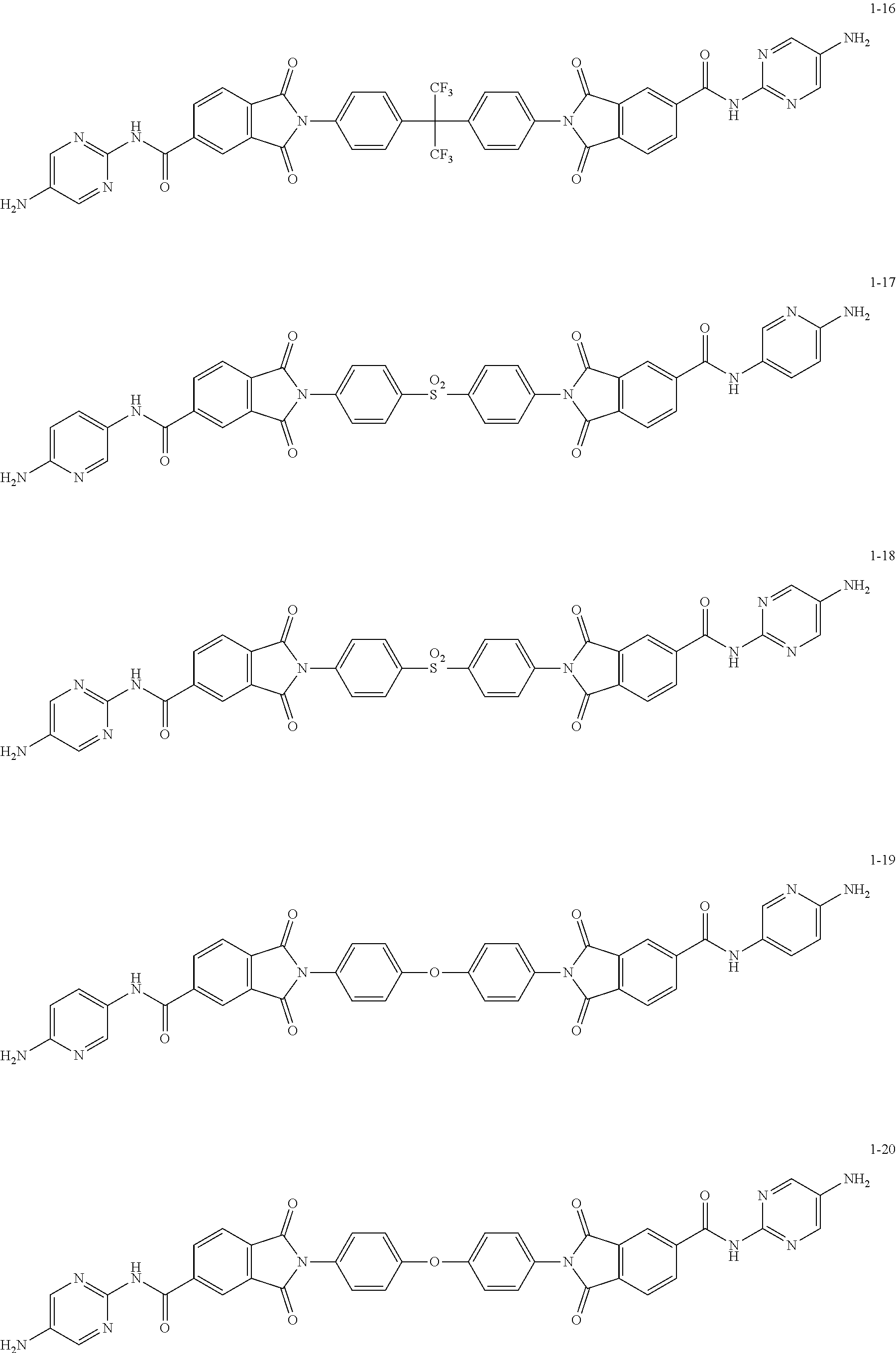
- the diamine of the formula 1 may be selected from compounds of the formulas 1-1 to 1-20.
- the present invention provides a polyimide precursor obtained by polymerizing a polymerization component comprising at least one diamine and at least one acid dianhydride, wherein the diamine in the polymerization component comprises the diamine represented by the formula 1.
- the present invention provides a polyimide film manufactured by using the polyimide precursor.
- the polyimide film may be manufactured by a method comprising applying a polyimide precursor composition comprising the polyimide precursor on a carrier substrate; and heating and curing the polyimide precursor composition.
- a flexible device comprising the polyimide film as a substrate.
- the present invention provides a process for producing a flexible display comprising applying a polyimide precursor composition comprising the polyimide precursor on a carrier substrate; heating the polyimide precursor composition to imidize polyamic acid, thereby forming a polyimide film; forming a device on the polyimide film; and peeling off the polyimide film on which the device is formed from the carrier substrate.
- the process may comprise an LTPS (low temperature polysilicon) process, an ITO process or an oxide process.
- LTPS low temperature polysilicon
- the present invention provides a method for preparing a diamine having the structure of formula 1, the method comprising the steps of:
- the present invention discloses a novel diamine having a structure comprising an intramolecular imide group and further comprising both of imide groups having an aromatic ring group substituted with an amide group, and can provide a polyimide film in which mechanical and thermal properties are also significantly improved while maintaining optical properties when a novel diamine is used as a polymerization component in the production of polyimide.
- substituted means that at least one hydrogen contained in the compound or the organic group is substituted with a substituent selected from the group consisting of a halogen atom, an alkyl group or a halogenated alkyl group having 1 to 10 carbon atoms, a cycloalkyl group having 3 to 30 carbon atoms, an aryl group having 6 to 30 carbon atoms, a hydroxyl group, an alkoxy group having 1 to 10 carbon atoms, a carboxylic group, an aldehyde group, an epoxy group, a cyano group, a nitro group, an amino group, a sulfonic group or a derivative thereof.
- Aromatic polyimides are widely used in high-tech industries such as microelectronics, aerospace, insulating materials and refractory materials due to their excellent overall properties such as thermal oxidation stability, high mechanical strength, and excellent mechanical strength.
- aromatic polyimides having strong absorbance in ultraviolet-visible region exhibit strong coloration from pale yellow to dark brown. It limits their wide application in the optoelectronics area, where transparency and colorless properties are basic requirements.
- the reason for the coloration in the aromatic polyimide resin is that intramolecular charge transfer complexes (CT-complexes) are formed between an alternating electron donor (dianhydride) and an electron acceptor (diamine) in the polymer main chain.
- CT-complexes intramolecular charge transfer complexes
- the present invention provides a diamine represented by the following formula 1 as a polymerization component capable of producing a polyimide with improved mechanical properties.
- the diamine according to the present invention contains a diamine containing an imide group in a molecule, a charge transfer complexing (CTC) effect is increased through an increase in the interaction of intermolecular pi-pi electrons of a diamine repeating unit containing an imide group during polymerization of polyimide.
- CTC charge transfer complexing
- the mechanical properties are improved and the distance between molecules is closer, so that the probability of the polymerization reaction increases and thus the molecular weight can increase.
- the aromatic structures are continuously connected, so the elevated CTC effect is suppressed and processability is increased. That is, the CTC effect can be suppressed again by the amide group, while improving the mechanical properties due to the elevated CTC effect by increasing the imidization rate.
- R 1 and R 2 may be each independently an alkyl group having 1 to 5 carbon atoms or a haloalkyl group having 1 to 5 carbon atoms, or n 1 and n 2 may be each independently 0.
- Z 1 to Z 4 may be all carbon atoms.
- At least one of Z 1 to Z 4 may be a nitrogen atom or at least one of Z 5 to Z 8 may be a nitrogen atom, and according to other embodiment, at least one of Z 1 to Z 4 may be a nitrogen atom and at least one of Z 5 to Z 8 may be a nitrogen atom.
- the diamine of the formula 1 may be prepared from the same reaction as in Scheme 1 below:
- the compound of formula (i) and the compound of formula (ii) may be used in a molar ratio of 1:0.3 to 1:1, such as a molar ratio of 1:0.3 to 1:0.7.
- tetrahydrofuran THF
- ethyl acetate EA
- propylene oxide may be added as a catalyst to increase reactivity.
- the reaction is advantageously performed at ⁇ 30 to 0° C., such as at ⁇ 20° C., and the reaction time may be 1 to 5 hours, such as 1 to 3 hours.
- the compound of formula (iii) and the compound of formula (iv) may be used in a molar ratio of 1:0.3 to 1:1, such as a molar ratio of 1:0.3 to 1:0.7.
- acetic acid, propionic acid, etc. may be used to disperse the reaction compounds, and the reaction temperature may be raised to about 100° C. and the reaction time may be 3 to 5 hours, such as 4 hours.
- alcohols such as ethanol and isopropanol may be added to obtain a solid.
- the reduction reaction in step (3) may be carried out in a hydrogen atmosphere in the presence of a palladium on carbon (Pd/C) catalyst for 12 to 18 hours, such as 16 hours.
- Pd/C palladium on carbon
- N-methylpyrrolidone, tetrahydrofuran, etc. may be used as a dispersion medium.
- the weight average molecular weight of the polyimide precursor prepared by using the diamine having the above structure may exceed 50,000 g/mol to improve mechanical properties.
- it may have a weight average molecular weight of 51,000 to 65,000 g/mol.
- the molecular weight is 50,000 g/mol or less, the viscosity of the solution is lowered due to the decrease in polyimide reactivity, and the viscosity is low compared to the solid content, so it may not be easy to control the film thickness during the solution coating process and the final curing process.
- the molecular weight is low, mechanical properties may be lowered, which may cause a problem that the film strength is lowered.
- the CTC effect can be reduced to improve the optical properties.
- the diamine of the formula 1 may be selected from compounds of the formulas 1-1 to 1-20.
- a substituent including a fluorine atom (F) may reduce packing within a structure or between chains of polyimide, and may weaken electrical interaction between chromogens due to steric hindrance and electrical effects, resulting in high transparency in the visible region.
- the polyimide precursor according to the present invention may further comprise a diamine having the structure of formula 2 as a polymerization component:
- the compound of formula 2 may be a diamine compound of the following formula 2-1.
- the compound of formula 2 may be present in 5 to 50% by weight relative to the total weight of the polymerization component, preferably 10 to 20% by weight relative to the total weight of the total polymerization component.
- the effect of reducing residual stress may be increased, and in the case of higher than 50% by weight, Tg is lower than 390° C., so that heat resistance can be lowered.
- the polyimide according to the present invention can maintain Tg of 390° C. or higher, despite containing a silicone oligomer in an amount of 10% by weight or more based on the total polymerization component. Therefore, while maintaining the glass transition temperature at 390° C. or higher, the effect of reducing residual stress due to the silicone oligomer structure can also be achieved.
- the molecular weight of the silicone oligomer structure contained in the diamine having the structure of formula 2 may be 4000 g/mol or more, wherein the molecular weight means a weight average molecular weight, and the molecular weight may be calculated by using NMR analysis or an acid-base titration method to calculate the equivalent of the reactive group such as amine or dianhydride.
- the molecular weight of the silicone oligomer structure comprising the structure of formula 2 is less than 4000 g/mol, heat resistance may be lowered, for example, the glass transition temperature (Tg) of the prepared polyimide may decrease, or the coefficient of thermal expansion may increase excessively.
- Tg glass transition temperature
- the silicon oligomer domain distributed in the polyimide matrix has a continuous phase, for example the size thereof is nano-sized, such as 1 nm to 50 nm, or 5 nm to 40 nm, or 10 nm to 30 nm, so that residual stress can be minimized while maintaining heat resistance and mechanical properties. If it does not have such a continuous phase, there may be a residual stress reduction effect, but it is difficult to use in the process due to a significant decrease in heat resistance and mechanical properties.
- the domain of the silicone oligomer means a region in which polymers having a silicone oligomer structure are distributed, and its size refers to a diameter of a circle surrounding the region.
- the parts (domains) containing the silicone oligomer structure are connected in a continuous phase in the polyimide matrix, wherein the continuous phase means a shape in which nano-sized domains are uniformly distributed.
- the silicone oligomer can be uniformly distributed in the polyimide matrix without phase separation, so that haze characteristics are lowered to obtain a polyimide having more transparent characteristics.
- the presence of the silicone oligomer structure in a continuous phase can improve mechanical strength and stress relaxation effect of the polyimide more efficiently. From these properties, the composition according to the present invention can provide a flat polyimide film having improved thermal and optical properties by reducing bending of the substrate after coating-curing.
- the modulus of the polyimide can be appropriately improved, and the stress caused by external force can also be relieved.
- the polyimide containing the silicone oligomer structure may exhibit polarity, and phase separation may occur due to a polarity difference with the polyimide structure that does not include the siloxane structure, whereby the siloxane structure may be unevenly distributed throughout the polyimide structure. In this case, it is difficult to exhibit improvement effect of physical properties such as strength improvement and stress relaxation of the polyimide due to the siloxane structure, and haze increases due to phase separation, thereby deteriorating transparency of the film.
- the diamine containing the siloxane structure has a high molecular weight
- the polarity of the polyimide prepared therefrom may be more pronounced, so that the phase separation phenomenon between the polyimides may be more pronounced.
- a siloxane diamine having a low molecular weight structure a large amount of siloxane diamine must be added in order to exhibit an effect such as stress relaxation.
- it may cause process problems such as a low Tg, and thus physical properties of the polyimide film may be deteriorated.
- the present invention can be more evenly distributed without phase separation in the polyimide matrix by using the compound of formula 2 having the siloxane structure with a high molecular weight.
- tetracarboxylic dianhydrides may be used as the acid dianhydride used for polymerizing the polyimide precursor.
- the tetracarboxylic dianhydride it may be used a tetracarboxylic dianhydride containing aliphatic, alicyclic or aromatic tetravalent organic group(s), or a combination thereof in the molecule, wherein the aliphatic, alicyclic or aromatic tetravalent organic group(s) is connected to each other via a crosslinking structure.
- it may include an acid dianhydride having a structure having a monocyclic or polycyclic aromatic, monocyclic or polycyclic alicyclic group, or two or more of them connected by a single bond or a functional group.
- it may include a tetracarboxylic dianhydride comprising a tetravalent organic group having aliphatic ring(s) or aromatic ring(s), in which each ring is a single ring structure, each ring is fused to form a heterocyclic structure, or each ring is connected by a single bond.
- it may include a tetracarboxylic dianhydride containing a tetravalent organic group selected from structures of the following formulas 3a to 3e.
- the tetracarboxylic dianhydride may comprise a tetravalent organic group selected from the group consisting of the following formulas 4a to 4n.
- At least one hydrogen atom in the tetravalent organic group of the formulas 4a to 4n may be substituted with a substituent selected from a halogen atom selected from —F, —Cl, —Br and —I, a hydroxyl group (—OH), a thiol group (—SH), a nitro group (—NO 2 ), a cyano group, an alkyl group having 1 to 10 carbon atoms, a halogenoalkoxy group having 1 to 4 carbon atoms, a halogenoalkyl group having 1 to 10 carbon atoms and an aryl group having 6 to 20 carbon atoms.
- a substituent selected from a halogen atom selected from —F, —Cl, —Br and —I, a hydroxyl group (—OH), a thiol group (—SH), a nitro group (—NO 2 ), a cyano group, an alkyl group having 1 to 10 carbon atoms
- the halogen atom may be fluoro (—F)
- the halogenoalkyl group is a fluoroalkyl group having 1 to 10 carbon atoms containing a fluoro atom, selected from a fluoromethyl group, a perfluoroethyl group, a trifluoromethyl group, etc.
- the alkyl group may be selected from a methyl group, an ethyl group, a propyl group, an isopropyl group, a t-butyl group, a pentyl group, and a hexyl group
- the aryl group is selected from a phenyl group and a naphthalenyl group. More preferably, it may be substituted with a fluorine atom or a substituent containing a fluorine atom such as a fluoroalkyl group.
- the tetracarboxylic dianhydride may comprise a tetravalent organic group comprising aliphatic ring(s) or aromatic ring(s) in which each ring is a rigid structure, i.e., a single ring structure, each ring is connected by a single bond, or each ring is directly connected to form a heterocyclic structure.
- one or more diamines may be further included in addition to the diamine of formula 1 and optionally the diamine of formula 2.
- it may include a diamine comprising a divalent organic group selected from a monocyclic or polycyclic aromatic divalent organic group having 6 to 24 carbon atoms, a monocyclic or polycyclic alicyclic divalent organic group having 6 to 18 carbon atoms, or a divalent organic group having two or more of them connected by a single bond or a functional group.
- it may include a diamine comprising a divalent organic group having aliphatic ring(s) or aromatic ring(s) in which each ring is a single ring structure, each ring is fused to form a heterocyclic structure, or each ring is connected by a single bond.
- the diamine may comprise a divalent organic group selected from the following formulas 5a to 5e.
- the diamine may comprise a divalent organic group selected from the following formulas 6a to 6p.
- the diamine may comprise a divalent organic group in which aromatic ring(s) or aliphatic structure(s) form a rigid chain structure, for example, a divalent organic group having aliphatic ring(s) or aromatic ring(s) in which each ring is a single ring structure, each ring is connected by a single bond, or each ring is fused to form a heterocyclic structure.
- the reaction molar ratio of the acid dianhydride to the diamine may be 1:1.1 to 1.1:1.
- the reaction molar ratio may vary depending on the intended reactivity and processability.
- the molar ratio of the acid dianhydride and the diamine may be 1:0.98 to 0.98:1, preferably 1:0.99 to 0.99:1.
- the reaction of acid dianhydride and diamine may be carried out by a conventional polymerization method of a polyimide or a precursor thereof, such as solution polymerization.
- the organic solvent that can be used in the polymerization reaction of polyamic acid may include ketones such as gamma-butyrolactone, 1,3-dimethyl-2-imidazolidinone, methyl ethyl ketone, cyclohexanone, cyclopentanone and 4-hydroxy-4-methyl-2-pentanone; aromatic hydrocarbons such as toluene, xylene and tetramethylbenzene; glycol ethers (Cellosolve) such as ethylene glycol monoethyl ether, ethylene glycol monomethyl ether, ethylene glycol monobutyl ether, diethylene glycol monoethyl ether, diethylene glycol monomethyl ether, diethylene glycol monobutyl ether, propylene glycol monomethyl ether, propylene glycol monoethyl ether, dipropylene glycol diethyl ether and triethylene glycol monoethyl ether; ethyl acetate, butyl acetate
- a solvent having a positive partition coefficient at 25° C. (Log P) may be used as the organic solvent for polymerizing the polymerization component.
- Tg can be maintained at a high temperature of 390° C. or higher even for a composition in which methylphenylsilicone oligomer is contained in an amount of 10% by weight or more.
- the organic solvent having a positive partition coefficient as described above can reduce white turbidity generated by phase separation due to polarity difference between the flexible polyimide repeating structure and other polyimide structure comprising a siloxane structure such as a silicone oligomer.
- a siloxane structure such as a silicone oligomer.
- the present invention can reduce white turbidity due to phase separation even with one kind of organic solvent, so that a more transparent polyimide film can be produced.
- the polyimide can be evenly distributed even if only a solvent is used, which makes it very suitable for solving problems caused by phase separation. Accordingly, it is possible to provide a polyimide in which haze characteristics are significantly improved.
- the solvent has a positive partition coefficient value means that the polarity of the solvent is hydrophobic. According to the research of the present inventors, it is found that when the polyimide precursor composition is prepared using a specific solvent having a positive partition coefficient value, the edge back phenomenon is improved. In addition, in the present invention it is possible to control the edge back phenomenon of the solution without using additives for controlling surface tension of the material and smoothness of the coating film, such as a leveling agent, by using a solvent having a positive Log P as described above. Since additional additives such as additives are not used, it is possible to eliminate quality and process problems such as the presence of low-molecular substances in the final product, as well as more efficiently to form a polyimide film having uniform properties.
- an edge back phenomenon may occur due to shrinkage of the coating layer during curing or under the condition of standing the coating solution in a humidity condition.
- the edge back phenomenon of the coating solution may cause a variation in the thickness of the film.
- the film may be cut or edges of the film may be broken when cutting due to a lack of flex resistance of the film, causing problems of poor process workability and reduced yield.
- the polyimide precursor composition including a polar solvent having a negative Log P
- sporadic coating cracks or thickness change may occur based on location of the foreign substance due to polarity of the foreign substance.
- the occurrence of thickness change due to cracking of the coating may be reduced or suppressed even when fine foreign substances having polarity are introduced.
- an edge back ratio defined by the following Equation 1 may be 0% to 0.1% or less.
- Edge back ratio (%) [( A ⁇ B )/ A ] ⁇ 100 [Equation 1]
- the edge back phenomenon of the polyimide precursor composition and the film may occur within 30 minutes after coating the polyimide precursor composition solution, in particular, the film may be rolled up from the edge to make the thickness of the edge thicker.
- the edge back ratio of the coated resin composition solution may be 0.1% or less.
- the edge back ratio may be 0.1% or less, preferable 0.05%, more preferably almost 0%.
- the edge back ratio as described above is maintained even after curing, for example, the edge back ratio of the coated resin composition solution is 0.1% or less. That is, even in a curing process by heat treatment, there may be little or no edge back phenomenon, and specifically the edge back ratio may be 0.05% or less, more preferably almost 0%.
- the polyimide precursor composition according to the present invention can obtain a polyimide film having more uniform characteristics, thereby further improving the yield of the manufacturing process.
- the density of the solvent according to the present invention can be 1 g/cm 3 or less as measured by standard ASTM D1475. If the density is more than 1 g/cm 3 , the relative viscosity may increase and the process efficiency may be reduced.
- the solvent having a positive partition coefficient (Log P) may be at least one selected from the group consisting of N,N-diethylacetamide (DEAc), N,N-diethylformamide (DEF), N-ethylpyrrolidone (NEP), dimethylpropionamide (DMPA) and diethylpropionamide (DEPA).
- DEAc N,N-diethylacetamide
- DEF N,N-diethylformamide
- NEP N-ethylpyrrolidone
- DMPA dimethylpropionamide
- DEPA diethylpropionamide
- the solvent may have a boiling point of 300° C. or less. More specifically, the partition coefficient Log P at 25° C. may be 0.01 to 3, or 0.01 to 2, or 0.1 to 2.
- the partition coefficient can be calculated using an ACD/Log P module of ACD/Percepta platform from ACD/Labs.
- the ACD/Log P module uses an algorithm based on QSPR (Quantitative Structure-Property Relationship) methodology using 2D molecular structures.
- aromatic hydrocarbons such as xylene and toluene may be further used.
- aromatic hydrocarbons such as xylene and toluene may be further used.
- about 50% by weight or less of an alkali metal salt or an alkaline earth metal salt may be further added to the solvent based on the total amount of the solvent.
- an end-capping agent may be further added in which the terminal of the molecule reacts with dicarboxylic acid anhydride or monoamine to end-cap the terminal of the polyimide in order to inactivate excess polyamino groups or acid anhydride groups.
- the reaction of tetracarboxylic dianhydride and diamine may be carried out by a conventional polymerization method of polyimide precursor, such as solution polymerization. Specifically, it can be prepared by dissolving diamine in an organic solvent, followed by adding tetracarboxylic dianhydride to the resulting mixed solution to polymerize.
- the polymerization reaction may be carried out in an inert gas or a nitrogen stream and may be carried out under anhydrous condition.
- the reaction temperature during the polymerization reaction may be ⁇ 20 to 80° C., preferably 0 to 80° C. If the reaction temperature is too high, the reactivity may become high and the molecular weight may become large, and the viscosity of the precursor composition may increase, which may be unfavorable in the process.
- the polyamic acid solution prepared according to the above-mentioned manufacturing method contains a solid content in an amount such that the composition has an appropriate viscosity in consideration of processibility such as coating property in the film forming process.
- the polyimide precursor composition containing polyamic acid may be in the form of a solution dissolved in an organic solvent.
- the solution may be the reaction solution as obtained, or may be obtained by diluting this reaction solution with another solvent.
- the polyimide precursor is obtained as a solid powder, it may be dissolved in an organic solvent to prepare a solution.
- the content of the composition may be adjusted by adding an organic solvent such that the total polyimide precursor content is 8 to 25% by weight, preferably 10 to 25% by weight, more preferably 10 to 20% by weight.
- the polyimide precursor composition may be adjusted to have a viscosity of 3,000 cP or more at a solid content concentration of 20% by weight or less, and the polyimide precursor composition may be adjusted to have a viscosity of 10,000 cP or less, preferably 9,000 cP or less, more preferably 8,000 cP or less.
- the viscosity of the polyimide precursor composition is greater than 10,000 cP, the efficiency of defoaming during processing of the polyimide film is lowered. It results in not only the lowered efficiency of process but also the deteriorated surface roughness of the produced film due to bubble generation. It may lead to the deteriorated electrical, optical and mechanical properties.
- the polyimide precursor resulted from the polymerization reaction may be imidized by chemical or thermal imidization to prepare a transparent polyimide film.
- the polyimide film may be manufactured by a method comprising:
- a glass substrate As the substrate, a glass substrate, a metal substrate, a plastic substrate, or the like can be used without any particular limitation. Among them, a glass substrate may be preferable which is excellent in thermal and chemical stabilities during the imidization and curing process for the polyimide precursor and can be easily separated even without any treatment with additional release agent while not damaging the polyimide film formed after curing.
- the applying process may be carried out according to a conventional application method. Specifically, a spin coating method, a bar coating method, a roll coating method, an air knife method, a gravure method, a reverse roll method, a kiss roll method, a doctor blade method, a spray method, a dipping method, a brushing method, or the like may be used. Of these, it is more preferable to carry out by a casting method which allows a continuous process and enables to increase an imidization rate of polyimide.
- the polyimide precursor composition may be applied on the substrate in the thickness range such that the polyimide film to be finally produced has a thickness suitable for a display substrate.
- the polyimide precursor composition may be applied in an amount such that the thickness is 10 to 30 ⁇ m.
- a drying process for removing the solvent remained in the polyimide precursor composition may be further optionally performed prior to the curing process.
- the drying process may be carried out according to a conventional method. Specifically, the drying process may be carried out at a temperature of 140° C. or lower, or from 80° C. to 140° C. If the drying temperature is lower than 80° C., the drying process becomes longer. If the drying temperature exceeds 140° C., the imidization proceeds rapidly, making it difficult to form a polyimide film having a uniform thickness.
- the polyimide precursor composition is applied on a substrate and heat-treated in an IR oven, in a hot air oven, or on a hot plate.
- the heat treatment temperature may range from 300 to 500° C., preferably from 320 to 480° C.
- the heat treatment may be performed in a multi-step heating process within the above temperature range.
- the heat treatment process may be performed for 20 to 70 minutes, and preferably for 20 to 60 minutes.
- the residual stress immediately after curing of the polyimide film prepared as described above may be 40 MPa or less, and the residual stress change after standing the polyimide film at 25° C. and 50% humidity for 3 hours may be 5 MPa or less.
- the polyimide film may have a yellowness of 15 or less, and preferably 13 or less. Further, the polyimide film may have a haze of 2 or less, and preferably 1 or less.
- the polyimide film may have a transmittance at 450 nm of 75% or more, a transmittance at 550 nm of 85% or more, and a transmittance at 630 nm of 90% or more.
- the polyimide film may have high heat resistance, for example, a thermal decomposition temperature (Td_1%) in which mass loss is 1% may be 500° C. or higher.
- Td_1% thermal decomposition temperature
- the polyimide film prepared as described above may have a modulus of 3 to 6 GPa.
- the modulus modulus of elasticity
- the film has a low rigidity and is easily fragile to external impact.
- the modulus of elasticity exceeds 6 GPa, the rigidity of the coverlay film is excellent, but sufficient flexibility cannot be obtained.
- the polyimide film may have an elongation of 90% or more, preferably 92% or more, and a tensile strength of 130 MPa or more, preferably 140 MPa or more.
- the polyimide film according to the present invention may have excellent thermal stability against a temperature change.
- it may have a thermal expansion coefficient of ⁇ 10 to 100 ppm/° C., preferably from ⁇ 7 to 90 ppm/° C., more preferably 80 ppm/° C. or less, after the n+1 times heating and cooling processes in a temperature range of 100 to 350° C. times (n is an integer of at least 0).
- the polyimide film according to the present invention may have a retardation in a thickness direction (R th ) of ⁇ 150 nm to +150 nm, preferably ⁇ 130 nm to +130 nm, thereby exhibiting optical isotropy to improve visual sensibility.
- the polyimide film may have an adhesive force to a carrier substrate of 5 gf/in or more, and preferably 10 gf/in or more.
- the present invention provides a process for manufacturing a flexible device, comprising the steps of:
- the process of manufacturing a flexible device may comprise a low temperature polysilicon (LTPS) process, an ITO process, or an oxide process.
- LTPS low temperature polysilicon
- ITO ITO
- oxide oxide
- a flexible device including an LTPS layer may be obtained by forming the LTPS layer by an LTPS thin film manufacturing process, followed by peeling a carrier substrate and a polyimide film by laser lift-off or the like, the LTPS thin film manufacturing process comprising:
- the oxide thin film process may be heat treated at a lower temperature than the process using silicon, for example, the heat treatment temperature of the ITO TFT process may be 240° C. ⁇ 50° C., and the heat treatment temperature of the oxide TFT process may be 350° C. ⁇ 50° C.
- the compound of Formula A (40.0 g, 190.6 mmol) was dissolved in THF (300 mL) in a nitrogen atmosphere, and propylene oxide (5.5 g, 95.3 mmol) was added, followed by cooling to ⁇ 20° C.
- the compound of formula B (13.2 g, 95.3 mmol) was introduced into this solution in 4 portions at intervals of 10 minutes. After 3 hours, hexane (300 ml) was added to produce a solid. The solid obtained after filtration was washed with hexane/ethyl acetate (10/7) to prepare the compound of formula C (25.9 g, yield 87.0%).
- the compound of formula C (20 g, 63.9 mmol) and a compound of formula D (10.2 g, 32.0 mmol) were dispersed in glacial acetic acid (200 mL) and heated to 100° C. After 4 hours, the temperature was lowered to room temperature, and then ethanol was added to obtain a solid. The solid obtained after filtration was washed with water and ethanol to prepare the compound of formula E (26.8 g, yield 92.3%).
- a compound of formula G was prepared in the same manner as the method of preparing the compound of formula C, except that a compound of formula F was used instead of the compound of formula B in Preparation Example 1.
- a compound of formula H was prepared in the same manner as the method of preparing the compound of formula E, except that the compound of formula G was used instead of the compound of formula C.
- a compound of formula 1-2 was prepared in the same manner as the method of preparing the compound of formula 1-1, except that the compound of formula H was used instead of the compound of formula E.
- a compound of formula J was prepared in the same manner as the method of preparing the compound of formula E, except that a compound of formula I was used instead of the compound of formula D in Preparation Example 1.
- a compound of formula 1-5 was prepared in the same manner as the method of preparing the compound of formula 1-1, except that the compound of formula J was used instead of the compound of formula E.
- a compound of formula L was prepared in the same manner as the method of preparing the compound of formula E, except that a compound of formula K was used instead of the compound of formula D in Preparation Example 1.
- a compound of formula 1-9 was prepared in the same manner as the method of preparing the compound of formula 1-1, except that the compound of formula L was used instead of the compound of formula E.
- a compound of formula N was prepared in the same manner as the method of preparing the compound of formula C, except that a compound of formula M was used instead of the compound of formula B in Preparation Example 1.
- a compound of formula P was prepared in the same manner as the method of preparing the compound of formula E, except that the compound of formula N was used instead of the compound of formula C and the compound of formula O was used instead of the compound of formula D.
- a compound of formula 1-13 was prepared in the same manner as the method of preparing the compound of formula 1-1, except the compound of formula P was used instead of the compound of formula E.
- a compound of formula R was prepared in the same manner as the method of preparing the compound of formula C, except that a compound of formula Q was used instead of the compound of formula B in Preparation Example 1.
- a compound of formula T was prepared in the same manner as the method of preparing the compound of formula E, except that the compound of formula R was used instead of the compound of formula C.
- a compound of formula 1-14 was prepared in the same manner as the method of preparing the compound of formula 1-1, except that the compound of formula T was used instead of the compound of formula E.
- a compound of formula N was prepared in the same manner as the method of preparing the compound of formula C, except that a compound of formula M was used instead of the compound of formula B in Preparation Example 1.
- a compound of formula U was prepared in the same manner as the method of preparing the compound of formula E, except that the compound of formula N was used instead of the compound of formula C and the compound of formula K was used instead of the compound of formula D.
- a compound of formula 1-19 was prepared in the same manner as the method of preparing the compound of formula 1-1, except that the compound of formula U was used instead of the compound of formula E.
- DEAc Diethylacetamide
- DEAc Diethylacetamide
- the viscosity of the polyimide precursor solutions and the molecular weight of the polyamic acid prepared in Examples 1 to 4 and Comparative Example 1 were measured, and the results are shown in Table 1 below.
- the viscosity was measured using Viscotek TDA302, and the molecular weight was measured using Viscotek GPCmax VE2001.
- Each of the polyimide precursor solutions prepared in Examples 1 to 4 and Comparative Example 1 was spin coated on a glass substrate.
- the glass substrate coated with the polyimide precursor solution was placed in an oven, heated at a rate of 5° C./min and cured at 80° C. for 30 minutes, at 250° C. for 30 minutes and at 400° C. for 30 to 40 minutes to prepare a polyimide film. Properties of each film were measured, and the results are shown in Table 1 below.
- a film of 5 mm ⁇ 50 mm long and 10 ⁇ m thick was stretched at a speed of 10 mm/min with a tensile tester (Instron 3342, manufactured by Instron) to measure modulus (GPa), tensile strength (MPa) and elongation (%).
- a tensile tester Instron 3342, manufactured by Instron
- the polyimide precursor solution containing the diamine according to the present invention may have a viscosity of 3000 cPs or more at a solid content concentration of 20% by weight or less, and therefore a polyamic acid having a higher molecular weight was produced compared to Comparative Example 1 using TFMB.
- the polyimide film prepared from the polyamic acid having such a high molecular weight has improved mechanical strength compared to the polyimide film of Comparative Example 1.
Landscapes
- Chemical & Material Sciences (AREA)
- Organic Chemistry (AREA)
- Chemical Kinetics & Catalysis (AREA)
- Health & Medical Sciences (AREA)
- Medicinal Chemistry (AREA)
- Polymers & Plastics (AREA)
- Engineering & Computer Science (AREA)
- Manufacturing & Machinery (AREA)
- Materials Engineering (AREA)
- Life Sciences & Earth Sciences (AREA)
- Wood Science & Technology (AREA)
- Macromolecular Compounds Obtained By Forming Nitrogen-Containing Linkages In General (AREA)
- Plural Heterocyclic Compounds (AREA)
Abstract
Description


-
- reacting a compound of the formula (i) with a compound of the following formula (ii) to obtain a compound of the formula (iii);
- reacting the compound of the formula (iii) with a compound of the formula (iv) to obtain a compound of the formula (v); and
- reducing the compound of the formula (v):

-
- wherein,
- Za to Zd are each independently a carbon atom or a nitrogen atom, with the proviso that Za to Zd are not nitrogen atoms at the same time, R1, R2 and Ra are each independently selected from the group consisting of an alkyl group having 1 to 10 carbon atoms, a haloalkyl group having 1 to 10 carbon atoms, an alkenyl group having 1 to 10 carbon atoms, and an aryl group having 6 to 18 carbon atoms, n1, n2 and n are each independently an integer of 0 to 4, and X is a single bond or a functional group selected from the group consisting of O, S, S—S, C(═O), —C(═O)O—, CH(OH), S(═O)2, Si(CH3)2, CR′R″, C(═O)NH and a combination thereof, wherein R′ and R″ are each independently selected from the group consisting of a hydrogen atom, an alkyl group having 1 to 10 carbon atoms and a fluoroalkyl group having 1 to 10 carbon atoms.

-
- Z1 to Za are each independently a carbon atom or a nitrogen atom, with the proviso that Z1 to Z8 are not nitrogen atoms at the same time,
- R1, R2, R3 and R4 are each independently selected from the group consisting of an alkyl group having 1 to 10 carbon atoms, a haloalkyl group having 1 to 10 carbon atoms, an alkenyl group having 1 to 10 carbon atoms, and an aryl group having 6 to 18 carbon atoms,
- n1, n2, n3 and n4 are each independently an integer of 0 to 4, and
- X is a single bond or a functional group selected from the group consisting of O, S, S—S, C(═O), —C(═O)O—, CH(OH), S(═O)2, Si(CH3)2, CR′R″, C(═O)NH and a combination thereof, wherein R′ and R″ are each independently selected from the group consisting of a hydrogen atom, an alkyl group having 1 to 10 carbon atoms and a fluoroalkyl group having 1 to 10 carbon atoms.

-
- wherein Za to Zd are each independently a carbon atom or a nitrogen atom, with the proviso that Za to Zd are not nitrogen atoms at the same time,
- R1, R2 and Ra are each independently selected from the group consisting of an alkyl group having 1 to 10 carbon atoms, a haloalkyl group having 1 to 10 carbon atoms, an alkenyl group having 1 to 10 carbon atoms, and an aryl group having 6 to 18 carbon atoms, n1, n2 and n are each independently an integer of 0 to 4, and
- X is the same as defined in the formula 1.



-
- R5 and R6 are each independently a monovalent organic group having 1 to 20 carbon atoms, and h is an integer of 3 to 200.

-
- R is an alkyl group having 1 to 10 carbon atoms or an aryl group having 6 to 24 carbon atoms, and
- p and q are mole fractions, and when p+q=100, p is 70 to 90, and q is 10 to 30.

-
- R11 to R17 are each independently a substituent selected from a halogen atom selected from —F, —Cl, —Br and —I, a hydroxyl group (—OH), a thiol group (—SH), a nitro group (—NO2), a cyano group, an alkyl group having 1 to 10 carbon atoms, a halogenoalkoxy group having 1 to 4 carbon atoms, a halogenoalkyl group having 1 to 10 carbon atoms and an aryl group having 6 to 20 carbon atoms,
- a1 is an integer of 0 to 2, a2 is an integer of 0 to 4, a3 is an integer of 0 to 8, a4 and a5 are each independently an integer of 0 to 3, a6 and a9 are each independently an integer of 0 to 3, and a7 and a8 are each independently an integer of 0 to 7,
- A11 and A12 are each independently selected from the group consisting of single bond, —O—, —CR′R″— (wherein, R′ and R″ are each independently selected from the group consisting of a hydrogen atom, an alkyl group having 1 to 10 carbon atoms (e.g., methyl group, ethyl group, propyl group, isopropyl group, n-butyl, tert-butyl group, pentyl group, etc.) and a haloalkyl group having 1 to 10 carbon atoms (e.g., trifluoromethyl group, etc.)), —C(═O)—, —C(═O)O—, —C(═O)NH—, —S—, —SO—, —SO2—, —O[CH2CH2O]y- (y is an integer of 1 to 44), —NH(C═O)NH—, —NH(C═O)O—, a monocyclic or polycyclic cycloalkylene group having 6 to 18 carbon atoms (e.g., cyclohexylene group, etc.), a monocyclic or polycyclic arylene group having 6 to 18 carbon atoms (e.g., phenylene group, naphthalene group, fluorenylene group, etc.), and combinations thereof.


-
- R21 to R27 are each independently a substituent selected from a halogen atom selected from —F, —Cl, —Br and —I, a hydroxyl group (—OH), a thiol group (—SH), a nitro group (—NO2), a cyano group, an alkyl group having 1 to 10 carbon atoms, a halogenoalkoxy group having 1 to 4 carbon atoms, a halogenoalkyl group having 1 to 10 carbon atoms and an aryl group having 6 to 20 carbon atoms,
- A21 and A22 are each independently selected from the group consisting of single bond, —O—, —CR′R″— (wherein, R′ and R″ are each independently selected from the group consisting of a hydrogen atom, an alkyl group having 1 to 10 carbon atoms (e.g., methyl group, ethyl group, propyl group, isopropyl group, n-butyl, tert-butyl group, pentyl group, etc.) and a haloalkyl group having 1 to 10 carbon atoms (e.g., trifluoromethyl group, etc.)), —C(═O)—, —C(═O)O—, —C(═O)NH—, —S—, —SO—, —SO2—, —O[CH2CH2O]y— (y is an integer of 1 to 44), —NH(C═O)NH—, —NH(C═O)O—, a monocyclic or polycyclic cycloalkylene group having 6 to 18 carbon atoms (e.g., cyclohexylene group, etc.), a monocyclic or polycyclic arylene group having 6 to 18 carbon atoms (e.g., phenylene group, naphthalene group, fluorenylene group, etc.), and combinations thereof,
- b1 is an integer from 0 to 4, b2 is an integer from 0 to 6, b3 is an integer from 0 to 3, b4 and b5 are each independently an integer from 0 to 4, and b7 and b8 are each independently an integer from 0 to 9, and b6 and b9 are each independently an integer from 0 to 3.


Edge back ratio (%)=[(A−B)/A]×100 [Equation 1]
-
- wherein,
- A: area of the polyimide precursor composition completely coated on the substrate (100 mm×100 mm),
- B: area after the edge back phenomenon occurs from the edge of the substrate with the polyimide precursor composition or the PI film coated thereon.
-
- applying the polyimide precursor composition onto a substrate; and
- heating and curing the applied polyimide precursor composition.
-
- preparing a polyimide precursor composition;
- applying the polyimide precursor composition on a carrier substrate, and then heating to imidize the polyamic acid, thereby forming a polyimide film;
- forming a device on the polyimide film; and
- peeling from the carrier substrate the polyimide film having the device formed thereon.
-
- forming a barrier layer comprising SiO2 on the polyimide film;
- depositing an a-Si (amorphous silicon) thin film on the barrier layer;
- dehydrogen annealing by thermal treating the deposited a-Si thin film at a temperature of 450° C.±50° C.; and
- crystallizing the a-Si thin film with an excimer laser or the like.


| TABLE 1 | |||||
| Comparative | |||||
| Example 1 | Example 1 | Example 2 | Example 3 | Example 4 | |
| Diamine used | TFMB | Formula 1-1 | Formula 1-2 | Formula 1-5 | Formula 1-19 |
| Solid content | 18.4 | 17.0 | 17.0 | 17.2 | 15.7 |
| (wt %) | |||||
| Viscosity (cPs) | 3500 | 3840 | 3610 | 3200 | 3440 |
| Molecular | 50,000 | 63,000 | 51,000 | 53,000 | 54,000 |
| weight (Mw) | |||||
| Curing | 5° C./min, | 5° C./min, | 5° C./min, | 5° C./min, | 5° C./min, |
| condition | 80° C., 30 min | 80° C., 30 min | 80° C., 30 min | 80° C., 30 min | 80° C., 30 min |
| 250° C., 30 min | 250° C., 30 min | 250° C., 30 min | 250° C., 30 min | 250° C., 30 min | |
| 400° C., 30 min | 400° C., 40 min | 400° C., 40 min | 400° C., 40 min | 400° C., 40 min | |
| Film thickness | 9.7 | 10.0 | 9.8 | 10.2 | 9.9 |
| (μm) | |||||
| Modulus (GPa) | 2.2 | 5.5 | 5.3 | 4.6 | 4.7 |
| Tensile | 125 | 143 | 141 | 145 | 145 |
| strength (MPa) | |||||
| Elongation (%) | 88 | 97 | 92 | 96 | 92 |
Claims (14)


Applications Claiming Priority (5)
| Application Number | Priority Date | Filing Date | Title |
|---|---|---|---|
| KR10-2018-0160168 | 2018-12-12 | ||
| KR20180160168 | 2018-12-12 | ||
| KR1020190163512A KR102569792B1 (en) | 2018-12-12 | 2019-12-10 | Diamine compound, polyimide precursor and polyimide film prepared by using same |
| KR10-2019-0163512 | 2019-12-10 | ||
| PCT/KR2019/017463 WO2020122585A1 (en) | 2018-12-12 | 2019-12-11 | Diamine compound, and polyimide precursor and polyimide film using same |
Publications (2)
| Publication Number | Publication Date |
|---|---|
| US20220033585A1 US20220033585A1 (en) | 2022-02-03 |
| US12084545B2 true US12084545B2 (en) | 2024-09-10 |
Family
ID=71077465
Family Applications (1)
| Application Number | Title | Priority Date | Filing Date |
|---|---|---|---|
| US17/277,366 Active 2042-01-06 US12084545B2 (en) | 2018-12-12 | 2019-12-11 | Diamine compound, and polyimide precursor and polyimide film using same |
Country Status (3)
| Country | Link |
|---|---|
| US (1) | US12084545B2 (en) |
| JP (1) | JP7160459B2 (en) |
| WO (1) | WO2020122585A1 (en) |
Citations (13)
| Publication number | Priority date | Publication date | Assignee | Title |
|---|---|---|---|---|
| US4668757A (en) * | 1984-03-26 | 1987-05-26 | Gus Nichols | Use of aromatic amines for setting epoxide resins |
| US5235005A (en) * | 1988-07-05 | 1993-08-10 | Shin-Etsu Chemical Co., Ltd. | Polyimide resin composition and semiconductor device encapsulated therewith |
| DE4205685A1 (en) | 1992-02-25 | 1993-08-26 | Chemie Linz Deutschland | New readily processable thermally stable polyamideimide ester] polymers - prepd. from new amide-imide bisphenol cpds. and bifunctional acid chloride gp. carboxylic ester cpds. |
| JPH07173289A (en) | 1993-07-05 | 1995-07-11 | Korea Res Inst Chem Technol | New polyamideimide resin having isophoronediamine structure |
| JPH08283436A (en) | 1995-04-19 | 1996-10-29 | Matsushita Electric Ind Co Ltd | Prepreg and copper clad laminate |
| WO2004101495A1 (en) | 2003-05-16 | 2004-11-25 | Procorde Gmbh | Compounds for use as a medicine increasing the contractility of a heart, a heart muscle or cells of a heart muscle |
| US20120101236A1 (en) | 2009-04-02 | 2012-04-26 | Nissan Chemical Industries, Ltd. | Polyimide precursor composition containing polyamic acid alkyl ester |
| CN102432878A (en) | 2011-09-05 | 2012-05-02 | 东华大学 | Humidity-sensitive polyimide, preparation and applications thereof |
| KR20120100781A (en) | 2011-03-02 | 2012-09-12 | 제이엔씨 석유 화학 주식회사 | Diamines, liquid crystal alignment agents using the same, liquid crystal display devices, and methods of forming liquid crystal alignment films |
| WO2013121917A1 (en) | 2012-02-16 | 2013-08-22 | 株式会社カネカ | Diamine, polyimide, and polyimide film and utilization thereof |
| US20150152224A1 (en) | 2013-12-02 | 2015-06-04 | Sabic Innovative Plastics Ip B.V. | Polyetherimides with improved melt stability |
| KR20160023531A (en) | 2013-06-26 | 2016-03-03 | 도레이 카부시키가이샤 | Polyimide precursor, polyimide, flexible substrate prepared therewith, color filter and production method thereof, and flexible display device |
| CN108368338A (en) | 2016-06-01 | 2018-08-03 | 株式会社Lg化学 | High-strength transparent polyamide-imide and its preparation method |
-
2019
- 2019-12-11 JP JP2021509196A patent/JP7160459B2/en active Active
- 2019-12-11 US US17/277,366 patent/US12084545B2/en active Active
- 2019-12-11 WO PCT/KR2019/017463 patent/WO2020122585A1/en not_active Ceased
Patent Citations (19)
| Publication number | Priority date | Publication date | Assignee | Title |
|---|---|---|---|---|
| US4668757A (en) * | 1984-03-26 | 1987-05-26 | Gus Nichols | Use of aromatic amines for setting epoxide resins |
| US5235005A (en) * | 1988-07-05 | 1993-08-10 | Shin-Etsu Chemical Co., Ltd. | Polyimide resin composition and semiconductor device encapsulated therewith |
| DE4205685A1 (en) | 1992-02-25 | 1993-08-26 | Chemie Linz Deutschland | New readily processable thermally stable polyamideimide ester] polymers - prepd. from new amide-imide bisphenol cpds. and bifunctional acid chloride gp. carboxylic ester cpds. |
| JPH07173289A (en) | 1993-07-05 | 1995-07-11 | Korea Res Inst Chem Technol | New polyamideimide resin having isophoronediamine structure |
| US5521276A (en) | 1993-07-05 | 1996-05-28 | Korea Research Institute Of Chemical Technology | Polyamideimide resins containing isophorone diamine structures |
| JPH08283436A (en) | 1995-04-19 | 1996-10-29 | Matsushita Electric Ind Co Ltd | Prepreg and copper clad laminate |
| WO2004101495A1 (en) | 2003-05-16 | 2004-11-25 | Procorde Gmbh | Compounds for use as a medicine increasing the contractility of a heart, a heart muscle or cells of a heart muscle |
| US20120101236A1 (en) | 2009-04-02 | 2012-04-26 | Nissan Chemical Industries, Ltd. | Polyimide precursor composition containing polyamic acid alkyl ester |
| CN102449031A (en) | 2009-04-02 | 2012-05-09 | 日产化学工业株式会社 | Polyimide precursor composition containing polyamic acid alkyl ester |
| KR20120100781A (en) | 2011-03-02 | 2012-09-12 | 제이엔씨 석유 화학 주식회사 | Diamines, liquid crystal alignment agents using the same, liquid crystal display devices, and methods of forming liquid crystal alignment films |
| CN102432878A (en) | 2011-09-05 | 2012-05-02 | 东华大学 | Humidity-sensitive polyimide, preparation and applications thereof |
| WO2013121917A1 (en) | 2012-02-16 | 2013-08-22 | 株式会社カネカ | Diamine, polyimide, and polyimide film and utilization thereof |
| US20150011726A1 (en) | 2012-02-16 | 2015-01-08 | Kaneka Corporation | Diamine, polyimide, and polyimide film and utilization thereof |
| US9493614B2 (en) | 2013-02-26 | 2016-11-15 | Toray Industries, Inc. | Polyimide precursor, polyimide, flexible substrate prepared therewith, color filter and production method thereof, and flexible display device |
| KR20160023531A (en) | 2013-06-26 | 2016-03-03 | 도레이 카부시키가이샤 | Polyimide precursor, polyimide, flexible substrate prepared therewith, color filter and production method thereof, and flexible display device |
| US20150152224A1 (en) | 2013-12-02 | 2015-06-04 | Sabic Innovative Plastics Ip B.V. | Polyetherimides with improved melt stability |
| KR20160094931A (en) | 2013-12-02 | 2016-08-10 | 사빅 글로벌 테크놀러지스 비.브이. | Polyetherimides with improved melt stability |
| CN108368338A (en) | 2016-06-01 | 2018-08-03 | 株式会社Lg化学 | High-strength transparent polyamide-imide and its preparation method |
| US20190023846A1 (en) | 2016-06-01 | 2019-01-24 | Lg Chem, Ltd. | High strength transparent polyamide-imide and method for preparing same |
Non-Patent Citations (3)
| Title |
|---|
| Han et al., "Synthesis and characterization of new polyimides containing ethynylene linkages", European Polymer Journal, 2007, vol. 43, No. 4, 1541-1548. |
| International Search Report issued for International Application No. PCT/KR2019/017463 on Apr. 8, 2020, 4 pages. |
| Office Action issued for Japanese Patent Application No. 2021-509196 on Mar. 15, 2022, 7 pages. |
Also Published As
| Publication number | Publication date |
|---|---|
| JP7160459B2 (en) | 2022-10-25 |
| JP2022503568A (en) | 2022-01-12 |
| WO2020122585A1 (en) | 2020-06-18 |
| US20220033585A1 (en) | 2022-02-03 |
Similar Documents
| Publication | Publication Date | Title |
|---|---|---|
| JP2019506462A (en) | High-strength transparent polyamideimide and method for producing the same | |
| KR102641764B1 (en) | Diamine compound, polyimide precursor and polyimide film prepared by using same | |
| US11820785B2 (en) | Siloxane compound and polyimide precursor composition comprising same | |
| CN112601739B (en) | Diamine compound, and polyimide precursor and polyimide film using the same | |
| KR102188949B1 (en) | Polyimide precursor and polyimide film manufactured by using same | |
| KR20210151323A (en) | Polyimide film and preparation method thereof | |
| EP3567046B1 (en) | Polyimide copolymer produced using a compound for enhancing adhesion properties of polyimide resin | |
| KR102289812B1 (en) | A composition for preparing polyimide, and polyimide film and flexible device prepared by using same | |
| KR20200088054A (en) | Diamine compound, polyimide precursor and polyimide film prepared by using same | |
| KR102293180B1 (en) | Diamine compound, polyimide precursor and polyimide film prepared by using same | |
| US11952343B2 (en) | Diamine compound, polyimide precursor using same, and polyimide film | |
| KR102279081B1 (en) | Polyimide film and flexible device using same | |
| KR102273077B1 (en) | Polyimide precursor and polyimide film manufactured by using same | |
| US20220033585A1 (en) | Diamine compound, and polyimide precursor and polyimide film using same | |
| KR102224984B1 (en) | Diamine compound and polyimide precursor and polyimide film prepared by using same | |
| KR102224986B1 (en) | Diamine compound, polyimide precursor and polyimide film prepared by using same | |
| KR102247318B1 (en) | Diamine compound, polyimide precursor and polyimide film prepared by using same | |
| US20200347184A1 (en) | Polyimide precursor solution and polyimide film using same | |
| TW202017978A (en) | Polyimide film, flexible device using same and preparation process thereof | |
| KR20200050135A (en) | Polyimide precursor composition and polyimide film manufactured by using same |
Legal Events
| Date | Code | Title | Description |
|---|---|---|---|
| AS | Assignment |
Owner name: LG CHEM, LTD., KOREA, REPUBLIC OF Free format text: ASSIGNMENT OF ASSIGNORS INTEREST;ASSIGNOR:KIM, KYUNGHWAN;REEL/FRAME:055635/0168 Effective date: 20201224 |
|
| FEPP | Fee payment procedure |
Free format text: ENTITY STATUS SET TO UNDISCOUNTED (ORIGINAL EVENT CODE: BIG.); ENTITY STATUS OF PATENT OWNER: LARGE ENTITY |
|
| STPP | Information on status: patent application and granting procedure in general |
Free format text: DOCKETED NEW CASE - READY FOR EXAMINATION |
|
| STPP | Information on status: patent application and granting procedure in general |
Free format text: NON FINAL ACTION MAILED |
|
| STPP | Information on status: patent application and granting procedure in general |
Free format text: RESPONSE TO NON-FINAL OFFICE ACTION ENTERED AND FORWARDED TO EXAMINER |
|
| STPP | Information on status: patent application and granting procedure in general |
Free format text: NOTICE OF ALLOWANCE MAILED -- APPLICATION RECEIVED IN OFFICE OF PUBLICATIONS |
|
| STPP | Information on status: patent application and granting procedure in general |
Free format text: PUBLICATIONS -- ISSUE FEE PAYMENT VERIFIED |
|
| STCF | Information on status: patent grant |
Free format text: PATENTED CASE |