US12083118B2 - Substituted 1,1′-biphenyl compounds, analogues thereof, and methods using same - Google Patents
Substituted 1,1′-biphenyl compounds, analogues thereof, and methods using same Download PDFInfo
- Publication number
- US12083118B2 US12083118B2 US16/982,842 US201916982842A US12083118B2 US 12083118 B2 US12083118 B2 US 12083118B2 US 201916982842 A US201916982842 A US 201916982842A US 12083118 B2 US12083118 B2 US 12083118B2
- Authority
- US
- United States
- Prior art keywords
- methyl
- phenyl
- optionally substituted
- alkyl
- mmol
- Prior art date
- Legal status (The legal status is an assumption and is not a legal conclusion. Google has not performed a legal analysis and makes no representation as to the accuracy of the status listed.)
- Active
Links
Classifications
-
- A—HUMAN NECESSITIES
- A61—MEDICAL OR VETERINARY SCIENCE; HYGIENE
- A61K—PREPARATIONS FOR MEDICAL, DENTAL OR TOILETRY PURPOSES
- A61K31/00—Medicinal preparations containing organic active ingredients
- A61K31/33—Heterocyclic compounds
- A61K31/395—Heterocyclic compounds having nitrogen as a ring hetero atom, e.g. guanethidine or rifamycins
- A61K31/495—Heterocyclic compounds having nitrogen as a ring hetero atom, e.g. guanethidine or rifamycins having six-membered rings with two or more nitrogen atoms as the only ring heteroatoms, e.g. piperazine or tetrazines
- A61K31/505—Pyrimidines; Hydrogenated pyrimidines, e.g. trimethoprim
- A61K31/506—Pyrimidines; Hydrogenated pyrimidines, e.g. trimethoprim not condensed and containing further heterocyclic rings
-
- A—HUMAN NECESSITIES
- A61—MEDICAL OR VETERINARY SCIENCE; HYGIENE
- A61K—PREPARATIONS FOR MEDICAL, DENTAL OR TOILETRY PURPOSES
- A61K31/00—Medicinal preparations containing organic active ingredients
- A61K31/13—Amines
- A61K31/135—Amines having aromatic rings, e.g. ketamine, nortriptyline
- A61K31/137—Arylalkylamines, e.g. amphetamine, epinephrine, salbutamol, ephedrine or methadone
-
- A—HUMAN NECESSITIES
- A61—MEDICAL OR VETERINARY SCIENCE; HYGIENE
- A61K—PREPARATIONS FOR MEDICAL, DENTAL OR TOILETRY PURPOSES
- A61K31/00—Medicinal preparations containing organic active ingredients
- A61K31/275—Nitriles; Isonitriles
- A61K31/277—Nitriles; Isonitriles having a ring, e.g. verapamil
-
- A—HUMAN NECESSITIES
- A61—MEDICAL OR VETERINARY SCIENCE; HYGIENE
- A61K—PREPARATIONS FOR MEDICAL, DENTAL OR TOILETRY PURPOSES
- A61K31/00—Medicinal preparations containing organic active ingredients
- A61K31/33—Heterocyclic compounds
- A61K31/395—Heterocyclic compounds having nitrogen as a ring hetero atom, e.g. guanethidine or rifamycins
- A61K31/41—Heterocyclic compounds having nitrogen as a ring hetero atom, e.g. guanethidine or rifamycins having five-membered rings with two or more ring hetero atoms, at least one of which being nitrogen, e.g. tetrazole
- A61K31/4164—1,3-Diazoles
-
- A—HUMAN NECESSITIES
- A61—MEDICAL OR VETERINARY SCIENCE; HYGIENE
- A61K—PREPARATIONS FOR MEDICAL, DENTAL OR TOILETRY PURPOSES
- A61K31/00—Medicinal preparations containing organic active ingredients
- A61K31/33—Heterocyclic compounds
- A61K31/395—Heterocyclic compounds having nitrogen as a ring hetero atom, e.g. guanethidine or rifamycins
- A61K31/435—Heterocyclic compounds having nitrogen as a ring hetero atom, e.g. guanethidine or rifamycins having six-membered rings with one nitrogen as the only ring hetero atom
- A61K31/44—Non condensed pyridines; Hydrogenated derivatives thereof
- A61K31/4427—Non condensed pyridines; Hydrogenated derivatives thereof containing further heterocyclic ring systems
- A61K31/444—Non condensed pyridines; Hydrogenated derivatives thereof containing further heterocyclic ring systems containing a six-membered ring with nitrogen as a ring heteroatom, e.g. amrinone
-
- A—HUMAN NECESSITIES
- A61—MEDICAL OR VETERINARY SCIENCE; HYGIENE
- A61K—PREPARATIONS FOR MEDICAL, DENTAL OR TOILETRY PURPOSES
- A61K31/00—Medicinal preparations containing organic active ingredients
- A61K31/33—Heterocyclic compounds
- A61K31/395—Heterocyclic compounds having nitrogen as a ring hetero atom, e.g. guanethidine or rifamycins
- A61K31/435—Heterocyclic compounds having nitrogen as a ring hetero atom, e.g. guanethidine or rifamycins having six-membered rings with one nitrogen as the only ring hetero atom
- A61K31/44—Non condensed pyridines; Hydrogenated derivatives thereof
- A61K31/445—Non condensed piperidines, e.g. piperocaine
-
- A—HUMAN NECESSITIES
- A61—MEDICAL OR VETERINARY SCIENCE; HYGIENE
- A61K—PREPARATIONS FOR MEDICAL, DENTAL OR TOILETRY PURPOSES
- A61K31/00—Medicinal preparations containing organic active ingredients
- A61K31/33—Heterocyclic compounds
- A61K31/395—Heterocyclic compounds having nitrogen as a ring hetero atom, e.g. guanethidine or rifamycins
- A61K31/435—Heterocyclic compounds having nitrogen as a ring hetero atom, e.g. guanethidine or rifamycins having six-membered rings with one nitrogen as the only ring hetero atom
- A61K31/44—Non condensed pyridines; Hydrogenated derivatives thereof
- A61K31/445—Non condensed piperidines, e.g. piperocaine
- A61K31/4523—Non condensed piperidines, e.g. piperocaine containing further heterocyclic ring systems
- A61K31/4545—Non condensed piperidines, e.g. piperocaine containing further heterocyclic ring systems containing a six-membered ring with nitrogen as a ring hetero atom, e.g. pipamperone, anabasine
-
- A—HUMAN NECESSITIES
- A61—MEDICAL OR VETERINARY SCIENCE; HYGIENE
- A61K—PREPARATIONS FOR MEDICAL, DENTAL OR TOILETRY PURPOSES
- A61K31/00—Medicinal preparations containing organic active ingredients
- A61K31/33—Heterocyclic compounds
- A61K31/395—Heterocyclic compounds having nitrogen as a ring hetero atom, e.g. guanethidine or rifamycins
- A61K31/495—Heterocyclic compounds having nitrogen as a ring hetero atom, e.g. guanethidine or rifamycins having six-membered rings with two or more nitrogen atoms as the only ring heteroatoms, e.g. piperazine or tetrazines
- A61K31/505—Pyrimidines; Hydrogenated pyrimidines, e.g. trimethoprim
-
- A—HUMAN NECESSITIES
- A61—MEDICAL OR VETERINARY SCIENCE; HYGIENE
- A61K—PREPARATIONS FOR MEDICAL, DENTAL OR TOILETRY PURPOSES
- A61K45/00—Medicinal preparations containing active ingredients not provided for in groups A61K31/00 - A61K41/00
- A61K45/06—Mixtures of active ingredients without chemical characterisation, e.g. antiphlogistics and cardiaca
-
- A—HUMAN NECESSITIES
- A61—MEDICAL OR VETERINARY SCIENCE; HYGIENE
- A61P—SPECIFIC THERAPEUTIC ACTIVITY OF CHEMICAL COMPOUNDS OR MEDICINAL PREPARATIONS
- A61P31/00—Antiinfectives, i.e. antibiotics, antiseptics, chemotherapeutics
- A61P31/12—Antivirals
- A61P31/20—Antivirals for DNA viruses
-
- C—CHEMISTRY; METALLURGY
- C07—ORGANIC CHEMISTRY
- C07C—ACYCLIC OR CARBOCYCLIC COMPOUNDS
- C07C217/00—Compounds containing amino and etherified hydroxy groups bound to the same carbon skeleton
- C07C217/54—Compounds containing amino and etherified hydroxy groups bound to the same carbon skeleton having etherified hydroxy groups bound to carbon atoms of at least one six-membered aromatic ring and amino groups bound to acyclic carbon atoms or to carbon atoms of rings other than six-membered aromatic rings of the same carbon skeleton
- C07C217/56—Compounds containing amino and etherified hydroxy groups bound to the same carbon skeleton having etherified hydroxy groups bound to carbon atoms of at least one six-membered aromatic ring and amino groups bound to acyclic carbon atoms or to carbon atoms of rings other than six-membered aromatic rings of the same carbon skeleton with amino groups linked to the six-membered aromatic ring, or to the condensed ring system containing that ring, by carbon chains not further substituted by singly-bound oxygen atoms
- C07C217/58—Compounds containing amino and etherified hydroxy groups bound to the same carbon skeleton having etherified hydroxy groups bound to carbon atoms of at least one six-membered aromatic ring and amino groups bound to acyclic carbon atoms or to carbon atoms of rings other than six-membered aromatic rings of the same carbon skeleton with amino groups linked to the six-membered aromatic ring, or to the condensed ring system containing that ring, by carbon chains not further substituted by singly-bound oxygen atoms with amino groups and the six-membered aromatic ring, or the condensed ring system containing that ring, bound to the same carbon atom of the carbon chain
-
- C—CHEMISTRY; METALLURGY
- C07—ORGANIC CHEMISTRY
- C07C—ACYCLIC OR CARBOCYCLIC COMPOUNDS
- C07C255/00—Carboxylic acid nitriles
- C07C255/61—Carboxylic acid nitriles containing cyano groups and nitrogen atoms being part of imino groups bound to the same carbon skeleton
-
- C—CHEMISTRY; METALLURGY
- C07—ORGANIC CHEMISTRY
- C07C—ACYCLIC OR CARBOCYCLIC COMPOUNDS
- C07C257/00—Compounds containing carboxyl groups, the doubly-bound oxygen atom of a carboxyl group being replaced by a doubly-bound nitrogen atom, this nitrogen atom not being further bound to an oxygen atom, e.g. imino-ethers, amidines
- C07C257/10—Compounds containing carboxyl groups, the doubly-bound oxygen atom of a carboxyl group being replaced by a doubly-bound nitrogen atom, this nitrogen atom not being further bound to an oxygen atom, e.g. imino-ethers, amidines with replacement of the other oxygen atom of the carboxyl group by nitrogen atoms, e.g. amidines
- C07C257/18—Compounds containing carboxyl groups, the doubly-bound oxygen atom of a carboxyl group being replaced by a doubly-bound nitrogen atom, this nitrogen atom not being further bound to an oxygen atom, e.g. imino-ethers, amidines with replacement of the other oxygen atom of the carboxyl group by nitrogen atoms, e.g. amidines having carbon atoms of amidino groups bound to carbon atoms of six-membered aromatic rings
-
- C—CHEMISTRY; METALLURGY
- C07—ORGANIC CHEMISTRY
- C07D—HETEROCYCLIC COMPOUNDS
- C07D211/00—Heterocyclic compounds containing hydrogenated pyridine rings, not condensed with other rings
- C07D211/04—Heterocyclic compounds containing hydrogenated pyridine rings, not condensed with other rings with only hydrogen or carbon atoms directly attached to the ring nitrogen atom
- C07D211/06—Heterocyclic compounds containing hydrogenated pyridine rings, not condensed with other rings with only hydrogen or carbon atoms directly attached to the ring nitrogen atom having no double bonds between ring members or between ring members and non-ring members
- C07D211/36—Heterocyclic compounds containing hydrogenated pyridine rings, not condensed with other rings with only hydrogen or carbon atoms directly attached to the ring nitrogen atom having no double bonds between ring members or between ring members and non-ring members with hetero atoms or with carbon atoms having three bonds to hetero atoms with at the most one bond to halogen, e.g. ester or nitrile radicals, directly attached to ring carbon atoms
- C07D211/60—Carbon atoms having three bonds to hetero atoms with at the most one bond to halogen, e.g. ester or nitrile radicals
-
- C—CHEMISTRY; METALLURGY
- C07—ORGANIC CHEMISTRY
- C07D—HETEROCYCLIC COMPOUNDS
- C07D213/00—Heterocyclic compounds containing six-membered rings, not condensed with other rings, with one nitrogen atom as the only ring hetero atom and three or more double bonds between ring members or between ring members and non-ring members
- C07D213/02—Heterocyclic compounds containing six-membered rings, not condensed with other rings, with one nitrogen atom as the only ring hetero atom and three or more double bonds between ring members or between ring members and non-ring members having three double bonds between ring members or between ring members and non-ring members
- C07D213/04—Heterocyclic compounds containing six-membered rings, not condensed with other rings, with one nitrogen atom as the only ring hetero atom and three or more double bonds between ring members or between ring members and non-ring members having three double bonds between ring members or between ring members and non-ring members having no bond between the ring nitrogen atom and a non-ring member or having only hydrogen or carbon atoms directly attached to the ring nitrogen atom
- C07D213/60—Heterocyclic compounds containing six-membered rings, not condensed with other rings, with one nitrogen atom as the only ring hetero atom and three or more double bonds between ring members or between ring members and non-ring members having three double bonds between ring members or between ring members and non-ring members having no bond between the ring nitrogen atom and a non-ring member or having only hydrogen or carbon atoms directly attached to the ring nitrogen atom with hetero atoms or with carbon atoms having three bonds to hetero atoms with at the most one bond to halogen, e.g. ester or nitrile radicals, directly attached to ring carbon atoms
- C07D213/78—Carbon atoms having three bonds to hetero atoms, with at the most one bond to halogen, e.g. ester or nitrile radicals
- C07D213/81—Amides; Imides
-
- C—CHEMISTRY; METALLURGY
- C07—ORGANIC CHEMISTRY
- C07D—HETEROCYCLIC COMPOUNDS
- C07D233/00—Heterocyclic compounds containing 1,3-diazole or hydrogenated 1,3-diazole rings, not condensed with other rings
- C07D233/04—Heterocyclic compounds containing 1,3-diazole or hydrogenated 1,3-diazole rings, not condensed with other rings having one double bond between ring members or between a ring member and a non-ring member
- C07D233/20—Heterocyclic compounds containing 1,3-diazole or hydrogenated 1,3-diazole rings, not condensed with other rings having one double bond between ring members or between a ring member and a non-ring member with substituted hydrocarbon radicals, directly attached to ring carbon atoms
- C07D233/22—Radicals substituted by oxygen atoms
-
- C—CHEMISTRY; METALLURGY
- C07—ORGANIC CHEMISTRY
- C07D—HETEROCYCLIC COMPOUNDS
- C07D233/00—Heterocyclic compounds containing 1,3-diazole or hydrogenated 1,3-diazole rings, not condensed with other rings
- C07D233/04—Heterocyclic compounds containing 1,3-diazole or hydrogenated 1,3-diazole rings, not condensed with other rings having one double bond between ring members or between a ring member and a non-ring member
- C07D233/20—Heterocyclic compounds containing 1,3-diazole or hydrogenated 1,3-diazole rings, not condensed with other rings having one double bond between ring members or between a ring member and a non-ring member with substituted hydrocarbon radicals, directly attached to ring carbon atoms
- C07D233/26—Radicals substituted by carbon atoms having three bonds to hetero atoms
-
- C—CHEMISTRY; METALLURGY
- C07—ORGANIC CHEMISTRY
- C07D—HETEROCYCLIC COMPOUNDS
- C07D233/00—Heterocyclic compounds containing 1,3-diazole or hydrogenated 1,3-diazole rings, not condensed with other rings
- C07D233/54—Heterocyclic compounds containing 1,3-diazole or hydrogenated 1,3-diazole rings, not condensed with other rings having two double bonds between ring members or between ring members and non-ring members
- C07D233/64—Heterocyclic compounds containing 1,3-diazole or hydrogenated 1,3-diazole rings, not condensed with other rings having two double bonds between ring members or between ring members and non-ring members with substituted hydrocarbon radicals attached to ring carbon atoms, e.g. histidine
-
- C—CHEMISTRY; METALLURGY
- C07—ORGANIC CHEMISTRY
- C07D—HETEROCYCLIC COMPOUNDS
- C07D239/00—Heterocyclic compounds containing 1,3-diazine or hydrogenated 1,3-diazine rings
- C07D239/02—Heterocyclic compounds containing 1,3-diazine or hydrogenated 1,3-diazine rings not condensed with other rings
- C07D239/06—Heterocyclic compounds containing 1,3-diazine or hydrogenated 1,3-diazine rings not condensed with other rings having one double bond between ring members or between a ring member and a non-ring member
-
- C—CHEMISTRY; METALLURGY
- C07—ORGANIC CHEMISTRY
- C07D—HETEROCYCLIC COMPOUNDS
- C07D401/00—Heterocyclic compounds containing two or more hetero rings, having nitrogen atoms as the only ring hetero atoms, at least one ring being a six-membered ring with only one nitrogen atom
- C07D401/02—Heterocyclic compounds containing two or more hetero rings, having nitrogen atoms as the only ring hetero atoms, at least one ring being a six-membered ring with only one nitrogen atom containing two hetero rings
- C07D401/12—Heterocyclic compounds containing two or more hetero rings, having nitrogen atoms as the only ring hetero atoms, at least one ring being a six-membered ring with only one nitrogen atom containing two hetero rings linked by a chain containing hetero atoms as chain links
-
- C—CHEMISTRY; METALLURGY
- C07—ORGANIC CHEMISTRY
- C07D—HETEROCYCLIC COMPOUNDS
- C07D401/00—Heterocyclic compounds containing two or more hetero rings, having nitrogen atoms as the only ring hetero atoms, at least one ring being a six-membered ring with only one nitrogen atom
- C07D401/14—Heterocyclic compounds containing two or more hetero rings, having nitrogen atoms as the only ring hetero atoms, at least one ring being a six-membered ring with only one nitrogen atom containing three or more hetero rings
Definitions
- Hepatitis B virus is a noncytopathic, liver tropic DNA virus belonging to Hepadnaviridae family. Hepatitis B viral infection is one of the world's most prevalent diseases, being listed by National Institute of Allergy and Infectious Diseases (NIAID) as a High Priority Area of Interest. Although most individuals resolve the infection following acute symptoms, approximately 30% of cases become chronic. 350-400 million people worldwide are estimated to have chronic hepatitis B, leading to 0.5-1 million deaths per year, due largely to the development of hepatocellular carcinoma, cirrhosis and/or other complications.
- NIAID National Institute of Allergy and Infectious Diseases
- a limited number of drugs are currently approved for the management of chronic hepatitis B, including two formulations of alpha-interferon (standard and pegylated) and five nucleoside/nucleotide analogues (lamivudine, adefovir, entecavir, telbivudine, and tenofovir) that inhibit hepatitis B virus (HBV) DNA polymerase.
- the first-line treatment choices are entecavir, tenofovir and/or peg-interferon alfa-2a.
- peg-interferon alfa-2a achieves desirable serological milestones in only one third of treated patients, and is frequently associated with severe side effects.
- Entecavir and tenofovir are potent HBV inhibitors, but require long-term or possibly lifetime administration to continuously suppress HBV replication, and may eventually fail due to emergence of drug-resistant viruses. There is thus a pressing need for the introduction of novel, safe and effective therapies for chronic hepatitis B.
- the invention provides certain compounds of formula (I), or a salt, solvate, geometric isomer, stereoisomer, tautomer and any mixtures thereof, wherein the substituents in (I) are defined elsewhere herein:
- the invention further provides pharmaceutical compositions comprising at least one compound of the invention.
- the pharmaceutical compositions further comprise at least one pharmaceutically acceptable carrier.
- the pharmaceutical compositions further comprise at least one additional agent that treats or prevents hepatitis virus infection.
- the hepatitis virus is hepatitis B virus (HBV).
- the hepatitis virus is hepatitis D virus (HDV).
- the invention further provides a method of treating or preventing hepatitis virus infection in a subject.
- the method comprises administering to the subject a therapeutically effective amount of a compound of the invention, or a salt, solvate, prodrug, stereoisomer, tautomer, or any mixtures thereof.
- the subject is infected with HBV.
- the subject is infected with HDV.
- the subject is infected with HBV and HDV.
- the subject is further administered at least one additional agent useful for treating the hepatitis virus infection.
- the subject is in need of the treatment or prevention.
- the invention relates, in certain aspects, to the discovery that certain substituted 3,3′-bis(phenoxymethyl)-1,1′-biphenyl compounds are useful to treat and/or prevent hepatitis B virus (HBV) infection and/or hepatitis B virus-hepatitis D virus (HBV-HDV) infection and related conditions in a subject.
- these compounds are administered along with at least one additional agent useful for treating and/or preventing the viral infection.
- the subject is infected with HBV.
- the HBV-infected subject is further infected with HDV.
- the articles “a” and “an” refer to one or to more than one (i.e., to at least one) of the grammatical object of the article.
- an element means one element or more than one element.
- alkenyl means, unless otherwise stated, a stable monounsaturated or diunsaturated straight chain or branched chain hydrocarbon group having the stated number of carbon atoms. Examples include vinyl, propenyl (or allyl), crotyl, isopentenyl, butadienyl, 1,3-pentadienyl, 1,4-pentadienyl, and the higher homologs and isomers.
- a functional group representing an alkene is exemplified by —CH 2 —CH ⁇ CH 2 .
- alkoxy employed alone or in combination with other terms means, unless otherwise stated, an alkyl group having the designated number of carbon atoms, as defined elsewhere herein, connected to the rest of the molecule via an oxygen atom, such as, for example, methoxy, ethoxy, 1-propoxy, 2-propoxy (or isopropoxy) and the higher homologs and isomers.
- oxygen atom such as, for example, methoxy, ethoxy, 1-propoxy, 2-propoxy (or isopropoxy) and the higher homologs and isomers.
- a specific example is (C 1 -C 3 )alkoxy, such as, but not limited to, ethoxy and methoxy.
- alkyl by itself or as part of another substituent means, unless otherwise stated, a straight or branched chain hydrocarbon having the number of carbon atoms designated (i.e., C 1 -C 10 means one to ten carbon atoms) and includes straight, branched chain, or cyclic substituent groups. Examples include methyl, ethyl, propyl, isopropyl, butyl, isobutyl, tert-butyl, pentyl, neopentyl, hexyl, and cyclopropylmethyl.
- a specific embodiment is (C 1 -C 6 ) alkyl, such as, but not limited to, ethyl, methyl, isopropyl, isobutyl, n-pentyl, n-hexyl and cyclopropylmethyl.
- alkynyl employed alone or in combination with other terms means, unless otherwise stated, a stable straight chain or branched chain hydrocarbon group with a triple carbon-carbon bond, having the stated number of carbon atoms. Non-limiting examples include ethynyl and propynyl, and the higher homologs and isomers.
- propargylic refers to a group exemplified by —CH 2 —C ⁇ CH.
- homopropargylic refers to a group exemplified by —CH 2 CH 2 —C ⁇ CH.
- aromatic refers to a carbocycle or heterocycle with one or more polyunsaturated rings and having aromatic character, i.e., having (4n+2) delocalized ⁇ (pi) electrons, where ‘n’ is an integer.
- aryl employed alone or in combination with other terms means, unless otherwise stated, a carbocyclic aromatic system containing one or more rings (typically one, two or three rings) wherein such rings may be attached together in a pendent manner, such as a biphenyl, or may be fused, such as naphthalene. Examples include phenyl, anthracyl and naphthyl.
- Aryl groups also include, for example, phenyl or naphthyl rings fused with one or more saturated or partially saturated carbon rings (e.g., bicyclo[4.2.0]octa-1,3,5-trienyl, or indanyl), which can be substituted at one or more carbon atoms of the aromatic and/or saturated or partially saturated rings.
- phenyl or naphthyl rings fused with one or more saturated or partially saturated carbon rings (e.g., bicyclo[4.2.0]octa-1,3,5-trienyl, or indanyl), which can be substituted at one or more carbon atoms of the aromatic and/or saturated or partially saturated rings.
- aryl-(C 1 -C 6 )alkyl refers to a functional group wherein a one to six carbon alkylene chain is attached to an aryl group, e.g., —CH 2 CH 2 -phenyl or —CH 2 -phenyl (or benzyl). Specific examples are aryl-CH 2 — and aryl-CH(CH 3 )—.
- substituted aryl-(C 1 -C 6 )alkyl refers to an aryl-(C 1 -C 6 )alkyl functional group in which the aryl group is substituted. A specific example is substituted aryl(CH 2 )—.
- heteroaryl-(C 1 -C 6 )alkyl refers to a functional group wherein a one to three carbon alkylene chain is attached to a heteroaryl group, e.g., —CH 2 CH 2 -pyridyl.
- a specific example is heteroaryl-(CH 2 )—.
- substituted heteroaryl-(C 1 -C 6 )alkyl refers to a heteroaryl-(C 1 -C 6 )alkyl functional group in which the heteroaryl group is substituted.
- a specific example is substituted heteroaryl-(CH 2 )—.
- co-administered and “co-administration” as relating to a subject refer to administering to the subject a compound and/or composition of the invention along with a compound and/or composition that may also treat or prevent a disease or disorder contemplated herein.
- the co-administered compounds and/or compositions are administered separately, or in any kind of combination as part of a single therapeutic approach.
- the co-administered compound and/or composition may be formulated in any kind of combinations as mixtures of solids and liquids under a variety of solid, gel, and liquid formulations, and as a solution.
- cycloalkyl by itself or as part of another substituent refers to, unless otherwise stated, a cyclic chain hydrocarbon having the number of carbon atoms designated (i.e., C 3 -C 6 refers to a cyclic group comprising a ring group consisting of three to six carbon atoms) and includes straight, branched chain or cyclic substituent groups.
- Examples of (C 3 -C 6 )cycloalkyl groups are cyclopropyl, cyclobutyl, cyclopentyl and cyclohexyl. Cycloalkyl rings can be optionally substituted.
- Non-limiting examples of cycloalkyl groups include: cyclopropyl, 2-methyl-cyclopropyl, cyclopropenyl, cyclobutyl, 2,3-dihydroxycyclobutyl, cyclobutenyl, cyclopentyl, cyclopentenyl, cyclopentadienyl, cyclohexyl, cyclohexenyl, cycloheptyl, cyclooctanyl, decalinyl, 2,5-dimethylcyclopentyl, 3,5-dichlorocyclohexyl, 4-hydroxycyclohexyl, 3,3,5-trimethylcyclohex-1-yl, octahydropentalenyl, octahydro-1H-indenyl, 3a,4,5,6,7,7a-hexahydro-3H-inden-4-yl, decahydroazulenyl; bicyclo[6.2.0]decanyl
- cycloalkyl also includes bicyclic hydrocarbon rings, non-limiting examples of which include, bicyclo-[2.1.1]hexanyl, bicyclo[2.2.1]heptanyl, bicyclo[3.1.1]heptanyl, 1,3-dimethyl[2.2.1]heptan-2-yl, bicyclo[2.2.2]octanyl, and bicyclo[3.3.3]undecanyl.
- a “disease” is a state of health of a subject wherein the subject cannot maintain homeostasis, and wherein if the disease is not ameliorated then the subject's health continues to deteriorate.
- a “disorder” in a subject is a state of health in which the subject is able to maintain homeostasis, but in which the subject's state of health is less favorable than it would be in the absence of the disorder. Left untreated, a disorder does not necessarily cause a further decrease in the subject's state of health.
- halide refers to a halogen atom bearing a negative charge.
- the halide anions are fluoride (F), chloride (CF), bromide (BC), and iodide (1).
- halo or “halogen” alone or as part of another substituent refers to, unless otherwise stated, a fluorine, chlorine, bromine, or iodine atom.
- Hepatitis B virus refers to a virus species of the genus Orthohepadnavirus, which is a part of the Hepadnaviridae family of viruses, and that is capable of causing liver inflammation in humans.
- Hepatitis D virus refers to a virus species of the genus Deltaviridae, which is capable of causing liver inflammation in humans.
- the HDV particle comprises an envelope, which is provided by HBV and surrounds the RNA genome and the HDV antigen.
- the HDV genome is a single, negative stranded, circular RNA molecule nearly 1.7 kb in length.
- the genome contains several sense and antisense open reading frames (ORFs), only one of which is functional and conserved.
- the RNA genome is replicated through an RNA intermediate, the antigenome.
- the genomic RNA and its complement, the antigenome can function as ribozymes to carry out self-cleavage and self-ligation reactions.
- a third RNA present in the infected cell also complementary to the genome, but 800 bp long and polyadenylated, is the mRNA for the synthesis of the delta antigen (HDAg).
- heteroalkenyl by itself or in combination with another term refers to, unless otherwise stated, a stable straight or branched chain monounsaturated or diunsaturated hydrocarbon group consisting of the stated number of carbon atoms and one or two heteroatoms selected from the group consisting of O, N, and S, and wherein the nitrogen and sulfur atoms may optionally be oxidized and the nitrogen heteroatom may optionally be quaternized. Up to two heteroatoms may be placed consecutively.
- Examples include —CH ⁇ CH—O—CH 3 , —CH ⁇ CH—CH 2 —OH, —CH 2 —CH ⁇ N—OCH 3 , —CH ⁇ CH—N(CH 3 )—CH 3 , and —CH 2 —CH ⁇ CH—CH 2 —SH.
- heteroalkyl by itself or in combination with another term refers to, unless otherwise stated, a stable straight or branched chain alkyl group consisting of the stated number of carbon atoms and one or two heteroatoms selected from the group consisting of O, N, and S, and wherein the nitrogen and sulfur atoms may be optionally oxidized and the nitrogen heteroatom may be optionally quaternized.
- the heteroatom(s) may be placed at any position of the heteroalkyl group, including between the rest of the heteroalkyl group and the fragment to which it is attached, as well as attached to the most distal carbon atom in the heteroalkyl group.
- Examples include: —OCH 2 CH 2 CH 3 , —CH 2 CH 2 CH 2 OH, —CH 2 CH 2 NHCH 3 , —CH 2 SCH 2 CH 3 , and —CH 2 CH 2 S( ⁇ O)CH 3 .
- Up to two heteroatoms may be consecutive, such as, for example, —CH 2 NH—OCH 3 , or —CH 2 CH 2 SSCH 3 .
- heteroaryl or “heteroaromatic” refers to a heterocycle having aromatic character.
- a polycyclic heteroaryl may include one or more rings that are partially saturated. Examples include tetrahydroquinoline and 2,3-dihydrobenzofuryl.
- heterocycle or “heterocyclyl” or “heterocyclic” by itself or as part of another substituent refers to, unless otherwise stated, an unsubstituted or substituted, stable, mono- or multi-cyclic heterocyclic ring system that comprises carbon atoms and at least one heteroatom selected from the group consisting of N, O, and S, and wherein the nitrogen and sulfur heteroatoms may be optionally oxidized, and the nitrogen atom may be optionally quaternized.
- the heterocyclic system may be attached, unless otherwise stated, at any heteroatom or carbon atom that affords a stable structure.
- a heterocycle may be aromatic or non-aromatic in nature. In certain embodiments, the heterocycle is a heteroaryl.
- non-aromatic heterocycles include monocyclic groups such as aziridine, oxirane, thiirane, azetidine, oxetane, thietane, pyrrolidine, pyrroline, imidazoline, pyrazolidine, dioxolane, sulfolane, 2,3-dihydrofuran, 2,5-dihydrofuran, tetrahydrofuran, thiophane, piperidine, 1,2,3,6-tetrahydropyridine, 1,4-dihydropyridine, piperazine, morpholine, thiomorpholine, pyran, 2,3-dihydropyran, tetrahydropyran, 1,4-dioxane, 1,3-dioxane, homopiperazine, homopiperidine, 1,3-dioxepane, 4,7-dihydro-1,3-dioxepin and hexamethyleneoxide.
- heteroaryl groups include pyridyl, pyrazinyl, pyrimidinyl (such as, but not limited to, 2- and 4-pyrimidinyl), pyridazinyl, thienyl, furyl, pyrrolyl, imidazolyl, thiazolyl, oxazolyl, pyrazolyl, isothiazolyl, 1,2,3-triazolyl, 1,2,4-triazolyl, 1,3,4-triazolyl, tetrazolyl, 1,2,3-thiadiazolyl, 1,2,3-oxadiazolyl, 1,3,4-thiadiazolyl and 1,3,4-oxadiazolyl.
- polycyclic heterocycles include indolyl (such as, but not limited to, 3-, 4-, 5-, 6- and 7-indolyl), indolinyl, quinolyl, tetrahydroquinolyl, isoquinolyl (such as, but not limited to, 1- and 5-isoquinolyl), 1,2,3,4-tetrahydroisoquinolyl, cinnolinyl, quinoxalinyl (such as, but not limited to, 2- and 5-quinoxalinyl), quinazolinyl, phthalazinyl, 1,8-naphthyridinyl, 1,4-benzodioxanyl, coumarin, dihydrocoumarin, 1,5-naphthyridinyl, benzofuryl (such as, but not limited to, 3-, 4-, 5-, 6- and 7-benzofuryl), 2,3-dihydrobenzofuryl, 1,2-benzisoxazolyl, benzothienyl (such as
- heterocyclyl and heteroaryl moieties are intended to be representative and not limiting.
- composition refers to a mixture of at least one compound useful within the invention with a pharmaceutically acceptable carrier.
- the pharmaceutical composition facilitates administration of the compound to a subject.
- the term “pharmaceutically acceptable” refers to a material, such as a carrier or diluent, which does not abrogate the biological activity or properties of the compound useful within the invention, and is relatively non-toxic, i.e., the material may be administered to a subject without causing undesirable biological effects or interacting in a deleterious manner with any of the components of the composition in which it is contained.
- the term “pharmaceutically acceptable carrier” means a pharmaceutically acceptable material, composition or carrier, such as a liquid or solid filler, stabilizer, dispersing agent, suspending agent, diluent, excipient, thickening agent, solvent or encapsulating material, involved in carrying or transporting a compound useful within the invention within or to the subject such that it may perform its intended function.
- a pharmaceutically acceptable material, composition or carrier such as a liquid or solid filler, stabilizer, dispersing agent, suspending agent, diluent, excipient, thickening agent, solvent or encapsulating material, involved in carrying or transporting a compound useful within the invention within or to the subject such that it may perform its intended function.
- Such constructs are carried or transported from one organ, or portion of the body, to another organ, or portion of the body.
- Each carrier must be “acceptable” in the sense of being compatible with the other ingredients of the formulation, including the compound useful within the invention, and not injurious to the subject.
- materials that may serve as pharmaceutically acceptable carriers include: sugars, such as lactose, glucose and sucrose; starches, such as corn starch and potato starch; cellulose, and its derivatives, such as sodium carboxymethyl cellulose, ethyl cellulose and cellulose acetate; powdered tragacanth; malt; gelatin; talc; excipients, such as cocoa butter and suppository waxes; oils, such as peanut oil, cottonseed oil, safflower oil, sesame oil, olive oil, corn oil and soybean oil; glycols, such as propylene glycol; polyols, such as glycerin, sorbitol, mannitol and polyethylene glycol; esters, such as ethyl oleate and ethyl laurate; agar; buffering agents, such as magnesium hydroxide and aluminum hydroxide; surface active agents; alginic acid; pyrogen-free water; isotonic saline
- “pharmaceutically acceptable carrier” also includes any and all coatings, antibacterial and antifungal agents, and absorption delaying agents, and the like that are compatible with the activity of the compound useful within the invention, and are physiologically acceptable to the subject. Supplementary active compounds may also be incorporated into the compositions.
- the “pharmaceutically acceptable carrier” may further include a pharmaceutically acceptable salt of the compound useful within the invention.
- Other additional ingredients that may be included in the pharmaceutical compositions used in the practice of the invention are known in the art and described, for example in Remington's Pharmaceutical Sciences (Genaro, Ed., Mack Publishing Co., 1985, Easton, PA), which is incorporated herein by reference.
- pharmaceutically acceptable salt refers to a salt of the administered compound prepared from pharmaceutically acceptable non-toxic acids and/or bases, including inorganic acids, inorganic bases, organic acids, inorganic bases, solvates (including hydrates) and clathrates thereof.
- a “pharmaceutically effective amount,” “therapeutically effective amount” or “effective amount” of a compound is that amount of compound that is sufficient to provide a beneficial effect to the subject to which the compound is administered.
- prevent means avoiding or delaying the onset of symptoms associated with a disease or condition in a subject that has not developed such symptoms at the time the administering of an agent or compound commences.
- Disease, condition and disorder are used interchangeably herein.
- the terms “subject” and “individual” and “patient” can be used interchangeably and may refer to a human or non-human mammal or a bird.
- Non-human mammals include, for example, livestock and pets, such as ovine, bovine, porcine, canine, feline and murine mammals.
- the subject is human.
- substituted refers to that an atom or group of atoms has replaced hydrogen as the substituent attached to another group.
- substituted alkyl refers to alkyl, cycloalkyl, alkenyl or alkynyl, as defined elsewhere herein, substituted by one, two or three substituents independently selected from the group consisting of halogen, —OH, alkoxy, tetrahydro-2-H-pyranyl, —NH 2 , —NH(C 1 -C 6 alkyl), —N(C 1 -C 6 alkyl) 2 , 1-methyl-imidazol-2-yl, pyridin-2-yl, pyridin-3-yl, pyridin-4-yl, —C( ⁇ O)OH, —C( ⁇ O)O(C 1 -C 6 )alkyl, trifluoromethyl, —C( ⁇ O)NH 2 , —
- substituted refers to any level of substitution, namely mono-, di-, tri-, tetra-, or penta-substitution, where such substitution is permitted.
- the substituents are independently selected, and substitution may be at any chemically accessible position. In certain embodiments, the substituents vary in number between one and four. In other embodiments, the substituents vary in number between one and three. In yet another embodiments, the substituents vary in number between one and two.
- the substituents are independently selected from the group consisting of C 1 -C 6 alkyl, —OH, C 1 -C 6 alkoxy, halo, amino, acetamido and nitro.
- the carbon chain may be branched, straight or cyclic.
- each occurrence of alkyl or cycloalkyl is independently optionally substituted with at least one substituent selected from the group consisting of C 1 -C 6 alkyl, halo, —OR, phenyl (thus yielding, in non-limiting examples, optionally substituted phenyl-(C 1 -C 3 alkyl), such as, but not limited to, benzyl or substituted benzyl) and —N(R)(R), wherein each occurrence of R is independently H, C 1 -C 6 alkyl or C 3 -C 8 cycloalkyl.
- each occurrence of aryl or heteroaryl is independently optionally substituted with at least one substituent selected from the group consisting of C 1 -C 6 alkyl, C 1 -C 6 haloalkyl, C 1 -C 6 haloalkoxy, halo, —CN, —OR, —N(R)(R), —NO 2 , —S( ⁇ O) 2 N(R)(R), acyl, and C 1 -C 6 alkoxycarbonyl, wherein each occurrence of R is independently H, C 1 -C 6 alkyl or C 3 -C 8 cycloalkyl.
- each occurrence of aryl or heteroaryl is independently optionally substituted with at least one substituent selected from the group consisting of C 1 -C 6 alkyl, C 1 -C 6 haloalkyl, C 1 -C 6 haloalkoxy, halo, —CN, —OR, —N(R)(R), and C 1 -C 6 alkoxycarbonyl, wherein each occurrence of R is independently H, C 1 -C 6 alkyl or C 3 -C 8 cycloalkyl.
- the ring when two substituents are taken together to form a ring having a specified number of ring atoms (e.g., R 2 and R 3 taken together with the nitrogen to which they are attached to form a ring having from 3 to 7 ring members), the ring can have carbon atoms and optionally one or more (e.g., 1 to 3) additional heteroatoms independently selected from nitrogen, oxygen, or sulfur.
- the ring can be saturated or partially saturated, and can be optionally substituted.
- substituents of compounds are disclosed in groups or in ranges. It is specifically intended that the description include each and every individual subcombination of the members of such groups and ranges.
- C 1-6 alkyl is specifically intended to individually disclose C 1 , C 2 , C 3 , C 4 , C 5 , C 6 , C 1 -C 6 , C 1 -C 4 , C 1 -C 3 , C 2 -C 6 , C 2 -C 5 , C 3 -C 5 , C 4 -C 5 , and C 5 -C 6 alkyl.
- treat means reducing the frequency or severity with which symptoms of a disease or condition are experienced by a subject by virtue of administering an agent or compound to the subject.
- ranges throughout this disclosure, various aspects of the invention can be presented in a range format. It should be understood that the description in range format is merely for convenience and brevity and should not be construed as an inflexible limitation on the scope of the invention. Accordingly, the description of a range should be considered to have specifically disclosed all the possible sub-ranges as well as individual numerical values within that range. For example, description of a range such as from 1 to 6 should be considered to have specifically disclosed sub-ranges such as from 1 to 3, from 1 to 4, from 1 to 5, from 2 to 4, from 2 to 6, from 3 to 6 etc., as well as individual and partial numbers within that range, for example, 1, 2, 2.7, 3, 4, 5, 5.3, and 6. This applies regardless of the breadth of the range.
- Programmed death-ligand 1 which is also known as cluster of differentiation 274 (CD274) or B7 homolog 1 (B7-H1), is a human transmembrane protein that plays a major role in suppressing the immune system as needed.
- PD-L1 is also known as cluster of differentiation 274 (CD274) or B7 homolog 1 (B7-H1)
- CD274 cluster of differentiation 274
- B7-H1 B7 homolog 1
- small-molecule immunomodulators targeting the PD-1/PD-L1 signaling pathway are used to treat and/or prevent hepatitis B virus (HBV) infection and related conditions in a subject.
- HBV hepatitis B virus
- inhibition of PDL-1 enhances the immune response to at least one HBV antigen.
- the invention include a compound of formula (I), or a salt, solvate, prodrug, stereoisomer (such as, in a non-limiting example, an enantiomer or diastereoisomer, and any mixtures thereof, such as, in a non-limiting example, mixtures in any proportion of enantiomers and/or diastereoisomers thereof), tautomer, and/or geometric isomer, and any mixtures thereof.
- stereoisomer such as, in a non-limiting example, an enantiomer or diastereoisomer, and any mixtures thereof, such as, in a non-limiting example, mixtures in any proportion of enantiomers and/or diastereoisomers thereof
- tautomer such as, in a non-limiting example, mixtures in any proportion of enantiomers and/or diastereoisomers thereof
- geometric isomer and any mixtures thereof.
- the compound of formula (I) is:
- the compound of formula (I) is:
- the compound of formula (I) is:
- the compound of formula (I) is:
- the compound of formula (I) is:
- R 1a is identical to R 1b . In other embodiments, R 1a is not identical to R 1b . In yet other embodiments, R 1a is methyl. In yet other embodiments, R 1b is methyl. In yet other embodiments, R 1a is H. In yet other embodiments, R 1b is H. In yet other embodiments, R 1a is Cl. In yet other embodiments, R 1b is Cl.
- R 1c is H. In other embodiments, R 1c is —O(CH 2 ) 1-6 -(hydroxypiperidinyl).
- R 2a is identical to R 2b . In other embodiments, R 2a is not identical to R 2b . In yet other embodiments, R 2a is selected from the group consisting of C 1 -C 6 alkoxy, —CH 2 (optionally substituted pyridinyl), —O(CH 2 ) 1-3 C( ⁇ O)OH, and —O(CH 2 ) 1-3 C( ⁇ O)O(C 1 -C 6 alkyl).
- R 2b is selected from the group consisting of C 1 -C 6 alkoxy, —CH 2 (optionally substituted pyridinyl), —O(CH 2 ) 1-3 C( ⁇ O)OH, and —O(CH 2 ) 1-3 C( ⁇ O)O(C 1 -C 6 alkyl).
- R 3a is identical to R 3b . In other embodiments, R 3a is not identical to R 3b .
- R 3a is selected from the group consisting of —CHO, —CH 2 OH, —C( ⁇ NH)NH 2 , —(CH 2 ) 0-1 (optionally substituted piperidinyl), —(CH 2 ) 0-1 (optionally substituted tetrahydropyrimidinyl), —(CH 2 ) 0-1 (optionally substituted imidazolyl), —(CH 2 ) 0-1 (optionally substituted dihydroimidazolyl), —C( ⁇ O)NH(C 1 -C 6 hydroxyalkyl), CH 2 NH(C 1 -C 6 haloalkyl), CH 2 NH(C 1 -C 6 hydroxyalkyl), —CH 2 N(C 1 -C 6 hydroalkyl)(C 1 -C 6 hydroalkyl), —CH 2 NH(C 1 -C 6 aminoalkyl), —CH 2 NH(C 1 -C 6 acetamidoalkyl
- the —C( ⁇ NH)NH 2 , piperidinyl, tetrahydropyrimidinyl, imidazolyl, or dihydroimidazolyl is optionally substituted with at least one selected from the group consisting of C 1 -C 6 alkyl, C 1 -C 6 hydroxyalkyl, C 1 -C 6 aminoalkyl, C 1 -C 6 N-acylaminoalkyl, —(CH 2 ) 0-3 C( ⁇ O)OH, —(CH 2 ) 0-3 C( ⁇ O)O(C 1 -C 6 alkyl), —OH, C 1 -C 6 alkoxy, —O(CH 2 ) 0-3 C( ⁇ O)OH, or —O(CH 2 ) 0-3 C( ⁇ O)O(C 1 -C 6 alkyl).
- R 3b is selected from the group consisting of —C( ⁇ NH)NH 2 , —(CH 2 ) 0-1 (optionally substituted piperidinyl), —(CH 2 ) 0-1 (optionally substituted tetrahydropyrimidinyl), —(CH 2 ) 0-1 (optionally substituted imidazolyl), and —(CH 2 ) 0-1 (optionally substituted dihydroimidazolyl).
- the —C( ⁇ NH)NH 2 , piperidinyl, tetrahydropyrimidinyl, imidazolyl, or dihydroimidazolyl is optionally substituted with at least one selected from the group consisting of C 1 -C 6 alkyl, C 1 -C 6 hydroxyalkyl, C 1 -C 6 aminoalkyl, C 1 -C 6 N-acylaminoalkyl, —(CH 2 ) 0-3 C( ⁇ O)OH, —(CH 2 ) 0-3 C( ⁇ O)O(C 1 -C 6 alkyl), —OH, C 1 -C 6 alkoxy, —O(CH 2 ) 0-3 C( ⁇ O)OH, or —O(CH 2 ) 0-3 C( ⁇ O)O(C 1 -C 6 alkyl).
- R 4a is identical to R 4b . In other embodiments, R 4a is not identical to R 4b . In other embodiments, R 4a is chloro. In yet other embodiments, R 4b is chloro.
- the heterocyclyl is selected from the group consisting of imidazolyl, dihydroimidazolyl, piperidinyl, piperazinyl, morpholinyl, pyrrolidinyl, and tetrahydropyrimidinyl.
- the heteroaryl is selected from the group consisting of pyridinyl, pyrimidinyl, pyrrolyl, oxazolyl, isoxazolyl, oxadiazolyl, imidazolyl, pyrazolyl, and triazolyl.
- each occurrence of alkyl or cycloalkyl is independently optionally substituted with at least one substituent selected from the group consisting of C 1 -C 6 alkyl, halo, —CN, —OR, phenyl (thus yielding, in non-limiting examples, optionally substituted phenyl-(C 1 -C 3 alkyl), such as, but not limited to, benzyl or substituted benzyl), and —N(R)(R), wherein each occurrence of R is independently H, C 1 -C 6 alkyl, or C 3 -C 8 cycloalkyl.
- each occurrence of phenyl, heterocyclyl, or heteroaryl is independently optionally substituted with at least one substituent selected from the group consisting of C 1 -C 6 alkyl, C 1 -C 6 haloalkyl, C 1 -C 6 alkoxy, C 1 -C 6 haloalkoxy, halo, —CN, —C( ⁇ O)OR, —OR, —N(R)(R), —NO 2 , —S( ⁇ O) 2 N(R)(R), acyl, and C 1 -C 6 alkoxycarbonyl, wherein each occurrence of R is independently H, C 1 -C 6 alkyl, or C 3 -C 8 cycloalkyl.
- the compound of formula (I) is selected from the group consisting of:
- the compounds of the invention may possess one or more stereocenters, and each stereocenter may exist independently in either the (R) or (S) configuration.
- compounds described herein are present in optically active or racemic forms.
- the compounds described herein encompass racemic, optically active, regioisomeric and stereoisomeric forms, or combinations thereof that possess the therapeutically useful properties described herein. Preparation of optically active forms is achieved in any suitable manner, including by way of non-limiting example, by resolution of the racemic form with recrystallization techniques, synthesis from optically active starting materials, chiral synthesis, or chromatographic separation using a chiral stationary phase.
- a compound illustrated herein by the racemic formula further represents either of the two enantiomers or mixtures thereof, or in the case where two or more chiral center are present, all diastereomers or mixtures thereof.
- the compounds of the invention exist as tautomers. All tautomers are included within the scope of the compounds recited herein.
- Compounds described herein also include isotopically labeled compounds wherein one or more atoms is replaced by an atom having the same atomic number, but an atomic mass or mass number different from the atomic mass or mass number usually found in nature.
- isotopes suitable for inclusion in the compounds described herein include and are not limited to 2 H, 3 H, 11 C, 13 C, 14 C, 36 Cl, 18 F, 123 I, 125 I, 13 N, 15 N, 15 O, 17 O, 18 O, 32 P, and 35 S. In certain embodiments, substitution with heavier isotopes such as deuterium affords greater chemical stability.
- Isotopically labeled compounds are prepared by any suitable method or by processes using an appropriate isotopically labeled reagent in place of the non-labeled reagent otherwise employed.
- the compounds described herein are labeled by other means, including, but not limited to, the use of chromophores or fluorescent moieties, bioluminescent labels, or chemiluminescent labels.
- salts embraces addition salts of free acids or bases that are useful within the methods of the invention.
- pharmaceutically acceptable salt refers to salts that possess toxicity profiles within a range that affords utility in pharmaceutical applications.
- the salts are pharmaceutically acceptable salts.
- Pharmaceutically unacceptable salts may nonetheless possess properties such as high crystallinity, which have utility in the practice of the present invention, such as for example utility in process of synthesis, purification or formulation of compounds useful within the methods of the invention.
- Suitable pharmaceutically acceptable acid addition salts may be prepared from an inorganic acid or from an organic acid.
- inorganic acids include sulfate, hydrogen sulfate, hydrochloric, hydrobromic, hydriodic, nitric, carbonic, sulfuric, and phosphoric acids (including hydrogen phosphate and dihydrogen phosphate).
- organic acids may be selected from aliphatic, cycloaliphatic, aromatic, araliphatic, heterocyclic, carboxylic and sulfonic classes of organic acids, examples of which include formic, acetic, propionic, succinic, glycolic, gluconic, lactic, malic, tartaric, citric, ascorbic, glucuronic, maleic, fumaric, pyruvic, aspartic, glutamic, benzoic, anthranilic, 4-hydroxybenzoic, phenylacetic, mandelic, embonic (or pamoic), methanesulfonic, ethanesulfonic, benzenesulfonic, pantothenic, sulfanilic, 2-hydroxyethanesulfonic, trifluoromethanesulfonic, p-toluenesulfonic, cyclohexylaminosulfonic, stearic, alginic, ⁇ -hydroxybutyric, sal
- Suitable pharmaceutically acceptable base addition salts of compounds of the invention include, for example, ammonium salts and metallic salts including alkali metal, alkaline earth metal and transition metal salts such as, for example, calcium, magnesium, potassium, sodium and zinc salts.
- Pharmaceutically acceptable base addition salts also include organic salts made from basic amines such as, for example, N,N′-dibenzylethylene-diamine, chloroprocaine, choline, diethanolamine, ethylenediamine, meglumine (or N-methylglucamine) and procaine. All of these salts may be prepared from the corresponding compound by reacting, for example, the appropriate acid or base with the compound.
- the compounds of the invention are useful within the methods of the invention in combination with one or more additional agents useful for treating HBV and/or HDV infections.
- additional agents may comprise compounds or compositions identified herein, or compounds (e.g., commercially available compounds) known to treat, prevent, or reduce the symptoms of HBV and/or HDV infections.
- Non-limiting examples of one or more additional agents useful for treating HBV and/or HDV infections include: (a) reverse transcriptase inhibitors; (b) capsid inhibitors; (c) cccDNA formation inhibitors; (d) sAg secretion inhibitors; (e) oligomeric nucleotides targeted to the Hepatitis B genome; (f) immunostimulators; and (g) RNA destabilizer.
- the reverse transcriptase inhibitor is a reverse-transcriptase inhibitor (NARTI or NRTI). In other embodiments, the reverse transcriptase inhibitor is a nucleotide analog reverse-transcriptase inhibitor (NtARTI or NtRTI).
- Reported reverse transcriptase inhibitors include, but are not limited to, entecavir, clevudine, telbivudine, lamivudine, adefovir, and tenofovir, tenofovir disoproxil, tenofovir alafenamide, adefovir dipovoxil, (1R,2R,3R,5R)-3-(6-amino-9H-9-purinyl)-2-fluoro-5-(hydroxymethyl)-4-methylenecyclopentan-1-ol (described in U.S. Pat. No.
- Reported reverse transcriptase inhibitors further include, but are not limited to, entecavir, lamivudine, and (1R,2R,3R,5R)-3-(6-amino-9H-9-purinyl)-2-fluoro-5-(hydroxymethyl)-4-methylenecyclopentan-1-ol.
- Reported reverse transcriptase inhibitors further include, but are not limited to, a covalently bound phosphoramidate or phosphonamidate moiety of the above-mentioned reverse transcriptase inhibitors, or as described in for example U.S. Pat. No. 8,816,074, US Patent Application Publications No. US 2011/0245484 A1, and US 2008/0286230A1, all of which incorporated herein in their entireties by reference.
- Reported reverse transcriptase inhibitors further include, but are not limited to, nucleotide analogs that comprise a phosphoramidate moiety, such as, for example, methyl ((((1R,3R,4R,5R)-3-(6-amino-9H-purin-9-yl)-4-fluoro-5-hydroxy-2-methylenecyclopentyl) methoxy)(phenoxy) phosphoryl)-(D or L)-alaninate and methyl (((1R,2R,3R,4R)-3-fluoro-2-hydroxy-5-methylene-4-(6-oxo-1,6-dihydro-9H-purin-9-yl)cyclopentyl)methoxy)(phenoxy) phosphoryl)-(D or L)-alaninate.
- nucleotide analogs that comprise a phosphoramidate moiety, such as, for example, methyl ((((1R,3R,4R,5R)-3-(6-
- the individual diastereomers thereof include, for example, methyl ((R)-(((1R,3R,4R,5R)-3-(6-amino-9H-purin-9-yl)-4-fluoro-5-hydroxy-2-methylenecyclopentyl)methoxy)(phenoxy)phosphoryl)-(D or L)-alaninate and methyl ((S)-(((1R,3R,4R,5R)-3-(6-amino-9H-purin-9-yl)-4-fluoro-5-hydroxy-2-methylenecyclopentyl) methoxy)(phenoxy)phosphoryl)-(D or L)-alaninate.
- Reported reverse transcriptase inhibitors further include, but are not limited to, compounds comprising a phosphonamidate moiety, such as, for example, tenofovir alafenamide, as well as those described in U.S. Patent Application Publication No. US 2008/0286230 A1, incorporated herein in its entirety by reference.
- Methods for preparing stereoselective phosphoramidate or phosphonamidate containing actives are described in, for example, U.S. Pat. No. 8,816,074, as well as U.S. Patent Application Publications No. US 2011/0245484 A1 and US 2008/0286230 A1, all of which incorporated herein in their entireties by reference.
- capsid inhibitor includes compounds that are capable of inhibiting the expression and/or function of a capsid protein either directly or indirectly.
- a capsid inhibitor may include, but is not limited to, any compound that inhibits capsid assembly, induces formation of non-capsid polymers, promotes excess capsid assembly or misdirected capsid assembly, affects capsid stabilization, and/or inhibits encapsidation of RNA (pgRNA).
- Capsid inhibitors also include any compound that inhibits capsid function in a downstream event(s) within the replication process (e.g., viral DNA synthesis, transport of relaxed circular DNA (rcDNA) into the nucleus, covalently closed circular DNA (cccDNA) formation, virus maturation, budding and/or release, and the like).
- the inhibitor detectably inhibits the expression level or biological activity of the capsid protein as measured, e.g., using an assay described herein.
- the inhibitor inhibits the level of rcDNA and downstream products of viral life cycle by at least 5%, at least 10%, at least 20%, at least 50%, at least 75%, or at least 90%.
- Reported capsid inhibitors include, but are not limited to, compounds described in International Patent Applications Publication Nos WO 2013006394, WO 2014106019, and WO2014089296, all of which incorporated herein in their entireties by reference.
- Reported capsid inhibitors also include, but are not limited to, the following compounds and pharmaceutically acceptable salts and/or solvates thereof: Bay-41-4109 (see Int'l Patent Application Publication No. WO 2013144129), AT-61 (see Int'l Patent Application Publication No. WO 1998033501; and King, et al., 1998, Antimicrob. Agents Chemother. 42(12):3179-3186), DVR-01 and DVR-23 (see Int'l Patent Application Publication No. WO 2013006394; and Campagna, et al., 2013, J. Virol. 87(12):6931, all of which incorporated herein in their entireties by reference.
- capsid inhibitors include, but are not limited to, those generally and specifically described in U.S. Patent Application Publication Nos. US 2015/0225355, US 2015/0132258, US 2016/0083383, US 2016/0052921 and Int'l Patent Application Publication Nos.
- cccDNA Covalently closed circular DNA
- cccDNA formation inhibitor includes compounds that are capable of inhibiting the formation and/or stability of cccDNA either directly or indirectly.
- a cccDNA formation inhibitor may include, but is not limited to, any compound that inhibits capsid disassembly, rcDNA entry into the nucleus, and/or the conversion of rcDNA into cccDNA.
- the inhibitor detectably inhibits the formation and/or stability of the cccDNA as measured, e.g., using an assay described herein.
- the inhibitor inhibits the formation and/or stability of cccDNA by at least 5%, at least 10%, at least 20%, at least 50%, at least 75%, or at least 90%.
- Reported cccDNA formation inhibitors include, but are not limited to, compounds described in Int'l Patent Application Publication No. WO 2013130703, and are incorporated herein in their entirety by reference.
- cccDNA formation inhibitors include, but are not limited to, those generally and specifically described in U.S. Patent Application Publication No. US 2015/0038515 A1, and are incorporated herein in their entirety by reference.
- the term “sAg secretion inhibitor” includes compounds that are capable of inhibiting, either directly or indirectly, the secretion of sAg (S, M and/or L surface antigens) bearing subviral particles and/or DNA containing viral particles from HBV-infected cells.
- the inhibitor detectably inhibits the secretion of sAg as measured, e.g., using assays known in the art or described herein, e.g., ELISA assay or by Western Blot.
- the inhibitor inhibits the secretion of sAg by at least 5%, at least 10%, at least 20%, at least 50%, at least 75%, or at least 90%.
- the inhibitor reduces serum levels of sAg in a patient by at least 5%, at least 10%, at least 20%, at least 50%, at least 75%, or at least 90%.
- Reported sAg secretion inhibitors include compounds described in U.S. Pat. No. 8,921,381, as well as compounds described in U.S. Patent Application Publication Nos. US 2015/0087659 and US 2013/0303552, all of which are incorporated herein in their entireties by reference.
- reported sAg secretion inhibitors include, but are not limited to, those generally and specifically described in Int'l Patent Application Publication Nos. WO 2015113990, WO 2015173164, US 2016/0122344, WO 2016107832, WO 2016023877, WO 2016128335, WO 2016177655, WO 2016071215, WO 2017013046, WO 2017016921, WO 2017016960, WO 2017017042, WO 2017017043, WO 2017102648, WO 2017108630, WO 2017114812, WO 2017140821 and are incorporated herein in their entirety by reference.
- immunosorbent includes compounds that are capable of modulating an immune response (e.g., stimulate an immune response (e.g., an adjuvant)).
- Immunostimulators include, but are not limited to, polyinosinic:polycytidylic acid (poly I:C) and interferons.
- Reported immunostimulators include, but are not limited to, agonists of stimulator of IFN genes (STING) and interleukins. Reported immunostimulators further include, but are not limited to, HBsAg release inhibitors, TLR-7 agonists (such as, but not limited to, GS-9620, RG-7795), T-cell stimulators (such as, but not limited to, GS-4774), RIG-1 inhibitors (such as, but not limited to, SB-9200), and SMAC-mimetics (such as, but not limited to, Birinapant).
- TLR-7 agonists such as, but not limited to, GS-9620, RG-7795
- T-cell stimulators such as, but not limited to, GS-4774
- RIG-1 inhibitors such as, but not limited to, SB-9200
- SMAC-mimetics such as, but not limited to, Birinapant.
- Reported oligomeric nucleotides targeted to the Hepatitis B genome include, but are not limited to, Arrowhead-ARC-520 (see U.S. Pat. No. 8,809,293; and Wooddell et al., 2013, Molecular Therapy 21(5):973-985, all of which incorporated herein in their entireties by reference).
- the oligomeric nucleotides can be designed to target one or more genes and/or transcripts of the HBV genome.
- Oligomeric nucleotide targeted to the Hepatitis B genome also include, but are not limited to, isolated, double stranded, siRNA molecules, that each include a sense strand and an antisense strand that is hybridized to the sense strand.
- the siRNA target one or more genes and/or transcripts of the HBV genome.
- a synergistic effect may be calculated, for example, using suitable methods such as, for example, the Sigmoid-E max equation (Holford & Scheiner, 1981, Clin. Pharmacokinet. 6:429-453), the equation of Loewe additivity (Loewe & Muischnek, 1926, Arch. Exp. Pathol Pharmacol. 114: 313-326) and the median-effect equation (Chou & Talalay, 1984, Adv. Enzyme Regul. 22:27-55).
- Each equation referred to elsewhere herein may be applied to experimental data to generate a corresponding graph to aid in assessing the effects of the drug combination.
- the corresponding graphs associated with the equations referred to elsewhere herein are the concentration-effect curve, isobologram curve and combination index curve, respectively.
- the present invention further provides methods of preparing the compounds of the present invention.
- Compounds of the present teachings can be prepared in accordance with the procedures outlined herein, from commercially available starting materials, compounds known in the literature, or readily prepared intermediates, by employing standard synthetic methods and procedures known to those skilled in the art. Standard synthetic methods and procedures for the preparation of organic molecules and functional group transformations and manipulations can be readily obtained from the relevant scientific literature or from standard textbooks in the field.
- reaction temperatures i.e., reaction temperatures, times, mole ratios of reactants, solvents, pressures, and so forth
- Optimum reaction conditions can vary with the particular reactants or solvent used, but such conditions can be determined by one skilled in the art by routine optimization procedures.
- Those skilled in the art of organic synthesis will recognize that the nature and order of the synthetic steps presented can be varied for the purpose of optimizing the formation of the compounds described herein.
- product formation can be monitored by spectroscopic means, such as nuclear magnetic resonance spectroscopy (e.g., 1 H or 13 C), infrared spectroscopy, spectrophotometry (e.g., UV-visible), mass spectrometry, or by chromatography such as high pressure liquid chromatography (HPLC), gas chromatography (GC), gel-permeation chromatography (GPC), or thin layer chromatography (TLC).
- spectroscopic means such as nuclear magnetic resonance spectroscopy (e.g., 1 H or 13 C), infrared spectroscopy, spectrophotometry (e.g., UV-visible), mass spectrometry, or by chromatography such as high pressure liquid chromatography (HPLC), gas chromatography (GC), gel-permeation chromatography (GPC), or thin layer chromatography (TLC).
- HPLC high pressure liquid chromatography
- GC gas chromatography
- GPC gel-permeation chromatography
- TLC thin layer chromatography
- Preparation of the compounds can involve protection and deprotection of various chemical groups.
- the need for protection and deprotection and the selection of appropriate protecting groups can be readily determined by one skilled in the art.
- the chemistry of protecting groups can be found, for example, in Greene, et al., Protective Groups in Organic Synthesis, 2d. Ed. (Wiley & Sons, 1991), the entire disclosure of which is incorporated by reference herein for all purposes.
- Suitable solvents typically are substantially nonreactive with the reactants, intermediates, and/or products at the temperatures at which the reactions are carried out, i.e., temperatures that can range from the solvent's freezing temperature to the solvent's boiling temperature.
- a given reaction can be carried out in one solvent or a mixture of more than one solvent.
- suitable solvents for a particular reaction step can be selected.
- a compound of formula I can be prepared, for example, according to the synthetic methods outlined in Schemes 1-3. It should be noted that any absolute stereochemistry of the chiral center(s) represented in Schemes 1-3 is merely illustrative, and these Schemes may be used to prepare any of the stereoisomers (or any mixtures thereof) of any of the compounds of the invention
- phenol 1-1 can be chlorinated, using for example thionyl chloride, to generate chloro derivative 1-2, which can be alkylated with an organic halide, such as compound 1-3, to yield compound 1-4. Further alkylation of compound 1-4 with an organic halide, such as compound 1-5, affords aromatic halide 1-6A. That compound can be converted to the corresponding boron derivative 1-7, which can then be coupled with aromatic halide 1-6B (which may be identical to compound 1-6A, or not) to afford compound 1-8. Further derivatization of compound 1-8 yields compound 1-9.
- phenol 2-1 can be chlorinated, using for example thionyl chloride, to generate chloro derivative 2-2, which can be alkylated with an organic halide, such as compound 2-3, to yield compound 2-4. Further alkylation of compound 2-4 with an organic halide, such as compound 2-5, affords aromatic halide 2-6. That compound can be coupled with boron derivative 2-7 to afford monoester 2-8. Compound 2-8 can be converted to the corresponding carboxylic acid 2-9, and amidated with amine 2-10 under reductive conditions to generate compound 2-11, which can then be alkylated to yield 2-13 and then subjected to reductive amination with 2-14 to yield compound 2-15.
- bromide 3-1 can be formylated, using for example n-butyl lithium and DMF, to yield aldehyde 3-2, which can be chlorinated using for example thionyl chloride to yield compound 3-3.
- Deprotection of the methyl ether in 3-3 yields phenol 3-4, which can be converted to amide 3-6, and subsequently alkylated to compound 3-8. That compound can be coupled with boron derivative 3-9 to afford compound 3-10, which may be further derivatized to compound 3-11.
- the invention provides a method of treating or preventing hepatitis virus infection in a subject.
- the infection comprises hepatitis B virus (HBV) and/or hepatitis D virus (HDV) infection.
- the infection comprises hepatitis B virus (HBV) infection.
- the infection comprises hepatitis D virus (HDV) infection.
- the method comprises administering to the subject in need thereof a therapeutically effective amount of at least one compound of the invention.
- the compound of the invention is the only antiviral agent administered to the subject.
- the at least one compound is administered to the subject in a pharmaceutically acceptable composition.
- the subject is further administered at least one additional agent useful for treating the hepatitis virus infection.
- the at least one additional agent comprises at least one selected from the group consisting of reverse transcriptase inhibitor; capsid inhibitor; cccDNA formation inhibitor; sAg secretion inhibitor; oligomeric nucleotide targeted to the Hepatitis B genome; immunostimulator; and RNA destabilizer.
- the subject is co-administered the at least one compound and the at least one additional agent.
- the at least one compound and the at least one additional agent are coformulated.
- the subject is a mammal. In other embodiments, the mammal is a human.
- the invention provides pharmaceutical compositions comprising at least one compound of the invention or a salt or solvate thereof, which are useful to practice methods of the invention.
- a pharmaceutical composition may consist of at least one compound of the invention or a salt or solvate thereof, in a form suitable for administration to a subject, or the pharmaceutical composition may comprise at least one compound of the invention or a salt or solvate thereof, and one or more pharmaceutically acceptable carriers, one or more additional ingredients, or some combination of these.
- At least one compound of the invention may be present in the pharmaceutical composition in the form of a physiologically acceptable salt, such as in combination with a physiologically acceptable cation or anion, as is well known in the art.
- the pharmaceutical compositions useful for practicing the method of the invention may be administered to deliver a dose of between 1 ng/kg/day and 100 mg/kg/day. In other embodiments, the pharmaceutical compositions useful for practicing the invention may be administered to deliver a dose of between 1 ng/kg/day and 1,000 mg/kg/day.
- compositions of the invention will vary, depending upon the identity, size, and condition of the subject treated and further depending upon the route by which the composition is to be administered.
- the composition may comprise between 0.1% and 100% (w/w) active ingredient.
- compositions that are useful in the methods of the invention may be suitably developed for nasal, inhalational, oral, rectal, vaginal, pleural, peritoneal, parenteral, topical, transdermal, pulmonary, intranasal, buccal, ophthalmic, epidural, intrathecal, intravenous or another route of administration.
- a composition useful within the methods of the invention may be directly administered to the brain, the brainstem, or any other part of the central nervous system of a mammal or bird.
- Other contemplated formulations include projected nanoparticles, microspheres, liposomal preparations, coated particles, polymer conjugates, resealed erythrocytes containing the active ingredient, and immunologically-based formulations.
- compositions of the invention are part of a pharmaceutical matrix, which allows for manipulation of insoluble materials and improvement of the bioavailability thereof, development of controlled or sustained release products, and generation of homogeneous compositions.
- a pharmaceutical matrix may be prepared using hot melt extrusion, solid solutions, solid dispersions, size reduction technologies, molecular complexes (e.g., cyclodextrins, and others), microparticulate, and particle and formulation coating processes. Amorphous or crystalline phases may be used in such processes.
- the route(s) of administration will be readily apparent to the skilled artisan and will depend upon any number of factors including the type and severity of the disease being treated, the type and age of the veterinary or human patient being treated, and the like.
- compositions described herein may be prepared by any method known or hereafter developed in the art of pharmacology and pharmaceutics.
- preparatory methods include the step of bringing the active ingredient into association with a carrier or one or more other accessory ingredients, and then, if necessary or desirable, shaping or packaging the product into a desired single-dose or multi-dose unit.
- a “unit dose” is a discrete amount of the pharmaceutical composition comprising a predetermined amount of the active ingredient.
- the amount of the active ingredient is generally equal to the dosage of the active ingredient that would be administered to a subject or a convenient fraction of such a dosage such as, for example, one-half or one-third of such a dosage.
- the unit dosage form may be for a single daily dose or one of multiple daily doses (e.g., about 1 to 4 or more times per day). When multiple daily doses are used, the unit dosage form may be the same or different for each dose.
- compositions suitable for ethical administration to humans are principally directed to pharmaceutical compositions suitable for ethical administration to humans, it will be understood by the skilled artisan that such compositions are generally suitable for administration to animals of all sorts. Modification of pharmaceutical compositions suitable for administration to humans in order to render the compositions suitable for administration to various animals is well understood, and the ordinarily skilled veterinary pharmacologist can design and perform such modification with merely ordinary, if any, experimentation. Subjects to which administration of the pharmaceutical compositions of the invention is contemplated include, but are not limited to, humans and other primates, mammals including commercially relevant mammals such as cattle, pigs, horses, sheep, cats, and dogs.
- compositions of the invention are formulated using one or more pharmaceutically acceptable excipients or carriers.
- the pharmaceutical compositions of the invention comprise a therapeutically effective amount of at least one compound of the invention and a pharmaceutically acceptable carrier.
- Pharmaceutically acceptable carriers include, but are not limited to, glycerol, water, saline, ethanol, recombinant human albumin (e.g., RECOMBUMIN®), solubilized gelatins (e.g., GELOFUSINE®), and other pharmaceutically acceptable salt solutions such as phosphates and salts of organic acids. Examples of these and other pharmaceutically acceptable carriers are described in Remington's Pharmaceutical Sciences (1991, Mack Publication Co., New Jersey).
- the carrier may be a solvent or dispersion medium containing, for example, water, ethanol, polyol (for example, glycerol, propylene glycol, and liquid polyethylene glycol, and the like), recombinant human albumin, solubilized gelatins, suitable mixtures thereof, and vegetable oils.
- the proper fluidity may be maintained, for example, by the use of a coating such as lecithin, by the maintenance of the required particle size in the case of dispersion and by the use of surfactants.
- Prevention of the action of microorganisms may be achieved by various antibacterial and antifungal agents, for example, parabens, chlorobutanol, phenol, ascorbic acid, thimerosal, and the like.
- isotonic agents for example, sugars, sodium chloride, or polyalcohols such as mannitol and sorbitol, are included in the composition.
- Prolonged absorption of the injectable compositions may be brought about by including in the composition an agent that delays absorption, for example, aluminum monostearate or gelatin.
- Formulations may be employed in admixtures with conventional excipients, i.e., pharmaceutically acceptable organic or inorganic carrier substances suitable for oral, parenteral, nasal, inhalational, intravenous, subcutaneous, transdermal enteral, or any other suitable mode of administration, known to the art.
- the pharmaceutical preparations may be sterilized and if desired mixed with auxiliary agents, e.g., lubricants, preservatives, stabilizers, wetting agents, emulsifiers, salts for influencing osmotic pressure buffers, coloring, flavoring and/or fragrance-conferring substances and the like. They may also be combined where desired with other active agents, e.g., other analgesic, anxiolytics or hypnotic agents.
- additional ingredients include, but are not limited to, one or more ingredients that may be used as a pharmaceutical carrier.
- the composition of the invention may comprise a preservative from about 0.005% to 2.0% by total weight of the composition.
- the preservative is used to prevent spoilage in the case of exposure to contaminants in the environment.
- Examples of preservatives useful in accordance with the invention include but are not limited to those selected from the group consisting of benzyl alcohol, sorbic acid, parabens, imidurea and combinations thereof.
- One such preservative is a combination of about 0.5% to 2.0% benzyl alcohol and 0.05% to 0.5% sorbic acid.
- the composition may include an antioxidant and a chelating agent which inhibit the degradation of the compound.
- Antioxidants for some compounds are BHT, BHA, alpha-tocopherol and ascorbic acid in the exemplary range of about 0.01% to 0.3%, or BHT in the range of 0.03% to 0.1% by weight by total weight of the composition.
- the chelating agent may be present in an amount of from 0.01% to 0.5% by weight by total weight of the composition.
- Exemplary chelating agents include edetate salts (e.g. disodium edetate) and citric acid in the weight range of about 0.01% to 0.20%, or in the range of 0.02% to 0.10% by weight by total weight of the composition.
- the chelating agent is useful for chelating metal ions in the composition that may be detrimental to the shelf life of the formulation. While BHT and disodium edetate are exemplary antioxidant and chelating agent, respectively, for some compounds, other suitable and equivalent antioxidants and chelating agents may be substituted therefore as would be known to those skilled in the art.
- Liquid suspensions may be prepared using conventional methods to achieve suspension of the active ingredient in an aqueous or oily vehicle.
- Aqueous vehicles include, for example, water, and isotonic saline.
- Oily vehicles include, for example, almond oil, oily esters, ethyl alcohol, vegetable oils such as arachis, olive, sesame, or coconut oil, fractionated vegetable oils, and mineral oils such as liquid paraffin.
- Liquid suspensions may further comprise one or more additional ingredients including, but not limited to, suspending agents, dispersing or wetting agents, emulsifying agents, demulcents, preservatives, buffers, salts, flavorings, coloring agents, and sweetening agents.
- Oily suspensions may further comprise a thickening agent.
- suspending agents include, but are not limited to, sorbitol syrup, hydrogenated edible fats, sodium alginate, polyvinylpyrrolidone, gum tragacanth, gum acacia, and cellulose derivatives such as sodium carboxymethylcellulose, methylcellulose, hydroxypropylmethyl cellulose.
- Known dispersing or wetting agents include, but are not limited to, naturally-occurring phosphatides such as lecithin, condensation products of an alkylene oxide with a fatty acid, with a long chain aliphatic alcohol, with a partial ester derived from a fatty acid and a hexitol, or with a partial ester derived from a fatty acid and a hexitol anhydride (e.g., polyoxyethylene stearate, heptadecaethyleneoxycetanol, polyoxyethylene sorbitol monooleate, and polyoxyethylene sorbitan monooleate, respectively).
- naturally-occurring phosphatides such as lecithin
- condensation products of an alkylene oxide with a fatty acid with a long chain aliphatic alcohol
- with a partial ester derived from a fatty acid and a hexitol or with a partial ester derived from a fatty acid and a hexito
- emulsifying agents include, but are not limited to, lecithin, acacia, and ionic or non ionic surfactants.
- Known preservatives include, but are not limited to, methyl, ethyl, or n-propyl para-hydroxybenzoates, ascorbic acid, and sorbic acid.
- Known sweetening agents include, for example, glycerol, propylene glycol, sorbitol, sucrose, and saccharin.
- Powdered and granular formulations of a pharmaceutical preparation of the invention may be prepared using known methods. Such formulations may be administered directly to a subject, used, for example, to form tablets, to fill capsules, or to prepare an aqueous or oily suspension or solution by addition of an aqueous or oily vehicle thereto. Each of these formulations may further comprise one or more of dispersing or wetting agent, a suspending agent, ionic and non-ionic surfactants, and a preservative. Additional excipients, such as fillers and sweetening, flavoring, or coloring agents, may also be included in these formulations.
- a pharmaceutical composition of the invention may also be prepared, packaged, or sold in the form of oil-in-water emulsion or a water-in-oil emulsion.
- the oily phase may be a vegetable oil such as olive or arachis oil, a mineral oil such as liquid paraffin, or a combination of these.
- compositions may further comprise one or more emulsifying agents such as naturally occurring gums such as gum acacia or gum tragacanth, naturally-occurring phosphatides such as soybean or lecithin phosphatide, esters or partial esters derived from combinations of fatty acids and hexitol anhydrides such as sorbitan monooleate, and condensation products of such partial esters with ethylene oxide such as polyoxyethylene sorbitan monooleate.
- emulsions may also contain additional ingredients including, for example, sweetening or flavoring agents.
- Methods for impregnating or coating a material with a chemical composition include, but are not limited to methods of depositing or binding a chemical composition onto a surface, methods of incorporating a chemical composition into the structure of a material during the synthesis of the material (i.e., such as with a physiologically degradable material), and methods of absorbing an aqueous or oily solution or suspension into an absorbent material, with or without subsequent drying.
- Methods for mixing components include physical milling, the use of pellets in solid and suspension formulations and mixing in a transdermal patch, as known to those skilled in the art.
- the regimen of administration may affect what constitutes an effective amount.
- the therapeutic formulations may be administered to the patient either prior to or after the onset of a disease or disorder. Further, several divided dosages, as well as staggered dosages may be administered daily or sequentially, or the dose may be continuously infused, or may be a bolus injection. Further, the dosages of the therapeutic formulations may be proportionally increased or decreased as indicated by the exigencies of the therapeutic or prophylactic situation.
- compositions of the present invention may be carried out using known procedures, at dosages and for periods of time effective to treat a disease or disorder contemplated herein.
- An effective amount of the therapeutic compound necessary to achieve a therapeutic effect may vary according to factors such as the activity of the particular compound employed; the time of administration; the rate of excretion of the compound; the duration of the treatment; other drugs, compounds or materials used in combination with the compound; the state of the disease or disorder, age, sex, weight, condition, general health and prior medical history of the patient being treated, and like factors well-known in the medical arts. Dosage regimens may be adjusted to provide the optimum therapeutic response.
- an effective dose range for a therapeutic compound of the invention is from about 0.01 mg/kg to 100 mg/kg of body weight/per day.
- One of ordinary skill in the art would be able to study the relevant factors and make the determination regarding the effective amount of the therapeutic compound without undue experimentation.
- the compound may be administered to an animal as frequently as several times daily, or it may be administered less frequently, such as once a day, once a week, once every two weeks, once a month, or even less frequently, such as once every several months or even once a year or less.
- the amount of compound dosed per day may be administered, in non-limiting examples, every day, every other day, every 2 days, every 3 days, every 4 days, or every 5 days.
- a 5 mg per day dose may be initiated on Monday with a first subsequent 5 mg per day dose administered on Wednesday, a second subsequent 5 mg per day dose administered on Friday, and so on.
- the frequency of the dose is readily apparent to the skilled artisan and depends upon a number of factors, such as, but not limited to, type and severity of the disease being treated, and type and age of the animal.
- Actual dosage levels of the active ingredients in the pharmaceutical compositions of this invention may be varied so as to obtain an amount of the active ingredient that is effective to achieve the desired therapeutic response for a particular patient, composition, and mode of administration, without being toxic to the patient.
- a medical doctor e.g., physician or veterinarian, having ordinary skill in the art may readily determine and prescribe the effective amount of the pharmaceutical composition required.
- physician or veterinarian could start doses of the compounds of the invention employed in the pharmaceutical composition at levels lower than that required in order to achieve the desired therapeutic effect and gradually increase the dosage until the desired effect is achieved.
- Dosage unit form refers to physically discrete units suited as unitary dosages for the patients to be treated; each unit containing a predetermined quantity of therapeutic compound calculated to produce the desired therapeutic effect in association with the required pharmaceutical vehicle.
- the dosage unit forms of the invention are dictated by and directly dependent on (a) the unique characteristics of the therapeutic compound and the particular therapeutic effect to be achieved, and (b) the limitations inherent in the art of compounding/formulating such a therapeutic compound for the treatment of a disease or disorder in a patient.
- compositions of the invention are administered to the patient in dosages that range from one to five times per day or more.
- the compositions of the invention are administered to the patient in range of dosages that include, but are not limited to, once every day, every two days, every three days to once a week, and once every two weeks.
- the frequency of administration of the various combination compositions of the invention will vary from subject to subject depending on many factors including, but not limited to, age, disease or disorder to be treated, gender, overall health, and other factors.
- the invention should not be construed to be limited to any particular dosage regime and the precise dosage and composition to be administered to any patient will be determined by the attending physician taking all other factors about the patient into account.
- Compounds of the invention for administration may be in the range of from about 1 ⁇ g to about 7,500 mg, about 20 ⁇ g to about 7,000 mg, about 40 ⁇ g to about 6,500 mg, about 80 ⁇ g to about 6,000 mg, about 100 ⁇ g to about 5,500 mg, about 200 ⁇ g to about 5,000 mg, about 400 ⁇ g to about 4,000 mg, about 800 ⁇ g to about 3,000 mg, about 1 mg to about 2,500 mg, about 2 mg to about 2,000 mg, about 5 mg to about 1,000 mg, about 10 mg to about 750 mg, about 20 mg to about 600 mg, about 30 mg to about 500 mg, about 40 mg to about 400 mg, about 50 mg to about 300 mg, about 60 mg to about 250 mg, about 70 mg to about 200 mg, about 80 mg to about 150 mg, and any and all whole or partial increments there-in-between.
- the dose of a compound of the invention is from about 0.5 ⁇ g and about 5,000 mg. In some embodiments, a dose of a compound of the invention used in compositions described herein is less than about 5,000 mg, or less than about 4,000 mg, or less than about 3,000 mg, or less than about 2,000 mg, or less than about 1,000 mg, or less than about 800 mg, or less than about 600 mg, or less than about 500 mg, or less than about 200 mg, or less than about 50 mg.
- a dose of a second compound as described herein is less than about 1,000 mg, or less than about 800 mg, or less than about 600 mg, or less than about 500 mg, or less than about 400 mg, or less than about 300 mg, or less than about 200 mg, or less than about 100 mg, or less than about 50 mg, or less than about 40 mg, or less than about 30 mg, or less than about 25 mg, or less than about 20 mg, or less than about 15 mg, or less than about 10 mg, or less than about 5 mg, or less than about 2 mg, or less than about 1 mg, or less than about 0.5 mg, and any and all whole or partial increments thereof.
- the present invention is directed to a packaged pharmaceutical composition
- a packaged pharmaceutical composition comprising a container holding a therapeutically effective amount of a compound of the invention, alone or in combination with a second pharmaceutical agent; and instructions for using the compound to treat, prevent, or reduce one or more symptoms of a disease or disorder in a patient.
- the term “container” includes any receptacle for holding the pharmaceutical composition or for managing stability or water uptake.
- the container is the packaging that contains the pharmaceutical composition, such as liquid (solution and suspension), semisolid, lyophilized solid, solution and powder or lyophilized formulation present in dual chambers.
- the container is not the packaging that contains the pharmaceutical composition, i.e., the container is a receptacle, such as a box or vial that contains the packaged pharmaceutical composition or unpackaged pharmaceutical composition and the instructions for use of the pharmaceutical composition.
- packaging techniques are well known in the art.
- the instructions for use of the pharmaceutical composition may be contained on the packaging containing the pharmaceutical composition, and as such the instructions form an increased functional relationship to the packaged product.
- the instructions may contain information pertaining to the compound's ability to perform its intended function, e.g., treating, preventing, or reducing a disease or disorder in a patient.
- Routes of administration of any of the compositions of the invention include inhalational, oral, nasal, rectal, parenteral, sublingual, transdermal, transmucosal (e.g., sublingual, lingual, (trans)buccal, (trans)urethral, vaginal (e.g., trans- and perivaginally), (intra)nasal, and (trans)rectal), intravesical, intrapulmonary, intraduodenal, intragastrical, intrathecal, epidural, intrapleural, intraperitoneal, subcutaneous, intramuscular, intradermal, intra-arterial, intravenous, intrabronchial, inhalation, and topical administration.
- inhalational e.g., sublingual, lingual, (trans)buccal, (trans)urethral, vaginal (e.g., trans- and perivaginally), intravesical, intrapulmonary, intraduodenal, intragastrical, intrathecal, epidural, intrapleural, intraperitone
- compositions and dosage forms include, for example, tablets, capsules, caplets, pills, gel caps, troches, emulsions, dispersions, suspensions, solutions, syrups, granules, beads, transdermal patches, gels, powders, pellets, magmas, lozenges, creams, pastes, plasters, lotions, discs, suppositories, liquid sprays for nasal or oral administration, dry powder or aerosolized formulations for inhalation, compositions and formulations for intravesical administration and the like. It should be understood that the formulations and compositions that would be useful in the present invention are not limited to the particular formulations and compositions that are described herein.
- compositions intended for oral use may be prepared according to any method known in the art and such compositions may contain one or more agents selected from the group consisting of inert, non-toxic, generally recognized as safe (GRAS) pharmaceutically excipients which are suitable for the manufacture of tablets.
- GRAS inert, non-toxic, generally recognized as safe
- excipients include, for example an inert diluent such as lactose; granulating and disintegrating agents such as cornstarch; binding agents such as starch; and lubricating agents such as magnesium stearate.
- Tablets may be non-coated or they may be coated using known methods to achieve delayed disintegration in the gastrointestinal tract of a subject, thereby providing sustained release and absorption of the active ingredient.
- a material such as glyceryl monostearate or glyceryl distearate may be used to coat tablets.
- tablets may be coated using methods described in U.S. Pat. Nos. 4,256,108; 4,160,452; and 4,265,874 to form osmotically controlled release tablets.
- Tablets may further comprise a sweetening agent, a flavoring agent, a coloring agent, a preservative, or some combination of these in order to provide for pharmaceutically elegant and palatable preparation.
- Hard capsules comprising the active ingredient may be made using a physiologically degradable composition, such as gelatin. Such hard capsules comprise the active ingredient, and may further comprise additional ingredients including, for example, an inert solid diluent such as calcium carbonate, calcium phosphate, or kaolin.
- an inert solid diluent such as calcium carbonate, calcium phosphate, or kaolin.
- Soft gelatin capsules comprising the active ingredient may be made using a physiologically degradable composition, such as gelatin from animal-derived collagen or from a hypromellose, a modified form of cellulose, and manufactured using optional mixtures of gelatin, water and plasticizers such as sorbitol or glycerol.
- a physiologically degradable composition such as gelatin from animal-derived collagen or from a hypromellose, a modified form of cellulose, and manufactured using optional mixtures of gelatin, water and plasticizers such as sorbitol or glycerol.
- Such soft capsules comprise the active ingredient, which may be mixed with water or an oil medium such as peanut oil, liquid paraffin, or olive oil.
- the compounds of the invention may be in the form of tablets or capsules prepared by conventional means with pharmaceutically acceptable excipients such as binding agents; fillers; lubricants; disintegrates; or wetting agents.
- the tablets may be coated using suitable methods and coating materials such as OPADRY® film coating systems available from Colorcon, West Point, Pa. (e.g., OPADRY® OY Type, OYC Type, Organic Enteric OY-P Type, Aqueous Enteric OY-A Type, OY-PM Type and OPADRY® White, 32K18400). It is understood that similar type of film coating or polymeric products from other companies may be used.
- a tablet comprising the active ingredient may, for example, be made by compressing or molding the active ingredient, optionally with one or more additional ingredients.
- Compressed tablets may be prepared by compressing, in a suitable device, the active ingredient in a free-flowing form such as a powder or granular preparation, optionally mixed with one or more of a binder, a lubricant, an excipient, a surface active agent, and a dispersing agent.
- Molded tablets may be made by molding, in a suitable device, a mixture of the active ingredient, a pharmaceutically acceptable carrier, and at least sufficient liquid to moisten the mixture.
- compositions used in the manufacture of tablets include, but are not limited to, inert diluents, granulating and disintegrating agents, binding agents, and lubricating agents.
- Known dispersing agents include, but are not limited to, potato starch and sodium starch glycolate.
- Known surface-active agents include, but are not limited to, sodium lauryl sulphate.
- Known diluents include, but are not limited to, calcium carbonate, sodium carbonate, lactose, microcrystalline cellulose, calcium phosphate, calcium hydrogen phosphate, and sodium phosphate.
- Known granulating and disintegrating agents include, but are not limited to, corn starch and alginic acid.
- binding agents include, but are not limited to, gelatin, acacia, pre-gelatinized maize starch, polyvinylpyrrolidone, and hydroxypropyl methylcellulose.
- Known lubricating agents include, but are not limited to, magnesium stearate, stearic acid, silica, and talc.
- Granulating techniques are well known in the pharmaceutical art for modifying starting powders or other particulate materials of an active ingredient.
- the powders are typically mixed with a binder material into larger permanent free-flowing agglomerates or granules referred to as a “granulation.”
- solvent-using “wet” granulation processes are generally characterized in that the powders are combined with a binder material and moistened with water or an organic solvent under conditions resulting in the formation of a wet granulated mass from which the solvent must then be evaporated.
- Melt granulation generally consists in the use of materials that are solid or semi-solid at room temperature (i.e., having a relatively low softening or melting point range) to promote granulation of powdered or other materials, essentially in the absence of added water or other liquid solvents.
- the low melting solids when heated to a temperature in the melting point range, liquefy to act as a binder or granulating medium.
- the liquefied solid spreads itself over the surface of powdered materials with which it is contacted, and on cooling, forms a solid granulated mass in which the initial materials are bound together.
- the resulting melt granulation may then be provided to a tablet press or be encapsulated for preparing the oral dosage form.
- Melt granulation improves the dissolution rate and bioavailability of an active (i.e., drug) by forming a solid dispersion or solid solution.
- U.S. Pat. No. 5,169,645 discloses directly compressible wax-containing granules having improved flow properties.
- the granules are obtained when waxes are admixed in the melt with certain flow improving additives, followed by cooling and granulation of the admixture.
- certain flow improving additives such as sodium bicarbonate
- the present invention also includes a multi-layer tablet comprising a layer providing for the delayed release of one or more compounds useful within the methods of the invention, and a further layer providing for the immediate release of one or more compounds useful within the methods of the invention.
- a gastric insoluble composition may be obtained in which the active ingredient is entrapped, ensuring its delayed release.
- Liquid preparation for oral administration may be in the form of solutions, syrups or suspensions.
- the liquid preparations may be prepared by conventional means with pharmaceutically acceptable additives such as suspending agents (e.g., sorbitol syrup, methyl cellulose or hydrogenated edible fats); emulsifying agent (e.g., lecithin or acacia); non-aqueous vehicles (e.g., almond oil, oily esters or ethyl alcohol); and preservatives (e.g., methyl or propyl para-hydroxy benzoates or sorbic acid).
- suspending agents e.g., sorbitol syrup, methyl cellulose or hydrogenated edible fats
- emulsifying agent e.g., lecithin or acacia
- non-aqueous vehicles e.g., almond oil, oily esters or ethyl alcohol
- preservatives e.g., methyl or propyl para-hydroxy benzoates or sorbic acid
- parenteral administration of a pharmaceutical composition includes any route of administration characterized by physical breaching of a tissue of a subject and administration of the pharmaceutical composition through the breach in the tissue.
- Parenteral administration thus includes, but is not limited to, administration of a pharmaceutical composition by injection of the composition, by application of the composition through a surgical incision, by application of the composition through a tissue-penetrating non-surgical wound, and the like.
- parenteral administration is contemplated to include, but is not limited to, subcutaneous, intravenous, intraperitoneal, intramuscular, intrasternal injection, and kidney dialytic infusion techniques.
- Formulations of a pharmaceutical composition suitable for parenteral administration comprise the active ingredient combined with a pharmaceutically acceptable carrier, such as sterile water or sterile isotonic saline.
- a pharmaceutically acceptable carrier such as sterile water or sterile isotonic saline.
- Such formulations may be prepared, packaged, or sold in a form suitable for bolus administration or for continuous administration.
- Injectable formulations may be prepared, packaged, or sold in unit dosage form, such as in ampules or in multidose containers containing a preservative. Injectable formulations may also be prepared, packaged, or sold in devices such as patient-controlled analgesia (PCA) devices.
- PCA patient-controlled analgesia
- Formulations for parenteral administration include, but are not limited to, suspensions, solutions, emulsions in oily or aqueous vehicles, pastes, and implantable sustained-release or biodegradable formulations. Such formulations may further comprise one or more additional ingredients including, but not limited to, suspending, stabilizing, or dispersing agents.
- the active ingredient is provided in dry (i.e., powder or granular) form for reconstitution with a suitable vehicle (e.g., sterile pyrogen-free water) prior to parenteral administration of the reconstituted composition.
- compositions may be prepared, packaged, or sold in the form of a sterile injectable aqueous or oily suspension or solution.
- This suspension or solution may be formulated according to the known art, and may comprise, in addition to the active ingredient, additional ingredients such as the dispersing agents, wetting agents, or suspending agents described herein.
- Such sterile injectable formulations may be prepared using a non-toxic parenterally acceptable diluent or solvent, such as water or 1,3-butanediol, for example.
- a non-toxic parenterally acceptable diluent or solvent such as water or 1,3-butanediol, for example.
- Other acceptable diluents and solvents include, but are not limited to, Ringer's solution, isotonic sodium chloride solution, and fixed oils such as synthetic mono- or di-glycerides.
- compositions for sustained release or implantation may comprise pharmaceutically acceptable polymeric or hydrophobic materials such as an emulsion, an ion exchange resin, a sparingly soluble polymer, or a sparingly soluble salt.
- stratum corneum layer of the epidermis An obstacle for topical administration of pharmaceuticals is the stratum corneum layer of the epidermis.
- the stratum corneum is a highly resistant layer comprised of protein, cholesterol, sphingolipids, free fatty acids and various other lipids, and includes cornified and living cells.
- One of the factors that limit the penetration rate (flux) of a compound through the stratum corneum is the amount of the active substance that can be loaded or applied onto the skin surface. The greater the amount of active substance which is applied per unit of area of the skin, the greater the concentration gradient between the skin surface and the lower layers of the skin, and in turn the greater the diffusion force of the active substance through the skin. Therefore, a formulation containing a greater concentration of the active substance is more likely to result in penetration of the active substance through the skin, and more of it, and at a more consistent rate, than a formulation having a lesser concentration, all other things being equal.
- Formulations suitable for topical administration include, but are not limited to, liquid or semi-liquid preparations such as liniments, lotions, oil-in-water or water-in-oil emulsions such as creams, ointments or pastes, and solutions or suspensions.
- Topically administrable formulations may, for example, comprise from about 1% to about 10% (w/w) active ingredient, although the concentration of the active ingredient may be as high as the solubility limit of the active ingredient in the solvent.
- Formulations for topical administration may further comprise one or more of the additional ingredients described herein.
- Enhancers of permeation may be used. These materials increase the rate of penetration of drugs across the skin. Typical enhancers in the art include ethanol, glycerol monolaurate, PGML (polyethylene glycol monolaurate), dimethylsulfoxide, and the like. Other enhancers include oleic acid, oleyl alcohol, ethoxydiglycol, laurocapram, alkanecarboxylic acids, dimethylsulfoxide, polar lipids, or N-methyl-2-pyrrolidone.
- compositions of the invention may contain liposomes.
- the composition of the liposomes and their use are known in the art (i.e., U.S. Pat. No. 6,323,219).
- the topically active pharmaceutical composition may be optionally combined with other ingredients such as adjuvants, anti-oxidants, chelating agents, surfactants, foaming agents, wetting agents, emulsifying agents, viscosifiers, buffering agents, preservatives, and the like.
- a permeation or penetration enhancer is included in the composition and is effective in improving the percutaneous penetration of the active ingredient into and through the stratum corneum with respect to a composition lacking the permeation enhancer.
- compositions may further comprise a hydrotropic agent, which functions to increase disorder in the structure of the stratum corneum, and thus allows increased transport across the stratum corneum.
- hydrotropic agents such as isopropyl alcohol, propylene glycol, or sodium xylene sulfonate, are known to those of skill in the art.
- the topically active pharmaceutical composition should be applied in an amount effective to affect desired changes.
- amount effective shall mean an amount sufficient to cover the region of skin surface where a change is desired.
- An active compound should be present in the amount of from about 0.0001% to about 15% by weight volume of the composition. For example, it should be present in an amount from about 0.0005% to about 5% of the composition; for example, it should be present in an amount of from about 0.001% to about 1% of the composition.
- Such compounds may be synthetically- or naturally derived.
- a pharmaceutical composition of the invention may be prepared, packaged, or sold in a formulation suitable for buccal administration.
- a formulation suitable for buccal administration may, for example, be in the form of tablets or lozenges made using conventional methods, and may contain, for example, 0.1 to 20% (w/w) of the active ingredient, the balance comprising an orally dissolvable or degradable composition and, optionally, one or more of the additional ingredients described herein.
- formulations suitable for buccal administration may comprise a powder or an aerosolized or atomized solution or suspension comprising the active ingredient.
- Such powdered, aerosolized, or aerosolized formulations when dispersed, may have an average particle or droplet size in the range from about 0.1 to about 200 nanometers, and may further comprise one or more of the additional ingredients described herein.
- the examples of formulations described herein are not exhaustive and it is understood that the invention includes additional modifications of these and other formulations not described herein, but which are known to those of skill in the art.
- a pharmaceutical composition of the invention may be prepared, packaged, or sold in a formulation suitable for rectal administration.
- a composition may be in the form of, for example, a suppository, a retention enema preparation, and a solution for rectal or colonic irrigation.
- Suppository formulations may be made by combining the active ingredient with a non-irritating pharmaceutically acceptable excipient which is solid at ordinary room temperature (i.e., about 20° C.) and which is liquid at the rectal temperature of the subject (i.e., about 37° C. in a healthy human).
- Suitable pharmaceutically acceptable excipients include, but are not limited to, cocoa butter, polyethylene glycols, and various glycerides.
- Suppository formulations may further comprise various additional ingredients including, but not limited to, antioxidants, and preservatives.
- Retention enema preparations or solutions for rectal or colonic irrigation may be made by combining the active ingredient with a pharmaceutically acceptable liquid carrier.
- enema preparations may be administered using, and may be packaged within, a delivery device adapted to the rectal anatomy of the subject.
- Enema preparations may further comprise various additional ingredients including, but not limited to, antioxidants, and preservatives.
- Additional dosage forms of this invention include dosage forms as described in U.S. Pat. Nos. 6,340,475, 6,488,962, 6,451,808, 5,972,389, 5,582,837, and 5,007,790. Additional dosage forms of this invention also include dosage forms as described in U.S. Patent Applications Nos. 20030147952, 20030104062, 20030104053, 20030044466, 20030039688, and 20020051820. Additional dosage forms of this invention also include dosage forms as described in PCT Applications Nos.
- sustained release is used in its conventional sense to refer to a drug formulation that provides for gradual release of a drug over an extended period of time, and that may, although not necessarily, result in substantially constant blood levels of a drug over an extended time period.
- the period of time may be as long as a month or more and should be a release which is longer that the same amount of agent administered in bolus form.
- the compounds useful within the invention are administered to a subject, alone or in combination with another pharmaceutical agent, using a sustained release formulation.
- delayed release is used herein in its conventional sense to refer to a drug formulation that provides for an initial release of the drug after some delay following drug administration and that may, although not necessarily, include a delay of from about 10 minutes up to about 12 hours.
- pulsatile release is used herein in its conventional sense to refer to a drug formulation that provides release of the drug in such a way as to produce pulsed plasma profiles of the drug after drug administration.
- immediate release is used in its conventional sense to refer to a drug formulation that provides for release of the drug immediately after drug administration.
- short-term refers to any period of time up to and including about 8 hours, about 7 hours, about 6 hours, about 5 hours, about 4 hours, about 3 hours, about 2 hours, about 1 hour, about 40 minutes, about 20 minutes, or about 10 minutes and any or all whole or partial increments thereof after drug administration after drug administration.
- rapid-offset refers to any period of time up to and including about 8 hours, about 7 hours, about 6 hours, about 5 hours, about 4 hours, about 3 hours, about 2 hours, about 1 hour, about 40 minutes, about 20 minutes, or about 10 minutes, and any and all whole or partial increments thereof after drug administration.
- reaction conditions including but not limited to reaction times, reaction size/volume, and experimental reagents, such as solvents, catalysts, pressures, atmospheric conditions, e.g., nitrogen atmosphere, and reducing/oxidizing agents, with art-recognized alternatives and using no more than routine experimentation, are within the scope of the present application.
- range such as from 1 to 6 should be considered to have specifically disclosed sub-ranges such as from 1 to 3, from 1 to 4, from 1 to 5, from 2 to 4, from 2 to 6, from 3 to 6 etc., as well as individual numbers within that range, for example, 1, 2, 2.7, 3, 4, 5, 5.3, and 6. This applies regardless of the breadth of the range.
- the reaction mixture was quenched by addition of 100 mL of water, and then diluted with 20 mL of saturated aq.Na 2 SO 3 and extracted with 30 mL ⁇ 3 of EtOAc. The combined organic layers were washed with 20 mL of brine, dried over Na 2 SO 4 , filtered and concentrated under reduced pressure to give a residue.
- the residue was purified by prep-HPLC (column: Phenomenex luna C18 250*50 mm*10 ⁇ m; mobile phase: [water (0.05% HCl)-ACN]; B %: 25%-55%, 20 min).
- the residue was purified by prep-HPLC (column: Phenomenex luna(2) C18 250*50 10u; mobile phase: [water (0.05% HCl)-ACN]; B %: 25%-55%, 20 min).
- the residue was purified by prep-HPLC (column: UniSil 120*30*10 um; mobile phase [water (0.05% HCl)-ACN]; B %: 30%-60%, 11 min).
- 2-[(3-cyanophenyl)methoxy]-N,N′-bis(2-hydroxyethyl)-4-[(2-methyl-3-phenyl-phenyl)methoxy]benzamidine hydrochloride salt (15.28 mg, 2.89%) was obtained as a yellow solid.
- the residue was purified by prep-HPLC (column: Phenomenex luna(2) C18 250*50 10 ⁇ ; mobile phase: [water (0.05% HCl)-ACN]; B %: 25%-55%, 20 min).
- the residue was purified by prep-HPLC (column: UniSil 120*30*10 ⁇ m; mobile phase: [water (0.05% HCl)-ACN]; B %: 30%-60%, 11 min).
- the solution was purified by prep-HPLC (column: Phenomenex luna(2) C18 250*50 10 ⁇ ; mobile phase: [water (0.05% HCl)-ACN]; B %: 10%-40%, 20 min) to give a solution.
- the solution was concentrated at 30° C.
- Example 17 5-[[4-Chloro-2-[1-(2-hydroxyethyl)-5,6-dihydro-4H-pyrimidin-2-yl]-5-[[3-[3-[3-(4-hydroxy-1-piperidyl)propoxy]-2-methyl-phenyl]-2-methyl-phenyl]methoxy]phenoxy] methyl] pyridine-3-carbonitrile
- Example 20 Methyl 2-(5-chloro-2-((5-cyanopyridin-3-yl)methoxy)-4-((3′-(3-(4-hydroxypiperidin-1-yl)propoxy)-2,2′-dimethyl-[1,1′-biphenyl]-3-yl)methoxy)phenyl)-1H-imidazole-5-carboxylate
- Example 21 2-[[2-[5-Chloro-2-[(5-cyano-3-pyridyl)methoxy]-4-[[3-[3-[3-(4-hydroxy-1-piperidyl)propoxy]-2-methyl-phenyl]-2-methyl-phenyl]methoxy]phenyl]-1,4,5,6-tetrahydropyrimidin-5-yl]oxy] acetic acid
- Example 22 5-[[4-Chloro-2-[1-(2-hydroxyethyl)-4,5-dihydroimidazol-2-yl]-5-[[3-[3-[3-(4-hydroxy-1-piperidyl)propoxy]-2-methyl-phenyl]-2-methyl-phenyl]methoxy]phenoxy] methyl]pyridine-3-carbonitrile
- the mixture was filtered, and the filtrate was purified by prep-HPLC (TFA condition; column: Nano-micro Kromasil C18 100*30 mm 5 ⁇ m; mobile phase: [water (0.1% TFA)-ACN]; B %: 23%-43%, 10 min).
- the combined fractions was basified with sat.NaHCO 3 solution and extracted with a mixture of EtOAc/THF (1/1, 3 ⁇ 50 mL).
- the mixture was stirred 90° C. for 15 hr.
- the reaction mixture was concentrated under reduced pressure.
- the residue was diluted with water (20 mL) and extracted with EtOAc (3 ⁇ 20 mL).
- the combined organic layers were washed with brine (3 ⁇ 20 mL), dried over Na 2 SO 4 , filtered and concentrated under reduced pressure.
- the reaction mixture was diluted with water (20 mL) and extracted with EtOAc (3 ⁇ 20 mL). The combined organic layers were washed with brine (3 ⁇ 20 mL), dried over Na 2 SO 4 , filtered and concentrated under reduced pressure to give a residue.
- the residue was purified by prep-HPLC (column: Phenomenex Synergi C18 100*30 mm*4 ⁇ m; mobile phase: [water (0.1% TFA)-ACN]; B %: 25%-55%, 10 min) to get semi-purified product ( ⁇ 40 mg).
- the product was then further purified by prep-HPLC (column: Luna C18 100*30 5 ⁇ ; mobile phase: [water (0.1% TFA)-ACN]; B %: 20%-40%, 10 min).
- the mixture was extracted with 30 mL of EtOAc.
- the mixture was combined with a 50 mg scaled batch.
- the mixture was purified directly without work-up by prep-HPLC (column: Phenomenex Luna C18 200*40 mm*10 ⁇ m; mobile phase: [water (0.05% HCl)-MeCN]; B %: 20%-70%, 10 min) to give 5-[[4-chloro-5-[[3-[3-(3-hydroxy-2-phenyl-propoxy)-2-methyl-phenyl]-2-methyl-phenyl]methoxy]-2-(5-hydroxy-1,4,5,6-tetrahydropyrimidin-2-yl)phenoxy]methyl]pyridine-3-carbonitrile hydrochloride salt (119.21 mg) as a yellow solid.
- Example 28 5-[[4-chloro-5-[[3-[3-[[2-Chloro-5-[(5-cyano-3-pyridyl)methoxy]-4-(5-hydroxy-1,4,5,6-tetrahydropyrimidin-2-yl)phenoxy]methyl]-2-methyl-phenyl]-2-methyl-phenyl]methoxy]-2-(5-hydroxy-1,4,5,6-tetrahydropyrimidin-2-yl)phenoxy]methyl]pyridine-3-carbonitrile
- the mixture was stirred at 25° C. for 12 hr, and then filtered.
- the isolated solution was purified by prep-HPLC (column: Phenomenex luna C18 250*50 mm*10 ⁇ m; mobile phase: [water (0.05% HCl)-ACN]; B %: 20%-50%, 23 min) to give a solution. 50 mL of saturated NaHCO 3 was added to this solution, and then the solution was extracted with 100 mL of EtOAc.
- NCS N-chlorosuccuninamide
- the mixture was purified directly by prep-HPLC (column: Waters Xbridge 150*25 5 ⁇ ; mobile phase: [water (10 mM NH 4 HCO 3 )-ACN]; B %: 20%-50%, 12 min) to give 5-[(2-hydroxyethylamino)methyl]-N-[3-[3-[3-(4-hydroxy-1-piperidyl)propoxy]-2-methyl-phenyl]-2-methyl-phenyl]pyridine-2-carboxamide (33.22 mg, 16% yield) as a yellow solid.
- the mixture was purified directly without work-up by prep-HPLC (column: Nano-Micro UniSil 5-100 C18 ULTRA 100*250 mm Sum; mobile phase: [water (0.05% HCl)-MeCN]; B %: 5%-35%, 11 min) to give 5-[(2-hydroxyethylamino)methyl]-N-[3-[3-[[5-[(2-hydroxyethylamino) methyl]pyridine-2-carbonyl]amino]-2-methyl-phenyl]-2-methyl-phenyl]pyridine-2-carboxamide hydrochloride salt (35.09 mg, 9% yield) as a yellow solid.
- Example 36 5-(((1,3-dihydroxypropan-2-yl)amino)methyl)-N-(3′-(5-(((2-hydroxyethyl)amino)methyl)picolinamido)-2,2′-dimethyl-[1,1′-biphenyl]-3-yl)picolinamide
- HATU (1225.48 mg, 3.22 mmol), 5-formylpyridine-2-carboxylic acid (421.37 mg, 2.79 mmol), and 1.5 equivalent of DIEA were dissolved in 5 ml DMF and the mixture was stirred at rt for 20 minutes. This solution was then added dropwise to a solution of 3-bromo-2-methyl-aniline (400.00 mg, 2.15 mmol) and 1.5 equivalent of DIEA in 10 ml DMF. The resulting mixture was stirred at rt overnight. The reaction was subsequently added dropwise to an ice water solution with vigorous stirring.
- N-(3-bromo-2-methyl-phenyl)-5-[(2-hydroxyethylamino)-methyl]-pyridine-2-carboxamide (300.00 mg, 0.82 mmol) and DIEA (429.58 ⁇ L, 318.75 mg, 2.47 mmol) were dissolved in 7 ml DCM and tert-butoxycarbonyl tert-butyl carbonate (233.68 mg, 1.07 mmol) was added portionwise. The resulting mixture was stirred at rt for 3 hours. The reaction was subsequently diluted with DCM (30 ml) and the resulting organic solution was washed with saturated aqueous NaHCO 3 (20 ml ⁇ 2), then brine (20 ml ⁇ 2).
- Potassium carbonate (226.61 mg, 1.64 mmol), Pd(PPh 3 ) 4 , (75.86 mg, 0.07 mmol), tert-butyl N-[[6-[(3-bromo-2-methyl-phenyl)carbamoyl]-3-pyridyl]methyl]-N-(2-hydroxyethyl) carbamate, (305.00 mg, 0.66 mmol), and 2-methyl-3-(4,4,5,5-tetramethyl-1,3,2-dioxaborolan-2-yl)aniline, (199.05 mg, 0.85 mmol) were suspended in 10 ml dioxane/water (4:1 mix) and the mixture was heated at 105° C. for 1 hour.
- Examples 39-66 can be prepared according to the synthetic routes described elsewhere herein and/or methods known to those skilled in the art in view of the teachings provided elsewhere herein.
- PD-L1 His protein was prepared and added at the final concentration of 6 nM in the White opaque 384 well plate (Corning cat #3824BC).
- PD-L1 small molecule inhibitors were diluted by 3-fold starting from 20 ⁇ M and a final concentration of 0.001 ⁇ M and added to the well.
- PD-1 Fc protein was added at the final concentration of 6 nM.
- PD-L1 His protein, PD-L1 small molecule inhibitors, and PD1 Fc proteins were added to the well in this order, with each 5 ⁇ l volume, and were incubated for 15 minutes at room temperature.
- PAb anti-Human IgG-XL665 (Cisbio, cat #61HFCXLA) and Mab anti-6HIS Tb cryptate Gold (Cisbio, cat #61HI2TLA) were mixed at 6.7 nM and 0.35 nM respectively, and total 5 ⁇ l volume of mixture was added to the well and incubated at room temperature for 1 hour. The plate was read using PerkinElmer Envision plate reader and data was analyzed by Prism 6 software. Results are illustrated in Table 1
- Embodiment 1 provides a compound of formula (I):
- X 1 is selected from the group consisting of CH and N
- X 2 is selected from the group consisting —OCH 2 —**, —CH 2 O—**, —C( ⁇ O)NH—**, and —NHC( ⁇ O)—**, wherein the bond marked with *** is to the phenyl ring carbon marked with *
- R 1a is selected from the group consisting of H, C 1 -C 3 alkyl, C 1 -C 3 alkoxy, cyano, halogen, and C 1 -C 3 haloalkyl
- R 1b is selected from the group consisting of H, C 1 -C 3 alkyl, C 1 -C 3 alkoxy, cyano, halogen, and C 1 -C 3 haloalkyl
- R 1c is selected from the group consisting of H, C 1 -C 6 alkyl, —OH, C 1 -C 6 alkoxy optionally substituted with at least one selected from the group consisting of OH
- X 3 is selected from the group consisting of CH and N;
- R 2a is selected from the group consisting of C 1 -C 6 alkyl, C 1 -C 6 alkoxy, —(CH 2 ) 1-3 (optionally substituted phenyl), —(CH 2 ) 1-3 (optionally substituted heteroaryl), —O(CH 2 ) 1-3 (optionally substituted phenyl), —O(CH 2 ) 1-3 (optionally substituted heteroaryl), —(CH 2 ) 1-3 C( ⁇ O)OR I , —(CH 2 ) 1-3 C( ⁇ O)NR I R I , —O(CH 2 ) 1-3 C( ⁇ O)OR I , and —O(CH 2 ) 1-3 C( ⁇ O)NR I R I , wherein each occurrence of R I is independently H or C 1 -C 6 alkyl optionally substituted with halogen, —OH, C 1 -C 6 alkoxy, —NH 2 ,
- Embodiment 2 provides the compound of Embodiment 1, wherein R 1a is identical to R 1b .
- Embodiment 3 provides the compound of any of Embodiments 1-2, wherein R 1b is H.
- Embodiment 4 provides the compound of any of Embodiments 1-3, wherein R 1c is H.
- Embodiment 5 provides the compound of any of Embodiments 1-4, wherein R 1a is methyl and R 1b is methyl.
- Embodiment 6 provides the compound of any of Embodiments 1-5, wherein R 2a is identical to R 2b .
- Embodiment 7 provides the compound of any of Embodiments 1-6, wherein R 2a is selected from the group consisting of C 1 -C 6 alkoxy, —CH 2 (optionally substituted pyridinyl), —O(CH 2 ) 1-3 C( ⁇ O)OH, and —O(CH 2 ) 1-3 C( ⁇ O)O(C 1 -C 6 alkyl).
- Embodiment 8 provides the compound of any of Embodiments 1-7, wherein R 2b is selected from the group consisting of C 1 -C 6 alkoxy, —CH 2 (optionally substituted pyridinyl), —O(CH 2 ) 1-3 C( ⁇ O)OH, and —O(CH 2 ) 1-3 C( ⁇ O)O(C 1 -C 6 alkyl).
- Embodiment 9 provides the compound of any of Embodiments 1-8, wherein R 3a is identical to R 3b .
- Embodiment 10 provides the compound of any of Embodiments 1-9, wherein R 3a is selected from the group consisting of —CHO, —CH 2 OH, —C( ⁇ NH)NH 2 , —(CH 2 ) 0-1 (optionally substituted piperidinyl), —(CH 2 ) 0-1 (optionally substituted tetrahydropyrimidinyl), —(CH 2 ) 0-1 (optionally substituted imidazolyl), —(CH 2 ) 0-1 (optionally substituted dihydroimidazolyl), —C( ⁇ O)NH(C 1 -C 6 hydroxyalkyl), CH 2 NH(C 1 -C 6 haloalkyl), —CH 2 NH(C 1 -C 6 hydroxyalkyl), CH 2 N(C 1 -C 6 hydroalkyl)(C 1 -C 6 hydroalkyl), —CH 2 NH(C 1 -C 6 aminoalkyl), —CH 2
- Embodiment 11 provides the compound of any of Embodiments 1-10, wherein R 3a is selected from the group consisting of —C( ⁇ NH)NH 2 , —(CH 2 ) 0-1 (optionally substituted piperidinyl), —(CH 2 ) 0-1 (optionally substituted tetrahydropyrimidinyl), —(CH 2 ) 0-1 (optionally substituted imidazolyl), and —(CH 2 ) 0-1 (optionally substituted dihydroimidazolyl).
- R 3a is selected from the group consisting of —C( ⁇ NH)NH 2 , —(CH 2 ) 0-1 (optionally substituted piperidinyl), —(CH 2 ) 0-1 (optionally substituted tetrahydropyrimidinyl), —(CH 2 ) 0-1 (optionally substituted imidazolyl), and —(CH 2 ) 0-1 (optionally substituted dihydroimidazolyl).
- Embodiment 12 provides the compound of any of Embodiments 1-11, wherein in R 3a the —C( ⁇ NH)NH 2 , piperidinyl, tetrahydropyrimidinyl, imidazolyl, or dihydroimidazolyl is optionally substituted with at least one selected from the group consisting of C 1 -C 6 alkyl, C 1 -C 6 hydroxyalkyl, C 1 -C 6 aminoalkyl, C 1 -C 6 N-acylaminoalkyl, —(CH 2 ) 0-3 C( ⁇ O)OH, —(CH 2 ) 0-3 C( ⁇ O)O(C 1 -C 6 alkyl), —OH, C 1 -C 6 alkoxy, —O(CH 2 ) 0-3 C( ⁇ O)OH, or —O(CH 2 ) 0-3 C( ⁇ O)O(C 1 -C 6 alkyl).
- Embodiment 13 provides the compound of any of Embodiments 1-12, wherein R 3b is selected from the group consisting of —CHO, —CH 2 OH, —C( ⁇ NH)NH 2 , —(CH 2 ) 0-1 (optionally substituted piperidinyl), —(CH 2 ) 0-1 (optionally substituted tetrahydropyrimidinyl), —(CH 2 ) 0-1 (optionally substituted imidazolyl), —(CH 2 ) 0-1 (optionally substituted dihydroimidazolyl), —C( ⁇ O)NH(C 1 -C 6 hydroxyalkyl), CH 2 NH(C 1 -C 6 haloalkyl), —CH 2 NH(C 1 -C 6 hydroxyalkyl), —CH 2 N(C 1 -C 6 hydroalkyl)(C 1 -C 6 hydroalkyl), —CH 2 NH(C 1 -C 6 aminoalkyl), —CH
- Embodiment 14 provides the compound of any of Embodiments 1-13, wherein R 3b is selected from the group consisting of —C( ⁇ NH)NH 2 , —(CH 2 ) 0-1 (optionally substituted piperidinyl), —(CH 2 ) 0-1 (optionally substituted tetrahydropyrimidinyl), —(CH 2 ) 0-1 (optionally substituted imidazolyl), and —(CH 2 ) 0-1 (optionally substituted dihydroimidazolyl).
- R 3b is selected from the group consisting of —C( ⁇ NH)NH 2 , —(CH 2 ) 0-1 (optionally substituted piperidinyl), —(CH 2 ) 0-1 (optionally substituted tetrahydropyrimidinyl), —(CH 2 ) 0-1 (optionally substituted imidazolyl), and —(CH 2 ) 0-1 (optionally substituted dihydroimidazolyl).
- Embodiment 15 provides the compound of any of Embodiments 1-14, wherein in R 3b the —C( ⁇ NH)NH 2 , piperidinyl, tetrahydropyrimidinyl, imidazolyl, or dihydroimidazolyl is optionally substituted with at least one selected from the group consisting of C 1 -C 6 alkyl, C 1 -C 6 hydroxyalkyl, C 1 -C 6 aminoalkyl, C 1 -C 6 N-acylaminoalkyl, —(CH 2 ) 0-3 C( ⁇ O)OH, —(CH 2 ) 0-3 C( ⁇ O)O(C 1 -C 6 alkyl), —OH, C 1 -C 6 alkoxy, —O(CH 2 ) 0-3 C( ⁇ O)OH, or —O(CH 2 ) 0-3 C( ⁇ O)O(C 1 -C 6 alkyl).
- Embodiment 16 provides the compound of any of Embodiments 1-15, wherein R 4a is identical to R 4b .
- Embodiment 17 provides the compound of any of Embodiments 1-16, wherein R 4a is chloro and R 4b is chloro.
- Embodiment 18 provides the compound of any of Embodiments 1-17, which is
- Embodiment 19 provides the compound of any of Embodiments 1-18, which is
- Embodiment 21 provides the compound of any of Embodiments 1-20, which is
- Embodiment 22 provides the compound of any of Embodiments 1-21, which is any one of 1-66, or any combinations thereof.
- Embodiment 23 provides a pharmaceutical composition comprising any compound of Embodiments 1-22 and at least one pharmaceutically acceptable carrier.
- Embodiment 24 provides the pharmaceutical composition of Embodiment 23, further comprising at least one additional agent that treats or prevents hepatitis virus infection.
- Embodiment 25 provides the pharmaceutical composition of Embodiment 24, wherein the at least one additional agent comprises at least one selected from the group consisting of reverse transcriptase inhibitor; capsid inhibitor; cccDNA formation inhibitor; sAg secretion inhibitor; oligomeric nucleotide targeted to the Hepatitis B genome; immunostimulator; and RNA destabilizer.
- the at least one additional agent comprises at least one selected from the group consisting of reverse transcriptase inhibitor; capsid inhibitor; cccDNA formation inhibitor; sAg secretion inhibitor; oligomeric nucleotide targeted to the Hepatitis B genome; immunostimulator; and RNA destabilizer.
- Embodiment 26 provides the pharmaceutical composition of any of Embodiments 24-25, wherein the hepatitis virus is at least one selected from the group consisting of hepatitis B virus (HBV) and hepatitis D virus (HDV).
- HBV hepatitis B virus
- HDV hepatitis D virus
- Embodiment 28 provides the method of Embodiment 27, wherein the subject is infected with hepatitis B virus (HBV).
- HBV hepatitis B virus
- Embodiment 29 provides the method of any of Embodiments 27-28, wherein the subject is infected with hepatitis D virus (HDV).
- HDV hepatitis D virus
- Embodiment 30 provides the method of any of Embodiments 27-29, wherein the subject is infected with HBV and HDV.
- Embodiment 31 provides the method of any of Embodiments 27-30, wherein the subject is further administered at least one additional agent useful for treating the hepatitis virus infection.
- Embodiment 32 provides the method of Embodiment 31, wherein the at least one additional agent comprises at least one selected from the group consisting of reverse transcriptase inhibitor; capsid inhibitor; cccDNA formation inhibitor; sAg secretion inhibitor; oligomeric nucleotide targeted to the Hepatitis B genome; immunostimulator; and RNA destabilizer.
- the at least one additional agent comprises at least one selected from the group consisting of reverse transcriptase inhibitor; capsid inhibitor; cccDNA formation inhibitor; sAg secretion inhibitor; oligomeric nucleotide targeted to the Hepatitis B genome; immunostimulator; and RNA destabilizer.
- Embodiment 33 provides the method of any of Embodiments 31-32, wherein the subject is co-administered the at least one compound and the at least one additional agent.
- Embodiment 34 provides the method of any of Embodiments 31-33, wherein the at least one compound and the at least one additional agent are coformulated.
- Embodiment 35 provides the method of any of Embodiments 27-34, wherein the subject is a mammal.
Landscapes
- Chemical & Material Sciences (AREA)
- Organic Chemistry (AREA)
- Health & Medical Sciences (AREA)
- Life Sciences & Earth Sciences (AREA)
- Public Health (AREA)
- Veterinary Medicine (AREA)
- Pharmacology & Pharmacy (AREA)
- General Health & Medical Sciences (AREA)
- Animal Behavior & Ethology (AREA)
- Medicinal Chemistry (AREA)
- Epidemiology (AREA)
- Virology (AREA)
- Emergency Medicine (AREA)
- Biotechnology (AREA)
- Nuclear Medicine, Radiotherapy & Molecular Imaging (AREA)
- General Chemical & Material Sciences (AREA)
- Chemical Kinetics & Catalysis (AREA)
- Oncology (AREA)
- Communicable Diseases (AREA)
- Molecular Biology (AREA)
- Engineering & Computer Science (AREA)
- Pharmaceuticals Containing Other Organic And Inorganic Compounds (AREA)
Abstract
Description


wherein in (I):
-
- X1 is selected from the group consisting of CH and N;
- X2 is selected from the group consisting of —OCH2—**, —CH2O—**, —C(═O)NH—**, and —NHC(═O)—**, wherein the bond marked with *** is to the phenyl ring carbon marked with *;
- R1a is selected from the group consisting of H, C1-C3 alkyl, C1-C3 alkoxy, cyano, halogen, and C1-C3 haloalkyl;
- R1b is selected from the group consisting of H, C1-C3 alkyl, C1-C3 alkoxy, cyano, halogen, and C1-C3 haloalkyl;
- R1c is selected from the group consisting of H, C1-C6 alkyl, —OH, C1-C6 alkoxy optionally substituted with at least one selected from the group consisting of OH, C1-C6 alkoxy, phenyl, and optionally substituted heterocyclyl (such as but not limited to piperidinyl, pipyrolidinyl, or morpholinyl, and hydroxylated derivatives thereof),

-
- X3 is selected from the group consisting of CH and N;
- R2a is selected from the group consisting of C1-C6 alkyl, C1-C6 alkoxy, —(CH2)1-3 (optionally substituted phenyl), —(CH2)1-3 (optionally substituted heteroaryl), —O(CH2)1-3 (optionally substituted phenyl), —O(CH2)1-3 (optionally substituted heteroaryl), —(CH2)1-3C(═O)ORI, —(CH2)1-3C(═O)NRIRI, —O(CH2)1-3C(═O)ORI, and —O(CH2)1-3C(═O)NRIRI,
- wherein each occurrence of RI is independently H or C1-C6 alkyl optionally substituted with halogen, —OH, C1-C6 alkoxy, —NH2, —NH(C1-C6 alkyl), and —N(C1-C6 alkyl)(C1-C6 alkyl,
- or two RI can combine with the N atom to which they are bound to form 3-8 membered optionally substituted heterocyclyl;
- R2b is selected from the group consisting of C1-C6 alkyl, C1-C6 alkoxy, —(CH2)1-3 (optionally substituted phenyl), —(CH2)1-3 (optionally substituted heteroaryl), —O(CH2)1-3 (optionally substituted phenyl), —O(CH2)1-3 (optionally substituted heteroaryl), —(CH2)1-3C(═O)ORII, —(CH2)1-3C(═O)NRIIRII, —O(CH2)1-3C(═O)ORII, and
- —O(CH2)1-3C(═O)NRIIRII,
- wherein each occurrence of RII is independently H or C1-C6 alkyl optionally substituted with halogen, —OH, C1-C6 alkoxy, —NH2, —NH(C1-C6 alkyl), and —N(C1-C6 alkyl)(C1-C6 alkyl),
- or two RII can combine with the N atom to which they are bound to form 3-8 membered optionally substituted heterocyclyl,
- R3a is selected from the group consisting of —CHO, —C(O)ORIII, —C(═O)NRIIIRIII, —C(═NR5)NRIIIRIII, optionally substituted heterocyclyl, —(CH2)1-3 (optionally substituted heterocyclyl), optionally substituted C1-C6 alkoxy, optionally substituted C1-C6 aminoalkyl, and optionally substituted C1-C6 hydroxyalkyl,
- wherein each occurrence of RIII is independently H or C1-C6 alkyl optionally substituted with halogen, —OH, C1-C6 alkoxy, —NH2, —NH(C1-C6 alkyl), and —N(C1-C6 alkyl)(C1-C6 alkyl),
- wherein each occurrence of R5 is independently H or C1-C6 alkyl optionally substituted with halogen, —OH, C1-C6 alkoxy, —NH2, —NH(C1-C6 alkyl), and —N(C1-C6 alkyl)(C1-C6 alkyl),
- or two RIII can combine with the N atom to which they are bound to form 3-8 membered optionally substituted heterocyclyl,
- or, if R3a is —C(═NR5)NRIIIRIII, then R5 and one RIII can combine to form 4-8 membered optionally substituted heterocyclyl;
- R3b is selected from the group consisting of —CHO, —C(O)ORIV, —C(═O)NRIVRIV, —C(═NR5)NRIVRIV, optionally substituted heterocyclyl, —(CH2)1-3 (optionally substituted heterocyclyl), optionally substituted C1-C6 alkoxy, optionally substituted C1-C6 aminoalkyl, and optionally substituted C1-C6 hydroxyalkyl,
- wherein each occurrence of RIV is independently H or C1-C6 alkyl optionally substituted with halogen, —OH, C1-C6 alkoxy, —NH2, —NH(C1-C6 alkyl), and —N(C1-C6 alkyl)(C1-C6 alkyl),
- wherein each occurrence of R5 is independently H or C1-C6 alkyl optionally substituted with halogen, —OH, C1-C6 alkoxy, —NH2, —NH(C1-C6 alkyl), and —N(C1-C6 alkyl)(C1-C6 alkyl),
- or two RIV can combine with the N atom to which they are bound to form 3-8 membered optionally substituted heterocyclyl,
- or, if R3b is —C(═NR5)NRIVRIV, then R5 and one RIV can combine to form 4-8 membered optionally substituted heterocyclyl;
- R4a is selected from the group consisting of halogen, cyano, and C1-C3 alkyl; and
- R4b is selected from the group consisting of halogen, cyano, and C1-C3 alkyl;
or a salt, solvate, geometric isomer, stereoisomer, tautomer and any mixtures thereof.


Methods


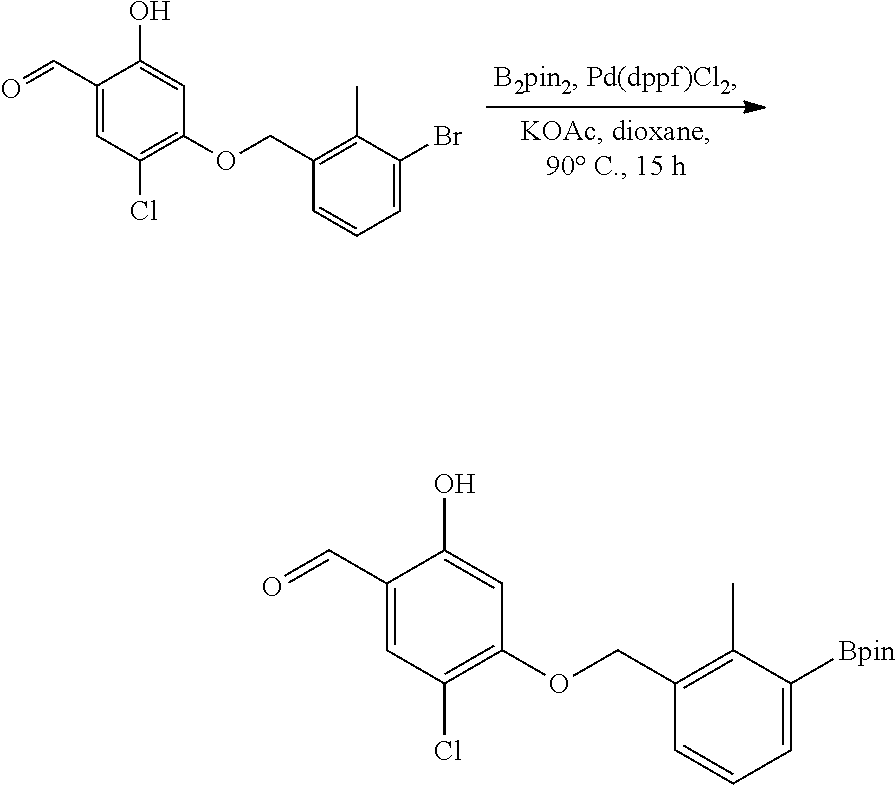


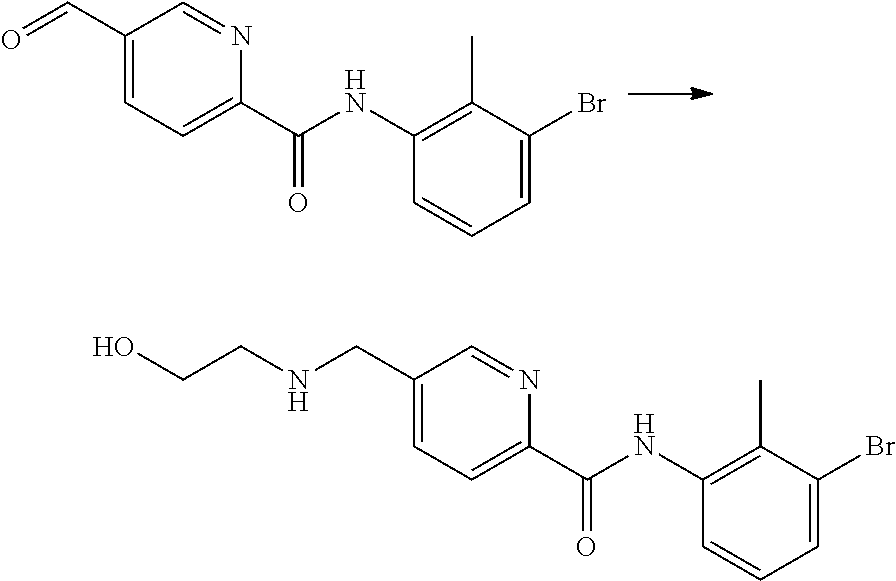


| TABLE 1 | ||
| PD-L1 | ||
| HTRF | ||
| Ex. | IC50 | |
| No. | COMPOUND | (μM) |
| 1 |
 |
0.28 |
| 3-((2-(4,5-dihydro-1H-imidazol-2-yl)-5-((2- | ||
| methyl-[1,1′-biphenyl]-3-yl)methoxy)phenoxy)methyl)benzonitrile | ||
| 2 |
 |
20 |
| 3-((2-(1H-imidazol-2-yl)-5-((2-methyl-[1,1′- | ||
| biphenyl]-3-yl)methoxy)phenoxy)methyl)benzonitrile | ||
| 3 |
 |
0.32 |
| 3-((2-(1-methyl-4,5-dihydro-1H-imidazol-2-yl)- | ||
| 5-((2-methyl-[1,1′-biphenyl]-3-yl)methoxy)phenoxy)methyl)benzonitrile | ||
| 4 |
 |
5.4 |
| 3-((2-(1-methyl-1H-imidazol-2-yl)-5-((2-methyl- | ||
| [1,1′-biphenyl]-3-yl)methoxy)phenoxy)methyl)benzonitrile | ||
| 5 |
 |
16 |
| 3-((2-(4-(hydroxymethyl)-1H-imidazol-2- | ||
| yl)-5-((2-methyl-[1,1′-biphenyl]-3-yl) | ||
| methoxy)phenoxy)methyl)benzonitrile | ||
| 6 |
 |
0.053 |
| 3-((2-(1-(2-hydroxyethyl)-4,5-dihydro-1H- | ||
| imidazol-2-yl)-5-((2-methyl-[1,1′-biphenyl]-3- | ||
| yl)methoxy)phenoxy)methyl)benzonitrile | ||
| 7 |
 |
1.8 |
| 3-((2-(1-(2-hydroxyethyl)-1H-imidazol-2-yl)-5- | ||
| ((2-methyl-[1,1′-biphenyl]-3-yl)methoxy)phenoxy)methyl)benzonitrile | ||
| 8 |
 |
19 |
| N-((2-(2-((3-cyanobenzyl)oxy)-4-((2- | ||
| methyl-[1,1′-biphenyl]-3-yl)methoxy)phenyl)-1H-imidazol-4- | ||
| yl)methyl)acetamide | ||
| 9 |
 |
0.15 |
| 3-((5-((2-methyl-[1,1′-biphenyl]-3-yl)methoxy)- | ||
| 2-(1,4,5,6-tetrahydropyrimidin-2-yl)phenoxy)methyl)benzonitrile | ||
| 10 |
 |
0.10 |
| 3-((2-(5-hydroxy-1,4,5,6-tetrahydropyrimidin-2-yl)-5-((2-methyl-[1,1′-biphenyl]-3- | ||
| yl)methoxy)phenoxy)methyl)benzonitrile | ||
| 11 |
 |
0.30 |
| 3-((2-(1-methyl-1,4,5,6-tetrahydropyrimidin-2- | ||
| yl)-5-((2-methyl-[1,1′-biphenyl]-3-yl)methoxy)phenoxy)methyl)benzonitrile | ||
| 12 |
 |
0.11 |
| 3-((2-(1-(2-hydroxyethyl)-1,4,5,6- | ||
| tetrahydropyrimidin-2-yl)-5-((2-methyl-[1,1′-biphenyl]-3- | ||
| yl)methoxy)phenoxy)methyl)benzonitrile | ||
| 13 |
 |
0.17 |
| 2-((3-cyanobenzyl)oxy)-N,N′-bis(2- | ||
| hydroxyethyl)-4-((2-methy1-[1,1′-biphenyl]-3-yl)methoxy)benzimidamide | ||
| 14 |
 |
0.33 |
| N-(2-(N′-(2-acetamidoethyl)-2-((3- | ||
| cyanobenzyl)oxy)-4-((2-methyl-[1,1′-biphenyl]-3- | ||
| yl)methoxy)benzimidamido)ethyl)acetamide | ||
| 15 |
 |
0.015 |
| 5-((2-(5-hydroxy-1,4,5,6- | ||
| tetrahydropyrimidin-2-yl)-5-((2-methyl-[1,1′-biphenyl]-3- | ||
| yl)methoxy)phenoxy)methyl)nicotinonitrile | ||
| 16 |
 |
0.0012 |
| 5-((4-chloro-2-(5-hydroxy- | ||
| 1,4,5,6-tetrahydropyrimidin-2-y1)-5-((3′-(3-(4-hydroxypiperidin-1- | ||
| yl)propoxy)-2,2′-dimethyl-[1,1′-biphenyl]-3-yl) | ||
| methoxy)phenoxy)methyl)nicotinonitrile | ||
| 17 |
 |
0.0015 |
| 5-((4-chloro-2-(1-(2- | ||
| hydroxyethyl)-1,4,5,6-tetrahydropyrimidin-2-yl)-5-((3′-(3-(4- | ||
| hydroxypiperidin-1-yl)propoxy)-2,2'-dimethyl-[1,1′-biphenyl]-3- | ||
| yl)methoxy)phenoxy)methyl)nicotinonitrile | ||
| 18 |
 |
0.0012 |
| 2-(5-chloro-2-((5- | ||
| cyanopyridin-3-yl)methoxy)-4-((3′-(3-(4-hydroxypiperidin-1-yl)propoxy)- | ||
| 2,2′-dimethyl-[1,1′-biphenyl]-3-yl)methoxy)phenyl)-1,4,5,6- | ||
| tetrahydropyrimidine-4-carboxylic acid | ||
| 19 |
 |
0.0012 |
| 2-(5-chloro-2-((5- | ||
| cyanopyridin-3-yl)methoxy)-4-((3′-(3-(4-hydroxypiperidin-1-yl)propoxy)- | ||
| 2,2′-dimethyl-[1,1′-biphenyl]-3-yl)methoxy)phenyl)-4,5-dihydro-1H- | ||
| imidazole-4-carboxylic acid | ||
| 20 |
 |
0.010 |
| methyl 2-(5-chloro-2-((5- | ||
| cyanopyridin-3-yl)methoxy)-4-((3′-(3-(4-hydroxypiperidin-1-yl)propoxy)- | ||
| 2,2′-dimethyl-[1,1′-biphenyl]-3-yl)methoxy)phenyl)-1H-imidazole-5- | ||
| carboxylate | ||
| 21 |
 |
0.0008 |
| 2-((2-(5-chloro-2-((5- | ||
| cyanopyridin-3-yl)methoxy)-4-((3′-(3-(4-hydroxypiperidin-1-yl)propoxy)- | ||
| 2,2′-dimethyl-[1,1′-biphenyl]-3-yl)methoxy)phenyl)-1,4,5,6- | ||
| tetrahydropyrimidin-5-yl)oxy)acetic acid | ||
| 22 |
 |
0.0038 |
| 5-((4-chloro-2-(1-(2- | ||
| hydroxyethyl)-4,5-dihydro-1H-imidazol-2-yl)-5-((3′-(3-(4- | ||
| hydroxypiperidin-1-yl)propoxy)-2,2′-dimethyl-[1,1′-biphenyl]-3- | ||
| yl)methoxy)phenoxy)methyl)nicotinonitrile | ||
| 23 |
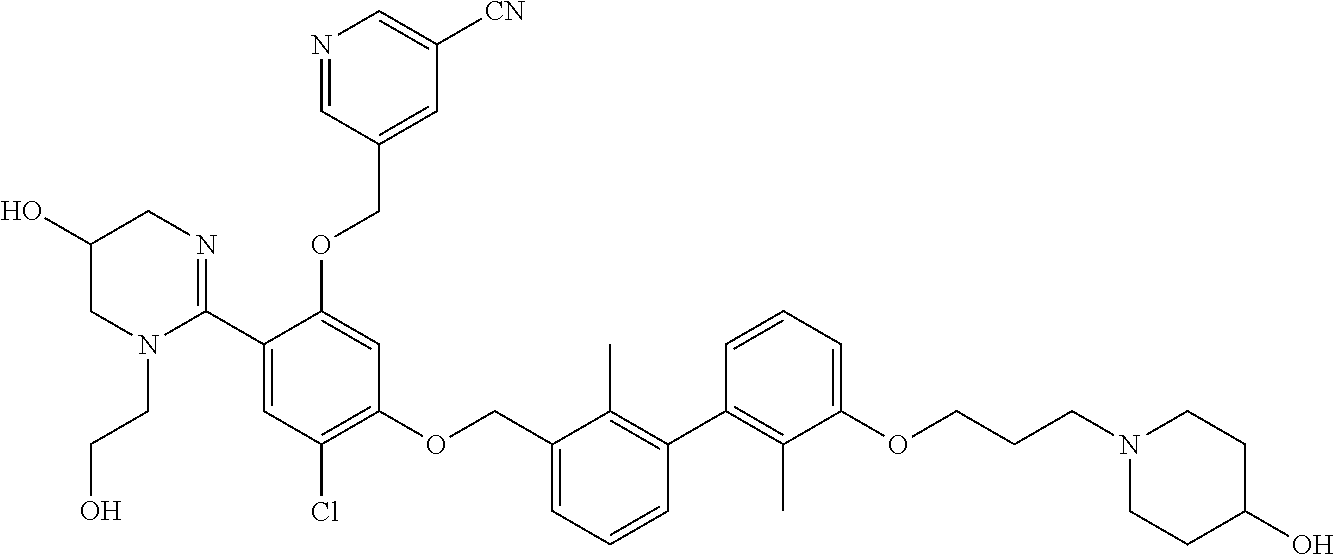 |
0.014 |
| 5-((4-chloro-2-(5-hydroxy- | ||
| 1-(2-hydroxyethyl)-1,4,5,6-tetrahydropyrimidin-2-yl)-5-((3′-(3-(4- | ||
| hydroxypiperidin-1-yl)propoxy)-2,2′-dimethyl-[1,1′-biphenyl]-3- | ||
| yl)methoxy)phenoxy)methyl)nicotinonitrile | ||
| 24 |
 |
0.0011 |
| 2-(2-(5-chloro-2-((5- | ||
| cyanopyridin-3-yl)methoxy)-4-((3′-(3-(4-hydroxypiperidin-1-yl)propoxy)- | ||
| 2,2′-dimethyl-[1,1′-biphenyl]-3-yl)methoxy)phenyl)-4,5-dihydro-1H- | ||
| imidazol-1-yl)acetic acid | ||
| 25 |
 |
0.030 |
| 5-((4-chloro-2-(5-hydroxy- | ||
| 1,4,5,6-tetrahydropyrimidin-2-yl)-5-((3′-(3-(4-hydroxypiperidin-1-yl)-2- | ||
| phenylpropoxy)-2,2′-dimethyl-[1,1′-biphenyl]-3- | ||
| yl)methoxy)phenoxy)methyl)nicotinonitrile | ||
| 26 |
 |
0.0074 |
| 5-((4-chloro-2-(5-hydroxy- | ||
| 1,4,5,6-tetrahydropyrimidin-2-yl)-5-((3′-(3-hydroxy-2-phenylpropoxy)-2,2′- | ||
| dimethyl-[1,1′-biphenyl]-3-yl)methoxy)phenoxy)methyl)nicotinonitrile | ||
| 27 |
 |
0.0013 |
| (2S,2′S)-1,1′-(((((2,2′- | ||
| dimethyl-[1,1′-biphenyl]-3,3′-diyl)bis(methylene))bis(oxy))bis(5-chloro-2- | ||
| ((5-cyanopyridin-3-yl)methoxy)-4,1- | ||
| phenylene))bis(methylene))bis(piperidine-2-carboxylic acid) | ||
| 28 |
 |
0.0067 |
| 5,5′-((((((2,2′-dimethyl- | ||
| [1,1′-biphenyl]-3,3′-diyl)bis(methylene))bis(oxy))bis(4-chloro-6-(5- | ||
| hydroxy-1,4,5,6-tetrahydropyrimidin-2-yl)-3,1- | ||
| phenylene))bis(oxy))bis(methylene))dinicotinonitrile | ||
| 29 |
 |
0.0012 |
| (2S,2′S)-1,1′-(((((2,2′- | ||
| dimethyl-[1,1′-biphenyl]-3,3′-diyl)bis(methylene))bis(oxy))bis(5-chloro-2- | ||
| methoxy-4,1-phenylene))bis(methylene))bis(piperidine-2-carboxylic acid) | ||
| 30 |
 |
0.0040 |
| (S)-1-(5-chloro-4-((3′-((2- | ||
| chloro-4-(hydroxymethyl)-5-methoxyphenoxy)methyl)-2,2′-dimethyl-[1,1′- | ||
| biphenyl]-3-yl)methoxy)-2-methoxybenzyl)piperidine-2-carboxylic acid | ||
| 31 |
 |
0.0010 |
| 2,2′-((((((2,2′- | ||
| dimethyl-[1,1′-biphenyl]-3,3′-diyl)bis(methylene))bis(oxy))bis(5-chloro-2- | ||
| methoxy-4,1-phenylene))bis(methylene))bis(azanediyl))bis(ethan-1-ol) | ||
| 32 |
 |
0.0032 |
| N,N′-(2,2′-dimethyl-[1,1′- | ||
| biphenyl]-3,3′-diyl)bis(5-(hydroxymethyl)picolinamide) | ||
| 33 |
 |
0.0037 |
| 5-(((2- | ||
| hydroxyethyl)amino)methyl)-N-(3′-(3-(4-hydroxypiperidin-1-yl)propoxy)- | ||
| 2,2′-dimethyl-[1,1′-biphenyl]-3-yl)picolinamide | ||
| 34 |
 |
0.001 |
| N,N′-(2,2′- | ||
| dimethyl-[1,1′-biphenyl]-3,3′-diyl)bis(5-(((2-hydroxyethyl)amino)methyl)picolinamide) | ||
| 35 |
 |
0.0003 |
| 2,2′-((((2,2′- | ||
| dimethyl-[1,1′-biphenyl]-3,3′- | ||
| diyl)bis(azanediyl))bis(carbonyl))bis(pyridine-6,3-diyl))bis(3,4,5,6- | ||
| tetrahydropyrimidine-4-carboxylic acid) | ||
| 36 |
 |
0.0004 |
| 5-((bis(2- | ||
| hydroxyethyl)amino)methyl)-N-(3′-(5-(((2- | ||
| hydroxyethyl)amino)methyl)picolinamido)-2,2′-dimethyl-[1,1′-biphenyl]-3- | ||
| yl)picolinamide | ||
| 37 |
 |
0.0008 |
| (R)-5-(((2- | ||
| hydroxyethyl)amino)methyl)-N-(3′-(5-((3-hydroxypyrrolidin-1- | ||
| yl)methyl)picolinamido)-2,2′-dimethyl-[1,1′-biphenyl]-3-yl)picolinamide | ||
| 38 |
 |
0.0009 |
| 5-(((2- | ||
| hydroxyethyl)-(methyl)amino)methyl)-N-(3′-(5-(((2- | ||
| hydroxyethyl)amino)methyl)picolinamido)-2,2′-dimethyl-[1,1′-biphenyl]-3- | ||
| yl)picolinamide | ||
| 39 |
 |
|
| (2S,2′S)-1,1′-(((((2,2′- | ||
| dimethyl-[1,1′-biphenyl]-3,3′- | ||
| diyl)bis(azanediyl))bis(carbonyl))bis(pyridine-6,3- | ||
| diyl))bis(methylene))bis(piperidine-2-carboxylic acid) | ||
| 40 |
 |
|
| 2-(6-((3′-(5-(((2- | ||
| hydroxyethyl)amino)methyl)picolinamido)-2,2′-dimethyl-[1,1′-biphenyl]-3- | ||
| yl)carbamoyl)pyridin-3-yl)-3,4,5,6-tetrahydropyrimidine-4-carboxylic acid | ||
| 41 |
 |
|
| (2S,2′S)-2,2′-((((((2,2′- | ||
| dimethyl-[1,1′-biphenyl]-3,3′- | ||
| diyl)bis(azanediyl))bis(carbonyl))bis(pyridine-6,3- | ||
| diyl))bis(methylene))bis(azanediyl))bis(3-hydroxypropanoic acid) | ||
| 42 |
 |
|
| (2R,2′R)-2,2′-((((((2,2′- | ||
| dimethyl-[1,1′-biphenyl]-3,3′- | ||
| diyl)bis(azanediyl))bis(carbonyl))bis(pyridine-6,3- | ||
| diyl))bis(methylene))bis(azanediyl))bis(3-hydroxypropanoic acid) | ||
| 43 |
 |
|
| (2S,2′S)-2,2′- | ||
| ((((((2,2′-dimethyl-[1,1′]-biphenyl]-3,3′-diyl)bis(azanediyl))bis(carbonyl)) | ||
| bis(pyridine-6,3-diyl))bis(methylene))bis(azanediyl))bis(4-hydroxybutanoic acid) | ||
| 44 |
 |
|
| (2R,2′R)-2,2′- | ||
| ((((((2,2′-dimethyl-[1,1′-biphenyl]-3,3′-diyl)bis(azanediyl))bis(carbonyl)) | ||
| bis(pyridine-6,3-diyl))bis(methylene))bis(azanediyl))bis(4-hydroxybutanoic acid) | ||
| 45 |
 |
|
| 2-(6-((3′-(5-(((2- | ||
| hydroxyethyl)amino)methyl)picolinamido)-2,2′-dimethyl-[1,1′-biphenyl]-3- | ||
| yl)carbamoyl)pyridin-3-yl)-4,5-dihydro-1H-imidazole-5-carboxylic acid | ||
| 46 |
 |
|
| N,N′-(2,2′- | ||
| dimethyl-[1,1′-biphenyl]-3,3′-diyl)bis(5-(((2- | ||
| acetamidoethyl)amino)methyl)picolinamide) | ||
| 47 |
 |
|
| N,N′-(2,2′-dimethyl- | ||
| [1,1′-biphenyl]-3,3′-diyl)bis(5-(((1,3-dihydroxypropan-2-yl)amino)methyl)picolinamide) | ||
| 48 |
 |
|
| (2S,2′S)-1,1′- | ||
| (((((2,2′-dimethyl-[1,1′-biphenyl]-3,3′- | ||
| diyl)bis(azanediyl))bis(carbonyl))bis(pyridine-6,3- | ||
| diyl))bis(methylene))bis(azetidine-2-carboxylic acid) | ||
| 49 |
 |
|
| N,N′-(2,2′-dimethyl- | ||
| [1,1′-biphenyl]-3,3′-diyl)bis(5-(((R)-3-hydroxypyrrolidin-1- | ||
| yl)methyl)picolinamide) | ||
| 50 |
 |
|
| 2-(6-((3′-(5-(((R)-3- | ||
| hydroxypyrrolidin-1-yl)methyl)picolinamido)-2,2′-dimethyl-[1,1′-biphenyl]- | ||
| 3-yl)carbamoyl)pyridin-3-yl)-4,5-dihydro-1H-imidazole-5-carboxylic acid | ||
| 51 |
 |
|
| N,N′-(2,2′-dimethyl-[1,1′- | ||
| biphenyl]-3,3′-diyl)bis(5-((3,3-difluoropyrrolidin-1-yl)methyl)picolinamide) | ||
| 52 |
 |
|
| N,N′-(2,2′-dimethyl- | ||
| [1,1′-biphenyl]-3,3′-diyl)bis(5-(((2-fluoroethyl)amino)methyl)picolinamide) | ||
| 53 |
 |
|
| N,N′-(2,2′-dimethyl-[1,1′-biphenyl]-3,3′-diyl)bis(5-((4-hydroxypiperidin-1- | ||
| yl)methyl)picolinamide) | ||
| 54 |
 |
|
| 2-(5-chloro-2-((5-cyanopyridin-3-yl)methoxy)-4-((3′-(5-(((2- | ||
| hydroxyethyl)amino)methyl)picolinamido)-2,2′-dimethyl-[1,1′-biphenyl]-3- | ||
| yl)methoxy)phenyl)-3,4,5,6-tetrahydropyrimidine-4-carboxylic acid | ||
| 55 |
 |
|
| N,N′-(2-chloro-2′- | ||
| methyl-[1,1′-biphenyl]-3,3′-diyl)bis(5-(((2- | ||
| hydroxyethyl)amino)methyl)picolinamide) | ||
| 56 |
 |
|
| N,N′-(2-bromo-2′- | ||
| methyl-[1,1′-biphenyl]-3,3′-diyl)bis(5-(((2- | ||
| hydroxyethyl)amino)methyl)picolinamide) | ||
| 57 |
 |
|
| N,N′-(2,2′-dimethyl- | ||
| [1,1′-biphenyl]-3,3′-diyl)bis(5-((bis(2- | ||
| hydroxyethyl)amino)methyl)picolinamide) | ||
| 58 |
 |
|
| 2-(2-((5-cyanopyridin- | ||
| 3-yl)methoxy)-6-((3′-(5-(((2-hydroxyethyl)amino)methyl)picolinamido)- | ||
| 2,2′-dimethyl-[1,1′-biphenyl]-3-yl)carbamoyl)pyridin-3-yl)-3,4,5,6- | ||
| tetrahydropyrimidine-4-carboxylic acid | ||
| 59 |
 |
|
| N,N′-(2,2′-dimethyl- | ||
| [1,1′-biphenyl]-3,3′-diyl)bis(5-(((2- | ||
| (methylsulfonyl)ethyl)amino)methyl)picolinamide) | ||
| 60 |
 |
|
| N3,N3′-bis(5-(((2- | ||
| hydroxyethyl)amino)methyl)pyridin-2-yl)-2,2′-dimethyl-[1,1′-biphenyl]- | ||
| 3,3′-dicarboxamide | ||
| 61 |
 |
|
| 5,5′-((((((2,2′-dimethyl-[1,1′- | ||
| biphenyl]-3,3′-diyl)bis(methylene))bis(oxy))bis(4-chloro-6-formyl-3,1- | ||
| phenylene))bis(oxy))bis(methylene)) dinicotinonitrile | ||
| 62 |
 |
|
| (2S,2′S)-1,1′-(((((2,2′- | ||
| dimethyl-[1,1′-biphenyl]-3,3′-diyl)bis(methylene))bis(oxy))bis(5-chloro-2- | ||
| (2-methoxy-2-oxoethoxy)-4,1-phenylene))bis(methylene))bis(piperidine-2- | ||
| carboxylic acid) | ||
| 63 |
 |
|
| 5-chloro-4-((3′-((2- | ||
| chloro-5-((5-cyanopyridin-3-yl)methoxy)-4-(((2- | ||
| hydroxyethyl)amino)methyl)phenoxy)methyl)-2,2′-dimethyl-[1,1′- | ||
| biphenyl]-3-yl)methoxy)-2-((5-cyanopyridin-3-yl)methoxy)-N-(2- | ||
| hydroxyethyl)benzamide | ||
| 64 |
 |
|
| (S)-1-(4-((3′-((4-(((S)- | ||
| 2-carboxypiperidin-1-yl)methyl)-2-chloro-5-((5-cyanopyridin-3- | ||
| yl)methoxy)phenoxy)methyl)-2,2′-dimethyl-[1,1′-biphenyl]-3-yl)methoxy)- | ||
| 5-chloro-2-(2-methoxy-2-oxoethoxy)benzyl)piperidine-2-carboxylic acid | ||
| 65 |
 |
|
| 5-chloro-4-((3′-((2- | ||
| chloro-5-((5-cyanopyridin-3-yl)methoxy)-4-(((2- | ||
| hydroxyethyl)amino)methyl)phenoxy)methyl)-2,2′-dimethyl-[1,1′- | ||
| biphenyl]-3-yl)methoxy)-2-((5-cyanopyridin-3-yl)methoxy)-N-(2- | ||
| hydroxyethyl)benzamide | ||
| 66 |
 |
|
| 2,2′-((((((2,2′- | ||
| dimethyl-[1,1′-biphenyl]-3,3′-diyl)bis(methylene))bis(oxy))bis(5-chloro-2- | ||
| methoxy-4,1-phenylene))bis(methylene))bis(azanediyl))bis(ethan-1-ol) | ||

wherein: X1 is selected from the group consisting of CH and N; X2 is selected from the group consisting —OCH2—**, —CH2O—**, —C(═O)NH—**, and —NHC(═O)—**, wherein the bond marked with *** is to the phenyl ring carbon marked with *; R1a is selected from the group consisting of H, C1-C3 alkyl, C1-C3 alkoxy, cyano, halogen, and C1-C3 haloalkyl; R1b is selected from the group consisting of H, C1-C3 alkyl, C1-C3 alkoxy, cyano, halogen, and C1-C3 haloalkyl; R1c is selected from the group consisting of H, C1-C6 alkyl, —OH, C1-C6 alkoxy optionally substituted with at least one selected from the group consisting of OH, C1-C6 alkoxy, phenyl, and optionally substituted heterocyclyl (such as but not limited to piperidinyl, pipyrolidinyl, or morpholinyl, and hydroxylated derivatives thereof),

X3 is selected from the group consisting of CH and N; R2a is selected from the group consisting of C1-C6 alkyl, C1-C6 alkoxy, —(CH2)1-3 (optionally substituted phenyl), —(CH2)1-3 (optionally substituted heteroaryl), —O(CH2)1-3 (optionally substituted phenyl), —O(CH2)1-3 (optionally substituted heteroaryl), —(CH2)1-3C(═O)ORI, —(CH2)1-3C(═O)NRIRI, —O(CH2)1-3C(═O)ORI, and —O(CH2)1-3C(═O)NRIRI, wherein each occurrence of RI is independently H or C1-C6 alkyl optionally substituted with halogen, —OH, C1-C6 alkoxy, —NH2, —NH(C1-C6 alkyl), and —N(C1-C6 alkyl)(C1-C6 alkyl, or two RI can combine with the N atom to which they are bound to form 3-8 membered optionally substituted heterocyclyl; R2b is selected from the group consisting of C1-C6 alkyl, C1-C6 alkoxy, —(CH2)1-3 (optionally substituted phenyl), —(CH2)1-3 (optionally substituted heteroaryl), —O(CH2)1-3 (optionally substituted phenyl), —O(CH2)1-3 (optionally substituted heteroaryl), —(CH2)1-3C(═O)ORH, —(CH2)1-3C(═O)NRIIRII, —O(CH2)1-3C(═O)ORII, and —O(CH2)1-3C(═O)NRIIRII, wherein each occurrence of RII is independently H or C1-C6 alkyl optionally substituted with halogen, —OH, C1-C6 alkoxy, —NH2, —NH(C1-C6 alkyl), and —N(C1-C6 alkyl)(C1-C6 alkyl), or two RII can combine with the N atom to which they are bound to form 3-8 membered optionally substituted heterocyclyl, R3a is selected from the group consisting of —CHO, —C(O)ORIII, —C(═O)NRIIIRIII, —C(═NR5)NRIIIRIII, optionally substituted heterocyclyl, —(CH2)1-3 (optionally substituted heterocyclyl), optionally substituted C1-C6 alkoxy, optionally substituted C1-C6 aminoalkyl, and optionally substituted C1-C6 hydroxyalkyl, wherein each occurrence of R5 is independently H or C1-C6 alkyl optionally substituted with halogen, —OH, C1-C6 alkoxy, —NH2, —NH(C1-C6 alkyl), and —N(C1-C6 alkyl)(C1-C6 alkyl), wherein each occurrence of R5 is independently H or C1-C6 alkyl optionally substituted with halogen, —OH, C1-C6 alkoxy, —NH2, —NH(C1-C6 alkyl), and —N(C1-C6 alkyl)(C1-C6 alkyl), or two RIII can combine with the N atom to which they are bound to form 3-8 membered optionally substituted heterocyclyl, or, if R3a is —C(═NR5)NRIIIRIII, then R5 and one RIII can combine to form 4-8 membered optionally substituted heterocyclyl; R3b is selected from the group consisting of —CHO, —C(O)ORIV, —C(═O)NRIVRIV, —C(═NR5)NRIVRIV, optionally substituted heterocyclyl, —(CH2)1-3 (optionally substituted heterocyclyl), optionally substituted C1-C6 alkoxy, optionally substituted C1-C6 aminoalkyl, and optionally substituted C1-C6 hydroxyalkyl, wherein each occurrence of RIV is independently H or C1-C6 alkyl optionally substituted with halogen, —OH, C1-C6 alkoxy, —NH2, —NH(C1-C6 alkyl), and —N(C1-C6 alkyl)(C1-C6 alkyl), wherein each occurrence of R5 is independently H or C1-C6 alkyl optionally substituted with halogen, —OH, C1-C6 alkoxy, —NH2, —NH(C1-C6 alkyl), and —N(C1-C6 alkyl)(C1-C6 alkyl), or two RIV can combine with the N atom to which they are bound to form 3-8 membered optionally substituted heterocyclyl, or, if R3b is —C(═NR5)NRIVRIV, then R5 and one RIV can combine to form 4-8 membered optionally substituted heterocyclyl; R4a is selected from the group consisting of halogen, cyano, and C1-C3 alkyl; and R4b is selected from the group consisting of halogen, cyano, and C1-C3 alkyl; or a salt, solvate, geometric isomer, stereoisomer, tautomer and any mixtures thereof.


Claims (26)


Priority Applications (1)
| Application Number | Priority Date | Filing Date | Title |
|---|---|---|---|
| US16/982,842 US12083118B2 (en) | 2018-03-29 | 2019-03-29 | Substituted 1,1′-biphenyl compounds, analogues thereof, and methods using same |
Applications Claiming Priority (4)
| Application Number | Priority Date | Filing Date | Title |
|---|---|---|---|
| US201862650054P | 2018-03-29 | 2018-03-29 | |
| US201862662032P | 2018-04-24 | 2018-04-24 | |
| US16/982,842 US12083118B2 (en) | 2018-03-29 | 2019-03-29 | Substituted 1,1′-biphenyl compounds, analogues thereof, and methods using same |
| PCT/US2019/024896 WO2019191624A1 (en) | 2018-03-29 | 2019-03-29 | Substituted 1,1'-biphenyl compounds, analogues thereof, and methods using same |
Related Parent Applications (1)
| Application Number | Title | Priority Date | Filing Date |
|---|---|---|---|
| PCT/US2019/024896 A-371-Of-International WO2019191624A1 (en) | 2018-03-29 | 2019-03-29 | Substituted 1,1'-biphenyl compounds, analogues thereof, and methods using same |
Related Child Applications (1)
| Application Number | Title | Priority Date | Filing Date |
|---|---|---|---|
| US18/776,005 Continuation US20240374595A1 (en) | 2018-03-29 | 2024-07-17 | Substituted 1,1'-biphenyl compounds, analogues thereof, and methods using same |
Publications (2)
| Publication Number | Publication Date |
|---|---|
| US20210052585A1 US20210052585A1 (en) | 2021-02-25 |
| US12083118B2 true US12083118B2 (en) | 2024-09-10 |
Family
ID=68060824
Family Applications (2)
| Application Number | Title | Priority Date | Filing Date |
|---|---|---|---|
| US16/982,842 Active US12083118B2 (en) | 2018-03-29 | 2019-03-29 | Substituted 1,1′-biphenyl compounds, analogues thereof, and methods using same |
| US18/776,005 Pending US20240374595A1 (en) | 2018-03-29 | 2024-07-17 | Substituted 1,1'-biphenyl compounds, analogues thereof, and methods using same |
Family Applications After (1)
| Application Number | Title | Priority Date | Filing Date |
|---|---|---|---|
| US18/776,005 Pending US20240374595A1 (en) | 2018-03-29 | 2024-07-17 | Substituted 1,1'-biphenyl compounds, analogues thereof, and methods using same |
Country Status (3)
| Country | Link |
|---|---|
| US (2) | US12083118B2 (en) |
| CA (1) | CA3093851A1 (en) |
| WO (1) | WO2019191624A1 (en) |
Cited By (1)
| Publication number | Priority date | Publication date | Assignee | Title |
|---|---|---|---|---|
| US20230044941A1 (en) * | 2019-05-15 | 2023-02-09 | Chemocentryx, Inc. | Triaryl compounds for treatment of pd-l1 diseases |
Families Citing this family (21)
| Publication number | Priority date | Publication date | Assignee | Title |
|---|---|---|---|---|
| BR102018007822A2 (en) | 2017-04-20 | 2018-11-06 | Gilead Sciences, Inc. | compound, methods for inhibiting pd-1, pd-11 and / or interaction of pd-1 / pd-11 and for cancer treatment, pharmaceutical composition, and kit for treating or preventing cancer or a disease or condition |
| WO2018200571A1 (en) | 2017-04-25 | 2018-11-01 | Arbutus Biopharma Corporation | Substituted 2,3-dihydro-1h-indene analogs and methods using same |
| CR20200347A (en) | 2018-02-13 | 2020-09-23 | Gilead Sciences Inc | Pd-1/pd-l1 inhibitors |
| US12083118B2 (en) | 2018-03-29 | 2024-09-10 | Arbutus Biopharma Corporation | Substituted 1,1′-biphenyl compounds, analogues thereof, and methods using same |
| TWI712412B (en) | 2018-04-19 | 2020-12-11 | 美商基利科學股份有限公司 | Pd-1/pd-l1 inhibitors |
| SG11202012425QA (en) | 2018-07-13 | 2021-01-28 | Gilead Sciences Inc | Pd-1/pd-l1 inhibitors |
| WO2020086556A1 (en) | 2018-10-24 | 2020-04-30 | Gilead Sciences, Inc. | Pd-1/pd-l1 inhibitors |
| CN113825751A (en) * | 2019-07-18 | 2021-12-21 | 上海和誉生物医药科技有限公司 | A biphenyl derivative that blocks the interaction of PD-1/PD-L1 and its preparation method and application |
| CN114761085A (en) * | 2019-10-04 | 2022-07-15 | 百时美施贵宝公司 | Compounds useful as immunomodulators |
| JP7736678B2 (en) | 2019-10-16 | 2025-09-09 | ケモセントリックス,インコーポレイティド | Heteroaryl-biphenyl amides for the treatment of pd-l1 disease |
| WO2021158481A1 (en) * | 2020-02-03 | 2021-08-12 | Arbutus Biopharma, Inc. | Substituted 1,1'-biphenyl compounds and methods using same |
| CN113563260A (en) * | 2020-04-28 | 2021-10-29 | 药康众拓(江苏)医药科技有限公司 | Benzamide compound, preparation method and application |
| WO2021246781A1 (en) * | 2020-06-03 | 2021-12-09 | Kainos Medicine, Inc. | Pyridine derivatives as immunomodulators |
| CN113801111B (en) * | 2020-06-12 | 2025-10-17 | 上海翰森生物医药科技有限公司 | Biphenyl derivative inhibitor and preparation method and application thereof |
| CN114075123B (en) * | 2020-08-11 | 2023-06-06 | 中国人民解放军军事科学院军事医学研究院 | Benzylamine derivative and preparation method and application thereof |
| CN114276328B (en) * | 2020-09-28 | 2023-09-01 | 北京康辰药业股份有限公司 | Compound as small molecule immunosuppressant, preparation method and application thereof |
| PL441982A1 (en) * | 2022-08-09 | 2024-02-12 | Recepton Spółka Z Ograniczoną Odpowiedzialnością | Asymmetrically substituted 1,1'-biphenyl derivatives for use in cancer immunotherapy |
| EP4159720A1 (en) * | 2021-09-30 | 2023-04-05 | Recepton Spolka z Ograniczona Odpowiedzialnoscia | Nonsymmetric substituted 1,1'-biphenyl derivatives and uses thereof |
| WO2023169373A1 (en) * | 2022-03-07 | 2023-09-14 | 上海和誉生物医药科技有限公司 | Holosymmetric biphenyl derivative, and preparation method therefor and use thereof |
| CN117343006B (en) * | 2023-10-08 | 2024-07-09 | 河南科技大学 | Preparation method of ARB-272572 |
| PL447202A1 (en) * | 2023-12-21 | 2025-06-23 | Uniwersytet Jagielloński | Compound which is an inhibitor of the PD-L1/PD-1 interaction, a pharmaceutical composition comprising the inhibitor, and use of the inhibitor |
Citations (118)
| Publication number | Priority date | Publication date | Assignee | Title |
|---|---|---|---|---|
| US4263319A (en) | 1978-01-20 | 1981-04-21 | Fmc Corporation | 4-Substituted-2-indanol insecticidal ester derivatives |
| US4346251A (en) | 1979-05-24 | 1982-08-24 | Fmc Corporation | 4-Substituted-2-indanols |
| US4636508A (en) | 1985-04-22 | 1987-01-13 | Uniroyal Chemical Company, Inc. | 5-pyrimidinecarboxyamides and treatment of leukemia therewith |
| US4879276A (en) | 1983-12-19 | 1989-11-07 | Uniroyal Chemical Ltd./Uniroyal Chemical Ltee | Method for reducing serum uric acid levels |
| US5663368A (en) | 1993-07-14 | 1997-09-02 | Smithkline Beecham Corporation | Synthesis of acid addition salts of hydroxylamines |
| WO1997045403A1 (en) | 1996-05-31 | 1997-12-04 | Pharmacia & Upjohn Company | Aryl substituted cyclic amines as selective dopamine d3 ligands |
| WO1999031063A1 (en) | 1997-12-17 | 1999-06-24 | Klinge Pharma Gmbh | New piperazinyl-substituted pyridylalkane, alkene and alkine carboxamides |
| WO2001047867A1 (en) | 1999-12-23 | 2001-07-05 | Celltech R & D Limited | Squaric acid derivatives as integrin antagonists |
| US6806272B2 (en) | 2001-09-04 | 2004-10-19 | Boehringer Ingelheim Pharma Kg | Dihydropteridinones, processes for preparing them and their use as pharmaceutical compositions |
| US20060035938A1 (en) | 2002-11-12 | 2006-02-16 | Hakan Bladh | 2-Pyridone derivatives as inhibitors of neutrophile elastase |
| WO2006097176A1 (en) | 2005-03-15 | 2006-09-21 | Merck Patent Gmbh | Phthalazinones |
| WO2008053199A1 (en) | 2006-10-30 | 2008-05-08 | Astrazeneca Ab | Combination therapy for the treatment of respiratory diseases |
| WO2008127274A2 (en) | 2006-09-22 | 2008-10-23 | Ptc Therapeutics, Inc. | Heterocyclic inhibitors of bacterial peptidyl trna hydrolase and uses thereof |
| US20100022482A1 (en) | 2006-08-23 | 2010-01-28 | Karl Baumann | aSMase inhibitors |
| WO2011051535A1 (en) | 2009-10-29 | 2011-05-05 | Consejo Superior De Investigaciones Científicas (Csic) | Bis(aralkyl)amino and six membered (hetero)aromatic system derivatives and the use thereof in the treatment of neurodegenerative pathological conditions, including alzheimer's disease |
| WO2011130478A1 (en) | 2010-04-16 | 2011-10-20 | Abbott Laboratories | Phthalazin-(2h)-one inhibitors of kinases |
| WO2012003912A1 (en) | 2010-07-05 | 2012-01-12 | Merck Patent Gmbh | Bipyridyl derivatives useful for the treatment of kinase - induced diseases |
| WO2013006394A1 (en) | 2011-07-01 | 2013-01-10 | Institute For Hepatitis And Virus Research | Sulfamoylbenzamide derivatives as antiviral agents against hbv infection |
| WO2013033228A1 (en) | 2011-08-29 | 2013-03-07 | Ptc Therapeutics, Inc. | Antibacterial compounds and methods for use |
| WO2013033258A1 (en) | 2011-08-29 | 2013-03-07 | Ptc Therapeutics, Inc. | Antibacterial compounds and methods for use |
| US8633182B2 (en) | 2012-05-30 | 2014-01-21 | Boehringer Ingelheim International Gmbh | Indanyloxyphenylcyclopropanecarboxylic acids |
| US8642585B2 (en) | 2012-03-26 | 2014-02-04 | Boehringer Ingelheim International Gmbh | Indanyloxydihydrobenzofuranylacetic acids |
| US20140243196A1 (en) | 2011-08-18 | 2014-08-28 | Basf Se | Carbamoylmethoxy- and Carbamoylmethylthio- and Carbamoylmethylamino Benzamides for Combating Invertebrate Pests |
| WO2014165128A2 (en) | 2013-03-12 | 2014-10-09 | Novira Therapeutics, Inc. | Hepatitis b antiviral agents |
| WO2015069693A1 (en) | 2013-11-05 | 2015-05-14 | Dana-Farber Cancer Institute, Inc. | Inhibitors of histone deacetylase |
| US20150291549A1 (en) | 2014-04-14 | 2015-10-15 | Bristol-Myers Squibb Company | Compounds Useful as Immunomodulators |
| WO2016025933A2 (en) | 2014-08-15 | 2016-02-18 | Ptc Therapeutics, Inc. | Substituted polycyclic antibacterial compounds |
| WO2016025932A1 (en) | 2014-08-15 | 2016-02-18 | Ptc Therapeutics, Inc. | Substituted polycyclic antibacterial compounds |
| WO2016039938A1 (en) | 2014-09-09 | 2016-03-17 | Ptc Therapeutics, Inc. | Polycyclic 2-pyridinone antibacterial compounds |
| WO2016039939A1 (en) | 2014-09-09 | 2016-03-17 | Ptc Therapeutics, Inc. | Bicyclic and tricyclic substituted 2-pyridinone antibacterial compounds |
| WO2016039937A1 (en) | 2014-09-09 | 2016-03-17 | Ptc Therapeutics, Inc. | Bicyclic and tricyclic substituted 2-pyridinone antibacterial compounds |
| US20160171150A1 (en) | 2008-10-10 | 2016-06-16 | Dana-Farber Cancer Institute, Inc. | Chemical Modulators of Pro-Apoptotic BAX and BCL-2 Polypeptides |
| WO2016109706A1 (en) | 2014-12-31 | 2016-07-07 | Ptc Therapeutics, Inc. | Fused polycyclic 2-pyridinone antibacterial compounds |
| US9403763B2 (en) | 2011-12-14 | 2016-08-02 | Dana-Farber Cancer Institute, Inc. | CD4-mimetic inhibitors of HIV-1 entry and methods of use thereof |
| WO2016168524A1 (en) | 2015-04-15 | 2016-10-20 | University Of Utah Research Foundation | Substituted n-([1,1'-biphenyl]-3-yl)-[1,1'-biphenyl]-3-carboxamide analogs as inhibitors for beta-catenin/b-cell lymphoma 9 interactions |
| WO2017015451A1 (en) | 2015-07-22 | 2017-01-26 | Enanta Pharmaceuticals, Inc. | Hepatitis b antiviral agents |
| WO2017042121A1 (en) | 2015-09-09 | 2017-03-16 | Boehringer Ingelheim International Gmbh | [{[2,3-dihydro-1h-inden-1-yl]amino}-2h,3h-furo[3,2-b]pyridin-3-yl]acetic acids, pharmaceutical compositions and uses thereof |
| US9617251B2 (en) | 2015-08-07 | 2017-04-11 | Boehringer Ingelheim International Gmbh | Indanylaminopyridylcyclopropanecarboxylic acids, pharmaceutical compositions and uses thereof |
| US20170107202A1 (en) | 2015-10-15 | 2017-04-20 | Bristol-Myers Squibb Company | Compounds useful as immunomodulators |
| US20170107216A1 (en) | 2015-10-19 | 2017-04-20 | Incyte Corporation | Heterocyclic compounds as immunomodulators |
| WO2017070284A1 (en) | 2015-10-21 | 2017-04-27 | Editas Medicine, Inc. | Crispr/cas-related methods and compositions for treating hepatitis b virus |
| US20170144996A1 (en) | 2015-11-19 | 2017-05-25 | Chemocentryx, Inc. | Inhibitors of cxcr2 |
| US20170144997A1 (en) | 2015-11-19 | 2017-05-25 | Chemocentryx, Inc. | Modulators of chemokine receptors |
| US20170143737A1 (en) | 2015-11-20 | 2017-05-25 | Senhwa Biosciences, Inc. | Combination therapy of tetracyclic quinolone analogs for treating cancer |
| US20170145025A1 (en) | 2015-11-19 | 2017-05-25 | Incyte Corporation | Heterocyclic compounds as immunomodulators |
| WO2017106634A1 (en) | 2015-12-17 | 2017-06-22 | Incyte Corporation | N-phenyl-pyridine-2-carboxamide derivatives and their use as pd-1/pd-l1 protein/protein interaction modulators |
| US20170174679A1 (en) | 2015-12-22 | 2017-06-22 | Incyte Corporation | Heterocyclic compounds as immunomodulators |
| WO2017140728A1 (en) | 2016-02-15 | 2017-08-24 | Cemm - Forschungszentrum Für Molekulare Medizin Gmbh | Taf1 inhibitors for the therapy of cancer |
| WO2017192961A1 (en) | 2016-05-06 | 2017-11-09 | Incyte Corporation | Heterocyclic compounds as immunomodulators |
| WO2017205464A1 (en) | 2016-05-26 | 2017-11-30 | Incyte Corporation | Heterocyclic compounds as immunomodulators |
| WO2017202275A1 (en) * | 2016-05-23 | 2017-11-30 | 中国医学科学院药物研究所 | Bromo benzyl ether derivative, preparation method therefor, and pharmaceutical composition and uses thereof |
| US20170362253A1 (en) | 2016-06-20 | 2017-12-21 | Incyte Corporation | Heterocyclic compounds as immunomodulators |
| WO2018005192A1 (en) | 2016-06-30 | 2018-01-04 | Acquist Llc | Compounds and their use for reducing uric acid levels |
| WO2018005374A1 (en) | 2016-06-27 | 2018-01-04 | Chemocentryx, Inc. | Immunomodulator compounds |
| WO2018006795A1 (en) | 2016-07-05 | 2018-01-11 | 广州再极医药科技有限公司 | Aromatic acetylene or aromatic ethylene compound, intermediate, preparation method, pharmaceutical composition and use thereof |
| WO2018013789A1 (en) | 2016-07-14 | 2018-01-18 | Incyte Corporation | Heterocyclic compounds as immunomodulators |
| WO2018026971A1 (en) | 2016-08-03 | 2018-02-08 | Arising International, Llc | Symmetric or semi-symmetric compounds useful as immunomodulators |
| US20180057486A1 (en) | 2016-08-29 | 2018-03-01 | Incyte Corporation | Heterocyclic compounds as immunomodulators |
| US20180057455A1 (en) | 2016-09-01 | 2018-03-01 | Bristol-Myers Squibb Company | Compounds useful as immunomodulators |
| WO2018045142A1 (en) | 2016-09-02 | 2018-03-08 | Polaris Pharmaceuticals, Inc. | Immune checkpoint inhibitors, compositions and methods thereof |
| WO2018047109A1 (en) | 2016-09-09 | 2018-03-15 | Novartis Ag | Polycyclic pyridone compounds as antivirals |
| US9957219B2 (en) | 2013-12-04 | 2018-05-01 | Merck Sharp & Dohme Corp. | Antidiabetic bicyclic compounds |
| US20180177870A1 (en) | 2016-12-22 | 2018-06-28 | Incyte Corporation | Immunomodulator compounds and methods of use |
| WO2018119221A1 (en) | 2016-12-22 | 2018-06-28 | Incyte Corporation | Pyridine derivatives as immunomodulators |
| WO2018119286A1 (en) | 2016-12-22 | 2018-06-28 | Incyte Corporation | Bicyclic heteroaromatic compounds as immunomodulators |
| WO2018119236A1 (en) | 2016-12-22 | 2018-06-28 | Incyte Corporation | Triazolo[1,5-a]pyridine derivatives as immunomodulators |
| WO2018119266A1 (en) | 2016-12-22 | 2018-06-28 | Incyte Corporation | Benzooxazole derivatives as immunomodulators |
| WO2018119263A1 (en) | 2016-12-22 | 2018-06-28 | Incyte Corporation | Heterocyclic compounds derivatives as pd-l1 internalization inducers |
| WO2018118848A1 (en) | 2016-12-20 | 2018-06-28 | Bristol-Myers Squibb Company | Compounds useful as immunomodulators |
| WO2018121560A1 (en) | 2016-12-29 | 2018-07-05 | 深圳微芯生物科技有限责任公司 | Urea compound and preparation method and application thereof |
| CN108395443A (en) | 2017-02-04 | 2018-08-14 | 广州丹康医药生物有限公司 | Inhibit the cyclic compound and application thereof of programmed death receptors ligand 1 |
| WO2018183171A1 (en) | 2017-03-27 | 2018-10-04 | Bristol-Myers Squibb Company | Substituted isoquionline derivatives as immunomudulators |
| US20180305315A1 (en) | 2017-04-20 | 2018-10-25 | Gilead Sciences, Inc. | Pd-1/pd-l1 inhibitors |
| WO2018196768A1 (en) | 2017-04-26 | 2018-11-01 | 南京圣和药业股份有限公司 | Heterocyclic compound serving as pd-l1 inhibitor |
| CN108727453A (en) | 2017-04-20 | 2018-11-02 | 华东理工大学 | Novel PD-1 inhibitor and its application |
| US10125101B2 (en) | 2016-11-28 | 2018-11-13 | Boehringer Ingelheim International Gmbh | Indanylaminopyridylcyclopropanecarboxylic acids, pharmaceutical compositions and uses thereof |
| CN109045036A (en) | 2018-07-19 | 2018-12-21 | 中山大学 | [1,2,4] triazol [4,3-B] pyridyl derivatives application in preparation of anti-tumor drugs |
| WO2018237153A1 (en) | 2017-06-23 | 2018-12-27 | Bristol-Myers Squibb Company | Immunomodulators acting as antagonists of pd-1 |
| CN109096219A (en) | 2017-06-20 | 2018-12-28 | 广州丹康医药生物有限公司 | A kind of novel anti-PD-L1 compound, its application and the composition containing it |
| CN109232498A (en) | 2018-09-27 | 2019-01-18 | 华侨大学 | A kind of coumarin derivatives and its application |
| CN109665968A (en) | 2017-10-16 | 2019-04-23 | 四川科伦博泰生物医药股份有限公司 | And cycle compound and its preparation method and application |
| WO2019076343A1 (en) | 2017-10-19 | 2019-04-25 | 上海长森药业有限公司 | PD-1/PD-L1 small molecule inhibitor and preparation method and use thereof |
| US20190117654A1 (en) | 2016-07-06 | 2019-04-25 | Acquist Llc | Compounds and Their Use for Reducing Uric Acid Levels |
| CN109721527A (en) | 2017-10-27 | 2019-05-07 | 广州丹康医药生物有限公司 | A kind of novel anti-PD-L1 compound, its application and the composition containing it |
| US20190135834A1 (en) | 2016-04-26 | 2019-05-09 | Shionogi & Co., Ltd. | 5-substituted azabenzimidazole derivative having ???? activation action |
| WO2019087214A1 (en) | 2017-11-06 | 2019-05-09 | Jubilant Biosys Limited | Pyrimidine derivatives as inhibitors of pd1/pd-l1 activation |
| CN109776377A (en) | 2019-02-01 | 2019-05-21 | 沈阳药科大学 | Indoline compounds and preparation method and application thereof |
| CN109776445A (en) | 2019-03-28 | 2019-05-21 | 中国药科大学 | Benzoxadiazole class compound and preparation method thereof and medical usage |
| US10335388B2 (en) | 2015-04-17 | 2019-07-02 | Peloton Therapeutics, Inc. | Combination therapy of a HIF-2-alpha inhibitor and an immunotherapeutic agent and uses thereof |
| CN110092745A (en) | 2018-01-29 | 2019-08-06 | 广州丹康医药生物有限公司 | A kind of compound and its application containing aromatic ring |
| WO2019149183A1 (en) | 2018-02-05 | 2019-08-08 | 上海和誉生物医药科技有限公司 | Biaryl derivative, preparation method thereof and pharmaceutical application thereof |
| WO2019160882A1 (en) | 2018-02-13 | 2019-08-22 | Gilead Sciences, Inc. | Pd-1/pd-l1 inhibitors |
| US10392405B2 (en) | 2017-08-08 | 2019-08-27 | Chemocentryx, Inc. | Macrocyclic immunomodulators |
| CN110200959A (en) | 2019-05-30 | 2019-09-06 | 天津科技大学 | A kind of application of flavone compound |
| WO2019169123A1 (en) | 2018-03-01 | 2019-09-06 | Bristol-Myers Squibb Company | Compounds useful as immunomodulators |
| CN110240587A (en) | 2018-03-08 | 2019-09-17 | 中国科学院上海药物研究所 | A kind of aryl difluorobenzyl ether compound, Preparation method and use |
| WO2019175897A1 (en) | 2018-03-13 | 2019-09-19 | Jubilant Biosys Limited | Bicyclic compounds as inhibitors of pd1/pd-l1 interaction/activation |
| WO2019174533A1 (en) | 2018-03-13 | 2019-09-19 | 广东东阳光药业有限公司 | Small molecule pd-1/pd-l1 inhibitor and use thereof in drugs |
| WO2019191624A1 (en) | 2018-03-29 | 2019-10-03 | Arbutus Biopharma, Inc. | Substituted 1,1'-biphenyl compounds, analogues thereof, and methods using same |
| WO2019192506A1 (en) | 2018-04-03 | 2019-10-10 | Betta Pharmaceuticals Co., Ltd | Immunomodulators, compositions and methods thereof |
| WO2019204609A1 (en) | 2018-04-19 | 2019-10-24 | Gilead Sciences, Inc. | Pd-1/pd-l1 inhibitors |
| WO2019217821A1 (en) | 2018-05-11 | 2019-11-14 | Incyte Corporation | Tetrahydro-imidazo[4,5-c]pyridine derivatives as pd-l1 immunomodulators |
| WO2020011246A1 (en) | 2018-07-13 | 2020-01-16 | 广州丹康医药生物有限公司 | Benzene ring-containing compound, preparation method therefor and application thereof |
| WO2020011209A1 (en) | 2018-07-11 | 2020-01-16 | 上海和誉生物医药科技有限公司 | Immunosuppressive agent, preparation method therefor and pharmaceutical use thereof |
| WO2020014643A1 (en) | 2018-07-13 | 2020-01-16 | Gilead Sciences, Inc. | Pd-1/pd-l1 inhibitors |
| WO2020011243A1 (en) | 2018-07-12 | 2020-01-16 | Betta Pharmaceuticals Co., Ltd | Immunomodulators, compositions and methods thereof |
| US10550127B1 (en) | 2017-02-08 | 2020-02-04 | Boehringer Ingelheim International Gmbh | Indanylaminoazadihydrobenzofuranylacetic acids, pharmaceutical compositions for the treatment of diabetes |
| US10568874B2 (en) | 2018-02-22 | 2020-02-25 | Chemocentryx, Inc. | Indane-amines as PD-L1 antagonists |
| WO2020047035A1 (en) | 2018-08-29 | 2020-03-05 | Chemocentryx, Inc. | Methods of treating cancer with small molecule pd-l1 inhibitors |
| US20200157094A1 (en) | 2018-10-24 | 2020-05-21 | Gilead Sciences, Inc. | Pd-1/pd-l1 inhibitors |
| US20200223833A1 (en) | 2016-12-15 | 2020-07-16 | Il Dong Pharmaceutical Co., Ltd. | Novel phenyl propionic acid derivatives and uses thereof |
| WO2020206000A1 (en) | 2019-04-05 | 2020-10-08 | Hepagene Therapeutics (HK) Limited | Bivalent antagonists of inhibitors of apoptosis proteins |
| US10807948B2 (en) | 2015-03-11 | 2020-10-20 | Peloton Therapeutics, Inc. | Aromatic compounds and uses thereof |
| US20210008049A1 (en) | 2019-07-10 | 2021-01-14 | Chemocentryx, Inc. | Indanes as pd-l1 inhibitors |
| US10919852B2 (en) | 2017-07-28 | 2021-02-16 | Chemocentryx, Inc. | Immunomodulator compounds |
| WO2021147940A1 (en) | 2020-01-21 | 2021-07-29 | 上海华汇拓医药科技有限公司 | Pd-1/pd-l1 inhibitor, preparation method therefor, and use thereof |
| WO2022208269A2 (en) | 2021-03-29 | 2022-10-06 | Arbutus Biopharma Corporation | Substituted 1-aryl-1'-heteroaryl compounds, substituted 1,1'-biheteroaryl compounds, and methods using same |
| WO2023108108A1 (en) | 2021-12-09 | 2023-06-15 | Deciphera Pharmaceuticals, Llc | Raf kinase inhibitors and methods of use thereof |
-
2019
- 2019-03-29 US US16/982,842 patent/US12083118B2/en active Active
- 2019-03-29 WO PCT/US2019/024896 patent/WO2019191624A1/en not_active Ceased
- 2019-03-29 CA CA3093851A patent/CA3093851A1/en active Pending
-
2024
- 2024-07-17 US US18/776,005 patent/US20240374595A1/en active Pending
Patent Citations (137)
| Publication number | Priority date | Publication date | Assignee | Title |
|---|---|---|---|---|
| US4263319A (en) | 1978-01-20 | 1981-04-21 | Fmc Corporation | 4-Substituted-2-indanol insecticidal ester derivatives |
| US4346251A (en) | 1979-05-24 | 1982-08-24 | Fmc Corporation | 4-Substituted-2-indanols |
| US4879276A (en) | 1983-12-19 | 1989-11-07 | Uniroyal Chemical Ltd./Uniroyal Chemical Ltee | Method for reducing serum uric acid levels |
| US4636508A (en) | 1985-04-22 | 1987-01-13 | Uniroyal Chemical Company, Inc. | 5-pyrimidinecarboxyamides and treatment of leukemia therewith |
| US5663368A (en) | 1993-07-14 | 1997-09-02 | Smithkline Beecham Corporation | Synthesis of acid addition salts of hydroxylamines |
| WO1997045403A1 (en) | 1996-05-31 | 1997-12-04 | Pharmacia & Upjohn Company | Aryl substituted cyclic amines as selective dopamine d3 ligands |
| WO1999031063A1 (en) | 1997-12-17 | 1999-06-24 | Klinge Pharma Gmbh | New piperazinyl-substituted pyridylalkane, alkene and alkine carboxamides |
| WO2001047867A1 (en) | 1999-12-23 | 2001-07-05 | Celltech R & D Limited | Squaric acid derivatives as integrin antagonists |
| US6806272B2 (en) | 2001-09-04 | 2004-10-19 | Boehringer Ingelheim Pharma Kg | Dihydropteridinones, processes for preparing them and their use as pharmaceutical compositions |
| US20060035938A1 (en) | 2002-11-12 | 2006-02-16 | Hakan Bladh | 2-Pyridone derivatives as inhibitors of neutrophile elastase |
| WO2006097176A1 (en) | 2005-03-15 | 2006-09-21 | Merck Patent Gmbh | Phthalazinones |
| US7875614B2 (en) | 2005-03-15 | 2011-01-25 | Merck Patent Gmbh | Phthalazinones |
| US20100022482A1 (en) | 2006-08-23 | 2010-01-28 | Karl Baumann | aSMase inhibitors |
| WO2008127274A2 (en) | 2006-09-22 | 2008-10-23 | Ptc Therapeutics, Inc. | Heterocyclic inhibitors of bacterial peptidyl trna hydrolase and uses thereof |
| WO2008053199A1 (en) | 2006-10-30 | 2008-05-08 | Astrazeneca Ab | Combination therapy for the treatment of respiratory diseases |
| US20160171150A1 (en) | 2008-10-10 | 2016-06-16 | Dana-Farber Cancer Institute, Inc. | Chemical Modulators of Pro-Apoptotic BAX and BCL-2 Polypeptides |
| WO2011051535A1 (en) | 2009-10-29 | 2011-05-05 | Consejo Superior De Investigaciones Científicas (Csic) | Bis(aralkyl)amino and six membered (hetero)aromatic system derivatives and the use thereof in the treatment of neurodegenerative pathological conditions, including alzheimer's disease |
| WO2011130478A1 (en) | 2010-04-16 | 2011-10-20 | Abbott Laboratories | Phthalazin-(2h)-one inhibitors of kinases |
| US8383623B2 (en) | 2010-04-16 | 2013-02-26 | Abbott Laboratories | Phthalazin-(2H)-one inhibitors of kinases |
| WO2012003912A1 (en) | 2010-07-05 | 2012-01-12 | Merck Patent Gmbh | Bipyridyl derivatives useful for the treatment of kinase - induced diseases |
| WO2013006394A1 (en) | 2011-07-01 | 2013-01-10 | Institute For Hepatitis And Virus Research | Sulfamoylbenzamide derivatives as antiviral agents against hbv infection |
| US20140243196A1 (en) | 2011-08-18 | 2014-08-28 | Basf Se | Carbamoylmethoxy- and Carbamoylmethylthio- and Carbamoylmethylamino Benzamides for Combating Invertebrate Pests |
| WO2013033228A1 (en) | 2011-08-29 | 2013-03-07 | Ptc Therapeutics, Inc. | Antibacterial compounds and methods for use |
| WO2013033258A1 (en) | 2011-08-29 | 2013-03-07 | Ptc Therapeutics, Inc. | Antibacterial compounds and methods for use |
| US9403763B2 (en) | 2011-12-14 | 2016-08-02 | Dana-Farber Cancer Institute, Inc. | CD4-mimetic inhibitors of HIV-1 entry and methods of use thereof |
| US8642585B2 (en) | 2012-03-26 | 2014-02-04 | Boehringer Ingelheim International Gmbh | Indanyloxydihydrobenzofuranylacetic acids |
| US8633182B2 (en) | 2012-05-30 | 2014-01-21 | Boehringer Ingelheim International Gmbh | Indanyloxyphenylcyclopropanecarboxylic acids |
| WO2014165128A2 (en) | 2013-03-12 | 2014-10-09 | Novira Therapeutics, Inc. | Hepatitis b antiviral agents |
| WO2015069693A1 (en) | 2013-11-05 | 2015-05-14 | Dana-Farber Cancer Institute, Inc. | Inhibitors of histone deacetylase |
| US9988343B2 (en) | 2013-11-05 | 2018-06-05 | Dana-Farber Cancer Institute, Inc. | Inhibitors of histone deacetylase |
| US9957219B2 (en) | 2013-12-04 | 2018-05-01 | Merck Sharp & Dohme Corp. | Antidiabetic bicyclic compounds |
| US20150291549A1 (en) | 2014-04-14 | 2015-10-15 | Bristol-Myers Squibb Company | Compounds Useful as Immunomodulators |
| WO2015160641A2 (en) | 2014-04-14 | 2015-10-22 | Bristol-Myers Squibb Company | Compounds useful as immunomodulators |
| WO2016025933A2 (en) | 2014-08-15 | 2016-02-18 | Ptc Therapeutics, Inc. | Substituted polycyclic antibacterial compounds |
| WO2016025932A1 (en) | 2014-08-15 | 2016-02-18 | Ptc Therapeutics, Inc. | Substituted polycyclic antibacterial compounds |
| WO2016039937A1 (en) | 2014-09-09 | 2016-03-17 | Ptc Therapeutics, Inc. | Bicyclic and tricyclic substituted 2-pyridinone antibacterial compounds |
| WO2016039939A1 (en) | 2014-09-09 | 2016-03-17 | Ptc Therapeutics, Inc. | Bicyclic and tricyclic substituted 2-pyridinone antibacterial compounds |
| WO2016039938A1 (en) | 2014-09-09 | 2016-03-17 | Ptc Therapeutics, Inc. | Polycyclic 2-pyridinone antibacterial compounds |
| WO2016109706A1 (en) | 2014-12-31 | 2016-07-07 | Ptc Therapeutics, Inc. | Fused polycyclic 2-pyridinone antibacterial compounds |
| US10807948B2 (en) | 2015-03-11 | 2020-10-20 | Peloton Therapeutics, Inc. | Aromatic compounds and uses thereof |
| WO2016168524A1 (en) | 2015-04-15 | 2016-10-20 | University Of Utah Research Foundation | Substituted n-([1,1'-biphenyl]-3-yl)-[1,1'-biphenyl]-3-carboxamide analogs as inhibitors for beta-catenin/b-cell lymphoma 9 interactions |
| US10335388B2 (en) | 2015-04-17 | 2019-07-02 | Peloton Therapeutics, Inc. | Combination therapy of a HIF-2-alpha inhibitor and an immunotherapeutic agent and uses thereof |
| WO2017015451A1 (en) | 2015-07-22 | 2017-01-26 | Enanta Pharmaceuticals, Inc. | Hepatitis b antiviral agents |
| US9617251B2 (en) | 2015-08-07 | 2017-04-11 | Boehringer Ingelheim International Gmbh | Indanylaminopyridylcyclopropanecarboxylic acids, pharmaceutical compositions and uses thereof |
| WO2017042121A1 (en) | 2015-09-09 | 2017-03-16 | Boehringer Ingelheim International Gmbh | [{[2,3-dihydro-1h-inden-1-yl]amino}-2h,3h-furo[3,2-b]pyridin-3-yl]acetic acids, pharmaceutical compositions and uses thereof |
| US20170107202A1 (en) | 2015-10-15 | 2017-04-20 | Bristol-Myers Squibb Company | Compounds useful as immunomodulators |
| WO2017066227A1 (en) | 2015-10-15 | 2017-04-20 | Bristol-Myers Squibb Company | Compounds useful as immunomodulators |
| US20170107216A1 (en) | 2015-10-19 | 2017-04-20 | Incyte Corporation | Heterocyclic compounds as immunomodulators |
| WO2017070284A1 (en) | 2015-10-21 | 2017-04-27 | Editas Medicine, Inc. | Crispr/cas-related methods and compositions for treating hepatitis b virus |
| US20170144996A1 (en) | 2015-11-19 | 2017-05-25 | Chemocentryx, Inc. | Inhibitors of cxcr2 |
| US20170144997A1 (en) | 2015-11-19 | 2017-05-25 | Chemocentryx, Inc. | Modulators of chemokine receptors |
| US20170145025A1 (en) | 2015-11-19 | 2017-05-25 | Incyte Corporation | Heterocyclic compounds as immunomodulators |
| WO2017087777A1 (en) | 2015-11-19 | 2017-05-26 | Incyte Corporation | Heterocyclic compounds as immunomodulators |
| US20170143737A1 (en) | 2015-11-20 | 2017-05-25 | Senhwa Biosciences, Inc. | Combination therapy of tetracyclic quinolone analogs for treating cancer |
| WO2017106634A1 (en) | 2015-12-17 | 2017-06-22 | Incyte Corporation | N-phenyl-pyridine-2-carboxamide derivatives and their use as pd-1/pd-l1 protein/protein interaction modulators |
| US20170174679A1 (en) | 2015-12-22 | 2017-06-22 | Incyte Corporation | Heterocyclic compounds as immunomodulators |
| WO2017140728A1 (en) | 2016-02-15 | 2017-08-24 | Cemm - Forschungszentrum Für Molekulare Medizin Gmbh | Taf1 inhibitors for the therapy of cancer |
| US20190135834A1 (en) | 2016-04-26 | 2019-05-09 | Shionogi & Co., Ltd. | 5-substituted azabenzimidazole derivative having ???? activation action |
| WO2017192961A1 (en) | 2016-05-06 | 2017-11-09 | Incyte Corporation | Heterocyclic compounds as immunomodulators |
| WO2017202275A1 (en) * | 2016-05-23 | 2017-11-30 | 中国医学科学院药物研究所 | Bromo benzyl ether derivative, preparation method therefor, and pharmaceutical composition and uses thereof |
| WO2017205464A1 (en) | 2016-05-26 | 2017-11-30 | Incyte Corporation | Heterocyclic compounds as immunomodulators |
| US20170362253A1 (en) | 2016-06-20 | 2017-12-21 | Incyte Corporation | Heterocyclic compounds as immunomodulators |
| WO2018005374A1 (en) | 2016-06-27 | 2018-01-04 | Chemocentryx, Inc. | Immunomodulator compounds |
| US10639284B2 (en) | 2016-06-27 | 2020-05-05 | Chemocentryx, Inc. | Immunomodulator compounds |
| WO2018005192A1 (en) | 2016-06-30 | 2018-01-04 | Acquist Llc | Compounds and their use for reducing uric acid levels |
| WO2018005193A1 (en) | 2016-06-30 | 2018-01-04 | Acquist Llc | Compounds and their use for reducing uric acid levels |
| US20190308957A1 (en) | 2016-07-05 | 2019-10-10 | Guangzhou Maxinovel Pharmaceuticals Co., Ltd | Aromatic acetylene or aromatic ethylene compound, intermediate, preparation method, pharmaceutical composition and use thereof |
| WO2018006795A1 (en) | 2016-07-05 | 2018-01-11 | 广州再极医药科技有限公司 | Aromatic acetylene or aromatic ethylene compound, intermediate, preparation method, pharmaceutical composition and use thereof |
| US20190117654A1 (en) | 2016-07-06 | 2019-04-25 | Acquist Llc | Compounds and Their Use for Reducing Uric Acid Levels |
| WO2018013789A1 (en) | 2016-07-14 | 2018-01-18 | Incyte Corporation | Heterocyclic compounds as immunomodulators |
| WO2018026971A1 (en) | 2016-08-03 | 2018-02-08 | Arising International, Llc | Symmetric or semi-symmetric compounds useful as immunomodulators |
| US20180057486A1 (en) | 2016-08-29 | 2018-03-01 | Incyte Corporation | Heterocyclic compounds as immunomodulators |
| US20180057455A1 (en) | 2016-09-01 | 2018-03-01 | Bristol-Myers Squibb Company | Compounds useful as immunomodulators |
| WO2018044963A1 (en) | 2016-09-01 | 2018-03-08 | Bristol-Myers Squibb Company | Biaryl compounds useful as immunomodulators |
| US10144706B2 (en) * | 2016-09-01 | 2018-12-04 | Bristol-Myers Squibb Company | Compounds useful as immunomodulators |
| US20180065917A1 (en) * | 2016-09-02 | 2018-03-08 | Polaris Pharmaceuticals, Inc. | Immune checkpoint inhibitors, compositions and methods thereof |
| WO2018045142A1 (en) | 2016-09-02 | 2018-03-08 | Polaris Pharmaceuticals, Inc. | Immune checkpoint inhibitors, compositions and methods thereof |
| WO2018047109A1 (en) | 2016-09-09 | 2018-03-15 | Novartis Ag | Polycyclic pyridone compounds as antivirals |
| US10125101B2 (en) | 2016-11-28 | 2018-11-13 | Boehringer Ingelheim International Gmbh | Indanylaminopyridylcyclopropanecarboxylic acids, pharmaceutical compositions and uses thereof |
| US20200223833A1 (en) | 2016-12-15 | 2020-07-16 | Il Dong Pharmaceutical Co., Ltd. | Novel phenyl propionic acid derivatives and uses thereof |
| WO2018118848A1 (en) | 2016-12-20 | 2018-06-28 | Bristol-Myers Squibb Company | Compounds useful as immunomodulators |
| WO2018119236A1 (en) | 2016-12-22 | 2018-06-28 | Incyte Corporation | Triazolo[1,5-a]pyridine derivatives as immunomodulators |
| WO2018119221A1 (en) | 2016-12-22 | 2018-06-28 | Incyte Corporation | Pyridine derivatives as immunomodulators |
| US20180177870A1 (en) | 2016-12-22 | 2018-06-28 | Incyte Corporation | Immunomodulator compounds and methods of use |
| WO2018119286A1 (en) | 2016-12-22 | 2018-06-28 | Incyte Corporation | Bicyclic heteroaromatic compounds as immunomodulators |
| WO2018119224A1 (en) | 2016-12-22 | 2018-06-28 | Incyte Corporation | Tetrahydro imidazo[4,5-c]pyridine derivatives as pd-l1 internalization inducers |
| WO2018119266A1 (en) | 2016-12-22 | 2018-06-28 | Incyte Corporation | Benzooxazole derivatives as immunomodulators |
| WO2018119263A1 (en) | 2016-12-22 | 2018-06-28 | Incyte Corporation | Heterocyclic compounds derivatives as pd-l1 internalization inducers |
| WO2018121560A1 (en) | 2016-12-29 | 2018-07-05 | 深圳微芯生物科技有限责任公司 | Urea compound and preparation method and application thereof |
| US20190337906A1 (en) | 2016-12-29 | 2019-11-07 | Shenzhen Chipscreen Biosciences Co., Ltd. | Urea compound and preparation method and application thereof |
| CN108395443A (en) | 2017-02-04 | 2018-08-14 | 广州丹康医药生物有限公司 | Inhibit the cyclic compound and application thereof of programmed death receptors ligand 1 |
| US10550127B1 (en) | 2017-02-08 | 2020-02-04 | Boehringer Ingelheim International Gmbh | Indanylaminoazadihydrobenzofuranylacetic acids, pharmaceutical compositions for the treatment of diabetes |
| WO2018183171A1 (en) | 2017-03-27 | 2018-10-04 | Bristol-Myers Squibb Company | Substituted isoquionline derivatives as immunomudulators |
| US20180305315A1 (en) | 2017-04-20 | 2018-10-25 | Gilead Sciences, Inc. | Pd-1/pd-l1 inhibitors |
| CN108727453A (en) | 2017-04-20 | 2018-11-02 | 华东理工大学 | Novel PD-1 inhibitor and its application |
| WO2018195321A1 (en) | 2017-04-20 | 2018-10-25 | Gilead Sciences, Inc. | Pd-1/pd-l1 inhibitors |
| WO2018196768A1 (en) | 2017-04-26 | 2018-11-01 | 南京圣和药业股份有限公司 | Heterocyclic compound serving as pd-l1 inhibitor |
| CN109096219A (en) | 2017-06-20 | 2018-12-28 | 广州丹康医药生物有限公司 | A kind of novel anti-PD-L1 compound, its application and the composition containing it |
| WO2018237153A1 (en) | 2017-06-23 | 2018-12-27 | Bristol-Myers Squibb Company | Immunomodulators acting as antagonists of pd-1 |
| US10919852B2 (en) | 2017-07-28 | 2021-02-16 | Chemocentryx, Inc. | Immunomodulator compounds |
| US10392405B2 (en) | 2017-08-08 | 2019-08-27 | Chemocentryx, Inc. | Macrocyclic immunomodulators |
| CN109665968A (en) | 2017-10-16 | 2019-04-23 | 四川科伦博泰生物医药股份有限公司 | And cycle compound and its preparation method and application |
| WO2019076343A1 (en) | 2017-10-19 | 2019-04-25 | 上海长森药业有限公司 | PD-1/PD-L1 small molecule inhibitor and preparation method and use thereof |
| CN109721527A (en) | 2017-10-27 | 2019-05-07 | 广州丹康医药生物有限公司 | A kind of novel anti-PD-L1 compound, its application and the composition containing it |
| WO2019087214A1 (en) | 2017-11-06 | 2019-05-09 | Jubilant Biosys Limited | Pyrimidine derivatives as inhibitors of pd1/pd-l1 activation |
| CN110092745A (en) | 2018-01-29 | 2019-08-06 | 广州丹康医药生物有限公司 | A kind of compound and its application containing aromatic ring |
| WO2019149183A1 (en) | 2018-02-05 | 2019-08-08 | 上海和誉生物医药科技有限公司 | Biaryl derivative, preparation method thereof and pharmaceutical application thereof |
| WO2019160882A1 (en) | 2018-02-13 | 2019-08-22 | Gilead Sciences, Inc. | Pd-1/pd-l1 inhibitors |
| US20190270727A1 (en) | 2018-02-13 | 2019-09-05 | Gilead Sciences, Inc. | Pd-1/pd-l1 inhibitors |
| US10568874B2 (en) | 2018-02-22 | 2020-02-25 | Chemocentryx, Inc. | Indane-amines as PD-L1 antagonists |
| WO2019169123A1 (en) | 2018-03-01 | 2019-09-06 | Bristol-Myers Squibb Company | Compounds useful as immunomodulators |
| CN110240587A (en) | 2018-03-08 | 2019-09-17 | 中国科学院上海药物研究所 | A kind of aryl difluorobenzyl ether compound, Preparation method and use |
| WO2019174533A1 (en) | 2018-03-13 | 2019-09-19 | 广东东阳光药业有限公司 | Small molecule pd-1/pd-l1 inhibitor and use thereof in drugs |
| WO2019175897A1 (en) | 2018-03-13 | 2019-09-19 | Jubilant Biosys Limited | Bicyclic compounds as inhibitors of pd1/pd-l1 interaction/activation |
| WO2019191624A1 (en) | 2018-03-29 | 2019-10-03 | Arbutus Biopharma, Inc. | Substituted 1,1'-biphenyl compounds, analogues thereof, and methods using same |
| WO2019192506A1 (en) | 2018-04-03 | 2019-10-10 | Betta Pharmaceuticals Co., Ltd | Immunomodulators, compositions and methods thereof |
| WO2019204609A1 (en) | 2018-04-19 | 2019-10-24 | Gilead Sciences, Inc. | Pd-1/pd-l1 inhibitors |
| WO2019217821A1 (en) | 2018-05-11 | 2019-11-14 | Incyte Corporation | Tetrahydro-imidazo[4,5-c]pyridine derivatives as pd-l1 immunomodulators |
| WO2020011209A1 (en) | 2018-07-11 | 2020-01-16 | 上海和誉生物医药科技有限公司 | Immunosuppressive agent, preparation method therefor and pharmaceutical use thereof |
| WO2020011243A1 (en) | 2018-07-12 | 2020-01-16 | Betta Pharmaceuticals Co., Ltd | Immunomodulators, compositions and methods thereof |
| US10774071B2 (en) | 2018-07-13 | 2020-09-15 | Gilead Sciences, Inc. | PD-1/PD-L1 inhibitors |
| US20200017471A1 (en) | 2018-07-13 | 2020-01-16 | Gilead Sciences, Inc. | Pd-1/pd-l1 inhibitors |
| WO2020014643A1 (en) | 2018-07-13 | 2020-01-16 | Gilead Sciences, Inc. | Pd-1/pd-l1 inhibitors |
| WO2020011246A1 (en) | 2018-07-13 | 2020-01-16 | 广州丹康医药生物有限公司 | Benzene ring-containing compound, preparation method therefor and application thereof |
| CN109045036B (en) | 2018-07-19 | 2020-10-02 | 中山大学 | Application of [1,2,4] triazolo [4,3-B ] pyridazine derivative in preparation of antitumor drugs |
| CN109045036A (en) | 2018-07-19 | 2018-12-21 | 中山大学 | [1,2,4] triazol [4,3-B] pyridyl derivatives application in preparation of anti-tumor drugs |
| WO2020047035A1 (en) | 2018-08-29 | 2020-03-05 | Chemocentryx, Inc. | Methods of treating cancer with small molecule pd-l1 inhibitors |
| CN109232498A (en) | 2018-09-27 | 2019-01-18 | 华侨大学 | A kind of coumarin derivatives and its application |
| US20200157094A1 (en) | 2018-10-24 | 2020-05-21 | Gilead Sciences, Inc. | Pd-1/pd-l1 inhibitors |
| CN109776377A (en) | 2019-02-01 | 2019-05-21 | 沈阳药科大学 | Indoline compounds and preparation method and application thereof |
| CN109776445A (en) | 2019-03-28 | 2019-05-21 | 中国药科大学 | Benzoxadiazole class compound and preparation method thereof and medical usage |
| WO2020206000A1 (en) | 2019-04-05 | 2020-10-08 | Hepagene Therapeutics (HK) Limited | Bivalent antagonists of inhibitors of apoptosis proteins |
| CN110200959A (en) | 2019-05-30 | 2019-09-06 | 天津科技大学 | A kind of application of flavone compound |
| US20210008049A1 (en) | 2019-07-10 | 2021-01-14 | Chemocentryx, Inc. | Indanes as pd-l1 inhibitors |
| WO2021147940A1 (en) | 2020-01-21 | 2021-07-29 | 上海华汇拓医药科技有限公司 | Pd-1/pd-l1 inhibitor, preparation method therefor, and use thereof |
| WO2022208269A2 (en) | 2021-03-29 | 2022-10-06 | Arbutus Biopharma Corporation | Substituted 1-aryl-1'-heteroaryl compounds, substituted 1,1'-biheteroaryl compounds, and methods using same |
| WO2023108108A1 (en) | 2021-12-09 | 2023-06-15 | Deciphera Pharmaceuticals, Llc | Raf kinase inhibitors and methods of use thereof |
Non-Patent Citations (14)
Cited By (2)
| Publication number | Priority date | Publication date | Assignee | Title |
|---|---|---|---|---|
| US20230044941A1 (en) * | 2019-05-15 | 2023-02-09 | Chemocentryx, Inc. | Triaryl compounds for treatment of pd-l1 diseases |
| US12533354B2 (en) * | 2019-05-15 | 2026-01-27 | Chemocentryx, Inc. | Triaryl compounds for treatment of PD-L1 diseases |
Also Published As
| Publication number | Publication date |
|---|---|
| US20240374595A1 (en) | 2024-11-14 |
| CA3093851A1 (en) | 2019-10-03 |
| US20210052585A1 (en) | 2021-02-25 |
| WO2019191624A1 (en) | 2019-10-03 |
Similar Documents
| Publication | Publication Date | Title |
|---|---|---|
| US12083118B2 (en) | Substituted 1,1′-biphenyl compounds, analogues thereof, and methods using same | |
| US10995064B2 (en) | Sulfamoyl-arylamides and the use thereof as medicaments for the treatment of hepatitis B | |
| US12227484B2 (en) | Inhibitors of PARG | |
| US9301951B2 (en) | Compounds and methods for inhibiting phosphate transport | |
| US10766890B2 (en) | Hepatitis B core protein modulators | |
| US10689373B2 (en) | 1,2-substituted cyclopentanes as orexin receptor antagonists | |
| US11001564B2 (en) | Substituted chromane-8-carboxamide compounds and analogues thereof, and methods using same | |
| US20140023611A1 (en) | Compounds and methods for inhibiting phosphate transport | |
| US20210251991A1 (en) | Substituted 2,2'-bipyrimidinyl compounds, analogues thereof, and methods using same | |
| US20200181175A1 (en) | Boronic derivatives of hydroxamates as anticancer agents | |
| US11130740B2 (en) | Substituted 2,3-dihydro-1H-indene analogs and methods using same | |
| US12570675B2 (en) | Boronic acid compounds | |
| US20190169185A1 (en) | Substituted 2-n-hydroxy-1,3-dioxo-1,2,3,4-tetrahydronaphthyridines, and methods of making and using same | |
| US20230019280A1 (en) | Substituted isoindolonyl 2,2'-bipyrimidinyl compounds, analogues thereof, and methods using same | |
| CA3178647A1 (en) | Substituted tricyclic amides, analogues thereof, and methods using same | |
| US20230083973A1 (en) | Substituted cyclopropyl-2,2'-bipyrimidinyl compounds, analogues thereof, and methods using same | |
| US11834417B2 (en) | Compositions for the treatment of hypertension and/or fibrosis | |
| US20230312481A1 (en) | Substituted (phthalazin-1-ylmethyl)ureas, substituted n-(phthalazin-1-ylmethyl)amides, and analogues thereof | |
| US20230295115A1 (en) | Substituted isoquinolinylmethyl amides, analogues thereof, and methods using same |
Legal Events
| Date | Code | Title | Description |
|---|---|---|---|
| FEPP | Fee payment procedure |
Free format text: ENTITY STATUS SET TO UNDISCOUNTED (ORIGINAL EVENT CODE: BIG.); ENTITY STATUS OF PATENT OWNER: LARGE ENTITY |
|
| STPP | Information on status: patent application and granting procedure in general |
Free format text: APPLICATION DISPATCHED FROM PREEXAM, NOT YET DOCKETED |
|
| STPP | Information on status: patent application and granting procedure in general |
Free format text: DOCKETED NEW CASE - READY FOR EXAMINATION |
|
| STPP | Information on status: patent application and granting procedure in general |
Free format text: NON FINAL ACTION MAILED |
|
| STPP | Information on status: patent application and granting procedure in general |
Free format text: RESPONSE TO NON-FINAL OFFICE ACTION ENTERED AND FORWARDED TO EXAMINER |
|
| STPP | Information on status: patent application and granting procedure in general |
Free format text: NON FINAL ACTION MAILED |
|
| STPP | Information on status: patent application and granting procedure in general |
Free format text: RESPONSE TO NON-FINAL OFFICE ACTION ENTERED AND FORWARDED TO EXAMINER |
|
| AS | Assignment |
Owner name: ARBUTUS BIOPHARMA CORPORATION, CANADA Free format text: ASSIGNMENT OF ASSIGNORS INTEREST;ASSIGNOR:ARBUTUS BIOPHARMA, INC.;REEL/FRAME:061103/0194 Effective date: 20220617 Owner name: ARBUTUS BIOPHARMA, INC., PENNSYLVANIA Free format text: ASSIGNMENT OF ASSIGNORS INTEREST;ASSIGNORS:BI, YINGZHI;DORSEY, BRUCE D.;FAN, YI;AND OTHERS;SIGNING DATES FROM 20200709 TO 20200714;REEL/FRAME:061103/0154 |
|
| STPP | Information on status: patent application and granting procedure in general |
Free format text: FINAL REJECTION MAILED |
|
| STPP | Information on status: patent application and granting procedure in general |
Free format text: RESPONSE TO NON-FINAL OFFICE ACTION ENTERED AND FORWARDED TO EXAMINER |
|
| STPP | Information on status: patent application and granting procedure in general |
Free format text: NOTICE OF ALLOWANCE MAILED -- APPLICATION RECEIVED IN OFFICE OF PUBLICATIONS |
|
| ZAAA | Notice of allowance and fees due |
Free format text: ORIGINAL CODE: NOA |
|
| ZAAB | Notice of allowance mailed |
Free format text: ORIGINAL CODE: MN/=. |
|
| STPP | Information on status: patent application and granting procedure in general |
Free format text: DOCKETED NEW CASE - READY FOR EXAMINATION |
|
| STPP | Information on status: patent application and granting procedure in general |
Free format text: NOTICE OF ALLOWANCE MAILED -- APPLICATION RECEIVED IN OFFICE OF PUBLICATIONS |
|
| ZAAA | Notice of allowance and fees due |
Free format text: ORIGINAL CODE: NOA |
|
| ZAAB | Notice of allowance mailed |
Free format text: ORIGINAL CODE: MN/=. |
|
| STPP | Information on status: patent application and granting procedure in general |
Free format text: PUBLICATIONS -- ISSUE FEE PAYMENT VERIFIED |
|
| STPP | Information on status: patent application and granting procedure in general |
Free format text: AWAITING TC RESP, ISSUE FEE PAYMENT VERIFIED |
|
| STPP | Information on status: patent application and granting procedure in general |
Free format text: PUBLICATIONS -- ISSUE FEE PAYMENT VERIFIED |
|
| STCF | Information on status: patent grant |
Free format text: PATENTED CASE |