US12074643B2 - Data transmission method and apparatus, terminal device and storage medium - Google Patents
Data transmission method and apparatus, terminal device and storage medium Download PDFInfo
- Publication number
- US12074643B2 US12074643B2 US17/781,304 US202017781304A US12074643B2 US 12074643 B2 US12074643 B2 US 12074643B2 US 202017781304 A US202017781304 A US 202017781304A US 12074643 B2 US12074643 B2 US 12074643B2
- Authority
- US
- United States
- Prior art keywords
- basic unit
- block
- client
- cell
- flexe
- Prior art date
- Legal status (The legal status is an assumption and is not a legal conclusion. Google has not performed a legal analysis and makes no representation as to the accuracy of the status listed.)
- Active, expires
Links
- 230000005540 biological transmission Effects 0.000 title claims abstract description 103
- 238000000034 method Methods 0.000 title claims abstract description 57
- 238000013507 mapping Methods 0.000 claims abstract description 16
- 230000015654 memory Effects 0.000 claims description 19
- 238000004590 computer program Methods 0.000 claims description 11
- 238000012423 maintenance Methods 0.000 claims description 9
- 210000004027 cell Anatomy 0.000 description 233
- 238000010586 diagram Methods 0.000 description 47
- 239000002245 particle Substances 0.000 description 37
- 230000003287 optical effect Effects 0.000 description 17
- 238000004891 communication Methods 0.000 description 14
- 230000008569 process Effects 0.000 description 12
- 238000012545 processing Methods 0.000 description 9
- 238000000605 extraction Methods 0.000 description 8
- 238000005516 engineering process Methods 0.000 description 7
- 230000006870 function Effects 0.000 description 7
- 238000011084 recovery Methods 0.000 description 7
- 230000001965 increasing effect Effects 0.000 description 5
- 238000013500 data storage Methods 0.000 description 3
- 230000007547 defect Effects 0.000 description 3
- 210000004287 null lymphocyte Anatomy 0.000 description 3
- 238000006243 chemical reaction Methods 0.000 description 2
- 230000000694 effects Effects 0.000 description 2
- 238000002955 isolation Methods 0.000 description 2
- 239000013307 optical fiber Substances 0.000 description 2
- 230000006978 adaptation Effects 0.000 description 1
- 125000004122 cyclic group Chemical group 0.000 description 1
- 238000013075 data extraction Methods 0.000 description 1
- 230000002708 enhancing effect Effects 0.000 description 1
- 238000010295 mobile communication Methods 0.000 description 1
- 238000012986 modification Methods 0.000 description 1
- 230000004048 modification Effects 0.000 description 1
- 230000008520 organization Effects 0.000 description 1
- 230000000644 propagated effect Effects 0.000 description 1
- 230000001902 propagating effect Effects 0.000 description 1
- 230000006798 recombination Effects 0.000 description 1
- 238000005215 recombination Methods 0.000 description 1
- 239000004065 semiconductor Substances 0.000 description 1
- 230000001360 synchronised effect Effects 0.000 description 1
- 239000002699 waste material Substances 0.000 description 1
Images




Classifications
-
- H—ELECTRICITY
- H04—ELECTRIC COMMUNICATION TECHNIQUE
- H04J—MULTIPLEX COMMUNICATION
- H04J3/00—Time-division multiplex systems
- H04J3/02—Details
- H04J3/06—Synchronising arrangements
- H04J3/0602—Systems characterised by the synchronising information used
- H04J3/0605—Special codes used as synchronising signal
-
- H—ELECTRICITY
- H04—ELECTRIC COMMUNICATION TECHNIQUE
- H04J—MULTIPLEX COMMUNICATION
- H04J3/00—Time-division multiplex systems
- H04J3/16—Time-division multiplex systems in which the time allocation to individual channels within a transmission cycle is variable, e.g. to accommodate varying complexity of signals, to vary number of channels transmitted
- H04J3/1605—Fixed allocated frame structures
- H04J3/1652—Optical Transport Network [OTN]
- H04J3/1658—Optical Transport Network [OTN] carrying packets or ATM cells
-
- H—ELECTRICITY
- H04—ELECTRIC COMMUNICATION TECHNIQUE
- H04L—TRANSMISSION OF DIGITAL INFORMATION, e.g. TELEGRAPHIC COMMUNICATION
- H04L47/00—Traffic control in data switching networks
- H04L47/10—Flow control; Congestion control
- H04L47/25—Flow control; Congestion control with rate being modified by the source upon detecting a change of network conditions
-
- H—ELECTRICITY
- H04—ELECTRIC COMMUNICATION TECHNIQUE
- H04B—TRANSMISSION
- H04B10/00—Transmission systems employing electromagnetic waves other than radio-waves, e.g. infrared, visible or ultraviolet light, or employing corpuscular radiation, e.g. quantum communication
- H04B10/27—Arrangements for networking
-
- H—ELECTRICITY
- H04—ELECTRIC COMMUNICATION TECHNIQUE
- H04L—TRANSMISSION OF DIGITAL INFORMATION, e.g. TELEGRAPHIC COMMUNICATION
- H04L47/00—Traffic control in data switching networks
- H04L47/10—Flow control; Congestion control
- H04L47/34—Flow control; Congestion control ensuring sequence integrity, e.g. using sequence numbers
-
- H—ELECTRICITY
- H04—ELECTRIC COMMUNICATION TECHNIQUE
- H04L—TRANSMISSION OF DIGITAL INFORMATION, e.g. TELEGRAPHIC COMMUNICATION
- H04L47/00—Traffic control in data switching networks
- H04L47/10—Flow control; Congestion control
- H04L47/38—Flow control; Congestion control by adapting coding or compression rate
-
- H—ELECTRICITY
- H04—ELECTRIC COMMUNICATION TECHNIQUE
- H04L—TRANSMISSION OF DIGITAL INFORMATION, e.g. TELEGRAPHIC COMMUNICATION
- H04L47/00—Traffic control in data switching networks
- H04L47/70—Admission control; Resource allocation
- H04L47/80—Actions related to the user profile or the type of traffic
-
- H—ELECTRICITY
- H04—ELECTRIC COMMUNICATION TECHNIQUE
- H04L—TRANSMISSION OF DIGITAL INFORMATION, e.g. TELEGRAPHIC COMMUNICATION
- H04L5/00—Arrangements affording multiple use of the transmission path
- H04L5/003—Arrangements for allocating sub-channels of the transmission path
- H04L5/0048—Allocation of pilot signals, i.e. of signals known to the receiver
-
- H—ELECTRICITY
- H04—ELECTRIC COMMUNICATION TECHNIQUE
- H04L—TRANSMISSION OF DIGITAL INFORMATION, e.g. TELEGRAPHIC COMMUNICATION
- H04L5/00—Arrangements affording multiple use of the transmission path
- H04L5/003—Arrangements for allocating sub-channels of the transmission path
- H04L5/0058—Allocation criteria
- H04L5/0064—Rate requirement of the data, e.g. scalable bandwidth, data priority
-
- H—ELECTRICITY
- H04—ELECTRIC COMMUNICATION TECHNIQUE
- H04L—TRANSMISSION OF DIGITAL INFORMATION, e.g. TELEGRAPHIC COMMUNICATION
- H04L5/00—Arrangements affording multiple use of the transmission path
- H04L5/003—Arrangements for allocating sub-channels of the transmission path
- H04L5/0078—Timing of allocation
-
- H—ELECTRICITY
- H04—ELECTRIC COMMUNICATION TECHNIQUE
- H04J—MULTIPLEX COMMUNICATION
- H04J2203/00—Aspects of optical multiplex systems other than those covered by H04J14/05 and H04J14/07
- H04J2203/0001—Provisions for broadband connections in integrated services digital network using frames of the Optical Transport Network [OTN] or using synchronous transfer mode [STM], e.g. SONET, SDH
- H04J2203/0073—Services, e.g. multimedia, GOS, QOS
- H04J2203/0082—Interaction of SDH with non-ATM protocols
- H04J2203/0085—Support of Ethernet
-
- H—ELECTRICITY
- H04—ELECTRIC COMMUNICATION TECHNIQUE
- H04Q—SELECTING
- H04Q2213/00—Indexing scheme relating to selecting arrangements in general and for multiplex systems
- H04Q2213/13216—Code signals, frame structure
Definitions
- the present application relates to the field of communications and, in particular, to a data transmission method and apparatus, a terminal device, and a storage medium.
- the interface bandwidth rate of communication devices has increased from 10M (unit: bit/second, similar below) to 100M and then increased to 1G, 10G, and 100G.
- a large number of commercial 100G optical modules have emerged in the market.
- 400G optical modules have been developed, but the 400G optical modules are expensive, exceeding the price of four 100G optical modules, resulting in the low commercial economic value of 400G optical modules. Therefore, in order to transmit 400G services on 100G optical modules, the International Organization for Standardization has defined the Flexible Ethernet (FlexE) protocol.
- the FlexE protocol bundles multiple 100G optical modules to form a transmission channel with a larger transmission rate.
- low-rate client data for example, service data whose rate is smaller than 5G
- one client service can be transmitted on one 5G slot, maintaining the transmission quality of the FlexE technology.
- One 5G slot transmits only one low-rate service, but the transmission efficiency is very low.
- the present application provides a data transmission method and apparatus, a terminal device, and a storage medium.
- embodiments of the present application provide a data transmission method.
- the method includes the following.
- a basic unit carrying client data is determined.
- the rate of the client data is smaller than the set value.
- the set value is determined according to the bandwidth of a flexible Ethernet (FlexE) slot.
- the basic unit is a basic unit included in a basic unit set.
- the client data is mapped to the basic unit.
- the basic unit set to which the client data is mapped is sent through the FlexE slot.
- embodiments of the present application provide a data transmission method.
- the method includes the following.
- a basic unit set is recovered from a FlexE slot.
- Client data is extracted from the basic unit set.
- the basic unit set includes a basic unit carrying the client data.
- the rate of the client data is smaller than the set value.
- the set value is determined according to the bandwidth of the FlexE slot.
- inventions of the present application provide a data transmission apparatus.
- the apparatus includes a determination module, a mapping module, and a sending module.
- the determination module is configured to determine a basic unit carrying client data.
- the rate of the client data is smaller than the set value.
- the basic unit is a basic unit included in a basic unit set.
- the mapping module is configured to map the client data to the basic unit.
- the sending module is configured to send, through the flexible Ethernet (FlexE) slot, the basic unit set to which the client data is mapped.
- Flexible Ethernet FlexE
- inventions of the present application provide a data transmission apparatus.
- the apparatus includes a recovery module and an extraction module.
- the recovery module is configured to recover a basic unit set from a FlexE slot.
- the extraction module is configured to extract client data from the basic unit set.
- inventions of the present application provide a terminal device.
- the terminal device includes one or more processors and a storage apparatus configured to store one or more programs.
- the one or more programs When executed by the one or more processors, the one or more programs cause the one or more processors to implement any method provided in embodiments of the present application.
- embodiments of the present application provide a storage medium storing a computer program which, when executed by a processor, causes the processor to implement any method provided in embodiments of the present application.
- FIG. 1 is a flowchart of a data transmission method according to the present application.
- FIG. 1 A is a diagram of the principle of the FlexE protocol according to the present application.
- FIG. 1 B is a diagram illustrating the arrangement relationship of overhead blocks and data code blocks in the FlexE protocol according to the present application.
- FIG. 1 C is a diagram illustrating the allocation of client services over multiple physical channels in the FlexE protocol in the sending direction according to the present application.
- FIG. 1 D is a diagram illustrating the recovery of client services over multiple physical channels in the FlexE protocol in the receiving direction according to the present application.
- FIG. 2 is a flowchart of another data transmission method according to the present application.
- FIG. 2 A is a diagram illustrating that the transmission of a small-particle service on a FlexE slot is implemented using serial packets according to the present application.
- FIG. 2 B is a diagram of the positional relationship between the small-particle service processing link and the FlexE protocol processing link according to the present application.
- FIG. 2 C is a diagram illustrating that the transmission of small-particle services is implemented using Ethernet packets with sequence numbers according to the present application.
- FIG. 2 D is a diagram illustrating the transmission of small-particle services is implemented using cells composed of 66-bit blocks according to the present application.
- FIG. 2 E is a diagram illustrating the structure of an S block after an Ethernet packet is 64/66 encoded according to the present application.
- FIG. 2 F is a diagram illustrating the structure in which the S block in a cell carries overhead information according to the present application.
- FIG. 2 G is a diagram illustrating the structure of the overhead information on a D block in a cell according to the present application.
- FIG. 2 H is a diagram illustrating the structure of the overhead information on the T block in a cell according to the present application.
- FIG. 2 I is a diagram illustrating the process in which client packets with different rates are carried through cells according to the present application.
- FIG. 2 J is a diagram illustrating the process in which cells are transmitted in a device network using the FlexE technology according to the present application.
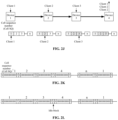
- FIG. 2 K is a diagram illustrating how cells are transmitted in a FlexE slot according to the present application.
- FIG. 2 L is a diagram illustrating that an idle information block is inserted between cells in a FlexE protocol slot according to the present application.
- FIG. 2 M is a diagram illustrating the process in which client data after being 64/66 encoded is carried by cells according to the present application.
- FIG. 2 N is a diagram illustrating the process in which client data after being 64/66 encoded and 256/257 encoded is carried by cells according to the present application.
- FIG. 2 O is a diagram illustrating that a cell is composed of T blocks and D blocks according to the present application.
- FIG. 2 P is a diagram illustrating that a cell is composed of an O block and D blocks according to the present application.
- FIG. 3 is a diagram illustrating the structure of a data transmission apparatus according to the present application.
- FIG. 4 is a diagram illustrating the structure of another data transmission apparatus according to the present application.
- FIG. 5 is a diagram illustrating the structure of a terminal device according to the present application.
- FIG. 1 is a flowchart of a data transmission method according to the present application.
- the method can be applied to the case of improving the transmission efficiency of the client data whose rate is smaller than the set value.
- the method may be performed by a data transmission apparatus provided in the present application.
- the apparatus may be implemented by software and/or hardware and integrated into a terminal device.
- the terminal device may cover any suitable type of user equipment.
- the terminal device may be a device sending client data.
- FIG. 1 A is a diagram of the principle of the FlexE protocol according to the present application. Referring to FIG. 1 A , four 100G optical modules are combined together by the FlexE protocol to form one 400G transmission channel, which is equivalent to the transmission rate of one 400G optical module, thereby solving the transmission requirements of 400G services without increasing costs.
- physical layers defined by the FlexE protocol are 100 G, 200 G, and 400 G.
- 20 slots are defined on a 100G physical layer. Each slot corresponds to a bandwidth of 5G bit/s and is referred to as a FlexE slot in the present application.
- 200G physical layer services and 400G physical layer services are transmitted by interleaving and multiplexing a service rate of two 100G and a service rate of four 100G into a service rate of 200G and a service rate of 400G respectively.
- a 100G client packet is 64/66 encoded before being sent.
- the bit value of the 64-bit client packet is encoded into a 66-bit information block.
- FIG. 1 B is a diagram illustrating the arrangement relationship of overhead blocks and data code blocks in the FlexE protocol according to the present application. As shown in FIG.
- every 20 66-bit data code blocks are classified into one data code block group.
- Each group has 20 data code blocks, which represent 20 slots whose total bandwidth is 100G.
- Each slot represents a service bandwidth at a rate of 5G (bit/s).
- one FlexE overhead block (which is a black block as shown in FIG. 1 B ) is inserted.
- the second group of 1023*20 data code blocks continues being sent out and then another overhead block is inserted. The rest can be done in the same manner. In this way, during the transmission of data code blocks, an overhead block is periodically inserted. The interval between two adjacent overhead blocks is 1023*20 data code blocks.
- FIG. 1 C is a diagram illustrating the allocation of client services over multiple physical channels in the FlexE protocol in the sending direction according to the present application.
- 20 data code blocks are classified into one data code block group, and one overhead byte is inserted every 1023 data code block groups.
- the data code block group represents 80 slots.
- Client services are transmitted in the 80 slots.
- Each slot has a bandwidth of 5G, and the total service transmission bandwidth is 400 G.
- FIG. 1 D is a diagram illustrating the recovery of client services over multiple physical channels in the FlexE protocol in the receiving direction according to the present application.
- the four routes of physical ports operate separately according to the FlexE protocol to determine the location of each FlexE overhead block and the frame structure. Then the four routes of slots are sorted according to the sequential relationship to recover the 80 slots. The client services are extracted from the 80 slots.
- the FlexE overhead block is a 66-bit code block with special content. When a service data stream is sent, one overhead block is inserted every 1023*20 blocks. An overhead block plays a positioning function in the entire service flow. When an overhead block is found, the position of the first slot and the positions of the subsequent slots can be determined.
- Eight consecutive overhead blocks have different definitions and content. Eight consecutive overhead blocks constitute one overhead frame.
- One overhead block is composed of a 2-bit block flag and 64-bit block content. The block flag is in the first two columns while the block content is in the subsequent 64 columns. The block flag of the first overhead block is 10 while the block flag of the subsequent seven overhead blocks is 01 or SS (SS means that the content is uncertain).
- the content of the first overhead block is 0x4B (8 bits, hexadecimal 4B), C bit (1 bit, indicating adjustment control), OMF bit (1 bit, indicating an overhead frame multiframe), RPF bit (1 bit, indicating a remote defect), SC bit (1 bit, synchronizing configuration), member group number (20 bits, that is, FlexE group number), 0x5 (4 bits, hexadecimal 5), and 000000 (28 bits, all 0s).
- 0x4B and 0x5 are the flag indicators of the first overhead block.
- the reserved part is reserved content, which has not been defined yet.
- the first overhead block is indicated by two fields 4B (which is hexadecimal and indicated by 0x4B) and 05 (which is hexadecimal and indicated by 0x5).
- 4B which is hexadecimal and indicated by 0x4B
- 05 which is hexadecimal and indicated by 0x5
- the OMF field is a multiframe indication signal.
- OMF is a single-bit value, which is 0 in 16 consecutive frames, then 1 in 16 consecutive frames, then 0 in 16 consecutive frames, and then 1 in 16 consecutive frames, repeated every 32 frames. In this way, one multiframe is composed of 32 frames.
- Each slot has a bandwidth of 5G (bit/s).
- a member group is formed through a combination of multiple 100G PHYs so that various types of high-rate, such as 200G, 300G, and 400G, client services can be achieved.
- the calendar that is, the calendar layer, shows x*20 slots (x is the number of members), and the client services have been mapped to the selected slots on the calendar layer for transmission.
- each slot represents a bandwidth of 5G bit/s.
- One client selects at least one slot for transmission.
- the minimum bandwidth of a carried client service is 5G bit/s.
- client services include many low-rate, such as, 10M, 100M, and 1G, services.
- These client services may be a special line for an enterprise group, a special line between bank branches, and a special line for a government agency that need to be transmitted through independent channels so as to achieve physical isolation and ensure information security.
- the FlexE protocol provides the slot function to achieve physical isolation.
- a 5G channel is used for carrying a 1G or 100M client service, the carrying bandwidth is wasted seriously.
- the present application provides a high-quality and high-efficiency transmission method for low-rate small-particle client services.
- a data transmission method provided in the present application includes S 110 , S 120 , and S 130 .
- a basic unit carrying client data is determined.
- the rate of the client data is smaller than the set value.
- the set value is determined according to the bandwidth of a flexible Ethernet (FlexE) slot.
- the basic unit is a basic unit included in a basic unit set.
- the transmitted data in the present application is the client data.
- the client data is carried on the basic unit set and sent through the FlexE slot to other terminal devices, for example, a terminal device communicating with this terminal device.
- the communication content includes the client data.
- the client data in the present application may be carried on part of at least one basic unit in the basic unit set.
- the client data of one terminal device may be mapped to part of the at least one basic unit in the basic unit set so that the basic unit set can carry the client data of at least one terminal device, enhancing transmission efficiency through mapping the client data of multiple terminal devices to the basic unit set.
- a basic unit carrying the client data is determined first.
- the basic unit is a basic unit included in the basic unit set.
- the basic unit set includes n basic units, where n is a positive integer.
- the basic unit carrying the client data of the terminal device may be basic unit 1 , basic unit 6 , basic unit 11 , basic unit 16 , . . . or may be basic unit 1 to basic unit m, where m is a positive integer smaller than n. That is, at least two basic units spaced in the basic unit set or at least two consecutive basic units in the basic unit set may carry the client data; alternatively, one basic unit in the basic unit set may carry the client data.
- determining a basic unit may be understood as determining the format of the basic unit and determining the label of the basic unit, that is, the sequence number of the basic unit.
- Different basic units may have different formats. For example, in the case where a basic unit is a cell, the format of the basic unit may be 66-bit code blocks or bytes. The format of a basic unit is not limited here.
- the sequence number of the basic unit is determined in the present application. Each basic unit in the basic unit set is labeled with a sequence number. In S 110 , the sequence number of the basic unit carrying the client data is determined.
- the present application does not limit which basic units are used for carrying the client data as long as both parties in communication make a pre-determination, thereby preventing the client data of different terminal devices from being mapped to the same basic unit.
- the rate of the client data is smaller than the set value.
- the set value is determined based on the bandwidth of the FlexE slot.
- the set value is the bandwidth of the FlexE slot.
- the rate of the client data in the present application is smaller than the bandwidth of the FlexE slot.
- the client data described in the present application is data smaller than 5G and is also referred to as a small-particle client service.
- the number of at least one basic unit carrying the client data is determined based on the bandwidth required by the client data and the carrying bandwidth of a single basic unit.
- the carrying bandwidth of a single basic unit is determined based on the bandwidth of the FlexE slot and the cycle period of basic units. For example, the bandwidth of a single basic unit is obtained by dividing the bandwidth of the FlexE slot by the cycle period of basic units.
- the cycle period may be considered as the number of basic units included in the basic unit set.
- the client data is mapped to the basic unit.
- the client data is mapped to the basic unit in the present application. That is, the basic unit set carries the client data.
- the basic unit set to which the client data is mapped can be sent through the FlexE slot in S 130 .
- the data transmission method provided in the present application includes determining a basic unit carrying client data, where the rate of the client data is smaller than the set value, the set value is determined according to the bandwidth of a flexible Ethernet (FlexE) slot, and the basic unit is a basic unit included in a basic unit set; mapping the client data to the basic unit; and sending, through the FlexE slot, the basic unit set to which the client data is mapped.
- Each basic unit in the basic unit set serves as a transmission channel.
- the FlexE time slot is divided into multiple sub-channels. The number of sub-channels is determined according to the number of basic units included in the basic unit set. In this case, the transmission efficiency of the client data whose rate is smaller than the set value is improved.
- the basic unit includes a packet or a cell.
- the basic unit set includes at least one basic unit and is used for carrying the client data of at least one terminal device.
- the client data of different terminal devices may be mapped to different basic units in the basic unit set so as to improve the utilization of the FlexE slot.
- overhead information is included on the basic unit.
- the overhead information includes one or more of the following: sequence information used for identifying the basic unit, idle indication information, or operations, administration and maintenance information.
- the overhead information is used for identifying the basic unit.
- the sequence information in the overhead information may be a sequence number used for identifying a basic unit in the basic unit set.
- the idle indication information is used for indicating whether the basic unit is an idle basic unit.
- the idle indication information may be null cell indication information used for indicating whether to be an idle cell or a service cell.
- the operations, administration and maintenance (OAM) information is used for operating, administrating, and maintaining the basic unit.
- the operations, administration and maintenance information includes at least one or more of the following: a near-end error code, a remote error code, a client indication, delay time, client type, a local defect, or a remote defect.
- the cell is formed by combining different target code blocks.
- the target code blocks include a border control code block and a data code block.
- the data code block is used for carrying the client data.
- the border control code block is used for identifying a border of the cell.
- the border control code block includes one or more of the following: an S block, a T block, an O block, or a predefined control code block.
- a predefined control code block may be a user-defined control code block as long as the predefined control code block can be used for identifying a border of the cell.
- the S block and the T block are used for identifying the start and end of the basic unit respectively.
- the S blocks are used for identifying the start and end of the basic unit; that is, the S blocks are arranged at the starting position of the basic unit and the ending position of the basic unit.
- the T blocks are used for identifying the start and end of the basic unit; that is, the T blocks are arranged at the starting position of the basic unit and the ending position of the basic unit.
- the border control code block includes only an O block
- the O block is used for identifying the start and end of the basic unit and is arranged only at the starting position of the basic unit.
- the border control code block includes only a predefined control code block
- the predefined control code block is used for identifying the start and end of the basic unit and is arranged only at the starting position of the basic unit.
- One or more of the S block, the T block, the O block, or the predefined control code block may be combined arbitrarily to identify one basic unit, which is not limited here.
- the overhead information in the basic unit is carried on the target code blocks.
- the overhead information of the basic unit is carried on the target code blocks; that is, the overhead information of the basic unit is carried on one or more of the following code blocks: a border control code block or a data code block.
- that the client data is mapped to the basic unit includes the following.
- the client data is mapped to the content carrying part of the packet.
- the client data is mapped to a data code block of the cell.
- At least one FlexE slot is provided.
- the basic unit set is transmitted on the FlexE slots in sequence.
- an idle information block is inserted every set number of basic units.
- the rate adjustment capability can be improved by inserting an idle information block.
- the set number is not limited here and can be determined by those skilled in the art according to the receiving rate of the terminal device and the sending rate of the terminal device.
- An idle information block may not carry the client data so as to adjust the rate.
- the client data in the present application may be directly mapped to the cell.
- the client data may be encoded, and then the encoded data is mapped to the cell.
- the client data may be 64/66 encoded; alternatively, the client data may be 64/66 encoded and 256/257 encoded, that is, 64/66 encoded first and then 256/257 encoded.
- FIG. 2 is a flowchart of another data transmission method according to the present application.
- the method can be applied to the case of receiving client data on a terminal device.
- the client data is carried on a corresponding basic unit.
- the rate of the client data is smaller than the set value.
- This method may be performed by a data transmission apparatus provided in the present application.
- the data transmission apparatus may be implemented by software and/or hardware and integrated into a terminal device.
- the terminal device may be a device receiving client data.
- the data transmission method provided in the present application includes S 210 to S 220 .
- the FlexE slot is determined first.
- the slot may be pre-determined by terminal devices in communication and is not limited here.
- the basic unit set is recovered from the FlexE slot. For example, based on the number of basic units included in the basic unit set, a corresponding number of basic units are extracted from the FlexE slot to recover the basic unit set.
- Each basic unit in the basic unit set has a corresponding sequence number.
- the basic unit set can be recovered based on the sequence number of each basic unit.
- client data is extracted from the basic unit set.
- the basic unit set includes a basic unit carrying the client data.
- the rate of the client data is smaller than the set value.
- the set value is determined according to the bandwidth of the FlexE slot.
- the client data is extracted from the basic unit set in the present application.
- the basic unit carrying the client data is determined first; then the carried data is extracted from the basic unit; finally, the client data is obtained according to the sequence number and carried content of each basic unit.
- the client data is obtained by splicing the data of each basic unit according to the sequence number of each basic unit.
- the bit value extracted from the packet or the cell is decoded to recover the content of the original client packet, that is, the client data before being encoded.
- the data transmission method provided in the present application includes recovering a basic unit set from a FlexE slot and extracting client data from the basic unit set.
- the basic unit set includes a basic unit carrying the client data.
- the rate of the client data is smaller than the set value.
- the set value is determined according to the bandwidth of the FlexE slot. The method helps improve the transmission efficiency of the client data whose rate is smaller than the set value.
- that the client data is extracted from the basic unit set includes the following.
- the basic unit that carries the client data and is in the basic unit set is determined.
- the client data carried in the basic unit is extracted.
- the basic unit that carries the client data and is in the basic unit set is determined first.
- the sequence number, that is, sequence information, of the basic unit carrying the client data is determined.
- the sequence information may be pre-determined by both parties in communication.
- a terminal device sending the basic unit set is a sending device
- a terminal device receiving the basic unit set to extract the client data is a receiving device.
- the client data carried on the basic unit is directly extracted in the present application. At least one basic unit is determined. In the case where at least two basic units are determined, the client data can be obtained by splicing the content carried by the basic units according to the sequence number of each basic unit.
- the client data in the case where the client data is extracted, the client data may be the client data of one terminal device.
- the extraction of the client data of different terminal devices may adopt the same technical means, which is not limited here.
- the basic unit set carries client data 1 of terminal device a and client data 2 of terminal device b.
- client data extraction may be considered as the process of extracting client data 1 of terminal device a or client data 2 of terminal device b.
- that the basic unit that carries the client data and is in the basic unit set is determined includes the following.
- the sequence information of the basic unit carrying the client data is determined.
- the basic unit that carries the client data and is in the basic unit set is determined based on the sequence information.
- the sequence information is extracted from the overhead information of the basic unit, and then the basic unit that corresponds to the sequence information and is in the basic unit set is taken as the basic unit carrying the client unit.
- the basic unit set includes at least one basic unit and is used for carrying the client data of at least one terminal device.
- the basic unit includes a packet or a cell.
- overhead information is included on the basic unit.
- the overhead information includes one or more of the following: sequence information used for identifying the basic unit, idle indication information, or operations, administration and maintenance information.
- the cell is formed by combining different target code blocks.
- the target code blocks include a border control code block and a data code block.
- the data code block is used for carrying the client data.
- the border control code block is used for identifying a border of the cell.
- the border control code block includes one or more of the following: an S block, a T block, an O block, or a predefined control code block.
- the overhead information in the basic unit is carried on the target code blocks.
- At least one FlexE slot is provided.
- the data transmission method described in the present application may be considered as a transmission method for the transmission of low-rate clients (that is, client data) in the FlexE protocol.
- the method is a high-efficiency and high-quality transmission method when the rate of a carried client service is smaller than 5G bit/s.
- the interface rate of communication devices has increased from 10M (unit: bit/s, similar below) to 100M, then 1G, and then 10G.
- the service rate doubles every few years.
- the FlexE protocol meets the transmission requirement of 400G services and solves the economic value problem of service transmission.
- low-rate services that is, client rate, whose rate is smaller than 5G, which indicates that client data is small-particle services
- small-particle services that is, various client services whose rate is smaller than 5G, for example, 1G, 100M, 10M, and 2M
- one client service can be transmitted on one 5G slot, maintaining the transmission quality of the FlexE technology.
- One 5G slot transmits only one low-rate service, but the transmission efficiency is very low.
- the data transmission method in the present application may include the following.
- the format of each packet or cell carrying a small-particle service is determined, and the small-particle service is mapped to each corresponding packet or cell.
- the small-particle service may be considered as client data.
- the rate of the client data is smaller than the set value.
- a packet or cell may be considered as a basic unit used for carrying the small-particle service.
- the format of each packet or cell carrying the small-particle service is determined first. For example, as for the format, a cell may be composed of bytes or bit blocks. Additionally, the sequence number of each packet or cell carrying the small-particle service is also determined so as to determine each packet or cell to which the small-particle service is mapped.
- the corresponding FlexE slot may be considered as a slot sending the packets or cells.
- mapping content is extracted from each corresponding packet or cell to recover the small-particle client service
- Part of all the packets or cells are used for carrying the client data of one terminal device.
- the mapped content is extracted from each packet or cell corresponding to the terminal device to recover the small-particle client service.
- All the packets or cells may carry the client data of at least one terminal device.
- Each packet or cell has a unique sequence number. In the present application, a packet or cell is selected based on the sequence number of the packet or cell to extract the client data.
- 1 may specifically include the following.
- a small-particle service mapping object may be a standard Ethernet packet structure or a cell structure.
- the packet or the cell carries a sequence number and an overhead byte. All the cells are divided into multiple sub-cells based on sequence numbers (that is, all cells are labeled and each label corresponds to one cell).
- a sub-cell provides a transmission sub-channel.
- the overhead byte provides, including but not limited to, OAM information and time information.
- the sequence number and the overhead byte may be considered as overhead information.
- the time information may be the delay time in the OAM information.
- the cell may be formed by combining different code blocks in 64/66 encoding specifications, where a special control code block is used for identifying a border of the cell and a data code block is used for carrying client content.
- the special control code block may be an S block, a T block, an O block, or any other defined control block.
- the bit value of the small-particle client service may be directly mapped to the packet or the cell; alternatively, the content of the small-particle client service may be encoded first, and then the encoded result is mapped to the packet or the cell.
- 64/66 encoding may be used; alternatively, 64/66 encoding and 256/257 encoding may be used in combination.
- the content of the small-particle client service is 64/66 encoded first and then 256/257 encoded.
- the mapping process is that the client service is directly filled into the content carrying part of each packet.
- the mapping process is that the bit value of the client service is filled into a data code block.
- the client packet is encoded, the encoded bit value is filled into a data code block.
- an Ethernet packet is 64/66 encoded according to FlexE protocol specifications, and then 66-bit code blocks are sent out through the FlexE slot.
- one packet stream or one cell stream may be carried by one FlexE slot and sent out or may be carried by multiple FlexE slots and sent out.
- the sequence number carried by each packet or cell is determined, and the client content, that is, the client data, is extracted from each packet or cell with a corresponding sequence number.
- the corresponding sequence number may be considered as the sequence number corresponding to the terminal device whose client data is to be extracted.
- Different terminal devices may have different sequence numbers for identifying the packets or cells on which the client data of the terminal devices is carried.
- a virtual intermediate client is determined.
- the rate bandwidth of the virtual intermediate client is 5G.
- a packet of the virtual intermediate client is a fixed-length packet (a fixed-length packet or a fixed-length cell is collectively referred to as a cell packet), which can be carried at full rate on a FlexE slot.
- FIG. 2 A is a diagram illustrating that the transmission of a small-particle service on a FlexE slot is implemented using serial packets according to the present application. Referring to FIG. 2 A , a fixed-length packet carries a sequence number, that is, a serial number. A sequence number appears circularly.
- Sequence numbers divide virtual intermediate client packets into many sub-slot packets (for example, the virtual intermediate client includes N packets, the sequence numbers are used for identifying each packet, and each packet can be considered as one sub-slot packet).
- Each sub-slot packet provides one transmission sub-channel.
- the virtual intermediate client packets When all the virtual intermediate client packets have the same length (that is, each basic unit included in the virtual intermediate client packets has a fixed length), the virtual intermediate client packets are divided, through the sequence numbers, into many sub-slot packets with the same rate. Each sub-slot packet provides one transmission sub-channel. The rate of all sub-slot channels is exactly the same.
- Real original clients are carried in the virtual intermediate client packets.
- the content of different original client packets is placed in cell packets (that is, transmission sub-channels) with different sequence numbers. For example, the first client is placed in cell packets with sequence numbers of 1, 6, 11, . . .
- the second client is placed in cell packets with sequence numbers of 2, 7, 12, . . . , and n*5+2;
- the third client is placed in cell packets with sequence numbers of 3, 8, 13, . . . , and n*5+3;
- the fourth client is placed in cell packets with sequence numbers of 4, 9, 14, . . . , and n*5+4;
- the fifth client is placed in cell packets with sequence numbers of 5, 10, 15, . . . , and n*5+5.
- one cell is selected every five cells to carry one real customer.
- the virtual intermediate client is evenly divided into five equal parts.
- the rate of each part is one fifth of the rate of the virtual intermediate client.
- the rate of each part is 1G.
- the intermediate virtual client whose rate is 5G is evenly changed into five parts so that five transmission sub-channels are formed.
- the bandwidth of each transmission sub-channel is 1G.
- the five 1G transmission sub-channels share a FlexE slot.
- Each sub-channel carries a real client. Real clients are physically isolated from each other completely and do not affect each other.
- FIG. 2 B is a diagram of the positional relationship between the small-particle service processing link and the FlexE protocol processing link according to the present application.
- the client data of FlexE clients, from FlexE client a to FlexE client e is carried on basic unit 1 , basic unit 2 , basic unit 3 , . . . , and basic unit n to form a virtual intermediate client.
- the processing means after the virtual intermediate client is formed is the same as the processing means in the related art. For example, FlexE general processing is performed, including but not limited to inserting or deleting an idle code block, and then 100G physical interface processing is performed.
- a virtual client packet is a fixed-rate and fixed-length packet and may be a standard Ethernet packet.
- FIG. 2 C is a diagram illustrating that the transmission of small-particle services is implemented using Ethernet packets with sequence numbers according to the present application.
- a standard Ethernet packet consists of a source address (SA), a target address (DA), a packet content part, and a cyclic redundancy check (CRC) part (4 bytes).
- the source address (SA) and the target address (DA) are, for example, the source media access control (MAC) address (6 bytes) and the destination MAC address information (6 bytes) respectively.
- the packet content part is used for carrying real client information.
- a frame interval (12 bytes on average) and a preamble (1-byte frame delimiter and 7-byte preamble, a total of 8 bytes) between packets. It is seen from FIG. 2 C that the proportion of the packet content part in the entire packet (including a frame interval and a preamble) is not high, resulting in low utilization of transmission bandwidth. When the packet is shorter, the packet content part is less and the bandwidth utilization rate is lower. As for a packet with a minimum length of 64 bytes (with no frame interval or preamble included), the packet content part occupies only 48 bytes, and the actual bandwidth utilization rate is only that 48/(64+12+8) 57.14%. When a virtual intermediate client packet is carried through a FlexE slot, the packet is 64/66 encoded first and, after being converted into a 66-bit code block, carried on the FlexE slot for transmission.
- Ethernet standards formulate 64/66 encoding rules, according to which the 64-bit (8-byte) client information, that is, the 64-bit (8-byte) client data, is converted into a 66-bit code block.
- the first two bits are synchronization header bits. When the value of the synchronization header value is “01”, it indicates that the code block is a data code block (D block).
- the next 8 bytes (64 bits) are the byte content of the code block.
- Other parts of the virtual intermediate client packet include the source MAC address, the destination MAC address information, the packet body, and the CRC part. After being encoded, these parts become a D block.
- the D block includes D 0 , D 1 , D 2 , D 3 , D 4 , D 5 , D 6 , and D 7 .
- the value of the synchronization header value is “10”, it indicates that the code block is a control block.
- the content of the first byte (8 bits) behind the synchronization header is the type value (block type field) of the control block.
- the control value is “0x1E” (hexadecimal)
- IDLE block idle code block
- the content in the rear of the code block is idle information.
- a C block includes C 0 , C 1 , C 2 , C 3 , C 4 , C 5 , C 6 , and C 7 .
- control value When the control value is “0x78” (hexadecimal), it indicates that the control block is an S block (or an S0 block, indicating the starting block of the packet).
- An S block indicates the starting block of one packet.
- the preamble part (including the frame delimiter) of the client packet becomes an S block.
- the S block includes D 1 , D 2 , D 3 , D 4 , D 5 , D 6 , and D 7 .
- the packet content part is behind the S block; accordingly, a D block is behind the S block.
- T block indicates the terminating block of one data packet. Since the length of the packet is uncertain, after the main part of one packet is encoded into at least one D block, the remaining bytes, if less than 8 bytes, cannot be encoded into a D block. The remaining bytes may be 0, 1, 2, 3, 4, 5, 6, or 7 bytes. Accordingly, as for the format, 8 types of T blocks are defined. Different T blocks carry different numbers of data bytes (that is, 0, 1, 2, 3, 4, 5, 6, and 7 bytes) of the remaining part in the packet.
- the defined virtual intermediate client packet is converted into a 66-bit block to be carried in the FlexE slot.
- the format of a cell composed of 66-bit code blocks can be directly used for carrying the small-particle client packet instead of the Ethernet packet format, greatly improving bandwidth utilization rate.
- a cell of the virtual intermediate client is composed of a cell border indication code block and a data code block.
- FIG. 2 D is a diagram illustrating the transmission of small-particle services is implemented using cells composed of 66-bit blocks according to the present application.
- a cell is composed of an S block+a fixed number of D blocks+a T block (m is a positive integer).
- One fixed-length cell is constituted using an S block+a fixed number of D blocks+a T block.
- a fixed-length cell packet composed of 66-bit code blocks is used for carrying a low-rate small-particle client. In this case, the bandwidth utilization rate for carrying client information is improved significantly.
- the T7 block can carry 7 bytes of real client information.
- the client information is carried on the D blocks and the T block.
- the solution of using a cell composed of 66-bit code blocks has greatly improved bandwidth utilization rate. If the number of D blocks in the cell increases, the bandwidth utilization rate of the cell carrying the client information will be greater.
- FIG. 2 E is a diagram illustrating the structure of an S block after an Ethernet packet is 64/66 encoded according to the present application.
- the preamble and the frame delimiter are encoded into an S block.
- the structure of the encoded S block is shown in FIG. 2 E .
- the content of each of the 7 bytes in the rear of the S block is a fixed value, where the content of each of 6 bytes is “0x55” (preamble byte content) and the content of 1 byte is “0xD5” (frame delimiter byte content).
- the content of each of these 7 bytes is a fixed value.
- the positions of part of these bytes can be reused for transmitting the overhead information (for example, sequence number, cell type indication, and OAM information) of the cell.
- the cell type indication may include a null cell indication signal (Null) and a cell forward alarm indication signal (AIS).
- Null null cell indication signal
- AIS cell forward alarm indication signal
- the overhead information of a cell may include but is not limited to these four types of content.
- FIG. 2 F is a diagram illustrating the structure in which the S block in a cell carries overhead information according to the present application.
- the overhead information of the cell is placed at the position of the second byte, the position of the third byte, and the position of the fourth byte.
- the overhead information may also be placed at the positions of other bytes in the S block, which is not limited here.
- the overhead information may be placed in a D block.
- the overhead information may be placed at the position of the D block behind the S block and part of the D block carries the overhead information.
- FIG. 2 G is a diagram illustrating the structure of the overhead information on a D block in a cell according to the present application.
- the overhead information is placed at the position of the first D code block.
- part of the bytes transmit the overhead information and part of the bytes transmit the client information.
- the first 3 bytes are used for carrying the overhead information
- the last 5 bytes are used for transmitting the real client information.
- the first 6 bytes are used for carrying a real client information
- the last 2 bytes are used for transmitting the overhead information.
- FIG. 2 H is a diagram illustrating the structure of the overhead information on the T block in a cell according to the present application.
- T7 serves as the terminating block of the cell.
- Another T code block may also serve as the terminating block of the cell.
- part of the bytes are used for transmitting the overhead information, and part of the bytes are used for transmitting the client information.
- the overhead information is placed on the sixth byte, seventh byte and eighth byte in the T block; and in the T7 block, the second byte, the third byte, the fourth byte, and the fifth byte are used for transmitting the client information.
- the overhead information may also be placed at the positions of other bytes in the T block.
- the overhead information may be placed on the cell border indication code block.
- FIG. 2 I is a diagram illustrating the process in which client packets with different rates are carried through cells according to the present application.
- the client packets are client data.
- the sequence number range of the cells may be 1 to 2000; that is, the value of n is 2000.
- a sequence number appears cyclically every 2000 cells.
- the total bandwidth of the cells is 5G bit/s.
- the physical bandwidth of such cell is 2.5M bit/s.
- This example may include client 1 , client 2 , client 3 , client 4 , and the like.
- 400 cells out of the 2000 cells are selected for carrying and transmitting the client service, and the bandwidth of the 400 cells is 1G bit/s.
- carrying cells are selected at equal intervals.
- one cell is selected every 5 cells to transmit the 1G-rate client information; for example, cells whose sequence numbers are 1, 6, 11, 16, and the like are selected to carry a client packet.
- For a 100M-rate client service one cell is selected every 50 cells to transmit the 100M-rate client information.
- one cell is selected every 500 cells to transmit the 10M-rate client information.
- a client packet with another rate a similar manner is used.
- a 2M-rate E1 client service one cell is selected to carry the E1 client service.
- FIG. 2 J is a diagram illustrating the process in which cells are transmitted in a device network using the FlexE technology according to the present application.
- fixed-length cell packets for example, cell packets with a length of n
- Each cell packet is identified through a cell sequence number.
- four devices form a transmission network by using the FlexE technology.
- one slot (5G bits/s) is selected to serve as the transmission channel of the small-particle and low-rate clients.
- One virtual intermediate client is created on the transmission channel.
- the virtual intermediate client includes the fixed-length cells.
- Each cell carries a sequence number (a cell SQ value as shown in the figure) and other overhead fields.
- a cell packet is of a fixed length. A sequence number appears circularly.
- the cell packets can be transmitted from device 1 to device 4 at the full traffic (a rate of 5G bit/s).
- the cells are received from one direction of each of the devices and then crossed to the other direction to be sent out.
- new clients come in and out.
- part of the cells are selected to carry the content (that is, the client data) of client 1 . For example, cells corresponding to cell sequence numbers of 1, 6, 11, 16, and the like are selected to carry the client data of client 1 ; and the carrying bandwidth is 1G bit/s.
- part of the cells are selected to carry the content of client 2 .
- cells whose cell sequence numbers are 2, 7, 12, 17, and the like are selected to carry the client data of client 2 ; and the carrying bandwidth is 1G bit/s.
- part of the cells are selected to carry the content of client 3 .
- cells whose cell sequence numbers are 3, 8, 13, 18, and the like are selected to carry the client data of client 3 .
- the information, for example, the client data, of client 1 is extracted and recovered from cells whose cell sequence numbers are 1, 6, 11, 16, and the like; the information of client 2 is extracted and recovered from cells whose cell sequence numbers are 2, 7, 12, 17, and the like; and the information of client 3 is extracted and recovered from cells whose cell sequence numbers are 3, 8, 13, 18, and the like.
- One FlexE slot is divided into multiple cell sub-slots through these cells. Each cell sub-slot constitutes a low-rate transmission channel. Transmission channels with different rates are formed by combining different numbers of cell sub-slots. In this example, different cell sub-channels are selected to carry different small-particle and low-rate clients. These small-particle clients are isolated from each other completely, are independent of each other, and do not affect each other.
- FIG. 2 K is a diagram illustrating how cells are transmitted in a FlexE slot according to the present application.
- a cell may be composed of an S block+D blocks+a T block.
- the FlexE protocol slot When being transmitted in the FlexE protocol slot, no space is left between all the cells. Two adjacent cells are connected together. When the cells are connected together with no idle position left between, the cells fill the selected FlexE slot.
- the cell bandwidth is the same as the slot bandwidth, resulting in the highest utilization rate of the FlexE slot bandwidth.
- a deviation exists between clock frequencies of different devices in the network. As shown in FIG. 2 J , a deviation exists between the clock frequency of device 1 and the clock frequency device 2 .
- the receiving rate of a FlexE client service of device 2 is different from the sending rate of the FlexE client service of device 2 . It is necessary to add and delete an idle information block (IDLE block) for the client service so as to adjust the rate of the client service and adapt to the frequency deviation between the receiving direction and the sending direction.
- IDLE block idle information block
- FIG. 2 L is a diagram illustrating that an idle information block is inserted between cells in a FlexE protocol slot according to the present application.
- an idle information block that is, an I block
- Ethernet standards stipulate that the maximum deviation between the device clock frequency and the nominal clock frequency is positive and negative 100 PPM (PPM: percent per million). The maximum clock deviation between any two devices is 200 PPM.
- 200 idle blocks are inserted every million code blocks in the code stream so that the function of clock frequency deviation adjustment is satisfied.
- An inserted idle information block needs to be located between two cell code blocks. That is, one idle information block is inserted every 5000 information code blocks.
- the cell code block stream with an appropriate number of idle information blocks inserted is carried by the FlexE slot and sent out.
- each intermediate device adds or deletes one or more idle information blocks in the cell code block stream according to the clock frequency deviation so as to implement rate adjustment and adaptation. Finally, the cell code block stream is sent to the last receiving device.
- FIG. 2 M is a diagram illustrating the process in which client data after being 64/66 encoded is carried by cells according to the present application.
- a FlexE protocol slot is divided into multiple sub-slots in the manner of cell packets so as to achieve smaller transmission channels.
- a client is a service with a continuous and constant bit rate (CBR), for example, an E1 service, a synchronous digital hierarchy (SDH) service, or an optical transport network (OTN) service
- CBR continuous and constant bit rate
- E1 E1 service
- SDH synchronous digital hierarchy
- OTN optical transport network
- each client packet is encoded first, for example, 64/66 encoded. After a client packet is encoded, a 66-bit code block stream is obtained. All bit values in all code blocks in code block streams of continuous 66-bit lines are connected in series to form a continuous single-bit stream. These bit stream values are recut into 64-bit lengths and carried on D bytes in the cells for transmission so as to implement bit mapping.
- the part carrying client information on the cell accounts for only a part of the entire cell.
- the bandwidth utilization rate of the carrying channel cannot reach 100%.
- the 64-bit content is increased into the 66-bit content, causing a bandwidth expansion and further reducing bandwidth utilization rate.
- FIG. 2 N is a diagram illustrating the process in which client data after being 64/66 encoded and 256/257 encoded is carried by cells according to the present application.
- a client packet in order to improve bandwidth utilization rate, after being 64/66 encoded, a client packet can be further 256/257 encoded.
- four 66-bit code blocks are encoded into one 257-bit code block, reducing the bandwidth expansion caused by encoding and improving bandwidth utilization rate.
- How to encode a client service, that is, client data, and how to map the client service to a cell may be implemented in various specific manners and are all within the protection scope of the present application.
- one virtual intermediate client is established on one 5G slot of the FlexE protocol.
- the virtual intermediate client uses fixed-length cells or fixed-length packets. Part of the cells or packets are selected to carry real small-particle low-rate client content.
- one virtual intermediate client may be established on multiple 5G slots of the FlexE protocol. For example, two 5G slots of the FlexE protocol are arbitrarily selected for establishing a virtual intermediate client. In this case, the bandwidth of the virtual intermediate client is 10G bit/s.
- the cell sequence number range is from 1 to 2000
- the cell of each sequence number represents a bandwidth of 5M bit/s.
- 200 cells are selected to carry a small-particle low-rate client (one cell is selected every ten cells).
- the bandwidth carrying the small-particle low-rate service is 1G so that a 1G-rate transmission channel is provided.
- one virtual intermediate client may be established on any number of FlexE slots.
- the cell sequence number range may be a range covering any count of sequence numbers. These are all within the scope of the present application.
- a cell structure may be composed of an S block+D blocks+a T block.
- a uniform structure feature of cells is a border code block+a data code block.
- a border code block is used for indicating the starting position and ending position of a cell.
- Two types of code blocks may be arranged as border code blocks, with one code block indicating the starting position and the other one code block indicating the ending position.
- only one type of code block may be arranged as a border code block to simultaneously indicate the ending position of a cell in front and the starting position of a cell behind.
- a data code block is used for carrying client information content.
- the specific format of a cell may be of various types.
- FIG. 2 O is a diagram illustrating that a cell is composed of T blocks and D blocks according to the present application. Referring to FIG. 2 O , in the present application, two consecutive T blocks may serve as the starting block of a cell and the terminating block of another cell respectively. The T block in front is the terminating block of a cell. The T block behind is the starting block of another cell.
- FIG. 2 P is a diagram illustrating that a cell is composed of an O block and D blocks according to the present application.
- a cell structure may not need a starting block and a terminating block but needs only one cell border code block.
- a cell border code block is both the ending position of a cell in front and the starting position of a cell behind. All data code blocks between two cell border code blocks are the carrying part of a cell.
- a user-defined control code block is used as a cell border code block and may be an O block in the Ethernet-defined encoding.
- the O block carries user-defined identification content, for example, the encoding result of the fourth line in 64/66 encoding rules (the control content in the O block is “0x4B”; various values may be used as the O0 value in the code block; and a user-defined special value is taken in the present application to get distinguished from the existing O0 value in the standards).
- the control content in the O block is “0x4B”; various values may be used as the O0 value in the code block; and a user-defined special value is taken in the present application to get distinguished from the existing O0 value in the standards).
- FIG. 3 is a diagram illustrating the structure of a data transmission apparatus according to the present application.
- the data transmission apparatus provided in the present application includes a determination module 31 , a mapping module 32 , and a sending module 33 .
- the determination module 31 is configured to determine a basic unit carrying client data. The rate of the client data is smaller than the set value.
- the basic unit is a basic unit included in a basic unit set.
- the mapping module 32 is configured to map the client data to the basic unit.
- the sending module 33 is configured to send, through the flexible Ethernet (FlexE) slot, the basic unit set to which the client data is mapped.
- FlexE flexible Ethernet
- the data transmission apparatus provided in this embodiment is configured to implement the data transmission method of the embodiments shown in FIG. 1 .
- the data transmission apparatus provided in this embodiment has similar implementation principles and technical effects to the data transmission method of the embodiments shown in FIG. 1 , which are not repeated here.
- the basic unit includes a packet or a cell.
- the basic unit set includes at least one basic unit and is used for carrying the client data of at least one terminal device.
- overhead information is included on the basic unit.
- the overhead information includes one or more of the following: sequence information used for identifying the basic unit, idle indication information, or operations, administration and maintenance information.
- the cell is formed by combining different target code blocks.
- the target code blocks include a border control code block and a data code block.
- the data code block is used for carrying the client data.
- the border control code block is used for identifying a border of the cell.
- the border control code block includes one or more of the following: an S block, a T block, an O block, or a predefined control code block.
- the overhead information in the basic unit is carried on the target code blocks.
- the mapping module 32 is specifically configured to, in the case where the basic unit is a packet, map the client data to the content carrying part of the packet and, in the case where the basic unit is a cell, map the client data to a data code block of the cell.
- At least one FlexE slot is provided.
- an idle information block is inserted every set number of basic units.
- FIG. 4 is a diagram illustrating the structure of another data transmission apparatus according to the present application.
- the apparatus includes a recovery module 41 and an extraction module 42 .
- the recovery module 41 is configured to recover a basic unit set from a FlexE slot.
- the extraction module 42 is configured to extract client data from the basic unit set.
- the data transmission apparatus provided in this embodiment is configured to implement the data transmission method of the embodiments shown in FIG. 2 .
- the data transmission apparatus provided in this embodiment has similar implementation principles and technical effects to the data transmission method of the embodiments shown in FIG. 2 , which are not repeated here.
- the extraction module 42 is specifically configured to determine the basic unit that carries the client data and is in the basic unit set and extract the client data carried in the basic unit.
- the configuration in which the basic unit that carries the client data and is in the basic unit set is determined includes the following.
- the sequence information of the basic unit carrying the client data is determined.
- the basic unit that carries the client data and is in the basic unit set is determined based on the sequence information.
- the basic unit set includes at least one basic unit and is used for carrying the client data of at least one terminal device.
- the basic unit includes a packet or a cell.
- overhead information is included on the basic unit.
- the overhead information includes one or more of the following: sequence information used for identifying the basic unit, idle indication information, or operations, administration and maintenance information.
- the cell is formed by combining different target code blocks.
- the target code blocks include a border control code block and a data code block.
- the data code block is used for carrying the client data.
- the border control code block is used for identifying a border of the cell.
- the border control code block includes one or more of the following: an S block, a T block, an O block, or a predefined control code block.
- the overhead information in the basic unit is carried on the target code blocks.
- At least one FlexE slot is provided.
- FIG. 5 is a diagram illustrating the structure of a terminal device according to the present application.
- the terminal device provided in the present application includes one or more processors 51 and a storage apparatus 52 .
- One or more processors 51 may be provided in the terminal device.
- one processor 51 is taken as an example.
- the storage apparatus 52 is configured to store one or more programs. When executed by the one or more processors 51 , the one or more programs cause the one or more processors 51 to implement the data transmission method described in embodiments of the present application.
- the terminal device further includes a communication apparatus 53 , an input apparatus 54 , and an output apparatus 55 .
- the one or more processors 51 , the storage apparatus 52 , the communication apparatus 53 , the input apparatus 54 , and the output apparatus 55 that are in the terminal device may be connected through a bus or in other manners.
- the connection through the bus is taken as an example.
- the input apparatus 54 may be used for receiving inputted digital or character information and for generating key signal input related to user settings and function control of the terminal device.
- the output apparatus 55 may include a display device, for example, a display screen.
- the communication apparatus 53 may include a receiver and a transmitter.
- the communication apparatus 53 is configured to perform information transceiving and communication under the control of the one or more processors 51 .
- the storage apparatus 52 may be configured to store software programs, computer-executable programs and modules, such as program instructions/modules (for example, the determination module 31 , the mapping module 32 , and the sending module 33 that are in the data transmission apparatus; in another example, the recovery module 41 and the extraction module 42 that are in the data transmission apparatus) corresponding to the data transmission method according to embodiments of the present application.
- the storage apparatus 52 may include a program storage area and a data storage area.
- the program storage area may store an operating system and an application program required by at least one function.
- the data storage area may store data created depending on use of a terminal device.
- the storage apparatus 52 may include a high-rate random-access memory and may further include a nonvolatile memory, such as at least one disk memory, a flash memory, or another nonvolatile solid-state memory.
- the storage apparatus 52 may further include memories located remotely relative to the one or more processors 51 , and these remote memories may be connected to the terminal device via a network. Examples of the preceding network include, but are not limited to, the Internet, an intranet, a local area network, a mobile communication network, and a combination thereof.
- Embodiments of the present application further provide a storage medium.
- the storage medium stores a computer program which, when executed by a processor, causes the processor to perform any data transmission method according to embodiments of the present application.
- the data transmission method includes determining a basic unit carrying client data, where the rate of the client data is smaller than the set value, the set value is determined according to the bandwidth of a flexible Ethernet (FlexE) slot, and the basic unit is a basic unit included in a basic unit set; mapping the client data to the basic unit; and sending, through the FlexE slot, the basic unit set to which the client data is mapped.
- FlexE flexible Ethernet
- the data transmission method includes recovering a basic unit set from a FlexE slot and extracting client data from the basic unit set.
- the basic unit set includes a basic unit carrying the client data.
- the rate of the client data is smaller than the set value.
- the set value is determined according to the bandwidth of the FlexE slot.
- the computer storage medium in embodiments of the present application may use any combination of one or more computer-readable media.
- a computer-readable medium may be a computer-readable signal medium or a computer-readable storage medium.
- the computer-readable storage medium may be, but is not limited to, an electrical, magnetic, optical, electromagnetic, infrared, or semiconductor system, apparatus, or element, or any combination thereof.
- the computer-readable storage medium include (non-exhaustive list): an electrical connection having one or more wires, a portable computer magnetic disk, a hard disk, a random-access memory (RAM), a read-only memory (ROM), an erasable programmable read-only memory (EPROM), a flash memory, an optical fiber, a portable Compact Disc ROM (CD-ROM), an optical storage element, a magnetic storage device, or any suitable combination thereof.
- the computer-readable storage medium may be any tangible medium including or storing a program. The program may be used by or used in conjunction with an instruction execution system, apparatus, or element.
- the computer-readable signal medium may include a data signal propagating in baseband or as part of a carrier wave.
- the computer-readable signal medium carries computer-readable program codes.
- the data signal propagated in this manner may be in multiple forms and includes, and is not limited to, an electromagnetic signal, an optical signal, or any suitable combination thereof.
- the computer-readable signal medium may further be any computer-readable medium other than a computer-readable storage medium.
- the computer-readable medium may send, propagate, or transmit the program used by or used in conjunction with the instruction execution system, apparatus, or element.
- the program codes contained in the computer-readable medium may be transmitted by using any appropriate medium.
- the appropriate medium includes, but is not limited to, wireless, a wire, an optical fiber, radio frequency (RF) and the like, or any appropriate combination thereof.
- Computer program code for performing the operations of the present application may be written in one or more programming languages or a combination thereof, including object-oriented programming languages such as Java, Smalltalk, C++, as well as conventional procedural programming languages such as “C” or similar programming languages.
- the program codes may be executed entirely on a user computer, partly on the user computer, as a stand-alone software package, partly on the user computer and partly on a remote computer, or entirely on the remote computer or a server.
- the remote computer may be connected to a user computer via any kind of network including a local area network (LAN) or a wide area network (WAN), or may be connected to an external computer (for example, via the Internet through an Internet service provider).
- LAN local area network
- WAN wide area network
- Internet service provider for example, via the Internet through an Internet service provider
- terminal device encompasses any appropriate type of radio user device, such as a mobile phone, a portable data processing apparatus, a portable web browser, or a vehicle-mounted mobile station.
- multiple embodiments of the present application may be implemented in hardware, a dedicated circuit, software, logic, or any combination thereof.
- some aspects may be implemented in hardware while other aspects may be implemented in firmware or software that may be performed by a controller, a microprocessor, or other computing apparatuses, though the present application is not limited thereto.
- Embodiments of the present application may be implemented by computer program instructions executed by a data processor of a mobile apparatus, for example, in a processor entity, by hardware, or by a combination of software and hardware.
- the computer program instructions may be assembly instructions, instruction set architecture (ISA) instructions, machine instructions, machine-related instructions, microcodes, firmware instructions, status setting data, or source or object codes written in any combination of one or more programming languages.
- ISA instruction set architecture
- a block diagram of any logic flow among the drawings of the present application may represent program steps, may represent interconnected logic circuits, modules and functions, or may represent a combination of program steps with logic circuits, modules, and functions.
- Computer programs may be stored in a memory.
- the memory may be of any type suitable for the local technical environment and may be implemented using any suitable data storage technology, such as, but not limited to, a read-only memory (ROM), a random-access memory (RAM) and an optical memory device and system (a digital video disc (DVD), or a compact disc (CD)).
- the one or more computer-readable media may include a non-transitory storage medium.
- the data processor may be of any type suitable to the local technical environment, such as, but is not limited to, a general purpose computer, a special purpose computer, a microprocessor, a digital signal processor (DSP), an application specific integrated circuit (ASIC), a field-programmable gate array (FGPA), and a processor based on a multi-core processor architecture.
- a general purpose computer such as, but is not limited to, a general purpose computer, a special purpose computer, a microprocessor, a digital signal processor (DSP), an application specific integrated circuit (ASIC), a field-programmable gate array (FGPA), and a processor based on a multi-core processor architecture.
- DSP digital signal processor
- ASIC application specific integrated circuit
- FGPA field-programmable gate array
Landscapes
- Engineering & Computer Science (AREA)
- Signal Processing (AREA)
- Computer Networks & Wireless Communication (AREA)
- Computing Systems (AREA)
- Physics & Mathematics (AREA)
- Electromagnetism (AREA)
- Computer Security & Cryptography (AREA)
- Data Exchanges In Wide-Area Networks (AREA)
Abstract
Description
Claims (19)
Applications Claiming Priority (3)
| Application Number | Priority Date | Filing Date | Title |
|---|---|---|---|
| CN201911191941.7 | 2019-11-28 | ||
| CN201911191941.7A CN111092686B (en) | 2019-11-28 | 2019-11-28 | Data transmission method, device, terminal equipment and storage medium |
| PCT/CN2020/125127 WO2021103928A1 (en) | 2019-11-28 | 2020-10-30 | Data transmission method and apparatus, terminal device and storage medium |
Related Parent Applications (1)
| Application Number | Title | Priority Date | Filing Date |
|---|---|---|---|
| PCT/CN2020/125127 A-371-Of-International WO2021103928A1 (en) | 2019-11-28 | 2020-10-30 | Data transmission method and apparatus, terminal device and storage medium |
Related Child Applications (1)
| Application Number | Title | Priority Date | Filing Date |
|---|---|---|---|
| US18/776,946 Continuation US20240372622A1 (en) | 2019-11-28 | 2024-07-18 | Data transmission method, sending end, receiving end, and storage medium |
Publications (2)
| Publication Number | Publication Date |
|---|---|
| US20220416895A1 US20220416895A1 (en) | 2022-12-29 |
| US12074643B2 true US12074643B2 (en) | 2024-08-27 |
Family
ID=70393885
Family Applications (2)
| Application Number | Title | Priority Date | Filing Date |
|---|---|---|---|
| US17/781,304 Active 2041-01-04 US12074643B2 (en) | 2019-11-28 | 2020-10-30 | Data transmission method and apparatus, terminal device and storage medium |
| US18/776,946 Pending US20240372622A1 (en) | 2019-11-28 | 2024-07-18 | Data transmission method, sending end, receiving end, and storage medium |
Family Applications After (1)
| Application Number | Title | Priority Date | Filing Date |
|---|---|---|---|
| US18/776,946 Pending US20240372622A1 (en) | 2019-11-28 | 2024-07-18 | Data transmission method, sending end, receiving end, and storage medium |
Country Status (4)
| Country | Link |
|---|---|
| US (2) | US12074643B2 (en) |
| KR (1) | KR102787386B1 (en) |
| CN (2) | CN119834917A (en) |
| WO (1) | WO2021103928A1 (en) |
Families Citing this family (21)
| Publication number | Priority date | Publication date | Assignee | Title |
|---|---|---|---|---|
| CN119834917A (en) | 2019-11-28 | 2025-04-15 | 中兴通讯股份有限公司 | Data transmission method, device, terminal equipment and storage medium |
| CN112865910A (en) | 2019-11-28 | 2021-05-28 | 中兴通讯股份有限公司 | Data transmission method, device, terminal equipment and storage medium |
| CN112911420A (en) * | 2019-12-03 | 2021-06-04 | 中兴通讯股份有限公司 | Rerouting method based on Flexe network, electronic device and readable storage medium |
| CN113497728A (en) * | 2020-04-03 | 2021-10-12 | 华为技术有限公司 | Service flow adjusting method and communication device |
| CN112787844B (en) * | 2020-06-28 | 2022-01-25 | 中兴通讯股份有限公司 | Flexe client state processing method and device, network equipment and readable storage medium |
| CN113853014B (en) * | 2020-06-28 | 2025-01-03 | 中国移动通信有限公司研究院 | Information transmission method, device, related equipment and storage medium |
| CN113938245A (en) * | 2020-07-13 | 2022-01-14 | 华为技术有限公司 | Rate adaptation method and device |
| CN115412969A (en) * | 2021-05-26 | 2022-11-29 | 华为技术有限公司 | Method for transmitting and receiving data and communication device |
| CN115580370A (en) | 2021-06-21 | 2023-01-06 | 中兴通讯股份有限公司 | Service processing method and service processing equipment |
| US12323334B2 (en) * | 2021-06-30 | 2025-06-03 | Microchip Technology Inc. | System and method for performing rate adaptation and multiplexing of constant bit rate (CBR) client data for transmission over a metro transport network (MTN) |
| CN115996432A (en) * | 2021-10-20 | 2023-04-21 | 华为技术有限公司 | A time slot consistency verification method and related equipment |
| CN116137556A (en) * | 2021-11-17 | 2023-05-19 | 中国移动通信有限公司研究院 | Service data transmission method, device, related equipment and storage medium |
| EP4472112A4 (en) * | 2022-03-02 | 2025-07-30 | Huawei Tech Co Ltd | DATA PROCESSING METHOD, APPARATUS, DEVICE, SYSTEM AND COMPUTER-READABLE STORAGE MEDIUM |
| US12500822B2 (en) | 2022-04-04 | 2025-12-16 | Microchip Technology Inc. | System and method for rate adaptation of packet-oriented client data for transmission over a metro transport network (MTN) |
| CN117354873A (en) * | 2022-06-28 | 2024-01-05 | 中兴通讯股份有限公司 | A carrying method, communication device and storage medium |
| CN115189811B (en) * | 2022-07-12 | 2023-11-28 | 烽火通信科技股份有限公司 | Method and device for optimizing network delay in flexible Ethernet |
| CN115276905B (en) * | 2022-07-22 | 2024-02-13 | 南京南瑞信息通信科技有限公司 | A small-bandwidth service transmission method based on FlexE transmission system |
| CN117640393A (en) * | 2022-08-12 | 2024-03-01 | 中兴通讯股份有限公司 | Business information processing methods, network equipment and storage media |
| CN117938738A (en) * | 2022-10-26 | 2024-04-26 | 华为技术有限公司 | Communication method and device |
| CN115865299B (en) * | 2022-11-30 | 2024-01-19 | 苏州异格技术有限公司 | Method, device and storage medium for processing time slot data of flexible Ethernet |
| CN119583006A (en) * | 2023-09-06 | 2025-03-07 | 华为技术有限公司 | Coding method, device, system and chip |
Citations (12)
| Publication number | Priority date | Publication date | Assignee | Title |
|---|---|---|---|---|
| US5917634A (en) * | 1995-03-27 | 1999-06-29 | Sony Corporation | Optical-signal transmitting apparatus, optical-signal receiving apparatus, and optical-signal transmitting and receiving system |
| US20160149645A1 (en) * | 2013-08-02 | 2016-05-26 | Kuang-Chi Intelligent Photonic Technology Ltd. | Signal transmission method and device |
| US20170005901A1 (en) * | 2015-06-30 | 2017-01-05 | Ciena Corporation | Flexible ethernet operations, administration, and maintenance systems and methods |
| CN108632886A (en) | 2017-03-21 | 2018-10-09 | 华为技术有限公司 | A kind of method for processing business and device |
| US10142030B1 (en) * | 2017-12-07 | 2018-11-27 | Booz Allen Hamilton Inc. | M-ARY frequency presence modulation communication system and method |
| WO2019062227A1 (en) | 2017-09-30 | 2019-04-04 | 华为技术有限公司 | Data transmission method, transmission device and transmission system |
| CN110138498A (en) | 2018-02-02 | 2019-08-16 | 中兴通讯股份有限公司 | Data interlacing method and data de-interleaving method, storage medium, processor |
| WO2019174406A1 (en) | 2018-03-12 | 2019-09-19 | 中兴通讯股份有限公司 | Data transmission method and apparatus, network device, and storage medium |
| CN111050403A (en) | 2018-10-15 | 2020-04-21 | 中国移动通信有限公司研究院 | A data transmission method, device and equipment |
| CN111092686A (en) | 2019-11-28 | 2020-05-01 | 中兴通讯股份有限公司 | Data transmission method, device, terminal equipment and storage medium |
| US20210067249A1 (en) * | 2019-08-30 | 2021-03-04 | Bell Textron Inc. | Cockpit and Cabin LiFi Power and Data |
| US20210076111A1 (en) * | 2019-09-05 | 2021-03-11 | Ciena Corporation | Flexible Ethernet over wireless links |
Family Cites Families (2)
| Publication number | Priority date | Publication date | Assignee | Title |
|---|---|---|---|---|
| CN108243120B (en) * | 2016-12-26 | 2021-06-22 | 北京华为数字技术有限公司 | Service flow transmission method, device and communication system based on flexible Ethernet |
| CN113316037B (en) * | 2017-05-02 | 2022-08-09 | 华为技术有限公司 | Method, equipment and system for carrying service |
-
2019
- 2019-11-28 CN CN202411995778.0A patent/CN119834917A/en active Pending
- 2019-11-28 CN CN201911191941.7A patent/CN111092686B/en active Active
-
2020
- 2020-10-30 US US17/781,304 patent/US12074643B2/en active Active
- 2020-10-30 WO PCT/CN2020/125127 patent/WO2021103928A1/en not_active Ceased
- 2020-10-30 KR KR1020227021969A patent/KR102787386B1/en active Active
-
2024
- 2024-07-18 US US18/776,946 patent/US20240372622A1/en active Pending
Patent Citations (12)
| Publication number | Priority date | Publication date | Assignee | Title |
|---|---|---|---|---|
| US5917634A (en) * | 1995-03-27 | 1999-06-29 | Sony Corporation | Optical-signal transmitting apparatus, optical-signal receiving apparatus, and optical-signal transmitting and receiving system |
| US20160149645A1 (en) * | 2013-08-02 | 2016-05-26 | Kuang-Chi Intelligent Photonic Technology Ltd. | Signal transmission method and device |
| US20170005901A1 (en) * | 2015-06-30 | 2017-01-05 | Ciena Corporation | Flexible ethernet operations, administration, and maintenance systems and methods |
| CN108632886A (en) | 2017-03-21 | 2018-10-09 | 华为技术有限公司 | A kind of method for processing business and device |
| WO2019062227A1 (en) | 2017-09-30 | 2019-04-04 | 华为技术有限公司 | Data transmission method, transmission device and transmission system |
| US10142030B1 (en) * | 2017-12-07 | 2018-11-27 | Booz Allen Hamilton Inc. | M-ARY frequency presence modulation communication system and method |
| CN110138498A (en) | 2018-02-02 | 2019-08-16 | 中兴通讯股份有限公司 | Data interlacing method and data de-interleaving method, storage medium, processor |
| WO2019174406A1 (en) | 2018-03-12 | 2019-09-19 | 中兴通讯股份有限公司 | Data transmission method and apparatus, network device, and storage medium |
| CN111050403A (en) | 2018-10-15 | 2020-04-21 | 中国移动通信有限公司研究院 | A data transmission method, device and equipment |
| US20210067249A1 (en) * | 2019-08-30 | 2021-03-04 | Bell Textron Inc. | Cockpit and Cabin LiFi Power and Data |
| US20210076111A1 (en) * | 2019-09-05 | 2021-03-11 | Ciena Corporation | Flexible Ethernet over wireless links |
| CN111092686A (en) | 2019-11-28 | 2020-05-01 | 中兴通讯股份有限公司 | Data transmission method, device, terminal equipment and storage medium |
Non-Patent Citations (1)
| Title |
|---|
| International Search Report for Application No. PCT/CN2020/125127, dated Jan. 27, 2021, 4 pages including English translation. |
Also Published As
| Publication number | Publication date |
|---|---|
| WO2021103928A1 (en) | 2021-06-03 |
| KR102787386B1 (en) | 2025-03-26 |
| KR20220107030A (en) | 2022-08-01 |
| CN111092686A (en) | 2020-05-01 |
| US20240372622A1 (en) | 2024-11-07 |
| CN111092686B (en) | 2024-12-27 |
| US20220416895A1 (en) | 2022-12-29 |
| CN119834917A (en) | 2025-04-15 |
Similar Documents
| Publication | Publication Date | Title |
|---|---|---|
| US12074643B2 (en) | Data transmission method and apparatus, terminal device and storage medium | |
| US10623327B2 (en) | Data transmission method, transmitter, and receiver | |
| CN106301678B (en) | Data processing method, communication equipment and communication system | |
| CN103797742B (en) | The method of processing data, physical chip and ethernet device in Ethernet | |
| US12500845B2 (en) | Service processing method and service processing device | |
| US12057931B2 (en) | Data transmission method and apparatus, terminal device, and storage medium | |
| WO2017202158A1 (en) | Data forwarding method and device | |
| US12418829B2 (en) | Service data processing, exchange and extraction methods, devices, and computer-readable medium | |
| WO2018036485A1 (en) | Methods and apparatuses for sending and receiving service, and network system | |
| CN102055727B (en) | Data encapsulation method, encapsulation equipment and branch unit in multi-service transport network | |
| US6934301B2 (en) | Method and apparatus for converting data packets between a higher bandwidth network and a lower bandwidth network | |
| CN105790883B (en) | A signal processing method and communication device | |
| CN111385058A (en) | A method and device for data transmission | |
| CN108988977B (en) | Method, device and system for transferring service flow in flexible Ethernet protocol | |
| US7633971B1 (en) | Method and system for transport of packet-based datastreams over frame-based transport systems employing physically diverse transmission channels | |
| CN110830152B (en) | Method for receiving code block stream, method for transmitting code block stream and communication device | |
| CN110830153B (en) | Method for receiving code block stream, method for transmitting code block stream and communication device | |
| WO2024001230A1 (en) | Bearing method, communication equipment and storage medium | |
| CN106713149A (en) | Daughter card of router and wire clamp board | |
| WO2024001220A1 (en) | Slicing method, service processing method, communication node and storage medium | |
| WO2023165222A1 (en) | Mapping method and apparatus for content to be mapped, and storage medium and electronic apparatus | |
| EP4568214A1 (en) | Service information processing method, network device, and storage medium | |
| WO2019023824A1 (en) | Method and device for bit block stream processing, rate matching and exchange | |
| EP2048828B1 (en) | Method and systems for data transmission over packet networks, corresponding computer program product | |
| CN109039537A (en) | A kind of transmission method and system of AMCC information |
Legal Events
| Date | Code | Title | Description |
|---|---|---|---|
| FEPP | Fee payment procedure |
Free format text: ENTITY STATUS SET TO UNDISCOUNTED (ORIGINAL EVENT CODE: BIG.); ENTITY STATUS OF PATENT OWNER: LARGE ENTITY |
|
| STPP | Information on status: patent application and granting procedure in general |
Free format text: DOCKETED NEW CASE - READY FOR EXAMINATION |
|
| STPP | Information on status: patent application and granting procedure in general |
Free format text: NON FINAL ACTION MAILED |
|
| STPP | Information on status: patent application and granting procedure in general |
Free format text: RESPONSE TO NON-FINAL OFFICE ACTION ENTERED AND FORWARDED TO EXAMINER |
|
| STPP | Information on status: patent application and granting procedure in general |
Free format text: NON FINAL ACTION MAILED |
|
| STPP | Information on status: patent application and granting procedure in general |
Free format text: RESPONSE TO NON-FINAL OFFICE ACTION ENTERED AND FORWARDED TO EXAMINER |
|
| STPP | Information on status: patent application and granting procedure in general |
Free format text: NOTICE OF ALLOWANCE MAILED -- APPLICATION RECEIVED IN OFFICE OF PUBLICATIONS |
|
| ZAAA | Notice of allowance and fees due |
Free format text: ORIGINAL CODE: NOA |
|
| ZAAB | Notice of allowance mailed |
Free format text: ORIGINAL CODE: MN/=. |
|
| AS | Assignment |
Owner name: ZTE CORPORATION, CHINA Free format text: ASSIGNMENT OF ASSIGNORS INTEREST;ASSIGNOR:LIU, FENG;REEL/FRAME:068015/0497 Effective date: 20220618 |
|
| STPP | Information on status: patent application and granting procedure in general |
Free format text: PUBLICATIONS -- ISSUE FEE PAYMENT RECEIVED |
|
| STPP | Information on status: patent application and granting procedure in general |
Free format text: PUBLICATIONS -- ISSUE FEE PAYMENT VERIFIED |
|
| STCF | Information on status: patent grant |
Free format text: PATENTED CASE |