US12043633B2 - Metal complexes, methods, and uses thereof - Google Patents
Metal complexes, methods, and uses thereof Download PDFInfo
- Publication number
- US12043633B2 US12043633B2 US17/212,209 US202117212209A US12043633B2 US 12043633 B2 US12043633 B2 US 12043633B2 US 202117212209 A US202117212209 A US 202117212209A US 12043633 B2 US12043633 B2 US 12043633B2
- Authority
- US
- United States
- Prior art keywords
- substituted
- excited state
- independently
- complex
- metal complex
- Prior art date
- Legal status (The legal status is an assumption and is not a legal conclusion. Google has not performed a legal analysis and makes no representation as to the accuracy of the status listed.)
- Active, expires
Links
Images


Classifications
-
- C—CHEMISTRY; METALLURGY
- C07—ORGANIC CHEMISTRY
- C07F—ACYCLIC, CARBOCYCLIC OR HETEROCYCLIC COMPOUNDS CONTAINING ELEMENTS OTHER THAN CARBON, HYDROGEN, HALOGEN, OXYGEN, NITROGEN, SULFUR, SELENIUM OR TELLURIUM
- C07F15/00—Compounds containing elements of Groups 8, 9, 10 or 18 of the Periodic Table
- C07F15/0006—Compounds containing elements of Groups 8, 9, 10 or 18 of the Periodic Table compounds of the platinum group
- C07F15/006—Palladium compounds
-
- C—CHEMISTRY; METALLURGY
- C07—ORGANIC CHEMISTRY
- C07F—ACYCLIC, CARBOCYCLIC OR HETEROCYCLIC COMPOUNDS CONTAINING ELEMENTS OTHER THAN CARBON, HYDROGEN, HALOGEN, OXYGEN, NITROGEN, SULFUR, SELENIUM OR TELLURIUM
- C07F1/00—Compounds containing elements of Groups 1 or 11 of the Periodic Table
- C07F1/08—Copper compounds
-
- C—CHEMISTRY; METALLURGY
- C07—ORGANIC CHEMISTRY
- C07F—ACYCLIC, CARBOCYCLIC OR HETEROCYCLIC COMPOUNDS CONTAINING ELEMENTS OTHER THAN CARBON, HYDROGEN, HALOGEN, OXYGEN, NITROGEN, SULFUR, SELENIUM OR TELLURIUM
- C07F1/00—Compounds containing elements of Groups 1 or 11 of the Periodic Table
- C07F1/10—Silver compounds
-
- C—CHEMISTRY; METALLURGY
- C07—ORGANIC CHEMISTRY
- C07F—ACYCLIC, CARBOCYCLIC OR HETEROCYCLIC COMPOUNDS CONTAINING ELEMENTS OTHER THAN CARBON, HYDROGEN, HALOGEN, OXYGEN, NITROGEN, SULFUR, SELENIUM OR TELLURIUM
- C07F1/00—Compounds containing elements of Groups 1 or 11 of the Periodic Table
- C07F1/12—Gold compounds
-
- C—CHEMISTRY; METALLURGY
- C07—ORGANIC CHEMISTRY
- C07F—ACYCLIC, CARBOCYCLIC OR HETEROCYCLIC COMPOUNDS CONTAINING ELEMENTS OTHER THAN CARBON, HYDROGEN, HALOGEN, OXYGEN, NITROGEN, SULFUR, SELENIUM OR TELLURIUM
- C07F13/00—Compounds containing elements of Groups 7 or 17 of the Periodic Table
-
- C—CHEMISTRY; METALLURGY
- C07—ORGANIC CHEMISTRY
- C07F—ACYCLIC, CARBOCYCLIC OR HETEROCYCLIC COMPOUNDS CONTAINING ELEMENTS OTHER THAN CARBON, HYDROGEN, HALOGEN, OXYGEN, NITROGEN, SULFUR, SELENIUM OR TELLURIUM
- C07F15/00—Compounds containing elements of Groups 8, 9, 10 or 18 of the Periodic Table
- C07F15/0006—Compounds containing elements of Groups 8, 9, 10 or 18 of the Periodic Table compounds of the platinum group
- C07F15/0033—Iridium compounds
-
- C—CHEMISTRY; METALLURGY
- C07—ORGANIC CHEMISTRY
- C07F—ACYCLIC, CARBOCYCLIC OR HETEROCYCLIC COMPOUNDS CONTAINING ELEMENTS OTHER THAN CARBON, HYDROGEN, HALOGEN, OXYGEN, NITROGEN, SULFUR, SELENIUM OR TELLURIUM
- C07F15/00—Compounds containing elements of Groups 8, 9, 10 or 18 of the Periodic Table
- C07F15/0006—Compounds containing elements of Groups 8, 9, 10 or 18 of the Periodic Table compounds of the platinum group
- C07F15/0073—Rhodium compounds
-
- C—CHEMISTRY; METALLURGY
- C07—ORGANIC CHEMISTRY
- C07F—ACYCLIC, CARBOCYCLIC OR HETEROCYCLIC COMPOUNDS CONTAINING ELEMENTS OTHER THAN CARBON, HYDROGEN, HALOGEN, OXYGEN, NITROGEN, SULFUR, SELENIUM OR TELLURIUM
- C07F15/00—Compounds containing elements of Groups 8, 9, 10 or 18 of the Periodic Table
- C07F15/0006—Compounds containing elements of Groups 8, 9, 10 or 18 of the Periodic Table compounds of the platinum group
- C07F15/0086—Platinum compounds
-
- C—CHEMISTRY; METALLURGY
- C07—ORGANIC CHEMISTRY
- C07F—ACYCLIC, CARBOCYCLIC OR HETEROCYCLIC COMPOUNDS CONTAINING ELEMENTS OTHER THAN CARBON, HYDROGEN, HALOGEN, OXYGEN, NITROGEN, SULFUR, SELENIUM OR TELLURIUM
- C07F15/00—Compounds containing elements of Groups 8, 9, 10 or 18 of the Periodic Table
- C07F15/04—Nickel compounds
-
- C—CHEMISTRY; METALLURGY
- C07—ORGANIC CHEMISTRY
- C07F—ACYCLIC, CARBOCYCLIC OR HETEROCYCLIC COMPOUNDS CONTAINING ELEMENTS OTHER THAN CARBON, HYDROGEN, HALOGEN, OXYGEN, NITROGEN, SULFUR, SELENIUM OR TELLURIUM
- C07F15/00—Compounds containing elements of Groups 8, 9, 10 or 18 of the Periodic Table
- C07F15/06—Cobalt compounds
-
- C—CHEMISTRY; METALLURGY
- C07—ORGANIC CHEMISTRY
- C07F—ACYCLIC, CARBOCYCLIC OR HETEROCYCLIC COMPOUNDS CONTAINING ELEMENTS OTHER THAN CARBON, HYDROGEN, HALOGEN, OXYGEN, NITROGEN, SULFUR, SELENIUM OR TELLURIUM
- C07F3/00—Compounds containing elements of Groups 2 or 12 of the Periodic Table
- C07F3/06—Zinc compounds
-
- C—CHEMISTRY; METALLURGY
- C09—DYES; PAINTS; POLISHES; NATURAL RESINS; ADHESIVES; COMPOSITIONS NOT OTHERWISE PROVIDED FOR; APPLICATIONS OF MATERIALS NOT OTHERWISE PROVIDED FOR
- C09K—MATERIALS FOR MISCELLANEOUS APPLICATIONS, NOT PROVIDED FOR ELSEWHERE
- C09K11/00—Luminescent materials, e.g. electroluminescent or chemiluminescent
- C09K11/06—Luminescent materials, e.g. electroluminescent or chemiluminescent containing organic luminescent materials
-
- H—ELECTRICITY
- H05—ELECTRIC TECHNIQUES NOT OTHERWISE PROVIDED FOR
- H05B—ELECTRIC HEATING; ELECTRIC LIGHT SOURCES NOT OTHERWISE PROVIDED FOR; CIRCUIT ARRANGEMENTS FOR ELECTRIC LIGHT SOURCES, IN GENERAL
- H05B33/00—Electroluminescent light sources
- H05B33/12—Light sources with substantially two-dimensional [2D] radiating surfaces
- H05B33/14—Light sources with substantially two-dimensional [2D] radiating surfaces characterised by the chemical or physical composition or the arrangement of the electroluminescent material, or by the simultaneous addition of the electroluminescent material in or onto the light source
-
- H—ELECTRICITY
- H10—SEMICONDUCTOR DEVICES; ELECTRIC SOLID-STATE DEVICES NOT OTHERWISE PROVIDED FOR
- H10K—ORGANIC ELECTRIC SOLID-STATE DEVICES
- H10K50/00—Organic light-emitting devices
- H10K50/10—OLEDs or polymer light-emitting diodes [PLED]
- H10K50/11—OLEDs or polymer light-emitting diodes [PLED] characterised by the electroluminescent [EL] layers
-
- H—ELECTRICITY
- H10—SEMICONDUCTOR DEVICES; ELECTRIC SOLID-STATE DEVICES NOT OTHERWISE PROVIDED FOR
- H10K—ORGANIC ELECTRIC SOLID-STATE DEVICES
- H10K50/00—Organic light-emitting devices
- H10K50/10—OLEDs or polymer light-emitting diodes [PLED]
- H10K50/11—OLEDs or polymer light-emitting diodes [PLED] characterised by the electroluminescent [EL] layers
- H10K50/12—OLEDs or polymer light-emitting diodes [PLED] characterised by the electroluminescent [EL] layers comprising dopants
- H10K50/121—OLEDs or polymer light-emitting diodes [PLED] characterised by the electroluminescent [EL] layers comprising dopants for assisting energy transfer, e.g. sensitization
-
- H—ELECTRICITY
- H10—SEMICONDUCTOR DEVICES; ELECTRIC SOLID-STATE DEVICES NOT OTHERWISE PROVIDED FOR
- H10K—ORGANIC ELECTRIC SOLID-STATE DEVICES
- H10K50/00—Organic light-emitting devices
- H10K50/10—OLEDs or polymer light-emitting diodes [PLED]
- H10K50/11—OLEDs or polymer light-emitting diodes [PLED] characterised by the electroluminescent [EL] layers
- H10K50/125—OLEDs or polymer light-emitting diodes [PLED] characterised by the electroluminescent [EL] layers specially adapted for multicolour light emission, e.g. for emitting white light
-
- H—ELECTRICITY
- H10—SEMICONDUCTOR DEVICES; ELECTRIC SOLID-STATE DEVICES NOT OTHERWISE PROVIDED FOR
- H10K—ORGANIC ELECTRIC SOLID-STATE DEVICES
- H10K85/00—Organic materials used in the body or electrodes of devices covered by this subclass
- H10K85/30—Coordination compounds
- H10K85/331—Metal complexes comprising an iron-series metal, e.g. Fe, Co, Ni
-
- H—ELECTRICITY
- H10—SEMICONDUCTOR DEVICES; ELECTRIC SOLID-STATE DEVICES NOT OTHERWISE PROVIDED FOR
- H10K—ORGANIC ELECTRIC SOLID-STATE DEVICES
- H10K85/00—Organic materials used in the body or electrodes of devices covered by this subclass
- H10K85/30—Coordination compounds
- H10K85/341—Transition metal complexes, e.g. Ru(II)polypyridine complexes
-
- H—ELECTRICITY
- H10—SEMICONDUCTOR DEVICES; ELECTRIC SOLID-STATE DEVICES NOT OTHERWISE PROVIDED FOR
- H10K—ORGANIC ELECTRIC SOLID-STATE DEVICES
- H10K85/00—Organic materials used in the body or electrodes of devices covered by this subclass
- H10K85/30—Coordination compounds
- H10K85/341—Transition metal complexes, e.g. Ru(II)polypyridine complexes
- H10K85/342—Transition metal complexes, e.g. Ru(II)polypyridine complexes comprising iridium
-
- H—ELECTRICITY
- H10—SEMICONDUCTOR DEVICES; ELECTRIC SOLID-STATE DEVICES NOT OTHERWISE PROVIDED FOR
- H10K—ORGANIC ELECTRIC SOLID-STATE DEVICES
- H10K85/00—Organic materials used in the body or electrodes of devices covered by this subclass
- H10K85/30—Coordination compounds
- H10K85/341—Transition metal complexes, e.g. Ru(II)polypyridine complexes
- H10K85/346—Transition metal complexes, e.g. Ru(II)polypyridine complexes comprising platinum
-
- H—ELECTRICITY
- H10—SEMICONDUCTOR DEVICES; ELECTRIC SOLID-STATE DEVICES NOT OTHERWISE PROVIDED FOR
- H10K—ORGANIC ELECTRIC SOLID-STATE DEVICES
- H10K85/00—Organic materials used in the body or electrodes of devices covered by this subclass
- H10K85/30—Coordination compounds
- H10K85/371—Metal complexes comprising a group IB metal element, e.g. comprising copper, gold or silver
-
- H—ELECTRICITY
- H10—SEMICONDUCTOR DEVICES; ELECTRIC SOLID-STATE DEVICES NOT OTHERWISE PROVIDED FOR
- H10K—ORGANIC ELECTRIC SOLID-STATE DEVICES
- H10K85/00—Organic materials used in the body or electrodes of devices covered by this subclass
- H10K85/30—Coordination compounds
- H10K85/381—Metal complexes comprising a group IIB metal element, e.g. comprising cadmium, mercury or zinc
-
- H—ELECTRICITY
- H10—SEMICONDUCTOR DEVICES; ELECTRIC SOLID-STATE DEVICES NOT OTHERWISE PROVIDED FOR
- H10K—ORGANIC ELECTRIC SOLID-STATE DEVICES
- H10K85/00—Organic materials used in the body or electrodes of devices covered by this subclass
- H10K85/40—Organosilicon compounds, e.g. TIPS pentacene
-
- C—CHEMISTRY; METALLURGY
- C09—DYES; PAINTS; POLISHES; NATURAL RESINS; ADHESIVES; COMPOSITIONS NOT OTHERWISE PROVIDED FOR; APPLICATIONS OF MATERIALS NOT OTHERWISE PROVIDED FOR
- C09K—MATERIALS FOR MISCELLANEOUS APPLICATIONS, NOT PROVIDED FOR ELSEWHERE
- C09K2211/00—Chemical nature of organic luminescent or tenebrescent compounds
- C09K2211/10—Non-macromolecular compounds
- C09K2211/1018—Heterocyclic compounds
- C09K2211/1025—Heterocyclic compounds characterised by ligands
- C09K2211/1029—Heterocyclic compounds characterised by ligands containing one nitrogen atom as the heteroatom
-
- C—CHEMISTRY; METALLURGY
- C09—DYES; PAINTS; POLISHES; NATURAL RESINS; ADHESIVES; COMPOSITIONS NOT OTHERWISE PROVIDED FOR; APPLICATIONS OF MATERIALS NOT OTHERWISE PROVIDED FOR
- C09K—MATERIALS FOR MISCELLANEOUS APPLICATIONS, NOT PROVIDED FOR ELSEWHERE
- C09K2211/00—Chemical nature of organic luminescent or tenebrescent compounds
- C09K2211/10—Non-macromolecular compounds
- C09K2211/1018—Heterocyclic compounds
- C09K2211/1025—Heterocyclic compounds characterised by ligands
- C09K2211/1029—Heterocyclic compounds characterised by ligands containing one nitrogen atom as the heteroatom
- C09K2211/1033—Heterocyclic compounds characterised by ligands containing one nitrogen atom as the heteroatom with oxygen
-
- C—CHEMISTRY; METALLURGY
- C09—DYES; PAINTS; POLISHES; NATURAL RESINS; ADHESIVES; COMPOSITIONS NOT OTHERWISE PROVIDED FOR; APPLICATIONS OF MATERIALS NOT OTHERWISE PROVIDED FOR
- C09K—MATERIALS FOR MISCELLANEOUS APPLICATIONS, NOT PROVIDED FOR ELSEWHERE
- C09K2211/00—Chemical nature of organic luminescent or tenebrescent compounds
- C09K2211/10—Non-macromolecular compounds
- C09K2211/1018—Heterocyclic compounds
- C09K2211/1025—Heterocyclic compounds characterised by ligands
- C09K2211/1044—Heterocyclic compounds characterised by ligands containing two nitrogen atoms as heteroatoms
-
- C—CHEMISTRY; METALLURGY
- C09—DYES; PAINTS; POLISHES; NATURAL RESINS; ADHESIVES; COMPOSITIONS NOT OTHERWISE PROVIDED FOR; APPLICATIONS OF MATERIALS NOT OTHERWISE PROVIDED FOR
- C09K—MATERIALS FOR MISCELLANEOUS APPLICATIONS, NOT PROVIDED FOR ELSEWHERE
- C09K2211/00—Chemical nature of organic luminescent or tenebrescent compounds
- C09K2211/10—Non-macromolecular compounds
- C09K2211/1018—Heterocyclic compounds
- C09K2211/1025—Heterocyclic compounds characterised by ligands
- C09K2211/1088—Heterocyclic compounds characterised by ligands containing oxygen as the only heteroatom
-
- C—CHEMISTRY; METALLURGY
- C09—DYES; PAINTS; POLISHES; NATURAL RESINS; ADHESIVES; COMPOSITIONS NOT OTHERWISE PROVIDED FOR; APPLICATIONS OF MATERIALS NOT OTHERWISE PROVIDED FOR
- C09K—MATERIALS FOR MISCELLANEOUS APPLICATIONS, NOT PROVIDED FOR ELSEWHERE
- C09K2211/00—Chemical nature of organic luminescent or tenebrescent compounds
- C09K2211/10—Non-macromolecular compounds
- C09K2211/1018—Heterocyclic compounds
- C09K2211/1025—Heterocyclic compounds characterised by ligands
- C09K2211/1092—Heterocyclic compounds characterised by ligands containing sulfur as the only heteroatom
-
- C—CHEMISTRY; METALLURGY
- C09—DYES; PAINTS; POLISHES; NATURAL RESINS; ADHESIVES; COMPOSITIONS NOT OTHERWISE PROVIDED FOR; APPLICATIONS OF MATERIALS NOT OTHERWISE PROVIDED FOR
- C09K—MATERIALS FOR MISCELLANEOUS APPLICATIONS, NOT PROVIDED FOR ELSEWHERE
- C09K2211/00—Chemical nature of organic luminescent or tenebrescent compounds
- C09K2211/18—Metal complexes
- C09K2211/185—Metal complexes of the platinum group, i.e. Os, Ir, Pt, Ru, Rh or Pd
-
- C—CHEMISTRY; METALLURGY
- C09—DYES; PAINTS; POLISHES; NATURAL RESINS; ADHESIVES; COMPOSITIONS NOT OTHERWISE PROVIDED FOR; APPLICATIONS OF MATERIALS NOT OTHERWISE PROVIDED FOR
- C09K—MATERIALS FOR MISCELLANEOUS APPLICATIONS, NOT PROVIDED FOR ELSEWHERE
- C09K2211/00—Chemical nature of organic luminescent or tenebrescent compounds
- C09K2211/18—Metal complexes
- C09K2211/187—Metal complexes of the iron group metals, i.e. Fe, Co or Ni
-
- C—CHEMISTRY; METALLURGY
- C09—DYES; PAINTS; POLISHES; NATURAL RESINS; ADHESIVES; COMPOSITIONS NOT OTHERWISE PROVIDED FOR; APPLICATIONS OF MATERIALS NOT OTHERWISE PROVIDED FOR
- C09K—MATERIALS FOR MISCELLANEOUS APPLICATIONS, NOT PROVIDED FOR ELSEWHERE
- C09K2211/00—Chemical nature of organic luminescent or tenebrescent compounds
- C09K2211/18—Metal complexes
- C09K2211/188—Metal complexes of other metals not provided for in one of the previous groups
-
- H—ELECTRICITY
- H10—SEMICONDUCTOR DEVICES; ELECTRIC SOLID-STATE DEVICES NOT OTHERWISE PROVIDED FOR
- H10K—ORGANIC ELECTRIC SOLID-STATE DEVICES
- H10K2101/00—Properties of the organic materials covered by group H10K85/00
- H10K2101/10—Triplet emission
-
- H—ELECTRICITY
- H10—SEMICONDUCTOR DEVICES; ELECTRIC SOLID-STATE DEVICES NOT OTHERWISE PROVIDED FOR
- H10K—ORGANIC ELECTRIC SOLID-STATE DEVICES
- H10K2101/00—Properties of the organic materials covered by group H10K85/00
- H10K2101/20—Delayed fluorescence emission
-
- H—ELECTRICITY
- H10—SEMICONDUCTOR DEVICES; ELECTRIC SOLID-STATE DEVICES NOT OTHERWISE PROVIDED FOR
- H10K—ORGANIC ELECTRIC SOLID-STATE DEVICES
- H10K2101/00—Properties of the organic materials covered by group H10K85/00
- H10K2101/27—Combination of fluorescent and phosphorescent emission
Definitions
- the present disclosure relates to metal complexes or compounds having multiple radiative decay mechanisms, together with methods for the preparation and use thereof.
- Compounds capable of absorbing and/or emitting light can be ideally suited for use in a wide variety of optical and electro-optical devices, including, for example, photo-absorbing devices such as solar- and photo-sensitive devices, photo-emitting devices, organic light emitting diodes (OLEDs), or devices capable of both photo-absorption and emission.
- photo-absorbing devices such as solar- and photo-sensitive devices
- photo-emitting devices such as organic light emitting diodes (OLEDs)
- OLEDs organic light emitting diodes
- the present invention relates to metal complexes having multiple radiative decay mechanisms, together with methods for the preparation and use thereof.
- a metal-assisted delayed fluorescent emitter represented by one or more of the formulas
- Also disclosed are devices comprising one or more of the disclosed complexes or compounds.
- FIG. 1 is a drawing of a cross-section of an exemplary organic light-emitting diode (OLED).
- OLED organic light-emitting diode
- FIG. 2 is a schematic illustration of dual emission pathways in metal complexes, where the lowest triplet excited state (T 1 ) has a lower but similar energy level to the lowest singlet excited state (S 1 ), in accordance with various aspects of the present disclosure.
- FIG. 3 ( a ) illustrates an exemplary PdN3N complex, in accordance with various aspects of the present disclosure, wherein the C ⁇ circumflex over ( ) ⁇ N component and D ⁇ circumflex over ( ) ⁇ A components are illustrated by solid and dashed lines, respectively; and (b) a UV-Vis absorption spectra of the complex illustrated in the inset, together with 77K and room temperature photoluminescence spectra of compound PdN3N.
- FIG. 4 illustrates emission spectra of a PdN3N complex at various temperatures ranging from 77 K to 340 K, in accordance with various aspects of the present disclosure.
- FIG. 5 illustrates emission spectra of a PdN1N complex in solution at 77 K and room temperature.
- FIG. 6 illustrates emission spectra of a PdN6N complex in solution at 77 K and room temperature.
- FIG. 7 illustrates emission spectra of a PdON3_1 complex in solution at 77 K and room temperature.
- FIG. 8 illustrates emission spectra of a PdON3_2 complex in solution at 77 K and room temperature.
- FIG. 9 illustrates emission spectra of a PdON3_3 complex in solution at 77 K and room temperature.
- FIG. 10 illustrates plots of external quantum efficiency vs. current density and the electroluminescent spectrum (inset) for the device of ITO/HATCN (10 nm)/NPD (40 nm)/TAP C (10 nm)/6% PdN3N:26mCPy (25 nm)/DPP S (10 nm)/BmPyPB (40 nm)/LiF/Al.
- FIG. 11 illustrates plots of external quantum efficiency vs. current density and the electroluminescent spectrum (inset) for the device of ITO/HATCN (10 nm)/NPD (40 nm)/6% PdN3N:CBP (25 nm)/BAlQ (10 nm)/AlQ 3 (30 nm)/LiF/Al.
- FIG. 12 illustrates plot of relative luminance at the constant current of 20 mA/cm 2 vs. operational time for the device of ITO/HATCN (10 nm)/NPD (40 nm)/6% PdN3N:CBP (25 nm)/BAlQ (10 nm)/AlQ 3 (30 nm)/LiF/Al.
- FIG. 13 illustrates plots of external quantum efficiency vs. current density and the electroluminescent spectrum (inset) for the device of ITO/HATCN (10 nm)/NPD (40 nm)/TAPC (10 nm)/6% PdN1N:26mCPy (25 nm)/DPPS (10 nm)/BmPyPB (40 nm)/LiF/Al. Additional aspects of the invention will be set forth in part in the description which follows, and in part will be obvious from the description, or can be learned by practice of the invention. The advantages of the invention will be realized and attained by means of the elements and combinations particularly pointed out in the appended claims. It is to be understood that both the foregoing general description and the following detailed description are exemplary and explanatory only and are not restrictive of the invention, as claimed.
- Ranges can be expressed herein as from “about” one particular value, and/or to “about” another particular value. When such a range is expressed, another aspect includes from the one particular value and/or to the other particular value. Similarly, when values are expressed as approximations, by use of the antecedent “about,” it will be understood that the particular value forms another aspect. It will be further understood that the endpoints of each of the ranges are significant both in relation to the other endpoint, and independently of the other endpoint. It is also understood that there are a number of values disclosed herein, and that each value is also herein disclosed as “about” that particular value in addition to the value itself. For example, if the value “10” is disclosed, then “about 10” is also disclosed. It is also understood that each unit between two particular units are also disclosed. For example, if 10 and 15 are disclosed, then 11, 12, 13, and 14 are also disclosed.
- the terms “optional” or “optionally” means that the subsequently described event or circumstance can or cannot occur, and that the description includes instances where said event or circumstance occurs and instances where it does not.
- compositions of the invention Disclosed are the components to be used to prepare the compositions of the invention as well as the compositions themselves to be used within the methods disclosed herein.
- these and other materials are disclosed herein, and it is understood that when combinations, subsets, interactions, groups, etc. of these materials are disclosed that while specific reference of each various individual and collective combinations and permutation of these compounds cannot be explicitly disclosed, each is specifically contemplated and described herein. For example, if a particular compound is disclosed and discussed and a number of modifications that can be made to a number of molecules including the compounds are discussed, specifically contemplated is each and every combination and permutation of the compound and the modifications that are possible unless specifically indicated to the contrary.
- alkyl as used herein is a branched or unbranched saturated hydrocarbon group of 1 to 24 carbon atoms, such as methyl, ethyl, n-propyl, isopropyl, n-butyl, isobutyl, s-butyl, t-butyl, n-pentyl, isopentyl, s-pentyl, neopentyl, hexyl, heptyl, octyl, nonyl, decyl, dodecyl, tetradecyl, hexadecyl, eicosyl, tetracosyl, and the like.
- the alkyl group can be cyclic or acyclic.
- the alkyl group can be branched or unbranched.
- the alkyl group can also be substituted or unsubstituted.
- the alkyl group can be substituted with one or more groups including, but not limited to, optionally substituted alkyl, cycloalkyl, alkoxy, amino, ether, halide, hydroxy, nitro, silyl, sulfo-oxo, or thiol, as described herein.
- a “lower alkyl” group is an alkyl group containing from one to six (e.g., from one to four) carbon atoms.
- amine or “amino” as used herein are represented by the formula NA 1 A 2 A 3 , where A 1 , A 2 , and A 3 can be, independently, hydrogen or optionally substituted alkyl, cycloalkyl, alkenyl, cycloalkenyl, alkynyl, cycloalkynyl, aryl, or heteroaryl group as described herein.
- halide refers to the halogens fluorine, chlorine, bromine, and iodine.
- hydroxyl as used herein is represented by the formula —OH.
- nitro as used herein is represented by the formula —NO 2 .
- nitrile as used herein is represented by the formula —CN.
- thiol as used herein is represented by the formula —SH.
- heterocyclyl refers to cyclic structures including a heteroatom.
- heterocyclyl includes both aromatic and non-aromatic ring structures with one or more heteroatoms.
- Non-limiting examples of heterocyclic includes, pyridine, isoquinoline, methylpyrrole and thiophene etc.
- Heteroaryl specifically denotes an aromatic cyclic structure including a heteroatom.
- a dashed line outlining ring structures as used herein refers to an optional ring structure.
- the ring structure can be aromatic or non-aromatic.
- the ring structure can comprise double bonds or can contain only single bonds within the ring structure.
- each of a 0 , a 1 , a 2 , b, b 1 , or b 2 can independently be replaced with anyone of a 0 , a 1 , a 2 , b, b 1 , and b 2 .
- b 1 in one structure can be replaced with a 1 in the same structure.
- a complex that includes more than one of the same of X, Y, a 0 , a 1 , a 2 , b 1 , or b 2 , then the two recited X, Y, a 0 , a 1 , a 2 , b 1 , or b 2 can have different structures.
- a complex recites two b 1 moieties, then the structure of one of the b 1 's can be different or the same of the other b 1 .
- Phosphorescent metal complexes have exclusive emission from the lowest triplet state. When the energy of the singlet excited state/states of metal complexes is/are closer to the energy of the lowest triplet state, metal complexes will emit simultaneously from the lowest triplet state and the singlet excited state/states at the room temperature or elevated temperature.
- metal complexes can be defined as metal-assisted delayed fluorescent emitters, and such dual emission process are defined as phosphorescence and thermal activated delayed fluorescence.
- the present invention is directed a metal complex having multiple radiative decay mechanisms.
- Metal complexes can be used for many applications including, for example, as emitters for OLEDs.
- the inventive complex can have a dual emission pathway.
- the dual emission characteristics of the inventive complex can be an enhancement of conventional phosphorescence typically found in organometallic emitters.
- the inventive complex can exhibit both a delayed fluorescence and a phosphorescence emission.
- the inventive complex can simultaneously and/or substantially simultaneously exhibit both singlet and triplet excitons.
- such an inventive complex can emit directly from a singlet excited state, so as to provide a blue-shifted emission spectrum.
- the inventive complex can be designed such that the lowest singlet excited state is thermally accessible from the lowest triplet excited state.
- emission from a complex when emission from a complex is generated primarily from the fluorescent decay of thermally populated singlets, light, for example, red, blue, and/or green light, can be produced with improved efficiency and good color purity.
- emission from a complex when emission from a complex is generated from a combination of fluorescent emission from a higher energy singlet state and phosphorescent emission from a lower energy triplet state, the overall emission of the complex can be useful to provide white light.
- the inventive complex exhibits a singlet excited state (S1) that is thermally accessible from the lowest triplet excited state (T1).
- S1 singlet excited state
- T1 triplet excited state
- this can be accomplished by tailoring the chemical structure, for example, the linkages between ligands N and C (“N ⁇ circumflex over ( ) ⁇ C”) and between ligands D and A (“D ⁇ circumflex over ( ) ⁇ A”), as illustrated in the formulas herein.
- C ⁇ circumflex over ( ) ⁇ N can illustrate an emitting component which determines the triplet emission energy of the resulting metal complex.
- D ⁇ circumflex over ( ) ⁇ A can illustrate a donor-acceptor group containing the highest occupied molecular orbital (HOMO) and the lowest unoccupied molecular orbital (LUMO).
- HOMO highest occupied molecular orbital
- LUMO lowest unoccupied molecular orbital
- the C ⁇ circumflex over ( ) ⁇ N ligand and D ⁇ circumflex over ( ) ⁇ A ligand can optionally share or not share any structural components.
- FIG. 2 illustrates an exemplary schematic of a dual emission pathway, wherein the lowest triplet excited state (T1) has a lower, but similar energy level to the lowest singlet excited state (S1).
- the inventive complex can exhibit both a phosphorescence pathway (T1 to S0) and a delayed fluorescence pathway (S1 to S0).
- the two radiative decay processes illustrated in FIG. 2 can occur simultaneously, enabling the inventive complex to have dual emission pathways.
- the T1 state can comprise a triplet ligand-centered state (3C ⁇ circumflex over ( ) ⁇ N) combined with at least some charge-transfer characteristics (1D-A).
- FIG. 2 illustrates an exemplary PdN3N complex, wherein the C ⁇ circumflex over ( ) ⁇ N component is represented by a solid line and the D ⁇ circumflex over ( ) ⁇ A component is represented by a dashed line.
- a portion of the ligand structure may be shared between the C ⁇ circumflex over ( ) ⁇ N and D ⁇ circumflex over ( ) ⁇ A components.
- the inventive complex can comprise a palladium based complex, referenced by PdN3N, which exhibits a blue-shifted emission spectrum at room temperature as compared to the emission spectrum at 77 K, as illustrated in FIG. 3 .
- Such an emission profile represents an emission process from an excited state with a higher energy than the T1 state.
- the intensity of at least a portion of the emission spectra can increase as the temperature increases.
- the temperature dependence indicates a thermally activated, E-type delayed fluorescence process.
- the inventive complex can comprise four coordinating ligands with a metal center.
- the inventive complex can be a tetradentate complex that can provide dual emission pathways through an emitting component and a donor-acceptor component, wherein in various aspects the emitting component and the donor-acceptor component can optionally share structural components.
- a least a portion of the structural components between the emitting component and the donor-acceptor component are shared.
- the inventive complex can be useful as, for example, a luminescent label, an emitter for an OLED, and/or in other lighting applications.
- the inventive dual emission complexes described herein can be useful as emitters in a variety of color displays and lighting applications.
- the inventive complex can provide a broad emission spectrum that can be useful, for example, in white OLEDs.
- the inventive complex can provide a deep blue emission have a narrow emission for use in, for example, a display device.
- the emission of such inventive complexes can be tuned, for example, by modifying the structure of one or more ligands.
- the compounds of the present disclosure can be prepared so as to have a desirable emission spectrum for an intended application.
- the inventive complexes can provide a broad emission spectrum, such that the complex can be useful in generating white light having a high color rendering index (CRI).
- bonds represented by an arrow indicate coordination to a metal
- bonds represented by dashed lines indicate intra-ligand bonds.
- carbon atoms in any aryl rings can optionally be substituted in any position so as to form a heterocyclic aryl ring, and can optionally have atoms, functional groups, and/or fused ring systems substituted for hydrogen at any one or more available positions on the aryl ring.
- a metal-assisted delayed fluorescent emitter wherein the energy of the singlet excited state/states is/are slightly higher (0.2 eV or less) than the energy of the lowest triplet state, and metal-assisted delayed fluorescent emitter will emit simultaneously from the lowest triplet state and the singlet excited state/states at the room temperature or elevated temperature and the metal-assisted delayed fluorescent emitter can harvest both electrogenerated singlet and triplet excitons.
- the metal-assisted delayed fluorescent emitter has 100% internal quantum efficiency in a device setting.
- a metal-assisted delayed fluorescent emitter represented by one or more of the formulas
- the complex has the structure (a). In another aspect, the complex has the structure (b).
- M is platinum (II), palladium (II), nickel (II), manganese (II), zinc (II), gold (III), silver (III), copper (III), iridium (I), rhodium (I), or cobalt (I).
- M can be platinum (II).
- M can be palladium (II).
- M can be manganese (II).
- M can be zinc (II),In yet another example, M can be gold (III),In yet another example, M can be silver (III),In yet another example, M can be copper (III),In yet another example, M can be iridium (I).
- M can be rhodium (I).
- M can be cobalt (I).
- A is an aryl. In another aspect, A is a heteroaryl.
- a 2 is absent in structure A. In another aspect, a 2 is present in structure A. In yet another aspect, a 2 and b 2 are absent. In yet another aspect, a 2 , b 1 , and b 2 are absent. In one aspect, at least one of a 2 , b 1 , and b 2 are present.
- Y if present, can comprise a carbon, nitrogen, oxygen, silicon, phosphorous, and/or sulfur, and/or a compound comprising a carbon, nitrogen, oxygen, silicon, phosphorous, and/or sulfur atom.
- Y if present, comprises carbon, nitrogen, oxygen, silicon, phosphorous, and/or sulfur.
- Y is N.
- Y is C.
- X is B, C, N, O, Si, P, S, Ge, As, Se, Sn, Sb, or Te.
- X can be B, C, or N.
- Y if present, can comprise boron, carbon, nitrogen, oxygen, silicon, phosphorous, silicon, germanium, arsenic, selenium, tin, antimony, and/or telenium, and/or a compound comprising a boron, carbon, nitrogen, oxygen, silicon, phosphorous, silicon, germanium, arsenic, selenium, tin, antimony, and/or telenium.
- X if present, comprises boron, carbon, nitrogen, oxygen, silicon, phosphorous, silicon, germanium, arsenic, selenium, tin, antimony, and/or telenium
- R if present, can comprise any substituent group suitable for use in the complex and intended application. In another aspect, R, if present, comprises a group that does not adversely affect the desirable emission properties of the complex.
- A, D, C, and/or N in structures (a) or (b) can be substituted with R as described herein.
- N in structures (a) or (b) can be substituted with R, wherein R is aryl, cycloalkyl, cycloalkenyl, heterocyclyl, heteroaryl, alkyl, alkenyl, alkynyl, deuterium, halogen, hydroxyl, thiol, nitro, cyano, amino, a mono- or di-alkylamino, a mono- or diaryl amino, alkoxy, aryloxy, haloalkyl, aralkyl, ester, nitrile, isonitrile, alkoxycarbonyl, acylamino, alkoxycarbonylamino, aryloxycarbonylamino, sulfonylamino, sulfamoyl, carbamoyl, alkylthio, sulfinyl,
- C in structures (a) or (b) can be substituted with R, wherein R is aryl, cycloalkyl, cycloalkenyl, heterocyclyl, heteroaryl, alkyl, alkenyl, alkynyl, deuterium, halogen, hydroxyl, thiol, nitro, cyano, amino, a mono- or di-alkylamino, a mono- or diaryl amino, alkoxy, aryloxy, haloalkyl, aralkyl, ester, nitrile, isonitrile, alkoxycarbonyl, acylamino, alkoxycarbonylamino, aryloxycarbonylamino, sulfonylamino, sulfamoyl, carbamoyl, alkylthio, sulfinyl, ureido, phosphoramide, amercapto, sulfo, carboxyl, hydrazino, substitute
- the dashed line outlining ring structures in A, D, C, and/or N in structures (a) or (b) represents present bonds which form a ring structure. In one aspect, the dashed line outlining ring structures in A, D, C, and/or N in structures (a) or (b) are absent. For example, the dashed lines
- A is N-(2-aminoethyl)-2-aminoethyl-N-(2-aminoethyl)-2-aminoethyl-N-(2-aminoethyl)-2-aminoethyl-N-(2-aminoethyl)-2-aminoethyl-N-(2-aminoethyl)-2-aminoethyl-N-phenyl
- C in structure (a) or (b) is
- N in structure (a) or (b) is
- the emitter is represented by any one of
- delayed fluorescent emitters with the structure
- M comprises Ir, Rh, Mn, Ni, Ag, Cu, or Ag;
- each of Y 1a and Y 1b independently is O, NR 2 , CR 2 R 3 or S.
- each of Y 1a and Y 1b independently is O or NR 2 .
- Y 2b is CH, wherein Y 2c , Y 3b and Y 4b is N, wherein M is Ir or Rh.
- each of Y 2a and Y 2d is CH and each of Y 2b and Y 2c is N, then at least one of Y 4a , Y 4b , Y 3a , or Y 3d is not N.
- each of Y 2a and Y 2d is CH and each of Y 2b and Y 2c is N, then at least one of Y 4a , Y 4b , or Y 3d is not N
- Y 2b and Y 2c is CH, wherein Y 3b and Y 4b is N, and wherein M is Pt or Pd.
- Y 2b and Y 2c is CH, wherein Y 3b and Y 4b is N, wherein each of Y 1a and Y 1b independently is O, NR 2 , CR 2 R 3 , S, AsR 2 , BR 2 , PR 2 , P(O)R 2 , or SiR 2 R 3 , or a combination thereof, wherein each of R 2 and R 3 independently is hydrogen, substituted or unsubstituted alkyl, alkenyl, alkynyl, aryl, heteroaryl, cycloalkane, cycloalkane, heterocyclyl, amino, hydroxyl, halogen, thio, alkoxy, haloalkyl, arylalkane, arylalkene, or R 2 and R 3 together form C ⁇ O, wherein each of R 2 and R 3 independently is optionally linked to an adjacent ring structure, thereby forming a cyclic structure; herein M is Pt or Pd.
- Y 2b , Y 2c and Y 4b is CH, wherein Y 3b is N, wherein each of Y 1a and Y 1b independently is O, NR 2 , CR 2 R 3 , S, AsR 2 , BR 2 , PR 2 , P(O)R 2 , or SiR 2 R 3 , or a combination thereof, wherein each of R 2 and R 3 independently is hydrogen, substituted or unsubstituted alkyl, alkenyl, alkynyl, aryl, heteroaryl, cycloalkane, cycloalkane, heterocyclyl, amino, hydroxyl, halogen, thio, alkoxy, haloalkyl, arylalkane, arylalkene, or R 2 and R 3 together form C ⁇ O, wherein each of R 2 and R 3 independently is optionally linked to an adjacent ring structure, thereby forming a cyclic structure; wherein M is Au.
- Y 2b and Y 2c is CH, wherein Y 3b and Y 4b is N, wherein one of Y 1a and Y 1b is) B(R 2 ) 2 and the other of Y 1a and Y 1b is O, NR 2 , CR 2 R 3 , S, AsR 2 , BR 2 , PR 2 , P(O)R 2 , or SiR 2 R 3 , or a combination thereof, wherein each of R 2 and R 3 independently is hydrogen, substituted or unsubstituted alkyl, alkenyl, alkynyl, aryl, heteroaryl, cycloalkane, cycloalkane, heterocyclyl, amino, hydroxyl, halogen, thio, alkoxy, haloalkyl, arylalkane, arylalkene, or R 2 and R 3 together form C ⁇ O, wherein each of R 2 and R 3 independently is optionally linked to an adjacent ring structure,
- m is 1, each of Y 2a and Y 2d is CH and each of Y 2b and Y 2c is N, then at least one of Y 4a , Y 4b , Y 3a , or Y 3d is not N.
- a metal-assisted delayed fluorescent emitters having the structure:
- a metal-assisted delayed fluorescent emitters having the structure
- M comprises Pd, Ir, Rh, Au, Co, Mn, Ni, Ag, or Cu;
- each of Y 2a , Y 2b , Y 2c , Y 2d , Y 2e , Y 2f , Y 2g , and Y 2h independently is N, NR 6a , or CR 6b , wherein each of R 6a and R 6b independently is hydrogen, substituted or unsubstituted alkyl, alkenyl, alkynyl, aryl, heteroaryl, cycloalkane, cycloalkane, heterocyclyl, amino, hydroxyl, halogen, thio, alkoxy, haloalkyl, arylalkane, or arylalkene;
- the inventive complex can exhibit an overall neutral charge. In another aspect, the inventive complex can exhibit a non-neutral overall charge. In other aspects, the metal center of the inventive complex can comprise a metal having a +1, a +2, and/or a +3 oxidation state.
- the inventive complex can comprise a neutral complex having the structure
- M represents a metal having a +1 oxidation state.
- the inventive complex can comprise a neutral complex having the structure
- M represents a metal having a +1 oxidation state.
- the inventive complex can comprise a neutral complex having the structure
- M represents a metal having a +2 oxidation state.
- the inventive complex can comprise a neutral complex having the structure
- M represents a metal having a +3 oxidation state.
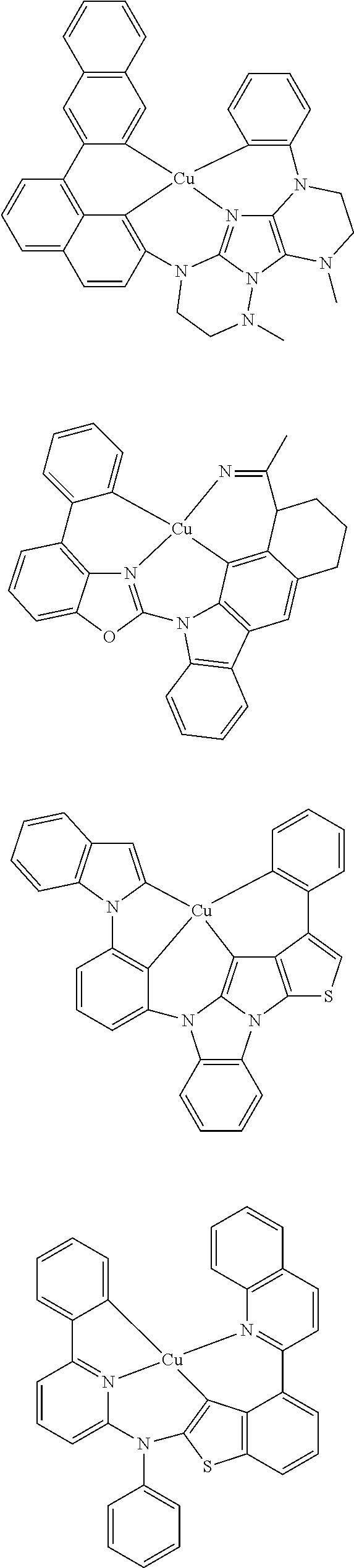
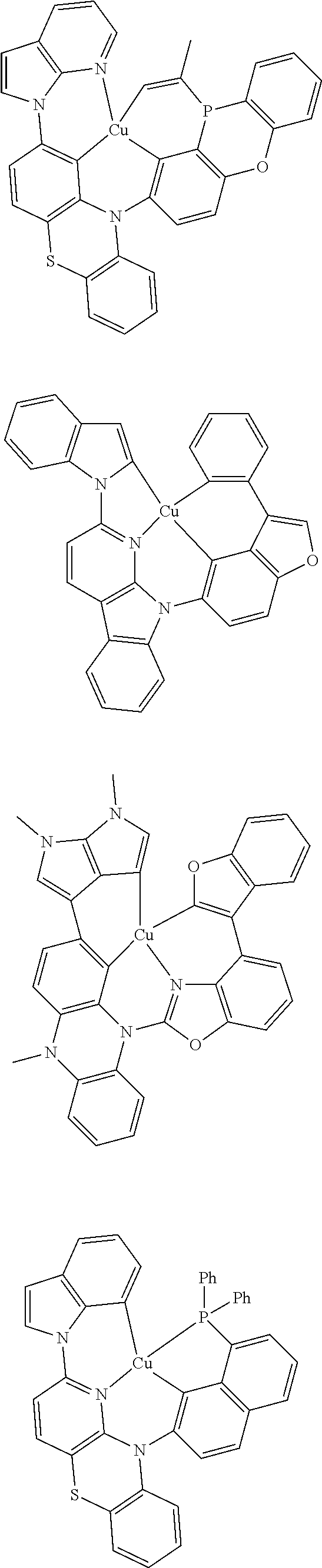
- such an inventive complex can comprise any one or more of the following:
- such an inventive complex can comprise any one or more of the following:
- such an inventive complex can comprise any one or more of the following:
- the inventive complex can comprise a neutral complex having the structure
- M represents a metal having a +2 oxidation state.
- such an inventive complex can comprise any one or more of the following:
- such an inventive complex can comprise any one or more of the following:
- such an inventive complex can comprise any one or more of the following:
- a complex disclosed herein can have the structure:
- a disclosed complex can have the structure:
- a disclosed complex can have the structure:
- a disclosed compound can have the structure:
- a disclosed complex can have the structure:
- the FL group is covalently bonded to the Ar 1 group.
- any one or more of the compounds disclosed herein can be excluded from the present invention.
- inventive complexes described herein can be prepared according to methods such as those provide in the Examples or that one of skill in the art, in possession of this disclosure, could readily discern from this disclosure and from methods known in the art.
- compositions disclosed here can be used as host materials for OLED applications, such as full color displays.
- the organic light emitting diodes with metal-assisted delayed fluorescent emitters can have the potential of harvesting both electrogenerated singlet and triplet excitons and achieving 100% internal quantum efficiency in the device settings.
- the component of delayed fluorescence process will occurred at a higher energy than that of phosphorescence process, which can provide a blue-shifted emission spectrum than those originated exclusively from the lowest triplet excited state of metal complexes.
- the existence of metal ions (especially the heavy metal ions) will facilitate the phosphorescent emission inside of the emitters, ensuring a high emission quantum efficiency.
- the energy of the singlet excited states of metal-assisted delayed fluorescent emitters can be adjusted separately from the lowest triplet excited by ether modifying the energy of donor-accepter ligands or attaching fluorescent emitters which are covalently bonded to metal complexes without having effective conjugation between fluorescent emitters and metal complexes.
- compositions of the present disclosure can be useful in a wide variety of applications, such as, for example, lighting devices.
- one or more of the complexes can be useful as host materials for an organic light emitting display device.
- the compounds of the invention are useful in a variety of applications.
- the compounds can be useful in organic light emitting diodes (OLED)s, luminescent devices and displays, and other light emitting devices.
- OLED organic light emitting diodes
- the energy profile of the compounds can be tuned by varying the structure of the ligand surrounding the metal center. For example, compounds having a ligand with electron withdrawing substituents will generally exhibit different properties, than compounds having a ligand with electron donating substituents. Generally, a chemical structural change affects the electronic structure of the compound, which thereby affects the electrical transport and transfer functions of the material. Thus, the compounds of the present invention can be tailored or tuned to a specific application that desires an energy or transport characteristic.
- inventive compositions can provide improved efficiency and/or operational lifetimes in lighting devices, such as, for example, organic light emitting devices, as compared to conventional materials.
- inventive compositions can be useful as, for example, host materials for organic light emitting diodes, lighting applications, and combinations thereof.
- the compound in the device is selected to have 100% internal quantum efficiency in the device settings.
- the device is an organic light emitting diode. In another aspect, the device is a full color display. In yet another aspect, the device is an organic solid state lighting
- FIG. 1 shows a cross-sectional view of an OLED 100 , which includes substrate 102 with an anode 104 , which is typically a transparent material, such as indium tin oxide, a layer of hole-transporting material(s) (HTL) 106 , a layer of light processing material 108 , such as an emissive material (EML) including an emitter and a host, a layer of electron-transporting material(s) (ETL) 110 , and a metal cathode layer 112 .
- an OLED 100 which includes substrate 102 with an anode 104 , which is typically a transparent material, such as indium tin oxide, a layer of hole-transporting material(s) (HTL) 106 , a layer of light processing material 108 , such as an emissive material (EML) including an emitter and a host, a layer of electron-transporting material(s) (ETL) 110 , and a metal cathode layer 112 .
- a light emitting device such as, for example, an OLED
- any of the one or more layers can comprise indium tin oxide (ITO), poly(3,4-ethylenedioxythiophene) (PEDOT), polystyrene sulfonate (PSS), N,N′-di-1-naphthyl-N,N′-diphenyl-1,1′-biphenyl-4,4′diamine (NPD), 1,1-bis((di-4-tolylamino)phenyl) cyclohexane (TAPC), 2,6-Bis(N-carbazolyl)pyridine (mCpy), 2,8-bis(diphenylphosphoryl)dibenzothiophene (PO15), LiF, Al, or a combination thereof.
- any of the one or more layers can comprise a material not specifically recited herein.
- the layer of light processing material 108 can comprise one or more compounds of the present invention optionally together with a host material.
- the host material can be any suitable host material known in the art.
- the emission color of an OLED is determined by the emission energy (optical energy gap) of the light processing material 108 , which as discussed above can be tuned by tuning the electronic structure of the emitting compounds and/or the host material.
- Both the hole-transporting material in the HTL layer 106 and the electron-transporting material(s) in the ETL layer 110 can comprise any suitable hole-transporter known in the art. A selection of which is well within the purview of those skilled in the art.
- Phosphorescent OLEDs i.e., OLEDs with phosphorescent emitters
- OLEDs with phosphorescent emitters typically have higher device efficiencies than other OLEDs, such as fluorescent OLEDs.
- Light emitting devices based on electrophosphorescent emitters are described in more detail in WO2000/070655 to Baldo et al., which is incorporated herein by this reference for its teaching of OLEDs, and in particular phosphorescent OLEDs.
- the compounds of the invention can be made using a variety of methods, including, but not limited to those recited in the examples provided herein. In other aspects, one of skill in the art, in possession of this disclosure, could readily determine an appropriate method for the preparation of an iridium complex as recited herein.
- a PdN3N complex can be prepared based on the following examples.
- a vessel was charged with 5 mmol 4′-bromo-2-nitrobiphenyl, 12.5 mmol 2-(tributylstannyl)pyridine, 0.25 mmol tetrakistriphenylphosphine palladium(0), 20 mmol potassium fluoride, and 75 mL anhydrous, degassed toluene.
- the vessel was set to reflux under a nitrogen atmosphere for 3 days.
- the resulting solution was cooled, the solids filtered off, and poured into a stirring aqueous solution of potassium fluoride.
- the organic phase was collected, washed once more with aqueous potassium fluoride, and dried of magnesium sulfate.
- the solvent was removed under reduced pressure and the crude product was chromatographed over silica initially with hexane followed by dichloromethane to yield a viscous, colorless oil in 60% yield.
Landscapes
- Chemical & Material Sciences (AREA)
- Organic Chemistry (AREA)
- Engineering & Computer Science (AREA)
- Materials Engineering (AREA)
- Inorganic Chemistry (AREA)
- Physics & Mathematics (AREA)
- Optics & Photonics (AREA)
- Crystallography & Structural Chemistry (AREA)
- Electroluminescent Light Sources (AREA)
Abstract
Description

-
- wherein A is an accepting group comprising one or more of the following structures, which can optionally be substituted

-
- wherein D is a donor group comprising of one or more of the following structures, which can optionally be substituted,


-
- wherein C in structure (a) or (b) comprises one or more of the following structures, which can optionally be substituted


-
- wherein N in structure (a) or (b) comprises one or more of the following structures, which can optionally be substituted

-
- wherein each of a0, a1, and a2 in dependently is present or absent, and if present,

-
- comprises a direct bond and/or linking group comprising one or more of the following, wherein b1 and b2 independently is present or absent, and if present, comprises a linking group comprising one or more of the following

-
- wherein X is B, C, N, O, Si, P, S, Ge, As, Se, Sn, Sb, or Te,
- wherein Y is O, S, S═O, SO2, Se, N, NR3, PR3, RP═O, CR1R2, C═O, SiR1R2, GeR1R2, BH, P(O)H, PH, NH, CR1H, CH2, SiH2, SiHR1, BH, or BR3,
- wherein each of R, R1, R2, and R3 independently is hydrogen, aryl, cycloalkyl, cycloalkenyl, heterocyclyl, heteroaryl, alkyl, alkenyl, alkynyl, deuterium, halogen, hydroxyl, thiol, nitro, cyano, amino, a mono- or di-alkylamino, a mono- or diaryl amino, alkoxy, aryloxy, haloalkyl, aralkyl, ester, nitrile, isonitrile, alkoxycarbonyl, acylamino, alkoxycarbonylamino, aryloxycarbonylamino, sulfonylamino, sulfamoyl, carbamoyl, alkylthio, sulfinyl, ureido, phosphoramide, amercapto, sulfo, carboxyl, hydrazino, substituted silyl, or polymerizable, or any conjugate or combination thereof,
- wherein n is a number that satisfies the valency of Y,
- wherein M is platinum (II), palladium (II), nickel (II), manganese (II), zinc (II), gold (III), silver (III), copper (III), iridium (I), rhodium (I), or cobalt (I).

can have the structure


-
- wherein A is an accepting group comprising one or more of the following structures, which can optionally be substituted

-
- wherein D is a donor group comprising of one or more of the following structures, which can optionally be substituted,


-
- wherein C in structure (a) or (b) comprises one or more of the following structures, which can optionally be substituted


-
- wherein N in structure (a) or (b) comprises one or more of the following structures, which can optionally be substituted

-
- wherein each of a0, a1, and a2 in dependently is present or absent, and if present, comprises a direct bond and/or linking group comprising one or more of the following

-
- wherein b1 and b2 independently is present or absent, and if present, comprises a linking group comprising one or more of the following

-
- wherein X is B, C, N, O, Si, P, S, Ge, As, Se, Sn, Sb, or Te,
- wherein Y is O, S, S═O, SO2, Se, N, NR3, PR3, RP═O, CR1R2, C═O, SiR1R2, GeR1R2, BH, P(O)H, PH, NH, CR1H, CH2, SiH2, SiHR1, BH, or BR3,
- wherein each of R, R1, R2, and R3 independently is hydrogen, aryl, cycloalkyl, cycloalkenyl, heterocyclyl, heteroaryl, alkyl, alkenyl, alkynyl, deuterium, halogen, hydroxyl, thiol, nitro, cyano, amino, a mono- or di-alkylamino, a mono- or diaryl amino, alkoxy, aryloxy, haloalkyl, aralkyl, ester, nitrile, isonitrile, alkoxycarbonyl, acylamino, alkoxycarbonylamino, aryloxycarbonylamino, sulfonylamino, sulfamoyl, carbamoyl, alkylthio, sulfinyl, ureido, phosphoramide, amercapto, sulfo, carboxyl, hydrazino, substituted silyl, or polymerizable, or any conjugate or combination thereof,
- wherein n is a number that satisfies the valency of Y,
- wherein M is platinum (II), palladium (II), nickel (II), manganese (II), zinc (II), gold (III), silver (III), copper (III), iridium (I), rhodium (I), or cobalt (I).

-
- M comprises a metal, wherein X, if present, comprises C, N, P, and/or Si, wherein Y, if present, comprises B, C, N, O, Si, P, S, Ge, As, Se, Sn, Sb, or Te, and wherein R, if present, can optionally represent any substituent group. Furthermore, in all aryl rings depicted, carbon may be optionally substituted in any position(s) to form a heterocyclic aryl ring, and may have atoms, functional groups, and/or fused rings systems substituted for hydrogen along the aryl ring in any available position(s).

in one aspect represents present bonds and in another aspect are absent.

wherein a2 is absent, wherein b2 are absent, wherein D is


or R substituted


wherein M comprises Ir, Rh, Mn, Ni, Ag, Cu, or Ag;
-
- wherein each of R1 and R2 independently are hydrogen, substituted or unsubstituted alkyl, alkenyl, alkynyl, aryl, heteroaryl, cycloalkane, cycloalkane, heterocyclyl, amino, nitro hydroxyl, halogen, thio, alkoxy, haloalkyl, arylalkane, or arylalkene;
- wherein each of Y1a and Y1b independently is O, NR2, CR2R3, S, AsR2, BR2, PR2, P(O)R2, or SiR2R3, or a combination thereof, wherein each of R2 and R3 independently is hydrogen, substituted or unsubstituted alkyl, alkenyl, alkynyl, aryl, heteroaryl, cycloalkane, cycloalkane, heterocyclyl, amino, hydroxyl, halogen, thio, alkoxy, haloalkyl, arylalkane, arylalkene, or R2 and R3 together form C═O, wherein each of R2 and R3 independently is optionally linked to an adjacent ring structure, thereby forming a cyclic structure;
- wherein each of Y2a, Y2b, Y2c and Y2d independently is N, NR6a, or CR6b, wherein each of R6a and R6b independently is hydrogen, substituted or unsubstituted alkyl, alkenyl, alkynyl, aryl, heteroaryl, cycloalkane, cycloalkane, heterocyclyl, amino, hydroxyl, halogen, thio, alkoxy, haloalkyl, arylalkane, or arylalkene;
- each of Y3a, Y3b, Y3c, Y3d, Y4a, Y4b, Y4c and Y4d independently is N, O, S, NR6a, CR6b, wherein each of R6a and R6b independently hydrogen, substituted or unsubstituted alkyl, alkenyl, alkynyl, aryl, heteroaryl, cycloalkane, cycloalkane, heterocyclyl, amino, hydroxyl, halogen, thio, alkoxy, haloalkyl, arylalkane, or arylalkene; or Z(R6c)2, wherein Z is C or Si, and wherein each R6c independently is hydrogen, substituted or unsubstituted alkyl, alkenyl, alkynyl, aryl, heteroaryl, cycloalkane, cycloalkane, heterocyclyl, amino, hydroxyl, halogen, thio, alkoxy, haloalkyl, arylalkane, or arylalkene;
- wherein each of m and n independently are an
integer - wherein each of

-
- independently is partial or full unsaturation of the ring with which it is associated.

-
- wherein M comprises Pt, Pd and Au;
- wherein each of R1 and R2 independently are hydrogen, substituted or unsubstituted alkyl, alkenyl, alkynyl, aryl, heteroaryl, cycloalkane, cycloalkane, heterocyclyl, amino, nitro hydroxyl, halogen, thio, alkoxy, haloalkyl, arylalkane, or arylalkene;
- wherein each of Y1a and Y1b independently is O, NR2, CR2R3, S, AsR2, BR2, PR2, P(O)R2, or SiR2R3, or a combination thereof, wherein each of R2 and R3 independently is hydrogen, substituted or unsubstituted alkyl, alkenyl, alkynyl, aryl, heteroaryl, cycloalkane, cycloalkane, heterocyclyl, amino, hydroxyl, halogen, thio, alkoxy, haloalkyl, arylalkane, arylalkene, or R2 and R3 together form C═O, wherein each of R2 and R3 independently is optionally linked to an adjacent ring structure, thereby forming a cyclic structure;
- wherein each of Y2a, Y2b, Y2c, and Y2d independently is N, NR6a, or CR6b, wherein each of R6a and R6b independently is hydrogen, substituted or unsubstituted alkyl, alkenyl, alkynyl, aryl, heteroaryl, cycloalkane, cycloalkane, heterocyclyl, amino, hydroxyl, halogen, thio, alkoxy, haloalkyl, arylalkane, or arylalkene;
- each of Y3a, Y3b, Y3c, Y3d, Y3e, Y3f, Y4a, Y4b, Y4c and Y4d independently is N, O, S, NR6a, CR6b, wherein each of R6a and R6b independently hydrogen, substituted or unsubstituted alkyl, alkenyl, alkynyl, aryl, heteroaryl, cycloalkane, cycloalkane, heterocyclyl, amino, hydroxyl, halogen, thio, alkoxy, haloalkyl, arylalkane, or arylalkene; or Z(R6c)2, wherein Z is C or Si, and wherein each R6c independently is hydrogen, substituted or unsubstituted alkyl, alkenyl, alkynyl, aryl, heteroaryl, cycloalkane, cycloalkane, heterocyclyl, amino, hydroxyl, halogen, thio, alkoxy, haloalkyl, arylalkane, or arylalkene;
- wherein each of m is an
integer - wherein each of

-
- independently is partial or full unsaturation of the ring with which it is associated.

-
- wherein M comprises Ir, Rh, Pt, Os, Zr, Co, or Ru;
- wherein each of R1 and R2 independently are hydrogen, substituted or unsubstituted alkyl, alkenyl, alkynyl, aryl, heteroaryl, cycloalkane, cycloalkane, heterocyclyl, amino, nitro hydroxyl, halogen, thio, alkoxy, haloalkyl, arylalkane, or arylalkene;
- wherein each of Y1a, Y1b, Y1c and Y1d independently is O, NR2, CR2R3, S, AsR2, BR2, PR2, P(O)R2, or SiR2R3, or a combination thereof, wherein each of R2 and R3 independently is hydrogen, substituted or unsubstituted alkyl, alkenyl, alkynyl, aryl, heteroaryl, cycloalkane, cycloalkane, heterocyclyl, amino, hydroxyl, halogen, thio, alkoxy, haloalkyl, arylalkane, arylalkene, or R2 and R3 together form C═O, wherein each of R2 and R3 independently is optionally linked to an adjacent ring structure, thereby forming a cyclic structure;
- wherein Y1e is O, NR2, CR2R3, S, AsR2, BR2, PR2, P(O)R2, or SiR2R3, or a combination thereof, or nothing, wherein each of R2 and R3 independently is hydrogen, substituted or unsubstituted alkyl, alkenyl, alkynyl, aryl, heteroaryl, cycloalkane, cycloalkane, heterocyclyl, amino, hydroxyl, halogen, thio, alkoxy, haloalkyl, arylalkane, arylalkene, or R2 and R3 together form C═O, wherein each of R2 and R3 independently is optionally linked to an adjacent ring structure, thereby forming a cyclic structure;
- wherein each of Y2a, Y2b, Y2c and Y2d independently is N, NR6a, or CR6b, wherein each of R6a and R6b independently is hydrogen, substituted or unsubstituted alkyl, alkenyl, alkynyl, aryl, heteroaryl, cycloalkane, cycloalkane, heterocyclyl, amino, hydroxyl, halogen, thio, alkoxy, haloalkyl, arylalkane, or arylalkene;
- wherein each of Y3a, Y3b, Y3c, Y3d, Y3e, Y4a, Y4b, Y4c, and Y4d independently is N, O, S, NR6a, CR6b, wherein each of R6a and R6b independently hydrogen, substituted or unsubstituted alkyl, alkenyl, alkynyl, aryl, heteroaryl, cycloalkane, cycloalkane, heterocyclyl, amino, hydroxyl, halogen, thio, alkoxy, haloalkyl, arylalkane, or arylalkene; or Z(R6c)2, wherein Z is C or Si, and wherein each R6c independently is hydrogen, substituted or unsubstituted alkyl, alkenyl, alkynyl, aryl, heteroaryl, cycloalkane, cycloalkane, heterocyclyl, amino, hydroxyl, halogen, thio, alkoxy, haloalkyl, arylalkane, or arylalkene;
- wherein in each of each of Y5a, Y5b, Y5c, Y5d, Y6a, Y6b, Y6c and Y6d independently is N, O, S, NR6a, or CR6b;
- wherein each of m, n, l and p independently are an
integer - wherein each of

-
- independently is partial or full unsaturation of the ring with which it is associated.

wherein M comprises Pd, Ir, Rh, Au, Co, Mn, Ni, Ag, or Cu;
-
- wherein each of Y1a and Y1b independently is O, NR2, CR2R3, S, AsR2, BR2, B(R2)2, PR2, P(O)R2, or SiR2R3, or a combination thereof, wherein each of R2 and R3 independently is hydrogen, substituted or unsubstituted alkyl, alkenyl, alkynyl, aryl, heteroaryl, cycloalkane, cycloalkane, heterocyclyl, amino, hydroxyl, halogen, thio, alkoxy, haloalkyl, arylalkane, arylalkene, or R2 and R3 together form C═O, wherein each of R2 and R3 independently is optionally linked to an adjacent ring structure, thereby forming a cyclic structure;
-
- each of Y3a, Y3b, Y3c, Y3d, Y3e, Y4a, Y4b, Y4c, Y4d, and Y4e independently is N, O, S, NR6a, CR6b, wherein each of R6a and R6b independently hydrogen, substituted or unsubstituted alkyl, alkenyl, alkynyl, aryl, heteroaryl, cycloalkane, cycloalkane, heterocyclyl, amino, hydroxyl, halogen, thio, alkoxy, haloalkyl, arylalkane, or arylalkene; or Z(R6c)2, wherein Z is C or Si, and wherein each R6c independently is hydrogen, substituted or unsubstituted alkyl, alkenyl, alkynyl, aryl, heteroaryl, cycloalkane, cycloalkane, heterocyclyl, amino, hydroxyl, halogen, thio, alkoxy, haloalkyl, arylalkane, or arylalkene;
- wherein each of m is an
integer - wherein each of n is an
integer - wherein each of

-
- independently is partial or full unsaturation of the ring with which it is associated.
- wherein each of Fl1, Fl2, Fl3 and Fl4 independently are fluorescent emitters with tunable singlet excited state energies which are covenantly bonded to selected atoms among Y2a, Y2d, Y2e, Y2f, Y2g, Y2h, Y3c, Y3d, Y3e, Y4c, Y4d, and Y4e.

wherein the M represents a metal having a +1 oxidation state.

wherein the M represents a metal having a +1 oxidation state.

wherein the M represents a metal having a +2 oxidation state.

-
- wherein the M represents a metal having a +3 oxidation state. In another aspect, the inventive complex can comprise a neutral complex having the structure

wherein the M represents a metal having a +3 oxidation state.


In another aspect, the inventive complex can comprise a neutral complex having the structure

wherein the M represents a metal having a +2 oxidation state.








-
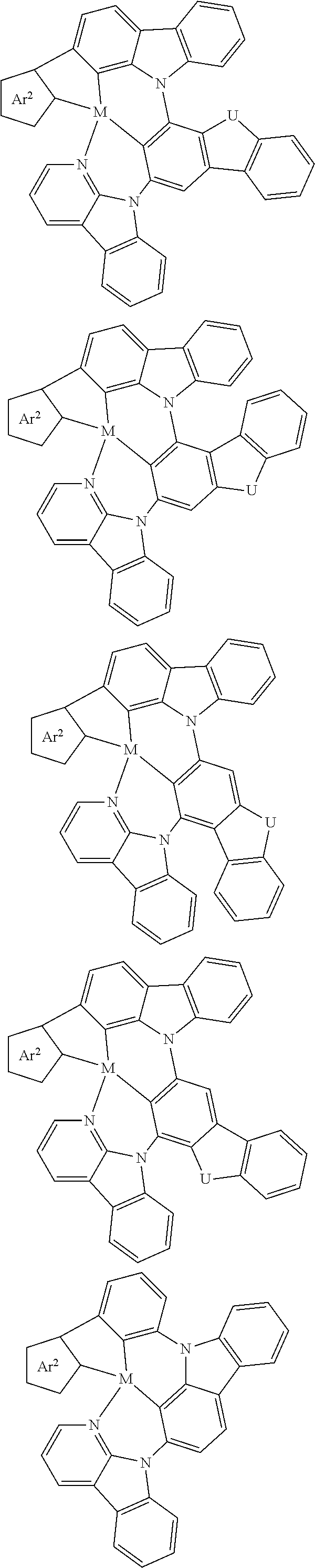
- wherein each A independently is O, S, NR, PR, AsR, CR2, SiR2, or BR,
- wherein each U independently is O S, NR, PR, AsR, CR2, SiR2, or BR,
- wherein M is Pt or Pd, and
- Wherein

-
- is any one of


-
- wherein each A independently is O, S, NR, PR, AsR, CR2, SiR2, or BR,
- wherein each U independently is O S, NR, PR, AsR, CR2, SiR2, or BR,
- wherein M is Mn or Ni, and
- wherein

-
- is any one of


-
- wherein each A independently is O, S, NR, PR, AsR, CR2, SiR2, or BR,
- wherein each U independently is O S, NR, PR, AsR, CR2, SiR2, or BR,
- wherein M is Ir, Rh, or Cu, and
- wherein

-
- is any one of


-
- wherein each A independently is O, S, NR, PR, AsR, CR2, SiR2, or BR,
- wherein each U independently is O S, NR, PR, AsR, CR2, SiR2, or BR,
- wherein M is Au or Ag, and
- wherein

-
- is any one of


-
- A=O, S, NR, PR, AsR, CR2, SiR2, BR, BR2, etc U═O, S, NR, PR, AsR, CR2, SiR2, BR, etc
- X═C, N etc M=Pd, Mn, Ni, Ir, Rh, Cu, Au, Ag


-
- FL groups are convalently bonded to any component of metal complexes including the Ar1 group.
- wherein each A independently is O, S, NR, PR, AsR, CR2, SiR2, BR, or BR2,
- wherein each U independently is O S, NR, PR, AsR, CR2, SiR2, or BR,
- wherein X is C or N,
- wherein M is Pd, Mn, Ni, Ir, Rh, Cu, Au, or Ag,
- wherein FL is any one of

-
- wherein FL is covalently bonded to any component of the complex, for example, the Ar1 group;
- wherein

-
- is any one of


dichloromethane, and rinsed three times with water. The organic fraction was dried with magnesium sulfate and concentrated under reduced pressure and subjected to column chromatography of silica with dichloromethane as the eluent. After concentrating under reduced pressure, 2-(2-pyridyl)-9H-carbazole was isolated in a 60% yield.


Claims (6)


Priority Applications (2)
| Application Number | Priority Date | Filing Date | Title |
|---|---|---|---|
| US17/212,209 US12043633B2 (en) | 2012-10-26 | 2021-03-25 | Metal complexes, methods, and uses thereof |
| US18/753,342 US20240376140A1 (en) | 2012-10-26 | 2024-06-25 | Metal Complexes, Methods, and Uses Thereof |
Applications Claiming Priority (5)
| Application Number | Priority Date | Filing Date | Title |
|---|---|---|---|
| US201261719077P | 2012-10-26 | 2012-10-26 | |
| PCT/US2013/066793 WO2014109814A2 (en) | 2012-10-26 | 2013-10-25 | Metal complexes, methods, and uses thereof |
| US201514437963A | 2015-04-23 | 2015-04-23 | |
| US15/905,385 US10995108B2 (en) | 2012-10-26 | 2018-02-26 | Metal complexes, methods, and uses thereof |
| US17/212,209 US12043633B2 (en) | 2012-10-26 | 2021-03-25 | Metal complexes, methods, and uses thereof |
Related Parent Applications (1)
| Application Number | Title | Priority Date | Filing Date |
|---|---|---|---|
| US15/905,385 Continuation US10995108B2 (en) | 2012-10-26 | 2018-02-26 | Metal complexes, methods, and uses thereof |
Related Child Applications (1)
| Application Number | Title | Priority Date | Filing Date |
|---|---|---|---|
| US18/753,342 Division US20240376140A1 (en) | 2012-10-26 | 2024-06-25 | Metal Complexes, Methods, and Uses Thereof |
Publications (2)
| Publication Number | Publication Date |
|---|---|
| US20210230198A1 US20210230198A1 (en) | 2021-07-29 |
| US12043633B2 true US12043633B2 (en) | 2024-07-23 |
Family
ID=51167489
Family Applications (4)
| Application Number | Title | Priority Date | Filing Date |
|---|---|---|---|
| US14/437,963 Abandoned US20150274762A1 (en) | 2012-10-26 | 2013-10-25 | Metal complexes, methods, and uses thereof |
| US15/905,385 Active US10995108B2 (en) | 2012-10-26 | 2018-02-26 | Metal complexes, methods, and uses thereof |
| US17/212,209 Active 2033-11-23 US12043633B2 (en) | 2012-10-26 | 2021-03-25 | Metal complexes, methods, and uses thereof |
| US18/753,342 Pending US20240376140A1 (en) | 2012-10-26 | 2024-06-25 | Metal Complexes, Methods, and Uses Thereof |
Family Applications Before (2)
| Application Number | Title | Priority Date | Filing Date |
|---|---|---|---|
| US14/437,963 Abandoned US20150274762A1 (en) | 2012-10-26 | 2013-10-25 | Metal complexes, methods, and uses thereof |
| US15/905,385 Active US10995108B2 (en) | 2012-10-26 | 2018-02-26 | Metal complexes, methods, and uses thereof |
Family Applications After (1)
| Application Number | Title | Priority Date | Filing Date |
|---|---|---|---|
| US18/753,342 Pending US20240376140A1 (en) | 2012-10-26 | 2024-06-25 | Metal Complexes, Methods, and Uses Thereof |
Country Status (2)
| Country | Link |
|---|---|
| US (4) | US20150274762A1 (en) |
| WO (1) | WO2014109814A2 (en) |
Families Citing this family (83)
| Publication number | Priority date | Publication date | Assignee | Title |
|---|---|---|---|---|
| CN102449108B (en) | 2009-04-06 | 2015-06-24 | 代表亚利桑那州立大学行事的亚利桑那董事会 | Synthesis of four coordinated platinum complexes and their applications in light emitting devices thereof |
| US9324957B2 (en) | 2010-04-30 | 2016-04-26 | Arizona Board Of Regents On Behalf Of Arizona State University | Synthesis of four coordinated gold complexes and their applications in light emitting devices thereof |
| WO2011137429A2 (en) | 2010-04-30 | 2011-11-03 | Arizona Board Of Regents Acting For And On Behalf Of Arizona State University | Synthesis of four coordinated palladium complexes and their applications in light emitting devices thereof |
| TWI541247B (en) | 2011-02-18 | 2016-07-11 | 美國亞利桑那州立大學董事會 | Four-coordinate platinum and palladium complex with geometrically distortion charge transfer state and its application in illuminating devices |
| WO2012142387A1 (en) | 2011-04-14 | 2012-10-18 | Arizona Board Of Regents Acting For And On Behalf Of Arizona State University | Pyridine-oxyphenyl coordinated iridium (iii) complexes and methods of making and using |
| WO2012162488A1 (en) | 2011-05-26 | 2012-11-29 | Arizona Board Of Regents Acting For And On Behalf Of Arizona State University | Synthesis of platinum and palladium complexes as narrow-band phosphorescent emitters for full color displays |
| US9711741B2 (en) | 2012-08-24 | 2017-07-18 | Arizona Board Of Regents On Behalf Of Arizona State University | Metal compounds and methods and uses thereof |
| KR102124227B1 (en) | 2012-09-24 | 2020-06-17 | 아리조나 보드 오브 리젠츠 온 비하프 오브 아리조나 스테이트 유니버시티 | Metal compounds, methods, and uses thereof |
| WO2014109814A2 (en) | 2012-10-26 | 2014-07-17 | Arizona Board Of Regents Acting For And On Behalf Of Arizona State University | Metal complexes, methods, and uses thereof |
| US9673409B2 (en) | 2013-06-10 | 2017-06-06 | Arizona Board Of Regents On Behalf Of Arizona State University | Phosphorescent tetradentate metal complexes having modified emission spectra |
| JP6804823B2 (en) | 2013-10-14 | 2020-12-23 | アリゾナ・ボード・オブ・リージェンツ・オン・ビハーフ・オブ・アリゾナ・ステイト・ユニバーシティーArizona Board of Regents on behalf of Arizona State University | Platinum complex and device |
| US9224963B2 (en) | 2013-12-09 | 2015-12-29 | Arizona Board Of Regents On Behalf Of Arizona State University | Stable emitters |
| WO2015091716A1 (en) | 2013-12-20 | 2015-06-25 | Basf Se | Highly efficient oled devices with very short decay times |
| US10020455B2 (en) | 2014-01-07 | 2018-07-10 | Arizona Board Of Regents On Behalf Of Arizona State University | Tetradentate platinum and palladium complex emitters containing phenyl-pyrazole and its analogues |
| US10056567B2 (en) | 2014-02-28 | 2018-08-21 | Arizona Board Of Regents On Behalf Of Arizona State University | Chiral metal complexes as emitters for organic polarized electroluminescent devices |
| US9941479B2 (en) | 2014-06-02 | 2018-04-10 | Arizona Board Of Regents On Behalf Of Arizona State University | Tetradentate cyclometalated platinum complexes containing 9,10-dihydroacridine and its analogues |
| CN104211634A (en) * | 2014-07-23 | 2014-12-17 | 常州创索新材料科技有限公司 | Synthetic method of 2-bromocarbazole |
| US9923155B2 (en) | 2014-07-24 | 2018-03-20 | Arizona Board Of Regents On Behalf Of Arizona State University | Tetradentate platinum (II) complexes cyclometalated with functionalized phenyl carbene ligands and their analogues |
| US9502671B2 (en) | 2014-07-28 | 2016-11-22 | Arizona Board Of Regents On Behalf Of Arizona State University | Tridentate cyclometalated metal complexes with six-membered coordination rings |
| US9818959B2 (en) | 2014-07-29 | 2017-11-14 | Arizona Board of Regents on behlaf of Arizona State University | Metal-assisted delayed fluorescent emitters containing tridentate ligands |
| US10793546B2 (en) | 2014-08-15 | 2020-10-06 | Arizona Board Of Regents On Behalf Of Arizona State University | Non-platinum metal complexes for excimer based single dopant white organic light emitting diodes |
| US9920242B2 (en) | 2014-08-22 | 2018-03-20 | Arizona Board Of Regents On Behalf Of Arizona State University | Metal-assisted delayed fluorescent materials as co-host materials for fluorescent OLEDs |
| US11329244B2 (en) | 2014-08-22 | 2022-05-10 | Arizona Board Of Regents On Behalf Of Arizona State University | Organic light-emitting diodes with fluorescent and phosphorescent emitters |
| KR102353647B1 (en) | 2014-08-29 | 2022-01-20 | 가부시키가이샤 한도오따이 에네루기 켄큐쇼 | Light-emitting element, display device, electronic device, and lighting device |
| US9865825B2 (en) | 2014-11-10 | 2018-01-09 | Arizona Board Of Regents On Behalf Of Arizona State University | Emitters based on octahedral metal complexes |
| US10033003B2 (en) | 2014-11-10 | 2018-07-24 | Arizona Board Of Regents On Behalf Of Arizona State University | Tetradentate metal complexes with carbon group bridging ligands |
| WO2016088354A1 (en) * | 2014-12-05 | 2016-06-09 | 出光興産株式会社 | Metal complex compound, material for organic electroluminescent element, composition, organic electroluminescent element, and electronic device |
| US9711739B2 (en) | 2015-06-02 | 2017-07-18 | Arizona Board Of Regents On Behalf Of Arizona State University | Tetradentate metal complexes containing indoloacridine and its analogues |
| US9879039B2 (en) | 2015-06-03 | 2018-01-30 | Arizona Board Of Regents On Behalf Of Arizona State University | Tetradentate and octahedral metal complexes containing naphthyridinocarbazole and its analogues |
| US20180182980A1 (en) | 2015-06-03 | 2018-06-28 | Udc Ireland Limited | Highly efficient oled devices with very short decay times |
| US11930662B2 (en) | 2015-06-04 | 2024-03-12 | Arizona Board Of Regents On Behalf Of Arizona State University | Transparent electroluminescent devices with controlled one-side emissive displays |
| US10158091B2 (en) | 2015-08-04 | 2018-12-18 | Arizona Board Of Regents On Behalf Of Arizona State University | Tetradentate platinum (II) and palladium (II) complexes, devices, and uses thereof |
| CN105061296B (en) * | 2015-08-10 | 2018-02-06 | 张家港江苏科技大学产业技术研究院 | A kind of preparation method of 2 substituted carbazole class compound |
| EP3133078B1 (en) * | 2015-08-18 | 2019-01-30 | Samsung Electronics Co., Ltd. | Organometallic compound and organic light-emitting device including the same |
| US10211411B2 (en) | 2015-08-25 | 2019-02-19 | Arizona Board Of Regents On Behalf Of Arizona State University | Thermally activated delayed fluorescent material based on 9,10-dihydro-9,9-dimethylacridine analogues for prolonging device longevity |
| JP6808329B2 (en) * | 2016-02-25 | 2021-01-06 | 株式会社ジャパンディスプレイ | Materials for organic electroluminescence display devices and organic electroluminescence display devices |
| US10236456B2 (en) * | 2016-04-11 | 2019-03-19 | Universal Display Corporation | Organic electroluminescent materials and devices |
| US11335865B2 (en) | 2016-04-15 | 2022-05-17 | Arizona Board Of Regents On Behalf Of Arizona State University | OLED with multi-emissive material layer |
| US10177323B2 (en) | 2016-08-22 | 2019-01-08 | Arizona Board Of Regents On Behalf Of Arizona State University | Tetradentate platinum (II) and palladium (II) complexes and octahedral iridium complexes employing azepine functional groups and their analogues |
| KR102888327B1 (en) | 2016-10-12 | 2025-11-18 | 아리조나 보드 오브 리젠츠 온 비하프 오브 아리조나 스테이트 유니버시티 | Narrow band red phosphorescent tetradentate platinum (ii) complexes |
| US11183670B2 (en) | 2016-12-16 | 2021-11-23 | Arizona Board Of Regents On Behalf Of Arizona State University | Organic light emitting diode with split emissive layer |
| CN106803543A (en) * | 2017-01-20 | 2017-06-06 | 瑞声科技(南京)有限公司 | Organic light emitting display |
| US11708385B2 (en) | 2017-01-27 | 2023-07-25 | Arizona Board Of Regents On Behalf Of Arizona State University | Metal-assisted delayed fluorescent emitters employing pyrido-pyrrolo-acridine and analogues |
| KR102250191B1 (en) | 2017-03-06 | 2021-05-10 | 삼성전자주식회사 | Light emitting device |
| CN106972109B (en) * | 2017-04-21 | 2018-10-12 | 瑞声科技(南京)有限公司 | A kind of luminescent device |
| KR102429875B1 (en) | 2017-04-21 | 2022-08-05 | 삼성전자주식회사 | Organometallic compound and organic light emitting device including the same |
| KR102496480B1 (en) | 2017-04-25 | 2023-02-06 | 삼성전자주식회사 | Organometallic compound, organic light emitting device including the same and a composition including the same |
| US10392387B2 (en) | 2017-05-19 | 2019-08-27 | Arizona Board Of Regents On Behalf Of Arizona State University | Substituted benzo[4,5]imidazo[1,2-a]phenanthro[9,10-c][1,8]naphthyridines, benzo[4,5]imidazo[1,2-a]phenanthro[9,10-c][1,5]naphthyridines and dibenzo[f,h]benzo[4,5]imidazo[2,1-a]pyrazino[2,3-c]isoquinolines as thermally assisted delayed fluorescent materials |
| US10615349B2 (en) | 2017-05-19 | 2020-04-07 | Arizona Board Of Regents On Behalf Of Arizona State University | Donor-acceptor type thermally activated delayed fluorescent materials based on imidazo[1,2-F]phenanthridine and analogues |
| US11101435B2 (en) | 2017-05-19 | 2021-08-24 | Arizona Board Of Regents On Behalf Of Arizona State University | Tetradentate platinum and palladium complexes based on biscarbazole and analogues |
| US10516117B2 (en) | 2017-05-19 | 2019-12-24 | Arizona Board Of Regents On Behalf Of Arizona State University | Metal-assisted delayed fluorescent emttters employing benzo-imidazo-phenanthridine and analogues |
| KR102461719B1 (en) | 2017-05-23 | 2022-11-01 | 삼성전자주식회사 | Organometallic compound, organic light emitting device including the same and a composition for diagnosing including the same |
| KR102474204B1 (en) | 2017-07-21 | 2022-12-06 | 삼성디스플레이 주식회사 | Organometallic compound and organic light-emitting device including the same |
| US11647643B2 (en) | 2017-10-17 | 2023-05-09 | Arizona Board Of Regents On Behalf Of Arizona State University | Hole-blocking materials for organic light emitting diodes |
| CN111527615B (en) | 2017-10-17 | 2023-10-17 | 李健 | Phosphorescent excimers with preferred molecular orientation as monochromatic emitters for display and lighting applications |
| KR102637104B1 (en) * | 2017-11-08 | 2024-02-15 | 삼성전자주식회사 | Organometallic compound, organic light emitting device including the same and a composition for diagnosing including the same |
| US12037348B2 (en) | 2018-03-09 | 2024-07-16 | Arizona Board Of Regents On Behalf Of Arizona State University | Blue and narrow band green and red emitting metal complexes |
| US12091429B2 (en) | 2018-07-16 | 2024-09-17 | Arizona Board Of Regents On Behalf Of Arizona State University | Fluorinated porphyrin derivatives for optoelectronic applications |
| TWI826522B (en) | 2018-09-12 | 2023-12-21 | 德商麥克專利有限公司 | Electroluminescent devices |
| TW202030902A (en) | 2018-09-12 | 2020-08-16 | 德商麥克專利有限公司 | Electroluminescent devices |
| US12116378B2 (en) | 2018-12-04 | 2024-10-15 | The University Of Hong Kong | Transition metal luminescent complexes and methods of use |
| US11878988B2 (en) | 2019-01-24 | 2024-01-23 | Arizona Board Of Regents On Behalf Of Arizona State University | Blue phosphorescent emitters employing functionalized imidazophenthridine and analogues |
| US11594691B2 (en) | 2019-01-25 | 2023-02-28 | Arizona Board Of Regents On Behalf Of Arizona State University | Light outcoupling efficiency of phosphorescent OLEDs by mixing horizontally aligned fluorescent emitters |
| US20220127286A1 (en) | 2019-03-04 | 2022-04-28 | Merck Patent Gmbh | Ligands for nano-sized materials |
| CN111755612B (en) * | 2019-03-29 | 2025-03-18 | 三星电子株式会社 | Organic light-emitting devices |
| KR102702898B1 (en) | 2019-05-21 | 2024-09-04 | 삼성디스플레이 주식회사 | Display device and method for manufacturing the same |
| KR102789790B1 (en) | 2019-07-02 | 2025-04-02 | 삼성디스플레이 주식회사 | Organometallic compound and organic light emitting device comprising the same |
| CN114302878A (en) | 2019-07-03 | 2022-04-08 | 大日本住友制药肿瘤公司 | Tyrosine kinase non-receptor 1(TNK1) inhibitors and uses thereof |
| KR102843326B1 (en) * | 2019-08-09 | 2025-08-05 | 삼성전자주식회사 | Organometallic compound, organic light emitting device including the same and a composition for diagnosing including the same |
| US11785838B2 (en) | 2019-10-02 | 2023-10-10 | Arizona Board Of Regents On Behalf Of Arizona State University | Green and red organic light-emitting diodes employing excimer emitters |
| CN115052865A (en) | 2020-01-29 | 2022-09-13 | 默克专利有限公司 | Benzimidazole Derivatives |
| US12168661B2 (en) | 2020-02-21 | 2024-12-17 | Arizona Board Of Regents On Behalf Of Arizona State University | Functional materials based on stable chemical structure |
| CN111205273A (en) * | 2020-03-02 | 2020-05-29 | 南京工业大学 | Bivalent platinum complex and preparation method and application thereof |
| US11945985B2 (en) | 2020-05-19 | 2024-04-02 | Arizona Board Of Regents On Behalf Of Arizona State University | Metal assisted delayed fluorescent emitters for organic light-emitting diodes |
| CN113683625B (en) | 2020-05-19 | 2025-06-10 | 亚利桑那州立大学董事会 | Metal-assisted delayed fluorescence emitters for organic light emitting diodes |
| US12035613B2 (en) * | 2020-05-26 | 2024-07-09 | Universal Display Corporation | Organic electroluminescent materials and devices |
| US12419188B2 (en) * | 2020-06-30 | 2025-09-16 | Universal Display Corporation | Organic electroluminescent materials and devices |
| US12545678B2 (en) | 2020-09-09 | 2026-02-10 | Arizona Board Of Regents On Behalf Of Arizon State University | Blue thermally activated delayed fluorescent emitters and hosts based on functionalized imidazolyl groups |
| US12575316B2 (en) * | 2021-02-03 | 2026-03-10 | Universal Display Corporation | Organic electroluminescent materials and devices |
| CN117730084B (en) | 2021-05-31 | 2026-03-17 | 港大科桥有限公司 | Dual-core platinum(II) red emitters for OLED applications |
| KR20240015663A (en) * | 2021-05-31 | 2024-02-05 | 벌시테크 리미티드 | Thermally activated delayed fluorescence palladium(II) complexes for OLED applications |
| CN114805446B (en) * | 2022-04-09 | 2023-08-15 | 浙江工业大学 | Metal platinum (II) and palladium (II) complexes, organic light-emitting devices and display or lighting devices |
| US20240247017A1 (en) * | 2022-12-14 | 2024-07-25 | Universal Display Corporation | Organic electroluminescent materials and devices |
Citations (305)
| Publication number | Priority date | Publication date | Assignee | Title |
|---|---|---|---|---|
| JPS564505U (en) | 1979-06-21 | 1981-01-16 | ||
| US4769292A (en) | 1987-03-02 | 1988-09-06 | Eastman Kodak Company | Electroluminescent device with modified thin film luminescent zone |
| US5451674A (en) | 1989-11-08 | 1995-09-19 | British Technology Limited | Transition metal azatetrabenzoporphyrins useful as gas sensors |
| US5641878A (en) | 1991-05-15 | 1997-06-24 | Diatron Corporation | Porphyrin, azaporphyrin, and related fluorescent dyes free of aggregation and serum binding |
| US5707745A (en) | 1994-12-13 | 1998-01-13 | The Trustees Of Princeton University | Multicolor organic light emitting devices |
| US5844363A (en) | 1997-01-23 | 1998-12-01 | The Trustees Of Princeton Univ. | Vacuum deposited, non-polymeric flexible organic light emitting devices |
| WO2000070655A2 (en) | 1999-05-13 | 2000-11-23 | The Trustees Of Princeton University | Very high efficiency organic light emitting devices based on electrophosphorescence |
| US6200695B1 (en) | 1998-06-26 | 2001-03-13 | Tdk Corporation | Organic electroluminescent device |
| US20010019782A1 (en) | 1999-12-27 | 2001-09-06 | Tatsuya Igarashi | Light-emitting material comprising orthometalated iridium complex, light-emitting device, high efficiency red light-emitting device, and novel iridium complex |
| US6303238B1 (en) | 1997-12-01 | 2001-10-16 | The Trustees Of Princeton University | OLEDs doped with phosphorescent compounds |
| JP2002010505A (en) | 2000-06-16 | 2002-01-11 | Fuji Electric Co Ltd | Charge control device |
| JP2002105055A (en) | 2000-09-29 | 2002-04-10 | Fuji Photo Film Co Ltd | Method for manufacturing indium complex or its tautomer |
| US20020068190A1 (en) | 2000-09-26 | 2002-06-06 | Akira Tsuboyama | Luminescence device and metal coordination compound therefor |
| US20030062519A1 (en) | 2001-10-01 | 2003-04-03 | Semiconductor Energy Laboratory Co., Ltd. | Light emitting device, electronic equipment, and organic polarizing film |
| US20030180574A1 (en) | 2002-02-22 | 2003-09-25 | Wen-Yao Huang | Efficient organic electroluminescent devices with red fluorescent dopants |
| US20030186077A1 (en) | 2001-12-31 | 2003-10-02 | Chen Jian P. | Bis- and tris- (di) benzocarbazole-based materials as hole transport materials for organic light emitting devices |
| JP2003342284A (en) | 2002-05-30 | 2003-12-03 | Canon Inc | Metal coordination compound, light emitting element and display device |
| WO2004003108A1 (en) | 2002-07-01 | 2004-01-08 | The University Of Hull | Luminescent compositions |
| WO2004070655A2 (en) | 2003-02-04 | 2004-08-19 | Vanderbilt University | Apparatus and methods of determining marker orientation in fiducial registration |
| WO2004085450A2 (en) | 2003-03-24 | 2004-10-07 | The University Of Southern California | Phenyl-pyrazole complexes of ir |
| US20040230061A1 (en) | 2003-05-16 | 2004-11-18 | Semiconductor Energy Laboratory Co., Ltd. | Organometallic complex and light-emitting element containing the same |
| WO2004108857A1 (en) | 2003-06-02 | 2004-12-16 | Fuji Photo Film Co., Ltd. | Organic electroluminescent devices and metal complex compounds |
| JP2005031073A (en) | 2003-07-11 | 2005-02-03 | Samsung Electronics Co Ltd | GPS correlation peak signal search method and system therefor. |
| US20050037232A1 (en) | 2003-08-14 | 2005-02-17 | Eastman Kodak Company | Microcavity oled device |
| WO2005042444A2 (en) | 2003-11-04 | 2005-05-12 | Takasago Perfumery Co Ltd | Platinum complex and luminescent element |
| WO2005042550A1 (en) | 2003-10-30 | 2005-05-12 | Merck Patent Gmbh | Metal complexes with bipodal ligands |
| US20050139810A1 (en) | 2003-12-04 | 2005-06-30 | Olaf Kuehl | Method of doping organic semiconductors with quinone derivatives and 1, 3, 2 - dioxaborine derivatives |
| US20050170207A1 (en) | 2004-02-03 | 2005-08-04 | Bin Ma | OLEDs utilizing multidentate ligand systems |
| JP2005267557A (en) | 2004-03-22 | 2005-09-29 | Ntt Docomo Inc | Server device |
| CN1680366A (en) | 2005-01-12 | 2005-10-12 | 武汉大学 | A kind of bidentate ligand and its iridium complex and electrophosphorescent device of iridium complex |
| JP2005310733A (en) | 2003-06-02 | 2005-11-04 | Fuji Photo Film Co Ltd | Organic electroluminescent device and complex compound |
| US20050260446A1 (en) | 2004-05-18 | 2005-11-24 | Mackenzie Peter B | Cationic metal-carbene complexes |
| WO2005113704A2 (en) | 2004-05-18 | 2005-12-01 | The University Of Southern California | Luminescent compounds with carbene ligands |
| EP1617493A2 (en) | 2004-07-08 | 2006-01-18 | Junji Kido | Organic devices, organic electroluminescent devices and organic solar cells |
| US20060024522A1 (en) | 2004-05-18 | 2006-02-02 | Thompson Mark E | Luminescent compounds with carbene ligands |
| KR20060011537A (en) | 2004-07-30 | 2006-02-03 | 주식회사 하이닉스반도체 | Device Separation Method of Semiconductor Devices |
| US20060032528A1 (en) | 2004-08-10 | 2006-02-16 | Ying Wang | Spatially-doped charge transport layers |
| JP2006047240A (en) | 2004-08-09 | 2006-02-16 | National Institute Of Advanced Industrial & Technology | Identification method of oligosaccharide |
| KR20060015371A (en) | 2004-08-14 | 2006-02-17 | 윤희찬 | Hybrid one-chip data recognition device |
| US7002013B1 (en) | 2004-09-23 | 2006-02-21 | National Tsing Hua University | Pt complexes as phosphorescent emitters in the fabrication of organic light emitting diodes |
| WO2006033440A1 (en) | 2004-09-22 | 2006-03-30 | Fujifilm Corporation | Organic electroluminescent device |
| US20060066228A1 (en) | 2004-09-28 | 2006-03-30 | Homer Antoniadis | Reducing or eliminating color change for microcavity OLED devices |
| US20060073359A1 (en) | 2004-09-27 | 2006-04-06 | Fuji Photo Film Co., Ltd. | Light-emitting device |
| US7037599B2 (en) | 2003-02-28 | 2006-05-02 | Eastman Kodak Company | Organic light emitting diodes for production of polarized light |
| US20060094875A1 (en) | 2002-11-01 | 2006-05-04 | Hisanori Itoh | Platinum complexes |
| CN1777663A (en) | 2003-06-02 | 2006-05-24 | 富士胶片株式会社 | Organic electroluminescent devices and metal complex compounds |
| US20060127696A1 (en) | 2002-08-24 | 2006-06-15 | Covion Organic Semiconductors Gmbh | Rhodium and iridium complexes |
| US7064228B1 (en) | 2005-09-21 | 2006-06-20 | Au Optronics Corp. | Spiro silane compound and organic electroluminescent device using the same |
| WO2006067074A1 (en) | 2004-12-23 | 2006-06-29 | Ciba Specialty Chemicals Holding Inc. | Electroluminescent metal complexes with nucleophilic carbene ligands |
| WO2006081780A1 (en) | 2005-02-04 | 2006-08-10 | Novaled Ag | Dopants for organic semiconductors |
| JP2006232784A (en) | 2005-02-28 | 2006-09-07 | Takasago Internatl Corp | Platinum complex and light emitting device |
| JP2006242080A (en) | 2005-03-02 | 2006-09-14 | Denso Corp | Abnormality diagnostic device for exhaust gas recirculating device |
| JP2006242081A (en) | 2005-03-02 | 2006-09-14 | Fuji Heavy Ind Ltd | Electronically controlled throttle device |
| US20060210831A1 (en) | 2005-03-16 | 2006-09-21 | Fuji Photo Film Co., Ltd | Organic electroluminescent element |
| WO2006098505A1 (en) | 2005-03-16 | 2006-09-21 | Fujifilm Corporation | Platinum complex compound and organic electroluminescent device |
| JP2006256999A (en) | 2005-03-16 | 2006-09-28 | Fuji Photo Film Co Ltd | Organic electroluminescence device |
| JP2006290988A (en) | 2005-04-08 | 2006-10-26 | Takasago Internatl Corp | Good solubility iridium complex and organic EL device |
| WO2006113106A1 (en) | 2005-04-13 | 2006-10-26 | Universal Display Corporation | Hybrid oled having phosphorescent and fluorescent emitters |
| WO2006115301A1 (en) | 2005-04-25 | 2006-11-02 | Fujifilm Corporation | Organic electroluminescent device |
| WO2006115299A1 (en) | 2005-04-25 | 2006-11-02 | Fujifilm Corporation | Organic electroluminescent device |
| US20060255721A1 (en) | 2005-04-25 | 2006-11-16 | Fuji Photo Film Co., Ltd. | Organic electroluminescent device |
| JP2006313796A (en) | 2005-05-06 | 2006-11-16 | Fuji Photo Film Co Ltd | Organic electroluminescence device |
| JP2006332622A (en) | 2005-04-25 | 2006-12-07 | Fujifilm Holdings Corp | Organic electroluminescence device |
| US20060286406A1 (en) | 2005-04-25 | 2006-12-21 | Fuji Photo Film Co., Ltd. | Organic electroluminescent device |
| JP2006351638A (en) | 2005-06-13 | 2006-12-28 | Fujifilm Holdings Corp | Light emitting element |
| CN1894267A (en) | 2003-12-16 | 2007-01-10 | 巴塞尔聚烯烃股份有限公司 | Monocyclopentadienyl complexes |
| JP2007019462A (en) | 2005-03-16 | 2007-01-25 | Fujifilm Corp | Organic electroluminescence device |
| JP2007031678A (en) | 2005-07-29 | 2007-02-08 | Showa Denko Kk | Polymer light emitting material and organic electroluminescence device using the polymer light emitting material |
| JP2007042875A (en) | 2005-08-03 | 2007-02-15 | Fujifilm Holdings Corp | Organic electroluminescence device |
| JP2007053132A (en) | 2005-08-15 | 2007-03-01 | Fujifilm Corp | Organic electroluminescence device |
| JP2007051243A (en) | 2005-08-19 | 2007-03-01 | Konica Minolta Holdings Inc | ORGANIC ELECTROLUMINESCENT ELEMENT MATERIAL, ORGANIC ELECTROLUMINESCENT ELEMENT, DISPLAY DEVICE AND LIGHTING DEVICE |
| JP2007066581A (en) | 2005-08-29 | 2007-03-15 | Fujifilm Holdings Corp | Organic electroluminescence device |
| US20070059551A1 (en) | 2005-09-14 | 2007-03-15 | Fuji Photo Film Co., Ltd. | Composition for organic electroluminescent element, method for manufacturing organic electroluminescent element, and organic electroluminescent element |
| US20070057630A1 (en) | 2005-09-15 | 2007-03-15 | Fuji Photo Film Co., Ltd. | Organic electroluminescent element |
| JP2007073900A (en) | 2005-09-09 | 2007-03-22 | Fujifilm Corp | Organic electroluminescence device |
| JP2007073845A (en) | 2005-09-08 | 2007-03-22 | Fujifilm Holdings Corp | Organic laser oscillator |
| JP2007073620A (en) | 2005-09-05 | 2007-03-22 | Fujifilm Corp | Organic electroluminescence device |
| JP2007080593A (en) | 2005-09-12 | 2007-03-29 | Fujifilm Corp | Electrochemiluminescence device |
| JP2007080677A (en) | 2005-09-14 | 2007-03-29 | Fujifilm Corp | Organic electroluminescent device and manufacturing method thereof |
| WO2007034985A1 (en) | 2005-09-21 | 2007-03-29 | Fujifilm Corporation | Organic electroluminescent device |
| JP2007088105A (en) | 2005-09-20 | 2007-04-05 | Fujifilm Corp | Organic electroluminescence device |
| JP2007096259A (en) | 2005-04-25 | 2007-04-12 | Fujifilm Corp | Organic electroluminescence device |
| JP2007099765A (en) | 2005-09-09 | 2007-04-19 | Sumitomo Chemical Co Ltd | Metal complex, light emitting material and light emitting device |
| JP2007110102A (en) | 2005-09-15 | 2007-04-26 | Fujifilm Corp | Organic electroluminescence device |
| WO2007069498A1 (en) | 2005-12-14 | 2007-06-21 | Sumitomo Seika Chemicals Co., Ltd. | Compound for electroluminescent device and method for producing same |
| US20070160905A1 (en) | 2006-01-11 | 2007-07-12 | Idemitsu Kosan Co., Ltd. | Novel imide derivative, material for organic electroluminescent device and organic electroluminescent device using the same |
| US7268485B2 (en) | 2003-10-07 | 2007-09-11 | Eastman Kodak Company | White-emitting microcavity OLED device |
| JP2007258550A (en) | 2006-03-24 | 2007-10-04 | Fujifilm Corp | Organic electroluminescence device |
| US7279704B2 (en) | 2004-05-18 | 2007-10-09 | The University Of Southern California | Complexes with tridentate ligands |
| US20070252140A1 (en) | 2006-03-21 | 2007-11-01 | Michael Limmert | Heterocyclic Radical or Diradical, the Dimers, Oligomers, Polymers, Dispiro Compounds and Polycycles Thereof, the Use Thereof, Organic Semiconductive Material and Electronic or Optoelectronic Component |
| JP2007324309A (en) | 2006-05-31 | 2007-12-13 | Fujifilm Corp | Organic electroluminescence device |
| JP2008010353A (en) | 2006-06-30 | 2008-01-17 | Seiko Epson Corp | Mask manufacturing method, wiring pattern manufacturing method, and plasma display manufacturing method |
| US20080036373A1 (en) | 2006-08-10 | 2008-02-14 | Takasago International Corporation | Platinum complex and light-emitting device |
| US20080054799A1 (en) | 2006-09-06 | 2008-03-06 | Fujifilm Corporation | Organic electroluminescent element and device |
| US20080079358A1 (en) | 2006-09-29 | 2008-04-03 | Fujifilm Corporation | Organic electroluminescent element |
| JP2008103535A (en) | 2006-10-19 | 2008-05-01 | Takasago Internatl Corp | Light emitting element |
| US20080102310A1 (en) | 2006-10-27 | 2008-05-01 | Thompson Mark E | Materials and architectures for efficient harvesting of singlet and triplet excitons for white light emitting OLEDs |
| JP2008109103A (en) | 2006-09-27 | 2008-05-08 | Fujifilm Corp | Organic electroluminescence device |
| JP2008108617A (en) | 2006-10-26 | 2008-05-08 | Fujifilm Corp | Organic electroluminescence device |
| US20080111476A1 (en) | 2006-11-09 | 2008-05-15 | Kyung-Hoon Choi | Organic light emitting diode including organic layer comprising organic metal complex |
| JP2008117545A (en) | 2006-11-01 | 2008-05-22 | Nix Inc | Liquid transmission / reception joint device and fuel cell system including the same |
| JP2008116343A (en) | 2006-11-06 | 2008-05-22 | Sendai Nikon:Kk | Absolute encoder |
| WO2008066192A1 (en) | 2006-11-27 | 2008-06-05 | Fujifilm Corporation | Organic electroluminescent device |
| WO2008066196A1 (en) | 2006-11-27 | 2008-06-05 | Fujifilm Corporation | Organic electroluminescent device and indole derivative |
| WO2008066195A1 (en) | 2006-11-27 | 2008-06-05 | Fujifilm Corporation | Organic electroluminescent device and indole derivative |
| JP2008198801A (en) | 2007-02-13 | 2008-08-28 | Fujifilm Corp | Organic light emitting device |
| WO2008101842A1 (en) | 2007-02-23 | 2008-08-28 | Basf Se | Electroluminescent metal complexes with benzotriazoles |
| EP1968131A1 (en) | 2005-12-27 | 2008-09-10 | Idemitsu Kosan Co., Ltd. | Material for organic electroluminescent device and organic electroluminescent device |
| WO2008117889A1 (en) | 2007-03-28 | 2008-10-02 | Fujifilm Corporation | Organic electroluminescent device |
| US20080241589A1 (en) | 2007-03-26 | 2008-10-02 | Fujifilm Corporation | Organic electroluminescent device |
| US20080241518A1 (en) | 2007-03-26 | 2008-10-02 | Tasuku Satou | Organic electroluminescence element |
| WO2008123540A2 (en) | 2007-03-30 | 2008-10-16 | Fujifilm Corporation | Organic electroluminescent device |
| US20080269491A1 (en) | 2007-02-13 | 2008-10-30 | Arizona Board Of Regents For And On Behalf Of Arizona State University | Organometallic Materials for Optical Emission, Optical Absorption, and Devices Including Organometallic Materials |
| WO2008131932A1 (en) | 2007-04-25 | 2008-11-06 | Lonza Ag | Process for the preparation of optically active ethenylphenyl alcohols |
| JP2008270729A (en) | 2007-03-26 | 2008-11-06 | Fujifilm Corp | Organic electroluminescence device |
| US20080315187A1 (en) | 2006-12-01 | 2008-12-25 | Bazan Guillermo C | Enhancing performance characteristics of organic semiconducting films by improved solution processing |
| JP2008310220A (en) | 2007-06-18 | 2008-12-25 | Ricoh Co Ltd | Image forming apparatus |
| WO2009003455A1 (en) | 2007-07-04 | 2009-01-08 | Novaled Ag | Quinoid compounds and the use thereof in semiconducting matrix materials, electronic and optoelectronic components |
| WO2009008277A1 (en) | 2007-07-11 | 2009-01-15 | Idemitsu Kosan Co., Ltd. | Material for organic electroluminescent element, and organic electroluminescent element |
| WO2009011327A1 (en) | 2007-07-18 | 2009-01-22 | Idemitsu Kosan Co., Ltd. | Organic electroluminescent device material and organic electroluminescent device |
| JP2009016579A (en) | 2007-07-04 | 2009-01-22 | Fujifilm Corp | Organic electroluminescence device and manufacturing method |
| JP2009016184A (en) | 2007-07-04 | 2009-01-22 | Fujifilm Corp | Organic electroluminescence device |
| US20090026939A1 (en) | 2007-07-27 | 2009-01-29 | Masaru Kinoshita | Organic electroluminescence element |
| US20090026936A1 (en) | 2007-07-27 | 2009-01-29 | Tasuku Satou | Organic electroluminescence element |
| EP2020694A1 (en) | 2006-04-20 | 2009-02-04 | Idemitsu Kosan Co., Ltd. | Organic light-emitting device |
| US20090032989A1 (en) | 2001-08-15 | 2009-02-05 | 3M Innovative Properties Company | Hardenable self-supporting structures and methods |
| WO2009017211A1 (en) | 2007-07-27 | 2009-02-05 | Fujifilm Corporation | Organic electroluminescent device |
| JP2009032977A (en) | 2007-07-27 | 2009-02-12 | Fujifilm Corp | Organic electroluminescence device |
| WO2009023667A1 (en) | 2007-08-13 | 2009-02-19 | University Of Southern California | Organic photosensitive optoelectronic devices with triplet harvesting |
| EP2036907A1 (en) | 2007-09-14 | 2009-03-18 | FUJIFILM Corporation | Organic electroluminescence device |
| JP2009059997A (en) | 2007-09-03 | 2009-03-19 | Konica Minolta Holdings Inc | Organic electroluminescence element, display device and lighting device |
| US20090079340A1 (en) | 2007-09-25 | 2009-03-26 | Fujifilm Corporation | Organic electroluminescence device |
| JP2009076509A (en) | 2007-09-18 | 2009-04-09 | Fujifilm Corp | Organic electroluminescence device |
| US20090126796A1 (en) | 2005-04-07 | 2009-05-21 | The Regents Of The University Of California | Highly Efficient Polymer Solar Cell by Polymer Self-Organization |
| US20090136779A1 (en) | 2007-11-26 | 2009-05-28 | Chien-Hong Cheng | Conjugated compounds containing hydroindoloacridine structural elements, and their use |
| US20090153045A1 (en) | 2007-12-14 | 2009-06-18 | Fujifilm Corporation | Platinum complex compound and organic electroluminescence device using the same |
| US20090167167A1 (en) | 2006-06-05 | 2009-07-02 | Idemitsu Kosan Co., Ltd. | Organic electroluminescent device and material for organic electroluminescent device |
| WO2009086209A2 (en) | 2007-12-21 | 2009-07-09 | Arizona Board Of Regents For And On Behalf Of Arizona State University | Platinum(ii) di(2-pyrazolyl)benzene chloride analogs and uses |
| US20090205713A1 (en) | 2008-02-19 | 2009-08-20 | New Jersey Institute Of Technology | Carbon Nanotubes As Charge Carriers In Organic and Hybrid Solar Cells |
| EP2096690A2 (en) | 2008-02-28 | 2009-09-02 | FUJIFILM Corporation | Organic electroluminescence device |
| US20090218561A1 (en) | 2008-03-03 | 2009-09-03 | Fujifilm Corporation | Organic electroluminescence element |
| WO2009111299A2 (en) | 2008-02-29 | 2009-09-11 | Arizona Board Of Regents For And On Behalf Of Arizona State University | Tridentate platinum (ii) complexes |
| US20090261721A1 (en) | 2008-04-22 | 2009-10-22 | Fujifilm Corporation | Organic electroluminescence device, novel platinum complex compound and novel compound capable of being a ligand thereof |
| JP2009247171A (en) | 2008-03-31 | 2009-10-22 | Jtekt Corp | Motor control device and electric power steering device |
| US20090267500A1 (en) | 2008-04-24 | 2009-10-29 | Fujifilm Corporation | Organic electroluminescence device |
| JP2009267171A (en) | 2008-04-25 | 2009-11-12 | Fujifilm Corp | Organic electric field light emitting element |
| JP2009266943A (en) | 2008-04-23 | 2009-11-12 | Fujifilm Corp | Organic field light-emitting element |
| JP2009267244A (en) | 2008-04-28 | 2009-11-12 | Fujifilm Corp | Organic electroluminescent element |
| JP2009272339A (en) | 2008-04-30 | 2009-11-19 | Fujifilm Corp | Organic electric field light-emitting element |
| US7635792B1 (en) | 2008-10-14 | 2009-12-22 | General Electric Company | 2,5-linked polyfluorenes for optoelectronic devices |
| US20100000606A1 (en) | 2004-03-26 | 2010-01-07 | Thompson Mark E | Organic photosensitive devices |
| WO2010007098A1 (en) | 2008-07-16 | 2010-01-21 | Solvay Sa | Light-emitting material comprising multinuclear complexes |
| US20100013386A1 (en) | 2006-09-11 | 2010-01-21 | Thompson Mark E | Near infrared emitting organic compounds and organic devices using the same |
| US20100043876A1 (en) | 2008-08-20 | 2010-02-25 | Plextronics, Inc. | Solvent system |
| US20100093119A1 (en) | 2006-12-26 | 2010-04-15 | Katsuya Shimizu | Resin composition for printing plate |
| WO2010056669A1 (en) | 2008-11-11 | 2010-05-20 | Universal Display Corporation | Phosphorescent emitters |
| US20100127246A1 (en) | 2007-04-17 | 2010-05-27 | Konica Minolta Holdings, Inc. | White organic electroluminescent element and lighting device |
| US20100147386A1 (en) | 2008-11-21 | 2010-06-17 | Plextronics, Inc. | Doped interfacial modification layers for stability enhancement for bulk heterojunction organic solar cells |
| JP2010135689A (en) | 2008-12-08 | 2010-06-17 | Fujifilm Corp | White organic electroluminescent element |
| US20100171111A1 (en) | 2009-01-07 | 2010-07-08 | Fujifilm Corporation | Organic electroluminescent device |
| US20100171418A1 (en) | 2009-01-06 | 2010-07-08 | Fujifilm Corporation | Organic electroluminescent device |
| JP2010171205A (en) | 2009-01-22 | 2010-08-05 | Fujifilm Corp | Organic electric field light-emitting element |
| US20100200051A1 (en) | 2007-07-25 | 2010-08-12 | Polymers Crc Ltd. | Solar cell and method for preparation thereof |
| US20100204467A1 (en) | 2007-07-18 | 2010-08-12 | Cis Bio International | Lanthanide (iii) ion complexing compounds, luminescent lanthanide (iii) ion complexes and use thereof as fluorescent labels |
| WO2010093176A2 (en) | 2009-02-13 | 2010-08-19 | Pusan National University Industry-University Cooperation Foundation | Iridium complex and organic light-emitting diodes |
| WO2010105141A2 (en) | 2009-03-12 | 2010-09-16 | Arizona Board Of Regents Acting On Behalf Of Arizona University | Azaporphyrins and applications thereof |
| WO2010118026A2 (en) | 2009-04-06 | 2010-10-14 | Arizona Board Of Regents Acting For And On Behalf Of Arizona State University | Synthesis of four coordinated platinum complexes and their applications in light emitting devices thereof |
| US20100270540A1 (en) | 2007-12-06 | 2010-10-28 | Inktec Co., Ltd. | Iridium Complex Containing Carbazole-Substituted Pyridine and Phenyl Derivatives as Main Ligand and Organic Light-Emitting Diodes Containing the Same |
| US20100288362A1 (en) | 2009-05-13 | 2010-11-18 | Hatwar Tukaram K | Internal connector for organic electronic devices |
| US20100297522A1 (en) | 2007-09-24 | 2010-11-25 | Acal Energy Limited | Redox fuel cell |
| US20100301315A1 (en) | 2009-06-01 | 2010-12-02 | Fujifilm Corporation | Organic electroluminescence element |
| US20100307594A1 (en) | 2009-05-21 | 2010-12-09 | Zhengguo Zhu | Conjugated Polymers and Their Use in Optoelectronic Devices |
| US7854513B2 (en) | 2006-03-03 | 2010-12-21 | Quach Cang V | One-way transparent display systems |
| US20110049496A1 (en) | 2009-08-31 | 2011-03-03 | Fujifilm Corporation | Organic electroluminescence device |
| US20110062858A1 (en) | 2006-07-28 | 2011-03-17 | Novaled Ag | Oxazole Triplet Emitters for OLED Applications |
| JP2011071452A (en) | 2008-11-13 | 2011-04-07 | Fujifilm Corp | Organic electroluminescent element |
| WO2011064335A1 (en) | 2009-11-27 | 2011-06-03 | Cynora Gmbh | Functionalized triplet emitters for electro-luminescent devices |
| US20110132440A1 (en) | 2009-11-06 | 2011-06-09 | Nano-C, Inc. | Fullerene-functionalized particles, methods for making the same and their use in bulk-heterojunction organic photovoltaic devices |
| WO2011070989A1 (en) | 2009-12-08 | 2011-06-16 | Canon Kabushiki Kaisha | Novel iridium complex and organic light-emitting device including the same |
| WO2011089163A1 (en) | 2010-01-20 | 2011-07-28 | Cynora Gmbh | Blue light emitter with singlet harvesting effect for use in oleds and other organic‑electronic devices |
| US20110217544A1 (en) | 2008-08-21 | 2011-09-08 | Innova Dynamics, Inc. | Enhanced surfaces, coatings, and related methods |
| WO2011137429A2 (en) | 2010-04-30 | 2011-11-03 | Arizona Board Of Regents Acting For And On Behalf Of Arizona State University | Synthesis of four coordinated palladium complexes and their applications in light emitting devices thereof |
| WO2011137431A2 (en) | 2010-04-30 | 2011-11-03 | Arizona Board Of Regents For And On Behalf Of Arizona State University | Synthesis of four coordinated gold complexes and their applications in light emitting devices thereof |
| US20120024383A1 (en) | 2009-03-25 | 2012-02-02 | Sumitomo Chemical Company, Limited | Method for coating and method for manufacturing organic electroluminescent element |
| US20120025588A1 (en) | 2009-02-23 | 2012-02-02 | Humbert Todd J | Seat harness pretensioner |
| US20120039323A1 (en) | 2009-04-17 | 2012-02-16 | Panasonic Corporation | Apparatus for management of local ip access in a segmented mobile communication system |
| US8133597B2 (en) | 2005-09-06 | 2012-03-13 | Konica Minolta Holdings, Inc. | Organic electroluminescent device, display and illuminating device |
| JP2012074444A (en) | 2010-09-28 | 2012-04-12 | Konica Minolta Holdings Inc | Material for organic electroluminescent element, organic electroluminescent element, display element, lighting system and metal complex compound |
| JP2012079898A (en) | 2010-09-30 | 2012-04-19 | Fujifilm Corp | Organic electroluminescent element |
| JP2012079895A (en) | 2010-09-30 | 2012-04-19 | Fujifilm Corp | Organic electroluminescent element |
| WO2012074909A1 (en) | 2010-11-29 | 2012-06-07 | Arizona Board Of Regents Acting For And On Behalf Of Arizona State University | Methods for fabricating bulk heterojunctions using solution processing techniques |
| US20120181528A1 (en) | 2009-09-30 | 2012-07-19 | Fujifilm Corporation | Material for organic electroluminescence device, and organic electroluminescence device |
| US20120202997A1 (en) | 2009-10-08 | 2012-08-09 | Merck Patent Gmbh | Materials for organic electroluminescent devices |
| US20120199823A1 (en) | 2009-10-14 | 2012-08-09 | Basf Se | Dinuclear platinum-carbene complexes and the use thereof in oleds |
| US20120204960A1 (en) | 2009-10-30 | 2012-08-16 | Takehito Kato | Organic photovoltaic cell and method for manufacturing the same |
| US20120215001A1 (en) | 2011-02-18 | 2012-08-23 | Jian Li | Four coordinated platinum and palladium complexes with geometrically distorted charge transfer state and their applications in light emitting devices |
| WO2012116231A2 (en) | 2011-02-23 | 2012-08-30 | Universal Display Corporation | Novel tetradentate platinum complexes |
| WO2012142387A1 (en) | 2011-04-14 | 2012-10-18 | Arizona Board Of Regents Acting For And On Behalf Of Arizona State University | Pyridine-oxyphenyl coordinated iridium (iii) complexes and methods of making and using |
| JP2012207231A (en) | 2006-02-20 | 2012-10-25 | Konica Minolta Holdings Inc | Organic electroluminescent element material |
| US20120273736A1 (en) | 2009-12-23 | 2012-11-01 | Merck Patent Gmbh | Compositions comprising polymeric binders |
| JP2012222255A (en) | 2011-04-12 | 2012-11-12 | Fujifilm Corp | Organic electroluminescent element, material and film for organic electroluminescent element, and manufacturing method for organic electroluminescent element |
| JP2012231135A (en) | 2011-04-12 | 2012-11-22 | Fujifilm Corp | Organic electroluminescent element, material for organic electroluminescent element, film, luminescent layer, and manufacturing method of organic electroluminescent element |
| WO2012162488A1 (en) | 2011-05-26 | 2012-11-29 | Arizona Board Of Regents Acting For And On Behalf Of Arizona State University | Synthesis of platinum and palladium complexes as narrow-band phosphorescent emitters for full color displays |
| WO2012163471A1 (en) | 2011-06-03 | 2012-12-06 | Merck Patent Gmbh | Metal complexes |
| JP2013023500A (en) | 2011-07-25 | 2013-02-04 | Universal Display Corp | Tetradentate-coordinated platinum complex |
| US20130048963A1 (en) | 2011-08-31 | 2013-02-28 | Universal Display Corporation | Cyclometallated Tetradentate Pt (II) Complexes |
| US20130082245A1 (en) | 2011-07-25 | 2013-04-04 | Universal Display Corporation | Tetradentate platinum complexes |
| KR20130043460A (en) | 2011-10-20 | 2013-04-30 | 에스에프씨 주식회사 | Organic metal compounds and organic light emitting diodes comprising the same |
| US20130168656A1 (en) | 2012-01-03 | 2013-07-04 | Universal Display Corporation | Cyclometallated tetradentate platinum complexes |
| US20130172561A1 (en) | 2012-01-03 | 2013-07-04 | Universal Display Corporation | Synthesis of cyclometallated platinum(ii) complexes |
| US20130200340A1 (en) | 2012-02-02 | 2013-08-08 | Konica Minolta Advanced Layers, Inc. | Iridium complex compound, organic electroluminescent element material, organic electroluminescent element, illumination device and display device |
| WO2013130483A1 (en) | 2012-02-27 | 2013-09-06 | Jian Li | Microcavity oled device with narrow band phosphorescent emitters |
| KR101338250B1 (en) | 2012-06-07 | 2013-12-09 | 삼성디스플레이 주식회사 | Display device |
| US20130341600A1 (en) | 2012-06-21 | 2013-12-26 | Universal Display Corporation | Phosphorescent emitters |
| US8617723B2 (en) | 2008-03-25 | 2013-12-31 | Merck Patent Gmbh | Metal complexes |
| EP2684932A1 (en) | 2012-07-09 | 2014-01-15 | Novaled AG | Diarylamino matrix material doped with a mesomeric radialene compound |
| US20140014931A1 (en) | 2010-12-17 | 2014-01-16 | Osram Opto Semiconductors Gmbh | Radiation-emitting organic-electronic device and method for the production thereof |
| US20140014922A1 (en) | 2012-07-10 | 2014-01-16 | Universal Display Corporation | Phosphorescent emitters containing dibenzo[1,4]azaborinine structure |
| US20140027733A1 (en) | 2012-07-19 | 2014-01-30 | Universal Display Corporation | Transition metal complexes containing substituted imidazole carbene as ligands and their application in oleds |
| WO2014016611A1 (en) | 2012-07-27 | 2014-01-30 | Imperial Innovations Lmiited | Electroluminescent compositions |
| US20140042475A1 (en) | 2012-08-07 | 2014-02-13 | Electronics And Telecommunications Research Institute | Dual display device with vertical structure |
| WO2014031977A1 (en) | 2012-08-24 | 2014-02-27 | Arizona Board Of Regents For And On Behalf Of Arizona State University | Metal compounds and methods and uses thereof |
| US20140073798A1 (en) | 2012-08-10 | 2014-03-13 | Jian Li | Iridium complexes demonstrating broadband emission through controlled geometric distortion and applications thereof |
| EP2711999A2 (en) | 2012-09-25 | 2014-03-26 | Universal Display Corporation | Electroluminescent element |
| WO2014047616A1 (en) | 2012-09-24 | 2014-03-27 | Arizona Board Of Regents For And On Behalf Of Arizona State University | Metal compounds, methods, and uses thereof |
| KR20140052501A (en) | 2012-10-24 | 2014-05-07 | 엘지디스플레이 주식회사 | Method for mnufacturing of blue phosphorescence composition and organic light emittin diode comprising the same |
| US20140191206A1 (en) | 2013-01-04 | 2014-07-10 | Hwan-Hee Cho | Organic Light-Emitting Device Having Improved Efficiency Characteristics and Organic Light-Emitting Display Apparatus Including the Same |
| US8778509B2 (en) | 2005-09-01 | 2014-07-15 | Konica Minolta Holdings, Inc. | Organic electroluminescence element, display device and lighting device |
| WO2014109814A2 (en) | 2012-10-26 | 2014-07-17 | Arizona Board Of Regents Acting For And On Behalf Of Arizona State University | Metal complexes, methods, and uses thereof |
| US20140203248A1 (en) | 2012-05-10 | 2014-07-24 | Boe Technology Group Co., Ltd. | Oled display structure and oled display device |
| US20140326960A1 (en) | 2013-05-03 | 2014-11-06 | Samsung Display Co., Ltd. | Organic light-emitting diode |
| US20140364605A1 (en) | 2013-06-10 | 2014-12-11 | Jian Li | Phosphorescent tetradentate metal complexes having modified emission spectra |
| US20140374728A1 (en) | 2012-01-26 | 2014-12-25 | Universal Display Corporation | Phosphorescent organic light emitting devices having a hole transporting cohost material in the emissive region |
| WO2014208271A1 (en) | 2013-06-28 | 2014-12-31 | コニカミノルタ株式会社 | Organic electroluminescence element, method for manufacturing same, and organic electroluminescence device |
| US8933622B2 (en) | 2005-05-24 | 2015-01-13 | Pioneer Corporation | Organic electroluminescence element |
| CN104377231A (en) | 2014-12-03 | 2015-02-25 | 京东方科技集团股份有限公司 | Double-faced OLED (organic light-emitting diode) display panel and display device |
| WO2015027060A1 (en) | 2013-08-21 | 2015-02-26 | Arizona Board Of Regents On Behalf Of Arizona State University | Phosphorescent tetradentate metal complexes having modified emission spectra |
| US20150060804A1 (en) | 2012-04-12 | 2015-03-05 | Siemens Aktiengesellschaft | Organic electronic components having organic superdonors having at least two coupled carbene groups and use thereof as an n-type dopants |
| US20150069334A1 (en) | 2013-09-09 | 2015-03-12 | Universal Display Corporation | Iridium/platinum metal complex |
| US20150105556A1 (en) | 2013-10-14 | 2015-04-16 | Jian Li | Platinum complexes and devices |
| CN104576934A (en) | 2013-10-16 | 2015-04-29 | 海洋王照明科技股份有限公司 | White-light OLED (organic light emission diode) device and preparation method thereof |
| US20150123047A1 (en) | 2012-06-06 | 2015-05-07 | Osram Oled Gmbh | Main group metal complexes as p-dopants for organic electronic matrix materials |
| US20150162552A1 (en) | 2013-12-09 | 2015-06-11 | Jian Li | Stable emitters |
| US20150194616A1 (en) | 2014-01-07 | 2015-07-09 | Jian Li | Tetradentate Platinum And Palladium Complex Emitters Containing Phenyl-Pyrazole And Its Analogues |
| WO2015131158A1 (en) | 2014-02-28 | 2015-09-03 | Arizona Board Of Regents On Behalf Of Arizona State University | Chiral metal complexes as emitters for organic polarized electroluminescent devices |
| US20150349279A1 (en) | 2014-06-02 | 2015-12-03 | Arizona Board Of Regents On Behalf Of Arizona State University | Tetradentate Cyclometalated Platinum Complexes Containing 9,10-Dihydroacridine And Its Analogues |
| US20150380666A1 (en) | 2014-06-26 | 2015-12-31 | Universal Display Corporation | Organic electroluminescent materials and devices |
| US20160028029A1 (en) | 2014-07-28 | 2016-01-28 | Arizona Board Of Regents On Behalf Of Arizona State University | Tridentate Cyclometalated Metal Complexes with Six-Membered Coordination Rings |
| US20160028028A1 (en) | 2014-07-24 | 2016-01-28 | Arizona Board Of Regents On Behalf Of Arizona State University | Tetradentate Platinum (II) Complexes Cyclometalated With Functionalized Phenyl Carbene Ligands And Their Analogues |
| US20160043331A1 (en) | 2014-07-29 | 2016-02-11 | Arizona Board Of Regents On Behalf Of Arizona State University | Metal-assisted delayed fluorescent emitters containing tridentate ligands |
| WO2016025921A1 (en) | 2014-08-15 | 2016-02-18 | Arizona Board Of Regents On Behalf Of Arizona State University | Non-platinum metal complexes for excimer based single dopant white organic light emitting diodes |
| WO2016029137A1 (en) | 2014-08-22 | 2016-02-25 | Arizona Board Of Regents On Behalf Of Arizona State University | Organic light-emitting diodes with fluorescent and phosphorescent emitters |
| WO2016029186A1 (en) | 2014-08-22 | 2016-02-25 | Arizona Board Of Regents On Behalf Of Arizona State University | Metal-assisted delayed fluorescent materials as co-host materials for fluorescent oleds |
| US20160072082A1 (en) | 2014-05-08 | 2016-03-10 | Universal Display Corporation | Organic electroluminescent materials and devices |
| US20160133862A1 (en) | 2014-11-10 | 2016-05-12 | Arizona Board Of Regents On Behalf Of Arizona State University | Tetradentate metal complexes with carbon group bridging ligands |
| US20160133861A1 (en) | 2014-11-10 | 2016-05-12 | Arizona Board Of Regents On Behalf Of Arizona State University | Emitters based on octahedral metal complexes |
| WO2016088354A1 (en) * | 2014-12-05 | 2016-06-09 | 出光興産株式会社 | Metal complex compound, material for organic electroluminescent element, composition, organic electroluminescent element, and electronic device |
| EP3032293A1 (en) | 2014-12-09 | 2016-06-15 | LG Electronics Inc. | Light conversion film, and backlight unit and display device having the same |
| US20160181529A1 (en) | 2014-12-17 | 2016-06-23 | Universal Display Corporation | Organic electroluminescent materials and devices |
| US20160197285A1 (en) | 2015-01-07 | 2016-07-07 | Universal Display Corporation | Organic electroluminescent materials and devices |
| US20160204358A1 (en) | 2013-07-02 | 2016-07-14 | Merck Patent Gmbh | Polycyclic compounds |
| US20160359125A1 (en) | 2015-06-03 | 2016-12-08 | Arizona Board Of Regents On Behalf Of Arizona State University | Tetradentate and octahedral metal complexes containing naphthyridinocarbazole and its analogues |
| WO2016197019A1 (en) | 2015-06-04 | 2016-12-08 | Jian Li | Transparent electroluminescent devices with controlled one-side emissive displays |
| US20160359120A1 (en) | 2015-06-02 | 2016-12-08 | Arizona Board Of Regents On Behalf Of Arizona State University | Tetradentate metal complexes containing indoloacridine and its analogues |
| US20170040555A1 (en) | 2015-08-04 | 2017-02-09 | Jian Li | Tetradentate Platinum (II) and Palladium (II) Complexes, Devices, and Uses Thereof |
| US20170077420A1 (en) | 2015-08-25 | 2017-03-16 | Arizona Board Of Regents On Behalf Of Arizona State University | Thermally Activated Delayed Fluorescent Material Based on 9,10-Dihydro-9,9-dimethylacridine Analogues for Prolonging Device Longevity |
| US9666822B2 (en) | 2013-12-17 | 2017-05-30 | The Regents Of The University Of Michigan | Extended OLED operational lifetime through phosphorescent dopant profile management |
| CN106783922A (en) | 2016-12-26 | 2017-05-31 | 武汉华星光电技术有限公司 | Oled display |
| WO2017117935A1 (en) | 2016-01-06 | 2017-07-13 | Boe Technology Group Co., Ltd. | Display device and semiconductor device containing the same |
| US20170301871A1 (en) | 2016-04-15 | 2017-10-19 | Arizona Board Of Regents On Behalf Of Arizona State University | Oled with multi-emissive material layer |
| US20170309943A1 (en) | 2014-09-15 | 2017-10-26 | Arizona Board Of Regents For And On Behalf Of Arizona State University | Ionic liquid catholytes and electrochemical devices containing same |
| US20180013096A1 (en) | 2016-07-07 | 2018-01-11 | Japan Display Inc. | Display device and manufacturing method thereof |
| US20180037812A1 (en) | 2015-02-18 | 2018-02-08 | Cambridge Display Technology Limited | Organic light emitting polymer comprising light-emitting repeat unit in backbone of polymer and device therewith |
| US20180053904A1 (en) | 2016-08-22 | 2018-02-22 | Arizona Board Of Regents On Behalf Of Arizona State University | Tetradentate platinum (ii) and palladium (ii) complexes and octahedral iridium complexes employing azepine functional groups and their analogues |
| US20180062084A1 (en) | 2016-08-29 | 2018-03-01 | Semiconductor Energy Laboratory Co., Ltd. | Light-Emitting Element, Light-Emitting Device, Electronic Device, Lighting Device, and Organometallic Complex |
| WO2018071697A1 (en) | 2016-10-12 | 2018-04-19 | Jian Li | Narrow band red phosphorescent tetradentate platinum (ii) complexes |
| US20180175329A1 (en) | 2016-12-16 | 2018-06-21 | Arizona Board Of Regents On Behalf Of Arizona State University | Organic light emitting diode with split emissive layer |
| US20180198081A1 (en) | 2017-01-11 | 2018-07-12 | Universal Display Corporation | Organic electroluminescent materials and devices |
| WO2018140765A1 (en) | 2017-01-27 | 2018-08-02 | Jian Li | Metal-assisted delayed fluorescent emitters employing pyrido-pyrrolo-acridine and analogues |
| US20180230173A1 (en) * | 2016-12-15 | 2018-08-16 | Universal Display Corporation | Organic electroluminescent materials and devices |
| US20180337349A1 (en) | 2017-05-19 | 2018-11-22 | Arizona Board Of Regents On Behalf Of Arizona State University | Metal-assisted delayed fluorescent emttters employing benzo-imidazo-phenanthridine and analogues |
| US20180337345A1 (en) | 2017-05-19 | 2018-11-22 | Arizona Board Of Regents On Behalf Of Arizona State University | Donor-acceptor type thermally activated delayed fluorescent materials based on imidazo[1,2-f]phenanthridine and analogues |
| US20180337350A1 (en) | 2017-05-19 | 2018-11-22 | Arizona Board Of Regents On Behalf Of Arizona State University | Tetradentate platinum and palladium complexes based on biscarbazole and analogues |
| US20180334459A1 (en) | 2017-05-19 | 2018-11-22 | Arizona Board Of Regents On Behalf Of Arizona State University | Thermally assisted delayed fluorescent materials with triad-type materials |
| US20180353771A1 (en) | 2015-12-03 | 2018-12-13 | Sabic Global Technologies B.V. | Flexible phototherapy device for wound treatment |
| US20190058137A1 (en) | 2017-08-21 | 2019-02-21 | Samsung Display Co., Ltd. | Organometallic compound, organic light-emitting device including the organometallic compound, and organic light-emitting apparatus including the organic light-emitting device |
| WO2019079509A2 (en) | 2017-10-17 | 2019-04-25 | Jian Li | Single-doped white oleds with extraction layer doped with down-conversion red emitters |
| US20190119312A1 (en) | 2017-06-23 | 2019-04-25 | Universal Display Corporation | Organic electroluminescent materials and devices |
| WO2019079508A2 (en) | 2017-10-17 | 2019-04-25 | Jian Li | Phosphorescent excimers with preferred molecular orientation as monochromatic emitters for display and lighting applications |
| WO2019079505A1 (en) | 2017-10-17 | 2019-04-25 | Jian Li | Hole-blocking materials for organic light emitting diodes |
| US20190221757A1 (en) | 2015-06-26 | 2019-07-18 | Cambridge Display Technology Limited | Metal complex and organic light-emitting device |
| US20190276485A1 (en) | 2018-03-09 | 2019-09-12 | Arizona Board Of Regents On Behalf Of Arizona State University | Blue and narrow band green and red emitting metal complexes |
| WO2019236541A1 (en) | 2018-06-04 | 2019-12-12 | Jian Li | Color tunable hybrid led-oled illumination devices |
| WO2020018476A1 (en) | 2018-07-16 | 2020-01-23 | Jian Li | Fluorinated porphyrin derivatives for optoelectronic applications |
| US20200055885A1 (en) | 2015-06-26 | 2020-02-20 | Cambridge Display Techology Limited | Metal complex and organic light-emitting device |
| US20200119289A1 (en) | 2018-10-15 | 2020-04-16 | Universal Display Corporation | Organic electroluminescent materials and devices |
| US20200140471A1 (en) | 2017-06-23 | 2020-05-07 | Universal Display Corporation | Organic electroluminescent materials and devices |
| US20200168798A1 (en) | 2018-11-23 | 2020-05-28 | Samsung Display Co., Ltd. | Organometallic compound and organic light-emitting device including the same |
| US20200243776A1 (en) | 2019-01-25 | 2020-07-30 | Arizona Board Of Regents On Behalf Of Arizona State University | Light outcoupling efficiency of phosphorescent oleds by mixing horizontally aligned fluorescent emitters |
| US20200239505A1 (en) | 2019-01-24 | 2020-07-30 | Arizona Board Of Regents On Behalf Of Arizona State University | Blue phosphorescent emitters employing functionalized imidazophenthridine and analogues |
| US20200365819A1 (en) | 2012-04-13 | 2020-11-19 | Semiconductor Energy Laboratory Co., Ltd. | Light-emitting element, light-emitting device, electronic device, and lighting device |
| US20210095195A1 (en) | 2015-02-13 | 2021-04-01 | Universal Display Corporation | Organic electroluminescent materials and devices |
| US20210292351A1 (en) | 2020-02-24 | 2021-09-23 | Universal Display Corporation | Organic electroluminescent materials and devices |
| US20210376260A1 (en) | 2020-06-02 | 2021-12-02 | Arizona Board Of Regents On Behalf Of Arizona State University | Efficient and stable near-infrared oled employing metal complex aggregates as host materials |
| US20220059786A1 (en) | 2012-04-20 | 2022-02-24 | Semiconductor Energy Laboratory Co., Ltd. | Light-Emitting Element, Light-Emitting Device, Display Device, Electronic Device, and Lighting Device |
Family Cites Families (2)
| Publication number | Priority date | Publication date | Assignee | Title |
|---|---|---|---|---|
| JPS53120687A (en) | 1977-03-30 | 1978-10-21 | Taki Chem Co Ltd | Hardener |
| EP2551172B1 (en) | 2010-03-26 | 2015-09-30 | Toyota Jidosha Kabushiki Kaisha | Hood structure for vehicle |
-
2013
- 2013-10-25 WO PCT/US2013/066793 patent/WO2014109814A2/en not_active Ceased
- 2013-10-25 US US14/437,963 patent/US20150274762A1/en not_active Abandoned
-
2018
- 2018-02-26 US US15/905,385 patent/US10995108B2/en active Active
-
2021
- 2021-03-25 US US17/212,209 patent/US12043633B2/en active Active
-
2024
- 2024-06-25 US US18/753,342 patent/US20240376140A1/en active Pending
Patent Citations (520)
| Publication number | Priority date | Publication date | Assignee | Title |
|---|---|---|---|---|
| JPS564505U (en) | 1979-06-21 | 1981-01-16 | ||
| US4769292A (en) | 1987-03-02 | 1988-09-06 | Eastman Kodak Company | Electroluminescent device with modified thin film luminescent zone |
| US5451674A (en) | 1989-11-08 | 1995-09-19 | British Technology Limited | Transition metal azatetrabenzoporphyrins useful as gas sensors |
| US5641878A (en) | 1991-05-15 | 1997-06-24 | Diatron Corporation | Porphyrin, azaporphyrin, and related fluorescent dyes free of aggregation and serum binding |
| US5707745A (en) | 1994-12-13 | 1998-01-13 | The Trustees Of Princeton University | Multicolor organic light emitting devices |
| US5844363A (en) | 1997-01-23 | 1998-12-01 | The Trustees Of Princeton Univ. | Vacuum deposited, non-polymeric flexible organic light emitting devices |
| US6303238B1 (en) | 1997-12-01 | 2001-10-16 | The Trustees Of Princeton University | OLEDs doped with phosphorescent compounds |
| US6200695B1 (en) | 1998-06-26 | 2001-03-13 | Tdk Corporation | Organic electroluminescent device |
| WO2000070655A2 (en) | 1999-05-13 | 2000-11-23 | The Trustees Of Princeton University | Very high efficiency organic light emitting devices based on electrophosphorescence |
| US20010019782A1 (en) | 1999-12-27 | 2001-09-06 | Tatsuya Igarashi | Light-emitting material comprising orthometalated iridium complex, light-emitting device, high efficiency red light-emitting device, and novel iridium complex |
| JP2002010505A (en) | 2000-06-16 | 2002-01-11 | Fuji Electric Co Ltd | Charge control device |
| US20020068190A1 (en) | 2000-09-26 | 2002-06-06 | Akira Tsuboyama | Luminescence device and metal coordination compound therefor |
| US6780528B2 (en) | 2000-09-26 | 2004-08-24 | Canon Kabushiki Kaisha | Luminescence device and metal coordination compound therefor |
| JP2002105055A (en) | 2000-09-29 | 2002-04-10 | Fuji Photo Film Co Ltd | Method for manufacturing indium complex or its tautomer |
| US20090032989A1 (en) | 2001-08-15 | 2009-02-05 | 3M Innovative Properties Company | Hardenable self-supporting structures and methods |
| US20030062519A1 (en) | 2001-10-01 | 2003-04-03 | Semiconductor Energy Laboratory Co., Ltd. | Light emitting device, electronic equipment, and organic polarizing film |
| US20030186077A1 (en) | 2001-12-31 | 2003-10-02 | Chen Jian P. | Bis- and tris- (di) benzocarbazole-based materials as hole transport materials for organic light emitting devices |
| US20030180574A1 (en) | 2002-02-22 | 2003-09-25 | Wen-Yao Huang | Efficient organic electroluminescent devices with red fluorescent dopants |
| JP2003342284A (en) | 2002-05-30 | 2003-12-03 | Canon Inc | Metal coordination compound, light emitting element and display device |
| WO2004003108A1 (en) | 2002-07-01 | 2004-01-08 | The University Of Hull | Luminescent compositions |
| US20060127696A1 (en) | 2002-08-24 | 2006-06-15 | Covion Organic Semiconductors Gmbh | Rhodium and iridium complexes |
| US20060094875A1 (en) | 2002-11-01 | 2006-05-04 | Hisanori Itoh | Platinum complexes |
| WO2004070655A2 (en) | 2003-02-04 | 2004-08-19 | Vanderbilt University | Apparatus and methods of determining marker orientation in fiducial registration |
| US7037599B2 (en) | 2003-02-28 | 2006-05-02 | Eastman Kodak Company | Organic light emitting diodes for production of polarized light |
| WO2004085450A2 (en) | 2003-03-24 | 2004-10-07 | The University Of Southern California | Phenyl-pyrazole complexes of ir |
| US20040230061A1 (en) | 2003-05-16 | 2004-11-18 | Semiconductor Energy Laboratory Co., Ltd. | Organometallic complex and light-emitting element containing the same |
| CN101667626A (en) | 2003-06-02 | 2010-03-10 | 富士胶片株式会社 | Organic electroluminescent devices and metal complex compounds |
| WO2004108857A1 (en) | 2003-06-02 | 2004-12-16 | Fuji Photo Film Co., Ltd. | Organic electroluminescent devices and metal complex compounds |
| CN1777663A (en) | 2003-06-02 | 2006-05-24 | 富士胶片株式会社 | Organic electroluminescent devices and metal complex compounds |
| JP2005310733A (en) | 2003-06-02 | 2005-11-04 | Fuji Photo Film Co Ltd | Organic electroluminescent device and complex compound |
| US20060182992A1 (en) | 2003-06-02 | 2006-08-17 | Kazumi Nii | Organic electroluminescent devices and metal complex compounds |
| JP2013048256A (en) | 2003-06-02 | 2013-03-07 | Udc Ireland Ltd | Organic electroluminescent element and complex compound |
| JP2005031073A (en) | 2003-07-11 | 2005-02-03 | Samsung Electronics Co Ltd | GPS correlation peak signal search method and system therefor. |
| US20050037232A1 (en) | 2003-08-14 | 2005-02-17 | Eastman Kodak Company | Microcavity oled device |
| US7268485B2 (en) | 2003-10-07 | 2007-09-11 | Eastman Kodak Company | White-emitting microcavity OLED device |
| WO2005042550A1 (en) | 2003-10-30 | 2005-05-12 | Merck Patent Gmbh | Metal complexes with bipodal ligands |
| JP2007519614A (en) | 2003-10-30 | 2007-07-19 | メルク パテント ゲーエムベーハー | Metal complex with bidental (Bipodal) ligand |
| CN1894269A (en) | 2003-10-30 | 2007-01-10 | 默克专利有限公司 | Metal complexes with bipodal ligands |
| US20070082284A1 (en) | 2003-10-30 | 2007-04-12 | Merck Patent Gmbh | Metal complexes with bipodal ligands |
| KR20060115371A (en) | 2003-11-04 | 2006-11-08 | 다카사고 고료 고교 가부시키가이샤 | Platinum Complexes and Light Emitting Devices |
| US20070103060A1 (en) | 2003-11-04 | 2007-05-10 | Takasago International Corporation | Platinum complex and light emitting device |
| WO2005042444A2 (en) | 2003-11-04 | 2005-05-12 | Takasago Perfumery Co Ltd | Platinum complex and luminescent element |
| US7442797B2 (en) | 2003-11-04 | 2008-10-28 | Takasago International Corporation | Platinum complex and light emitting device |
| US20050139810A1 (en) | 2003-12-04 | 2005-06-30 | Olaf Kuehl | Method of doping organic semiconductors with quinone derivatives and 1, 3, 2 - dioxaborine derivatives |
| CN1894267A (en) | 2003-12-16 | 2007-01-10 | 巴塞尔聚烯烃股份有限公司 | Monocyclopentadienyl complexes |
| US7332232B2 (en) | 2004-02-03 | 2008-02-19 | Universal Display Corporation | OLEDs utilizing multidentate ligand systems |
| US20050170207A1 (en) | 2004-02-03 | 2005-08-04 | Bin Ma | OLEDs utilizing multidentate ligand systems |
| JP2005267557A (en) | 2004-03-22 | 2005-09-29 | Ntt Docomo Inc | Server device |
| US20100000606A1 (en) | 2004-03-26 | 2010-01-07 | Thompson Mark E | Organic photosensitive devices |
| US7279704B2 (en) | 2004-05-18 | 2007-10-09 | The University Of Southern California | Complexes with tridentate ligands |
| US7655322B2 (en) | 2004-05-18 | 2010-02-02 | The University Of Southern California | OLEDs utilizing macrocyclic ligand systems |
| US20060024522A1 (en) | 2004-05-18 | 2006-02-02 | Thompson Mark E | Luminescent compounds with carbene ligands |
| WO2005113704A2 (en) | 2004-05-18 | 2005-12-01 | The University Of Southern California | Luminescent compounds with carbene ligands |
| US20050260446A1 (en) | 2004-05-18 | 2005-11-24 | Mackenzie Peter B | Cationic metal-carbene complexes |
| EP1617493A2 (en) | 2004-07-08 | 2006-01-18 | Junji Kido | Organic devices, organic electroluminescent devices and organic solar cells |
| KR20060011537A (en) | 2004-07-30 | 2006-02-03 | 주식회사 하이닉스반도체 | Device Separation Method of Semiconductor Devices |
| JP2006047240A (en) | 2004-08-09 | 2006-02-16 | National Institute Of Advanced Industrial & Technology | Identification method of oligosaccharide |
| US20060032528A1 (en) | 2004-08-10 | 2006-02-16 | Ying Wang | Spatially-doped charge transport layers |
| KR20060015371A (en) | 2004-08-14 | 2006-02-17 | 윤희찬 | Hybrid one-chip data recognition device |
| JP2006261623A (en) | 2004-09-22 | 2006-09-28 | Fuji Photo Film Co Ltd | Organic electroluminescence device |
| US7947383B2 (en) | 2004-09-22 | 2011-05-24 | Fujifilm Corporation | Organic electroluminescent device |
| US20080001530A1 (en) | 2004-09-22 | 2008-01-03 | Toshihiro Ise | Organic Electroluminescent Device |
| KR20070061830A (en) | 2004-09-22 | 2007-06-14 | 후지필름 가부시키가이샤 | Organic electroluminescent devices |
| EP1808052A1 (en) | 2004-09-22 | 2007-07-18 | FUJIFILM Corporation | Organic electroluminescent device |
| WO2006033440A1 (en) | 2004-09-22 | 2006-03-30 | Fujifilm Corporation | Organic electroluminescent device |
| US7002013B1 (en) | 2004-09-23 | 2006-02-21 | National Tsing Hua University | Pt complexes as phosphorescent emitters in the fabrication of organic light emitting diodes |
| US20060073359A1 (en) | 2004-09-27 | 2006-04-06 | Fuji Photo Film Co., Ltd. | Light-emitting device |
| US20060066228A1 (en) | 2004-09-28 | 2006-03-30 | Homer Antoniadis | Reducing or eliminating color change for microcavity OLED devices |
| WO2006067074A1 (en) | 2004-12-23 | 2006-06-29 | Ciba Specialty Chemicals Holding Inc. | Electroluminescent metal complexes with nucleophilic carbene ligands |
| CN1680366A (en) | 2005-01-12 | 2005-10-12 | 武汉大学 | A kind of bidentate ligand and its iridium complex and electrophosphorescent device of iridium complex |
| WO2006081780A1 (en) | 2005-02-04 | 2006-08-10 | Novaled Ag | Dopants for organic semiconductors |
| US20060202197A1 (en) | 2005-02-28 | 2006-09-14 | Takasago International Corporation | Platinum complex and light-emitting device |
| JP2006232784A (en) | 2005-02-28 | 2006-09-07 | Takasago Internatl Corp | Platinum complex and light emitting device |
| JP2006242080A (en) | 2005-03-02 | 2006-09-14 | Denso Corp | Abnormality diagnostic device for exhaust gas recirculating device |
| JP2006242081A (en) | 2005-03-02 | 2006-09-14 | Fuji Heavy Ind Ltd | Electronically controlled throttle device |
| EP1919928A1 (en) | 2005-03-16 | 2008-05-14 | Fujifilm Corporation | Platinum complex compound and organic electroluminescent device |
| JP2007019462A (en) | 2005-03-16 | 2007-01-25 | Fujifilm Corp | Organic electroluminescence device |
| KR20070112465A (en) | 2005-03-16 | 2007-11-26 | 후지필름 가부시키가이샤 | Platinum Complexes and Organic Electroluminescent Devices |
| CN101142223A (en) | 2005-03-16 | 2008-03-12 | 富士胶片株式会社 | Platinum complexes and organic electroluminescent devices |
| US20060210831A1 (en) | 2005-03-16 | 2006-09-21 | Fuji Photo Film Co., Ltd | Organic electroluminescent element |
| US20090128008A1 (en) | 2005-03-16 | 2009-05-21 | Fujifilm Corporation | Platinum complex compound and organic electroluminescent device |
| WO2006098505A1 (en) | 2005-03-16 | 2006-09-21 | Fujifilm Corporation | Platinum complex compound and organic electroluminescent device |
| JP2006257238A (en) | 2005-03-16 | 2006-09-28 | Fuji Photo Film Co Ltd | Organic electroluminescence device |
| JP2006256999A (en) | 2005-03-16 | 2006-09-28 | Fuji Photo Film Co Ltd | Organic electroluminescence device |
| US20090126796A1 (en) | 2005-04-07 | 2009-05-21 | The Regents Of The University Of California | Highly Efficient Polymer Solar Cell by Polymer Self-Organization |
| JP2006290988A (en) | 2005-04-08 | 2006-10-26 | Takasago Internatl Corp | Good solubility iridium complex and organic EL device |
| WO2006113106A1 (en) | 2005-04-13 | 2006-10-26 | Universal Display Corporation | Hybrid oled having phosphorescent and fluorescent emitters |
| JP2007096259A (en) | 2005-04-25 | 2007-04-12 | Fujifilm Corp | Organic electroluminescence device |
| WO2006115301A1 (en) | 2005-04-25 | 2006-11-02 | Fujifilm Corporation | Organic electroluminescent device |
| JP2006332622A (en) | 2005-04-25 | 2006-12-07 | Fujifilm Holdings Corp | Organic electroluminescence device |
| EP1874894A1 (en) | 2005-04-25 | 2008-01-09 | Fujifilm Corporation | Organic electroluminescent device |
| US20060286406A1 (en) | 2005-04-25 | 2006-12-21 | Fuji Photo Film Co., Ltd. | Organic electroluminescent device |
| TW200701835A (en) | 2005-04-25 | 2007-01-01 | Fuji Photo Film Co Ltd | Organic electroluminescent device |
| US20060255721A1 (en) | 2005-04-25 | 2006-11-16 | Fuji Photo Film Co., Ltd. | Organic electroluminescent device |
| WO2006115299A1 (en) | 2005-04-25 | 2006-11-02 | Fujifilm Corporation | Organic electroluminescent device |
| EP1874893A1 (en) | 2005-04-25 | 2008-01-09 | Fujifilm Corporation | Organic electroluminescent device |
| US20090039768A1 (en) | 2005-04-25 | 2009-02-12 | Fujifilm Corporation | Organic electroluminescent device |
| US7501190B2 (en) | 2005-05-06 | 2009-03-10 | Fujifilm Corporation | Organic electroluminescent device |
| JP2006313796A (en) | 2005-05-06 | 2006-11-16 | Fuji Photo Film Co Ltd | Organic electroluminescence device |
| US20060263635A1 (en) | 2005-05-06 | 2006-11-23 | Fuji Photo Film Co., Ltd. | Organic electroluminescent device |
| US8933622B2 (en) | 2005-05-24 | 2015-01-13 | Pioneer Corporation | Organic electroluminescence element |
| JP2006351638A (en) | 2005-06-13 | 2006-12-28 | Fujifilm Holdings Corp | Light emitting element |
| JP2007031678A (en) | 2005-07-29 | 2007-02-08 | Showa Denko Kk | Polymer light emitting material and organic electroluminescence device using the polymer light emitting material |
| JP2007042875A (en) | 2005-08-03 | 2007-02-15 | Fujifilm Holdings Corp | Organic electroluminescence device |
| JP2007053132A (en) | 2005-08-15 | 2007-03-01 | Fujifilm Corp | Organic electroluminescence device |
| JP2007051243A (en) | 2005-08-19 | 2007-03-01 | Konica Minolta Holdings Inc | ORGANIC ELECTROLUMINESCENT ELEMENT MATERIAL, ORGANIC ELECTROLUMINESCENT ELEMENT, DISPLAY DEVICE AND LIGHTING DEVICE |
| JP2007066581A (en) | 2005-08-29 | 2007-03-15 | Fujifilm Holdings Corp | Organic electroluminescence device |
| US8778509B2 (en) | 2005-09-01 | 2014-07-15 | Konica Minolta Holdings, Inc. | Organic electroluminescence element, display device and lighting device |
| JP2007073620A (en) | 2005-09-05 | 2007-03-22 | Fujifilm Corp | Organic electroluminescence device |
| US8133597B2 (en) | 2005-09-06 | 2012-03-13 | Konica Minolta Holdings, Inc. | Organic electroluminescent device, display and illuminating device |
| JP2007073845A (en) | 2005-09-08 | 2007-03-22 | Fujifilm Holdings Corp | Organic laser oscillator |
| JP2007099765A (en) | 2005-09-09 | 2007-04-19 | Sumitomo Chemical Co Ltd | Metal complex, light emitting material and light emitting device |
| JP2007073900A (en) | 2005-09-09 | 2007-03-22 | Fujifilm Corp | Organic electroluminescence device |
| JP2007080593A (en) | 2005-09-12 | 2007-03-29 | Fujifilm Corp | Electrochemiluminescence device |
| US20070059551A1 (en) | 2005-09-14 | 2007-03-15 | Fuji Photo Film Co., Ltd. | Composition for organic electroluminescent element, method for manufacturing organic electroluminescent element, and organic electroluminescent element |
| JP2007110067A (en) | 2005-09-14 | 2007-04-26 | Fujifilm Corp | Composition for organic electroluminescent device, method for producing organic electroluminescent device, and organic electroluminescent device |
| JP2007080677A (en) | 2005-09-14 | 2007-03-29 | Fujifilm Corp | Organic electroluminescent device and manufacturing method thereof |
| JP2007110102A (en) | 2005-09-15 | 2007-04-26 | Fujifilm Corp | Organic electroluminescence device |
| US20070057630A1 (en) | 2005-09-15 | 2007-03-15 | Fuji Photo Film Co., Ltd. | Organic electroluminescent element |
| JP2007088105A (en) | 2005-09-20 | 2007-04-05 | Fujifilm Corp | Organic electroluminescence device |
| WO2007034985A1 (en) | 2005-09-21 | 2007-03-29 | Fujifilm Corporation | Organic electroluminescent device |
| US7064228B1 (en) | 2005-09-21 | 2006-06-20 | Au Optronics Corp. | Spiro silane compound and organic electroluminescent device using the same |
| JP2007088164A (en) | 2005-09-21 | 2007-04-05 | Fujifilm Corp | Organic electroluminescence device |
| US20090167157A1 (en) | 2005-09-21 | 2009-07-02 | Takeshi Murakami | Organic electroluminescent device |
| WO2007069498A1 (en) | 2005-12-14 | 2007-06-21 | Sumitomo Seika Chemicals Co., Ltd. | Compound for electroluminescent device and method for producing same |
| EP1968131A1 (en) | 2005-12-27 | 2008-09-10 | Idemitsu Kosan Co., Ltd. | Material for organic electroluminescent device and organic electroluminescent device |
| US20070160905A1 (en) | 2006-01-11 | 2007-07-12 | Idemitsu Kosan Co., Ltd. | Novel imide derivative, material for organic electroluminescent device and organic electroluminescent device using the same |
| JP2012207231A (en) | 2006-02-20 | 2012-10-25 | Konica Minolta Holdings Inc | Organic electroluminescent element material |
| US7854513B2 (en) | 2006-03-03 | 2010-12-21 | Quach Cang V | One-way transparent display systems |
| US20120146012A1 (en) | 2006-03-21 | 2012-06-14 | Novaled Ag | Heterocyclic Radical or Diradical, The Dimers, Oligomers, Polymers, Dispiro Compounds and Polycycles Thereof, the Use Thereof, Organic Semiconductive Material and Electronic or Optoelectronic Component |
| US20070252140A1 (en) | 2006-03-21 | 2007-11-01 | Michael Limmert | Heterocyclic Radical or Diradical, the Dimers, Oligomers, Polymers, Dispiro Compounds and Polycycles Thereof, the Use Thereof, Organic Semiconductive Material and Electronic or Optoelectronic Component |
| JP2007258550A (en) | 2006-03-24 | 2007-10-04 | Fujifilm Corp | Organic electroluminescence device |
| EP2020694A1 (en) | 2006-04-20 | 2009-02-04 | Idemitsu Kosan Co., Ltd. | Organic light-emitting device |
| JP2007324309A (en) | 2006-05-31 | 2007-12-13 | Fujifilm Corp | Organic electroluminescence device |
| US20090167167A1 (en) | 2006-06-05 | 2009-07-02 | Idemitsu Kosan Co., Ltd. | Organic electroluminescent device and material for organic electroluminescent device |
| JP2008010353A (en) | 2006-06-30 | 2008-01-17 | Seiko Epson Corp | Mask manufacturing method, wiring pattern manufacturing method, and plasma display manufacturing method |
| US20110062858A1 (en) | 2006-07-28 | 2011-03-17 | Novaled Ag | Oxazole Triplet Emitters for OLED Applications |
| US20080036373A1 (en) | 2006-08-10 | 2008-02-14 | Takasago International Corporation | Platinum complex and light-emitting device |
| JP2008091860A (en) | 2006-09-06 | 2008-04-17 | Fujifilm Corp | Organic electroluminescence device and display device |
| US20080054799A1 (en) | 2006-09-06 | 2008-03-06 | Fujifilm Corporation | Organic electroluminescent element and device |
| US20100013386A1 (en) | 2006-09-11 | 2010-01-21 | Thompson Mark E | Near infrared emitting organic compounds and organic devices using the same |
| JP2008109103A (en) | 2006-09-27 | 2008-05-08 | Fujifilm Corp | Organic electroluminescence device |
| US20080079358A1 (en) | 2006-09-29 | 2008-04-03 | Fujifilm Corporation | Organic electroluminescent element |
| JP2008109085A (en) | 2006-09-29 | 2008-05-08 | Fujifilm Corp | Organic electroluminescence device |
| JP2008103535A (en) | 2006-10-19 | 2008-05-01 | Takasago Internatl Corp | Light emitting element |
| JP2008108617A (en) | 2006-10-26 | 2008-05-08 | Fujifilm Corp | Organic electroluminescence device |
| WO2008054578A1 (en) | 2006-10-27 | 2008-05-08 | The University Of Southern California | Materials and architectures for efficient harvesting of singlet and triplet excitons for white light emitting oleds |
| US20080102310A1 (en) | 2006-10-27 | 2008-05-01 | Thompson Mark E | Materials and architectures for efficient harvesting of singlet and triplet excitons for white light emitting OLEDs |
| JP2008117545A (en) | 2006-11-01 | 2008-05-22 | Nix Inc | Liquid transmission / reception joint device and fuel cell system including the same |
| JP2008116343A (en) | 2006-11-06 | 2008-05-22 | Sendai Nikon:Kk | Absolute encoder |
| US20080111476A1 (en) | 2006-11-09 | 2008-05-15 | Kyung-Hoon Choi | Organic light emitting diode including organic layer comprising organic metal complex |
| WO2008066192A1 (en) | 2006-11-27 | 2008-06-05 | Fujifilm Corporation | Organic electroluminescent device |
| WO2008066196A1 (en) | 2006-11-27 | 2008-06-05 | Fujifilm Corporation | Organic electroluminescent device and indole derivative |
| WO2008066195A1 (en) | 2006-11-27 | 2008-06-05 | Fujifilm Corporation | Organic electroluminescent device and indole derivative |
| JP2008160087A (en) | 2006-11-27 | 2008-07-10 | Fujifilm Corp | Organic electroluminescence device |
| US20080315187A1 (en) | 2006-12-01 | 2008-12-25 | Bazan Guillermo C | Enhancing performance characteristics of organic semiconducting films by improved solution processing |
| US20100093119A1 (en) | 2006-12-26 | 2010-04-15 | Katsuya Shimizu | Resin composition for printing plate |
| US20080269491A1 (en) | 2007-02-13 | 2008-10-30 | Arizona Board Of Regents For And On Behalf Of Arizona State University | Organometallic Materials for Optical Emission, Optical Absorption, and Devices Including Organometallic Materials |
| JP2008198801A (en) | 2007-02-13 | 2008-08-28 | Fujifilm Corp | Organic light emitting device |
| US8106199B2 (en) | 2007-02-13 | 2012-01-31 | Arizona Board Of Regents For And On Behalf Of Arizona State University | Organometallic materials for optical emission, optical absorption, and devices including organometallic materials |
| WO2008101842A1 (en) | 2007-02-23 | 2008-08-28 | Basf Se | Electroluminescent metal complexes with benzotriazoles |
| US20080241589A1 (en) | 2007-03-26 | 2008-10-02 | Fujifilm Corporation | Organic electroluminescent device |
| US20080241518A1 (en) | 2007-03-26 | 2008-10-02 | Tasuku Satou | Organic electroluminescence element |
| JP2008270736A (en) | 2007-03-26 | 2008-11-06 | Fujifilm Corp | Organic electroluminescence device |
| JP2008270729A (en) | 2007-03-26 | 2008-11-06 | Fujifilm Corp | Organic electroluminescence device |
| WO2008117889A1 (en) | 2007-03-28 | 2008-10-02 | Fujifilm Corporation | Organic electroluminescent device |
| WO2008123540A2 (en) | 2007-03-30 | 2008-10-16 | Fujifilm Corporation | Organic electroluminescent device |
| US20100127246A1 (en) | 2007-04-17 | 2010-05-27 | Konica Minolta Holdings, Inc. | White organic electroluminescent element and lighting device |
| WO2008131932A1 (en) | 2007-04-25 | 2008-11-06 | Lonza Ag | Process for the preparation of optically active ethenylphenyl alcohols |
| JP2008310220A (en) | 2007-06-18 | 2008-12-25 | Ricoh Co Ltd | Image forming apparatus |
| JP2009016184A (en) | 2007-07-04 | 2009-01-22 | Fujifilm Corp | Organic electroluminescence device |
| WO2009003455A1 (en) | 2007-07-04 | 2009-01-08 | Novaled Ag | Quinoid compounds and the use thereof in semiconducting matrix materials, electronic and optoelectronic components |
| JP2009016579A (en) | 2007-07-04 | 2009-01-22 | Fujifilm Corp | Organic electroluminescence device and manufacturing method |
| WO2009008277A1 (en) | 2007-07-11 | 2009-01-15 | Idemitsu Kosan Co., Ltd. | Material for organic electroluminescent element, and organic electroluminescent element |
| WO2009011327A1 (en) | 2007-07-18 | 2009-01-22 | Idemitsu Kosan Co., Ltd. | Organic electroluminescent device material and organic electroluminescent device |
| US20100204467A1 (en) | 2007-07-18 | 2010-08-12 | Cis Bio International | Lanthanide (iii) ion complexing compounds, luminescent lanthanide (iii) ion complexes and use thereof as fluorescent labels |
| US20100200051A1 (en) | 2007-07-25 | 2010-08-12 | Polymers Crc Ltd. | Solar cell and method for preparation thereof |
| US20090026939A1 (en) | 2007-07-27 | 2009-01-29 | Masaru Kinoshita | Organic electroluminescence element |
| US20090026936A1 (en) | 2007-07-27 | 2009-01-29 | Tasuku Satou | Organic electroluminescence element |
| JP2009032988A (en) | 2007-07-27 | 2009-02-12 | Fujifilm Corp | Organic electroluminescence device |
| JP2009032977A (en) | 2007-07-27 | 2009-02-12 | Fujifilm Corp | Organic electroluminescence device |
| WO2009017211A1 (en) | 2007-07-27 | 2009-02-05 | Fujifilm Corporation | Organic electroluminescent device |
| WO2009023667A1 (en) | 2007-08-13 | 2009-02-19 | University Of Southern California | Organic photosensitive optoelectronic devices with triplet harvesting |
| JP2009059997A (en) | 2007-09-03 | 2009-03-19 | Konica Minolta Holdings Inc | Organic electroluminescence element, display device and lighting device |
| EP2036907A1 (en) | 2007-09-14 | 2009-03-18 | FUJIFILM Corporation | Organic electroluminescence device |
| JP2009076509A (en) | 2007-09-18 | 2009-04-09 | Fujifilm Corp | Organic electroluminescence device |
| US20100297522A1 (en) | 2007-09-24 | 2010-11-25 | Acal Energy Limited | Redox fuel cell |
| US20090079340A1 (en) | 2007-09-25 | 2009-03-26 | Fujifilm Corporation | Organic electroluminescence device |
| US20090136779A1 (en) | 2007-11-26 | 2009-05-28 | Chien-Hong Cheng | Conjugated compounds containing hydroindoloacridine structural elements, and their use |
| US20100270540A1 (en) | 2007-12-06 | 2010-10-28 | Inktec Co., Ltd. | Iridium Complex Containing Carbazole-Substituted Pyridine and Phenyl Derivatives as Main Ligand and Organic Light-Emitting Diodes Containing the Same |
| US20090153045A1 (en) | 2007-12-14 | 2009-06-18 | Fujifilm Corporation | Platinum complex compound and organic electroluminescence device using the same |
| JP2009161524A (en) | 2007-12-14 | 2009-07-23 | Fujifilm Corp | Platinum complex compound and organic electroluminescence device using the same |
| US20140066628A1 (en) | 2007-12-21 | 2014-03-06 | Arizona Board Of Regents For And On Behalf Of Arizona State University | Platinum (II) Di (2-Pyrazolyl) Benzene Chloride Analogs and Uses |
| WO2009086209A2 (en) | 2007-12-21 | 2009-07-09 | Arizona Board Of Regents For And On Behalf Of Arizona State University | Platinum(ii) di(2-pyrazolyl)benzene chloride analogs and uses |
| US20110301351A1 (en) | 2007-12-21 | 2011-12-08 | Arizona Board Of Regents For And On Behalf Of Arizona State University | Platinum (II) Di (2-Pyrazolyl) Benzene Chloride Analogs and Uses |
| US20150018558A1 (en) | 2007-12-21 | 2015-01-15 | Arizona Board Of Regents For And On Behalf Of Arizona State University | Platinum (II) Di (2-Pyrazolyl) Benzene Chloride Analogs and Uses |
| US9082989B2 (en) | 2007-12-21 | 2015-07-14 | Arizona Board of Regents for and on behalf of Arizona State Univesity | Platinum (II) di (2-pyrazolyl) benzene chloride analogs and uses |
| US8846940B2 (en) | 2007-12-21 | 2014-09-30 | Arizona Board Of Regents For And On Behalf Of Arizona State University | Platinum (II) di (2-pyrazolyl) benzene chloride analogs and uses |
| US20090205713A1 (en) | 2008-02-19 | 2009-08-20 | New Jersey Institute Of Technology | Carbon Nanotubes As Charge Carriers In Organic and Hybrid Solar Cells |
| EP2096690A2 (en) | 2008-02-28 | 2009-09-02 | FUJIFILM Corporation | Organic electroluminescence device |
| WO2009111299A2 (en) | 2008-02-29 | 2009-09-11 | Arizona Board Of Regents For And On Behalf Of Arizona State University | Tridentate platinum (ii) complexes |
| US8669364B2 (en) | 2008-02-29 | 2014-03-11 | Arizona Board Of Regents For And On Behalf Of Arizona State University | Tridentate platinum (II) complexes |
| US20130137870A1 (en) | 2008-02-29 | 2013-05-30 | Arizona Board Of Regents For And On Behalf Of Arizona State University | Tridentate Platinum (II) Complexes |
| US20150311456A1 (en) | 2008-02-29 | 2015-10-29 | Jian Li | Tridentate Platinum (II) Complexes |
| US20110028723A1 (en) | 2008-02-29 | 2011-02-03 | Arizona Board Of Regents For And On Behalf Of Arizona State University | Tridentate Platinum (II) Complexes |
| US20140249310A1 (en) | 2008-02-29 | 2014-09-04 | Jian Li | Tridentate Platinum (II) Complexes |
| US9076974B2 (en) | 2008-02-29 | 2015-07-07 | Arizona Board Of Regents For And On Behalf Of Arizona State University | Tridentate platinum (II) complexes |
| US9203039B2 (en) | 2008-02-29 | 2015-12-01 | Arizona Board Of Regents For And On Behalf Of Arizona State University | Tridentate platinum (II) complexes |
| US8389725B2 (en) | 2008-02-29 | 2013-03-05 | Arizona Board Of Regents For And On Behalf Of Arizona State University | Tridentate platinum (II) complexes |
| US20090218561A1 (en) | 2008-03-03 | 2009-09-03 | Fujifilm Corporation | Organic electroluminescence element |
| US8617723B2 (en) | 2008-03-25 | 2013-12-31 | Merck Patent Gmbh | Metal complexes |
| JP2009247171A (en) | 2008-03-31 | 2009-10-22 | Jtekt Corp | Motor control device and electric power steering device |
| EP2112213A2 (en) | 2008-04-22 | 2009-10-28 | FUJIFILM Corporation | Organic electroluminescence device, novel platinum complex compound and novel compound capable of being a ligand thereof |
| JP2009283891A (en) | 2008-04-22 | 2009-12-03 | Fujifilm Corp | Organic electroluminescence device, novel platinum complex compound and novel compound capable of being ligand thereof |
| US20090261721A1 (en) | 2008-04-22 | 2009-10-22 | Fujifilm Corporation | Organic electroluminescence device, novel platinum complex compound and novel compound capable of being a ligand thereof |
| JP2009266943A (en) | 2008-04-23 | 2009-11-12 | Fujifilm Corp | Organic field light-emitting element |
| US20090267500A1 (en) | 2008-04-24 | 2009-10-29 | Fujifilm Corporation | Organic electroluminescence device |
| JP2009267171A (en) | 2008-04-25 | 2009-11-12 | Fujifilm Corp | Organic electric field light emitting element |
| JP2009267244A (en) | 2008-04-28 | 2009-11-12 | Fujifilm Corp | Organic electroluminescent element |
| JP2009272339A (en) | 2008-04-30 | 2009-11-19 | Fujifilm Corp | Organic electric field light-emitting element |
| WO2010007098A1 (en) | 2008-07-16 | 2010-01-21 | Solvay Sa | Light-emitting material comprising multinuclear complexes |
| US20100043876A1 (en) | 2008-08-20 | 2010-02-25 | Plextronics, Inc. | Solvent system |
| US20110217544A1 (en) | 2008-08-21 | 2011-09-08 | Innova Dynamics, Inc. | Enhanced surfaces, coatings, and related methods |
| US7635792B1 (en) | 2008-10-14 | 2009-12-22 | General Electric Company | 2,5-linked polyfluorenes for optoelectronic devices |
| WO2010056669A1 (en) | 2008-11-11 | 2010-05-20 | Universal Display Corporation | Phosphorescent emitters |
| US20100141127A1 (en) | 2008-11-11 | 2010-06-10 | Universal Display Corporation | Phosphorescent emitters |
| JP2011071452A (en) | 2008-11-13 | 2011-04-07 | Fujifilm Corp | Organic electroluminescent element |
| US20100147386A1 (en) | 2008-11-21 | 2010-06-17 | Plextronics, Inc. | Doped interfacial modification layers for stability enhancement for bulk heterojunction organic solar cells |
| JP2010135689A (en) | 2008-12-08 | 2010-06-17 | Fujifilm Corp | White organic electroluminescent element |
| US20100171418A1 (en) | 2009-01-06 | 2010-07-08 | Fujifilm Corporation | Organic electroluminescent device |
| US20100171111A1 (en) | 2009-01-07 | 2010-07-08 | Fujifilm Corporation | Organic electroluminescent device |
| US20110227058A1 (en) | 2009-01-22 | 2011-09-22 | Masui Kensuke | Organic electroluminescence element |
| JP2010171205A (en) | 2009-01-22 | 2010-08-05 | Fujifilm Corp | Organic electric field light-emitting element |
| WO2010093176A2 (en) | 2009-02-13 | 2010-08-19 | Pusan National University Industry-University Cooperation Foundation | Iridium complex and organic light-emitting diodes |
| US20120025588A1 (en) | 2009-02-23 | 2012-02-02 | Humbert Todd J | Seat harness pretensioner |
| US20140148594A1 (en) | 2009-03-12 | 2014-05-29 | Jian Li | Azaporphyrins And Applications Thereof |
| US20120108806A1 (en) | 2009-03-12 | 2012-05-03 | Jian Li | Azaporphyrins and applications thereof |
| WO2010105141A2 (en) | 2009-03-12 | 2010-09-16 | Arizona Board Of Regents Acting On Behalf Of Arizona University | Azaporphyrins and applications thereof |
| US20120024383A1 (en) | 2009-03-25 | 2012-02-02 | Sumitomo Chemical Company, Limited | Method for coating and method for manufacturing organic electroluminescent element |
| WO2010118026A2 (en) | 2009-04-06 | 2010-10-14 | Arizona Board Of Regents Acting For And On Behalf Of Arizona State University | Synthesis of four coordinated platinum complexes and their applications in light emitting devices thereof |
| US9550801B2 (en) | 2009-04-06 | 2017-01-24 | Arizona Board Of Regents Acting For And On Behalf Of Arizona State University | Synthesis of four coordinated platinum complexes and their applications in light emitting devices thereof |
| US20150318500A1 (en) | 2009-04-06 | 2015-11-05 | Jian Li | Synthesis of Four Coordinated Platinum Complexes and Their Applications in Light Emitting Devices Thereof |
| CN102449108A (en) | 2009-04-06 | 2012-05-09 | 代表亚利桑那州立大学行事的亚利桑那董事会 | Synthesis of four coordinated platinum complexes and their applications in light emitting devices thereof |
| US20120095232A1 (en) | 2009-04-06 | 2012-04-19 | Jian Li | Synthesis of four coordinated platinum complexes and their applications in light emitting devices thereof |
| JP5604505B2 (en) | 2009-04-06 | 2014-10-08 | アリゾナ ボード オブ リージェンツ アクティング フォー アンド オン ビハーフ オブ アリゾナ ステイト ユニバーシティ | Synthesis of four-coordinate platinum complexes and their application to light-emitting devices |
| JP2014221807A (en) | 2009-04-06 | 2014-11-27 | アリゾナ ボード オブ リージェンツ アクティング フォー アンド オン ビハーフ オブ アリゾナ ステイト ユニバーシティ | Synthesis of four coordinated platinum complexes and their applications to light emitting devices |
| EP2417217A2 (en) | 2009-04-06 | 2012-02-15 | Arizona Board of Regents, acting for and on behalf of Arizona State University | Synthesis of four coordinated platinum complexes and their applications in light emitting devices thereof |
| US8946417B2 (en) | 2009-04-06 | 2015-02-03 | Arizona Board Of Regents Acting For And On Behalf Of Arizona State University | Synthesis of four coordinated platinum complexes and their applications in light emitting devices thereof |
| JP2012522843A (en) | 2009-04-06 | 2012-09-27 | アリゾナ ボード オブ リージェンツ アクティング フォー アンド オン ビハーフ オブ アリゾナ ステイト ユニバーシティ | Synthesis of four-coordinate platinum complexes and their application to light-emitting devices |
| US20120039323A1 (en) | 2009-04-17 | 2012-02-16 | Panasonic Corporation | Apparatus for management of local ip access in a segmented mobile communication system |
| US20100288362A1 (en) | 2009-05-13 | 2010-11-18 | Hatwar Tukaram K | Internal connector for organic electronic devices |
| US20100307594A1 (en) | 2009-05-21 | 2010-12-09 | Zhengguo Zhu | Conjugated Polymers and Their Use in Optoelectronic Devices |
| US20100301315A1 (en) | 2009-06-01 | 2010-12-02 | Fujifilm Corporation | Organic electroluminescence element |
| US20110049496A1 (en) | 2009-08-31 | 2011-03-03 | Fujifilm Corporation | Organic electroluminescence device |
| US20120181528A1 (en) | 2009-09-30 | 2012-07-19 | Fujifilm Corporation | Material for organic electroluminescence device, and organic electroluminescence device |
| US20120202997A1 (en) | 2009-10-08 | 2012-08-09 | Merck Patent Gmbh | Materials for organic electroluminescent devices |
| US20120199823A1 (en) | 2009-10-14 | 2012-08-09 | Basf Se | Dinuclear platinum-carbene complexes and the use thereof in oleds |
| US20120204960A1 (en) | 2009-10-30 | 2012-08-16 | Takehito Kato | Organic photovoltaic cell and method for manufacturing the same |
| US20110132440A1 (en) | 2009-11-06 | 2011-06-09 | Nano-C, Inc. | Fullerene-functionalized particles, methods for making the same and their use in bulk-heterojunction organic photovoltaic devices |
| WO2011064335A1 (en) | 2009-11-27 | 2011-06-03 | Cynora Gmbh | Functionalized triplet emitters for electro-luminescent devices |
| WO2011070989A1 (en) | 2009-12-08 | 2011-06-16 | Canon Kabushiki Kaisha | Novel iridium complex and organic light-emitting device including the same |
| US20120273736A1 (en) | 2009-12-23 | 2012-11-01 | Merck Patent Gmbh | Compositions comprising polymeric binders |
| WO2011089163A1 (en) | 2010-01-20 | 2011-07-28 | Cynora Gmbh | Blue light emitter with singlet harvesting effect for use in oleds and other organic‑electronic devices |
| US20170005278A1 (en) | 2010-04-30 | 2017-01-05 | Arizona Board Of Regents Acting For And On Behalf Of Arizona State University | Synthesis of Four Coordinated Palladium Complexes and Their Applications in Light Emitting Devices Thereof |
| JP2013525436A (en) | 2010-04-30 | 2013-06-20 | アリゾナ ボード オブ リージェンツ アクティング フォー アンド オン ビハーフ オブ アリゾナ ステイト ユニバーシティ | Synthesis of tetracoordinated gold complex and its application in light-emitting devices |
| US20140114072A1 (en) | 2010-04-30 | 2014-04-24 | Jian Li | Synthesis of four coordinated palladium complexes and their applications in light emitting devices thereof |
| CN102971396A (en) | 2010-04-30 | 2013-03-13 | 代表亚利桑那大学的亚利桑那校董会 | Synthesis of four coordinated palladium complexes and their applications in light emitting devices thereof |
| CN102892860A (en) | 2010-04-30 | 2013-01-23 | 代表亚利桑那大学的亚利桑那校董会 | Synthesis of four-coordinated gold complexes and their applications in light-emitting devices |
| WO2011137429A2 (en) | 2010-04-30 | 2011-11-03 | Arizona Board Of Regents Acting For And On Behalf Of Arizona State University | Synthesis of four coordinated palladium complexes and their applications in light emitting devices thereof |
| US9382273B2 (en) | 2010-04-30 | 2016-07-05 | Arizona Board Of Regents Acting For And On Behalf Of Arizona State University | Synthesis of four coordinated palladium complexes and their applications in light emitting devices thereof |
| US9324957B2 (en) | 2010-04-30 | 2016-04-26 | Arizona Board Of Regents On Behalf Of Arizona State University | Synthesis of four coordinated gold complexes and their applications in light emitting devices thereof |
| WO2011137431A2 (en) | 2010-04-30 | 2011-11-03 | Arizona Board Of Regents For And On Behalf Of Arizona State University | Synthesis of four coordinated gold complexes and their applications in light emitting devices thereof |
| US20190312217A1 (en) | 2010-04-30 | 2019-10-10 | Arizona Board Of Regents On Behalf Of Arizona State University | Synthesis of four coordinated palladium complexes and their applications in light emitting devices thereof |
| US9755163B2 (en) | 2010-04-30 | 2017-09-05 | Arizona Board Of Regents Acting For Or On Behalf Of Arizona State University | Synthesis of four coordinated palladium complexes and their applications in light emitting devices thereof |
| US20180130960A1 (en) | 2010-04-30 | 2018-05-10 | Arizona Board Of Regents Acting For And On Behalf Of Arizona State University | Synthesis of Four Coordinated Palladium Complexes and Their Applications in Light Emitting Devices Thereof |
| US20130203996A1 (en) | 2010-04-30 | 2013-08-08 | Jian Li | Synthesis of Four Coordinated Palladium Complexes and Their Applications in Light Emitting Devices Thereof |
| US10263197B2 (en) | 2010-04-30 | 2019-04-16 | Arizona Board Of Regents Acting For And On Behalf Of Arizona State University | Synthesis of four coordinated palladium complexes and their applications in light emitting devices thereof |
| US20130237706A1 (en) | 2010-04-30 | 2013-09-12 | Arizona Board Of Regents Acting For And On Behalf Of Arizona State University | Synthesis of Four Coordinated Gold Complexes and Their Applications in Light Emitting Devices Thereof |
| JP2012074444A (en) | 2010-09-28 | 2012-04-12 | Konica Minolta Holdings Inc | Material for organic electroluminescent element, organic electroluminescent element, display element, lighting system and metal complex compound |
| JP2012079898A (en) | 2010-09-30 | 2012-04-19 | Fujifilm Corp | Organic electroluminescent element |
| JP2012079895A (en) | 2010-09-30 | 2012-04-19 | Fujifilm Corp | Organic electroluminescent element |
| WO2012074909A1 (en) | 2010-11-29 | 2012-06-07 | Arizona Board Of Regents Acting For And On Behalf Of Arizona State University | Methods for fabricating bulk heterojunctions using solution processing techniques |
| US20140147996A1 (en) | 2010-11-29 | 2014-05-29 | Arizon Board of Regents Acting for and on Behalf Arizona State University | Methods for fabricating bulk heterojunctions using solution processing techniques |
| US9735397B2 (en) | 2010-12-17 | 2017-08-15 | Osram Oled Gmbh | Radiation-emitting organic-electronic device and method for the production thereof |
| US20140014931A1 (en) | 2010-12-17 | 2014-01-16 | Osram Opto Semiconductors Gmbh | Radiation-emitting organic-electronic device and method for the production thereof |
| US9711742B2 (en) | 2011-02-18 | 2017-07-18 | Arizona Board Of Regents Acting For And On Behalf Of Arizona State University | Four coordinated platinum and palladium complexes with geometrically distorted charge transfer state and their applications in light emitting devices |
| WO2012112853A1 (en) | 2011-02-18 | 2012-08-23 | Arizona Board Of Regents Acting For And On Behalf Of Arizona State University | Four coordinated platinum and palladium complexes with geometrically distorted charge transfer state and their applications in light emitting devices |
| US8927713B2 (en) | 2011-02-18 | 2015-01-06 | Arizona Board Of Regents | Four coordinated platinum and palladium complexes with geometrically distorted charge transfer state and their applications in light emitting devices |
| US20120215001A1 (en) | 2011-02-18 | 2012-08-23 | Jian Li | Four coordinated platinum and palladium complexes with geometrically distorted charge transfer state and their applications in light emitting devices |
| US20140330019A1 (en) | 2011-02-18 | 2014-11-06 | Jian Li | Four Coordinated Platinum and Palladium Complexes with Geometrically Distorted Charge Transfer State and Their Applications in Light Emitting Devices |
| US9425415B2 (en) | 2011-02-18 | 2016-08-23 | Arizona Board Of Regents Acting For And On Behalf Of Arizona State University | Four coordinated platinum and palladium complexes with geometrically distorted charge transfer state and their applications in light emitting devices |
| US20170047533A1 (en) | 2011-02-18 | 2017-02-16 | Arizona Board Of Regents Acting For And On Behalf Of Arizona State University | Four Coordinated Platinum and Palladium Complexes with Geometrically Distorted Charge Transfer State and Their Applications in Light Emitting Devices |
| US8816080B2 (en) | 2011-02-18 | 2014-08-26 | Arizona Board Of Regents Acting For And On Behalf Of Arizona State University | Four coordinated platinum and palladium complexes with geometrically distorted charge transfer state and their applications in light emitting devices |
| US20150287938A1 (en) | 2011-02-18 | 2015-10-08 | Jian Li | Four Coordinated Platinum and Palladium Complexes with Geometrically Distorted Charge Transfer State and Their Applications in Light Emitting Devices |
| US8871361B2 (en) | 2011-02-23 | 2014-10-28 | Universal Display Corporation | Tetradentate platinum complexes |
| US20120223634A1 (en) | 2011-02-23 | 2012-09-06 | Universal Display Corporation | Novel tetradentate platinum complexes |
| WO2012116231A2 (en) | 2011-02-23 | 2012-08-30 | Universal Display Corporation | Novel tetradentate platinum complexes |
| US20150028323A1 (en) | 2011-02-23 | 2015-01-29 | Universal Display Corporation | Organic electroluminescent materials and devices |
| JP2012231135A (en) | 2011-04-12 | 2012-11-22 | Fujifilm Corp | Organic electroluminescent element, material for organic electroluminescent element, film, luminescent layer, and manufacturing method of organic electroluminescent element |
| JP2012222255A (en) | 2011-04-12 | 2012-11-12 | Fujifilm Corp | Organic electroluminescent element, material and film for organic electroluminescent element, and manufacturing method for organic electroluminescent element |
| TW201249851A (en) | 2011-04-14 | 2012-12-16 | Univ Arizona | Pyridine-oxyphenyl coordinated iridium (III) complexes and methods of making and using |
| US20120264938A1 (en) | 2011-04-14 | 2012-10-18 | Jian Li | Pyridine-Oxyphenyl Coordinated Iridium (III) Complexes and Methods of Making and Using |
| US9598449B2 (en) | 2011-04-14 | 2017-03-21 | Arizona Board Of Regents Acting For And On Behalf Of Arizona State University | Pyridine-oxyphenyl coordinated iridium (III) complexes and methods of making and using |
| US10414785B2 (en) | 2011-04-14 | 2019-09-17 | Arizona Board Of Regents Acting For And On Behalf Of Arizona State University | Pyridine-oxyphenyl coordinated iridium (III) complexes and methods of making and using |
| US20160194344A1 (en) | 2011-04-14 | 2016-07-07 | Arizona Board Of Regents Acting For And On Behalf Of Arizona State University | Pyridine-Oxyphenyl Coordinated Iridium (III) Complexes and Methods of Making and Using |
| WO2012142387A1 (en) | 2011-04-14 | 2012-10-18 | Arizona Board Of Regents Acting For And On Behalf Of Arizona State University | Pyridine-oxyphenyl coordinated iridium (iii) complexes and methods of making and using |
| US20170342098A1 (en) | 2011-04-14 | 2017-11-30 | Arizona Board Of Regents Acting For And On Behalf Of Arizona State University | Pyridine-Oxyphenyl Coordinated Iridium (III) Complexes and Methods of Making and Using |
| US9221857B2 (en) | 2011-04-14 | 2015-12-29 | Arizona Board Of Regents Acting For And On Behalf Of Arizona State University | Pyridine-oxyphenyl coordinated iridium (III) complexes and methods of making and using |
| US20170373260A1 (en) | 2011-05-26 | 2017-12-28 | Arizona Board Of Regents, Acting For And On Behalf Of Arizona State University | Synthesis of Platinum and Palladium Complexes as Narrow-Band Phosphorescent Emitters for Full Color Displays |
| US20160197291A1 (en) | 2011-05-26 | 2016-07-07 | Arizona Board Of Regents, Acting For And On Behalf Of Arizona State University | Synthesis of Platinum and Palladium Complexes as Narrow-Band Phosphorescent Emitters for Full Color Displays |
| US9238668B2 (en) | 2011-05-26 | 2016-01-19 | Arizona Board Of Regents, Acting For And On Behalf Of Arizona State University | Synthesis of platinum and palladium complexes as narrow-band phosphorescent emitters for full color displays |
| US20200403167A1 (en) | 2011-05-26 | 2020-12-24 | Arizona Board Of Regents On Behalf Of Arizonz State University | Synthesis of Platinum and Palladium Complexes as Narrow-Band Phosphorescent Emitters for Full Color Displays |
| TW201307365A (en) | 2011-05-26 | 2013-02-16 | Univ Arizona | Synthesis of platinum and palladium complexes as narrow-band phosphorescent emitters for full color displays |
| US9698359B2 (en) | 2011-05-26 | 2017-07-04 | Arizona Board Of Regents, Acting For And On Behalf Of Arizona State University | Synthesis of platinum and palladium complexes as narrow-band phosphorescent emitters for full color displays |
| TW201710277A (en) | 2011-05-26 | 2017-03-16 | 美國亞利桑那州立大學董事會 | Synthesis of platinum and palladium complexes as narrow-band phosphorescent emitters for full color displays |
| US20120302753A1 (en) | 2011-05-26 | 2012-11-29 | Jian Li | Synthesis of platinum and palladium complexes as narrow-band phosphorescent emitters for full color displays |
| WO2012162488A1 (en) | 2011-05-26 | 2012-11-29 | Arizona Board Of Regents Acting For And On Behalf Of Arizona State University | Synthesis of platinum and palladium complexes as narrow-band phosphorescent emitters for full color displays |
| WO2012163471A1 (en) | 2011-06-03 | 2012-12-06 | Merck Patent Gmbh | Metal complexes |
| JP2014520096A (en) | 2011-06-03 | 2014-08-21 | メルク パテント ゲーエムベーハー | Metal complex |
| JP2013023500A (en) | 2011-07-25 | 2013-02-04 | Universal Display Corp | Tetradentate-coordinated platinum complex |
| US20130082245A1 (en) | 2011-07-25 | 2013-04-04 | Universal Display Corporation | Tetradentate platinum complexes |
| US20130048963A1 (en) | 2011-08-31 | 2013-02-28 | Universal Display Corporation | Cyclometallated Tetradentate Pt (II) Complexes |
| CN103102372A (en) | 2011-08-31 | 2013-05-15 | 通用显示公司 | Cyclometallated Tetradentate Pt(Ⅱ) Complexes |
| JP2013053149A (en) | 2011-08-31 | 2013-03-21 | Universal Display Corp | CYCLOMETALLATED TETRADENTATE Pt (II) COMPLEX |
| US9493698B2 (en) | 2011-08-31 | 2016-11-15 | Universal Display Corporation | Organic electroluminescent materials and devices |
| KR20130043460A (en) | 2011-10-20 | 2013-04-30 | 에스에프씨 주식회사 | Organic metal compounds and organic light emitting diodes comprising the same |
| US8987451B2 (en) | 2012-01-03 | 2015-03-24 | Universal Display Corporation | Synthesis of cyclometallated platinum(II) complexes |
| US9461254B2 (en) | 2012-01-03 | 2016-10-04 | Universal Display Corporation | Organic electroluminescent materials and devices |
| US20130168656A1 (en) | 2012-01-03 | 2013-07-04 | Universal Display Corporation | Cyclometallated tetradentate platinum complexes |
| US20130172561A1 (en) | 2012-01-03 | 2013-07-04 | Universal Display Corporation | Synthesis of cyclometallated platinum(ii) complexes |
| US20140374728A1 (en) | 2012-01-26 | 2014-12-25 | Universal Display Corporation | Phosphorescent organic light emitting devices having a hole transporting cohost material in the emissive region |
| US20130200340A1 (en) | 2012-02-02 | 2013-08-08 | Konica Minolta Advanced Layers, Inc. | Iridium complex compound, organic electroluminescent element material, organic electroluminescent element, illumination device and display device |
| WO2013130483A1 (en) | 2012-02-27 | 2013-09-06 | Jian Li | Microcavity oled device with narrow band phosphorescent emitters |
| US20150008419A1 (en) | 2012-02-27 | 2015-01-08 | Jian Li | Microcavity oled device with narrow band phosphorescent emitters |
| US9318725B2 (en) | 2012-02-27 | 2016-04-19 | Jian Li | Microcavity OLED device with narrow band phosphorescent emitters |
| US20150060804A1 (en) | 2012-04-12 | 2015-03-05 | Siemens Aktiengesellschaft | Organic electronic components having organic superdonors having at least two coupled carbene groups and use thereof as an n-type dopants |
| US20200365819A1 (en) | 2012-04-13 | 2020-11-19 | Semiconductor Energy Laboratory Co., Ltd. | Light-emitting element, light-emitting device, electronic device, and lighting device |
| US20220059786A1 (en) | 2012-04-20 | 2022-02-24 | Semiconductor Energy Laboratory Co., Ltd. | Light-Emitting Element, Light-Emitting Device, Display Device, Electronic Device, and Lighting Device |
| US20140203248A1 (en) | 2012-05-10 | 2014-07-24 | Boe Technology Group Co., Ltd. | Oled display structure and oled display device |
| US20150123047A1 (en) | 2012-06-06 | 2015-05-07 | Osram Oled Gmbh | Main group metal complexes as p-dopants for organic electronic matrix materials |
| KR101338250B1 (en) | 2012-06-07 | 2013-12-09 | 삼성디스플레이 주식회사 | Display device |
| US20130341600A1 (en) | 2012-06-21 | 2013-12-26 | Universal Display Corporation | Phosphorescent emitters |
| EP2684932A1 (en) | 2012-07-09 | 2014-01-15 | Novaled AG | Diarylamino matrix material doped with a mesomeric radialene compound |
| WO2014009310A1 (en) | 2012-07-09 | 2014-01-16 | Novaled Ag | Doped organic semiconductive matrix material |
| JP2014058504A (en) | 2012-07-10 | 2014-04-03 | Universal Display Corp | Phosphorescence emitter containing dibenzo[1,4]azaborine structure |
| US20140014922A1 (en) | 2012-07-10 | 2014-01-16 | Universal Display Corporation | Phosphorescent emitters containing dibenzo[1,4]azaborinine structure |
| US20140027733A1 (en) | 2012-07-19 | 2014-01-30 | Universal Display Corporation | Transition metal complexes containing substituted imidazole carbene as ligands and their application in oleds |
| US9059412B2 (en) | 2012-07-19 | 2015-06-16 | Universal Display Corporation | Transition metal complexes containing substituted imidazole carbene as ligands and their application in OLEDs |
| JP2014019701A (en) | 2012-07-19 | 2014-02-03 | Universal Display Corp | Transition metal complex containing substituted imidazole carbene as ligand, and use thereof in oled |
| WO2014016611A1 (en) | 2012-07-27 | 2014-01-30 | Imperial Innovations Lmiited | Electroluminescent compositions |
| US20140042475A1 (en) | 2012-08-07 | 2014-02-13 | Electronics And Telecommunications Research Institute | Dual display device with vertical structure |
| US9312502B2 (en) | 2012-08-10 | 2016-04-12 | Arizona Board Of Regents Acting For And On Behalf Of Arizona State University | Iridium complexes demonstrating broadband emission through controlled geometric distortion and applications thereof |
| US20140073798A1 (en) | 2012-08-10 | 2014-03-13 | Jian Li | Iridium complexes demonstrating broadband emission through controlled geometric distortion and applications thereof |
| US9711741B2 (en) | 2012-08-24 | 2017-07-18 | Arizona Board Of Regents On Behalf Of Arizona State University | Metal compounds and methods and uses thereof |
| US20150207086A1 (en) | 2012-08-24 | 2015-07-23 | Jian Li | Metal compounds and methods and uses thereof |
| WO2014031977A1 (en) | 2012-08-24 | 2014-02-27 | Arizona Board Of Regents For And On Behalf Of Arizona State University | Metal compounds and methods and uses thereof |
| US10622571B2 (en) | 2012-09-24 | 2020-04-14 | Arizona Board Of Regents For And On Behalf Of Arizona State University | Metal compounds, methods, and uses thereof |
| US9882150B2 (en) | 2012-09-24 | 2018-01-30 | Arizona Board Of Regents For And On Behalf Of Arizona State University | Metal compounds, methods, and uses thereof |
| WO2014047616A1 (en) | 2012-09-24 | 2014-03-27 | Arizona Board Of Regents For And On Behalf Of Arizona State University | Metal compounds, methods, and uses thereof |
| US20200227660A1 (en) | 2012-09-24 | 2020-07-16 | Arizona Board Of Regents On Behalf Of Arizona State University | Metal Compounds, Methods, and Uses Thereof |
| US20180226592A1 (en) | 2012-09-24 | 2018-08-09 | Arizona Board Of Regents On Behalf Of Arizona State University | Metal Compounds, Methods, and Uses Thereof |
| US20150228914A1 (en) | 2012-09-24 | 2015-08-13 | Arizona Board Of Regents For And On Behalf Of Arizona State University | Metal compounds, methods, and uses thereof |
| US9312505B2 (en) | 2012-09-25 | 2016-04-12 | Universal Display Corporation | Organic electroluminescent materials and devices |
| US20140084261A1 (en) | 2012-09-25 | 2014-03-27 | Universal Display Corporation | Electroluminescent element |
| EP2711999A2 (en) | 2012-09-25 | 2014-03-26 | Universal Display Corporation | Electroluminescent element |
| KR20140052501A (en) | 2012-10-24 | 2014-05-07 | 엘지디스플레이 주식회사 | Method for mnufacturing of blue phosphorescence composition and organic light emittin diode comprising the same |
| WO2014109814A2 (en) | 2012-10-26 | 2014-07-17 | Arizona Board Of Regents Acting For And On Behalf Of Arizona State University | Metal complexes, methods, and uses thereof |
| US20180194790A1 (en) | 2012-10-26 | 2018-07-12 | Jian Li | Metal Complexes, Methods, and Uses Thereof |
| US20150274762A1 (en) | 2012-10-26 | 2015-10-01 | Arizona Board Of Regents Acting For And On Behalf Of Arizona State University | Metal complexes, methods, and uses thereof |
| US20140191206A1 (en) | 2013-01-04 | 2014-07-10 | Hwan-Hee Cho | Organic Light-Emitting Device Having Improved Efficiency Characteristics and Organic Light-Emitting Display Apparatus Including the Same |
| US20140326960A1 (en) | 2013-05-03 | 2014-11-06 | Samsung Display Co., Ltd. | Organic light-emitting diode |
| US20140364605A1 (en) | 2013-06-10 | 2014-12-11 | Jian Li | Phosphorescent tetradentate metal complexes having modified emission spectra |
| US20170331056A1 (en) | 2013-06-10 | 2017-11-16 | Arizona Board Of Regents On Behalf Of Arizona State University | Phosphorescent tetradentate metal complexes having modified emission spectra |
| US9673409B2 (en) | 2013-06-10 | 2017-06-06 | Arizona Board Of Regents On Behalf Of Arizona State University | Phosphorescent tetradentate metal complexes having modified emission spectra |
| US10211414B2 (en) | 2013-06-10 | 2019-02-19 | Arizona Board Of Regents On Behalf Of Arizona State University | Phosphorescent tetradentate metal complexes having modified emission spectra |
| CN104232076A (en) | 2013-06-10 | 2014-12-24 | 代表亚利桑那大学的亚利桑那校董会 | Phosphorescent tetradentate metal complexes with improved emission spectra |
| US9899614B2 (en) | 2013-06-10 | 2018-02-20 | Arizona Board Of Regents On Behalf Of Arizona State University | Phosphorescent tetradentate metal complexes having modified emission spectra |
| JP2014239225A (en) | 2013-06-10 | 2014-12-18 | アリゾナ・ボード・オブ・リージェンツ・オン・ビハーフ・オブ・アリゾナ・ステイト・ユニバーシティーArizona Board of Regents on behalf of Arizona State University | Fluorescent quadridentate ligand metal complex having modified emission spectrum |
| US20160285015A1 (en) | 2013-06-10 | 2016-09-29 | Arizona Board Of Regents On Behalf Of Arizona State University | Phosphorescent tetradentate metal complexes having modified emission spectra |
| WO2014208271A1 (en) | 2013-06-28 | 2014-12-31 | コニカミノルタ株式会社 | Organic electroluminescence element, method for manufacturing same, and organic electroluminescence device |
| US20160204358A1 (en) | 2013-07-02 | 2016-07-14 | Merck Patent Gmbh | Polycyclic compounds |
| WO2015027060A1 (en) | 2013-08-21 | 2015-02-26 | Arizona Board Of Regents On Behalf Of Arizona State University | Phosphorescent tetradentate metal complexes having modified emission spectra |
| US20150069334A1 (en) | 2013-09-09 | 2015-03-12 | Universal Display Corporation | Iridium/platinum metal complex |
| JP2015081257A (en) | 2013-10-14 | 2015-04-27 | アリゾナ・ボード・オブ・リージェンツ・オン・ビハーフ・オブ・アリゾナ・ステイト・ユニバーシティーArizona Board of Regents on behalf of Arizona State University | Platinum complexes and devices |
| US9385329B2 (en) | 2013-10-14 | 2016-07-05 | Arizona Board of Regents on behalf of Arizona State University and Universal Display Corporation | Platinum complexes and devices |
| US10566553B2 (en) | 2013-10-14 | 2020-02-18 | Arizona Board Of Regents On Behalf Of Arizona State University | Platinum complexes and devices |
| US20180301641A1 (en) | 2013-10-14 | 2018-10-18 | Arizona Board Of Regents On Behalf Of Arizona State University | Platinum complexes and devices |
| US20200152891A1 (en) | 2013-10-14 | 2020-05-14 | Arizona Board Of Regents On Behalf Of Arizona State University | Platinum complexes and devices |
| US20170012224A1 (en) | 2013-10-14 | 2017-01-12 | Arizona Board Of Regents Acting For And On Behalf Of Arizona State University | Platinum complexes and devices |
| US9947881B2 (en) | 2013-10-14 | 2018-04-17 | Arizona Board Of Regents On Behalf Of Arizona State University | Platinum complexes and devices |
| CN104693243A (en) | 2013-10-14 | 2015-06-10 | 代表亚利桑那大学的亚利桑那校董事会 | Platinum complexes and devices |
| US20150105556A1 (en) | 2013-10-14 | 2015-04-16 | Jian Li | Platinum complexes and devices |
| CN104576934A (en) | 2013-10-16 | 2015-04-29 | 海洋王照明科技股份有限公司 | White-light OLED (organic light emission diode) device and preparation method thereof |
| US9224963B2 (en) | 2013-12-09 | 2015-12-29 | Arizona Board Of Regents On Behalf Of Arizona State University | Stable emitters |
| US20150162552A1 (en) | 2013-12-09 | 2015-06-11 | Jian Li | Stable emitters |
| CN105418591A (en) | 2013-12-09 | 2016-03-23 | 代表亚利桑那大学的亚利桑那校董事会 | stable emitter |
| US9666822B2 (en) | 2013-12-17 | 2017-05-30 | The Regents Of The University Of Michigan | Extended OLED operational lifetime through phosphorescent dopant profile management |
| US20150194616A1 (en) | 2014-01-07 | 2015-07-09 | Jian Li | Tetradentate Platinum And Palladium Complex Emitters Containing Phenyl-Pyrazole And Its Analogues |
| US10020455B2 (en) | 2014-01-07 | 2018-07-10 | Arizona Board Of Regents On Behalf Of Arizona State University | Tetradentate platinum and palladium complex emitters containing phenyl-pyrazole and its analogues |
| US20190013485A1 (en) | 2014-01-07 | 2019-01-10 | Arizona Board Of Regents On Behalf Of Arizona State University | Tetradentate Platinum And Palladium Complex Emitters Containing Phenyl-Pyrazole And Its Analogues |
| WO2015131158A1 (en) | 2014-02-28 | 2015-09-03 | Arizona Board Of Regents On Behalf Of Arizona State University | Chiral metal complexes as emitters for organic polarized electroluminescent devices |
| US20170069855A1 (en) | 2014-02-28 | 2017-03-09 | Arizona Board Of Regents On Behalf Of Arizona State University | Chiral metal complexes as emitters for organic polarized electroluminescent devices |
| US10056567B2 (en) | 2014-02-28 | 2018-08-21 | Arizona Board Of Regents On Behalf Of Arizona State University | Chiral metal complexes as emitters for organic polarized electroluminescent devices |
| US20160072082A1 (en) | 2014-05-08 | 2016-03-10 | Universal Display Corporation | Organic electroluminescent materials and devices |
| US9941479B2 (en) | 2014-06-02 | 2018-04-10 | Arizona Board Of Regents On Behalf Of Arizona State University | Tetradentate cyclometalated platinum complexes containing 9,10-dihydroacridine and its analogues |
| US20150349279A1 (en) | 2014-06-02 | 2015-12-03 | Arizona Board Of Regents On Behalf Of Arizona State University | Tetradentate Cyclometalated Platinum Complexes Containing 9,10-Dihydroacridine And Its Analogues |
| US20180226593A1 (en) | 2014-06-02 | 2018-08-09 | Arizona Board Of Regents On Behalf Of Arizona State University | Tetradentate Cyclometalated Platinum Complexes Containing 9,10-Dihydroacridine And Its Analogues |
| US20150380666A1 (en) | 2014-06-26 | 2015-12-31 | Universal Display Corporation | Organic electroluminescent materials and devices |
| CN105367605A (en) | 2014-07-24 | 2016-03-02 | 代表亚利桑那大学的亚利桑那校董事会 | Cyclometallated tetradentate platinum(II) complexes and their analogs with functionalized phenylcarbene ligands |
| US9923155B2 (en) | 2014-07-24 | 2018-03-20 | Arizona Board Of Regents On Behalf Of Arizona State University | Tetradentate platinum (II) complexes cyclometalated with functionalized phenyl carbene ligands and their analogues |
| US20210091316A1 (en) | 2014-07-24 | 2021-03-25 | Arizona Board Of Regents On Behalf Of Arizona State University | Tetradentate Platinum (II) Complexes Cyclometalated With Functionalized Phenyl Carbene Ligands And Their Analogues |
| US20160028028A1 (en) | 2014-07-24 | 2016-01-28 | Arizona Board Of Regents On Behalf Of Arizona State University | Tetradentate Platinum (II) Complexes Cyclometalated With Functionalized Phenyl Carbene Ligands And Their Analogues |
| US20180219161A1 (en) | 2014-07-24 | 2018-08-02 | Arizona Board Of Regents On Behalf Of Arizona State University | Tetradentate Platinum (II) Complexes Cyclometalated With Functionalized Phenyl Carbene Ligands And Their Analogues |
| US20200006678A1 (en) | 2014-07-28 | 2020-01-02 | Arizona Board Of Regents On Behalf Of Arizona State University | Tridentate cyclometalated metal complexes with six-membered coordination rings |
| US9502671B2 (en) | 2014-07-28 | 2016-11-22 | Arizona Board Of Regents On Behalf Of Arizona State University | Tridentate cyclometalated metal complexes with six-membered coordination rings |
| US20170125708A1 (en) | 2014-07-28 | 2017-05-04 | Arizona Board Of Regents On Behalf Of Arizona State University | Tridentate Cyclometalated Metal Complexes with Six-Membered Coordination Rings |
| US10411202B2 (en) | 2014-07-28 | 2019-09-10 | Arizon Board Of Regents On Behalf Of Arizona State University | Tridentate cyclometalated metal complexes with six-membered coordination rings |
| US20180277777A1 (en) | 2014-07-28 | 2018-09-27 | Arizona Board Of Regents On Behalf Of Arizona State University | Tridentate Cyclometalated Metal Complexes with Six-Membered Coordination Rings |
| US9985224B2 (en) | 2014-07-28 | 2018-05-29 | Arizona Board Of Regents On Behalf Of Arizona State University | Tridentate cyclometalated metal complexes with six-membered coordination rings |
| US20160028029A1 (en) | 2014-07-28 | 2016-01-28 | Arizona Board Of Regents On Behalf Of Arizona State University | Tridentate Cyclometalated Metal Complexes with Six-Membered Coordination Rings |
| US20200373505A1 (en) | 2014-07-29 | 2020-11-26 | Arizona Board Of Regents On Behalf Of Arizona State University | Metal-assisted delayed fluorescent emitters containing tridentate ligands |
| US20180138428A1 (en) | 2014-07-29 | 2018-05-17 | Arizona Board Of Regents On Behalf Of Arizona State University | Metal-assisted delayed fluorescent emitters containing tridentate ligands |
| US20160043331A1 (en) | 2014-07-29 | 2016-02-11 | Arizona Board Of Regents On Behalf Of Arizona State University | Metal-assisted delayed fluorescent emitters containing tridentate ligands |
| US9818959B2 (en) | 2014-07-29 | 2017-11-14 | Arizona Board of Regents on behlaf of Arizona State University | Metal-assisted delayed fluorescent emitters containing tridentate ligands |
| US20210047296A1 (en) | 2014-08-15 | 2021-02-18 | Arizona Board Of Regents On Behalf Of Arizona State University | Non-platinum metal complexes for excimer based single dopant white organic light emitting diodes |
| US20170305881A1 (en) | 2014-08-15 | 2017-10-26 | Jian Li | Non-platinum metal complexes for excimer based single dopant white organic light emitting diodes |
| WO2016025921A1 (en) | 2014-08-15 | 2016-02-18 | Arizona Board Of Regents On Behalf Of Arizona State University | Non-platinum metal complexes for excimer based single dopant white organic light emitting diodes |
| US20170271611A1 (en) | 2014-08-22 | 2017-09-21 | Jian Li | Organic light-emitting diodes with fluorescent and phosphorescent emitters |
| US9920242B2 (en) | 2014-08-22 | 2018-03-20 | Arizona Board Of Regents On Behalf Of Arizona State University | Metal-assisted delayed fluorescent materials as co-host materials for fluorescent OLEDs |
| US20180312750A1 (en) | 2014-08-22 | 2018-11-01 | Jian Li | Metal-assisted delayed fluorescent materials as co-host materials for fluorescent oleds |
| US20170267923A1 (en) | 2014-08-22 | 2017-09-21 | Arizona Board Of Regents On Behalf Of Arizona State University | Metal-assisted delayed fluorescent materials as co-host materials for fluorescent oleds |
| WO2016029137A1 (en) | 2014-08-22 | 2016-02-25 | Arizona Board Of Regents On Behalf Of Arizona State University | Organic light-emitting diodes with fluorescent and phosphorescent emitters |
| WO2016029186A1 (en) | 2014-08-22 | 2016-02-25 | Arizona Board Of Regents On Behalf Of Arizona State University | Metal-assisted delayed fluorescent materials as co-host materials for fluorescent oleds |
| US20200332185A1 (en) | 2014-08-22 | 2020-10-22 | Arizona Board Of Regents On Behalf Of Arizona State University | Metal-assisted delayed fluorescent materials as co-host materials for fluorescent oleds |
| US10294417B2 (en) | 2014-08-22 | 2019-05-21 | Arizona Board Of Regents On Behalf Of Arizona State University | Metal-assisted delayed fluorescent materials as co-host materials for fluorescent OLEDS |
| US20190194536A1 (en) | 2014-08-22 | 2019-06-27 | Arizona Board Of Regents On Behalf Of Arizona State University | Metal-assisted delayed fluorescent materials as co-host materials for fluorescent oleds |
| US20170309943A1 (en) | 2014-09-15 | 2017-10-26 | Arizona Board Of Regents For And On Behalf Of Arizona State University | Ionic liquid catholytes and electrochemical devices containing same |
| US9865825B2 (en) | 2014-11-10 | 2018-01-09 | Arizona Board Of Regents On Behalf Of Arizona State University | Emitters based on octahedral metal complexes |
| US20190067602A1 (en) | 2014-11-10 | 2019-02-28 | Arizona Board Of Regents On Behalf Of Arizona State University | Emitters based on octahedral metal complexes |
| US20160133862A1 (en) | 2014-11-10 | 2016-05-12 | Arizona Board Of Regents On Behalf Of Arizona State University | Tetradentate metal complexes with carbon group bridging ligands |
| US20180331307A1 (en) | 2014-11-10 | 2018-11-15 | Arizona Board Of Regents On Behalf Of Arizona State University | Tetradentate Metal Complexes with Carbon Group Bridging Ligands |
| US20160133861A1 (en) | 2014-11-10 | 2016-05-12 | Arizona Board Of Regents On Behalf Of Arizona State University | Emitters based on octahedral metal complexes |
| US10033003B2 (en) | 2014-11-10 | 2018-07-24 | Arizona Board Of Regents On Behalf Of Arizona State University | Tetradentate metal complexes with carbon group bridging ligands |
| US20180159051A1 (en) | 2014-11-10 | 2018-06-07 | Arizona Board Of Regents On Behalf Of Arizona State University | Emitters based on octahedral metal complexes |
| CN104377231A (en) | 2014-12-03 | 2015-02-25 | 京东方科技集团股份有限公司 | Double-faced OLED (organic light-emitting diode) display panel and display device |
| WO2016088354A1 (en) * | 2014-12-05 | 2016-06-09 | 出光興産株式会社 | Metal complex compound, material for organic electroluminescent element, composition, organic electroluminescent element, and electronic device |
| EP3032293A1 (en) | 2014-12-09 | 2016-06-15 | LG Electronics Inc. | Light conversion film, and backlight unit and display device having the same |
| US20160181529A1 (en) | 2014-12-17 | 2016-06-23 | Universal Display Corporation | Organic electroluminescent materials and devices |
| US20160197285A1 (en) | 2015-01-07 | 2016-07-07 | Universal Display Corporation | Organic electroluminescent materials and devices |
| US20210095195A1 (en) | 2015-02-13 | 2021-04-01 | Universal Display Corporation | Organic electroluminescent materials and devices |
| US20180037812A1 (en) | 2015-02-18 | 2018-02-08 | Cambridge Display Technology Limited | Organic light emitting polymer comprising light-emitting repeat unit in backbone of polymer and device therewith |
| US20180006246A1 (en) | 2015-06-02 | 2018-01-04 | Arizona Board of Regents behalf of Arizona State University | Tetradentate metal complexes containing indoloacridine and its analogues |
| US20160359120A1 (en) | 2015-06-02 | 2016-12-08 | Arizona Board Of Regents On Behalf Of Arizona State University | Tetradentate metal complexes containing indoloacridine and its analogues |
| US10056564B2 (en) | 2015-06-02 | 2018-08-21 | Arizona Board Of Regents On Behalf Of Arizona State University | Tetradentate metal complexes containing indoloacridine and its analogues |
| US9711739B2 (en) | 2015-06-02 | 2017-07-18 | Arizona Board Of Regents On Behalf Of Arizona State University | Tetradentate metal complexes containing indoloacridine and its analogues |
| US10836785B2 (en) | 2015-06-03 | 2020-11-17 | Arizona Board Of Regents On Behalf Of Arizona State University | Tetradentate and octahedral metal complexes containing naphthyridinocarbazole and its analogues |
| US20160359125A1 (en) | 2015-06-03 | 2016-12-08 | Arizona Board Of Regents On Behalf Of Arizona State University | Tetradentate and octahedral metal complexes containing naphthyridinocarbazole and its analogues |
| US20210024559A1 (en) | 2015-06-03 | 2021-01-28 | Arizona Board Of Regents On Behalf Of Arizona State University | Tetradentate and octahedral metal complexes containing naphthyridinocarbazole and its analogues |
| US20170066792A1 (en) | 2015-06-03 | 2017-03-09 | Arizona Board Of Regents On Behalf Of Arizona State University | Tetradentate and octahedral metal complexes containing naphthyridinocarbazole and its analogues |
| US20180148464A1 (en) | 2015-06-03 | 2018-05-31 | Arizona Board Of Regents On Behalf Of Arizona State University | Tetradentate and octahedral metal complexes containing naphthyridinocarbazole and its analogues |
| US9879039B2 (en) | 2015-06-03 | 2018-01-30 | Arizona Board Of Regents On Behalf Of Arizona State University | Tetradentate and octahedral metal complexes containing naphthyridinocarbazole and its analogues |
| US9617291B2 (en) | 2015-06-03 | 2017-04-11 | Arizona Board Of Regents On Behalf Of Arizona State University | Tetradentate and octahedral metal complexes containing naphthyridinocarbazole and its analogues |
| WO2016197019A1 (en) | 2015-06-04 | 2016-12-08 | Jian Li | Transparent electroluminescent devices with controlled one-side emissive displays |
| US20180166655A1 (en) | 2015-06-04 | 2018-06-14 | Jian Li | Transparent electroluminescent devices with controlled one-side emissive displays |
| US20190221757A1 (en) | 2015-06-26 | 2019-07-18 | Cambridge Display Technology Limited | Metal complex and organic light-emitting device |
| US20200055885A1 (en) | 2015-06-26 | 2020-02-20 | Cambridge Display Techology Limited | Metal complex and organic light-emitting device |
| US10158091B2 (en) | 2015-08-04 | 2018-12-18 | Arizona Board Of Regents On Behalf Of Arizona State University | Tetradentate platinum (II) and palladium (II) complexes, devices, and uses thereof |
| US20170040555A1 (en) | 2015-08-04 | 2017-02-09 | Jian Li | Tetradentate Platinum (II) and Palladium (II) Complexes, Devices, and Uses Thereof |
| US20190259963A1 (en) | 2015-08-04 | 2019-08-22 | Arizona Board Of Regents On Behalf Of Arizona State University | Tetradentate Platinum (II) and Palladium (II) Complexes, Devices, and Uses Thereof |
| US20170077420A1 (en) | 2015-08-25 | 2017-03-16 | Arizona Board Of Regents On Behalf Of Arizona State University | Thermally Activated Delayed Fluorescent Material Based on 9,10-Dihydro-9,9-dimethylacridine Analogues for Prolonging Device Longevity |
| US20200075868A1 (en) | 2015-08-25 | 2020-03-05 | Arizona Board Of Regents On Behalf Of Arizona State University | Thermally Activated Delayed Fluorescent Material Based on 9,10-Dihydro-9,9-dimethylacridine Analogues for Prolonging Device Longevity |
| US10211411B2 (en) | 2015-08-25 | 2019-02-19 | Arizona Board Of Regents On Behalf Of Arizona State University | Thermally activated delayed fluorescent material based on 9,10-dihydro-9,9-dimethylacridine analogues for prolonging device longevity |
| US20180353771A1 (en) | 2015-12-03 | 2018-12-13 | Sabic Global Technologies B.V. | Flexible phototherapy device for wound treatment |
| WO2017117935A1 (en) | 2016-01-06 | 2017-07-13 | Boe Technology Group Co., Ltd. | Display device and semiconductor device containing the same |
| US20180052366A1 (en) | 2016-01-06 | 2018-02-22 | Boe Technology Group Co., Ltd | Display device and semiconductor device containing the same |
| US20170301871A1 (en) | 2016-04-15 | 2017-10-19 | Arizona Board Of Regents On Behalf Of Arizona State University | Oled with multi-emissive material layer |
| US20180013096A1 (en) | 2016-07-07 | 2018-01-11 | Japan Display Inc. | Display device and manufacturing method thereof |
| US20180053904A1 (en) | 2016-08-22 | 2018-02-22 | Arizona Board Of Regents On Behalf Of Arizona State University | Tetradentate platinum (ii) and palladium (ii) complexes and octahedral iridium complexes employing azepine functional groups and their analogues |
| US10566554B2 (en) | 2016-08-22 | 2020-02-18 | Arizona Board Of Regents On Behalf Of Arizona State University | Tetradentate platinum (II) and palladium (II) complexes and octahedral iridium complexes employing azepine functional groups and their analogues |
| US10177323B2 (en) | 2016-08-22 | 2019-01-08 | Arizona Board Of Regents On Behalf Of Arizona State University | Tetradentate platinum (II) and palladium (II) complexes and octahedral iridium complexes employing azepine functional groups and their analogues |
| US20190109288A1 (en) | 2016-08-22 | 2019-04-11 | Arizona Board Of Regents On Behalf Of Arizona State University | Tetradentate platinum (ii) and palladium (ii) complexes and octahedral iridium complexes employing azepine functional groups and their analogues |
| US20180062084A1 (en) | 2016-08-29 | 2018-03-01 | Semiconductor Energy Laboratory Co., Ltd. | Light-Emitting Element, Light-Emitting Device, Electronic Device, Lighting Device, and Organometallic Complex |
| US20190367546A1 (en) | 2016-10-12 | 2019-12-05 | Jian Li | Narrow band red phosphorescent tetradentate platinum (ii) complexes |
| WO2018071697A1 (en) | 2016-10-12 | 2018-04-19 | Jian Li | Narrow band red phosphorescent tetradentate platinum (ii) complexes |
| US20180230173A1 (en) * | 2016-12-15 | 2018-08-16 | Universal Display Corporation | Organic electroluminescent materials and devices |
| US20180175329A1 (en) | 2016-12-16 | 2018-06-21 | Arizona Board Of Regents On Behalf Of Arizona State University | Organic light emitting diode with split emissive layer |
| US11183670B2 (en) | 2016-12-16 | 2021-11-23 | Arizona Board Of Regents On Behalf Of Arizona State University | Organic light emitting diode with split emissive layer |
| CN106783922A (en) | 2016-12-26 | 2017-05-31 | 武汉华星光电技术有限公司 | Oled display |
| US20190157352A1 (en) | 2016-12-26 | 2019-05-23 | Wuhan China Star Optoelectronics Technology Co., Ltd. | Oled display |
| US10804475B2 (en) | 2017-01-11 | 2020-10-13 | Universal Display Corporation | Organic electroluminescent materials and devices |
| US20180198081A1 (en) | 2017-01-11 | 2018-07-12 | Universal Display Corporation | Organic electroluminescent materials and devices |
| US20190389893A1 (en) | 2017-01-27 | 2019-12-26 | Jian Li | Metal-assisted delayed fluorescent emitters employing pyrido-pyrrolo-acridine and analogues |
| WO2018140765A1 (en) | 2017-01-27 | 2018-08-02 | Jian Li | Metal-assisted delayed fluorescent emitters employing pyrido-pyrrolo-acridine and analogues |
| US20210024526A1 (en) | 2017-05-19 | 2021-01-28 | Arizona Board Of Regents On Behalf Of Arizona State University | Thermally assisted delayed fluorescent materials with triad-type materials |
| US10516117B2 (en) | 2017-05-19 | 2019-12-24 | Arizona Board Of Regents On Behalf Of Arizona State University | Metal-assisted delayed fluorescent emttters employing benzo-imidazo-phenanthridine and analogues |
| US20200119288A1 (en) | 2017-05-19 | 2020-04-16 | Arizona Board Of Regents On Behalf Of Arizona State University | Metal-Assisted Delayed Fluorescent Emitters Employing Benzo-imidazo-phenanthridine and Analogues |
| US10392387B2 (en) | 2017-05-19 | 2019-08-27 | Arizona Board Of Regents On Behalf Of Arizona State University | Substituted benzo[4,5]imidazo[1,2-a]phenanthro[9,10-c][1,8]naphthyridines, benzo[4,5]imidazo[1,2-a]phenanthro[9,10-c][1,5]naphthyridines and dibenzo[f,h]benzo[4,5]imidazo[2,1-a]pyrazino[2,3-c]isoquinolines as thermally assisted delayed fluorescent materials |
| US20180337349A1 (en) | 2017-05-19 | 2018-11-22 | Arizona Board Of Regents On Behalf Of Arizona State University | Metal-assisted delayed fluorescent emttters employing benzo-imidazo-phenanthridine and analogues |
| US20180337350A1 (en) | 2017-05-19 | 2018-11-22 | Arizona Board Of Regents On Behalf Of Arizona State University | Tetradentate platinum and palladium complexes based on biscarbazole and analogues |
| US20200227656A1 (en) | 2017-05-19 | 2020-07-16 | Arizona Board Of Regents On Behalf Of Arizona State University | Donor-acceptor type thermally activated delayed fluorescent materials based on imidazo[1,2-f]phenanthridine and analogues |
| US20180334459A1 (en) | 2017-05-19 | 2018-11-22 | Arizona Board Of Regents On Behalf Of Arizona State University | Thermally assisted delayed fluorescent materials with triad-type materials |
| US20200071330A1 (en) | 2017-05-19 | 2020-03-05 | Arizona Board Of Regents On Behalf Of Arizona State University | Thermally assisted delayed fluorescent materials with triad-type materials |
| US20180337345A1 (en) | 2017-05-19 | 2018-11-22 | Arizona Board Of Regents On Behalf Of Arizona State University | Donor-acceptor type thermally activated delayed fluorescent materials based on imidazo[1,2-f]phenanthridine and analogues |
| US20200140471A1 (en) | 2017-06-23 | 2020-05-07 | Universal Display Corporation | Organic electroluminescent materials and devices |
| US20190119312A1 (en) | 2017-06-23 | 2019-04-25 | Universal Display Corporation | Organic electroluminescent materials and devices |
| US20190058137A1 (en) | 2017-08-21 | 2019-02-21 | Samsung Display Co., Ltd. | Organometallic compound, organic light-emitting device including the organometallic compound, and organic light-emitting apparatus including the organic light-emitting device |
| US11594688B2 (en) | 2017-10-17 | 2023-02-28 | Arizona Board Of Regents On Behalf Of Arizona State University | Display and lighting devices comprising phosphorescent excimers with preferred molecular orientation as monochromatic emitters |
| US20200287153A1 (en) | 2017-10-17 | 2020-09-10 | Arizona Board Of Regents On Behalf Of Arizona State University | Single-doped white oleds with extraction layer doped with down-conversion red emitters |
| WO2019079508A2 (en) | 2017-10-17 | 2019-04-25 | Jian Li | Phosphorescent excimers with preferred molecular orientation as monochromatic emitters for display and lighting applications |
| WO2019079509A2 (en) | 2017-10-17 | 2019-04-25 | Jian Li | Single-doped white oleds with extraction layer doped with down-conversion red emitters |
| WO2019079505A1 (en) | 2017-10-17 | 2019-04-25 | Jian Li | Hole-blocking materials for organic light emitting diodes |
| US20190276485A1 (en) | 2018-03-09 | 2019-09-12 | Arizona Board Of Regents On Behalf Of Arizona State University | Blue and narrow band green and red emitting metal complexes |
| WO2019236541A1 (en) | 2018-06-04 | 2019-12-12 | Jian Li | Color tunable hybrid led-oled illumination devices |
| WO2020018476A1 (en) | 2018-07-16 | 2020-01-23 | Jian Li | Fluorinated porphyrin derivatives for optoelectronic applications |
| US20200119289A1 (en) | 2018-10-15 | 2020-04-16 | Universal Display Corporation | Organic electroluminescent materials and devices |
| US20200168798A1 (en) | 2018-11-23 | 2020-05-28 | Samsung Display Co., Ltd. | Organometallic compound and organic light-emitting device including the same |
| US20200239505A1 (en) | 2019-01-24 | 2020-07-30 | Arizona Board Of Regents On Behalf Of Arizona State University | Blue phosphorescent emitters employing functionalized imidazophenthridine and analogues |
| US20200243776A1 (en) | 2019-01-25 | 2020-07-30 | Arizona Board Of Regents On Behalf Of Arizona State University | Light outcoupling efficiency of phosphorescent oleds by mixing horizontally aligned fluorescent emitters |
| US20210292351A1 (en) | 2020-02-24 | 2021-09-23 | Universal Display Corporation | Organic electroluminescent materials and devices |
| US20210376260A1 (en) | 2020-06-02 | 2021-12-02 | Arizona Board Of Regents On Behalf Of Arizona State University | Efficient and stable near-infrared oled employing metal complex aggregates as host materials |
Non-Patent Citations (158)
| Title |
|---|
| Adachi, C. et al., "High-efficiency organic electrophosphorescent devices with tris(2-phenylpyridine)iridium doped into electron-transporting materials", Applied Physics Letters, Aug. 2000, vol. 77, No. 6, pp. 904-906 <DOI:10.1063/1.1306639>. |
| Ayan Maity et al., "Room-temperature synthesis of cyclometalated iridium(III) complexes; kinetic isomers and reactive functionalities" Chem. Sci., vol. 4, pp. 1175-1181 (2013). |
| Baldo et al., "Highly Efficient Phosphorescent Emission from Organic Electroluminescent Devices," Nature, vol. 395, Sep. 10, 1998, pp. 151-154. |
| Baldo et al., "Very high-efficiency green organic light-emitting devices based on electrophosphorescence," Applied Physics Letters, vol. 75, No. 1, Jul. 5, 1999, pp. 4-6. |
| Baldo et al., "Very High-Efficiency Green Organic Light-Emitting Devices Based on Electrophosphorescence", Appl Phys Lett, 75(3):4-6 (1999). |
| Baldo, M. et al., "Excitonic singlet-triplet ratio in a semiconducting organic thin film", Physical Review B, Nov. 1999, vol. 60, No. 20, pp. 14422-14428 <DOI:10.1103/PhysRevB.60.14422>. |
| Baldo, M. et al., "High-efficiency fluorescent organic light-emitting devices using a phosphorescent sensitizer", Nature, Feb. 2000, vol. 403, pp. 750-753. |
| Barry O'Brien et al., "High efficiency white organic light emitting diodes employing blue and red platinum emitters," Journal of Photonics for Energy, vol. 4, 2014, pp. 043597-1-043597-8. |
| Barry O'Brien et al.: White organic light emitting diodes using Pt-based red, green and blue phosphorescent dopants. Proc. SPIE, vol. 8829, pp. 1-6, Aug. 25, 2013. |
| Berson et al. (2007). "Poly(3-hexylthiophene) fibers for photovoltaic applications," Adv. Funct. Mat., 17, 1377-84. |
| Bouman et al. (1994). "Chiroptical properties of regioregular chiral polythiophenes," Mol. Cryst. Liq. Cryst., 256, 439-48. |
| Brian W. D'Andrade et al., "Controlling Exciton Diffusion in Multilayer White Phosphorescent Organic Light Emitting Devices", Adv. Mater., vol. 14, No. 2, Jan. 16, 2002, pp. 147-151. |
| Bronner; "Dipyrrin based luminescent cyclometallated palladium and platinum complexes", Dalton Trans., 2010, 39, 180-184. DOI: 10.1039/b908424j (Year: 2010) (5 pages). |
| Brooks, J. et al., "Synthesis and Characterization of Phosphorescent Cyclometalated Platinum Complexes", Inorganic Chemistry, May 2002, vol. 41, No. 12, pp. 3055-3066 <DOI:10.1021/ic0255508>. |
| Brown, A. et al., "Optical spectroscopy of triplet excitons and charged excitations in poly(p-phenylenevinylene) light-emitting diodes", Chemical Physics Letters, Jul. 1993, vol. 210, No. 1-3, pp. 61-66 <DOI:10.1016/0009-2614(93)89100-V>. |
| Burroughes, J. et al., "Light-emitting diodes based on conjugated polymers", Nature, Oct. 1990, vol. 347, pp. 539-541. |
| Campbell et al. (2008). "Low-temperature control of nanoscale morphology for high performance polymer photovoltaics," Nano Lett., 8, 3942-47. |
| Chen, F. et al., "High-performance polymer light-emitting diodes doped with a red phosphorescent iridium complex", Applied Physics Letters, Apr. 2002 [available online Mar. 2002], vol. 80, No. 13, pp. 2308-2310 <10.1063/1.1462862>. |
| Chen, X., et al., "Fluorescent Chemosensors Based on Spiroring-Opening of Xanthenes and Related Derivatives", Chemical Reviews, 2012 [available online Oct. 2011], vol. 112, No. 3, pp. 1910-1956 <DOI:10.1021/cr200201z>. |
| Chew, S. et al: Photoluminescence and electroluminescence of a new blue-emitting homoleptic iridium complex. Applied Phys. Letters; vol. 88, pp. 093510-1-093510-3, 2006. |
| Chi et al.; Transition-metal phosphors with cyclometalating ligands: fundamentals and applications, Chemical Society Reviews, vol. 39, No. 2, Feb. 2010, pp. 638-655. |
| Chi-Ming Che et al. "Photophysical Properties and OLEO Applications of Phosphorescent Platinum(II) Schiff Base Complexes," Chem. Eur. J., vol. 16, 2010, pp. 233-247. |
| Chow; "Strongly Phosphorescent Palladium (II) Complexes of Tetradentate Ligands with Mixed Oxygen, Carbon, and Nitrogen Donor Atoms: Photophysics, Photochemistry, and Applications", Angew. Chem. Int. Ed. 2013, 52, 11775-11779. DOI: 10.1002/anie.201305590 (Year: 2013) (5 pages). |
| Christoph Ulbricht et al., "Synthesis and Characterization of Oxetane-Functionalized Phosphorescent Ir(III)-Complexes", Macromol. Chem. Phys. 2009, 210, pp. 531-541. |
| Coakley et al. (2004). "Conjugated polymer photovoltaic cells," Chem. Mater., 16, 4533-4542. |
| Colombo, M. et al., "Synthesis and high-resolution optical spectroscopy of bis[2-(2-thienyl)pyridinato-C3, N′](2,2′-bipyridine)iridium(III)", Inorganic Chemistry, Jul. 1993, vol. 32, No. 14, pp. 3081-3087 <DOI:10.1021/ic00066a019>. |
| D.F. O'Brien et al., "Improved energy transfer in electrophosphorescent devices," Appl. Phys. Lett., vol. 74, No. 3, Jan. 18, 1999, pp. 442-444. |
| Dan Wang et al., "Carbazole and arylamine functionalized iridium complexes for efficient electro-phosphorescent light-emitting diodes", Inorganica Chimica Acta 370 (2011) pp. 340-345. |
| D'Andrade, B et al., "Operational stability of electrophosphorescent devices containing p and n doped transport layers ", Applied Physics Letters, Nov. 2003, vol. 83, No. 19, pp. 3858-3860 <DOI:10.1063/1.1624473>. |
| Dileep A. K. Vezzu et al., "Highly Luminescent Tetradentate Bis-Cyclometalated Platinum Complexes: Design, Synthesis, Structure, Photophysics, and Electroluminescence Application," Inorg. Chem., vol. 49, 2010, pp. 5107-5119. |
| Dorwald, Side Reactions in Organic Synthesis 2005, Wiley:VCH Weinheim Preface, pp. 1-15 & Chapter 1, pp. 279-308. |
| Dorwald; "Side Reactions in Organic Synthesis: A Guide to Successful Synthesis Design," Chapter 1, 2005 Wiley-VCH Verlag GmbH & Co. KGaA, Wienheim, 32 pages. |
| Dsouza, R., et al., "Fluorescent Dyes and Their Supramolecular Host/Guest Complexes with Macrocycles in Aqueous Solution", Oct. 2011, vol. 111, No. 12, pp. 7941-7980 <DOI:10.1021/cr200213s>. |
| Eric Turner et al., "Cyclometalated Platinum Complexes with Luminescent Quantum Yields Approaching 100%," Inorg. Chem., 2013, vol. 52, pp. 7344-7351. |
| Evan L. Williams et al., "Excimer-Based White Phosphorescent Organic Light Emitting Diodes with Nearly 100% Internal Quantum Efficiency," Adv. Mater., vol. 19, 2007, pp. 197-202. |
| Finikova,M.A et al., New Selective Synthesis of Substituted Tetrabenzoporphyris, Doklady Chemistry, 2003, vol. 391, No. 4-6, pp. 222-224. |
| Fuchs, C. et al., "Enhanced light emission from top-emitting organic light-emitting diodes by optimizing surface plasmon polariton losses", arXiv, submitted Mar. 2015, 11 pages, arXiv:1503.01309. |
| Fuchs, C. et al., "Enhanced light emission from top-emitting organic light-emitting diodes by optimizing surface plasmon polariton losses", Physical Review B, Dec. 2015, vol. 92, No. 24, pp. 245306-1-245306-10 <DOI:10.1103/PhysRevB.92.245306>. |
| Galanin et al. Synthesis and Properties of meso-Phenyl-Substituted Tetrabenzoazaporphines Magnesium Complexes. Russian Journal of Organic Chemistry (Translation of Zhurnal Organicheskoi Khimii) (2002), 38(8), 1200-1203. |
| Galanin et al., meso-Phenyltetrabenzoazaporphyrins and their zinc complexes. Synthesis and spectral properties, Russian Journal of General Chemistry (2005), 75(4), 651-655. |
| Gather, M. et al., "Recent advances in light outcoupling from white organic light-emitting diodes," Journal of Photonics for Energy, May 2015, vol. 5, No. 1, 057607-1-057607-20 <DOI:10.1117/1.JPE.5.057607>. |
| Glauco Ponterini et al., "Comparison of Radiationless Decay Processes in Osmium and Platinum Porphyrins," J. Am. Chem. Soc., vol. 105, No. 14, 1983, pp. 4639-4645. |
| Gong et al., Highly Selective Complexation of Metal Ions by the Self-Tuning Tetraazacalixpyridine macrocycles, Tetrahedron, 65(1): 87-92 (2009). |
| Gottumukkala, V. et al., Synthesis, cellular uptake and animal toxicity of a tetra carboranylphenyl N-tetrabenzoporphyr in, Bioorganic & Medicinal Chemistry, 2006, vol. 14, pp. 1871-1879. |
| Graf, A. et al., "Correlating the transition dipole moment orientation of phosphorescent emitter molecules in OLEDs with basic material properties", Journal of Materials Chemistry C, Oct. 2014, vol. 2, No. 48, p. 10298-10304 <DOI: 10.1039/c4tc00997e>. |
| Guijie Li et al., "Efficient and stable red organic light emitting devices from a tetradentate cyclometalated platinum complex," Organic Electronics, 2014, vol. 15 pp. 1862-1867. |
| Guijie Li et al., "Modifying Emission Spectral Bandwidth of Phosphorescent Platinum(II) Complexes Through Synthetic Control," Inorg. Chem. 2017, 56, 8244-8256. |
| Guijie Li et al., Efficient and Stable White Organic Light-Emitting Diodes Employing a Single Emitter, Adv. Mater., 2014, vol. 26, pp. 2931-2936. |
| Hansen (1969). "The universality of the solubility parameter," I & EC Product Research and Development, 8, 2-11. |
| Hatakeyama, T. et al., "Ultrapure Blue Thermally Activated Delayed Fluorescence Molecules: Efficient HOMO-LUMO Separation by the Multiple Resonance Effect", Advanced Materials, Apr. 2016, vol. 28, No. 14, pp. 2777-2781, <DOI:10.1002/adma.201505491>. |
| Hirohiko Fukagawa et al., "Highly Efficient and Stable Red Phosphorescent Organic Light-Emitting Diodes Using Platinum Complexes," Adv. Mater., 2012, vol. 24, pp. 5099-5103. |
| Hoe-Joo Seo et al., "Blue phosphorescent iridium(III) complexes containing carbazole-functionalized phenyl pyridine for organic light-emitting diodes: energy transfer from carbazolyl moieties to iridium(III) cores", RSC Advances, 2011, 1, pp. 755-757. |
| Holmes, R. et al., "Efficient, deep-blue organic electrophosphorescence by guest charge trapping", Applied Physics Letters, Nov. 2003 [available online Oct. 2003], vol. 83, No. 18, pp. 3818-3820 <DOI:10.1063/1.1624639>. |
| Huaijun Tang et al., "Novel yellow phosphorescent iridium complexes containing a carbazoleeoxadiazole unit used in polymeric light-emitting diodes", Dyes and Pigments 91 (2011) pp. 413-421. |
| Imre et al.(1996). "Liquid-liquid demixing ffrom solutions of polystyrene. 1. A review. 2. Improved correlation with solvent properties," J. Phys. Chem. Ref. Data, 25, 637-61. |
| Ivaylo Ivanov et al., "Comparison of the INDO band structures of polyacetylene, polythiophene, polyfuran, and polypyrrole," Synthetic Metals, vol. 116, Issues 1-3, Jan. 1, 2001, pp. 111-114. |
| J. Park et al., 26 Semicond. Sci. Technol., 1-9 (2011) (Year: 2011). |
| Jack W. Levell et al., "Carbazole/iridium dendrimer side-chain phosphorescent copolymers for efficient light emitting devices", New J. Chem., 2012, vol. 36, pp. 407-413. |
| Jan Kalinowski et al., "Light-emitting devices based on organometallic platinum complexes as emitters," Coordination Chemistry Reviews, vol. 255, 2011, pp. 2401-2425. |
| Jeong et al. (2010). "Improved efficiency of bulk heterojunction poly (3-hexylthiophene):[6,6]-phenyl-C61-butyric acid methyl ester photovoltaic devices using discotic liquid crystal additives," Appl. Phys. Lett . . . 96, 183305. (3 pages). |
| Jeonghun Kwak et al., "Bright and Efficient Full-Color Colloidal Quantum Dot Light-Emitting Diodes Using an Inverted Device Structure," Nano Letters 12, Apr. 2, 2012, pp. 2362-2366. |
| Ji Hyun Seo et al., "Efficient blue-green organic light-emitting diodes based on heteroleptic tris-cyclometalated iridium (III) complexes". Thin Solid Films, vol. 517, pp. 1807-1810 (2009). |
| JP4460952 machine translation downloaded from Google patents Dec. 30, 2022, 21 pages. |
| Kai Li et al., "Light-emitting platinum(II) complexes supported by tetradentate dianionic bis(N-heterocyclic carbene) ligands: towards robust blue electrophosphors," Chem. Sci., 2013, vol. 4, pp. 2630-2644. |
| Ke Feng et al., "Norbornene-Based Copolymers Containing Platinum Complexes and Bis(carbazolyl)benzene Groups in Their Side-Chains," Macromolecules, vol. 42, 2009, pp. 6855-6864. |
| Kim et al(2009). "Altering the thermodynamics of phase separation in inverted bulk-heterojunction organic solar cells," Adv. Mater., 21, 3110-15. |
| Kim et al. (2005). "Device annealing effect in organic solar cells with blends of regioregular poly (3-hexylthiophene) and soluble fullerene," Appl. Phys. Lett. 86, 063502. (3 pages). |
| Kim, HY. et al., "Crystal Organic Light-Emitting Diodes with Perfectly Oriented Non-Doped Pt-Based Emitting Layer", Advanced Functional Materials, Feb. 2016, vol. 28, No. 13, pp. 2526-2532 <DOI:10.1002/adma.201504451>. |
| Kim, JJ., "Setting up the new efficiency limit of OLEDs; Abstract" [online], Electrical Engineering-Princeton University, Aug. 2014 [retrieved on Aug. 24, 2016], retrieved from the internet: <URL:http://ee.princeton.edu/events/setting-new-efficiency-limit-oled> 2 pages. |
| Kim, SY. et al., "Organic Light-Emitting Diodes with 30% External Quantum Efficiency Based on a Horizontally Oriented Emitter", Advanced Functional Materials, Mar. 2013, vol. 23, No. 31, pp. 3896-3900 <DOI:10.1002/adfm.201300104>. |
| Korean Office Action (with English translation) for App. No. KR10-2015-0104260, dated Jan. 12, 2022, 12 pages. |
| Kroon et al. (2008). "Small bandgap olymers for organic solar cells," Polymer Reviews, 48, 531-82. |
| Kwong, R. et al., "High operational stability of electrophosphorescent devices", Applied Physics Letters, Jul. 2002 [available online Jun. 2002], vol. 81, No. 1, pp. 162-164 <DOI:10.1063/1.1489503>. |
| Kwon-Hyeon Kim et al., "Controlling Emitting Dipole Orientation with Methyl Substituents on Main Ligand of Iridium Complexes for Highly Efficient Phosphorescent Organic Light-Emitting Diodes", Adv. Optical Mater. 2015, 3, pp. 1191-1196. |
| Kwon-Hyeon Kim et al., "Crystal Organic Light-Emitting Diodes with Perfectly Oriented Non-Doped Pt-Based Emitting Layer", Adv. Mater. 2016, 28, pp. 2526-2532. |
| Lamansky, S. et al., "Cyclometalated Ir complexes in polymer organic light-emitting devices", Journal of Applied Physics, Aug. 2002 [available online Jul. 2002], vol. 92, No. 3, pp. 1570-1575 <10.1063/1.1491587>. |
| Lamansky, S. et al., "Synthesis and Characterization of Phosphorescent Cyclometalated Iridium Complexes", Inorganic Chemistry, Mar. 2001, vol. 40, No. 7, pp. 1704-1711 <DOI:10.1021/ic0008969>. |
| Lampe, T. et al., "Dependence of Phosphorescent Emitter Orientation on Deposition Technique in Doped Organic Films", Chemistry of Materials, Jan. 2016, vol. 28, pp. 712-715 <DOI:10.1021/acs.chemmater.5b04607>. |
| Lee et al. (2008). "Processing additives for inproved efficiency from bulk heterojunction solar cells," J. Am. Chem. Soc, 130, 3619-23. |
| Li et al. (2005). "Investigation of annealing effects and film thickness dependence of polymer solar cells based on poly (3-hexylthiophene)," J. Appl. Phys., 98, 043704. (5 pages). |
| Li et al. (2007). "Solvent annealing effect in polymer solar cells based on poly(3-hexylthiophene) and methanofullerenes," Adv. Funct. Mater, 17, 1636-44. |
| Li, J et al., "Synthesis and characterization of cyclometalated Ir(III) complexes with pyrazolyl ancillary ligands", Polyhedron, Jan. 2004, vol. 23, No. 2-3, pp. 419-428 <DOI:10.1016/j.poly.2003.11.028>. |
| Li, J., "Efficient and Stable OLEDs Employing Square Planar Metal Complexes and Inorganic Nanoparticles", in DOE SSL R&D Workshop (Raleigh, North Carolina, 2016), Feb. 2016, 15 pages. |
| Li, J., et al., "Synthetic Control of Excited-State Properties in Cyclometalated Ir(III) Complexes Using Ancillary Ligands", Inorganic Chemistry, Feb. 2005, vol. 44, No. 6, pp. 1713-1727 <DOI: 10.1021/ic048599h>. |
| Liang, et al. (2010). "For the bright future-bulk heterojunction polymer solar cells with power conversion efficiency of 7.4%," Adv. Mater. 22, E135-38. |
| Lin, TA et al., "Sky-Blue Organic Light Emitting Diode with 37% External Quantum Efficiency Using Thermally Activated Delayed Fluorescence from Spiroacridine-Triazine Hybrid", Advanced Materials, Aug. 2016, vol. 28, No. 32, pp. 6876-6983 <DOI:10.1002/adma.201601675>. |
| Machine-translated English version of JP 2012/074444 A, Sekine Noboru, Apr. 12, 2012 (Year: 2012) 75 pages. |
| Maestri et al., "Absorption Spectra and Luminescence Properties of Isomeric Platinum (II) and Palladium (II) Complexes Containing 1,1′-Biphenyldiyl, 2-Phenylpyridine, and 2,2′-Bipyridine as Ligands," Helvetica Chimica Acta, vol. 71, Issue 5, Aug. 10, 1988, pp. 1053-1059. |
| Marc Lepeltier et al., "Efficient blue green organic light-emitting devices based on a monofluorinated heteroleptic iridium(III) complex," Synthetic Metals, vol. 199, 2015, pp. 139-146. |
| Markham, J. et al., "High-efficiency green phosphorescence from spin-coated single-layer dendrimer light-emitting diodes ", Applied Physics Lettersm Apr. 2002, vol. 80, vol. 15, pp. 2645-2647 <DOI:10.1063/1.1469218>. |
| Matthew J. Jurow et al., "Understanding and predicting the orientation of heteroleptic phosphors in organic light-emitting materials", Nature Materials, vol. 15, Jan. 2016, pp. 85-93. |
| Michl, J., "Relationship of bonding to electronic spectra", Accounts of Chemical Research, May 1990, vol. 23, No. 5, pp. 127-128 <DOI:10.1021/ar00173a001>. |
| Miller, R. et al., "Polysilane high polymers", Chemical Reviews, Sep. 1989, vol. 89, No. 6, pp. 1359-1410 <DOI:10.1021/cr00096a006>. |
| Morana et al. (2007). "Organic field-effect devices as tool to characterize the bipolar transport in polymer-fullerene blends: the case of P3HT-PCBM," Adv. Funct. Mat., 17, 3274-83. |
| Moule et al. (2008). "Controlling morphology in Polymer-Fullerene mixtures," Adv. Mater., 20, 240-45. |
| Murakami; JP 2007324309, English machine translation from EPO, dated Dec. 13, 2007, 89 pages. |
| Nazeeruddin, M. et al., "Highly Phosphorescence Iridium Complexes and Their Application in Organic Light-Emitting Devices", Journal of the American Chemical Society, Jun. 2003, vol. 125, No. 29, pp. 8790-8797 <DOI:10.1021/ja021413y>. |
| Nicholas R. Evans et al., "Triplet Energy Back Transfer in Conjugated Polymers with Pendant Phosphorescent Iridium Complexes," J. Am. Chem. Soc., vol. 128, 2006, pp. 6647-6656. |
| Nillson et al. (2007). "Morphology and phase segregation of spin-casted films of polyfluorene/PCBM Blends," Macromolecules, 40, 8291-8301. |
| Olynick et al. (2009). "The link between nanoscale feature development in a negative resist and the Hansen solubility sphere," Journal of Polymer Science: Part B: Polymer Physics, 47, 2091-2105. |
| Peet et al. (2007). "Efficiency enhancement in low-bandgap polymer solar cells by processing with alkane dithiols," Nature Materials, 6, 497-500. |
| Pivrikas et al. (2008). "Substituting the postproduction treatment for bulk-heterojunction solar cells using chemical additives," Organic Electronics, 9, 775-82. |
| Pui Keong Chow et al., "Strongly Phosphorescent Palladium(II) Complexes of Tetradentate Ligands with Mixed Oxygen, Carbon, and Nitrogen Donor Atoms: Photophysics, Photochemistry, and Applications," Angew. Chem. Int. Ed. 2013, 52, 11775-11779. |
| Pui-Keong Chow et al., "Highly luminescent palladium(II) complexes with sub-millisecond blue to green phosphorescent excited states. Photocatalysis and highly efficient PSF-OLEDs," Chem. Sci., 2016, 7, 6083-6098. |
| Results from SciFinder Compound Search on Dec. 8, 2016. (17 pages). |
| Rui Zhu et al., "Color tuning based on a six-membered chelated iridium (III) complex with aza-aromatic ligand," Chemistry Letters, vol. 34, No. 12, 2005, pp. 1668-1669. |
| Russell J. Holmes et al., "Blue and Near-UV Phosphorescence from Iridium Complexes with Cyclometalated Pyrazolyl or N-Heterocyclic Carbene Ligands," Inorganic Chemistry, 2005, vol. 44, No. 22, pp. 7995-8003. |
| S. Kunic et al., 54th International Symposium ELMAR-2012, 31-35 (2012) (Year: 2012). |
| Sajoto, T. et al., "Temperature Dependence of Blue Phosphorescent Cyclometalated Ir(III) Complexes", Journal of the American Chemical Society, Jun. 2009, vol. 131, No. 28, pp. 9813-9822 <DOI:10.1021/ja903317w>. |
| Sakai, Y. et al., "Simple model-free estimation of orientation order parameters of vacuum-deposited and spin-coated amorphous films used in organic light-emitting diodes", Applied Physics Express, Aug. 2015, vol. 8, No. 9, pp. 096601-1-096601-4 <DOI:10.7567/APEX.8.096601>. |
| Saricifci et al. (1993). "Semiconducting polymerbuckminsterfullerene heterojunctions: diodes photodiodes, and photovoltaic cells," Appl. Phys. Lett., 62, 585-87. |
| Satake et al., "Interconvertible Cationic and Neutral Pyridinylimidazole η3-Allylpalladium Complexes. Structural Assignment by 1H, 13C, and 15N Nmr and X-ray Diffraction", Organometallics, vol. 18, No. 24, 1999, pp. 5108-5111. |
| Saunders et al. (2008). "Nanoparticle-polymer photovoltaic cells," Advances in Colloid and Interface Science, 138, 1-23. |
| Senes, A. et al., "Transition dipole moment orientation in films of solution processed fluorescent oligomers: investigating the influence of molecular anisotropy", Journal of Materials Chemistry C, Jun. 2016, vol. 4, No. 26, pp. 6302-6308 <DOI: 10.1039/c5tc03481g>. |
| Shih-Chun Lo et al. "High-Triplet-Energy Dendrons: Enhancing the Luminescence of Deep Blue Phosphorescent Indium(III) Complexes" J. Am. Chem. Soc., vol. 131, 2009, p. 16681-16688. |
| Shin et al. (2010). "Abrupt morphology change upon thermal annealing in Poly(3-hexathiophene)/ soluble fullerene blend films for polymer solar cells," Adv. Funct. Mater., 20, 748-54. |
| Shiro Koseki et al., "Spin-orbit coupling analyses of the geometrical effects on phosphorescence in Ir(ppy)3 and its derivatives", J. Phys. Chem. C, vol. 117, pp. 5314-5327 (2013). |
| Shizuo Tokito et al. "Confinement of triplet energy on phosphorescent molecules for highly-efficient organic blue-light-emitting devices" Applied Physics Letters, vol. 83, No. 3, Jul. 21, 2003, pp. 569-571. |
| Stefan Bernhard, "The First Six Years: A Report," Department of Chemistry, Princeton University, May 2008, 11 pages. |
| Stephen R. Forrest, "The path to ubiquitous and low-cost organic electronic appliances on plastic," Nature, vol. 428, Apr. 29, 2004, pp. 911-918. |
| Steven C. F. Kui et al., "Robust Phosphorescent Platinum(II) Complexes Containing Tetradentate O^N^C^N^ Ligands: Excimeric Excited State and Application in Organic White-Light-Emitting Diodes," Chem. Eur. J., 2013, vol. 19, pp. 69-73. |
| Steven C. F. Kui et al., "Robust phosphorescent platinum(II) complexes with tetradentate O^N^C^N ligands: high efficiency OLEDs with excellent efficiency stability," Chem. Commun., 2013, vol. 49, pp. 1497-1499. |
| Strouse, G. et al., "Optical Spectroscopy of Single Crystal [Re(bpy)(CO)4](PF6): Mixing between Charge Transfer and Ligand Centered Excited States", Inorganic Chemistry, Oct. 1995, vol. 34, No. 22, pp. 5578-5587 <DOI:10.1021/ic00126a031>. |
| Supporting Information: Xiao-Chun Hang et al., "Highly Efficient Blue-Emitting Cyclometalated Platinum(II) Complexes by Judicious Molecular Design," Wiley-VCH 2013, 7 pages. |
| Sylvia Bettington et al. "Tris-Cyclometalated Iridium(III) Complexes of Carbazole(fluorenyl)pyridine Ligands: Synthesis, Redox and Photophysical Properties, and Electrophosphorescent Light-Emitting Diodes" Chemistry: A European Journal, 2007, vol. 13, pp. 1423-1431. |
| T. Fleetham et al., 25 Advanced Materials, 2573-2576 (2013) (Year: 2013). |
| Tang, C. et al., "Organic electroluminescent diodes", Applied Physics Letters, Jul. 1987, vol. 51, No. 12, pp. 913-915 <DOI:10.1063/1.98799>. |
| The claim set of the U.S. Appl. No. 62/444,973, filed Jan. 11, 2017, Lichang Zeng, 36 pages. (Year: 2017). |
| Tsuoboyama, A. et al., "Homoleptic Cyclometalated Iridium Complexes with Highly Efficient Red Phosphorescence and Application to Organic Light-Emitting Diode", Journal of the American Chemical Society, Sep. 2003, vol. 125, No. 42, pp. 12971-12979 <DOI:10.1021/ja034732d>. |
| Turro, N., "Modern Molecular Photochemistry" (Sausalito, California, University Science Books, 1991), p. 48. (3 pages). |
| Tyler Fleetham et al., "Efficient "pure" blue OLEDs employing tetradentate Pt complexes with a narrow spectral bandwidth," Advanced Materials (Weinheim, Germany), Vo. 26, No. 41, 2014, pp. 7116-7121. |
| Tyler Fleetham et al., "Efficient Red-Emitting Platinum Complex with Long Operational Stability," ACS Appl. Mater. Interfaces 2015, 7, 16240-16246. |
| Tyler Fleetham, "Phosphorescent Pt(II) and Pd(II) Complexes for Efficient, High-Color-Quality, and Stable OLEDs", 52 pages, Material Science and Engineering, Arizona State University (Year: 2016). |
| V. Adamovich et al., "High efficiency single dopant white electrophosphorescent light emitting diodes", New J. Chem, vol. 26, pp. 1171-1178. 2002. |
| V. Thamilarasan et al., "Green-emitting phosphorescent iridium(III) complex: Structural, photophysical and electrochemical properties," Inorganica Chimica Acta, vol. 408, 2013, pp. 240-245. |
| Vanessa Wood et al., "Colloidal quantum dot light-emitting devices," Nano Reviews 1, Jul. 2010, pp. 5202. (7 pages). |
| Vezzu, D. et al.: Highly luminescent tridentate platinum complexes featured in fused five-six-membered metallocycle and diminishing quenching. Inorganic Chem., vol. 50 (17), pp. 8261-8273, 2011. |
| Wang et al. (2010). "The development of nanoscale morphology in polymer: fullerene photovoltaic blends during solvent casting," Soft Matter, 6, 4128-4134. |
| Wang et al., C(aryl)-C(alkyl) bond formation from Cu(Cl04)2-mediated oxidative cross coupling reaction between arenes and alkyllithium reagents through structurally well-defined Ar—Cu(III) intermediates, Chem Commun, 48: 9418-9420 (2012). |
| Williams, E. et al., "Excimer□ Based White Phosphorescent Organic Light Emitting Diodes with Nearly 100 % Internal Quantum Efficiency", Advanced Materials, Jan. 2007, vol. 19, No. 2, pp. 197-202 <DOI:10.1002/adma.200602174>. |
| Williams, E. et al., "Organic light-emitting diodes having exclusive near-infrared electrophosphorescence", Applied Physics Letters, Aug. 2006, vol. 89, No. 8, pp. 083506-1-083506-3 <DOI:10.1063/1.2335275>. |
| Wong. Challenges in organometallic research—Great opportunity for solar cells and OLEDs. Journal of Organometallic Chemistry 2009, vol. 694, pp. 2644-2647. |
| Xiao-Chu Hang et al., "Highly Efficient Blue-Emitting Cyclometalated Platinum(II) Complexes by Judicious Molecular Design," Angewandte Chemie, International Edition, vol. 52, Issue 26, Jun. 24, 2013, pp. 6753-6756. |
| Xiaofan Ren et al., "Ultrahigh Energy Gap Hosts in Deep Blue Organic Electrophosphorescent Devices," Chem. Mater., vol. 16, 2004, pp. 4743-4747. |
| Xin Li et al., "Density functional theory study of photophysical properties of iridium (III) complexes with phenylisoquinoline and phenylpyridine ligands", The Journal of Physical Chemistry C, 2011, vol. 115, No. 42, pp. 20722-20731. |
| Y. Karzazi, 5 J. Mater. Environ. Sci., 1-12 (2014) (Year: 2014). |
| Yakubov, L.A. et al., Synthesis and Properties of Zinc Complexes of mesoHexadecyloxy-Substituted Tetrabenzoporphyrin and Tetrabenzoazaporphyrins, Russian Journal of Organic Chemistry, 2008, vol. 44, No. 5, pp. 755-760. |
| Yang et al. (2005). "Nanoscale morphology of high-performance polymer solar cells," Nano Lett., 5, 579-83. |
| Yang, X. et al., "Efficient Blue□ and White Emitting Electrophosphorescent Devices Based on Platinum(II) [1,3□Difluoro□4,6□di(2□pyridinyl)benzene] Chloride", Advanced Materials, Jun. 2008, vol. 20, No. 12, pp. 2405-2409 <DOI:10.1002/adma.200702940>. |
| Yao et al. (2008). "Effect of solvent mixture on nanoscale phase separation in polymer solar cells," Adv. Funct. Mater., 18, 1783-89. |
| Yao et al., Cu(Cl04)2-Mediated Arene C—H Bond Halogenations of Azacalixaromatics Using Alkali Metal Halides as Halogen Sources, The Journal of Organic Chemistry, 77(7): 3336-3340 (2012). |
| Ying Yang et al., "Induction of Circularly Polarized Electroluminescence from an Achiral Light-Emitting Polymer via a Chiral Small-Molecule Dopant," Advanced Materials, vol. 25, Issue 18, May 14, 2013, pp. 2624-2628. |
| Yu et al. (1995). "Polymer Photovoltaic Cells: Enhanced efficiencies via a network of internal donor-acceptor heterojunctions," Science, 270, 1789-91. |
| Z Liu et al., "Green and blue-green phosphorescent heteroleptic iridium complexes containing carbazole-functionalized beta-diketonate for non-doped organic light-emitting diodes", Organic Electronics 9 (2008) pp. 171-182. |
| Z Xu et al., "Synthesis and properties of iridium complexes based 1,3,4-oxadiazoles derivatives", Tetrahedron 64 (2008) pp. 1860-1867. |
| Zhi-Qiang Zhu et al., "Efficient Cyclometalated Platinum(II) Complex with Superior Operational Stability," Adv. Mater. 29 (2017) 1605002, pp. 1-5. |
| Zhi-Qiang Zhu et.al., "Harvesting All Electrogenerated Excitons through Metal Assisted Delayed Fluorescent Materials," Adv. Mater. 27 (2015) 2533-2537. |
| Zhu, W. et al., "Highly efficient electrophosphorescent devices based on conjugated polymers doped with iridium complexes", Applied Physics Letters, Mar. 2002, vol. 80, No. 12, pp. 2045-2047 <DOI:10.1063/1.1461418>. |
Also Published As
| Publication number | Publication date |
|---|---|
| WO2014109814A9 (en) | 2014-08-14 |
| WO2014109814A3 (en) | 2014-10-09 |
| US20150274762A1 (en) | 2015-10-01 |
| US20210230198A1 (en) | 2021-07-29 |
| US20240376140A1 (en) | 2024-11-14 |
| WO2014109814A2 (en) | 2014-07-17 |
| US10995108B2 (en) | 2021-05-04 |
| US20180194790A1 (en) | 2018-07-12 |
Similar Documents
| Publication | Publication Date | Title |
|---|---|---|
| US12043633B2 (en) | Metal complexes, methods, and uses thereof | |
| US12232411B2 (en) | Metal compounds, methods, and uses thereof | |
| US10944064B2 (en) | Tetradentate metal complexes with carbon group bridging ligands | |
| US9518063B2 (en) | Organic electroluminescent materials and devices | |
| US10056564B2 (en) | Tetradentate metal complexes containing indoloacridine and its analogues | |
| US9966541B2 (en) | Biscarbazole derivative host materials and green emitter for OLED emissive region | |
| US10147889B2 (en) | Biscarbazole derivative and organic electroluminescent element using same | |
| US9306171B2 (en) | Material for organic electroluminescence device and organic electroluminescence device | |
| US9156843B2 (en) | Organic electroluminescent device comprising an organic layer containing an indolocarbazole compound | |
| US9530969B2 (en) | Material for organic electroluminescence device and organic electroluminescence device | |
| US8415031B2 (en) | Electron transporting compounds | |
| US9985232B2 (en) | Biscarbazole derivative host materials for OLED emissive region | |
| US20140151647A1 (en) | Material for organic electroluminescence device and organic electroluminescence device | |
| US20120256169A1 (en) | Substituted oligoazacarbazoles for light emitting diodes | |
| US10526342B2 (en) | Organic heterocyclic compound and light-emitting device comprising same | |
| US20240376072A1 (en) | Compound, material for an organic electroluminescence device and an organic electroluminescence device comprising the compound | |
| US12545679B2 (en) | Compound, material for an organic electroluminescence device and an organic electroluminescence device comprising the compound | |
| US20230120308A1 (en) | Compound, material for an organic electroluminescence device and an organic electroluminescence device comprising the compound |
Legal Events
| Date | Code | Title | Description |
|---|---|---|---|
| FEPP | Fee payment procedure |
Free format text: ENTITY STATUS SET TO UNDISCOUNTED (ORIGINAL EVENT CODE: BIG.); ENTITY STATUS OF PATENT OWNER: LARGE ENTITY |
|
| STPP | Information on status: patent application and granting procedure in general |
Free format text: DOCKETED NEW CASE - READY FOR EXAMINATION |
|
| STPP | Information on status: patent application and granting procedure in general |
Free format text: NON FINAL ACTION MAILED |
|
| STPP | Information on status: patent application and granting procedure in general |
Free format text: RESPONSE TO NON-FINAL OFFICE ACTION ENTERED AND FORWARDED TO EXAMINER |
|
| STPP | Information on status: patent application and granting procedure in general |
Free format text: NON FINAL ACTION MAILED |
|
| STPP | Information on status: patent application and granting procedure in general |
Free format text: FINAL REJECTION MAILED |
|
| STPP | Information on status: patent application and granting procedure in general |
Free format text: DOCKETED NEW CASE - READY FOR EXAMINATION |
|
| STPP | Information on status: patent application and granting procedure in general |
Free format text: NON FINAL ACTION MAILED |
|
| STPP | Information on status: patent application and granting procedure in general |
Free format text: RESPONSE TO NON-FINAL OFFICE ACTION ENTERED AND FORWARDED TO EXAMINER |
|
| STPP | Information on status: patent application and granting procedure in general |
Free format text: FINAL REJECTION MAILED |
|
| STPP | Information on status: patent application and granting procedure in general |
Free format text: NOTICE OF ALLOWANCE MAILED -- APPLICATION RECEIVED IN OFFICE OF PUBLICATIONS |
|
| ZAAB | Notice of allowance mailed |
Free format text: ORIGINAL CODE: MN/=. |
|
| STPP | Information on status: patent application and granting procedure in general |
Free format text: AWAITING TC RESP., ISSUE FEE NOT PAID |
|
| STPP | Information on status: patent application and granting procedure in general |
Free format text: NOTICE OF ALLOWANCE MAILED -- APPLICATION RECEIVED IN OFFICE OF PUBLICATIONS |
|
| STPP | Information on status: patent application and granting procedure in general |
Free format text: NOTICE OF ALLOWANCE MAILED -- APPLICATION RECEIVED IN OFFICE OF PUBLICATIONS |
|
| STPP | Information on status: patent application and granting procedure in general |
Free format text: PUBLICATIONS -- ISSUE FEE PAYMENT VERIFIED |
|
| STCF | Information on status: patent grant |
Free format text: PATENTED CASE |