US12043504B2 - Roll body - Google Patents

Roll body Download PDF

Info

Publication number
US12043504B2
US12043504B2 US17/771,541 US202017771541A US12043504B2 US 12043504 B2 US12043504 B2 US 12043504B2 US 202017771541 A US202017771541 A US 202017771541A US 12043504 B2 US12043504 B2 US 12043504B2
Authority
US
United States
Prior art keywords
roll body
winding core
expansion coefficient
web
linear expansion
Prior art date
Legal status (The legal status is an assumption and is not a legal conclusion. Google has not performed a legal analysis and makes no representation as to the accuracy of the status listed.)
Active, expires
Application number
US17/771,541
Other versions
US20220402717A1 (en
Inventor
Syouto Torigoe
Current Assignee (The listed assignees may be inaccurate. Google has not performed a legal analysis and makes no representation or warranty as to the accuracy of the list.)
Lintec Corp
Original Assignee
Lintec Corp
Priority date (The priority date is an assumption and is not a legal conclusion. Google has not performed a legal analysis and makes no representation as to the accuracy of the date listed.)
Filing date
Publication date
Application filed by Lintec Corp filed Critical Lintec Corp
Assigned to LINTEC CORPORATION reassignment LINTEC CORPORATION ASSIGNMENT OF ASSIGNORS INTEREST (SEE DOCUMENT FOR DETAILS). Assignors: TORIGOE, SYOUTO
Publication of US20220402717A1 publication Critical patent/US20220402717A1/en
Application granted granted Critical
Publication of US12043504B2 publication Critical patent/US12043504B2/en
Active legal-status Critical Current
Adjusted expiration legal-status Critical

Links

Images

Classifications

    • BPERFORMING OPERATIONS; TRANSPORTING
    • B65CONVEYING; PACKING; STORING; HANDLING THIN OR FILAMENTARY MATERIAL
    • B65HHANDLING THIN OR FILAMENTARY MATERIAL, e.g. SHEETS, WEBS, CABLES
    • B65H18/00Winding webs
    • B65H18/28Wound package of webs
    • BPERFORMING OPERATIONS; TRANSPORTING
    • B65CONVEYING; PACKING; STORING; HANDLING THIN OR FILAMENTARY MATERIAL
    • B65HHANDLING THIN OR FILAMENTARY MATERIAL, e.g. SHEETS, WEBS, CABLES
    • B65H2511/00Dimensions; Position; Numbers; Identification; Occurrences
    • B65H2511/10Size; Dimensions
    • B65H2511/17Deformation, e.g. stretching
    • BPERFORMING OPERATIONS; TRANSPORTING
    • B65CONVEYING; PACKING; STORING; HANDLING THIN OR FILAMENTARY MATERIAL
    • B65HHANDLING THIN OR FILAMENTARY MATERIAL, e.g. SHEETS, WEBS, CABLES
    • B65H2515/00Physical entities not provided for in groups B65H2511/00 or B65H2513/00
    • B65H2515/40Temperature; Thermal conductivity
    • BPERFORMING OPERATIONS; TRANSPORTING
    • B65CONVEYING; PACKING; STORING; HANDLING THIN OR FILAMENTARY MATERIAL
    • B65HHANDLING THIN OR FILAMENTARY MATERIAL, e.g. SHEETS, WEBS, CABLES
    • B65H2601/00Problem to be solved or advantage achieved
    • B65H2601/20Avoiding or preventing undesirable effects
    • B65H2601/25Damages to handled material
    • B65H2601/254Permanent deformation
    • BPERFORMING OPERATIONS; TRANSPORTING
    • B65CONVEYING; PACKING; STORING; HANDLING THIN OR FILAMENTARY MATERIAL
    • B65HHANDLING THIN OR FILAMENTARY MATERIAL, e.g. SHEETS, WEBS, CABLES
    • B65H2701/00Handled material; Storage means
    • B65H2701/10Handled articles or webs
    • B65H2701/17Nature of material
    • B65H2701/175Plastic
    • B65H2701/1752Polymer film
    • BPERFORMING OPERATIONS; TRANSPORTING
    • B65CONVEYING; PACKING; STORING; HANDLING THIN OR FILAMENTARY MATERIAL
    • B65HHANDLING THIN OR FILAMENTARY MATERIAL, e.g. SHEETS, WEBS, CABLES
    • B65H2701/00Handled material; Storage means
    • B65H2701/30Handled filamentary material
    • B65H2701/37Tapes
    • B65H2701/377Adhesive tape

Definitions

  • the present invention relates to a roll body configured by winding a belt-shaped web around a winding core (core) that thermally expands or contracts due to the influence of the surrounding environment.
  • core winding core
  • the present inventor has conducted intensive studies, and has found the following. That is, during production of a roll body, a web is wound around a resin winding core while applying a constant tension. For example, in a case where the roll body thermally expands due to a higher ambient temperature during transportation and storage of the roll body than that during production of the roll body (+20° C. to +25° C.), the winding pressure of the web increases due to a difference between the thermal expansion of the winding core and the thermal expansion of the web in the thickness direction. It has been found that the above-described telescope phenomenon occurs due to the dispersion of the winding pressure that has been increased.
  • an object of the present invention is to provide a roll body capable of effectively suppressing the occurrence of a telescope phenomenon even if the ambient temperature during transportation and storage of the roll body becomes higher than that during production of the roll body.
  • the linear expansion coefficient of the web in the thickness direction is in the range of 60 to 150 times the linear expansion coefficient in the longitudinal direction.
  • the winding core has a linear expansion coefficient in a range of 20 ⁇ 10 ⁇ 6 /K to 100 ⁇ 10 ⁇ 6 /K and a Young's modulus in a range of 0.2 GPa to 0.5 GPa.
  • the present invention can be suitably applied in a case where a polyimide film having a width of 5 mm to 100 mm is used as the web.
  • a web having a linear expansion coefficient in the thickness direction of 60 to 150 times a linear expansion coefficient in the longitudinal direction is used as the web, and a winding core having a linear expansion coefficient in a range of 20 ⁇ 10 ⁇ 6 /K to 100 ⁇ 10 ⁇ 6 /K and a Young's modulus in a range of 0.2 GPa to 0.5 GPa is used as the winding core. Therefore, even in a case where the ambient temperature during transportation and storage of the roll body is higher than that during production of the roll body, it is possible to suppress an increase in the winding pressure of the web by minimizing the difference between the thermal expansion of the winding core and the thermal expansion of the web in the thickness direction as much as possible. As a result, the occurrence of a telescope phenomenon can be effectively suppressed.
  • FIG. 1 is a perspective view illustrating an embodiment of a roll body of the present invention.
  • FIG. 2 is a diagram for explaining a method for determining a telescope phenomenon in Examples of the present invention.
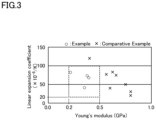
  • FIG. 3 is a graph for explaining a method for determining a telescope phenomenon in Examples and Comparative Examples of the present invention.
  • RB is a roll body.
  • the roll body RB includes a tubular winding core (core) 1 and a belt-shaped web 2 wound around the winding core 1 .
  • the linear expansion coefficient in the thickness direction is only required to be 60 to 150 times the linear expansion coefficient in the longitudinal direction.
  • a plastic film, a plastic film with a pressure-sensitive adhesive layer formed on one surface of the plastic film, or a plastic film with a release film further provided on a surface of the pressure-sensitive adhesive layer can be used as the web 2 .
  • examples of such a plastic film include a polyimide film.
  • the thickness of the web 2 is set to a range of 30 ⁇ m to 200 ⁇ m, for example, and the length of the web 2 in the longitudinal direction is set to a range of 100 m to 1000 m, for example.
  • the telescope phenomenon remarkably appears, and thus the present invention can be suitably applied.
  • the linear expansion coefficient in the thickness direction and the linear expansion coefficient in the longitudinal direction of the web 2 are measured by the method described in Examples described later.
  • the winding core 1 can be made of, for example, resin such as acrylonitrile butadiene styrene (ABS) resin or high density polyethylene (HDPE).
  • ABS acrylonitrile butadiene styrene
  • HDPE high density polyethylene
  • the dimensions of the winding core 1 are appropriately set according to the width, length, and thickness of the web 2 , the tension at the time of winding, and the like.
  • the length of the winding core 1 corresponding to the width of the web 2 can be set to a range of 0.005 m to 5 m
  • the outer diameter can be set to a range of 0.5 cm to 50 cm
  • the wall thickness can be set to a range of 1 mm to 50 mm.
  • the web 2 is wound around the winding core 1 while applying a constant tension.
  • the winding pressure of the web 2 increases due to a difference between the thermal expansion of the winding core 1 and the thermal expansion of the web 2 in the thickness direction.
  • the above-described telescope phenomenon occurs due to the dispersion of the winding pressure that has increased.
  • a web having a linear expansion coefficient in the thickness direction of 60 to 150 times the linear expansion coefficient in the longitudinal direction is used as the web 2 .
  • a winding core having a linear expansion coefficient in a range of 20 ⁇ 10 ⁇ 6 /K to 100 ⁇ 10 ⁇ 6 /K and a Young's modulus in a range of 0.2 GPa to 0.5 GPa is used as the winding core 1 . Therefore, even if the ambient temperature during transportation and storage of the roll body RB is higher than that during production of the roll body RB, it is possible to suppress an increase in the winding pressure of the web 2 by minimizing the difference between the thermal expansion of the winding core 1 and the thermal expansion of the web 2 in the thickness direction as much as possible.
  • the linear expansion coefficient of the winding core 1 is more preferably in the range of 40 ⁇ 10 ⁇ 6 /K to 90 ⁇ 10 ⁇ 6 /K.
  • the Young's modulus of the winding core 1 is more preferably in the range of 0.2 GPa to 0.4 GPa.
  • the winding speed of the web 2 during production of the roll body RB is not particularly limited, but is usually set in the range of 1 m/min to 100 m/min.
  • the winding tension of the web 2 is not particularly limited, but is usually set in the range of 1 N/m to 300 N/m.
  • thermomechanical analyzer manufactured by NETZSCH Japan K.K.
  • the test piece for measurement in the longitudinal direction had a length of 20 mm and a width of 5 mm, and measurement was conducted at a temperature raising rate of 5° C./min.
  • the test piece for measurement in the thickness direction had a length of 8 mm, a width of 8 mm, and a thickness of 1 mm, and measurement was conducted at a temperature raising rate of 1° C./min.
  • the linear expansion coefficient in the thickness direction thus measured was about 100 times the linear expansion coefficient in the longitudinal direction.
  • Example 1 a winding core made of ABS resin (manufactured by Nippon Plastic Industries Co., Ltd.) having an outer diameter of 3 inches, a wall thickness of 6 mm, and a width of 10 mm was used as the winding core 1 .
  • the linear expansion coefficient ⁇ of the winding core 1 was 67.8 ⁇ 10 ⁇ 6 /K according to the following Formula (1). In the following formula (1), r 20° C.
  • dr/dt is the slope of a straight line calculated from the measured values obtained by measuring the radius of the winding core 1 when the environmental temperature is changed to 0° C., 10° C., 20° C., 30° C., and 40° C.
  • the Young's modulus E of the winding core 1 calculated by the following Formula (2) was 0.4 GPa.
  • Em is the Young's modulus of the winding core material (ABS resin)
  • r is the radius (outer diameter) of the winding core 1
  • t is the thickness of the winding core 1 .
  • the Young's modulus Em of the winding core material was calculated from the slope of compressive stress with respect to compressive strain in accordance with Japanese Industrial Standards (JIS K 7181 2011) “Plastics-Determination of Compressive Properties”. Note that the test piece was a plate-like material having a length of 50 mm, a width of 10 mm, and a thickness of 4 mm collected from the winding core 1 , and the test speed was 1 mm/min.
  • An adhesive tape as the web 2 was cut into a width of 10 mm and wound around the winding core 1 at a winding length of 500 m under the conditions of a temperature of 25° C., a winding tension of 100 N/m, and a winding speed of 20 m/min to obtain the roll body RB.
  • the roll body RB was stored in a room where the temperature (ambient temperature) was 45° C., and after a lapse of a predetermined time (after two days), the occurrence of the telescope phenomenon was suppressed.
  • the roll body RB was placed such that a side surface RBa thereof was in contact with a horizontal surface Hp, and the shift amount d of the endmost surface in the width direction (upper surface in FIG.
  • Example 2 a roll body RB was obtained in the same manner as in Example 1 except that a winding core 1 made of ABS resin (manufactured by TOYO SHIKAN K.K.) having an outer diameter of 3 inches, a wall thickness of 6 mm, and a width of 10 mm was used.
  • the linear expansion coefficient and the Young's modulus of the winding core 1 calculated in the same manner as in Example 1 were 41.1 ⁇ 10 ⁇ 6 /K and 0.4 GPa, respectively.
  • the roll body RB obtained in Example 2 was stored for two days in the same manner as in Example 1, and the occurrence of the telescope phenomenon was suppressed.
  • Example 3 a roll body RB was obtained in the same manner as in Example 1 except that a winding core 1 made of ABS resin (manufactured by SHOWA MARUTSUTSU COMPANY, LTD.) having an outer diameter of 3 inches, a wall thickness of 6 mm, and a width of 10 mm was used.
  • the linear expansion coefficient and the Young's modulus of the winding core 1 calculated in the same manner as in Example 1 were 73.4 ⁇ 10 ⁇ 6 /K and 0.4 GPa, respectively.
  • the roll body RB obtained in Example 3 was stored for two days in the same manner as in Example 1, and the occurrence of the telescope phenomenon was suppressed.
  • Example 3 a roll body RB was obtained in the same manner as in Example 1 except that a winding core 1 made of high density polyethylene (HDPE) (manufactured by DAIKA POLYMERS Co., Ltd) having an outer diameter of 3 inches, a wall thickness of 7 mm, and a width of 10 mm was used.
  • the linear expansion coefficient and the Young's modulus of the winding core 1 calculated in the same manner as in Example 1 were 82.7 ⁇ 10 ⁇ 6 /K and 0.2 GPa, respectively.
  • the roll body RB obtained in Example 4 was stored for two days in the same manner as in Example 1, and the occurrence of the telescope phenomenon was suppressed.
  • HDPE high density polyethylene
  • a roll body RB was obtained in the same manner as in Example 1 except that a winding core 1 made of ABS resin (manufactured by Nihon Plastic Kogyo K. K.) having an outer diameter of 3 inches, a wall thickness of 12 mm, and a width of 10 mm was used.
  • the linear expansion coefficient and the Young's modulus of the winding core 1 calculated in the same manner as in Example 1 were 74.7 ⁇ 10 ⁇ 6 /K and 0.7 GPa, respectively.
  • the roll body RB obtained in Comparative Example 1 was stored for two days in the same manner as in Example 1, and the telescope phenomenon occurred.
  • a roll body RB was obtained in the same manner as in Example 1 except that a winding core 1 made of ABS resin (manufactured by Toto Sekisui Co., Ltd) having an outer diameter of 3 inches, a wall thickness of 8 mm, and a width of 10 mm was used.
  • the linear expansion coefficient and the Young's modulus of the winding core 1 calculated in the same manner as in Example 1 were 76.9 ⁇ 10 ⁇ 6 /K and 0.6 GPa, respectively.
  • the roll body RB obtained in Comparative Example 2 was stored for two days in the same manner as in Example 1, and the telescope phenomenon occurred.
  • a roll body RB was obtained in the same manner as in Example 1 except that a winding core 1 made of ABS resin (manufactured by SHOWA MARUTSUTSU COMPANY, LTD.) having an outer diameter of 3 inches, a wall thickness of 12 mm, and a width of 10 mm was used.
  • the linear expansion coefficient and the Young's modulus of the winding core 1 calculated in the same manner as in Example 1 were 82.7 ⁇ 10 ⁇ 6 /K and 0.6 GPa, respectively.
  • the roll body RB obtained in Comparative Example 3 was stored for two days in the same manner as in Example 1, and the telescope phenomenon occurred.
  • a roll body RB was obtained in the same manner as in Example 1 except that a winding core 1 made of PPT (manufactured by Shikoku Sekisui Co., Ltd) having an outer diameter of 3 inches, a wall thickness of 8 mm, and a width of 10 mm was used.
  • the linear expansion coefficient and the Young's modulus of the winding core 1 calculated in the same manner as in Example 1 were 49.9 ⁇ 10 ⁇ 6 /K and 0.8 GPa, respectively.
  • the roll body RB obtained in Comparative Example 4 was stored for two days in the same manner as in Example 1, and the telescope phenomenon occurred.
  • a roll body RB was obtained in the same manner as in Example 1 except that a winding core made of ABS resin having an outer diameter of 3 inches, a wall thickness of 6 mm, and a width of 10 mm, and having a linear expansion coefficient of 30.0 ⁇ 10 ⁇ 6 /K and a Young's modulus of 0.8 GPa was used as a winding core 1 .
  • the roll body RB was stored for two days in the same manner as in Example 1, and the telescope phenomenon occurred.
  • a roll body RB was obtained in the same manner as in Example 1 except that a winding core made of ABS resin having an outer diameter of 3 inches, a wall thickness of 6 mm, and a width of 10 mm, and having a linear expansion coefficient of 20.0 ⁇ 10 ⁇ 6 /K and a Young's modulus of 0.8 GPa was used as a winding core 1 .
  • the roll body RB was stored for two days in the same manner as in Example 1, and the telescope phenomenon occurred.
  • a roll body RB was obtained in the same manner as in Example 1 except that a winding core made of ABS resin having an outer diameter of 3 inches, a wall thickness of 6 mm, and a width of 10 mm, and having a linear expansion coefficient of 40.0 ⁇ 10 ⁇ 6 /K and a Young's modulus of 0.6 GPa was used as a winding core 1 .
  • the roll body RB was stored for two days in the same manner as in Example 1, and the telescope phenomenon occurred.
  • a roll body RB was obtained in the same manner as in Example 1 except that a winding core made of ABS resin having an outer diameter of 3 inches, a wall thickness of 6 mm, and a width of 10 mm, and having a linear expansion coefficient of 120.0 ⁇ 10 ⁇ 6 /K and a Young's modulus of 0.4 GPa was used as a winding core 1 .
  • the roll body RB was stored for two days in the same manner as in Example 1, and the telescope phenomenon occurred.
  • Examples 1 to 4 the case of using the adhesive tape in which the pressure-sensitive adhesive layer is formed on one surface of the polyimide film as the web 2 has been described as an example; however, since this pressure-sensitive adhesive layer does not contribute to the linear expansion coefficient of the web 2 , a plastic film alone can be used as the web 2 .
  • the plastic film is not limited to a polyimide film, and a film having a linear expansion coefficient in the thickness direction in a range of 60 to 150 times a linear expansion coefficient in the longitudinal direction can be used as the web 2 .

Landscapes

  • Storage Of Web-Like Or Filamentary Materials (AREA)
  • Winding Of Webs (AREA)

Abstract

Provided is a roll body capable of effectively suppressing the occurrence of a telescope phenomenon even if the ambient temperature during transportation and storage of the roll body becomes higher than that during production of the roll body. A roll body RB according to the present invention configured by winding a belt-shaped web around a winding core that thermally expands or contracts due to an influence of a surrounding environment is characterized in that a linear expansion coefficient of the web in a thickness direction is in a range of 60 to 150 times a linear expansion coefficient of the web in a longitudinal direction, and the winding core has a linear expansion coefficient in a range of 20×10−6/K to 100×10−6/K and a Young's modulus in a range of 0.2 GPa to 0.5 GPa.

Description

This application is a national phase entry under 35 U.S.C. § 371 of PCT Patent Application No. PCT/JP2020/047635, filed on Dec. 21, 2020, which claims priority under 35 U.S.C. § 119 to Japanese Patent Application No. 2020-037442, filed Mar. 5, 2020, both of which are incorporated by reference.
TECHNICAL FIELD
The present invention relates to a roll body configured by winding a belt-shaped web around a winding core (core) that thermally expands or contracts due to the influence of the surrounding environment.
BACKGROUND ART
It is generally known that a so-called telescope phenomenon occurs in which a web wound around a winding core is displaced in an axial direction and deformed into a bowl shape or a dish shape under the influence of a surrounding environment in a case where this type of roll body is transported or stored. Such a telescope phenomenon is considered to be caused by water absorbability or moisture absorbability of plastic or resin constituting the winding core. Therefore, it has been proposed that a wound body is packaged and transported or stored in a moisture-proof packaging film (see, for example, Patent Literature 1). However, it has been found that the occurrence of the telescope phenomenon may not be effectively suppressed only by packaging the wound body with a moisture-proof packaging film.
Therefore, the present inventor has conducted intensive studies, and has found the following. That is, during production of a roll body, a web is wound around a resin winding core while applying a constant tension. For example, in a case where the roll body thermally expands due to a higher ambient temperature during transportation and storage of the roll body than that during production of the roll body (+20° C. to +25° C.), the winding pressure of the web increases due to a difference between the thermal expansion of the winding core and the thermal expansion of the web in the thickness direction. It has been found that the above-described telescope phenomenon occurs due to the dispersion of the winding pressure that has been increased.
CITATION LIST Patent Literature
    • Patent Literature 1: JP 2018-58602 A
SUMMARY OF INVENTION Technical Problem
The present invention has been made based on the above findings. That is, an object of the present invention is to provide a roll body capable of effectively suppressing the occurrence of a telescope phenomenon even if the ambient temperature during transportation and storage of the roll body becomes higher than that during production of the roll body.
Solution to Problem
In order to solve the above problem, in the roll body according to the present invention configured by winding a belt-shaped web around a winding core that thermally expands or contracts due to the influence of the surrounding environment, the linear expansion coefficient of the web in the thickness direction is in the range of 60 to 150 times the linear expansion coefficient in the longitudinal direction. The winding core has a linear expansion coefficient in a range of 20×10−6/K to 100×10−6/K and a Young's modulus in a range of 0.2 GPa to 0.5 GPa. The present invention can be suitably applied in a case where a polyimide film having a width of 5 mm to 100 mm is used as the web.
Advantageous Effects of Invention
According to the present invention, a web having a linear expansion coefficient in the thickness direction of 60 to 150 times a linear expansion coefficient in the longitudinal direction is used as the web, and a winding core having a linear expansion coefficient in a range of 20×10−6/K to 100×10−6/K and a Young's modulus in a range of 0.2 GPa to 0.5 GPa is used as the winding core. Therefore, even in a case where the ambient temperature during transportation and storage of the roll body is higher than that during production of the roll body, it is possible to suppress an increase in the winding pressure of the web by minimizing the difference between the thermal expansion of the winding core and the thermal expansion of the web in the thickness direction as much as possible. As a result, the occurrence of a telescope phenomenon can be effectively suppressed.
BRIEF DESCRIPTION OF DRAWINGS
FIG. 1 is a perspective view illustrating an embodiment of a roll body of the present invention.
FIG. 2 is a diagram for explaining a method for determining a telescope phenomenon in Examples of the present invention.
FIG. 3 is a graph for explaining a method for determining a telescope phenomenon in Examples and Comparative Examples of the present invention.
DESCRIPTION OF EMBODIMENTS
Hereinafter, an embodiment of a roll body of the present invention will be described with reference to the drawings. Referring to FIG. 1 , RB is a roll body. The roll body RB includes a tubular winding core (core) 1 and a belt-shaped web 2 wound around the winding core 1.
Regarding the web 2, the linear expansion coefficient in the thickness direction is only required to be 60 to 150 times the linear expansion coefficient in the longitudinal direction. A plastic film, a plastic film with a pressure-sensitive adhesive layer formed on one surface of the plastic film, or a plastic film with a release film further provided on a surface of the pressure-sensitive adhesive layer can be used as the web 2. Examples of such a plastic film include a polyimide film. Note that the thickness of the web 2 is set to a range of 30 μm to 200 μm, for example, and the length of the web 2 in the longitudinal direction is set to a range of 100 m to 1000 m, for example. In addition, in a case where the width of the web 2 is, for example, in the range of 5 mm to 100 mm, the telescope phenomenon remarkably appears, and thus the present invention can be suitably applied. Note that the linear expansion coefficient in the thickness direction and the linear expansion coefficient in the longitudinal direction of the web 2 are measured by the method described in Examples described later.
The winding core 1 can be made of, for example, resin such as acrylonitrile butadiene styrene (ABS) resin or high density polyethylene (HDPE). The dimensions of the winding core 1 are appropriately set according to the width, length, and thickness of the web 2, the tension at the time of winding, and the like. For example, the length of the winding core 1 corresponding to the width of the web 2 can be set to a range of 0.005 m to 5 m, the outer diameter can be set to a range of 0.5 cm to 50 cm, and the wall thickness can be set to a range of 1 mm to 50 mm.
Incidentally, during production of the roll body RB, the web 2 is wound around the winding core 1 while applying a constant tension. For example, in a case where the roll body RB thermally expands due to a higher ambient temperature during transportation and storage of the roll body RB than that during production of the roll body RB (+20° C. to +25° C.), the winding pressure of the web 2 increases due to a difference between the thermal expansion of the winding core 1 and the thermal expansion of the web 2 in the thickness direction. The above-described telescope phenomenon occurs due to the dispersion of the winding pressure that has increased.
In the present embodiment, a web having a linear expansion coefficient in the thickness direction of 60 to 150 times the linear expansion coefficient in the longitudinal direction is used as the web 2. A winding core having a linear expansion coefficient in a range of 20×10−6/K to 100×10−6/K and a Young's modulus in a range of 0.2 GPa to 0.5 GPa is used as the winding core 1. Therefore, even if the ambient temperature during transportation and storage of the roll body RB is higher than that during production of the roll body RB, it is possible to suppress an increase in the winding pressure of the web 2 by minimizing the difference between the thermal expansion of the winding core 1 and the thermal expansion of the web 2 in the thickness direction as much as possible. As a result, the occurrence of a telescope phenomenon can be effectively suppressed. The linear expansion coefficient of the winding core 1 is more preferably in the range of 40×10−6/K to 90×10−6/K. The Young's modulus of the winding core 1 is more preferably in the range of 0.2 GPa to 0.4 GPa. Note that the winding speed of the web 2 during production of the roll body RB (at the time of winding the web 2) is not particularly limited, but is usually set in the range of 1 m/min to 100 m/min. The winding tension of the web 2 is not particularly limited, but is usually set in the range of 1 N/m to 300 N/m.
Next, Examples of the present invention will be described by using as an example a case where an adhesive tape in which a pressure-sensitive adhesive layer containing an acrylic acid ester copolymer is formed in a thickness of 8 μm on one surface of a polyimide film having a thickness of 25 μm is used as the web 2. The linear expansion coefficients of the web 2 in the longitudinal direction and the thickness direction were measured using a thermomechanical analyzer (“TMA 4000S” manufactured by NETZSCH Japan K.K.). That is, in accordance with Japanese Industrial Standards (JIS K 7197 2012) “Testing Method for Linear Thermal Expansion Coefficient of Plastics by Thermomechanical Analysis”, thermal strain with respect to temperature was obtained, and the linear expansion coefficient was determined from the slope of the thermal strain. The test piece for measurement in the longitudinal direction had a length of 20 mm and a width of 5 mm, and measurement was conducted at a temperature raising rate of 5° C./min. The test piece for measurement in the thickness direction had a length of 8 mm, a width of 8 mm, and a thickness of 1 mm, and measurement was conducted at a temperature raising rate of 1° C./min. The linear expansion coefficient in the thickness direction thus measured was about 100 times the linear expansion coefficient in the longitudinal direction.
Example 1
In Example 1, a winding core made of ABS resin (manufactured by Nippon Plastic Industries Co., Ltd.) having an outer diameter of 3 inches, a wall thickness of 6 mm, and a width of 10 mm was used as the winding core 1. The linear expansion coefficient α of the winding core 1 was 67.8×10⁻⁶/K according to the following Formula (1). In the following formula (1), r20° C. is the radius (half of the outer diameter) of the winding core 1 when the environmental temperature is 20° C., and dr/dt is the slope of a straight line calculated from the measured values obtained by measuring the radius of the winding core 1 when the environmental temperature is changed to 0° C., 10° C., 20° C., 30° C., and 40° C.
α = 1 r 20 ° C . dr dt ( 1 )
The Young's modulus E of the winding core 1 calculated by the following Formula (2) was 0.4 GPa. In the following Formula (2), Em is the Young's modulus of the winding core material (ABS resin), ν is the Poisson's ratio (ν=0.3), r is the radius (outer diameter) of the winding core 1, and t is the thickness of the winding core 1. The Young's modulus Em of the winding core material was calculated from the slope of compressive stress with respect to compressive strain in accordance with Japanese Industrial Standards (JIS K 7181 2011) “Plastics-Determination of Compressive Properties”. Note that the test piece was a plate-like material having a length of 50 mm, a width of 10 mm, and a thickness of 4 mm collected from the winding core 1, and the test speed was 1 mm/min.
E = Em ( r r - t ) 2 + 1 ( r r - t ) 2 - 1 - v ( 2 )
An adhesive tape as the web 2 was cut into a width of 10 mm and wound around the winding core 1 at a winding length of 500 m under the conditions of a temperature of 25° C., a winding tension of 100 N/m, and a winding speed of 20 m/min to obtain the roll body RB. The roll body RB was stored in a room where the temperature (ambient temperature) was 45° C., and after a lapse of a predetermined time (after two days), the occurrence of the telescope phenomenon was suppressed. Here, as illustrated in FIG. 2 , the roll body RB was placed such that a side surface RBa thereof was in contact with a horizontal surface Hp, and the shift amount d of the endmost surface in the width direction (upper surface in FIG. 2 ) 2 a of the web 2 from the winding core 1 was calculated. In a case where the shift amount d was less than 5 mm, it was judged that the occurrence of the telescope phenomenon was suppressed, and in a case where the shift amount d was 5 mm or more, it was judged that the telescope phenomenon occurred.
Example 2
In Example 2, a roll body RB was obtained in the same manner as in Example 1 except that a winding core 1 made of ABS resin (manufactured by TOYO SHIKAN K.K.) having an outer diameter of 3 inches, a wall thickness of 6 mm, and a width of 10 mm was used. The linear expansion coefficient and the Young's modulus of the winding core 1 calculated in the same manner as in Example 1 were 41.1×10⁻⁶/K and 0.4 GPa, respectively. The roll body RB obtained in Example 2 was stored for two days in the same manner as in Example 1, and the occurrence of the telescope phenomenon was suppressed.
Example 3
In Example 3, a roll body RB was obtained in the same manner as in Example 1 except that a winding core 1 made of ABS resin (manufactured by SHOWA MARUTSUTSU COMPANY, LTD.) having an outer diameter of 3 inches, a wall thickness of 6 mm, and a width of 10 mm was used. The linear expansion coefficient and the Young's modulus of the winding core 1 calculated in the same manner as in Example 1 were 73.4×10⁻⁶/K and 0.4 GPa, respectively. The roll body RB obtained in Example 3 was stored for two days in the same manner as in Example 1, and the occurrence of the telescope phenomenon was suppressed.
Example 4
In Example 3, a roll body RB was obtained in the same manner as in Example 1 except that a winding core 1 made of high density polyethylene (HDPE) (manufactured by DAIKA POLYMERS Co., Ltd) having an outer diameter of 3 inches, a wall thickness of 7 mm, and a width of 10 mm was used. The linear expansion coefficient and the Young's modulus of the winding core 1 calculated in the same manner as in Example 1 were 82.7×10⁻⁶/K and 0.2 GPa, respectively. The roll body RB obtained in Example 4 was stored for two days in the same manner as in Example 1, and the occurrence of the telescope phenomenon was suppressed.
Next, Comparative Examples with respect to Example 1 to 4 will be described.
Comparative Example 1
In Comparative Example 1, a roll body RB was obtained in the same manner as in Example 1 except that a winding core 1 made of ABS resin (manufactured by Nihon Plastic Kogyo K. K.) having an outer diameter of 3 inches, a wall thickness of 12 mm, and a width of 10 mm was used. The linear expansion coefficient and the Young's modulus of the winding core 1 calculated in the same manner as in Example 1 were 74.7×10⁻⁶/K and 0.7 GPa, respectively. The roll body RB obtained in Comparative Example 1 was stored for two days in the same manner as in Example 1, and the telescope phenomenon occurred.
Comparative Example 2
In Comparative Example 2, a roll body RB was obtained in the same manner as in Example 1 except that a winding core 1 made of ABS resin (manufactured by Toto Sekisui Co., Ltd) having an outer diameter of 3 inches, a wall thickness of 8 mm, and a width of 10 mm was used. The linear expansion coefficient and the Young's modulus of the winding core 1 calculated in the same manner as in Example 1 were 76.9×10⁻⁶/K and 0.6 GPa, respectively. The roll body RB obtained in Comparative Example 2 was stored for two days in the same manner as in Example 1, and the telescope phenomenon occurred.
Comparative Example 3
In Comparative Example 3, a roll body RB was obtained in the same manner as in Example 1 except that a winding core 1 made of ABS resin (manufactured by SHOWA MARUTSUTSU COMPANY, LTD.) having an outer diameter of 3 inches, a wall thickness of 12 mm, and a width of 10 mm was used. The linear expansion coefficient and the Young's modulus of the winding core 1 calculated in the same manner as in Example 1 were 82.7×10⁻⁶/K and 0.6 GPa, respectively. The roll body RB obtained in Comparative Example 3 was stored for two days in the same manner as in Example 1, and the telescope phenomenon occurred.
Comparative Example 4
In Comparative Example 4, a roll body RB was obtained in the same manner as in Example 1 except that a winding core 1 made of PPT (manufactured by Shikoku Sekisui Co., Ltd) having an outer diameter of 3 inches, a wall thickness of 8 mm, and a width of 10 mm was used. The linear expansion coefficient and the Young's modulus of the winding core 1 calculated in the same manner as in Example 1 were 49.9×10⁻⁶/K and 0.8 GPa, respectively. The roll body RB obtained in Comparative Example 4 was stored for two days in the same manner as in Example 1, and the telescope phenomenon occurred.
Comparative Example 5
In Comparative Example 5, a roll body RB was obtained in the same manner as in Example 1 except that a winding core made of ABS resin having an outer diameter of 3 inches, a wall thickness of 6 mm, and a width of 10 mm, and having a linear expansion coefficient of 30.0×10⁻⁶/K and a Young's modulus of 0.8 GPa was used as a winding core 1. The roll body RB was stored for two days in the same manner as in Example 1, and the telescope phenomenon occurred.
Comparative Example 6
In Comparative Example 6, a roll body RB was obtained in the same manner as in Example 1 except that a winding core made of ABS resin having an outer diameter of 3 inches, a wall thickness of 6 mm, and a width of 10 mm, and having a linear expansion coefficient of 20.0×10⁻⁶/K and a Young's modulus of 0.8 GPa was used as a winding core 1. The roll body RB was stored for two days in the same manner as in Example 1, and the telescope phenomenon occurred.
Comparative Example 7
In Comparative Example 7, a roll body RB was obtained in the same manner as in Example 1 except that a winding core made of ABS resin having an outer diameter of 3 inches, a wall thickness of 6 mm, and a width of 10 mm, and having a linear expansion coefficient of 40.0×10⁻⁶/K and a Young's modulus of 0.6 GPa was used as a winding core 1. The roll body RB was stored for two days in the same manner as in Example 1, and the telescope phenomenon occurred.
Comparative Example 8
In Comparative Example 8, a roll body RB was obtained in the same manner as in Example 1 except that a winding core made of ABS resin having an outer diameter of 3 inches, a wall thickness of 6 mm, and a width of 10 mm, and having a linear expansion coefficient of 120.0×10⁻⁶/K and a Young's modulus of 0.4 GPa was used as a winding core 1. The roll body RB was stored for two days in the same manner as in Example 1, and the telescope phenomenon occurred.
According to Examples 1 to 4 and Comparative Examples 1 to 8 described above, as illustrated in FIG. 3 , it has been found that the occurrence of the telescope phenomenon can be effectively suppressed by using a winding core having a linear expansion coefficient in the range of 20×10−6/K to 100×10−6/K (preferably 40×10−6/K to 90×10−6/K, more preferably 41×10−6/K to 83×10−6/K) and a Young's modulus in the range of 0.2 GPa to 0.5 GPa (preferably 0.2 GPa to 0.4 GPa) as the winding core 1.
Although the embodiment and examples of the present invention have been described above, various modifications can be made without departing from the scope of the technical idea of the present invention. In Examples 1 to 4, the case of using the adhesive tape in which the pressure-sensitive adhesive layer is formed on one surface of the polyimide film as the web 2 has been described as an example; however, since this pressure-sensitive adhesive layer does not contribute to the linear expansion coefficient of the web 2, a plastic film alone can be used as the web 2. The plastic film is not limited to a polyimide film, and a film having a linear expansion coefficient in the thickness direction in a range of 60 to 150 times a linear expansion coefficient in the longitudinal direction can be used as the web 2.
REFERENCE SIGNS LIST
    • RB roll body
    • 1 winding core, core
    • 2 web

Claims (2)

The invention claimed is:
1. A roll body configured by winding a belt-shaped web around a winding core that thermally expands or contracts due to an influence of a surrounding environment, the roll body characterized in that
a linear expansion coefficient of the belt-shaped web in a thickness direction is in a range of 60 to 150 times a linear expansion coefficient of the belt-shaped web in a longitudinal direction, and
the winding core has a linear expansion coefficient in a range of 20×10−6/K to 100×10−6/K and a Young's modulus in a range of 0.2 GPa to 0.5 GPa.
2. The roll body according to claim 1, wherein the belt-shaped web is a polyimide film having a width of 5 mm to 100 mm.
US17/771,541 2020-03-05 2020-12-21 Roll body Active 2041-07-21 US12043504B2 (en)

Applications Claiming Priority (3)

Application Number Priority Date Filing Date Title
JP2020-037442 2020-03-05
JP2020037442 2020-03-05
PCT/JP2020/047635 WO2021176804A1 (en) 2020-03-05 2020-12-21 Roll body

Publications (2)

Publication Number Publication Date
US20220402717A1 US20220402717A1 (en) 2022-12-22
US12043504B2 true US12043504B2 (en) 2024-07-23

Family

ID=77613221

Family Applications (1)

Application Number Title Priority Date Filing Date
US17/771,541 Active 2041-07-21 US12043504B2 (en) 2020-03-05 2020-12-21 Roll body

Country Status (6)

Country Link
US (1) US12043504B2 (en)
JP (1) JP7412531B2 (en)
KR (1) KR102819608B1 (en)
CN (1) CN114761338B (en)
TW (1) TWI858212B (en)
WO (1) WO2021176804A1 (en)

Citations (3)

* Cited by examiner, † Cited by third party
Publication number Priority date Publication date Assignee Title
JP2011178521A (en) 2010-03-02 2011-09-15 Ube Industries Ltd Manufacturing method and storage method of resin film roll
JP2016069168A (en) 2014-09-30 2016-05-09 積水化学工業株式会社 Roll body
JP2018058602A (en) 2016-10-03 2018-04-12 ニチバン株式会社 Pillow package for adhesive tape wound body

Family Cites Families (21)

* Cited by examiner, † Cited by third party
Publication number Priority date Publication date Assignee Title
JPS61264027A (en) * 1985-05-17 1986-11-21 Ube Ind Ltd Production of polyimide film having high dimensional stability
JPH1059627A (en) * 1996-08-26 1998-03-03 Sumitomo Electric Ind Ltd Bobbins for winding linear bodies
JP4665298B2 (en) * 2000-08-25 2011-04-06 東レ株式会社 TAPE WITH ADHESIVE FOR SEMICONDUCTOR DEVICE, COPPER-CLAD LAMINATE USING SAME, SEMICONDUCTOR CONNECTION BOARD AND SEMICONDUCTOR DEVICE
JP2005022766A (en) 2003-06-30 2005-01-27 Konica Minolta Opto Inc Cellulose ester film web and its storage method and transportation method
JP4776188B2 (en) * 2004-08-03 2011-09-21 古河電気工業株式会社 Semiconductor device manufacturing method and wafer processing tape
JP2006073047A (en) 2004-08-31 2006-03-16 Fuji Photo Film Co Ltd Method for manufacturing magnetic recording medium and magnetic recording medium
JP4845614B2 (en) * 2006-07-06 2011-12-28 日東電工株式会社 Release liner, adhesive tape and adhesive tape roll
MY151971A (en) * 2007-11-08 2014-07-31 Hitachi Chemical Co Ltd Adhesive sheet for semiconductor, and dacing tape integrated adhesive sheet for semiconductor
US8453421B2 (en) * 2007-12-26 2013-06-04 Denki Kagaku Kogyo Kabushiki Kaisha Method of packaging record rolls of cover tape and package
JP5147418B2 (en) * 2008-01-09 2013-02-20 株式会社アライドマテリアル Metal wire storage
KR101075192B1 (en) * 2009-03-03 2011-10-21 도레이첨단소재 주식회사 Adhesive tape for manufacturing electronic component
JP5552841B2 (en) * 2010-03-02 2014-07-16 宇部興産株式会社 Manufacturing method of resin film roll
JP5748514B2 (en) * 2011-03-10 2015-07-15 富士機械工業株式会社 Winding device and winding control method
KR20140036308A (en) * 2011-07-08 2014-03-25 스미또모 베이크라이트 가부시키가이샤 Dicing-tape-integrated adhesive sheet, semiconductor device, multilayered circuit board and electronic component
JP5807876B2 (en) * 2011-11-01 2015-11-10 リンテック株式会社 Unsteady heat conduction analysis program for winding roll and unsteady internal stress analysis program for winding roll
CN105027273B (en) * 2013-03-07 2019-01-22 住友电木株式会社 Adhesive film, laminate and cured product thereof, and semiconductor device and method for producing the same
US20170158916A1 (en) * 2014-07-04 2017-06-08 Dic Corporation Adhesive tape, electronic device, and method for dismantling article
JP6698306B2 (en) * 2015-09-29 2020-05-27 株式会社巴川製紙所 Adhesive tape for fixing lead frame
JP2017100850A (en) 2015-12-02 2017-06-08 富士機械工業株式会社 Web winding device and web winding method
JP6837386B2 (en) * 2017-05-29 2021-03-03 リンテック株式会社 Web fixing method, web winding method, and winding roll body
EP3511137B1 (en) * 2017-12-19 2024-02-28 Corning Incorporated Long sintered inorganic tape, roll and method of cutting the tape

Patent Citations (3)

* Cited by examiner, † Cited by third party
Publication number Priority date Publication date Assignee Title
JP2011178521A (en) 2010-03-02 2011-09-15 Ube Industries Ltd Manufacturing method and storage method of resin film roll
JP2016069168A (en) 2014-09-30 2016-05-09 積水化学工業株式会社 Roll body
JP2018058602A (en) 2016-10-03 2018-04-12 ニチバン株式会社 Pillow package for adhesive tape wound body

Non-Patent Citations (2)

* Cited by examiner, † Cited by third party
Title
English machine translation for JP2011178521 (Sep. 15, 2011). (Year: 2011). *
International Search Report for PCT Patent App. No. PCT/JP2020/047635 (Feb. 2, 2021).

Also Published As

Publication number Publication date
TW202140352A (en) 2021-11-01
CN114761338A (en) 2022-07-15
KR20220149502A (en) 2022-11-08
JP7412531B2 (en) 2024-01-12
TWI858212B (en) 2024-10-11
JPWO2021176804A1 (en) 2021-09-10
US20220402717A1 (en) 2022-12-22
KR102819608B1 (en) 2025-06-12
CN114761338B (en) 2024-06-28
WO2021176804A1 (en) 2021-09-10

Similar Documents

Publication Publication Date Title
EP0157610A2 (en) Sheated optical fibres
US8916272B2 (en) Surface protective film, method for fabricating the same, pouch thereof and method for fabricating the same
US7336873B2 (en) Optical tube assembly having a dry insert and methods of making the same
US7136556B2 (en) Signal transmitting cable
EP1818704A2 (en) Optical tube assembly having a dry insert and method of making the same
US4109099A (en) Dual jacketed cable
US20140220300A1 (en) Pre-stressed glass roll
US20030091792A1 (en) Polarizing plate
US7192652B2 (en) Rust preventive film for stretch packaging
US20030099446A1 (en) Buffer tube design for easy and reliable access in mid-span
EP3879323A1 (en) Optical fiber cable
US12043504B2 (en) Roll body
JP5159795B2 (en) Cover tape record roll packaging method and package
EP2813556A1 (en) Roll of an adhesive tape having an adhesive layer comprising a structural adhesive and its method of manufacture
US8613998B2 (en) Film arrangement
KR101969979B1 (en) Method and winding of web material
US20200299178A1 (en) Method and device for screening optical fiber core, and method for manufacturing optical fiber core
JP2009166991A (en) Precision rectangular wire winding bobbin and method for manufacturing solar cell
JPH1123925A (en) Tension member for optical fiber cable and optical fiber cable using the same
JP2006235029A (en) Optical cable
JP2018144920A (en) Winding method of web material, and winding core
JPH10315327A (en) Heat-shrinkable film heat treatment method

Legal Events

Date Code Title Description
FEPP Fee payment procedure

Free format text: ENTITY STATUS SET TO UNDISCOUNTED (ORIGINAL EVENT CODE: BIG.); ENTITY STATUS OF PATENT OWNER: LARGE ENTITY

AS Assignment

Owner name: LINTEC CORPORATION, JAPAN

Free format text: ASSIGNMENT OF ASSIGNORS INTEREST;ASSIGNOR:TORIGOE, SYOUTO;REEL/FRAME:060001/0892

Effective date: 20220524

STPP Information on status: patent application and granting procedure in general

Free format text: DOCKETED NEW CASE - READY FOR EXAMINATION

STPP Information on status: patent application and granting procedure in general

Free format text: NOTICE OF ALLOWANCE MAILED -- APPLICATION RECEIVED IN OFFICE OF PUBLICATIONS

STPP Information on status: patent application and granting procedure in general

Free format text: PUBLICATIONS -- ISSUE FEE PAYMENT VERIFIED

STCF Information on status: patent grant

Free format text: PATENTED CASE