US12037346B2 - Amino-substituted heteroaryls for treating cancers with EGFR mutations - Google Patents
Amino-substituted heteroaryls for treating cancers with EGFR mutations Download PDFInfo
- Publication number
- US12037346B2 US12037346B2 US17/718,381 US202217718381A US12037346B2 US 12037346 B2 US12037346 B2 US 12037346B2 US 202217718381 A US202217718381 A US 202217718381A US 12037346 B2 US12037346 B2 US 12037346B2
- Authority
- US
- United States
- Prior art keywords
- hydrocarbyl
- alkyl
- compound
- cancer
- optionally substituted
- Prior art date
- Legal status (The legal status is an assumption and is not a legal conclusion. Google has not performed a legal analysis and makes no representation as to the accuracy of the status listed.)
- Active
Links
Images


Classifications
-
- C—CHEMISTRY; METALLURGY
- C07—ORGANIC CHEMISTRY
- C07D—HETEROCYCLIC COMPOUNDS
- C07D471/00—Heterocyclic compounds containing nitrogen atoms as the only ring hetero atoms in the condensed system, at least one ring being a six-membered ring with one nitrogen atom, not provided for by groups C07D451/00 - C07D463/00
- C07D471/02—Heterocyclic compounds containing nitrogen atoms as the only ring hetero atoms in the condensed system, at least one ring being a six-membered ring with one nitrogen atom, not provided for by groups C07D451/00 - C07D463/00 in which the condensed system contains two hetero rings
- C07D471/04—Ortho-condensed systems
-
- A—HUMAN NECESSITIES
- A61—MEDICAL OR VETERINARY SCIENCE; HYGIENE
- A61K—PREPARATIONS FOR MEDICAL, DENTAL OR TOILETRY PURPOSES
- A61K31/00—Medicinal preparations containing organic active ingredients
- A61K31/33—Heterocyclic compounds
- A61K31/395—Heterocyclic compounds having nitrogen as a ring hetero atom, e.g. guanethidine or rifamycins
- A61K31/495—Heterocyclic compounds having nitrogen as a ring hetero atom, e.g. guanethidine or rifamycins having six-membered rings with two or more nitrogen atoms as the only ring heteroatoms, e.g. piperazine or tetrazines
- A61K31/505—Pyrimidines; Hydrogenated pyrimidines, e.g. trimethoprim
- A61K31/519—Pyrimidines; Hydrogenated pyrimidines, e.g. trimethoprim ortho- or peri-condensed with heterocyclic rings
-
- A—HUMAN NECESSITIES
- A61—MEDICAL OR VETERINARY SCIENCE; HYGIENE
- A61K—PREPARATIONS FOR MEDICAL, DENTAL OR TOILETRY PURPOSES
- A61K31/00—Medicinal preparations containing organic active ingredients
- A61K31/33—Heterocyclic compounds
- A61K31/395—Heterocyclic compounds having nitrogen as a ring hetero atom, e.g. guanethidine or rifamycins
- A61K31/535—Heterocyclic compounds having nitrogen as a ring hetero atom, e.g. guanethidine or rifamycins having six-membered rings with at least one nitrogen and one oxygen as the ring hetero atoms, e.g. 1,2-oxazines
- A61K31/5375—1,4-Oxazines, e.g. morpholine
- A61K31/5383—1,4-Oxazines, e.g. morpholine ortho- or peri-condensed with heterocyclic ring systems
-
- A—HUMAN NECESSITIES
- A61—MEDICAL OR VETERINARY SCIENCE; HYGIENE
- A61P—SPECIFIC THERAPEUTIC ACTIVITY OF CHEMICAL COMPOUNDS OR MEDICINAL PREPARATIONS
- A61P35/00—Antineoplastic agents
-
- C—CHEMISTRY; METALLURGY
- C07—ORGANIC CHEMISTRY
- C07D—HETEROCYCLIC COMPOUNDS
- C07D487/00—Heterocyclic compounds containing nitrogen atoms as the only ring hetero atoms in the condensed system, not provided for by groups C07D451/00 - C07D477/00
- C07D487/02—Heterocyclic compounds containing nitrogen atoms as the only ring hetero atoms in the condensed system, not provided for by groups C07D451/00 - C07D477/00 in which the condensed system contains two hetero rings
- C07D487/04—Ortho-condensed systems
-
- C—CHEMISTRY; METALLURGY
- C07—ORGANIC CHEMISTRY
- C07D—HETEROCYCLIC COMPOUNDS
- C07D487/00—Heterocyclic compounds containing nitrogen atoms as the only ring hetero atoms in the condensed system, not provided for by groups C07D451/00 - C07D477/00
- C07D487/02—Heterocyclic compounds containing nitrogen atoms as the only ring hetero atoms in the condensed system, not provided for by groups C07D451/00 - C07D477/00 in which the condensed system contains two hetero rings
- C07D487/10—Spiro-condensed systems
-
- C—CHEMISTRY; METALLURGY
- C07—ORGANIC CHEMISTRY
- C07D—HETEROCYCLIC COMPOUNDS
- C07D498/00—Heterocyclic compounds containing in the condensed system at least one hetero ring having nitrogen and oxygen atoms as the only ring hetero atoms
- C07D498/12—Heterocyclic compounds containing in the condensed system at least one hetero ring having nitrogen and oxygen atoms as the only ring hetero atoms in which the condensed system contains three hetero rings
- C07D498/14—Ortho-condensed systems
-
- C—CHEMISTRY; METALLURGY
- C07—ORGANIC CHEMISTRY
- C07D—HETEROCYCLIC COMPOUNDS
- C07D519/00—Heterocyclic compounds containing more than one system of two or more relevant hetero rings condensed among themselves or condensed with a common carbocyclic ring system not provided for in groups C07D453/00 or C07D455/00
Definitions
- RTKs Receptor tyrosine kinases
- HER human epidermal growth factor receptor
- HER is also known as ErbB, a name derived from the viral homolog erythroblastosis oncogene B.
- the HER family comprises 4 members: EGFR/HER1/ErbB1, HER2/ErbB2, HER3/ErbB3, and HER4/ErbB4. They share highly related structures involving an extracellular domain that binds ligands, a single-pass transmembrane domain, and an intracellular kinase domain.
- HER2/IER4 such as neuregulins
- EGFR dysregulation is a hallmark of many cancers. Cancer cells overactivate EGFR through various mechanisms including overexpression, missense mutations, insertions, and deletions. EGFR is frequently overexpressed in many solid tumors such as non-small cell lung cancer (NSCLC), breast cancer, glioblastoma, prostate cancer, colorectal cancer, head-and-neck cancer, and many others. EGFR variant 3 (EGFR vIII), which bears a large deletion of exons 2-7, is found in about 30% of glioblastoma. A variety of activating mutations in EGFR drive around 30% of NSCLC, with higher prevalence associated with adenocarcinoma histology, non-smokers, Asians, and women.
- activating mutations are further divided into point mutations (predominantly L858R in exon 21), short deletions in exon 19 (predominantly E746_A750del), short insertions in exon 20, and other rarer mutations not specified here.
- L858R, E746_A750del, and exon 20 insertions account for about 35-40%, 40-45%, and 5-10% of all EGFR-mutant NSCLC cases, respectively.
- HER2 dysregulation is also a well-documented cause of cancer.
- HER2 overexpression is found in 15-25% of breast cancer cases, representing one of the major molecular subtypes of breast cancer, as well as in ovarian cancer, gastric cancer, esophageal cancer, endometrial cancer, and lung cancer.
- HER2 mutations are found in about 2% of NSCLC patients but, unlike EGFR, are largely restricted to exon 20 insertions (predominantly A775_G776insYVMA).
- EGFR has important epithelial functions in the gastrointestinal lining and on the skin of adult humans, so inhibition of non-mutated EGFR is believed to cause adverse reactions such as diarrhea and rash, which are common safety signals for many existing EGFR inhibitors.
- CNS activity is an important consideration for future therapeutic development.
- exon 20 insertions represent an unmet need as no targeted therapies have been FDA-approved for these indications. For these reasons, there is a need for development of a new generation of inhibitors that spare wild-type EGFR, penetrate the blood-brain barrier, and show specific activity against exon 20 insertions and/or drug-resistance mutations.
- the present disclosure provides compounds of Formula (I), or a pharmaceutically acceptable salt, a stereoisomer, or a tautomer thereof:
- V is N; or ring
- Z 1 , Z 2 , Z 3 , and Z 4 are each independently C or N; and any atom of ring
- R 5 may be substituted by R 5 as permitted by valence.
- Y 1 and Y 2 are each independently CR 4 , then R 4 in Y 2 is C 1-5 alkyl and R 4 in Y 1 is halo. In one embodiment, R 4 in Y 2 is methyl. In one embodiment, R 4 in Y 1 is fluoro. In one embodiment, R 4 in Y 2 is methyl, and R 4 in Y 1 is fluoro.
- the present disclosure provides compounds of Formula (II), or a pharmaceutically acceptable salt, a stereoisomer, or a tautomer thereof:
- R 8 is C 1-5 alkyl and R 6 is halo. In one embodiment, R 8 is methyl. In one embodiment, R 6 is fluoro. In one embodiment, R 8 is methyl, and R 6 is fluoro.
- the compounds of Formula (II) are compounds of Formula (III), or a pharmaceutically acceptable salt, a stereoisomer, or a tautomer thereof:
- the present disclosure provides compounds of Formula (a-I), or a pharmaceutically acceptable salt, a stereoisomer, or a tautomer thereof:
- Z 1 , Z 2 , Z 3 , and Z 4 are each independently C or N; and any atom of ring
- R 5 may be substituted by R 5 as permitted by valence.
- K is a bond. In one embodiment of Formula (a-I) (or a sub-formula thereof), K is a C ⁇ O. In one embodiment of Formula (a-I) (or a sub-formula thereof), K is a SO 2 .
- the present disclosure provides compounds of Formula (I-i), or a pharmaceutically acceptable salt, a stereoisomer, or a tautomer thereof:
- the compounds of Formula (I-i) are of Formula (I-i-a), or a pharmaceutically acceptable salt, a stereoisomer, or a tautomer thereof:
- the compounds of Formula (I-i) are of Formula (I-i-a0), or a pharmaceutically acceptable salt, a stereoisomer, or a tautomer thereof:
- the compounds of Formula (I-i) are of Formula (I-i-a1):
- the compounds of Formula (I-i-a1) are of the following formula, or a pharmaceutically acceptable salt, a stereoisomer, or a tautomer thereof:
- the compounds of Formula (I-i-a1) are of the following formula, or a pharmaceutically acceptable salt, a stereoisomer, or a tautomer thereof:
- the compounds of Formula (I-i-a1) are of the following formula, or a pharmaceutically acceptable salt, a stereoisomer, or a tautomer thereof:
- the compounds of Formula (I-i-a1) are of the following formula, or a pharmaceutically acceptable salt, a stereoisomer, or a tautomer thereof:
- the compounds of Formula (I-i-a1) are of Formula (I-i-a2):
- the present disclosure provides a pharmaceutical composition suitable for use in a subject in the treatment or prevention of cancer comprising an effective amount of any of the compounds described herein (such as a compound of any of Formula (I), (I-i), (I-i-a), (I-i-a1), (I-i-a2), (a-I), (II), or (III), or subformulae thereof) or a pharmaceutically acceptable salt, a stereoisomer, or a tautomer thereof, and one or more pharmaceutically acceptable excipients.
- the pharmaceutical preparations may be for use in treating or preventing a condition or disease as described herein.
- An aspect of the disclosure is methods of treating cancer, comprising administering to a mammal (e.g. a human subject) in need thereof an effective amount of a compound as disclosed herein (e.g., a compound of Formula (I), (I-i), (I-i-a), (I-i-a1), (I-i-a2), (a-I), (II), or (III), or any of the embodiments thereof disclosed herein) or a pharmaceutical composition as provided herein.
- a mammal e.g. a human subject
- an effective amount of a compound as disclosed herein e.g., a compound of Formula (I), (I-i), (I-i-a), (I-i-a1), (I-i-a2), (a-I), (II), or (III), or any of the embodiments thereof disclosed herein
- a pharmaceutical composition as provided herein.
- provided herein are methods of treating HER2-associated cancer, comprising administering to a mammal (e.
- a human subject in need thereof an effective amount of a compound as disclosed herein (e.g., a compound of Formula (I), (I-i), (I-i-a), (I-i-a1), (I-i-a2), (a-I), (II), or (III), or any of the embodiments thereof disclosed herein) or a pharmaceutical composition as provided herein.
- the human subject is in need of such treatment.
- the human subject is identified or diagnosed as having a HER2-associated cancer.
- HER2-associated cancer is associated with a dysregulation of a HER2 gene, a HER2 kinase, or expression or activity or level of any of the same.
- HER2-associated cancer is associated with HER2 overexpression, and/or HER2 amplification, and/or HER2 mutation(s).
- the cancer is solid tumor.
- the HER2-associated cancers include, but are not limited to, non-small cell lung cancer, breast cancer, ovarian cancer, brain cancer, biliary cancer, cervical cancer, gastric cancer, esophageal cancer, endometrial cancer, glioblastoma, prostate cancer, skin cancer, esophagus tumor, colorectal cancer, bladder cancer, gastrointestinal cancer, gallbladder tumor, kidney cancer, liver cancer, prostate cancer, and head-and-neck cancer.
- the HER2-associated cancer is non-small cell lung cancer.
- the HER2-associated cancer is breast cancer. In certain embodiments, HER2-associated cancer is brain cancer. In certain embodiments, the HER2 exon 20 mutation is one or more selected from YVMA insertion, VC insertion, and GSP insertion.
- the HER2 exon 20 mutation is one or more selected from A775_G776insYVMA, P780_Y781insGSP, G776>VC, G776>IC, G776>LC, G778_S779insCPG, G780_P781dupGSP, Y772_A775dup, G778_P780dup, E770_A771insGIRD, G778_S779insLPS, M774_A775insAYVM, G778_S779insLPG, G778dup, G776delinsVC, M774delinsWLV, A775 G776insSVMA, and A775_G776insI.
- the HER2 exon 20 mutation is one or more selected from A775_G776insYVMA, P780_Y781insGSP, G776>VC, G776>IC, G776>LC, G778_S779insCPG, and G780_P781dupGSP. In certain embodiments, the HER2 exon 20 mutation is one or more selected from A775_G776insYVMA, P780_Y781insGSP, G776>VC, G776>IC, G776>LC, and G778_S779insCPG.
- the method of treating or preventing cancer may comprise administering a compound of Formula (I), (I-i), (I-i-a), (I-i-a1), (I-i-a2), (a-I), (II), (III), or and subformulae thereof by administering with a second therapeutic agent (e.g. immunomodulator or platinum analog).
- a second therapeutic agent e.g. immunomodulator or platinum analog
- FIGS. 1 - 17 show certain exemplified compounds encompassed by the present invention.
- chemical structures are disclosed with a corresponding chemical name. In case of conflict, the chemical structure controls the meaning, rather than the name.
- acyl is art-recognized and refers to a group represented by the general formula hydrocarbylC(O)—, preferably alkylC(O)—.
- acylamino is art-recognized and refers to an amino group substituted with an acyl group and may be represented, for example, by the formula hydrocarbylC(O)NH—.
- acyloxy is art-recognized and refers to a group represented by the general formula hydrocarbylC(O)O—, preferably alkylC(O)O—.
- alkoxy refers to an alkyl group, preferably a lower alkyl group, having an oxygen attached thereto.
- Representative alkoxy groups include methoxy, ethoxy, propoxy, tert-butoxy and the like.
- alkoxyalkyl refers to an alkyl group substituted with an alkoxy group and may be represented by the general formula alkyl-O-alkyl.
- alkenyl refers to an aliphatic group containing at least one double bond and is intended to include both “unsubstituted alkenyls” and “substituted alkenyls”, the latter of which refers to alkenyl moieties having substituents replacing a hydrogen on one or more carbons of the alkenyl group. Such substituents may occur on one or more carbons that are included or not included in one or more double bonds. Moreover, such substituents include all those contemplated for alkyl groups, as discussed below, except where stability is prohibitive. For example, substitution of alkenyl groups by one or more alkyl, carbocyclyl, aryl, heterocyclyl, or heteroaryl groups is contemplated.
- alkyl group or “alkane” is a straight chained or branched non-aromatic hydrocarbon which is completely saturated. Typically, a straight chained or branched alkyl group has from 1 to about 20 carbon atoms, preferably from 1 to about 10 unless otherwise defined. Examples of straight chained and branched alkyl groups include methyl, ethyl, n-propyl, iso-propyl, n-butyl, sec-butyl, tert-butyl, pentyl, hexyl, pentyl and octyl. A C 1 -C 6 straight chained or branched alkyl group is also referred to as a “lower alkyl” group.
- alkyl (or “lower alkyl”) as used throughout the specification, examples, and claims is intended to include both “unsubstituted alkyls” and “substituted alkyls”, the latter of which refers to alkyl moieties having substituents replacing a hydrogen on one or more carbons of the hydrocarbon backbone.
- Such substituents can include, for example, a halogen, a hydroxyl, a carbonyl (such as a carboxyl, an alkoxycarbonyl, a formyl, or an acyl), a thiocarbonyl (such as a thioester, a thioacetate, or a thioformate), an alkoxy, a phosphoryl, a phosphate, a phosphonate, a phosphinate, an amino, an amido, an amidine, an imine, a cyano, a nitro, an azido, a sulfhydryl, an alkylthio, a sulfate, a sulfonate, a sulfamoyl, a sulfonamido, a sulfonyl, a heterocyclyl, an aralkyl, or an aromatic or heteroaromatic moiety.
- a halogen such
- the moieties substituted on the hydrocarbon chain can themselves be substituted, if appropriate.
- the substituents of a substituted alkyl may include substituted and unsubstituted forms of amino, azido, imino, amido, phosphoryl (including phosphonate and phosphinate), sulfonyl (including sulfate, sulfonamido, sulfamoyl and sulfonate), and silyl groups, as well as ethers, alkylthios, carbonyls (including ketones, aldehydes, carboxylates, and esters), —CF 3 , —CN and the like.
- Cycloalkyls can be further substituted with alkyls, alkenyls, alkoxys, alkylthios, aminoalkyls, carbonyl-substituted alkyls, —CF 3 , —CN, and the like.
- C x-y when used in conjunction with a chemical moiety, such as, acyl, acyloxy, alkyl, alkenyl, alkynyl, or alkoxy is meant to include groups that contain from x to y carbons in the chain.
- C x-y alkyl refers to substituted or unsubstituted saturated hydrocarbon groups, including straight-chain alkyl and branched-chain alkyl groups that contain from x to y carbons in the chain, including haloalkyl groups such as trifluoromethyl and 2,2,2-tirfluoroethyl, etc.
- C 0 alkyl indicates a hydrogen where the group is in a terminal position, a bond if internal.
- C 2-y alkenyl and C 2-y alkynyl refer to substituted or unsubstituted unsaturated aliphatic groups analogous in length and possible substitution to the alkyls described above, but that contain at least one double or triple bond respectively.
- alkylamino refers to an amino group substituted with at least one alkyl group.
- alkylthio refers to a thiol group substituted with an alkyl group and may be represented by the general formula alkylS—.
- alkynyl refers to an aliphatic group containing at least one triple bond and is intended to include both “unsubstituted alkynyls” and “substituted alkynyls”, the latter of which refers to alkynyl moieties having substituents replacing a hydrogen on one or more carbons of the alkynyl group. Such substituents may occur on one or more carbons that are included or not included in one or more triple bonds. Moreover, such substituents include all those contemplated for alkyl groups, as discussed above, except where stability is prohibitive. For example, substitution of alkynyl groups by one or more alkyl, carbocyclyl, aryl, heterocyclyl, or heteroaryl groups is contemplated.
- amide refers to a group
- each R 30 independently represents a hydrogen or hydrocarbyl group, or two R 30 are taken together with the N atom to which they are attached complete a heterocycle having from 4 to 8 atoms in the ring structure.
- amine and “amino” are art-recognized and refer to both unsubstituted and substituted amines and salts thereof, e.g., a moiety that can be represented by
- each R 31 independently represents a hydrogen or a hydrocarbyl group, or two R 31 are taken together with the N atom to which they are attached complete a heterocycle having from 4 to 8 atoms in the ring structure.
- aminoalkyl refers to an alkyl group substituted with an amino group.
- aralkyl refers to an alkyl group substituted with an aryl group.
- aryl as used herein include substituted or unsubstituted single-ring aromatic groups in which each atom of the ring is carbon.
- the ring is a 5- to 7-membered ring, more preferably a 6-membered ring.
- aryl also includes polycyclic ring systems having two or more cyclic rings in which two or more carbons are common to two adjoining rings wherein at least one of the rings is aromatic, e.g., the other cyclic rings can be cycloalkyls, cycloalkenyls, cycloalkynyls, aryls, heteroaryls, and/or heterocyclyls.
- Aryl groups include benzene, naphthalene, phenanthrene, phenol, aniline, and the like.
- R 32 and R 33 independently represent hydrogen or a hydrocarbyl group, such as an alkyl group, or R 32 and R 33 taken together with the intervening atom(s) complete a heterocycle having from 4 to 8 atoms in the ring structure.
- carbocycle refers to a saturated or unsaturated ring in which each atom of the ring is carbon.
- carbocycle includes both aromatic carbocycles and non-aromatic carbocycles.
- Non-aromatic carbocycles include both cycloalkane rings, in which all carbon atoms are saturated, and cycloalkene rings, which contain at least one double bond.
- Carbocycle includes 5-7 membered monocyclic and 8-12 membered bicyclic rings. Each ring of a bicyclic carbocycle may be selected from saturated, unsaturated and aromatic rings. Carbocycle includes bicyclic molecules in which one, two or three or more atoms are shared between the two rings.
- fused carbocycle refers to a bicyclic carbocycle in which each of the rings shares two adjacent atoms with the other ring. Each ring of a fused carbocycle may be selected from saturated, unsaturated and aromatic rings.
- an aromatic ring e.g., phenyl
- a saturated or unsaturated ring e.g., cyclohexane, cyclopentane, or cyclohexene.
- Exemplary “carbocycles” include cyclopentane, cyclohexane, bicyclo[2.2.1]heptane, 1,5-cyclooctadiene, 1,2,3,4-tetrahydronaphthalene, bicyclo[4.2.0]oct-3-ene, naphthalene and adamantane.
- Exemplary fused carbocycles include decalin, naphthalene, 1,2,3,4-tetrahydronaphthalene, bicyclo[4.2.0]octane, 4,5,6,7-tetrahydro-1H-indene and bicyclo[4.1.0]hept-3-ene.
- “Carbocycles” may be substituted at any one or more positions capable of bearing a hydrogen atom.
- a “cycloalkyl” group is a cyclic hydrocarbon which is completely saturated.
- “Cycloalkyl” includes monocyclic and bicyclic rings. Typically, a monocyclic cycloalkyl group has from 3 to about 10 carbon atoms, more typically 3 to 8 carbon atoms unless otherwise defined.
- the second ring of a bicyclic cycloalkyl may be selected from saturated, unsaturated and aromatic rings. Cycloalkyl includes bicyclic molecules in which one, two or three or more atoms are shared between the two rings.
- the term “fused cycloalkyl” refers to a bicyclic cycloalkyl in which each of the rings shares two adjacent atoms with the other ring.
- the second ring of a fused bicyclic cycloalkyl may be selected from saturated, unsaturated and aromatic rings.
- a “cycloalkenyl” group is a cyclic hydrocarbon containing one or more double bonds.
- Carbocyclylalkyl refers to an alkyl group substituted with a carbocycle group.
- carbonate is art-recognized and refers to a group —OCO 2 —R 34 , wherein R 34 represents a hydrocarbyl group.
- esters refers to a group —C(O)OR 35 wherein R 35 represents a hydrocarbyl group.
- ether refers to a hydrocarbyl group linked through an oxygen to another hydrocarbyl group. Accordingly, an ether substituent of a hydrocarbyl group may be hydrocarbyl-O—. Ethers may be either symmetrical or unsymmetrical. Examples of ethers include, but are not limited to, heterocycle-O-heterocycle and aryl-O-heterocycle. Ethers include “alkoxyalkyl” groups, which may be represented by the general formula alkyl-O-alkyl.
- halo and “halogen” as used herein means halogen and includes chloro, fluoro, bromo, and iodo.
- heteroalkyl and “heteroaralkyl”, as used herein, refers to an alkyl group substituted with a hetaryl group.
- heteroalkyl refers to a saturated or unsaturated chain of carbon atoms and at least one heteroatom, wherein no two heteroatoms are adjacent.
- heteroaryl and “hetaryl” include substituted or unsubstituted aromatic single ring structures, preferably 5- to 7-membered rings, more preferably 5- to 6-membered rings, whose ring structures include at least one heteroatom, preferably one to four heteroatoms, more preferably one or two heteroatoms.
- heteroaryl and “hetaryl” also include polycyclic ring systems having two or more cyclic rings in which two or more carbons are common to two adjoining rings wherein at least one of the rings is heteroaromatic, e.g., the other cyclic rings can be cycloalkyls, cycloalkenyls, cycloalkynyls, aryls, heteroaryls, and/or heterocyclyls.
- Heteroaryl groups include, for example, pyrrole, furan, thiophene, imidazole, oxazole, thiazole, pyrazole, pyridine, pyrazine, pyridazine, and pyrimidine, and the like.
- heteroatom as used herein means an atom of any element other than carbon or hydrogen. Preferred heteroatoms are nitrogen, oxygen, and sulfur.
- heterocyclyl refers to substituted or unsubstituted non-aromatic ring structures, preferably 3- to 10-membered rings, more preferably 3- to 7-membered rings, whose ring structures include at least one heteroatom, preferably one to four heteroatoms, more preferably one or two heteroatoms.
- heterocyclyl and “heterocyclic” also include polycyclic ring systems, such as bicyclic ring systems (e.g., fused or spiro bicyclic heterocyclyl), having two or more cyclic rings in which one or more carbons are common to two adjoining rings wherein at least one of the rings is heterocyclic, e.g., the other cyclic rings can be cycloalkyls, cycloalkenyls, cycloalkynyls, aryls, heteroaryls, and/or heterocyclyls.
- bicyclic ring systems e.g., fused or spiro bicyclic heterocyclyl
- the other cyclic rings can be cycloalkyls, cycloalkenyls, cycloalkynyls, aryls, heteroaryls, and/or heterocyclyls.
- heterocyclyl and “heterocyclic” also include substituted or unsubstituted partially unsaturated non-aromatic ring structures.
- the heterocyclyl is a 3- to 10-membered monocyclic or bicyclic ring system with at least one double bond.
- the heterocyclyl is a 3- to 10-membered monocyclic or bicyclic ring system with only one double bond.
- the heterocyclyl is a 6-membered heterocyclyl ring having at least one double bond.
- the heterocyclyl is a 6-membered heterocyclyl ring having only one double bond.
- Heterocyclyl groups include, for example, piperidine, piperazine, pyrrolidine, morpholine, lactones, lactams, tetrahydrofurans, 1,4-diazabicyclo[2.2.2]octane (DABCO), tetrahydroquinoline, and the like.
- heterocyclylalkyl refers to an alkyl group substituted with a heterocycle group.
- hydrocarbyl refers to a group that is bonded through a carbon atom that does not have a ⁇ O or ⁇ S substituent, and typically has at least one carbon-hydrogen bond and a primarily carbon backbone, but may optionally include heteroatoms.
- groups like methyl, ethoxyethyl, 2-pyridyl, and trifluoromethyl are considered to be hydrocarbyl for the purposes of this application, but substituents such as acetyl (which has a ⁇ O substituent on the linking carbon) and ethoxy (which is linked through oxygen, not carbon) are not.
- Hydrocarbyl groups include, but are not limited to aryl, heteroaryl, carbocycle, heterocyclyl, alkyl, alkenyl, alkynyl, and combinations thereof.
- hydroxyalkyl refers to an alkyl group substituted with a hydroxy group.
- lower when used in conjunction with a chemical moiety, such as, acyl, acyloxy, alkyl, alkenyl, alkynyl, or alkoxy is meant to include groups where there are ten or fewer non-hydrogen atoms in the substituent, preferably six or fewer.
- acyl, acyloxy, alkyl, alkenyl, alkynyl, or alkoxy substituents defined herein are respectively lower acyl, lower acyloxy, lower alkyl, lower alkenyl, lower alkynyl, or lower alkoxy, whether they appear alone or in combination with other substituents, such as in the recitations hydroxyalkyl and aralkyl (in which case, for example, the atoms within the aryl group are not counted when counting the carbon atoms in the alkyl substituent).
- polycyclyl refers to two or more rings (e.g., cycloalkyls, cycloalkenyls, cycloalkynyls, aryls, heteroaryls, and/or heterocyclyls) in which two or more atoms are common to two adjoining rings, e.g., the rings are “fused rings”.
- Each of the rings of the polycycle can be substituted or unsubstituted.
- each ring of the polycycle contains from 3 to 10 atoms in the ring, preferably from 5 to 7.
- sil refers to a silicon moiety with three hydrocarbyl moieties attached thereto.
- substituted refers to moieties having substituents replacing a hydrogen on one or more carbons of the backbone. It will be understood that “substitution” or “substituted with” includes the implicit proviso that such substitution is in accordance with permitted valence of the substituted atom and the substituent, and that the substitution results in a stable compound, e.g., which does not spontaneously undergo transformation such as by rearrangement, cyclization, elimination, etc. As used herein, the term “substituted” is contemplated to include all permissible substituents of organic compounds.
- the permissible substituents include acyclic and cyclic, branched and unbranched, carbocyclic and heterocyclic, aromatic and non-aromatic substituents of organic compounds.
- the permissible substituents can be one or more and the same or different for appropriate organic compounds.
- the heteroatoms such as nitrogen may have hydrogen substituents and/or any permissible substituents of organic compounds described herein which satisfy the valences of the heteroatoms.
- Substituents can include any substituents described herein, for example, a halogen, a hydroxyl, a carbonyl (such as a carboxyl, an alkoxycarbonyl, a formyl, or an acyl), a thiocarbonyl (such as a thioester, a thioacetate, or a thioformate), an alkoxy, a phosphoryl, a phosphate, a phosphonate, a phosphinate, an amino, an amido, an amidine, an imine, a cyano, a nitro, an azido, a sulfhydryl, an alkylthio, a sulfate, a sulfonate, a sulfamoyl, a sulfonamido, a sulfonyl, a heterocyclyl, an aralkyl, or an aromatic or heteroaromatic moiety
- sulfate is art-recognized and refers to the group —OSO 3 H, or a pharmaceutically acceptable salt thereof.
- R 36 and R 37 independently represent hydrogen or hydrocarbyl, such as alkyl, or R 36 and R 37 taken together with the intervening atom(s) complete a heterocycle having from 4 to 8 atoms in the ring structure.
- sulfoxide is art-recognized and refers to the group —S(O)—R 38 , wherein R 38 represents a hydrocarbyl.
- sulfonate is art-recognized and refers to the group SO 3 H, or a pharmaceutically acceptable salt thereof.
- sulfone is art-recognized and refers to the group —S(O) 2 —R 39 , wherein R 39 represents a hydrocarbyl.
- thioalkyl refers to an alkyl group substituted with a thiol group.
- thioester refers to a group —C(O)SR 40 or —SC(O)R 40 wherein R 40 represents a hydrocarbyl.
- thioether is equivalent to an ether, wherein the oxygen is replaced with a sulfur.
- urea is art-recognized and may be represented by the general formula
- R 41 and R 42 independently represent hydrogen or a hydrocarbyl, such as alkyl, or either occurrence of R 41 taken together with R 42 and the intervening atom(s) complete a heterocycle having from 4 to 8 atoms in the ring structure.
- protecting group refers to a group of atoms that, when attached to a reactive functional group in a molecule, mask, reduce or prevent the reactivity of the functional group. Typically, a protecting group may be selectively removed as desired during the course of a synthesis. Examples of protecting groups can be found in Greene and Wuts, Protective Groups in Organic Chemistry, 3 rd Ed., 1999, John Wiley & Sons, NY and Harrison et al., Compendium of Synthetic Organic Methods , Vols. 1-8, 1971-1996, John Wiley & Sons, NY.
- nitrogen protecting groups include, but are not limited to, formyl, acetyl, trifluoroacetyl, benzyl, benzyloxycarbonyl (“CBZ”), tert-butoxycarbonyl (“Boc”), trimethylsilyl (“TMS”), 2-trimethylsilyl-ethanesulfonyl (“TES”), trityl and substituted trityl groups, allyloxycarbonyl, 9-fluorenylmethyloxycarbonyl (“FMOC”), nitro-veratryloxycarbonyl (“NVOC”) and the like.
- hydroxyl protecting groups include, but are not limited to, those where the hydroxyl group is either acylated (esterified) or alkylated such as benzyl and trityl ethers, as well as alkyl ethers, tetrahydropyranyl ethers, trialkylsilyl ethers (e.g., TMS or TIPS groups), glycol ethers, such as ethylene glycol and propylene glycol derivatives and allyl ethers.
- compounds of the disclosure may be racemic. In certain embodiments, compounds of the disclosure may be enriched in one enantiomer. For example, a compound of the disclosure may have greater than about 30% ee, about 40% ee, about 50% ee, about 60% ee, about 70% ee, about 80% ee, about 90% ee, or even about 95% or greater ee. In certain embodiments, compounds of the disclosure may have more than one stereocenter. In certain such embodiments, compounds of the disclosure may be enriched in one or more diastereomer. For example, a compound of the disclosure may have greater than about 30% de, about 40% de, about 50% de, about 60% de, about 70% de, about 80% de, about 90% de, or even about 95% or greater de.
- the therapeutic preparation may be enriched to provide predominantly one enantiomer of a compound (e.g., of Formula (I) or (II) or (III)).
- An enantiomerically enriched mixture may comprise, for example, at least about 60 mol percent of one enantiomer, or more preferably at least about 75, about 90, about 95, or even about 99 mol percent.
- the compound enriched in one enantiomer is substantially free of the other enantiomer, wherein substantially free means that the substance in question makes up less than about 10%, or less than about 5%, or less than about 4%, or less than about 3%, or less than about 2%, or less than about 1% as compared to the amount of the other enantiomer, e.g., in the composition or compound mixture.
- substantially free means that the substance in question makes up less than about 10%, or less than about 5%, or less than about 4%, or less than about 3%, or less than about 2%, or less than about 1% as compared to the amount of the other enantiomer, e.g., in the composition or compound mixture.
- a composition or compound mixture contains about 98 grams of a first enantiomer and about 2 grams of a second enantiomer, it would be said to contain about 98 mol percent of the first enantiomer and only about 2% of the second enantiomer.
- the therapeutic preparation may be enriched to provide predominantly one diastereomer of a compound (e.g., of Formula (I) or (II) or (III)).
- a diastereomerically enriched mixture may comprise, for example, at least about 60 mol percent of one diastereomer, or more preferably at least about 75, about 90, about 95, or even about 99 mol percent.
- stereoisomers refer to isomeric molecules that have the same molecular constitution and connectivity, but a different three-dimensional spatial arrangement of the atoms. Stereoisomers are isomers that differ in spatial arrangement of atoms, rather than order of atomic connectivity. In some embodiments, “stereoisomers” refer to the various stereoisomeric forms of a compound that comprises one or more asymmetric centers or stereohindrance in the structure. In some embodiments, a stereoisomer is an enantiomer, a mixture of enantiomers, an atropisomer, or a tautomer thereof.
- the compounds described herein can be in the form of an individual enantiomer, diastereomer or geometric isomer (e.g. an atropisomer), or can be in the form of a mixture of stereoisomers, including racemic mixtures and mixtures enriched in one or more stereoisomer.
- a stereoisomer includes diastereoisomer(s), enantiomer(s), a mixture of diastereoisomers, and a mixture of enantiomers.
- compounds provided herein may be atropisomers.
- Atropisomers are stereoisomers arising because of hindered rotation about a single bond, where energy differences due to steric strain or other contributors create a barrier to rotation that is high enough to allow for isolation of individual conformers.
- Stereoisomers can be isolated from mixtures by methods known to those skilled in the art, including chiral high pressure liquid chromatography (HPLC) and the formation and crystallization of chiral salts; or preferred isomers can be prepared by asymmetric syntheses. See, for example, Jacques et al., Enantiomers, Racemates and Resolutions (Wiley Interscience, New York, 1981); Wilen et al., Tetrahedron 33:2725 (1977); Eliel, E. L.
- a moiety in a compound exists as a mixture of tautomers.
- a “tautomer” is a structural isomer of a moiety or a compound that readily interconverts with another structural isomer.
- a pyrazole ring has two tautomers:
- mammal includes human subjects, primates, and commercially relevant mammals such as cattle, pigs, horses, sheep, goats, cats, and/or dogs; and/or birds, including commercially relevant birds such as chickens, ducks, geese, quail, and/or turkeys.
- subject to which administration is contemplated includes, but is not limited to, humans (i.e., a male or female of any age group, e.g., a pediatric subject (e.g., infant, child, adolescent) or adult subject (e.g., young adult, middle-aged adult or senior adult)) and/or other primates (e.g., cynomolgus monkeys, rhesus monkeys).
- the mammal is a human subject.
- a therapeutic that “prevents” a disorder or condition refers to a compound that, in a statistical sample, reduces the occurrence of the disorder or condition in the treated sample relative to an untreated control sample, or delays the onset or reduces the severity of one or more symptoms of the disorder or condition relative to the untreated control sample.
- treating includes prophylactic and/or therapeutic treatments.
- prophylactic or therapeutic treatment is art-recognized and includes administration to the subject of one or more of the disclosed compositions. If it is administered prior to clinical manifestation of the unwanted condition (e.g., disease or other unwanted state of the subject) then the treatment is prophylactic (i.e., it protects the subject against developing the unwanted condition), whereas if it is administered after manifestation of the unwanted condition, the treatment is therapeutic, (i.e., it is intended to diminish, ameliorate, or stabilize the existing unwanted condition or side effects thereof).
- prodrug is intended to encompass compounds which, under physiologic conditions, are converted into the therapeutically active agents of the present disclosure.
- a common method for making a prodrug is to include one or more selected moieties which are hydrolyzed under physiologic conditions to reveal the desired molecule.
- the prodrug is converted by an enzymatic activity of the subject.
- esters or carbonates e.g., esters or carbonates of alcohols or carboxylic acids
- some or all of the compounds as disclosed herein in a formulation represented above can be replaced with the corresponding suitable prodrug, e.g., wherein a hydroxyl in the parent compound is presented as an ester or a carbonate or carboxylic acid.
- an “effective amount”, as used herein, refers to an amount that is sufficient to achieve a desired biological effect.
- a “therapeutically effective amount”, as used herein, refers to an amount that is sufficient to achieve a desired therapeutic effect.
- a therapeutically effective amount can refer to an amount that is sufficient to improve at least one sign or symptom of cancer.
- a “response” to a method of treatment can include a decrease in or amelioration of negative symptoms, a decrease in the progression of a disease or symptoms thereof, an increase in beneficial symptoms or clinical outcomes, a lessening of side effects, stabilization of disease, partial or complete remedy of disease, among others.
- the pharmaceutically acceptable salt of the compound is selected from the group consisting of alkyl ammonium salts, dialkyl ammonium salts, trialkyl ammonium salts, tetra-alkyl ammonium salts, L-arginine salts, benenthamine salts, benzathine salts, betaine salts, calcium hydroxide salts, choline salts, deanol salts, diethanolamine salts, diethylamine salts, 2-(diethylamino)ethanol salts, ethanolamine salts, ethylenediamine salts, N-methylglucamine salts, hydrabamine salts, 1H-imidazole salts, lithium salts, L-lysine salts, magnesium salts, 4-(2-hydroxyethyl)morpholine salts, piperazine salts, potassium salts, 1-(2-hydroxyethyl)pyrrolidine salts, sodium salts, triethanolamine salts, tromethamine salts, Na salt
- the pharmaceutically acceptable salt is a solvate selected from the group consisting of water, methanol, ethanol, and dimethylformamide.
- the compound is a pharmaceutical composition including a pharmaceutically acceptable carrier or excipient.
- the composition is in a form selected from the group consisting of a tablet, a capsule, a granule, a lyophile for reconstitution, a powder, a solution, a syrup, a suppository, an injection, a suspension, an infusion, a transdermal delivery system (such as cream, gel, ointment), and a solution suitable for topical administration.
- the present disclosure provides a compound of Formula (I), or a pharmaceutically acceptable salt, a stereoisomer, or a tautomer thereof:
- Z 1 , Z 2 , Z 3 , and Z 4 are each independently C or N; and any atom of ring
- R 5 may be substituted by R 5 as permitted by valence.
- the present disclosure provides a compound of Formula (II), or a pharmaceutically acceptable salt, a stereoisomer, or a tautomer thereof:
- the present disclosure provides a compound of Formula (I-i), or a pharmaceutically acceptable salt, a stereoisomer, or a tautomer thereof:
- the compound of Formula (I-i) is a compound of Formula (I-i-a):
- the compound of Formula (I-i-a) is a compound of Formula (I-i-a1):
- the compound of Formula (I-i) is a compound of Formula (I-i-a0), or a pharmaceutically acceptable salt, a stereoisomer, or a tautomer thereof:
- the compounds of Formula (I-i-a1) are of the following formula, or a pharmaceutically acceptable salt, a stereoisomer, or a tautomer thereof:
- the compounds of Formula (I-i-a1) are of the following formula, or a pharmaceutically acceptable salt, a stereoisomer, or a tautomer thereof:
- the compounds of Formula (I-i-a1) are of the following formula, or a pharmaceutically acceptable salt, a stereoisomer, or a tautomer thereof:
- the compounds of Formula (I-i-a1) are of the following formula, or a pharmaceutically acceptable salt, a stereoisomer, or a tautomer thereof:
- the compounds of Formula (I-i-a1) are of the following formula, or a pharmaceutically acceptable salt, a stereoisomer, or a tautomer thereof:
- the compounds of Formula (I-i-a1) are of the following formula, or a pharmaceutically acceptable salt, a stereoisomer, or a tautomer thereof:
- the compounds of Formula (I-i-a1) are of the following formula, or a pharmaceutically acceptable salt, a stereoisomer, or a tautomer thereof:
- the compounds of Formula (I-i-a1) are of the following formula, or a pharmaceutically acceptable salt, a stereoisomer, or a tautomer thereof:
- the compound of Formula (I-i-a1) is a compound of Formula (I-i-a2):
- the compound of Formula (I-i-a1) is a compound of Formula (I-i-a3):
- the compound of Formula (I-i-a1) is a compound of Formula (I-i-a4):
- the compound of Formula (I-i-a1) is a compound of Formula (I-i-a5):
- the compounds of Formula (I-i-a1) is a compound of Formula (I-i-a6):
- the compounds of Formula (I-i) is a compound of Formula (I-i-b):
- the compounds of Formula (I-i) is a compound of Formula (I-i-c):
- R 11 is optionally substituted C 1-5 alkyl.
- R 11 is methyl.
- R 11 is optionally substituted C 1-5 alkyl.
- R 12 is methyl.
- the present disclosure provides compounds of Formula (a-I), or a pharmaceutically acceptable salt, a stereoisomer, or a tautomer thereof:
- Z 1 , Z 2 , Z 3 , and Z 4 are each independently C or N; and any atom of ring
- R 5 may be substituted by R 5 as permitted by valence.
- the present disclosure provides compounds of Formula (a-I), or a pharmaceutically acceptable salt, a stereoisomer, or a tautomer thereof:
- K is a bond. In one embodiment of Formula (a-I) (or a sub-formula thereof), K is C ⁇ O. In one embodiment of Formula (a-I) (or a sub-formula thereof), K is S02. In one embodiment of Formula (a-I) (or a sub-formula thereof), J is a bond; X 1 is N; and K is C ⁇ O. In other embodiments of Formula (a-I) (or a sub-formula thereof), J is a bond; X 1 is N; and K is S02.
- J is a bond; X 1 is N; and K is a bond.
- J is a bond; X 1 is N; K is a bond; and R 1 is CN.
- Y 1 and Y 2 are each independently CR 4 , then R 4 in Y 2 is alkyl and R 4 in Y 1 is halo. In one embodiment, R 4 in Y 2 is methyl. In one embodiment, R 4 in Y 1 is fluoro. In one embodiment, R 4 in Y 2 is methyl, and R 4 in Y 1 is fluoro.
- the compounds of Formula (B) is a compound of Formula (B-i):
- each of R 4a and R 4b is independently halo, optionally substituted C 1-5 alkyl, or optionally substituted C 1-5 alkoxy.
- R 4a is halo and R 4b is optionally substituted C 1-5 alkyl.
- R 4a is F or Cl and R 4b is methyl.
- R 4b is halo and R 4a is optionally substituted C 1-5 alkyl.
- R 4b is F or Cl and R 4a is methyl.
- each of R 4a and R 4b is independently halo, optionally substituted C 1-5 alkyl, or optionally substituted C 1-5 alkoxy; and R d is halo, optionally substituted C 1-5 alkyl, or optionally substituted C 1-5 alkoxy, or R d and an occurrence of R 2 taken together with the intervening atoms form a 3- to 6-membered heterocyclic ring.
- each of R 4a and R 4b is independently halo (e.g., F or Cl), optionally substituted C 1-5 alkyl (e.g., methyl), R d is halo (e.g., F).
- each of R 4a and R 4b is independently halo (e.g., F or Cl), optionally substituted C 1-5 alkyl (e.g., methyl), R d is optionally substituted C 1-5 alkoxy.
- each of R 4a and R 4b is independently halo (e.g., F or Cl), optionally substituted C 1-5 alkyl (e.g., methyl), R d is optionally substituted C 1-5 alkyl or optionally substituted C 1-5 alkoxy, and an occurrence of R 2 taken together with the intervening atoms form a 3- to 6-membered heterocyclic ring.
- n is 2 or 3;
- ring is a heterocyclyl comprising at least one nitrogen atom. In some embodiments, ring
- ring is a 3- to 10-membered heterocyclyl. In some embodiments, ring
- ring is 6- to 10-membered bicyclic heterocyclyl or 3- to 5- or 7- to 8-membered monocyclic heterocyclyl.
- ring is 6- to 10-membered bicyclic heterocyclyl or 3- to 5- or 7- to 8-membered monocyclic heterocyclyl.
- ring is a 4- to 7-membered monocyclic heterocyclyl containing at least one nitrogen (e.g., one or two nitrogen) ring atom.
- nitrogen e.g., one or two nitrogen
- ring is a 4- to 7-membered monocyclic heterocyclyl containing at least one nitrogen (e.g., one or two nitrogen) ring atom.
- ring is a 4- to 7-membered monocyclic heterocyclyl containing at least one nitrogen (e.g., one or two nitrogen) ring atom.
- ring is 6-membered monocyclic heterocyclyl. In some embodiments, ring
- ring is 6-membered monocyclic heterocyclyl with one or two nitrogen. In some embodiments, ring
- ring is 6- to 10-membered spiro bicyclic heterocyclyl. In some embodiments, ring
- ring is 6- to 10-membered fused bicyclic heterocyclyl. In some embodiments, ring
- ring A is partially unsaturated heterocyclyl. In certain embodiments, ring
- ring A is azetidinyl, spirocyclic bis-azetidinyl, pyrrolidinyl, pyrrolinyl, piperidinyl, piperazinyl, tetrahydropyridinyl, azepanyl, or tetrahydroazepinyl.
- ring A is azetidinyl, spirocyclic bis-azetidinyl, pyrrolidinyl, pyrrolinyl, piperidinyl, piperazinyl, tetrahydropyridinyl, azepanyl, or tetrahydroazepinyl.
- ring A is azetidinyl, spirocyclic bis-azetidinyl, pyrrolidinyl, pyrrolinyl, piperidinyl, piperazinyl, tetrahydropyridinyl, azepanyl
- ring is piperazinyl or tetrahydropyridinyl. In some embodiments, ring
- ring A is tetrahydropyridinyl. In other embodiments, ring
- ring is 6- to 10-membered aryl. In some embodiments, ring
- ring is 5-membered to 10-membered heteroaryl. In certain embodiments, ring
- ring comprises 1 to 3 nitrogen atoms.
- ring comprises 1 to 3 nitrogen atoms.
- ring is a bicyclic heteroaryl. In certain embodiments, ring
- ring is a 9- or 10-membered bicyclic heteroaryl. In certain such embodiments, ring
- Z 1 , Z 2 , Z 3 , and Z 4 are each independently C or N; and any atom of ring
- Z 1 , Z 2 , Z 3 , and Z 4 are N. In some embodiments, one and only one of Z 1 , Z 2 , Z 3 , and Z 4 is N. In certain embodiments, Z 1 or Z 2 is N. In some embodiments, Z 1 is C and Z 2 is N. In certain embodiments, ring
- ring 1 inclusive of Z 1 and Z 2 , comprises 1 to 3 nitrogen atoms.
- ring 2 inclusive of Z 1 and Z 2 , comprises 1 to 3 nitrogen atoms.
- Z 1 and Z 2 inclusive of Z 1 and Z 2 , comprises three and only three nitrogen atoms.
- R 5 may be substituted by R 5 as permitted by valence.
- R 5 independently for each occurrence, is halo, optionally substituted C 1-5 alkyl, or optionally substituted C 1-5 alkoxy. In some embodiments, R 5 , independently for each occurrence, is optionally substituted C 1-5 alkyl.
- p is 0. In some embodiments, p is 1. In some embodiments, p is 2. In some embodiments, p is 3.
- R 1 is CN, C 1-5 alkyl, C 1-5 haloalkyl, C 2-5 alkenyl, C 2-5 alkynyl, or 3- to 6-membered heterocyclyl, wherein the alkyl, alkenyl, alkynyl, or heterocyclyl is optionally substituted by one or more occurrences of R a .
- R 1 is C 1-5 alkyl, C 1-5 haloalkyl, C 2-5 alkenyl, C 2-5 alkynyl, or 3- to 6-membered heterocyclyl, wherein the alkyl, alkenyl, alkynyl, or heterocyclyl is optionally substituted by one or more occurrences of R a .
- R 1 is C 2-5 alkenyl or C 2-5 alkynyl, wherein the alkenyl or alkynyl is optionally substituted by one or more
- R 1 is C 1-5 alkyl optionally substituted by one or more occurrences of R. In some embodiments, R 1 is C 1-5 alkyl. In some embodiments, R 1 is C 1-5 haloalkyl.
- R 1 is C 2-5 alkenyl optionally substituted by one or more occurrences of R a . In some embodiments, R 1 is C 2 -5 alkynyl optionally substituted by one or more occurrences of R. In some embodiments, R 1 is ethenyl, ethynyl, methyl, ethyl, or oxiranyl. In some embodiments, R 1 is ethenyl. In some embodiments, R 1 is ethenyl. In some embodiments, R 1 is ethynyl.
- R a independently for each occurrence, is halo, CN, N(R n1 ) 2 , optionally substituted C 1-5 alkyl, optionally substituted —O—C 1-5 alkyl, optionally substituted —O—C 1-5 alkylene-O—C 1-5 alkyl, optionally substituted —CO 2 —C 1-5 alkyl, or optionally substituted 3- to 6-membered heterocyclyl; and each instance of R n1 is independently hydrogen or C 1-5 alkyl.
- R a is C 1-5 alkyl (e.g., methyl or ethyl). In certain embodiments, R a is C 1-5 haloalkyl. In certain embodiments, R a is —O—C 1-5 alkyl (e.g., methoxy).
- R a is halogen (e.g., F or Cl). In certain embodiments, R a is CN. In certain embodiments, R a is N(R n1 ) 2 . In certain embodiments, R a is N(CH 3 ) 2 .
- R 1 is substituted by at least one R a that is optionally substituted C 1-5 alkyl.
- R a is optionally substituted by an amine or a heterocyclic ring, and the amine or the heterocyclic ring is optionally substituted by an alkyl.
- R 1 is substituted by at least one R a that is dialkylaminomethyl. In certain embodiments, R 1 is substituted by one and only one R a that is dialkylaminomethyl. In certain such embodiments, the dialkylaminomethyl is dimethylaminomethyl. In other embodiments, R 1 is substituted by at least one R a that is fluoro, methyl, morpholinomethyl, or pyrrolidinyl. In further embodiments, R 1 is not substituted by R a . In one embodiment, R 1 is unsubstituted.
- R 1 is alkynyl.
- R a is optionally substituted alkyl. In certain such embodiments, R a is methyl.
- R 1 is ethenyl, ethynyl, methyl, ethyl, or oxiranyl and is substituted by at least one R a that is CN, F, Cl, —CH 3 , —CH 2 OCH 3 , — CH 2 O(CH 2 ) 2 OCH 3 , —CO 2 CH 3 , —N(CH 3 ) 2 , —CH 2 N(CH 3 ) 2 , —(CH 2 ) 2 N(CH 3 ) 2 , morpholino
- R 1 is ethenyl or ethynyl and is substituted by at least one R a that is CN, F, Cl, —CH 3 , —CH 2 OCH 3 , —CH 2 O(CH 2 ) 2 OCH 3 , —CO 2 CH 3 , —N(CH 3 ) 2 , —CH 2 N(CH 3 ) 2 , —(CH 2 ) 2 N(CH 3 ) 2 , morpholinomethyl, or pyrrolidinyl.
- R 1 is methyl, ethyl, or oxiranyl and is substituted by at least one R a that is CN, F, Cl, —CH 3 , —CH 2 OCH 3 , —CH 2 O(CH 2 ) 2 OCH 3 , —CO 2 CH 3 , —N(CH 3 ) 2 , —CH 2 N(CH 3 ) 2 , —(CH 2 ) 2 N(CH 3 ) 2 , morpholinomethyl, or pyrrolidinyl.
- J is NR; and X 1 is CH.
- R b is hydrogen or methyl.
- R b is hydrogen.
- J is a bond and X 1 is N.
- R 2 independently for each occurrence, is optionally substituted C 1-5 alkyl; or taken together two geminal occurrences of R 2 form an oxo moiety; or two non-geminal occurrences of R 2 taken together form a C 1-4 alkylene bridge.
- R 2 independently for each occurrence, is C 1-5 alkyl.
- R 2 independently for each occurrence, is methyl.
- R 2 independently for each occurrence, is C 1-5 haloalkyl.
- R 2 independently for each occurrence, is CH 2 F.
- R 2 independently for each occurrence, is CHF 2 .
- R 2 independently for each occurrence, is methyl or CH 2 F or taken together two geminal occurrences of R 2 are an oxo moiety.
- R d and an occurrence of R 2 taken together with the intervening atoms form a heterocyclic ring.
- n is 0 or an integer from 1 to 2, inclusive, as permitted by valence. In some embodiments of any of Formulae (I), (I-i), (I-i-a), (I-i-b), (I-i-c), (a-I), (B), (B-i), (C), (D), and (E) (and subformulae thereof), n is 0.
- n is 1. In other embodiments, n is 2.
- n is 1, and R 2 is attached to an atom adjacent to X 1 (e.g., R 2 is at ortho-position to X 1 in a 6-membered ring A).
- n is 1, and R 2 is attached to an atom adjacent to X 2 (e.g., R 2 is at ortho-position to X 2 in a 6-membered ring A).
- R 2 is at ortho-position to X 2 in a 6-membered ring A.
- the presence of R 2 may result in a chiral center at the atom to which R 2 is attached.
- the compound has a R-configuration at the atom to which R 2 is attached.
- the compound has a S-configuration at the atom to which R 2 is attached.
- the compound is a racemic mixture at the atom to which R 2 is attached.
- n is 1, and R 2 is attached to an atom adjacent to N—C( ⁇ O)—R 1 (e.g., R 2 is at ortho-position to N—C( ⁇ O)—R 1 in a 6-membered ring A).
- n is 1, and R 2 is attached to an atom adjacent to X 2 (e.g., R 2 is at ortho-position to X 2 in a 6-membered ring A).
- R 2 may result in a chiral center at the atom to which R 2 is attached.
- the compound has a R-configuration at the atom to which R 2 is attached.
- the compound has a S-configuration at the atom to which R 2 is attached.
- the compound is a racemic mixture at the atom to which R 2 is attached.
- m is 0 or an integer from 1 to 2, inclusive, as permitted by valence. In some embodiments of any of Formulae (I), (I-i), (I-i-a), (I-i-b), (I-i-c), (a-I), (B), (B-i), (C), (D), and (E) (and subformulae thereof), m is 0.
- m is 1. In other embodiments, m is 2.
- ring A (including any substituent R 2 ) is
- ring A (including any substituent R 2 ) is
- ring A (including any substituent R 2 ) is
- ring A (including any substitutent R 2 ) is
- ring A (including any substituent R 2 ) is
- ring A (including any substituent R 2 ) is
- ring A (including any substituent R 2 ) is
- ring A (including any substituent R 2 ) is
- * refers to the attachment point to —C( ⁇ O)—R 1 , and J is a bond.
- the compounds of Formula (II) are compounds of Formula (III), or a pharmaceutically acceptable salt, a stereoisomer, or a tautomer thereof:
- At least one of R 11 and R 12 is optionally substituted C 1-5 alkyl. In certain such embodiments, at least one of R 11 and R 12 is methyl. In some embodiments, at least one of R 13 and R 14 is optionally substituted C 1-5 alkyl. In certain embodiments, at least one of R 13 and R 14 is methyl. In some embodiments, R d and one of R 13 and R 14 , taken together with the intervening atoms, form a heterocyclic ring. In further embodiments, R 11 , R 12 , R 13 , and R 14 are hydrogen.
- none of R 11 , R 12 , R 13 , and R 14 is hydrogen. In one embodiment, one of R, R 12 , R 13 , and R 14 is hydrogen, and the other three of R 11 , R 12 , R 13 , and R 14 are not hydrogen.
- two of R 11 , R 12 , R 13 , and R 14 are hydrogen, and the other two of R 11 , R 12 , R 13 , and R 14 are not hydrogen.
- R 11 , R 12 , R 13 , and R 14 are hydrogen, and the other one of R 11 , R 12 , R 13 , and R 14 is not hydrogen.
- R 12 , R 13 , and R 14 are hydrogen, and R n1 is not hydrogen.
- R 11 , R 13 , and R 14 are hydrogen, and R 12 is not hydrogen.
- R 11 , R 12 , and R 14 are hydrogen, and R 13 is not hydrogen.
- R 11 , R 12 , and R 13 are hydrogen, and R 14 is not hydrogen.
- the non-hydrogen group is optionally substituted alkyl. In one embodiment, the non-hydrogen group is methyl.
- non-hydrogen R 11 , R 12 , R 13 , or R 14 may result in a chiral center at the atom to which the non-hydrogen R 11 , R 12 , R 13 , or R 14 is attached.
- the compound has a R-configuration at the atom to which the non-hydrogen R 11 , R 12 , R 13 , or R 14 is attached.
- the compound has a S-configuration at the atom to which the non-hydrogen R 11 , R 12 , R 13 , or R 14 is attached.
- the compound is a racemic mixture at the atom to which the non-hydrogen R 11 , R 12 , R 13 , or R 14 is attached.
- the ring is
- the ring is
- the ring is
- the ring is
- the ring is
- the ring is
- the ring is
- * refers to the attachment point to —C( ⁇ O)—R 1 .
- the bond between X 2 and the carbon attached to R 13 is a double bond. In other embodiments, the bond between X 2 and the carbon attached to R 13 is a single bond.
- R 1 is N-(2-aminoethyl)-2-aminoethyl-N-(2-aminoethyl)-2-aminoethyl-N-(2-aminoethyl)-2-aminoethyl-N-(2-aminoethyl)-2-aminoethyl-N-(2-aminoethyl)-2-aminoethyl
- R 1 is N-(2-aminoethyl)-2-aminoethyl-N-(2-aminoethyl)-2-aminoethyl-N-(2-aminoethyl)-2-aminoethyl-N-(2-aminoethyl)-2-aminoethyl-N-(2-aminoethyl)-2-aminoethyl
- R a1 is independently hydrogen, halo, CN, N(R n1 ) 2 , optionally substituted C 1-5 alkyl, optionally substituted —CH 2 O—C 1-5 alkyl, optionally substituted —CH 2 O—(CH 2 ) 1-2 —O—C 1-5 alkyl, optionally substituted —CO 2 —C 1-5 alkyl, or optionally substituted 3- to 6-membered heterocyclyl; each instance of R n1 is independently hydrogen or C 1-5 alkyl.
- R a1 is hydrogen.
- R a1 is CN.
- R a1 is CN.
- R a1 is —CH 2 O—C 1-5 alkyl. In certain embodiments, R a1 is —CH 2 OCH 3 . In certain embodiments, R a1 is optionally substituted —CH 2 O—(CH 2 ) 1-2 —O—C 1-5 alkyl. In certain embodiments, R a1 is —CH 2 O—(CH 2 ) 1-2 —O—C 1-5 alkyl. In certain embodiments, R a1 is —CH 2 O—(CH 2 ) 2 —O—CH 3 . In certain embodiments, R a1 is optionally substituted —CO 2 —C 1-5 alkyl. In certain embodiments, R a1 is —CO 2 CH 3 .
- R a2 is independently hydrogen, halo, CN, N(R n1 ) 2 , optionally substituted C 1-5 alkyl, optionally substituted —CH 2 O—C 1-5 alkyl, optionally substituted —CH 2 O—(CH 2 ) 1-2 —O—C 1-5 alkyl, optionally substituted —CO 2 —C 1-5 alkyl, or optionally substituted 3- to 6-membered heterocyclyl; each instance of R n1 is independently hydrogen or C 1-5 alkyl.
- R a2 is hydrogen.
- R a2 is optionally substituted C 1-5 alkyl or optionally substituted 3- to 6-membered heterocyclyl.
- R a2 is methyl, —CH 2 —N(CH 3 ) 2 , —CO 2 CH 3 , —CH 2 OCH 3 , —CH 2 O(CH 2 ) 2 CH 3 , morpholinomethyl, or pyrrolidinyl.
- R a2 is optionally substituted C 1-5 alkyl.
- R a2 is optionally substituted by an amine or a 3- to 6-membered heterocyclic ring, and the amine or the heterocyclic ring is optionally substituted by C 1-5 alkyl.
- R a2 is dialkylaminomethyl.
- R a2 is dimethylaminomethyl.
- R a2 is hydrogen. In certain embodiments, R a2 is CN. In certain embodiments, R a2 is CN. In certain embodiments, R a2 is —CH 2 O—C 1-5 alkyl. In certain embodiments, R a2 is —CH 2 OCH 3 . In certain embodiments, R a2 is optionally substituted —CH 2 O—(CH 2 ) 1-2 —O—C 1-5 alkyl. In certain embodiments, R a2 is —CH 2 O—(CH 2 ) 1-2 —O—C 1-5 alkyl. In certain embodiments, R a2 is —CH 2 O—(CH 2 ) 2 —O—CH 3 . In certain embodiments, R a2 is optionally substituted —CO 2 —C 1-5 alkyl. In certain embodiments, R a2 is —CO 2 CH 3 .
- R a3 is independently hydrogen, halo, CN, N(R n1 ) 2 , optionally substituted C 1-5 alkyl, optionally substituted —CH 2 O—C 1-5 alkyl, optionally substituted —CH 2 O—(CH 2 ) 1-2 —O—C 1-5 alkyl, optionally substituted —CO 2 —C 1-5 alkyl, or optionally substituted 3- to 6-membered heterocyclyl; each instance of R n1 is independently hydrogen or C 1-5 alkyl.
- R a3 is hydrogen.
- R a4 is optionally substituted C 1-5 alkyl.
- R a3 is methyl.
- R a3 is CN.
- R a3 is F.
- R a1 is independently hydrogen or C 1-5 alkyl
- R a2 is independently hydrogen, halo, CN, N(R n1 ) 2 , optionally substituted C 1-5 alkyl, optionally substituted —CH 2 O—C 1-5 alkyl, optionally substituted —CH 2 O—(CH 2 ) 1-2 —O—C 1-5 alkyl, optionally substituted —CO 2 —C 1-5 alkyl, or optionally substituted 3- to 6-membered heterocyclyl; each instance of R n1 is independently hydrogen or C 1-5 alkyl; and R a3 is independently hydrogen, halo, CN, optionally substituted C 1-5 alkyl.
- R a1 and R a2 are joined together to form an alkenyl group.
- R a1 and R a2 are hydrogen. In some embodiments, R a1 , R a3 , and R a3 are hydrogen.
- X 2 is —C ⁇ . In other embodiments, X 2 is N. In other embodiments, X 2 is —CH—.
- U is CR c .
- R c is fluoro.
- R c is hydrogen.
- U is N.
- V is CR d .
- R d is hydrogen, fluoro, methyl, or methoxy. In certain embodiments, R d is methoxy. In certain embodiments, R d is fluoro. In other embodiments, V is N.
- W is N. In some embodiments, W is CR e . In some embodiments, W is CH or CF.
- Y 1 and Y 2 are CR 4 . In some embodiments, Y 1 is CR 4 ; and Y 2 is N.
- R 4 independently for each occurrence, is fluoro, chloro, methyl, methoxy, or difluoromethyl.
- R 6 and R 7 are each independently hydrogen, halo, optionally substituted alkoxy, or optionally substituted alkyl. In some embodiments, R 6 and R 7 are each independently hydrogen, fluoro, methoxy, or difluoromethyl. In certain embodiments, R 6 and R 7 are hydrogen. In some embodiments, R 8 and R 9 are each independently hydrogen, halo, or optionally substituted alkyl. In certain embodiments, R 8 and R 9 are each independently hydrogen, chloro, or methyl. In some embodiments, R 8 is methyl. In other embodiments, R 9 is hydrogen.
- R 10 is hydrogen, fluoro, chloro, methyl, ethyl, or methoxy. In some embodiments, R 10 is hydrogen.
- none of R 6 , R 7 , R 8 , and R 9 is hydrogen.
- one of R 6 , R 7 , R 8 , and R 9 is hydrogen, and the other three of R 6 , R 7 , R 8 , and R 9 are not hydrogen.
- R 7 is hydrogen
- R 6 , R 8 , and R 9 are not hydrogen.
- R 9 is hydrogen, and R 6 , R 7 , and R 8 are not hydrogen.
- R 6 , R 7 , R 8 , and R 9 are hydrogen, and the other two of R 6 , R 7 , R 8 , and R 9 are not hydrogen.
- R 7 and R 9 are hydrogen, and R 6 and R 8 are not hydrogen.
- R 6 and R 9 are hydrogen, and R 7 and R 8 are not hydrogen.
- R 6 , R 7 , R 8 , and R 9 are hydrogen, and the other one of R 6 , R 7 , R 8 , and R 9 is not hydrogen. In one embodiment, R 6 , R 7 , and R 9 are hydrogen, and R 8 is not hydrogen. In one embodiment, R 7 , R 8 , and R 9 are hydrogen, and R 6 is not hydrogen.
- R 7 and R 9 are hydrogen, one of R 6 and R 8 is optionally substituted alkyl, and the other one of R 6 and R 8 is halo. In one embodiment, R 7 and R 9 are hydrogen, R 6 is optionally substituted alkyl, and R 8 is halo. In one embodiment, R 7 and R 9 are hydrogen, R 8 is optionally substituted alkyl, and R 6 is halo. In one embodiment, the optionally substituted alkyl is methyl. In one embodiment, the halo is fluoro. In one embodiment, R 7 and R 9 are hydrogen, R 8 is methyl, and R 6 is fluoro.
- Q 1 is CR g
- Q 2 is CR g
- Q 3 is CR g
- Q 4 is NR f
- Q 1 is NR f
- Q 2 is CR g
- Q 3 is CR g
- Q 4 is NR f
- Q 1 is CR g
- Q 2 is CR g
- Q 3 is NRC
- Q 4 is NR f
- Q 1 is NW
- Q 2 is NR 11
- Q 3 is CR g
- Q 4 is NR f .
- Q 1 is NR f
- Q 2 is NR f
- Q 3 is NR
- Q 4 is CR g
- Q 1 is CR g
- Q 2 is NR f
- Q 3 is CR g
- Q 4 is NR f
- Q 1 is CR g
- Q 2 is NR f
- Q 3 is NR f
- Q 4 is CR g
- R f is hydrogen, methyl, or absent.
- R f is hydrogen or absent.
- R g is hydrogen.
- R g is absent.
- the compound is a compound of any one of following formulas:
- R 1 , R 4 , R 5 , R 11 , R 12 , R 13 , R 14 , R c , R d , Y 1 , Y 2 , ring B, m, and p are as defined herein or elsewhere.
- the compound is a compound of any one of following formulas:
- R a1 , R a2 , R a3 , R 6 , R 7 , R 8 , R 9 , R 10 , R 11 , R 12 , R 13 , R 14 , R c , R d , Q 1 , Q 2 , Q 3 , and Q 4 are as defined herein or elsewhere.
- the compound is a compound of any one of following formulas:
- R 6 , R 8 , R 11 , R 12 , R 13 , R 14 , R c , and R d are as defined herein or elsewhere.
- the compounds of Formula (III) are compounds of Formula (III-I-1) or a pharmaceutically acceptable salt thereof:
- the compounds of Formula (III) are compounds of Formula (III-I-2) or a pharmaceutically acceptable salt thereof:
- the compounds of Formula (III) are compounds of Formula (III-I-3) or a pharmaceutically acceptable salt thereof:
- the compounds of Formula (III) are compounds of Formula (III-I-4) or a pharmaceutically acceptable salt thereof:
- the compounds of Formula (III) are compounds of Formula (III-I-5) or a pharmaceutically acceptable salt thereof:
- the compounds of Formula (III) are compounds of Formula (III-I-6) or a pharmaceutically acceptable salt thereof:
- R 1 , R 6 , R 7 , R 8 , R 9 , R 10 , R 11 , and R 12 are as defined herein.
- the compounds of Formula (III) are compounds of Formula (III-I-7) or a pharmaceutically acceptable salt thereof:
- R 1 , R 6 , R 7 , R 8 , R 9 , R 10 , R 11 , and R 12 are as defined herein.
- the compounds of Formula (III) are compounds of Formula (III-I-8) or a pharmaceutically acceptable salt thereof:
- R 1 , R 6 , R 7 , R 8 , R 9 , R 10 , R 11 , and R 12 are as defined herein.
- the compounds of Formula (III) are compounds of Formula (III-I-9) or a pharmaceutically acceptable salt thereof:
- R 1 , R 6 , R 7 , R 8 , R 9 , R 10 , R 11 , and R 12 are as defined herein.
- the compounds of Formula (III) are compounds of Formula (III-I-10) or a pharmaceutically acceptable salt thereof:
- R 1 , R 6 , R 7 , R 8 , R 9 , R 10 , R 11 , and R 12 are as defined herein.
- the compounds of Formula (III) are compounds of Formula (III-I-11) or a pharmaceutically acceptable salt thereof:
- R 1 , R 6 , R 7 , R 8 , R 9 , R 10 , R 11 , and R 12 are as defined herein.
- the compounds of Formula (III) are compounds of Formula (III-I-12) or a pharmaceutically acceptable salt thereof:
- R 1 , R 6 , R 7 , R 8 , R 9 , R 10 , R 11 , and R 12 are as defined herein.
- the compounds of Formula (III) are compounds of Formula (III-I-13) or a pharmaceutically acceptable salt thereof:
- R 1 , R 6 , R 7 , R 8 , R 9 , R 10 , R 11 , and R 12 are as defined herein.
- R 1 is
- R a1 , R a2 , and R a3 are as defined herein.
- R a2 , and R a3 are H.
- each of R 6 , R 7 , R 8 , and R 9 is independently H, halogen, C 1-4 alkyl, or C 1-4 haloalkyl.
- R 7 and R 9 are H; and R 6 and R 8 are each independently halogen or C 1-4 alkyl.
- each of R 11 and R 12 is independently H or C 1-4 alkyl.
- R 11 is H and R 12 is C1-C4 alkyl.
- R 12 is H and R n1 is C 1-4 alkyl.
- R 10 is H, halogen or C1-C4 alkyl.
- R 1 is
- each of R 6 , R 7 , R 8 , and R 9 is independently H, halogen, or C 1-4 alkyl; each of R 11 and R 12 is independently H or C 1-4 alkyl; and R 10 is H, halogen, or C 1-4 alkyl.
- R 8 is optionally substituted C 1-4 alkyl, and R 6 is halo.
- the optionally substituted C 1-4 alkyl is methyl.
- the halo is fluoro.
- R 8 is methyl, and R 6 is fluoro.
- the cancer is non-small cell lung cancer.
- the cancer is squamous head and neck cancer.
- the non-small cell lung cancer has one or more ErbB family mutations.
- the non-small cell lung cancer has one or more EGFR ex20 insertion mutations.
- the non-small cell lung cancer has one or more HER2 ex20 insertion mutations.
- the mammal is a human.
- the compound is administered orally or intravenously.
- a proliferative disease such as cancer in a subject (e.g., a subject in need thereof).
- the methods comprise administering to the subject a compound of the present disclosure (e.g., an effective amount, such as a therapeutically effective amount).
- RTKs receptor tyrosine kinases
- a family of membrane-bound proteins that transmit signals from outside the cell to promote cell survival, growth, and proliferation.
- RTKs receptor tyrosine kinases
- Aberrant RTK activation can lead to excessive cell proliferation and hence cancer.
- RTKs contain an N-terminal domain that binds extracellular ligands, a transmembrane domain, and a C-terminal kinase domain that catalyzes intracellular signal transduction.
- the human EGFR also known as ErbB1 or HER1, is an RTK encoded by the EGFR gene on chromosome 7.
- Multiple ligands of EGFR have been identified including epidermal growth factor (EGF), transforming growth factor ⁇ (TGF- ⁇ ), amphiregulin (AREG), heparin-binding EGFR-like growth factor (HB-EGF), betacellulin (BTC), epiregulin (EPR), and epigen (EPGN).
- EGF epidermal growth factor
- TGF- ⁇ transforming growth factor ⁇
- AVG amphiregulin
- HB-EGF heparin-binding EGFR-like growth factor
- BTC betacellulin
- EPR epiregulin
- EPGN epigen
- EGFR overexpression and activating mutations are a well-documented cause of cancer.
- EGFR overexpression is found in many solid tumors at high frequency and can be targeted with FDA-approved monoclonal antibodies: cetuximab, panitumumab, and necitumumab.
- the compound of the present disclosure is a regulator of HER2.
- the human HER2, also known as ErbB2 is an RTK encoded by the ERBB2 gene on chromosome 17.
- HER2 can modulate downstream signaling by heterodimerizing with other HER2-family RTKs, including EGFR.
- Mouse studies have demonstrated the essential roles of HER2 in mammalian development and cell differentiation, particularly in the cardiac and the nervous systems.
- HER2 deficiency is embryonically lethal in mice due to abnormal cardiac development, and conditional HER2 deletion causes defects in neuronal cell maturation, myelination, and migration.
- HER2 overexpression and activating mutations are known causes of cancer.
- HER2 overexpression is found in many solid tumors, most notably in 15-25% breast cancer.
- HER2 amplification is observed in cancers including esophagogastric cancer, breast cancer, peritoneal cancer, salivary gland cancer, bladder cancer, endometrial cancer, ampullary cancer, small bowel cancer, vaginal cancer, cervical cancer, hepatobillary cancer, ovarian cancer, colorectal cancer, NSCLC, head and neck cancer, pancreatic cancer, skin cancer, appendiceal cancer, B-lymphoblastic leukemia/lymphoma, melanoma, germ cell tumor, small cell lung cancer, mature B-cell neoplasms, prostate cancer, soft tissue sarcoma, and glioma.
- HER2-positive breast cancer including monoclonal antibodies (trastuzumab and pertuzumab), antibody-drug conjugates (ado-trastuzumab emtansine and fam-trastuzumab deruxtecan), and small-molecule kinase inhibitors (lapatinib, neratinib, and tucatinib).
- Tucatinib the most recent FDA-approved HER2 inhibitor, extended the objective response rate from 23% to 41%, the median progression free survival from 5.6 to 7.8 months, and the median overall survival from 17.4 to 21.9 months compared to placebo.
- HER2 exon 20 insertions are found in about 2% of NSCLC, but no targeted therapies have been approved for these mutations.
- HER2 therapies including erlotinib, gefitinib, afatinib, dacomitinib, lapatinib, and neratinib are also potent inhibitors of wild-type EGFR. This presents a substantial drawback because native EGFR plays important roles in epithelial biology, including the integrity of the skin and the gut lining. Inhibition of wild-type EGFR is associated with common adverse reactions including skin rash, diarrhea, and stomatitis. New therapies that spare wild-type EGFR while selectively targeting mutant HER2 are a need in the art.
- provided herein are methods of treating and/or preventing a proliferative disease, wherein the inhibition of wild type HER2 and/or mutant HER2 provides therapeutic benefit. In certain embodiments, provided herein are methods of treating and/or preventing a proliferative disease, wherein the inhibition of HER2 exon 20 mutant protein provides therapeutic benefit.
- provided herein are methods of inhibiting wild type and/or mutant HER2, in a subject in need thereof, comprising administering to the subject a therapeutically effective amount of a compound as described herein, or a pharmaceutically acceptable salt thereof.
- methods of inhibiting a HER2 exon 20 mutant, in a subject in need thereof comprising administering to the subject a therapeutically effective amount of a compound as described herein, or a pharmaceutically acceptable salt thereof.
- a mammal e.g., human subject
- a therapeutically effective amount of a compound as described herein, or a pharmaceutically acceptable salt thereof, or a pharmaceutical composition as disclosed herein comprising administering to a mammal (e.g., human subject) in need thereof a therapeutically effective amount of a compound as described herein, or a pharmaceutically acceptable salt thereof, or a pharmaceutical composition as disclosed herein.
- the cancer is HER2-associated cancer.
- the HER2-associated cancer is associated with HER2 overexpression and/or HER2 amplification and/or HER2 mutation(s).
- “associated with” indicates the cause of the cancer. In some embodiments, “associated with” indicates the characteristics of the cancer.
- a mammal e.g., human subject
- HER2 exon 20 mutation is one or more from the group consisting of YVMA insertion, VC insertion, and GSP insertion. In some embodiments, HER2 exon 20 mutation is one or more from the group consisting of YVMA insertion and VC insertion.
- the HER2 exon 20 insertion mutation is one or more selected from A775_G776insYVMA, P780_Y781insGSP, G776>VC, G776>IC, G776>LC, G778_S779insCPG, G780_P781dupGSP, Y772_A775dup, G778_P780dup, E770_A771insGIRD, G778_S779insLPS, M774_A775insAYVM, G778_S779insLPG, G778dup, G776delinsVC, M774delinsWLV, A775_G776insSVMA, and A775_G776insI.
- the HER2 exon 20 insertion mutation is one or more selected from A775_G776insYVMA, P780_Y781insGSP, G776>VC, G776>IC, G776>LC, G778_S779insCPG, and G780_P781dupGSP. In certain embodiments, the HER2 exon 20 insertion mutation is one or more selected from A775_G776insYVMA, P780_Y781insGSP, G776>VC, G776>IC, G776>LC, and G778_S779insCPG.
- HER2 overexpression HER2 amplification, and/or HER2 exon 20 mutation(s).
- the cancer is a solid cancer.
- the cancer is selected from brain cancer, breast cancer, biliary cancer, bladder cancer, cervical cancer, colorectal cancer, endometrial cancer, skin cancer, esophagus tumor, head and neck tumor, gastrointestinal cancer, gallbladder tumor, kidney cancer, liver cancer, lung cancer, and prostate cancer.
- the cancer is lung cancer.
- the cancer is NSCLC.
- the cancer is small cell lung cancer.
- the cancer is breast cancer.
- the cancer is a metastatic cancer.
- a compound provided herein is a CNS-penetrating compound.
- the compound after the administration of a therapeutic effective amount of a compound provided herein, the compound is able to penetrate CNS (e.g., blood-brain barrier) and achieve a concentration in CNS (e.g., brain) that is still sufficient to inhibit (e.g., selectively inhibit) HER2 overexpression and/or HER2 amplification and/or HER2 mutation(s).
- a method for treating CNS metastases of a cancer comprising administering to mammal (e.g., human subject) in need thereof a therapeutic effective amount of a compound provided herein, e.g., a compound of Formula (I), or an enantiomer, a mixture of enantiomers, or a tautomer thereof, or a pharmaceutically acceptable salt thereof.
- the CNS metastases is brain metastases.
- the cancer is a HER-associated cancer (e.g., associated with HER2 overexpression, and/or HER2 amplification, and/or HER2 exon 20 mutation(s)).
- a mammal e.g. human subject
- a therapeutically effective amount of a compound as described herein e.g., Formula (I) or any subformula
- a pharmaceutically acceptable salt thereof e.g., a compound as described herein (e.g., Formula (I) or any subformula), or a pharmaceutically acceptable salt thereof.
- the compounds of the present disclosure selectively inhibit wild type HER2 over EGFR wild type. In certain embodiments, the compounds of the present disclosure selectively inhibit wild type HER2 over EGFR wild type by about 10 to about 100 folds. In certain embodiments, the compounds of the present disclosure selectively inhibit wild type HER2 over EGFR wild type by about 20 to about 80 folds. In certain embodiments, the compounds of the present disclosure selectively inhibit wild type HER2 over EGFR wild type by about 30 to about 80 folds. In certain embodiments, the compounds of the present disclosure selectively inhibit wild type HER2 over EGFR mutant(s) (e.g., EGFR exon 20).
- EGFR mutant(s) e.g., EGFR exon 20.
- the compounds of the present disclosure selectively inhibit wild type HER2 over EGFR mutant(s) (e.g., EGFR exon 20) by about 10 to about 100 folds. In certain embodiments, the compounds of the present disclosure selectively inhibit wild type HER2 over EGFR mutant(s) (e.g., EGFR exon 20) by about 20 to about 80 folds. In certain embodiments, the compounds of the present disclosure selectively inhibit HER2 mutant(s) over EGFR wild type. In certain embodiments, the compounds of the present disclosure selectively inhibit HER2 mutant(s) over EGFR wild type by about 10 to about 100 folds.
- the compounds of the present disclosure selectively inhibit HER2 mutant(s) over EGFR wild type by about 20 to about 100 folds. In certain embodiments, the compounds of the present disclosure selectively inhibit HER2 exon 20 mutant(s) over EGFR wild type. In certain embodiments, the compounds of the present disclosure selectively inhibit HER2 exon 20 mutant(s) over EGFR wild type by about 10 to about 100 folds. In certain embodiments, the compounds of the present disclosure selectively inhibit HER2 exon 20 mutant(s) over EGFR wild type by about 20 to about 80 folds. In certain embodiments, the compounds of the present disclosure selectively inhibit HER2 exon 30 mutant(s) over EGFR wild type by about 20 to about 80 folds.
- the compounds of the present disclosure selectively inhibit HER2 mutant(s) (e.g., HER2 exon 20) over EGFR mutant(s) (e.g. EGFR exon 20). In certain embodiments, the compounds of the present disclosure selectively inhibit HER2 mutant(s) (e.g., HER2 exon 20) over EGFR mutant(s) (e.g. EGFR exon 20) by about 10 to about 100 folds. In certain embodiments, the compounds of the present disclosure selectively inhibit HER2 mutant(s) (e.g., HER2 exon 20) over EGFR mutant(s) (e.g. EGFR exon 20) by about 20 to about 80 folds.
- HER2 mutant(s) e.g., HER2 exon 20
- EGFR mutant(s) e.g. EGFR exon 20
- the compounds of the present disclosure selectively inhibit HER2 exon 20 mutant(s) over EGFR wild type and/or EGFR exon 20 mutant(s).
- the compounds of the present disclosure show an improved wild type EGFR sparing efficacy profile in addition to high selectivity over EGFR wild type, compared to the existing therapies.
- some compounds of the present invention show an improved pharmacokinetic and pharmacological profile.
- the compounds as described herein have minimal activities against related kinase (e.g., wt EGFR). Inhibition of wt EGFR causes undesirable side effects (e.g., diarrhea and skin rashes) that can impact quality of life and compliance of treatments.
- the human subject has been identified or diagnosed as having a cancer associated with HER2 overexpression, and/or HER2 amplification, and/or HER2 exon 20 mutation(s) (a HER2-associated cancer) (e.g., as determined using a regulatory agency-approved, e.g., FDA-approved, assay or kit).
- the subject has a tumor that is positive for HER2 overexpression, and/or HER2 amplification, and/or HER2 exon 20 mutation(s) (e.g., as determined using a regulatory agency-approved assay or kit).
- the subject can be a subject whose tumors have HER2 overexpression, and/or HER2 amplification, and/or HER2 exon 20 mutation(s) (e.g., where the tumor is identified as such using a regulatory agency-approved, e.g., FDA-approved, kit or assay).
- the subject is suspected of having a HER2-associated cancer.
- the subject has a clinical record indicating that the subject has a tumor that has HER2 overexpression, and/or HER2 amplification, and/or HER2 exon 20 mutation(s).
- an assay used to determine whether the subject has HER2 overexpression, and/or HER2 amplification, and/or HER2 exon 20 mutation(s), using a sample from a subject can include, for example, next generation sequencing, immunohistochemistry, fluorescence microscopy, break apart FISH analysis, Southern blotting, Western blotting, FACS analysis, Northern blotting, and PCR-based amplification (e.g., RT-PCR and quantitative real-time RT-PCR).
- the assays are typically performed, e.g., with at least one labelled nucleic acid probe or at least one labelled antibody or antigen-binding fragment thereof.
- the sample is a biological sample or a biopsy sample (e.g., a paraffin-embedded biopsy sample) from the subject.
- the subject is a subject suspected of having a HER2-associated cancer, a subject having one or more symptoms of a HER2-associated cancer, and/or a subject that has an increased risk of developing a HER2-associated cancer.
- HER2 overexpression, and/or HER2 amplification, and/or HER2 exon 20 mutation(s) can be identified using a liquid biopsy (variously referred to as a fluid biopsy or fluid phase biopsy).
- a liquid biopsy (variously referred to as a fluid biopsy or fluid phase biopsy). See, e.g., Karachialiou et al., “Real-time liquid biopsies become a reality in cancer treatment”, Ann. Transl. Med., 3(3):36, 2016.
- Liquid biopsy methods can be used to detect total tumor burden and/or the dysregulation of a HER2 gene, a HER2 kinasev, or the expression or activity or level of any of the same.
- Liquid biopsies can be performed on biological samples obtained relatively easily from a subject (e.g., via a simple blood draw) and are generally less invasive than traditional methods used to detect tumor burden and/or dysregulation of a HER2 gene, a HER2 kinase, or the expression or activity or level of any of the same.
- liquid biopsies can be used to detect the presence of HER2 overexpression, and/or HER2 amplification, and/or HER2 exon 20 mutation(s) at an earlier stage than traditional methods.
- the biological sample to be used in a liquid biopsy can include, blood, plasma, urine, cerebrospinal fluid, saliva, sputum, broncho-alveolar lavage, bile, lymphatic fluid, cyst fluid, stool, ascites, and combinations thereof.
- a liquid biopsy can be used to detect circulating tumor cells (CTCs).
- CTCs circulating tumor cells
- a liquid biopsy can be used to detect cell-free DNA.
- cell-free DNA detected using a liquid biopsy is circulating tumor DNA (ctDNA) that is derived from tumor cells.
- Analysis of ctDNA can be used to identify HER2 overexpression, and/or HER2 amplification, and/or HER2 exon 20 mutation(s).
- sensitive detection techniques such as, without limitation, next-generation sequencing (NGS), traditional PCR, digital PCR, or microarray analysis
- the compounds of the present disclosure inhibit a HER2 exon 20 mutant in a subject with NSCLC.
- HER2 exon 20 mutant is one or more from the group consisting of YVMA insertion, VC insertion, and GSP insertion.
- the compounds of the present disclosure inhibit a HER2 non-exon 20 mutant.
- the compounds of the present disclosure selectively inhibit HER2 non-exon 20 mutant(s) over EGFR wild type and/or mutants (e.g., exon 20).
- the HER2 non-exon 20 mutant is one or more from the group consisting of S310X (e.g., S310F and S310Y), R678Q, V842I, L755S, G776V, and V777X.
- the non-exon 20 mutation is one or more selected from L755S, S310F, R678Q, V842I, and V777X.
- provided herein are methods of inhibiting wild type HER2 and/or mutant HER2 in a cell, comprising contacting the cell with a compound of the present disclosure.
- the mutant HER2 carries one or more exon 20 mutations.
- HER2 wild type HER2 and/or mutant(s) in a cell
- methods of increasing the level of HER2 (wild type HER2 and/or mutant(s)) in a cell comprising contacting the cell with the compound of the present disclosure, or a pharmaceutically acceptable salt, a stereoisomer, or a tautomer thereof.
- provided herein are methods of decreasing phosphorylation of HER2 (wild type HER2 and/or mutant(s)) in a cell, comprising contacting the cell with the compound of the present disclosure, or a pharmaceutically acceptable salt, a stereoisomer, or a tautomer thereof.
- methods of inhibiting HER2 carrying exon 20 mutations in a cell comprising contacting the cell with the compound of the present disclosure, or a pharmaceutically acceptable salt, a stereoisomer, or a tautomer thereof.
- provided herein are methods of inhibiting phosphorylation of wild type HER2 and/or mutant HER2 in a cell, comprising contacting the cell with the compound of the present disclosure, or a pharmaceutically acceptable salt, a stereoisomer, or a tautomer thereof.
- the mutant HER2 carries one or more exon 20 mutations.
- provided herein are methods of treating and/or prevention of a disease and/or condition, wherein the inhibition of wild type and/or mutant HER2 is of therapeutic benefit. In another embodiment, provided herein are methods of treating or preventing a disease and/or condition, wherein the inhibition of HER2 exon 20 mutant protein is of therapeutic benefit.
- provided herein are methods of inhibiting wild type and/or mutant HER2, in a human subject in need thereof, comprising administering to the subject a therapeutically effective amount of a compound of the present disclosure, or a pharmaceutically acceptable salt, a stereoisomer, or a tautomer thereof.
- the compounds of the present disclosure are useful for inhibiting HER2 in vitro or in vivo. Accordingly, provided herein are methods of inhibiting HER2 in a cell (e.g., a cell expressing HER2), comprising contacting the cell with a compound of the present disclosure (e.g., a compound a compound of the disclosure, such as a compound of Formula (I), (I-i), (I-i-a), (I-i-a1), (I-i-a2), (a-I), (II), or (III), or a pharmaceutically acceptable salt, a stereoisomer, or a tautomer thereof).
- a compound of the present disclosure e.g., a compound a compound of the disclosure, such as a compound of Formula (I), (I-i), (I-i-a), (I-i-a1), (I-i-a2), (a-I), (II), or (III), or a pharmaceutically acceptable salt, a stereoisomer, or
- the cell is in a subject, such as a human (e.g., a subject having a disease, disorder or condition described herein).
- a subject e.g., a subject having a disease, disorder or condition described herein.
- methods of inhibiting HER2 in a subject in need thereof comprising administering to the subject a therapeutically effective amount of a compound of the present disclosure (e.g., a compound of the disclosure, such as a compound of Formula (I), (I-i), (I-i-a), (I-i-a1), (I-i-a2), (a-I), (II), or (III), or a pharmaceutically acceptable salt, a stereoisomer, or a tautomer thereof).
- a compound of the present disclosure e.g., a compound of the disclosure, such as a compound of Formula (I), (I-i), (I-i-a), (I-i-a1), (I-i-a2), (a-I), (II),
- the cell is in a mammal. In some embodiments, the cell is in a human subject. In some embodiments, the cell is in a human subject having cancer. In some embodiments, the cell is in a human subject having cancer associated with HER2 overexpression and/or HER2 amplification and/or HER2 mutation(s). In some embodiments, the cell is isolated from a mammal (e.g., a human subject having cancer).
- proliferative disease refers to a disease that occurs due to abnormal growth or extension by the multiplication of cells (Walker, Cambridge Dictionary of Biology ; Cambridge University Press: Cambridge, UK, 1990).
- a proliferative disease may be associated with: (1) the pathological proliferation of normally quiescent cells; (2) the pathological migration of cells from their normal location (e.g., metastasis of neoplastic cells); (3) the pathological expression of proteolytic enzymes such as the matrix metalloproteinases (e.g., collagenases, gelatinases, and elastases); and/or (4) pathological angiogenesis, as in proliferative retinopathy and tumor metastasis.
- proliferative diseases include cancer (i.e., “malignant neoplasms”), benign neoplasms, angiogenesis, inflammatory diseases and autoimmune diseases.
- neoplasm and “tumor” are used herein interchangeably and refer to an abnormal mass of tissue wherein the growth of the mass surpasses and is not coordinated with the growth of a normal tissue.
- a neoplasm or tumor may be “benign” or “malignant,” depending, for example, on the following characteristics: degree of cellular differentiation (including morphology and functionality), rate of growth, local invasion, and metastasis.
- a “benign neoplasm” is generally well differentiated, has characteristically slower growth than a malignant neoplasm, and remains localized to the site of origin.
- a benign neoplasm does not have the capacity to infiltrate, invade, or metastasize to distant sites.
- benign neoplasms include, but are not limited to, lipomas, chondromas, adenomas, acrochordons, senile angiomas, seborrheic keratoses, lentigos, and sebaceous hyperplasias.
- pre-malignant neoplasms An exemplary pre-malignant neoplasm is a teratoma.
- a “malignant neoplasm” is generally poorly differentiated (anaplasia) and has characteristically rapid growth accompanied by progressive infiltration, invasion, and destruction of the surrounding tissue. Furthermore, a malignant neoplasm generally has the capacity to metastasize to distant sites.
- the term “metastasis,” “metastatic,” or “metastasize” refers to the spread or migration of cancerous cells from a primary or original tumor to another organ or tissue, and is typically identifiable by the presence of a “secondary tumor” or “secondary cell mass” of the tissue type of the primary or original tumor and not of that of the organ or tissue in which the secondary (metastatic) tumor is located.
- the proliferative disease is cancer. Accordingly, provided herein are methods for treating a cancer in a subject (e.g., a subject in need thereof), comprising administering to the subject a therapeutically effective amount of a compound of the present disclosure.
- cancer refers to a class of diseases characterized by the development of abnormal cells that proliferate uncontrollably and have the ability to infiltrate and destroy normal body tissues.
- the cancer is a solid tumor cancer.
- the cancer comprises a solid tumor (e.g., a colorectal, breast, prostate, lung, pancreatic, renal or ovarian tumor). Accordingly, in some embodiments, the cancer is a solid tumor cancer.
- the cancer is selected from one or more of a cancer of the pulmonary system, a brain cancer (e.g., neuroblastoma, glioblastoma, anaplastic astrocytoma), a cancer of the gastrointestinal tract, a skin cancer, a genitourinary cancer, head and neck cancer, a sarcoma, a carcinoma, and a neuroendocrine cancer.
- a brain cancer e.g., neuroblastoma, glioblastoma, anaplastic astrocytoma
- a cancer of the gastrointestinal tract e.g., a cancer of the gastrointestinal tract, a skin cancer, a genitourinary cancer, head and neck cancer, a sarcoma, a carcinoma, and a neuroendocrine cancer.
- the solid tumor cancer is breast cancer, bladder cancer, endometrial cancer, esophageal cancer, liver cancer, pancreatic cancer, lung cancer, cervical cancer, colon cancer, colorectal cancer, gastric cancer, kidney cancer, ovarian cancer, prostate cancer, testicular cancer, uterine cancer, a viral-induced cancer, melanoma or sarcoma.
- the cancer is bladder cancer.
- the cancer is lung cancer (e.g., non-small cell lung cancer).
- the cancer is liver cancer.
- the cancer is a sarcoma, bladder cancer or renal cancer.
- the cancer is prostate cancer (e.g., castration-resistant prostate cancer, castration-sensitive prostate cancer).
- the cancer is bladder cancer, pancreatic cancer, colorectal cancer, glioblastoma, kidney cancer, non-small cell lung carcinoma, prostate cancer, sarcoma, skin cancer, thyroid cancer (e.g., anaplastic thyroid cancer), testicular cancer or vulvar cancer.
- the cancer is endometrial cancer, pancreatic cancer, testicular cancer, renal cancer, melanoma, colorectal cancer, thyroid cancer, bladder cancer, pancreatic cancer, vulvar cancer, sarcoma, prostate cancer, lung cancer or anal cancer.
- the cancer is a sarcoma.
- the cancer is a renal cell carcinoma.
- the cancer is a non-solid tumor cancer. In some embodiments, the cancer is a hematologic cancer. Hematologic cancers that can be treated according to the methods described herein include leukemias (e.g., acute leukemias, chronic leukemias), lymphomas (e.g., B-cell lymphoma, T-cell lymphoma) and multiple myeloma.
- leukemias e.g., acute leukemias, chronic leukemias
- lymphomas e.g., B-cell lymphoma, T-cell lymphoma
- multiple myeloma multiple myeloma.
- Non-limiting examples of hematologic cancers include leukemia (e.g., acute lymphocytic leukemia (ALL) (e.g., B-cell ALL, T-cell ALL), acute myelocytic leukemia (AML) (e.g., B-cell AML, T-cell AML), early T-cell precursor (ETP)-acute lymphoblastic leukemia, chronic myelocytic leukemia (CML) (e.g., B-cell CML, T-cell CML), chronic lymphocytic leukemia (CLL) (e.g., B-cell CLL, T-cell CLL)); lymphoma (e.g., Hodgkin lymphoma (HL) (e.g., B-cell HL, T-cell HL)), non-Hodgkin lymphoma (NHL) (e.g., B-cell NHL such as diffuse large cell lymphoma (DLCL) (e.g., diffuse large B-cell lymphom
- myelofibrosis MF
- chronic idiopathic myelofibrosis CMIL
- chronic neutrophilic leukemia CNL
- hypereosinophilic syndrome HES
- multiple myeloma MM
- plasma cell neoplasia familiar hypereosinophilia
- inflammatory myofibroblastic tumors and immunocytic amyloidosis.
- the hematologic cancer is selected from multiple myeloma, myelodysplastic syndrome (MDS), acute myeloid leukemia (AML), acute lymphoblastic leukemia (ALL), acute lymphocytic leukemia, lymphocytic lymphoma, mycosis fungoides, chronic lymphogenous leukemia, chronic lymphocytic leukemia (CLL), mantle cell lymphoma, diffuse large B-cell lymphoma, follicular lymphoma, Hodgkin's lymphoma, non-Hodgkin's lymphoma or myelofibrosis.
- MDS myelodysplastic syndrome
- AML acute myeloid leukemia
- ALL acute lymphoblastic leukemia
- acute lymphocytic leukemia lymphocytic lymphoma
- mycosis fungoides chronic lymphogenous leukemia
- chronic lymphocytic leukemia (CLL) mantle cell lymphoma
- cancer treatable according to the methods described herein include, but are not limited to, adenocarcinoma of the breast, prostate, and colon; all forms of bronchogenic carcinoma of the lung; myeloid; melanoma (e.g., metastatic melanoma); astrocytoma (e.g., anaplastic astrocytoma); hepatoma; neuroblastoma; papilloma; apudoma; choristoma; branchioma; malignant carcinoid syndrome; carcinoid heart disease; and carcinoma (e.g., Walker, basal cell, basosquamous, Brown-Pearce, ductal, Ehrlich tumor, Krebs 2, merkel cell, mucinous, lung cancer (e.g., large cell lung cancer, such as squamous cell carcinoma, non-small cell lung cancer (NSCLC)), oat cell, papillary, scirrhous, bronchiolar, bronchogenic, squa
- cancer treatable according to the methods described herein include, but are not limited to, histiocytic disorders; leukemia; histiocytosis malignant; Hodgkin's disease; hypereosinophilia, immunoproliferative small; non-Hodgkin's lymphoma; plasmacytoma; reticuloendotheliosis; melanoma (e.g., metastatic melanoma); chondroblastoma; chondroma; chondrosarcoma; fibrotic cancer (e.g., myelofibrosis, pancreatic cancer (e.g., pancreatic ductal adenocarcinoma), kidney cancer, liver cancer, lung cancer (e.g., large cell lung cancer, such as squamous cell carcinoma), breast cancer (e.g., inflammatory breast cancer), ovarian cancer (e.g., high grade serious ovarian carcinoma), endometrial cancer, uterine cancer, uterine cancer
- cancers are also contemplated as amenable to treatment: adenoma; cholangioma; cholesteatoma; cyclindroma; cystadenocarcinoma; cystadenoma; granulosa cell tumor; gynandroblastoma; hepatocellular cancer, hepatoma; hidradenoma; islet cell tumor; Leydig cell tumor; papilloma; sertoli cell tumor; theca cell tumor; leiomyoma; leiomyosarcoma; myoblastoma; myomma; myosarcoma; rhabdomyoma; rhabdomyosarcoma; ependymoma; ganglioneuroma; glioma; medulloblastoma; meningioma; neurilemmoma; neuroblastoma; neuroepithelioma; neurofibroma; neuroma
- cancer treatable according to the methods described herein include, but are not limited to, angiokeratoma; angiolymphoid hyperplasia with eosinophilia; angioma sclerosing; angiomatosis; glomangioma; hemangioendothelioma; hemangioma; hemangiopericytoma; hemangiosarcoma; lymphangioma; lymphangiomyoma; lymphangiosarcoma; pinealoma; carcinosarcoma; chondrosarcoma; cystosarcoma phyllodes; fibrosarcoma; hemangiosarcoma; leiomyosarcoma; leukosarcoma; liposarcoma; lymphangiosarcoma; myosarcoma; myxosarcoma; ovarian carcinoma; rhabdomyosarcoma; sarcoma; neoplasms
- provided herein are methods of treating cancer comprising administering to a subject in need thereof a therapeutically effective amount of a compound as described herein.
- the cancer is breast cancer.
- the cancer is lung cancer.
- HPV-associated cancers are also treatable according to the methods described herein.
- Non-limiting examples of HPV-associated cancers include cervical cancer, oropharyngeal cancer, anal cancer, vulvar/vaginal cancer, and penile cancer.
- Liver cancers such as hepatocellular cancer (HCC) (e.g., hepatocellular carcinoma, hepatoblastoma, hepatocellular adenoma), malignant hepatoma, hemangiomas and biliary cancer (e.g., cholangiocarcinoma), are also treatable according to the methods described herein.
- HCC hepatocellular cancer
- hepatoblastoma hepatocellular carcinoma
- hepatocellular adenoma hepatocellular adenoma
- malignant hepatoma hemangiomas
- hemangiomas hemangiomas
- biliary cancer e.g., cholangiocarcinoma
- Musculoskeletal cancers are also treatable according to the methods described herein.
- musculoskeletal cancers include bone cancer (e.g., osteosarcoma, osteoid osteoma, malignant fibrous histiocytoma, Ewing's sarcoma, chordoma, malignant giant cell tumor chordoma, chondrosarcoma osteochondroma, benign chondroma, chondroblastoma chondromyxofibroma, myelodysplastic syndrome (MDS)), muscle cancer (e.g., rhabdomyosarcoma, rhabdomyoma), connective tissue cancer and synovioma.
- bone cancer e.g., osteosarcoma, osteoid osteoma, malignant fibrous histiocytoma, Ewing's sarcoma, chordoma, malignant giant cell tumor chordoma, chondrosarcoma osteochondroma, benign chondroma,
- Nervous system cancers are also treatable according to the methods described herein.
- Non-limiting examples of nervous system cancers include brain cancer (e.g., astrocytoma, medulloblastoma, glioma (e.g., astrocytoma, oligodendroglioma), glioblastomas, glioblastoma multiform, medulloblastoma, ependymoma, germinoma (i.e., pinealoma), oligodendroglioma, schwannoma, retinoblastoma, congenital tumors, craniopharyngioma), spinal cord cancer, neurofibroma (e.g., neurofibromatosis (NF) type 1 or type 2, schwannomatosis), neuroblastoma, primitive neuroectodermal tumors (PNT), meningeal cancer (e.g., meningioma, meningiosarcoma
- Endocrine/exocrine cancers are also treatable according to the methods described herein.
- Non-limiting examples of endocrine/exocrine cancers include thyroid cancer (e.g., papillary thyroid carcinoma, follicular thyroid carcinoma, medullary thyroid carcinoma, multiple endocrine neoplasia type 2A, multiple endocrine neoplasia type 2B, familial medullary thyroid cancer, pheochromocytoma, paraganglioma), pancreatic cancer (e.g., pancreatic adenocarcinoma, intraductal papillary mucinous neoplasm (IPMN), islet cell tumors, ductal adenocarcinoma, insulinoma, glucagonoma, vipoma), adrenal gland cancer, neuroendocrine cancer (e.g., gastroenteropancreatic neuroendoctrine tumor (GEP-NET), carcinoid tumor), sebaceous gland carcinoma and sweat gland cancer (e
- Head and neck cancers such as squamous cell carcinoma of the head and neck (SCCHN) and adenoid cystic carcinoma, are also treatable according to the methods described herein.
- SCCHN squamous cell carcinoma of the head and neck
- adenoid cystic carcinoma are also treatable according to the methods described herein.
- Oral cancers such as buccal cavity cancer, lip cancer, tongue cancer, mouth cancer, pharynx cancer, hypopharynx cancer (e.g., hypopharyngeal carcinoma), throat cancer (e.g., laryngeal cancer, pharyngeal cancer, nasopharyngeal cancer, oropharyngeal cancer) and salivary gland cancer, are also treatable according to the methods described herein.
- pharynx cancer e.g., hypopharyngeal carcinoma
- throat cancer e.g., laryngeal cancer, pharyngeal cancer, nasopharyngeal cancer, oropharyngeal cancer
- salivary gland cancer e.g., salivary gland cancer, are also treatable according to the methods described herein.
- Esophageal cancers such as esophageal squamous cell carcinoma, esophageal adenocarcinoma, Barrett's adenocarcinoma and esophageal leiomyosarcoma, are also treatable according to the methods described herein.
- Gastrointestinal cancers are also treatable according to the methods described herein.
- Non-limiting examples of gastrointestinal cancers include anal cancer, colorectal cancer (e.g., colon cancer, rectal cancer, colorectal adenocarcinoma), gall bladder cancer, gastric cancer (e.g., stomach cancer (e.g., stomach adenocarcinoma)), gastrointestinal stromal tumor (GIST), small bowel cancer (e.g., appendix cancer, small bowel carcinoma, e.g., small bowel adenocarcinoma), small intestine cancer, large bowel cancer and large intestine cancer.
- colorectal cancer e.g., colon cancer, rectal cancer, colorectal adenocarcinoma
- gall bladder cancer gastric cancer (e.g., stomach cancer (e.g., stomach adenocarcinoma)), gastrointestinal stromal tumor (GIST), small bowel cancer (e.g., appendix cancer, small bowel carcinoma, e.g., small bowel adenocarcinoma
- Cardiovascular cancers are also treatable according to the methods described herein.
- cardiovascular cancers include primary cardiac tumors, angiosarcoma (e.g., lymphangiosarcoma, lymphangioendotheliosarcoma, hemangiosarcoma), endotheliosarcoma (e.g., Kaposi's sarcoma, multiple idiopathic hemorrhagic sarcoma), cardiac myxoma and cardiac rhabdomyoma.
- angiosarcoma e.g., lymphangiosarcoma, lymphangioendotheliosarcoma, hemangiosarcoma
- endotheliosarcoma e.g., Kaposi's sarcoma, multiple idiopathic hemorrhagic sarcoma
- cardiac myxoma e.g., multiple idiopathic hemorrhagic sarcoma
- Lung cancers are also treatable according to the methods described herein.
- lung cancers include bronchus cancer (e.g., bronchogenic carcinoma, bronchial adenoma), alveolar carcinoma, mesothelioma, small cell lung cancer (SCLC), non-small cell lung cancer (NSCLC), lung adenocarcinoma, chondromatous hamartoma and papillary adenocarcinoma.
- bronchus cancer e.g., bronchogenic carcinoma, bronchial adenoma
- alveolar carcinoma mesothelioma
- SCLC small cell lung cancer
- NSCLC non-small cell lung cancer
- lung adenocarcinoma chondromatous hamartoma
- papillary adenocarcinoma papillary adenocarcinoma.
- Genitourinary cancers are also treatable according to the methods described herein.
- Non-limiting examples of genitourinary cancers include bladder cancer (e.g., urothelial carcinoma), urethral cancer, kidney cancer (e.g., nephroblastoma a.k.a. Wilms' tumor, renal cell carcinoma), testicular cancer (e.g., seminoma, testicular embryonal carcinoma), germ cell cancer, prostate cancer (e.g., prostate adenocarcinoma) and penile cancer (e.g., Paget's disease of the penis and scrotum).
- bladder cancer e.g., urothelial carcinoma
- kidney cancer e.g., nephroblastoma a.k.a. Wilms' tumor, renal cell carcinoma
- testicular cancer e.g., seminoma, testicular embryonal carcinoma
- germ cell cancer e.g., prostate adenocarcinoma
- Gynecological cancers are also treatable according to the methods described herein.
- Non-limiting examples of gynecological cancers include breast cancer (e.g., adenocarcinoma of the breast, papillary carcinoma of the breast, mammary cancer, medullary carcinoma of the breast, triple negative breast cancer, HER-2 positive breast cancer, HER2-negative breast cancer), endometrial cancer (e.g., uterine cancer (e.g., uterine sarcoma, choriocarcinoma), endometrial carcinoma), cervical cancer (e.g., cervical adenocarcinoma), ovarian cancer (e.g., cystadenocarcinoma, ovarian embryonal carcinoma, ovarian adenocarcinoma), germ cell cancer and vulvar cancer (e.g., Paget's disease of the vulva), vaginal cancer and fallopian tube cancer.
- breast cancer e.g., adenocarcinoma of
- Skin cancers are also treatable according to the methods described herein.
- Non-limiting examples of skin cancers include squamous cell carcinoma (SCC), keratoacanthoma (KA), melanoma, basal cell carcinoma (BCC) and dermatofibroma.
- Soft tissue cancers such as intraepithelial neoplasms, epithelial carcinomas, epithelial sarcomas, adenocarcinomas, adenomas, fibrosarcomas, fibromas, liposarcomas, lipomas, myxomas and teratomas, are also treatable according to the methods described herein.
- Myeloproliferative neoplasms are also treatable according to the methods described herein.
- Non-limiting examples of myeloproliferative neoplasms include myelofibrosis, polycythemia vera and essential thrombocythemia.
- Fibrotic cancers are also treatable according to the methods described herein.
- a “fibrotic cancer” is a cancer associated with fibrosis. Fibrosis may precede (e.g., be causative of) or follow (e.g., be caused by) the cancer or treatment of the cancer in fibrotic cancers. Fibrosis may also or alternatively be present with the cancer in fibrotic cancers.
- Non-limiting examples of fibrotic cancers include myelofibrosis, pancreatic cancer (e.g., pancreatic ductal adenocarcinoma), kidney cancer, liver cancer, lung cancer (e.g., large cell lung cancer, such as squamous cell carcinoma), breast cancer (e.g., inflammatory breast cancer), ovarian cancer (e.g., high grade serious ovarian carcinoma), endometrial cancer, uterine cancer, uterine sarcoma (e.g., uterine leiomyosarcoma), renal cell cancer, sarcoma (e.g., soft tissue sarcoma), malignant fibrous histiocytoma, fibrosarcoma (e.g., dermatofibrosarcoma protuberans), gastric cancer, esophageal cancer, head and neck cancer, cervical cancer, vulvar cancer and hepatocellular cancer (e.g., hepatocellular carcinoma).
- pancreatic cancer e.
- the fibrotic cancer is a solid tumor cancer (e.g., kidney, liver, lung, breast, ovarian, endometrial, uterine, and/or pancreatic cancer).
- the fibrotic cancer is carcinoma of an internal organ (e.g., pancreas, lung, kidney, liver).
- cancers treatable according to the methods described herein include, but are not limited to, Acute Lymphoblastic Leukemia (ALL); Acute Myeloid Leukemia (AML); Adrenocortical Carcinoma; Adrenocortical Carcinoma, Childhood; AIDS-Related Cancer (e.g., Kaposi Sarcoma, AIDS-Related Lymphoma, Primary CNS Lymphoma); Cancer of the anal region; Anal Cancer; Appendix Cancer; Astrocytomas, Childhood; Atypical Teratoid/Rhabdoid Tumor, Childhood, Central Nervous System (CNS); Neoplasms of the CNS (e.g., primary CNS lymphoma, spinal axis tumors, medulloblastoma, brain stem gliomas or pituitary adenomas), Barrett's esophagus (e.g., pre-malignant syndrome), and mycoses fungoides, Basal Cell Carcinoma of the Skin; Bile Duct
- the cancer is a metastatic cancer.
- the cancer is a pre-metastatic cancer.
- the cancer is a rare cancer.
- the term “rare cancer” refers to cancers that occur in a relatively small number of patients.
- a proliferative disease such as cancer (e.g., a fibrotic cancer) is treated by targeting a tumor stromal cell (e.g., in a tumor microenvironment), such as a cancer-associated fibroblast (CAF), stellate cell or myofibroblast, and/or an immune cell, such as a tumor-associated immune cell (e.g., in the tumor-immune microenvironment), for example, to thereby modulate the tumor-stroma microenvironment and/or the tumor-immune microenvironment.
- a tumor stromal cell e.g., in a tumor microenvironment
- CAF cancer-associated fibroblast
- stellate cell or myofibroblast e.g., myofibroblast
- an immune cell such as a tumor-associated immune cell (e.g., in the tumor-immune microenvironment)
- the inhibition occurs in vivo in a subject.
- the inhibition occurs in vitro (e.g., in a cell line, tissue or biological sample).
- the tumor stromal cell is a cancer-associated fibroblast (CAF), a stellate cell or a myofibroblast.
- CAF cancer-associated fibroblast
- tumor microenvironment e.g., tumor-stroma microenvironment and/or tumor-immune microenvironment
- methods for modulating comprising contacting a tumor with a compound of the present disclosure.
- an effective amount e.g., a therapeutically effective amount, prophylactically effective amount
- the compounds of the present disclosure can be administered as a monotherapy, or can be administered as part of a combination therapy, as described herein, with other therapeutic agents and/or treatment modalities. Accordingly, in some embodiments, the methods described herein further comprise administering to the subject one or more additional therapies (e.g., one or more additional therapeutic agents).
- additional therapies e.g., one or more additional therapeutic agents.
- the compound of the present disclosure and the additional therapy(ies) can be co-administered, e.g., in a simultaneous or substantially simultaneous manner.
- the compound of the present disclosure and the additional therapy(ies) can also or alternatively be administered sequentially, either at approximately the same time or at different times.
- the compound of the present disclosure can be administered before the additional therapy(ies).
- the compound of the present disclosure can be administered after the additional therapy(ies).
- Suitable additional therapies for use in the methods disclosed herein include those discussed herein in the context of combinations.
- Therapeutic agents e.g., compounds of the present disclosure
- pharmaceutical compositions thereof can be administered via a variety of routes of administration, including, for example, oral, dietary, topical, transdermal, rectal, parenteral (e.g., intra-arterial, intravenous, intramuscular, subcutaneous injection, intradermal injection), intravenous infusion and inhalation (e.g., intrabronchial, intranasal or oral inhalation, intranasal drops) routes of administration, depending on the compound and the particular disease to be treated. Administration can be local or systemic as indicated. The preferred mode of administration can vary depending on the particular compound chosen.
- a therapeutic agent e.g., a compound of the present disclosure
- a therapeutic agent e.g., compound of the present disclosure
- combination therapy refers to the administration of two or more therapeutic agents to treat a disease, disorder or condition described herein.
- administration encompasses co-administration of the therapeutic agents in a substantially simultaneous manner, such as in a single capsule having a fixed ratio of active ingredients.
- administration encompasses co-administration in multiple, or in separate containers (e.g., capsules, powders, and liquids) for each active ingredient.
- Such administration also encompasses use of each type of therapeutic agent in a sequential manner, either at approximately the same time or at different times.
- the therapeutic agents in a combination therapy can be administered via the same administration route or via different administration routes. Powders and/or liquids may be reconstituted or diluted to a desired dose prior to administration.
- the treatment regimen will provide beneficial effects of the drug combination in treating the diseases, conditions or disorders described herein.
- a therapy for use in combination with a compound of the present disclosure can comprise an agent known to modulate other pathway(s) than is(are) modulated by the compound of the present disclosure, other component(s) (e.g., enzymes) of the same pathway(s) as is(are) modulated by the compound of the present disclosure or even one or more of the same targets (e.g., target enzyme(s)) as is(are) modulated by the compound of the present disclosure.
- a combination therapy comprises a compound of the present disclosure and a chemotherapeutic agent, immunomodulator and/or radiation therapy, for example, to provide a synergistic or additive therapeutic effect.
- Examples of therapies for use in combination with a compound of the present disclosure include standard of care therapies and/or regimens (e.g., standard of care agents), such as first-line standard of care therapies (e.g., chemotherapies), intermediate-line standard of care therapies (e.g., chemotherapies) or last-line standard of care therapies (e.g., chemotherapies).
- Standard of care therapies are therapies that a clinician should use for a certain type of patient, illness and/or clinical circumstance.
- organizations such as National Comprehensive Cancer Network (NCCN) publish guidelines and/or treatment algorithms setting forth best practices for treatment of certain patients, illnesses and/or clinical circumstances. See nccn.org. These guidelines often establish, set forth and/or summarize standard of care therapies.
- NCCN National Comprehensive Cancer Network
- the method of treating or preventing cancer may comprise administering a compound of Formula (I), (I-i), (I-i-a), (I-i-a1), (I-i-a2), (a-I), (II), or (III), or any of the embodiments thereof disclosed herein with one or more other chemotherapeutic agent(s).
- one or more immunomodulators can be used in combination with compounds of the present disclosure.
- immunomodulators e.g., immunooncology agents
- the immunomodulators are chimeric antigen receptor T-cell (CAR-T) therapies, such as tisagenlecleucel (Novartis), axicabtagene ciloleucel (Kite), and tocilizumab (atlizumab; Roche).
- CAR-T chimeric antigen receptor T-cell
- the immunomodulators are immune checkpoint inhibitors, such as PD-1 inhibitors, PD-L1 inhibitors, cytotoxic T-lymphocyte-associated modulators (e.g., CTLA-4 inhibitors), LAG-3 inhibitors, TIM-3 inhibitors.
- immune checkpoint inhibitors such as PD-1 inhibitors, PD-L1 inhibitors, cytotoxic T-lymphocyte-associated modulators (e.g., CTLA-4 inhibitors), LAG-3 inhibitors, TIM-3 inhibitors.
- the immunomodulators are PD-1 inhibitors, such as pembrolizumab (also known as Lambrolizumab, MK-3475, MK03475, SCH-900475, or KEYTRUDA®) and other anti-PD-1 antibodies (as disclosed in Hamid, O. et al. (2013) New England Journal of Medicine 369 (2): 134-44, U.S. Pat. No. 8,354,509, and WO 2009/114335, incorporated by reference in their entirety), nivolumab (also known as MDX-1106, MDX-1106-04, ONO-4538, BMS-936558, or OPDIVO®) and other anti-PD-1 antibodies (as disclosed in U.S. Pat. No.
- pembrolizumab also known as Lambrolizumab, MK-3475, MK03475, SCH-900475, or KEYTRUDA®
- other anti-PD-1 antibodies as disclosed in Hamid, O. et al. (2013) New England Journal of Medicine 3
- cemiplimab (LIBTAYO®), sintilimab, spartalizumab (PDR001), pidilizumab (CureTech), MEDIO680 (Medimmune), dostarlimab (TSR-042), PF-06801591 (Pfizer), sintilimab, toripalimab, tislelizumab (BGB-A317), camrelizumab (INCSHR1210, SHR-1210), AMP-224 (Amplimmune), CBT-501 (CBT Pharmaceuticals), CBT-502 (CBT Pharmaceuticals), JS001 (Junshi Biosciences), IBI308 (Innovent Biologics), INCSHR1210 (Incyte), also known as SHR-1210 (Hengrui Medicine), BGBA317 (Beigene), BGB-108 (Beigene), BAT-I306 (Bio-Ther
- MEDIO680 Medimmune
- MEDIO680 and other anti-PD-1 antibodies are disclosed in U.S. Pat. No. 9,205,148 and WO 2012/145493, incorporated by reference in their entireties.
- anti-PD-1 antibody molecules include those described, e.g., in WO 2015/112800, WO 2016/092419, WO 2015/085847, WO 2014/179664, WO 2014/194302, WO 2014/209804, WO 2015/200119, U.S. Pat. Nos. 8,735,553, 7,488,802, 8,927,697, 8,993,731, and 9,102,727, incorporated by reference in their entireties.
- the PD-1 inhibitor is an anti-PD-1 antibody molecule, as described in US 2015/0210769, published on Jul. 30, 2015, entitled “Antibody Molecules to PD-1 and Uses Thereof,” incorporated by reference in its entirety.
- the anti-PD-1 antibody molecule comprises the CDRs, variable regions, heavy chains and/or light chains of BAP049-Clone-E or BAP049-Clone-B disclosed in US 2015/0210769.
- the antibody molecules described herein can be made by vectors, host cells, and methods described in US 2015/0210769, incorporated by reference in its entirety.
- the PD-1 inhibitor is a peptide that inhibits the PD-1 signaling pathway, e.g., as described in U.S. Pat. No. 8,907,053, incorporated by reference in its entirety.
- the PD-1 inhibitor is an immunoadhesin (e.g., an immunoadhesin comprising an extracellular or PD-1 binding portion of PD-L1 or PD-L2 fused to a constant region (e.g., an Fc region of an immunoglobulin sequence)).
- the PD-1 inhibitor is AMP-224 (B7-DCIg (Amplimmune), e.g., disclosed in WO 2010/027827 and WO 2011/066342, incorporated by reference in their entireties).
- the immunomodulators are PD-L1 inhibitors, such as atezolizumab (also known as MPDL3280A, RG7446, RO5541267, YW243.55.570, or TECENTRIQ®) and other anti-PD-L1 antibodies as disclosed in U.S. Pat. No. 8,217,149, incorporated by reference in its entirety, avelumab (BAVENCIO® also known as MSB0010718C) and other anti-PD-L1 antibodies as disclosed in WO 2013/079174, incorporated by reference in its entirety, durvalumab (IMIINZI® or MEDI4736) and other anti-PD-L1 antibodies as disclosed in U.S. Pat. No.
- atezolizumab also known as MPDL3280A, RG7446, RO5541267, YW243.55.570, or TECENTRIQ®
- avelumab also known as MSB0010718C
- durvalumab IMIINZ
- the PD-L1 inhibitor is KN035 (Alphamab; 3DMed; Ascletis Pharma), Envafolimab (TRACON Pharmaceuticals), BMS 936559 (Bristol-Myers Squibb), CS1001 (CStone Pharmaceuticals, Ligand Pharmaceuticals), CX-072 (CytomX Therapeutics), FAZ053 (Novartis), SHR-1316 (Hengrui Medicine), TQB2450 (Chiatai Tianqing), STI-A1014 (Zhaoke Pharm; Lee's Pharm, Lonza, Sorrento Therapeutics, NantWorks), LYN00102 (Lynkcell), A167 (Harbour BioMed, Kelun Group), BGB-A333 (Beigene), MSB2311 (Mabspace Biosciences), or HL
- the anti-PD-L1 antibody molecule is BMS-936559 (Bristol-Myers Squibb), also known as MDX-1105 or 12A4.
- BMS-936559 and other anti-PD-L1 antibodies are disclosed in U.S. Pat. No. 7,943,743 and WO 2015/081158, incorporated by reference in their entireties.
- the PD-L1 inhibitor is cosibelimab (Fortress Biotech), LY3300054 or iodapolimab (Eli Lilly), GS-4224 (Gilead Sciences), STI-A1015 (Yuhan, Sorrento Therapeutics), BCD-135 (BIOCAD), cosibelimab (Dana-Farber Cancer Institute, TG Therapeutics), APL-502 (Apollomics), AK106 (Akeso Biopharma), MSB2311 (Transcenta Holding), TG-1501 (TG Therapeutics) or FAZ053 (Novartis).
- the PD-L1 inhibitor is MT-6035 (Molecular Templates), icaritin or ZKAB001 (Lonza, Lee's Pharmaceutical Holdings, Sorrento Therapeutics, Shenogen Pharma Group), TRIDENT Antibody (MacroGenics, Zai Lab), YBL-007 (Anh-Gook Pharmaceutical, Y-Biologics), HTI-1316 (Hengrui Therapeutics), PD-L1 Oncology Project (Weizmann Institute of Sciences), JS003 (Shanghai Junshi Biosciences), ND021 (Numab Therapeutics, CStone Pharmaceuticals), Toca 521 (Tocagen) or STTO1 (STCube).
- the PD-L1 inhibitor is DB004 (DotBio), MT-5050 (Molecular Templates), KD036 (Kadmon).
- the PD-L1 inhibitor is an anti-PD-L1 antibody molecule.
- the PD-L1 inhibitor is an anti-PD-L1 antibody molecule as disclosed in US 2016/0108123, published on Apr. 21, 2016, entitled “Antibody Molecules to PD-L1 and Uses Thereof,” incorporated by reference in its entirety.
- the anti-PD-L1 antibody molecule comprises the CDRs, variable regions, heavy chains and/or light chains of BAP058-Clone O or BAP058-Clone N disclosed in US 2016/0108123, incorporated by reference in its entirety.
- Further known anti-PD-L1 antibodies include those described, e.g., in WO 2015/181342, WO 2014/100079, WO 2016/000619, WO 2014/022758, WO 2014/055897, WO 2015/061668, WO 2013/079174, WO 2012/145493, WO 2015/112805, WO 2015/109124, WO 2015/195163, U.S. Pat. Nos. 8,168,179, 8,552,154, 8,460,927, and 9,175,082, incorporated by reference in their entireties.
- the immunomodulators are CTLA-4 inhibitors, such as ipilimumab (YERVOY®), tremelimumab, ALPN-202 (Alpine Immune Sciences), RP2 (Replimune), BMS-986249 (Bristol-Myers Squibb), BMS-986218 (Bristol-Myers Squibb), zalifrelimab (Agenus, Ludwig Institute for Cancer Research, UroGen Pharma, Recepta Biopharma), BCD-217 (BIOCAD), Onc-392 (Pfizer, OncoImmune), IBI310 (Innovent Biologics), KN046 (Alphamab), MK-1308 (Merck & Co), REGN4659 (Regeneron Pharmaceuticals), XmAb207l7 (Xencor), XmAb22841 (Xencor), Anti-CTLA-4 NF (Bristol-Myers Squibb), MEDI5752 (AstraZeneca), AGEN1181
- the immunodulators are LAG-3 inhibitors, such as LAG525 (Novartis), BMS-986016 (Bristol-Myers Squibb), and TSR-033 (Tesaro).
- the LAG-3 inhibitor is an anti-LAG-3 antibody molecule.
- the LAG-3 inhibitor is an anti-LAG-3 antibody molecule as disclosed in US 2015/0259420, published on Sep. 17, 2015, entitled “Antibody Molecules to LAG-3 and Uses Thereof,” incorporated by reference in its entirety.
- the anti-LAG-3 antibody molecule comprises the CDRs, variable regions, heavy chains and/or light chains of BAP050-Clone I or BAP050-Clone J disclosed in US 2015/0259420.
- the anti-LAG-3 antibody molecule is BMS-986016 (Bristol-Myers Squibb), also known as BMS986016.
- BMS-986016 and other anti-LAG-3 antibodies are disclosed in WO 2015/116539 and U.S. Pat. No. 9,505,839, incorporated by reference in their entireties.
- the anti-LAG-3 antibody molecule is TSR-033 (Tesaro).
- the anti-LAG-3 antibody molecule is IMP731 or GSK2831781 (GSK and Prima BioMed).
- IMP731 and other anti-LAG-3 antibodies are disclosed in WO 2008/132601 and U.S. Pat. No. 9,244,059, incorporated by reference in their entireties.
- the anti-LAG-3 antibody molecule is IMP761 (Prima BioMed).
- Further known anti-LAG-3 antibodies include those described, e.g., in WO 2008/132601, WO 2010/019570, WO 2014/140180, WO 2015/116539, WO 2015/200119, WO 2016/028672, U.S. Pat. Nos.
- the anti-LAG-3 inhibitor is a soluble LAG-3 protein, e.g., IMP321 (Prima BioMed), e.g., as disclosed in WO 2009/044273, incorporated by reference in its entirety.
- IMP321 Primary BioMed
- the immunodulators are TIM-3 inhibitors, such as MGB453 (Novartis) and TSR-022 (Tesaro).
- the TIM-3 inhibitor is an anti-TIM-3 antibody molecule.
- the TIM-3 inhibitor is an anti-TIM-3 antibody molecule as disclosed in US 2015/0218274, published on Aug. 6, 2015, entitled “Antibody Molecules to TIM-3 and Uses Thereof,” incorporated by reference in its entirety.
- the anti-TIM-3 antibody molecule comprises the CDRs, variable regions, heavy chains and/or light chains of ABTIM3-hum11 or ABTIM3-hum03 disclosed in US 2015/0218274, incorporated by reference in its entirety.
- the anti-TIM-3 antibody molecule is TSR-022 (AnaptysBio/Tesaro). In one embodiment, the anti-TIM-3 antibody molecule comprises one or more of the CDR sequences (or collectively all of the CDR sequences), the heavy chain or light chain variable region sequence, or the heavy chain or light chain sequence of APE5137 or APE5121. APE5137, APE5121, and other anti-TIM-3 antibodies are disclosed in WO 2016/161270, incorporated by reference in its entirety. In one embodiment, the anti-TIM-3 antibody molecule is the antibody clone F38-2E2.
- anti-TIM-3 antibodies include those described, e.g., in WO 2016/111947, WO 2016/071448, WO 2016/144803, U.S. Pat. Nos. 8,552,156, 8,841,418, and 9,163,087, incorporated by reference in their entireties.
- a platinum analogue can be used in combination with compounds of the present disclosure.
- a platinum analogue e.g., cisplatin, paclitaxel, carboplatin
- combination therapy comprising a platinum analogue (e.g., docetaxel and carboplatin; paclitaxel and carboplatin; carboplatin and liposomal doxorubicin (dox)
- dox doxorubicin
- exemplified chemotherapeutic agents that may be conjointly administered with compounds of the disclosure include: 1-amino-4-phenylamino-9,10-dioxo-9,10-dihydroanthracene-2-sulfonate (acid blue 25), 1-amino-4-[4-hydroxyphenyl-amino]-9,10-dioxo-9,10-dihydroanthracene-2-sulfonate, 1-amino-4-[4-aminophenylamino]-9,10-dioxo-9,10-dihydroanthracene-2-sulfonate, 1-amino-4-[1-naphthylamino]-9,10-dioxo-9,10-dihydroanthracene-2-sulfonate, 1-amino-4-[4-fluoro-2-carboxyphenylamino]-9,10-dioxo-9,10-dio
- chemotherapeutic agents that may be conjointly administered with compounds of the disclosure include: ABT-263, dexamethasone, 5-fluorouracil, PF-04691502, romidepsin, and vorinostat (SAHA).
- compounds of the disclosure may be conjointly administered with one or more combination therapies.
- combinations therapies with which compounds of the disclosure may be conjointly administered are included in
- the conjoint therapies of the disclosure comprise conjoint administration with other types of chemotherapeutic agents, such as immuno-oncology agents.
- Cancer cells often have specific cell surface antigens that can be recognized by the immune system.
- immuno-oncology agents such as monoclonal antibodies, can selectively bind to cancer cell antigens and effect cell death.
- Other immuno-oncology agents can suppress tumor-mediated inhibition of the native immune response or otherwise activate the immune response and thus facilitate recognition of the tumor by the immune system.
- Exemplary antibody immuno-oncology agents include, but are not limited to, abagovomab, adecatumumab, afutuzumab, alemtuzumab, anatumomab mafenatox, apolizumab, blinatumomab, BMS-936559, catumaxomab, durvalumab, epacadostat, epratuzumab, indoximod, inotuzumab ozogamicin, intelumumab, ipilimumab, isatuximab, lambrolizumab, MED14736, MPDL3280A, nivolumab, obinutuzumab, ocaratuzumab, ofatumumab, olatatumab, pembrolizumab, pidilizumab, rituximab, ticilimumab, samalizum
- the antibody immuno-oncology agents are selected from anti-CD73 monoclonal antibody (mAb), anti-CD39 mAb, anti-PD-1 mAb, and anti-CTLA4 mAb.
- the methods of the disclosure comprise conjoint administration of one or more immuno-oncology agents, such as the agents mentioned above.
- the combination therapy comprises conjoint administration of a compound of the disclosure, such as a compound of Formula (I) or (II) or (III), with SH2 inhibitors, such as CGP78850, CPG85793, C90, C126, G7-18NATE, G7-B1, and NSC642056.
- a compound of the disclosure such as a compound of Formula (I) or (II) or (III)
- SH2 inhibitors such as CGP78850, CPG85793, C90, C126, G7-18NATE, G7-B1, and NSC642056.
- the combination therapy comprises conjoint administration of a compound of the disclosure, such as a compound of Formula (I) or (II) or (III), with MEK inhibitors, such as trametinib, cobimetinib, binimetinib, selumetinib, PD-325901, CI-1040, and TAK-733.
- a compound of the disclosure such as a compound of Formula (I) or (II) or (III)
- MEK inhibitors such as trametinib, cobimetinib, binimetinib, selumetinib, PD-325901, CI-1040, and TAK-733.
- the combination therapy comprises conjoint administration of a compound of the disclosure, such as a compound of Formula (I) or (II) or (III), with a MET inhibitor selected from JNJ-38877605, PF-04217903, foretinib, AMG 458, tivantinib, cabozantinib, capmatinib hydrochloride, tepotinib hydrochloride, savolitinib, and crizotinib.
- a compound of the disclosure such as a compound of Formula (I) or (II) or (III)
- a MET inhibitor selected from JNJ-38877605, PF-04217903, foretinib, AMG 458, tivantinib, cabozantinib, capmatinib hydrochloride, tepotinib hydrochloride, savolitinib, and crizotinib.
- the combination therapy comprises conjoint administration of a compound of the disclosure, such as Formula (I) or (II) or (III), with a SHP2 inhibitor selected from TNO-155, RMC-4630, JAB-3068, or RLY-1971.
- a compound of the disclosure such as Formula (I) or (II) or (III)
- SHP2 inhibitor selected from TNO-155, RMC-4630, JAB-3068, or RLY-1971.
- an ataxia-telangiectasia mutated (ATM) kinase inhibitor can be used in combination with compounds of the present disclosure.
- ATM inhibitors include M-4076 and AZD-1390.
- the combination therapy comprises conjoint administration of a compound of the disclosure with an EGFR inhibitor selected from osimertinib, gefitinib, erlotinib, afatinib or dacomitinib.
- an EGFR inhibitor selected from osimertinib, gefitinib, erlotinib, afatinib or dacomitinib.
- the combination therapy comprises conjoint administration of a compound of the disclosure with a RAS inhibitor selected from aliskiren, captopril, losartan, irbesartan, olmesartan, candesartan, valsartan, fimasartan, azilsartan, telmisartan, eprosartan, benazepril, enalapril, lisinopril, perindopril, quinapril, ramipril, and trandolapril.
- the combination therapy comprises conjoint administration of a compound of the disclosure with anti-PD-1 therapy. In certain embodiments, the combination therapy comprises conjoint administration of a compound of the disclosure with oxaliplatin. In other embodiments, the combination therapy comprises conjoint administration of a compound of the disclosure with doxorubicin.
- a compound of the disclosure may be conjointly administered with non-chemical methods of cancer treatment.
- a compound of the disclosure may be conjointly administered with radiation therapy.
- a compound of the disclosure may be conjointly administered with surgery, with thermoablation, with focused ultrasound therapy, with cryotherapy, or with any combination of these.
- a compound of the present disclosure in combination with one or more additional therapeutic agent(s).
- additional therapeutic agents e.g., independently selected from an anti-cancer agent (e.g., chemotherapeutic agent), anti-allergic agent, anti-emetic, pain reliever, immunomodulator and cytoprotective agent, to treat cancer.
- an anti-cancer agent e.g., chemotherapeutic agent
- anti-allergic agent e.g., anti-emetic
- pain reliever e.g., immunomodulator and cytoprotective agent
- a compound of the present disclosure is administered in combination with radiation therapy.
- radiation therapy include external-beam therapy, internal radiation therapy, implant radiation, stereotactic radiosurgery, systemic radiation therapy, radiotherapy and permanent or temporary interstitial brachytherapy.
- brachytherapy refers to radiation therapy delivered by a spatially confined radioactive material inserted into the body at or near a tumor or other proliferative tissue disease site. The term is intended without limitation to include exposure to radioactive isotopes (e.g., At211, I131, I125, Y90, Re186, Re188, Sm153, Bi212, P32, and radioactive isotopes of Lu).
- Suitable radiation sources for use as a cell conditioner include both solids and liquids.
- the radiation source can be a radionuclide, such as I125, I131, Yb169, Ir192 as a solid source, I125 as a solid source, or other radionuclides that emit photons, beta particles, gamma radiation, or other therapeutic rays.
- the radioactive material can also be a fluid made from any solution of radionuclide(s), e.g., a solution of I125 or I131, or a radioactive fluid can be produced using a slurry of a suitable fluid containing small particles of solid radionuclides, such as Au198, Y90.
- the radionuclide(s) can be embodied in a gel or radioactive microspheres.
- Compounds of the present disclosure may be effective in sensitizing abnormal cells to radiation therapy.
- a method for sensitizing abnormal cells in a subject (e.g., subject in need thereof) to treatment with radiation comprising administering to the subject an amount of a compound of the present disclosure effective to sensitize abnormal cells to treatment with radiation.
- the amount of a compound of the present disclosure effective to sensitize abnormal cells to treatment with radiation can be determined by a person of ordinary skill in the art, for example, according to the means for ascertaining effective amounts described herein.
- DNA damaging agents can also be used in combination with a compound of the present disclosure.
- DNA damaging agent refers to any agent that directly or indirectly damages DNA in such a way that homologous recombination could repair the damage.
- Non-limiting examples of DNA damaging agents are DNA damaging chemicals, chemotherapeutic agents, radiochemotherapy and ionizing or ultraviolet radiation.
- Non-limiting examples of DNA damaging chemotherapeutic agents include alkylating agents, nitrosoureas, anti-metabolites, plant alkaloids, plant extracts and radioisotopes.
- Non-limiting examples of DNA damaging chemotherapeutic agents also include DNA-damaging drugs, for example, 5-fluorouracil (5-FU), capecitabine, gemcitabine, temozolomide, S-1 (Tegafur, 5-chloro-2,4-dihydroxypyridine and oxonic acid), 5-ethynyluracil, arabinosylcytosine (ara-C), 5-azacytidine (5-AC), 2′,2′-difluoro-2′-deoxycytidine (dFdC), purine antimetabolites (e.g., mercaptopurine, azathiopurine, thioguanine), gemcitabine hydrochlorine (Gemzar), pentostatin, allopurinol, 2-fluoro-arabinosyl-adenine (2F-ara-A), hydroxyurea, sulfur mustard (bischloroetyhylsulfide), mechlorethamine, melphalan, chlorambuci
- UV ultraviolet
- IR infrared
- ⁇ -, ⁇ -, or ⁇ -radiation is also a DNA damaging agent.
- standard of care therapy includes a DNA damaging agent, such as a DNA crosslinking agent.
- Agents that induce endoplasmic reticulum (ER) stress can also be used in combination with a compound of the present disclosure.
- agents that induce ER stress include agents that increase levels of reactive oxygen species (ROS) (e.g., napabucasin), chaperone inhibitors, HSP90 inhibitors, HSP70 inhibitors, PDI inhibitors and proteasome inhibitors.
- ROS reactive oxygen species
- agents that induce ER stress include GSK2606414, GSK2656157, STF-083010, TKI (e.g., sorafenib), phosphor-eif2a phosphatase (e.g., Sal003), diindolylmethane derivatives, proteasome inhibitors (e.g., bortezomib), levistolide A, andrographolide, tolfenamic acid, cantharidin, carnosic acid, casticin, cryptotanshinone, curcumin, flavokawain B, fucoidan, 2-3,4-dihydroxyphenylethanol, 7-dimethoxyflavone, SMIP004 (N-(4-butyl-2-methyl-phenylacetamide), licochalcone A, neferine, paeonol, pardaxin, parthenolide, piperine, polyphenon E, polyphyllin D, resver
- TKI
- Anti-cancer agents of particular interest for use in combination with the compounds of the present disclosure include:
- Topoisomerase inhibitors including Type I topoisomerase inhibitors, such as irinotecan, topotecan, and camptothecin, and Type 2 topoisomerase inhibitors, such as etoposide, doxorubicin, and epirubicin.
- PARP Poly(ADP-ribose) polymerase (PARP) inhibitors, such as olaparib, rucaparib, niraparib, talazoparib, veliparib, pamiparib and iniparib.
- PARP Poly(ADP-ribose) polymerase
- a compound of the present disclosure is administered in combination with DNA crosslinking agents, such as cisplatin, carboplatin and oxaliplatin.
- DNA crosslinking agents such as cisplatin, carboplatin and oxaliplatin.
- ROS reactive oxygen species
- PARP inhibitors such as olaparib, rucaparib, niraparib, veliparib and talazoparib.
- Purine antimetabolites and/or inhibitors of de novo purine synthesis such as pemetrexed (Alimta®), gemcitabine (Gemzar®), 5-fluorouracil (Adrucil®, Carac® and Efudex®), methotrexate (Trexall®), capecitabine (Xeloda®), floxuridine (FUDR®), decitabine (Dacogen®), azacitidine (Vidaza® and Azadine®), 6-mercaptopurine (Purinethol®), cladribine (Leustatin®, Litak® and Movectro®), fludarabine (Fludara®), pentostatin (Nipent®), nelarabine (Arranon®), clofarabine (Clolar® and Evoltra®), and cytarabine (Cytosar®).
- Anti-angiogenesis agents such as matrix metalloproteinase (MMP) inhibitors (e.g., MMP-2 inhibitors, MMP-9 inhibitors), rapamycin, temsirolimus (CCI-779), everolimus (RAD001), sorafenib, sunitinib and bevacizumab, as well as COX-II inhibitors, such as CELEBREXTM (alecoxib), valdecoxib and rofecoxib.
- MMP matrix metalloproteinase
- MMP-2 inhibitors e.g., MMP-2 inhibitors, MMP-9 inhibitors
- rapamycin e.g., rapamycin, temsirolimus (CCI-779), everolimus (RAD001), sorafenib, sunitinib and bevacizumab
- COX-II inhibitors such as CELEBREXTM (alecoxib), valdecoxib and rofec
- Embodiments of MMP-2 and/or MMP-9 inhibitors include those that have little or no activity inhibiting MMP-1.
- MMP inhibitors that selectively inhibit MMP-2 and/or MMP-9 relative to other matrix metalloproteinases (e.g., MMP-1, MMP-3, MMP-4, MMP-5, MMP-6, MMP-7, MMP-8, MMP-10, MMP-11, MMP-12 and/or MMP-13).
- MMP inhibitors useful in some embodiments include AG-3340, RO 323555 and RS 13-0830.
- a compound of the present disclosure is administered in combination with autophagy inhibitors, such as chloroquine, 3-methyladenine, hydroxychloroquine (PlaquenilTM), bafilomycin A1, 5-amino-4-imidazole carboxamide riboside (AICAR), okadaic acid, autophagy-suppressive algal toxins which inhibit protein phosphatases of type 2A or type 1, analogues of cAMP, and drugs which elevate cAMP levels such as adenosine, LY204002, N6-mercaptopurine riboside and vinblastine, as well as antisense or siRNA that inhibits expression of proteins including but not limited to ATG5 (which are implicated in autophagy).
- autophagy inhibitors such as chloroquine, 3-methyladenine, hydroxychloroquine (PlaquenilTM), bafilomycin A1, 5-amino-4-imidazole carboxamide riboside (AICAR), oka
- a compound of the present disclosure is administered in combination with B-cell lymphoma 2 (BCL-2) inhibitors, such as venetoclax.
- BCL-2 B-cell lymphoma 2
- a compound of the present disclosure is administered in combination with B-cell receptor signaling antagonists, such as a Bruton's tyrosine kinase (BTK) inhibitor (e.g., ibrutinib).
- BTK Bruton's tyrosine kinase
- a compound of the present disclosure is administered in combination with Bromodomain inhibitors.
- a bromodomain inhibitor inhibits at least one bromodomain protein, such as Brd2, Brd3, Brd4 and/or BrdT, for example, Brd4.
- bromodomain inhibitors include JQ-1 (Nature 2010 Dec. 23; 468(7327):1067-73), BI2536 (ACS Chem. Biol. 2014 May 16; 9(5):1160-71; Boehringer Ingelheim), TG101209 (ACS Chem. Biol. 2014 May 16; 9(5):1160-71), OTX015 (Mol. Cancer Ther.
- the bromodomain inhibitor is TG101209, BI2536, OTX015, C244, IBET762, IBET151, or PFI-1.
- Histone deacetylase (HDAC) inhibitors HDAC proteins may be grouped into classes based on homology to yeast HDAC proteins with Class I made up of HDAC1, HDAC2, HDAC3 and HDAC 8; Class IIa made up of HDAC4, HDAC5, HDAC7 and HDAC 9; Class IIb made up of HDAC6 and HDAC10; and Class IV made up of HDAC11.
- HDAC inhibitors include trichostatin A, vorinostat (Proc. Natl. Acad. Sci. U.S.A. 1998 Mar.
- the HDAC inhibitor is panobinostat, vorinostat, MS275, belinostat, SAHA or LBH589.
- a compound of the present disclosure is administered in combination with epidermal growth factor receptor tyrosine kinase (EGFR) inhibitors, such as erlotinib, osimertinib, cetuximab, gefitinib, necitumumab, lapatinib, neratinib, panitumumab, vandetanib, and necitumumab.
- EGFR epidermal growth factor receptor tyrosine kinase
- a combination of a compound as described herein and an EGFR inhibitor may be useful, for example, in the treatment of cancers that are related to EGFR dysregulation, such as non-small-cell lung cancer (NSCLC), pancreatic cancer, breast cancer, and colon cancer.
- NSCLC non-small-cell lung cancer
- pancreatic cancer breast cancer
- breast cancer and colon cancer.
- EGFR may be dysregulated, for example, due to activating mutations in exons 18, 19, 20, or 21.
- the EGFR inhibitor is erlotinib or osimertinib.
- the combination of a compound of the present disclosure and an EGFR inhibitor is used to treat EGFR-mutated NSCLC.
- the combination of a compound of the present disclosure and an EGFR inhibitor is used to treat an EGFR inhibitor-resistant cancer, for example, and the compound of the present disclosure sensitizes the cancer to the EGFR inhibitor.
- EGFR antibodies such as cetuximab (Erbitux®).
- Methylthioadenosine phosphorylase (MTAP) inhibitors such as (3R,4S)-1-((4-amino-5H-pyrrolo[3,2-d]pyrimidin-7-yl)methyl)-4-((methylthio)methyl)pyrrolidin-3-ol (MT-DADMe-Immucillin-A, CAS 653592-04-2).
- Methylthioadenosine ((2R,3R,4S,5S)-2-(6-amino-9H-purin-9-yl)-5-((methylthio)methyl)tetrahydrofuran-3,4-diol, CAS 2457-80-9).
- EGFR inhibitors such as erlotinib hydrochloride (Tarceva®) and gefitnib (Iressa®).
- MET inhibitors such as capmatinib (INC280, CAS 1029712-80-8).
- a compound of the present disclosure is administered in combination with platelet-derived growth factor (PDGF) receptor inhibitors, such as imatinib (Gleevec®); linifanib (N-[4-(3-amino-1H-indazol-4-yl)phenyl]-N′-(2-fluoro-5-methylphenyl)urea, also known as ABT 869, available from Genentech); sunitinib malate (Sutent®); quizartinib (AC220, CAS 950769-58-1); pazopanib (Votrient®); axitinib (Inlyta®); sorafenib (Nexavar®); vargatef (BIBF1120, CAS 928326-83-4); telatinib (BAY57-9352, CAS 332012-40-5); vatalanib dihydrochloride (PTK787, CAS 212141-51-0); and motesanib diphosphat
- a HER2 (Receptor tyrosine-protein kinase erbB-2) antibody can be used in combination with the compounds as described herein.
- the HER2 antibody or biologics is fam-trastuzumab deruxtecan-nxki, trastuzumab, pertuzumab, ado-trastuzumab emtansine, or margetuximab-cmkb.
- a compound of the present disclosure is administered in combination with phosphoinositide 3-kinase (PI3K) inhibitors, such as 4-[2-(1H-indazol-4-yl)-6-[[4-(methylsulfonyl)piperazin-1-yl]methyl]thieno[3,2-d]pyrimidin-4-yl]morpholine (also known as GDC 0941 and described in PCT Publication Nos. WO 09/036082 and WO 09/055730); 4-(trifluoromethyl)-5-(2,6-dimorpholinopyrimidin-4-yl)pyridin-2-amine (also known as BKM120 or NVP-BKM120, and described in PCT Publication No.
- PI3K phosphoinositide 3-kinase
- alpelisib (BYL719); (5Z)-5-[[4-(4-pyridinyl)-6-quinolinyl]methylene]-2,4-thiazolidinedione (GSK1059615, CAS 958852-01-2); 5-[8-methyl-9-(1-methylethyl)-2-(4-morpholinyl)-9H-purin-6-yl]-2-pyrimidinamine (VS-5584, CAS 1246560-33-7); and everolimus (AFINITOR®).
- Cyclin-dependent kinase (CDK) inhibitors such as ribociclib (LEE011, CAS 1211441-98-3); aloisine A; alvocidib (also known as flavopiridol or HMR-1275, 2-(2-chlorophenyl)-5,7-dihydroxy-8-[(3S,4R)-3-hydroxy-1-methyl-4-piperidinyl]-4-chromenone, and described in U.S. Pat. No.
- a compound of the present disclosure is administered in combination with p53-MDM2 inhibitors, such as (S)-1-(4-chloro-phenyl)-7-isopropoxy-6-methoxy-2-(4- ⁇ methyl-[4-(4-methyl-3-oxo-piperazin-1-yl)-trans-cyclohexylmethyl]-amino ⁇ -phenyl)-1,4-dihydro-2H-isoquinolin-3-one, (S)-5-(5-chloro-1-methyl-2-oxo-1,2-dihydro-pyridin-3-yl)-6-(4-chloro-phenyl)-2-(2,4-dimethoxy-pyrimidin-5-yl)-1-isopropyl-5,6-dihydro-1H-pyrrolo[3,4-d]imidazol-4-one, [(4S,5R)-2-(4-tert-butyl-2-ethoxyphenyl
- a compound of the present disclosure is administered in combination with mitogen-activated protein kinase (MEK) inhibitors, such as XL-518 (also known as GDC-0973, CAS No. 1029872-29-4, available from ACC Corp.); selumetinib (5-[(4-bromo-2-chlorophenyl)amino]-4-fluoro-N-(2-hydroxyethoxy)-1-methyl-1H-benzimidazole-6-carboxamide, also known as AZD6244 or ARRY 142886, described in PCT Publication No.
- MEK mitogen-activated protein kinase
- WO 2002/006213 2,3-bis[amino[(2-aminophenyl)thio]methylene]-butanedinitrile (also known as U0126 and described in U.S. Pat. No. 2,779,780); N-[3,4-difluoro-2-[(2-fluoro-4-iodophenyl)amino]-6-methoxyphenyl]-1-[(2R)-2,3-dihydroxypropyl]-cyclopropanesulfonamide (also known as RDEA119 or BAY869766 and described in PCT Publication No.
- B-RAF inhibitors such as regorafenib (BAY73-4506, CAS 755037-03-7); tuvizanib (AV951, CAS 475108-18-0); vemurafenib (ZELBORAF®, PLX-4032, CAS 918504-65-1); encorafenib (also known as LGX818); 1-methyl-5-[[2-[5-(trifluoromethyl)-1H-imidazol-2-yl]-4-pyridinyl]oxy]-N-[4-(trifluoromethyl)phenyl-1H-benzimidazol-2-amine (RAF265, CAS 927880-90-8); 5-[1-(2-hydroxyethyl)-3-(pyridin-4-yl)-1H-pyrazol-4-yl]-2,3-dihydroinden-1-one oxime (GDC-0879, CAS 905281-76-7); 5-[2-[4-[2-(dimethyla
- a compound of the present disclosure is administered in combination with proteasome inhibitors, such as bortezomib (VELCADE®), N-5-benzyloxycarbonyl-Ile-Glu(O-tert-butyl)-Ala-leucinal (PSI), carfilzomib and ixazomib, marizomib (NPI-0052), delanzomib (CEP-18770), and O-methyl-N-[(2-methyl-5-thiazolyl)carbonyl]-L-seryl-O-methyl-N-[(1S)-2-[(2R)-2-methyl-2-oxiranyl]-2-oxo-1-(phenylmethyl)ethyl]-L-serinamide (oprozomib, ONX-0912, PR-047) (e.g., bortezomib), e.g., for the treatment of multiple myeloma.
- proteasome inhibitors such as bort
- chemotherapeutic agents can be used in combination with the compound of the present disclosure.
- the chemotherapeutic agent is selected from the group consisting of mitotic inhibitors (e.g., paclitaxel, nab-paclitaxel), alkylating agents, anti-metabolites, intercalating antibiotics, growth factor inhibitors, cell cycle inhibitors, enzymes, topoisomerase inhibitors, biological response modifiers, anti-hormones, angiogenesis inhibitors, and anti-androgens.
- mitotic inhibitors e.g., paclitaxel, nab-paclitaxel
- alkylating agents e.g., anti-metabolites, intercalating antibiotics, growth factor inhibitors, cell cycle inhibitors, enzymes, topoisomerase inhibitors, biological response modifiers, anti-hormones, angiogenesis inhibitors, and anti-androgens.
- a compound of the present disclosure is administered in combination with a secondary chemotherapeutic agent selected from alkylating agents such as thiotepa and cyclosphosphamide (CYTOXAN®); alkyl sulfonates such as busulfan, improsulfan and piposulfan; aziridines such as benzodopa, carboquone, meturedopa, and uredopa; ethylenimines and methylamelamines including altretamine, triethylenemelamine, triethylenephosphoramide, triethylenethiophosphaoramide and trimethylolomelamine; nitrogen mustards such as chlorambucil, chlornaphazine, cholophosphamide, estramustine, ifosfamide, mechlorethamine, mechlorethamine oxide hydrochloride, melphalan, novembichin, phenesterine, prednimustine, trofosfamide, ura
- chemotherapeutic agents for use in combination with a compound of the present disclosure include erlotinib, afatinib, gefitinib, GDC0941, MLN1117, BYL719 (alpelisib), BKM120 (buparlisib), CYT387, GLPG0634, baricitinib, lestaurtinib, momelotinib, pacritinib, ruxolitinib, TG101348, crizotinib, tivantinib, AMG337, cabozantinib, foretinib, onartuzumab, NVP-AEW541, dasatinib, ponatinib, saracatinib, bosutinib, trametinib, selumetinib, cobimetinib, PD
- Non-limiting examples of commonly prescribed anti-cancer drugs include Herceptin®, Avastin®, Erbitux®, Rituxan®, Taxol®, Arimidex®, Taxotere®, ABVD, AVICINE, Abagovomab, Acridine carboxamide, Adecatumumab, 17-N-Allylamino-17-demethoxygeldanamycin, Alpharadin, Alvocidib, 3-Aminopyridine-2-carboxaldehyde thiosemicarbazone, Amonafide, Anthracenedione, Anti-CD22 immunotoxins, Antineoplastic, Antitumorigenic herbs, Apaziquone, Atiprimod, Azathioprine, Belotecan, Bendamustine, BIBW 2992, Biricodar, Brostallicin, Bryostatin, Buthionine sulfoximine, CBV
- Chemotherapeutic cell conditioners can also be used in combination with compound of the present disclosure.
- Non-limiting examples of chemotherapeutic cell conditioners include anti-hormonal agents that act to regulate or inhibit hormone action on tumors, such as anti-estrogens, including, for example, tamoxifen, (NolvadexTM), raloxifene, aromatase inhibiting 4(5)-imidazoles, 4-hydroxytamoxifen, trioxifene, keoxifene, LY 117018, onapristone and toremifene (Fareston); and anti-androgens, such as flutamide, nilutamide, bicalutamide, leuprolide and goserelin; chlorambucil; gemcitabine; 6-thioguanine; mercaptopurine; methotrexate; platinum analogs, such as cisplatin and carboplatin; vinblastine; platinum; etoposide (VP-16); ifosf
- mTOR inhibitors can also be used in combination with a compound of the present disclosure.
- mTOR inhibitors include, e.g., temsirolimus; ridaforolimus (formally known as deferolimus, (1R,2R,4S)-4-[(2R)-2 [(1R,9S,12S,15R,16E,18R,19R,21R, 23S,24E,26E,28Z,30S,32S,35R)-1,18-dihydroxy-19,30-dimethoxy-15,17,21,23, 29,35-hexamethyl-2,3,10,14,20-pentaoxo-11,36-dioxa-4-azatricyclo[30.3.1.04′9] hexatriaconta-16,24,26,28-tetraen-12-yl]propyl]-2-methoxycyclohexyl dimethylphosphinate, also known as AP23573 and MK8669, and
- WO 03/064383 everolimus (Afinitor® or RAD001); rapamycin (AY22989, Sirolimus®); simapimod (CAS 164301-51-3); emsirolimus, (5- ⁇ 2,4-Bis[(3S)-3-methylmorpholin-4-yl]pyrido[2,3-d]pyrimidin-7-yl ⁇ -2-methoxyphenyl)methanol (AZD8055); 2-Amino-8-[trans-4-(2-hydroxyethoxy)cyclohexyl]-6-(6-methoxy-3-pyridinyl)-4-methyl-pyrido[2,3-d]pyrimidin-7(8H)-one (PF04691502, CAS 1013101-36-4); and N 2 -[1,4-dioxo-4-[[4-(4-oxo-8-phenyl-4H-1-benzopyran-2-yl)morpholinium-4-yl]methoxy]butyl]-L
- anti-allergic agents can be administered in combination with compounds of the present disclosure and/or other therapeutic agent(s) (e.g., anti-cancer agent(s)) to minimize the risk of an allergic reaction.
- Suitable anti-allergic agents include corticosteroids (Knutson, S., et al., PLoS One , DOI:10.1371/journal.pone.0111840 (2014)), such as dexamethasone (e.g., DECADRON®), beclomethasone (e.g., BECLOVENT®), hydrocortisone (also known as cortisone, hydrocortisone sodium succinate, hydrocortisone sodium phosphate, sold under the tradenames ALA-CORT®, hydrocortisone phosphate, SOLU-CORTEF®, HYDROCORT ACETATE® and LANACORT®), prednisolone (sold under the tradenames DELTA-CORTEL®, ORAPRED®, PEDIAPRED® and PRELONE®), prednisone (sold under the tradenames DELTASONE®, LIQUID RED®, METICORTEN® and ORASONE®), methylprednisolone (also known
- anti-emetics can be used in combination with compounds of the present disclosure and/or other therapeutic agent(s) (e.g., anti-cancer agent(s)) to prevent nausea (upper stomach) and vomiting.
- Suitable anti-emetics include aprepitant (EMEND®), ondansetron (ZOFRAN®), granisetron HCl (KYTRIL®), lorazepam (ATIVAN®, dexamethasone (DECADRON®), prochlorperazine (COMPAZINE®), casopitant (REZONIC® and ZUNRISA®), and combinations thereof.
- EMEND® aprepitant
- ZOFRAN® ondansetron
- KYTRIL® granisetron HCl
- lorazepam ATIVAN®
- DECADRON® dexamethasone
- prochlorperazine COMPAZINE®
- casopitant REZONIC® and ZUNRISA®
- Medication to alleviate the pain experienced during the treatment period is often prescribed to make the patient more comfortable.
- Common over-the-counter analgesics such TYLENOL®, can also be used in combination with compounds of the present disclosure and/or other therapeutic agent(s) (e.g., anti-cancer agent(s)).
- Opioid analgesic drugs such as hydrocodone/paracetamol or hydrocodone/acetaminophen (e.g., VICODIN®), morphine (e.g., ASTRAMORPH® or AVINZA®), oxycodone (e.g., OXYCONTIN® or PERCOCET®), oxymorphone hydrochloride (OPANA®), and fentanyl (e.g., DURAGESIC®) can be useful for moderate or severe pain, and can be used in combination with compounds of the present disclosure and/or other therapeutic agent(s) (e.g., anti-cancer agent(s)).
- hydrocodone/paracetamol or hydrocodone/acetaminophen e.g., VICODIN®
- morphine e.g., ASTRAMORPH® or AVINZA®
- oxycodone e.g., OXYCONTIN® or PERCOCET®
- cytoprotective agents such as neuroprotectants, free-radical scavengers, cardioprotectors, anthracycline extravasation neutralizers, nutrients and the like
- Suitable cytoprotective agents include amifostine (ETHYOL®), glutamine, dimesna (TAVOCEPT®), mesna (MESNEX®), dexrazoxane (ZINECARD® or TOTECT®), xaliproden (XAPRILA®), and leucovorin (also known as calcium leucovorin, citrovorum factor and folinic acid).
- cytoprotective agents such as neuroprotectants, free-radical scavengers, cardioprotectors, anthracycline extravasation neutralizers, nutrients and the like
- Suitable cytoprotective agents include amifostine (ETHYOL®), glutamine, dimesna (TAVOCEPT®), mesna (MESNEX®), dexrazoxane (ZINECARD® or TOTECT®), xaliproden (XAPRILA®), and leucovorin (also known as calcium leucovorin, citrovorum factor and folinic acid).
- the compound of the present disclosure and the other therapeutic agent may be manufactured and/or formulated by the same or different manufacturers. Moreover, the compound of the present disclosure and the other therapeutic agent may be brought together into a combination therapy: (i) prior to release of the combination product to physicians (e.g., in the case of a kit comprising the compound of the present disclosure and the other therapeutic agent); (ii) by the physician (or under the guidance of a physician) shortly before administration; (iii) in the patient themselves, e.g., during sequential administration of the compound of the present disclosure and the other therapeutic agent.
- physicians e.g., in the case of a kit comprising the compound of the present disclosure and the other therapeutic agent
- physician or under the guidance of a physician
- the present disclosure provides a pharmaceutical preparation suitable for use in a human patient, comprising any of the compounds shown above (e.g., a compound of the disclosure, such as a compound of Formula (I) or (II) or (III), and one or more pharmaceutically acceptable excipients.
- the pharmaceutical preparations may be for use in treating or preventing a condition or disease as described herein. Any of the disclosed compounds may be used in the manufacture of medicaments for the treatment of any diseases or conditions disclosed herein.
- compositions and methods of the present disclosure may be utilized to treat a subject in need thereof.
- the subject is a mammal such as a human, or a non-human mammal.
- the composition or the compound is preferably administered as a pharmaceutical composition comprising, for example, a compound of the disclosure and a pharmaceutically acceptable carrier.
- Pharmaceutically acceptable carriers are well known in the art and include, for example, aqueous solutions such as water or physiologically buffered saline or other solvents or vehicles such as glycols, glycerol, oils such as olive oil, or injectable organic esters.
- the aqueous solution is pyrogen-free, or substantially pyrogen-free.
- the excipients can be chosen, for example, to effect delayed release of an agent or to selectively target one or more cells, tissues or organs.
- the pharmaceutical composition can be in dosage unit form such as tablet, capsule (including sprinkle capsule and gelatin capsule), granule, lyophile for reconstitution, suspension, cream, gel, ointment, aerosol infusion, powder, solution, syrup, suppository, injection or the like.
- the composition can also be present in a transdermal delivery system, e.g., a skin patch.
- the composition can also be present in a solution suitable for topical administration, such as an eye drop.
- a pharmaceutically acceptable carrier can contain physiologically acceptable agents that act, for example, to stabilize, increase solubility or to increase the absorption of a compound or to enable manufacturing such as a compound of the disclosure.
- physiologically acceptable agents include, for example, carbohydrates, such as glucose, sucrose or dextrans, antioxidants, such as ascorbic acid or glutathione, chelating agents, low molecular weight proteins or other stabilizers or excipients.
- the choice of a pharmaceutically acceptable carrier, including a physiologically acceptable agent depends, for example, on the route of administration of the composition.
- the preparation or pharmaceutical composition can be a self-emulsifying drug delivery system or a self-microemulsifying drug delivery system.
- the pharmaceutical composition also can be a liposome or other polymer matrix, which can have incorporated therein, for example, a compound of the disclosure.
- Liposomes for example, which comprise phospholipids or other lipids, are nontoxic, physiologically acceptable and metabolizable carriers that are relatively simple to make and administer.
- phrases “pharmaceutically acceptable” is employed herein to refer to those compounds, materials, compositions, and/or dosage forms which are, within the scope of sound medical judgment, suitable for use in contact with the tissues of a subject without excessive toxicity, irritation, allergic response, or other problem or complication, commensurate with a reasonable benefit/risk ratio.
- pharmaceutically acceptable carrier means a pharmaceutically acceptable material, composition or vehicle, such as a liquid or solid filler, diluent, excipient, solvent or encapsulating material.
- a pharmaceutically acceptable material such as a liquid or solid filler, diluent, excipient, solvent or encapsulating material.
- Each carrier must be “acceptable” in the sense of being compatible with the other ingredients of the formulation and not injurious to the subject.
- materials which can serve as pharmaceutically acceptable carriers include: (1) sugars, such as lactose, glucose and sucrose; (2) starches, such as corn starch and potato starch; (3) cellulose, and its derivatives, such as sodium carboxymethyl cellulose, ethyl cellulose and cellulose acetate; (4) powdered tragacanth; (5) malt; (6) gelatin; (7) talc; (8) excipients, such as cocoa butter and suppository waxes; (9) oils, such as peanut oil, cottonseed oil, safflower oil, sesame oil, olive oil, corn oil and soybean oil; (10) glycols, such as propylene glycol; (11) polyols, such as glycerin, sorbitol, mannitol and polyethylene glycol; (12) esters, such as ethyl oleate and ethyl laurate; (13) agar; (14) buffering agents, such as magnesium hydroxide and aluminum hydroxide;
- a pharmaceutical composition can be administered to a subject by any of a number of routes of administration including, for example, orally (for example, drenches as in aqueous or non-aqueous solutions or suspensions, tablets, capsules (including sprinkle capsules and gelatin capsules), boluses, powders, granules, pastes for application to the tongue); absorption through the oral mucosa (e.g., sublingually); anally, rectally or vaginally (for example, as a pessary, cream or foam); parenterally (including intramuscularly, intravenously, subcutaneously or intrathecally as, for example, a sterile solution or suspension); nasally; intraperitoneally; subcutaneously; transdermally (for example as a patch applied to the skin); and topically (for example, as a cream, ointment or spray applied to the skin, or as an eye drop).
- routes of administration including, for example, orally (for example, drenches as in aqueous or
- the compound may also be formulated for inhalation.
- a compound may be simply dissolved or suspended in sterile water. Details of appropriate routes of administration and compositions suitable for same can be found in, for example, U.S. Pat. Nos. 6,110,973, 5,763,493, 5,731,000, 5,541,231, 5,427,798, 5,358,970 and 4,172,896, as well as in patents cited therein.
- the formulations may conveniently be presented in unit dosage form and may be prepared by any methods well known in the art of pharmacy.
- the amount of active ingredient which can be combined with a carrier material to produce a single dosage form will vary depending upon the subject being treated, the particular mode of administration.
- the amount of active ingredient that can be combined with a carrier material to produce a single dosage form will generally be that amount of the compound which produces a therapeutic effect. Generally, out of one hundred percent, this amount will range from about 1 percent to about ninety-nine percent of active ingredient, preferably from about 5 percent to about 70 percent, most preferably from about 10 percent to about 30 percent.
- Methods of preparing these formulations or compositions include the step of bringing into association an active compound, such as a compound of the disclosure, with the carrier and, optionally, one or more accessory ingredients.
- an active compound such as a compound of the disclosure
- the formulations are prepared by uniformly and intimately bringing into association a compound of the present disclosure with liquid carriers, or finely divided solid carriers, or both, and then, if necessary, shaping the product.
- Formulations of the disclosure suitable for oral administration may be in the form of capsules (including sprinkle capsules and gelatin capsules), cachets, pills, tablets, lozenges (using a flavored basis, usually sucrose and acacia or tragacanth), lyophile, powders, granules, or as a solution or a suspension in an aqueous or non-aqueous liquid, or as an oil-in-water or water-in-oil liquid emulsion, or as an elixir or syrup, or as pastilles (using an inert base, such as gelatin and glycerin, or sucrose and acacia) and/or as mouth washes and the like, each containing a predetermined amount of a compound of the present disclosure as an active ingredient.
- Compositions or compounds may also be administered as a bolus, electuary or paste.
- the active ingredient is mixed with one or more pharmaceutically acceptable carriers, such as sodium citrate or dicalcium phosphate, and/or any of the following: (1) fillers or extenders, such as starches, lactose, sucrose, glucose, mannitol, and/or silicic acid; (2) binders, such as, for example, carboxymethylcellulose, alginates, gelatin, polyvinyl pyrrolidone, sucrose and/or acacia; (3) humectants, such as glycerol; (4) disintegrating agents, such as agar-agar, calcium carbonate, potato or tapioca starch, alginic acid, certain silicates, and sodium carbonate; (5) solution retarding agents, such as paraffin; (6) absorption accelerators, such as quaternary ammonium compounds; (7) wetting agents,
- pharmaceutically acceptable carriers such as sodium citrate or dicalcium phosphate, and/or any of the following: (1) fillers or extenders, such as starches, lactose
- compositions may also comprise buffering agents.
- Solid compositions of a similar type may also be employed as fillers in soft and hard-filled gelatin capsules using such excipients as lactose or milk sugars, as well as high molecular weight polyethylene glycols and the like.
- a tablet may be made by compression or molding, optionally with one or more accessory ingredients.
- Compressed tablets may be prepared using binder (for example, gelatin or hydroxypropylmethyl cellulose), lubricant, inert diluent, preservative, disintegrant (for example, sodium starch glycolate or cross-linked sodium carboxymethyl cellulose), surface-active or dispersing agent.
- Molded tablets may be made by molding in a suitable machine a mixture of the powdered compound moistened with an inert liquid diluent.
- the tablets, and other solid dosage forms of the pharmaceutical compositions may optionally be scored or prepared with coatings and shells, such as enteric coatings and other coatings well known in the pharmaceutical-formulating art. They may also be formulated so as to provide slow or controlled release of the active ingredient therein using, for example, hydroxypropylmethyl cellulose in varying proportions to provide the desired release profile, other polymer matrices, liposomes and/or microspheres.
- compositions may be sterilized by, for example, filtration through a bacteria-retaining filter, or by incorporating sterilizing agents in the form of sterile solid compositions that can be dissolved in sterile water, or some other sterile injectable medium immediately before use.
- These compositions may also optionally contain opacifying agents and may be of a composition that they release the active ingredient(s) only, or preferentially, in a certain portion of the gastrointestinal tract, optionally, in a delayed manner.
- embedding compositions that can be used include polymeric substances and waxes.
- the active ingredient can also be in micro-encapsulated form, if appropriate, with one or more of the above-described excipients.
- Liquid dosage forms useful for oral administration include pharmaceutically acceptable emulsions, lyophiles for reconstitution, microemulsions, solutions, suspensions, syrups and elixirs.
- the liquid dosage forms may contain inert diluents commonly used in the art, such as, for example, water or other solvents, cyclodextrins and derivatives thereof, solubilizing agents and emulsifiers, such as ethyl alcohol, isopropyl alcohol, ethyl carbonate, ethyl acetate, benzyl alcohol, benzyl benzoate, propylene glycol, 1,3-butylene glycol, oils (in particular, cottonseed, groundnut, corn, germ, olive, castor and sesame oils), glycerol, tetrahydrofuryl alcohol, polyethylene glycols and fatty acid esters of sorbitan, and mixtures thereof.
- inert diluents commonly used in the art, such
- the oral compositions can also include adjuvants such as wetting agents, emulsifying and suspending agents, sweetening, flavoring, coloring, perfuming and preservative agents.
- adjuvants such as wetting agents, emulsifying and suspending agents, sweetening, flavoring, coloring, perfuming and preservative agents.
- Suspensions in addition to the active compounds, may contain suspending agents as, for example, ethoxylated isostearyl alcohols, polyoxyethylene sorbitol and sorbitan esters, microcrystalline cellulose, aluminum metahydroxide, bentonite, agar-agar and tragacanth, and mixtures thereof.
- suspending agents as, for example, ethoxylated isostearyl alcohols, polyoxyethylene sorbitol and sorbitan esters, microcrystalline cellulose, aluminum metahydroxide, bentonite, agar-agar and tragacanth, and mixtures thereof.
- Formulations of the pharmaceutical compositions for rectal, vaginal, or urethral administration may be presented as a suppository, which may be prepared by mixing one or more active compounds with one or more suitable nonirritating excipients or carriers comprising, for example, cocoa butter, polyethylene glycol, a suppository wax or a salicylate, and which is solid at room temperature, but liquid at body temperature and, therefore, will melt in the rectum or vaginal cavity and release the active compound.
- suitable nonirritating excipients or carriers comprising, for example, cocoa butter, polyethylene glycol, a suppository wax or a salicylate, and which is solid at room temperature, but liquid at body temperature and, therefore, will melt in the rectum or vaginal cavity and release the active compound.
- Formulations of the pharmaceutical compositions for administration to the mouth may be presented as a mouthwash, or an oral spray, or an oral ointment.
- compositions can be formulated for delivery via a catheter, stent, wire, or other intraluminal device. Delivery via such devices may be especially useful for delivery to the bladder, urethra, ureter, rectum, or intestine.
- Formulations which are suitable for vaginal administration also include pessaries, tampons, creams, gels, pastes, foams, or spray formulations containing such carriers as are known in the art to be appropriate.
- Dosage forms for the topical or transdermal administration include powders, sprays, ointments, pastes, creams, lotions, gels, solutions, patches and inhalants.
- the active compound may be mixed under sterile conditions with a pharmaceutically acceptable carrier, and with any preservatives, buffers, or propellants that may be required.
- the ointments, pastes, creams and gels may contain, in addition to an active compound, excipients, such as animal and vegetable fats, oils, waxes, paraffins, starch, tragacanth, cellulose derivatives, polyethylene glycols, silicones, bentonites, silicic acid, talc and zinc oxide, or mixtures thereof.
- excipients such as animal and vegetable fats, oils, waxes, paraffins, starch, tragacanth, cellulose derivatives, polyethylene glycols, silicones, bentonites, silicic acid, talc and zinc oxide, or mixtures thereof.
- Powders and sprays can contain, in addition to an active compound, excipients such as lactose, talc, silicic acid, aluminum hydroxide, calcium silicates and polyamide powder, or mixtures of these substances.
- Sprays can additionally contain customary propellants, such as chlorofluorohydrocarbons and volatile unsubstituted hydrocarbons, such as butane and propane.
- Transdermal patches have the added advantage of providing controlled delivery of a compound of the present disclosure to the body.
- dosage forms can be made by dissolving or dispersing the active compound in the proper medium.
- Absorption enhancers can also be used to increase the flux of the compound across the skin. The rate of such flux can be controlled by either providing a rate controlling membrane or dispersing the compound in a polymer matrix or gel.
- Ophthalmic formulations eye ointments, powders, solutions and the like, are also contemplated as being within the scope of this disclosure.
- Exemplary ophthalmic formulations are described in U.S. Publication Nos. 2005/0080056, 2005/0059744, 2005/0031697 and 2005/004074 and U.S. Pat. No. 6,583,124, the contents of each of which are incorporated herein by reference.
- liquid ophthalmic formulations have properties similar to that of lacrimal fluids, aqueous humor or vitreous humor or are compatible with such fluids.
- a preferred route of administration is local administration (e.g., topical administration, such as eye drops, or administration via an implant).
- parenteral administration and “administered parenterally” as used herein means modes of administration other than enteral and topical administration, usually by injection, and includes, without limitation, intravenous, intramuscular, intraarterial, intrathecal, intracapsular, intraorbital, intracardiac, intradermal, intraperitoneal, transtracheal, subcutaneous, subcuticular, intraarticular, subcapsular, subarachnoid, intraspinal and intrasternal injection and infusion.
- compositions suitable for parenteral administration comprise one or more active compounds in combination with one or more pharmaceutically acceptable sterile isotonic aqueous or nonaqueous solutions, dispersions, suspensions or emulsions, or sterile powders which may be reconstituted into sterile injectable solutions or dispersions just prior to use, which may contain antioxidants, buffers, bacteriostats, solutes which render the formulation isotonic with the blood of the intended recipient or suspending or thickening agents.
- aqueous and nonaqueous carriers examples include water, ethanol, polyols (such as glycerol, propylene glycol, polyethylene glycol, and the like), and suitable mixtures thereof, vegetable oils, such as olive oil, and injectable organic esters, such as ethyl oleate.
- polyols such as glycerol, propylene glycol, polyethylene glycol, and the like
- vegetable oils such as olive oil
- injectable organic esters such as ethyl oleate.
- Proper fluidity can be maintained, for example, by the use of coating materials, such as lecithin, by the maintenance of the required particle size in the case of dispersions, and by the use of surfactants.
- compositions may also contain adjuvants such as preservatives, wetting agents, emulsifying agents and dispersing agents. Prevention of the action of microorganisms may be ensured by the inclusion of various antibacterial and antifungal agents, for example, paraben, chlorobutanol, phenol sorbic acid, and the like. It may also be desirable to include isotonic agents, such as sugars, sodium chloride, and the like into the compositions. In addition, prolonged absorption of the injectable pharmaceutical form may be brought about by the inclusion of agents that delay absorption such as aluminum monostearate and gelatin.
- the absorption of the drug in order to prolong the effect of a drug, it is desirable to slow the absorption of the drug from subcutaneous or intramuscular injection. This may be accomplished by the use of a liquid suspension of crystalline or amorphous material having poor water solubility. The rate of absorption of the drug then depends upon its rate of dissolution, which, in turn, may depend upon crystal size and crystalline form. Alternatively, delayed absorption of a parenterally administered drug form is accomplished by dissolving or suspending the drug in an oil vehicle.
- Injectable depot forms are made by forming microencapsulated matrices of the subject compounds in biodegradable polymers such as polylactide-polyglycolide. Depending on the ratio of drug to polymer, and the nature of the particular polymer employed, the rate of drug release can be controlled. Examples of other biodegradable polymers include poly(orthoesters) and poly(anhydrides). Depot injectable formulations are also prepared by entrapping the drug in liposomes or microemulsions that are compatible with body tissue.
- active compounds can be given per se or as a pharmaceutical composition containing, for example, 0.1 to 99.5% (more preferably, 0.5 to 90%) of active ingredient in combination with a pharmaceutically acceptable carrier.
- Methods of introduction may also be provided by rechargeable or biodegradable devices.
- Various slow release polymeric devices have been developed and tested in vivo in recent years for the controlled delivery of drugs, including proteinacious biopharmaceuticals.
- a variety of biocompatible polymers including hydrogels, including both biodegradable and non-degradable polymers, can be used to form an implant for the sustained release of a compound at a particular target site.
- Actual dosage levels of the active ingredients in the pharmaceutical compositions may be varied so as to obtain an amount of the active ingredient that is effective to achieve the desired therapeutic response for a particular patient, composition, and mode of administration, without being toxic to the patient.
- the selected dosage level will depend upon a variety of factors including the activity of the particular compound or combination of compounds employed, or the ester, salt or amide thereof, the route of administration, the time of administration, the rate of excretion of the particular compound(s) being employed, the duration of the treatment, other drugs, compounds and/or materials used in combination with the particular compound(s) employed, the age, sex, weight, condition, general health and prior medical history of the subject being treated, and like factors well known in the medical arts.
- a physician or veterinarian having ordinary skill in the art can readily determine and prescribe the therapeutically effective amount of the pharmaceutical composition required.
- the physician or veterinarian could start doses of the pharmaceutical composition or compound at levels lower than that required in order to achieve the desired therapeutic effect and gradually increase the dosage until the desired effect is achieved.
- therapeutically effective amount is meant the concentration of a compound that is sufficient to elicit the desired therapeutic effect. It is generally understood that the effective amount of the compound will vary according to the weight, sex, age, and medical history of the subject. Other factors which influence the effective amount may include, but are not limited to, the severity of the subject's condition, the disorder being treated, the stability of the compound, and, if desired, another type of therapeutic agent being administered with the compound of the disclosure.
- a larger total dose can be delivered by multiple administrations of the agent.
- Methods to determine efficacy and dosage are known to those skilled in the art (Isselbacher et al. (1996) Harrison's Principles of Internal Medicine 13 ed., 1814-1882, herein incorporated by reference).
- a suitable daily dose of an active compound used in the compositions and methods of the disclosure will be that amount of the compound that is the lowest dose effective to produce a therapeutic effect. Such an effective dose will generally depend upon the factors described above.
- the effective daily dose of the active compound may be administered as one, two, three, four, five, six or more sub-doses administered separately at appropriate intervals throughout the day, optionally, in unit dosage forms.
- the active compound may be administered two or three times daily. In certain embodiments, the active compound will be administered once daily.
- compounds of the disclosure may be used alone or conjointly administered with another type of therapeutic agent.
- the phrase “conjoint administration” refers to any form of administration of two or more different therapeutic compounds such that the second compound is administered while the previously administered therapeutic compound is still effective in the body (e.g., the two compounds are simultaneously effective in the subject, which may include synergistic effects of the two compounds).
- the different therapeutic compounds can be administered either in the same formulation or in a separate formulation, either concomitantly or sequentially.
- the different therapeutic compounds can be administered within one hour, 12 hours, 24 hours, 36 hours, 48 hours, 72 hours, or a week of one another.
- a subject who receives such treatment can benefit from a combined effect of different therapeutic compounds.
- conjoint administration of compounds of the disclosure with one or more additional therapeutic agent(s) provides improved efficacy relative to each individual administration of the compound of the disclosure (e.g., compound of Formula (I) or (II) or (III)) or the one or more additional therapeutic agent(s).
- the conjoint administration provides an additive effect, wherein an additive effect refers to the sum of each of the effects of individual administration of the compound of the disclosure and the one or more additional therapeutic agent(s).
- contemplated salts of the disclosure include, but are not limited to, alkyl, dialkyl, trialkyl or tetra-alkyl ammonium salts.
- contemplated salts of the disclosure include, but are not limited to, L-arginine, benenthamine, benzathine, betaine, calcium hydroxide, choline, deanol, diethanolamine, diethylamine, 2-(diethylamino)ethanol, ethanolamine, ethylenediamine, N-methylglucamine, hydrabamine, 1H-imidazole, lithium, L-lysine, magnesium, 4-(2-hydroxyethyl)morpholine, piperazine, potassium, 1-(2-hydroxyethyl)pyrrolidine, sodium, triethanolamine, tromethamine, and zinc salts.
- contemplated salts of the disclosure include, but are not limited to, Na, Ca, K, Mg, Zn or other metal salts.
- the pharmaceutically acceptable acid addition salts can also exist as various solvates, such as with water, methanol, ethanol, dimethylformamide, and the like. Mixtures of such solvates can also be prepared.
- the source of such solvate can be from the solvent of crystallization, inherent in the solvent of preparation or crystallization, or adventitious to such solvent.
- anionic salts include acetate, aspartate, benzenesulfonate, benzoate, besylate, bicarbonate, bitartrate, bromide, camsylate, carbonate, chloride, citrate, decanoate, edetate, esylate, fumarate, gluceptate, gluconate, glutamate, glycolate, hexanoate, hydroxynaphthoate, iodide, isethionate, lactate, lactobionate, malate, maleate, mandelate, mesylate, methylsulfate, mucate, napsylate, nitrate, octanoate, oleate, pamoate, pantothenate, phosphate, polygalacturonate, propionate, salicylate, stearate, acetate, succinate, sulfate, tartrate, teoclate, and tosylate.
- wetting agents such as sodium lauryl sulfate and magnesium stearate, as well as coloring agents, release agents, coating agents, sweetening, flavoring and perfuming agents, preservatives and antioxidants can also be present in the compositions.
- antioxidants examples include: (1) water-soluble antioxidants, such as ascorbic acid, cysteine hydrochloride, sodium bisulfate, sodium metabisulfite, sodium sulfite and the like; (2) oil-soluble antioxidants, such as ascorbyl palmitate, butylated hydroxyanisole (BHA), butylated hydroxytoluene (BHT), lecithin, propyl gallate, alpha-tocopherol, and the like; and (3) metal-chelating agents, such as citric acid, ethylenediamine tetraacetic acid (EDTA), sorbitol, tartaric acid, phosphoric acid, and the like.
- water-soluble antioxidants such as ascorbic acid, cysteine hydrochloride, sodium bisulfate, sodium metabisulfite, sodium sulfite and the like
- oil-soluble antioxidants such as ascorbyl palmitate, butylated hydroxyanisole (BHA), butylated hydroxytoluene (BHT), le
- the starting materials and reagents used in preparing these compounds are either available from commercial supplier such as Aldrich Chemical Co., Bachem, etc., or can be made by methods well known in the art.
- the schemes are merely illustrative of some methods by which the compounds disclosed herein can be synthesized and various modifications to these schemes can be made and will be suggested to one of skill in the art having referred to this disclosure.
- the starting materials and the intermediates and the final products of the reaction may be isolated and purified if desired using conventional techniques, including but not limited to filtration, distillation, crystallization, chromatography, and the like and may be characterized using conventional means, including physical constants and spectral data.
- the compounds of the invention can be prepared by a variety of synthetic methods, as further described and illustrated herein. It will be understood by those with skill in the art that the following general synthetic methods are representative and not intended to be limiting.
- each occurrence of X is independently CR 5 , or N as valency permits;
- R 1a is hydrogen, halogen, or optionally substituted alkyl;
- R 2a is hydrogen, halogen, optionally substituted alkyl, or optionally substituted alkoxy;
- R 5 is independently halo, optionally substituted alkyl, or optionally substituted alkoxy;
- R 2b is hydrogen or optionally substituted alkyl;
- R 1a is hydrogen, halo, or optionally substituted alkyl;
- R 3a is halo, optionally substituted alkyl, or optionally substituted heterocyclyl;
- R 4a is hydrogen, halo, or optionally substituted alkoxy;
- R 5a is hydrogen, optionally substituted alkyl or heterocyclyl;
- R 6a is hydrogen or halo; alkenyl or alkynyl, each of which is optionally substituted by
- Exemplified compounds in FIGS. 1 - 17 can be synthesized using the following procedures from the corresponding starting materials and commercially available reagents.
- Step 1 A mixture of 5-bromobenzo[d]oxazole 1 (2.00 g, 10.10 mmol, 1.00 equiv.), Pd(dppf)Cl 2 (1.65 g, 2.02 mmol, 0.20 equiv.), AcOK (2.97 g, 30.30 mmol, 3.00 equiv.) and bis(pinacolato)diboron 2 (3.85 g, 15.15 mmol, 1.50 equiv.) in dioxane (50.00 mL) was stirred at 100° C. for 6 h under N 2 atmosphere. The resulting mixture was concentrated under vacuum.
- Step 2 A mixture of 5-(4,4,5,5-tetramethyl-1,3,2-dioxaborolan-2-yl)benzo[d]oxazole 3 (2.00 g, 8.16 mmol, 1.00 equiv.) and H 2 O 2 (30%, 50.00 mL, 2.00 equiv.) in THE (60.00 mL) was stirred at 0° C. for 1 h and then concentrated under vacuum to afford benzo[d]oxazol-5-ol 4 (crude, 2.30 g) as a black oil, which was used for the next step without further purification.
- Step 3 A mixture of benzo[d]oxazol-5-ol 4 (1.28 g, 8.16 mmol, 1.00 equiv.), 1-fluoro-2-methyl-4-nitrobenzene 5 (1.39 g, 8.98 mmol, 1.10 equiv.) and K 2 CO 3 (3.38 g, 24.48 mmol, 3.00 equiv.) in DMF (30.00 mL) was stirred at 50° C. for 16 h. The resulting mixture was diluted with water and extracted with EtOAc 3 times. The organic layers were combined, washed with brine, dried over Na 2 SO 4 and concentrated under vacuum.
- Step 4 A mixture of 5-(2-methyl-4-nitrophenoxy)benzo[d]oxazole 6 (250.0 mg, 0.92 mmol, 1.00 equiv.) and Pd/C (wet, 10%, 25.0 mg, 1/10 w/w) in EtOH (5.00 mL) was stirred at ambient temperature for 2 h under H 2 atmosphere and then filtered. The filtrate was concentrated under vacuum to afford 4-(benzo[d]oxazol-5-yloxy)-3-methylaniline 7 (crude, 210.0 mg) as a yellow solid, which was used for the next step without further purification.
- LCMS (ESI, m z): 241 [M+H] + .
- Step 1 To a stirred solution of 4-amino-2-methylphenol 8 (3.2 g, 25.9 mmol) in DMSO (50 mL) was added potassium tert-butoxide (7.0 g, 61.3 mmol). After stirring at r.t for 0.5 h, 4,6-dichloropyridin-2-amine 9 (5.0 g, 30.7 mmol) was added. The reaction was stirred at 80° C. under N 2 for 18 hrs. After cooling to r.t., the reaction mixture was poured into water (150 mL) and extracted with EtOAc (50 mL ⁇ 3). The combined organic layers were washed with brine (100 mL), dried over Na 2 SO 4 and concentrated to dryness.
- Step 2 To a stirred solution of 4-(4-amino-2-methylphenoxy)-6-chloropyridin-2-amine 10 (3.0 g, 12.0 mmol) in DCM (20 mL) were added pyridine (1.4 g, 18.0 mmol) and acetic anhydride (1.2 g, 12.0 mmol) at 0° C. The reaction was stirred at r.t for 1 h, and then concentrated to dryness.
- Step 3 To a solution of N-(4-((2-amino-6-chloropyridin-4-yl)oxy)-3-methylphenyl)acetamide 11 (2.5 g, 8.6 mmol) in EtOH (20 mL) was added DMF-DMA (3.1 g, 25.7 mmol). The reaction was degassed with N 2 and stirred at 80° C. for 36 hrs. The reaction was concentrated to dryness.
- Step 4 To a stirred solution of (E)-N-(4-((2-chloro-6-(((dimethylamino)methylene)amino)pyridin-4-yl)oxy)-3-methylphenyl)acetamide 12 (1.0 g, 2.9 mmol) in MeOH (20 mL) were added hydroxylamine-O-sulfonic acid (0.3 g, 3.0 mmol) and pyridine (0.3 g, 4.3 mmol) at 0° C. The mixture was degassed with N 2 and stirred at r.t for 18 hrs. The reaction was concentrated to dryness.
- Step 1 To a solution of N-[4-( ⁇ 5-chloro-[1,2,4]triazolo[1,5-a]pyridin-7-yl ⁇ oxy)-3-methylphenyl]acetamide 13 (150 mg, 0.5 mmol) in MeOH (5.0 mL) was added sodium methoxide (256 mg, 1.4 mmol). The reaction was stirred at 70° C. for 4 hours. After cooling to r.t., the reaction was quenched by the addition of saturated aqueous NH 4 Cl. The reaction mixture was extracted with EA (2 ⁇ 10 mL).
- Step 2 To a solution of N-[4-( ⁇ 5-methoxy-[1,2,4]triazolo[1,5-a]pyridin-7-yl ⁇ oxy)-3-methylphenyl]acetamide 15 (140 mg, 0.5 mmol) in MeOH (5.0 mL) was added conc. HCl (1.0 mL). The reaction was stirred at 70° C. overnight. After cooling to 0° C., the reaction mixture was neutralized with aq. NH 3 and then concentrated in vacuo.
- Step 1 To a stirred solution of 2-methyl-4-nitrophenol 17 (2.70 g, 17.7 mmol) in DMF (50 mL) was added NaH (0.71 g, 17.7 mmol, 60% in mineral oil) at 0° C. under N 2 . After stirring at 0° C. for 30 min, a solution of 2,6-dibromo-4-nitropyridine 18 (5.0 g, 17.7 mmol) in DMF (30 mL) was added at 0° C. The reaction was stirred at 70° C. overnight, then quenched with sat. NH 4 Cl (10 mL) and extracted with EtOAc (100 mL ⁇ 2). The combined organic solution was dried over Na 2 SO 4 and concentrated to dryness.
- Step 2 To a stirred solution of 2,6-dibromo-4-(2-methyl-4-nitrophenoxy)pyridine 19 (4.40 g, 8.66 mmol) and diphenylmethanimine 20 (1.5 mL, 8.66 mmol) in dioxane (100 mL), were added Xantphos (1.0 g, 1.73 mmol), Pd 2 (dba) 3 (0.79 g, 0.87 mmol) and Cs 2 CO 3 (5.64 g, 17.3 mmol) at 25° C. After stirring at 80° C. for 4 h under N 2 , LCMS showed the reaction worked well. HCl (26 mL, 1M) was then added to this solution at 25° C.
- Step 3 To a stirred solution of 6-bromo-4-(2-methyl-4-nitrophenoxy)pyridin-2-amine 21 (1.21 g, 3.74 mmol) in toluene (20 mL) was added DMF-DMA (0.58 g, 4.86 mmol) at 25° C. The reaction was stirred at 80° C. overnight. LCMS showed the reaction worked well. Then the reaction mixture was concentrated to give crude product (Z)—N′-[6-bromo-4-(2-methyl-4-nitrophenoxy)pyridin-2-yl]-N,N-dimethylmethanimidamide 22 (1.42 g, 80.2% yield) as a brown oil. LCMS (ESI) m/z: 379/381 [M+H] + .
- Step 4 To a stirred solution of (Z)—N′-[6-bromo-4-(2-methyl-4-nitrophenoxy)pyridin-2-yl]-N,N-dimethylmethanimidamide 22 (1.42 g, 3.75 mmol) in i-PrOH (20 mL) was added hydroxylamine. HCl salt (0.29 g, 4.12 mmol) at 25° C. After stirring at 80° C. for 1 h, LCMS showed the reaction worked well. The mixture was diluted by DCM (60 mL) and washed by water (20 mL).
- Step 5 To a stirred solution of (Z)—N′-[6-bromo-4-(2-methyl-4-nitrophenoxy)pyridin-2-yl]-N-hydroxymethanimidamide 23 (1.38 g, 3.759 mmol) in THE (20 mL) was added trifluoroacetic anhydride (0.87 g, 4.13 mmol) at 25° C. After stirring at 40° C. overnight under N 2 , LCMS showed the reaction worked well. The reaction mixture was added NaHCO 3 solution to adjust the PH to greater than 7. And then the mixture was extracted with EtOAc (20 mL ⁇ 2), dried over Na 2 SO 4 and concentrated to dryness.
- Step 6 To a stirred solution of 5-bromo-7-(2-methyl-4-nitrophenoxy)-[1,2,4]triazolo[1,5-a]pyridine 24 (300 mg, 0.86 mmol) and methylboronic acid (61.7 mg, 1.03 mmol) in 1,4-dioxane (5 mL) and water (1 mL) was added Pd(dppf)Cl 2 (126 mg, 0.17 mmol) and K 2 CO 3 (238 mg, 1.72 mmol) at r.t. The reaction was degassed under N 2 atmosphere for three times and stirred at 80° C. overnight. The reaction was cooled to r.t, diluted with EtOAc (25 mL).
- Step 7 To a mixture of 5-methyl-7-(2-methyl-4-nitrophenoxy)-[1,2,4]triazolo[1,5-a]pyridine 25 (244 mg, 0.86 mmol) in EtOH (5 mL) and water (1 mL) were added iron powder (479 mg, 8.58 mmol) and NH 4 Cl (459 mg, 8.58 mmol). This mixture was stirred at 80° C. for 2 hours. Then this mixture was filtered immediately and concentrated.
- Step 1 To a stirred mixture of Cs 2 CO 3 (1.44 g, 4.44 mmol) in DMSO (10 mL), was added a solution of [1,2,4]triazolo[4,3-a]pyridin-7-ol 27 (500 mg, 3.70 mmol) and 1,3-difluoro-4-nitro-2-(trifluoromethyl)benzene 28 (1.68 g, 7.40 mmol) in DMSO (10 mL) dropwise at room temperature. Then the resulting mixture was stirred at room temperature for 15 min. LCMS showed the reaction was completed. The reaction mixture was quenched by adding ice-water (100 mL) and extracted with EtOAc (3 ⁇ 50 mL).
- Step 2 To a solution of 7-(3-fluoro-4-nitro-2-(trifluoromethyl)phenoxy)-[1,2,4]triazolo[1,5-a]pyridine and 7-(3-fluoro-6-nitro-2-(trifluoromethyl)phenoxy)-[1,2,4]triazolo[1,5-a]pyridine (1.10 g, crude) in EtOH (30 mL) and H 2 O (10 mL), were added Fe (0.90 g, 16.02 mmol) and NH 4 Cl (1.72 g, 32.11 mmol). Then the resulting mixture was stirred at 75° C. for 1 h. LCMS showed the reaction was completed. The reaction mixture was concentrated in vacuo to give the residue.
- Step 1 To a stirred mixture of Cs 2 CO 3 (21.7 g, 66.6 mmol) in DMSO (150 mL), were added a solution of 1,3-difluoro-2-methyl-4-nitrobenzene 32 (23.1 g, 133.5 mmol) and [1,2,4]triazolo[1,5-a]pyridin-7-ol 27 (9.0 g, 66.7 mmol) in DMSO (300 mL) dropwise at 80° C. in a period of 1 h. Then the resulting mixture was stirred at 80° C. for another 0.5 h. LCMS showed the reaction was completed.
- Step 2 To a mixture of 7-(3-fluoro-2-methyl-4-nitrophenoxy)-[1,2,4]triazolo[1,5-a]pyridine and 7-(3-fluoro-2-methyl-6-nitrophenoxy)-[1,2,4]triazolo[1,5-a]pyridine (21.1 g, crude) in EtOH (200 mL), were added Fe (18.7 g, 333.7 mmol), NH 4 Cl (35.4 g, 667.4 mmol) and water (60 mL). Then the resulting mixture was stirred at 80° C. for 1 h. LCMS showed the reaction was completed. The reaction mixture was cooled down to room temperature, diluted with EtOAc (600 mL) and filtered.
- Step 1 A mixture of 1-methyl-1H-benzo[d]imidazol-5-ol 36 (5.5 g, 37.16 mol, 1.00 equiv), 1,3-difluoro-2-methyl-4-nitrobenzene (12.8 g, 74.32 mol, 2.00 equiv) 32 and K 2 CO 3 (15.4 g, 111.48 mol, 3.00 equiv) in DMF (50.0 mL) was stirred at ambient temperature for 16 h and then filtered through a pad of celite. The filtrate was concentrated under vacuum.
- Step 2 A mixture of 5-(3-fluoro-2-methyl-4-nitrophenoxy)-1-methyl-1H-benzo[d]imidazole 37 (1.4 g, 4.65 mol, 1.00 equiv) and zinc powder (1.5 g, 23 mol, 5.00 equiv) in MeOH (22.4 mL) and water (5.6 mL) was stirred at 70° C. for 3 h and then filtered through a pad of celite. The filtrate was diluted with water and the mixture was extracted with DCM 3 times.
- Step 1 To a stirred solution of 2,6-difluoro-3-nitrobenzaldehyde 49 g, 24.05 mmol, 1.00 equiv) in DCM (30.0 mL) was added dropwise a solution of DAST (11.6 g, 72.15 mmol, 3.0 equiv) in DCM (10 mL) at ⁇ 78° C. under N 2 atmosphere. The resulting mixture was stirred at this temperature for 4 h and then quenched at 0° C. with water/ice and extracted with DCM 3 times. The combined organic layers were concentrated under vacuum to afford 2-(difluoromethyl)-1,3-difluoro-4-nitrobenzene 40 (crude, 4.70 g), which was used in the next step directly without further purification.
- Step 2 To a stirred mixture of 2-(difluoromethyl)-1,3-difluoro-4-nitrobenzene 40 (3.60 g, 17.21 mmol, 1.00 equiv) and [1,2,4]triazolo[1,5-a]pyridin-7-ol 27 (2.56 g, 18.93 mmol, 1.10 equiv) in acetonitrile (20.0 mL) at ambient temperature was added DIEA (6.68 g, 51.65 mmol, 3.00 equiv). The resulting mixture was stirred at this temperature for 4 h and then diluted with water and extracted with EtOAc 3 times. The combined organic layers were washed with brine, dried over Na 2 SO 4 and concentrated under vacuum.
- Step 3 To a stirred mixture of 7-[2-(difluoromethyl)-3-fluoro-4-nitrophenoxy]-[1,2,4]triazolo[1,5-a]pyridine 41 (500.0 mg, 1.54 mmol, 1.00 equiv) in THE (10 mL) and water (2 mL) was added Zn powder (806.6 mg, 12.33 mmol, 8.00 equiv) and NH 4 Cl (659.9 mg, 12.33 mmol, 8.00 equiv). The resulting mixture was stirred at 70° C. for 3 h and filtered. The filtrate was concentrated under vacuum. The residue was diluted with water and extracted with EtOAc 3 times.
- Step 1 To a solution of LDA (21.3 mL, 42.73 mmol, 2.0 M in toluene) in THF (60 mL) was added a solution of 2-chloro-3-fluoro-4-iodopyridine 43 (10.0 g, 38.84 mmol) in THF (20 mL). Then the resulting mixture was stirred under N 2 at ⁇ 78° C. for 4 h, iodomethane (2.7 mL, 42.73 mmol) was added and the reaction mixture was stirred at ⁇ 78° C. for additional 1 h. After additional 1 h, the reaction was quenched with sat.
- Step 2 To a solution of 2-chloro-3-fluoro-5-iodo-4-methylpyridine 44 (2.50 g, 9.20 mmol) in NMP (10 mL) was added (4-methoxyphenyl)methanamine (1.80 mL, 13.81 mmol). Then the resulting mixture was stirred at 120° C. for 16 h. LCMS showed the reaction was completed. The reaction mixture was cooled down to room temperature, diluted with water (30 mL) and extracted with EtOAc (3 ⁇ 30 mL). The combined organic phases were washed with brine (2 ⁇ 25 mL), dried over anhydrous Na 2 SO 4 , filtered and concentrated in vacuo to give the crude product.
- Step 3 To a solution of 3-fluoro-5-iodo-N-(4-methoxybenzyl)-4-methylpyridin-2-amine 45 (650 mg, 1.74 mmol) in TFA (10 mL), was added thioanisole (10 mg, 0.087 mmol). Then the resulting mixture was degassed under N 2 for twice and stirred at room temperature for 16 h. LCMS showed the reaction was completed. The reaction mixture was concentrated in vacuo to give the residue, the residue was basified by adding sat. aqueous NaHCO 3 solution to pH ⁇ 8 and extracted with DCM (3 ⁇ 20 mL).
- Step 4 To a solution of 3-fluoro-5-iodo-4-methylpyridin-2-amine 46 (410 mg, 1.62 mmol) in toluene (10 mL), were added hexane-2,5-dione (557 mg, 4.88 mmol) and PTSA (14 mg, 0.081 mmol). Then the resulting mixture was stirred at 120° C. for 16 h. LCMS showed the reaction was completed. The reaction mixture was cooled down to room temperature and concentrated in vacuo to give the residue. The residue was diluted with water (10 mL) and extracted with EtOAc (3 ⁇ 15 mL).
- Step 5 To the solution of 2-(2,5-dimethyl-1H-pyrrol-1-yl)-3-fluoro-5-iodo-4-methylpyridine 47 (296 mg, 0.89 mmol) in NMP (15 mL), were added [1,2,4]triazolo[1,5-a]pyridin-7-ol (242 mg, 1.79 mmol), CuCl (27 mg, 0.26 mmol), 2,2,6,6-tetramethylheptane-3,5-dione (64 mg, 0.44 mmol) and Cs 2 CO 3 (584 mg, 1.79 mmol). The reaction mixture was degassed under N 2 for three times and stirred at 120° C. for 16 h. LCMS showed the reaction was completed.
- Step 6 To a solution of 7-((6-(2,5-dimethyl-1H-pyrrol-1-yl)-5-fluoro-4-methylpyridin-3-yl)oxy)-[1,2,4]triazolo[1,5-a]pyridine 48 (54 mg, 0.16 mmol) in MeOH (3 mL) was added conc. HCl (3 mL). Then the resulting mixture was stirred at 60° C. for 16 h. LCMS showed the reaction was completed. The reaction mixture was cooled down to room temperature and concentrated in vacuo to give the residue. The residue was basified by adding sat. aqueous NaHCO 3 solution to pH ⁇ 8 and extracted with DCM (3 ⁇ 15 mL).
- Step 1 To a stirred solution of 4-amino-3-fluoro-2-methylphenol 50 (92 mg, 0.65 mmol, synthesized based on the preparation disclosed in WO2010051373) and 5-chloro-[1,2,4]triazolo[1,5-a]pyrimidine 51 (120 mg, 0.78 mmol) in NMP (4 mL), was added K 2 CO 3 (270 mg, 1.96 mmol). Then the resulting mixture was stirred at 120° C. for 2 h. LCMS showed the reaction was completed. The reaction mixture was cooled down to room temperature, diluted with sat. aqueous NH 4 Cl solution (20 mL) and extracted with EtOAc (3 ⁇ 10 mL).
- Step 1 A mixture of 1-methyl-1,3-benzodiazol-5-ol 36 (500 mg, 3.38 mmol, 1 equiv), 2,4-difluoro-1-nitrobenzene 53 (644.25 mg, 4.05 mmol, 1.2 equiv) and K 2 CO 3 (1.40 g, 10.14 mmol, 3 equiv) in NMP (6 mL) was stirred at ambient temperature for 3 h and then filtered. The filtrate was diluted with EtOAc. The organic solution was washed with water twice and brine, dried over Na 2 SO 4 and concentrated under vacuum.
- Step 2 A mixture of 5-(3-fluoro-4-nitrophenoxy)-1-methyl-1,3-benzodiazole (980 mg, 3.41 mmol, 1 equiv), Zn (2.23 g, 34.12 mmol, 10 equiv) and NH 4 Cl (1.82 g, 34.12 mmol, 10 equiv) in MeOH (5 mL) and H 2 O (5 mL) was stirred at 70° C. for 3 h under N 2 atmosphere and then filtered. The filtrate was concentrated under vacuum.
- Step 1 To a solution of imidazo[1,2-a]pyridin-7-ol 57 (300 mg, 2.24 mmol) in DMSO (5 mL), were added 1-fluoro-2-methyl-4-nitrobenzene 5 (347 mg, 2.27 mmol) and K 2 CO 3 (927 mg, 6.69 mmol). Then the resulting mixture was stirred at 100° C. for 16 h. LCMS showed the reaction was completed. The reaction mixture was cooled down to room temperature, diluted with sat. aqueous NH 4 Cl solution (20 mL) and extracted with EtOAc (3 ⁇ 20 mL).
- Step 2 To a solution of 7-(2-methyl-4-nitrophenoxy)imidazo[1,2-a]pyridine 58 (380 mg, 1.41 mmol) in EtOH (10 mL) and water (2 mL), were added iron powder (788 mg, 14.11 mmol) and ammonium chloride (755 mg, 14.11 mmol). Then the resulting mixture was stirred at 80° C. for 3 h. LCMS showed the reaction was completed. The reaction mixture was cooled down to room temperature and concentrated in vacuo to give the crude product.
- Step 1 To a solution of 1H-indol-6-ol 60 (940 mg, 7.1 mmol) in DMF (10 mL), were added 1-fluoro-2-methyl-4-nitrobenzene 5 (1.0 g, 6.45 mmol) and K 2 CO 3 (1.49 g, 10.76 mmol). Then the resulting mixture was stirred at 80° C. for 16 h. LCMS showed the reaction was completed. The reaction mixture was cooled down to room temperature, diluted with sat. aqueous NH 4 Cl solution (20 mL) and extracted with EtOAc (3 ⁇ 20 mL). The combined organic phases were washed with sat.
- Step 2 To a solution of 6-(2-methyl-4-nitrophenoxy)-1H-indole 61 (686 mg, 2.56 mmol) in DMF (10 mL), were added K 2 CO 3 (707 mg, 5.10 mmol) and iodomethane (545 mg, 3.84 mmol) was added in sequence. Then the resulting mixture was stirred at 80° C. for 16 h. LCMS showed the reaction was completed. The reaction mixture was diluted with sat. aqueous NH 4 Cl solution (20 mL) and extracted with EtOAc (3 ⁇ 20 mL). The combined organic phases were washed with sat.
- Step 3 To a solution of 1-methyl-6-(2-methyl-4-nitrophenoxy)-1H-indole 62 (200 mg, 0.71 mmol) in EtOH (8 mL) and water (3 mL), were added iron powder (198 mg, 3.54 mmol) and ammonium chloride (379 mg, 7.08 mmol). Then the resulting mixture was stirred at 75° C. for 0.5 h. LCMS showed the reaction was completed. The reaction mixture was cooled down to room temperature and concentrated in vacuo to give the crude product.
- Step 1 To a solution of pyrazolo[1,5-a]pyridin-5-ol 64 (150 mg, 1.12 mmol) in DMSO (5 mL), were added 1-fluoro-2-methyl-4-nitrobenzene 5 (173 mg, 1.12 mmol) and K 2 CO 3 (464 mg, 3.36 mmol). Then the resulting mixture was stirred at 100° C. for 16 h. LCMS showed the reaction was completed. The reaction mixture was cooled down to room temperature, diluted with sat. aqueous NH 4 Cl solution (20 mL) and extracted with EtOAc (3 ⁇ 20 mL).
- Step 2 To a solution of 5-(2-methyl-4-nitrophenoxy)pyrazolo[1,5-a]pyridine 65 (250 mg, 0.93 mmol) in EtOH (10 mL) and water (2 mL), were added iron powder (518 mg, 9.28 mmol) and ammonium chloride (496 mg, 9.28 mmol). Then the resulting mixture was stirred at 80° C. for 3 h. LCMS showed the reaction was completed. The reaction mixture was cooled down to room temperature and concentrated in vacuo to give the crude product.
- Step 1 To a solution of 4-(benzyloxy)pyridin-2-amine 67 (5.00 g, 0.025 mol) in t-BuOH (75 mL) was added Boc 2 O (6.00 g, 0.027 mmol) dropwise at room temperature. Then the resulting mixture was stirred at 50° C. for 1 h. LCMS showed the reaction was completed. The reaction mixture was cooled down to room temperature and concentrated in vacuo to give the crude product. The crude product was purified by flash chromatography with EtOAc in PE (0-50%, V/V) to give tert-butyl (4-(benzyloxy)pyridin-2-yl)carbamate 68 (6.63 g, 88.5% yield) as a white solid. LCMS ESI (m/z): 301 [M+H] + .
- Step 2 To a stirred solution of tert-butyl (4-(benzyloxy)pyridin-2-yl)carbamate 68 (6.50 g, 21.6 mmol) in DMF (50 mL), was added NaH (1.30 g, 32.5 mmol, 60% in mineral oil) at 0° C. After stirring at 0° C. for 1 h, a solution of 3-bromoprop-1-yne 69 (2.78 mL, 32.5 moml) in DMF (15 mL) was added dropwise. Then the resulting mixture was stirred at room temperature for 1 hour. LCMS showed the reaction was completed. The reaction mixture was quenched with sat.
- Step 3 To a solution of tert-butyl (4-(benzyloxy)pyridin-2-yl)(prop-2-yn-1-yl)carbamate 70 (6.07 g, 17.96 mmol) in THE (60 mL) was added a solution of t-BuOK (2.42 g, 21.56 mmol) in THE (10 mL) dropwise at room temperature. Then the resulting mixture was stirred at room temperature for 1 h. LCMS showed the reaction was completed. The reaction mixture was quenched with sat. aqueous NH 4 Cl solution (60 mL) and extracted with EtOAc (3 ⁇ 60 mL).
- Step 4 To a solution of 7-(benzyloxy)-3-methylimidazo[1,2-a]pyridine 71 (3.34 g, 14.05 mmol) in MeOH (30 mL) was added Pd/C (1.67 g, 10% wt). Then the resulting mixture was degassed with H 2 for three times and stirred at room temperature for overnight. LCMS showed the reaction was completed. The reaction mixture was filtered and concentrated in vacuo to give 3-methylimidazo[1,2-a]pyridin-7-ol 72 (1.44 g, 69.6% yield) as a yellow solid. LCMS ESI (m/z): 149 [M+H] + .
- Step 5 To a stirred mixture of K 2 CO 3 (4.04 g, 29.25 mmol) in DMSO (30 mL) was added a solution of 3-methylimidazo[1,2-a]pyridin-7-ol 72 (1.44 g, 9.75 mmol) and 1,3-difluoro-2-methyl-4-nitrobenzene 32 (2.02 g, 11.70 mmol) in DMSO (5 mL) dropwise at room temperature. Then the resulting mixture was stirred at room temperature for 3 h. LCMS showed the reaction was completed. The reaction mixture was quenched by adding water (60 mL) and extracted with EtOAc (3 ⁇ 60 mL).
- Step 6 To a solution of 7-(3-fluoro-2-methyl-4-nitrophenoxy)-3-methylimidazo[1,2-a]pyridine and 7-(3-fluoro-2-methyl-6-nitrophenoxy)-3-methylimidazo[1,2-a]pyridine (1.30 g, crude) in EtOH (15 mL) and water (3 mL), were added iron power (1.21 g, 21.59 mmol) and NH 4 Cl (2.31 g, 43.18 mmol). Then the resulting mixture was stirred at 80° C. for 1 h. LCMS showed the reaction was completed. The reaction mixture was cooled down to room temperature and concentrated in vacuo to give the crude product.
- Step 1 To a stirred solution of tert-butyl (S)-2-methyl-4-oxopiperidine-1-carboxylate 76 (50.00 g, 234.7 mmol, 1.00 equiv) in THF (500 mL) at ⁇ 78° C. was added dropwise LiHMDS (1 M in THF, 305 mL, 305 mmol, 1.3 equiv) under N 2 atmosphere. The resulting mixture was stirred at ⁇ 60° C. for 1.5 h. To this at ⁇ 78° C.
- Step 2 To a stirred mixture of tert-butyl (S) 2 -methyl-4-(trifluoromethanesulfonyloxy)-3,6-dihydro-2H-pyridine-1-carboxylate 77 and 78 (62.4 g, 180.8 mmol, 1.00 equiv) and bis(pinacolato)diboron (55.1 g, 217.0 mmol, 1.2 equiv) in 1,4-dioxane at ambient temperature was added KOAc (35.4 g, 361.6 mmol, 2 equiv) and Pd(dppf)Cl 2 ⁇ CH 2 Cl 2 (22.1 g, 27.1 mmol, 0.15 equiv) under N 2 atmosphere.
- KOAc 35.4 g, 361.6 mmol, 2 equiv
- Pd(dppf)Cl 2 ⁇ CH 2 Cl 2 (22.1 g, 27.1 mmol, 0.15 equiv) under N 2 atmosphere.
- Step 3 The mixture of 79 and 80 was purified under SFC conditions using Water Thar 80 preparative SFC (ChiralPaK C-IG, 250 ⁇ 21.2 mm I.D., 5 m, mobile phase A for CO 2 and B for MeOH, gradient B: 20%, flow rate 40 mL/min, back pressure 100 bar, column temperature 35° C., cycle time 4 min, eluted time 3h).
- Water Thar 80 preparative SFC ChiralPaK C-IG, 250 ⁇ 21.2 mm I.D., 5 m, mobile phase A for CO 2 and B for MeOH, gradient B: 20%, flow rate 40 mL/min, back pressure 100 bar, column temperature 35° C., cycle time 4 min, eluted time 3h).
- Step 1 To a stirred solution of tert-butyl (3S)-3-(hydroxymethyl)piperazine-1-carboxylate 81 (3.00 g, 13.87 mmol, 1.00 equiv) in acetonitrile (30.0 mL) at ambient temperature was added PMBCl 82 (2.60 g, 16.64 mmol, 1.20 equiv) and TEA (4.21 g, 41.61 mmol, 3.00 equiv). The resulting mixture was stirred at 60° C. for 16 h and then diluted with water and extracted with EtOAc 3 times. The combined organic layers were washed with brine, dried over Na 2 SO 4 and then concentrated under vacuum.
- Step 2 To a stirred solution of tert-butyl (3S)-3-(hydroxymethyl)-4-[(4-methoxyphenyl)methyl]piperazine-1-carboxylate 83 (2.00 g, 5.94 mmol, 1.00 equiv) in DCM (20.0 mL) was added dropwise a solution of DAST (2.87 g, 17.83 mmol, 3.00 equiv) in DCM (10.0 mL) at ⁇ 78° C. under N 2 atmosphere. The resulting mixture was stirred at this temperature for 4 h and then quenched at 0° C. with water/ice and extracted with DCM 3 times. The combined organic layers were washed with brine, dried over Na 2 SO 4 and concentrated under vacuum.
- Step 3 To a stirred solution of tert-butyl (3S)-3-(fluoromethyl)-4-[(4-methoxyphenyl)methyl]piperazine-1-carboxylate 84 (200 mg, 0.591 mmol, 1 equiv) in EtOAc (5.0 mL) at 0° C. was added HMDS (476.9 mg, 2.95 mmol, 5.00 equiv) and TMSOTf (525.3 mg, 2.36 mmol, 4.00 equiv). The resulting mixture was stirred at ambient temperature for 1 h and then diluted with water and extracted with EtOAc 3 times.
- Step 1 A mixture of tert-butyl (S)-3-(hydroxymethyl)piperazine-1-carboxylate 86 (800.0 mg, 3.70 mmol, 1.00 equiv), benzyl bromide (1.26 g, 7.40 mmol, 2.00 equiv) and TEA (747.4 mg, 7.40 mmol, 2.00 equiv) in acetonitrile (20.00 mL) was stirred at 60° C. for 2 h. The resulting mixture was concentrated under vacuum.
- Step 2 To a stirred solution of oxalyl chloride 88 (621.3 mg, 4.896 mmol, 3.00 equiv) in DCM (10.00 mL) was added DMSO (509.9 mg, 6.53 mmol, 4.00 equiv) dropwise at ⁇ 78° C. under N 2 atmosphere. The resulting mixture was stirred at this temperature for 0.5 h and to this was added tert-butyl (S)-4-benzyl-3-(hydroxymethyl)piperazine-1-carboxylate 87 (500.0 mg, 1.63 mmol, 1.00 equiv) and TEA (495.3 mg, 4.89 mmol, 3.00 equiv).
- Step 3 To a stirred solution of tert-butyl (S)-4-benzyl-3-formylpiperazine-1-carboxylate 89 (350.0 mg, 1.15 mmol, 1.00 equiv) in DCM (5.00 mL) at ⁇ 78° C. was added DAST (463.3 mg, 2.87 mmol, 2.50 equiv) under N 2 atmosphere. The resulting mixture was stirred at ambient temperature for 2 h and then quenched with NaHCO 3 solution and extracted with EtOAc 3 times. The organic layers were combined, washed with brine, dried over Na 2 SO 4 and concentrated under vacuum.
- Step 4 To a stirred solution of tert-butyl (S)-4-benzyl-3-(difluoromethyl)piperazine-1-carboxylate 90 (200.0 mg, 0.61 mmol, 1.00 equiv) in DCM (8.00 mL) at 0° C. was added TFA (695.4 mg, 6.10 mmol, 10.00 equiv). The resulting mixture was stirred at ambient temperature for 1 h and then concentrated under vacuum to afford (S)-1-benzyl-2-(difluoromethyl)piperazine trifluoroacetate 91 (crude, 150.0 mg) as yellow oil, which was used for the next step without further purification. MS (ESI, m z): 227 (M+H) + .
- Step 5 A mixture of (S)-1-benzyl-2-(difluoromethyl)piperazine trifluoroacetate 91 (150.0 mg, 0.44 mmol, 1.00 equiv), Pd(OH) 2 /C (15.0 mg, 10% w/w), Pd/C (wet, 10%, 15.0 mg, 10% w/w) and HCl (0.60 mL, 19.81 mmol, 148.94 equiv) in MeOH (5.00 mL) was stirred at ambient temperature for 16 h under H 2 atmosphere and then filtered.
- Step 1 A mixture of 4-amino-2-chloro-3-fluorophenol 93 (1.0 g, 6.21 mmol, 1.00 equiv), 7-bromo-[1,2,4]triazolo[1,5-a]pyridine 94 (1.8 g, 9.32 mmol, 1.50 equiv) and K 2 CO 3 (1.7 g, 12.42 mmol, 2.00 equiv) in NMP (10.0 mL) was stirred at 80° C. for 4 h under N 2 atmosphere and then filtered through a pad of celite. The filtrate was diluted with H 2 O and extracted with EtOAc 3 times. The combined organic layers were washed with brine, dried over Na 2 SO 4 and then concentrated under vacuum.
- Step 1 A mixture of 4,6-dichloropyrido[3,2-d]pyrimidine IM-I (1.00 equiv.) and intermediate IM-II (1.00 equiv.) in i-PrOH (4.00 mL) was stirred at 80° C. for 4 h and then concentrated under vacuum to intermediate IM-III (crude) which was used for the next step without further purification.
- Step 1 A mixture of 4,6-dichloropyrido[3,2-d]pyrimidine 96 (200.00 mg, 1.00 mmol, 1.00 equiv.) and 4-([1,2,4]triazolo[1,5-a]pyridin-7-yloxy)-3-methylaniline 97 (240.24 mg, 1.00 mmol, 1.00 equiv.) in i-PrOH (4.00 mL) was stirred at 80° C.
- Step 1 A mixture of N-(4-([1,2,4]triazolo[1,5-a]pyridin-7-yloxy)-3-methylphenyl)-6-chloropyrido[3,2-d]pyrimidin-4-amine IM-III (1.00 equiv.), boronic ester IM-IV (1.20 equiv.), K 2 CO 3 (3.00 equiv.) and Pd(dppf)Cl 2 ⁇ CH 2 Cl 2 (0.10 equiv.) in dioxane and H 2 O was stirred at 100° C. under N 2 atmosphere until the reaction was complete and then quenched with brine and extracted with EtOAc 3 times. The organic layers were combined, dried over Na 2 SO 4 and concentrated under vacuum. The residue was purified by flash chromatography on silica gel (0-20% MeOH in DCM) to afford intermediate IM-V.
- Step 2 A mixture of intermediate IM-V (1.00 equiv.) and HCl (4 N in 1,4-dioxane, 1.00 mL) in DCM (4.00 mL) was stirred at ambient temperature until the reaction was complete and then concentrated under vacuum to afford intermediate IM-VI (crude) as a yellow solid, which was used for the next step without further purification.
- Step 1 To a stirred mixture of 6-chloro-N-(3-methyl-4-[[1,2,4] triazolo[1,5-a] pyridin-7-yloxy] phenyl) pyrido[3,2-d]pyrimidin-4-amine 98 (300.00 mg, 0.74 mmol, 1.00 equiv.), tert-butyl 4-(4,4,5,5-tetramethyl-1,3,2-dioxaborolan-2-yl)-2,3,6,7-tetrahydroazepine-1-carboxylate 107 (288.16 mg, 0.89 mmol, 1.20 equiv.) and K 2 CO 3 (308.01 mg, 2.23 mmol, 3.00 equiv.) in dioxane (15.00 mL) and H 2 O (3.00 mL) at ambient temperature was added Pd(dppf)Cl 2 CH 2 C 2 (60.52 mg, 0.07 mmol, 0.10 equiv.) under N 2
- Step 2 To a stirred mixture of tert-butyl 4-[4-[(3-methyl-4-[[1,2,4] triazolo[1,5-a]pyridin-7-yloxy]phenyl)amino]pyrido[3,2-d]pyrimidin-6-yl]-2,3,6,7-tetrahydroazepine-1-carboxylate 108 (100.00 mg, 0.18 mmol, 1.00 equiv.) in DCM (4.00 mL) at ambient temperature was added HCl (4 N in 1,4-dioxane, 1.00 mL, 4.00 mmol).
- Step 1 A mixture of intermediate IM-V (1.00 equiv.) and Pd/C (wet, 10%, 0.2 equiv.) in MeOH was stirred at ambient temperature until the reaction was complete under H 2 atmosphere and then filtered through a pad of celite. The filtrate was concentrated under vacuum to afford intermediate IM-VII (crude) as a brown solid, which was used for the next step without further purification.
- Step 2 To a stirred mixture of intermediate IM-VII (1.00 equiv.) in DCM at ambient temperature was added TFA. The reaction mixture was stirred at this temperature until the reaction was complete h and then concentrated under vacuum to afford intermediate IM-VIII (crude) as brown oil, which was used for the next step without further purification.
- Step 1 A mixture of 3-methyl-4- ⁇ 4-[(3-methyl-4- ⁇ [1,2,4]triazolo[1,5-a]pyridin-7-yloxy ⁇ phenyl)amino]pyrido[3,2-d]pyrimidin-6-yl ⁇ -3,6-dihydro-2H-pyridine-1-carboxylate 124 (150.0 mg, 0.27 mmol, 1.00 equiv.) and Pd/C (wet, 10%, 30.0 mg) in MeOH (5.0 mL) was stirred at ambient temperature for 96 h under H 2 atmosphere and then filtered through a pad of celite.
- Step 2 To a stirred mixture of (2R)-2-methyl-4- ⁇ 4-[(3-methyl-4- ⁇ [1,2,4]triazolo[1,5-a]pyridin-7-yloxy ⁇ phenyl)amino]pyrido[3,2-d]pyrimidin-6-yl ⁇ piperazine-1-carboxylate 125 (150.0 mg, 0.27 mmol, 1.00 equiv.) in DCM (2.0 mL) at ambient temperature was added TFA (1.0 mL).
- Step 1 A mixture of intermediate IM-III (1.00 equiv.), N-Boc protected intermediate IM-IX (2.00 equiv.) and TEA (3.00 equiv.) in DMSO was stirred at 100° C. for 2 h and then diluted with water and extracted with EtOAc 3 times. The combined organic layers were dried over Na 2 SO 4 and concentrated under vacuum. The residue was purified by reverse phase flash chromatography on C18 silica gel (5-95% acetonitrile in water (containing 0.05% NH 4 HCO 3 ) to afford intermediate IM-X.
- Step 2 A mixture of intermediate IM-X (1.00 equiv.) and HCl (4 N in 1,4-dioxane) in DCM (4.0 mL) was stirred at ambient temperature for 1 h and then concentrated under vacuum to afford intermediate IM-XI (crude) as a yellow solid, which was used for the next step without further purification.
- Step 1 A mixture of N-(4-([1,2,4]triazolo[1,5-a]pyridin-7-yloxy)-3-methylphenyl)-6-chloropyrido[3,2-d]pyrimidin-4-amine 98 (250.0 mg, 0.62 mmol, 1.00 equiv.), tert-butyl 1,4-diazepane-1-carboxylate 127 (248.1 mg, 1.24 mmol, 2.00 equiv.) and TEA (187.9 mg, 1.86 mmol, 3.00 equiv.) in DMSO (7.5 mL) was stirred at 100° C. for 2 h and then diluted with water and extracted with EtOAc 3 times.
- Step 2 A mixture of tert-butyl 4-(4-((4-([1,2,4]triazolo[1,5-a]pyridin-7-yloxy)-3-methylphenyl)amino)pyrido[3,2-d]pyrimidin-6-yl)-1,4-diazepane-1-carboxylate 128 (130.0 mg, 0.23 mmol, 1.00 equiv.) and HCl (4 N in 1,4-dioxane, 4.0 mL) in DCM (4.0 mL) was stirred at ambient temperature for 1 h and then concentrated under vacuum to afford N-(4-([1,2,4]triazolo[1,5-a]pyridin-7-yloxy)-3-methylphenyl)-6-(1,4-diazepan-1-yl)pyrido[3,2-d]pyrimidin-4-amine hydrochloride 129 (crude, 160.0 mg) as a yellow solid, which was used for the next step
- TFA in DCM (1/1) could be used to remove floe protecting group instead of HCl (4 N in 1,4-dioxane). After completion of the reaction, the reaction mixture was concentrated under vacuum to afford the desired intermediate as TFA salt.
- Step 1 A mixture of intermediate IM-III (1.00 equiv.), tert-butyl 3-oxopiperazine-1-carboxylate IM-XII (1.20 equiv.), Xantphos (143.28 mg, 0.25 mmol, 0.20 equiv.), Pd(OAc) 2 (0.10 equiv.) and Cs 2 CO 3 (3.00 equiv.) in dioxane was stirred at 120° C. under N 2 atmosphere until the reaction was complete and then filtered. The filtrate was concentrated under vacuum to afford intermediate IM-XIII (crude) as a brown solid, which was used for the next step without further purification.
- Step 2 To a stirred mixture of intermediate IM-XIII (1.00 equiv.) in DCM at ambient temperature was added TFA. The resulting mixture was stirred at this temperature until the reaction was complete and then concentrated under vacuum to afford intermediate IM-XIV (crude) as a brown solid, which was used for the next step without further purification.
- Step 1 A mixture of 6-chloro-N-(3-methyl-4-[[1,2,4]triazolo[1,5-a]pyridin-7-yloxy]phenyl)pyrido[3,2-d]pyrimidin-4-amine 98 (500.00 mg, 1.24 mmol, 1.00 equiv.), tert-butyl 3-oxopiperazine-1-carboxylate 134 (297.51 mg, 1.49 mmol, 1.20 equiv.), Xantphos (143.28 mg, 0.25 mmol, 0.20 equiv.), Pd(OAc) 2 (27.80 mg, 0.12 mmol, 0.10 equiv.) and Cs 2 CO 3 (1.21 g, 3.71 mmol, 3.00 equiv.) in dioxane (8.00 mL) was stirred at 120° C.
- Step 2 To a stirred mixture of tert-butyl 4-[4-[(3-methyl-4-[[1,2,4] triazolo[1,5-a]pyridin-7-yloxy]phenyl)amino]pyrido[3,2-d]pyrimidin-6-yl]-3-oxopiperazine-1-carboxylate 135 (600.00 mg, 1.06 mmol, 1.00 equiv.) in DCM (6.00 mL) at ambient temperature was added TFA (6 mL).
- Step 1 A mixture of (E)-N′-(6-chloro-2-cyanopyridin-3-yl)-N,N-dimethylformimidamide IM-XV (1.00 equiv.), boronic ester IM-IV (1.50 equiv.), Pd(PPh 3 ) 2 Cl 2 (0.10 equiv.) and K 2 CO 3 (3.00 equiv.) in DME/H 2 O/EtOH (2/2/1) was stirred at 95° C. under N 2 atmosphere until the reaction was complete. The resulting mixture was diluted with water and extracted with EtOAc 3 times. The organic layers were combined, washed with brine, dried over Na 2 SO 4 and concentrated under vacuum. The residue was purified by flash chromatography on silica gel (0-20% MeOH in DCM) to afford desired intermediate IM-XVI.
- Step 2 A mixture of aniline IM-II (1.00 equiv.) and intermediate IM-XVI (1.10 equiv.) in AcOH was stirred at 80° C. until the reaction was complete and then concentrated under vacuum. The residue was purified by reverse phase flash chromatography on C18 silica gel (5-70% acetonitrile in water (containing 0.05% NH 4 HCO 3 )) to afford desired intermediate IM-XVII.
- Step 3 To a stirred mixture of intermediate IM-XVII (1.00 equiv.) and HMDS (2.50 equiv.) in EtOAc at ambient temperature was added TMSOTf (2.00 equiv.). The resulting mixture was stirred at this temperature until the reaction was complete and then diluted with water and extracted with EtOAc 3 times. The organic layers were combined, washed with brine, dried over Na 2 SO 4 and concentrated under vacuum to afford intermediate IM-XVIII which was used for the next step without further purification.
- Step 1 A mixture of 3-amino-6-chloropicolinonitrile 137 (750.0 mg, 4.90 mmol, 1.00 equiv.) and DMF-DMA (1.75 g, 14.70 mmol, 3.00 equiv.) in toluene (15.00 mL) was stirred at 80° C. for 2 h under N 2 atmosphere. The mixture was concentrated under vacuum to afford (E)-N′-(6-chloro-2-cyanopyridin-3-yl)-N,N-dimethylformimidamide 138 (crude, 950.0 mg) as a yellow solid, which was used for the next step without further purification.
- LCMS (ESI, m z): 209, 211 [M+H] + .
- Step 2 A mixture of (E)-N′-(6-chloro-2-cyanopyridin-3-yl)-N,N-dimethylformimidamide 138 (950.0 mg, 4.56 mmol, 1.00 equiv.), tert-butyl 4-(4,4,5,5-tetramethyl-1,3,2-dioxaborolan-2-yl)-3,6-dihydropyridine-1(2H)-carboxylate 139 (2.12 g, 6.85 mmol, 1.50 equiv.), Pd(PPh 3 ) 2 Cl 2 (320.0 mg, 0.45 mmol, 0.10 equiv.) and K 2 CO 3 (1.88 g, 13.68 mmol, 3.00 equiv.) in DME (10.00 mL), H 2 O (10.00 mL) and EtOH (5.00 mL) was stirred at 95° C.
- Step 3 A mixture of 4-(benzo[d]oxazol-5-yloxy)-3-methylaniline 7 (210.0 mg, 0.87 mmol, 1.00 equiv.) and tert-butyl (E)-6-cyano-5-(((dimethylamino)methylene)amino)-3′,6′-dihydro-[2,4′-bipyridine]-1′(2′H)-carboxylate 140 (341.0 mg, 0.96 mmol, 1.10 equiv.) in AcOH (6.00 mL) was stirred at 80° C. for 2 h and then concentrated under vacuum.
- Step 4 To a stirred mixture of tert-butyl 4-(4-((4-(benzo[d]oxazol-5-yloxy)-3-methylphenyl)amino)pyrido[3,2-d]pyrimidin-6-yl)-3,6-dihydropyridine-1(2H)-carboxylate 141 (140.0 mg, 0.25 mmol, 1.00 equiv.) and HMDS (102.5 mg, 0.64 mmol, 2.50 equiv.) in EtOAc (5.00 mL) at ambient temperature was added TMSOTf (111.0 mg, 0.50 mmol, 2.00 equiv.).
- Step 1 A mixture of ethyl 5-amino-2-chloropyrimidine-4-carboxylate IM-XIX (1.0 equiv.), Pd(dppf)Cl 2 (0.001-0.01 equiv.), boronic ester IM-IV (1.5 equiv.) and K 2 CO 3 (3 equiv.) in dioxane and H 2 O was charged with N 2 twice. Then this mixture was stirred at 100° C. overnight. The mixture was diluted with dichloromethane, then washed with water and brine.
- Step 3 Intermediate IM-XXI (1.0 equiv.) was suspended in CHCl 3 . DIPEA (3.0 equiv.) was added followed by addition of POCl 3 (3.0 equiv.) at room temperature. The reaction was heated to reflux until the reaction was complete to give a clear orange solution. After cooling the reaction to room temperature, it was concentrated under reduced pressure followed by adding water. Then this mixture was extracted with dichloromethane. The combined organic solution was washed with water and brine, dried over anhydrous Na 2 SO 4 , concentrated in vacuo to give the crude intermediate IM-XXII which was used for next reaction step immediately within a few minutes without any further purification.
- Step 5 The solution of intermediate IM-XXIII (1.0 equiv.) was treated with HCl (4N in dioxane), and then the reaction mixture was stirred at 20° C. until the reaction was complete. The reaction mixture was concentrated in vacuo to remove solvent to give intermediate IM-XXIV which was used directly for next reaction step without purification.
- Step 1 A mixture of ethyl 5-amino-2-chloropyrimidine-4-carboxylate 144 (1.0 g, 4.96 mmol), Pd(dppf)Cl 2 (5.12 mg, 0.007 mmol), tert-butyl 4-(tetramethyl-1,3,2-dioxaborolan-2-yl)-1,2,3,6-tetrahydropyridine-1-carboxylate 139 (1.99 g, 6.45 mmol) and K 2 CO 3 (2.06 g, 14.9 mmol) in dioxane (30 mL) and H 2 O (2 mL) was charged with N 2 twice. Then this mixture was stirred at 100° C. overnight.
- Step 2 A mixture of ethyl 5-amino-2- ⁇ 1-[(tert-butoxy)carbonyl]-1,2,3,6-tetrahydropyridin-4-yl ⁇ pyrimidine-4-carboxylate 145 (600 mg, 1.72 mmol), trimethoxymethane (0.56 mL, 5.12 mmol), ammonium acetate (398 mg, 5.12 mmol) in MeOH (10 mL) was charged with N 2 twice and sealed in tube. Then this mixture was stirred at 120° C. for 16 hours. The mixture was cooled and diluted with dichloromethane (50 mL). Then this mixture was washed with water and brine, dried over Na 2 SO 4 , filtered and concentrated.
- Step 3 tert-butyl 4- ⁇ 8-hydroxy-[1,3]diazino[5,4-d]pyrimidin-2-yl ⁇ -1,2,3,6-tetrahydropyridine-1-carboxylate 146 (100 mg, 0.30 mmol) was suspended in 10 mL of CHCl 3 . Ethylbis(propan-2-yl) amine (DIPEA, 0.15 mL, 0.90 mmol) was added followed by addition of POCl 3 (137.8 mg, 0.90 mmol) at room temperature. The reaction was heated to reflux for 24 hours to give a clear orange solution. After cooling the reaction to room temperature, it was concentrated under reduced pressure followed by adding water (10 mL).
- DIPEA Ethylbis(propan-2-yl) amine
- Step 4 To a solution of tert-butyl 4- ⁇ 8-chloro-[1,3]diazino[5,4-d]pyrimidin-2-yl ⁇ -1,2,3,6-tetrahydropyridine-1-carboxylate 147 (200 mg, purity: 50%, 0.288 mmol) in i-PrOH (5 mL), was added 3-methyl-4- ⁇ [1,2,4]triazolo[1,5-a]pyridin-7-yloxy ⁇ aniline 97 (69 mg, 0.29 mmol) at 25° C. TFA (0.1 mL) was added, and stirred at 20° C. for another 16 hours.
- Step 5 The solution of tert-butyl 4- ⁇ 8-[(3-methyl-4- ⁇ [1,2,4]triazolo[1,5-a]pyridin-7-yloxy ⁇ phenyl)amino]pyrimido[5,4-d][1,3]diazin-2-yl ⁇ -1,2,3,6-tetrahydropyridine-1-carboxylate 148 (95 mg, 0.172 mmol) was treated with HCl (2 mL, 4N in dioxane), and then the reaction mixture was stirred at 20° C. for 1 hour.
- Step 2 To a mixture of intermediate IM-XXVI (1.0 equiv.) in MeOH was added a solution of MeONa (3.0 equiv., 30% wt) in MeOH at room temperature. The reaction was stirred at 50° C. until the reaction was complete, then concentrated directly. The residue was diluted with EtOAc (10 mL), washed with water and brine. The organic phase was dried over anhydrous Na 2 SO 4 , filtered and concentrated to dryness to give intermediate IM-XXVII.
- Step 4 To a stirred solution of intermediate IM-XXVIII (1.0 equiv.) in ethyl acetate was added HCl-dioxane at 0° C. under N 2 . After stirring at 0° C. until the reaction was complete, the reaction was concentrated to give intermediate IM-XXIX.
- Step 1 To a suspension of 6-amino-3-bromo-2-fluorobenzonitrile 158 (5.0 g, 23 mmol) in formic acid (30 mL) was added a mixture of conc. H 2 SO 4 (2 mL) and formic acid (5 mL). The mixture was stirred at 115° C. for 1 hr. LCMS showed that the reaction was completed. The mixture was cooled down to r.t. and poured into ice water (100 mL). This mixture was stirred at r.t for 15 minutes and filtered.
- Step 3 To a solution of 4-([1,2,4]triazolo[1,5-a]pyridin-7-yloxy)-3-methylaniline 97 (400 mg, 1.70 mmol) in DMSO (5 mL) were added K 2 CO 3 (690 mg, 5.00 mmol) and 6-bromo-4-chloro-5-fluoroquinazoline 160 (435 mg, 1.70 mmol) at room temperature. After stirring at 100° C. for 16 h, TLC showed the reaction was completed. The reaction mixture was diluted by EtOAc (20 mL). The organic layer was washed by sat. NH 4 Cl (30 mL) and brine (15 mL), dried over anhydrous Na 2 SO 4 , filtered and concentrated.
- Step 4 To a mixture of N-(4-([1,2,4]triazolo[1,5-a]pyridin-7-yloxy)-3-methylphenyl)-6-bromo-5-fluoroquinazolin-4-amine 161 (100 mg, 0.22 mmol) in MeOH (2 mL) was added a solution of MeONa (116 mg, 0.65 mmol, 30% wt) in MeOH at room temperature. The reaction was stirred at 50° C. for 12 hours, then concentrated directly. The residue was diluted with EtOAc (10 mL), washed with water and brine.
Landscapes
- Chemical & Material Sciences (AREA)
- Organic Chemistry (AREA)
- Health & Medical Sciences (AREA)
- General Health & Medical Sciences (AREA)
- Veterinary Medicine (AREA)
- Pharmacology & Pharmacy (AREA)
- Life Sciences & Earth Sciences (AREA)
- Animal Behavior & Ethology (AREA)
- Medicinal Chemistry (AREA)
- Public Health (AREA)
- Chemical Kinetics & Catalysis (AREA)
- General Chemical & Material Sciences (AREA)
- Nuclear Medicine, Radiotherapy & Molecular Imaging (AREA)
- Epidemiology (AREA)
- Pharmaceuticals Containing Other Organic And Inorganic Compounds (AREA)
- Nitrogen Condensed Heterocyclic Rings (AREA)
- Plural Heterocyclic Compounds (AREA)
- Nitrogen And Oxygen Or Sulfur-Condensed Heterocyclic Ring Systems (AREA)
- Medicines That Contain Protein Lipid Enzymes And Other Medicines (AREA)
Abstract

pharmaceutically acceptable salts of the compounds, and pharmaceutical compositions thereof. Also disclosed are methods of treating or preventing cancer using the amino-substituted heteroaromatic compounds, pharmaceutically acceptable salts of the compounds, and pharmaceutical compositions thereof.
Description

-
- ring

is 3- to 10-membered heterocyclyl;
-
- ring

is 6- to 10-membered aryl or 5- to 10-membered heteroaryl;
-
- R1 is CN, C1-5 alkyl, C1-5 haloalkyl, C2-5 alkenyl, C2-5 alkynyl, or 3- to 6-membered heterocyclyl, wherein the alkyl, alkenyl, alkynyl, or heterocyclyl is optionally substituted by one or more occurrences of Ra;
- Ra, independently for each occurrence, is halo, CN, N(Rn1)2, optionally substituted C1-5 alkyl, —O—C1-5 alkyl, —O—C1-5 alkylene-O—C1-5 alkyl, —CO2—C1-5 alkyl, or optionally substituted 3- to 6-membered heterocyclyl, or two Ra taken together form an optionally substituted alkenyl group;
- each instance of Rn1 is independently hydrogen or C1-5 alkyl;
- J is NRb and X1 is CH; or J is a bond and X1 is N;
- Rb is hydrogen or optionally substituted C1-5 alkyl;
- R2, independently for each occurrence, is optionally substituted C1-5 alkyl; or taken together two geminal occurrences of R2 form an oxo moiety; or two non-geminal occurrences of R2 taken together form a C1-C4 (e.g., C1-C2) alkylene bridge; or Rd and an occurrence of R2 taken together with the intervening atoms form a 5- to 8-membered heterocyclic ring;
- n is 0 or an integer from 1 to 3, inclusive, as permitted by valence;
- X2 is —C═, —CH—, or N;
- U is CRc or N;
- Rc is hydrogen, halo, or optionally substituted C1-5 alkoxy;
- V is CRd or N;
- Rd is hydrogen, halo, optionally substituted C1-5 alkyl, or optionally substituted C1-5 alkoxy, or Rd and an occurrence of R2 taken together with the intervening atoms form a 3- to 6-membered heterocyclic ring;
- W is N or CRe;
- Re is hydrogen, halo (e.g., fluoro), or cyano;
- Y1 and Y2 are each independently CH, CR4 or N, provided that at least one of Y1 and Y2 is CH or CR4;
- R4, independently for each occurrence, is halo, optionally substituted C1-5 alkyl, or optionally substituted C1-5 alkoxy;
- m is 0 or an integer from 1 to 4, inclusive, as permitted by valence;
- R5, independently for each occurrence, is halo, optionally substituted C1-5 alkyl, or optionally substituted C1-5 alkoxy; and
- p is 0 or an integer from 1 to 3, inclusive, as permitted by valence.

is

wherein

is 5- or 6-membered heteroaryl; Z1, Z2, Z3, and Z4 are each independently C or N; and any atom of ring

may be substituted by R5 as permitted by valence.

is

ring

is

Y1 and Y2 are each independently CR4, then R4 in Y2 is C1-5 alkyl and R4 in Y1 is halo. In one embodiment, R4 in Y2 is methyl. In one embodiment, R4 in Y1 is fluoro. In one embodiment, R4 in Y2 is methyl, and R4 in Y1 is fluoro.

is 6- to 10-membered bicyclic heterocyclyl or 3- to 5- or 7- to 8-membered monocyclic heterocyclyl.

-
- ring

is 4- to 7-membered heterocyclyl;
-
- R1 is

-
- each of Ra1, Ra2, Ra3, and Ra4 is independently hydrogen, halo, CN, N(Rn1)2, optionally substituted C1-5 alkyl, optionally substituted —CH2O—C1-5 alkyl, optionally substituted —CH2O—(CH2)1-2—O—C1-5 alkyl, optionally substituted —CO2—C1-5 alkyl, or optionally substituted 3- to 6-membered heterocyclyl; or Ra1 and Ra2 are joined together to form an alkenyl group;
- each instance of Rn1 is independently hydrogen or C1-5 alkyl;
- or Ra1 and Ra2 are joined together to form an alkenyl group;
- R2, independently for each occurrence, is optionally substituted C1-5 alkyl; or taken together two geminal occurrences of R2 form an oxo moiety; or two non-geminal occurrences of R2 taken together form a C1-C4 (e.g., C1-C2) alkylene bridge; or Rd and an occurrence of R2 taken together with the intervening atoms form a 5- to 8-membered heterocyclic ring;
- n is 0 or an integer from 1 to 3, inclusive, as permitted by valence;
- X2 is —C═, —CH—, or N;
- U is CRc or N;
- Rc is hydrogen, halo, or optionally substituted C1-5 alkoxy;
- V is CRd or N;
- Rd is hydrogen, halo, optionally substituted C1-5 alkyl, or optionally substituted C1-5 alkoxy, or Rd and an occurrence of R2 taken together with the intervening atoms form a 3- to 6-membered heterocyclic ring;
- W is N or CRe;
- Re is hydrogen, halo (e.g., fluoro), or cyano;
- R6, R7, R8, and R9 are each independently hydrogen, halo, optionally substituted C1-5 alkyl, or optionally substituted C1-5 alkoxy;
- R10 is hydrogen, halo, or optionally substituted C1-5 alkyl;
- Q1, Q2, Q3, and Q4 are each independently NR or CRg, provided that at least one of Q1, Q2, Q3, and Q4 is CRg;
- Rf, independently for each occurrence, is hydrogen, optionally substituted C1-5 alkyl, or absent; and
- Rg, independently for each occurrence, is hydrogen, optionally substituted C1-5 alkyl, or absent.

ring

is

then R8 is C1-5 alkyl and R6 is halo. In one embodiment, R8 is methyl. In one embodiment, R6 is fluoro. In one embodiment, R8 is methyl, and R6 is fluoro.

wherein:
-
- R11, R12, R13, and R14 are each independently hydrogen or optionally substituted C1-5 alkyl; or two non-geminal occurrences of R11, R12, R13, and R14 taken together form a C1-C4 (e.g., C1-C2) alkylene bridge.

wherein:
-
- ring

is 3- to 10-membered heterocyclyl;
-
- ring

is 6- to 10-membered aryl or 5- to 10-membered heteroaryl;
-
- R1 is CN, C1-5 alkyl, C1-5 haloalkyl, C2-5 alkenyl, C2-5 alkynyl, or 3- to 6-membered heterocyclyl, wherein the alkyl, alkenyl, alkynyl, or heterocyclyl is optionally substituted by one or more occurrences of Ra;
- Ra, independently for each occurrence, is halo, CN, N(Rn1)2, optionally substituted C1-5 alkyl, —O—C1-5 alkyl, —O—C1-5 alkylene-O—C1-5 alkyl, —CO2—C1-5 alkyl, or optionally substituted 3- to 6-membered heterocyclyl, or two Ra taken together form an optionally substituted alkenyl group;
- each instance of Rn1 is independently hydrogen or C1-5 alkyl;
- J is NRb and X1 is CH; or J is a bond and X1 is N;
- Rb is hydrogen or optionally substituted C1-4 alkyl;
- K is a bond, C═O, or SO2;
- R2, independently for each occurrence, is optionally substituted C1-5 alkyl; or taken together two geminal occurrences of R2 form an oxo moiety; or two non-geminal occurrences of R2 taken together form a C1-C4 (e.g., C1-C2) alkylene bridge; or Rd and an occurrence of R2 taken together with the intervening atoms form a 5- to 8-membered heterocyclic ring;
- n is 0 or an integer from 1 to 3, inclusive, as permitted by valence;
- X2 is —C═, —CH—, or N;
- U is CRc or N;
- Rc is hydrogen, halo, or optionally substituted C1-5 alkoxy;
- V is CRd or N;
- Rd is hydrogen, halo, optionally substituted C1-5 alkyl, or optionally substituted C1-5 alkoxy, or Rd and an occurrence of R2 taken together with the intervening atoms form a 3- to 6-membered heterocyclic ring;
- W is N or CRe;
- Re is hydrogen, halo (e.g., fluoro), or cyano;
- Y1 and Y2 are each independently CH, CR4 or N, provided that at least one of Y1 and Y2 is CH or CR4;
- R4, independently for each occurrence, is halo, optionally substituted C1-5 alkyl, or optionally substituted C1-5 alkoxy;
- m is 0 or an integer from 1 to 4, inclusive, as permitted by valence;
- R5, independently for each occurrence, is halo, optionally substituted C1-5 alkyl, or optionally substituted C1-5 alkoxy; and
- p is 0 or an integer from 1 to 3, inclusive, as permitted by valence.

is

wherein

is 5- or 6-membered heteroaryl; Z1, Z2, Z3, and Z4 are each independently C or N; and any atom of ring

may be substituted by R5 as permitted by valence.

or a pharmaceutically acceptable salt, a stereoisomer, or a tautomer thereof,
-
- ring

is 6- to 10-membered aryl or 5- to 10-membered heteroaryl;
-
- R1 is C1-5 alkyl, C1-5 haloalkyl, C2-5 alkenyl, C2-5 alkynyl, or 3- to 6-membered heterocyclyl, wherein the alkyl, alkenyl, alkynyl, or heterocyclyl is optionally substituted by one or more occurrences of Ra;
- Ra, independently for each occurrence, is halo, CN, N(Rn1)2, optionally substituted C1-5 alkyl, optionally substituted —O—C1-5 alkyl, optionally substituted —O—C1-5 alkylene-O—C1-5 alkyl, optionally substituted —CO2—C1-5 alkyl, or optionally substituted 3- to 6-membered heterocyclyl; each instance of Rn1 is independently hydrogen or C1-5 alkyl;
- J is NRb and X1 is CH; or J is a bond and X1 is N;
- s is 0, 1, or 2;
- t is 1 or 2;
- Rb is hydrogen or optionally substituted C1-5 alkyl;
- R2, independently for each occurrence, is optionally substituted C1-5 alkyl; or taken together two geminal occurrences of R2 form an oxo moiety; or two non-geminal occurrences of R2 taken together form a C1-4 alkylene bridge;
- n is 0 an integer from 1 to 3, inclusive, as permitted by valence;
- U is CRc or N;
- V is CRd or N; provided that at least one of U and V is N;
- Rc is hydrogen, halo, or optionally substituted C1-5 alkoxy;
- Rd is hydrogen, halo, optionally substituted C1-5 alkyl, or optionally substituted C1-5 alkoxy, or Rd and an occurrence of R2 taken together with the intervening atoms form a 5- to 6-membered heterocyclic ring;
- W is N or CRe;
- Re is hydrogen, halo, or cyano;
- Y1 and Y2 are each independently CH, CR4 or N, provided that at least one of Y1 and Y2 is CH or CR4;
- R4, independently for each occurrence, is halo, optionally substituted C1-5 alkyl, or optionally substituted C1-5 alkoxy;
- m is 0 or an integer from 1 to 4, inclusive, as permitted by valence;
- R5, independently for each occurrence, is halo, optionally substituted C1-5 alkyl, or optionally substituted C1-5 alkoxy; and
- p is 0 or an integer from 1 to 3, inclusive, as permitted by valence.


or a pharmaceutically acceptable salt, a stereoisomer, or a tautomer thereof,
wherein:
-
- R6, R7, R8, and R9 are each independently hydrogen, halo, optionally substituted C1-5 alkyl, or optionally substituted C1-5 alkoxy;
- R10 is hydrogen, halo, or optionally substituted C1-5 alkyl;
- Q1, Q2, Q3, and Q4 are each independently NRf or CRg as valency permits, provided that at least one of Q1, Q2, Q3, and Q4 is CRg;
- Rf, independently for each occurrence, is hydrogen, optionally substituted C1-5 alkyl, or absent;
- Rg, independently for each occurrence, is hydrogen, optionally substituted C1-5 alkyl, or absent; and
- R11, R12, R13, and R14 are each independently hydrogen or optionally substituted C1-5 alkyl, or two of R11, R12, R13, and R14 taken together form a C1-4 alkylene bridge.


or a pharmaceutically acceptable salt, a stereoisomer, or a tautomer thereof.

wherein each R30 independently represents a hydrogen or hydrocarbyl group, or two R30 are taken together with the N atom to which they are attached complete a heterocycle having from 4 to 8 atoms in the ring structure.


wherein R32 and R33 independently represent hydrogen or a hydrocarbyl group, such as an alkyl group, or R32 and R33 taken together with the intervening atom(s) complete a heterocycle having from 4 to 8 atoms in the ring structure.

wherein R36 and R37 independently represent hydrogen or hydrocarbyl, such as alkyl, or R36 and R37 taken together with the intervening atom(s) complete a heterocycle having from 4 to 8 atoms in the ring structure.

wherein R41 and R42 independently represent hydrogen or a hydrocarbyl, such as alkyl, or either occurrence of R41 taken together with R42 and the intervening atom(s) complete a heterocycle having from 4 to 8 atoms in the ring structure.

which differ in the positions of the pi-bonds and a hydrogen atom. Unless explicitly stated otherwise, a drawing of one tautomer of a moiety or a compound encompasses all of the possible tautomers.

-
- ring

is 3- to 10-membered heterocyclyl;
-
- ring

is 6- to 10-membered aryl or 5- to 10-membered heteroaryl;
-
- R1 is CN, C1-5 alkyl, C1-5 haloalkyl, C2-5 alkenyl, C2-5 alkynyl, or 3- to 6-membered heterocyclyl, wherein the alkyl, alkenyl, alkynyl, or heterocyclyl is optionally substituted by one or more occurrences of Ra;
- Ra, independently for each occurrence, is halo, CN, N(Rn1)2, optionally substituted C1-5 alkyl, —O—C1-5 alkyl, —O—C1-5 alkylene-O—C1-5 alkyl, —CO2—C1-5 alkyl, or optionally substituted 3- to 6-membered heterocyclyl, or two Ra taken together form an optionally substituted alkenyl group;
- each instance of Rn1 is independently hydrogen or C1-5 alkyl;
- J is NRb and X1 is CH; or J is a bond and X1 is N;
- Rb is hydrogen or optionally substituted C1-5 alkyl;
- R2, independently for each occurrence, is optionally substituted C1-5 alkyl; or taken together two geminal occurrences of R2 form an oxo moiety; or two non-geminal occurrences of R2 taken together form a C1-C4 (e.g., C1-C2) alkylene bridge; or Rd and an occurrence of R2 taken together with the intervening atoms form a 5- to 8-membered heterocyclic ring;
- n is 0 or an integer from 1 to 3, inclusive, as permitted by valence;
- X2 is —C═, —CH—, or N;
- U is CRc or N;
- Rc is hydrogen, halo, or optionally substituted C1-5 alkoxy;
- V is CRd or N;
- Rd is hydrogen, halo, optionally substituted C1-5 alkyl, or optionally substituted C1-5 alkoxy, or Rd and an occurrence of R2 taken together with the intervening atoms form a 3- to 6-membered heterocyclic ring;
- W is N or CRe;
- Re is hydrogen, halo (e.g., fluoro), or cyano;
- Y1 and Y2 are each independently CH, CR4 or N, provided that at least one of Y1 and Y2 is CH or CR4;
- R4, independently for each occurrence, is halo, optionally substituted C1-5 alkyl, or optionally substituted C1-5 alkoxy;
- m is 0 or an integer from 1 to 4, inclusive, as permitted by valence;
- R5, independently for each occurrence, is halo, optionally substituted C1-5 alkyl, or optionally substituted C1-5 alkoxy; and
- p is 0 or an integer from 1 to 3, inclusive, as permitted by valence.

is

wherein

is 5- or 6-membered heteroaryl; Z1, Z2, Z3, and Z4 are each independently C or N; and any atom of ring

may be substituted by R5 as permitted by valence.

wherein.
-
- ring

is 4- to 7-membered heterocyclyl;
-
- R1 is

-
- Ra1, Ra2, Ra3, and Ra4 are each independently hydrogen, halo, CN, N(Rn1)2, optionally substituted C1-5 alkyl, optionally substituted —CH2O—C1-5 alkyl, optionally substituted —CH2O—(CH2)1-2—O—C1-5 alkyl, optionally substituted —CO2—C1-5 alkyl, or optionally substituted 3- to 6-membered heterocyclyl;
- each instance of Rn1 is independently hydrogen or C1-5 alkyl;
- R2, independently for each occurrence, is optionally substituted C1-5 alkyl; or taken together two geminal occurrences of R2 are an oxo moiety; or two non-geminal occurrences of R2 taken together form a C1-C4 (e.g., C1-C2) alkylene bridge;
- n is 0 or an integer from 1 to 3, inclusive, as permitted by valence;
- X2 is —C═, —CH—, or N;
- U is CRc or N;
- Rc is hydrogen, halo, or optionally substituted C1-5 alkoxy;
- V is CRd or N;
- Rd is hydrogen, halo, optionally substituted C1-5 alkyl, optionally substituted C1-5 alkoxy, or Rd and an occurrence of R2 taken together with the intervening atoms form a heterocyclic ring;
- W is N or CRe;
- Re is hydrogen, halo (e.g., fluoro), or cyano;
- R6, R7, R8, and R9 are each independently hydrogen, halo, optionally substituted C1-5 alkyl, or optionally substituted C1-5 alkoxy;
- R10 is hydrogen, halo, or optionally substituted C1-5 alkyl;
- Q1, Q2, Q3, and Q4 are each independently NR or CRg, provided that at least one of Q1, Q2, Q3, and Q4 is CRg;
- Rf, independently for each occurrence, is hydrogen, optionally substituted C1-5 alkyl, or absent; and
- Rg, independently for each occurrence, is hydrogen, optionally substituted C1-5 alkyl, or absent.

or a pharmaceutically acceptable salt, a stereoisomer, or a tautomer thereof,
-
- ring

is 6- to 10-membered aryl or 5- to 10-membered heteroaryl;
-
- R1 is C1-5 alkyl, C1-5 haloalkyl, C2-5 alkenyl, C2-5 alkynyl, or 3- to 6-membered heterocyclyl, wherein the alkyl, alkenyl, alkynyl, or heterocyclyl is optionally substituted by one or more occurrences of Ra;
- Ra, independently for each occurrence, is halo, CN, N(Rn1)2, optionally substituted C1-5 alkyl, optionally substituted —O—C1-5 alkyl, optionally substituted —O—C1-5 alkylene-O—C1-5 alkyl, optionally substituted —CO2—C1-5 alkyl, or optionally substituted 3- to 6-membered heterocyclyl;
- each instance of Rn1 is independently hydrogen or C1-5 alkyl;
- J is NRb and X1 is CH; or J is a bond and X1 is N;
- s is 0, 1, or 2;
- t is 1 or 2;
- Rb is hydrogen or optionally substituted C1-5 alkyl;
- R2, independently for each occurrence, is optionally substituted C1-5 alkyl; or taken together two geminal occurrences of R2 form an oxo moiety; or two non-geminal occurrences of R2 taken together form a C1-4 alkylene bridge;
- n is 0 or an integer from 1 to 3, inclusive, as permitted by valence;
- U is CRc or N;
- V is CRd or N; provided that at least one of U and V is N;
- Rc is hydrogen, halo, or optionally substituted C1-5 alkoxy;
- Rd is hydrogen, halo, optionally substituted C1-5 alkyl, or optionally substituted C1-5 alkoxy, or Rd and an occurrence of R2 taken together with the intervening atoms form a 5- to 6-membered heterocyclic ring;
- W is N or CRe;
- Re is hydrogen, halo, or cyano;
- Y1 and Y2 are each independently CH, CR4 or N, provided that at least one of Y1 and Y2 is CH or CR4;
- R4, independently for each occurrence, is halo, optionally substituted C1-5 alkyl, or optionally substituted C1-5 alkoxy;
- m is 0 or an integer from 1 to 4, inclusive, as permitted by valence;
- R5, independently for each occurrence, is halo, optionally substituted C1-5 alkyl, or optionally substituted C1-5 alkoxy; and
- p is 0 or an integer from 1 to 3, inclusive, as permitted by valence.

or a pharmaceutically acceptable salt, a stereoisomer, or a tautomer thereof.

or a pharmaceutically acceptable salt, a stereoisomer, or a tautomer thereof,
wherein:
-
- R6, R7, R8, and R9 are each independently hydrogen, halo, optionally substituted C1-5 alkyl, or optionally substituted C1-5 alkoxy;
- R10 is hydrogen, halo, or optionally substituted C1-5 alkyl;
- Q1, Q2, Q3, and Q4 are each independently NR or CRg as valency permits, provided that at least one of Q1, Q2, Q3, and Q4 is CRg;
- Rf, independently for each occurrence, is hydrogen, optionally substituted C1-5 alkyl, or absent;
- Rg, independently for each occurrence, is hydrogen, optionally substituted C1-5 alkyl, or absent; and
- R11, R12, R13, and R14 are each independently hydrogen or optionally substituted C1-5 alkyl, or two of R11, R12, R13, and R14 taken together form a C1-4 alkylene bridge.


or a pharmaceutically acceptable salt, a stereoisomer, or a tautomer thereof.

or a pharmaceutically acceptable salt, a stereoisomer, or a tautomer thereof. In certain aspects, the compound of Formula (I-i-a1) is a compound of Formula (I-i-a4):

or a pharmaceutically acceptable salt, a stereoisomer, or a tautomer thereof.

or a pharmaceutically acceptable salt, a stereoisomer, or a tautomer thereof.

or a pharmaceutically acceptable salt, a stereoisomer, or a tautomer thereof.

or a pharmaceutically acceptable salt, a stereoisomer, or a tautomer thereof.

or a pharmaceutically acceptable salt, a stereoisomer, or a tautomer thereof.

or a pharmaceutically acceptable salt, a stereoisomer, or a tautomer thereof,
wherein:
-
- ring

is 6- to 10-membered bicyclic heterocyclyl or 3- to 5- or 7- to 8-membered monocyclic heterocyclyl;
-
- ring

is 6- to 10-membered aryl or 5- to 10-membered heteroaryl;
-
- R1 is CN, C1-5 alkyl, C1-5 haloalkyl, C2-5 alkenyl, C2-5 alkynyl, or 3- to 6-membered heterocyclyl, wherein the alkenyl, alkynyl, or heterocyclyl is optionally substituted by one or more occurrences of Ra;
- Ra, independently for each occurrence, is halo, CN, N(Rn1)2, optionally substituted C1-5 alkyl, —O—C1-5 alkyl, —O—C1-5 alkylene-O—C1-5 alkyl, —CO2—C1-5 alkyl, or optionally substituted 3- to 6-membered heterocyclyl, or two Ra taken together form an optionally substituted alkenyl group;
- each instance of Rn1 is independently hydrogen or C1-5 alkyl;
- J is NRb and X1 is CH; or J is a bond and X1 is N;
- Rb is hydrogen or optionally substituted C1-5 alkyl;
- R2, independently for each occurrence, is optionally substituted C1-5 alkyl; or taken together two geminal occurrences of R2 form an oxo moiety; or two non-geminal occurrences of R2 taken together form a C1-4 alkylene bridge; or Rd and an occurrence of R2 taken together with the intervening atoms form a 5- to 8-membered heterocyclic ring;
- n is 0 or an integer from 1 to 3, inclusive, as permitted by valence;
- X2 is —C═, —CH—, or N;
- U is CRc or N;
- V is CRd or N;
- W is N or CRe;
- Rc is hydrogen, halo, or optionally substituted C1-5 alkoxy;
- Rd is hydrogen, halo, optionally substituted C1-5 alkyl, or optionally substituted C1-5 alkoxy, or Rd and an occurrence of R2 taken together with the intervening atoms form a 3- to 6-membered heterocyclic ring;
- Re is hydrogen, halo (e.g., fluoro), or cyano;
- Y1 and Y2 are each independently CH, CR4 or N, provided that at least one of Y1 and Y2 is CH or CR4;
- R4, independently for each occurrence, is halo, optionally substituted C1-5 alkyl, or optionally substituted C1-5 alkoxy;
- m is 0 or an integer from 1 to 4, inclusive, as permitted by valence;
- R5, independently for each occurrence, is halo, optionally substituted C1-5 alkyl, or optionally substituted C1-5 alkoxy; and
- p is 0 or an integer from 1 to 3, inclusive, as permitted by valence.

wherein:
-
- ring

is 3- to 10-membered heterocyclyl;
-
- ring

is 6- to 10-membered aryl or 5- to 10-membered heteroaryl;
-
- R1 is CN, C1-5 alkyl, C1-5 haloalkyl, C2-5 alkenyl, C2-5 alkynyl, or 3- to 6-membered heterocyclyl, wherein the alkyl, alkenyl, alkynyl, or heterocyclyl is optionally substituted by one or more occurrences of Ra.
- Ra, independently for each occurrence, is halo, CN, N(Rn1)2, optionally substituted C1-5 alkyl, —O—C1-5 alkyl, —O—C1-5 alkylene-O—C1-5 alkyl, —CO2—C1-5 alkyl, or optionally substituted 3- to 6-membered heterocyclyl, or two Ra taken together form an optionally substituted alkenyl group;
- each instance of Rn1 is independently hydrogen or C1-5 alkyl;
- J is NRb and X1 is CH; or J is a bond and X1 is N;
- Rb is hydrogen or optionally substituted C1-4 alkyl;
- K is a bond, C═O, or SO2;
- R2, independently for each occurrence, is optionally substituted C1-5 alkyl; or taken together two geminal occurrences of R2 form an oxo moiety; or two non-geminal occurrences of R2 taken together form a C1-C4 (e.g., C1-C2) alkylene bridge; or Rd and an occurrence of R2 taken together with the intervening atoms form a 5- to 8-membered heterocyclic ring;
- n is 0 or an integer from 1 to 3, inclusive, as permitted by valence;
- X2 is —C═, —CH—, or N;
- U is CRc or N;
- Rc is hydrogen, halo, or optionally substituted C1-5 alkoxy;
- V is CRd or N;
- Rd is hydrogen, halo, optionally substituted C1-5 alkyl, or optionally substituted C1-5 alkoxy, or Rd and an occurrence of R2 taken together with the intervening atoms form a 3- to 6-membered heterocyclic ring;
- W is N or CRe;
- Re is hydrogen, halo (e.g., fluoro), or cyano;
- Y1 and Y2 are each independently CH, CR4 or N, provided that at least one of Y1 and Y2 is CH or CR4;
- R4, independently for each occurrence, is halo, optionally substituted C1-5 alkyl, or optionally substituted C1-5 alkoxy;
- m is 0 or an integer from 1 to 4, inclusive, as permitted by valence;
- R5, independently for each occurrence, is halo, optionally substituted C1-5 alkyl, or optionally substituted C1-5 alkoxy; and
- p is 0 or an integer from 1 to 3, inclusive, as permitted by valence;
provided that when K is C═O; V is N or ring

is

wherein

is 5- or 6-membered heteroaryl; Z1, Z2, Z3, and Z4 are each independently C or N; and any atom of ring

may be substituted by R5 as permitted by valence.

or a pharmaceutically acceptable salt, a stereoisomer, or a tautomer thereof,
wherein:
-
- ring

is 3- to 10-membered heterocyclyl;
-
- ring

is 6- to 10-membered aryl or 5- to 10-membered heteroaryl;
-
- K is a bond or SO2;
- R1 is CN, C1-5 alkyl, C1-5 haloalkyl, C2-5 alkenyl, C2-5 alkynyl, or 3- to 6-membered heterocyclyl, wherein the alkenyl, alkynyl, or heterocyclyl is optionally substituted by one or more occurrences of Ra;
- Ra, independently for each occurrence, is halo, CN, N(Rn1)2, optionally substituted C1-5 alkyl, —O—C1-5 alkyl, —O—C1-5 alkylene-O—C1-5 alkyl, —CO2—C1-5 alkyl, or optionally substituted 3- to 6-membered heterocyclyl, or two Ra taken together form an optionally substituted alkenyl group;
- each instance of Rn1 is independently hydrogen or C1-5 alkyl;
- J is NRb and X1 is CH; or J is a bond and X1 is N;
- Rb is hydrogen or optionally substituted C1-5 alkyl;
- R2, independently for each occurrence, is optionally substituted C1-5 alkyl; or taken together two geminal occurrences of R2 form an oxo moiety; or two non-geminal occurrences of R2 taken together form a C1-C4 (e.g., C1-C2) alkylene bridge; or Rd and an occurrence of R2 taken together with the intervening atoms form a 5- to 8-membered heterocyclic ring;
- n is 0 or an integer from 1 to 3, inclusive, as permitted by valence;
- X2 is —C═, —CH—, or N;
- U is CRc or N;
- V is CRd or N;
- W is N or CRe;
- Rc is hydrogen, halo, or optionally substituted C1-5 alkoxy;
- Rd is hydrogen, halo, optionally substituted C1-5 alkyl, or optionally substituted C1-5 alkoxy, or Rd and an occurrence of R2 taken together with the intervening atoms form a 3- to 6-membered heterocyclic ring;
- Re is hydrogen, halo (e.g., fluoro), or cyano;
- Y1 and Y2 are each independently CH, CR4 or N, provided that at least one of Y1 and Y2 is CH or CR4;
- R4, independently for each occurrence, is halo, optionally substituted C1-5 alkyl, or optionally substituted C1-5 alkoxy;
- m is 0 or an integer from 1 to 4, inclusive, as permitted by valence;
- R5, independently for each occurrence, is halo, optionally substituted C1-5 alkyl, or optionally substituted C1-5 alkoxy; and
- p is 0 or an integer from 1 to 3, inclusive, as permitted by valence.

is

ring

is

Y1 and Y2are each independently CR4, then R4 in Y2 is alkyl and R4 in Y1 is halo. In one embodiment, R4 in Y2 is methyl. In one embodiment, R4 in Y1 is fluoro. In one embodiment, R4 in Y2 is methyl, and R4 in Y1 is fluoro.

or a pharmaceutically acceptable salt, a stereoisomer, or a tautomer thereof,
wherein:
-
- ring

is 3- to 10-membered heterocyclyl;
-
- ring

is 6- to 10-membered aryl or 5- to 10-membered heteroaryl;
-
- R1 is CN, C1-5 alkyl, C1-5 haloalkyl, C2-5 alkenyl, C2-5 alkynyl, or 3- to 6-membered heterocyclyl, wherein the alkenyl, alkynyl, or heterocyclyl is optionally substituted by one or more occurrences of Ra;
- Ra, independently for each occurrence, is halo, CN, N(Rn1)2, optionally substituted C1-5 alkyl, —O—C1-5 alkyl, —O—C1-5 alkylene-O—C1-5 alkyl, —CO2—C1-5 alkyl, or optionally substituted 3- to 6-membered heterocyclyl, or two Ra taken together form an optionally substituted alkenyl group;
- each instance of Rn1 is independently hydrogen or C1-5 alkyl;
- J is NRb and X1 is CH; or J is a bond and X1 is N;
- Rb is hydrogen or optionally substituted C1-5 alkyl;
- R2, independently for each occurrence, is optionally substituted C1-5 alkyl; or taken together two geminal occurrences of R2 form an oxo moiety; or two non-geminal occurrences of R2 taken together form a C1-C4 (e.g., C1-C2) alkylene bridge; or Rd and an occurrence of R2 taken together with the intervening atoms form a 5- to 8-membered heterocyclic ring;
- n is 0 or an integer from 1 to 3, inclusive, as permitted by valence;
- X2 is —C═, —CH—, or N;
- Rd is halo, optionally substituted C1-5 alkyl, or optionally substituted C1-5 alkoxy, or Rd and an occurrence of R2 taken together with the intervening atoms form a 3- to 6-membered heterocyclic ring;
- Y1 and Y2 are each independently CH, CR4 or N, provided that at least one of Y1 and Y2 is CH or CR4;
- R4, independently for each occurrence, is halo, optionally substituted C1-5 alkyl, or optionally substituted C1-5 alkoxy;
- m is 0 or an integer from 1 to 4, inclusive, as permitted by valence;
- R5, independently for each occurrence, is halo, optionally substituted C1-5 alkyl, or optionally substituted C1-5 alkoxy; and
- p is 0 or an integer from 1 to 3, inclusive, as permitted by valence.

or a pharmaceutically acceptable salt, a stereoisomer, or a tautomer thereof,
wherein each of R4a and R4b is independently halo, optionally substituted C1-5 alkyl, or optionally substituted C1-5 alkoxy.

or a pharmaceutically acceptable salt, a stereoisomer, or a tautomer thereof,
wherein:
-
- ring

is 3- to 10-membered heterocyclyl;
-
- ring

is 6- to 10-membered aryl or 5- to 10-membered heteroaryl;
-
- R1 is CN, C1-5 alkyl, C1-5 haloalkyl, C2-5 alkenyl, C2-5 alkynyl, or 3- to 6-membered heterocyclyl, wherein the alkenyl, alkynyl, or heterocyclyl is optionally substituted by one or more occurrences of Ra;
- Ra, independently for each occurrence, is halo, CN, N(Rn1)2, optionally substituted C1-5 alkyl, —O—C1-5 alkyl, —O—C1-5 alkylene-O—C1-5 alkyl, —CO2—C1-5 alkyl, or optionally substituted 3- to 6-membered heterocyclyl, or two Ra taken together form an optionally substituted alkenyl group;
- each instance of Rn1 is independently hydrogen or C1-5 alkyl;
- J is NRb and X1 is CH; or J is a bond and X1 is N;
- Rb is hydrogen or optionally substituted C1-5 alkyl;
- R2, independently for each occurrence, is optionally substituted C1-5 alkyl; or taken together two geminal occurrences of R2 form an oxo moiety; or two non-geminal occurrences of R2 taken together form a C1-4 alkylene bridge;
- n is 0 or an integer from 1 to 3, inclusive, as permitted by valence, provided that when ring

is 6-membered monocyclic heterocyclyl with one or two N ring atoms, n is 2 or 3;
-
- X2 is —C═, —CH—, or N;
- Y1 and Y2 are each independently CH, CR4 or N, provided that at least one of Y1 and Y2 is CH or CR4;
- R4, independently for each occurrence, is halo, optionally substituted C1-5 alkyl, or optionally substituted C1-5 alkoxy;
- m is 0 or an integer from 1 to 4, inclusive, as permitted by valence;
- R5, independently for each occurrence, is halo, optionally substituted C1-5 alkyl, or optionally substituted C1-5 alkoxy; and
- p is 0 or an integer from 1 to 3, inclusive, as permitted by valence.

or a pharmaceutically acceptable salt, a stereoisomer, or a tautomer thereof,
wherein:
-
- ring

is 3- to 10-membered heterocyclyl;
-
- ring

is 6- to 10-membered aryl or 5- to 10-membered heteroaryl;
-
- R1 is CN, C1-5 alkyl, C1-5 haloalkyl, C2-5 alkenyl, C2-5 alkynyl, or 3- to 6-membered heterocyclyl, wherein the alkenyl, alkynyl, or heterocyclyl is optionally substituted by one or more occurrences of Ra;
- Ra, independently for each occurrence, is halo, CN, N(Rn1)2, optionally substituted C1-5 alkyl, —O—C1-5 alkyl, —O—C1-5 alkylene-O—C1-5 alkyl, —CO2—C1-5 alkyl, or optionally substituted 3- to 6-membered heterocyclyl, or two Ra taken together form an optionally substituted alkenyl group;
- each instance of Rn1 is independently hydrogen or C1-5 alkyl;
- J is NRb and X1 is CH; or J is a bond and X1 is N;
- Rb is hydrogen or optionally substituted alkyl;
- R2, independently for each occurrence, is optionally substituted alkyl; or taken together two geminal occurrences of R2 are an oxo moiety; or two non-geminal occurrences of R2 taken together form a C1-C4 (e.g., C1-C2) alkylene bridge;
- n is 0 or an integer from 1 to 3, inclusive, as permitted by valence;
- X2 is —C═, —CH—, or N;
- each of R4a and R4b is independently halo, optionally substituted C1-5 alkyl, or optionally substituted C1-5 alkoxy;
- R5, independently for each occurrence, is halo, optionally substituted alkyl, or optionally substituted alkoxy; and
- p is 0 or an integer from 1 to 3, inclusive, as permitted by valence.

or a pharmaceutically acceptable salt, a stereoisomer, or a tautomer thereof,
wherein:
-
- ring

is 3- to 10-membered heterocyclyl;
-
- ring

is 6- to 10-membered aryl or 5- to 10-membered heteroaryl;
-
- R1 is CN, C1-5 alkyl, C1-5 haloalkyl, C2-5 alkenyl, C2-5 alkynyl, or 3- to 6-membered heterocyclyl, wherein the alkenyl, alkynyl, or heterocyclyl is optionally substituted by one or more occurrences of Ra;
- Ra, independently for each occurrence, is halo, CN, N(Rn1)2, optionally substituted C1-5 alkyl, —O—C1-5 alkyl, —O—C1-5 alkylene-O—C1-5 alkyl, —CO2—C1-5 alkyl, or optionally substituted 3- to 6-membered heterocyclyl, or two Ra taken together form an optionally substituted alkenyl group;
- each instance of Rn1 is independently hydrogen or C1-5 alkyl;
- J is NRb and X1 is CH; or J is a bond and X1 is N;
- Rb is hydrogen or optionally substituted C1-5 alkyl;
- R2, independently for each occurrence, is optionally substituted C1-5 alkyl; or taken together two geminal occurrences of R2 form an oxo moiety; or two non-geminal occurrences of R2 taken together form a C1-4 alkylene bridge;
- n is 0 or an integer from 1 to 3, inclusive, as permitted by valence;
- X2 is —C═, —CH—, or N;
- R5, independently for each occurrence, is halo, optionally substituted C1-5 alkyl, or optionally substituted C1-5 alkoxy; and
- p is 0 or an integer from 1 to 3, inclusive, as permitted by valence.

is a heterocyclyl comprising at least one nitrogen atom. In some embodiments, ring

is a 3- to 10-membered heterocyclyl. In some embodiments, ring

is 6- to 10-membered bicyclic heterocyclyl or 3- to 5- or 7- to 8-membered monocyclic heterocyclyl. In some embodiments, ring

is a 4- to 7-membered monocyclic heterocyclyl containing at least one nitrogen (e.g., one or two nitrogen) ring atom. In some embodiments, ring

is 6-membered monocyclic heterocyclyl. In some embodiments, ring

is 6-membered monocyclic heterocyclyl with one or two nitrogen. In some embodiments, ring

is 6- to 10-membered spiro bicyclic heterocyclyl. In some embodiments, ring

is 6- to 10-membered fused bicyclic heterocyclyl. In some embodiments, ring

is partially unsaturated heterocyclyl. In certain embodiments, ring

comprises one and only one double bond. In certain embodiments, ring

is azetidinyl, spirocyclic bis-azetidinyl, pyrrolidinyl, pyrrolinyl, piperidinyl, piperazinyl, tetrahydropyridinyl, azepanyl, or tetrahydroazepinyl. In certain such embodiments, ring

is piperazinyl or tetrahydropyridinyl. In some embodiments, ring

is tetrahydropyridinyl. In other embodiments, ring

is piperazinyl. In still other embodiments, ring

is spirocyclic bis-azetidinyl.

is 6- to 10-membered aryl. In some embodiments, ring

is 5-membered to 10-membered heteroaryl. In certain embodiments, ring

comprises 1 to 3 nitrogen atoms. In certain such embodiments, ring

comprises three and only three nitrogen atoms. In some embodiments, ring

is a bicyclic heteroaryl. In certain embodiments, ring

is a 9- or 10-membered bicyclic heteroaryl. In certain such embodiments, ring

is a 9-membered bicyclic heteroaryl.

is

is 5- or 6-membered heteroaryl; Z1, Z2, Z3, and Z4 are each independently C or N; and any atom of ring

may be substituted by R5 as permitted by valence. In some embodiments, at least one of Z1, Z2, Z3, and Z4 is N. In some embodiments, one and only one of Z1, Z2, Z3, and Z4 is N. In certain embodiments, Z1 or Z2 is N. In some embodiments, Z1 is C and Z2 is N. In certain embodiments, ring

inclusive of Z1 and Z2, comprises 1 to 3 nitrogen atoms. In certain such embodiments, ring

inclusive of Z1 and Z2, comprises three and only three nitrogen atoms.

is

and any atom of ring

may be substituted by R5 as permitted by valence. In some embodiments, ring

is

and any atom of ring

may be substituted by R5 as permitted by valence. In certain embodiments, ring

is

and any atom of ring

may be substituted by R5 as permitted by valence.

In one embodiment, ring A (including any substituent R2) is

In one embodiment, ring A (including any substituent R2) is

In one embodiment, ring A (including any substitutent R2) is

In one embodiment, ring A (including any substituent R2) is

In one embodiment, ring A (including any substituent R2) is

In one embodiment, ring A (including any substituent R2) is

In one embodiment, ring A (including any substituent R2) is

As used herein, * refers to the attachment point to —C(═O)—R1, and J is a bond.

wherein:
-
- R11, R12, R13, and R14 are each independently hydrogen or optionally substituted C1-5 alkyl; or two non-geminal occurrences of R11, R12, R13, and R14 taken together form a C1-C4 (e.g., C1-C2) alkylene bridge.

is

In one embodiment, the ring is

In one embodiment, the ring is

In one embodiment, the ring is

In one embodiment, the ring is

In one embodiment, the ring is

In one embodiment, the ring is

In one embodiment, the ring is

As used herein, * refers to the attachment point to —C(═O)—R1.

In further embodiments, R1 is


is

In one embodiment,

is

In one embodiment,

is


wherein Ra1, Ra2, and Ra3 are as defined herein. In certain embodiments, Rai, Ra2, and Ra3 are H.

each of R6, R7, R8, and R9 is independently H, halogen, or C1-4 alkyl; each of R11 and R12 is independently H or C1-4 alkyl; and R10 is H, halogen, or C1-4 alkyl.


or a pharmaceutically acceptable salt, a stereoisomer, or a tautomer thereof.


or a pharmaceutically acceptable salt, a stereoisomer, or a tautomer thereof.


or a pharmaceutically acceptable salt, a stereoisomer, or a tautomer thereof.
| TABLE 1 |
| Exemplary combinatorial therapies for the treatment of cancer |
| Name | Therapeutic agents |
| ABV | Doxorubicin, Bleomycin, Vinblastine |
| ABVD | Doxorubicin, Bleomycin, Vinblastine, Dacarbazine |
| AC (Breast) | Doxorubicin, Cyclophosphamide |
| AC (Sarcoma) | Doxorubicin, Cisplatin |
| AC (Neuroblastoma) | Cyclophosphamide, Doxorubicin |
| ACE | Cyclophosphamide, Doxorubicin, Etoposide |
| ACe | Cyclophosphamide, Doxorubicin |
| AD | Doxorubicin, Dacarbazine |
| AP | Doxorubicin, Cisplatin |
| ARAC-DNR | Cytarabine, Daunorubicin |
| B-CAVe | Bleomycin, Lomustine, Doxorubicin, Vinblastine |
| BCVPP | Carmustine, Cyclophosphamide, Vinblastine, |
| Procarbazine, Prednisone | |
| BEACOPP | Bleomycin, Etoposide, Doxorubicin, Cyclophosphamide, |
| Vincristine, Procarbazine, Prednisone, Filgrastim | |
| BEP | Bleomycin, Etoposide, Cisplatin |
| BIP | Bleomycin, Cisplatin, Ifosfamide, Mesna |
| BOMP | Bleomycin, Vincristine, Cisplatin, Mitomycin |
| CA | Cytarabine, Asparaginase |
| CABO | Cisplatin, Methotrexate, Bleomycin, Vincristine |
| CAF | Cyclophosphamide, Doxorubicin, Fluorouracil |
| CAL-G | Cyclophosphamide, Daunorubicin, Vincristine, |
| Prednisone, Asparaginase | |
| CAMP | Cyclophosphamide, Doxorubicin, Methotrexate, |
| Procarbazine | |
| CAP | Cyclophosphamide, Doxorubicin, Cisplatin |
| CAV | Cyclophosphamide, Doxorubicin, Vincristine |
| CAVE ADD | CAV and Etoposide |
| CA-VP16 | Cyclophosphamide, Doxorubicin, Etoposide |
| CC | Cyclophosphamide, Carboplatin |
| CDDP/VP-16 | Cisplatin, Etoposide |
| CEF | Cyclophosphamide, Epirubicin, Fluorouracil |
| CEPP(B) | Cyclophosphamide, Etoposide, Prednisone, with or |
| without/Bleomycin | |
| CEV | Cyclophosphamide, Etoposide, Vincristine |
| CF | Cisplatin, Fluorouracil or Carboplatin Fluorouracil |
| CHAP | Cyclophosphamide or Cyclophosphamide, Altretamine, |
| Doxorubicin, Cisplatin | |
| ChlVPP | Chlorambucil, Vinblastine, Procarbazine, Prednisone |
| CHOP | Cyclophosphamide, Doxorubicin, Vincristine, Prednisone |
| CHOP-BLEO | Add Bleomycin to CHOP |
| CISCA | Cyclophosphamide, Doxorubicin, Cisplatin |
| CLD-BOMP | Bleomycin, Cisplatin, Vincristine, Mitomycin |
| CMF | Methotrexate, Fluorouracil, Cyclophosphamide |
| CMFP | Cyclophosphamide, Methotrexate, Fluorouracil, |
| Prednisone | |
| CMFVP | Cyclophosphamide, Methotrexate, Fluorouracil, |
| Vincristine, Prednisone | |
| CMV | Cisplatin, Methotrexate, Vinblastine |
| CNF | Cyclophosphamide, Mitoxantrone, Fluorouracil |
| CNOP | Cyclophosphamide, Mitoxantrone, Vincristine, Prednisone |
| COB | Cisplatin, Vincristine, Bleomycin |
| CODE | Cisplatin, Vincristine, Doxorubicin, Etoposide |
| COMLA | Cyclophosphamide, Vincristine, Methotrexate, |
| Leucovorin, Cytarabine | |
| COMP | Cyclophosphamide, Vincristine, Methotrexate, Prednisone |
| Cooper Regimen | Cyclophosphamide, Methotrexate, Fluorouracil, |
| Vincristine, Prednisone | |
| COP | Cyclophosphamide, Vincristine, Prednisone |
| COPE | Cyclophosphamide, Vincristine, Cisplatin, Etoposide |
| COPP | Cyclophosphamide, Vincristine, Procarbazine, Prednisone |
| CP(Chronic | Chlorambucil, Prednisone |
| lymphocytic leukemia) | |
| CP (Ovarian Cancer) | Cyclophosphamide, Cisplatin |
| CVD | Cisplatin, Vinblastine, Dacarbazine |
| CVI | Carboplatin, Etoposide, Ifosfamide, Mesna |
| CVP | Cyclophosphamide, Vincristine, Prednisome |
| CVPP | Lomustine, Procarbazine, Prednisone |
| CYVADIC | Cyclophosphamide, Vincristine, Doxorubicin, |
| Dacarbazine | |
| DA | Daunorubicin, Cytarabine |
| DAT | Daunorubicin, Cytarabine, Thioguanine |
| DAV | Daunorubicin, Cytarabine, Etoposide |
| DCT | Daunorubicin, Cytarabine, Thioguanine |
| DHAP | Cisplatin, Cytarabine, Dexamethasone |
| DI | Doxorubicin, Ifosfamide |
| DTIC/Tamoxifen | Dacarbazine, Tamoxifen |
| DVP | Daunorubicin, Vincristine, Prednisone |
| EAP | Etoposide, Doxorubicin, Cisplatin |
| EC | Etoposide, Carboplatin |
| EFP | Etoposie, Fluorouracil, Cisplatin |
| ELF | Etoposide, Leucovorin, Fluorouracil |
| EMA 86 | Mitoxantrone, Etoposide, Cytarabine |
| EP | Etoposide, Cisplatin |
| EVA | Etoposide, Vinblastine |
| FAC | Fluorouracil, Doxorubicin, Cyclophosphamide |
| FAM | Fluorouracil, Doxorubicin, Mitomycin |
| FAMTX | Methotrexate, Leucovorin, Doxorubicin |
| FAP | Fluorouracil, Doxorubicin, Cisplatin |
| F-CL | Fluorouracil, Leucovorin |
| FEC | Fluorouracil, Cyclophosphamide, Epirubicin |
| FED | Fluorouracil, Etoposide, Cisplatin |
| FL | Flutamide, Leuprolide |
| FZ | Flutamide, Goserelin acetate implant |
| HDMTX | Methotrexate, Leucovorin |
| Hexa-CAF | Altretamine, Cyclophosphamide, Methotrexate, |
| Fluorouracil | |
| IDMTX/6-MP | Methotrexate, Mercaptopurine, Leucovorin |
| IE | Ifosfamide, Etoposie, Mesna |
| IfoVP | Ifosfamide, Etoposide, Mesna |
| IPA | Ifosfamide, Cisplatin, Doxorubicin |
| M-2 | Vincristine, Carmustine, Cyclophosphamide, Prednisone, |
| Melphalan | |
| MAC-III | Methotrexate, Leucovorin, Dactinomycin, |
| Cyclophosphamide | |
| MACC | Methotrexate, Doxorubicin, Cyclophosphamide, |
| Lomustine | |
| MACOP-B | Methotrexate, Leucovorin, Doxorubicin, |
| Cyclophosphamide, Vincristine, Bleomycin, Prednisone | |
| MAID | Mesna, Doxorubicin, Ifosfamide, Dacarbazine |
| m-BACOD | Bleomycin, Doxorubicin, Cyclophosphamide, Vincristine, |
| Dexamethasone, Methotrexate, Leucovorin | |
| MBC | Methotrexate, Bleomycin, Cisplatin |
| MC | Mitoxantrone, Cytarabine |
| MF | Methotrexate, Fluorouracil, Leucovorin |
| MICE | Ifosfamide, Carboplatin, Etoposide, Mesna |
| MINE | Mesna, Ifosfamide, Mitoxantrone, Etoposide |
| mini-BEAM | Carmustine, Etoposide, Cytarabine, Melphalan |
| MOBP | Bleomycin, Vincristine, Cisplatin, Mitomycin |
| MOP | Mechlorethamine, Vincristine, Procarbazine |
| MOPP | Mechlorethamine, Vincristine, Procarbazine, Prednisone |
| MOPP/ABV | Mechlorethamine, Vincristine, Procarbazine, Prednisone, |
| Doxorubicin, Bleomycin, Vinblastine | |
| MP (multiple | Melphalan, Prednisone |
| myeloma) | |
| MP (prostate cancer) | Mitoxantrone, Prednisone |
| MTX/6-MO | Methotrexate, Mercaptopurine |
| MTX/6-MP/VP | Methotrexate, Mercaptopurine, Vincristine, Prednisone |
| MTX-CDDPAdr | Methotrexate, Leucovorin, Cisplatin, Doxorubicin |
| MV (breast cancer) | Mitomycin, Vinblastine |
| MV (acute myelocytic | Mitoxantrone, Etoposide |
| leukemia) | |
| M-VAC Methotrexate | Vinblastine, Doxorubicin, Cisplatin |
| MVP Mitomycin | Vinblastine, Cisplatin |
| MVPP | Mechlorethamine, Vinblastine, Procarbazine, Prednisone |
| NFL | Mitoxantrone, Fluorouracil, Leucovorin |
| NOVP | Mitoxantrone, Vinblastine, Vincristine |
| OPA | Vincristine, Prednisone, Doxorubicin |
| OPPA | Add Procarbazine to OPA. |
| PAC | Cisplatin, Doxorubicin |
| PAC-I | Cisplatin, Doxorubicin, Cyclophosphamide |
| PA-CI | Cisplatin, Doxorubicin |
| PCV | Lomustine, Procarbazine, Vincristine |
| PFL | Cisplatin, Fluorouracil, Leucovorin |
| POC | Prednisone, Vincristine, Lomustine |
| ProMACE | Prednisone, Methotrexate, Leucovorin, Doxorubicin, |
| Cyclophosphamide, Etoposide | |
| ProMACE/cytaBOM | Prednisone, Doxorubicin, Cyclophosphamide, Etoposide, |
| Cytarabine, Bleomycin, Vincristine, Methotrexate, | |
| Leucovorin, Cotrimoxazole | |
| PRoMACE/MOPP | Prednisone, Doxorubicin, Cyclophosphamide, Etoposide, |
| Mechlorethamine, Vincristine, Procarbazine, Methotrexate, | |
| Leucovorin | |
| Pt/VM | Cisplatin, Teniposide |
| PVA | Prednisone, Vincristine, Asparaginase |
| PVB | Cisplatin, Vinblastine, Bleomycin |
| PVDA | Prednisone, Vincristine, Daunorubicin, Asparaginase |
| SMF | Streptozocin, Mitomycin, Fluorouracil |
| TAD | Mechlorethamine, Doxorubicin, Vinblastine, Vincristine, |
| Bleomycin, Etoposide, Prednisone | |
| TTT | Methotrexate, Cytarabine, Hydrocortisone |
| Topo/CTX | Cyclophosphamide, Topotecan, Mesna |
| VAB-6 | Cyclophosphamide, Dactinomycin, Vinblastine, Cisplatin, |
| Bleomycin | |
| VAC | Vincristine, Dactinomycin, Cyclophosphamide |
| VACAdr | Vincristine, Cyclophosphamide, Doxorubicin, |
| Dactinomycin, Vincristine | |
| VAD | Vincristine, Doxorubicin, Dexamethasone |
| VATH | Vinblastine, Doxorubicin, Thiotepa, Flouxymesterone |
| VBAP | Vincristine, Carmustine, Doxorubicin, Prednisone |
| VBCMP | Vincristine, Carmustine, Melphalan, Cyclophosphamide, |
| Prednisone | |
| VC | Vinorelbine, Cisplatin |
| VCAP | Vincristine, Cyclophosphamide, Doxorubicin, Prednisone |
| VD | Vinorelbine, Doxorubicin |
| VelP | Vinblastine, Cisplatin, Ifosfamide, Mesna |
| VIP | Etoposide, Cisplatin, Ifosfamide, Mesna |
| VM | Mitomycin, Vinblastine |
| VMCP | Vincristine, Melphalan, Cyclophosphamide, Prednisone |
| VP | Etoposide, Cisplatin |
| V-TAD | Etoposide, Thioguanine, Daunorubicin, Cytarabine |
| 5 + 2 | Cytarabine, Daunorubicin, Mitoxantrone |
| 7 + 3 | Cytarabine with/, Daunorubicin or Idarubicin or |
| Mitoxantrone | |
| “8 in 1” | Methylprednisolone, Vincristine, Lomustine, |
| Procarbazine, Hydroxyurea, Cisplatin, Cytarabine, | |
| Dacarbazine | |
| Abbreviations | Definition |
| EA, EtOAc | Ethyl acetate |
| PE | Petroleum ether |
| SFC | Supercritical fluid chromatography |
| DIAD | Diethyl azodicarboxylate |
| THF | Tetrahydrofuran |
| DCM | Dichloromethane |
| DMF | N,N-dimethylformamide |
| V/V | Volume/volume |
| LC/MS, LC-MS, LCMS | Liquid chromatography-mass spectrometry |
| MeOH | Methanol |
| EtOH | Ethanol |
| MS | Mass spectrometry |
| DIPEA | N,N-diisopropylethylamine |
| DMSO | Dimethyl sulfoxide |
| IPA | Isopropyl alcohol |
| NMP | N-methyl pyrrolidinone |
| NMR | Nuclear magnetic resonance |
| TEA | Triethylamine |
| ppm | Parts per million |
| ATP | Adenosine triphosphate |
| TFA | Trifluoroacetic acid |
| FA | Formic acid |
| ESI | Electrospray ionization |
| sat. | saturated |
| TLC | Thin layer chromatography |
| DIBAL, DIBAL-H | Diisobutylaluminium hydride |
| AcOH, HO Ac | Acetic acid |
| TES | Triethylsilane |
| BuLi | Butyllithium |
| LDA | Lithium diisopropylamide |
| NBS | N-Bromosuccinimide |
| NIS | N-Iodosuccinimide |
| NCS | N-Chlorosuccinimide |
| DME | Dimethoxyethane |
| DMP | Dess-Martin periodinane |
| DEA | Diethylamine |
| DMF-DMA | Dimethylformamide dimethylacetal |
| NMO | N-Methylmorpholine N-oxide |
| TBSCl | tert-Butyldimethylsilyl chloride |
| HPLC | High-pressure liquid chromatography |
| KOAc | Potassiuma acetate |
| Prep | Preperative |
| SM | Starting material |
| wt | Wild-type |
| rt, r.t. | Room-temperature |
| TMSOK | Potassium trimethylsilanolate |
| Pd(dppf)Cl2 | [1,1‘- |
| Bis(diphenylphosphino)ferrocene]dichloropalladium(II) | |
| Pd(PPh3)4 | Tetrakis(triphenylphosphine)-palladium(0) |
| K2CO3 | Potassium Carbonate |
| CuI | Copper Iodine |
| [Ir(OMe)(cod)2] | Cyclooctadiene iridium methoxide dimer |
| MBTE | tert-Butyl methyl ether |
| Na2SO4 | Sodium Sulfate |
| Na2CO3 | Sodium carbonate |
| LiAlH4 | Lithium Aluminium hydride |
| Pd/C | Palladium on Carbon |
| N2 | Nitrogen |
| dtbpy | 4,4 '-Di-tert-butyl-2,2'-dipyridyl |
| TsCl | Tosyl Chloride |
| HNO3 | Nitric acid |
| BrCN | Cyanogen Bromide |
| tBuONa | Sodium tertbutoxide |
| NH4CO3 | Ammonium carbonate |
| NaH | Sodium hydride |
| Zn | Zinc |
| HOBt | Hydroxybenzotriazole |
| DIC | N,N’-Diisopropylcarbodiimide |
| NaBH4 | Sodium borohydride |
| NaBH(OAc)3 | Triacetoxy borohydride |
| NH4Cl | Ammonium chloride |
| HATU | (1-[Bis(dimethylamino)methylene]-1H-1,2,3-triazolo [4,5- |
| b]pyridinium 3-oxide hexafluorophosphate | |
| C18 | octadecane |
| HCHO | Formaldehyde |
| NH4Cl | Ammonium Chloride |
| HCl | Hydrochloric acid |
| NaOH | Sodium hydroxide |
| PtO2 | Platinium oxide |
| Cs2CO3 | Cesium Carbonate |
| TMEDA | Tetramethylethylenediamine |
| HMDS | Hexamethyldisilazane |
| PTSA | p-Toluenesulfonic Acid |
| ACN | Acetonitrile |
| PMBCl | para-methoxybenzyl chloride |
| DAST | Diethylaminosulfur trifluoride |
| TMSOTf | Trimethylsilyl trifluoromethanesulfonate |
| mCPBA | meta-Chloroperoxybenzoic acid |
| TMSOTf | Trimethylsilyl trifluoromethanesulfonate |
| DiMeIHeptCl)Pd(cinnamyl)Cl | 1H-Imidazolium, 1,3-bis[2,6-bis[3-methyl-1-(2- |
| methylpropyl)butyl]phenyl]-4,5-dichloro-Palladium(π- | |
| cinnamyl) chloride | |
| Method | Method Details |
| A | Instrument: SHIMADZU 2020 |
| Column: Poroshell HPH C-18, 50 × 3.0 mm I.D., 2.7 μm | |
| Mobile phase: A is H2O/5 mM NH4CO3 and B is CH3CN | |
| Run Time: 10% B (0.01 min); 95% B (2.0 min); 95% B (2.7 min); 10% B | |
| (2.75 min); stop (3.0 min) | |
| Flow rate: 1.2 mL/min | |
| Column temperature: 40° C. | |
| Wavelength: 220 nm/254 nm | |
| B | Instrument: SHIMADZU 2020 |
| Column: SHIM-Pack Scepter Cl 8, 33 * 3.0 mm, 3.0 μm | |
| Mobile phase: A is HO (+0.1% TFA) and B is CH3CN | |
| Run Time: 10% B (0.01 min); 95% B (1.2 min); 95% B (1.8 min); 95% B | |
| (1.82 min); stop (2.0 min) | |
| Flow rate: 1.5 mL/min | |
| Column temperature: 40° C. | |
| Wavelength: 220 nm/254 nm | |
| C | Instrument: SHIMADZU 2020 |
| Column: Halo C18, 30 * 3.0 mm, 2.0 μm | |
| Mobile phase: A is H2O (+0.05% TFA) and B is CH3CN (+0.05% TFA) | |
| Run Time: 5% B (0.01 min); 100% B (1.2 min); 100% B (1.8 min); 5% B | |
| (1.82 min); stop (2.0 min) | |
| Flow rate: 1.3 mL/min | |
| Column temperature: 40° C. | |
| Wavelength: 220 nm/254 nm | |
| D | Instrument: SHIMADZU 2020 |
| Column: Halo C18, 30 * 3.0 mm, 2.0 μm | |
| Mobile phase: A is HO (+0.05% TFA) and B is CH3CN (+0.05% TFA) | |
| Run Time: 20% B (0.01 min); 60% B (1.7 min); 95% B (2.3 min); 95% B | |
| (2.8 min); 5% (2.83 min); stop (3.0 min) | |
| Flow rate: 1.3 mL/min | |
| Column temperature: 40° C. | |
| Wavelength: 220 nm/254 nm | |
| E | Instrument: SHIMADZU 2020 |
| Column: Shim-pack GIST C18 50 *4.6 mm, 5 μm | |
| Mobile phase: A is H2O (+0.1% FA) and B is CH3CN | |
| Run Time: 20% B (0. 1 min); 95% B (1.7 min); 95% B (2.4 min); 20% B | |
| (2.8 min); stop (3.0 min) | |
| Flow rate: 2.5 mL/min | |
| Column temperature: 40° C. | |
| Wavelength: 220 nm/254 nm | |
| F | Instrument: SHIMADZU 2020 |
| Column: Halo C18, 30 * 3.0 mm, 2.0 μm | |
| Mobile phase: A is H2O (+0.1 %FA) and B is CH3CN (+ 0.1% FA) | |
| Run Time: 20% B (0.01 min); 60% B (1.7 min); 95% B (2.3 min); 95% B | |
| (2.8 min); 5% (2.83 min); stop (3.0 min) | |
| Flow rate: 1.3 mL/min | |
| Column temperature: 40° C. | |
| Wavelength: 220 nm/254 nm | |
| G | Instrument: SHIMADZU 2020 |
| Column: YMC Triart C18, 50 * 4.6 mm, 5.0 μm | |
| Mobile phase: A is H2O/CH3CN/TFA (90/10/0.1) and B is | |
| H2O/CH3CN/TFA (10/90/0.1) | |
| Run Time: 20% B (0.4 min); 95% B (3.4 min); 95% B (4.2 min) | |
| Flow rate: 2.5 mL/min | |
| Column temperature: 40° C. | |
| Wavelength: 220 nm/254 nm | |
| H | Instrument: SHIMADZU 2020 |
| Column: YMC Triart C18, 50 * 4.6 mm, 5.0 μm | |
| Mobile phase: A is H2O/CH3CN/NH3 (90/10/0.1) and B is | |
| H2O/CH3CN/TFA (10/90/0.1) | |
| Run Time: 20% B (0.4 min); 95% B (3.4 min); 95% B (4.2 min) | |
| Flow rate: 2.5 mL/min | |
| Column temperature: 40° C. | |
| Wavelength: 220 nm/254 nm | |
| I | Instrument: SHIMADZU 2020 |
| Column: Halo C18, 30 * 3.0 mm, 2.0 μm | |
| Mobile phase: A is H2O (+0.05% TFA) and B is CH3CN (+0.05% TFA) | |
| Run Time: 20% B (0.01 min); 70% B (1.7 min); 100% B (2.3 min); 100% | |
| B (2.8 min); 5% (2.83 min); stop (3.0 min) | |
| Flow rate: 1.3 mL/min | |
| Column temperature: 40° C. | |
| Wavelength: 220 nm/254 nm | |
| J | Instrument: SHIMADZU 2020 |
| Column: Shim-Pack Scepter, 33 * 3.0 mm, 3.0 μm | |
| Mobile phase: A is H2O (+5 mM NH4CO3) and B is CH3CN | |
| Run Time: 10% B (0.01 min); 95% B (1.2 min); 95% B (1.8 min); 10% B | |
| (1.82 min); stop (2.0 min) | |
| Flow rate: 1.5 mL/min | |
| Column temperature: 40° C. | |
| Wavelength: 220 nm/254 nm | |
| K | Instrument: SHIMADZU 2020 |
| Column: YMC Triart C18, 50 * 4.6 mm, 5.0 μm | |
| Mobile phase: A is H2O/CH3CN/FA (90/10/0.05) and B is CH3CN | |
| Run Time: 20% B (0.01 min); 95% B (1.79 min); 95% B (2.49 min) | |
| Flow rate: 2.3 mL/min | |
| Column temperature: 40° C. | |
| Wavelength: 220 nm/254 nm | |
| L | Instrument: SHIMADZU 2020 |
| Column: L-column3 C18, 30 * 3.0 mm, 3.0 μm | |
| Mobile phase: A is H2O (+5 mM NH4CO3) and B is CH3CN | |
| Run Time: 20% B (0.01 min); 95% B (1.20 min); 95% B (1.80 min), 10% | |
| B (1.82 min), stop (2 min) | |
| Flow rate: 1.5 mL/min | |
| Column temperature: 40° C. | |
| Wavelength: 220 nm/254 nm | |
| M | Instrument: SHIMADZU 2020 |
| Column: Shim-Pack Scepter, 33 * 3.0 mm, 3.0 μm | |
| Mobile phase: A is H2O (+5 mM NH4CO3) and B is CH3CN | |
| Run Time: 30% B (0.01 min); 70% B (1.7 min); 95% B (2.3 min); 95% B | |
| (2.80 min); 10% B (2.83 min); stop (3.00 min) | |
| Flow rate: 1.5 mL/min | |
| Column temperature: 40° C. | |
| Wavelength: 220 nm/254 nm | |
Exemplified Synthesis


| TABLE 2 |
| Intermediates |
| Intermediate | Physical Data | |
| # | Compound Structure | MS [ESI, m/z] |
| 99 |  | 422 [M + H]+ |
| N-(4-([1,2,4]triazolo[1,5-a]pyridin-7-yloxy)-2-fluoro- | ||
| 3-methylphenyl)-6-chloropyrido[3,2-d]pyrimidin-4- | ||
| amine | ||
| 100 |  | 422 [M + H]+ |
| N-(4-([1,2,4]triazolo[1,5-a]pyridin-7-yloxy)-2-fluoro- | ||
| 5-methylphenyl)-6-chloropyrido[3,2-d]pyrimidin-4- | ||
| amine | ||
| 101 |  | 434 [M + H]+ |
| 6-chloro-N-(4-(5-methoxy-[1,2,4]triazolo[1,5- | ||
| a]pyridin-7-yloxy)-3-methylphenyl)pyrido[3,2- | ||
| d]pyrimidin-4-amine | ||
| 102 |  | 438 [M + H]+ |
| 6-chloro-N-(4-((5-chloro-[1,2,4]triazolo[1,5- | ||
| a]pyridin-7-yl)oxy)-3-methylphenyl)pyrido[3,2- | ||
| d]pyrimidin-4-amine | ||
| 103 |  | 418 [M + H]+ |
| 6-chloro-N-[3-methyl-4-({5-methyl- | ||
| [1,2,4]triazolo[1,5-a]pyridin-7- | ||
| yl}oxy)phenyl]pyrido[3,2-d]pyrimidin-4-amine | ||
| 104 |  | 403 [M + H]+ |
| 6-chloro-N-(4-(imidazo[1,2-a]pyridin-7-yloxy)-3- | ||
| methylphenyl)pyrido[3,2-d]pyrimidin-4-amine | ||
| 105 |  | 418 [M + H]+ |
| 6-chloro-N-(3-methyl-4-((1-methyl-3a,7a-dihydro- | ||
| 1H-indol-6-yl)oxy)phenyl)pyrido[3,2-d]pyrimidin-4- | ||
| amine | ||
| 106 |  | 403 [M + H]+ |
| 6-chloro-N-(3-methyl-4-(pyrazolo[1,5-a]pyridin-5- | ||
| yloxy)phenyl)pyrido[3,2-d]pyrimidin-4-amine | ||
Method A: General Method for Intermediate IM-VI


| TABLE 3 |
| Intermediates |
| Inter- | Physical | |
| mediate | Data MS | |
| # | Compound Structure | [ESI, m/z] |
| 110 |  | 437 [M + H]+ |
| 111 |  | 451 [M + H]+ |
| 112 |  | 469 [M + H]+ |
| 113 |  | 469 [M + H]+ |
| 114 |  | 485 [M + H]+ |
| 115 |  | 481 [M + H]+ |
| 116 |  | 465 [M + H]+ |
| 117 |  | 465 [M + H]+ |
| 118 |  | 451 [M + H]+ |
| 119 |  | 450 [M + H]+ |
| 120 |  | 465 [M + H]+ |
| 121 |  | 450 [M + H]+ |
| 122 |  | 465 [M + H]+ |
| 123 |  | 465 [M + H]+ |
Method B: General Method for Intermediate IM-VIII


| TABLE 4 |
| Intermediates |
| Physical Data | ||
| Example | Compound Structure | MS [ESI, m/z] |
| 130 |  | 454 [M + H]+ |
| 131 |  | 468 [M + H]+ |
| 132 |  | 468 [M + H]+ |
| 133 |  | 466 [M + H]+ |
Method D: General Method for Intermediate IM-XIV


| TABLE 5 |
| Intermediates |
| Physical Data | ||
| Example | Compound Structure | MS [ESI, m/z] |
| 143 |  | 425 [M + H]+ |
Method F: General Method for Intermediate IM-XXIV


| TABLE 6 |
| Intermediates |
| Physical Data | ||
| Example | Compound Structure | MS [ESI, m/z] |
| 150 |  | 470 [M + H]+ |
| 151 |  | 470 [M + H]+ |
| 152 |  | 484 [M + H]+ |
| 153 |  | 484 [M + H]+ |
 | ||
| 154 |  | 520 [M + H]+ |
| 155 |  | 538 [M + H]+ |
 | ||
| 156 |  | 484 [M + H]+ |
 | ||
| 157 |  | 484 [M + H]+ |
 | ||
Method G: General Method for Intermediate IM-XXIX


| TABLE 7 |
| Intermediate |
| Physical Data | ||
| Example | Compound Structure | MS [ESI, m/z] |
| 170 |  | 490 [M + H]+ |
| 171 |  | 504 [M + H]+ |
| 172 |  | 616 [M + H]+ |
Method J: General Method for Intermediate IM-XXXV


| TABLE 8 |
| Intermediates |
| Physical Data | ||
| Example | Compound Structure | MS [ESI, m/z] |
| 182 |  | 487 [M + H]+ |
| 183 |  | 487 [M + H]+ |
| 184 |  | 487 [M + H]+ |
| 185 |  | 541 [M + H]+ |
| 186 |  | 501 [M + H]+ |
| 187 |  | 499 [M + H]+ |
| 188 |  | 487 [M + H]+ |
| 189 |  | 501 [M + H]+ |
| 190 |  | 499 [M + H]+ |
| 191 |  | 499 [M + H]+ |
| 192 |  | 499 [M + H]+ |
| 193 |  | 513 [M + H]+ |
| 194 |  | 501 [M + H]+ |
| 195 |  | 487 [M + H]+ |
| 196 |  | 487 [M + H]+ |
| 197 |  | 501 [M + H]+ |
| 198 |  | 488 [M + H]+ |
| 199 |  | 488 [M + H]+ |
| 200 |  | 472 [M + H]+ |
| 201 |  | 500 [M + H]+ |
| 202 |  | 488 [M + H]+ |
| 203 |  | 486 [M + H]+ |
| 204 |  | 501 [M + H]+. |
| 205 |  | 501 [M + H]+. |
| 206 |  | 505 [M + H]+. |
| 207 |  | 507/509 [M + H]+. |
Method L: General Method for Intermediate IM-XLI


| TABLE 9 |
| Intermediate |
| Physical Data | ||
| Example | Compound Structure | MS [ESI, m/z] |
| 218 |  | 517 [M + H]+ |
Method M: General Method for Intermediate IM-XLV


| TABLE 10 |
| Compounds |
| Syn- | Cou- | |||
| thetic | pling | |||
| Exam- | Meth- | Meth- | Physical Data | |
| ple | od | od | Compound Structure | (1H NMR and MS) |
| 5 | A | A |  | 1H NMR (400 MHz, DMSO-d6) δ 9.81-9.70 (m, 1H), 8.97 (d, J = 7.6 Hz, 1H), 8.63 (s, 1H), 8.41 (s, 1H), 8.26-8.17 (m, 2H), 8.16-8.01 (m, 1H), 7.19-7.13 (m, 1H), 7.10-7.01 (m, 2H), 6.97-6.80 (m, 2H), 6.22-6.11 (m, 1H), 5.77-5.69 (m, 1H), 4.51-4.28 (m, 2H), 3.94-3.73 (m, 2H), 2.95-2.79 (m, 2H), 2.22-2.14 (m, 3H). LCMS: Method A; Retention Time: 1.28 min; MS (ESI, m/z): 523 [M + H]+ |
| 6 | C | A |  | 1H NMR (300 MHz, DMSO-d6) δ 9.37 (s, 1H), 8.94 (d, J = 7.5 Hz, 1H), 8.44 (s, 1H), 8.38 (s, 1H), 8.02-7.92 (m, 3H), 7.58 (d, J = 9.3 Hz, 1H), 7.23 (d, J = 8.4 Hz, 1H), 7.03 (dd, J = 7.5, 2.7 Hz, 1H), 6.92-6.78 (m, 2H), 6.17 (dd, J = 16.5, 2.4 Hz, 1H), 5.73 (dd, J = 10.5, 2.4 Hz, 1H), 4.81-4.56 (m, 2H), 4.53-4.37 (m, 2H), 4.34-4.03 (m, 1H), 3.44 (d, J = 12.3 Hz, 1H), 3.25-3.07 (m, 1H), 2.21 (s, 3H), 1.20 (d, J = 6.6 Hz, 3H). LCMS: Method B; Retention Time: 0.98 min; MS (ESI, m/z): 522 [M + H]+ |
| 7 | C | A |  | 1H NMR (300 MHz, DMSO-d6) δ 9.39 (brs, 1H), 8.94 (d, J = 7.2 Hz, 1H), 8.46 (s, 1H), 8.38 (s, 1H), 8.06-7.93 (m, 3H), 7.60 (d, J = 9.3 Hz, 1H), 7.23 (d, J = 8.7 Hz, 1H), 7.03 (dd, J = 7.5, 2.7 Hz, 1H), 6.79 (d, J = 2.7 Hz, 1H), 6.71-6.63 (m, 2H), 3.92-3.82 (m, 4H), 3.80-3.68 (m, 4H), 3.09-3.04 (m, 2H), 2.33-2.14 (m, 9H). LCMS: Method B; Retention Time: 0.92 min; MS (ESI, m/z): 5652 [M + H]+ |
| 8 | D | A |  | 1H NMR (400 MHz, DMSO-d6) δ 10.07 (brs, 1H), 8.96 (brs, 1H), 8.71 (s, 1H), 8.51-8.44 (m, 1H), 8.39 (s, 1H), 8.29-8.22 (m, 1H), 7.97-7.83 (m, 2H), 7.30-7.25 (m, 1H), 7.24-7.09 (m, 1H), 7.04 (dd, J = 7.6, 2.4 Hz, 1H), 6.98 (s, 1H), 6.81 (d, J = 2.4 Hz, 1H), 6.28-6.18 (m, 1H), 5.84-5.74 (m, 1H), 4.63-4.53 (m, 2H), 3.97-3.91 (m, 2H), 2.22 (s, 3H), 1.52 (d, J = 7.2 Hz, 2H). LCMS: Method C; Retention Time: 0.78 min; MS (ESI, m/z): 522 [M + H]+, 262 ([M + 2H] / 2)+. |
| 9 | C | A |  | 1H NMR (300 MHz, DMSO-d6) δ 9.41 (s, 1H), 8.95 (d, J = 7.5 Hz, 1H), 8.46 (s, 1H), 8.39 (s, 1H), 8.06-7.92 (m, 3H), 7.60 (d, J = 9.6 Hz, 1H), 7.24 (d, J = 8.4 Hz, 1H), 7.04 (dd, J = 7.5, 2.7 Hz, 1H), 6.95-6.86 (m, 1H), 6.79 (d, J = 2.7 Hz, 1H), 6.21-6.14 (m, 1H), 5.77-5.72 (m, 1H), 3.95-3.81 (m, 4H), 3.79-373. (m, 4H), 2.21 (s, 3H). LCMS: Method A; Retention Time: 1.35 min; MS (ESI, m/z): 508 [M + H]+ |
| 10 | E | A |  | 1H NMR (300 MHz, DMSO-d6) δ 9.79 (s, 1H), 8.76 (s, 1H), 8.62 (s, 1H), 8.16-8.13 (m, 2H), 7.92-7.84 (m, 2H), 7.78 (d, J = 9.0 Hz, 1H), 7.26 (d, J = 2.4 Hz, 1H), 7.13-6.87 (m, 4H), 6.22-6.12 (m, 1H), 5.78-5.70 (m, 1H), 4.34-4.43 (m, 2H), 3.83-3.85 (m, 2H), 2.94-2.90 (m, 2H), 2.26 (s, 3H). LCMS: Method D; Retention Time: 1.20 min; MS (ESI, m/z): 505 [M + H]+. |
| 11 | A | A |  | 1H NMR (400 MHz, DMSO-d6) δ 9.86-9.77 (m, 1H), 8.98 (d, J = 7.6 Hz, 1H), 8.61 (d, J = 2.0 Hz, 1H), 8.42 (s, 1H), 8.26-8.15 (m, 2H), 8.06-7.93 (m, 1H), 7.36 (d, J = 10.8 Hz, 1H), 7.12-6.99 (m, 2H), 7.08-6.92 (m, 2H), 6.22-6.12 (m, 1H), 5.77-5.68 (m, 1H), 4.48-4.26 (m, 2H), 3.89-3.73 (m, 2H), 2.95-2.80 (m, 2H), 2.21 (s, 3H). LCMS: Method B; Retention Time: 1.02 min; MS (ESI, m/z): 523 [M + H]+ |
| 12 | A | A | 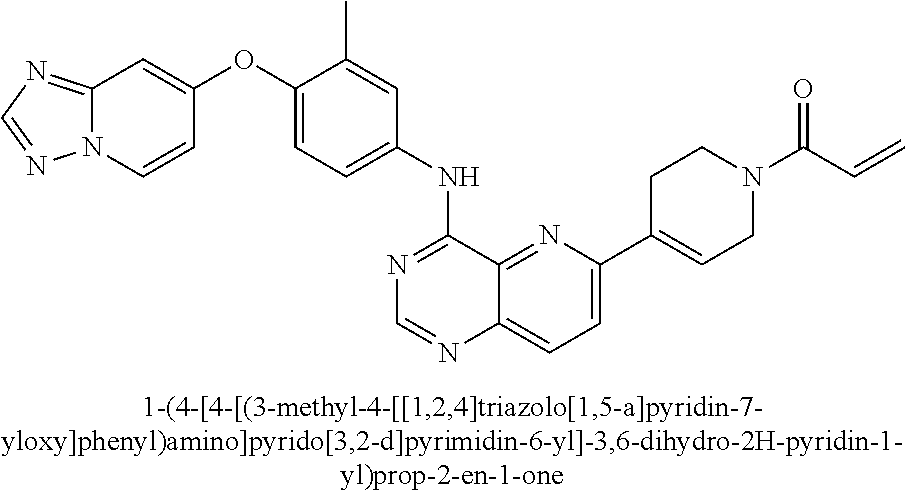 | 1H NMR (400 MHz, DMSO-d6) δ 9.86 (brs, 1H), 8.95 (d, J = 7.6 Hz, 1H), 8.65 (s, 1H), 8.39 (s, 1H), 8.19 (s, 2H), 8.00 (d, J = 7.6 Hz, 2H), 7.28-7.23 (m, 1H), 7.12-7.02 (m, 2H), 6.96-6.82 (m, 1H), 6.81 (d, J = 2.4 Hz, 1H), 6.22-6.10 (m, 1H), 5.76-5.69 (m, 1H), 4.44 (s, 1H), 4.35 (s, 1H), 3.93-3.76 (m, 2H), 2.93 (d, J = 20.8 Hz, 2H), 2.22 (s, 3H). LCMS: Method C; Retention Time: 0.68 min; MS (ESI, m/z): 505 [M + H]+ |
| 13 | A | A |  | 1H NMR (400 MHz, DMSO-d6) δ 9.86 (s, 1H), 8.96-8.92 (m, 1H), 8.65 (s, 1H), 8.39 (s, 1H), 8.21-8.15 (m, 2H), 8.00-7.96 (m, 2H), 7.28-7.23 (m, 1H), 7.11-7.02 (m, 2H), 6.80 (d, J = 2.4 Hz, 1H), 6.73-6.61 (m, 2H), 4.44-4.31 (m, 2H), 3.87-3.78 (m, 2H), 3.08-3.03 (m, 2H), 2.97-2.86 (m, 2H), 2.22 (s, 3H), 2.17 (s, 6H). LCMS: Method A; Retention Time: 1.35 min; MS (ESI, m/z): 562 [M + H]+, 281 ([M + 2H] / 2)+, 302 ([M + acetonitrile + 2H] / 2)+. |
| 14 | C | A |  | 1H NMR (300 MHz, DMSO-d6) δ 9.38 (brs, 1H), 8.94 (d, ] = 7.5 Hz, 1H), 8.44 (d, J = 4.2 Hz, 1H), 8.39 (s, 1H), 8.02-7.85 (m, 3H), 7.52-7.42 (m, 1H), 7.29-7.19 (m, 1H), 7.07-6.99 (m, 1H), 6.83-6.64 (m, 2H), 6.16-5.80 (m, 1H), 5.71-5.41 (m, 1H), 4.11-4.04 (m, 2H), 3.93-3.74 (m, 4H), 3.60-3.45 (m, 2H), 2.22 (s, 3H), 1.98-1.83 (m, 2H). LCMS: Method A; Retention Time: 1.36 min; MS (ESI, m/z): 522 [M + H]+, 262 ([M + 2H] / 2)+. |
| 15 | A | A |  | 1H NMR (400 MHz, MeOD) δ 8.82 (s, 1H), 8.41-8.26 (m, 2H), 8.20 (d, J = 9.0 Hz, 1H), 7.98-7.78 (m, 2H), 7.29 (d, J = 8.6 Hz, 1H), 7.11 (d, J = 25.1 Hz, 1H), 6.96-6.76 (m, 1H), 6.64 (d, J = 2.1 Hz, 1H), 6.41 (s, 1H), 6.28 (d, J = 15.5 Hz, 1H), 5.82 (d, J = 10.9 Hz, 1H), 4.48 (d, J = 14.8 Hz, 2H), 4.24 (s, 3H), 4.23 (m, 1H), 3.95 (s, 2H), 3.08-2.95 (m, 2H), 2.31 (s, 3H) LCMS: Method G; Retention Time: 2.22 min MS (ESI, m/z): 535 [M + H]+ |
| 16 | A | A |  | 1H NMR (400 MHz, MeOD) δ 8.62 (s, 1H), 8.38 (s, 1H), 8.20 (d, J = 8.9 Hz, 1H), 8.12 (d, J = 8.9 Hz, 1H), 7.97-7.93 (m, 2H), 7.31 (d, J = 2.4 Hz, 1H), 7.23 (d, J = 8.3 Hz. 1H), 6.99 (d, J = 21.7 Hz, 1H), 6.92-6.78 (m, 3H), 6.28 (d, J = 16.6 Hz, 1H), 5.81 (d, J = 10.6 Hz, 1H), 4.46 (d, J = 14.2 Hz, 2H), 3.96 (d, J = 5.5 Hz, 2H), 3.01 (d, J = 18.8 Hz, 2H), 2.28 (s, 3H). LCMS: Method G; Retention Time: 2.22 min MS (ESI, m/z): 539 [M + H]+ |
| 17 | A | A |  | 1H NMR (400 MHz, DMSO) δ 9.85 (s, 1H), 8.65 (s, 1H), 8.39 (s, 1H), 8.22-8.13 (m, 2H), 8.03-7.95 (m, 2H), 7.23 (d, J = 8.8 Hz, 1H), 7.08 (d, J = 16.8 Hz, 1H), 6.99 (s, 1H), 6.96-6.81 (m, 1H), 6.69 (d, J = 2.0 Hz, 1H), 6.18 (d, J = 16.8 Hz, 1H), 5.75 (d, J = 10.8 Hz, 1H), 4.39 (d, J = 34.8 Hz, 2H), 3.91-3.79 (m, 2H), 2.93 (d, J = 20.8 Hz, 2H), 2.73 (s, 3H), 2.22 (s, 3H). LCMS: Method E; Retention Time: 1.25 min MS (ESI, m/z): 519 [M + H]+ |
| 18 | F | A |  | 1H NMR (400 MHz, DMSO-d6) δ 10.13 (s, 1H), 9.43 (s, 1H), 8.94 (d, J = 7.5 Hz, 1H), 8.73 (s, 1H), 8.39 (s, 1H), 7.97 (d, J = 4.0 Hz, 2H), 7.54 (d, J = 21.6 Hz, 1H), 7.29-7.24 (m, 1H), 7.05 (dd, J = 7.5, 2.6 Hz, 1H), 7.00-6.83 (m, 1H), 6.81 (d, J = 2.6 Hz, 1H), 6.18 (d, J = 16.6 Hz, 1H), 5.75 (dd, J = 10.5, 2.3 Hz, 1H), 4.43 (d, J = 40.3 Hz, 2H), 3.85 (d, J = 7.2 Hz, 2H), 2.92 (d, J = 17.2 Hz, 2H), 2.23 (s, 3H). LCMS: Method E; Retention Time: 1.28 min MS (ESI, m/z): 506 [M + H]+ |
| 19 | G | A |  | 1H NMR (400 MHz, DMSO) δ 10.24 (s, 1H), 8.94 (d, J = 7.6 Hz, 1H), 8.58 (s, 1H), 8.38 (s, 1H), 7.95 (dd, J = 8.8, 2.8 Hz, 1H), 7.87 (d, J = 2.8 Hz, 1H), 7.71 (d, J = 8.8 Hz, 1H), 7.57 (d, J = 8.8 Hz, 1H), 7.23 (d, J = 8.8 Hz, 1H), 7.03 (dd, J = 7.6, 2.8 Hz, 1H), 6.98-6.82 (m, 1H), 6.80 (d, J = 2.4 Hz, 1H), 6.18 (d, J = 16.4 Hz, 1H), 6.11-6.04 (m, 1H), 5.77-5.71 (m, 1H), 4.29 (d, J = 38.8 Hz, 2H), 3.92 (s, 3H), 3.88-3.78 (m, 2H), 2.69-2.53 (m, 2H), 2.21 (s, 3H). LCMS: Method E; Retention Time: 1.01 min MS (ESI, m/z): 534 [M + H]+ |
| 20 | H | A |  | 1H NMR (400 MHz, DMSO) δ 10.36 (s, 1H), 8.92 (d, J = 7.5 Hz, 1H), 8.48 (s, 1H), 8.37 (s, 1H), 7.97 (dd, J = 8.7, 2.5 Hz, 1H), 7.87 (d, J = 2.4 Hz, 1H), 7.65 (d, J = 9.1 Hz, 1H), 7.56 (d, J = 9.0 Hz, 1H), 7.21 (d, J = 8.7 Hz, 1H), 7.02 (dd, J = 7.5, 2.6 Hz, 1H), 6.88 (dd, J = 16.7, 10.4 Hz, 1H), 6.78 (d, J = 2.5 Hz, 1H), 6.16 (dd, J = 16.6, 2.3 Hz, 1H), 5.73 (dd, J = 10.4, 2.3 Hz, 1H), 4.15 (s, 3H), 3.80 (s, 4H), 3.15 (s, 4H), 2.20 (s, 3H). LCMS: Method E; Retention Time: 0.80 min MS (ESI, m/z): 537 [M + H]+ |
| 21 | A | A |  | 1H NMR (300 MHz, DMSO-d6) δ 9.90 (brs, 1H), 8.94 (dd, J = 7.8, 1.8 Hz, 1H), 8.63 (d, J = 5.1 Hz, 1H), 8.37 (s, 1H), 8.35-8.23 (m, 1H), 8.22-8.14 (m, 1H), 8.06-7.86 (m, 2H), 7.31-7.20 (m, 1H), 7.12 (s, 1H), 7.03 (dd, J = 7.5, 2.7 Hz, 1H), 6.92-6.60 (m, 2H), 6.33-6.17 (m, 1H), 5.86-5.69 (m, 1H), 5.07 (s, 1H), 4.85 (s, 1H), 4.72 (s, 1H), 4.48 (s, J = 3.2 Hz, 1H), 2.21 (s, 3H). LCMS: Method F; Retention Time: 1.16 min. MS (ESI, m/z): 491 [M + H]+ 246 ([M + 2H] / 2)+, 267 ([M + H + acetonitrile] / 2)+. |
| 22 | C | A |  | 1H NMR (300 MHz, DMSO-d6) δ 9.35 (s, 1H), 8.94 (dd, J = 7.5, 0.6 Hz, 1H), 8.44 (s, 1H), 8.37 (s, 1H), 8.01-7.94 (m, 3H), 7.53 (d, J = 9.0 Hz, 1H), 7.21 (d, J = 9.0 Hz, 1H), 7.02 (dd, J = 7.5, 2.7 Hz, 1H), 6.90-6.85 (m 1H), 6.79-6.78 (m, 1H), 6.16 (d, J = 18.0 Hz, 1H), 5.76 (dd, J = 12.0, 2.4 Hz, 1H), 4.95-4.86 (m, 1H), 4.59-4.01 (m, 3H), 3.64-3.34 (m, 1H), 3.31-2.87 (m, 2H), 2.21 (s, 3H), 1.11 (d, J = 6.0 Hz, 3H). LCMS: Method B; Retention Time: 0.99 min. MS (ESI, m/z): 522 [M + H]+ |
| 23 | C | A |  | 1H NMR (300 MHz, DMSO-d6) δ 9.16 (s, 1H), 8.81 (d, J = 7.5 Hz, 1H), 8.35 (s, 1H), 8.26 (s, 1H), 7.92-7.77 (m, 3H), 7.11 (d, J = 9.0 Hz, 1H), 6.96 (d, J = 9.0 Hz, 1H), 6.92-6.89 (m, 1H), 6.67 (d, J = 3.0 Hz, 1H), 6.25-6.16 (m, 1H), 6.02-5.96 (m, 1H), 5.59-5.54 (m, 1H), 4.36 (s, 2H), 4.26 (s, 4H), 4.06 (s, 2H), 2.08 (s, 3H). LCMS: Method B; Retention Time: 0.93 min. MS (ESI, m/z): 520 [M + H]+ 260 ([M + 2H] / 2)+. |
| 24 | C | B |  | 1H NMR (300 MHz, DMSO-d6) δ 9.37 (s, 1H), 8.92 (d, J = 7.5 Hz, 1H), 8.44 (s, 1H), 8.36 (s, 1H), 8.02-7.89 (m, 3H), 7.56 (d, J = 9.0 Hz, 1H), 7.21 (d, J = 9.0 Hz, 1H), 7.01 (dd, J = 7.5, 2.7 Hz, 1H), 6.76 (d, J = 3.0 Hz, 1H), 5.38-5.17 (d, J = 6.0 Hz, 2H), 3.92-3.89 (m, 4H), 3.71-3.69 (m, 4H), 2.18 (s, 3H). LCMS: Method B; Retention Time: 1.03 min. MS (ESI, m/z): 526 [M + H]+ |
| 25 | A | A |  | 1H NMR (300 MHz, DMSO-d6) δ 9.73 (s, 1H), 8.88-8.79 (m, 1H), 8.53 (s, 1H), 8.26 (s, 1H), 8.07 (s, 2H), 7.89-7.87 (m, 2H), 7.14 (d, J = 9.0 Hz, 1H), 7.02-6.88 (m, 2H), 6.69 (d, J = 3.0 Hz, 1H), 6.63-6.33 (m, 2H), 4.30-4.21 (m, 2H), 3.90-3.75 (m, 2H), 2.93-2.82 (m, 3H), 2.66-2.63 (m, 1H), 2.10-2.02 (m, 7H), 1.93-1.78 (m, 1H), 1.61-1.58 (m, 2H), 1.45-1.42 (m, 1H). LCMS: Method B; Retention Time: 0.99 min. MS (ESI, m/z): 588 [M + H]+, 294 ([M + 2H] / 2)+, 315 ([M + 2H + acetonitrile] / 2)+. |
| 26 | A | A |  | 1H NMR (300 MHz, DMSO-d6) δ 9.72 (d, J = 6.0 Hz, 1H), 8.83 (d, J = 7.5 Hz, 1H), 8.53 (s, 1H), 8.27 (s, 1H), 8.14-8.00 (m, 2H), 8.02-7.95 (m, 2H), 7.14 (d, J = 9.0 Hz, 1H), 7.00-6.75 (m, 3H), 6.69 (d, J = 3.0 Hz, 1H), 6.06-6.01 (m, 1H), 5.63-5.89 (m, 1H), 5.25-4.10 (m, 3H), 3.11-2.61 (m, 2H), 2.10 (s, 3H), 1.35-0.96 (m, 3H). LCMS: Method B; Retention Time: 1.03 min. MS (ESI, m/z): 519 [M + H]+ |
| 27 | A | A |  | 1H NMR (400 MHz, DMSO-d6) δ 11.01 (brs, 1H), 9.01-8.88 (m, 2H), 8.48-8.32 (m, 2H), 8.25 (d, J = 8.8 Hz, 1H), 7.89-7.75 (m, 2H), 7.31 (d, J = 17.6 Hz, 2H), 7.22-7.01 (m, 2H), 7.00-6.79 (m, 2H), 6.26-6.14 (m, 1H), 5.82-5.71 (m, 1H), 4.83 (d, J = 20.4 Hz, 2H), 3.83-3.72 (m, 2H), 2.50-2.46 (m, 1H), 2.26 (s, 3H). LCMS: Method D; Retention Time: 1.32 min. MS (ESI, m/z): 505 [M + H]+ |
| 28 | B | A |  | 1H NMR (300 MHz, DMSO-d6) δ 9.79 (s, 1H), 8.95 (d, J = 7.5 Hz, 1H), 8.67 (s, 1H), 8.39 (s, 1H), 8.18 (d, J = 8.4 Hz, 1H), 8.08-7.95 (m, 2H), 7.87 (d, J = 8.7 Hz, 1H), 7.25 (d, J = 8.7 Hz, 1H), 7.04 (dd, J = 7.5, 2.7 Hz, 1H), 6.95-6.83 (m, 1H), 6.80 (d, J = 2.7 Hz, 1H), 6.20-6.09 (m, 1H), 5.76-5.63 (m, 1H), 4.82-4.49 (m, 1H), 4.33-4.05 (m, 1H), 3.53-3.41 (m, 2H), 3.17-3.00 (m, 1H), 2.86-2.69 (m, 1H), 2.43-2.33 (m, 1H), 2.22 (s, 3H), 2.00-1.89 (m, 1H), 0.59 (d, J = 6.9 Hz, 3H). LCMS: Method D; Retention Time: 1.09 min. MS (ESI, m/z): 521 [M + H]+ |
| 29 | I | A |  | 1H NMR (400 MHz, DMSO-d6) δ 9.19 (d, J = 13.6 Hz, 1H), 8.94 (d, J = 1.6 Hz, 1H), 8.51 (s, 1H), 8.39 (s, 1H), 7.83-7.79 (m, 2H), 7.74 (t, J = 9.2 Hz, 1H), 7.63 (d, J = 9.2 Hz, 1H), 7.27-7.16 (m, 1H), 7.04 (dd, J = 7.6, 2.8 Hz, 1H), 6.90 (dd, J = 16.8, 10.4 Hz, 1H), 6.80 (d, J = 2.8 Hz, 1H), 6.18 (dd, J = 16.8, 2.4 Hz, 1H), 5.74 (dd, J = 10.4, 2.4 Hz, 1H), 3.83-3.72 (m, 4H), 3.21-3.16 (m, 4H), 2.20 (s, 3H). LCMS: Method H; Retention Time: 2.64 min. MS (ESI, m/z): 525 [M + H]+ |
| 30 | J | A |  | 1H NMR (400 MHz, DMSO-d6) δ 9.24 (d, J = 13.6 Hz, 1H), 8.94 (d, J = 7.6 Hz, 1H), 8.59 (s, 1H), 8.38 (s, 1H), 7.84 (d, J = 8.6 Hz, 1H), 7.76 (dd, J = 11.2, 2.4 Hz, 2H), 7.63 (d, J = 8.8 Hz, 1H), 7.21 (d, J = 8.8 Hz, 1H), 7.03 (dd, J = 7.6, 2.6 Hz, 1H), 6.18 (d, J = 16.4 Hz, 2H), 5.74 (dd, J = 10.4, 2.4 Hz, 1H), 4.30 (d, J = 38.6 Hz, 2H), 3.87-3.76 (m, 2H), 3.32 (s, 2H), 2.60 (d, J = 20.0 Hz, 2H), 2.19 (s, 3H). LCMS: Method G; Retention Time: 3.26 min. MS (ESI, m/z): 522 [M + H]+ |
| 31 | A | B |  | 1H NMR (300 MHz, DMSO-d6) δ 9.86 (brs, 1H), 8.95 (s, 1H), 8.65 (s, 1H), 8.39 (s, 1H), 8.19 (s, 2H), 8.04-7.97 (m, 2H), 7.30-7.21 (m, 1H), 7.13-7.01 (m, 2H), 6.81 (d, J = 2.7 Hz, 1H), 5.44-5.16 (m, 2H), 4.33-4.30 (m, 2H), 3.82 (t, J = 5.7 Hz, 2H), 3.11-2.98 (m, 2H), 2.22 (s, 3H). LCMS: Method C; Retention Time: 0.90 min MS (ESI, m/z): 523 [M + H]+ |
| 32 | K | A |  | 1H NMR (400 MHz, DMSO-d6) δ 9.64 (s, 1H), 9.16 (s, 1H), 8.98 (d, J = 7.6 Hz, 1H), 8.42 (d, J = 4.3 Hz, 2H), 7.95-7.83 (m, 1H), 7.16 (d, J = 8.1 Hz, 1H), 7.10-7.05 (m, 1H), 6.97-6.93 (m, 1H), 6.92-6.83 (m, 1H), 6.21-6.11 (m, 1H), 5.79-5.69 (m, 1H), 4.96-4.46 (m, 4H), 3.67-3.61 (m, 2H), 3.20-3.15 (m, 1H), 2.18 (s, 3H), 1.21-1.13 (m, 3H). LCMS: Method H; Retention Time: 1.31 min MS (ESI, m/z): 541 [M + H]+ |
| 33 | E | A |  | 1H NMR (400 MHz, DMSO-d6) δ 9.96 (brs, 1H), 8.95 (d, J = 7.6 Hz, 1H), 8.68 (s, 1H), 8.39 (s, 1H), 8.22 (d, J = 8.8 Hz, 1H), 8.00-7.88 (m, 3H), 7.26 (d, J = 8.4 Hz, 1H), 7.04 (dd, J = 7.6, 2.8 Hz, 1H), 6.80 (d, J = 2.8 Hz, 1H), 6.47-6.38 (m, 1H), 6.16 (dd, J = 16.0, 2.8 Hz, 1H), 5.71 (dd, J = 10.8, 2.4 Hz, 1H), 4.76-4.64 (m, 2H), 4.47-4.28 (m, 3H), 2.22 (s, 3H). MS (ESI, m/z): 479 (M + H)+. LCMS: Method B; Retention Time: 0.86 min MS (ESI, m/z): 479 [M + H]+ |
| 34 | K | A |  | 1H NMR (400 MHz, DMSO) δ 9.69 (s, 1H), 9.19 (d, J = 8.3 Hz, 1H), 9.02 (d, J = 7.5 Hz, 1H), 8.45 (d, J = 4.6 Hz, 2H), 7.92 (d, J = 8.1 Hz, 1H), 7.38 (d, J = 10.8 Hz, 1H), 7.10 (dd, J = 7.5, 2.5 Hz, 1H), 7.03-6.87 (m, 2H), 6.24 (d, J = 16.5 Hz, 1H), 5.79 (dd, J = 10.5, 2.1 Hz, 1H), 5.37-5.06 (m, 1H), 4.94-4.72 (m, 1H), 4.45 (dd, J = 50.1, 13.0 Hz, 1H), 4.28-4.02 (m, 1H), 3.68-3.40 (m, 1H), 3.31-2.92 (m, 2H), 2.24 (s, 3H), 1.20 (d, J = 4.8 Hz, 3H). LCMS: Method H; Retention Time: 2.92 min MS (ESI, m/z): 541 [M + H]+ |
| 35 | K | A |  | 1H NMR (400 MHz, DMSO) δ 9.66 (s, 1H), 9.17 (s, 1H), 8.98 (d, J = 7.5 Hz, 1H), 8.42 (d, J = 4.8 Hz, 2H), 7.88 (d, J = 9.1 Hz, 1H), 7.34 (d, J = 10.7 Hz, 1H), 7.07 (dd, J = 7.5, 2.5 Hz, 1H), 6.98-6.85 (m, 2H), 6.25-6.14 (m, 1H), 5.80-5.71 (m, 1H), 5.25-5.02 (m, 1H), 4.89-4.68 (m, 1H), 4.42 (dd, J = 49.7, 12.8 Hz, 1H), 4.27-3.99 (m, 1H), 3.58-3.41 (m, 1H), 3.22-2.84 (m, 2H), 2.21 (s, 3H), 1.16 (s, 3H). LCMS: Method H; Retention Time: 2.97 min MS (ESI, m/z): 541 [M + H]+ |
| 36 | K | A |  | 1H NMR (400 MHz, DMSO) δ 9.68 (s, 1H), 9.15 (s, 1H), 8.98 (d, J = 7.5 Hz, 1H), 8.41 (d, J = 10.6 Hz, 2H), 7.86 (d, J = 8.5 Hz, 1H), 7.34 (d, J = 10.7 Hz, 1H), 7.06 (dd, J = 7.5, 2.6 Hz, 1H), 6.93 (d, J = 2.5 Hz, 1H), 6.88 (dd, J = 16.6, 10.5 Hz, 1H), 6.21-6.11 (m, 1H), 5.77-5.70 (m, 1H), 5.00-4.72 (m, 2H), 4.70-3.87 (m, 2H), 3.44-3.38 (m, 1H), 3.27-2.92 (m, 2H), 2.20 (s, 3H), 1.17 (m, 3H). LCMS: Method H; Retention Time: 1.31 min MS (ESI, m/z): 541 [M + H]+ |
| 37 | F | A |  | 1H NMR (400 MHz, DMSO) δ 10.07 (d, J = 13.0 Hz, 1H), 9.47 (s, 1H), 8.98 (d, J = 7.5 Hz, 1H), 8.69 (s, 1H), 8.41 (s, 1H), 7.90-7.78 (m, 1H), 7.49 (d, J = 19.3 Hz, 1H), 7.16 (d, J = 8.8 Hz, 1H), 7.07 (dd, J = 7.5, 2.6 Hz, 1H), 7.00-6.81 (m, 2H), 6.16 (d, J = 16.7 Hz, 1H), 5.73 (dd, J = 10.5, 2.3 Hz, 1H), 4.39 (d, J = 24.8 Hz, 2H), 3.89-3.79 (m, 2H), 2.87 (d, J = 17.0 Hz, 2H), 2.18 (d, J = 1.5 Hz, 3H). LCMS: Method H; Retention Time: 2.63 min MS (ESI, m/z): 524 [M + H]+ |
| 38 | F | A |  | 1H NMR (400 MHz, DMSO) δ 10.11 (s, 1H), 9.46 (s, 1H), 8.98 (d, J = 7.5 Hz, 1H), 8.68 (s, 1H), 8.43 (s, 1H), 7.85 (t, J = 10.3 Hz, 1H), 7.50 (d, J = 19.6 Hz, 1H), 7.36 (d, J = 10.7 Hz, 1H), 7.07 (dd, J = 7.4, 2.5 Hz, 1H), 6.99-6.82 (m, 2H), 6.18 (d, J = 16.6 Hz, 1H), 5.74 (dd, J = 10.5, 2.1 Hz, 1H), 4.43 (d, J = 42.0 Hz, 2H), 3.89-3.81 (m, 2H), 2.93-2.83 (m, 2H), 2.21 (s, 3H). LCMS: Method H; Retention Time: 2.81 min MS (ESI, m/z): 524 [M + H]+ |
| 39 | K | A |  | 1H NMR (400 MHz, DMSO) δ 9.76 (s, 1H), 9.17 (s, 1H), 9.02 (d, J = 7.5 Hz, 1H), 8.47 (s, 1H), 8.42 (s, 1H), 8.27 (t, J = 8.6 Hz, 1H), 7.37 (d, J = 9.1 Hz, 1H), 7.30 (d, J = 2.5 Hz, 1H), 7.13 (dd, J = 7.5, 2.7 Hz, 1H), 6.87 (dd, J = 16.5, 10.3 Hz, 1H), 6.21-6.13 (m, 1H), 5.76-5.70 (m, 1H), 4.90-4.15 (m, 4H), 3.44-3.35 (m, 2H), 3.22-3.14 (m, 1H), 1.20-1.11 (m, 3H) LCMS: Method H; Retention Time: XX min MS (ESI, m/z): 595 [M + H]+ |
| 40 | K | A |  | 1H NMR (400 MHz, DMSO-d6) δ 9.50 (s, 1H), 9.15 (s, 1H), 8.98 (d, J = 7.6 Hz, 1H), 8.42 (d, J = 2.4 Hz, 2H), 8.03-7.94 (m, 1H), 7.15 (d, J = 8.8 Hz, 1H), 7.07 (dd, J = 7.6, 2.8 Hz, 1H), 6.93 (d, J = 2.8 Hz, 1H), 6.85-6.75 (m, 1H), 6.12 (dd, J = 16.8, 2.4 Hz, 1H), 5.68 (dd, J = 10.4, 2.4 Hz, 1H), 5.06-4.96 (m, 1H), 4.61-4.49 (m, 2H), 4.06-3.98 (m, 1H), 3.66-3.56 (m, 2H), 2.17 (d, J = 2.0 Hz, 3H), 1.37-1.32 (m, 6H) LCMS: |
| 41 | K | A |  | 1H NMR (400 MHz, DMSO-d6) δ 9.69-9.27 (m, 1H), 9.19-9.09 (m, 1H), 9.03-8.92 (m, 1H), 8.46-8.35 (m, 2H), 8.18-7.79 (m, 1H), 7.17-7.04 (m, 2H), 6.95-6.91 (m, 1H), 6.90-6.55 (m, 1H), 6.25-6.12 (m, 1H), 5.76-5.66 (m, 1H), 5.43-5.11 (m, 1H), 4.86-4.54 (m, 1H), 3.90-3.77 (m, 3H), 3.69-3.60 (m, 1H), 2.17 (s, 3H), 2.02-1.81 (m, 4H) LCMS: Method A; Retention Time: 1.01 min MS (ESI, m/z): 553 [M + H]+ |
| 42 | F | A |  | 1H NMR (300 MHz, DMSO-d6) δ 10.00 (brs, 1H), 9.44 (s, 1H), 8.99 (d, J = 7.5 Hz, 1H), 8.69 (s, 1H), 8.43 (s, 1H), 7.93-7.84 (m, 1H), 7.56-7.46 (m, 1H), 7.16 (dd, J = 1.5, 9.0 Hz, 1H), 7.09 (dd, J = 2.7, 7.5 Hz, 1H), 7.18-6.85 (m, 2H), 6.18 (dd, J = 2.1, 16.5 Hz, 1H), 5.74 (dd, J = 2.4, 10.5 Hz, 1H), 5.17-4.69 (m, 2H), 4.22-3.81 (m, 1H), 3.13 (d, J = 17.7 Hz, 1H), 2.80-2.64 (m, 1H), 2.19 (d, J = 2.1 Hz, 3H), 1.26-1.10 (m, 3H). LCMS: Method A; Retention Time: 1.04 min MS (ESI, m/z): 538 [M + H]+ |
| 43 | K | A |  | 1H NMR (300 MHz, DMSO-d6) δ 9.58 (s, 1H), 9.17 (s, 1H), 8.98 (d, J = 7.5, 1H), 8.42 (s, 2H), 7.99-7.84 (m, 1H), 7.15 (dd, J = 9.0, 1.5 Hz, 1H), 7.08 (dd, J = 7.5, 2.7 Hz, 1H), 7.01-6.83 (m, 2H), 6.21 (d, J = 16.5 Hz, 1H), 5.76 (dd, J = 10.5, 2.4 Hz, 1H), 5.23-5.03 (m, 1H), 4.86-4.62 (m, 1H), 4.55-4.30 (m, 1H), 4.25-4.02 (m, 1H), 3.60-2.89 (m, 3H), 2.17 (d, J = 2.1 Hz, 3H), 1.17 (d, J = 6.6 Hz, 3H) LCMS: Method J; Retention Time: 1.05 min MS (ESI, m/z): 541 [M + H]+ |
| 44 | K | A |  | 1H NMR (400 MHz, DMSO-d6) δ 9.49 (s, 1H), 9.12 (s, 1H), 8.98 (d, J = 7.2 Hz, 1H), 8.40 (d, J = 6.4 Hz, 2H), 7.97 (s, 1H), 7.21-7.12 (m, 1H), 7.07 (dd, J = 7.6, 2.8 Hz, 1H), 6.93 (d, J = 2.4 Hz, 1H), 6.81 (s, 1H), 6.12 (d, J = 16.4 Hz, 1H), 5.67 (dd, J = 10.4, 2.4 Hz, 1H), 4.99 (s, 1H), 4.60-4.16 (m, 3H), 3.24 (d, J = 12.4 Hz, 2H), 2.17 (d, J = 2.0 Hz, 3H), 1.26 (d, J = 6.0 Hz, 3H), 1.21 (s, 3H) LCMS: Method J; Retention Time: 1.08 min MS (ESI, m/z): 555 [M + H]+ |
| 45 | K | A |  | 1H NMR (400 MHz, DMSO-d6) δ 9.70-9.32 (m, 1H), 9.18-9.12 (m, 1H), 8.98 (d, J = 7.6 Hz, 1H), 8.50-8.36 (m, 2H), 8.21-7.78 (m, 1H), 7.15 (d, J = 8.8 Hz, 1H), 7.07 (dd, J = 7.6, 2.8 Hz, 1H), 6.94 (d, J = 2.4 Hz, 1H), 6.91-6.56 (m, 1H), 6.25-6.11 (m, 1H), 5.78-5.66 (m, 1H), 5.43-5.10 (m, 1H), 4.87-4.54 (m, 1H), 4.01-3.71 (m, 3H), 3.69-3.60 (m, 1H), 2.17 (s, 3H), 2.10-1.78 (m, 4H). LCMS: Method A; Retention Time: 1.04 min MS (ESI, m/z): 553 [M + H]+ |
| 46 | K | A |  | 1H NMR (300 MHz, DMSO-d6) δ 9.21 (s, 1H), 9.01 (s, 1H), 8.85 (d, J = 7.2 Hz, 1H), 8.30 (d, J = 6.9 Hz, 2H), 8.03 (s, 1H), 7.11-6.87 (m, 2H), 6.81 (d, J = 2.4 Hz, 1H), 6.51-6.42 (m, 1H), 6.01 (d, J = 16.8 Hz, 1H), 5.63-5.45 (m, 1H), 3.80-3.74 (m, 3H), 3.63-3.56 (m, 1H), 3.53-3.40 (m, 3H), 3.33-3.28 (m, 1H), 3.05-2.96 (m, 2H), 2.04 (s, 3H). LCMS: Method J; Retention Time: 0.97 min MS (ESI, m/z): 553 [M + H]+ |
| 47 | K | A |  | 1H NMR (400 MHz, DMSO-d6) δ 9.31 (d, J = 8.8 Hz, 1H), 9.15 (d, J = 2.4 Hz, 1H), 8.98 (d, J = 7.6 Hz, 1H), 8.50-8.39 (m, 2H), 8.24-8.14 (m, 1H), 7.15 (d, J = 8.8 Hz, 1H), 7.12-7.05 (m, 1H), 6.94 (s, 1H), 6.66-6.51 (m, 1H), 6.16 (d, J = 16.8 Hz, 1H), 5.69 (d, J = 10.4 Hz, 1H), 4.25-4.14 (m, 4H), 3.90-3.84 (m, 1H), 3.72-3.63 (m, 2H), 3.50-3.46 (m, 1H), 2.30-2.23 (m, 1H), 2.20-2.12 (m, 4H) LCMS: Method J; Retention Time: 0.96 min MS (ESI, m/z): 553 [M + H]+ |
| 48 | K | A |  | 1H NMR (300 MHz, DMSO-d6) δ 9.33 (d, J = 14.4 Hz, 1H), 9.12 (s, 1H), 8.97 (d, J = 7.5 Hz, 1H), 8.41 (s, 2H), 8.20-8.02 (m, 1H), 7.14 (d, J = 8.7 Hz, 1H), 7.10-7.02 (m, 1H), 6.93 (d, J = 2.7 Hz, 1H), 6.68-6.53 (m, 1H), 6.21-6.10 (m, 1H), 5.73-5.61 (m, 1H), 3.84-3.60 (m, 6H), 3.56-3.48 (m, 2H), 2.16 (d, J = 2.1 Hz, 3H), 2.11-1.90 (m, 4H). LCMS: Method J; Retention Time: 1.01 min MS (ESI, m/z): 567 [M + H]+ |
| 49 | K | A |  | 1H NMR (400 MHz, DMSO) δ 9.63 (s, 1H), 9.16 (s, 1H), 8.98 (d, J = 7.5 Hz, 1H), 8.42 (d, J = 4.2 Hz, 2H), 7.88 (t, J = 8.8 Hz, 1H), 7.16 (d, J = 8.5 Hz, 1H), 7.10-7.06 (m, 1H), 6.94 (d, J = 2.5 Hz, 1H), 6.92-6.84 (m, 1H), 6.20-6.13 (m, 1H), 5.76-5.71 (m, 1H), 4.94-4.43 (m, 4H), 3.51-3.48 (m, 2H), 3.22-3.16 (m, 1H), 2.18 (s, 3H), 1.21-1.13 (m, 3H). LCMS: Method H; Retention Time: 2.39 min MS (ESI, m/z): 541 [M + H]+ |
| 50 | K | A |  | 1H NMR (400 MHz, DMSO) δ 9.66 (s, 1H), 9.14 (s, 1H), 8.97 (d, J = 7.4 Hz, 1H), 8.40 (d, J = 8.8 Hz, 2H), 7.86 (d, J = 8.7 Hz, 1H), 7.33 (d, J = 10.7 Hz, 1H), 7.05 (dd, J = 7.5, 2.6 Hz, 1H), 6.93 (d, J = 2.5 Hz, 1H), 6.87 (dd, J = 16.7, 10.5 Hz, 1H), 6.15 (dd, J = 16.6, 2.0 Hz, 1H), 5.72 (dd, J = 10.4, 2.2 Hz, 1H), 4.77 (s, 2H), 4.71-3.98 (m, 2H), 3.37 (d, J = 12.4 Hz, 1H), 3.17 (s, 2H), 2.20 (s, 3H), 1.16 (s, 3H). LCMS: Method H; Retention Time: 2.75 min MS (ESI, m/z): 541 [M + H]+ |
| 51 | K | A |  | 1H NMR (400 MHz, DMSO) δ 9.66 (s, 1H), 9.14 (s, 1H), 8.41 (d, J = 9.8 Hz, 2H), 7.86 (d, J = 8.6 Hz, 1H), 7.30 (d, J = 10.7 Hz, 1H), 7.02 (s, 1H), 6.93-6.76 (m, 2H), 6.16 (d, J = 16.3 Hz, 1H), 5.73 (d, J = 12.6 Hz, 1H), 4.90-3.53 (m, 6H), 3.23-3.08 (m, 1H), 2.74 (s, 3H), 2.20 (s, 3H), 1.26-1.08 (m, 3H). LCMS: Method H; Retention Time: 2.70 min MS (ESI, m/z): 555 [M + H]+ |
| 52 | J | A |  | 1H NMR (400 MHz, DMSO-d6) δ 9.28 (s, 1H), 8.99 (d, J = 7.6 Hz, 1H), 8.81 (s, 1H), 8.49 (s, 1H), 8.43 (s, 1H), 7.80 (s, 1H), 7.17-7.05 (m, 2H), 6.95 (d, J = 2.8 Hz, 1H), 6.92-6.81 (m, 1H), 6.17 (d, J = 17.2 Hz, 1H), 5.78-5.69 (m, 1H), 4.77-4.38 (m, 2H), 4.02-3.99 (m, 1H), 3.88-3.84 (m, 1H), 3.62-3.44 (m, 1H), 3.21-3.19 (m, 1H), 3.07-2.96 (m, 1H), 2.16 (s, 3H), 1.33-1.25 (m, 3H). LCMS: Method D; Retention Time: 1.18 min MS (ESI, m/z): 558 [M + H]+ |
| 53 | I | A |  | 1H NMR (400 MHz, DMSO-d6) δ 9.14 (d, J = 10.2 Hz, 1H), 8.98 (d, J = 7.5 Hz, 1H), 8.47 (s, 1H), 8.42 (s, 1H), 7.86 (t, J = 8.7 Hz, 1H), 7.73 (t, J = 9.1 Hz, 1H), 7.64 (d, J = 9.1 Hz, 1H), 7.12 (d, J = 8.8 Hz, 1H), 7.08 (dd, J = 7.4, 2.4 Hz, 1H), 6.94 (d, J = 2.3 Hz, 1H), 6.86 (dd, J = 16.4, 10.5 Hz, 1H), 6.17 (d, J = 16.7 Hz, 1H), 5.73 (d, J = 10.4 Hz, 1H), 4.87-4.05 (m, 2H), 3.49-3.43 (m, 3H), 3.09-2.86 (m, 2H), 2.16 (s, 3H), 1.39 (s, 3H). LCMS: Method H; Retention Time: 1.10 min MS (ESI, m/z): 557 [M + H]+ |
| 54 | F | A |  | 1H NMR (300 MHz, DMSO-d6) δ 10.00 (br.s, 1H), 9.45 (s, 1H), 8.99 (dd, J = 0.6, 7.5 Hz, 1H), 8.69 (s, 1H), 8.42 (s, 1H), 7.92-7.82 (m, 1H), 7.45 (s, 1H), 7.17 (dd, J = 1.5, 8.7 Hz, 1H), 7.08 (dd, J = 2.7, 7.5 Hz, 1H), 6.97-6.83 (m, 2H), 6.24-6.14 (m, 1H), 5.74 (d, J = 10.2 Hz, 1H), 5.14-4.94 (m, 1H), 4.72-4.25 (m, 1H), 3.39-2.87 (m, 1H, overlapped with H2O), 3.17-3.11 (m, 1H), 2.61-2.40 (m, 1H, overlapped with DMSO), 2.19 (s, 3H), 1.39-1.31 (m, 3H). LCMS: Method A; Retention Time: 1.065 min MS (ESI, m/z): 538 [M + H]+ |
| 55 | F | A |  | 1H NMR (300 MHz, DMSO-d6) δ 10.00 (br.s, 1H), 9.45 (s, 1H), 8.99 (dd, J = 0.6, 7.5 Hz, 1H), 8.69 (s, 1H), 8.42 (s, 1H), 7.92-7.82 (m, 1H), 7.45 (s, 1H), 7.17 (dd, J = 1.5, 8.7 Hz, 1H), 7.08 (dd, J = 2.7, 7.5 Hz, 1H), 6.97-6.83 (m, 2H), 6.24-6.14 (m, 1H), 5.74 (d, J = 10.2 Hz, 1H), 5.14-4.94 (m, 1H), 4.72-4.25 (m, 1H), 3.39-2.87 (m, 1H, overlapped with H2O), 3.17-3.11 (m, 1H), 2.61-2.40 (m, 1H, overlapped with DMSO), 2.19 (s, 3H), 1.39-1.31 (m, 3H). LCMS: Method A; Retention Time: 1.065 min MS (ESI, m/z): 538 [M + H]+ |
| 56 | F | A |  | 1H NMR (400 MHz, DMSO) δ 10.10 (d, J = 14.9 Hz, 1H), 9.42 (s, 1H), 8.99 (d, J = 7.5 Hz, 1H), 8.66 (s, 1H), 8.42 (s, 1H), 7.80-7.66 (m, 2H), 7.16 (d, J = 8.8 Hz, 1H), 7.08 (d, J = 7.5 Hz, 1H), 6.96 (s, 1H), 6.90-6.82 (m, 1H), 6.15 (d, J = 16.5 Hz, 1H), 5.70 (d, J = 12.2 Hz, 1H), 3.85-3.73 (m, 4H), 3.28 (d, J = 3.8 Hz, 2H), 2.67 (d, J = 5.3 Hz, 2H), 2.18 (s, 3H). LCMS: Method J; Retention Time: 1.08 min MS (ESI, m/z): 538 [M + H]+ |
| 57 | F | A |  | 1H NMR (400 MHz, DMSO) δ 10.08 (d, J = 11.9 Hz, 1H), 9.42 (s, 1H), 8.98 (d, J = 7.5 Hz, 1H), 8.67 (s, 1H), 8.42 (s, 1H), 7.80 (t, J = 8.6 Hz, 1H), 7.66 (s, 1H), 7.16 (d, J = 8.4 Hz, 1H), 7.08 (dd, J = 7.5, 2.3 Hz, 1H), 6.96 (d, J = 2.4 Hz, 1H), 6.84 (dd, J = 16.6, 10.4 Hz, 1H), 6.13 (d, J = 14.9 Hz, 1H), 5.69 (d, J = 10.5 Hz, 1H), 4.41 (dd, J = 25.0, 5.1 Hz, 2H), 3.93-3.69 (m, 2H), 3.14-3.00 (m, 2H), 2.18 (s, 3H), 2.01-1.91 (m, 2H). LCMS: Method J; Retention Time: 1.07 min MS (ESI, m/z): 538 [M + H]+ |
| 58 | F | A |  | 1H NMR (400 MHz, DMSO-d6) δ 10.14 (s, 1H), 9.47 (s, 1H), 8.99 (d, J = 7.4 Hz, 1H), 8.68 (s, 1H), 8.43 (s, 1H), 7.89-7.79 (m, 1H), 7.62-7.48 (m, 1H), 7.37 (d, J = 10.7 Hz, 1H), 7.08 (dd, J = 7.5, 2.7 Hz, 1H), 6.96 (d, J = 2.6 Hz, 1H), 6.95-6.74 (m, 1H), 6.17 (d, J = 16.7 Hz, 1H), 5.73 (d, J = 11.1 Hz, 1H), 5.22-4.62 (m, 2H), 4.29-3.72 (m, 1H), 3.17 (d, J = 17.5 Hz, 1H), 2.86-2.65 (m, 1H), 2.22 (s, 3H), 1.15 (d, J = 13.2 Hz, 3H). LCMS: Method J; Retention Time: 0.94 min MS (ESI, m/z): 538 [M + H]+ |
| 59 | F | A |  | 1H NMR (400 MHz, DMSO-d6) δ 10.12 (s, 1H), 9.46 (s, 1H), 8.99 (d, J = 7.4 Hz, 1H), 8.68 (s, 1H), 8.43 (s, 1H), 7.84 (t, J = 9.3 Hz, 1H), 7.47 (s, 1H), 7.36 (d, J = 10.7 Hz, 1H), 7.07 (dd, J = 7.5, 2.6 Hz, 1H), 6.96 (d, J = 2.5 Hz, 1H), 6.90 (dd, J = 24.3, 14.3 Hz, 1H), 6.19 (t, J = 17.4 Hz, 1H), 5.74 (d, J = 9.4 Hz, 1H), 5.04 (d, J = 77.0 Hz, 1H), 4.49 (dd, J = 179.2, 8.6 Hz, 1H), 3.20-2.88 (m, 2H), 2.21 (s, 3H), 1.36 (dd, J = 27.2, 5.7 Hz, 3H), 1.27-1.10 (m, 1H). LCMS: Method G; Retention Time: .132 min MS (ESI, m/z): 538 [M + H]+ |
| 60 | F | A |  | 1H NMR (300 MHz, DMSO-d6) δ 10.02 (s, 1H), 9.48 (s, 1H), 9.09-8.98 (m, 1H), 8.70 (s, 1H), 8.48 (s, 1H), 8.16-8.01 (m, 1H), 7.64-7.32 (m, 2H), 7.32-7.19 (m, 2H), 7.16-7.10 (m, 1H), 7.01-6.83 (m, 1H), 6.27-6.11 (m, 1H), 5.81-5.67 (m, 1H), 4.76-4.20 (m, 1H), 3.82-3.71 (m, 1H), 3.26-3.13 (m, 2H), 2.71-2.65 (m, 1H), 1.46-1.22 (m, 3H). LCMS: Method J; Retention Time: 1.00 min MS (ESI, m/z): 574 [M + H]+ |
| 61 | F | A |  | 1H NMR (300 MHz, DMSO-d6) δ 10.09 (s, 1H), 9.36 (s, 1H), 8.95-8.87 (m, 1H), 8.57 (s, 1H), 8.36 (s, 1H), 8.02-7.90 (m, 1H), 7.46-7.24 (m, 2H), 7.19-7.05 (m, 2H), 7.03-6.76 (m, 2H), 6.06-6.01 (m, 1H), 5.66-5.58 (m, 1H), 4.67-4.58 (m, 1H), 3.82-3.71 (m, 1H), 3.08-2.97 (m, 2H), 2.69-2.61 (m, 1H), 1.14-0.99 (m, 3H). LCMS: Method J; Retention Time: 0.936 min MS (ESI, m/z): 574 [M + H]+ |
| 62 | F | A |  | 1H NMR (300 MHz, DMSO-d6) δ 10.22 (s, 1H), 9.49 (s, 1H), 9.04 (d, J = 7.5 Hz, 1H), 8.72 (s, 1H), 8.49 (s, 1H), 8.31-8.14 (m, 1H), 7.47 (s, 1H), 7.42-7.29 (m, 1H), 7.19-7.11 (m, 1H), 7.00-6.78 (m, 1H), 6.29-6.09 (m, 1H), 5.81-5.63 (m, 1H), 5.21-4.90 (m, 1H), 4.76-4.23 (m, 1H), 3.26-3.10 (m, 1H), 3.09-2.78 (m, 1H), 2.76-2.56 (m, 1H), 1.49-1.27 (m, 3H). LCMS: Method J; Retention Time: 1.11 min MS (ESI, m/z): 592 [M + H]+ |
| 63 | K | A |  | 1H NMR (400 MHz, DMSO) δ 10.31 (s, 1H), 9.16 (s, 1H), 9.01 (d, J = 7.4 Hz, 1H), 8.45 (s, 1H), 8.38 (s, 1H), 8.31 (s, 1H), 7.17-7.14 (m, 1H), 7.12 (d, J = 2.4 Hz, 1H), 6.91-6.82 (m, 1H), 6.16 (d, J = 14.8 Hz, 1H), 5.75-5.71 (m, 1H), 4.83-4.36 (m, 4H), 3.19-3.11 (m, 3H), 2.26-2.24 (m, 3H), 1.25-1.22 (m, 3H). LCMS: Method K; Retention Time: 1.26 min MS (ESI, m/z): 542 [M + H]+ |
| 64 | K | A |  | 1H NMR (400 MHz, DMSO) δ 9.56 (s, 1H), 9.01 (d, J = 7.5 Hz, 1H), 8.64-8.28 (m, 2H), 8.23 (s, 1H), 7.89-7.43 (m, 2H), 7.17-7.13 (m, 1H), 7.12-7.06 (m, 1H), 6.91-6.81 (m, 1H), 6.20-6.11 (m, 1H), 5.76-5.69 (m, 1H), 4.94-3.83 (m, 3H), 3.47-3.42 (m, 2H), 3.05-2.83 (m, 2H), 2.22 (s, 3H), 1.37 (s, 3H). LCMS: Method K; Retention Time: 0.79 min MS (ESI, m/z): 558 [M + H]+ |
| 65 | K | A |  | 1H NMR (400 MHz, DMSO-d6) δ 9.68 (s, 1H), 9.38 (d, J = 7.3 Hz, 1H), 9.15 (s, 1H), 8.49 (s, 1H), 8.41 (s, 1H), 7.80 (t, J = 8.7 Hz, 1H), 7.26-7.18 (m, 2H), 6.88 (dd, J = 16.7, 10.5 Hz, 1H), 6.16 (dd, J = 16.8, 2.3 Hz, 1H), 5.73 (dd, J = 10.2, 2.2 Hz, 1H), 4.92-3.92 (m, 4H), 3.44-3.38 (m, 1H), 3.23-3.09 (m, 2H), 2.11 (d, J = 1.9 Hz, 3H), 1.17 (s, 3H). LCMS: Method K; Retention Time: 0.76 min MS (ESI, m/z): 542 [M + H]+ |
| 66 | M | A |  | 1H NMR (400 MHz, DMSO-d6) δ 9.66 (brs, 1H), 8.93 (dd, J = 7.6, 2.4 Hz, 1H), 8.59 (d, J = 6.0 Hz, 1H), 8.37 (s, 1H), 7.97-7.95 (m, 2H), 7.61 (d, J = 6.0 Hz, 1H), 7.25-7.18 (m, 1H), 7.06-6.97 (m, 1H), 6.87-6.81 (m, 2H), 6.79 (d, J = 2.4 Hz, 1H), 6.17 (d, J = 2.4 Hz, 1H), 5.78-5.70 (m, 1H), 4.43-4.26 (m, 2H), 4.05-3.97 (m, 3H), 3.87-3.75 (m, 2H), 2.93-2.80 (m, 2H), 2.22-2.17 (m, 3H). LCMS: Method J; Retention Time: 0.71 min MS (ESI, m/z): 535 [M + H]+ |
| 67 | K | A |  | 1H NMR (300 MHz, DMSO-d6) δ 9.64 (s, 1H), 9.12 (s, 1H), 8.32 (s, 1H), 8.24 (s, 1H), 7.67 (t, J = 8.4 Hz, 2H), 7.39 (d, J = 2.1 Hz, 1H), 7.12 (t, J = 6.6 Hz, 1H), 6.98-6.82 (m, 3H), 6.20 (dd, J = 16.8 Hz, 2.4 Hz, 1H), 5.75 (dd, J = 10.5 Hz, 2.4 Hz, 1H), 4.03-3.95 (m, 4H), 3.87 (s, 3H), 3.71-3.68 (m, 4H). LCMS: Method F; Retention Time: 1.17 min MS (ESI, m/z): 526 [M + H]+ |
| 68 | K | A |  | 1H NMR (300 MHz, DMSO-d6) δ 9.59 (s, 1H), 9.12 (s, 1H), 8.35 (s, 1H), 8.22 (s, 1H), 7.66-7.54 (m, 2H), 7.23 (d, J = 2.4 Hz, 1H), 7.06 (dd, J = 8.4 Hz, 2.4 Hz, 1H), 6.95-6.80 (m, 1H), 6.74-6.65 (m, 1H), 6.16 (dd, J = 16.5 Hz, 2.4 Hz, 1H), 5.73 (dd, J = 10.2 Hz, 2.4 Hz, 1H), 4.89-4.12 (m, 5H), 3.86 (s, 3H), 3.44-3.36 (m, 1H), 3.21-3.13 (m, 1H), 2.24 (d, J = 2.1 Hz, 3H), 1.17 (s, 3H). LCMS: Method F; Retention Time: 1.33 min MS (ESI, m/z): 554 [M + H]+ |
| 69 | F | B |  | 1H NMR (400 MHz, DMSO) δ 10.06 (s, 1H), 9.47 (s, 1H), 8.98 (d, J = 7.4 Hz, 1H), 8.69 (s, 1H), 8.41 (s, 1H), 7.89-7.78 (m, 1H), 7.49 (d, J = 20.3 Hz, 1H), 7.16 (d, J = 8.6 Hz, 1H), 7.08 (dd, J = 7.5, 2.6 Hz, 1H), 6.96 (d, J = 2.5 Hz, 1H), 6.73-6.61 (m, 2H), 4.41 (d, J = 42.1 Hz, 2H), 3.82 (s, 2H), 3.06 (s, 2H), 2.89 (s, 2H), 2.18 (d, 3H), 2.16 (s, 6H). LCMS: Method K; Retention Time: 0.67 min MS (ESI, m/z): 581 [M + H]+ |
| 70 | A | A |  | 1H NMR (400 MHz, DMSO-d6) δ 9.85 (s, 1H), 8.64 (s, 1H), 8.55 (d, J = 7.4 Hz, 1H), 8.21-8.16 (m, 2H), 7.98-7.91 (m, 2H), 7.84 (s, 1H), 7.44 (d, J = 1.2 Hz, 1H), 7.21-7.15 (m, 1H), 7.08 (d, J = 16.2 Hz, 1H), 7.03-6.83 (m, 1H), 6.81 (dd, J = 7.4, 2.5 Hz, 1H), 6.55 (d, J = 2.5 Hz, 1H), 6.17 (dd, J = 16.7, 2.1 Hz, 1H), 5.74 (d, J = 12.4 Hz, 1H), 4.39 (d, J = 34.4 Hz, 2H), 3.93-3.76 (m, 2H), 2.93 (d, J = 20.4 Hz, 2H), 2.23 (s, 3H). LCMS: Method K; Retention Time: 0.53 min MS (ESI, m/z): 504 [M + H]+ |
| 71 | A | A |  | 1H NMR (400 MHz, MeOH-d4) δ 8.53 (s, 1H), 8.19-8.11 (m, 1H), 8.07 (d, J = 8.9 Hz, 1H), 7.77 (d, J = 2.6 Hz, 1H), 7.67 (dd, J = 8.7, 2.6 Hz, 1H), 7.49 (d, J = 8.6 Hz, 1H), 7.09 (d, J = 3.1 Hz, 1H), 6.95 (d, J = 18.0 Hz, 1H), 6.91 (d, J = 2.2 Hz, 1H), 6.90-6.79 (m, 2H), 6.76 (dd, J = 8.6, 2.2 Hz, 1H), 6.40 (dd, J = 3.2, 0.9 Hz, 1H), 6.27 (dd, J = 16.8, 1.9 Hz, 1H), 5.80 (dd, J = 10.5, 1.9 Hz, 1H), 4.44 (dd, J = 15.8, 3.3 Hz, 2H), 3.93 (q, J = 6.3, 5.9 Hz, 2H), 3.70 (s, 3H), 2.97 (d, J = 18.0 Hz, 2H), 2.34 (s, 3H). LCMS: Method K; Retention Time: 1.42 min MS (ESI, m/z): 517 [M + H]+ |
| 72 | A | A |  | 1H NMR (400 MHz, DMSO-d6) δ 9.83 (s, 1H), 8.68 (d, J = 7.3 Hz, 1H), 8.64 (s, 1H), 8.18 (s, 2H), 7.98-7.94 (m, 2H), 7.91 (d, J = 2.2 Hz, 1H), 7.19 (d, J = 9.2 Hz, 1H), 7.08 (d, J = 16.5 Hz, 1H), 6.98-6.81 (m, 1H), 6.76-6.72 (m, 2H), 6.41 (d, J = 2.1 Hz, 1H), 6.17 (dd, J = 16.7, 2.2 Hz, 1H), 5.78-5.72 (m, 1H), 4.39 (d, J = 34.7 Hz, 2H), 3.88-3.80 (m, 2H), 2.97-2.88 (m, 2H), 2.22 (s, 3H). LCMS: Method K; Retention Time: 1.58 min MS (ESI, m/z): 504 [M + H]+ |
| 73 | K | A |  | 1H NMR (400 MHz, DMSO-d6) δ 9.69 (d, J = 1.2 Hz, 1H), 9.64 (s, 1H), 9.15 (s, 1H), 8.62 (s, 1H), 8.39 (s, 1H), 7.78 (t, J = 8.6 Hz, 1H), 7.34 (d, J = 1.2 Hz, 1H), 7.14 (dd, J = 9.0, 1.3 Hz, 1H), 6.88 (dd, J = 16.6, 10.5 Hz, 1H), 6.16 (dd, J = 16.8, 1.9 Hz, 1H), 5.73 (dd, J = 10.5, 2.1 Hz, 1H), 4.88-3.97 (m, 4H), 3.52-3.38 (m, 1H), 3.18 (d, J = 12.1 Hz, 2H), 2.15 (d, J = 1.9 Hz, 3H), 1.17 (s, 3H). LCMS: Method K; Retention Time: 0.97 min MS (ESI, m/z): 542 [M + H]+ |
| 74 | K | A |  | 1H NMR (400 MHz, DMSO-d6) δ 9.62 (s, 1H), 9.13 (s, 1H), 8.35 (s, 1H), 8.21 (s, 1H), 7.62 (d, J = 8.7 Hz, 1H), 7.57 (t, J = 8.9 Hz, 1H), 7.25-7.21 (m, 1H), 7.08-7.04 (m, 1H), 6.94-6.85 (m, 1H), 6.69 (d, J = 8.9 Hz, 1H), 6.21-6.14 (m, 1H), 5.77-5.72 (m, 1H), 4.06-3.96 (m, 4H), 3.86 (s, 3H), 3.76-3.68 (m, 4H), 2.26-2.22 (m, 3H). LCMS: Method K; Retention Time: 1.14 min MS (ESI, m/z): 540 [M + H]+ |
| 75 | I | A |  | 1H NMR (400 MHz, DMSO-d6) δ 9.12 (d, J = 13.7 Hz, 1H), 8.45 (s, 1H), 8.30 (d, J = 7.4 Hz, 1H), 7.78-7.69 (m, 2H), 7.63 (d, J = 9.0 Hz, 1H), 7.26 (s, 1H), 6.99 (d, J = 8.6 Hz, 1H), 6.90-6.82 (m, 2H), 6.69 (d, J = 2.3 Hz, 1H), 6.16 (dd, J = 16.6, 2.1 Hz, 1H), 5.72 (dd, J = 10.4, 2.3 Hz, 1H), 4.93-4.20 (m, 2H), 4.19-3.82 (m, 1H), 3.47-3.45 (m, 2H), 3.04-2.86 (m, 2H), 2.44 (s, 3H), 2.17 (d, J = 1.5 Hz, 3H), 1.38 (s, 3H). LCMS: Method K; Retention Time: 0.774 min MS (ESI, m/z): 570 [M + H]+ |
| 76 | K | A |  | 1H NMR (400 MHz, DMSO-d6) δ 9.65-9.38 (m, 1H), 9.16 (s, 1H), 8.98 (d, J = 7.2 Hz, 1H), 8.42 (s, 2H), 8.15-7.80 (m, 1H), 7.35 (d, J = 10.8 Hz, 1H), 7.06 (dd, J = 7.6, 2.4 Hz, 1H), 6.93 (d, J = 2.8 Hz, 1H), 6.82-6.71 (m, 1H), 6.04 (dd, J = 16.8, 2.4 Hz, 1H), 5.63 (dd, J = 10.4, 2.4 Hz, 1H), 4.15-4.08 (m, 2H), 3.96-3.90 (m, 2H), 3.85-3.78 (m, 2H), 2.20 (s, 3H), 1.49 (s, 6H). MS (ESI, m/z): 555 (M + H)+. LCMS: Method D; Retention Time: 1.119 min MS (ESI, m/z): 555 [M + H]+ |
| 77 | K | A |  | 1H NMR (300 MHz, DMSO-d6) δ 9.47 (brs, 1H), 9.16 (s, 1H), 8.98 (d, J = 7.5 Hz, 1H), 8.45-8.41 (m, 2H), 8.25-7.78 (m, 1H), 7.21-7.12 (m, 1H), 7.10-7.02 (m, 1H), 6.97-6.90 (m, 1H), 6.85-6.70 (m, 1H), 6.12-5.97 (m, 1H), 5.70-5.59 (m, 1H), 4.12 (s, 2H), 4.03-3.77 (m, 4H), 2.17 (s, 3H), 1.49 (s, 6H). LCMS: Method J; Retention Time: 1.09 min MS (ESI, m/z): 555 [M + H]+ |
| 78 | o | A |  | 1H NMR (400 MHz, DMSO-d6) δ 8.94 (d, J = 7.6 Hz, 1H), 8.89 (s, 1H), 8.73 (d, J = 4.0 Hz, 1H), 8.38 (s, 1H), 8.31 (d, J = 8.8 Hz, 1H), 8.06 (d, J = 8.8 Hz, 1H), 7.29 (s, 1H), 7.21-7.11 (m, 2H), 7.08-6.98 (m, 1H), 6.96-6.82 (m, 1H), 6.76 (s, 1H), 6.16 (d, J = 16.8 Hz, 1H), 5.77-5.67 (m, 1H), 4.45-4.38 (m, 1H), 4.36-4.29 (m, 1H), 3.86-3.75 (m, 2H), 2.95-2.82 (m, 2H), 2.16 (s, 3H). LCMS: Method J; Retention Time: 1.119 min MS (ESI, m/z): 522 [M + H]+ |
| 79 | N | A |  | 1H NMR (400 MHz, DMSO-d6) δ 10.08 (brs, 1H), 8.95 (d, J = 7.6 Hz, 1H), 8.55 (s, 1H), 8.37 (s, 1H), 8.28 (d, J = 8.8 Hz, 1H), 8.16-8.15 (m, 1H), 7.52 (d, J = 2.8 Hz, 1H), 7.43 (dd, J = 8.4, 2.8 Hz, 1H), 7.30 (d, J = 8.4 Hz, 1H), 7.15-7.05 (m, 2H), 6.98-6.79 (m, 1H), 6.17 (d, J = 16.8 Hz, 1H), 5.74 (dd, J = 10.4, 2.4 Hz, 1H), 4.42 (s, 1H), 4.36-4.31 (m, 1H), 3.85-3.78 (m, 2H), 2.94-2.89 (m, 2H), 2.20 (s, 3H). LCMS: Method J; Retention Time: 1.119 min MS (ESI, m/z): 529 [M + H]+ |
| 80 | F | A |  | 1H NMR (400 MHz, DMSO-d6) δ 10.00 (br.s, 1H), 9.47 (s, 1H), 9.00 (d, J = 7.6 Hz, 1H), 8.69 (s, 1H), 8.43 (s, 1H), 7.88-7.76 (m, 1H), 7.58-7.48 (m, 1H), 7.17 (d, J = 8.4 Hz, 1H), 7.09 (dd, J = 7.6, 2.8 Hz, 1H), 7.03-6.77 (m, 2H), 6.21-6.13 (m, 1H), 5.73 (dd, J = 10.4, 2.4 Hz, 1H), 5.25-4.37 (m, 2H), 4.25-3.75 (m, 1H), 3.17-3.12 (m, 1H), 2.85-2.58 (m, 1H), 2.19 (s, 3H), 1.23-1.14 (m, 3H). LCMS: Method L; Retention Time: 0.822 min MS (ESI, m/z): 538 (M + H)+. |
| 81 | K | A |  | 1H NMR (300 MHz, DMSO-d6) δ 9.64 (s, 1H), 9.15 (s, 1H), 8.99-8.94 (m, 1H), 8.41 (s, 2H), 7.91-7.82 (m, 1H), 7.18-7.12 (m, 1H), 7.09-7.04 (m, 1H), 6.95-6.84 (m, 2H), 6.23-6.12 (m, 1H), 5.78-5.70 (m, 1H), 5.02-4.86 (m, 2H), 4.75-4.60 (m, 2H), 4.57-4.38 (m, 2H), 3.53-3.36 (m, 2H), 3.11 (s, 1H), 2.20-2.12 (m, 3H). LCMS: Method J; Retention Time: 1.09 min MS (ESI, m/z): 559 [M + H]+ |
| 82 | K | A |  | 1H NMR (400 MHz, DMSO-d6) δ 9.80 (brs, 1H), 9.17 (s, 1H), 9.09-8.96 (m, 1H), 8.44 (d, J = 15.2 Hz, 2H), 8.01-7.89 (m, 1H), 7.38 (dd, J = 9.2, 1.6 Hz, 1H), 7.24-7.07 (m, 2H), 6.88 (dd, J = 16.4, 10.4 Hz, 1H), 6.17 (dd, J = 16.4, 2.4 Hz, 1H), 5.73 (dd, J = 10.4, 2.4 Hz, 1H), 5.05-4.43 (m, 3H), 4.42-3.93 (m, 1H), 3.53-3.01 (m, 3H), 1.17 (s, 3H). LCMS: Method J; Retention Time: 1.037 min MS (ESI, m/z): 561/563 [M + H]+ |
| 83 | F | B |  | 1H NMR (300 MHz, DMSO-d6) δ 10.07 (s, 1H), 9.47 (s, 1H), 9.03-8.97 (m, 1H), 8.70 (s, 1H), 8.43 (s, 1H), 7.91-7.78 (m, 1H), 7.47 (s, 1H), 7.20-7.15 (m, 1H), 7.12-7.06 (m, 1H), 7.01-6.95 (m, 1H), 6.77-6.62 (m, 2H), 5.20-4.98 (m, 1H), 4.77-4.53 (m, 1H), 3.22-3.11 (m, 1H), 3.10-3.03 (m, 2H), 2.97-2.86 (m, 1H), 2.24-2.19 (m, 3H), 2.17-2.12 (m, 6H), 1.44-1.27 (m, 4H). LCMS: Method J; Retention Time: 1.312 min MS (ESI, m/z): 595 [M + H]+ |
| 84 | L | A |  | 1H NMR (400 MHz, DMSO-d6) δ 9.21 (d, J = 10.2 Hz, 1H), 8.79 (s, 1H), 8.43 (s, 1H), 8.22 (s, 1H), 7.62 (d, J = 8.7 Hz, 1H), 7.51 (t, J = 8.7 Hz, 1H), 7.24 (d, J = 2.1 Hz, 1H), 7.07 (dd, J = 8.7, 2.1 Hz, 1H), 6.86 (dd, J = 16.5, 10.5 Hz, 1H), 6.64 (dd, J = 9.0, 1.5 Hz, 1H), 6.16 (dd, J = 16.5, 2.4 Hz, 1H), 5.72 (dd, J = 10.5, 2.4 Hz, 1H), 4.72-4.33 (m, 1H), 3.98 (d, J = 12.6 Hz, 1H), 3.86 (s, 3H), 3.84-3.80 (m, 1H), 3.19-3.10 (m, 3H), 3.00 (t, J = 12.6 Hz, 1H), 2.24 (s, 3H), 1.29 (d, J = 6.6 Hz, 3H). LCMS: Method J; Retention Time: 0.90 min MS (ESI, m/z): 571 [M + H]+ |
| 85 | A | A |  | 1H NMR (300 MHz, DMSO-d6) δ 9.82 (s, 1H), 8.94 (d, J = 7.5 Hz, 1H), 8.65 (s, 1H), 8.38 (s, 1H), 8.24-8.16 (m, 2H), 8.00-7.97 (m, 2H), 7.27-7.24 (m, 1H), 7.11-7.02 (m, 2H), 6.89-6.80 (m, 2H), 6.18-6.12 (m, 1H), 5.75-5.70 (m, 1H), 5.17-4.75 (m, 2H), 4.14-3.77 (m, 1H), 3.15-3.09 (m, 1H), 2.83-2.73 (m, 1H), 2.22 (s, 3H), 1.28-1.22 (m, 3H). LCMS: Method J; Retention Time: 1.03 min MS (ESI, m/z): 519 [M + H]+ |
| 86 | A | A |  | 1H NMR (400 MHz, DMSO-d6) δ 9.84 (brs, 1H), 8.94 (d, ] = 7.6 Hz, 1H), 8.65 (s, 1H), 8.38 (s, 1H), 8.20 (q, J = 8.8 Hz, 2H), 8.02-7.91 (m, 2H), 7.29-7.23 (m, 2H), 7.12 (s, 1H), 7.04 (dd, J = 7.6, 2.8 Hz, 1H), 6.81 (d, J = 2.8 Hz, 1H), 6.20-6.11 (m, 1H), 5.77-5.69 (m, 1H), 5.25-4.55 (m, 2H), 4.28-3.60 (m, 1H), 3.17-3.06 (m, 1H), 2.89-2.76 (m, 1H), 2.23 (s, 3H), 1.23 (s, 3H). LCMS: Method J; Retention Time: 1.03 min MS (ESI, m/z): 519 [M + H]+ |
| 87 | K | B |  | 1H NMR (400 MHz, DMSO) δ 9.66 (d, J = 10.8 Hz, 1H), 9.16 (s, 1H), 8.98 (d, J = 7.5 Hz, 1H), 8.41 (d, J = 2.6 Hz, 2H), 7.89-7.79 (m, 1H), 7.55-7.21 (m, 1H), 7.15 (d, J = 8.8 Hz, 1H), 7.07 (dd, J = 7.5, 2.6 Hz, 1H), 6.94 (d, J = 2.5 Hz, 1H), 4.93-4.65 (m, 2H), 4.63-4.19 (m, 1H), 3.84-3.38 (m, 2H), 3.29-3.06 (m, 2H), 2.18 (s, 3H), 1.29-1.11 (m, 3H). LCMS: Method K; Retention Time: 1.41 min MS (ESI, m/z): 581/583 [M + H]+ |
| 88 | F | B |  | 1H NMR (400 MHz, DMSO-d6) δ 10.09 (d, J = 17.0 Hz, 1H), 9.47 (d, J = 4.5 Hz, 1H), 8.99 (d, J = 7.5 Hz, 1H), 8.69 (d, J = 5.9 Hz, 1H), 8.42 (s, 1H), 7.90-7.76 (m, 1H), 7.56-7.28 (m, 2H), 7.17 (d, J = 8.2 Hz, 1H), 7.08 (dd, J = 7.5, 2.6 Hz, 1H), 6.96 (d, J = 2.1 Hz, 1H), 5.10-4.77 (m, 1H), 4.63-4.39 (m, 1H), 4.28-3.85 (m, 1H), 3.13 (d, J = 17.1 Hz, 1H), 2.91-2.67 (m, 1H), 2.19 (s, 3H), 1.29-1.15 (m, 3H). LCMS: Method K; Retention Time: 1.64 min MS (ESI, m/z): 578/580 [M + H]+ |
| 89 | F | B |  | 1H NMR (400 MHz, DMSO-d6) δ 10.09 (d, J = 19.0 Hz, 1H), 9.46 (d, J = 4.9 Hz, 1H), 8.99 (d, J = 7.5 Hz, 1H), 8.69 (d, J = 6.6 Hz, 1H), 8.42 (s, 1H), 7.84 (dt, J = 35.5, 8.7 Hz, 1H), 7.51-7.34 (m, 2H), 7.17 (d, J = 8.6 Hz, 1H), 7.09 (dd, J = 7.5, 2.5 Hz, 1H), 6.96 (s, 1H), 5.07-3.96 (m, 2H), 3.18 (d, J = 16.8 Hz, 1H), 2.66 (d, J = 12.0 Hz, 1H), 2.19 (s, 3H), 1.47 (d, J = 6.5 Hz, 1H), 1.33 (dd, J = 14.4, 6.8 Hz, 3H). LCMS: Method K; Retention Time: 1.45 min MS (ESI, m/z): 578/580 [M + H]+ |
| 90 | K | B |  | 1H NMR (400 MHz, DMSO-d6) δ 9.65 (s, 1H), 9.15 (s, 1H), 8.98 (d, J = 7.6 Hz, 1H), 8.41 (d, J = 4.9 Hz, 2H), 7.86 (t, J = 8.5 Hz, 1H), 7.15 (d, J = 8.7 Hz, 1H), 7.07 (dd, J = 7.5, 2.6 Hz, 1H), 6.94 (d, J = 2.5 Hz, 1H), 5.08-4.54 (m, 3H), 4.54-4.41 (m, 2H), 4.41-4.15 (m, 1H), 3.89-3.47 (m, 2H), 2.18 (s, 3H), 1.17 (d, J = 56.6 Hz, 4H). LCMS: Method K; Retention Time: 1.27 min MS (ESI, m/z): 563/565 [M + H]+ |
| 91 | K | B |  | 1H NMR (400 MHz, DMSO-d6) δ 9.61 (s, 1H), 9.15 (s, 1H), 8.97 (d, J = 7.5 Hz, 1H), 8.41 (d, J = 2.9 Hz, 2H), 7.88 (t, 1H), 7.15 (d, J = 8.7 Hz, 1H), 7.07 (dd, J = 7.5, 2.6 Hz, 1H), 6.93 (d, J = 2.4 Hz, 1H), 5.00-4.70 (m, 2H), 4.67-4.55 (m, 1H), 4.32-4.11 (m, 1H), 3.99-3.89 (m, 1H), 3.57-3.44 (m, 1H), 3.26-3.17 (m, 1H), 3.13-3.04 (m, 1H), 2.95 (s, 1H), 2.86-2.75 (m, 1H), 2.17 (s, 3H), 1.29-1.10 (m, 3H). LCMS: Method K; Retention Time: 1.30 min MS (ESI, m/z): 557 [M + H]+ |
| 92 | C | A |  | 1HNMR (400 MHz, DMSO-d6) δ 9.35 (s, 1H), 8.94 (d, J = 7.6 Hz, 1H), 8.40 (d, J = 22.0 Hz, 2H), 7.99-7.90 (m, 3H), 7.67 (d, J = 9.4 Hz, 1H), 7.23 (d, J = 8.4 Hz, 1H), 7.03 (dd, J = 7.6, 2.4 Hz, 1H), 6.89-6.77 (m, 2H), 6.17 (dd, J = 16.4, 2.4 Hz, 1H), 5.72 (dd, J = 10.4, 2.4 Hz, 1H), 4.72 (d, J = 13.2 Hz, 2H), 4.53 (s, 2H), 3.27 (d, J = 13.6 Hz, 2H), 2.21 (s, 3H), 1.25 (d, J = 6.8 Hz, 6H. LCMS: Method G; Retention Time: 3.03 min MS (ESI, m/z): 536 [M + H]+ |
| 93 | I | A |  | 1H NMR (400 MHz, DMSO) δ 9.12 (s, 1H), 8.97 (d, J = 7.5 Hz, 1H), 8.47 (s, 1H), 8.41 (s, 1H), 7.87 (t, J = 8.8 Hz, 1H), 7.75 (t, J = 9.1 Hz, 1H), 7.64 (d, J = 9.0 Hz, 1H), 7.11 (d, J = 8.5 Hz, 1H), 7.07 (dd, J = 7.5, 2.6 Hz, 1H), 6.93 (d, J = 2.5 Hz, 1H), 6.88 (dd, J = 16.7, 10.4 Hz, 1H), 6.16 (dd, J = 16.7, 2.4 Hz, 1H), 5.73 (dd, J = 10.5, 2.4 Hz, 1H), 3.77 (d, J = 12.6 Hz, 4H), 3.18 (s, 4H), 2.16 (s, 3H). LCMS: Method G; Retention Time: 1.03 min MS (ESI, m/z): 543 [M + H]+ |
| 94 | F | A |  | 1H NMR (400 MHz, DMSO-d6) δ 10.13 (s, 1H), 9.45 (s, 1H), 8.96 (d, J = 7.5 Hz, 1H), 8.74 (s, 1H), 8.40 (s, 1H), 8.00-7.93 (m, 2H), 7.50 (d, J = 12.8 Hz, 1H), 7.33-7.25 (m, 1H), 7.05 (dd, J = 7.4, 2.6 Hz, 1H), 6.97-6.84 (m, 1H), 6.82 (d, J = 2.6 Hz, 1H), 6.19 (t, J = 17.0 Hz, 1H), 5.75 (d, J = 10.6 Hz, 1H), 5.05 (d, J = 80.3 Hz, 1H), 4.77-4.20 (m, 1H), 3.40-3.36 (m, 1H), 3.24 (d, J = 18.0 Hz, 1H), 2.95-2.56 (m, 1H), 2.23 (s, 3H), 1.42-1.31 (m, 3H). LCMS: Method G; Retention Time: 1.29 min MS (ESI, m/z): 520 [M + H]+ |
| 95 | F | A |  | 1H NMR (400 MHz, DMSO-d6) δ 10.13 (s, 1H), 9.44 (s, 1H), 8.95 (d, J = 7.5 Hz, 1H), 8.73 (s, 1H), 8.39 (s, 1H), 7.98-7.94 (m, 2H), 7.58 (d, J = 21.3 Hz, 1H), 7.28 (d, J = 9.5 Hz, 1H), 7.04 (dd, J = 7.5, 2.7 Hz, 1H), 7.01-6.82 (m, 1H), 6.82 (d, J = 2.6 Hz, 1H), 6.16 (d, J = 16.7 Hz, 1H), 5.73 (dd, J = 10.5, 2.4 Hz, 1H), 5.23-4.66 (m, 2H), 4.26-3.79 (m, 1H), 3.19 (d, J = 17.8 Hz, 1H), 2.89-2.57 (m, 1H), 2.23 (s, 3H), 1.24-1.11 (m, 3H). LCMS: Method G; Retention Time: 1.29 min MS (ESI, m/z): 520 [M + H]+ |
| 96 | F | A |  | 1H NMR (400 MHz, DMSO-d6) δ 10.09 (s, 1H), 9.47 (s, 1H), 8.69 (s, 1H), 8.43 (s, 1H), 7.83 (d, J = 10.5 Hz, 1H), 7.53 (d, J = 17.4 Hz, 1H), 7.06-7.04 (m, 1H), 7.03-6.86 (m, 1H), 6.85 (d, J = 2.4 Hz, 1H), 6.17 (d, J = 16.6 Hz, 1H), 5.74 (dd, J = 10.4, 2.4 Hz, 1H), 5.20-4.67 (m, 2H), 4.27-3.77 (m, 1H), 3.15 (d, J = 17.6 Hz, 1H), 2.84-2.64 (m, 4H), 2.19 (d, J = 1.9 Hz, 3H), 1.27-1.10 (m, 3H). LCMS: Method G; Retention Time: 1.42 min MS (ESI, m/z): 552 [M + H]+ |
| 97 | F | A |  | 1H NMR (400 MHz, DMSO-d6) δ 10.07 (s, 1H), 9.47 (s, 1H), 8.70 (s, 1H), 8.43 (s, 1H), 7.83 (dt, J = 19.1, 9.3 Hz, 1H), 7.46 (d, 1H), 7.15 (dd, J = 8.9, 1.5 Hz, 1H), 7.04 (dd, J = 2.6, 1.2 Hz, 1H), 7.01-6.86 (m, 1H), 6.85 (d, J = 2.6 Hz, 1H), 6.19 (t, J = 17.2 Hz, 1H), 5.79-5.69 (m, 1H), 5.05 (d, J = 75.7 Hz, 1H), 4.49 (dd, J = 173.8, 13.3 Hz, 1H), 3.32-3.24 (m, 1H), 3.17 (d, J = 17.4 Hz, 1H), 2.96-2.55 (m, 4H), 2.19 (d, J = 2.1 Hz, 3H), 1.45-1.18 (m, 3H). LCMS: Method G; Retention Time: 1.40 min MS (ESI, m/z): 552 [M + H]+ |
| 98 | K | A |  | 1H NMR (300 MHz, DMSO-d6) δ 9.67 (s, 1H), 9.17 (s, 1H), 8.99 (d, J = 7.5 Hz, 1H), 8.42 (d, J = 2.7 Hz, 2H), 7.90-7.82 (m, 1H), 7.21-7.14 (m, 1H), 7.10-7.03 (m, 1H), 6.98-6.86 (m, 2H), 6.23-6.14 (m, 1H), 5.78-5.72 (m, 1H), 4.10-3.96 (m, 4H), 3.81-3.66 (m, 4H), 2.18 (s, 3H). LCMS: Method J; Retention Time: 0.98 min MS (ESI, m/z): 527 [M + H]+ |
| 99 | K | A |  | 1H NMR (300 MHz, DMSO-d6) δ 9.61 (s, 1H), 9.17 (s, 1H), 8.99-8.94 (m, 1H), 8.41 (d, J = 5.7 Hz, 2H), 7.98-7.85 (m, 1H), 7.19-7.11 (m, 1H), 7.10-7.03 (m, 1H), 6.98-6.85 (m, 2H), 6.55-6.27 (m, 1H), 6.26-6.15 (m, 1H), 5.85-5.71 (m, 1H), 5.17-4.62 (m, 3H), 4.53-4.11 (m, 1H), 3.57-3.38 (m, 2H), 3.26-3.03 (m, 1H), 2.16 (s, 3H). LCMS: Method J; Retention Time: 1.04 min MS (ESI, m/z): 577 [M + H]+ |
| 100 | K | A |  | 1H NMR (400 MHz, DMSO-d6) δ 9.50 (s, 1H), 9.15 (s, 1H), 8.98 (d, J = 7.6 Hz, 1H), 8.42 (d, J = 2.4 Hz, 2H), 8.03-7.94 (m, 1H), 7.15 (d, J = 8.8, 1H), 7.07 (dd, J = 7.6, 2.8 Hz, 1H), 6.93 (d, J = 2.8 Hz, 1H), 6.85-6.74 (m, 1H), 6.12 (dd, J = 16.8, 2.4 Hz, 1H), 5.68 (dd, J = 10.4, 2.4 Hz, 1H), 5.06-4.96 (m, 1H), 4.61-4.49 (m, 2H), 4.06-3.98 (m, 1H), 3.66-3.56 (m, 2H), 2.17 (d, J = 2.0 Hz, 3H), 1.39-1.31 (m, 6H). LCMS: Method M; Retention Time: 1.27 min MS (ESI, m/z): 555 [M + H]+ |
Biochemical Kinase Assay
Generation of Ba/F3 Stable Cell Lines
| TABLE 11 |
| Cellular Phosphorylation Assay IC50 Summary |
| A < 100 nM ≤ B < 500 nM < C < ≤1000 nM ≤ D |
| A431 | A431 | NCI-H1781 | |||
| Compound # | pERK | pEGFR | pHER2 | ||
| 1 | B | B | A | ||
| 2 | C | C | A | ||
| 5 | D | D | A | ||
| 6 | B | B | |||
| 7 | B | B | |||
| 8 | D | D | |||
| 9 | C | B | A | ||
| 10 | B | A | |||
| 11 | D | ||||
| 12 | C | C | A | ||
| 13 | D | B | A | ||
| 14 | D | D | A | ||
| 15 | D | D | |||
| 16 | C | C | |||
| 17 | D | D | |||
| 18 | C | C | A | ||
| 19 | D | A | |||
| 20 | D | D | |||
| 21 | D | D | A | ||
| 22 | C | D | |||
| 23 | D | A | |||
| 24 | D | ||||
| 25 | D | D | |||
| 26 | D | D | |||
| 27 | D | D | |||
| 28 | D | D | |||
| 29 | D | ||||
| 30 | D | ||||
| 31 | D | D | |||
| 32 | C | ||||
| 33 | D | D | |||
| 34 | D | ||||
| 35 | D | D | |||
| 36 | D | D | |||
| 37 | D | C | |||
| 38 | D | ||||
| 39 | D | D | |||
| 40 | A | A | |||
| 41 | A | A | |||
| 42 | D | ||||
| 43 | B | B | |||
| 44 | D | ||||
| 45 | D | D | |||
| 46 | D | ||||
| 47 | D | ||||
| 48 | D | ||||
| 49 | D | D | A | ||
| 50 | D | A | |||
| 51 | D | D | A | ||
| 52 | D | D | A | ||
| 53 | D | D | A | ||
| 54 | B | C | A | ||
| 55 | B | D | A | ||
| 56 | C | A | |||
| 57 | B | ||||
| 58 | D | D | |||
| 59 | D | A | |||
| 60 | D | C | A | ||
| 61 | D | ||||
| 62 | D | D | A | ||
| 63 | D | D | B | ||
| 64 | D | D | A | ||
| 65 | D | D | |||
| 66 | B | ||||
| 67 | C | D | |||
| 68 | B | C | |||
| 69 | B | C | |||
| 70 | B | B | |||
| 71 | B | B | |||
| 72 | B | A | |||
| 73 | B | B | |||
| 74 | A | B | |||
| 75 | B | C | |||
| 76 | D | ||||
| 77 | B | ||||
| 78 | D | D | |||
| 79 | D | ||||
| 80 | C | D | |||
| 81 | B | B | |||
| 82 | B | A | |||
| 83 | B | B | |||
| 84 | B | C | |||
| 85 | D | D | |||
| 86 | B | B | |||
| 92 | D | ||||
| 93 | D | ||||
| 94 | D | C | |||
| 95 | D | D | |||
| 96 | D | D | |||
| 97 | C | ||||
| 98 | C | ||||
| 99 | A | ||||
| 100 | B | D | |||
Cell Proliferation Assay
| TABLE 12 |
| Cell Proliferation Assay IC50 Summary |
| A < 100 nM ≤ B < 500 nM ≤ C < 1000 nM ≤ D |
| Compound # | Ba/F3 HER2-YVMA | NCI-H1781 |
| 1 | A | A |
| 2 | A | A |
| 5 | A | B |
| 6 | A | A |
| 7 | A | A |
| 8 | A | A |
| 9 | A | A |
| 10 | A | |
| 11 | A | B |
| 12 | A | A |
| 13 | A | A |
| 14 | B | |
| 15 | A | B |
| 16 | A | B |
| 17 | A | A |
| 18 | A | A |
| 19 | B | |
| 20 | A | A |
| 21 | B | B |
| 22 | A | A |
| 23 | C | |
| 24 | C | |
| 25 | B | |
| 26 | A | A |
| 27 | B | |
| 28 | B | |
| 29 | A | A |
| 30 | B | |
| 31 | D | D |
| 32 | A | A |
| 33 | B | |
| 34 | B | B |
| 35 | A | B |
| 36 | B | B |
| 37 | A | A |
| 38 | B | B |
| 39 | B | C |
| 40 | A | A |
| 41 | A | A |
| 42 | A | A |
| 43 | A | A |
| 44 | B | B |
| 45 | A | B |
| 46 | B | |
| 47 | B | |
| 48 | B | |
| 49 | A | A |
| 50 | B | |
| 51 | A | |
| 52 | A | A |
| 53 | A | A |
| 54 | A | A |
| 55 | A | |
| 56 | A | |
| 57 | A | |
| 58 | A | |
| 59 | C | |
| 60 | A | |
| 61 | B | |
| 62 | A | |
| 63 | C | |
| 64 | B | |
| 65 | B | |
| 66 | A | |
| 67 | A | |
| 68 | A | |
| 69 | A | |
| 70 | A | |
| 71 | B | |
| 72 | A | |
| 73 | A | |
| 74 | A | |
| 75 | A | |
| 76 | B | |
| 77 | A | |
| 78 | B | |
| 79 | C | |
| 80 | A | |
| 81 | A | |
| 82 | A | |
| 83 | A | |
| 84 | A | |
| 85 | A | |
| 86 | A | |
| 92 | A | |
| 93 | A | |
| 94 | A | |
| 95 | A | |
| 96 | B | |
| 97 | A | |
| 98 | A | |
| 99 | A | |
| 100 | A | |
Pharmacokinetics Assay
P app=(V A×[drug]acceptor)/(Area×Time×[drug]initial,donor)
% LY leakage=100×[LY] acceptor/([LY] donor +[LY] acceptor)
Fu mea(%)=Peak Area Ratio acceptor chamber/Peak Area Ratio donor chamber*100%
% Unbound=(Area ratio buffer chamber/Area ratio homogenate or plasma chamber)×100%
% Bound=100%−% Free
% Recovery=(Area ratio buffer chamber+Area ratio homogenate or plasma chamber)/(Area ratio Total sample)×100
Remaining %=Area ratio 6 hr/Area ratio 0 hr×100%
% Unbound Brain=1/D/((1/(% Unbound/100)−1)+1/D)×100
Claims (43)


Priority Applications (2)
| Application Number | Priority Date | Filing Date | Title |
|---|---|---|---|
| US17/718,381 US12037346B2 (en) | 2021-04-13 | 2022-04-12 | Amino-substituted heteroaryls for treating cancers with EGFR mutations |
| US18/665,844 US20240327435A1 (en) | 2021-04-13 | 2024-05-16 | Amino-substituted heterocycles for treating cancers with egfr mutations |
Applications Claiming Priority (5)
| Application Number | Priority Date | Filing Date | Title |
|---|---|---|---|
| US202163174177P | 2021-04-13 | 2021-04-13 | |
| US202163239089P | 2021-08-31 | 2021-08-31 | |
| US202163242837P | 2021-09-10 | 2021-09-10 | |
| US202163292605P | 2021-12-22 | 2021-12-22 | |
| US17/718,381 US12037346B2 (en) | 2021-04-13 | 2022-04-12 | Amino-substituted heteroaryls for treating cancers with EGFR mutations |
Related Child Applications (1)
| Application Number | Title | Priority Date | Filing Date |
|---|---|---|---|
| US18/665,844 Division US20240327435A1 (en) | 2021-04-13 | 2024-05-16 | Amino-substituted heterocycles for treating cancers with egfr mutations |
Publications (2)
| Publication Number | Publication Date |
|---|---|
| US20220363696A1 US20220363696A1 (en) | 2022-11-17 |
| US12037346B2 true US12037346B2 (en) | 2024-07-16 |
Family
ID=81392726
Family Applications (2)
| Application Number | Title | Priority Date | Filing Date |
|---|---|---|---|
| US17/718,381 Active US12037346B2 (en) | 2021-04-13 | 2022-04-12 | Amino-substituted heteroaryls for treating cancers with EGFR mutations |
| US18/665,844 Pending US20240327435A1 (en) | 2021-04-13 | 2024-05-16 | Amino-substituted heterocycles for treating cancers with egfr mutations |
Family Applications After (1)
| Application Number | Title | Priority Date | Filing Date |
|---|---|---|---|
| US18/665,844 Pending US20240327435A1 (en) | 2021-04-13 | 2024-05-16 | Amino-substituted heterocycles for treating cancers with egfr mutations |
Country Status (13)
| Country | Link |
|---|---|
| US (2) | US12037346B2 (en) |
| EP (1) | EP4323356A1 (en) |
| JP (2) | JP7696443B2 (en) |
| KR (2) | KR20250151577A (en) |
| AU (1) | AU2022257621A1 (en) |
| BR (1) | BR112023021111A2 (en) |
| CA (1) | CA3213079A1 (en) |
| CL (1) | CL2023003020A1 (en) |
| IL (1) | IL306100A (en) |
| MX (1) | MX2023012060A (en) |
| PE (1) | PE20240327A1 (en) |
| TW (1) | TW202309022A (en) |
| WO (1) | WO2022221227A1 (en) |
Cited By (1)
| Publication number | Priority date | Publication date | Assignee | Title |
|---|---|---|---|---|
| US20240122938A1 (en) * | 2019-10-29 | 2024-04-18 | INSERM (Institut National de la Santé et de la Recherche Médicale) | Methods and compositions for treating uveal melanoma |
Families Citing this family (15)
| Publication number | Priority date | Publication date | Assignee | Title |
|---|---|---|---|---|
| TW202214641A (en) | 2020-06-30 | 2022-04-16 | 美商艾瑞生藥股份有限公司 | Her2 mutation inhibitors |
| IL305262A (en) | 2021-03-10 | 2023-10-01 | Jnana Therapeutics Inc | Small molecule inhibitors of mammalian slc6a19 function |
| TW202309022A (en) * | 2021-04-13 | 2023-03-01 | 美商努法倫特公司 | Amino-substituted heterocycles for treating cancers with egfr mutations |
| EP4359082A1 (en) | 2021-06-26 | 2024-05-01 | Array BioPharma Inc. | Her2 mutation inhibitors |
| WO2023081637A1 (en) | 2021-11-02 | 2023-05-11 | Enliven Therapeutics, Inc. | Fused tetracyclic quinazoline derivatives as inhibitors of erbb2 |
| CN117384162A (en) * | 2022-05-17 | 2024-01-12 | 浙江文达医药科技有限公司 | Selective HER2 inhibitors |
| WO2024027695A1 (en) * | 2022-08-04 | 2024-02-08 | 微境生物医药科技(上海)有限公司 | Compounds as her2 inhibitors |
| CN116082335B (en) * | 2023-01-16 | 2026-02-24 | 上海凌凯科技股份有限公司 | Preparation method of diaryl ether compound |
| CN116789609A (en) * | 2023-03-03 | 2023-09-22 | 南京优氟医药科技有限公司 | A kind of preparation method of (R)-2-(piperazin-2-yl)acetonitrile hydrochloride |
| AU2024255740A1 (en) * | 2023-04-11 | 2025-10-23 | Cogent Biosciences, Inc. | Erbb2 inhibitors |
| CN119320383A (en) * | 2023-09-05 | 2025-01-17 | 北京鞍石生物科技股份有限公司 | Nitrogen-containing heteroaryl compound, and preparation method and application thereof |
| AU2024345242A1 (en) * | 2023-09-22 | 2026-04-09 | Hanmi Pharm. Co. Ltd. | Novel skeletal derivative effective for her2 mutation, and pharmaceutical composition comprising same |
| CN117658912B (en) * | 2023-11-20 | 2026-06-16 | 中南大学湘雅医院 | Methylnephrine derivative intermediates, their preparation methods and applications |
| WO2025195327A1 (en) * | 2024-03-19 | 2025-09-25 | 北京鞍石生物科技股份有限公司 | Spiro/bridged polycyclic compounds as well as preparation method therefor and use thereof |
| WO2026081108A1 (en) * | 2024-10-16 | 2026-04-23 | The Regents Of The University Of California | Compositions and methods for inhibiting egfr |
Citations (365)
| Publication number | Priority date | Publication date | Assignee | Title |
|---|---|---|---|---|
| US2779780A (en) | 1955-03-01 | 1957-01-29 | Du Pont | 1, 4-diamino-2, 3-dicyano-1, 4-bis (substituted mercapto) butadienes and their preparation |
| FR3713M (en) | 1963-03-09 | 1965-11-29 | Thomae Gmbh Dr K | Basically substituted pyrimido [5,4-d] pyrimidines. |
| US4172896A (en) | 1978-06-05 | 1979-10-30 | Dainippon Pharmaceutical Co., Ltd. | Methane-sulfonamide derivatives, the preparation thereof and composition comprising the same |
| WO1990005719A1 (en) | 1988-11-23 | 1990-05-31 | British Bio-Technology Limited | Hydroxamic acid based collagenase inhibitors |
| US5034393A (en) | 1989-07-27 | 1991-07-23 | Dowelanco | Fungicidal use of pyridopyrimidine, pteridine, pyrimidopyrimidine, pyrimidopyridazine, and pyrimido-1,2,4-triazine derivatives |
| WO1993017682A1 (en) | 1992-03-04 | 1993-09-16 | Abbott Laboratories | Angiotensin ii receptor antagonists |
| WO1993017681A1 (en) | 1992-03-02 | 1993-09-16 | Abbott Laboratories | Angiotensin ii receptor antagonists |
| EP0606046A1 (en) | 1993-01-06 | 1994-07-13 | Ciba-Geigy Ag | Arylsulfonamido-substituted hydroxamic acids |
| US5346772A (en) | 1992-08-14 | 1994-09-13 | Pioneer Electronic Corporation | Organic electroluminescence device |
| US5358970A (en) | 1993-08-12 | 1994-10-25 | Burroughs Wellcome Co. | Pharmaceutical composition containing bupropion hydrochloride and a stabilizer |
| WO1995003303A2 (en) | 1993-07-20 | 1995-02-02 | State Of Israel, Represented By The Prime Minister's Office, Israel Institute For Biological Research | Aza spiro compounds acting on the cholinergic system with muscarinic agonist activity |
| US5407938A (en) | 1990-04-10 | 1995-04-18 | Israel Institute For Biological Research | Certain 1-methyl-piperidine-4-spiro-4'-(1'-3'-oxazolines) and corresponding -(1',3' thiazolines) |
| US5427798A (en) | 1992-08-14 | 1995-06-27 | Burroughs Wellcome Co. | Controlled sustained release tablets containing bupropion |
| WO1995019774A1 (en) | 1994-01-25 | 1995-07-27 | Warner-Lambert Company | Bicyclic compounds capable of inhibiting tyrosine kinases of the epidermal growth factor receptor family |
| WO1995019970A1 (en) | 1994-01-25 | 1995-07-27 | Warner-Lambert Company | Tricyclic compounds capable of inhibiting tyrosine kinases of the epidermal growth factor receptor family |
| WO1996007657A1 (en) | 1994-09-07 | 1996-03-14 | Dr. Karl Thomae Gmbh | Pyrimido[5,4-d]pyrimidines, drugs containing these compounds, their use, and process for preparing them |
| US5541231A (en) | 1993-07-30 | 1996-07-30 | Glaxo Wellcome Inc. | Stabilized Pharmaceutical |
| WO1996027583A1 (en) | 1995-03-08 | 1996-09-12 | Pfizer Inc. | Arylsulfonylamino hydroxamic acid derivatives |
| WO1996040142A1 (en) | 1995-06-07 | 1996-12-19 | Pfizer Inc. | Heterocyclic ring-fused pyrimidine derivatives |
| US5621002A (en) | 1993-09-09 | 1997-04-15 | Behringwerke Aktiengesellschaft | Prodrugs for enzyme mediated activation |
| WO1997013771A1 (en) | 1995-10-11 | 1997-04-17 | Glaxo Group Limited | Bicyclic heteroaromatic compounds as protein tyrosine kinase inhibitors |
| EP0780386A1 (en) | 1995-12-20 | 1997-06-25 | F. Hoffmann-La Roche Ag | Matrix metalloprotease inhibitors |
| WO1997026259A1 (en) | 1996-01-16 | 1997-07-24 | Warner-Lambert Company | IMPROVED PROCESS FOR PREPARING 4,6-DISUBSTITUTED PYRIDO[3,4-d]PYRIMIDINES |
| US5654307A (en) | 1994-01-25 | 1997-08-05 | Warner-Lambert Company | Bicyclic compounds capable of inhibiting tyrosine kinases of the epidermal growth factor receptor family |
| WO1997032880A1 (en) | 1996-03-06 | 1997-09-12 | Dr. Karl Thomae Gmbh | Pyrimido[5,4-d]pyrimidines, medicaments containing these compounds, their use and process for their production |
| WO1997032882A1 (en) | 1996-03-06 | 1997-09-12 | Dr. Karl Thomae Gmbh | PYRIMIDO[5,4-d]PYRIMIDINES, MEDICAMENTS CONTAINING THESE COMPOUNDS, THEIR USE AND PROCESS FOR THEIR PRODUCTION |
| WO1997032881A1 (en) | 1996-03-06 | 1997-09-12 | Dr. Karl Thomae Gmbh | 4-amino pyrimidine derivates, medicaments containing these compounds, their use and process for their production |
| EP0818442A2 (en) | 1996-07-12 | 1998-01-14 | Pfizer Inc. | Cyclic sulphone derivatives as inhibitors of metalloproteinases and of the production of tumour necrosis factor |
| WO1998002437A1 (en) | 1996-07-13 | 1998-01-22 | Glaxo Group Limited | Bicyclic heteroaromatic compounds as protein tyrosine kinase inhibitors |
| WO1998002438A1 (en) | 1996-07-13 | 1998-01-22 | Glaxo Group Limited | Bicyclic heteroaromatic compounds as protein tyrosine kinase inhibitors |
| WO1998003516A1 (en) | 1996-07-18 | 1998-01-29 | Pfizer Inc. | Phosphinate based inhibitors of matrix metalloproteases |
| WO1998007697A1 (en) | 1996-08-23 | 1998-02-26 | Pfizer Inc. | Arylsulfonylamino hydroxamic acid derivatives |
| US5731000A (en) | 1993-07-30 | 1998-03-24 | Glaxo Wellcome Inc. | Stabilized pharmaceutical composition containing bupropion |
| WO1998023613A1 (en) | 1996-11-27 | 1998-06-04 | Pfizer Inc. | Fused bicyclic pyrimidine derivatives |
| WO1998027061A1 (en) | 1996-12-16 | 1998-06-25 | Yamanouchi Pharmaceutical Co., Ltd. | N-[(substituted five-membered heteroaryl)carbonyl]guanidine derivatives |
| WO1998030566A1 (en) | 1997-01-06 | 1998-07-16 | Pfizer Inc. | Cyclic sulfone derivatives |
| WO1998033768A1 (en) | 1997-02-03 | 1998-08-06 | Pfizer Products Inc. | Arylsulfonylamino hydroxamic acid derivatives |
| WO1998034915A1 (en) | 1997-02-07 | 1998-08-13 | Pfizer Inc. | N-hydroxy-beta-sulfonyl-propionamide derivatives and their use as inhibitors of matrix metalloproteinases |
| WO1998034918A1 (en) | 1997-02-11 | 1998-08-13 | Pfizer Inc. | Arylsulfonyl hydroxamic acid derivatives |
| US5852029A (en) | 1990-04-10 | 1998-12-22 | Israel Institute For Biological Research | Aza spiro compounds acting on the cholinergic system with muscarinic agonist activity |
| US5861510A (en) | 1995-04-20 | 1999-01-19 | Pfizer Inc | Arylsulfonyl hydroxamic acid derivatives as MMP and TNF inhibitors |
| WO1999007675A1 (en) | 1997-08-08 | 1999-02-18 | Pfizer Products Inc. | Aryloxyarylsulfonylamino hydroxamic acid derivatives |
| WO1999029667A1 (en) | 1997-12-05 | 1999-06-17 | Pfizer Limited | Hydroxamic acid derivatives as matrix metalloprotease (mmp) inhibitors |
| WO1999033172A1 (en) | 1997-12-22 | 1999-07-01 | Hitachi, Ltd. | Power amplification system and mobile radio communication terminal |
| WO1999035146A1 (en) | 1998-01-12 | 1999-07-15 | Glaxo Group Limited | Bicyclic heteroaromatic compounds as protein tyrosine kinase inhibitors |
| EP0931788A2 (en) | 1998-01-27 | 1999-07-28 | Pfizer Limited | Metalloprotease inhibitors |
| EP0945864A2 (en) | 1998-03-26 | 1999-09-29 | Sony Corporation | Selecting video material |
| WO1999052910A1 (en) | 1998-04-10 | 1999-10-21 | Pfizer Products Inc. | Bicyclic hydroxamic acid derivatives |
| WO1999052889A1 (en) | 1998-04-10 | 1999-10-21 | Pfizer Products Inc. | (4-arylsulfonylamino)-tetrahydropyran-4-carboxylic acid hydroxamides |
| EP1004578A2 (en) | 1998-11-05 | 2000-05-31 | Pfizer Products Inc. | 5-oxo-pyrrolidine-2-carboxylic acid hydroxamide derivatives |
| WO2000044728A1 (en) | 1999-01-27 | 2000-08-03 | Pfizer Products Inc. | Substituted bicyclic derivatives useful as anticancer agents |
| US6110973A (en) | 1998-01-29 | 2000-08-29 | Sepracor | Methods for treating obesity and weight gain using optically pure (-)-bupropion |
| WO2000055162A2 (en) | 1999-03-15 | 2000-09-21 | Boehringer Ingelheim Pharma Kg | Bicyclic heterocycles, pharmaceutical compositions containing these compounds, their use and processes for preparing them |
| WO2000056738A1 (en) | 1999-03-23 | 2000-09-28 | Astrazeneca Ab | Pyridine and pyrimidine derivatives and their use as inhibitors of cytokine mediated disease |
| US6232312B1 (en) | 1995-06-07 | 2001-05-15 | Cell Pathways, Inc. | Method for treating patient having precancerous lesions with a combination of pyrimidopyrimidine derivatives and esters and amides of substituted indenyl acetic acides |
| WO2000035436A3 (en) | 1998-12-16 | 2001-10-18 | Warner Lambert Co | Treatment of arthritis with mek inhibitors |
| US20010041673A1 (en) | 2000-04-13 | 2001-11-15 | Fossa Anthony A. | Combinations of corticotropin releasing factor antagonists and growth hormone secretagogues |
| WO2002006213A2 (en) | 2000-07-19 | 2002-01-24 | Warner-Lambert Company | Oxygenated esters of 4-iodo phenylamino benzhydroxamic acids |
| WO2002012227A2 (en) | 2000-08-09 | 2002-02-14 | Astrazeneca Ab | Indole, azaindole and indazole derivatives having vegf inhibiting activity |
| US6395733B1 (en) | 1995-06-07 | 2002-05-28 | Pfizer Inc | Heterocyclic ring-fused pyrimidine derivatives |
| WO2002056912A2 (en) | 2001-01-16 | 2002-07-25 | Glaxo Group Limited | Pharmaceutical combination for the treatment of cancer containing a 4-quinazolineamine and another anti-neoplastic agent |
| WO2002066470A1 (en) | 2001-01-12 | 2002-08-29 | Amgen Inc. | Substituted alkylamine derivatives and methods of use |
| WO2002079202A1 (en) | 2001-03-30 | 2002-10-10 | Boehringer Ingelheim Pharma Gmbh & Co. Kg | Method for the production of 4,6-diaminopyrimido[5,4-d]pyrimidines |
| US6465449B1 (en) | 1999-01-27 | 2002-10-15 | Pfizer Inc. | Heteroaromatic bicyclic derivatives useful as anticancer agents |
| US6583124B2 (en) | 1997-07-29 | 2003-06-24 | Alcon Manufacturing, Ltd. | Ophthalmic compositions containing galactomannan polymers and borate |
| US6589947B1 (en) | 1999-10-29 | 2003-07-08 | Pfizer Inc. | Use of corticotropin releasing factor antagonists and related compositions |
| WO2003059913A1 (en) | 2002-01-10 | 2003-07-24 | Bayer Healthcare Ag | Roh-kinase inhibitors |
| WO2003076424A1 (en) | 2002-03-08 | 2003-09-18 | Eisai Co. Ltd. | Macrocyclic compounds useful as pharmaceuticals |
| WO2003077914A1 (en) | 2002-03-13 | 2003-09-25 | Array Biopharma, Inc | N3 alkylated benzimidazole derivatives as mek inhibitors |
| WO2003097615A1 (en) | 2002-05-17 | 2003-11-27 | Scios, Inc. | TREATMENT OF FIBROPROLIFERATIVE DISORDERS USING TGF-β INHIBITORS |
| WO2003064383A3 (en) | 2002-02-01 | 2004-01-22 | Ariad Gene Therapeutics Inc | Phosphorus-containing compounds & uses thereof |
| WO2004010929A2 (en) | 2002-07-25 | 2004-02-05 | Scios, Inc. | METHODS FOR IMPROVEMENT OF LUNG FUNCTION USING TGF-β INHIBITORS |
| WO2004060400A1 (en) | 2003-01-06 | 2004-07-22 | Mitsubishi Pharma Corp | Antipsychotic molecular-targeting epithelial growth factor receptor |
| US20040146509A1 (en) | 2002-07-25 | 2004-07-29 | Zhihe Li | Methods for improvement of lung function using TGF-beta inhibitors |
| WO2004106308A1 (en) | 2003-05-27 | 2004-12-09 | Pfizer Products Inc. | Quinazolines and pyrido [3,4-d] pyrimidines as receptor tyrosine kinase inhibitors |
| US20050004074A1 (en) | 2003-07-01 | 2005-01-06 | Allergan, Inc. | Inhibition of irritating side effects associated with use of a topical ophthalmic medication |
| US20050031697A1 (en) | 2003-08-07 | 2005-02-10 | Allergan, Inc. | Compositions for delivery of therapeutics into the eyes and methods for making and using same |
| US20050059744A1 (en) | 2003-09-12 | 2005-03-17 | Allergan, Inc. | Methods and compositions for the treatment of pain and other alpha 2 adrenergic-mediated conditions |
| US20050080056A1 (en) | 1999-09-16 | 2005-04-14 | Gerald Horn | Ophthalmic formulations including selective alpha 1 antagonists |
| US20050101617A1 (en) | 2003-11-10 | 2005-05-12 | Eli Wallace | Cyanoguanidines and cyanoamidines as ErbB2 and EGFR inhibitors |
| US6927220B2 (en) | 2001-04-13 | 2005-08-09 | Pfizer Inc | Bicyclic-substituted 4-amino-pyridopyrimidine derivatives |
| WO2005080377A1 (en) | 2004-02-20 | 2005-09-01 | Kirin Beer Kabushiki Kaisha | COMPOUND HAVING TGF-β INHIBITORY ACTIVITY AND PHARMACEUTICAL COMPOSITION CONTAINING SAME |
| WO2005110410A2 (en) | 2004-05-14 | 2005-11-24 | Abbott Laboratories | Kinase inhibitors as therapeutic agents |
| US7030242B2 (en) | 1999-08-12 | 2006-04-18 | Pfizer Inc | Selective inhibition of aggrecanase in osteoarthritis treatment |
| US20060188498A1 (en) | 2005-02-18 | 2006-08-24 | Genentech, Inc. | Methods of using death receptor agonists and EGFR inhibitors |
| WO2006116713A1 (en) | 2005-04-27 | 2006-11-02 | Amgen Inc. | Substituted amide derivatives as protein kinase inhibitors |
| US7132438B2 (en) | 2001-10-09 | 2006-11-07 | Amgen Inc. | Benzimidazole derivatives |
| WO2006121168A1 (en) | 2005-05-09 | 2006-11-16 | Ono Pharmaceutical Co., Ltd. | Human monoclonal antibodies to programmed death 1(pd-1) and methods for treating cancer using anti-pd-1 antibodies alone or in combination with other immunotherapeutics |
| WO2006129199A1 (en) | 2005-05-18 | 2006-12-07 | Addex Pharma Sa | Novel heterocyclic compounds as positive allosteric modulators of metabotropic glutamate receptors |
| WO2007014011A2 (en) | 2005-07-21 | 2007-02-01 | Ardea Biosciences, Inc. | N-(arylamino)-sulfonamide inhibitors of mek |
| WO2007035428A1 (en) | 2005-09-15 | 2007-03-29 | Bristol-Myers Squibb Company | Met kinase inhibitors |
| WO2007041379A1 (en) | 2005-09-30 | 2007-04-12 | Bristol-Myers Squibb Company | Met kinase inhibitors |
| WO2007059257A2 (en) | 2005-11-15 | 2007-05-24 | Array Biopharma Inc. | N4-phenyl-quinaz0line-4 -amine derivatives and related compounds as erbb type i receptor tyrosine kinase inhibitors for the treatment of hyperproliferative diseases |
| WO2007064045A1 (en) | 2005-12-02 | 2007-06-07 | Takeda Pharmaceutical Company Limited | Fused heterocyclic compound |
| WO2007081517A2 (en) | 2005-12-21 | 2007-07-19 | Abbott Laboratories | Anti-viral compounds |
| WO2007084786A1 (en) | 2006-01-20 | 2007-07-26 | Novartis Ag | Pyrimidine derivatives used as pi-3 kinase inhibitors |
| WO2007097470A2 (en) | 2006-02-23 | 2007-08-30 | Takeda Pharmaceutical Company Limited | Fused nitrogen- comprising heterocyclic compound |
| US7332582B2 (en) | 2002-05-23 | 2008-02-19 | Curetech Ltd. | Humanized immunomodulatory monoclonal antibodies for the treatment of neoplastic disease or immunodeficiency |
| US7351434B2 (en) | 2006-04-07 | 2008-04-01 | Academia Sinica | Therapeutic Gastrodia extracts |
| WO2008086462A2 (en) | 2007-01-11 | 2008-07-17 | Wyeth | AMINO-SUBSTITUTED QUINAZOLINE DERIVATIVES AS INHIBITORS OF β-CANTENIN/TCF-4 PATHWAY AND CANCER TREATMENT AGENTS |
| WO2008124083A2 (en) | 2007-04-05 | 2008-10-16 | Amgen Inc. | Aurora kinase modulators and method of use |
| WO2008132601A1 (en) | 2007-04-30 | 2008-11-06 | Immutep | Cytotoxic anti-lag-3 monoclonal antibody and its use in the treatment or prevention of organ transplant rejection and autoimmune disease |
| WO2008133753A2 (en) | 2006-12-20 | 2008-11-06 | Abbott Laboratories | Anti-viral compounds |
| US7488802B2 (en) | 2002-12-23 | 2009-02-10 | Wyeth | Antibodies against PD-1 |
| JP2009046453A (en) | 2007-08-22 | 2009-03-05 | Takeda Chem Ind Ltd | Condensed heterocyclic compound |
| WO2009036082A2 (en) | 2007-09-12 | 2009-03-19 | Genentech, Inc. | Combinations of phosphoinositide 3-kinase inhibitor compounds and chemotherapeutic agents, and methods of use |
| WO2009044273A2 (en) | 2007-10-05 | 2009-04-09 | Immutep | Use of recombinant lag-3 or the derivatives thereof for eliciting monocyte immune response |
| WO2009055730A1 (en) | 2007-10-25 | 2009-04-30 | Genentech, Inc. | Process for making thienopyrimidine compounds |
| US20090155247A1 (en) | 2005-02-18 | 2009-06-18 | Ashkenazi Avi J | Methods of Using Death Receptor Agonists and EGFR Inhibitors |
| WO2009114335A2 (en) | 2008-03-12 | 2009-09-17 | Merck & Co., Inc. | Pd-1 binding proteins |
| CN101575333A (en) | 2008-05-09 | 2009-11-11 | 和记黄埔医药(上海)有限公司 | Quinazoline derivatives and medical application thereof |
| WO2009137797A2 (en) | 2008-05-09 | 2009-11-12 | Hutchison Medipharma Enterprises Limited | Quinazoline derivatives |
| WO2009140549A1 (en) | 2008-05-14 | 2009-11-19 | Amgen Inc. | Combinations vegf(r) inhibitors and hepatocyte growth factor (c-met) inhibitors for the treatment of cancer |
| US7632947B2 (en) | 2005-06-28 | 2009-12-15 | Samsung Electronics Co., Ltd | Pyrimidopyrimidine derivatives, organic thin film transistors using pyrimidopyrimidine derivatives and method for fabricating the same |
| WO2010026262A1 (en) | 2008-09-08 | 2010-03-11 | Boehringer Ingelheim International Gmbh | Pyrido [5, 4-d] pyrimidines as cell proliferation inhibitors |
| US7695715B2 (en) | 1999-03-31 | 2010-04-13 | Mor Research Applications Ltd. | Monoclonal antibodies, antigens and diagnosis and therapy of malignant diseases |
| WO2010042489A2 (en) | 2008-10-06 | 2010-04-15 | Emory University | Aminoquinoline derived heat shock protein 90 inhibitors, methods of preparing same, and methods for their use |
| WO2010045095A1 (en) | 2008-10-14 | 2010-04-22 | Ning Xi | Compounds and methods of use |
| WO2010051373A1 (en) | 2008-10-29 | 2010-05-06 | Deciphera Pharmaceuticals, Llc | Cyclopropane amides and analogs exhibiting anti-cancer and anti-proliferative activities |
| WO2010027827A3 (en) | 2008-08-25 | 2010-05-06 | Amplimmune, Inc. | Targeted costimulatory polypeptides and methods of use to treat cancer |
| WO2010019570A3 (en) | 2008-08-11 | 2010-06-17 | Medarex, Inc. | Human antibodies that bind lymphocyte activation gene-3 (lag-3), and uses thereof |
| WO2010075376A2 (en) | 2008-12-23 | 2010-07-01 | Abbott Laboratories | Anti-viral compounds |
| WO2010094695A1 (en) | 2009-02-17 | 2010-08-26 | Boehringer Ingelheim International Gmbh | Pyrimido [5,4-d] pyrimidine derivatives for the inhibition of tyrosine kinases |
| WO2010123870A1 (en) | 2009-04-20 | 2010-10-28 | Avila Therapeutics, Inc. | Heteroaryl compounds and uses thereof |
| US7943743B2 (en) | 2005-07-01 | 2011-05-17 | Medarex, Inc. | Human monoclonal antibodies to programmed death ligand 1 (PD-L1) |
| WO2011066342A2 (en) | 2009-11-24 | 2011-06-03 | Amplimmune, Inc. | Simultaneous inhibition of pd-l1/pd-l2 |
| CN102086211A (en) | 2009-12-08 | 2011-06-08 | 深圳市东阳光实业发展有限公司 | Aromatic heterocyclic compounds serving as protein kinase inhibitor |
| US7982036B2 (en) | 2007-10-19 | 2011-07-19 | Avila Therapeutics, Inc. | 4,6-disubstitued pyrimidines useful as kinase inhibitors |
| US20110224155A1 (en) | 2007-06-08 | 2011-09-15 | Senomyx Inc. | Modulation of chemosensory receptors and ligands associated therewith |
| WO2011146401A1 (en) | 2010-05-17 | 2011-11-24 | Intermune, Inc. | Novel inhibitors of hepatitis c virus replication |
| WO2011159297A1 (en) | 2010-06-16 | 2011-12-22 | Metabolex, Inc. | Gpr120 receptor agonists and uses thereof |
| WO2012006960A1 (en) | 2010-07-14 | 2012-01-19 | Zhejiang Beta Pharma Inc. | NOVEL FUSED HETEROCYCLIC DERIVATIVES USEFUL AS c-MET TYROSINE KINASE INHIBITORS |
| US8129357B2 (en) | 2006-04-07 | 2012-03-06 | Academia Sinica | Method of making and using an adenosine analogue |
| US8168179B2 (en) | 2002-07-03 | 2012-05-01 | Ono Pharmaceutical Co., Ltd. | Treatment method using anti-PD-L1 antibody |
| US8217149B2 (en) | 2008-12-09 | 2012-07-10 | Genentech, Inc. | Anti-PD-L1 antibodies, compositions and articles of manufacture |
| CN102558147A (en) | 2010-12-23 | 2012-07-11 | 江苏先声药物研究有限公司 | Compound, and preparation method and application thereof |
| WO2012101238A1 (en) | 2011-01-27 | 2012-08-02 | Boehringer Ingelheim International Gmbh | New pyrimido[5,4-d]pyrimidylamino phenyl sulfonamides as serine/threonine kinase inhibitors |
| WO2012125668A1 (en) | 2011-03-17 | 2012-09-20 | Merck Sharp & Dohme Corp. | TrkA KINASE INHIBITORS, COMPOSITIONS AND METHODS THEREOF |
| WO2012145493A1 (en) | 2011-04-20 | 2012-10-26 | Amplimmune, Inc. | Antibodies and other molecules that bind b7-h1 and pd-1 |
| US8299117B2 (en) | 2010-06-16 | 2012-10-30 | Metabolex Inc. | GPR120 receptor agonists and uses thereof |
| US8354509B2 (en) | 2007-06-18 | 2013-01-15 | Msd Oss B.V. | Antibodies to human programmed death receptor PD-1 |
| WO2013033981A1 (en) | 2011-09-06 | 2013-03-14 | 江苏先声药物研究有限公司 | 2,7-naphthyridine derivative, preparation method therefor and use thereof |
| WO2013079174A1 (en) | 2011-11-28 | 2013-06-06 | Merck Patent Gmbh | Anti-pd-l1 antibodies and uses thereof |
| US8460927B2 (en) | 1999-11-30 | 2013-06-11 | Mayo Foundation For Medical Education And Research | B7-H1 antibodies and method of use |
| WO2013118817A1 (en) | 2012-02-07 | 2013-08-15 | 大鵬薬品工業株式会社 | Quinolyl pyrrolopyrimidine compound or salt thereof |
| US8552156B2 (en) | 2010-06-11 | 2013-10-08 | Kyowa Hakko Kirin Co., Ltd | Anti-TIM-3 antibody |
| US8552154B2 (en) | 2008-09-26 | 2013-10-08 | Emory University | Anti-PD-L1 antibodies and uses therefor |
| WO2014022758A1 (en) | 2012-08-03 | 2014-02-06 | Dana-Farber Cancer Institute, Inc. | Single agent anti-pd-l1 and pd-l2 dual binding antibodies and methods of use |
| US8680114B2 (en) | 2003-11-21 | 2014-03-25 | Array Biopharma, Inc. | AKT protein kinase inhibitors |
| US8686119B2 (en) | 2011-07-24 | 2014-04-01 | Curetech Ltd. | Variants of humanized immunomodulatory monoclonal antibodies |
| WO2014055897A2 (en) | 2012-10-04 | 2014-04-10 | Dana-Farber Cancer Institute, Inc. | Human monoclonal anti-pd-l1 antibodies and methods of use |
| US8703771B2 (en) | 2008-12-25 | 2014-04-22 | Harbin Gloria Pharmaceuticals Co., Ltd. | Preparation method of dihydroindene amide compounds, their pharmaceutical compositions containing compounds thereof and use as protein kinases inhibitor |
| US8735553B1 (en) | 2013-09-13 | 2014-05-27 | Beigene, Ltd. | Anti-PD1 antibodies and their use as therapeutics and diagnostics |
| US8748601B2 (en) | 2003-04-11 | 2014-06-10 | The Regents Of The University Of California | Selective serine/threonine kinase inhibitors |
| WO2014100079A1 (en) | 2012-12-21 | 2014-06-26 | Merck Sharp & Dohme Corp. | Antibodies that bind to human programmed death ligand 1 (pd-l1) |
| US8779108B2 (en) | 2009-11-24 | 2014-07-15 | Medimmune, Limited | Targeted binding agents against B7-H1 |
| WO2014140180A1 (en) | 2013-03-15 | 2014-09-18 | Glaxosmithkline Intellectual Property Development Limited | Anti-lag-3 binding proteins |
| US8841418B2 (en) | 2011-07-01 | 2014-09-23 | Cellerant Therapeutics, Inc. | Antibodies that specifically bind to TIM3 |
| WO2014179664A2 (en) | 2013-05-02 | 2014-11-06 | Anaptysbio, Inc. | Antibodies directed against programmed death-1 (pd-1) |
| US20140336182A1 (en) | 2013-05-13 | 2014-11-13 | Amgen Inc. | Aurora Kinase Modulators and Method of Use |
| US8889666B2 (en) | 2012-02-23 | 2014-11-18 | Taiho Pharmaceutical Co., Ltd. | Quinolyl pyrrolo pyrimidyl condensed-ring compound and salt thereof |
| US8907053B2 (en) | 2010-06-25 | 2014-12-09 | Aurigene Discovery Technologies Limited | Immunosuppression modulating compounds |
| WO2014209804A1 (en) | 2013-06-24 | 2014-12-31 | Biomed Valley Discoveries, Inc. | Bispecific antibodies |
| US8927697B2 (en) | 2008-09-12 | 2015-01-06 | Isis Innovation Limited | PD-1 specific antibodies and uses thereof |
| WO2014194302A3 (en) | 2013-05-31 | 2015-02-26 | Sorrento Therapeutics, Inc. | Antigen binding proteins that bind pd-1 |
| US8993731B2 (en) | 2010-03-11 | 2015-03-31 | Ucb Biopharma Sprl | PD-1 antibody |
| WO2015061668A1 (en) | 2013-10-25 | 2015-04-30 | Dana-Farber Cancer Institute, Inc. | Anti-pd-l1 monoclonal antibodies and fragments thereof |
| WO2015081158A1 (en) | 2013-11-26 | 2015-06-04 | Bristol-Myers Squibb Company | Method of treating hiv by disrupting pd-1/pd-l1 signaling |
| WO2015085238A1 (en) | 2013-12-05 | 2015-06-11 | The Regents Of The University Of California, A California Corporation | Inhibitors of lpxc |
| WO2015086523A1 (en) | 2013-12-09 | 2015-06-18 | Ucb Biopharma Sprl | Fused bicyclic heteroaromatic derivatives as modulators of tnf activity |
| WO2015085847A1 (en) | 2013-12-12 | 2015-06-18 | 上海恒瑞医药有限公司 | Pd-1 antibody, antigen-binding fragment thereof, and medical application thereof |
| WO2015109124A2 (en) | 2014-01-15 | 2015-07-23 | Kadmon Corporation, Llc | Immunomodulatory agents |
| US20150210769A1 (en) | 2014-01-24 | 2015-07-30 | Novartis Ag | Antibody molecules to pd-1 and uses thereof |
| WO2015112805A1 (en) | 2014-01-23 | 2015-07-30 | Regeneron Pharmaceuticals, Inc. | Human antibodies to pd-l1 |
| WO2015112800A1 (en) | 2014-01-23 | 2015-07-30 | Regeneron Pharmaceuticals, Inc. | Human antibodies to pd-1 |
| US20150218274A1 (en) | 2014-01-31 | 2015-08-06 | Novartis Ag | Antibody molecules to tim-3 and uses thereof |
| WO2015116539A1 (en) | 2014-01-28 | 2015-08-06 | Bristol-Myers Squibb Company | Anti-lag-3 antibodies to treat hematological malignancies |
| CN104876912A (en) | 2015-04-08 | 2015-09-02 | 苏州云轩医药科技有限公司 | Wnt signal channel inhibitor and application thereof |
| US20150259420A1 (en) | 2014-03-14 | 2015-09-17 | Novartis Ag | Antibody molecules to lag-3 and uses thereof |
| US9163087B2 (en) | 2010-06-18 | 2015-10-20 | The Brigham And Women's Hospital, Inc. | Bi-specific antibodies against TIM-3 and PD-1 for immunotherapy in chronic immune conditions |
| US9175082B2 (en) | 2012-05-31 | 2015-11-03 | Sorrento Therapeutics, Inc. | Antigen binding proteins that bind PD-L1 |
| WO2015175632A1 (en) | 2014-05-13 | 2015-11-19 | Ariad Pharmaceuticals, Inc. | Heteroaryl compounds for kinase inhibition |
| WO2015181342A1 (en) | 2014-05-29 | 2015-12-03 | Spring Bioscience Corporation | Pd-l1 antibodies and uses thereof |
| WO2015195228A1 (en) | 2014-06-19 | 2015-12-23 | Ariad Pharmaceuticals, Inc. | Heteroaryl compounds for kinase inhibition |
| WO2015195163A1 (en) | 2014-06-20 | 2015-12-23 | R-Pharm Overseas, Inc. | Pd-l1 antagonist fully human antibody |
| WO2015200119A1 (en) | 2014-06-26 | 2015-12-30 | Macrogenics, Inc. | Covalently bonded diabodies having immunoreactivity with pd-1 and lag-3, and methods of use thereof |
| WO2016000619A1 (en) | 2014-07-03 | 2016-01-07 | Beigene, Ltd. | Anti-pd-l1 antibodies and their use as therapeutics and diagnostics |
| US9244059B2 (en) | 2007-04-30 | 2016-01-26 | Immutep Parc Club Orsay | Cytotoxic anti-LAG-3 monoclonal antibody and its use in the treatment or prevention of organ transplant rejection and autoimmune disease |
| WO2016028672A1 (en) | 2014-08-19 | 2016-02-25 | Merck Sharp & Dohme Corp. | Anti-lag3 antibodies and antigen-binding fragments |
| US20160108123A1 (en) | 2014-10-14 | 2016-04-21 | Novartis Ag | Antibody molecules to pd-l1 and uses thereof |
| WO2016071448A1 (en) | 2014-11-06 | 2016-05-12 | F. Hoffmann-La Roche Ag | Anti-tim3 antibodies and methods of use |
| WO2016092419A1 (en) | 2014-12-09 | 2016-06-16 | Rinat Neuroscience Corp. | Anti-pd-1 antibodies and methods of use thereof |
| WO2016111947A2 (en) | 2015-01-05 | 2016-07-14 | Jounce Therapeutics, Inc. | Antibodies that inhibit tim-3:lilrb2 interactions and uses thereof |
| WO2016110821A1 (en) | 2015-01-08 | 2016-07-14 | Advinus Therapeutics Limited | Bicyclic compounds, compositions and medicinal applications thereof |
| WO2016128908A1 (en) | 2015-02-12 | 2016-08-18 | Advinus Therapeutics Limited | Bicyclic compounds, compositions and medicinal applications thereof |
| WO2016144803A2 (en) | 2015-03-06 | 2016-09-15 | Sorrento Therapeutics, Inc. | Antibody therapeutics that bind tim3 |
| WO2016161270A1 (en) | 2015-04-01 | 2016-10-06 | Anaptysbio, Inc. | Antibodies directed against t cell immunoglobulin and mucin protein 3 (tim-3) |
| WO2016183278A1 (en) | 2015-05-13 | 2016-11-17 | Ariad Pharmaceuticals, Inc. | Heteroaryl compounds for kinase inhibition |
| US9500790B2 (en) | 2012-02-22 | 2016-11-22 | Konica Minolta, Inc. | Optical film, circularly polarizing plate, and image display device |
| US9505839B2 (en) | 2012-07-02 | 2016-11-29 | Bristol-Myers Squibb Company | Optimization of antibodies that bind lymphocyte activation gene-3 (LAG-3), and uses thereof |
| WO2016191471A1 (en) | 2015-05-27 | 2016-12-01 | Metastat, Inc. | Method of use for inhibitors of epidermal growth factor receptor variants ii, iii and vi |
| EP3101032A1 (en) | 2014-01-31 | 2016-12-07 | Daiichi Sankyo Company, Limited | Anti-her2 antibody-drug conjugate |
| WO2016195776A1 (en) | 2015-06-04 | 2016-12-08 | Kura Oncology, Inc. | Methods and compositions for inhibiting the interaction of menin with mll proteins |
| WO2017070565A1 (en) | 2015-10-23 | 2017-04-27 | Sunesis Pharmaceuticals, Inc. | Heterocyclic pdk1 inhibitors for use to treat cancer |
| US9650386B2 (en) | 2013-08-22 | 2017-05-16 | Taiho Pharmaceutical Co., Inc. | Quinoline-substituted compound |
| US20170174679A1 (en) | 2015-12-22 | 2017-06-22 | Incyte Corporation | Heterocyclic compounds as immunomodulators |
| US20170174695A1 (en) | 2015-10-09 | 2017-06-22 | Boehringer Ingelheim International Gmbh | New spiro[3h-indole-3,2'-pyrrolidin]-2(1h)-one compounds and derivatives as mdm2-p53 inhibitors |
| CN107141293A (en) | 2016-03-01 | 2017-09-08 | 上海医药集团股份有限公司 | Nitrogen-containing heterocyclic compound, preparation method, intermediate, composition and application |
| US20180093955A1 (en) | 2015-04-01 | 2018-04-05 | Cancer Research Technology Limited | Quinoline derivatives as inhibitors of heat shock factor 1 pathway activity |
| CN108490184A (en) | 2018-01-26 | 2018-09-04 | 中国科学院化学研究所 | Purposes of people's POT1 albumen in leukemia diagnosis |
| WO2018200412A1 (en) | 2017-04-24 | 2018-11-01 | BraneQuest, Inc. | Membrane active molecules |
| WO2018215557A1 (en) | 2017-05-23 | 2018-11-29 | Centre National De La Recherche Scientifique | Ion channel inhibitor compounds for cancer treatment |
| WO2018228275A1 (en) | 2017-06-12 | 2018-12-20 | 南京天印健华医药科技有限公司 | Heterocyclic compound used as mnk inhibitor |
| CN109422755A (en) | 2017-09-01 | 2019-03-05 | 上海医药集团股份有限公司 | A kind of nitrogen-containing heterocycle compound, preparation method, intermediate, composition and application |
| WO2019046775A1 (en) | 2017-08-31 | 2019-03-07 | Dana-Farber Cancer Institute, Inc. | Inhibitors of egfr and/or her2 and methods of use |
| WO2019046778A1 (en) | 2017-08-31 | 2019-03-07 | Mavupharma, Inc. | Ectonucleotide pyrophosphatase-phosphodiesterase 1 (enpp-1) inhibitors and uses thereof |
| WO2019067543A1 (en) | 2017-09-26 | 2019-04-04 | The Regents Of The University Of California | Compositions and methods for treating cancer |
| WO2019081486A1 (en) | 2017-10-24 | 2019-05-02 | Bayer Aktiengesellschaft | 4H-PYRROLO [3,2-C] PYRIDIN-4-ONE DERIVATIVES |
| CN109912572A (en) | 2019-03-29 | 2019-06-21 | 邱启裕 | EGFR inhibitor and its medical usage |
| WO2019122129A1 (en) | 2017-12-21 | 2019-06-27 | Boehringer Ingelheim International Gmbh | Novel benzylamino substituted pyridopyrimidinones and derivatives as sos1 inhibitors |
| WO2019148036A1 (en) | 2018-01-26 | 2019-08-01 | Exelixis, Inc. | Compounds for the treatment of kinase-dependent disorders |
| WO2019149164A1 (en) | 2018-01-31 | 2019-08-08 | Dizal (Jiangsu) Pharmaceutical Co., Ltd | Erbb/btk inhibitors |
| US20190262345A1 (en) | 2016-10-31 | 2019-08-29 | Taiho Pharmaceutical Co., Ltd. | Selective inhibitor of exon 20 insertion mutant egfr |
| WO2019165358A1 (en) | 2018-02-23 | 2019-08-29 | The Regents Of The University Of Michigan | Egfr dimer disruptors and use of the same |
| WO2019163865A1 (en) | 2018-02-22 | 2019-08-29 | 大日本住友製薬株式会社 | Dibenzazepine derivative having nitrogen-containing heterocyclic ring |
| WO2019170088A1 (en) | 2018-03-06 | 2019-09-12 | 北京赛特明强医药科技有限公司 | Oxazino-quinazoline and oxazino-quinazoline type compound, preparation method therefor, and uses thereof |
| WO2019177375A1 (en) | 2018-03-13 | 2019-09-19 | 포로노이바이오 주식회사 | 2, 4, 5-substituted pyrimidine derivatives, method for preparing same, and pharmaceutical composition for preventing or treating cancer comprising same as active ingredient |
| WO2019177374A1 (en) | 2018-03-13 | 2019-09-19 | 포로노이바이오 주식회사 | 2, 4, 5-substituted pyrimidine derivative, preparation method therefor, and pharmaceutical composition comprising same as effective ingredient for prevention or treatment of cancer or inflammatory disease |
| US20190290637A1 (en) | 2016-05-23 | 2019-09-26 | Boehringer Ingelheim International Gmbh | New phenylpyrazolylacetamide compounds and derivatives as cdk8/cdk19 inhibitors |
| WO2019214634A1 (en) | 2018-05-08 | 2019-11-14 | Dizal (Jiangsu) Pharmaceutical Co., Ltd. | Erbb receptor inhibitors |
| US20190352420A1 (en) | 2018-05-19 | 2019-11-21 | Boehringer Ingelheim International Gmbh | Antagonizing CD73 Antibody |
| WO2019222093A1 (en) | 2018-05-14 | 2019-11-21 | Ariad Pharmaceuticals, Inc. | Pharmaceutical salts of pyrimidine derivatives and method of treating disorders |
| WO2019226991A1 (en) | 2018-05-25 | 2019-11-28 | Essa Pharma, Inc. | Androgen receptor modulators and methods for their use |
| US20190358230A1 (en) | 2016-12-22 | 2019-11-28 | Boehringer Ingelheim International Gmbh | Novel benzylamino substituted quinazolines and derivatives as sos1 inhibitors |
| WO2019228403A1 (en) | 2018-05-29 | 2019-12-05 | Fronthera U.S. Pharmaceuticals Llc | Autotaxin inhibitors and uses thereof |
| WO2019241715A1 (en) | 2018-06-14 | 2019-12-19 | Dana-Farber Cancer Institute, Inc. | Cyano quinoline amide compounds as her2 inhibitors and methods of use |
| US10519193B2 (en) | 2016-02-02 | 2019-12-31 | Shenzhen Targetrx, Inc. | Steroidal compound, composition containing the same and use thereof |
| WO2020009156A1 (en) | 2018-07-04 | 2020-01-09 | 第一三共株式会社 | Biaryl ether-type quinazoline derivative |
| WO2020025030A1 (en) | 2018-08-01 | 2020-02-06 | 上海轶诺药业有限公司 | Preparation and application of aromatic compound having immunoregulatory function |
| WO2020033413A2 (en) | 2018-08-07 | 2020-02-13 | Tosk, Inc. | Modulators of ras gtpase |
| US20200085944A1 (en) | 2017-03-17 | 2020-03-19 | Curevac Ag | Rna vaccine and immune checkpoint inhibitors for combined anticancer therapy |
| WO2020061470A1 (en) | 2018-09-21 | 2020-03-26 | Spectrum Pharmaceuticals, Inc. | Novel quinazoline egfr inhibitors |
| WO2020057511A1 (en) | 2018-09-18 | 2020-03-26 | Suzhou Zanrong Pharma Limited | Quinazoline derivatives as antitumor agents |
| WO2020068873A1 (en) | 2018-09-25 | 2020-04-02 | Black Diamond Therapeutics, Inc. | Tyrosine kinase inhibitor compositions, methods of making and methods of use |
| WO2020068867A1 (en) | 2018-09-25 | 2020-04-02 | Black Diamond Therapeutics, Inc. | Quinazoline derivatives as tyrosine kinase inhibitor, compositions, methods of making them and their use |
| WO2020098723A1 (en) | 2018-11-13 | 2020-05-22 | 上海轶诺药业有限公司 | Six-membered and six-membered heterocyclic compound and uses thereof serving as protein receptor kinase inhibitor |
| US10683304B2 (en) | 2014-03-20 | 2020-06-16 | Capella Therapeutics, Inc. | Benzimidazole derivatives as ERBB tyrosine kinase inhibitors for the treatment of cancer |
| WO2020138400A1 (en) | 2018-12-28 | 2020-07-02 | Taiho Pharmaceutical Co., Ltd. | L718 and/or l792 mutant treatment-resistant egfr inhibitor |
| US20200253975A1 (en) | 2017-09-01 | 2020-08-13 | Taiho Pharmaceutical Co., Ltd. | Exon 18 and/or exon 21 mutant egfr selective inhibitor |
| US20200291020A1 (en) | 2017-10-02 | 2020-09-17 | Boehringer Ingelheim International Gmbh | New [1,6]naphthyridine compounds and derivatives as cdk8/cdk19 inhibitors |
| WO2020190765A2 (en) | 2019-03-15 | 2020-09-24 | The Regents Of The University Of California | Compositions and methods for treating cancer |
| WO2020190119A1 (en) | 2019-03-19 | 2020-09-24 | 주식회사 보로노이 | Heteroaryl derivative, method for producing same, and pharmaceutical composition comprising same as effective component |
| WO2020219904A1 (en) | 2019-04-25 | 2020-10-29 | Board Of Regents, The University Of Texas System | Heterocyclic inhibitors of tyrosine kinase |
| WO2020216781A1 (en) | 2019-04-24 | 2020-10-29 | Bayer Aktiengesellschaft | 4h-pyrrolo[3,2-c]pyridin-4-one compounds |
| US10829491B2 (en) | 2016-11-24 | 2020-11-10 | Shanghai Institute Of Materia Medica, Chinese Acad | Pyrimido[5,4-B]indolizine or pyrimido[5,4-B]pyrrolizine compound, preparation method and use thereof |
| US20200377476A1 (en) | 2018-02-21 | 2020-12-03 | Boehringer Ingelheim International Gmbh | New benzimidazole compounds and derivatives as egfr inhibitors |
| CN112079830A (en) | 2019-06-14 | 2020-12-15 | 上海翰森生物医药科技有限公司 | Fused ring-containing derivative inhibitor, preparation method and application thereof |
| CN112105618A (en) | 2018-05-08 | 2020-12-18 | 南京明德新药研发有限公司 | Pyrrolo [2,1-f ] [1,2,4] triazine derivatives as selective HER2 inhibitors and application thereof |
| WO2020260252A1 (en) | 2019-06-24 | 2020-12-30 | Boehringer Ingelheim International Gmbh | New macrocyclic compounds and derivatives as egfr inhibitors |
| WO2021030711A1 (en) | 2019-08-15 | 2021-02-18 | Black Diamond Therapeutics, Inc. | Alkynyl quinazoline compounds |
| US20210085796A1 (en) | 2017-07-28 | 2021-03-25 | Yale University | Anticancer drugs and methods of making and using same |
| CN112574208A (en) | 2019-09-29 | 2021-03-30 | 深圳市塔吉瑞生物医药有限公司 | Substituted fused tricyclic derivatives, compositions and uses thereof |
| WO2021062327A1 (en) | 2019-09-27 | 2021-04-01 | Jubilant Biosys Limited | Fused pyrimidine compounds, compositions and medicinal applications thereof |
| WO2021057877A1 (en) | 2019-09-26 | 2021-04-01 | 深圳市塔吉瑞生物医药有限公司 | Substituted aromatic fused ring derivative and composition comprising same, and use thereof |
| WO2021127397A1 (en) | 2019-12-19 | 2021-06-24 | Black Diamond Therapeutics, Inc. | Nitrogen heterocyclic compounds and methods of use |
| WO2021127456A1 (en) | 2019-12-19 | 2021-06-24 | Rain Therapeutics Inc. | Methods of inhibiting epidermal growth factor receptor proteins |
| WO2021133809A1 (en) | 2019-12-23 | 2021-07-01 | Blueprint Medicines Corporation | Inhibitors of mutant forms of egfr |
| WO2021156178A1 (en) | 2020-02-03 | 2021-08-12 | Boehringer Ingelheim International Gmbh | [1,3]diazino[5,4-d]pyrimidines as her2 inhibitors |
| WO2021156180A1 (en) | 2020-02-03 | 2021-08-12 | Boehringer Ingelheim International Gmbh | [1,3]diazino[5,4-d]pyrimidines as her2 inhibitors |
| WO2021164697A1 (en) | 2020-02-18 | 2021-08-26 | 深圳市塔吉瑞生物医药有限公司 | Substituted amide derivative and composition thereof and use thereof |
| WO2021179274A1 (en) | 2020-03-13 | 2021-09-16 | Suzhou Zanrong Pharma Ltd. | ErbB RECEPTOR INHIBITORS AS ANTI-TUMOR AGENTS |
| WO2021185348A1 (en) | 2020-03-20 | 2021-09-23 | 深圳市塔吉瑞生物医药有限公司 | Substituted acrylamide derivative and composition and use thereof |
| WO2021198020A1 (en) | 2020-03-31 | 2021-10-07 | Bayer Aktiengesellschaft | 3-(anilino)-2-[3-(3-alkoxy-pyridin-4-yl]-1,5,6,7-tetrahydro-4h-pyrrolo[3,2-c]pyridin-4-one derivatives as egfr inhibitors for the treatment of cancer |
| US20210308134A1 (en) | 2018-08-10 | 2021-10-07 | Blueprint Medicines Corporation | Treatment of egfr-mutant cancer |
| WO2021213800A1 (en) | 2020-04-24 | 2021-10-28 | Boehringer Ingelheim International Gmbh | [1,3]DIAZINO[5,4-d]PYRIMIDINES AS HER2 INHIBITORS |
| WO2021226269A1 (en) | 2020-05-05 | 2021-11-11 | Nuvalent, Inc. | Heteroaromatic macrocyclic ether chemotherapeutic agents |
| WO2021226208A2 (en) | 2020-05-05 | 2021-11-11 | Nuvalent, Inc. | Heteroaromatic macrocyclic ether chemotherapeutic agents |
| US20210359226A1 (en) | 2020-05-07 | 2021-11-18 | Samsung Display Co., Ltd. | Organic light-emitting device and electronic apparatus including same |
| WO2021231400A1 (en) | 2020-05-12 | 2021-11-18 | Accutar Biotechnology, Inc. | Bis-aryl ethers containing n-acyl azetidine as egfr/her2 inhibitors |
| WO2021243596A1 (en) | 2020-06-03 | 2021-12-09 | InventisBio Co., Ltd. | Aminopyrimidine compounds, preparation methods and uses thereof |
| CN113861195A (en) | 2020-06-30 | 2021-12-31 | 上海和誉生物医药科技有限公司 | Multi-fused-ring EGFR inhibitor and preparation method and application thereof |
| WO2022002100A1 (en) | 2020-07-01 | 2022-01-06 | 微境生物医药科技(上海)有限公司 | Novel benzimidazole compound |
| WO2022003575A1 (en) | 2020-06-30 | 2022-01-06 | Array Biopharma Inc. | Her2 mutation inhibitors |
| WO2022006386A1 (en) | 2020-07-02 | 2022-01-06 | Enliven Therapeutics, Inc. | Alkyne quinazoline derivatives as inhibitors of erbb2 |
| WO2022007841A1 (en) | 2020-07-09 | 2022-01-13 | 上海和誉生物医药科技有限公司 | Egfr inhibitor, preparation method therefor, and pharmaceutical application thereof |
| WO2022012593A1 (en) | 2020-07-17 | 2022-01-20 | 微境生物医药科技(上海)有限公司 | 5,6-dihydropyrazino[2,3-c]isoquinoline compound |
| WO2022033455A1 (en) | 2020-08-13 | 2022-02-17 | 上海和誉生物医药科技有限公司 | Triazine derivative having egfr inhibitory activity, preparation method therefor and use thereof |
| WO2022033416A1 (en) | 2020-08-10 | 2022-02-17 | 上海和誉生物医药科技有限公司 | Fused ring compound as egfr inhibitor, and preparation method therefor and use thereof |
| WO2022033410A1 (en) | 2020-08-10 | 2022-02-17 | 上海和誉生物医药科技有限公司 | Efgr inhibitor, preparation method therefor, and application thereof |
| WO2022037568A1 (en) | 2020-08-17 | 2022-02-24 | Betta Pharmaceuticals Co., Ltd | Bicyclic compounds, compositions and use thereof |
| WO2022042755A1 (en) | 2020-08-28 | 2022-03-03 | 华东理工大学 | Compound for inhibiting mutant egfr and use thereof |
| WO2022055895A1 (en) | 2020-09-08 | 2022-03-17 | Cullinan Pearl Corp. | Treatment regimens for exon-20 insertion mutant egfr cancers |
| US20220088162A1 (en) | 2020-09-14 | 2022-03-24 | Boehringer Ingelheim International Gmbh | Heterologous Prime Boost Vaccine |
| WO2022060196A1 (en) | 2020-09-18 | 2022-03-24 | 보로노이바이오 주식회사 | Heteroaryl derivative, method for preparation thereof, and pharmaceutical composition comprising same as active ingredient |
| WO2022066734A1 (en) | 2020-09-23 | 2022-03-31 | Scorpion Therapeutics, Inc. | Pyrrolo[3,2-c]pyridin-4-one derivatives useful in the treatment of cancer |
| WO2022072645A2 (en) | 2020-09-30 | 2022-04-07 | Scorpion Therapeutics, Inc. | Methods for treating cancer |
| WO2022072634A1 (en) | 2020-09-30 | 2022-04-07 | Scorpion Therapeutics, Inc. | Bicyclic compounds for use in the treatment cancer |
| WO2022072632A1 (en) | 2020-09-30 | 2022-04-07 | Scorpion Therapeutics, Inc. | Bicyclic compounds for use in the treatment cancer |
| WO2022076671A1 (en) | 2020-10-08 | 2022-04-14 | Black Diamond Therapeutics, Inc. | Method of treating cancers using quinazoline derivatives |
| US20220111028A1 (en) | 2020-10-14 | 2022-04-14 | Boehringer Ingelheim International Gmbh | Combination Of A STING Agonist And A Complex Comprising A Cell Penetrating Peptide, A Cargo And A TLR Peptide Agonist |
| WO2022076304A1 (en) | 2020-10-05 | 2022-04-14 | Dana-Farber Cancer Institute, Inc. | Potent and selective inhibitors of her2 |
| WO2022076831A2 (en) | 2020-10-09 | 2022-04-14 | Scorpion Therapeutics, Inc. | Methods for treating cancer |
| WO2022094271A1 (en) | 2020-10-30 | 2022-05-05 | Scorpion Therapeutics, Inc. | Methods for treating cancer |
| US20220133734A1 (en) | 2020-11-02 | 2022-05-05 | Boehringer Ingelheim International Gmbh | Substituted 1h-pyrazolo[4,3-c]pyridines and derivatives as egfr inhibitors |
| WO2022094355A1 (en) | 2020-10-30 | 2022-05-05 | Lengo Therapeutics, Inc. | Pyrimidine compounds, compositions, and medicinal applications thereof |
| WO2022094354A1 (en) | 2020-10-30 | 2022-05-05 | Lengo Therapeutics, Inc. | Pyrimidine compounds, compositions, and medicinal applications thereof |
| WO2022098992A1 (en) | 2020-11-05 | 2022-05-12 | Scorpion Therapeutics, Inc. | Use of macrocyclic compounds in methods of treating cancer |
| WO2022101184A1 (en) | 2020-11-11 | 2022-05-19 | Bayer Aktiengesellschaft | N-[2-({4-[3-(anilino)-4-oxo-4,5,6,7-tetrahydro-1h-pyrrolo[3,2-c]pyridin-2-yl]pyridin-3-yl)oxy)ethyl]prop-2-enamide derivatives and similar compounds as egfr inhibitors for the treatment of cancer |
| CN114539226A (en) | 2020-11-19 | 2022-05-27 | 上海翰森生物医药科技有限公司 | Crystal form containing indole derivative free base and preparation method and application thereof |
| WO2022105908A1 (en) | 2020-11-23 | 2022-05-27 | 上海和誉生物医药科技有限公司 | Egfr inhibitor, preparation method therefor, and pharmaceutical application thereof |
| WO2022105882A1 (en) | 2020-11-19 | 2022-05-27 | 上海翰森生物医药科技有限公司 | Salt and crystal form of indole-containing derivative, and preparation methods therefor and applications thereof |
| WO2022116995A1 (en) | 2020-12-02 | 2022-06-09 | 上海和誉生物医药科技有限公司 | 2,3-dihydro-1h-pyrrolo[3,2-b]pyridine derivative, preparation method therefor, and application thereof |
| CN114621207A (en) | 2020-12-11 | 2022-06-14 | 广东东阳光药业有限公司 | Compound as thyroid hormone beta receptor agonist and application thereof |
| WO2022140769A1 (en) | 2020-12-22 | 2022-06-30 | Enliven Therapeutics, Inc. | Lactam (hetero)arylfusedpyrimidine derivatives as inhibitors of erbb2 |
| WO2022139386A1 (en) | 2020-12-21 | 2022-06-30 | 주식회사 비투에스바이오 | Heteroaryl derivative compound and use thereof |
| WO2022147150A1 (en) | 2020-12-29 | 2022-07-07 | Spectrum Pharmaceuticals, Inc. | Treatment of malignant solid tumors |
| WO2022146027A1 (en) | 2020-12-29 | 2022-07-07 | 주식회사 비투에스바이오 | Heteroaryl derivative compound and use thereof |
| WO2022166916A1 (en) | 2021-02-05 | 2022-08-11 | 深圳市塔吉瑞生物医药有限公司 | Substituted heteroaryl derivative, and composition and use thereof |
| WO2022170043A1 (en) | 2021-02-05 | 2022-08-11 | Accutar Biotechnology, Inc. | Quinazoline derived compounds as egfr inhibitors and their uses thereof |
| WO2022170052A1 (en) | 2021-02-05 | 2022-08-11 | Black Diamond Therapeutics, Inc. | Quinazoline derivatives, pyridopyrimidine derivatives, pyrimidopyrimidine derivatives, and uses thereof |
| WO2022171138A1 (en) | 2021-02-10 | 2022-08-18 | 上海医药集团股份有限公司 | Crystalline form of nitrogen-containing heterocyclic compound, preparation method therefor and application thereof |
| WO2022191664A1 (en) | 2021-03-11 | 2022-09-15 | 주식회사 온코빅스 | Novel pyrimidine derivative showing inhibition effect on growth of cancer cells |
| WO2022192431A1 (en) | 2021-03-10 | 2022-09-15 | Blueprint Medicines Corporation | Egfr inhibitors |
| WO2022194265A1 (en) | 2021-03-19 | 2022-09-22 | 北京赛特明强医药科技有限公司 | Quinazoline-based compound, composition, and application of quinazoline-based compound |
| WO2022194257A1 (en) | 2021-03-17 | 2022-09-22 | 江苏恒瑞医药股份有限公司 | Preparation method for camptothecin derivative |
| WO2022197913A1 (en) | 2021-03-18 | 2022-09-22 | Scorpion Therapeutics, Inc. | Bicyclic derivatives which can be used to treat cancer |
| WO2022212538A1 (en) | 2021-03-31 | 2022-10-06 | Blueprint Medicines Corporation | Diazepanone-fused pyrimidine compounds, compositions and medicinal applications thereof |
| WO2022206929A1 (en) | 2021-04-01 | 2022-10-06 | 上海医药集团股份有限公司 | Application of compound in preparation of inhibitory drug targeting erbb2 mutant |
| WO2022221227A1 (en) | 2021-04-13 | 2022-10-20 | Nuvalent, Inc. | Amino-substituted heterocycles for treating cancers with egfr mutations |
| WO2022225238A1 (en) | 2021-04-22 | 2022-10-27 | 보로노이 주식회사 | Heteroaryl derivative compound and use thereof |
| WO2022234965A1 (en) | 2021-05-07 | 2022-11-10 | 주식회사 보로노이 | Heteroaryl derivative, method for preparing same, and pharmaceutical composition comprising same as active ingredient |
| WO2022237825A1 (en) | 2021-05-13 | 2022-11-17 | 上海和誉生物医药科技有限公司 | Azaaryl derivative with egfr inhibitory activity, preparation method therefor and use thereof |
| WO2022245085A1 (en) | 2021-05-17 | 2022-11-24 | 보로노이바이오 주식회사 | Heteroaryl derivative compound and use thereof |
| WO2022251095A2 (en) | 2021-05-24 | 2022-12-01 | Taiho Pharmaceutical Co., Ltd. | Treatment methods for subjects with cancer having an aberration in egfr and/or her2 |
| WO2022266426A1 (en) | 2021-06-17 | 2022-12-22 | Black Diamond Therapeutics, Inc. | 6-(heterocycloalkyl-oxy)-quinazoline derivatives and uses thereof |
| WO2022266427A1 (en) | 2021-06-17 | 2022-12-22 | Black Diamond Therapeutics, Inc. | 4-(aryl-methyl-amino)-quinazoline derivatives and uses thereof |
| WO2022266458A1 (en) | 2021-06-17 | 2022-12-22 | Black Diamond Therapeutics, Inc. | 6-heterocycloalkyl-quinazoline derivatives and uses thereof |
| WO2022266425A1 (en) | 2021-06-17 | 2022-12-22 | Black Diamond Therapeutics, Inc. | 3-cyano-quinoline derivatives and uses thereof |
| WO2022271846A1 (en) | 2021-06-23 | 2022-12-29 | Blueprint Medicines Corporation | Salt and crystal forms of an epidermal growth factor receptor inhibitor |
| WO2022271801A1 (en) | 2021-06-23 | 2022-12-29 | Blueprint Medicines Corporation | Process for preparing egfr inhibitors |
| WO2022271613A1 (en) | 2021-06-22 | 2022-12-29 | Blueprint Medicines Corporation | Heterocyclic egfr inhibitors for use in the treatment of cancer |
| WO2022271630A1 (en) | 2021-06-22 | 2022-12-29 | Blueprint Medicines Corporation | Egfr inhibitors |
| WO2022271612A1 (en) | 2021-06-22 | 2022-12-29 | Blueprint Medicines Corporation | Heterocyclic egfr inhibitors for use in the treatment of cancer |
| WO2022269531A1 (en) | 2021-06-26 | 2022-12-29 | Array Biopharma Inc. | Her2 mutation inhibitors |
| WO2022271749A1 (en) | 2021-06-22 | 2022-12-29 | Blueprint Medicines Corporation | Heterocyclic egfr inhibitors for use in the treatment of cancer |
| US20230012273A1 (en) | 2021-06-04 | 2023-01-12 | Boehringer Ingelheim International Gmbh | Anti-sirp-alpha antibodies |
| WO2023287130A1 (en) | 2021-07-13 | 2023-01-19 | 한국화학연구원 | Novel pyrimidine-2,4-diamine derivatives, preparation method therefor, and pharmaceutical composition containing same as active ingredient for prevention or treatment of cancer |
| US20230043863A1 (en) | 2018-11-30 | 2023-02-09 | Jiangsu Hansoh Pharmaceutical Group Co., Ltd. | Heteroaromatic derivatives for use as regulator, preparation method therefor and use thereof |
| WO2023015240A1 (en) | 2021-08-05 | 2023-02-09 | Bristol-Myers Squibb Company | Tricyclic fused pyrimidine compounds for use as her2 inhibitors |
| WO2023014022A1 (en) | 2021-08-05 | 2023-02-09 | 한국화학연구원 | Pyrimidine derivative, method for preparing same, and pharmaceutical composition for preventing or treating cancer comprising same as active ingredient |
| WO2023011505A1 (en) | 2021-08-06 | 2023-02-09 | 上海和誉生物医药科技有限公司 | Pyrimidine or pyridine derivative, preparation method therefor, and application thereof in pharmacy |
| WO2023028054A1 (en) | 2021-08-24 | 2023-03-02 | Arthrosi Therapeutics, Inc. | Quinazoline compounds for treatment of disease |
| WO2023056431A1 (en) | 2021-10-01 | 2023-04-06 | Nuvalent, Inc. | Methods of treating solid tumor using heteroaromatic macrocyclic ether compounds |
| WO2023056405A1 (en) | 2021-10-01 | 2023-04-06 | Nuvalent, Inc. | Solid forms, pharmaceutical compositions and preparation of heteroaromatic macrocyclic ether compounds |
| WO2023066296A1 (en) | 2021-10-20 | 2023-04-27 | Suzhou Zanrong Pharma Limited | Crystalline forms of quinazoline derivatives, preparation, composition and use thereof |
| WO2023077259A1 (en) | 2021-11-02 | 2023-05-11 | Enliven Therapeutics, Inc. | Fused tetracyclic quinazoline derivatives as inhibitors of erbb2 |
| WO2023099612A1 (en) | 2021-12-01 | 2023-06-08 | Boehringer Ingelheim International Gmbh | Annulated 2-amino-3-cyano thiophenes and derivatives for the treatment of cancer |
| WO2023099624A1 (en) | 2021-12-01 | 2023-06-08 | Boehringer Ingelheim International Gmbh | Annulated 2-amino-3-cyano thiophenes and derivatives for the treatment of cancer |
| WO2023099608A1 (en) | 2021-12-01 | 2023-06-08 | Boehringer Ingelheim International Gmbh | Annulated 2-amino-3-cyano thiophenes and derivatives for the treatment of cancer |
| US20230227470A1 (en) | 2021-12-01 | 2023-07-20 | Boehringer Ingelheim International Gmbh | Annulated 2-amino-3-cyano thiophenes and derivatives for the treatment of cancer |
| WO2023154124A1 (en) | 2022-02-09 | 2023-08-17 | Enliven Therapeutics, Inc. | Acylated heterocyclic quinazoline derivatives as inhibitors of erbb2 |
| WO2023173083A1 (en) | 2022-03-11 | 2023-09-14 | Scorpion Therapeutics, Inc. | Tetrahydroindole derivatives as egfr and/or her2 inhibtors useful for the treatment of cancer |
| WO2023185793A1 (en) | 2022-03-28 | 2023-10-05 | 江苏恒瑞医药股份有限公司 | Nitrogen-containing heterocyclic compound, preparation method therefor, and pharmaceutical application thereof |
| WO2023195773A1 (en) | 2022-04-05 | 2023-10-12 | 보로노이 주식회사 | Heteroaryl derivative and use thereof |
| WO2023081637A8 (en) | 2021-11-02 | 2024-02-29 | Enliven Inc. | Fused tetracyclic quinazoline derivatives as inhibitors of erbb2 |
Family Cites Families (6)
| Publication number | Priority date | Publication date | Assignee | Title |
|---|---|---|---|---|
| US949A (en) | 1838-09-27 | Improvement in roller cotton-gins for ginning long-staple and other kinds of cotton | ||
| US510A (en) | 1837-12-07 | soeel | ||
| US5861A (en) | 1848-10-17 | Locking umbrella and parasol | ||
| US5863A (en) | 1848-10-17 | Matthias p | ||
| JP3195756B2 (en) | 1996-07-04 | 2001-08-06 | 公子 吉水 | Lubrication auxiliary |
| CN102516232A (en) * | 2011-12-14 | 2012-06-27 | 无锡美克赛医药科技有限公司 | ErbB2 micro-molecular selective inhibitor and application thereof |
-
2022
- 2022-04-12 TW TW111113881A patent/TW202309022A/en unknown
- 2022-04-12 AU AU2022257621A patent/AU2022257621A1/en active Pending
- 2022-04-12 WO PCT/US2022/024334 patent/WO2022221227A1/en not_active Ceased
- 2022-04-12 PE PE2023002849A patent/PE20240327A1/en unknown
- 2022-04-12 JP JP2023562688A patent/JP7696443B2/en active Active
- 2022-04-12 BR BR112023021111A patent/BR112023021111A2/en unknown
- 2022-04-12 KR KR1020257032776A patent/KR20250151577A/en active Pending
- 2022-04-12 EP EP22719742.3A patent/EP4323356A1/en active Pending
- 2022-04-12 US US17/718,381 patent/US12037346B2/en active Active
- 2022-04-12 KR KR1020237038753A patent/KR102868758B1/en active Active
- 2022-04-12 IL IL306100A patent/IL306100A/en unknown
- 2022-04-12 MX MX2023012060A patent/MX2023012060A/en unknown
- 2022-04-12 CA CA3213079A patent/CA3213079A1/en active Pending
-
2023
- 2023-10-10 CL CL2023003020A patent/CL2023003020A1/en unknown
-
2024
- 2024-05-16 US US18/665,844 patent/US20240327435A1/en active Pending
-
2025
- 2025-06-10 JP JP2025096800A patent/JP2025134754A/en active Pending
Patent Citations (485)
| Publication number | Priority date | Publication date | Assignee | Title |
|---|---|---|---|---|
| US2779780A (en) | 1955-03-01 | 1957-01-29 | Du Pont | 1, 4-diamino-2, 3-dicyano-1, 4-bis (substituted mercapto) butadienes and their preparation |
| FR3713M (en) | 1963-03-09 | 1965-11-29 | Thomae Gmbh Dr K | Basically substituted pyrimido [5,4-d] pyrimidines. |
| US4172896A (en) | 1978-06-05 | 1979-10-30 | Dainippon Pharmaceutical Co., Ltd. | Methane-sulfonamide derivatives, the preparation thereof and composition comprising the same |
| WO1990005719A1 (en) | 1988-11-23 | 1990-05-31 | British Bio-Technology Limited | Hydroxamic acid based collagenase inhibitors |
| US5034393A (en) | 1989-07-27 | 1991-07-23 | Dowelanco | Fungicidal use of pyridopyrimidine, pteridine, pyrimidopyrimidine, pyrimidopyridazine, and pyrimido-1,2,4-triazine derivatives |
| US5350749A (en) | 1989-07-27 | 1994-09-27 | Dowelanco | Pteridine derivatives |
| US5407938A (en) | 1990-04-10 | 1995-04-18 | Israel Institute For Biological Research | Certain 1-methyl-piperidine-4-spiro-4'-(1'-3'-oxazolines) and corresponding -(1',3' thiazolines) |
| US5852029A (en) | 1990-04-10 | 1998-12-22 | Israel Institute For Biological Research | Aza spiro compounds acting on the cholinergic system with muscarinic agonist activity |
| US5534520A (en) | 1990-04-10 | 1996-07-09 | Fisher; Abraham | Spiro compounds containing five-membered rings |
| WO1993017681A1 (en) | 1992-03-02 | 1993-09-16 | Abbott Laboratories | Angiotensin ii receptor antagonists |
| WO1993017682A1 (en) | 1992-03-04 | 1993-09-16 | Abbott Laboratories | Angiotensin ii receptor antagonists |
| US5427798A (en) | 1992-08-14 | 1995-06-27 | Burroughs Wellcome Co. | Controlled sustained release tablets containing bupropion |
| US5346772A (en) | 1992-08-14 | 1994-09-13 | Pioneer Electronic Corporation | Organic electroluminescence device |
| EP0606046A1 (en) | 1993-01-06 | 1994-07-13 | Ciba-Geigy Ag | Arylsulfonamido-substituted hydroxamic acids |
| WO1995003303A2 (en) | 1993-07-20 | 1995-02-02 | State Of Israel, Represented By The Prime Minister's Office, Israel Institute For Biological Research | Aza spiro compounds acting on the cholinergic system with muscarinic agonist activity |
| US5731000A (en) | 1993-07-30 | 1998-03-24 | Glaxo Wellcome Inc. | Stabilized pharmaceutical composition containing bupropion |
| US5763493A (en) | 1993-07-30 | 1998-06-09 | Glaxo Wellcome Inc. | Stabilized pharmaceutical |
| US5541231A (en) | 1993-07-30 | 1996-07-30 | Glaxo Wellcome Inc. | Stabilized Pharmaceutical |
| US5358970A (en) | 1993-08-12 | 1994-10-25 | Burroughs Wellcome Co. | Pharmaceutical composition containing bupropion hydrochloride and a stabilizer |
| US5621002A (en) | 1993-09-09 | 1997-04-15 | Behringwerke Aktiengesellschaft | Prodrugs for enzyme mediated activation |
| US6596726B1 (en) | 1994-01-25 | 2003-07-22 | Warner Lambert Company | Tricyclic compounds capable of inhibiting tyrosine kinases of the epidermal growth factor receptor family |
| US6265410B1 (en) | 1994-01-25 | 2001-07-24 | Warner-Lambert Company | Bicyclic compounds capable of inhibiting tyrosine kinases of the epidermal growth factor receptor family |
| US6713484B2 (en) | 1994-01-25 | 2004-03-30 | Warner-Lambert Company | Bicyclic compounds capable of inhibiting tyrosine kinases of the epidermal growth factor receptor family |
| US6521620B1 (en) | 1994-01-25 | 2003-02-18 | Warner-Lambert Company | Bicyclic compounds capable of inhibiting tyrosine kinases of the epidermal growth factor receptor family |
| US6455534B2 (en) | 1994-01-25 | 2002-09-24 | Warner-Lambert Company | Bicyclic compounds capable of inhibiting tyrosine kinases of the epidermal growth factor receptor family |
| US5654307A (en) | 1994-01-25 | 1997-08-05 | Warner-Lambert Company | Bicyclic compounds capable of inhibiting tyrosine kinases of the epidermal growth factor receptor family |
| WO1995019774A1 (en) | 1994-01-25 | 1995-07-27 | Warner-Lambert Company | Bicyclic compounds capable of inhibiting tyrosine kinases of the epidermal growth factor receptor family |
| US6084095A (en) | 1994-01-25 | 2000-07-04 | Warner-Lambert Company | Substituted pyrido[3,2-d]pyrimidines capable of inhibiting tyrosine kinases of the epidermal growth factor receptor family |
| US5679683A (en) | 1994-01-25 | 1997-10-21 | Warner-Lambert Company | Tricyclic compounds capable of inhibiting tyrosine kinases of the epidermal growth factor receptor family |
| WO1995019970A1 (en) | 1994-01-25 | 1995-07-27 | Warner-Lambert Company | Tricyclic compounds capable of inhibiting tyrosine kinases of the epidermal growth factor receptor family |
| WO1996007657A1 (en) | 1994-09-07 | 1996-03-14 | Dr. Karl Thomae Gmbh | Pyrimido[5,4-d]pyrimidines, drugs containing these compounds, their use, and process for preparing them |
| US5707989A (en) | 1994-09-07 | 1998-01-13 | Dr. Karl Thomae Gmbh | Pyrimido 5,4-D!pyrimidines, medicaments comprising these compounds, their use and processes for their preparation |
| CN1157619A (en) | 1994-09-07 | 1997-08-20 | 卡尔·托马博士公司 | Pyrimido [5-4-d] pyrimidines, drugs containing these compounds, their use and process for preparing them |
| WO1996027583A1 (en) | 1995-03-08 | 1996-09-12 | Pfizer Inc. | Arylsulfonylamino hydroxamic acid derivatives |
| US5861510A (en) | 1995-04-20 | 1999-01-19 | Pfizer Inc | Arylsulfonyl hydroxamic acid derivatives as MMP and TNF inhibitors |
| US6395733B1 (en) | 1995-06-07 | 2002-05-28 | Pfizer Inc | Heterocyclic ring-fused pyrimidine derivatives |
| WO1996040142A1 (en) | 1995-06-07 | 1996-12-19 | Pfizer Inc. | Heterocyclic ring-fused pyrimidine derivatives |
| US6232312B1 (en) | 1995-06-07 | 2001-05-15 | Cell Pathways, Inc. | Method for treating patient having precancerous lesions with a combination of pyrimidopyrimidine derivatives and esters and amides of substituted indenyl acetic acides |
| WO1997013771A1 (en) | 1995-10-11 | 1997-04-17 | Glaxo Group Limited | Bicyclic heteroaromatic compounds as protein tyrosine kinase inhibitors |
| US6169091B1 (en) | 1995-10-11 | 2001-01-02 | Glaxo Wellcome Inc. | Bicyclic heteroaromatic compounds as protein tyrosine kinase inhibitors |
| EP0780386A1 (en) | 1995-12-20 | 1997-06-25 | F. Hoffmann-La Roche Ag | Matrix metalloprotease inhibitors |
| WO1997026259A1 (en) | 1996-01-16 | 1997-07-24 | Warner-Lambert Company | IMPROVED PROCESS FOR PREPARING 4,6-DISUBSTITUTED PYRIDO[3,4-d]PYRIMIDINES |
| US6313292B1 (en) | 1996-01-16 | 2001-11-06 | Warner-Lambert Company | Process for preparing 4,6-disubstituted pyrido[3,4-d]pyrimidines |
| WO1997032882A1 (en) | 1996-03-06 | 1997-09-12 | Dr. Karl Thomae Gmbh | PYRIMIDO[5,4-d]PYRIMIDINES, MEDICAMENTS CONTAINING THESE COMPOUNDS, THEIR USE AND PROCESS FOR THEIR PRODUCTION |
| WO1997032880A1 (en) | 1996-03-06 | 1997-09-12 | Dr. Karl Thomae Gmbh | Pyrimido[5,4-d]pyrimidines, medicaments containing these compounds, their use and process for their production |
| US5821240A (en) | 1996-03-06 | 1998-10-13 | Dr. Karl Thomae Gmbh | Pyrimido 5,4!-dipyrimidines, pharmaceuticals containing them, their use and processes for the preparation thereof |
| US5977102A (en) | 1996-03-06 | 1999-11-02 | Dr. Karl Thomae Gmbh | Pyrimido [5, 4-d] pyrimidines, pharmaceuticals containing these compounds, their use and processes for their preparation |
| WO1997032881A1 (en) | 1996-03-06 | 1997-09-12 | Dr. Karl Thomae Gmbh | 4-amino pyrimidine derivates, medicaments containing these compounds, their use and process for their production |
| EP0818442A2 (en) | 1996-07-12 | 1998-01-14 | Pfizer Inc. | Cyclic sulphone derivatives as inhibitors of metalloproteinases and of the production of tumour necrosis factor |
| US6174889B1 (en) | 1996-07-13 | 2001-01-16 | Glaxo Wellcome Inc. | Bicyclic heteroaromatic compounds as protein tyrosine kinase inhibitors |
| WO1998002437A1 (en) | 1996-07-13 | 1998-01-22 | Glaxo Group Limited | Bicyclic heteroaromatic compounds as protein tyrosine kinase inhibitors |
| WO1998002438A1 (en) | 1996-07-13 | 1998-01-22 | Glaxo Group Limited | Bicyclic heteroaromatic compounds as protein tyrosine kinase inhibitors |
| US6723726B1 (en) | 1996-07-13 | 2004-04-20 | Smithkline Beecham Corporation | Protein tyrosine kinase inhibitors |
| US6207669B1 (en) | 1996-07-13 | 2001-03-27 | Glaxo Wellcome Inc. | Bicyclic heteroaromatic compounds as protein tyrosine kinase inhibitors |
| WO1998003516A1 (en) | 1996-07-18 | 1998-01-29 | Pfizer Inc. | Phosphinate based inhibitors of matrix metalloproteases |
| WO1998007697A1 (en) | 1996-08-23 | 1998-02-26 | Pfizer Inc. | Arylsulfonylamino hydroxamic acid derivatives |
| US6413971B1 (en) | 1996-11-27 | 2002-07-02 | Pfizer Inc | Fused bicyclic pyrimidine derivatives |
| WO1998023613A1 (en) | 1996-11-27 | 1998-06-04 | Pfizer Inc. | Fused bicyclic pyrimidine derivatives |
| WO1998027061A1 (en) | 1996-12-16 | 1998-06-25 | Yamanouchi Pharmaceutical Co., Ltd. | N-[(substituted five-membered heteroaryl)carbonyl]guanidine derivatives |
| WO1998030566A1 (en) | 1997-01-06 | 1998-07-16 | Pfizer Inc. | Cyclic sulfone derivatives |
| WO1998033768A1 (en) | 1997-02-03 | 1998-08-06 | Pfizer Products Inc. | Arylsulfonylamino hydroxamic acid derivatives |
| WO1998034915A1 (en) | 1997-02-07 | 1998-08-13 | Pfizer Inc. | N-hydroxy-beta-sulfonyl-propionamide derivatives and their use as inhibitors of matrix metalloproteinases |
| WO1998034918A1 (en) | 1997-02-11 | 1998-08-13 | Pfizer Inc. | Arylsulfonyl hydroxamic acid derivatives |
| US6583124B2 (en) | 1997-07-29 | 2003-06-24 | Alcon Manufacturing, Ltd. | Ophthalmic compositions containing galactomannan polymers and borate |
| WO1999007675A1 (en) | 1997-08-08 | 1999-02-18 | Pfizer Products Inc. | Aryloxyarylsulfonylamino hydroxamic acid derivatives |
| WO1999029667A1 (en) | 1997-12-05 | 1999-06-17 | Pfizer Limited | Hydroxamic acid derivatives as matrix metalloprotease (mmp) inhibitors |
| WO1999033172A1 (en) | 1997-12-22 | 1999-07-01 | Hitachi, Ltd. | Power amplification system and mobile radio communication terminal |
| US6713485B2 (en) | 1998-01-12 | 2004-03-30 | Smithkline Beecham Corporation | Heterocyclic compounds |
| US6727256B1 (en) | 1998-01-12 | 2004-04-27 | Smithkline Beecham Corporation | Bicyclic heteroaromatic compounds as protein tyrosine kinase inhibitors |
| WO1999035146A1 (en) | 1998-01-12 | 1999-07-15 | Glaxo Group Limited | Bicyclic heteroaromatic compounds as protein tyrosine kinase inhibitors |
| US9199973B2 (en) | 1998-01-12 | 2015-12-01 | Novartis Ag | Bicyclic heteroaromatic compounds as protein tyrosine kinase inhibitors |
| US7109333B2 (en) | 1998-01-12 | 2006-09-19 | Smithkline Beecham Corporation | Heterocyclic compounds |
| US8912205B2 (en) | 1998-01-12 | 2014-12-16 | Glaxosmithkline Llc | Bicyclic heteroaromatic compounds as protein tyrosine kinase inhibitors |
| US8513262B2 (en) | 1998-01-12 | 2013-08-20 | Glaxosmithkline Llc | Bicyclic heteroaromatic compounds as protein tyrosine kinase inhibitors |
| EP0931788A2 (en) | 1998-01-27 | 1999-07-28 | Pfizer Limited | Metalloprotease inhibitors |
| US6110973A (en) | 1998-01-29 | 2000-08-29 | Sepracor | Methods for treating obesity and weight gain using optically pure (-)-bupropion |
| EP0945864A2 (en) | 1998-03-26 | 1999-09-29 | Sony Corporation | Selecting video material |
| WO1999052889A1 (en) | 1998-04-10 | 1999-10-21 | Pfizer Products Inc. | (4-arylsulfonylamino)-tetrahydropyran-4-carboxylic acid hydroxamides |
| WO1999052910A1 (en) | 1998-04-10 | 1999-10-21 | Pfizer Products Inc. | Bicyclic hydroxamic acid derivatives |
| EP1004578A2 (en) | 1998-11-05 | 2000-05-31 | Pfizer Products Inc. | 5-oxo-pyrrolidine-2-carboxylic acid hydroxamide derivatives |
| WO2000035436A3 (en) | 1998-12-16 | 2001-10-18 | Warner Lambert Co | Treatment of arthritis with mek inhibitors |
| WO2000044728A1 (en) | 1999-01-27 | 2000-08-03 | Pfizer Products Inc. | Substituted bicyclic derivatives useful as anticancer agents |
| US6465449B1 (en) | 1999-01-27 | 2002-10-15 | Pfizer Inc. | Heteroaromatic bicyclic derivatives useful as anticancer agents |
| US6541481B2 (en) | 1999-01-27 | 2003-04-01 | Pfizer Inc | Substituted bicyclic derivatives useful as anticancer agents |
| US6867201B2 (en) | 1999-01-27 | 2005-03-15 | Pfizer Inc | Heteroaromatic bicyclic derivatives useful as anticancer agents |
| US6284764B1 (en) | 1999-01-27 | 2001-09-04 | Pfizer Inc. | Substituted bicyclic derivatives useful as anticancer agents |
| US20020082420A1 (en) | 1999-03-15 | 2002-06-27 | Frank Himmelsbach | Bicyclic heterocycles, pharmaceutical compositions containing them, their use, and processes for preparing them |
| WO2000055162A2 (en) | 1999-03-15 | 2000-09-21 | Boehringer Ingelheim Pharma Kg | Bicyclic heterocycles, pharmaceutical compositions containing these compounds, their use and processes for preparing them |
| WO2000056738A1 (en) | 1999-03-23 | 2000-09-28 | Astrazeneca Ab | Pyridine and pyrimidine derivatives and their use as inhibitors of cytokine mediated disease |
| US6784174B1 (en) | 1999-03-23 | 2004-08-31 | Astrazeneca Ab | Pyridine and pyrimidine derivatives and their use as inhibitors of cytokine mediated disease |
| US7695715B2 (en) | 1999-03-31 | 2010-04-13 | Mor Research Applications Ltd. | Monoclonal antibodies, antigens and diagnosis and therapy of malignant diseases |
| US7030242B2 (en) | 1999-08-12 | 2006-04-18 | Pfizer Inc | Selective inhibition of aggrecanase in osteoarthritis treatment |
| US20050080056A1 (en) | 1999-09-16 | 2005-04-14 | Gerald Horn | Ophthalmic formulations including selective alpha 1 antagonists |
| US6777404B2 (en) | 1999-10-29 | 2004-08-17 | Pfizer Inc | Use of corticotropin releasing factor antagonists and related compositions |
| US6589947B1 (en) | 1999-10-29 | 2003-07-08 | Pfizer Inc. | Use of corticotropin releasing factor antagonists and related compositions |
| US8460927B2 (en) | 1999-11-30 | 2013-06-11 | Mayo Foundation For Medical Education And Research | B7-H1 antibodies and method of use |
| US20010041673A1 (en) | 2000-04-13 | 2001-11-15 | Fossa Anthony A. | Combinations of corticotropin releasing factor antagonists and growth hormone secretagogues |
| WO2002006213A2 (en) | 2000-07-19 | 2002-01-24 | Warner-Lambert Company | Oxygenated esters of 4-iodo phenylamino benzhydroxamic acids |
| US20030207878A1 (en) | 2000-08-09 | 2003-11-06 | Hennequin Lawrent Francois Andre | Chemical compounds |
| US20060148819A1 (en) | 2000-08-09 | 2006-07-06 | Hennequin Laurent F A | Chemical compounds |
| WO2002012227A2 (en) | 2000-08-09 | 2002-02-14 | Astrazeneca Ab | Indole, azaindole and indazole derivatives having vegf inhibiting activity |
| WO2002066470A1 (en) | 2001-01-12 | 2002-08-29 | Amgen Inc. | Substituted alkylamine derivatives and methods of use |
| US8444988B2 (en) | 2001-01-16 | 2013-05-21 | Glaxosmithkline Llc | Cancer treatment method |
| US7141576B2 (en) | 2001-01-16 | 2006-11-28 | Smithkline Beecham (Cork) Limited | Cancer treatment method |
| WO2002056912A2 (en) | 2001-01-16 | 2002-07-25 | Glaxo Group Limited | Pharmaceutical combination for the treatment of cancer containing a 4-quinazolineamine and another anti-neoplastic agent |
| WO2002079202A1 (en) | 2001-03-30 | 2002-10-10 | Boehringer Ingelheim Pharma Gmbh & Co. Kg | Method for the production of 4,6-diaminopyrimido[5,4-d]pyrimidines |
| US6849734B2 (en) | 2001-03-30 | 2005-02-01 | Boehringer Ingelheim Pharma Kg | Intermediates useful for preparing 4,6-diaminopyrido[5,4-d]pyrimidines |
| US6680384B2 (en) | 2001-03-30 | 2004-01-20 | Boehringer Ingelheim Pharma Kg | Process for preparing 4,6-diaminopyrimido[5,4-d]pyrimidines |
| US6927220B2 (en) | 2001-04-13 | 2005-08-09 | Pfizer Inc | Bicyclic-substituted 4-amino-pyridopyrimidine derivatives |
| US7132438B2 (en) | 2001-10-09 | 2006-11-07 | Amgen Inc. | Benzimidazole derivatives |
| WO2003059913A1 (en) | 2002-01-10 | 2003-07-24 | Bayer Healthcare Ag | Roh-kinase inhibitors |
| US7648986B2 (en) | 2002-01-10 | 2010-01-19 | Bayer Healthcare Llc | Substituted thieno[3,2-D]pyrimidines as Rho kinase inhibitors |
| WO2003064383A3 (en) | 2002-02-01 | 2004-01-22 | Ariad Gene Therapeutics Inc | Phosphorus-containing compounds & uses thereof |
| WO2003076424A1 (en) | 2002-03-08 | 2003-09-18 | Eisai Co. Ltd. | Macrocyclic compounds useful as pharmaceuticals |
| WO2003077914A1 (en) | 2002-03-13 | 2003-09-25 | Array Biopharma, Inc | N3 alkylated benzimidazole derivatives as mek inhibitors |
| WO2003097615A1 (en) | 2002-05-17 | 2003-11-27 | Scios, Inc. | TREATMENT OF FIBROPROLIFERATIVE DISORDERS USING TGF-β INHIBITORS |
| US20040038856A1 (en) | 2002-05-17 | 2004-02-26 | Sarvajit Chakravarty | Treatment of fibroproliferative disorders using TGF-beta inhibitors |
| US7332582B2 (en) | 2002-05-23 | 2008-02-19 | Curetech Ltd. | Humanized immunomodulatory monoclonal antibodies for the treatment of neoplastic disease or immunodeficiency |
| US8168179B2 (en) | 2002-07-03 | 2012-05-01 | Ono Pharmaceutical Co., Ltd. | Treatment method using anti-PD-L1 antibody |
| US20040146509A1 (en) | 2002-07-25 | 2004-07-29 | Zhihe Li | Methods for improvement of lung function using TGF-beta inhibitors |
| WO2004010929A2 (en) | 2002-07-25 | 2004-02-05 | Scios, Inc. | METHODS FOR IMPROVEMENT OF LUNG FUNCTION USING TGF-β INHIBITORS |
| US7488802B2 (en) | 2002-12-23 | 2009-02-10 | Wyeth | Antibodies against PD-1 |
| WO2004060400A1 (en) | 2003-01-06 | 2004-07-22 | Mitsubishi Pharma Corp | Antipsychotic molecular-targeting epithelial growth factor receptor |
| US20060167026A1 (en) | 2003-01-06 | 2006-07-27 | Hiroyuki Nawa | Antipsychotic molecular-targeting epithelial growth factor receptor |
| US8748601B2 (en) | 2003-04-11 | 2014-06-10 | The Regents Of The University Of California | Selective serine/threonine kinase inhibitors |
| WO2004106308A1 (en) | 2003-05-27 | 2004-12-09 | Pfizer Products Inc. | Quinazolines and pyrido [3,4-d] pyrimidines as receptor tyrosine kinase inhibitors |
| US7585869B2 (en) | 2003-05-27 | 2009-09-08 | Pfizer, Inc. | Substituted heterocylces for the treatment of abnormal cell growth |
| US20050004074A1 (en) | 2003-07-01 | 2005-01-06 | Allergan, Inc. | Inhibition of irritating side effects associated with use of a topical ophthalmic medication |
| US20050031697A1 (en) | 2003-08-07 | 2005-02-10 | Allergan, Inc. | Compositions for delivery of therapeutics into the eyes and methods for making and using same |
| US20050059744A1 (en) | 2003-09-12 | 2005-03-17 | Allergan, Inc. | Methods and compositions for the treatment of pain and other alpha 2 adrenergic-mediated conditions |
| US20050101617A1 (en) | 2003-11-10 | 2005-05-12 | Eli Wallace | Cyanoguanidines and cyanoamidines as ErbB2 and EGFR inhibitors |
| US8680114B2 (en) | 2003-11-21 | 2014-03-25 | Array Biopharma, Inc. | AKT protein kinase inhibitors |
| WO2005080377A1 (en) | 2004-02-20 | 2005-09-01 | Kirin Beer Kabushiki Kaisha | COMPOUND HAVING TGF-β INHIBITORY ACTIVITY AND PHARMACEUTICAL COMPOSITION CONTAINING SAME |
| US20060074102A1 (en) | 2004-05-14 | 2006-04-06 | Kevin Cusack | Kinase inhibitors as therapeutic agents |
| WO2005110410A2 (en) | 2004-05-14 | 2005-11-24 | Abbott Laboratories | Kinase inhibitors as therapeutic agents |
| US20090155247A1 (en) | 2005-02-18 | 2009-06-18 | Ashkenazi Avi J | Methods of Using Death Receptor Agonists and EGFR Inhibitors |
| WO2006089015A2 (en) | 2005-02-18 | 2006-08-24 | Genentech, Inc. | Methods of using death receptor agonists and egfr inhibitors |
| US20060188498A1 (en) | 2005-02-18 | 2006-08-24 | Genentech, Inc. | Methods of using death receptor agonists and EGFR inhibitors |
| US20120189573A1 (en) | 2005-02-18 | 2012-07-26 | Genentech, Inc. | Methods of using death receptor agonists and EGFR inhibitors |
| US8685983B2 (en) | 2005-04-27 | 2014-04-01 | Amgen Inc. | Method of treating cancer with substituted amide derivatives |
| WO2006116713A1 (en) | 2005-04-27 | 2006-11-02 | Amgen Inc. | Substituted amide derivatives as protein kinase inhibitors |
| US8088794B2 (en) | 2005-04-27 | 2012-01-03 | Amgen Inc. | Substituted amide derivatives and methods of use |
| US7858623B2 (en) | 2005-04-27 | 2010-12-28 | Amgen Inc. | Substituted amide derivatives and methods of use |
| WO2006121168A1 (en) | 2005-05-09 | 2006-11-16 | Ono Pharmaceutical Co., Ltd. | Human monoclonal antibodies to programmed death 1(pd-1) and methods for treating cancer using anti-pd-1 antibodies alone or in combination with other immunotherapeutics |
| US8008449B2 (en) | 2005-05-09 | 2011-08-30 | Medarex, Inc. | Human monoclonal antibodies to programmed death 1 (PD-1) and methods for treating cancer using anti-PD-1 antibodies alone or in combination with other immunotherapeutics |
| WO2006129199A1 (en) | 2005-05-18 | 2006-12-07 | Addex Pharma Sa | Novel heterocyclic compounds as positive allosteric modulators of metabotropic glutamate receptors |
| US7632947B2 (en) | 2005-06-28 | 2009-12-15 | Samsung Electronics Co., Ltd | Pyrimidopyrimidine derivatives, organic thin film transistors using pyrimidopyrimidine derivatives and method for fabricating the same |
| US7943743B2 (en) | 2005-07-01 | 2011-05-17 | Medarex, Inc. | Human monoclonal antibodies to programmed death ligand 1 (PD-L1) |
| WO2007014011A2 (en) | 2005-07-21 | 2007-02-01 | Ardea Biosciences, Inc. | N-(arylamino)-sulfonamide inhibitors of mek |
| US7880004B2 (en) | 2005-09-15 | 2011-02-01 | Bristol-Myers Squibb Company | Met kinase inhibitors |
| WO2007035428A1 (en) | 2005-09-15 | 2007-03-29 | Bristol-Myers Squibb Company | Met kinase inhibitors |
| WO2007041379A1 (en) | 2005-09-30 | 2007-04-12 | Bristol-Myers Squibb Company | Met kinase inhibitors |
| US7547782B2 (en) | 2005-09-30 | 2009-06-16 | Bristol-Myers Squibb Company | Met kinase inhibitors |
| WO2007059257A2 (en) | 2005-11-15 | 2007-05-24 | Array Biopharma Inc. | N4-phenyl-quinaz0line-4 -amine derivatives and related compounds as erbb type i receptor tyrosine kinase inhibitors for the treatment of hyperproliferative diseases |
| US10780073B2 (en) | 2005-11-15 | 2020-09-22 | Array Biopharma Inc. | N4-phenyl-quinazoline-4-amine derivatives and related compounds as ErbB type I receptor tyrosine kinase inhibitors for the treatment of hyperproliferative diseases |
| EP1971601B1 (en) | 2005-11-15 | 2009-10-21 | Array Biopharma Inc. | N4-phenyl-quinazoline-4 -amine derivatives and related compounds as erbb type i receptor tyrosine kinase inhibitors for the treatment of hyperproliferative diseases |
| US8648087B2 (en) | 2005-11-15 | 2014-02-11 | Array Biopharma, Inc. | N4-phenyl-quinazoline-4-amine derivatives and related compounds as ErbB type I receptor tyrosine kinase inhibitors for the treatment of hyperproliferative diseases |
| CN102887891B (en) | 2005-11-15 | 2016-03-09 | 阿雷生物药品公司 | N4-phenyl-quinazoline-4-sulfonamide derivatives and related compound |
| US9693989B2 (en) | 2005-11-15 | 2017-07-04 | Array Biopharma, Inc. | N4-phenyl-quinazoline-4-amine derivatives and related compounds as ErbB type I receptor tyrosine kinase inhibitors for the treatment of hyperproliferative diseases |
| US20210008023A1 (en) | 2005-11-15 | 2021-01-14 | Array Biopharma Inc. | N4-phenyl-quinazoline-4 -amine derivatives and related compounds as ErbB type I receptor tyrosine kinase inhibitors for the treatment of hyperproliferative diseases |
| WO2007064045A1 (en) | 2005-12-02 | 2007-06-07 | Takeda Pharmaceutical Company Limited | Fused heterocyclic compound |
| US20100216788A1 (en) | 2005-12-02 | 2010-08-26 | Takeda Pharmaceutical Company Limited | Fused heterocyclic compound |
| US7915411B2 (en) | 2005-12-21 | 2011-03-29 | Abbott Laboratories | Anti-viral compounds |
| WO2007081517A2 (en) | 2005-12-21 | 2007-07-19 | Abbott Laboratories | Anti-viral compounds |
| WO2007084786A1 (en) | 2006-01-20 | 2007-07-26 | Novartis Ag | Pyrimidine derivatives used as pi-3 kinase inhibitors |
| US20100234351A1 (en) | 2006-02-23 | 2010-09-16 | Takeda Pharmaceutical Company Limited | Fused nitrogen-comprising heterocyclic compound |
| WO2007097470A2 (en) | 2006-02-23 | 2007-08-30 | Takeda Pharmaceutical Company Limited | Fused nitrogen- comprising heterocyclic compound |
| US8129357B2 (en) | 2006-04-07 | 2012-03-06 | Academia Sinica | Method of making and using an adenosine analogue |
| US7351434B2 (en) | 2006-04-07 | 2008-04-01 | Academia Sinica | Therapeutic Gastrodia extracts |
| US8236950B2 (en) | 2006-12-20 | 2012-08-07 | Abbott Laboratories | Anti-viral compounds |
| WO2008133753A2 (en) | 2006-12-20 | 2008-11-06 | Abbott Laboratories | Anti-viral compounds |
| WO2008086462A2 (en) | 2007-01-11 | 2008-07-17 | Wyeth | AMINO-SUBSTITUTED QUINAZOLINE DERIVATIVES AS INHIBITORS OF β-CANTENIN/TCF-4 PATHWAY AND CANCER TREATMENT AGENTS |
| WO2008124083A2 (en) | 2007-04-05 | 2008-10-16 | Amgen Inc. | Aurora kinase modulators and method of use |
| US8557816B2 (en) | 2007-04-05 | 2013-10-15 | Amgen Inc. | Aurora kinase modulators and method of use |
| US7776857B2 (en) | 2007-04-05 | 2010-08-17 | Amgen Inc. | Aurora kinase modulators and method of use |
| US7981891B2 (en) | 2007-04-05 | 2011-07-19 | Amgen Inc. | Aurora kinase modulators and method of use |
| WO2008132601A1 (en) | 2007-04-30 | 2008-11-06 | Immutep | Cytotoxic anti-lag-3 monoclonal antibody and its use in the treatment or prevention of organ transplant rejection and autoimmune disease |
| US9244059B2 (en) | 2007-04-30 | 2016-01-26 | Immutep Parc Club Orsay | Cytotoxic anti-LAG-3 monoclonal antibody and its use in the treatment or prevention of organ transplant rejection and autoimmune disease |
| US20110224155A1 (en) | 2007-06-08 | 2011-09-15 | Senomyx Inc. | Modulation of chemosensory receptors and ligands associated therewith |
| US8354509B2 (en) | 2007-06-18 | 2013-01-15 | Msd Oss B.V. | Antibodies to human programmed death receptor PD-1 |
| JP2009046453A (en) | 2007-08-22 | 2009-03-05 | Takeda Chem Ind Ltd | Condensed heterocyclic compound |
| WO2009036082A2 (en) | 2007-09-12 | 2009-03-19 | Genentech, Inc. | Combinations of phosphoinositide 3-kinase inhibitor compounds and chemotherapeutic agents, and methods of use |
| WO2009044273A2 (en) | 2007-10-05 | 2009-04-09 | Immutep | Use of recombinant lag-3 or the derivatives thereof for eliciting monocyte immune response |
| US9296704B2 (en) | 2007-10-19 | 2016-03-29 | Celgene Avilomics Research, Inc. | Substituted pyrimidines as protein kinase inhibitors |
| US7982036B2 (en) | 2007-10-19 | 2011-07-19 | Avila Therapeutics, Inc. | 4,6-disubstitued pyrimidines useful as kinase inhibitors |
| US8445498B2 (en) | 2007-10-19 | 2013-05-21 | Celgene Avilomics Research, Inc. | 4,6-disubstituted pyrimidines useful as kinase inhibitors |
| US7989465B2 (en) | 2007-10-19 | 2011-08-02 | Avila Therapeutics, Inc. | 4,6-disubstituted pyrimidines useful as kinase inhibitors |
| US9393246B2 (en) | 2007-10-19 | 2016-07-19 | Celgene Avilomics Research, Inc. | 4,6-disubstituted pyrimidines as kinase inhibitors |
| US9040541B2 (en) | 2007-10-19 | 2015-05-26 | Celgene Avilomics Research, Inc. | 4,6-disubstituted pyrimidines useful as kinase inhibitors |
| US8329901B2 (en) | 2007-10-19 | 2012-12-11 | Celgene Avilomics Research, Inc. | 4,6-disubstitued pyrimidines useful as kinase inhibitors |
| US8748606B2 (en) | 2007-10-19 | 2014-06-10 | Celgene Avilomics Research, Inc. | 4,6-diaminopyrimidines useful as kinase inhibitors |
| WO2009055730A1 (en) | 2007-10-25 | 2009-04-30 | Genentech, Inc. | Process for making thienopyrimidine compounds |
| WO2009114335A2 (en) | 2008-03-12 | 2009-09-17 | Merck & Co., Inc. | Pd-1 binding proteins |
| WO2009137797A2 (en) | 2008-05-09 | 2009-11-12 | Hutchison Medipharma Enterprises Limited | Quinazoline derivatives |
| CN101575333A (en) | 2008-05-09 | 2009-11-11 | 和记黄埔医药(上海)有限公司 | Quinazoline derivatives and medical application thereof |
| US7829574B2 (en) | 2008-05-09 | 2010-11-09 | Hutchison Medipharma Enterprises Limited | Substituted quinazoline compounds and their use in treating angiogenesis-related diseases |
| WO2009140549A1 (en) | 2008-05-14 | 2009-11-19 | Amgen Inc. | Combinations vegf(r) inhibitors and hepatocyte growth factor (c-met) inhibitors for the treatment of cancer |
| US20110104161A1 (en) | 2008-05-14 | 2011-05-05 | Burgess Teresa L | Combinations vegf(r) inhibitors and hepatocyte growth factor (c-met) inhibitors for the treatment of cancer |
| US20140243339A1 (en) | 2008-05-14 | 2014-08-28 | Amgen Inc. | Combinations vegf(r) inhibitors and hepatocyte growth factor (c-met) inhibitors for the treatment of cancer |
| WO2010019570A3 (en) | 2008-08-11 | 2010-06-17 | Medarex, Inc. | Human antibodies that bind lymphocyte activation gene-3 (lag-3), and uses thereof |
| WO2010027827A3 (en) | 2008-08-25 | 2010-05-06 | Amplimmune, Inc. | Targeted costimulatory polypeptides and methods of use to treat cancer |
| WO2010026262A1 (en) | 2008-09-08 | 2010-03-11 | Boehringer Ingelheim International Gmbh | Pyrido [5, 4-d] pyrimidines as cell proliferation inhibitors |
| US8653087B2 (en) | 2008-09-08 | 2014-02-18 | Boehringer Ingelheim International Gmbh | Pyrido [5, 4-D] pyrimidines as cell proliferation inhibitors |
| US8927697B2 (en) | 2008-09-12 | 2015-01-06 | Isis Innovation Limited | PD-1 specific antibodies and uses thereof |
| US8552154B2 (en) | 2008-09-26 | 2013-10-08 | Emory University | Anti-PD-L1 antibodies and uses therefor |
| US9102727B2 (en) | 2008-09-26 | 2015-08-11 | Emory University | Human anti-PD-1 antibodies and uses therefor |
| WO2010042489A2 (en) | 2008-10-06 | 2010-04-15 | Emory University | Aminoquinoline derived heat shock protein 90 inhibitors, methods of preparing same, and methods for their use |
| US20110281908A1 (en) | 2008-10-06 | 2011-11-17 | Emory University | Aminoquinoline Derived Heat Shock Protein 90 Inhibitors, Methods Of Preparing Same, And Methods For Their Use |
| US8426585B2 (en) | 2008-10-14 | 2013-04-23 | Ning Xi | Compounds comprising a spiro-ring |
| WO2010045095A1 (en) | 2008-10-14 | 2010-04-22 | Ning Xi | Compounds and methods of use |
| US8293897B2 (en) | 2008-10-14 | 2012-10-23 | Ning Xi | Compounds comprising a spiro-ring and methods of use |
| WO2010051373A1 (en) | 2008-10-29 | 2010-05-06 | Deciphera Pharmaceuticals, Llc | Cyclopropane amides and analogs exhibiting anti-cancer and anti-proliferative activities |
| US8217149B2 (en) | 2008-12-09 | 2012-07-10 | Genentech, Inc. | Anti-PD-L1 antibodies, compositions and articles of manufacture |
| US8541424B2 (en) | 2008-12-23 | 2013-09-24 | Abbott Laboratories | Anti-viral compounds |
| WO2010075376A2 (en) | 2008-12-23 | 2010-07-01 | Abbott Laboratories | Anti-viral compounds |
| US9163017B2 (en) | 2008-12-23 | 2015-10-20 | Abbvie Inc. | Anti-viral compounds |
| US8703771B2 (en) | 2008-12-25 | 2014-04-22 | Harbin Gloria Pharmaceuticals Co., Ltd. | Preparation method of dihydroindene amide compounds, their pharmaceutical compositions containing compounds thereof and use as protein kinases inhibitor |
| US8569316B2 (en) | 2009-02-17 | 2013-10-29 | Boehringer Ingelheim International Gmbh | Pyrimido [5,4-D] pyrimidine derivatives for the inhibition of tyrosine kinases |
| WO2010094695A1 (en) | 2009-02-17 | 2010-08-26 | Boehringer Ingelheim International Gmbh | Pyrimido [5,4-d] pyrimidine derivatives for the inhibition of tyrosine kinases |
| WO2010123870A1 (en) | 2009-04-20 | 2010-10-28 | Avila Therapeutics, Inc. | Heteroaryl compounds and uses thereof |
| WO2011066342A2 (en) | 2009-11-24 | 2011-06-03 | Amplimmune, Inc. | Simultaneous inhibition of pd-l1/pd-l2 |
| US8779108B2 (en) | 2009-11-24 | 2014-07-15 | Medimmune, Limited | Targeted binding agents against B7-H1 |
| CN102086211A (en) | 2009-12-08 | 2011-06-08 | 深圳市东阳光实业发展有限公司 | Aromatic heterocyclic compounds serving as protein kinase inhibitor |
| US8993731B2 (en) | 2010-03-11 | 2015-03-31 | Ucb Biopharma Sprl | PD-1 antibody |
| WO2011146401A1 (en) | 2010-05-17 | 2011-11-24 | Intermune, Inc. | Novel inhibitors of hepatitis c virus replication |
| US8552156B2 (en) | 2010-06-11 | 2013-10-08 | Kyowa Hakko Kirin Co., Ltd | Anti-TIM-3 antibody |
| US8299117B2 (en) | 2010-06-16 | 2012-10-30 | Metabolex Inc. | GPR120 receptor agonists and uses thereof |
| WO2011159297A1 (en) | 2010-06-16 | 2011-12-22 | Metabolex, Inc. | Gpr120 receptor agonists and uses thereof |
| US9163087B2 (en) | 2010-06-18 | 2015-10-20 | The Brigham And Women's Hospital, Inc. | Bi-specific antibodies against TIM-3 and PD-1 for immunotherapy in chronic immune conditions |
| US8907053B2 (en) | 2010-06-25 | 2014-12-09 | Aurigene Discovery Technologies Limited | Immunosuppression modulating compounds |
| WO2012006960A1 (en) | 2010-07-14 | 2012-01-19 | Zhejiang Beta Pharma Inc. | NOVEL FUSED HETEROCYCLIC DERIVATIVES USEFUL AS c-MET TYROSINE KINASE INHIBITORS |
| US9242991B2 (en) | 2010-07-14 | 2016-01-26 | Betta Pharmaceuticals Co., Ltd | Substituted fused heterocycles as c-Met tyrosine kinase inhibitors |
| CN102558147A (en) | 2010-12-23 | 2012-07-11 | 江苏先声药物研究有限公司 | Compound, and preparation method and application thereof |
| WO2012101238A1 (en) | 2011-01-27 | 2012-08-02 | Boehringer Ingelheim International Gmbh | New pyrimido[5,4-d]pyrimidylamino phenyl sulfonamides as serine/threonine kinase inhibitors |
| US20130023531A1 (en) | 2011-01-27 | 2013-01-24 | Boehringer Ingelheim International Gmbh | Pyrimido[5,4-d]pyrimidylamino phenyl sulfonamides as serine/threonine kinase inhibitors |
| WO2012125668A1 (en) | 2011-03-17 | 2012-09-20 | Merck Sharp & Dohme Corp. | TrkA KINASE INHIBITORS, COMPOSITIONS AND METHODS THEREOF |
| WO2012145493A1 (en) | 2011-04-20 | 2012-10-26 | Amplimmune, Inc. | Antibodies and other molecules that bind b7-h1 and pd-1 |
| US9205148B2 (en) | 2011-04-20 | 2015-12-08 | Medimmune, Llc | Antibodies and other molecules that bind B7-H1 and PD-1 |
| US8841418B2 (en) | 2011-07-01 | 2014-09-23 | Cellerant Therapeutics, Inc. | Antibodies that specifically bind to TIM3 |
| US8686119B2 (en) | 2011-07-24 | 2014-04-01 | Curetech Ltd. | Variants of humanized immunomodulatory monoclonal antibodies |
| WO2013033981A1 (en) | 2011-09-06 | 2013-03-14 | 江苏先声药物研究有限公司 | 2,7-naphthyridine derivative, preparation method therefor and use thereof |
| WO2013079174A1 (en) | 2011-11-28 | 2013-06-06 | Merck Patent Gmbh | Anti-pd-l1 antibodies and uses thereof |
| WO2013118817A1 (en) | 2012-02-07 | 2013-08-15 | 大鵬薬品工業株式会社 | Quinolyl pyrrolopyrimidine compound or salt thereof |
| US9500790B2 (en) | 2012-02-22 | 2016-11-22 | Konica Minolta, Inc. | Optical film, circularly polarizing plate, and image display device |
| US8889666B2 (en) | 2012-02-23 | 2014-11-18 | Taiho Pharmaceutical Co., Ltd. | Quinolyl pyrrolo pyrimidyl condensed-ring compound and salt thereof |
| US9175082B2 (en) | 2012-05-31 | 2015-11-03 | Sorrento Therapeutics, Inc. | Antigen binding proteins that bind PD-L1 |
| US9505839B2 (en) | 2012-07-02 | 2016-11-29 | Bristol-Myers Squibb Company | Optimization of antibodies that bind lymphocyte activation gene-3 (LAG-3), and uses thereof |
| WO2014022758A1 (en) | 2012-08-03 | 2014-02-06 | Dana-Farber Cancer Institute, Inc. | Single agent anti-pd-l1 and pd-l2 dual binding antibodies and methods of use |
| WO2014055897A2 (en) | 2012-10-04 | 2014-04-10 | Dana-Farber Cancer Institute, Inc. | Human monoclonal anti-pd-l1 antibodies and methods of use |
| WO2014100079A1 (en) | 2012-12-21 | 2014-06-26 | Merck Sharp & Dohme Corp. | Antibodies that bind to human programmed death ligand 1 (pd-l1) |
| WO2014140180A1 (en) | 2013-03-15 | 2014-09-18 | Glaxosmithkline Intellectual Property Development Limited | Anti-lag-3 binding proteins |
| WO2014179664A2 (en) | 2013-05-02 | 2014-11-06 | Anaptysbio, Inc. | Antibodies directed against programmed death-1 (pd-1) |
| US20140336182A1 (en) | 2013-05-13 | 2014-11-13 | Amgen Inc. | Aurora Kinase Modulators and Method of Use |
| WO2014194302A3 (en) | 2013-05-31 | 2015-02-26 | Sorrento Therapeutics, Inc. | Antigen binding proteins that bind pd-1 |
| WO2014209804A1 (en) | 2013-06-24 | 2014-12-31 | Biomed Valley Discoveries, Inc. | Bispecific antibodies |
| US9650386B2 (en) | 2013-08-22 | 2017-05-16 | Taiho Pharmaceutical Co., Inc. | Quinoline-substituted compound |
| US9758526B2 (en) | 2013-08-22 | 2017-09-12 | Taiho Pharmaceutical Co., Ltd. | Quinoline-substituted compound |
| US8735553B1 (en) | 2013-09-13 | 2014-05-27 | Beigene, Ltd. | Anti-PD1 antibodies and their use as therapeutics and diagnostics |
| WO2015061668A1 (en) | 2013-10-25 | 2015-04-30 | Dana-Farber Cancer Institute, Inc. | Anti-pd-l1 monoclonal antibodies and fragments thereof |
| WO2015081158A1 (en) | 2013-11-26 | 2015-06-04 | Bristol-Myers Squibb Company | Method of treating hiv by disrupting pd-1/pd-l1 signaling |
| WO2015085238A1 (en) | 2013-12-05 | 2015-06-11 | The Regents Of The University Of California, A California Corporation | Inhibitors of lpxc |
| WO2015086523A1 (en) | 2013-12-09 | 2015-06-18 | Ucb Biopharma Sprl | Fused bicyclic heteroaromatic derivatives as modulators of tnf activity |
| US9815797B2 (en) | 2013-12-09 | 2017-11-14 | Ucb Biopharma Sprl | Fused bicyclic heteroaromatic derivatives as modulators of TNF activity |
| WO2015085847A1 (en) | 2013-12-12 | 2015-06-18 | 上海恒瑞医药有限公司 | Pd-1 antibody, antigen-binding fragment thereof, and medical application thereof |
| WO2015109124A2 (en) | 2014-01-15 | 2015-07-23 | Kadmon Corporation, Llc | Immunomodulatory agents |
| WO2015112800A1 (en) | 2014-01-23 | 2015-07-30 | Regeneron Pharmaceuticals, Inc. | Human antibodies to pd-1 |
| WO2015112805A1 (en) | 2014-01-23 | 2015-07-30 | Regeneron Pharmaceuticals, Inc. | Human antibodies to pd-l1 |
| US20150210769A1 (en) | 2014-01-24 | 2015-07-30 | Novartis Ag | Antibody molecules to pd-1 and uses thereof |
| WO2015116539A1 (en) | 2014-01-28 | 2015-08-06 | Bristol-Myers Squibb Company | Anti-lag-3 antibodies to treat hematological malignancies |
| EP3101032A1 (en) | 2014-01-31 | 2016-12-07 | Daiichi Sankyo Company, Limited | Anti-her2 antibody-drug conjugate |
| US20150218274A1 (en) | 2014-01-31 | 2015-08-06 | Novartis Ag | Antibody molecules to tim-3 and uses thereof |
| US20150259420A1 (en) | 2014-03-14 | 2015-09-17 | Novartis Ag | Antibody molecules to lag-3 and uses thereof |
| US10683304B2 (en) | 2014-03-20 | 2020-06-16 | Capella Therapeutics, Inc. | Benzimidazole derivatives as ERBB tyrosine kinase inhibitors for the treatment of cancer |
| WO2015175632A1 (en) | 2014-05-13 | 2015-11-19 | Ariad Pharmaceuticals, Inc. | Heteroaryl compounds for kinase inhibition |
| WO2015181342A1 (en) | 2014-05-29 | 2015-12-03 | Spring Bioscience Corporation | Pd-l1 antibodies and uses thereof |
| WO2015195228A1 (en) | 2014-06-19 | 2015-12-23 | Ariad Pharmaceuticals, Inc. | Heteroaryl compounds for kinase inhibition |
| WO2015195163A1 (en) | 2014-06-20 | 2015-12-23 | R-Pharm Overseas, Inc. | Pd-l1 antagonist fully human antibody |
| WO2015200119A1 (en) | 2014-06-26 | 2015-12-30 | Macrogenics, Inc. | Covalently bonded diabodies having immunoreactivity with pd-1 and lag-3, and methods of use thereof |
| WO2016000619A1 (en) | 2014-07-03 | 2016-01-07 | Beigene, Ltd. | Anti-pd-l1 antibodies and their use as therapeutics and diagnostics |
| WO2016028672A1 (en) | 2014-08-19 | 2016-02-25 | Merck Sharp & Dohme Corp. | Anti-lag3 antibodies and antigen-binding fragments |
| US20160108123A1 (en) | 2014-10-14 | 2016-04-21 | Novartis Ag | Antibody molecules to pd-l1 and uses thereof |
| WO2016071448A1 (en) | 2014-11-06 | 2016-05-12 | F. Hoffmann-La Roche Ag | Anti-tim3 antibodies and methods of use |
| WO2016092419A1 (en) | 2014-12-09 | 2016-06-16 | Rinat Neuroscience Corp. | Anti-pd-1 antibodies and methods of use thereof |
| WO2016111947A2 (en) | 2015-01-05 | 2016-07-14 | Jounce Therapeutics, Inc. | Antibodies that inhibit tim-3:lilrb2 interactions and uses thereof |
| US10435402B2 (en) | 2015-01-08 | 2019-10-08 | Advinus Therapeutics Limited | Bicyclic compounds, compositions and medicinal applications thereof |
| WO2016110821A1 (en) | 2015-01-08 | 2016-07-14 | Advinus Therapeutics Limited | Bicyclic compounds, compositions and medicinal applications thereof |
| WO2016128908A1 (en) | 2015-02-12 | 2016-08-18 | Advinus Therapeutics Limited | Bicyclic compounds, compositions and medicinal applications thereof |
| WO2016144803A2 (en) | 2015-03-06 | 2016-09-15 | Sorrento Therapeutics, Inc. | Antibody therapeutics that bind tim3 |
| WO2016161270A1 (en) | 2015-04-01 | 2016-10-06 | Anaptysbio, Inc. | Antibodies directed against t cell immunoglobulin and mucin protein 3 (tim-3) |
| US20180093955A1 (en) | 2015-04-01 | 2018-04-05 | Cancer Research Technology Limited | Quinoline derivatives as inhibitors of heat shock factor 1 pathway activity |
| CN104876912A (en) | 2015-04-08 | 2015-09-02 | 苏州云轩医药科技有限公司 | Wnt signal channel inhibitor and application thereof |
| WO2016183278A1 (en) | 2015-05-13 | 2016-11-17 | Ariad Pharmaceuticals, Inc. | Heteroaryl compounds for kinase inhibition |
| WO2016191471A1 (en) | 2015-05-27 | 2016-12-01 | Metastat, Inc. | Method of use for inhibitors of epidermal growth factor receptor variants ii, iii and vi |
| US10077271B2 (en) | 2015-06-04 | 2018-09-18 | Kura Oncology, Inc. | Methods and compositions for inhibiting the interaction of menin with MLL proteins |
| US10174041B2 (en) | 2015-06-04 | 2019-01-08 | Kura Oncology, Inc. | Methods and compositions for inhibiting the interaction of menin with MLL proteins |
| WO2016195776A1 (en) | 2015-06-04 | 2016-12-08 | Kura Oncology, Inc. | Methods and compositions for inhibiting the interaction of menin with mll proteins |
| US20170174695A1 (en) | 2015-10-09 | 2017-06-22 | Boehringer Ingelheim International Gmbh | New spiro[3h-indole-3,2'-pyrrolidin]-2(1h)-one compounds and derivatives as mdm2-p53 inhibitors |
| WO2017070565A1 (en) | 2015-10-23 | 2017-04-27 | Sunesis Pharmaceuticals, Inc. | Heterocyclic pdk1 inhibitors for use to treat cancer |
| WO2017112730A1 (en) | 2015-12-22 | 2017-06-29 | Incyte Corporation | Heterocyclic compounds as immunomodulators |
| US20170174679A1 (en) | 2015-12-22 | 2017-06-22 | Incyte Corporation | Heterocyclic compounds as immunomodulators |
| US20200407357A1 (en) | 2015-12-22 | 2020-12-31 | Incyte Corporation | Heterocyclic compounds as immunomodulators |
| US10519193B2 (en) | 2016-02-02 | 2019-12-31 | Shenzhen Targetrx, Inc. | Steroidal compound, composition containing the same and use thereof |
| WO2017148391A1 (en) | 2016-03-01 | 2017-09-08 | 上海医药集团股份有限公司 | Nitrogenous heterocyclic compound, preparation method, intermediate, composition and use |
| CN107141293A (en) | 2016-03-01 | 2017-09-08 | 上海医药集团股份有限公司 | Nitrogen-containing heterocyclic compound, preparation method, intermediate, composition and application |
| US10828305B2 (en) | 2016-03-01 | 2020-11-10 | Shanghai Pharmaceuticals Holding Co., Ltd. | Nitrogenous heterocyclic compound, preparation method, intermediate, composition and use |
| EP3424928A1 (en) | 2016-03-01 | 2019-01-09 | Shanghai Pharmaceuticals Holding Co., Ltd. | Nitrogenous heterocyclic compound, preparation method, intermediate, composition and use |
| US20190290637A1 (en) | 2016-05-23 | 2019-09-26 | Boehringer Ingelheim International Gmbh | New phenylpyrazolylacetamide compounds and derivatives as cdk8/cdk19 inhibitors |
| US20190262345A1 (en) | 2016-10-31 | 2019-08-29 | Taiho Pharmaceutical Co., Ltd. | Selective inhibitor of exon 20 insertion mutant egfr |
| US10829491B2 (en) | 2016-11-24 | 2020-11-10 | Shanghai Institute Of Materia Medica, Chinese Acad | Pyrimido[5,4-B]indolizine or pyrimido[5,4-B]pyrrolizine compound, preparation method and use thereof |
| US20190358230A1 (en) | 2016-12-22 | 2019-11-28 | Boehringer Ingelheim International Gmbh | Novel benzylamino substituted quinazolines and derivatives as sos1 inhibitors |
| US20200085944A1 (en) | 2017-03-17 | 2020-03-19 | Curevac Ag | Rna vaccine and immune checkpoint inhibitors for combined anticancer therapy |
| WO2018200412A1 (en) | 2017-04-24 | 2018-11-01 | BraneQuest, Inc. | Membrane active molecules |
| US20210009581A1 (en) | 2017-05-23 | 2021-01-14 | Centre National De La Recherche Scientifique | Ion channel inhibitor compounds for cancer treatment |
| WO2018215557A1 (en) | 2017-05-23 | 2018-11-29 | Centre National De La Recherche Scientifique | Ion channel inhibitor compounds for cancer treatment |
| WO2018228275A1 (en) | 2017-06-12 | 2018-12-20 | 南京天印健华医药科技有限公司 | Heterocyclic compound used as mnk inhibitor |
| US20210085796A1 (en) | 2017-07-28 | 2021-03-25 | Yale University | Anticancer drugs and methods of making and using same |
| WO2019046778A1 (en) | 2017-08-31 | 2019-03-07 | Mavupharma, Inc. | Ectonucleotide pyrophosphatase-phosphodiesterase 1 (enpp-1) inhibitors and uses thereof |
| WO2019046775A1 (en) | 2017-08-31 | 2019-03-07 | Dana-Farber Cancer Institute, Inc. | Inhibitors of egfr and/or her2 and methods of use |
| US20200291024A1 (en) | 2017-08-31 | 2020-09-17 | Abbvie Inc. | Ectonucleotide pyrophosphatase-phosphodiesterase 1 (enpp-1) inhibitors and uses thereof |
| US20200190091A1 (en) | 2017-09-01 | 2020-06-18 | Shanghai Pharmaceuticals Holding Co., Ltd. | Nitrogenous heterocyclic compound, preparation method, intermediate, composition, and application |
| CN109422755A (en) | 2017-09-01 | 2019-03-05 | 上海医药集团股份有限公司 | A kind of nitrogen-containing heterocycle compound, preparation method, intermediate, composition and application |
| US20200253975A1 (en) | 2017-09-01 | 2020-08-13 | Taiho Pharmaceutical Co., Ltd. | Exon 18 and/or exon 21 mutant egfr selective inhibitor |
| WO2019042409A1 (en) | 2017-09-01 | 2019-03-07 | 上海医药集团股份有限公司 | Nitrogenous heterocyclic compound, preparation method, intermediate, composition, and application |
| US20200290978A1 (en) | 2017-09-26 | 2020-09-17 | The Regents Of The University Of California | Compositions and methods for treating cancer |
| WO2019067543A1 (en) | 2017-09-26 | 2019-04-04 | The Regents Of The University Of California | Compositions and methods for treating cancer |
| US20200291020A1 (en) | 2017-10-02 | 2020-09-17 | Boehringer Ingelheim International Gmbh | New [1,6]naphthyridine compounds and derivatives as cdk8/cdk19 inhibitors |
| WO2019081486A1 (en) | 2017-10-24 | 2019-05-02 | Bayer Aktiengesellschaft | 4H-PYRROLO [3,2-C] PYRIDIN-4-ONE DERIVATIVES |
| WO2019122129A1 (en) | 2017-12-21 | 2019-06-27 | Boehringer Ingelheim International Gmbh | Novel benzylamino substituted pyridopyrimidinones and derivatives as sos1 inhibitors |
| US20210040099A1 (en) | 2018-01-26 | 2021-02-11 | Exellxis, Inc. | Compounds for the Treatment of Kinase-Dependent Disorders |
| CN108490184A (en) | 2018-01-26 | 2018-09-04 | 中国科学院化学研究所 | Purposes of people's POT1 albumen in leukemia diagnosis |
| WO2019148036A1 (en) | 2018-01-26 | 2019-08-01 | Exelixis, Inc. | Compounds for the treatment of kinase-dependent disorders |
| WO2019149164A1 (en) | 2018-01-31 | 2019-08-08 | Dizal (Jiangsu) Pharmaceutical Co., Ltd | Erbb/btk inhibitors |
| US20200377476A1 (en) | 2018-02-21 | 2020-12-03 | Boehringer Ingelheim International Gmbh | New benzimidazole compounds and derivatives as egfr inhibitors |
| WO2019163865A1 (en) | 2018-02-22 | 2019-08-29 | 大日本住友製薬株式会社 | Dibenzazepine derivative having nitrogen-containing heterocyclic ring |
| WO2019165358A1 (en) | 2018-02-23 | 2019-08-29 | The Regents Of The University Of Michigan | Egfr dimer disruptors and use of the same |
| US20210040114A1 (en) | 2018-03-06 | 2021-02-11 | Beijing Scitech-Mq Pharmaceuticals Limited | Oxazino-quinazoline and oxazino-quinoline type compound, preparation method and uses thereof |
| WO2019170088A1 (en) | 2018-03-06 | 2019-09-12 | 北京赛特明强医药科技有限公司 | Oxazino-quinazoline and oxazino-quinazoline type compound, preparation method therefor, and uses thereof |
| WO2019177374A1 (en) | 2018-03-13 | 2019-09-19 | 포로노이바이오 주식회사 | 2, 4, 5-substituted pyrimidine derivative, preparation method therefor, and pharmaceutical composition comprising same as effective ingredient for prevention or treatment of cancer or inflammatory disease |
| WO2019177375A1 (en) | 2018-03-13 | 2019-09-19 | 포로노이바이오 주식회사 | 2, 4, 5-substituted pyrimidine derivatives, method for preparing same, and pharmaceutical composition for preventing or treating cancer comprising same as active ingredient |
| CN112105618A (en) | 2018-05-08 | 2020-12-18 | 南京明德新药研发有限公司 | Pyrrolo [2,1-f ] [1,2,4] triazine derivatives as selective HER2 inhibitors and application thereof |
| US10822334B2 (en) | 2018-05-08 | 2020-11-03 | Dizal (Jiangsu) Pharmaceutical Co., Ltd. | ErbB receptor inhibitors |
| WO2019214634A1 (en) | 2018-05-08 | 2019-11-14 | Dizal (Jiangsu) Pharmaceutical Co., Ltd. | Erbb receptor inhibitors |
| WO2019222093A1 (en) | 2018-05-14 | 2019-11-21 | Ariad Pharmaceuticals, Inc. | Pharmaceutical salts of pyrimidine derivatives and method of treating disorders |
| US20190352420A1 (en) | 2018-05-19 | 2019-11-21 | Boehringer Ingelheim International Gmbh | Antagonizing CD73 Antibody |
| WO2019226991A1 (en) | 2018-05-25 | 2019-11-28 | Essa Pharma, Inc. | Androgen receptor modulators and methods for their use |
| US10711000B2 (en) | 2018-05-29 | 2020-07-14 | Fronthera U.S. Pharmaceuticals Llc | Autotaxin inhibitors and uses thereof |
| US11040972B2 (en) | 2018-05-29 | 2021-06-22 | Sichuan Haisco Pharmaceutical Co., Ltd. | Autotaxin inhibitors and uses thereof |
| WO2019228403A1 (en) | 2018-05-29 | 2019-12-05 | Fronthera U.S. Pharmaceuticals Llc | Autotaxin inhibitors and uses thereof |
| WO2019241715A1 (en) | 2018-06-14 | 2019-12-19 | Dana-Farber Cancer Institute, Inc. | Cyano quinoline amide compounds as her2 inhibitors and methods of use |
| WO2020009156A1 (en) | 2018-07-04 | 2020-01-09 | 第一三共株式会社 | Biaryl ether-type quinazoline derivative |
| US20210347785A1 (en) | 2018-08-01 | 2021-11-11 | Shanghai Ennovabio Pharmaceuticals Co., Ltd. | Preparation and application of aromatic compound having immunoregulatory function |
| WO2020025030A1 (en) | 2018-08-01 | 2020-02-06 | 上海轶诺药业有限公司 | Preparation and application of aromatic compound having immunoregulatory function |
| US20210261532A1 (en) | 2018-08-07 | 2021-08-26 | Tosk, Inc. | Modulators of RAS GTPase |
| WO2020033413A2 (en) | 2018-08-07 | 2020-02-13 | Tosk, Inc. | Modulators of ras gtpase |
| US20210308134A1 (en) | 2018-08-10 | 2021-10-07 | Blueprint Medicines Corporation | Treatment of egfr-mutant cancer |
| US20210386742A1 (en) | 2018-09-18 | 2021-12-16 | Suzhou Zanrong Pharma Limited | Quinazoline derivatives as antitumor agents |
| WO2020057511A1 (en) | 2018-09-18 | 2020-03-26 | Suzhou Zanrong Pharma Limited | Quinazoline derivatives as antitumor agents |
| WO2020061470A1 (en) | 2018-09-21 | 2020-03-26 | Spectrum Pharmaceuticals, Inc. | Novel quinazoline egfr inhibitors |
| WO2020068867A1 (en) | 2018-09-25 | 2020-04-02 | Black Diamond Therapeutics, Inc. | Quinazoline derivatives as tyrosine kinase inhibitor, compositions, methods of making them and their use |
| WO2020068873A1 (en) | 2018-09-25 | 2020-04-02 | Black Diamond Therapeutics, Inc. | Tyrosine kinase inhibitor compositions, methods of making and methods of use |
| WO2020098723A1 (en) | 2018-11-13 | 2020-05-22 | 上海轶诺药业有限公司 | Six-membered and six-membered heterocyclic compound and uses thereof serving as protein receptor kinase inhibitor |
| US20230043863A1 (en) | 2018-11-30 | 2023-02-09 | Jiangsu Hansoh Pharmaceutical Group Co., Ltd. | Heteroaromatic derivatives for use as regulator, preparation method therefor and use thereof |
| WO2020138400A1 (en) | 2018-12-28 | 2020-07-02 | Taiho Pharmaceutical Co., Ltd. | L718 and/or l792 mutant treatment-resistant egfr inhibitor |
| WO2020190765A2 (en) | 2019-03-15 | 2020-09-24 | The Regents Of The University Of California | Compositions and methods for treating cancer |
| WO2020190119A1 (en) | 2019-03-19 | 2020-09-24 | 주식회사 보로노이 | Heteroaryl derivative, method for producing same, and pharmaceutical composition comprising same as effective component |
| US11466000B2 (en) | 2019-03-19 | 2022-10-11 | Voronoi Inc. | Heteroaryl derivative, method for producing same, and pharmaceutical composition comprising same as effective component |
| CN109912572A (en) | 2019-03-29 | 2019-06-21 | 邱启裕 | EGFR inhibitor and its medical usage |
| WO2020216781A1 (en) | 2019-04-24 | 2020-10-29 | Bayer Aktiengesellschaft | 4h-pyrrolo[3,2-c]pyridin-4-one compounds |
| WO2020219904A1 (en) | 2019-04-25 | 2020-10-29 | Board Of Regents, The University Of Texas System | Heterocyclic inhibitors of tyrosine kinase |
| CN112079830A (en) | 2019-06-14 | 2020-12-15 | 上海翰森生物医药科技有限公司 | Fused ring-containing derivative inhibitor, preparation method and application thereof |
| WO2020260252A1 (en) | 2019-06-24 | 2020-12-30 | Boehringer Ingelheim International Gmbh | New macrocyclic compounds and derivatives as egfr inhibitors |
| WO2021030711A1 (en) | 2019-08-15 | 2021-02-18 | Black Diamond Therapeutics, Inc. | Alkynyl quinazoline compounds |
| WO2021057877A1 (en) | 2019-09-26 | 2021-04-01 | 深圳市塔吉瑞生物医药有限公司 | Substituted aromatic fused ring derivative and composition comprising same, and use thereof |
| WO2021062327A1 (en) | 2019-09-27 | 2021-04-01 | Jubilant Biosys Limited | Fused pyrimidine compounds, compositions and medicinal applications thereof |
| WO2021057796A1 (en) | 2019-09-29 | 2021-04-01 | 深圳市塔吉瑞生物医药有限公司 | Substituted fused tricyclic derivative, and composition and use thereof |
| CN112574208A (en) | 2019-09-29 | 2021-03-30 | 深圳市塔吉瑞生物医药有限公司 | Substituted fused tricyclic derivatives, compositions and uses thereof |
| WO2021127397A1 (en) | 2019-12-19 | 2021-06-24 | Black Diamond Therapeutics, Inc. | Nitrogen heterocyclic compounds and methods of use |
| WO2021127456A1 (en) | 2019-12-19 | 2021-06-24 | Rain Therapeutics Inc. | Methods of inhibiting epidermal growth factor receptor proteins |
| WO2021133809A1 (en) | 2019-12-23 | 2021-07-01 | Blueprint Medicines Corporation | Inhibitors of mutant forms of egfr |
| WO2021156178A1 (en) | 2020-02-03 | 2021-08-12 | Boehringer Ingelheim International Gmbh | [1,3]diazino[5,4-d]pyrimidines as her2 inhibitors |
| CN115052881A (en) | 2020-02-03 | 2022-09-13 | 勃林格殷格翰国际有限公司 | [1,3] diazino [5,4-d ] pyrimidines as HER2 inhibitors |
| WO2021156180A1 (en) | 2020-02-03 | 2021-08-12 | Boehringer Ingelheim International Gmbh | [1,3]diazino[5,4-d]pyrimidines as her2 inhibitors |
| CN115052878A (en) | 2020-02-03 | 2022-09-13 | 勃林格殷格翰国际有限公司 | [1,3] diazino [5,4-d ] pyrimidines as HER2 inhibitors |
| WO2021164697A1 (en) | 2020-02-18 | 2021-08-26 | 深圳市塔吉瑞生物医药有限公司 | Substituted amide derivative and composition thereof and use thereof |
| WO2021179274A1 (en) | 2020-03-13 | 2021-09-16 | Suzhou Zanrong Pharma Ltd. | ErbB RECEPTOR INHIBITORS AS ANTI-TUMOR AGENTS |
| WO2021185348A1 (en) | 2020-03-20 | 2021-09-23 | 深圳市塔吉瑞生物医药有限公司 | Substituted acrylamide derivative and composition and use thereof |
| WO2021198020A1 (en) | 2020-03-31 | 2021-10-07 | Bayer Aktiengesellschaft | 3-(anilino)-2-[3-(3-alkoxy-pyridin-4-yl]-1,5,6,7-tetrahydro-4h-pyrrolo[3,2-c]pyridin-4-one derivatives as egfr inhibitors for the treatment of cancer |
| WO2021213800A1 (en) | 2020-04-24 | 2021-10-28 | Boehringer Ingelheim International Gmbh | [1,3]DIAZINO[5,4-d]PYRIMIDINES AS HER2 INHIBITORS |
| US20220098212A1 (en) | 2020-05-05 | 2022-03-31 | Nuvalent, Inc. | Heteroaromatic macrocyclic ether chemotherapeutic agents |
| US20230107663A1 (en) | 2020-05-05 | 2023-04-06 | Nuvalent, Inc. | Heteroaromatic macrocyclic ether chemotherapeutic agents |
| US20230076627A1 (en) | 2020-05-05 | 2023-03-09 | Nuvalent, Inc. | Heteroaromatic macrocyclic ether chemotherapeutic agents |
| WO2021226269A1 (en) | 2020-05-05 | 2021-11-11 | Nuvalent, Inc. | Heteroaromatic macrocyclic ether chemotherapeutic agents |
| WO2021226208A2 (en) | 2020-05-05 | 2021-11-11 | Nuvalent, Inc. | Heteroaromatic macrocyclic ether chemotherapeutic agents |
| US11542278B1 (en) | 2020-05-05 | 2023-01-03 | Nuvalent, Inc. | Heteroaromatic macrocyclic ether chemotherapeutic agents |
| US20210359226A1 (en) | 2020-05-07 | 2021-11-18 | Samsung Display Co., Ltd. | Organic light-emitting device and electronic apparatus including same |
| WO2021231400A1 (en) | 2020-05-12 | 2021-11-18 | Accutar Biotechnology, Inc. | Bis-aryl ethers containing n-acyl azetidine as egfr/her2 inhibitors |
| WO2021243596A1 (en) | 2020-06-03 | 2021-12-09 | InventisBio Co., Ltd. | Aminopyrimidine compounds, preparation methods and uses thereof |
| WO2022003575A1 (en) | 2020-06-30 | 2022-01-06 | Array Biopharma Inc. | Her2 mutation inhibitors |
| CN113861195A (en) | 2020-06-30 | 2021-12-31 | 上海和誉生物医药科技有限公司 | Multi-fused-ring EGFR inhibitor and preparation method and application thereof |
| WO2022002100A1 (en) | 2020-07-01 | 2022-01-06 | 微境生物医药科技(上海)有限公司 | Novel benzimidazole compound |
| WO2022006386A1 (en) | 2020-07-02 | 2022-01-06 | Enliven Therapeutics, Inc. | Alkyne quinazoline derivatives as inhibitors of erbb2 |
| WO2022007841A1 (en) | 2020-07-09 | 2022-01-13 | 上海和誉生物医药科技有限公司 | Egfr inhibitor, preparation method therefor, and pharmaceutical application thereof |
| WO2022012593A1 (en) | 2020-07-17 | 2022-01-20 | 微境生物医药科技(上海)有限公司 | 5,6-dihydropyrazino[2,3-c]isoquinoline compound |
| WO2022033410A1 (en) | 2020-08-10 | 2022-02-17 | 上海和誉生物医药科技有限公司 | Efgr inhibitor, preparation method therefor, and application thereof |
| WO2022033416A1 (en) | 2020-08-10 | 2022-02-17 | 上海和誉生物医药科技有限公司 | Fused ring compound as egfr inhibitor, and preparation method therefor and use thereof |
| WO2022033455A1 (en) | 2020-08-13 | 2022-02-17 | 上海和誉生物医药科技有限公司 | Triazine derivative having egfr inhibitory activity, preparation method therefor and use thereof |
| WO2022037568A1 (en) | 2020-08-17 | 2022-02-24 | Betta Pharmaceuticals Co., Ltd | Bicyclic compounds, compositions and use thereof |
| WO2022042755A1 (en) | 2020-08-28 | 2022-03-03 | 华东理工大学 | Compound for inhibiting mutant egfr and use thereof |
| WO2022055895A1 (en) | 2020-09-08 | 2022-03-17 | Cullinan Pearl Corp. | Treatment regimens for exon-20 insertion mutant egfr cancers |
| US20220088162A1 (en) | 2020-09-14 | 2022-03-24 | Boehringer Ingelheim International Gmbh | Heterologous Prime Boost Vaccine |
| US20230322753A1 (en) | 2020-09-18 | 2023-10-12 | Voronoi Inc. | Heteroaryl derivative, method for preparation thereof, and pharmaceutical composition comprising same as active ingredient |
| WO2022060196A1 (en) | 2020-09-18 | 2022-03-24 | 보로노이바이오 주식회사 | Heteroaryl derivative, method for preparation thereof, and pharmaceutical composition comprising same as active ingredient |
| WO2022066734A1 (en) | 2020-09-23 | 2022-03-31 | Scorpion Therapeutics, Inc. | Pyrrolo[3,2-c]pyridin-4-one derivatives useful in the treatment of cancer |
| WO2022072634A1 (en) | 2020-09-30 | 2022-04-07 | Scorpion Therapeutics, Inc. | Bicyclic compounds for use in the treatment cancer |
| WO2022072632A1 (en) | 2020-09-30 | 2022-04-07 | Scorpion Therapeutics, Inc. | Bicyclic compounds for use in the treatment cancer |
| WO2022072645A2 (en) | 2020-09-30 | 2022-04-07 | Scorpion Therapeutics, Inc. | Methods for treating cancer |
| WO2022076304A1 (en) | 2020-10-05 | 2022-04-14 | Dana-Farber Cancer Institute, Inc. | Potent and selective inhibitors of her2 |
| WO2022076671A1 (en) | 2020-10-08 | 2022-04-14 | Black Diamond Therapeutics, Inc. | Method of treating cancers using quinazoline derivatives |
| WO2022076831A2 (en) | 2020-10-09 | 2022-04-14 | Scorpion Therapeutics, Inc. | Methods for treating cancer |
| US20220111028A1 (en) | 2020-10-14 | 2022-04-14 | Boehringer Ingelheim International Gmbh | Combination Of A STING Agonist And A Complex Comprising A Cell Penetrating Peptide, A Cargo And A TLR Peptide Agonist |
| WO2022094355A1 (en) | 2020-10-30 | 2022-05-05 | Lengo Therapeutics, Inc. | Pyrimidine compounds, compositions, and medicinal applications thereof |
| WO2022094354A1 (en) | 2020-10-30 | 2022-05-05 | Lengo Therapeutics, Inc. | Pyrimidine compounds, compositions, and medicinal applications thereof |
| WO2022094271A1 (en) | 2020-10-30 | 2022-05-05 | Scorpion Therapeutics, Inc. | Methods for treating cancer |
| US20220133734A1 (en) | 2020-11-02 | 2022-05-05 | Boehringer Ingelheim International Gmbh | Substituted 1h-pyrazolo[4,3-c]pyridines and derivatives as egfr inhibitors |
| WO2022090481A1 (en) | 2020-11-02 | 2022-05-05 | Boehringer Ingelheim International Gmbh | Substituted 1h-pyrazolo[4,3-c]pyridines and derivatives as egfr inhibitors |
| WO2022098992A1 (en) | 2020-11-05 | 2022-05-12 | Scorpion Therapeutics, Inc. | Use of macrocyclic compounds in methods of treating cancer |
| WO2022101184A1 (en) | 2020-11-11 | 2022-05-19 | Bayer Aktiengesellschaft | N-[2-({4-[3-(anilino)-4-oxo-4,5,6,7-tetrahydro-1h-pyrrolo[3,2-c]pyridin-2-yl]pyridin-3-yl)oxy)ethyl]prop-2-enamide derivatives and similar compounds as egfr inhibitors for the treatment of cancer |
| WO2022105882A1 (en) | 2020-11-19 | 2022-05-27 | 上海翰森生物医药科技有限公司 | Salt and crystal form of indole-containing derivative, and preparation methods therefor and applications thereof |
| CN114539226A (en) | 2020-11-19 | 2022-05-27 | 上海翰森生物医药科技有限公司 | Crystal form containing indole derivative free base and preparation method and application thereof |
| WO2022105908A1 (en) | 2020-11-23 | 2022-05-27 | 上海和誉生物医药科技有限公司 | Egfr inhibitor, preparation method therefor, and pharmaceutical application thereof |
| WO2022116995A1 (en) | 2020-12-02 | 2022-06-09 | 上海和誉生物医药科技有限公司 | 2,3-dihydro-1h-pyrrolo[3,2-b]pyridine derivative, preparation method therefor, and application thereof |
| CN114621207A (en) | 2020-12-11 | 2022-06-14 | 广东东阳光药业有限公司 | Compound as thyroid hormone beta receptor agonist and application thereof |
| WO2022139386A1 (en) | 2020-12-21 | 2022-06-30 | 주식회사 비투에스바이오 | Heteroaryl derivative compound and use thereof |
| WO2022140769A1 (en) | 2020-12-22 | 2022-06-30 | Enliven Therapeutics, Inc. | Lactam (hetero)arylfusedpyrimidine derivatives as inhibitors of erbb2 |
| WO2022146027A1 (en) | 2020-12-29 | 2022-07-07 | 주식회사 비투에스바이오 | Heteroaryl derivative compound and use thereof |
| WO2022147150A1 (en) | 2020-12-29 | 2022-07-07 | Spectrum Pharmaceuticals, Inc. | Treatment of malignant solid tumors |
| WO2022170052A1 (en) | 2021-02-05 | 2022-08-11 | Black Diamond Therapeutics, Inc. | Quinazoline derivatives, pyridopyrimidine derivatives, pyrimidopyrimidine derivatives, and uses thereof |
| WO2022170043A1 (en) | 2021-02-05 | 2022-08-11 | Accutar Biotechnology, Inc. | Quinazoline derived compounds as egfr inhibitors and their uses thereof |
| WO2022166916A1 (en) | 2021-02-05 | 2022-08-11 | 深圳市塔吉瑞生物医药有限公司 | Substituted heteroaryl derivative, and composition and use thereof |
| WO2022171138A1 (en) | 2021-02-10 | 2022-08-18 | 上海医药集团股份有限公司 | Crystalline form of nitrogen-containing heterocyclic compound, preparation method therefor and application thereof |
| WO2022192431A1 (en) | 2021-03-10 | 2022-09-15 | Blueprint Medicines Corporation | Egfr inhibitors |
| WO2022191664A1 (en) | 2021-03-11 | 2022-09-15 | 주식회사 온코빅스 | Novel pyrimidine derivative showing inhibition effect on growth of cancer cells |
| WO2022194257A1 (en) | 2021-03-17 | 2022-09-22 | 江苏恒瑞医药股份有限公司 | Preparation method for camptothecin derivative |
| WO2022197913A1 (en) | 2021-03-18 | 2022-09-22 | Scorpion Therapeutics, Inc. | Bicyclic derivatives which can be used to treat cancer |
| WO2022194265A1 (en) | 2021-03-19 | 2022-09-22 | 北京赛特明强医药科技有限公司 | Quinazoline-based compound, composition, and application of quinazoline-based compound |
| WO2022212538A1 (en) | 2021-03-31 | 2022-10-06 | Blueprint Medicines Corporation | Diazepanone-fused pyrimidine compounds, compositions and medicinal applications thereof |
| WO2022206929A1 (en) | 2021-04-01 | 2022-10-06 | 上海医药集团股份有限公司 | Application of compound in preparation of inhibitory drug targeting erbb2 mutant |
| WO2022221227A1 (en) | 2021-04-13 | 2022-10-20 | Nuvalent, Inc. | Amino-substituted heterocycles for treating cancers with egfr mutations |
| WO2022225238A1 (en) | 2021-04-22 | 2022-10-27 | 보로노이 주식회사 | Heteroaryl derivative compound and use thereof |
| WO2022234965A1 (en) | 2021-05-07 | 2022-11-10 | 주식회사 보로노이 | Heteroaryl derivative, method for preparing same, and pharmaceutical composition comprising same as active ingredient |
| WO2022237825A1 (en) | 2021-05-13 | 2022-11-17 | 上海和誉生物医药科技有限公司 | Azaaryl derivative with egfr inhibitory activity, preparation method therefor and use thereof |
| WO2022245085A1 (en) | 2021-05-17 | 2022-11-24 | 보로노이바이오 주식회사 | Heteroaryl derivative compound and use thereof |
| AU2022271388A1 (en) | 2021-05-17 | 2022-12-01 | Voronoi Inc. | Heteroaryl derivative compounds, and uses thereof |
| WO2022251095A2 (en) | 2021-05-24 | 2022-12-01 | Taiho Pharmaceutical Co., Ltd. | Treatment methods for subjects with cancer having an aberration in egfr and/or her2 |
| US20230012273A1 (en) | 2021-06-04 | 2023-01-12 | Boehringer Ingelheim International Gmbh | Anti-sirp-alpha antibodies |
| WO2022266458A1 (en) | 2021-06-17 | 2022-12-22 | Black Diamond Therapeutics, Inc. | 6-heterocycloalkyl-quinazoline derivatives and uses thereof |
| WO2022266427A1 (en) | 2021-06-17 | 2022-12-22 | Black Diamond Therapeutics, Inc. | 4-(aryl-methyl-amino)-quinazoline derivatives and uses thereof |
| WO2022266425A1 (en) | 2021-06-17 | 2022-12-22 | Black Diamond Therapeutics, Inc. | 3-cyano-quinoline derivatives and uses thereof |
| WO2022266426A1 (en) | 2021-06-17 | 2022-12-22 | Black Diamond Therapeutics, Inc. | 6-(heterocycloalkyl-oxy)-quinazoline derivatives and uses thereof |
| WO2022271612A1 (en) | 2021-06-22 | 2022-12-29 | Blueprint Medicines Corporation | Heterocyclic egfr inhibitors for use in the treatment of cancer |
| WO2022271749A1 (en) | 2021-06-22 | 2022-12-29 | Blueprint Medicines Corporation | Heterocyclic egfr inhibitors for use in the treatment of cancer |
| WO2022271613A1 (en) | 2021-06-22 | 2022-12-29 | Blueprint Medicines Corporation | Heterocyclic egfr inhibitors for use in the treatment of cancer |
| WO2022271630A1 (en) | 2021-06-22 | 2022-12-29 | Blueprint Medicines Corporation | Egfr inhibitors |
| WO2022271801A1 (en) | 2021-06-23 | 2022-12-29 | Blueprint Medicines Corporation | Process for preparing egfr inhibitors |
| WO2022271846A1 (en) | 2021-06-23 | 2022-12-29 | Blueprint Medicines Corporation | Salt and crystal forms of an epidermal growth factor receptor inhibitor |
| WO2022269531A1 (en) | 2021-06-26 | 2022-12-29 | Array Biopharma Inc. | Her2 mutation inhibitors |
| WO2023287130A1 (en) | 2021-07-13 | 2023-01-19 | 한국화학연구원 | Novel pyrimidine-2,4-diamine derivatives, preparation method therefor, and pharmaceutical composition containing same as active ingredient for prevention or treatment of cancer |
| WO2023014022A1 (en) | 2021-08-05 | 2023-02-09 | 한국화학연구원 | Pyrimidine derivative, method for preparing same, and pharmaceutical composition for preventing or treating cancer comprising same as active ingredient |
| WO2023015240A1 (en) | 2021-08-05 | 2023-02-09 | Bristol-Myers Squibb Company | Tricyclic fused pyrimidine compounds for use as her2 inhibitors |
| WO2023011505A1 (en) | 2021-08-06 | 2023-02-09 | 上海和誉生物医药科技有限公司 | Pyrimidine or pyridine derivative, preparation method therefor, and application thereof in pharmacy |
| WO2023028054A1 (en) | 2021-08-24 | 2023-03-02 | Arthrosi Therapeutics, Inc. | Quinazoline compounds for treatment of disease |
| WO2023056405A1 (en) | 2021-10-01 | 2023-04-06 | Nuvalent, Inc. | Solid forms, pharmaceutical compositions and preparation of heteroaromatic macrocyclic ether compounds |
| US20230124705A1 (en) | 2021-10-01 | 2023-04-20 | Nuvalent, Inc. | Solid forms, pharmaceutical compositions and preparation of heteroaromatic macrocyclic ether compounds |
| WO2023056431A1 (en) | 2021-10-01 | 2023-04-06 | Nuvalent, Inc. | Methods of treating solid tumor using heteroaromatic macrocyclic ether compounds |
| WO2023066296A1 (en) | 2021-10-20 | 2023-04-27 | Suzhou Zanrong Pharma Limited | Crystalline forms of quinazoline derivatives, preparation, composition and use thereof |
| WO2023077259A1 (en) | 2021-11-02 | 2023-05-11 | Enliven Therapeutics, Inc. | Fused tetracyclic quinazoline derivatives as inhibitors of erbb2 |
| WO2023081637A8 (en) | 2021-11-02 | 2024-02-29 | Enliven Inc. | Fused tetracyclic quinazoline derivatives as inhibitors of erbb2 |
| US20230227470A1 (en) | 2021-12-01 | 2023-07-20 | Boehringer Ingelheim International Gmbh | Annulated 2-amino-3-cyano thiophenes and derivatives for the treatment of cancer |
| WO2023099608A1 (en) | 2021-12-01 | 2023-06-08 | Boehringer Ingelheim International Gmbh | Annulated 2-amino-3-cyano thiophenes and derivatives for the treatment of cancer |
| WO2023099612A1 (en) | 2021-12-01 | 2023-06-08 | Boehringer Ingelheim International Gmbh | Annulated 2-amino-3-cyano thiophenes and derivatives for the treatment of cancer |
| WO2023099624A1 (en) | 2021-12-01 | 2023-06-08 | Boehringer Ingelheim International Gmbh | Annulated 2-amino-3-cyano thiophenes and derivatives for the treatment of cancer |
| WO2023154124A1 (en) | 2022-02-09 | 2023-08-17 | Enliven Therapeutics, Inc. | Acylated heterocyclic quinazoline derivatives as inhibitors of erbb2 |
| WO2023173083A1 (en) | 2022-03-11 | 2023-09-14 | Scorpion Therapeutics, Inc. | Tetrahydroindole derivatives as egfr and/or her2 inhibtors useful for the treatment of cancer |
| WO2023185793A1 (en) | 2022-03-28 | 2023-10-05 | 江苏恒瑞医药股份有限公司 | Nitrogen-containing heterocyclic compound, preparation method therefor, and pharmaceutical application thereof |
| WO2023195773A1 (en) | 2022-04-05 | 2023-10-12 | 보로노이 주식회사 | Heteroaryl derivative and use thereof |
Non-Patent Citations (272)
Cited By (1)
| Publication number | Priority date | Publication date | Assignee | Title |
|---|---|---|---|---|
| US20240122938A1 (en) * | 2019-10-29 | 2024-04-18 | INSERM (Institut National de la Santé et de la Recherche Médicale) | Methods and compositions for treating uveal melanoma |
Also Published As
| Publication number | Publication date |
|---|---|
| MX2023012060A (en) | 2024-01-22 |
| KR20250151577A (en) | 2025-10-21 |
| CL2023003020A1 (en) | 2024-03-22 |
| JP2024516371A (en) | 2024-04-15 |
| JP2025134754A (en) | 2025-09-17 |
| US20220363696A1 (en) | 2022-11-17 |
| WO2022221227A1 (en) | 2022-10-20 |
| IL306100A (en) | 2023-11-01 |
| PE20240327A1 (en) | 2024-02-22 |
| US20240327435A1 (en) | 2024-10-03 |
| JP7696443B2 (en) | 2025-06-20 |
| CA3213079A1 (en) | 2022-10-20 |
| TW202309022A (en) | 2023-03-01 |
| KR102868758B1 (en) | 2025-10-14 |
| KR20230170039A (en) | 2023-12-18 |
| BR112023021111A2 (en) | 2023-12-19 |
| EP4323356A1 (en) | 2024-02-21 |
| WO2022221227A9 (en) | 2023-11-30 |
| AU2022257621A1 (en) | 2023-11-23 |
Similar Documents
| Publication | Publication Date | Title |
|---|---|---|
| US20240327435A1 (en) | Amino-substituted heterocycles for treating cancers with egfr mutations | |
| US12084434B2 (en) | Methods for treating cancer | |
| ES2788348T3 (en) | Tricyclic heterocyclic derivatives | |
| CN113620958A (en) | Heterocyclic compounds for the treatment of PI 3K-gamma mediated disorders | |
| US11746103B2 (en) | ALK-5 inhibitors and uses thereof | |
| US11529350B2 (en) | Tyrosine kinase non-receptor 1 (TNK1) inhibitors and uses thereof | |
| EP3219329A1 (en) | Combinations of copanlisib | |
| EP4143186A1 (en) | Azalactam compounds as hpk1 inhibitors | |
| US20240197729A1 (en) | ALK-5 Inhibitors and Uses Thereof | |
| US20240360135A1 (en) | Imidazo[1,2-b]pyridazinyl compounds and uses thereof | |
| CN118459485A (en) | Amino-substituted heterocycles for the treatment of cancers with EGFR mutations | |
| US20240091226A1 (en) | Forms and Formulations Of A Tyrosine Kinase Non-Receptor 1 (TNK1) Inhibitor | |
| US20230090742A1 (en) | Aminopyrimidinylaminobenzonitrile derivatives as nek2 inhibitors | |
| TW202304925A (en) | (furopyrimidin-4-yl)piperazine compounds and uses thereof |
Legal Events
| Date | Code | Title | Description |
|---|---|---|---|
| FEPP | Fee payment procedure |
Free format text: ENTITY STATUS SET TO UNDISCOUNTED (ORIGINAL EVENT CODE: BIG.); ENTITY STATUS OF PATENT OWNER: SMALL ENTITY |
|
| FEPP | Fee payment procedure |
Free format text: ENTITY STATUS SET TO SMALL (ORIGINAL EVENT CODE: SMAL); ENTITY STATUS OF PATENT OWNER: SMALL ENTITY |
|
| STPP | Information on status: patent application and granting procedure in general |
Free format text: DOCKETED NEW CASE - READY FOR EXAMINATION |
|
| STPP | Information on status: patent application and granting procedure in general |
Free format text: RESPONSE TO NON-FINAL OFFICE ACTION ENTERED AND FORWARDED TO EXAMINER |
|
| STPP | Information on status: patent application and granting procedure in general |
Free format text: NOTICE OF ALLOWANCE MAILED -- APPLICATION RECEIVED IN OFFICE OF PUBLICATIONS |
|
| ZAAA | Notice of allowance and fees due |
Free format text: ORIGINAL CODE: NOA |
|
| ZAAB | Notice of allowance mailed |
Free format text: ORIGINAL CODE: MN/=. |
|
| STPP | Information on status: patent application and granting procedure in general |
Free format text: DOCKETED NEW CASE - READY FOR EXAMINATION |
|
| STPP | Information on status: patent application and granting procedure in general |
Free format text: NOTICE OF ALLOWANCE MAILED -- APPLICATION RECEIVED IN OFFICE OF PUBLICATIONS |
|
| ZAAB | Notice of allowance mailed |
Free format text: ORIGINAL CODE: MN/=. |
|
| STPP | Information on status: patent application and granting procedure in general |
Free format text: PUBLICATIONS -- ISSUE FEE PAYMENT VERIFIED |
|
| STCF | Information on status: patent grant |
Free format text: PATENTED CASE |
|
| CC | Certificate of correction | ||
| FEPP | Fee payment procedure |
Free format text: ENTITY STATUS SET TO UNDISCOUNTED (ORIGINAL EVENT CODE: BIG.); ENTITY STATUS OF PATENT OWNER: LARGE ENTITY |