US11999751B2 - Bicyclic heteroarylaminoalkyl phenyl derivatives as PI3K inhibitors - Google Patents
Bicyclic heteroarylaminoalkyl phenyl derivatives as PI3K inhibitors Download PDFInfo
- Publication number
- US11999751B2 US11999751B2 US17/409,976 US202117409976A US11999751B2 US 11999751 B2 US11999751 B2 US 11999751B2 US 202117409976 A US202117409976 A US 202117409976A US 11999751 B2 US11999751 B2 US 11999751B2
- Authority
- US
- United States
- Prior art keywords
- compound
- alkyl
- compounds
- mmol
- pyrimidin
- Prior art date
- Legal status (The legal status is an assumption and is not a legal conclusion. Google has not performed a legal analysis and makes no representation as to the accuracy of the status listed.)
- Active, expires
Links
Classifications
-
- C—CHEMISTRY; METALLURGY
- C07—ORGANIC CHEMISTRY
- C07D—HETEROCYCLIC COMPOUNDS
- C07D513/00—Heterocyclic compounds containing in the condensed system at least one hetero ring having nitrogen and sulfur atoms as the only ring hetero atoms, not provided for in groups C07D463/00, C07D477/00 or C07D499/00 - C07D507/00
- C07D513/02—Heterocyclic compounds containing in the condensed system at least one hetero ring having nitrogen and sulfur atoms as the only ring hetero atoms, not provided for in groups C07D463/00, C07D477/00 or C07D499/00 - C07D507/00 in which the condensed system contains two hetero rings
- C07D513/04—Ortho-condensed systems
-
- A—HUMAN NECESSITIES
- A61—MEDICAL OR VETERINARY SCIENCE; HYGIENE
- A61K—PREPARATIONS FOR MEDICAL, DENTAL OR TOILETRY PURPOSES
- A61K31/00—Medicinal preparations containing organic active ingredients
- A61K31/33—Heterocyclic compounds
- A61K31/395—Heterocyclic compounds having nitrogen as a ring hetero atom, e.g. guanethidine or rifamycins
- A61K31/495—Heterocyclic compounds having nitrogen as a ring hetero atom, e.g. guanethidine or rifamycins having six-membered rings with two or more nitrogen atoms as the only ring heteroatoms, e.g. piperazine or tetrazines
- A61K31/505—Pyrimidines; Hydrogenated pyrimidines, e.g. trimethoprim
- A61K31/519—Pyrimidines; Hydrogenated pyrimidines, e.g. trimethoprim ortho- or peri-condensed with heterocyclic rings
-
- A—HUMAN NECESSITIES
- A61—MEDICAL OR VETERINARY SCIENCE; HYGIENE
- A61K—PREPARATIONS FOR MEDICAL, DENTAL OR TOILETRY PURPOSES
- A61K45/00—Medicinal preparations containing active ingredients not provided for in groups A61K31/00 - A61K41/00
- A61K45/06—Mixtures of active ingredients without chemical characterisation, e.g. antiphlogistics and cardiaca
-
- A—HUMAN NECESSITIES
- A61—MEDICAL OR VETERINARY SCIENCE; HYGIENE
- A61P—SPECIFIC THERAPEUTIC ACTIVITY OF CHEMICAL COMPOUNDS OR MEDICINAL PREPARATIONS
- A61P35/00—Antineoplastic agents
-
- C—CHEMISTRY; METALLURGY
- C07—ORGANIC CHEMISTRY
- C07D—HETEROCYCLIC COMPOUNDS
- C07D471/00—Heterocyclic compounds containing nitrogen atoms as the only ring hetero atoms in the condensed system, at least one ring being a six-membered ring with one nitrogen atom, not provided for by groups C07D451/00 - C07D463/00
- C07D471/02—Heterocyclic compounds containing nitrogen atoms as the only ring hetero atoms in the condensed system, at least one ring being a six-membered ring with one nitrogen atom, not provided for by groups C07D451/00 - C07D463/00 in which the condensed system contains two hetero rings
- C07D471/04—Ortho-condensed systems
Definitions
- This application relates to bicyclic heteroarylaminoalkyl phenyl derivatives, which are inhibitors of PI3K, and compositions and methods of treatment related thereto.
- PI3Ks The phosphoinositide 3-kinases (PI3Ks) belong to a large family of lipid signaling kinases that phosphorylate phosphoinositides at the D3 position of the inositol ring (Cantley, Science, 2002, 296(5573):1655-7). PI3Ks are divided into three classes (class I, II, and III) according to their structure, regulation and substrate specificity.
- Class I PI3Ks which include PI3K ⁇ , PI3K ⁇ , PI3K ⁇ , and PI3K ⁇ , are a family of dual specificity lipid and protein kinases that catalyze the phosphorylation of phosphatidylinosito-4,5-bisphosphate (PIP 2 ) giving rise to phosphatidylinosito-3,4,5-trisphosphate (PIP 3 ).
- PIP 3 functions as a second messenger that controls a number of cellular processes, including growth, survival, adhesion and migration.
- PI3K isoforms exist as heterodimers composed of a catalytic subunit (p110) and a tightly associated regulatory subunit that controls their expression, activation, and subcellular localization.
- PI3K ⁇ , PI3K ⁇ , and PI3K ⁇ associate with a regulatory subunit known as p85 and are activated by growth factors and cytokines through a tyrosine kinase-dependent mechanism (Jimenez, et al., J Biol Chem., 2002, 277(44):41556-62) whereas PI3K ⁇ associates with two regulatory subunits (p101 and p84) and its activation is driven by the activation of G-protein-coupled receptors (Brock, et al., J Cell Biol., 2003, 160(1):89-99).
- PI3K ⁇ , and PI3K ⁇ are ubiquitously expressed. In contrast, PI3K ⁇ and PI3K ⁇ are predominantly expressed in leukocytes (Vanhaesebroeck, et al., Trends Biochem Sci., 2005, 30(4):194-204).
- mice which lack PI3K ⁇ and PI3K ⁇ are viable, fertile and have a normal life span although they show an altered immune system.
- PI3K ⁇ deficiency leads to impaired recruitment of macrophages and neutrophils to sites of inflammation as well as impaired T cell activation (Sasaki, et al., Science, 2000, 287(5455):1040-6).
- PI3K ⁇ -mutant mice have specific defects in B cell signaling that lead to impaired B cell development and reduced antibody responses after antigen stimulation (Clayton, et al., J Exp Med. 2002, 196(6):753-63; Jou, et al., Mol Cell Biol. 2002, 22(24):8580-91; Okkenhaug, et al., Science, 2002, 297(5583):1031-4).
- PI3K ⁇ and PI3K ⁇ -mutant mice suggest that these enzymes may play a role in inflammation and other immune-based diseases and this is borne out in preclinical models.
- PI3K ⁇ -mutant mice are largely protected from disease in mouse models of rheumatoid arthritis (RA) and asthma (Camps, et al., Nat Med. 2005, 11(9):936-43; Thomas, et al., Eur. J. Immunol. 2005, 35(4):1283-91).
- B cell proliferation has shown to play a major role in the development of inflammatory autoimmune diseases (Puri, Frontiers in Immunology (2012), 3(256), 1-16; Walsh, Kidney International (2007) 72, 676-682).
- B cells support T-cell autoreactivity, an important component of inflammatory autoimmune diseases. Once activated and matured, B cells can traffic to sites of inflammation and recruit inflammatory cells or differentiate to plasmablasts. Thus, activity of B-cells can be affected by targeting B-cell stimulatory cytokines, B-cell surface receptors, or via B-cell depletion.
- Rituximab an IgG1 ⁇ mouse/human chimeric monoclonal antibody directed against the B-cell surface receptor CD20—has been shown to deplete CD20+ B cells.
- rituximab has been shown to have efficacy in treating idiopathic thrombocytopenic purpura, autoimmune hemolytic anemia, or vasculitis.
- treatment with rituximab resulted in remission of the disease in patients suffering from anti-neutrophil cytoplasm antibody associated (ANCA) systemic vasculitis (AASV) with demonstrated peripheral B-cell depletion (Walsh, 2007; Lovric, Nephrol Dial Transplant (2009) 24: 179-185).
- ANCA anti-neutrophil cytoplasm antibody associated
- AASV systemic vasculitis
- rituximab has been shown to have efficacy in treating patients with idiopathic thrombocytopenic purpura (or immune thrombocytopenic purpura) (Garvey, British Journal of Haematology, (2008) 141, 149-169; Godeau, Blood (2008), 112(4), 999-1004; Medeo, European Journal of Haematology, (2008) 81, 165-169) and autoimmune hemolytic anemia (Garvey, British Journal of Haematology, (2008) 141, 149-169).
- PI3K ⁇ signaling has been tied to B cell survival, migration, and activation (Puri, Frontiers in Immunology, 2012, 3(256), 1-16, at pages 1-5; and Clayton, J Exp Med, 2002, 196(6):753-63).
- PI3K ⁇ is required for antigen-dependent B-cell activation driven by B cell receptor.
- B-cell adhesion, survival, activation, and proliferation PI3K ⁇ inhibition can impair the ability of B cells to activate T cells, preventing their activation and reducing secreation of autoantibodies and pro-inflammatory cytokines.
- PI3K ⁇ inhibitors would be expected to treat B cell mediated diseases that were treatable by similar methods such as B cell depletion by rituximab.
- PI3K ⁇ inhibitors have been shown to be useful mouse models of various autoimmune diseases that are also treatable by rituximab such as arthritis (Puri (2012)).
- innate-like B cells which are linked to autoimmunity are sensitive to PI3K ⁇ activity, as MZ and B-1 cells are nearly absent in mice lacking the p110 ⁇ gene (Puri (2012).
- PI3K ⁇ inhibitors can reduce trafficking of and activation of MZ and B-1 cells, which are implicated in autoimmune diseases.
- PI3K isoforms may play a role in cancer.
- the gene encoding p110 ⁇ is mutated frequently in common cancers, including breast, prostate, colon and endometrial (Samuels, et al., Science, 2004, 304(5670):554; Samuels, et al., Curr Opin Oncol. 2006, 18(1):77-82). Eighty percent of these mutations are represented by one of three amino acid substitutions in the helical or kinase domains of the enzyme and lead to a significant upregulation of kinase activity resulting in oncogenic transformation in cell culture and in animal models (Kang, et al., Proc Natl Acad Sci USA.
- Elevated expression of PI3K ⁇ is seen in chronic myeloid leukemia (Hickey, et al., J Biol Chem. 2006, 281(5):2441-50). Alterations in expression of PI3K ⁇ , PI3K ⁇ and PI3K ⁇ have also been observed in cancers of the brain, colon and bladder (Benistant, et al., Oncogene, 2000, 19(44):5083-90; Mizoguchi, et al., Brain Pathol. 2004, 14(4):372-7; Knobbe, et al., Neuropathol Appl Neurobiol. 2005, 31(5):486-90). Further, these isoforms have all been shown to be oncogenic in cell culture (Kang, et al., 2006).
- the present application provides, inter alia, a compound of Formula I.
- compositions comprising a compound of the invention, or a pharmaceutically acceptable salt thereof, and at least one pharmaceutically acceptable carrier.
- the present application also provides methods of modulating an activity of a PI3K kinase, comprising contacting the kinase with a compound of the invention, or a pharmaceutically acceptable salt thereof.
- the present application further provides methods of treating a disease in a patient, wherein said disease is associated with abnormal expression or activity of a PI3K kinase, comprising administering to said patient a therapeutically effective amount of a compound of the invention, or a pharmaceutically acceptable salt thereof.
- the present application further provides methods of treating an immune-based disease in a patient, comprising administering to said patient a therapeutically effective amount of a compound of the invention, or a pharmaceutically acceptable salt thereof.
- the present application also provides methods of treating a cancer in a patient, comprising administering to said patient a therapeutically effective amount of a compound of the invention, or a pharmaceutically acceptable salt thereof.
- the present application further provides methods of treating a lung disease in a patient, comprising administering to said patient a therapeutically effective amount of a compound of the invention, or a pharmaceutically acceptable salt thereof.
- the present application also provides a compound of the invention, or a pharmaceutically acceptable salt thereof, for use in any of the methods described herein.
- the present application further provides use of a compound, or a pharmaceutically acceptable salt thereof, for the manufacture of a medicament for use in any of the methods described herein.
- R 6 is H.
- R 1 is methyl
- R 2 is C 1-6 alkoxy or phenyl; wherein said phenyl is optionally substituted by 1, 2, 3, or 4 substituents independently selected from halo, OH, CN, C 1-4 alkyl, C 1-4 alkoxy, and C 1-4 haloalkoxy.
- R 2 is C 1-4 alkoxy.
- R 2 is methoxy or ethoxy.
- R 2 is phenyl; wherein said phenyl is optionally substituted by 1, 2, 3, or 4 independently selected halo groups.
- R 2 is 3,5-difluorophenyl
- R 3 is Cy, C( ⁇ O)R b , C( ⁇ O)NR c R d , or C( ⁇ O)OR a .
- R 3 is Cy or C( ⁇ O)NR c R d .
- R 3 is Cy
- R 3 is C( ⁇ O)NR c R d .
- R 3 is a 4-6 membered heterocycloalkyl or 5-6 membered heteroaryl, each of which is optionally substituted by 1 or 2 independently selected R 3b groups.
- R 3 is:
- R 3 is pyridine optionally substituted by 1 or 2 independently selected R 3b groups.
- R 3 is:
- R 3 is C( ⁇ O)NH(CH 2 CH 3 ).
- each R 3b is independently selected from halo, CN, NO 2 , C 1-6 alkyl, C 1-6 haloalkyl, OR a1 , C( ⁇ O)R b1 , C( ⁇ O)NR c1 R d1 , C( ⁇ O)OR a1 , NR c1 R d1 , S( ⁇ O) 2 R b1 , and S( ⁇ O) 2 NR c1 R d1 ; wherein said C 1-6 alkyl is optionally substituted with 1, 2, or 3 independently selected R 8 groups.
- each R 3b is independently selected from halo, CN, C 1-6 alkyl, C 1-6 haloalkyl, hydroxy, C 1-6 alkoxy, C 1-6 haloalkoxy, amino, C 1-6 alkylamino, di(C 1-6 alkyl)amino, C 1-6 alkylsulfonyl, carbamyl, C 1-6 alkylcarbamyl, and di(C 1-6 alkyl)carbamyl.
- each R 3b is C 1-6 alkylamino.
- each R 3b is di(C 1-6 alkyl)carbamyl.
- each R 3b is —C( ⁇ O)N(CH 3 ) 2 .
- R 4 is C 1-4 alkyl, halo, or cyano.
- R 4 is C 1-4 alkyl.
- R 4 is methyl or fluoro.
- R 4 is methyl
- R 4 is halo
- R 4 is fluoro
- R 5 is halo, CN, or methyl.
- R 5 is halo
- R 5 is chloro
- Ar is:
- Ar is:
- the compound is a compound having Formula (II):
- the compound is a compound having Formula (III):
- the compound is a compound having Formula (IIa):
- the compound is a compound having Formula (IIIa):
- R 11 is H.
- R 12 is H.
- R 11 and R 12 are each H.
- R 13 is H.
- R 14 is H.
- R 11 is H.
- R 11 , R 13 , R 14 and R 15 are each H.
- the compound is a compound selected from:
- the compound is (S)-4-(3-chloro-6-ethoxy-2-fluoro-5-((S)-1-(thiazolo[5,4-d]pyrimidin-7-ylamino)ethyl)phenyl)pyrrolidin-2-one; or a pharmaceutically acceptable salt thereof.
- the compound is (R)-4-(3-chloro-6-ethoxy-2-fluoro-5-((R)-1-(thiazolo[5,4-d]pyrimidin-7-ylamino)ethyl)phenyl)pyrrolidin-2-one; or a pharmaceutically acceptable salt thereof.
- the compound is (S)-4-(3-chloro-6-ethoxy-2-fluoro-5-((R)-1-(thiazolo[5,4-d]pyrimidin-7-ylamino)ethyl)phenyl)pyrrolidin-2-one; or a pharmaceutically acceptable salt thereof.
- the compound is (R)-4-(3-chloro-6-ethoxy-2-fluoro-5-((S)-1-(thiazolo[5,4-d]pyrimidin-7-ylamino)ethyl)phenyl)pyrrolidin-2-one; or a pharmaceutically acceptable salt thereof.
- the compound is (S)-4-(3-chloro-6-ethoxy-2-fluoro-5-((S)-1-(pyrido[3,2-d]pyrimidin-4-ylamino)ethyl)phenyl)pyrrolidin-2-one; or a pharmaceutically acceptable salt thereof.
- the compound is (R)-4-(3-chloro-6-ethoxy-2-fluoro-5-((R)-1-(pyrido[3,2-d]pyrimidin-4-ylamino)ethyl)phenyl)pyrrolidin-2-one; or a pharmaceutically acceptable salt thereof.
- the compound is (S)-4-(3-chloro-6-ethoxy-2-fluoro-5-((R)-1-(pyrido[3,2-d]pyrimidin-4-ylamino)ethyl)phenyl)pyrrolidin-2-one; or a pharmaceutically acceptable salt thereof.
- the compound is (R)-4-(3-chloro-6-ethoxy-2-fluoro-5-((S)-1-(pyrido[3,2-d]pyrimidin-4-ylamino)ethyl)phenyl)pyrrolidin-2-one; or a pharmaceutically acceptable salt thereof.
- divalent linking substituents are described. It is specifically intended that each divalent linking substituent include both the forward and backward forms of the linking substituent.
- —NR(CR′R′′) n — includes both —NR(CR′R′′) n — and —(CR′R′′) n NR—.
- the Markush variables listed for that group are understood to be linking groups.
- n-membered where n is an integer typically describes the number of ring-forming atoms in a moiety where the number of ring-forming atoms is n.
- piperidinyl is an example of a 6-membered heterocycloalkyl ring
- pyrazolyl is an example of a 5-membered heteroaryl ring
- pyridyl is an example of a 6-membered heteroaryl ring
- 1,2,3,4-tetrahydro-naphthalene is an example of a 10-membered cycloalkyl group.
- the phrase “optionally substituted” means unsubstituted or substituted.
- substituted means that a hydrogen atom is removed and replaced by a substituent. It is to be understood that substitution at a given atom is limited by valency.
- C n-m indicates a range which includes the endpoints, wherein n and m are integers and indicate the number of carbons. Examples include C 1-4 , C 1-6 , and the like.
- C n-m alkyl refers to a saturated hydrocarbon group that may be straight-chain or branched, having n to m carbons.
- the alkyl group contains from 1 to 6 carbon atoms, from 1 to 4 carbon atoms, from 1 to 3 carbon atoms, or 1 to 2 carbon atoms.
- alkyl moieties include, but are not limited to, chemical groups such as methyl, ethyl, n-propyl, isopropyl, n-butyl, tert-butyl, isobutyl, sec-butyl; higher homologs such as 2-methyl-1-butyl, n-pentyl, 3-pentyl, n-hexyl, 1,2,2-trimethylpropyl, and the like.
- C n-m alkenyl refers to an alkyl group having one or more double carbon-carbon bonds and having n to m carbons.
- the alkenyl moiety contains 2 to 6, 2 to 4, or 2 to 3 carbon atoms.
- Example alkenyl groups include, but are not limited to, ethenyl, n-propenyl, isopropenyl, n-butenyl, sec-butenyl, and the like.
- C n-m alkynyl refers to an alkyl group having one or more triple carbon-carbon bonds and having n to m carbons.
- Example alkynyl groups include, but are not limited to, ethynyl, propyn-1-yl, propyn-2-yl, and the like.
- the alkynyl moiety contains 2 to 6, 2 to 4, or 2 to 3 carbon atoms.
- alkylene refers to a divalent alkyl linking group.
- alkylene groups include, but are not limited to, ethan-1,2-diyl, propan-1,3-diyl, propan-1,2-diyl, butan-1,4-diyl, butan-1,3-diyl, butan-1,2-diyl, 2-methyl-propan-1,3-diyl, and the like.
- C n-m alkoxy refers to a group of formula —O-alkyl, wherein the alkyl group has n to m carbons.
- Example alkoxy groups include methoxy, ethoxy, propoxy (e.g., n-propoxy and isopropoxy), t-butoxy, and the like.
- the alkyl group has 1 to 6, 1 to 4, or 1 to 3 carbon atoms.
- C n-m alkylamino refers to a group of formula —NH(alkyl), wherein the alkyl group has n to m carbon atoms. In some embodiments, the alkyl group has 1 to 6, 1 to 4, or 1 to 3 carbon atoms.
- C n-m alkoxycarbonyl refers to a group of formula —C(O)O-alkyl, wherein the alkyl group has n to m carbon atoms. In some embodiments, the alkyl group has 1 to 6, 1 to 4, or 1 to 3 carbon atoms.
- C n-m alkylcarbonyl refers to a group of formula —C(O)— alkyl, wherein the alkyl group has n to m carbon atoms. In some embodiments, the alkyl group has 1 to 6, 1 to 4, or 1 to 3 carbon atoms.
- C n-m alkylcarbonylamino refers to a group of formula —NHC(O)-alkyl, wherein the alkyl group has n to m carbon atoms. In some embodiments, the alkyl group has 1 to 6, 1 to 4, or 1 to 3 carbon atoms.
- C n-m alkylsulfonylamino refers to a group of formula —NHS(O) 2 -alkyl, wherein the alkyl group has n to m carbon atoms. In some embodiments, the alkyl group has 1 to 6, 1 to 4, or 1 to 3 carbon atoms.
- aminosulfonyl refers to a group of formula —S(O) 2 NH 2 .
- C n-m alkylaminosulfonyl refers to a group of formula —S(O) 2 NH(alkyl), wherein the alkyl group has n to m carbon atoms. In some embodiments, the alkyl group has 1 to 6, 1 to 4, or 1 to 3 carbon atoms.
- di(C n-m alkyl)aminosulfonyl refers to a group of formula —S(O) 2 N(alkyl) 2 , wherein each alkyl group independently has n to m carbon atoms. In some embodiments, each alkyl group has, independently, 1 to 6, 1 to 4, or 1 to 3 carbon atoms.
- aminosulfonylamino refers to a group of formula —NHS(O) 2 NH 2 .
- C n-m alkylaminosulfonylamino refers to a group of formula —NHS(O) 2 NH(alkyl), wherein the alkyl group has n to m carbon atoms. In some embodiments, the alkyl group has 1 to 6, 1 to 4, or 1 to 3 carbon atoms.
- di(C n-m alkyl)aminosulfonylamino refers to a group of formula —NHS(O) 2 N(alkyl) 2 , wherein each alkyl group independently has n to m carbon atoms. In some embodiments, each alkyl group has, independently, 1 to 6, 1 to 4, or 1 to 3 carbon atoms.
- aminocarbonylamino employed alone or in combination with other terms, refers to a group of formula —NHC(O)NH 2 .
- C n-m alkylaminocarbonylamino refers to a group of formula —NHC(O)NH(alkyl), wherein the alkyl group has n to m carbon atoms. In some embodiments, the alkyl group has 1 to 6, 1 to 4, or 1 to 3 carbon atoms.
- di(C n-m alkyl)aminocarbonylamino refers to a group of formula —NHC(O)N(alkyl) 2 , wherein each alkyl group independently has n to m carbon atoms. In some embodiments, each alkyl group has, independently, 1 to 6, 1 to 4, or 1 to 3 carbon atoms.
- C n-m alkylcarbamyl refers to a group of formula —C(O)—NH(alkyl), wherein the alkyl group has n to m carbon atoms. In some embodiments, the alkyl group has 1 to 6, 1 to 4, or 1 to 3 carbon atoms.
- thio refers to a group of formula —SH.
- C n-m alkylthio refers to a group of formula —S-alkyl, wherein the alkyl group has n to m carbon atoms. In some embodiments, the alkyl group has 1 to 6, 1 to 4, or 1 to 3 carbon atoms.
- C n-m alkylsulfinyl refers to a group of formula —S(O)— alkyl, wherein the alkyl group has n to m carbon atoms. In some embodiments, the alkyl group has 1 to 6, 1 to 4, or 1 to 3 carbon atoms.
- C n-m alkylsulfonyl refers to a group of formula —S(O) 2 -alkyl, wherein the alkyl group has n to m carbon atoms. In some embodiments, the alkyl group has 1 to 6, 1 to 4, or 1 to 3 carbon atoms.
- amino refers to a group of formula —NH 2 .
- carbonyl employed alone or in combination with other terms, refers to a —C( ⁇ O)— group. Also may be written as C(O).
- cyano-C 1-3 alkyl refers to a group of formula —(C 1-3 alkylene)-CN.
- HO—C 1-3 alkyl refers to a group of formula —(C 1-3 alkylene)-OH.
- C 1-3 alkoxy-C 1-3 alkyl refers to a group of formula —(C 1-3 alkylene)-O(C 1-3 alkyl).
- C 1-4 alkoxy-C 1-4 alkyl refers to a group of formula —(C 1-4 alkylene)-O(C 1-4 alkyl).
- C 1-4 haloalkoxy-C 1-4 alkyl refers to a group of formula —(C 1-4 alkylene)-O(C 1-4 haloalkyl).
- carboxy refers to a group of formula —C(O)OH.
- di(C n-m -alkyl)amino refers to a group of formula —N(alkyl) 2 , wherein the two alkyl groups each has, independently, n to m carbon atoms. In some embodiments, each alkyl group independently has 1 to 6, 1 to 4, or 1 to 3 carbon atoms.
- di(C n-m -alkyl)carbamyl refers to a group of formula —C(O)N(alkyl) 2 , wherein the two alkyl groups each has, independently, n to m carbon atoms. In some embodiments, each alkyl group independently has 1 to 6, 1 to 4, or 1 to 3 carbon atoms.
- halo refers to F, Cl, Br, or I. In some embodiments, the halo group is F or Cl.
- C n-m haloalkoxy refers to a group of formula —O-haloalkyl having n to m carbon atoms.
- An example haloalkoxy group is OCF 3 .
- the haloalkoxy group is fluorinated only.
- the alkyl group has 1 to 6, 1 to 4, or 1 to 3 carbon atoms.
- C n-m haloalkyl refers to an alkyl group having from one halogen atom to 2s+1 halogen atoms which may be the same or different, where “s” is the number of carbon atoms in the alkyl group, wherein the alkyl group has n to m carbon atoms.
- the haloalkyl group is fluorinated only.
- the alkyl group has 1 to 6, 1 to 4, or 1 to 3 carbon atoms.
- cycloalkyl refers to non-aromatic cyclic hydrocarbons including cyclized alkyl and/or alkenyl groups.
- Cycloalkyl groups can include mono- or polycyclic (e.g., having 2, 3 or 4 fused rings) groups and spirocycles. Cycloalkyl groups can have 3, 4, 5, 6, or 7 ring-forming carbons (C 3-7 ). Ring-forming carbon atoms of a cycloalkyl group can be optionally substituted by oxo or sulfido (e.g., C(O) or C(S)). Cycloalkyl groups also include cycloalkylidenes.
- Example cycloalkyl groups include cyclopropyl, cyclobutyl, cyclopentyl, cyclohexyl, cycloheptyl, cyclopentenyl, cyclohexenyl, cyclohexadienyl, cycloheptatrienyl, norbornyl, norpinyl, norcarnyl, and the like.
- cycloalkyl is cyclopropyl, cyclobutyl, cyclopentyl, or cyclohexyl.
- cycloalkyl moieties that have one or more aromatic rings fused (i.e., having a bond in common with) to the cycloalkyl ring, for example, benzo or thienyl derivatives of cyclopentane, cyclohexane, and the like.
- a cycloalkyl group containing a fused aromatic ring can be attached through any ring-forming atom including a ring-forming atom of the fused aromatic ring.
- heteroaryl refers to a monocyclic or polycyclic aromatic heterocycle having at least one heteroatom ring member selected from sulfur, oxygen, and nitrogen.
- the heteroaryl ring has 1, 2, 3, or 4 heteroatom ring members independently selected from nitrogen, sulfur and oxygen.
- any ring-forming N in a heteroaryl moiety can be an N-oxide.
- the heteroaryl has 5-10 ring atoms and 1, 2, 3 or 4 heteroatom ring members independently selected from nitrogen, sulfur and oxygen.
- the heteroaryl has 5-6 ring atoms and 1 or 2 heteroatom ring members independently selected from nitrogen, sulfur and oxygen.
- the heteroaryl is a five-membered or six-membered heteroaryl ring.
- a five-membered heteroaryl ring is a heteroaryl with a ring having five ring atoms wherein one or more (e.g., 1, 2, or 3) ring atoms are independently selected from N, O, and S.
- Exemplary five-membered ring heteroaryls are thienyl, furyl, pyrrolyl, imidazolyl, thiazolyl, oxazolyl, pyrazolyl, isothiazolyl, isoxazolyl, 1,2,3-triazolyl, tetrazolyl, 1,2,3-thiadiazolyl, 1,2,3-oxadiazolyl, 1,2,4-triazolyl, 1,2,4-thiadiazolyl, 1,2,4-oxadiazolyl, 1,3,4-triazolyl, 1,3,4-thiadiazolyl, and 1,3,4-oxadiazolyl.
- a six-membered heteroaryl ring is a heteroaryl with a ring having six ring atoms wherein one or more (e.g., 1, 2, or 3) ring atoms are independently selected from N, O, and S.
- Exemplary six-membered ring heteroaryls are pyridyl, pyrazinyl, pyrimidinyl, triazinyl and pyridazinyl.
- heterocycloalkyl refers to non-aromatic monocyclic or polycyclic heterocycles having one or more ring-forming heteroatoms selected from O, N, or S. Included in heterocycloalkyl are monocyclic 4-, 5-, 6-, and 7-membered heterocycloalkyl groups. Heterocycloalkyl groups can also include spirocycles.
- Example heterocycloalkyl groups include pyrrolidin-2-one, 1,3-isoxazolidin-2-one, pyranyl, tetrahydropuran, oxetanyl, azetidinyl, morpholino, thiomorpholino, piperazinyl, tetrahydrofuranyl, tetrahydrothienyl, piperidinyl, pyrrolidinyl, isoxazolidinyl, isothiazolidinyl, pyrazolidinyl, oxazolidinyl, thiazolidinyl, imidazolidinyl, azepanyl, benzazapene, and the like.
- Ring-forming carbon atoms and heteroatoms of a heterocycloalkyl group can be optionally substituted by oxo or sulfido (e.g., C(O), S(O), C(S), or S(O) 2 , etc.).
- the heterocycloalkyl group can be attached through a ring-forming carbon atom or a ring-forming heteroatom.
- the heterocycloalkyl group contains 0 to 3 double bonds. In some embodiments, the heterocycloalkyl group contains 0 to 2 double bonds.
- heterocycloalkyl moieties that have one or more aromatic rings fused (i.e., having a bond in common with) to the cycloalkyl ring, for example, benzo or thienyl derivatives of piperidine, morpholine, azepine, etc.
- a heterocycloalkyl group containing a fused aromatic ring can be attached through any ring-forming atom including a ring-forming atom of the fused aromatic ring.
- the heterocycloalkyl has 4-10, 4-7 or 4-6 ring atoms with 1 or 2 heteroatoms independently selected from nitrogen, oxygen, or sulfur and having one or more oxidized ring members.
- phenyl-C n-m -alkyl refers to a group of formula -alkylene-phenyl, wherein the alkylene portion has n to m carbon atoms. In some embodiments, the alkylene portion has 1 to 3, 1 to 2, or 1 carbon atom(s). In some embodiments, the alkylene portion is methylene. In some embodiments, the arylalkyl group is benzyl.
- C n-m heteroaryl-C o-p -alkyl refers to a group of formula -alkylene-heteroaryl, wherein the heteroaryl portion has n to m ring member carbon atoms and the alkylene portion has o to p carbon atoms.
- the alkylene portion has 1 to 3, 1 to 2, or 1 carbon atom(s).
- the alkylene portion is methylene.
- heterocycloalkyloxy refers to a group of formula —O-(heterocycloalkyl).
- the definitions or embodiments refer to specific rings (e.g., an azetidine ring, a pyridine ring, etc.). Unless otherwise indicated, these rings can be attached to any ring member provided that the valency of the atom is not exceeded. For example, an azetidine ring may be attached at any position of the ring, whereas an azetidin-3-yl ring is attached at the 3-position.
- the compounds described herein can be asymmetric (e.g., having one or more stereocenters). All stereoisomers, such as enantiomers and diastereomers, are intended unless otherwise indicated.
- Compounds of the present application that contain asymmetrically substituted carbon atoms can be isolated in optically active or racemic forms. Methods on how to prepare optically active forms from optically inactive starting materials are known in the art, such as by resolution of racemic mixtures or by stereoselective synthesis. Many geometric isomers of olefins, C ⁇ N double bonds, and the like can also be present in the compounds described herein, and all such stable isomers are contemplated in the present application. Cis and trans geometric isomers of the compounds of the present application are described and may be isolated as a mixture of isomers or as separated isomeric forms.
- the compound has the (R)-configuration (e.g., at the carbon to which R 1 is attached). In some embodiments, the compound has the (S)-configuration (e.g., at the carbon to which R 1 is attached).
- An example method includes fractional recrystallizaion using a chiral resolving acid which is an optically active, salt-forming organic acid.
- Suitable resolving agents for fractional recrystallization methods are, for example, optically active acids, such as the D and L forms of tartaric acid, diacetyltartaric acid, dibenzoyltartaric acid, mandelic acid, malic acid, lactic acid or the various optically active camphorsulfonic acids such as ⁇ -camphorsulfonic acid.
- resolving agents suitable for fractional crystallization methods include stereoisomerically pure forms of ⁇ -methylbenzylamine (e.g., S and R forms, or diastereomerically pure forms), 2-phenylglycinol, norephedrine, ephedrine, N-methylephedrine, cyclohexylethylamine, 1,2-diaminocyclohexane, and the like.
- Resolution of racemic mixtures can also be carried out by elution on a column packed with an optically active resolving agent (e.g., dinitrobenzoylphenylglycine).
- an optically active resolving agent e.g., dinitrobenzoylphenylglycine
- Suitable elution solvent composition can be determined by one skilled in the art.
- Tautomeric forms result from the swapping of a single bond with an adjacent double bond together with the concomitant migration of a proton.
- Tautomeric forms include prototropic tautomers which are isomeric protonation states having the same empirical formula and total charge.
- Example prototropic tautomers include ketone-enol pairs, amide-imidic acid pairs, lactam-lactim pairs, enamine-imine pairs, and annular forms where a proton can occupy two or more positions of a heterocyclic system, for example, 1H- and 3H-imidazole, 1H-, 2H- and 4H-1,2,4-triazole, 1H- and 2H-isoindole, and 1H- and 2H-pyrazole.
- Tautomeric forms can be in equilibrium or sterically locked into one form by appropriate substitution.
- Compounds of the invention can also include all isotopes of atoms occurring in the intermediates or final compounds.
- Isotopes include those atoms having the same atomic number but different mass numbers.
- isotopes of hydrogen include tritium and deuterium.
- All compounds, and pharmaceutically acceptable salts thereof, can be found together with other substances such as water and solvents (e.g. hydrates and solvates) or can be isolated.
- the compounds of the invention, or salts thereof are substantially isolated.
- substantially isolated is meant that the compound is at least partially or substantially separated from the environment in which it was formed or detected.
- Partial separation can include, for example, a composition enriched in the compounds of the invention.
- Substantial separation can include compositions containing at least about 50%, at least about 60%, at least about 70%, at least about 80%, at least about 90%, at least about 95%, at least about 97%, or at least about 99% by weight of the compounds of the invention, or salt thereof. Methods for isolating compounds and their salts are routine in the art.
- phrases “pharmaceutically acceptable” is employed herein to refer to those compounds, materials, compositions, and/or dosage forms which are, within the scope of sound medical judgment, suitable for use in contact with the tissues of human beings and animals without excessive toxicity, irritation, allergic response, or other problem or complication, commensurate with a reasonable benefit/risk ratio.
- ambient temperature and “room temperature” or “rt” as used herein, are understood in the art, and refer generally to a temperature, e.g. a reaction temperature, that is about the temperature of the room in which the reaction is carried out, for example, a temperature from about 20° C. to about 30° C.
- the present application also includes pharmaceutically acceptable salts of the compounds described herein.
- pharmaceutically acceptable salts refers to derivatives of the disclosed compounds wherein the parent compound is modified by converting an existing acid or base moiety to its salt form.
- examples of pharmaceutically acceptable salts include, but are not limited to, mineral or organic acid salts of basic residues such as amines; alkali or organic salts of acidic residues such as carboxylic acids; and the like.
- the pharmaceutically acceptable salts of the present application include the conventional non-toxic salts of the parent compound formed, for example, from non-toxic inorganic or organic acids.
- the pharmaceutically acceptable salts of the present application can be synthesized from the parent compound which contains a basic or acidic moiety by conventional chemical methods.
- such salts can be prepared by reacting the free acid or base forms of these compounds with a stoichiometric amount of the appropriate base or acid in water or in an organic solvent, or in a mixture of the two; generally, non-aqueous media like ether, ethyl acetate, alcohols (e.g., methanol, ethanol, iso-propanol, or butanol) or acetonitrile (ACN) are preferred.
- non-aqueous media like ether, ethyl acetate, alcohols (e.g., methanol, ethanol, iso-propanol, or butanol) or acetonitrile (ACN) are preferred.
- the reactions for preparing compounds described herein can be carried out in suitable solvents which can be readily selected by one of skill in the art of organic synthesis.
- suitable solvents can be substantially non-reactive with the starting materials (reactants), the intermediates, or products at the temperatures at which the reactions are carried out, e.g., temperatures which can range from the solvent's freezing temperature to the solvent's boiling temperature.
- a given reaction can be carried out in one solvent or a mixture of more than one solvent.
- suitable solvents for a particular reaction step can be selected by the skilled artisan.
- Preparation of compounds described herein can involve the protection and deprotection of various chemical groups.
- the need for protection and deprotection, and the selection of appropriate protecting groups, can be readily determined by one skilled in the art.
- the chemistry of protecting groups can be found, for example, in T. W. Greene and P. G. M. Wuts, Protective Groups in Organic Synthesis, 3 rd Ed., Wiley & Sons, Inc., New York (1999), which is incorporated herein by reference in its entirety.
- Reactions can be monitored according to any suitable method known in the art.
- product formation can be monitored by spectroscopic means, such as nuclear magnetic resonance spectroscopy (e.g., 1 H or 13 C), infrared spectroscopy, spectrophotometry (e.g., UV-visible), mass spectrometry, or by chromatographic methods such as high performance liquid chromatography (HPLC), liquid chromatography-mass spectroscopy (LCMS), or thin layer chromatography (TLC).
- spectroscopic means such as nuclear magnetic resonance spectroscopy (e.g., 1 H or 13 C), infrared spectroscopy, spectrophotometry (e.g., UV-visible), mass spectrometry, or by chromatographic methods such as high performance liquid chromatography (HPLC), liquid chromatography-mass spectroscopy (LCMS), or thin layer chromatography (TLC).
- HPLC high performance liquid chromatography
- LCMS liquid chromatography-mass spectroscopy
- HPLC high performance liquid chromatography
- compounds of Formula I can be formed as shown in Scheme I.
- Compound (i) can be halogenated with N-chlorosuccinamide, N-bromosuccinamide or N-iodosuccinamide to give compound (ii) where X ⁇ Cl, Br, or I.
- the halo group of (ii) can be coupled to R 3 -M, where M is a boronic acid, boronic ester or an appropriately substituted metal (e.g., R 3 -M is R 3 —B(OH) 2 or R 3 —Sn(Bu) 4 ), under standard Suzuki conditions or standard Stille conditions (e.g., in the presence of a palladium(0) catalyst, such as tetrakis(triphenylphosphine)palladium(0) and a base (e.g., a bicarbonate or carbonate base) to give a derivative of formula (iii).
- M is a boronic acid, boronic ester or an appropriately substituted metal
- R 3 -M is R 3 —B(OH) 2 or R 3 —Sn(Bu) 4
- a palladium(0) catalyst such as tetrakis(triphenylphosphine)palladium(0)
- a base e.g., a bicarbonate or
- R 3 -M can be a cyclic amine (where M is H and attached to the amine nitrogen) with coupling to compound (ii) being performed by heating in base or under Buchwald conditions (e.g., in the presence of a palladium(0) catalyst, such as tetrakis(triphenylphosphine)palladium(0) and a base (e.g., an alkoxide base)) to afford ketone (iii).
- a palladium(0) catalyst such as tetrakis(triphenylphosphine)palladium(0) and a base (e.g., an alkoxide base)
- Reductive amination of ketone (iii) can furnish the amine intermediate (v).
- ketone (iii) can be reduced to give an alcohol which can be converted to the mesylate and reacted with sodium azide to give an azide derivative (iv).
- the azide of compound (iv) can be converted to an amine (v) under appropriate reducing conditions, such as trimethylphosphine or TMSI.
- the secondary amine can be reacted with a heteroaryl halide compound (e.g., Ar—X, such as 7-chloro[1,3]thiazolo[5,4-d]pyrimidine or 4-chloropyrido[3,2-d]pyrimidine) to give a compound of Formula I (vi).
- a heteroaryl halide compound e.g., Ar—X, such as 7-chloro[1,3]thiazolo[5,4-d]pyrimidine or 4-chloropyrido[3,2-d]pyrimidine
- Ketone (i) can be halogenated with N-chlorosuccinamide, N-bromosuccinamide or N-iodosuccinamide to give compound (ii) where X ⁇ Cl, Br, or I.
- Ketone (ii) can be reduced to give an alcohol (iii) which can be converted to the mesylate and reacted with sodium azide to give an azide derivative (iv).
- the azide of compound (iv) can be converted to an amine (v) under appropriate reducing conditions, such as trimethylphosphine or TMSI.
- the amine (v) can be protected with a suitable protecting group (e.g., by reacting with Boc 2 O) and purified by chiral chromatography to afford a single enantiomer of amine compound (v).
- the halo group of (vi) can be coupled to R 3 -M, where M is a boronic acid, boronic ester or an appropriately substituted metal (e.g., R 3 -M is R 3 —B(OH) 2 or R 3 —Sn(Bu) 4 ), under standard Suzuki conditions or standard Stille conditions (e.g., in the presence of a palladium(0) catalyst, such as tetrakis(triphenylphosphine)-palladium(0) and a base (e.g., a bicarbonate or carbonate base)) to give a derivative of Formula I (vii).
- a palladium(0) catalyst such as tetrakis(triphenylphosphine)-palladium(0) and a base (e.g., a bicarbonate or carbonate base)
- R 3 -M can be a cyclic amine (where M is H and attached to the amine nitrogen) with coupling to compound (vi) being performed by heating in base or under Buchwald conditions (e.g., in the presence of a palladium(0) catalyst, such as tetrakis(triphenylphosphine)-palladium(0) and a base (e.g., an alkoxide base)) to afford compounds of Formula I (vii).
- a palladium(0) catalyst such as tetrakis(triphenylphosphine)-palladium(0) and a base (e.g., an alkoxide base)
- the halo group (e.g., X ⁇ Br, I) of (ii) can be coupled to R 3 -M, where M is a boronic acid, boronic ester, or an appropriately substituted metal (e.g., R 3 -M is R 3 —B(OH) 2 or R 3 —Sn(Bu) 4 ), under standard Suzuki conditions or standard Stille conditions (e.g., in the presence of a palladium(0) catalyst, such as tetrakis(triphenylphosphine)-palladium(0) and a base (e.g., a bicarbonate or carbonate base)) to give a derivative of formula (iii).
- a palladium(0) catalyst such as tetrakis(triphenylphosphine)-palladium(0)
- a base e.g., a bicarbonate or carbonate base
- R 3 -M can be a cyclic amine (where M is H and attached to the amine nitrogen) with coupling to compound (ii) being performed by heating in base or under Buchwald conditions (e.g., in the presence of a palladium(0) catalyst, such as tetrakis(triphenylphosphine)-palladium(0) and a base (e.g., an alkoxide base)) to afford compounds of formula (iii).
- the ketone (iii) can be transformed using similar methods as shown in Schemes I and II to afford compounds of Formula I (iv).
- the halo-ketone (ii) can be transformed using similar methods as shown in Schemes I and II to afford halo intermediate (v). Suzuki, Stille, or Buchwald coupling of R 3 -M with halo intermediate (v) by similar methods described in Schemes I and II can afford compounds of Formula I (iv).
- Compounds of Formula I can be formed as shown in Scheme IV.
- Compound (i) can be acylated with a suitable acylating reagent (e.g., R 1 —COCl) to form an ester which can be rearranged under Lewis acid conditions (e.g., BF 3 /HOAc complex) to afford ketone (ii).
- a suitable acylating reagent e.g., R 1 —COCl
- Lewis acid conditions e.g., BF 3 /HOAc complex
- Halogenation of ketone (ii) using NXS e.g., NXS ⁇ N-chlorosuccinamide, N-bromosuccinamide or N-iodosuccinamide
- NXS e.g., NXS ⁇ N-chlorosuccinamide, N-bromosuccinamide or N-iodosuccinamide
- the phenol can be converted to the triflate (iv) using standard conditions (e.g., Tf 2 O).
- the triflate group of (iv) can be coupled to R 2 -M, where M is a boronic acid, boronic ester or an appropriately substituted metal (e.g., R 2 -M is R 2 —B(OH) 2 or R 2 —Sn(Bu) 4 ), under standard Suzuki conditions or standard Stille conditions (e.g., in the presence of a palladium(0) catalyst, such as tetrakis(triphenylphosphine)palladium(0) and a base (e.g., a bicarbonate or carbonate base)) to give ketone (v).
- a palladium(0) catalyst such as tetrakis(triphenylphosphine)palladium(0)
- a base e.g., a bicarbonate or carbonate base
- R 2 -M can be a cyclic amine (where M is H and attached to the amine nitrogen) with coupling to compound (iv) being performed by heating in base or under Buchwald conditions (e.g., in the presence of a palladium(0) catalyst, such as tetrakis(triphenylphosphine)palladium(0) and a base (e.g., an alkoxide base)) to afford ketone (v).
- a palladium(0) catalyst such as tetrakis(triphenylphosphine)palladium(0) and a base (e.g., an alkoxide base)
- the halo group of (v) can be coupled to R 3 -M, where M is a boronic acid, boronic ester or an appropriately substituted metal (e.g., R 3 -M is R 3 —B(OH) 2 or R 3 —Sn(Bu) 4 ), under standard Suzuki conditions or standard Stille conditions (e.g., in the presence of a palladium(0) catalyst, such as tetrakis(triphenylphosphine)palladium(0) and a base (e.g., a bicarbonate or carbonate base)) to give a derivative of formula (vi).
- M is a boronic acid, boronic ester or an appropriately substituted metal
- R 3 -M is R 3 —B(OH) 2 or R 3 —Sn(Bu) 4
- a palladium(0) catalyst such as tetrakis(triphenylphosphine)palladium(0)
- a base e.g., a bicarbonate or carbonate
- R 3 -M can be a cyclic amine (where M is H and attached to the amine nitrogen) with coupling to compound (v) being performed by heating in base or under Buchwald conditions (e.g., in the presence of a palladium(0) catalyst, such as tetrakis(triphenylphosphine)palladium(0) and a base (e.g., an alkoxide base)) to afford ketone (vi).
- ketone (vi) can be transformed using similar methods as shown in Schemes I and II to afford compounds of Formula I (vii).
- halo-ketone (v) can be transformed using similar methods as shown in Schemes I and II to afford halo intermediate (viii). Suzuki, Stille, or Buchwald coupling of M-R 3 with compound (viii) by similar methods described in Schemes I and II can also afford compounds of Formula I (vii).
- Ketones which can be used in the processes of Schemes I-III can be formed as shown in Scheme V.
- the carboxylic acid (i) can be activated with a coupling agent (e.g., HBTU, HATU or EDC) and then reacted with N, O-dimethylhydroxylamine to give a N-methoxy-N-methylcarboxamide derivative (ii).
- Ketone (iii) can be transformed using similar methods as shown in Schemes I, II and III to afford compounds of Formula I.
- Hydrolysis of the cyano group of (ii) under acidic or basic conditions can give the carboxylic acid which can be coupled to amines using a coupling agent (e.g., HATU, HBTU, EDC) and appropriate amines (HNR c R d ) to give amide (iii) (R c and R d are various optionally substituted cyclic groups and non-cyclic groups, or R c and R d , along with the nitrogen atom to which they are attached can cyclize to form a heterocycloalkyl group).
- the ketone of amide (iii) can be transformed using similar methods as shown in Schemes I, II and III to afford compounds of Formula I (v).
- Ketone (i) can be converted to the nitro-ketone (ii) using standard nitration conditions (e.g., HNO 3 ). Reduction of the nitro group of (ii) under standard conditions (e.g., Fe, Zn, or H 2 over Pd/C) can give the amino compound which can be derivatized, including acylated with appropriate acylating agents (e.g., R b C( ⁇ O)Cl, R a OC( ⁇ O)Cl, and (R c R d )NC( ⁇ O)Cl) to give ketone (iii) (R a , R b , R c , and R d , for example, can be various optionally substituted cyclic groups and non-cyclic groups as defined in the claims and throughout). Ketone (iii) can be transformed using similar methods as shown in Schemes I, II and III to afford compounds of
- Ether (i) can be converted to a phenol (ii) using standard conditions (e.g., BBr 3 ).
- the halo-phenol (ii) can be converted to the cyano-phenol (iii) using standard cyanation conditions (e.g., CuCN or Pd(0) and Zn(CN) 2 ).
- the phenol (iii) can be converted to the triflate (iv) using Tf 2 O.
- the triflate group of (iv) can be coupled to R 2 -M, where M is a boronic acid, boronic ester, or an appropriately substituted metal (e.g., R 2 -M is R 2 —B(OH) 2 or R 2 —Sn(Bu) 4 ), under standard Suzuki conditions or standard Stille conditions (e.g., in the presence of a palladium(0) catalyst, such as tetrakis(triphenylphosphine)palladium(0) and a base (e.g., a bicarbonate or carbonate base)) to give a derivative of formula (v).
- M is a boronic acid, boronic ester, or an appropriately substituted metal
- R 2 -M is R 2 —B(OH) 2 or R 2 —Sn(Bu) 4
- a palladium(0) catalyst such as tetrakis(triphenylphosphine)palladium(0)
- a base e.g., a bicarbonate
- R 2 -M can be a cyclic amine (where M is H and attached to the amine nitrogen) with coupling to compound (iv) being performed by heating in base or under Buchwald conditions (e.g., in the presence of a palladium(0) catalyst, such as tetrakis(triphenylphosphine)palladium(0) and a base (e.g., an alkoxide base)) to afford ketone (v).
- a palladium(0) catalyst such as tetrakis(triphenylphosphine)palladium(0) and a base (e.g., an alkoxide base)
- Ketones which can be used in the processes of Scheme I, II and III, can also be formed as shown in Scheme IX.
- the carboxylic acid (i) can be activated with a coupling agent (e.g. HBTU or HATU) and then reacted with N, O-dimethylhydroxylamine to give a N-methoxy-N-methylcarboxamide.
- the halo group of (ii) (X 1 is halo) can be coupled to R 3 -M, where M is a boronic acid, boronic ester or an appropriately substituted metal (e.g., R 3 -M is R 3 —B(OH) 2 , R 3 —Sn(Bu) 4 , or Zn—R 3 ), under standard Suzuki conditions or standard Stille conditions (e.g., in the presence of a palladium(0) catalyst, such as tetrakis(triphenylphosphine)palladium(0) and a base (e.g., a bicarbonate or carbonate base) or standard Negishi conditions (e.g., in the presence of a palladium(0) catalyst, such as tetrakis(triphenylphosphine)palladium(0), to give a derivative of formula (iii).
- M is a boronic acid, boronic ester or an appropriately substituted metal
- R 3 -M is R 3 —
- R 3 -M can be a cyclic amine (where M is H and attached to the amine nitrogen) with coupling to compound (ii) being performed by heating in base or under Buchwald conditions (e.g., in the presence of a palladium(0) catalyst, such as tetrakis(triphenylphosphine)palladium(0) and a base (e.g., an alkoxide base)) to afford amides (iii).
- a palladium(0) catalyst such as tetrakis(triphenylphosphine)palladium(0) and a base (e.g., an alkoxide base)
- a base e.g., an alkoxide base
- Ketone (iv) can be transformed using similar methods as shown in Schemes I, II and III to afford compounds of
- Ketones which can be used in the processes of Schemes I, II and III, can also be formed as shown in Scheme X below.
- the halo group (e.g., X 1 ⁇ I) of (i) can be coupled to a zinc reagent R 3 —Zn (e.g., such as tert-butyl 3-iodoazetidine-1-carboxylate with Zn dust) under standard Knochel/Negishi conditions (e.g., in the presence of a palladium(0) catalyst, such as tri-(2-furyl)phosphine and tris(dibenzylideneacetone)dipalladium(0) and 1,2-dibromoethane and chlorotrimethylsilane) to give ketone (ii).
- a palladium(0) catalyst such as tri-(2-furyl)phosphine and tris(dibenzylideneacetone)dipalladium(0) and 1,2-dibromoethane and chlorotrimethyls
- RX such as R—Br, RC( ⁇ O)Cl, R—S(O 2 )Cl, RN ⁇ C ⁇ O or RCHO and a reducing agent
- the protecting group on the amine of compound (vii) can be removed under standard conditions and then reacted under alkylating, acylating or reductive amination conditions (e.g., RX such as R—Br, RC( ⁇ O)Cl, R—S(O 2 )Cl, RN ⁇ C ⁇ O or RCHO and a reducing agent) to give compounds of Formula I (v).
- RX such as R—Br, RC( ⁇ O)Cl, R—S(O 2 )Cl, RN ⁇ C ⁇ O or RCHO and a reducing agent
- Compounds of Formula I can also be formed as shown in Scheme XI.
- the halo group of (i) can be coupled to an alkene (e.g., acrylate or acrylamide) under standard Heck conditions (e.g., in the presence of a palladium(II) catalyst, such as palladium acetate) to give an alkene of formula (ii).
- a palladium(II) catalyst such as palladium acetate
- Reaction of alkene (ii) with nitromethane in the presence of DBU can afford the nitro derivative (iii) which can be reduced under standard conditions (e.g., NiCl 2 /NaBH 4 or Raney Ni) to give a free amine which cyclizes to form lactam (iv).
- a base such as TEA or NaH
- Compounds of formula (v), and pyrrolidines derived from the reduction of the lactam (v) with suitable reducing agents, such as LiAlH 4 can be converted to compounds of Formula I using conditions described in Schemes I, II and III.
- Compounds of Formula I can also be formed as shown in Scheme XII.
- the halo group of (i) can be coupled to R 3 -M, where M is an appropriately substituted metal (e.g., R 3 -M is R 3 B(OH) 2 ; appropriate non-limiting starting materials for generating R 3 -M are shown in Scheme XII) under standard Suzuki conditions (e.g., in the presence of a palladium(0) catalyst, such as tetrakis(triphenylphosphine)palladium(0)) to give an alkene of formula (ii).
- a palladium(0) catalyst such as tetrakis(triphenylphosphine)palladium(0)
- Secondary or tertiary amine derivatives (iv) can be further reacted with carbonyldiamidazole (CDI) or phosgene to form an oxazolidinone (v) or an acetyl-halide (e.g., chloro-acetylchloride in the presence of base, such as TEA) to give the N-acyl derivative which can be converted to the morpholinone derivative (vi) upon treatment with a base (e.g., NaH).
- a base e.g., NaH
- Compound (ii) can be reacted with carbonyldiamidazole or phosgene to form an oxazolidinone (iv), or an acetyl-halide (e.g., chloro-acetylchloride in the presence of base, such as TEA) to give an N-acyl derivative which can be converted to the morpholinone derivative (v) upon treatment with a base (e.g., NaH).
- a base e.g., NaH
- the alternate amino-hydroxy isomer (iii) can be converted to oxazolidinone and morpholinone derivatives as shown in Scheme XII.
- halo group (e.g., X 1 ⁇ Cl, Br, I) of (i) can be converted to the boronate ester (ii) under standard conditions (e.g., pinacol boronate ester in the presence of a palladium(0) catalyst, such as tetrakis(triphenylphosphine)palladium(0)).
- a palladium(0) catalyst such as tetrakis(triphenylphosphine)palladium(0)
- Boronate (ii) can be reacted with an arylhalide or heteroarylhalide (e.g., R 3 —X 2 ) under Suzuki conditions (e.g., in the presence of a palladium(0) catalyst, such as tetrakis(triphenylphosphine)palladium(0) and a base, such as Na 2 CO 3 ) to give formula (iii).
- arylhalide or heteroarylhalide e.g., R 3 —X 2
- Suzuki conditions e.g., in the presence of a palladium(0) catalyst, such as tetrakis(triphenylphosphine)palladium(0) and a base, such as Na 2 CO 3
- a palladium(0) catalyst such as tetrakis(triphenylphosphine)palladium(0)
- a base such as Na 2 CO 3
- Compounds of Formula I, where R 4 ⁇ F or CN, can be formed as shown in Scheme XV.
- Compound (i) can be acylated with a suitable acylating reagent (e.g., R 1 —COCl) to form an ester which can be rearranged under Lewis acid conditions (e.g., BF 3 /HOAc complex) to afford ketone (ii).
- a suitable acylating reagent e.g., R 1 —COCl
- Ketone (ii) can be halogenated with N-chlorosuccinamide, N-bromosuccinamide or N-iodosuccinamide to give phenol (iii), where X 1 ⁇ Cl, Br, or I.
- Compound (iii) can be alkylated (e.g.
- the fluoro group of (iv) can be displaced (e.g., with NaCN or KCN) to give cyano derivative (v).
- the halo group of (v) can be coupled to R 3 -M, where M is a boronic acid, boronic ester or an appropriately substituted metal (e.g., R 3 -M is R 3 —B(OH) 2 , R 3 —Sn(Bu) 4 , or Zn—R 3 ), under standard Suzuki conditions or standard Stille conditions (e.g., in the presence of a palladium(0) catalyst, such as tetrakis(triphenylphosphine)palladium(0) and a base (e.g., a bicarbonate or carbonate base) or standard Negishi conditions (e.g., in the presence of a palladium(0) catalyst, such as tetrakis(triphenylphosphine)palladium(0)), to give a derivative of formula (vi).
- M is a boronic acid, boronic ester or an appropriately substituted metal
- R 3 -M is R 3 —B(OH) 2 , R 3 —
- R 3 -M can be a cyclic amine (where M is H and attached to the amine nitrogen) and coupled to compound (v) by heating in base or under Buchwald conditions (e.g., in the presence of a palladium(0) catalyst, such as tetrakis(triphenylphosphine)palladium(0) and a base (e.g., an alkoxide base)) to afford ketone (vi).
- a palladium(0) catalyst such as tetrakis(triphenylphosphine)palladium(0) and a base (e.g., an alkoxide base)
- a suitable reagent such as sodium tetrahydroborate or the Corey CBS reagent
- a suitable reagent such as sodium tetrahydroborate or the Corey CBS reagent
- Lg is chloride via reaction with cyanuric chloride or mesylate via reaction with methanesulfonic anhydride
- Amine (vii) can be converted to Formula I (viii) using conditions described in Schemes I, II and III.
- Compounds of Formula I can also be formed as shown in Scheme XVI.
- Compound (i) can be acylated with a suitable acylating reagent (e.g., R 1 —C( ⁇ O)Cl) to form an ester which can be rearranged under Lewis acid conditions (e.g., AlCl 3 or BF 3 /HOAc complex) to afford ketone (ii).
- a suitable acylating reagent e.g., R 1 —C( ⁇ O)Cl
- Lewis acid conditions e.g., AlCl 3 or BF 3 /HOAc complex
- Halogenation of ketone (ii) using NX 1 S e.g., NX 1 S ⁇ N-chlorosuccinamide, N-bromosuccinamide or N-iodosuccinamide
- NX 1 S e.g., NX 1 S ⁇ N-chlorosuccinamide, N-bromosuccinamide or N-i
- the phenol can be converted to an ether (iv) using standard conditions (e.g., inorganic base, such as K 2 CO 3 , and an alkyl halide, such as Et-I).
- the halo group of (iv) can be coupled to R 3 -M, where M is a boronic acid, boronic ester or an appropriately substituted metal (e.g., R 3 -M is R 3 —B(OH) 2 , R 3 —Sn(Bu) 4 , or Zn—R 3 and R 3 is a substituted or unsubstituted olefin, such as vinyl) under standard Suzuki conditions or standard Stille conditions (e.g., in the presence of a palladium(0) catalyst, such as tetrakis(triphenylphosphine)palladium(0) and a base (e.g., a bicarbonate or carbonate base) to give a derivative of formula (v).
- a palladium(0) catalyst such as tetra
- the alkene can then be dihydroxylated using Sharpless conditions to afford the diol (vi).
- Enhancement of one enantiomer of the secondary alcohol can be achieved using standard Sharpless asymmetric dihydroxylation methods.
- the secondary alcohol can be converted to the N-Boc protected amine via a 6-step process (e.g. silyl protection (e.g., TBS-Cl and DIEA) of the primary alcohol, mesylation of the secondary alcohol, displacement of the mesylate with NaN 3 , reduction of the azide with Ph 3 P, Boc protection of the resulting primary amine and then deprotection of the silyl protecting group on the primary alcohol with TBAF) to afford amino-alcohol (vii).
- silyl protection e.g., TBS-Cl and DIEA
- the amino-alcohol (vii) can be converted into the oxazolidinone by treatment with phosgene to give ketone (viii).
- Ketone (viii) can be converted to compounds of Formula I (x) using conditions described in Schemes I, II and III.
- the compounds of the invention can modulate activity of one or more of various kinases including, for example, phosphoinositide 3-kinases (PI3Ks).
- PI3Ks phosphoinositide 3-kinases
- modulate is meant to refer to an ability to increase or decrease the activity of one or more members of the PI3K family.
- the compounds of the invention can be used in methods of modulating a PI3K by contacting the PI3K with any one or more of the compounds or compositions described herein.
- compounds of the present application can act as inhibitors of one or more PI3Ks.
- the compounds of the invention can be used to modulate activity of a PI3K in an individual in need of modulation of the receptor by administering a modulating amount of a compound of the invention, or a pharmaceutically acceptable salt thereof. In some embodiments, modulating is inhibiting.
- the present application is useful for treating disease states characterized by drug resistant kinase mutants.
- different kinase inhibitors exhibiting different preferences in the kinases which they modulate the activities of, may be used in combination. This approach could prove highly efficient in treating disease states by targeting multiple signaling pathways, reduce the likelihood of drug-resistance arising in a cell, and reduce the toxicity of treatments for disease.
- Kinases to which the present compounds bind and/or modulate (e.g., inhibit) include any member of the PI3K family.
- the PI3K is PI3K ⁇ , PI3K ⁇ , PI3K ⁇ , or PI3K ⁇ .
- the PI3K is PI3K 7 or PI3K ⁇ .
- the PI3K is PI3K ⁇ .
- the PI3K is PI3K ⁇ .
- the PI3K includes a mutation.
- a mutation can be a replacement of one amino acid for another, or a deletion of one or more amino acids. In such embodiments, the mutation can be present in the kinase domain of the PI3K.
- more than one compound of the invention is used to inhibit the activity of one kinase (e.g., PI3K 7 or PI3K ⁇ ).
- one kinase e.g., PI3K 7 or PI3K ⁇ .
- more than one compound of the invention is used to inhibit more than one kinase, such as at least two kinases (e.g., PI3K 7 and PI3K ⁇ ).
- more than one kinase such as at least two kinases (e.g., PI3K 7 and PI3K ⁇ ).
- one or more of the compounds is used in combination with another kinase inhibitor to inhibit the activity of one kinase (e.g., PI3K 7 or PI3K ⁇ ).
- another kinase inhibitor e.g., PI3K 7 or PI3K ⁇ .
- one or more of the compounds is used in combination with another kinase inhibitor to inhibit the activities of more than one kinase (e.g., PI3K ⁇ or PI3K ⁇ ), such as at least two kinases.
- another kinase inhibitor to inhibit the activities of more than one kinase (e.g., PI3K ⁇ or PI3K ⁇ ), such as at least two kinases.
- the compounds of the invention can be selective.
- selective is meant that the compound binds to or inhibits a kinase with greater affinity or potency, respectively, compared to at least one other kinase.
- the compounds of the invention are selective inhibitors of PI3K ⁇ or PI3K ⁇ over PI3K ⁇ and/or PI3K ⁇ .
- the compounds of the invention are selective inhibitors of PI3K ⁇ (e.g., over PI3K ⁇ , PI3K ⁇ and PI3K ⁇ ).
- the compounds of the invention are selective inhibitors of PI3K ⁇ (e.g., over PI3K ⁇ , PI3K ⁇ and PI3K ⁇ ).
- selectivity can be at least about 2-fold, 5-fold, 10-fold, at least about 20-fold, at least about 50-fold, at least about 100-fold, at least about 200-fold, at least about 500-fold or at least about 1000-fold.
- Selectivity can be measured by methods routine in the art.
- selectivity can be tested at the K m ATP concentration of each enzyme.
- the selectivity of compounds of the invention can be determined by cellular assays associated with particular PI3K kinase activity.
- a kinase such as PI3K
- a PI3K-associated disease can include any disease, disorder or condition that is directly or indirectly linked to expression or activity of the PI3K, including overexpression and/or abnormal activity levels.
- the disease can be linked to Akt (protein kinase B), mammalian target of rapamycin (mTOR), or phosphoinositide-dependent kinase 1 (PDK1).
- Akt protein kinase B
- mTOR mammalian target of rapamycin
- PDK1 phosphoinositide-dependent kinase 1
- the mTOR-related disease can be inflammation, atherosclerosis, psoriasis, restenosis, benign prostatic hypertrophy, bone disorders, pancreatitis, angiogenesis, diabetic retinopathy, atherosclerosis, arthritis, immunological disorders, kidney disease, or cancer.
- a PI3K-associated disease can also include any disease, disorder or condition that can be prevented, ameliorated, or cured by modulating PI3K activity.
- the disease is characterized by the abnormal activity of PI3K.
- the disease is characterized by mutant PI3K.
- the mutation can be present in the kinase domain of the PI3K.
- PI3K-associated diseases include immune-based diseases involving the system including, for example, rheumatoid arthritis, allergy, asthma, glomerulonephritis, lupus, or inflammation related to any of the above.
- PI3K-associated diseases include cancers such as breast, prostate, colon, endometrial, brain, bladder, skin, uterus, ovary, lung, pancreatic, renal, gastric, or hematological cancer.
- PI3K-associated diseases include lung diseases such as acute lung injury (ALI) and adult respiratory distress syndrome (ARDS).
- ALI acute lung injury
- ARDS adult respiratory distress syndrome
- PI3K-associated diseases include osteoarthritis, restenosis, atherosclerosis, bone disorders, arthritis, diabetic retinopathy, psoriasis, benign prostatic hypertrophy, inflammation, angiogenesis, pancreatitis, kidney disease, inflammatory bowel disease, myasthenia gravis, multiple sclerosis, or Sjögren's syndrome, and the like.
- PI3K-associated diseases include idiopathic thrombocytopenic purpura (ITP), autoimmune hemolytic anemia (AIHA), vasculitis, systemic lupus erythematosus, lupus nephritis, pemphigus, membranous nephropathy, chronic lymphocytic leukemia (CLL), Non-Hodgkin lymphoma, hairy cell leukemia, Mantle cell lymphoma, Burkitt lymphoma, small lymphocytic lymphoma, follicular lymphoma, lymphoplasmacytic lymphoma, extranodal marginal zone lymphoma, activated B-cell like (ABC) diffuse large B cell lymphoma, or germinal center B cell (GCB) diffuse large B cell lymphoma.
- ITP idiopathic thrombocytopenic purpura
- AIHA autoimmune hemolytic anemia
- vasculitis vasculitis
- the present application provides a method of treating pemphigus, membranous nephropathy, Hodgkin's lymphoma, Waldenstrom's macroglobulinemia, prolymphocytic leukemia, acute lymphoblastic leukemia, myelofibrosis, mucosa-associated lymphatic tissue (MALT) lymphoma, mediastinal (thymic) large B-cell lymphoma, lymphomatoid granulomatosis, splenic marginal zone lymphoma, primary effusion lymphoma, intravascular large B-cell lymphoma, plasma cell leukemia, extramedullary plasmacytoma, smouldering myeloma (aka asymptomatic myeloma), or monoclonal gammopathy of undetermined significance (MGUS).
- MALT mucosa-associated lymphatic tissue
- the present application provides a method of treating osteoarthritis, restenosis, atherosclerosis, bone disorders, arthritis, diabetic retinopathy, psoriasis, benign prostatic hypertrophy, inflammation, angiogenesis, pancreatitis, kidney disease, inflammatory bowel disease, myasthenia gravis, multiple sclerosis, or Sjögren's syndrome.
- the disease is idiopathic thrombocytopenic purpura (ITP), autoimmune hemolytic anemia (AIHA), vasculitis, pemphigus, or membranous nephropathy.
- ITP idiopathic thrombocytopenic purpura
- AIHA autoimmune hemolytic anemia
- vasculitis vasculitis
- pemphigus or membranous nephropathy.
- the idiopathic thrombocytopenic purpura is selected from relapsed ITP and refractory ITP.
- the vasculitis is selected from Beçget's disease, Cogan's syndrome, giant cell arteritis, polymyalgia rheumatica (PMR), Takayasu's arteritis, Buerger's disease (thromboangiitis obliterans), central nervous system vasculitis, Kawasaki disease, polyarteritis nodosa, Churg-Strauss syndrome, mixed cryoglobulinemia vasculitis (essential or hepatitis C virus (HCV)-induced), Henoch-Schonlein purpura (HSP), hypersensitivity vasculitis, microscopic polyangiitis, Wegener's granulomatosis, and anti-neutrophil cytoplasm antibody associated (ANCA) systemic vasculitis (AASV).
- Beçget's disease Cogan's syndrome
- giant cell arteritis polymyalgia rheumatica (PMR), Takayasu's arteritis, Buer
- the present application provides methods of treating an immune-based disease, cancer, or lung disease in a patient.
- the immune-based disease is systemic lupus erythematosus or lupus nephritis.
- the cancer is breast cancer, prostate cancer, colon cancer, endometrial cancer, brain cancer, bladder cancer, skin cancer, cancer of the uterus, cancer of the ovary, lung cancer, pancreatic cancer, renal cancer, gastric cancer, or a hematological cancer.
- the hematological cancer is acute myeloblastic leukemia, chronic myeloid leukemia, B cell lymphoma, chronic lymphocytic leukemia (CLL), Non-Hodgkins lymphoma, hairy cell leukemia, Mantle cell lymphoma, Burkitt lymphoma, small lymphocytic lymphoma, follicular lymphoma, lymphoplasmacytic lymphoma, extranodal marginal zone lymphoma, activated B-cell like (ABC) diffuse large B cell lymphoma, or germinal center B cell (GCB) diffuse large B cell lymphoma.
- BCBC activated B-cell like
- GCB germinal center B cell
- the non-Hodgkin lymphoma is selected from relapsed NHL, refractory NHL, and recurrent follicular NHL.
- the lung disease is acute lung injury (ALI) or adult respiratory distress syndrome (ARDS).
- ALI acute lung injury
- ARDS adult respiratory distress syndrome
- contacting refers to the bringing together of indicated moieties in an in vitro system or an in vivo system.
- “contacting” a PI3K with a compound of the invention includes the administration of a compound of the present application to an individual or patient, such as a human, having a PI3K, as well as, for example, introducing a compound of the invention into a sample containing a cellular or purified preparation containing the PI3K.
- the term “individual” or “patient,” used interchangeably, refers to any animal, including mammals, preferably mice, rats, other rodents, rabbits, dogs, cats, swine, cattle, sheep, horses, or primates, and most preferably humans.
- the phrase “therapeutically effective amount” refers to the amount of active compound or pharmaceutical agent that elicits the biological or medicinal response that is being sought in a tissue, system, animal, individual or human by a researcher, veterinarian, medical doctor or other clinician.
- the dosage of the compound, or a pharmaceutically acceptable salt thereof, administered to a patient or individual is about 1 mg to about 2 g, about 1 mg to about 1000 mg, about 1 mg to about 500 mg, about 1 mg to about 100 mg, about 1 mg to 50 mg, or about 50 mg to about 500 mg.
- the term “treating” or “treatment” refers to one or more of (1) preventing the disease; for example, preventing a disease, condition or disorder in an individual who may be predisposed to the disease, condition or disorder but does not yet experience or display the pathology or symptomatology of the disease; (2) inhibiting the disease; for example, inhibiting a disease, condition or disorder in an individual who is experiencing or displaying the pathology or symptomatology of the disease, condition or disorder (i.e., arresting further development of the pathology and/or symptomatology); and (3) ameliorating the disease; for example, ameliorating a disease, condition or disorder in an individual who is experiencing or displaying the pathology or symptomatology of the disease, condition or disorder (i.e., reversing the pathology and/or symptomatology) such as decreasing the severity of disease.
- preventing the disease for example, preventing a disease, condition or disorder in an individual who may be predisposed to the disease, condition or disorder but does not yet experience or display the pathology or symptomatology of
- One or more additional pharmaceutical agents such as, for example, chemotherapeutics, anti-inflammatory agents, steroids, immunosuppressants, as well as Bcr-Abl, Flt-3, EGFR, HER2, JAK (e.g., JAK1 or JAK2), c-MET, VEGFR, PDGFR, cKit, IGF-1R, RAF, FAK, Akt mTOR, PIM, and AKT (e.g., AKT1, AKT2, or AKT3) kinase inhibitors such as, for example, those described in WO 2006/056399, or other agents such as, therapeutic antibodies can be used in combination with the compounds of the present application for treatment of PI3K-associated diseases, disorders or conditions.
- chemotherapeutics e.g., JAK1 or JAK2
- c-MET e.g., VEGFR, PDGFR, cKit, IGF-1R, RAF, FAK, Akt mTOR, PIM
- AKT
- the one or more additional pharmaceutical agents can be administered to a patient simultaneously or sequentially.
- the additional pharmaceutical agent is a JAK1 and/or JAK2 inhibitor.
- the present application provides a method of treating a disease described herein (e.g., a B cell malignancy, such as diffuse B-cell lymphoma) in a patient comprising administering to the patient a compound described herein, or a pharmaceutically acceptable salt thereof, and a JAK1 and/or JAK2 inhibitor.
- a disease described herein e.g., a B cell malignancy, such as diffuse B-cell lymphoma
- the B cell malignancies can include those described herein and in U.S. Ser. No. 61/976,815, filed Apr. 8, 2014.
- the inhibitor of JAK1 and/or JAK2 is 3-cyclopentyl-3-[4-(7H-pyrrolo[2,3-d]pyrimidin-4-yl)-1H-pyrazol-1-yl]propanenitrile.
- the inhibitor of JAK1 and/or JAK2 is (3R)-3-cyclopentyl-3-[4-(7H-pyrrolo[2,3-d]pyrimidin-4-yl)-1H-pyrazol-1-yl]propanenitrile (ruxolitinib; also known as INCB018424).
- Ruxolitinib has an IC 50 of less than 10 nM at 1 mM ATP (assay J) at JAK1 and JAK2.
- 3-Cyclopentyl-3-[4-(7H-pyrrolo[2,3-d]pyrimidin-4-yl)-1H-pyrazol-1-yl]propanenitrile and ruxolitinib can be made by the procedure described in U.S. Pat. No. 7,598,257 (Example 67), filed Dec. 12, 2006, which is incorporated herein by reference in its entirety.
- the inhibitor of JAK1 and/or JAK2 is (3R)-3-cyclopentyl-3-[4-(7H-pyrrolo[2,3-d]pyrimidin-4-yl)-1H-pyrazol-1-yl]propanenitrile phosphoric acid salt.
- the inhibitor of JAK1 and/or JAK2 is a compound of Table 1, or a pharmaceutically acceptable salt thereof.
- the compounds in Table 1 are selective JAK1 inhibitors (selective over JAK2, JAK3, and TYK2).
- the IC 50 s obtained by the method of Assay J at 1 mM ATP are shown in Table 1.
- the inhibitor of JAK1 and/or JAK2 is ⁇ 1- ⁇ 1-[3-fluoro-2-(trifluoromethyl)isonicotinoyl]piperidin-4-yl ⁇ -3-[4-(7H-pyrrolo[2,3-d]pyrimidin-4-yl)-1H-pyrazol-1-yl]azetidin-3-yl ⁇ acetonitrile, or a pharmaceutically acceptable salt thereof.
- the inhibitor of JAK1 and/or JAK2 is ⁇ 1- ⁇ 1-[3-fluoro-2-(trifluoromethyl)isonicotinoyl]piperidin-4-yl ⁇ -3-[4-(7H-pyrrolo[2,3-d]pyrimidin-4-yl)-1H-pyrazol-1-yl]azetidin-3-yl ⁇ acetonitrile adipic acid salt.
- the inhibitor of JAK1 and/or JAK2 is 4- ⁇ 3-(cyanomethyl)-3-[4-(7H-pyrrolo[2,3-d]pyrimidin-4-yl)-1H-pyrazol-1-yl]azetidin-1-yl ⁇ -2,5-difluoro-N-[(1S)-2,2,2-trifluoro-1-methylethyl]benzamide, or a pharmaceutically acceptable salt thereof.
- the inhibitor of JAK1 and/or JAK2 is selected from (R)-3-[1-(6-chloropyridin-2-yl)pyrrolidin-3-yl]-3-[4-(7H-pyrrolo[2,3-d]pyrimidin-4-yl)-1H-pyrazol-1-yl]propanenitrile, (R)-3-(1-[1,3]oxazolo[5,4-b]pyridin-2-ylpyrrolidin-3-yl)-3-[4-(7H-pyrrolo[2,3-d]pyrimidin-4-yl)-1H-pyrazol-1-yl]propanenitrile, (R)-4-[(4- ⁇ 3-cyano-2-[4-(7H-pyrrolo[2,3-d]pyrimidin-4-yl)-1H-pyrazol-1-yl]propyl ⁇ piperazin-1-yl)carbonyl]-3-fluorobenzonitrile, (R)-3-[
- the compounds of Table 1 are prepared by the synthetic procedures described in US Patent Publ. No. 2010/0298334, filed May 21, 2010, US Patent Publ. No. 2011/0059951, filed Aug. 31, 2010, US Patent Publ. No. 2011/0224190, filed Mar. 9, 2011, US Patent Publ. No. 2012/0149681, filed Nov. 18, 2011, US Patent Publ. No. 2012/0149682, filed Nov. 18, 2011, US Patent Publ. 2013/0018034, filed Jun. 19, 2012, US Patent Publ. No. 2013/0045963, filed Aug. 17, 2012, and US Patent Publ. No. 2014/0005166, filed May 17, 2013, each of which is incorporated herein by reference in its entirety.
- the inhibitor of JAK1 and/or JAK2 is selected from the compounds of US Patent Publ. No. 2010/0298334, filed May 21, 2010, US Patent Publ. No. 2011/0059951, filed Aug. 31, 2010, US Patent Publ. No. 2011/0224190, filed Mar. 9, 2011, US Patent Publ. No. 2012/0149681, filed Nov. 18, 2011, US Patent Publ. No. 2012/0149682, filed Nov. 18, 2011, US Patent Publ. 2013/0018034, filed Jun. 19, 2012, US Patent Publ. No. 2013/0045963, filed Aug. 17, 2012, and US Patent Publ. No. 2014/0005166, filed May 17, 2013, each of which is incorporated herein by reference in its entirety.
- Example antibodies for use in combination therapy include but are not limited to Trastuzumab (e.g. anti-HER2), Ranibizumab (e.g. anti-VEGF-A), Bevacizumab (trade name Avastin, e.g. anti-VEGF, Panitumumab (e.g. anti-EGFR), Cetuximab (e.g. anti-EGFR), Rituxan (anti-CD20) and antibodies directed to c-MET.
- Trastuzumab e.g. anti-HER2
- Ranibizumab e.g. anti-VEGF-A
- Bevacizumab trade name Avastin, e.g. anti-VEGF, Panitumumab (e.g. anti-EGFR), Cetuximab (e.g. anti-EGFR), Rituxan (anti-CD20) and antibodies directed to c-MET.
- a cytostatic agent cisplatin, doxorubicin, taxotere, taxol, etoposide, irinotecan, camptostar, topotecan, paclitaxel, docetaxel, epothilones, tamoxifen, 5-fluorouracil, methoxtrexate, temozolomide, cyclophosphamide, SCH 66336, R115777, L778,123, BMS 214662, Iressa, Tarceva, antibodies to EGFR, GleevecTM, intron, ara-C, adriamycin, cytoxan, gemcitabine, Uracil mustard, Chlormethine, Ifosfamide, Melphalan, Chlorambucil, Pipobroman, Triethylenemelamine, Triethylenethiophosphoramine, Busulfan,
- Example chemotherapeutics include proteosome inhibitors (e.g., bortezomib), thalidomide, revlimid, and DNA-damaging agents such as melphalan, doxorubicin, cyclophosphamide, vincristine, etoposide, carmustine, and the like.
- proteosome inhibitors e.g., bortezomib
- thalidomide thalidomide
- revlimid thalidomide
- DNA-damaging agents such as melphalan, doxorubicin, cyclophosphamide, vincristine, etoposide, carmustine, and the like.
- Example steroids include coriticosteroids such as dexamethasone or prednisone.
- Example Bcr-Abl inhibitors include the compounds, and pharmaceutically acceptable salts thereof, of the genera and species disclosed in U.S. Pat. No. 5,521,184, WO 04/005281, and U.S. Ser. No. 60/578,491.
- Example suitable Flt-3 inhibitors include compounds, and their pharmaceutically acceptable salts, as disclosed in WO 03/037347, WO 03/099771, and WO 04/046120.
- Example suitable RAF inhibitors include compounds, and their pharmaceutically acceptable salts, as disclosed in WO 00/09495 and WO 05/028444.
- Example suitable FAK inhibitors include compounds, and their pharmaceutically acceptable salts, as disclosed in WO 04/080980, WO 04/056786, WO 03/024967, WO 01/064655, WO 00/053595, and WO 01/014402.
- Example suitable mTOR inhibitors include compounds, and their pharmaceutically acceptable salts, as disclosed in WO 2011/025889.
- the compounds of the invention can be used in combination with one or more other kinase inhibitors including imatinib, particularly for treating patients resistant to imatinib or other kinase inhibitors.
- the compounds of the invention can be used in combination with a chemotherapeutic in the treatment of cancer, such as multiple myeloma, and may improve the treatment response as compared to the response to the chemotherapeutic agent alone, without exacerbation of its toxic effects.
- additional pharmaceutical agents used in the treatment of multiple myeloma can include, without limitation, melphalan, melphalan plus prednisone [MP], doxorubicin, dexamethasone, and Velcade (bortezomib).
- Further additional agents used in the treatment of multiple myeloma include Bcr-Abl, Flt-3, RAF and FAK kinase inhibitors.
- Additive or synergistic effects are desirable outcomes of combining a PI3K inhibitor of the present application with an additional agent. Furthermore, resistance of multiple myeloma cells to agents such as dexamethasone may be reversible upon treatment with the PI3K inhibitor of the present application.
- the agents can be combined with the present compound in a single or continuous dosage form, or the agents can be administered simultaneously or sequentially as separate dosage forms.
- a corticosteroid such as dexamethasone is administered to a patient in combination with the compounds of the invention where the dexamethasone is administered intermittently as opposed to continuously.
- combinations of the compounds of the invention with other therapeutic agents can be administered to a patient prior to, during, and/or after a bone marrow transplant or stem cell transplant.
- the compounds of the invention can be administered in the form of pharmaceutical compositions.
- These compositions can be prepared in a manner well known in the pharmaceutical art, and can be administered by a variety of routes, depending upon whether local or systemic treatment is desired and upon the area to be treated. Administration may be topical (including transdermal, epidermal, ophthalmic and to mucous membranes including intranasal, vaginal and rectal delivery), pulmonary (e.g., by inhalation or insufflation of powders or aerosols, including by nebulizer; intratracheal or intranasal), oral or parenteral.
- Parenteral administration includes intravenous, intraarterial, subcutaneous, intraperitoneal intramuscular or injection or infusion; or intracranial, e.g., intrathecal or intraventricular, administration.
- Parenteral administration can be in the form of a single bolus dose, or may be, for example, by a continuous perfusion pump.
- Pharmaceutical compositions and formulations for topical administration may include transdermal patches, ointments, lotions, creams, gels, drops, suppositories, sprays, liquids and powders.
- Conventional pharmaceutical carriers, aqueous, powder or oily bases, thickeners and the like may be necessary or desirable.
- compositions which contain, as the active ingredient, the compound of the invention or a pharmaceutically acceptable salt thereof, in combination with one or more pharmaceutically acceptable carriers (excipients).
- the composition is suitable for topical administration.
- the active ingredient is typically mixed with an excipient, diluted by an excipient or enclosed within such a carrier in the form of, for example, a capsule, sachet, paper, or other container.
- the excipient serves as a diluent, it can be a solid, semi-solid, or liquid material, which acts as a vehicle, carrier or medium for the active ingredient.
- compositions can be in the form of tablets, pills, powders, lozenges, sachets, cachets, elixirs, suspensions, emulsions, solutions, syrups, aerosols (as a solid or in a liquid medium), ointments containing, for example, up to 10% by weight of the active compound, soft and hard gelatin capsules, suppositories, sterile injectable solutions, and sterile packaged powders.
- the active compound can be milled to provide the appropriate particle size prior to combining with the other ingredients. If the active compound is substantially insoluble, it can be milled to a particle size of less than 200 mesh. If the active compound is substantially water soluble, the particle size can be adjusted by milling to provide a substantially uniform distribution in the formulation, e.g. about 40 mesh.
- the compounds of the invention may be milled using known milling procedures such as wet milling to obtain a particle size appropriate for tablet formation and for other formulation types.
- Finely divided (nanoparticulate) preparations of the compounds of the invention can be prepared by processes known in the art, e.g., see International App. No. WO 2002/000196.
- excipients include lactose, dextrose, sucrose, sorbitol, mannitol, starches, gum acacia, calcium phosphate, alginates, tragacanth, gelatin, calcium silicate, microcrystalline cellulose, polyvinylpyrrolidone, cellulose, water, syrup, and methyl cellulose.
- the formulations can additionally include: lubricating agents such as talc, magnesium stearate, and mineral oil; wetting agents; emulsifying and suspending agents; preserving agents such as methyl- and propylhydroxy-benzoates; sweetening agents; and flavoring agents.
- the compositions of the invention can be formulated so as to provide quick, sustained or delayed release of the active ingredient after administration to the patient by employing procedures known in the art.
- compositions can be formulated in a unit dosage form, each dosage containing from about 5 to about 1000 mg (1 g), more usually about 100 to about 500 mg, of the active ingredient.
- unit dosage forms refers to physically discrete units suitable as unitary dosages for human subjects and other mammals, each unit containing a predetermined quantity of active material calculated to produce the desired therapeutic effect, in association with a suitable pharmaceutical excipient.
- compositions of the invention contain from about 5 to about 50 mg of the active ingredient.
- the compositions of the invention contain from about 5 to about 50 mg of the active ingredient.
- One having ordinary skill in the art will appreciate that this embodies compositions containing about 5 to about 10, about 10 to about 15, about 15 to about 20, about 20 to about 25, about 25 to about 30, about 30 to about 35, about 35 to about 40, about 40 to about 45, or about 45 to about 50 mg of the active ingredient.
- compositions of the invention contain from about 50 to about 500 mg of the active ingredient.
- the compositions of the invention contain from about 500 to about 1000 mg of the active ingredient.
- One having ordinary skill in the art will appreciate that this embodies compositions containing about 500 to about 550, about 550 to about 600, about 600 to about 650, about 650 to about 700, about 700 to about 750, about 750 to about 800, about 800 to about 850, about 850 to about 900, about 900 to about 950, or about 950 to about 1000 mg of the active ingredient.
- the active compound can be effective over a wide dosage range and is generally administered in a pharmaceutically effective amount. It will be understood, however, that the amount of the compound actually administered will usually be determined by a physician, according to the relevant circumstances, including the condition to be treated, the chosen route of administration, the actual compound administered, the age, weight, and response of the individual patient, the severity of the patient's symptoms, and the like.
- the principal active ingredient is mixed with a pharmaceutical excipient to form a solid preformulation composition containing a homogeneous mixture of a compound of the present application.
- a solid preformulation composition containing a homogeneous mixture of a compound of the present application.
- the active ingredient is typically dispersed evenly throughout the composition so that the composition can be readily subdivided into equally effective unit dosage forms such as tablets, pills and capsules.
- This solid preformulation is then subdivided into unit dosage forms of the type described above containing from, for example, about 0.1 to about 1000 mg of the active ingredient of the present application.
- the tablets or pills of the present application can be coated or otherwise compounded to provide a dosage form affording the advantage of prolonged action.
- the tablet or pill can comprise an inner dosage and an outer dosage component, the latter being in the form of an envelope over the former.
- the two components can be separated by an enteric layer which serves to resist disintegration in the stomach and permit the inner component to pass intact into the duodenum or to be delayed in release.
- enteric layers or coatings such materials including a number of polymeric acids and mixtures of polymeric acids with such materials as shellac, cetyl alcohol, and cellulose acetate.
- liquid forms in which the compounds and compositions of the present application can be incorporated for administration orally or by injection include aqueous solutions, suitably flavored syrups, aqueous or oil suspensions, and flavored emulsions with edible oils such as cottonseed oil, sesame oil, coconut oil, or peanut oil, as well as elixirs and similar pharmaceutical vehicles.
- compositions for inhalation or insufflation include solutions and suspensions in pharmaceutically acceptable, aqueous or organic solvents, or mixtures thereof, and powders.
- the liquid or solid compositions may contain suitable pharmaceutically acceptable excipients as described supra.
- the compositions are administered by the oral or nasal respiratory route for local or systemic effect.
- compositions can be nebulized by use of inert gases. Nebulized solutions may be breathed directly from the nebulizing device or the nebulizing device can be attached to a face mask, tent, or intermittent positive pressure breathing machine. Solution, suspension, or powder compositions can be administered orally or nasally from devices which deliver the formulation in an appropriate manner.
- Topical formulations can contain one or more conventional carriers.
- ointments can contain water and one or more hydrophobic carriers selected from, for example, liquid paraffin, polyoxyethylene alkyl ether, propylene glycol, white Vaseline, and the like.
- Carrier compositions of creams can be based on water in combination with glycerol and one or more other components, e.g. glycerinemonostearate, PEG-glycerinemonostearate and cetylstearyl alcohol.
- Gels can be formulated using isopropyl alcohol and water, suitably in combination with other components such as, for example, glycerol, hydroxyethyl cellulose, and the like.
- topical formulations contain at least about 0.1, at least about 0.25, at least about 0.5, at least about 1, at least about 2, or at least about 5 wt % of the compound of the invention.
- the topical formulations can be suitably packaged in tubes of, for example, 100 g which are optionally associated with instructions for the treatment of the select indication, e.g., psoriasis or other skin condition.
- the amount of compound or composition administered to a patient will vary depending upon what is being administered, the purpose of the administration, such as prophylaxis or therapy, the state of the patient, the manner of administration, and the like.
- compositions can be administered to a patient already suffering from a disease in an amount sufficient to cure or at least partially arrest the symptoms of the disease and its complications. Effective doses will depend on the disease condition being treated as well as by the judgment of the attending clinician depending upon factors such as the severity of the disease, the age, weight and general condition of the patient, and the like.
- compositions administered to a patient can be in the form of pharmaceutical compositions described above. These compositions can be sterilized by conventional sterilization techniques, or may be sterile filtered. Aqueous solutions can be packaged for use as is, or lyophilized, the lyophilized preparation being combined with a sterile aqueous carrier prior to administration.
- the pH of the compound preparations typically will be between 3 and 11, more preferably from 5 to 9 and most preferably from 7 to 8. It will be understood that use of certain of the foregoing excipients, carriers, or stabilizers will result in the formation of pharmaceutical salts.
- the therapeutic dosage of a compound of the present application can vary according to, for example, the particular use for which the treatment is made, the manner of administration of the compound, the health and condition of the patient, and the judgment of the prescribing physician.
- the proportion or concentration of a compound of the invention in a pharmaceutical composition can vary depending upon a number of factors including dosage, chemical characteristics (e.g., hydrophobicity), and the route of administration.
- the compounds of the invention can be provided in an aqueous physiological buffer solution containing about 0.1 to about 10% w/v of the compound for parenteral administration. Some typical dose ranges are from about 1 ⁇ g/kg to about 1 g/kg of body weight per day.
- the dose range is from about 0.01 mg/kg to about 100 mg/kg of body weight per day.
- the dosage is likely to depend on such variables as the type and extent of progression of the disease or disorder, the overall health status of the particular patient, the relative biological efficacy of the compound selected, formulation of the excipient, and its route of administration.
- Effective doses can be extrapolated from dose-response curves derived from in vitro or animal model test systems.
- compositions of the invention can further include one or more additional pharmaceutical agents such as a chemotherapeutic, steroid, anti-inflammatory compound, or immunosuppressant, examples of which are listed herein.
- additional pharmaceutical agents such as a chemotherapeutic, steroid, anti-inflammatory compound, or immunosuppressant, examples of which are listed herein.
- Labeled Compounds and Assay Methods Another aspect of the present application relates to labeled compounds of the invention (radio-labeled, fluorescent-labeled, etc.) that would be useful not only in imaging techniques but also in assays, both in vitro and in vivo, for localizing and quantitating PI3K in tissue samples, including human, and for identifying PI3K ligands by inhibition binding of a labeled compound. Accordingly, the present application includes PI3K assays that contain such labeled compounds.
- the present application further includes isotopically-labeled compounds of the invention.
- An “isotopically” or “radio-labeled” compound is a compound of the invention where one or more atoms are replaced or substituted by an atom having an atomic mass or mass number different from the atomic mass or mass number typically found in nature (i.e., naturally occurring).
- Suitable radionuclides that may be incorporated in compounds of the present application include but are not limited to 3 H (also written as T for tritium), 11 C, 13 C, 14 C, 13 N, 15 N, 15 O, 17 O, 18 O, 18 F, 15 S, 36 Cl, 82 Br, 75 Br, 76 Br, 77 Br, 123 , 124 I, 125 I and 131 I.
- radionuclide that is incorporated in the instant radio-labeled compounds will depend on the specific application of that radio-labeled compound. For example, for in vitro PI3K labeling and competition assays, compounds that incorporate 3 H, 14 C, 82 Br, 125 I 131 I, 5 S or will generally be most useful. For radio-imaging applications 11 C, 18 F, 125 I, 123 I, 124 I, 131 I, 75 Br, 76 Br or 77 Br will generally be most useful.
- a “radio-labeled” or “labeled compound” is a compound that has incorporated at least one radionuclide.
- the radionuclide is selected from the group consisting of 3 H, 14 C, 125 I, 35 S and 82 Br.
- one or more H atoms for any compound described herein is each replaced by a deuterium atom.
- the present application can further include synthetic methods for incorporating radio-isotopes into compounds of the invention. Synthetic methods for incorporating radio-isotopes into organic compounds are well known in the art, and an ordinary skill in the art will readily recognize the methods applicable for the compounds of invention.
- a labeled compound of the invention can be used in a screening assay to identify/evaluate compounds.
- a newly synthesized or identified compound (i.e., test compound) which is labeled can be evaluated for its ability to bind a PI3K by monitoring its concentration variation when contacting with the PI3K, through tracking of the labeling.
- a test compound (labeled) can be evaluated for its ability to reduce binding of another compound which is known to bind to a PI3K (i.e., standard compound). Accordingly, the ability of a test compound to compete with the standard compound for binding to the PI3K directly correlates to its binding affinity.
- the standard compound is labeled and test compounds are unlabeled. Accordingly, the concentration of the labeled standard compound is monitored in order to evaluate the competition between the standard compound and the test compound, and the relative binding affinity of the test compound is thus ascertained.
- kits useful for example, in the treatment or prevention of PI3K-associated diseases or disorders, such as cancer, which include one or more containers containing a pharmaceutical composition comprising a therapeutically effective amount of a compound of the invention.
- kits can further include, if desired, one or more of various conventional pharmaceutical kit components, such as, for example, containers with one or more pharmaceutically acceptable carriers, additional containers, etc., as will be readily apparent to those skilled in the art.
- Instructions, either as inserts or as labels, indicating quantities of the components to be administered, guidelines for administration, and/or guidelines for mixing the components, can also be included in the kit.
- Preparatory LC-MS purifications of some of the compounds prepared were performed on Waters mass directed fractionation systems.
- the basic equipment setup, protocols, and control software for the operation of these systems have been described in detail in the literature. See e.g. “Two-Pump At Column Dilution Configuration for Preparative LC-MS”, K. Blom, J. Combi. Chem., 4, 295 (2002); “Optimizing Preparative LC-MS Configurations and Methods for Parallel Synthesis Purification”, K. Blom, R. Sparks, J. Doughty, G. Everlof, T. Haque, A. Combs, J Combi.
- Typical preparative reverse-phase high performance liquid chromatography (RP-HPLC) column conditions are as follows:
- pH 10 purifications: Waters XBridge C 18 5 ⁇ m, 19 ⁇ 100 mm column, eluting with mobile phase A: 0.15% NH 4 OH in water and mobile phase B: acetonitrile; the flow rate was 30 mL/minute, the separating gradient was optimized for each compound using the Compound Specific Method Optimization protocol as described in the literature [See “Preparative LCMS Purification: Improved Compound Specific Method Optimization”, K. Blom, B. Glass, R. Sparks, A. Combs, J. Comb. Chem., 6, 874-883 (2004)]. Typically, the flow rate used with 30 ⁇ 100 mm column was 60 mL/minute.
- Step 1 4-(3-(1-Azidoethyl)-5-chloro-2-ethoxy-6-fluorophenyl)pyrrolidin-2-one
- the organic layer was washed with brine, dried over anhydrous sodium sulfate, filtered, and concentrated to yield a chloride intermediate (0.463 g, 100%) that was used without further purification.
- the chloride intermediate was dissolved in N,N-dimethylformamide (4.35 mL), treated with sodium azide (0.282 g, 4.34 mmol), and heated at 60° C. for 1 h.
- the reaction mixture was poured over saturated sodium bicarbonate solution (30 mL) and water (30 mL) and extracted with ethyl acetate (2 ⁇ 50 mL). The combined organic extracts were washed with brine, dried over anhydrous sodium sulfate, filtered, and concentrated to a brown solid.
- Example 1A, 1B, 1C, and 1D 4- ⁇ 3-chloro-6-ethoxy-2-fluoro-5-[1-([1,3]thiazolo[5,4-d]pyrimidin-7-ylamino)ethyl]phenyl ⁇ pyrrolidin-2-one (Four diastereoisomers)
- Step 7. 1- ⁇ 4-Chloro-6-[(ethylamino)carbonyl]-3′,5′-difluoro-5-methylbiphenyl-2-yl ⁇ ethyl methanesulfonate
- Step 8 6-(1-Azidoethyl)-4-chloro-N-ethyl-3′,5′-difluoro-3-methylbiphenyl-2-carboxamide
- reaction mixture was purged with N 2 three times, and then methylene chloride (21.3 mL), and 1.0 M triethylborane in THE (130 ⁇ L, 0.13 mmol) was added sequentially. After stirring for 10 min, 2-vinyloxirane (0.150 g, 2.14 mmol) was added and the resulting mixture was stirred overnight. The reaction was diluted with dichloromethane and sat. NaHCO 3 solution. The organic layer was separated and dried over Na 2 SO 4 , filtered and concentrated. The crude residue was purified with flash chromatography (eluting with 0-50% ethyl acetate/hexanes) to give the desired product (0.271 g, 49%).
- Step 7 ⁇ (5S)-5-[(6-Nitrothieno[3,2-b]pyridin-7-yl)amino]-5,6-dihydro-2H-pyran-2-yl ⁇ methyl acetate
- Step 8 ⁇ (5S)-5-[(6-Aminothieno[3,2-b]pyridin-7-yl)amino]tetrahydro-2H-pyran-2-yl ⁇ methyl acetate
- Step 10 ((2R,5S)-5- ⁇ 2-[(1R)-1-Hydroxyethyl]-1H-imidazo[4,5-d]thieno[3,2-b]pyridin-1-yl ⁇ tetrahydro-2H-pyran-2-yl)methyl 4-methylbenzenesulfonate and ((2S,5S)-5- ⁇ 2-[(1R)-1-hydroxyethyl]-1H-imidazo[4,5-d]thieno[3,2-b]pyridin-1-yl ⁇ tetrahydro-2H-pyran-2-yl)methyl 4-methylbenzenesulfonate
- reaction mixture was concentrated, diluted with methanol, and purified with prep-LCMS (XBridge C18 column, eluting with a gradient of acetonitrile/water containing 0.1% ammonium hydroxide, at flow rate of 60 mL/min) to give two peaks.
- prep-LCMS XBridge C18 column, eluting with a gradient of acetonitrile/water containing 0.1% ammonium hydroxide, at flow rate of 60 mL/min
- Example J1a ((2R,5S)-5- ⁇ 2-[(1R)-1-Hydroxyethyl]-1H-imidazo[4,5-d]thieno[3,2-b]pyridin-1-yl ⁇ tetrahydro-2H-pyran-2-yl)acetonitrile hydrate
- Example 25 ((2R,5S)-5- ⁇ 2-[(1R)-1-Hydroxyethyl]-1H-imidazo[4,5-d]thieno[3,2-b]pyridin-1-yl ⁇ tetrahydro-2H-pyran-2-yl)acetonitrile (52 mg, 0.15 mmol) from Example 25 was crystallized from a mixture of acetonitrile (8 mL) and water (4 mL). The resulting colorless prism crystal collected was suitable for X-ray crystal structure analysis.
- Results showed that the asymmetric unit contains one molecule and one water as shown with thermal ellipsoids drawn to the 50% probability level.
- the stereochemistry at each of three stereocenters was confirmed.
- the reaction mixture was diluted with EtOAc (75 mL) and washed with 1N HCl (50 mL), 1N NaHCO 3 (60 mL), 20% brine (50 mL) and water (75 mL). The aqueous layers were extracted with EtOAc (100 mL). The organic layers were combined, dried over MgSO 4 , filtered and concentrated under reduced pressure to yield the desired product (7.59 g, 91.8%).
- Step 4 4-[3-(Cyanomethylene)azetidin-1-yl]-2,5-difluoro-N-[(1S)-2,2,2-trifluoro-1-methylethyl]benzamide
- Step 5 4- ⁇ 3-(Cyanomethyl)-3-[4-(4,4,5,5-tetramethyl-1,3,2-dioxaborolan-2-yl)-1H-pyrazol-1-yl]azetidin-1-yl ⁇ -2,5-difluoro-N-[(1S)-2,2,2-trifluoro-1-methylethyl]benzamide
- Step 6 4-[3-(Cyanomethyl)-3-(3′,5′-dimethyl-1H,1′H-4,4′-bipyrazol-1-yl)azetidin-1-yl]-2,5-difluoro-N-[(1S)-2,2,2-trifluoro-1-methylethyl]benzamide
- PI3-Kinase luminescent assay kit including lipid kinase substrate, D-myo-phosphatidylinositol 4,5-bisphosphate (PtdIns(4,5)P2)D (+)-sn-1,2-di-O-octanoylglyceryl, 3-O-phospho linked (PIP2), biotinylated I(1,3,4,5)P4, PI(3,4,5)P3 Detector Protein is purchased from Echelon Biosciences (Salt Lake City, UT). AlphaScreenTM GST Detection Kit including donor and acceptor beads was purchased from PerkinElmer Life Sciences (Waltham, MA).
- PI3K ⁇ (p1106/p85 ⁇ ) is purchased from Millipore (Bedford, MA). ATP, MgCl 2 , DTT, EDTA, HEPES and CHAPS are purchased from Sigma-Aldrich (St. Louis, MO).
- the kinase reaction are conducted in 384-well REMP plate from Thermo Fisher Scientific in a final volume of 40 ⁇ L. Inhibitors are first diluted serially in DMSO and added to the plate wells before the addition of other reaction components. The final concentration of DMSO in the assay is 2%.
- the PI3K assays are carried out at room temperature in 50 mM HEPES, pH 7.4, 5 mM MgCl 2 , 50 mM NaCl, 5 mM DTT and CHAPS 0.04%. Reactions are initiated by the addition of ATP, the final reaction mixture consisted of 20 ⁇ M PIP2, 20 ⁇ M ATP, 1.2 nM PI3K ⁇ are incubated for 20 minutes.
- reaction mixture 10 ⁇ L of reaction mixture are then transferred to 5 ⁇ L 50 nM biotinylated I(1,3,4,5)P4 in quench buffer: 50 mM HEPES pH 7.4, 150 mM NaCl, 10 mM EDTA, 5 mM DTT, 0.1% Tween-20, followed with the addition of 10 ⁇ L AlphaScreenTM donor and acceptor beads suspended in quench buffer containing 25 nM PI(3,4,5)P3 detector protein. The final concentration of both donor and acceptor beads is 20 mg/ml. After plate sealing, the plate are incubated in a dark location at room temperature for 2 hours. The activity of the product is determined on Fusion-alpha microplate reader (Perkin-Elmer). IC 50 determination is performed by fitting the curve of percent control activity versus the log of the inhibitor concentration using the GraphPad Prism 3.0 software.
- Lipid kinase substrate phosphoinositol-4,5-bisphosphate (PIP2)
- PIP2 phosphoinositol-4,5-bisphosphate
- PI3K isoforms ⁇ , ⁇ , ⁇ and ⁇ are purchased from Millipore (Bedford, MA).
- ATP, MgCl 2 , DTT, EDTA, MOPS and CHAPS are purchased from Sigma-Aldrich (St. Louis, MO).
- the kinase reactions are conducted in clear-bottom 96-well plate from Thermo Fisher Scientific in a final volume of 24 ⁇ L. Inhibitors are first diluted serially in DMSO and added to the plate wells before the addition of other reaction components. The final concentration of DMSO in the assay is 0.5%.
- the PI3K assays are carried out at room temperature in 20 mM MOPS, pH 6.7, 10 mM MgCl 2 , 5 mM DTT and CHAPS 0.03%. The reaction mixture is prepared containing 50 ⁇ M PIP2, kinase and varying concentration of inhibitors.
- Reactions are initiated by the addition of ATP containing 2.2 ⁇ Ci [ ⁇ - 33 P]ATP to a final concentration of 1000 ⁇ M.
- the final concentration of PI3K isoforms ⁇ , ⁇ , ⁇ and ⁇ in the assay were 1.3, 9.4, 2.9 and 10.8 nM, respectively.
- Reactions are incubated for 180 minutes and terminated by the addition of 100 ⁇ L of 1 M potassium phosphate pH 8.0, 30 mM EDTA quench buffer.
- a 100 ⁇ L aliquot of the reaction solution are then transferred to 96-well Millipore MultiScreen IP 0.45 m PVDF filter plate (The filter plate is prewetted with 200 ⁇ L 100% ethanol, distilled water, and 1 M potassium phosphate pH 8.0, respectively).
- the filter plate is aspirated on a Millipore Manifold under vacuum and washed with 18 ⁇ 200 ⁇ L wash buffer containing 1 M potassium phosphate pH 8.0 and 1 mM ATP. After drying by aspiration and blotting, the plate is air dried in an incubator at 37° C. overnight.
- Packard TopCount adapter (Millipore) is then attached to the plate followed with addition of 120 ⁇ L Microscint 20 scintillation cocktail (Perkin Elmer) in each well. After the plate sealing, the radioactivity of the product is determined by scintillation counting on Topcount (Perkin-Elmer). IC 50 determination is performed by fitting the curve of percent control activity versus the log of the inhibitor concentration using the GraphPad Prism 3.0 software.
- [ ⁇ - 33 P]ATP (10 mCi/mL) was purchased from Perkin-Elmer (Waltham, MA).
- Lipid kinase substrate, D-myo-Phosphatidylinositol 4,5-bisphosphate (PtdIns(4,5)P2)D (+)-sn-1,2-di-O-octanoylglyceryl, 3-O-phospho linked (PIP2), CAS 204858-53-7 was purchased from Echelon Biosciences (Salt Lake City, UT).
- PI3K ⁇ (p110 ⁇ /p85 ⁇ ) was purchased from Millipore (Bedford, MA).
- ATP MgCl 2 , DTT, EDTA, MOPS and CHAPS were purchased from Sigma-Aldrich (St. Louis, MO).
- the kinase reaction was conducted in polystyrene 384-well matrix white plate from Thermo Fisher Scientific in a final volume of 25 ⁇ L. Inhibitors were first diluted serially in DMSO and added to the plate wells before the addition of other reaction components. The final concentration of DMSO in the assay was 0.5%.
- the PI3K assays were carried out at room temperature in 20 mM MOPS, pH 6.7, 10 mM MgCl 2 , 5 mM DTT and CHAPS 0.03%. Reactions were initiated by the addition of ATP, the final reaction mixture consisted of 20 ⁇ M PIP2, 20 ⁇ M ATP, 0.2 ⁇ Ci [7- 33 P] ATP, 4 nM PI3K ⁇ .
- human PBMC are isolated from the peripheral blood of normal, drug free donors by standard density gradient centrifugation on Ficoll-Hypague (GE Healthcare, Piscataway, NJ) and incubated with anti-CD19 microbeads (Miltenyi Biotech, Auburn, CA). The B cells are then purified by positive immunosorting using an autoMacs (Miltenyi Biotech) according to the manufacture's instruction.
- the purified B cells (2 ⁇ 10 5 /well/200 ⁇ L) are cultured in 96-well ultra-low binding plates (Corning, Corning, NY) in RPMI1640, 10% FBS and goat F(ab′)2 anti-human IgM (10 ⁇ g/ml) (Invitrogen, Carlsbad, CA) in the presence of different amount of test compounds for three days.
- Pfeiffer cell line diffuse large B cell lymphoma
- ATCC Manassas, VA
- RPMI culture medium recommended
- FBS 10% FBS
- the Pfeiffer cells are plated with the culture medium (2 ⁇ 10 3 cells/well/per 200 ⁇ l) into 96-well ultra-low binding plates (Corning, Corning, NY), in the presence or absence of a concentration range of test compounds.
- [ 3 H]-thymidine (1 ⁇ Ci/well) (PerkinElmer, Boston, MA) in PBS is then added to the cell culture for an additional 12 hours before the incorporated radioactivity is separated by filtration with water through GF/B filters (Packard Bioscience, Meridenj, CT) and measured by liquid scintillation counting with a TopCount (Packard Bioscience).
- SUDHL-6 cell line (diffuse large B cell lymphoma) was purchased from ATCC (Manassas, VA) and maintained in the culture medium recommended (RPMI and 10% FBS).
- the SUDHL-6 cells was plated with the culture medium (5000 cells/well/per 200 ⁇ l) into 96-well polystyrene clear black tissue culture plate (Greiner-bio-one through VWR, NJ) in the presence or absence of a concentration range of test compounds. After 3 days, Cell Titer-GLO Luminescent (Promega, Madison, WI) cell culture agent was added to each well for 10 minutes at room temperature to stabilize the luminescent signal.
- Ramos cells B lymphocyte from Burkitts lymphoma
- ATCC Manassas, VA
- RPMI1640 and 10% FBS.
- the cells (3 ⁇ 10 7 cells/tube/3 mL in RPMI) are incubated with different amounts of test compounds for 2 hrs at 37° C. and then stimulated with goat F(ab′)2 anti-human IgM (5 ⁇ g/mL) (Invitrogen) for 17 minutes in a 37° C. water bath.
- the stimulated cells are spun down at 4° C. with centrifugation and whole cell extracts are prepared using 300 ⁇ L lysis buffer (Cell Signaling Technology, Danvers, MA).
- the resulting lysates are sonicated and supernatants are collected.
- the phosphorylation level of Akt in the supernatants are analyzed by using PathScan phospho-Aktl (Ser473) sandwich ELISA kits (Cell Signaling Technology) according to the manufacturer's instruction.
- the compounds in Table 1 were tested for inhibitory activity of JAK targets according to the following in vitro assay described in Park et al., Analytical Biochemistry 1999, 269, 94-104.
- the catalytic domains of human JAK1 (a.a. 837-1142), JAK2 (a.a. 828-1132) and JAK3 (a.a. 781-1124) were expressed using baculovirus in insect cells and purified.
- the catalytic activity of JAK1, JAK2 or JAK3 was assayed by measuring the phosphorylation of a biotinylated peptide.
- the phosphorylated peptide was detected by homogenous time resolved fluorescence (HTRF).
- IC 50 s of compounds were measured for each kinase in the 40 ⁇ L reactions that contain the enzyme, ATP and 500 nM peptide in 50 mM Tris (pH 7.8) buffer with 100 mM NaCl, 5 mM DTT, and 0.1 mg/mL (0.01%) BSA.
- ATP concentration in the reactions was 1 mM.
- Reactions were carried out at room temperature for 1 hour and then stopped with 20 ⁇ L 45 mM EDTA, 300 nM SA-APC, 6 nM Eu-Py20 in assay buffer (Perkin Elmer, Boston, MA).
- Binding to the Europium labeled antibody took place for 40 minutes and HTRF signal was measured on a PHERA star plate reader (BMG, Cary, NC).
- the data for the JAK1 and/or JAK2 inhibitors were obtained by testing the compounds in the Example J assay at 1 mM ATP.
Landscapes
- Chemical & Material Sciences (AREA)
- Organic Chemistry (AREA)
- Health & Medical Sciences (AREA)
- Animal Behavior & Ethology (AREA)
- Medicinal Chemistry (AREA)
- Pharmacology & Pharmacy (AREA)
- Life Sciences & Earth Sciences (AREA)
- General Health & Medical Sciences (AREA)
- Public Health (AREA)
- Veterinary Medicine (AREA)
- Epidemiology (AREA)
- Nuclear Medicine, Radiotherapy & Molecular Imaging (AREA)
- General Chemical & Material Sciences (AREA)
- Chemical Kinetics & Catalysis (AREA)
- Pharmaceuticals Containing Other Organic And Inorganic Compounds (AREA)
Abstract

and pharmaceutically acceptable salts thereof, which are inhibitors of PI3K, and compositions and methods of treatment related thereto.
Description

or a pharmaceutically acceptable salt thereof, wherein the variables are defined infra.

or a pharmaceutically acceptable salt thereof, wherein:
-
- Ar is

-
- X is N or CR10;
- X1 is O or S;
- R1 is C1-3 alkyl;
- R2 is halo, C1-6 alkyl, C1-6 alkoxy, C1-6 haloalkyl, C1-6 haloalkoxy, phenyl, or 5-6 membered heteroaryl; wherein said phenyl and 5-6 membered heteroaryl are each optionally substituted by 1, 2, 3, or 4 substituents independently selected from halo, OH, CN, C1-4 alkyl, C1-4 alkoxy, and C1-4 haloalkoxy;
- R3 is Cy, —(C1-3 alkylene)-Cy, C1-6 alkyl, C2-6 alkenyl, C2-6 alkynyl, C1-6 haloalkyl, C(═O)Rb, C(═O)NRcRd, C(═O)ORa, NRcRd, NRcC(═O)Ra, NRcC(═O)ORb, NRc C(═O)NRcRd, NRS(═O)2Rb, or NRcS(═O)2NRcRd; wherein said C1-6 alkyl, C2-6 alkenyl, and C2-6 alkynyl are each optionally substituted by 1, 2, or 3 independently selected R3a groups;
- provided that either (i) R2 is phenyl or 5-6 membered heteroaryl, wherein said phenyl and 5-6 membered heteroaryl are each optionally substituted by 1, 2, 3, or 4 substituents independently selected from halo, OH, CN, C1-4 alkyl, C1-4 alkoxy, and C1-4 haloalkoxy; or (ii) R3 is Cy or —(C1-3 alkylene)-Cy;
- R4 is H, halo, OH, CN, C1-4 alkyl, C1-4 haloalkyl, C1-4 alkoxy, or C1-4 haloalkoxy;
- R5 is halo, OH, CN, C1-4 alkyl, C1-4 haloalkyl, C1-4 alkoxy, C1-4 haloalkoxy, or cyclopropyl;
- R6 is H, halo, CN, or C1-4 alkyl;
- each R8 is independently selected from OH, NO2, CN, halo, C1-3 alkyl, C2-3 alkenyl, C2-3 alkynyl, C1-3 haloalkyl, cyano-C1-3 alkyl, HO—C1-3 alkyl, C1-3 alkoxy-C1-3 alkyl, C3-7 cycloalkyl, C1-3 alkoxy, C1-3 haloalkoxy, amino, C1-3 alkylamino, di(C1-3 alkyl)amino, thio, C1-3 alkylthio, C1-3 alkylsulfinyl, C1-3 alkylsulfonyl, carbamyl, C1-3 alkylcarbamyl, di(C1-3 alkyl)carbamyl, carboxy, C1-3 alkylcarbonyl, C1-4 alkoxycarbonyl, C1-3 alkylcarbonylamino, C1-3 alkylsulfonylamino, aminosulfonyl, C1-3 alkylaminosulfonyl, di(C1-3 alkyl)aminosulfonyl, aminosulfonylamino, C1-3 alkylaminosulfonylamino, di(C1-3 alkyl)aminosulfonylamino, aminocarbonylamino, C1-3 alkylaminocarbonylamino, and di(C1-3 alkyl)aminocarbonylamino;
- each R10, R13 and R14 is independently hydrogen, OH, NO2, CN, halo, oxo, C1-4 alkyl, C2-4 alkenyl, C2-4 alkynyl, C1-4 haloalkyl, cyano-C1-4 alkyl, HO—C1-3 alkyl, C1-3 alkoxy-C1-3 alkyl, C3-7 cycloalkyl, C1-3 alkoxy, C1-3 haloalkoxy, amino, C1-3 alkylamino, di(C1-3 alkyl)amino, thio, C1-3 alkylthio, C1-3 alkylsulfinyl, C1-3 alkylsulfonyl, carbamyl, C1-3 alkylcarbamyl, di(C1-3 alkyl)carbamyl, carboxy, C1-3 alkylcarbonyl, C1-4 alkoxycarbonyl, C1-3 alkylcarbonylamino, C1-3 alkylsulfonylamino, aminosulfonyl, C1-3 alkylaminosulfonyl, di(C1-3 alkyl)aminosulfonyl, aminosulfonylamino, C1-3 alkylaminosulfonylamino, di(C1-3 alkyl)aminosulfonylamino, aminocarbonylamino, C1-3 alkylaminocarbonylamino, di(C1-3 alkyl)aminocarbonylamino, C3-7 cycloalkyl, 4-7 membered heterocycloalkyl, phenyl, phenyl-C1-3-alkyl, 5-6 membered heteroaryl, 5-6 membered heteroaryl-C1-3-alkyl, and 4-7 membered heterocycloalkyloxy; and
- each R11, R12, and R15 is independently hydrogen, C1-4 alkyl, C2-4 alkenyl, C2-4 alkynyl, C1-4 haloalkyl, cyano-C1-4 alkyl, HO—C1-3 alkyl, C1-3 alkoxy-C1-3 alkyl, C3-7 cycloalkyl, C1-3 alkoxy, C1-3 haloalkoxy, amino, C1-3 alkylamino, di(C1-3 alkyl)amino, thio, C1-3 alkylthio, C1-3 alkylsulfinyl, C1-3 alkylsulfonyl, carbamyl, C1-3 alkylcarbamyl, di(C1-3 alkyl)carbamyl, carboxy, C1-3 alkylcarbonyl, C1-4 alkoxycarbonyl, C1-3 alkylcarbonylamino, C1-3 alkylsulfonylamino, aminosulfonyl, C1-3 alkylaminosulfonyl, di(C1-3 alkyl)aminosulfonyl, aminosulfonylamino, C1-3 alkylaminosulfonylamino, di(C1-3 alkyl)aminosulfonylamino, aminocarbonylamino, C1-3 alkylaminocarbonylamino, di(C1-3 alkyl)aminocarbonylamino, C3-7 cycloalkyl, 4-7 membered heterocycloalkyl, phenyl, aryl-C1-3-alkyl, 5-6 membered heteroaryl, 5-6 membered heteroaryl-C1-3-alkyl, and 4-7 membered heterocycloalkyloxy;
- each Ra Rc, and Rd is independently selected from H, C1-6 alkyl, C1-6 haloalkyl, C2-6 alkenyl, C2-6 alkynyl, and Cy; wherein said C1-6 alkyl, C2-6 alkenyl, and C2-6 alkynyl are each optionally substituted with 1, 2, or 3 independently selected R3b groups;
- each Rb is independently selected from C1-6 alkyl, C1-6 haloalkyl, C2-6 alkenyl, C2-6 alkynyl, and Cy; wherein said C1-6 alkyl, C2-6 alkenyl, and C2-6 alkynyl are each optionally substituted with 1, 2, or 3 independently selected R3b groups; or R and Rd together with the N atom to which they are attached form a 4-, 5-, 6-, or 7 membered heterocycloalkyl group, which is optionally substituted with —OH or C1-3 alkyl;
- each Cy is independently selected from C3-7 cycloalkyl, 4-6 membered heterocycloalkyl, phenyl, naphthyl, and 5-6 membered heteroaryl, each of which is optionally substituted with 1, 2, or 3 independently selected R3b groups;
- each R3a is independently selected from halo, CN, NO2, C1-6 alkyl, C2-6 alkenyl, C2-6 alkynyl, C1-6 haloalkyl, ORa1, SRa1, C(═O)Rb1, C(═O)NRc1Rd1, C(═O)ORa1, OC(═O)Rb1, OC(═O)NRc1Rd1, NRc1Rd1, NRc1C(═O)Ra1, NRc1C(═O)ORb1, NRc1C(═O)NRc1Rd1, C(═NRe)Rb1, C(═NRe)NRc1Rd1, NRc1C(═NRe)NRc1Rd1, NRc'S(═O)Rb1, NRc1S(═O)2NRc1Rd1, S(═O)2Rb1, and S(═O)2Nc1Rd1; wherein said C1-6 alkyl, C2-6 alkenyl, and C2-6 alkynyl are each optionally substituted with 1, 2, or 3 independently selected R8 groups;
- each R3b, is independently selected from Cy1, —(C1-3 alkylene)-Cy1, halo, CN, NO2, C1-6 alkyl, C2-6 alkenyl, C2-6 alkynyl, C1-6 haloalkyl, ORa1, SRa1, C(═O)Rb1, C(═O)NRc1Ra1, C(═O)ORa1, OC(═O)Rb1, OC(═O)NRc1Rd1, NRc1Rd1, NRc1C(═O)Ra1, NRc1C(═O)ORb1, NRc1C(═O)NRc1Rd1, C(═NR)Rb1, C(═NRe)NRc1Rd1, NRc1C(═NRe)NRc1Rd1, NRc1S(═O)Rb1, NRc1S(═O)2NRc1Rd1, S(═O)Rb1, S(═O)2Rb1, and S(═O)2NRc1Rd1; wherein said C1-6 alkyl, C2-6 alkenyl, and C2-6 alkynyl are each optionally substituted with 1, 2, or 3 independently selected R8 groups;
- each Cy1 is independently selected from C3-7 cycloalkyl, 4-7 membered heterocycloalkyl, phenyl, and 5-6 membered heteroaryl, each of which is optionally substituted with 1, 2, 3, or 4 independently selected R8 groups;
- each Ra1, Rc1, and Rd1 is independently selected from H, C1-6 alkyl, C1-6 haloalkyl, C2-6 alkenyl, C2-6 alkynyl, C3-7 cycloalkyl, 4-7 membered heterocycloalkyl, phenyl, and 5-6 membered heteroaryl; wherein said C1-6 alkyl, C2-6 alkenyl, C2-6 alkynyl, C3-7 cycloalkyl, 4-7 membered heterocycloalkyl, phenyl and 5-6 membered heteroaryl are each optionally substituted with 1, 2, or 3 independently selected R8 groups; and
- each Rb1 is independently selected from C1-6 alkyl, C1-6 haloalkyl, C2-6 alkenyl, C2-6 alkynyl, C3-7 cycloalkyl, 4-7 membered heterocycloalkyl, phenyl, and 5-6 membered heteroaryl; wherein said C1-6 alkyl, C2-6 alkenyl, C2-6 alkynyl, C3-7 cycloalkyl, 4-7 membered heterocycloalkyl, phenyl and 5-6 membered heteroaryl are each optionally substituted with 1, 2, or 3 independently selected R8 groups;
- or Rc1 and Rd1 together with the N atom to which they are attached form a 4-, 5-, 6-, or 7 membered heterocycloalkyl group, which is optionally substituted with —OH or C1-3 alkyl.


-
- Ar is:

-
- R1 is methyl;
- R2 is C1-6 alkoxy, C1-6 haloalkoxy, or phenyl; wherein said phenyl is optionally substituted by 1, 2, or 3 substituents independently selected from halo, OH, CN, C1-4 alkyl, C1-4 alkoxy, and C1-4 haloalkoxy;
- R3 is Cy or C(═O)NRcRd;
- provided that either (i) R2 is phenyl, wherein said phenyl is optionally substituted by 1, 2, or 3 substituents independently selected from halo, OH, CN, C1-4 alkyl, C1-4 alkoxy, and C1-4 haloalkoxy; or (ii) R3 is Cy;
- R4 is halo, C1-4 alkyl, or C1-4 haloalkyl;
- R5 is halo, CN, C1-4 alkyl, or C1-4 haloalkyl;
- R6 is H;
- each Cy is independently selected from 4-6 membered heterocycloalkyl or 5-6 membered heteroaryl, each of which is optionally substituted with 1 or 2 independently selected R3b groups;
- each Rc and Rd is independently selected from H and C1-6 alkyl; and
- each R3b is independently selected from halo, CN, C1-6 alkyl, C1-6 haloalkyl, hydroxy, C1-6 alkoxy, C1-6 haloalkoxy, amino, C1-6 alkylamino, di(C1-6 alkyl)amino, C1-6 alkylsulfonyl, carbamyl, C1-6 alkylcarbamyl, and di(C1-6 alkyl)carbamyl.
-
- Ar is:

-
- R2 is C1-6 alkoxy or phenyl, wherein said phenyl is optionally substituted by 1, 2, 3, or 4 independently selected halo groups;
- R3 is C(═O)NRcRd, 4-6 membered heterocycloalkyl, or 5-6 membered heteroaryl; wherein said 4-6 membered heterocycloalkyl and 5-6 membered heteroaryl is optionally substituted by 1, 2, or 3 independently selected R3b groups;
- each R3b is independently selected from halo, CN, C1-6 alkyl, C1-6 haloalkyl, hydroxy, C1-6 alkoxy, C1-6 haloalkoxy, amino, C1-6 alkylamino, di(C1-6 alkyl)amino, C1-6 alkylsulfonyl, carbamyl, C1-6 alkylcarbamyl, and di(C1-6 alkyl)carbamyl;
- R4 is C1-4 alkyl or halo;
- R5 is halo; and
- R6 is H.
-
- Ar is:

-
- R2 is C1-6 alkoxy;
- R3 is 4-6 membered heterocycloalkyl;
- R4 and R5 are each independently halo; and
- R6 is H.
-
- Ar is:

-
- R2 is C1-6 alkoxy or phenyl, wherein said phenyl is optionally substituted by 1, 2, 3, or 4 independently selected halo groups;
- R3 is C(═O)NRcRd, 4-6 membered heterocycloalkyl, or 5-6 membered heteroaryl; wherein said 4-6 membered heterocycloalkyl and 5-6 membered heteroaryl is optionally substituted by 1, 2, or 3 independently selected R3b groups;
- each R3b is di(C1-6 alkyl)carbamyl;
- R4 is halo or C1-4 alkyl;
- R5 is halo; and
- R6 is H.

or a pharmaceutically acceptable salt thereof.

or a pharmaceutically acceptable salt thereof.

or a pharmaceutically acceptable salt thereof.

or a pharmaceutically acceptable salt thereof.
- 4-{3-chloro-6-ethoxy-2-fluoro-5-[1-([1,3]thiazolo[5,4-d]pyrimidin-7-ylamino)ethyl]phenyl}pyrrolidin-2-one;
- 4-{3-chloro-6-ethoxy-2-fluoro-5-[1-(pyrido[3,2-d]pyrimidin-4-ylamino)ethyl]phenyl}pyrrolidin-2-one;
- 5-{3-chloro-6-methoxy-2-methyl-5-[(1S)-1-(pyrido[3,2-d]pyrimidin-4-ylamino)ethyl]phenyl}-N,N-dimethylpyridine-2-carboxamide;
- 4-chloro-N-ethyl-3′,5′-difluoro-3-methyl-6-[1-(pyrido[3,2-d]pyrimidin-4-ylamino)ethyl]biphenyl-2-carboxamide;
- or a pharmaceutically acceptable salt thereof.


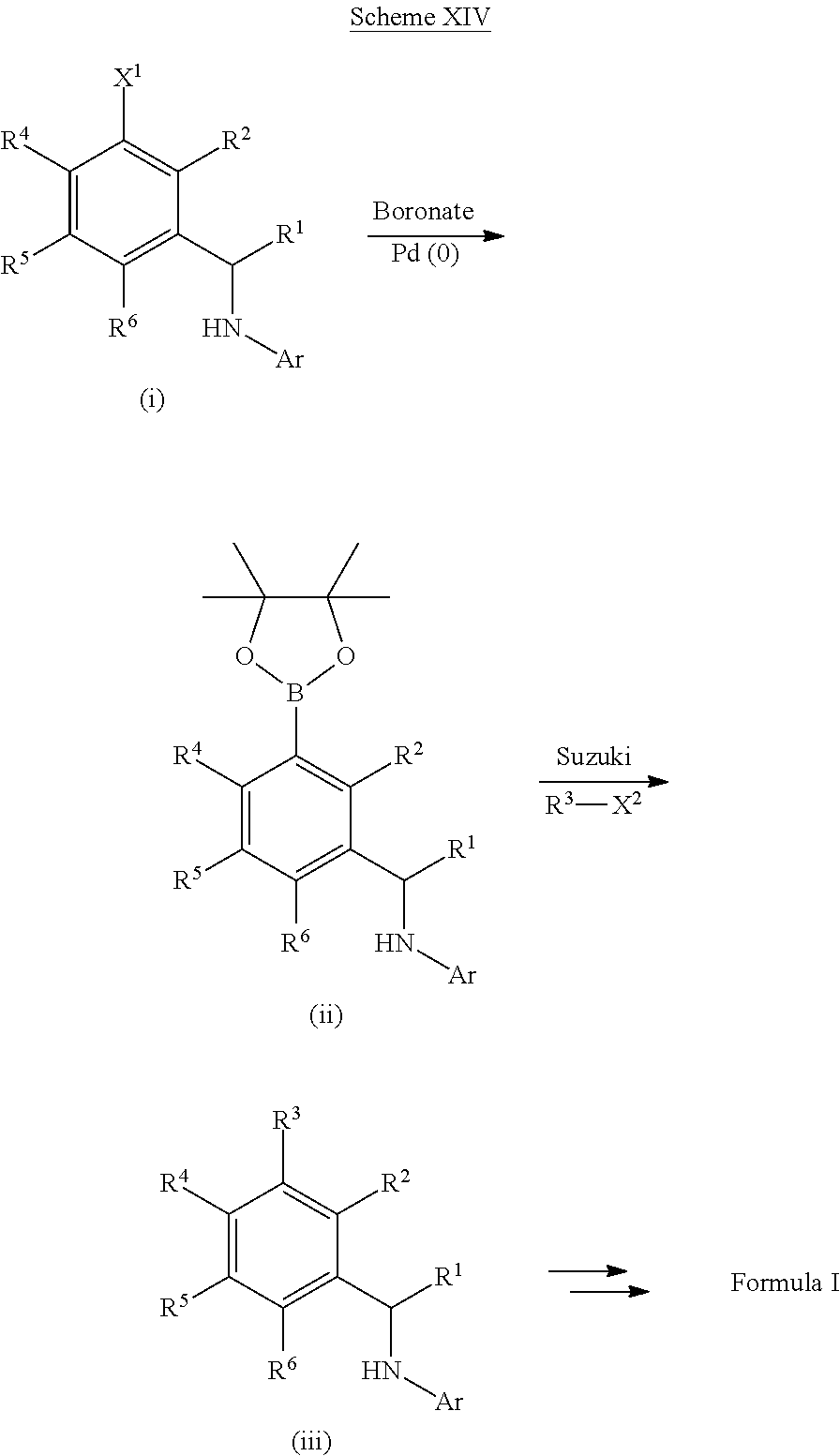


Methods
| TABLE 1 | |||||
| JAK1 | |||||
| IC50 | JAK2/ | ||||
| # | Prep. | Name | Structure | (nM) | JAK1 |
| 1 | Example J1 herein | ((2R,5S)-5-{2-[(1R)- 1-hydroxyethyl]-1H- imidazo[4,5- d]thieno[3,2- b]pyridin-1- yl}tetrahydro-2H- pyran-2-yl)acetonitrile |
 |
++ | >10 |
| 2 | Example J2 herein | 4-[3-(cyanomethyl)-3- (3′,5′-dimethyl- 1H,1′H-4,4′-bipyrazol- 1-yl)azetidin-1-yl]- 2,5-difluoro-N-[(1S)- 2,2,2-trifluoro-1- methylethyl]benzamide |
 |
+++ | >10 |
| 3 | US 2010/ 0298334 (Example 2)a | 3-[1-(6-chloropyridin- 2-yl)pyrrolidin-3-yl]- 3-[4-(7H-pyrrolo[2,3- d]pyrimidin-4-yl)-1H- pyrazol-1- yl]propanenitrile |
 |
+ | >10 |
| 4 | US 2010/ 0298334 (Example 13c) | 3-(1-[1,3]oxazolo[5,4- b]pyridin-2- ylpyrrolidin-3-yl)-3- [4-(7H-pyrrolo[2,3- d]pyrimidin-4-yl)-1H- pyrazol-1- yl]propanenitrile |
 |
+ | >10 |
| 5 | US 2011/ 0059951 (Example 12) | 4-[(4-{3-cyano-2-[4- (7H-pyrrolo[2,3- d]pyrimidin-4-yl)-1H- pyrazol-1- yl]propyl}piperazin-1- yl)carbonyl]-3- fluorobenzonitrile |
 |
+ | >10 |
| 6 | US 2011/ 0059951 (Example 13) | 4-[(4-{3-cyano-2-[3- (7H-pyrrolo[2,3- d]pyrimidin-4-yl)-1H- pyrrol-1- yl]propyl}piperazin-1- yl)carbonyl]-3- fluorobenzonitrile |
 |
+ | >10 |
| 7 | US 2011/ 0224190 (Example 1) | {1-{1-[3-Fluoro-2- (trifluoromethyl)iso- nicotinoyl]piperidin-4- yl}-3-[4-(7H- pyrrolo[2,3- d]pyrimidin-4-yl)-1H- pyrazol-1-yl]azetidin- 3-yl}acetonitrile |
 |
+ | >10 |
| 8 | US 2011/ 0224190 (Example 154) | 4-{3-(Cyanomethyl)- 3-[4-(7H-pyrrolo[2,3- d]pyrimidin-4-yl)-1H- pyrazol-1-yl]azetidin- 1-yl}-N-[4-fluoro-2- (trifluoromethyl) phenyl]piperidine-1- carboxamide |
 |
+ | >10 |
| 9 | US 2011/ 0224190 (Example 85) | [3-[4-(7H-pyrrolo[2,3- d]pyrimidin-4-yl)-1H- pyrazol-1-yl]-1-(1- {[2- (trifluoromethyl) pyrimidin-4- yl]carbonyl}piperidin- 4-yl)azetidin-3- yl]acetonitrile |
 |
+ | >10 |
| 10 | US 2012/ 0149681 (Example 7b) | [trans-1-[4-(7H- pyrrolo[2,3- d]pyrimidin-4-yl)-1H- pyrazol-1-yl]-3-(4- {[2- (trifluoromethyl) pyrimidin-4- yl]carbonyl}piperazin- 1- yl)cyclobutyl] acetonitrile |
 |
+ | >10 |
| 11 | US 2012/ 0149681 (Example 157) | {trans-3-(4-{[4-[(3- hydroxyazetidin-1- yl)methyl]-6- (trifluoromethyl) pyridin- 2-yl]oxy}piperidin- 1-yl)-1-[4-(7H- pyrrolo[2,3- d]pyrimidin-4-yl)-1H- pyrazol-1- yl]cyclobutyl} acetonitrile |
 |
+ | >10 |
| 12 | US 2012/ 0149681 (Example 161) | {trans-3-(4-{[4- {[(2S)-2- (hydroxymethyl)pyrrol- idin-1-yl]methyl}-6- (trifluoromethyl) pyridin- 2-yl]oxy}piperidin- 1-yl)-1-[4-(7H- pyrrolo[2,3- d]pyrimidin-4-yl)-1H- pyrazol-1- yl]cyclobutyl} acetonitrile |
 |
+ | >10 |
| 13 | US 2012/ 0149681 (Example 162) | {trans-3-(4-{[4- {[(2R)-2- (hydroxymethyl)pyrrol- idin-1-yl]methyl}-6- (trifluoromethyl) pyridin- 2-yl]oxy}piperidin- 1-yl)-1-[4-(7H- pyrrolo[2,3- d]pyrimidin-4-yl)-1H- pyrazol-1- yl]cyclobutyl} acetonitrile |
 |
+ | >10 |
| 14 | US 2012/ 0149682 (Example 20)b | 4-(4-{3- [(dimethylamino) methyl]-5- fluorophenoxy} piperidin-1-yl)-3-[4-(7H- pyrrolo[2,3- d]pyrimidin-4-yl)-1H- pyrazol-1- yl]butanenitrile |
 |
+ | >10 |
| 15 | US 2013/ 0018034 (Example 18) | 5-{3-(cyanomethyl)-3- [4-(7H-pyrrolo[2,3- d]pyrimidin-4-yl)-1H- pyrazol-1-yl]azetidin- 1-yl}-N- isopropylpyrazine-2- carboxamide |
 |
+ | >10 |
| 16 | US 2013/ 0018034 (Example 28) | 4-{3-(cyanomethyl)-3- [4-(7H-pyrrolo[2,3- d]pyrimidin-4-yl)-1H- pyrazol-1-yl]azetidin- 1-yl}-2,5-difluoro-N- [(1S)-2,2,2-trifluoro-1- methylethyl]benzamide |
 |
+ | >10 |
| 17 | US 2013/ 0018034 (Example 34) | 5-{3-(cyanomethyl)-3- [4-(1H-pyrrolo[2,3- b]pyridin-4-yl)-1H- pyrazol-1-yl]azetidin- 1-yl}-N- isopropylpyrazine-2- carboxamide |
 |
+ | >10 |
| 18 | US 2013/ 0045963 (Example 45) | {1-(cis-4-{[6-(2- hydroxyethyl)-2- (trifluoromethyl) pyrimidin-4- yl]oxy}cyclohexyl)-3- [4-(7H-pyrrolo[2,3- d]pyrimidin-4-yl)-1H- pyrazol-1-yl]azetidin- 3-yl}acetonitrile |
 |
+ | >10 |
| 19 | US 2013/ 0045963 (Example 65) | {1-(cis-4-{[4- [(ethylamino)methyl]- 6- (trifluoromethyl) pyridin-2- yl]oxy}cyclohexyl)-3- [4-(7H-pyrrolo[2,3- d]pyrimidin-4-yl)-1H- pyrazol-1-yl]azetidin- 3-yl}acetonitrile |
 |
+ | >10 |
| 20 | US 2013/ 0045963 (Example 69) | {1-(cis-4-{[4-(1- hydroxy-1- methylethyl)-6- (trifluoromethyl) pyridin-2- yl]oxy}cyclohexyl)-3- [4-(7H-pyrrolo[2,3- d]pyrimidin-4-yl)-1H- pyrazol-1-yl]azetidin- 3-yl}acetonitrile |
 |
+ | >10 |
| 21 | US 2013/ 0045963 (Example 95) | {1-(cis-4-{[4-{[(3R)- 3-hydroxypyrrolidin- 1-yl]methyl}-6- (trifluoromethyl) pyridin-2- yl]oxy}cyclohexyl)-3- [4-(7H-pyrrolo[2,3- d]pyrimidin-4-yl)-1H- pyrazol-1-yl]azetidin- 3-yl}acetonitrile |
 |
+ | >10 |
| 22 | US 2013/ 0045963 (Example 95) | {1-(cis-4-{[4-{[(3S)- 3-hydroxypyrrolidin- 1-yl]methyl}-6- (trifluoromethyl) pyridin-2- yl]oxy}cyclohexyl)-3- [4-(7H-pyrrolo[2,3- d]pyrimidin-4-yl)-1H- pyrazol-1-yl]azetidin- 3-yl}acetonitrile |
 |
+ | >10 |
| 23 | US 2014/ 0005166 (Example 1) | {trans-3-(4-{[4- ({[(1S)-2-hydroxy-1- methylethyl]amino} methyl)-6- (trifluoromethyl) pyridin- 2-yl]oxy}piperidin- 1-yl)-1-[4-(7H- pyrrolo[2,3- d]pyrimidin-4-yl)-1H- pyrazol-1- yl]cyclobutyl} acetonitrile |
 |
+ | >10 |
| 24 | US 2014/ 0005166 (Example 14) | {trans-3-(4-{[4- ({[(2R)-2- hydroxypropyl]amino} methyl)-6- (trifluoromethyl) pyridin- 2-yl]oxy}piperidin- 1-yl)-1-[4-(7H- pyrrolo[2,3- d]pyrimidin-4-yl)-1H- pyrazol-1- yl]cyclobutyl} acetonitrile |
 |
+ | >10 |
| 25 | US 2014/ 0005166 (Example 15) | {trans-3-(4-{[4- ({[(2S)-2- hydroxypropyl]amino} methyl)-6- (trifluoromethyl) pyridin- 2-yl]oxy}piperidin- 1-yl)-1-[4-(7H- pyrrolo[2,3- d]pyrimidin-4-yl)-1H- pyrazol-1- yl]cyclobutyl} acetonitrile |
 |
+ | >10 |
| 26 | US 2014/ 0005166 (Example 20) | {trans-3-(4-{[4-(2- hydroxyethyl)-6- (trifluoromethyl) pyridin- 2-yl]oxy}piperidin- 1-yl)-1-[4-(7H- pyrrolo[2,3- d]pyrimidin-4-yl)-1H- pyrazol-1- yl]cyclobutyl} acetonitrile |
 |
+ | >10 |
| + means <10 nM (see Example A for assay conditions) | |||||
| ++ means ≤100 nM (see Example A for assay conditions) | |||||
| +++ means ≤300 nM (see Example A for assay conditions) | |||||
| aData for enantiomer 1 | |||||
| bData for enantiomer 2 | |||||


| TABLE 2 | |||
| Example # | PI3Kδ IC50 (nM)* | ||
| 1 | + | ||
| 1A | + | ||
| 1B | ++ | ||
| 1C | + | ||
| 1D | ++ | ||
| 2 | + | ||
| 2A | + | ||
| 2B | ++ | ||
| 2C | + | ||
| 2D | ++ | ||
| 3 | + | ||
| 4 | + | ||
| *column symbols (for Table 2): | |||
| + refers to ≤100 nM | |||
| ++ refers to >100 nM to 400 nM | |||
| TABLE 3 | |||
| Example # | SUDHL6 IC50 (nM) | ||
| 1A | + | ||
| 1C | + | ||
| 2A | + | ||
| 2C | + | ||
| 3 | + | ||
| 4 | + | ||
| * column symbols (for Table 3): | |||
| + refers to ≤500 nM | |||
Claims (12)
Priority Applications (2)
| Application Number | Priority Date | Filing Date | Title |
|---|---|---|---|
| US17/409,976 US11999751B2 (en) | 2014-06-11 | 2021-08-24 | Bicyclic heteroarylaminoalkyl phenyl derivatives as PI3K inhibitors |
| US18/651,764 US20250129098A1 (en) | 2014-06-11 | 2024-05-01 | Bicyclic heteroarylaminoalkyl phenyl derivatives as pi3k inhibitors |
Applications Claiming Priority (5)
| Application Number | Priority Date | Filing Date | Title |
|---|---|---|---|
| US201462010760P | 2014-06-11 | 2014-06-11 | |
| US14/735,438 US10077277B2 (en) | 2014-06-11 | 2015-06-10 | Bicyclic heteroarylaminoalkyl phenyl derivatives as PI3K inhibitors |
| US16/112,174 US10479803B2 (en) | 2014-06-11 | 2018-08-24 | Bicyclic heteroarylaminoalkyl phenyl derivatives as PI3K inhibitors |
| US16/596,316 US11130767B2 (en) | 2014-06-11 | 2019-10-08 | Bicyclic heteroarylaminoalkyl phenyl derivatives as PI3K inhibitors |
| US17/409,976 US11999751B2 (en) | 2014-06-11 | 2021-08-24 | Bicyclic heteroarylaminoalkyl phenyl derivatives as PI3K inhibitors |
Related Parent Applications (1)
| Application Number | Title | Priority Date | Filing Date |
|---|---|---|---|
| US16/596,316 Continuation US11130767B2 (en) | 2014-06-11 | 2019-10-08 | Bicyclic heteroarylaminoalkyl phenyl derivatives as PI3K inhibitors |
Related Child Applications (1)
| Application Number | Title | Priority Date | Filing Date |
|---|---|---|---|
| US18/651,764 Continuation US20250129098A1 (en) | 2014-06-11 | 2024-05-01 | Bicyclic heteroarylaminoalkyl phenyl derivatives as pi3k inhibitors |
Publications (2)
| Publication Number | Publication Date |
|---|---|
| US20220177491A1 US20220177491A1 (en) | 2022-06-09 |
| US11999751B2 true US11999751B2 (en) | 2024-06-04 |
Family
ID=53443023
Family Applications (5)
| Application Number | Title | Priority Date | Filing Date |
|---|---|---|---|
| US14/735,438 Active US10077277B2 (en) | 2014-06-11 | 2015-06-10 | Bicyclic heteroarylaminoalkyl phenyl derivatives as PI3K inhibitors |
| US16/112,174 Active 2035-06-20 US10479803B2 (en) | 2014-06-11 | 2018-08-24 | Bicyclic heteroarylaminoalkyl phenyl derivatives as PI3K inhibitors |
| US16/596,316 Expired - Fee Related US11130767B2 (en) | 2014-06-11 | 2019-10-08 | Bicyclic heteroarylaminoalkyl phenyl derivatives as PI3K inhibitors |
| US17/409,976 Active 2035-11-15 US11999751B2 (en) | 2014-06-11 | 2021-08-24 | Bicyclic heteroarylaminoalkyl phenyl derivatives as PI3K inhibitors |
| US18/651,764 Pending US20250129098A1 (en) | 2014-06-11 | 2024-05-01 | Bicyclic heteroarylaminoalkyl phenyl derivatives as pi3k inhibitors |
Family Applications Before (3)
| Application Number | Title | Priority Date | Filing Date |
|---|---|---|---|
| US14/735,438 Active US10077277B2 (en) | 2014-06-11 | 2015-06-10 | Bicyclic heteroarylaminoalkyl phenyl derivatives as PI3K inhibitors |
| US16/112,174 Active 2035-06-20 US10479803B2 (en) | 2014-06-11 | 2018-08-24 | Bicyclic heteroarylaminoalkyl phenyl derivatives as PI3K inhibitors |
| US16/596,316 Expired - Fee Related US11130767B2 (en) | 2014-06-11 | 2019-10-08 | Bicyclic heteroarylaminoalkyl phenyl derivatives as PI3K inhibitors |
Family Applications After (1)
| Application Number | Title | Priority Date | Filing Date |
|---|---|---|---|
| US18/651,764 Pending US20250129098A1 (en) | 2014-06-11 | 2024-05-01 | Bicyclic heteroarylaminoalkyl phenyl derivatives as pi3k inhibitors |
Country Status (2)
| Country | Link |
|---|---|
| US (5) | US10077277B2 (en) |
| WO (1) | WO2015191677A1 (en) |
Cited By (1)
| Publication number | Priority date | Publication date | Assignee | Title |
|---|---|---|---|---|
| US12201636B2 (en) | 2011-09-02 | 2025-01-21 | Incyte Corporation | Heterocyclylamines as PI3K inhibitors |
Families Citing this family (30)
| Publication number | Priority date | Publication date | Assignee | Title |
|---|---|---|---|---|
| EP2845856A1 (en) | 2009-06-29 | 2015-03-11 | Incyte Corporation | Pyrimidinones as PI3K inhibitors |
| TW201249844A (en) | 2010-12-20 | 2012-12-16 | Incyte Corp | N-(1-(substituted-phenyl)ethyl)-9H-purin-6-amines as PI3K inhibitors |
| AR090548A1 (en) | 2012-04-02 | 2014-11-19 | Incyte Corp | BICYCLIC AZAHETEROCICLOBENCILAMINS AS PI3K INHIBITORS |
| JP6359546B2 (en) * | 2012-11-01 | 2018-07-18 | インサイト・ホールディングス・コーポレイションIncyte Holdings Corporation | Tricyclic fused thiophene derivatives as JAK inhibitors |
| EP2943485B1 (en) | 2013-01-14 | 2017-09-20 | Incyte Holdings Corporation | Bicyclic aromatic carboxamide compounds useful as pim kinase inhibitors |
| ME03780B (en) | 2013-01-15 | 2021-04-20 | Incyte Holdings Corp | THIAZOLE CARBOXAMIDE DERIVATIVES AND PYRIDINE CARBOXAMIDE DERIVATIVES USED AS PIM KINASE INHIBITORS |
| TWI841376B (en) * | 2013-03-01 | 2024-05-01 | 美商英塞特控股公司 | USE OF PYRAZOLOPYRIMIDINE DERIVATIVES FOR THE TREATMENT OF PI3Kδ RELATED DISORDERS |
| TW201605866A (en) | 2013-08-23 | 2016-02-16 | 英塞特公司 | Furo- and thieno-pyridine carboxamide compounds useful as PIM kinase inhibitors |
| US10077277B2 (en) | 2014-06-11 | 2018-09-18 | Incyte Corporation | Bicyclic heteroarylaminoalkyl phenyl derivatives as PI3K inhibitors |
| US9580418B2 (en) | 2014-07-14 | 2017-02-28 | Incyte Corporation | Bicyclic aromatic carboxamide compounds useful as Pim kinase inhibitors |
| WO2016010897A1 (en) | 2014-07-14 | 2016-01-21 | Incyte Corporation | Bicyclic heteroaromatic carboxamide compounds useful as pim kinase inhibitors |
| WO2016130501A1 (en) | 2015-02-09 | 2016-08-18 | Incyte Corporation | Aza-heteroaryl compounds as pi3k-gamma inhibitors |
| UA122332C2 (en) | 2015-02-27 | 2020-10-26 | Інсайт Корпорейшн | Salts of pi3k inhibitor and processes for their preparation |
| WO2016183060A1 (en) | 2015-05-11 | 2016-11-17 | Incyte Corporation | Process for the synthesis of a phosphoinositide 3-kinase inhibitor |
| WO2016183063A1 (en) | 2015-05-11 | 2016-11-17 | Incyte Corporation | Crystalline forms of a pi3k inhibitor |
| WO2016196244A1 (en) | 2015-05-29 | 2016-12-08 | Incyte Corporation | Pyridineamine compounds useful as pim kinase inhibitors |
| AR105967A1 (en) | 2015-09-09 | 2017-11-29 | Incyte Corp | SALTS OF A PIM QUINASA INHIBITOR |
| WO2017059251A1 (en) | 2015-10-02 | 2017-04-06 | Incyte Corporation | Heterocyclic compounds useful as pim kinase inhibitors |
| TWI744256B (en) | 2015-11-06 | 2021-11-01 | 美商英塞特公司 | HETEROCYCLIC COMPOUNDS AS PI3K-γ INHIBITORS |
| TW201734003A (en) | 2016-01-05 | 2017-10-01 | 英塞特公司 | Pyridine and pyridimine compounds as PI3K-gamma inhibitors |
| EP4257191A3 (en) | 2016-06-21 | 2023-11-22 | Orion Ophthalmology LLC | Heterocyclic prolinamide derivatives |
| AR108875A1 (en) | 2016-06-24 | 2018-10-03 | Incyte Corp | HETEROCYCLIC COMPOUNDS AS PI3K-g INHIBITORS |
| AU2018350980C1 (en) | 2017-10-18 | 2024-12-12 | Incyte Corporation | Condensed imidazole derivatives substituted by tertiary hydroxy groups as pi3k-y gamma inhibitors |
| US10596161B2 (en) | 2017-12-08 | 2020-03-24 | Incyte Corporation | Low dose combination therapy for treatment of myeloproliferative neoplasms |
| CN113768934A (en) | 2018-03-30 | 2021-12-10 | 因赛特公司 | Treatment of hidradenitis suppurativa with JAK inhibitors |
| MX2020012826A (en) | 2018-06-01 | 2021-03-09 | Incyte Corp | DOSAGE REGIMEN FOR THE TREATMENT OF DISORDERS RELATED TO PHOSPHATIDYLINOSITOL 3-KINASES (PI3K). |
| CR20250050A (en) | 2018-09-05 | 2025-03-19 | Incyte Corp | Crystalline forms of a phosphoinositide 3-kinase (pi3k) inhibitor |
| JP7802696B2 (en) * | 2020-06-02 | 2026-01-20 | インサイト・コーポレイション | Preparation process of JAK1 inhibitors |
| CN115703770B (en) * | 2021-08-10 | 2025-07-18 | 深圳范恩柯尔精准医疗有限公司 | Pyrimidine amine compound, composition and application thereof |
| WO2025038815A1 (en) * | 2023-08-15 | 2025-02-20 | Prelude Therapeutics Incorporated | Mutant pi3k-alpha inhibitors and their use as pharmaceuticals |
Citations (288)
| Publication number | Priority date | Publication date | Assignee | Title |
|---|---|---|---|---|
| US3037980A (en) | 1955-08-18 | 1962-06-05 | Burroughs Wellcome Co | Pyrrolopyrimidine vasodilators and method of making them |
| US3169967A (en) | 1957-11-14 | 1965-02-16 | Ciba Geigy Corp | Methyl o-lower alkanoyl-reserpates |
| US3506643A (en) | 1966-12-09 | 1970-04-14 | Max Thiel | N**6-aralkyl-adenosine derivatives |
| DE1770420A1 (en) | 1967-09-22 | 1972-08-10 | Sumitomo Chemical Co | Process for the preparation of benzodiazepine derivatives |
| DE2139107A1 (en) | 1971-08-04 | 1973-02-15 | Merck Patent Gmbh | N(6)-subst adenosine derivs - with coronary circulatory etc activity |
| US3862189A (en) | 1973-08-14 | 1975-01-21 | Warner Lambert Co | Aralkyl-substituted purines and pyrimidines as antianginal bronchodilator agents |
| JPS50111080A (en) | 1974-02-13 | 1975-09-01 | ||
| US3936454A (en) | 1973-08-14 | 1976-02-03 | Warner-Lambert Company | 5-Amino-4-chloro-6-(substituted amino)-pyrimidines |
| US3962443A (en) | 1972-08-14 | 1976-06-08 | Dainippon Pharmaceutical Co., Ltd. | Antibacterial pharmaceutical compositions and processes for preparation thereof |
| GB1440478A (en) | 1972-10-02 | 1976-06-23 | Basf Ag | 4-thiopyrimido-4,5-d-pyrimidines |
| GB1472342A (en) | 1974-01-25 | 1977-05-04 | Ciba Geigy Ag | Derivatives of 2-2-pyridylcarbonyl-indole |
| JPS5359663A (en) | 1976-11-09 | 1978-05-29 | Sumitomo Chem Co Ltd | 2-halogeno methyl indole derivatives and process for praparation of the same |
| JPS5392767A (en) | 1977-01-27 | 1978-08-15 | Sumitomo Chem Co Ltd | Preparation of 2-phthalimidomethylindole derivatives |
| CA1066701A (en) | 1973-04-03 | 1979-11-20 | Jun-Ichi Matsumoto | Method for the preparation of piperazine derivatives |
| JPS5625234A (en) | 1979-08-02 | 1981-03-11 | Hitachi Denshi Ltd | Dropout display system |
| JPS56123981A (en) | 1981-02-23 | 1981-09-29 | Dainippon Pharmaceut Co Ltd | Preparation of 1,4-disubstituted piperazine |
| JPS5883698A (en) | 1981-11-13 | 1983-05-19 | Takeda Chem Ind Ltd | Quinone compound and its preparation |
| US4482629A (en) | 1982-03-20 | 1984-11-13 | Konishiroku Photo Industry Co., Ltd. | Light-sensitive silver halide color photographic material |
| JPS6067709U (en) | 1983-10-14 | 1985-05-14 | 三洋電機株式会社 | hair dryer |
| JPS6263591U (en) | 1985-06-29 | 1987-04-20 | ||
| JPS6266743U (en) | 1985-10-17 | 1987-04-25 | ||
| JPS62103640A (en) | 1985-07-18 | 1987-05-14 | Fuji Photo Film Co Ltd | Silver halide color photographic sensitive material |
| JPS62245252A (en) | 1986-04-18 | 1987-10-26 | Fuji Photo Film Co Ltd | Image forming method |
| EP0255085A2 (en) | 1986-07-30 | 1988-02-03 | EASTMAN KODAK COMPANY (a New Jersey corporation) | Photographic element and process |
| JPS6427257U (en) | 1987-08-11 | 1989-02-16 | ||
| AT388372B (en) | 1987-10-08 | 1989-06-12 | Tanabe Seiyaku Co | Novel naphthalene derivatives and pharmaceuticals containing them |
| US4840951A (en) | 1986-07-01 | 1989-06-20 | Tanabe Seiyaku Co., Ltd. | Novel naphthalene derivative |
| US4845020A (en) | 1984-10-09 | 1989-07-04 | Fuji Photo Film Co., Ltd. | Method of processing silver halide photographic material using an organic compound which loses its development restraining function by reaction with an oxidized developer |
| US4861701A (en) | 1987-10-05 | 1989-08-29 | Eastman Kodak Company | Photographic element and process comprising a compound which comprises two timing groups in sequence |
| JPH01250316A (en) | 1987-12-28 | 1989-10-05 | Tanabe Seiyaku Co Ltd | Cholesterol-lowering agent |
| JPH0274039U (en) | 1988-11-22 | 1990-06-06 | ||
| EP0464612A1 (en) | 1990-06-28 | 1992-01-08 | Fuji Photo Film Co., Ltd. | Silver halide photographic materials |
| SU1712359A1 (en) | 1990-05-07 | 1992-02-15 | Уфимский Нефтяной Институт | 8'-hydroxyquinoline-7-carboxylic acid 8-hydroxyquinoline ester hydrochloride as a bactericidal agent for inhibition of sulfate-reducing bacteria and cultures pseudomonas and arthrobacter |
| EP0481614A1 (en) | 1990-10-01 | 1992-04-22 | Merck & Co. Inc. | Substituted pyridopyrimidinones and related heterocycles as angiotensin II antagonists |
| US5124331A (en) | 1988-03-02 | 1992-06-23 | Yoshitomi Pharmaceutical Industries, Ltd. | 3,4-dihydrothieno[2,3-d]pyrimidine compounds and their pharmaceutical use |
| US5208250A (en) | 1988-05-25 | 1993-05-04 | Warner-Lambert Company | Known and selected novel arylmethylenyl derivatives of thiazolidinones, imidazolidinones and oxazolidinones useful as antiallergy agents and anti-inflammatory agents |
| WO1993016076A1 (en) | 1992-02-13 | 1993-08-19 | Chinoin Gyógyszer- És Vegyészeti Termékek Gyára Rt. | 3-(1h^_-tetrazol-5-yl)-4h^_-pyrido[1,2-a^_]pyrimidine-4-ones, pharmaceutical compositions containing the same and the preparation thereof |
| US5252580A (en) | 1991-09-30 | 1993-10-12 | Nisshin Flour Milling Co., Ltd. | Indole derivatives and anti-ulcer compositions thereof |
| WO1993022291A1 (en) | 1992-04-24 | 1993-11-11 | E.I. Du Pont De Nemours And Company | Arthropodicidal and fungicidal aminopyrimidines |
| WO1993025524A1 (en) | 1992-06-05 | 1993-12-23 | Shell Internationale Research Maatschappij B.V. | Fungicidal indole derivatives |
| US5294620A (en) | 1991-05-31 | 1994-03-15 | Imperial Chemical Industries Plc | 1,6-naphthyridinone derivatives having angiotension II antagonist activity |
| US5314883A (en) | 1990-04-25 | 1994-05-24 | Nissan Chemical Industries Ltd. | 5-heteroarylamino-6-oxy-substituted 3(2H)-pyridazinones |
| US5459132A (en) | 1994-01-07 | 1995-10-17 | Laboratoires Upsa | N6-[(Imidazo[1,2-a]pyridin-3-yl)ethyl]adenosines, their 5'-uronamide analogues and pharmaceutical compositions |
| US5521184A (en) | 1992-04-03 | 1996-05-28 | Ciba-Geigy Corporation | Pyrimidine derivatives and processes for the preparation thereof |
| US5646153A (en) | 1991-05-10 | 1997-07-08 | Rhone-Poulenc Rorer Pharmaceuticals Inc. | Bis mono- and bicyclic aryl and heteroaryl compounds which inhibit EGF and/or PDGF receptor tyrosine kinase |
| JPH1025294A (en) | 1996-03-26 | 1998-01-27 | Akira Matsuda | Fused heterocyclic derivative, method for producing the same, and therapeutic agent for malignant tumor containing the same |
| JPH10231297A (en) | 1997-02-20 | 1998-09-02 | Japan Energy Corp | Novel adenine-1-N-oxide derivative and pharmaceutical use thereof |
| US5811439A (en) | 1995-12-22 | 1998-09-22 | Senga Pharmaceutical Laboratory Inc. | Thiazolidinedione derivatives, method for preparing the derivatives and pharmaceutical compositions containing same |
| US5866702A (en) | 1996-08-02 | 1999-02-02 | Cv Therapeutics, Incorporation | Purine inhibitors of cyclin dependent kinase 2 |
| EP0934307A1 (en) | 1996-06-19 | 1999-08-11 | Rhone-Poulenc Rorer Limited | Substituted azabicylic compounds and their use as inhibitors of the production of tnf and cyclic amp phosphodiesterase |
| WO1999043651A2 (en) | 1998-02-25 | 1999-09-02 | Genetics Institute, Inc. | Inhibitors of phospholipase enzymes |
| WO1999043672A1 (en) | 1998-02-25 | 1999-09-02 | Genetics Institute, Inc. | Inhibitors of phospholipase a2 |
| US6028076A (en) | 1996-07-03 | 2000-02-22 | Japan Energy Corporation | Purine derivative |
| WO2000009495A1 (en) | 1998-08-11 | 2000-02-24 | Novartis Ag | Isoquinoline derivatives with angiogenesis inhibiting activity |
| JP2000080295A (en) | 1998-06-24 | 2000-03-21 | Konica Corp | New coloring matter, image-recording material, heat- sensitive transfer material and inkjet recording liquid |
| WO2000044750A1 (en) | 1999-02-01 | 2000-08-03 | Cv Therapeutics, Inc. | PURINE INHIBITORS OF CYCLIN DEPENDENT KINASE 2 AND Iλ-A$g(a) |
| WO2000053595A1 (en) | 1999-03-06 | 2000-09-14 | Astrazeneca Ab | Pyrimidine compounds |
| JP2000281654A (en) | 1999-03-26 | 2000-10-10 | Tanabe Seiyaku Co Ltd | Isoquinoline derivatives |
| WO2001014402A1 (en) | 1999-08-19 | 2001-03-01 | Isis Pharmaceuticals, Inc. | Antisense modulation of focal adhesion kinase expression |
| JP2001151771A (en) | 1999-09-10 | 2001-06-05 | Kyowa Hakko Kogyo Co Ltd | Nitrogen-containing aromatic heterocyclic derivatives |
| EP1109805A1 (en) | 1998-08-25 | 2001-06-27 | The UAB Research Foundation | Inhibitors of bacterial nad synthetase |
| WO2001064639A2 (en) | 2000-03-02 | 2001-09-07 | Merck Frosst Canada & Co. | Pde iv inhibiting amides, compositions and pharmaceutical use |
| WO2001064655A1 (en) | 2000-03-01 | 2001-09-07 | Astrazeneca Ab | 2, 4-di(hetero-)arylamino (-oxy)-5-substituted pyrimidines as antineoplastic agents |
| EP1138328A1 (en) | 2000-03-29 | 2001-10-04 | Eli Lilly And Company Limited | Naphthalene derivatives as CNS drugs |
| WO2002000196A2 (en) | 2000-06-28 | 2002-01-03 | Smithkline Beecham P.L.C. | Wet milling process |
| WO2002006477A1 (en) | 2000-06-30 | 2002-01-24 | Shanghai Biowindow Gene Development Inc. | A novel polypeptide-homo topoisomerase 12.1 and polynucleotide encoding said polypeptide |
| US6342501B1 (en) | 1994-02-25 | 2002-01-29 | The Regents Of The University Of Michigan | Pyrrolo[2,3-d] pyrimidines as antiviral agents |
| WO2002024685A1 (en) | 2000-09-21 | 2002-03-28 | Yang Ji Chemical Company Ltd. | Indole derivatives and their use as antifungal and/or antiparasitic agents |
| US6376501B1 (en) | 1997-12-22 | 2002-04-23 | Japan Energy Corporation | Type 2 helper T cell-selective immune response suppressors |
| US6392047B1 (en) | 1999-07-13 | 2002-05-21 | Clariant Gmbh | Process for preparing biaryls in the presence of palladophosphacyclobutane catalysts |
| WO2002064599A1 (en) | 2001-02-14 | 2002-08-22 | Warner-Lambert Company Llc | Bicyclic pyrimidine matrix metalloproteinase inhibitors |
| WO2002066478A1 (en) | 2001-02-20 | 2002-08-29 | Astrazeneca Ab | Antagonists of gonadotropin releasing hormone |
| WO2002078701A1 (en) | 2001-03-30 | 2002-10-10 | Smithkline Beecham Corporation | Use of pyrazolopyridines as therapeutic compounds |
| US6479487B1 (en) | 1998-02-26 | 2002-11-12 | Aventis Pharmaceuticals Inc. | 6, 9-disubstituted 2-[trans-(4-aminocyclohexyl)amino] purines |
| US20030008898A1 (en) | 1998-05-04 | 2003-01-09 | Siavosh Mahboobi | Indole derivatives and their use for the treatment of malignant and other diseases based on pathological proliferation |
| WO2003020721A1 (en) | 2001-08-30 | 2003-03-13 | Novartis Ag | Pyrrolo pyrimidines as agents for the inhibition of cystein proteases |
| WO2003024967A2 (en) | 2001-09-19 | 2003-03-27 | Aventis Pharma S.A. | Indolizines as kinase protein inhibitors |
| WO2003029209A2 (en) | 2001-10-02 | 2003-04-10 | Smithkline Beecham Corporation | Chemical compounds |
| WO2003037347A1 (en) | 2001-10-30 | 2003-05-08 | Novartis Ag | Staurosporine derivatives as inhibitors of flt3 receptor tyrosine kinase activity |
| WO2003044014A1 (en) | 2001-11-22 | 2003-05-30 | Aventis Pharma Deutschland Gmbh | Indole-2-carboxamides as factor xa inhibitors |
| WO2003049678A2 (en) | 2001-12-06 | 2003-06-19 | Merck & Co., Inc. | Mitotic kinesin inhibitors |
| WO2003050064A2 (en) | 2001-12-06 | 2003-06-19 | Merck & Co., Inc. | Mitotic kinesin inhibitors |
| WO2003068750A1 (en) | 2002-02-13 | 2003-08-21 | Takeda Chemical Industries, Ltd. | Jnk inhibitor |
| US20030157052A1 (en) | 2001-11-09 | 2003-08-21 | Choe Yun H. | Polymeric thiol-linked prodrugs employing benzyl elimination systems |
| WO2003074497A1 (en) | 2002-03-01 | 2003-09-12 | Pintex Pharmaceutical, Inc. | Pin1-modulating compounds and methods of use thereof |
| US6630496B1 (en) | 1996-08-26 | 2003-10-07 | Genetics Institute Llc | Inhibitors of phospholipase enzymes |
| WO2003099771A2 (en) | 2002-05-29 | 2003-12-04 | Novartis Ag | Diaryl urea derivatives useful for the treatment of protein kinase dependent diseases |
| WO2004005281A1 (en) | 2002-07-05 | 2004-01-15 | Novartis Ag | Inhibitors of tyrosine kinases |
| US20040058930A1 (en) | 2002-04-03 | 2004-03-25 | Makonen Belema | Thiophene-based tricyclic compounds and pharmaceutical compositions comprising same |
| WO2004024693A1 (en) | 2002-08-13 | 2004-03-25 | Shionogi & Co., Ltd. | Heterocyclic compound having hiv integrase inhibitory activity |
| US20040063658A1 (en) | 2002-05-06 | 2004-04-01 | Roberts Christopher Don | Nucleoside derivatives for treating hepatitis C virus infection |
| US20040067964A1 (en) | 1998-05-26 | 2004-04-08 | Chugai Seiyaku Kabushiki Kaisha | Indole derivative having heterocycle and mono- or diazaindole derivative |
| US6734187B1 (en) | 1997-11-12 | 2004-05-11 | Mitsubishi Chemical Corporation | Purine derivatives and medicaments comprising the same as active ingredient |
| WO2004046120A2 (en) | 2002-11-15 | 2004-06-03 | Vertex Pharmaceuticals Incorporated | Diaminotriazoles useful as inhibitors of protein kinases |
| WO2004048365A1 (en) | 2002-11-21 | 2004-06-10 | Chiron Corporation | 2,4,6-trisubstituted pyrimidines as phosphotidylinositol (pi) 3-kinase inhibitors and their use in the treatment of cancer |
| WO2004056786A2 (en) | 2002-12-20 | 2004-07-08 | Pfizer Products Inc. | Pyrimidine derivates for the treatment of abnormal cell growth |
| US20040142941A1 (en) | 2001-04-27 | 2004-07-22 | Kristjan Gudmundsson | Therapeutic compounds |
| RU2233842C1 (en) | 2003-01-13 | 2004-08-10 | Петров Владимир Иванович | Derivatives of purine eliciting antiviral activity |
| WO2004069256A1 (en) | 2003-02-06 | 2004-08-19 | Novartis Ag | 2-cyanopyrrolopyrimidines and pharmaceutical uses thereof |
| WO2004076455A1 (en) | 2003-02-28 | 2004-09-10 | Novartis Ag | Spiro-substituted pyrrolopyrimidines |
| WO2004080980A1 (en) | 2003-03-14 | 2004-09-23 | Novartis Ag | 2, 4- di (phenylamino) pyrimidines useful in the treatment of neoplastic diseases, inflammatory and immune system disorders |
| WO2004087704A1 (en) | 2003-03-31 | 2004-10-14 | Astrazeneca Ab | Azaindole derivatives, preparations thereof, uses thereof and compositions containing them |
| US20040209866A1 (en) | 2001-09-26 | 2004-10-21 | Bayer Pharmaceuticals Corporation | 1,8 Naphthyridine derivatives and their use to treat diabetes and related disorders |
| US20040242615A1 (en) | 2001-09-14 | 2004-12-02 | Teruo Yamamori | Utilities of olefin derivatives |
| US6828344B1 (en) | 1998-02-25 | 2004-12-07 | Genetics Institute, Llc | Inhibitors of phospholipase enzymes |
| WO2004107863A1 (en) | 2003-05-05 | 2004-12-16 | Neurogen Corporation | Sustituted imidazolopyrazine and triazolopyrazine derivatives: gabaa receptor ligands |
| WO2004113335A2 (en) | 2003-06-20 | 2004-12-29 | Chiron Corporation | Pyridino[1,2-a]pyrimidin-4-one compounds as anticancer agents |
| WO2005000309A2 (en) | 2003-06-27 | 2005-01-06 | Ionix Pharmaceuticals Limited | Chemical compounds |
| JP2005035924A (en) | 2003-07-14 | 2005-02-10 | Kumiai Chem Ind Co Ltd | 2-Isoxazoline derivatives and herbicides containing them as active ingredients |
| WO2005016528A2 (en) | 2003-08-15 | 2005-02-24 | Irm Llc | 6-substituted anilino purines as rtk inhibitors |
| US20050043328A1 (en) | 2001-08-02 | 2005-02-24 | Karel Dolezal | Heterocyclic compound based on n6-substituted adenine, methods, of their preparation, their use for preparation of drugs, cosmetic preparations and growth regulators, pharmaceutical preparations, cosmetic preparations and growth regulators containing these compounds |
| US20050059677A1 (en) | 2001-03-30 | 2005-03-17 | Alberti Michael John | Pyralopyridines, process for their preparation and use as therapeutic compounds |
| WO2005028444A1 (en) | 2003-09-24 | 2005-03-31 | Novartis Ag | 1,4-disubstituted isoquinilone derivatives as raf-kinase inhibitors useful for the treatment of proliferative diseases |
| US20050107343A1 (en) | 2003-09-18 | 2005-05-19 | Conforma Therapeutics Corporation | Pyrrolopyrimidines and related analogs as HSP90-inhibitors |
| WO2005046578A2 (en) | 2003-09-23 | 2005-05-26 | Merck & Co., Inc. | Isoquinolinone potassium channel inhibitors |
| US20050165030A1 (en) | 2001-12-27 | 2005-07-28 | Yongge Liu | Pharmaceutical compositions comprising a multifunctional phosphodiesterase inhibitor and an adenosine uptake inhibitor |
| WO2005091857A2 (en) | 2004-03-12 | 2005-10-06 | Bayer Pharmaceuticals Corporation | 1,6-naphthyridine and 1,8-naphthyridine derivatives and their use to treat diabetes and related disorders |
| US20050261317A1 (en) | 2000-04-25 | 2005-11-24 | Icos Corporation | Inhibitors of human phosphatidylinositol 3-kinase delta |
| US20050267110A1 (en) | 2000-07-05 | 2005-12-01 | Yamanouchi Pharmaceutical Co., Ltd. | Propane-1, 3-dione derivative |
| WO2005113556A1 (en) | 2004-05-13 | 2005-12-01 | Icos Corporation | Quinazolinones as inhibitors of human phosphatidylinositol 3-kinase delta |
| US20050282831A1 (en) | 2004-04-02 | 2005-12-22 | Anthony Beauglehole | Selective antagonists of A2A adenosine receptors |
| WO2006008523A1 (en) | 2004-07-22 | 2006-01-26 | Astrazeneca Ab | Fused pyrimidones usefuel in the treatment and the prevention of cancer |
| US20060025383A1 (en) | 2004-02-03 | 2006-02-02 | Neil Wishart | Aminobenzoxazoles as therapeutic agents |
| US20060052403A1 (en) | 2002-09-27 | 2006-03-09 | Yoshiaki Isobe | Novel adenine compound and use thereof |
| WO2006030031A1 (en) | 2004-09-17 | 2006-03-23 | Janssen Pharmaceutica N.V. | Novel thieno-pyridine and thieno-pyrimidine derivatives and their use as positive allosteric modulators of mglur2-receptors |
| US20060074102A1 (en) | 2004-05-14 | 2006-04-06 | Kevin Cusack | Kinase inhibitors as therapeutic agents |
| US20060084687A1 (en) | 2004-10-19 | 2006-04-20 | Boyce Rustum S | Indole and benzimidazole derivatives |
| WO2006056399A2 (en) | 2004-11-24 | 2006-06-01 | Novartis Ag | Combinations of jak inhibitors and at least one of bcr-abl, flt-3, fak or raf kinase inhibitors |
| WO2006068760A2 (en) | 2004-11-19 | 2006-06-29 | The Regents Of The University Of California | Anti-inflammatory pyrazolopyrimidines |
| US20060166925A1 (en) | 2002-12-30 | 2006-07-27 | Karel Dolezal | Substitution derivatives of n6-benzyladenosine, methods of their preparation, their use for preparation of drugs, cosmetic preparations and growth regulators, pharmaceutical preparations, cosmetic preparations and growth regulators containing these compounds |
| WO2006089106A2 (en) | 2005-02-17 | 2006-08-24 | Icos Corporation | Phosphoinositide 3-kinase inhibitors for inhibiting leukocyte accumulation |
| US7129264B2 (en) | 2003-04-16 | 2006-10-31 | Bristol-Myers Squibb Company | Biarylmethyl indolines and indoles as antithromboembolic agents |
| US20060293334A1 (en) | 2001-03-01 | 2006-12-28 | Masahiro Fuji | Nitrogen-containing heteroaryl compounds having inhibitory activity against HIV integrase |
| WO2007002701A2 (en) | 2005-06-27 | 2007-01-04 | Amgen Inc. | Anti-inflammatory aryl nitrile compounds |
| WO2007012724A1 (en) | 2005-07-27 | 2007-02-01 | Cytomics Systems | 1,2,4-thiadiazole derivatives antifungal compounds, compositions containing said compounds and the use thereof |
| US20070060577A1 (en) | 2005-09-14 | 2007-03-15 | Player Mark R | 5-Oxo-5,8-dihydro-pyrido-pyrimidines as inhibitors of c-fms kinase |
| US20070066624A1 (en) | 2005-08-16 | 2007-03-22 | Anormed, Inc. | Chemokine receptor binding compounds |
| WO2007042806A1 (en) | 2005-10-11 | 2007-04-19 | Ludwig Institute For Cancer Research | Pyrimidine derivatives for the treatment of cancer |
| EP1783114A1 (en) | 2005-11-03 | 2007-05-09 | Novartis AG | N-(hetero)aryl indole derivatives as pesticides |
| WO2007076092A2 (en) | 2005-12-23 | 2007-07-05 | Amgen Inc. | Nitrogen- containing bicyclic hetroaryl compounds for the treatment of raf protein kinase-mediated diseases |
| US20070167443A1 (en) | 2005-11-10 | 2007-07-19 | Chemocentryx, Inc. | Substituted quinolones and methods of use |
| WO2007087548A2 (en) | 2006-01-25 | 2007-08-02 | Smithkline Beecham Corporation | Chemical compounds |
| US20070191395A1 (en) | 2004-02-16 | 2007-08-16 | Katsuhiro Kawakami | Heterocyclic compounds having antifungal activity |
| WO2007095588A1 (en) | 2006-02-14 | 2007-08-23 | Novartis Ag | Pi-3 kinase inhibitors and methods of their use |
| CN101027309A (en) | 2004-08-18 | 2007-08-29 | 阿斯利康(瑞典)有限公司 | Enantiomers of selected fused pyrimidones and uses in the treatment and prevention of cancer |
| WO2007102392A1 (en) | 2006-03-03 | 2007-09-13 | Shionogi & Co., Ltd. | Mmp-13-selective inhibitor |
| US20070225303A1 (en) | 2004-03-26 | 2007-09-27 | Haruhisa Ogita | 8-Oxoadenine Compound |
| WO2007114926A2 (en) | 2006-04-04 | 2007-10-11 | The Regents Of The University Of California | Kinase antagonists |
| WO2007126841A2 (en) | 2006-03-29 | 2007-11-08 | Foldrx Pharmaceuticals, Inc. | Inhibition of alpha-synuclein toxicity |
| US20080004269A1 (en) | 2004-11-04 | 2008-01-03 | Yuelian Xu | Pyrazolylmethy Heteroaryl Derivatives |
| WO2008002490A2 (en) | 2006-06-23 | 2008-01-03 | Radius Health, Inc. | Treatment of vasomotor symptoms with selective estrogen receptor modulators |
| US20080009508A1 (en) | 2006-07-10 | 2008-01-10 | Lucie Szucova | 6,9-Disubstituted Purine Derivatives And Their Use For Treating Skin |
| WO2008005303A2 (en) | 2006-06-30 | 2008-01-10 | Janssen Pharmaceutica N.V. | Thiazolopyrimidine modulators of trpv1 |
| WO2008025821A1 (en) | 2006-08-30 | 2008-03-06 | Cellzome Limited | Triazole derivatives as kinase inhibitors |
| WO2008032033A1 (en) | 2006-09-14 | 2008-03-20 | Astrazeneca Ab | 4-benzimidazolyl-2-morpholino-6-piperazinylpyrimidine derivatives as pi3k and mtor inhibitors for the treatment of proliferative disorders |
| US20080114007A1 (en) | 2006-10-31 | 2008-05-15 | Player Mark R | 5-oxo-5,8-dihydro-pyrido-pyrimidines as inhibitors of c-fms kinase |
| WO2008064018A1 (en) | 2006-11-13 | 2008-05-29 | Eli Lilly & Co. | Thienopyrimidinones for treatment of inflammatory disorders and cancers |
| WO2008064157A1 (en) | 2006-11-22 | 2008-05-29 | Incyte Corporation | Imidazotriazines and imidazopyrimidines as kinase inhibitors |
| US20080161332A1 (en) | 2006-12-29 | 2008-07-03 | Caterina Bissantz | Azaspiro derivatives |
| WO2008082490A2 (en) | 2006-12-20 | 2008-07-10 | Schering Corporation | Novel jnk inhibitors |
| US20080194616A1 (en) | 2007-02-05 | 2008-08-14 | Xenon Pharmaceuticals Inc. | Pyridopyrimidinone compounds useful in treating sodium channel-mediated diseases or conditions |
| WO2008100867A2 (en) | 2007-02-12 | 2008-08-21 | Intermune, Inc. | Novel inhibitors hepatitis c virus replication |
| EP1972631A1 (en) | 2007-03-23 | 2008-09-24 | Novartis AG | Imidazopyridazines as PI3K lipid kinase inhibitors |
| WO2008116129A2 (en) | 2007-03-21 | 2008-09-25 | Wyeth | Imidazolopyrimidine analogs and their use as pi3 kinase and mtor inhibitors |
| WO2008118468A1 (en) | 2007-03-23 | 2008-10-02 | Amgen Inc. | Heterocyclic compounds and their uses |
| WO2008118454A2 (en) | 2007-03-23 | 2008-10-02 | Amgen Inc. | Derivatives of quinoline or benzopyrazine and their uses for the treatment of (inter alia) inflammatory diseases, autoimmune diseases or various kinds of cancer |
| US20080249155A1 (en) | 2004-03-12 | 2008-10-09 | Ping Gong | 5-Hydroxyindole-3-Carboxylate Derivatives and Uses Thereof |
| US20080293739A1 (en) | 2007-04-11 | 2008-11-27 | Trede Nikolaus S | Compounds for modulating t-cells |
| US20080306093A1 (en) | 2007-06-08 | 2008-12-11 | Senomyx, Inc. | Modulation of chemosensory receptors and ligands associated therewith |
| US20090023729A1 (en) | 2006-01-31 | 2009-01-22 | Mitsubishi Tanabe Pharma Corporation | Trisubstituted amine compound |
| US20090047249A1 (en) | 2007-06-29 | 2009-02-19 | Micheal Graupe | Modulators of toll-like receptor 7 |
| US7494987B2 (en) | 2002-11-25 | 2009-02-24 | Mochida Pharmaceutical Co., Ltd. | Agent for treating respiratory diseases containing 4-hydroxypiperidine derivative as active ingredient |
| US7495002B2 (en) | 2004-09-14 | 2009-02-24 | Boehringer Ingelheim International Gmbh | 3-methyl-7-butinyl-xanthines, the preparation thereof and their use as pharmaceutical compositions |
| US20090053192A1 (en) | 2007-08-10 | 2009-02-26 | Burnham Institute For Medical Research | Tissue-nonspecific alkaline phosphatase (tnap) activators and uses thereof |
| EP2031037A1 (en) | 2007-08-29 | 2009-03-04 | Fujifilm Corporation | Organic electroluminescence device |
| WO2009026701A1 (en) | 2007-08-29 | 2009-03-05 | Methylgene Inc. | Sirtuin inhibitors |
| WO2009034386A1 (en) | 2007-09-13 | 2009-03-19 | Astrazeneca Ab | Derivatives of adenine and 8-aza-adenine and uses thereof-796 |
| US20090074884A1 (en) | 2007-06-18 | 2009-03-19 | University Of Louisville Research Foundation, Inc. | Family of pfkfb3 inhibitors with anti-neoplastic activities |
| JP2009080233A (en) | 2007-09-26 | 2009-04-16 | Kyocera Mita Corp | Electrophotographic photoreceptor |
| EP2050749A1 (en) | 2006-08-08 | 2009-04-22 | Chugai Seiyaku Kabushiki Kaisha | Pyrimidine derivative as pi3k inhibitor and use thereof |
| US7528143B2 (en) | 2005-11-01 | 2009-05-05 | Targegen, Inc. | Bi-aryl meta-pyrimidine inhibitors of kinases |
| US20090118263A1 (en) | 2005-09-22 | 2009-05-07 | Dainippon Sumitomo Pharma Co., Ltd. | Novel Adenine Compound |
| WO2009062118A2 (en) | 2007-11-07 | 2009-05-14 | Foldrx Pharmaceuticals, Inc. | Modulation of protein trafficking |
| WO2009063235A1 (en) | 2007-11-13 | 2009-05-22 | Astrazeneca Ab | Derivatives of 1,9-dihydro-6h-purin-6-one and uses thereof-018 |
| JP2009120686A (en) | 2007-11-14 | 2009-06-04 | Toyo Ink Mfg Co Ltd | Photopolymerization initiator, polymerizable composition, and method for producing polymer. |
| US20090163545A1 (en) | 2007-12-21 | 2009-06-25 | University Of Rochester | Method For Altering The Lifespan Of Eukaryotic Organisms |
| WO2009081105A2 (en) | 2007-12-21 | 2009-07-02 | Ucb Pharma S.A. | Quinoxaline and quinoline derivatives as kinase inhibitors |
| US20090170879A1 (en) | 2007-12-28 | 2009-07-02 | Lucie Szucova | 6,9-Disubstituted Purine Derivatives and Their Use as Cosmetics and Cosmetic Compositions |
| WO2009085230A1 (en) | 2007-12-19 | 2009-07-09 | Amgen Inc. | Inhibitors of pi3 kinase |
| WO2009086123A1 (en) | 2007-12-21 | 2009-07-09 | Wyeth | Imidazo [1,2-a] pyridine compounds |
| WO2009097446A1 (en) | 2008-01-30 | 2009-08-06 | Genentech, Inc. | Pyrazolopyrimidine pi3k inhibitor compounds and methods of use |
| US7598257B2 (en) | 2005-12-13 | 2009-10-06 | Incyte Corporation | Heteroaryl substituted pyrrolo[2,3-b]pyridines and pyrrolo[2,3-b]pyrimidines as janus kinase inhibitors |
| US20090253717A1 (en) | 2008-01-17 | 2009-10-08 | Brown Steven J | Inhibitors of p97 |
| WO2009128520A1 (en) | 2008-04-18 | 2009-10-22 | 塩野義製薬株式会社 | Heterocyclic compound having inhibitory activity on p13k |
| WO2009130560A1 (en) | 2008-04-23 | 2009-10-29 | Glenmark Pharmaceuticals S.A. | Fused pyrimidineone compounds as trpv3 modulators |
| US7612114B2 (en) | 2002-12-26 | 2009-11-03 | Eisai R&D Management Co., Ltd. | Selective estrogen receptor modulator |
| WO2009140215A2 (en) | 2008-05-11 | 2009-11-19 | Geraghty, Erin | Method for treating drug-resistant bacterial and other infections with clioquinol, phanquinone, and related compounds |
| WO2009151972A1 (en) | 2008-05-28 | 2009-12-17 | , The United States Of America, As Represented By The Secretary Of The Army, On Behalf Of U.S. Army Medical Research And Materiel Command | Small molecule inhibitors of botulinum neurotoxins |
| US20100010059A1 (en) | 2008-07-11 | 2010-01-14 | National Health Research Institutes | Anticancer oral formulation |
| WO2010008739A2 (en) | 2008-06-20 | 2010-01-21 | Metabolex, Inc. | Aryl gpr119 agonists and uses thereof |
| US20100035756A1 (en) | 2006-07-12 | 2010-02-11 | Syngenta Limited | Triazolophyridine derivatives as herbicides |
| WO2010018458A2 (en) | 2008-08-12 | 2010-02-18 | Crystalgenomics, Inc. | Phenol derivatives and methods of use thereof |
| WO2010036380A1 (en) | 2008-09-26 | 2010-04-01 | Intellikine, Inc. | Heterocyclic kinase inhibitors |
| US20100105683A1 (en) | 2001-03-02 | 2010-04-29 | Keegan Kathleen S | Compounds useful for inhibiting chk1 |
| WO2010057048A1 (en) | 2008-11-13 | 2010-05-20 | Calistoga Pharmaceuticals Inc. | Therapies for hematologic malignancies |
| WO2010074588A2 (en) | 2008-12-24 | 2010-07-01 | BIAL - PORTELA & Cª, S.A. | Pharmaceutical compounds |
| WO2010075068A1 (en) | 2008-12-16 | 2010-07-01 | Schering Corporation | Pyridopyrimidine derivatives and methods of use thereof |
| US20100190819A1 (en) | 2009-01-15 | 2010-07-29 | Richard Kanner | alpha-7 Nicotinic Acetylcholine Receptor Allosteric Modulators, Their Derivatives and Uses Thereof |
| WO2010092340A1 (en) | 2009-02-13 | 2010-08-19 | Ucb Pharma S.A. | Fused pyridine and pyrazine derivatives as kinase inhibitors |
| US20100240537A1 (en) | 2007-10-05 | 2010-09-23 | Lukas Spichal | Substituted 6-(alkylbenzylamino)purine derivatives for use as cytokinin receptor antagonists and preparations containing these derivatives |
| WO2010114900A1 (en) | 2009-03-31 | 2010-10-07 | Arqule, Inc. | Substituted indolo-piperidine compounds |
| WO2010118367A2 (en) | 2009-04-10 | 2010-10-14 | Progenics Pharmaceuticals, Inc. | Antiviral pyrimidines |
| WO2010123931A1 (en) | 2009-04-20 | 2010-10-28 | Calistoga Pharmaceuticals Inc. | Methods of treatment for solid tumors |
| WO2010127208A1 (en) | 2009-04-30 | 2010-11-04 | Forest Laboratories Holdings Limited | Inhibitors of acetyl-coa carboxylase |
| WO2010129816A2 (en) | 2009-05-07 | 2010-11-11 | Intellikine, Inc. | Heterocyclic compounds and uses thereof |
| US20100298351A1 (en) | 2008-01-11 | 2010-11-25 | Natco Pharma Limited | Novel pyrazolo [3, 4 -d] pyrimidine derivatives as anti-cancer agents |
| US20100298334A1 (en) | 2009-05-22 | 2010-11-25 | Rodgers James D | N-(HETERO)ARYL-PYRROLIDINE DERIVATIVES OF PYRAZOL-4-YL-PYRROLO[2,3-d]PYRIMIDINES AND PYRROL-3-YL-PYRROLO[2,3-d]PYRIMIDINES AS JANUS KINASE INHIBITORS |
| WO2010151735A2 (en) | 2009-06-25 | 2010-12-29 | Amgen Inc. | Heterocyclic compounds and their uses |
| WO2010151740A2 (en) | 2009-06-25 | 2010-12-29 | Amgen Inc. | Heterocyclic compounds and their uses |
| WO2011001052A1 (en) | 2009-06-29 | 2011-01-06 | Sanofi-Aventis | Novel conjugates, preparation thereof, and therapeutic use thereof |
| WO2011002708A1 (en) | 2009-06-29 | 2011-01-06 | Xenon Pharmaceuticals Inc. | Enantiomers of spiro-oxindole compounds and their uses as therapeutic agents |
| WO2011002817A1 (en) | 2009-06-29 | 2011-01-06 | Agios Pharmaceuticals, Inc. | Therapeutic compounds and compositions |
| WO2011008302A1 (en) | 2009-07-15 | 2011-01-20 | Intellikine, Inc. | Certain chemical entities, compositions and methods |
| US20110015212A1 (en) | 2009-06-29 | 2011-01-20 | Yun-Long Li | Pyrimidinones as pi3k inhibitors |
| WO2011011550A1 (en) | 2009-07-21 | 2011-01-27 | Calistoga Pharmaceuticals Inc. | Treatment of liver disorders with pi3k inhibitors |
| US20110028715A1 (en) | 2007-03-20 | 2011-02-03 | Dainippon Sumitomo Pharma Co., Ltd. | Novel adenine compound |
| WO2011025889A1 (en) | 2009-08-28 | 2011-03-03 | Takeda Pharmaceutical Company Limited | HEXAHYDROOXAZINOPTERINE COMPOUNDS FOR USE AS mTOR INHIBITORS |
| US20110059951A1 (en) | 2009-09-01 | 2011-03-10 | Rodgers James D | HETEROCYCLIC DERIVATIVES OF PYRAZOL-4-YL-PYRROLO[2,3-d]PYRIMIDINES AS JANUS KINASE INHIBITORS |
| JP2011511761A (en) | 2007-12-28 | 2011-04-14 | 上海特化医薬科技有限公司 | N- {1- [3- (2-Ethoxy-5- (4-ethylpiperazinyl) sulfonylphenyl) -4,5-dihydro-5-oxo-1,2,4-triazin-6-yl] ethyl } Butyramide, its preparation method and use |
| WO2011048082A1 (en) | 2009-10-20 | 2011-04-28 | Cellzome Limited | Heterocyclyl pyrazolopyrimidine analogues as jak inhibitors |
| US20110098248A1 (en) | 2009-10-22 | 2011-04-28 | Gilead Sciences, Inc. | Modulators of toll-like receptors |
| WO2011055215A2 (en) | 2009-11-05 | 2011-05-12 | Incozen Therapeutics Pvt. Ltd. | Novel kinase modulators |
| WO2011058111A1 (en) | 2009-11-12 | 2011-05-19 | Ucb Pharma S.A. | Aminopurine derivatives as kinase inhibitors |
| WO2011058474A1 (en) | 2009-11-10 | 2011-05-19 | Pfizer Inc. | N1-pyrazolospiroketone acetyl-coa carboxylase inhibitors |
| WO2011058113A1 (en) | 2009-11-12 | 2011-05-19 | Ucb Pharma S.A. | Fused bicyclic pyridine and pyrazine derivatives as kinase inhibitors |
| WO2011069294A1 (en) | 2009-12-10 | 2011-06-16 | 中国医学科学院药物研究所 | N6-substituted adenosine derivatives, n6-substituted adenine derivatives and uses thereof |
| WO2011075643A1 (en) | 2009-12-18 | 2011-06-23 | Incyte Corporation | Substituted heteroaryl fused derivatives as pi3k inhibitors |
| WO2011075630A1 (en) | 2009-12-18 | 2011-06-23 | Incyte Corporation | Substituted fused aryl and heteroaryl derivatives as pi3k inhibitors |
| WO2011075628A1 (en) | 2009-12-18 | 2011-06-23 | Amgen Inc. | Heterocyclic compounds and their uses |
| US20110166164A1 (en) | 2010-01-07 | 2011-07-07 | Dow Agrosciences Llc | THIAZOLO[5,4-d] PYRIMIDINES AND THEIR USE AS AGROCHEMICALS |
| JP2011136925A (en) | 2009-12-28 | 2011-07-14 | Dainippon Sumitomo Pharma Co Ltd | Nitrogen-containing bicyclic compound |
| WO2011092198A1 (en) | 2010-01-26 | 2011-08-04 | Boehringer Ingelheim International Gmbh | 5-alkynyl-pyrimidines |
| US20110224155A1 (en) | 2007-06-08 | 2011-09-15 | Senomyx Inc. | Modulation of chemosensory receptors and ligands associated therewith |
| US20110224190A1 (en) | 2010-03-10 | 2011-09-15 | Taisheng Huang | Piperidin-4-yl azetidine derivatives as jak1 inhibitors |
| WO2011117711A1 (en) | 2010-03-22 | 2011-09-29 | Glenmark Pharmaceuticals S.A. | Pharmaceutical composition comprising a pyrimidineone derivative |
| WO2011123751A2 (en) | 2010-04-02 | 2011-10-06 | Amgen Inc. | Heterocyclic compounds and their uses |
| WO2011130342A1 (en) | 2010-04-14 | 2011-10-20 | Incyte Corporation | FUSED DERIVATIVES AS ΡI3Κδ INHIBITORS |
| US20110288107A1 (en) | 2010-05-21 | 2011-11-24 | Bhavnish Parikh | Topical formulation for a jak inhibitor |
| WO2011146882A1 (en) | 2010-05-21 | 2011-11-24 | Intellikine, Inc. | Chemical compounds, compositions and methods for kinase modulation |
| WO2011156759A1 (en) | 2010-06-11 | 2011-12-15 | Calistoga Pharmaceuticals, Inc. | Methods of treating hematological disorders with quinazolinone compounds in selected patients |
| US20110312979A1 (en) | 2010-06-21 | 2011-12-22 | Yun-Long Li | Fused pyrrole derivatives as pi3k inhibitors |
| WO2012003271A1 (en) | 2010-07-02 | 2012-01-05 | Amgen Inc. | Heterocyclic compounds and their use as inhibitors of pi3k activity |
| WO2012003262A1 (en) | 2010-07-01 | 2012-01-05 | Amgen Inc. | Heterocyclic compounds and their use as inhibitors of pi3k activity |
| WO2012003274A1 (en) | 2010-07-01 | 2012-01-05 | Amgen Inc. | Heterocyclic compounds and their use as inhibitors of pi3k activity |
| WO2012040634A1 (en) | 2010-09-24 | 2012-03-29 | Gilead Calistoga Llc | Atropisomers of pi3k-inhibiting compounds |
| WO2012061696A1 (en) | 2010-11-04 | 2012-05-10 | Amgen Inc. | 5 -cyano-4, 6 -diaminopyrimidine or 6 -aminopurine derivatives as pi3k- delta inhibitors |
| WO2012064973A2 (en) | 2010-11-10 | 2012-05-18 | Infinity Pharmaceuticals, Inc. | Heterocyclic compounds and uses thereof |
| WO2012068343A1 (en) | 2010-11-17 | 2012-05-24 | Amgen Inc. | Quinoline derivatives as pik3 inhibitors |
| US20120149682A1 (en) | 2010-11-19 | 2012-06-14 | Rodgers James D | Heterocyclic-substituted pyrrolopyridines and pyrrolopyrimidines as jak inhibitors |
| US20120149681A1 (en) | 2010-11-19 | 2012-06-14 | Rodgers James D | Cyclobutyl substituted pyrrolopyridine and pyrrolopyrimidine derivatives as jak inhibitors |
| WO2012080729A2 (en) | 2010-12-14 | 2012-06-21 | Electrophoretics Limited | CASEIN KINASE 1δ (CK1δ) INHIBITORS |
| US20120157430A1 (en) | 2010-12-20 | 2012-06-21 | Yun-Long Li | N-(1-(substituted-phenyl)ethyl)-9h-purin-6-amines as pi3k inhibitors |
| WO2012087784A1 (en) | 2010-12-23 | 2012-06-28 | Amgen Inc. | Heterocyclic compounds and their uses |
| WO2012097000A1 (en) | 2011-01-10 | 2012-07-19 | Pingda Ren | Processes for preparing isoquinolinones and solid forms of isoquinolinones |
| WO2012125629A1 (en) | 2011-03-14 | 2012-09-20 | Incyte Corporation | Substituted diamino-pyrimidine and diamino-pyridine derivatives as pi3k inhibitors |
| WO2012135009A1 (en) | 2011-03-25 | 2012-10-04 | Incyte Corporation | Pyrimidine-4,6-diamine derivatives as pi3k inhibitors |
| US20130018034A1 (en) | 2011-06-20 | 2013-01-17 | Incyte Corporation | Azetidinyl phenyl, pyridyl or pyrazinyl carboxamide derivatives as jak inhibitors |
| US20130029982A1 (en) | 2011-07-19 | 2013-01-31 | Intellikine, Llc | Heterocyclic compounds and uses thereof |
| US20130045963A1 (en) | 2011-08-18 | 2013-02-21 | Incyte Corporation | Cyclohexyl Azetidine Derivatives as JAK Inhibitors |
| US20130059835A1 (en) | 2011-09-02 | 2013-03-07 | Incyte Corporation | Heterocyclylamines as pi3k inhibitors |
| WO2013052699A2 (en) | 2011-10-04 | 2013-04-11 | Gilead Calistoga Llc | Novel quinoxaline inhibitors of pi3k |
| US20130261101A1 (en) | 2012-04-02 | 2013-10-03 | Incyte Corporation | Bicyclic azaheterocyclobenzylamines as pi3k inhibitors |
| US20140005166A1 (en) | 2012-05-18 | 2014-01-02 | Incyte Corporation | Piperidinylcyclobutyl substituted pyrrolopyridine and pyrrolopyrimidine derivatives as jak inhibitors |
| US20140121198A1 (en) | 2012-11-01 | 2014-05-01 | Incyte Corporation | Tricyclic fused thiophene derivatives as jak inhibitors |
| WO2014134426A1 (en) | 2013-03-01 | 2014-09-04 | Incyte Corporation | USE OF PYRAZOLOPYRIMIDINE DERIVATIVES FOR THE TREATMENT OF PI3Kδ RELATED DISORDERS |
| WO2014139970A1 (en) | 2013-03-15 | 2014-09-18 | Janssen Pharmaceutica Nv | Processes and intermediates for preparing a medicament |
| US20140343030A1 (en) | 2013-05-17 | 2014-11-20 | Incyte Corporation | Bipyrazole derivatives as jak inhibitors |
| WO2015191677A1 (en) | 2014-06-11 | 2015-12-17 | Incyte Corporation | Bicyclic heteroarylaminoalkyl phenyl derivatives as pi3k inhibitors |
| US9249087B2 (en) | 2011-02-01 | 2016-02-02 | The Board Of Trustees Of The University Of Illinois | HDAC inhibitors and therapeutic methods using the same |
| WO2016109515A1 (en) | 2014-12-30 | 2016-07-07 | Forma Therapeutics, Inc. | Pyrrolo and pyrazolopyrimidines as ubiquitin-specific protease 7 inhibitors |
| WO2016138363A1 (en) | 2015-02-27 | 2016-09-01 | Incyte Corporation | Salts of pi3k inhibitor and processes for their preparation |
| WO2016183062A1 (en) | 2015-05-11 | 2016-11-17 | Incyte Corporation | Salts of (s)-7-(1-(9h-purin-6-ylamino)ethyl)-6-(3-fluorophenyl)-3-methyl-5h-thiazolo[3,2-a]pyrimidin-5-one |
| WO2016183060A1 (en) | 2015-05-11 | 2016-11-17 | Incyte Corporation | Process for the synthesis of a phosphoinositide 3-kinase inhibitor |
| WO2016183063A1 (en) | 2015-05-11 | 2016-11-17 | Incyte Corporation | Crystalline forms of a pi3k inhibitor |
| US20170189409A1 (en) | 2014-05-27 | 2017-07-06 | Almirall, S.A. | Medical use |
| US10064866B2 (en) | 2014-04-08 | 2018-09-04 | Incyte Corporation | Treatment of B-cell malignancies by a combination JAK and PI3K inhibitors |
| US20190365764A1 (en) | 2018-06-01 | 2019-12-05 | Incyte Corporation | Dosing Regimen for the Treatment of PI3K Related Disorders |
| US20230190755A1 (en) | 2021-12-16 | 2023-06-22 | Incyte Corporation | Topical formulations of PI3K-delta inhibitors |
Family Cites Families (7)
| Publication number | Priority date | Publication date | Assignee | Title |
|---|---|---|---|---|
| JPS52106897A (en) | 1977-01-10 | 1977-09-07 | Dainippon Pharmaceut Co Ltd | Synthesis of piperazine derivatives |
| JPS60140373U (en) | 1984-02-28 | 1985-09-17 | 東洋ハ−ネス株式会社 | Wire harness earth structure |
| JPH04190232A (en) | 1990-11-26 | 1992-07-08 | Fuji Photo Film Co Ltd | Silver halide photosensitive material for color photograph |
| JPH0987282A (en) | 1995-09-21 | 1997-03-31 | Kyowa Hakko Kogyo Co Ltd | Thiazole derivatives |
| JPH09176116A (en) | 1995-12-27 | 1997-07-08 | Toray Ind Inc | Heterocyclic derivative and pharmaceutical use thereof |
| JP4190232B2 (en) | 2002-08-26 | 2008-12-03 | 富士通株式会社 | How to perform mechanical polishing |
| US7718049B2 (en) | 2005-07-08 | 2010-05-18 | Exxonmobil Chemical Patents Inc. | Method for processing hydrocarbon pyrolysis effluent |
-
2015
- 2015-06-10 US US14/735,438 patent/US10077277B2/en active Active
- 2015-06-10 WO PCT/US2015/035046 patent/WO2015191677A1/en not_active Ceased
-
2018
- 2018-08-24 US US16/112,174 patent/US10479803B2/en active Active
-
2019
- 2019-10-08 US US16/596,316 patent/US11130767B2/en not_active Expired - Fee Related
-
2021
- 2021-08-24 US US17/409,976 patent/US11999751B2/en active Active
-
2024
- 2024-05-01 US US18/651,764 patent/US20250129098A1/en active Pending
Patent Citations (388)
| Publication number | Priority date | Publication date | Assignee | Title |
|---|---|---|---|---|
| US3037980A (en) | 1955-08-18 | 1962-06-05 | Burroughs Wellcome Co | Pyrrolopyrimidine vasodilators and method of making them |
| US3169967A (en) | 1957-11-14 | 1965-02-16 | Ciba Geigy Corp | Methyl o-lower alkanoyl-reserpates |
| US3506643A (en) | 1966-12-09 | 1970-04-14 | Max Thiel | N**6-aralkyl-adenosine derivatives |
| DE1770420A1 (en) | 1967-09-22 | 1972-08-10 | Sumitomo Chemical Co | Process for the preparation of benzodiazepine derivatives |
| DE2139107A1 (en) | 1971-08-04 | 1973-02-15 | Merck Patent Gmbh | N(6)-subst adenosine derivs - with coronary circulatory etc activity |
| US3962443A (en) | 1972-08-14 | 1976-06-08 | Dainippon Pharmaceutical Co., Ltd. | Antibacterial pharmaceutical compositions and processes for preparation thereof |
| GB1440478A (en) | 1972-10-02 | 1976-06-23 | Basf Ag | 4-thiopyrimido-4,5-d-pyrimidines |
| CA1066701A (en) | 1973-04-03 | 1979-11-20 | Jun-Ichi Matsumoto | Method for the preparation of piperazine derivatives |
| US3936454A (en) | 1973-08-14 | 1976-02-03 | Warner-Lambert Company | 5-Amino-4-chloro-6-(substituted amino)-pyrimidines |
| US3862189A (en) | 1973-08-14 | 1975-01-21 | Warner Lambert Co | Aralkyl-substituted purines and pyrimidines as antianginal bronchodilator agents |
| GB1472342A (en) | 1974-01-25 | 1977-05-04 | Ciba Geigy Ag | Derivatives of 2-2-pyridylcarbonyl-indole |
| JPS50111080A (en) | 1974-02-13 | 1975-09-01 | ||
| JPS5359663A (en) | 1976-11-09 | 1978-05-29 | Sumitomo Chem Co Ltd | 2-halogeno methyl indole derivatives and process for praparation of the same |
| JPS5392767A (en) | 1977-01-27 | 1978-08-15 | Sumitomo Chem Co Ltd | Preparation of 2-phthalimidomethylindole derivatives |
| JPS5625234A (en) | 1979-08-02 | 1981-03-11 | Hitachi Denshi Ltd | Dropout display system |
| JPS56123981A (en) | 1981-02-23 | 1981-09-29 | Dainippon Pharmaceut Co Ltd | Preparation of 1,4-disubstituted piperazine |
| JPS5883698A (en) | 1981-11-13 | 1983-05-19 | Takeda Chem Ind Ltd | Quinone compound and its preparation |
| US4482629A (en) | 1982-03-20 | 1984-11-13 | Konishiroku Photo Industry Co., Ltd. | Light-sensitive silver halide color photographic material |
| JPS6067709U (en) | 1983-10-14 | 1985-05-14 | 三洋電機株式会社 | hair dryer |
| US4845020A (en) | 1984-10-09 | 1989-07-04 | Fuji Photo Film Co., Ltd. | Method of processing silver halide photographic material using an organic compound which loses its development restraining function by reaction with an oxidized developer |
| JPS6263591U (en) | 1985-06-29 | 1987-04-20 | ||
| JPS62103640A (en) | 1985-07-18 | 1987-05-14 | Fuji Photo Film Co Ltd | Silver halide color photographic sensitive material |
| JPS6266743U (en) | 1985-10-17 | 1987-04-25 | ||
| JPS62245252A (en) | 1986-04-18 | 1987-10-26 | Fuji Photo Film Co Ltd | Image forming method |
| US4840951A (en) | 1986-07-01 | 1989-06-20 | Tanabe Seiyaku Co., Ltd. | Novel naphthalene derivative |
| EP0255085A2 (en) | 1986-07-30 | 1988-02-03 | EASTMAN KODAK COMPANY (a New Jersey corporation) | Photographic element and process |
| JPS6427257U (en) | 1987-08-11 | 1989-02-16 | ||
| US4861701A (en) | 1987-10-05 | 1989-08-29 | Eastman Kodak Company | Photographic element and process comprising a compound which comprises two timing groups in sequence |
| AT388372B (en) | 1987-10-08 | 1989-06-12 | Tanabe Seiyaku Co | Novel naphthalene derivatives and pharmaceuticals containing them |
| JPH01250316A (en) | 1987-12-28 | 1989-10-05 | Tanabe Seiyaku Co Ltd | Cholesterol-lowering agent |
| US5124331A (en) | 1988-03-02 | 1992-06-23 | Yoshitomi Pharmaceutical Industries, Ltd. | 3,4-dihydrothieno[2,3-d]pyrimidine compounds and their pharmaceutical use |
| US5208250A (en) | 1988-05-25 | 1993-05-04 | Warner-Lambert Company | Known and selected novel arylmethylenyl derivatives of thiazolidinones, imidazolidinones and oxazolidinones useful as antiallergy agents and anti-inflammatory agents |
| JPH0274039U (en) | 1988-11-22 | 1990-06-06 | ||
| US5314883A (en) | 1990-04-25 | 1994-05-24 | Nissan Chemical Industries Ltd. | 5-heteroarylamino-6-oxy-substituted 3(2H)-pyridazinones |
| SU1712359A1 (en) | 1990-05-07 | 1992-02-15 | Уфимский Нефтяной Институт | 8'-hydroxyquinoline-7-carboxylic acid 8-hydroxyquinoline ester hydrochloride as a bactericidal agent for inhibition of sulfate-reducing bacteria and cultures pseudomonas and arthrobacter |
| EP0464612A1 (en) | 1990-06-28 | 1992-01-08 | Fuji Photo Film Co., Ltd. | Silver halide photographic materials |
| EP0481614A1 (en) | 1990-10-01 | 1992-04-22 | Merck & Co. Inc. | Substituted pyridopyrimidinones and related heterocycles as angiotensin II antagonists |
| US5646153A (en) | 1991-05-10 | 1997-07-08 | Rhone-Poulenc Rorer Pharmaceuticals Inc. | Bis mono- and bicyclic aryl and heteroaryl compounds which inhibit EGF and/or PDGF receptor tyrosine kinase |
| US5294620A (en) | 1991-05-31 | 1994-03-15 | Imperial Chemical Industries Plc | 1,6-naphthyridinone derivatives having angiotension II antagonist activity |
| US5252580A (en) | 1991-09-30 | 1993-10-12 | Nisshin Flour Milling Co., Ltd. | Indole derivatives and anti-ulcer compositions thereof |
| WO1993016076A1 (en) | 1992-02-13 | 1993-08-19 | Chinoin Gyógyszer- És Vegyészeti Termékek Gyára Rt. | 3-(1h^_-tetrazol-5-yl)-4h^_-pyrido[1,2-a^_]pyrimidine-4-ones, pharmaceutical compositions containing the same and the preparation thereof |
| US5521184A (en) | 1992-04-03 | 1996-05-28 | Ciba-Geigy Corporation | Pyrimidine derivatives and processes for the preparation thereof |
| WO1993022291A1 (en) | 1992-04-24 | 1993-11-11 | E.I. Du Pont De Nemours And Company | Arthropodicidal and fungicidal aminopyrimidines |
| WO1993025524A1 (en) | 1992-06-05 | 1993-12-23 | Shell Internationale Research Maatschappij B.V. | Fungicidal indole derivatives |
| US5459132A (en) | 1994-01-07 | 1995-10-17 | Laboratoires Upsa | N6-[(Imidazo[1,2-a]pyridin-3-yl)ethyl]adenosines, their 5'-uronamide analogues and pharmaceutical compositions |
| US6342501B1 (en) | 1994-02-25 | 2002-01-29 | The Regents Of The University Of Michigan | Pyrrolo[2,3-d] pyrimidines as antiviral agents |
| US5811439A (en) | 1995-12-22 | 1998-09-22 | Senga Pharmaceutical Laboratory Inc. | Thiazolidinedione derivatives, method for preparing the derivatives and pharmaceutical compositions containing same |
| JPH1025294A (en) | 1996-03-26 | 1998-01-27 | Akira Matsuda | Fused heterocyclic derivative, method for producing the same, and therapeutic agent for malignant tumor containing the same |
| EP0934307A1 (en) | 1996-06-19 | 1999-08-11 | Rhone-Poulenc Rorer Limited | Substituted azabicylic compounds and their use as inhibitors of the production of tnf and cyclic amp phosphodiesterase |
| US6028076A (en) | 1996-07-03 | 2000-02-22 | Japan Energy Corporation | Purine derivative |
| US5866702A (en) | 1996-08-02 | 1999-02-02 | Cv Therapeutics, Incorporation | Purine inhibitors of cyclin dependent kinase 2 |
| US6630496B1 (en) | 1996-08-26 | 2003-10-07 | Genetics Institute Llc | Inhibitors of phospholipase enzymes |
| JPH10231297A (en) | 1997-02-20 | 1998-09-02 | Japan Energy Corp | Novel adenine-1-N-oxide derivative and pharmaceutical use thereof |
| US6734187B1 (en) | 1997-11-12 | 2004-05-11 | Mitsubishi Chemical Corporation | Purine derivatives and medicaments comprising the same as active ingredient |
| US6376501B1 (en) | 1997-12-22 | 2002-04-23 | Japan Energy Corporation | Type 2 helper T cell-selective immune response suppressors |
| WO1999043651A2 (en) | 1998-02-25 | 1999-09-02 | Genetics Institute, Inc. | Inhibitors of phospholipase enzymes |
| US6828344B1 (en) | 1998-02-25 | 2004-12-07 | Genetics Institute, Llc | Inhibitors of phospholipase enzymes |
| WO1999043672A1 (en) | 1998-02-25 | 1999-09-02 | Genetics Institute, Inc. | Inhibitors of phospholipase a2 |
| US6479487B1 (en) | 1998-02-26 | 2002-11-12 | Aventis Pharmaceuticals Inc. | 6, 9-disubstituted 2-[trans-(4-aminocyclohexyl)amino] purines |
| US20030008898A1 (en) | 1998-05-04 | 2003-01-09 | Siavosh Mahboobi | Indole derivatives and their use for the treatment of malignant and other diseases based on pathological proliferation |
| US20040067964A1 (en) | 1998-05-26 | 2004-04-08 | Chugai Seiyaku Kabushiki Kaisha | Indole derivative having heterocycle and mono- or diazaindole derivative |
| JP2000080295A (en) | 1998-06-24 | 2000-03-21 | Konica Corp | New coloring matter, image-recording material, heat- sensitive transfer material and inkjet recording liquid |
| WO2000009495A1 (en) | 1998-08-11 | 2000-02-24 | Novartis Ag | Isoquinoline derivatives with angiogenesis inhibiting activity |
| EP1109805A1 (en) | 1998-08-25 | 2001-06-27 | The UAB Research Foundation | Inhibitors of bacterial nad synthetase |
| WO2000044750A1 (en) | 1999-02-01 | 2000-08-03 | Cv Therapeutics, Inc. | PURINE INHIBITORS OF CYCLIN DEPENDENT KINASE 2 AND Iλ-A$g(a) |
| WO2000053595A1 (en) | 1999-03-06 | 2000-09-14 | Astrazeneca Ab | Pyrimidine compounds |
| JP2000281654A (en) | 1999-03-26 | 2000-10-10 | Tanabe Seiyaku Co Ltd | Isoquinoline derivatives |
| US6392047B1 (en) | 1999-07-13 | 2002-05-21 | Clariant Gmbh | Process for preparing biaryls in the presence of palladophosphacyclobutane catalysts |
| WO2001014402A1 (en) | 1999-08-19 | 2001-03-01 | Isis Pharmaceuticals, Inc. | Antisense modulation of focal adhesion kinase expression |
| JP2001151771A (en) | 1999-09-10 | 2001-06-05 | Kyowa Hakko Kogyo Co Ltd | Nitrogen-containing aromatic heterocyclic derivatives |
| WO2001064655A1 (en) | 2000-03-01 | 2001-09-07 | Astrazeneca Ab | 2, 4-di(hetero-)arylamino (-oxy)-5-substituted pyrimidines as antineoplastic agents |
| WO2001064639A2 (en) | 2000-03-02 | 2001-09-07 | Merck Frosst Canada & Co. | Pde iv inhibiting amides, compositions and pharmaceutical use |
| EP1138328A1 (en) | 2000-03-29 | 2001-10-04 | Eli Lilly And Company Limited | Naphthalene derivatives as CNS drugs |
| WO2001072709A1 (en) | 2000-03-29 | 2001-10-04 | Eli Lilly And Company | Naphtalene derivatives and their pharmaceutical use |
| US20050261317A1 (en) | 2000-04-25 | 2005-11-24 | Icos Corporation | Inhibitors of human phosphatidylinositol 3-kinase delta |
| WO2002000196A2 (en) | 2000-06-28 | 2002-01-03 | Smithkline Beecham P.L.C. | Wet milling process |
| WO2002006477A1 (en) | 2000-06-30 | 2002-01-24 | Shanghai Biowindow Gene Development Inc. | A novel polypeptide-homo topoisomerase 12.1 and polynucleotide encoding said polypeptide |
| US20050267110A1 (en) | 2000-07-05 | 2005-12-01 | Yamanouchi Pharmaceutical Co., Ltd. | Propane-1, 3-dione derivative |
| WO2002024685A1 (en) | 2000-09-21 | 2002-03-28 | Yang Ji Chemical Company Ltd. | Indole derivatives and their use as antifungal and/or antiparasitic agents |
| WO2002064599A1 (en) | 2001-02-14 | 2002-08-22 | Warner-Lambert Company Llc | Bicyclic pyrimidine matrix metalloproteinase inhibitors |
| WO2002066478A1 (en) | 2001-02-20 | 2002-08-29 | Astrazeneca Ab | Antagonists of gonadotropin releasing hormone |
| US20060293334A1 (en) | 2001-03-01 | 2006-12-28 | Masahiro Fuji | Nitrogen-containing heteroaryl compounds having inhibitory activity against HIV integrase |
| US20100105683A1 (en) | 2001-03-02 | 2010-04-29 | Keegan Kathleen S | Compounds useful for inhibiting chk1 |
| US20050059677A1 (en) | 2001-03-30 | 2005-03-17 | Alberti Michael John | Pyralopyridines, process for their preparation and use as therapeutic compounds |
| WO2002078701A1 (en) | 2001-03-30 | 2002-10-10 | Smithkline Beecham Corporation | Use of pyrazolopyridines as therapeutic compounds |
| US20040142941A1 (en) | 2001-04-27 | 2004-07-22 | Kristjan Gudmundsson | Therapeutic compounds |
| US20050043328A1 (en) | 2001-08-02 | 2005-02-24 | Karel Dolezal | Heterocyclic compound based on n6-substituted adenine, methods, of their preparation, their use for preparation of drugs, cosmetic preparations and growth regulators, pharmaceutical preparations, cosmetic preparations and growth regulators containing these compounds |
| US20080014227A1 (en) | 2001-08-02 | 2008-01-17 | Igor Popa | Heterocyclic compounds based on n6-substituted adenine, methods of their preparation, their use for preparation of drugs, cosmetic preparations and growth regulators, pharmaceutical preparations, cosmetic preparations and growth regulators containing these compounds |
| WO2003020721A1 (en) | 2001-08-30 | 2003-03-13 | Novartis Ag | Pyrrolo pyrimidines as agents for the inhibition of cystein proteases |
| US20040242615A1 (en) | 2001-09-14 | 2004-12-02 | Teruo Yamamori | Utilities of olefin derivatives |
| WO2003024967A2 (en) | 2001-09-19 | 2003-03-27 | Aventis Pharma S.A. | Indolizines as kinase protein inhibitors |
| US20040209866A1 (en) | 2001-09-26 | 2004-10-21 | Bayer Pharmaceuticals Corporation | 1,8 Naphthyridine derivatives and their use to treat diabetes and related disorders |
| WO2003029209A2 (en) | 2001-10-02 | 2003-04-10 | Smithkline Beecham Corporation | Chemical compounds |
| WO2003037347A1 (en) | 2001-10-30 | 2003-05-08 | Novartis Ag | Staurosporine derivatives as inhibitors of flt3 receptor tyrosine kinase activity |
| US20030157052A1 (en) | 2001-11-09 | 2003-08-21 | Choe Yun H. | Polymeric thiol-linked prodrugs employing benzyl elimination systems |
| WO2003044014A1 (en) | 2001-11-22 | 2003-05-30 | Aventis Pharma Deutschland Gmbh | Indole-2-carboxamides as factor xa inhibitors |
| WO2003049678A2 (en) | 2001-12-06 | 2003-06-19 | Merck & Co., Inc. | Mitotic kinesin inhibitors |
| WO2003050064A2 (en) | 2001-12-06 | 2003-06-19 | Merck & Co., Inc. | Mitotic kinesin inhibitors |
| US20050165030A1 (en) | 2001-12-27 | 2005-07-28 | Yongge Liu | Pharmaceutical compositions comprising a multifunctional phosphodiesterase inhibitor and an adenosine uptake inhibitor |
| WO2003068750A1 (en) | 2002-02-13 | 2003-08-21 | Takeda Chemical Industries, Ltd. | Jnk inhibitor |
| WO2003074497A1 (en) | 2002-03-01 | 2003-09-12 | Pintex Pharmaceutical, Inc. | Pin1-modulating compounds and methods of use thereof |
| US20040058930A1 (en) | 2002-04-03 | 2004-03-25 | Makonen Belema | Thiophene-based tricyclic compounds and pharmaceutical compositions comprising same |
| US20040063658A1 (en) | 2002-05-06 | 2004-04-01 | Roberts Christopher Don | Nucleoside derivatives for treating hepatitis C virus infection |
| WO2003099771A2 (en) | 2002-05-29 | 2003-12-04 | Novartis Ag | Diaryl urea derivatives useful for the treatment of protein kinase dependent diseases |
| WO2004005281A1 (en) | 2002-07-05 | 2004-01-15 | Novartis Ag | Inhibitors of tyrosine kinases |
| WO2004024693A1 (en) | 2002-08-13 | 2004-03-25 | Shionogi & Co., Ltd. | Heterocyclic compound having hiv integrase inhibitory activity |
| US20100256118A1 (en) | 2002-09-27 | 2010-10-07 | Dainippon Sumitomo Pharma Co.,Ltd. | Novel adenine compound and use thereof |
| US20060052403A1 (en) | 2002-09-27 | 2006-03-09 | Yoshiaki Isobe | Novel adenine compound and use thereof |
| WO2004046120A2 (en) | 2002-11-15 | 2004-06-03 | Vertex Pharmaceuticals Incorporated | Diaminotriazoles useful as inhibitors of protein kinases |
| WO2004048365A1 (en) | 2002-11-21 | 2004-06-10 | Chiron Corporation | 2,4,6-trisubstituted pyrimidines as phosphotidylinositol (pi) 3-kinase inhibitors and their use in the treatment of cancer |
| US7494987B2 (en) | 2002-11-25 | 2009-02-24 | Mochida Pharmaceutical Co., Ltd. | Agent for treating respiratory diseases containing 4-hydroxypiperidine derivative as active ingredient |
| WO2004056786A2 (en) | 2002-12-20 | 2004-07-08 | Pfizer Products Inc. | Pyrimidine derivates for the treatment of abnormal cell growth |
| US20090325930A1 (en) | 2002-12-26 | 2009-12-31 | Shinichi Hamaoka | Selective estrogen receptor modulator |
| US7612114B2 (en) | 2002-12-26 | 2009-11-03 | Eisai R&D Management Co., Ltd. | Selective estrogen receptor modulator |
| US20060166925A1 (en) | 2002-12-30 | 2006-07-27 | Karel Dolezal | Substitution derivatives of n6-benzyladenosine, methods of their preparation, their use for preparation of drugs, cosmetic preparations and growth regulators, pharmaceutical preparations, cosmetic preparations and growth regulators containing these compounds |
| RU2233842C1 (en) | 2003-01-13 | 2004-08-10 | Петров Владимир Иванович | Derivatives of purine eliciting antiviral activity |
| WO2004069256A1 (en) | 2003-02-06 | 2004-08-19 | Novartis Ag | 2-cyanopyrrolopyrimidines and pharmaceutical uses thereof |
| WO2004076455A1 (en) | 2003-02-28 | 2004-09-10 | Novartis Ag | Spiro-substituted pyrrolopyrimidines |
| WO2004080980A1 (en) | 2003-03-14 | 2004-09-23 | Novartis Ag | 2, 4- di (phenylamino) pyrimidines useful in the treatment of neoplastic diseases, inflammatory and immune system disorders |
| WO2004087704A1 (en) | 2003-03-31 | 2004-10-14 | Astrazeneca Ab | Azaindole derivatives, preparations thereof, uses thereof and compositions containing them |
| US7129264B2 (en) | 2003-04-16 | 2006-10-31 | Bristol-Myers Squibb Company | Biarylmethyl indolines and indoles as antithromboembolic agents |
| WO2004107863A1 (en) | 2003-05-05 | 2004-12-16 | Neurogen Corporation | Sustituted imidazolopyrazine and triazolopyrazine derivatives: gabaa receptor ligands |
| US20060247245A1 (en) | 2003-05-05 | 2006-11-02 | Yuelian Xu | Substituted imidazolopyrazine and triazolopyrazine derivatives: gabaa receptor ligands |
| WO2004113335A2 (en) | 2003-06-20 | 2004-12-29 | Chiron Corporation | Pyridino[1,2-a]pyrimidin-4-one compounds as anticancer agents |
| WO2005000309A2 (en) | 2003-06-27 | 2005-01-06 | Ionix Pharmaceuticals Limited | Chemical compounds |
| JP2005035924A (en) | 2003-07-14 | 2005-02-10 | Kumiai Chem Ind Co Ltd | 2-Isoxazoline derivatives and herbicides containing them as active ingredients |
| WO2005016528A2 (en) | 2003-08-15 | 2005-02-24 | Irm Llc | 6-substituted anilino purines as rtk inhibitors |
| US20050107343A1 (en) | 2003-09-18 | 2005-05-19 | Conforma Therapeutics Corporation | Pyrrolopyrimidines and related analogs as HSP90-inhibitors |
| WO2005046578A2 (en) | 2003-09-23 | 2005-05-26 | Merck & Co., Inc. | Isoquinolinone potassium channel inhibitors |
| WO2005028444A1 (en) | 2003-09-24 | 2005-03-31 | Novartis Ag | 1,4-disubstituted isoquinilone derivatives as raf-kinase inhibitors useful for the treatment of proliferative diseases |
| US20060025383A1 (en) | 2004-02-03 | 2006-02-02 | Neil Wishart | Aminobenzoxazoles as therapeutic agents |
| US20070191395A1 (en) | 2004-02-16 | 2007-08-16 | Katsuhiro Kawakami | Heterocyclic compounds having antifungal activity |
| WO2005091857A2 (en) | 2004-03-12 | 2005-10-06 | Bayer Pharmaceuticals Corporation | 1,6-naphthyridine and 1,8-naphthyridine derivatives and their use to treat diabetes and related disorders |
| US20080249155A1 (en) | 2004-03-12 | 2008-10-09 | Ping Gong | 5-Hydroxyindole-3-Carboxylate Derivatives and Uses Thereof |
| US20070225303A1 (en) | 2004-03-26 | 2007-09-27 | Haruhisa Ogita | 8-Oxoadenine Compound |
| US20050282831A1 (en) | 2004-04-02 | 2005-12-22 | Anthony Beauglehole | Selective antagonists of A2A adenosine receptors |
| WO2005113556A1 (en) | 2004-05-13 | 2005-12-01 | Icos Corporation | Quinazolinones as inhibitors of human phosphatidylinositol 3-kinase delta |
| US20060074102A1 (en) | 2004-05-14 | 2006-04-06 | Kevin Cusack | Kinase inhibitors as therapeutic agents |
| WO2006008523A1 (en) | 2004-07-22 | 2006-01-26 | Astrazeneca Ab | Fused pyrimidones usefuel in the treatment and the prevention of cancer |
| CN101027309A (en) | 2004-08-18 | 2007-08-29 | 阿斯利康(瑞典)有限公司 | Enantiomers of selected fused pyrimidones and uses in the treatment and prevention of cancer |
| US7495002B2 (en) | 2004-09-14 | 2009-02-24 | Boehringer Ingelheim International Gmbh | 3-methyl-7-butinyl-xanthines, the preparation thereof and their use as pharmaceutical compositions |
| US20070275984A1 (en) | 2004-09-17 | 2007-11-29 | Janssen Pharmaceutica N.V. | Novel Thieno-Pyridine and Thieno-Pyrimidine Derivatives and Their Use as Positive Allosteric Modulators of Mglur2-Receptors |
| WO2006030031A1 (en) | 2004-09-17 | 2006-03-23 | Janssen Pharmaceutica N.V. | Novel thieno-pyridine and thieno-pyrimidine derivatives and their use as positive allosteric modulators of mglur2-receptors |
| US20060084687A1 (en) | 2004-10-19 | 2006-04-20 | Boyce Rustum S | Indole and benzimidazole derivatives |
| US20080004269A1 (en) | 2004-11-04 | 2008-01-03 | Yuelian Xu | Pyrazolylmethy Heteroaryl Derivatives |
| WO2006068760A2 (en) | 2004-11-19 | 2006-06-29 | The Regents Of The University Of California | Anti-inflammatory pyrazolopyrimidines |
| WO2006056399A2 (en) | 2004-11-24 | 2006-06-01 | Novartis Ag | Combinations of jak inhibitors and at least one of bcr-abl, flt-3, fak or raf kinase inhibitors |
| US20080287469A1 (en) | 2005-02-17 | 2008-11-20 | Diacovo Thomas G | Phosphoinositide 3-Kinase Inhibitors for Inhibiting Leukocyte Accumulation |
| WO2006089106A2 (en) | 2005-02-17 | 2006-08-24 | Icos Corporation | Phosphoinositide 3-kinase inhibitors for inhibiting leukocyte accumulation |
| WO2007002701A2 (en) | 2005-06-27 | 2007-01-04 | Amgen Inc. | Anti-inflammatory aryl nitrile compounds |
| WO2007012724A1 (en) | 2005-07-27 | 2007-02-01 | Cytomics Systems | 1,2,4-thiadiazole derivatives antifungal compounds, compositions containing said compounds and the use thereof |
| US20070066624A1 (en) | 2005-08-16 | 2007-03-22 | Anormed, Inc. | Chemokine receptor binding compounds |
| US20070060577A1 (en) | 2005-09-14 | 2007-03-15 | Player Mark R | 5-Oxo-5,8-dihydro-pyrido-pyrimidines as inhibitors of c-fms kinase |
| US20090118263A1 (en) | 2005-09-22 | 2009-05-07 | Dainippon Sumitomo Pharma Co., Ltd. | Novel Adenine Compound |
| WO2007042806A1 (en) | 2005-10-11 | 2007-04-19 | Ludwig Institute For Cancer Research | Pyrimidine derivatives for the treatment of cancer |
| US7528143B2 (en) | 2005-11-01 | 2009-05-05 | Targegen, Inc. | Bi-aryl meta-pyrimidine inhibitors of kinases |
| EP1783114A1 (en) | 2005-11-03 | 2007-05-09 | Novartis AG | N-(hetero)aryl indole derivatives as pesticides |
| US20070167443A1 (en) | 2005-11-10 | 2007-07-19 | Chemocentryx, Inc. | Substituted quinolones and methods of use |
| US7598257B2 (en) | 2005-12-13 | 2009-10-06 | Incyte Corporation | Heteroaryl substituted pyrrolo[2,3-b]pyridines and pyrrolo[2,3-b]pyrimidines as janus kinase inhibitors |
| WO2007076092A2 (en) | 2005-12-23 | 2007-07-05 | Amgen Inc. | Nitrogen- containing bicyclic hetroaryl compounds for the treatment of raf protein kinase-mediated diseases |
| WO2007087548A2 (en) | 2006-01-25 | 2007-08-02 | Smithkline Beecham Corporation | Chemical compounds |
| US20090023729A1 (en) | 2006-01-31 | 2009-01-22 | Mitsubishi Tanabe Pharma Corporation | Trisubstituted amine compound |
| WO2007095588A1 (en) | 2006-02-14 | 2007-08-23 | Novartis Ag | Pi-3 kinase inhibitors and methods of their use |
| WO2007102392A1 (en) | 2006-03-03 | 2007-09-13 | Shionogi & Co., Ltd. | Mmp-13-selective inhibitor |
| WO2007126841A2 (en) | 2006-03-29 | 2007-11-08 | Foldrx Pharmaceuticals, Inc. | Inhibition of alpha-synuclein toxicity |
| WO2007114926A2 (en) | 2006-04-04 | 2007-10-11 | The Regents Of The University Of California | Kinase antagonists |
| WO2008002490A2 (en) | 2006-06-23 | 2008-01-03 | Radius Health, Inc. | Treatment of vasomotor symptoms with selective estrogen receptor modulators |
| WO2008005303A2 (en) | 2006-06-30 | 2008-01-10 | Janssen Pharmaceutica N.V. | Thiazolopyrimidine modulators of trpv1 |
| US20080009508A1 (en) | 2006-07-10 | 2008-01-10 | Lucie Szucova | 6,9-Disubstituted Purine Derivatives And Their Use For Treating Skin |
| US20100035756A1 (en) | 2006-07-12 | 2010-02-11 | Syngenta Limited | Triazolophyridine derivatives as herbicides |
| EP2050749A1 (en) | 2006-08-08 | 2009-04-22 | Chugai Seiyaku Kabushiki Kaisha | Pyrimidine derivative as pi3k inhibitor and use thereof |
| WO2008025821A1 (en) | 2006-08-30 | 2008-03-06 | Cellzome Limited | Triazole derivatives as kinase inhibitors |
| WO2008032033A1 (en) | 2006-09-14 | 2008-03-20 | Astrazeneca Ab | 4-benzimidazolyl-2-morpholino-6-piperazinylpyrimidine derivatives as pi3k and mtor inhibitors for the treatment of proliferative disorders |
| US20080114007A1 (en) | 2006-10-31 | 2008-05-15 | Player Mark R | 5-oxo-5,8-dihydro-pyrido-pyrimidines as inhibitors of c-fms kinase |
| WO2008064018A1 (en) | 2006-11-13 | 2008-05-29 | Eli Lilly & Co. | Thienopyrimidinones for treatment of inflammatory disorders and cancers |
| WO2008064157A1 (en) | 2006-11-22 | 2008-05-29 | Incyte Corporation | Imidazotriazines and imidazopyrimidines as kinase inhibitors |
| WO2008082490A2 (en) | 2006-12-20 | 2008-07-10 | Schering Corporation | Novel jnk inhibitors |
| US20080161332A1 (en) | 2006-12-29 | 2008-07-03 | Caterina Bissantz | Azaspiro derivatives |
| US20080194616A1 (en) | 2007-02-05 | 2008-08-14 | Xenon Pharmaceuticals Inc. | Pyridopyrimidinone compounds useful in treating sodium channel-mediated diseases or conditions |
| WO2008097991A1 (en) | 2007-02-05 | 2008-08-14 | Xenon Pharmaceuticals Inc. | Pyridopyrimidinone compounds useful in treating sodium channel-mediated diseases or conditions |
| WO2008100867A2 (en) | 2007-02-12 | 2008-08-21 | Intermune, Inc. | Novel inhibitors hepatitis c virus replication |
| US20110028715A1 (en) | 2007-03-20 | 2011-02-03 | Dainippon Sumitomo Pharma Co., Ltd. | Novel adenine compound |
| WO2008116129A2 (en) | 2007-03-21 | 2008-09-25 | Wyeth | Imidazolopyrimidine analogs and their use as pi3 kinase and mtor inhibitors |
| EP1972631A1 (en) | 2007-03-23 | 2008-09-24 | Novartis AG | Imidazopyridazines as PI3K lipid kinase inhibitors |
| WO2008118468A1 (en) | 2007-03-23 | 2008-10-02 | Amgen Inc. | Heterocyclic compounds and their uses |
| US20090137581A1 (en) | 2007-03-23 | 2009-05-28 | Yi Chen | Heterocyclic compounds and their uses |
| WO2008118454A2 (en) | 2007-03-23 | 2008-10-02 | Amgen Inc. | Derivatives of quinoline or benzopyrazine and their uses for the treatment of (inter alia) inflammatory diseases, autoimmune diseases or various kinds of cancer |
| US20080293739A1 (en) | 2007-04-11 | 2008-11-27 | Trede Nikolaus S | Compounds for modulating t-cells |
| US20080306093A1 (en) | 2007-06-08 | 2008-12-11 | Senomyx, Inc. | Modulation of chemosensory receptors and ligands associated therewith |
| US20110224155A1 (en) | 2007-06-08 | 2011-09-15 | Senomyx Inc. | Modulation of chemosensory receptors and ligands associated therewith |
| US20090074884A1 (en) | 2007-06-18 | 2009-03-19 | University Of Louisville Research Foundation, Inc. | Family of pfkfb3 inhibitors with anti-neoplastic activities |
| US20090047249A1 (en) | 2007-06-29 | 2009-02-19 | Micheal Graupe | Modulators of toll-like receptor 7 |
| US20090053192A1 (en) | 2007-08-10 | 2009-02-26 | Burnham Institute For Medical Research | Tissue-nonspecific alkaline phosphatase (tnap) activators and uses thereof |
| EP2031037A1 (en) | 2007-08-29 | 2009-03-04 | Fujifilm Corporation | Organic electroluminescence device |
| WO2009026701A1 (en) | 2007-08-29 | 2009-03-05 | Methylgene Inc. | Sirtuin inhibitors |
| WO2009034386A1 (en) | 2007-09-13 | 2009-03-19 | Astrazeneca Ab | Derivatives of adenine and 8-aza-adenine and uses thereof-796 |
| JP2009080233A (en) | 2007-09-26 | 2009-04-16 | Kyocera Mita Corp | Electrophotographic photoreceptor |
| US20100240537A1 (en) | 2007-10-05 | 2010-09-23 | Lukas Spichal | Substituted 6-(alkylbenzylamino)purine derivatives for use as cytokinin receptor antagonists and preparations containing these derivatives |
| WO2009062118A2 (en) | 2007-11-07 | 2009-05-14 | Foldrx Pharmaceuticals, Inc. | Modulation of protein trafficking |
| WO2009063235A1 (en) | 2007-11-13 | 2009-05-22 | Astrazeneca Ab | Derivatives of 1,9-dihydro-6h-purin-6-one and uses thereof-018 |
| JP2009120686A (en) | 2007-11-14 | 2009-06-04 | Toyo Ink Mfg Co Ltd | Photopolymerization initiator, polymerizable composition, and method for producing polymer. |
| WO2009085230A1 (en) | 2007-12-19 | 2009-07-09 | Amgen Inc. | Inhibitors of pi3 kinase |
| WO2009081105A2 (en) | 2007-12-21 | 2009-07-02 | Ucb Pharma S.A. | Quinoxaline and quinoline derivatives as kinase inhibitors |
| US20090163545A1 (en) | 2007-12-21 | 2009-06-25 | University Of Rochester | Method For Altering The Lifespan Of Eukaryotic Organisms |
| US20110105508A1 (en) | 2007-12-21 | 2011-05-05 | Ucb Pharma, S.A. | Quinoxaline and quinoline derivatives as kinase inhibitors |
| WO2009086123A1 (en) | 2007-12-21 | 2009-07-09 | Wyeth | Imidazo [1,2-a] pyridine compounds |
| US20090170879A1 (en) | 2007-12-28 | 2009-07-02 | Lucie Szucova | 6,9-Disubstituted Purine Derivatives and Their Use as Cosmetics and Cosmetic Compositions |
| JP2011511761A (en) | 2007-12-28 | 2011-04-14 | 上海特化医薬科技有限公司 | N- {1- [3- (2-Ethoxy-5- (4-ethylpiperazinyl) sulfonylphenyl) -4,5-dihydro-5-oxo-1,2,4-triazin-6-yl] ethyl } Butyramide, its preparation method and use |
| US20100298351A1 (en) | 2008-01-11 | 2010-11-25 | Natco Pharma Limited | Novel pyrazolo [3, 4 -d] pyrimidine derivatives as anti-cancer agents |
| US20090253717A1 (en) | 2008-01-17 | 2009-10-08 | Brown Steven J | Inhibitors of p97 |
| WO2009097446A1 (en) | 2008-01-30 | 2009-08-06 | Genentech, Inc. | Pyrazolopyrimidine pi3k inhibitor compounds and methods of use |
| WO2009128520A1 (en) | 2008-04-18 | 2009-10-22 | 塩野義製薬株式会社 | Heterocyclic compound having inhibitory activity on p13k |
| WO2009130560A1 (en) | 2008-04-23 | 2009-10-29 | Glenmark Pharmaceuticals S.A. | Fused pyrimidineone compounds as trpv3 modulators |
| WO2009140215A2 (en) | 2008-05-11 | 2009-11-19 | Geraghty, Erin | Method for treating drug-resistant bacterial and other infections with clioquinol, phanquinone, and related compounds |
| WO2009151972A1 (en) | 2008-05-28 | 2009-12-17 | , The United States Of America, As Represented By The Secretary Of The Army, On Behalf Of U.S. Army Medical Research And Materiel Command | Small molecule inhibitors of botulinum neurotoxins |
| WO2010008739A2 (en) | 2008-06-20 | 2010-01-21 | Metabolex, Inc. | Aryl gpr119 agonists and uses thereof |
| WO2010006234A2 (en) | 2008-07-11 | 2010-01-14 | National Health Research Institutes | Anticancer oral formulation |
| US20100010059A1 (en) | 2008-07-11 | 2010-01-14 | National Health Research Institutes | Anticancer oral formulation |
| WO2010018458A2 (en) | 2008-08-12 | 2010-02-18 | Crystalgenomics, Inc. | Phenol derivatives and methods of use thereof |
| WO2010036380A1 (en) | 2008-09-26 | 2010-04-01 | Intellikine, Inc. | Heterocyclic kinase inhibitors |
| WO2010057048A1 (en) | 2008-11-13 | 2010-05-20 | Calistoga Pharmaceuticals Inc. | Therapies for hematologic malignancies |
| WO2010075068A1 (en) | 2008-12-16 | 2010-07-01 | Schering Corporation | Pyridopyrimidine derivatives and methods of use thereof |
| WO2010074588A2 (en) | 2008-12-24 | 2010-07-01 | BIAL - PORTELA & Cª, S.A. | Pharmaceutical compounds |
| US20100190819A1 (en) | 2009-01-15 | 2010-07-29 | Richard Kanner | alpha-7 Nicotinic Acetylcholine Receptor Allosteric Modulators, Their Derivatives and Uses Thereof |
| WO2010092340A1 (en) | 2009-02-13 | 2010-08-19 | Ucb Pharma S.A. | Fused pyridine and pyrazine derivatives as kinase inhibitors |
| WO2010114900A1 (en) | 2009-03-31 | 2010-10-07 | Arqule, Inc. | Substituted indolo-piperidine compounds |
| WO2010118367A2 (en) | 2009-04-10 | 2010-10-14 | Progenics Pharmaceuticals, Inc. | Antiviral pyrimidines |
| WO2010123931A1 (en) | 2009-04-20 | 2010-10-28 | Calistoga Pharmaceuticals Inc. | Methods of treatment for solid tumors |
| WO2010127208A1 (en) | 2009-04-30 | 2010-11-04 | Forest Laboratories Holdings Limited | Inhibitors of acetyl-coa carboxylase |
| WO2010129816A2 (en) | 2009-05-07 | 2010-11-11 | Intellikine, Inc. | Heterocyclic compounds and uses thereof |
| US20100298334A1 (en) | 2009-05-22 | 2010-11-25 | Rodgers James D | N-(HETERO)ARYL-PYRROLIDINE DERIVATIVES OF PYRAZOL-4-YL-PYRROLO[2,3-d]PYRIMIDINES AND PYRROL-3-YL-PYRROLO[2,3-d]PYRIMIDINES AS JANUS KINASE INHIBITORS |
| WO2010151735A2 (en) | 2009-06-25 | 2010-12-29 | Amgen Inc. | Heterocyclic compounds and their uses |
| WO2010151740A2 (en) | 2009-06-25 | 2010-12-29 | Amgen Inc. | Heterocyclic compounds and their uses |
| WO2011002817A1 (en) | 2009-06-29 | 2011-01-06 | Agios Pharmaceuticals, Inc. | Therapeutic compounds and compositions |
| US20170050987A1 (en) | 2009-06-29 | 2017-02-23 | Incyte Corporation | Pyrimidinones as pi3k inhibitors |
| US10428087B2 (en) | 2009-06-29 | 2019-10-01 | Incyte Corporation | Pyrimidinones as PI3K inhibitors |
| US20110015212A1 (en) | 2009-06-29 | 2011-01-20 | Yun-Long Li | Pyrimidinones as pi3k inhibitors |
| US20200123176A1 (en) | 2009-06-29 | 2020-04-23 | Incyte Corporation | Pyrimidinones as pi3k inhibitors |
| US10829502B2 (en) | 2009-06-29 | 2020-11-10 | Incyte Corporation | Pyrimidinones as PI3K inhibitors |
| US20210253601A1 (en) | 2009-06-29 | 2021-08-19 | Incyte Corporation | Pyrimidinones as pi3k inhibitors |
| WO2011008487A1 (en) | 2009-06-29 | 2011-01-20 | Incyte Corporation | Pyrimidinones as pi3k inhibitors |
| US20140121222A1 (en) | 2009-06-29 | 2014-05-01 | Incyte Corporation | Pyrimidinones as pi3k inhibitors |
| WO2011002708A1 (en) | 2009-06-29 | 2011-01-06 | Xenon Pharmaceuticals Inc. | Enantiomers of spiro-oxindole compounds and their uses as therapeutic agents |
| US8940752B2 (en) | 2009-06-29 | 2015-01-27 | Incyte Corporation | Pyrimidinones as PI3K inhibitors |
| US9434746B2 (en) | 2009-06-29 | 2016-09-06 | Incyte Corporation | Pyrimidinones as PI3K inhibitors |
| WO2011001052A1 (en) | 2009-06-29 | 2011-01-06 | Sanofi-Aventis | Novel conjugates, preparation thereof, and therapeutic use thereof |
| US20180362546A1 (en) | 2009-06-29 | 2018-12-20 | Incyte Corporation | Pyrimidinones as pi3k inhibitors |
| US9975907B2 (en) | 2009-06-29 | 2018-05-22 | Incyte Holdings Corporation | Pyrimidinones as PI3K inhibitors |
| US11401280B2 (en) | 2009-06-29 | 2022-08-02 | Incyte Holdings Corporation | Pyrimidinones as PI3K inhibitors |
| WO2011008302A1 (en) | 2009-07-15 | 2011-01-20 | Intellikine, Inc. | Certain chemical entities, compositions and methods |
| WO2011011550A1 (en) | 2009-07-21 | 2011-01-27 | Calistoga Pharmaceuticals Inc. | Treatment of liver disorders with pi3k inhibitors |
| WO2011025889A1 (en) | 2009-08-28 | 2011-03-03 | Takeda Pharmaceutical Company Limited | HEXAHYDROOXAZINOPTERINE COMPOUNDS FOR USE AS mTOR INHIBITORS |
| US20110059951A1 (en) | 2009-09-01 | 2011-03-10 | Rodgers James D | HETEROCYCLIC DERIVATIVES OF PYRAZOL-4-YL-PYRROLO[2,3-d]PYRIMIDINES AS JANUS KINASE INHIBITORS |
| WO2011048082A1 (en) | 2009-10-20 | 2011-04-28 | Cellzome Limited | Heterocyclyl pyrazolopyrimidine analogues as jak inhibitors |
| US20110098248A1 (en) | 2009-10-22 | 2011-04-28 | Gilead Sciences, Inc. | Modulators of toll-like receptors |
| WO2011055215A2 (en) | 2009-11-05 | 2011-05-12 | Incozen Therapeutics Pvt. Ltd. | Novel kinase modulators |
| WO2011058474A1 (en) | 2009-11-10 | 2011-05-19 | Pfizer Inc. | N1-pyrazolospiroketone acetyl-coa carboxylase inhibitors |
| WO2011058113A1 (en) | 2009-11-12 | 2011-05-19 | Ucb Pharma S.A. | Fused bicyclic pyridine and pyrazine derivatives as kinase inhibitors |
| WO2011058111A1 (en) | 2009-11-12 | 2011-05-19 | Ucb Pharma S.A. | Aminopurine derivatives as kinase inhibitors |
| WO2011069294A1 (en) | 2009-12-10 | 2011-06-16 | 中国医学科学院药物研究所 | N6-substituted adenosine derivatives, n6-substituted adenine derivatives and uses thereof |
| US8680108B2 (en) | 2009-12-18 | 2014-03-25 | Incyte Corporation | Substituted fused aryl and heteroaryl derivatives as PI3K inhibitors |
| WO2011075628A1 (en) | 2009-12-18 | 2011-06-23 | Amgen Inc. | Heterocyclic compounds and their uses |
| US20140275127A1 (en) | 2009-12-18 | 2014-09-18 | Incyte Corporation | Substituted heteroaryl fused derivatives as pi3k inhibitors |
| WO2011075630A1 (en) | 2009-12-18 | 2011-06-23 | Incyte Corporation | Substituted fused aryl and heteroaryl derivatives as pi3k inhibitors |
| US8759359B2 (en) | 2009-12-18 | 2014-06-24 | Incyte Corporation | Substituted heteroaryl fused derivatives as PI3K inhibitors |
| US20110190319A1 (en) | 2009-12-18 | 2011-08-04 | Combs Andrew P | Substituted heteroaryl fused derivatives as pi3k inhibitors |
| US20110183985A1 (en) | 2009-12-18 | 2011-07-28 | Yun-Long Li | Substituted fused aryl and heteroaryl derivatives as pi3k inhibitors |
| WO2011075643A1 (en) | 2009-12-18 | 2011-06-23 | Incyte Corporation | Substituted heteroaryl fused derivatives as pi3k inhibitors |
| JP2011136925A (en) | 2009-12-28 | 2011-07-14 | Dainippon Sumitomo Pharma Co Ltd | Nitrogen-containing bicyclic compound |
| US20110166164A1 (en) | 2010-01-07 | 2011-07-07 | Dow Agrosciences Llc | THIAZOLO[5,4-d] PYRIMIDINES AND THEIR USE AS AGROCHEMICALS |
| WO2011092198A1 (en) | 2010-01-26 | 2011-08-04 | Boehringer Ingelheim International Gmbh | 5-alkynyl-pyrimidines |
| US20110224190A1 (en) | 2010-03-10 | 2011-09-15 | Taisheng Huang | Piperidin-4-yl azetidine derivatives as jak1 inhibitors |
| WO2011117711A1 (en) | 2010-03-22 | 2011-09-29 | Glenmark Pharmaceuticals S.A. | Pharmaceutical composition comprising a pyrimidineone derivative |
| WO2011123751A2 (en) | 2010-04-02 | 2011-10-06 | Amgen Inc. | Heterocyclic compounds and their uses |
| US20110281884A1 (en) | 2010-04-14 | 2011-11-17 | Combs Andrew P | Fused derivatives as pi3kdelta inhibitors |
| WO2011130342A1 (en) | 2010-04-14 | 2011-10-20 | Incyte Corporation | FUSED DERIVATIVES AS ΡI3Κδ INHIBITORS |
| US20220211712A1 (en) | 2010-05-21 | 2022-07-07 | Incyte Corporation | Topical formulation for a jak inhibitor |
| US11219624B2 (en) | 2010-05-21 | 2022-01-11 | Incyte Holdings Corporation | Topical formulation for a JAK inhibitor |
| US10869870B2 (en) | 2010-05-21 | 2020-12-22 | Incyte Corporation | Topical formulation for a JAK inhibitor |
| US20110288107A1 (en) | 2010-05-21 | 2011-11-24 | Bhavnish Parikh | Topical formulation for a jak inhibitor |
| US20210000832A1 (en) | 2010-05-21 | 2021-01-07 | Incyte Corporation | Topical formulation for a jak inhibitor |
| WO2011146882A1 (en) | 2010-05-21 | 2011-11-24 | Intellikine, Inc. | Chemical compounds, compositions and methods for kinase modulation |
| US20200046707A1 (en) | 2010-05-21 | 2020-02-13 | Incyte Corporation | Topical formulation for a jak inhibitor |
| US20200368240A1 (en) | 2010-05-21 | 2020-11-26 | Incyte Corporation | Topical formulation for a jak inhibitor |
| US10758543B2 (en) | 2010-05-21 | 2020-09-01 | Incyte Corporation | Topical formulation for a JAK inhibitor |
| US20150250790A1 (en) | 2010-05-21 | 2015-09-10 | Incyte Corporation | Topical formulation for a jak inhibitor |
| US11590136B2 (en) | 2010-05-21 | 2023-02-28 | Incyte Corporation | Topical formulation for a JAK inhibitor |
| US11571425B2 (en) | 2010-05-21 | 2023-02-07 | Incyte Corporation | Topical formulation for a JAK inhibitor |
| US20220378792A1 (en) | 2010-05-21 | 2022-12-01 | Incyte Corporation | Topical formulation for a jak inhibitor |
| US20220370455A1 (en) | 2010-05-21 | 2022-11-24 | Incyte Corporation | Topical formulation for a jak inhibitor |
| US20220211707A1 (en) | 2010-05-21 | 2022-07-07 | Incyte Corporation | Topical formulation for a jak inhibitor |
| WO2011156759A1 (en) | 2010-06-11 | 2011-12-15 | Calistoga Pharmaceuticals, Inc. | Methods of treating hematological disorders with quinazolinone compounds in selected patients |
| WO2011163195A1 (en) | 2010-06-21 | 2011-12-29 | Incyte Corporation | Fused pyrrole derivatives as pi3k inhibitors |
| US20110312979A1 (en) | 2010-06-21 | 2011-12-22 | Yun-Long Li | Fused pyrrole derivatives as pi3k inhibitors |
| WO2012003262A1 (en) | 2010-07-01 | 2012-01-05 | Amgen Inc. | Heterocyclic compounds and their use as inhibitors of pi3k activity |
| WO2012003274A1 (en) | 2010-07-01 | 2012-01-05 | Amgen Inc. | Heterocyclic compounds and their use as inhibitors of pi3k activity |
| WO2012003271A1 (en) | 2010-07-02 | 2012-01-05 | Amgen Inc. | Heterocyclic compounds and their use as inhibitors of pi3k activity |
| WO2012040634A1 (en) | 2010-09-24 | 2012-03-29 | Gilead Calistoga Llc | Atropisomers of pi3k-inhibiting compounds |
| US20140031355A1 (en) | 2010-11-04 | 2014-01-30 | Amgen Inc. | Heterocyclic compounds and their uses |
| WO2012061696A1 (en) | 2010-11-04 | 2012-05-10 | Amgen Inc. | 5 -cyano-4, 6 -diaminopyrimidine or 6 -aminopurine derivatives as pi3k- delta inhibitors |
| WO2012064973A2 (en) | 2010-11-10 | 2012-05-18 | Infinity Pharmaceuticals, Inc. | Heterocyclic compounds and uses thereof |
| WO2012068343A1 (en) | 2010-11-17 | 2012-05-24 | Amgen Inc. | Quinoline derivatives as pik3 inhibitors |
| US20120149681A1 (en) | 2010-11-19 | 2012-06-14 | Rodgers James D | Cyclobutyl substituted pyrrolopyridine and pyrrolopyrimidine derivatives as jak inhibitors |
| US20120149682A1 (en) | 2010-11-19 | 2012-06-14 | Rodgers James D | Heterocyclic-substituted pyrrolopyridines and pyrrolopyrimidines as jak inhibitors |
| WO2012080729A2 (en) | 2010-12-14 | 2012-06-21 | Electrophoretics Limited | CASEIN KINASE 1δ (CK1δ) INHIBITORS |
| US9527848B2 (en) | 2010-12-20 | 2016-12-27 | Incyte Holdings Corporation | N-(1-(substituted-phenyl)ethyl)-9H-purin-6-amines as PI3K inhibitors |
| US20150284390A1 (en) | 2010-12-20 | 2015-10-08 | Incyte Corporation | N-(1-(substituted-phenyl)ethyl)-9h-purin-6-amines as pi3k inhibitors |
| US20170158696A1 (en) | 2010-12-20 | 2017-06-08 | Incyte Corporation | N-(1-(substituted-phenyl)ethyl)-9h-purin-6-amines as pi3k inhibitors |
| US9815839B2 (en) | 2010-12-20 | 2017-11-14 | Incyte Corporation | N-(1-(substituted-phenyl)ethyl)-9H-purin-6-amines as PI3K inhibitors |
| US20120157430A1 (en) | 2010-12-20 | 2012-06-21 | Yun-Long Li | N-(1-(substituted-phenyl)ethyl)-9h-purin-6-amines as pi3k inhibitors |
| WO2012087881A1 (en) | 2010-12-20 | 2012-06-28 | Incyte Corporation | N-(1-(substituted-phenyl)ethyl)-9h-purin-6-amines as pi3k inhibitors |
| US9096600B2 (en) | 2010-12-20 | 2015-08-04 | Incyte Corporation | N-(1-(substituted-phenyl)ethyl)-9H-purin-6-amines as PI3K inhibitors |
| WO2012087784A1 (en) | 2010-12-23 | 2012-06-28 | Amgen Inc. | Heterocyclic compounds and their uses |
| WO2012097000A1 (en) | 2011-01-10 | 2012-07-19 | Pingda Ren | Processes for preparing isoquinolinones and solid forms of isoquinolinones |
| US9249087B2 (en) | 2011-02-01 | 2016-02-02 | The Board Of Trustees Of The University Of Illinois | HDAC inhibitors and therapeutic methods using the same |
| WO2012125629A1 (en) | 2011-03-14 | 2012-09-20 | Incyte Corporation | Substituted diamino-pyrimidine and diamino-pyridine derivatives as pi3k inhibitors |
| US20140066448A1 (en) | 2011-03-14 | 2014-03-06 | Incyte Corporation | Substituted diamino-pyrimidine and diamino-pyridine derivatives as pi3k inhibitors |
| WO2012135009A1 (en) | 2011-03-25 | 2012-10-04 | Incyte Corporation | Pyrimidine-4,6-diamine derivatives as pi3k inhibitors |
| US20140057912A1 (en) | 2011-03-25 | 2014-02-27 | Incyte Corporation | Pyrimidine-4,6-diamine derivatives as pi3k inhibitors |
| US20130018034A1 (en) | 2011-06-20 | 2013-01-17 | Incyte Corporation | Azetidinyl phenyl, pyridyl or pyrazinyl carboxamide derivatives as jak inhibitors |
| US20130029982A1 (en) | 2011-07-19 | 2013-01-31 | Intellikine, Llc | Heterocyclic compounds and uses thereof |
| US20130045963A1 (en) | 2011-08-18 | 2013-02-21 | Incyte Corporation | Cyclohexyl Azetidine Derivatives as JAK Inhibitors |
| US10376513B2 (en) | 2011-09-02 | 2019-08-13 | Incyte Holdings Corporation | Heterocyclylamines as PI3K inhibitors |
| US20190134040A1 (en) | 2011-09-02 | 2019-05-09 | Incyte Corporation | Heterocyclylamines as pi3k inhibitors |
| US20230121440A1 (en) | 2011-09-02 | 2023-04-20 | Incyte Corporation | Heterocyclylamines as pi3k inhibitors |
| US20130059835A1 (en) | 2011-09-02 | 2013-03-07 | Incyte Corporation | Heterocyclylamines as pi3k inhibitors |
| WO2013033569A1 (en) | 2011-09-02 | 2013-03-07 | Incyte Corporation | Heterocyclylamines as pi3k inhibitors |
| JP6067709B2 (en) | 2011-09-02 | 2017-01-25 | インサイト・ホールディングス・コーポレイションIncyte Holdings Corporation | Heterocyclylamines as PI3K inhibitors |
| JP6427257B2 (en) | 2011-09-02 | 2018-11-21 | インサイト・ホールディングス・コーポレイションIncyte Holdings Corporation | Heterocyclylamines as PI3K inhibitors |
| JP6574039B2 (en) | 2011-09-02 | 2019-09-11 | インサイト・ホールディングス・コーポレイションIncyte Holdings Corporation | Heterocyclylamines as PI3K inhibitors |
| US11433071B2 (en) | 2011-09-02 | 2022-09-06 | Incyte Corporation | Heterocyclylamines as PI3K inhibitors |
| US9707233B2 (en) | 2011-09-02 | 2017-07-18 | Incyte Holdings Corporation | Heterocyclylamines as PI3K inhibitors |
| US9730939B2 (en) | 2011-09-02 | 2017-08-15 | Incyte Holdings Corporation | Heterocyclylamines as PI3K inhibitors |
| US20160022685A1 (en) | 2011-09-02 | 2016-01-28 | Incyte Corporation | Heterocyclylamines as pi3k inhibitors |
| JP6263591B2 (en) | 2011-09-02 | 2018-01-17 | インサイト・ホールディングス・コーポレイションIncyte Holdings Corporation | Heterocyclylamines as PI3K inhibitors |
| JP6266743B2 (en) | 2011-09-02 | 2018-01-24 | インサイト・ホールディングス・コーポレイションIncyte Holdings Corporation | Heterocyclylamines as PI3K inhibitors |
| US20160024117A1 (en) | 2011-09-02 | 2016-01-28 | Incyte Corporation | Heterocyclylamines as pi3k inhibitors |
| US10646492B2 (en) | 2011-09-02 | 2020-05-12 | Incyte Corporation | Heterocyclylamines as PI3K inhibitors |
| US10092570B2 (en) | 2011-09-02 | 2018-10-09 | Incyte Holdings Corporation | Heterocyclylamines as PI3K inhibitors |
| US20200323858A1 (en) | 2011-09-02 | 2020-10-15 | Incyte Corporation | Heterocyclylamines as pi3k inhibitors |
| US20190298724A1 (en) | 2011-09-02 | 2019-10-03 | Incyte Corporation | Heterocyclylamines as pi3k inhibitors |
| US9199982B2 (en) | 2011-09-02 | 2015-12-01 | Incyte Holdings Corporation | Heterocyclylamines as PI3K inhibitors |
| WO2013052699A2 (en) | 2011-10-04 | 2013-04-11 | Gilead Calistoga Llc | Novel quinoxaline inhibitors of pi3k |
| US20190002470A1 (en) | 2012-04-02 | 2019-01-03 | Incyte Corporation | Bicyclic azaheterocyclobenzylamines as pi3k inhibitors |
| US10259818B2 (en) | 2012-04-02 | 2019-04-16 | Incyte Corporation | Bicyclic azaheterocyclobenzylamines as PI3K inhibitors |
| WO2013151930A1 (en) | 2012-04-02 | 2013-10-10 | Incyte Corporation | Bicyclic azaheterocyclobenzylamines as pi3k inhibitors |
| US9944646B2 (en) | 2012-04-02 | 2018-04-17 | Incyte Holdings Corporation | Bicyclic azaheterocyclobenzylamines as PI3K inhibitors |
| US20160264580A1 (en) | 2012-04-02 | 2016-09-15 | Incyte Corporation | Bicyclic azaheterocyclobenzylamines as pi3k inhibitors |
| US20130261101A1 (en) | 2012-04-02 | 2013-10-03 | Incyte Corporation | Bicyclic azaheterocyclobenzylamines as pi3k inhibitors |
| US9309251B2 (en) | 2012-04-02 | 2016-04-12 | Incyte Holdings Corporation | Bicyclic azaheterocyclobenzylamines as PI3K inhibitors |
| US20140005166A1 (en) | 2012-05-18 | 2014-01-02 | Incyte Corporation | Piperidinylcyclobutyl substituted pyrrolopyridine and pyrrolopyrimidine derivatives as jak inhibitors |
| US20140121198A1 (en) | 2012-11-01 | 2014-05-01 | Incyte Corporation | Tricyclic fused thiophene derivatives as jak inhibitors |
| US20140249132A1 (en) | 2013-03-01 | 2014-09-04 | Incyte Corporation | Use of pyrazolopyrimidine derivatives for the treatment of pi3k-delta related disorders |
| WO2014134426A1 (en) | 2013-03-01 | 2014-09-04 | Incyte Corporation | USE OF PYRAZOLOPYRIMIDINE DERIVATIVES FOR THE TREATMENT OF PI3Kδ RELATED DISORDERS |
| US9932341B2 (en) | 2013-03-01 | 2018-04-03 | Incyte Corporation | Use of pyrazolopyrimidine derivatives for the treatment of PI3K-delta related disorders |
| WO2014139970A1 (en) | 2013-03-15 | 2014-09-18 | Janssen Pharmaceutica Nv | Processes and intermediates for preparing a medicament |
| US20140343030A1 (en) | 2013-05-17 | 2014-11-20 | Incyte Corporation | Bipyrazole derivatives as jak inhibitors |
| US10064866B2 (en) | 2014-04-08 | 2018-09-04 | Incyte Corporation | Treatment of B-cell malignancies by a combination JAK and PI3K inhibitors |
| US20210093638A1 (en) | 2014-04-08 | 2021-04-01 | Incyte Corporation | Treatment of b-cell malignancies by a combination jak and pi3k inhibitors |
| US10675284B2 (en) | 2014-04-08 | 2020-06-09 | Incyte Corporation | Treatment of B-cell malignancies by a combination JAK and PI3K inhibitors |
| US20170189409A1 (en) | 2014-05-27 | 2017-07-06 | Almirall, S.A. | Medical use |
| US10479803B2 (en) | 2014-06-11 | 2019-11-19 | Incyte Corporation | Bicyclic heteroarylaminoalkyl phenyl derivatives as PI3K inhibitors |
| US10077277B2 (en) | 2014-06-11 | 2018-09-18 | Incyte Corporation | Bicyclic heteroarylaminoalkyl phenyl derivatives as PI3K inhibitors |
| US11130767B2 (en) | 2014-06-11 | 2021-09-28 | Incyte Corporation | Bicyclic heteroarylaminoalkyl phenyl derivatives as PI3K inhibitors |
| US20200247820A1 (en) | 2014-06-11 | 2020-08-06 | Incyte Corporation | Bicyclic heteroarylaminoalkyl phenyl derivatives as pi3k inhibitors |
| US20150361094A1 (en) | 2014-06-11 | 2015-12-17 | Incyte Corporation | Bicyclic heteroarylaminoalkyl phenyl derivatives as pi3k inhibitors |
| US20190084997A1 (en) | 2014-06-11 | 2019-03-21 | Incyte Corporation | Bicyclic heteroarylaminoalkyl phenyl derivatives as pi3k inhibitors |
| WO2015191677A1 (en) | 2014-06-11 | 2015-12-17 | Incyte Corporation | Bicyclic heteroarylaminoalkyl phenyl derivatives as pi3k inhibitors |
| WO2016109515A1 (en) | 2014-12-30 | 2016-07-07 | Forma Therapeutics, Inc. | Pyrrolo and pyrazolopyrimidines as ubiquitin-specific protease 7 inhibitors |
| US11084822B2 (en) | 2015-02-27 | 2021-08-10 | Incyte Corporation | Salts and processes of preparing a PI3K inhibitor |
| US20220024934A1 (en) | 2015-02-27 | 2022-01-27 | Incyte Corporation | Salts and processes of preparing a pi3k inhibitor |
| WO2016138363A1 (en) | 2015-02-27 | 2016-09-01 | Incyte Corporation | Salts of pi3k inhibitor and processes for their preparation |
| US20160257689A1 (en) | 2015-02-27 | 2016-09-08 | Incyte Corporation | Salts and processes of preparing a pi3k inhibitor |
| US10336759B2 (en) | 2015-02-27 | 2019-07-02 | Incyte Corporation | Salts and processes of preparing a PI3K inhibitor |
| US20190308979A1 (en) | 2015-02-27 | 2019-10-10 | Incyte Corporation | Salts and processes of preparing a pi3k inhibitor |
| US20190202840A1 (en) | 2015-05-11 | 2019-07-04 | Incyte Corporation | Salts of (s)-7-(1-(9h-purin-6-ylamino)ethyl)-6-(3-fluorophenyl)-3-methyl-5h-thiazolo[3,2-a]pyrimidin-5-one |
| US20180258105A1 (en) | 2015-05-11 | 2018-09-13 | Incyte Corporation | Crystalline forms of a pi3k inhibitor |
| US20160362426A1 (en) | 2015-05-11 | 2016-12-15 | Incyte Corporation | Process for the synthesis of a phosphoinositide 3-kinase inhibitor |
| US9988401B2 (en) | 2015-05-11 | 2018-06-05 | Incyte Corporation | Crystalline forms of a PI3K inhibitor |
| US10125150B2 (en) | 2015-05-11 | 2018-11-13 | Incyte Corporation | Crystalline forms of a PI3K inhibitor |
| WO2016183062A1 (en) | 2015-05-11 | 2016-11-17 | Incyte Corporation | Salts of (s)-7-(1-(9h-purin-6-ylamino)ethyl)-6-(3-fluorophenyl)-3-methyl-5h-thiazolo[3,2-a]pyrimidin-5-one |
| WO2016183060A1 (en) | 2015-05-11 | 2016-11-17 | Incyte Corporation | Process for the synthesis of a phosphoinositide 3-kinase inhibitor |
| WO2016183063A1 (en) | 2015-05-11 | 2016-11-17 | Incyte Corporation | Crystalline forms of a pi3k inhibitor |
| US20160362425A1 (en) | 2015-05-11 | 2016-12-15 | Incyte Corporation | Crystalline forms of a pi3k inhibitor |
| US20160362424A1 (en) | 2015-05-11 | 2016-12-15 | Incyte Corporation | Salts of (s)-7-(1-(9h-purin-6-ylamino)ethyl)-6-(3-fluorophenyl)-3-methyl-5h-thiazolo[3,2-a]pyrimidin-5-one |
| WO2019232188A1 (en) | 2018-06-01 | 2019-12-05 | Incyte Corporation | Dosing regimen for the treatment of pi3k related disorders |
| US20190365764A1 (en) | 2018-06-01 | 2019-12-05 | Incyte Corporation | Dosing Regimen for the Treatment of PI3K Related Disorders |
| US20230190755A1 (en) | 2021-12-16 | 2023-06-22 | Incyte Corporation | Topical formulations of PI3K-delta inhibitors |
Non-Patent Citations (342)
| Title |
|---|
| "A to Z List of Cancers," National Cancer Institute (http://www.cancer.gov/) (Downloaded May 29, 2014), 22 pages. |
| "Adult Acute Myeloid Leukemia Treatment (PDQ®)—Patient Version, Last Modified Jul. 30, 2012," National Cancer Institute, [retrieved from the internet on Nov. 26, 2012] at http://www.cancer.gov/cancertopics/pdq/treatment/adultAML/Patient/page1, 5 pgs. |
| "Angiogenesis" Merriam-Webster.com. Merriam-Webster, n.d. Web Jun. 16, 2014, www.merriam-webster.com/dictionary/angiogenesis, 3 pages. |
| "Arthritis: MedlinePlus Medical Encyclopedica," 2014, p. 1-5, accessed online Oct. 7, 2014; http://www.nlm.nih.gove/medlineplus/ency/article/001243.htm. |
| "Autoimmune disorders: MedlinePlus Medical Encyclopedia," 2013, p. 1-4, accessed online Oct. 7, 2014; http://www.nlm.nih.gov/medlineplus/ency/article/000816.htm. |
| Akinleye et al., "Phosphatidylinositol 3-kinase (PI3K) inhibitors as cancer therapeutics," Journal of Hematology & Oncology, 2013, 6:88. |
| Ali, et al., "Essential role for the p110δ phosphoinositide 3-kinase in the allergic response," Nature. 2004, 431(7011):1007-11. |
| Allen, et al., "Synthesis of C-6 substituted pyrazolo[1,5-a]pyridines with potent activity against herpesviruses," Bioorganic & Medicinal Chemistry (2006), 14(4), 944-954. |
| Apsel et al., "Targeted polypharmacology: discovery of dual inhibitors of tyrosine and phosphoinositide kinases," Nat. Chem. Biol., 2008, 4(11): 691-699. |
| Argentina Office Action in Argentina Application No. P120103232, dated Aug. 20, 2019, 3 pages. |
| Australian Office Action in Australian Application No. 2016222556, dated Aug. 28, 2019, 5 pages. |
| Australian Office Action in Australian Application No. 2017206260, dated Mar. 20, 2018, 4 pages. |
| Australian Office Action in Australian Application No. 2019201423, dated Oct. 28, 2019, 4 pages. |
| Australian Office Action in Australian Application No. 2020217339, dated Aug. 27, 2020, 4 pages. |
| Australian Office Action in Australian Application No. 2020217339, dated Sep. 6, 2021, 4 pages. |
| Australian Office Action in Australian Application No. 2021200266, dated Nov. 1, 2021, 4 pages. |
| Bader, et al., "Cancer-specific mutations in PIK3CA are oncogenic in vivo," Proc Natl Acad Sci U S A. 2006, 103(5):1475-9. |
| Baek et al., "Complete remission induced by rituximab in refractory, seronegative, muscle-specific, kinase-positive myasthenia gravis," J Neurol Neurosurg Psychiatry, 2007, 78(7):771. |
| Ball, "PI3K inhibitors as potential therapeutics for autoimmune disease," Drug Discovery Today, 2014, pp. 1195-119. |
| Barber, et al., "PI3Ky inhibition blocks glomerulonephritis and extends lifespan in a mouse model of systemic lupus," Nat Med. 2005, 11(9):933-5. |
| Barragan et al., "Protein Kinases in the Regulation of Apoptosis in B-cell Chronic Lymphocytic Leukemia," Leukemia and Lymphoma, 2003, 44(11):1865-1870. |
| Belema, et al., "Synthesis and structure-activity relationship of imidazo(1,2-a)thieno(3,2-e)pyrazines as IKK-β inhibitors," Bioorganic & Medicinal Chemistry Letters (2007), 17(15), 4284-4289. |
| Bendell, J.C., "Phase I, dose-escalation study of BKM120, an oral pan-Class I PI3K inhibitor, in patients with advanced solid tumors," Journal of Clincial Oncology (2011): JCO-2011. |
| Benistant, et al., "A specific function for phosphatidylinositol 3-kinase α (p85α-p110α) in cell survival and for phosphatidylinositol 3-kinase β (p85α-p110β) in de novo DNA synthesis of human colon carcinoma cells," Oncogene, 2000, 19(44):5083-90. |
| Bennasar, et al., "Generation and Intermolecular Reactions of 2-Indolylacyl Radicals," Organic Letters (2001), 3(11), 1697-1700, CODEN: ORLEF7; ISSN: 1523-7060. |
| Berge et al., "Pharmaceutical Salts," J Pharma Sci, 1977, 66(1):1-19. |
| Bergman, et al., "Synthesis of indolocarbazole quinones; potent aryl hydrocarbon receptor ligands," Tetrahedron (2002), 58(7), 1443-1452. |
| Bhatia and Rose, "Autoimmunity and autoimmune disease," Principles of Med Biol., 1996, 6:239-263, 244. |
| Bhovi, et al., "1,3-dipolar cycloaddition reaction: Synthesis and antimicrobial activity of some new3-ethoxycarbonyl-5-methoxy-6-bromo-2-triazolylmethylindoles," Indian Journal of Heterocyclic Chemistry (2004), 14(1), 15-18 CODEN: IJCHEI; ISSN: 0971-1627. |
| Billottet, et al., "A selective inhibitor of the p110δ isoform of PI 3-kinase inhibits AML cell proliferation and survival and increases the cytotoic effects of VP16," Oncogene. 2006, 25(50):6648-59. |
| Biswas, et al., "Synthesis of a trifluoromethylindolocarbazole, novel cyclic 27- and 36-membered N-benzyltri- and -tetraindoles, and an N-benzyltetraindolyltrimethane," Monatshefte fuer Chemie (1999), 130(10), 1227-1239, CODEN: MOCMB7; ISSN: 0026-9247. |
| Blom et al., "Optimizing Preparative LC-MS Configurations and Methods for Parallel Synthesis Purification," 2003, 5: 670. |
| Blom et al., "Two-Pump at Column Dilution Configuration for Preparative LC-MS," 2002, 4: 295. |
| Blom et al., Preparative LC-MS Purification: Improved Compound Specific Method Optimization, J. Combi. Chem. 2004, 6(6), 874-883. |
| Boger, et al., "First and Second Generation Total Synthesis of the Teicoplanin Aglycon," JACS, 123(9), 1862-1871, 2001. |
| Brachmann et al., "PI3K and mTOR inhibitors—a new generation of targeted anticancer agents," Current Opinion Cell Biol., 2009, 21:194-198. |
| Brazilian Office Action in Brazilian Application No. BR112014004971-8, dated Aug. 22, 2019, 5 pages. |
| Brazilian Office Action in Brazilian Application No. PI1015135-4, dated Oct. 15, 2020, 6 pages. |
| Bringmann, et al., "Novel concepts in directed biaryl synthesis. Part 65. Synthesis and structure of a novel twofold lactone-bridged ternaphthyl," Tetrahedron Letters (1998), 39(12), 1545-1548 CODEN: TELEAY; ISSN: 0040-4039. |
| Brock et al., "Roles of GBy in membrane recruitment and activation of p110γ/p101 phosphoinositide 3-kinaseγ," J Cell Biol., 2003, 160(1):89-99. |
| Brown, et al., "Small molecule inhibitors of IgE synthesis," Bioorganic & Medicinal Chemistry Letters (2006), 16(17), 4697-4699. |
| Cacoub et al., "Anti-CD20 monoclonal antibody (rituximab) treatment for cryoglobulinemic vasculitis: where do we stand?," Ann Rheum Dis, Mar. 2008, 67: 283-287. |
| Caira, "Crystalline Polymorphism of Organic Compounds," Topic in Current Chemistry, 1998, 198:164-166, 177-180. |
| Camps, et al., "Blockade of PI3Kγ suppresses joint inflammation and damage in mouse models of rheumatoid arthritis," Nat Med. 2005, 11(9):936-43. |
| Canadian Examination Report in Canadian Application No. 2,766,100, dated Jan. 31, 2017, 3 pages. |
| Canadian Office Action in Canadian Application No. 2,977,659, dated Apr. 28, 2022, 4 pages. |
| Cannon, Burger's Medicinal Chemistry and Drug Discovery, Fifth Edition, vol. 1 Principles and Practice, Wiley-Interscience 1995, Ch. 19, pp. 783-803, 784. |
| Cantley, "The Phosphoinositide 3-Kinase Pathway," Science, (2002) 296 (5573):1655-7. |
| Castillo-Trivino, et al., "Rituximab in relapsing and progressive forms of multiple sclerosis: a systematic review," The PLoS One. Jul. 2013; 8(7):e66308. doi: 10.1371/journal.pone.0066308. Print 2013. |
| Chai, et al., "Synthesis and in vitro anti-hepatitis B virus activities of some ethyl 6-bromo-5-hydroxy-1H-indole-3-carboxylates," Bioorganic & Medicinal Chemistry (2006), 14(4), 911-917. |
| Chang, K-Y., "Novel phosphoinositide 3-kinase/mTOR dual inhibitor, NVP-BGT226, displays potent growth-inhibitory activity against human head and neck cancer cells in vitro and in vivo," Clinical Cancer Research 17.22 (2011): 7116-7126. |
| Chen, X., "Targeting oxidative stress in embryonal rhabdomyosarcoma," Cancer cell 24.6 (2013): 710-724. |
| Chilean Office Action in Chilean Application No. 201702179, dated Jul. 17, 2019, 15 pages. |
| Chilean Office Action in Chilean Application No. 2179-2017, dated Nov. 11, 2019, 13 pages. |
| Chilean Opposition in Chilean Application No. 2179-2017, dated Oct. 2, 2018, 10 pages. |
| Chinese Office Action in Chinese Application No. 201680011760.X, dated Jul. 2, 2019, 16 pages. |
| Chinese Office Action in Chinese Application No. 201680011760.X, dated Mar. 26, 2020, 17 pages. |
| Chinese Office Action in Chinese Application No. 201680011760.X, dated Mar. 5, 2021, 15 pages. |
| Clayton, et al., "A Crucial Role for the p110δ Subunit of Phosphatidylinositol 3-Kinase in B Cell Development and Activiation," J Exp Med. 2002, 196(6):753-63. |
| Collins et al., "Rituximab treatment of fibrillary glomerulonephritis," Am J Kidney Dis., 2008, 52(6):1158-62. |
| Columbian Office Action in Columbian Application No. NC2017/0008924, dated Nov. 21, 2018, 10 pages. |
| Conconi et al., "Clinical activity of rituximab in extranodal marginal zone B-cell lymphoma of MALT type," Blood, 2003, 102(8):2741-2745. |
| Costa Rican Office Action in Costa Rican Application No. 2014-111, dated Nov. 8, 2018, 11 pages. |
| Coughlin et al., Approaches and limitations of phosphatidylinositol-3-kinase pathway activation status as a predictive biomarker in the clinical development of targeted theraphy, Breast Cancer Res Treatment, 2010, 124:1-11. |
| Courtney et al., "The PI3K Pathway as Drug Target in Human Cancer," J Clinc Oncol., 2010, 29:1075-1083. |
| Crabbe, "The PI3K inhibitor arsenal: choose your weapon!" Trends Biochem Sci., 2007, 32(10):450-56. |
| Dagia et al., A preferential p110α/γ PI3K inhibitor attenuates experimental inflammation by suppressing the production of proinflammatory mediators in a NF-κB-dependent manner, Am J Physiol—Cell Physiol., 2010, 298:929-941. |
| De Rooij et al., "Ibrutinib and idelalisib synergistically target BCR-controlled adhesion in MCL and CLL: a rationale for combination therapy," Blood, 2015, 125(14):2306-2309. |
| DeBerardinis et al., "The Biology of Cancer: Metabolic Reprogramming Fuels Cell Growth and Proliferation," Cell Metabolism, Jan. 2008, 7:11-20. |
| Delmas and Meunier, "The Management of Paget's Disease of Bone," N Engl J Med., 1997, 336:558-566. |
| Devauchelle-Pensec, "Treatment of Primary Sjogren Syndrome with Rituximab," Annal Internal Med., 2014, 160:233-242. |
| Dolezal et al., "Preparation and biological activity of 6-benzylaminopurine derivatives in plants and human cancer cells," Bioorganic & Medicinal Chemistry (2006), 14(3), 875-884. |
| Dolezal et al., "Preparation, biological activity and endogenous occurrence of N6-benzyladenosines," Bioorganic & Medicinal Chemistry (2007), 15(11), 3737-3747. |
| Dorokhov, et al., "Synthesis of functionalized pyrimidine-4-thiones and pyrido[2,3-d]pyrimidin-5-one derivatives from aminals of monoacylketenes", Izvestiya Akademii Nauk, Seriya Khimicheskaya (1993), (11), 1932-7. |
| Doukas et al., "Aerosolized Phosphoinositide 3-Kinase γ/δ Inhibitor TG100-115 [3-[2,4-Diamino-6-(3-hydroxyphenyl)pteridin-7-yl]phenol] as a Therapeutic Candidate for Asthma and Chronic Obstructive Pulmonary Disease," The Journal of Pharmacology and Experimental Therapeutics, 328(3):758-765, 2009. |
| Dushianthan et al., "Acute respiratory distress syndrome and acute lung injury," Post Graduate Med J., 2011, 87:612-622. |
| Ecuador office action in Ecuador application No. SP-12-11628 , dated Jul. 17, 2019, 12 pages. |
| Ecuador Opposition in Ecuador application No. SENADI-2021-14448, dated Jun. 2022, 14 pages. |
| Emtenani et al., "018 Cutaneous kinase activity correlates with treatment outcomes following PI3K delta inhibition in mice with experimental pemphigoid disease," Database Embase Accession No. EMB-002014955818, Oct. 1, 2021, 2 pages. |
| Engelman, "Targeting PI3K signalling in cancer: opportunities, challenges and limitations," Nature Rev: Cancer, 2009, 9:550-562. |
| European Extended Search Report in European Application No. 18215449.2, dated Apr. 26, 2019, 6 pages. |
| European Search Report in European Application No. 16199883.6, dated Jun. 4, 2017, 7 pages. |
| Eyerich et al., "IL-17 and IL-22: siblings, not twins," Trends in Immunol., 2010, 31(9):354-361. |
| Fadeyeva, et al., "Inhibitors of early virus-cell interaction stages among 3-ethoxycarbonyl-5-hydroxy-bromoindole derivatives," Khimiko-Farmatsevticheskii Zhurnal (1992), 26(9-10), 17-20 (with English abstract). |
| Fang et al., "Research and Development of Pharmaceutical Salts," Progress in Pharmaceutical Science, 2012, pp. 151-157, English Abstract. |
| Fervenza et al., "Rituximab treatment of idiopathic membranous nephropathy," Kidney International, 2008, 73(1):117-125. |
| Fine et al., "Neoplasms of the Central Nervous System," Cancer Principles Practice Oncol., 2005, 2:1834-1887. |
| Flinn et al., "Preliminary evidence of clinical activity in a phase I study of CAL-101, a selective inhibitor of the p1108 isoform of phosphatidylinositol 3-kinase (P13K), in patients with select hematologic malignancies," Journal of Clinical Oncology, (abstract), 27(15S):3543, 2009. |
| Floberg et al., "Extractive alkylation of 6-mercaptopurine and determination in plasma by gas chromatography-mass spectrometry," Journal of Chromatography, Biomedical Applications, (1981), 225(1), 73-81. |
| Forcello et al., "Idelalisib: The First-in-Class Phosphatidylinositol 3-Kinase Inhibitor for Relapsed CLL, SLL, and Indolent NHL," J Adv Pract Oncol., 2014, 5(6):455-459. |
| Fruman and Bismuth, "Fine Tuning the Immune Response with P13K," Immunological Revs., 2006, 228:253-272. |
| Garvey, "Rituximab in the treatment of autoimmune haematolgoical disorders," British Journal of Haematology, 2008, 141: 149-169. |
| Gati et al., "(125I)Iodohydroxynitrobenzylthioinosine: a new high-affinity nucleoside transporter probe," Biochemistry and Cell Biology (1987), 65(5), 467-73. |
| Geng, et al., "Exploring 9-benzyl purines as inhibitors of glutamate racemase (MurI) in Gram-positive bacteria", Bioorganic & Medicinal Chemistry Letters (2008), 18(15), 4368-4372. |
| Ghigo et al., "PI3K inhibition in inflammation: Toward tailored therapies for specific diseases," BioEssays, 2010, 32:185-196. |
| Godeau et al., "Rituximab efficacy and safety in adult splenectomy candidates with chronic immune thrombocytopenia purpura: results of a prospective multicenter phase 2 study," Blood, 2008, 112(4): 999-1004. |
| Golantsov, et al., "Chirally N-substituted indole-2-carbaldehydes. Preparation and use in asymmetric synthesis," Chemistry of Heterocyclic Compounds (New York, NY, United States) (2005), 41(10), 1290-1299. |
| Gopal et al., "PI3Kδ inhibition by idelalisib in patients with relapsed indolent lymphoma," N Engl J Med., 2014, 370(11):1008-1018. |
| Granik, "Acetals of lactams and amides of acids. 40. Synthesis and hydrolytic splitting of mono- and bicyclic derivatives of 4-pyrimidinone", Khimiya Geterotsiklicheskikh Soedinenii (1984), (4),532-7 (with English abstract). |
| Greene and P. G. M. Wuts, Protective Groups in Organic Synthesis, 3rd Ed., Wiley & Sons, Inc., New York (1999)*Too Voluminous to Provide. |
| Harley, "Medical Management of Actue Renal Failure," Renal Failure Replacement Therapies, 2008, pp. 26-32. |
| Harris et al., "Alkyl 4-Chlorobenzoyloxycarbamates as Highly Effective Nitrogen Source Reagents for the Base-Free, Intermolecular Aminohydroxylation Reaction," J. Org. Chem., 76, 358-372, 2011. |
| Hauser et al., "B-Cell Depletion with Rituximab in Relapsing-Remitting Multiple Sclerosis," The New England Journal of Medicine, 358(7):676-688, 2008. |
| Hayter and Cook, "Updated assessment of the prevalence, spectrum and case definition of autoimmune disease," Autoimmunity Reviews, 2012, 11:754-765. |
| Hickey, et al., "BCR-ABL Regulates Phosphatidylinositol 3-Kinase-p110γ Transcription and Activation and is Required for Proliferation and Drug Resistance," J Biol Chem. 2006, 281(5):2441-50. |
| Hirayama, "Crystallization Method of Pharmaceuticals," Maruzenn Kabushikikaisha, Jul. 25, 2008, 4:57-84 (English Translation). |
| Hirose, et al., "Pyridone-carboxylic acids as antibacterial agents. I. Synthesis and antibacterial activity of 1-alky1-1,4-dihydro-4-oxo-1,8- and -1,6-naphthyridine-3-carboxylic acids", Chemical & Pharmaceutical Bulletin (1982), 30(7), 2399-409. |
| Hirota, "Efficient synthesis of 2,9-disubstituted 8-hydroxyadenine derivatives", Organic & Biomolecular Chemistry (2003), 1(8), 1354-1365. |
| Hirsch et al., "Taming the PI3K team to hold inflammation and cancer at bay," Pharmacology & Therapeutics, 2008, 118: 192-205. |
| Hosalkar et al., "Skeletal Trauma and Common Orthopedic Problems," Chpt 10, Khurana (ed.) Bone Pathology, 2009, 93 pages. |
| Huang et al., "Design and synthesis of a pyrido[2,3-d]pyrimidin-5-one class of anti-inflammatory FMS inhibitors,", Bioorganic & Medicinal Chemistry Letters (2008), 18(7), 2355-2361. |
| Huang et al., "Synthesis and bioassay of a fluorine-containing cytokinin, N6-pentafluoro-benzyladenosine," Youji Huaxue (1988), 8(2), 147-8 (with English abstract). |
| Ihle et al., "Inhibitors of phosphatidylinositol-3-kinase in cancer therapy", Molecular Aspects of Medicine, 31(2):135-144, 2010. |
| Indian Office Action in Indian Application No. 2123/DELNP/2014, dated Mar. 8, 2019, 6 pages. |
| Indian Oral Hearing in Indian Application No. 201717031383, dated May 24, 2021, 3 pages. |
| Indonesian Office Action in Indonesian Application No. P00201401236, dated Jan. 15, 2019, 3 pages. |
| Indonesian Office Action in Indonesian Application No. PID201706041, dated Nov. 14, 2019, 6 pages. |
| International Preliminary Report on Patentability dated Dec. 28, 2012 for International Appln. No. PCT/US2011/041202 (8 pgs.). |
| International Preliminary Report on Patentability dated Jul. 4, 2013 for International Appln. No. PCT/US2011/065743 (8 pgs). |
| International Preliminary Report on Patentability dated Jun. 19, 2012 for International Appln. No. PCT/US2010/060980 (8 pgs.). |
| International Preliminary Report on Patentability dated Jun. 19, 2012 for International Appln. No. PCT/US2010/061023 (6 pgs.). |
| International Preliminary Report on Patentability dated Oct. 16, 2012 for International Appln. No. PCT/US2011/032213 (6 pgs.). |
| International Preliminary Report on Patentability for PCT/US2010/040150 dated Jul. 5, 2011 (24pgs.). |
| International Preliminary Report on Patentability for PCT/US2012/028915 dated Sep. 17, 2013 (6pgs.). |
| International Preliminary Report on Patentability for PCT/US2012/030310 dated Oct. 1, 2013 (7pgs.). |
| International Preliminary Report on Patentability for PCT/US2012/053398, dated Mar. 4, 2014 (6 pgs.). |
| International Preliminary Report on Patentability in International Application No. PCT/US2015/035046, dated Dec. 22, 2016, 7 pages. |
| International Preliminary Report on Patentability in International Application No. PCT/US2016/019741, dated Aug. 29, 2017, 10 pages. |
| International Preliminary Report on Patentability in International Application No. PCT/US2016/031603, dated Nov. 23, 2017, 7 pages. |
| International Preliminary Report on Patentability in International Application No. PCT/US2016/031606, dated Nov. 23, 2017, 7 pages. |
| International Preliminary Report on Patentability in International Application No. PCT/US2016/031611, dated Nov. 23, 2017, 7 pages. |
| International Search Report and Written Opinion in International Application No. PCT/US2015/035046, dated Aug. 27, 2015, 9 pages. |
| International Search Report and Written Opinion in International Application No. PCT/US2016/019741, dated Aug. 2, 2016, 16 pages. |
| International Search Report and Written Opinion in International Application No. PCT/US2016/031603, dated Jun. 22, 2016, 11 pages. |
| International Search Report and Written Opinion in International Application No. PCT/US2016/031606, dated Jun. 20, 2016, 10 pages. |
| International Search Report and Written Opinion in International Application No. PCT/US2016/031611, dated Jun. 20, 2016, 10 pages. |
| International Search Report and Written Opinion in International Application No. PCT/US2022/052966, dated Jun. 28, 2023, 21 pages. |
| International Search Report dated Dec. 21, 2012 for International Appln. No. PCT/US2012/053398 (11 pgs.). |
| International Search Report dated Feb. 28, 2012 for International Appln. No. PCT/US2011/065743 (13 pgs.). |
| International Search Report dated Jul. 11, 2013 for International Appln. No. PCT/US2013/034803 (15 pgs.). |
| International Search Report dated May 11, 2012 for International Appln. No. PCT/US2012/030310 (11 pgs.). |
| International Search Report dated May 31, 2012 for International Appln. No. PCT/US2012/028915 (11 pgs.). |
| International Search Report dated Sep. 23, 2011 for International Appln. No. PCT/US2011/041202 (12 pgs.). |
| International Search Report for PCT/US2010/040150 dated Nov. 8, 2010 (19 pgs.). |
| International Search Report for PCT/US2010/060980 dated Mar. 15, 2011 (12 pgs.). |
| International Search Report for PCT/US2010/061023 dated Feb. 16, 2011 (10 pgs.). |
| International Search Report for PCT/US2011/032213 dated Jun. 14, 2011 (11 pgs.). |
| Irie, et al., "Discovery of selective and nonpeptidic cathepsin Sinhibitors," Bioorganic & Medicinal Chemistry Letters (2008), 18(14), 3959-3962. |
| Isobe, et al., "Synthesis and Biological Evaluation of Novel 9-Substituted-8-Hydroxyadenine Derivatives as Potent Interferon Inducers", Journal of Medicinal Chemistry (2006), 49(6),2088-2095. |
| Israeli Office Action in Israeli Application No. 254,093, dated Jul. 8, 2019, 11 pages. |
| Israeli Office Action in Israeli Application No. 254,093, dated Oct. 15, 2020, 8 pages. |
| Israeli Office Action in Israeli Application No. 257,576, dated May 26, 2019, 7 pages. |
| Israeli Office Action in Israeli Application No. 257,576, Nov. 12, 2019, 8 pages. |
| Itaya, et al., "Syntheses of the marine ascidian purine aplidiamine and its 9-β-D-ribofuranoside," Tetrahedron Letters (1998), 39(26), 4695-4696. |
| Itaya, et al., "Synthesis and structure of the marine ascidian 8-oxoadenine aplidiamine," Chemical & Pharmaceutical Bulletin (1999), 47(9), 1297-1300. |
| Jager et al., "Molecular recognition. II Discrimination of specific and non-specific intermolecular interactions by means of magnetic resonance spectroscopy," Magnetic Resonance in Chemistry (1998), 36(3), 205-210, CODEN: MRCHEG; ISSN: 0749-1581. |
| Jager, et al., "Molecular recognition analyzed by EPR, ENDOR, and NMR spectroscopy," Angewandte Chemie, International Edition in English (1996), 35(16), 1815-1818. |
| Janku, "Phosphoinositide 3-kinase (PI3K) pathway inhibitors in solid tumors: From laboratory to patients," Cancer Treatement Reviews, Sep. 2017, 59:93-101. |
| Japanese Office Action in Japanese Application No. 2014-528654, dated Mar. 29, 2016, 5 pages (English Translation). |
| Japanese Office Action in Japanese Application No. 2017-544953, dated Jan. 7, 2020, 8 pages. |
| Japanese Office Action in Japanese Application No. 2020-151255, dated Nov. 16, 2021, 8 pages. |
| Jimenez, et al., "The p85 Regulator Subunit Controls Sequential Activation of Phosphoinositide 3-Kinase by Tyr Kinases and Ras," J Biol Chem., 2002, 277(44):41556-62. |
| Joly et al., "A single cycle of rituximab for the treatment of severe pemphigus," N Engl J Med., 2007, 357(6):545-552. |
| Jou, et al., "Essential, Nonredundant Role for the Phosphoinositide 3-Kinase p110δ in Signaling by the B-Cell Receptor Complex," Mol Cell Biol. 2002, 22(24):8580-91. |
| Kahl et al., "A phase 1 study of the PI3K8 inhibitor idelalisib in patients with relapsed/refractory mantle cell lymphoma (MCL)," Blood, 2014, 123(22):3398-3405. |
| Kang et al., "Aplidiamine, a unique zwitterionic benzyl hydroxyadenine from the Western Australian marine ascidian Aplidiopsis sp.," Tetrahedron Letters (1997), 38(6), 941-944. |
| Kang, et al., "Phosphtidylinositol 3-kinase mutations identified in human cancer are oncogenic," Proc Natl Acad Sci U S A. 2005, 102(3):802-7. |
| Karpouzas, et al., "Rituximab Therapy Induces Durable Remissions in Hispanic and African American Patients with Refractory Systemic Lupus Erythematosus (SLE)," Presented at 73th Annual Scientific Meeting of the American College of Rheumatology, Oct. 2009; Philadelphia, PA. |
| Kasibhatla, "Rationally Designed High-Affinity 2-Amino-6-halopurine Heat Shock Protein 90 Inhibitors That Exhibit Potent Antitumor Activity", Journal of Medicinal Chemistry (2007), 50(12),2767-2778. |
| Katritzky, et al., "Facile Synthesis of 2-Substituted Indoles and Indolo[3,2-b]carbazoles from 2-(Benzotriazol-1-ylmethyl)indole," Journal of Organic Chemistry (1995), 60(11), 3401-4. |
| Kim et al., "A signaling network in Phenylephrine-Induced Benign Prostatic Hyperplasia," Endocrinology, 2009, 150:3576-3583. |
| Kim, et al., "A new structural class of S-adenosylhomocysteine hydrolase inhibitors", Bioorganic & Medicinal Chemistry (2009), 17(18), 6707-6714. |
| Kim, et al., "Synthesis and evaluation of antitumor activity of novel 1,4-naphthoquinone derivatives," Archives of Pharmacal Research (2006), 29(2), 123-130 CODEN: APHRDQ; ISSN: 0253-6269. |
| Knobbe, et al., "Genetic alteration and expression of the phosphoinositol-3-kinase/Akt pathway genes PIK3CA and PIKE in human glioblastomas," Neuropathol Appl Neurobiol. 2005, 31(5):486-90. |
| Kolasa, et al., "Synthesis of indolylalkoxyiminoalkylcarboxylates as leukotriene biosynthesis inhibitors," Bioorganic & Medicinal Chemistry (1997), 5(3), 507-514. |
| Kolliputi and Waxman, "IL-6 cytoprotection in hyperoxic acute lung injury occurs via PI3K/Akt-mediated Bax phosphorylation," Am J Physiol Lung Cellular Mole Physiol., 2009, 297:L6-L16. |
| Komiyama et al., "IL-17 Plays an Important Role in the Development of Experimental Autoimmune Encephalomyelitis," J of Immunol., Jul. 1, 2006, 177(1):566-573. |
| Kong and Yamori, "Advances in Development of Phosphatidylinositol 3-Kinase Inhibitors," Current Medicinal Chemistry, 16:2839-2854, 2009. |
| Kong and Yamori, "Phosphatidylinositol 3-kinase inhibitors: promising drug candidates for cancer theraphy," Cancer Sci., 2008, 9:1734-1740. |
| Korean Office Action in Korean Application No. 10-2019-7028988, dated Dec. 2, 2019, 13 pages. |
| Korean Office Action in Korean Application No. 10-2020-7018981, dated Oct. 5, 2020, 7 pages. |
| Kuduk et al., "Heterocyclic fused pyridone carboxylic acid M1 positive allosteric modulators," Bioorganic & Medicinal Chemistry Letters (2010), 20(8), 2533-2537. |
| Kung et al., "Characterization of a Murine Model of Allergic Pulmonary Inflammation," Int. Arch. Allergy Immunol., (abstract), 105(1):83-90, 1994. |
| Kurimoto, et al., "Synthesis and Biological Evaluation of 8-Oxoadenine Derivatives as Toll-like Receptor 7 Agonists Introducing the Antedrug Concept", Journal of Medicinal Chemistry (2010), 53(7),2964-2972. |
| Kuster (ed), Kinase Inhibitors: Methods and Protocols Methods in Molecular Biology, 2012, vol. 795, Chapters 1-3, 56 pages. |
| Kutney, et al., "Dihydropyridines in synthesis and biosynthesis. IV. Dehydrosecodine, in vitro precursor of indole alkaloids," Canadian Journal of Chemistry (1982), 60(11), 1269-78. |
| Lampson et al., "PI3K8-selective and PI3Kα/δ-combinatorial inhibitors in clinical development for B-cell non-Hodgkin lymphoma," Expert Opin Investig Drugs., Nov. 2017, 26(11):1267-1279. |
| Lannutti et al., "CAL-101, a p110delta selective phosphatidylinositol-3-kinase inhibitor for the treatment of B-cell malignancies, inhibits PI3K signaling and cellular viability," Blood, 2011, 117(2):591-594. |
| Lee, et al., "Inhibition of phosphoinositide 3-kinase δ attenuates allergic airway inflammation and hyperresponsiveness in murine asthma model," FASEB J. 2006, 20(3):455-65. |
| Li et al., "Design, synthesis and antitumor activities of novel 4-anilino-5H-pyridazino[4,5-b]indoles," Zhongnan Yaoxue (2008), 6(2), 144-148, CODEN: ZYHAC6; ISSN: 1672-2981, Publisher: Zhongnan Yaoxue Zazhishe (with English abstract within the article). |
| Li et al., "Synthesis and antitumor activities of novel 1-anilino 5H-pyridazino[4,5-b]indoles," Zhongguo Yaowu Huaxue Zazhi (2007), 17(6), 339-343, CODEN: ZYHZEF; ISSN: 1005-0108 (with English abstract within the article). |
| Li, et al., "Optimization of the heterocyclic core of the quinazolinone-derived CXCR3 antagonists," Bioorganic & Medicinal Chemistry Letters (2008), 18(2), 688-693. |
| Li, et al., "Synthesis and anti-tumor activities of a novel series of tricyclic 1-anilino-5H-pyridazino[4,5-b]indoles," Archiv der Pharmazie (Weinheim, Germany) (2007), 340(8), 424-428, CODEN: ARPMAS; ISSN: 0365-6233. |
| Lindsay, et al., "SmI2-Promoted Radical Addition Reactions with N-(2-Indolylacyl)oxazolidinones: Synthesis of Bisindole Compounds," Journal of Organic Chemistry (2007), 72(11), 4181-4188, CODEN: JOCEAH; ISSN: 0022-3263. |
| Link, J. T., "The intramolecular Heck reaction," Organic Reactions (Hoboken, NJ, United States) (2002), 60, No pp. given CODEN: ORHNBA URL: http://www3.interscience.wiley.com/cgi-bin/mrwhome/107610747/HOME. |
| Lipsky, "Systemic lupus erythematosus: an autoimmune disease of B cell hyperactivity," Nat Immunol., 2001, 2(9):764-6. |
| Liu et al., "Inhibition of the mitotic kinesin Eg5 up-regulates Hsp70 through the phosphatidylinositol 3-kinase/Akt pathway in multiple myeloma cells," J Biol Chem., 2006, 281(26):18090-18097. |
| Liu et al., "mTOR mediated anti-cancer drug discovery," Drug Discovery Today: Therapeutic Strategies, 2009, 6:47-55. |
| Lovric et al., "Rituximab as rescue therapy in anti-neutrophil cytoplasmic antibody-associated vasculitis: a single-centre expereince with 15 patients," Nephrol Dial Transplant, 2009, 24: 179-185. |
| Lucas, et al., "Rauwolfia alkaloids. XXXI. The synthesis and activity of some reserpine analogs," Journal of the American Chemical Society (1959), 81, 1928-32. |
| Luo et al., "Principles of Cancer Therapy: Oncogene and Non-oncogene Addiction," Cell, 2009, 36:823-837. |
| Ma, et al., "Bromophenols Coupled with Nucleoside Bases and Brominated Tetrahydroisoquinolines from the Red Alga Rhodomela confervoides", Journal of Natural Products (2007), 70(3), 337-341. |
| Ma, et al., "Two new constituents from Artemisia capillaris Thunb", Molecules (2008), 13(2), 267-271. |
| Mahboobi, et al., "Bis(1H-2-indolyl)methanones as a Novel Class of Inhibitors of the Platelet-Derived Growth Factor Receptor Kinase," Journal of Medicinal Chemistry (2002), 45(5):1002-1018. |
| Malaysian Office Action in Malaysian Application No. PI 2011006255, dated Mar. 15, 2017, 2 pages. |
| Martelli et al., "Targeting the PI3K/AKT/mTOR signaling network in acute myelogenous leukemia," Expert Opin Investig Drugs. Sep. 2009;18(9):1333-49. |
| Matsumoto, et al., "Pyrido[2,3-d]pyrimidine antibacterial agents. 3. 8-Alkyl- and 8-vinyl-5,8-dihydro-5-oxo-2-(1-piperazinyl)pyrido[2,3-d]pyrimidine-6-carboxylic acids and their derivatives", J Medicinal Chem (1975), 18(1), 74-9. |
| McDermott and Settleman, "Personalized Cancer Theraphy with Selective Kinase Inhibitors: An Emerging Paradigm in Medical Oncology," J Clinical Oncol., 2009, 27:5650-5659. |
| McLean, et al., "Discovery of covalent inhibitors for MIF tautomerase via cocrystal structures with phantom hits from virtual screening ," Bioorganic & Medicinal Chemistry Letters (2009), 19(23), 6717-6720. |
| McMahon, G., "VEGF Receptor Signaling in Tumor Angiogenesis," The Oncologist, 5(1):3-10, 2000. |
| Meade, et al., "Anxiolytic activity of analogs of 4-benzylamino-2-methyl-7H-pyrrolo[2,3-d]pyrimidines," European Journal of Medicinal Chemistry (1998), 33(5), 363-374. |
| Medeot et al., "Rituximab therapy in adult patients with relapsed or refractory immune thrombocytopenia purpura: long-term follow-up results," European Journal of Haematology, 2008, 81: 165-169. |
| MedicineNet.com' [online]. "Definition of Cancer," Sep. 18, 2004, retrieved on Sep. 16, 2005. Retrieved from the Internet: http://www.medterms.com, 1 page. |
| medpagetoday.com' [online] "Current Role of Rituximab in Systematic Lupus," Jan. 2015, [retrieved Apr. 23, 2015]. Retrieved from the Internet: URL <http://www.medpagetoday.com/Rheumatology/Lupus/49398#./49398?&_suid=142974298438809105451304289684>. 10 pages. |
| Meijer et al., "Treatment of primary Sjögren syndrome with rituximab: extended follow-up, safety and efficacy of retreatment," Ann. Rheum. Dis., 68(2):284-285, 2009. |
| Merrill, "Efficacy and safety of rituximab in moderately-to-severely active systemic lupus erythematosus: The randomized, double-blind, phase ii/iii systemic lupus erythematosus evaluation of rituximab trial," Arthritis & Rheumatism, 2010, 61(1):222-233. |
| Mexican Office Action in Mexican Application No. MX/a/2017/010918, dated Aug. 19, 2019, 6 pages. |
| Mexican Office Action in Mexican Application No. MX/a/2017/010918, dated Dec. 17, 2019, 6 pages. |
| Miki, et al., "Reaction of 1-benzylindole-2,3-dicarboxylic anhydride with 3-bromo-4-lithiopyridine: formal synthesis of ellipticine," Heterocycles (1998), 48(8), 1593-1597. |
| Miki, et al., "Reaction of indole-2,3-dicarboxylic anhydride with (3-bromo-4-pyridyl)triisopropoxytitanium: synthesis of ellipticine," Tetrahedron Letters (1996), 37(43), 7753-7754. |
| Miki, et al., "Synthesis of caulersin and its isomers by reaction of indole-2,3-dicarboxylic anhydrides with methyl indoleacetates," Tetrahedron Letters (2006), 47(29), 5215-5218, CODEN: TELEAY; ISSN: 0040-4039. |
| Miki, et al., "Synthesis of ellipticine by reaction of 1-(4-methoxybenzyl)indole-2,3-dicarboxylic anhydride with (3-bromo-4-pyridyl)triisopropoxytitanium," Journal of the Chemical Society, Perkin Transactions 1 (2001), (18), 2213-2216. |
| Miller et al., "FDA approval: idelalisib monotherapy for the treatment of patients with follicular lymphoma and small lymphocytic lymphoma," Clin Cancer Res., 2015, 21(7):1525-1529 (abstract only). |
| Mishra et al., "Decanuclear Copper Framework Supported by a Tripodal Adenine Ligand," Inorganic Chemistry (Washington, DC, United States), (2010), 49(8), 3691-3693. |
| Mizoguchi, et al., "Genetic Alterations of Phosphoinositide 3-kinase Subunit Genes in Human Glioblastomas," Brain Pathol. 2004, 14(4):372-7. |
| Moffett, "Antiulcer agents. p-Aminobenzamido aromatic compounds", Journal of Medicinal Chemistry (1971), 14(10), 963-8. |
| Mohammadizadeh, et al., "A novel and expedient synthesis of 7-pyrimidinylpyrimido[4,5-d]pyrimidinones," Helvetica Chimica Acta (2010), 93(1), 153-157. |
| Morrison, et al., "Pyrimido[4,5-c]pyridazines. 1. Cyclizations with α-keto esters", Journal of Organic Chemistry (1978), 43(25), 4844-9. |
| Mukhopadhyay, et al., "An ionic liquid {[secbmim]+ Br-} as a "dual reagent catalyst" for the multicomponent synthesis of (quinoliny1- and isoquinolinyl-amino) alkylnaphthols, their bis-analogs and a facile route to naphthoxazines," ARKIVOC (Gainesville, FL, United States) (2010), (10), 291-304. |
| Musmuca, et al., "Small-Molecule Interferon Inducers. Toward the Comprehension of the Molecular Determinants through Ligand-Based Approaches", Journal of Chemical Information and Modeling (2009),49(7), 1777-1786. |
| Najiwara, et al., "Behavior of naphthoyloxyl and methoxynaphthoyloxyl radicals generated from the photocleavage of dinaphthoyl peroxides and 1-(naphthoyloxy)-2-pyridones," Bulletin of the Chemical Society of Japan (2003), 76(3), 575-585. |
| Najiwara, et al., Generation and behavior of naphthoyloxyl radicals in photocleavage of 1-(naphthoyloxy)-2-pyridones, Chemistry Letters (2001), (10), 1064-1065. |
| Nettekoven, M., "A combinatorial approach towards 2-acyl-3-amino-indole derivatives," Tetrahedron Letters (2000), 41(43), 8251-8254. |
| Norman, P., "Selective PI3K8 inhibitors , a review of the patent literature", Expert Opinion on Therapeutic Patents, Informa Healthcare, 21(11):1773-1790, 2011. |
| Office Action in CO Application No. 11-179.464, dated Mar. 14, 2014, 17 pages. |
| Office Action in JP Application No. 2012-518563, dated Jul. 8, 2014, 6 pages (with English translation). |
| Office Action in JP Application No. 2013-546274, dated Sep. 15, 2015, 7 pages (with English Translation). |
| Office Action in JP Application No. 2014-223540, dated Jul. 21, 2015, 5 pages (with English Translation). |
| Oki, et al., "Reactivities of Stable Rotamers. XLII. Generation and Fates of Rotameric [1-(9-Fluorenyl)-2-naphthyl]methyl Radicals," Bulletin of the Chemical Society of Japan (1999), 72(10), 2327-2336. |
| Okkenhaug, et al., "Impaired B and T Cell Antigen Receptor Signaling in p110δ PI 3-Kinase Mutant Mice," Science, 2002, 297(5583):1031-4). |
| Park et al., "Phosphoinositide 3-kinase 8 inhibitor as a novel therapeutic agent in asthma," Respirology, 13:764-771, 2008. |
| Park et al., Analytical Biochemistry 1999, 269, 94-104. |
| Peru Office Action in Peru Application No. 1461, dated Dec. 17, 2021, 16 pages (English Translation). |
| Peru Office Action in Peru Application No. 287.14, dated Dec. 14, 2017, 16 pages (English Translation). |
| Philippine Office Action in Philippine Application No. 1/2017/501766, dated Jul. 29, 2019, 4 pages. |
| Philippine Office Action in Philippine No. 1/2017/501538, dated Nov. 5, 2019, 4 pages. |
| Philippine Office Action in Philippine No. 1/2017/501766, dated Jun. 17, 2020, 3 pages. |
| Phillips, et al., "The reaction of anils with 8-quinolinol," Journal of Organic Chemistry, 1954, 19:907-9. |
| Pinedo and Slamon, "Translational Research: The Role of VEGF in Tumor Angiogenesis," The Oncologist, 5(1):1-2, 2000. |
| Platts, et al., "A concise synthesis of HIV integrase inhibitors bearing the dipyridone acid motif," Tetrahedron Letters, 2011, 52(4), 512-514. |
| Portnaya, et al., "Azomethine dyes. IV. Indoaniline dyes derived from heterocyclic N-substituted 1-hydroxy-2-naphthamides," Ts. Vses. Nauchn.-Issled. Kinofotoinst. (1960), (No. 40), 106-18 (with English abstract). |
| Prezent, et al., STN Abstract, Accession No. 2004:358794, "Boron chelates as intermediates in the synthesis of new functionalized pyridines and pyrimidines from α, α-dioxoketene aminals," Boron Chemistry at the Beginning of the 21st Century, [Proceedings of the International Conference on the Chemistry of Boron], 11th, Moscow, Russian Federation, Jul. 28-Aug. 1, 2002 (2003), Meeting Date 2002, 91-93. Editor(s): Bubnov, Yu. N. A. N. Nesmeyanov Institute of Organoelement Compounds, Russian Academy of Sciences: Moscow, Russia. |
| Puri and Gold, "Selective inhibitors of phosphoinositide 3-kinase delta: modulators of B-cell function with potential for treating autoimmune inflammatory diseases and B-cell malignancies," Frontiers in Immunology, 3(256):1-16, 2012. |
| Raedler et al., "Zydelig (Idelalisib): First-in-Class PI3 Kinase Inhibitor Approved for the Treatment of 3 Hematologic Malignancies," Am Health Drug Benefits., 2015, 8(Spec Feature):157-162. |
| Ramos-Casals et al., "Rituximab in systemic lupus erythematosus; A systematic review of off-label use in 188 cases," Lupus, 18:767-776, 2009. |
| Randis, et al., "Role of PI3K8 and PI3Kγ in inflammatory arthritis and tissue localization of neutrophils," Eur. J. Immunol., 2008, 38(5):1215-24. |
| Raymaakers, "How leukemia is Treated," Aug. 20, 2019[retrieved on Jul. 5, 2020], retrieved from URL <https://www.verywellhealth.com/leukemia-treatement-2252240?print>, 15 pages. |
| Reich, et al., "Preparation of a,b-unsaturated carbonyl compounds and nitriles by selenoxide elimination ," Organic Reactions (Hoboken, NJ, United States) (1993), 44, No pp. given. |
| Remington's Pharmaceutical Sciences, 17th ed., Mack Publishing Company, Easton, Pa., 1985, p. 1418. |
| Ringshausen et al., "Constitutively Actived phosphatidylinositol-3-kinase (PI-3K) is involved in the defect of apoptosis is B-CLL: assocaite with protein kinase C delta," Blood, 2002, 100:3741-3748. |
| Roller et al., "Blockade of phosphatidylinositol 3-kinase PI3Kδ or PI3Kγ reduces IL-17 and ameliorates imiquimod-induced psoriasis-like dermatitis," J Immunol., 2012, 189(9):4612-4620. |
| Roxas-Duncan, et al., "Identification and biochemical characterization of small-molecule inhibitors of Clostridium botulinum neurotoxin serotype A," Antimicrobial Agents and Chemotherapy (2009), 53(8), 3478-3486. |
| Sacco et al., "Role of dual PI3/Akt and mTOR inhibition in Waldenstrom's Macroglobulinemic," Oncotarget, 2010, 1(7):578-582. |
| Sahoo, et al., "Antispasmodic compounds. IV," Journal of the Indian Chemical Society (1959), 36, 421-4. |
| Sako, M., "Product class 19: pyridopyrimidines," Science of Synthesis (2004), 16, 1155-1267. |
| Samuels and Ericson, "Oncogenic PI3K and its role in cancer," Curr Opin Oncol., 2006, 18(1):77-82. |
| Samuels, et al., "High Frequency of Mutations of the PIK3CA Gene in Human Cancers," Science, 2004, 304(5670):554. |
| Sasaki, et al., "Function of PI3Ky in Thymocyte Development, T Cell Activation, and Neutrophil Migration," Science, 2000, 287(5455):1040-6. |
| Sawyers, "The cancer biomarker problem," Nature, 2008, 452:548-552. |
| Saxena, et al., "Pharmacophore-based virtual screening and docking studies on Hsp90 inhibitors", SAR and QSAR in Environmental Research (2010), 21(5-6), 445-462. |
| Schafer and Kolkhof, "Failure is an option: learning from unsuccessful proof-of-concept trials," Drug Discovery Today, Nov. 2008, 13(21/22):913-916. |
| Schell, et al., "Versatile Solid-Phase Synthesis of Trisubstituted 1H-Pyrido[2,3-d]pyrimidin-4-ones and Related Heterocycles," Journal of Combinatorial Chemistry (2005), 7(1), 96-98. |
| Segarra et al., "Successful treatment of membranous glomerulonephritis with rituximab in calcineurin inhibitor-dependent patients," Clin J Am Soc Nephrol., 2009, 4(6):1083-8. |
| Selig et al., "The application of Stille cross-coupling reactions with multiple nitrogen containing heterocycles," Tetrahedron, Sep. 2011, 67(47): 9204-9213. |
| Sen, et al., "Reaction of aldehydes and amines with 8-hydroxyquinaldine and 8-quinolinol. II," Journal of the Indian Chemical Society (1960), 37, 640-2. |
| Shi, et al., "Synthesis and preliminary cytotoxic evaluation of substituted indoles as potential anticancer agents," Chinese Chemical Letters (2007), 18(8), 899-901, CODEN: CCLEE7; ISSN: 1001-8417. |
| Shuttleworth et al., "Progress in the Preclinical Discovery and Clinical Development of Class 1 and Dual Class I/IV Phosphoinositide 3-Kinase (PI3K) Inhibitors", Current Medicinal Chemistry, 2011, 18(1):2686-2714. |
| Silverman, R. B., "The organic Chemistry of Drugs Design and Drug Action." Elselvier. Northwestern University. Second Edition. Evanstons Illinois. 2004. p. 29 and table 2.2 *Too Voluminous to Provide. |
| Singh et al., "Application of Nazarov cyclization to access [6-5-6] and [6-5-5]tricyclic core embedded new heterocycles: an easy entry to structures related to Taiwaniaquinoids," Organic & Biomolecular Chemistry (2009), 7(9), 1858-1867, CODEN: OBCRAK; ISSN: 1477-0520. |
| Sivina et al., "The bruton tyrosine kinase inhibitor ibrutinib (PCI-32765) blocks hairy cell leukaemia survival, proliferation and B cell receptor signalling: a new therapeutic approach," Br J Haematol., 2014, 166(2):177-88. |
| Soond et al., "PI3K p110 regulates T-cell cytokine production during primary and secondary immune responses in mice and humans," Blood., Mar. 18, 2010, 115(11):2203-2213. |
| Steliou, et al., "Does diatomic sulfur(S2) react as a free species?", Journal of the American Chemical Society (1992), 114(4), 1456-62. |
| STN Search Report, dated Apr. 2, 2010, 141 pages. |
| STN Search Report, dated Apr. 24, 2009, 43 pages. |
| STN Search Report, dated Apr. 5, 2010, 513 pages. |
| STN Search Report, dated Aug. 29, 2011, 181 pages. |
| STN Search Report, dated Aug. 30, 2011, 61 pages. |
| STN Search Report, dated Dec. 1, 2010, 132 pages. |
| STN Search Report, dated Dec. 16, 2009, 72 pages. |
| STN Search Report, dated Dec. 7, 2010, 213 pages. |
| STN Search Report, dated Jun. 21, 2011, 224 pages. |
| STN Search Report, dated May 27, 2009, 2 pages. |
| STN Search Report, dated May 28, 2009, 81 pages. |
| Stüve et al., "Long-term B-Lymphocyte Depletion With Rituximab in Patients With Relapsing-Remitting Multiple Sclerosis," Arch. Neurol., 66(2):259-261, 2009. |
| Sujobert, et al., "Essential role for the p110δ isoform in phosphoinositide 3-kinase activation and cell proliferation in acute myeloid leukemia," Blood, 2005, 106(3):1063-6. |
| Szuecova, et al., "Synthesis, characterization and biological activity of ring-substituted 6-benzylamino-9-tetrahydropyran-2-yl and 9-tetrahydrofuran-2-ylpurine derivatives," Bioorganic & Medicinal Chemistry (2009), 17(5), 1938-1947. |
| Taiwan Notice of Allowance in Taiwan Application No. 107136772, dated Aug. 6, 2019, 5 pages. |
| Taiwan Office Action in Taiwan Application No. 105111882, dated Mar. 8, 2017, 6 pages (English Translation). |
| Taiwan Office Action in Taiwan Application No. 108132191, dated Jun. 9, 2020, 7 pages. |
| Terrier, et al., "Tolerance and Efficacy of Rituximab (RTX) in Systemic Lupus Erythematosus (SLE): Data of 104 Patients From the AIR (Auto-immunity and Rituximab) Registry," Presented at 73th Annual Scientific Meeting of the American College of Rheumatology, Oct. 2009; Philadelphia, PA. |
| Thailand Office Action in Thailand Application No. 1701004896, dated Dec. 11, 2019, 5 pages. |
| Thomas et al., "Rituximab in relapsed or refractory hairy cell leukemia," Blood, 2003, 102(12):3906-3911. |
| Thomas, et al., "Airway inflammation: chemokine-induced neutrophilia and the class I phosphoinositide 3-kinases," Eur J Immunol. 2005, 35(4):1283-91. |
| Travnickek, et al., "2-Chloro-6-[(4-hydroxy-3,5-dimethoxybenzyl)amino]-9-isopropylpurine," Acta Crystallographica, Section E: Structure Reports Online (2007), E63(2), o728-o730 CODEN: ACSEBH; ISSN: 1600-5368 URL: http://journals.iucr.org/e/issues/2007/02/00/1h2285/lh2285.pdf. |
| Uddin et al., "Role of phosphatidylinositol 3′-kinase/AKT pathway in diffuse large B-cell lymphomas survival," Blood, 2006, 108:4178-4186. |
| Ukraine Office Action in Ukraine Application No. a201709412, dated Oct. 28, 2019, 7 pages. |
| Umar, A., "Future directions in cancer prevention," Nature Reviews Cancer, 12.12 (2012): 835-848. |
| Vanhaesebroeck et al., "Signalling by PI3K isoforms: insights from gene-targeted mice," Trends Biochem Sci., 2005, 30(4):194-204. |
| Vasil'ev, et al., "Chelate synthesis of 1-alky1-5-(trifluoromethyl)-1,6-naphthyridin-4(1H)-ones", Izvestiya Akademii Nauk, Seriya Khimicheskaya (1994),(8), 1510-11 (with English abstract). |
| Venet et al., "Lymphocytes in the Development of Lung Inflammation: A role of Regulatory CD4+ T Cells in Indirect Pulmonary Lung Injury," J Immunol., 2009, 183:6472-3480. |
| Vietnamese Office Action in Vietnamese Application No. 1-2020-05572, dated Oct. 25, 2021, 4 pages. |
| Vietnamese Office Action in Vietnamese Application No. 2012-00241, dated May 9, 2017, 3 pages (English Translation). |
| Vietnamese Office Action in Vietnamese Application No. 2017-03601, dated Nov. 27, 2017, 2 pages (English Translation). |
| Vippagunta et al., "Crystalline solids" Advanced Drug Delivery Reviews, 2001, 3-26 pages. |
| Wallin, J.J., "GDC-0980 is a novel class I PI3K/mTOR kinase inhibitor with robust activity in cancer models driven by the PI3K pathway," Molecular cancer therapeutics 10.12 (2011): 2426-2436. |
| Walsh and Jayne, "Rituximab in the treatment of anti-neutrophil cytoplasm antibody associated vasculitis and systemic lupus erythematosis: past, present and future," Kidney International, 2007, 72: 676-682. |
| Wang et al., "Anticancer drugs of phosphatidylinositol 3 kinase inhibitors," World Notes on Antibiotics, Dec. 2008, 29(5): 206-212. |
| WebMD. Arthritis Health Center: What is Inflammation? Jul. 6, 2012, www.webmd.com/arthritis/about-inflammation?page=2, 4 pages. |
| WebMD. Bladder Cancer Health Center: Bladder Cancer-Prevention, Apr. 30, 2013, www.webmd.com/cancer/bladder-cancer/bladder-cancer-prevention, 1 page. |
| WebMD. Lung Disease & Respiratory Health Center: ARDS, May 21, 2014, www.webmd.com/lung/ards-acute-respiratory-distress-syndrome?page=2, 4 pages. |
| WebMD. Lung Disease & Respiratory Health Center: Lung Disease Overview, May 23, 2014, www.webmd.com/lung/lung-diseases-overview, 3 pages. |
| WebMD. Osteoarthritis Health Center: Osteroarthritis-prevention, Apr. 9, 2013, www.webmd.com/osteoarthritis/tc/osteoarthritis-prevention, 2 pages. |
| WebMD. Psoriasis Health Center: Psoriasis-prevention, Jan. 9, 2012, www.webmd.com/skin-problems-and-treatments/psoriasis/psoriasis-prevention, 1 page. |
| Wiestner et al., "BCR pathway inhibition as therapy for chronic lymphocytic leukemia and lymphoplasmacytic lymphoma," Hematology Am Soc Hematol Educ Program., 2014, (1):125-134. |
| Wikipedia.com, "List of Skin Conditions," [retrieved on Aug. 16, 2021], retrieved from URL <https://en.wikipedia.org/wiki/List_of_skin_conditions>, 55 pages. |
| Wuts and Greene, Protective Groups in Organic Synthesis, 4th ed., John Wiley & Sons: New Jersey, pp. 696-887,2007. |
| Xiao et al., Stereoselective synthesis and biological activities of diethyl (E)-{[4-cyano-5-[[(disubstitutedamino) methylene]amino]-3-(methylthio)-1H-pyrazol-1-yl]substituted phenylmethyl}phosphonates, Journal of Heterocyclic Chemistry, 2009, 46(3):555-559. |
| Xu et al., "Activation of the PI3K/AKT/mTOR pathway in diffuse large B cell lymphoma: clinical significance and inhibitory effect of rituximab," Ann Hematol., 2013, 92:1351-1358. |
| Yaguchi et al., "Antitumor Activity of ZSTK474, a new Phosphatidinylinositol 3-Kinase Inhibitor," J Natl. Cancer Inst., 2006, 98(8):545-556. |
| Yahay-Zadeh, "Synthesis of 9-Aryl-6-aminopurines from 5-Amino-l-aryl-1H-imidazole-4 carbonitriles", Russian Journal of Organic Chemistry (Translation of Zhurnal Organicheskoi Khimii) (2003), 39(11), 1649-1651. |
| Yahyazadeh, et al., "Synthesis of 9-benzyl-6-aminopurines from 5-amino-1-benzyl-4-cyanoimidazoles", Bulletin of the Korean Chemical Society (2003), 24(12), 1723-1724. |
| Yamada et al., "Alpha-1 Adrenoceptors in Human Prostate: Characterization and Alteration in Benign Prostatic Hypertrophy," J Pharmacol Experimental Therapeutics, 1987, 242(1):326-330. |
| Yang et al., "Idelalisib: First-in-Class PI3K Delta Inhibitor for the Treatment of Chronic Lymphocytic Leukemia, Small Lymphocytic Leukemia, and Follicular Lymphoma," Clin Cancer Res. 2015, 21(7):1537-1542. |
| Yanni, A. S., "Synthesis of some new 5-iodo-7-substituted-aminomethyl-8-hydroxyquinoline," Revue Roumaine de Chimie (1994), 39(7), 833-6 CODEN: RRCHAX; ISSN: 0035-3930. |
| Yanni, et al., "Synthesis and biological activity of some 7-substituted aminomethyl-8-hydroxyquinoline-5-sulfonic acids," Indian Journal of Chemistry, Section B: Organic Chemistry Including Medicinal Chemistry (1982), 21B(7), 705-6. |
| Yoo, et al., "Synthesis and evaluation of antitumor activity of novel 2-[N-methyl-N-(4-methyl-1,3-benzothiazol-2-yl)aminomethyl]-5,8-diacyloxy-1,4-naphthoquinones," Archives of Pharmacal Research (2008), 31(2), 142-147 CODEN: APHRDQ; ISSN: 0253-6269. |
| Yoon et al., "Impact of fluoroquinolones on the diagnosis of pulmonary tuberculosis initially treated as bacterial pneumonia," Int'l J Tuberculosis and Lung Dis, 2005, 9:1215-1219. |
| Yoshida, et al., "MexAB-OprM specific efflux pump inhibitors in Pseudomonas aeruginosa. Part 5: Carbon-substituted analogues at the C-2 position," Bioorganic & Medicinal Chemistry (2006), 14(6), 1993-2004. |
| Yuan, T.L., "PI3K pathway alterations in cancer: variations on a theme," Oncogene, 2008, 27.41: 5497-551. |
| Zhang et al., "Advances in preclinical small molecules for the treatment of NSCLC", Expert Opinion on Therapeutic Patents, 19(6):731-751, 2009. |
| Zhao and Vogt, "Class I PI3K in oncogenic cellular transformation," Oncogene, 2008, 27:5486-5496. |
| Zhao et al., "Synthesis and in vitro anti-hepatitis B virus activities of some ethyl 5-hydroxy-1H-indole-3-carboxylates," Bioorganic & Medicinal Chemistry (2006), 14(8), 2552-2558. |
Cited By (1)
| Publication number | Priority date | Publication date | Assignee | Title |
|---|---|---|---|---|
| US12201636B2 (en) | 2011-09-02 | 2025-01-21 | Incyte Corporation | Heterocyclylamines as PI3K inhibitors |
Also Published As
| Publication number | Publication date |
|---|---|
| US20200247820A1 (en) | 2020-08-06 |
| US20190084997A1 (en) | 2019-03-21 |
| US10077277B2 (en) | 2018-09-18 |
| US11130767B2 (en) | 2021-09-28 |
| WO2015191677A1 (en) | 2015-12-17 |
| US20150361094A1 (en) | 2015-12-17 |
| US20220177491A1 (en) | 2022-06-09 |
| US10479803B2 (en) | 2019-11-19 |
| US20250129098A1 (en) | 2025-04-24 |
Similar Documents
| Publication | Publication Date | Title |
|---|---|---|
| US11130767B2 (en) | Bicyclic heteroarylaminoalkyl phenyl derivatives as PI3K inhibitors | |
| US12152033B2 (en) | Use of pyrazolopyrimidine derivatives for the treatment of PI3K-δ related disorders | |
| US12201636B2 (en) | Heterocyclylamines as PI3K inhibitors | |
| US12024522B2 (en) | Salts and processes of preparing a PI3K inhibitor | |
| US9944646B2 (en) | Bicyclic azaheterocyclobenzylamines as PI3K inhibitors | |
| HK40098131A (en) | Use of pyrazolopyrimidine derivatives for the treatment of pi3k related disorders | |
| HK40027828A (en) | Use of pyrazolopyrimidine derivatives for the treatment of pi3k related disorders | |
| HK1221398B (en) | Use of pyrazolopyrimidine derivatives for the treatment of pi3k related disorders |
Legal Events
| Date | Code | Title | Description |
|---|---|---|---|
| FEPP | Fee payment procedure |
Free format text: ENTITY STATUS SET TO UNDISCOUNTED (ORIGINAL EVENT CODE: BIG.); ENTITY STATUS OF PATENT OWNER: LARGE ENTITY |
|
| AS | Assignment |
Owner name: INCYTE HOLDINGS CORPORATION, DELAWARE Free format text: ASSIGNMENT OF ASSIGNORS INTEREST;ASSIGNOR:INCYTE CORPORATION;REEL/FRAME:058815/0857 Effective date: 20170123 Owner name: INCYTE CORPORATION, DELAWARE Free format text: ASSIGNMENT OF ASSIGNORS INTEREST;ASSIGNOR:INCYTE CORPORATION;REEL/FRAME:058815/0857 Effective date: 20170123 |
|
| STPP | Information on status: patent application and granting procedure in general |
Free format text: DOCKETED NEW CASE - READY FOR EXAMINATION |
|
| AS | Assignment |
Owner name: INCYTE CORPORATION, DELAWARE Free format text: ASSIGNMENT OF ASSIGNORS INTEREST;ASSIGNORS:LI, YUN-LONG;COMBS, ANDREW P.;SIGNING DATES FROM 20150911 TO 20150914;REEL/FRAME:061186/0642 |
|
| STPP | Information on status: patent application and granting procedure in general |
Free format text: NON FINAL ACTION MAILED |
|
| STPP | Information on status: patent application and granting procedure in general |
Free format text: FINAL REJECTION MAILED |
|
| STPP | Information on status: patent application and granting procedure in general |
Free format text: RESPONSE AFTER FINAL ACTION FORWARDED TO EXAMINER |
|
| STPP | Information on status: patent application and granting procedure in general |
Free format text: NOTICE OF ALLOWANCE MAILED -- APPLICATION RECEIVED IN OFFICE OF PUBLICATIONS |
|
| STPP | Information on status: patent application and granting procedure in general |
Free format text: PUBLICATIONS -- ISSUE FEE PAYMENT VERIFIED |
|
| STCF | Information on status: patent grant |
Free format text: PATENTED CASE |