US11934498B2 - Method and system of user identification - Google Patents
Method and system of user identification Download PDFInfo
- Publication number
- US11934498B2 US11934498B2 US17/171,078 US202117171078A US11934498B2 US 11934498 B2 US11934498 B2 US 11934498B2 US 202117171078 A US202117171078 A US 202117171078A US 11934498 B2 US11934498 B2 US 11934498B2
- Authority
- US
- United States
- Prior art keywords
- user
- time intervals
- key
- electronic device
- predetermined
- Prior art date
- Legal status (The legal status is an assumption and is not a legal conclusion. Google has not performed a legal analysis and makes no representation as to the accuracy of the status listed.)
- Active, expires
Links
Images




Classifications
-
- G—PHYSICS
- G06—COMPUTING OR CALCULATING; COUNTING
- G06F—ELECTRIC DIGITAL DATA PROCESSING
- G06F21/00—Security arrangements for protecting computers, components thereof, programs or data against unauthorised activity
- G06F21/30—Authentication, i.e. establishing the identity or authorisation of security principals
- G06F21/31—User authentication
- G06F21/316—User authentication by observing the pattern of computer usage, e.g. typical user behaviour
-
- G—PHYSICS
- G06—COMPUTING OR CALCULATING; COUNTING
- G06F—ELECTRIC DIGITAL DATA PROCESSING
- G06F21/00—Security arrangements for protecting computers, components thereof, programs or data against unauthorised activity
- G06F21/30—Authentication, i.e. establishing the identity or authorisation of security principals
- G06F21/31—User authentication
-
- G—PHYSICS
- G06—COMPUTING OR CALCULATING; COUNTING
- G06F—ELECTRIC DIGITAL DATA PROCESSING
- G06F11/00—Error detection; Error correction; Monitoring
- G06F11/30—Monitoring
- G06F11/34—Recording or statistical evaluation of computer activity, e.g. of down time, of input/output operation ; Recording or statistical evaluation of user activity, e.g. usability assessment
- G06F11/3438—Recording or statistical evaluation of computer activity, e.g. of down time, of input/output operation ; Recording or statistical evaluation of user activity, e.g. usability assessment monitoring of user actions
-
- G—PHYSICS
- G06—COMPUTING OR CALCULATING; COUNTING
- G06F—ELECTRIC DIGITAL DATA PROCESSING
- G06F3/00—Input arrangements for transferring data to be processed into a form capable of being handled by the computer; Output arrangements for transferring data from processing unit to output unit, e.g. interface arrangements
- G06F3/01—Input arrangements or combined input and output arrangements for interaction between user and computer
- G06F3/02—Input arrangements using manually operated switches, e.g. using keyboards or dials
-
- G—PHYSICS
- G06—COMPUTING OR CALCULATING; COUNTING
- G06F—ELECTRIC DIGITAL DATA PROCESSING
- G06F3/00—Input arrangements for transferring data to be processed into a form capable of being handled by the computer; Output arrangements for transferring data from processing unit to output unit, e.g. interface arrangements
- G06F3/01—Input arrangements or combined input and output arrangements for interaction between user and computer
- G06F3/048—Interaction techniques based on graphical user interfaces [GUI]
- G06F3/0487—Interaction techniques based on graphical user interfaces [GUI] using specific features provided by the input device, e.g. functions controlled by the rotation of a mouse with dual sensing arrangements, or of the nature of the input device, e.g. tap gestures based on pressure sensed by a digitiser
- G06F3/0489—Interaction techniques based on graphical user interfaces [GUI] using specific features provided by the input device, e.g. functions controlled by the rotation of a mouse with dual sensing arrangements, or of the nature of the input device, e.g. tap gestures based on pressure sensed by a digitiser using dedicated keyboard keys or combinations thereof
-
- G—PHYSICS
- G06—COMPUTING OR CALCULATING; COUNTING
- G06N—COMPUTING ARRANGEMENTS BASED ON SPECIFIC COMPUTATIONAL MODELS
- G06N20/00—Machine learning
-
- G—PHYSICS
- G06—COMPUTING OR CALCULATING; COUNTING
- G06N—COMPUTING ARRANGEMENTS BASED ON SPECIFIC COMPUTATIONAL MODELS
- G06N20/00—Machine learning
- G06N20/20—Ensemble learning
-
- G—PHYSICS
- G06—COMPUTING OR CALCULATING; COUNTING
- G06N—COMPUTING ARRANGEMENTS BASED ON SPECIFIC COMPUTATIONAL MODELS
- G06N20/00—Machine learning
- G06N20/10—Machine learning using kernel methods, e.g. support vector machines [SVM]
-
- G—PHYSICS
- G06—COMPUTING OR CALCULATING; COUNTING
- G06N—COMPUTING ARRANGEMENTS BASED ON SPECIFIC COMPUTATIONAL MODELS
- G06N5/00—Computing arrangements using knowledge-based models
- G06N5/01—Dynamic search techniques; Heuristics; Dynamic trees; Branch-and-bound
Definitions
- the present technology relates broadly to the field of cybersecurity, and in particular, to a method and system for identifying a user of an electronic device.
- biometric authentication methods which includes, for example: voice recognition; face recognition; iris recognition; and fingerprint recognition.
- a given user's keystroke dynamics (also referred to herein as “Keystroke Dynamics”, “keystroke biometrics”, and “typing dynamics”, for more information see: en.wikipedia.org/wiki/Keystroke_dynamics) may be used for user identification thereof.
- keystroke dynamics recognition may have several advantages over the other authentication methods. First, using the keystroke dynamics for user identification tasks may not require additional equipment, resulting in a lower cost of implementing such a an authentication method. Second, monitoring of keystroke dynamics can be performed continuously and imperceptibly for the given user, without distracting their attention from a process of interacting with an electronic device.
- the keystroke dynamics associated with the given user may be indicative of a number of physiological, psychological and other characteristics of the given user, expressed during working on a computer keyboard in various time intervals between elementary actions (pressing and releasing keys).
- PCT Application Publication No.: WO 2011/039,371-A1 published on Apr. 7, 2011 and entitled “Crosswise Alignment of Typing Behaviour for Authenticating and/or Identifying a Person” discloses a method for authenticating and/or identifying a person using the typing behaviour on a keyboard and also to a corresponding apparatus, wherein the method comprises: —registration of a person, which involves at least one registration typing sample being captured and being stored under an identifier, —creation of a registration profile on the basis of the registration typing sample submitted during registration, and storage of the registration profile under the identifier, —submission of at least one logon typing sample during logon for authentication and/or identification purposes, —creation of a logon profile on the basis of the logon typing sample submitted during logon, and—crosswise alignment of the logon typing sample with the registration profile and of the registration typing sample with the logon profile.
- the metrics used may include inter key latency, hold time or typing error. Metrics for a more stressed state of the user may be stored. These may be recorded by manipulating the emotional state of the user using a number of stimuli such as the International Affective Digitized Sounds (IADS) and/or measuring the Galvanic skin response of the user.
- IADS International Affective Digitized Sounds
- the system and method may be used as part of an ATM, door entry system or a portable wireless device.
- U.S. Pat. No. 9,590,986-B2 issued on Mar. 7, 2017, assigned to Proprius Technologies SARL, and entitled “Local User Authentication with Neuro and Neuro Mechanical Fingerprints” discloses a method for locally verifying the identification of a user with an electronic device.
- the method includes regenerating a neuro-mechanical fingerprint (NFP) in response to a micro-motion signal sensed at a body part.
- NFP neuro-mechanical fingerprint
- a match percentage of the neuro-mechanical fingerprint is determined without the use of a calibration NFP that was previously used to generate the user calibration parameters.
- Access to the electronic device and its software applications is then controlled by the match percentage. If the match percentage is greater than or equal to an access match level, access to the electronic device is granted. If the match percentage is less than the access match level, access is denied. Subsequent access requires further regeneration of the NFP and a determination of its match percentage in response.
- PCT Application No.: WO 2017/070,600-A1 published on Apr. 27, 2017 and entitled “System and Method for Authenticating a User through Unique Aspects of the User's Keyboard of Typing Cadence Data” discloses a system and method for authenticating a user through unique aspects of the user's keyboard or using typing cadence data.
- the system and method measure particular aspects of the keyboard performance, which identifies each keyboard uniquely or captures typing cadence data.
- the proper keyboard used when logging in to a service or a network can be authenticated.
- United States Patent Application Publication No.: 2015/169,854-A1 published on Jun. 18, 2015, assigned to Iowa State University Research Foundation ISURF, and entitled “Capturing Cognitive Fingerprints from Keystroke Dynamics for Active Authentication” discloses a method for authenticating identity of a user using keystrokes of the user including receiving as input the keystrokes made by the user, extracting cognitive typing rhythm from the keystroke to provide features, wherein each of the features is a sequence of digraphs of a specific word, and providing active authentication using the features where the user is a legitimate user.
- a system for authenticating identity of a user using keystrokes of the user includes a plurality of stored profiles stored on a non-transitory computer readable medium, a sensor module for acquiring the keystrokes of the user to provide biometric data, a feature extraction module to process the biometric data and extract a feature set to represent the biometric data, a matching module to compare feature from the feature set with the stored profiles using a classifier to generate matching scores, a decision module configured to use the matching scores from multiple classifiers to verify a user's identity.
- keyboards typically have similar but different physical parameters, such as the distances between adjacent keys, the height of the keyboard, its angle of inclination relative to the table, the hardness of the key, etc. Due to the above facts, keystroke dynamics may be different not only for different people, but also for the same person typing text using different keyboards.
- time intervals may include, for example, a time interval between pressing two sequentially used keys for inputting a predetermined text (such as their login/password); a time interval between releasing two sequentially used keys, and possible combinations thereof.
- a method of training a classifier to identify a user of an electronic device is executable by a processor of the electronic device including a keyboard having a plurality of keys.
- the method comprising: in a training phase: receiving, by the processor, training key stroke data associated with the user, a given portion of the training key stroke data having been generated in response to the user interacting with a given key of the plurality of keys used for inputting a predetermined text into the electronic device; determining, by the processor, based on the given portion of the training key stroke data, a plurality of time intervals including: a first time interval, during which the given key is pressed; a plurality of second time intervals between respective moments of pressing the given key and pressing each one of those of the plurality of keys used for inputting the predetermined text; a plurality of third time intervals between respective moments of releasing the given key and releasing each one of those of the plurality of keys used for inputting the predetermined text; a plurality of fourth time intervals between respective moments of pressing the given key and releasing each one of the those of the plurality of used for inputting the predetermined text; plurality of fifth time intervals between respective moments of releasing the given key and pressing each one of
- the method further comprises using the classifier, by executing, in an in-use phase following the training phase: receiving, by the processor, in-use key stroke data, each portion of the in-use key stroke data having been generated in response to interacting with a respective key of the plurality of keys used for inputting the predetermined text into the electronic device; receiving, for each portion of the in-use key stroke data, a respective timestamp indicative of a time of generating a respective portion of the in-use key stroke data; aggregating, by the processor, each portion of the in-use key stroke data with the respective timestamp, thereby generating an in-use set of data; applying, by the processor, the classifier to the in-use set of data to determine a likelihood parameter indicative of whether the predetermined text has been inputted by the user or not, wherein: in response to the likelihood parameter being equal to or greater than a predetermined threshold value, determining that the predetermined text has been inputted by the user; in response to the likelihood parameter being lower than the predetermined threshold
- the method in response to the determining that the predetermined text has been inputted not by the user, the method further comprises generating, by the processor, a predetermined message.
- the given one of the plurality of keys is a non-symbolic key used during the inputting the predetermined text.
- the keyboard is divided into predetermined operation areas, each of which includes a respective sub-plurality of keys of the plurality of keys.
- each of the predetermined operation zones of the keyboard is associated with a respective predetermined weight value assigned to each one of the respective sub-plurality of keys including the given key, and the method further comprises: assigning, by the processor, the respective predetermined weight value to each one of the plurality of time intervals.
- the training the classifier includes applying, by the processor, one or more machine learning algorithms.
- the user comprises a plurality of users
- the given one of the plurality time intervals is associated with a group user identifier indicative of an association between the given one of the plurality time intervals and each one of the plurality of users.
- an electronic device for training a classifier to identify a user of the electronic device.
- the electronic device comprises: a processor; a non-transitory computer-readable medium comprising instructions; and a keyboard including a plurality of keys.
- the processor upon executing the instructions, is configured to: in a training phase: receive training key stroke data associated with the user, a given portion of the training key stroke data having been generated in response to the user interacting with a given key of the plurality of keys used for inputting a predetermined text into the electronic device; determine, based on the given portion of the training key stroke data, a plurality of time intervals including: a first time interval, during which the given key is pressed; a plurality of second time intervals between respective moments of pressing the given key and pressing each one of those of the plurality of keys used for inputting the predetermined text; a plurality of third time intervals between respective moments of releasing the given key and releasing each one of those of the plurality of keys used for inputting the predetermined text; a plurality of fourth time intervals between respective moments of pressing the given key and releasing each one of the those of the plurality of used for inputting the predetermined text; a plurality of fifth time intervals between respective moments of releasing the given key and pressing each one of those
- the processor is further configured to use the classifier, by executing, in an in-use phase following the training phase: receiving in-use key stroke data, each portion of the in-use key stroke data having been generated in response to interacting with a respective key of the plurality of keys used for inputting the predetermined text into the electronic device; receiving, for each portion of the in-use key stroke data, a respective timestamp indicative of a time of generating a respective portion of the in-use key stroke data; aggregating each portion of the in-use key stroke data with the respective timestamp, thereby generating an in-use set of data; applying the classifier to the in-use set of data to determine a likelihood parameter indicative of whether the predetermined text has been inputted by the user or not, wherein: in response to the likelihood parameter being equal to or greater than a predetermined threshold value, determining that the predetermined text has been inputted by the user; in response to the likelihood parameter being lower than the predetermined threshold value, determining that the predetermined text has been input
- the given one of the plurality of keys is a non-symbolic key used during the inputting the predetermined text.
- the keyboard is divided into predetermined operation areas, each of which includes a respective sub-plurality of keys of the plurality of keys.
- each of the predetermined operation zones of the keyboard is associated with a respective predetermined weight value assigned to each one of the respective sub-plurality of keys including the given key, and the processor is further configured to: assign the respective predetermined weight value to each one of the plurality of time intervals.
- to train the classifier the processor is configured to apply one or more machine learning algorithms.
- the user comprises a plurality of users
- the training set of data is associated with a group user identifier indicative of an association between the training set of data and the plurality of users.
- a computer system may refer, but is not limited to, a “computing device”, an “electronic device”, an “operation system”, a “system”, a “computer-based system”, a “controller unit”, a “control device” and/or any combination thereof appropriate to the relevant task at hand.
- computer-readable medium and “memory” are intended to include media of any nature and kind whatsoever, non-limiting examples of which include RAM, ROM, disks (CD-ROMs, DVDs, floppy disks, hard disk drives, etc.), USB keys, flash memory cards, solid state-drives, and tape drives.
- a “database” is any structured collection of data, irrespective of its particular structure, the database management software, or the computer hardware on which the data is stored, implemented or otherwise rendered available for use.
- a database may reside on the same hardware as the process that stores or makes use of the information stored in the database or it may reside on separate hardware, such as a dedicated server or plurality of servers.
- FIG. 1 depicts a flow chart of a computer-implemented method of training a classifier to identify a user of an electronic device, in accordance with certain non-limiting embodiments of the present technology
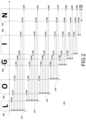
- FIG. 2 depicts a schematic diagram of determining a plurality of time intervals associated with interacting with keys of a keyboard used for training the classifier in accordance with the method of FIG. 1 , in accordance with certain non-limiting embodiments of the present technology;
- FIG. 3 depicts a schematic diagram of dividing the keyboard into zones, in accordance with certain non-limiting embodiments of the present technology
- FIG. 4 depicts a schematic diagram of an example computing environment configurable for execution of the method of FIG. 1 , in accordance with certain non-limiting embodiments of the present technology.
- Certain non-limiting embodiments of the present technology are directed to methods and systems for training a classifier to identify a user of an electronic device by key stroke dynamics thereof and using the so trained classifier for identifying the user.
- the electronic device may include, without limitation, a personal computer, a smartphone, a tablet, and the like.
- the electronic device may include a keyboard comprising a plurality of keys, using which the user may input a text to the electronic device.
- the present methods and systems may allow for training the classifier to identify the user, as will be described below.
- the electronic device may include a computing environment, such as a computing environment 400 including a processor 401 , which will be described further below with reference to FIG. 4 .
- Certain non-limiting embodiments of the present technology are based on a premise that an electronic signal generated by the keyboard in response to pressing or releasing a given key uniquely identifies the given key. Moreover, this electronic signal neither depends on how hard the key was pressed, nor on how quickly it was pressed, nor on how long it was held down before releasing, nor on other similar factors.
- scan codes uniquely identifies a respective key.
- each of these scan codes may be indicative of a particular type of interaction with the respective key.
- the scan codes are unique within a specific computer configuration of the electronic device and they can be transmitted from the keyboard to electronic device regardless of the state of the other input devices thereof.
- the processor 401 may be configured to receive: (1) a time of pressing, (2) a time of releasing, (3) information about the given key—what command/character is associated therewith, as an example.
- the processor 401 may have access to system clock data provided, for example, by an operating system of the electronic device, and may thus be enabled to determine a timestamp a specific between the time of pressing and the releasing of the given key.
- the processor 401 may be configured to determine the key stroke dynamics of the user based on the user inputting a predetermined text to the electronic device.
- a predetermined text may include, for example, user credentials, such as their username and password.
- the user before starting work on the electronic device, the user can be informed of their credentials and instructed to enter a username and password a predetermined number of times (such as 10-15 times) in a respective user interface window provided by the electronic device.
- a predetermined number of times such as 10-15 times
- the predetermined number of times of inputting the predetermined text for each user may be different, since it depends not only on the experience of a specific user with the keyboard, but also on their “degree of acquaintance” with a specific keyboard.
- the electronic device may include a server of a remote computer system including, for example, a remote banking service system or an online store site that has a personal account function and includes a customer authorization feature.
- a remote banking service system or an online store site that has a personal account function and includes a customer authorization feature.
- the user may be asked to enter their credentials in a browser window associated with the remote computer system, and the processor 401 may be configured to receive the data from the user remotely, as will be described below.
- FIG. 1 there is depicted a flowchart diagram of a method 100 of training the classifier to identify the user of the electronic by the keystroke dynamics associated therewith, in accordance with certain non-limiting embodiments of the present technology.
- the method 100 may be executed by the processor 401 of the electronic device.
- Step 102 Receiving, by the Processor, Training Key Stroke Data Associated with the User, a Given Portion of the Training Key Stroke Data Having been Generated in Response to the User Interacting with a Given Key of the Plurality of Keys Used for Inputting a Predetermined Text into the Electronic Device
- the method 100 commences at step ( 102 ) with the processor 401 being configured to receive training key stroke data generated by the electronic device in response to the user entering the user credentials.
- the training key stroke data may include a set of scan codes of keys of the keyboard, with which the user has interacted to input the user credentials.
- the processor 401 can also be configured to obtain and assign to the training key stroke data a user identifier associated with the user credentials.
- the user identifier may be used by the processor 401 to uniquely identify the user in the computer system in each working session.
- the user identifier may include an arbitrary pseudonym (“Ivanov.I.I.”), which may not coincide with the login entered by the user upon a request of the computer system at the beginning of training, as well as a pseudo-random number, for example, a hash function value of a system time received, by the processor 401 , at the time of pressing the first key when entering the password with an accuracy of 0.001 seconds for the first time, can be used as the user identifier of the user, in some non-limiting embodiments of the present technology.
- a pseudonym which may not coincide with the login entered by the user upon a request of the computer system at the beginning of training
- a pseudo-random number for example, a hash function value of a system time received, by the processor 401 , at the time of pressing the first key when entering the password with an accuracy of 0.001 seconds for the first time
- the user identifier of the user can include a respective user_id, assigned to the user by the computer system including, for example, the remote banking service (RBS) system.
- the computer system including, for example, the remote banking service (RBS) system.
- RBS remote banking service
- the processor 401 in response to receiving the correct user credentials and having associated the user_id of the user with a given user session, can further be configured to apply a predetermined a hash function from the user_id and use the resulting value as the user identifier.
- the processor 401 is configured to obtain the user identifier.
- the method 100 thus proceeds to step 104 .
- Step 104 Determining, by the Processor, Based on the Given Portion of the Training Key Stroke Data, a Plurality of Time Intervals
- the processor 401 can be configured to determine, for a given portion of the training key stroke data generated in response to the user interaction with a given key used for inputting the user credentials into the electronic device, a plurality of time intervals.
- the plurality of time intervals may be indicative of user-specific fashion of interacting with the given key when entering the user credentials.
- the plurality of time intervals may include:
- the processor 401 may be configured to store respective pluralities of time intervals associated with each of the plurality of keys used, by the user, for inputting the user credentials. Further, the processor 401 may be configured to use the respective pluralities of time intervals for generating a training set of data as will be described below.
- FIG. 2 there is depicted a schematic diagram of an example of the processor 401 determining time intervals in response to inputting the word “LOGIN”, in accordance with certain non-limiting embodiments of the present technology.
- the processor 401 can be configured to determine a set of time intervals 200 , in response to user interaction with a sequence of keys L 202 , O 204 , G 206 , I 208 and N 210 of the keyboard.
- the processor 401 may be configured to determine the time of pressing using the system clock data for each of these keys, for example, a first time of pressing 212 of the L 202 key or a second time of pressing 216 of the O 204 key.
- the processor 401 may be configured to determine the time of key releasing also using the system clock for each of these keys, for example, a first time of releasing 214 of the L 202 key or a second time of releasing 218 of the O 204 key.
- the processor 401 may be configured to determine the hold time of each key in the pressed state, such as: a first hold time 220 of the L 202 key, a second hold time 254 of the O 204 key, a third hold time 280 of the G 206 key, a fourth hold time 294 of the I 208 key, and a fifth hold time 299 of the N 210 key.
- the processor 401 may be configured to determine a first subset of time intervals between the times of pressing each key and pressing all the other keys used for inputted the word “LOGIN”. More specifically, first, the processor 401 can be configured to determine time intervals 222 , 226 , 230 and 234 associated with the L 202 key between the first time of pressing 212 of the L 202 key and respective times of pressing of the O 204 , G 206 , I 208 and N 210 keys. Further, for the O 204 key, the processor 401 can be configured to determine time intervals 256 , 260 and 264 between the second time of pressing 216 of the O 204 key and respective times of pressing the G 206 , I 208 , and N 210 keys.
- a time interval 222 between pressing L 202 and O 204 keys is not determined in this case, since it has already been determined earlier. Similar, time intervals 282 and 286 between respective moments of pressing of the G 206 key and pressing the I 208 and N 210 keys are determined. Finally, a time interval 295 between the pressing of I 208 and N 210 keys is determined, and thus the first subset of intervals between the time each key is pressed and the time all other keys are pressed is obtained.
- the processor 401 can be configured to determine a second subset of time intervals between the respective moments of releasing each key and releasing all the other keys. More specifically, first, the processor 401 can be configured to determine time intervals 240 , 244 , 248 and 252 between the first time of releasing 214 of the L 202 key and respective times of releasing the O 204 , G 206 , I 208 and N 210 keys. Second, the processor 401 can be configured to determine time intervals 270 , 274 and 278 between the second time of releasing 218 of the O 204 key and respective moments of releasing the G 206 , I 208 and N 210 keys.
- a time interval 240 between the time of releasing of the L 202 and O 204 keys is not determined in this case, since it has already been determined earlier.
- the processor 401 can be configured to determine time intervals 291 and 293 between respective moments of releasing of the G 206 key and releasing the I 208 and N 210 keys. Finally, a time interval 298 between moments of releasing the I 208 and N 210 keys is determined, and thus the second subset of intervals between the respective moments when each key is released and all other keys are released is obtained.
- the processor 401 can be configured to determine a third subset of time intervals between respective moments of pressing each key releasing all the other keys. More specifically, first, the processor 401 can be configured to determine time intervals 224 , 228 , 232 and 236 between the first time of pressing 212 of the L 202 key and respective moments in time of releasing the O 204 , G 206 , I 208 and N 210 keys, respectively, are measured. Second, the processor 401 can be configured to determine time intervals 258 , 262 and 266 between the second time of pressing 216 of the O 204 key and respective moments of releasing the G 206 , I 208 and N 210 .
- a time interval 238 between pressing the O 204 key and releasing the L 202 key is not determined in this case, since it has already been determined earlier.
- the processor 401 can be configured to determine time intervals 284 and 288 between respective moments of pressing the G 206 key and releasing the I 208 and N 210 keys.
- the processor 401 can be configured to determine a time interval 296 between moments of pressing the I 208 key and releasing the N 210 key, and thus the third subset of time intervals between respective moments when each key is pressed and all other keys are released is obtained.
- the processor 401 can be configured to determine a fourth subset of time intervals between respective moments in time of releasing each key and pressing all the other keys. More specifically, first, the processor 401 can be configured to determine time intervals 238 , 242 , 246 and 250 between the first time of releasing 214 of the L 202 key and the respective times of pressing the O 204 , G 206 , I 208 and N 210 keys. Second, the processor 401 can be configured to determine time intervals 268 , 272 and 276 between the second time of releasing 218 of the O 204 key and respective times of pressing the G 206 , I 208 and N 210 keys.
- a time interval 224 between the time of releasing the O 204 key and the time of pressing the L 202 key is not measured in this case, since it has already been measured earlier.
- the processor 401 can be configured to determine time intervals 290 and 292 between respective moments of releasing of the G 206 key and pressing the I 208 and N 210 keys.
- the processor 401 can be configured to determine a time interval 297 between moments of releasing the I 208 key and pressing the N 210 key, and thus the fourth subset of time intervals between the respective moments when each key is released and all other keys are pressed is obtained.
- the processor 401 can be configured to determine the set of time intervals by determining respective differences between each pair of timestamps of the system clock (timestamp), obtained upon reception of the corresponding scan codes.
- the processor 401 can be configured to determine the time intervals, for example, with an accuracy of 0.01 second and expressed in decimal, hexadecimal or any other convenient format; and further save the time intervals in a specific user data set file.
- the sequence number of the interval may not be recorded, because it follows from the place of the measured value in the range of the remaining values of the set.
- the processor 401 can be configured to receive a first timestamp from the system clock.
- the processor 401 may receive a second timestamp from the system clock, and the processor 401 can further be configured to determine and store the time interval 220 between the first timestamp and the second timestamps of the system clock.
- the processor 401 can receive a third timestamp form the system clock, and the processor 401 can further be configured to determine and store the time interval 222 between the first timestamp and third timestamp and the time interval 238 between the second timestamp and third timestamp.
- the processor 401 can be configured to receive a fourth timestamp from the system clock, and the processor 401 can further be configured to determine and store the following time intervals: the time interval 224 between the first timestamp and fourth timestamp, the time interval 240 between the second timestamp and fourth timestamp, the time interval 254 between the third timestamp and fourth timestamp.
- the processor 401 can be configured to determine and store other time intervals in a similar fashion.
- the user may press a “next” key before releasing a “previous” key.
- the time of pressing the second key 216 will be closer to the start of typing 212 than the time of releasing the first key 214 .
- This feature of working on the keyboard may only affect a number of the corresponding time intervals ( 220 , 222 , 238 , etc.).
- This feature of the user will not affect neither the total number of time intervals determined for the given key that make up the login and password, nor the functioning of the system that implements the claimed method.
- the fact that the determined time intervals in this case will have completely different values than for users with the usual way of typing may thus allow for greater reliability of the present technology.
- the keyboard may have a number of service keys. Some of them, such as the Ctrl key, do not affect character input in the text field. Therefore, the receipt of scan codes of such keys within the scope of the present technology can be ignored.
- the scan codes of non-symbolic keys can be processed similarly to the scan codes of the keys corresponding to characters.
- the processor 401 can be configure to discard time intervals associated with the key associated with the deleted character, and continue determining further time intervals, starting from the next character after Backspace, which will be considered “instead of” erroneously entered. Further, it should be noted that the Backspace scan code is ignored when determining the time intervals.
- the corresponding part of the already determined time intervals can be deleted; and all previously determined time intervals can be deleted if the number of presses on the Backspace was greater than or equal to the number of characters already entered.
- the processor 401 can be configured to receive an indication that determining the time intervals is completed, and the obtained values are stored to the file.
- the processor 401 may be configured, based on the respective pluralities of time intervals, generate the training set of data associated with the user identifier of the user. It should be noted that in some embodiments, only correct entries of the user credentials are considered for the training set of data; and, in cases where the user makes a mistake in entering the user credentials, the processor 401 can be configured to cause the computer system to display a respective error message and request an additional entry of the user credentials until the entered credentials are correct.
- the processor 401 can be configured to generate for each instance of the predetermined number of inputting the user credentials, a respective dataset including associated sets of time intervals and store it in a database.
- the method 100 hence advances to step 106 .
- Step 106 Determining, for a Given One of the Plurality of Time Intervals, Based on a Plurality of Instances of Inputting, by the User, the Predetermined Text, a Respective Variance Value
- the processor 401 can be configured to determine most stable time intervals within time intervals stored in the database over the predetermined number of instances of the user inputting the user credentials to the electronic device. In other words, the processor 401 can be configured to determine most consistent time intervals associated with the user.
- the processor 401 can be configured to determine a respective variance value, an illustrative example of which is given below.
- ⁇ K 10 ⁇ ⁇ t 10(1); t 10(2); t 10(3) . . . t 10( K ) ⁇ .
- the processor 401 can be configured to determine the respective variance value D as a variance of a random variable having values of a respective time interval over the ⁇ K ⁇ sets of time intervals.
- the method 100 hence proceeds to step 108 .
- Step 108 Ranking, by the Processor, the Plurality of Time Intervals in Accordance with Respective Variance Values Associated Therewith, Thereby Generating a Ranked List of Time Intervals
- the processor 401 can be configured to rank the time intervals determine over the predetermined number of instances of inputting the user credentials according to respective variance values associated therewith, thereby generating a ranked list of time intervals associated with the user.
- the method 100 thus advances to step 110 .
- Step 110 Selecting, by the Processor, from the Ranked List of Time Intervals, a Predetermined Number of Top Time Intervals for Inclusion Thereof in a Training Set of Data
- the processor 401 can be configured to select a predetermined top (for example, 50 or 200) number of time intervals having minimum respective variance values, thereby determining the most stable features associated with the user.
- a predetermined top for example, 50 or 200
- the processor 401 can be configured to include the predetermined number of top time intervals associated with the user in the training set of data for use thereof to train the classifier to identify the user by in-use (that is, future) instances of inputting the user credentials to the electronic device.
- the processor 401 can be configured to assign a given one of the predetermined top time intervals may be with a respective weight value indicative of a respective operation area of the keyboard to which a key associated with the given one of the predetermined top time intervals belongs.
- a keyboard 300 may be divided into the following operation areas a service key area 302 , a left area of the alphanumeric block 304 , a middle area of the alphanumeric block 310 , a right area of the alphanumeric block 312 , a left 306 and a right 314 areas of the modifier keys, a space bar area 308 , a numeric keypad area 318 , and a service key area of the numeric keypad 316 .
- the keyboard such as a keyboard 350
- the keyboard may be divided into an upper operation area 352 , a middle operation area 354 , and a lower operation area 356 .
- each of the operation areas of the keyboard 300 may be preassigned with a respective weight value indicative of a multiplication factor applied to an associated time interval.
- time intervals associated with keys of the upper area 352 can be multiplied by 10, time intervals associated with keys of the middle operation area 354 remain unchanged (multiplied by 1), and time intervals for keys of the lower operation area 356 are multiplied by 0.1.
- the processor 401 can be configured to receive the training key stroke data including data of all these users and process it, as described above with reference to steps 104 to 110 of the method 100 . After determining and storing the time intervals, the processor 401 can be configured to assign the time intervals with respective user identifiers (or otherwise, a single group user identifier) of all users of the group of users. Accordingly, in these embodiments, the processor 401 can be configured to train the classifier to identify, by the in-use instances of inputting the user credentials, a given one of the group of users.
- the method 100 thus proceeds to step 112 .
- Step 112 Training, by the Processor, Based on the Training Set of Data, the Classifier to Determine if the Predetermined Text Inputted into the Electronic Device in Future has been Inputted by the User
- the processor 401 can be configured to train the classifier based on the so generated training set of data comprising the most stable time intervals determined in response to the user inputting the user credentials to the electronic device.
- the processor 401 can be configured to use the so trained classifier to determine if the user credentials in future have been entered by the user or not.
- the processor 401 can be configured to receive, form the system clock data, timestamps indicative of time of pressing and/or releasing each of the keys used for inputting the user credentials.
- the processor 401 may further be configured to aggregate the received timestamps in an in-use dataset.
- the processor 401 can be configured to apply the trained classifier to the in-use dataset to determine a likelihood parameter indicative of whether the user credentials have been inputted by the user or not.
- the processor 401 can further be configured to determine a likelihood parameter indicative of whether a current one entering the user credentials belongs to the group of users.
- the processor 401 can be configured to determine that the user credentials have been inputted by the user.
- the processor 401 can be configured to determine that the user credentials have been inputted not by the user.
- the processor 401 can be configured to cause the computer system to generate and send a respective information message to the user.
- the classifier can be implemented, for example, as at least one of an Isolation Forest classifier and a One Class SVM classifier.
- the processor 401 can be configured to train the classifier by applying one or more methods of machine learning.
- the electronic device may be an integral part of a web site including a user authorization feature including, for example, without limitation, an online store or a portal of public services.
- the method 100 thus terminates
- FIG. 4 there is depicted an example functional diagram of the computing environment 400 configurable to implement certain non-limiting embodiments of the present technology including the method 100 described above.
- the computing environment 400 may include: the processor 401 comprising one or more central processing units (CPUs), at least one non-transitory computer-readable memory 402 (RAM), a storage 403 , input/output interfaces 404 , input/output means 405 , data communication means 406 .
- the processor 401 comprising one or more central processing units (CPUs), at least one non-transitory computer-readable memory 402 (RAM), a storage 403 , input/output interfaces 404 , input/output means 405 , data communication means 406 .
- the processor 401 may be configured to execute specific program instructions the computations as required for the computing environment 400 to function properly or to ensure the functioning of one or more of its components.
- the processor 401 may further be configured to execute specific machine-readable instructions stored in the at least one non-transitory computer-readable memory 402 , for example, those causing the computing environment 400 to execute the method 100 .
- the machine-readable instructions representative of software components of disclosed systems may be implemented using any programming language or scripts, such as C, C++, C #, Java, JavaScript, VBScript, Macromedia Cold Fusion, COBOL, Microsoft Active Server Pages, Assembly, Perl, PHP, AWK, Python, Visual Basic, SQL Stored Procedures, PL/SQL, any UNIX shell scrips or XML.
- Various algorithms are implemented with any combination of the data structures, objects, processes, procedures and other software elements.
- the at least one non-transitory computer-readable memory 402 may be implemented as RAM and contains the necessary program logic to provide the requisite functionality.
- the storage 403 may be implemented as at least one of an HDD drive, an SSD drive, a RAID array, a network storage, a flash memory, an optical drive (such as CD, DVD, MD, Blu-ray), etc.
- the storage 203 may be configured for long-term storage of various data, e.g., the aforementioned documents with user data sets, databases with the time intervals measured for each user, user IDs, etc.
- the input/output interfaces 404 may comprise various interfaces, such as at least one of USB, RS232, RJ45, LPT, COM, HDMI, PS/2, Lightning, FireWire, etc.
- the input/output means 405 include a keyboard, such as one of the keyboard 300 and the keyboard 350 depicted in FIG. 3 .
- the input/output means 405 may further include at least one of a joystick, a (touchscreen) display, a projector, a touchpad, a mouse, a trackball, a stylus, speakers, a microphone, and the like.
- a communication link between each one of the input/output means 405 can be wired (for example, connecting the keyboard via a PS/2 or USB port on the chassis of the desktop PC) or wireless (for example, via a wireless link, e.g., radio link, to the base station which is directly connected to the PC, e.g., to a USB port).
- a wireless link e.g., radio link
- the data communication means 406 may be selected based on a particular implementation of the network, and may comprise at least one of: an Ethernet card, a WLAN/Wi-Fi adapter, a Bluetooth adapter, a BLE adapter, an NFC adapter, an IrDa, a RFID adapter, a GSM modem, and the like.
- the connectivity hardware 504 may be configured for wired and wireless data transmission, via one of WAN, PAN, LAN, Intranet, Internet, WLAN, WMAN, or GSM networks.
- These and other components of the computing environment 400 may be linked together using a common data bus 410 .
Landscapes
- Engineering & Computer Science (AREA)
- Theoretical Computer Science (AREA)
- General Engineering & Computer Science (AREA)
- General Physics & Mathematics (AREA)
- Physics & Mathematics (AREA)
- Software Systems (AREA)
- Computer Hardware Design (AREA)
- Computer Security & Cryptography (AREA)
- Medical Informatics (AREA)
- Computing Systems (AREA)
- Evolutionary Computation (AREA)
- Mathematical Physics (AREA)
- Data Mining & Analysis (AREA)
- Human Computer Interaction (AREA)
- Computer Vision & Pattern Recognition (AREA)
- Quality & Reliability (AREA)
- Artificial Intelligence (AREA)
- Health & Medical Sciences (AREA)
- General Health & Medical Sciences (AREA)
- Social Psychology (AREA)
- Input From Keyboards Or The Like (AREA)
Abstract
Description
-
- a time interval during which the given key was held down;
- time intervals between respective moments in time of pressing the given key and pressing all other keys that are used by the user when entering the user credentials;
- time intervals between respective moments in time of releasing the given key and releasing all the other keys that are used by the user when entering the user credentials;
- time intervals between respective moments in time of pressing the given key and releasing all the other keys that are used by the user when entering the user credentials;
- time intervals between respective moments in time of releasing the given key and pressing all the other keys that are used by the user when entering the user credentials.
{K1}={t1(1);t1(2);t1(3) . . . t1(K)};
{K1}={t2(1);t2(2);t2(3) . . . t2(K)};
. . .
{K10}={t10(1);t10(2);t10(3) . . . t10(K)}.
The
D(1)=D({t1(1);t2(1);t3(1);t4(1) . . . t10(1)});
D(2)=D({t1(2);t2(2);t3(2);t4(2) . . . t10(2)}); . . .
D(K)=D({t1(K);t2(K);t3(K);t4(K) . . . t10(K)}).
Claims (16)
Applications Claiming Priority (1)
| Application Number | Priority Date | Filing Date | Title |
|---|---|---|---|
| PCT/RU2019/000126 WO2020176005A1 (en) | 2019-02-27 | 2019-02-27 | Method and system for identifying a user according to keystroke dynamics |
Related Parent Applications (1)
| Application Number | Title | Priority Date | Filing Date |
|---|---|---|---|
| PCT/RU2019/000126 Continuation WO2020176005A1 (en) | 2019-02-27 | 2019-02-27 | Method and system for identifying a user according to keystroke dynamics |
Publications (2)
| Publication Number | Publication Date |
|---|---|
| US20210182369A1 US20210182369A1 (en) | 2021-06-17 |
| US11934498B2 true US11934498B2 (en) | 2024-03-19 |
Family
ID=72239648
Family Applications (1)
| Application Number | Title | Priority Date | Filing Date |
|---|---|---|---|
| US17/171,078 Active 2040-08-06 US11934498B2 (en) | 2019-02-27 | 2021-02-09 | Method and system of user identification |
Country Status (4)
| Country | Link |
|---|---|
| US (1) | US11934498B2 (en) |
| EP (1) | EP3842968B1 (en) |
| SG (1) | SG11202101624WA (en) |
| WO (1) | WO2020176005A1 (en) |
Families Citing this family (2)
| Publication number | Priority date | Publication date | Assignee | Title |
|---|---|---|---|---|
| US11436310B1 (en) * | 2020-07-20 | 2022-09-06 | Two Six Labs, LLC | Biometric keystroke attribution |
| US20250131071A1 (en) * | 2023-10-20 | 2025-04-24 | International Business Machines Corporation | Continuous recognition of users through text entry |
Citations (209)
| Publication number | Priority date | Publication date | Assignee | Title |
|---|---|---|---|---|
| EP1160646A2 (en) | 2000-05-30 | 2001-12-05 | At&T Wireless Services, Inc. | Floating intrusion detection platforms |
| WO2002045380A2 (en) | 2000-11-30 | 2002-06-06 | Lancope, Inc. | Flow-based detection of network intrusions |
| US20020112048A1 (en) | 2000-12-11 | 2002-08-15 | Francois Gruyer | System and method for providing behavioral information of a user accessing on-line resources |
| US20020161862A1 (en) | 2001-03-15 | 2002-10-31 | Horvitz Eric J. | System and method for identifying and establishing preferred modalities or channels for communications based on participants' preferences and contexts |
| US20030009696A1 (en) | 2001-05-18 | 2003-01-09 | Bunker V. Nelson Waldo | Network security testing |
| US20060074858A1 (en) | 2002-03-28 | 2006-04-06 | Lion Bioscience Ag | Method and apparatus for querying relational databases |
| US20060107321A1 (en) | 2004-11-18 | 2006-05-18 | Cisco Technology, Inc. | Mitigating network attacks using automatic signature generation |
| US20060224898A1 (en) | 2003-05-02 | 2006-10-05 | Ahmed Ahmed E | System and method for determining a computer user profile from a motion-based input device |
| US20060253582A1 (en) | 2005-05-03 | 2006-11-09 | Dixon Christopher J | Indicating website reputations within search results |
| CA2606326A1 (en) | 2005-04-29 | 2006-11-09 | Bharosa Inc. | System and method for fraud monitoring, detection, and tiered user authentication |
| US20070019543A1 (en) | 2005-07-06 | 2007-01-25 | Fortinet, Inc. | Systems and methods for detecting and preventing flooding attacks in a network environment |
| US20070101155A1 (en) | 2005-01-11 | 2007-05-03 | Sig-Tec | Multiple user desktop graphical identification and authentication |
| KR20070049514A (en) | 2005-11-08 | 2007-05-11 | 한국정보보호진흥원 | Malware Monitoring System and Monitoring Method Using the Same |
| US7225343B1 (en) | 2002-01-25 | 2007-05-29 | The Trustees Of Columbia University In The City Of New York | System and methods for adaptive model generation for detecting intrusions in computer systems |
| GB2437100A (en) * | 2006-04-10 | 2007-10-17 | Univ Westminster | Biometric security system using keystroke dynamics of a user's login attempt |
| RU2333532C2 (en) | 2005-07-07 | 2008-09-10 | Казанский государственный технический университет им. А.Н. Туполева | Method of reference values generation of pc user characteristics |
| US20080222712A1 (en) | 2006-04-10 | 2008-09-11 | O'connell Brian M | User-Browser Interaction Analysis Authentication System |
| US7496628B2 (en) | 2003-02-25 | 2009-02-24 | Susquehanna International Group, Llp | Electronic message filter |
| WO2009026564A1 (en) | 2007-08-22 | 2009-02-26 | Google Inc. | Detection and classification of matches between time-based media |
| KR20090022682A (en) | 2007-08-31 | 2009-03-04 | 주식회사 비원플러스 | Method and system for providing financial transaction service using keystroke based behavior pattern information |
| US20090138342A1 (en) | 2001-11-14 | 2009-05-28 | Retaildna, Llc | Method and system for providing an employee award using artificial intelligence |
| KR100923179B1 (en) | 2007-08-16 | 2009-10-22 | 재단법인서울대학교산학협력재단 | Account sharing detection method and system based on behavior pattern analysis |
| US20090281852A1 (en) | 2008-05-07 | 2009-11-12 | Abhari Hassan Al | Closed-Loop Referral System And Method |
| US20090292925A1 (en) | 2006-04-13 | 2009-11-26 | Alexander Meisel | Method for providing web application security |
| US7631362B2 (en) | 2005-09-20 | 2009-12-08 | International Business Machines Corporation | Method and system for adaptive identity analysis, behavioral comparison, compliance, and application protection using usage information |
| US20100037314A1 (en) | 2008-08-11 | 2010-02-11 | Perdisci Roberto | Method and system for detecting malicious and/or botnet-related domain names |
| RU2382400C2 (en) | 2004-01-23 | 2010-02-20 | Майкрософт Корпорейшн | Construction and application of web-catalogues for focused search |
| US20100076857A1 (en) | 2008-09-25 | 2010-03-25 | Harshal Ulhas Deo | Methods and systems for activity-based recommendations |
| US7712136B2 (en) | 2005-05-05 | 2010-05-04 | Ironport Systems, Inc. | Controlling a message quarantine |
| US20100115620A1 (en) | 2008-10-30 | 2010-05-06 | Secure Computing Corporation | Structural recognition of malicious code patterns |
| US20100115621A1 (en) | 2008-11-03 | 2010-05-06 | Stuart Gresley Staniford | Systems and Methods for Detecting Malicious Network Content |
| US7730040B2 (en) | 2005-07-27 | 2010-06-01 | Microsoft Corporation | Feedback-driven malware detector |
| US20100191737A1 (en) | 2005-08-03 | 2010-07-29 | Novell, Inc. | System and method of searching for classifying user activity performed on a computer system |
| US20100205665A1 (en) | 2009-02-11 | 2010-08-12 | Onur Komili | Systems and methods for enforcing policies for proxy website detection using advertising account id |
| US20100235918A1 (en) | 2009-03-13 | 2010-09-16 | Rami Mizrahi | Method and Apparatus for Phishing and Leeching Vulnerability Detection |
| GB2470579A (en) | 2009-05-27 | 2010-12-01 | Univ Abertay Dundee | A behavioural biometric security system using keystroke metrics |
| US7865953B1 (en) | 2007-05-31 | 2011-01-04 | Trend Micro Inc. | Methods and arrangement for active malicious web pages discovery |
| WO2011039371A1 (en) | 2009-10-02 | 2011-04-07 | Psylock Gmbh | Crosswise alignment of typing behaviour for authenticating and/or identifying a person |
| WO2011045424A1 (en) | 2009-10-16 | 2011-04-21 | Telefonica, S.A. | Method for detecting audio and video copy in multimedia streams |
| US7958555B1 (en) | 2007-09-28 | 2011-06-07 | Trend Micro Incorporated | Protecting computer users from online frauds |
| US7984500B1 (en) | 2006-10-05 | 2011-07-19 | Amazon Technologies, Inc. | Detecting fraudulent activity by analysis of information requests |
| RU107616U1 (en) | 2011-03-28 | 2011-08-20 | Закрытое акционерное общество "Лаборатория Касперского" | SYSTEM OF QUICK ANALYSIS OF DATA STREAM ON THE AVAILABILITY OF MALICIOUS OBJECTS |
| US20110222787A1 (en) | 2008-02-28 | 2011-09-15 | Stefan Thiemert | Frame sequence comparison in multimedia streams |
| US20120030293A1 (en) | 2010-07-27 | 2012-02-02 | At&T Intellectual Property I, L.P. | Employing report ratios for intelligent mobile messaging classification and anti-spam defense |
| WO2012015171A2 (en) | 2010-07-26 | 2012-02-02 | Kim Ki Yong | Hacker virus security-integrated control device |
| US8132250B2 (en) | 2002-03-08 | 2012-03-06 | Mcafee, Inc. | Message profiling systems and methods |
| RU2446459C1 (en) | 2010-07-23 | 2012-03-27 | Закрытое акционерное общество "Лаборатория Касперского" | System and method for checking web resources for presence of malicious components |
| US20120079596A1 (en) | 2010-08-26 | 2012-03-29 | Verisign, Inc. | Method and system for automatic detection and analysis of malware |
| US8151341B1 (en) | 2011-05-23 | 2012-04-03 | Kaspersky Lab Zao | System and method for reducing false positives during detection of network attacks |
| US20120087583A1 (en) | 2010-10-06 | 2012-04-12 | Futurewei Technologies, Inc. | Video Signature Based on Image Hashing and Shot Detection |
| US20120158626A1 (en) | 2010-12-15 | 2012-06-21 | Microsoft Corporation | Detection and categorization of malicious urls |
| US8255532B2 (en) | 2004-09-13 | 2012-08-28 | Cisco Technology, Inc. | Metric-based monitoring and control of a limited resource |
| US8260914B1 (en) | 2010-06-22 | 2012-09-04 | Narus, Inc. | Detecting DNS fast-flux anomalies |
| US20120233656A1 (en) | 2011-03-11 | 2012-09-13 | Openet | Methods, Systems and Devices for the Detection and Prevention of Malware Within a Network |
| US8285830B1 (en) | 2009-01-06 | 2012-10-09 | Citizenhawk, Inc. | System and method for combating cybersquatting |
| US20120291125A1 (en) | 2011-05-11 | 2012-11-15 | At&T Mobility Ii Llc | Dynamic and selective response to cyber attack for telecommunications carrier networks |
| GB2493514A (en) | 2011-08-02 | 2013-02-13 | Qatar Foundation | Using a measure of depth to detect if video data derives from a reference video |
| US8402543B1 (en) | 2011-03-25 | 2013-03-19 | Narus, Inc. | Machine learning based botnet detection with dynamic adaptation |
| US20130086677A1 (en) | 2010-12-31 | 2013-04-04 | Huawei Technologies Co., Ltd. | Method and device for detecting phishing web page |
| US20130103666A1 (en) | 2011-10-21 | 2013-04-25 | Google Inc. | Mapping uniform resource locators of different indexes |
| US20130111591A1 (en) | 2011-11-02 | 2013-05-02 | Vlad I. Topan | Fuzzy Whitelisting Anti-Malware Systems and Methods |
| US20130117848A1 (en) | 2011-11-03 | 2013-05-09 | Ali Golshan | Systems and Methods for Virtualization and Emulation Assisted Malware Detection |
| US8448245B2 (en) | 2009-01-17 | 2013-05-21 | Stopthehacker.com, Jaal LLC | Automated identification of phishing, phony and malicious web sites |
| RU129279U1 (en) | 2013-01-09 | 2013-06-20 | ОБЩЕСТВО С ОГРАНИЧЕННОЙ ОТВЕТСТВЕННОСТЬЮ "МФИ Софт" | DEVICE FOR DETECTION AND PROTECTION AGAINST ANOMALOUS ACTIVITY ON DATA TRANSMISSION NETWORKS |
| RU2487406C1 (en) | 2011-11-24 | 2013-07-10 | Закрытое акционерное общество "Лаборатория Касперского" | System and method of detecting malicious entities distributed over peer-to-peer networks |
| US20130191364A1 (en) | 2009-08-31 | 2013-07-25 | Accenture Global Services Limited | System to modify a website for search optimization |
| RU2488880C1 (en) | 2012-05-11 | 2013-07-27 | Закрытое акционерное общество "Лаборатория Касперского" | System and method of adaptive optimisation of inspection of data flow sent in network for availability of threats |
| US8532382B1 (en) | 2009-08-06 | 2013-09-10 | Google Inc. | Full-length video fingerprinting |
| US8539582B1 (en) | 2004-04-01 | 2013-09-17 | Fireeye, Inc. | Malware containment and security analysis on connection |
| US20130263264A1 (en) | 2012-04-02 | 2013-10-03 | Trusteer Ltd. | Detection of phishing attempts |
| US8555388B1 (en) | 2011-05-24 | 2013-10-08 | Palo Alto Networks, Inc. | Heuristic botnet detection |
| RU2495486C1 (en) | 2012-08-10 | 2013-10-10 | Закрытое акционерное общество "Лаборатория Касперского" | Method of analysing and detecting malicious intermediate nodes in network |
| US8561177B1 (en) | 2004-04-01 | 2013-10-15 | Fireeye, Inc. | Systems and methods for detecting communication channels of bots |
| US20130297619A1 (en) | 2012-05-07 | 2013-11-07 | The Nasdaq Omx Group, Inc. | Social media profiling |
| US8600993B1 (en) | 2009-08-26 | 2013-12-03 | Google Inc. | Determining resource attributes from site address attributes |
| US8606725B1 (en) | 2008-10-29 | 2013-12-10 | Emory University | Automatic client-side user-behavior analysis for inferring user intent |
| US8612463B2 (en) | 2010-06-03 | 2013-12-17 | Palo Alto Research Center Incorporated | Identifying activities using a hybrid user-activity model |
| US20130340080A1 (en) | 2012-06-19 | 2013-12-19 | Kaspersky Lab Zao | System and Method for Preventing Spread of Malware in Peer-to-Peer Network |
| US20130343616A1 (en) | 2012-06-24 | 2013-12-26 | Neurologix Security Inc. | Biometrics based methods and systems for user authentication |
| CN103491205A (en) | 2013-09-30 | 2014-01-01 | 北京奇虎科技有限公司 | Related resource address push method and device based on video retrieval |
| US8625033B1 (en) | 2010-02-01 | 2014-01-07 | Google Inc. | Large-scale matching of audio and video |
| US8635696B1 (en) | 2004-04-01 | 2014-01-21 | Fireeye, Inc. | System and method of detecting time-delayed malicious traffic |
| US20140033307A1 (en) | 2012-07-24 | 2014-01-30 | Webroot Inc. | System and method to provide automatic classification of phishing sites |
| US8650080B2 (en) | 2006-04-10 | 2014-02-11 | International Business Machines Corporation | User-browser interaction-based fraud detection system |
| US8660296B1 (en) | 2012-01-10 | 2014-02-25 | Google Inc. | Systems and methods for facilitating video fingerprinting using local descriptors |
| US20140058854A1 (en) | 2007-12-07 | 2014-02-27 | Jpmorgan Chase Bank, N.A. | Mobile Fraud Prevention System and Method |
| US8677472B1 (en) | 2011-09-27 | 2014-03-18 | Emc Corporation | Multi-point collection of behavioral data relating to a virtualized browsing session with a secure server |
| US20140082730A1 (en) | 2012-09-18 | 2014-03-20 | Kddi Corporation | System and method for correlating historical attacks with diverse indicators to generate indicator profiles for detecting and predicting future network attacks |
| US20140173287A1 (en) | 2011-07-11 | 2014-06-19 | Takeshi Mizunuma | Identifier management method and system |
| RU2522019C1 (en) | 2012-12-25 | 2014-07-10 | Закрытое акционерное общество "Лаборатория Касперского" | System and method of detecting threat in code executed by virtual machine |
| RU2523114C2 (en) | 2012-04-06 | 2014-07-20 | Закрытое акционерное общество "Лаборатория Касперского" | Method of analysing malicious activity on internet, detecting malicious network nodes and neighbouring intermediate nodes |
| US8856937B1 (en) | 2008-06-27 | 2014-10-07 | Symantec Corporation | Methods and systems for identifying fraudulent websites |
| RU2530210C2 (en) | 2012-12-25 | 2014-10-10 | Закрытое акционерное общество "Лаборатория Касперского" | System and method for detecting malware preventing standard user interaction with operating system interface |
| US20140310811A1 (en) | 2013-04-11 | 2014-10-16 | F-Secure Corporation | Detecting and Marking Client Devices |
| RU2536664C2 (en) | 2012-12-25 | 2014-12-27 | Закрытое акционерное общество "Лаборатория Касперского" | System and method for automatic modification of antivirus database |
| US20150007250A1 (en) | 2013-06-27 | 2015-01-01 | The Mitre Corporation | Interception and Policy Application for Malicious Communications |
| RU2538292C1 (en) | 2013-07-24 | 2015-01-10 | Открытое Акционерное Общество "Информационные Технологии И Коммуникационные Системы" | Method of detecting computer attacks to networked computer system |
| US20150049547A1 (en) | 2013-08-14 | 2015-02-19 | Kyung-Ryun Kim | Method controlling read sequence of nonvolatile memory device and memory system performing same |
| US8972412B1 (en) | 2011-01-31 | 2015-03-03 | Go Daddy Operating Company, LLC | Predicting improvement in website search engine rankings based upon website linking relationships |
| US20150067839A1 (en) | 2011-07-08 | 2015-03-05 | Brad Wardman | Syntactical Fingerprinting |
| RU2543564C1 (en) | 2014-03-20 | 2015-03-10 | Закрытое акционерное общество "Научно-производственное предприятие "Информационные технологии в бизнесе" | System of detection and prevention of intrusions based on control of access to resources |
| US8984640B1 (en) | 2003-12-11 | 2015-03-17 | Radix Holdings, Llc | Anti-phishing |
| CN104504307A (en) | 2015-01-08 | 2015-04-08 | 北京大学 | Method and device for detecting audio/video copy based on copy cells |
| KR101514984B1 (en) | 2014-03-03 | 2015-04-24 | (주)엠씨알시스템 | Detecting system for detecting Homepage spreading Virus and Detecting method thereof |
| US9026840B1 (en) | 2014-09-09 | 2015-05-05 | Belkin International, Inc. | Coordinated and device-distributed detection of abnormal network device operation |
| US20150163242A1 (en) | 2013-12-06 | 2015-06-11 | Cyberlytic Limited | Profiling cyber threats detected in a target environment and automatically generating one or more rule bases for an expert system usable to profile cyber threats detected in a target environment |
| US9060018B1 (en) | 2014-02-05 | 2015-06-16 | Pivotal Software, Inc. | Finding command and control center computers by communication link tracking |
| US20150170312A1 (en) | 2013-12-12 | 2015-06-18 | Infosys Limited | System for determining an illegitimate three dimensional video and methods thereof |
| US20150169854A1 (en) | 2013-12-16 | 2015-06-18 | Iowa State University Research Foundation, Inc. | Capturing cognitive fingerprints from keystroke dynamics for active authentication |
| US20150200963A1 (en) | 2012-09-07 | 2015-07-16 | Computer Network Information Center, Chinese Academy Of Sciences | Method for detecting phishing website without depending on samples |
| US20150220735A1 (en) | 2014-02-05 | 2015-08-06 | Fireeye, Inc. | Detection efficacy of virtual machine-based analysis with application specific events |
| US20150295945A1 (en) | 2014-04-14 | 2015-10-15 | Drexel University | Multi-Channel Change-Point Malware Detection |
| RU2566329C2 (en) | 2010-03-15 | 2015-10-20 | Ф-Секьюэ Корпорейшен | Method of protecting computer system from malware |
| US20150310196A1 (en) | 2010-11-29 | 2015-10-29 | Biocatch Ltd. | Device, method, and system of detecting remote access users and differentiating among users |
| US9185095B1 (en) | 2012-03-20 | 2015-11-10 | United Services Automobile Association (Usaa) | Behavioral profiling method and system to authenticate a user |
| US9210111B2 (en) | 2005-02-28 | 2015-12-08 | Mcafee, Inc. | Stopping and remediating outbound messaging abuse |
| US9215239B1 (en) | 2012-09-28 | 2015-12-15 | Palo Alto Networks, Inc. | Malware detection based on traffic analysis |
| US20150363791A1 (en) | 2014-01-10 | 2015-12-17 | Hybrid Application Security Ltd. | Business action based fraud detection system and method |
| RU2571594C2 (en) | 2010-08-25 | 2015-12-20 | Лукаут, Инк. | Server-coupled malware protection method and system |
| US20150381654A1 (en) | 2013-07-05 | 2015-12-31 | Tencent Technology (Shenzhen) Company Limited | Method, device and system for detecting potential phishing websites |
| US9253208B1 (en) | 2015-03-05 | 2016-02-02 | AO Kaspersky Lab | System and method for automated phishing detection rule evolution |
| US20160036837A1 (en) | 2014-08-04 | 2016-02-04 | Microsoft Corporation | Detecting attacks on data centers |
| US20160036838A1 (en) | 2014-08-04 | 2016-02-04 | Microsoft Corporation | Data center architecture that supports attack detection and mitigation |
| US20160044054A1 (en) | 2014-08-06 | 2016-02-11 | Norse Corporation | Network appliance for dynamic protection from risky network activities |
| US20160055490A1 (en) | 2013-04-11 | 2016-02-25 | Brandshield Ltd. | Device, system, and method of protecting brand names and domain names |
| US20160065595A1 (en) | 2014-09-03 | 2016-03-03 | Electronics And Telecommunications Research Institute | Apparatus and method for performing real-time network antivirus function |
| CN105429956A (en) | 2015-11-02 | 2016-03-23 | 重庆大学 | Malicious software detection system based on P2P dynamic cloud and malicious software detection method |
| US20160112445A1 (en) | 2014-10-21 | 2016-04-21 | Marc Lauren Abramowitz | Joined and coordinated detection, handling, and prevention of cyberattacks |
| US9330258B1 (en) | 2013-09-30 | 2016-05-03 | Symantec Corporation | Systems and methods for identifying uniform resource locators that link to potentially malicious resources |
| US20160127907A1 (en) | 2014-10-30 | 2016-05-05 | Bastille Networks, Inc. | Blind signal classification and demodulation in a multimodal radio frequency environment |
| US9338181B1 (en) | 2014-03-05 | 2016-05-10 | Netflix, Inc. | Network security system with remediation based on value of attacked assets |
| US20160149943A1 (en) | 2014-11-21 | 2016-05-26 | Northrop Grumman Systems Corporation | System and method for network data characterization |
| US9357469B2 (en) | 2013-05-29 | 2016-05-31 | Rivada Networks, Llc | Methods and system for dynamic spectrum arbitrage with mobility management |
| US20160171197A1 (en) | 2011-02-11 | 2016-06-16 | Allure Security Technology Inc. | System level user behavior biometrics using feature extraction and modeling |
| US20160191243A1 (en) | 2014-12-31 | 2016-06-30 | William Manning | Out-of-band validation of domain name system records |
| RU2589310C2 (en) | 2014-09-30 | 2016-07-10 | Закрытое акционерное общество "Лаборатория Касперского" | System and method of calculating interval of repeated determination of categories of network resource |
| US20160205123A1 (en) | 2015-01-08 | 2016-07-14 | Abdullah Saeed ALMURAYH | System, apparatus, and method for detecting home anomalies |
| US20160205122A1 (en) | 2013-04-10 | 2016-07-14 | Gabriel Bassett | System and Method for Cyber Security Analysis and Human Behavior Prediction |
| US20160226894A1 (en) | 2015-02-04 | 2016-08-04 | Electronics And Telecommunications Research Institute | System and method for detecting intrusion intelligently based on automatic detection of new attack type and update of attack type model |
| CN105897714A (en) | 2016-04-11 | 2016-08-24 | 天津大学 | Botnet detection method based on DNS (Domain Name System) flow characteristics |
| US20160253679A1 (en) | 2015-02-24 | 2016-09-01 | Thomson Reuters Global Resources | Brand abuse monitoring system with infringement deteciton engine and graphical user interface |
| US20160261628A1 (en) | 2015-03-06 | 2016-09-08 | Radware, Ltd. | System and method thereof for multi-tiered mitigation of cyber-attacks |
| RU164629U1 (en) | 2015-06-30 | 2016-09-10 | Акционерное общество "Институт точной механики и вычислительной техники имени С.А. Лебедева Российской академии наук" | ELECTRONIC MODULE OF PROTECTION AGAINST NETWORK ATTACKS ON THE BASIS OF THE NETWORK PROCESSOR NP-5 |
| US20160267179A1 (en) | 2013-10-21 | 2016-09-15 | Tao Mei | Mobile Video Search |
| US9456000B1 (en) | 2015-08-06 | 2016-09-27 | Palantir Technologies Inc. | Systems, methods, user interfaces, and computer-readable media for investigating potential malicious communications |
| US20160285907A1 (en) | 2015-03-27 | 2016-09-29 | The Boeing Company | System and Method for Developing a Cyber-Attack Scenario |
| US20160307201A1 (en) | 2010-11-29 | 2016-10-20 | Biocatch Ltd. | Contextual mapping of web-pages, and generation of fraud-relatedness score-values |
| US20160306974A1 (en) | 2010-11-29 | 2016-10-20 | Biocatch Ltd. | Identification of computerized bots, and identification of automated cyber-attack modules |
| CN106131016A (en) | 2016-07-13 | 2016-11-16 | 北京知道创宇信息技术有限公司 | Maliciously URL detection interference method, system and device |
| CN106202482A (en) | 2016-07-18 | 2016-12-07 | 浪潮(北京)电子信息产业有限公司 | A kind of web information flow method and system based on user behavior analysis |
| US20160359679A1 (en) | 2015-06-05 | 2016-12-08 | Cisco Technology, Inc. | System and method for network information mapping and displaying |
| CN106355450A (en) | 2016-08-31 | 2017-01-25 | 深圳市精准分众传媒有限公司 | User behavior analysis system and method |
| US20170032250A1 (en) | 2015-07-29 | 2017-02-02 | Ching-Ping Chang | Machine Status And User Behavior Analysis System |
| US20170034211A1 (en) | 2015-07-27 | 2017-02-02 | Swisscom Ag | Systems and methods for identifying phishing websites |
| RU2610586C2 (en) | 2013-05-13 | 2017-02-13 | Общество С Ограниченной Ответственностью "Яндекс" | Method and system for providing client device automatic update of ip address corresponding to domain name |
| US9590986B2 (en) | 2015-02-04 | 2017-03-07 | Aerendir Mobile Inc. | Local user authentication with neuro and neuro-mechanical fingerprints |
| CN106506435A (en) | 2015-09-08 | 2017-03-15 | 中国电信股份有限公司 | For detecting method and the firewall system of network attack |
| RU2613535C1 (en) | 2015-11-20 | 2017-03-16 | Илья Самуилович Рабинович | Method for detecting malicious software and elements |
| US20170111377A1 (en) | 2015-10-15 | 2017-04-20 | Foundation Of Soongsil University-Industry Cooperation | NETWORK CAPABLE OF DETECTING DoS ATTACKS AND METHOD OF CONTROLLING THE SAME, GATEWAY AND MANAGING SERVER INCLUDED IN THE NETWORK |
| WO2017070600A1 (en) | 2015-10-21 | 2017-04-27 | Neurametrix, Inc. | System and method for authenticating a user through unique aspects of the user's keyboard of typing cadence data |
| US20170134401A1 (en) | 2015-11-05 | 2017-05-11 | Radware, Ltd. | System and method for detecting abnormal traffic behavior using infinite decaying clusters |
| US9654593B2 (en) | 2012-11-20 | 2017-05-16 | International Business Machines Corporation | Discovering signature of electronic social networks |
| US20170142144A1 (en) | 2015-11-17 | 2017-05-18 | Cyber Adapt, Inc. | Cyber Threat Attenuation Using Multi-source Threat Data Analysis |
| US20170140279A1 (en) | 2010-11-29 | 2017-05-18 | Biocatch Ltd. | System, device, and method of detecting user identity based on motor-control loop model |
| CN106713312A (en) | 2016-12-21 | 2017-05-24 | 深圳市深信服电子科技有限公司 | Method and device for detecting illegal domain name |
| US20170149813A1 (en) | 2015-11-20 | 2017-05-25 | Webroot Inc. | Binocular Fusion Analytics Security |
| RU2622870C2 (en) | 2015-11-17 | 2017-06-20 | Общество с ограниченной ответственностью "САЙТСЕКЬЮР" | System and method for evaluating malicious websites |
| RU172497U1 (en) | 2016-10-20 | 2017-07-11 | Артем Константинович Вишневский | BIOMETRIC ACCESS RESTRICTION DEVICE |
| RU2625050C1 (en) | 2016-04-25 | 2017-07-11 | Акционерное общество "Лаборатория Касперского" | System and method of transactions trusted declaration |
| US20170200457A1 (en) | 2016-01-11 | 2017-07-13 | University Of Tennessee Research Foundation | Tampering detection and location identification of digital audio recordings |
| US9723344B1 (en) | 2015-12-29 | 2017-08-01 | Google Inc. | Early detection of policy violating media |
| US20170221064A1 (en) | 2010-11-29 | 2017-08-03 | Biocatch Ltd. | System, device, and method of differentiating among users based on user-specific page navigation sequence |
| US20170230401A1 (en) | 2016-02-09 | 2017-08-10 | International Business Machines Corporation | Forecasting and classifying cyber-attacks using neural embeddings based on pattern of life data |
| US9736178B1 (en) | 2014-07-07 | 2017-08-15 | Symantec Corporation | Systems and methods for detecting suspicious internet addresses |
| RU2628192C2 (en) | 2016-01-27 | 2017-08-15 | Акционерное общество "Творческо-производственное объединение "Центральная киностудия детских и юношеских фильмов им. М. Горького" | Device for semantic classification and search in archives of digitized film materials |
| US20170244735A1 (en) | 2014-12-22 | 2017-08-24 | Palantir Technologies Inc. | Systems and user interfaces for dynamic and interactive investigation of bad actor behavior based on automatic clustering of related data in various data structures |
| US20170250972A1 (en) | 2016-02-29 | 2017-08-31 | Troy Jacob Ronda | Systems and methods for distributed identity verification |
| US20170272471A1 (en) | 2014-11-04 | 2017-09-21 | Patternex, Inc. | Copula optimization method and apparatus for identifying and detecting threats to an enterprise or e-commerce system and other applications |
| US20170279818A1 (en) | 2016-03-28 | 2017-09-28 | Accenture Global Solutions Limited | Antivirus signature distribution with distributed ledger |
| US20170289187A1 (en) | 2016-03-29 | 2017-10-05 | The Mitre Corporation | System and method for visualizing and analyzing cyber-attacks using a graph model |
| US20170286544A1 (en) | 2015-09-16 | 2017-10-05 | RiskIQ, Inc. | Using hash signatures of dom objects to identify website similarity |
| US20170295157A1 (en) | 2016-04-06 | 2017-10-12 | Avaya Inc. | Smartphone fraud-proof authorization and authentication for secure interactions |
| US20170295187A1 (en) | 2016-04-06 | 2017-10-12 | Cisco Technology, Inc. | Detection of malicious domains using recurring patterns in domain names |
| US20170324738A1 (en) | 2016-05-03 | 2017-11-09 | Alcatel-Lucent Usa Inc. | Internet security |
| CN107392456A (en) | 2017-07-14 | 2017-11-24 | 武汉理工大学 | A kind of multi-angle rating business credit modeling method for merging internet information |
| RU2636702C1 (en) | 2016-07-07 | 2017-11-27 | Общество С Ограниченной Ответственностью "Яндекс" | Method and device for selecting network resource as source of content in recommendations system |
| US20170346839A1 (en) | 2014-12-05 | 2017-11-30 | T-Mobile Usa, Inc. | Similarity search for discovering multiple vector attacks |
| US20180012144A1 (en) | 2016-07-11 | 2018-01-11 | Qualcomm Innovation Center, Inc. | Incremental and speculative analysis of javascripts based on a multi-instance model for web security |
| US20180012021A1 (en) | 2016-07-06 | 2018-01-11 | Trust Ltd. | Method of and system for analysis of interaction patterns of malware with control centers for detection of cyber attack |
| US20180034779A1 (en) | 2016-07-29 | 2018-02-01 | ShieldX Networks, Inc. | Accelerated pattern matching using pattern functions |
| US20180063190A1 (en) | 2016-08-23 | 2018-03-01 | Duo Security, Inc. | Method for identifying phishing websites and hindering associated activity |
| US9917852B1 (en) | 2015-06-29 | 2018-03-13 | Palo Alto Networks, Inc. | DGA behavior detection |
| US9934376B1 (en) | 2014-12-29 | 2018-04-03 | Fireeye, Inc. | Malware detection appliance architecture |
| RU2649793C2 (en) | 2016-08-03 | 2018-04-04 | ООО "Группа АйБи" | Method and system of detecting remote connection when working on web resource pages |
| US20180096153A1 (en) | 2015-03-04 | 2018-04-05 | Secure-Nok As | System and Method for Responding to a Cyber-Attack-Related Incident Against an Industrial Control System |
| EP2477136B1 (en) | 2011-01-17 | 2018-04-11 | Deutsche Telekom AG | Method for continuously verifying user identity via keystroke dynamics |
| US20180115573A1 (en) | 2016-10-26 | 2018-04-26 | International Business Machines Corporation | Phishing detection with machine learning |
| US20180268464A1 (en) | 2015-11-18 | 2018-09-20 | Alibaba Group Holding Limited | Order clustering and malicious information combating method and apparatus |
| RU2670030C2 (en) | 2017-04-05 | 2018-10-17 | Общество С Ограниченной Ответственностью "Яндекс" | Methods and systems for determining non-standard user activity |
| US20180307832A1 (en) | 2015-12-14 | 2018-10-25 | Mitsubishi Electric Corporation | Information processing device, information processing method, and computer readable medium |
| US20180309787A1 (en) | 2016-07-31 | 2018-10-25 | Cymmetria, Inc. | Deploying deception campaigns using communication breadcrumbs |
| US20180322287A1 (en) | 2016-05-05 | 2018-11-08 | Cylance Inc. | Machine learning model for malware dynamic analysis |
| RU2670906C9 (en) | 2017-12-28 | 2018-12-12 | Общество С Ограниченной Ответственностью "Центр Разработки И Внедрения Инновационных Технологий" | Self-adjusting interactive system, method for message and/or call exchange between users of different web sites using client-server technology and computer readable medium |
| WO2019010182A1 (en) | 2017-07-06 | 2019-01-10 | Pixm | Phishing detection method and system |
| WO2019035491A1 (en) | 2017-08-14 | 2019-02-21 | 인터리젠 주식회사 | Method and device for user authentication |
| RU2681699C1 (en) | 2018-02-13 | 2019-03-12 | Общество с ограниченной ответственностью "Траст" | Method and server for searching related network resources |
| US20190089737A1 (en) | 2015-06-08 | 2019-03-21 | Illusive Networks Ltd. | Detecting attackers who target containerized clusters |
| US20190207973A1 (en) | 2016-11-23 | 2019-07-04 | Tencent Technology (Shenzhen) Company Limited | Website attack detection and protection method and system |
| US20200244639A1 (en) * | 2019-01-25 | 2020-07-30 | Dell Products L. P. | Behavioral biometrics and machine learning to secrure website logins |
Family Cites Families (1)
| Publication number | Priority date | Publication date | Assignee | Title |
|---|---|---|---|---|
| IL209793A0 (en) * | 2010-12-06 | 2011-07-31 | Robert Moskovitch | A method for authentication and verification of user identity |
-
2019
- 2019-02-27 EP EP19917423.6A patent/EP3842968B1/en active Active
- 2019-02-27 SG SG11202101624WA patent/SG11202101624WA/en unknown
- 2019-02-27 WO PCT/RU2019/000126 patent/WO2020176005A1/en not_active Ceased
-
2021
- 2021-02-09 US US17/171,078 patent/US11934498B2/en active Active
Patent Citations (218)
| Publication number | Priority date | Publication date | Assignee | Title |
|---|---|---|---|---|
| EP1160646A2 (en) | 2000-05-30 | 2001-12-05 | At&T Wireless Services, Inc. | Floating intrusion detection platforms |
| WO2002045380A2 (en) | 2000-11-30 | 2002-06-06 | Lancope, Inc. | Flow-based detection of network intrusions |
| US20020112048A1 (en) | 2000-12-11 | 2002-08-15 | Francois Gruyer | System and method for providing behavioral information of a user accessing on-line resources |
| US20020161862A1 (en) | 2001-03-15 | 2002-10-31 | Horvitz Eric J. | System and method for identifying and establishing preferred modalities or channels for communications based on participants' preferences and contexts |
| US20030009696A1 (en) | 2001-05-18 | 2003-01-09 | Bunker V. Nelson Waldo | Network security testing |
| US20090138342A1 (en) | 2001-11-14 | 2009-05-28 | Retaildna, Llc | Method and system for providing an employee award using artificial intelligence |
| US7225343B1 (en) | 2002-01-25 | 2007-05-29 | The Trustees Of Columbia University In The City Of New York | System and methods for adaptive model generation for detecting intrusions in computer systems |
| US20070239999A1 (en) | 2002-01-25 | 2007-10-11 | Andrew Honig | Systems and methods for adaptive model generation for detecting intrusions in computer systems |
| US8132250B2 (en) | 2002-03-08 | 2012-03-06 | Mcafee, Inc. | Message profiling systems and methods |
| US20060074858A1 (en) | 2002-03-28 | 2006-04-06 | Lion Bioscience Ag | Method and apparatus for querying relational databases |
| US7496628B2 (en) | 2003-02-25 | 2009-02-24 | Susquehanna International Group, Llp | Electronic message filter |
| US20060224898A1 (en) | 2003-05-02 | 2006-10-05 | Ahmed Ahmed E | System and method for determining a computer user profile from a motion-based input device |
| US8984640B1 (en) | 2003-12-11 | 2015-03-17 | Radix Holdings, Llc | Anti-phishing |
| RU2382400C2 (en) | 2004-01-23 | 2010-02-20 | Майкрософт Корпорейшн | Construction and application of web-catalogues for focused search |
| US8539582B1 (en) | 2004-04-01 | 2013-09-17 | Fireeye, Inc. | Malware containment and security analysis on connection |
| US8776229B1 (en) | 2004-04-01 | 2014-07-08 | Fireeye, Inc. | System and method of detecting malicious traffic while reducing false positives |
| US8561177B1 (en) | 2004-04-01 | 2013-10-15 | Fireeye, Inc. | Systems and methods for detecting communication channels of bots |
| US8635696B1 (en) | 2004-04-01 | 2014-01-21 | Fireeye, Inc. | System and method of detecting time-delayed malicious traffic |
| US8255532B2 (en) | 2004-09-13 | 2012-08-28 | Cisco Technology, Inc. | Metric-based monitoring and control of a limited resource |
| US20060107321A1 (en) | 2004-11-18 | 2006-05-18 | Cisco Technology, Inc. | Mitigating network attacks using automatic signature generation |
| US20070101155A1 (en) | 2005-01-11 | 2007-05-03 | Sig-Tec | Multiple user desktop graphical identification and authentication |
| US9210111B2 (en) | 2005-02-28 | 2015-12-08 | Mcafee, Inc. | Stopping and remediating outbound messaging abuse |
| CA2606326A1 (en) | 2005-04-29 | 2006-11-09 | Bharosa Inc. | System and method for fraud monitoring, detection, and tiered user authentication |
| US20060253582A1 (en) | 2005-05-03 | 2006-11-09 | Dixon Christopher J | Indicating website reputations within search results |
| US7712136B2 (en) | 2005-05-05 | 2010-05-04 | Ironport Systems, Inc. | Controlling a message quarantine |
| US20100011124A1 (en) | 2005-07-06 | 2010-01-14 | Fortinet, Inc. | Systems and methods for detecting and preventing flooding attacks in a network environment |
| US20070019543A1 (en) | 2005-07-06 | 2007-01-25 | Fortinet, Inc. | Systems and methods for detecting and preventing flooding attacks in a network environment |
| RU2333532C2 (en) | 2005-07-07 | 2008-09-10 | Казанский государственный технический университет им. А.Н. Туполева | Method of reference values generation of pc user characteristics |
| US7730040B2 (en) | 2005-07-27 | 2010-06-01 | Microsoft Corporation | Feedback-driven malware detector |
| US20100191737A1 (en) | 2005-08-03 | 2010-07-29 | Novell, Inc. | System and method of searching for classifying user activity performed on a computer system |
| US7631362B2 (en) | 2005-09-20 | 2009-12-08 | International Business Machines Corporation | Method and system for adaptive identity analysis, behavioral comparison, compliance, and application protection using usage information |
| KR20070049514A (en) | 2005-11-08 | 2007-05-11 | 한국정보보호진흥원 | Malware Monitoring System and Monitoring Method Using the Same |
| GB2437100A (en) * | 2006-04-10 | 2007-10-17 | Univ Westminster | Biometric security system using keystroke dynamics of a user's login attempt |
| US20080222712A1 (en) | 2006-04-10 | 2008-09-11 | O'connell Brian M | User-Browser Interaction Analysis Authentication System |
| US8650080B2 (en) | 2006-04-10 | 2014-02-11 | International Business Machines Corporation | User-browser interaction-based fraud detection system |
| US20090292925A1 (en) | 2006-04-13 | 2009-11-26 | Alexander Meisel | Method for providing web application security |
| US7984500B1 (en) | 2006-10-05 | 2011-07-19 | Amazon Technologies, Inc. | Detecting fraudulent activity by analysis of information requests |
| US7865953B1 (en) | 2007-05-31 | 2011-01-04 | Trend Micro Inc. | Methods and arrangement for active malicious web pages discovery |
| KR100923179B1 (en) | 2007-08-16 | 2009-10-22 | 재단법인서울대학교산학협력재단 | Account sharing detection method and system based on behavior pattern analysis |
| WO2009026564A1 (en) | 2007-08-22 | 2009-02-26 | Google Inc. | Detection and classification of matches between time-based media |
| KR20090022682A (en) | 2007-08-31 | 2009-03-04 | 주식회사 비원플러스 | Method and system for providing financial transaction service using keystroke based behavior pattern information |
| US7958555B1 (en) | 2007-09-28 | 2011-06-07 | Trend Micro Incorporated | Protecting computer users from online frauds |
| US20140058854A1 (en) | 2007-12-07 | 2014-02-27 | Jpmorgan Chase Bank, N.A. | Mobile Fraud Prevention System and Method |
| US20110222787A1 (en) | 2008-02-28 | 2011-09-15 | Stefan Thiemert | Frame sequence comparison in multimedia streams |
| US20090281852A1 (en) | 2008-05-07 | 2009-11-12 | Abhari Hassan Al | Closed-Loop Referral System And Method |
| US8856937B1 (en) | 2008-06-27 | 2014-10-07 | Symantec Corporation | Methods and systems for identifying fraudulent websites |
| US20100037314A1 (en) | 2008-08-11 | 2010-02-11 | Perdisci Roberto | Method and system for detecting malicious and/or botnet-related domain names |
| US20100076857A1 (en) | 2008-09-25 | 2010-03-25 | Harshal Ulhas Deo | Methods and systems for activity-based recommendations |
| US8606725B1 (en) | 2008-10-29 | 2013-12-10 | Emory University | Automatic client-side user-behavior analysis for inferring user intent |
| US20100115620A1 (en) | 2008-10-30 | 2010-05-06 | Secure Computing Corporation | Structural recognition of malicious code patterns |
| US20100115621A1 (en) | 2008-11-03 | 2010-05-06 | Stuart Gresley Staniford | Systems and Methods for Detecting Malicious Network Content |
| US8850571B2 (en) | 2008-11-03 | 2014-09-30 | Fireeye, Inc. | Systems and methods for detecting malicious network content |
| US8285830B1 (en) | 2009-01-06 | 2012-10-09 | Citizenhawk, Inc. | System and method for combating cybersquatting |
| US8448245B2 (en) | 2009-01-17 | 2013-05-21 | Stopthehacker.com, Jaal LLC | Automated identification of phishing, phony and malicious web sites |
| US20100205665A1 (en) | 2009-02-11 | 2010-08-12 | Onur Komili | Systems and methods for enforcing policies for proxy website detection using advertising account id |
| US20100235918A1 (en) | 2009-03-13 | 2010-09-16 | Rami Mizrahi | Method and Apparatus for Phishing and Leeching Vulnerability Detection |
| GB2470579A (en) | 2009-05-27 | 2010-12-01 | Univ Abertay Dundee | A behavioural biometric security system using keystroke metrics |
| US8532382B1 (en) | 2009-08-06 | 2013-09-10 | Google Inc. | Full-length video fingerprinting |
| US8600993B1 (en) | 2009-08-26 | 2013-12-03 | Google Inc. | Determining resource attributes from site address attributes |
| US20130191364A1 (en) | 2009-08-31 | 2013-07-25 | Accenture Global Services Limited | System to modify a website for search optimization |
| WO2011039371A1 (en) | 2009-10-02 | 2011-04-07 | Psylock Gmbh | Crosswise alignment of typing behaviour for authenticating and/or identifying a person |
| WO2011045424A1 (en) | 2009-10-16 | 2011-04-21 | Telefonica, S.A. | Method for detecting audio and video copy in multimedia streams |
| US8625033B1 (en) | 2010-02-01 | 2014-01-07 | Google Inc. | Large-scale matching of audio and video |
| RU2566329C2 (en) | 2010-03-15 | 2015-10-20 | Ф-Секьюэ Корпорейшен | Method of protecting computer system from malware |
| US8612463B2 (en) | 2010-06-03 | 2013-12-17 | Palo Alto Research Center Incorporated | Identifying activities using a hybrid user-activity model |
| US8260914B1 (en) | 2010-06-22 | 2012-09-04 | Narus, Inc. | Detecting DNS fast-flux anomalies |
| RU2446459C1 (en) | 2010-07-23 | 2012-03-27 | Закрытое акционерное общество "Лаборатория Касперского" | System and method for checking web resources for presence of malicious components |
| EP2410452B1 (en) | 2010-07-23 | 2016-01-13 | Kaspersky Lab, ZAO | Protection against malware on web resources |
| WO2012015171A2 (en) | 2010-07-26 | 2012-02-02 | Kim Ki Yong | Hacker virus security-integrated control device |
| US20120030293A1 (en) | 2010-07-27 | 2012-02-02 | At&T Intellectual Property I, L.P. | Employing report ratios for intelligent mobile messaging classification and anti-spam defense |
| RU2571594C2 (en) | 2010-08-25 | 2015-12-20 | Лукаут, Инк. | Server-coupled malware protection method and system |
| US20120079596A1 (en) | 2010-08-26 | 2012-03-29 | Verisign, Inc. | Method and system for automatic detection and analysis of malware |
| US20120087583A1 (en) | 2010-10-06 | 2012-04-12 | Futurewei Technologies, Inc. | Video Signature Based on Image Hashing and Shot Detection |
| US20150310196A1 (en) | 2010-11-29 | 2015-10-29 | Biocatch Ltd. | Device, method, and system of detecting remote access users and differentiating among users |
| US20160306974A1 (en) | 2010-11-29 | 2016-10-20 | Biocatch Ltd. | Identification of computerized bots, and identification of automated cyber-attack modules |
| US20160307201A1 (en) | 2010-11-29 | 2016-10-20 | Biocatch Ltd. | Contextual mapping of web-pages, and generation of fraud-relatedness score-values |
| US20170221064A1 (en) | 2010-11-29 | 2017-08-03 | Biocatch Ltd. | System, device, and method of differentiating among users based on user-specific page navigation sequence |
| US20170140279A1 (en) | 2010-11-29 | 2017-05-18 | Biocatch Ltd. | System, device, and method of detecting user identity based on motor-control loop model |
| US20120158626A1 (en) | 2010-12-15 | 2012-06-21 | Microsoft Corporation | Detection and categorization of malicious urls |
| US20130086677A1 (en) | 2010-12-31 | 2013-04-04 | Huawei Technologies Co., Ltd. | Method and device for detecting phishing web page |
| EP2477136B1 (en) | 2011-01-17 | 2018-04-11 | Deutsche Telekom AG | Method for continuously verifying user identity via keystroke dynamics |
| US8972412B1 (en) | 2011-01-31 | 2015-03-03 | Go Daddy Operating Company, LLC | Predicting improvement in website search engine rankings based upon website linking relationships |
| US20160171197A1 (en) | 2011-02-11 | 2016-06-16 | Allure Security Technology Inc. | System level user behavior biometrics using feature extraction and modeling |
| US20120233656A1 (en) | 2011-03-11 | 2012-09-13 | Openet | Methods, Systems and Devices for the Detection and Prevention of Malware Within a Network |
| US8402543B1 (en) | 2011-03-25 | 2013-03-19 | Narus, Inc. | Machine learning based botnet detection with dynamic adaptation |
| RU107616U1 (en) | 2011-03-28 | 2011-08-20 | Закрытое акционерное общество "Лаборатория Касперского" | SYSTEM OF QUICK ANALYSIS OF DATA STREAM ON THE AVAILABILITY OF MALICIOUS OBJECTS |
| US20120291125A1 (en) | 2011-05-11 | 2012-11-15 | At&T Mobility Ii Llc | Dynamic and selective response to cyber attack for telecommunications carrier networks |
| US8151341B1 (en) | 2011-05-23 | 2012-04-03 | Kaspersky Lab Zao | System and method for reducing false positives during detection of network attacks |
| US8555388B1 (en) | 2011-05-24 | 2013-10-08 | Palo Alto Networks, Inc. | Heuristic botnet detection |
| US20150067839A1 (en) | 2011-07-08 | 2015-03-05 | Brad Wardman | Syntactical Fingerprinting |
| US20140173287A1 (en) | 2011-07-11 | 2014-06-19 | Takeshi Mizunuma | Identifier management method and system |
| GB2493514A (en) | 2011-08-02 | 2013-02-13 | Qatar Foundation | Using a measure of depth to detect if video data derives from a reference video |
| US8677472B1 (en) | 2011-09-27 | 2014-03-18 | Emc Corporation | Multi-point collection of behavioral data relating to a virtualized browsing session with a secure server |
| US20130103666A1 (en) | 2011-10-21 | 2013-04-25 | Google Inc. | Mapping uniform resource locators of different indexes |
| US20130111591A1 (en) | 2011-11-02 | 2013-05-02 | Vlad I. Topan | Fuzzy Whitelisting Anti-Malware Systems and Methods |
| RU2607231C2 (en) | 2011-11-02 | 2017-01-10 | БИТДЕФЕНДЕР АйПиАр МЕНЕДЖМЕНТ ЛТД | Fuzzy whitelisting anti-malware systems and methods |
| US20130117848A1 (en) | 2011-11-03 | 2013-05-09 | Ali Golshan | Systems and Methods for Virtualization and Emulation Assisted Malware Detection |
| RU2487406C1 (en) | 2011-11-24 | 2013-07-10 | Закрытое акционерное общество "Лаборатория Касперского" | System and method of detecting malicious entities distributed over peer-to-peer networks |
| US8660296B1 (en) | 2012-01-10 | 2014-02-25 | Google Inc. | Systems and methods for facilitating video fingerprinting using local descriptors |
| US9185095B1 (en) | 2012-03-20 | 2015-11-10 | United Services Automobile Association (Usaa) | Behavioral profiling method and system to authenticate a user |
| US20130263264A1 (en) | 2012-04-02 | 2013-10-03 | Trusteer Ltd. | Detection of phishing attempts |
| RU2523114C2 (en) | 2012-04-06 | 2014-07-20 | Закрытое акционерное общество "Лаборатория Касперского" | Method of analysing malicious activity on internet, detecting malicious network nodes and neighbouring intermediate nodes |
| US20130297619A1 (en) | 2012-05-07 | 2013-11-07 | The Nasdaq Omx Group, Inc. | Social media profiling |
| RU2488880C1 (en) | 2012-05-11 | 2013-07-27 | Закрытое акционерное общество "Лаборатория Касперского" | System and method of adaptive optimisation of inspection of data flow sent in network for availability of threats |
| US20130340080A1 (en) | 2012-06-19 | 2013-12-19 | Kaspersky Lab Zao | System and Method for Preventing Spread of Malware in Peer-to-Peer Network |
| US20130343616A1 (en) | 2012-06-24 | 2013-12-26 | Neurologix Security Inc. | Biometrics based methods and systems for user authentication |
| US20140033307A1 (en) | 2012-07-24 | 2014-01-30 | Webroot Inc. | System and method to provide automatic classification of phishing sites |
| RU2495486C1 (en) | 2012-08-10 | 2013-10-10 | Закрытое акционерное общество "Лаборатория Касперского" | Method of analysing and detecting malicious intermediate nodes in network |
| US20150200963A1 (en) | 2012-09-07 | 2015-07-16 | Computer Network Information Center, Chinese Academy Of Sciences | Method for detecting phishing website without depending on samples |
| US20140082730A1 (en) | 2012-09-18 | 2014-03-20 | Kddi Corporation | System and method for correlating historical attacks with diverse indicators to generate indicator profiles for detecting and predicting future network attacks |
| US9215239B1 (en) | 2012-09-28 | 2015-12-15 | Palo Alto Networks, Inc. | Malware detection based on traffic analysis |
| US9654593B2 (en) | 2012-11-20 | 2017-05-16 | International Business Machines Corporation | Discovering signature of electronic social networks |
| RU2536664C2 (en) | 2012-12-25 | 2014-12-27 | Закрытое акционерное общество "Лаборатория Касперского" | System and method for automatic modification of antivirus database |
| RU2522019C1 (en) | 2012-12-25 | 2014-07-10 | Закрытое акционерное общество "Лаборатория Касперского" | System and method of detecting threat in code executed by virtual machine |
| RU2530210C2 (en) | 2012-12-25 | 2014-10-10 | Закрытое акционерное общество "Лаборатория Касперского" | System and method for detecting malware preventing standard user interaction with operating system interface |
| RU129279U1 (en) | 2013-01-09 | 2013-06-20 | ОБЩЕСТВО С ОГРАНИЧЕННОЙ ОТВЕТСТВЕННОСТЬЮ "МФИ Софт" | DEVICE FOR DETECTION AND PROTECTION AGAINST ANOMALOUS ACTIVITY ON DATA TRANSMISSION NETWORKS |
| US20160205122A1 (en) | 2013-04-10 | 2016-07-14 | Gabriel Bassett | System and Method for Cyber Security Analysis and Human Behavior Prediction |
| US20190373005A1 (en) | 2013-04-10 | 2019-12-05 | Gabriel Bassett | System and Method for Cyber Security Analysis and Human Behavior Prediction |
| US20160055490A1 (en) | 2013-04-11 | 2016-02-25 | Brandshield Ltd. | Device, system, and method of protecting brand names and domain names |
| US20140310811A1 (en) | 2013-04-11 | 2014-10-16 | F-Secure Corporation | Detecting and Marking Client Devices |
| RU2610586C2 (en) | 2013-05-13 | 2017-02-13 | Общество С Ограниченной Ответственностью "Яндекс" | Method and system for providing client device automatic update of ip address corresponding to domain name |
| US9357469B2 (en) | 2013-05-29 | 2016-05-31 | Rivada Networks, Llc | Methods and system for dynamic spectrum arbitrage with mobility management |
| US20150007250A1 (en) | 2013-06-27 | 2015-01-01 | The Mitre Corporation | Interception and Policy Application for Malicious Communications |
| US20150381654A1 (en) | 2013-07-05 | 2015-12-31 | Tencent Technology (Shenzhen) Company Limited | Method, device and system for detecting potential phishing websites |
| RU2538292C1 (en) | 2013-07-24 | 2015-01-10 | Открытое Акционерное Общество "Информационные Технологии И Коммуникационные Системы" | Method of detecting computer attacks to networked computer system |
| US20150049547A1 (en) | 2013-08-14 | 2015-02-19 | Kyung-Ryun Kim | Method controlling read sequence of nonvolatile memory device and memory system performing same |
| CN103491205A (en) | 2013-09-30 | 2014-01-01 | 北京奇虎科技有限公司 | Related resource address push method and device based on video retrieval |
| US9330258B1 (en) | 2013-09-30 | 2016-05-03 | Symantec Corporation | Systems and methods for identifying uniform resource locators that link to potentially malicious resources |
| US20160267179A1 (en) | 2013-10-21 | 2016-09-15 | Tao Mei | Mobile Video Search |
| US20150163242A1 (en) | 2013-12-06 | 2015-06-11 | Cyberlytic Limited | Profiling cyber threats detected in a target environment and automatically generating one or more rule bases for an expert system usable to profile cyber threats detected in a target environment |
| US20150170312A1 (en) | 2013-12-12 | 2015-06-18 | Infosys Limited | System for determining an illegitimate three dimensional video and methods thereof |
| US20150169854A1 (en) | 2013-12-16 | 2015-06-18 | Iowa State University Research Foundation, Inc. | Capturing cognitive fingerprints from keystroke dynamics for active authentication |
| US20150363791A1 (en) | 2014-01-10 | 2015-12-17 | Hybrid Application Security Ltd. | Business action based fraud detection system and method |
| US9060018B1 (en) | 2014-02-05 | 2015-06-16 | Pivotal Software, Inc. | Finding command and control center computers by communication link tracking |
| US20150220735A1 (en) | 2014-02-05 | 2015-08-06 | Fireeye, Inc. | Detection efficacy of virtual machine-based analysis with application specific events |
| KR101514984B1 (en) | 2014-03-03 | 2015-04-24 | (주)엠씨알시스템 | Detecting system for detecting Homepage spreading Virus and Detecting method thereof |
| US9338181B1 (en) | 2014-03-05 | 2016-05-10 | Netflix, Inc. | Network security system with remediation based on value of attacked assets |
| RU2543564C1 (en) | 2014-03-20 | 2015-03-10 | Закрытое акционерное общество "Научно-производственное предприятие "Информационные технологии в бизнесе" | System of detection and prevention of intrusions based on control of access to resources |
| US20150295945A1 (en) | 2014-04-14 | 2015-10-15 | Drexel University | Multi-Channel Change-Point Malware Detection |
| US9736178B1 (en) | 2014-07-07 | 2017-08-15 | Symantec Corporation | Systems and methods for detecting suspicious internet addresses |
| US20160036837A1 (en) | 2014-08-04 | 2016-02-04 | Microsoft Corporation | Detecting attacks on data centers |
| US20160036838A1 (en) | 2014-08-04 | 2016-02-04 | Microsoft Corporation | Data center architecture that supports attack detection and mitigation |
| US20160044054A1 (en) | 2014-08-06 | 2016-02-11 | Norse Corporation | Network appliance for dynamic protection from risky network activities |
| US20160065595A1 (en) | 2014-09-03 | 2016-03-03 | Electronics And Telecommunications Research Institute | Apparatus and method for performing real-time network antivirus function |
| US9026840B1 (en) | 2014-09-09 | 2015-05-05 | Belkin International, Inc. | Coordinated and device-distributed detection of abnormal network device operation |
| RU2589310C2 (en) | 2014-09-30 | 2016-07-10 | Закрытое акционерное общество "Лаборатория Касперского" | System and method of calculating interval of repeated determination of categories of network resource |
| US20160112445A1 (en) | 2014-10-21 | 2016-04-21 | Marc Lauren Abramowitz | Joined and coordinated detection, handling, and prevention of cyberattacks |
| US20160127907A1 (en) | 2014-10-30 | 2016-05-05 | Bastille Networks, Inc. | Blind signal classification and demodulation in a multimodal radio frequency environment |
| US20170272471A1 (en) | 2014-11-04 | 2017-09-21 | Patternex, Inc. | Copula optimization method and apparatus for identifying and detecting threats to an enterprise or e-commerce system and other applications |
| US20160149943A1 (en) | 2014-11-21 | 2016-05-26 | Northrop Grumman Systems Corporation | System and method for network data characterization |
| US20170346839A1 (en) | 2014-12-05 | 2017-11-30 | T-Mobile Usa, Inc. | Similarity search for discovering multiple vector attacks |
| US20170244735A1 (en) | 2014-12-22 | 2017-08-24 | Palantir Technologies Inc. | Systems and user interfaces for dynamic and interactive investigation of bad actor behavior based on automatic clustering of related data in various data structures |
| US9934376B1 (en) | 2014-12-29 | 2018-04-03 | Fireeye, Inc. | Malware detection appliance architecture |
| US20160191243A1 (en) | 2014-12-31 | 2016-06-30 | William Manning | Out-of-band validation of domain name system records |
| US20160205123A1 (en) | 2015-01-08 | 2016-07-14 | Abdullah Saeed ALMURAYH | System, apparatus, and method for detecting home anomalies |
| CN104504307A (en) | 2015-01-08 | 2015-04-08 | 北京大学 | Method and device for detecting audio/video copy based on copy cells |
| US20160226894A1 (en) | 2015-02-04 | 2016-08-04 | Electronics And Telecommunications Research Institute | System and method for detecting intrusion intelligently based on automatic detection of new attack type and update of attack type model |
| US9590986B2 (en) | 2015-02-04 | 2017-03-07 | Aerendir Mobile Inc. | Local user authentication with neuro and neuro-mechanical fingerprints |
| US20160253679A1 (en) | 2015-02-24 | 2016-09-01 | Thomson Reuters Global Resources | Brand abuse monitoring system with infringement deteciton engine and graphical user interface |
| US20180096153A1 (en) | 2015-03-04 | 2018-04-05 | Secure-Nok As | System and Method for Responding to a Cyber-Attack-Related Incident Against an Industrial Control System |
| US9253208B1 (en) | 2015-03-05 | 2016-02-02 | AO Kaspersky Lab | System and method for automated phishing detection rule evolution |
| US20160261628A1 (en) | 2015-03-06 | 2016-09-08 | Radware, Ltd. | System and method thereof for multi-tiered mitigation of cyber-attacks |
| US20160285907A1 (en) | 2015-03-27 | 2016-09-29 | The Boeing Company | System and Method for Developing a Cyber-Attack Scenario |
| US20160359679A1 (en) | 2015-06-05 | 2016-12-08 | Cisco Technology, Inc. | System and method for network information mapping and displaying |
| US20190089737A1 (en) | 2015-06-08 | 2019-03-21 | Illusive Networks Ltd. | Detecting attackers who target containerized clusters |
| US9917852B1 (en) | 2015-06-29 | 2018-03-13 | Palo Alto Networks, Inc. | DGA behavior detection |
| RU164629U1 (en) | 2015-06-30 | 2016-09-10 | Акционерное общество "Институт точной механики и вычислительной техники имени С.А. Лебедева Российской академии наук" | ELECTRONIC MODULE OF PROTECTION AGAINST NETWORK ATTACKS ON THE BASIS OF THE NETWORK PROCESSOR NP-5 |
| US20170034211A1 (en) | 2015-07-27 | 2017-02-02 | Swisscom Ag | Systems and methods for identifying phishing websites |
| US20170032250A1 (en) | 2015-07-29 | 2017-02-02 | Ching-Ping Chang | Machine Status And User Behavior Analysis System |
| US9456000B1 (en) | 2015-08-06 | 2016-09-27 | Palantir Technologies Inc. | Systems, methods, user interfaces, and computer-readable media for investigating potential malicious communications |
| CN106506435A (en) | 2015-09-08 | 2017-03-15 | 中国电信股份有限公司 | For detecting method and the firewall system of network attack |
| US20170286544A1 (en) | 2015-09-16 | 2017-10-05 | RiskIQ, Inc. | Using hash signatures of dom objects to identify website similarity |
| US20170111377A1 (en) | 2015-10-15 | 2017-04-20 | Foundation Of Soongsil University-Industry Cooperation | NETWORK CAPABLE OF DETECTING DoS ATTACKS AND METHOD OF CONTROLLING THE SAME, GATEWAY AND MANAGING SERVER INCLUDED IN THE NETWORK |
| WO2017070600A1 (en) | 2015-10-21 | 2017-04-27 | Neurametrix, Inc. | System and method for authenticating a user through unique aspects of the user's keyboard of typing cadence data |
| CN105429956A (en) | 2015-11-02 | 2016-03-23 | 重庆大学 | Malicious software detection system based on P2P dynamic cloud and malicious software detection method |
| US20170134401A1 (en) | 2015-11-05 | 2017-05-11 | Radware, Ltd. | System and method for detecting abnormal traffic behavior using infinite decaying clusters |
| RU2622870C2 (en) | 2015-11-17 | 2017-06-20 | Общество с ограниченной ответственностью "САЙТСЕКЬЮР" | System and method for evaluating malicious websites |
| US20170142144A1 (en) | 2015-11-17 | 2017-05-18 | Cyber Adapt, Inc. | Cyber Threat Attenuation Using Multi-source Threat Data Analysis |
| US20180268464A1 (en) | 2015-11-18 | 2018-09-20 | Alibaba Group Holding Limited | Order clustering and malicious information combating method and apparatus |
| US20200134702A1 (en) | 2015-11-18 | 2020-04-30 | Alibaba Group Holding Limited | Order clustering and malicious information combating method and apparatus |
| US20170149813A1 (en) | 2015-11-20 | 2017-05-25 | Webroot Inc. | Binocular Fusion Analytics Security |
| RU2613535C1 (en) | 2015-11-20 | 2017-03-16 | Илья Самуилович Рабинович | Method for detecting malicious software and elements |
| US20180307832A1 (en) | 2015-12-14 | 2018-10-25 | Mitsubishi Electric Corporation | Information processing device, information processing method, and computer readable medium |
| US9723344B1 (en) | 2015-12-29 | 2017-08-01 | Google Inc. | Early detection of policy violating media |
| US20170200457A1 (en) | 2016-01-11 | 2017-07-13 | University Of Tennessee Research Foundation | Tampering detection and location identification of digital audio recordings |
| RU2628192C2 (en) | 2016-01-27 | 2017-08-15 | Акционерное общество "Творческо-производственное объединение "Центральная киностудия детских и юношеских фильмов им. М. Горького" | Device for semantic classification and search in archives of digitized film materials |
| US20170230401A1 (en) | 2016-02-09 | 2017-08-10 | International Business Machines Corporation | Forecasting and classifying cyber-attacks using neural embeddings based on pattern of life data |
| US20170250972A1 (en) | 2016-02-29 | 2017-08-31 | Troy Jacob Ronda | Systems and methods for distributed identity verification |
| US20170279818A1 (en) | 2016-03-28 | 2017-09-28 | Accenture Global Solutions Limited | Antivirus signature distribution with distributed ledger |
| US20170289187A1 (en) | 2016-03-29 | 2017-10-05 | The Mitre Corporation | System and method for visualizing and analyzing cyber-attacks using a graph model |
| US20170295157A1 (en) | 2016-04-06 | 2017-10-12 | Avaya Inc. | Smartphone fraud-proof authorization and authentication for secure interactions |
| US20170295187A1 (en) | 2016-04-06 | 2017-10-12 | Cisco Technology, Inc. | Detection of malicious domains using recurring patterns in domain names |
| CN105897714A (en) | 2016-04-11 | 2016-08-24 | 天津大学 | Botnet detection method based on DNS (Domain Name System) flow characteristics |
| RU2625050C1 (en) | 2016-04-25 | 2017-07-11 | Акционерное общество "Лаборатория Касперского" | System and method of transactions trusted declaration |
| US20170324738A1 (en) | 2016-05-03 | 2017-11-09 | Alcatel-Lucent Usa Inc. | Internet security |
| US20180322287A1 (en) | 2016-05-05 | 2018-11-08 | Cylance Inc. | Machine learning model for malware dynamic analysis |
| US20180012021A1 (en) | 2016-07-06 | 2018-01-11 | Trust Ltd. | Method of and system for analysis of interaction patterns of malware with control centers for detection of cyber attack |
| RU2636702C1 (en) | 2016-07-07 | 2017-11-27 | Общество С Ограниченной Ответственностью "Яндекс" | Method and device for selecting network resource as source of content in recommendations system |
| US20180012144A1 (en) | 2016-07-11 | 2018-01-11 | Qualcomm Innovation Center, Inc. | Incremental and speculative analysis of javascripts based on a multi-instance model for web security |
| CN106131016A (en) | 2016-07-13 | 2016-11-16 | 北京知道创宇信息技术有限公司 | Maliciously URL detection interference method, system and device |
| CN106202482A (en) | 2016-07-18 | 2016-12-07 | 浪潮(北京)电子信息产业有限公司 | A kind of web information flow method and system based on user behavior analysis |
| US20180034779A1 (en) | 2016-07-29 | 2018-02-01 | ShieldX Networks, Inc. | Accelerated pattern matching using pattern functions |
| US20180309787A1 (en) | 2016-07-31 | 2018-10-25 | Cymmetria, Inc. | Deploying deception campaigns using communication breadcrumbs |
| RU2649793C2 (en) | 2016-08-03 | 2018-04-04 | ООО "Группа АйБи" | Method and system of detecting remote connection when working on web resource pages |
| US20180063190A1 (en) | 2016-08-23 | 2018-03-01 | Duo Security, Inc. | Method for identifying phishing websites and hindering associated activity |
| CN106355450A (en) | 2016-08-31 | 2017-01-25 | 深圳市精准分众传媒有限公司 | User behavior analysis system and method |
| RU172497U1 (en) | 2016-10-20 | 2017-07-11 | Артем Константинович Вишневский | BIOMETRIC ACCESS RESTRICTION DEVICE |
| US20180115573A1 (en) | 2016-10-26 | 2018-04-26 | International Business Machines Corporation | Phishing detection with machine learning |
| US20190207973A1 (en) | 2016-11-23 | 2019-07-04 | Tencent Technology (Shenzhen) Company Limited | Website attack detection and protection method and system |
| CN106713312A (en) | 2016-12-21 | 2017-05-24 | 深圳市深信服电子科技有限公司 | Method and device for detecting illegal domain name |
| RU2670030C2 (en) | 2017-04-05 | 2018-10-17 | Общество С Ограниченной Ответственностью "Яндекс" | Methods and systems for determining non-standard user activity |
| WO2019010182A1 (en) | 2017-07-06 | 2019-01-10 | Pixm | Phishing detection method and system |
| CN107392456A (en) | 2017-07-14 | 2017-11-24 | 武汉理工大学 | A kind of multi-angle rating business credit modeling method for merging internet information |
| KR20190018197A (en) | 2017-08-14 | 2019-02-22 | 인터리젠 주식회사 | Method and apparatus for user authentication |
| WO2019035491A1 (en) | 2017-08-14 | 2019-02-21 | 인터리젠 주식회사 | Method and device for user authentication |
| RU2670906C9 (en) | 2017-12-28 | 2018-12-12 | Общество С Ограниченной Ответственностью "Центр Разработки И Внедрения Инновационных Технологий" | Self-adjusting interactive system, method for message and/or call exchange between users of different web sites using client-server technology and computer readable medium |
| RU2681699C1 (en) | 2018-02-13 | 2019-03-12 | Общество с ограниченной ответственностью "Траст" | Method and server for searching related network resources |
| US20200244639A1 (en) * | 2019-01-25 | 2020-07-30 | Dell Products L. P. | Behavioral biometrics and machine learning to secrure website logins |
Non-Patent Citations (68)
| Title |
|---|
| Brownlee, Jason "How To Implement The Decision Tree Algorithm From Scratch In Python" (Year: 2016). |
| English Abstract for CN104504307 retrieved on Espacenet on Jan. 7, 2020. |
| English Abstract for CN105429956 retrieved on Espacenet on Jan. 7, 2020. |
| English Abstract for CN106202482 retrieved on Espacenet on Jan. 4, 2021. |
| English Abstract for CN106355450 retrieved on Espacenet on Jan. 4, 2021. |
| English Abstract for KR100923179 retrieved on Espacenet on Dec. 3, 2020. |
| English Abstract for KR20090022682 retrieved on Espacenet on Dec. 3, 2020. |
| English Abstract for KR20190018197 retrieved on Espacenet on Dec. 3, 2020. |
| English Abstract for RU172497 retrieved on Espacenet on Dec. 28, 2022. |
| English Abstract of KR10-1514984 retrieved on Espacenet on Oct. 15, 2019. |
| English Abstract of RU107616 retrieved on Espacenet on Jul. 3, 2017. |
| English Abstract of RU129279 retrieved on Espacenet on Sep. 11, 2017. |
| English Abstract of RU164629 retrieved on Espacenet on Sep. 11, 2017. |
| English Abstract of RU2522019 retrieved on Espacenet on Jan. 25, 2019. |
| English Abstract of RU2538292 retrieved on Espacenet on Sep. 11, 2017. |
| English Description and Claims for RU2333532 retrieved on Espacenet on Dec. 28, 2022. |
| English Translation of CN103491205, © Questel—FAMPAT, Jul. 29, 2019. |
| English Translation of CN105897714, © Questel—FAMPAT, Jul. 17, 2019. |
| English Translation of CN106131016, © Questel—FAMPAT, Jul. 17, 2019. |
| English Translation of CN106506435, © Questel—FAMPAT, Jul. 26, 2019. |
| English Translation of CN106713312, © Questel—FAMPAT, Jul. 17, 201. |
| English Translation of CN107392456, © Questel—FAMPAT, Jul. 29, 2019. |
| English Translation of KR10-2007-0049514 (Description, Claims) retrieved on Espacenet on Oct. 15, 2019. |
| European Search Report with regard to EP17180099 completed on Nov. 28, 2017. |
| European Search Report with regard to EP17191900 completed on Jan. 11, 2018. |
| European Search Report with regard to the counterpart EP Patent Application No. EP17210904 completed May 16, 2018. |
| European Search Report with regard to the counterpart EP Patent Application No. EP17211131 completed Apr. 12, 2018. |
| International Search Report and Written Opinion with regard to the counterpart Patent Application No. PCT/RU2019/000126 dated Nov. 28, 2019. |
| International Search Report with regard to the counterpart Patent Application No. PCT/RU2016/000526 dated Jun. 1, 2017. |
| International Search Report with regard to the counterpart Patent Application No. PCT/RU2019/000232 dated Jan. 9, 2020. |
| International Search Report with regard to the Patent Application No. PCT/RU2019/000169 dated Dec. 5, 2019. |
| Invitation to Respond to Written Opinion received Aug. 5, 2019 with regard to the counterpart SG Patent Application No. 10201900339Q. |
| Invitation to Respond to Written Opinion received Aug. 5, 2019 with regard to the counterpart SG Patent Application No. 10201901079U. |
| Invitation to Respond to Written Opinion received Jul. 31, 2019 with regard to the counterpart SG Patent Application No. 10201900335P. |
| Notice of Allowance with regard to the counterpart U.S. Appl. No. 15/707,641 dated Oct. 30, 2019. |
| Notice of Allowance with regard to the counterpart U.S. Appl. No. 15/858,013 dated Jun. 10, 2020. |
| Notice of Allowance with regard to the counterpart U.S. Appl. No. 15/858,013 dated May 8, 2020. |
| Office Action issued in respect of the related U.S. Appl. No. 16/194,578 dated Oct. 12, 2022. |
| Office Action received with regard to the counterpart U.S. Appl. No. 15/858,032 dated Apr. 6, 2020. |
| Office Action with regard to the counterpart U.S. Appl. No. 15/707,641 dated Apr. 25, 2019. |
| Office Action with regard to the counterpart U.S. Appl. No. 15/858,013 dated Nov. 22, 2019. |
| Office Action with regard to the counterpart U.S. Appl. No. 16/194,578 dated Feb. 18, 2022. |
| Office Action with regard to the counterpart U.S. Appl. No. 16/261,854 dated Oct. 21, 2019. |
| Office Action with regard to the counterpart U.S. Appl. No. 16/270,341 dated May 27, 2020. |
| Prakash et al., "PhishNet: Predictive Blacklisting to Detect Phishing Attacks", INFOCOM, 2010 Proceedings IEEE, USA, 2010, ISBN: 978-1-4244-5836-3, doc. 22 pages. |
| Russian Search Report dated Mar. 2, 2023 issued in respect of the related Russian Patent Application No. RU 2019111675. |
| Search Report with regard to RU Patent Application No. 2019107535 completed Dec. 13, 2022. |
| Search Report with regard to the counterpart Patent Application No. RU2018105377 completed Oct. 15, 2018. |
| Search Report with regard to the counterpart RU Patent Application No. 2016137336 completed Jun. 6, 2017. |
| Search Report with regard to the counterpart RU Patent Application No. 2017140501 completed Jul. 11, 2018. |
| Search Report with regard to the counterpart RU Patent Application No. 2018101759 completed Sep. 7, 2018. |
| Search Report with regard to the counterpart RU Patent Application No. 2018101760 completed Jun. 22, 2018. |
| Search Report with regard to the counterpart RU Patent Application No. 2018101761 completed Jun. 20, 2018. |
| Search Report with regard to the counterpart RU Patent Application No. 2018101763 completed Jan. 11, 2019. |
| Search Report with regard to the counterpart RU Patent Application No. 2018101764 completed Jun. 29, 2018. |
| Search Report with regard to the counterpart RU Patent Application No. 2018144708 completed Aug. 16, 2019. |
| Search Report with regard to the counterpart RU Patent Application No. 2018147431 completed Aug. 15, 2019. |
| Search Report with regard to the counterpart SG Patent Application No. 10201900060Y dated Dec. 5, 2019. |
| Search Report with regard to the counterpart SG Patent Application No. 10201900062S dated Dec. 5, 2019. |
| Whyte, "DNS-based Detection of Scanning Worms in an Enterprise Network", Aug. 2004, NOSS, pp. 1-17 (Year: 2005)—cited by Examiner in the Notice of Allowance with regard to the counterpart U.S. Appl. No. 15/707,641. |
| Wikipedia, "Blockchain", https://en.wikipedia.org/wiki/Blockchain, pdf document, 18 pages. |
| Wikipedia, "Collaborative software", https://en.wikipedia.org/wiki/Collaborative_software, accessed on Jan. 4, 2021, pdf 11 pages. |
| Wikipedia, "Feature extraction", https://en.wikipedia.org/wiki/Feature_extraction, accessed on Jan. 4, 2021, pdf 7 pages. |
| Wikipedia, "Focus (computing)", https://en.wikipedia.org/wiki/Focus_(computing), accessed on Jan. 4, 2021, pdf 5 pages. |
| Wikipedia, "Keystroke dynamics", https://en.wikipedia.org/wiki/Keystroke_dynamics, accessed on Jan. 4, 2021, pdf 3 pages. |
| Wikipedia, "Scancode", ru.wikipedia.org/w/index.php?title=%D0%A1%D0%BA%D0%B0%D0%BD-%D0%BA%D0%BE%D0%B4&oldid=98124315, accessed on Feb. 8, 2021, pdf 9 pages. |
| Yoshioka et al., "Multi-Pass Malware Sandbox Analysis with Controlled Internet Connection", IEICE Transactions On Fundamentals of Electronics, Communications and Computer Sciences, Engineering Sciences Society, Tokyo, 2010, vol. E93A, No. 1, pp. 210-218. |
| Yoshioka et al., "Sandbox Analysis with Controlled Internet Connection for Observing Temporal Changes of Malware Behavior", https://www.researchgate.net/publication/254198606, 15 pages. |
Also Published As
| Publication number | Publication date |
|---|---|
| SG11202101624WA (en) | 2021-03-30 |
| EP3842968A4 (en) | 2022-03-16 |
| WO2020176005A1 (en) | 2020-09-03 |
| US20210182369A1 (en) | 2021-06-17 |
| EP3842968B1 (en) | 2024-04-24 |
| EP3842968A1 (en) | 2021-06-30 |
Similar Documents
| Publication | Publication Date | Title |
|---|---|---|
| US11847199B2 (en) | Remote usage of locally stored biometric authentication data | |
| US11630893B2 (en) | System and method for monitoring touch-screen gestures of users and for user authentication | |
| Krishnamoorthy et al. | Identification of user behavioral biometrics for authentication using keystroke dynamics and machine learning | |
| US8020005B2 (en) | Method and apparatus for multi-model hybrid comparison system | |
| US8997191B1 (en) | Gradual template generation | |
| Tasia et al. | Two novel biometric features in keystroke dynamics authentication systems for touch screen devices | |
| US11537693B2 (en) | Keyboard and mouse based behavioral biometrics to enhance password-based login authentication using machine learning model | |
| US10333923B2 (en) | Authentication based on visual memory | |
| US20130326604A1 (en) | Rhythm-based authentication | |
| US9288669B2 (en) | Mobile touch authentication refresh | |
| EP3651038A1 (en) | Brain activity-based authentication | |
| Eude et al. | One‐class SVM for biometric authentication by keystroke dynamics for remote evaluation | |
| Tse et al. | Behavioral biometrics scheme with keystroke and swipe dynamics for user authentication on mobile platform | |
| Jadhav et al. | Biometrie authentication using keystroke dynamics | |
| US11934498B2 (en) | Method and system of user identification | |
| Saifan et al. | A Survey of behavioral authentication using keystroke dynamics: Touch screens and mobile devices | |
| Bhardwaj et al. | A novel behavioural biometric technique for robust user authentication | |
| Haque et al. | Authentication through keystrokes: What you type and how you type | |
| Çevik et al. | Keystroke dynamics based authentication system | |
| US9594968B1 (en) | Biometric profile creation | |
| KR101054096B1 (en) | Computer-readable recording medium recording a secure password input method using a touch screen and a program implementing the method | |
| US20070233667A1 (en) | Method and apparatus for sample categorization | |
| Gorad et al. | User identity verification using mouse signature | |
| RU2801673C2 (en) | Method and system for user identification by keyboard typing pattern | |
| US9405891B1 (en) | User authentication |
Legal Events
| Date | Code | Title | Description |
|---|---|---|---|
| FEPP | Fee payment procedure |
Free format text: ENTITY STATUS SET TO UNDISCOUNTED (ORIGINAL EVENT CODE: BIG.); ENTITY STATUS OF PATENT OWNER: SMALL ENTITY |
|
| AS | Assignment |
Owner name: GROUP IB, LTD, RUSSIAN FEDERATION Free format text: ASSIGNMENT OF ASSIGNORS INTEREST;ASSIGNORS:SLIPENCHUK, PAVEL VLADIMIROVICH;YANKELEVICH, DMITRIJ ARKADEVICH;REEL/FRAME:055282/0550 Effective date: 20210204 |
|
| FEPP | Fee payment procedure |
Free format text: ENTITY STATUS SET TO SMALL (ORIGINAL EVENT CODE: SMAL); ENTITY STATUS OF PATENT OWNER: SMALL ENTITY |
|
| STPP | Information on status: patent application and granting procedure in general |
Free format text: APPLICATION DISPATCHED FROM PREEXAM, NOT YET DOCKETED |
|
| STPP | Information on status: patent application and granting procedure in general |
Free format text: DOCKETED NEW CASE - READY FOR EXAMINATION |
|
| STPP | Information on status: patent application and granting procedure in general |
Free format text: NON FINAL ACTION MAILED |
|
| STPP | Information on status: patent application and granting procedure in general |
Free format text: RESPONSE TO NON-FINAL OFFICE ACTION ENTERED AND FORWARDED TO EXAMINER |
|
| STPP | Information on status: patent application and granting procedure in general |
Free format text: NOTICE OF ALLOWANCE MAILED -- APPLICATION RECEIVED IN OFFICE OF PUBLICATIONS |
|
| STPP | Information on status: patent application and granting procedure in general |
Free format text: PUBLICATIONS -- ISSUE FEE PAYMENT RECEIVED |
|
| STPP | Information on status: patent application and granting procedure in general |
Free format text: AWAITING TC RESP, ISSUE FEE PAYMENT VERIFIED |
|
| STPP | Information on status: patent application and granting procedure in general |
Free format text: PUBLICATIONS -- ISSUE FEE PAYMENT VERIFIED |
|
| STCF | Information on status: patent grant |
Free format text: PATENTED CASE |
|
| AS | Assignment |
Owner name: F.A.C.C.T. ANTIFRAUD LLC, RUSSIAN FEDERATION Free format text: CHANGE OF NAME;ASSIGNOR:GROUP IB, LTD;REEL/FRAME:068462/0907 Effective date: 20240129 |
|
| AS | Assignment |
Owner name: GROUP-IB GLOBAL PRIVATE LIMITED, SINGAPORE Free format text: ASSIGNMENT OF ASSIGNORS INTEREST;ASSIGNOR:F.A.C.C.T. ANTIFRAUD LLC;REEL/FRAME:071438/0815 Effective date: 20250430 Owner name: GROUP-IB GLOBAL PRIVATE LIMITED, SINGAPORE Free format text: ASSIGNMENT OF ASSIGNOR'S INTEREST;ASSIGNOR:F.A.C.C.T. ANTIFRAUD LLC;REEL/FRAME:071438/0815 Effective date: 20250430 |