US11930833B2 - Process for maintaining freshness of vegetable pieces - Google Patents
Process for maintaining freshness of vegetable pieces Download PDFInfo
- Publication number
- US11930833B2 US11930833B2 US16/010,229 US201816010229A US11930833B2 US 11930833 B2 US11930833 B2 US 11930833B2 US 201816010229 A US201816010229 A US 201816010229A US 11930833 B2 US11930833 B2 US 11930833B2
- Authority
- US
- United States
- Prior art keywords
- pieces
- vegetable pieces
- vegetable
- acidification
- cup
- Prior art date
- Legal status (The legal status is an assumption and is not a legal conclusion. Google has not performed a legal analysis and makes no representation as to the accuracy of the status listed.)
- Active, expires
Links
Images




Classifications
-
- A—HUMAN NECESSITIES
- A23—FOODS OR FOODSTUFFS; TREATMENT THEREOF, NOT COVERED BY OTHER CLASSES
- A23L—FOODS, FOODSTUFFS OR NON-ALCOHOLIC BEVERAGES, NOT OTHERWISE PROVIDED FOR; PREPARATION OR TREATMENT THEREOF
- A23L19/00—Products from fruits or vegetables; Preparation or treatment thereof
- A23L19/10—Products from fruits or vegetables; Preparation or treatment thereof of tuberous or like starch containing root crops
- A23L19/12—Products from fruits or vegetables; Preparation or treatment thereof of tuberous or like starch containing root crops of potatoes
-
- A—HUMAN NECESSITIES
- A23—FOODS OR FOODSTUFFS; TREATMENT THEREOF, NOT COVERED BY OTHER CLASSES
- A23B—PRESERVATION OF FOODS, FOODSTUFFS OR NON-ALCOHOLIC BEVERAGES; CHEMICAL RIPENING OF FRUIT OR VEGETABLES
- A23B2/00—Preservation of foods or foodstuffs, in general
- A23B2/10—Preservation of foods or foodstuffs, in general by treatment with pressure variation, shock, acceleration or shear stress
- A23B2/103—Preservation of foods or foodstuffs, in general by treatment with pressure variation, shock, acceleration or shear stress using sub- or super-atmospheric pressures, or pressure variations transmitted by a liquid or gas
-
- A—HUMAN NECESSITIES
- A23—FOODS OR FOODSTUFFS; TREATMENT THEREOF, NOT COVERED BY OTHER CLASSES
- A23B—PRESERVATION OF FOODS, FOODSTUFFS OR NON-ALCOHOLIC BEVERAGES; CHEMICAL RIPENING OF FRUIT OR VEGETABLES
- A23B2/00—Preservation of foods or foodstuffs, in general
- A23B2/70—Preservation of foods or foodstuffs, in general by treatment with chemicals
- A23B2/704—Preservation of foods or foodstuffs, in general by treatment with chemicals in the form of gases, e.g. fumigation; Compositions or apparatus therefor
- A23B2/708—Preservation of foods or foodstuffs, in general by treatment with chemicals in the form of gases, e.g. fumigation; Compositions or apparatus therefor in a controlled atmosphere, e.g. partial vacuum, comprising only CO2, N2, O2 or H2O
-
- A—HUMAN NECESSITIES
- A23—FOODS OR FOODSTUFFS; TREATMENT THEREOF, NOT COVERED BY OTHER CLASSES
- A23B—PRESERVATION OF FOODS, FOODSTUFFS OR NON-ALCOHOLIC BEVERAGES; CHEMICAL RIPENING OF FRUIT OR VEGETABLES
- A23B2/00—Preservation of foods or foodstuffs, in general
- A23B2/70—Preservation of foods or foodstuffs, in general by treatment with chemicals
- A23B2/725—Preservation of foods or foodstuffs, in general by treatment with chemicals in the form of liquids or solids
- A23B2/729—Organic compounds; Microorganisms; Enzymes
- A23B2/742—Organic compounds containing oxygen
-
- A—HUMAN NECESSITIES
- A23—FOODS OR FOODSTUFFS; TREATMENT THEREOF, NOT COVERED BY OTHER CLASSES
- A23B—PRESERVATION OF FOODS, FOODSTUFFS OR NON-ALCOHOLIC BEVERAGES; CHEMICAL RIPENING OF FRUIT OR VEGETABLES
- A23B2/00—Preservation of foods or foodstuffs, in general
- A23B2/70—Preservation of foods or foodstuffs, in general by treatment with chemicals
- A23B2/725—Preservation of foods or foodstuffs, in general by treatment with chemicals in the form of liquids or solids
- A23B2/729—Organic compounds; Microorganisms; Enzymes
- A23B2/742—Organic compounds containing oxygen
- A23B2/754—Organic compounds containing oxygen containing carboxyl groups
-
- A—HUMAN NECESSITIES
- A23—FOODS OR FOODSTUFFS; TREATMENT THEREOF, NOT COVERED BY OTHER CLASSES
- A23B—PRESERVATION OF FOODS, FOODSTUFFS OR NON-ALCOHOLIC BEVERAGES; CHEMICAL RIPENING OF FRUIT OR VEGETABLES
- A23B7/00—Preservation of fruit or vegetables; Chemical ripening of fruit or vegetables
- A23B7/04—Freezing; Subsequent thawing; Cooling
-
- A—HUMAN NECESSITIES
- A23—FOODS OR FOODSTUFFS; TREATMENT THEREOF, NOT COVERED BY OTHER CLASSES
- A23B—PRESERVATION OF FOODS, FOODSTUFFS OR NON-ALCOHOLIC BEVERAGES; CHEMICAL RIPENING OF FRUIT OR VEGETABLES
- A23B7/00—Preservation of fruit or vegetables; Chemical ripening of fruit or vegetables
- A23B7/04—Freezing; Subsequent thawing; Cooling
- A23B7/045—Thawing subsequent to freezing
-
- A—HUMAN NECESSITIES
- A23—FOODS OR FOODSTUFFS; TREATMENT THEREOF, NOT COVERED BY OTHER CLASSES
- A23B—PRESERVATION OF FOODS, FOODSTUFFS OR NON-ALCOHOLIC BEVERAGES; CHEMICAL RIPENING OF FRUIT OR VEGETABLES
- A23B7/00—Preservation of fruit or vegetables; Chemical ripening of fruit or vegetables
- A23B7/06—Blanching
-
- A—HUMAN NECESSITIES
- A23—FOODS OR FOODSTUFFS; TREATMENT THEREOF, NOT COVERED BY OTHER CLASSES
- A23B—PRESERVATION OF FOODS, FOODSTUFFS OR NON-ALCOHOLIC BEVERAGES; CHEMICAL RIPENING OF FRUIT OR VEGETABLES
- A23B7/00—Preservation of fruit or vegetables; Chemical ripening of fruit or vegetables
- A23B7/10—Preserving with acids; Acid fermentation
-
- A—HUMAN NECESSITIES
- A23—FOODS OR FOODSTUFFS; TREATMENT THEREOF, NOT COVERED BY OTHER CLASSES
- A23B—PRESERVATION OF FOODS, FOODSTUFFS OR NON-ALCOHOLIC BEVERAGES; CHEMICAL RIPENING OF FRUIT OR VEGETABLES
- A23B7/00—Preservation of fruit or vegetables; Chemical ripening of fruit or vegetables
- A23B7/14—Preserving or ripening with chemicals not covered by group A23B7/08 or A23B7/10
- A23B7/153—Preserving or ripening with chemicals not covered by group A23B7/08 or A23B7/10 in the form of liquids or solids
- A23B7/154—Organic compounds; Microorganisms; Enzymes
-
- A—HUMAN NECESSITIES
- A23—FOODS OR FOODSTUFFS; TREATMENT THEREOF, NOT COVERED BY OTHER CLASSES
- A23L—FOODS, FOODSTUFFS OR NON-ALCOHOLIC BEVERAGES, NOT OTHERWISE PROVIDED FOR; PREPARATION OR TREATMENT THEREOF
- A23L19/00—Products from fruits or vegetables; Preparation or treatment thereof
- A23L19/03—Products from fruits or vegetables; Preparation or treatment thereof consisting of whole pieces or fragments without mashing the original pieces
-
- A23L3/0155—
-
- A23L3/3418—
-
- A23L3/3508—
-
- A—HUMAN NECESSITIES
- A23—FOODS OR FOODSTUFFS; TREATMENT THEREOF, NOT COVERED BY OTHER CLASSES
- A23L—FOODS, FOODSTUFFS OR NON-ALCOHOLIC BEVERAGES, NOT OTHERWISE PROVIDED FOR; PREPARATION OR TREATMENT THEREOF
- A23L5/00—Preparation or treatment of foods or foodstuffs, in general; Food or foodstuffs obtained thereby; Materials therefor
- A23L5/10—General methods of cooking foods, e.g. by roasting or frying
- A23L5/13—General methods of cooking foods, e.g. by roasting or frying using water or steam
-
- B—PERFORMING OPERATIONS; TRANSPORTING
- B65—CONVEYING; PACKING; STORING; HANDLING THIN OR FILAMENTARY MATERIAL
- B65B—MACHINES, APPARATUS OR DEVICES FOR, OR METHODS OF, PACKAGING ARTICLES OR MATERIALS; UNPACKING
- B65B25/00—Packaging other articles presenting special problems
- B65B25/02—Packaging agricultural or horticultural products
- B65B25/04—Packaging fruit or vegetables
- B65B25/041—Packaging fruit or vegetables combined with their conservation
-
- B—PERFORMING OPERATIONS; TRANSPORTING
- B65—CONVEYING; PACKING; STORING; HANDLING THIN OR FILAMENTARY MATERIAL
- B65B—MACHINES, APPARATUS OR DEVICES FOR, OR METHODS OF, PACKAGING ARTICLES OR MATERIALS; UNPACKING
- B65B29/00—Packaging of materials presenting special problems
- B65B29/08—Packaging of edible materials intended to be cooked in the package
-
- B—PERFORMING OPERATIONS; TRANSPORTING
- B65—CONVEYING; PACKING; STORING; HANDLING THIN OR FILAMENTARY MATERIAL
- B65D—CONTAINERS FOR STORAGE OR TRANSPORT OF ARTICLES OR MATERIALS, e.g. BAGS, BARRELS, BOTTLES, BOXES, CANS, CARTONS, CRATES, DRUMS, JARS, TANKS, HOPPERS, FORWARDING CONTAINERS; ACCESSORIES, CLOSURES, OR FITTINGS THEREFOR; PACKAGING ELEMENTS; PACKAGES
- B65D77/00—Packages formed by enclosing articles or materials in preformed containers, e.g. boxes, cartons, sacks or bags
- B65D77/04—Articles or materials enclosed in two or more containers disposed one within another
-
- B—PERFORMING OPERATIONS; TRANSPORTING
- B65—CONVEYING; PACKING; STORING; HANDLING THIN OR FILAMENTARY MATERIAL
- B65D—CONTAINERS FOR STORAGE OR TRANSPORT OF ARTICLES OR MATERIALS, e.g. BAGS, BARRELS, BOTTLES, BOXES, CANS, CARTONS, CRATES, DRUMS, JARS, TANKS, HOPPERS, FORWARDING CONTAINERS; ACCESSORIES, CLOSURES, OR FITTINGS THEREFOR; PACKAGING ELEMENTS; PACKAGES
- B65D77/00—Packages formed by enclosing articles or materials in preformed containers, e.g. boxes, cartons, sacks or bags
- B65D77/22—Details
- B65D77/24—Inserts or accessories added or incorporated during filling of containers
-
- B—PERFORMING OPERATIONS; TRANSPORTING
- B65—CONVEYING; PACKING; STORING; HANDLING THIN OR FILAMENTARY MATERIAL
- B65D—CONTAINERS FOR STORAGE OR TRANSPORT OF ARTICLES OR MATERIALS, e.g. BAGS, BARRELS, BOTTLES, BOXES, CANS, CARTONS, CRATES, DRUMS, JARS, TANKS, HOPPERS, FORWARDING CONTAINERS; ACCESSORIES, CLOSURES, OR FITTINGS THEREFOR; PACKAGING ELEMENTS; PACKAGES
- B65D81/00—Containers, packaging elements, or packages, for contents presenting particular transport or storage problems, or adapted to be used for non-packaging purposes after removal of contents
- B65D81/32—Containers, packaging elements, or packages, for contents presenting particular transport or storage problems, or adapted to be used for non-packaging purposes after removal of contents for packaging two or more different materials which must be maintained separate prior to use in admixture
- B65D81/3233—Flexible containers disposed within rigid containers
-
- B—PERFORMING OPERATIONS; TRANSPORTING
- B65—CONVEYING; PACKING; STORING; HANDLING THIN OR FILAMENTARY MATERIAL
- B65D—CONTAINERS FOR STORAGE OR TRANSPORT OF ARTICLES OR MATERIALS, e.g. BAGS, BARRELS, BOTTLES, BOXES, CANS, CARTONS, CRATES, DRUMS, JARS, TANKS, HOPPERS, FORWARDING CONTAINERS; ACCESSORIES, CLOSURES, OR FITTINGS THEREFOR; PACKAGING ELEMENTS; PACKAGES
- B65D81/00—Containers, packaging elements, or packages, for contents presenting particular transport or storage problems, or adapted to be used for non-packaging purposes after removal of contents
- B65D81/34—Containers, packaging elements, or packages, for contents presenting particular transport or storage problems, or adapted to be used for non-packaging purposes after removal of contents for packaging foodstuffs or other articles intended to be cooked or heated within the package
- B65D81/3446—Containers, packaging elements, or packages, for contents presenting particular transport or storage problems, or adapted to be used for non-packaging purposes after removal of contents for packaging foodstuffs or other articles intended to be cooked or heated within the package specially adapted to be heated by microwaves
- B65D81/3453—Rigid containers, e.g. trays, bottles, boxes, cups
-
- A—HUMAN NECESSITIES
- A23—FOODS OR FOODSTUFFS; TREATMENT THEREOF, NOT COVERED BY OTHER CLASSES
- A23V—INDEXING SCHEME RELATING TO FOODS, FOODSTUFFS OR NON-ALCOHOLIC BEVERAGES AND LACTIC OR PROPIONIC ACID BACTERIA USED IN FOODSTUFFS OR FOOD PREPARATION
- A23V2002/00—Food compositions, function of food ingredients or processes for food or foodstuffs
-
- B—PERFORMING OPERATIONS; TRANSPORTING
- B65—CONVEYING; PACKING; STORING; HANDLING THIN OR FILAMENTARY MATERIAL
- B65B—MACHINES, APPARATUS OR DEVICES FOR, OR METHODS OF, PACKAGING ARTICLES OR MATERIALS; UNPACKING
- B65B2220/00—Specific aspects of the packaging operation
- B65B2220/14—Adding more than one type of material or article to the same package
-
- B—PERFORMING OPERATIONS; TRANSPORTING
- B65—CONVEYING; PACKING; STORING; HANDLING THIN OR FILAMENTARY MATERIAL
- B65B—MACHINES, APPARATUS OR DEVICES FOR, OR METHODS OF, PACKAGING ARTICLES OR MATERIALS; UNPACKING
- B65B2220/00—Specific aspects of the packaging operation
- B65B2220/16—Packaging contents into primary and secondary packaging
- B65B2220/18—Packaging contents into primary and secondary packaging the primary packaging being bags the subsequent secondary packaging being rigid containers, e.g. cardboard box
-
- B—PERFORMING OPERATIONS; TRANSPORTING
- B65—CONVEYING; PACKING; STORING; HANDLING THIN OR FILAMENTARY MATERIAL
- B65D—CONTAINERS FOR STORAGE OR TRANSPORT OF ARTICLES OR MATERIALS, e.g. BAGS, BARRELS, BOTTLES, BOXES, CANS, CARTONS, CRATES, DRUMS, JARS, TANKS, HOPPERS, FORWARDING CONTAINERS; ACCESSORIES, CLOSURES, OR FITTINGS THEREFOR; PACKAGING ELEMENTS; PACKAGES
- B65D2581/00—Containers, packaging elements, or packages, for contents presenting particular transport or storage problems, or adapted to be used for non-packaging purposes after removal of contents
- B65D2581/34—Containers, packaging elements, or packages, for contents presenting particular transport or storage problems, or adapted to be used for non-packaging purposes after removal of contents for packaging foodstuffs or other articles intended to be cooked or heated within
- B65D2581/3401—Cooking or heating method specially adapted to the contents of the package
- B65D2581/3402—Cooking or heating method specially adapted to the contents of the package characterised by the type of product to be heated or cooked
- B65D2581/3425—Cooking a complete meal, e.g. TV-dinners
Definitions
- This application relates generally to food products, and more specifically to microwavable food products that include vegetable components, and processes for maintaining freshness of vegetable components.
- Omelets and scrambled egg items that include meats and vegetables are often prepared by manually dicing meat ingredients and fresh vegetables. Such processes tend to be labor-intensive, and often result in leftover portions of various ingredients requiring storage for later use, or being wasted.
- a packaged food product comprising components suitable for making one or more individual omelets or other egg-based entrées has been thought to be useful.
- development of a high quality, nutritious product suitable for high-volume commercial production and sale has proven challenging.
- provision of vegetable items suitable for inclusion in such a product must address particularly challenging organoleptic issues.
- the packaged food product comprises a cup containing multiple ingredients in sealed pouches suitable for use in making an egg-based food item or entrée with similarities to an omelet, breakfast scramble, or other egg-based entrées, with the cup being suitable for microwave cooking of an egg-based food item.
- the ingredients include vegetable components that offer organoleptic properties similar to those of fresh vegetables after an extended period of time. Preferably, time required for processing, shipment, storage, etc., which may be, e.g., several weeks, may pass without unacceptable degradation of taste, texture, mouth feel, flavor, aroma, color, nutritional content or other important qualities.
- the ingredients may also include additional components, such as, for example, one or more meats, e.g., ham, sausage, bacon, Canadian bacon or the like; one or more cheeses; and/or mushrooms.
- the packaged food product may be provided with or without a liquid egg component.
- the packaged food product may include instructions for the consumer to perform some or all of the following steps, either in the order set forth below or in a different order:
- vegetable components are prepared by the following process:
- the vegetable pieces are acidified during or after blanching. In some embodiments, acidifying the vegetable pieces comprises immersing the vegetable pieces in acid media. In some embodiments, the vegetable pieces comprise diced vegetable pieces, each having a minimum dimension greater than about 1 ⁇ 8 inch, and a maximum dimension of less than 7 ⁇ 8 inch. In some embodiments, the vegetable pieces comprise diced potato pieces having dimensions of about 1 ⁇ 4 inch ⁇ 3 ⁇ 8 inch ⁇ 3 ⁇ 8 inch, and other vegetable pieces having dimensions of about 3 ⁇ 8 inch ⁇ 3 ⁇ 8 inch ⁇ 3 ⁇ 8 inch. In some embodiments the vegetables increase in weight by about 1% to about 12% as a result of absorption of acid media during acidification. In some examples, the vegetable pieces may increase in weight by about 5% to 6%, or by about 5.6%.
- acidifying the vegetable pieces comprises exposing the vegetable pieces to a citric acid media.
- the acid media may have pH of between 2.0 and 3.0, or more specifically may have a pH of about 2.1 to 2.2.
- the acid media may comprise about 2% citric acid and about 3% sugar in distilled water for a time period of between 1 and 20 minutes.
- acidifying the vegetable pieces comprises exposing potato pieces to acid media having a pH of between 2.0 and 3.0 comprising about 2% citric acid and about 3% sugar in distilled water media for a time period of about 8 minutes, and exposing other vegetable pieces to acid media having a pH of between 2.0 and 3.0 comprising about 2% citric acid and about 3% sugar in distilled water for a time period of about 4.5 minutes.
- Acidifying the vegetable pieces may comprise reducing the pH of the vegetable pieces to less than 5, and in some of these embodiments, less than 4. In some embodiments, acidification reduces the pH of the vegetable pieces to about 3.6 to 3.8, or more specifically to about 3.68.
- freezing the vegetable pieces comprises reducing the temperature of the vegetable pieces to about 0° F.
- care may be taken to avoid exposure of the potato pieces to ambient air for more than 5 to 10 minutes prior to blanching, to avoid browning of the potato pieces.
- the process may comprise the following sequence of steps:
- a packaged food product comprising packaged vegetables pieces, wherein the product has a refrigerated shelf life of at least 75 days, and wherein the vegetable pieces have been prepared by:
- the other vegetable pieces may comprise, for example, one or more of green bell peppers, onions, and red bell peppers.
- the packaged food product may further comprise a cup containing the packaged vegetable pieces, and additional, separately packaged food items.
- the additional, separately packaged food items may include, e.g., one or more of meat, cheese and mushrooms.
- the meat may comprise one or more of ham, bacon, Canadian bacon, sausage, and/or other meats.
- the cheese may comprise one or more of extra sharp cheddar, sharp cheddar, mild cheddar, American cheese, Swiss cheese, and/or other varieties of cheese.
- the above-mentioned cup may be of sufficient size to accommodate the liquid components of an egg in addition to the vegetable pieces and the other separately packaged food items mentioned above, with sufficient extra room to accommodate expansion of the egg and other food items during microwave cooking, and wherein the packaged food product further comprises a removable lid or membrane on the cup, a shrink label on the cup, and instructions for making an egg-based entrée by adding the liquid components of an egg to the cup, combining the vegetable components and additional, separately packaged food items with the egg in the cup, and heating the combination in a microwave oven.
- the lid may have microperforations therein to accommodate pressure changes.
- the packaged food product can include a microwavable rigid cup having a rim defining a generally circular opening to an interior of the cup, a base, and a sidewall extending between the rim and the base.
- a first flexible pouch can be disposed within the interior of the cup.
- the first flexible pouch can contain cheese pieces.
- a second flexible pouch can also be disposed within the interior of the cup.
- the second flexible pouch can contain one or more vegetables, for example, acidified vegetables having a pH of between 3.5 and 5.0.
- a diameter of the base of the cup is less than the diameter of the opening.
- the diameter of the base of the cup can be between about 55% and 75% less than the diameter of the opening.
- the diameter of the opening can be between about 120% and 140% of a height of the cup. This range can facilitate microwave heating, as will be discussed further below.
- the packaged food product can further include a third flexible pouch containing a plurality of pieces of one or more meat products.
- two or more of the pouches are optionally joined together.
- the method of making a microwaved food product using the packaged food product described herein can include at least partially removing the membrane to provide access to the interior of the cup; removing the first and second pouches from the interior of the cup via the opening; adding egg (which can optionally be supplied by the consumer) to the interior of the cup via the opening; opening the first and second pouches (and, if present, the third pouch); adding contents of the pouches to the interior of the cup via the opening; and microwaving the cup containing the egg and the contents of the pouches.
- the egg can either be added before or after the addition of the contents of the pouches, or after the addition of only some or one of the pouches and before the addition of others or another of the pouches.
- the step of microwaving the cup containing the egg and the contents of the pouches further comprises the steps of microwaving for a first time period, followed by stirring the egg and the contents of the pouches, followed by microwaving for a second time period.
- the first time period can be between 30 and 50 seconds, and can be about 40 seconds.
- the second time period can be between 30 and 50 seconds, and can be between about 40 and 45 seconds.
- the second time period can be less than the first time period.
- the first time period and the second time period can be cumulatively less than 90 seconds.
- a method of assembling the packaged food product described herein can include depositing the first pouch through the opening and into the interior of the cup; depositing the second pouch through the opening and into the interior of the cup; and closing the opening of the cup using the membrane.
- the method of assembling can optionally include elevating one of the pouches using another or others of the pouches.
- the pouch containing the vegetables is disposed closest to the opening of the cup.
- FIG. 1 is a side elevation view of a packaged food product showing a cup and a membrane closing an opening of the cup;
- FIG. 2 is a cross-section of the packaged food product of FIG. 1 taking along a centerline thereof, showing three pouches disposed in an interior of the cup, with each of the pouches containing a different food product (shown schematically for illustrative purposes);
- FIG. 3 is a top plan view of the packaged food product of FIG. 1 , rotated 90 degrees clockwise and showing the membrane along with a tab portion thereof;
- FIG. 4 is a cross-section view of only the cup and membrane of the packaged food product of FIG. 1 , with the three pouches omitted for illustrative purposes;
- FIG. 5 is a top plan view of a first of the pouches
- FIG. 6 is a top plan view of the second and third pouches, showing the pouches joined by an optional saddle;
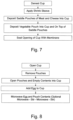
- FIG. 7 is a diagram of assembly steps for the packaged food product of FIG. 1 ;
- FIG. 8 is a diagram of preparation steps for the packaged food product of FIG. 1 ;
- FIGS. 9 and 10 are flow charts illustrating steps of a process described herein;
- FIGS. 11 - 16 illustrate effects of acidification on pH and weight of 100 g batches of vegetable pieces immersed in 100 g quantities of citric acid media and ascorbic acid media;
- FIGS. 17 - 23 illustrate effects of acidification on pH and weight of 1015 g batches of vegetable pieces immersed in 1600 g quantities of citric acid media and ascorbic acid media;
- FIGS. 24 - 28 illustrate effects of acidification on pH and weight of batches of vegetable pieces immersed in 1000 g quantities of citric acid media of varying concentrations
- FIGS. 29 - 31 illustrate an embodiment of a vegetable pouch as described herein.
- the packaged food product comprises a cup containing multiple ingredients in sealed pouches suitable for use in making an omelet or other egg-based entrées, with the cup being suitable for microwave cooking of an egg-based entrée.
- the pouches may be transparent, and may be flexible, thermoformed pouches.
- the ingredients include vegetable pieces such as diced vegetables that offer organoleptic properties similar to those of fresh vegetable pieces after an extended period of time.
- the vegetables after being prepared and processed as described herein, the vegetables may be maintained in refrigerated conditions, e.g., at temperatures of about 40° F.
- the ingredients may also include components such as, for example, one or more meats, e.g., ham, sausage, bacon, Canadian bacon or the like; one or more cheeses; and/or mushrooms.
- the packaged food product may be provided with or without a liquid egg component.
- a packaged food product 10 is described herein and illustrated in FIGS. 1 - 6 .
- the packaged food product 10 includes a microwavable rigid cup 20 , a plurality of pouches 38 , 42 , 46 each containing one or more food products 40 , 44 , 48 disposed within the cup 20 , and a membrane 34 closing the cup 20 with the pouches 38 , 42 , 46 therein.
- the packaged food product 10 is configured to be used with addition of one or more eggs to prepare a food item using microwave heating.
- the packaged food product 10 can be opened, the pouches 38 , 42 , 46 removed from the cup 20 , contents of the pouches 40 , 44 , 48 and one or more eggs added to the cup 20 to form a mixture, and then the mixture heated to prepare the food item.
- the food item can be consumed directly from the cup 20 .
- the packaged food product may include instructions for the consumer to perform some or all of the following steps and/or the steps identified in FIG. 8 , either in the order set forth below or in a different order:
- vegetable components are prepared by the following process, as illustrated in FIGS. 9 and 10 :
- the process enables freshness of the vegetable pieces to be maintained in the sealed containers at refrigerated temperatures for 75 to 90 days.
- FIGS. 29 - 31 illustrate a hermetically sealed pouch containing vegetable pieces 134 after they have been processed as described above.
- the illustrated pouch 132 comprises a thermoformed back wall 124 having a cavity 126 for the vegetable pieces, a front wall 128 that may be generally flat, and a peripheral seal area 130 at which the front and back walls are sealed to one another.
- the process for preparation of the vegetable components is preferably a commercial process suitable for mass production of nutritious, high quality food products.
- the vegetable pieces are acidified during or shortly after blanching.
- the blanching and acidification may be carried out at rates of more than 5,000 lbs. per hour, or more specifically, more than 10,000 lbs. per hour.
- the rate of blanching and acidifying potatoes may be about 15,000 lbs. per hour and the rate of blanching other vegetables such as peppers and onions may be about 12,000 lbs. per hour.
- the vegetable pieces comprise diced vegetable pieces that are approximately cubic in shape, with sides of greater than about 1 ⁇ 8 inch and less than 7 ⁇ 8 inch in length.
- the vegetable pieces comprise diced potato pieces having dimensions of about 1 ⁇ 4 inch ⁇ 3 ⁇ 8 inch ⁇ 3 ⁇ 8 inch, and other vegetable pieces having dimensions of about 3 ⁇ 8 inch ⁇ 3 ⁇ 8 inch ⁇ 3 ⁇ 8 inch.
- the vegetables increase in weight by about 1% to about 12% as a result of absorption of acid media during acidification.
- the vegetable pieces may increase in weight by 5% to 6%, or by about 5.6%.
- acidifying the vegetable pieces comprises exposing the vegetable pieces to a citric acid media.
- the acid media may have pH of between 2.0 and 3.0, or more specifically may have a pH of about 2.1 to 2.2.
- the acid media may comprise about 2% citric acid and about 3% sugar in distilled water for a time period of between 1 and 20 minutes.
- acidifying the vegetable pieces comprises exposing potato pieces to acid media having a pH of between 2.0 and 3.0 comprising about 2% citric acid and about 3% sugar in distilled water media for a time period of about 8 minutes, and exposing other vegetable pieces to acid media having a pH of between 2.0 and 3.0 comprising about 2% citric acid and about 3% sugar in distilled water for a time period of about 4.5 minutes.
- Acidifying the vegetable pieces may comprise reducing the pH of the vegetable pieces to less than 5, and in some of these embodiments, less than 4. In some embodiments, acidification reduces the pH of the vegetable pieces to about 3.6 to 3.8, or more specifically to about 3.68.
- freezing the vegetable pieces comprises reducing the temperature of the vegetable pieces to about 0° F.
- care may be taken to avoid exposure of the potato pieces to ambient air for more than 10 minutes prior to blanching, to avoid browning of the potato pieces.
- the process may comprise the following sequence of steps:
- a packaged food product comprising packaged vegetables pieces, wherein the product has a refrigerated shelf life of at least 75 days, and wherein the vegetable pieces have been prepared by:
- the other vegetable pieces may comprise, for example, one or more of green bell peppers, red bell peppers, onions, mushrooms, tomatoes, cilantro, garlic, and green onions.
- the packaged food product may further comprise a cup containing the packaged vegetable pieces, and additional, separately packaged food items.
- the additional, separately packaged food items may include, e.g., one or more of meat and/or cheese.
- the meat may comprise one or more of ham (such as Applewood smoked ham or other flavored ham), bacon, Canadian bacon, sausage (such as pork, turkey or chorizo sausage), and/or other meats. Depending upon the type of meat, the meat may be shredded, crumbled, diced or otherwise reduced to suitable size pieces.
- the cheese may comprise one or more of extra sharp cheddar, sharp cheddar, mild cheddar, American cheese, Swiss cheese, mozzarella, pepper jack, and/or other varieties of cheese.
- the food products can be provided in the following non-limiting, exemplary combinations, numbered 1-5:
- the above-mentioned cup may be of sufficient size to accommodate the liquid components of an egg in addition to the vegetable pieces and the other separately packaged food items mentioned above, with sufficient extra room to accommodate expansion of the egg and other food items during microwave cooking without overflowing, and wherein the packaged food product further comprises a removable lid on the cup, a shrink label on the cup, and instructions for making an egg-based entrée by adding the liquid components of an egg to the cup, combining the vegetable components and additional, separately packaged food items with the egg in the cup, and heating the combination in a microwave oven.
- the lid may have microperforations therein to accommodate pressure changes.
- the blanching process described above is a steam blanch in which the vegetable pieces are exposed to steam while on a continuous conveyor.
- the blanching process may comprise immersion of the vegetable pieces in boiling water, a chemical blanch, or another blanch process.
- the blanch process for potato pieces may comprise steam blanching the raw, washed, diced potato pieces by exposing them to steam at a temperature of 200 to 212° F. for 4 to 6 minutes, or about 5 minutes.
- This steam blanching of the raw potato pieces is believed to be effective to inhibit enzyme action detrimental to organoleptic properties, and this steam blanching is also believed to have an antimicrobial effect sufficient that, in combination with other steps described herein, no further heating of the potato pieces is required for antimicrobial purposes.
- the blanch process for vegetable pieces other than potato pieces comprises steam blanching the raw, washed, diced vegetable pieces by exposing them to steam at a temperature of about 210° F. for a period of 40 to 50 seconds, or about 45 seconds, with the steam blanching being effective to inhibit enzyme action detrimental to organoleptic properties, and also having an antimicrobial effect.
- This steam blanching of the subject vegetable pieces is also believed to have an antimicrobial effect sufficient that, in combination with other steps described herein, no further heating of the vegetable pieces is required for antimicrobial purposes. This helps to provide the vegetable pieces with organoleptic qualities similar to those of fresh vegetables over extended periods of refrigerated storage.
- the blanch involves heating of the vegetable pieces
- they may be cooled by forced convection or another cooling process after being heated.
- Forced convection may include, e.g., passing the vegetable pieces through ambient airflow or other forms of forced convection for periods of, e.g., 5 seconds to about 5 minutes, 5 seconds to 30 seconds, or about 15 seconds.
- acidification occurs after blanching. It is believed that blanching may facilitate subsequent acidification by opening the cell structure of vegetable pieces and/or otherwise increasing the rate at which acid media may be absorbed by the vegetable pieces. In some embodiments, acidification may take place immediately after blanching, e.g., within 5 to 10 minutes of blanching, as part of an integrated, in-line process.
- the acidification process may comprise exposing the vegetable pieces to an acid media.
- the vegetable pieces may be sprayed, washed, immersed in, and/or otherwise exposed to a liquid acid media in continuous or batch processes.
- the process may involve spraying or washing the vegetable pieces with acid media in addition to immersing them in the acid media.
- the acidification process may involve exposure of all or substantially all of the vegetable pieces' surfaces to the acid media for sufficient time to enable the acid media to permeate or substantially permeate each vegetable piece.
- the acidification process may be carried out at or near ambient temperatures of, e.g., 70 to 80° F. In other embodiments, the acidification process may take place at elevated temperatures or below-ambient temperatures.
- the vegetable pieces may begin the acidification process at elevated temperatures as a result of the acidification process following closely after blanching, with the acid media beginning the process at ambient temperatures of 70 to 80° F.
- the vegetable pieces may be cooled to below ambient temperatures after blanching and prior to acidification, and/or the acid media may be cooled to below ambient temperatures for the acidification process.
- the acidification process comprises immersion of vegetable pieces in acid media comprising 1% to 20% citric acid, ascorbic acid, or pHaseTM food grade sodium acid sulfate in water, a product marketed by Jones-Hamilton Co.
- the acid media may comprise, for example, 0.1% to 5%, 0.5% to 2.5%, 0.5% to 1.5%, about 1%, about 2%, or about 3% or about 2% citric acid, ascorbic acid, or pHase food grade sodium acid sulfate in water.
- the acid media may include sugar in amounts of, e.g., 0.1% to 20%, 1% to 10%, 2% to 5%, 2.5% to 3.5%, or 3%.
- the water may be distilled water. All percentages herein refer to weight percentages.
- the pH of the acid media may be, for example, between 1 and 6.5.
- the acid media may comprise an ascorbic acid media with a pH of between 2.5 and 3.
- the acid media may comprise a citric acid media with a pH of between 2 and 2.5, or a pHase acid media having a pH of between 1.1 and 1.6.
- the acid media may comprise combinations of the acids and other components mentioned above, and/or may comprise other acids and other ingredients not mentioned above, e.g., vinegar, acetic acid, malic acid, tartaric acid, lactic acid, benzoic acid, or sorbic acid.
- Citric acid is believed to have certain advantages. As shown, e.g., in FIGS. 11 - 15 , on a per pound basis, citric acid is believed to be more effective in reducing pH than ascorbic acid. Also, the taste of vegetables acidified with citric acid media is believed to be preferable to consumers as compared with the taste of vegetables treated with certain other media. In particular, it is believed that use of some acid media may result in vegetables having an undesirable aftertaste. An additional advantage of citric acid is that it may help to whiten potato pieces, or at least prevent or inhibit graying of potato pieces over time.
- the pH of the vegetable pieces before acidification may be, e.g., about 5 to about 8, about 5 to about 7, about 5 to about 6, or 5.2 to 5.3. Acidification may adversely affect taste and/or other organoleptic properties. Although this has not been found to be problematic with potato pieces, it has been found that inclusion of a sweetener in acid media may help to avoid other vegetable pieces such as pepper and onion pieces, as well as mushroom pieces, acquiring an overly tangy taste. In some embodiments, concentrations of a sugar such as dextrose in a concentration of e.g., 1% to 5%, 2% to 4%, or about 3% may be suitable for this purpose.
- Other natural and artificial sweeteners that might be used, alone or in combination with other sweeteners, to provide an effect similar or equivalent to that provided by including 3% dextrose in the acid media, may include for example sucrose, fructose, corn syrup, high fructose corn syrup, acesulfame K, and sucralose.
- the blanched, acidified potato pieces include, in addition to the potato pieces themselves, citric acid and water, but are substantially free of other ingredients.
- other vegetable pieces include, in addition to the vegetable pieces, citric acid, sugar and water, but are substantially free of other ingredients, meaning that any other ingredients are in amounts small enough that they need not be listed as ingredients under labeling requirements in the United States.
- the pH of the vegetable pieces after acidification may be, e.g., about 2 to about 5.0, 2.5 to 5.0, 2.5 to 4.8, 3.0 to 5.0, 3.5 to 5.0, 4.0 to 5.0, 4.0 to 4.8, 4.4 to 4.6, or about 4.5.
- Values of the pH of vegetable pieces herein may be determined by pureeing a representative sample of a blend of the pieces.
- FIGS. 11 - 16 illustrate effects of acidification on pH and weight of 100 g batches of vegetable pieces immersed in 100 g quantities of citric acid media and ascorbic acid media.
- FIGS. 17 - 23 illustrate effects of acidification on pH and weight of 1015 g batches of vegetable pieces immersed in 1600 g quantities of citric acid media and ascorbic acid media.
- FIGS. 24 - 28 illustrate effects of acidification on pH and weight of batches of vegetable pieces immersed in 1000 g quantities of citric acid media of varying concentrations.
- acidifying the potato pieces and other vegetable pieces comprises, in each case, immersing the vegetable pieces in acid media in a two-step continuous process wherein the vegetable pieces are subjected to a first acidification step 106 , 108 in which they are carried through an acidification vessel by a conveyor, then subjected to a second acidification step 107 , 109 in which they are carried through an acidification flume or pipe to a delivery location while immersed in acid media.
- the dwell time in the vessel may be, e.g., about 5 to 7 minutes for potato pieces, or about 6 minutes as indicated in FIGS. 9 ; and to 4 minutes, or about 2.5 minutes, as indicated in FIG. 9 , for other vegetable pieces.
- the acidification flume transfer steps 107 and 109 may take, e.g., 1 to 3 minutes, or about 2 minutes as indicated in FIG. 9 .
- economies may be realized by using a common source of acid or acid media such as a stock acid tank, shown at 136 in FIG. 9 , to supply acid media to the separate parallel acidification operations for the potato pieces and the other vegetable pieces.
- a common source of acid or acid media such as a stock acid tank, shown at 136 in FIG. 9
- separate sources of acid media may be employed, or alternatively a common source of an acid solution may be employed, with one or more additives being supplied separately to customize parallel simultaneous acidification processes.
- a common source of a 1% citric acid solution may be used for both potato and other vegetable processes, with dextrose being added to the other vegetable process.
- the flume or pipe empties the vegetable pieces onto a conventional conveyor shaker, which may remove excess acid media prior to IQF freezing. Excess acid media may be returned to a stock acid tank, acidification flume, or other location for re-use, or otherwise recycled for later use.
- the IQF freezing process herein enables vegetable pieces, mushroom pieces, and/or other food components to be stored for later use. This provides flexibility with regard to throughput rates and time frames for processes downstream of the IQF process, e.g., bulk tote packaging, shipping of bulk totes, blending 122 of potato pieces and other vegetable pieces, etc.
- the cup 20 is preferably circular and has a bottom or base 24 , an upper rim 28 surrounding an opening 26 and including an outwardly extending flange, and a sidewall 22 extending between the rim 28 and the base 24 .
- the diameter of the base 24 is less than the diameter of the opening 26 such that the sidewall 22 is inwardly tapered toward the base 24 during at least part of the span between the opening 26 and the base 24 .
- the diameter of the base 24 of the cup 20 is between about 55% and 75% less than the diameter of the opening 26
- the diameter of the opening 26 is between about 120% and 140% of the height of the cup 20 .
- the middle portion of the mixture in some embodiments can take longer to heat a sufficient amount as compared to if the diameter of the opening 26 is about 120% of the height of the cup 20 .
- the greater amount that the diameter of the opening 26 is below about 120% of the height of the cup 20 the more time will be required to heat the middle portion of the mixture a sufficient amount.
- the opening 26 of the cup 20 has a diameter of about 3.7 inches and the height of the cup 20 is about 2.8 inches.
- the cup 20 is made from a material that is suitable for microwave heating, such as polypropylene, and can be made using a thermoforming process.
- an upper section 30 of the sidewall 22 that is slightly outwardly tapered toward the base 24 .
- the upper section 30 of the sidewall 22 extends between the rim 28 and an inwardly extending step 32 , where the sidewall 22 transitions to a lower section that tapers inwardly toward the base 24 .
- the step 32 and upper section 30 of one cup 20 cooperate with like parts of another cup 20 when the cups are nested together to assist with denesting during assembly of the packaged food product.
- the flexible lid or membrane 34 can be a multilayer film, which can optionally include layers of polyethylene, ethylene vinyl acetate, and polypropylene.
- the flexible membrane 34 can be heat sealable to the flange of the rim 28 of the cup 20 , optionally in a hermetic manner.
- the membrane 34 may have microperforations therein to accommodate pressure changes within the sealed cup, such as may arise during transportation.
- the membrane 34 can optionally have a tab portion 36 , shown in FIG. 3 , that can be grasped by a consumer to initiate removal of the membrane 34 from the cup 20 .
- the flexible pouches 38 , 42 , 46 are optionally formed of transparent film, and have a sealed periphery surrounding an interior containing the food products 40 , 44 , 48 .
- the pouches 38 , 42 , 46 can optionally include a thermoformed pocket formed in a bottom sheet of film that is then filled and covered with a second sheet of film.
- the two films are then joined together, such as with a heat seal, about the thermoformed pocket.
- An unsealed region between the two films outwardly of the sealed periphery can provide an easy open feature to initiate pulling the two films apart to open the pouch.
- two films can be joined together about a food product 40 (or a single film folded over and sealed) to form the pouch 38 , as shown in FIG. 5 , with top and bottom seals 39 along with an unsealed starter portion 41 .
- a pouch 132 can contain pieces of a food product 134 disposed within a thermoformed pocket 124 of a bottom film 126 .
- a seal 130 can be formed between a portion of the bottom film 126 disposed outwardly from the pocket 124 and a top film 128 .
- An unsealed area between top film 128 and the bottom film 126 and outwardly of the seal 130 can be used to facilitate separation of the films 126 , 128 to open the pouch 132 .
- Two of the pouches 42 , 46 can be joined together using a saddle 50 to form a saddle pack, as shown in FIG. 6 .
- the bottom sheet of film can have two thermoformed pockets spaced apart, and the second sheet of film can be sealed around each of the pockets in a sealing margin 52 such that the contents of the two pouches 44 ′, 48 are separated but the pouches 42 , 46 are joined together. Unsealed areas 54 , 56 outward of the sealing margin 52 can be used to facilitate opening of the respective pouches 42 , 46 .
- a saddle pack can advantageously reduce the number of assembly steps for the packaged food product. Specifically, instead of having to deposit two separate pouches into the interior of the cup, a single saddle pack can be used instead. Of course, other pouches can also be deposited into the interior of the cup 20 in addition to the saddle pack.
- the pouches may include nitrogen or a mixture of nitrogen and carbon dioxide, e.g., 75% nitrogen, 25% carbon dioxide.
- the cup is denested from other cups, such as in a stack of cups, the cheese ingredient pouch and the meat ingredient pouch are both deposited into the interior of the cup through the opening.
- the vegetable ingredient pouch is deposited into the interior of the cup through the opening. While the order of insertion of the pouches can be switched, it is preferred to insert the vegetable ingredient pouch after the cheese and meat ingredient pouches so that the latter can elevate the former from the base of the cup and present the former to the consumer upon opening of the membrane.
- the membrane is sealed to the flange of the cup, such as by using a heat seal, after the pouches have been deposited into the interior of the cup.
Landscapes
- Engineering & Computer Science (AREA)
- Life Sciences & Earth Sciences (AREA)
- Chemical & Material Sciences (AREA)
- Food Science & Technology (AREA)
- Polymers & Plastics (AREA)
- Zoology (AREA)
- Wood Science & Technology (AREA)
- Mechanical Engineering (AREA)
- Chemical Kinetics & Catalysis (AREA)
- General Chemical & Material Sciences (AREA)
- Nutrition Science (AREA)
- Health & Medical Sciences (AREA)
- Microbiology (AREA)
- Agronomy & Crop Science (AREA)
- Preparation Of Fruits And Vegetables (AREA)
- Packging For Living Organisms, Food Or Medicinal Products That Are Sensitive To Environmental Conditiond (AREA)
- Storage Of Fruits Or Vegetables (AREA)
- Dairy Products (AREA)
- Packages (AREA)
- Food Preservation Except Freezing, Refrigeration, And Drying (AREA)
- Seeds, Soups, And Other Foods (AREA)
- Package Specialized In Special Use (AREA)
Abstract
Description
-
- 1. Remove or otherwise open a lid of the cup
- 2. Remove the pouches from the cup
- 3. Add an egg to the cup, e.g., by cracking a fresh egg (not provided with the packaged food product) and adding the liquid egg component to the cup
- 4. Mix or stir the egg in the cup (either before or after step 5)
- 5. Open the pouches and add some or all of the pouch contents to the cup
- 6. Heat or cook the contents of the cup, e.g., by placing the cup in a microwave oven
- 7. Add a component such as shredded cheese, from one of the pouches or from another source, during and/or after microwave heating
-
- blanching the vegetable pieces for a predetermined period of time at a temperature effective to inhibit enzyme action detrimental to organoleptic properties, and to have an antimicrobial effect;
- acidifying the vegetable pieces in acid media for a period of time sufficient to have a further antimicrobial effect without unacceptably affecting organoleptic properties;
- freezing the vegetable pieces to a temperature of below 5° F. using an IQF technique;
- sealing the frozen vegetable pieces in containers;
- storing the vegetable pieces;
- thawing the vegetable pieces; and
- subjecting the vegetables to an HPP process;
- wherein the process enables freshness of the vegetable pieces to be maintained in the sealed containers at refrigerated temperatures for 75 to 90 days.
-
- providing raw, washed, diced potato pieces having dimensions of about ¼ inch×⅜ inch×⅜ inch, and other raw, washed, diced vegetable pieces having dimensions of about ⅜ inch×⅜ inch×⅜ inch, comprising:
- steam blanching the raw, washed diced potato pieces by exposing them to steam at a temperature of 200 to 212° F. for 4 to 6 minutes, the steam blanching of the raw potato pieces being effective to inhibit enzyme action detrimental to organoleptic properties, and the steam blanching also having an antimicrobial effect;
- steam blanching other raw, washed diced vegetable pieces by exposing them to steam at a temperature of about 210° F. for a period of 40 to 50 seconds, with the steam blanching of the other vegetable pieces being effective to inhibit enzyme action detrimental to organoleptic properties, and also having an antimicrobial effect;
- thereafter acidifying the blanched potato pieces with citric acid media to reduce the pH of the blanched potato pieces to less than about 5; and acidifying the other blanched vegetable pieces with citric acid media to reduce the pH of the other vegetable pieces to less than about 5;
- reducing the temperature of the blanched, acidified vegetable pieces to about 0° F. using an IQF process to preserve them for later use;
- thereafter hermetically sealing the blanched, acidified, frozen vegetable pieces in flexible pouches under vacuum with a nitrogen atmosphere;
- thereafter thawing the blanched, acidified vegetable pieces in the pouches; and
- thereafter pressurizing the thawed vegetable pieces to about 86,500 psi for about 3 minutes at a temperature of about 41° F. in an HPP process.
-
- steam blanching raw, washed potato pieces by exposing the raw potato pieces to steam, the steam blanching of the raw potato pieces being effective to inhibit enzyme action detrimental to organoleptic properties, and the steam blanching having an antimicrobial effect;
- steam blanching other raw, washed vegetable pieces by exposing them to steam, the steam blanching of the other vegetable pieces being effective to inhibit enzyme action detrimental to organoleptic properties, the steam blanching also having an antimicrobial effect;
- thereafter acidifying the blanched potato pieces with citric acid media to reduce the pH of the blanched potato pieces to less than about 5; and acidifying the other blanched vegetable pieces with citric acid media to reduce the pH of the other vegetable pieces to less than about 5;
- reducing the temperature of the blanched, acidified vegetable pieces to about 0° F. using an IQF process to preserve them for later use;
- thereafter hermetically sealing the blanched, acidified, frozen vegetable pieces in flexible pouches under vacuum with a nitrogen atmosphere;
- thereafter thawing the blanched, acidified vegetable pieces in the pouches; and
- thereafter pressurizing the thawed vegetable pieces to about 86,500 psi for about 3 minutes at a temperature of about 41° F. in an HPP process.
-
- 1. Remove or otherwise open a lid to access the interior of the cup
- 2. Remove the pouches from the cup
- 3. Add an egg to the cup, e.g., by cracking a fresh egg (not included), or by using an included packet of liquid egg product, and adding the liquid egg component to the cup
- 4. Mix or stir the egg in the cup, before, during or after
step 5 - 5. Open the pouches and add some or all of the pouch contents to the cup
- 6. Heat or cook the contents of the cup, e.g., by placing the cup in a microwave oven
- 7. Add a component such as shredded cheese, from one of the pouches or from another source, during or after microwave heating.
-
- blanching 102, 104 the vegetable pieces for a predetermined period of time at a temperature effective to inhibit enzyme action detrimental to organoleptic properties, and to have an antimicrobial effect; acidifying 106, 107, 108, 109 the vegetable pieces in acid media for a period of time sufficient to have a further antimicrobial effect without unacceptably affecting organoleptic properties; freezing 110, 112 the vegetable pieces to a temperature of below 5° F. using an IQF technique; sealing 114 the frozen vegetable pieces in containers; storing the vegetable pieces;
thawing 116 the vegetable pieces; and subjecting the vegetables to anHPP process 118.
- blanching 102, 104 the vegetable pieces for a predetermined period of time at a temperature effective to inhibit enzyme action detrimental to organoleptic properties, and to have an antimicrobial effect; acidifying 106, 107, 108, 109 the vegetable pieces in acid media for a period of time sufficient to have a further antimicrobial effect without unacceptably affecting organoleptic properties; freezing 110, 112 the vegetable pieces to a temperature of below 5° F. using an IQF technique; sealing 114 the frozen vegetable pieces in containers; storing the vegetable pieces;
-
- providing raw, washed, diced potato pieces having dimensions of about ¼ inch×⅜ inch×⅜ inch, and other raw, washed, diced vegetable pieces having dimensions of about ⅜ inch×⅜ inch×⅜ inch, comprising:
- steam blanching the raw, washed diced potato pieces by exposing them to steam at a temperature of 200 to 212° F. for 4 to 6 minutes, the steam blanching of the raw potato pieces being effective to inhibit enzyme action detrimental to organoleptic properties, and the steam blanching also having an antimicrobial effect;
- steam blanching other raw, washed diced vegetable pieces by exposing them to steam at a temperature of about 210° F. for a period of 40 to 50 seconds, with the steam blanching of the other vegetable pieces being effective to inhibit enzyme action detrimental to organoleptic properties, and also having an antimicrobial effect;
- thereafter acidifying the blanched potato pieces with citric acid media to reduce the pH of the blanched potato pieces to less than about 5; and acidifying the other blanched vegetable pieces with citric acid media to reduce the pH of the other vegetable pieces to less than about 5;
- reducing the temperature of the blanched, acidified vegetable pieces to about 0° F. using an IQF process to preserve them for later use;
- thereafter hermetically sealing the blanched, acidified, frozen vegetable pieces in flexible pouches under vacuum with a nitrogen atmosphere;
- thereafter thawing the blanched, acidified vegetable pieces in the pouches; and
- thereafter pressurizing the thawed vegetable pieces to about 86,500 psi for about 3 minutes at a temperature of about 41° F. in an HPP process.
-
- steam blanching raw, washed potato pieces by exposing the raw potato pieces to steam, the steam blanching of the raw potato pieces being effective to inhibit enzyme action detrimental to organoleptic properties, and the steam blanching having an antimicrobial effect;
- steam blanching other raw, washed vegetable pieces by exposing them to steam, the steam blanching of the other vegetable pieces being effective to inhibit enzyme action detrimental to organoleptic properties, the steam blanching also having an antimicrobial effect;
- thereafter acidifying the blanched potato pieces with citric acid media to reduce the pH of the blanched potato pieces to less than about 5; and acidifying the other blanched vegetable pieces with citric acid media to reduce the pH of the other vegetable pieces to less than about 5;
- reducing the temperature of the blanched, acidified vegetable pieces to about 0° F. using an IQF process to preserve them for later use;
- thereafter hermetically sealing the blanched, acidified, frozen vegetable pieces in flexible pouches under vacuum with a nitrogen atmosphere;
- thereafter thawing the blanched, acidified vegetable pieces in the pouches; and
- thereafter pressurizing the thawed vegetable pieces to about 86,500 psi for about 3 minutes at a temperature of about 41° F. in an HPP process.
| Cheese | Meat | Vegetable(s) |
| Sharp | Bacon Bits | Diced Potato |
| Cheddar | ||
| Mild | Diced Ham | Green Bell Pepper & Onion, Diced Potato |
| Cheddar | ||
| Mozzarella | Turkey | Red Bell Pepper, Mushroom & Onion, Diced |
| Sausage | Potato | |
| Mild | Pork Sausage | Red/Green Bell Pepper & Onion, Diced Potato |
| Cheddar | ||
| Pepper Jack | Chorizo | Red/Green Bell Pepper & Onion, Tomatoes, |
| Sausage | Jalapenos, Green Onions, Cilantro, Garlic, Diced | |
| Potato | ||
Claims (12)
Priority Applications (2)
| Application Number | Priority Date | Filing Date | Title |
|---|---|---|---|
| US16/010,229 US11930833B2 (en) | 2017-02-14 | 2018-06-15 | Process for maintaining freshness of vegetable pieces |
| US18/435,417 US20240180215A1 (en) | 2017-02-14 | 2024-02-07 | Process for maintaining freshness of vegetable pieces |
Applications Claiming Priority (2)
| Application Number | Priority Date | Filing Date | Title |
|---|---|---|---|
| US15/432,875 US20180228189A1 (en) | 2017-02-14 | 2017-02-14 | Process for maintaining freshness of vegetable pieces |
| US16/010,229 US11930833B2 (en) | 2017-02-14 | 2018-06-15 | Process for maintaining freshness of vegetable pieces |
Related Parent Applications (1)
| Application Number | Title | Priority Date | Filing Date |
|---|---|---|---|
| US15/432,875 Continuation US20180228189A1 (en) | 2017-02-14 | 2017-02-14 | Process for maintaining freshness of vegetable pieces |
Related Child Applications (1)
| Application Number | Title | Priority Date | Filing Date |
|---|---|---|---|
| US18/435,417 Continuation US20240180215A1 (en) | 2017-02-14 | 2024-02-07 | Process for maintaining freshness of vegetable pieces |
Publications (2)
| Publication Number | Publication Date |
|---|---|
| US20180289049A1 US20180289049A1 (en) | 2018-10-11 |
| US11930833B2 true US11930833B2 (en) | 2024-03-19 |
Family
ID=61074510
Family Applications (3)
| Application Number | Title | Priority Date | Filing Date |
|---|---|---|---|
| US15/432,875 Abandoned US20180228189A1 (en) | 2017-02-14 | 2017-02-14 | Process for maintaining freshness of vegetable pieces |
| US16/010,229 Active 2037-03-17 US11930833B2 (en) | 2017-02-14 | 2018-06-15 | Process for maintaining freshness of vegetable pieces |
| US18/435,417 Pending US20240180215A1 (en) | 2017-02-14 | 2024-02-07 | Process for maintaining freshness of vegetable pieces |
Family Applications Before (1)
| Application Number | Title | Priority Date | Filing Date |
|---|---|---|---|
| US15/432,875 Abandoned US20180228189A1 (en) | 2017-02-14 | 2017-02-14 | Process for maintaining freshness of vegetable pieces |
Family Applications After (1)
| Application Number | Title | Priority Date | Filing Date |
|---|---|---|---|
| US18/435,417 Pending US20240180215A1 (en) | 2017-02-14 | 2024-02-07 | Process for maintaining freshness of vegetable pieces |
Country Status (10)
| Country | Link |
|---|---|
| US (3) | US20180228189A1 (en) |
| EP (1) | EP3582621A1 (en) |
| JP (2) | JP2020507325A (en) |
| KR (1) | KR20190113959A (en) |
| CN (1) | CN110312429A (en) |
| AU (1) | AU2017399722A1 (en) |
| BR (1) | BR112019016772A2 (en) |
| CA (1) | CA3052804A1 (en) |
| MX (1) | MX2019009668A (en) |
| WO (1) | WO2018151794A1 (en) |
Families Citing this family (11)
| Publication number | Priority date | Publication date | Assignee | Title |
|---|---|---|---|---|
| US20180228189A1 (en) | 2017-02-14 | 2018-08-16 | Kraft Foods Group Brands Llc | Process for maintaining freshness of vegetable pieces |
| MX2021003848A (en) * | 2018-10-03 | 2021-09-08 | Univ Cornell | Shelf stable potato product. |
| US12059013B2 (en) * | 2019-05-13 | 2024-08-13 | Conagra Foods Rdm, Inc. | Water absorbers and separation mechanisms for application to high moisture foodstuffs |
| JP6681523B1 (en) * | 2020-01-08 | 2020-04-15 | 日本ハム株式会社 | Method for cooking foods by coating ingredients with eggs and products therefor |
| JP7391743B2 (en) * | 2020-03-25 | 2023-12-05 | 日清食品ホールディングス株式会社 | How to make frozen mushrooms |
| ES2932508T3 (en) * | 2020-05-08 | 2023-01-20 | Procter & Gamble | Detergent product container with closure |
| WO2021231914A1 (en) * | 2020-05-14 | 2021-11-18 | Lakeside Organics of Hadley, LLC | Vegetable noodles and methods for making the same |
| PE20220483A1 (en) * | 2020-09-02 | 2022-04-04 | Frias Augusto Cesar Fernandini | PROCESS FOR THE CONSERVATION OF VEGETABLES |
| EP4071073B1 (en) * | 2021-04-06 | 2023-09-27 | Fameccanica.Data S.p.A. | Child-proof paper or cardboard container |
| KR102682819B1 (en) * | 2021-08-26 | 2024-07-09 | 주식회사 풀무원 | Processing method of mixed vegetables with improved green color and physical properties, and processed products of mixed vegetables using the same |
| CN115743938B (en) * | 2022-11-14 | 2023-04-07 | 烟台中泉食品有限公司 | Storage container for processing jack fruit crisp chips |
Citations (239)
| Publication number | Priority date | Publication date | Assignee | Title |
|---|---|---|---|---|
| US1083259A (en) | 1913-10-03 | 1913-12-30 | American Telephone & Telegraph | Cable telegraphy. |
| US2206210A (en) | 1937-12-09 | 1940-07-02 | Refining Inc | Process of removing materials containing phosphatides from vegetable oils |
| US2206209A (en) | 1938-03-02 | 1940-07-02 | Percy M Thorn | Closure for receptacles |
| US2462733A (en) | 1946-10-30 | 1949-02-22 | Westinghouse Electric Corp | Circuit interrupter |
| US2705679A (en) * | 1949-11-15 | 1955-04-05 | Francis P Griffiths | Production of potato food products |
| US3474877A (en) | 1967-03-30 | 1969-10-28 | Buero Patent Ag | Trackless conveyor installation |
| US3547658A (en) | 1967-08-31 | 1970-12-15 | Corn Products Co | Conveniently packaged food |
| US3958035A (en) | 1972-09-07 | 1976-05-18 | Kraftco Corporation | Method of manufacturing omelet type egg product |
| US4027456A (en) * | 1976-01-19 | 1977-06-07 | Fmc Corporation | Air-free pouch packaging method |
| US4133996A (en) | 1977-02-15 | 1979-01-09 | Fread Ronald G | Microwave oven egg cooking apparatus |
| US4140801A (en) * | 1975-07-07 | 1979-02-20 | Frito-Lay, Inc. | Process of making potato products |
| FR2536251A1 (en) | 1982-11-19 | 1984-05-25 | Piquilloud Pierre | Processed foodstuff and method for preparing it rapidly and conveniently as portions of a hot dish. |
| JPH01273540A (en) | 1988-04-25 | 1989-11-01 | Mitsuhiro Yamazaki | Production of preservable freezed slice potato |
| US4910036A (en) | 1989-01-04 | 1990-03-20 | Nabisco Brands, Inc. | Process of treating vegetables for use in a vegetable omelette mix |
| US4990735A (en) | 1989-02-13 | 1991-02-05 | Alcan International Limited | Improved uniformity of microwave heating by control of the depth of a load in a container |
| JPH03183436A (en) | 1989-12-12 | 1991-08-09 | Dainippon Printing Co Ltd | Production of cut vegetable |
| JPH04352657A (en) | 1990-11-06 | 1992-12-07 | Oscar Mayer Foods Corp | Food package |
| JPH07147892A (en) | 1993-11-30 | 1995-06-13 | House Foods Corp | Preparation of frozen onion |
| JPH0856625A (en) | 1994-08-19 | 1996-03-05 | Osawa Shokuhin Gijutsu Kenkyusho:Kk | Instant miso soup |
| US5518747A (en) | 1994-10-21 | 1996-05-21 | Sng Spice Products, Inc. | Process of preserving vegetables |
| US5607712A (en) * | 1988-12-05 | 1997-03-04 | Cornell Research Foundation, Inc. | Processing of vegetables which are frozen before canning and sterilizing |
| US5674546A (en) | 1995-08-10 | 1997-10-07 | Nabisco Technology Company | Package for storing and cooking an omelet |
| US5718933A (en) | 1994-04-18 | 1998-02-17 | Bc-Usa, Inc. | Container for storing a food product and a sauce therefor |
| JPH10225377A (en) | 1996-12-11 | 1998-08-25 | Toshihide Ozaki | Microwave oven cooking container and its food set |
| US5817355A (en) | 1996-09-09 | 1998-10-06 | Healthy Grainfoods L.L.C. | Shelf stable shaped grain products |
| US5904946A (en) | 1997-02-28 | 1999-05-18 | Ready Foods International, Inc. | Process for preparing refrigerated meals |
| US5922381A (en) | 1997-09-02 | 1999-07-13 | Nestec S.A. | Preparation of filled pastas |
| US5925394A (en) | 1995-01-09 | 1999-07-20 | Levinson; Melvin L. | Methods for denaturing and whipping into a foam protein certain denaturable proteins found in milk products, egg products and meat products |
| US5932276A (en) | 1995-06-07 | 1999-08-03 | The Pillsbury Company | Low water activity egg product |
| US5961872A (en) | 1992-05-21 | 1999-10-05 | Campbell Soup Company | Metal container and use thereof in a microwave oven |
| JP2000062857A (en) | 1998-08-24 | 2000-02-29 | Fp Corp | Heating packaging member by microwave oven etc. and heating method for cooking using the same |
| US6033701A (en) | 1994-12-06 | 2000-03-07 | Hirsch; Gerald Phillip | Hydraulic pressure sterilization and preservation of foodstuff and feedstuff |
| US6033705A (en) | 1998-07-08 | 2000-03-07 | Isaacs; Charles E. | Method for treating foodstuffs to reduce or prevent microbial activity |
| US6099883A (en) | 1996-02-29 | 2000-08-08 | Compagnie Gervais Danone | Essentially non-dairy aqueous food composition having a constant bacteriological quality, and method for inhibiting bacterial growth in a food composition |
| US6106775A (en) | 1998-10-09 | 2000-08-22 | Applied Humidity Technologies | Modifying an atmosphere with an aqueous composition including sodium bicarbonate and acetylsalicylic acid |
| US6123968A (en) | 1999-03-23 | 2000-09-26 | Mendez; Alejandro | Composition for extending shelf life for fresh fruits and vegetables without the use of refrigeration |
| US6132786A (en) | 1999-03-17 | 2000-10-17 | Nabisco Technology Company | Long-term mold inhibition in intermediate moisture food products stored at room temperature |
| US6146675A (en) | 1998-10-30 | 2000-11-14 | Lipton, Division Of Conopco, Inc. | Foodstuff preservation |
| US6175105B1 (en) | 1998-10-02 | 2001-01-16 | Bestfoods | Container for microwave cooking of food products containing liquids |
| US6207210B1 (en) | 1998-12-15 | 2001-03-27 | Fredric G. Bender | Broad-range antibacterial composition and process of applying to food surfaces |
| US6224930B1 (en) * | 1995-12-20 | 2001-05-01 | Vaporex Pty Ltd. | Method and apparatus for the application of volatile substances conveyed in carrier gas |
| US20010001674A1 (en) | 2000-04-19 | 2001-05-24 | Simpson Rodney J. | Microwavable meal kit and food packaging system |
| US6265006B1 (en) | 1997-08-22 | 2001-07-24 | Vaporex Pty Ltd | Method and apparatus for applying volatile substances to materials |
| US6287610B1 (en) | 1991-11-20 | 2001-09-11 | Monfort, Inc. | Method for increasing the tenderness of a meat product |
| US6329004B1 (en) | 2000-06-29 | 2001-12-11 | Products Of Tomorrow | Cooking method and apparatus |
| US20020041920A1 (en) | 2000-10-11 | 2002-04-11 | Juan Fernandez | Egg, omelets and the like cooking method and apparatus |
| US6372220B1 (en) | 2001-02-05 | 2002-04-16 | Kavita Shukla | Fenugreek impregnated material for the preservation of perishable substances |
| US20020094363A1 (en) | 2001-01-18 | 2002-07-18 | Traeder Terry Jay | Sanitizing food products |
| US20020106435A1 (en) | 2001-02-06 | 2002-08-08 | Jim Fish | System and method for making ready-to-serve soup |
| US20030055010A1 (en) | 1999-12-21 | 2003-03-20 | De Haan Ben Rudolf | Preserving active fungicide in an aqueous solution |
| US20030057217A1 (en) | 2001-08-07 | 2003-03-27 | Ihor Wyslotsky | Modified atmosphere package with removable internal seal and methods |
| US20030087017A1 (en) | 2000-06-19 | 2003-05-08 | William Hanselmann | Shelf-stable moist food foam product and process for its preparation |
| US20030087015A1 (en) * | 2001-08-02 | 2003-05-08 | Ihor Wyslotsky | Modified atmosphere food container and method |
| US20030118714A1 (en) | 2001-12-21 | 2003-06-26 | Michael Foods Of Delaware, Inc. | Formulation and process to prepare a premium formulated fried egg |
| US20030138533A1 (en) | 2002-01-22 | 2003-07-24 | Nutraceutical Clinical Laboratories International, Inc. | Food and beverage perservative |
| US6602531B2 (en) | 2001-07-12 | 2003-08-05 | Kazuo Naka | Method for pre-processing of dried food |
| US6620446B2 (en) | 2000-07-14 | 2003-09-16 | Rhodia, Inc. | Antibacterial composition for control of gram positive bacteria in food applications |
| US20030194479A1 (en) | 2001-02-23 | 2003-10-16 | Yasuo Takeuchi | Method of producing processed food |
| US20030229011A1 (en) | 2001-12-28 | 2003-12-11 | Braun Steven O. | Humanized lactoferrin and uses thereof |
| US20040043130A1 (en) | 2002-08-28 | 2004-03-04 | Thomas David J. | Binder system for thermally processed meat products and meat product produced thereby |
| US20040043922A1 (en) | 1999-05-28 | 2004-03-04 | Naidu A. Satyanarayan | Treatment of case-ready food products with immobilized lactoferrin (Im-LF) and the products so produced |
| US20040058038A1 (en) | 2002-08-23 | 2004-03-25 | Young-Kyu Lee | Lunch box capable of blastfrozen preservation |
| US20040058041A1 (en) | 2002-09-25 | 2004-03-25 | Greenwald Kevin S. | Food processing apparatus, method of preserving a food product and preserved food product |
| US6713105B1 (en) | 2000-10-12 | 2004-03-30 | Cryovac, Inc. | Vinylidene chloride film having reduced protein adhesion |
| US6730345B2 (en) | 2001-08-09 | 2004-05-04 | Gilroy Foods | Method for preparing sautéed vegetables |
| US20040112786A1 (en) | 2002-09-18 | 2004-06-17 | Nippon Suisan Kaisha, Ltd. | Container for housing frozen sushi, packed frozen sushi unit, and distribution method of frozen sushi |
| US20040156960A1 (en) | 2003-02-10 | 2004-08-12 | Kraft Foods Holdings, Inc. | Food product preservation method |
| US20040161517A1 (en) | 2003-02-14 | 2004-08-19 | Paul Winniczuk | Food and beverage preservative |
| US20040191382A1 (en) | 2003-03-27 | 2004-09-30 | Cooper Kern L | Ultra-high-pressure vegetable sterilization method and product |
| US20040213765A1 (en) | 2001-07-13 | 2004-10-28 | Vincent Fischetti | Use of bacterial phage associated lytic enzymes to prevent food poisoning |
| US6814999B2 (en) | 1999-08-24 | 2004-11-09 | Michael Foods, Inc. | Enhanced precooked egg product and process for formulation of precooked egg products |
| US6818873B2 (en) | 2001-09-07 | 2004-11-16 | Sean Savage | Packaged food product |
| US6821548B1 (en) | 1998-07-02 | 2004-11-23 | Cooperative Verkoop-En Productievereniging Van Aardappelmeel En Derivaten Avebe B.A. | Salt-stable modified starch |
| US20040234659A1 (en) | 2003-05-21 | 2004-11-25 | Linton David B. | Method for low pressure, low temperature cooking via the lintonizingTM process |
| US6824802B2 (en) | 2001-10-02 | 2004-11-30 | Nestec S.A. | On-demand neutralization of acid-preserved food |
| US20050042341A1 (en) | 2003-08-22 | 2005-02-24 | Thomas Linda Valerie | Natamycin dosage form, method for preparing same and use thereof |
| US20050058751A1 (en) | 2003-07-21 | 2005-03-17 | Eugene Brotsky | Yield and shelf life for meats |
| US20050095318A1 (en) | 2001-11-06 | 2005-05-05 | Schwenninger Susanne M. | Mixture of propionibacterium jensenii and lactobacillus sp. with antimicrobial activities for the use as natural preservation system |
| US20050106292A1 (en) | 2003-11-13 | 2005-05-19 | Huber Gordon R. | High moisture, shelf-stable acidulated food products |
| US6896919B2 (en) | 1998-10-05 | 2005-05-24 | Food Talk, Inc. | Cooking pouch containing a raw protein portion, a raw or blanched vegetable portion and a sauce and method of making |
| US6903320B2 (en) | 2002-12-10 | 2005-06-07 | Mars, Incorporated | Differential temperature microwavable container |
| US20050136157A1 (en) | 2003-12-22 | 2005-06-23 | Masayo Ebihara | Wheaten food with powdery soup in a cupped container and method of eating the same |
| US20050175745A1 (en) | 2004-02-06 | 2005-08-11 | Jerzy Zawistowski | Method of preservation of a food prodcut and composition comprising one or more phytosterols and/or phytostanols useful for this purpose |
| US20050186312A1 (en) | 2004-02-23 | 2005-08-25 | Kraft Foods Holdings, Inc. | Shelf-stable foodstuffs and methods for their preparation |
| US20050186311A1 (en) | 2004-02-23 | 2005-08-25 | Loh Jimbay P. | Method for acidifying and preserving food compositions using electrodialyzed compositions |
| US20050196492A1 (en) | 2004-03-04 | 2005-09-08 | Muller Wayne S. | Food preservative method and system using vanillin and constituent having isothiocynate compound |
| US20050215638A1 (en) | 2000-09-05 | 2005-09-29 | Mionix Corporation | Highly acidic metalated organic acid |
| US20050221029A1 (en) | 2002-06-17 | 2005-10-06 | Cater Mark W | Oxygen scavenging system |
| US20050226974A1 (en) | 2004-04-08 | 2005-10-13 | John Faragher | Natamycin dosage form, process for preparing same, method for preserving a food product and preserved food product |
| US20050287256A1 (en) | 2002-02-26 | 2005-12-29 | Parker Leroy A Jr | Method for preparing food article |
| US20060024414A1 (en) | 2004-07-30 | 2006-02-02 | Kraft Foods Holdings, Inc. | Methods for preserving food products |
| US20060024412A1 (en) | 2004-02-23 | 2006-02-02 | Kraft Foods Holdings, Inc. | Shelf-stable acidified food compositions and methods for their preparation |
| US20060034981A1 (en) | 2004-08-13 | 2006-02-16 | The United States Of America, As Represented By The Secretary Of Agriculture | Novel infrared dry blanching (IDB), infrared blanching, and infrared drying technologies for food processing |
| US7001632B2 (en) | 2003-03-03 | 2006-02-21 | Kraft Foods Holdings, Inc. | Anti-listeria compositions for use in food products |
| US7015442B2 (en) * | 2004-01-08 | 2006-03-21 | Food Talk, Inc. | Flexible microwave cooking pouch containing a raw frozen protein portion and method of making |
| US7026007B2 (en) | 2001-02-19 | 2006-04-11 | Creta Farm Anonimos Viomichaniki & Emporiki Etaireia | Method of production of a meat product containing olive oil |
| US20060127540A1 (en) | 2004-12-13 | 2006-06-15 | Keckeis Edward J | Package for storing omelet ingredients |
| US7074447B2 (en) | 2001-04-28 | 2006-07-11 | Laboratories Miret, S.A. | Antimicrobial composition comprising potassium sorbate and LAE |
| US20060151533A1 (en) | 2004-11-12 | 2006-07-13 | Josip Simunovic | Methods and apparatuses for thermal treatment of foods and other biomaterials, and products obtained thereby |
| US20060159813A1 (en) | 2001-07-13 | 2006-07-20 | Ming/King/Payne | Composition having bacteristatic and bactericidal activity against bacterial spores and vegetative cells and process for treating foods therewith |
| US20060198931A1 (en) | 2005-03-04 | 2006-09-07 | Neto Jose Barbosa M | Method for obtaining packed food goods, ready for consuming, kept stable at room temperature |
| US20060257535A1 (en) | 2005-05-10 | 2006-11-16 | Glanbia Nutritionals (Ireland) Limited | Milk mineral compositions for use with raw meat products |
| US20060257539A1 (en) | 2005-05-16 | 2006-11-16 | Krafts Foods Holdings, Inc. | Synergistic antimicrobial system |
| US20060286226A1 (en) | 2005-06-07 | 2006-12-21 | Kraft Foods Holdings, Inc. | In-package hydration, cooking, and pasteurization |
| US7163709B2 (en) | 2001-12-20 | 2007-01-16 | Robert Cook | Composition for disinfection of plants, animals, humans, byproducts of plants and animals and articles infected with pathogens and method of producing and application of same |
| US20070020365A1 (en) | 2005-07-25 | 2007-01-25 | Ecolab Inc. | Antimicrobial compositions for use on food products |
| US20070020364A1 (en) | 2005-07-25 | 2007-01-25 | Ecolab Inc. | Antimicrobial compositions and methods for treating packaged food products |
| US20070031543A1 (en) | 2005-08-06 | 2007-02-08 | Phresh Technologies, Llc | Edible anti-microbial food coating materials |
| US20070042184A1 (en) | 2003-08-22 | 2007-02-22 | Danisco A/S | Microcapsules |
| US20070054010A1 (en) | 2003-08-13 | 2007-03-08 | Novozymes A/S | High temperature enzymatic vegetable processing |
| US7192618B2 (en) | 2004-02-26 | 2007-03-20 | Tasker Products Ip Holdings Corp. | Antimicrobial composition for pre-harvest and post-harvest treatment of plants and animals |
| US20070077335A1 (en) | 2005-10-04 | 2007-04-05 | Bouraoui Moez M | Process for preparing microwavable vegetables |
| US7205517B2 (en) | 2002-03-26 | 2007-04-17 | Samsung Electronics Co., Ltd. | Cooking container and microwave oven having such container |
| US7208188B2 (en) | 2003-10-16 | 2007-04-24 | Nippon Freeze Drying Co, Ltd. | Method of producing a press-molded dried food material |
| US7226630B2 (en) | 2002-11-26 | 2007-06-05 | Kraft Foods Holdings, Inc. | Edible moisture barrier for food and method of use products |
| US20070131679A1 (en) | 2005-12-14 | 2007-06-14 | Kraft Foods Holdings, Inc. | Meal kit and cooking tray |
| US20070148306A1 (en) | 2005-06-03 | 2007-06-28 | Mattson Peter H | Method of Producing and Preparing Fresh Frozen Food From Quick Frozen Vegetables and Stock |
| US20070212461A1 (en) | 2005-11-21 | 2007-09-13 | Lillevang Soren K | Microbial oxygen absorber |
| US20070237671A1 (en) | 2005-08-29 | 2007-10-11 | Yuan James T | Novel method of sanitizing target items using a moist sanitizing gas |
| US20070237865A1 (en) | 2006-04-05 | 2007-10-11 | Robert Love | Method for manufacturing high pressure processed food products |
| US7312272B2 (en) | 2001-12-21 | 2007-12-25 | Celanese Emulsions Gmbh | Food coating substance containing a softener-free aqueous copolymer poly(vinyl ester) dispersion, production and use thereof |
| US20080038440A1 (en) * | 2006-08-09 | 2008-02-14 | Phillip Delpierre | Blendable Cheese Snack |
| US20080050507A1 (en) | 2006-08-25 | 2008-02-28 | William Jaehnert | High pressure processing of foods |
| US20080057163A1 (en) | 2004-05-28 | 2008-03-06 | Andrew Kegler | Packaged flavor enhanced food products |
| US20080138473A1 (en) | 2006-12-08 | 2008-06-12 | Adam Pawlick | Dual-ovenable food packaging |
| US20080145497A1 (en) | 2006-12-15 | 2008-06-19 | Jimbay Peter Loh | Food Ingredients With Reduced Sourness At Low pH |
| US20080145496A1 (en) | 2004-12-01 | 2008-06-19 | Cooper Carl W | Composition to preserve food |
| US20080152757A1 (en) | 2006-12-22 | 2008-06-26 | Zuoxing Zheng | Method of Making Fresh Cheese with Enhanced Microbiological Safety |
| US7396551B2 (en) | 2004-04-29 | 2008-07-08 | Corn-Chem International | Alkali and alkaline earth metal levulinates as antimicrobial agents |
| US20080233242A1 (en) | 2003-10-08 | 2008-09-25 | Ying Zhang | Antioxidant of Bamboo Leaves and Its Uses |
| US20080317912A1 (en) | 2005-02-10 | 2008-12-25 | Microplast Gmbh | Method for Preserving Foodstuffs |
| US20090022858A1 (en) | 2007-07-20 | 2009-01-22 | Adam Pawlick | Food product and cooking apparatus |
| US20090045095A1 (en) | 2007-08-13 | 2009-02-19 | Bag Innovations Group, Llc | Packaging for Extending Life of Respiring Produce and Other Perishable Foodstuffs |
| US20090074915A1 (en) | 2004-11-17 | 2009-03-19 | Novozymes A/S | Prcoess for Reducing Acrylamide |
| US20090111894A1 (en) | 2005-11-24 | 2009-04-30 | Arie Pieter Bos | Method of Preventing Microbial Growth |
| US7550166B2 (en) | 2002-06-06 | 2009-06-23 | Barilla G.Er. Fratelli S.P.A. | Method for producing frozen ready-to-eat dishes based on rice, barley, wheat or spelt |
| US20090169650A1 (en) | 2008-01-02 | 2009-07-02 | Wilkes Richard S | Food compositions incorporating stearidonic acid |
| US7595073B2 (en) | 2003-02-28 | 2009-09-29 | Kraft Foods Global Brands Llc | Use of siderophores and organic acids to retard lipid oxidation |
| US20090263547A1 (en) | 2004-12-22 | 2009-10-22 | Nestec S.A. | Assembly for food product and method for heating said assembly |
| US20090311394A1 (en) | 2006-08-09 | 2009-12-17 | Nestec S.A. | Antimicrobial micelles for food applications |
| US20090324795A1 (en) | 2006-07-13 | 2009-12-31 | Hopfl Dieter | Cheese products with form stability and deep-frying stability |
| US20100040734A1 (en) | 2000-12-20 | 2010-02-18 | Fuji Oil Company, Limited | Cacao Husk-Derived Water-Soluble, Dietary Fiber, Process For Its Production, Foods and Beverages Containing It And Methods For Their Preparation |
| US7678401B2 (en) | 2003-08-13 | 2010-03-16 | Unilever Bestfoods, North America, Division Of Conopco, Inc. | Blanching vegetables |
| US20100092420A1 (en) | 2005-08-01 | 2010-04-15 | Laboratorios Miret, S.A. | Preservative Systems Comprising Cationic Surfactants |
| CN101715807A (en) | 2009-11-06 | 2010-06-02 | 海通食品集团股份有限公司 | Method for preserving and evenly thawing fast-frozen side dishes |
| US20100174001A1 (en) | 2007-06-01 | 2010-07-08 | Suedzucker Aktiengesellschaft Mannheim/Ochsenfurt | Antioxidant for food |
| US20100197812A1 (en) | 2009-02-04 | 2010-08-05 | Kalamazoo Holdings, Inc. | Compositions and methods for enhancing the stability of foods, beverages, nutritional supplements and cosmetics |
| US20100260900A1 (en) | 2009-03-17 | 2010-10-14 | Sara Lee Corporation | Microwaveable product |
| US7820216B1 (en) | 2007-10-23 | 2010-10-26 | Alkar-Rapidpak-Mp Equipment, Inc. | Apparatus and methods for pasteurizing food product |
| US20100282636A1 (en) | 2008-01-21 | 2010-11-11 | Barilla G. E R. Fratelli. S.P.A. | Microwaveable nested trays |
| US20100284985A1 (en) | 2007-09-04 | 2010-11-11 | Danisco A/S | Composition |
| US7833562B2 (en) | 2005-11-15 | 2010-11-16 | Michael Foods, Inc. | Egg product with particulates |
| US7855351B2 (en) | 2003-03-18 | 2010-12-21 | Nini Policappelli | Microwave expandable product |
| US7858137B2 (en) | 2004-06-25 | 2010-12-28 | Kraft Foods Global Brands Llc | Stabilization of fresh mozzarella cheese using fermented whey |
| US20110028550A1 (en) | 2009-07-29 | 2011-02-03 | Campano Stephen G | Compositions and methods for control of listeria monocytogenes |
| US7887867B2 (en) | 2004-02-23 | 2011-02-15 | Kraft Foods Global Brands Llc | Stabilized non-sour dairy base materials and methods for preparation |
| US20110038995A1 (en) | 2009-08-12 | 2011-02-17 | Kraft Foods Global Brands Llc | Intermediate moisture shelf stable baked goods |
| US20110091618A1 (en) | 2009-10-16 | 2011-04-21 | Frito-Lay North America, Inc. | Method for preventing oxidation and off flavors in high carotenoid foods |
| US20110123693A1 (en) | 2008-02-11 | 2011-05-26 | Juan Carlos Berisso Egana | Food preservation process |
| US7951411B2 (en) | 2001-12-21 | 2011-05-31 | Michael Foods Of Delaware, Inc. | Process to prepare a premium formulated fried egg |
| US20110129575A1 (en) | 2006-05-10 | 2011-06-02 | Weijie Li | Batter compositions and methods of preparing and using same |
| US20110159158A1 (en) | 2009-12-31 | 2011-06-30 | Ronald Penna | Reduced non-fiber carbohydrate preservative treatment for processed foods |
| US20110195163A1 (en) | 2004-04-05 | 2011-08-11 | Fmc Corporation | MCC/Hydrocolloid Stabilizers and Edible Compositions Comprising the Same |
| US20110204046A1 (en) | 2005-05-25 | 2011-08-25 | Middleton Scott W | Microwave Heating Construct for Frozen Liquids and Other Items |
| US8006513B2 (en) | 2004-07-21 | 2011-08-30 | Cool Gear International, Llc | Food storage system |
| US20110250323A1 (en) | 2010-04-12 | 2011-10-13 | Cargill, Incorporated | Microwavable refrigerated scrambled eggs and process |
| US20110268849A1 (en) | 2009-01-02 | 2011-11-03 | Dixon Dan K | Fried-chunk food compositions |
| US20110318471A1 (en) | 2007-12-21 | 2011-12-29 | Frito-Lay North America, Inc. | Processing technique to thaw partially frozen fruits and vegetables and incorporating solids |
| US20120009308A1 (en) | 2009-02-26 | 2012-01-12 | Micropast Gmbh | Method for preserving food |
| US8101219B2 (en) | 2004-03-05 | 2012-01-24 | Eggology, Inc. | Apparatus for preparing egg products in a microwave oven |
| US20120064217A1 (en) | 2010-09-13 | 2012-03-15 | Hofing Deanna L | Food additive |
| US20120070549A1 (en) | 2010-09-21 | 2012-03-22 | Ecolab Usa Inc. | Method of treating a food product with an antimicrobial agent composition and a treated food product |
| US20120070866A1 (en) | 2008-01-25 | 2012-03-22 | Shanghai Medical Life Science Research Center, Ltd | Purified pyrroloquinoline quinone fortified food |
| US8206771B2 (en) | 2004-03-29 | 2012-06-26 | Conopco, Inc. | Process for preparing a dairy based sauce |
| US20120207892A1 (en) | 2005-02-18 | 2012-08-16 | Frito-Lay North America, Inc. | Fabricated food product made from fresh potato mash |
| US20120219689A1 (en) | 2009-10-15 | 2012-08-30 | Danisco A/S | Anti-oxidant Composition |
| US20120225942A1 (en) | 2008-05-29 | 2012-09-06 | Nevada Naturals, Inc. | Synergistic Antimicrobial Agents |
| US20120231142A1 (en) | 2009-07-15 | 2012-09-13 | Solae, Llc | Omega-3 Fatty Acid Enriched Soups and Sauces |
| US20120251700A1 (en) | 2010-09-13 | 2012-10-04 | Hofing Deanna L | Food additive |
| US8323673B2 (en) | 1996-04-12 | 2012-12-04 | University Of Arkansas | Concentrated, non-foaming solution of quaternary ammonium compounds and methods of use |
| US8372460B2 (en) | 2009-07-10 | 2013-02-12 | L'air Liquide Societe Anonyme Pour L'etude Et L'exploitation Des Procedes Georges Claude | System and method for non-thermal plasma treatment of foodstuffs |
| US20130064953A1 (en) | 2009-05-26 | 2013-03-14 | Georg Bache | Stabilizer for Food Applications |
| US20130074455A1 (en) | 2010-06-08 | 2013-03-28 | Torus Pak Research And Development S.A.R.L. | Food package with additional food container and foil comprising an additional food container and a method for filling and sealing an additional food container comprised in a lid of a food tray |
| US20130078339A1 (en) | 2011-09-27 | 2013-03-28 | Caitlin Elizabeth Trahan | High Pressure Processing of Pathogenostat-Treated Food Articles |
| US8425962B2 (en) | 2010-03-02 | 2013-04-23 | Del Monte Corporation | Fruit and vegetable preservation process |
| US20130136832A1 (en) | 2010-04-03 | 2013-05-30 | Anthony Joseph Sawyer | Methods of preservation |
| US8470383B2 (en) | 2010-12-31 | 2013-06-25 | American Air Liquide, Inc. | Method and system for treating food items with an additive and liquid nitrogen |
| US20130171306A1 (en) | 2010-07-09 | 2013-07-04 | Atp Corp. | Stabilizing and Dyeing Process for Strawberries |
| US20130171314A1 (en) | 2009-07-29 | 2013-07-04 | Stephen G. Campano | Compositions and methods for control of listeria monocytogenes |
| US8486480B2 (en) | 2002-12-20 | 2013-07-16 | Purac Biochem B.V. | Controlled acidification of food products using lactic- or glycolic acid oligomers/derivatives |
| US8486468B2 (en) | 2000-01-21 | 2013-07-16 | Chr. Hansen A/S | Porphyrin containing lactic acid bacterial cells and use thereof |
| US20130183420A1 (en) | 2012-01-13 | 2013-07-18 | Justin Wade Shimek | Premium Quality Refrigerated Vegetable Products and Methods of Making Them |
| US8512781B2 (en) | 2010-08-20 | 2013-08-20 | Pfm, Llc | Fresh fruit preservative and method of using same |
| US20130266699A1 (en) | 2012-04-06 | 2013-10-10 | H.J. Heinz Company | Mircowavable food containers for high pressure process food preservation and reconstitution |
| US20130283736A1 (en) | 2007-03-27 | 2013-10-31 | Kraft Foods Group Brands Llc | Reclosable Multi-Compartment Package |
| US20130287918A1 (en) | 2010-12-23 | 2013-10-31 | Dupont Nutrition Diosciences Aps | Microbicidal composition |
| US20130309379A1 (en) | 2005-10-04 | 2013-11-21 | Dsm Ip Assets B.V. | Anti-Fungal Composition |
| US20130327763A1 (en) | 2012-06-11 | 2013-12-12 | Schwan's Global Supply Chain, Inc. | Microwave package for single-step cooking of multi-component foodstuffs |
| US20130337122A1 (en) | 2011-03-03 | 2013-12-19 | Hugues Falquerho | Natural and chewy fruit / vegetable dehydrated dices or pieces |
| US8613249B2 (en) | 2007-08-03 | 2013-12-24 | Conagra Foods Rdm, Inc. | Cooking apparatus and food product |
| US20140010766A1 (en) | 2010-01-12 | 2014-01-09 | Mars, Incorporated | Multi-component pet food and method of manufacturing solid component |
| US20140057029A1 (en) | 2011-05-06 | 2014-02-27 | Scelta Essenza Holding B.V. | Method for preserving mushrooms |
| US20140065285A1 (en) | 2012-09-04 | 2014-03-06 | Ray M. Alden | Crunchy egg product and manufacturing apparatus and process |
| US20140079727A1 (en) | 2008-07-25 | 2014-03-20 | Hyglos Invest Gmbh | New endolysin plyp40 |
| US20140093620A1 (en) | 2012-10-01 | 2014-04-03 | Alice Chang | Ready to eat cold cereal cakes with ingredients |
| US8697422B2 (en) | 2007-03-19 | 2014-04-15 | Chr. Hansen A/S | Lactic acid bacteria strain and its use for the protection of food products |
| US20140113058A1 (en) | 2002-06-14 | 2014-04-24 | Ogawa & Co., Ltd. | Flavor deterioration inhibitor and inhibitor for the generation of citral deterioration smell |
| US20140127359A1 (en) | 2011-07-13 | 2014-05-08 | Emanuel Akerman | Food product and method of preserving same |
| CN103907845A (en) | 2014-03-27 | 2014-07-09 | 河南省农业科学院 | Processing method of novel nutrition blended cedrela sinensis |
| US20140220213A1 (en) | 2009-05-21 | 2014-08-07 | Air Liquide Industrial U.S. L.P. | Method and System for Treating Food Items with an Additive and Solid Carbon Dioxide |
| US20140231419A1 (en) | 2013-02-19 | 2014-08-21 | Campbell Soup Company | Microwaveable food products and containers |
| US20140248398A1 (en) | 2010-01-15 | 2014-09-04 | Crisp Sensation Holding S.A. | Stabilisation of microwave heated food substrates |
| US20140308402A1 (en) | 2011-10-07 | 2014-10-16 | Fruitsymbiose Inc. | Composition and methods for improving organoleptic properties of food products |
| US8866056B2 (en) | 2007-03-02 | 2014-10-21 | Conagra Foods Rdm, Inc. | Multi-component packaging system and apparatus |
| US20140323572A1 (en) | 2011-11-30 | 2014-10-30 | Anitox Corporation | Antimicrobial Mixture of Aldehydes, Organic Acids and Fatty Acid Esters |
| US20140341872A1 (en) | 2011-08-01 | 2014-11-20 | Guardian Food Technologies, Llc | Use Of Lactic Acid Bacteria To Reduce Pathogens And As A Bio-Sanitizer |
| US20140356497A1 (en) | 2011-11-30 | 2014-12-04 | Natural Biotechnology Sprl | Composition |
| US20150031762A1 (en) | 2011-10-20 | 2015-01-29 | Anitox Corporation | Antimicrobial Formulations with Pelargonic Acid |
| US8956673B2 (en) | 2007-08-28 | 2015-02-17 | Texas Tech University System | Method and system for preserving food |
| CN104351320A (en) | 2014-11-18 | 2015-02-18 | 苏州大福外贸食品有限公司 | Processing method of quickly-frozen rutabaga |
| US20150064334A1 (en) | 2012-09-04 | 2015-03-05 | Ray M. Alden | High protein egg product and manufacturing apparatus and process |
| US20150118371A1 (en) * | 2012-09-06 | 2015-04-30 | Alvin Velasco | Method for production of frozen untapped young coconut water inside its carved tender coconut meat |
| US20150140186A1 (en) | 2013-11-15 | 2015-05-21 | Purac Biochem B.V. | Clostridium botulinum control in midly processed refrigerated food products |
| US20150166241A1 (en) | 2012-05-21 | 2015-06-18 | Nestec S.A. | Food packaging |
| US9060523B1 (en) | 2012-10-01 | 2015-06-23 | Guy E Buller-Colthurst | Thermal process for food enhancement |
| US20150239612A1 (en) | 2014-02-25 | 2015-08-27 | South Plastic Industry Co., Ltd. | Multilayer Container Structure |
| KR101550965B1 (en) | 2013-07-31 | 2015-09-07 | 씨제이제일제당 (주) | Producing method for raw and cooked vegetable with ultra high pressure |
| US20150289529A1 (en) | 2010-10-12 | 2015-10-15 | Consumo Em Verde - Biotecnologia Das Plantas, S.A. (PT/PT) | Use of a composition comprising an antimicrobial peptide as a food preservative |
| US20150353261A1 (en) | 2014-06-10 | 2015-12-10 | Vijai Prakash Gupta | Two-step processing method for preparing starch based food products |
| US20160050966A1 (en) | 2013-03-14 | 2016-02-25 | Takasago International Corporation | Flavor deterioration inhibitor |
| US20160058061A1 (en) | 2014-08-29 | 2016-03-03 | Kemin Industries, Inc. | Delaying oxidation in food systems by use of lipid soluble tea catechins |
| US20160102069A1 (en) | 2013-05-28 | 2016-04-14 | Empire Technology Development Llc | Antioxidant humic acid derivatives and methods of preparation and use |
| US20160114962A1 (en) | 2005-11-23 | 2016-04-28 | Conagra Foods Rdm, Inc. | Food tray |
| US9405014B2 (en) | 2012-12-14 | 2016-08-02 | Seiko Epson Corporation | Method of controlling electronic apparatus and electronic apparatus |
| US20170245528A1 (en) | 2014-09-17 | 2017-08-31 | Kraft Foods Group Brands Llc | A Microwave Retort System, A Process For Heating Food Products Using A Microwave Retort System, And Food Products Formulated For Microwave Retort |
| US20180229915A1 (en) | 2017-02-14 | 2018-08-16 | Kraft Foods Group Brands Llc | Packaged food product with vegetable components |
| US20180289049A1 (en) | 2017-02-14 | 2018-10-11 | Kraft Foods Group Brands Llc | Process for maintaining freshness of vegetable pieces |
| US20190159493A1 (en) | 2016-07-25 | 2019-05-30 | Tooji | Infant food able to be consumed by hand and preparation process |
| US20190300257A1 (en) | 2016-06-14 | 2019-10-03 | Industrie Rolli Alimentari S.P.A. | Packaging for foods |
Family Cites Families (2)
| Publication number | Priority date | Publication date | Assignee | Title |
|---|---|---|---|---|
| IE53327B1 (en) * | 1981-08-10 | 1988-10-12 | Mars Uk Ltd | Potato products |
| CA2525716A1 (en) * | 2003-05-21 | 2004-12-02 | David B. Linton | Method for low pressure, low temperature cooking via the lintonizingtm process |
-
2017
- 2017-02-14 US US15/432,875 patent/US20180228189A1/en not_active Abandoned
- 2017-12-28 MX MX2019009668A patent/MX2019009668A/en unknown
- 2017-12-28 AU AU2017399722A patent/AU2017399722A1/en not_active Abandoned
- 2017-12-28 BR BR112019016772-2A patent/BR112019016772A2/en not_active Application Discontinuation
- 2017-12-28 JP JP2019543240A patent/JP2020507325A/en active Pending
- 2017-12-28 CA CA3052804A patent/CA3052804A1/en active Pending
- 2017-12-28 WO PCT/US2017/068677 patent/WO2018151794A1/en not_active Ceased
- 2017-12-28 CN CN201780086516.4A patent/CN110312429A/en active Pending
- 2017-12-28 KR KR1020197026692A patent/KR20190113959A/en not_active Abandoned
- 2017-12-28 EP EP17835975.8A patent/EP3582621A1/en not_active Withdrawn
-
2018
- 2018-06-15 US US16/010,229 patent/US11930833B2/en active Active
-
2022
- 2022-05-31 JP JP2022088935A patent/JP2022133269A/en active Pending
-
2024
- 2024-02-07 US US18/435,417 patent/US20240180215A1/en active Pending
Patent Citations (263)
| Publication number | Priority date | Publication date | Assignee | Title |
|---|---|---|---|---|
| US1083259A (en) | 1913-10-03 | 1913-12-30 | American Telephone & Telegraph | Cable telegraphy. |
| US2206210A (en) | 1937-12-09 | 1940-07-02 | Refining Inc | Process of removing materials containing phosphatides from vegetable oils |
| US2206209A (en) | 1938-03-02 | 1940-07-02 | Percy M Thorn | Closure for receptacles |
| US2462733A (en) | 1946-10-30 | 1949-02-22 | Westinghouse Electric Corp | Circuit interrupter |
| US2705679A (en) * | 1949-11-15 | 1955-04-05 | Francis P Griffiths | Production of potato food products |
| US3474877A (en) | 1967-03-30 | 1969-10-28 | Buero Patent Ag | Trackless conveyor installation |
| US3547658A (en) | 1967-08-31 | 1970-12-15 | Corn Products Co | Conveniently packaged food |
| US3958035A (en) | 1972-09-07 | 1976-05-18 | Kraftco Corporation | Method of manufacturing omelet type egg product |
| US4140801A (en) * | 1975-07-07 | 1979-02-20 | Frito-Lay, Inc. | Process of making potato products |
| US4027456A (en) * | 1976-01-19 | 1977-06-07 | Fmc Corporation | Air-free pouch packaging method |
| US4133996A (en) | 1977-02-15 | 1979-01-09 | Fread Ronald G | Microwave oven egg cooking apparatus |
| FR2536251A1 (en) | 1982-11-19 | 1984-05-25 | Piquilloud Pierre | Processed foodstuff and method for preparing it rapidly and conveniently as portions of a hot dish. |
| JPH01273540A (en) | 1988-04-25 | 1989-11-01 | Mitsuhiro Yamazaki | Production of preservable freezed slice potato |
| US5607712A (en) * | 1988-12-05 | 1997-03-04 | Cornell Research Foundation, Inc. | Processing of vegetables which are frozen before canning and sterilizing |
| US4910036A (en) | 1989-01-04 | 1990-03-20 | Nabisco Brands, Inc. | Process of treating vegetables for use in a vegetable omelette mix |
| US4990735A (en) | 1989-02-13 | 1991-02-05 | Alcan International Limited | Improved uniformity of microwave heating by control of the depth of a load in a container |
| JPH03183436A (en) | 1989-12-12 | 1991-08-09 | Dainippon Printing Co Ltd | Production of cut vegetable |
| JPH04352657A (en) | 1990-11-06 | 1992-12-07 | Oscar Mayer Foods Corp | Food package |
| US6287610B1 (en) | 1991-11-20 | 2001-09-11 | Monfort, Inc. | Method for increasing the tenderness of a meat product |
| US6569474B2 (en) | 1991-11-20 | 2003-05-27 | Monfort, Inc. | System for preserving food products |
| US5961872A (en) | 1992-05-21 | 1999-10-05 | Campbell Soup Company | Metal container and use thereof in a microwave oven |
| JPH07147892A (en) | 1993-11-30 | 1995-06-13 | House Foods Corp | Preparation of frozen onion |
| US5718933A (en) | 1994-04-18 | 1998-02-17 | Bc-Usa, Inc. | Container for storing a food product and a sauce therefor |
| JPH0856625A (en) | 1994-08-19 | 1996-03-05 | Osawa Shokuhin Gijutsu Kenkyusho:Kk | Instant miso soup |
| US5518747A (en) | 1994-10-21 | 1996-05-21 | Sng Spice Products, Inc. | Process of preserving vegetables |
| US6033701A (en) | 1994-12-06 | 2000-03-07 | Hirsch; Gerald Phillip | Hydraulic pressure sterilization and preservation of foodstuff and feedstuff |
| US5925394A (en) | 1995-01-09 | 1999-07-20 | Levinson; Melvin L. | Methods for denaturing and whipping into a foam protein certain denaturable proteins found in milk products, egg products and meat products |
| US5932276A (en) | 1995-06-07 | 1999-08-03 | The Pillsbury Company | Low water activity egg product |
| US5807597A (en) | 1995-08-10 | 1998-09-15 | Nabisco Technology Company | Process for storing and cooking an omelet |
| US5674546A (en) | 1995-08-10 | 1997-10-07 | Nabisco Technology Company | Package for storing and cooking an omelet |
| US6224930B1 (en) * | 1995-12-20 | 2001-05-01 | Vaporex Pty Ltd. | Method and apparatus for the application of volatile substances conveyed in carrier gas |
| US6099883A (en) | 1996-02-29 | 2000-08-08 | Compagnie Gervais Danone | Essentially non-dairy aqueous food composition having a constant bacteriological quality, and method for inhibiting bacterial growth in a food composition |
| US8323673B2 (en) | 1996-04-12 | 2012-12-04 | University Of Arkansas | Concentrated, non-foaming solution of quaternary ammonium compounds and methods of use |
| US5817355A (en) | 1996-09-09 | 1998-10-06 | Healthy Grainfoods L.L.C. | Shelf stable shaped grain products |
| JPH10225377A (en) | 1996-12-11 | 1998-08-25 | Toshihide Ozaki | Microwave oven cooking container and its food set |
| US5904946A (en) | 1997-02-28 | 1999-05-18 | Ready Foods International, Inc. | Process for preparing refrigerated meals |
| US6265006B1 (en) | 1997-08-22 | 2001-07-24 | Vaporex Pty Ltd | Method and apparatus for applying volatile substances to materials |
| US5922381A (en) | 1997-09-02 | 1999-07-13 | Nestec S.A. | Preparation of filled pastas |
| US6821548B1 (en) | 1998-07-02 | 2004-11-23 | Cooperative Verkoop-En Productievereniging Van Aardappelmeel En Derivaten Avebe B.A. | Salt-stable modified starch |
| US6033705A (en) | 1998-07-08 | 2000-03-07 | Isaacs; Charles E. | Method for treating foodstuffs to reduce or prevent microbial activity |
| JP2000062857A (en) | 1998-08-24 | 2000-02-29 | Fp Corp | Heating packaging member by microwave oven etc. and heating method for cooking using the same |
| US6175105B1 (en) | 1998-10-02 | 2001-01-16 | Bestfoods | Container for microwave cooking of food products containing liquids |
| US6896919B2 (en) | 1998-10-05 | 2005-05-24 | Food Talk, Inc. | Cooking pouch containing a raw protein portion, a raw or blanched vegetable portion and a sauce and method of making |
| US6106775A (en) | 1998-10-09 | 2000-08-22 | Applied Humidity Technologies | Modifying an atmosphere with an aqueous composition including sodium bicarbonate and acetylsalicylic acid |
| US6146675A (en) | 1998-10-30 | 2000-11-14 | Lipton, Division Of Conopco, Inc. | Foodstuff preservation |
| US6207210B1 (en) | 1998-12-15 | 2001-03-27 | Fredric G. Bender | Broad-range antibacterial composition and process of applying to food surfaces |
| US6132786A (en) | 1999-03-17 | 2000-10-17 | Nabisco Technology Company | Long-term mold inhibition in intermediate moisture food products stored at room temperature |
| US6123968A (en) | 1999-03-23 | 2000-09-26 | Mendez; Alejandro | Composition for extending shelf life for fresh fruits and vegetables without the use of refrigeration |
| US20040043922A1 (en) | 1999-05-28 | 2004-03-04 | Naidu A. Satyanarayan | Treatment of case-ready food products with immobilized lactoferrin (Im-LF) and the products so produced |
| US6814999B2 (en) | 1999-08-24 | 2004-11-09 | Michael Foods, Inc. | Enhanced precooked egg product and process for formulation of precooked egg products |
| US20030055010A1 (en) | 1999-12-21 | 2003-03-20 | De Haan Ben Rudolf | Preserving active fungicide in an aqueous solution |
| US8486468B2 (en) | 2000-01-21 | 2013-07-16 | Chr. Hansen A/S | Porphyrin containing lactic acid bacterial cells and use thereof |
| US20010001674A1 (en) | 2000-04-19 | 2001-05-24 | Simpson Rodney J. | Microwavable meal kit and food packaging system |
| US20030087017A1 (en) | 2000-06-19 | 2003-05-08 | William Hanselmann | Shelf-stable moist food foam product and process for its preparation |
| US6329004B1 (en) | 2000-06-29 | 2001-12-11 | Products Of Tomorrow | Cooking method and apparatus |
| US6620446B2 (en) | 2000-07-14 | 2003-09-16 | Rhodia, Inc. | Antibacterial composition for control of gram positive bacteria in food applications |
| US20050215638A1 (en) | 2000-09-05 | 2005-09-29 | Mionix Corporation | Highly acidic metalated organic acid |
| US20020041920A1 (en) | 2000-10-11 | 2002-04-11 | Juan Fernandez | Egg, omelets and the like cooking method and apparatus |
| US6713105B1 (en) | 2000-10-12 | 2004-03-30 | Cryovac, Inc. | Vinylidene chloride film having reduced protein adhesion |
| US20100040734A1 (en) | 2000-12-20 | 2010-02-18 | Fuji Oil Company, Limited | Cacao Husk-Derived Water-Soluble, Dietary Fiber, Process For Its Production, Foods and Beverages Containing It And Methods For Their Preparation |
| US20020094363A1 (en) | 2001-01-18 | 2002-07-18 | Traeder Terry Jay | Sanitizing food products |
| US6372220B1 (en) | 2001-02-05 | 2002-04-16 | Kavita Shukla | Fenugreek impregnated material for the preservation of perishable substances |
| US20020106435A1 (en) | 2001-02-06 | 2002-08-08 | Jim Fish | System and method for making ready-to-serve soup |
| US7026007B2 (en) | 2001-02-19 | 2006-04-11 | Creta Farm Anonimos Viomichaniki & Emporiki Etaireia | Method of production of a meat product containing olive oil |
| US20030194479A1 (en) | 2001-02-23 | 2003-10-16 | Yasuo Takeuchi | Method of producing processed food |
| US7074447B2 (en) | 2001-04-28 | 2006-07-11 | Laboratories Miret, S.A. | Antimicrobial composition comprising potassium sorbate and LAE |
| US6602531B2 (en) | 2001-07-12 | 2003-08-05 | Kazuo Naka | Method for pre-processing of dried food |
| US20060159813A1 (en) | 2001-07-13 | 2006-07-20 | Ming/King/Payne | Composition having bacteristatic and bactericidal activity against bacterial spores and vegetative cells and process for treating foods therewith |
| US20040213765A1 (en) | 2001-07-13 | 2004-10-28 | Vincent Fischetti | Use of bacterial phage associated lytic enzymes to prevent food poisoning |
| US20030087015A1 (en) * | 2001-08-02 | 2003-05-08 | Ihor Wyslotsky | Modified atmosphere food container and method |
| US20030057217A1 (en) | 2001-08-07 | 2003-03-27 | Ihor Wyslotsky | Modified atmosphere package with removable internal seal and methods |
| US6730345B2 (en) | 2001-08-09 | 2004-05-04 | Gilroy Foods | Method for preparing sautéed vegetables |
| US6818873B2 (en) | 2001-09-07 | 2004-11-16 | Sean Savage | Packaged food product |
| US6824802B2 (en) | 2001-10-02 | 2004-11-30 | Nestec S.A. | On-demand neutralization of acid-preserved food |
| US20050095318A1 (en) | 2001-11-06 | 2005-05-05 | Schwenninger Susanne M. | Mixture of propionibacterium jensenii and lactobacillus sp. with antimicrobial activities for the use as natural preservation system |
| US7163709B2 (en) | 2001-12-20 | 2007-01-16 | Robert Cook | Composition for disinfection of plants, animals, humans, byproducts of plants and animals and articles infected with pathogens and method of producing and application of same |
| US20070128295A1 (en) | 2001-12-20 | 2007-06-07 | Kennedy John W | Composition for disinfection of plants animals humans byproducts of plants and animals and articles infected with pathogens and method of producing and application of same |
| US20150072063A1 (en) | 2001-12-21 | 2015-03-12 | Michael Foods, Inc. | Premium formulated egg product |
| US7338681B2 (en) | 2001-12-21 | 2008-03-04 | Michael Foods Of Delaware, Inc. | Process to prepare a premium formulated fried egg |
| US7312272B2 (en) | 2001-12-21 | 2007-12-25 | Celanese Emulsions Gmbh | Food coating substance containing a softener-free aqueous copolymer poly(vinyl ester) dispersion, production and use thereof |
| US7951411B2 (en) | 2001-12-21 | 2011-05-31 | Michael Foods Of Delaware, Inc. | Process to prepare a premium formulated fried egg |
| US20030118714A1 (en) | 2001-12-21 | 2003-06-26 | Michael Foods Of Delaware, Inc. | Formulation and process to prepare a premium formulated fried egg |
| US8211488B2 (en) | 2001-12-21 | 2012-07-03 | Michael Foods Of Delaware, Inc. | Process to prepare a premium formulated fried egg |
| US8834952B2 (en) | 2001-12-21 | 2014-09-16 | Michael Foods, Inc. | Formulated egg product suitable for processing |
| US20150079247A1 (en) | 2001-12-21 | 2015-03-19 | Michael Foods, Inc. | Process to prepare a premium formulated egg product |
| US20030229011A1 (en) | 2001-12-28 | 2003-12-11 | Braun Steven O. | Humanized lactoferrin and uses thereof |
| US20030138533A1 (en) | 2002-01-22 | 2003-07-24 | Nutraceutical Clinical Laboratories International, Inc. | Food and beverage perservative |
| US20070298150A1 (en) | 2002-01-22 | 2007-12-27 | Simmons Paul L | Food and beverage preservative |
| US20050287256A1 (en) | 2002-02-26 | 2005-12-29 | Parker Leroy A Jr | Method for preparing food article |
| US7205517B2 (en) | 2002-03-26 | 2007-04-17 | Samsung Electronics Co., Ltd. | Cooking container and microwave oven having such container |
| US7550166B2 (en) | 2002-06-06 | 2009-06-23 | Barilla G.Er. Fratelli S.P.A. | Method for producing frozen ready-to-eat dishes based on rice, barley, wheat or spelt |
| US20140113058A1 (en) | 2002-06-14 | 2014-04-24 | Ogawa & Co., Ltd. | Flavor deterioration inhibitor and inhibitor for the generation of citral deterioration smell |
| US20050221029A1 (en) | 2002-06-17 | 2005-10-06 | Cater Mark W | Oxygen scavenging system |
| US20040058038A1 (en) | 2002-08-23 | 2004-03-25 | Young-Kyu Lee | Lunch box capable of blastfrozen preservation |
| US20040043130A1 (en) | 2002-08-28 | 2004-03-04 | Thomas David J. | Binder system for thermally processed meat products and meat product produced thereby |
| US20040112786A1 (en) | 2002-09-18 | 2004-06-17 | Nippon Suisan Kaisha, Ltd. | Container for housing frozen sushi, packed frozen sushi unit, and distribution method of frozen sushi |
| US20040058041A1 (en) | 2002-09-25 | 2004-03-25 | Greenwald Kevin S. | Food processing apparatus, method of preserving a food product and preserved food product |
| US7226630B2 (en) | 2002-11-26 | 2007-06-05 | Kraft Foods Holdings, Inc. | Edible moisture barrier for food and method of use products |
| US6903320B2 (en) | 2002-12-10 | 2005-06-07 | Mars, Incorporated | Differential temperature microwavable container |
| US8486480B2 (en) | 2002-12-20 | 2013-07-16 | Purac Biochem B.V. | Controlled acidification of food products using lactic- or glycolic acid oligomers/derivatives |
| US20040156960A1 (en) | 2003-02-10 | 2004-08-12 | Kraft Foods Holdings, Inc. | Food product preservation method |
| US20040161517A1 (en) | 2003-02-14 | 2004-08-19 | Paul Winniczuk | Food and beverage preservative |
| US7595073B2 (en) | 2003-02-28 | 2009-09-29 | Kraft Foods Global Brands Llc | Use of siderophores and organic acids to retard lipid oxidation |
| US7001632B2 (en) | 2003-03-03 | 2006-02-21 | Kraft Foods Holdings, Inc. | Anti-listeria compositions for use in food products |
| US7855351B2 (en) | 2003-03-18 | 2010-12-21 | Nini Policappelli | Microwave expandable product |
| US20040191382A1 (en) | 2003-03-27 | 2004-09-30 | Cooper Kern L | Ultra-high-pressure vegetable sterilization method and product |
| US20040234659A1 (en) | 2003-05-21 | 2004-11-25 | Linton David B. | Method for low pressure, low temperature cooking via the lintonizingTM process |
| US20050058751A1 (en) | 2003-07-21 | 2005-03-17 | Eugene Brotsky | Yield and shelf life for meats |
| US20070054010A1 (en) | 2003-08-13 | 2007-03-08 | Novozymes A/S | High temperature enzymatic vegetable processing |
| US7678401B2 (en) | 2003-08-13 | 2010-03-16 | Unilever Bestfoods, North America, Division Of Conopco, Inc. | Blanching vegetables |
| US20070104809A1 (en) | 2003-08-22 | 2007-05-10 | Danisco A/S | Composition comprising a bacteriocin and an extract from a plant of the labiatae family |
| US20050042341A1 (en) | 2003-08-22 | 2005-02-24 | Thomas Linda Valerie | Natamycin dosage form, method for preparing same and use thereof |
| US20070042184A1 (en) | 2003-08-22 | 2007-02-22 | Danisco A/S | Microcapsules |
| US20160100588A1 (en) | 2003-08-22 | 2016-04-14 | Dupont Nutrition Biosciences Aps | Composition comprising a bacteriocin and an extract from a plant of the labiatae family |
| US20080233242A1 (en) | 2003-10-08 | 2008-09-25 | Ying Zhang | Antioxidant of Bamboo Leaves and Its Uses |
| US7208188B2 (en) | 2003-10-16 | 2007-04-24 | Nippon Freeze Drying Co, Ltd. | Method of producing a press-molded dried food material |
| US20050106292A1 (en) | 2003-11-13 | 2005-05-19 | Huber Gordon R. | High moisture, shelf-stable acidulated food products |
| US20050136157A1 (en) | 2003-12-22 | 2005-06-23 | Masayo Ebihara | Wheaten food with powdery soup in a cupped container and method of eating the same |
| US7015442B2 (en) * | 2004-01-08 | 2006-03-21 | Food Talk, Inc. | Flexible microwave cooking pouch containing a raw frozen protein portion and method of making |
| US20050175745A1 (en) | 2004-02-06 | 2005-08-11 | Jerzy Zawistowski | Method of preservation of a food prodcut and composition comprising one or more phytosterols and/or phytostanols useful for this purpose |
| US20060024412A1 (en) | 2004-02-23 | 2006-02-02 | Kraft Foods Holdings, Inc. | Shelf-stable acidified food compositions and methods for their preparation |
| US20050186312A1 (en) | 2004-02-23 | 2005-08-25 | Kraft Foods Holdings, Inc. | Shelf-stable foodstuffs and methods for their preparation |
| US7887867B2 (en) | 2004-02-23 | 2011-02-15 | Kraft Foods Global Brands Llc | Stabilized non-sour dairy base materials and methods for preparation |
| US20050186311A1 (en) | 2004-02-23 | 2005-08-25 | Loh Jimbay P. | Method for acidifying and preserving food compositions using electrodialyzed compositions |
| US20070264398A1 (en) | 2004-02-26 | 2007-11-15 | Cummins Barry W | Antimicrobial composition for pre-harvest and post-harvest treatment of plants and animals |
| US7192618B2 (en) | 2004-02-26 | 2007-03-20 | Tasker Products Ip Holdings Corp. | Antimicrobial composition for pre-harvest and post-harvest treatment of plants and animals |
| US20050196492A1 (en) | 2004-03-04 | 2005-09-08 | Muller Wayne S. | Food preservative method and system using vanillin and constituent having isothiocynate compound |
| US20120288593A1 (en) | 2004-03-05 | 2012-11-15 | Eggology, Inc. | Apparatus and method for preparing egg products in a microwave oven |
| US8778429B2 (en) | 2004-03-05 | 2014-07-15 | Eggology, Inc. | Method for preparing egg products in a microwave oven |
| US8101219B2 (en) | 2004-03-05 | 2012-01-24 | Eggology, Inc. | Apparatus for preparing egg products in a microwave oven |
| US8206771B2 (en) | 2004-03-29 | 2012-06-26 | Conopco, Inc. | Process for preparing a dairy based sauce |
| US20110195163A1 (en) | 2004-04-05 | 2011-08-11 | Fmc Corporation | MCC/Hydrocolloid Stabilizers and Edible Compositions Comprising the Same |
| US20050226974A1 (en) | 2004-04-08 | 2005-10-13 | John Faragher | Natamycin dosage form, process for preparing same, method for preserving a food product and preserved food product |
| US7396551B2 (en) | 2004-04-29 | 2008-07-08 | Corn-Chem International | Alkali and alkaline earth metal levulinates as antimicrobial agents |
| US20080057163A1 (en) | 2004-05-28 | 2008-03-06 | Andrew Kegler | Packaged flavor enhanced food products |
| US7858137B2 (en) | 2004-06-25 | 2010-12-28 | Kraft Foods Global Brands Llc | Stabilization of fresh mozzarella cheese using fermented whey |
| US8006513B2 (en) | 2004-07-21 | 2011-08-30 | Cool Gear International, Llc | Food storage system |
| US20060024414A1 (en) | 2004-07-30 | 2006-02-02 | Kraft Foods Holdings, Inc. | Methods for preserving food products |
| US20060034981A1 (en) | 2004-08-13 | 2006-02-16 | The United States Of America, As Represented By The Secretary Of Agriculture | Novel infrared dry blanching (IDB), infrared blanching, and infrared drying technologies for food processing |
| US20060151533A1 (en) | 2004-11-12 | 2006-07-13 | Josip Simunovic | Methods and apparatuses for thermal treatment of foods and other biomaterials, and products obtained thereby |
| US20090074915A1 (en) | 2004-11-17 | 2009-03-19 | Novozymes A/S | Prcoess for Reducing Acrylamide |
| US20080145496A1 (en) | 2004-12-01 | 2008-06-19 | Cooper Carl W | Composition to preserve food |
| US20060127540A1 (en) | 2004-12-13 | 2006-06-15 | Keckeis Edward J | Package for storing omelet ingredients |
| US20090263547A1 (en) | 2004-12-22 | 2009-10-22 | Nestec S.A. | Assembly for food product and method for heating said assembly |
| US20080317912A1 (en) | 2005-02-10 | 2008-12-25 | Microplast Gmbh | Method for Preserving Foodstuffs |
| US20140298752A1 (en) | 2005-02-10 | 2014-10-09 | Conagra Foods Rdm, Inc. | Method for preserving foodstuffs |
| US20120207892A1 (en) | 2005-02-18 | 2012-08-16 | Frito-Lay North America, Inc. | Fabricated food product made from fresh potato mash |
| US20060198931A1 (en) | 2005-03-04 | 2006-09-07 | Neto Jose Barbosa M | Method for obtaining packed food goods, ready for consuming, kept stable at room temperature |
| US20060257535A1 (en) | 2005-05-10 | 2006-11-16 | Glanbia Nutritionals (Ireland) Limited | Milk mineral compositions for use with raw meat products |
| US20060257539A1 (en) | 2005-05-16 | 2006-11-16 | Krafts Foods Holdings, Inc. | Synergistic antimicrobial system |
| US20110204046A1 (en) | 2005-05-25 | 2011-08-25 | Middleton Scott W | Microwave Heating Construct for Frozen Liquids and Other Items |
| US20070148306A1 (en) | 2005-06-03 | 2007-06-28 | Mattson Peter H | Method of Producing and Preparing Fresh Frozen Food From Quick Frozen Vegetables and Stock |
| US20060286226A1 (en) | 2005-06-07 | 2006-12-21 | Kraft Foods Holdings, Inc. | In-package hydration, cooking, and pasteurization |
| US8080502B2 (en) | 2005-07-25 | 2011-12-20 | Ecolab Usa Inc. | Antimicrobial compositions for use on food products |
| US20070020364A1 (en) | 2005-07-25 | 2007-01-25 | Ecolab Inc. | Antimicrobial compositions and methods for treating packaged food products |
| US20070020365A1 (en) | 2005-07-25 | 2007-01-25 | Ecolab Inc. | Antimicrobial compositions for use on food products |
| US20120129936A1 (en) | 2005-07-25 | 2012-05-24 | Ecolab Usa Inc. | Antimicrobial compositions for use on food products |
| US20100092420A1 (en) | 2005-08-01 | 2010-04-15 | Laboratorios Miret, S.A. | Preservative Systems Comprising Cationic Surfactants |
| US20070031543A1 (en) | 2005-08-06 | 2007-02-08 | Phresh Technologies, Llc | Edible anti-microbial food coating materials |
| US20070237671A1 (en) | 2005-08-29 | 2007-10-11 | Yuan James T | Novel method of sanitizing target items using a moist sanitizing gas |
| US20070077335A1 (en) | 2005-10-04 | 2007-04-05 | Bouraoui Moez M | Process for preparing microwavable vegetables |
| US20130309379A1 (en) | 2005-10-04 | 2013-11-21 | Dsm Ip Assets B.V. | Anti-Fungal Composition |
| US7833562B2 (en) | 2005-11-15 | 2010-11-16 | Michael Foods, Inc. | Egg product with particulates |
| US20070212461A1 (en) | 2005-11-21 | 2007-09-13 | Lillevang Soren K | Microbial oxygen absorber |
| US20160114962A1 (en) | 2005-11-23 | 2016-04-28 | Conagra Foods Rdm, Inc. | Food tray |
| US20090111894A1 (en) | 2005-11-24 | 2009-04-30 | Arie Pieter Bos | Method of Preventing Microbial Growth |
| US20070131679A1 (en) | 2005-12-14 | 2007-06-14 | Kraft Foods Holdings, Inc. | Meal kit and cooking tray |
| US20130284726A1 (en) | 2005-12-14 | 2013-10-31 | Kraft Foods Group Brands Llc | Meal Kit and Cooking Tray |
| US7939786B2 (en) | 2005-12-14 | 2011-05-10 | Kraft Foods Global Brands Llc | Meal kit and cooking tray |
| US20070237865A1 (en) | 2006-04-05 | 2007-10-11 | Robert Love | Method for manufacturing high pressure processed food products |
| US20110129575A1 (en) | 2006-05-10 | 2011-06-02 | Weijie Li | Batter compositions and methods of preparing and using same |
| US20090324795A1 (en) | 2006-07-13 | 2009-12-31 | Hopfl Dieter | Cheese products with form stability and deep-frying stability |
| US20080038440A1 (en) * | 2006-08-09 | 2008-02-14 | Phillip Delpierre | Blendable Cheese Snack |
| US20090311394A1 (en) | 2006-08-09 | 2009-12-17 | Nestec S.A. | Antimicrobial micelles for food applications |
| US20080050507A1 (en) | 2006-08-25 | 2008-02-28 | William Jaehnert | High pressure processing of foods |
| US20080138473A1 (en) | 2006-12-08 | 2008-06-12 | Adam Pawlick | Dual-ovenable food packaging |
| US20080145497A1 (en) | 2006-12-15 | 2008-06-19 | Jimbay Peter Loh | Food Ingredients With Reduced Sourness At Low pH |
| US20080152757A1 (en) | 2006-12-22 | 2008-06-26 | Zuoxing Zheng | Method of Making Fresh Cheese with Enhanced Microbiological Safety |
| US8866056B2 (en) | 2007-03-02 | 2014-10-21 | Conagra Foods Rdm, Inc. | Multi-component packaging system and apparatus |
| US8697422B2 (en) | 2007-03-19 | 2014-04-15 | Chr. Hansen A/S | Lactic acid bacteria strain and its use for the protection of food products |
| US20130283736A1 (en) | 2007-03-27 | 2013-10-31 | Kraft Foods Group Brands Llc | Reclosable Multi-Compartment Package |
| US20100174001A1 (en) | 2007-06-01 | 2010-07-08 | Suedzucker Aktiengesellschaft Mannheim/Ochsenfurt | Antioxidant for food |
| US20090022858A1 (en) | 2007-07-20 | 2009-01-22 | Adam Pawlick | Food product and cooking apparatus |
| US8613249B2 (en) | 2007-08-03 | 2013-12-24 | Conagra Foods Rdm, Inc. | Cooking apparatus and food product |
| US20090045095A1 (en) | 2007-08-13 | 2009-02-19 | Bag Innovations Group, Llc | Packaging for Extending Life of Respiring Produce and Other Perishable Foodstuffs |
| US8956673B2 (en) | 2007-08-28 | 2015-02-17 | Texas Tech University System | Method and system for preserving food |
| US20100284985A1 (en) | 2007-09-04 | 2010-11-11 | Danisco A/S | Composition |
| US7820216B1 (en) | 2007-10-23 | 2010-10-26 | Alkar-Rapidpak-Mp Equipment, Inc. | Apparatus and methods for pasteurizing food product |
| US20110318471A1 (en) | 2007-12-21 | 2011-12-29 | Frito-Lay North America, Inc. | Processing technique to thaw partially frozen fruits and vegetables and incorporating solids |
| US20090169650A1 (en) | 2008-01-02 | 2009-07-02 | Wilkes Richard S | Food compositions incorporating stearidonic acid |
| US20100282636A1 (en) | 2008-01-21 | 2010-11-11 | Barilla G. E R. Fratelli. S.P.A. | Microwaveable nested trays |
| US20120070866A1 (en) | 2008-01-25 | 2012-03-22 | Shanghai Medical Life Science Research Center, Ltd | Purified pyrroloquinoline quinone fortified food |
| US20110123693A1 (en) | 2008-02-11 | 2011-05-26 | Juan Carlos Berisso Egana | Food preservation process |
| US20120225942A1 (en) | 2008-05-29 | 2012-09-06 | Nevada Naturals, Inc. | Synergistic Antimicrobial Agents |
| US20140079727A1 (en) | 2008-07-25 | 2014-03-20 | Hyglos Invest Gmbh | New endolysin plyp40 |
| US20110268849A1 (en) | 2009-01-02 | 2011-11-03 | Dixon Dan K | Fried-chunk food compositions |
| US20100197812A1 (en) | 2009-02-04 | 2010-08-05 | Kalamazoo Holdings, Inc. | Compositions and methods for enhancing the stability of foods, beverages, nutritional supplements and cosmetics |
| US20120009308A1 (en) | 2009-02-26 | 2012-01-12 | Micropast Gmbh | Method for preserving food |
| US20150044337A1 (en) | 2009-02-26 | 2015-02-12 | Conagra Foods Rdm, Inc. | Method for preserving food |
| US20100260900A1 (en) | 2009-03-17 | 2010-10-14 | Sara Lee Corporation | Microwaveable product |
| US20140220213A1 (en) | 2009-05-21 | 2014-08-07 | Air Liquide Industrial U.S. L.P. | Method and System for Treating Food Items with an Additive and Solid Carbon Dioxide |
| US20130064953A1 (en) | 2009-05-26 | 2013-03-14 | Georg Bache | Stabilizer for Food Applications |
| US8372460B2 (en) | 2009-07-10 | 2013-02-12 | L'air Liquide Societe Anonyme Pour L'etude Et L'exploitation Des Procedes Georges Claude | System and method for non-thermal plasma treatment of foodstuffs |
| US20120231142A1 (en) | 2009-07-15 | 2012-09-13 | Solae, Llc | Omega-3 Fatty Acid Enriched Soups and Sauces |
| US20130171314A1 (en) | 2009-07-29 | 2013-07-04 | Stephen G. Campano | Compositions and methods for control of listeria monocytogenes |
| US20110028550A1 (en) | 2009-07-29 | 2011-02-03 | Campano Stephen G | Compositions and methods for control of listeria monocytogenes |
| US20110038995A1 (en) | 2009-08-12 | 2011-02-17 | Kraft Foods Global Brands Llc | Intermediate moisture shelf stable baked goods |
| US20120219689A1 (en) | 2009-10-15 | 2012-08-30 | Danisco A/S | Anti-oxidant Composition |
| US20110091618A1 (en) | 2009-10-16 | 2011-04-21 | Frito-Lay North America, Inc. | Method for preventing oxidation and off flavors in high carotenoid foods |
| CN101715807A (en) | 2009-11-06 | 2010-06-02 | 海通食品集团股份有限公司 | Method for preserving and evenly thawing fast-frozen side dishes |
| US20110159158A1 (en) | 2009-12-31 | 2011-06-30 | Ronald Penna | Reduced non-fiber carbohydrate preservative treatment for processed foods |
| US20140010766A1 (en) | 2010-01-12 | 2014-01-09 | Mars, Incorporated | Multi-component pet food and method of manufacturing solid component |
| US20140248398A1 (en) | 2010-01-15 | 2014-09-04 | Crisp Sensation Holding S.A. | Stabilisation of microwave heated food substrates |
| US20130230633A1 (en) | 2010-03-02 | 2013-09-05 | Del Monte Corporation | Fruit and vegetable preservation process |
| US8425962B2 (en) | 2010-03-02 | 2013-04-23 | Del Monte Corporation | Fruit and vegetable preservation process |
| US20130136832A1 (en) | 2010-04-03 | 2013-05-30 | Anthony Joseph Sawyer | Methods of preservation |
| US20110250323A1 (en) | 2010-04-12 | 2011-10-13 | Cargill, Incorporated | Microwavable refrigerated scrambled eggs and process |
| US8409644B2 (en) | 2010-04-12 | 2013-04-02 | Cargill, Incorporated | Microwavable refrigerated scrambled eggs and process |
| US20130074455A1 (en) | 2010-06-08 | 2013-03-28 | Torus Pak Research And Development S.A.R.L. | Food package with additional food container and foil comprising an additional food container and a method for filling and sealing an additional food container comprised in a lid of a food tray |
| US20130171306A1 (en) | 2010-07-09 | 2013-07-04 | Atp Corp. | Stabilizing and Dyeing Process for Strawberries |
| US8512781B2 (en) | 2010-08-20 | 2013-08-20 | Pfm, Llc | Fresh fruit preservative and method of using same |
| US20120064217A1 (en) | 2010-09-13 | 2012-03-15 | Hofing Deanna L | Food additive |
| US20120251700A1 (en) | 2010-09-13 | 2012-10-04 | Hofing Deanna L | Food additive |
| US20120070549A1 (en) | 2010-09-21 | 2012-03-22 | Ecolab Usa Inc. | Method of treating a food product with an antimicrobial agent composition and a treated food product |
| US20150289529A1 (en) | 2010-10-12 | 2015-10-15 | Consumo Em Verde - Biotecnologia Das Plantas, S.A. (PT/PT) | Use of a composition comprising an antimicrobial peptide as a food preservative |
| US20130287918A1 (en) | 2010-12-23 | 2013-10-31 | Dupont Nutrition Diosciences Aps | Microbicidal composition |
| US8470383B2 (en) | 2010-12-31 | 2013-06-25 | American Air Liquide, Inc. | Method and system for treating food items with an additive and liquid nitrogen |
| US20130337122A1 (en) | 2011-03-03 | 2013-12-19 | Hugues Falquerho | Natural and chewy fruit / vegetable dehydrated dices or pieces |
| US20140057029A1 (en) | 2011-05-06 | 2014-02-27 | Scelta Essenza Holding B.V. | Method for preserving mushrooms |
| US20140127359A1 (en) | 2011-07-13 | 2014-05-08 | Emanuel Akerman | Food product and method of preserving same |
| US20140341872A1 (en) | 2011-08-01 | 2014-11-20 | Guardian Food Technologies, Llc | Use Of Lactic Acid Bacteria To Reduce Pathogens And As A Bio-Sanitizer |
| US20130078339A1 (en) | 2011-09-27 | 2013-03-28 | Caitlin Elizabeth Trahan | High Pressure Processing of Pathogenostat-Treated Food Articles |
| US20140308402A1 (en) | 2011-10-07 | 2014-10-16 | Fruitsymbiose Inc. | Composition and methods for improving organoleptic properties of food products |
| US20150031762A1 (en) | 2011-10-20 | 2015-01-29 | Anitox Corporation | Antimicrobial Formulations with Pelargonic Acid |
| US20140356497A1 (en) | 2011-11-30 | 2014-12-04 | Natural Biotechnology Sprl | Composition |
| US20140323572A1 (en) | 2011-11-30 | 2014-10-30 | Anitox Corporation | Antimicrobial Mixture of Aldehydes, Organic Acids and Fatty Acid Esters |
| US20130183420A1 (en) | 2012-01-13 | 2013-07-18 | Justin Wade Shimek | Premium Quality Refrigerated Vegetable Products and Methods of Making Them |
| US20130266699A1 (en) | 2012-04-06 | 2013-10-10 | H.J. Heinz Company | Mircowavable food containers for high pressure process food preservation and reconstitution |
| US20150166241A1 (en) | 2012-05-21 | 2015-06-18 | Nestec S.A. | Food packaging |
| US20130327763A1 (en) | 2012-06-11 | 2013-12-12 | Schwan's Global Supply Chain, Inc. | Microwave package for single-step cooking of multi-component foodstuffs |
| US20140065285A1 (en) | 2012-09-04 | 2014-03-06 | Ray M. Alden | Crunchy egg product and manufacturing apparatus and process |
| US20150064334A1 (en) | 2012-09-04 | 2015-03-05 | Ray M. Alden | High protein egg product and manufacturing apparatus and process |
| US20150118371A1 (en) * | 2012-09-06 | 2015-04-30 | Alvin Velasco | Method for production of frozen untapped young coconut water inside its carved tender coconut meat |
| US9060523B1 (en) | 2012-10-01 | 2015-06-23 | Guy E Buller-Colthurst | Thermal process for food enhancement |
| US20140093620A1 (en) | 2012-10-01 | 2014-04-03 | Alice Chang | Ready to eat cold cereal cakes with ingredients |
| US9405014B2 (en) | 2012-12-14 | 2016-08-02 | Seiko Epson Corporation | Method of controlling electronic apparatus and electronic apparatus |
| US20140231419A1 (en) | 2013-02-19 | 2014-08-21 | Campbell Soup Company | Microwaveable food products and containers |
| US20160050966A1 (en) | 2013-03-14 | 2016-02-25 | Takasago International Corporation | Flavor deterioration inhibitor |
| US20160102069A1 (en) | 2013-05-28 | 2016-04-14 | Empire Technology Development Llc | Antioxidant humic acid derivatives and methods of preparation and use |
| KR101550965B1 (en) | 2013-07-31 | 2015-09-07 | 씨제이제일제당 (주) | Producing method for raw and cooked vegetable with ultra high pressure |
| US20160174600A1 (en) | 2013-07-31 | 2016-06-23 | Cj Cheiljedang Corporation | Method for Producing Vegetable Products Using Ultra High Pressure |
| EP3028582A2 (en) | 2013-07-31 | 2016-06-08 | Cj Cheiljedang Corporation | Method for producing vegetable products using ultra high pressure |
| US20150140186A1 (en) | 2013-11-15 | 2015-05-21 | Purac Biochem B.V. | Clostridium botulinum control in midly processed refrigerated food products |
| US20150239612A1 (en) | 2014-02-25 | 2015-08-27 | South Plastic Industry Co., Ltd. | Multilayer Container Structure |
| CN103907845A (en) | 2014-03-27 | 2014-07-09 | 河南省农业科学院 | Processing method of novel nutrition blended cedrela sinensis |
| US20150353261A1 (en) | 2014-06-10 | 2015-12-10 | Vijai Prakash Gupta | Two-step processing method for preparing starch based food products |
| US20160058061A1 (en) | 2014-08-29 | 2016-03-03 | Kemin Industries, Inc. | Delaying oxidation in food systems by use of lipid soluble tea catechins |
| US20170245528A1 (en) | 2014-09-17 | 2017-08-31 | Kraft Foods Group Brands Llc | A Microwave Retort System, A Process For Heating Food Products Using A Microwave Retort System, And Food Products Formulated For Microwave Retort |
| CN104351320A (en) | 2014-11-18 | 2015-02-18 | 苏州大福外贸食品有限公司 | Processing method of quickly-frozen rutabaga |
| US20190300257A1 (en) | 2016-06-14 | 2019-10-03 | Industrie Rolli Alimentari S.P.A. | Packaging for foods |
| US20190159493A1 (en) | 2016-07-25 | 2019-05-30 | Tooji | Infant food able to be consumed by hand and preparation process |
| US20180229915A1 (en) | 2017-02-14 | 2018-08-16 | Kraft Foods Group Brands Llc | Packaged food product with vegetable components |
| US20180289049A1 (en) | 2017-02-14 | 2018-10-11 | Kraft Foods Group Brands Llc | Process for maintaining freshness of vegetable pieces |
Non-Patent Citations (77)
| Title |
|---|
| "Cold Pasteurization of Milk", International Dairy Magazine, 9 2016, international-dairy.com (3 pgs.). |
| Alex L. Brandt et al. "Inhibition of Listeria monocytogenes by Food Antimicrobials Applied Singly and in Combination". |
| Anonymous: "Prepared Vegetables for Steamed Shiitake Egg", Aug. 2015. |
| Anonymous:"Leafy Greens Mix-In for Scrambled Eggs, Omelets & Frittatas", Feb. 2016. |
| Ates, Mehmet Baris, et al., "Modeling of Listeria monocytogenes inactivation by combined high-pressure and mild-temperature treatments in model soup", European Food Reseach & Technology (2016) (10 pgs.). |
| Ayana, Belgizar, et al., "Edible Films/Coatings Containing Antimicrobial Agent and Their Applications in Food Packaging", The Journal of Food, GIDA (2010) 35 (2): 151-158 (9 pgs.). |
| Aymerich, T., al., "Decontamination technologies for meat products", Meat Science 78 (2008) 114-129, www.elsevier.com/locate/meatsci (16 pgs.). |
| Bae , Yun Young, et al., "Application of Supercritical Carbon Dioxide for Microorganism Reductions in Fresh Pork", Journal of Food Safety 31 (2011) 511-517, ISSN 174-4656 (7 pgs.). |
| Baguley, David, "Innovations in Meat and Dairy Processing", Food Magazine, Mar. 2007 (4 pgs.). |
| Balaguer, Mari Pau, et al., "Antifungal properties of gliadin films incorporating cinnamaldehyde and application in active food packaging of bread and cheese spread foodstuffs", International Journal of Food Microbiology 166 (2013) 369-377, www.elsevier.com/ locate/ijfoodmicro (9 pgs.). |
| Balciunas, Eduardo Marcos, et al., "Novel biotechnological applications of bacteriocins: A review", Food Control 32 (2013) 134-142 (9 pgs.). |
| Batmaz, Ediz, et al., "Integration of ResonantAcoustic mixing into thermal processing of foods: A comparison study against other in-container sterilization technologies", Journal of food Enineering 165 (2015) 124-132 (9 pgs.). |
| Berry, Donna, "Discretion Prevents Separation", Dairy Foods, Apr. 2007 (3 pgs.). |
| Brandt, Alex L., et al., "Inhibition of Listeria monocytogenes by Food Antimicrobials Applied Singly and in Combination", Food Microbiology & Safety, Journal of Food Science, vol. 75, Nr. 9, 2010 (8 pgs.). |
| Burgos, María Jose Grande, et al., "The Cyclic Antibacterial Peptide Enterocin AS-48: Isolation, Mode of Action, and Possible Food Applications", International Journal of Molecular Sciences 2014, 15, 22706-22727 (22 pgs.). |
| Burris, Kellie P., et al., "Antimicrobial Activity of Yerba Mate (Ilex paraguariensis) Aqueous Extracts against Escherichia coli O157:H7 and Staphylococcus aureus", Jurnal of Food Science, vol. 7 N. 6, 2011, M456-M462 (7 pgs.). |
| Chung, Yoon-Kyung, et al., "Inactivation of Barotolerant Listeria monocytogenes in Sausage by Combination of High-Pressure Processing and Food-Grade Additives", International Association for Food Protection, Journal of Food Protection, vol. 68, No. 4, 2005, pp. 744-750 (7 pgs.). |
| CleverFoodies. All Natural Mix-ins for Fast and Delicious Scrambled Eggs, Omelets and Frittatas. Mar. 22, 2016, Retrieved from URL:<https://web.archive.org/web/20160322090102/http://www.cleverfoodies.com>, 5 pages. |
| College Recipe Cafe, "Coffee Mug Ham and Cheese Omelet:Microwave Monday." Dec. 8, 2014, Retrieved from: <https://web.archive.org/web/20091009132237/http://allrecipes.com.au/recipe/441/easiest-ever-microwave-omelette.aspx>, 16 pages. |
| Coutinho De Oliveira, Thales Leandro, et al., "Inhibitory activity of Syzygium aromaticum and Cymbopogon citratus (DC.) Stapf. essential oils against Listeria monocytogenes inoculated in bovine ground meat", Brazilian Journal of Microbiology 44, 2, 357-365 (2013) (9 pgs.). |
| Del Rosario Moreira, Maria, et al., Antimicrobial Effectiveness of Bioactive Packaging Materials from Edible Chitosan and Casein Polymers: Assessment on Carrot, Cheese, and Salami, Journal of Food Science, vol. 76, Nr. 1, 2011 (11 pgs.). |
| Delishar: Steamed Cabbage Rolls; published online on Dec. 4, 2015 at: http://delishar.com/2015/12/steamed-cabbage-rolls.html (Year: 2015). * |
| Dolezalova, M., et al,. "Effect of Organic Acids on Growth of Chilled Chicken Skin Microflora", Journal of Food Safety 30 (2010) 353-365 (14 pgs.). |
| Doosh, Kifah S., et al., "Effect of Lysozyme Isolated From Hen Egg White in Elongation the Shelf Life of Iraqi Soft Cheese Made from Buffalo Milk", Pakistan Journal of Nutrition 13 (11): 635-641, 2014 (8 pgs.). |
| Dubie, Jeremiah, et al. "Antioxidant Extraction from Mustard (Brassica juncea) Seed Meal Using High-Intensity Ultrasound", Journal of Food Sciece, vol. 78, NR 4, 2013, E542-E548 (8 pgs.). |
| Duthie, Garry, et al., "Antioxidant Effectiveness of Vegetable Powders on the Lipid and Protein Oxidative Stability of Cooked Turkey Meat Patties: Implications for Health", Nutrients 2013, 5, 1241-1252; doi:10.3390/nu5041241, www.mdpi.com/journal/nutrients (13 pgs.). |
| Falcone, Pasquale M., et al., "Evaluating In Vitro Antimicrobial Activity of Thymol toward Hygiene-Indicating and Pathogenic Bacteria", Journal of Food Protection, vol. 70, No. 2, 2007, pp. 425-431 (7 pgs.). |
| Ghani, A.G. Abdul, et al., "Numerical simulation of solid-liquid food mixture in a high pressure processing unit using computational fluid dynamics", Journal of Food Engineering 80 (2007) 1031-1042, www.elsevier.com/locate/jfoodeng (12 pgs.). |
| Guinane, C.M., et al., "Microbial solutions to microbial problems; lactococcal bacteriocins for the control of undesirable biota in food", Journal of Applied Microbiology 2005, 98, 1316-1325 (11 pgs.). |
| Guo, Mingming, et al., "Antimicrobial films and coatings for inactivation of Listeria innocua on ready-to-eat deli turkey meat", Food Control 40 (2014) 64-70 (7 pgs.). |
| Hailemariam, Gebrehana A., et al. "Antioxidant Activity and Preservative Effect of Thyme (Thymus schimperi R.)", British Journal of Applied Science & Technology 3(4): 131-1326, 2013 (17 pgs.). |
| Higgins, Kevin T., "New Age Pasteurization". Food Processing Magazine, Aug. 2016, www.foodprocessing.com (6 pgs.). |
| Hussein, Emad I., et al., "Evaluation of Food Preservatives, Low Toxicity Chemicals, Liquid Fractions of Plant Extracts and their Combinations as Alternative Options for Controlling Citrus Post-harvest Green and Blue Moulds in vitro", Research Journal of Medicinal Plant 6 (8): 551-573, 2012, ISSN 1819-3455 (24 pgs.). |
| Jofre, Anna, et al., "Application of enterocins A and B, sakacin K and nisin to extend the safe shelf-life of pressurized ready-to-eat meat products", European Food Res earch & Technology (2008) 228:159-162 (5 pgs.). |
| Jofre, Anna, et al., "Inhibition of Salmonella sp. Listeria monocytogenes and Staphylococcus aureus in cooked ham by combining antimicrobials, high hydrostatic pressure and refrigeration", Meat Science 78 (2008) 53-59, www.elsevier.com/locate/meatsci (7 pgs.). |
| Johnson, Jim, "Study Points to Potential for Recycled Content in Hot-fill Bottles" Plastics News, Oct. 3, 2016, vol. 28 Issue 29, p0020-0020.1p (2 pgs.). |
| Juliano, Pablo, et al., "Descriptive Analysis of Precooked Egg Products After High- Pressure Processing Combined With Low and High Temperatures", Journal of Food Quality 29 (2006) 505-530 (27 pgs.). |
| Juliot: Directly-Acidified Carrot Slices . . . ; Journal of Food Science—vol. 54, No. 1, 1989. (Year: 1989). * |
| Kiziltas, Selin, et al., "Simulation of heat transfer for solid-liquid food mixtures in cans and model validation under pasteurization conditions", Journal of Food Engineering 97 (2010) 449-456 (8 pgs.). |
| Kumar, B. Rajesh, et al., "Studies on Processing and Shelf Life of Pork Nuggets with Liquid Whey as a Replacer for Added Water", American Journal of Food Technology 2 (1): 38-43, 2007 (7 pgs.). |
| Lahmer, Rabya A., et al., "Antibacterial action of chitosan-arginine against Escherichia coli O157 in chicken juice", FoodControl 26 (2012) 206-211 (6 pgs.). |
| Lerasle, M., et al., "Combined use of modified atmosphere packaging and high pressure to extend the shelf-life of raw poultry sausage", Innovative Food Science and Emerging Technologies 23 (2014) 54-60 (7 pgs.). |
| Lim, G.O., et al., "Application of Gelidium corneum Edible Films Containing Carvacrol for Ham Packages", Journal of Food Science, vol. 75, Nr. 1, 2010 (5 pgs.). |
| Mataragas, Marios, et al., "Evaluation of the Listeria monocytogenes inactivation during postprocess storage of fermented sausages: A basis for the development of a decision support tool", Food Control 50 (2015) 568-573 (6 pgs.). |
| Mogensen, Jesper M., et al., "Effect of temperature and water activity on the production of fumonisins by Aspergillus niger and different Fusarium species", BioMed Microbiology, Dec. 31, 2009, http://www.biomedcentral.com/1471-2180/9/281 (13 pgs.). |
| Munoz, R., et al., "Inhibition of Mycotoxin-Producing Aspergillus nomius VSC 23 by Lactic Acid Bacteria and Saccharomyces cerevisiae", Brazilian Journal of Microbiology (2010) 41: 1019-1026 (8 pgs.). |
| Nemeth, Csaba, et al., "Effect of high pressure treatment on liquid whole egg†", High Pressure Research vol. 32, No. 2, Jun. 2012, 330-336 (8 pgs.). |
| Packaging World. "Easy-Prep Warm Dog Food in PP Cup." Feb. 14, 2014, Retrieved from: <https://www.packworld.com/article/package-feature/cookability/microwavable/easy-prep-warm-dog-food-pp-cup>, 6 pages. |
| Pan, Hao, et al., "Effect of Process Temperature on Virus Inactivation during High Hydrostatic Pressure Processing of Contaminated Fruit Puree and Juice", Journal of Food Protection, vol. 79, No. 9, 2016, 1517-1526 (10 pgs.). |
| Patent Cooperation Treaty, International Search Report and Written Opinion received in International Application No. PCT/US2017/068676 , Feb. 23, 2018, 15 pages. |
| Patent Cooperation Treaty, International Search Report and Written Opinion received in International Application No. PCT/US2017/068677 , dated Mar. 16, 2018, 14 pages. |
| Patent Cooperation Treaty, International Search Report and Written Opinion received in International Application No. PCT/US2017/068677 , Mar. 16, 2018, 4 pages. |
| Pattanayaiying, Rinrada, et al., "Incorporation of nisin Z and lauric arginate into pullulan films to inhibit foodborne pathogens associated with fresh and ready-to-eat muscle foods", International Journal of Food Microbiology 207 (2015) 77-82, www.elsevier.com/locate/ijfoodmicro (6 pgs.). |
| Pedreschi: Reduction of acrylamide formation in potato slices during frying; LWT—Food Science and Technology vol. 37, Issue 6, Sep. 2004, pp. 679-685. (Year: 2004). * |
| Pick Your Own: Master List of Typical pH and Acid Content of Fruits and Vegetables . . . ; published online at least by Jan. 3, 2016 at: https://web.archive.org/web/20160103134720/http://www.pickyourown.org/ph_of_fruits_and_vegetables_list.htm (Year: 2016). * |
| Rao, Qinchun, et al., "Accelerated shelf-life testing of quality loss for a commercial hydrolysed hen egg white powder", Food Chemistry 135 (2012 )464-472 (9 pgs.). |
| Rastogi, N. K., et al., "Opportunities and Challenges in High Pressure Processing of Foods", Critical Reviews in Food Science and Nutrition, 47:1, 69-112, DOI: 10.1080/10408390600626420, http://dx.doi.org/10.1080/10408390600626420 (45 pgs.). |
| Recipe Tips: RecipeTips.com; Why Fruits and Vegetables Turn Brown; published online at least by Feb. 3, 2016 at: https://web.archive.org/web/20160203202005/https://www.recipetips.com/kitchen-tips/t--945/why-fruits-and-vegetables-turn-brown.asp (Year: 2016). * |
| Robertson, Rosalind E., et al., "Bacillus Spore Inactivation Differences after Combined Mild Temperature and High Pressure Processing Using Two Pressurizing Fluids", Journal of Food Protection, vol. 71, No. 6, 2008, pp. 1186-1192 (7 pgs.). |
| Romanazzi, Gianfranco, et al., "Shelf life extension of fresh fruit and vegetables by chitosan treatment", Critical Reviews in Food Science and Nutrition, 57:3, 579-601, DOI: 10.1080/10408398.2014.900474 (24 pgs.). |
| Rossini, Karina, et al., "Casein peptides with inhibitory activity on lipid oxidation in beef homogenates and mechanically deboned poultry meat", LWT—Food Scient and Technology 42 (2009) 862-867 (6 pgs.). |
| Rovere: HPP strawberry products _9 an example of processing line: © 1996 Elsevier Science B.V.. (Year: 1996). * |
| Sharafati-Chaleshtori, R., et al., "Use of Tarragon (Artemisia dracunculus) essential oil as a nat ural preservative in beef burger", Italian Journal of Food Science, vol. 26-2014, 427-432 (7 pgs.). |
| Singh, Preeti, et al., "The use of carbon dioxide in the processing and packaging of milk and dairy products: A review", International Jounal of Dairy Technology, vol. 65, No. 2, May 2012 (18 pgs.). |
| Singh, Shiv, et al., "Effect of Hurdle Technology in Food Preservation: A Review", Food Science and Nutrition, 56:541-649 (2016) (10 pgs.). |
| Somkuti, George A., et al., "Enzymatic fragmentation of the antimicrobial peptides casocidin and isracidin by Streptococcus thermophilus and Lactobacillus delbrueckii ssp. bulgaricus", Applied Microbiology & Biotechnology (2010) 87:235-242 (9 pgs.). |
| Takahashi, Hajime, et al., "Growth inhibition effects of ferulic acid and glycine/sodium acetate on Listeria monocytogenes in coleslaw and egg salad", Food Control 57 (2015) 105-109 (5 pgs.). |
| Tavakoli, Hamid Reza, et al., Antimicrobial Activities of the Combined Use of Cuminum Cyminum L. Essential Oil, Nisin and Storage Temperature Against Salmonella typhimurium and Staphylococcus aureus In Vitro, Jundishapur J Microbiol. Apr. 2015; 8(4): e24838 (7 pgs.). |
| Temelli, Seran, et al., "Determination of microbiological contamination sources during Turkish white cheese production", Food Control 17 (2006) 856-861, www.elsevier.com/locate/foodcont (6 pgs.). |
| Tokusoglu, Ozlem, "Effect of High Hydrostatic Pressure Processing Strategies on Retention of Antioxidant Phenolic Bioactives in Foods and Beverages—a Review", Pol. J. Food Nutr. Sci., 2016, vol. 66, No. 4, pp. 243-251. http://journal.pan.olsztyn.pl (10 pgs.). |
| Tornuk, Fatih, et al., "LLDPE based food packaging incorporated with nanoclays grafted with bioactive compounds to extend shelf life of some meat products", LWT—Foo Scince and Technology 64 (2015) 540-546 (7 pgs.). |
| Vodnar, Dan Christian, et al., "Antimicrobial Efficiency of Edible Films in Food Industry", Not Bot Hori Agrobo, 2015, 43(2):302-312 (11 pgs.). |
| WHF: Worlds Healthiest Foods: What is Acrylimide . . . ; published online at least by Sep. 30, 2011 at: https://web.archive.org/web/20110930134511/http://www.whfoods.com/genpage.php?tname=george&dbid=260 (Year: 2011). * |
| Wiki: Wikipedia: List of culinary knife cuts; published online at least by Mar. 13, 2015 at: https://web.archive.org/web/20150313145732/https://en.wikipedia.org/wiki/List_of_culinary_knife_cuts (Year: 2015). * |
| Wojciak, Karolina M. et al., "Use of Acid Whey and Probiotic Strains to Improve Microbiological Quality and Sensory Acceptance of Organic Fermented Sausage", Journal of Food Processing and Preservation (2015) , 539-547 (10 pgs.). |
| Yaldigard: The principles of ultra high pressure technology and its application in food processing/preservation . . . ; African Journal of Biotechnology vol. 7 (16), pp. 2739-2767, Aug. 18, 2008. (Year: 2008). * |
| Zardetto, Stefano, et al. "Effect of Different Industrial Pasteurization Conditions on Physicochemical Properties of Egg-Filled Pasta", Journal of Food Process Engineering 38 (2015) 374-384, ISSN 1745-4530 (12 pgs.). |
Also Published As
| Publication number | Publication date |
|---|---|
| US20180289049A1 (en) | 2018-10-11 |
| AU2017399722A1 (en) | 2019-08-22 |
| BR112019016772A2 (en) | 2020-03-31 |
| KR20190113959A (en) | 2019-10-08 |
| EP3582621A1 (en) | 2019-12-25 |
| JP2022133269A (en) | 2022-09-13 |
| CN110312429A (en) | 2019-10-08 |
| WO2018151794A1 (en) | 2018-08-23 |
| MX2019009668A (en) | 2019-10-09 |
| US20240180215A1 (en) | 2024-06-06 |
| US20180228189A1 (en) | 2018-08-16 |
| CA3052804A1 (en) | 2018-08-23 |
| JP2020507325A (en) | 2020-03-12 |
Similar Documents
| Publication | Publication Date | Title |
|---|---|---|
| US20240180215A1 (en) | Process for maintaining freshness of vegetable pieces | |
| US6210730B1 (en) | Method for treatment of containerized foods | |
| AU659160B2 (en) | The production of pre-packaged preserved meals | |
| AU2005250421A1 (en) | Packaging material and method for microwave and steam cooking of perishable food product | |
| CA2567898A1 (en) | Packaging material and method for microwave and steam cooking of perishable food product | |
| EP3583046B1 (en) | Packaged food product with vegetable components | |
| US20060034980A1 (en) | Packaged pasteurized fresh fruits and a method for production | |
| CA3052778C (en) | Packaged food product with vegetable components | |
| RU2301002C1 (en) | Method for preparing of food products | |
| JP6308556B2 (en) | Vacuum package containing fruit and capable of being stored at room temperature, and method for producing the same | |
| WO2018152462A1 (en) | Minimally processed fresh cut produce with enhanced shelf life and process of preparation thereof | |
| RU2323603C1 (en) | Treatment and preparation method for packed product containing meat | |
| Hardenburg | Packaging and protection | |
| RU2307512C1 (en) | Method for processing and preparing of meat-containing packaged product | |
| WO2022100851A1 (en) | Frozen coated shelled egg product and method for preparing it | |
| US20240381886A1 (en) | Process of preservation of vegetables | |
| CN116784381A (en) | Vacuum fresh locking method for tricholoma matsutake slices | |
| JPS6339567A (en) | Air-tight packaging of food | |
| AU2022202614A1 (en) | Method of food preparation and preservation | |
| JPH0448411B2 (en) | ||
| WO2022100853A1 (en) | Frozen coated mold shaped egg product and method for preparing it | |
| Orr | Freezing foods | |
| AU2011250754A1 (en) | Packaging material and method for microwave and steam cooking of perishable food product | |
| Kalogereas | Freezing foods for home use |
Legal Events
| Date | Code | Title | Description |
|---|---|---|---|
| FEPP | Fee payment procedure |
Free format text: ENTITY STATUS SET TO UNDISCOUNTED (ORIGINAL EVENT CODE: BIG.); ENTITY STATUS OF PATENT OWNER: LARGE ENTITY |
|
| STPP | Information on status: patent application and granting procedure in general |
Free format text: FINAL REJECTION MAILED |
|
| STPP | Information on status: patent application and granting procedure in general |
Free format text: DOCKETED NEW CASE - READY FOR EXAMINATION |
|
| STPP | Information on status: patent application and granting procedure in general |
Free format text: NON FINAL ACTION MAILED |
|
| STPP | Information on status: patent application and granting procedure in general |
Free format text: RESPONSE TO NON-FINAL OFFICE ACTION ENTERED AND FORWARDED TO EXAMINER |
|
| STPP | Information on status: patent application and granting procedure in general |
Free format text: FINAL REJECTION MAILED |
|
| STPP | Information on status: patent application and granting procedure in general |
Free format text: NON FINAL ACTION MAILED |
|
| STPP | Information on status: patent application and granting procedure in general |
Free format text: RESPONSE TO NON-FINAL OFFICE ACTION ENTERED AND FORWARDED TO EXAMINER |
|
| STPP | Information on status: patent application and granting procedure in general |
Free format text: FINAL REJECTION MAILED |
|
| STCT | Information on status: administrative procedure adjustment |
Free format text: PROSECUTION SUSPENDED |
|
| STPP | Information on status: patent application and granting procedure in general |
Free format text: DOCKETED NEW CASE - READY FOR EXAMINATION |
|
| STPP | Information on status: patent application and granting procedure in general |
Free format text: NON FINAL ACTION MAILED |
|
| STCV | Information on status: appeal procedure |
Free format text: NOTICE OF APPEAL FILED |
|
| STCV | Information on status: appeal procedure |
Free format text: APPEAL BRIEF (OR SUPPLEMENTAL BRIEF) ENTERED AND FORWARDED TO EXAMINER |
|
| STCV | Information on status: appeal procedure |
Free format text: EXAMINER'S ANSWER TO APPEAL BRIEF MAILED |
|
| STCV | Information on status: appeal procedure |
Free format text: ON APPEAL -- AWAITING DECISION BY THE BOARD OF APPEALS |
|
| AS | Assignment |
Owner name: KRAFT FOODS GROUP BRANDS LLC, ILLINOIS Free format text: ASSIGNMENT OF ASSIGNORS INTEREST;ASSIGNORS:BANDOH, KWAKU;BROWN, RACHEL CATHERINE;SIGNING DATES FROM 20170420 TO 20170426;REEL/FRAME:064763/0252 |
|
| STCV | Information on status: appeal procedure |
Free format text: BOARD OF APPEALS DECISION RENDERED |
|
| STPP | Information on status: patent application and granting procedure in general |
Free format text: NOTICE OF ALLOWANCE MAILED -- APPLICATION RECEIVED IN OFFICE OF PUBLICATIONS |
|
| ZAAB | Notice of allowance mailed |
Free format text: ORIGINAL CODE: MN/=. |
|
| STPP | Information on status: patent application and granting procedure in general |
Free format text: PUBLICATIONS -- ISSUE FEE PAYMENT RECEIVED |
|
| STPP | Information on status: patent application and granting procedure in general |
Free format text: PUBLICATIONS -- ISSUE FEE PAYMENT VERIFIED |
|
| STCF | Information on status: patent grant |
Free format text: PATENTED CASE |