US11926295B2 - Electro-hydraulic brake device - Google Patents

Electro-hydraulic brake device Download PDF

Info

Publication number
US11926295B2
US11926295B2 US17/898,533 US202217898533A US11926295B2 US 11926295 B2 US11926295 B2 US 11926295B2 US 202217898533 A US202217898533 A US 202217898533A US 11926295 B2 US11926295 B2 US 11926295B2
Authority
US
United States
Prior art keywords
unit
flow path
auxiliary
hydraulic
braking fluid
Prior art date
Legal status (The legal status is an assumption and is not a legal conclusion. Google has not performed a legal analysis and makes no representation as to the accuracy of the status listed.)
Active
Application number
US17/898,533
Other versions
US20230398972A1 (en
Inventor
Sung Ki Ahn
Current Assignee (The listed assignees may be inaccurate. Google has not performed a legal analysis and makes no representation or warranty as to the accuracy of the list.)
Hyundai Mobis Co Ltd
Original Assignee
Hyundai Mobis Co Ltd
Priority date (The priority date is an assumption and is not a legal conclusion. Google has not performed a legal analysis and makes no representation as to the accuracy of the date listed.)
Filing date
Publication date
Application filed by Hyundai Mobis Co Ltd filed Critical Hyundai Mobis Co Ltd
Assigned to HYUNDAI MOBIS CO., LTD. reassignment HYUNDAI MOBIS CO., LTD. ASSIGNMENT OF ASSIGNORS INTEREST (SEE DOCUMENT FOR DETAILS). Assignors: AHN, SUNG KI
Publication of US20230398972A1 publication Critical patent/US20230398972A1/en
Application granted granted Critical
Publication of US11926295B2 publication Critical patent/US11926295B2/en
Active legal-status Critical Current
Anticipated expiration legal-status Critical

Links

Images

Classifications

    • BPERFORMING OPERATIONS; TRANSPORTING
    • B60VEHICLES IN GENERAL
    • B60TVEHICLE BRAKE CONTROL SYSTEMS OR PARTS THEREOF; BRAKE CONTROL SYSTEMS OR PARTS THEREOF, IN GENERAL; ARRANGEMENT OF BRAKING ELEMENTS ON VEHICLES IN GENERAL; PORTABLE DEVICES FOR PREVENTING UNWANTED MOVEMENT OF VEHICLES; VEHICLE MODIFICATIONS TO FACILITATE COOLING OF BRAKES
    • B60T13/00Transmitting braking action from initiating means to ultimate brake actuator with power assistance or drive; Brake systems incorporating such transmitting means, e.g. air-pressure brake systems
    • B60T13/74Transmitting braking action from initiating means to ultimate brake actuator with power assistance or drive; Brake systems incorporating such transmitting means, e.g. air-pressure brake systems with electrical assistance or drive
    • B60T13/745Transmitting braking action from initiating means to ultimate brake actuator with power assistance or drive; Brake systems incorporating such transmitting means, e.g. air-pressure brake systems with electrical assistance or drive acting on a hydraulic system, e.g. a master cylinder
    • BPERFORMING OPERATIONS; TRANSPORTING
    • B60VEHICLES IN GENERAL
    • B60TVEHICLE BRAKE CONTROL SYSTEMS OR PARTS THEREOF; BRAKE CONTROL SYSTEMS OR PARTS THEREOF, IN GENERAL; ARRANGEMENT OF BRAKING ELEMENTS ON VEHICLES IN GENERAL; PORTABLE DEVICES FOR PREVENTING UNWANTED MOVEMENT OF VEHICLES; VEHICLE MODIFICATIONS TO FACILITATE COOLING OF BRAKES
    • B60T17/00Component parts, details, or accessories of power brake systems not covered by groups B60T8/00, B60T13/00 or B60T15/00, or presenting other characteristic features
    • B60T17/18Safety devices; Monitoring
    • B60T17/22Devices for monitoring or checking brake systems; Signal devices
    • B60T17/221Procedure or apparatus for checking or keeping in a correct functioning condition of brake systems
    • BPERFORMING OPERATIONS; TRANSPORTING
    • B60VEHICLES IN GENERAL
    • B60TVEHICLE BRAKE CONTROL SYSTEMS OR PARTS THEREOF; BRAKE CONTROL SYSTEMS OR PARTS THEREOF, IN GENERAL; ARRANGEMENT OF BRAKING ELEMENTS ON VEHICLES IN GENERAL; PORTABLE DEVICES FOR PREVENTING UNWANTED MOVEMENT OF VEHICLES; VEHICLE MODIFICATIONS TO FACILITATE COOLING OF BRAKES
    • B60T13/00Transmitting braking action from initiating means to ultimate brake actuator with power assistance or drive; Brake systems incorporating such transmitting means, e.g. air-pressure brake systems
    • B60T13/10Transmitting braking action from initiating means to ultimate brake actuator with power assistance or drive; Brake systems incorporating such transmitting means, e.g. air-pressure brake systems with fluid assistance, drive, or release
    • B60T13/12Transmitting braking action from initiating means to ultimate brake actuator with power assistance or drive; Brake systems incorporating such transmitting means, e.g. air-pressure brake systems with fluid assistance, drive, or release the fluid being liquid
    • B60T13/14Transmitting braking action from initiating means to ultimate brake actuator with power assistance or drive; Brake systems incorporating such transmitting means, e.g. air-pressure brake systems with fluid assistance, drive, or release the fluid being liquid using accumulators or reservoirs fed by pumps
    • B60T13/142Systems with master cylinder
    • BPERFORMING OPERATIONS; TRANSPORTING
    • B60VEHICLES IN GENERAL
    • B60TVEHICLE BRAKE CONTROL SYSTEMS OR PARTS THEREOF; BRAKE CONTROL SYSTEMS OR PARTS THEREOF, IN GENERAL; ARRANGEMENT OF BRAKING ELEMENTS ON VEHICLES IN GENERAL; PORTABLE DEVICES FOR PREVENTING UNWANTED MOVEMENT OF VEHICLES; VEHICLE MODIFICATIONS TO FACILITATE COOLING OF BRAKES
    • B60T13/00Transmitting braking action from initiating means to ultimate brake actuator with power assistance or drive; Brake systems incorporating such transmitting means, e.g. air-pressure brake systems
    • B60T13/10Transmitting braking action from initiating means to ultimate brake actuator with power assistance or drive; Brake systems incorporating such transmitting means, e.g. air-pressure brake systems with fluid assistance, drive, or release
    • B60T13/12Transmitting braking action from initiating means to ultimate brake actuator with power assistance or drive; Brake systems incorporating such transmitting means, e.g. air-pressure brake systems with fluid assistance, drive, or release the fluid being liquid
    • B60T13/14Transmitting braking action from initiating means to ultimate brake actuator with power assistance or drive; Brake systems incorporating such transmitting means, e.g. air-pressure brake systems with fluid assistance, drive, or release the fluid being liquid using accumulators or reservoirs fed by pumps
    • B60T13/142Systems with master cylinder
    • B60T13/145Master cylinder integrated or hydraulically coupled with booster
    • B60T13/146Part of the system directly actuated by booster pressure
    • BPERFORMING OPERATIONS; TRANSPORTING
    • B60VEHICLES IN GENERAL
    • B60TVEHICLE BRAKE CONTROL SYSTEMS OR PARTS THEREOF; BRAKE CONTROL SYSTEMS OR PARTS THEREOF, IN GENERAL; ARRANGEMENT OF BRAKING ELEMENTS ON VEHICLES IN GENERAL; PORTABLE DEVICES FOR PREVENTING UNWANTED MOVEMENT OF VEHICLES; VEHICLE MODIFICATIONS TO FACILITATE COOLING OF BRAKES
    • B60T13/00Transmitting braking action from initiating means to ultimate brake actuator with power assistance or drive; Brake systems incorporating such transmitting means, e.g. air-pressure brake systems
    • B60T13/10Transmitting braking action from initiating means to ultimate brake actuator with power assistance or drive; Brake systems incorporating such transmitting means, e.g. air-pressure brake systems with fluid assistance, drive, or release
    • B60T13/66Electrical control in fluid-pressure brake systems
    • B60T13/662Electrical control in fluid-pressure brake systems characterised by specified functions of the control system components
    • BPERFORMING OPERATIONS; TRANSPORTING
    • B60VEHICLES IN GENERAL
    • B60TVEHICLE BRAKE CONTROL SYSTEMS OR PARTS THEREOF; BRAKE CONTROL SYSTEMS OR PARTS THEREOF, IN GENERAL; ARRANGEMENT OF BRAKING ELEMENTS ON VEHICLES IN GENERAL; PORTABLE DEVICES FOR PREVENTING UNWANTED MOVEMENT OF VEHICLES; VEHICLE MODIFICATIONS TO FACILITATE COOLING OF BRAKES
    • B60T13/00Transmitting braking action from initiating means to ultimate brake actuator with power assistance or drive; Brake systems incorporating such transmitting means, e.g. air-pressure brake systems
    • B60T13/10Transmitting braking action from initiating means to ultimate brake actuator with power assistance or drive; Brake systems incorporating such transmitting means, e.g. air-pressure brake systems with fluid assistance, drive, or release
    • B60T13/66Electrical control in fluid-pressure brake systems
    • B60T13/68Electrical control in fluid-pressure brake systems by electrically-controlled valves
    • B60T13/686Electrical control in fluid-pressure brake systems by electrically-controlled valves in hydraulic systems or parts thereof
    • BPERFORMING OPERATIONS; TRANSPORTING
    • B60VEHICLES IN GENERAL
    • B60TVEHICLE BRAKE CONTROL SYSTEMS OR PARTS THEREOF; BRAKE CONTROL SYSTEMS OR PARTS THEREOF, IN GENERAL; ARRANGEMENT OF BRAKING ELEMENTS ON VEHICLES IN GENERAL; PORTABLE DEVICES FOR PREVENTING UNWANTED MOVEMENT OF VEHICLES; VEHICLE MODIFICATIONS TO FACILITATE COOLING OF BRAKES
    • B60T15/00Construction arrangement, or operation of valves incorporated in power brake systems and not covered by groups B60T11/00 or B60T13/00
    • B60T15/02Application and release valves
    • B60T15/04Driver's valves
    • B60T15/041Driver's valves controlling auxiliary pressure brakes, e.g. parking or emergency brakes
    • BPERFORMING OPERATIONS; TRANSPORTING
    • B60VEHICLES IN GENERAL
    • B60TVEHICLE BRAKE CONTROL SYSTEMS OR PARTS THEREOF; BRAKE CONTROL SYSTEMS OR PARTS THEREOF, IN GENERAL; ARRANGEMENT OF BRAKING ELEMENTS ON VEHICLES IN GENERAL; PORTABLE DEVICES FOR PREVENTING UNWANTED MOVEMENT OF VEHICLES; VEHICLE MODIFICATIONS TO FACILITATE COOLING OF BRAKES
    • B60T17/00Component parts, details, or accessories of power brake systems not covered by groups B60T8/00, B60T13/00 or B60T15/00, or presenting other characteristic features
    • B60T17/04Arrangements of piping, valves in the piping, e.g. cut-off valves, couplings or air hoses
    • BPERFORMING OPERATIONS; TRANSPORTING
    • B60VEHICLES IN GENERAL
    • B60TVEHICLE BRAKE CONTROL SYSTEMS OR PARTS THEREOF; BRAKE CONTROL SYSTEMS OR PARTS THEREOF, IN GENERAL; ARRANGEMENT OF BRAKING ELEMENTS ON VEHICLES IN GENERAL; PORTABLE DEVICES FOR PREVENTING UNWANTED MOVEMENT OF VEHICLES; VEHICLE MODIFICATIONS TO FACILITATE COOLING OF BRAKES
    • B60T17/00Component parts, details, or accessories of power brake systems not covered by groups B60T8/00, B60T13/00 or B60T15/00, or presenting other characteristic features
    • B60T17/18Safety devices; Monitoring
    • B60T17/22Devices for monitoring or checking brake systems; Signal devices
    • BPERFORMING OPERATIONS; TRANSPORTING
    • B60VEHICLES IN GENERAL
    • B60TVEHICLE BRAKE CONTROL SYSTEMS OR PARTS THEREOF; BRAKE CONTROL SYSTEMS OR PARTS THEREOF, IN GENERAL; ARRANGEMENT OF BRAKING ELEMENTS ON VEHICLES IN GENERAL; PORTABLE DEVICES FOR PREVENTING UNWANTED MOVEMENT OF VEHICLES; VEHICLE MODIFICATIONS TO FACILITATE COOLING OF BRAKES
    • B60T7/00Brake-action initiating means
    • B60T7/02Brake-action initiating means for personal initiation
    • B60T7/04Brake-action initiating means for personal initiation foot actuated
    • B60T7/042Brake-action initiating means for personal initiation foot actuated by electrical means, e.g. using travel or force sensors
    • BPERFORMING OPERATIONS; TRANSPORTING
    • B60VEHICLES IN GENERAL
    • B60TVEHICLE BRAKE CONTROL SYSTEMS OR PARTS THEREOF; BRAKE CONTROL SYSTEMS OR PARTS THEREOF, IN GENERAL; ARRANGEMENT OF BRAKING ELEMENTS ON VEHICLES IN GENERAL; PORTABLE DEVICES FOR PREVENTING UNWANTED MOVEMENT OF VEHICLES; VEHICLE MODIFICATIONS TO FACILITATE COOLING OF BRAKES
    • B60T8/00Arrangements for adjusting wheel-braking force to meet varying vehicular or ground-surface conditions, e.g. limiting or varying distribution of braking force
    • B60T8/32Arrangements for adjusting wheel-braking force to meet varying vehicular or ground-surface conditions, e.g. limiting or varying distribution of braking force responsive to a speed condition, e.g. acceleration or deceleration
    • B60T8/34Arrangements for adjusting wheel-braking force to meet varying vehicular or ground-surface conditions, e.g. limiting or varying distribution of braking force responsive to a speed condition, e.g. acceleration or deceleration having a fluid pressure regulator responsive to a speed condition
    • B60T8/40Arrangements for adjusting wheel-braking force to meet varying vehicular or ground-surface conditions, e.g. limiting or varying distribution of braking force responsive to a speed condition, e.g. acceleration or deceleration having a fluid pressure regulator responsive to a speed condition comprising an additional fluid circuit including fluid pressurising means for modifying the pressure of the braking fluid, e.g. including wheel driven pumps for detecting a speed condition, or pumps which are controlled by means independent of the braking system
    • B60T8/4072Systems in which a driver input signal is used as a control signal for the additional fluid circuit which is normally used for braking
    • B60T8/4081Systems with stroke simulating devices for driver input
    • BPERFORMING OPERATIONS; TRANSPORTING
    • B60VEHICLES IN GENERAL
    • B60TVEHICLE BRAKE CONTROL SYSTEMS OR PARTS THEREOF; BRAKE CONTROL SYSTEMS OR PARTS THEREOF, IN GENERAL; ARRANGEMENT OF BRAKING ELEMENTS ON VEHICLES IN GENERAL; PORTABLE DEVICES FOR PREVENTING UNWANTED MOVEMENT OF VEHICLES; VEHICLE MODIFICATIONS TO FACILITATE COOLING OF BRAKES
    • B60T8/00Arrangements for adjusting wheel-braking force to meet varying vehicular or ground-surface conditions, e.g. limiting or varying distribution of braking force
    • B60T8/32Arrangements for adjusting wheel-braking force to meet varying vehicular or ground-surface conditions, e.g. limiting or varying distribution of braking force responsive to a speed condition, e.g. acceleration or deceleration
    • B60T8/88Arrangements for adjusting wheel-braking force to meet varying vehicular or ground-surface conditions, e.g. limiting or varying distribution of braking force responsive to a speed condition, e.g. acceleration or deceleration with failure responsive means, i.e. means for detecting and indicating faulty operation of the speed responsive control means
    • B60T8/92Arrangements for adjusting wheel-braking force to meet varying vehicular or ground-surface conditions, e.g. limiting or varying distribution of braking force responsive to a speed condition, e.g. acceleration or deceleration with failure responsive means, i.e. means for detecting and indicating faulty operation of the speed responsive control means automatically taking corrective action
    • B60T8/94Arrangements for adjusting wheel-braking force to meet varying vehicular or ground-surface conditions, e.g. limiting or varying distribution of braking force responsive to a speed condition, e.g. acceleration or deceleration with failure responsive means, i.e. means for detecting and indicating faulty operation of the speed responsive control means automatically taking corrective action on a fluid pressure regulator
    • BPERFORMING OPERATIONS; TRANSPORTING
    • B60VEHICLES IN GENERAL
    • B60TVEHICLE BRAKE CONTROL SYSTEMS OR PARTS THEREOF; BRAKE CONTROL SYSTEMS OR PARTS THEREOF, IN GENERAL; ARRANGEMENT OF BRAKING ELEMENTS ON VEHICLES IN GENERAL; PORTABLE DEVICES FOR PREVENTING UNWANTED MOVEMENT OF VEHICLES; VEHICLE MODIFICATIONS TO FACILITATE COOLING OF BRAKES
    • B60T2201/00Particular use of vehicle brake systems; Special systems using also the brakes; Special software modules within the brake system controller
    • B60T2201/03Brake assistants
    • BPERFORMING OPERATIONS; TRANSPORTING
    • B60VEHICLES IN GENERAL
    • B60TVEHICLE BRAKE CONTROL SYSTEMS OR PARTS THEREOF; BRAKE CONTROL SYSTEMS OR PARTS THEREOF, IN GENERAL; ARRANGEMENT OF BRAKING ELEMENTS ON VEHICLES IN GENERAL; PORTABLE DEVICES FOR PREVENTING UNWANTED MOVEMENT OF VEHICLES; VEHICLE MODIFICATIONS TO FACILITATE COOLING OF BRAKES
    • B60T2270/00Further aspects of brake control systems not otherwise provided for
    • B60T2270/40Failsafe aspects of brake control systems
    • B60T2270/402Back-up
    • BPERFORMING OPERATIONS; TRANSPORTING
    • B60VEHICLES IN GENERAL
    • B60TVEHICLE BRAKE CONTROL SYSTEMS OR PARTS THEREOF; BRAKE CONTROL SYSTEMS OR PARTS THEREOF, IN GENERAL; ARRANGEMENT OF BRAKING ELEMENTS ON VEHICLES IN GENERAL; PORTABLE DEVICES FOR PREVENTING UNWANTED MOVEMENT OF VEHICLES; VEHICLE MODIFICATIONS TO FACILITATE COOLING OF BRAKES
    • B60T2270/00Further aspects of brake control systems not otherwise provided for
    • B60T2270/40Failsafe aspects of brake control systems
    • B60T2270/413Plausibility monitoring, cross check, redundancy
    • BPERFORMING OPERATIONS; TRANSPORTING
    • B60VEHICLES IN GENERAL
    • B60YINDEXING SCHEME RELATING TO ASPECTS CROSS-CUTTING VEHICLE TECHNOLOGY
    • B60Y2400/00Special features of vehicle units
    • B60Y2400/81Braking systems

Definitions

  • Exemplary embodiments of the present disclosure relate to an electro-hydraulic brake device, and more particularly, to an electro-hydraulic brake device in which auxiliary braking is quickly performed when a main braking error occurs, hydraulic circuits are clearly distinguished for each function, a set pressure control route is diversified, and bridging quality can be improved.
  • an electro-hydraulic brake device controls a brake pressure of each wheel by a hydraulic pressure of a master cylinder driven by a motor after a pedal pressure of a driver is detected through a sensor.
  • the electro-hydraulic brake device includes a sensor that detects a stroke distance of a pedal to determine a brake pressure desired by the driver.
  • the electro-hydraulic brake device includes a pedal travel simulator that allows the driver to feel the same pedal pressure as that of a normal hydraulic brake device.
  • an electronic control unit detects a pedal pressure and supplies a hydraulic pressure to a master cylinder.
  • the master cylinder transmits a brake hydraulic pressure to a wheel cylinder of each wheel to provide a braking force to each wheel.
  • the conventional electro-hydraulic brake device cannot quickly provide a brake hydraulic pressure to a wheel cylinder when a motor is damaged, thereby causing an accident. Therefore, there is a need for improving the above problem.
  • the present disclosure has been devised to improve the above problems, and an object of the present disclosure is to provide an electro-hydraulic brake device in which auxiliary braking is quickly performed when a main braking error occurs, hydraulic circuits are clearly distinguished for each function, a set pressure control route is diversified, and bridging quality can be improved.
  • An electro-hydraulic brake device includes a main brake unit which provides a braking fluid to a plurality of wheel cylinders by driving a motor, a storage unit connected to the main brake unit and configured to store the braking fluid, and an auxiliary brake unit which is connected to the main brake unit and the storage unit and provides the braking fluid to some of a plurality of wheel cylinder units when an operation error of the main brake unit occurs and in which a hydraulic circuit is physically distinguished.
  • the main brake unit may include a pedal cylinder unit that generates a hydraulic pressure when a driver presses or steps on the pedal, a master cylinder unit that detects the driver's pressing of the pedal and generates a hydraulic pressure by driving the motor, a first main hydraulic unit which is connected to the master cylinder unit and guides a braking fluid to some of the plurality of wheel cylinder units, a second main hydraulic unit which connects the master cylinder unit to the auxiliary brake unit and guides the braking fluid to the rest of the plurality of wheel cylinder units, and a third main hydraulic unit which connects or disconnects the first main hydraulic unit to or from the second main hydraulic unit.
  • the first main hydraulic unit may guide the braking fluid to the wheel cylinder unit disposed on a rear wheel
  • the second main hydraulic unit guides the braking fluid to the wheel cylinder unit disposed on a front wheel
  • the first main hydraulic unit and the auxiliary brake unit may be connected to allow the braking fluid to move.
  • the auxiliary brake unit may include a first auxiliary flow path unit configured to control the braking fluid after connecting the second main hydraulic unit and the wheel cylinder unit, a second auxiliary flow path unit configured to control the braking fluid after connecting the first auxiliary flow path unit and the electric pump unit, and a third auxiliary flow path unit configured to control the braking fluid after connecting the electric pump unit and the first auxiliary flow path unit.
  • the first auxiliary flow path unit may include a first flow path line unit connecting the second main hydraulic unit and the wheel cylinder unit to guide the braking fluid, and a first flow path valve unit which is formed in the first flow path line unit and opens or closes the first flow path line unit.
  • the second auxiliary flow path unit may include a second flow path line unit connecting the first auxiliary flow path unit and the electric pump unit to guide the braking fluid, and a second flow path valve unit which is formed in the second flow path line unit and opens or closes the second flow path line unit.
  • the second auxiliary flow path unit may further include a second flow path connection unit connecting the second flow path line unit and the storage unit.
  • the third auxiliary flow path unit may include a third flow path line unit connecting the electric pump unit and the first auxiliary flow path unit to guide the braking fluid, and a third flow path valve unit which is formed in the third flow path line unit and opens or closes the third flow path line unit.
  • the third flow path valve unit may open the third flow path line unit so that the braking fluid discharged from the electric pump unit is supplied to the wheel cylinder unit.
  • the auxiliary brake unit may include a fourth auxiliary flow path unit configured to control the braking fluid after connecting the third auxiliary flow path unit and the storage unit.
  • the fourth auxiliary flow path unit may include a fourth flow path line unit connecting the third auxiliary flow path unit and the storage unit to guide the braking fluid, and a fourth flow path valve unit which is formed in the fourth flow path line unit and opens or closes the fourth flow path line unit.
  • the main brake unit and the auxiliary brake unit are connected by a hydraulic circuit, and the auxiliary brake unit can be driven to perform braking when an operation error occurs in the main brake unit.
  • the first auxiliary flow path unit can control the braking fluid after connecting the main flow path unit and the wheel cylinder unit
  • the second auxiliary flow path unit can control the braking fluid after connecting the first auxiliary flow path unit and the electric pump unit
  • the third auxiliary flow path unit can control the braking fluid after connecting the electric pump unit and the first auxiliary flow path unit, and therefore, the hydraulic circuits can be physically divided according to a function.
  • the second auxiliary flow path unit is connected to the storage unit, and valve resistance to the braking fluid provided to the electric pump unit is omitted, therefore bridging quality can be improved.
  • FIG. 1 is a block diagram schematically illustrating an electro-hydraulic brake device according to an embodiment of the present disclosure.
  • FIG. 2 is a view schematically illustrating an electro-hydraulic brake device according to an embodiment of the present disclosure.
  • FIG. 3 is a view schematically illustrating an auxiliary brake unit according to an embodiment of the present disclosure.
  • FIG. 4 is a view schematically illustrating a normal operating state of a main brake unit in an electro-hydraulic brake device according to an embodiment of the present disclosure.
  • FIG. 5 is a view schematically illustrating a two-wheel pressure increase state of an auxiliary brake unit including an electric pump unit according to a first embodiment of the present disclosure.
  • FIG. 6 is a view schematically illustrating a two-wheel pressure increase state of an auxiliary brake unit including an electric pump unit according to a second embodiment of the present disclosure.
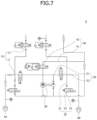
  • FIG. 7 is a view schematically illustrating a one-wheel decompression state of an auxiliary brake unit according to an embodiment of the present disclosure.
  • FIG. 8 is a view schematically illustrating a two-wheel decompression state of an auxiliary brake unit according to an embodiment of the present disclosure.
  • FIG. 9 is a view schematically illustrating a one-wheel pressure increase state of an auxiliary brake unit according to an embodiment of the present disclosure.
  • FIG. 10 is a view schematically illustrating a hydraulic control state of the auxiliary brake unit according to the first embodiment of the present disclosure.
  • FIG. 11 is a view schematically illustrating a hydraulic control state of the auxiliary brake unit according to the second embodiment of the present disclosure.
  • FIG. 12 is a view schematically illustrating a hydraulic control state of an auxiliary brake unit according to a third embodiment of the present disclosure.
  • FIG. 1 is a block diagram schematically illustrating an electro-hydraulic brake device according to an embodiment of the present disclosure.
  • an electro-hydraulic brake device includes a main brake unit 1 , a storage unit 2 , and an auxiliary brake unit 3 .
  • the main brake unit 1 provides a braking fluid to a plurality of wheel cylinder units 4 by driving a motor.
  • the storage unit 2 is connected to the main brake unit 1 .
  • the storage unit 2 may be a reservoir, a fluid tank or the like, at which the braking fluid is temporarily stored.
  • the auxiliary brake unit 3 is connected to the main brake unit 1 and the storage unit 2 .
  • the auxiliary brake unit 3 provides the braking fluid to some of the plurality of wheel cylinder units 4 when an operation error of the main brake unit 1 occurs.
  • the auxiliary brake unit 3 is designed so that a hydraulic circuit is physically divided according to a function.
  • the electro-hydraulic brake device can perform emergency braking by activating the auxiliary brake unit 3 when the operation error of the main brake unit 1 occurs in the electronic braking device of an electric vehicle, a hybrid vehicle, or an autonomous vehicle.
  • the operation error of the main braking unit 1 may be a motor driving error or an operation error of various valves for controlling the hydraulic circuit.
  • FIG. 2 is a view schematically illustrating an electro-hydraulic brake device according to an embodiment of the present disclosure.
  • the main brake unit 1 according to the embodiment of the present disclosure includes a pedal cylinder unit 110 , a master cylinder unit 120 , a first main hydraulic unit 130 , a second main hydraulic unit 140 , and a third main hydraulic unit 150 .
  • the pedal cylinder unit 110 generates a hydraulic pressure by a pedal 119 being stepped on.
  • the pedal cylinder unit 110 may form two chambers and may provide a pedal force corresponding to an increased pressure of the pedal 119 .
  • the master cylinder unit 120 detects whether the pedal 119 is operated and generates a hydraulic pressure by driving a motor 129 .
  • the master cylinder unit 120 may form one chamber, and the motor 129 may be driven in a forward or backward direction depending on a pressure increase state of the pedal 119 .
  • the master cylinder unit 120 may be connected to the pedal cylinder unit 110 through a cylinder line unit 128 .
  • the first main hydraulic unit 130 is connected to the master cylinder unit 120 and guides the braking fluid to some of the plurality of wheel cylinder units 4 .
  • the first main hydraulic unit 130 may include a 1-1 hydraulic line unit 131 connected to the master cylinder unit 120 to guide the braking fluid, and a 1-2 hydraulic line unit 132 connected to the 1-1 hydraulic line unit 131 and branched off to a first wheel cylinder unit 5 to guide the braking fluid to the first wheel cylinder unit 5 .
  • the two first wheel cylinder units 5 may each be disposed at one of the rear wheels.
  • the second main hydraulic unit 140 connects the master cylinder unit 120 and the auxiliary brake unit 3 and guides a brake hydraulic pressure to the rest of the plurality of wheel cylinder units 4 .
  • the second main hydraulic unit 140 may include a 2-1 hydraulic line unit 141 connected to the master cylinder unit 120 to guide a brake hydraulic pressure, and a 2-2 hydraulic line unit 142 connected to the 2-1 hydraulic line unit 141 and branched off to the auxiliary brake unit 3 to guide a braking fluid to the auxiliary brake unit 3 .
  • the auxiliary brake unit 3 may be connected to a second wheel cylinder unit 6
  • two second wheel cylinder units 6 may each be disposed at one of the front wheels and may include a first wheel unit 6 a and a second wheel unit 6 b.
  • the first wheel cylinder unit 5 may be disposed at the front wheel
  • the second wheel cylinder unit 6 may be disposed at the rear wheel
  • the auxiliary brake unit 3 may be connected to a main power wheel in a vehicle driving method.
  • the third main hydraulic unit 150 connects or disconnects the first main hydraulic unit 130 to or from the second main hydraulic unit 140 .
  • the third main hydraulic unit 150 may connect the 1-2 hydraulic line unit 132 and the 2-2 hydraulic line unit 142 .
  • FIG. 3 is a view schematically illustrating an auxiliary brake unit according to an embodiment of the present disclosure.
  • the auxiliary brake unit 3 according to the embodiment of the present disclosure includes a first auxiliary flow path unit a second auxiliary flow path unit 20 , and a third auxiliary flow path unit 30 .
  • the first auxiliary flow path unit 10 connects the second main hydraulic unit 140 and a wheel cylinder unit 4 to control a flow of the braking fluid.
  • two first auxiliary flow path units 10 may each be connected to one of branched 2-2 hydraulic line units 142 .
  • the first auxiliary flow path unit 10 may pass or block the braking fluid and may control a set pressure of the braking fluid as necessary.
  • the second auxiliary flow path unit 20 controls the braking fluid after connecting the first auxiliary flow path unit 10 and an electric pump unit 90 .
  • one end of the second auxiliary flow path unit 20 may be connected to each of the first auxiliary flow path units 10 , and the other end thereof may be connected to the electric pump unit 90 .
  • the second auxiliary flow path unit 20 may be connected to the storage unit 2 .
  • the electric pump unit 90 is a device that forcibly supplies the braking fluid as power is applied and is driven to supply the braking fluid when an error of the main brake unit 1 occurs.
  • the third auxiliary flow path unit 30 controls the braking fluid after connecting the electric pump unit 90 and the first auxiliary flow path unit 10 .
  • the third auxiliary flow path unit 30 may be connected to the electric pump unit 90 and branched off, or may be connected to the electric pump unit 90 and guide the braking fluid discharged from the electric pump unit 90 to the first auxiliary flow path unit 10 .
  • the first auxiliary flow path unit 10 includes a first flow path line unit 11 and a first flow path valve unit 12 .
  • the first flow path line unit 11 connects the second main hydraulic unit 140 and the wheel cylinder unit 4 to guide the braking fluid.
  • one end of the first flow path line unit 11 may be connected to each of the 2-2 hydraulic line units 142 , and the other end may be connected to the second wheel cylinder unit 6 .
  • the first flow path valve unit 12 is formed in the first flow path line unit 11 and opens or closes the first flow path line unit 11 .
  • the first flow path valve unit 12 may pass or block the braking fluid and may control the set pressure of the braking fluid as necessary.
  • the first flow path valve unit 12 may be disposed in the first flow path line unit 11 formed between the second main hydraulic unit 140 and a connection point of the first flow path line unit 11 , the second auxiliary flow path unit 20 , and the third auxiliary flow path unit 30 .
  • the second auxiliary flow path unit 20 includes a second flow path line unit 21 and a second flow path valve unit 22 .
  • the second flow path line unit 21 connects the first auxiliary flow path unit 10 and the electric pump unit 90 to guide the braking fluid.
  • the second flow path valve unit 22 is formed in the second flow path line unit 21 to open or close the second flow path line unit 21 .
  • one end of the second flow path line unit 21 may be connected to the first flow path line unit 11 , and the other end thereof may be connected to the electric pump unit 90 .
  • the second flow path valve unit 22 may be disposed in the second flow path line unit 21 formed between the electric pump unit 90 and a connection point of the first flow path line unit 11 and the second flow path line unit 21 .
  • a pair of second flow path line units 21 may be connected to each other and may be connected to the electric pump unit 90 through a single line or individual lines.
  • the second auxiliary flow path unit 20 may further include a second flow path connection unit 23 .
  • the second flow path connection unit 23 connects the second flow path line unit 21 and the storage unit 2 .
  • the second flow path connection unit 23 may be connected to the second flow path line unit 21 formed between the second flow path valve unit 22 and the electric pump unit 90 . Accordingly, bridging quality can be improved because the braking fluid supplied from the storage unit 2 may be supplied to the electric pump unit 90 without passing through a separate valve.
  • the third auxiliary flow path unit 30 includes a third flow path line unit 31 and a third flow path valve unit 32 .
  • the third flow path line unit 31 connects the electric pump unit 90 and the first auxiliary flow path unit 10 to guide the braking fluid. Then, the third flow path valve unit 32 is formed in the third flow path line unit 31 to open or close the third flow path line unit 31 .
  • the electric pump unit 90 may be commonly used.
  • the third flow path line unit 31 may be connected to the electric pump unit 90 through a single line or individual lines.
  • the third flow path valve unit 32 may be disposed in the third flow path line unit 31 formed between the electric pump unit 90 and a connection point of the third flow path line unit 31 and the first flow path line unit 11 .
  • the third flow path valve unit 32 opens the third flow path line unit 31 so that the braking fluid discharged from the electric pump unit 90 is supplied to the wheel cylinder unit 4 .
  • the second flow path valve unit 22 may close the second flow path line unit 21 .
  • the auxiliary brake unit 3 may further include a fourth auxiliary flow path unit 40 .
  • the fourth auxiliary flow path unit 40 controls the braking fluid after connecting the third auxiliary flow path unit 30 and the storage unit 2 .
  • the fourth auxiliary flow path unit 40 may pass or block the braking fluid and may control the set pressure of the braking fluid as necessary.
  • the fourth auxiliary flow path unit 40 includes a fourth flow path line unit 41 and a fourth flow path valve unit 42 .
  • the fourth flow path line unit 41 connects the third auxiliary flow path unit 30 and the storage unit 2 to guide the braking fluid. Then, the fourth flow path valve unit 42 is formed in the fourth flow path line unit 41 to open or close the fourth flow path line unit 41 .
  • the fourth flow path valve unit 42 may pass or block the braking fluid and may control the set pressure of the braking fluid as necessary.
  • one end portion of the fourth flow path line unit 41 may be connected to the third flow path line unit 31 , and the other end portion thereof may be directly connected to the storage unit 2 or may be connected to the second flow path connection unit 23 connected to the storage unit 2 . More specifically, the fourth flow path line unit 41 may be connected to the third flow path line unit 31 formed between the electric pump unit 90 and the third flow path valve unit 32 .
  • the second flow path connection unit 23 may be connected to the fourth flow path line unit 41 when the fourth flow path line unit 41 is directly connected to the storage unit 2 .
  • a fourth flow path valve unit 42 may be disposed in the fourth flow path line unit 41 formed between the third flow path line unit 31 and a connection point of the fourth flow path line unit 41 and the second flow path connection unit 23 .
  • FIG. 4 is a view schematically illustrating a normal operating state of a main brake unit in an electro-hydraulic brake device according to an embodiment of the present disclosure.
  • the pedal 119 is pressurized or braking is required through the autonomous driving system while the main braking unit 1 is in a normal state
  • the motor 129 of the master cylinder unit 120 is driven. Accordingly, the hydraulic pressure generated by the master cylinder unit 120 is increased, and the braking fluid is supplied to the first main hydraulic unit 130 and the second main hydraulic unit 140 .
  • the braking fluid passing through the first main hydraulic unit 130 is supplied to the first wheel cylinder unit 5 to perform rear wheel braking. Then, the braking fluid passing through the second main hydraulic unit 140 passes through the auxiliary brake unit 3 and is supplied to the second wheel cylinder unit 6 to perform front wheel braking.
  • the first flow path valve unit 12 opens the first flow path line unit 11
  • the second flow path valve unit 22 closes the second flow path line unit 21
  • the third flow path valve unit 32 closes the third flow path line unit 31
  • the fourth flow path valve unit 42 may open the fourth flow path line unit 41 .
  • FIG. 5 is a view schematically illustrating a two-wheel pressure increase state of an auxiliary brake unit including an electric pump unit according to a first embodiment of the present disclosure.
  • the first flow path valve unit 12 closes the first flow path line unit 11
  • the second flow path valve unit 22 closes the second flow path line unit 21
  • the third flow path valve unit 32 opens the third flow path line unit 31 .
  • the fourth flow path valve unit 42 may close the fourth flow path line unit 41 or control the set pressure.
  • the braking fluid discharged from the electric pump unit 90 is branched off through the third flow path line unit 31 and supplied to each of the second wheel cylinder units 6 , thereby performing front wheel braking.
  • the braking fluid stored in the storage unit 2 through the second flow path connection unit 23 may be supplied to the electric pump unit 90 without passing through the valve thereof.
  • FIG. 6 is a view schematically illustrating a two-wheel pressure increase state of an auxiliary brake unit including an electric pump unit according to a second embodiment of the present disclosure.
  • the first flow path valve unit 12 closes the first flow path line unit 11
  • the second flow path valve unit 22 closes the second flow path line unit 21
  • the third flow path valve unit 32 opens the third flow path line unit 31 .
  • the fourth flow path valve unit 42 may close the fourth flow path line unit 41 or control the set pressure.
  • the braking fluid discharged from the electric pump unit 90 is supplied to the second wheel cylinder unit 6 through the third flow path line unit 31 , thereby performing the front wheel braking.
  • the braking fluid stored in the storage unit 2 through the second flow path connection unit 23 may be supplied to the electric pump unit 90 .
  • FIG. 7 is a view schematically illustrating a one-wheel decompression state of an auxiliary brake unit according to an embodiment of the present disclosure, which may be an anti-lock braking system (ABS) one-wheel decompression state.
  • ABS anti-lock braking system
  • the third flow path valve unit 32 formed in the third flow path line unit 31 connected to the first wheel unit 6 a to be decompressed closes the third flow path line unit 31 .
  • a third flow path valve unit 32 formed in a third flow path line unit connected to the second wheel unit 6 b to not be decompressed opens the third flow path line unit 31 .
  • the fourth flow path valve unit 42 may close the fourth flow path line unit 41 or control the set pressure.
  • the braking fluid supplied to the first wheel unit 6 a to be decompressed is moved to the storage unit 2 sequentially through the first flow path line unit 11 , the second flow path line unit 21 , and the second flow path connection unit 23 .
  • FIG. 8 is a view schematically illustrating a two-wheel decompression state of an auxiliary brake unit according to an embodiment of the present disclosure, which may be an ABS two-wheel decompression state.
  • the first flow path valve unit 12 closes the first flow path line unit 11
  • the second flow path valve unit 22 opens the second flow path line unit 21 .
  • the third flow path valve unit 32 formed in the third flow path line unit 31 connected to the second wheel cylinder unit 6 to be decompressed closes the third flow path line unit 31 .
  • the fourth flow path valve unit 42 may close the fourth flow path line unit 41 or control the set pressure.
  • FIG. 9 is a view schematically illustrating a one-wheel pressure increase state of an auxiliary brake unit according to an embodiment of the present disclosure, which may be a vehicle dynamic control (VDC) one-wheel pressure increase state.
  • VDC vehicle dynamic control
  • the first flow path valve unit 12 formed in the first flow path line unit 11 connected to the second wheel unit 6 b of which a pressure will be increased closes the first flow path line unit 11 .
  • the first flow path valve unit 12 formed in the first flow path line unit 11 connected to the first wheel unit 6 a of which a pressure will not be increased opens the first flow path line unit 11 .
  • the second flow path valve unit 22 formed in the second flow path line unit 21 connected to the second wheel unit 6 b of which a pressure will be increased closes the second flow path line unit 21 .
  • the second flow path valve unit 22 formed in the second flow path line unit 21 connected to the first wheel unit 6 a of which a pressure will not be increased opens the second flow path line unit 21 .
  • the third flow path valve unit 32 formed in the third flow path line unit 31 connected to the second wheel unit 6 b of which a pressure will be increased opens the third flow path line unit 31 .
  • a third flow path valve unit 32 formed in a third flow path line unit connected to the first wheel unit 6 a of which a pressure will not be increased closes the third flow path line unit 31 .
  • the fourth flow path valve unit 42 may close the fourth flow path line unit 41 or control the set pressure.
  • the braking fluid discharged from the electric pump unit 90 is supplied to the second wheel unit 6 b of which a pressure will be increased through the third flow path line unit 31 , thereby performing braking.
  • FIG. 10 is a view schematically illustrating a hydraulic control state of the auxiliary brake unit according to the first embodiment of the present disclosure, and since the pedal 119 is removed or an electric pedal is used, control disturbance of the auxiliary brake unit 3 does not occur even when a driver intervenes.
  • the first flow path valve unit 12 may control the set pressure of the braking fluid.
  • the fourth auxiliary flow path unit 40 in the hydraulic circuit may be omitted.
  • FIG. 11 is a view schematically illustrating a hydraulic control state of the auxiliary brake unit according to the second embodiment of the present disclosure
  • FIG. 12 is a view schematically illustrating a hydraulic control state of the auxiliary brake unit 3 according to a third embodiment of the present disclosure, and the hydraulic circuit minimizes a control disturbance of the auxiliary brake unit 3 when the driver intervenes and steps on the pedal 119 .
  • the first flow path valve unit 12 may control the set pressure of the braking fluid
  • the fourth flow path valve unit 42 may control the set pressure of the braking fluid.
  • the first flow path valve unit 12 may control only ON/OFF of the first flow path line unit 11
  • only the fourth flow path valve unit 42 may control the set pressure of the braking fluid.
  • the main brake unit 1 and the auxiliary brake unit 3 may be connected to each other through the hydraulic circuit, and when an operation error of the main brake unit 1 occurs, the auxiliary brake unit 3 may be driven to perform braking.
  • the first auxiliary flow path unit 10 may control the flow of the braking fluid after connecting the main brake unit 1 and the wheel cylinder unit 4
  • the second auxiliary flow path unit 20 may control the flow of the braking fluid after connecting the first auxiliary flow path unit 10 and the electric pump unit 90
  • the third auxiliary flow path unit 30 controls the braking fluid after connecting the electric pump unit 90 and the first auxiliary flow path unit 10 , and therefore, the hydraulic circuit may be physically divided according to a function.
  • the second auxiliary flow path unit 20 is connected to the storage unit 2 , and valve resistance to the braking fluid provided to the electric pump unit 90 is omitted, therefore bridging quality can be improved.

Landscapes

  • Engineering & Computer Science (AREA)
  • Transportation (AREA)
  • Mechanical Engineering (AREA)
  • Physics & Mathematics (AREA)
  • Fluid Mechanics (AREA)
  • Regulating Braking Force (AREA)
  • Valves And Accessory Devices For Braking Systems (AREA)

Abstract

The present disclosure relates to an electric hydraulic brake device, which includes a main brake unit, which provides a braking fluid to a plurality of wheel cylinder units by driving a motor, a storage unit connected to the main brake unit and configured to store the braking fluid, and an auxiliary brake unit which is connected to the main brake unit and the storage unit and provides the braking fluid to some of the plurality of wheel cylinder units when an operation error of the main brake unit occurs and in which a hydraulic circuit is physically distinguished.

Description

CROSS-REFERENCE TO RELATED APPLICATIONS
This application claims the benefit of priority to Korean Patent Application No. 10-2022-0071423, filed on Jun. 13, 2022, of which the disclosure is incorporated herein by reference in its entirety.
TECHNICAL FIELD
Exemplary embodiments of the present disclosure relate to an electro-hydraulic brake device, and more particularly, to an electro-hydraulic brake device in which auxiliary braking is quickly performed when a main braking error occurs, hydraulic circuits are clearly distinguished for each function, a set pressure control route is diversified, and bridging quality can be improved.
BACKGROUND
In general, an electro-hydraulic brake device controls a brake pressure of each wheel by a hydraulic pressure of a master cylinder driven by a motor after a pedal pressure of a driver is detected through a sensor.
The electro-hydraulic brake device includes a sensor that detects a stroke distance of a pedal to determine a brake pressure desired by the driver.
In addition, the electro-hydraulic brake device includes a pedal travel simulator that allows the driver to feel the same pedal pressure as that of a normal hydraulic brake device.
Accordingly, when the driver steps on a brake pedal, an electronic control unit detects a pedal pressure and supplies a hydraulic pressure to a master cylinder.
In addition, the master cylinder transmits a brake hydraulic pressure to a wheel cylinder of each wheel to provide a braking force to each wheel.
The conventional electro-hydraulic brake device cannot quickly provide a brake hydraulic pressure to a wheel cylinder when a motor is damaged, thereby causing an accident. Therefore, there is a need for improving the above problem.
The related art of the present disclosure is disclosed in Korean Patent Application No. 2007-0104982 (published on Oct. 30, 2007 and entitled “Control apparatus for valve in electro-hydraulic brake system”).
SUMMARY
The present disclosure has been devised to improve the above problems, and an object of the present disclosure is to provide an electro-hydraulic brake device in which auxiliary braking is quickly performed when a main braking error occurs, hydraulic circuits are clearly distinguished for each function, a set pressure control route is diversified, and bridging quality can be improved.
An electro-hydraulic brake device according to the present disclosure includes a main brake unit which provides a braking fluid to a plurality of wheel cylinders by driving a motor, a storage unit connected to the main brake unit and configured to store the braking fluid, and an auxiliary brake unit which is connected to the main brake unit and the storage unit and provides the braking fluid to some of a plurality of wheel cylinder units when an operation error of the main brake unit occurs and in which a hydraulic circuit is physically distinguished.
The main brake unit may include a pedal cylinder unit that generates a hydraulic pressure when a driver presses or steps on the pedal, a master cylinder unit that detects the driver's pressing of the pedal and generates a hydraulic pressure by driving the motor, a first main hydraulic unit which is connected to the master cylinder unit and guides a braking fluid to some of the plurality of wheel cylinder units, a second main hydraulic unit which connects the master cylinder unit to the auxiliary brake unit and guides the braking fluid to the rest of the plurality of wheel cylinder units, and a third main hydraulic unit which connects or disconnects the first main hydraulic unit to or from the second main hydraulic unit.
The first main hydraulic unit may guide the braking fluid to the wheel cylinder unit disposed on a rear wheel, and the second main hydraulic unit guides the braking fluid to the wheel cylinder unit disposed on a front wheel.
The first main hydraulic unit and the auxiliary brake unit may be connected to allow the braking fluid to move.
The auxiliary brake unit may include a first auxiliary flow path unit configured to control the braking fluid after connecting the second main hydraulic unit and the wheel cylinder unit, a second auxiliary flow path unit configured to control the braking fluid after connecting the first auxiliary flow path unit and the electric pump unit, and a third auxiliary flow path unit configured to control the braking fluid after connecting the electric pump unit and the first auxiliary flow path unit.
The first auxiliary flow path unit may include a first flow path line unit connecting the second main hydraulic unit and the wheel cylinder unit to guide the braking fluid, and a first flow path valve unit which is formed in the first flow path line unit and opens or closes the first flow path line unit.
The second auxiliary flow path unit may include a second flow path line unit connecting the first auxiliary flow path unit and the electric pump unit to guide the braking fluid, and a second flow path valve unit which is formed in the second flow path line unit and opens or closes the second flow path line unit.
The second auxiliary flow path unit may further include a second flow path connection unit connecting the second flow path line unit and the storage unit.
The third auxiliary flow path unit may include a third flow path line unit connecting the electric pump unit and the first auxiliary flow path unit to guide the braking fluid, and a third flow path valve unit which is formed in the third flow path line unit and opens or closes the third flow path line unit.
The third flow path valve unit may open the third flow path line unit so that the braking fluid discharged from the electric pump unit is supplied to the wheel cylinder unit.
The auxiliary brake unit may include a fourth auxiliary flow path unit configured to control the braking fluid after connecting the third auxiliary flow path unit and the storage unit.
The fourth auxiliary flow path unit may include a fourth flow path line unit connecting the third auxiliary flow path unit and the storage unit to guide the braking fluid, and a fourth flow path valve unit which is formed in the fourth flow path line unit and opens or closes the fourth flow path line unit.
In the electro-hydraulic brake device according to the present disclosure, the main brake unit and the auxiliary brake unit are connected by a hydraulic circuit, and the auxiliary brake unit can be driven to perform braking when an operation error occurs in the main brake unit.
In the electro-hydraulic brake device according to an embodiment of the present disclosure, the first auxiliary flow path unit can control the braking fluid after connecting the main flow path unit and the wheel cylinder unit, the second auxiliary flow path unit can control the braking fluid after connecting the first auxiliary flow path unit and the electric pump unit, the third auxiliary flow path unit can control the braking fluid after connecting the electric pump unit and the first auxiliary flow path unit, and therefore, the hydraulic circuits can be physically divided according to a function.
In the electro-hydraulic brake device according to an embodiment of the present disclosure, the second auxiliary flow path unit is connected to the storage unit, and valve resistance to the braking fluid provided to the electric pump unit is omitted, therefore bridging quality can be improved.
BRIEF DESCRIPTION OF THE DRAWINGS
FIG. 1 is a block diagram schematically illustrating an electro-hydraulic brake device according to an embodiment of the present disclosure.
FIG. 2 is a view schematically illustrating an electro-hydraulic brake device according to an embodiment of the present disclosure.
FIG. 3 is a view schematically illustrating an auxiliary brake unit according to an embodiment of the present disclosure.
FIG. 4 is a view schematically illustrating a normal operating state of a main brake unit in an electro-hydraulic brake device according to an embodiment of the present disclosure.
FIG. 5 is a view schematically illustrating a two-wheel pressure increase state of an auxiliary brake unit including an electric pump unit according to a first embodiment of the present disclosure.
FIG. 6 is a view schematically illustrating a two-wheel pressure increase state of an auxiliary brake unit including an electric pump unit according to a second embodiment of the present disclosure.
FIG. 7 is a view schematically illustrating a one-wheel decompression state of an auxiliary brake unit according to an embodiment of the present disclosure.
FIG. 8 is a view schematically illustrating a two-wheel decompression state of an auxiliary brake unit according to an embodiment of the present disclosure.
FIG. 9 is a view schematically illustrating a one-wheel pressure increase state of an auxiliary brake unit according to an embodiment of the present disclosure.
FIG. 10 is a view schematically illustrating a hydraulic control state of the auxiliary brake unit according to the first embodiment of the present disclosure.
FIG. 11 is a view schematically illustrating a hydraulic control state of the auxiliary brake unit according to the second embodiment of the present disclosure.
FIG. 12 is a view schematically illustrating a hydraulic control state of an auxiliary brake unit according to a third embodiment of the present disclosure.
DETAILED DESCRIPTION
Hereinafter, an electro-hydraulic brake device will be described below with reference to the accompanying drawings through various exemplary embodiments. For clarity and convenience in description, thicknesses of lines, sizes of constituent elements, and the like may be illustrated in an exaggerated manner in the drawings. In addition, terms described below are defined by considering functions according to the present disclosure and may vary according to the intention of a user or a manager or according to the common practices in the art. Therefore, definitions of these terms should be defined in light of details disclosed throughout the present specification.
FIG. 1 is a block diagram schematically illustrating an electro-hydraulic brake device according to an embodiment of the present disclosure. Referring to FIG. 1 , an electro-hydraulic brake device according to an embodiment of the present disclosure includes a main brake unit 1, a storage unit 2, and an auxiliary brake unit 3.
The main brake unit 1 provides a braking fluid to a plurality of wheel cylinder units 4 by driving a motor. The storage unit 2 is connected to the main brake unit 1. The storage unit 2 may be a reservoir, a fluid tank or the like, at which the braking fluid is temporarily stored. The auxiliary brake unit 3 is connected to the main brake unit 1 and the storage unit 2. The auxiliary brake unit 3 provides the braking fluid to some of the plurality of wheel cylinder units 4 when an operation error of the main brake unit 1 occurs. The auxiliary brake unit 3 is designed so that a hydraulic circuit is physically divided according to a function.
That is, the electro-hydraulic brake device according to the embodiment of the present disclosure can perform emergency braking by activating the auxiliary brake unit 3 when the operation error of the main brake unit 1 occurs in the electronic braking device of an electric vehicle, a hybrid vehicle, or an autonomous vehicle. In this case, the operation error of the main braking unit 1 may be a motor driving error or an operation error of various valves for controlling the hydraulic circuit.
FIG. 2 is a view schematically illustrating an electro-hydraulic brake device according to an embodiment of the present disclosure. Referring to FIG. 2 , the main brake unit 1 according to the embodiment of the present disclosure includes a pedal cylinder unit 110, a master cylinder unit 120, a first main hydraulic unit 130, a second main hydraulic unit 140, and a third main hydraulic unit 150.
The pedal cylinder unit 110 generates a hydraulic pressure by a pedal 119 being stepped on. The pedal cylinder unit 110 may form two chambers and may provide a pedal force corresponding to an increased pressure of the pedal 119.
The master cylinder unit 120 detects whether the pedal 119 is operated and generates a hydraulic pressure by driving a motor 129. The master cylinder unit 120 may form one chamber, and the motor 129 may be driven in a forward or backward direction depending on a pressure increase state of the pedal 119. The master cylinder unit 120 may be connected to the pedal cylinder unit 110 through a cylinder line unit 128.
The first main hydraulic unit 130 is connected to the master cylinder unit 120 and guides the braking fluid to some of the plurality of wheel cylinder units 4.
In more detail, the first main hydraulic unit 130 may include a 1-1 hydraulic line unit 131 connected to the master cylinder unit 120 to guide the braking fluid, and a 1-2 hydraulic line unit 132 connected to the 1-1 hydraulic line unit 131 and branched off to a first wheel cylinder unit 5 to guide the braking fluid to the first wheel cylinder unit 5. In this case, the two first wheel cylinder units 5 may each be disposed at one of the rear wheels.
The second main hydraulic unit 140 connects the master cylinder unit 120 and the auxiliary brake unit 3 and guides a brake hydraulic pressure to the rest of the plurality of wheel cylinder units 4.
In more detail, the second main hydraulic unit 140 may include a 2-1 hydraulic line unit 141 connected to the master cylinder unit 120 to guide a brake hydraulic pressure, and a 2-2 hydraulic line unit 142 connected to the 2-1 hydraulic line unit 141 and branched off to the auxiliary brake unit 3 to guide a braking fluid to the auxiliary brake unit 3. In this case, the auxiliary brake unit 3 may be connected to a second wheel cylinder unit 6, and two second wheel cylinder units 6 may each be disposed at one of the front wheels and may include a first wheel unit 6 a and a second wheel unit 6 b.
Meanwhile, the first wheel cylinder unit 5 may be disposed at the front wheel, the second wheel cylinder unit 6 may be disposed at the rear wheel, and the auxiliary brake unit 3 may be connected to a main power wheel in a vehicle driving method.
The third main hydraulic unit 150 connects or disconnects the first main hydraulic unit 130 to or from the second main hydraulic unit 140. For example, the third main hydraulic unit 150 may connect the 1-2 hydraulic line unit 132 and the 2-2 hydraulic line unit 142.
FIG. 3 is a view schematically illustrating an auxiliary brake unit according to an embodiment of the present disclosure. Referring IGS.IGS. 2 and 3, the auxiliary brake unit 3 according to the embodiment of the present disclosure includes a first auxiliary flow path unit a second auxiliary flow path unit 20, and a third auxiliary flow path unit 30.
The first auxiliary flow path unit 10 connects the second main hydraulic unit 140 and a wheel cylinder unit 4 to control a flow of the braking fluid. For example, two first auxiliary flow path units 10 may each be connected to one of branched 2-2 hydraulic line units 142. The first auxiliary flow path unit 10 may pass or block the braking fluid and may control a set pressure of the braking fluid as necessary.
The second auxiliary flow path unit 20 controls the braking fluid after connecting the first auxiliary flow path unit 10 and an electric pump unit 90. For example, one end of the second auxiliary flow path unit 20 may be connected to each of the first auxiliary flow path units 10, and the other end thereof may be connected to the electric pump unit 90. The second auxiliary flow path unit 20 may be connected to the storage unit 2. Meanwhile, the electric pump unit 90 is a device that forcibly supplies the braking fluid as power is applied and is driven to supply the braking fluid when an error of the main brake unit 1 occurs.
The third auxiliary flow path unit 30 controls the braking fluid after connecting the electric pump unit 90 and the first auxiliary flow path unit 10. For example, the third auxiliary flow path unit 30 may be connected to the electric pump unit 90 and branched off, or may be connected to the electric pump unit 90 and guide the braking fluid discharged from the electric pump unit 90 to the first auxiliary flow path unit 10.
More specifically, the first auxiliary flow path unit 10 includes a first flow path line unit 11 and a first flow path valve unit 12.
The first flow path line unit 11 connects the second main hydraulic unit 140 and the wheel cylinder unit 4 to guide the braking fluid. For example, one end of the first flow path line unit 11 may be connected to each of the 2-2 hydraulic line units 142, and the other end may be connected to the second wheel cylinder unit 6.
The first flow path valve unit 12 is formed in the first flow path line unit 11 and opens or closes the first flow path line unit 11. For example, the first flow path valve unit 12 may pass or block the braking fluid and may control the set pressure of the braking fluid as necessary. The first flow path valve unit 12 may be disposed in the first flow path line unit 11 formed between the second main hydraulic unit 140 and a connection point of the first flow path line unit 11, the second auxiliary flow path unit 20, and the third auxiliary flow path unit 30.
The second auxiliary flow path unit 20 includes a second flow path line unit 21 and a second flow path valve unit 22.
The second flow path line unit 21 connects the first auxiliary flow path unit 10 and the electric pump unit 90 to guide the braking fluid. In addition, the second flow path valve unit 22 is formed in the second flow path line unit 21 to open or close the second flow path line unit 21.
For example, one end of the second flow path line unit 21 may be connected to the first flow path line unit 11, and the other end thereof may be connected to the electric pump unit 90. In addition, the second flow path valve unit 22 may be disposed in the second flow path line unit 21 formed between the electric pump unit 90 and a connection point of the first flow path line unit 11 and the second flow path line unit 21. A pair of second flow path line units 21 may be connected to each other and may be connected to the electric pump unit 90 through a single line or individual lines.
The second auxiliary flow path unit 20 may further include a second flow path connection unit 23. The second flow path connection unit 23 connects the second flow path line unit 21 and the storage unit 2. For example, the second flow path connection unit 23 may be connected to the second flow path line unit 21 formed between the second flow path valve unit 22 and the electric pump unit 90. Accordingly, bridging quality can be improved because the braking fluid supplied from the storage unit 2 may be supplied to the electric pump unit 90 without passing through a separate valve.
The third auxiliary flow path unit 30 includes a third flow path line unit 31 and a third flow path valve unit 32.
The third flow path line unit 31 connects the electric pump unit 90 and the first auxiliary flow path unit 10 to guide the braking fluid. Then, the third flow path valve unit 32 is formed in the third flow path line unit 31 to open or close the third flow path line unit 31.
For example, because the pair of third flow path line units 31 are connected to each other to guide the braking fluid to the first flow path line unit 11, the electric pump unit 90 may be commonly used. The third flow path line unit 31 may be connected to the electric pump unit 90 through a single line or individual lines. The third flow path valve unit 32 may be disposed in the third flow path line unit 31 formed between the electric pump unit 90 and a connection point of the third flow path line unit 31 and the first flow path line unit 11.
Meanwhile, the third flow path valve unit 32 opens the third flow path line unit 31 so that the braking fluid discharged from the electric pump unit 90 is supplied to the wheel cylinder unit 4. In this case, the second flow path valve unit 22 may close the second flow path line unit 21.
The auxiliary brake unit 3 according to the embodiment of the present disclosure may further include a fourth auxiliary flow path unit 40. The fourth auxiliary flow path unit 40 controls the braking fluid after connecting the third auxiliary flow path unit 30 and the storage unit 2. For example, the fourth auxiliary flow path unit 40 may pass or block the braking fluid and may control the set pressure of the braking fluid as necessary.
More specifically, the fourth auxiliary flow path unit 40 includes a fourth flow path line unit 41 and a fourth flow path valve unit 42.
The fourth flow path line unit 41 connects the third auxiliary flow path unit 30 and the storage unit 2 to guide the braking fluid. Then, the fourth flow path valve unit 42 is formed in the fourth flow path line unit 41 to open or close the fourth flow path line unit 41. The fourth flow path valve unit 42 may pass or block the braking fluid and may control the set pressure of the braking fluid as necessary.
For example, one end portion of the fourth flow path line unit 41 may be connected to the third flow path line unit 31, and the other end portion thereof may be directly connected to the storage unit 2 or may be connected to the second flow path connection unit 23 connected to the storage unit 2. More specifically, the fourth flow path line unit 41 may be connected to the third flow path line unit 31 formed between the electric pump unit 90 and the third flow path valve unit 32.
Meanwhile, the second flow path connection unit 23 may be connected to the fourth flow path line unit 41 when the fourth flow path line unit 41 is directly connected to the storage unit 2. In this case, a fourth flow path valve unit 42 may be disposed in the fourth flow path line unit 41 formed between the third flow path line unit 31 and a connection point of the fourth flow path line unit 41 and the second flow path connection unit 23.
FIG. 4 is a view schematically illustrating a normal operating state of a main brake unit in an electro-hydraulic brake device according to an embodiment of the present disclosure. Referring to FIG. 4 , when the pedal 119 is pressurized or braking is required through the autonomous driving system while the main braking unit 1 is in a normal state, the motor 129 of the master cylinder unit 120 is driven. Accordingly, the hydraulic pressure generated by the master cylinder unit 120 is increased, and the braking fluid is supplied to the first main hydraulic unit 130 and the second main hydraulic unit 140.
The braking fluid passing through the first main hydraulic unit 130 is supplied to the first wheel cylinder unit 5 to perform rear wheel braking. Then, the braking fluid passing through the second main hydraulic unit 140 passes through the auxiliary brake unit 3 and is supplied to the second wheel cylinder unit 6 to perform front wheel braking.
In the auxiliary brake unit 3, the first flow path valve unit 12 opens the first flow path line unit 11, the second flow path valve unit 22 closes the second flow path line unit 21, and the third flow path valve unit 32 closes the third flow path line unit 31. In this case, the fourth flow path valve unit 42 may open the fourth flow path line unit 41.
FIG. 5 is a view schematically illustrating a two-wheel pressure increase state of an auxiliary brake unit including an electric pump unit according to a first embodiment of the present disclosure. Referring to FIG. 5 , when the main brake unit 1 is in an abnormal operation state, the first flow path valve unit 12 closes the first flow path line unit 11, the second flow path valve unit 22 closes the second flow path line unit 21, and the third flow path valve unit 32 opens the third flow path line unit 31. Then, the fourth flow path valve unit 42 may close the fourth flow path line unit 41 or control the set pressure.
When one pump provided in the electric pump unit 90 is driven in the above-described state, the braking fluid discharged from the electric pump unit 90 is branched off through the third flow path line unit 31 and supplied to each of the second wheel cylinder units 6, thereby performing front wheel braking. In this case, the braking fluid stored in the storage unit 2 through the second flow path connection unit 23 may be supplied to the electric pump unit 90 without passing through the valve thereof.
FIG. 6 is a view schematically illustrating a two-wheel pressure increase state of an auxiliary brake unit including an electric pump unit according to a second embodiment of the present disclosure. Referring to FIG. 6 , when the main brake unit 1 is in an abnormal operation state, the first flow path valve unit 12 closes the first flow path line unit 11, the second flow path valve unit 22 closes the second flow path line unit 21, and the third flow path valve unit 32 opens the third flow path line unit 31. In addition, the fourth flow path valve unit 42 may close the fourth flow path line unit 41 or control the set pressure.
When three pumps provided in the electric pump unit 90 are driven in the above-described state, the braking fluid discharged from the electric pump unit 90 is supplied to the second wheel cylinder unit 6 through the third flow path line unit 31, thereby performing the front wheel braking. In this case, the braking fluid stored in the storage unit 2 through the second flow path connection unit 23 may be supplied to the electric pump unit 90.
FIG. 7 is a view schematically illustrating a one-wheel decompression state of an auxiliary brake unit according to an embodiment of the present disclosure, which may be an anti-lock braking system (ABS) one-wheel decompression state. Referring to FIG. 7 , when the main brake unit 1 is in an abnormal operation state, the first flow path valve unit 12 closes the first flow path line unit 11. Then, the second flow path valve unit 22 formed in the second flow path line unit 21 connected to a first wheel unit 6 a to be decompressed opens the second flow path line unit 21. On the other hand, the second flow path valve unit 22 formed in the second flow path line unit 21 connected to the second wheel unit 6 b to not be decompressed closes the second flow path line unit 21.
In this case, the third flow path valve unit 32 formed in the third flow path line unit 31 connected to the first wheel unit 6 a to be decompressed closes the third flow path line unit 31. On the other hand, a third flow path valve unit 32 formed in a third flow path line unit connected to the second wheel unit 6 b to not be decompressed opens the third flow path line unit 31. Meanwhile, the fourth flow path valve unit 42 may close the fourth flow path line unit 41 or control the set pressure.
In the above state, the braking fluid supplied to the first wheel unit 6 a to be decompressed is moved to the storage unit 2 sequentially through the first flow path line unit 11, the second flow path line unit 21, and the second flow path connection unit 23.
FIG. 8 is a view schematically illustrating a two-wheel decompression state of an auxiliary brake unit according to an embodiment of the present disclosure, which may be an ABS two-wheel decompression state. Referring to FIG. 8 , when the main brake unit 1 is in an abnormal operation state, the first flow path valve unit 12 closes the first flow path line unit 11, and the second flow path valve unit 22 opens the second flow path line unit 21. In this case, the third flow path valve unit 32 formed in the third flow path line unit 31 connected to the second wheel cylinder unit 6 to be decompressed closes the third flow path line unit 31. Meanwhile, the fourth flow path valve unit 42 may close the fourth flow path line unit 41 or control the set pressure.
In the above state, the operation of the electric pump unit 90 is stopped, and the braking fluid supplied to the second wheel cylinder unit 6 to be decompressed is moved to the storage unit 2 sequentially through the first flow path line unit 11, the second flow path line unit 21, and the second flow path connection unit 23, thereby performing two wheel decompression.
FIG. 9 is a view schematically illustrating a one-wheel pressure increase state of an auxiliary brake unit according to an embodiment of the present disclosure, which may be a vehicle dynamic control (VDC) one-wheel pressure increase state. Referring to FIG. 9 , the first flow path valve unit 12 formed in the first flow path line unit 11 connected to the second wheel unit 6 b of which a pressure will be increased closes the first flow path line unit 11. On the other hand, the first flow path valve unit 12 formed in the first flow path line unit 11 connected to the first wheel unit 6 a of which a pressure will not be increased opens the first flow path line unit 11.
In addition, the second flow path valve unit 22 formed in the second flow path line unit 21 connected to the second wheel unit 6 b of which a pressure will be increased closes the second flow path line unit 21. On the other hand, the second flow path valve unit 22 formed in the second flow path line unit 21 connected to the first wheel unit 6 a of which a pressure will not be increased opens the second flow path line unit 21.
In this case, the third flow path valve unit 32 formed in the third flow path line unit 31 connected to the second wheel unit 6 b of which a pressure will be increased opens the third flow path line unit 31. On the other hand, a third flow path valve unit 32 formed in a third flow path line unit connected to the first wheel unit 6 a of which a pressure will not be increased closes the third flow path line unit 31. Meanwhile, the fourth flow path valve unit 42 may close the fourth flow path line unit 41 or control the set pressure.
When the electric pump unit 90 is driven in the above state, the braking fluid discharged from the electric pump unit 90 is supplied to the second wheel unit 6 b of which a pressure will be increased through the third flow path line unit 31, thereby performing braking.
FIG. 10 is a view schematically illustrating a hydraulic control state of the auxiliary brake unit according to the first embodiment of the present disclosure, and since the pedal 119 is removed or an electric pedal is used, control disturbance of the auxiliary brake unit 3 does not occur even when a driver intervenes. Referring to FIG. 10 , the first flow path valve unit 12 may control the set pressure of the braking fluid. In this case, the fourth auxiliary flow path unit 40 in the hydraulic circuit may be omitted.
FIG. 11 is a view schematically illustrating a hydraulic control state of the auxiliary brake unit according to the second embodiment of the present disclosure, FIG. 12 is a view schematically illustrating a hydraulic control state of the auxiliary brake unit 3 according to a third embodiment of the present disclosure, and the hydraulic circuit minimizes a control disturbance of the auxiliary brake unit 3 when the driver intervenes and steps on the pedal 119. Referring to FIG. 11 , the first flow path valve unit 12 may control the set pressure of the braking fluid, and the fourth flow path valve unit 42 may control the set pressure of the braking fluid. Meanwhile, referring to FIG. 12 , the first flow path valve unit 12 may control only ON/OFF of the first flow path line unit 11, and only the fourth flow path valve unit 42 may control the set pressure of the braking fluid.
In the electro-hydraulic brake device according to the embodiment of the present disclosure, the main brake unit 1 and the auxiliary brake unit 3 may be connected to each other through the hydraulic circuit, and when an operation error of the main brake unit 1 occurs, the auxiliary brake unit 3 may be driven to perform braking.
In the electro-hydraulic brake device according to the embodiment of the present disclosure, the first auxiliary flow path unit 10 may control the flow of the braking fluid after connecting the main brake unit 1 and the wheel cylinder unit 4, the second auxiliary flow path unit 20 may control the flow of the braking fluid after connecting the first auxiliary flow path unit 10 and the electric pump unit 90, the third auxiliary flow path unit 30 controls the braking fluid after connecting the electric pump unit 90 and the first auxiliary flow path unit 10, and therefore, the hydraulic circuit may be physically divided according to a function.
In the electro-hydraulic brake device according to the embodiment of the present disclosure, the second auxiliary flow path unit 20 is connected to the storage unit 2, and valve resistance to the braking fluid provided to the electric pump unit 90 is omitted, therefore bridging quality can be improved.
Although exemplary embodiments of the disclosure have been described for illustrative purposes, those skilled in the art will appreciate that various modifications, additions and substitutions are possible, without departing from the scope and spirit of the disclosure as defined in the accompanying claims.
Thus, the true technical scope of the disclosure should be defined by the following claims.

Claims (11)

What is claimed is:
1. An electro-hydraulic brake device comprising:
a main brake unit connected to and configured to provide a braking fluid to a plurality of wheel cylinder units of a vehicle, the plurality of wheel cylinder units respectively coupled to a plurality of wheels of the vehicle, configured to perform wheel braking of the vehicle using the provided braking fluid, and including one or more first wheel cylinder units and one or more second wheel cylinder units;
a storage unit connected to the main brake unit and having a storage space for storing the braking fluid; and
an auxiliary brake unit connected to the main brake unit and the storage unit and configured to provide the braking fluid to at least some of the plurality of wheel cylinder units when an operation error occurs at the main brake unit, wherein a hydraulic circuit is physically divided in the auxiliary brake unit,
wherein the auxiliary brake unit comprises:
a first auxiliary flow path unit connected to and extending between the main brake unit and the one or more second wheel cylinder units and configured to control a flow of the braking fluid from the main brake unit to the one or more second wheel cylinder units;
a second auxiliary flow path unit connected to and extending between the first auxiliary flow path unit and an electric pump unit and configured to control the flow of the braking fluid from the first auxiliary flow path unit to the electric pump unit; and
a third auxiliary flow path unit connected to and extending between the electric pump unit and the first auxiliary flow path unit and configured to control the flow of the braking fluid from the electric pump unit to the first auxiliary flow path unit.
2. The electro-hydraulic brake device of claim 1, wherein the main brake unit comprises:
a pedal cylinder unit configured to generate a first hydraulic pressure when a driver presses a pedal of the vehicle;
a master cylinder unit configured to detect the driver's pressing of the pedal and generate a second hydraulic pressure;
a first main hydraulic unit disposed between the master cylinder unit and the one or more first wheel cylinder units and configured to guide the braking fluid to the one or more first wheel cylinder units;
a second main hydraulic unit disposed between the master cylinder unit and the auxiliary brake unit and configured to guide the braking fluid to the one or more second wheel cylinder units; and
a third main hydraulic unit disposed between the first and second main hydraulic units and configured to selectively connect the first and second main hydraulic units.
3. The electro-hydraulic brake device of claim 2, wherein:
the one or more first wheel cylinder units include the wheel cylinder unit disposed at a rear wheel of the vehicle, and
the one or more second wheel cylinder units include the wheel cylinder unit disposed at a front wheel of the vehicle.
4. The electro-hydraulic brake device of claim 2, wherein the first main hydraulic unit and the auxiliary brake unit are connected to allow the braking fluid to move therebetween.
5. The electro-hydraulic brake device of claim 1, wherein the first auxiliary flow path unit comprises:
a first flow path line unit connecting the second main hydraulic unit and the one or more second wheel cylinder unit; and
a first flow path valve unit disposed at the first flow path line unit and configured to open or close the first flow path line unit.
6. The electro-hydraulic brake device of claim 1, wherein the second auxiliary flow path unit comprises:
a second flow path line unit connecting the first auxiliary flow path unit and the electric pump unit; and
a second flow path valve unit disposed at the second flow path line unit and configured to open or close the second flow path line unit.
7. The electro-hydraulic brake device of claim 6, wherein the second auxiliary flow path unit further comprises a second flow path connection unit connecting the second flow path line unit and the storage unit.
8. The electro-hydraulic brake device of claim 1, wherein the third auxiliary flow path unit comprises:
a third flow path line unit connecting the electric pump unit and the first auxiliary flow path unit; and
a third flow path valve unit disposed at the third flow path line unit and configured to open or close the third flow path line unit.
9. The electro-hydraulic brake device of claim 8, wherein the braking fluid discharged from the electric pump unit is supplied to the one or more second wheel cylinder units when the third flow path line unit is opened by the third flow path valve unit.
10. The electro-hydraulic brake device of claim 1, wherein the auxiliary brake unit further comprises a fourth auxiliary flow path unit configured to control the flow of the braking fluid from the third auxiliary flow path unit to the storage unit.
11. The electro-hydraulic brake device of claim 10, wherein the fourth auxiliary flow path unit comprises;
a fourth flow path line unit connecting the third auxiliary flow path unit and the storage unit; and
a fourth flow path valve unit disposed at the fourth flow path line unit and configured to open or close the fourth flow path line unit.
US17/898,533 2022-06-13 2022-08-30 Electro-hydraulic brake device Active US11926295B2 (en)

Applications Claiming Priority (2)

Application Number Priority Date Filing Date Title
KR1020220071423A KR102694061B1 (en) 2022-06-13 2022-06-13 Electronic hydraulic brake device
KR10-2022-0071423 2022-06-13

Publications (2)

Publication Number Publication Date
US20230398972A1 US20230398972A1 (en) 2023-12-14
US11926295B2 true US11926295B2 (en) 2024-03-12

Family

ID=88874381

Family Applications (1)

Application Number Title Priority Date Filing Date
US17/898,533 Active US11926295B2 (en) 2022-06-13 2022-08-30 Electro-hydraulic brake device

Country Status (4)

Country Link
US (1) US11926295B2 (en)
KR (1) KR102694061B1 (en)
CN (1) CN117261854A (en)
DE (1) DE102022123562A1 (en)

Cited By (1)

* Cited by examiner, † Cited by third party
Publication number Priority date Publication date Assignee Title
WO2025215442A1 (en) * 2024-04-09 2025-10-16 Brembo S.P.A. Braking system

Families Citing this family (2)

* Cited by examiner, † Cited by third party
Publication number Priority date Publication date Assignee Title
KR20230009702A (en) * 2021-07-09 2023-01-17 현대모비스 주식회사 Electric brake device
KR20250100165A (en) * 2023-12-26 2025-07-03 현대모비스 주식회사 Hydraulic brake device for vehicle

Citations (20)

* Cited by examiner, † Cited by third party
Publication number Priority date Publication date Assignee Title
KR20070104982A (en) 2006-04-24 2007-10-30 주식회사 만도 Valve controls of electronic hydraulic brake units
DE102012205862A1 (en) 2011-04-19 2012-10-25 Continental Teves Ag & Co. Ohg Brake system for motor vehicles and method for operating a brake system
DE102013223861A1 (en) 2013-11-21 2015-05-21 Continental Teves Ag & Co. Ohg Brake system for motor vehicles
DE102013227065A1 (en) 2013-12-23 2015-06-25 Robert Bosch Gmbh Brake system with first and second brake pressure generator and method for operating such a brake system
DE102015212552A1 (en) 2014-07-21 2016-01-21 Continental Teves Ag & Co. Ohg Arrangement for a hydraulic motor vehicle brake system and brake system with such an arrangement
DE102014225956A1 (en) 2014-12-16 2016-06-16 Continental Teves Ag & Co. Ohg Brake control device and brake system for vehicles
DE102014225958A1 (en) 2014-12-16 2016-06-16 Continental Teves Ag & Co. Ohg Brake system for a motor vehicle
DE102016203111A1 (en) 2015-03-05 2016-09-08 Continental Teves Ag & Co. Ohg Brake system for motor vehicles
DE102016203119A1 (en) 2016-02-26 2017-08-31 Continental Teves Ag & Co. Ohg Additional module for an electro-hydraulic brake system and brake system
DE102017000472A1 (en) 2017-01-19 2018-07-19 Lucas Automotive Gmbh Hydraulic vehicle brake system and method for operating and testing the same
DE102017200955A1 (en) 2017-01-20 2018-07-26 Continental Teves Ag & Co. Ohg Braking system for motor vehicles
WO2018219649A1 (en) 2017-05-31 2018-12-06 Robert Bosch Gmbh Vehicle braking system
CN109204262A (en) 2018-08-30 2019-01-15 同济大学 A kind of electronic hydraulic brake system of dual power source hydraulic failure backup
US20200033144A1 (en) 2018-07-27 2020-01-30 Adobe Inc. Generating digital event sequences utilizing a dynamic user preference interface to modify recommendation model reward functions
DE102020104350A1 (en) 2019-10-08 2021-04-08 Hyundai Mobis Co., Ltd. ELECTRONIC HYDRAULIC BRAKE DEVICE
DE102020103723A1 (en) 2019-10-29 2021-04-29 Hyundai Mobis Co., Ltd. Hydraulic block as redundancy for an electronic braking device of a vehicle
DE102019217546A1 (en) 2019-11-14 2021-05-20 Robert Bosch Gmbh Method for operating a hydraulic external vehicle brake system and hydraulic external vehicle brake system
KR20210121857A (en) 2020-03-31 2021-10-08 현대모비스 주식회사 Brake Device of Vehicle with Hydraulic Block for Auxiliary Braking Unit
DE102020134683A1 (en) 2020-11-03 2022-05-05 Hyundai Mobis Co., Ltd. HYDRAULIC BLOCK OF AN ELECTRONIC BRAKE DEVICE FOR A VEHICLE
DE102020134994A1 (en) 2020-11-10 2022-05-12 Hyundai Mobis Co., Ltd. ELECTRO-HYDRAULIC BRAKE SYSTEM

Family Cites Families (3)

* Cited by examiner, † Cited by third party
Publication number Priority date Publication date Assignee Title
DE102018009370A1 (en) 2018-11-29 2020-06-04 Zf Active Safety Gmbh Electrohydraulic vehicle brake system with redundant hydraulic pressure generation and method for operating the brake system
DE102018010167A1 (en) 2018-12-28 2020-07-02 Zf Active Safety Gmbh Hydraulic motor vehicle brake system and method for operating the same
KR102173983B1 (en) 2019-04-18 2020-11-04 현대모비스 주식회사 Electronic hydraulic brake device

Patent Citations (23)

* Cited by examiner, † Cited by third party
Publication number Priority date Publication date Assignee Title
KR20070104982A (en) 2006-04-24 2007-10-30 주식회사 만도 Valve controls of electronic hydraulic brake units
DE102012205862A1 (en) 2011-04-19 2012-10-25 Continental Teves Ag & Co. Ohg Brake system for motor vehicles and method for operating a brake system
DE102013223861A1 (en) 2013-11-21 2015-05-21 Continental Teves Ag & Co. Ohg Brake system for motor vehicles
DE102013227065A1 (en) 2013-12-23 2015-06-25 Robert Bosch Gmbh Brake system with first and second brake pressure generator and method for operating such a brake system
DE102015212552A1 (en) 2014-07-21 2016-01-21 Continental Teves Ag & Co. Ohg Arrangement for a hydraulic motor vehicle brake system and brake system with such an arrangement
DE102014225956A1 (en) 2014-12-16 2016-06-16 Continental Teves Ag & Co. Ohg Brake control device and brake system for vehicles
DE102014225958A1 (en) 2014-12-16 2016-06-16 Continental Teves Ag & Co. Ohg Brake system for a motor vehicle
DE102016203111A1 (en) 2015-03-05 2016-09-08 Continental Teves Ag & Co. Ohg Brake system for motor vehicles
DE102016203119A1 (en) 2016-02-26 2017-08-31 Continental Teves Ag & Co. Ohg Additional module for an electro-hydraulic brake system and brake system
DE102018004811A1 (en) 2017-01-19 2019-07-25 Lucas Automotive Gmbh Hydraulic motor vehicle brake system and method for brake pressure boosting in push-through mode
DE102017000472A1 (en) 2017-01-19 2018-07-19 Lucas Automotive Gmbh Hydraulic vehicle brake system and method for operating and testing the same
DE102017200955A1 (en) 2017-01-20 2018-07-26 Continental Teves Ag & Co. Ohg Braking system for motor vehicles
WO2018219649A1 (en) 2017-05-31 2018-12-06 Robert Bosch Gmbh Vehicle braking system
US20200033144A1 (en) 2018-07-27 2020-01-30 Adobe Inc. Generating digital event sequences utilizing a dynamic user preference interface to modify recommendation model reward functions
CN109204262A (en) 2018-08-30 2019-01-15 同济大学 A kind of electronic hydraulic brake system of dual power source hydraulic failure backup
DE102020104350A1 (en) 2019-10-08 2021-04-08 Hyundai Mobis Co., Ltd. ELECTRONIC HYDRAULIC BRAKE DEVICE
US20210101575A1 (en) * 2019-10-08 2021-04-08 Hyundai Mobis Co., Ltd. Electronic hydraulic brake device
KR20210041819A (en) 2019-10-08 2021-04-16 현대모비스 주식회사 Electronic hydraulic brake device
DE102020103723A1 (en) 2019-10-29 2021-04-29 Hyundai Mobis Co., Ltd. Hydraulic block as redundancy for an electronic braking device of a vehicle
DE102019217546A1 (en) 2019-11-14 2021-05-20 Robert Bosch Gmbh Method for operating a hydraulic external vehicle brake system and hydraulic external vehicle brake system
KR20210121857A (en) 2020-03-31 2021-10-08 현대모비스 주식회사 Brake Device of Vehicle with Hydraulic Block for Auxiliary Braking Unit
DE102020134683A1 (en) 2020-11-03 2022-05-05 Hyundai Mobis Co., Ltd. HYDRAULIC BLOCK OF AN ELECTRONIC BRAKE DEVICE FOR A VEHICLE
DE102020134994A1 (en) 2020-11-10 2022-05-12 Hyundai Mobis Co., Ltd. ELECTRO-HYDRAULIC BRAKE SYSTEM

Non-Patent Citations (2)

* Cited by examiner, † Cited by third party
Title
Office Action dated Dec. 13, 2023 in the corresponding Korean Patent Application No. 10-2022-0071423.
Office Action dated Feb. 15, 2023 in the corresponding German Patent Application No. 102022123562.9.

Cited By (1)

* Cited by examiner, † Cited by third party
Publication number Priority date Publication date Assignee Title
WO2025215442A1 (en) * 2024-04-09 2025-10-16 Brembo S.P.A. Braking system

Also Published As

Publication number Publication date
KR102694061B1 (en) 2024-08-09
US20230398972A1 (en) 2023-12-14
KR20230171173A (en) 2023-12-20
CN117261854A (en) 2023-12-22
DE102022123562A1 (en) 2023-12-14

Similar Documents

Publication Publication Date Title
US11926295B2 (en) Electro-hydraulic brake device
CN111971214B (en) Motor vehicle hydraulic braking system and method of operation thereof
US11772623B2 (en) Electronic hydraulic brake device
CN111954614B (en) Motor vehicle hydraulic braking system and method of operation thereof
CN116648389A (en) Method for controlling a braking system and braking system for a motor vehicle
CN113966290B (en) Brake system and control method of brake system
US20140028083A1 (en) Braking system and method for controlling a braking system
JPH0624921B2 (en) Hydraulic brake device
US11565676B2 (en) Electric brake system
US12370989B2 (en) Electro-hydraulic brake device
US20210053543A1 (en) Method for controlling esc integrated braking system
CN112572380A (en) Brake system for a motor vehicle, motor vehicle and method for controlling a brake system
US20230086943A1 (en) Vacuum-boosted braking system having redundancy
US20240343238A1 (en) Brake system for a motor vehicle
KR102173983B1 (en) Electronic hydraulic brake device
US12115961B2 (en) Method and apparatus for controlling electro-hydraulic brake
KR102507683B1 (en) Hydraulic Block of Electronic Brake System for Vehicle
US20070152500A1 (en) Brake control apparatus and method for controlling the brake
KR20220106462A (en) Method And Apparatus for Controlling Electric Hydraulic Brake
KR20120030623A (en) Hydraulic brake system
KR102416289B1 (en) Electronic hydraulic brake device
JP4210631B2 (en) Brake control device
EP4578747A1 (en) Brake apparatus for vehicle
US20250115223A1 (en) Vehicular brake-by-wire system
JP2004514582A (en) Operating method of electronically controllable brake operating device

Legal Events

Date Code Title Description
AS Assignment

Owner name: HYUNDAI MOBIS CO., LTD., KOREA, REPUBLIC OF

Free format text: ASSIGNMENT OF ASSIGNORS INTEREST;ASSIGNOR:AHN, SUNG KI;REEL/FRAME:060934/0393

Effective date: 20220816

FEPP Fee payment procedure

Free format text: ENTITY STATUS SET TO UNDISCOUNTED (ORIGINAL EVENT CODE: BIG.); ENTITY STATUS OF PATENT OWNER: LARGE ENTITY

STPP Information on status: patent application and granting procedure in general

Free format text: DOCKETED NEW CASE - READY FOR EXAMINATION

STPP Information on status: patent application and granting procedure in general

Free format text: AWAITING TC RESP., ISSUE FEE NOT PAID

STPP Information on status: patent application and granting procedure in general

Free format text: AWAITING TC RESP, ISSUE FEE PAYMENT RECEIVED

STPP Information on status: patent application and granting procedure in general

Free format text: AWAITING TC RESP, ISSUE FEE PAYMENT VERIFIED

STPP Information on status: patent application and granting procedure in general

Free format text: PUBLICATIONS -- ISSUE FEE PAYMENT VERIFIED

STCF Information on status: patent grant

Free format text: PATENTED CASE