US11908994B2 - Metal and nitrogen-including argyrodite solid electrolyte, electrochemical cell including solid electrolyte, and method of preparing solid electrolyte oxide - Google Patents
Metal and nitrogen-including argyrodite solid electrolyte, electrochemical cell including solid electrolyte, and method of preparing solid electrolyte oxide Download PDFInfo
- Publication number
- US11908994B2 US11908994B2 US16/993,760 US202016993760A US11908994B2 US 11908994 B2 US11908994 B2 US 11908994B2 US 202016993760 A US202016993760 A US 202016993760A US 11908994 B2 US11908994 B2 US 11908994B2
- Authority
- US
- United States
- Prior art keywords
- solid electrolyte
- solid
- active material
- layer
- formula
- Prior art date
- Legal status (The legal status is an assumption and is not a legal conclusion. Google has not performed a legal analysis and makes no representation as to the accuracy of the status listed.)
- Active, expires
Links
Images



Classifications
-
- H—ELECTRICITY
- H01—ELECTRIC ELEMENTS
- H01M—PROCESSES OR MEANS, e.g. BATTERIES, FOR THE DIRECT CONVERSION OF CHEMICAL ENERGY INTO ELECTRICAL ENERGY
- H01M10/00—Secondary cells; Manufacture thereof
- H01M10/05—Accumulators with non-aqueous electrolyte
- H01M10/056—Accumulators with non-aqueous electrolyte characterised by the materials used as electrolytes, e.g. mixed inorganic/organic electrolytes
- H01M10/0561—Accumulators with non-aqueous electrolyte characterised by the materials used as electrolytes, e.g. mixed inorganic/organic electrolytes the electrolyte being constituted of inorganic materials only
- H01M10/0562—Solid materials
-
- C—CHEMISTRY; METALLURGY
- C01—INORGANIC CHEMISTRY
- C01B—NON-METALLIC ELEMENTS; COMPOUNDS THEREOF; METALLOIDS OR COMPOUNDS THEREOF NOT COVERED BY SUBCLASS C01C
- C01B25/00—Phosphorus; Compounds thereof
- C01B25/08—Other phosphides
-
- C—CHEMISTRY; METALLURGY
- C01—INORGANIC CHEMISTRY
- C01B—NON-METALLIC ELEMENTS; COMPOUNDS THEREOF; METALLOIDS OR COMPOUNDS THEREOF NOT COVERED BY SUBCLASS C01C
- C01B25/00—Phosphorus; Compounds thereof
- C01B25/14—Sulfur, selenium, or tellurium compounds of phosphorus
-
- C—CHEMISTRY; METALLURGY
- C01—INORGANIC CHEMISTRY
- C01D—COMPOUNDS OF ALKALI METALS, i.e. LITHIUM, SODIUM, POTASSIUM, RUBIDIUM, CAESIUM, OR FRANCIUM
- C01D15/00—Lithium compounds
-
- H—ELECTRICITY
- H01—ELECTRIC ELEMENTS
- H01M—PROCESSES OR MEANS, e.g. BATTERIES, FOR THE DIRECT CONVERSION OF CHEMICAL ENERGY INTO ELECTRICAL ENERGY
- H01M10/00—Secondary cells; Manufacture thereof
- H01M10/05—Accumulators with non-aqueous electrolyte
- H01M10/052—Li-accumulators
-
- H—ELECTRICITY
- H01—ELECTRIC ELEMENTS
- H01M—PROCESSES OR MEANS, e.g. BATTERIES, FOR THE DIRECT CONVERSION OF CHEMICAL ENERGY INTO ELECTRICAL ENERGY
- H01M10/00—Secondary cells; Manufacture thereof
- H01M10/05—Accumulators with non-aqueous electrolyte
- H01M10/052—Li-accumulators
- H01M10/0525—Rocking-chair batteries, i.e. batteries with lithium insertion or intercalation in both electrodes; Lithium-ion batteries
-
- H—ELECTRICITY
- H01—ELECTRIC ELEMENTS
- H01M—PROCESSES OR MEANS, e.g. BATTERIES, FOR THE DIRECT CONVERSION OF CHEMICAL ENERGY INTO ELECTRICAL ENERGY
- H01M4/00—Electrodes
- H01M4/02—Electrodes composed of, or comprising, active material
- H01M4/13—Electrodes for accumulators with non-aqueous electrolyte, e.g. for lithium-accumulators; Processes of manufacture thereof
- H01M4/131—Electrodes based on mixed oxides or hydroxides, or on mixtures of oxides or hydroxides, e.g. LiCoOx
-
- H—ELECTRICITY
- H01—ELECTRIC ELEMENTS
- H01M—PROCESSES OR MEANS, e.g. BATTERIES, FOR THE DIRECT CONVERSION OF CHEMICAL ENERGY INTO ELECTRICAL ENERGY
- H01M4/00—Electrodes
- H01M4/02—Electrodes composed of, or comprising, active material
- H01M4/13—Electrodes for accumulators with non-aqueous electrolyte, e.g. for lithium-accumulators; Processes of manufacture thereof
- H01M4/133—Electrodes based on carbonaceous material, e.g. graphite-intercalation compounds or CFx
-
- H—ELECTRICITY
- H01—ELECTRIC ELEMENTS
- H01M—PROCESSES OR MEANS, e.g. BATTERIES, FOR THE DIRECT CONVERSION OF CHEMICAL ENERGY INTO ELECTRICAL ENERGY
- H01M4/00—Electrodes
- H01M4/02—Electrodes composed of, or comprising, active material
- H01M4/13—Electrodes for accumulators with non-aqueous electrolyte, e.g. for lithium-accumulators; Processes of manufacture thereof
- H01M4/134—Electrodes based on metals, Si or alloys
-
- H—ELECTRICITY
- H01—ELECTRIC ELEMENTS
- H01M—PROCESSES OR MEANS, e.g. BATTERIES, FOR THE DIRECT CONVERSION OF CHEMICAL ENERGY INTO ELECTRICAL ENERGY
- H01M4/00—Electrodes
- H01M4/02—Electrodes composed of, or comprising, active material
- H01M4/36—Selection of substances as active materials, active masses, active liquids
- H01M4/362—Composites
- H01M4/366—Composites as layered products
-
- H—ELECTRICITY
- H01—ELECTRIC ELEMENTS
- H01M—PROCESSES OR MEANS, e.g. BATTERIES, FOR THE DIRECT CONVERSION OF CHEMICAL ENERGY INTO ELECTRICAL ENERGY
- H01M4/00—Electrodes
- H01M4/02—Electrodes composed of, or comprising, active material
- H01M4/36—Selection of substances as active materials, active masses, active liquids
- H01M4/38—Selection of substances as active materials, active masses, active liquids of elements or alloys
- H01M4/381—Alkaline or alkaline earth metals elements
- H01M4/382—Lithium
-
- H—ELECTRICITY
- H01—ELECTRIC ELEMENTS
- H01M—PROCESSES OR MEANS, e.g. BATTERIES, FOR THE DIRECT CONVERSION OF CHEMICAL ENERGY INTO ELECTRICAL ENERGY
- H01M4/00—Electrodes
- H01M4/02—Electrodes composed of, or comprising, active material
- H01M4/36—Selection of substances as active materials, active masses, active liquids
- H01M4/38—Selection of substances as active materials, active masses, active liquids of elements or alloys
- H01M4/40—Alloys based on alkali metals
- H01M4/405—Alloys based on lithium
-
- H—ELECTRICITY
- H01—ELECTRIC ELEMENTS
- H01M—PROCESSES OR MEANS, e.g. BATTERIES, FOR THE DIRECT CONVERSION OF CHEMICAL ENERGY INTO ELECTRICAL ENERGY
- H01M4/00—Electrodes
- H01M4/02—Electrodes composed of, or comprising, active material
- H01M4/62—Selection of inactive substances as ingredients for active masses, e.g. binders, fillers
-
- H—ELECTRICITY
- H01—ELECTRIC ELEMENTS
- H01M—PROCESSES OR MEANS, e.g. BATTERIES, FOR THE DIRECT CONVERSION OF CHEMICAL ENERGY INTO ELECTRICAL ENERGY
- H01M4/00—Electrodes
- H01M4/02—Electrodes composed of, or comprising, active material
- H01M4/62—Selection of inactive substances as ingredients for active masses, e.g. binders, fillers
- H01M4/624—Electric conductive fillers
-
- H—ELECTRICITY
- H01—ELECTRIC ELEMENTS
- H01M—PROCESSES OR MEANS, e.g. BATTERIES, FOR THE DIRECT CONVERSION OF CHEMICAL ENERGY INTO ELECTRICAL ENERGY
- H01M4/00—Electrodes
- H01M4/02—Electrodes composed of, or comprising, active material
- H01M2004/026—Electrodes composed of, or comprising, active material characterised by the polarity
- H01M2004/027—Negative electrodes
-
- H—ELECTRICITY
- H01—ELECTRIC ELEMENTS
- H01M—PROCESSES OR MEANS, e.g. BATTERIES, FOR THE DIRECT CONVERSION OF CHEMICAL ENERGY INTO ELECTRICAL ENERGY
- H01M4/00—Electrodes
- H01M4/02—Electrodes composed of, or comprising, active material
- H01M2004/026—Electrodes composed of, or comprising, active material characterised by the polarity
- H01M2004/028—Positive electrodes
-
- H—ELECTRICITY
- H01—ELECTRIC ELEMENTS
- H01M—PROCESSES OR MEANS, e.g. BATTERIES, FOR THE DIRECT CONVERSION OF CHEMICAL ENERGY INTO ELECTRICAL ENERGY
- H01M2300/00—Electrolytes
- H01M2300/0017—Non-aqueous electrolytes
- H01M2300/0065—Solid electrolytes
- H01M2300/0068—Solid electrolytes inorganic
-
- H—ELECTRICITY
- H01—ELECTRIC ELEMENTS
- H01M—PROCESSES OR MEANS, e.g. BATTERIES, FOR THE DIRECT CONVERSION OF CHEMICAL ENERGY INTO ELECTRICAL ENERGY
- H01M2300/00—Electrolytes
- H01M2300/0017—Non-aqueous electrolytes
- H01M2300/0065—Solid electrolytes
- H01M2300/0068—Solid electrolytes inorganic
- H01M2300/0071—Oxides
-
- Y—GENERAL TAGGING OF NEW TECHNOLOGICAL DEVELOPMENTS; GENERAL TAGGING OF CROSS-SECTIONAL TECHNOLOGIES SPANNING OVER SEVERAL SECTIONS OF THE IPC; TECHNICAL SUBJECTS COVERED BY FORMER USPC CROSS-REFERENCE ART COLLECTIONS [XRACs] AND DIGESTS
- Y02—TECHNOLOGIES OR APPLICATIONS FOR MITIGATION OR ADAPTATION AGAINST CLIMATE CHANGE
- Y02E—REDUCTION OF GREENHOUSE GAS [GHG] EMISSIONS, RELATED TO ENERGY GENERATION, TRANSMISSION OR DISTRIBUTION
- Y02E60/00—Enabling technologies; Technologies with a potential or indirect contribution to GHG emissions mitigation
- Y02E60/10—Energy storage using batteries
Definitions
- the present disclosure relates to a solid electrolyte, an electrochemical cell including the solid electrolyte, and a method of preparing the solid electrolyte.
- lithium-ion batteries have been put to practical use in the automotive field as well as in information-related equipment and communication equipment.
- safety is particularly important because safety measures protect human lives.
- an all-solid battery may be safer than a lithium-ion battery using a liquid electrolyte.
- a sulfide-based solid electrolyte having an excellent ion conductivity is used as a solid electrolyte of an all-solid battery.
- the sulfide-based solid electrolyte has a weak stability towards oxidation at a high voltage, and thus there remains a need for an improved electrolyte.
- a solid electrolyte including nitrogen is provided.
- an electrochemical cell having improved rate capability and lifetime characteristics by including the solid electrolyte.
- a solid electrolyte includes a compound represented by Formula 1: (Li 1-a M a ) 7-d+x PS 6-d-x+k N x X d Formula 1 wherein, in Formula 1,
- an electrochemical cell includes a cathode layer; an anode layer; and a solid electrolyte layer disposed between the cathode layer and the anode layer, wherein at least one of the solid electrolyte layer and the cathode layer includes the solid electrolyte.
- a method of preparing a solid electrolyte including a compound of Formula 1 includes:
- X in the X precursor is Cl, Br, F, I, a pseudohalogen, or a combination thereof.
- the precursor mixture may further include an M precursor, wherein M of the M precursor is Na, K, Ca, Fe, Mg, Ag, Cu, Zr, Zn, or a combination thereof.
- a solid electrolyte includes a compound represented by Formula 1: (Li 1-a M a ) 7-d+x PS 6-d-x+k N x X d Formula 1 wherein, in Formula 1,
- FIG. 1 is a graph of intensity (arbitrary units (a.u.)) versus diffraction angle (°2 ⁇ ) and shows the results of X-ray diffraction (XRD) analysis of solid electrolytes prepared in Examples 1 and 2 and Comparative Example 1, when analyzed by X-ray diffraction (XRD) using Cu K ⁇ radiation;
- XRD X-ray diffraction
- FIG. 2 is a graph of capacity (milliampere hours per gram (mAh/g)) versus discharge rate (C-rate) and illustrates capacity of all-solid secondary batteries of Examples 6 and 7 and an all-solid secondary battery of Comparative Example 4;
- FIG. 3 is a graph of capacity retention (%) versus discharge rate (C-rate) and illustrates capacity retention of the all-solid secondary batteries of Examples 6 and 7 and Comparative Example 4;
- FIG. 4 is a graph of discharge capacity (milliampere hours per gram (mAh/g)) versus number of charge/discharge cycles and illustrates change in discharge capacity according to the number of charge/discharge cycles of the all-solid secondary batteries prepared in Examples 6 and 7 and Comparative Example 4;
- FIG. 5 is a graph of capacity retention (%) versus number of charge/discharge cycles and illustrates capacity retention of the all-solid secondary batteries prepared in Examples 6 and 7 and Comparative Example 4;
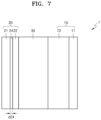
- FIGS. 6 to 8 are cross-sectional views of an embodiment of an all-solid secondary battery.
- first,” “second,” “third,” etc. may be used herein to describe various elements, components, regions, layers, and/or sections, these elements, components, regions, layers, and/or sections should not be limited by these terms. These terms are only used to distinguish one element, component, region, layer, or section from another element, component, region, layer, or section. Thus, “a first element,” “component,” “region,” “layer,” or “section” discussed below could be termed a second element, component, region, layer, or section without departing from the teachings herein.
- relative terms such as “lower” or “bottom” and “upper” or “top,” may be used herein to describe one element's relationship to another element as illustrated in the Figures. It will be understood that relative terms are intended to encompass different orientations of the device in addition to the orientation depicted in the Figures. For example, if the device in one of the figures is turned over, elements described as being on the “lower” side of other elements would then be oriented on “upper” sides of the other elements. The exemplary term “lower,” can therefore, encompasses both an orientation of “lower” and “upper,” depending on the particular orientation of the figure.
- “About” or “approximately” as used herein is inclusive of the stated value and means within an acceptable range of deviation for the particular value as determined by one of ordinary skill in the art, considering the measurement in question and the error associated with measurement of the particular quantity (i.e., the limitations of the measurement system). For example, “about” can mean within one or more standard deviations, or within ⁇ 30%, 20%, 10% or 5% of the stated value.
- Exemplary embodiments are described herein with reference to cross section illustrations that are schematic illustrations of idealized embodiments. As such, variations from the shapes of the illustrations as a result, for example, of manufacturing techniques and/or tolerances, are to be expected. Thus, embodiments described herein should not be construed as limited to the particular shapes of regions as illustrated herein but are to include deviations in shapes that result, for example, from manufacturing. For example, a region illustrated or described as flat may, typically, have rough and/or nonlinear features. Moreover, sharp angles that are illustrated may be rounded. Thus, the regions illustrated in the figures are schematic in nature and their shapes are not intended to illustrate the precise shape of a region and are not intended to limit the scope of the present claims.
- a C-rate describes a discharge rate of a cell, and is obtained by dividing a total capacity of the cell by a total discharge period of time of 1 hour, e.g., a C-rate for a battery having a discharge capacity of 1.6 ampere-hours would be 1.6 amperes.
- argyrodite structure or “argyrodite crystal structure” means that the compound has a structure that is isostructural with argyrodite, Ag 8 GeS 6 .
- the term “pseudohalogen” refers to a molecule including two or more electronegative atoms, which in the free state show properties similar to halogens.
- the pseudohalogen generates anions which resemble halide ions.
- Examples of the pseudohalogen may include cyanide (CN), cyanate (OCN), thiocyanate (SCN), azide (N 3 ⁇ ), or a combination thereof.
- a solid electrolyte, an electrochemical cell including the solid electrolyte; and a method of preparing the solid electrolyte will be described in detail.
- a solid electrolyte including a compound represented by Formula 1: (Li 1-a M a ) 7-d+x PS 6-d-x+k N x X d Formula 1 wherein, in Formula 1,
- the value of k is determined so that the compound of Formula 1 is electrically neutral.
- M is sodium (Na), potassium (K), or a combination thereof.
- An amount of nitrogen in the solid electrolyte may be in a range of greater than 0 mole percent (mol %) to about 10 mol %, for example, greater than 0 mol % to about 5 mol %, or, for example, about 1 mol % to about 5 mol %, based on the total amount of sulfur and nitrogen in the solid electrolyte.
- X of Formula 1 is Cl.
- X is CI and optionally at least one of F, Br, or I.
- X d may be Cl d , Br d , or (Br 1-x2 Cl x2 ) d , wherein 0 ⁇ x2 ⁇ 1 and 0 ⁇ d ⁇ 1.
- lithium mobility is increased by introducing an element having large atomic size into a sulfur (S) site to increase an ion conductivity of a sulfide-based solid electrolyte having an argyrodite crystal structure.
- S sulfur
- the sulfide-based solid electrolyte has weak oxidation stability, at a high voltage during charge, may form a resistance layer due to a reaction at an interface of the solid electrolyte and a cathode layer. The interface may result in an undesired increase in internal resistance, and thus improvement to avoid the increased resistance is desired.
- a solid electrolyte that has an argyrodite crystal structure that includes nitrogen (N) exhibits a stabilized interface due to a decrease in the presence of a resistance layer, which is understood to be caused by a reaction at an interface between a cathode and an electrolyte.
- the disclosed solid electrolyte has an argyrodite crystal structure and includes nitrogen (N), and has excellent ion conductivity at an equal level of an ion conductivity of lithium of prior art sulfide-based electrolytes having an argyrodite crystal structure, despite an increase in an amount of lithium due to the inclusion of nitrogen.
- the disclosed solid electrolyte provides improved stability at a high voltage. The improved stability is understood to result from decreased side reaction at an interface between the cathode layer and the electrolyte, which increases a discharge capacity, and thus an electrochemical cell having improved capacity retention and charge/discharge characteristics may be provided.
- X is chlorine (Cl), bromine (Br), iodine (I), or a combination thereof; and 0 ⁇ x ⁇ 1 and 0 ⁇ d ⁇ 1.
- X d is Cl d , Br d , or (Br 1-x1 (Cl) x1 ) d , and 0 ⁇ x1 ⁇ 1 and 0 ⁇ d ⁇ 1.
- x1 may be, for example, in a range of about 0.1 to about 0.9, for example, about 0.2 to about 0.8, about 0.3 to about 0.7, or about 0.4 to about 0.6; or about 0.5.
- the compound represented by Formula 1 may be, for example, a compound represented by Formula 3, Formula 4, or a combination thereof: (Li 1-a Na a ) 7-d+x PS 6-d-x N x X d Formula 3
- X may be a combination of Br and Cl, e.g., Br 1-x1 Cl x1 , wherein 0 ⁇ x1 ⁇ 1.
- the compound of Formula 1 may thus be, for example, a compound represented by Formula 5: Li 7-d+x PS 6-d-x N x (Br 1-x1 Cl x1 ) d Formula 5
- the compound represented by Formula 1 may be, for example, Li 6.125 PS 4.875 N 0.125 Cl, Li 6.25 PS 4.75 N 0.25 Cl, Li 6.5 PS 4.5 N 0.5 Cl, Li 6 Na 0.125 PS 4.875 N 0.125 Cl, Li 6 Na 0.25 PS 4.75 N 0.25 Cl, Li 6 K 0.125 PS 4.875 N 0.125 Cl, Li 6 K 0.25 PS 4.75 N 0.25 Cl, Li 6.125 PS 4.875 N 0.125 Cl 0.5 Br 0.5 , Li 6.25 PS 4.75 N 0.25 Cl 0.5 Br 0.5 , Li 6 Na 0.125 PS 4.875 N 0.125 Cl 0.5 Br 0.5 , Li 6 Na 0.25 PS 4.75 N 0.25 Cl 0.5 Br 0.5 , Li 6 K 0.125 PS 4.875 N 0.125 Cl 0.5 Br 0.5 , Li 6 K 0.125 PS 4.875 N 0.125 Cl 0.5 Br 0.5 , Li 6 K 0.25 PS 4.75 N 0.25 Cl 0.5 Br 0.5 , Li 6 K 0.125 PS 4.875 N 0.125 Cl 0.5 Br 0.5 , Li
- the solid electrolyte may be used as an electrolyte for an all-solid battery, e.g., between a cathode layer and an anode layer.
- the solid electrolyte may be used within the cathode layer and/or within the anode layer, e.g., as a cathode layer electrolyte material for an all-solid battery.
- the battery is a lithium-sulfur battery. Mentioned is an aspect where the solid electrolyte may be used as a cathode layer and/or an electrolyte of a lithium-sulfur battery.
- the solid electrolyte may be used as a cathode electrolyte or as an anode layer protection layer for a lithium metal battery.
- the anode layer protection layer may be on the anode layer and between the anode layer and the cathode layer.
- An ion conductivity of the solid electrolyte at 25° C. may be equal to or greater than about 1 millisiemen per centimeter (mS/cm), equal to or greater than about 1.3 mS/cm, equal to or greater than about 1.5 mS/cm, greater than about 1.6 mS/cm, equal to or greater than about 2.0 mS/cm, in a range of about 2.0 mS/cm to about 20 mS/cm, or in a range of about 2.0 mS/cm to about 10 mS/cm.
- the solid electrolyte may be applied as an electrolyte of an electrochemical cell.
- an electrochemical cell includes a cathode layer; an anode layer; and a solid electrolyte layer disposed between the cathode layer and the anode layer, wherein at least one of the solid electrolyte layer and the cathode layer includes the solid electrolyte comprising the compound of Formula 1.
- the solid electrolyte layer includes the solid electrolyte comprising the compound of Formula 1
- a side reaction e.g., with lithium metal in the anode layer, is suppressed, and thus cycle characteristics of the electrochemical cell may improve.
- the electrochemical cell may be, for example, an all-solid secondary battery or a lithium air battery, but are not limited thereto, and any suitable material or an electrochemical cell configuration may be used.
- the cathode layer may include a solid electrolyte including a compound represented by Formula 1: (Li 1-a M a ) 7-d+x PS 6-d-x+k N x X d Formula 1 wherein, in Formula 1,
- the compound of Formula 1 may be a compound represented by Formula 1-1: (Li 1-a M a ) 7-d+x PS 6-d-x N x X d Formula 1-1 wherein, in Formula 1-1,
- M is sodium (Na), potassium (K), or a combination thereof.
- an amount of the solid electrolyte may be in a range of about 2 parts by weight to about 70 parts by weight, for example, about 3 parts by weight to about 70 parts by weight, about 3 parts by weight to about 60 parts by weight, or, about 10 parts by weight to about 60 parts by weight, based on 100 parts by weight of a cathode active material in the cathode layer.
- the amount of the solid electrolyte is within these ranges, high-voltage stability of the electrochemical cell may improve.
- a capacity retention is equal to or greater than about 85% at a 100th cycle after charging to equal to or greater than 4 Volts, for example, 4.25V and discharging to 2.5 Volts the electrochemical cell in a constant-temperature chamber of 25° C.
- the capacity retention of the electrochemical cell after charge/discharge of the cell between equal to or greater than 4 V, for example, 4.25V and 2.5 V or less in a constant-temperature chamber of 25° C. may be for example, equal to or greater than about 86%, equal to or greater than about 88%, or in a range of about 88% to about 99.5% at 100 cycles.
- the solid electrolyte used in the active material layer in an all-solid-state secondary battery e.g., in a cathode active material layer of a cathode layer, or in an anode active material layer of an anode layer, may have a different particle size range than a solid electrolyte used in a solid electrolyte layer.
- the solid electrolyte used in the active material layer for example, has an average particle diameter, which is smaller than an average particle diameter of the solid electrolyte used in the solid electrolyte layer.
- the solid electrolyte used in the active material layer has an average particle diameter of about 100 nanometers (nm) to about 10 micrometers ( ⁇ m), about 300 nm to about 8 ⁇ m, or about 500 nm to about 5 ⁇ m.
- the solid electrolyte used in the solid electrolyte layer has an average particle diameter of about 500 nm to about 20 ⁇ m, about 700 nm to about 15 ⁇ m, or about 900 nm to about 10 ⁇ m.
- the particle diameter may be determined by light scattering or by SEM analysis, for example.
- an all-solid secondary battery 1 includes an anode layer 20 including an anode current collector 21 and a first anode active material layer 22 ; a cathode layer 10 including a cathode active material layer 12 ; and a solid electrolyte layer 30 disposed between the anode layer 20 and the cathode layer 10 .
- the cathode layer 10 may include the solid electrolyte.
- the cathode layer 10 may include, for example, a cathode active material, a solid electrolyte, and a conducting agent.
- the anode layer 20 includes the anode current collector 21 and the first anode active material layer 22 , and the first anode active material layer 22 includes an anode active material.
- the anode active material in the first anode active material layer 22 may be in the form of particles.
- An average particle diameter of the particles may be, for example, about 4 ⁇ m or less, about 3 ⁇ m or less, about 2 ⁇ m or less, about 1 ⁇ m or less, or about 900 nm or less.
- An average particle diameter of the particles may be, for example, in a range of about 10 nm to about 4 ⁇ m, about 10 nm to about 3 ⁇ m, about 10 nm to about 2 ⁇ m, about 10 nm to about 1 ⁇ m, or about 10 nm to about 900 nm.
- the average particle diameter of the anode active material may be, for example, a median diameter (D50) measured by using a laser diffraction particle diameter distribution meter.
- the anode active material in the first anode active material layer 22 may include, for example, at least one of a carbonaceous anode active material, a metal, or a metalloid.
- the carbonaceous anode active material may be, for example, amorphous carbon.
- amorphous carbon may include carbon black (CB), acetylene black (AB), furnace black (FB), Ketjen black (KB), and graphene, but are not limited thereto, and any suitable material available as amorphous carbon may be used.
- the amorphous carbon refers to carbon that has no crystallinity or a very low crystallinity, which may be different from crystalline carbon or graphite carbon.
- the metal or metalloid anode active material may include at least one of gold (Au), platinum (Pt), palladium (Pd), silicon (Si), silver (Ag), aluminum (Al), bismuth (Bi), tin (Sn), or zinc (Zn), but are not limited thereto, and any suitable material that is available as a metal anode active material or a metalloid anode active material capable of forming an alloy or a compound with lithium may be used.
- gold Au
- platinum (Pt) palladium
- silicon Si
- silver Ag
- nickel (Ni) does not form an alloy with lithium and thus is not a suitable metal anode active material.
- the first anode active material layer 22 may include one of these anode active materials or may include a mixture of a plurality of different anode active materials.
- the first anode active material layer 22 may only include amorphous carbon or may include at least one of gold (Au), platinum (Pt), palladium (Pd), silicon (Si), silver (Ag), aluminum (Al), bismuth (Bi), tin (Sn), or zinc (Zn).
- the first anode active material layer 22 may include a mixture including amorphous carbon and at least one of gold (Au), platinum (Pt), palladium (Pd), silicon (Si), silver (Ag), aluminum (Al), bismuth (Bi), tin (Sn), or zinc (Zn).
- a mixing ratio of amorphous carbon to an element such as gold in the mixture may be a weight ratio in a range of about 10:1 to about 1:2, about 5:1 to about 1:1, or about 4:1 to about 2:1, but are not limited thereto, and the mixing ratio may be selected according to characteristics of the all-solid secondary battery 1 .
- the anode active material includes a mixture of amorphous carbon and at least one of gold (Au), platinum (Pt), palladium (Pd), silicon (Si), silver (Ag), aluminum (Al), bismuth (Bi), tin (Sn), or zinc (Zn) in the foregoing ratios
- cycle characteristics of the all-solid secondary battery 1 may further improve.
- the anode active material in the first anode active material layer 22 may include, for example, a mixture including first particles formed of amorphous carbon and second particles formed of a metal or a metalloid.
- the metal or the metalloid may include gold (Au), platinum (Pt), palladium (Pd), silicon (Si), silver (Ag), aluminum (Al), bismuth (Bi), tin (Sn), or zinc (Zn).
- the metalloid may be a semiconductor.
- An amount of the second particles may be in a range of about 8 weight % to about 60 weight %, about 10 weight % to about 50 weight %, about 15 weight % to about 40 weight %, or about 20 weight % to about 30 weight %, based on the total weight of the mixture. When the amount of the second particles is within these ranges, cycle characteristics of the all-solid secondary battery 1 may further improve.
- the first anode active material layer 22 may include a binder.
- the binder may include styrene-butadiene rubber (SBR), polytetrafluoroethylene (PTFE), polyvinylidene fluoride (PVDF), polyethylene, a vinylidene fluoride/hexafluoropropylene copolymer, polyacrylonitrile, and polymethylmethacrylate, but are not limited thereto, and any suitable material available as a binder may be used.
- the binder may comprise one of the examples of the binder alone or a plurality of binders.
- the first anode active material layer 22 When the first anode active material layer 22 includes the binder, the first anode active material layer 22 is stabilized on the anode current collector 21 . Also, cracks in the first anode active material layer 22 may be suppressed despite of volume change and/or relative location change of the first anode active material layer 22 during charge/discharge. For example, when the first anode active material layer 22 does not include a binder, the first anode active material layer 22 may be easily separated from the anode current collector 21 .
- the first anode active material layer 22 may be prepared by, for example, coating and drying a slurry on the anode current collector 21 .
- the slurry includes dispersed materials for forming the first anode active material layer 22 .
- the binder is included in the first anode active material layer 22 , the anode active material may be stably dispersed in the slurry. For example, when the slurry is coated on the anode current collector 21 by using a screen printing method, clogging of screen (e.g., screen clogging by an aggregate of the anode active material) may be suppressed.
- a thickness (d22) of the first anode active material layer 22 may be, for example, about 50% or less, about 40% or less, about 30% or less, about 20% or less, about 10% or less, or about 5% or less of a thickness (d12) of the cathode active material layer 12 .
- a thickness (d22) of the first anode active material layer 22 may be in a range of about 1 ⁇ m to about 20 ⁇ m, about 2 ⁇ m to about 10 ⁇ m, or about 3 ⁇ m to about 7 ⁇ m.
- the thickness (d22) of the first anode active material layer 22 When the thickness (d22) of the first anode active material layer 22 is too thin, lithium dendrites formed between the first anode active material layer 22 and the anode current collector 21 destroys the first anode active material layer 22 , and thus cycle characteristics of the all-solid secondary battery 1 may not improve.
- the thickness (d22) of the first anode active material layer 22 is too thick, an energy density of the all-solid secondary battery 1 deteriorates and an internal resistance of the all-solid secondary battery 1 by the first anode active material layer 22 increases, and thus cycle characteristics of the all-solid secondary battery 1 may not improve.
- a charge capacity of the first anode active material layer 22 decreases.
- the charge capacity of the first anode active material layer 22 may be, for example, about 50% or less, about 40% or less, about 30% or less, about 20% or less, about 10% or less, about 5% or less, or about 2% or less of a charge capacity of the cathode active material layer 12 .
- the charge capacity of the first anode active material layer 22 may be, for example, in a range of about 0.1% to about 50%, about 0.1% to about 40%, about 0.1% to about 30%, about 0.1% to about 20%, about 0.1% to about 10%, about 0.1% to about 5%, or about 0.1% to about 2% of a charge capacity of the cathode active material layer 12 .
- a thickness of the first anode active material layer 22 is too thin, lithium dendrites formed between the first anode active material layer 22 and the anode current collector 21 during repeated charge/discharge operations destroys the first anode active material layer 22 , and cycle characteristics of the all-solid secondary battery 1 may not improve.
- the charge capacity of the cathode active material layer 12 is obtained by multiplying a charge capacity density (mAh/g) of the cathode active material by a weight of the cathode active material in the cathode active material layer 12 .
- a value of a charge capacity density multiplied by a weight of each of the cathode active materials is calculated, and the total of these values refers to a charge capacity of the cathode active material layer 12 .
- a charge capacity of the first anode active material layer 22 may be calculated in the same manner.
- a charge capacity of the first anode active material layer 22 is obtained by multiplying a charge capacity density (mAh/g) of the anode active material by a weight of the anode active material in the first anode active material layer 22 .
- a value of a charge capacity density multiplied by a weight of each of the anode active materials is calculated, and the total of these values is a charge capacity of the first anode active material layer 22 .
- the charge capacity densities of the cathode active material and the anode active material are obtained from capacities estimated by using an all-solid half-cell in which lithium metal is used as a reference electrode.
- the charge capacities of the cathode active material layer 12 and the first anode active material layer 22 are directly measured by charge capacity measurement using an all-solid half-cell. When the measured charge capacity is divided by a weight of each of the active materials, a charge capacity density may be obtained.
- the charge capacities of the cathode active material layer 12 and the first anode active material layer 22 may be initial charge capacities measured in the 1st charging cycle.
- the anode current collector 21 may be formed of, for example, a material that does not react with lithium or is not capable of forming an alloy or a compound with lithium. Examples of the material forming the anode current collector 21 may include copper (Cu), stainless steel, titanium (Ti), iron (Fe), cobalt (Co), or nickel (Ni), but are not limited thereto, and any suitable material available as an electrode current collector may be used.
- the anode current collector 21 may be formed of the metal or an alloy or a coating material of at least two metals.
- the anode current collector 21 may be, for example, in the form of a plate or a foil.
- the first anode active material layer 22 may further include additives that are used in an all-solid secondary battery 1 , such as a filler, a dispersant, and an ion conducting agent.
- the all-solid secondary battery 1 may further include, for example, a thin film 24 on the anode current collector 21 , the thin film 24 including an element alloyable with lithium.
- the thin film 24 is disposed between the anode current collector 21 and the first anode active material layer 22 .
- the thin film 24 may include, for example, an element alloyable with lithium. Examples of the element alloyable with lithium may include gold, silver, zinc, tin, indium, silicon, aluminum, or bismuth, but are not limited thereto, and any suitable element alloyable with lithium may be used.
- the thin film 24 is formed of any of these metals or an alloy of various metals.
- the precipitation of the metal layer may be further flattened between the thin film 24 and the first anode active material layer 22 , and thus cycle characteristics of the all-solid secondary battery 1 may further improve.
- a thickness (d24) of the thin film 24 may be, for example, in a range of about 1 nm to about 800 nm, about 10 nm to about 700 nm, about 50 nm to about 600 nm, or about 100 nm to about 500 nm.
- the thickness (d24) of the thin film 24 is less than about 1 nm, the thin film 24 may not function properly.
- the thickness (d24) of the thin film 24 is too thick, the thin film 24 itself absorbs lithium, and a precipitation amount of lithium in an anode may decrease, which results in deterioration of an energy density of the all-solid secondary battery 1 , and thus cycle characteristics of the all-solid secondary battery 1 may be deteriorated.
- the thin film 24 may be disposed on the anode current collector 21 by using, for example, vacuum vapor deposition, sputtering, or plating, but not limited thereto, and any suitable method capable of forming a thin film may be used.
- the all-solid secondary battery 1 may further include, for example, a second anode active material layer 23 between the anode current collector 21 and the solid electrolyte layer 30 by charging of the all-solid secondary battery 1 .
- the all-solid secondary battery 1 may further include, for example, a second anode active material layer 23 between the anode current collector 21 and the first anode active material layer 22 by charging of the all-solid secondary battery 1 .
- the all-solid secondary battery 1 may further include, for example, a second anode active material layer 23 disposed between the solid electrolyte layer 30 and the first anode active material layer 22 by charging of the all-solid secondary battery 1 .
- the all-solid secondary battery 1 may further include, for example, a second anode active material layer 23 in the first anode active material layer 22 by charging of the battery 1 .
- the second anode active material layer is a metal layer including lithium or a lithium alloy.
- the metal layer includes lithium or a lithium alloy.
- the second anode active material layer 23 may function as, for example, a lithium reservoir.
- the lithium alloy may include a Li—Al alloy, a Li—Sn alloy, a Li—In alloy, a Li—Ag alloy, a Li—Au alloy, a Li—Zn alloy, a Li—Ge alloy, or a Li—Si alloy, but are not limited thereto, and any suitable material available as a lithium alloy in the art may be used.
- the second anode active material layer 23 may be formed of one of these alloys of lithium or may be formed of various alloys.
- a thickness (d23) of the second anode active material layer 23 may be, for example, in a range of about 1 ⁇ m to about 1000 ⁇ m, about 1 ⁇ m to about 500 ⁇ m, about 1 ⁇ m to about 200 ⁇ m, about 1 ⁇ m to about 150 ⁇ m, about 1 ⁇ m to about 100 ⁇ m, or about 1 ⁇ m to about 50 ⁇ m, but is not limited thereto.
- the thickness (d23) of the second anode active material layer 23 is too thin, the second anode active material layer 23 may not serve as a lithium reservoir.
- the second anode active material layer 23 may be, for example, a metal foil having a thickness in the range of about 1 ⁇ m to about 1000 ⁇ m.
- the second anode active material layer 23 may be disposed between the anode current collector 21 and the first anode active material layer 22 before assembling the all-solid secondary battery 1 or may be precipitated between the anode current collector 21 and the first anode active material layer 22 after assembling the all-solid secondary battery 1 by charging of the all-solid secondary battery 1 .
- the second anode active material layer 23 is a metal layer including lithium and thus may function as a lithium reservoir.
- cycle characteristics of the all-solid secondary battery 1 including the second anode active material layer 23 may further improve.
- a lithium foil is disposed between the anode current collector 21 and the first anode active material layer 22 before assembling the all-solid secondary battery 1 .
- the all-solid secondary battery 1 may be charged over a charge capacity of the first anode active material layer 22 . That is, the first anode active material layer 22 is overcharged.
- lithium is absorbed in the first anode active material layer 22 . That is, an anode active material in the first anode active material layer 22 may form an alloy or a compound with lithium ions migrated from the cathode layer 10 .
- the second anode active material layer 23 is a metal layer comprising lithium, e.g. lithium metal or a lithium alloy. This occurs because, for example, the anode active material in the first anode active material layer 22 is formed of a material capable of forming an alloy or a compound with lithium.
- lithium of the first anode active material layer 22 and the second anode active material layer 23 i.e., a metal layer, is ionized and migrates towards the cathode layer 10 .
- lithium may be used as an anode active material in the all-solid secondary battery 1 .
- the first anode active material layer 22 covers the second anode active material layer 23
- the first anode active material layer 22 serves as a protection layer to the second anode active material layer 23 and suppresses precipitation growth of lithium dendrite at the same time.
- it may prevent a short-circuit and reduces capacity deterioration of the all-solid secondary battery 1 , and as a result, cycle characteristics of the all-solid secondary battery 1 may improve.
- the anode current collector 21 , the first anode active material layer 22 , and a region therebetween are, for example, Li-free regions that do not include lithium metal or a lithium alloy in the initial state or an after-discharge state of the all-solid secondary battery 1 .
- the all-solid secondary battery 1 may have a structure in which the second anode active material layer 23 is disposed on the anode current collector 21 , and the solid electrolyte layer 30 is directly disposed on the second anode active material layer 23 .
- the second anode active material layer 23 may be, for example, a lithium metal layer or a lithium alloy layer.
- the solid electrolyte layer 30 includes the sulfide-based solid electrolyte, a side reaction between the second anode active material layer 23 , which is a lithium metal layer, and the solid electrolyte layer 30 is suppressed, and thus cycle characteristics of the all-solid secondary battery 1 may improve.
- the solid electrolyte layer 30 includes the solid electrolyte between the cathode layer 10 and the anode layer 20 .
- the solid electrolyte may further include a second solid electrolyte in addition to the solid electrolyte of Formula 1.
- the solid electrolyte may further include at least one of Li 2 S—P 2 S 5 , Li 2 S—P 2 S 5 —LiX (where X is a halogen element), Li 2 S—P 2 S 5 —Li 2 O, Li 2 S—P 2 S 5 —Li 2 O—LiI, Li 2 S—SiS 2 , Li 2 S—SiS 2 —LiI, Li 2 S—SiS 2 —LiBr, Li 2 S—SiS 2 —LiCl, Li 2 S—SiS 2 —B 2 S 3 —LiI, Li 2 S—SiS 2 —P 2 S 5 —LiI, Li 2 S—B 2 S 3 , Li 2 S—P 2 S 5 —Z m S n (where m and n are each a positive integer, and Z is one of Ge,
- the second solid electrolyte may be a sulfide-based solid electrolyte and may further include, for example, an argyrodite-type solid electrolyte represented by Formula 5-1: Li + 12-n-x A n+ X′ 2 ⁇ 6-x Y′ ⁇ x Formula 5-1 wherein, in Formula 5-1,
- Examples of the argyrodite-type solid electrolyte may include at least one of Li 7-x PS 6-x Cl x (where 0 ⁇ x ⁇ 2), Li 7-x PS 6-x Br x (where 0 ⁇ x ⁇ 2), or Li 7-x PS 6-x I x (where 0x2).
- the argyrodite-type solid electrolyte particularly includes at least one of Li 6 PS 5 Cl, Li 6 PS 5 Br, or Li 6 PS 5 I.
- the solid electrolyte layer 30 may further include, for example, a binder.
- a binder included in the solid electrolyte layer 30 may include styrene butadiene rubber (SBR), polytetrafluoroethylene, polyvinylidene fluoride, polyethylene, or a combination thereof, but are not limited thereto, and any suitable material available as a binder may be used.
- SBR styrene butadiene rubber
- the binder of the solid electrolyte layer 30 may be identical to or different from the binders of the cathode active material layer 12 and the first anode active material layer 22 .
- the cathode layer 10 includes the cathode current collector 11 and the cathode active material layer 12 .
- the cathode current collector 11 may be a plate or a foil formed of, for example, indium (In), copper (Cu), magnesium (Mg), stainless steel, titanium (Ti), iron (Fe), cobalt (Co), nickel (Ni), zinc (Zn), aluminum (Al), germanium (Ge), lithium (Li), or an alloy thereof.
- the cathode current collector 11 may be omitted.
- the cathode active material layer 12 may include, for example, a cathode active material and a solid electrolyte.
- the solid electrolyte in the cathode active material layer 12 may be similar to or different from the solid electrolyte in the solid electrolyte layer 30 .
- the solid electrolyte in the cathode active material layer may be the same as the solid electrolyte layer 30 .
- the cathode active material layer 12 may include the solid electrolyte according to an embodiment.
- a cathode layer may include a cathode active material, and the cathode active material may be a compound capable of reversibly absorbing and desorbing, intercalating, lithium ions.
- the cathode active material may be, for example, at least one of a lithium transition metal oxide having a layered crystal structure, a lithium transition metal oxide having an olivine crystal structure, or a lithium transition metal oxide having a spinel crystal structure.
- the cathode active material may include a lithium transition metal oxide such as a lithium cobalt oxide (LCO), a lithium nickel oxide, a lithium nickel cobalt oxide, a lithium nickel cobalt aluminum oxide (NCA), a lithium nickel cobalt manganate (NCM), a lithium manganate, or a lithium iron phosphate; a nickel sulfide; a copper sulfide; a lithium sulfide; an iron oxide; or a vanadium oxide, but are not limited thereto, and any suitable material available as a cathode active material may be used.
- the cathode active material may be formed of a single material or as a mixture of at least two of the cathode active materials.
- the cathode active material may be a compound represented by at least one of the following formulae:
- Li a A 1-b B′ b D 2 (where 0.90 ⁇ a ⁇ 1 and 0 ⁇ b ⁇ 0.5); Li a E 1-b B′ b O 2-c D c (where 0.90 ⁇ a ⁇ 1, 0 ⁇ b ⁇ 0.5, and 0 ⁇ c ⁇ 0.05); LiE 2-b B′ b O 4-c D c (where 0 ⁇ b ⁇ 0.5 and 0 ⁇ c ⁇ 0.05); Li a Ni 1-b-c Co b B′ c D ⁇ (where 0.90 ⁇ a ⁇ 1, 0 ⁇ b ⁇ 0.5, 0 ⁇ c ⁇ 0.05, and 0 ⁇ 2); Li a Ni 1-b-c Co b B′ c O 2- ⁇ F′ ⁇ (where 0.90 ⁇ a ⁇ 1, 0 ⁇ b ⁇ 0.5, 0 ⁇ c ⁇ 0.05, and 0 ⁇ a ⁇ 2); Li a Ni 1-b-c Co b B′ c O 2- ⁇ F′ 2 (where 0.90 ⁇ a ⁇ 1, 0 ⁇ b ⁇ 0.5, 0 ⁇ c ⁇ 0.05, and 0 ⁇ a ⁇ 2); Li a Ni 1-b-c
- the compounds listed above as cathode active materials may have a surface coating layer (hereinafter, also referred to as “coating layer”).
- a surface coating layer hereinafter, also referred to as “coating layer”.
- the coating layer may include, for example, a coating element compound of an oxide, a hydroxide, an oxyhydroxide, an oxycarbonate, or a hydroxycarbonate of the coating element.
- the compounds for the coating layer may be amorphous or crystalline.
- the coating element for the coating layer may be magnesium (Mg), aluminum (Al), cobalt (Co), potassium (K), sodium (Na), calcium (Ca), silicon (Si), titanium (Ti), vanadium (V), tin (Sn), germanium (Ge), gallium (Ga), boron (B), arsenic (As), zirconium (Zr), or a combination thereof.
- the coating layer may be formed using any method that does not adversely affect the physical properties of the cathode active material.
- the coating layer may be formed using a spray coating method or a dipping method. Any suitable coating method may be used.
- the cathode active material may include, for example, a lithium salt of a transition metal oxide that has a layered rock-salt type structure among the examples of the lithium transition metal oxide.
- the “layered rock-salt type structure” refers to a structure in which an oxygen atom layer and a metal atom layer are alternately and regularly arranged in a ⁇ 111> direction in a cubic rock-salt type structure, where each of the atom layers forms a two-dimensional flat plane.
- the “cubic rock-salt type structure” refers to a sodium chloride (NaCl) type structure, which is one of the crystalline structures, in particular, to a structure in which face-centered cubic (fcc) lattices respectively formed of anions and cations are shifted by only a half of the ridge of each unit lattice.
- NCA LiNi x Co y Al z O 2
- NCM LiNi x Co y Mn z O 2
- the cathode active material may be covered by a coating layer.
- the coating layer is any suitable material that may be used as a coating layer of a cathode active material of an all-solid secondary battery.
- the coating layer may be, for example, Li 2 O—ZrO 2 .
- the cathode active material includes nickel (Ni) as a ternary lithium transition metal oxide such as NCA or NCM
- Ni nickel
- NCA ternary lithium transition metal oxide
- a capacity density of the all-solid secondary battery increases, Also, in a charged state of the all-solid-state battery using the cathode active material, metal elution from the cathode active material may be reduced. As a result, the cycle characteristics of the all-solid secondary battery improve.
- a shape of the cathode active material may be, for example, in the form of a particle including a true spherical shape or an elliptical shape.
- a particle diameter of the cathode active material is not particularly limited and may be in a range applicable to a cathode active material of an all-solid secondary battery.
- An amount of the cathode active material of the cathode layer is not particularly limited and may be in a suitable range applicable to a cathode layer of an all-solid secondary battery.
- the cathode layer may further include, for example, additives such as a conducting agent, a binder, a filler, a dispersant, or an ion conducting agent in addition to the cathode active material and the solid electrolyte.
- additives such as a conducting agent, a binder, a filler, a dispersant, or an ion conducting agent in addition to the cathode active material and the solid electrolyte.
- the conducting agent may include graphite, carbon black, acetylene black, Ketjen black, carbon fiber, or a metal powder.
- the binder may include styrene butadiene rubber (SBR), polytetrafluoroethylene, polyvinylidene fluoride, or polyethylene.
- SBR styrene butadiene rubber
- the filler, the dispersant, or the ion conducting agent that may be added to the cathode layer may be materials that are suitable in an electrode of an all-solid
- a method of preparing a solid electrolyte includes providing a sulfur (S) precursor, a phosphorus (P) precursor, an X precursor, and a nitrogen (N) precursor; and mixing the sulfur (S) precursor, the phosphorus (P) precursor, the X precursor, and the nitrogen (N) precursor to prepare a solid electrolyte precursor, and then heat-treating the solid electrolyte precursor at a temperature about 300° C. or higher.
- X of the X precursor may be chlorine (Cl), bromine (Br), fluorine (F), iodine (I), a pseudohalogen, or a combination thereof.
- At least one of the sulfur precursor, phosphorus precursor, X precursor, or nitrogen precursor may include lithium.
- Examples of the sulfur precursor may include Li 2 S, and examples of the phosphorus precursor may include P 2 S 5 , red phosphorus, white phosphorus, phosphorus powders, (NH 4 ) 2 HPO 4 , (NH 4 )H 2 PO 4 , Na 2 HPO 4 , or Na 3 PO 4 .
- Examples of the nitrogen precursor may include Li 3 N or N 2 S 3 .
- Examples of the X precursor may include a lithium halide.
- Examples of the lithium halide may include LiCl, LiI, or LiBr.
- the precursor mixture may further include an M precursor.
- M of the M precursor may be sodium (Na), potassium (K), calcium (Ca), iron (Fe), magnesium (Mg), silver (Ag), copper (Cu), zirconium (Zr), zinc (Zn), or a combination thereof.
- the mixing of the precursor mixture may include, for example, reacting the mixture to obtain a solid electrolyte precursor, and the solid electrolyte precursor is heat-treated at a temperature equal to or greater than about 300° C. to prepare a solid electrolyte.
- the solid electrolyte may include nitrogen and thus may extend a temperature range at which an ion conductive phase is formed.
- the heat-treating temperature may be, for example, in a range of about 300° C. to about 600° C., about 300° C. to about 550° C., or about 350° C. to about 500° C.
- a solid electrolyte does not have an argyrodite crystal structure.
- examples of the method may include a mechanical milling (MM).
- MM mechanical milling
- starting materials such as Li 2 S or P 2 S 5 are reacted by stirring with a ball mill to prepare a solid electrolyte precursor.
- a stirring rate and a stirring time of the mechanical milling are not particularly limited, a production rate of the solid electrolyte precursor increases as the stirring rate increases, and a conversion rate of the starting materials to the solid electrolyte precursor may increase as the stirring time increases.
- the solid electrolyte precursor obtained by the mechanical milling is heat-treated at a predetermined temperature, and then the solid electrolyte precursor is pulverized to prepare a solid electrolyte in the form of a particle.
- the solid electrolyte may be changed from amorphous to crystalline by the heat-treatment.
- a temperature for the heat-treating may be, for example, in a range of about 400° C. to about 600° C. When the temperature for the heat-treating is within this range, a solid electrolyte having a uniform composition may be obtained.
- the heat-treating time may vary depending on the temperature of the heat-treating, and, for example, the heat-treating may be performed for about 1 hour to about 100 hours, about 10 hours to about 80 hours, about 10 hours to about 50 hours, about 10 hours to about 30 hours, or about 10 hours to about 20 hours.
- the time for the heat-treating is within these ranges, the solid electrolyte may have excellent ion conductivity and high-temperature stability.
- An atmosphere for the heat-treating is an inert atmosphere or vacuum atmosphere.
- Examples of the atmosphere for the heat-treating may include nitrogen and argon, but are not limited thereto, and any suitable material available as an inert atmosphere may be used.
- a thickness of the solid electrolyte may be in a range of about 10 ⁇ m to about 200 ⁇ m. When the thickness of the solid electrolyte is within this range, the all-solid secondary battery may have improved cycle characteristics and improved capacity retention.
- a method of preparing an all-solid secondary battery may include preparing a solid electrolyte by using the method described above; preparing, for example, a cathode layer 10 , an anode layer 20 , and/or a solid electrolyte layer 30 each separately by using the solid electrolyte; and stacking these layers.
- a thickness of the solid electrolyte layer 30 may be in a range of about 10 ⁇ m to about 200 ⁇ m.
- Materials forming a first anode active material layer 22 such as an anode active material, a conducting agent, a binder, and a solid electrolyte are added to a polar solvent or a non-polar solvent to prepare a slurry.
- the slurry is coated and dried on an anode current collector 21 to prepare a first stack.
- the dried first stack is pressed to prepare an anode layer 20 .
- the pressing of the first stack may be performed by using a roll press or a flat press, but embodiments are not limited thereto, and any suitable pressing method available may be used. The pressing may be omitted.
- the anode layer includes an anode current collector and a first anode active material layer including an anode active material disposed on the anode current collector, wherein the anode active material includes at least one of a carbonaceous anode active material or a metal or metalloid anode active material, wherein the carbonaceous anode active material includes at least one of amorphous carbon or crystalline carbon.
- the metal or metalloid anode active material is at least one of gold (Au), platinum (Pt), palladium (Pd), silicon (Si), silver (Ag), aluminum (Al), bismuth (Bi), tin (Sn), or zinc (Zn).
- the anode layer may further include a second anode active material layer disposed between the anode current collector and the first anode active material layer or between the solid electrolyte layer and the first anode active material layer, wherein the second anode active material layer is a metal layer including lithium or a lithium alloy.
- a cathode active material layer 12 Materials forming a cathode active material layer 12 , such as a cathode active material, a conducting agent, a binder, and a starting material for the solid electrolyte are added to a non-polar solvent to prepare a slurry.
- the slurry is coated and dried on a cathode current collector 11 to prepare a stack.
- the stack is pressed to prepare a cathode layer 10 .
- the pressing of the stack may be performed by using a roll press, a flat press, or an isostatic press, but is not limited thereto, and any suitable pressing method available may be used. The pressing may be omitted.
- the mixture of the materials forming the cathode active material layer 12 is densification-molded in the form of a pellet or extension-molded in the form of sheet to prepare a cathode layer 10 .
- a cathode current collector 11 may be omitted.
- a solid electrolyte layer 30 includes the solid electrolyte.
- the solid electrolyte layer 30 may further include a sulfide-based solid electrolyte that is used in an all-solid secondary battery, in addition to the solid electrolyte disclosed herein.
- the sulfide-based solid electrolyte may be prepared, for example, by mixing, coating and drying, and pressing a starting material for the sulfide-based solid electrolyte, a solvent, and a binder.
- the sulfide-based solid electrolyte prepared by using the method of preparing a sulfide-based solid electrolyte may be vapor-deposited by using a film-forming method, such as an aerosol deposition method, a cold spray method, or a sputtering method, to prepare a solid electrolyte.
- the solid electrolyte may be prepared by pressing of a substance of the solid electrolyte particles.
- the cathode layer 10 , the anode layer 20 , and the solid electrolyte layer 30 prepared by using the method are stacked such that the solid electrolyte layer 30 is between the cathode layer 10 and the anode layer 20 and then pressed to prepare an all-solid secondary battery 1 .
- the solid electrolyte layer 30 is disposed on the cathode layer 10 to prepare a second stack. Then, the anode layer 20 is disposed on the second stack such that the first anode active material layer contacts the solid electrolyte layer 30 to prepare a third stack, and the third stack is pressed to prepare an all-solid secondary battery 1 .
- the pressing may be performed at a temperature, for example, in a range of room temperature (about 20° C. to about 25° C.) to about 90° C. In an embodiment, the pressing may be performed at a temperature of about 100° C. or greater than 100° C. The pressing is performed, for example, for about 30 minutes or less, about 20 minutes or less, about 15 minutes or less, or about 10 minutes or less.
- the pressing is performed, for example, for about 1 minute to about 30 minutes, about 1 minute to about 20 minutes, about 1 minute to about 15 minutes, or about 1 minute to about 10 minutes.
- a method of the pressing may be performed by using an isostatic press, a roll press, or a flat press, but is not limited thereto, and any suitable pressing method may be used.
- a pressure for the pressing may be, for example, about 500 megapascals (MPa) or less, about 400 MPa or less, about 300 MPa or less, about 200 MPa or less, or about 100 MPa or less.
- a pressure for the pressing may be, for example, in a range of about 50 MPa to about 500 MPa, about 50 MPa to about 480 MPa, about 50 MPa to about 450 MPa, about 50 MPa to about 400 MPa, about 50 MPa to about 350 MPa, about 50 MPa to about 300 MPa, about 50 MPa to about 250 MPa, about 50 MPa to about 200 MPa, about 50 MPa to about 150 MPa, or about 50 MPa to about 100 MPa.
- the solid electrolyte powder may be sintered by the pressing and form one solid electrolyte.
- the structure and the preparation method of the all-solid secondary battery are examples, where members of the structure and steps of the preparation method may be appropriately modified.
- Li 2 S, P 2 S 5 , LiCl, and Li 3 N were mixed to obtain a precursor mixture, amounts of Li 2 S, P 2 S 5 , LiCl, and Li 3 N in the preparation of the precursor mixture were each measured at a stoichiometric ratio to obtain Li 6.125 PS 4.875 N 0.125 Cl, and the resultant was mixed by performing a mechanical milling treatment for 20 hours by using a high energy mill (Pulnerisette 7). The mechanical milling treatment was performed at a rotation rate of 380 rpm, at 25° C., and in an argon atmosphere for 20 hours to obtain a powder material. 300 mg of the powder material obtained from the mechanical milling treatment was heat-treated in a vacuum atmosphere at 500° C. for 12 hours to obtain a solid electrolyte. In the solid electrolyte (Li 6.125 PS 4.875 N 0.125 Cl) of Example 1, the amount of nitrogen is 2.5 mol % based on the total amount of sulfur and nitrogen.
- a solid electrolyte was obtained in the same manner as in Example 1, except that the amounts of Li 2 S, P 2 S 5 , LiCl, and Li 3 N were stoichiometrically selected to obtain Li 6.25 PS 4.75 N 0.25 Cl and that the heat-treatment was performed at 500° C. for 12 hours.
- the amount of nitrogen is 5 mol % based on the total amount of sulfur and nitrogen.
- a solid electrolyte was obtained in the same manner as in Example 1, except that the amounts of Li 2 S, P 2 S 5 , LiCl, and Li 3 N were stoichiometrically selected to obtain Li 6.25 PS 4.5 N 0.5 Cl and that the heat-treatment was performed at 500° C. for 12 hours.
- the amount of nitrogen is 10 mol % based on the total amount of sulfur and nitrogen.
- a solid electrolyte was obtained in the same manner as in Example 1, except that LiBr was further used in the preparation of a precursor mixture, the amounts of Li 2 S, P 2 S 5 , LiCl, LiBr, and Li 3 N were stoichiometrically selected to obtain Li 6.25 PS 4.75 N 0.25 Cl 0.5 Br 0.5 , and the heat-treatment was performed at 450° C. for 12 hours.
- a solid electrolyte was obtained in the same manner as in Example 1, except that the amounts of Li 2 S, Na 2 S, K 2 S, P 2 S 5 , LiCl, LiBr, and Li 3 N were stoichiometrically selected to obtain a solid electrolyte having a composition shown in Table 1.
- Example 5-5 represents a solid electrolyte in which a portion of lithium (Li) of a solid electrolyte was substituted with potassium (K) and a portion of sulfur (S) was substituted with nitrogen (N).
- a solid electrolyte was obtained in the same manner as in Example 1, except that Li 2 S, P 2 S 5 , and LiCl were used for the preparation of the precursor mixture, the amounts of Li 2 S, P 2 S 5 , and LiCl were stoichiometrically selected to obtain Li 6 PS 5 Cl, and the heat-treatment was performed at 500° C. for 12 hours.
- a solid electrolyte was obtained in the same manner as in Example 1, except that the heat-treatment was performed at 250° C.
- the target argyrodite-type solid electrolyte was not obtained in Comparative Example 2.
- LiN 3 (lithium azide), S 8 , Li 2 S, and P 2 S 5 were prepared in a stoichiometric ratio under an argon gas atmosphere and a mixture of the same was inserted in a graphite halite ampoule and melted in a vacuum condition. Subsequently, heat treatment was performed on the resultant at 550° C. in a tubular furnace for 6 days. After the heat treatment, Li 6 PS 5 N 3 was obtained by slowly cooling the mixture.
- Li 6 PS 5 N 3 obtained according to Comparative Example 3, did not have a crystal structure in which N 3 substitutes sulfur(S) as in the argyrodite-type solid electrolyte of Example 1.
- a particulate solid electrolyte glass was obtained in the same manner as Comparative Example 1, except that a raw material composition 0.5360 g of Li 2 S, 0.8910 g of P 2 S 5 , 0.2861 g of LiI, 0.2785 g of LiBr, and 0.0084 g of Li 3 N (with high purity, manufactured by a chemical company) was used for the precursor mixture.
- an amount of LI 3 N was 1.13 mol % based on 100 mol % of the sum of Li 2 S, P 2 S 5 , LiI, Li Br and Li 3 N.
- An amorphous sulfide solid electrolyte including nitrogen(N) was obtained by heating the prepared electrolyte glass under an inert gas atmosphere at a crystallization temperature or a temperature greater than a crystallization temperature, for 3 hours.
- the amorphous sulfide solid electrolyte was obtained according to Comparative Example 3A.
- An ion conductivity of the amorphous sulfide solid electrolyte is about 0.3 mS/cm, which was reduced compared to Example 1.
- a cathode active material having an a Li 2 O—ZrO 2 coating layer was prepared in the same manner disclosed in Korean Patent No. 10-2016-0064942, the content of which is incorporated by reference in its entirety.
- the cathode active material was prepared as follows.
- the coating solution for coating aLi 2 O—ZrO 2 was mixed with LiNi 0.8 Co 0.15 Mn 0.05 O 2 (NCM) as a cathode active material, and this mixed solution was heated to about 40° C. while stirring to evaporate a solvent, such as an alcohol, therefrom. An ultrasonic wave was radiated to the mixed solution.
- NCM LiNi 0.8 Co 0.15 Mn 0.05 O 2
- An amount of Li 2 O—ZrO 2 (LZO) is about 0.4 parts by weight, based on 100 parts by weight of NCM.
- LiNi 0.8 Co 0.15 Mn 0.05 O 2 (NCM) coated with Li 2 O—ZrO 2 (LZO) obtained in Preparation Example 1 was prepared as a cathode active material.
- the solid electrolyte powder prepared in Example 1 was prepared as a solid electrolyte.
- the cathode sheet was pressed on a cathode current collector formed of a carbon-coated aluminum foil having a thickness of 18 ⁇ m to prepare a cathode layer.
- the cathode layer was about 100 ⁇ m.
- a lithium metal having a thickness of about 30 ⁇ m was used as an anode layer.
- a styrene-butadiene rubber (SBR) binder was added to a crystalline argyrodite-type solid electrolyte (Li 6 PS 5 Cl) to prepare a mixture.
- the amount of a styrene-butadiene rubber (SBR) binder was 1 part by weight based on 100 parts by weight of the crystalline argyrodite-type solid electrolyte (Li 6 PS 5 Cl)
- Xylene and diethylbenzene were added to the mixture while stirring to prepare a slurry.
- the slurry was coated on a non-woven fabric by using a blade coater and dried at a temperature of 40° C. in the air to prepare a laminate.
- the laminate was vacuum-dried at a temperature of 40° C. for 12 hours. By following this process, a solid electrolyte layer was prepared.
- the solid electrolyte layer was disposed on the anode layer, and the cathode layer was disposed on the solid electrolyte layer to prepare a laminate.
- This stack was plate press-treated at a temperature of 25° C. and a pressure of 100 MPa for 10 minutes. Due to the press-treatment, the solid electrolyte layer was sintered, and thus cell characteristics of all-solid secondary batteries were improved.
- Example 5 includes Example 5-1 to 5-5.
- Powders of the solid electrolytes prepared in Examples 1 and 2 were each put into a mold having a diameter of 10 mm and pressed at a pressure of 350 MPa to mold into a pellet. Two surfaces of the pellet were coated with an indium (In) thin film to prepare a sample for ion conductivity measurement. An impedance of the sample was measured by using an Autolab PGSTAT30 potentiostat (Metrohm Autolab Co. Ltd.), the Nyquist plot was drawn, and ion conductivities of the sample at 25° C., 45° C., or 60° C. were measured therefrom.
- the solid electrolyte of Example 1 had improved ion conductivities compared to those of the solid electrolyte of Comparative Example 1 at temperatures of 25° C., 45° C., and 60° C., and the solid electrolyte of Example 2 had an ion conductivity equal to or greater than 1 mS/cm, which confirmed that the solid electrolyte had an ion conductivity appropriate to a solid electrolyte for an all-solid secondary battery.
- ion conductivities of the solid electrolyte of Example 3 were also evaluated in the same manner performed on the solid electrolyte of Example 1. As a result, the ion conductivities of the solid electrolyte of Example 3 were similar to those of the solid electrolyte of Example 1.
- Powder of the solid electrolyte prepared according to Example 5-1 to 5-5 was prepared, as a sample for measuring an ion conductivity, by the same method of the solid electrolyte powder of Example 1.
- the solid electrolyte of Example 5-1 exhibited a greater ion conductivity, due to Na substitution, than the solid electrolyte of Example 1.
- the solid electrolyte of Example 5-2 exhibited greater ion conductivity, due to Br substitution in the composition of the solid electrolyte of Example 5-2, than the solid electrolyte of Example 5-1.
- the solid electrolyte of Example 5-3 exhibited an ion conductivity at the same level as the solid electrolyte of Example 1, and the solid electrolyte of Example 5-4 exhibited an ion conductivity at 1.5 mS/cm or lower the same as the solid electrolyte of Example 2.
- K was substituted, and had a lower ion conductivity than Example 5-1.
- X-ray diffraction (XRD) spectra of the solid electrolytes prepared in Examples 1 and 2 and Comparative Example 1 were measured, and the results are shown in FIG. 1 .
- the XRD analysis was performed by using D8 Advance (available from Bruker), using Cu K ⁇ radiation.
- the solid electrolytes of Examples 1 and 2 also had an argyrodite crystal structure as did the solid electrolyte of Comparative Example 1.
- Charge/discharge characteristics of the all-solid secondary batteries of Examples 6 and 7 and Comparative Example 4 were evaluated by using the following charge/discharge test.
- the charge/discharge test was performed by placing the all-solid secondary batteries in a constant-temperature chamber of 25° C.
- the all-solid secondary batteries were charged with a constant current at a rate of 0.1 (C) for 10 hours until the battery voltage was 4.25 volts (V) and then discharged at a constant current at a rate of 0.05 C for 20 hours until the battery voltage reached 2.5 V (1st cycle).
- the batteries were charged with a constant current at a rate of 0.1 C for 10 hours until the battery voltage was 4.25 V and then discharged at a constant current at a rate of 0.33 C for 3 hours until the battery voltage reached 2.5 V (2nd cycle).
- the batteries were charged with a constant current at a rate of 0.1 C for 10 hours until the battery voltage was 4.25 V. Then, the batteries were discharged at a constant current at a rate of 0.5 C for 2 hours until the battery voltage reached 2.5 V (3rd cycle).
- the batteries were charged with a constant current at a rate of 0.1 C for 10 hours until the battery voltage was 4.25 V. Then, the batteries were discharged at a constant current at a rate of 1 C for 1 hour until the battery voltage reached 2.5 V (4th cycle).
- the batteries were charged with a constant current at a rate of 0.1 C for 10 hours until the battery voltage was 4.25 V. Then, the batteries were discharged at a constant current at a rate of 0.1 C for 10 hours until the battery voltage reached 2.5 V (5th cycle).
- the batteries were charged with a constant current at a rate of 0.33 C for 3 hours until the battery voltage was 4.25 V. Then, the batteries were discharged at a constant current at a rate of 0.33 C for 3 hours until the battery voltage reached 2.5 V (6th cycle).
- Charge/discharge characteristics of the all-solid secondary batteries of Examples 6 and 7 using the solid electrolytes of Examples 1 and 2 and charge/discharge characteristics of the all-solid secondary battery of Comparative Example 4 using the solid electrolyte of Comparative Example 1 were evaluated by using the following charge/discharge test.
- the charge/discharge cycle characteristics were evaluated by placing the all-solid secondary batteries in a constant-temperature chamber of 25° C.
- the all-solid secondary batteries were charged with a constant current at a rate of 0.1 C for 10 hours until the battery voltage was 4.25 V and then discharged at a constant current at a rate of 0.05 C for 20 hours until the battery voltage reached 2.5 V (1st cycle). Subsequently, the batteries were charged with a constant current at a rate of 0.1 C for 10 hours until the battery voltage was 4.25 V and then discharged at a constant current at a rate of 0.33 C for 3 hours until the battery voltage reached 2.5 V (2nd cycle). Next, the batteries were charged with a constant current at a rate of 0.1 C for 10 hours until the battery voltage was 4.25 V.
- the batteries were discharged at a constant current at a rate of 0.5 C for 2 hours until the battery voltage reached 2.5 V (3rd cycle).
- the batteries were charged with a constant current at a rate of 0.1 C for 10 hours until the battery voltage was 4.25 V.
- the batteries were discharged at a constant current at a rate of 1 C for 1 hour until the battery voltage reached 2.5 V (4th cycle).
- the batteries were charged with a constant current at a rate of 0.1 C for 10 hours until the battery voltage was 4.25 V.
- the batteries were discharged at a constant current at a rate of 0.1 C for 10 hours until the battery voltage reached 2.5 V (5th cycle).
- the batteries were charged with a constant current at a rate of 0.33 C for 3 hours until the battery voltage was 4.25 V and then discharged at a constant current at a rate of 0.33 C for 3 hours until the battery voltage reached 2.5 V.
- Capacity retention (%) (Discharge capacity at each cycle/Discharge capacity at the 1st cycle) ⁇ 100% Equation 1
- Discharge capacity characteristics of the all-solid secondary batteries of Examples 6 and 7 were good as shown in FIG. 4 and the capacity retention of the all-solid secondary batteries of Examples 6 and 7 significantly improved as shown in FIG. 5 , compared to those of the all-solid secondary battery of Comparative Example 4.
- a solid electrolyte having improved rate characteristics and cycle characteristics while having excellent ion conductivity.
- an electrochemical cell having improved capacity retention rate and cycle characteristics may be prepared.
Landscapes
- Chemical & Material Sciences (AREA)
- Engineering & Computer Science (AREA)
- Chemical Kinetics & Catalysis (AREA)
- Electrochemistry (AREA)
- General Chemical & Material Sciences (AREA)
- Materials Engineering (AREA)
- Manufacturing & Machinery (AREA)
- Inorganic Chemistry (AREA)
- Organic Chemistry (AREA)
- General Physics & Mathematics (AREA)
- Condensed Matter Physics & Semiconductors (AREA)
- Physics & Mathematics (AREA)
- Composite Materials (AREA)
- Secondary Cells (AREA)
- Battery Electrode And Active Subsutance (AREA)
Abstract
(Li1-aMa)7-d+xPS6-d-x+kNxXd Formula 1
wherein, in Formula 1,
-
- M is Na, K, Ca, Fe, Mg, Ag, Cu, Zr, Zn, or a combination thereof;
- X is Cl, Br, F, I, a pseudohalogen, or a combination thereof; and
- 0<x<1, 0≤a<1, 0<d≤1.8, and 0≤k<1, and
wherein the compound has an argyrodite crystal structure.
Description
(Li1-aMa)7-d+xPS6-d-x+kNxXd
wherein, in Formula 1,
-
- M is Na, K, Ca, Fe, Mg, Ag, Cu, Zr, Zn, or a combination thereof;
- X is Cl, Br, F, I, a pseudohalogen, or a combination thereof; and
- 0<x<1, 0≤a<1, 0<d≤1.8, and 0≤k<1, and
wherein the compound of Formula 1 has an argyrodite crystal structure.
-
- providing a Li precursor, a S precursor, a P precursor, an X precursor, a N precursor, and optionally an M precursor;
- mixing the Li precursor, the S precursor, the P precursor, the X precursor, the N precursor, and the M precursor if present, to prepare a solid electrolyte precursor; and
- heat-treating the solid electrolyte precursor at a temperature equal to or greater than about 300° C. to prepare the solid electrolyte including the compound of Formula 1,
(Li1-aMa)7-d+xPS6-d-x+kNxXdFormula 1
wherein, in Formula 1, - M is Na, K, Ca, Fe, Mg, Ag, Cu, Zr, Zn, or a combination thereof,
- X is Cl, Br, F, I, a pseudohalogen, or a combination thereof, and
- 0<x<1, 0≤a<1, 0<d≤1.8, and 0≤k<1,
wherein the compound of Formula 1 has an argyrodite crystal structure.
(Li1-aMa)7-d+xPS6-d-x+kNxXd
wherein, in Formula 1,
-
- M is Na or K, or a combination thereof;
- X is Cl, Br, F, I, a pseudohalogen, or a combination thereof; and
- 0<x<1, 0≤a<1, 0<d≤1.8, and 0≤k<1, and
wherein the compound has an argyrodite crystal structure.
(Li1-aMa)7-d+xPS6-d-x+kNxXd Formula 1
wherein, in
-
- M is sodium (Na), potassium (K), calcium (Ca), iron (Fe), magnesium (Mg), silver (Ag), copper (Cu), zirconium (Zr), zinc (Zn), or a combination thereof;
- X is chlorine (Cl), bromine (Br), fluorine (F), iodine (I), a pseudohalogen, or a combination thereof; and
- 0<x<1, 0≤a<1, 0<d≤1.8, and 0≤k<1, and wherein the compound of
Formula 1 has an argyrodite crystal structure.
(Li1-aMa)7-d+xPS6-d-xNxXd Formula 1-1
wherein, in Formula 1-1,
-
- M is sodium (Na), potassium (K), calcium (Ca), iron (Fe), magnesium (Mg), silver (Ag), copper (Cu), zirconium (Zr), zinc (Zn), or a combination thereof;
- X is chlorine (Cl), bromine (Br), fluorine (F), iodine (I), a pseudohalogen, or a combination thereof; and
- 0<x<1, 0≤a<1, and 0<d≤1.8.
Li7-d+xPS6-d-xNxXd Formula 2
(Li1-aNaa)7-d+xPS6-d-xNxXd Formula 3
-
- wherein in Formula 3, X is chlorine (Cl), bromine (Br), fluorine (F), iodine (I), a pseudohalogen, or a combination thereof; and 0<x<1, 0<a<1, and 0<d≤1, or
(Li1-aKa)7-d+xPS6-d-xNxXd Formula 4 - wherein in
Formula 4, X is chlorine (Cl), bromine (Br), fluorine (F), iodine (I), a pseudohalogen, or a combination thereof, and 0<x<1, 0<d≤1, and 0<a<1.
- wherein in Formula 3, X is chlorine (Cl), bromine (Br), fluorine (F), iodine (I), a pseudohalogen, or a combination thereof; and 0<x<1, 0<a<1, and 0<d≤1, or
Li7-d+xPS6-d-xNx(Br1-x1Clx1)d Formula 5
-
- wherein, in
Formula 5, 0<x<1, 0<d and 0<x1<1.
- wherein, in
(Li1-aMa)7-d+xPS6-d-x+kNxXd Formula 1
wherein, in
-
- M is sodium (Na), potassium (K), calcium (Ca), iron (Fe), magnesium (Mg), silver (Ag), copper (Cu), zirconium (Zr), zinc (Zn), or a combination thereof;
- X is chlorine (Cl), bromine (Br), fluorine (F), iodine (I), a pseudohalogen, or a combination thereof; and
- 0<x<1, 0≤a<1, 0<d≤1.8, and 0≤k<1, and
wherein the compound ofFormula 1 has an argyrodite crystal structure.
(Li1-aMa)7-d+xPS6-d-xNxXd Formula 1-1
wherein, in Formula 1-1,
-
- M is sodium (Na), potassium (K), iron (Fe), magnesium (Mg), calcium (Ca), silver (Ag), copper (Cu), zirconium (Zr), zinc (Zn), or a combination thereof;
- X is chlorine (Cl), bromine (Br), fluorine (F), iodine (I), a pseudohalogen, or a combination thereof; and
- 0<x<1, 0<a<1, and 0<d≤1.8.
Li+ 12-n-xAn+X′2− 6-xY′− x Formula 5-1
wherein, in Formula 5-1,
-
- A is P, As, Ge, Ga, Sb, Si, Sn, Al, In, Ti, V, Nb, Ta, or a combination thereof;
- X′ is S, Se, Te, or a combination thereof;
- Y′ is Cl, Br, I, F, CN, OCN, SCN, N3 or a combination thereof; and 0≤x≤2 and n is an oxidation number of A. In an aspect, n is 2 to 5.
| TABLE 1 | ||
| Temperature and time for | ||
| Sample | Solid electrolyte | heat-treatment |
| 5-1 | Li6Na0.125PS4.875N0.125Cl | 500° C. for 12 hours |
| 5-2 | Li6Na0.125PS4.875N0.125Cl0.5Br0.5 | 450° C. for 12 hours |
| 5-3 | Li6.1PS4.9N0.1Cl | 500° C. for 12 hours |
| 5-4 | Li6.5PS5.5N0.5Cl | 500° C. for 12 hours |
| 5-5 | Li5.9K0.1Na0.125PS4.875N0.125Cl | 500° C. for 12 hours |
| TABLE 2 | ||
| Ion conductivity (mS/cm) | ||
| Sample | 25° C. | 45° C. | 60° C. | ||
| Example 1 | 2.21 | 5.02 | 8.52 | ||
| Example 2 | 1.51 | 3.44 | 5.52 | ||
| Comparative Example 1 | 2.21 | 4.81 | — | ||
| TABLE 3 | |||
| Ion conductivity | |||
| Sample | (mS/cm) (25° C.) | ||
| 5-1 | 2.5 | ||
| 5-2 | 3 | ||
| 5-3 | 2.19 | ||
| 5-4 | 1.45 | ||
| 5-5 | 0.6 | ||
Capacity retention (%)=(Discharge capacity at each cycle/Discharge capacity at the 1st cycle)×100
Claims (26)
(Li1-aMa)7-d+xPS6-d-x+kNxXd Formula 1
(Li1-aMa)7-d+xPS6-d-x+kNxXd Formula 1
(Li1-aMa)7-d+xPS6-d-xNxXd Formula 1-1
(Li1-aNaa)7-d+xPS6-d-xNxXd Formula 3
(Li1-aKa)7-d+xPS6-d-xNxXd Formula 4
Li7-d+xPS6-d-xNx(Br1-x1Clx1)d Formula 5
(Li1-aMa)7-d+xPS6-d-x+kNxXd Formula 1
Priority Applications (1)
| Application Number | Priority Date | Filing Date | Title |
|---|---|---|---|
| US18/407,616 US20240194938A1 (en) | 2019-11-07 | 2024-01-09 | Solid electrolyte, electrochemical cell including solid electrolyte, and method of preparing solid electrolyte |
Applications Claiming Priority (4)
| Application Number | Priority Date | Filing Date | Title |
|---|---|---|---|
| KR20190141899 | 2019-11-07 | ||
| KR10-2019-0141899 | 2019-11-07 | ||
| KR1020200096951A KR103003957B1 (en) | 2019-11-07 | 2020-08-03 | Solid electrolyte, electrochemical cell comprising solid electrolyte, and Method for preparing solid electrolyte |
| KR10-2020-0096951 | 2020-08-03 |
Related Child Applications (1)
| Application Number | Title | Priority Date | Filing Date |
|---|---|---|---|
| US18/407,616 Continuation US20240194938A1 (en) | 2019-11-07 | 2024-01-09 | Solid electrolyte, electrochemical cell including solid electrolyte, and method of preparing solid electrolyte |
Publications (2)
| Publication Number | Publication Date |
|---|---|
| US20210143468A1 US20210143468A1 (en) | 2021-05-13 |
| US11908994B2 true US11908994B2 (en) | 2024-02-20 |
Family
ID=71950404
Family Applications (2)
| Application Number | Title | Priority Date | Filing Date |
|---|---|---|---|
| US16/993,760 Active 2041-05-17 US11908994B2 (en) | 2019-11-07 | 2020-08-14 | Metal and nitrogen-including argyrodite solid electrolyte, electrochemical cell including solid electrolyte, and method of preparing solid electrolyte oxide |
| US18/407,616 Pending US20240194938A1 (en) | 2019-11-07 | 2024-01-09 | Solid electrolyte, electrochemical cell including solid electrolyte, and method of preparing solid electrolyte |
Family Applications After (1)
| Application Number | Title | Priority Date | Filing Date |
|---|---|---|---|
| US18/407,616 Pending US20240194938A1 (en) | 2019-11-07 | 2024-01-09 | Solid electrolyte, electrochemical cell including solid electrolyte, and method of preparing solid electrolyte |
Country Status (3)
| Country | Link |
|---|---|
| US (2) | US11908994B2 (en) |
| EP (1) | EP3819964A1 (en) |
| CN (1) | CN112786952A (en) |
Families Citing this family (12)
| Publication number | Priority date | Publication date | Assignee | Title |
|---|---|---|---|---|
| KR102895756B1 (en) | 2020-10-12 | 2025-12-03 | 삼성에스디아이 주식회사 | All Solid secondary battery, and Method for preparing the same |
| WO2023013206A1 (en) * | 2021-08-02 | 2023-02-09 | パナソニックIpマネジメント株式会社 | Solid electrolyte material and battery using same |
| CN114267874B (en) * | 2021-12-23 | 2024-09-03 | 燕山大学 | Sulfur silver germanium ore type sulfide solid electrolyte containing lithium halide coating layer and preparation thereof |
| CN116936919B (en) * | 2022-04-06 | 2024-11-01 | 浙江大学 | A halogen nitrogen compound solid electrolyte and its preparation method and application |
| CN114789992B (en) * | 2022-05-12 | 2023-05-05 | 蜂巢能源科技(无锡)有限公司 | Solid electrolyte, preparation method thereof and solid battery |
| EP4625440A4 (en) * | 2022-11-30 | 2026-04-29 | Gs Yuasa Int Ltd | Solid electrolyte, solid electrolyte for a positive electrode, compound, positive electrode for an energy storage element and energy storage element |
| WO2024166908A1 (en) * | 2023-02-07 | 2024-08-15 | 三井金属鉱業株式会社 | Active material, solid electrolyte, electrode mixture, and battery |
| CN120883286A (en) * | 2023-03-28 | 2025-10-31 | 三井金属矿业株式会社 | Solid electrolytes and their manufacturing methods |
| CN116722206A (en) * | 2023-06-13 | 2023-09-08 | 中创新航科技集团股份有限公司 | A kind of solid electrolyte and preparation method and application thereof |
| CN117913350B (en) * | 2024-01-15 | 2024-09-20 | 高能时代(广东横琴)新能源科技有限公司 | A solid electrolyte material for positive electrode and preparation method thereof |
| WO2025264513A1 (en) * | 2024-06-17 | 2025-12-26 | Factorial Inc. | Solid electrolyte doped with fluorine and all solid-state battery comprising same |
| CN122246240A (en) * | 2024-12-18 | 2026-06-19 | Sk新能源株式会社 | Sulfide-based solid electrolytes, their preparation methods, and all-solid-state batteries including them. |
Citations (32)
| Publication number | Priority date | Publication date | Assignee | Title |
|---|---|---|---|---|
| US6402795B1 (en) | 1998-02-18 | 2002-06-11 | Polyplus Battery Company, Inc. | Plating metal negative electrodes under protective coatings |
| US7993782B2 (en) | 2005-07-01 | 2011-08-09 | National Institute For Materials Science | All-solid lithium battery |
| US8075865B2 (en) | 2007-10-08 | 2011-12-13 | Universitat Seigen | Lithium argyrodite |
| US20140093786A1 (en) | 2012-07-12 | 2014-04-03 | Samsung Electronics Co., Ltd. | Lithium secondary battery |
| US20150147660A1 (en) | 2013-11-26 | 2015-05-28 | Samsung Electronics Co., Ltd. | All solid secondary battery and method of preparing all solid secondary battery |
| US9214674B2 (en) | 2011-05-26 | 2015-12-15 | Toyota Jidosha Kabushiki Kaisha | Coated active material and lithium solid state battery |
| US20160043430A1 (en) * | 2013-11-26 | 2016-02-11 | Lg Chem, Ltd. | Secondary battery including solid electrolyte layer |
| KR20160064942A (en) | 2014-11-28 | 2016-06-08 | 삼성전자주식회사 | Cathode for lithium ion secondary battery, and lithium ion secondary battery |
| US20160248120A1 (en) | 2015-02-19 | 2016-08-25 | Samsung Electronics Co., Ltd. | All solid secondary battery and method of manufacturing the same |
| US9634358B2 (en) | 2013-12-26 | 2017-04-25 | Toyota Jidosha Kabushiki Kaisha | Method for producing all-solid-state battery, and all-solid-state battery |
| US20170149086A1 (en) * | 2015-11-24 | 2017-05-25 | Sion Power Corporation | Ionically conductive compounds and related uses |
| US20170187066A1 (en) | 2015-12-25 | 2017-06-29 | Samsung Electronics Co., Ltd. | Solid electrolyte and lithium battery including the same |
| KR20170077014A (en) | 2015-12-25 | 2017-07-05 | 삼성전자주식회사 | A solid electrolyte, and lithium battery comprising the solid electrolyte |
| US9812734B2 (en) | 2013-07-25 | 2017-11-07 | Mitsui Mining & Smelting Co., Ltd. | Sulfide-based solid electrolyte for lithium ion battery |
| US9899701B2 (en) | 2014-07-16 | 2018-02-20 | Mitsui Mining & Smelting Co., Ltd. | Sulfide-based solid electrolyte for lithium ion batteries |
| US9899702B2 (en) | 2014-12-26 | 2018-02-20 | Mitsui Mining & Smelting Co., Ltd. | Sulfide-based solid electrolyte for lithium ion cell, and solid electrolyte compound |
| WO2018038037A1 (en) * | 2016-08-22 | 2018-03-01 | 公立大学法人大阪府立大学 | Composite positive electrode active material for all-solid-state secondary battery, method for manufacturing same, positive electrode, and all-solid-state secondary battery |
| WO2018047565A1 (en) * | 2016-09-12 | 2018-03-15 | 出光興産株式会社 | Sulfide solid electrolyte |
| WO2018139868A1 (en) | 2017-01-25 | 2018-08-02 | 한양대학교 산학협력단 | Slurry composition for lithium secondary battery composite electrode, method for manufacturing composite electrode using same, and method for manufacturing lithium secondary battery including same |
| US20180269527A1 (en) | 2017-03-15 | 2018-09-20 | Toyota Jidosha Kabushiki Kaisha | Sulfide solid electrolyte and method of producing the same |
| US20180277891A1 (en) * | 2015-12-11 | 2018-09-27 | Fujifilm Corporation | Solid electrolyte composition, binder particles, sheet for all-solid state secondary battery, electrode sheet for all-solid state secondary battery, all-solid state secondary battery, and methods for manufacturing same |
| CN108899580A (en) * | 2018-07-02 | 2018-11-27 | 中国科学院宁波材料技术与工程研究所 | A kind of lithium ion solid conductor, preparation method and solid lithium battery |
| EP3407412A1 (en) * | 2017-05-24 | 2018-11-28 | Basf Se | Ionically conductive compounds and related uses |
| US10168389B2 (en) | 2014-08-06 | 2019-01-01 | Samsung Electronics Co., Ltd. | All-solid secondary battery, method of controlling all-solid secondary battery and method of evaluating all-solid secondary battery |
| WO2019009228A1 (en) | 2017-07-07 | 2019-01-10 | 三井金属鉱業株式会社 | Solid electrolyte of lithium secondary battery and sulfide compound for said solid electrolyte |
| KR101952196B1 (en) | 2017-11-29 | 2019-02-26 | 전자부품연구원 | Solid Electrolyte, Method for Preparing the Same and All Solid Battery Compring the Same |
| CN109638347A (en) * | 2018-12-02 | 2019-04-16 | 桂林理工大学 | A kind of preparation and application of nanoscale Argyrodite type solid electrolyte material |
| US20190148769A1 (en) | 2017-11-14 | 2019-05-16 | Samsung Electronics Co., Ltd. | Solid electrolyte for all-solid lithium secondary battery, all-solid lithium secondary battery, and method of preparing the solid electrolyte |
| US20190198917A1 (en) | 2017-12-27 | 2019-06-27 | Hyundai Motor Company | Nitrogen-doped sulfide-based solid electrolyte for all-solid batteries |
| US10340506B2 (en) | 2014-11-28 | 2019-07-02 | Samsung Electronics Co., Ltd. | Positive electrode for lithium ion secondary battery and lithium ion secondary battery including the same |
| WO2019131725A1 (en) * | 2017-12-28 | 2019-07-04 | 三井金属鉱業株式会社 | Solid electrolyte |
| US20190260065A1 (en) | 2018-02-20 | 2019-08-22 | Samsung Electronics Co., Ltd. | All-solid-state secondary battery |
Family Cites Families (1)
| Publication number | Priority date | Publication date | Assignee | Title |
|---|---|---|---|---|
| US10396395B2 (en) * | 2017-03-31 | 2019-08-27 | Tokyo Institute Of Technology | Solid electrolyte material and method for producing the same |
-
2020
- 2020-08-04 EP EP20189430.0A patent/EP3819964A1/en active Pending
- 2020-08-14 US US16/993,760 patent/US11908994B2/en active Active
- 2020-08-18 CN CN202010829830.0A patent/CN112786952A/en active Pending
-
2024
- 2024-01-09 US US18/407,616 patent/US20240194938A1/en active Pending
Patent Citations (36)
| Publication number | Priority date | Publication date | Assignee | Title |
|---|---|---|---|---|
| US6402795B1 (en) | 1998-02-18 | 2002-06-11 | Polyplus Battery Company, Inc. | Plating metal negative electrodes under protective coatings |
| US7993782B2 (en) | 2005-07-01 | 2011-08-09 | National Institute For Materials Science | All-solid lithium battery |
| US8075865B2 (en) | 2007-10-08 | 2011-12-13 | Universitat Seigen | Lithium argyrodite |
| US9214674B2 (en) | 2011-05-26 | 2015-12-15 | Toyota Jidosha Kabushiki Kaisha | Coated active material and lithium solid state battery |
| US20140093786A1 (en) | 2012-07-12 | 2014-04-03 | Samsung Electronics Co., Ltd. | Lithium secondary battery |
| US9812734B2 (en) | 2013-07-25 | 2017-11-07 | Mitsui Mining & Smelting Co., Ltd. | Sulfide-based solid electrolyte for lithium ion battery |
| US20160043430A1 (en) * | 2013-11-26 | 2016-02-11 | Lg Chem, Ltd. | Secondary battery including solid electrolyte layer |
| US20150147660A1 (en) | 2013-11-26 | 2015-05-28 | Samsung Electronics Co., Ltd. | All solid secondary battery and method of preparing all solid secondary battery |
| US9634358B2 (en) | 2013-12-26 | 2017-04-25 | Toyota Jidosha Kabushiki Kaisha | Method for producing all-solid-state battery, and all-solid-state battery |
| US9899701B2 (en) | 2014-07-16 | 2018-02-20 | Mitsui Mining & Smelting Co., Ltd. | Sulfide-based solid electrolyte for lithium ion batteries |
| US10168389B2 (en) | 2014-08-06 | 2019-01-01 | Samsung Electronics Co., Ltd. | All-solid secondary battery, method of controlling all-solid secondary battery and method of evaluating all-solid secondary battery |
| KR20160064942A (en) | 2014-11-28 | 2016-06-08 | 삼성전자주식회사 | Cathode for lithium ion secondary battery, and lithium ion secondary battery |
| US10340506B2 (en) | 2014-11-28 | 2019-07-02 | Samsung Electronics Co., Ltd. | Positive electrode for lithium ion secondary battery and lithium ion secondary battery including the same |
| US9899702B2 (en) | 2014-12-26 | 2018-02-20 | Mitsui Mining & Smelting Co., Ltd. | Sulfide-based solid electrolyte for lithium ion cell, and solid electrolyte compound |
| US20160248120A1 (en) | 2015-02-19 | 2016-08-25 | Samsung Electronics Co., Ltd. | All solid secondary battery and method of manufacturing the same |
| US20170149086A1 (en) * | 2015-11-24 | 2017-05-25 | Sion Power Corporation | Ionically conductive compounds and related uses |
| US20180277891A1 (en) * | 2015-12-11 | 2018-09-27 | Fujifilm Corporation | Solid electrolyte composition, binder particles, sheet for all-solid state secondary battery, electrode sheet for all-solid state secondary battery, all-solid state secondary battery, and methods for manufacturing same |
| KR20170077014A (en) | 2015-12-25 | 2017-07-05 | 삼성전자주식회사 | A solid electrolyte, and lithium battery comprising the solid electrolyte |
| US20170187066A1 (en) | 2015-12-25 | 2017-06-29 | Samsung Electronics Co., Ltd. | Solid electrolyte and lithium battery including the same |
| WO2018038037A1 (en) * | 2016-08-22 | 2018-03-01 | 公立大学法人大阪府立大学 | Composite positive electrode active material for all-solid-state secondary battery, method for manufacturing same, positive electrode, and all-solid-state secondary battery |
| US20190198870A1 (en) * | 2016-08-22 | 2019-06-27 | Osaka Prefecture University Public Corporation | Composite positive electrode active material for all-solid-state secondary battery, method for manufacturing same, positive electrode, and all-solid-state secondary battery |
| US20190140313A1 (en) | 2016-09-12 | 2019-05-09 | Idemitsu Kosan Co., Ltd. | Sulfide solid electrolyte |
| WO2018047565A1 (en) * | 2016-09-12 | 2018-03-15 | 出光興産株式会社 | Sulfide solid electrolyte |
| WO2018139868A1 (en) | 2017-01-25 | 2018-08-02 | 한양대학교 산학협력단 | Slurry composition for lithium secondary battery composite electrode, method for manufacturing composite electrode using same, and method for manufacturing lithium secondary battery including same |
| US20180269527A1 (en) | 2017-03-15 | 2018-09-20 | Toyota Jidosha Kabushiki Kaisha | Sulfide solid electrolyte and method of producing the same |
| EP3407412A1 (en) * | 2017-05-24 | 2018-11-28 | Basf Se | Ionically conductive compounds and related uses |
| US20200127325A1 (en) | 2017-07-07 | 2020-04-23 | Mitsui Mining & Smelting Co., Ltd. | Solid Electrolyte of Lithium Secondary Battery and Sulfide Compound for Said Solid Electrolyte |
| WO2019009228A1 (en) | 2017-07-07 | 2019-01-10 | 三井金属鉱業株式会社 | Solid electrolyte of lithium secondary battery and sulfide compound for said solid electrolyte |
| US20190148769A1 (en) | 2017-11-14 | 2019-05-16 | Samsung Electronics Co., Ltd. | Solid electrolyte for all-solid lithium secondary battery, all-solid lithium secondary battery, and method of preparing the solid electrolyte |
| KR101952196B1 (en) | 2017-11-29 | 2019-02-26 | 전자부품연구원 | Solid Electrolyte, Method for Preparing the Same and All Solid Battery Compring the Same |
| US20190198917A1 (en) | 2017-12-27 | 2019-06-27 | Hyundai Motor Company | Nitrogen-doped sulfide-based solid electrolyte for all-solid batteries |
| WO2019131725A1 (en) * | 2017-12-28 | 2019-07-04 | 三井金属鉱業株式会社 | Solid electrolyte |
| US20210075058A1 (en) * | 2017-12-28 | 2021-03-11 | Mitsui Mining & Smelting Co., Ltd. | Solid Electrolyte |
| US20190260065A1 (en) | 2018-02-20 | 2019-08-22 | Samsung Electronics Co., Ltd. | All-solid-state secondary battery |
| CN108899580A (en) * | 2018-07-02 | 2018-11-27 | 中国科学院宁波材料技术与工程研究所 | A kind of lithium ion solid conductor, preparation method and solid lithium battery |
| CN109638347A (en) * | 2018-12-02 | 2019-04-16 | 桂林理工大学 | A kind of preparation and application of nanoscale Argyrodite type solid electrolyte material |
Non-Patent Citations (3)
| Title |
|---|
| Akihiro Fukushima et al., "Mechanochemical synthesis of high lithium ion conducting solid electrolytes in a Li2S-P2S5-Li3N system," Solid State Ionics, 2017, pp. 85-89, vol. 304. |
| Extended European Search Report datedJan. 15, 2021 of EP Patent Application No. 20189430.0. |
| Yizhou Zhu et al., "Origin of Outstanding Stability in the Lithium Solid Electrolyte Materials: Insights from Thermodynamic Analyses Based on First-Principles Calculations," Applied Materials & Interfaces, Oct. 6,2015, pp. 23685-23693, vol. 7. |
Also Published As
| Publication number | Publication date |
|---|---|
| CN112786952A (en) | 2021-05-11 |
| EP3819964A1 (en) | 2021-05-12 |
| US20210143468A1 (en) | 2021-05-13 |
| US20240194938A1 (en) | 2024-06-13 |
Similar Documents
| Publication | Publication Date | Title |
|---|---|---|
| US12278333B2 (en) | Solid electrolyte, electrochemical battery including the solid electrolyte, and method of preparing the solid electrolyte | |
| US20240194938A1 (en) | Solid electrolyte, electrochemical cell including solid electrolyte, and method of preparing solid electrolyte | |
| US12308385B2 (en) | All-solid secondary battery and method of preparing same | |
| US12512508B2 (en) | All-solid-state secondary battery and manufacturing method therefor | |
| JP7614794B2 (en) | All-solid-state secondary battery | |
| JP7596166B2 (en) | Anode and all-solid-state secondary battery including same | |
| US10811726B2 (en) | Solid electrolyte for all-solid lithium secondary battery, all-solid lithium secondary battery, and method of preparing the solid electrolyte | |
| US20210280873A1 (en) | Cathode, all-solid secondary battery including cathode, and method of preparing all-solid secondary battery | |
| US12341154B2 (en) | Sulfide solid electrolyte for all-solid secondary battery, method of preparing the same, and all-solid secondary battery including the same | |
| EP3813161A1 (en) | All-solid secondary battery and method of manufacturing all-solid secondary battery | |
| US20210094824A1 (en) | Solid ion conductor, solid electrolyte including the solid ion conductor, electrochemical cell including the solid ion conductor, and preparation method of the same | |
| US11955601B2 (en) | Sulfide solid electrolyte for all-solid secondary battery, method of preparing same, and all-solid secondary battery including the same | |
| US11682790B2 (en) | Sulfide-based solid electrolyte, all-solid secondary battery including the same, and method of preparing the sulfide-based solid electrolyte | |
| JP7451746B2 (en) | Solid electrolyte, electrochemical cell including the same, and method for producing solid electrolyte | |
| US20230327186A1 (en) | Sulfide-based solid electrolyte, method for preparing same, and electrochemical cell comprising same | |
| US20230327185A1 (en) | Solid ion conductor, solid electrolyte comprising same, manufacturing method therefor, and electrochemical cell comprising same | |
| US20230352728A1 (en) | Solid ion conductor compound, solid electrolyte comprising same, electrochemical cell comprising same, and manufacturing method thereof | |
| US12626952B2 (en) | Solid ion conductor compound, electrochemical cell comprising the same, and preparation method thereof | |
| KR20210055581A (en) | Solid electrolyte, electrochemical cell comprising solid electrolyte, and Method for preparing solid electrolyte |
Legal Events
| Date | Code | Title | Description |
|---|---|---|---|
| AS | Assignment |
Owner name: SAMSUNG SDI CO., LTD., KOREA, REPUBLIC OF Free format text: ASSIGNMENT OF ASSIGNORS INTEREST;ASSIGNORS:KIM, SOYEON;KIM, HYUNSEOK;LEE, SEOKSOO;REEL/FRAME:053501/0061 Effective date: 20200528 |
|
| FEPP | Fee payment procedure |
Free format text: ENTITY STATUS SET TO UNDISCOUNTED (ORIGINAL EVENT CODE: BIG.); ENTITY STATUS OF PATENT OWNER: LARGE ENTITY |
|
| STPP | Information on status: patent application and granting procedure in general |
Free format text: DOCKETED NEW CASE - READY FOR EXAMINATION |
|
| STPP | Information on status: patent application and granting procedure in general |
Free format text: NON FINAL ACTION MAILED |
|
| STPP | Information on status: patent application and granting procedure in general |
Free format text: RESPONSE TO NON-FINAL OFFICE ACTION ENTERED AND FORWARDED TO EXAMINER |
|
| STPP | Information on status: patent application and granting procedure in general |
Free format text: NON FINAL ACTION MAILED |
|
| STPP | Information on status: patent application and granting procedure in general |
Free format text: FINAL REJECTION MAILED |
|
| STPP | Information on status: patent application and granting procedure in general |
Free format text: RESPONSE AFTER FINAL ACTION FORWARDED TO EXAMINER |
|
| STPP | Information on status: patent application and granting procedure in general |
Free format text: NOTICE OF ALLOWANCE MAILED -- APPLICATION RECEIVED IN OFFICE OF PUBLICATIONS |
|
| STPP | Information on status: patent application and granting procedure in general |
Free format text: PUBLICATIONS -- ISSUE FEE PAYMENT RECEIVED |
|
| STPP | Information on status: patent application and granting procedure in general |
Free format text: PUBLICATIONS -- ISSUE FEE PAYMENT VERIFIED |
|
| STCF | Information on status: patent grant |
Free format text: PATENTED CASE |