US11905281B2 - KRAS G12C inhibitors and methods of using the same - Google Patents
KRAS G12C inhibitors and methods of using the same Download PDFInfo
- Publication number
- US11905281B2 US11905281B2 US17/031,607 US202017031607A US11905281B2 US 11905281 B2 US11905281 B2 US 11905281B2 US 202017031607 A US202017031607 A US 202017031607A US 11905281 B2 US11905281 B2 US 11905281B2
- Authority
- US
- United States
- Prior art keywords
- alkylene
- alkyl
- cycloalkyl
- compound
- aryl
- Prior art date
- Legal status (The legal status is an assumption and is not a legal conclusion. Google has not performed a legal analysis and makes no representation as to the accuracy of the status listed.)
- Active, expires
Links
Classifications
-
- C—CHEMISTRY; METALLURGY
- C07—ORGANIC CHEMISTRY
- C07D—HETEROCYCLIC COMPOUNDS
- C07D417/00—Heterocyclic compounds containing two or more hetero rings, at least one ring having nitrogen and sulfur atoms as the only ring hetero atoms, not provided for by group C07D415/00
- C07D417/02—Heterocyclic compounds containing two or more hetero rings, at least one ring having nitrogen and sulfur atoms as the only ring hetero atoms, not provided for by group C07D415/00 containing two hetero rings
- C07D417/04—Heterocyclic compounds containing two or more hetero rings, at least one ring having nitrogen and sulfur atoms as the only ring hetero atoms, not provided for by group C07D415/00 containing two hetero rings directly linked by a ring-member-to-ring-member bond
-
- A—HUMAN NECESSITIES
- A61—MEDICAL OR VETERINARY SCIENCE; HYGIENE
- A61K—PREPARATIONS FOR MEDICAL, DENTAL OR TOILETRY PURPOSES
- A61K31/00—Medicinal preparations containing organic active ingredients
- A61K31/33—Heterocyclic compounds
- A61K31/395—Heterocyclic compounds having nitrogen as a ring hetero atom, e.g. guanethidine or rifamycins
- A61K31/41—Heterocyclic compounds having nitrogen as a ring hetero atom, e.g. guanethidine or rifamycins having five-membered rings with two or more ring hetero atoms, at least one of which being nitrogen, e.g. tetrazole
- A61K31/415—1,2-Diazoles
- A61K31/416—1,2-Diazoles condensed with carbocyclic ring systems, e.g. indazole
-
- A—HUMAN NECESSITIES
- A61—MEDICAL OR VETERINARY SCIENCE; HYGIENE
- A61K—PREPARATIONS FOR MEDICAL, DENTAL OR TOILETRY PURPOSES
- A61K31/00—Medicinal preparations containing organic active ingredients
- A61K31/33—Heterocyclic compounds
- A61K31/395—Heterocyclic compounds having nitrogen as a ring hetero atom, e.g. guanethidine or rifamycins
- A61K31/435—Heterocyclic compounds having nitrogen as a ring hetero atom, e.g. guanethidine or rifamycins having six-membered rings with one nitrogen as the only ring hetero atom
- A61K31/44—Non condensed pyridines; Hydrogenated derivatives thereof
- A61K31/445—Non condensed piperidines, e.g. piperocaine
- A61K31/4523—Non condensed piperidines, e.g. piperocaine containing further heterocyclic ring systems
- A61K31/454—Non condensed piperidines, e.g. piperocaine containing further heterocyclic ring systems containing a five-membered ring with nitrogen as a ring hetero atom, e.g. pimozide, domperidone
-
- A—HUMAN NECESSITIES
- A61—MEDICAL OR VETERINARY SCIENCE; HYGIENE
- A61K—PREPARATIONS FOR MEDICAL, DENTAL OR TOILETRY PURPOSES
- A61K31/00—Medicinal preparations containing organic active ingredients
- A61K31/33—Heterocyclic compounds
- A61K31/395—Heterocyclic compounds having nitrogen as a ring hetero atom, e.g. guanethidine or rifamycins
- A61K31/495—Heterocyclic compounds having nitrogen as a ring hetero atom, e.g. guanethidine or rifamycins having six-membered rings with two or more nitrogen atoms as the only ring heteroatoms, e.g. piperazine or tetrazines
- A61K31/496—Non-condensed piperazines containing further heterocyclic rings, e.g. rifampin, thiothixene or sparfloxacin
-
- A—HUMAN NECESSITIES
- A61—MEDICAL OR VETERINARY SCIENCE; HYGIENE
- A61K—PREPARATIONS FOR MEDICAL, DENTAL OR TOILETRY PURPOSES
- A61K31/00—Medicinal preparations containing organic active ingredients
- A61K31/33—Heterocyclic compounds
- A61K31/395—Heterocyclic compounds having nitrogen as a ring hetero atom, e.g. guanethidine or rifamycins
- A61K31/495—Heterocyclic compounds having nitrogen as a ring hetero atom, e.g. guanethidine or rifamycins having six-membered rings with two or more nitrogen atoms as the only ring heteroatoms, e.g. piperazine or tetrazines
- A61K31/50—Pyridazines; Hydrogenated pyridazines
- A61K31/502—Pyridazines; Hydrogenated pyridazines ortho- or peri-condensed with carbocyclic ring systems, e.g. cinnoline, phthalazine
-
- A—HUMAN NECESSITIES
- A61—MEDICAL OR VETERINARY SCIENCE; HYGIENE
- A61K—PREPARATIONS FOR MEDICAL, DENTAL OR TOILETRY PURPOSES
- A61K31/00—Medicinal preparations containing organic active ingredients
- A61K31/33—Heterocyclic compounds
- A61K31/395—Heterocyclic compounds having nitrogen as a ring hetero atom, e.g. guanethidine or rifamycins
- A61K31/495—Heterocyclic compounds having nitrogen as a ring hetero atom, e.g. guanethidine or rifamycins having six-membered rings with two or more nitrogen atoms as the only ring heteroatoms, e.g. piperazine or tetrazines
- A61K31/50—Pyridazines; Hydrogenated pyridazines
- A61K31/5025—Pyridazines; Hydrogenated pyridazines ortho- or peri-condensed with heterocyclic ring systems
-
- A—HUMAN NECESSITIES
- A61—MEDICAL OR VETERINARY SCIENCE; HYGIENE
- A61K—PREPARATIONS FOR MEDICAL, DENTAL OR TOILETRY PURPOSES
- A61K31/00—Medicinal preparations containing organic active ingredients
- A61K31/33—Heterocyclic compounds
- A61K31/395—Heterocyclic compounds having nitrogen as a ring hetero atom, e.g. guanethidine or rifamycins
- A61K31/495—Heterocyclic compounds having nitrogen as a ring hetero atom, e.g. guanethidine or rifamycins having six-membered rings with two or more nitrogen atoms as the only ring heteroatoms, e.g. piperazine or tetrazines
- A61K31/505—Pyrimidines; Hydrogenated pyrimidines, e.g. trimethoprim
- A61K31/517—Pyrimidines; Hydrogenated pyrimidines, e.g. trimethoprim ortho- or peri-condensed with carbocyclic ring systems, e.g. quinazoline, perimidine
-
- A—HUMAN NECESSITIES
- A61—MEDICAL OR VETERINARY SCIENCE; HYGIENE
- A61K—PREPARATIONS FOR MEDICAL, DENTAL OR TOILETRY PURPOSES
- A61K31/00—Medicinal preparations containing organic active ingredients
- A61K31/33—Heterocyclic compounds
- A61K31/395—Heterocyclic compounds having nitrogen as a ring hetero atom, e.g. guanethidine or rifamycins
- A61K31/495—Heterocyclic compounds having nitrogen as a ring hetero atom, e.g. guanethidine or rifamycins having six-membered rings with two or more nitrogen atoms as the only ring heteroatoms, e.g. piperazine or tetrazines
- A61K31/505—Pyrimidines; Hydrogenated pyrimidines, e.g. trimethoprim
- A61K31/519—Pyrimidines; Hydrogenated pyrimidines, e.g. trimethoprim ortho- or peri-condensed with heterocyclic rings
-
- A—HUMAN NECESSITIES
- A61—MEDICAL OR VETERINARY SCIENCE; HYGIENE
- A61K—PREPARATIONS FOR MEDICAL, DENTAL OR TOILETRY PURPOSES
- A61K31/00—Medicinal preparations containing organic active ingredients
- A61K31/33—Heterocyclic compounds
- A61K31/395—Heterocyclic compounds having nitrogen as a ring hetero atom, e.g. guanethidine or rifamycins
- A61K31/55—Heterocyclic compounds having nitrogen as a ring hetero atom, e.g. guanethidine or rifamycins having seven-membered rings, e.g. azelastine, pentylenetetrazole
-
- A—HUMAN NECESSITIES
- A61—MEDICAL OR VETERINARY SCIENCE; HYGIENE
- A61K—PREPARATIONS FOR MEDICAL, DENTAL OR TOILETRY PURPOSES
- A61K31/00—Medicinal preparations containing organic active ingredients
- A61K31/70—Carbohydrates; Sugars; Derivatives thereof
- A61K31/7042—Compounds having saccharide radicals and heterocyclic rings
- A61K31/7052—Compounds having saccharide radicals and heterocyclic rings having nitrogen as a ring hetero atom, e.g. nucleosides, nucleotides
- A61K31/706—Compounds having saccharide radicals and heterocyclic rings having nitrogen as a ring hetero atom, e.g. nucleosides, nucleotides containing six-membered rings with nitrogen as a ring hetero atom
- A61K31/7064—Compounds having saccharide radicals and heterocyclic rings having nitrogen as a ring hetero atom, e.g. nucleosides, nucleotides containing six-membered rings with nitrogen as a ring hetero atom containing condensed or non-condensed pyrimidines
- A61K31/7068—Compounds having saccharide radicals and heterocyclic rings having nitrogen as a ring hetero atom, e.g. nucleosides, nucleotides containing six-membered rings with nitrogen as a ring hetero atom containing condensed or non-condensed pyrimidines having oxo groups directly attached to the pyrimidine ring, e.g. cytidine, cytidylic acid
-
- A—HUMAN NECESSITIES
- A61—MEDICAL OR VETERINARY SCIENCE; HYGIENE
- A61K—PREPARATIONS FOR MEDICAL, DENTAL OR TOILETRY PURPOSES
- A61K38/00—Medicinal preparations containing peptides
- A61K38/04—Peptides having up to 20 amino acids in a fully defined sequence; Derivatives thereof
- A61K38/07—Tetrapeptides
-
- A—HUMAN NECESSITIES
- A61—MEDICAL OR VETERINARY SCIENCE; HYGIENE
- A61P—SPECIFIC THERAPEUTIC ACTIVITY OF CHEMICAL COMPOUNDS OR MEDICINAL PREPARATIONS
- A61P35/00—Antineoplastic agents
-
- A—HUMAN NECESSITIES
- A61—MEDICAL OR VETERINARY SCIENCE; HYGIENE
- A61P—SPECIFIC THERAPEUTIC ACTIVITY OF CHEMICAL COMPOUNDS OR MEDICINAL PREPARATIONS
- A61P35/00—Antineoplastic agents
- A61P35/02—Antineoplastic agents specific for leukemia
-
- C—CHEMISTRY; METALLURGY
- C07—ORGANIC CHEMISTRY
- C07D—HETEROCYCLIC COMPOUNDS
- C07D213/00—Heterocyclic compounds containing six-membered rings, not condensed with other rings, with one nitrogen atom as the only ring hetero atom and three or more double bonds between ring members or between ring members and non-ring members
- C07D213/02—Heterocyclic compounds containing six-membered rings, not condensed with other rings, with one nitrogen atom as the only ring hetero atom and three or more double bonds between ring members or between ring members and non-ring members having three double bonds between ring members or between ring members and non-ring members
- C07D213/04—Heterocyclic compounds containing six-membered rings, not condensed with other rings, with one nitrogen atom as the only ring hetero atom and three or more double bonds between ring members or between ring members and non-ring members having three double bonds between ring members or between ring members and non-ring members having no bond between the ring nitrogen atom and a non-ring member or having only hydrogen or carbon atoms directly attached to the ring nitrogen atom
- C07D213/60—Heterocyclic compounds containing six-membered rings, not condensed with other rings, with one nitrogen atom as the only ring hetero atom and three or more double bonds between ring members or between ring members and non-ring members having three double bonds between ring members or between ring members and non-ring members having no bond between the ring nitrogen atom and a non-ring member or having only hydrogen or carbon atoms directly attached to the ring nitrogen atom with hetero atoms or with carbon atoms having three bonds to hetero atoms with at the most one bond to halogen, e.g. ester or nitrile radicals, directly attached to ring carbon atoms
- C07D213/78—Carbon atoms having three bonds to hetero atoms, with at the most one bond to halogen, e.g. ester or nitrile radicals
- C07D213/81—Amides; Imides
- C07D213/82—Amides; Imides in position 3
-
- C—CHEMISTRY; METALLURGY
- C07—ORGANIC CHEMISTRY
- C07D—HETEROCYCLIC COMPOUNDS
- C07D237/00—Heterocyclic compounds containing 1,2-diazine or hydrogenated 1,2-diazine rings
- C07D237/26—Heterocyclic compounds containing 1,2-diazine or hydrogenated 1,2-diazine rings condensed with carbocyclic rings or ring systems
- C07D237/30—Phthalazines
- C07D237/34—Phthalazines with nitrogen atoms directly attached to carbon atoms of the nitrogen-containing ring, e.g. hydrazine radicals
-
- C—CHEMISTRY; METALLURGY
- C07—ORGANIC CHEMISTRY
- C07D—HETEROCYCLIC COMPOUNDS
- C07D239/00—Heterocyclic compounds containing 1,3-diazine or hydrogenated 1,3-diazine rings
- C07D239/70—Heterocyclic compounds containing 1,3-diazine or hydrogenated 1,3-diazine rings condensed with carbocyclic rings or ring systems
- C07D239/72—Quinazolines; Hydrogenated quinazolines
- C07D239/78—Quinazolines; Hydrogenated quinazolines with hetero atoms directly attached in position 2
- C07D239/80—Oxygen atoms
-
- C—CHEMISTRY; METALLURGY
- C07—ORGANIC CHEMISTRY
- C07D—HETEROCYCLIC COMPOUNDS
- C07D239/00—Heterocyclic compounds containing 1,3-diazine or hydrogenated 1,3-diazine rings
- C07D239/70—Heterocyclic compounds containing 1,3-diazine or hydrogenated 1,3-diazine rings condensed with carbocyclic rings or ring systems
- C07D239/72—Quinazolines; Hydrogenated quinazolines
- C07D239/95—Quinazolines; Hydrogenated quinazolines with hetero atoms directly attached in positions 2 and 4
-
- C—CHEMISTRY; METALLURGY
- C07—ORGANIC CHEMISTRY
- C07D—HETEROCYCLIC COMPOUNDS
- C07D275/00—Heterocyclic compounds containing 1,2-thiazole or hydrogenated 1,2-thiazole rings
- C07D275/04—Heterocyclic compounds containing 1,2-thiazole or hydrogenated 1,2-thiazole rings condensed with carbocyclic rings or ring systems
-
- C—CHEMISTRY; METALLURGY
- C07—ORGANIC CHEMISTRY
- C07D—HETEROCYCLIC COMPOUNDS
- C07D401/00—Heterocyclic compounds containing two or more hetero rings, having nitrogen atoms as the only ring hetero atoms, at least one ring being a six-membered ring with only one nitrogen atom
- C07D401/02—Heterocyclic compounds containing two or more hetero rings, having nitrogen atoms as the only ring hetero atoms, at least one ring being a six-membered ring with only one nitrogen atom containing two hetero rings
- C07D401/04—Heterocyclic compounds containing two or more hetero rings, having nitrogen atoms as the only ring hetero atoms, at least one ring being a six-membered ring with only one nitrogen atom containing two hetero rings directly linked by a ring-member-to-ring-member bond
-
- C—CHEMISTRY; METALLURGY
- C07—ORGANIC CHEMISTRY
- C07D—HETEROCYCLIC COMPOUNDS
- C07D401/00—Heterocyclic compounds containing two or more hetero rings, having nitrogen atoms as the only ring hetero atoms, at least one ring being a six-membered ring with only one nitrogen atom
- C07D401/14—Heterocyclic compounds containing two or more hetero rings, having nitrogen atoms as the only ring hetero atoms, at least one ring being a six-membered ring with only one nitrogen atom containing three or more hetero rings
-
- C—CHEMISTRY; METALLURGY
- C07—ORGANIC CHEMISTRY
- C07D—HETEROCYCLIC COMPOUNDS
- C07D403/00—Heterocyclic compounds containing two or more hetero rings, having nitrogen atoms as the only ring hetero atoms, not provided for by group C07D401/00
- C07D403/02—Heterocyclic compounds containing two or more hetero rings, having nitrogen atoms as the only ring hetero atoms, not provided for by group C07D401/00 containing two hetero rings
- C07D403/04—Heterocyclic compounds containing two or more hetero rings, having nitrogen atoms as the only ring hetero atoms, not provided for by group C07D401/00 containing two hetero rings directly linked by a ring-member-to-ring-member bond
-
- C—CHEMISTRY; METALLURGY
- C07—ORGANIC CHEMISTRY
- C07D—HETEROCYCLIC COMPOUNDS
- C07D417/00—Heterocyclic compounds containing two or more hetero rings, at least one ring having nitrogen and sulfur atoms as the only ring hetero atoms, not provided for by group C07D415/00
- C07D417/02—Heterocyclic compounds containing two or more hetero rings, at least one ring having nitrogen and sulfur atoms as the only ring hetero atoms, not provided for by group C07D415/00 containing two hetero rings
- C07D417/12—Heterocyclic compounds containing two or more hetero rings, at least one ring having nitrogen and sulfur atoms as the only ring hetero atoms, not provided for by group C07D415/00 containing two hetero rings linked by a chain containing hetero atoms as chain links
-
- C—CHEMISTRY; METALLURGY
- C07—ORGANIC CHEMISTRY
- C07D—HETEROCYCLIC COMPOUNDS
- C07D471/00—Heterocyclic compounds containing nitrogen atoms as the only ring hetero atoms in the condensed system, at least one ring being a six-membered ring with one nitrogen atom, not provided for by groups C07D451/00 - C07D463/00
- C07D471/02—Heterocyclic compounds containing nitrogen atoms as the only ring hetero atoms in the condensed system, at least one ring being a six-membered ring with one nitrogen atom, not provided for by groups C07D451/00 - C07D463/00 in which the condensed system contains two hetero rings
- C07D471/04—Ortho-condensed systems
-
- C—CHEMISTRY; METALLURGY
- C07—ORGANIC CHEMISTRY
- C07D—HETEROCYCLIC COMPOUNDS
- C07D475/00—Heterocyclic compounds containing pteridine ring systems
-
- C—CHEMISTRY; METALLURGY
- C07—ORGANIC CHEMISTRY
- C07D—HETEROCYCLIC COMPOUNDS
- C07D487/00—Heterocyclic compounds containing nitrogen atoms as the only ring hetero atoms in the condensed system, not provided for by groups C07D451/00 - C07D477/00
- C07D487/02—Heterocyclic compounds containing nitrogen atoms as the only ring hetero atoms in the condensed system, not provided for by groups C07D451/00 - C07D477/00 in which the condensed system contains two hetero rings
- C07D487/04—Ortho-condensed systems
-
- C—CHEMISTRY; METALLURGY
- C07—ORGANIC CHEMISTRY
- C07D—HETEROCYCLIC COMPOUNDS
- C07D487/00—Heterocyclic compounds containing nitrogen atoms as the only ring hetero atoms in the condensed system, not provided for by groups C07D451/00 - C07D477/00
- C07D487/02—Heterocyclic compounds containing nitrogen atoms as the only ring hetero atoms in the condensed system, not provided for by groups C07D451/00 - C07D477/00 in which the condensed system contains two hetero rings
- C07D487/08—Bridged systems
-
- C—CHEMISTRY; METALLURGY
- C07—ORGANIC CHEMISTRY
- C07D—HETEROCYCLIC COMPOUNDS
- C07D487/00—Heterocyclic compounds containing nitrogen atoms as the only ring hetero atoms in the condensed system, not provided for by groups C07D451/00 - C07D477/00
- C07D487/02—Heterocyclic compounds containing nitrogen atoms as the only ring hetero atoms in the condensed system, not provided for by groups C07D451/00 - C07D477/00 in which the condensed system contains two hetero rings
- C07D487/10—Spiro-condensed systems
-
- C—CHEMISTRY; METALLURGY
- C07—ORGANIC CHEMISTRY
- C07D—HETEROCYCLIC COMPOUNDS
- C07D513/00—Heterocyclic compounds containing in the condensed system at least one hetero ring having nitrogen and sulfur atoms as the only ring hetero atoms, not provided for in groups C07D463/00, C07D477/00 or C07D499/00 - C07D507/00
- C07D513/02—Heterocyclic compounds containing in the condensed system at least one hetero ring having nitrogen and sulfur atoms as the only ring hetero atoms, not provided for in groups C07D463/00, C07D477/00 or C07D499/00 - C07D507/00 in which the condensed system contains two hetero rings
- C07D513/04—Ortho-condensed systems
-
- C—CHEMISTRY; METALLURGY
- C07—ORGANIC CHEMISTRY
- C07B—GENERAL METHODS OF ORGANIC CHEMISTRY; APPARATUS THEREFOR
- C07B2200/00—Indexing scheme relating to specific properties of organic compounds
- C07B2200/07—Optical isomers
Definitions
- KRAS G12C inhibitors are provided herein. These inhibitors are useful for treating a number of disorders, including pancreatic, colorectal, and lung cancers.
- KRAS gene mutations are common in pancreatic cancer, lung adenocarcinoma, colorectal cancer, gall bladder cancer, thyroid cancer, and bile duct cancer. KRAS mutations are also observed in about 25% of patients with NSCLC, and some studies have indicated that KRAS mutations are a negative prognostic factor in patients with NSCLC. Recently, V-Ki-ras2 Kirsten rat sarcoma viral oncogene homolog (KRAS) mutations have been found to confer resistance to epidermal growth factor receptor (EGFR) targeted therapies in colorectal cancer; accordingly, the mutational status of KRAS can provide important information prior to the prescription of TKI therapy.
- EGFR epidermal growth factor receptor
- pancreatic cancer lung adenocarcinoma, or colorectal cancer, especially those who have been diagnosed to have such cancers characterized by a KRAS mutation, and including those who have progressed after chemotherapy.
- E 1 and E 2 are each independently N or CR 1 ;
- R 1 is independently H, hydroxy, C 1-6 alkyl, C 1-6 haloalkyl, C 1-6 alkoxy, NH—C 1-6 alkyl, N(C 1-6 alkyl) 2 , cyano, or halo;
- R 2 is halo, C 1-6 alkyl, C 1-6 haloalkyl, OR′, N(R′) 2 , C 2-3 alkenyl, C 2-3 alkynyl, C 0-3 alkylene-C 3-14 cycloalkyl, C 0-3 alkylene-C 2-14 heterocycloalkyl, aryl, heteroaryl, C 0-3 alkylenearyl, or C 0-3 alkyleneheteroaryl, and each R′ is independently H, C 1-6 alkyl, C 1-6 haloalkyl, C 3-14 cycloalkyl, C 2-14 heterocycloalkyl, C 2-3 alkenyl, C 2-3 alkynyl, aryl, or heteroaryl, or two R′ substituents, together with the nitrogen atom to which they are attached, form a 3-7-membered ring;
- R 3 is halo, C 1-3 alkyl, C 1-2 haloalkyl, C 1-3 alkoxy, C 3-4 cycloalkyl, C 2-3 alkenyl, C 2-3 alkynyl, aryl, or heteroaryl;
- ring A is a monocyclic 4-7 membered ring or a bicyclic, bridged, fused, or spiro 6-11 membered ring;
- L is a bond, C 1-6 alkylene, —O—C 0-5 alkylene, —S—C 0-5 alkylene, or —NH—C 0-5 alkylene, and for C 2-6 alkylene, —O—C 2-5 alkylene, —S—C 2-5 alkylene, and NH—C 2-5 alkylene, one carbon atom of the alkylene group can optionally be replaced with O, S, or NH;
- R 4 is H, C 3-6 alkyl, C 2-6 alkynyl, C 1-6 alkylene-O—C 1-4 alkyl, C 1-6 alkylene-OH, C 1-6 haloalkyl, cycloalklyl, heterocycloalkyl, C 0-3 alkylene-C 3-4 cycloalkyl, C 0-3 alkylene-C 2-14 heterocycloalkyl, aryl, heteroaryl, C 0-3 alkylene-C 6-14 aryl, or selected from
- R 5 and R 6 are each independently H, halo, C 1-6 alkyl, C 2-6 alkynyl, C 1-6 alkylene-O—C 1-4 alkyl, C 1-6 alkylene-OH, C 1-6 haloalkyl, C 1-6 alkyleneamine, C 0-6 alkylene-amide, C 0-3 alkylene-C(O)OH, C 0-3 alkylene-C(O)OC 1-4 alkyl, C 1-6 alkylene-O-aryl, C 0-3 alkylene-C(O)C 1-4 alkylene-OH, cycloalkyl, heterocycloalkyl, aryl, heteroaryl, C 0-3 alkylene-C 3-14 cycloalkyl, C 0-3 alkylene-C 2-14 heterocycloalkyl, C 0-3 alkylene-C 6-14 aryl, C 0-3 alkylene-C 2-14 heteroaryl, or cyano, or R 5 and R 6 , together with the
- R 7 is H or C 1-8 alkyl, or R 7 and R 5 , together with the atoms to which they are attached, form a 4-6 membered ring, or a pharmaceutically acceptable salt thereof.
- E 1 and E 2 are each independently N or CR 1 ;
- R 1 is independently H, hydroxy, C 1-6 alkyl, C 1-6 haloalkyl, C 1-6 alkoxy, NH—C 1-6 alkyl, N(C 1-4 alkyl) 2 , cyano, or halo;
- R 2 is halo, C 1-6 alkyl, C 1-6 haloalkyl, OR′, N(R′) 2 , C 2-3 alkenyl, C 2-3 alkynyl, C 0-3 alkylene-C 3-14 cycloalkyl, C 0-3 alkylene-C 2-14 heterocycloalkyl, aryl, heteroaryl, C 0-3 alkylene-C 6-14 aryl, or C 0-3 alkylene-C 2-14 heteroaryl, and each R′ is independently H, C 1-6 alkyl, C 1-6 haloalkyl, C 3-14 cycloalkyl, C 2-3 alkenyl, C 2-3 alkynyl, aryl, or heteroaryl, or two R′ substituents, together with the nitrogen atom to which they are attached, form a 3-7-membered ring;
- R 3 is halo, C 1-3 alkyl, C 1-2 haloalkyl, C 1-3 alkoxy, C 3-14 cycloalkyl, C 2-3 alkenyl, C 2-3 alkynyl, aryl, or heteroaryl;
- ring A is a monocyclic 4-7 membered ring or a bicyclic, bridged, fused, or spiro 6-11 membered ring;
- L is a bond, C 1-6 alkylene, —O—C 0-5 alkylene, —S—C 0-5 alkylene, or —NH—C 0-5 alkylene, and for C 2-6 alkylene, —O—C 2-5 alkylene, —S—C 2-5 alkylene, and NH—C 2-5 alkylene, one carbon atom of the alkylene group can optionally be replaced with O, S, or NH;
- R 5 and R 6 are each independently H, halo, C 1-8 alkyl.
- R 7 is H or C 1-6 alkyl, or R 7 and R 5 , together with the atoms to which they are attached, form a 4-6 membered ring,
- E 1 and E 2 are each independently N or CR 1 ; J is N, NR 10 , or CR 10 ; M is N, NR 13 , or CR 13 ; is a single or double bond as necessary to give every atom its normal valence;
- R 1 is independently H, hydroxy, C 1-6 alkyl, C 1-4 haloalkyl, C 1-4 alkoxy, NH—C 1-4 alkyl, N(C 1-4 alkyl) 2 , cyano, or halo;
- R 2 is halo, C 1-6 alkyl, C 1-6 haloalkyl, OR′, N(R′) 2 , C 2-3 alkenyl, C 2-3 alkynyl, C 0-3 alkylene-C 3-14 cycloalkyl, C 0-3 alkylene-C 2-14 heterocycloalkyl, aryl, heteroaryl, C 0-5 alkylene-C 6-14 aryl, or C 0-3 alkylene-C 2-14
- ring A is a monocyclic 4-7 membered ring or a bicyclic, bridged, fused, or spiro 6-11 membered ring;
- L is a bond, C 1-6 alkylene, —O—C 0-5 alkylene, —S—C 0-5 alkylene, or —NH—C 0-5 alkylene, and for C 2-6 alkylene, —O—C 2-5 alkylene, —S—C 2-5 alkylene, and NH—C 2-5 alkylene, one carbon atom of the alkylene group can optionally be replaced with O, S, or NH;
- R 4′ is H, C 1-8 alkyl, C 2-5 alkynyl, C 1-6 alkylene-O—C 1-4 alkyl, C 1-6 alkylene-OH, C 1-6 haloalkyl, cycloalklyl, heterocycloalkyl, C 0-3 alkylene-C 3-14 cycloalkyl, C
- R 5 and R 6 are each independently H, halo, C 1-6 alkyl, C 2-6 alkynyl, CM alkylene-O—C 1-4 alkyl, C 1-6 alkylene-OH, C 1-6 haloalkyl, C 1-6 alkyleneamine, C 0-6 alkylene-amide, C 0-3 alkylene-C(O)OH, C 0-3 alkylene-C(O)OC 1-4 alkyl, C 1-6 alkylene-O-aryl, C 0-3 alkylene-C(O)C 1-4 alkylene-OH, cycloalkyl, heterocycloalkyl, aryl, heteroaryl, C 0-3 alkylene-C 3-14 cycloalkyl, C 0-3 alkylene-C 2-14 heterocycloalkyl, C 0-3 alkylene-C 6-14 aryl, C 0-3 alkylene-C 2-14 heteroaryl, or cyano, or R 5 and R 6 , together with the atom
- R 13 is C 1-6 alkyl, C 1-6 haloalkyl, C 1-6 alkyleneamine, or C 3-14 cycloalkyl,
- R 10 is C 1-8 alkylenearyl, C 1-8 alkyleneheteroaryl, C 0-3 alkylene-C 3-8 cycloalkyl, C 1-3 alkylene-C 2-7 heterocycloalkyl, or halo; or (2) R 13 is C 1-3 haloalkyl or C 3-5 cycloalkyl.
- J is NR 10 and M is CR 13 .
- J is CR 10 and M is NR 13 .
- J is N and M is NR 13 .
- J is NR 10 and M is N.
- E 1 and E 2 are each independently N or CR 1 ;
- J is N, NR 10 , or CR 10 ;
- M is N, NR 13 , or CR 13 ;
- R 1 is independently H, hydroxy, C 1-4 alkyl, C 1-4 haloalkyl, C 1-4 alkoxy, NH—C 1-4 alkyl, N(C 1-4 alkyl) 2 , cyano, or halo;
- R 2 is halo, C 1-6 alkyl, C 1-6 haloalkyl, OR′, N(R′) 2 , C 2-3 alkenyl, C 2-3 alkynyl, C 0-3 alkylene-C 3-14 cycloalkyl, C 0-3 alkylene-C 2-14 heterocycloalkyl, aryl, heteroaryl, C 0-3 alkylene-C 6-14 aryl, or C 0-3 alkylene-C 2-14 heteroaryl, and each R′ is independently H, C 1-6 alkyl, C 1-6 haloalkyl, C 3-14 cycloalkyl, C 2-14 heterocycloalkyl, C 1-6 alkenyl, C 2-3 alkynyl, aryl, or heteroaryl, or two R′ substituents, together with the nitrogen atom to which they are attached, form a 3-7-membered ring;
- R 3 is halo, C 1-3 alkyl, C 1-2 haloalkyl, C 1-3 alkoxy, C 3-4 cycloalkyl, C 2-3 alkenyl, C 2-3 alkynyl, aryl, or heteroaryl;
- ring A is a monocyclic 4-7 membered ring or a bicyclic, bridged, fused, or spiro 6-11 membered ring;
- L is a bond, C 1-6 alkylene, —OC 0-5 alkylene, —S—C 0-5 alkylene, or —NH—C 0-5 alkylene, and for C 1-6 alkylene, —O—C 1-8 alkylene, —S—C 1-8 alkylene, and NH—C 20 alkylene, one carbon atom of the alkylene group can optionally be replaced with O, S, or NH;
- R 5 and R 6 are each independently H, halo, C 1-6 alkyl, C 1-6 alkynyl, C 1-6 alkylene-O—C 1-4 alkyl, C 1-6 alkylene-OH, C 1-6 haloalkyl, C 1-6 alkyleneamine, C 0-6 alkylene-amide, C 0-3 alkylene-C(O)OH, C 0-3 alkylene-C(O)OC 1-4 alkyl, C 1-6 alkylene-O-aryl, C 0-3 alkylene-C(O)C 1-4 alkylene-OH, cycloalkyl, heterocycloalkyl, aryl, heteroaryl, C 0-3 alkylene-C 3-14 cycloalkyl, C 0-3 alkylene-C 2-14 heterocycloalkyl, C 0-3 alkylene-C 6-14 aryl, C 0-3 alkylene-C 2-14 heteroaryl, or cyano, or R 5 and R 6 , together with the
- R 7 is H or C 1-8 alkyl, or R 7 and R 5 , together with the atoms to which they are attached, form a 4-6 membered ring;
- Q is CR 8 R 9 , C ⁇ CR 8 R 9 , C ⁇ O, C ⁇ S, or C ⁇ NR 8 ;
- R 8 and R 9 are each independently H, C 1-3 alkyl, hydroxy, C 1-3 alkoxy, cyano, nitro, or C 3-6 cycloalkyl, or R 8 and R 9 , taken together with the carbon atom to which they are attached, can form a 3-6 membered ring;
- R 10 is C 1-8 alkyl, C 0-5 alkylene-C 6-14 aryl, C 0-3 alkylene-C 3-14 heteroaryl, C 0-3 alkylene-C 3-14 cycloalkyl, C 0-3 alkylene-C 2-14 heterocycloalkyl, C 1-6 alkoxy, O—C 0-3 alkylene-C 6-14 aryl, O—C 0-3 alkylene-C 3-14 heteroaryl, O—C 0-3 alkylene-C 3-14 cycloalkyl, O—C 0-3 alkylene-C 2-14 heterocycloalkyl, NH—C 1-8 alkyl, N(C 1-8 alkyl) 2 , NH—C 0-5 alkylene-C 6-14 aryl, NH—C 0-3 alkylene-C 2-14 heteroaryl, NH—C 0-3 alkylene-C 3-14 cycloalkyl, NH—C 0-3 alkylene-C 2-14 heterocycloal
- R 10 is C 1-8 alkylenearyl. C 1-8 alkyleneheteroaryl. C 0-3 alkylene-C 3-8 cycloalkyl, C 1-3 alkylene-C 2-7 heterocycloalkyl, or halo; or (2) R 13 is C 1-3 haloalkyl or C 3-5 cycloalkyl.
- J is NR 10 and M is CR 13 .
- J is CR 10 and M is NR 13 .
- J is N and M is NR 13 .
- J is NR 10 and M is N.
- E 1 and E 2 are each independently N or CR 1 ;
- R 1 is independently H, hydroxy, C 1-6 alkyl, C 1-4 haloalkyl, C 1-4 alkoxy, NH—C 1-4 alkyl, N(C 1-4 alkyl) 2 , cyano, or halo;
- R 2 is halo, C 1-6 alkyl, C 1-6 haloalkyl, OR′, N(R′) 2 , C 2-3 alkenyl, C 2-3 alkynyl, C 0-3 alkylene-C 3-14 cycloalkyl, C 0-3 alkylene-C 2-14 heterocycloalkyl, aryl, heteroaryl, C 0-5 alkylene-C 6-14 aryl, or C 0-3 alkylene-C 2-14 heteroaryl, and each R′ is independently H, C 1-6 alkyl, C 1-6 haloalkyl, C 3-14 cycloalkyl, C 2-14 heterocycloalkyl, C 2-3 alkenyl, C 2-3 alkynyl, aryl, or heteroaryl, or two R′ substituents, together with the nitrogen atom to which they are attached, form a 3-7-membered ring;
- R 3 is halo, C 1-6 alkyl, C 1-2 haloalkyl, C 1-3 alkoxy, C 3-4 cycloalkyl, C 2-14 heterocycloalkyl, C 2-3 alkenyl, C 2-3 alkynyl, aryl, or heteroaryl;
- ring A is a monocyclic 4-7 membered ring or a bicyclic, bridged, fused, or spiro 6-11 membered ring;
- L is a bond, C 1-6 alkylene, —O—C 0-5 alkylene, —S—C 0-5 alkylene, or —NH—C 0-5 alkylene, and for C 2-6 alkylene, —O—C 2-5 alkylene, —S—C 2-5 alkylene, and NH—C 2-5 alkylene, one carbon atom of the alkylene group can optionally be replaced with O, S, or NH;
- R 4 is H, C 1-8 alkyl, C 2-8 alkynyl, C 1-6 alkylene-O—C 1-4 alkyl, C 1-6 alkylene-OH, C 1-6 haloalkyl, cycloalklyl, heterocycloalkyl, C 0-3 alkylene-C 3-14 cycloalkyl, C 0-3 alkylene-C 2-14 heterocycloalkyl, aryl, heteroaryl, C 0-3 alkylene-C 6-14 aryl, or selected from
- R 5 and R 6 are each independently H, halo, C 1-6 alkyl, C 2-6 alkynyl, C 1-6 alkylene-O—C 1-4 alkyl, C 1-6 alkylene-OH, C 1-6 haloalkyl, C 1-6 alkyleneamine, C 0-6 alkylene-amide, C 0-3 alkylene-C(O)OH, C 0-3 alkylene-C(O)OC 1-4 alkyl, C 1-6 alkylene-O-aryl, C 0-3 alkylene-C(O)C 1-4 alkylene-OH, cycloalkyl, heterocycloalkyl, aryl, heteroaryl, C 0-3 alkylene-C 3-14 cycloalkyl, C 0-3 alkylene-C 2-14 heterocycloalkyl, C 0-3 alkylene-C 6-14 aryl, C 0-3 alkylene-C 2-14 heteroaryl, or cyano, or R 5 and R 6 , together with the
- R 7 is H or C 1-8 alkyl, or R 7 and R 5 , together with the atoms to which they are attached, form a 4-6 membered ring;
- Q is CR 8 R 9 , C ⁇ CR 8 R 9 , C ⁇ O, C ⁇ S, or C ⁇ NR 8 ;
- R 8 and R 9 are each independently H, C 1-6 alkyl, hydroxy, C 1-6 alkoxy, cyano, nitro, or C 3-14 cycloalkyl, or R 8 and R 9 , taken together with the carbon atom to which they are attached, can form a 3-6 membered ring;
- R 10 is C 1-8 alkyl, C 0-5 alkylene-C 6-14 aryl, C 0-3 alkylene-C 3-14 heteroaryl, C 0-3 alkylene-C 3-14 cycloalkyl, C 0-3 alkylene-C 2-14 heterocycloalkyl, C 1-6 alkoxy, O—C 0-3 alkylene-C 6-14 aryl, O—C 0-3 alkylene-C 3-14 heteroaryl, O—C 0-3 alkylene-C 3-14 cycloalkyl, O—C 0-3 alkylene-C 2-14 heterocycloalkyl, NH—C 1-8 alkyl, N(C 1-8 alkyl) 2 , NH—C 0-5 alkylene-C 6-14 aryl, NH—C 0-3 alkylene-C 2-14 heteroaryl, NH—C 0-3 alkylene-C 3-14 cycloalkyl, NH—C 0-3 alkylene-C 2-14 heterocycloal
- E 1 and E 2 are each independently N or CR 1 ;
- R 1 is independently H, hydroxy, C 1-6 alkyl, C 1-4 haloalkyl, C 1-4 alkoxy, NH—C 1-4 alkyl, N(C 1-4 alkyl) 2 , cyano, or halo;
- R 2 is halo, C 1-6 alkyl, C 1-6 haloalkyl, OR′, N(R′) 2 , C 2-3 alkenyl, C 2-3 alkynyl, C 0-3 alkylene-C 3-14 cycloalkyl, C 0-3 alkylene-C 2-14 heterocycloalkyl, aryl, heteroaryl, C 0-3 alkylene-C 6-14 aryl, or C 0-3 alkylene-C 2-14 heteroaryl, and each R′ is independently H, C 1-6 alkyl, C 1-6 haloalkyl, C 3-14 cycloalkyl, C 2-14 heterocycloalkyl, C 2-3 alkenyl, C 2-3 alkynyl, aryl, or heteroaryl, or two R′ substituents, together with the nitrogen atom to which they are attached, form a 3-7-membered ring;
- R 3 is halo, C 1-3 alkyl, C 1-2 haloalkyl, C 1-3 alkoxy, C 3-4 cycloalkyl, C 2-14 heterocycloalkyl, C 2-3 alkenyl, C 2-3 alkynyl, aryl, or heteroaryl;
- ring A is a monocyclic 4-7 membered ring or a bicyclic, bridged, fused, or spiro 6-11 membered ring;
- L is a bond, C 1-6 alkylene, —O—C 0-5 alkylene, —S—C 0-5 alkylene, or —NH—C 0-5 alkylene, and for C 2-6 alkylene, —O—C 2-5 alkylene, —S—C 2-5 alkylene, and NH—C 2-5 alkylene, one carbon atom of the alkylene group can optionally be replaced with O, S, or NH;
- R 5 and R 6 are each independently H, halo, C 1-6 alkyl, C 2-6 alkynyl, C 1-6 alkylene-O—C 1-4 alkyl, C 1-6 alkylene-OH, C 1-6 haloalkyl, C 1-6 alkyleneamine, C 0-6 alkylene-amide, C 0-3 alkylene-C(O)OH, C 0-3 alkylene-C(O)OC 1-4 alkyl, C 1-6 alkylene-O-aryl, C 0-3 alkylene-C(O)C 1-4 alkylene-OH, cycloalkyl, heterocycloalkyl, aryl, heteroaryl, C 0-5 alkylene-C 3-14 cycloalkyl, C 0-3 alkylene-C 2-14 heterocycloalkyl, C 0-5 alkylene-C 6-14 aryl, C 0-3 alkylene-C 2-14 heteroaryl, or cyano, or R 5 and R 6 , together with the
- R 7 is H or C 1-8 alkyl, or R 7 and R 5 , together with the atoms to which they are attached, form a 4-6 membered ring;
- Q is CR 8 R 9 , C ⁇ CR 8 R 9 , C ⁇ O, C ⁇ S, or C ⁇ NR 8 ;
- R 8 and R 9 are each independently H, C 1-6 alkyl, hydroxy, C 1-6 alkoxy, cyano, nitro, or C 3-14 cycloalkyl, or R 8 and R 9 , taken together with the carbon atom to which they are attached, can form a 3-6 membered ring;
- R 10 is C 1-8 alkyl.
- the compounds have a structure of formula (III). In other embodiments, the compounds have a structure of formula (III′).
- Q is C ⁇ O. In some embodiments, Q is C ⁇ S. In some embodiments, Q is C ⁇ NR 8 . In various embodiments, R 8 is C 1-2 alkyl. In some embodiments, Q is CR 8 R 9 . In various embodiments, Q is C ⁇ CR 8 R 9 . In some embodiments, R 8 and R 9 , taken together with the carbon atom to which they are attached, form a 3-4 membered ring. In some embodiments, R 8 is C 1-2 alkyl, and R 9 is H.
- E 1 and E 2 are each independently CR 1 or N;
- R 1 is independently H, hydroxy, C 1-6 alkyl, C 1-6 haloalkyl, C 1-6 alkoxy, NH—C 1-6 alkyl, N(C 1-6 alkyl) 2 , cyano, or halo;
- R 2 is halo, C 1-6 alkyl, C 1-6 haloalkyl, OR′, N(R′) 2 , C 2-3 alkenyl, C 2-3 alkynyl, C 0-3 alkylene-C 3-14 cycloalkyl, C 0-3 alkylene-C 2-14 heterocycloalkyl, aryl, heteroaryl, C 0-5 alkylene-C 6-14 aryl, or C 0-3 alkylene-C 2-14 heteroaryl, and each R′ is independently H, C 1-6 alkyl, C 1-6 haloalkyl, C 3-14 cycloalkyl, C 2-14 heterocycloalkyl, C 2-3 alkenyl, C 2-3 alkynyl, aryl, or heteroaryl, or two R′ substituents, together with the nitrogen atom to which they are attached, form a 3-7-membered ring;
- R 3 is halo, C 1-2 haloalkyl, C 1-8 alkoxy, cycloalkyl, C 2-3 alkenyl. C 2-3 alkynyl, aryl, or heteroaryl;
- ring A is a monocyclic 4-7 membered ring or a bicyclic, bridged, fused, or spiro 6-11 membered ring;
- L is a bond, C 1-6 alkylene, —O—C 0-5 alkylene, —S—C 0-5 alkylene, or —NH—C 0-5 alkylene, and for C 2-6 alkylene, —O—C 2-5 alkylene, —S—C 2-5 alkylene, and NH—C 2-5 alkylene, one carbon atom of the alkylene group can optionally be replaced with O, S, or NH;
- R 4 is H, C 1-8 alkyl, C 2-5 alkynyl, C 1-6 alkylene-O—C 1-4 alkyl, C 1-6 alkylene-OH, C 1-6 haloalkyl, cycloalklyl, heterocycloalkyl, C 0-3 alkylene-C 3-14 cycloalkyl, C 0-3 alkylene-C 2-14 heterocycloalkyl, aryl, heteroaryl, C 0-3 alkylene-C 6-14 aryl, or selected from
- R 5 and R 6 are each independently H, halo, C 1-6 alkyl, C 2-6 alkynyl, C 1-6 alkylene-O—C 1-4 alkyl, C 1-6 alkylene-OH, C 1-6 haloalkyl, C 1-6 alkyleneamine, C 0-6 alkylene-amide, C 0-3 alkylene-C(O)OH, C 0-3 alkylene-C(O)OC 1-4 alkyl, C 1-6 alkylene-O-aryl, C 0-3 alkylene-C(O)C 1-4 alkylene-OH, cycloalkyl, heterocycloalkyl, aryl, heteroaryl, C 0-3 alkylene-C 3-14 cycloalkyl, C 0-3 alkylene-C 2-14 heterocycloalkyl, C 0-3 alkylene-C 6-14 aryl, C 0-3 alkylene-C 2-14 heteroaryl, or cyano, or R 5 and R 6 , together with the
- R 7 is H or C 1-8 alkyl, or R 7 and R 5 , together with the atoms to which they are attached, form a 4-6 membered ring;
- R 8 is H, C 1-3 alkyl, hydroxy, C 1-3 alkoxy, halo, cyano, nitro, C 3-14 cycloalkyl, or NR 11 R 12 ;
- R 11 and R 12 are each independently H, C 1-8 alkyl, or C 3-14 cycloalkyl
- R 10 is C 1-8 alkyl, C 0-5 alkylene-C 6-14 aryl, C 0-3 alkylene-C 2-14 heteroaryl, C 0-5 alkylene-C 3-14 cycloalkyl, C 0-3 alkylene-C 2-14 heterocycloalkyl, C 1-6 alkoxy, 0-C 0-3 alkylene-C 6-14 aryl, O—C 0-3 alkylene-C 2-14 heteroaryl, 0-C 0-3 alkylene-C 3-14 cycloalkyl, 0-C 0-3 alkylene-C 2-14 heterocycloalkyl, NH—C 1-8 alkyl, N(C 1-5 alkyl) 2 , NH—C 0-3 alkylene-C 6-14 aryl, NH—C 0-3 alkylene-C 2-14 heteroaryl, N—C 0-3 alkylene-C 3-14 cycloalkyl, N—C 0-3 alkylene-C 2-14 heterocycloalkyl
- the compounds disclosed herein have a structure of formula (IV). In various embodiments, the compounds disclosed herein have a structure of formula (IV′). In some embodiments, E 1 and E 2 are each CR 1 , and R 8 is hydroxy, halo, nitro, or C 3-6 cycloalkyl.
- R 8 is methyl
- E 1 and E 2 are each independently CR 1 or N;
- R 1 is independently H, hydroxy, C 1-6 alkyl, C 1-6 haloalkyl, C 1-6 alkoxy, NH—C 1-6 alkyl, N(C 1-6 alkyl) 2 , cyano, or halo;
- R 2 is halo, C 1-6 alkyl, C 1-6 haloalkyl, OR′, N(R′) 2 , C 2-3 alkenyl, C 2-3 alkynyl, C 0-3 alkylene-C 3-14 cycloalkyl, C 0-3 alkylene-C 2-14 heterocycloalkyl, aryl, heteroaryl, C 0-3 alkylene-C 6-14 aryl, or C 0-3 alkylene-C 2-14 heteroaryl, and each R′ is independently H, C 1-6 alkyl, C 1-6 haloalkyl, C 3-14 cycloalkyl, C 2-14 heterocycloalkyl, C 2-3 alkenyl, C 2-3 alkynyl, aryl, or heteroaryl, or two R′ substituents, together with the nitrogen atom to which they are attached, form a 3-7-membered ring;
- R 3 is halo, C 1-2 haloalkyl, C 1-3 alkoxy, C 3-14 cycloalkyl, C 2-3 alkenyl, C 2-3 alkynyl, aryl, or heteroaryl;
- ring A is a monocyclic 4-7 membered ring or a bicyclic, bridged, fused, or spiro 6-11 membered ring;
- L is a bond, C 1-6 alkylene, —O—C 0-5 alkylene, —S—C 0-5 alkylene, or —NH—C 0-5 alkylene, and for C 2-6 alkylene, —O—C 2-5 alkylene, —S—C 2-5 alkylene, and NH—C 2-5 alkylene, one carbon atom of the alkylene group can optionally be replaced with O, S, or NH;
- R 5 and R 6 are each independently H, halo, C 1-6 alkyl, C 2-6 alkynyl, C 1-6 alkylene-O—C 1-4 alkyl, C 1-6 alkylene-OH, C 1-6 haloalkyl, C 1-6 alkyleneamine, C 0-6 alkylene-amide, C 0-3 alkylene-C(O)OH, C 0-3 alkylene-C(O)OC 1-4 alkyl, C 1-6 alkylene-O-aryl, C 0-3 alkylene-C(O)C 1-4 alkylene-OH, cycloalkyl, heterocycloalkyl, aryl, heteroaryl, C 0-3 alkylene-C 3-14 cycloalkyl, C 0-3 alkylene-C 2-14 heterocycloalkyl, C 0-3 alkylene-C 6-14 aryl, C 0-3 alkylene-C 2-14 heteroaryl, or cyano, or R 5 and R 6 , together with the
- R 7 is H or C 1-8 alkyl, or R 7 and R 5 , together with the atoms to which they are attached, form a 4-6 membered ring;
- R 8 is H, C 1-3 alkyl, hydroxy, C 1-3 alkoxy, halo, cyano, nitro, C 3-14 cycloalkyl, or NR 11 R 12 ;
- R 11 and R 12 are each independently H, C 1-8 alkyl, or C 3-15 cycloalkyl
- R 10 is C 1-8 alkyl, C 0-3 alkylene-C 6-14 aryl, C 0-3 alkylene-C 3-14 heteroaryl, C 0-3 alkylene-C 3-14 cycloalkyl, C 0-3 alkylene-C 2-14 heterocycloalkyl, C 1-6 alkoxy, O—C 0-3 alkylene-C 6-14 aryl, O—C 0-3 alkylene-C 3-14 heteroaryl, O—C 0-3 alkylene-C 3-14 cycloalkyl, O—C 0-3 alkylene-C 2-14 heterocycloalkyl, NH—C 1-8 alkyl, N(C 1-5 alkyl) 2 , NH—C 0-5 alkylene-C 6-14 aryl, NH—C 0-3 alkylene-C 2-14 heteroaryl, NH—C 0-3 alkylene-C 3-14 cycloalkyl, NH—C 0-3 alkylene-C 2-14 heterocycloal
- the compounds disclosed herein have a structure of formula (IV). In various embodiments, the compounds disclosed herein have a structure of formula (IV′). In some embodiments, E 1 and E 2 are each CR 1 , and R 8 is hydroxy, halo, nitro, or C 3-6 cycloalkyl.
- R 8 is methyl
- E 1 and E 2 are each independently CR 1 or N;
- R 1 is independently H, hydroxy, C 1-6 alkyl, C 1-6 haloalkyl, C 1-6 alkoxy, NH—C 1-6 alkyl, N(C 1-6 alkyl) 2 , cyano, or halo;
- R 2 is halo, C 1-6 alkyl, C 1-6 haloalkyl, OR′, N(R′) 2 , C 2-3 alkenyl, C 2-3 alkynyl, C 0-3 alkylene-C 3-14 cycloalkyl, C 0-3 alkylene-C 2-14 heterocycloalkyl, aryl, heteroaryl, C 0-3 alkylene-C 6-14 aryl, or C 0-3 alkylene-C 2-14 heteroaryl, and each R′ is independently H, C 1-6 alkyl, C 1-6 haloalkyl, C 3-14 cycloalkyl, C 2-14 heterocycloalkyl, C 2-3 alkenyl, C 2-3 alkynyl, aryl, or heteroaryl, or two R′ substituents, together with the nitrogen atom to which they are attached, form a 3-7-membered ring;
- R 3 is halo, C 1-6 alkyl, C 1-6 haloalkyl, C 1-6 alkoxy, C 3-14 cycloalkyl, C 2-6 alkenyl, C 2-6 alkynyl, aryl, or heteroaryl;
- ring A is a monocyclic 4-7 membered ring or a bicyclic, bridged, fused, or spiro 6-11 membered ring;
- L is a bond, C 1-6 alkylene, —O—C 0-5 alkylene, —S—C 0-5 alkylene, or —NH—C 0-5 alkylene, and for C 2-6 alkylene, —O—C 2-5 alkylene, —S—C 2-5 alkylene, and NH—C 2-5 alkylene, one carbon atom of the alkylene group can optionally be replaced with O, S, or NH;
- R 4 is H, C 1-8 alkyl, C 2-8 alkynyl, C 1-6 alkylene-O—C 1-4 alkyl, C 1-6 alkylene-OH, C 1-6 haloalkyl, cycloalklyl, heterocycloalkyl, C 0-3 alkylene-C 6-14 cycloalkyl, C 0-3 alkylene-C 2-14 heterocycloalkyl, aryl, heteroaryl, C 0-5 alkylene-C 6-14 aryl, or selected from
- R 5 and R 6 are each independently H, halo, C 1-6 alkyl, C 2-6 alkynyl, C 1-6 alkylene-O—C 1-4 alkyl, C 1-6 alkylene-OH, C 1-6 haloalkyl, C 1-6 alkyleneamine, C 0-6 alkylene-amide, C 0-3 alkylene-C(O)OH, C 0-3 alkylene-C(O)OC 1-4 alkyl, C 1-6 alkylene-O-aryl, C 0-3 alkylene-C(O)C 1-4 alkylene-OH, cycloalkyl, heterocycloalkyl, aryl, heteroaryl, C 0-3 alkylene-C 3-14 cycloalkyl, C 0-3 alkylene-C 2-14 heterocycloalkyl, C 0-3 alkylene-C 6-14 aryl, C 0-3 alkylene-C 2-14 heteroaryl, or cyano, or R 5 and R 6 , together with the
- R 7 is H or C 1-8 alkyl, or R 7 and R 5 , together with the atoms to which they are attached, form a 4-6 membered ring;
- R 10 is C 1-8 alkyl.
- E 1 and E 2 are each independently CR 1 or N;
- R 1 is independently H, hydroxy, C 1-6 alkyl, C 1-6 haloalkyl, C 1-6 alkoxy, NH—C 1-6 alkyl, N(C 1-6 alkyl) 2 , cyano, or halo;
- R 2 is halo, C 1-6 alkyl, C 1-6 haloalkyl, OR′, N(R′) 2 , C 2-3 alkenyl, C 2-3 alkynyl, C 0-3 alkylene-C 3-14 cycloalkyl, C 0-3 alkylene-C 2-14 heterocycloalkyl, aryl, heteroaryl, C 0-3 alkylene-C 6-14 aryl, or C 0-3 alkylene-C 2-14 heteroaryl, and each R′ is independently H, C 1-6 alkyl, C 1-6 haloalkyl, C 3-14 cycloalkyl, C 2-14 heterocycloalkyl, C 2-3 alkenyl, C 2-3 alkynyl, aryl, or heteroaryl, or two R′ substituents, together with the nitrogen atom to which they are attached, form a 3-7-membered ring;
- R 3 is halo, C 1-6 alkyl, C 1-6 haloalkyl, C 1-6 alkoxy, C 3-14 cycloalkyl, C 2-5 alkenyl, C 2-8 alkynyl, aryl, or heteroaryl;
- ring A is a monocyclic 4-7 membered ring or a bicyclic, bridged, fused, or spiro 6-11 membered ring;
- L is a bond, C 1-6 alkylene, —O—C 0-5 alkylene, —S—C 0-5 alkylene, or —NH—C 0-5 alkylene, and for C 2-6 alkylene, —O—C 2-5 alkylene, —S—C 2-5 alkylene, and NH—C 2-5 alkylene, one carbon atom of the alkylene group can optionally be replaced with O, S, or NH;
- R 5 and R 6 are each independently H, halo, C 1-6 alkyl, C 2-6 alkynyl, C 1-6 alkylene-O—C 1-4 alkyl, C 1-6 alkylene-OH, C 1-6 haloalkyl, C 1-6 alkyleneamine, C 0-6 alkylene-amide, C 0-3 alkylene-C(O)OH, C 0-3 alkylene-C(O)OC 1-4 alkyl, C 1-6 alkylene-O-aryl, C 0-3 alkylene-C(O)C 1-4 alkylene-OH, cycloalkyl, heterocycloalkyl, aryl, heteroaryl, C 0-3 alkylene-C 3-14 cycloalkyl, C 0-3 alkylene-C 2-14 heterocycloalkyl, C 0-3 alkylene-C 6-14 aryl, C 0-3 alkylene-C 2-14 heteroaryl, or cyano, or R 5 and R 6 , together with the
- R 7 is H or C 1-8 alkyl, or R 7 and R 5 , together with the atoms to which they are attached, form a 4-6 membered ring;
- R 10 is C 1-8 alkyl, C 0-3 alkylene-C 6-14 aryl, C 0-3 alkylene-C 3-14 heteroaryl, C 0-3 alkylene-C 3-14 cycloalkyl, C 0-3 alkylene-C 2-14 heterocycloalkyl, C 1-6 alkoxy, O—C 0-3 alkylene-C 6-14 aryl, O—C 0-3 alkylene-C 3-14 heteroaryl, O—C 0-3 alkylene-C 3-14 cycloalkyl, O—C 0-3 alkylene-C 2-14 heterocycloalkyl, NH—C 1-8 alkyl, N(C 1-8 alkyl) 2 , NH—C 0-3 alkylene-C 6-14 aryl, NH—C 0-3 alkylene-C 2-14 heteroaryl, NH—C 0-3 alkylene-C 3-14 cycloalkyl, NH—C 0-3 alkylene-C 2-14 heterocycloal
- each of E 1 and E 2 is CR 1 .
- E 1 is CR 1 and E 2 is N.
- E 1 is N and E 2 is CR 1 .
- each of E 1 and E 2 is N.
- R 10 is C 1-6 alkyl, aryl, heteroaryl, C 3-14 cycloalkyl, C 2-14 heterocycloalkyl, C 1-6 alkoxy, O—C 0-6 alkylene-C 6-14 aryl, O—C 0-6 alkylene-C 2-14 heteroaryl, O—C 0-6 alkylene-C 6-14 cycloalkyl, O—C 0-6 alkylene-C 2-14 heterocycloalkyl, N—C 1-8 alkyl, N(C 1-5 alkyl) 2 , NH—C 0-6 alkylene-C 6-14 aryl, NH—C 0-6 alkylene-C 2-14 heteroaryl, NH—C 0-6 alkylene-C 3-14 cycloalkyl, or NH—C 0-6 alkylene-C 2
- R 10 is C 1-8 alkyl. In some embodiments, R 10 is C 0-5 alkylene-C 6-14 aryl. In some embodiments, R 10 is C 0-3 alkylene-C 2-14 heteroaryl. In some embodiments, R 10 is C 0-3 alkylene-C 3-14 cycloalkyl. In some embodiments, R 10 is C 0-3 alkylene-C 2-14 heterocycloalkyl. In other embodiments, R 10 is C 0-6 alkyleneamine. For example, R 10 can be z-Pr, t-Bu, phenyl,
- R 10 comprises an ortho-substituted aryl, ortho-substituted heteroaryl, or 2-substituted cyclohexyl.
- R 10 can be
- R 1 is H. In some embodiments, R 1 is F. In some embodiments, R 1 is methyl.
- R 2 is aryl. In some embodiments, R 2 is heteroaryl.
- R 2 is phenyl, naphthyl, pyridyl, indazolyl, indolyl, azaindolyl, indolinyl, benzotriazolyl, benzoxadiazolyl, imidazolyl, cinnolinyl, imidazopyridyl, pyrazolopyridyl, quinolinyl, isoquinolinyl, quinazolinyl, quinazolinonyl, indolinonyl, isoindolinonyl, tetrahydronaphthyl, tetrahydroquinolinyl, or tetrahydroisoquinolinyl.
- R 2 can be Cl, Br, CF 3 , cyclopropyl, cyclobutyl, cyclopentyl, cyclohexyl, piperidine, pyrrolidine, azetidine, OCH 3 , OCH 2 CH 3 , phenyl,
- R 2 can be bromine
- R 3 is halo. In various embodiments, R 3 is C 1 . In various embodiments, R 3 is F. In some embodiments, R 3 is C 1-2 alkyl. In some embodiments, R 3 is methyl. In some embodiments, R 3 is C 1-2 haloalkyl. In various embodiments, R 3 is CF 3 .
- R 4 is
- R 4 is
- R 4 is
- R 4 is
- R 4 is
- R 4 is
- R 4 can be
- R 4 is H, C 1-8 alkyl, C 2-8 alkynyl, C 1-6 alkylene-O—C 1-4 alkyl, C 1-6 alkylene-OH, C 1-6 haloalkyl, C 0-3 alkylene-C 3-8 cycloalkyl, C 0-3 alkylene-C 2-7 heterocycloalkyl, C 0-3 alkylene-C 6-14 aryl, or selected from
- ring A is
- ring A comprises piperidinyl, piperazinyl, pyrrolidinyl, or azetidinyl. In some embodiments, ring A comprises piperidinyl.
- ring A can be
- ring A can be
- L is a bond
- L is C 1-2 alkylene.
- L is O. In some embodiments, L is S.
- L is NH
- R 5 is H or halo.
- R 5 is H, Br, Cl, F, CN, CH 3 , CF 3 , CH 2 Br, CH 2 OH, CH 2 CH 2 OH, CH 2 OCH 2 phenyl, cyclopropyl, phenyl, CH 2 phenyl, CH 2 OCH 3 , CH 2 N(CH 3 ) 2 , CH 2 N(CH 2 CH 3 ) 2 , CH 2 CO 2 H, CH 2 CO 2 CH 3 , CH 2 C(O)NHCH 3 , CH 2 OC(O)CH 3 , or
- R 6 is C 1-6 alkyl, C 1-6 alkylene-O—C 1-6 alkyl, C 1-6 alkylene-OH, C 1-3 haloalkyl, C 1-6 alkylene-amine, C 0-6 alkylene-amide, C 0-1 alkylene C(O)OC 1-3 alkyl, C 0-1 alkylene-C 2-14 heterocycloalkyl, C 0-1 alkylene-C 3-14 cycloalkyl, or C 0-5 alkylene-C 6-14 aryl.
- R 6 is C 0-6 alkylene-amine or C 0-5 alkylene-amide and is CH 2 NH 2 , CH(CH 3 )NH 2 , CH(CH 3 ) 2 NH 2 , CH 2 CH 2 NH 2 , CH 2 CH 2 N(CH 3 ) 2 , CH 2 NHCH 3 , C(O)NHCH 3 , C(O)N(CH 3 ) 2 , CH 2 C(O)NHphenyl, CH 2 NHC(O)CH 3 , CH 2 NHCH 2 CH 2 OH, CH 2 NHCH 2 CO 2 H, CH 2 NH(CH 3 )CH 2 C 02 CH 3 , CH 2 NHCH 2 CH 2 OCH 3 , CH 2 NH(CH 3 )CH 2 CH 2 OCH 3 , CH 2 NH(CH 3 )CH 2 C(O)N(CH 3 ) 2 , CH 2 NH(CH 3 )CH 2 C(O)NHCH 3 , CH 2 NMe 2 , CH 2
- R 6 is phenyl, cyclopropyl, CH 3 , CF 3 , CH 2 CH 3 , CH 2 NH 2 , CH(CH 3 )NH 2 , CH(CH 3 ) 2 NH 2 , CH 2 C 1 , CH 2 Br, CH 2 OCH 3 , CH 2 Ophenyl, CH 2 OH, CO 2 H, CO 2 CH 2 CH 3 , CH 2 CO 2 H, CH 2 CH 2 NH 2 , CH 2 CH 2 OH, CH 2 CH 2 N(CH 3 ) 2 , CH 2 NHCH 3 , C(O)NHCH 3 , C(O)N(CH 3 ) 2 , CH 2 C(O)NHphenyl, CH 2 CHF 2 , CH 2 F, CHF 2 , CH 2 NHC(O)CH 3 , CH 2 NHCH 2 CH 2 OH, CH 2 NHCH 2 CO 2 H, CH 2 NH(CH 3 )CH 2 CO 2 CH 3 , CH 2 NHCH 2 CH 2 O
- R 5 and R 6 together are
- each of R 5 and R 6 is H.
- R 7 is H.
- R 7 is methyl
- R 7 and R 5 together are —CH 2 — or —C(O)CH 2 —.
- the compounds disclosed herein can be in the form of a pharmaceutically acceptable salt.
- the compounds provided can be formulated into a pharmaceutical formulation comprising a compound disclosed herein and a pharmaceutically acceptable excipient.
- the cancer is lung cancer, pancreatic cancer, or colorectal cancer.
- alkyl refers to straight chained and branched C1-C 8 hydrocarbon groups, including but not limited to, methyl, ethyl, n-propyl, i-propyl, n-butyl, sec-butyl, t-butyl, n-pentyl, 2-methylbutyl, 3-methylbutyl, 2,2-dimethylpropyl, n-hexyl, 2-methylpentyl, 3-methylpentyl, 4-methylpentyl, 2,2-dimethylbutyl, 2,3-dimethylbutyl, 3,3-dimethylbutyl, and 2-ethybutyl.
- alkyl group has “m” to “n” carbon atoms.
- alkylene refers to an alkyl group having a substituent.
- An alkyl (e.g., methyl), or alkylene (e.g., —CH 2 —), group can be substituted with one or more, and typically one to three, of independently selected, for example, halo, trifluoromethyl, trifluoromethoxy, hydroxy, alkoxy, nitro, cyano, alkylamino, C 1-8 alkyl, C 2-8 alkenyl, C 2-8 alkynyl, —NC, amino, —CO 2 H, —CO 2 C 1 -C 8 alkyl, —OCOC 1 -C 8 alkyl, C 3 -C 10 cycloalkyl, C 3 -C 10 heterocycloalkyl, C 5 -C 14 aryl, and C 5 -C 14 heteroaryl.
- haloalkyl refers to an alkyl group
- alkenyl and alkynyl indicate an alkyl group that further includes a double bond or a triple bond, respectively.
- halo refers to fluoro, chloro, bromo, and iodo.
- alkoxy is defined as —OR, wherein R is alkyl.
- amino or “amine” interchangeably refers to a —NR 2 group, wherein each R is, e.g., H or a substituent.
- the amino group is further substituted to form an ammonium ion, e.g., NR 3 + .
- Ammonium moieties are specifically included in the definition of “amino” or “amine.”
- Substituents can be, for example, an alkyl, alkoxy, cycloalkyl, heterocycloalkyl, amide, or carboxylate.
- An R group may be further substituted, for example, with one or more, e.g., one to four, groups selected from halo, cyano, alkenyl, alkynyl, alkyl, cycloalkyl, heterocycloalkyl, aryl, heteroaryl, urea, carbonyl, carboxylate, amine, and amide.
- An “amide” or “amido” group interchangeably refers to a group similar to an amine or amino group but further including a C(O), e.g., —C(O)NR 2 .
- Some contemplated amino or amido groups include CH 2 NH 2 , CH(CH 3 )NH 2 , CH(CH 3 ) 2 NH 2 , CH 2 CH 2 NH 2 , CH 2 CH 2 N(CH 3 ) 2 , CH 2 NHCH 3 , C(O)NHCH 3 , C(O)N(CH 3 ) 2 , CH 2 C(O)NHphenyl, CH 2 NHC(O)CH 3 , CH 2 NHCH 2 CH 2 OH, CH 2 NHCH 2 CO 2 H, CH 2 NH(CH 3 )CH 2 C 02 CH 3 , CH 2 NHCH 2 CH 2 OCH 3 , CH 2 NH(CH 3 )CH 2 CH 2 OCH 3 , CH 2 NH(CH 3 )CH 2 C(O)N(CH 3 ) 2 , CH 2 NH(CH 3 )CH 2 C(O)NHCH
- aryl refers to a C 6-14 monocyclic or polycyclic aromatic group, preferably a C 6-10 monocyclic or bicyclic aromatic group, or CM-M polycyclic aromatic group.
- aryl groups include, but are not limited to, phenyl, naphthyl, fluorenyl, azulenyl, anthryl, phenanthryl, pyrenyl, biphenyl, and terphenyl.
- Aryl also refers to C 10-14 bicyclic and tricyclic carbon rings, where one ring is aromatic and the others are saturated, partially unsaturated, or aromatic, for example, dihydronaphthyl, indenyl, indanyl, or tetrahydronaphthyl (tetralinyl).
- an aryl group can be unsubstituted or substituted with one or more, and in particular one to four, groups independently selected from, for example, halo, C 1-8 alkyl, C 2-8 alkenyl, C 2-5 alkynyl, —CF 3 , —OCF 3 , —NO 2 , —CN, —NC, —OH, alkoxy, amino, —CO 2 H, —CO 2 C 1 -C 8 alkyl, —OCOC 1 -C 8 alkyl, C 3 -C 10 cycloalkyl, C 3 -C 10 heterocycloalkyl, C 5 -C 10 aryl, and C 5 -C 14 heteroaryl.
- cycloalkyl refers to a monocyclic or polycyclic non-aromatic carbocyclic ring, where the polycyclic ring can be fused, bridged, or spiro.
- the carbocyclic ring can have 3 to 10 carbon ring atoms.
- Contemplated carbocyclic rings include, but are not limited to, cyclopropyl, cyclobutyl, cyclopentyl, cyclohexyl, cycloheptyl, cyclooctyl, and cyclononyl.
- heterocycloalkyl means a monocyclic or polycyclic (e.g., bicyclic), saturated or partially unsaturated, ring system containing 3 or more (e.g., 3 to 12, 4 to 10, 4 to 8, or 5 to 7) total atoms, of which one to five (e.g., 1, 2, 3, 4, or 5) of the atoms are independently selected from nitrogen, oxygen, and sulfur.
- heterocycloalkyl groups include azetidinyl, pyrrolidinyl, piperidinyl, piperazinyl, dihydropyrrolyl, morpholinyl, thiomorpholinyl, dihydropyridinyl, oxacycloheptyl, dioxacycloheptyl, thiacycloheptyl, and diazacycloheptyl.
- a cycloalkyl or heterocycloalkyl group can be unsubstituted or substituted with one or more, and in particular one to four, groups.
- Some contemplated substituents include halo, C 1-8 alkyl, C 2-5 alkenyl. C 2-5 alkynyl.
- —OCF 3 —NO 2 , —CN, —NC, —OH, alkoxy, amino, —CO 2 H, —CO 2 C 1 -C 8 alkyl, —OCOC 1 -C 8 alkyl, C 3 -C 10 cycloalkyl, C 3 -C 10 heterocycloalkyl, C 5 -C 10 aryl, and C 5 -C 14 heteroaryl.
- heteroaryl refers to a monocyclic or polycyclic ring system (for example, bicyclic) containing one to three aromatic rings and containing one to four (e.g., 1, 2, 3, or 4) heteroatoms selected from nitrogen, oxygen, and sulfur in an aromatic ring.
- the heteroaryl group has from 5 to 20, from 5 to 15, from 5 to 10 ring, or from 5 to 7 atoms.
- Heteroaryl also refers to C 10-14 bicyclic and tricyclic rings, where one ring is aromatic and the others are saturated, partially unsaturated, or aromatic.
- heteroaryl groups include, but are not limited to, furanyl, imidazolyl, isothiazolyl, isoxazolyl, oxadiazolyl, oxazolyl, pyrazinyl, pyrazolyl, pyridazinyl, pyridyl, pyrimidinyl, pyrrolyl, thiadiazolyl, thiazolyl, thienyl, tetrazolyl, triazinyl, triazolyl, benzofuranyl, benzimidazolyl, benzoisoxazolyl, benzopyranyl, benzothiadiazolyl, benzothiazolyl, benzothienyl, benzothiophenyl, benzotriazolyl, benzoxazolyl, furopyridyl, imidazopyridinyl, imidazothiazolyl, indolizinyl, indolyl, indazolyl, isobenzofur
- a heteroaryl group can be unsubstituted or substituted with one or more, and in particular one to four or one or two, substituents.
- Contemplated substituents include halo, C 1-8 alkyl, C 2-8 alkenyl, C 2-8 alkynyl, —OCF 3 , —NO 2 , —CN, —NC, —OH, alkoxy, amino, —CO 2 H, —C 02 C 1 -C 8 alkyl, —OCOC 1 -C 8 alkyl, C 3 -C 10 cycloalkyl, C 3 -C 10 heterocycloalkyl, C 5 -C 14 aryl, and C 5 -C 14 heteroaryl.
- Boc refers to the structure
- trifluoroacetamide refers to the structure
- trityl refers to the structure
- tosyl refers to the structure
- Troc refers to the structure
- Teoc refers to the structure
- Teoc refers to the structure
- Alloc refers to the structure
- Fmoc refers to the structure
- KRAS inhibitors having structures of one of Formulas I-V, discussed in more detail below.
- the compounds disclosed herein include all pharmaceutically acceptable isotopically-labeled compounds wherein one or more atoms of the compounds disclosed herein are replaced by atoms having the same atomic number, but an atomic mass or mass number different from the atomic mass or mass number usually found in nature.
- isotopes that can be incorporated into the disclosed compounds include isotopes of hydrogen, carbon, nitrogen, oxygen, phosphorous, fluorine, chlorine, and iodine, such as 2 H, 3 H, 11 C, 13 C, 14 C, 13 N, 15 N, 15 O, 17 O, 18 O, 31 P, 32 P, 35 S, 18 F, 36 Cl, 123 I, and 125 I, respectively.
- radiolabelled compounds could be useful to help determine or measure the effectiveness of the compounds, by characterizing, for example, the site or mode of action, or binding affinity to pharmacologically important site of action.
- Certain isotopically-labeled compounds of the disclosure for example, those incorporating a radioactive isotope, are useful in drug and/or substrate tissue distribution studies.
- the radioactive isotopes tritium, i.e. 3 H, and carbon-14, i.e. 14 C, are particularly useful for this purpose in view of their ease of incorporation and ready means of detection.
- substitution with heavier isotopes such as deuterium, i.e. 2 H, may afford certain therapeutic advantages resulting from greater metabolic stability, for example, increased in vivo half-life or reduced dosage requirements, and hence are preferred in some circumstances.
- Isotopically-labeled compounds of structure (I) can generally be prepared by conventional techniques known to those skilled in the art or by processes analogous to those described in the Preparations and Examples as set out below using an appropriate isotopically-labeled reagent in place of the non-labeled reagent previously employed.
- Isotopically-labeled compounds as disclosed herein can generally be prepared by conventional techniques known to those skilled in the art or by processes analogous to those described in the accompanying examples and schemes using an appropriate isotopically-labeled reagent in place of the non-labeled reagent previously employed.
- Certain of the compounds as disclosed herein may exist as stereoisomers (i.e., isomers that differ only in the spatial arrangement of atoms) including optical isomers and conformational isomers (or conformers).
- the compounds disclosed herein include all stereoisomers, both as pure individual stereoisomer preparations and enriched preparations of each, and both the racemic mixtures of such stereoisomers as well as the individual diastereomers and enantiomers that may be separated according to methods that are known to those skilled in the art. Additionally, the compounds disclosed herein include all tautomeric forms of the compounds.
- Certain of the compounds disclosed herein may exist as atropisomers, which are conformational stereoisomers that occur when rotation about a single bond in the molecule is prevented, or greatly slowed, as a result of steric interactions with other parts of the molecule.
- the compounds disclosed herein include all atropisomers, both as pure individual atropisomer preparations, enriched preparations of each, or a non-specific mixture of each. Where the rotational barrier about the single bond is high enough, and interconversion between conformations is slow enough, separation and isolation of the isomeric species may be permitted.
- groups such as, but not limited to, the following R 10 groups
- the disclosure provides a compound having a structure of formula (I)
- E 1 and E 2 are each independently N or CR 1 ;
- R 1 is independently H, hydroxy, C 1-4 alkyl, C 1-4 haloalkyl, C 1-4 alkoxy, NH—C 1-4 alkyl, N(C 1-4 alkyl) 2 , cyano, or halo;
- R 2 is halo, C 1-6 alkyl, C 1-6 haloalkyl, OR′, N(R′) 2 , C 2-3 alkenyl, C 2-3 alkynyl, C 0-3 alkylene-C 3-8 cycloalkyl, C 0-3 alkylene-C 2-7 heterocycloalkyl, C 0-5 alkylenearyl, or C 0-5 alkyleneheteroaryl, and each R′ is independently H, C 1-6 alkyl, C 1-6 haloalkyl, C 3-4 cycloalkyl, C 2-3 alkenyl, C 2-3 alkynyl, aryl, or heteroaryl, or two
- ring A is a monocyclic 4-7 membered ring or a bicyclic, bridged, fused, or spiro 6-11 membered ring;
- L is a bond, C 1-6 alkylene, —O—C 0-5 alkylene, —S—C 0-5 alkylene, or —NH—C 0-5 alkylene, and for C 2-6 alkylene, —O—C 2-5 alkylene, —S—C 2-5 alkylene, and NH—C 2-5 alkylene, one carbon atom of the alkylene group can optionally be replaced with O, S, or NH;
- R 4 is H, C 1-8 alkyl, C 2-5 alkynyl, C 1-6 alkylene-O—C 1-4 alkyl, C 1-6 alkylene-OH, C 1-6 haloalkyl, C 0-5 alkylene-C 3-8 cycloalkyl, C 0-3 alkylene-C 2-7 heterocycloalkyl,
- R 5 and R 6 are each independently H, halo, C 1-8 alkyl, C 2-8 alkynyl, C 1-6 alkylene-O—C 1-4 alkyl, C 1-6 alkylene-OH, C 1-6 haloalkyl, C 1-6 alkyleneamine, C 0-6 alkyleneamide, C 0-3 alkylene-C(O)OH, C 0-3 alkylene-C(O)OC 1-4 alkyl, C 1-6 alkylene-O-aryl, C 0-3 alkylene-C(O)C 1-4 alkylene-OH, C 0-5 alkylene-C 5-8 cycloalkyl, C 0-3 alkylene-C 2-7 heterocycloalkyl, C 0-5 alkylenearyl, or cyano, or R 5 and R 6 , together with the atoms to which they are attached, form a 4-6 membered ring; and R 7 is H or C 1-8 alkyl, or R 7 and R 5 , together with the
- a compound of formula I can be in the form of formula (I-A), (I-B), (I-C), or (I-D):
- the disclosure also provides a compound having a structure of formula (II)
- E 1 and E 2 are each independently N or CR 1 ; J is N, NR 10 , or CR 10 ; M is N, NR 13 , or CR 13 ; is a single or double bond as necessary to give every atom its normal valence;
- R 1 is independently H, hydroxy, C 1-6 alkyl, C 1-4 haloalkyl, C 1-4 alkoxy, NH—C 1-4 alkyl, N(C 1-4 alkyl) 2 , cyano, or halo;
- R 2 is halo, C 1-6 alkyl, C 1-6 haloalkyl, OR′, N(R′) 2 , C 2-3 alkenyl, C 2-3 alkynyl, C 0-3 alkylene-C 3-8 cycloalkyl, C 0-3 alkylene-C 2-7 heterocycloalkyl, C 0-5 alkylenearyl, or C 0-5 alkyleneheteroaryl, and each R′ is independently H, C 1-6
- ring A is a monocyclic 4-7 membered ring or a bicyclic, bridged, fused, or spiro 6-11 membered ring;
- L is a bond, C 1-6 alkylene, —O—C 0-5 alkylene, —S—C 0-5 alkylene, or —NH—C 0-5 alkylene, and for C 2-6 alkylene, —O—C 2-5 alkylene, —S—C 2-5 alkylene, and NH—C 2-5 alkylene, one carbon atom of the alkylene group can optionally be replaced with O, S, or NH;
- R 4 is H, C 1-8 alkyl, C 2-8 alkynyl, C 1-6 alkylene-O—C 1-4 alkyl, C 1-6 alkylene-OH, C 1-6 haloalkyl, C 0-5 alkylene-C 3-8 cycloalkyl, C 0-3 alkylene-C 2-7 heterocycloalkyl,
- R 5 and R 6 are each independently H, halo, C 1-8 alkyl, C 2-8 alkynyl, C 1-6 alkylene-O—C 1-4 alkyl, C 1-6 alkylene-OH, C 1-6 haloalkyl, C 1-6 alkyleneamine, C 0-6 alkyleneamide, C 0-3 alkylene-C(O)OH, C 0-3 alkylene-C(O)OC 1-4 alkyl, C 1-6 alkylene-O-aryl, C 0-3 alkylene-C(O)C 1-4 alkylene-OH, C 0-5 alkylene-C 3-8 cycloalkyl, C 0-5 alkylene-C 2-7 heterocycloalkyl, C 0-5 alkylenearyl, or cyano, or R 5 and R 6 , together with the atoms to which they are attached, form a 4-6 membered ring; R 7 is H or C 1-8 alkyl, or R 7 and R 5 , together with the
- J is NR 10 and M is CR 13 . In some embodiments, J is CR 10 and M is NR 13 . In some embodiments, J is CR 10 and M is N. In various embodiments, J is N and M is NR 13 . In some embodiments, J is N and M is CR 13 . Some specifically contemplated R 13 include methyl, ethyl, propyl, isopropyl, butyl, sec-butyl, trifluormethyl, CH 2 NH 2 , and cyclopropyl. In some embodiments, J is NR 10 and M is N.
- R 10 is C 1-3 alkylenearyl, C 1-3 alkyleneheteroaryl, C 0-3 alkylene-C 3-8 cycloalkyl, C 1-3 alkylene-C 2-7 heterocycloalkyl, or halo; or (2) R 13 is C 1-3 haloalkyl or C 3-5 cycloalkyl.
- a compound of formula II can be in the form of formula (II-A), (II-B), (II-C), (II-D), (II-E), (II-F), (II-G), (II-H), (II-J), (II-K), (II-L), (II-M), (II-N), (II-O), (II-P), or (II-Q):
- the disclosure also provides a compound having a structure of formula (III) or formula (HE):
- each R 1 is independently H, hydroxy, C 1-4 alkyl, C 1-4 haloalkyl, C 1-4 alkoxy, NH—C 1-4 alkyl, N(C 1-4 alkyl) 2 , cyano, or halo;
- R 2 is halo, C 1-6 alkyl, C 1-6 haloalkyl, OR′, N(R′) 2 , C 2-3 alkenyl, C 2-3 alkynyl, C 0-3 alkylene-C 3-8 cycloalkyl, C 0-3 alkylene-C 2-7 heterocycloalkyl, C 0-3 alkylenearyl, or C 0-3 alkyleneheteroaryl, and each R′ is independently H, C 1-6 alkyl, C 1-6 haloalkyl, C 3-4 cycloalkyl, C 2-3 alkenyl, C 2-3 alkynyl, aryl, or heteroaryl, or two R′ substituents, together with the nitrogen atom to which they are
- ring A is a monocyclic 4-7 membered ring or a bicyclic, bridged, fused, or spiro 6-11 membered ring;
- L is a bond, C 1-6 alkylene, —O—C 0-5 alkylene, —S—C 0-5 alkylene, or —NH—C 0-5 alkylene, and for C 2-6 alkylene, —O—C 2-5 alkylene, —S—C 2-5 alkylene, and NH—C 2-5 alkylene, one carbon atom of the alkylene group can optionally be replaced with O, S, or NH;
- R 4 is H, C 1-8 alkyl, C 2-8 alkynyl, C 1-6 alkylene-O—C 1-4 alkyl, C 1-6 alkylene-OH, C 1-6 haloalkyl, C 0-5 alkylene-C 3-8 cycloalkyl, C 0-3 alkylene-C 2-7 heterocycloalkyl,
- R 5 and R 6 are each independently H, halo, C 1-8 alkyl, C 2-5 alkynyl, C 1-6 alkylene-O—C 1-4 alkyl, C 1-6 alkylene-OH, C 1-6 haloalkyl, C 1-6 alkyleneamine, C 0-6 alkyleneamide, C 0-3 alkylene-C(O)OH, C 0-3 alkylene-C(O)OC 1-4 alkyl, C 1-6 alkylene-O-aryl, C 0-3 alkylene-C(O)C 1-4 alkylene-OH, C 0-5 alkylene-C 3-8 cycloalkyl, C 0-5 alkylene-C 2-7 heterocycloalkyl, C 0-5 alkylenearyl, or cyano, or R 5 and R 6 , together with the atoms to which they are attached, form a 4-6 membered ring; R 7 is H or C 1-3 alkyl, or R 7 and R 5 , together with the
- a compound of formula III can be in the form of formula (III-A), (III-B), (III-C), or (III-D):
- a compound of formula III′ can be in the form of formula (III-A′), (III-B′), (III-C′), or (III-D′):
- the disclosure also provides a compound having a structure of formula (IV) or formula (IV′):
- E 1 and E 2 are each independently CR 1 or N;
- R 1 is independently H, hydroxy, C 1-4 alkyl, C 1-4 haloalkyl, C 1-4 alkoxy, NH—C 1-4 alkyl, N(C 1-4 alkyl) 2 , cyano, or halo;
- R 2 is halo, C 1-6 alkyl, C 1-6 haloalkyl, OR′, N(R′) 2 , C 2-3 alkenyl, C 2-3 alkynyl, C 0-3 alkylene-C 3-8 cycloalkyl, C 0-3 alkylene-C 2-7 heterocycloalkyl, C 0-3 alkylenearyl, or C 0-3 alkyleneheteroaryl, and each R′ is independently H, C 1-6 alkyl, C 1-6 haloalkyl, C 3-4 cycloalkyl, C 2-3 alkenyl, C 2-3 alkynyl, aryl, or heteroaryl, or two R
- ring A is a monocyclic 4-7 membered ring or a bicyclic, bridged, fused, or spiro 6-11 membered ring;
- L is a bond, C 1-6 alkylene, —O—C 0-5 alkylene, —S—C 0-5 alkylene, or —NH—C 0-5 alkylene, and for C 2-6 alkylene, —O—C 2-5 alkylene, —S—C 2-5 alkylene, and NH—C 2-5 alkylene, one carbon atom of the alkylene group can optionally be replaced with O, S, or NH;
- R 4 is H, C 1-8 alkyl, C 2-5 alkynyl, C 1-6 alkylene-O—C 1-4 alkyl, C 1- alkylene-OH, C 1-6 haloalkyl, C 0-3 alkylene-C 3-5 cycloalkyl, C 0-3 alkylene-C 2-7 heterocycloalkyl, C
- R 5 and R 6 are each independently H, halo, C 1-8 alkyl, C 2-8 alkynyl, C 1-6 alkylene-O—C 1-4 alkyl, C 1-6 alkylene-OH, C 1-6 haloalkyl, C 1-6 alkyleneamine, C 0-6 alkyleneamide, C 0-3 alkylene-C(O)OH, C 0-3 alkylene-C(O)OC 1-4 alkyl, C 1-6 alkylene-O-aryl, C 0-3 alkylene-C(O)C 1-4 alkylene-OH, C 0-3 alkylene-C 3-5 cycloalkyl, C 0-3 alkylene-C 2-7 heterocycloalkyl, C 0-3 alkylenearyl, or cyano, or R 5 and R 6 , together with the atoms to which they are attached, form a 4-6 membered ring; R 7 is H or C 1-3 alkyl, or R 7 and R 5 , together with the
- E 1 and E 2 are each CR 1 , and R 8 is hydroxy, halo, nitro, or C 3-6 cycloalkyl. In some embodiments, R 8 is methyl.
- the compound can have a structure of formula (IV-A), (IV′-A), (IV-B), (IV′—B), (IV-C), (IV′—C), (IV-D), or (IV′-D):
- E 1 and E 2 are each independently CR 1 or N;
- R 1 is independently H, hydroxy, C 1-4 alkyl, C 1-4 haloalkyl, C 1-4 alkoxy, NH—C 1-4 alkyl, N(C 1-4 alkyl) 2 , cyano, or halo;
- R 2 is halo, C 1-6 alkyl, C 1-6 haloalkyl, OR′, N(R′) 2 , C 2-3 alkenyl, C 2-3 alkynyl, C 0-3 alkylene-C 3-8 cycloalkyl, C 0-3 alkylene-C 2-7 heterocycloalkyl, C 0-3 alkylenearyl, or C 0-3 alkyleneheteroaryl, and each R′ is independently H, C 1-6 alkyl, C 1-6 haloalkyl, C 3-4 cycloalkyl, C 2-3 alkenyl, C 2-3 alkynyl, aryl, or heteroaryl, or two R
- ring A is a monocyclic 4-7 membered ring or a bicyclic, bridged, fused, or spiro 6-11 membered ring;
- L is a bond, C 1-6 alkylene, —O—C 0-5 alkylene, —S—C 0-5 alkylene, or —NH—C 0-5 alkylene, and for C 2-6 alkylene, —O—C 2-5 alkylene, —S—C 2-5 alkylene, and NH—C 2-5 alkylene, one carbon atom of the alkylene group can optionally be replaced with O, S, or NH;
- R 4 is H, C 1-8 alkyl, C 2-5 alkynyl, C 1-6 alkylene-O—C 1-4 alkyl, C 1-6 alkylene-OH, C 1-6 haloalkyl, C 0-3 alkylene-C 3-8 cycloalkyl, C 0-3 alkylene-C 2-7 heterocycloalkyl,
- R 5 and R 6 are each independently H, halo, C 1-8 alkyl, C 2-5 alkynyl, C 1-6 alkylene-O—C 1-4 alkyl, C 1-6 alkylene-OH, C 1-6 haloalkyl, C 1-6 alkyleneamine, C 0-6 alkyleneamide, C 0-3 alkylene-C(O)OH, C 0-3 alkylene-C(O)OC 1-4 alkyl, C 1-6 alkylene-O-aryl, C 0-3 alkylene-C(O)C 1-4 alkylene-OH, C 0-3 alkylene-C 3-8 cycloalkyl, C 0-3 alkylene-C 2-7 heterocycloalkyl, C 0-3 alkylenearyl, or cyano, or R 5 and R 6 , together with the atoms to which they are attached, form a 4-6 membered ring; R 7 is H or C 1-3 alkyl, or R 7 and R 5 , together with the
- Q is C ⁇ O. In some embodiments, Q is C ⁇ S. In some embodiments, Q is C ⁇ NR 8 . R 8 can be C 1-2 alkyl, e.g. methyl.
- Q can be CR 8 R 9 or C ⁇ CR 8 R 9 .
- R 8 and R 9 taken together with the carbon atom to which they are attached, can form a 3-4 membered ring, e.g., a cyclopropyl ring.
- R 8 is C 1-2 alkyl (e.g., methyl), and R 9 is H.
- R 10 is C 1-6 alkyl, aryl, heteroaryl, C 3-6 cycloalkyl, C 3-6 heterocycloalkyl, C 1-4 alkoxy, or aryloxy. In various embodiments, R 10 is C 1-8 alkyl, C 1-5 alkyl, or C 1-3 alkyl. In various embodiments, R 10 is C 0-5 alkylenearyl, C 0-1 alkylenearyl, or phenyl.
- R 10 is C 0-5 alkyleneheteroaryl, or C 0-1 alkyleneheteroaryl, and the heteoraryl can be, e.g., pyridyl.
- R 10 is C 0-3 alkylene-C 3-8 cycloalkyl, C 0-1 alkylene-C 1-8 cycloalkyl, or C 3-8 cycloalkyl, and the cycloalkyl can be, e.g., cyclohexyl.
- R 10 is C 0-5 alkylene-C 3-8 heterocycloalkyl or C 0-1 alkylene-C 3-8 heterocycloalkyl.
- R 10 is C 0-6 alkyleneamine or C 0-3 alkyleneamine or amine.
- Some specifically contemplated R 10 include i-Pr, t-Bu, phenyl, benzyl, OCH 3 , Cl, cyclopropyl, cyclobutyl, cyclopentyl, cyclohexyl,
- R 10 can comprise an ortho-substituted aryl, ortho-substituted heteroaryl, or 2-substituted cyclohexyl, such as, for example,
- R 10 can comprise
- R 1 can be a small moiety.
- R 1 can be H, C 1-2 alkyl (e.g., methyl), C 1-2 haloalkyl (e.g., CF 3 ), or halo (e.g., F).
- Some specifically contemplated R 1 include H, F, Me, Cl, and CF 3 .
- R 2 can be C 1-3 alkyl, C 1-3 haloalkyl, C 1-3 alkoxy, C 0-1 alkylene-C 3-8 cycloalkyl, C 3-6 cycloalkyl, C 0-1 alkylenearyl (e.g., aryl), or C 0-1 alkyleneheteroaryl (e.g., heteroaryl).
- R 2 groups include phenyl, naphthyl, pyridyl, indazolyl, indolyl, azaindolyl, indolinyl, benzotriazolyl, benzoxadiazolyl, imidazolyl, cinnolinyl, imidazopyridyl, pyrazolopyridyl, quinolinyl, isoquinolinyl, quinazolinyl, quinazolinonyl, indolinonyl, isoindolinonyl, tetrahydronaphthyl, tetrahydroquinolinyl, or tetrahydroisoquinolinyl.
- R 2 Some other specific R 2 include Cl, Br, CF 3 , cyclopropyl, cyclobutyl, cyclopentyl, cyclohexyl, piperidine, pyrrolidine, azetidine, OCH 3 , OCH 2 CH 3 , phenyl,
- R 2 is
- R 3 can be halo (e.g., Cl, F), Chalky 1 (e.g., methyl), or C 1-2 haloalkyl (e.g., CF 3 ). Some specifically contemplated R 3 include Cl, F, Me, CF 3 , OMe, Et, C ⁇ CH 2 , and cyclopropyl.
- L can be a bond, C 1-6 alkylene, —O—C 0-5 alkylene, —S—C 0-5 alkylene, or —NH—C 0-5 alkylene, and for C 2-6 alkylene, —O—C 2-5 alkylene, —S—C 2-5 alkylene, and NH—C 2-5 alkylene, one carbon atom of the alkylene group can optionally be replaced with O, S, or NH.
- L can be —CH 2 —NH— when a carbon on a C 2 alkylene group is replaced with NH, or —O—CH 2 CH 2 —O—, when a carbon on a O—C 3 alkylene group is replaced with a O.
- L is C 1-2 alkylene, O, S, or NH. In some embodiments, L is a bond.
- Ring A is a monocyclic 4-7 membered ring or a bicyclic, bridged, fused, or spiro 6-11 membered ring.
- Some specifically contemplated rings include cyclobutyl, cyclopentyl, cyclohexyl, cycloheptyl, pyrrolidinyl, piperidinyl, azepanyl, imidazolidinyl, hexahydropyrimidinyl, hexahydropyridazinyl, tetrahydrofuranyl, tetrahydrothiofuranyl, azetidinyl, spiroheptyl, spirooctyl, spirononyl, spirodecyl, diazabicyclodecyl, diazabicyclononyl, diazabicyclooctyl, diazabicycloheptyl, hexahydropyrrolopyrid
- ring A can comprise piperidinyl, piperazinyl, pyrrolidinyl, or azetidinyl. In some embodiments, ring A comprises piperidinyl. Ring A can be further substituted with one to three substituents. Some non-limiting examples of substitutions on ring A include one to three substituents selected from alkyl, alkenyl, alkynyl, hydroxy alkyl, carboxylic acid or ester, haloalkyl, alkylamine, C(O)NH 2 , oxo, halo, cyano, and isocyano.
- ring A can be, for example,
- ring A can be, for example,
- ring A can be, for example,
- R 5 and R 6 are substituents on the acrylamide moiety of the KRAS inhibitors disclosed herein.
- each of R 5 and R 6 is H.
- R 5 substituents include H, Br, Cl, F, CN, CH 3 , CF 3 , CH 2 Br, CH 2 OH, CH 2 CH 2 OH, CH 2 OCH 2 phenyl, cyclopropyl, phenyl, CH 2 phenyl, CH 2 OCH 3 , CH 2 N(CH 3 ) 2 , CH 2 N(CH 2 CH 3 ) 2 , CH 2 CO 2 H, CH 2 CO 2 CH 3 , CH 2 NHC(O)CH 3 , CH 2 C(O)NHCH 3 , CH 2 OC(O)CH 3 , or
- R 6 substituents include phenyl, cyclopropyl, CH 3 , CF 3 , CH 2 CH 3 , CH 2 NH 2 , CH(CH 3 )NH 2 , CH(CH 3 ) 2 NH 2 , CH 2 C 1 , CH 2 Br, CH 2 OCH 3 , CH 2 Ophenyl, CH 2 OH, CO 2 H, CO 2 CH 2 CH 3 , CH 2 CO 2 H, CH 2 CH 2 NH 2 , CH 2 CH 2 OH, CH 2 CH 2 N(CH 3 ) 2 , CH 2 NHCH 3 , C(O)NHCH 3 , C(O)N(CH 3 ) 2 , CH 2 C(O)NHphenyl, CH 2 CHF 2 , CH 2 F, CHF 2 , CH 2 NHC(O)CH 3 , CH 2 NHCH 2 CH 2 OH, CH 2 NHCH 2 CO 2 H, CH 2 NH(CH 3 )CH 2 CO 2 CH 3 , CH 2 NHCH 2 NHCH 2
- R 5 and R 6 together with the atoms to which they are attached, can form a 4-6 membered ring, e.g., a 5- or 6-membered ring.
- Such rings include R 5 and R 6 together being
- R 7 is H. However, in some embodiments, R 7 is methyl. In other embodiments, R 7 and R 5 together are —CH 2 — or —C(O)CH 2 —.
- R 4 substituents include
- R 4 substituents can include
- the present invention discloses compounds having a structure selected from:
- the present invention discloses compounds having a structure selected from:
- the present invention discloses compounds having a structure selected from:
- the present invention discloses compounds having a structure selected from:
- the present invention discloses compounds having a structure selected from:
- the present invention discloses compounds having a structure selected from:
- the present invention discloses compounds having a structure selected from:
- the present invention discloses compounds having a structure selected from:
- the present invention discloses compounds having a structure selected from:
- the present invention discloses compounds having a structure selected from:
- the present invention discloses compounds having a structure selected from:
- the present invention discloses compounds having a structure selected from:
- the present invention discloses compounds having a structure selected from:
- the present invention discloses compounds having a structure selected from:
- the present invention discloses compounds having a structure selected from:
- the present invention discloses compounds having a structure selected from:
- the present invention discloses compounds having a structure selected from:
- these compounds can be used as intermediates in the process of making compounds in the present application.
- these compounds can be in the form of a pharmaceutically acceptable salt.
- these compounds can be in a pharmaceutical formulation comprising any one or more of the compounds and a pharmaceutically acceptable excipient.
- these compounds can be used in a method of inhibiting KRAS G12C in a cell, comprising contacting the cell with the compound of any one of compounds or the pharmaceutical formulation.
- these compounds can be used in a method of treating cancer in a subject comprising administering to the subject a therapeutically effective amount of any of the compounds or the compositions.
- the cancer is lung cancer, pancreatic cancer, or colorectal cancer.
- the cancer is lung cancer.
- the cancer is pancreatic cancer.
- the cancer is colorectal cancer.
- the method further comprises administering to the patient in need thereof a therapeutically effective amount of an additional pharmaceutically active compound.
- the additional pharmaceutically active compound is carfdzomib.
- the additional pharmaceutically active compound is cytarabine.
- the present invention comprises the use of one or more of the compounds for treating cancer in a subject.
- the present invention comprises the use of one or more of the compounds in the preparation of a medicament for treating cancer.
- the cancer is a hematologic malignancy.
- the present invention comprises the use of one or more of the compounds for treating cancer, wherein the cancer is a hematologic malignancy.
- Examples 1-11 are labeled using a classification system in which the first number refers to the method used to synthesize the compound, the second number is an identifying number, and the third number, if present, refers to the compound's order of elution in a chromatographic separation process. If third number is absent, the compound is a single compound or mixture of isomers.
- Examples 12-53 use a classification system in which the first number is an identifying number, and the second number, if present, refers to the compound's order of elution in a chromatographic separation process. If the second number is absent, the compound is a single compound or mixture of isomers.
- the sequential numbering of the Examples is interrupted and certain Example numbers are intentionally omitted due to formatting considerations. The denotes that no changes were made, or no entries are in the relevant box.
- Specifically contemplated compounds include those as listed in Table 1 and Table 1(a):
- Method 1 synthesis A compound of Formula (I) as disclosed herein can be synthesized as outlined in Method 1.
- An appropriate aromatic or heteroaromatic acid is reacted with a halogenating agent in Step 1 to form a halogenated aromatic or heteroaromatic acid.
- the acid is then reacted with an amidating agent in Step 2 to form an amide intermediate.
- the amide intermediate is then reacted with a sulfurizing agent in Step 3 to form a thioamide intermediate.
- the thioamide intermediate is reacted with an oxidant in Step 4 to form the thiazole ring as shown.
- the amine of the thiazole is then converted to a leaving group in Step 5 using an activating agent.
- the leaving group is then replaced with an R 4 protected group, as shown in Step 6.
- the R 2 moiety is then introduced in Step 7 by a cross-coupling reaction with the appropriate R 2 (protected) reagent with the X halide on the thiazole intermediate.
- the R 4 group is deprotected under appropriate conditions, depending upon the protecting group used, the R 4 group is then acylated to introduce the acrylamide moiety as shown, and lastly, R 2 is deprotected.
- Appropriate protecting groups and deprotection reagents are known to those skilled in the art, e.g., as discussed in Greene's Protective Groups in Organic Synthesis.
- Contemplated halogenating agents include, but are not limited to, chlorine, bromine, N-chlorosuccinimide, and N-bromosuccinimide, optionally in the presence of a catalyst, e.g., iron or aluminum.
- a catalyst e.g., iron or aluminum.
- the ordinarily skilled synthetic chemist will readily understand that other halogenating agents and catalysts can be used.
- Contemplated amidating agents include, but are not limited to, N, N′-diisopropylcarbodiimide, N-(3-dimethylaminopropyl)-N′-ethylcarbodiimide, benzotriazol-1-yl-oxytripyrrolidinophosphonium hexafluorophosphate, 0-(benzotriazol-1-yl)-N,N,N′,N′-tetramethyluronium hexafluorophosphate, thionyl chloride, isobutyl chloroformate, diethyl cyanophosphonate, carbonyl diimidazole, and polyphosphonic anhydride.
- amidating agents include, but are not limited to, N, N′-diisopropylcarbodiimide, N-(3-dimethylaminopropyl)-N′-ethylcarbodiimide, benzotriazol-1-yl-oxytripyrrolidin
- Contemplated sulfurizing agents include, but are not limited to, sulfur, phosphorus pentasulfide, and Lawesson's reagent. The ordinarily skilled synthetic chemist will readily understand that other sulfurizing agents can be used.
- Contemplated oxidants include, but are not limited to, hydrogen peroxide, iodobenzene diacetate, t-butyl hydroperoxide, N-bromosuccinimide, and ammonium peroxodisulfate.
- hydrogen peroxide iodobenzene diacetate
- t-butyl hydroperoxide t-butyl hydroperoxide
- N-bromosuccinimide N-bromosuccinimide
- ammonium peroxodisulfate ammonium peroxodisulfate
- Contemplated activating agents include, but are not limited to, sodium nitrite and t-butyl nitrite. The ordinarily skilled synthetic chemist will readily understand that other activating agents can be used.
- Contemplated cross-coupling reactions include, but are not limited to, Suzuki coupling, Negishi coupling, Hiyama coupling, Kumada coupling, and Stille coupling.
- Suzuki coupling Negishi coupling
- Hiyama coupling Hiyama coupling
- Kumada coupling Kumada coupling
- Stille coupling The ordinarily skilled chemist will readily understand that couplings as shown in Method 1 can be performed under a number of conditions.
- Method 2 provides an alternative method for formation of compounds of Formula (I) as disclosed herein.
- the R 4 protected group is introduced by reaction with the acid in a coupling reaction in Step 2.
- the oxo group is transformed to a sulfur using a sulfurizing agent in Step 3.
- the thiazole ring is formed in the presence of an oxidant in Step 4.
- the remaining steps 5-8 are analogous to steps 7 and 8 in Method 1 described above.
- Method 3 provides an alternative method for formation of compounds of Formula (I) as disclosed herein.
- the R 4 group of the isothiazole intermediate is deprotected and acylated in Step 1 to introduce the acrylamide moiety.
- the R 2 moiety is then introduced in Step 2 by a cross-coupling reaction with the appropriate R 2 (protected) reagent with the X halide on the isothiazole intermediate.
- the R 2 group is deprotected in Step 3.
- Method 4 provides an alternative method for formation of compounds of Formula (I) as disclosed herein. After substituting a leaving group on an isothiazole intermediate with a protected R 4 group, as depicted in Step 1, the R 4 group intermediate is deprotected and acylated in Step 2 to introduce the acrylamide moiety. The R 2 moiety is introduced by a cross-coupling reaction in Step 3, as in Method 1, and the R 2 group is deprotected in Step 4.
- Method 5 provides an alternative method for formation of compounds of Formula (I) as disclosed herein.
- the R 2 moiety is first introduced by a cross-coupling with the X halide on the aromatic or heteroaromatic amide intermediate shown in Step 1.
- the amide intermediate is then reacted with a sulfurizing agent in Step 2 to form a thioamide intermediate.
- Oxidation of this intermediate provides the isothiazole ring in Step 3.
- the amine group is then converted to a leaving group in Step 4 and subsequently substituted with a protected R 4 group in Step 5.
- Step 6 the R 4 group is deprotected and reacted with an acylating agent, and then the R 2 group is deprotected.
- Method 6 provides an alternative method for formation of compounds of Formula (I) as disclosed herein.
- an isothiazole intermediate is reacted with a metalating agent to activate the X halide.
- the R 2 group is then introduced by reacting the activated intermediate with the appropriate R 2 (protected) reagent.
- the R 4 group is deprotected and acylated to introduce the acrylamide moiety.
- Contemplated metalating agents include, but are not limited to, bis(pinacolato)diboron, magnesium, zinc, hexamethyldistannane, and n-butyllithium. The ordinarily skilled synthetic chemist will readily understand that other metalating agents and catalysts can be used.
- Method 7 provides an alternative method for formation of compounds of Formula (I) as disclosed herein.
- the R 2 moiety is first introduced by a cross-coupling with the X halide on the aromatic or heteroaromatic acid intermediate shown in Step 1.
- the acid moiety is then reacted with the appropriate R 4 (protected) reagent in the presence of an amidating agent in Step 2.
- the carbonyl group of the acid derivative is then converted to a thiocarbonyl group in Step 3 using a sulfurizing agent.
- the thioacid derivative is then reacted with an oxidant to form the isothiazole intermediate in Step 4.
- the R 4 group is deprotected and acylated to introduce the acrylamide moiety, and the R 2 group is deprotected.
- Method 8 synthesis A compound of Formula (II) as disclosed herein can be synthesized as outlined in Method 8.
- An appropriate aromatic or heteroaromatic acid is reacted with an amidating agent in Step 1 to form a primary amide intermediate.
- the amide is then reacted with an isocyanate-forming reagent and a R 10 -substituted amine to form a urea intermediate.
- Contemplated isocyanate-forming agents include oxalyl chloride, thionyl chloride, and phosphorus oxychloride.
- the urea intermediate is then reacted with a cyclization agent in Step 3 to form the quinazolinedione ring shown.
- Contemplated cyclization agents include, but are not limited to, bases such as potassium hexamethyldisilazide, potassium tert-butoxide, sodium hydride, and phosphazene bases.
- the R 2 moiety is then introduced in Step 4 by a cross-coupling reaction with the appropriate R 2 (protected) reagent with the X halide on the quinazolinedione intermediate.
- An oxo group of the quinazolinedione is then converted to a leaving group in Step 5 using an activating agent.
- Contemplated activating agents include, but are not limited to, thionyl chloride, triflic anhydride, phosphorus oxychloride, and phosphorus pentachloride.
- the leaving group is then replaced with an R 4 protected group to form a substituted quinazolinone, as shown in Step 6.
- the remaining deprotection-acylation-deprotection sequence shown in Steps 7-9 are analogous to Step 8 in Method 1.
- Method 9 provides an alternative method for formation of compounds of Formula (II) as disclosed herein.
- An oxo group of the quinazolinedione is converted to a leaving group in Step 1.
- Step 2 involves the introduction of the R 4 (protected) group, deprotection of the R 4 group, and acylation of the free R 4 group.
- the R 2 group is introduced in Step 3 by a cross-coupling reaction with the appropriate R 2 (protected) reagent with the X halide on the quinazolinedione intermediate. Finally, the R 2 group is deprotected.
- Method 10 synthesis A compound of Formula (V) as disclosed herein can be synthesized as outlined in Method 10.
- the appropriate anhydride is reacted with hydrazine to form the phthalazinedione ring as shown in Step 1.
- the R 2 moiety is introduced in Step 2 by a cross-coupling reaction with the appropriate R 2 reagent with the X halide on the quinazolinedione intermediate.
- the R 2 group is then protected in Step 3.
- the phthalazinedione ring is halogenated twice.
- Contemplated halogenating agent include thionyl chloride, phosphorus oxychloride, and oxalyl chloride.
- Step 5 One of the halogen groups is then replaced with an R 4 protected group to form a substituted phthalazine ring, as shown in Step 5. Then, in Steps 6 and 7, the R 4 group is deprotected under appropriate conditions, depending upon the protecting group used, and the free R 4 group is then acylated to introduce the acrylamide moiety. The R 2 is deprotected in Step 8. Lastly, the R 10 moiety is introduced in Step 9 by a cross-coupling reaction with the appropriate R 10 reagent with the X halide on the phthalazine intermediate.
- Method 11 provides an alternative method for formation of compounds of Formula (II) as disclosed herein.
- An oxo group of the quinazolinedione is converted to a leaving group in Step 1.
- the R 4 (protected) group is introduced in Step 2.
- the R 2 group is introduced in Step 3 by a cross-coupling reaction with the appropriate R 2 (protected) reagent with the X halide on the quinazolinedione intermediate.
- the R 4 group is deprotected and subsequently acylated in Steps 4 and 5.
- compositions that includes a compound as disclosed herein, together with a pharmaceutically acceptable excipient, such as, for example, a diluent or carrier.
- a pharmaceutically acceptable excipient such as, for example, a diluent or carrier.
- Compounds and pharmaceutical compositions suitable for use in the present invention include those wherein the compound can be administered in an effective amount to achieve its intended purpose. Administration of the compound described in more detail below.
- Suitable pharmaceutical formulations can be determined by the skilled artisan depending on the route of administration and the desired dosage. See, e.g., Remington's Pharmaceutical Sciences, 1435-712 (18th ed., Mack Publishing Co, Easton, Pennsylvania, 1990). Formulations may influence the physical state, stability, rate of in vivo release and rate of in vivo clearance of the administered agents. Depending on the route of administration, a suitable dose may be calculated according to body weight, body surface areas or organ size. Further refinement of the calculations necessary to determine the appropriate treatment dose is routinely made by those of ordinary skill in the art without undue experimentation, especially in light of the dosage information and assays disclosed herein as well as the pharmacokinetic data obtainable through animal or human clinical trials.
- phrases “pharmaceutically acceptable” or “pharmacologically acceptable” refer to molecular entities and compositions that do not produce adverse, allergic, or other untoward reactions when administered to an animal or a human.
- pharmaceutically acceptable e includes any and all solvents, dispersion media, coatings, antibacterial and antifungal agents, isotonic and absorption delaying agents and the like. The use of such excipients for pharmaceutically active substances is well known in the art. Except insofar as any conventional media or agent is incompatible with the therapeutic compositions, its use in therapeutic compositions is contemplated. Supplementary active ingredients also can be incorporated into the compositions.
- the formulation may comprise corn syrup solids, high-oleic safflower oil, coconut oil, soy oil, L-leucine, calcium phosphate tribasic, L-tyrosine, L-proline, L-lysine acetate, DATEM (an emulsifier), L-glutamine, L-valine, potassium phosphate dibasic, L-isoleucine, L-arginine, L-alanine, glycine, L-asparagine monohydrate, L-serine, potassium citrate, L-threonine, sodium citrate, magnesium chloride, L-histidine, L-methionine, ascorbic acid, calcium carbonate, L-glutamic acid, L-cystine dihydrochloride, L-tryptophan, L-aspartic acid, choline chloride, taurine, m-inositol, ferrous sulfate, ascorbyl palmitate, zinc sulfate, L
- DATEM
- the compound can be present in a pharmaceutical composition as a pharmaceutically acceptable salt.
- pharmaceutically acceptable salts include, for example base addition salts and acid addition salts.
- Pharmaceutically acceptable base addition salts may be formed with metals or amines, such as alkali and alkaline earth metals or organic amines.
- Pharmaceutically acceptable salts of compounds may also be prepared with a pharmaceutically acceptable cation. Suitable pharmaceutically acceptable cations are well known to those skilled in the art and include alkaline, alkaline earth, ammonium and quaternary ammonium cations. Carbonates or hydrogen carbonates are also possible. Examples of metals used as cations are sodium, potassium, magnesium, ammonium, calcium, or ferric, and the like.
- Suitable amines include isopropylamine, trimethylamine, histidine, N,N′-dibenzylethylenediamine, chloroprocaine, choline, diethanolamine, dicyclohexylamine, ethylenediamine, N-methylglucamine, and procaine.
- Pharmaceutically acceptable acid addition salts include inorganic or organic acid salts.
- suitable acid salts include the hydrochlorides, formates, acetates, citrates, salicylates, nitrates, phosphates.
- Other suitable pharmaceutically acceptable salts are well known to those skilled in the art and include, for example, formic, acetic, citric, oxalic, tartaric, or mandelic acids, hydrochloric acid, hydrobromic acid, sulfuric acid or phosphoric acid; with organic carboxylic, sulfonic, sulfo or phospho acids or N-substituted sulfamic acids, for example acetic acid, trifluoroacetic acid (TFA), propionic acid, glycolic acid, succinic acid, maleic acid, hydroxy maleic acid, methylmaleic acid, fumaric acid, malic acid, tartaric acid, lactic acid, oxalic acid, gluconic acid, glucaric acid, glucuronic
- compositions containing the compounds disclosed herein can be manufactured in a conventional manner, e.g., by conventional mixing, dissolving, granulating, dragee-making, levigating, emulsifying, encapsulating, entrapping, or lyophilizing processes. Proper formulation is dependent upon the route of administration chosen.
- compositions can be formulated readily by combining a compound disclosed herein with pharmaceutically acceptable excipients such as carriers well known in the art.
- excipients and carriers enable the present compounds to be formulated as tablets, pills, dragees, capsules, liquids, gels, syrups, slurries, suspensions and the like, for oral ingestion by a patient to be treated.
- Pharmaceutical preparations for oral use can be obtained by adding a compound as disclosed herein with a solid excipient, optionally grinding a resulting mixture, and processing the mixture of granules, after adding suitable auxiliaries, if desired, to obtain tablets or dragee cores.
- Suitable excipients include, for example, fillers and cellulose preparations.
- disintegrating agents can be added.
- Pharmaceutically acceptable ingredients are well known for the various types of formulation and may be for example binders (e.g., natural or synthetic polymers), lubricants, surfactants, sweetening and flavoring agents, coating materials, preservatives, dyes, thickeners, adjuvants, antimicrobial agents, antioxidants and carriers for the various formulation types.
- the composition typically is in the form of a solid (e.g., tablet, capsule, pill, powder, or troche) or a liquid formulation (e.g., aqueous suspension, solution, elixir, or syrup).
- a solid e.g., tablet, capsule, pill, powder, or troche
- a liquid formulation e.g., aqueous suspension, solution, elixir, or syrup.
- the composition can additionally contain a functional solid and/or solid carrier, such as a gelatin or an adjuvant.
- a functional solid and/or solid carrier such as a gelatin or an adjuvant.
- the tablet, capsule, and powder can contain about 1 to about 95% compound, and preferably from about 15 to about 90% compound.
- a functional liquid and/or a liquid carrier such as water, petroleum, or oils of animal or plant origin can be added.
- the liquid form of the composition can further contain physiological saline solution, sugar alcohol solutions, dextrose or other saccharide solutions, or glycols.
- the composition can contain about 0.5 to about 90% by weight of a compound disclosed herein, and preferably about 1 to about 50% of a compound disclosed herein.
- the liquid carrier is non-aqueous or substantially non-aqueous.
- the composition may be supplied as a rapidly-dissolving solid formulation for dissolution or suspension immediately prior to administration.
- compositions When a therapeutically effective amount of a compound disclosed herein is administered by intravenous, cutaneous, or subcutaneous injection, the composition is in the form of a pyrogen-free, parenterally acceptable aqueous solution.
- parenterally acceptable solutions having due regard to pH, isotonicity, stability, and the like, is within the skill in the art.
- a preferred composition for intravenous, cutaneous, or subcutaneous injection typically contains, in addition to a compound disclosed herein, an isotonic vehicle.
- Such compositions may be prepared for administration as solutions of free base or pharmacologically acceptable salts in water suitably mixed with a surfactant, such as hydroxypropylcellulose.
- Dispersions also can be prepared in glycerol, liquid polyethylene glycols, and mixtures thereof and in oils. Under ordinary conditions of storage and use, these preparations can optionally contain a preservative to prevent the growth of microorganisms.
- Injectable compositions can include sterile aqueous solutions, suspensions, or dispersions and sterile powders for the extemporaneous preparation of sterile injectable solutions, suspensions, or dispersions.
- the form must be sterile and must be fluid to the extent that easy syringability exists. It must be stable under the conditions of manufacture and storage and must resist the contaminating action of microorganisms, such as bacteria and fungi, by optional inclusion of a preservative.
- the carrier can be a solvent or dispersion medium containing, for example, water, ethanol, polyol (e.g., glycerol, propylene glycol, and liquid polyethylene glycol, and the like), suitable mixtures thereof, and vegetable oils.
- the carrier is non-aqueous or substantially non-aqueous.
- the proper fluidity can be maintained, for example, by the use of a coating, such as lecithin, by the maintenance of the required particle size of the compound in the embodiment of dispersion and by the use of surfactants.
- the prevention of the action of microorganisms can be brought about by various antibacterial and antifungal agents, for example, parabens, chlorobutanol, phenol, sorbic acid, thimerosal, and the like.
- Prolonged absorption of the injectable compositions can be brought about by the use in the compositions of agents delaying absorption, for example, aluminum monostearate and gelatin.
- Sterile injectable solutions are prepared by incorporating the active compounds in the required amount in the appropriate solvent with various of the other ingredients enumerated above, as required, followed by filtered sterilization.
- dispersions are prepared by incorporating the various sterilized active ingredients into a sterile vehicle which contains the basic dispersion medium and the required other ingredients from those enumerated above.
- the preferred methods of preparation are vacuum-drying and freeze-drying techniques which yield a powder of the active ingredient plus any additional desired ingredient from a previously sterile-filtered solution thereof.
- Slow release or sustained release formulations may also be prepared in order to achieve a controlled release of the active compound in contact with the body fluids in the GI tract, and to provide a substantially constant and effective level of the active compound in the blood plasma.
- release can be controlled by one or more of dissolution, diffusion, and ion-exchange.
- the slow release approach may enhance absorption via saturable or limiting pathways within the GI tract.
- the compound may be embedded for this purpose in a polymer matrix of a biological degradable polymer, a water-soluble polymer or a mixture of both, and optionally suitable surfactants. Embedding can mean in this context the incorporation of micro-particles in a matrix of polymers. Controlled release formulations are also obtained through encapsulation of dispersed micro-particles or emulsified micro-droplets via known dispersion or emulsion coating technologies.
- compounds of the present invention are conveniently delivered in the form of an aerosol spray presentation from pressurized packs or a nebulizer, with the use of a suitable propellant.
- the dosage unit can be determined by providing a valve to deliver a metered amount.
- Capsules and cartridges of, e.g., gelatin, for use in an inhaler or insufflator can be formulated containing a powder mix of the compound and a suitable powder base such as lactose or starch.
- compositions can take such forms as suspensions, solutions, or emulsions in oily or aqueous vehicles, and can contain formulatory agents such as suspending, stabilizing, and/or dispersing agents.
- compositions for parenteral administration include aqueous solutions of the compounds in water-soluble form.
- suspensions of the compounds can be prepared as appropriate oily injection suspensions.
- Suitable lipophilic solvents or vehicles include fatty oils or synthetic fatty acid esters.
- Aqueous injection suspensions can contain substances which increase the viscosity of the suspension.
- the suspension also can contain suitable stabilizers or agents that increase the solubility of the compounds and allow for the preparation of highly concentrated solutions.
- a present composition can be in powder form for constitution with a suitable vehicle (e.g., sterile pyrogen-free water) before use.
- Compounds disclosed herein also can be formulated in rectal compositions, such as suppositories or retention enemas (e.g., containing conventional suppository bases).
- the compounds also can be formulated as a depot preparation.
- Such long-acting formulations can be administered by implantation (e.g., subcutaneously or intramuscularly) or by intramuscular injection.
- the compounds can be formulated with suitable polymeric or hydrophobic materials (for example, as an emulsion in an acceptable oil) or ion exchange resins, or as sparingly soluble derivatives, for example, as a sparingly soluble salt.
- a compound disclosed herein can be administered orally, buccally, or sublingually in the form of tablets containing excipients, such as starch or lactose, or in capsules or ovules, either alone or in admixture with excipients, or in the form of elixirs or suspensions containing flavoring or coloring agents.
- excipients such as starch or lactose
- capsules or ovules either alone or in admixture with excipients, or in the form of elixirs or suspensions containing flavoring or coloring agents.
- Such liquid preparations can be prepared with pharmaceutically acceptable additives, such as suspending agents.
- a compound also can be injected parenterally, for example, intravenously, intramuscularly, subcutaneously, or intracoronarily.
- the compound is best used in the form of a sterile aqueous solution which can contain other substances, for example, salts, or sugar alcohols, such as mannitol, or glucose, to make the solution isotonic with blood.
- a sterile aqueous solution which can contain other substances, for example, salts, or sugar alcohols, such as mannitol, or glucose, to make the solution isotonic with blood.
- a compound disclosed herein is administered as a suitably acceptable formulation in accordance with normal veterinary practice.
- the veterinarian can readily determine the dosing regimen and route of administration that is most appropriate for a particular animal.
- kits for use in the therapeutic intervention of the disease comprising a packaged set of medicaments that include the compound disclosed herein as well as buffers and other components for preparing deliverable forms of said medicaments, and/or devices for delivering such medicaments, and/or any agents that are used in combination therapy with the compound disclosed herein, and/or instructions for the treatment of the disease packaged with the medicaments.
- the instructions may be fixed in any tangible medium, such as printed paper, or a computer readable magnetic or optical medium, or instructions to reference a remote computer data source such as a world wide web page accessible via the internet.
- a “therapeutically effective amount” means an amount effective to treat or to prevent development of, or to alleviate the existing symptoms of, the subject being treated. Determination of the effective amounts is well within the capability of those skilled in the art, especially in light of the detailed disclosure provided herein. Generally, a “therapeutically effective dose” refers to that amount of the compound that results in achieving the desired effect.
- a therapeutically effective amount of a compound disclosed herein decreases KRAS activity by at least 5%, compared to control, at least 10%, at least 15%, at least 20%, at least 25%, at least 30%, at least 35%, at least 40%, at least 45%, at least 50%, at least 55%, at least 60%, at least 65%, at least 70%, at least 75%, at least 80%, at least 85%, or at least 90%.
- the amount of compound administered can be dependent on the subject being treated, on the subject's age, health, sex, and weight, the kind of concurrent treatment (if any), severity of the affliction, the nature of the effect desired, the manner and frequency of treatment, and the judgment of the prescribing physician.
- the frequency of dosing also can be dependent on pharmacodynamic effects on arterial oxygen pressures.
- the most preferred dosage can be tailored to the individual subject, as is understood and determinable by one of skill in the art, without undue experimentation. This typically involves adjustment of a standard dose (e.g., reduction of the dose if the patient has a low body weight).
- typical dosages of the compounds of the present invention can be about 0.05 mg/kg/day to about 50 mg/kg/day, for example at least 0.05 mg/kg, at least 0.08 mg/kg, at least 0.1 mg/kg, at least 0.2 mg/kg, at least 0.3 mg/kg, at least 0.4 mg/kg, or at least 0.5 mg/kg, and preferably 50 mg/kg or less, 40 mg/kg or less, 30 mg/kg or less, 20 mg/kg or less, or 10 mg/kg or less, which can be about 2.5 mg/day (0.5 mg/kg ⁇ 5 kg) to about 5000 mg/day (50 mg/kg ⁇ 100 kg), for example.
- dosages of the compounds can be about 0.1 mg/kg/day to about 50 mg/kg/day, about 0.05 mg/kg/day to about 10 mg/kg/day, about 0.05 mg/kg/day to about 5 mg/kg/day, about 0.05 mg/kg/day to about 3 mg/kg/day, about 0.07 mg/kg/day to about 3 mg/kg/day, about 0.09 mg/kg/day to about 3 mg/kg/day, about 0.05 mg/kg/day to about 0.1 mg/kg/day, about 0.1 mg/kg/day to about 1 mg/kg/day, about 1 mg/kg/day to about 10 mg/kg/day, about 1 mg/kg/day to about 5 mg/kg/day, about 1 mg/kg/day to about 3 mg/kg/day, about 3 mg/day to about 500 mg/day, about 5 mg/day to about 250 mg/day, about 10 mg/day to about 100 mg/day, about 3 mg/day to about 10 mg/day, or about 100 mg/day to about 250 mg/day,
- the present disclosure provides a method of inhibiting RAS-mediated cell signaling comprising contacting a cell with an effective amount of one or more compounds disclosed herein. Inhibition of RAS-mediated signal transduction can be assessed and demonstrated by a wide variety of ways known in the art.
- Non-limiting examples include a showing of (a) a decrease in GTPase activity of RAS; (b) a decrease in GTP binding affinity or an increase in GDP binding affinity; (c) an increase in K off of GTP or a decrease in K off of GDP; (d) a decrease in the levels of signaling transduction molecules downstream in the RAS pathway, such as a decrease in pMEK, pERK, or pAKT levels; and/or (e) a decrease in binding of RAS complex to downstream signaling molecules including but not limited to Raf. Kits and commercially available assays can be utilized for determining one or more of the above.
- the disclosure also provides methods of using the compounds or pharmaceutical compositions of the present disclosure to treat disease conditions, including but not limited to conditions implicated by G12C KRAS, HRAS or NRAS mutation (e.g., cancer).
- a method for treatment of cancer comprising administering an effective amount of any of the foregoing pharmaceutical compositions comprising a compound as disclosed herein to a subject in need thereof.
- the cancer is mediated by a KRAS, HRAS or NRAS G12C mutation.
- the cancer is pancreatic cancer, colorectal cancer or lung cancer.
- the cancer is gall bladder cancer, thyroid cancer, and bile duct cancer.
- the disclosure provides method of treating a disorder in a subject in need thereof, wherein the said method comprises determining if the subject has a KRAS, HRAS or NRAS G12C mutation and if the subject is determined to have the KRAS, HRAS or NRAS G12C mutation, then administering to the subject a therapeutically effective dose of at least one compound as disclosed herein or a pharmaceutically acceptable salt thereof.
- the disclosed compounds inhibit anchorage-independent cell growth and therefore have the potential to inhibit tumor metastasis. Accordingly, another embodiment the disclosure provides a method for inhibiting tumor metastasis, the method comprising administering an effective amount a compound disclosed herein.
- KRAS, HRAS or NRAS G12C mutations have also been identified in hematological malignancies (e.g., cancers that affect blood, bone marrow and/or lymph nodes). Accordingly, certain embodiments are directed to administration of a disclosed compounds (e.g., in the form of a pharmaceutical composition) to a patient in need of treatment of a hematological malignancy.
- hematological malignancies e.g., cancers that affect blood, bone marrow and/or lymph nodes.
- Such malignancies include, but are not limited to leukemias and lymphomas.
- the presently disclosed compounds can be used for treatment of diseases such as Acute lymphoblastic leukemia (ALL), Acute myelogenous leukemia (AML), Chronic lymphocytic leukemia (CLL), small lymphocytic lymphoma (SLL), Chronic myelogenous leukemia (CML), Acute monocytic leukemia (AMoL) and/or other leukemias.
- ALL Acute lymphoblastic leukemia
- AML Acute myelogenous leukemia
- CLL Chronic lymphocytic leukemia
- SLL small lymphocytic lymphoma
- CML Chronic myelogenous leukemia
- Acute monocytic leukemia Acute monocytic leukemia
- the compounds are useful for treatment of lymphomas such as all subtypes of Hodgkins lymphoma or non-Hodgkins lymphoma.
- the compounds are useful for treatment of plasma cell malignancies such as multiple myeloma, mant
- Determining whether a tumor or cancer comprises a G12C KRAS, HRAS or NRAS mutation can be undertaken by assessing the nucleotide sequence encoding the KRAS, HRAS or NRAS protein, by assessing the amino acid sequence of the KRAS, HRAS or NRAS protein, or by assessing the characteristics of a putative KRAS, HRAS or NRAS mutant protein.
- the sequence of wild-type human KRAS, HRAS or NRAS is known in the art, (e.g. Accession No. NP203524).
- PCR-RFLP polymerase chain reaction-restriction fragment length polymorphism
- PCR-SSCP polymerase chain reaction-single strand conformation polymorphism
- MASA mutant allele-specific PCR amplification
- samples are evaluated for G12C KRAS, HRAS or NRAS mutations by real-time PCR.
- real-time PCR fluorescent probes specific for the KRAS, HRAS or NRAS G12C mutation are used. When a mutation is present, the probe binds and fluorescence is detected.
- the KRAS, HRAS or NRAS G12C mutation is identified using a direct sequencing method of specific regions (e.g., exon 2 and/or exon 3) in the KRAS, HRAS or NRAS gene. This technique will identify all possible mutations in the region sequenced.
- Methods for detecting a mutation in a KRAS, HRAS or NRAS protein are known by those of skill in the art. These methods include, but are not limited to, detection of a KRAS, HRAS or NRAS mutant using a binding agent (e.g., an antibody) specific for the mutant protein, protein electrophoresis and Western blotting, and direct peptide sequencing.
- a binding agent e.g., an antibody
- Methods for determining whether a tumor or cancer comprises a G12C KRAS, HRAS or NRAS mutation can use a variety of samples.
- the sample is taken from a subject having a tumor or cancer.
- the sample is a fresh tumor/cancer sample.
- the sample is a frozen tumor/cancer sample.
- the sample is a formalin-fixed paraffin-embedded sample.
- the sample is a circulating tumor cell (CTC) sample.
- the sample is processed to a cell lysate.
- the sample is processed to DNA or RNA.
- the disclosure also relates to a method of treating a hyperproliferative disorder in a mammal that comprises administering to said mammal a therapeutically effective amount of a compound as disclosed herein, or a pharmaceutically acceptable salt thereof.
- said method relates to the treatment of a subject who suffers from a cancer such as acute myeloid leukemia, cancer in adolescents, adrenocortical carcinoma childhood, AIDS-related cancers (e.g.
- Lymphoma and Kaposi's Sarcoma anal cancer, appendix cancer, astrocytomas, atypical teratoid, basal cell carcinoma, bile duct cancer, bladder cancer, bone cancer, brain stem glioma, brain tumor, breast cancer, bronchial tumors, Burkitt lymphoma, carcinoid tumor, atypical teratoid, embryonal tumors, germ cell tumor, primary lymphoma, cervical cancer, childhood cancers, chordoma, cardiac tumors, chronic lymphocytic leukemia (CLL), chronic myelogenous leukemia (CML), chronic myleoproliferative disorders, colon cancer, colorectal cancer, craniopharyngioma, cutaneous T-cell lymphoma, extrahepatic ductal carcinoma in situ (DCIS), embryonal tumors, CNS cancer, endometrial cancer, ependymoma, esophageal cancer, esthesioneuroblastoma,
- said method relates to the treatment of a non-cancerous hyperproliferative disorder such as benign hyperplasia of the skin (e. g., psoriasis), restenosis, or prostate (e. g., benign prostatic hypertrophy (BPH)).
- a non-cancerous hyperproliferative disorder such as benign hyperplasia of the skin (e. g., psoriasis), restenosis, or prostate (e. g., benign prostatic hypertrophy (BPH)).
- the methods for treatment are directed to treating lung cancers, the methods comprise administering an effective amount of any of the above described compound (or a pharmaceutical composition comprising the same) to a subject in need thereof.
- the lung cancer is a non-small cell lung carcinoma (NSCLC), for example adenocarcinoma, squamous-cell lung carcinoma or large-cell lung carcinoma.
- the lung cancer is a small cell lung carcinoma.
- Other lung cancers treatable with the disclosed compounds include, but are not limited to, glandular tumors, carcinoid tumors and undifferentiated carcinomas.
- the disclosure further provides methods of modulating a G12C Mutant KRAS, HRAS or NRAS protein activity by contacting the protein with an effective amount of a compound of the disclosure. Modulation can be inhibiting or activating protein activity. In some embodiments, the disclosure provides methods of inhibiting protein activity by contacting the G12C Mutant KRAS, HRAS or NRAS protein with an effective amount of a compound of the disclosure in solution. In some embodiments, the disclosure provides methods of inhibiting the G12C Mutant KRAS, HRAS or NRAS protein activity by contacting a cell, tissue, or organ that expresses the protein of interest.
- the disclosure provides methods of inhibiting protein activity in subject including but not limited to rodents and mammal (e.g., human) by administering into the subject an effective amount of a compound of the disclosure.
- the percentage modulation exceeds 25%, 30%, 40%, 50%, 60%, 70%, 80%, or 90%.
- the percentage of inhibiting exceeds 25%, 30%, 40%, 50%, 60%, 70%, 80%, or 90%.
- the disclosure provides methods of inhibiting KRAS, HRAS or NRAS G12C activity in a cell by contacting said cell with an amount of a compound of the disclosure sufficient to inhibit the activity of KRAS, HRAS or NRAS G12C in said cell. In some embodiments, the disclosure provides methods of inhibiting KRAS, HRAS or NRAS G12C activity in a tissue by contacting said tissue with an amount of a compound of the disclosure sufficient to inhibit the activity of KRAS, HRAS or NRAS G12C in said tissue.
- the disclosure provides methods of inhibiting KRAS, HRAS or NRAS G12C activity in an organism by contacting said organism with an amount of a compound of the disclosure sufficient to inhibit the activity of KRAS, HRAS or NRAS G12C in said organism. In some embodiments, the disclosure provides methods of inhibiting KRAS, HRAS or NRAS G12C activity in an animal by contacting said animal with an amount of a compound of the disclosure sufficient to inhibit the activity of KRAS, HRAS or NRAS G12C in said animal.
- the disclosure provides methods of inhibiting KRAS, HRAS or NRAS G12C activity in a mammal by contacting said mammal with an amount of a compound of the disclosure sufficient to inhibit the activity of KRAS, HRAS or NRAS G12C in said mammal. In some embodiments, the disclosure provides methods of inhibiting KRAS, HRAS or NRAS G12C activity in a human by contacting said human with an amount of a compound of the disclosure sufficient to inhibit the activity of KRAS, HRAS or NRAS G12C in said human. The present disclosure provides methods of treating a disease mediated by KRAS, HRAS or NRAS G12C activity in a subject in need of such treatment.
- the present disclosure also provides methods for combination therapies in which an agent known to modulate other pathways, or other components of the same pathway, or even overlapping sets of target enzymes are used in combination with a compound of the present disclosure, or a pharmaceutically acceptable salt thereof.
- such therapy includes but is not limited to the combination of one or more compounds of the disclosure with chemotherapeutic agents, therapeutic antibodies, and radiation treatment, to provide a synergistic or additive therapeutic effect.
- chemotherapeutics are presently known in the art and can be used in combination with the compounds of the disclosure.
- the chemotherapeutic is selected from the group consisting of mitotic inhibitors, alkylating agents, anti-metabolites, intercalating antibiotics, growth factor inhibitors, cell cycle inhibitors, enzymes, topoisomerase inhibitors, biological response modifiers, anti-hormones, angiogenesis inhibitors, and anti-androgens.
- Non-limiting examples are chemotherapeutic agents, cytotoxic agents, and non-peptide small molecules such as Gleevec® (Imatinib Mesylate), Kyprolis® (carfilzomib), Vel cade® (bortezomib), Casodex (bicalutamide), Iressa® (gefitinib), and Adriamycin as well as a host of chemotherapeutic agents.
- Non-limiting examples of chemotherapeutic agents include alkylating agents such as thiotepa and cyclosphosphamide (CYTOXANTM); alkyl sulfonates such as busulfan, improsulfan and piposulfan; aziridines such as benzodopa, carboquone, meturedopa, and uredopa; ethyleni mines and methylamelamines including altretamine, triethylenemelamine, trietylenephosphoramide, triethylenethiophosphaoramide and trimethylolomelamine; nitrogen mustards such as chlorambucil, chlomaphazine, cholophosphamide, estramustine, ifosfamide, mechlorethamine, mechlorethamine oxide hydrochloride, melphalan, novembichin, phenesterine, prednimustine, trofosfamide, uracil mustard; nitrosureas such as
- chemotherapeutic cell conditioners are anti-hormonal agents that act to regulate or inhibit hormone action on tumors such as anti-estrogens including for example tamoxifen, (NolvadexTM), raloxifene, aromatase inhibiting 4(5)-imidazoles, 4-hydroxytamoxifen, trioxifene, keoxifene, LY 117018, onapristone, and toremifene (Fareston); and anti-androgens such as flutamide, nilutamide, bicalutamide, leuprolide, and goserelin; chlorambucil; gemcitabine; 6-thioguanine; mercaptopurine; methotrexate; platinum analogs such as cisplatin and carboplatin; vinblastine; platinum; etoposide (VP-16); ifosfamide; mitomycin C; mitoxantrone; vincristine; vinorelbine; navelbine;
- the compounds or pharmaceutical composition of the present disclosure can be used in combination with commonly prescribed anti-cancer drugs such as Herceptin®, Avastin®, Erbitux®, Rituxan®, Taxol®, Arimidex®, Taxotere®, ABVD, AVICINE, Abagovomab, Acridine carboxamide, Adecatumumab, 17-N-Allylamino-17-demethoxygeldanamycin, Alpharadin, Alvocidib, 3-Aminopyridine-2-carboxaldehyde thiosemicarbazone, Amonafide, Anthracenedione, Anti-CD22 immunotoxins, Antineoplastic, Antitumorigenic herbs, Apaziquone, Atiprimod, Azathioprine, Belotecan, Bendamustine, BIBW 2992, Biricodar, Brostallicin, Bryostatin, Buthionine sulfoximine, CBV (chemotherapy), Calyculin
- This disclosure further relates to a method for using the compounds or pharmaceutical compositions provided herein, in combination with radiation therapy for inhibiting abnormal cell growth or treating the hyperproliferative disorder in the mammal.
- Techniques for administering radiation therapy are known in the art, and these techniques can be used in the combination therapy described herein.
- the administration of the compound of the disclosure in this combination therapy can be determined as described herein.
- Radiation therapy can be administered through one of several methods, or a combination of methods, including without limitation external-beam therapy, internal radiation therapy, implant radiation, stereotactic radiosurgery, systemic radiation therapy, radiotherapy and permanent or temporary interstitial brachytherapy.
- brachytherapy refers to radiation therapy delivered by a spatially confined radioactive material inserted into the body at or near a tumor or other proliferative tissue disease site.
- the term is intended without limitation to include exposure to radioactive isotopes (e.g. At-211, I-131, I-125, Y-90, Re-186, Re-188, Sm-153, Bi-212, P-32, and radioactive isotopes of Lu).
- Suitable radiation sources for use as a cell conditioner of the present disclosure include both solids and liquids.
- the radiation source can be a radionuclide, such as I-125, I-131, Yb-169, Ir-192 as a solid source, 1-125 as a solid source, or other radionuclides that emit photons, beta particles, gamma radiation, or other therapeutic rays.
- the radioactive material can also be a fluid made from any solution of radionuclide(s), e.g., a solution of 1-125 or 1-131, or a radioactive fluid can be produced using a slurry of a suitable fluid containing small particles of solid radionuclides, such as Au-198, Y-90.
- the radionuclide(s) can be embodied in a gel or radioactive micro spheres.
- the compounds or pharmaceutical compositions of the disclosure can be used in combination with an amount of one or more substances selected from anti-angiogenesis agents, signal transduction inhibitors, antiproliferative agents, glycolysis inhibitors, or autophagy inhibitors.
- Anti-angiogenesis agents such as MMP-2 (matrix-metalloproteinase 2) inhibitors, MMP-9 (matrix-metalloprotienase 9) inhibitors, and COX-11 (cyclooxygenase 11) inhibitors, can be used in conjunction with a compound of the disclosure and pharmaceutical compositions described herein.
- Anti-angiogenesis agents include, for example, rapamycin, temsirolimus (CCI-779), everolimus (RAD001), sorafenib, sunitinib, and bevacizumab.
- Examples of useful COX-II inhibitors include alecoxib, valdecoxib, and rofecoxib.
- MMP-2 and MMP-9 inhibitors are those that have little or no activity inhibiting MMP-1. More preferred, are those that selectively inhibit MMP-2 and/or AMP-9 relative to the other matrix-metalloproteinases (i. e., MAP-1, MMP-3, MMP-4, MMP-5, MMP-6, MMP-7, MMP-8, MMP-10, MMP-11, MMP-12, and MMP-13).
- MMP inhibitors useful in the disclosure are AG-3340, RO 32-3555, and RS 13-0830.
- the present compounds may also be used in co-therapies with other anti-neoplastic agents, such as acemannan, aclarubicin, aldesleukin, alemtuzumab, alitretinoin, altretamine, amifostine, aminolevulinic acid, amrubicin, amsacrine, anagrelide, anastrozole, ANCER, ancestim, ARGLABIN, arsenic trioxide, BAM 002 (Novelos), bexarotene, bicalutamide, broxuridine, capecitabine, celmoleukin, cetrorelix, cladribine, clotrimazole, cytarabine ocfosfate, DA 3030 (Dong-A), daclizumab, denileukin diftitox, deslorelin, dexrazoxane, dilazep, docetaxel, docosanol, dox
- the compounds of the invention may further be used with VEGFR inhibitors.
- Other compounds described in the following patents and patent applications can be used in combination therapy: U.S. Pat. No. 6,258,812, US 2003/0105091, WO 01/37820, U.S. Pat. No. 6,235,764, WO 01/32651, U.S. Pat. Nos.
- the combination comprises a composition of the present invention in combination with at least one anti-angiogenic agent.
- Agents are inclusive of, but not limited to, in vitro synthetically prepared chemical compositions, antibodies, antigen binding regions, radionuclides, and combinations and conjugates thereof.
- An agent can be an agonist, antagonist, allosteric modulator, toxin or, more generally, may act to inhibit or stimulate its target (e.g., receptor or enzyme activation or inhibition), and thereby promote cell death or arrest cell growth.
- anti-angiogenic agents include ERBITUXTM (IMC-C225), KDR (kinase domain receptor) inhibitory agents (e.g., antibodies and antigen binding regions that specifically bind to the kinase domain receptor), anti-VEGF agents (e.g., antibodies or antigen binding regions that specifically bind VEGF, or soluble VEGF receptors or a ligand binding region thereof) such as AVASTINTM or VEGF-TRAPTM, and anti-VEGF receptor agents (e.g., antibodies or antigen binding regions that specifically bind thereto), EGFR inhibitory agents (e.g., antibodies or antigen binding regions that specifically bind thereto) such as Vectibix (panitumumab), IRESSATM (gefitinib), TARCEVATM (erlotinib), anti-Ang1 and anti-Ang2 agents (e.g., antibodies or antigen binding regions specifically binding thereto or to their receptors, e.g., Tie2/Tek), and anti-
- compositions of the present invention can also include one or more agents (e.g., antibodies, antigen binding regions, or soluble receptors) that specifically bind and inhibit the activity of growth factors, such as antagonists of hepatocyte growth factor (HGF, also known as Scatter Factor), and antibodies or antigen binding regions that specifically bind its receptor “c-met”.
- agents e.g., antibodies, antigen binding regions, or soluble receptors
- HGF hepatocyte growth factor
- c-met antibodies or antigen binding regions that specifically bind its receptor “c-met”.
- anti-angiogenic agents include Campath, IL-8, B-FGF, Tek antagonists (Ceretti et al, U.S. Publication No. 2003/0162712; U.S. Pat. No. 6,413,932), anti-TWEAK agents (e.g., specifically binding antibodies or antigen binding regions, or soluble TWEAK receptor antagonists; see, Wiley, U.S. Pat. No. 6,727,225), ADAM distintegrin domain to antagonize the binding of integrin to its ligands (Fanslow et al., U.S. Publication No. 2002/0042368), specifically binding anti-eph receptor and/or anti-ephrin antibodies or antigen binding regions (U.S. Pat.
- anti-PDGF-BB antagonists e.g., specifically binding antibodies or antigen binding regions
- antibodies or antigen binding regions specifically binding to PDGF-BB ligands
- PDGFR kinase inhibitory agents e.g., antibodies or antigen binding regions that specifically bind thereto
- Additional anti-angiogenic/anti-tumor agents include: SD-7784 (Pfizer, USA); cilengitide. (Merck KGaA, Germany, EPO 770622); pegaptanib octasodium, (Gilead Sciences, USA); Alphastatin, (BioActa, UK); M-PGA, (Celgene, USA, U.S. Pat. No. 5,712,291); ilomastat, (Arriva, USA, U.S. Pat. No. 5,892,112); emaxanib, (Pfizer, USA, U.S. Pat. No.
- vatalanib (Novartis, Switzerland); 2-methoxyestradiol, (EntreMed, USA); TEC ELL-12, (Elan, Ireland); anecortave acetate, (Alcon, USA); alpha-D148 Mab, (Amgen, USA); CEP-7055, (Cephalon, USA); anti-Vn Mab, (Crucell, Netherlands) DAC: anti angiogenic, (ConjuChem, Canada); Angiocidin, (InKine Pharmaceutical, USA); KM-2550, (Kyowa Hakko, Japan); SU-0879, (Pfizer, USA); CGP-79787, (Novartis, Switzerland, EP 970070); ARGENT technology, (Ariad, USA); YIGSR-Stealth, (Johnson & Johnson, USA); fibrinogen-E fragment, (BioActa, UK); angiogenesis inhibitor, (Trigen, UK); TBC-1635, (Encysive Pharmaceuticals, USA); SC-2
- Autophagy inhibitors include, but are not limited to chloroquine, 3-methyladenine, hydroxychloroquine (PlaquenilTM), bafdomycin A1, 5-amino-4-imidazole carboxamide riboside (AICAR), okadaic acid, autophagy-suppressive algal toxins which inhibit protein phosphatases of type 2A or type 1, analogues of cAMP, and drugs which elevate cAMP levels such as adenosine, LY204002, N6-mercaptopurine riboside, and vinblastine.
- antisense or siRNA that inhibits expression of proteins including but not limited to ATG5 (which are implicated in autophagy), may also be used.
- Additional pharmaceutically active compounds/agents that can be used in the treatment of cancers and that can be used in combination with one or more compound of the present invention include: epoetin alfa; darbepoetin alfa; panitumumab; pegfdgrastim; palifermin; filgrastim; denosumab; ancestim; AMG 102; AMG 386; AMG 479; AMG 655; AMG 745; AMG 951; and AMG 706, or a pharmaceutically acceptable salt thereof.
- a composition provided herein is conjointly administered with a chemotherapeutic agent.
- chemotherapeutic agents may include, natural products such as vinca alkaloids (e.g., vinblastine, vincristine, and vinorelbine), paclitaxel, epidipodophyllotoxins (e.g., etoposide and teniposide), antibiotics (e.g., dactinomycin (actinomycin D), daunorubicin, doxorubicin, and idarubicin), anthracydines, mitoxantrone, bleomycins, plicamycin (mithramycin), mitomycin, enzymes (e.g., L-asparaginase which systemically metabolizes L-asparagine and deprives cells which do not have the capacity to synthesize their own asparagine), antiplatelet agents, antiproliferative/antimitotic alkylating agents such as nitrogen mustards
- chemotherapeutic agents may include mechlorethamine, camptothecin, ifosfamide, tamoxifen, raloxifene, gemcitabine, navelbine, sorafenib, or any analog or derivative variant of the foregoing.
- the compounds of the present invention may also be used in combination with radiation therapy, hormone therapy, surgery and immunotherapy, which therapies are well known to those skilled in the art.
- a pharmaceutical composition provided herein is conjointly administered with a steroid.
- Suitable steroids may include, but are not limited to, 21-acetoxypregnenolone, alclometasone, algestone, amcinonide, beclomethasone, betamethasone, budesonide, chloroprednisone, clobetasol, clocortolone, cloprednol, corticosterone, cortisone, cortivazol, deflazacort, desonide, desoximetasone, dexamethasone, diflorasone, diflucortolone, difuprednate, enoxolone, fluazacort, flucloronide, flumethasone, flunisolide, fluocinolone acetonide, fluocinonide, fluocortin butyl, fluocortolone, fluorometholone, fluperolone acetate, flupredni
- the compounds of the present invention can also be used in combination with additional pharmaceutically active agents that treat nausea.
- agents that can be used to treat nausea include: dronabinol; granisetron; metoclopramide; ondansetron; and prochlorperazine; or a pharmaceutically acceptable salt thereof.
- the compounds or pharmaceutical compositions of the disclosure can also be used in combination with an amount of one or more substances selected from EGFR inhibitors, MEK inhibitors, PI3K inhibitors, AKT inhibitors, TOR inhibitors, and immune therapies, including anti-PD-1, anti-PDL-1, anti-CTLA4, anti-LAG1, and anti-OX40 agents, GITR agonists, CAR-T cells, and BiTEs.
- substances selected from EGFR inhibitors, MEK inhibitors, PI3K inhibitors, AKT inhibitors, TOR inhibitors, and immune therapies, including anti-PD-1, anti-PDL-1, anti-CTLA4, anti-LAG1, and anti-OX40 agents, GITR agonists, CAR-T cells, and BiTEs.
- EGFR inhibitors include, but are not limited to, small molecule antagonists, antibody inhibitors, or specific antisense nucleotide or siRNA.
- Useful antibody inhibitors of EGFR include cetuximab (Erbitux), panitumumab (Vectibix), zalutumumab, nimotuzumab, and matuzumab.
- Small molecule antagonists of EGFR include gefitinib, erlotinib (Tarceva), and most recently, lapatinib (TykerB). See e.g., Yan L, et.
- Non-limiting examples of small molecule EGFR inhibitors include any of the EGFR inhibitors described in the following patent publications, and all pharmaceutically acceptable salts and solvates of said EGFR inhibitors: European Patent Application EP 520722, published Dec. 30, 1992; European Patent Application EP 566226, published Oct. 20, 1993; PCT International Publication WO 96/33980, published Oct. 31, 1996; U.S. Pat. No. 5,747,498, issued May 5, 1998; PCT International Publication WO 96/30347, published Oct. 3, 1996; European Patent Application EP 787772, published Aug. 6, 1997; PCX International Publication WO 97/30034, published Aug. 21, 1997; PCX International Publication WO 97/30044, published Aug.
- PCX International Publication WO 97/32881 published Sep. 12, 1997; German Application DE 19629652, published Jan. 29, 1998; PCX International Publication WO 98/33798, published Aug. 6, 1998; PCX International Publication WO 97/32880, published Sep. 12, 1997; PCX International Publication WO 97/32880 published Sep. 12, 1997; European Patent Application EP 682027, published Nov. 15, 1995; PCX International Publication WO 97/02266, published Jan. 23, 197; PCX International Publication WO 97/27199, published Jul. 31, 1997; PCX International Publication WO 98/07726, published Feb. 26, 1998; PCX International Publication WO 97/34895, published Sep.
- Antibody-based EGFR inhibitors include any anti-EGFR antibody or antibody fragment that can partially or completely block EGFR activation by its natural ligand.
- Non-limiting examples of antibody-based EGFR inhibitors include those described in Modjtahedi, H., et al., 1993, Br. J. Cancer 67:247-253; Teramoto, T., et al., 1996, Cancer 77:639-645; Goldstein et al., 1995, Clin. Cancer Res. 1:1311-1318; Huang, S. M., et al., 1999, Cancer Res. 15:59(8): 1935-40; and Yang, X., et al., 1999, Cancer Res. 59:1236-1243.
- the EGFR inhibitor can be monoclonal antibody Mab E7.6.3 (Yang, 1999 supra), or Mab C225 (ATCC Accession No. HB-8508), or an antibody or antibody fragment having the binding specificity thereof.
- MEK inhibitors include, but are not limited to, CI-1040, AZD6244, PD318088, PD98059, PD334581, RDEA119, ARRY-142886, ARRY-438162, and PD-325901.
- PI3K inhibitors include, but are not limited to, wortmannin, 17-hydroxywortmannin analogs described in WO 06/044453, 4-[2-(1H-Indazol-4-yl)-6-[[4-(methylsulfonyl)piperazin-1-yl]methyl]thieno[3,2-d]pyrimidin-4-yl]morphobne (also known as GDC 0941 and described in PCX Publication Nos.
- LY294002 (2-(4-Morpholinyl)-8-phenyl-4H-1-benzopyran-4-one available from Axon Medchem), PI 103 hydrochloride (3-[4-(4-morpholinylpyrido-[3′,2′:4,5]furo[3,2-d]pyrimidin-2-yl]phenol hydrochloride available from Axon Medchem), PIK 75 (N′-[(1E)-(6-bromoimidazo[1,2-a]pyridin-3-yl)methylene]-N,2-dimethyl-5-nitrobenzenesulfono-hydrazide hydrochloride available from Axon Medchem), PIK 90 (N-(7,8-dimethoxy-2,3-dihydro-imidazo[1,2-c]quinazobn-5-yl)-nicotinamide available from Axon Medchem), GDC-0941 bismesylate (2-(1H
- PI3K inhibitors include demethoxyviridin, perifosine, CAL101, PX-866, BEZ235, SF1126, INK1117, IPI-145, BKM120, XL 147, XL765, Palomid 529, GSK1059615, ZSTK474, PWT33597, IC87114, TG100-115, CAL263, PI-103, GNE-477, CUDC-907, and AEZS-136.
- AKT inhibitors include, but are not limited to, Akt-1-1 (inhibits Akt1) (Barnett et al. (2005) Biochem. J., 385 (Pt. 2), 399-408); Akt-1-1,2 (inhibits Ak1 and 2) (Barnett et al. (2005) Biochem. J 385 (Pt. 2), 399-408); API-59CJ-Ome (e.g., Jin et al. (2004) Br. J Cancer 91, 1808-12); 1-H-imidazo[4,5-c]pyridinyl compounds (e.g., WO05011700); indole-3-carbinol and derivatives thereof (e.g., U.S. Pat. No.
- TOR inhibitors include, but are not limited to, inhibitors include AP-23573, CCI-779, everolimus, RAD-001, rapamycin, temsirolimus, ATP-competitive TORC1/TORC2 inhibitors, including PI-103, PP242, PP30 and Torin 1.
- Other TOR inhibitors in FKBP12 enhancer include rapamycins and derivatives thereof, including: CCI-779 (temsirolimus), RAD001 (Everolimus; WO 9409010) and AP23573; rapalogs, e.g. as disclosed in WO 98/02441 and WO 01/14387, e.g.
- AP23573, AP23464, or AP23841 40-(2-hydroxyethyl)rapamycin, 40-[3-hydroxy(hydroxymethyl)methylpropanoate]-rapamycin (also called CC1779), 40-epi-(tetrazolyt)-rapamycin (also called ABT578), 32-deoxorapamycin, 16-pentynyloxy-32(S)-dihydrorapanycin, and other derivatives disclosed in WO 05005434; derivatives disclosed in U.S. Pat. No. 5,258,389, WO 94/090101, WO 92/05179, U.S. Pat. Nos.
- Immune therapies include, but are not limited to, anti-PD-1 agents, anti-PDL-1 agents, anti-CTLA-4 agents, anti-LAG1 agents, and anti-OX40 agents.
- Exemplary anti-PD-1 antibodies and methods for their use are described by Goldberg et al., Blood 110(1): 186-192 (2007), Thompson et al., Clin. Cancer Res. 13(6): 1757-1761 (2007), and Korman et al., International Application No. PCT/JP2006/309606 (publication no.
- WO 2006/121168 A1 include: YervoyTM (ipilimumab) or Tremelimumab (to CTLA-4), galiximab (to B7.1), BMS-936558 (to PD-1), MK-3475 (to PD-1), AMP224 (to B7DC), BMS-936559 (to B7-H1), MPDL3280A (to B7-H1), MEDI-570 (to ICOS), AMG557 (to B7H2), MGA271 (to B7H3), IMP321 (to LAG-3), BMS-663513 (to CD137), PF-05082566 (to CD137), CDX-1127 (to CD27), anti-OX40 (Providence Health Services), huMAbOX40L (to OX40L), Atacicept (to TACI), CP-870893 (to CD40), Lucatumumab (to CD40), Dacetu
- GITR agonists include, but are not limited to, GITR fusion proteins and anti-GITR antibodies (e.g., bivalent anti-GITR antibodies), such as, a GITR fusion protein described in U.S. Pat. No. 6,111,090 box.c, European Patent No.: 090505B1, U.S. Pat. No. 8,586,023, PCT Publication Nos.: WO 2010/003118 and 2011/090754, or an anti-GITR antibody described, e.g., in U.S. Pat. No. 7,025,962, European Patent No.: 1947183B1, U.S. Pat. Nos.
- the compound having the structure having the structure
- an additional pharmaceutically active compound for example, cytarabine, a proteasome inhibitor, such as carfilzomib or oprozomib, a BC1-2 inhibitor, such as venetoclax, an MCl-1 inhibitor, such as AMG-176, a monoconal antibody, such as daratumumab, and an immunomodulatory imide drug (IMiD), such as thalidomide, lenalidomide, pomalidomide and apremilast.
- an additional pharmaceutically active compound for example, cytarabine, a proteasome inhibitor, such as carfilzomib or oprozomib, a BC1-2 inhibitor, such as venetoclax, an MCl-1 inhibitor, such as AMG-176, a monoconal antibody, such as daratumumab, and an immunomodulatory imide drug (IMiD), such as thalidomide, lenalidomide, pomalidomide and apremilast.
- IiD immunomodulatory
- the compound having the structure having the structure
- an additional pharmaceutically active compound for example, cytarabine, a proteasome inhibitor, such as carfilzomib or oprozomib, a BC1-2 inhibitor, such as venetoclax, an MCl-1 inhibitor, such as AMG-176, a monoconal antibody, such as daratumumab, and an immunomodulatory imide drug (IMiD), such as thalidomide, lenalidomide, pomalidomide and apremilast.
- an additional pharmaceutically active compound for example, cytarabine, a proteasome inhibitor, such as carfilzomib or oprozomib, a BC1-2 inhibitor, such as venetoclax, an MCl-1 inhibitor, such as AMG-176, a monoconal antibody, such as daratumumab, and an immunomodulatory imide drug (IMiD), such as thalidomide, lenalidomide, pomalidomide and apremilast.
- IiD immunomodulatory
- the compound having the structure having the structure
- an additional pharmaceutically active compound for example, cytarabine, a proteasome inhibitor, such as carfilzomib or oprozomib, a BC1-2 inhibitor, such as venetoclax, an MCl-1 inhibitor, such as AMG-176, a monoconal antibody, such as daratumumab, and an immunomodulatory imide drug (IMiD), such as thalidomide, lenalidomide, pomalidomide and apremilast.
- an additional pharmaceutically active compound for example, cytarabine, a proteasome inhibitor, such as carfilzomib or oprozomib, a BC1-2 inhibitor, such as venetoclax, an MCl-1 inhibitor, such as AMG-176, a monoconal antibody, such as daratumumab, and an immunomodulatory imide drug (IMiD), such as thalidomide, lenalidomide, pomalidomide and apremilast.
- IiD immunomodulatory
- the compound having the structure having the structure
- an additional pharmaceutically active compound for example, cytarabine, a proteasome inhibitor, such as carfilzomib or oprozomib, a BC1-2 inhibitor, such as venetoclax, an MCl-1 inhibitor, such as AMG-176, a monoconal antibody, such as daratumumab, and an immunomodulatory imide drug (IMiD), such as thalidomide, lenalidomide, pomalidomide and apremilast.
- an additional pharmaceutically active compound for example, cytarabine, a proteasome inhibitor, such as carfilzomib or oprozomib, a BC1-2 inhibitor, such as venetoclax, an MCl-1 inhibitor, such as AMG-176, a monoconal antibody, such as daratumumab, and an immunomodulatory imide drug (IMiD), such as thalidomide, lenalidomide, pomalidomide and apremilast.
- IiD immunomodulatory
- the compound having the structure having the structure
- an additional pharmaceutically active compound for example, cytarabine, a proteasome inhibitor, such as carfilzomib or oprozomib, a BC1-2 inhibitor, such as venetoclax, an MCl-1 inhibitor, such as AMG-176, a monoconal antibody, such as daratumumab, and an immunomodulatory imide drug (IMiD), such as thalidomide, lenalidomide, pomalidomide and apremilast.
- an additional pharmaceutically active compound for example, cytarabine, a proteasome inhibitor, such as carfilzomib or oprozomib, a BC1-2 inhibitor, such as venetoclax, an MCl-1 inhibitor, such as AMG-176, a monoconal antibody, such as daratumumab, and an immunomodulatory imide drug (IMiD), such as thalidomide, lenalidomide, pomalidomide and apremilast.
- IiD immunomodulatory
- the compound having the structure having the structure
- an additional pharmaceutically active compound for example, cytarabine, a proteasome inhibitor, such as carfilzomib or oprozomib, a BCl-2 inhibitor, such as venetoclax, an MCl-1 inhibitor, such as AMG-176, a monoconal antibody, such as daratumumab, and an immunomodulatory imide drug (IMiD), such as thalidomide, lenalidomide. pomalidomide and apremilast.
- an additional pharmaceutically active compound for example, cytarabine, a proteasome inhibitor, such as carfilzomib or oprozomib, a BCl-2 inhibitor, such as venetoclax, an MCl-1 inhibitor, such as AMG-176, a monoconal antibody, such as daratumumab, and an immunomodulatory imide drug (IMiD), such as thalidomide, lenalidomide. pomalidomide and apremilast.
- IiD immuno
- the compound having the structure having the structure
- an additional pharmaceutically active compound for example, cytarabine, a proteasome inhibitor, such as carfilzomib or oprozomib, a BCl-2 inhibitor, such as venetoclax, an MCl-r inhibitor, such as AMG-176, a monoconal antibody, such as daratumumab, and an immunomodulatory imide drug (IMiD), such as thalidomide, lenalidomide, pomalidomide and apremilast.
- an additional pharmaceutically active compound for example, cytarabine, a proteasome inhibitor, such as carfilzomib or oprozomib, a BCl-2 inhibitor, such as venetoclax, an MCl-r inhibitor, such as AMG-176, a monoconal antibody, such as daratumumab, and an immunomodulatory imide drug (IMiD), such as thalidomide, lenalidomide, pomalidomide and apremilast.
- the compound having the structure having the structure
- an additional pharmaceutically active compound for example, cytarabine, a proteasome inhibitor, such as carfilzomib or oprozomib, a BC1-2 inhibitor, such as venetoclax, an MCl-1 inhibitor, such as AMG-176, a monoconal antibody, such as daratumumab, and an immunomodulatory imide drug (IMiD), such as thalidomide, lenalidomide, pomalidomide and apremilast.
- an additional pharmaceutically active compound for example, cytarabine, a proteasome inhibitor, such as carfilzomib or oprozomib, a BC1-2 inhibitor, such as venetoclax, an MCl-1 inhibitor, such as AMG-176, a monoconal antibody, such as daratumumab, and an immunomodulatory imide drug (IMiD), such as thalidomide, lenalidomide, pomalidomide and apremilast.
- IiD immunomodulatory
- the compound having the structure having the structure
- an additional pharmaceutically active compound for example, cytarabine, a proteasome inhibitor, such as carfilzomib or oprozomib, a BC1-2 inhibitor, such as venetoclax, an MCl-1 inhibitor, such as AMG-176, a monoconal antibody, such as daratumumab, and an immunomodulatory imide drug (IMiD), such as thalidomide, lenalidomide, pomalidomide and apremilast.
- an additional pharmaceutically active compound for example, cytarabine, a proteasome inhibitor, such as carfilzomib or oprozomib, a BC1-2 inhibitor, such as venetoclax, an MCl-1 inhibitor, such as AMG-176, a monoconal antibody, such as daratumumab, and an immunomodulatory imide drug (IMiD), such as thalidomide, lenalidomide, pomalidomide and apremilast.
- IiD immunomodulatory
- the compound having the structure having the structure
- an additional pharmaceutically active compound for example, cytarabine, a proteasome inhibitor, such as carfilzomib or oprozomib, a BC1-2 inhibitor, such as venetoclax, an MCl-1 inhibitor, such as AMG-176, a monoconal antibody, such as daratumumab, and an immunomodulatory imide drug (IMiD), such as thalidomide, lenalidomide, pomalidomide and apremilast.
- an additional pharmaceutically active compound for example, cytarabine, a proteasome inhibitor, such as carfilzomib or oprozomib, a BC1-2 inhibitor, such as venetoclax, an MCl-1 inhibitor, such as AMG-176, a monoconal antibody, such as daratumumab, and an immunomodulatory imide drug (IMiD), such as thalidomide, lenalidomide, pomalidomide and apremilast.
- IiD immunomodulatory
- the compound having the structure having the structure
- an additional pharmaceutically active compound for example, cytarabine, a proteasome inhibitor, such as carfilzomib or oprozomib, a BC1-2 inhibitor, such as venetoclax, an MCl-1 inhibitor, such as AMG-176, a monoconal antibody, such as daratumumab, and an immunomodulatory imide drug (IMiD), such as thalidomide, lenalidomide, pomalidomide and apremilast.
- an additional pharmaceutically active compound for example, cytarabine, a proteasome inhibitor, such as carfilzomib or oprozomib, a BC1-2 inhibitor, such as venetoclax, an MCl-1 inhibitor, such as AMG-176, a monoconal antibody, such as daratumumab, and an immunomodulatory imide drug (IMiD), such as thalidomide, lenalidomide, pomalidomide and apremilast.
- IiD immunomodulatory
- the compound having the structure having the structure
- an additional pharmaceutically active compound for example, cytarabine, a proteasome inhibitor, such as carfilzomib or oprozomib, a BC1-2 inhibitor, such as venetoclax, an MCl-1 inhibitor, such as AMG-176, a monoconal antibody, such as daratumumab, and an immunomodulatory imide drug (IMiD), such as thalidomide, lenalidomide, pomalidomide and apremilast.
- an additional pharmaceutically active compound for example, cytarabine, a proteasome inhibitor, such as carfilzomib or oprozomib, a BC1-2 inhibitor, such as venetoclax, an MCl-1 inhibitor, such as AMG-176, a monoconal antibody, such as daratumumab, and an immunomodulatory imide drug (IMiD), such as thalidomide, lenalidomide, pomalidomide and apremilast.
- IiD immunomodulatory
- the compound having the structure having the structure
- an additional pharmaceutically active compound for example, cytarabine, a proteasome inhibitor, such as carfilzomib or oprozomib, a BC1-2 inhibitor, such as venetoclax, an MCl-1 inhibitor, such as AMG-176, a monoconal antibody, such as daratumumab, and an immunomodulatory imide drug (IMiD), such as thalidomide, lenalidomide, pomalidomide and apremilast.
- an additional pharmaceutically active compound for example, cytarabine, a proteasome inhibitor, such as carfilzomib or oprozomib, a BC1-2 inhibitor, such as venetoclax, an MCl-1 inhibitor, such as AMG-176, a monoconal antibody, such as daratumumab, and an immunomodulatory imide drug (IMiD), such as thalidomide, lenalidomide, pomalidomide and apremilast.
- IiD immunomodulatory
- the compound having the structure having the structure
- an additional pharmaceutically active compound for example, cytarabine, a proteasome inhibitor, such as carfilzomib or oprozomib, a BC1-2 inhibitor, such as venetoclax, an MCl-1 inhibitor, such as AMG-176, a monoconal antibody, such as daratumumab, and an immunomodulatory imide drug (IMiD), such as thalidomide, lenalidomide, pomalidomide and apremilast.
- an additional pharmaceutically active compound for example, cytarabine, a proteasome inhibitor, such as carfilzomib or oprozomib, a BC1-2 inhibitor, such as venetoclax, an MCl-1 inhibitor, such as AMG-176, a monoconal antibody, such as daratumumab, and an immunomodulatory imide drug (IMiD), such as thalidomide, lenalidomide, pomalidomide and apremilast.
- IiD immunomodulatory
- the compound having the structure having the structure
- an additional pharmaceutically active compound for example, cytarabine, a proteasome inhibitor, such as carfilzomib or oprozomib, a BCl-2 inhibitor, such as venetoclax, an MCl-1 inhibitor, such as AMG-176, a monoconal antibody, such as daratumumab, and an immunomodulatory imide drug (IMiD), such as thalidomide, lenalidomide, pomalidomide and apremilast.
- an additional pharmaceutically active compound for example, cytarabine, a proteasome inhibitor, such as carfilzomib or oprozomib, a BCl-2 inhibitor, such as venetoclax, an MCl-1 inhibitor, such as AMG-176, a monoconal antibody, such as daratumumab, and an immunomodulatory imide drug (IMiD), such as thalidomide, lenalidomide, pomalidomide and apremilast.
- IiD immuno
- the compounds described herein can be used in combination with the agents disclosed herein or other suitable agents, depending on the condition being treated. Hence, in some embodiments the one or more compounds of the disclosure will be co-administered with other agents as described above.
- the compounds described herein are administered with the second agent simultaneously or separately.
- This administration in combination can include simultaneous administration of the two agents in the same dosage form, simultaneous administration in separate dosage forms, and separate administration. That is, a compound described herein and any of the agents described above can be formulated together in the same dosage form and administered simultaneously. Alternatively, a compound of the disclosure and any of the agents described above can be simultaneously administered, wherein both the agents are present in separate formulations.
- a compound of the present disclosure can be administered just followed by and any of the agents described above, or vice versa.
- a compound of the disclosure and any of the agents described above are administered a few minutes apart, or a few hours apart, or a few days apart.
- kits comprises two separate pharmaceutical compositions: a compound of the present invention, and a second pharmaceutical compound.
- the kit comprises a container for containing the separate compositions such as a divided bottle or a divided foil packet. Additional examples of containers include syringes, boxes, and bags.
- the kit comprises directions for the use of the separate components.
- the kit form is particularly advantageous when the separate components are preferably administered in different dosage forms (e.g., oral and parenteral), are administered at different dosage intervals, or when titration of the individual components of the combination is desired by the prescribing health care professional.
- Example 1-1 1-(4-(6-(2-bromo-5-hydroxyphenyl)-5-chloro-7-fluorobenzo[c]isothiazol-3-yl)piperazin-1-yl)prop-2-en-1-one
- Step 1 2-Amino-4-bromo-5-chloro-3-fluorobenzoic acid (Intermediate A).
- a mixture of 2-amino-4-bromo-3-fluorobenzoic acid (3.91 g, 16.71 mmol, Apollo Scientific Ltd., Stockport, UK) and N-chlorosuccinimide (1.36 mL, 16.7 mmol) in N,N-dimethylformamide (33 mL) was stirred at 70° C. for 20 h.
- the reaction mixture was then allowed to cool to rt, ice water (40 mL) was added, and the resulting mixture was stirred for 1 h.
- Step 2 2-Amino-4-bromo-5-chloro-3-fluorobenzamide
- Ammonium chloride (1.10 g, 20.6 mmol) and diisopropylethylamine (5.13 mL, 29.5 mmol) were sequentially added to a mixture of 2-amino-4-bromo-5-chloro-3-fluorobenzoic acid (Intermediate A, 3.96 g, 14.7 mmol) and TBTU (4.97 g, 15.5 mmol, Advanced ChemTech, Louisville, Ky., USA) in N,N-dimethylformamide (30 mL), and the resulting was stirred at rt for 30 min.
- Step 3 2-Amino-4-bromo-5-chloro-3-fluorobenzothioamide Lawesson's reagent (2.81 g, 6.95 mmol) was added to 2-amino-4-bromo-5-chloro-3-fluorobenzamide (Intermediate B, 3.10 g, 11.59 mmol) in THF (77 mL), and the resulting mixture was stirred at rt for 1 h. The reaction mixture was then diluted with EtOAc (75 mL) and sequentially washed with aqueous 2 M HCl (50 mL), saturated aqueous sodium bicarbonate solution (50 mL), and brine (50 mL).
- Step 4 6-Bromo-5-chloro-7-fluorobenzo[c]isothiazol-3-amine Hydrogen peroxide (30% by wt. in water, 2.93 mL, 28.7 mmol) was added dropwise to an ice-cooled solution of 2-amino-4-bromo-5-chloro-3-fluorobenzothioamide (2.71 g, 9.55 mmol) in pyridine (32 mL), and the resulting mixture was subsequently allowed to warm to rt and stir for 24 h.
- Step 5 6-Bromo-3,5-dichloro-7-fluorobenzo[c]isothiazole (Intermediate C) To an ice-cooled mixture of 6-bromo-5-chloro-7-fluorobenzo[c]isothiazol-3-amine (2.47 g, 8.78 mmol), water (12 mL), and concentrated hydrochloric acid (37 wt %, 12 mL, 395 mmol) was slowly added a solution of sodium nitrite (0.788 g, 11.4 mmol) in water (2.0 mL). The resulting mixture was stirred at 0° C.
- Step 6 tert-Butyl 4-(6-bromo-5-chloro-7-fluorobenzo[c]isothiazol-3-yl)piperazine-1-carboxylate (Intermediate D) A mixture of 6-bromo-3,5-dichloro-7-fluorobenzo[c]isothiazole (Intermediate C, 150 mg, 0.497 mmol) and 1-Boc-piperazine (204 mg, 1.09 mmol) in N,N-dimethylformamide (2.0 mL) was stirred at rt for 20 h.
- Step 7 tert-Butyl 4-(6-(2-bromo-5-methoxyphenyl)-5-chloro-7-fluorobenzo[c]isothiazol-3-yl)piperazine-1-carboxylate
- Step 8 1-(4-(6-(2-bromo-5-hydroxyphenyl)-5-chloro-7-fluorobenzo[c]isothiazol-3-yl)piperazin-1-yl)prop-2-en-1-one Hydrogen chloride (4M in 1,4-dioxane, 2.0 mL, 8.0 mmol) was added to a mixture of tert-butyl 4-(6-(2-bromo-5-methoxyphenyl)-5-chloro-7-fluorobenzo[c]isothiazol-3-yl)piperazine-1-carboxylate (107 mg, 0.192 mmol) and methanol (2.0 mL), and the resulting mixture was stirred at rt for 1 h.
- Hydrogen chloride (4M in 1,4-dioxane, 2.0 mL, 8.0 mmol) was added to a mixture of tert-butyl 4-(6-(2-bromo-5-methoxyphenyl)-5-
- N,N-diisopropylethylamine (0.101 mL, 0.578 mmol) in dichloromethane (2 mL), and the resulting mixture was cooled to 0° C.
- Acryloyl chloride (0.26 M in DCM, 0.75 mL, 0.19 mmol) was added, and the resulting mixture was stirred at 0° C. for 10 min.
- Step 8-1 TFA/DCM 1-3 1-(4-(5-chloro- 6-(2-fluoro-6- hydroxyphenyl)- 2,1-benzothiazol- 3-yl)-1- piperazinyl)-2- propen-1-one Omit step 8-3 Step 7: (3- methoxynaphthalen- 1-yl)boronic acid Cs 2 CO 3 , 100° C., Step 8-1: TFA/DCM 1-4 1-(4-(5-chloro- 6-(3-methoxy-1- naphthalenyl)- 2,1- benothiazol-3- yl)-1- piperazinyl)-2- propen-1-one — Step 7: (3- methoxynaphthalen- 1-yl)boronic acid, Cs 2 CO 3 , 100° C., Step 8-1: TFA/DCM 1-5 1-(4-(5-chloro- 6-(2-fluoro-6- methoxyphenyl)- 2,1-
- Step 8-1 TFA/DCM 1-8 1-4-(5-chloro-7- fluoro-6-(3- hydroxy-1- naphthalenyl)- 2,1- benzothiazol-3- yl)-3-ethyl-1- piperazinyl)-2- propen-1-one —
- Step 6 tert-butyl 3- ethylpiperazine-1- carboxylate (Accel Pharmtech LLC, East Brunswick, NJ, USA)
- Step 7 (3- methoxynaphthalen- 1-yl)boronic acid (Ark Pharm Inc.
- Step 8-1 TFA/DCM 1-9 N-(1-(5-chloro- 7-fluoro-6-(3- hydroxy-1- naphthalenyl)- 2,1- benzothiazol-3- yl)-2-methyl-3- azetidinyl)-2- propenamide —
- Step 6 tert-butyl (2-methylazetidin- 3-yl)carbamate (pharmaBlock Nanjing, China)
- Step 7 (3- methoxynaphthalen- 1-yl)boronic acid (Ark Pharm Inc.
- Step 8-1 TFA/DCM 1-10 1-((3S)-4-(5- chloro-7-fluoro- 6-(5-methyl-1H- indazol-4-yl)- 2,1- benzothiazol-3- yl)-3-methyl-1- piperazinyl)-2- propen-1-one Omit step 8-3
- Step 6 (S)-4-n- boc-2-methyl piperazine (CNH Technologies, Inc., Woburn, MA, USA)
- Step 7 4-borono-5-methyl- 1h-indazole (Ark Pharm Inc.
- Step 8- 1 TFA/DCM 1-11 1-((3S)-4-(5- chloro-7-fluoro- 6-(3-hydroxy-1- naphthalenyl)- 2,1- benzothiazol-3- yl)-3-(2- hydroxyethyl)-1- piperazinyl)-2- propen-1-one —
- Step 6 (S)-tert- butyl 3-(2- hydroxyethyl) piperazine-1- carboxylate (Activate Scientific GmbH, Prien, Germany)
- Step 7 (3- methoxynaphthalen- 1-yl)boronic acid (Ark Pharm Inc.
- Step 8-1 TFA/DCM 1-12 4-(5-chloro-7- fluoro-6-(3- hydroxy-1- naphthalenyl)- 2,1- benzothiazol-3- yl)-1-(2- propenoyl)-2- piperazinecarboxamide —
- Step 6 piperazine- 2-carboxamide (Enamine, Kiev, Ukraine)
- Step 7 (3- methoxynaphthalen- 1-yl)boronic acid (Ark Pharm Inc.
- Step 8-1 TFA/DCM 1-13 1-(4-(5-chloro- 7-fluoro-6-(2- methoxy-1- naphthalenyl)- 2,1- benzothiazol-3- yl)-1- piperazinyl)-2- propen-1-one Omit step 8-3 Step 7: (2- methoxynaphthalen- 1-yl)boronic acid, Cs 2 CO 3 , 100° C., Step 8-1: TFA/DCM 1-14 1-(4-(5-chloro- 7-fluoro-6-(2- hydroxy-1- naphthalenyl)- 2,1- benzothiazol-3- yl)-1- piperazinyl)-2- propen-1-one — Step 7: (2- methoxynaphthalen- 1-yl)boronic acid, Cs 2 CO 3 , 100° C., Step 8-1: TFA/DCM 1-15 1-((3S)-4-(5- chloro-7-fluorone
- Step 7 (3- methoxynaphthalen- 1-yl)boronic acid (Ark Pharm Inc. Arlington Heights, IL, USA), Step 8-1: TFA/DCM 1-18 1-(4-(5-chloro- 7-fluoro-6-(3- hydroxy-1- naphthalenyl)- 2,1- benzothiazol-3- yl)-3- (hydroxymethyl)- 1-piperazinyl)- 2-propen-1-one — Step 6: 4-n-boc-2- hydroxymethyl- piperazine (AstaTech, Inc., Bristol PA, USA), Step 7: (3- methoxynaphthalen- 1-yl)boronic acid (Ark Pharm Inc.
- Step 8-1 TFA/DCM 1-19 1-((3S)-4-(5- chloro-7-fluoro- 6-(3-hydroxy-1- naphthalenyl)- 2,1- benzothiazol-3- yl)-3-methyl-1- piperazinyl)-2- propen-1-one —
- Step 6 (S)-4-n- boc-2-methyl piperazine (CNH Technologies, Inc., Woburn, MA, USA),
- Step 7 (3- methoxynaphthalen- 1-yl)boronic acid (Ark Pharm Inc.
- Step 8-1 TFA/DCM 1-20 1-(3-((5-chloro- 7-fluoro-6-(3- hydroxy-1- naphthalenyl)- 2,1- benzothiazol-3- yl)amino)-1- azetidinyl)-2- propen-1-one —
- Step 6 1-boc-3- aminoazetidine (Alfa Aesar, Haver Hill, MA, USA)
- Step 7 (3- methoxynaphthalen- 1-yl)boronic acid (Ark Pharm Inc.
- Step 8-1 TFA/DCM 1-21 1-((3R)-4-(5- chloro-7-fluoro- 6-(3-hydroxy-1- naphthalenyl)- 2,1- benzothiazol-3- yl)-3-methyl-1- piperazinyl)-2- propen-1-one —
- Step 6 (R)-4-n- boc-2-methyl- piperazine (CNH Technologies, Inc., Woburn, MA, USA)
- Step 7 (3- methoxynaphthalen- 1-yl)boronic acid (Ark Pharm Inc.
- Step 8-1 TFA/DCM 1-22 N-((3R)-1-(5- chloro-7-fluoro- 6-(3-hydroxy-1- naphthalenyl)- 2,1- benzothiazol-3- yl)-3- pyrrolidinyl)-2- propenamide
- Step 6 (3R)-( ⁇ )-3- tert- butoxycarbonyl- amino pyrrolidine (Oakwood Products, Inc. Estill, SC, USA)
- Step 7 (3- methoxynaphthalen- 1-yl)boronic acid (Ark Pharm Inc.
- Step 8-1 TFA/DCM 1-23 N-((3R)-1-(5- chloro-7-fluoro- 6-(3-hydroxy-1- naphthalenyl)- 2,1- benzothiazol-3- yl)-3- piperidinyl)-2- propenamide
- Step 6 (R)-tert- butyl piperidin-3- ylcarbamate (Combi-blocks Inc., San Diego, CA, USA)
- Step 7 (3- methoxynaphthalen- 1-yl)boronic acid (Ark Pharm Inc.
- Step 8-1 TFA/DCM 1-28 1-(4-(5-chloro- 7-fluoro-6-(2- fluoro-5- hydroxyphenyl) benzo[c]isothiazol- 3-yl)piperazin-1- yl)prop-2-en-1-one
- Step 7 (2-fluoro-5- methoxyphenyl) boronic acid (Combi- blocks Inc., San Diego, CA, USA), K 2 CO 3 , Pd(DPPF)Cl 2 •DCM, 100° C.
- Step 8-1 TFA/DCM
- Example 2-1 1-(4-(5-chloro-6-(3-hydroxy-1-naphthalenyl) [1,2]thiazolo[3,4-b]pyridin-3-yl)-1-piperazinyl)-2-propen-1-one
- Step 1 2-Amino-6-bromo-5-chloronicotinic acid.
- N-Chlorosuccinimide (2.78 g, 20.8 mmol) was added to a solution of 2-amino-6-bromonicotinic acid (4.51 g, 20.8 mmol, Ark Pharm Inc. Arlington Heights, IL, USA) in DMF (75 mL), and the resulting mixture was heated at 70° C. for 2.5 h. Heating was then stopped, and stirring was continued for 16 h. The reaction mixture was subsequently poured into ice water. After the ice had melted, the resulting slurry was filtered through a fritted glass funnel.
- Step 2 tert-Butyl 4-(2-amino-6-bromo-5-chloronicotinoyl)piperazine-1-carboxylate.
- 2-amino-6-bromo-5-chloronicotinic acid (1.12 g, 4.5 mmol) in DMF (14 mL) was added TBTU (1.93 g, 6.0 mmol). After 5 min, the reaction was sequentially treated with 1-Boc-piperazine (912 mg, 4.9 mmol) and DIPEA (2.33 mL, 13.4 mmol).
- Step 3 tert-Butyl 4-(2-amino-6-bromo-5-chloropyridine-3-carbonothioyl)piperazine-1-carboxylate.
- Lawesson's reagent (353 mg, 0.87 mmol) was added to a solution of tert-butyl 4-(2-amino-6-bromo-5-chloronicotinoyl)piperazine-1-carboxylate (610 mg, 1.45 mmol) in THE (7.5 mL), and the resulting solution was stirred as 50° C. for 2.5 h.
- the reaction mixture was then allowed to cool to rt and sequentially treated with water (10 mL) and aqueous 1 N HCl (4 mL).
- Step 4 tert-Butyl 4-(5,6-dichloroisothiazolo[3,4-b]pyridin-3-yl)piperazine-1-carboxylate.
- NCS 116 mg, 0.87 mmol
- tert-butyl 4-(2-amino-6-bromo-5-chloropyridine-3-carbonothioyl)piperazine-1-carboxylate 343 mg, 0.79 mmol
- a mixture of water (10 mL) and 1 M aqueous sodium sulfite (5 mL) was then added, and the resulting mixture was extracted with EtOAc (2 ⁇ ).
- Step 5 tert-Butyl 4-(5-chloro-6-(3-methoxynaphthalen-1-yl)isothiazolo[3,4-b]pyridin-3-yl)piperazine-1-carboxylate.
- Step 6 5-Chloro-6-(3-methoxynaphthalen-1-yl)-3-(piperazin-1-yl)isothiazolo[3,4-b]pyridine.
- Trifluoroacetic acid (560 ⁇ L, 7.6 mmol) was added to a solution of tert-butyl 4-(5-chloro-6-(3-methoxynaphthalen-1-yl)isothiazolo[3,4-b]pyridin-3-yl)piperazine-1-carboxylate (155 mg, 0.30 mmol) in DCM (6 mL), and the resulting solution was stirred at rt for 2.3 h, then concentrated in vacuo.
- Step 7 1-(4-(5-Chloro-6-(3-methoxy-1-naphthalenyl)[1,2]thiazolo[3,4-b]pyridin-3-yl)-1-piperazinyl)-2-propen-1-one.
- TEA salt 100 mg, 0.19 mmol
- DIPEA 100 ⁇ L, 0.57 mmol
- acryloyl chloride 23 ⁇ L, 0.29 mmol
- Step 8 1-(4-(5-Chloro-6-(3-hydroxy-1-naphthalenyl)[1,2]thiazolo[3,4-b]pyridin-3-yl)-1-piperazinyl)-2-propen-1-one.
- Step 4 N- bromosuccinimide
- Step 5 2-fluoro-6- methoxyphenyl boronic acid 2-3 1-(4-(5-chloro- 6-(2-fluoro-6- hydroxyphenyl) [1,2]thiazolo[2,3- b]pyridin-3-yl)- 3-methyl-1- piperazinyl)-2- propen-1-one —
- Step 2 1-Boc-3- methylpiperazine (Accela ChemBio Inc.
- Step 4 N- bromosuccinimide
- Step 5 2-fluoro-6- methoxyphenyl boronic acid 2-4 1-(4-(5-chloro- 6-(3-methoxy-1- naphthalenyl)[1,2] thiazolo[3,4- b]pyridin-3-yl)- 3-methyl-1- piperazinyl)-2- propen-1-one
- Step 8 Step 2: 1-Boc-3- methylpiperazine (Accela ChemBio Inc.
- Step 4 N- bromosuccinimide 2-5 1-(4-(5-chloro- 6-(3-hydroxy-1- naphthalenyl)[1,2] thiazolo[3,4- b]pyridin-3-yl)- 3-methyl-1- piperazinyl)-2- propen-1-one —
- Step 2 1-Boc-3- methylpiperazine (Accela ChemBio Inc.
- Step 4 N- bromosuccinimide 2-6 1-(4-(5-chloro- 6-(5-methyl-1H- indazol-4- yl)[1,2]thiazolo [3,4-b]pyridin-3- yl)-3-methyl-1- piperazinyl)-2- propen-1-one Omit Step 8 Step 2: 1-Boc-3- methylpiperazine (Accela ChemBio Inc. San Diego, CA, USA), Step 4: N- bromosuccinimide Step 5: 4-borono-5- methyl-1h-indazole (Ark Pharm Inc.
- Step 8-1 TFA/DCM 2-8 1-(4-(5-chloro- 7-fluoro-6-(5- methyl-1H- indazol-4-yl)- 2,1- benzothiazol-3- yl)-3- (difluoromethyl)- 1-piperazinyl)- 2-propen-1-one — Step 1: 2-amino-4- bromo-3- fluorobenzoic acid (Apollo Scientific Ltd., Stockport, UK), Step 2: tert-butyl 3- (difluoromethyl) piperazine-1- carboxylate (Enamine, Kiev, Ukraine), Step 7: (5- methyl-1H-indazol- 4-yl)boronic acid (Combi-Blocks, Inc.), Step 8-1: TFA/DCM 2-9 1-(4-(5-chloro- 7-fluoro-6-(2- fluoro-6- hydroxyphenyl)- 2,1- benzothiazol-3- yl)
- Step 8-1 TFA/DCM 2-10 1-(4-(5-chloro- 7-fluoro-6-(3- hydroxy-1- naphthalenyl)- 2,1- benzothiazol-3- yl)-3-(2- propanyl)-1- piperazinyl)-2- propen-1-one —
- Step 1 2-amino-4- bromo-3- fluorobenzoic acid (Apollo Scientific Ltd., Stockport, UK)
- Step 2 1-boc-3- isopropyl-piperazine (Ark Pharm Inc. Arlington Heights, IL, USA)
- Step 7 (3- methoxynaphthalen- 1-yl)boronic acid (Ark Pharm Inc. Arlington Heights, IL, USA)
- Step 8-1 TFA/DCM 2-10 1-(4-(5-chloro- 7-fluoro-6-(3- hydroxy-1- naphthalenyl)- 2,1- benzothiazol-3- yl)-3-(2- propany
- Example 3-1 1-(4-(5-Chloro-7-fluoro-6-(3-hydroxynaphthalen-1-yl)benzo[c]isothiazol-3-yl)piperazin-1-yl)prop-2-en-1-one
- Step 1 1-(4-(6-Bromo-5-chloro-7-fluorobenzo[c]isothiazol-3-yl)piperazin-1-yl)prop-2-en-1-one.
- 0.2 M acryloyl chloride in DCM (1.240 mL, 0.248 mmol) was added to an ice-cooled solution of 6-bromo-5-chloro-7-fluoro-3-(piperazin-1-yl)benzo[c]isothiazole (Intermediate D, 87 mg, 0.248 mmol) and N,N-diisopropylethylamine (0.129 mL, 0.744 mmol) in dichloromethane (2.3 mL), and the resulting mixture was stirred at 0° C.
- Step 2 1-(4-(5-Chloro-7-fluoro-6-(3-methoxynaphthalen-1-yl)benzo[c]isothiazol-3-yl)piperazin-1-yl)prop-2-en-1-one (Intermediate E).
- reaction mixture was then adsorbed onto silica gel and chromatographically purified (silica gel, 0-3% MeOH in DCM) to give 1-(4-(5-chloro-7-fluoro-6-(3-methoxynaphthalen-1-yl)benzo[c]isothiazol-3-yl) piperazin-1-yl)prop-2-en-1-one: m/z (ESI, +ve) 482.0 (M+H) + .
- Step 3 1-(4-(5-Chloro-7-fluoro-6-(3-hydroxynaphthalen-1-yl)benzo[c]isothiazol-3-yl)piperazin-1-yl)prop-2-en-1-one.
- the resulting mixture was stirred at rt for 1 h and then heated at 50° C. for 22 h. After cooling to rt, the reaction mixture was added to ice water (10 mL), and the resulting precipitate was collected by filtration and washed with water. The collected solid was adsorbed onto silica gel and chromatographically purified (silica gel, 0-3% MeOH in DCM) to furnish 1-(4-(6-bromo-5-chloro-7-fluorobenzo[c]isothiazol-3-yl)piperazin-1-yl)prop-2-en-1-one.
- Step 2 8- boronoisoquinoline (Frontier Scientific, Inc.
- Step 2 5-(5-chloro-7- fluoro-3-(4-(2- propenoyl)-1- piperazinyl)-2,1- benzothiazol-6- yl)-2(1H)- quinolinone Omit step 3
- Step 2 5- (4,4,5,5- tetramethyl- 1,3,2- dioxaborolan- 2-yl)quinolin- 2(1h)-one (Ark Pharm Inc.
- Step 2 4- borono-5- methyl-1h- indazole (Ark Pharm Inc.
- Step 2 (2,4- difluorophenyl) boronic acid (Combi- blocks Inc., San Diego, CA, USA) 3-8 1-(4-(5-chloro-7- fluoro-6-(5- hydroxy-2- methylphenyl)- 2,1- benzothiazol-3- yl)-1- piperazinyl)-2- propen-1-one Omit step 3 Step 2: (5- hydroxy-2- methylphenyl boronic acid (Combi- blocks Inc., San Diego, CA, USA) 3-9 1-(4-(5-chloro-6- (2-chloro-5- methoxyphenyl)- 7-fluoro-2,1- benzothiazol-3- yl)
- Step 2 2- (2,3-dichloro- 5- methoxyphenyl)- 4,4,5,5- tetramethyl- 1,3,2- dioxaborolane (Anisyn Inc., Kalamazoo, MI, US) 3-23 1-(4-(5-chloro-7- fluoro-6- (naphthalen-1- yl)benzo[c] isothiazol-3- yl)piperazin-1- yl)prop-2-en-1- one Omit step 3 Step 1-1: TFA/DCM Step 2: (1- naphthalyl) boronic acid, Cs 2 CO 3 , 80° C.
- Step 1-1 TFA/DCM
- Step 2 8- quinoline boronic acid (Frontier Scientific Inc., Logan UT, USA), Cs 2 CO 3 , 80° C.
- Step 1-1 TFA/DCM
- Step 2 (3- amino-5- cyanophenyl) boronic acid (Combi- blocks Inc., San Diego, CA, USA), 5- Phos Pd G3, K 2 CO 3 , 100° C.
- Example 4-1 1-(6-(5-Chloro-7-fluoro-6-(3-hydroxynaphthalen-1-yl)benzo[c]isothiazol-3-yl)-2,6-diazaspiro[3.3]heptan-2-yl)prop-2-en-1-one
- Step 1 tert-Butyl 6-(6-bromo-5-chloro-7-fluorobenzo[c]isothiazol-3-yl)-2,6-diazaspiro[3.3]heptane-2-carboxylate.
- Step 2 1-(6-(6-Bromo-5-chloro-7-fluorobenzo[c]isothiazol-3-yl)-2,6-diazaspiro[3.3]heptan-2-yl)prop-2-en-1-one.
- N,N-diisopropylethylamine 0.281 mL, 1.61 mmol
- dichloromethane 3.0 mL
- Acryloyl chloride 0.2 M in DCM, 2.69 mL, 0.538 mmol
- Step 3 1-(6-(5-Chloro-7-fluoro-6-(3-methoxynaphthalen-1-yl)benzo[c]isothiazol-3-yl)-2,6-diazaspiro[3.3]heptan-2-yl)prop-2-en-1-one.
- Step 4 1-(6-(5-chloro-7-fluoro-6-(3-hydroxynaphthalen-1-yl)benzo[c]isothiazol-3-yl)-2,6-diazaspiro[3.3]heptan-2-yl)prop-2-en-1-one.
- reaction mixture was then added to saturated aqueous sodium bicarbonate (2.0 mL), and the resulting mixture was extracted with (2:1) DCM:MeOH (10 mL). The organic extract was dried over Na 2 SO 4 , filtered, and concentrated in vacuo.
- Example 5-1 N-(1-(5-Chloro-7-fluoro-6-(3-hydroxy-1-naphthalenyl)-2,1-benzothiazol-3-yl)-3-azetidinyl)-N-methyl-2-propenamide
- Step 1 2-Amino-5-chloro-3-fluoro-4-(3-methoxynaphthalen-1-yl)benzamide.
- the reaction mixture was then filtered through a pad of Celite, washing with EtOAc.
- the filtrate was diluted with saturated aqueous NaHCO 3 (50 mL) and extracted with EtOAc (3 ⁇ 50 mL).
- the organic extract was washed with brine (30 mL) and dried over Na 2 SO 4 .
- the solution was then filtered and the filtrated concentrated in vacuo.
- the residue was suspended in MeOH (5 mL), and the suspended solid collected by filtration, washed with MeOH, and dried to give 2-amino-5-chloro-3-fluoro-4-(3-methoxynaphthalen-1-yl)benzamide.
- Step 2 2-Amino-5-chloro-3-fluoro-4-(3-methoxynaphthalen-1-yl)benzothioamide.
- 2-amino-5-chloro-3-fluoro-4-(3-methoxynaphthalen-1-yl)benzamide (2.11 g, 6.12 mmol) in tetrahydrofuran (41 mL) was added Lawesson's reagent (1.49 mL, 3.67 mmol), and the resulting mixture was stirred at rt for 1 h.
- reaction mixture was then diluted with EtOAc (60 mL) and sequentially washed with 2 M HCl (60 mL), saturated aqueous NaHCO 3 (60 mL), and brine (60 mL).
- the organic extract was dried over Na 2 SO 4 , filtered, and concentrated in vacuo.
- the residue was sonicated in DCM (5 mL), and the resulting precipitate was collected by filtration, washed with DCM, and dried in vacuo provide 2-amino-5-chloro-3-fluoro-4-(3-methoxynaphthalen-1-yl)benzothioamide.
- Step 3 5-Chloro-7-fluoro-6-(3-methoxynaphthalen-1-yl)benzo[c]isothiazol-3-amine.
- Hydrogen peroxide solution (30% in water, 2.2 mL, 21.3 mmol) was slowly added to an ice-cooled solution of 2-amino-5-chloro-3-fluoro-4-(3-methoxynaphthalen-1-yl)benzothioamide (1.92 g, 5.33 mmol) in pyridine (18 mL). The resulting mixture was allowed to warm to rt and stir at rt for 18 h.
- Step 4 3,5-Dichloro-7-fluoro-6-(3-methoxynaphthalen-1-yl)benzo[c]isothiazole.
- 5-Chloro-7-fluoro-6-(3-methoxynaphthalen-1-yl)benzo[c]isothiazol-3-amine (1.55 g, 4.31 mmol) was added portion-wise over 15 min to a suspension of copper (II) chloride (0.870 g, 6.47 mmol) and tert-butyl nitrite (0.77 mL, 6.47 mmol) in acetonitrile (43 mL) at 65° C. The resulting mixture was stirred at 65° C.
- Step 5 tert-Butyl (1-(5-chloro-7-fluoro-6-(3-methoxynaphthalen-1-yl)benzo[c]isothiazol-3-yl)azetidin-3-yl)(methyl)carbamate.
- Step 6 N-(1-(5-Chloro-7-fluoro-6-(3-hydroxy-1-naphthalenyl)-2,1-benzothiazol-3-yl)-3-azetidinyl)-N-methyl-2-propenamide.
- Example 6-1 1-(4-(6-(6-Amino-3-chloro-2-pyridinyl)-5-chloro-7-fluoro-2,1-benzothiazol-3-yl)-1-piperazinyl)-2-propen-1-one
- Step 1 tert-Butyl 4-(5-chloro-7-fluoro-6-(4,4,5,5-tetramethyl-1,3,2-dioxaborolan-2-yl)benzo[c]isothiazol-3-yl)piperazine-1-carboxylate.
- Step 2 tert-Butyl 4-(6-(6-amino-3-chloropyridin-2-yl)-5-chloro-7-fluorobenzo[c]isothiazol-3-yl)piperazine-1-carboxylate.
- reaction mixture was concentrated in vacuo and chromatographically purified (silica gel, 0% to 100% (3:1) EtOAc-EtOH in heptane) to give tert-butyl 4-(6-(6-amino-3-chloropyridin-2-yl)-5-chloro-7-fluorobenzo[c]isothiazol-3-yl)piperazine-1-carboxylate: m/z (ESI, +ve) 498.0 (M+H) + .
- Step 3 1-(4-(6-(6-Amino-3-chloro-2-pyridinyl)-5-chloro-7-fluoro-2,1-benzothiazol-3-yl)-1-piperazinyl)-2-propen-1-one.
- Example 7-1 1-((3R)-4-(5-Chloro-7-fluoro-6-(3-hydroxy-1-naphthalenyl)-2,1-benzothiazol-3-yl)-3-(difluoromethyl)-1-piperazinyl)-2-propen-1-one
- Step 1 2-Amino-5-chloro-3-fluoro-4-(3-methoxynaphthalen-1-yl)benzoic acid. Prepared from Intermediate A using a procedure analogous to that described in Method 1, Step 7: m/z (ESI, +ve) 346.0 (M+H) + .
- Step 2 tert-Butyl 4-(2-amino-5-chloro-3-fluoro-4-(3-methoxynaphthalen-1-yl)benzoyl)-3-(difluoromethyl)piperazine-1-carboxylate.
- Step 3 tert-Butyl 4-(2-amino-5-chloro-3-fluoro-4-(3-methoxynaphthalen-1-yl)phenylcarbonothioyl)-3-(difluoromethyl)piperazine-1-carboxylate.
- Lawesson's reagent (0.041 mL, 0.10 mmol) was added to a solution of tert-butyl 4-(2-amino-5-chloro-3-fluoro-4-(3-methoxynaphthalen-1-yl)benzoyl)-3-(difluoromethyl)piperazine-1-carboxylate (0.095 g, 0.168 mmol) in THF (4 mL), and the resulting mixture was stirred at 50° C. for 18 h.
- reaction mixture was then concentrated in vacuo and purified by column chromatography (silica gel, 0-30% EtOAc/heptane) to give tert-butyl 4-(2-amino-5-chloro-3-fluoro-4-(3-methoxynaphthalen-1-yl)phenylcarbonothioyl)-3-(difluoromethyl)piperazine-1-carboxylate: m/z (ESI, +ve) 602.2 (M+Na) + .
- Step 4 tert-Butyl 4-(5-chloro-7-fluoro-6-(3-methoxynaphthalen-1-yl)benzo[c]isothiazol-3-yl)-3-(difluoromethyl)piperazine-1-carboxylate.
- NBS 0.022 g, 0.17 mmol
- Step 5 1-((3R)-4-(5-Chloro-7-fluoro-6-(3-hydroxy-1-naphthalenyl)-2,1-benzothiazol-3-yl)-3-(difluoromethyl)-1-piperazinyl)-2-propen-1-one
- Example 8-1 6-Chloro-7-(2-fluoro-6-hydroxyphenyl)-1-(2-(2-propanyl)phenyl)-4-(4-(2-propenoyl)-1-piperazinyl)-2(1H)-quinazolinone
- Step 1 4-Bromo-5-chloro-2-fluorobenzamide.
- a mixture of 4-bromo-5-chloro-2-fluorobenzoic acid (23.3 g, 92 mmol) in thionyl chloride (67 mL, 0.92 mol) was stirred at 70° C. under a reflux condenser for 1 h.
- the reaction mixture was then concentrated in vacuo, and the residue was taken up in 1,4-dioxane (200 mL), treated with ammonium hydroxide (30% aqueous, 82 mL, 0.64 mol), and stirred at rt for 15 min.
- the reaction mixture was concentrated in vacuo to give 4-bromo-5-chloro-2-fluorobenzamide: m/z (ESI, +ve) 251.8 (M+H) + .
- Step 2 4-Bromo-5-chloro-2-fluoro-N-((2-isopropylphenyl)carbamoyl)benzamide.
- a mixture of 4-bromo-5-chloro-2-fluorobenzamide (5.90 g, 23.4 mmol) and oxalyl chloride (1 M in DCM; 12.9 mL, 25.7 mmol) in DCE (100 mL) was stirred under a reflux condenser at 80° C. for 1 h. The reaction mixture was then cooled to rt and 2-isopropylaniline (6.62 mL, 46.7 mmol) was added. The resulting mixture was stirred at rt for 15 min, then cooled to 0° C.
- Step 3 7-Bromo-6-chloro-1-(2-isopropylphenyl)quinazoline-2,4(1H,3H)-dione (Intermediate F).
- KHMDS (1 M in THF, 8.30 mL, 8.30 mmol) was added to a mixture of 4-bromo-5-chloro-2-fluoro-N-((2-isopropylphenyl)carbamoyl)benzamide (1.56 g, 3.77 mmol) in THF (19 mL) at ⁇ 20° C., and the resulting mixture was allowed to warm to rt over 1 h.
- Step 4 6-Chloro-7-(2-fluoro-6-methoxyphenyl)-1-(2-isopropylphenyl)quinazoline-2,4(1H,3H)-dione.
- Step 5 4,6-Dichloro-7-(2-fluoro-6-methoxyphenyl)-1-(2-isopropylphenyl)quinazolin-2(1H)-one.
- 6-chloro-7-(2-fluoro-6-methoxyphenyl)-1-(2-isopropylphenyl)quinazoline-2,4(1H,3H)-dione 0.395 g, 0.900 mmol
- Et 3 N 0.53 mL, 5.40 mmol
- phosphorus oxychloride 0.503 mL, 5.40 mmol
- Step 5 Alternative procedure for Step 5 (used as noted in the table below): To a stirred mixture of the product from Step 4 (1.0 equiv.), triethylamine (18.0 equiv.), and 1H-benzo[d][1,2,3]triazole (12 equiv.) in acetonitrile (0.07 M) was added phosphorus oxychloride (6.0 equiv.), and the resulting reaction mixture was stirred at 80° C. for 3.5 h. The reaction mixture was then poured slowly into rapidly stirred water (100 mL) at 10° C. The aqueous suspension was stirred for 15 min before being extracted with EtOAc (100 mL). The organic layer was washed with brine (100 mL), dried over MgSO 4 , filtered, and concentrated in vacuo to give a benzotriazole adduct intermediate that was used directly in Step 6.
- phosphorus oxychloride 6.0 equiv.
- Step 6 tert-Butyl 4-(6-chloro-7-(2-fluoro-6-methoxyphenyl)-1-(2-isopropylphenyl)-2-oxo-1,2-dihydroquinazolin-4-yl)piperazine-1-carboxylate.
- Step 6-a (A)-tert-Butyl 4-acryloyl-2-methylpiperazine-1-carboxylate.
- Acryloyl chloride (1.34 mL, 16.5 mmol) was added to a solution of (S)-1-boc-2-methy 1-piperazine (3.00 g, 15.0 mmol, Boc Sciences, Shirley, NY) in THE (30.0 mL) at ⁇ 10° C., and the resulting mixture was stirred at ⁇ 10° C. for 5 min.
- Triethylamine (6.26 mL, 44.9 mmol) was then slowly added, and the resulting mixture was stirred at ⁇ 10° C. for 15 min, then allowed to warm to rt.
- reaction mixture was partitioned between EtOAc and saturated aqueous NaHCO 3 .
- the aqueous layer was extracted with EtOAc (3/), and the organic layers were then combined, dried over MgSO 4 , filtered, and concentrated in vacuo.
- Step 6-b (A)-1-(3-Methylpiperazin-1-yl)prop-2-en-1-one 2,2,2-trifluoroacetate.
- Step 7 6-Chloro-7-(2-fluoro-6-methoxyphenyl)-1-(2-isopropylphenyl)-4-(piperazin-1-yl)quinazolin-2(1H)-one.
- a solution of tert-butyl 4-(6-chloro-7-(2-fluoro-6-methoxyphenyl)-1-(2-isopropylphenyl)-2-oxo-1,2-dihydroquinazolin-4-yl)piperazine-1-carboxylate (0.594 g, 0.978 mmol) in TEA (4 mL) was stirred at ambient temperature for 30 min.
- Step 8 4-(4-Acryloylpiperazin-1-yl)-6-chloro-7-(2-fluoro-6-methoxyphenyl)-1-(2-isopropylphenyl)quinazolin-2(1H)-one.
- Step 9 6-Chloro-7-(2-fluoro-6-hydroxyphenyl)-1-(2-(2-propanyl)phenyl)-4-(4-(2-propenoyl)-1-piperazinyl)-2(1H)-quinazolinone.
- Example 9-1 6-Chloro-7-(2,3-dichloro-5-hydroxyphenyl)-4-((2S)-2-methyl-4-(2-propenoyl)-1-piperazinyl)-1-(2-(2-propanyl)phenyl)-2(1H)-quinazolinone
- Step 1 7-Bromo-4,6-dichloro-1-(2-isopropylphenyl)quinazolin-2(1H)-one.
- Step 2 (A)-4-(4-Acryloyl-2-methylpiperazin-1-yl)-7-bromo-6-chloro-1-(2-isopropylphenyl)quinazolin-2(1H)-one.
- (S)-4-iV-boc-2-methyl piperazine (478 mg, 2.39 mmol)
- DIPEA 0.623 mL, 3.58 mmol
- Step 3 (A)-4-(4-Acryloyl-2-methylpiperazin-1-yl)-6-chloro-7-(2,3-dichloro-5-methoxyphenyl)-1-(2-isopropylphenyl)quinazolin-2(1H)-one.
- Step 4 6-Chloro-7-(2,3-dichloro-5-hydroxyphenyl)-4-((2A)-2-methyl-4-(2-propenoyl)-1-piperazinyl)-1-(2-(2-propanyl)phenyl)-2(1H)-quinazolinone.
- Step 2 2- fluoro-6- hydroxyphenylboronic acid (Combi- blocks Inc., San Diego, CA, USA), SPhos Pd G3, K 2 CO 3 , 1,4-dioxane/ water, 100° C.
- Step 3 2-fluoro-6- hydroxyphenylboronic acid (Combi- blocks Inc., San Diego, CA, USA), SPhos Pd G3, K 2 CO 3 , 1,4-dioxane/ water, 100° C.
- Step 3 2-fluoro-6- hydroxyphenylboronic acid (Combi- blocks Inc., San Diego, CA, USA), SPhos Pd G3, K 2 CO 3 , 1,4-dioxane/ water, 100° C.
- Step 3 4-borono- 5-methyl-1h- indazole (Ark-Pharm Inc.), SPhos Pd G3, K 2 CO 3 , 1,4- dioxane/ water, 100° C. 9-10 6-chloro-7-(2,3- dichlorophenyl)- 4-((2S)-2- methyl-4-(2- propenoyl)-1- piperazinyl)-1- (2-(2- propanyl)phenyl)- 2(1H)- quinazolinone Omit Step 4 7-bromo-6- chloro-1-(2- isopropylphenyl) quinazoline- 2,4(1H,3H)- dione Step 3: 2,3- dichlorobenzeneboronic acid (Alfa Aesar, Haver Hill, MA, USA) 9-11 6-chloro-7-(2- chlorophenyl)-4- ((2S)-2-methyl- 4-(2-propenoyl)- 1-piperazinyl
- Step 2 Omit steps 2-2 and 2-3; compound isolated in step 2- 1 2,5,6- trichloronicotinic acid
- Step 2 2,6- diethylaniline.
- Step 1 benzotriazole (see Method 8, step 5 alternate conditions)
- Step 2-1 (S)-1-(3- methylpiperazin- 1-yl)prop-2-en- 1-one 2,2,2- trifluoroacetate (See Method 8 Step 6 note for synthesis) 9-13 6-chloro-7-(3- hydroxy-1- naphthalenyl)-1- (2-(2- propanyl) phenyl)-4-(4-(2- propenoyl)-1- piperazinyl)- 2(1H)- quinazolinone — 7-bromo-6- chloro-1-(2- isopropylphenyl) quinazoline- 2,4(1H,3H)- dione
- Step 1 benzotriazole (see Method 8, step 5 alternate conditions)
- Step 2-1 tert-buty
- Example 10-1 1-(4-(7-Chloro-6-(2-fluoro-6-hydroxyphenyl)-4-(2-methylphenyl)-1-phthalazinyl)-1-piperazinyl)-2-propen-1-one
- Step 1 6,7-Dichloro-2,3-dihydrophthalazine-1,4-dione (Intermediate G). Hydrazine (0.232 mL, 10.1 mmol) was added to a mixture of 5,6-dichloroisobenzofuran-1,3-dione (2.00 g, 9.22 mmol, TCI America, Portland, OR, USA) and ethanol (30 mL), and the resulting mixture was heated at reflux for 2 h before being cooled to rt.
- Step 2 6-Chloro-7-(2-fluoro-6-hydroxyphenyl)-2,3-dihydrophthalazine-1,4-dione.
- Step 3 6-(2-((tert-Butyldiphenylsilyl)oxy)-6-fluorophenyl)-7-chloro-2,3-dihydrophthalazine-1,4-dione.
- tert-Butyl(chloro)di phenyl silane (2.67 mL, 10.25 mmol) was added to an ice-cooled mixture of 6-chloro-7-(2-fluoro-6-hydroxyphenyl)-2,3-dihydrophthalazine-1,4-dione (2.62 g, 8.54 mmol) and TEA (4.75 mL, 34.2 mmol) in acetonitrile (40 mL), and the resulting mixture was stirred at 0° C.
- Step 4 6-(2-((tert-Butyldiphenylsilyl)oxy)-6-fluorophenyl)-1,4,7-trichlorophthalazine.
- Pyridine (1.45 mL, 17.1 mmol) was added to a mixture of 6-(2-((tert-butyldiphenylsilyl)oxy)-6-fluorophenyl)-7-chloro-2,3-dihydrophthalazine-1,4-dione (4.66 g, 8.55 mmol) and phosphorus oxychloride (6.39 mL, 68.4 mmol), and the resulting mixture was heated at 100° C. for 1.5 h.
- Step 5 tert-Butyl 4-(6-(2-((tert-butyldiphenylsilyl)oxy)-6-fluorophenyl)-4,7-dichlorophthalazin-1-yl)piperazine-1-carboxylate (Intermediate H).
- Step 6 6-(2-((tert-Butyldiphenylsilyl)oxy)-6-fluorophenyl)-4,7-dichloro-1-(piperazin-1-yl)phthalazine.
- Trifluoroacetic acid (2 mL, 26.8 mmol) was added to a stirred solution of tert-butyl 4-(6-(2-((tert-butyldiphenylsilyl)oxy)-6-fluorophenyl)-4,7-dichlorophthalazin-1-yl)piperazine-1-carboxylate (Intermediate H, 1.21 g, 1.654 mmol) in DCM (10 mL), and the resulting mixture was stirred at rt for 1.5 h.
- Step 7 1-(4-(6-(2-((tert-Butyldiphenylsilyl)oxy)-6-fluorophenyl)-4,7-dichlorophthalazin-1-yl)piperazin-1-yl)prop-2-en-1-one.
- Step 8 1-(4-(4,7-Dichloro-6-(2-fluoro-6-hydroxyphenyl)phthalazin-1-yl)piperazin-1-yl)prop-2-en-1-one (Intermediate I).
- TBAF (1 M in THE, 3.3 mL, 3.30 mmol) was added to a solution of 1-(4-(6-(2-((tert-butyldiphenylsilyl)oxy)-6-fluorophenyl)-4,7-dichlorophthalazin-1-yl)piperazin-1-yl)prop-2-en-1-one (1.13 g, 1.648 mmol) in THE (10 mL), and the resulting mixture was stirred at rt for 15 min.
- Step 9 1-(4-(7-Chloro-6-(2-fluoro-6-hydroxyphenyl)-4-(o-tolyl)phthalazin-1-yl)piperazin-1-yl)prop-2-en-1-one.
- Example 11-1 6-chloro-7-(5-methyl-1H-indazol-4-yl)-1-(2-(2-propanyl)phenyl)-4-(4-(2-propenoyl)-1-piperazinyl)-2(1H)-quinazolinone
- Step 1 4-(1H-benzo[d][1,2,3]triazol-1-yl)-7-bromo-6-chloro-1-(2-isopropylphenyl)quinazolin-2(1H)-one.
- Phosphorus oxychloride (1.204 mL, 7.85 mmol) was added to a stirred mixture of 7-bromo-6-chloro-1-(2-isopropylphenyl)quinazoline-2,4(1H,3H)-dione (Intermediate F, 515 mg, 1.308 mmol), triethylamine (3.31 mL, 23.55 mmol), and 1H-benzo[d][1,2,3]triazole (2.01 g, 16.87 mmol) in acetonitrile (15 mL).
- Step 2 tert-butyl 4-(7-bromo-6-chloro-1-(2-isopropylphenyl)-2-oxo-1,2-dihydroquinazolin-4-yl)piperazine-1-carboxylate.
- tert-Butyl piperazine-1-carboxylate (268 mg, 1.438 mmol) was added to a stirred mixture of crude 4-(1H-benzo[d][1,2,3]triazol-1-yl)-7-bromo-6-chloro-1-(2-isopropylphenyl)quinazolin-2(1H)-one (647 mg, 1.308 mmol) and triethylamine (3.68 mL, 26.2 mmol) in dimethyl sulfoxide (6 mL). The reaction mixture was stirred at 80° C. for 30 min. The reaction mixture was diluted with EtOAc (100 mL) and washed with water (75 mL).
- Step 3 tert-butyl 4-(6-chloro-1-(2-isopropylphenyl)-7-(5-methyl-1H-indazol-4-yl)-2-oxo-1,2-dihydroquinazolin-4-yl)piperazine-1-carboxylate.
- reaction mixture was stirred at 100° C. for 24 h.
- the reaction mixture was cooled to rt and diluted with EtOAc (50 mL) and water (40 mL).
- the organic layer was separated, washed with brine (40 mL), dried over MgSO 4 , filtered, and concentrated in vacuo.
- Step 4 6-chloro-1-(2-isopropylphenyl)-7-(5-methyl-1H-indazol-4-yl)-4-(piperazin-1-yl)quinazolin-2(1H)-one.
- Trifluoroacetic acid 0.5 mL, 6.71 mmol
- tert-butyl 4-(6-chloro-1-(2-isopropylphenyl)-7-(5-methyl-1H-indazol-4-yl)-2-oxo-1,2-dihydroquinazolin-4-yl)piperazine-1-carboxylate (78 mg, 0.127 mmol) in dichloromethane (1 mL).
- Step 5 6-chloro-7-(5-methyl-1H-indazol-4-yl)-1-(2-(2-propanyl)phenyl)-4-(4-(2-propenoyl)-1-piperazinyl)-2(1H)-quinazolinone.
- the second diastereomer to elute was further purified by column chromatography (silica gel, 0 to 80% (3:1 EtOAc/EtOH) in heptane) to give 6-chloro-7-(5-methyl-1H-indazol-4-yl)-1-(2-(2-propanyl)phenyl)-4-(4-(2-propenoyl)-1-piperazinyl)-2(1H)-quinazolinone (Example 11-1-2).
- Step 1 tert-Butyl 4-(6-(2-((tert-butyldiphenylsilyl)oxy)-6-fluorophenyl)-7-chloro-4-cyclopropylphthalazin-1-yl)piperazine-1-carboxylate.
- the crude product was purified by column chromatography (24 g of silica gel, 0 to 30% acetone in heptane) to obtain tert-butyl 4-(6-(2-((tert-butyldiphenylsilyl)oxy)-6-fluorophenyl)-7-chloro-4-cyclopropylphthalazin-1-yl)piperazine-1-carboxylate.
- Step 2 6-(2-((tert-Butyldiphenylsilyl)oxy)-6-fluorophenyl)-7-chloro-4-cyclopropyl-1-(piperazin-1-yl)phthalazine.
- Trifluoroacetic acid (0.316 mL, 4.10 mmol) was added to a solution of tert-butyl 4-(6-(2-((tert-butyldiphenylsilyl)oxy)-6-fluorophenyl)-7-chloro-4-cyclopropylphthalazin-1-yl)piperazine-1-carboxylate in DCM (0.7 mL). The resulting mixture was capped and stirred at rt for 30 min.
- reaction mixture was diluted with DCM (10 mL) and basified using saturated aqueous NaHCO 3 (5 mL). The aqueous layer was extracted once more with DCM (10 mL). The combined organic layers were dried over MgSO 4 , filtered, and concentrated in vacuo to obtain 6-(2-((tert-butyldiphenylsilyl)oxy)-6-fluorophenyl)-7-chloro-4-cyclopropyl-1-(piperazin-1-yl)phthalazine.
- Step 3 1-(4-(6-(2-((tert-Butyldiphenylsilyl)oxy)-6-fluorophenyl)-7-chloro-4-cyclopropylphthalazin-1-yl)piperazin-1-yl)prop-2-en-1-one.
- 6-(2-((tert-butyldiphenylsilyl)oxy)-6-fluorophenyl)-7-chloro-4-cyclopropyl-1-(piperazin-1-yl)phthalazine (0.023 g, 0.036 mmol) was added triethylamine (16 ⁇ l, 0.114 mmol) and dichloromethane (1.0 mL).
- the resulting mixture was capped and stirred at rt for 10 min before acryloyl chloride (4.0 ⁇ l, 0.049 mmol) was added via syringe.
- the reaction mixture was capped and continued to stir at rt for 20 min.
- the reaction was quenched with saturated aqueous NaHCO 3 (3 mL) and diluted with DCM (10 mL). The aqueous layer was extracted once more with DCM (5 mL).
- Step 4 1-(4-(7-Chloro-4-cyclopropyl-6-(2-fluoro-6-hydroxyphenyl)-1-phthalazinyl)-1-piperazinyl)-2-propen-1-one.
- 1-(4-(6-(2-((tert-butyldiphenylsilyl)oxy)-6-fluorophenyl)-7-chloro-4-cyclopropylphthalazin-1-yl)piperazin-1-yl)prop-2-en-1-one (0.022 g, 0.032 mmol) was added tetrahydrofuran (2.0 mL) followed by tetrabutylammonium fluoride (1.0 M solution in THF, 0.070 mL, 0.070 mmol).
- the vial was capped and stirred at rt for 30 min.
- the reaction mixture was concentrated in vacuo.
- the crude product was purified by column chromatography (24 g of silica, 0 to 5% MeOH in DCM) to obtain 1-(4-(7-chloro-4-cyclopropyl-6-(2-fluoro-6-hydroxyphenyl)-1-phthalazinyl)-1-piperazinyl)-2-propen-1-one.
- Step 1 tert-Butyl 4-(6-(2-((tert-butyldiphenylsilyl)oxy)-6-fluorophenyl)-7-chloro-4-(phenylamino)phthalazin-1-yl)piperazine-1-carboxylate.
- Step 2 7-(2-((tert-Butyldiphenylsilyl)oxy)-6-fluorophenyl)-6-chloro-1N-phenyl-4-(piperazin-1-yl)phthalazin-1-amine.
- step 2 the reaction of tert-butyl 4-(6-(2-((tert-butyldiphenylsilyl)oxy)-6-fluorophenyl)-7-chloro-4-(phenylamino)phthalazin-1-yl)piperazine-1-carboxy late delivered 7-(2-((tert-butyldiphenylsilyl)oxy)-6-fluorophenyl)-6-chloro-N-phenyl-4-(piperazin-1-yl)phthalazin-1-amine.
- Step 3 1-(4-(6-(2-((tert-Butyldiphenylsilyl)oxy)-6-fluorophenyl)-7-chloro-4-(phenylamino)phthalazin-1-yl)piperazin-1-yl)prop-2-en-1-one.
- Step 4 1-(4-(4-Anilino-7-chloro-6-(2-fluoro-6-hydroxyphenyl)-1-phthalazinyl)-1-piperazinyl)-2-propen-1-one.
- step 4 the reaction of 1-(4-(6-(2-((tert-butyldiphenylsilyl)oxy)-6-fluorophenyl)-7-chloro-4-(phenylamino)phthalazin-1-yl)piperazin-1-yl)prop-2-en-1-one delivered 1-(4-(4-anilino-7-chloro-6-(2-fluoro-6-hydroxyphenyl)-1-phthalazinyl)-1-piperazinyl)-2-propen-1-one.
- Step 1 tert-Butyl 4-(6-(2-((tert-butyldiphenylsilyl)oxy)-6-fluorophenyl)-7-chloro-4-cyclopentylphthalazin-1-yl)piperazine-1-carboxylate.
- step 1 the reaction of tert-butyl 4-(6-(2-((tert-butyldiphenylsilyl)oxy)-6-fluorophenyl)-4,7-dichlorophthalazin-1-yl)piperazine-1-carboxylate (Intermediate H) and cyclopentylzinc bromide (0.5 M in THF, Rieke Metals, Lincoln, NE) delivered tert-butyl 4-(6-(2-((tert-butyldiphenylsilyl)oxy)-6-fluorophenyl)-7-chloro-4-cyclopentylphthalazin-1-yl)piperazine-1-carboxylate.
- Step 2 6-(2-((tert-Butyldiphenylsilyl)oxy)-6-fluorophenyl)-7-chloro-4-cyclopentyl-1-(piperazin-1-yl)phthalazine.
- step 2 the reaction of tert-butyl 4-(6-(2-((tert-butyldiphenylsilyl)oxy)-6-fluorophenyl)-7-chloro-4-cyclopentylphthalazin-1-yl)piperazine-1-carboxylate delivered 6-(2-((tert-butyldiphenylsilyl)oxy)-6-fluorophenyl)-7-chloro-4-cyclopentyl-1-(piperazin-1-yl)phthalazine.
- Step 3 1-(4-(6-(2-((tert-Butyldiphenylsilyl)oxy)-6-fluorophenyl)-7-chloro-4-cyclopentylphthalazin-1-yl)piperazin-1-yl)prop-2-en-1-one.
- Step 4 1-(4-(7-Chloro-4-cyclopentyl-6-(2-fluoro-6-hydroxyphenyl)-1-phthalazinyl)-1-piperazinyl)-2-propen-1-one.
- step 4 the reaction of 1-(4-(6-(2-((tert-butyldiphenylsilyl)oxy)-6-fluorophenyl)-7-chloro-4-cyclopentylphthalazin-1-yl)piperazin-1-yl)prop-2-en-1-one delivered 1-(4-(7-chloro-4-cyclopentyl-6-(2-fluoro-6-hydroxyphenyl)-1-phthalazinyl)-1-piperazinyl)-2-propen-1-one.
- Step 1 tert-Butyl 4-(7-chloro-6-(2-fluoro-6-hydroxyphenyl)-4-(piperidin-1-yl)phthalazin-1-yl)piperazine-1-carboxylate.
- tert-butyl 4-(6-(2-((tert-butyldiphenylsilyl)oxy)-6-fluorophenyl)-4,7-dichlorophthalazin-1-yl)piperazine-1-carboxylate (Intermediate H, 0.060 g, 0.082 mmol) was added piperidine (1.0 mL, 10.10 mmol). The vial was capped and heated at 80° C. for 2 h.
- Step 2 2-(7-Chloro-1-(piperazin-1-yl)-4-(piperidin-1-yl)phthalazin-6-yl)-3-fluorophenol.
- step 2 the reaction of tert-butyl 4-(7-chloro-6-(2-fluoro-6-hydroxyphenyl)-4-(piperidin-1-yl)phthalazin-1-yl)piperazine-1-carboxylate delivered 2-(7-chloro-1-(piperazin-1-yl)-4-(piperidin-1-yl)phthalazin-6-yl)-3-fluorophenol.
- Step 3 1-(4-(7-Chloro-6-(2-fluoro-6-hydroxyphenyl)-4-(1-piperidinyl)-1-phthalazinyl)-1-piperazinyl)-2-propen-1-one.
- step 3 the reaction of 2-(7-chloro-1-(piperazin-1-yl)-4-(piperidin-1-yl)phthalazin-6-yl)-3-fluorophenol delivered 1-(4-(7-Chloro-6-(2-fluoro-6-hydroxyphenyl)-4-(1-piperidinyl)-1-phthalazinyl)-1-piperazinyl)-2-propen-1-one.
- Step 1 tert-Butyl 4-(7-chloro-6-(2-fluoro-6-hydroxyphenyl)-4-phenoxyphthalazin-1-yl)piperazine-1-carboxylate.
- a dry 50 mL rbf was charged with phenol (0.130 g, 1.381 mmol) and tetrahydrofuran (3.0 mL). The mixture was cooled to 0° C. before potassium t-butoxide (0.153 g, 1.367 mmol) was added. The mixture was stirred at 0° C. for 10 min before being warmed to rt and stirred for 30 min.
- Step 2 2-(7-chloro-4-phenoxy-1-(piperazin-1-yl)phthalazin-6-yl)-3-fluorophenol.
- step 2 the reaction of 4-(7-chloro-6-(2-fluoro-6-hydroxyphenyl)-4-phenoxyphthalazin-1-yl)piperazine-1-carboxylate delivered.
- Step 3 1-(4-(7-Chloro-6-(2-fluoro-6-hydroxyphenyl)-4-phenoxy-1-phthalazinyl)-1-piperazinyl)-2-propen-1-one.
- step 3 the reaction of 2-(7-chloro-4-phenoxy-1-(piperazin-1-yl)phthalazin-6-yl)-3-fluorophenol delivered 1-(4-(7-chloro-6-(2-fluoro-6-hydroxyphenyl)-4-phenoxy-1-phthalazinyl)-1-piperazinyl)-2-propen-1-one.
- Step 1 tert-Butyl 4-(5-chloro-6-(3-methoxynaphthalen-1-yl)benzo[c]isothiazol-3-yl)piperazine-1-carboxylate.
- Tetrakis(triphenylphosphine)palladium (118 mg, 0.10 mmol) was added, and the mixture was again degassed with an Argon stream. The reaction mixture was sealed and heated at 100° C. for 23 h. The reaction was allowed to cool to rt, diluted with brine (60 mL), and extracted two times with EtOAc. The combined organic layers were dried over anhydrous sodium sulfate and concentrated.
- Step 2 5-Chloro-6-(3-methoxynaphthalen-1-yl)-3-(piperazin-1-yl)benzo[c]isothiazole.
- tert-butyl 4-(5-chloro-6-(3-methoxynaphthalen-1-yl)benzo[c]isothiazol-3-yl)piperazine-1-carboxylate (327 mg, 0.56 mmol)
- DCM 6 mL
- trifluoroacetic acid (1.04 mL, 13.9 mmol
- Step 3 (2E)-1-(4-(5-Chloro-7-fluoro-6-(3-methoxy-1-naphthalenyl)-2,1-benzothiazol-3-yl)-1-piperazinyl)-4-(dimethylamino)-2-buten-1-one.
- Step 4 (2E)-1-(4-(5-Chloro-7-fluoro-6-(3-hydroxy-1-naphthalenyl)-2,1-benzothiazol-3-yl)-1-piperazinyl)-4-(dimethylamino)-2-buten-1-one.
- (2E)-1-(4-(5-chloro-7-fluoro-6-(3-methoxy-1-naphthalenyl)-2,1-benzothiazol-3-yl)-1-piperazinyl)-4-(dimethylamino)-2-buten-1-one (23.5 mg, 0.044 mmol) in 1,2-dichloroethane (4 mL) at 0° C.
- Example 18-1 2-(bromomethyl)-1-(4-(5-chloro-7-fluoro-6-(3-hydroxy-1-naphthalenyl)-2,1-benzothiazol-3-yl)-1-piperazinyl)-2-propen-1-one
- Example 18-2 2-(bromomethyl)-1-(4-(5-chloro-7-fluoro-6-(3-hydroxy-1-naphthalenyl)-2,1-benzothiazol-3-yl)-1-piperazinyl)-2-(hydroxymethyl)-2-propen-1-one
- Example 18-3 2-(bromomethyl)-1-(4-(5-chloro-7-fluoro-6-(3-hydroxy-1-naphthalenyl)-2,1-benzothiazol-3-yl)-1-piperazinyl)-2-(hydroxymethyl)-2-propen-1-one
- Step 1 1-(4-(5-Chloro-7-fluoro-6-(3-methoxy-1-naphthalenyl)-2,1-benzothiazol-3-yl)-1-piperazinyl)-2-(hydroxymethyl)-2-propen-1-one.
- a vial was charged with a solution of 1-(4-(5-chloro-7-fluoro-6-(3-methoxynaphthalen-1-yl)benzo[c]isothiazol-3-yl)piperazin-1-yl)prop-2-en-1-one (Intermediate O, 29 mg, 0.06 mmol) in tert-butanol (0.4 mL) and water (0.4 mL).
- Phenol (5.7 mg, 0.06 mmol), DABCO (20.3 mg, 0.18 mmol) and formaldehyde (37% aqueous solution, 24 ⁇ L, 0.24 mmol) were added sequentially.
- the resulting solution was sealed and heated at 55° C. for 29 h.
- the reaction was cooled to rt and partitioned between water (6 mL) and 10:1 DCM/MeOH.
- the organic layer was separated, and the aqueous layer was extracted two more times with 10:1 DCM/MeOH.
- the combined organic layers were dried over anhydrous sodium sulfate and concentrated.
- Step 2 2-(Bromomethyl)-1-(4-(5-chloro-7-fluoro-6-(3-hydroxy-1-naphthalenyl)-2,1-benzothiazol-3-yl)-1-piperazinyl)-2-propen-1-one and 1-(4-(5-chloro-7-fluoro-6-(3-hydroxy-1-naphthalenyl)-2,1-benzothiazol-3-yl)-1-piperazinyl)-2-(hydroxymethyl)-2-propen-1-one.
- Second-eluting peak 1-(4-(5-chloro-7-fluoro-6-(3-hydroxynaphthalen-1-yl)benzo[c]isothiazol-3-yl)piperazin-1-yl)-2-(hydroxymethyl)prop-2-en-1-one.
- Step 1 tert-butyl 4-(5-chloro-7-fluoro-6-(5-methoxy-1H-indazol-7-yl)benzo[c]isothiazol-3-yl)piperazine-1-carboxylate.
- a slurry of Intermediate D (232 mg, 0.51 mmol), 5-methoxy-7-(4,4,5,5-tetramethyl-1,3,2-dioxaborolan-2-yl)-1H-indazole (535 mg, 1.95 mmol, see synthesis below) and cesium carbonate (636 mg, 1.95 mmol) in a mixture of 1,4-dioxane (8 mL) and water (2 mL) was degassed with an Argon stream.
- Tetrakis(triphenylphosphine)palladium (59 mg, 0.05 mmol) was added and the mixture was again degassed with an Argon stream. The reaction mixture was sealed and heated at 100° C. for 18 h. The reaction was allowed to cool to rt and partitioned between brine (40 mL) and EtOAc. The aqueous later was twice extracted with EtOAc and the combined organic layers were dried over anhydrous sodium sulfate and concentrated.
- Step 2 tert-butyl 4-(5-chloro-7-fluoro-6-(5-methoxy-1-methyl-1H-indazol-7-yl)benzo[c]isothiazol-3-yl)piperazine-1-carboxylate and tert-butyl 4-(5-chloro-7-fluoro-6-(5-methoxy-2-methyl-2H-indazol-7-yl)benzo[c]isothiazol-3-yl)piperazine-1-carboxylate.
- Step 3 5-chloro-7-fluoro-6-(5-methoxy-1-methyl-1H-indazol-7-yl)-3-(piperazin-1-yl)benzo[c]isothiazole (Intermediate J) and 5-chloro-7-fluoro-6-(5-methoxy-2-methyl-2H-indazol-7-yl)-3-(piperazin-1-yl)benzo[c]isothiazole (Intermediate K).
- Second-eluting peak The mono-TFA salt of 5-chloro-7-fluoro-6-(5-methoxy-2-methyl-2H-indazol-7-yl)-3-(piperazin-1-yl)benzo[c]isothiazole (Intermediate K).
- Step 4 1-(4-(5-chloro-7-fluoro-6-(5-methoxy-1-methyl-1H-indazol-7-yl)-2,1-benzothiazol-3-yl)-1-piperazinyl)-2-propen-1-one.
- Step 5 1-(4-(5-chloro-7-fluoro-6-(5-hydroxy-1-methyl-1H-indazol-7-yl)-2,1-benzothiazol-3-yl)-1-piperazinyl)-2-propen-1-one.
- Steps 4 and 5 were performed as above to deliver 1-(4-(5-chloro-7-fluoro-6-(5-hydroxy-2-methyl-2h-indazol-7-yl)-2,1-benzothiazol-3-yl)-1-piperazinyl)-2-propen-1-one.
- LCMS-ESI (POS.) m/z: 472.0 (M+H) + .
- Step 1 4-((tert-butyldiphenylsilyl)oxy)-1-(4-(5-chloro-7-fluoro-6-(3-methoxynaphthalen-1-yl)benzo[c]isothiazol-3-yl)piperazin-1-yl)-2-methylenebutan-1-one.
- 4-((tert-butyldiphenylsilyl)oxy)-2-methylenebutanoic acid 101 mg, 0.29 mmol, prepared according to Pihko, P. M., J. Org. Chem., 2006, 71, 2538-2541 and Greaney, M. F., Org.
- reaction mixture was concentrated in vacuo then diluted with DCM (1 mL) and added to a solution of 5-chloro-7-fluoro-6-(3-methoxynaphthalen-1-yl)-3-(piperazin-1-yl)benzo[c]isothiazole (Intermediate N, 122 mg, 0.29 mmol), triethylamine (0.20 mL, 1.43 mmol), and DCM (2 mL). The reaction mixture was allowed to warm to rt and DMAP (2 mg, 0.016 mmol) was added.
- reaction mixture was stirred at rt for 15 h then concentrated in vacuo and purified by silica gel column chromatography (eluent: 0-50% EtOAc:heptanes) to give 4-((tert-butyldiphenylsilyl)oxy)-1-(4-(5-chloro-7-fluoro-6-(3-methoxynaphthalen-1-yl)benzo[c]isothiazol-3-yl)piperazin-1-yl)-2-methylenebutan-1-one.
- Step 2 1-(4-(5-chloro-7-fluoro-6-(3-hydroxy-1-naphthalenyl)-2,1-benzothiazol-3-yl)-1-piperazinyl)-4-hydroxy-2-methylidene-1-butanone.
- reaction mixture was quenched with water, concentrated in vacuo and purified by silica gel column chromatography (elution with 0-50% heptane/3:1 EtOAc:EtOH) to afford 1-(4-(5-chloro-7-fluoro-6-(3-hydroxy-1-naphthalenyl)-2,1-benzothiazol-3-yl)-1-piperazinyl)-4-hydroxy-2-methylidene-1-butanone.
- Example 23 was made as described in Method 1 using (5-cyclopropyl-1H-indazol-4-yl)boronic acid (see synthesis below) in Step 7, and omitting Step 8-3 . . . m/z (ESI, +ve) 482.0 (M+H) + .
- Step 1 2-bromo-1-cyclopropyl-4-fluorobenzene.
- 2-bromo-4-fluoro-1-iodobenzene 22 g, 73.1 mmol
- cyclopropylboronic acid 12.6 g, 146 mmol
- cyclopentyl methyl ether 1.1 L
- Na 2 CO 3 (2 M aq.; 183 mL) was added, and the reaction was degassed with N 2 -gas for 20 minutes.
- Tetrakis (8.45 g, 7.31 mmol) was added, and the reaction was degassed again with N 2 -gas for 20 minutes.
- the reaction mixture was then transferred to a 5-L autoclave under N 2 -atm and heated to 130° C. for 40 h.
- the reaction mixture was cooled to ambient temperature, filtered through a Celite pad, and washed with diethyl ether (200 mL).
- diethyl ether 200 mL
- To the filtrate was added water (500 mL), and the organic layer was separated.
- the aqueous layer was extracted with diethyl ether (2 ⁇ 300 mL), and the combined organic layers were dried over anhydrous sodium sulfate and evaporated under reduced pressure.
- the crude material was adsorbed onto a plug of silica gel and chromatographically purified (silica gel, 100% petroleum ether) to provide 2-bromo-1-cyclopropyl-4-fluorobenzene.
Landscapes
- Chemical & Material Sciences (AREA)
- Health & Medical Sciences (AREA)
- Organic Chemistry (AREA)
- Life Sciences & Earth Sciences (AREA)
- Veterinary Medicine (AREA)
- Medicinal Chemistry (AREA)
- Pharmacology & Pharmacy (AREA)
- Animal Behavior & Ethology (AREA)
- General Health & Medical Sciences (AREA)
- Public Health (AREA)
- Epidemiology (AREA)
- Nuclear Medicine, Radiotherapy & Molecular Imaging (AREA)
- General Chemical & Material Sciences (AREA)
- Chemical Kinetics & Catalysis (AREA)
- Molecular Biology (AREA)
- Gastroenterology & Hepatology (AREA)
- Engineering & Computer Science (AREA)
- Bioinformatics & Cheminformatics (AREA)
- Immunology (AREA)
- Proteomics, Peptides & Aminoacids (AREA)
- Hematology (AREA)
- Oncology (AREA)
- Pharmaceuticals Containing Other Organic And Inorganic Compounds (AREA)
- Medicines That Contain Protein Lipid Enzymes And Other Medicines (AREA)
- Nitrogen Condensed Heterocyclic Rings (AREA)
- Pyridine Compounds (AREA)
- Plural Heterocyclic Compounds (AREA)
Abstract
Description

wherein


wherein


wherein E1 and E2 are each independently N or CR1; J is N, NR10, or CR10; M is N, NR13, or CR13;


ring A is a monocyclic 4-7 membered ring or a bicyclic, bridged, fused, or spiro 6-11 membered ring; L is a bond, C1-6alkylene, —O—C0-5alkylene, —S—C0-5alkylene, or —NH—C0-5 alkylene, and for C2-6alkylene, —O—C2-5alkylene, —S—C2-5alkylene, and NH—C2-5 alkylene, one carbon atom of the alkylene group can optionally be replaced with O, S, or NH; R4′ is H, C1-8alkyl, C2-5alkynyl, C1-6alkylene-O—C1-4alkyl, C1-6alkylene-OH, C1-6 haloalkyl, cycloalklyl, heterocycloalkyl, C0-3alkylene-C3-14cycloalkyl, C0-3alkylene-C2-14 heterocycloalkyl, aryl, heteroaryl, C0-3alkylene-C6-14aryl, or selected from


wherein

-
- (1) when J is NR10, M is N or CR13;
- (2) when M is NR13, J is N or CR10;
- (3) when J is CR10, M is N or NR13; and
- (4) when M is CR13, J is N or NR10.

wherein E1 and E2 are each independently N or CR1;


wherein

ring A is a monocyclic 4-7 membered ring or a bicyclic, bridged, fused, or spiro 6-11 membered ring;

E1 and E2 are each independently CR1 or N;


wherein


wherein


wherein


In various embodiments, R4 is

In some embodiments, R4 is

In some embodiments, R4 is

In some embodiments, R4 is

In some embodiments, R4 is

In some embodiments, R4 can be


can be


| AcOH | acetic acid |
| aq or aq. | Aqueous |
| BOC or Boc | tert-butyloxycarbonyl |
| cpme | cyclopentyl methyl ether |
| DCE | 1,2-dichloroethane |
| DABCO | 1,4-diazabicyclo[2.2.2]octane |
| DCM | Dichloromethane |
| DMA | N,N-Dimethylacetamide |
| DMAP | 4-dimethylaminopyridine |
| DME | 1,2-dimethoxyethane |
| DMF | N,N-dimethylformamide |
| DMSO | dimethyl sulfoxide |
| Dppf, DPPF or dppf | 1,1′-bis(diphenylphosphino)ferrocene |
| eq or eq. or equiv. | Equivalent |
| ESI or ES | electrospray ionization |
| Et | Ethyl |
| Et2O | diethyl ether |
| EtOAc | ethyl acetate |
| g | Grams |
| h | Hour |
| HPLC | high pressure liquid chromatography |
| iPr | Isopropyl |
| iPr2NEt or DIPEA | N-ethyl diisopropylamine (Hünig's base) |
| KHMDS | potassium hexamethyldisilazide |
| KOAc | potassium acetate |
| Lawesson's reagent | 2,4-bis(4-methoxyphenyl)-2,4-dithioxo-1,3,2,4- |
| dithiadiphosphetane, 2,4-Bis-(4-methoxyphenyl)- | |
| 1,3-dithia-2,4-diphosphetane 2,4-disulfide | |
| LC MS, LCMS, | liquid chromatography mass spectroscopy |
| LC-MS or | |
| LC/MS | |
| LG | Leaving group (e.g., halogen, mesylate, triflate) |
| LHMDS or | lithium hexamethyldisilazide |
| LiHMDS | |
| m/z | mass divided by charge |
| Me | Methyl |
| MeCN | Acetonitrile |
| MeOH | Methanol |
| Met | Metal species for cross-coupling (e.g., |
| MgX, ZnX, SnR3, SiR3, B(OR)2) | |
| mg | Milligrams |
| min | Minutes |
| mL | Milliliters |
| MS | mass spectra |
| NaHMDS | sodium hexamethyldisilazide |
| NBS | N-bromosuccinimide |
| n-BuLi | n-butyllithium |
| NCS | N-chlorosuccinimide |
| NMR | nuclear magnetic resonance |
| Pd2(dba)3 | tris(dibenzylideneacetone)dipalladium(0) |
| Pd(dppf)Cl2 · DCM | [1,1′- |
| Bis(diphenylphosphino)ferrocene] | |
| dichloropalladium(II), complex with | |
| dichloromethane | |
| Pd(PPh3)4 | Tetrakis(triphenylphosphine)palladium(0) |
| Ph | Phenyl |
| PR or PG or Prot. | protecting group |
| group | |
| rbf | round-bottom flask |
| RP-HPLC | reverse phase high pressure liquid chromatography |
| RT or rt | room temperature |
| sat. or satd. | saturated |
| SFC | supercritical fluid chromatography |
| SPhos Pd G3 or | (2-Dicyclohexylphosphino-2′,6′-dimethoxybiphenyl) |
| SPhos G3 | [2-(2′-amino-1,1′-biphenyl)]palladium(II) |
| methanesulfonate | |
| TBAF | tetra-n-butylammonium fluoride |
| TBTU | N,N,N′,N′-Tetramethyl-O-(benzotriazol-1-yl) |
| uronium tetrafluoroborate | |
| t-BuOH | tert-butanol |
| TEA or Et3N | Trimethylamine |
| TFA | trifluoroacetic acid |
| THF | Tetrahydrofuran |
| UV | Ultraviolet |


may exhibit restricted rotation.

wherein E1 and E2 are each independently N or CR1; R1 is independently H, hydroxy, C1-4 alkyl, C1-4haloalkyl, C1-4alkoxy, NH—C1-4alkyl, N(C1-4alkyl)2, cyano, or halo; R2 is halo, C1-6alkyl, C1-6haloalkyl, OR′, N(R′)2, C2-3alkenyl, C2-3alkynyl, C0-3alkylene-C3-8cycloalkyl, C0-3alkylene-C2-7heterocycloalkyl, C0-5alkylenearyl, or C0-5alkyleneheteroaryl, and each R′ is independently H, C1-6alkyl, C1-6haloalkyl, C3-4cycloalkyl, C2-3alkenyl, C2-3alkynyl, aryl, or heteroaryl, or two R′ substituents, together with the nitrogen atom to which they are attached, form a 3-7-membered ring; R3 is halo, C1-3alkyl, C1-2haloalkyl, C1-3alkoxy, C3-4cycloalkyl, C2-3 alkenyl, C2-3alkynyl, aryl, or heteroaryl; R4 is


R5 and R6 are each independently H, halo, C1-8alkyl, C2-8alkynyl, C1-6alkylene-O—C1-4alkyl, C1-6alkylene-OH, C1-6haloalkyl, C1-6alkyleneamine, C0-6alkyleneamide, C0-3alkylene-C(O)OH, C0-3alkylene-C(O)OC1-4 alkyl, C1-6alkylene-O-aryl, C0-3alkylene-C(O)C1-4alkylene-OH, C0-5alkylene-C5-8cycloalkyl, C0-3alkylene-C2-7heterocycloalkyl, C0-5alkylenearyl, or cyano, or R5 and R6, together with the atoms to which they are attached, form a 4-6 membered ring; and R7 is H or C1-8alkyl, or R7 and R5, together with the atoms to which they are attached, form a 4-6 membered ring, or a pharmaceutically acceptable salt thereof.


wherein E1 and E2 are each independently N or CR1; J is N, NR10, or CR10; M is N, NR13, or CR13;

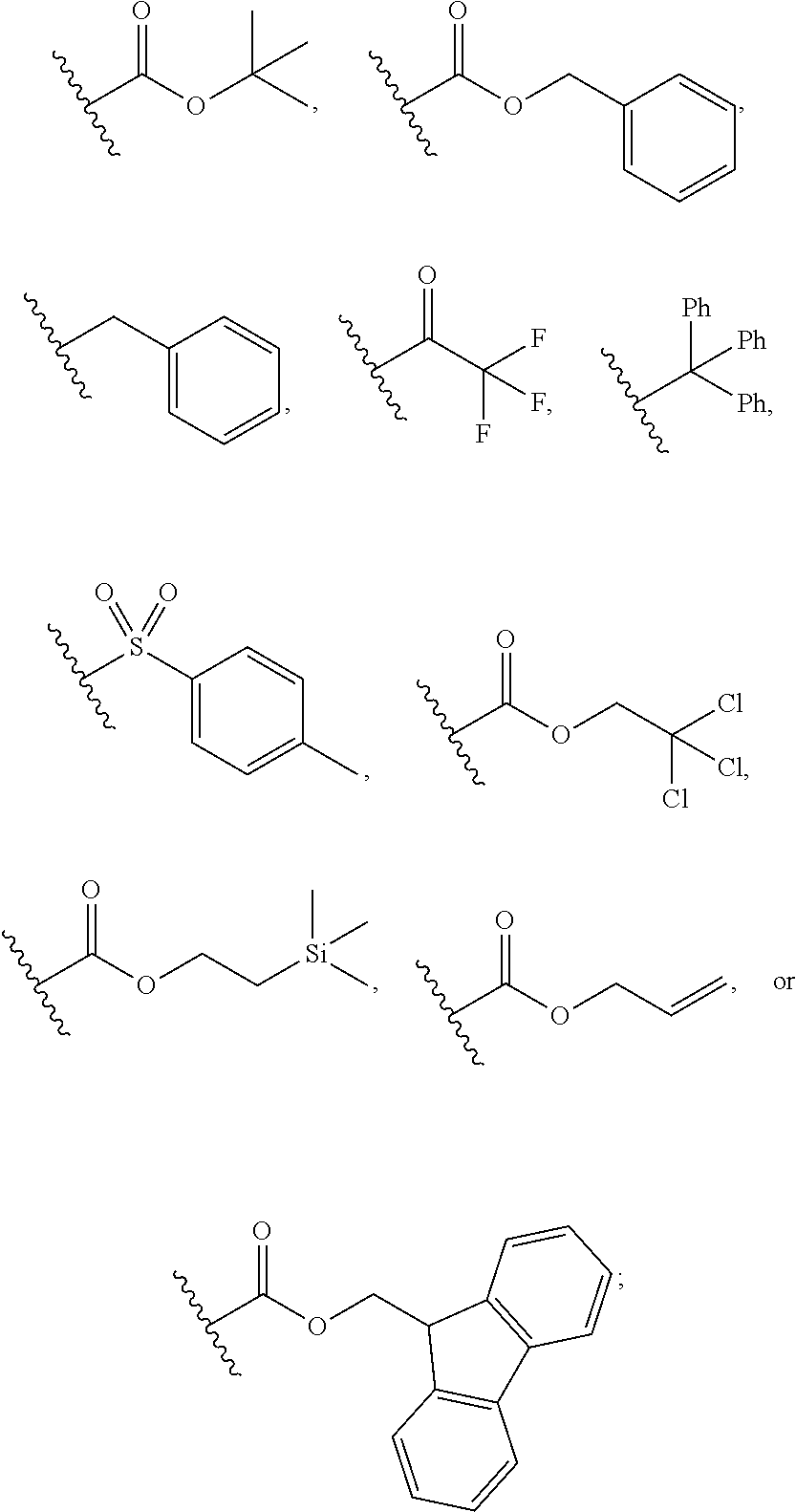
R5 and R6 are each independently H, halo, C1-8alkyl, C2-8alkynyl, C1-6alkylene-O—C1-4alkyl, C1-6alkylene-OH, C1-6haloalkyl, C1-6alkyleneamine, C0-6alkyleneamide, C0-3alkylene-C(O)OH, C0-3alkylene-C(O)OC1-4 alkyl, C1-6alkylene-O-aryl, C0-3alkylene-C(O)C1-4alkylene-OH, C0-5alkylene-C3-8cycloalkyl, C0-5alkylene-C2-7heterocycloalkyl, C0-5alkylenearyl, or cyano, or R5 and R6, together with the atoms to which they are attached, form a 4-6 membered ring; R7 is H or C1-8alkyl, or R7 and R5, together with the atoms to which they are attached, form a 4-6 membered ring; Q is CR8R9, C═CR8R9, C═O, C═S, or C═NR8; R8 and R9 are each independently H, C1-8alkyl, hydroxy, C1-8alkoxy, cyano, nitro, or C3-6cycloalkyl, or R8 and R9, taken together with the carbon atom to which they are attached, can form a 3-6 membered ring; R10 is C1-8alkyl, C0-3alkylenearyl, C0-3alkyleneheteroaryl, C0-3alkylene-C3-8cycloalkyl, C0-3alkylene-C2-7heterocycloalkyl, C1-6alkoxy, O—C0-3alkylenearyl, O—C0-3alkyleneheteroaryl, O—C0-3alkylene-C3-8cycloalkyl, O—C0-3alkylenearyl, O—C0-3alkylene-C2-7heterocycloalkyl, NH—C1-8alkyl, N(C1-8alkyl)2, NH—C0-3alkylenearyl, NH—C0-3alkyleneheteroaryl, NH—C0-3alkylene-C3-8cycloalkyl, NH—C0-3alkylene-C2-7heterocycloalkyl, halo, cyano, or C1-6alkyleneamine; and R13 is C1-4alkyl, C1-3haloalkyl, C1-3alkyleneamine, and C3-8cycloalkyl, or a pharmaceutically acceptable salt thereof, with the proviso that (1) when J is NR10, M is N or CR13; (2) when M is NR13, J is N or CR10; (3) when J is CR10, M is N or NR13; and (4) when M is CR13, J is N or NR10.


wherein each R1 is independently H, hydroxy, C1-4alkyl, C1-4haloalkyl, C1-4alkoxy, NH—C1-4alkyl, N(C1-4alkyl)2, cyano, or halo; R2 is halo, C1-6alkyl, C1-6haloalkyl, OR′, N(R′)2, C2-3alkenyl, C2-3alkynyl, C0-3alkylene-C3-8cycloalkyl, C0-3alkylene-C2-7heterocycloalkyl, C0-3alkylenearyl, or C0-3alkyleneheteroaryl, and each R′ is independently H, C1-6alkyl, C1-6haloalkyl, C3-4 cycloalkyl, C2-3alkenyl, C2-3alkynyl, aryl, or heteroaryl, or two R′ substituents, together with the nitrogen atom to which they are attached, form a 3-7-membered ring; R3 is halo, C1-6alkyl, C1-2haloalkyl, C1-3alkoxy, C3-4 cycloalkyl, C2-3alkenyl, C2-3alkynyl, aryl, or heteroaryl; R4 is


R5 and R6 are each independently H, halo, C1-8alkyl, C2-5alkynyl, C1-6alkylene-O—C1-4alkyl, C1-6alkylene-OH, C1-6haloalkyl, C1-6alkyleneamine, C0-6alkyleneamide, C0-3alkylene-C(O)OH, C0-3alkylene-C(O)OC1-4alkyl, C1-6alkylene-O-aryl, C0-3alkylene-C(O)C1-4alkylene-OH, C0-5alkylene-C3-8cycloalkyl, C0-5alkylene-C2-7heterocycloalkyl, C0-5alkylenearyl, or cyano, or R5 and R6, together with the atoms to which they are attached, form a 4-6 membered ring; R7 is H or C1-3alkyl, or R7 and R5, together with the atoms to which they are attached, form a 4-6 membered ring; Q is CR8R9, C═CR8R9, C═O, C═S, or C═NR8; each of R8 and R9 independently is H, C1-3alkyl, hydroxy, C1-3alkoxy, cyano, nitro, or C3-6cycloalklyl, or R8 and R9, taken together with the carbon atom to which they are attached, can form a 3-6 membered ring; and R10 is C1-8alkyl. C0-5alkylenearyl, C0-3alkyleneheteroaryl, C0-3alkylene-C3-5cycloalkyl, C0-3alkylene-C2-7heterocycloalkyl, C1-alkoxy, C1-6alkoxy, O—C0-5alkylenearyl, O—C0-5alkyleneheteroaryl, O—C0-5alkylene-C5-8 cycloalkyl, O—C0-3alkylene-C2-7heterocycloalkyl, NH—C1-8alkyl, N(C1-8alkyl)2, NH—C0-5alkylenearyl, NH—C0-5alkyleneheteroaryl, NH—C0-5alkylene-C3-8cycloalkyl, NH—C0-5alkylene-C2-7heterocycloalkyl, halo, cyano, or C1-6alkyleneamine, or a pharmaceutically acceptable salt thereof.


wherein E1 and E2 are each independently CR1 or N; R1 is independently H, hydroxy, C1-4alkyl, C1-4haloalkyl, C1-4alkoxy, NH—C1-4alkyl, N(C1-4alkyl)2, cyano, or halo; R2 is halo, C1-6alkyl, C1-6haloalkyl, OR′, N(R′)2, C2-3alkenyl, C2-3alkynyl, C0-3alkylene-C3-8cycloalkyl, C0-3alkylene-C2-7heterocycloalkyl, C0-3alkylenearyl, or C0-3alkyleneheteroaryl, and each R′ is independently H, C1-6alkyl, C1-6haloalkyl, C3-4cycloalkyl, C2-3alkenyl, C2-3alkynyl, aryl, or heteroaryl, or two R′ substituents, together with the nitrogen atom to which they are attached, form a 3-7-membered ring; R3 is halo, C1-2haloalkyl, C1-3alkoxy, C3-4cycloalkyl, C2-3alkenyl, C2-3alkynyl, aryl, or heteroaryl; R4 is

ring A is a monocyclic 4-7 membered ring or a bicyclic, bridged, fused, or spiro 6-11 membered ring; L is a bond, C1-6alkylene, —O—C0-5alkylene, —S—C0-5alkylene, or —NH—C0-5alkylene, and for C2-6alkylene, —O—C2-5alkylene, —S—C2-5alkylene, and NH—C2-5alkylene, one carbon atom of the alkylene group can optionally be replaced with O, S, or NH; R4 is H, C1-8alkyl, C2-5alkynyl, C1-6alkylene-O—C1-4alkyl, C1-alkylene-OH, C1-6haloalkyl, C0-3alkylene-C3-5cycloalkyl, C0-3alkylene-C2-7heterocycloalkyl, C0-3alkylenearyl, or selected from

R5 and R6 are each independently H, halo, C1-8alkyl, C2-8alkynyl, C1-6alkylene-O—C1-4alkyl, C1-6alkylene-OH, C1-6haloalkyl, C1-6alkyleneamine, C0-6alkyleneamide, C0-3alkylene-C(O)OH, C0-3alkylene-C(O)OC1-4alkyl, C1-6alkylene-O-aryl, C0-3alkylene-C(O)C1-4alkylene-OH, C0-3alkylene-C3-5cycloalkyl, C0-3alkylene-C2-7heterocycloalkyl, C0-3alkylenearyl, or cyano, or R5 and R6, together with the atoms to which they are attached, form a 4-6 membered ring; R7 is H or C1-3alkyl, or R7 and R5, together with the atoms to which they are attached, form a 4-6 membered ring; R8 is C1-3alkyl, hydroxy, C1-3alkoxy, halo, cyano, nitro, C3-6cycloalkyl, or NR11R12; R11 and R12 are each independently H, C1-4alkyl, or C3-5cycloalkyl; and R10 is C1-8alkyl, C0-5alkylenearyl, C0-5alkyleneheteroaryl, C0-5alkylene-C3-8cycloalkyl, C0-3alkylene-C2-7heterocycloalkyl, C1-alkoxy, O—C0-5alkylenearyl, O—C0-5alkyleneheteroaryl, O—C0-5alkylene-C1-8cycloalkyl, O—C0-3alkylene-C2-7heterocycloalkyl, NH—C1-8alkyl, N(C1-8alkyl)2, NH—C0-5alkylenearyl, NH—C0-3alkyleneheteroaryl, NH—C0-5alkylene-C3-8cycloalkyl, NH—C0-3alkylene-C2-7heterocycloalkyl, halo, cyano, or C1-6alkyleneamine, or a pharmaceutically acceptable salt thereof. In some embodiments, E1 and E2 are each CR1, and R8 is hydroxy, halo, nitro, or C3-6cycloalkyl. In some embodiments, R8 is methyl. The compound can have a structure of formula (IV-A), (IV′-A), (IV-B), (IV′—B), (IV-C), (IV′—C), (IV-D), or (IV′-D):


wherein E1 and E2 are each independently CR1 or N; R1 is independently H, hydroxy, C1-4alkyl, C1-4haloalkyl, C1-4alkoxy, NH—C1-4alkyl, N(C1-4alkyl)2, cyano, or halo; R2 is halo, C1-6alkyl, C1-6haloalkyl, OR′, N(R′)2, C2-3alkenyl, C2-3alkynyl, C0-3alkylene-C3-8cycloalkyl, C0-3alkylene-C2-7heterocycloalkyl, C0-3alkylenearyl, or C0-3alkyleneheteroaryl, and each R′ is independently H, C1-6alkyl, C1-6haloalkyl, C3-4cycloalkyl, C2-3alkenyl, C2-3alkynyl, aryl, or heteroaryl, or two R′ substituents, together with the nitrogen atom to which they are attached, form a 3-7-membered ring; R3 is halo, C1-3alkyl, C1-2haloalkyl, C1-3alkoxy, C3-4 cycloalkyl, C2-3 alkenyl, C2-3alkynyl, aryl, or heteroaryl; R4 is

ring A is a monocyclic 4-7 membered ring or a bicyclic, bridged, fused, or spiro 6-11 membered ring; L is a bond, C1-6alkylene, —O—C0-5alkylene, —S—C0-5alkylene, or —NH—C0-5alkylene, and for C2-6alkylene, —O—C2-5alkylene, —S—C2-5alkylene, and NH—C2-5alkylene, one carbon atom of the alkylene group can optionally be replaced with O, S, or NH; R4 is H, C1-8alkyl, C2-5alkynyl, C1-6alkylene-O—C1-4 alkyl, C1-6alkylene-OH, C1-6haloalkyl, C0-3alkylene-C3-8cycloalkyl, C0-3alkylene-C2-7 heterocycloalkyl, C0-3alkylenearyl, or selected from

R5 and R6 are each independently H, halo, C1-8alkyl, C2-5alkynyl, C1-6alkylene-O—C1-4 alkyl, C1-6alkylene-OH, C1-6haloalkyl, C1-6alkyleneamine, C0-6alkyleneamide, C0-3alkylene-C(O)OH, C0-3alkylene-C(O)OC1-4alkyl, C1-6alkylene-O-aryl, C0-3alkylene-C(O)C1-4alkylene-OH, C0-3alkylene-C3-8cycloalkyl, C0-3alkylene-C2-7heterocycloalkyl, C0-3alkylenearyl, or cyano, or R5 and R6, together with the atoms to which they are attached, form a 4-6 membered ring; R7 is H or C1-3alkyl, or R7 and R5, together with the atoms to which they are attached, form a 4-6 membered ring; and R10 is C1-8alkyl, C0-3alkylenearyl, C0-3alkyleneheteroaryl, C0-3alkylene-C3-8 cycloalkyl, C0-3alkylene-C2-7heterocycloalkyl, C1-6alkoxy, O—C0-3alkylenearyl, O—C0-3alkyleneheteroaryl, O—C0-3alkylene-C3-8cycloalkyl, O—C0-3alkylene-C2-7heterocycloalkyl, NH—C1-8alkyl, N—C1-8alkyl, NH—C0-5alkylenearyl, NH—C0-3alkyleneheteroaryl, NH—C0-3alkylene-C3-8cycloalkyl, NH—C0-3alkylene-C2-7heterocycloalkyl, halo, cyano, or C1-6alkyleneamine; or a pharmaceutically acceptable salt thereof.


R10 can comprise an ortho-substituted aryl, ortho-substituted heteroaryl, or 2-substituted cyclohexyl, such as, for example,

embodiment, R10 can comprise

For all compounds:


In some embodiments, R2 is


ring A can be, for example,

More specifically, when R4 is

ring A can be, for example,


it can more specifically be

In such embodiments, ring A can be, for example,


include


or a stereoisomer thereof, an atropisomer thereof, a pharmaceutically acceptable salt thereof, a pharmaceutically acceptable salt of the stereoisomer thereof, or a pharmaceutically acceptable salt of the atropisomer thereof.

or a stereoisomer thereof, an atropisomer thereof, a pharmaceutically acceptable salt thereof, a pharmaceutically acceptable salt of the stereoisomer thereof, or a pharmaceutically acceptable salt of the atropisomer thereof.

or a stereoisomer thereof, an atropisJomer thereof, a pharmaceutically acceptable salt thereof, a pharmaceutically acceptable salt of the stereoisomer thereof, or a pharmaceutically acceptable salt of the atropisomer thereof.
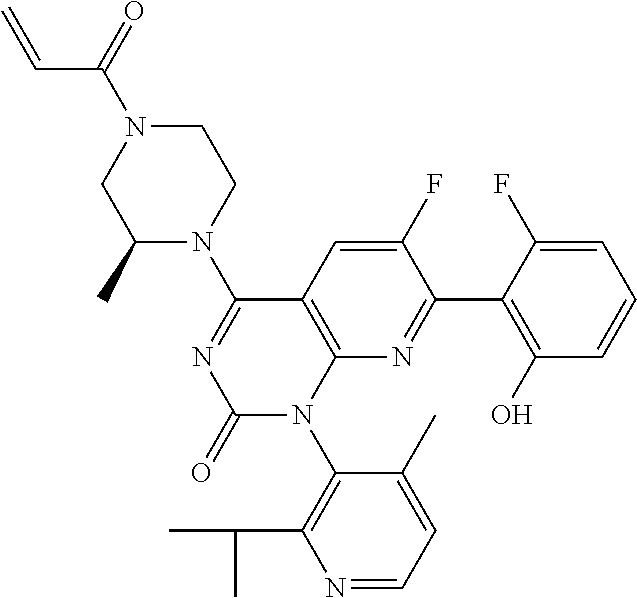
or a stereoisomer thereof, an atropisomer Jthereof, a pharmaceutically acceptable salt thereof, a pharmaceutically acceptable salt of the stereoisomer thereof, or a pharmaceutically acceptable salt of the atropisomer thereof.

or a stereoisomer thereof, an atropisomer thereof, a pharmaceutically acceptable salt thereof, a pharmaceutically acceptable salt of the stereoisomer thereof, or a pharmaceutically acceptable salt of the atropisomer thereof.

or a stereoisomer thereof, an atropisomer thereof, a pharmaceutically acceptable salt thereof, a pharmaceutically acceptable salt of the stereoisomer thereof, or a pharmaceutically acceptable salt of the atropisomer thereof.

or a stereoisomer thereof, an atropisomer thereof, a pharmaceutically acceptable salt thereof, a pharmaceutically acceptable salt of the stereoisomer thereof, or a pharmaceutically acceptable salt of the atropisomer thereof.

or a stereoisomer thereof, an atropisomer thereof, a pharmaceutically acceptable salt thereof, a pharmaceutically acceptable salt of the stereoisomer thereof, or a pharmaceutically acceptable salt of the atropisomer thereof.

or a stereoisomer thereof, an atropisomer thereof, a pharmaceutically acceptable salt thereof, a pharmaceutically acceptable salt of the stereoisomer thereof, or a pharmaceutically acceptable salt of the atropisomer thereof.

or a stereoisomer thereof, an atropisomer thereof, a pharmaceutically acceptable salt thereof, a pharmaceutically acceptable salt of the stereoisomer thereof, or a pharmaceutically acceptable salt of the atropisomer thereof.

or a stereoisomer thereof, an atropisomer thereof, a pharmaceutically acceptable salt thereof, a pharmaceutically acceptable salt of the stereoisomer thereof, or a pharmaceutically acceptable salt of the atropisomer thereof.

or a stereoisomer thereof, an atropisomer thereof, a pharmaceutically acceptable salt thereof, a pharmaceutically acceptable salt of the stereoisomer thereof, or a pharmaceutically acceptable salt of the atropisomer thereof.

or a stereoisomer thereof, an atropisomer thereof, a pharmaceutically acceptable salt thereof, a pharmaceutically acceptable salt of the stereoisomer thereof, or a pharmaceutically acceptable salt of the atropisomer thereof.

or a stereoisomer thereof, an atropisomer thereof, a pharmaceutically acceptable salt thereof, a pharmaceutically acceptable salt of the stereoisomer thereof, or a pharmaceutically acceptable salt of the atropisomer thereof.

or a stereoisomer thereof, an atropisomer thereof, a pharmaceutically acceptable salt thereof, a pharmaceutically acceptable salt of the stereoisomer thereof, or a pharmaceutically acceptable salt of the atropisomer thereof.

or a stereoisomer thereof, an atropisomer thereof, a pharmaceutically acceptable salt thereof, a pharmaceutically acceptable salt of the stereoisomer thereof, or a pharmaceutically acceptable salt of the atropisomer thereof.
| TABLE 1 | |
| Chemical | |
| Ex. # | Structure |
| 1-1 |
 |
| 1-2 |
 |
| 1-3 |
 |
| 1-6 |
 |
| 1-7 |
 |
| 1-8 |
 |
 |
|
| 1-11 |
 |
| 1-12 |
 |
 |
|
| 1-13 |
 |
| 1-4 |
 |
| 1-5 |
 |
| 1-9 |
 |
 |
|
 |
|
 |
|
| 1-10 |
 |
| 1-14 |
 |
| 1-15 |
 |
| 1-16 |
 |
 |
|
| 1-17 |
 |
| 1-19-2 |
 |
| 1-20 |
 |
| 2-7 |
 |
 |
|
 |
|
| 2-8 |
 |
 |
|
| 1-18 |
 |
 |
|
| 1-19 |
 |
| 1-19-1 |
 |
| 1-21 |
 |
| 1-22 |
 |
| 1-23 |
 |
| 2-9 |
 |
 |
|
| 2-10 |
 |
 |
|
| 1-28 |
 |
| 2-2 |
 |
 |
|
| 2-3 |
 |
 |
|
| 2-4 |
 |
 |
|
| 2-5-2 |
 |
| 2-6 |
 |
 |
|
| 2-6-1 |
 |
| 3-1-1 |
 |
| 3-1-2 |
 |
| 3-2 |
 |
| 2-5 |
 |
 |
|
| 2-5-1 |
 |
| 3-5 |
 |
| 3-6 |
 |
| 3-7 |
 |
| 2-6-2 |
 |
| 3-1 |
 |
| 3-10 |
 |
| 3-11 |
 |
| 3-12 |
 |
| 3-3 |
 |
| 3-4 |
 |
| 3-15 |
 |
| 3-16 |
 |
| 3-17 |
 |
| 3-8 |
 |
| 3-9 |
 |
| 3-20 |
 |
| 3-21 |
 |
| 3-22 |
 |
| 3-23 |
 |
| 3-13 |
 |
| 3-14 |
 |
| 3-25 |
 |
| 4-1 |
 |
| 4-2 |
 |
| 4-3 |
 |
| 3-18 |
 |
| 3-19 |
 |
| 4-5 |
 |
| 4-6 |
 |
| 4-7 |
 |
| 4-8 |
 |
| 3-24 |
 |
| 5-1 |
 |
| 5-2 |
 |
| 4-4 |
 |
| 5-6 |
 |
| 5-7 |
 |
| 4-9 |
 |
| 6-2 |
 |
| 7-1 |
 |
 |
|
| 5-3 |
 |
| 5-4 |
 |
| 5-5 |
 |
| 5-8 |
 |
 |
|
| 5-9 |
 |
| 6-1 |
 |
| 7-2 |
 |
 |
|
| 7-3 |
 |
 |
|
| 8-1 |
 |
| 8-1-1 |
 |
| 1st eluting isomer | |
| 8-1-2 |
 |
| 2nd eluting isomer | |
| 8-2 |
 |
| 8-3 |
 |
| 8-3-2 |
 |
| 2nd eluting isomer | |
| 8-4 |
 |
| 8-5 |
 |
| 8-6 |
 |
| 8-6-2 |
 |
| 2nd eluting isomer | |
| 9-1 |
 |
| 9-2 |
 |
| 9-3 |
 |
| 8-3-1 |
 |
| 1st eluting isomer | |
| 9-5 |
 |
| 9-6 |
 |
| 9-7-2 |
 |
| 2nd eluting isomer | |
| 8-6-1 |
 |
| 1st eluting isomer | |
| 9-10 |
 |
| 9-11 |
 |
| 9-12 |
 |
| 9-4 |
 |
 |
|
| 10-1 |
 |
| 10-2 |
 |
| 10-3 |
 |
| 9-7-1 |
 |
| 1st eluting isomer | |
| 9-9 |
 |
| 10-6 |
 |
| 10-7 |
 |
| 9-13 |
 |
| 9-14 |
 |
 |
|
| 10-11 |
 |
| 10-12 |
 |
| 10-4 |
 |
| 10-5 |
 |
| 11-2-1 |
 |
| 1st eluting isomeric mixture | |
| 11-2-2 |
 |
| 2nd eluting isomeric mixture | |
| 10-8 |
 |
| 10-9 |
 |
| 10-10 |
 |
| 15 |
 |
| 16 |
 |
| 10-13 |
 |
| 11-1-1 |
 |
| 1st eluting isomeric mixture | |
| 11-1-2 |
 |
| 2nd eluting isomeric mixture | |
| 18-2 |
 |
| 18-3 |
 |
| 12 |
 |
| 13 |
 |
| 14 |
 |
| 20 |
 |
| 21 |
 |
| 17-1 |
 |
| 17-2 |
 |
| 18-1 |
 |
| 25 |
 |
| 26 |
 |
| 19-1 |
 |
| 19-2 |
 |
| 19-3 |
 |
| 30 |
 |
| 31 |
 |
| 22 |
 |
| 23 |
 |
| 24 |
 |
| 35 |
 |
| 36 |
 |
| 27 |
 |
| 28 |
 |
| 29 |
 |
| 32 |
 |
| 33 |
 |
| 34 |
 |
| 37 |
 |
 |
|
| 38 |
 |
| NA | NA |
| TABLE 1(a) | ||
| Chemical | ||
| Ex. # | Structure | |
| 39-1 |  | |
| 1st-eluting isomer | ||
| 39-2 |  | |
| 2nd-eluting isomer | ||
| 40-1 |  | |
| 1st-eluting isomer | ||
| 40-2 |  | |
| 2nd-eluting isomer | ||
| 41-1 |  | |
| 1st-eluting isomer | ||
| 41-2 |  | |
| 2nd-eluting isomer | ||
| 42-1 |  | |
| 1st-eluting isomer | ||
| 42-2 |  | |
| 2nd-eluting isomer | ||
| 44-1 |  | |
| 1st-eluting isomer | ||
| 44-2 |  | |
| 2nd-eluting isomer | ||
| 45-1 |  | |
| 1st-eluting isomer | ||
| 45-2 |  | |
| 2nd-eluting isomer | ||
| 46-1 |  | |
| 1st-eluting isomer | ||
| 46-2 |  | |
| 2nd-eluting isomer | ||
| 49-1 |  | |
| 1st-eluting isomer | ||
| 49-2 |  | |
| 2nd-eluting isomer | ||
| 50-1 |  | |
| 1st-eluting isomer | ||
| 50-2 |  | |
| 2nd-eluting isomer | ||
| 51-1 |  | |
| 1st-eluting isomer | ||
| 51-2 |  | |
| 2nd-eluting isomer | ||
| 52-1 |  | |
| 1st-eluting isomer | ||
| 52-2 |  | |
| 2nd-eluting isomer | ||
| 53-1 |  | |
| 1st-eluting isomer | ||
| 53-2 |  | |
| 2nd-eluting isomer | ||
Synthesis of Disclosed Compounds


or a stereoisomer thereof, an atropisomer thereof, a pharmaceutically acceptable salt thereof, a pharmaceutically acceptable salt of the stereoisomer thereof, or a pharmaceutically acceptable salt of the atropisomer thereof, is administered to a patient in need thereof a therapeutically effective amount of an additional pharmaceutically active compound, for example, cytarabine, a proteasome inhibitor, such as carfilzomib or oprozomib, a BC1-2 inhibitor, such as venetoclax, an MCl-1 inhibitor, such as AMG-176, a monoconal antibody, such as daratumumab, and an immunomodulatory imide drug (IMiD), such as thalidomide, lenalidomide, pomalidomide and apremilast.

or a stereoisomer thereof, an atropisomer thereof, a pharmaceutically acceptable salt thereof, a pharmaceutically acceptable salt of the stereoisomer thereof, or a pharmaceutically acceptable salt of the atropisomer thereof, is administered to a patient in need thereof a therapeutically effective amount of an additional pharmaceutically active compound, for example, cytarabine, a proteasome inhibitor, such as carfilzomib or oprozomib, a BC1-2 inhibitor, such as venetoclax, an MCl-1 inhibitor, such as AMG-176, a monoconal antibody, such as daratumumab, and an immunomodulatory imide drug (IMiD), such as thalidomide, lenalidomide, pomalidomide and apremilast.

or a stereoisomer thereof, an atropisomer thereof, a pharmaceutically acceptable salt thereof, a pharmaceutically acceptable salt of the stereoisomer thereof, or a pharmaceutically acceptable salt of the atropisomer thereof, is administered to a patient in need thereof a therapeutically effective amount of an additional pharmaceutically active compound, for example, cytarabine, a proteasome inhibitor, such as carfilzomib or oprozomib, a BC1-2 inhibitor, such as venetoclax, an MCl-1 inhibitor, such as AMG-176, a monoconal antibody, such as daratumumab, and an immunomodulatory imide drug (IMiD), such as thalidomide, lenalidomide, pomalidomide and apremilast.

or a stereoisomer thereof, an atropisomer thereof, a pharmaceutically acceptable salt thereof, a pharmaceutically acceptable salt of the stereoisomer thereof, or a pharmaceutically acceptable salt of the atropisomer thereof, is administered to a patient in need thereof a therapeutically effective amount of an additional pharmaceutically active compound, for example, cytarabine, a proteasome inhibitor, such as carfilzomib or oprozomib, a BC1-2 inhibitor, such as venetoclax, an MCl-1 inhibitor, such as AMG-176, a monoconal antibody, such as daratumumab, and an immunomodulatory imide drug (IMiD), such as thalidomide, lenalidomide, pomalidomide and apremilast.

or a stereoisomer thereof, an atropisomer thereof, a pharmaceutically acceptable salt thereof, a pharmaceutically acceptable salt of the stereoisomer thereof, or a pharmaceutically acceptable salt of the atropisomer thereof, is administered to a patient in need thereof a therapeutically effective amount of an additional pharmaceutically active compound, for example, cytarabine, a proteasome inhibitor, such as carfilzomib or oprozomib, a BC1-2 inhibitor, such as venetoclax, an MCl-1 inhibitor, such as AMG-176, a monoconal antibody, such as daratumumab, and an immunomodulatory imide drug (IMiD), such as thalidomide, lenalidomide, pomalidomide and apremilast.

or a stereoisomer thereof, an atropisomer thereof, a pharmaceutically acceptable salt thereof, a pharmaceutically acceptable salt of the stereoisomer thereof, or a pharmaceutically acceptable salt of the atropisomer thereof, is administered to a patient in need thereof a therapeutically effective amount of an additional pharmaceutically active compound, for example, cytarabine, a proteasome inhibitor, such as carfilzomib or oprozomib, a BCl-2 inhibitor, such as venetoclax, an MCl-1 inhibitor, such as AMG-176, a monoconal antibody, such as daratumumab, and an immunomodulatory imide drug (IMiD), such as thalidomide, lenalidomide. pomalidomide and apremilast.

or a stereoisomer thereof, an atropisomer thereof, a pharmaceutically acceptable salt thereof, a pharmaceutically acceptable salt of the stereoisomer thereof, or a pharmaceutically acceptable salt of the atropisomer thereof, is administered to a patient in need thereof a therapeutically effective amount of an additional pharmaceutically active compound, for example, cytarabine, a proteasome inhibitor, such as carfilzomib or oprozomib, a BCl-2 inhibitor, such as venetoclax, an MCl-r inhibitor, such as AMG-176, a monoconal antibody, such as daratumumab, and an immunomodulatory imide drug (IMiD), such as thalidomide, lenalidomide, pomalidomide and apremilast.

or a stereoisomer thereof, an atropisomer thereof, a pharmaceutically acceptable salt thereof, a pharmaceutically acceptable salt of the stereoisomer thereof, or a pharmaceutically acceptable salt of the atropisomer thereof, is administered to a patient in need thereof a therapeutically effective amount of an additional pharmaceutically active compound, for example, cytarabine, a proteasome inhibitor, such as carfilzomib or oprozomib, a BC1-2 inhibitor, such as venetoclax, an MCl-1 inhibitor, such as AMG-176, a monoconal antibody, such as daratumumab, and an immunomodulatory imide drug (IMiD), such as thalidomide, lenalidomide, pomalidomide and apremilast.

or a stereoisomer thereof, an atropisomer thereof, a pharmaceutically acceptable salt thereof, a pharmaceutically acceptable salt of the stereoisomer thereof, or a pharmaceutically acceptable salt of the atropisomer thereof, is administered to a patient in need thereof a therapeutically effective amount of an additional pharmaceutically active compound, for example, cytarabine, a proteasome inhibitor, such as carfilzomib or oprozomib, a BC1-2 inhibitor, such as venetoclax, an MCl-1 inhibitor, such as AMG-176, a monoconal antibody, such as daratumumab, and an immunomodulatory imide drug (IMiD), such as thalidomide, lenalidomide, pomalidomide and apremilast.

or a stereoisomer thereof, an atropisomer thereof, a pharmaceutically acceptable salt thereof, a pharmaceutically acceptable salt of the stereoisomer thereof, or a pharmaceutically acceptable salt of the atropisomer thereof, is administered to a patient in need thereof a therapeutically effective amount of an additional pharmaceutically active compound, for example, cytarabine, a proteasome inhibitor, such as carfilzomib or oprozomib, a BC1-2 inhibitor, such as venetoclax, an MCl-1 inhibitor, such as AMG-176, a monoconal antibody, such as daratumumab, and an immunomodulatory imide drug (IMiD), such as thalidomide, lenalidomide, pomalidomide and apremilast.

or a stereoisomer thereof, an atropisomer thereof, a pharmaceutically acceptable salt thereof, a pharmaceutically acceptable salt of the stereoisomer thereof, or a pharmaceutically acceptable salt of the atropisomer thereof, is administered to a patient in need thereof a therapeutically effective amount of an additional pharmaceutically active compound, for example, cytarabine, a proteasome inhibitor, such as carfilzomib or oprozomib, a BC1-2 inhibitor, such as venetoclax, an MCl-1 inhibitor, such as AMG-176, a monoconal antibody, such as daratumumab, and an immunomodulatory imide drug (IMiD), such as thalidomide, lenalidomide, pomalidomide and apremilast.

or a stereoisomer thereof, an atropisomer thereof, a pharmaceutically acceptable salt thereof, a pharmaceutically acceptable salt of the stereoisomer thereof, or a pharmaceutically acceptable salt of the atropisomer thereof, is administered to a patient in need thereof a therapeutically effective amount of an additional pharmaceutically active compound, for example, cytarabine, a proteasome inhibitor, such as carfilzomib or oprozomib, a BC1-2 inhibitor, such as venetoclax, an MCl-1 inhibitor, such as AMG-176, a monoconal antibody, such as daratumumab, and an immunomodulatory imide drug (IMiD), such as thalidomide, lenalidomide, pomalidomide and apremilast.

or a stereoisomer thereof, an atropisomer thereof, a pharmaceutically acceptable salt thereof, a pharmaceutically acceptable salt of the stereoisomer thereof, or a pharmaceutically acceptable salt of the atropisomer thereof, is administered to a patient in need thereof a therapeutically effective amount of an additional pharmaceutically active compound, for example, cytarabine, a proteasome inhibitor, such as carfilzomib or oprozomib, a BC1-2 inhibitor, such as venetoclax, an MCl-1 inhibitor, such as AMG-176, a monoconal antibody, such as daratumumab, and an immunomodulatory imide drug (IMiD), such as thalidomide, lenalidomide, pomalidomide and apremilast.

or a stereoisomer thereof, an atropisomer thereof, a pharmaceutically acceptable salt thereof, a pharmaceutically acceptable salt of the stereoisomer thereof, or a pharmaceutically acceptable salt of the atropisomer thereof, is administered to a patient in need thereof a therapeutically effective amount of an additional pharmaceutically active compound, for example, cytarabine, a proteasome inhibitor, such as carfilzomib or oprozomib, a BC1-2 inhibitor, such as venetoclax, an MCl-1 inhibitor, such as AMG-176, a monoconal antibody, such as daratumumab, and an immunomodulatory imide drug (IMiD), such as thalidomide, lenalidomide, pomalidomide and apremilast.

or a stereoisomer thereof, an atropisomer thereof, a pharmaceutically acceptable salt thereof, a pharmaceutically acceptable salt of the stereoisomer thereof, or a pharmaceutically acceptable salt of the atropisomer thereof, is administered to a patient in need thereof a therapeutically effective amount of an additional pharmaceutically active compound, for example, cytarabine, a proteasome inhibitor, such as carfilzomib or oprozomib, a BCl-2 inhibitor, such as venetoclax, an MCl-1 inhibitor, such as AMG-176, a monoconal antibody, such as daratumumab, and an immunomodulatory imide drug (IMiD), such as thalidomide, lenalidomide, pomalidomide and apremilast.


| TABLE 1(b) |
| Compounds 1-2 to 1-28 were prepared following the procedure described in |
| Method 1, Steps 1-8, above as follows: |
| Chemical | Method | |||
| Ex.# | Structure | Name | changes | Reagent |
| 1-2 |
 |
1-(4-(5-chloro- 7-fluoro-6-(1H- indol-3-yl)-2,1- benzothiazol-3- yl)-1- piperazinyl)-2- propen-1-one | Omit step 8-3 | Step 7: (1-tert- butoxycarbonyl)- 1h-indol-3- yl)boronic acid (Combi-blocks Inc. San Diego, CA, USA), Step 8-1: TFA/DCM |
| 1-3 |
 |
1-(4-(5-chloro- 6-(2-fluoro-6- hydroxyphenyl)- 2,1-benzothiazol- 3-yl)-1- piperazinyl)-2- propen-1-one | Omit step 8-3 | Step 7: (3- methoxynaphthalen- 1-yl)boronic acid Cs2CO3, 100° C., Step 8-1: TFA/DCM |
| 1-4 |
 |
1-(4-(5-chloro- 6-(3-methoxy-1- naphthalenyl)- 2,1- benothiazol-3- yl)-1- piperazinyl)-2- propen-1-one | — | Step 7: (3- methoxynaphthalen- 1-yl)boronic acid, Cs2CO3, 100° C., Step 8-1: TFA/DCM |
| 1-5 |
 |
1-(4-(5-chloro- 6-(2-fluoro-6- methoxyphenyl)- 2,1- benzothiazol-3- yl)-1- piperazinyl)-2- propen-1-one | — | Step 7: (2-fluoro- 6- methoxyphenyl) boronic acid, Cs2CO3, 100° C., Step 8-1: TFA/DCM |
| 1-6 |
 |
1-(4-(5-chloro- 6-(2-fluoro-6- hydroxyphenyl)- 2,1- benzothiazol-3- yl)-1- piperazinyl)-2- propen-1-one | — | Step 7: (2-fluoro-6- methoxyphenyl) boronic acid, Cs2CO3, 100° C., Step 8-1: TFA/DCM |
| 1-7 |
 |
1-((3R)-4-(5- chloro-7-fluoro- 6-(3-hydroxy-1- naphthalenyl)- 2,1- benzothiazol-3- yl)-3- (hydroxymethyl)- 1-piperazinyl)- 2-propen-1-one | — | Step 6: (3R)-1- (tert- butoxycarbonyl)-3- (hydroxymethyl) piperazine (Synthonix Inc., Wake Forest, NC, USA), Step 7: (3- methoxynaphthalen- 1-yl)boronic acid (Ark Pharm Inc. Arlington Heights, IL, USA), Step 8-1: TFA/DCM |
| 1-8 |
 |
1-4-(5-chloro-7- fluoro-6-(3- hydroxy-1- naphthalenyl)- 2,1- benzothiazol-3- yl)-3-ethyl-1- piperazinyl)-2- propen-1-one | — | Step 6: tert-butyl 3- ethylpiperazine-1- carboxylate (Accel Pharmtech LLC, East Brunswick, NJ, USA), Step 7: (3- methoxynaphthalen- 1-yl)boronic acid (Ark Pharm Inc. Arlington Heights, IL, USA), Step 8-1: TFA/DCM |
 |
||||
| 1-9 |
 |
N-(1-(5-chloro- 7-fluoro-6-(3- hydroxy-1- naphthalenyl)- 2,1- benzothiazol-3- yl)-2-methyl-3- azetidinyl)-2- propenamide | — | Step 6: tert-butyl (2-methylazetidin- 3-yl)carbamate (pharmaBlock Nanjing, China), Step 7: (3- methoxynaphthalen- 1-yl)boronic acid (Ark Pharm Inc. Arlington Heights, IL, USA), Step 8-1: TFA/DCM |
 |
||||
 |
||||
 |
||||
| 1-10 |
 |
1-((3S)-4-(5- chloro-7-fluoro- 6-(5-methyl-1H- indazol-4-yl)- 2,1- benzothiazol-3- yl)-3-methyl-1- piperazinyl)-2- propen-1-one | Omit step 8-3 | Step 6: (S)-4-n- boc-2-methyl piperazine (CNH Technologies, Inc., Woburn, MA, USA), Step 7: 4-borono-5-methyl- 1h-indazole (Ark Pharm Inc. Arlington Heights, IL, USA.), Step 8- 1: TFA/DCM |
| 1-11 |
 |
1-((3S)-4-(5- chloro-7-fluoro- 6-(3-hydroxy-1- naphthalenyl)- 2,1- benzothiazol-3- yl)-3-(2- hydroxyethyl)-1- piperazinyl)-2- propen-1-one | — | Step 6: (S)-tert- butyl 3-(2- hydroxyethyl) piperazine-1- carboxylate (Activate Scientific GmbH, Prien, Germany), Step 7: (3- methoxynaphthalen- 1-yl)boronic acid (Ark Pharm Inc. Arlington Heights, IL, USA), Step 8-1: TFA/DCM |
| 1-12 |
 |
4-(5-chloro-7- fluoro-6-(3- hydroxy-1- naphthalenyl)- 2,1- benzothiazol-3- yl)-1-(2- propenoyl)-2- piperazinecarboxamide | — | Step 6: piperazine- 2-carboxamide (Enamine, Kiev, Ukraine), Step 7: (3- methoxynaphthalen- 1-yl)boronic acid (Ark Pharm Inc. Arlington Heights, IL, USA), Step 8-1: TFA/DCM |
 |
||||
| 1-13 |
 |
1-(4-(5-chloro- 7-fluoro-6-(2- methoxy-1- naphthalenyl)- 2,1- benzothiazol-3- yl)-1- piperazinyl)-2- propen-1-one | Omit step 8-3 | Step 7: (2- methoxynaphthalen- 1-yl)boronic acid, Cs2CO3, 100° C., Step 8-1: TFA/DCM |
| 1-14 |
 |
1-(4-(5-chloro- 7-fluoro-6-(2- hydroxy-1- naphthalenyl)- 2,1- benzothiazol-3- yl)-1- piperazinyl)-2- propen-1-one | — | Step 7: (2- methoxynaphthalen- 1-yl)boronic acid, Cs2CO3, 100° C., Step 8-1: TFA/DCM |
| 1-15 |
 |
1-((3S)-4-(5- chloro-7-fluoro- 6-(3-hydroxy-1- naphthalenyl)- 2,1- benzothiazol-3- yl)-3- (hydroxymethyl)- 1-piperazinyl)- 2-propen-1-one | — | Step 6: (3S)-1-boc- 3-(hydroxymethyl)- piperazine (Combi- blocks Inc., San Diego, CA, USA), Step 7: (3- methoxynaphthalen- 1-yl)boronic acid, Step 8-1: TFA/DCM |
| 1-16 |
 |
1-(4-(5-chloro- 7-fluoro-6-(3- hydroxy-1- naphthalenyl)- 2,1- benzothiazol-3- yl)-2- (hydroxymethyl)- 1-piperazinyl)- 2-propen-1-one | — | Step 6: tert-butyl 3- (((tert- butyldimethylsilyl) oxy)methyl) piperazine- 1-carboxylatei, Step 7: (3- methoxynaphthalen- 1-yl)boronic acid, Step 8-1: TFA/DCM |
 |
||||
| 1-17 |
 |
1-((1R,5S)-3-(5- chloro-7-fluoro- 6-(3-hydroxy-1- naphthalenyl)- 2,1- benzothiazol-3- yl)-3,8- diazabicyclo[3.2.1] octan-8-yl)-2- propen-1-one | — | Step 6: 8-boc-3,8- diaza- bicyclo[3.2.1]octane (Chem-Impex International, Inc. Wood Dale, IL, USA), Step 7: (3- methoxynaphthalen- 1-yl)boronic acid (Ark Pharm Inc. Arlington Heights, IL, USA), Step 8-1: TFA/DCM |
| 1-18 |
 |
1-(4-(5-chloro- 7-fluoro-6-(3- hydroxy-1- naphthalenyl)- 2,1- benzothiazol-3- yl)-3- (hydroxymethyl)- 1-piperazinyl)- 2-propen-1-one | — | Step 6: 4-n-boc-2- hydroxymethyl- piperazine (AstaTech, Inc., Bristol PA, USA), Step 7: (3- methoxynaphthalen- 1-yl)boronic acid (Ark Pharm Inc. Arlington Heights, IL, USA), Step 8-1: TFA/DCM |
 |
||||
| 1-19 |
 |
1-((3S)-4-(5- chloro-7-fluoro- 6-(3-hydroxy-1- naphthalenyl)- 2,1- benzothiazol-3- yl)-3-methyl-1- piperazinyl)-2- propen-1-one | — | Step 6: (S)-4-n- boc-2-methyl piperazine (CNH Technologies, Inc., Woburn, MA, USA), Step 7: (3- methoxynaphthalen- 1-yl)boronic acid (Ark Pharm Inc. Arlington Heights, IL, USA), Step 8-1: TFA/DCM |
| 1-20 |
 |
1-(3-((5-chloro- 7-fluoro-6-(3- hydroxy-1- naphthalenyl)- 2,1- benzothiazol-3- yl)amino)-1- azetidinyl)-2- propen-1-one | — | Step 6: 1-boc-3- aminoazetidine (Alfa Aesar, Haver Hill, MA, USA), Step 7: (3- methoxynaphthalen- 1-yl)boronic acid (Ark Pharm Inc. Arlington Heights, IL, USA), Step 8-1: TFA/DCM |
| 1-21 |
 |
1-((3R)-4-(5- chloro-7-fluoro- 6-(3-hydroxy-1- naphthalenyl)- 2,1- benzothiazol-3- yl)-3-methyl-1- piperazinyl)-2- propen-1-one | — | Step 6: (R)-4-n- boc-2-methyl- piperazine (CNH Technologies, Inc., Woburn, MA, USA), Step 7: (3- methoxynaphthalen- 1-yl)boronic acid (Ark Pharm Inc. Arlington Heights, IL, USA), Step 8-1: TFA/DCM |
| 1-22 |
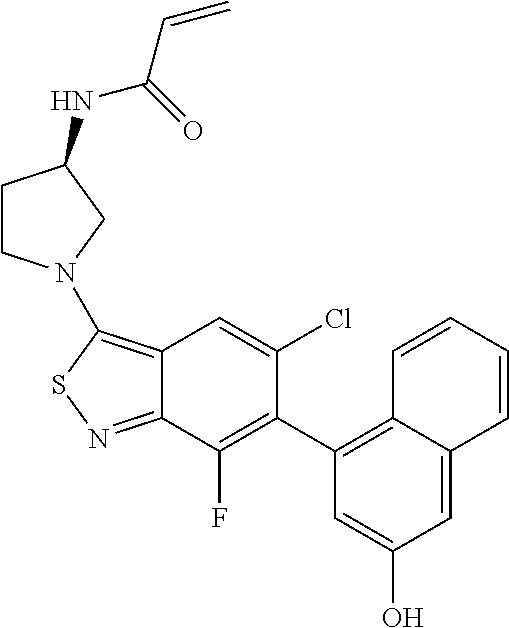 |
N-((3R)-1-(5- chloro-7-fluoro- 6-(3-hydroxy-1- naphthalenyl)- 2,1- benzothiazol-3- yl)-3- pyrrolidinyl)-2- propenamide | Step 6: (3R)-(−)-3- tert- butoxycarbonyl- amino pyrrolidine (Oakwood Products, Inc. Estill, SC, USA), Step 7: (3- methoxynaphthalen- 1-yl)boronic acid (Ark Pharm Inc. Arlington Heights, IL, USA), Step 8-1: TFA/DCM | |
| 1-23 |
 |
N-((3R)-1-(5- chloro-7-fluoro- 6-(3-hydroxy-1- naphthalenyl)- 2,1- benzothiazol-3- yl)-3- piperidinyl)-2- propenamide | Step 6: (R)-tert- butyl piperidin-3- ylcarbamate (Combi-blocks Inc., San Diego, CA, USA), Step 7: (3- methoxynaphthalen- 1-yl)boronic acid (Ark Pharm Inc. Arlington Heights, IL, USA), Step 8-1: TFA/DCM | |
| 1-28 |
 |
1-(4-(5-chloro- 7-fluoro-6-(2- fluoro-5- hydroxyphenyl) benzo[c]isothiazol- 3-yl)piperazin-1- yl)prop-2-en-1-one | Step 7: (2-fluoro-5- methoxyphenyl) boronic acid (Combi- blocks Inc., San Diego, CA, USA), K2CO3, Pd(DPPF)Cl2•DCM, 100° C. Step 8-1: TFA/DCM | |


| TABLE 2 |
| Compounds 2-2 to 2-6 were prepared following the procedure described in |
| Method 2, Steps 1-8, above as follows: |
| Chemical | Method | |||
| Ex.# | Structure | Name | changes | Reagents |
| 2-2 |
 |
1-(4-(5-chloro- 6-(2-fluoro-6- methoxyphenyl) [1,2]thiazolo[3,4- b]pyridin-3-yl)- 3-methyl-1- piperazinyl)-2- propen-1-one | Omit Step 8 | Step 2: 1-Boc-3- methylpiperazine (Accela ChemBio Inc. San Diego, CA, USA), Step 4: N- bromosuccinimide, Step 5: 2-fluoro-6- methoxyphenyl boronic acid |
 |
||||
| 2-3 |
 |
1-(4-(5-chloro- 6-(2-fluoro-6- hydroxyphenyl) [1,2]thiazolo[2,3- b]pyridin-3-yl)- 3-methyl-1- piperazinyl)-2- propen-1-one | — | Step 2: 1-Boc-3- methylpiperazine (Accela ChemBio Inc. San Diego, CA, USA), Step 4: N- bromosuccinimide, Step 5: 2-fluoro-6- methoxyphenyl boronic acid |
 |
||||
| 2-4 |
 |
1-(4-(5-chloro- 6-(3-methoxy-1- naphthalenyl)[1,2] thiazolo[3,4- b]pyridin-3-yl)- 3-methyl-1- piperazinyl)-2- propen-1-one | Omit Step 8 | Step 2: 1-Boc-3- methylpiperazine (Accela ChemBio Inc. San Diego, CA, USA), Step 4: N- bromosuccinimide |
 |
||||
| 2-5 |
 |
1-(4-(5-chloro- 6-(3-hydroxy-1- naphthalenyl)[1,2] thiazolo[3,4- b]pyridin-3-yl)- 3-methyl-1- piperazinyl)-2- propen-1-one | — | Step 2: 1-Boc-3- methylpiperazine (Accela ChemBio Inc. San Diego, CA, USA), Step 4: N- bromosuccinimide |
 |
||||
| 2-6 |
 |
1-(4-(5-chloro- 6-(5-methyl-1H- indazol-4- yl)[1,2]thiazolo [3,4-b]pyridin-3- yl)-3-methyl-1- piperazinyl)-2- propen-1-one | Omit Step 8 | Step 2: 1-Boc-3- methylpiperazine (Accela ChemBio Inc. San Diego, CA, USA), Step 4: N- bromosuccinimide Step 5: 4-borono-5- methyl-1h-indazole (Ark Pharm Inc. Arlington Heights, IL, USA) |
 |
||||
| 2-7 |
 |
1-(4-(5-chloro- 7-fluoro-6-(3- hydroxy-1- naphthalenyl)- 2,1- benzothiazol-3- yl)-3,5- dimethyl-1- piperazinyl)-2- propen-1-one | — | Step 1: 2-amino-4- bromo-3- fluorobenzoic acid (Apollo Scientific Ltd., Stockport, UK), Step 2: 1-boc-3,5- dimethylpiperazine (Combi-blocks Inc., San Diego, CA, USA), Step 7: (3- methoxynaphthalen- 1-yl)boronic acid (Ark Pharm Inc. Arlington Heights, IL, USA), Step 8-1: TFA/DCM |
 |
||||
 |
||||
| 2-8 |
 |
1-(4-(5-chloro- 7-fluoro-6-(5- methyl-1H- indazol-4-yl)- 2,1- benzothiazol-3- yl)-3- (difluoromethyl)- 1-piperazinyl)- 2-propen-1-one | — | Step 1: 2-amino-4- bromo-3- fluorobenzoic acid (Apollo Scientific Ltd., Stockport, UK), Step 2: tert-butyl 3- (difluoromethyl) piperazine-1- carboxylate (Enamine, Kiev, Ukraine), Step 7: (5- methyl-1H-indazol- 4-yl)boronic acid (Combi-Blocks, Inc.), Step 8-1: TFA/DCM |
 |
||||
| 2-9 |
 |
1-(4-(5-chloro- 7-fluoro-6-(2- fluoro-6- hydroxyphenyl)- 2,1- benzothiazol-3- yl)-3- (difluoromethyl)- 1-piperazinyl)- 2-propen-1-one | Step 8-3 performed prior to steps 8-2 | Step 1: 2-amino-4- bromo-3- fluorobenzoic acid (Apollo Scieentific Ltd., Stockport, UK), Step 2: tert-butyl 3- (difluoromethyl) piperazine-1- carboxylate (Enamine, Kiev, Ukraine), Step 7: 2- fluoro-6-methoxy- phenylboronic acid (Accela Chem Bio Inc. San Diego, CA, USA), Step 8-1: TFA/DCM |
 |
||||
| 2-10 |
 |
1-(4-(5-chloro- 7-fluoro-6-(3- hydroxy-1- naphthalenyl)- 2,1- benzothiazol-3- yl)-3-(2- propanyl)-1- piperazinyl)-2- propen-1-one | — | Step 1: 2-amino-4- bromo-3- fluorobenzoic acid (Apollo Scientific Ltd., Stockport, UK), Step 2: 1-boc-3- isopropyl-piperazine (Ark Pharm Inc. Arlington Heights, IL, USA), Step 7: (3- methoxynaphthalen- 1-yl)boronic acid (Ark Pharm Inc. Arlington Heights, IL, USA), Step 8-1: TFA/DCM |
 |
||||


| TABLE 3 |
| Compounds 3-2 to 3-24 were prepared following the procedure described in |
| Method 3, Steps 1-3, above as follows: |
| Chemical | Method | |||
| Ex. # | Structure | Name | changes | Reagent |
| 3-2 |
 |
8-(5-chloro-7- fluoro-3-(4-(2- propenoyl)-1- piperazinyl)-2,1- benzothiazol-6- yl)-2(1H)- quinolinone | Omit step 3 | Step 2: 8- (4,4,5,5- tetramethyl- 1,3,2- dioxaborolan- 2-yl)quinolin- 2(1H)-one (Chem Shuttle, Hayward, CA, USA), S-Phos Pd G3, aq. K2CO3, 1,4- dioxane |
| 3-3 |
 |
1-(4-(5-chloro-7- fluoro-6-(8- isoquinolinyl)- 2,1- benzothiazol-3- yl)-1- piperazinyl)-2- propen-1-one | Omit step 3 | Step 2: 8- boronoisoquinoline (Frontier Scientific, Inc. Logan, UT, USA) |
| 3-4 |
 |
5-(5-chloro-7- fluoro-3-(4-(2- propenoyl)-1- piperazinyl)-2,1- benzothiazol-6- yl)-2(1H)- quinolinone | Omit step 3 | Step 2: 5- (4,4,5,5- tetramethyl- 1,3,2- dioxaborolan- 2-yl)quinolin- 2(1h)-one (Ark Pharm Inc. Arlington Heights, IL, USA) |
| 3-5 |
 |
1-(4-(5-chloro-7- fluoro-6-(5- methyl-1H- indazol-4-yl)- 2,1- benzothiazol-3- yl)-1- piperazinyl)-2- propen-1-one | Omit step 3 | Step 2: 4- borono-5- methyl-1h- indazole (Ark Pharm Inc. Arlington Heights, IL, USA) |
| 3-6 |
 |
1-(4-(5-chloro-7- fluoro-6-(2- fluoro-6- hydroxyphenyl)- 2,1- benzothiazol-3- yl)-1- piperazinyl)-2- propen-1-one | — | Step 2: 2- fluoro-6- methoxy- phenylboronic acid (Accela ChemBio Inc. San Diego, CA, USA) |
| 3-7 |
 |
1-(4-(5-chloro-6- (2,4- difluorophenyl)- 7-fluoro-2,1- benzothiazol-3- yl)-1- piperazinyl)-2- propen-1-one | Omit step 3 | Step 2: (2,4- difluorophenyl) boronic acid (Combi- blocks Inc., San Diego, CA, USA) |
| 3-8 |
 |
1-(4-(5-chloro-7- fluoro-6-(5- hydroxy-2- methylphenyl)- 2,1- benzothiazol-3- yl)-1- piperazinyl)-2- propen-1-one | Omit step 3 | Step 2: (5- hydroxy-2- methylphenyl boronic acid (Combi- blocks Inc., San Diego, CA, USA) |
| 3-9 |
 |
1-(4-(5-chloro-6- (2-chloro-5- methoxyphenyl)- 7-fluoro-2,1- benzothiazol-3- yl)-1- piperazinyl)-2- propen-1-one | Omit step 3 | Step 2: 2- chloro-5- methoxyphenyl boronic acid (Combi- blocks Inc., San Diego, CA, USA) |
| 3-10 |
 |
1-(4-(5-chloro-6- (2,4-difluoro-5- hydroxyphenyl)- 7-fluoro-2,1- benzothiazol-3- yl)-1- piperazinyl)-2- propen-1-one | — | Step 2: 1- boronic acid- 2,4-difluoro- 5-methoxy- benzene (Combi- blocks Inc., San Diego, CA, USA) |
| 3-11 |
 |
1-(4-(5-chloro-6- (2-chloro-5- hydroxyphenyl)- 7-fluoro-2,1- benzothiazol-3- yl)-1- piperazinyl)-2- propen-1-one | — | Step 2: 2- chloro-5- methoxyphenyl boronic acid (Combi- blocks Inc., San Diego, CA, USA) |
| 3-12 |
 |
1-(4-(6-(5- amino-2- methylphenyl)- 5-chloro-7- fluoro-2,1- benzothiazol-3- yl)-1- piperazinyl)-2- propen-1-one | Omit step 3 | Step 2: (5- amino-2- methylphenyl) boronic acid (Combi- blocks Inc., San Diego, CA, USA) |
| 3-13 |
 |
N-(3-(5-chloro- 7-fluoro-3-(4-(2- propenoyl)-1- piperazinyl)-2,1- benzothiazol-6- yl)-4- methylphenyl) acetamide | Omit step 3 | Step 2: [5- (acetylamino)- 2- methylphenyl] boronic acid (Combi- blocks Inc., San Diego, CA, USA) |
| 3-14 |
 |
1-(4-(6-(5- amino-2- fluorophenyl)-5- chloro-7-fluoro- 2,1- benzothiazol-3- yl)-1- piperazinyl)-2- propen-1-one | Omit step 3 | Step 2: 2- fluoro-5- aminophenyl boronic acid (Combi- blocks Inc., San Diego, CA, USA) |
| 3-15 |
 |
1-(4-(6-(5- amino-2,3- difluorophenyl)- 5-chloro-7- fluoro-2,1- benzothiazol-3- yl)-1- piperazinyl)-2- propen-1-one | Omit step 3 | Step 2: 3- borono-4,5- difluoroaniline (Combi- blocks Inc., San Diego, CA, USA) |
| 3-16 |
 |
1-(4-(5-chloro-6- (2,3-difluoro-5- hydroxyphenyl)- 7-fluoro-2,1- benzothiazol-3- yl)-1- piperazinyl)-2- propen-1-one | — | Step 2: 2,3- difluoro-5- methoxyphenylboronic acid (Combi- blocks Inc., San Diego, CA, USA) |
| 3-17 |
 |
1-(4-(5-chloro-6- (2,4-dichloro-5- hydroxyphenyl)- 7-fluoro-2,1- benzothiazol-3- yl)-1- piperazinyl)-2- propen-1-one | — | Step 2: (2,4- dichloro-5- methoxyphenyl) boronic acid (Combi- blocks Inc., San Diego, CA, USA) |
| 3-18 |
 |
1-(4-(5-chloro-6- (2-chloro-4- fluoro-5- hydroxyphenyl)- 7-fluoro-2,1- benzothiazol-3- yl)-1- piperazinyl)-2- propen-1-one | — | Step 2: (2- chloro-4- fluoro-5- methoxyphenyl) boronic acid (Combi- blocks Inc., San Diego, CA, USA) |
| 3-19 |
 |
1-(4-(6-(5- amino-2- chlorophenyl)-5- chloro-7-fluoro- 2,1- benzothiazol-3- yl)-1- piperazinyl)-2- propen-1-one | Omit step 3 | Step 2: (5- amino-2- chlorophenyl) boronic acid hydrochloride (Combi- blocks Inc., San Diego, CA, USA) |
| 3-20 |
 |
1-(4-(6-(5- amino-2,4- dichlorophenyl)- 5-chloro-7- fluoro-2,1- benzothiazol-3- yl)-1- piperazinyl)-2- propen-1-one | — | Step 2: (5- amino-2,4- dichlorophenyl) boronic acid (Combi- blocks Inc., San Diego, CA, USA) |
| 3-21 |
 |
1-(4-(5-chloro-7- fluoro-6-(4-(2- propanyl)-3- pyridinyl)-2,1- benzothiazol-3- yl)-1- piperazinyl)-2- propen-1-one | Omit step 3 | Step 2: (4- isopropylpyridin- 3- yl)boronic acid (Combi-Phos Catalysts Inc. Trenton, NJ, USA) |
| 3-22 |
 |
1-(4-(5-chloro-6- (2,3-dichloro-5- hydroxyphenyl)- 7-fluoro-2,1- benzothiazol-3- yl)-1- piperazinyl)-2- propen-1-one | — | Step 2: 2- (2,3-dichloro- 5- methoxyphenyl)- 4,4,5,5- tetramethyl- 1,3,2- dioxaborolane (Anisyn Inc., Kalamazoo, MI, US) |
| 3-23 |
 |
1-(4-(5-chloro-7- fluoro-6- (naphthalen-1- yl)benzo[c] isothiazol-3- yl)piperazin-1- yl)prop-2-en-1- one | Omit step 3 | Step 1-1: TFA/DCM Step 2: (1- naphthalyl) boronic acid, Cs2CO3, 80° C. |
| 3-24 |
 |
1-(4-(5-chloro-7- fluoro-6- (quinolin-8- yl)benzo[c] isothiazol-3- yl)piperazin-1- yl)prop-2-en-1- one | Omit step 3 | Step 1-1: TFA/DCM Step 2: 8- quinoline boronic acid (Frontier Scientific Inc., Logan UT, USA), Cs2CO3, 80° C. |
| 3-25 |
 |
3-amino-5-(5- chloro-7-fluoro- 3-(4-(2- propenoyl)-1- piperazinyl)-2,1- benzothiazol-6- yl)benzonitrile | Omit step 3 | Step 1-1: TFA/DCM Step 2: (3- amino-5- cyanophenyl) boronic acid (Combi- blocks Inc., San Diego, CA, USA), 5- Phos Pd G3, K2CO3, 100° C. |

| TABLE 4 |
| Compounds 4-2 to 4-9 were prepared following the procedure described in |
| Method 4, Steps 1-4, above as follows: |
| Chemical | Method | |||
| Ex. # | Structure | Name | changes | Reagent |
| 4-2 |
 |
1-(6-(6-bromo- 5-chloro-7- fluoro-2,1- benzothiazol-3- yl)-2,6- diazaspiro[3.3] hept-2-yl)-2- propen-1-one | Omit steps 3 & 4 | — |
| 4-3 |
 |
1-(6-(5-chloro- 7-fluoro-6-(3- methoxy-1- naphthalenyl)- 2,1- benzothiazol-3- yl)-2,6- diazaspiro[3.3] heptan-2-yl)-2- propen-1-one | Omit step 4 | — |
| 4-4 |
 |
N-(1-(6- bromo-5- chloro-7- fluoro-2,1- benzothiazol-3- yl)-3- azetidinyl)-2- propenamide | Omit steps 3 & 4 | Step 1: 3-N-boc- amino-azetidine, HCl salt (Combi-blocks Inc., San Diego, CA, USA) |
| 4-5 |
 |
N-(1-(5-chloro- 7-fluoro-6-(3- methoxy-1- naphthalenyl)- 2,1- benzothiazol-3- yl)-3- azetidinyl)-2- propenamide | Omit step 4 | Step 1: 3-N-boc- amino-azetidine, HCl salt (Combi-blocks Inc., San Diego, CA, USA) |
| 4-6 |
 |
N-(1-(5-chloro- 7-fluoro-6-(3- hydroxy-1- naphthalenyl)- 2,1- benzothiazol-3- yl)-3- azetidinyl)-2- propenamide | — | Step 1: 3-N-boc- amino-azetidine, HCl salt (Combi-blocks Inc., San Diego, CA, USA) |
| 4-7 |
 |
1-(3-((6- bromo-5- chloro-7- fluoro-2,1- benzothiazol-3- yl)amino)-1- azetidinyl)-2- propen-1-one | Omit steps 3 & 4 | Step 1: 1-boc-3- aminoazetidine (Alfa Aesar, Haver Hill, MA, USA) |
| 4-8 |
 |
1-((3R)-3-((6- bromo-5- chloro-7- fluoro-2,1- benzothiazol-3- yl)amino)-1- piperidinyl)-2- propen-1-one | Omit steps 3 & 4 | Step 1: (R)-tert- butyl 3- aminopiperidine- 1-carboxylate (AstaTech, Inc., Bristol, PA, USA) |
| 4-9 |
 |
1-((3R)-3-((5- chloro-7- fluoro-6-(3- hydroxynaphthalen- 1- yl)benzo[c] isothiazol-3- yl)amino) piperidin- 1-yl)prop- 2-en-1-one | — | Step 1: (R)-tert- butyl 3- aminopiperidine- 1-carboxylate (AstaTech, Inc., Bristol, PA, USA) |

| TABLE 5 |
| Compounds 5-2 to 5-9 were prepared following the procedure described in |
| Method 5, Steps 1-6, above as follows: |
| Chemical | |||
| Ex. # | Structure | Name | Reagent |
| 5-2 |
 |
N-(1-(5-chloro- 7-fluoro-6-(3- hydroxy-1- naphthalenyl)- 2,1- benzothiazol-3- yl)-3-methyl-3- azetidinyl)-2- propenamide | Step 5: 3- (Boc-amino)- 3- methylazetidine hydrochloride (Advanced ChemBlocks, Inc., Burlingame, CA, USA) |
| 5-3 |
 |
N-(1-(5-chloro- 7-fluoro-6-(3- hydroxy-1- naphthalenyl)- 2,1- benzothiazol-3- yl)-3- (hydroxymethyl)- 3-azetidinyl)- 2-propenamide | Step 5: tert- butyl 3- (hydroxymethyl) azetidin-3- ylcarbamate (Oakwood Products, Inc. Estill, Sc, USA) |
| 5-4 |
 |
1-((2S)-4-(5- chloro-7-fluoro- 6-(3-hydroxy-1- naphthalenyl)- 2,1- benzothiazol-3- yl)-2-methyl-1- piperazinyl)-2- propen-1-one | Step 5: (S)-1- N-boc-2- methylpiperazine (Combi-blocks Inc., San Diego, CA, USA) |
| 5-5 |
 |
1-((1R,5R)-6- (5-chloro-7- fluoro-6-(3- hydroxy-1- naphthalenyl)- 2,1- benzothiazol-3- yl)-2,6- diazabicyclo[3. 2.0]heptan-2- yl)-2-propen-1- one | Step 5: tert- butyl 2,6- diazabicyclo[3. 2.0]heptane-2- carboxylate (eNovation Chemicals LLC, Bridgewater, NJ, USA) |
| 5-6 |
 |
1-((1S,5S)-6-(5- chloro-7-fluoro- 6-(3-hydroxy-1- naphthalenyl)- 2,1- benzothiazol-3- yl)-2,6- diazabicyclo[3. 2.0]heptan-2- yl)-2-propen-1- one | Step 5: tert- butyl 2,6- diazabicyclo[3. 2.0]heptane-2- carboxylate (eNovation Chemicals LLC, Bridgewater, NJ, USA) |
| 5-7 |
 |
1-((2R)-4-(5- chloro-7-fluoro- 6-(3-hydroxy-1- naphthalenyl)- 2,1- benzothiazol-3- yl)-2-methyl-1- piperazinyl)-2- propen-1-one | Step 5: (R)-1- boc-2-methyl- piperazine (J & W Pharmlab, LLC, Levittown, PA, USA) |
| 5-8 |
 |
1-(cis-2-(5- chloro-7-fluoro- 6-(3-hydroxy-1- naphthalenyl)- 2,1- benzothiazol-3- yl)-2,6- diazabicyclo[3. 2.0]heptan-6- yl)-2-propen-1- one | Step 5: 1-(2,6- diazabicyclo[3. 2.0]heptan-6- yl)prop-2-en-1- one (eNovation Chemicals LLC, Bridgewater, NJ, USA) |
 |
|||
| 5-9 |
 |
1-(3-((5-chloro- 7-fluoro-6-(3- hydroxynaphthalen- 1-yl)benzo[c] isothiazol-3- yl)(methyl) amino)azetidin-1- yl)prop-2-en-1- one | Step 5: 1- azetidinecarboxylic acid, 3- (methylamino)-, 1,1- dimethylethyl ester |

| TABLE 6 |
| Compound 6-2 was prepared following the procedure described in Method 6, |
| Steps 1-3, above as follows: |
| Chemical | |||
| Ex. # | Structure | Name | Reagent |
| 6-2 |
 |
1-(4-(5-chloro-6- (3-chloro-2- pyridinyl)-7- fluoro-2,1- benzothiazol-3- yl)-1- piperazinyl)-2- propen-1-one | Step 2: 2- bromo-3- chloropyridine |

| TABLE 7 |
| Compounds 7-2 and 7-3 were prepared following the procedure described in |
| Method 7, Steps 1-5, above as follows: |
| Chemical | |||
| Ex.# | Structure | Name | Reagent |
| 7-2 |
 |
1-(4-(5-chloro-7- fluoro-6-(3- hydroxy-1- naphthalenyl)- 2,1- benzothiazol-3- yl)-3- (fluoromethyl)- 1-piperazinyl)-2- propen-1-one | Step 2: 3- fluoromethyl- piperazine-1- carboxylic acid tert-butyl ester (eNovation Chemicals LLC, Bridgewater, NJ, USA) |
 |
|||
| 7-3 |
 |
methyl 1-(5- chloro-7-fluoro- 6-(3-hydroxy-1- naphthalenyl)- 2,1- benzothiazol-3- yl)-4-(2- propenoyl)-2- piperazinecarboxylate | Step 2: 4-boc- piperazine-2- carboxylic acid methyl ester (Combi-blocks Inc., San Diego, CA, USA) |
 |
|||


| TABLE 8 |
| Compounds 8-2 to 8-6 were prepared following the procedure described in |
| Method 8, Steps 1-9, above as follows: |
| Chemical | Method | Starting | |||
| Ex. # | Structure | Name | changes | material | Reagents |
| 8-2 |
 |
6-chloro-7-(2- fluoro-6- hydroxyphenyl)- 1-(2-(2- propanyl)phenyl)- 4-(4-(2- propenoyl)-1- piperazinyl) pyrido[2,3- d]pyrimidin- 2(1H)-one | Omit steps 7 and 8 | 2,5,6- trichloronicotinic acid | Step 4: sodium carbonate Step 6: 1-(piperazin-1- yl)prop-2-en-1- one (eNovation Chemicals LLC, Bridgewater, NJ, USA) |
| 8-3 |
 |
6-chloro-7-(2- fluoro-6- hydroxyphenyl)- 4-((2S)-2- methyl-4-(2- propenoyl)-1- piperazinyl)-1- (2-(2- propanyl)phenyl)- 2(1H)- quinazolinone | — | 4-bromo-5- chloro-2- fluorobenzoic acid | Step 6: (S)- tert-butyl 3- methylpiperazine- 1-carboxylate (CNH Technologies, Inc., Woburn, MA) |
| 8-4 |
 |
6-chloro-1-(2,6- diethylphenyl)- 7-(2-fluoro-6- hydroxyphenyl)- 4-((2S)-2- methyl-4-(2- propenoyl)-1- piperazinyl) pyrido[2,3- d]pyrimidin- 2(1H)-one | Omit steps 7 and 8 | 2,5,6- trichloronicotinic acid | Step 2: 2,6- diethylaniline, Step 5: benzotriazole, Step 6: (S)-1- (3- methylpiperazin- 1-yl)prop-2- en-1-one 2,2,2- trifluoroacetate (See Step 6 note for synthesis) |
| 8-5 |
 |
6-chloro-1-(4- cyclopropyl-3- pyridinyl)-7-(2- fluoro-6- hydroxyphenyl)- 4-(4-(2- propenoyl)-1- piperazinyl)- 2(1H)- quinazolinone | — | 4-bromo-5- chloro-2- fluorobenzoic acid | Step 2: 4- cyclopropylpyridin- 3-amine (Combi-Phos Catalysts Inc. Trenton, NJ, USA), 1,4- dioxane/water, 100° C. |
| 8-6 |
 |
6-chloro-7-(2- fluoro-6- hydroxyphenyl)- 4-((2S)-2- methyl-4-(2- propenoyl)-1- piperazinyl)-1- (2-(2- propanyl)phenyl) pyrido[2,3- d]pyrimidin- 2(1H)-one | Omit steps 7 and 8 | 2,5,6- trichloronicotinic acid | Step 4: sodium carbonate Step 6: (S)-1- (3- methylpiperazin- 1-yl)prop-2- en-1-one 2,2,2- trifluoroacetate (See Step 6 note for synthesis) |

| TABLE 9 |
| Compounds 9-2 to 9-14 were prepared following the procedure described in |
| Method 9, Steps 1-4, above as follows: |
| Chemical | Method | Starting | |||
| Ex. # | Structure | Name | changes | material | Reagent |
| 9-2 |
 |
7-bromo-6- chloro-4-((2S)-2- methyl-4-(2- propenoyl)-1- piperazinyl)-1- (2-(2- propanyl)phenyl)- 2(1H)- quinazolinone | Omit Steps 3 and 4 | 7-bromo-6- chloro-1-(2- isopropylphenyl) quinazoline- 2,4(1H,3H)- dione | — |
| 9-3 |
 |
7-(5-amino-2- chlorophenyl)-6- chloro-4-((2S)-2- methyl-4-(2- propenoyl)-1- piperazinyl)-1- (2-(2- propanyl)phenyl)- 2(1H)- quinazolinone | Omit Step 4 | 7-bromo-6- chloro-1-(2- isopropylphenyl) quinazoline- 2,4(1H,3H)- dione | Step 3: (5- amino-2- chlorophenyl) boronic acid hydrochloride (Combi- blocks Inc., San Diego, CA, USA) |
| 9-4 |   |
1-(2-(2- butanyl)phenyl)- 6-chloro-7-(3- hydroxy-1- naphthalenyl)-4- (4-(2- propenoyl)-1- piperazinyl)- 2(1H)- quinazolinone | SM prepared according to Method 8, steps 1-3 | 7-bromo-1- (2-(sec- butyl)phenyl)- 6- chloroquinazoline- 2,4(1H,3H)- dione | Method 8, Step 2: (2- sec- butylphenyl) amine (Key Organics Inc., Bedford, MA, USA), Step 2: 1- boc- piperazine, Step 3: (3- methoxynaphthalen- 1-yl)boronic acid (Ark Pharm Inc. Arlington Heights, IL, USA), SPhos Pd G3, K2CO3, 1,4- dioxane/ water, 100° C. |
| 9-5 |
 |
3-(6-chloro-7-(2- fluoro-6- hydroxyphenyl)- 2-oxo-4-(4-(2- propenoyl)-1- piperazinyl)- 1(2H)- quinazolinyl) benzonitrile | SM prepared according to Method 8, steps 1-3 | 3-(7-bromo- 6-chloro- 2,4-dioxo- 3,4- dihydroquinazolin- 1(2H)-yl) benzonitrile | Method 8, Step 2: 3- aminobenzonitrile (Frontier Scientific Services, Inc., Newark, DE, USA), Step 2: 1- boc- piperazine, Step 3: 2- fluoro-6- hydroxyphenylboronic acid (Combi- blocks Inc., San Diego, CA, USA), SPhos Pd G3, K2CO3, 1,4- dioxane/ water, 100° C. |
| 9-6 |
 |
6-chloro-1-(3- cyclopropyl-4- pyridinyl)-7-(2- fluoro-6- hydroxyphenyl)- 4-(4-(2- propenoyl)-1- piperazinyl)- 2(1H)- quinazolinone | SM prepared according to Method 8, steps 1-3 | 7-bromo-6- chloro-1-(3- cyclopropyl pyridin-4- yl)quinazoline- 2,4(1H,3H)- dione | Method 8, Step 2: 3- cyclopropylpyridin- 4- amine (Combi-Phos Catalysts Inc. Trenton, NJ, USA), Step 2:1-boc- piperazine, Step 3: 2- fluoro-6- hydroxyphenylboronic acid (Combi- blocks Inc., San Diego, CA, USA), SPhos Pd G3, K2CO3, 1,4-dioxane/ water, 100° C. |
| 9-7-2 |
 |
6-chloro-1-(3- cyclopropyl-4- pyridinyl)-7-(2- fluoro-6- hydroxyphenyl)- 4-((2S)-2- methyl-4-(2- propenoyl)-1- piperazinyl)- 2(1H)- quinazolinone [2nd eluting isomer] | SM prepared according to Method 8, steps 1-3 | 7-bromo-6- chloro-1-(3- cyclopropylpyridin- 4- yl)quinazoline- 2,4(1H,3H)- dione | Method 8, Step 2: 3- cyclopropylpyridin- 4-amine (Combi-Phos Catalysts Inc. Trenton, NJ, USA), Step 3: 2-fluoro-6- hydroxyphenylboronic acid (Combi- blocks Inc., San Diego, CA, USA), SPhos Pd G3, K2CO3, 1,4-dioxane/ water, 100° C. |
| 9-7-1 |
 |
6-chloro-1-(3- cyclopropyl-4- pyridinyl)-7-(2- fluoro-6- hydroxyphenyl)- 4-((2S)-2- methyl-4-(2- propenoyl)-1- piperazinyl)- 2(1H)- quinazolinone [1st eluting isomer] | SM prepared according to Method 8, steps 1-3 | 7-bromo-6- chloro-1-(3- cyclopropylpyridin- 4- yl)quinazoline- 2,4(1H,3H)- dione | Method 8, Step 2: 3- cyclopropylpyridin- 4- amine (Combi-Phos Catalysts Inc. Trenton, NJ, USA), Step 3: 2-fluoro-6- hydroxyphenylboronic acid (Combi- blocks Inc., San Diego, CA, USA), SPhos Pd G3, K2CO3, 1,4-dioxane/ water, 100° C. |
| 9-9 |
 |
6-chloro-1-(3- cyclopropyl-4- pyridinyl)-7-(5- methyl-1H- indazol-4-yl)-4- ((2S)-2-methyl- 4-(2-propenoyl)- 1-piperazinyl)- 2(1H)- quinazolinone | SM prepared according to Method 8, steps 1-3, omit step 4 | 7-bromo-6- chloro-1-(3- cyclopropylpyridin- 4- yl)quinazoline- 2,4(1H,3H)- dione | Method 8, Step 2: 3- cyclopropylpyridin- 4-amine, (Combi-Phos Catalysts Inc. Trenton, NJ, USA), Step 3: 4-borono- 5-methyl-1h- indazole (Ark-Pharm Inc.), SPhos Pd G3, K2CO3, 1,4- dioxane/ water, 100° C. |
| 9-10 |
 |
6-chloro-7-(2,3- dichlorophenyl)- 4-((2S)-2- methyl-4-(2- propenoyl)-1- piperazinyl)-1- (2-(2- propanyl)phenyl)- 2(1H)- quinazolinone | Omit Step 4 | 7-bromo-6- chloro-1-(2- isopropylphenyl) quinazoline- 2,4(1H,3H)- dione | Step 3: 2,3- dichlorobenzeneboronic acid (Alfa Aesar, Haver Hill, MA, USA) |
| 9-11 |
 |
6-chloro-7-(2- chlorophenyl)-4- ((2S)-2-methyl- 4-(2-propenoyl)- 1-piperazinyl)-1- (2-(2- propanyl)phenyl)- 2(1H)- quinazolinone | Omit Step 4 | 7-bromo-6- chloro-1-(2- isopropylphenyl) quinazoline- 2,4(1H,3H)- dione | Step 3: 2- chlorobenzeneboronic acid (Alfa Aesar, Haver Hill, MA, USA) |
| 9-12 |
 |
7-(1H- benzotriazol-1- yl)-6-chloro-1- (2,6- diethylphenyl)- 4-((2S)-2- methyl-4-(2- propenoyl)-1- piperazinyl) pyrido[2,3- d]pyrimidin- 2(1H)-one | SM prepared according to Method 8, steps 1-3. Omit steps 2-2 and 2-3; compound isolated in step 2- 1 | 2,5,6- trichloronicotinic acid | Method 8 Step 2: 2,6- diethylaniline. Step 1: benzotriazole (see Method 8, step 5 alternate conditions), Step 2-1: (S)-1-(3- methylpiperazin- 1-yl)prop-2-en- 1-one 2,2,2- trifluoroacetate (See Method 8 Step 6 note for synthesis) |
| 9-13 |
 |
6-chloro-7-(3- hydroxy-1- naphthalenyl)-1- (2-(2- propanyl) phenyl)-4-(4-(2- propenoyl)-1- piperazinyl)- 2(1H)- quinazolinone | — | 7-bromo-6- chloro-1-(2- isopropylphenyl) quinazoline- 2,4(1H,3H)- dione | Step 1: benzotriazole (see Method 8, step 5 alternate conditions), Step 2-1: tert-butyl piperazine-1- carboxylate Step 2-3: NEt3 Step 3: SPhos Pd G3, (3- methoxynaphthalen- 1-yl)boronic acid, DME |
| 9-14 |   |
6-chloro-1- ((1R)-2,2- dimethylcyclohexyl)- 7-(2-fluoro- 6-hydroxyphenyl)- 4-(4-(2- propenoyl)-1- piperazinyl) pyrido[2,3- d]pyrimidin- 2(1H)-one | 6- chloro-1-((1S)- 2,2- dimethylcyclohexyl)- 7-(2-fluoro- 6- hydroxyphenyl)- 4-(4-(2- propenoyl)-1- piperazinyl) pyrido[2,3- d]pyrimidin- 2(1H)-one | SM prepared according to Method 8, steps 1-3 Omit steps 2-2, 2-3, and 4 | 2,5,6- trichloronicotinic acid | Method 8 Step 2: 2,2- dimethylcyclohexan- 1- amine Step 2(1): 1- (piperazin-1- yl)prop-2-en- 1-one (eNovation Chemicals LLC, Bridgewater, NJ, USA) Step 3: SPhos Pd G3, 2-fluoro-6- hydroxyphenylboronic acid Combi- blocks Inc., San Diego, CA, USA), DME |

| TABLE 10 |
| Compounds 10-2 to 10-13 were prepared following the procedure described in Method 10, Steps 1-9, |
| above as follows: |
| Method | ||||
| Ex. # | Chemical Structure | Name | changes | Reagent |
| 10-2 |
 |
1-(4-(7-chloro-6- (2-fluoro-6- hydroxyphenyl)- 4-(2-methoxy- phenyl)phthalazin- 1-yl)-piperazin-1- yl)prop-2-en-1-one | — | Step 9: 2-methoxy- benzeneboronic acid |
| 10-3 |
 |
1-(4-(7-chloro-4- (5-chloro-2- methylphenyl)-6- (2-fluoro-6- hydroxyphenyl)- 1-phthalazinyl)-1- piperazinyl)-2- propen-1-one | — | Step 9: (5-chloro- 2-methylphenyl)- boronic acid (Combi-blocks Inc., San Diego, CA, USA) |
| 10-4 |
 |
1-(4-(7-chloro-6- (2-fluoro-6- hydroxyphenyl)- 4-(2-(2-propanyl)- phenyl)-1- phthalazinyl)-1- piperazinyl)-2- propen-1-one | — | Step 9: 2-isopropyl- phenylboronic acid (Alfa Aesar, Haver Hill, MA, USA) |
| 10-5 |
 |
1-(4-(7-chloro-4- (2-ethylphenyl)- 6-(2-fluoro-6- hydroxyphenyl)- 1-phthalazinyl)-1- piperazinyl)-2- propen-1-one | — | Step 9: 2-ethyl- benzeneboronic acid (Alfa Aesar, Haver Hill, MA, USA) |
| 10-6 |
 |
1-(4-(7-chloro-6- (2-fluoro-6- hydroxyphenyl)- 4-(4-methyl-3- pyridinyl)-1- phthalazinyl)-1- piperazinyl)-2- propen-1-one | — | Step 9: 4-methyl- pyridine-3-boronic acid pinacol ester (run at 60° C.) |
| 10-7 |
 |
1-(4-(7-chloro-4- (2,6-dimethyl- phenyl)-6-(2- fluoro-6-hydroxy- phenyl)-1- phthalazinyl)-1- piperazinyl)-2- propen-1-one | — | Step 9: 2,6-dimethyl- phenylboronic acid (run at 80° C.) |
| 10-8 |
 |
1-(4-(7-chloro-6- (2-fluoro-6- hydroxyphenyl)- 4-(2-methyl-3- pyridinyl)-1- phthalazinyl)-1- piperazinyl)-2- propen-1-one | — | Step 9: 2-methyl- pyridine-3-boronic acid pinacol ester (Frontier Scientific, Inc. Logan, UT, USA) |
| 10-9 |
 |
1-(4-(7-chloro-6- (2-fluoro-6- hydroxyphenyl)- 4-(1H-indol-4-yl)- 1-phthalazinyl)- 1-piperazinyl)-2- propen-1-one | — | Step 9: 1H-indol-4- yl-4-boronic acid |
| 10-10 |
 |
1-(4-(7-chloro-4- (2-cyclopropyl- phenyl)-6-(2- fluoro-6-hydroxy- phenyl)-1- phthalazinyl)-1- piperazinyl)-2- propen-1-one | — | Step 9: 2-cyclopropyl- benzeneboronic acid (Combi-Phos Catalysts, Inc., Trenton, NJ, USA) |
| 10-11 |
 |
1-(4-(7-chloro-4- (2-chlorophenyl)- 6-(2-fluoro-6- hydroxyphenyl)- 1-phthalazinyl)-1- piperazinyl)-2- propen-1-one | — | Step 9: 2-chloro- phenylboronic acid (Matrix Scientific, Columbia, SC, USA) |
| 10-12 |
 |
1-(4-(7-chloro-6- (2-fluoro-6- hydroxyphenyl)- 4-(5-methyl-1H- indazol-4-yl)-1- phthalazinyl)-1- piperazinyl)-2- propen-1-one | — | Step 9: (5-methyl-1H- indazol-4-yl)boronic acid (Combi-Blocks, Inc., San Diego, CA, USA) |
| 10-13 |
 |
1-(4-(4,7-dichloro- 6-(2-fluoro-6- hydroxyphenyl)- 1-phthalazinyl)-1- piperazinyl)-2- propen-1-one | Omit Step 9 | — |


| Ex.# | Chemical Structure | Name | Reagent | Isomer |
| 11-2-1 |
 |
6-chloro-7-(5- methyl-1H- indazol-4-yl)-4- ((2S)-2-methyl- 4-(2-propenoyl)- 1-piperazinyl)-1- (2-(2-propanyl)- phenyl)-2(1H)- quinazolinone | Step 2: (S)- 4-n-boc-2- methyl piperazine (CNH Technologies, Inc., Woburn, MA, USA), run at room temp overnight. | 1st eluting isomeric mixture |
| 11-2-2 |
 |
6-chloro-7-(5- methyl-1H- indazol-4-yl)-4- ((2S)-2-methyl- 4-(2-propenoyl)- 1-piperazinyl)-1- (2-(2-propanyl)- phenyl)-2(1H)- quinazolinone | Step 2: (S)- 4-n-boc-2- methyl piperazine (CNH Technologies, Inc., Woburn, MA, USA), run at room temp overnight. | 2nd eluting isomeric mixture |


| TABLE 12 |
| Separated Compound Examples Including Stereoisomers, some of which are Atropisomers |
| Racemic SM/ | |||
| Ex.# | Chemical Structure | Name | separation conditions |
| 2-5-1 |
 |
1-((3S)-4-(5- chloro-6-(3- hydroxy-1- naphthalenyl)- [1,2]thiazolo- [3,4-b]-pyridin- 3-yl)-3-methyl- 1-piperazinyl)- 2-propen-1-one or 1-((3R)-4- (5-chloro-6-(3- hydroxy-1- naphthalenyl)- [1,2]thiazolo- [3,4-b]pyridin- 3-yl)-3-methyl- 1-piperazinyl)- 2-propen-1-one | 2-5/SFC (Chiralpak AD-H, 20 × 150 mm, 5 μm, 55% MeOH/CO2, 80 mL/min, 100 bar). |
| 2-5-2 |
 |
1-((3R)-4-(5- chloro-6-(3- hydroxy-1- naphthalenyl)- [1,2]thiazolo- [3,4-b]pyridin- 3-yl)-3-methyl- 1-piperazinyl)- 2-propen-1-one or 1-((3S)-4-(5- chloro-6-(3- hydroxy-1- naphthalenyl)- [1,2]thiazolo- [3,4-b]pyridin- 3-yl)-3-methyl- 1-piperazinyl)- 2-propen-1-one | 2-5/SFC (Chiralpak AD-H, 20 × 150 mm, 5 μm, 55% MeOH/CO2, 80 mL/min, 100 bar). |
| 2-6-1 |
 |
1-((3S)-4-(5- chloro-6-(5- methyl-1H- indazol-4-yl)- [1,2]thiazolo- [3,4-b]pyridin- 3-yl)-3-methyl- 1-piperazinyl)- 2-propen-1-one or 1-((3R)-4- (5-chloro-6-(5- methyl-1H- indazol-4-yl)- [1,2]thiazolo- [3,4-b]pyridin- 3-yl)-3-methyl- 1-piperazinyl)- 2-propen-1-one | 2-6/SFC (Phenomenex (S,S)-Whelk-O1, 250 × 20 mm, 3 μm, 50% MeOH/CO2 containing 20 mM NH3, 60 g/min, 102 bar) |
| 2-6-2 |
 |
1-((3R)-4-(5- chloro-6-(5- methyl-1H- indazol-4-yl)- [1,2]thiazolo- [3,4-b]pyridin- 3-yl)-3-methyl- 1-piperazinyl)- 2-propen-1-one or 1-((3S)-4-(5- chloro-6-(5- methyl-1H- indazol-4-yl)- [1,2]thiazolo- [3,4-b]pyridin- 3-yl)-3-methyl- 1-piperazinyl)- 2-propen-1-one | 2-6/SFC (Phenomenex (S,S)-Whelk-O1, 250 × 20 mm, 3 μm, 50% MeOH/CO2 containing 20 mM NH3, 60 g/min, 102 bar) |
| 1-19-1 |
 |
1-((3S)-4-(5- chloro-7-fluoro- 6-(3-hydroxy-1- naphthalenyl)- 2,1-benzothiazol- 3-yl)-3-methyl-1- piperazinyl)-2- propen-1-one | 1-19/SFC (IC 250 × 30 mm, 5 μm, 50% MeOH/CO2 (w/20 mM NH3), 100 g/min, 100 bar). |
| 1-19-2 |
 |
1-((3S)-4-(5- chloro-7-fluoro- 6-(3-hydroxy-1- naphthalenyl)- 2,1-benzothiazol- 3-yl)-3-methyl- 1-piperazinyl)- 2-propen-1-one | 1-19/SFC (IC 250 × 30 mm, 5 μm, 50% MeOH/CO2 (w/20 mM NH3), 100 g/min, 100 bar). |
| 3-1-1 |
 |
1-(4-(5-chloro-7- fluoro-6-(3- hydroxy-1- naphthalenyl)-2,1- benzothiazol-3- yl)-1-piperazinyl)- 2-propen-1-one | 3-1/SFC(OD-H 250 × 21 mm, 5 μm 40% MeOH/CO2 (w/20 mM NH3), 60 mL/min, 100 bar). |
| 3-1-2 |
 |
1-(4-(5-chloro-7- fluoro-6-(3- hydroxy-1- naphthalenyl)-2,1- benzothiazol-3- yl)-1-piperazinyl)- 2-propen-1-one | 3-1/SFC (OD-H 250 × 21 mm, 5 μm 40% MeOH/CO2 (w/20 mM NH3), 60 mL/min, 100 bar). |
| 8-6-1 |
 |
6-chloro-7-(2- fluoro-6-hydroxy- phenyl)-4-((2S)- 2-methyl-4-(2- propenoyl)-1- piperazinyl)-1- (2-(2-propanyl)- phenyl)pyrido- [2,3-d]pyrimidin- 2(1H)-one | 8-6/SFC (Chiralpak IC, 150 × 30 mm, 5 μm, 30% MeOH/CO2 (w/20 mM NH3), 120 g/min, 102 bar). |
| 8-6-2 |
 |
6-chloro-7-(2- fluoro-6-hydroxy- phenyl)-4-((2S)- 2-methyl-4-(2- propenoyl)-1- piperazinyl)-1- (2-(2-propanyl)- phenyl)pyrido- [2,3-d]pyrimidin- 2(1H)-one | 8-6/SFC (Chiralpak IC, 150 × 30 mm, 5 μm, 30% MeOH/CO2 (w/20 mM NH3), 120 g/min, 102 bar). |
| 8-1-1 |
 |
6-chloro-7-(2- fluoro-6-hydroxy- phenyl)-1-(2-(2- propanyl)phenyl)- 4-(4-(2- propenoyl)-1- piperazinyl)- 2(1H)- quinazolinone | 8-1/SFC (Chiralpak IC, 300 × 15 mm, 5 μm, 40% MeOH/CO2 (w/20 mM NH3), 135 g/min, 188 bar). |
| 8-1-2 |
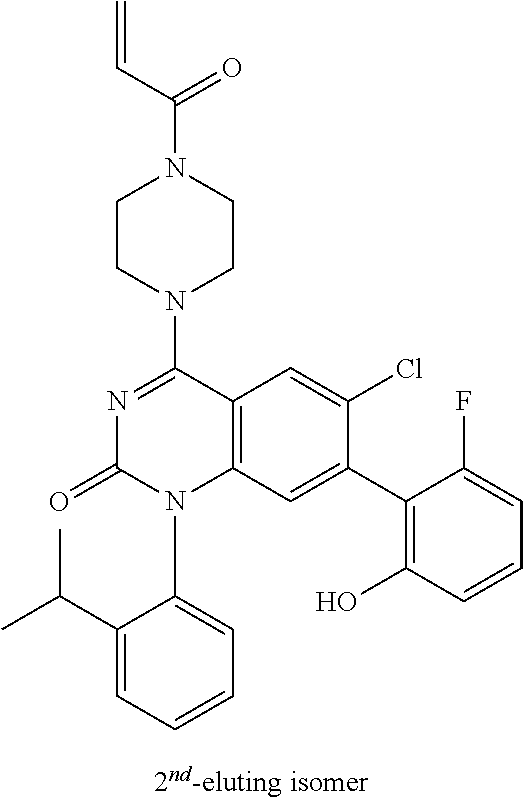 |
6-chloro-7-(2- fluoro-6-hydroxy- phenyl)-1-(2-(2- propanyl)phenyl)- 4-(4-(2- propenoyl)-1- piperazinyl)- 2(1H)- quinazolinone | 8-1/SFC (Chiralpak IC, 300 × 15 mm, 5 μm, 40% MeOH/CO2 (w/20 mM NH3), 135 g/min, 188 bar). |
| 8-3-1 |
 |
6-chloro-7-(2- fluoro-6-hydroxy- phenyl)-4-((2S)- 2-methyl-4-(2- propenoyl)-1- piperazinyl)-1- (2-(2-propanyl)- phenyl)-2(1H)- quinazolinone | 8-3/SFC (Whelk-01 (S,S), 250 × 21 mm, 5 μm, 30% EtOH/CO2 (w/20 mM NH3), 70 g/min, 187 bar). |
| 8-3-2 |
 |
6-chloro-7-(2- fluoro-6-hydoxy- phenyl)-4-((2S)- 2-methyl-4-(2- propenoyl)-1- piperazinyl)-1- (2-(2-propanyl)- phenyl)-2(1H)- quinazolinone | 8-3/SFC (Whelk-01 (S,S), 250 × 21 mm, 5 μm, 30% EtOH/CO2 (w/20 mM NH3), 70 g/min, 187 bar). |
| TABLE 12 (b) |
| Separated Compound Examples Including Atropisomers |
| Racemic SM/ | |||
| Ex. # | Chemical Structure | Name | separation conditions |
| 39-1 |
 |
6-chloro-7-(2-fluoro- 6-hydroxyphenyl)- 1-(2-methyl-6-(2- propanyl)phenyl)-4- ((2S)-2-methyl-4- (2-propenoyl)-1- piperazinyl)pyrido- [2,3-d]pyrimidin- 2(1H)-one | 39/SFC (Chiralpak OD-H, 21 × 250 mm, 5 μm, 30% MeOH/CO2, 50 mL/min, 100 bar). |
| 39-2 |
 |
6-chloro-7-(2-fluoro- 6-hydroxyphenyl)- 1-(2-methyl-6-(2- propanyl)phenyl)-4- ((2S)-2-methyl-4- (2-propenoyl)-1- piperazinyl)pyrido- [2,3-d]pyrimidin- 2(1H)-one | 39/SFC (Chiralpak OD-H, 21 × 250 mm, 5 μm, 30% MeOH/CO2, 50 mL/min, 100 bar). |
| 40-1 |
 |
6-chloro-7-(2-fluoro- phenyl)-1-(4-methyl- 2-(2-propanyl)-3- pyridinyl)-4-((2S)- 2-methyl-4-(2- propenoyl)-1- piperazinyl)pyrido- [2,3-d]pyrimidin- 2(1H)-one | 40/SFC (Chiralpak IC, 21 × 150 mm, 5 μm, 60% MeOH/CO2, 50 mL/min, 100 bar). |
| 40-2 |
 |
6-chloro-7-(2-fluoro- phenyl)-1-(4-methyl- 2-(2-propanyl)-3- pyridinyl)-4-((2S)- 2-methyl-4-(2- propenoyl)-1- piperazinyl)pyrido- [2,3-d]pyrimidin- 2(1H)-one | 40/SFC (Chiralpak IC, 21 × 150 mm, 5 μm, 60% MeOH/CO2, 50 mL/min, 100 bar). |
| 41-1 |
 |
6-fluoro-7-(2-fluoro- 6-hydroxyphenyl)- 1-(4-methyl-2-(2- propanyl)-3- pyridinyl)-4-((2S)- 2-methyl-4-(2- propenoyl)-1- piperazinyl)pyrido- [2,3-d]pyrimidin- 2(1H)-one | 41/SFC (Chiralpak IC, 30 × 250 mm, 5 μm, 55% MeOH/CO2, 120 g/min, 103 bar). |
| 41-2 |
 |
6-fluoro-7-(2-fluoro- 6-hydroxyphenyl)- 1-(4-methyl-2-(2- propanyl)-3- pyridinyl)-4-((2S)- 2-methyl-4-(2- propenoyl)-1- piperazinyl)pyrido- [2,3-d]pyrimidin- 2(1H)-one | 41/SFC (Chiralpak IC, 30 × 250 mm, 5 μm, 55% MeOH/CO2, 120 g/min, 103 bar). |
| 42-1 |
 |
1-(2-cyclopropyl- 4-methyl-3- pyridinyl)-6-fluoro- 7-(2-fluoro-6- hydroxyphenyl)-4- ((2S)-2-methyl-4- (2-propenoyl)-1- piperazinyl)pyrido- [2,3-d]pyrimidin- 2(1H)-one | 42/SFC (Chiralpak OD-H, 21 × 250 mm, 5 μm, 20% EtOH/CO2, 80 mL/min, 100 bar). |
| 42-2 |
 |
1-(2-cyclopropyl- 4-methyl-3- pyridinyl)-6-fluoro- 7-(2-fluoro-6- hydroxyphenyl)-4- ((2S)-2-methyl-4- (2-propenoyl)-1- piperazinyl)pyrido- [2,3-d]pyrimidin- 2(1H)-one | 42/SFC (Chiralpak OD-H, 21 × 250 mm, 5 μm, 20% EtOH/CO2, 80 mL/min, 100 bar). |
| 44-1 |
 |
1-(2-cyclopropyl-4- methyl-3-pyridinyl)- 6-fluoro-7-(2-fluoro- 6-hydroxyphenyl)- 4-((2S)-2-methyl-4- (2-propenoyl)-1- piperazinyl)pyrido- [2,3-d]pyrimidin- 2(1H)-one | 44/SFC (Chiralpak OD-H, 21 × 250 mm, 5 μm, 20% EtOH/CO2, 80 mL/min, 100 bar). |
| 44-2 |
 |
1-(2-cyclopropyl-4- methyl-3-pyridinyl)- 6-fluoro-7-(2-fluoro- 6-hydroxyphenyl)- 4-((2S)-2-methyl- 4-(2-propenoyl)-1- piperazinyl)pyrido- [2,3-d]pyrimidin- 2(1H)-one | 44/SFC (Chiralpak OD-H, 21 × 250 mm, 5 μm, 20% EtOH/CO2, 80 mL/min, 100 bar). |
| 45-1 |
 |
6-chloro-1-(2-cyclo- propyl-4-methyl-3- pyridinyl)-7-(2- fluorophenyl)-4- ((2S)-2-methyl-4- (2-propenoyl)-1- piperazinyl)pyrido- [2,3-d]pyrimidin- 2(1H)-one | 45/SFC (Chiralpak OD-H, 21 × 250 mm, 5 μm, 20% EtOH/CO2, 80 mL/min, 100 bar). |
| 45-2 |
 |
6-chloro-1-(2-cyclo- propyl-4-methyl-3- pyridinyl)-7-(2- fluorophenyl)-4- ((2S)-2-methyl-4- (2-propenoyl)-1- piperazinyl)pyrido- [2,3-d]pyrimidin- 2(1H)-one | 45/SFC (Chiralpak OD-H, 21 × 250 mm, 5 μm, 20% EtOH/CO2, 80 mL/min, 100 bar). |
| 46-1 |
 |
6-chloro-1-(2-ethyl- 4-methyl-3- pyridinyl)-7-(2- fluorophenyl)-4- ((2S)-2-methyl-4- (2-propenoyl)-1- piperazinyl)pyrido- [2,3-d]pyrimidin- 2(1H)-one | 46/SFC (Chiralpak AD-H, 20 × 250 mm, 5 μm, 30% i-PrOH/CO2, 50 mL/min, 100 bar). |
| 46-2 |
 |
6-chloro-1-(2-ethyl- 4-methyl-3-pyridinyl)- 7-(2-fluorophenyl)- 4-((2S)-2-methyl-4- (2-propenoyl)-1- piperazinyl)pyrido- [2,3-d]pyrimidin- 2(1H)-one | 46/SFC (Chiralpak AD-H, 20 × 250 mm, 5 μm, 30% i-PrOH/CO2, 50 mL/min, 100 bar). |
| 49-1 |
 |
6-chloro-7-(2-fluoro- 6-hydroxyphenyl)- 1-(2-(2-methyl-2- propanyl)phenyl)- 4-((2S)-2-methyl-4- (2-propenoyl)-1- piperazinyl)pyrido- [2,3-d]pyrimidin- 2(1H)-one | 49/SFC (Chiralpak IF, 21 × 250 mm, 5 μm, 50% MeOH/CO2, 65 mL/min, 102 bar). |
| 49-2 |
 |
6-chloro-7-(2-fluoro- 6-hydroxyphenyl)- 1-(2-(2-methyl-2- propanyl)phenyl)-4- ((2S)-2-methyl-4- (2-propenoyl)-1- piperazinyl)pyrido- [2,3-d]pyrimidin- 2(1H)-one | 49/SFC (Chiralpak IF, 21 × 250 mm, 5 μm, 50% MeOH/CO2, 65 mL/min, 102 bar). |
| 50-1 |
 |
6-chloro-7-(2- fluorophenyl)-4- ((2S)-2-methyl-4- (2-propenoyl)-1- piperazinyl)-1-(2- (2-propanyl)phenyl)- 2(1H)-pteridinone, | 50/SFC (Chiralpak OD, 21 × 250 mm, 5 μm, 17% MeOH/CO2, 80 g/min, 102 bar). |
| 50-2 |
 |
6-chloro-7-(2- fluorophenyl)-4- ((2S)-2-methyl-4- (2-propenoyl)-1- piperazinyl)-1-(2- (2-propanyl)phenyl)- 2(1H)-pteridinone | 50/SFC (Chiralpak OD, 21 × 250 mm, 5 μm, 17% MeOH/CO2, 80 g/min, 102 bar). |
| 51-1 |
 |
7-(2-fluorophenyl)- 6-methyl-4-((2S)- 2-methyl-4-(2- propenoyl)-1- piperazinyl)-1-(2- (2-propanyl)phenyl)- 2(1H)-pteridinone | 51/SFC ((S,S) Whelk- 01, 21 × 250 mm, 5 μm, 60% MeOH/CO2, 60 g/min, 110 bar). |
| 51-2 |
 |
7-(2-fluorophenyl)- 6-methyl-4-((2S)- 2-methyl-4-(2- propenoyl)-1- piperazinyl)-1-(2- (2-propanyl)phenyl)- 2(1H)-pteridinone | 51/SFC ((S,S) Whelk- 01, 21 × 250 mm, 5 μm, 60% MeOH/CO2, 60 g/min, 110 bar). |
| 52-1 |
 |
7-(2-fluoro-6- hydroxyphenyl)- 6-methyl-4-((2S)- 2-methyl-4-(2- propenoyl)-1- piperazinyl)-1-(2- (2-propanyl)phenyl)- pyrido[2,3-d]- pyrimidin-2(1H)-one | 52/SFC (Chiralpak AS-H, 21 × 250 mm, 5 μm, 25% MeOH/CO2, 50 g/min, 125 bar). |
| 52-2 |
 |
7-(2-fluoro-6- hydroxyphenyl)-6- methyl-4-((2S)-2- methyl-4-(2- propenoyl)-1- piperazinyl)-1-(2- (2-propanyl)- phenyl)pyrido- [2,3-d]pyrimidin- 2(1H)-one | 52/SFC (Chiralpak AS-H, 21 × 250 mm, 5 μm, 25% MeOH/CO2, 50 g/min, 125 bar). |
| 53-1 |
 |
6-chloro-7-(2-fluoro- phenyl)-1-(4-methyl- 1-(2-propanyl)-1H- pyrazol-5-yl)-4- ((2S)-2-methyl-4- (2-propenoyl)-1- piperazinyl)pyrido- [2,3-d]pyrimidin- 2(1H)-one | 53/SFC ((S,S) Whelk- 01, 21 × 250 mm, 5 μm, 25% MeOH/CO2, 90 g/min, 102 bar). |
| 53-2 |
 |
6-chloro-7-(2-fluoro- phenyl)-1-(4-methyl- 1-(2-propanyl)-1H- pyrazol-5-yl)-4- ((2S)-2-methyl-4- (2-propenoyl)-1- piperazinyl)pyrido- [2,3-d]pyrimidin- 2(1H)-one | 53/SFC ((S,S) Whelk- 01, 21 × 250 mm, 5 μm, 25% MeOH/CO2, 90 g/min, 102 bar). |
| TABLE 13 |
| Analytical Data for General Procedures |
| LRMS: | ||
| (ESI, +ve | ||
| Ex. # | ion) m/z | NMR |
| 1-1 | 498.0 | 1H NMR (400 MHz, DMSO-d6) δ 9.99 |
| (br s, 1H), 8.04 (s, 1 H), 7.55 (d, J = 8.7 | ||
| Hz, 1 H), 6.81-6.94 (m, 2 H), 6.79 (d, J = | ||
| 2.9 Hz, 1 H), 6.19 (dd, J = 16.7, 2.2 | ||
| Hz, 1 H), 5.77 (dd, J = 10.5, 2.2 Hz, 1 | ||
| H), 3.87 (br d, J = 19.5 Hz, 4 H), 3.63 (br | ||
| t, J = 5.1 Hz, 4 H). 19F NMR (376 MHz, | ||
| DMSO-d6) δ −123.78 (s, 1 F). | ||
| 1-2 | 441.1 | 1H NMR (400 MHz, DMSO-d6) δ 8.19 (s, |
| 1H), 7.91 (d, J = 8.4 Hz, 1H), 7.45-7.53 | ||
| (m, 2H), 7.43 (d, J = 2.4 Hz, 1H), 7.26- | ||
| 7.35 (m, 2H), 7.10 (d, J = 2.5 Hz, 1H), | ||
| 6.87 (dd, J = 16.7, 10.5 Hz, 1H), 6.18 | ||
| (dd, J = 16.7, 2.3 Hz, 1H), 5.76 (d, J = | ||
| 10.3, 2.4 Hz, 1H), 3.93 (s, 3H), 3.81-3.93 | ||
| (m, 4H), 3.58-3.64 (m, 4H). | ||
| 1-3 | 450.0 | 1H NMR (400 MHz, DMSO-d6) δ 9.91 |
| (br. s, 1H), 8.18 (s, 1H), 7.76 (d, J = 8.2 | ||
| Hz, 1H), 7.47 (s, 1H), 7.37-7.43 (m, 1H), | ||
| 7.24-7.29 (m, 1H), 7.17-7.23 (m, 2H), | ||
| 7.01 (d, J = 2.4 Hz, 1H), 6.87 (dd, J = | ||
| 16.7, 10.5 Hz, 1H), 6.19 (dd, J = 16.7, | ||
| 2.3 Hz, 1H), 5.73-5.79 (m, 1H), 3.82-3.95 | ||
| (m, 4H), 3.58-3.64 (m, 4H). | ||
| 1-4 | 464.0 | 1H NMR (400 MHz, DMSO-d6) δ 8.19 (s, |
| 1H), 7.91 (d, J = 8.4 Hz, 1H), 7.46-7.52 | ||
| (m, 2H), 7.43 (d, J = 2.4 Hz, 1H), 7.25- | ||
| 7.36 (m, 2H), 7.10 (d, J = 2.5 Hz, 1H), | ||
| 6.87 (dd, J = 16.7, 10.5 Hz, 1H), 6.31 | ||
| (dd, J = 1.9, 16.8 Hz, 1H), 5.74-5.80 (m, | ||
| 1H), 3.93 (s, 3H), 3.82-3.93 (m, 4H), | ||
| 3.56-3.63 (m, 4H). | ||
| 1-5 | 432.0 | 1H NMR (400 MHz, DMSO-d6) δ 8.12 (s, |
| 1H), 7.41-7.49 (m, 1H), 7.41 (s, 1H), 7.00 | ||
| (d, J = 8.4 Hz, 1H), 6.80-6.92 (m, 2H), | ||
| 6.18 (dd, J = 16.8, 2.4 Hz, 1H), 5.75 (dd, | ||
| J = 10.5, 2.3 Hz, 1H), 3.79-3.93 (m, 4H), | ||
| 3.75 (s, 3H), 3.53-3.62 (m, 4H). | ||
| 1-6 | 418.0 | 1H NMR (400 MHz, DMSO-d6) δ 9.98 |
| (br s., 1H), 8.10 (s, 1H), 7.39 | ||
| (s, 1H), 7.20-7.29 (m, 1H), 6.68-6.90 (m, | ||
| 3H), 6.17 (dd, J = 16.6, 2.4 Hz, 1H), 5.75 | ||
| (dd, J = 10.4, 2.4 Hz, 1H), 3.78-3.93 (m, | ||
| 4H), 3.53-3.58 (m, 4H). | ||
| 1-7 | 498 | 1H NMR (400 MHz, DMSO-d6) δ 9.79- |
| 10.10 (1 H, m), 8.05-8.12 (1 H, m), 7.77- | ||
| 7.83 (1 H, m), 7.39-7.48 (1 H, m), 7.21- | ||
| 7.29 (3 H, m), 7.04-7.09 (1 H, m), 6.76- | ||
| 6.91 (1 H, m), 6.14-6.24 (1 H, m), 5.74- | ||
| 5.81 (1 H, m), 5.02-5.30 (1 H, m), 4.08- | ||
| 4.53 (3 H, m), 3.54-3.81 (6 H, m). | ||
| 1-8 | 496 | 1H NMR (400 MHz, DMSO-d6) δ 9.83- |
| 10.10 (1 H, m), 8.01-8.07 (1 H, m), 7.77- | ||
| 7.84 (1 H, m), 7.39-7.47 (1 H, m), 7.19- | ||
| 7.31 (3 H, m), 7.04-7.10 (1 H, m), 6.80- | ||
| 6.94 (1 H, m), 6.15-6.28 (1 H, m), 5.75- | ||
| 5.83 (1 H, m), 4.38-4.58 (1 H, m), 4.06- | ||
| 4.27 (2 H, m), 3.51-3.89 (3 H, m), 3.19- | ||
| 3.29 (1 H, m), 1.58-1.74 (2 H, m), 0.90- | ||
| 0.99 (3 H, m). | ||
| 1-9 | 467.8 | 1H NMR (400 MHz, DMSO-d6) δ 9.85- |
| 10.08 (1 H, m), 8.73-8.90 (1 H, m), 7.77- | ||
| 7.83 (1 H, m), 7.72-7.76 (1 H, m), 7.41- | ||
| 7.47 (1 H, m), 7.21-7.28 (3 H, m), 7.04- | ||
| 7.09 (1 H, m), 6.15-6.23 (2 H, m), 5.67- | ||
| 5.72 (1 H, m), 4.90-5.01 (1 H, m), 4.36- | ||
| 4.58 (2 H, m), 4.16-4.31 (1 H, m), 1.54- | ||
| 1.62 (3 H, m). | ||
| 1-10 | 470 | 1H NMR (400 MHz, DMSO-d6) δ 13.03- |
| 13.21 (1 H, m), 8.05-8.11 (1 H, m), 7.53- | ||
| 7.63 (2 H, m), 7.35-7.41 (1 H, m), 6.80- | ||
| 6.99 (1 H, m), 6.15-6.28 (1 H, m), 5.74- | ||
| 5.83 (1 H, m), 4.28-4.55 (2 H, m), 4.15- | ||
| 4.28 (1 H, m), 3.48-3.83 (4 H, m), 2.16- | ||
| 2.22 (3 H, m), 1.17-1.28 (3 H, m). | ||
| 1-11 | 512 | 1H NMR (400 MHz, DMSO-d6) δ 9.83- |
| 10.06 (1 H, m), 8.19-8.25 (1 H, m), 7.76- | ||
| 7.85 (1 H, m), 7.38-7.48 (1 H, m), 7.19- | ||
| 7.30 (3 H, m), 7.03-7.10 (1 H, m), 6.81- | ||
| 6.95 (1 H, m), 6.15-6.27 (1 H, m), 5.74- | ||
| 5.81 (1 H, m), 4.73-4.88 (1 H, m), 4.36- | ||
| 4.59 (2 H, m), 4.13-4.26 (1 H, m), 4.07- | ||
| 4.14 (1 H, m), 3.49-3.80 (5 H, m), 1.72- | ||
| 1.89 (2 H, m). | ||
| 1-12 | 511 | 1H NMR (400 MHz, DMSO-d6) δ 8.26- |
| 8.34 (1 H, m), 8.00-8.09 (2 H, m), 7.70- | ||
| 7.77 (2 H, m), 7.53-7.61 (2 H, m), 7.41- | ||
| 7.49 (2 H, m), 7.32-7.41 (2 H, m), 7.18- | ||
| 7.25 (1 H, m), 5.15-5.27 (1 H, m), 4.31- | ||
| 4.56 (2 H, m), 3.63-3.91 (2 H, m), 3.42- | ||
| 3.60 (2 H, m). | ||
| 1-13 | 482.0 | 1H NMR (400 MHz, DMSO-d6) δ 8.13 (d, |
| J = 9.1 Hz, 1H), 8.09 (s, 1H), 7.97 (d, J = | ||
| 6.8 Hz, 1H), 7.62 (d, J = 9.0 Hz, 1H), | ||
| 7.38-7.44 (m, 2H), 7.22 (d, J = 8.8 Hz, | ||
| 1H), 6.87 (dd, J = 16.8, 10.6 Hz, 1H), | ||
| 6.19 (dd, J = 16.8, 2.4 Hz, 1H), 5.77 (dd, | ||
| J = 10.5, 2.3 Hz, 1H), 3.82-3.94 (m, 4H), | ||
| 3.87 (s, 3H), 3.63-3.69 (m, 4H). | ||
| 1-14 | 468.0 | 1H NMR (400 MHz, DMSO-d6) δ 9.91 |
| (br. s., 1H), 8.07 (s, 1H), 7.90 (d, J = 9.0 | ||
| Hz, 1H), 7.87 (d, J = 7.8 Hz, 1H), 7.27- | ||
| 7.38 (m, 3H), 7.15 (d, J = 8.2 Hz, 1H), | ||
| 6.87 (dd, J = 16.6, 10.6 Hz, 1H), 6.19 | ||
| (dd, J = 16.7, 2.3 Hz, 1H), 5.76 (dd, J = | ||
| 10.5, 2.3 Hz, 1H), 3.80-3.95 (m, 4H), | ||
| 3.60-3.67 (m, 4H). | ||
| 1-15 | 497.8 | 1H NMR (400 MHz, DMSO-d6) δ 8.03- |
| 8.12 (1 H, m), 7.68-7.79 (1 H, m), 7.32- | ||
| 7.44 (1 H, m), 7.11-7.26 (3 H, m), 6.98- | ||
| 7.06 (1 H, m), 6.77-6.91 (1 H, m), 6.13- | ||
| 6.26 (1 H, m), 5.73-5.83 (1 H, m), 4.08- | ||
| 4.54 (3 H, m), 3.54-3.80 (7 H, m). | ||
| 1-16 | 498.0 | 1H NMR (400 MHz, DMSO-d6) δ 9.88- |
| 10.15 (1 H, m), 8.08-8.16 (1 H, m), 7.77- | ||
| 7.83 (1 H, m), 7.40-7.48 (1 H, m), 7.18- | ||
| 7.30 (3 H, m), 7.05-7.10 (1 H, m), 6.80- | ||
| 6.92 (1 H, m), 6.15-6.24 (1 H, m), 5.73- | ||
| 5.80 (1 H, m), 4.58-4.71 (1 H, m), 4.26- | ||
| 4.43 (1 H, m), 3.99-4.24 (2 H, m), 3.39- | ||
| 4.00 (6 H, m). | ||
| 1-17 | 494.0 | 1H NMR (400 MHz, DMSO-d6) δ 9.81- |
| 10.05 (1 H, m), 8.06-8.12 (1 H, m), 7.77- | ||
| 7.84 (1 H, m), 7.40-7.47 (1 H, m), 7.19- | ||
| 7.29 (3 H, m), 7.03-7.08 (1 H, m), 6.77- | ||
| 6.88 (1 H, m), 6.19-6.30 (1 H, m), 5.73- | ||
| 5.82 (1 H, m), 4.73-4.86 (2 H, m), 3.82- | ||
| 3.96 (2 H, m), 3.44-3.52 (2 H, m), 1.88- | ||
| 2.14 (4 H, m). | ||
| 1-18 | 498.0 | 1H NMR (400 MHz, DMSO-d6) δ 9.85- |
| 10.08 (1 H, m), 8.07-8.13 (1 H, m), 7.77- | ||
| 7.83 (1 H, m), 7.40-7.48 (1 H, m), 7.22- | ||
| 7.30 (3 H, m), 7.04-7.09 (1 H, m), 6.76- | ||
| 6.92 (1 H, m), 6.15-6.25 (1 H, m), 5.74- | ||
| 5.81 (1 H, m), 5.04-5.29 (1 H, m), 4.10- | ||
| 4.52 (3 H, m), 3.53-3.78 (5 H, m). | ||
| 1-19 | 482.0 | 1H NMR (400 MHz, DMSO-d6) δ ppm |
| 9.90-10.04 (1 H, m), 8.02-8.08 (1 H, | ||
| m), 7.76-7.82 (1 H, m), 7.38-7.46 (1 H, | ||
| m), 7.20-7.30 (3 H, m), 7.04-7.08 (1 H, | ||
| m), 6.79-6.95 (1 H, m), 6.14-6.27 (1 H, | ||
| m), 5.73-5.81 (1 H, m), 4.38-4.55 (3 H, | ||
| m), 4.28-4.37 (1 H, m), 4.12-4.26 (1 H, | ||
| m), 3.46-3.83 (2 H, m), 1.15-1.21 (3 H, | ||
| m) | ||
| 1-19-1 | 482.0 | 1H NMR (400 MHz, DMSO-d6) δ ppm |
| 9.83-10.08 (1 H, m), 8.04-8.11 (1 H, | ||
| m), 7.77-7.84 (1 H, m), 7.38-7.48 (1 H, | ||
| m), 7.19-7.31 (3 H, m), 7.05-7.10 (1 H, | ||
| m), 6.81-6.98 (1 H, m), 6.16-6.28 (1 H, | ||
| m), 5.75-5.83 (1 H, m), 4.40-4.59 (1 H, | ||
| m), 4.16-4.40 (1 H, m), 3.96-4.07 (1 H, | ||
| m), 3.48-3.83 (3 H, m), 3.16-3.29 (1 H, | ||
| m), 1.10-1.31 (3 H, m). | ||
| 1-19-2 | 482.0 | 1H NMR (400 MHz, DMSO-d6) δ ppm |
| 9.83-10.10 (1 H, m), 8.03-8.10 (1 H, | ||
| m), 7.77-7.83 (1 H, m), 7.38-7.48 (1 H, | ||
| m), 7.19-7.31 (3 H, m), 7.05-7.10 (1 H, | ||
| m), 6.81-6.98 (1 H, m), 6.15-6.28 (1 H, | ||
| m), 5.73-5.83 (1 H, m), 4.39-4.56 (2 H, | ||
| m), 4.15-4.38 (1 H, m), 3.97-4.10 (1 H, | ||
| m), 3.48-3.84 (3 H, m), 1.13-1.27 (3 H, | ||
| m). | ||
| 1-20 | 454.0 | 1H NMR (400 MHz, DMSO-d6) δ 9.83- |
| 10.05 (1 H, m), 9.11-9.35 (1 H, m), 8.02- | ||
| 8.07 (1 H, m), 7.76-7.83 (1 H, m), 7.40- | ||
| 7.47 (1 H, m), 7.20-7.28 (3 H, m), 7.02- | ||
| 7.09 (1 H, m), 6.33-6.46 (1 H, m), 6.11- | ||
| 6.22 (1 H, m), 5.69-5.78 (1 H, m), 4.69- | ||
| 4.80 (1 H, m), 4.40-4.49 (1 H, m), 4.31- | ||
| 4.41 (1 H, m), 4.21-4.30 (1 H, m), 3.99- | ||
| 4.09 (1 H, m). | ||
| 1-21 | 482.0 | 1H NMR (400 MHz, DMSO-d6) δ 9.85- |
| 10.10 (1 H, m), 8.04-8.09 (1 H, m), 7.77- | ||
| 7.83 (1 H, m), 7.40-7.47 (1 H, m), 7.19- | ||
| 7.30 (3 H, m), 7.05-7.09 (1 H, m), 6.74- | ||
| 6.99 (1 H, m), 6.09-6.36 (1 H, m), 5.66- | ||
| 5.88 (1 H, m), 4.39-4.57 (2 H, m), 4.17- | ||
| 4.39 (1 H, m), 3.96-4.07 (1 H, m), 3.48- | ||
| 3.83 (3 H, m), 1.10-1.29 (3 H, m). | ||
| 1-22 | 468.0 | 1H NMR (400 MHz, DMSO-d6) δ 9.87- |
| 10.03 (1 H, m), 8.45-8.66 (1 H, m), 7.94- | ||
| 8.01 (1 H, m), 7.76-7.83 (1 H, m), 7.39- | ||
| 7.47 (1 H, m), 7.21-7.29 (3 H, m), 7.01- | ||
| 7.10 (1 H, m), 6.10-6.25 (2 H, m), 5.59- | ||
| 5.70 (1 H, m), 4.56-4.68 (1 H, m), 3.99- | ||
| 4.13 (1 H, m), 3.75-3.87 (2 H, m), 3.55- | ||
| 3.66 (1 H, m), 2.35-2.48 (1 H, m), 2.06- | ||
| 2.21 (1 H, m). | ||
| 1-23 | 482.0 | 1H NMR (400 MHz, DMSO-d6) δ 9.85- |
| 10.06 (1 H, m), 8.27-8.35 (1 H, m), 7.95- | ||
| 8.00 (1 H, m), 7.76-7.84 (1 H, m), 7.39- | ||
| 7.48 (1 H, m), 7.20-7.29 (3 H, m), 7.01- | ||
| 7.10 (1 H, m), 6.23-6.37 (1 H, m), 6.10- | ||
| 6.20 (1 H, m), 5.58-5.68 (1 H, m), | ||
| 4.00-4.11 (1 H, m), 3.89-3.99 (1 H, m), | ||
| 3.67-3.77 (1 H, m), 3.35-3.49 (2 H, m), | ||
| 1.94-2.07 (2 H, m), 1.77-1.90 (1 H, m), | ||
| 1.62-1.72 (1 H, m). | ||
| 2-7 | 496.2 | 1H NMR (DMSO-d6) δ: 9.83-10.11 (m, |
| 1H), 7.90-7.95 (m, 1H), 7.76-7.84 (m, | ||
| 1H), 7.37-7.49 (m, 1H), 7.19-7.31 (m, | ||
| 3H), 7.06-7.10 (m, 1H), 6.86-7.00 (m, | ||
| 1H), 6.22-6.31 (m, 1H), 5.78-5.86 (m, | ||
| 1H), 4.07-4.22 (m, 3H), 3.89-4.01 (m, | ||
| 1H), 3.71-3.84 (m, 1H), 3.40-3.52 (m, | ||
| 1H), 1.22-1.34 (m, 6H) | ||
| 2-8 | 506.0 | 1H NMR (DMSO-d6) δ 13.04-13.25 (m, |
| 1H), 8.09-8.15 (m, 1H), 7.55-7.62 (m, | ||
| 2H), 7.35-7.41 (m, 1H), 6.76-6.94 (m, | ||
| 1H), 6.36-6.62 (m, 1H), 6.16-6.24 (m, | ||
| 1H), 5.75-5.83 (m, 1H), 4.59-4.86 (m, | ||
| 1H), 4.19-4.58 (m, 1H), 3.52-3.92 (m, | ||
| 3H), 3.40-3.50 (m, 1H), 3.13-3.27 (m, | ||
| 1H), 2.13-2.21 (m, 3H) | ||
| 2-9 | 486.0 | 1H NMR (DMSO-d6) δ: 10.08-10.30 (m, |
| 1H), 7.98-8.07 (m, 1H), 7.29-7.39 (m, | ||
| 1H), 6.72-6.91 (m, 3H), 6.23-6.63 (m, | ||
| 1H), 6.13-6.24 (m, 1H), 5.74-5.81 (m, | ||
| 1H), 4.58-4.82 (m, 1H), 4.42-4.57 (m, | ||
| 1H), 4.17-4.38 (m, 1H), 3.52-3.89 (m, | ||
| 4H) | ||
| 2-10 | 510.0 | 1H NMR (DMSO-d6) δ: 9.83-10.06 (m, |
| 1H), 7.93-8.06 (m, 1H), 7.75-7.85 (m, | ||
| 1H), 7.39-7.51 (m, 1H), 7.17-7.32 (m, | ||
| 3H), 7.00-7.15 (m, 1H), 6.76-6.96 (m, | ||
| 1H), 6.12-6.30 (m, 1H), 5.68-5.86 (m, | ||
| 1H), 4.59-4.71 (m, 1H), 4.35-4.47 (m, | ||
| 1H), 4.06-4.28 (m, 1H), 3.60-4.06 (m, | ||
| 3H), 3.43-3.58 (m, 1H), 2.08-2.25 (m, | ||
| 1H), 1.00-1.11 (m, 3H), 0.86-0.97 (m, | ||
| 3H) | ||
| 1-28 | 436.0 | 1H NMR (400 MHz, DMSO-d6) δ 9.63 (s, |
| 1 H) 8.04 (s, 1 H) 7.09-7.24 (m, 1 H) | ||
| 6.72-6.95 (m, 3 H), 6.12-6.24 (m, 1 H) | ||
| 5.74-5.77 (m, 1 H) 3.83-3.88 (d, 4 H) | ||
| 3.52-3.72 (m, 4 H) | ||
| 2-1 | 451.0 | 1H NMR (400 MHz, DMSO-d6) δ 9.97 |
| (br. s, 1H), 8.72 (s, 1H), 7.79 (d, J = 8.6 | ||
| Hz, 1H), 7.42 (t, J = 7.1 Hz, 1H), 7.17- | ||
| 7.28 (m, 3H), 7.09 (d, J = 2.1 Hz, 1H), | ||
| 6.86 (dd, J = 16.7, 10.5 Hz, 1H), 6.19 | ||
| (dd, J = 16.7, 2.3 Hz, 1H), 5.74-5.79 (m, | ||
| 1H), 3.81-3.95 (m, 4H), 3.68-3.76 (m, | ||
| 4H) | ||
| 2-2 | 447.0 | 1H NMR (400 MHz, DMSO-d6) δ 8.58 (d, |
| J = 3.7 Hz, 1H), 7.47-7.55 (m, 1H), 7.03 | ||
| (d, J = 8.4 Hz, 1H), 6.96 (t, J = 8.7 Hz, | ||
| 1H), 6.79-6.93 (m, 1H), 6.13-6.24 (m, | ||
| 1H), 5.77 (dd, J = 10.5, 2.1 Hz, 1H), | ||
| 4.26-4.54 (m, 2H), 3.96-4.25 (m, 1H), | ||
| 3.65-3.84 (m, 2H), 3.76 (d, J = 2.4 Hz, | ||
| 3H), 3.47-3.64 (m, 2H), 1.19 (s, 3H). | ||
| 2-3 | 433.0 | 1H NMR (400 MHz, METHANOL-d4) δ |
| 8.51 (2, 1H), 7.25-7.34 (m, 1H), 6.74-6.93 | ||
| (m, 1H), 6.65-6.76 (m, 2H), 6.31 (d, J = | ||
| 16.4 Hz, 1H), 5.84 (dd, J = 10.6, 1.5 Hz, | ||
| 1H), 4.41-4.53 (m, 2H), 4.03-4.15 (m, | ||
| 1H), 3.54-3.88 (m, 4H), 1.30 (d, J = 6.6 | ||
| Hz, 3H). | ||
| 2-4 | 479.0 | 1H NMR (400 MHz, DMSO-d6) δ 8.67 (s, |
| 1H), 7.93 (d, J = 8.2 Hz, 1H), 7.45-7.53 | ||
| (m, 2H), 7.26-7.37 (m, 2H), 7.19 (d, J = | ||
| 2.5 Hz, 1H), 6.81-6.95 (m, 1H), 6.15-6.22 | ||
| (m, 1H), 5.78 (dd, J = 10.4, 2.2 Hz, 1H), | ||
| 4.39-4.58 (m, 2H), 4.16-4.26 (m, 1H), | ||
| 3.94 (s, 3H), 3.68-3.84 (m, 2H), 3.48-3.64 | ||
| (m, 2H), 1.22 (br.s, 3H). | ||
| 2-5 | 465.0 | 1H NMR (400 MHz, DMSO-d6) δ 9.96 (s, |
| 1H), 8.66 (s, 1H), 7.79 (d, J = 8.4 Hz, | ||
| 1H), 7.42 (t, J = 7.0 Hz, 1H), 7.17-7.30 | ||
| (m, 3H), 7.09 (d, J = 2.4 Hz, 1H), 6.80- | ||
| 6.94 (m, 1H), 6.14-6.27 (m, 1H), 5.78 | ||
| (dd, J = 10.6, 2.2 Hz, 1H), 3.97-4.57 (m, | ||
| 3H), 3.48-3.83 (m, 4H), 1.22 (br. s, 3H). | ||
| 2-6 | 453.0 | 1H NMR (400 MHz, DMSO-d6) δ 13.11 |
| (br. s., 1H), 8.66 (d, J = 2.3 Hz, 1H), 7.55 | ||
| (d, J = 8.5 Hz, 2H), 7.33 (d, J = 8.5 Hz, | ||
| 1H), 6.80-6.93 (m, 1H), 6.16-6.24 (m, | ||
| 1H), 5.78 (dd, J = 10.5, 2.3 Hz, 1H), | ||
| 3.97-4.56 (m, 4H), 3.48-3.85 (m, 3H), | ||
| 2.19 (s, 3H), 1.22 (br s., 3H). | ||
| 3-1 | 468.0 | 1H NMR (400 MHz, DMSO-d6) δ 9.90- |
| 10.04 (1H, m), 8.10 (1H, s), 7.80 (1H, d, | ||
| J = 8.41 Hz), 7.43 (1H, ddd, J = 1.96, | ||
| 6.11, 8.17 Hz), 7.16-7.31 (3H, m), 7.07 | ||
| (1H, d, J = 2.35 Hz), 6.87 (1H, dd, J = | ||
| 10.47, 16.73 Hz), 6.19 (1H, dd, J = 2.25, | ||
| 16.73 Hz), 5.77 (1H, dd, J = 2.25, 10.47 | ||
| Hz), 3.88 (4H, br d, J = 19.56 Hz), 3.61- | ||
| 3.72 (4H, m). 19F NMR (376 MHz, | ||
| DMSO-d6) δ −123.78 (s, 1F). | ||
| 3-2 | 469 | 1H NMR (400 MHz, CDCl3) δ 9.43 (br. |
| s., 1 H) 8.12 (d, J = 15.1 Hz, 1 H), 7.77 (d, | ||
| J = 9.6 Hz, 1 H) 7.66 (d, J = 7.6 Hz, 1 H) | ||
| 7.59 (d, J = 8.0 Hz, 1 H), 7.45 (s, 1 H) | ||
| 7.21-7.26 (m, 1 H) 7.03 (br d, J = 10.4 | ||
| Hz, 1 H), 6.95 (d, J = 15.1 Hz, 1 H), 6.71 | ||
| (d, J = 9.6 Hz, 1 H) 3.93-4.14 (m, 4 H) | ||
| 3.52-3.59 (m, 4H). 19F NMR (376 | ||
| MHz, CDCl3) δ −123.91 (s, 1 F). | ||
| 3-3 | 453.0 | 1H NMR (400 MHz, DMSO-d6) δ 8.82- |
| 8.88 (1 H, m), 8.52-8.63 (1 H, m), 8.09- | ||
| 8.22 (2 H, m), 7.89-8.02 (2 H, m), 7.67- | ||
| 7.74 (1 H, m), 6.80-6.96 (1 H, m), 6.13- | ||
| 6.25 (1 H, m), 5.72-5.84 (1 H, m), 3.77- | ||
| 4.03 (4 H, m), 3.56-3.74 (4 H, m). | ||
| 3-4 | 469.0 | H NMR (400 MHz, DMSO-d6) δ 11.81- |
| 12.11 (1 H, m), 8.05-8.15 (1 H, m), 7.58- | ||
| 7.67 (1 H, m), 7.42-7.49 (1 H, m), 7.35- | ||
| 7.42 (1 H, m), 7.14-7.20 (1 H, m), 6.80- | ||
| 6.93 (1 H, m), 6.44-6.53 (1 H, m), 6.14- | ||
| 6.24 (1 H, m), 5.72-5.82 (1 H, m), 3.80- | ||
| 3.95 (4 H, m), 3.61-3.69 (4 H, m). | ||
| 3-5 | 456.0 | 1H NMR (400 MHz, DMSO-d6) δ 12.99- |
| 13.26 (1 H, m), 8.10-8.14 (1 H, m), 7.54- | ||
| 7.60 (2 H, m), 7.33-7.40 (1 H, m), 6.81- | ||
| 6.94 (1 H, m), 6.14-6.25 (1 H, m), 5.74- | ||
| 5.80 (1 H, m), 3.81-3.95 (4 H, m), 3.62- | ||
| 3.71 (4 H, m), 2.12-2.20 (3 H, m). | ||
| 3-6 | 436.0 | 1H NMR (400 MHz, METHANOL-d4) δ |
| 7.84 (d, J = 1.17 Hz, 1H), 7.26 (dt, J = | ||
| 6.75, 8.27 Hz, 1H), 6.71-6.90 (m, 2H), | ||
| 6.62-6.71 (m, 1H), 6.25 (dd, J = 1.96, | ||
| 16.82 Hz, 1H), 5.79 (dd, J = 1.86, 10.66 | ||
| Hz, 1H), 3.91-4.03 (m, 4H), 3.57-3.71 | ||
| (m, 4H), 3.33 (s, 1H). 19F NMR (377 | ||
| MHz, METHANOL-d4) δ −116.77 (1 F, s), | ||
| −125.66 (1 F, d, J = 2.6 Hz) | ||
| 3-7 | 438.0 | 1H NMR (400 MHz, DMSO-d6) δ 8.08 (s, |
| 1 H), 7.53-7.62 (m, 1 H), 7.47 (td, J = | ||
| 9.7, 2.5 Hz, 1 H), 7.28 (td, J = 8.5, 2.2 | ||
| Hz, 1 H), 6.85 (dd, J = 16.7, 10.5 Hz, 1 | ||
| H), 6.18 (dd, J = 16.7, 2.2 Hz, 1 H), 5.71- | ||
| 5.79 (m, 1 H), 3.86 (br d, J = 19.6 Hz, 4 | ||
| H), 3.63 (t, J = 5.2 Hz, 4 H) | ||
| 3-8 | 432.2 | 1H NMR (400 MHz, DMSO-d6) δ 9.38 (s, |
| 1 H), 8.02 (s, 1 H), 7.15 (d, J = 8.4 Hz, 1 | ||
| H), 6.85 (dd, J = 16.7, 10.5 Hz, 1 H), 6.77 | ||
| (dd, J = 8.2, 2.5 Hz, 1 H), 6.58 (d, J = 2.5 | ||
| Hz, 1 H), 6.18 (dd, J = 16.6, 2.3 Hz, 1 H), | ||
| 5.72-5.80 (m, 1 H), 3.77-3.93 (m, 4 H), | ||
| 3.62 (t, J = 5.1 Hz, 4 H), 1.94 (s, 3 H). 19F | ||
| NMR (376 MHz, DMSO-d6) δ −124.66 (s, | ||
| 1 F) | ||
| 3-9 | 467.8 | 1H NMR (400 MHz, DMSO-d6) δ 8.05 (s, |
| 1 H) 7.54 (d, J = 8.8 Hz, 1 H) 7.10 (dd, J = | ||
| 8.8, 3.1 Hz, 1 H) 7.02-7.07 (m, 1 H) | ||
| 6.85 (dd, J = 16.7, 10.5 Hz, 1 H) 6.18 | ||
| (dd, J = 16.7, 2.2 Hz, 1 H) 5.72-5.79 (m, | ||
| 1 H) 3.86 (br d, J = 19.4 Hz, 4 H) 3.79 (s, | ||
| 3 H) 3.62 (t, J = 5.1 Hz, 4 H). 19F NMR | ||
| (376 MHz, DMSO-d6) δ −123.83 (s, 1 F) | ||
| 3-10 | 454.0 | 1H NMR (400 MHz, DMSO-d6) δ 10.09 |
| (s, 1 H), 8.05 (s, 1 H), 7.39 (dd, J = 11.0, | ||
| 9.6 Hz, 1 H), 6.97 (dd, J = 9.5, 7.1 Hz, 1 | ||
| H), 6.85 (dd, J = 16.6, 10.4 Hz, 1 H), | ||
| 6.17 (dd, J = 16.6, 2.2 Hz, 1 H), 5.75 (dd, | ||
| J = 10.5, 2.2 Hz, 1 H), 3.76-3.95 (m, 4 | ||
| H), 3.62 (br t, J = 5.1 Hz, 4 H). 19F NMR | ||
| (376 MHz, DMSO-d6) δ −122.67 (br s, 1 | ||
| F), −123.60 (d, J = 4.3 Hz, 1 F), −130.52 | ||
| (d, J = 2.6 Hz, 1 F) | ||
| 3-11 | 453.8 | 1H NMR (400 MHz, DMSO-d6) δ 9.83- |
| 10.02 (1 H, m), 8.04 (1 H, s), 7.40 (1 H, | ||
| br d, J = 8.6 Hz), 6.76-7.03 (3 H, m), | ||
| 6.12-6.22 (1 H, m), 5.69-5.82 (1 H, m), | ||
| 3.86 (4 H, br d, J = 18.6 Hz), 3.63 (4 H, | ||
| br d, J = 4.7 Hz). 19F NMR (376 MHz, | ||
| DMSO-d6) δ −124.09 (s, 1 F) | ||
| 3-12 | 431.0 | 1H NMR (400 MHz, DMSO-d6) δ 8.00 (s, |
| 1 H), 6.99 (d, J = 8.2 Hz, 1 H), 6.85 (dd, | ||
| J = 16.6, 10.4 Hz, 1 H), 6.57 (dd, J = 8.0, | ||
| 2.0 Hz, 1 H), 6.39 (d, J = 1.8 Hz, 1 H), | ||
| 6.18 (dd, J = 16.7, 2.2 Hz, 1 H), 5.69- | ||
| 5.85 (m, 1 H), 4.99 (s, 2 H), 3.86 (br d, J = | ||
| 19.6 Hz, 4 H), 3.56-3.70 (m, 4 H), | ||
| 1.88 (s, 3H). 19F NMR (376 MHz, | ||
| DMSO-d6) δ −124.75 (1 F, s) | ||
| 3-13 | 473.0 | 1H NMR (400 MHz, DMSO-d6) δ 9.98 (s, |
| 1 H), 8.05 (s, 1 H), 7.54 (br d, J = 8.4 Hz, | ||
| 1 H), 7.49 (s, 1 H), 7.29 (d, J = 8.4 Hz, 1 | ||
| H), 6.85 (dd, J = 16.5, 10.5 Hz, 1 H), | ||
| 6.18 (dd, J = 16.6, 2.0 Hz, 1 H), 5.76 (dd, | ||
| J = 10.5, 2.1 Hz, 1 H), 3.86 (br d, J = | ||
| 19.8 Hz, 4 H), 3.63 (br t, J = 4.9 Hz, 4 | ||
| H), 2.03 (s, 3 H), 2.01 (s, 3 H). 19F NMR | ||
| (376 MHz, DMSO-d6) δ −124.58 (s, 1 F) | ||
| 3-14 | 435.0 | 1H NMR (400 MHz, DMSO-d6) δ 8.03 |
| (s, 1 H), 7.01 (t, J = 9.2 Hz, 1 H), 6.85 | ||
| (dd, J = 16.7, 10.5 Hz, 1 H), 6.62-6.71 | ||
| (m, 1 H), 6.52 (dd, J = 6.1, 2.7 Hz, 1 H), | ||
| 6.18 (dd, J = 16.7, 2.2 Hz, 1 H), 5.70- | ||
| 5.81 (m, 1 H), 5.11 (s, 2 H), 3.86 (br d, J = | ||
| 19.6 Hz, 4 H), 3.52-3.69 (m, 4 H). 19F | ||
| NMR (376 MHz, DMSO-d6) δ −123.91 | ||
| (s, 1 F), −131.17 (s, 1 F) | ||
| 3-15 | 453.0 | 1H NMR (400 MHz, DMSO-d6) δ 8.06 (s, |
| 1 H), 6.85 (dd, J = 16.7, 10.5 Hz, 1 H), | ||
| 6.63 (ddd, J = 13.0, 6.6, 2.5 Hz, 1 H), | ||
| 6.33 (br d, J = 2.0 Hz, 1 H), 6.18 (dd, J = | ||
| 16.6, 2.3 Hz, 1 H), 5.71-5.82 (m, 1 H), | ||
| 5.44 (s, 2 H), 3.76-3.96 (m, 4 H), 3.56- | ||
| 3.71 (m, 4 H) | ||
| 3-16 | 453.9 | 1H NMR (400 MHz, DMSO-d6) δ 10.12 |
| (s, 1 H), 8.08 (s, 1 H), 6.92 (ddd, J = | ||
| 12.3, 6.5, 2.9 Hz, 1 H), 6.85 (dd, J = | ||
| 16.6, 10.4 Hz, 1 H), 6.58-6.65 (m, 1 H), | ||
| 6.18 (dd, J = 16.7, 2.2 Hz, 1 H), 5.72- | ||
| 5.79 (m, 1 H), 3.78-3.92 (m, 4 H), 3.63 | ||
| (t, J = 5.2 Hz, 4 H) | ||
| 3-17 | 486.0 | 1H NMR (400 MHz, DMSO-d6) δ 10.86 |
| (br s, 1 H), 8.05 (s, 1 H), 7.68 (s, 1 H), | ||
| 6.96 (s, 1 H), 6.85 (dd, J = 16.6, 10.4 Hz, | ||
| 1 H), 6.18 (dd, J = 16.6, 2.3 Hz, 1 H), | ||
| 5.76 (dd, J = 10.5, 2.2 Hz, 1 H), 3.78- | ||
| 3.93 (m, 4 H), 3.56-3.68 (m, 4 H). 19F | ||
| NMR (376 MHz, DMSO-d6) δ −123.87 (s, | ||
| 1 F) | ||
| 3-18 | 469.9 | 1H NMR (400 MHz, DMSO-d6) δ 10.36- |
| 10.69 (m, 1 H), 8.04 (s, 1 H), 7.55 (d, J = | ||
| 11.0 Hz, 1 H), 6.98 (d, J = 9.0 Hz, 1 H), | ||
| 6.85 (dd, J = 16.7, 10.5 Hz, 1 H), 6.18 | ||
| (dd, J = 16.7, 2.2 Hz, 1 H), 5.70-5.80 | ||
| (m, 1 H), 3.86 (br d, J = 19.8 Hz, 4 H), | ||
| 3.62 (br t, J = 5.1 Hz, 4 H). 19F NMR | ||
| (376 MHz, DMSO-d6) δ −123.82 (s, 1 F), | ||
| −132.61 (br s, 1 F) | ||
| 3-19 | 451.0 | 1H NMR (400 MHz, DMSO-d6) δ 8.01 (s, |
| 1 H), 7.20 (d, J = 8.6 Hz, 1 H), 6.85 (dd, | ||
| J = 16.7, 10.5 Hz, 1 H), 6.66 (dd, J = 8.6, | ||
| 2.7 Hz, 1 H), 6.54 (d, J = 2.5 Hz, 1 H), | ||
| 6.17 (dd, J = 16.7, 2.2 Hz, 1 H), 5.67- | ||
| 5.82 (m, 1 H), 5.40 (s, 2 H), 3.85 (br d, J = | ||
| 19.4 Hz, 4 H), 3.54-3.73 (m, 4 H). 19F | ||
| NMR (376 MHz, DMSO-d6) δ −124.25 (1 | ||
| F, s) | ||
| 3-20 | 485.0 | 1H NMR (400 MHz, DMSO-d6) δ 8.04 (s, |
| 1 H), 7.50 (s, 1 H), 6.85 (dd, J = 16.7, | ||
| 10.5 Hz, 1 H), 6.79 (s, 1 H), 6.18 (dd, J = | ||
| 16.7, 1.9 Hz, 1 H), 5.76 (dd, J = 10.6, 1.8 | ||
| Hz, 1 H), 5.70 (s, 2 H), 3.86 (br d, J = | ||
| 19.8 Hz, 4 H), 3.63 (br d, J = 4.9 Hz, 4 | ||
| H). 19F NMR (376 MHz, DMSO-d6) δ | ||
| −124.05 (br s, 1 F) | ||
| 3-21 | 445.2 | 1H NMR (400 MHz, DMSO-d6) δ 8.54 |
| (d, J = 5.4 Hz, 1 H), 8.29 (s, 1 H), 8.02 | ||
| (s, 1 H), 7.47 (d, J = 5.2 Hz, 1 H), 6.78 | ||
| (dd, J = 16.7, 10.5 Hz, 1 H), 6.10 (dd, J = | ||
| 16.7, 2.2 Hz, 1 H), 5.62-5.75 (m, 1 H), | ||
| 3.71-3.88 (m, 4 H), 3.56 (br t, J = 5.3 | ||
| Hz, 4 H), 2.4-2.64 (m, 1 H), 1.10 (d, J = | ||
| 6.8 Hz, 3 H), 1.01 (d, J = 6.8 Hz, 3 H). | ||
| 19F NMR (376 MHz, DMSO-d6) δ | ||
| −123.04 (1 F, s) | ||
| 3-22 | 486.0 | 1H NMR (400 MHz, DMSO-d6) δ 10.52 |
| (br s, 1 H), 8.07 (s, 1 H), 7.14 (d, J = 2.7 | ||
| Hz, 1 H), 6.78-6.93 (m, 2 H), 6.19 (dd, | ||
| J = 16.7, 2.2 Hz, 1 H), 5.70-5.82 (m, 1 | ||
| H), 3.79-3.92 (m, 4 H), 3.63 (br t, J = | ||
| 5.0 Hz, 4 H). 19F NMR (376 MHz, | ||
| DMSO-d6) δ −124.13 (s, 1 F) | ||
| 3-23 | 452.1 | 1H NMR (400 MHz, DMSO-d6) δ 8.03- |
| 8.14 (m, 3 H) 7.41-7.69 (m, 5 H) 6.84- | ||
| 6.91 (m, 1 H) 6.17-6.22 (m, 1 H) 5.76- | ||
| 5.79 (m, 1 H) 3.86-3.91 (m, 4 H) 3.65- | ||
| 3.67 (m, 4 H) | ||
| 3-24 | 453 | 1H NMR (400 MHz, DMSO-d6) δ 8.78- |
| 8.87 (m, 1 H) 8.43-8.54 (m, 1 H) 8.04- | ||
| 8.40 (m, 2 H) 7.45-7.79 (m, 2 H) 7.53- | ||
| 7.65 (m, 1 H) 6.74-6.98 (m, 1 H) 6.09- | ||
| 6.26 (m, 1 H) 5.79-5.81 (m, 1 H) 3.83- | ||
| 3.93 (m, 4 H) 3.52-3.66 (m, 4 H) | ||
| 3-25 | 442 | 1H NMR (400 MHz, DMSO-d6) δ 8.03 (s, |
| 1 H) 6.81-6.98 (m, 4 H) 6.15-6.20 (m, 1 | ||
| H) 5.72-5.86 (m, 3 H) 3.83-3.88 (m, 4 | ||
| H) 3.6-3.62 (m, 4 H) | ||
| 4-1 | 480.0 | 1H NMR (400 MHz, DMSO-d6) δ 9.82- |
| 10.04 (1 H, m), 7.79 (1 H, d, J = 8.2 Hz), | ||
| 7.66 (1 H, s), 7.43 (1 H, dt, J = 8.3, 4.0 | ||
| Hz), 7.26 (1 H, d, J = 2.3 Hz), 7.22 (2 H, | ||
| d, J = 3.7 Hz), 7.05 (1 H, d, J = 2.3 Hz), | ||
| 6.26-6.38 (1 H, m), 6.12 (1 H, dd, J = | ||
| 16.8, 2.2 Hz), 5.66-5.72 (1 H, m), 4.58- | ||
| 4.67 (4 H, m), 4.50 (2 H, s), 4.22 (2 H, s). | ||
| 19F NMR (376 MHz, DMSO-d6) δ | ||
| −123.98 (1 F, s) | ||
| 4-2 | 418.0 | 1H NMR (400 MHz, DMSO-d6) δ 7.65 (1 |
| H, d, J = 1.4 Hz), 6.25-6.36 (1 H, m), | ||
| 6.10 (1 H, dd, J = 17.0, 2.3 Hz), 5.64- | ||
| 5.72 (1 H, m), 4.58 (4 H, s), 4.47 (2 H, s), | ||
| 4.18 (2 H, s). 19F NMR (376 MHz, | ||
| DMSO-d6) δ −113.54 (1 F, s) | ||
| 4-3 | 494.0 | 1H NMR (400 MHz, DMSO-d6) δ 7.93 (1 |
| H, d, J = 8.4 Hz), 7.67 (1 H, s), 7.45- | ||
| 7.57 (2 H, m), 7.23-7.36 (2 H, m), 7.16 | ||
| (1 H, d, J = 2.5 Hz), 6.27-6.39 (1 H, m), | ||
| 6.11 (1 H, dd, J = 17.0, 2.2 Hz), 5.65- | ||
| 5.76 (1 H, m), 4.58-4.67 (4 H, m), 4.50 | ||
| (2 H, s), 4.22 (2 H, s), 3.93 (3 H, s). 19F | ||
| NMR (376 MHz, DMSO-d6) δ −123.88 | ||
| (1 F, s) | ||
| 4-4 | 391.8 | 1H NMR (400 MHz, DMSO-d6) δ 8.93 (1 |
| H, br s), 7.63-7.77 (1 H, m), 6.04-6.33 | ||
| (2 H, m), 5.60-5.77 (1 H, m), 4.89 (1 H, | ||
| br d, J = 3.3 Hz), 4.72 (2 H, br dd, J = | ||
| 8.1, 3.6 Hz), 4.28 (2 H, br dd, J = 8.0, 3.9 | ||
| Hz). 19F NMR (377 MHz, DMSO-d6) δ | ||
| −113.24 (1 F, s) | ||
| 4-5 | 468.0 | 1H NMR (400 MHz, DMSO-d6) δ 8.92- |
| 9.00 (1 H, m), 7.93 (1 H, d, J = 8.2 Hz), | ||
| 7.72 (1 H, s), 7.45-7.60 (2 H, m), 7.25- | ||
| 7.36 (2 H, m), 7.17 (1 H, d, J = 2.3 Hz), | ||
| 6.08-6.36 (2 H, m), 5.69 (1 H, dd, J = | ||
| 9.8, 2.2 Hz), 4.87-5.01 (1 H, m), 4.69- | ||
| 4.84 (2 H, m), 4.33 (2 H, br d, J = 3.3 | ||
| Hz), 3.94 (3 H, s). 19F NMR (376 MHz, | ||
| DMSO-d6) δ −123.93 (1 F, s) | ||
| 4-6 | 454.0 | 1H NMR (400 MHz, DMSO-d6) δ 9.95 (1 |
| H, s), 8.97 (1 H, d, J = 7.0 Hz), 7.80 (1 | ||
| H, d, J = 8.2 Hz), 7.72 (1 H, s), 7.39- | ||
| 7.49 (1 H, m), 7.16-7.32 (3 H, m), 7.05 | ||
| 1 H, d, J = 2.2 Hz), 6.08-6.36 (2 H, m), | ||
| 5.65-5.73 (1 H, m), 4.87-5.05 (1 H, m), | ||
| 4.77 (2 H, td, J = 8.2, 2.6 Hz), 4.33 (2 H, | ||
| br t, J = 6.2 Hz). 19F NMR (376 MHz, | ||
| DMSO-d6) δ −124.03 (1 F, s) | ||
| 4-7 | 391.8 | 1H NMR (400 MHz, DMSO-d6) δ 9.23- |
| 9.42 (1 H, m), 8.04 (1 H, d, J = 1.0 Hz), | ||
| 6.37 (1 H, dd, J = 17.0, 10.2 Hz), 6.15 (1 | ||
| H, dd, J = 17.0, 2.0 Hz), 5.65-5.86 (1 H, | ||
| m), 4.70 (1 H, br t, J = 8.0 Hz), 4.35- | ||
| 4.48 (1 H, m), 4.25-4.33 (1 H, m), 4.22 | ||
| (1 H, br dd, J = 9.0, 4.3 Hz), 3.99 (1 H, | ||
| br dd, J = 10.3, 4.4 Hz). 19F NMR (376 | ||
| MHz, DMSO-d6) δ −113.81 (1 F, s) | ||
| 4-8 | 420.0 | 1H NMR (400 MHz, DMSO-d6) δ 8.64 (1 |
| H, br s), 8.15 (1 H, br d, J = 8.8 Hz), 6.58- | ||
| 6.97 (1 H, m), 5.97-6.27 (1 H, m), 5.58- | ||
| 5.74 (1 H, m), 4.50 (1 H, br d, J = 11.5 | ||
| Hz), 3.91 (1 H, br d, J = 13.5 Hz), 3.14- | ||
| 3.28 (2 H, m), 2.85-2.97 (1 H, m), 2.08- | ||
| 2.23 (1 H, m), 1.79-1.91 (1 H, m), 1.64- | ||
| 1.78 (1 H, m), 1.45-1.60 (1 H, m). 19F | ||
| NMR (376 MHz, DMSO-d6) δ −114.17 (1 | ||
| F, br s) | ||
| 4-9 | 482.0 | 1H NMR (400 MHz, DMSO-d6) δ 9.87- |
| 10.07 (1 H, m), 8.50-8.70 (1 H, m), 8.06- | ||
| 8.23 (1 H, m), 7.70-7.88 (1 H, m), 7.39- | ||
| 7.48 (1 H, m), 7.19-7.28 (3 H, m), 7.02- | ||
| 7.08 (1 H, m), 6.68-6.93 (1 H, m), 6.05- | ||
| 6.23 (1 H, m), 5.64-5.78 (1 H, m), 4.51- | ||
| 4.63 (1 H, m), 4.06-4.17 (1 H, m), 3.91- | ||
| 4.04 (1 H, m), 3.14-3.30 (1 H, m), 2.91- | ||
| 3.01 (1 H, m), 2.14-2.29 (1 H, m), 1.83- | ||
| 1.96 (1 H, m), 1.68-1.82 (1 H, m), 1.49- | ||
| 1.65 (1 H, m). | ||
| 5-1 | 468.0 | 1H NMR (400 MHz, DMSO-d6) δ 9.89- |
| 10.10 (m, 1 H), 7.79 (d, J = 8.4 Hz, 1 H), | ||
| 7.73 (s, 1H), 7.43 (ddd, J = 8.2, 5.1, 2.9 | ||
| Hz, 1 H), 7.20-7.30 (m, 3 H), 7.05 (d, J = | ||
| 2.2 Hz, 1 H), 6.81 (dd, J = 16.7, 10.5 | ||
| Hz, 1 H), 6.10-6.23 (m, 1 H), 5.69-5.81 | ||
| (m, 1 H), 5.37-5.59 (m, 1 H), 4.63-4.74 | ||
| (m, 3 H), 4.53-4.61 (m, 1 H), 3.14-3.23 | ||
| (m, 3 H). 19F NMR (376 MHz, DMSO- | ||
| d6) δ −124.10 (1 F, s) | ||
| 5-2 | 468.2 | 1H NMR (400 MHz, DMSO-d6) δ 9.89- |
| 10.09 (m, 1 H), 8.70 (s, 1 H), 7.79 (d, J = | ||
| 8.2 Hz, 1 H), 7.69 (s, 1 H), 7.39-7.46 | ||
| (m, 1 H), 7.16-7.31 (m, 3 H), 7.05 (d, J = | ||
| 2.2 Hz, 1 H), 6.20-6.32 (m, 1 H), 6.08- | ||
| 6.18 (m, 1 H), 5.65 (dd, J = 10.1, 1.9 | ||
| Hz, 1 H), 4.57 (dd, J = 8.1, 1.9 Hz, 2 H), | ||
| 4.40 (br d, J = 8.4 Hz, 2 H), 1.67 (s, 3 H). | ||
| 19F NMR (376 MHz, DMSO-d6) δ | ||
| −124.13 (1 F, s) | ||
| 5-3 | 484.0 | 1H NMR (400 MHz, DMSO-d6) δ 9.95 |
| (s, 1 H), 8.74 (s, 1 H), 7.79 (d, J = 8.4 | ||
| Hz, 1 H), 7.70 (s, 1 H), 7.42 (br t, J = 6.6 | ||
| Hz, 1 H), 7.16-7.28 (m, 3 H), 7.05 (d, J = | ||
| 2.2 Hz, 1 H), 6.23-6.41 (m, 1 H), 6.07- | ||
| 6.19 (m, 1 H), 5.66 (dd, J = 10.1, 1.7 | ||
| Hz, 1 H), 5.36 (br t, J = 5.8 Hz, 1 H), | ||
| 4.49 (s, 4 H), 3.74 (br d, J = 5.5 Hz, 2 H). | ||
| 19F NMR (376 MHz, DMSO-d6) δ | ||
| −124.12 (1 F, s) | ||
| 5-4 | 482.1 | 1H NMR (400 MHz, DMSO-d6) δ 9.99 (s, |
| 1 H), 8.02 (s, 1 H), 7.80 (d, J = 8.1 Hz, 1 | ||
| H), 7.38-7.52 (m, 1 H), 7.16-7.34 (m, 3 | ||
| H), 7.07 (s, 1 H), 6.75-6.96 (m, 1 H), | ||
| 6.11-6.35 (m, 1 H), 5.66-5.90 (m, 1 H), | ||
| 4.43-4.91 (m, 1 H), 4.07-4.39 (m, 1 H), | ||
| 3.90-4.05 (m, 1 H), 3.71-3.87 (m, 1 H), | ||
| 3.61 (br d, J = 9.7 Hz, 1 H), 3.33-3.51 | ||
| (m, 2 H), 1.36 (br s, 3 H). 19F NMR (376 | ||
| MHz, DMSO-d6) δ −124.10 (1 F, s) | ||
| 5-5 | 480.1 | 1H NMR (400 MHz, DMSO-d6) δ 9.97 (s, |
| 1 H), 7.80 (d, J = 8.3 Hz, 1 H), 7.69 (d, J = | ||
| 4.4 Hz, 1 H), 7.38-7.49 (m, 1 H), 7.16 | ||
| 7.29 (m, 3 H), 7.05 (d, J = 1.0 Hz, 1 H), | ||
| 6.54-6.86 (m, 1 H), 6.14-6.31 (m, 1 H, | ||
| 5.74-5.80 (m, 1 H), 5.21-5.40 (m, 1 H), | ||
| 4.96-5.17 (m, 1 H), 4.61-4.73 (m, 1 H), | ||
| 4.15-4.42 (m, 2 H), 3.55-3.92 (m, 1 H, | ||
| 2.25-2.47 (m, 1 H), 1.93-2.20 (m, 1 H) | ||
| 5-6 | 480.1 | 1H NMR (400 MHz, DMSO-d6) δ 9.97 (s, |
| 1 H), 7.80 (d, J = 8.1 Hz, 1 H), 7.69 (d, J = | ||
| 4.1 Hz, 1 H), 7.43 (dt, J = 8.1, 4.1 Hz, | ||
| 1 H), 7.26 (d, J = 2.3 Hz, 1 H), 7.19- | ||
| 7.25 (m, 2 H), 7.05 (d, J = 2.1 Hz, 1 H), | ||
| 6.55-6.83 (m, 1 H), 6.23 (ddd, J = 16.5, | ||
| 7.5, 2.2 Hz, 1 H), 5.79 (br d, J = 2.1 Hz, | ||
| 1 H), 5.22-5.40 (m, 1 H), 4.96-5.18 (m, | ||
| 1 H), 4.61-4.72 (m, 1 H), 4.18-4.44 (m, | ||
| 2 H), 3.57-3.94 (m, 1 H), 2.27-2.45 (m, | ||
| 1 H), 1.92-2.24 (m, 1 H) | ||
| 5-7 | 482.1 | 1H NMR (400 MHz, DMSO-d6) δ 9.97 (1 |
| H, br s), 8.02 (1 H, s), 7.80 (1 H, d, J = | ||
| 8.5 Hz), 7.35-7.53 (1 H, m), 7.17-7.33 | ||
| (3 H, m), 7.07 (1 H, d, J = 2.3 Hz), 6.84 | ||
| (1 H, dd, J = 16.7, 10.5 Hz), 6.19 (1 H, | ||
| dd, J = 16.8, 1.7 Hz), 5.68-5.83 (1 H, | ||
| m), 4.43-4.93 (1 H, m), 4.08-4.39 (1 H, | ||
| m), 3.93-4.05 (1 H, m), 3.79 (1 H, br d, | ||
| J = 11.6 Hz), 3.54-3.66 (1 H, m), 3.37- | ||
| 3.50 (2 H, m), 1.35 (3 H, br s). 19F NMR | ||
| (376 MHz, DMSO-d6) δ −123.81 (1 F, d, J = | ||
| 16.5 Hz) | ||
| 5-8 | 480.0 | 1H NMR (400 MHz, DMSO-d6) δ 9.98 (s, |
| 1 H), 7.86 (br d, J = 8.7 Hz, 1 H), 7.80 | ||
| (d, J = 8.1 Hz, 1 H), 7.37-7.53 (m, 1 H), | ||
| 7.19-7.31 (m, 3 H), 7.06 (br s, 1 H), 6.25- | ||
| 6.55 (m, 1 H), 6.11-6.24 (m, 1 H), 5.64- | ||
| 5.82 (m, 1 H), 5.14-5.44 (m, 1 H), 5.03- | ||
| 5.12 (m, 1 H), 4.24-4.59 (m, 1 H), 3.63- | ||
| 4.20 (m, 3 H), 2.22-2.48 (m, 2 H). 19F | ||
| NMR (376 MHz, DMSO-d6) δ −124.17- | ||
| −123.93 (m, 1 F) | ||
| 5-9 | 468.0 | 1H NMR (400 MHz, DMSO-d6) δ 9.98 (s, |
| 1 H), 8.04 (s, 1 H), 7.80 (d, J = 8.5 Hz, 1 | ||
| H), 7.38-7.52 (m, 1 H), 7.15-7.35 (m, 3 | ||
| H), 7.07 (d, J = 2.3 Hz, 1 H), 6.39 (dd, J = | ||
| 17.0, 10.4 Hz, 1 H), 6.16 (dd, J = 17.0, | ||
| 2.1 Hz, 1 H), 5.66-5.81 (m, 1 H), 4.94- | ||
| 5.06 (m, 1 H), 4.67 (br t, J = 8.7 Hz, 1 | ||
| H), 4.49 (br dd, J = 9.4, 5.3 Hz, 1 H), | ||
| 4.31-4.43 (m, 1 H), 4.21 (br dd, J = | ||
| 10.6, 5.2 Hz, 1 H), 3.43 (s, 3 H). 19F | ||
| NMR (376 MHz, DMSO-d6) δ −124.00 (s, | ||
| 1 F) | ||
| 6-1 | 452.0 | 1H NMR (400 MHz, DMSO-d6) δ 7.97- |
| 8.10 (m, 1 H), 7.60 (d, J = 8.9 Hz, 1 H), | ||
| 6.86 (dd, J = 16.6, 10.6 Hz, 1 H), 6.57 (d, | ||
| J = 8.9 Hz, 1 H), 6.38 (s, 2 H), 6.19 (dd, | ||
| J = 16.8, 2.3 Hz, 1 H), 5.71-5.84 (m, 1 | ||
| H), 3.86 (br d, J = 19.9 Hz, 4 H), 3.63 (br | ||
| d, J = 1.0 Hz, 4 H). 19F NMR (376 MHz, | ||
| DMSO-d6) δ −126.04 (1 F, s) | ||
| 6-2 | 437.0 | 1H NMR (400 MHz, DMSO-d6) δ 8.67- |
| 8.79 (1 H, m), 8.18 (1 H, dd, J = 8.3, 1.0 | ||
| Hz), 8.10 (1 H, s), 7.61 (1 H, dd, J = 8.2, | ||
| 4.7 Hz), 6.86 (1 H, dd, J = 16.6, 10.4 | ||
| Hz), 6.19 (1 H, dd, J = 16.8, 2.3 Hz), | ||
| 5.77 (1 H, dd, J = 10.4, 2.3 Hz), 3.79- | ||
| 3.97 (4 H, m), 3.58-3.73 (4 H, m). 19F | ||
| NMR (376 MHz, DMSO-d6) δ −125.75 (1 | ||
| F, s) | ||
| 7-1 | 518.0 | 1H NMR (400 MHz, DMSO-d6) δ 10.13 |
| (br. s., 1 H) 8.12 (d, J = 2.2 Hz, 1 H) 7.80 | ||
| (d, J = 8.2 Hz, 1 H) 7.43 (br t, J = 7.0 Hz, | ||
| 1 H) 7.20-7.30 (m, 3 H) 7.08 (dd, J = 5.8, | ||
| 2.2 Hz, 1 H) 6.78-6.91 (m, 1 H) 6.27- | ||
| 6.70 (m, 1 H) 6.20 (dd, J = 16.6, 2.0 Hz, | ||
| 1 H) 5.76-5.84 (m, 1 H) 4.73-4.87 (m, | ||
| 1 H) 4.19-4.72 (m, 2 H) 3.55-3.90 (m, | ||
| 3 H) 3.36-3.47 (m, 1 H) | ||
| 7-2 | 500.0 | 1H NMR (DMSO-d6) δ: 9.73-10.17 (m, |
| 1H), 8.04-8.12 (m, 1H), 7.77-7.84 (m, | ||
| 1H), 7.39-7.48 (m, 1H), 7.20-7.30 (m, | ||
| 3H), 7.06-7.10 (m, 1H), 6.77-6.93 (m, | ||
| 1H), 6.15-6.24 (m, 1H), 5.74-5.83 (m, | ||
| 1H), 4.57-4.92 (m, 3H), 4.14-4.54 (m | ||
| 2H), 3.55-3.87 (m, 3H), 3.21-3.29 (m, | ||
| 1H) | ||
| 7-3 | 526.0 | 1H NMR (DMSO-d6) δ: 9.76-10.22 (m, |
| 1H), 8.09-8.14 (m, 1H), 7.77-7.84 (m, | ||
| 1H), 7.39-7.48 (m, 1H), 7.20-7.29 (m, | ||
| 3H), 7.04-7.11 (m, 1H), 6.82 (br. s., 1H), | ||
| 6.14-6.22 (m, 1H), 5.77-5.83 (m, 1H), | ||
| 3.68-5.36 (m, 4H), 3.60-3.67 (m, 3H) | ||
| 8-1 | 547 | 1H NMR (400 MHz, DMSO-d6) δ 10.06 |
| (br. d., J = 15.1 Hz, 1 H) 8.03 (d, J = 1.2 | ||
| Hz, 1 H) 7.51-7.56 (m, 1 H) 7.45 (t, J = | ||
| 7.6 Hz, 1 H) 7.33 (tdd, J = 7.5, 7.5, 3.8, | ||
| 1.4 Hz, 1 H) 7.14-7.25 (m, 2 H) 6.84 | ||
| (dd, J = 16.8, 10.4 Hz, 1 H) 6.62-6.74 | ||
| (m, 2 H) 6.14-6.26 (m, 2 H) 5.71-5.78 | ||
| (m, 1 H) 3.71-3.99 (m, 8 H) 2.52-2.59 | ||
| (m, 1 H) 1.02-1.12 (m, 6 H). 19F NMR | ||
| (377 MHz, DMSO-d6) δ −113.6 (s, 1 F) | ||
| −114.8 (s, 1 F). | ||
| 8-2 | 548.2 | 1H NMR (400 MHz, CDCl3) δ 8.61 (1 H, |
| br s) 8.17 (1 H, s) 7.49-7.55 (2 H, m) | ||
| 7.35-7.43 (1 H), m) 7.23-7.30 (1 H, m) | ||
| 7.09 (1 H, d, J = 7.88 Hz) 6.58-6.72 (3 | ||
| H, m) 6.41 (1 H, dd, J = 16.79, 1.66 Hz) | ||
| 5.82 (1 H, dd, J = 10.47, 1.55 Hz) 3.80- | ||
| 4.15 (8 H, m) 2.71 (1 H, spt, J = 6.84 Hz) | ||
| 1.23 (3 H, d, J = 6.84 Hz) 1.03 (4 H, d, J = | ||
| 6.84 Hz) | ||
| 8-3 | 561 | 1H NMR (400 MHz, CDCl3) δ 7.81 (s, 1 |
| H) 7.35-7.49 (m, 2 H) 7.18-7.32 (m, 1 | ||
| H) 7.01-7.17 (m, 2 H) 6.67-6.74 (m, 1 | ||
| H) 6.48-6.65 (m, 3 H) 6.32-6.44 (m, 1 | ||
| H) 5.77-5.83 (m, 1 H) 4.19-5.14 (m, 3 | ||
| H) 3.75-3.98 (m, 1 H) 3.41-3.68 (m, 2 | ||
| H) 2.85-3.28 (m, 1 H) 2.49-2.71 (m, 1 | ||
| H) 1.34-1.54 (m, 3 H) 1.13-1.21 (m, 3 | ||
| H) 1.00-1.07 (m, 3H). 19F NMR (377 | ||
| MHz, CDCl3) δ −113.43-−113.3 (m, 1 | ||
| F)−114.3-−113.9 (m, 1 F). | ||
| 8-3-1 | 561-2 | 1H NMR (400 MHz, CDCl3) δ 7.82 (s, 1 |
| H) 7.37-7.51 (m, 2 H) 7.21-7.34 (m, 1 | ||
| H) 7.05-7.20 (m, 2 H) 6.70 (br d, J = 8.1 | ||
| Hz, 1 H) 6.52-6.67 (m, 3 H) 6.39 (dd, J = | ||
| 16.8, 1.7 Hz, 1 H) 5.80 (dd, J = 10.5, | ||
| 1.6 Hz, 1 H) 4.26-5.00 (m, 3 H) 3.40- | ||
| 4.00 (m, 3 H) 3.06-3.24 (m, 1 H) 2.52- | ||
| 2.69 (m, 1 H) 1.20 (d, J = 6.2 Hz, 6 H) | ||
| 1.04 (br d, J = 6.4 Hz, 3 H). 19F NMR | ||
| (377 MHz, CDCl3) δ −113.31 (br d, J = | ||
| 63.3 Hz, 1 F) −113.99 (br d, J = 33.8 Hz, | ||
| 1 F). | ||
| 8-3-2 | 561.2 | 1H NMR (400 MHz, CDCl3) δ 7.79 (br s, |
| 1 H) 7.35-7.48 (m, 2 H) 7.21-7.32 (m, | ||
| 1 H) 7.04-7.17 (m, 2 H) 6.68 (d, J = 8.3 | ||
| Hz, 1 H) 6.49-6.66 (m, 3 H) 6.36 (br d, J = | ||
| 16.6 Hz, 1 H) 5.78 (dd, J = 10.4, 1.9 | ||
| Hz, 1 H) 4.29-5.11 (m, 2 H) 3.46-4.02 | ||
| (m, 3 H) 2.93-3.29 (m, 2 H) 2.49-2.68 | ||
| (m, 1 H) 1.48 (dd, J = 14.5, 2.1 Hz, 6 H) | ||
| 1.03 (br d, J = 6.0 Hz, 3 H). 19F NMR | ||
| (377 MHz, CDCl3) δ −113.32 (br d, J = 9.5 | ||
| Hz, 1 F) −114.02-−113.78 (m, 1 F). | ||
| 8-4 | 576 | 1H NMR (400 MHz, CDCl3) δ 8.58 (s, 1 |
| H) 8.13 (s, 1 H) 7.41-7.50 (m, 1 H) 7.32 | ||
| (s, 1 H) 7.30 (s, 1 H) 7.22-7.30 (m, 1 H) | ||
| 6.53-6.75 (m, 3 H) 6.42 (dd, J = 16.8, | ||
| 1.7 Hz, 1 H) 5.77-5.86 (m, 1 H) 3.53- | ||
| 5.25 (m, 6 H) 2.98-3.34 (m, 1 H) 2.16- | ||
| 2.49 (m, 4 H) 1.52 (br d, J = 19.5 Hz, 3 | ||
| H) 1.07-1.17 (m, 6 H). 19F NMR (377 | ||
| MHz, CDCl3) δ −104.8 (br. s., 1 F) | ||
| −104.9 (br. s., 1 F). | ||
| 8-5 | 546.2 | 1H NMR (400 MHz, DMSO-d6) δ |
| 10.08-10.10 (m, 1 H) 8.47-8.48 (m, 1 | ||
| H) 8.37 (s, 1H), 8.05 (s, 1H), 7.16-7.26 | ||
| (m, 1H) 7.04-7.25 (m, 1 H) 6.82-6.90 | ||
| (m, 1 H) 6.63-6.77 (m, 2 H) 6.30-6.31 | ||
| (m, 1 H) 6.16-6.21 (m, 1 H) 5.72-5.79 | ||
| (m, 1 H) 3.84-4.02 (m, 6 H) 3.76-3.81 | ||
| (m, 2 H), 1.54-1.55 (m, 1 H) 1.23 (s, | ||
| 2H) 0.74-0.85 (m, 1 H), 0.52-0.69 (m, | ||
| 1 H) | ||
| 8-6 | 562.1 | 1H NMR (400 MHz, CDCl3) δ 8.62 (1 H, |
| br s) 8.10-8.13 (1 H, m) 7.49-7.56 (2 | ||
| H, m) 7.35-7.43 (1 H, m) 7.22-7.30 (1 | ||
| H, m) 7.10 (1 H, br s) 6.54-6.73 (3 H, | ||
| m) 6.38-6.45 (1 H, m) 5.82 (1 H, dd, J = | ||
| 10.57, 1.45 Hz) 2.60-5.27 (8 H, m) 1.42- | ||
| 1.54 (3 H, m) 1.23 (3 H, d, J = 6.84 Hz) | ||
| 1.03 (3 H, d, J = 6.84 Hz) | ||
| 9-1 | 611.0 | 1H NMR (400 MHz, DMSO-d6) δ 10.42 |
| (br d, J = 17.0 Hz, 1 H), 7.86-8.11 (m, 1 | ||
| H), 7.50-7.63 (m, 1 H), 7.47 (br t, J = | ||
| 6.0 Hz, 1 H), 7.36 (t, J = 7.5 Hz, 1 H), | ||
| 7.15-7.26 (m, 1 H), 7.05 (d, J = 2.3 Hz, | ||
| 1 H), 6.78-6.96 (m, 1 H), 6.44-6.58 (m, | ||
| 1 H), 6.11-6.29 (m, 2 H), 5.71-5.82 (m, | ||
| 1 H), 4.68-4.98 (m, 1 H), 3.96-4.52 (m, | ||
| 3 H), 3.52-3.85 (m, 2 H), 3.34-3.51 (m, | ||
| 1 H), 2.95-3.26 (m, 1 H), 1.27-1.41 (m, | ||
| 3 H), 0.95-1.13 (m, 6 H) | ||
| 9-2 | 531.0 | 1H NMR (400 MHz, DMSO-d6) δ 7.91- |
| 8.08 (m, 1 H), 7.49-7.67 (m, 2 H), 7.41 | ||
| (br d, J = 5.8 Hz, 1 H), 7.21 (br s, 1 H), | ||
| 6.76-6.98 (m, 1 H), 6.52-6.67 (m, 1 H), | ||
| 6.09-6.29 (m, 1 H), 5.75 (br s, 1 H), 4.61- | ||
| 4.96 (m, 1 H), 4.23-4.48 (m, 1 H), 3.93- | ||
| 4.21 (m, 2 H), 3.50-3.77 (m, 1H), 3.33- | ||
| 3.49 (m, 1 H), 3.23-3.28 (m, 1 H), 2.94- | ||
| 3.24 (m, 1 H), 1.27 (br d, J = 9.3 Hz, 6 | ||
| H), 1.09 (br s, 3 H) | ||
| 9-3 | 576.2 | 1H NMR (400 MHz, DMSO-d6) δ 7.88- |
| 8.01 (m, 1 H), 7.49-7.61 (m, 1 H), 7.46 | ||
| (br t, J = 7.6 Hz, 1 H), 7.36 (t, J = 7.3 | ||
| Hz, 1 H), 7.15-7.25 (m, 1 H), 7.08 (d, J = | ||
| 8.7 Hz, 1 H), 6.76-6.95 (m, 1 H), 6.57 | ||
| (dd, J = 8.7, 2.5 Hz, 1 H), 6.17-6.32 (m, | ||
| 2 H), 6.11-6.16 (m, 1 H), 5.72-5.81 (m, | ||
| 1 H), 5.40 (br d, J = 10.8 Hz, 2 H), 4.66- | ||
| 4.99 (m, 1 H), 4.21-4.52 (m, 2 H), 3.94- | ||
| 4.20 (m, 2 H), 3.53-3.82 (m, 2 H), 3.36- | ||
| 3.51 (m, 1 H), 1.27-1.40 (m, 3 H), 0.95- | ||
| 1.12 (m, 6 H) | ||
| 9-4 | 593.2 | 1H NMR (400 MHz, DMSO-d6) δ 9.94 |
| (br. s., 1H), 8.10 (s, 1H), 7.72 (d, J = 8.1 | ||
| Hz, 1H), 7.43-7.51 (m, 1H), 7.31-7.42 | ||
| (m, 3H), 7.11-7.27 (m, 4H), 6.68-6.93 (m, | ||
| 2H), 6.14-6.36 (m, 2H), 5.70-5.83 (m, | ||
| 1H), 3.72-4.12 (m, 8H), 2.23-2.40 (m, | ||
| 1H), 1.32-1.65 (m, 2H), 0.95-1.16 (m, | ||
| 3H), 0.36-0.75 (m, 3H). | ||
| 9-5 | 530.2 | 1H NMR (400 MHz, DMSO-d6) δ |
| 7.97 (s, 1 H), 7.85-7.90 (m, 2 H) 7.64- | ||
| 7.72 (m, 2 H) 7.10-7.18 (m, 1 H) 6.73- | ||
| 6.78 (m, 1 H) 6.57-6.67 (m, 2 H) 6.33 | ||
| (s, 1 H) 6.10-6.14 (m, 1 H) 5.66-5.72 | ||
| (m, 1 H) 3.85-3.96 (m, 4 H) 3.48-3.79 | ||
| (m, 2 H) 3.68-3.75 (m, 2 H) | ||
| 9-6 | 546.2 | 1H NMR (400 MHz, DMSO-d6) δ |
| 9.92-10.25 (m, 1 H) 8.44-8.82 (m, 1 | ||
| H) 8.27-8.40 (m, 1 H) 7.99 (s, 1 H) | ||
| 7.27-7.28 (m, 1 H) 7.11-7.21 (m, 1 H) | ||
| 6.72-6.91 (m, 1 H) 6.48-6.71 (m, 2 H) | ||
| 6.03-6.31 (m, 2 H) 5.48-5.79 (m, 1 H) | ||
| 3.57 4.16 (m, 8 H) 1.36-1.70 (m, 1 H) | ||
| 0.21-0.92 (m, 4 H) | ||
| 9-7 | 561.2 | 1H NMR (400 MHz, METHANOL-d4) δ |
| 8.44-8.56 (m, 1 H) 8.41-8.44 (m, 1 H) | ||
| 8.00-8.03 (m, 1 H) 7.35-7.37 (m, 1 H) | ||
| 7.14-7.23 (m, 1 H) 6.75-6.83 (m, 1 H), | ||
| 6.56-6.66 (m, 2 H) 6.40-6.46 (m, 1 H) | ||
| 6.25-6.31 (m, 1 H) 5.75-5.82 (m, 1 H) | ||
| 4.42-4.67 (m, 2 H) 3.59-3.89 (m, 2 H) | ||
| 1.57-1.70 (m, 1 H) 1.45-1.52 (m, 3 H) | ||
| 1.27 (s, 4H) 0.80-0.88 (m, 3 H) | ||
| 9-8 | 561.2 | 1H NMR (400 MHz, METHANOL-d4) δ |
| 8.43-8.50 (m, 1 H) 8.30-8.36 (m, 1 H) | ||
| 7.91-7.97 (m, 1 H) 7.25-7.32 (m, 1 H) | ||
| 7.07-7.14 (m, 1 H) 6.70-6.78 (m, 1 H) | ||
| 6.47-6.60 (m, 2 H) 6.33-6.41 (m, 1 H) | ||
| 6.16-6.26 (m, 1 H) 5.68-5.77 (m, 1 H) | ||
| 4.32-4.52 (m, 2 H) 3.50-3.81 (m, 2 H) | ||
| 1.51-1.62 (m, 1 H) 1.36-1.41 (m, 3 H) | ||
| 1.19 (s, 4 H) 0.74-0.85 (m, 3 H) | ||
| 9-9 | 581.2 | 1H NMR (400 MHz, METHANOL-d4) δ |
| 8.48-8.57 (m, 1 H) 8.31-8.41 (m, 1 H) | ||
| 8.13-8.18 (m, 1 H) 7.38-7.54 (m, 3 H) | ||
| 7.28-7.40 (m, 1 H) 6.82-6.95 (m, 1 H) | ||
| 6.45-6.50 (m, 1 H) 6.28-6.38 (m, 1 H) | ||
| 5.81-5.90 (m, 1 H) 4.47-4.63 (m, 2 H) | ||
| 4.07-4.25 (m, 1 H) 3.63-3.94 (m, 2 H) | ||
| 2.13-2.21 (m, 3 H) 1.62-1.75 (m, 1 H) | ||
| 1.51-1.57 (m, 3 H) 1.27-1.37 (m, 3 H) | ||
| 0.86-0.95 (m, 3 H) | ||
| 9-10 | 597.2 | 1H NMR (400 MHz, DMSO-d6) δ 8.01 |
| (br d, J = 18.0 Hz, 1 H), 7.71 (d, J = 8.1 | ||
| Hz, 1 H), 7.50-7.58 (m, 1 H), 7.39-7.49 | ||
| (m, 2 H), 7.35 (t, J = 7.4 Hz, 1 H), 7.09- | ||
| (7.27 (m, 2 H), 6.78-6.97 (m, 1 H), 6.14- | ||
| 6.29 (m, 2 H), 5.71-5.82 (m, 1 H), 4.70- | ||
| 4.98 (m, 1 H), 3.98-4.54 (m, 3 H), 3.39- | ||
| 3.85 (m, 2 H), 2.91-3.29 (m, 1 H), 1.27- | ||
| 1.41 (m, 3 H), 1.10 (br t, J = 6.2 Hz, 3 | ||
| H), 0.94-1.07 (m, 3 H) | ||
| 9-11 | 561.2 | 1H NMR (400 MHz, DMSO-d6) δ 7.99 |
| (br d, J = 16.6 Hz, 1 H), 7.49-7.68 (m, 2 | ||
| H), 7.29-7.48 (m, 4 H), 7.10-7.26 (m, 2 | ||
| H), 6.76-6.96 (m, 1 H), 6.12-6.31 (m, 2 | ||
| H), 5.71-5.82 (m, 1 H), 4.68-4.97 (m, 1 | ||
| H), 3.95-4.51 (m, 3 H), 3.44-3.85 (m, 2 | ||
| H), 2.92-3.26 (m, 2 H), 1.27-1.41 (m, 3 | ||
| H), 1.06-1.17 (m, 3 H), 0.92-1.06 (m, 3 | ||
| H) | ||
| 9-12 | 583 | 1H NMR (400 MHz, CDCl3) δ 8.35 (s, 1 |
| H) 8.08 (d, J = 8.3 Hz, 1 H) 7.51-7.59 | ||
| (m, 1 H) 7.34-7.44 (m, 3 H) 7.21 (td, J = | ||
| 7.7, 0.8 Hz, 1 H) 6.85 (d, J = 8.5 Hz, 1 | ||
| H) 6.56-6.75 (m, 1 H) 6.45 (dd, J = | ||
| 16.8, 1.7 Hz, 1 H) 5.81-5.90 (m, 1 H) | ||
| 4.33-5.25 (m, 3 H) 3.82-4.01 (m, 1 H) | ||
| 3.05-3.71 (m, 3 H) 2.40-2.58 (m, 2 H) | ||
| 2.20-2.37 (m, 2 H) 1.57 (br d, J = 18.0 | ||
| Hz, 3 H) 1.10 (td, J = 7.6, 0.8 Hz, 6 H). | ||
| 9-13 | 579.2 | 1H NMR (400 MHz, CDCl3) δ 7.93 (0.5 |
| H, s) 7.92 (0.5 H, s) 7.69-7.74 (1 H, m) | ||
| 7.18-7.51 (7 H, m) 7.11-7.16 (1 H, m) | ||
| 6.88 (1 H, dd, J = 25.82, 2.54 Hz) 6.59- | ||
| 6.68 (2 H, m) 6.42 (1 H, dd, J = 16.82, | ||
| 1.76 Hz) 5.82 (1 H, dd, J = 10.56, 1.56 | ||
| Hz) 3.81-4.11 (8 H, m) 2.65-2.74 (1 H, | ||
| m) 1.25 (1.5 H, d, J = 6.85 Hz) 1.22 (1.5 | ||
| H, d, J = 6.85 Hz) 1.13 (1.5 H, d, J = | ||
| 6.85 Hz) 0.98 (1.5 H, d, J = 6.85 Hz) | ||
| 9-14 | 540.2 | 1H NMR (400 MHz, DMSO-d6) δ 10.21 |
| (0.6 H, br s) 10.12 (0.4 H, br s) 8.29- | ||
| 8.35 (1 H, m) 7.28-7.38 (1 H, m) 6.73- | ||
| 6.85 (3 H, m) 6.17 (1 H, dd, J = 16.59, | ||
| 2.28 Hz) 5.74 (1 H, dd, J = 10.37, 2.28 | ||
| Hz) 5.30-5.38 (0.6 H, m) 5.00-5.06 | ||
| (0.4 H, m) 3.61-3.96 (8 H, m) 2.90- | ||
| 3.06 (1 H, m) 1.69-1.83 (1 H, m) 1.15- | ||
| 1.52 (6 H, m) 0.69-1.04 (6 H, m) | ||
| 10-1 | 503.1 | 1H NMR (400 MHz, DMSO-d6) δ 10.15 |
| (1 H, br s) 8.33 (1 H, s) 7.36-7.45 (2 H, | ||
| m) 7.24-7.36 (4 H, m) 6.90 (1 H, dd, J = | ||
| 16.63, 10.37 Hz) 6.70-6.80 (2 H, m) | ||
| 6.18 (1 H, dd, J = 16.73, 2.25 Hz) 5.75 (1 | ||
| H, dd, J = 10.56, 2.15 Hz) 3.83-3.97 (4 | ||
| H, m) 3.47-3.62 (4 H, m) 1.98-2.06 (3 | ||
| H, m) | ||
| 10-2 | 519.2 | 1H NMR (CDCl3) δ: 8.16-8.24 (m, 1H), |
| 7.61-7.67 (m, 1H), 7.43-7.52 (m, 2H), | ||
| 7.15-7.23 (m, 1H), 7.05-7.13 (m, 1H), | ||
| 6.92-7.02 (m, 1H), 6.70-6.82 (m, 2H), | ||
| 6.57-6.69 (m, 1H), 6.30-6.40 (m, 1H), | ||
| 5.68-5.81 (m, 1H), 3.81-4.03 (m, 4H), | ||
| 3.49-3.71 (m, 7H), 2.52-2.66 (m, 1H). | ||
| 10-3 | 537.0 | 1H NMR (400 MHz, METHANOL-d4) δ |
| 8.35 (1 H, s) 7.38-7.42 (1 H, m) 7.37 (1 | ||
| H, s) 7.31-7.36 (2 H, m) 7.21 (1 H, td, J = | ||
| 8.31, 6.85 Hz) 6.83 (1 H, dd, J = 16.73, | ||
| 10.66 Hz) 6.69 (1 H, d, J = 8.41 Hz) 6.63 | ||
| 1 H, br t, J = 8.80 Hz) 6.24 (1 H, dd, J = | ||
| 16.82, 1.96 Hz) 5.77 (1 H, dd, J = 10.66, | ||
| 1.86 Hz) 3.94-4.01 (4 H, m) 3.58-3.66 | ||
| (4 H, m) 1.99-2.04 (3 H, m) | ||
| 10-4 | 531.2 | 1H NMR (400 MHz, METHANOL-d4) δ |
| 8.34 (1 H, s) 7.44-7.51 (2 H, m) 7.34 (1 | ||
| H, d, J = 4.30 Hz) 7.27-7.32 (1 H, m) | ||
| 7.15-7.25 (2 H, m) 6.83 (1 H, dd, J = | ||
| 16.82, 10.56 Hz) 6.66 (1 H, d, J = 8.22 | ||
| Hz) 6.57-6.64 (1 H, m) 6.21-6.27 (1 H, | ||
| m) 5.77 (1 H, dd, J = 10.66, 1.86 Hz) | ||
| 3.93-4.02 (4 H, m) 3.56-3.65 (4 H, m) | ||
| 2.46-2.56 (1 H, m) 0.98-1.13 (6 H, m) | ||
| 10-5 | 517.1 | 1H NMR (400 MHz, METHANOL-d4) δ |
| 8.44 (1 H, s) 7.46-7.57 (3 H, m) 7.26- | ||
| 7.44 (3 H, m) 6.94 (1 H, dd, J = 16.73, | ||
| 10.66 Hz) 6.77 (1 H, d, J = 8.22 Hz) 6.68- | ||
| 6.75 (1 H, m) 6.35 (1 H, dd, J = 16.73, | ||
| 1.86 Hz) 5.88 (1 H, dd, J = 10.76, 1.96 | ||
| Hz) 4.04-4.12 (4 H, m) 3.67-3.76 (4 H, | ||
| m) 2.36-2.60 (2 H, m) 1.06 (3 H, q, J = | ||
| 7.63 Hz) | ||
| 10-6 | 504.1 | 1H NMR (400 MHz, METHANOL-d4) δ |
| 8.56 (1 H, br d, J = 5.09 Hz) 8.51 (1 H, s) | ||
| 8.42 (1 H, s) 7.49 (1 H, br d, J = 5.09 Hz) | ||
| 7.43 (1 H, s) 7.22-7.29 (1 H, m) 6.87 (1 | ||
| H, dd, J = 16.73, 10.66 Hz) 6.72 (1 H, br | ||
| d, J = 8.41 Hz) 6.67 (1 H, br t, J = 8.71 | ||
| Hz) 6.28 (1 H, dd, J = 16.73, 1.27 Hz) | ||
| 5.79-5.84 (1 H, m) 3.98-4.06 (4 H, m) | ||
| 3.64-3.73 (4 H, m) 2.19 (3 H, s) | ||
| 10-7 | 517.2 | 1H NMR (400 MHz, METHANOL-d4) δ |
| 8.46 (1 H, s) 7.24-7.41 (5 H, m) 6.93 (1 | ||
| H, dd, J = 16.82, 10.56 Hz) 6.76 (1 H, d, | ||
| J = 8.41 Hz) 6.68-6.74 (1 H, m) 6.34 (1 | ||
| H, dd, J = 16.82, 1.96 Hz) 5.87 (1 H, dd, | ||
| J = 10.56, 1.96 Hz) 4.05-4.11 (4 H, m) | ||
| 3.68-3.76 (4 H, m) 2.02 (3 H, s) 2.00 (3 | ||
| H, s) | ||
| 10-8 | 504.2 | 1H NMR (400 MHz, METHANOL-d4) δ |
| 8.62 (1 H, dd, J = 4.89, 1.56 Hz) 8.43 (1 | ||
| H, s) 7.87 (1 H, dd, J = 7.73, 1.47 Hz) | ||
| 7.48 (1 H, dd, J = 7.63, 5.09 Hz) 7.43 (1 | ||
| H, s) 7.27 (1 H, td, J = 8.31, 6.85 Hz) | ||
| 6.89 (1 H, dd, J = 16.82, 10.56 Hz) 6.74 | ||
| (1 H, d, J = 8.22 Hz) 6.68 (1 H, t, J = | ||
| 8.80 Hz) 6.30 (1 H, dd, J = 16.73, 1.86 | ||
| Hz) 5.83 (1 H, dd, J = 10.66, 1.86 Hz) | ||
| 3.99-4.07 (4 H, m) 3.65-3.74 (4 H, m) | ||
| 2.34 (3 H, s) | ||
| 10-9 | 528.2 | 1H NMR (400 MHz, METHANOL-d4) δ |
| 8.33 (1 H, s) 7.75 (1 H, s) 7.52-7.56 (1 | ||
| H, m) 7.12-7.28 (4 H, m) 6.82 (1 H, dd, | ||
| J = 16.73, 10.66 Hz) 6.64 (1 H, d, J = | ||
| 8.41 Hz) 6.55-6.61 (1 H, m) 6.24 (1 H, | ||
| dd, J = 16.82, 1.96 Hz) 6.14 (1 H, dd, J = | ||
| 3.33, 0.78 Hz) 5.77 (1 H, dd, J = 10.56, | ||
| 1.96 Hz) 3.91-4.01 (4 H, m) 3.55-3.63 | ||
| (4 H, m) | ||
| 10-10 | 529.1 | 1H NMR (400 MHz, METHANOL-d4) δ |
| 8.52 (1 H, s) 7.55-7.63 (2 H, m) 7.44- | ||
| 7.51 (2 H, m) 7.35-7.43 (1 H, m) 7.24 (1 | ||
| H, t, J = 7.04 Hz) 7.02 (1 H, dd, J = | ||
| 16.73, 10.66 Hz) 6.83-6.90 (1 H, m) | ||
| 6.76-6.83 (1 H, m) 6.43 (1 H, dd, J = | ||
| 16.73, 1.66 Hz) 5.97 (1 H, dd, J = 10.66, | ||
| 1.66 Hz) 4.13-4.19 (4 H, m) 3.76-3.82 | ||
| (4 H, m) 1.56-1.70 (1 H, m) 0.70-0.92 | ||
| (3 H, m) 0.55-0.68 (1 H, m) | ||
| 10-11 | 523.1 | 1H NMR (400 MHz, METHANOL-d4) δ |
| 8.40 (1 H, s) 7.50-7.70 (4 H, m) 7.42 (1 | ||
| H, s) 7.22-7.30 (1 H, m) 6.89 (1 H, dd, J = | ||
| 16.73, 10.66 Hz) 6.63-6.76 (2 H, m) | ||
| 6.30 (1 H, dd, J = 16.73, 1.86 Hz) 5.83 (1 | ||
| H, dd, J = 10.56, 1.96 Hz) 3.98-4.10 (4 | ||
| H, m) 3.62-3.76 (4 H, m) | ||
| 10-12 | 543.1 | 1H NMR (400 MHz, METHANOL-d4) δ |
| 8.45 (1 H, s) 7.63-7.67 (1 H, m) 7.51- | ||
| 7.54 (1 H, m) 7.44-7.48 (1 H, m) 7.34- | ||
| 7.37 (1 H, m) 7.21 (1 H, td, J = 8.22, 6.85 | ||
| Hz) 6.90 (1 H, dd, J = 16.73, 10.66 Hz) | ||
| 6.58-6.72 (2 H, m) 6.31 (1 H, dd, J = | ||
| 16.82, 1.96 Hz) 5.84 (1 H, dd, J = 10.56, | ||
| 1.96 Hz) 4.03-4.08 (4 H, m) 3.69-3.75 | ||
| (4 H, m) 2.22 (1.25 H, s) 2.20 (1.75 H, s) | ||
| 10-13 | 447.0 | 1H NMR (400 MHz, DMSO-d6) δ 10.26 |
| (1 H, br s) 8.31 (1 H, s) 8.14 (1 H, s) 7.31- | ||
| 7.40 (1 H, m) 6.78-6.92 (3 H, m) 6.17 | ||
| (1 H, dd, J = 16.63, 2.35 Hz) 5.74 (1 H, | ||
| dd, J = 10.37, 2.35 Hz) 3.79-3.92 (4 H, | ||
| m) 3.46-3.55 (4 H, m) | ||
| 11-1-1 | 567.2 | 1H NMR (400 MHz, CDCl3) δ 10.28 (1 |
| H, br s) 7.94 (1 H, s) 7.35-7.49 (4 H, m) | ||
| 7.25-7.31 (2 H, m) 7.11 (1 H, d, J = | ||
| 7.67 Hz) 6.64 (1 H, dd, J = 16.79, 10.57 | ||
| Hz) 6.54 (1 H, s) 6.41 (1 H, dd, J = | ||
| 16.79, 1.87 Hz) 5.81 (1 H, dd, J = 10.57, | ||
| 1.66 Hz) 3.83-4.07 (8 H, m) 2.74 (1 H, | ||
| spt, J = 6.84 Hz) 2.13 (3 H, s) 1.23 (3 H, | ||
| d, J = 6.84 Hz) 1.04 (3 H, d, J = 6.84 Hz) | ||
| 11-1-2 | 567.2 | 1H NMR (400 MHz, CDCl3) δ 10.37 (1 |
| H, br s) 7.94 (1 H, s) 7.34-7.50 (4 H, m) | ||
| 7.21-7.31 (2 H, m) 7.13 (1 H, d, J = | ||
| 7.67 Hz) 6.64 (1 H, dd, J = 16.90, 10.68 | ||
| Hz) 6.55 (1 H, s) 6.41 (1 H, dd, J = | ||
| 16.79, 1.66 Hz) 5.81 (1 H, dd, J = 10.47, | ||
| 1.55 Hz) 3.83-4.08 (8 H, m) 2.70 (1 H, | ||
| spt, J = 6.84 Hz) 2.13 (3 H, s) 1.22 (3 H, | ||
| d, J = 6.84 Hz) 1.03 (3 H, d, J = 6.84 | ||
| Hz). MS (ESI, +ve) m/z: 567.2 [M + H]+. | ||
| 11-2-1 | 581.3 | 1H NMR (400 MHz, METHANOL-d4) δ |
| 8.12-8.21 (m, 1H), 7.30-7.56 (m, 6H), | ||
| 7.21 (d, J = 7.7 Hz, 1H), 6.80-6.97 (m, | ||
| 1H), 6.46 (s, 1H), 6.30-6.41 (m, 1H), | ||
| 5.79-5.94 (m, 1H), 5.02-5.14 (m, 1H), | ||
| 4.39-4.69 (m, 2H), 4.07-4.30 (m, 1H), | ||
| 3.67 (s, 2H), 3.21-3.51 (m, 1H), 2.68-2.84 | ||
| (m, 1H), 2.13 (s, 3H), 1.54 (br d, J = 6.0 | ||
| Hz, 3H), 1.23 (d, J = 7.1 Hz, 3H), 1.05 | ||
| (d, J = 6.8 Hz, 3H) | ||
| 11-2-2 | 581.2 | 1H NMR (400 MHz, METHANOL-d4) δ |
| 8.15 (s, 1H), 7.42-7.58 (m, 4H), 7.30-7.39 | ||
| (m, 2H), 7.25 (d, J = 7.7 Hz, 1H), 6.81- | ||
| 6.98 (M, 1H), 6.48 (s, 1H), 6.29-6.41 (m, | ||
| 1H), 5.87 (dd, J = 1.35, 10.68 Hz, 1H), | ||
| 5.02-5.12 (m, 1H), 4.42-4.69 (m, 2H), | ||
| 4.05-4.29 (m, 1H), 3.65-3.93 (m, 2H), | ||
| 3.21-3.47 (m, 1H), 2.64-2.79 (m, 1H), | ||
| 2.15 (s, 3H), 1.53 (br d, J = 6.6 Hz, 3H), | ||
| 1.23 (br d, J = 6.8 Hz, 3H), 1.06 (d, J = | ||
| 6.8 Hz, 3H) | ||
| TABLE 14 |
| Analytical Data for Individual Examples |
| LRMS: | ||||
| (ESI, +ve | ||||
| Ex. # | ion) m/z | NMR | ||
| 12 | 453.2 | 1H NMR (CDCl3) δ: 8.30-8.37 (m, 1H), | ||
| 8.11-8.18 (m, 1H), 7.29-7.38 (m, 1H), | ||||
| 6.96-7.18 (m, 1H), 6.88-6.94 (m, 1H), | ||||
| 6.76-6.85 (m, 1H) 6.59-6.72 (m, 1H), | ||||
| 6.31-6.42 (m, 1H), 5.73-5.84 (m, 1H), | ||||
| 3.73-4.05 (m, 4H), 3.35-3.62 (m, 4H), | ||||
| 2.40-2.52 (m, 1H), 1.35-1.42 (m, 1H), | ||||
| 1.29-1.34 (m, 1H), 1.03-1.14 (m, 2H). | ||||
| m/z (ESI) M + H: 453.2. | ||||
| 13 | 504.2 | 1H NMR (CDCl3) δ: 7.96-8.09 (m, 2H), | ||
| 7.46-7.57 (m, 2H), 7.37-7.44 (m, 1H), | ||||
| 7.29-7.33 (m, 1H), 7.20-7.26 (m, 1H), | ||||
| 6.96-7.07 (m, 1H), 6.81-6.87 (m, 1H), | ||||
| 6.70-6.77 (m, 1H), 6.54-6.67 (m, 1H), | ||||
| 6.29-6.41 (m, 1H), 5.68-5.82 (m, 1H), | ||||
| 3.74-3.96 (m, 4H), 3.12-3.43 (m, 4H). | ||||
| 14 | 481.2. | 1H NMR (CDCl3) δ: 8.10-8.22 (m, 2H), | ||
| 7.29-7.38 (m, 1H), 6.86-6.93 (m, 1H), | ||||
| 6.77-6.85 (m, 1H), 6.61-6.72 (m, 1H), | ||||
| 6.33-6.44 (m, 1H), 5.74-5.85 (m, 1H), | ||||
| 3.82-4.05 (m, 4H), 3.75-3.82 (m, 1H), | ||||
| 3.40-3.63 (m, 4H), 2.06-2.24 (m, 4H), | ||||
| 1.81-1.96 (m, 2H), 1.67-1.79 (m, 2H). | ||||
| 15 | 496.2 | 1H NMR (CDCl3) δ: 8.08-8.15 (m, 1H), | ||
| 7.98-8.05 (m, 1H), 7.29-7.39 (m, 1H), | ||||
| 6.86-6.94 (m, 1H), 6.76-6.85 (m, 1H), | ||||
| 6.59-6.70 (m, 1H), 6.30-6.43 (m, 1H), | ||||
| 5.72-5.84 (m, 1H), 3.77-4.05 (m, 4H), | ||||
| 3.40-3.56 (m, 4H), 3.32-3.38 (m, 4H), | ||||
| 1.73-1.85 (m, 4H), 1.64-1.70 (m, 2H) | ||||
| 16 | 505.2 | 1H NMR (CDCl3) δ: 8.41-8.45 (m, 1H), | ||
| 8.17-8.20 (m, 1H), 7.40-7.45 (m, 2H), | ||||
| 7.28-7.37 (m, 2H), 7.20-7.26 (m, 1H), | ||||
| 6.78-6.87 (m, 2H), 6.59-6.70 (m, 1H), | ||||
| 6.31-6.41 (m, 1H), 5.97-6.06 (m, 1H), | ||||
| 5.74-5.81 (m, 1H), 3.76-4.03 (m, 4H), | ||||
| 3.38-3.53 (m, 4H). | ||||
| 17-1 | 539.2 | 1H NMR (400 MHz, DMSO-d6) δ 9.97 (s, | ||
| 1H), 8.10 (s, 1H), 7.80 (d, J = 8.4 Hz, | ||||
| 1H), 7.40-7.46 (m, 1H), 7.19-7.30 (m, | ||||
| 3H), 7.97 (d, J = 2.4 Hz, 1H), 6.62-6.71 | ||||
| (m, 2H), 3.80-3.93 (m, 4H), 3.62-3.69 (m, | ||||
| 4H), 3.07 (d, J = 4.1 Hz, 2H), 2.17 (s, | ||||
| 6H). | ||||
| 17-2 | 525.0 | 1H NMR (400 MHz, DMSO-d6) δ 9.97 (s, | ||
| 1H), 8.10 (s, 1H), 7.80 (d, J = 8.4 Hz, | ||||
| 1H), 7.40-7.46 (m, 1H), 7.19-7.30 (m, | ||||
| 3H), 7.97 (d, J = 2.4 Hz, 1H), 6.62-6.71 | ||||
| (m, 2H), 3.80-3.93 (m, 4H), 3.62-3.69 (m, | ||||
| 4H), 3.07 (d, J = 4.1 Hz, 2H), 2.17 (s, | ||||
| 6H). | ||||
| 18-1 | 512.0 | 1H NMR (400 MHz, DMSO-d6) δ 8.12 (s, | ||
| 1H), 7.94 (d, J = 8.2 Hz, 1H), 7.47-7.55 | ||||
| (m, 2H), 7.25-7.34 (m, 2H), 7.19 (d, J = | ||||
| 2.5 Hz, 1H), 5.43 (br. s, 1H), 5.20 (br. s, | ||||
| 1H), 5.14 (t, J = 5.8 Hz, 1H), 4.12 (d, J = | ||||
| 5.7 Hz, 2H), 3.94 (s, 3H), 3.78-3.85 (m, | ||||
| 4H), 3.54-3.66 (m, 4H). | ||||
| 18-2 | 560.0 | 1H NMR (400 MHz, DMSO-d6) δ 9.96 | ||
| (br. s, 1H), 8.13 (s, 1H), 7.80 (d, J = 8.2 | ||||
| Hz, 1H), 7.40-7.47 (m, 1H), 7.19-7.29 | ||||
| (m, 3H), 7.07 (d, J = 2.4 Hz, 1H), 5.41 (s, | ||||
| 1H), 4.38 (s, 1H), 4.38 (s, 2H), 3.84-3.93 | ||||
| (m, 4H), 3.62-3.72 (m, 4H). | ||||
| 18-3 | 498.0 | 1H NMR (400 MHz, DMSO-d6) δ 9.98 | ||
| (br. s, 1H), 8.11 (s, 1H), 7.79 (d, J = 8.2 | ||||
| Hz, 1H), 7.37-7.48 (m, 1H), 7.17-7.28 | ||||
| (m, 3H), 7.07 (d, J = 2.4 Hz, 1H), 5.43 | ||||
| (br. s, 1H), 5.20 (br. s, 1H), 5.07-5.14 (m, | ||||
| 1H), 4.12 (br. s, 2H), 3.78-3.86 (m, 4H), | ||||
| 3.57-3.66 (m, 4H). | ||||
| 19-1 | 486.0 | 1H NMR (400 MHz, DMSO-d6) δ 8.13 (s, | ||
| 1H), 8.02 (s, 1H), 7.33 (d, J = 2.2 Hz, | ||||
| 1H), 6.99 (d, J = 2.4 Hz, 1H), 6.85 (dd, J = | ||||
| 16.6, 10.6 Hz, 1H), 6.18 (dd, J = 16.7, | ||||
| 2.3 Hz, 1H), 5.76 (dd, J = 10.5, 2.3 Hz, | ||||
| 1H), 3.85-3.95 (m, 4H), 3.84 (s, 3H), | ||||
| 3.62-3.72 (m, 4H), 3.56 (s, 3H). | ||||
| 19-2 | 472.0 | 1H NMR (400 MHz, DMSO-d6) δ 9.40 (s, | ||
| 1H), 8.12 (s, 1H), 7.92 (s, 1H), 7.12 (d, J = | ||||
| 2.2 Hz, 1H), 6.81-6.91 (m, 2H), 6.18 | ||||
| (dd, J = 16.7, 2.5 Hz, 1H), 5.76 (dd, J = | ||||
| 10.4, 2.4 Hz, 1H), 3.81-3.94 (m, 4H), | ||||
| 3.62-3.70 (m, 4H), 3.52 (s, 3H). | ||||
| 19-3 | 472.0 | 1H NMR (400 MHz, DMSO-d6) δ 9.28 (s, | ||
| 1H), 8.11 (s, 1H), 8.01 (s, 1H), 6.95 (d, J = | ||||
| 2.0 Hz, 1H), 6.77-6.90 (m, 2H), 6.18 | ||||
| (dd, J = 16.7, 2.5 Hz, 1H), 5.76 (dd, J = | ||||
| 10.4, 2.2 Hz, 1H), 4.03 (s, 3H), 3.80-3.94 | ||||
| (m, 4H), 3.58-3.66 (m, 4H). | ||||
| 20 | 512 | 1H NMR (400 MHz, DMSO-d6) δ 9.93 | ||
| (br s, 1H), 8.11 (s, 1H), 7.80 (d, J = 12 | ||||
| Hz, 1H), 7.43 (m, 1H), 7.26-7.20 (m, | ||||
| 3H), 7.07 (s, 1H), 5.32 (s, 1H), 5.16 (s, | ||||
| 1H), 3.83 (br s, 4H), 3.63 (br s, 4H), 3.53 | ||||
| (t, J = 8.0 Hz, 2H), 2.42 (t, J = 8.0 Hz, | ||||
| 2H). 19FNMR (377 MHz, DMSO-d6) δ- | ||||
| 123.8 (s, 1F). | ||||
| 21 | 469 | 1H NMR (400 MHz, CDCl3) δ 8.81 (dd, | ||
| J = 4.2, 1.3 Hz, 1 H) 7.72-7.78 (m, 2 H) | ||||
| 7.64 (s, 1 H) 7.28 (d, J = 2.2 Hz, 1 H) | ||||
| 7.16 (dd, J = 8.4, 4.3 Hz, 1 H) 6.56-6.66 | ||||
| (m, 1 H) 6.40 (dd, J = 16.8, 1.6 Hz, 1 H) | ||||
| 5.78-5.87 (m, 1 H) 4.01 (br. s, 2 H) 3.89 | ||||
| (br. s, 2 H) 3.50-3.60 (m, 4 H). 19F | ||||
| NMR (376 MHz, CDCl3) δ-121.33 (s, 1 | ||||
| F). | ||||
| 22 | 512.0 | 1H NMR (400 MHz, DMSO-d6) δ 3.14- | ||
| 3.28 (m, 1 H) 3.52-3.87 (m, 3 H) 4.15- | ||||
| 5.03 (m, 2 H) 5.15-5.23 (m, 1 H) 5.77- | ||||
| 5.83 (m, 1 H) 6.13-6.24 (m, 1 H) 6.86 | ||||
| (br. s, 1 H) 7.06-7.12 (m, 1 H) 7.20- | ||||
| 7.30 (m, 3 H) 7.38-7.49 (m, 1 H) 7.76- | ||||
| 7.84 (m, 1 H) 8.07-8.13 (m, 1 H) 9.98 | ||||
| (br. s, 1 H) 13.42 (br. s, 1 H). | ||||
| 23 | 482.0 | 1H NMR (400 MHz, DMSO-d6) δ 12.92- | ||
| 13.19 (1 H, m), 8.02-8.21 (1 H, m), 7.47- | ||||
| 7.60 (2 H, m), 7.02-7.09 (1 H, m), 6.80- | ||||
| 6.93 (1 H, m), 6.15-6.25 (1 H, m), 5.71- | ||||
| 5.82 (1 H, m), 3.80-3.96 (4 H, m), 3.60- | ||||
| 3.72 (4 H, m), 1.55-1.74 (1 H, m), 0.72- | ||||
| 0.79 (2 H, m), 0.58-0.71 (2 H, m). | ||||
| 24 | 482.0 | 1H NMR (400 MHz, METHANOL-d4) δ | ||
| 7.90 (s, 1H), 7.63 (d, J = 8.5 Hz, 1H), | ||||
| 7.43 (t, J = 7.4 Hz, 1H), 7.24 (d, J = 8.5 | ||||
| Hz, 1H), 7.05 (t, J = 7.4 Hz, 1H), 6.72- | ||||
| 6.84 (m, 1H), 6.67 (s, 1H), 6.15-6.28 (m, | ||||
| 1H), 5.68-5.81 (m, 1H), 3.87-3.97 (m, | ||||
| 4H), 3.63 (m, 4H), 2.90 (s, 3H). | ||||
| 25 | 468.0 | 1H NMR (400 MHz, METHANOL-d4) δ | ||
| 7.85 (s, 1H), 7.53 (d, J = 8.5 Hz, 1H), | ||||
| 7.39 (t, J = 7.6 Hz, 1H), 7.23 (d, J = 8.5 | ||||
| Hz, 1H), 7.03 (t, J = 7.8 Hz, 1H), 6.82 (s, | ||||
| 1H), 6.71 (dd, J = 10.8, 16.8 Hz, 1H), 6.2 | ||||
| (dd, J = 1.5, 16.8 Hz, 1H), 5.70 (dd, J = | ||||
| 1.5, 10.8 Hz, 1H), 3.82-3.93 (m, 4H), | ||||
| 3.50-3.66 (m, 4H) | ||||
| 26 | 468.0 | 1H NMR (400 MHz, METHANOL-d4) δ | ||
| 7.90 (s, 1H), 7.53 (d, J = 8.2 Hz, 1H), | ||||
| 7.42-7.49 (m, 1H), 7.10 (d, J = 8.0 Hz, | ||||
| 1H), 7.03-7.08 (m, J = 7.6 Hz, 1H), 6.67- | ||||
| 6.81 (m, 2H), 6.19 (dd, J = 1.8, 16.6 Hz, | ||||
| 1H), 5.72 (dd, J = 1.8, 10.6 Hz, 1H), | ||||
| 3.87-3.93 (m, 4H), 3.56-3.66 (m, 4H). | ||||
| 27 | 512.3 | 1H NMR (400 MHz, CDCl3) δ 9.51 (0.6 | ||
| H, br s) 8.98 (0.4 H, br s) 7.63 (0.4 H, s) | ||||
| 7.58 (0.6 H, s) 7.35-7.43 (2 H, m) 7.10- | ||||
| 7.26 (3 H, m) 6.78 (1 H, dd, J = 16.63, | ||||
| 8.22 Hz) 6.59-6.71 (2 H, m) 6.36 (1 H, | ||||
| dd, J = 16.82, 1.57 Hz) 5.78 (1 H, dd, J = | ||||
| 10.56, 1.37 Hz) 4.10-4.38 (4 H, m) 3.80- | ||||
| 4.03 (4 H, m) 2.60-2.72 (1 H, m) 2.61 | ||||
| (1.2 H, s) 2.59 (1.8 H, s) 0.91-1.08 (6 H, | ||||
| m) | ||||
| 28 | 517.1 | 1H NMR (400 MHz, METHANOL-d4) δ | ||
| 8.27 (1 H, s) 8.15 (0.33 H, s) 8.10 (0.67 | ||||
| H, s) 7.19-7.31 (5 H, m) 7.10-7.16 (1 | ||||
| H, m) 6.86 (1 H, dd, J = 16.73, 10.66 Hz) | ||||
| 6.62-6.78 (2 H, m) 6.27 (1 H, dd, J = | ||||
| 16.82, 1.96 Hz) 5.80 (1 H, dd, J = 10.66, | ||||
| 1.86 Hz) 4.94-5.01 (1 H, m) 3.93-4.03 | ||||
| (4 H, m) 3.49-3.60 (4 H, m) 1.81 (3 H, | ||||
| d, J = 7.04 Hz) | ||||
| 29 | 521.1 | 1H NMR (400 MHz, METHANOL-d4) δ | ||
| 8.32 (1 H, s) 8.19 (1 H, s) 7.26-7.34 (3 | ||||
| H, m) 6.98 (2 H, t, J = 8.71 Hz) 6.69- | ||||
| 6.91 (3 H, m) 6.28 (1 H, dd, J = 16.92, | ||||
| 1.86 Hz) 5.82 (1 H, dd, J = 10.56, 1.76 | ||||
| Hz) 4.54-4.65 (2 H, m) 3.99 (4 H, m) | ||||
| 3.58 (4 H, m) | ||||
| 30 | 489.0 | 1H NMR (400 MHz, CHLOROFORM-d) | ||
| δ 8.21 (1 H, s) 8.06 (1 H, s) 7.62-7.69 (2 | ||||
| H, m) 7.45-7.51 (3 H, m) 7.24-7.32 (1 | ||||
| H, m) 6.81-6.90 (1 H, m) 6.75 (1 H, t, J = | ||||
| 8.41 Hz) 6.65 (1 H, dd, J = 16.82, | ||||
| 10.56 Hz) 6.38 (1 H, dd, J = 16.82, 1.76 | ||||
| Hz) 5.79 (1 H, dd, J = 10.56, 1.76 Hz) | ||||
| 3.86-4.02 (4 H, m) 3.57-3.76 (4 H, m) | ||||
| 31 | 489.1 | 1H NMR (400 MHz, CDCl3) δ 8.15 (1 H, | ||
| s) 8.12 (1 H, s) 7.68-7.73 (2 H, m) 7.53- | ||||
| 7.58 (3 H, m) 7.30 (1 H, br td, J = 8.22, | ||||
| 6.65 Hz) 6.88 (1 H, d, J = 8.22 Hz) 6.78 | ||||
| (1 H, t, J = 8.61 Hz) 6.57 (1 H, dd, J = | ||||
| 16.82, 10.56 Hz) 6.28 (1 H, dd, J = | ||||
| 16.73, 1.66 Hz) 5.71 (1 H, dd, J = 10.56, | ||||
| 1.56 Hz) 3.78-3.89 (4 H, m) 3.51-3.73 | ||||
| (4 H, m) | ||||
| 32 | 443.1 | 1H NMR (400 MHz, CDCl3) δ 8.23 (1 H, | ||
| s) 8.11 (1 H, s) 7.32 (1 H, td, J = 8.31, | ||||
| 6.46 Hz) 6.88 (1 H, d, J = 8.22 Hz) 6.77- | ||||
| 6.83 (1 H, m) 6.65 (1 H, dd, J = 16.82, | ||||
| 10.56 Hz) 6.37 (1 H, dd, J = 16.82, 1.76 | ||||
| Hz) 5.79 (1 H, dd, J = 10.47, 1.86 Hz) | ||||
| 4.18 (3 H, s) 3.79-4.05 (4 H, m) 3.34- | ||||
| 3.54 (4 H, m) | ||||
| 33 | 443.1 | 1H NMR (400 MHz, CDCl3) δ 8.32 (1 H, | ||
| s) 8.01 (1 H, s) 7.32 (1 H, td, J = 8.27, | ||||
| 6.55 Hz) 6.89 (1 H, d, J = 8.22 Hz) 6.77- | ||||
| 6.83 (1 H, m) 6.60 (1 H, dd, J = 17.02, | ||||
| 10.56 Hz) 6.30 (1 H, dd, J = 16.82, 1.76 | ||||
| Hz) 5.75 (1 H, dd, J = 10.56, 1.76 Hz) | ||||
| 4.22 (3 H, s) 3.67-3.98 (4 H, m) 3.25- | ||||
| 3.55 (4 H, m) | ||||
| 34 | 427.1 | 1H NMR (400 MHz, CDCl3) δ ppm 8.13 | ||
| (1 H, s) 8.12 (1 H, s) 7.28-7.36 (4 H, m) | ||||
| 7.20-7.26 (1 H, m) 6.65 (1 H, dd, | ||||
| J = 16.82, 10.56 Hz) 6.37 (1 H, dd, | ||||
| J = 16.82, 1.57 Hz) 5.78 (1 H, dd, J = 10.56, | ||||
| 1.56 Hz) 4.61 (2 H, s) 3.83-4.01 (4 H, | ||||
| m) 3.48-3.62 (4 H, m). | ||||
| 35 | 503.1 | 1H NMR (400 MHz, CDCl3) δ 8.13 (1 H, | ||
| s) 8.11(1 H, s) 7.12-7.37 (6H, m) 6.91 | ||||
| (1 H, d, J = 8.22 Hz) 6.77 (1 H, t, J = | ||||
| 8.61 Hz) 6.64 (1 H, dd, J = 16.82, 10.56 | ||||
| Hz) 6.37 (1 H, dd, J = 16.82, 1.76 Hz) | ||||
| 5.79 (1 H, dd, J = 10.56, 1.96 Hz) 4.55 (2 | ||||
| H, s) 3.34-4.01 (8 H, m) | ||||
| 36 | 503.1 | 1H NMR (400 MHz, CDCl3) δ 8.12 (1 H, | ||
| s) 8.05 (1 H, s) 7.26 - 7.36 (5 H, m) 7.19- | ||||
| 7.24 (1 H, m) 6.93 (1 H, d, J = 8.41 Hz) | ||||
| 6.76 (1 H, t, J = 8.31 Hz) 6.58 (1 H, dd, J = | ||||
| 16.82, 10.76 Hz) 6.28 (1 H, dd, J = | ||||
| 16.82, 1.76 Hz) 5.75 (1 H, dd, J = 10.56, | ||||
| 1.76 Hz) 4.54 (2 H, s) 3.32 - 3.93 (8 H, | ||||
| m) | ||||
| 37 | 523 | 1H NMR (400 MHz, CDCl3) δ 8.23 (0.6 | ||
| H, s) 8.22 (0.4 H, s) 8.02 (0.4 H, s) 8.00 | ||||
| (0.6 H, s) 7.19-7.57 (8 H, m) 6.68 (0.4 | ||||
| H, dd, J = 16.82, 10.56 Hz) 6.60 (0.6 H, | ||||
| dd, J = 16.82, 10.56 Hz) 6.38 (0.4 H, dd, | ||||
| J = 16.63, 1.76 Hz) 6.32 (0.6 H, dd, J = | ||||
| 16.82, 1.76 Hz) 5.79 (0.4 H, dd, J = | ||||
| 10.56, 1.76 Hz) 5.73 (0.6 H, dd, J = | ||||
| 10.56, 1.76 Hz) 4.67 (1.2 H, s) 4.60 (0.8 | ||||
| H, s) 3.74-4.06 (4 H, m) 3.46-3.70 (4 | ||||
| H, m) 2.21 (1.8 H, s) 2.06 (1.2 H, s) | ||||
| 38 | 483.3 | 1H NMR (400 MHz, CDCl3) δ 8.04 (1 H, | ||
| s) 7.26-7.33 (1 H, m) 6.82 (1 H, d, J = | ||||
| 8.29 Hz) 6.71 (1 H, t, J = 8.91 Hz) 6.51 | ||||
| (1 H, dd, J = 16.79, 10.57 Hz) 6.30 (1 H, | ||||
| dd, J = 16.79, 1.45 Hz) 5.72 (1 H, dd, J = | ||||
| 10.47, 1.55 Hz) 4.15 (2 H, br d, J = 6.43 | ||||
| Hz) 3.69-3.90 (8 H, m) 1.14-1.27 (4 H, | ||||
| m) 0.73-0.88 (1 H, m) | ||||
| TABLE 14(b) |
| Analytical Data for Individual Examples |
| LRMS: | ||||
| (ESI, +ve | ||||
| Ex. # | ion) m/z | NMR | ||
| 39-1 | 576.0 | 1H NMR (400 MHz, DMSO-d6) δ ppm | ||
| 10.07 (s, 1 H), 9.96-10.13 (m, 1 H), 8.39 | ||||
| (br s, 1H), 7.17-7.26 (m, 3 H), 7.09 (br d, | ||||
| J = 5.9 Hz, 1 H), 6.84 (br s, 1 H), 6.60- | ||||
| 6.71 (m, 2 H), 6.20 (br d, J = 17.2 Hz, 1 | ||||
| H), 5.74-5.78 (m, 1 H), 4.77-4.99 (m, 1 | ||||
| H), 4.26 (br s, 3 H), 3.58-3.86 (m, 1 H), | ||||
| 3.57 (s, 1 H), 3.13 (br d, J = 1.7 Hz, 1 H), | ||||
| 1.85 (br s, 3 H), 1.34 (br d, J = 6.4 Hz, 3 | ||||
| H), 1.05 (d, J = 6.6 Hz, 3 H), 0.92 (d, J = | ||||
| 6.6 Hz, 3 H). 19F NMR (376 MHz, | ||||
| CHLOROFORM-d) δ ppm −104.54 (br d, | ||||
| J = 10.4 Hz, 1F). | ||||
| 39-2 | 576.0 | 1H NMR (400 MHz, DMSO-d6) δ ppm | ||
| 10.07 (s, 1 H), 8.42 (br s, 1 H), 7.19-7.26 | ||||
| (m, 3 H), 7.10 (br d, J = 6.0 Hz, 1 H), | ||||
| 6.80-6.91 (m, 1 H), 6.70 (d, J = 8.0 Hz, 1 | ||||
| H), 6.65 (t, J = 8.7 Hz, 1 H), 6.21 (br d, J = | ||||
| 15.8 Hz, 1 H), 5.74-5.79 (m, 1 H), 4.94 | ||||
| (br s, 1 H), 4.27 (br s, 2 H), 4.03 (br d, J = | ||||
| 12.4 Hz, 1 H), 3.61-3.86 (m, 2 H), 2.94- | ||||
| 3.20 (m, 1 H), 1.85 (br s, 3 H), 1.32 (br d, | ||||
| J = 6.2 Hz, 3 H), 1.02-1.08 (m, 4 H), 0.92 | ||||
| (d, J = 6.8 Hz, 3 H). 19F NMR (376 MHz, | ||||
| CHLOROFORM-d) δ ppm −104.83- | ||||
| −103.96 (m, 1F). | ||||
| 40-1 | 560.9 | 1H NMR (400 MHz, DMSO-d6) δ ppm | ||
| 8.45 (br d, J = 5.4 Hz, 1 H), 8.39 (d, J = | ||||
| 5.0 Hz, 1 H), 7.47-7.55 (m, 1 H), 7.17- | ||||
| 7.34 (m, 4 H), 6.81-6.92 (m, 1 H), 6.16- | ||||
| 6.26 (m, 1 H), 5.73-5.80 (m, 1 H), 4.95 | ||||
| (br s, 1 H), 3.99-4.45 (m, 3 H), 3.71-3.85 | ||||
| (m, 1 H), 3.60-3.69 (m, 0.5 H), 3.41-3.53 | ||||
| (m, 0.5 H), 3.06-3.27 (m, 1 H), 2.65-2.75 | ||||
| (m, 1 H), 1.94 (s, 3 H), 1.34 (d, J = 6.6 | ||||
| Hz, 3 H), 1.07 (d, J = 6.6 Hz, 3 H), 0.94 | ||||
| (d, J = 6.6 Hz, 3 H). | ||||
| 40-2 | 560.9 | 1H NMR (400 MHz, DMSO-d6) δ ppm | ||
| 8.46 (br d, J = 4.6 Hz, 1 H), 8.39 (d, J = | ||||
| 4.8 Hz, 1 H), 7.47-7.55 (m, 1 H), 7.17- | ||||
| 7.34 (m, 4 H), 6.81-6.92 (m, 1 H), 6.16- | ||||
| 6.26 (m, 1 H), 5.73-5.80 (m, 1 H), 4.95 | ||||
| (br s, 1 H), 3.99-4.45 (m, 3 H), 3.71-3.85 | ||||
| (m, 1 H), 3.60-3.69 (m, 0.5 H), 3.41-3.53 | ||||
| (m, 0.5 H), 3.06-3.27 (m, 1 H), 2.65-2.75 | ||||
| (m, 1 H), 1.93 (s, 3 H), 1.34 (d, J = 6.6 | ||||
| Hz, 3 H), 1.07 (d, J = 6.6 Hz, 3 H), 0.94 | ||||
| (d, J = 6.6 Hz, 3 H). | ||||
| 41-1 | 561.2 | 1H NMR (400 MHz, DMSO-d6) δ ppm | ||
| 10.20 (s, 1 H), 8.39 (d, J = 4.8 Hz, 1 H), | ||||
| 8.24-8.34 (m, 1 H), 7.23-7.32 (m, 1 H), | ||||
| 7.19 (d, J = 5.0 Hz, 1 H), 6.87 (td, J = | ||||
| 16.3, 11.0 Hz, 1 H), 6.74 (d, J = 8.6 Hz, 1 | ||||
| H), 6.69 (t, J = 8.6 Hz, 1 H), 6.21 (br d, J = | ||||
| 16.2 Hz, 1 H), 5.74-5.80 (m, 1 H), 4.91 | ||||
| (br s, 1 H), 4.23-4.45 (m, 2 H), 3.97-4.21 | ||||
| (m, 1 H), 3.44-3.79 (m, 2 H), 3.11-3.31 | ||||
| (m, 1 H), 2.67-2.77 (m, 1 H), 1.91 (s, 3 | ||||
| H), 1.35 (d, J = 6.8 Hz, 3 H), 1.08 (d, J = | ||||
| 6.6 Hz, 3 H), 0.94 (d, J = 6.8 Hz, 3 H). | ||||
| 41-2 | 561.2 | 1H NMR (400 MHz, DMSO-d6) δ ppm | ||
| 10.20 (s, 1 H), 8.39 (d, J = 4.8 Hz, 1 H), | ||||
| 8.24-8.34 (m, 1 H), 7.23-7.32 (m, 1 H), | ||||
| 7.19 (d, J = 5.0 Hz, 1 H), 6.87 (td, J = | ||||
| 16.3, 11.0 Hz, 1 H), 6.74 (d, J = 8.6 Hz, 1 | ||||
| H), 6.69 (t, J = 8.6 Hz, 1 H), 6.21 (br d, J = | ||||
| 16.2 Hz, 1 H), 5.74-5.80 (m, 1 H), 4.91- | ||||
| 4.99 (br s, 1 H), 4.23-4.45 (m, 2 H), 3.97- | ||||
| 4.21 (m, 1 H), 3.44-3.79 (m, 2 H), 3.11- | ||||
| 3.31 (m, 1 H), 2.67-2.77 (m, 1 H), 1.91 | ||||
| (s, 3 H), 1.35 (d, J = 6.8 Hz, 3 H), 1.08 | ||||
| (d, J = 6.6 Hz, 3 H), 0.94 (d, J = 6.8 Hz, 3 | ||||
| H). | ||||
| 42-1 | 559.0 | 1H NMR (400 MHz, DMSO-d6) δ ppm | ||
| 10.25 (br s, 1 H), 8.16-8.34 (m, 2 H), | ||||
| 7.22-7.34 (m, 1 H), 7.10 (d, J = 5.0 Hz, 1 | ||||
| H), 6.79-6.94 (m, 1 H), 6.58-6.77 (m, 2 | ||||
| H), 6.13-6.27 (m, 1 H), 5.70-5.83 (m, 1 | ||||
| H), 4.86 (br s, 1 H), 4.26-4.48 (m, 2 H), | ||||
| 3.95-4.20 (m, 1 H), 3.45-3.73 (m, 2 H), | ||||
| 3.11-3.27 (m, 1 H), 1.91 (s, 3 H), 1.68 (br | ||||
| d, J = 3.9 Hz, 1 H), 1.36 (d, J = 6.6 Hz, 3 | ||||
| H), 0.82-0.88 (m, 1 H), 0.71-0.82 (m, 2 | ||||
| H), 0.58-0.66 (m, 1 H). 19F NMR (376 | ||||
| MHz, DMSO-d6) δ ppm −116.15 (s, 1 F), | ||||
| −127.30 (s, 1 F). | ||||
| 42-2 | 559.0 | 1H NMR (400 MHz, DMSO-d6) δ ppm | ||
| 10.22 (s, 1 H), 8.28-8.35 (m, 1 H), 8.25 | ||||
| (br d, J = 4.4 Hz, 1 H), 7.28 (q, J = 7.6 | ||||
| Hz, 1 H), 7.11 (br d, J = 4.4 Hz, 1 H), | ||||
| 6.80-6.93 (m, 1 H), 6.65-6.78 (m, 2 H), | ||||
| 6.20 (br d, J = 16.8 Hz, 1 H), 5.76 (br d, J = | ||||
| 10.6 Hz, 1 H), 4.96 (br d, J = 3.1 Hz, 1 | ||||
| H), 4.20-4.46 (m, 2 H), 3.97-4.18 (m, 1 | ||||
| H), 3.39-3.83 (m, 2 H), 3.02-3.29 (m, 1 | ||||
| H), 1.92 (s, 3 H), 1.69 (br s, 1 H), 1.31 (br | ||||
| d, J = 6.0 Hz, 3 H), 0.71-0.90 (m, 3 H), | ||||
| 0.62 (br d, J = 6.4 Hz, 1 H). 19F NMR | ||||
| (376 MHz, DMSO-d6) δ ppm −115.37 (s, | ||||
| 1 F), −128.36 (s, 1 F). | ||||
| 43 | 590.2 | 1H NMR (400 MHz, DMSO-d6) δ ppm | ||
| 9.06 (s, 1 H), 8.46-8.52 (m, 1 H), 7.48- | ||||
| 7.55 (m, 1 H), 7.26-7.34 (m, 2 H), 7.17 | ||||
| (td, J = 7.4, 1.6 Hz, 1 H), 6.82-6.93 (m, 1 | ||||
| H), 6.22 (br d, J = 16.6 Hz, 1 H), 5.75- | ||||
| 5.80 (m, 1 H), 5.00 (br s, 1 H), 4.31-4.43 | ||||
| (m, 2 H), 4.02-4.21 (m, 1 H), 3.81 (br d, J = | ||||
| 8.9 Hz, 1 H), 3.45-3.70 (m, 1 H), 3.10- | ||||
| 3.30 (m, 1 H), 2.73 (br d, J = 6.4 Hz, 2 | ||||
| H), 1.36 (d, J = 6.6 Hz, 3 H), 1.09 (d, J = | ||||
| 6.6 Hz, 6 H), 0.93 (d, J = 6.4 Hz, 6 H). | ||||
| 44-1 | 574.9 | 1H NMR (400 MHz, DMSO-d6) δ 10.07- | ||
| 10.22 (m, 1 H), 8.39 (br s, 1 H), 8.24 (d, J = | ||||
| 4.8 Hz, 1 H), 7.25 (q, J = 8.1 Hz, 1 H), | ||||
| 7.12 (br s, 1 H), 6.79-6.93 (m, 1 H), 6.62- | ||||
| 6.75 (m, 2 H), 6.20 (br d, J = 15.8 Hz, 1 | ||||
| H), 5.71-5.83 (m, 1 H), 4.88 (br s, 1 H), | ||||
| 4.25-4.45 (m, 2 H), 3.98-4.21 (m, 1 H), | ||||
| 3.54 (br d, J = 5.8 Hz, 2 H), 3.09-3.32 (m, | ||||
| 1 H), 1.92 (br d, J = 15.8 Hz, 3 H), 1.62- | ||||
| 1.82 (m, 1 H), 1.37 (br s, 3 H), 0.85 (br s, | ||||
| 1 H), 0.76 (br s, 2 H), 0.65 (br s, 1 H). | ||||
| 44-2 | 574.9 | 1H NMR (400 MHz, DMSO-d6) δ 10.07- | ||
| 10.21 (m, 1 H), 8.44 (br s, 1 H), 8.25 (d, J = | ||||
| 5.0 Hz, 1 H), 7.25 (q, J = 7.9 Hz, 1 H), | ||||
| 7.13 (br s, 1 H), 6.86 (dt, J = 16.9, 8.3 | ||||
| Hz, 1 H), 6.63-6.75 (m, 2 H), 6.21 (br d, J = | ||||
| 16.8 Hz, 1 H), 5.72-5.80 (m, 1 H), 4.99 | ||||
| (br d, J = 2.3 Hz, 1 H), 4.21-4.46 (m, 2 | ||||
| H), 4.01-4.18 (m, 1 H), 3.40-3.59 (m, 2 | ||||
| H), 3.02-3.34 (m, 1 H), 1.92 (br d, J = | ||||
| 18.5 Hz, 3 H), 1.62-1.81 (m, 1 H), 1.31 | ||||
| (br s, 3 H), 0.83-0.91 (m, 1 H), 0.77 (br s, | ||||
| 2 H), 0.65 (br s, 1 H). | ||||
| 45-1 | 559.0 | 1H NMR (400 MHz, DMSO-d6) δ ppm | ||
| 8.44 (br s, 1 H), 8.25 (d, J = 5.0 Hz, 1 H), | ||||
| 7.49-7.57 (m, 1 H), 7.30-7.35 (m, 1 H), | ||||
| 7.24-7.30 (m, 2 H), 7.11 (d, J = 5.0 Hz, 1 | ||||
| H), 6.80-6.93 (m, 1 H), 6.15-6.25 (m, 1 | ||||
| H), 5.73-5.80 (m, 1 H), 4.94 (br d, J = 4.6 | ||||
| Hz, 1 H), 4.28 (br s, 1 H), 3.98-4.19 (m, 1 | ||||
| H), 3.70-3.82 (m, 2 H), 3.41-3.68 (m, 1 | ||||
| H), 3.05-3.29 (m, 1 H), 1.97 (s, 3 H), 1.64 | ||||
| (br d, J = 4.1 Hz, 1 H), 1.34 (d, J = 6.8 | ||||
| Hz, 3 H), 0.86-0.94 (m, 1 H), 0.77-0.84 | ||||
| (m, 1 H), 0.70-0.76 (m, 1 H), 0.67 (br d, J = | ||||
| 8.1 Hz, 1 H). 19F NMR (376 MHz, | ||||
| DMSO-d6) δ ppm −13.35 (s, 1 F). | ||||
| 45-2 | 559.0 | 1H NMR (400 MHz, DMSO-d6) δ ppm | ||
| 8.44 (br d, J = 4.6 Hz, 1 H), 8.25 (d, J = | ||||
| 4.8 Hz, 1 H), 7.48-7.57 (m, 1 H), 7.25- | ||||
| 7.35 (m, 3 H), 7.12 (d, J = 5.0 Hz, 1 H), | ||||
| 6.77-6.94 (m, 1 H), 6.20 (br d, J = 17.2 | ||||
| Hz, 1 H), 5.71-5.79 (m, 1 H), 4.95 (br s, 1 | ||||
| H), 4.24-4.44 (m, 2 H), 3.98-4.22 (m, 1 | ||||
| H), 3.71-3.87 (m, 1 H), 3.56-3.67 (m, 1 | ||||
| H), 3.20-3.30 (m, 1 H), 1.96 (s, 3 H), 1.68 | ||||
| (br s, 1 H), 1.34 (d, J = 6.6 Hz, 3 H), | ||||
| 0.86-0.93 (m, 1 H), 0.73-0.84 (m, 2 H), | ||||
| 0.61-0.72 (m, 1 H). 19F NMR (376 MHz, | ||||
| DMSO-d6) δ ppm −113.48 (s, 1 F). | ||||
| 46-1 | 547.2 | 1H NMR (400 MHz, DMSO-d6) δ ppm | ||
| 8.42-8.47 (m, 1 H), 8.39 (d, J = 5.0 Hz, 1 | ||||
| H), 7.48-7.55 (m, 1 H), 7.21-7.33 (m, 4 | ||||
| H), 6.80-6.91 (m, 1 H), 6.21 (br d, J = | ||||
| 17.0 Hz, 1 H), 5.74-5.79 (m, 1 H), 4.93 | ||||
| (br s, 1 H), 3.98-4.44 (m, 3 H), 3.53-3.88 | ||||
| (m, 3 H), 2.33-2.45 (m, 2 H), 1.97 (s, 3 | ||||
| H), 1.34 (d, J = 6.6 Hz, 3 H), 1.03-1.07 | ||||
| (m, 3 H). 19F NMR (376 MHz, DMSO-d6) | ||||
| δ ppm −113.84 (s, 1 F). | ||||
| 46-2 | 547.0 | 1H NMR (400 MHz, DMSO-d6) δ ppm | ||
| 8.48 (br s, 1 H), 8.39 (d, J = 5.0 Hz, 1 H), | ||||
| 7.47-7.56 (m, 1 H), 7.21-7.33 (m, 4 H), | ||||
| 6.80-6.92 (m, 1 H), 6.21 (br d, J = 16.4 | ||||
| Hz, 1 H), 5.77 (br d, J = 11.4 Hz, 1 H), | ||||
| 4.97 (br s, 1 H), 4.00-4.48 (m, 3 H), 3.77 | ||||
| (td, J = 12.2, 6.1 Hz, 2 H), 3.04-3.33 (m, | ||||
| 1 H), 2.35-2.47 (m, 2 H), 1.97 (s, 3 H), | ||||
| 1.33 (br d, J = 6.6 Hz, 3 H), 1.00-1.08 (m, | ||||
| 3 H). 19F NMR (376 MHz, DMSO-d6) δ | ||||
| ppm −113.86 (s, 1 F). | ||||
| 47 | 562.1 | 1H NMR (400 MHz, DMSO-d6) δ ppm | ||
| 9.01 (s, 1 H), 8.48 (br d, J = 5.0 Hz, 1 H), | ||||
| 7.50-7.57 (m, 1 H), 7.27-7.35 (m, 3 H), | ||||
| 7.20-7.27 (m, 1 H), 6.79-6.93 (m, 1 H), | ||||
| 6.17-6.26 (m, 1 H), 5.65-5.80 (m, 1 H), | ||||
| 4.92-5.02 (m, 1 H), 4.23-4.44 (m, 2 H), | ||||
| 3.99-4.20 (m, 1 H), 3.72-3.88 (m, 1 H), | ||||
| 3.40-3.71 (m, 1 H), 2.35-2.48 (m, 4 H), | ||||
| 1.36 (d, J = 6.6 Hz, 3 H), 1.06 (t, J = 7.5 | ||||
| Hz, 6 H). 19F NMR (377 MHz, DMSO- | ||||
| d6) δ ppm −114.01 (s, 1 F). | ||||
| 48 | 569.2 | 1H NMR (400 MHz, DMSO-d6) δ ppm | ||
| 10.10 (s, 1 H), 9.01 (s, 1 H), 8.37 (br s, 1 | ||||
| H), 7.22-7.32 (m, 1 H), 6.80-6.93 (m, 1 | ||||
| H), 6.66-6.77 (m, 2 H), 6.20 (br d, J = | ||||
| 16.6 Hz, 1 H), 5.71-5.81 (m, 1 H), 4.83- | ||||
| 5.04 (m, 1 H), 3.98-4.45 (m, 3 H), 3.56- | ||||
| 3.87 (m, 2 H), 3.07 (br dd, J = 4.1, 2.9 | ||||
| Hz, 1 H), 2.59-2.70 (m, 1 H), 1.33 (br d, J = | ||||
| 5.8 Hz, 3 H), 1.07-1.14 (m, 3 H), 1.01 | ||||
| (br d, J = 6.6 Hz, 3 H). 19F NMR (376 | ||||
| MHz, DMSO-d6) δ ppm −115.41 (br s, 1 | ||||
| F). | ||||
| 49-1 | 576.2 | 1H NMR (400 MHz, DMSO-d6) δ ppm | ||
| 10.05 (s, 1 H), 8.40 (br s, 1 H), 7.54 (br d, | ||||
| J = 7.7 Hz, 1 H), 7.17-7.33 (m, 3 H), | ||||
| 6.78-7.01 (m, 2 H), 6.61-6.75 (m, 2 H), | ||||
| 6.20 (br d, J = 15.6 Hz, 1 H), 5.76 (br d, J = | ||||
| 10.8 Hz, 1 H), 4.86 (br s, 1 H), 4.26- | ||||
| 4.52 (m, 1 H), 3.96-4.25 (m, 2 H), 3.36- | ||||
| 3.74 (m, 2 H), 2.93-3.13 (m, 1 H), 1.28 | ||||
| (br s, 3 H), 1.11 (br s, 9 H). | ||||
| 49-2 | 576.2 | 1H NMR (400 MHz, DMSO-d6) δ ppm | ||
| 10.07 (br s, 1 H), 8.37 (br s, 1 H), 7.54 | ||||
| (br d, J = 7.9 Hz, 1 H), 7.25-7.33 (m, 1 | ||||
| H), 7.17-7.25 (m, 2 H), 6.96 (br d, J = 6.0 | ||||
| Hz, 1 H), 6.77-6.90 (m, 1 H), 6.71 (d, J = | ||||
| 8.3 Hz, 1 H), 6.65 (br t, J = 8.7 Hz, 1 H), | ||||
| 6.20 (br d, J = 16.6 Hz, 1 H), 5.72-5.80 | ||||
| (m, 1 H), 4.85 (br s, 1 H), 4.18-4.43 (m, 2 | ||||
| H), 3.96-4.17 (m, 1 H), 3.70 (br s, 1 H), | ||||
| 3.41-3.64 (m, 1 H), 3.22 (br s, 1 H), 1.33 | ||||
| (br d, J = 6.2 Hz, 3 H), 1.08-1.14 (m, 9 | ||||
| H). | ||||
| 50-1 | 546.8 | 1H NMR (400 MHz, DMSO-d6) δ ppm | ||
| 7.51-7.61 (m, 1 H), 7.43 (dd, J = 7.9, 1.0 | ||||
| Hz, 1 H), 7.33-7.39 (m, 2 H), 7.28-7.33 | ||||
| (m, 2 H), 7.24 (td, J = 7.6, 1.4 Hz, 1 H), | ||||
| 7.12 (dd, J = 7.9, 1.0 Hz, 1 H), 6.90 (br | ||||
| dd, J = 16.3, 10.5 Hz, 1 H), 6.21 (br d, J = | ||||
| 16.6 Hz, 1 H), 5.76 (dd, J = 8.7, 1.4 Hz, | ||||
| 1 H), 5.13-5.59 (m, 1 H), 4.64-4.94 (m, 1 | ||||
| H), 3.99-4.41 (m, 3 H), 3.47-3.90 (m, 2 | ||||
| H), 2.75 (quin, J = 6.8 Hz, 1 H), 1.25 (br | ||||
| s, 3 H), 1.11 (d, J = 6.8 Hz, 3 H), 0.99 (d, | ||||
| J = 6.8 Hz, 3 H). | ||||
| 50-2 | 546.8 | 1H NMR (400 MHz, DMSO-d6) δ ppm | ||
| 7.50-7.61 (m, 1 H), 7.44 (dd, J = 7.7, 0.8 | ||||
| Hz, 1 H), 7.33-7.39 (m, 2 H), 7.28-7.33 | ||||
| (m, 2 H), 7.24 (td, J = 7.5, 1.3 Hz, 1 H), | ||||
| 7.13 (dd, J = 7.9, 0.8 Hz, 1 H), 6.89 (br | ||||
| dd, J = 16.3, 10.7 Hz, 1 H), 6.21 (br d, J = | ||||
| 16.6 Hz, 1 H), 5.76 (dd, J = 9.9, 1.2 Hz, | ||||
| 1 H), 5.13-5.59 (m, 1 H), 4.69-4.92 (m, 1 | ||||
| H), 3.97-4.39 (m, 3 H), 3.61-3.75 (m, 1 | ||||
| H), 3.44-3.60 (m, 1 H), 2.64-2.73 (m, 1 | ||||
| H), 1.25 (br s, 3 H), 1.09 (d, J = 6.8 Hz, 3 | ||||
| H), 1.00 (d, J = 6.8 Hz, 3 H). | ||||
| 51-1 | 526.8 | 1H NMR (400 MHz, DMSO-d6) δ ppm | ||
| 7.48-7.59 (m, 1 H), 7.43 (dd, J = 8.3, 1.0 | ||||
| Hz, 1 H), 7.32-7.39 (m, 2 H), 7.25-7.32 | ||||
| (m, 2 H), 7.22 (dd, J = 7.5, 1.7 Hz, 1 H), | ||||
| 7.12 (dd, J = 7.7, 1.0 Hz, 1 H), 6.82-6.94 | ||||
| (m, 1 H), 6.21 (br d, J = 16.0 Hz, 1 H), | ||||
| 5.76 (dd, J = 10.4, 2.1 Hz, 1 H), 4.70- | ||||
| 5.56 (m, 1 H), 3.95-4.41 (m, 3 H), 3.45- | ||||
| 3.79 (m, 3 H), 2.55-2.65 (m, 1 H), 2.43 | ||||
| (d, J = 1.0 Hz, 3 H), 1.25 (br s, 3 H), 1.08 | ||||
| (d, J = 6.8 Hz, 3 H), 0.98 (d, J = 6.8 Hz, 3 | ||||
| H). | ||||
| 51-2 | 526.8 | 1H NMR (400 MHz, DMSO-d6) δ ppm | ||
| 7.49-7.60 (m, 1 H), 7.42 (dd, J = 7.7, 1.7 | ||||
| Hz, 1 H), 7.30-7.38 (m, 2 H), 7.26-7.30 | ||||
| (m, 2 H), 7.23 (td, J = 7.5, 1.3 Hz, 1 H), | ||||
| 7.10 (dd, J = 7.8, 0.9 Hz, 1 H), 6.70-6.97 | ||||
| (m, 1 H), 6.21 (br d, J = 16.6 Hz, 1 H), | ||||
| 5.76 (dd, J = 10.5, 2.2 Hz, 1 H), 4.73- | ||||
| 5.50 (m, 1 H), 3.89-4.79 (m, 3 H), 3.31- | ||||
| 3.73 (m, 3 H), 2.63-2.73 (m, 1 H), 2.43 | ||||
| (d, J = 1.0 Hz, 3 H), 1.25 (br s, 3 H), 1.10 | ||||
| (d, J = 6.8 Hz, 3 H), 0.97 (d, J = 6.8 Hz, 3 | ||||
| H). | ||||
| 52-1 | 541.8 | 1H NMR (400 MHz, DMSO-d6) δ ppm | ||
| 9.94 (br s, 1 H), 8.12 (br s, 1 H), 7.38 (dd, | ||||
| J = 7.5, 1.7 Hz, 1 H), 7.31 (td, J = 7.7, 1.5 | ||||
| Hz, 1 H), 7.15-7.24 (m, 2 H), 7.06 (dd, J = | ||||
| 6.0, 1.0 Hz, 1 H), 6.78-6.95 (m, 1 H), | ||||
| 6.70 (d, J = 8.3 Hz, 1 H), 6.64 (t, J = 8.8 | ||||
| Hz, 1 H), 6.21 (dd, J = 16.7, 5.3 Hz, 1 H), | ||||
| 5.77 (dd, J = 10.4, 2.3 Hz, 1 H), 4.80 (br | ||||
| s, 1 H), 4.11-4.48 (m, 4 H), 3.45-3.67 (m, | ||||
| 2 H), 3.07-3.25 (m, 1 H), 2.12 (s, 3 H), | ||||
| 1.36 (d, J = 6.6 Hz, 3 H), 1.05 (d, J = 6.6 | ||||
| Hz, 3 H), 0.95 (d, J = 6.8 Hz, 3 H). | ||||
| 52-2 | 541.8 | 1H NMR (400 MHz, DMSO-d6) δ ppm | ||
| 9.94 (s, 1 H), 8.15 (s, 1 H), 7.38 (dd, J = | ||||
| 8.5, 1.0 Hz, 1 H), 7.32 (td, J = 6.6, 1.7 | ||||
| Hz, 1 H), 7.16-7.25 (m, 2 H), 7.06 (dd, J = | ||||
| 6.8, 1.2 Hz, 1 H), 6.81-6.93 (m, 1 H), | ||||
| 6.70 (d, J= 8.3 Hz, 1 H), 6.63 (t, J = 8.8 | ||||
| Hz, 1 H), 6.20 (br dd, J = 15.8, 5.4 Hz, 1 | ||||
| H), 5.77 (dd, J = 10.2, 2.5 Hz, 1 H), 4.87- | ||||
| 4.98 (m, 1 H), 3.98-4.47 (m, 3 H), 3.57- | ||||
| 3.80 (m, 3H), 2.97-3.11 (m, 1 H), 2.12 (s, | ||||
| 3 H), 1.30 (br d, J = 6.4 Hz, 3 H), 1.06 (d, | ||||
| J = 6.8 Hz, 3 H), 0.96 (d, J = 6.6 Hz, 3H). | ||||
| 53-1 | 550.2 | 1H NMR (400 MHz, DMSO-d6) δ ppm | ||
| 8.45 (br s, 1 H), 7.49-7.60 (m, 1 H), 7.22- | ||||
| 7.41 (m, 4 H), 6.78-6.93 (m, 1 H), 6.21 | ||||
| (br d, J = 16.2 Hz, 1 H), 5.72-5.81 (m, 1 | ||||
| H), 4.98 (br s, 1 H), 4.22-4.46 (m, 2 H), | ||||
| 3.99-4.21 (m, 2 H), 3.37-3.90 (m, 2 H), | ||||
| 2.99-3.28 (m, 1 H), 1.71 (s, 3 H), 1.33 (br | ||||
| d, J = 6.6 Hz, 3 H), 1.21 (br dd, J = 33.2, | ||||
| 6.4 Hz, 6 H). 19F NMR (376 MHz, | ||||
| DMSO-d6) δ ppm −113.97 (s, 1 F). | ||||
| 53-2 | 550.2 | 1H NMR (400 MHz, DMSO-d6) δ ppm | ||
| 8.43 (br s, 1 H), 7.55 (q, J = 6.2 Hz, 1 H), | ||||
| 7.24-7.40 (m, 4 H), 6.79-6.93 (m, 1 H), | ||||
| 6.21 (br d, J = 16.2 Hz, 1 H), 5.77 (br d, J = | ||||
| 11.8 Hz, 1 H), 4.95 (br s, 1 H), 4.23- | ||||
| 4.47 (m, 2 H), 3.98-4.21 (m, 2 H), 3.39- | ||||
| 3.89 (m, 2 H), 3.04-3.28 (m, 1 H), 1.71 | ||||
| (s, 3 H), 1.35 (br d, J = 6.6 Hz, 3 H), 1.21 | ||||
| (br dd, J = 35.5, 6.4 Hz, 6 H). 19F NMR | ||||
| (376 MHz, DMSO-d6) δ ppm −113.94 (s, | ||||
| 1 F). | ||||
Biological Assay Data
| TABLE 15 |
| Biochemical and cellular activity of compounds |
| Coupled | p-ERK IC50 | ||
| exchange | (MIA PaCa-2, | p-ERK IC50 | |
| Ex.# | IC50 (μM) | μM) | (A549, μM) |
| 1-1 | 0.355 | 2.55 | >33.3 |
| 1-2 | 2.38 | 6.08 | >100 |
| 1-3 | 0.610 | 3.84 | >100 |
| 1-4 | >10 | >100 | >100 |
| 1-5 | 6.66 | — | — |
| 1-6 | 2.88 | 36.2 | >100 |
| 1-7 | 0.209 | 1.86 | >100 |
| 1-8 | 0.894 | 6.07 | >100 |
| 1-9 | 5.92 | — | — |
| 1-10 | 0.381 | 1.09 | 11.1 |
| 1-11 | 0.695 | 8.2 | >100 |
| 1-12 | 11.8 | — | — |
| 1-13 | >10 | — | — |
| 1-14 | 1.78 | 5.03 | >100 |
| 1-15 | 0.562 | 4.7 | >100 |
| 1-16 | 0.492 | 4.83 | >100 |
| 1-17 | 63.5 | — | — |
| 1-18 | 0.370 | 0.559 | >33.3 |
| 1-19 | 0.297 | 1.33 | >100 |
| 1-19-1 | 0.115 | 0.368 | >100 |
| 1-19-2 | 5.10 | >100 | >100 |
| 1-20 | 0.683 | 4.99 | >100 |
| 1-21 | 1.30 | 4.89 | >100 |
| 1-22 | >250 | — | — |
| 1-23 | >250 | — | — |
| 1-28 | 2.20 | — | >100 |
| 2-1 | 0.341 | 1.89 | 3.7 |
| 2-2 | 12.7 | — | — |
| 2-3 | 4.05 | 6.53 | >100 |
| 2-4 | >250 | — | — |
| 2-5 | 0.684 | 5.46 | 3.7 |
| 2-5-1 | 0.308 | 1.14 | >100 |
| 2-5-2 | 1.35 | 7.48 | 3.7 |
| 2-6 | 1.59 | 2.97 | 3.7 |
| 2-6-1 | 13.0 | — | — |
| 2-6-2 | 1.25 | 1.29 | 3.7 |
| 2-7 | 1.08 | 3.87 | >33.3 |
| 2-8 | 0.361 | 0.258 | >100 |
| 2-9 | 0.301 | 0.747 | >100 |
| 2-10 | 1.73 | 3.07 | >100 |
| 3-1 | 0.266 | 3.23 | >100 |
| 3-1-1 | 3.00 | >100 | >100 |
| 3-1-2 | 0.302 | 2.35 | >100 |
| 3-2 | >250 | — | — |
| 3-3 | 11.3 | — | — |
| 3-4 | >250 | — | — |
| 3-5 | 0.693 | 5.26 | 3.7 |
| 3-6 | 1.05 | 11.8 | >100 |
| 3-7 | 6.98 | — | |
| 3-8 | 1.07 | 7.05 | >100 |
| 3-9 | 3.37 | 9.25 | >33.3 |
| 3-10 | 4.74 | 66.4 | 11.1 |
| 3-11 | 0.457 | 3.06 | 11.1 |
| 3-12 | 2.56 | 7.66 | >100 |
| 3-13 | 6.49 | — | — |
| 3-14 | 5.64 | — | — |
| 3-15 | 4.03 | 20.1 | >100 |
| 3-16 | 2.60 | 21.3 | >100 |
| 3-17 | 5.48 | — | — |
| 3-18 | 2.60 | >100 | >100 |
| 3-19 | 0.954 | 2.03 | >33.3 |
| 3-20 | 2.99 | 9.65 | >100 |
| 3-21 | 32.0 | — | — |
| 3-22 | 0.249 | 1.12 | >33.3 |
| 3-23 | 4.65 | 13.6 | >100 |
| 3-24 | 9.07 | 23.7 | >100 |
| 3-25 | >250 | — | — |
| 4-1 | 0.529 | 2.34 | >100 |
| 4-2 | >250 | — | — |
| 4-3 | >250 | — | — |
| 4-4 | >250 | — | — |
| 4-5 | >250 | — | — |
| 4-6 | 0.630 | 10.3 | >100 |
| 4-7 | 125 | — | — |
| 4-8 | 177 | — | — |
| 4-9 | >250 | — | — |
| 5-1 | 0.875 | 2.86 | >100 |
| 5-2 | 14.2 | — | — |
| 5-3 | 14.2 | — | — |
| 5-4 | 0.610 | 3.25 | >100 |
| 5-5 | 0.341 | 2.53 | >100 |
| 5-6 | 0.883 | 5.9 | >100 |
| 5-7 | 0.815 | 3.79 | >100 |
| 5-8 | 0.433 | 1.2 | >33.3 |
| 5-9 | 0.139 | 0.822 | >100 |
| 6-1 | 0.537 | 1.3 | 3.7 |
| 6-2 | 5.31 | — | — |
| 7-1 | 0.299 | 0.43 | >100 |
| 7-2 | 0.180 | 0.222 | >100 |
| 7-3 | 1.73 | 5.83 | >100 |
| 8-1 | 0.542 | 0.211 | 62.3 |
| 8-1-1 | 0.172 | 0.046 | 69.8 |
| 8-1-2 | 0.322 | 0.811 | >100 |
| 8-2 | 0.152 | 0.050 | >100 |
| 8-3 | 0.283 | 0.061 | >100 |
| 8-3-1 | 0.282 | 0.408 | >100 |
| 8-3-2 | 0.340 | 0.028 | >100 |
| 8-4 | 0.095 | 0.017 | >33.3 |
| 8-5 | 0.400 | 2.41 | >100 |
| 8-6 | 0.100 | 0.012 | 69.9 |
| 8-6-2 | 0.185 | 0.128 | >100 |
| 8-6-1 | 0.066 | 0.01 | >33.3 |
| 9-1 | 0.155 | 0.052 | 57.4 |
| 9-2 | 0.289 | 1.11 | 74.4 |
| 9-3 | 0.113 | 0.035 | 66.1 |
| 9-4 | 0.198 | 0.023 | 13 |
| 9-5 | 1.33 | 3.92 | >100 |
| 9-6 | 0.237 | 3.51 | >100 |
| 9-7-2 | — | 0.232 | 62.0 |
| 9-7-1 | — | 0.023 | 14.9 |
| 9-9 | 0.147 | 0.136 | 65.6 |
| 9-10 | 0.101 | 0.117 | 66.5 |
| 9-11 | 0.093 | 0.147 | 64 |
| 9-12 | 1.32 | 1.29 | >100 |
| 9-13 | 0.306 | 0.078 | 12.8 |
| 9-14 | 0.129 | 0.344 | >100 |
| 10-1 | 24.5 | — | — |
| 10-2 | 1.93 | 36.1 | >100 |
| 10-3 | 1.10 | 9.33 | >100 |
| 10-4 | 0.235 | 3.47 | >100 |
| 10-5 | 0.297 | 3.41 | >100 |
| 10-6 | 1.20 | 6.07 | >100 |
| 10-7 | 0.533 | 9.2 | >100 |
| 10-8 | 1.34 | 12.9 | >100 |
| 10-9 | 1.68 | 33.6 | >100 |
| 10-10 | 0.359 | 6.85 | >100 |
| 10-11 | 0.516 | 14.7 | >100 |
| 10-12 | 0.912 | 22.6 | >100 |
| 10-13 | 15.1 | — | — |
| 11-1-1 | 0.231 | 0.247 | 42.9 |
| 11-1-2 | 0.151 | 0.016 | 21.7 |
| 11-2-1 | 0.219 | 0.054 | 10 |
| 11-2-2 | 0.256 | 0.006 | 26.4 |
| 12 | 3.34 | 25.9 | >100 |
| 13 | 5.20 | >100 | >100 |
| 14 | 2.69 | — | — |
| 15 | 2.56 | — | — |
| 16 | 2.93 | 8.62 | 33.3 |
| 17-1 | 20.6 | — | — |
| 17-2 | 1.02 | 2.6 | 49.1 |
| 18-1 | 23.0 | — | — |
| 18-2 | 0.760 | >100 | >100 |
| 18-3 | 24.6 | — | — |
| 19-1 | 15.2 | — | — |
| 19-2 | 1.62 | 4.69 | 3.7 |
| 19-3 | 115 | — | — |
| 20 | 78.8 | — | — |
| 21 | 9.41 | — | — |
| 22 | 0.927 | 56.1 | >100 |
| 23 | 3.29 | 3.21 | >33.3 |
| 24 | 6.20 | — | — |
| 25 | 0.251 | 0.786 | >100 |
| 26 | 3.90 | 30.3 | >100 |
| 27 | 1.28 | 12.8 | >33.3 |
| 28 | 8.17 | — | — |
| 29 | 3.76 | >100 | >100 |
| 30 | 7.51 | 58 | >100 |
| 31 | 123 | — | — |
| 32 | 28.6 | — | — |
| 33 | 103 | — | — |
| 34 | 34.2 | — | — |
| 35 | 8.01 | 79.7 | >100 |
| 36 | 39.8 | — | — |
| 37 | 9.07 | 14.7 | >100 |
| 38 | 0.484 | 1.39 | >33.3 |
| TABLE 16 |
| Biochemical and cellular activity of compounds |
| Coupled | p-ERK IC50 | ||
| exchange | (MIA PaCa-2, | p-ERK IC50 | |
| Ex.# | IC50 (μM) | μM) | (A549, μM) |
| 39 | 0.063 | 0.029 | >100 |
| 39-1 | 0.025 | 0.028 | — |
| 39-2 | 0.222 | 0.195 | — |
| 40 | 0.063 | 0.029 | — |
| 40-1 | 0.057 | 0.022 | — |
| 40-2 | 0.597 | 0.321 | — |
| 41 | 0.136 | 0.085 | — |
| 41-1 | 0.093 | 0.072 | — |
| 41-2 | 1.39 | 1.66 | — |
| 42 | 0.335 | 0.362 | — |
| 42-1 | 0.150 | 0.103 | — |
| 42-2 | 1.56 | — | — |
| 43 | 0.038 | 0.034 | — |
| 44 | 0.103 | 0.065 | — |
| 44-1 | 0.033 | 0.025 | — |
| 44-2 | 0.208 | 0.138 | — |
| 45 | 0.319 | 0.062 | — |
| 45-1 | 0.089 | 0.049 | — |
| 45-2 | 0.727 | 0.435 | — |
| 46 | 0.493 | 0.169 | — |
| 46-1 | 0.170 | 0.126 | — |
| 46-2 | 0.971 | 0.552 | — |
| 47 | 0.409 | 0.152 | — |
| 48 | 0.081 | 0.063 | >10 |
| 49 | 0.177 | 0.154 | — |
| 49-1 | 2.58 | — | — |
| 49-2 | 0.117 | 0.051 | — |
| 50 | 0.276 | 0.188 | — |
| 50-1 | 0.117 | 0.097 | — |
| 50-2 | 3.69 | — | — |
| 51 | 0.538 | 0.440 | — |
| 51-1 | 11.2 | — | — |
| 51-2 | 0.221 | 0.089 | — |
| 52 | 0.338 | 0.215 | — |
| 52-1 | 5.99 | — | — |
| 52-2 | 0.146 | 0.177 | — |
| 53 | 0.125 | 0.071 | — |
| 53-1 | 0.098 | 0.093 | — |
| 53-2 | 0.320 | 0.229 | — |
| (—) = not tested | |||
Claims (16)


Priority Applications (2)
| Application Number | Priority Date | Filing Date | Title |
|---|---|---|---|
| US17/031,607 US11905281B2 (en) | 2017-05-22 | 2020-09-24 | KRAS G12C inhibitors and methods of using the same |
| US18/543,498 US20240174660A1 (en) | 2017-05-22 | 2023-12-18 | Kras g12c inhibitors and methods of using the same |
Applications Claiming Priority (4)
| Application Number | Priority Date | Filing Date | Title |
|---|---|---|---|
| US201762509629P | 2017-05-22 | 2017-05-22 | |
| US15/984,855 US10519146B2 (en) | 2017-05-22 | 2018-05-21 | KRAS G12C inhibitors and methods of using the same |
| US16/661,907 US20200055845A1 (en) | 2017-05-22 | 2019-10-23 | Kras g12c inhibitors and methods of using the same |
| US17/031,607 US11905281B2 (en) | 2017-05-22 | 2020-09-24 | KRAS G12C inhibitors and methods of using the same |
Related Parent Applications (1)
| Application Number | Title | Priority Date | Filing Date |
|---|---|---|---|
| US16/661,907 Continuation US20200055845A1 (en) | 2017-05-22 | 2019-10-23 | Kras g12c inhibitors and methods of using the same |
Related Child Applications (1)
| Application Number | Title | Priority Date | Filing Date |
|---|---|---|---|
| US18/543,498 Continuation US20240174660A1 (en) | 2017-05-22 | 2023-12-18 | Kras g12c inhibitors and methods of using the same |
Publications (2)
| Publication Number | Publication Date |
|---|---|
| US20210009577A1 US20210009577A1 (en) | 2021-01-14 |
| US11905281B2 true US11905281B2 (en) | 2024-02-20 |
Family
ID=62620997
Family Applications (4)
| Application Number | Title | Priority Date | Filing Date |
|---|---|---|---|
| US15/984,855 Active US10519146B2 (en) | 2017-05-22 | 2018-05-21 | KRAS G12C inhibitors and methods of using the same |
| US16/661,907 Abandoned US20200055845A1 (en) | 2017-05-22 | 2019-10-23 | Kras g12c inhibitors and methods of using the same |
| US17/031,607 Active 2039-02-05 US11905281B2 (en) | 2017-05-22 | 2020-09-24 | KRAS G12C inhibitors and methods of using the same |
| US18/543,498 Pending US20240174660A1 (en) | 2017-05-22 | 2023-12-18 | Kras g12c inhibitors and methods of using the same |
Family Applications Before (2)
| Application Number | Title | Priority Date | Filing Date |
|---|---|---|---|
| US15/984,855 Active US10519146B2 (en) | 2017-05-22 | 2018-05-21 | KRAS G12C inhibitors and methods of using the same |
| US16/661,907 Abandoned US20200055845A1 (en) | 2017-05-22 | 2019-10-23 | Kras g12c inhibitors and methods of using the same |
Family Applications After (1)
| Application Number | Title | Priority Date | Filing Date |
|---|---|---|---|
| US18/543,498 Pending US20240174660A1 (en) | 2017-05-22 | 2023-12-18 | Kras g12c inhibitors and methods of using the same |
Country Status (39)
| Country | Link |
|---|---|
| US (4) | US10519146B2 (en) |
| EP (2) | EP3974429A1 (en) |
| JP (4) | JP6785819B2 (en) |
| KR (4) | KR102573230B1 (en) |
| CN (2) | CN110997668B (en) |
| AR (9) | AR111882A1 (en) |
| AU (4) | AU2018273356B2 (en) |
| BR (1) | BR112019024525B1 (en) |
| CA (1) | CA3063469C (en) |
| CL (2) | CL2019003394A1 (en) |
| CO (1) | CO2019013010A2 (en) |
| CR (2) | CR20190534A (en) |
| CY (1) | CY1125289T1 (en) |
| DK (1) | DK3630761T3 (en) |
| EA (1) | EA201992781A1 (en) |
| ES (1) | ES2905676T3 (en) |
| HR (1) | HRP20212017T1 (en) |
| HU (1) | HUE057632T2 (en) |
| IL (2) | IL270490B (en) |
| JO (1) | JOP20190272B1 (en) |
| LT (1) | LT3630761T (en) |
| MA (1) | MA48772B1 (en) |
| MX (2) | MX386189B (en) |
| MY (1) | MY199303A (en) |
| NZ (1) | NZ758786A (en) |
| PE (1) | PE20200733A1 (en) |
| PH (1) | PH12019502579A1 (en) |
| PL (1) | PL3630761T3 (en) |
| PT (1) | PT3630761T (en) |
| RS (1) | RS62800B1 (en) |
| SA (2) | SA519410622B1 (en) |
| SG (1) | SG10201913195RA (en) |
| SI (1) | SI3630761T1 (en) |
| SM (1) | SMT202200053T1 (en) |
| TW (2) | TWI834294B (en) |
| UA (1) | UA127968C2 (en) |
| UY (1) | UY37744A (en) |
| WO (1) | WO2018217651A1 (en) |
| ZA (3) | ZA201907651B (en) |
Cited By (9)
| Publication number | Priority date | Publication date | Assignee | Title |
|---|---|---|---|---|
| US12083121B2 (en) | 2018-06-12 | 2024-09-10 | Amgen Inc. | Substituted piperazines as KRAS G12C inhibitors |
| US12252486B2 (en) | 2019-05-21 | 2025-03-18 | Amgen Inc. | Solid state forms |
| US12280056B2 (en) | 2018-11-19 | 2025-04-22 | Amgen Inc. | Combination therapy including a KRASG12C inhibitor and one or more additional pharmaceutically active agents for the treatment of cancers |
| US12391689B2 (en) | 2018-11-16 | 2025-08-19 | Amgen Inc. | Synthesis of key intermediate of KRAS G12C inhibitor compound |
| US12398133B2 (en) | 2019-05-21 | 2025-08-26 | Amgen Inc. | Solid state forms |
| US12440491B2 (en) | 2018-05-04 | 2025-10-14 | Amgen Inc. | KRAS G12C inhibitors and methods of using the same |
| US12459896B2 (en) | 2022-03-07 | 2025-11-04 | Amgen Inc. | Process for preparing 4-methyl-2-propan-2-yl-pyridine-3-carbonitrile |
| US12473281B2 (en) | 2019-11-14 | 2025-11-18 | Amgen Inc. | Synthesis of KRAS G12C inhibitor compound |
| US12583854B2 (en) | 2018-06-11 | 2026-03-24 | Amgen Inc. | KRAS G12C inhibitors and methods of using the same |
Families Citing this family (237)
| Publication number | Priority date | Publication date | Assignee | Title |
|---|---|---|---|---|
| CA3048217A1 (en) * | 2016-12-22 | 2018-06-28 | Amgen Inc. | Kras g12c inhibitors and methods of using the same |
| ES2905676T3 (en) * | 2017-05-22 | 2022-04-11 | Amgen Inc | KRAS G12C inhibitors and methods for their use |
| CN111051306B (en) | 2017-09-08 | 2023-01-03 | 美国安进公司 | Inhibitors of KRAS G12C and methods of use thereof |
| CN119569702A (en) | 2018-04-04 | 2025-03-07 | 阿尔维纳斯运营股份有限公司 | Proteolysis regulators and related methods of use |
| ES2995514T3 (en) | 2018-05-04 | 2025-02-10 | Amgen Inc | Kras g12c inhibitors and methods of using the same |
| TW202012415A (en) | 2018-05-08 | 2020-04-01 | 瑞典商阿斯特捷利康公司 | Chemical compounds |
| EP3790886B1 (en) | 2018-05-10 | 2024-06-26 | Amgen Inc. | Kras g12c inhibitors for the treatment of cancer |
| AU2019278998B2 (en) | 2018-06-01 | 2023-11-09 | Amgen Inc. | KRAS G12C inhibitors and methods of using the same |
| US11866430B2 (en) | 2018-06-27 | 2024-01-09 | Bristol-Myers Squibb Company | Naphthyridinone compounds useful as T cell activators |
| RS64641B1 (en) | 2018-06-27 | 2023-10-31 | Bristol Myers Squibb Co | Substituted naphthyridinone compounds useful as t cell activators |
| TWI831855B (en) | 2018-10-26 | 2024-02-11 | 日商大鵬藥品工業股份有限公司 | Novel indazole compounds or salts thereof |
| CA3117222A1 (en) | 2018-11-19 | 2020-05-28 | Amgen Inc. | Kras g12c inhibitors and methods of using the same |
| MX2021006841A (en) * | 2018-12-10 | 2021-07-02 | Ideaya Biosciences Inc | 2-OXOQUINAZOLINE DERIVATIVES AS INHIBITORS OF METHIONINE ADENOSYLTRANSFERASE 2?. |
| EP3919483A4 (en) * | 2019-01-29 | 2022-02-09 | Brightgene Bio-medical Technology Co., Ltd. | HETEROCYCLIC BENZOPYRIDONE COMPOUND AND USE THEREOF |
| US20220152026A1 (en) * | 2019-02-12 | 2022-05-19 | Novartis Ag | Pharmaceutical combination comprising tno155 and a krasg12c inhibitor |
| PH12021552083A1 (en) | 2019-03-05 | 2022-06-06 | Astrazeneca Ab | Fused tricyclic compounds useful as anticancer agents |
| WO2020219606A1 (en) * | 2019-04-22 | 2020-10-29 | University Of Pittsburgh - Of The Commonwealth System Of Higher Education | Use of erk5 inhibitors for treating gliomas in pediatric subjects |
| EP3959199A4 (en) * | 2019-04-24 | 2023-06-28 | Memorial Sloan Kettering Cancer Center | Compositions and methods for treating ras-mutant cancers |
| JP7280975B2 (en) * | 2019-04-28 | 2023-05-24 | ▲勁▼方医▲薬▼科技(上海)有限公司 | Oxazaquinazoline-7(8H)-ketone compound, its preparation method and its pharmaceutical use |
| EP3738593A1 (en) * | 2019-05-14 | 2020-11-18 | Amgen, Inc | Dosing of kras inhibitor for treatment of cancers |
| CN114437065A (en) * | 2019-05-21 | 2022-05-06 | 益方生物科技(上海)股份有限公司 | Heterocyclic compounds, their preparation and use |
| WO2020239077A1 (en) * | 2019-05-29 | 2020-12-03 | 上海翰森生物医药科技有限公司 | Nitrogen-containing heterocyclic derivative regulator, preparation method therefor and application thereof |
| WO2020239123A1 (en) * | 2019-05-31 | 2020-12-03 | 上海翰森生物医药科技有限公司 | Aromatic heterocyclic derivative modulator and preparation method therefor and use thereof |
| CN112552294B (en) * | 2019-09-10 | 2023-12-19 | 上海翰森生物医药科技有限公司 | Piperazine-containing heterocyclic derivative inhibitors, preparation methods and applications thereof |
| EP3990448A4 (en) * | 2019-06-24 | 2023-08-02 | Guangdong Newopp Biopharmaceuticals Co., Ltd. | Heterocyclic compounds as inhibitors of kras g12c |
| WO2020259573A1 (en) * | 2019-06-25 | 2020-12-30 | 南京明德新药研发有限公司 | Seven-membered heterocyclic derivative acting as kras g12c mutant protein inhibitor |
| CN110256421A (en) * | 2019-06-26 | 2019-09-20 | 微境生物医药科技(上海)有限公司 | KRAS-G12C inhibitors |
| CN114040914B (en) * | 2019-07-01 | 2024-10-22 | 江苏恒瑞医药股份有限公司 | Quinazolinone derivative, preparation method thereof and application thereof in medicine |
| GB2606804B (en) | 2019-07-17 | 2023-12-27 | 2692372 Ontario Inc | Benzenesulfonamide derivatives and uses thereof |
| CN112300194B (en) * | 2019-07-30 | 2022-01-14 | 上海凌达生物医药有限公司 | Condensed ring pyridone compounds, preparation method and application |
| CA3149403A1 (en) * | 2019-08-02 | 2021-02-11 | Shanghai Jemincare Pharmaceuticals Co., Ltd | Tetracyclic compound, preparation method and use thereof |
| US20210040089A1 (en) * | 2019-08-07 | 2021-02-11 | Jacobio Pharmaceuticals Co., Ltd. | Kras mutant protein inhibitors |
| CN112390788A (en) * | 2019-08-13 | 2021-02-23 | 苏州闻天医药科技有限公司 | Compound for inhibiting KRASG12C mutant protein and preparation method and application thereof |
| CN112390797A (en) * | 2019-08-15 | 2021-02-23 | 微境生物医药科技(上海)有限公司 | Novel spirocyclic K-Ras G12C inhibitor |
| CN112390796B (en) * | 2019-08-19 | 2023-06-27 | 贝达药业股份有限公司 | KRAS G12C inhibitor and application thereof in medicine |
| AR119821A1 (en) | 2019-08-28 | 2022-01-12 | Bristol Myers Squibb Co | SUBSTITUTED PYRIDOPYRIMIDINOL COMPOUNDS USEFUL AS T-CELL ACTIVATORS |
| CN112479993A (en) * | 2019-09-11 | 2021-03-12 | 凯瑞斯德生化(苏州)有限公司 | Synthetic method applied to KRAS inhibitor drug heterocyclic intermediate |
| US12122787B2 (en) | 2019-09-20 | 2024-10-22 | Shanghai Jemincare Pharmaceuticals Co., Ltd | Fused pyridone compound, and preparation method therefor and use thereof |
| BR112022005193A2 (en) * | 2019-09-20 | 2022-08-16 | Shanghai Jemincare Pharmaceuticals Co Ltd | MOLTED PYRIDONE COMPOUND, METHOD OF PREPARING IT AND USE THEREOF |
| CN114761012B (en) * | 2019-09-24 | 2025-03-21 | 米拉蒂治疗股份有限公司 | Combination therapy |
| CN114728934B (en) | 2019-10-02 | 2024-08-27 | 托雷莫治疗股份公司 | Heterocyclic derivatives, pharmaceutical compositions and their use for treating or ameliorating cancer |
| WO2021076655A1 (en) | 2019-10-15 | 2021-04-22 | Amgen Inc. | Combination therapy of kras inhibitor and shp2 inhibitor for treatment of cancers |
| MX2022004656A (en) | 2019-10-24 | 2022-05-25 | Amgen Inc | PYRIDOPYRIMIDINE DERIVATIVES USEFUL AS INHIBITORS OF KRAS G12C AND KRAS G12D IN THE TREATMENT OF CANCER. |
| CN112225734B (en) * | 2019-10-25 | 2021-12-07 | 南京瑞捷医药科技有限公司 | KRAS G12C inhibitors and uses thereof |
| CA3158793A1 (en) * | 2019-10-28 | 2021-05-06 | Merck Sharp & Dohme Corp. | Small molecule inhibitors of kras g12c mutant |
| CA3156777A1 (en) * | 2019-10-30 | 2021-05-06 | Fusheng ZHOU | Substituted heterocyclic fused cyclic compound, preparation method therefor and pharmaceutical use thereof |
| CN114867735A (en) | 2019-11-04 | 2022-08-05 | 锐新医药公司 | RAS inhibitors |
| PE20221277A1 (en) | 2019-11-04 | 2022-09-05 | Revolution Medicines Inc | RAS INHIBITORS |
| CN114786777A (en) | 2019-11-04 | 2022-07-22 | 锐新医药公司 | RAS inhibitors |
| CA3158188A1 (en) * | 2019-11-14 | 2021-05-20 | Amgen Inc. | Improved synthesis of kras g12c inhibitor compound |
| CN114630832A (en) * | 2019-11-15 | 2022-06-14 | 四川海思科制药有限公司 | Pyrimido-cyclic derivative and application thereof in medicine |
| EP4065231A1 (en) | 2019-11-27 | 2022-10-05 | Revolution Medicines, Inc. | Covalent ras inhibitors and uses thereof |
| JP7670711B2 (en) | 2019-11-27 | 2025-04-30 | ターニング・ポイント・セラピューティクス・インコーポレイテッド | Combination Therapies Containing Diaryl Macrocycles - Patent application |
| WO2021106231A1 (en) * | 2019-11-29 | 2021-06-03 | Taiho Pharmaceutical Co., Ltd. | A compound having inhibitory activity against kras g12d mutation |
| CN113614080B (en) * | 2019-11-29 | 2022-06-28 | 苏州信诺维医药科技股份有限公司 | KRAS G12C inhibitor compounds and uses thereof |
| CN111377918B (en) * | 2019-11-29 | 2021-03-02 | 苏州信诺维医药科技有限公司 | KRAS inhibitor compound |
| WO2021106230A1 (en) | 2019-11-29 | 2021-06-03 | 大鵬薬品工業株式会社 | Novel phenol compound or salt thereof |
| WO2021113595A1 (en) * | 2019-12-06 | 2021-06-10 | Beta Pharma, Inc. | Phosphorus derivatives as kras inhibitors |
| US20230124492A1 (en) * | 2019-12-10 | 2023-04-20 | The Board Of Regents Of The University Of Texas System | Compositions and methods for substituted 7-(piperazin-1-yl)pyrazolo[1,5-a]pyrimidine analogs as inhibitors of kras |
| US20230028414A1 (en) | 2019-12-16 | 2023-01-26 | Amgen Inc. | Dosing regimen of kras g12c inhibitor |
| WO2021120045A1 (en) | 2019-12-18 | 2021-06-24 | InventisBio Co., Ltd. | Heterocyclic compounds, preparation methods and uses thereof |
| AU2020404319B2 (en) * | 2019-12-19 | 2026-01-15 | Jacobio Pharmaceuticals Co., Ltd. | KRAS mutant protein inhibitors |
| WO2021120890A1 (en) | 2019-12-20 | 2021-06-24 | Novartis Ag | Pyrazolyl derivatives useful as anti-cancer agents |
| AR120823A1 (en) | 2019-12-23 | 2022-03-23 | Bristol Myers Squibb Co | SUBSTITUTED BICYCLIC COMPOUNDS USEFUL AS T-CELL ACTIVATORS |
| MX2022007130A (en) | 2019-12-23 | 2022-07-11 | Bristol Myers Squibb Co | SUBSTITUTED PIPERAZINE DERIVATIVES USEFUL AS T CELL ACTIVATORS. |
| WO2021133751A1 (en) | 2019-12-23 | 2021-07-01 | Bristol-Myers Squibb Company | Substituted quinazolinyl compounds useful as t cell activators |
| WO2021139678A1 (en) * | 2020-01-07 | 2021-07-15 | 广州百霆医药科技有限公司 | Pyridopyrimidine kras g12c mutant protein inhibitor |
| TWI770760B (en) * | 2020-01-08 | 2022-07-11 | 大陸商蘇州亞盛藥業有限公司 | Spirocyclic tetrahydroquinazolines |
| CN111205286B (en) * | 2020-01-13 | 2022-12-13 | 中科苏州药物研究院 | Nitrile methyl piperazine derivative as KRAS G12C mutant protein inhibitor and application thereof |
| CN114671866A (en) * | 2020-12-25 | 2022-06-28 | 苏州泽璟生物制药股份有限公司 | Aryl or heteroaryl pyridone or pyrimidinone derivatives and preparation method and application thereof |
| WO2021150613A1 (en) | 2020-01-20 | 2021-07-29 | Incyte Corporation | Spiro compounds as inhibitors of kras |
| WO2021147965A1 (en) * | 2020-01-21 | 2021-07-29 | 南京明德新药研发有限公司 | Macrocyclic compound serving as kras inhibitor |
| GB202001344D0 (en) | 2020-01-31 | 2020-03-18 | Redx Pharma Plc | Ras Inhibitors |
| CN112159405B (en) * | 2020-02-04 | 2021-09-14 | 广州必贝特医药技术有限公司 | Pyridopyrimidinone compounds and application thereof |
| US11618751B1 (en) | 2022-03-25 | 2023-04-04 | Ventus Therapeutics U.S., Inc. | Pyrido-[3,4-d]pyridazine amine derivatives useful as NLRP3 derivatives |
| CN113248521B (en) * | 2020-02-11 | 2023-07-18 | 上海和誉生物医药科技有限公司 | A kind of K-RAS G12C inhibitor and its preparation method and application |
| WO2023205701A1 (en) | 2022-04-20 | 2023-10-26 | Kumquat Biosciences Inc. | Macrocyclic heterocycles and uses thereof |
| JP7462985B2 (en) * | 2020-02-24 | 2024-04-08 | 上海▲テツ▼▲ギョウ▼生物科技有限公司 | Aromatic compounds and their use in the preparation of antitumor drugs - Patents.com |
| CN114901663B (en) * | 2020-03-02 | 2024-07-02 | 上海喆邺生物科技有限公司 | Aromatic heterocyclic compounds and application thereof in medicines |
| WO2021185233A1 (en) | 2020-03-17 | 2021-09-23 | Jacobio Pharmaceuticals Co., Ltd. | Kras mutant protein inhibitors |
| US12470748B2 (en) | 2020-04-03 | 2025-11-11 | Intel Corporation | Methods and apparatus to identify a video decoding error |
| AU2021248363B2 (en) * | 2020-04-03 | 2024-02-15 | Medshine Discovery Inc. | Octahydropyrazinodiazanaphthyridine dione compounds |
| WO2021218939A1 (en) * | 2020-04-28 | 2021-11-04 | 贝达药业股份有限公司 | Fused ring compound and application thereof in medicine |
| WO2021231526A1 (en) | 2020-05-13 | 2021-11-18 | Incyte Corporation | Fused pyrimidine compounds as kras inhibitors |
| CN116390729A (en) | 2020-05-18 | 2023-07-04 | 伟迈可生物有限公司 | Pharmaceutical composition for preventing or treating non-small cell lung cancer associated with RON mutation and method of use thereof |
| US20230183235A1 (en) * | 2020-05-20 | 2023-06-15 | Teva Pharmaceuticals International Gmbh | Solid state forms of amg-510 and process for preparation thereof |
| CN112574199B (en) * | 2020-05-20 | 2021-05-18 | 首药控股(北京)股份有限公司 | Kras-G12C inhibitor heterocyclic compounds |
| WO2021244555A1 (en) * | 2020-06-02 | 2021-12-09 | 上海喆邺生物科技有限公司 | Chiral intermediate and preparation method therefor |
| AU2021285032A1 (en) | 2020-06-02 | 2022-12-08 | Boehringer Ingelheim International Gmbh | Annulated 2-amino-3-cyano thiophenes and derivatives for the treatment of cancer |
| WO2021249563A1 (en) * | 2020-06-12 | 2021-12-16 | 苏州泽璟生物制药股份有限公司 | Aryl or heteroaryl pyridone or pyrimidone derivative, preparation method therefor and application thereof |
| KR20230042600A (en) | 2020-06-18 | 2023-03-28 | 레볼루션 메디슨즈, 인크. | Methods of Delaying, Preventing, and Treating Acquired Resistance to RAS Inhibitors |
| EP4171570A1 (en) | 2020-06-24 | 2023-05-03 | Boehringer Ingelheim International GmbH | Anticancer combination therapy comprising a sos1 inhibitor and a kras g12c inhibitor |
| AU2021298154A1 (en) * | 2020-06-25 | 2023-02-23 | Tolremo Therapeutics Ag | Combination of a CBP/p300 bromodomain inhibitor and a KRAS inhibitor for the treatment of cancer |
| CN113929676A (en) * | 2020-07-14 | 2022-01-14 | 浙江海正药业股份有限公司 | Pyridino-heterocyclic derivative and preparation method and application thereof |
| CN113980032B (en) * | 2020-07-27 | 2023-06-16 | 江苏恒瑞医药股份有限公司 | Fused tetracyclic derivative, preparation method thereof and application thereof in medicines |
| WO2022028346A1 (en) | 2020-08-02 | 2022-02-10 | 上海喆邺生物科技有限公司 | Aromatic compound and application thereof in antitumor drug |
| CN114075195B (en) * | 2020-08-21 | 2026-04-28 | 广东东阳光药业股份有限公司 | Pyrimidinone derivatives and their pharmaceutical applications |
| JP7654776B2 (en) * | 2020-08-21 | 2025-04-01 | 浙江海正薬業股▲ふん▼有限公司 | Tetracyclic derivatives, their preparation and medical uses |
| US11999752B2 (en) | 2020-08-28 | 2024-06-04 | Incyte Corporation | Vinyl imidazole compounds as inhibitors of KRAS |
| EP4203952A4 (en) | 2020-08-28 | 2024-12-11 | Kumquat Biosciences Inc. | Heterocyclic compounds and uses thereof |
| CA3187757A1 (en) | 2020-09-03 | 2022-03-24 | Ethan AHLER | Use of sos1 inhibitors to treat malignancies with shp2 mutations |
| AU2021345111B2 (en) | 2020-09-15 | 2025-11-27 | Revolution Medicines, Inc. | Indole derivatives as Ras inhibitors in the treatment of cancer |
| MX2023003338A (en) | 2020-09-23 | 2023-06-14 | Erasca Inc | Tricyclic pyridones and pyrimidones. |
| WO2022072783A1 (en) | 2020-10-02 | 2022-04-07 | Incyte Corporation | Bicyclic dione compounds as inhibitors of kras |
| EP4225755B1 (en) | 2020-10-07 | 2026-01-28 | Amgen Inc. | Process for racemizing and isolating atropisomers of 7-chloro-6-fluoro-1-(2-isopropyl-4-methylpyridin-3-yl)pyrido[2,3-d]pyrimidine-2,4(1h,3h)-dione |
| MX2023004518A (en) | 2020-10-20 | 2023-06-19 | Amgen Inc | Heterocyclic spiro compounds and methods of use. |
| US20230406860A1 (en) | 2020-10-27 | 2023-12-21 | Amgen Inc. | Heterocyclic spiro compounds and methods of use |
| CN116568326A (en) * | 2020-11-13 | 2023-08-08 | 基因泰克公司 | Methods and compositions comprising KRASG12C inhibitors and VEGF inhibitors for treating solid tumors |
| US20240025896A1 (en) * | 2020-11-20 | 2024-01-25 | Amgen Inc. | Process for preparing 7-chloro-6-fluoro-1-(2-isopropyl-4-methylpyridin-3-yl)pyrido[2,3-d]pyrimidine-2,4(1h,3h)-dione |
| CN116390919B (en) * | 2020-11-24 | 2025-12-23 | 杭州多域生物技术有限公司 | Aromatic compound, preparation method and application thereof |
| WO2022111513A1 (en) * | 2020-11-24 | 2022-06-02 | 杭州多域生物技术有限公司 | Aromatic compound, and preparation method therefor and use thereof |
| CA3200164A1 (en) * | 2020-11-26 | 2022-06-02 | Qingxin Liu | Salt and crystal form of nitrogen-containing heterocyclic derivative, preparation method therefor and application thereof |
| CN116171155B (en) * | 2020-12-08 | 2024-09-17 | 上海和誉生物医药科技有限公司 | Pyrido[2,3-d]pyrimidin-2(1H)-one derivatives and preparation methods and applications thereof |
| CA3201612A1 (en) * | 2020-12-11 | 2022-06-16 | Leenus MARTIN | Combination therapies for the treatment of cancer |
| WO2022127847A1 (en) * | 2020-12-17 | 2022-06-23 | 广东东阳光药业有限公司 | Pyrimidone derivative and application thereof in drug |
| US20230107642A1 (en) | 2020-12-18 | 2023-04-06 | Erasca, Inc. | Tricyclic pyridones and pyrimidones |
| CN116529249A (en) * | 2020-12-18 | 2023-08-01 | 正大天晴药业集团股份有限公司 | Pyridopyrimidinones |
| US20240100172A1 (en) | 2020-12-21 | 2024-03-28 | Hangzhou Jijing Pharmaceutical Technology Limited | Methods and compounds for targeted autophagy |
| CN114685502A (en) * | 2020-12-25 | 2022-07-01 | 由理生物医药(上海)有限公司 | Spirocyclic compounds as KRAS-G12C inhibitors |
| AU2022205969A1 (en) | 2021-01-08 | 2023-07-06 | Amgen Inc. | Use of a kras g12c inhibitor in treating cancers |
| WO2022192332A1 (en) * | 2021-03-10 | 2022-09-15 | Beta Pharma, Inc. | Pyridopyrimidine derivatives as kras inhibitors |
| US20240189313A1 (en) * | 2021-03-11 | 2024-06-13 | InventisBio Co., Ltd. | Solid dispersions |
| CN113018415B (en) * | 2021-03-17 | 2022-07-01 | 遵义医科大学 | A drug combination and its application |
| WO2022204112A1 (en) | 2021-03-22 | 2022-09-29 | Incyte Corporation | Imidazole and triazole kras inhibitors |
| US11319319B1 (en) | 2021-04-07 | 2022-05-03 | Ventus Therapeutics U.S., Inc. | Compounds for inhibiting NLRP3 and uses thereof |
| KR20230167092A (en) | 2021-04-07 | 2023-12-07 | 톨레모 테라퓨틱스 아게 | Heterocyclic derivatives, pharmaceutical compositions, and their use in the treatment or amelioration of cancer |
| US20240238294A1 (en) | 2021-04-09 | 2024-07-18 | Boehringer Ingelheim International Gmbh | Anticancer therapy |
| EP4329749A4 (en) * | 2021-04-27 | 2025-03-19 | Merck Sharp & Dohme LLC | Small molecule inhibitors of the KRAS G12C mutant |
| JP2024517693A (en) | 2021-04-29 | 2024-04-23 | アムジエン・インコーポレーテツド | 2-Aminobenzothiazole compounds and methods of use thereof |
| AR125782A1 (en) | 2021-05-05 | 2023-08-16 | Revolution Medicines Inc | RAS INHIBITORS |
| CR20230558A (en) | 2021-05-05 | 2024-01-24 | Revolution Medicines Inc | RAS INHIBITORS FOR CANCER TREATMENT |
| US20240254122A1 (en) | 2021-05-19 | 2024-08-01 | Teva Pharmaceuticals International Gmbh | Process for preparation of sotorasib and solid state form thereof |
| EP4340883A1 (en) * | 2021-05-19 | 2024-03-27 | Genentech, Inc. | Combination therapy |
| KR20240026948A (en) * | 2021-05-25 | 2024-02-29 | 에라스카, 아이엔씨. | Sulfur-containing heteroaromatic tricyclic KRAS inhibitor |
| WO2022266206A1 (en) | 2021-06-16 | 2022-12-22 | Erasca, Inc. | Kras inhibitor conjugates |
| CN117529321A (en) * | 2021-06-18 | 2024-02-06 | 上海德琪医药科技有限公司 | Combination of ERK inhibitor and KRAS inhibitor and use thereof |
| TW202317100A (en) | 2021-06-23 | 2023-05-01 | 瑞士商諾華公司 | Pharmaceutical combinations comprising a kras g12c inhibitor and uses thereof for the treatment of cancers |
| EP4227305A1 (en) | 2022-02-10 | 2023-08-16 | Sandoz AG | Crystalline form of sotorasib |
| JP2024523518A (en) | 2021-06-24 | 2024-06-28 | サンド・アクチエンゲゼルシヤフト | Crystalline form of sotorasib |
| AU2022306671A1 (en) | 2021-07-07 | 2024-01-25 | Incyte Corporation | Tricyclic compounds as inhibitors of kras |
| JP2024529347A (en) | 2021-07-14 | 2024-08-06 | インサイト・コーポレイション | Tricyclic Compounds as Inhibitors of KRAS |
| EP4384177A4 (en) * | 2021-08-10 | 2025-09-10 | Amgen Inc | HETEROCYCLIC COMPOUNDS AND METHODS OF USE |
| TW202330529A (en) * | 2021-08-10 | 2023-08-01 | 美商安進公司 | Heterocyclic compounds and methods of use |
| JP2024534187A (en) | 2021-08-31 | 2024-09-18 | インサイト・コーポレイション | Naphthyridine Compounds as Inhibitors of KRAS - Patent application |
| EP4395769A1 (en) | 2021-09-01 | 2024-07-10 | Novartis AG | Pharmaceutical combinations comprising a tead inhibitor and uses thereof for the treatment of cancers |
| EP4389751A1 (en) | 2021-09-03 | 2024-06-26 | Kumquat Biosciences Inc. | Heterocyclic compounds and uses thereof |
| CN114605406B (en) * | 2021-09-18 | 2023-05-26 | 都创(上海)医药开发有限公司 | Crystal form of AMG510 compound, preparation method and application thereof |
| WO2023049697A1 (en) | 2021-09-21 | 2023-03-30 | Incyte Corporation | Hetero-tricyclic compounds as inhibitors of kras |
| CR20240144A (en) | 2021-10-01 | 2024-05-24 | Xinthera Inc | Azetidine and pyrrolidine parp1 inhibitors and uses thereof |
| EP4408536A1 (en) | 2021-10-01 | 2024-08-07 | Incyte Corporation | Pyrazoloquinoline kras inhibitors |
| AR127308A1 (en) | 2021-10-08 | 2024-01-10 | Revolution Medicines Inc | RAS INHIBITORS |
| KR20240101561A (en) | 2021-10-14 | 2024-07-02 | 인사이트 코포레이션 | Quinoline compounds as inhibitors of KRAS |
| WO2023066371A1 (en) | 2021-10-22 | 2023-04-27 | 江苏恒瑞医药股份有限公司 | Nitrogen-containing tetracyclic compound, preparation method therefor, and medical use thereof |
| DK4426434T3 (en) | 2021-11-02 | 2025-11-10 | Flare Therapeutics Inc | PPARG INVERSE AGONISTS AND USES THEREOF |
| CN118139861A (en) * | 2021-11-05 | 2024-06-04 | 苏州信诺维医药科技股份有限公司 | Crystal form of KRAS mutant inhibitor, preparation method and application thereof |
| EP4436969A2 (en) | 2021-11-24 | 2024-10-02 | Genentech, Inc. | Bicyclic therapeutic compounds and methods of use in the treatment of cancer |
| EP4436957A1 (en) | 2021-11-24 | 2024-10-02 | Genentech, Inc. | Therapeutic indazole compounds and methods of use in the treatment of cancer |
| CR20240233A (en) | 2021-12-01 | 2024-07-17 | Univ Vanderbilt | 2-AMINO-3-CYANO-CANCELLED THIOPHENES AND DERIVATIVES FOR CANCER TREATMENT |
| WO2023114954A1 (en) | 2021-12-17 | 2023-06-22 | Genzyme Corporation | Pyrazolopyrazine compounds as shp2 inhibitors |
| EP4452964A1 (en) | 2021-12-22 | 2024-10-30 | Boehringer Ingelheim International GmbH | Heteroaromatic compounds for the treatment of cancer |
| AU2022421224A1 (en) | 2021-12-22 | 2024-06-20 | The Regents Of The University Of California | Covalently binding inhibitors of g12s, g12d and/or g12e mutants of k-ras gtpase |
| AU2023209820B2 (en) | 2022-01-21 | 2024-10-10 | Xinthera, Inc. | Parp1 inhibitors and uses thereof |
| EP4227307A1 (en) | 2022-02-11 | 2023-08-16 | Genzyme Corporation | Pyrazolopyrazine compounds as shp2 inhibitors |
| MX2024010045A (en) | 2022-02-16 | 2024-08-26 | Amgen Inc | QUINAZOLINE COMPOUNDS AND THEIR USE AS INHIBITORS OF KRAS MUTANT PROTEINS. |
| MX2024010043A (en) | 2022-02-16 | 2024-08-26 | Amgen Inc | Quinazoline compounds and use thereof as inhibtors of mutant kras proteins. |
| WO2023172940A1 (en) | 2022-03-08 | 2023-09-14 | Revolution Medicines, Inc. | Methods for treating immune refractory lung cancer |
| EP4489738A4 (en) | 2022-03-11 | 2026-03-18 | Kumquat Biosciences Inc | HETEROCYCLICAL COMPOUNDS AND USES OF THEM |
| WO2023190748A1 (en) | 2022-03-31 | 2023-10-05 | エーザイ・アール・アンド・ディー・マネジメント株式会社 | Pharmaceutical composition for treating tumors |
| CN118973584A (en) | 2022-04-04 | 2024-11-15 | 赛诺菲 | Therapeutic combination of KRAS G12C inhibitor and TEAD inhibitor |
| WO2023199180A1 (en) | 2022-04-11 | 2023-10-19 | Novartis Ag | Therapeutic uses of a krasg12c inhibitor |
| CA3250945A1 (en) | 2022-04-28 | 2023-11-02 | Xinthera, Inc. | Tricyclic parp1 inhibitors and uses thereof |
| AU2023264918A1 (en) | 2022-05-06 | 2025-01-09 | Chugai Seiyaku Kabushiki Kaisha | Cyclic compound having selective kras inhibitory effect on hras and nras |
| AU2023285116A1 (en) | 2022-06-10 | 2024-12-19 | Revolution Medicines, Inc. | Macrocyclic ras inhibitors |
| KR20250060956A (en) | 2022-08-05 | 2025-05-07 | 컴쿼트 바이오사이언시즈 인크. | Heterocyclic compounds and their uses |
| JP2025528836A (en) | 2022-08-17 | 2025-09-02 | ツリーライン バイオサイエンシズ インコーポレイテッド | Pyridopyrimidine KRas inhibitors |
| GB202212641D0 (en) | 2022-08-31 | 2022-10-12 | Jazz Pharmaceuticals Ireland Ltd | Novel compounds |
| CN115368358A (en) * | 2022-09-01 | 2022-11-22 | 浙江九洲药业股份有限公司 | Sotorasib novel crystal form and preparation method and application thereof |
| WO2024081674A1 (en) | 2022-10-11 | 2024-04-18 | Aadi Bioscience, Inc. | Combination therapies for the treatment of cancer |
| US12331048B2 (en) | 2022-10-31 | 2025-06-17 | Ventus Therapeutics U.S., Inc. | Pyrido-[3,4-d]pyridazine amine derivatives useful as NLRP3 inhibitors |
| CN120659773A (en) | 2022-11-09 | 2025-09-16 | 锐新医药公司 | Compounds, complexes, methods of preparation and uses thereof |
| PE20252237A1 (en) | 2022-11-14 | 2025-09-15 | Amgen Inc | MACROCYCLIC KRAS INHIBITORS AND METHODS OF USE |
| JP2025541682A (en) | 2022-11-21 | 2025-12-23 | ツリーライン バイオサイエンシズ インコーポレイテッド | Spirocyclic dihydropyran pyrimidine KRas inhibitors |
| CN121419983A (en) | 2023-01-26 | 2026-01-27 | 阿尔维纳斯运营股份有限公司 | cerebellar protein-based KRAS degradation PROTAC and its related applications |
| AU2024241633A1 (en) | 2023-03-30 | 2025-11-06 | Revolution Medicines, Inc. | Compositions for inducing ras gtp hydrolysis and uses thereof |
| CN120813358A (en) | 2023-04-06 | 2025-10-17 | 卫材R&D管理有限公司 | Pharmaceutical composition for treating tumors |
| EP4688790A1 (en) | 2023-04-07 | 2026-02-11 | Revolution Medicines, Inc. | Macrocyclic ras inhibitors |
| WO2024211663A1 (en) | 2023-04-07 | 2024-10-10 | Revolution Medicines, Inc. | Condensed macrocyclic compounds as ras inhibitors |
| WO2024216016A1 (en) | 2023-04-14 | 2024-10-17 | Revolution Medicines, Inc. | Crystalline forms of a ras inhibitor |
| AU2024252105A1 (en) | 2023-04-14 | 2025-10-16 | Revolution Medicines, Inc. | Crystalline forms of ras inhibitors, compositions containing the same, and methods of use thereof |
| CN121712509A (en) | 2023-05-04 | 2026-03-20 | 锐新医药公司 | Combination therapy for RAS related diseases or conditions |
| EP4720059A1 (en) | 2023-05-24 | 2026-04-08 | Kumquat Biosciences Inc. | Heterocyclic compounds and uses thereof |
| WO2024246114A1 (en) | 2023-05-31 | 2024-12-05 | Boehringer Ingelheim International Gmbh | Survivin as a biomarker for predicting the responsiveness of cancer treatment |
| CN121219016A (en) | 2023-06-02 | 2025-12-26 | 第一三共株式会社 | Combination of anti-HER3 antibody-drug conjugate and RASG12C inhibitor |
| AU2024285370A1 (en) | 2023-06-06 | 2026-01-08 | Kumquat Biosciences Inc. | Substituted heterocycles and uses thereof |
| WO2025007000A1 (en) | 2023-06-30 | 2025-01-02 | Kumquat Biosciences Inc. | Substituted condensed tricyclic amine compounds and uses thereof as ras inhibitors |
| US20250049810A1 (en) | 2023-08-07 | 2025-02-13 | Revolution Medicines, Inc. | Methods of treating a ras protein-related disease or disorder |
| WO2025034849A1 (en) * | 2023-08-08 | 2025-02-13 | Theras, Inc. | Fused pyridazines for the treatment of cancer and other indications |
| AU2024344161A1 (en) | 2023-09-21 | 2026-03-26 | Treeline Biosciences, Inc. | Spirocyclic dihydropyranopyridine kras inhibitors |
| IL327380A (en) | 2023-09-29 | 2026-05-01 | D3 Bio Wuxi Co Ltd | Combinations of wx-001 or derivatives thereof with a kras g12c inhibitor for use in the treatment of cancer |
| AU2024354737A1 (en) | 2023-10-06 | 2026-04-16 | Amgen Inc. | Combination therapy for cancer treatment |
| IL327306A (en) | 2023-10-12 | 2026-05-01 | Revolution Medicines Inc | Macrocyclic ras inhibitors |
| WO2025085748A1 (en) | 2023-10-20 | 2025-04-24 | Merck Sharp & Dohme Llc | Small molecule inhibitors of kras proteins |
| CN117430605A (en) * | 2023-10-26 | 2024-01-23 | 广西天铭药业有限公司 | A synthesis method of KRAS G12C inhibitor AMG-510 intermediate |
| TW202525793A (en) * | 2023-12-08 | 2025-07-01 | 大陸商中山優理生物醫藥有限公司 | A paracyclic MAT2A inhibitor, a pharmaceutical composition containing the same and its application |
| WO2025127968A2 (en) * | 2023-12-14 | 2025-06-19 | Федеральное Государственное Бюджетное Учреждение "Российский Научный Центр Рентгенорадиологии" Министерства Здравоохранения Российской Федерации (Фгбу "Рнцрр" Минздрава России). | Ras-gtpase inhibitor and use thereof to treat oncological diseases |
| WO2025136346A1 (en) * | 2023-12-19 | 2025-06-26 | Amgen Inc. | Indazole containing compounds and methods of use |
| US20250205238A1 (en) | 2023-12-20 | 2025-06-26 | Boehringer Ingelheim International Gmbh | Anti-cancer combination therapy |
| WO2025145207A1 (en) | 2023-12-29 | 2025-07-03 | Bristol-Myers Squibb Company | Combination therapy of kras inhibitor and treg-depleting agent |
| WO2025171055A1 (en) | 2024-02-06 | 2025-08-14 | Kumquat Biosciences Inc. | Heterocyclic conjugates and uses thereof |
| WO2025171296A1 (en) | 2024-02-09 | 2025-08-14 | Revolution Medicines, Inc. | Ras inhibitors |
| WO2025194054A1 (en) | 2024-03-14 | 2025-09-18 | Amgen Inc. | Spirocyclic compounds as modulators of kras and uses thereof |
| TW202602882A (en) | 2024-03-14 | 2026-01-16 | 美商安進公司 | Macrocyclic compounds as modulators of kras and uses thereof |
| WO2025217247A1 (en) | 2024-04-10 | 2025-10-16 | Amgen Inc. | Tethered spiro-heterocyclic inhibitors of kras g12c mutant proteins and uses thereof |
| WO2025230878A1 (en) | 2024-04-29 | 2025-11-06 | Amgen Inc. | Macrocyclic compounds as modulators of kras and uses thereof |
| WO2025230862A1 (en) | 2024-04-29 | 2025-11-06 | Amgen Inc. | Macrocyclic amino compounds as modulators of kras and uses therof |
| WO2025230971A1 (en) | 2024-04-30 | 2025-11-06 | Kumquat Biosciences Inc. | Macrocyclic heterocycles as anticancer agents |
| WO2025240582A1 (en) | 2024-05-14 | 2025-11-20 | Amgen Inc. | Macrocyclic compounds as modulators of kras and uses thereof |
| WO2025240847A1 (en) | 2024-05-17 | 2025-11-20 | Revolution Medicines, Inc. | Ras inhibitors |
| WO2025245127A1 (en) | 2024-05-21 | 2025-11-27 | Treeline Biosciences, Inc. | Spirocyclic dihydropyranopyrimidine kras inhibitors |
| CN118745175A (en) * | 2024-06-07 | 2024-10-08 | 南昌大学 | A deuterated sotolacib and its preparation method and application |
| WO2025255438A1 (en) | 2024-06-07 | 2025-12-11 | Revolution Medicines, Inc. | Methods of treating a ras protein-related disease or disorder |
| WO2025265060A1 (en) | 2024-06-21 | 2025-12-26 | Revolution Medicines, Inc. | Therapeutic compositions and methods for managing treatment-related effects |
| WO2026006747A1 (en) | 2024-06-28 | 2026-01-02 | Revolution Medicines, Inc. | Ras inhibitors |
| WO2026015801A1 (en) | 2024-07-12 | 2026-01-15 | Revolution Medicines, Inc. | Methods of treating a ras related disease or disorder |
| WO2026015790A1 (en) | 2024-07-12 | 2026-01-15 | Revolution Medicines, Inc. | Methods of treating a ras related disease or disorder |
| WO2026015796A1 (en) | 2024-07-12 | 2026-01-15 | Revolution Medicines, Inc. | Methods of treating a ras related disease or disorder |
| WO2026015825A1 (en) | 2024-07-12 | 2026-01-15 | Revolution Medicines, Inc. | Use of ras inhibitor for treating pancreatic cancer |
| WO2026035947A1 (en) | 2024-08-07 | 2026-02-12 | Tesseract Medicines Us, Llc | Kras-targeting covalent-induced drug conjugates comprising a topoisomerase payload |
| WO2026035945A1 (en) | 2024-08-07 | 2026-02-12 | Tesseract Medicines Us, Llc | Covalent-induced drug conjugates targeting kras and comprising a topoisomerase payload |
| WO2026050446A1 (en) | 2024-08-29 | 2026-03-05 | Revolution Medicines, Inc. | Ras inhibitors |
| WO2026055477A1 (en) | 2024-09-06 | 2026-03-12 | Amgen Inc. | Macrocyclic compounds as modulators of kras and uses thereof |
| WO2026064527A1 (en) | 2024-09-19 | 2026-03-26 | Tesseract Medicines Us, Llc | Kras-targeting covalent-induced drug conjugates comprising a tubulin inhibitor payload |
| WO2026064520A1 (en) | 2024-09-19 | 2026-03-26 | Tesseract Medicines Us, Llc | Covalent-induced drug conjugates targeting kras and comprising a tubulin inhibitor payload |
| WO2026072904A2 (en) | 2024-09-26 | 2026-04-02 | Revolution Medicines, Inc. | Compositions and methods for treating lung cancer |
| WO2026090116A2 (en) | 2024-10-21 | 2026-04-30 | Revolution Medicines, Inc. | Ras inhibitors |
| WO2026090245A1 (en) | 2024-10-22 | 2026-04-30 | Revolution Medicines, Inc. | Use of ras inhibitors for treating cancer |
| US20260108528A1 (en) | 2024-10-22 | 2026-04-23 | Revolution Medicines, Inc. | Methods of treating a ras protein-related disease or disorder |
Citations (232)
| Publication number | Priority date | Publication date | Assignee | Title |
|---|---|---|---|---|
| US4232027A (en) | 1979-01-29 | 1980-11-04 | E. R. Squibb & Sons, Inc. | 1,2-Dihydro-2-oxo-4-phenyl-3-quinolinecarbonitrile derivatives |
| EP0090505A2 (en) | 1982-03-03 | 1983-10-05 | Genentech, Inc. | Human antithrombin III, DNA sequences therefor, expression vehicles and cloning vectors containing such sequences and cell cultures transformed thereby, a process for expressing human antithrombin III, and pharmaceutical compositions comprising it |
| WO1990005719A1 (en) | 1988-11-23 | 1990-05-31 | British Bio-Technology Limited | Hydroxamic acid based collagenase inhibitors |
| JPH02233610A (en) | 1989-03-06 | 1990-09-17 | Fujisawa Pharmaceut Co Ltd | Vascularization inhibitor |
| EP0404355A1 (en) | 1989-05-30 | 1990-12-27 | Smithkline Beecham Intercredit B.V. | Pyridopyrimidine derivatives, process for the preparation thereof and pharmaceutical compositions containing them |
| EP0407122A1 (en) | 1989-07-06 | 1991-01-09 | Repligen Corporation | Novel modified PF4 compositions and methods of use |
| US5100883A (en) | 1991-04-08 | 1992-03-31 | American Home Products Corporation | Fluorinated esters of rapamycin |
| WO1992005179A1 (en) | 1990-09-19 | 1992-04-02 | American Home Products Corporation | Carboxylic acid esters of rapamycin |
| US5118678A (en) | 1991-04-17 | 1992-06-02 | American Home Products Corporation | Carbamates of rapamycin |
| US5118677A (en) | 1991-05-20 | 1992-06-02 | American Home Products Corporation | Amide esters of rapamycin |
| US5120842A (en) | 1991-04-01 | 1992-06-09 | American Home Products Corporation | Silyl ethers of rapamycin |
| US5151413A (en) | 1991-11-06 | 1992-09-29 | American Home Products Corporation | Rapamycin acetals as immunosuppressant and antifungal agents |
| EP0511792A2 (en) | 1991-04-29 | 1992-11-04 | Eli Lilly And Company | Pyridoprimidine derivatives as antineoplastic agents |
| WO1992020642A1 (en) | 1991-05-10 | 1992-11-26 | Rhone-Poulenc Rorer International (Holdings) Inc. | Bis mono-and bicyclic aryl and heteroaryl compounds which inhibit egf and/or pdgf receptor tyrosine kinase |
| EP0520722A1 (en) | 1991-06-28 | 1992-12-30 | Zeneca Limited | Therapeutic preparations containing quinazoline derivatives |
| WO1993011130A1 (en) | 1991-12-03 | 1993-06-10 | Smithkline Beecham Plc | Rapamycin derivative and its medicinal use |
| EP0566226A1 (en) | 1992-01-20 | 1993-10-20 | Zeneca Limited | Quinazoline derivatives |
| US5256790A (en) | 1992-08-13 | 1993-10-26 | American Home Products Corporation | 27-hydroxyrapamycin and derivatives thereof |
| US5258389A (en) | 1992-11-09 | 1993-11-02 | Merck & Co., Inc. | O-aryl, O-alkyl, O-alkenyl and O-alkynylrapamycin derivatives |
| WO1994002485A1 (en) | 1992-07-17 | 1994-02-03 | Smithkline Beecham Corporation | Rapamycin derivatives |
| WO1994002136A1 (en) | 1992-07-17 | 1994-02-03 | Smithkline Beecham Corporation | Rapamycin derivatives |
| WO1994009010A1 (en) | 1992-10-09 | 1994-04-28 | Sandoz Ltd. | O-alkylated rapamycin derivatives and their use, particularly as immunosuppressants |
| EP0606046A1 (en) | 1993-01-06 | 1994-07-13 | Ciba-Geigy Ag | Arylsulfonamido-substituted hydroxamic acids |
| WO1995009847A1 (en) | 1993-10-01 | 1995-04-13 | Ciba-Geigy Ag | Pyrimidineamine derivatives and processes for the preparation thereof |
| WO1995014023A1 (en) | 1993-11-19 | 1995-05-26 | Abbott Laboratories | Semisynthetic analogs of rapamycin (macrolides) being immunomodulators |
| WO1995016691A1 (en) | 1993-12-17 | 1995-06-22 | Sandoz Ltd. | Rapamycin derivatives useful as immunosuppressants |
| WO1995019774A1 (en) | 1994-01-25 | 1995-07-27 | Warner-Lambert Company | Bicyclic compounds capable of inhibiting tyrosine kinases of the epidermal growth factor receptor family |
| WO1995019970A1 (en) | 1994-01-25 | 1995-07-27 | Warner-Lambert Company | Tricyclic compounds capable of inhibiting tyrosine kinases of the epidermal growth factor receptor family |
| EP0682027A1 (en) | 1994-05-03 | 1995-11-15 | Ciba-Geigy Ag | Pyrrolopyrimidine derivatives with antiproliferative action |
| US5521184A (en) | 1992-04-03 | 1996-05-28 | Ciba-Geigy Corporation | Pyrimidine derivatives and processes for the preparation thereof |
| WO1996027583A1 (en) | 1995-03-08 | 1996-09-12 | Pfizer Inc. | Arylsulfonylamino hydroxamic acid derivatives |
| WO1996030347A1 (en) | 1995-03-30 | 1996-10-03 | Pfizer Inc. | Quinazoline derivatives |
| WO1996031510A1 (en) | 1995-04-03 | 1996-10-10 | Novartis Ag | Pyrazole derivatives and processes for the preparation thereof |
| WO1996033172A1 (en) | 1995-04-20 | 1996-10-24 | Pfizer Inc. | Arylsulfonyl hydroxamic acid derivatives as mmp and tnf inhibitors |
| WO1996033980A1 (en) | 1995-04-27 | 1996-10-31 | Zeneca Limited | Quinazoline derivatives |
| WO1996041807A1 (en) | 1995-06-09 | 1996-12-27 | Novartis Ag | Rapamycin derivatives |
| WO1997002266A1 (en) | 1995-07-06 | 1997-01-23 | Novartis Ag | Pyrrolopyrimidines and processes for the preparation thereof |
| WO1997013771A1 (en) | 1995-10-11 | 1997-04-17 | Glaxo Group Limited | Bicyclic heteroaromatic compounds as protein tyrosine kinase inhibitors |
| EP0770622A2 (en) | 1995-09-15 | 1997-05-02 | MERCK PATENT GmbH | Cyclic adhesion inhibitors |
| WO1997019065A1 (en) | 1995-11-20 | 1997-05-29 | Celltech Therapeutics Limited | Substituted 2-anilinopyrimidines useful as protein kinase inhibitors |
| EP0780386A1 (en) | 1995-12-20 | 1997-06-25 | F. Hoffmann-La Roche Ag | Matrix metalloprotease inhibitors |
| US5650415A (en) | 1995-06-07 | 1997-07-22 | Sugen, Inc. | Quinoline compounds |
| WO1997027199A1 (en) | 1996-01-23 | 1997-07-31 | Novartis Ag | Pyrrolopyrimidines and processes for their preparation |
| EP0787772A2 (en) | 1996-01-30 | 1997-08-06 | Dow Corning Toray Silicone Company Ltd. | Silicone rubber composition |
| US5656643A (en) | 1993-11-08 | 1997-08-12 | Rhone-Poulenc Rorer Pharmaceuticals Inc. | Bis mono-and bicyclic aryl and heteroaryl compounds which inhibit EGF and/or PDGF receptor tyrosine kinase |
| WO1997030034A1 (en) | 1996-02-14 | 1997-08-21 | Zeneca Limited | Quinazoline derivatives as antitumor agents |
| WO1997030044A1 (en) | 1996-02-14 | 1997-08-21 | Zeneca Limited | Quinazoline compounds |
| WO1997032881A1 (en) | 1996-03-06 | 1997-09-12 | Dr. Karl Thomae Gmbh | 4-amino pyrimidine derivates, medicaments containing these compounds, their use and process for their production |
| WO1997032880A1 (en) | 1996-03-06 | 1997-09-12 | Dr. Karl Thomae Gmbh | Pyrimido[5,4-d]pyrimidines, medicaments containing these compounds, their use and process for their production |
| WO1997034895A1 (en) | 1996-03-15 | 1997-09-25 | Novartis Ag | Novel n-7-heterocyclyl pyrrolo[2,3-d]pyridines and their use |
| WO1997038994A1 (en) | 1996-04-13 | 1997-10-23 | Zeneca Limited | Quinazoline derivatives |
| WO1997038983A1 (en) | 1996-04-12 | 1997-10-23 | Warner-Lambert Company | Irreversible inhibitors of tyrosine kinases |
| WO1997049688A1 (en) | 1996-06-24 | 1997-12-31 | Pfizer Inc. | Phenylamino-substituted tricyclic derivatives for treatment of hyperproliferative diseases |
| EP0818442A2 (en) | 1996-07-12 | 1998-01-14 | Pfizer Inc. | Cyclic sulphone derivatives as inhibitors of metalloproteinases and of the production of tumour necrosis factor |
| WO1998002441A2 (en) | 1996-07-12 | 1998-01-22 | Ariad Pharmaceuticals, Inc. | Non immunosuppressive antifungal rapalogs |
| WO1998002437A1 (en) | 1996-07-13 | 1998-01-22 | Glaxo Group Limited | Bicyclic heteroaromatic compounds as protein tyrosine kinase inhibitors |
| WO1998002434A1 (en) | 1996-07-13 | 1998-01-22 | Glaxo Group Limited | Fused heterocyclic compounds as protein tyrosine kinase inhibitors |
| WO1998002438A1 (en) | 1996-07-13 | 1998-01-22 | Glaxo Group Limited | Bicyclic heteroaromatic compounds as protein tyrosine kinase inhibitors |
| US5712291A (en) | 1993-03-01 | 1998-01-27 | The Children's Medical Center Corporation | Methods and compositions for inhibition of angiogenesis |
| WO1998003516A1 (en) | 1996-07-18 | 1998-01-29 | Pfizer Inc. | Phosphinate based inhibitors of matrix metalloproteases |
| WO1998007697A1 (en) | 1996-08-23 | 1998-02-26 | Pfizer Inc. | Arylsulfonylamino hydroxamic acid derivatives |
| WO1998007726A1 (en) | 1996-08-23 | 1998-02-26 | Novartis Ag | Substituted pyrrolopyrimidines and processes for their preparation |
| US5728813A (en) | 1992-11-13 | 1998-03-17 | Immunex Corporation | Antibodies directed against elk ligand |
| WO1998014451A1 (en) | 1996-10-02 | 1998-04-09 | Novartis Ag | Fused pyrazole derivative and process for its preparation |
| WO1998014450A1 (en) | 1996-10-02 | 1998-04-09 | Novartis Ag | Pyrimidine derivatives and processes for the preparation thereof |
| WO1998014449A1 (en) | 1996-10-02 | 1998-04-09 | Novartis Ag | Fused pyrazole derivatives and processes for their preparation |
| EP0837063A1 (en) | 1996-10-17 | 1998-04-22 | Pfizer Inc. | 4-Aminoquinazoline derivatives |
| WO1998017662A1 (en) | 1996-10-18 | 1998-04-30 | Novartis Ag | Phenyl-substituted bicyclic heterocyclyl derivatives and their use |
| US5747498A (en) | 1996-05-28 | 1998-05-05 | Pfizer Inc. | Alkynyl and azido-substituted 4-anilinoquinazolines |
| WO1998030566A1 (en) | 1997-01-06 | 1998-07-16 | Pfizer Inc. | Cyclic sulfone derivatives |
| US5789427A (en) | 1994-03-07 | 1998-08-04 | Sugen, Inc. | Methods and compositions for inhibiting cell proliferative disorders |
| WO1998033798A2 (en) | 1997-02-05 | 1998-08-06 | Warner Lambert Company | Pyrido[2,3-d]pyrimidines and 4-amino-pyrimidines as inhibitors of cell proliferation |
| WO1998033768A1 (en) | 1997-02-03 | 1998-08-06 | Pfizer Products Inc. | Arylsulfonylamino hydroxamic acid derivatives |
| US5792783A (en) | 1995-06-07 | 1998-08-11 | Sugen, Inc. | 3-heteroaryl-2-indolinone compounds for the treatment of disease |
| WO1998034915A1 (en) | 1997-02-07 | 1998-08-13 | Pfizer Inc. | N-hydroxy-beta-sulfonyl-propionamide derivatives and their use as inhibitors of matrix metalloproteinases |
| WO1998034918A1 (en) | 1997-02-11 | 1998-08-13 | Pfizer Inc. | Arylsulfonyl hydroxamic acid derivatives |
| WO1999007701A1 (en) | 1997-08-05 | 1999-02-18 | Sugen, Inc. | Tricyclic quinoxaline derivatives as protein tyrosine kinase inhibitors |
| WO1999007675A1 (en) | 1997-08-08 | 1999-02-18 | Pfizer Products Inc. | Aryloxyarylsulfonylamino hydroxamic acid derivatives |
| US5892112A (en) | 1990-11-21 | 1999-04-06 | Glycomed Incorporated | Process for preparing synthetic matrix metalloprotease inhibitors |
| WO1999020758A1 (en) | 1997-10-21 | 1999-04-29 | Human Genome Sciences, Inc. | Human tumor necrosis factor receptor-like proteins tr11, tr11sv1, and tr11sv2 |
| WO1999029667A1 (en) | 1997-12-05 | 1999-06-17 | Pfizer Limited | Hydroxamic acid derivatives as matrix metalloprotease (mmp) inhibitors |
| WO1999035146A1 (en) | 1998-01-12 | 1999-07-15 | Glaxo Group Limited | Bicyclic heteroaromatic compounds as protein tyrosine kinase inhibitors |
| WO1999035132A1 (en) | 1998-01-12 | 1999-07-15 | Glaxo Group Limited | Heterocyclic compounds |
| EP0931788A2 (en) | 1998-01-27 | 1999-07-28 | Pfizer Limited | Metalloprotease inhibitors |
| WO1999040196A1 (en) | 1998-02-09 | 1999-08-12 | Genentech, Inc. | Novel tumor necrosis factor receptor homolog and nucleic acids encoding the same |
| WO1999045009A1 (en) | 1998-03-04 | 1999-09-10 | Bristol-Myers Squibb Company | Heterocyclo-substituted imidazopyrazine protein tyrosine kinase inhibitors |
| US5969110A (en) | 1993-08-20 | 1999-10-19 | Immunex Corporation | Antibodies that bind hek ligands |
| WO1999052910A1 (en) | 1998-04-10 | 1999-10-21 | Pfizer Products Inc. | Bicyclic hydroxamic acid derivatives |
| WO1999052889A1 (en) | 1998-04-10 | 1999-10-21 | Pfizer Products Inc. | (4-arylsulfonylamino)-tetrahydropyran-4-carboxylic acid hydroxamides |
| US5981245A (en) | 1994-04-15 | 1999-11-09 | Amgen Inc. | EPH-like receptor protein tyrosine kinases |
| US5990141A (en) | 1994-01-07 | 1999-11-23 | Sugen Inc. | Treatment of platelet derived growth factor related disorders such as cancers |
| WO1999061422A1 (en) | 1998-05-29 | 1999-12-02 | Sugen, Inc. | Pyrrole substituted 2-indolinone protein kinase inhibitors |
| WO2000002871A1 (en) | 1998-07-10 | 2000-01-20 | Merck & Co., Inc. | Novel angiogenesis inhibitors |
| WO2000012089A1 (en) | 1998-08-31 | 2000-03-09 | Merck & Co., Inc. | Novel angiogenesis inhibitors |
| US6057124A (en) | 1995-01-27 | 2000-05-02 | Amgen Inc. | Nucleic acids encoding ligands for HEK4 receptors |
| EP1004578A2 (en) | 1998-11-05 | 2000-05-31 | Pfizer Products Inc. | 5-oxo-pyrrolidine-2-carboxylic acid hydroxamide derivatives |
| US6111090A (en) | 1996-08-16 | 2000-08-29 | Schering Corporation | Mammalian cell surface antigens; related reagents |
| WO2000059509A1 (en) | 1999-03-30 | 2000-10-12 | Novartis Ag | Phthalazine derivatives for treating inflammatory diseases |
| WO2001003720A2 (en) | 1999-07-12 | 2001-01-18 | Genentech, Inc. | Promotion or inhibition of angiogenesis and cardiovascularization by tumor necrosis factor ligand/receptor homologs |
| WO2001014387A1 (en) | 1999-08-24 | 2001-03-01 | Ariad Gene Therapeutics, Inc. | 28-epirapalogs |
| WO2001032651A1 (en) | 1999-11-05 | 2001-05-10 | Astrazeneca Ab | Quinazoline derivatives as vegf inhibitors |
| US6232447B1 (en) | 1994-10-05 | 2001-05-15 | Immunex Corporation | Antibody immunoreactive with a human cytokine designated LERK-6 |
| US6235764B1 (en) | 1998-06-04 | 2001-05-22 | Pfizer Inc. | Isothiazole derivatives useful as anticancer agents |
| WO2001037820A2 (en) | 1999-11-24 | 2001-05-31 | Sugen, Inc. | Ionizable indolinone derivatives and their use as ptk ligands |
| US6258812B1 (en) | 1997-02-13 | 2001-07-10 | Novartis Ag | Phthalazines with angiogenesis inhibiting activity |
| WO2002006213A2 (en) | 2000-07-19 | 2002-01-24 | Warner-Lambert Company | Oxygenated esters of 4-iodo phenylamino benzhydroxamic acids |
| US20020042368A1 (en) | 2000-02-25 | 2002-04-11 | Fanslow William C. | Integrin antagonists |
| US6413932B1 (en) | 1999-06-07 | 2002-07-02 | Immunex Corporation | Tek antagonists comprising soluble tek extracellular binding domain |
| WO2002055501A2 (en) | 2001-01-12 | 2002-07-18 | Amgen Inc | N-pyridyl carboxamide derivatives and pharmaceutical compositions containing them |
| WO2002059110A1 (en) | 2000-12-21 | 2002-08-01 | Glaxo Group Limited | Pyrimidineamines as angiogenesis modulators |
| WO2002066470A1 (en) | 2001-01-12 | 2002-08-29 | Amgen Inc. | Substituted alkylamine derivatives and methods of use |
| WO2002068406A2 (en) | 2001-01-12 | 2002-09-06 | Amgen Inc. | Substituted amine derivatives and their use for the treatment of angiogenesis |
| US6515004B1 (en) | 1999-12-15 | 2003-02-04 | Bristol-Myers Squibb Company | N-[5-[[[5-alkyl-2-oxazolyl]methyl]thio]-2-thiazolyl]-carboxamide inhibitors of cyclin dependent kinases |
| EP1181017B1 (en) | 1999-06-03 | 2003-04-16 | Pfizer Limited | Metalloprotease inhibitors |
| US20030105091A1 (en) | 1999-01-13 | 2003-06-05 | Bernd Riedl | Omega-carboxy aryl substituted diphenyl ureas as p38 kinase inhibitors |
| US6596852B2 (en) | 1994-07-08 | 2003-07-22 | Immunex Corporation | Antibodies that bind the cytokine designated LERK-5 |
| US20030162712A1 (en) | 1999-06-07 | 2003-08-28 | Immunex Corporation | Tek antagonists |
| US6630500B2 (en) | 2000-08-25 | 2003-10-07 | Cephalon, Inc. | Selected fused pyrrolocarbazoles |
| US6656963B2 (en) | 1997-05-30 | 2003-12-02 | The Regents Of The University Of California | Indole-3-carbinol (I3C) derivatives and methods |
| WO2004005279A2 (en) | 2002-07-09 | 2004-01-15 | Amgen Inc. | Substituted anthranilic amide derivatives and methods of use |
| WO2004007458A1 (en) | 2002-07-17 | 2004-01-22 | Amgen Inc. | Substituted 2-alkylamine nicotinic amide derivatives and use there of |
| WO2004007481A2 (en) | 2002-07-17 | 2004-01-22 | Amgen Inc. | Substituted amine derivatives and methods of use in the treatment of angiogenesis relates disorders |
| WO2004009784A2 (en) | 2002-07-19 | 2004-01-29 | Bristol-Myers Squibb Company | Novel inhibitors of kinases |
| US6727225B2 (en) | 1999-12-20 | 2004-04-27 | Immunex Corporation | TWEAK receptor |
| WO2004063195A1 (en) | 2003-01-03 | 2004-07-29 | Sloan-Kettering Institute For Cancer Research | Pyridopyrimidine kinase inhibitors |
| WO2005005434A1 (en) | 2003-07-08 | 2005-01-20 | Novartis Ag | Use of rapamycin and rapamycin derivatives for the treatment of bone loss |
| WO2005007190A1 (en) | 2003-07-11 | 2005-01-27 | Schering Corporation | Agonists or antagonists of the clucocorticoid-induced tumour necrosis factor receptor (gitr) or its ligand for the treatment of immune disorders, infections and cancer |
| WO2005011700A1 (en) | 2003-07-29 | 2005-02-10 | Smithkline Beecham Corporation | INHIBITORS OF Akt ACTIVITY |
| WO2005016252A2 (en) | 2003-07-11 | 2005-02-24 | Ariad Gene Therapeutics, Inc. | Phosphorus-containing macrocycles |
| WO2005021546A1 (en) | 2003-08-22 | 2005-03-10 | Avanir Pharmaceuticals | Substituted naphthyridine derivatives as inhibitors of macrophage migration inhibitory factor and their use in the treatment of human diseases |
| WO2005055808A2 (en) | 2003-12-02 | 2005-06-23 | Genzyme Corporation | Compositions and methods to diagnose and treat lung cancer |
| WO2005115451A2 (en) | 2004-04-30 | 2005-12-08 | Isis Innovation Limited | Methods for generating improved immune response |
| WO2006044453A1 (en) | 2004-10-13 | 2006-04-27 | Wyeth | Analogs of 17-hydroxywortmannin as pi3k inhibitors |
| WO2006083289A2 (en) | 2004-06-04 | 2006-08-10 | Duke University | Methods and compositions for enhancement of immunity by in vivo depletion of immunosuppressive cell activity |
| WO2006121168A1 (en) | 2005-05-09 | 2006-11-16 | Ono Pharmaceutical Co., Ltd. | Human monoclonal antibodies to programmed death 1(pd-1) and methods for treating cancer using anti-pd-1 antibodies alone or in combination with other immunotherapeutics |
| WO2006122806A2 (en) | 2005-05-20 | 2006-11-23 | Novartis Ag | 1,3-dihydro-imidazo [4,5-c] quinolin-2-ones as lipid kinase inhibitors |
| WO2007133822A1 (en) | 2006-01-19 | 2007-11-22 | Genzyme Corporation | Gitr antibodies for the treatment of cancer |
| US7354944B2 (en) | 2004-10-18 | 2008-04-08 | Amgen Inc. | Thiadiazole compounds and methods of use |
| WO2008070740A1 (en) | 2006-12-07 | 2008-06-12 | F.Hoffmann-La Roche Ag | Phosphoinositide 3-kinase inhibitor compounds and methods of use |
| EP1947183A1 (en) | 1996-08-16 | 2008-07-23 | Schering Corporation | Mammalian cell surface antigens; related reagents |
| WO2008118468A1 (en) | 2007-03-23 | 2008-10-02 | Amgen Inc. | Heterocyclic compounds and their uses |
| WO2008118455A1 (en) | 2007-03-23 | 2008-10-02 | Amgen Inc. | δ3- SUBSTITUTED QUINOLINE OR QUINOXALINE DERIVATIVES AND THEIR USE AS PHOSPHATIDYLINOSITOL 3-KINASE ( PI3K) INHIBITORS |
| WO2008118454A2 (en) | 2007-03-23 | 2008-10-02 | Amgen Inc. | Derivatives of quinoline or benzopyrazine and their uses for the treatment of (inter alia) inflammatory diseases, autoimmune diseases or various kinds of cancer |
| WO2008153947A2 (en) | 2007-06-07 | 2008-12-18 | Amgen Inc. | Heterocyclic compounds as raf kinase modulators |
| US20090012085A1 (en) | 2005-09-20 | 2009-01-08 | Charles Michael Baum | Dosage forms and methods of treatment using a tyrosine kinase inhibitor |
| US20090054405A1 (en) | 2007-08-02 | 2009-02-26 | Amgen Inc. | PI3 kinase modulators and methods of use |
| WO2009036082A2 (en) | 2007-09-12 | 2009-03-19 | Genentech, Inc. | Combinations of phosphoinositide 3-kinase inhibitor compounds and chemotherapeutic agents, and methods of use |
| US7514566B2 (en) | 2006-01-18 | 2009-04-07 | Amgen, Inc. | Thiazole compounds and methods of use |
| WO2009055730A1 (en) | 2007-10-25 | 2009-04-30 | Genentech, Inc. | Process for making thienopyrimidine compounds |
| US20090163489A1 (en) | 2007-12-19 | 2009-06-25 | Shon Booker | Inhibitors of PI3 kinase |
| WO2009085185A1 (en) | 2007-12-19 | 2009-07-09 | Amgen Inc. | Fused pyridine, pyrimidine and triazine compounds as cell cycle inhibitors |
| US7618632B2 (en) | 2003-05-23 | 2009-11-17 | Wyeth | Method of treating or ameliorating an immune cell associated pathology using GITR ligand antibodies |
| WO2010003118A1 (en) | 2008-07-02 | 2010-01-07 | Trubion Pharmaceuticals, Inc. | Tgf-b antagonist multi-target binding proteins |
| WO2010083246A1 (en) | 2009-01-15 | 2010-07-22 | Amgen Inc. | Fluoroisoquinoline substituted thiazole compounds and methods of use |
| WO2010096314A1 (en) | 2009-02-18 | 2010-08-26 | Amgen Inc. | INDOLE/BENZIMIDAZOLE COMPOUNDS AS mTOR KINASE INHIBITORS |
| WO2010108074A2 (en) | 2009-03-20 | 2010-09-23 | Amgen Inc. | Inhibitors of pi3 kinase |
| US7812135B2 (en) | 2005-03-25 | 2010-10-12 | Tolerrx, Inc. | GITR-binding antibodies |
| US20100273764A1 (en) | 2009-04-28 | 2010-10-28 | Amgen Inc. | Inhibitors of pi3 kinase and/or mtor |
| WO2010132598A1 (en) | 2009-05-13 | 2010-11-18 | Amgen Inc. | Heteroaryl compounds as pikk inhibitors |
| WO2010149786A1 (en) | 2009-06-26 | 2010-12-29 | Deutsches Krebsforschungszentrum | Pyrido [2, 3-d] pyrimidines as wnt antagonists for treatment of cancer and arthritis |
| WO2010151740A2 (en) | 2009-06-25 | 2010-12-29 | Amgen Inc. | Heterocyclic compounds and their uses |
| WO2010151737A2 (en) | 2009-06-25 | 2010-12-29 | Amgen Inc. | Heterocyclic compounds and their uses |
| WO2010151735A2 (en) | 2009-06-25 | 2010-12-29 | Amgen Inc. | Heterocyclic compounds and their uses |
| WO2010151791A1 (en) | 2009-06-25 | 2010-12-29 | Amgen Inc. | Heterocyclic compounds and their uses |
| US7897619B2 (en) | 2007-07-17 | 2011-03-01 | Amgen Inc. | Heterocyclic modulators of PKB |
| WO2011028683A1 (en) | 2009-09-03 | 2011-03-10 | Schering Corporation | Anti-gitr antibodies |
| WO2011031842A1 (en) | 2009-09-11 | 2011-03-17 | Amgen Inc. | N-4 ( - ( ( 3- ( 2 -amino-4 pyrimidinyl) -2 -pyridinyl) oxy) phenyl) -4- (4-methyl-2-thienyl) -1-phthalazinamine for use in the treatment of antimitotic agent resistant cancer |
| US7919504B2 (en) | 2007-07-17 | 2011-04-05 | Amgen Inc. | Thiadiazole modulators of PKB |
| US20110092504A1 (en) | 2008-05-30 | 2011-04-21 | Amgen Inc. | Inhibitors of pi3 kinase |
| US20110097305A1 (en) | 2008-04-07 | 2011-04-28 | Amgen Inc. | Gem-Disubstituted and Spirocyclic Amino Pyridines/Pyrimidines as Cell Cycle Inhibitors |
| WO2011051726A2 (en) | 2009-10-30 | 2011-05-05 | Isis Innovation Ltd | Treatment of obesity |
| WO2011090754A1 (en) | 2009-12-29 | 2011-07-28 | Emergent Product Development Seattle, Llc | Polypeptide heterodimers and uses thereof |
| WO2012142498A2 (en) | 2011-04-13 | 2012-10-18 | Innovimmune Biotherapeutics, Inc. | Mif inhibitors and their uses |
| WO2013039954A1 (en) | 2011-09-14 | 2013-03-21 | Sanofi | Anti-gitr antibodies |
| EP1786785B9 (en) | 2004-08-26 | 2013-05-22 | Pfizer Inc. | Enantiomerically pure aminoheteroaryl compounds as protein kinase inhibitors |
| WO2013155223A1 (en) | 2012-04-10 | 2013-10-17 | The Regents Of The University Of California | Compositions and methods for treating cancer |
| US8586023B2 (en) | 2008-09-12 | 2013-11-19 | Mie University | Cell capable of expressing exogenous GITR ligand |
| US8591886B2 (en) | 2007-07-12 | 2013-11-26 | Gitr, Inc. | Combination therapies employing GITR binding molecules |
| WO2014023385A1 (en) | 2012-08-07 | 2014-02-13 | Merck Patent Gmbh | Pyridopyrimidine derivatives as protein kinase inhibitors |
| WO2014143659A1 (en) | 2013-03-15 | 2014-09-18 | Araxes Pharma Llc | Irreversible covalent inhibitors of the gtpase k-ras g12c |
| US20140288045A1 (en) | 2013-03-15 | 2014-09-25 | Araxes Pharma Llc | Covalent inhibitors of kras g12c |
| WO2014152588A1 (en) | 2013-03-15 | 2014-09-25 | Araxes Pharma Llc | Covalent inhibitors of kras g12c |
| WO2015001076A1 (en) | 2013-07-05 | 2015-01-08 | Katholieke Universiteit Leuven | Novel gak modulators |
| WO2015054572A1 (en) | 2013-10-10 | 2015-04-16 | Araxes Pharma Llc | Inhibitors of kras g12c |
| WO2015075483A1 (en) | 2013-11-25 | 2015-05-28 | Cancer Research Technology Limited | 1 -(5-tert-butyl-2-aryl-pyrazol-3-yl)-3-[2-fluoro-4-[(3-oxo-4h-pyrido[2, 3-b]pyrazin-8-yl)oxy]phenyl]urea derivatives as raf inhibitors for the treatment of cancer |
| WO2015109285A1 (en) | 2014-01-20 | 2015-07-23 | Cleave Biosciences, Inc. | FUSED PYRIMIDINES AS INHIBITORS OF p97 COMPLEX |
| US20150239900A1 (en) | 2013-10-10 | 2015-08-27 | Araxes Pharma Llc | Inhibitors of kras g12c |
| WO2016035008A1 (en) | 2014-09-04 | 2016-03-10 | Lupin Limited | Pyridopyrimidine derivatives as mek inhibitors |
| WO2016044772A1 (en) | 2014-09-18 | 2016-03-24 | Araxes Pharma Llc | Combination therapies for treatment of cancer |
| WO2016049524A1 (en) | 2014-09-25 | 2016-03-31 | Araxes Pharma Llc | Inhibitors of kras g12c mutant proteins |
| WO2016049568A1 (en) | 2014-09-25 | 2016-03-31 | Araxes Pharma Llc | Methods and compositions for inhibition of ras |
| WO2016049565A1 (en) | 2014-09-25 | 2016-03-31 | Araxes Pharma Llc | Compositions and methods for inhibition of ras |
| US20160297774A1 (en) | 2015-04-10 | 2016-10-13 | Araxes Pharma Llc | Substituted quinazoline compounds and methods of use thereof |
| WO2016168540A1 (en) | 2015-04-15 | 2016-10-20 | Araxes Pharma Llc | Fused-tricyclic inhibitors of kras and methods of use thereof |
| WO2017015562A1 (en) | 2015-07-22 | 2017-01-26 | Araxes Pharma Llc | Substituted quinazoline compounds and their use as inhibitors of g12c mutant kras, hras and/or nras proteins |
| WO2017058728A1 (en) | 2015-09-28 | 2017-04-06 | Araxes Pharma Llc | Inhibitors of kras g12c mutant proteins |
| WO2017058807A1 (en) | 2015-09-28 | 2017-04-06 | Araxes Pharma Llc | Inhibitors of kras g12c mutant proteins |
| WO2017058915A1 (en) | 2015-09-28 | 2017-04-06 | Araxes Pharma Llc | Inhibitors of kras g12c mutant proteins |
| WO2017058805A1 (en) | 2015-09-28 | 2017-04-06 | Araxes Pharma Llc | Inhibitors of kras g12c mutant proteins |
| WO2017058768A1 (en) | 2015-09-28 | 2017-04-06 | Araxes Pharma Llc | Inhibitors of kras g12c mutant proteins |
| WO2017058902A1 (en) | 2015-09-28 | 2017-04-06 | Araxes Pharma Llc | Inhibitors of kras g12c mutant proteins |
| WO2017058792A1 (en) | 2015-09-28 | 2017-04-06 | Araxes Pharma Llc | Inhibitors of kras g12c mutant proteins |
| WO2017087528A1 (en) | 2015-11-16 | 2017-05-26 | Araxes Pharma Llc | 2-substituted quinazoline compounds comprising a substituted heterocyclic group and methods of use thereof |
| WO2017100546A1 (en) | 2015-12-09 | 2017-06-15 | Araxes Pharma Llc | Methods for preparation of quinazoline derivatives |
| WO2017172979A1 (en) | 2016-03-30 | 2017-10-05 | Araxes Pharma Llc | Substituted quinazoline compounds and methods of use |
| WO2017201161A1 (en) | 2016-05-18 | 2017-11-23 | Mirati Therapeutics, Inc. | Kras g12c inhibitors |
| US20180015087A1 (en) | 2016-07-13 | 2018-01-18 | Araxes Pharma Llc | Conjugates of cereblon binding compounds and g12c mutant kras, hras or nras protein modulating compounds and methods of use thereof |
| WO2018064510A1 (en) | 2016-09-29 | 2018-04-05 | Araxes Pharma Llc | Inhibitors of kras g12c mutant proteins |
| WO2018068017A1 (en) | 2016-10-07 | 2018-04-12 | Araxes Pharma Llc | Heterocyclic compounds as inhibitors of ras and methods of use thereof |
| US20180177767A1 (en) | 2016-12-22 | 2018-06-28 | Amgen Inc. | Kras g12c inhibitors and methods of using the same |
| WO2018140598A1 (en) | 2017-01-26 | 2018-08-02 | Araxes Pharma Llc | Fused n-heterocyclic compounds and methods of use thereof |
| US20180334454A1 (en) | 2017-05-22 | 2018-11-22 | Amgen Inc. | Kras g12c inhibitors and methods of using the same |
| WO2018218069A1 (en) | 2017-05-25 | 2018-11-29 | Araxes Pharma Llc | Quinazoline derivatives as modulators of mutant kras, hras or nras |
| US20190077801A1 (en) | 2017-09-08 | 2019-03-14 | Amgen Inc. | Inhibitors of kras g12c and methods of using the same |
| WO2019213526A1 (en) | 2018-05-04 | 2019-11-07 | Amgen Inc. | Kras g12c inhibitors and methods of using the same |
| WO2019213516A1 (en) | 2018-05-04 | 2019-11-07 | Amgen Inc. | Kras g12c inhibitors and methods of using the same |
| WO2019217691A1 (en) | 2018-05-10 | 2019-11-14 | Amgen Inc. | Kras g12c inhibitors for the treatment of cancer |
| WO2019232419A1 (en) | 2018-06-01 | 2019-12-05 | Amgen Inc. | Kras g12c inhibitors and methods of using the same |
| US20190374542A1 (en) | 2018-06-12 | 2019-12-12 | Amgen Inc. | Kras g12c inhibitors and methods of using the same |
| US20190375749A1 (en) | 2018-06-11 | 2019-12-12 | Amgen Inc. | Kras g12c inhibitors and methods of using the same |
| WO2019243535A1 (en) | 2018-06-21 | 2019-12-26 | Janssen Pharmaceutica Nv | Oga inhibitor compounds |
| WO2019243533A1 (en) | 2018-06-21 | 2019-12-26 | Janssen Pharmaceutica Nv | Oga inhibitor compounds |
| WO2020102730A1 (en) | 2018-11-16 | 2020-05-22 | Amgen Inc. | Improved synthesis of key intermediate of kras g12c inhibitor compound |
| WO2020106640A1 (en) | 2018-11-19 | 2020-05-28 | Amgen Inc. | Kras g12c inhibitors and methods of using the same |
| US20200222407A1 (en) | 2018-11-19 | 2020-07-16 | Amgen Inc. | Combination therapy including a kras g12c inhibitor and one or more additional pharmaceutically active agents for the treatment of cancers |
| WO2020232130A1 (en) | 2019-05-14 | 2020-11-19 | Amgen Inc. | Dosing of kras inhibitor for treatment of cancers |
| WO2020236947A1 (en) | 2019-05-21 | 2020-11-26 | Amgen Inc. | Solid state forms |
| WO2020236948A1 (en) | 2019-05-21 | 2020-11-26 | Amgen Inc. | Solid state forms |
| WO2021081212A1 (en) | 2019-10-24 | 2021-04-29 | Amgen Inc. | Pyridopyrimidine derivatives useful as kras g12c and kras g12d inhibitors in the treatment of cancer |
| WO2021097212A1 (en) | 2019-11-14 | 2021-05-20 | Amgen Inc. | Improved synthesis of kras g12c inhibitor compound |
| WO2021097207A1 (en) | 2019-11-14 | 2021-05-20 | Amgen Inc. | Improved synthesis of kras g12c inhibitor compound |
| WO2021126816A1 (en) | 2019-12-16 | 2021-06-24 | Amgen Inc. | Dosing regimen of a kras g12c inhibitor |
Family Cites Families (3)
| Publication number | Priority date | Publication date | Assignee | Title |
|---|---|---|---|---|
| JP2002233610A (en) | 2002-02-18 | 2002-08-20 | Olympia:Kk | Slot machine |
| WO2011075747A1 (en) * | 2009-12-18 | 2011-06-23 | Glaxosmithkline Llc | Therapeutic compounds |
| CA2981677A1 (en) | 2015-04-03 | 2016-10-06 | Nantbioscience, Inc. | Compositions and methods of targeting mutant k-ras |
-
2018
- 2018-05-21 ES ES18731624T patent/ES2905676T3/en active Active
- 2018-05-21 HR HRP20212017TT patent/HRP20212017T1/en unknown
- 2018-05-21 HU HUE18731624A patent/HUE057632T2/en unknown
- 2018-05-21 KR KR1020217028358A patent/KR102573230B1/en active Active
- 2018-05-21 MA MA48772A patent/MA48772B1/en unknown
- 2018-05-21 KR KR1020237029215A patent/KR102690360B1/en active Active
- 2018-05-21 PE PE2019002456A patent/PE20200733A1/en unknown
- 2018-05-21 US US15/984,855 patent/US10519146B2/en active Active
- 2018-05-21 KR KR1020247025384A patent/KR20240119348A/en active Pending
- 2018-05-21 MX MX2019013858A patent/MX386189B/en unknown
- 2018-05-21 NZ NZ758786A patent/NZ758786A/en unknown
- 2018-05-21 RS RS20220019A patent/RS62800B1/en unknown
- 2018-05-21 DK DK18731624.5T patent/DK3630761T3/en active
- 2018-05-21 TW TW111135162A patent/TWI834294B/en active
- 2018-05-21 PT PT187316245T patent/PT3630761T/en unknown
- 2018-05-21 EA EA201992781A patent/EA201992781A1/en unknown
- 2018-05-21 MY MYPI2019006806A patent/MY199303A/en unknown
- 2018-05-21 EP EP21201361.9A patent/EP3974429A1/en active Pending
- 2018-05-21 CN CN201880047910.1A patent/CN110997668B/en active Active
- 2018-05-21 CR CR20190534A patent/CR20190534A/en unknown
- 2018-05-21 BR BR112019024525-1A patent/BR112019024525B1/en active IP Right Grant
- 2018-05-21 UA UAA201912099A patent/UA127968C2/en unknown
- 2018-05-21 PL PL18731624T patent/PL3630761T3/en unknown
- 2018-05-21 JO JOJO/P/2019/0272A patent/JOP20190272B1/en active
- 2018-05-21 SG SG10201913195RA patent/SG10201913195RA/en unknown
- 2018-05-21 KR KR1020197037502A patent/KR102300499B1/en active Active
- 2018-05-21 EP EP18731624.5A patent/EP3630761B1/en active Active
- 2018-05-21 CA CA3063469A patent/CA3063469C/en active Active
- 2018-05-21 WO PCT/US2018/033714 patent/WO2018217651A1/en not_active Ceased
- 2018-05-21 LT LTEPPCT/US2018/033714T patent/LT3630761T/en unknown
- 2018-05-21 SI SI201830527T patent/SI3630761T1/en unknown
- 2018-05-21 CR CR20240126A patent/CR20240126A/en unknown
- 2018-05-21 TW TW107117297A patent/TWI780154B/en active
- 2018-05-21 CN CN202211265391.0A patent/CN115626923B/en active Active
- 2018-05-21 SM SM20220053T patent/SMT202200053T1/en unknown
- 2018-05-21 AU AU2018273356A patent/AU2018273356B2/en active Active
- 2018-05-22 UY UY0001037744A patent/UY37744A/en active IP Right Grant
- 2018-05-22 AR ARP180101353A patent/AR111882A1/en active IP Right Grant
- 2018-05-22 JP JP2018097648A patent/JP6785819B2/en active Active
-
2019
- 2019-10-23 US US16/661,907 patent/US20200055845A1/en not_active Abandoned
- 2019-11-07 IL IL270490A patent/IL270490B/en unknown
- 2019-11-18 PH PH12019502579A patent/PH12019502579A1/en unknown
- 2019-11-19 ZA ZA2019/07651A patent/ZA201907651B/en unknown
- 2019-11-20 CO CONC2019/0013010A patent/CO2019013010A2/en unknown
- 2019-11-20 MX MX2021011115A patent/MX2021011115A/en unknown
- 2019-11-21 CL CL2019003394A patent/CL2019003394A1/en unknown
- 2019-11-24 SA SA519410622A patent/SA519410622B1/en unknown
- 2019-11-24 SA SA522432081A patent/SA522432081B1/en unknown
-
2020
- 2020-09-17 CL CL2020002405A patent/CL2020002405A1/en unknown
- 2020-09-24 US US17/031,607 patent/US11905281B2/en active Active
- 2020-10-27 JP JP2020179494A patent/JP7095052B2/en active Active
-
2021
- 2021-01-29 ZA ZA2021/00644A patent/ZA202100644B/en unknown
- 2021-06-28 AR ARP210101806A patent/AR122790A2/en active IP Right Grant
- 2021-06-28 AR ARP210101804A patent/AR122788A2/en active IP Right Grant
- 2021-06-28 AR ARP210101800A patent/AR122784A2/en unknown
- 2021-06-28 AR ARP210101802A patent/AR122786A2/en active IP Right Grant
- 2021-06-28 AR ARP210101801A patent/AR122785A2/en active IP Right Grant
- 2021-06-28 AR ARP210101799A patent/AR122783A2/en unknown
- 2021-06-28 AR ARP210101805A patent/AR122789A2/en active IP Right Grant
- 2021-06-28 AR ARP210101803A patent/AR122787A2/en active IP Right Grant
- 2021-10-06 AU AU2021245150A patent/AU2021245150C1/en active Active
-
2022
- 2022-01-27 CY CY20221100074T patent/CY1125289T1/en unknown
- 2022-02-07 IL IL290399A patent/IL290399B2/en unknown
- 2022-03-02 ZA ZA2022/02559A patent/ZA202202559B/en unknown
- 2022-06-21 JP JP2022099389A patent/JP7495444B2/en active Active
-
2023
- 2023-11-09 AU AU2023263502A patent/AU2023263502A1/en not_active Abandoned
- 2023-12-18 US US18/543,498 patent/US20240174660A1/en active Pending
-
2024
- 2024-05-22 JP JP2024083128A patent/JP7717224B2/en active Active
-
2025
- 2025-08-26 AU AU2025223741A patent/AU2025223741A1/en active Pending
Patent Citations (302)
| Publication number | Priority date | Publication date | Assignee | Title |
|---|---|---|---|---|
| US4232027A (en) | 1979-01-29 | 1980-11-04 | E. R. Squibb & Sons, Inc. | 1,2-Dihydro-2-oxo-4-phenyl-3-quinolinecarbonitrile derivatives |
| EP0090505A2 (en) | 1982-03-03 | 1983-10-05 | Genentech, Inc. | Human antithrombin III, DNA sequences therefor, expression vehicles and cloning vectors containing such sequences and cell cultures transformed thereby, a process for expressing human antithrombin III, and pharmaceutical compositions comprising it |
| WO1990005719A1 (en) | 1988-11-23 | 1990-05-31 | British Bio-Technology Limited | Hydroxamic acid based collagenase inhibitors |
| JPH02233610A (en) | 1989-03-06 | 1990-09-17 | Fujisawa Pharmaceut Co Ltd | Vascularization inhibitor |
| EP0404355A1 (en) | 1989-05-30 | 1990-12-27 | Smithkline Beecham Intercredit B.V. | Pyridopyrimidine derivatives, process for the preparation thereof and pharmaceutical compositions containing them |
| EP0407122A1 (en) | 1989-07-06 | 1991-01-09 | Repligen Corporation | Novel modified PF4 compositions and methods of use |
| WO1992005179A1 (en) | 1990-09-19 | 1992-04-02 | American Home Products Corporation | Carboxylic acid esters of rapamycin |
| US5892112A (en) | 1990-11-21 | 1999-04-06 | Glycomed Incorporated | Process for preparing synthetic matrix metalloprotease inhibitors |
| US5120842B1 (en) | 1991-04-01 | 1993-07-06 | A Failli Amedeo | |
| US5120842A (en) | 1991-04-01 | 1992-06-09 | American Home Products Corporation | Silyl ethers of rapamycin |
| US5100883A (en) | 1991-04-08 | 1992-03-31 | American Home Products Corporation | Fluorinated esters of rapamycin |
| US5118678A (en) | 1991-04-17 | 1992-06-02 | American Home Products Corporation | Carbamates of rapamycin |
| EP0511792A2 (en) | 1991-04-29 | 1992-11-04 | Eli Lilly And Company | Pyridoprimidine derivatives as antineoplastic agents |
| WO1992020642A1 (en) | 1991-05-10 | 1992-11-26 | Rhone-Poulenc Rorer International (Holdings) Inc. | Bis mono-and bicyclic aryl and heteroaryl compounds which inhibit egf and/or pdgf receptor tyrosine kinase |
| US5118677A (en) | 1991-05-20 | 1992-06-02 | American Home Products Corporation | Amide esters of rapamycin |
| EP0520722A1 (en) | 1991-06-28 | 1992-12-30 | Zeneca Limited | Therapeutic preparations containing quinazoline derivatives |
| US5151413A (en) | 1991-11-06 | 1992-09-29 | American Home Products Corporation | Rapamycin acetals as immunosuppressant and antifungal agents |
| WO1993011130A1 (en) | 1991-12-03 | 1993-06-10 | Smithkline Beecham Plc | Rapamycin derivative and its medicinal use |
| EP0566226A1 (en) | 1992-01-20 | 1993-10-20 | Zeneca Limited | Quinazoline derivatives |
| US5521184A (en) | 1992-04-03 | 1996-05-28 | Ciba-Geigy Corporation | Pyrimidine derivatives and processes for the preparation thereof |
| WO1994002485A1 (en) | 1992-07-17 | 1994-02-03 | Smithkline Beecham Corporation | Rapamycin derivatives |
| WO1994002136A1 (en) | 1992-07-17 | 1994-02-03 | Smithkline Beecham Corporation | Rapamycin derivatives |
| US5256790A (en) | 1992-08-13 | 1993-10-26 | American Home Products Corporation | 27-hydroxyrapamycin and derivatives thereof |
| WO1994009010A1 (en) | 1992-10-09 | 1994-04-28 | Sandoz Ltd. | O-alkylated rapamycin derivatives and their use, particularly as immunosuppressants |
| US5258389A (en) | 1992-11-09 | 1993-11-02 | Merck & Co., Inc. | O-aryl, O-alkyl, O-alkenyl and O-alkynylrapamycin derivatives |
| US5728813A (en) | 1992-11-13 | 1998-03-17 | Immunex Corporation | Antibodies directed against elk ligand |
| EP0606046A1 (en) | 1993-01-06 | 1994-07-13 | Ciba-Geigy Ag | Arylsulfonamido-substituted hydroxamic acids |
| US5712291A (en) | 1993-03-01 | 1998-01-27 | The Children's Medical Center Corporation | Methods and compositions for inhibition of angiogenesis |
| US5969110A (en) | 1993-08-20 | 1999-10-19 | Immunex Corporation | Antibodies that bind hek ligands |
| WO1995009847A1 (en) | 1993-10-01 | 1995-04-13 | Ciba-Geigy Ag | Pyrimidineamine derivatives and processes for the preparation thereof |
| US5656643A (en) | 1993-11-08 | 1997-08-12 | Rhone-Poulenc Rorer Pharmaceuticals Inc. | Bis mono-and bicyclic aryl and heteroaryl compounds which inhibit EGF and/or PDGF receptor tyrosine kinase |
| WO1995014023A1 (en) | 1993-11-19 | 1995-05-26 | Abbott Laboratories | Semisynthetic analogs of rapamycin (macrolides) being immunomodulators |
| WO1995016691A1 (en) | 1993-12-17 | 1995-06-22 | Sandoz Ltd. | Rapamycin derivatives useful as immunosuppressants |
| US5990141A (en) | 1994-01-07 | 1999-11-23 | Sugen Inc. | Treatment of platelet derived growth factor related disorders such as cancers |
| WO1995019970A1 (en) | 1994-01-25 | 1995-07-27 | Warner-Lambert Company | Tricyclic compounds capable of inhibiting tyrosine kinases of the epidermal growth factor receptor family |
| WO1995019774A1 (en) | 1994-01-25 | 1995-07-27 | Warner-Lambert Company | Bicyclic compounds capable of inhibiting tyrosine kinases of the epidermal growth factor receptor family |
| US5789427A (en) | 1994-03-07 | 1998-08-04 | Sugen, Inc. | Methods and compositions for inhibiting cell proliferative disorders |
| US5981245A (en) | 1994-04-15 | 1999-11-09 | Amgen Inc. | EPH-like receptor protein tyrosine kinases |
| EP0682027A1 (en) | 1994-05-03 | 1995-11-15 | Ciba-Geigy Ag | Pyrrolopyrimidine derivatives with antiproliferative action |
| US6596852B2 (en) | 1994-07-08 | 2003-07-22 | Immunex Corporation | Antibodies that bind the cytokine designated LERK-5 |
| US6232447B1 (en) | 1994-10-05 | 2001-05-15 | Immunex Corporation | Antibody immunoreactive with a human cytokine designated LERK-6 |
| US6057124A (en) | 1995-01-27 | 2000-05-02 | Amgen Inc. | Nucleic acids encoding ligands for HEK4 receptors |
| US5863949A (en) | 1995-03-08 | 1999-01-26 | Pfizer Inc | Arylsulfonylamino hydroxamic acid derivatives |
| WO1996027583A1 (en) | 1995-03-08 | 1996-09-12 | Pfizer Inc. | Arylsulfonylamino hydroxamic acid derivatives |
| WO1996030347A1 (en) | 1995-03-30 | 1996-10-03 | Pfizer Inc. | Quinazoline derivatives |
| WO1996031510A1 (en) | 1995-04-03 | 1996-10-10 | Novartis Ag | Pyrazole derivatives and processes for the preparation thereof |
| WO1996033172A1 (en) | 1995-04-20 | 1996-10-24 | Pfizer Inc. | Arylsulfonyl hydroxamic acid derivatives as mmp and tnf inhibitors |
| US5861510A (en) | 1995-04-20 | 1999-01-19 | Pfizer Inc | Arylsulfonyl hydroxamic acid derivatives as MMP and TNF inhibitors |
| WO1996033980A1 (en) | 1995-04-27 | 1996-10-31 | Zeneca Limited | Quinazoline derivatives |
| US5770599A (en) | 1995-04-27 | 1998-06-23 | Zeneca Limited | Quinazoline derivatives |
| US5650415A (en) | 1995-06-07 | 1997-07-22 | Sugen, Inc. | Quinoline compounds |
| US5792783A (en) | 1995-06-07 | 1998-08-11 | Sugen, Inc. | 3-heteroaryl-2-indolinone compounds for the treatment of disease |
| WO1996041807A1 (en) | 1995-06-09 | 1996-12-27 | Novartis Ag | Rapamycin derivatives |
| WO1997002266A1 (en) | 1995-07-06 | 1997-01-23 | Novartis Ag | Pyrrolopyrimidines and processes for the preparation thereof |
| EP0770622A2 (en) | 1995-09-15 | 1997-05-02 | MERCK PATENT GmbH | Cyclic adhesion inhibitors |
| WO1997013771A1 (en) | 1995-10-11 | 1997-04-17 | Glaxo Group Limited | Bicyclic heteroaromatic compounds as protein tyrosine kinase inhibitors |
| WO1997019065A1 (en) | 1995-11-20 | 1997-05-29 | Celltech Therapeutics Limited | Substituted 2-anilinopyrimidines useful as protein kinase inhibitors |
| EP0780386A1 (en) | 1995-12-20 | 1997-06-25 | F. Hoffmann-La Roche Ag | Matrix metalloprotease inhibitors |
| WO1997027199A1 (en) | 1996-01-23 | 1997-07-31 | Novartis Ag | Pyrrolopyrimidines and processes for their preparation |
| EP0787772A2 (en) | 1996-01-30 | 1997-08-06 | Dow Corning Toray Silicone Company Ltd. | Silicone rubber composition |
| WO1997030034A1 (en) | 1996-02-14 | 1997-08-21 | Zeneca Limited | Quinazoline derivatives as antitumor agents |
| WO1997030044A1 (en) | 1996-02-14 | 1997-08-21 | Zeneca Limited | Quinazoline compounds |
| DE19629652A1 (en) | 1996-03-06 | 1998-01-29 | Thomae Gmbh Dr K | 4-Amino-pyrimidine derivatives, medicaments containing these compounds, their use and processes for their preparation |
| WO1997032881A1 (en) | 1996-03-06 | 1997-09-12 | Dr. Karl Thomae Gmbh | 4-amino pyrimidine derivates, medicaments containing these compounds, their use and process for their production |
| WO1997032880A1 (en) | 1996-03-06 | 1997-09-12 | Dr. Karl Thomae Gmbh | Pyrimido[5,4-d]pyrimidines, medicaments containing these compounds, their use and process for their production |
| WO1997034895A1 (en) | 1996-03-15 | 1997-09-25 | Novartis Ag | Novel n-7-heterocyclyl pyrrolo[2,3-d]pyridines and their use |
| WO1997038983A1 (en) | 1996-04-12 | 1997-10-23 | Warner-Lambert Company | Irreversible inhibitors of tyrosine kinases |
| WO1997038994A1 (en) | 1996-04-13 | 1997-10-23 | Zeneca Limited | Quinazoline derivatives |
| US5747498A (en) | 1996-05-28 | 1998-05-05 | Pfizer Inc. | Alkynyl and azido-substituted 4-anilinoquinazolines |
| WO1997049688A1 (en) | 1996-06-24 | 1997-12-31 | Pfizer Inc. | Phenylamino-substituted tricyclic derivatives for treatment of hyperproliferative diseases |
| WO1998002441A2 (en) | 1996-07-12 | 1998-01-22 | Ariad Pharmaceuticals, Inc. | Non immunosuppressive antifungal rapalogs |
| EP0818442A2 (en) | 1996-07-12 | 1998-01-14 | Pfizer Inc. | Cyclic sulphone derivatives as inhibitors of metalloproteinases and of the production of tumour necrosis factor |
| WO1998002437A1 (en) | 1996-07-13 | 1998-01-22 | Glaxo Group Limited | Bicyclic heteroaromatic compounds as protein tyrosine kinase inhibitors |
| WO1998002438A1 (en) | 1996-07-13 | 1998-01-22 | Glaxo Group Limited | Bicyclic heteroaromatic compounds as protein tyrosine kinase inhibitors |
| WO1998002434A1 (en) | 1996-07-13 | 1998-01-22 | Glaxo Group Limited | Fused heterocyclic compounds as protein tyrosine kinase inhibitors |
| WO1998003516A1 (en) | 1996-07-18 | 1998-01-29 | Pfizer Inc. | Phosphinate based inhibitors of matrix metalloproteases |
| US7025962B1 (en) | 1996-08-16 | 2006-04-11 | Schering Corporation | Mammalian cell surface antigens; related reagents |
| US6111090A (en) | 1996-08-16 | 2000-08-29 | Schering Corporation | Mammalian cell surface antigens; related reagents |
| EP1947183A1 (en) | 1996-08-16 | 2008-07-23 | Schering Corporation | Mammalian cell surface antigens; related reagents |
| WO1998007697A1 (en) | 1996-08-23 | 1998-02-26 | Pfizer Inc. | Arylsulfonylamino hydroxamic acid derivatives |
| WO1998007726A1 (en) | 1996-08-23 | 1998-02-26 | Novartis Ag | Substituted pyrrolopyrimidines and processes for their preparation |
| WO1998014449A1 (en) | 1996-10-02 | 1998-04-09 | Novartis Ag | Fused pyrazole derivatives and processes for their preparation |
| WO1998014450A1 (en) | 1996-10-02 | 1998-04-09 | Novartis Ag | Pyrimidine derivatives and processes for the preparation thereof |
| WO1998014451A1 (en) | 1996-10-02 | 1998-04-09 | Novartis Ag | Fused pyrazole derivative and process for its preparation |
| EP0837063A1 (en) | 1996-10-17 | 1998-04-22 | Pfizer Inc. | 4-Aminoquinazoline derivatives |
| WO1998017662A1 (en) | 1996-10-18 | 1998-04-30 | Novartis Ag | Phenyl-substituted bicyclic heterocyclyl derivatives and their use |
| WO1998030566A1 (en) | 1997-01-06 | 1998-07-16 | Pfizer Inc. | Cyclic sulfone derivatives |
| WO1998033768A1 (en) | 1997-02-03 | 1998-08-06 | Pfizer Products Inc. | Arylsulfonylamino hydroxamic acid derivatives |
| WO1998033798A2 (en) | 1997-02-05 | 1998-08-06 | Warner Lambert Company | Pyrido[2,3-d]pyrimidines and 4-amino-pyrimidines as inhibitors of cell proliferation |
| WO1998034915A1 (en) | 1997-02-07 | 1998-08-13 | Pfizer Inc. | N-hydroxy-beta-sulfonyl-propionamide derivatives and their use as inhibitors of matrix metalloproteinases |
| WO1998034918A1 (en) | 1997-02-11 | 1998-08-13 | Pfizer Inc. | Arylsulfonyl hydroxamic acid derivatives |
| US6258812B1 (en) | 1997-02-13 | 2001-07-10 | Novartis Ag | Phthalazines with angiogenesis inhibiting activity |
| EP0970070B1 (en) | 1997-02-13 | 2004-10-06 | Novartis AG | Phthalazines with angiogenesis inhibiting activity |
| US6656963B2 (en) | 1997-05-30 | 2003-12-02 | The Regents Of The University Of California | Indole-3-carbinol (I3C) derivatives and methods |
| WO1999007701A1 (en) | 1997-08-05 | 1999-02-18 | Sugen, Inc. | Tricyclic quinoxaline derivatives as protein tyrosine kinase inhibitors |
| WO1999007675A1 (en) | 1997-08-08 | 1999-02-18 | Pfizer Products Inc. | Aryloxyarylsulfonylamino hydroxamic acid derivatives |
| WO1999020758A1 (en) | 1997-10-21 | 1999-04-29 | Human Genome Sciences, Inc. | Human tumor necrosis factor receptor-like proteins tr11, tr11sv1, and tr11sv2 |
| WO1999029667A1 (en) | 1997-12-05 | 1999-06-17 | Pfizer Limited | Hydroxamic acid derivatives as matrix metalloprotease (mmp) inhibitors |
| US6713485B2 (en) | 1998-01-12 | 2004-03-30 | Smithkline Beecham Corporation | Heterocyclic compounds |
| WO1999035146A1 (en) | 1998-01-12 | 1999-07-15 | Glaxo Group Limited | Bicyclic heteroaromatic compounds as protein tyrosine kinase inhibitors |
| WO1999035132A1 (en) | 1998-01-12 | 1999-07-15 | Glaxo Group Limited | Heterocyclic compounds |
| EP0931788A2 (en) | 1998-01-27 | 1999-07-28 | Pfizer Limited | Metalloprotease inhibitors |
| WO1999040196A1 (en) | 1998-02-09 | 1999-08-12 | Genentech, Inc. | Novel tumor necrosis factor receptor homolog and nucleic acids encoding the same |
| WO1999045009A1 (en) | 1998-03-04 | 1999-09-10 | Bristol-Myers Squibb Company | Heterocyclo-substituted imidazopyrazine protein tyrosine kinase inhibitors |
| WO1999052889A1 (en) | 1998-04-10 | 1999-10-21 | Pfizer Products Inc. | (4-arylsulfonylamino)-tetrahydropyran-4-carboxylic acid hydroxamides |
| WO1999052910A1 (en) | 1998-04-10 | 1999-10-21 | Pfizer Products Inc. | Bicyclic hydroxamic acid derivatives |
| WO1999061422A1 (en) | 1998-05-29 | 1999-12-02 | Sugen, Inc. | Pyrrole substituted 2-indolinone protein kinase inhibitors |
| US6235764B1 (en) | 1998-06-04 | 2001-05-22 | Pfizer Inc. | Isothiazole derivatives useful as anticancer agents |
| WO2000002871A1 (en) | 1998-07-10 | 2000-01-20 | Merck & Co., Inc. | Novel angiogenesis inhibitors |
| WO2000012089A1 (en) | 1998-08-31 | 2000-03-09 | Merck & Co., Inc. | Novel angiogenesis inhibitors |
| EP1004578A2 (en) | 1998-11-05 | 2000-05-31 | Pfizer Products Inc. | 5-oxo-pyrrolidine-2-carboxylic acid hydroxamide derivatives |
| US20030105091A1 (en) | 1999-01-13 | 2003-06-05 | Bernd Riedl | Omega-carboxy aryl substituted diphenyl ureas as p38 kinase inhibitors |
| WO2000059509A1 (en) | 1999-03-30 | 2000-10-12 | Novartis Ag | Phthalazine derivatives for treating inflammatory diseases |
| EP1181017B1 (en) | 1999-06-03 | 2003-04-16 | Pfizer Limited | Metalloprotease inhibitors |
| US6413932B1 (en) | 1999-06-07 | 2002-07-02 | Immunex Corporation | Tek antagonists comprising soluble tek extracellular binding domain |
| US20030162712A1 (en) | 1999-06-07 | 2003-08-28 | Immunex Corporation | Tek antagonists |
| WO2001003720A2 (en) | 1999-07-12 | 2001-01-18 | Genentech, Inc. | Promotion or inhibition of angiogenesis and cardiovascularization by tumor necrosis factor ligand/receptor homologs |
| WO2001014387A1 (en) | 1999-08-24 | 2001-03-01 | Ariad Gene Therapeutics, Inc. | 28-epirapalogs |
| WO2001032651A1 (en) | 1999-11-05 | 2001-05-10 | Astrazeneca Ab | Quinazoline derivatives as vegf inhibitors |
| WO2001037820A2 (en) | 1999-11-24 | 2001-05-31 | Sugen, Inc. | Ionizable indolinone derivatives and their use as ptk ligands |
| US6515004B1 (en) | 1999-12-15 | 2003-02-04 | Bristol-Myers Squibb Company | N-[5-[[[5-alkyl-2-oxazolyl]methyl]thio]-2-thiazolyl]-carboxamide inhibitors of cyclin dependent kinases |
| US6727225B2 (en) | 1999-12-20 | 2004-04-27 | Immunex Corporation | TWEAK receptor |
| US20020042368A1 (en) | 2000-02-25 | 2002-04-11 | Fanslow William C. | Integrin antagonists |
| WO2002006213A2 (en) | 2000-07-19 | 2002-01-24 | Warner-Lambert Company | Oxygenated esters of 4-iodo phenylamino benzhydroxamic acids |
| US6630500B2 (en) | 2000-08-25 | 2003-10-07 | Cephalon, Inc. | Selected fused pyrrolocarbazoles |
| WO2002059110A1 (en) | 2000-12-21 | 2002-08-01 | Glaxo Group Limited | Pyrimidineamines as angiogenesis modulators |
| WO2002068406A2 (en) | 2001-01-12 | 2002-09-06 | Amgen Inc. | Substituted amine derivatives and their use for the treatment of angiogenesis |
| WO2002066470A1 (en) | 2001-01-12 | 2002-08-29 | Amgen Inc. | Substituted alkylamine derivatives and methods of use |
| WO2002055501A2 (en) | 2001-01-12 | 2002-07-18 | Amgen Inc | N-pyridyl carboxamide derivatives and pharmaceutical compositions containing them |
| WO2004005279A2 (en) | 2002-07-09 | 2004-01-15 | Amgen Inc. | Substituted anthranilic amide derivatives and methods of use |
| WO2004007481A2 (en) | 2002-07-17 | 2004-01-22 | Amgen Inc. | Substituted amine derivatives and methods of use in the treatment of angiogenesis relates disorders |
| WO2004007458A1 (en) | 2002-07-17 | 2004-01-22 | Amgen Inc. | Substituted 2-alkylamine nicotinic amide derivatives and use there of |
| WO2004009784A2 (en) | 2002-07-19 | 2004-01-29 | Bristol-Myers Squibb Company | Novel inhibitors of kinases |
| WO2004063195A1 (en) | 2003-01-03 | 2004-07-29 | Sloan-Kettering Institute For Cancer Research | Pyridopyrimidine kinase inhibitors |
| US7618632B2 (en) | 2003-05-23 | 2009-11-17 | Wyeth | Method of treating or ameliorating an immune cell associated pathology using GITR ligand antibodies |
| WO2005005434A1 (en) | 2003-07-08 | 2005-01-20 | Novartis Ag | Use of rapamycin and rapamycin derivatives for the treatment of bone loss |
| WO2005007190A1 (en) | 2003-07-11 | 2005-01-27 | Schering Corporation | Agonists or antagonists of the clucocorticoid-induced tumour necrosis factor receptor (gitr) or its ligand for the treatment of immune disorders, infections and cancer |
| WO2005016252A2 (en) | 2003-07-11 | 2005-02-24 | Ariad Gene Therapeutics, Inc. | Phosphorus-containing macrocycles |
| WO2005011700A1 (en) | 2003-07-29 | 2005-02-10 | Smithkline Beecham Corporation | INHIBITORS OF Akt ACTIVITY |
| WO2005021546A1 (en) | 2003-08-22 | 2005-03-10 | Avanir Pharmaceuticals | Substituted naphthyridine derivatives as inhibitors of macrophage migration inhibitory factor and their use in the treatment of human diseases |
| US7361760B2 (en) | 2003-08-22 | 2008-04-22 | Avanir Pharmaceuticals | Substituted naphthyridine derivatives as inhibitors of macrophage migration inhibitory factor and their use in the treatment of human diseases |
| WO2005055808A2 (en) | 2003-12-02 | 2005-06-23 | Genzyme Corporation | Compositions and methods to diagnose and treat lung cancer |
| WO2005115451A2 (en) | 2004-04-30 | 2005-12-08 | Isis Innovation Limited | Methods for generating improved immune response |
| WO2006083289A2 (en) | 2004-06-04 | 2006-08-10 | Duke University | Methods and compositions for enhancement of immunity by in vivo depletion of immunosuppressive cell activity |
| EP1786785B9 (en) | 2004-08-26 | 2013-05-22 | Pfizer Inc. | Enantiomerically pure aminoheteroaryl compounds as protein kinase inhibitors |
| WO2006044453A1 (en) | 2004-10-13 | 2006-04-27 | Wyeth | Analogs of 17-hydroxywortmannin as pi3k inhibitors |
| US7700636B2 (en) | 2004-10-18 | 2010-04-20 | Amgen Inc. | Thiadiazole compounds and methods of use |
| US7919514B2 (en) | 2004-10-18 | 2011-04-05 | Amgen Inc. | Thiadiazole compounds and methods of use |
| US7354944B2 (en) | 2004-10-18 | 2008-04-08 | Amgen Inc. | Thiadiazole compounds and methods of use |
| US8388967B2 (en) | 2005-03-25 | 2013-03-05 | Gitr, Inc. | Methods for inducing or enhancing an immune response by administering agonistic GITR-binding antibodies |
| US7812135B2 (en) | 2005-03-25 | 2010-10-12 | Tolerrx, Inc. | GITR-binding antibodies |
| EP1866339B1 (en) | 2005-03-25 | 2013-05-29 | GITR, Inc. | Gitr binding molecules and uses therefor |
| WO2006121168A1 (en) | 2005-05-09 | 2006-11-16 | Ono Pharmaceutical Co., Ltd. | Human monoclonal antibodies to programmed death 1(pd-1) and methods for treating cancer using anti-pd-1 antibodies alone or in combination with other immunotherapeutics |
| WO2006122806A2 (en) | 2005-05-20 | 2006-11-23 | Novartis Ag | 1,3-dihydro-imidazo [4,5-c] quinolin-2-ones as lipid kinase inhibitors |
| US20090012085A1 (en) | 2005-09-20 | 2009-01-08 | Charles Michael Baum | Dosage forms and methods of treatment using a tyrosine kinase inhibitor |
| US20090270445A1 (en) | 2006-01-18 | 2009-10-29 | Amgen Inc. | Thiazole compounds and methods of use |
| US7514566B2 (en) | 2006-01-18 | 2009-04-07 | Amgen, Inc. | Thiazole compounds and methods of use |
| WO2007133822A1 (en) | 2006-01-19 | 2007-11-22 | Genzyme Corporation | Gitr antibodies for the treatment of cancer |
| WO2008070740A1 (en) | 2006-12-07 | 2008-06-12 | F.Hoffmann-La Roche Ag | Phosphoinositide 3-kinase inhibitor compounds and methods of use |
| WO2008118455A1 (en) | 2007-03-23 | 2008-10-02 | Amgen Inc. | δ3- SUBSTITUTED QUINOLINE OR QUINOXALINE DERIVATIVES AND THEIR USE AS PHOSPHATIDYLINOSITOL 3-KINASE ( PI3K) INHIBITORS |
| US20090030002A1 (en) | 2007-03-23 | 2009-01-29 | Yi Chen | Heterocyclic compounds and their uses |
| US20090023761A1 (en) | 2007-03-23 | 2009-01-22 | Yi Chen | Heterocyclic compounds and their uses |
| WO2008118454A2 (en) | 2007-03-23 | 2008-10-02 | Amgen Inc. | Derivatives of quinoline or benzopyrazine and their uses for the treatment of (inter alia) inflammatory diseases, autoimmune diseases or various kinds of cancer |
| WO2008118468A1 (en) | 2007-03-23 | 2008-10-02 | Amgen Inc. | Heterocyclic compounds and their uses |
| US20090137581A1 (en) | 2007-03-23 | 2009-05-28 | Yi Chen | Heterocyclic compounds and their uses |
| WO2008153947A2 (en) | 2007-06-07 | 2008-12-18 | Amgen Inc. | Heterocyclic compounds as raf kinase modulators |
| US8591886B2 (en) | 2007-07-12 | 2013-11-26 | Gitr, Inc. | Combination therapies employing GITR binding molecules |
| US7897619B2 (en) | 2007-07-17 | 2011-03-01 | Amgen Inc. | Heterocyclic modulators of PKB |
| US7919504B2 (en) | 2007-07-17 | 2011-04-05 | Amgen Inc. | Thiadiazole modulators of PKB |
| US20090054405A1 (en) | 2007-08-02 | 2009-02-26 | Amgen Inc. | PI3 kinase modulators and methods of use |
| WO2009036082A2 (en) | 2007-09-12 | 2009-03-19 | Genentech, Inc. | Combinations of phosphoinositide 3-kinase inhibitor compounds and chemotherapeutic agents, and methods of use |
| WO2009055730A1 (en) | 2007-10-25 | 2009-04-30 | Genentech, Inc. | Process for making thienopyrimidine compounds |
| US20090163489A1 (en) | 2007-12-19 | 2009-06-25 | Shon Booker | Inhibitors of PI3 kinase |
| WO2009085185A1 (en) | 2007-12-19 | 2009-07-09 | Amgen Inc. | Fused pyridine, pyrimidine and triazine compounds as cell cycle inhibitors |
| US20110097305A1 (en) | 2008-04-07 | 2011-04-28 | Amgen Inc. | Gem-Disubstituted and Spirocyclic Amino Pyridines/Pyrimidines as Cell Cycle Inhibitors |
| US20110092504A1 (en) | 2008-05-30 | 2011-04-21 | Amgen Inc. | Inhibitors of pi3 kinase |
| WO2010003118A1 (en) | 2008-07-02 | 2010-01-07 | Trubion Pharmaceuticals, Inc. | Tgf-b antagonist multi-target binding proteins |
| US8586023B2 (en) | 2008-09-12 | 2013-11-19 | Mie University | Cell capable of expressing exogenous GITR ligand |
| WO2010083246A1 (en) | 2009-01-15 | 2010-07-22 | Amgen Inc. | Fluoroisoquinoline substituted thiazole compounds and methods of use |
| WO2010096314A1 (en) | 2009-02-18 | 2010-08-26 | Amgen Inc. | INDOLE/BENZIMIDAZOLE COMPOUNDS AS mTOR KINASE INHIBITORS |
| WO2010108074A2 (en) | 2009-03-20 | 2010-09-23 | Amgen Inc. | Inhibitors of pi3 kinase |
| WO2010126895A1 (en) | 2009-04-28 | 2010-11-04 | Amgen Inc. | Inhibitors of pi3 kinase and / or mtor |
| US20100273764A1 (en) | 2009-04-28 | 2010-10-28 | Amgen Inc. | Inhibitors of pi3 kinase and/or mtor |
| WO2010132598A1 (en) | 2009-05-13 | 2010-11-18 | Amgen Inc. | Heteroaryl compounds as pikk inhibitors |
| WO2010151791A1 (en) | 2009-06-25 | 2010-12-29 | Amgen Inc. | Heterocyclic compounds and their uses |
| WO2010151740A2 (en) | 2009-06-25 | 2010-12-29 | Amgen Inc. | Heterocyclic compounds and their uses |
| WO2010151737A2 (en) | 2009-06-25 | 2010-12-29 | Amgen Inc. | Heterocyclic compounds and their uses |
| US20100331293A1 (en) | 2009-06-25 | 2010-12-30 | Amgen Inc. | Heterocyclic compounds and their uses |
| WO2010151735A2 (en) | 2009-06-25 | 2010-12-29 | Amgen Inc. | Heterocyclic compounds and their uses |
| US20100331306A1 (en) | 2009-06-25 | 2010-12-30 | Amgen Inc. | Heterocyclic compounds and their uses |
| WO2010149786A1 (en) | 2009-06-26 | 2010-12-29 | Deutsches Krebsforschungszentrum | Pyrido [2, 3-d] pyrimidines as wnt antagonists for treatment of cancer and arthritis |
| WO2011028683A1 (en) | 2009-09-03 | 2011-03-10 | Schering Corporation | Anti-gitr antibodies |
| WO2011031842A1 (en) | 2009-09-11 | 2011-03-17 | Amgen Inc. | N-4 ( - ( ( 3- ( 2 -amino-4 pyrimidinyl) -2 -pyridinyl) oxy) phenyl) -4- (4-methyl-2-thienyl) -1-phthalazinamine for use in the treatment of antimitotic agent resistant cancer |
| WO2011051726A2 (en) | 2009-10-30 | 2011-05-05 | Isis Innovation Ltd | Treatment of obesity |
| WO2011090754A1 (en) | 2009-12-29 | 2011-07-28 | Emergent Product Development Seattle, Llc | Polypeptide heterodimers and uses thereof |
| WO2012142498A2 (en) | 2011-04-13 | 2012-10-18 | Innovimmune Biotherapeutics, Inc. | Mif inhibitors and their uses |
| WO2013039954A1 (en) | 2011-09-14 | 2013-03-21 | Sanofi | Anti-gitr antibodies |
| WO2013155223A1 (en) | 2012-04-10 | 2013-10-17 | The Regents Of The University Of California | Compositions and methods for treating cancer |
| WO2014023385A1 (en) | 2012-08-07 | 2014-02-13 | Merck Patent Gmbh | Pyridopyrimidine derivatives as protein kinase inhibitors |
| US20140288045A1 (en) | 2013-03-15 | 2014-09-25 | Araxes Pharma Llc | Covalent inhibitors of kras g12c |
| WO2014143659A1 (en) | 2013-03-15 | 2014-09-18 | Araxes Pharma Llc | Irreversible covalent inhibitors of the gtpase k-ras g12c |
| WO2014152588A1 (en) | 2013-03-15 | 2014-09-25 | Araxes Pharma Llc | Covalent inhibitors of kras g12c |
| US20160159738A1 (en) | 2013-03-15 | 2016-06-09 | Araxes Pharma Llc | Covalent inhibitors of kras g12c |
| EP3401314A1 (en) | 2013-03-15 | 2018-11-14 | Araxes Pharma LLC | Covalent inhibitors of kras g12c |
| WO2015001076A1 (en) | 2013-07-05 | 2015-01-08 | Katholieke Universiteit Leuven | Novel gak modulators |
| WO2015054572A1 (en) | 2013-10-10 | 2015-04-16 | Araxes Pharma Llc | Inhibitors of kras g12c |
| US20150239900A1 (en) | 2013-10-10 | 2015-08-27 | Araxes Pharma Llc | Inhibitors of kras g12c |
| EP3055290B1 (en) | 2013-10-10 | 2019-10-02 | Araxes Pharma LLC | Inhibitors of kras g12c |
| WO2015075483A1 (en) | 2013-11-25 | 2015-05-28 | Cancer Research Technology Limited | 1 -(5-tert-butyl-2-aryl-pyrazol-3-yl)-3-[2-fluoro-4-[(3-oxo-4h-pyrido[2, 3-b]pyrazin-8-yl)oxy]phenyl]urea derivatives as raf inhibitors for the treatment of cancer |
| WO2015109285A1 (en) | 2014-01-20 | 2015-07-23 | Cleave Biosciences, Inc. | FUSED PYRIMIDINES AS INHIBITORS OF p97 COMPLEX |
| WO2016035008A1 (en) | 2014-09-04 | 2016-03-10 | Lupin Limited | Pyridopyrimidine derivatives as mek inhibitors |
| US20160166571A1 (en) | 2014-09-18 | 2016-06-16 | Araxes Pharma Llc | Combination therapies for treatment of cancer |
| WO2016044772A1 (en) | 2014-09-18 | 2016-03-24 | Araxes Pharma Llc | Combination therapies for treatment of cancer |
| WO2016049565A1 (en) | 2014-09-25 | 2016-03-31 | Araxes Pharma Llc | Compositions and methods for inhibition of ras |
| WO2016049568A1 (en) | 2014-09-25 | 2016-03-31 | Araxes Pharma Llc | Methods and compositions for inhibition of ras |
| WO2016049524A1 (en) | 2014-09-25 | 2016-03-31 | Araxes Pharma Llc | Inhibitors of kras g12c mutant proteins |
| US20160297774A1 (en) | 2015-04-10 | 2016-10-13 | Araxes Pharma Llc | Substituted quinazoline compounds and methods of use thereof |
| WO2016164675A1 (en) | 2015-04-10 | 2016-10-13 | Araxes Pharma Llc | Substituted quinazoline compounds and methods of use thereof |
| WO2016168540A1 (en) | 2015-04-15 | 2016-10-20 | Araxes Pharma Llc | Fused-tricyclic inhibitors of kras and methods of use thereof |
| WO2017015562A1 (en) | 2015-07-22 | 2017-01-26 | Araxes Pharma Llc | Substituted quinazoline compounds and their use as inhibitors of g12c mutant kras, hras and/or nras proteins |
| WO2017058805A1 (en) | 2015-09-28 | 2017-04-06 | Araxes Pharma Llc | Inhibitors of kras g12c mutant proteins |
| WO2017058915A1 (en) | 2015-09-28 | 2017-04-06 | Araxes Pharma Llc | Inhibitors of kras g12c mutant proteins |
| WO2017058768A1 (en) | 2015-09-28 | 2017-04-06 | Araxes Pharma Llc | Inhibitors of kras g12c mutant proteins |
| WO2017058902A1 (en) | 2015-09-28 | 2017-04-06 | Araxes Pharma Llc | Inhibitors of kras g12c mutant proteins |
| WO2017058792A1 (en) | 2015-09-28 | 2017-04-06 | Araxes Pharma Llc | Inhibitors of kras g12c mutant proteins |
| WO2017058807A1 (en) | 2015-09-28 | 2017-04-06 | Araxes Pharma Llc | Inhibitors of kras g12c mutant proteins |
| WO2017058728A1 (en) | 2015-09-28 | 2017-04-06 | Araxes Pharma Llc | Inhibitors of kras g12c mutant proteins |
| WO2017087528A1 (en) | 2015-11-16 | 2017-05-26 | Araxes Pharma Llc | 2-substituted quinazoline compounds comprising a substituted heterocyclic group and methods of use thereof |
| WO2017100546A1 (en) | 2015-12-09 | 2017-06-15 | Araxes Pharma Llc | Methods for preparation of quinazoline derivatives |
| WO2017172979A1 (en) | 2016-03-30 | 2017-10-05 | Araxes Pharma Llc | Substituted quinazoline compounds and methods of use |
| WO2017201161A1 (en) | 2016-05-18 | 2017-11-23 | Mirati Therapeutics, Inc. | Kras g12c inhibitors |
| US20180072723A1 (en) | 2016-05-18 | 2018-03-15 | Mirati Therapeutics, Inc. | Kras g12c inhibitors |
| US20180015087A1 (en) | 2016-07-13 | 2018-01-18 | Araxes Pharma Llc | Conjugates of cereblon binding compounds and g12c mutant kras, hras or nras protein modulating compounds and methods of use thereof |
| WO2018064510A1 (en) | 2016-09-29 | 2018-04-05 | Araxes Pharma Llc | Inhibitors of kras g12c mutant proteins |
| WO2018068017A1 (en) | 2016-10-07 | 2018-04-12 | Araxes Pharma Llc | Heterocyclic compounds as inhibitors of ras and methods of use thereof |
| WO2018119183A2 (en) | 2016-12-22 | 2018-06-28 | Amgen Inc. | Kras g12c inhibitors and methods of using the same |
| WO2018119183A3 (en) | 2016-12-22 | 2018-08-23 | Amgen Inc. | Benzisothiazole, isothiazolo[3,4-b]pyridine, quinazoline, phthalazine, pyrido[2,3-d]pyridazine and pyrido[2,3-d]pyrimidine derivatives as kras g12c inhibitors for treating lung, pancreatic or colorectal cancer |
| US20180177767A1 (en) | 2016-12-22 | 2018-06-28 | Amgen Inc. | Kras g12c inhibitors and methods of using the same |
| US20200069657A1 (en) | 2016-12-22 | 2020-03-05 | Amgen Inc. | Kras g12c inhibitors and methods of using the same |
| US10532042B2 (en) | 2016-12-22 | 2020-01-14 | Amgen Inc. | KRAS G12C inhibitors and methods of using the same |
| US11285135B2 (en) | 2016-12-22 | 2022-03-29 | Amgen Inc. | KRAS G12C inhibitors and methods of using the same |
| US20220168280A1 (en) | 2016-12-22 | 2022-06-02 | Amgen Inc. | Kras g12c inhibitors and methods of using the same |
| WO2018140598A1 (en) | 2017-01-26 | 2018-08-02 | Araxes Pharma Llc | Fused n-heterocyclic compounds and methods of use thereof |
| US10519146B2 (en) * | 2017-05-22 | 2019-12-31 | Amgen Inc. | KRAS G12C inhibitors and methods of using the same |
| US20180334454A1 (en) | 2017-05-22 | 2018-11-22 | Amgen Inc. | Kras g12c inhibitors and methods of using the same |
| US20200055845A1 (en) | 2017-05-22 | 2020-02-20 | Amgen Inc. | Kras g12c inhibitors and methods of using the same |
| WO2018217651A1 (en) | 2017-05-22 | 2018-11-29 | Amgen Inc. | Kras g12c inhibitors and methods of using the same |
| JP2019031476A (en) | 2017-05-22 | 2019-02-28 | アムジエン・インコーポレーテツド | Kras g12c inhibitor and application method thereof |
| WO2018218069A1 (en) | 2017-05-25 | 2018-11-29 | Araxes Pharma Llc | Quinazoline derivatives as modulators of mutant kras, hras or nras |
| US10640504B2 (en) | 2017-09-08 | 2020-05-05 | Amgen Inc. | Inhibitors of KRAS G12C and methods of using the same |
| WO2019051291A1 (en) | 2017-09-08 | 2019-03-14 | Amgen Inc. | KRAS G12C INHIBITORS AND METHODS OF USE |
| US20200207766A1 (en) | 2017-09-08 | 2020-07-02 | Amgen Inc. | Inhibitors of kras g12c and methods of using the same |
| US11306087B2 (en) | 2017-09-08 | 2022-04-19 | Amgen Inc. | Inhibitors of KRAS G12C and methods of using the same |
| US20220213101A1 (en) | 2017-09-08 | 2022-07-07 | Amgen Inc. | Inhibitors of kras g12c and methods of using the same |
| US20190077801A1 (en) | 2017-09-08 | 2019-03-14 | Amgen Inc. | Inhibitors of kras g12c and methods of using the same |
| US11090304B2 (en) | 2018-05-04 | 2021-08-17 | Amgen Inc. | KRAS G12C inhibitors and methods of using the same |
| WO2019213516A1 (en) | 2018-05-04 | 2019-11-07 | Amgen Inc. | Kras g12c inhibitors and methods of using the same |
| WO2019213526A1 (en) | 2018-05-04 | 2019-11-07 | Amgen Inc. | Kras g12c inhibitors and methods of using the same |
| US20220395504A1 (en) | 2018-05-04 | 2022-12-15 | Amgen Inc. | Kras g12c inhibitors and methods of using the same |
| US11045484B2 (en) | 2018-05-04 | 2021-06-29 | Amgen Inc. | KRAS G12C inhibitors and methods of using the same |
| US20190336514A1 (en) | 2018-05-04 | 2019-11-07 | Amgen Inc. | Kras g12c inhibitors and methods of using the same |
| US20190343838A1 (en) | 2018-05-04 | 2019-11-14 | Amgen Inc. | Kras g12c inhibitors and methods of using the same |
| US20190345169A1 (en) | 2018-05-10 | 2019-11-14 | Amgen Inc. | Kras g12c inhibitors and methods of using the same |
| US10988485B2 (en) | 2018-05-10 | 2021-04-27 | Amgen Inc. | KRAS G12C inhibitors and methods of using the same |
| WO2019217691A1 (en) | 2018-05-10 | 2019-11-14 | Amgen Inc. | Kras g12c inhibitors for the treatment of cancer |
| US20200030324A1 (en) | 2018-06-01 | 2020-01-30 | Amgen Inc. | Kras g12c inhibitors and methods of using the same |
| US11096939B2 (en) | 2018-06-01 | 2021-08-24 | Amgen Inc. | KRAS G12C inhibitors and methods of using the same |
| WO2019232419A1 (en) | 2018-06-01 | 2019-12-05 | Amgen Inc. | Kras g12c inhibitors and methods of using the same |
| US20220002298A1 (en) | 2018-06-11 | 2022-01-06 | Amgen Inc. | Kras g12c inhibitors and methods of using the same |
| US20190375749A1 (en) | 2018-06-11 | 2019-12-12 | Amgen Inc. | Kras g12c inhibitors and methods of using the same |
| WO2019241157A1 (en) | 2018-06-11 | 2019-12-19 | Amgen Inc. | Kras g12c inhibitors for treating cancer |
| WO2020050890A2 (en) | 2018-06-12 | 2020-03-12 | Amgen Inc. | Kras g12c inhibitors and methods of using the same |
| US20190374542A1 (en) | 2018-06-12 | 2019-12-12 | Amgen Inc. | Kras g12c inhibitors and methods of using the same |
| US20220175782A1 (en) | 2018-06-12 | 2022-06-09 | Amgen Inc. | Kras g12c inhibitors and methods of using the same |
| US11285156B2 (en) | 2018-06-12 | 2022-03-29 | Amgen Inc. | Substituted piperazines as KRAS G12C inhibitors |
| WO2019243535A1 (en) | 2018-06-21 | 2019-12-26 | Janssen Pharmaceutica Nv | Oga inhibitor compounds |
| WO2019243533A1 (en) | 2018-06-21 | 2019-12-26 | Janssen Pharmaceutica Nv | Oga inhibitor compounds |
| WO2020102730A1 (en) | 2018-11-16 | 2020-05-22 | Amgen Inc. | Improved synthesis of key intermediate of kras g12c inhibitor compound |
| US20200216446A1 (en) | 2018-11-16 | 2020-07-09 | Amgen Inc. | Synthesis of key intermediate of kras g12c inhibitor compound |
| US11299491B2 (en) | 2018-11-16 | 2022-04-12 | Amgen Inc. | Synthesis of key intermediate of KRAS G12C inhibitor compound |
| US20220220112A1 (en) | 2018-11-16 | 2022-07-14 | Amgen Inc. | Synthesis of key intermediate of kras g12c inhibitor compound |
| US20200165231A1 (en) | 2018-11-19 | 2020-05-28 | Amgen Inc. | Kras g12c inhibitors and methods of using the same |
| WO2020106640A1 (en) | 2018-11-19 | 2020-05-28 | Amgen Inc. | Kras g12c inhibitors and methods of using the same |
| US11053226B2 (en) | 2018-11-19 | 2021-07-06 | Amgen Inc. | KRAS G12C inhibitors and methods of using the same |
| US20200222407A1 (en) | 2018-11-19 | 2020-07-16 | Amgen Inc. | Combination therapy including a kras g12c inhibitor and one or more additional pharmaceutically active agents for the treatment of cancers |
| US20230121955A1 (en) | 2018-11-19 | 2023-04-20 | Amgen Inc. | Combination therapy including a kras g12c inhibitor and one or more additional pharmaceutically active agents for the treatment of cancers |
| US11439645B2 (en) | 2018-11-19 | 2022-09-13 | Amgen Inc. | Combination therapy including a KRASG12C inhibitor and one or more additional pharmaceutically active agents for the treatment of cancers |
| WO2020232130A1 (en) | 2019-05-14 | 2020-11-19 | Amgen Inc. | Dosing of kras inhibitor for treatment of cancers |
| US20200360374A1 (en) | 2019-05-14 | 2020-11-19 | Amgen Inc. | Dosing of kras inhibitor for treatment of cancers |
| US11426404B2 (en) | 2019-05-14 | 2022-08-30 | Amgen Inc. | Dosing of KRAS inhibitor for treatment of cancers |
| US20220378787A1 (en) | 2019-05-14 | 2022-12-01 | Amgen Inc. | Dosing of kras inhibitor for treatment of cancers |
| US11236091B2 (en) | 2019-05-21 | 2022-02-01 | Amgen Inc. | Solid state forms |
| US20220106313A1 (en) | 2019-05-21 | 2022-04-07 | Amgen Inc. | Solid state forms |
| US20220235045A1 (en) | 2019-05-21 | 2022-07-28 | Amgen Inc. | Solid state forms |
| WO2020236948A1 (en) | 2019-05-21 | 2020-11-26 | Amgen Inc. | Solid state forms |
| US20200369662A1 (en) | 2019-05-21 | 2020-11-26 | Amgen Inc. | Solid state forms |
| WO2020236947A1 (en) | 2019-05-21 | 2020-11-26 | Amgen Inc. | Solid state forms |
| WO2021081212A1 (en) | 2019-10-24 | 2021-04-29 | Amgen Inc. | Pyridopyrimidine derivatives useful as kras g12c and kras g12d inhibitors in the treatment of cancer |
| WO2021097207A1 (en) | 2019-11-14 | 2021-05-20 | Amgen Inc. | Improved synthesis of kras g12c inhibitor compound |
| WO2021097212A1 (en) | 2019-11-14 | 2021-05-20 | Amgen Inc. | Improved synthesis of kras g12c inhibitor compound |
| WO2021126816A1 (en) | 2019-12-16 | 2021-06-24 | Amgen Inc. | Dosing regimen of a kras g12c inhibitor |
| US20230028414A1 (en) | 2019-12-16 | 2023-01-26 | Amgen Inc. | Dosing regimen of kras g12c inhibitor |
Non-Patent Citations (165)
| Title |
|---|
| "A Phase 1/2, Study Evaluating the Safety, Tolerability, PK, and Efficacy of AMG 510 in Subjects With Solid Tumor With a Specific KRAS Mutation (CodeBreak 100)," Clinical Trials Identifier NCT03600883 (2018). |
| "Acute Leukemia," The Merck Manual (Online Edition), pp. 1-6 (2013). |
| "KRASG12C Inhibitor," Mirati Therapeutics, retrieved on Nov. 27, 2018, from https://www.mirati.com/mrtx849/, 5 pages. |
| 4-methyl-2-(1-methylethyl)-3-Pyridinamine, STN Registry, CAS RN 1698293-93-4, STN entry date May 5, 2015 (May 5, 2015). |
| Ahmadian, et al., "Guanosine triphosphatase stimulation of oncogenic Ras mutants," PNAS, 96: 7065-7070, 1999. |
| Airoldi, et al., "Glucose-Derived Ras Pathway Inhibitors: Evidence of Ras-Ligand Binding and Ras-GEF (Cdc25) Interaction Inhibition," ChemBioChem, 8: 1376-1379 (2007). |
| ATTC "Organism: Mus musculus (B cell); Mus musculus (myeloma), mouse (B cell); mouse (myeloma)," Accession No. HB-8508, retrieved from https://www.atcc.org/˜/media/0DF7351153724BD6A3E7D78D5BA2F933.ashx, on Nov. 29, 2018. |
| Barnett, et al., "Identification and characterization of pleckstrin-holomogy-domain- dependent and isoenzyme specific Akt inhibitors," Biochem. J., 385 (2): 399-408 (2005). |
| Bhatia, et al., "A Review on Bioisosterism: A Rational Approach for Drug Design and Molecular Modification," Pharmacologyonline, 1:272-299 (2011). |
| Brauswetter et al., "Molecular subtype specific efficacy of MEK inhibitors in pancreatic cancers", PLOS ONE, 12(9): e0185687 (pp. 1-13) (2017). |
| Bull, et al., "Isoquino[2,1-c][1,3,2] Benzodiazaphosphorine Derivatives: New Potential Agents for Cancer Chemotherapy," Phosphorus, Sulfur, and Silicon, 162:231-243 (2000). |
| Campillo, et al., "Novel Bronchodilators: Synthesis, Transamination Reactions, and Pharmacology of a Series of Pyrazino[2,3-c][1,2,6]thiadiazine 2,2-Dioxides," J. Med. Chem., 43: 4219-4227 (2000). |
| Canon, et al., "The clinical KRAS(G12C) inhibitor AMG 510 drives anti-tumour immunity," Nature, 575(7781): 217-223 (2019) (Supplementary Material, pp. 1-55). |
| Canon, et al., "The clinical KRAS(G12C) inhibitor AMG 510 drives anti-tumour immunity," Nature, 575(7781): 217-223 (2019). |
| Cecil Textbook of Medicine, edited by Bennett, J.C., and Plum, F., 20th edition, vol. 1: 1004-1010 (1996). |
| Cohen, "The development and therapeutic potential of protein kinase inhibitors," Current Opinion in Chemical Biology, 3:459-465 (1999). |
| Communication Pursuant to Rule 114(2) EPC, Third Party Observation, European Patent Application No. 21183032.8, Apr. 3, 2023, 6 pages. |
| Cowen Slide deck -Warp Drive Bio, slides 1-32, "Corporate Overview Exploiting the Molecules and Mechanisms of Nature to Create Transformative Medicines" http://www.warpdrivebio.com/news/cowen%202016.pdf (last visited Apr. 2016). |
| Dasmahapatra, et al., "In vitro Combination Treatment with Perifosine and UCN-01 Demonstrates Synergism Against Prostate (PC-3) and Lung (A549) Epithelial Adenocarcinoma Cell Lines," Clin. Cancer Res. 10(15): 5242-5252 (2004). |
| Database Registry [Online], Chemical Abstracts Service, Columbus, Ohio, US; Jul. 31, 2017 (Jul. 31, 2017), XP002801805, retrieved from STN Database accession No. 2105944-09-8. |
| Dermer, et al., "Another Anniversary for the War on Cancer," Bio/Technology, 12: 320 (1994). |
| Dimartino et al., "Preparation and Physical Characterization of Forms II and III of Paracetamol," Journal of Thermal Analysis, 48:447-458 (1997). |
| Douelle, et al., "Highly Diastereoselective Synthesis of vicinal Quaternary and Tertiary Stereocenters Using the Iodo-aldol Cyclization," Org. Lett., 9 (10): 1931-1934 (2007). |
| Erkkilä, et al., "Mild Organocatalytic a-Methylenation of Aldehydes," J. Org. Chem., 71 (6), 2538-2541 (2006). |
| Examiner-Initiated Interview Summary, dated Dec. 9, 2021, for U.S. Appl. No. 16/817,109, 1 page. |
| Extended European Search Report for European Patent Application No. 19208193.2, dated Jun. 3, 2020, pp. 1-8. |
| Final Office Action for U.S. Appl. No. 15/984,855, dated Mar. 28, 2019, 7 pages. |
| Final Office Action for U.S. Appl. No. 16/436,647, dated Mar. 24, 2021, 7 pages. |
| Final Office Action for U.S. Appl. No. 16/661,907, dated Mar. 27, 2020, 29 pages. |
| Freshney, et al., Culture of Animal Cells, A Manual of Basic Technique, Alan R. Liss, Inc, New York, p. 4 (1983). |
| Gentile, et al., "Discovery and Structural Investigation of Novel Binders to the Ras Switch II Pocket," NCI Initiative Symposium Poster (2015). |
| Gills and Dennis, "The development of phosphatidylinositol ether lipid analogues as inhibitors of the serine/threonine kinase, Akt," Expert. Opin. Investig. Drugs, 13: 787-797 (2004). |
| Goldberg, et al., "Role of PD-1 and its ligand, B7-H1, in early fate decisions of CD8 T cells," Blood,110(1): 186-192 (2007). |
| Goldstein, et al., "Biological efficacy of a chimeric antibody to the epidermal growth factor receptor in a human tumor xenograft model," Clin. Cancer Res., 1: 1311-1318 (1995). |
| Golub, et al., "Molecular Classification of Cancer: Class Discovery and Class Prediction by Gene Expression Monitoring," Science, 286: 531-537(1999). |
| Govindan, et al., "Phase 1 Study of AMG 510, a Novel Kras G12C Inhibitor, in Advanced Solid Tumors with KRAS p.G12C Mutation," Poster, ESMO Congress, Barcelona, Spain, Sep. 27, 2019-Oct. 1, 2019. |
| Gura, "Cancer Models: Systems for Identifying New Drugs are Often Faulty," Science, 278(5340): 1041-1042 (1997). |
| Hallin, et al., "The KRASG12C Inhibitor MRTX849 Provides Insight toward Therapeutic Susceptibility of KRAS-Mutant Cancers in Mouse Models and Patients," Cancer Discov., 10: 54-71 (2020). |
| Hansen, et al., "Abstract 686: Drugging an undruggable pocket: the biochemical mechanism of covalent KRASG12C inhibitors," Proceedings of the American Association for Cancer Research Annual Meeting 2018; Apr. 14-18, 2018; Chicago, IL; AACR; Cancer Res., 78(13 Suppl): Abstract 686 (2018). |
| Hichri, et al., "A Convenient Synthesis of 1,3,2-Benzodiazaphophorine-2-Oxide," Phosphorus, Sulfur, and Silicon, 190: 29-35 (2015). |
| Hichri, et al., CAPLUS Abstract, 162:245378 (2015). |
| Hirayama, "Handbook for Making Crystal of Organic Compound,—Principles and Know-how-", Maruzen Co., Ltd., Jul. 25, 2008, pp. 57-84 (incl. English translation). |
| Hocker, et al., "Andrographolide derivatives inhibit guanine nucleotide exchange and abrogate oncogenic Ras function," PNAS, 110(25): 10201-10206 (2013). |
| Huang, et al., "Epidermal Growth Factor Receptor Blockade with C225 Modulates Proliferation, Apoptosis, and Radiosensitivity in Squamous Cell Carcinomas of the Head and Neck," Cancer Res., 59(8): 1935-1940 (1999). |
| International Search Report for PCT/US2017/067801, dated Jul. 25, 2018, 6 pages. |
| International Search Report for PCT/US2018/033714, dated Jul. 17, 2018, 3 pages. |
| International Search Report for PCT/US2018/050044, dated Oct. 30, 2018, 7 pages. |
| International Search Report for PCT/US2019/030593, dated Aug. 6, 2019, 4 pages. |
| International Search Report for PCT/US2019/030606, dated Jul. 23, 2019, 5 pages. |
| International Search Report for PCT/US2019/031535, dated Jul. 25, 2019, 7 pages. |
| International Search Report for PCT/US2019/034974, dated Aug. 9, 2019, 5 pages. |
| International Search Report for PCT/US2019/036397, dated Aug. 26, 2019, 5 pages. |
| International Search Report for PCT/US2019/036626, dated Jun. 2, 2020, 5 pages. |
| International Search Report for PCT/US2019/061815, dated Mar. 5, 2020, 6 pages. |
| International Search Report for PCT/US2019/062051, dated Mar. 2, 2020, 3 pages. |
| International Search Report for PCT/US2019/62064, dated Oct. 29, 2020, 9 pages. |
| International Search Report for PCT/US2020/032686, dated Aug. 14, 2020, 4 pages. |
| International Search Report for PCT/US2020/033831, dated Jul. 9, 2020, 6 pages. |
| International Search Report for PCT/US2020/033832, dated Jul. 8, 2020, 4 pages. |
| International Search Report for PCT/US2020/056874, dated Feb. 12, 2021, 7 pages. |
| International Search Report for PCT/US2020/060415, dated Feb. 3, 2021, 7 pages. |
| International Search Report for PCT/US2020/060421, dated Feb. 18, 2021, 4 pages. |
| International Search Report for PCT/US2020/065050, dated Mar. 29, 2021, 7 pages. |
| Janes, et al., "Targeting KRAS Mutant Cancers with a Covalent G12C-Specific Inhibitor," Cell, 172: 578-589 (2018). |
| Janeway et al., "Immunobiology: The Immune System in Health and Disease", Elsevier Science Ltd./Garland Publishing, 4th ed. (1999). Table of contents. |
| Jarvis, "Notorious KRAS: Taking down cancer researchers' biggest foe," Chemical & Engineering News, 97(37), 9 pages (2019). |
| Jin, et al., "Inhibition of AKT survival pathway by a small molecule inhibitor in human endometrial cancer cells," Br. J. Cancer, 91: 1808-1812 (2004). |
| Johnson et al., "Relationships between drug activity in NCI preclinical in vitro and in vivo models and early clinical trials," British Journal of Cancer, 84(10): 1424-1431 (2001). |
| Knapman, "Polymorphic Predictions: Understanding the nature of crystalline compounds can be critical in drug development and manufacture", Modern Drug Discovery, 53-57 (2000). |
| Kojima, "Aiming to Improve the Efficiency of Crystallization Selection in Drug Development", Pharmaceutics, Sep. 1, 2008, vol. 68, No. 5, pp. 344-349 (incl. English translation). |
| Lanman, et al., "Discovery of a Covalent Inhibitor of KRASG12C (AMG 510) for the Treatment of Solid Tumors," J. Med. Chem., 63: 52-65 (2020). |
| Lim, et al., "Therapeutic Targeting of Oncogenic K-Ras by a Covalent Catalytic Site Inhibitor," Angew. Chem. Int. Ed, 53: 199-204 (2014). |
| Liu, Y., "Session SY28—Transformative Small Molecule Therapies—Targeting KRAS mutant cancers with a covalent G12C—specific inhibitor," Presentation on Apr. 4, 2017, AACR Annual Meeting Presentation, Apr. 1-5, 2017, Washington, D.C. (2017). |
| Lu, et al., "KRAS G12C Drug Development: Discrimination between Switch II Pocket Configurations Using Hydrogen/Deuterium-Exchange Mass Spectrometry," Structure, 25: 1-7 (2017). |
| Maurer, et al., "Small-molecule ligands bind to a distinct pocket in Rad and inhibit SOS-mediated nucleotide exchange activity," PNAS, 109(14): 5299-5304 (2012). |
| McGregor, et al., "Expanding the Scope of Electrophiles Capable of Targeting K-Ras Oncogenes," ACS Bio. Chem., 56: 3179-3183 (2017). |
| Meanwell, "Synopsis of Some Recent Tactical Application of Bioisosteres in Drug Design," J. Med. Chem. 54:2529-2591 (2011). |
| Mirati Therapeutics, "Corporate Presentation Nov. 2017," Slides 1-41 (2017). |
| Modjtahedi, et al., "The human EGF receptor as a target for cancer therapy: six new rat mAbs AGainst the receptor on the breast carcinoma MDA-MB 468," Br. J. Cancer, 67(2): 247-253 (1993). |
| Morrissey et al., "Immunotherapy and Novel Combinations in Oncology: Current Landscape, Challenges, and Opportunities," Clin. Transl. Sci., 9(2):89-104 (2016). |
| National Cancer Institute identifier: NSC 154020, retrieved on Nov. 29, 2018, from https://cactus.nci.nih.gov/ncidb2.2/. |
| NCBI Reference Sequence, "GTPase KRas isoform a [Homo sapiens]," GenBank Accession No. NM 203524.1, Retrieved on Nov. 29, 2018 from https://www.ncbi.nlm.nih.gov/protein/15718763?sat=4&satkey=234448549, 4 pages. |
| Non-Final Office Action (Corrected) for U.S. Appl. No. 16/125,359, dated Apr. 8, 2019, 13 pages. |
| Non-Final Office Action for U.S. Appl. No. 15/849,905, dated Mar. 20, 2019, 18 pages. |
| Non-Final Office Action for U.S. Appl. No. 15/930,606, dated Jan. 13, 2022, 4 pages. |
| Non-Final Office Action for U.S. Appl. No. 15/984,855, dated Sep. 27, 2018, 25 pages. |
| Non-Final Office Action for U.S. Appl. No. 16/125,359, dated Apr. 5, 2019, 13 pages. |
| Non-Final Office Action for U.S. Appl. No. 16/402,538, dated Oct. 30, 2019, 12 pages. |
| Non-Final Office Action for U.S. Appl. No. 16/402,589, dated Mar. 6, 2020, 17 pages. |
| Non-Final Office Action for U.S. Appl. No. 16/407,889, dated Jul. 1, 2020, 6 pages. |
| Non-Final Office Action for U.S. Appl. No. 16/428,163, dated Sep. 15, 2020, 6 pages. |
| Non-Final Office Action for U.S. Appl. No. 16/436,647, dated Aug. 7, 2020, 19 pages. |
| Non-Final Office Action for U.S. Appl. No. 16/438,349, dated Dec. 13, 2019, 15 pages. |
| Non-Final Office Action for U.S. Appl. No. 16/661,907, dated Nov. 18, 2019, 20 pages. |
| Non-Final Office Action for U.S. Appl. No. 16/675,121, dated Feb. 2, 2021, 10 pages. |
| Non-Final Office Action for U.S. Appl. No. 16/817,109, dated Mar. 3, 2021, 12 pages. |
| Non-Final Office Action for U.S. Appl. No. 17/553,598, dated Apr. 26, 2023, 4 pages. |
| Non-Final Office Action for U.S. Appl. No. 17/692,026, dated May 11, 2023, 17 pages. |
| Noriyuki, "API Form Screening and Selection at the Drug Discovery Stage", Pharm Stage, vol. 6, No. 10, Jan. 15, 2007, pp. 20-25 (incl. English translation). |
| Notice of Allowance dated Jan. 14, 2021 for U.S. Appl. No. 16/402,589, 5 pages. |
| Notice of Allowance dated Jun. 30, 2021 for U.S. Appl. No. 16/438,349, pp. 1-9. |
| Notice of Allowance, dated Apr. 19, 2021, for U.S. Appl. No. 16/428,163, 9 pages. |
| Notice of Allowance, dated Dec. 21, 2020, for U.S. Appl. No. 16/407,889, 5 pages. |
| Notice of Allowance, dated Feb. 18, 2021, for U.S. Appl. No. 16/687,546, 9 pages. |
| Notice of Allowance, dated Jan. 26, 2021, for U.S. Appl. No. 16/438,349, 9 pages. |
| Notice of Allowance, dated Jan. 27, 2021, for U.S. Appl. No. 16/428,163, 9 pages. |
| Notice of Allowance, dated Mar. 29, 2023, for U.S. Appl. No. 17/363,878. |
| Notice of Allowance, dated Mar. 30, 2021, for U.S. Appl. No. 16/402,538, 8 pages. |
| Notice of Allowance, dated Nov. 16, 2020, for U.S. Appl. No. 16/402,538, 8 pages. |
| Notice of Allowance, dated Oct. 20, 2021, for U.S. Appl. No. 16/438,349, 9 pages. |
| Notice of Allowance, dated Sep. 22, 2021, for U.S. Appl. No. 16/878,824, 8 pages. |
| Notice of Allowance, dated Sep. 9, 2021, for U.S. Appl. No. 16/675,121, 7 pages. |
| Office Communication (Ex Parte Quayle) for U.S. Appl. No. 16/687,563, dated Jan. 14, 2022, 5 pages. |
| Ostrem, et al., "Development of mutant-specific small molecule inhibitors of K-Ras," Poster, AACR 104th Annual Meeting 2013; Apr. 6-10, 2013; Washington, D.C. (2013). |
| Ostrem, et al., "K-Ras(G12C) inhibitors allosterically control GTP affinity and effector interactions," Nature, 503: 548-551 (2013). |
| Paez, et al., "EGFR Mutations in Lung Cancer Correlation with Clinical Response to Gefitinib Therapy," Science, 304(5676): 1497-500 (2004). |
| Palmioli, et al., "First experimental identification of Ras-inhibitor binding interface using a water-soluble Ras ligand," Bioorg. Med. Chem. Lett., 19: 4217-4222 (2009). |
| Patricelli, et al., "Selective Inhibition of Oncogenic KRAS Output with Small Molecules Targeting the Inactive State," Cancer Discov, 6 (3): 316-329 (2016). |
| Pearce, et al., "Failure modes in anticancer drug discovery and development," Cancer Drug Design and Discovery, Edited by Stephen Neidle, Chapter 18, pp. 424-435 (2008). |
| Peri, et al., "Design, Synthesis and Biological Evaluation of Sugar-Derived Ras Inhibitors," ChemBioChem, 6: 1839-1848 (2005). |
| Peri, et al., "Sugar-Derived Ras Inhibitors: Group Epitope Mapping by NMR Spectroscopy and Biological Evaluation," Eur. J. Org. Chem., 16: 3707-3720 (2006). |
| Peters, et al., "Selective inhibition of K-Ras G12C through allosteric control of GTP affinity and effector interactions," EORTC Poster (2013). |
| PubChem CID 108190520, 2-isopropyl-4-methylpyridin-3-amine, available at https://pubchem.ncbi.nlm.nih.gov/compound/108190520 (last accessed Aug. 30, 2021). |
| Remington's Pharmaceutical Sciences, 1435-1712 (18th ed., Mack Publishing Co, Easton, Pennsylvania, 1990 (Table of Contents Only). |
| Rex et al., "KRAS-AACR 2018," Amgen Collection of Information published at Proceedings of the American Association for Cancer Research Annual Meeting 2018; Apr. 14-18, 2018; Chicago, IL; AACR; slides 1-24 (2018). |
| Sarkar, et al., "Indole-3-Carbinol and Prostate Cancer1,2," J. Nutr., 134(12 Suppl): 3493S-3498S (2004). |
| Shibata et al., "A Convenient Synthesis of 3-Cyano-2-methylpyridines under Ultrasonic Irradiation," Bull. Chem. Soc. Jpn., 61:2199-2200 (1988). |
| Shima, et al., "In silico discovery of small-molecule Ras inhibitors that display antitumor activity by blocking the Ras-effector interaction," PNAS, 110(20): 8182-8187 (2013). |
| Simone, "Part XIV Oncology: Introduction," Cecil Textbook of Medicine, 20th Edition, 1:1004-1010 (1996). |
| Singh, et al., "Improving Prospects for Targeting RAS," J. Clinc. Oncl, 33(31): 3650-3660 (2015). |
| Stanetty et al., "Synthesis of Aza Analogs of the Herbicide Sindone B," Monatshefte Fuer Chemie, 130:441-450 (1999). |
| Statsyuk, "Let K-Ras activate its own inhibitor," Nature Structural & Molecular Biology, 25:435-439 (2018). |
| Sun, et al., "Discovery of Small Molecules that Bind to K-Ras and Inhibit Sos-Mediated Activation," Angew. Chem. Int. Ed., 51: 6140-6143 (2012). |
| Taveras, et al., "Ras Oncoprotein Inhibitors: The Discovery of Potent, Ras Nucleotide Exchange Inhibitors and the Structural Determination of a Drug-Protein Complex," Biorg. Med. Chem. Lett.,, 5(1): 125-133 (1997). |
| Teramoto, et al., 1996, Cancer 77 (4):639-645. |
| The ASCO Post Staff, "AACR-NCI-EORTC: Investigational Kras G12C Inhibitor for KRAS-Mutant Solid Tumors," The ASCO Post (2019). |
| Thompson, et al., "PD-1 is Expressed by Tumor-Infiltrating Immune Cells and is Associated with Poor Outcome for Patients with Renal Cell Carcinoma," Clin. Cancer Res., 13(6): 1757-1761 (2007). |
| Traxler, "Tyrosine kinase inhibitors in cancer treatment (Part II)," Exp. Opin. Ther. Patents, 8(12): 1599-1625 (1998). |
| U.S. Appl. No. 60/528,340, filed Dec. 9, 2003. |
| Wang, et al., "Ras inhibition via direct Ras binding—is there a path forward?," Bioorg. Med. Chem. Lett., 22: 5766-5776 (2012). |
| Written Opinion for PCT/US2017/067801, dated Jul. 25, 2018, 10 pages. |
| Written Opinion for PCT/US2018/033714, dated Jul. 17, 2018, 5 pages. |
| Written Opinion for PCT/US2018/050044, dated Oct. 30, 2018, 7 pages. |
| Written Opinion for PCT/US2019/030593, dated Aug. 6, 2019, 5 pages. |
| Written Opinion for PCT/US2019/030606, dated Jul. 23, 2019, 6 pages. |
| Written Opinion for PCT/US2019/031535, dated Jul. 25, 2019, 7 pages. |
| Written Opinion for PCT/US2019/034974, dated Aug. 9, 2019, 5 pages. |
| Written Opinion for PCT/US2019/036397, dated Aug. 26, 2019, 5 pages. |
| Written Opinion for PCT/US2019/036626, dated Jun. 2, 2020, 12 pages. |
| Written Opinion for PCT/US2019/061815, dated Mar. 5, 2020, 4 pages. |
| Written Opinion for PCT/US2019/062051, dated Mar. 2, 2020, 5 pages. |
| Written Opinion for PCT/US2019/62064, dated Oct. 29, 2020, 14 pages. |
| Written Opinion for PCT/US2020/032686, dated Aug. 14, 2020, 6 pages. |
| Written Opinion for PCT/US2020/033831, dated Jul. 9, 2020, 7 pages. |
| Written Opinion for PCT/US2020/033832, dated Jul. 8, 2020, 6 pages. |
| Written Opinion for PCT/US2020/056874, dated Feb. 12, 2021, 10 pages. |
| Written Opinion for PCT/US2020/060415, dated Feb. 3, 2021, 9 pages. |
| Written Opinion for PCT/US2020/060421, dated Feb. 18, 2021, 5 pages. |
| Written Opinion for PCT/US2020/065050, dated Mar. 29, 2021, 8 pages. |
| Xiong, et al., "Covalent Guanosine Mimetic Inhibitors of G12C KRAS," ACS Med. Chem. Lett., 8: 61-66 (2017). |
| Yan, et al., "Pharmacogenetics and pharmacogenomics in oncology therapeutic antibody development," BioTechniques, 29(4): 565-568 (2005). |
| Yang, et al., "Akt/Protein Kinase B Signaling Inhibitor-2, a Selective Small Molecule Inhibitor of Akt Signaling with Antitumor Activity in Cancer Cells Overexpressing Akt," Cancer Res., 64, 4394-4399 (2004). |
| Yang, et al., "Eradication of Established Tumors by a Fully Human Monoclonal Antibody to the Epidermal Growth Factor Receptor without Concomitant Chemotherapy," Cancer Res., 59: 1236-1243 (1999). |
| Zeng, et al., "Potent and Selective Covalent Quinazoline Inhibitors of KRAS G12C," Cell Chemical Biology, 24: 1-12 (2017). |
| Zimmerman, et al., "Small molecule inhibition of the KRAS-PDES interaction impairs oncogenic KRAS signaling," Nature, 1-5 (2017). |
Cited By (13)
| Publication number | Priority date | Publication date | Assignee | Title |
|---|---|---|---|---|
| US12440491B2 (en) | 2018-05-04 | 2025-10-14 | Amgen Inc. | KRAS G12C inhibitors and methods of using the same |
| US12583854B2 (en) | 2018-06-11 | 2026-03-24 | Amgen Inc. | KRAS G12C inhibitors and methods of using the same |
| US12083121B2 (en) | 2018-06-12 | 2024-09-10 | Amgen Inc. | Substituted piperazines as KRAS G12C inhibitors |
| US12391689B2 (en) | 2018-11-16 | 2025-08-19 | Amgen Inc. | Synthesis of key intermediate of KRAS G12C inhibitor compound |
| US12391691B2 (en) | 2018-11-16 | 2025-08-19 | Amgen Inc. | Synthesis of key intermediate of KRAS G12C inhibitor compound |
| US12280056B2 (en) | 2018-11-19 | 2025-04-22 | Amgen Inc. | Combination therapy including a KRASG12C inhibitor and one or more additional pharmaceutically active agents for the treatment of cancers |
| US12582657B2 (en) | 2018-11-19 | 2026-03-24 | Amgen Inc. | Combination therapy including a KRAS G12C inhibitor and one or more additional pharmaceutically active agents for the treatment of cancers |
| US12415806B1 (en) | 2019-05-21 | 2025-09-16 | Amgen Inc. | Solid state forms |
| US12421234B1 (en) | 2019-05-21 | 2025-09-23 | Amgen Inc. | Solid state forms |
| US12398133B2 (en) | 2019-05-21 | 2025-08-26 | Amgen Inc. | Solid state forms |
| US12252486B2 (en) | 2019-05-21 | 2025-03-18 | Amgen Inc. | Solid state forms |
| US12473281B2 (en) | 2019-11-14 | 2025-11-18 | Amgen Inc. | Synthesis of KRAS G12C inhibitor compound |
| US12459896B2 (en) | 2022-03-07 | 2025-11-04 | Amgen Inc. | Process for preparing 4-methyl-2-propan-2-yl-pyridine-3-carbonitrile |
Also Published As
Similar Documents
| Publication | Publication Date | Title |
|---|---|---|
| US11285135B2 (en) | KRAS G12C inhibitors and methods of using the same | |
| JP7717224B2 (en) | KRAS G12C INHIBITORS AND METHODS OF USE THEREOF | |
| HK40070854A (en) | Precursors of kras g12c inhibitor | |
| HK40076543A (en) | Benzoisothiazole, isothiazolo[3,4-b]pyridine, quinazoline, phthalazine, pyrido[2,3-d]pyridazine and pyrido[2,3-d]pyrimidine derivatives as kras g12c inhibitors for treating lung, pancreatic or colorectal cancer | |
| HK40010045B (en) | Benzisothiazole, isothiazolo[3,4-b]pyridine, quinazoline, phthalazine, pyrido[2,3-d]pyridazine and pyrido[2,3-d]pyrimidine derivatives as kras g12c inhibitors for treating lung, pancreatic or colorectal cancer | |
| EA044387B1 (en) | G12C KRAS INHIBITORS AND METHODS OF THEIR APPLICATION |
Legal Events
| Date | Code | Title | Description |
|---|---|---|---|
| FEPP | Fee payment procedure |
Free format text: ENTITY STATUS SET TO UNDISCOUNTED (ORIGINAL EVENT CODE: BIG.); ENTITY STATUS OF PATENT OWNER: LARGE ENTITY |
|
| STPP | Information on status: patent application and granting procedure in general |
Free format text: APPLICATION UNDERGOING PREEXAM PROCESSING |
|
| STPP | Information on status: patent application and granting procedure in general |
Free format text: APPLICATION DISPATCHED FROM PREEXAM, NOT YET DOCKETED |
|
| AS | Assignment |
Owner name: AMGEN INC., CALIFORNIA Free format text: ASSIGNMENT OF ASSIGNORS INTEREST;ASSIGNORS:LANMAN, BRIAN ALAN;CHEN, JIAN;REED, ANTHONY B.;AND OTHERS;SIGNING DATES FROM 20180719 TO 20180809;REEL/FRAME:056081/0166 |
|
| STPP | Information on status: patent application and granting procedure in general |
Free format text: DOCKETED NEW CASE - READY FOR EXAMINATION |
|
| STPP | Information on status: patent application and granting procedure in general |
Free format text: NON FINAL ACTION MAILED |
|
| STPP | Information on status: patent application and granting procedure in general |
Free format text: RESPONSE TO NON-FINAL OFFICE ACTION ENTERED AND FORWARDED TO EXAMINER |
|
| STPP | Information on status: patent application and granting procedure in general |
Free format text: NON FINAL ACTION MAILED |
|
| STPP | Information on status: patent application and granting procedure in general |
Free format text: RESPONSE TO NON-FINAL OFFICE ACTION ENTERED AND FORWARDED TO EXAMINER |
|
| STPP | Information on status: patent application and granting procedure in general |
Free format text: NOTICE OF ALLOWANCE MAILED -- APPLICATION RECEIVED IN OFFICE OF PUBLICATIONS |
|
| STPP | Information on status: patent application and granting procedure in general |
Free format text: PUBLICATIONS -- ISSUE FEE PAYMENT RECEIVED |
|
| STPP | Information on status: patent application and granting procedure in general |
Free format text: PUBLICATIONS -- ISSUE FEE PAYMENT VERIFIED |
|
| STCF | Information on status: patent grant |
Free format text: PATENTED CASE |
|
| CC | Certificate of correction |