US11875541B2 - Predictive geometry coding in G-PCC - Google Patents
Predictive geometry coding in G-PCC Download PDFInfo
- Publication number
- US11875541B2 US11875541B2 US17/449,003 US202117449003A US11875541B2 US 11875541 B2 US11875541 B2 US 11875541B2 US 202117449003 A US202117449003 A US 202117449003A US 11875541 B2 US11875541 B2 US 11875541B2
- Authority
- US
- United States
- Prior art keywords
- value
- syntax element
- residual
- ptn
- phi
- Prior art date
- Legal status (The legal status is an assumption and is not a legal conclusion. Google has not performed a legal analysis and makes no representation as to the accuracy of the status listed.)
- Active, expires
Links
Images




Classifications
-
- H—ELECTRICITY
- H04—ELECTRIC COMMUNICATION TECHNIQUE
- H04N—PICTORIAL COMMUNICATION, e.g. TELEVISION
- H04N19/00—Methods or arrangements for coding, decoding, compressing or decompressing digital video signals
- H04N19/50—Methods or arrangements for coding, decoding, compressing or decompressing digital video signals using predictive coding
- H04N19/597—Methods or arrangements for coding, decoding, compressing or decompressing digital video signals using predictive coding specially adapted for multi-view video sequence encoding
-
- G—PHYSICS
- G06—COMPUTING OR CALCULATING; COUNTING
- G06T—IMAGE DATA PROCESSING OR GENERATION, IN GENERAL
- G06T9/00—Image coding
- G06T9/001—Model-based coding, e.g. wire frame
-
- H—ELECTRICITY
- H04—ELECTRIC COMMUNICATION TECHNIQUE
- H04N—PICTORIAL COMMUNICATION, e.g. TELEVISION
- H04N19/00—Methods or arrangements for coding, decoding, compressing or decompressing digital video signals
- H04N19/90—Methods or arrangements for coding, decoding, compressing or decompressing digital video signals using coding techniques not provided for in groups H04N19/10-H04N19/85, e.g. fractals
- H04N19/91—Entropy coding, e.g. variable length coding [VLC] or arithmetic coding
-
- G—PHYSICS
- G01—MEASURING; TESTING
- G01S—RADIO DIRECTION-FINDING; RADIO NAVIGATION; DETERMINING DISTANCE OR VELOCITY BY USE OF RADIO WAVES; LOCATING OR PRESENCE-DETECTING BY USE OF THE REFLECTION OR RERADIATION OF RADIO WAVES; ANALOGOUS ARRANGEMENTS USING OTHER WAVES
- G01S13/00—Systems using the reflection or reradiation of radio waves, e.g. radar systems; Analogous systems using reflection or reradiation of waves whose nature or wavelength is irrelevant or unspecified
- G01S13/02—Systems using reflection of radio waves, e.g. primary radar systems; Analogous systems
- G01S13/06—Systems determining position data of a target
- G01S13/42—Simultaneous measurement of distance and other co-ordinates
-
- G—PHYSICS
- G01—MEASURING; TESTING
- G01S—RADIO DIRECTION-FINDING; RADIO NAVIGATION; DETERMINING DISTANCE OR VELOCITY BY USE OF RADIO WAVES; LOCATING OR PRESENCE-DETECTING BY USE OF THE REFLECTION OR RERADIATION OF RADIO WAVES; ANALOGOUS ARRANGEMENTS USING OTHER WAVES
- G01S17/00—Systems using the reflection or reradiation of electromagnetic waves other than radio waves, e.g. lidar systems
- G01S17/88—Lidar systems specially adapted for specific applications
- G01S17/89—Lidar systems specially adapted for specific applications for mapping or imaging
-
- G—PHYSICS
- G01—MEASURING; TESTING
- G01S—RADIO DIRECTION-FINDING; RADIO NAVIGATION; DETERMINING DISTANCE OR VELOCITY BY USE OF RADIO WAVES; LOCATING OR PRESENCE-DETECTING BY USE OF THE REFLECTION OR RERADIATION OF RADIO WAVES; ANALOGOUS ARRANGEMENTS USING OTHER WAVES
- G01S17/00—Systems using the reflection or reradiation of electromagnetic waves other than radio waves, e.g. lidar systems
- G01S17/88—Lidar systems specially adapted for specific applications
- G01S17/93—Lidar systems specially adapted for specific applications for anti-collision purposes
- G01S17/931—Lidar systems specially adapted for specific applications for anti-collision purposes of land vehicles
-
- G—PHYSICS
- G01—MEASURING; TESTING
- G01S—RADIO DIRECTION-FINDING; RADIO NAVIGATION; DETERMINING DISTANCE OR VELOCITY BY USE OF RADIO WAVES; LOCATING OR PRESENCE-DETECTING BY USE OF THE REFLECTION OR RERADIATION OF RADIO WAVES; ANALOGOUS ARRANGEMENTS USING OTHER WAVES
- G01S7/00—Details of systems according to groups G01S13/00, G01S15/00, G01S17/00
- G01S7/48—Details of systems according to groups G01S13/00, G01S15/00, G01S17/00 of systems according to group G01S17/00
- G01S7/4808—Evaluating distance, position or velocity data
-
- G—PHYSICS
- G06—COMPUTING OR CALCULATING; COUNTING
- G06T—IMAGE DATA PROCESSING OR GENERATION, IN GENERAL
- G06T9/00—Image coding
- G06T9/004—Predictors, e.g. intraframe, interframe coding
-
- G—PHYSICS
- G06—COMPUTING OR CALCULATING; COUNTING
- G06T—IMAGE DATA PROCESSING OR GENERATION, IN GENERAL
- G06T9/00—Image coding
- G06T9/40—Tree coding, e.g. quadtree, octree
-
- H—ELECTRICITY
- H04—ELECTRIC COMMUNICATION TECHNIQUE
- H04N—PICTORIAL COMMUNICATION, e.g. TELEVISION
- H04N19/00—Methods or arrangements for coding, decoding, compressing or decompressing digital video signals
- H04N19/10—Methods or arrangements for coding, decoding, compressing or decompressing digital video signals using adaptive coding
- H04N19/102—Methods or arrangements for coding, decoding, compressing or decompressing digital video signals using adaptive coding characterised by the element, parameter or selection affected or controlled by the adaptive coding
- H04N19/13—Adaptive entropy coding, e.g. adaptive variable length coding [AVLC] or context adaptive binary arithmetic coding [CABAC]
-
- H—ELECTRICITY
- H04—ELECTRIC COMMUNICATION TECHNIQUE
- H04N—PICTORIAL COMMUNICATION, e.g. TELEVISION
- H04N19/00—Methods or arrangements for coding, decoding, compressing or decompressing digital video signals
- H04N19/70—Methods or arrangements for coding, decoding, compressing or decompressing digital video signals characterised by syntax aspects related to video coding, e.g. related to compression standards
-
- H—ELECTRICITY
- H04—ELECTRIC COMMUNICATION TECHNIQUE
- H04N—PICTORIAL COMMUNICATION, e.g. TELEVISION
- H04N19/00—Methods or arrangements for coding, decoding, compressing or decompressing digital video signals
- H04N19/90—Methods or arrangements for coding, decoding, compressing or decompressing digital video signals using coding techniques not provided for in groups H04N19/10-H04N19/85, e.g. fractals
- H04N19/96—Tree coding, e.g. quad-tree coding
-
- G—PHYSICS
- G01—MEASURING; TESTING
- G01S—RADIO DIRECTION-FINDING; RADIO NAVIGATION; DETERMINING DISTANCE OR VELOCITY BY USE OF RADIO WAVES; LOCATING OR PRESENCE-DETECTING BY USE OF THE REFLECTION OR RERADIATION OF RADIO WAVES; ANALOGOUS ARRANGEMENTS USING OTHER WAVES
- G01S13/00—Systems using the reflection or reradiation of radio waves, e.g. radar systems; Analogous systems using reflection or reradiation of waves whose nature or wavelength is irrelevant or unspecified
- G01S13/88—Radar or analogous systems specially adapted for specific applications
- G01S13/93—Radar or analogous systems specially adapted for specific applications for anti-collision purposes
- G01S13/931—Radar or analogous systems specially adapted for specific applications for anti-collision purposes of land vehicles
- G01S2013/9316—Radar or analogous systems specially adapted for specific applications for anti-collision purposes of land vehicles combined with communication equipment with other vehicles or with base stations
-
- G—PHYSICS
- G01—MEASURING; TESTING
- G01S—RADIO DIRECTION-FINDING; RADIO NAVIGATION; DETERMINING DISTANCE OR VELOCITY BY USE OF RADIO WAVES; LOCATING OR PRESENCE-DETECTING BY USE OF THE REFLECTION OR RERADIATION OF RADIO WAVES; ANALOGOUS ARRANGEMENTS USING OTHER WAVES
- G01S13/00—Systems using the reflection or reradiation of radio waves, e.g. radar systems; Analogous systems using reflection or reradiation of waves whose nature or wavelength is irrelevant or unspecified
- G01S13/88—Radar or analogous systems specially adapted for specific applications
- G01S13/93—Radar or analogous systems specially adapted for specific applications for anti-collision purposes
- G01S13/931—Radar or analogous systems specially adapted for specific applications for anti-collision purposes of land vehicles
- G01S2013/9327—Sensor installation details
- G01S2013/93271—Sensor installation details in the front of the vehicles
-
- G—PHYSICS
- G01—MEASURING; TESTING
- G01S—RADIO DIRECTION-FINDING; RADIO NAVIGATION; DETERMINING DISTANCE OR VELOCITY BY USE OF RADIO WAVES; LOCATING OR PRESENCE-DETECTING BY USE OF THE REFLECTION OR RERADIATION OF RADIO WAVES; ANALOGOUS ARRANGEMENTS USING OTHER WAVES
- G01S7/00—Details of systems according to groups G01S13/00, G01S15/00, G01S17/00
- G01S7/003—Transmission of data between radar, sonar or lidar systems and remote stations
-
- G—PHYSICS
- G01—MEASURING; TESTING
- G01S—RADIO DIRECTION-FINDING; RADIO NAVIGATION; DETERMINING DISTANCE OR VELOCITY BY USE OF RADIO WAVES; LOCATING OR PRESENCE-DETECTING BY USE OF THE REFLECTION OR RERADIATION OF RADIO WAVES; ANALOGOUS ARRANGEMENTS USING OTHER WAVES
- G01S7/00—Details of systems according to groups G01S13/00, G01S15/00, G01S17/00
- G01S7/48—Details of systems according to groups G01S13/00, G01S15/00, G01S17/00 of systems according to group G01S17/00
- G01S7/4802—Details of systems according to groups G01S13/00, G01S15/00, G01S17/00 of systems according to group G01S17/00 using analysis of echo signal for target characterisation; Target signature; Target cross-section
-
- G—PHYSICS
- G06—COMPUTING OR CALCULATING; COUNTING
- G06T—IMAGE DATA PROCESSING OR GENERATION, IN GENERAL
- G06T2207/00—Indexing scheme for image analysis or image enhancement
- G06T2207/10—Image acquisition modality
- G06T2207/10028—Range image; Depth image; 3D point clouds
-
- H—ELECTRICITY
- H04—ELECTRIC COMMUNICATION TECHNIQUE
- H04N—PICTORIAL COMMUNICATION, e.g. TELEVISION
- H04N19/00—Methods or arrangements for coding, decoding, compressing or decompressing digital video signals
- H04N19/50—Methods or arrangements for coding, decoding, compressing or decompressing digital video signals using predictive coding
Definitions
- This disclosure relates to point cloud encoding and decoding.
- a point cloud is a collection of points in a 3-dimensional space.
- the points may correspond to points on objects within the 3-dimensional space.
- a point cloud may be used to represent the physical content of the 3-dimensional space.
- Point clouds may have utility in a wide variety of situations.
- point clouds may be used in the context of autonomous vehicles for representing the positions of objects on a roadway.
- point clouds may be used in the context of representing the physical content of an environment for purposes of positioning virtual objects in an augmented reality (AR) or mixed reality (MR) application.
- Point cloud compression is a process for encoding and decoding point clouds. Encoding point clouds may reduce the amount of data required for storage and transmission of point clouds.
- this disclosure describes techniques for coding nodes of a point cloud, such as for the Geometry Point Cloud Compression (G-PCC) standard currently being developed.
- G-PCC Geometry Point Cloud Compression
- the example techniques are not limited to the G-PCC standard.
- coordinates of position of nodes (also referred to as points) of a point cloud may converted into a (r, ⁇ , i) domain in which a position of a node is represented by three parameters, a radius r, an azimuth ⁇ , and a laser index i.
- a G-PCC coder may perform prediction in the (r, ⁇ , i) domain.
- the G-PCC coder may determine a predicted position of a node and add the predicted position of the node to primary residual data to determine a reconstructed position of the node.
- the primary residuals may be coded in the (r, ⁇ , i) domain. Due to the errors in rounding (e.g., for coordinate conversion), coding in r, ⁇ , i may be lossy. In some examples, this loss may by reduced or eliminated by coding a second set of residuals, which may be in a Cartesian domain.
- some implementations of G-PCC may require a lot of context coded bins to signal the primary and secondary residuals, which may be undesirably computationally intensive.
- a G-PCC coder may signal secondary residuals using a reduced number of contexts and/or context coded bins. For instance, as opposed to signaling an absolute value of a secondary residual value using two separate syntax elements (e.g., ptn_sec_residual_abs_minus2 coded with contexts 0 . . . 15, and ptn_sec_residual_abs_minus17 having 0 as a prefix context and bypass coding a suffix), the G-PCC coder may signal the absolute value of a secondary residual value using a single syntax element.
- two separate syntax elements e.g., ptn_sec_residual_abs_minus2 coded with contexts 0 . . . 15, and ptn_sec_residual_abs_minus17 having 0 as a prefix context and bypass coding a suffix
- the G-PCC coder may signal a single syntax element that specifies the absolute value of the secondary residual value, with a first set of prefix contexts (e.g., 0 . . . 4) and a second set of suffix contexts (e.g., 5 . . . 8).
- a first set of prefix contexts e.g., 0 . . . 4
- a second set of suffix contexts e.g., 5 . . . 8
- the G-PCC coder may determine a predicted position of a node and add the predicted position of the node to residual data to determine a reconstructed position of the node.
- G-PCC may provide several techniques to determine the predicted position of the node. As one example, G-PCC provides a zero prediction mode in which the r, ⁇ , i of the predicted position may be inferred to all be zero.
- G-PCC provides a delta prediction mode in which the r, ⁇ , i of the predicted position are inherited (e.g., copied) from the r, ⁇ , i of a reconstructed node (e.g., a parent node of a current node).
- zero prediction mode may be very inefficient and, as a result, the zero prediction may rarely be used.
- a G-PCC coder may perform a modified zero prediction mode in which a subset of the components of a predicted position of a current node are inherited from a parent node. For instance, as opposed to inheriting all three of the r, ⁇ , i of the predicted position from the parent node, the G-PCC coder may inherit the ⁇ and i of the predicted position from the parent node, and infer r to be a minimum value (e.g., 0 or a separately signaled minimum value).
- a minimum value e.g., 0 or a separately signaled minimum value
- the G-PCC coder may avoid having to signal large values of residual data for the r where the ⁇ and i values are otherwise similar (and thus have small values for residual data). In this way, the techniques of this disclosure may improve the coding efficiency of point cloud coding.
- a method of encoding a point cloud includes obtaining a value of a secondary residual for geometry coding a current predictive tree node of the point cloud; and encoding the value of the secondary residual, wherein encoding the value comprises: encoding, using a first set of context-adaptive binary arithmetic coding (CABAC) contexts, prefix bins of a syntax element having a value that specifies an absolute value of the value of the secondary residual minus 2; and encoding, using a second set of CABAC contexts that is different than the first set of contexts, suffix bins of the syntax element.
- CABAC context-adaptive binary arithmetic coding
- a method of decoding a point cloud includes obtaining a value of a secondary residual for geometry coding a current predictive tree node of the point cloud; and decoding the value of the secondary residual, wherein encoding the value comprises: decoding, using a first set of CABAC contexts, prefix bins of a syntax element having a value that specifies an absolute value of the value of the secondary residual minus 2; and decoding, using a second set of CABAC contexts that is different than the first set of contexts, suffix bins of the syntax element.
- a device for encoding a point cloud includes: a memory configured to store at least a portion of the point cloud; and one or more processors implemented in circuitry and configured to: obtain a value of a secondary residual for geometry coding a current predictive tree node of the point cloud; and encode the value of the secondary residual, wherein, to encode the value, the one or more processors are configured to: encode, using a first set of CABAC contexts, prefix bins of a syntax element having a value that specifies an absolute value of the value of the secondary residual minus 2; and encode, using a second set of CABAC contexts that is different than the first set of contexts, suffix bins of the syntax element.
- a device for decoding a point cloud includes: a memory configured to store at least a portion of the point cloud; and one or more processors implemented in circuitry and configured to: obtain a value of a secondary residual for geometry coding a current predictive tree node of the point cloud; and decode the value of the secondary residual, wherein, to decode the value, the one or more processors are configured to: decode, using a first set of CABAC contexts, prefix bins of a syntax element having a value that specifies an absolute value of the. value of the secondary residual minus 2; and decode, using a second set of CABAC contexts that is different than the first set of contexts, suffix bins of the syntax element.
- a computer-readable storage medium stores instructions that, when executed, cause one or more processors of a point cloud encoder to: obtain a value of a secondary residual for geometry coding a current predictive tree node of the point cloud; and encode the value of the secondary residual, wherein, the instructions that cause the or more processors to encode the value comprise instructions that cause the one or more processors to: encode, using a first set of CABAC contexts, prefix bins of a syntax element having a value that specifies an absolute value of the value of the secondary residual minus 2; and encode, using a second set of CABAC contexts that is different than the first set of contexts, suffix bins of the syntax element.
- a computer-readable storage medium stores instructions that, when executed, cause one or more processors of a point cloud decoder to: obtain a value of a secondary residual for geometry coding a current predictive tree node of the point cloud; and decode the value of the secondary residual, wherein, the instructions that cause the or more processors to decode the value comprise instructions that cause the one or more processors to: decode, using a first set of CABAC contexts, prefix bins of a syntax element having a value that specifies an absolute value of the value of the secondary residual minus 2; and decode, using a second set of CABAC contexts that is different than the first set of contexts, suffix bins of the syntax element.
- a method of decoding a point cloud includes: selecting, from a plurality of predefined prediction modes, a prediction mode for performing predictive geometry coding of a position of a current predictive tree node of the point cloud, wherein the plurality of prediction modes includes at least: a zero prediction mode, and a delta prediction mode; responsive to selecting the zero prediction mode: determining a radius, an azimuth, and a laser index of a parent node of the current predictive tree node; inferring an azimuth and a laser index of a predicted position of the current predictive tree node as the azimuth and the laser index of the parent node; inferring a radius of the predicted position to be a minimum radius value, wherein the minimum radius value is different than the radius of the parent node; and determining, based on the predicted position of the current predictive tree node, the position of the current predictive tree node.
- a method of encoding a point cloud includes: selecting, from a plurality of predefined prediction modes, a prediction mode for performing predictive geometry coding of a position of a current predictive tree node of the point cloud, wherein the plurality of prediction modes includes at least: a zero prediction mode, and a delta prediction mode; where the selected mode is the zero prediction mode: determining a radius, an azimuth, and a laser index of a parent node of the current predictive tree node; inferring an azimuth and a laser index of a predicted position of the current predictive tree node as the azimuth and the laser index of the parent node; inferring a radius of the predicted position to be a minimum radius value, wherein the minimum radius value is different than the radius of the parent node; and determining, based on the predicted position of the current predictive tree node, the position of the current predictive tree node.
- a device for decoding a point cloud includes: a memory configured to store at least a portion of the point cloud; and one or more processors implemented in circuitry and configured to: select, from a plurality of predefined prediction modes, a prediction mode for performing predictive geometry coding of a position of a current predictive tree node of the point cloud, wherein the plurality of prediction modes includes at least: a zero prediction mode, and a delta prediction mode; responsive to selecting the zero prediction mode: determine a radius, an azimuth, and a laser index of a parent node of the current predictive tree node; infer an azimuth and a laser index of a predicted position of the current predictive tree node as the azimuth and the laser index of the parent node; infer a radius of the predicted position to be a minimum radius value, wherein the minimum radius value is different than the radius of the parent node; and determine, based on the predicted position of the current predictive tree node, the position of the current predictive tree node.
- a device for encoding a point cloud includes: a memory configured. to store at least a portion of the point cloud; and one or more processors implemented in circuitry and configured to: select, from a plurality of predefined prediction modes, a prediction mode for performing predictive geometry coding of a position of a current predictive tree node of the point cloud, wherein the plurality of prediction modes includes at least: a zero prediction mode, and a delta prediction mode; where the selected mode is the zero prediction mode: determine a radius, an azimuth, and a laser index of a parent node of the current predictive tree node; infer an azimuth and a laser index of a predicted position of the current predictive tree node as the azimuth and the laser index of the parent node; infer a radius of the predicted position to be a minimum radius value, wherein the minimum radius value is different than the radius of the parent node; and determine, based on the predicted position of the current predictive tree node, the position of the current predictive tree node.
- a computer-readable storage medium stores instructions that, when executed, cause one or more processors of a point cloud decoding device to: select, from a plurality of predefined prediction modes, a prediction mode for performing predictive geometry coding of a position of a current predictive tree node of the point cloud, wherein the plurality of prediction modes includes at least: a zero prediction mode, and a delta prediction mode; responsive to selecting the zero prediction mode: determine a radius, an azimuth, and a laser index of a parent node of the current predictive tree node; infer an azimuth and a laser index of a predicted position of the current predictive tree node as the azimuth and the laser index of the parent node; infer a radius of the predicted position to be a minimum radius value, wherein the minimum radius value is different than the radius of the parent node and determine, based on the predicted position of the current predictive tree node, the position of the current predictive tree node.
- a computer-readable storage medium stores instructions that, when executed, cause one or more processors of a point cloud encoding device to: select, from a plurality of predefined prediction modes, a prediction mode for performing predictive geometry coding of a position of a current predictive tree node of the point cloud, wherein the plurality of prediction modes includes at least: a zero prediction mode, and a delta prediction mode; where the selected prediction mode is zero prediction mode: determine a radius, an azimuth, and a laser index of a parent node of the current predictive tree node; infer an azimuth and a laser index of a predicted position of the current predictive tree node as the azimuth and the laser index of the parent node; infer a radius of the predicted position to be a minimum radius value, wherein the minimum radius value is different than the radius of the parent node; and determine, based on the predicted position of the current predictive tree node, the position of the current predictive tree node.
- FIG. 1 is a block diagram illustrating an example encoding and decoding system that may perform the techniques of this disclosure.
- FIG. 2 is a block diagram illustrating an example Geometry Point Cloud Compression (G-PCC) encoder.
- G-PCC Geometry Point Cloud Compression
- FIG. 3 is a block diagram illustrating an example G-PCC decoder.
- FIG. 4 is a conceptual diagram of a prediction tree for predictive geometry coding.
- FIGS. 5 A and 5 B are conceptual diagrams of a spinning LIDAR acquisition model.
- FIG. 6 is a conceptual diagram illustrating an example range-finding system that may be used with one or more techniques of this disclosure.
- FIG. 7 is a conceptual diagram illustrating an example vehicle-based scenario in which one or more techniques of this disclosure may be used.
- FIG. 8 is a conceptual diagram illustrating an example extended reality system in which one or more techniques of this disclosure may be used.
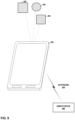
- FIG. 9 is a conceptual diagram illustrating an example mobile device system in which one or more techniques of this disclosure may be used.
- FIGS. 10 A and 10 B are conceptual diagrams illustrating a range update process in binary arithmetic coding.
- FIG. 11 is a conceptual diagram illustrating an output process in binary arithmetic coding.
- FIG. 12 is a block diagram illustrating a context adaptive binary arithmetic coder in a G-PCC encoder.
- FIG. 13 is a block diagram illustrating a context adaptive binary arithmetic coder in a G-PCC decoder.
- FIG. 14 is a flow diagram illustrating an example technique for processing a point cloud, in accordance with one or more techniques of this disclosure.
- FIG. 15 is a flow diagram illustrating an example technique for processing a point cloud, in accordance with one or more techniques of this disclosure.
- FIG. 1 is a block diagram illustrating an example encoding and decoding system 100 that may perform the techniques of this disclosure.
- the techniques of this disclosure are generally directed to coding (encoding and/or decoding) point cloud data, i.e., to support point cloud compression.
- point cloud data includes any data for processing a point cloud.
- the coding may be effective in compressing and/or decompressing point cloud data.
- system 100 includes a source device 102 and a destination device 116 .
- Source device 102 provides encoded point cloud data to be decoded by a destination device 116 .
- destination device 116 provides the point cloud data to destination device 116 via a computer-readable medium 110 .
- Source device 102 and destination device 116 may comprise any of a wide range of devices, including desktop computers, notebook (i.e., laptop) computers, tablet computers, set-top boxes, telephone handsets such as smartphones, televisions, cameras, display devices, digital media players, video gaming consoles, video streaming devices, terrestrial or marine vehicles, spacecraft, aircraft, robots, LIDAR devices, satellites, or the like.
- source device 102 and destination device 116 may be equipped for wireless communication.
- source device 102 includes a data source 104 , a memory 106 , a G-PCC encoder 200 , and an output interface 108 .
- Destination device 116 includes an input interface 122 , a G-PCC decoder 300 , a memory 120 , and a data consumer 118 .
- G-PCC encoder 200 of source device 102 and G-PCC decoder 300 of destination device 116 may be configured to apply the techniques of this disclosure related to predictive geometry coding.
- source device 102 represents an example of an encoding device
- destination device 116 represents an example of a decoding device.
- source device 102 and destination device 116 may include other components or arrangements.
- source device 102 may receive data (e.g., point cloud data) from an internal or external source.
- destination device 116 may interface with an external data consumer, rather than include a data consumer in the same device.
- System 100 as shown in FIG. 1 is merely one example.
- other digital encoding and/or decoding devices may perform the techniques of this disclosure related to predictive geometry coding.
- Source device 102 and destination device 116 are merely examples of such devices in which source device 102 generates coded data for transmission to destination device 116 .
- This disclosure refers to a “coding” device as a device that performs coding (encoding and/or decoding) of data.
- G-PCC encoder 200 and G-PCC decoder 300 represent examples of coding devices, in particular, an encoder and a decoder, respectively.
- source device 102 and destination device 116 may operate in a substantially symmetrical manner such that each of source device 102 and destination device 116 includes encoding and decoding components.
- system 100 may support one-way or two-way transmission between source device 102 and destination device 116 , e.g., for streaming, playback, broadcasting, telephony, navigation, and other applications.
- data source 104 represents a source of data (i.e., raw, unencoded point cloud data) and may provide a sequential series of “frames”) of the data to G-PCC encoder 200 , which encodes data for the frames.
- Data source 104 of source device 102 may include a point cloud capture device, such as any of a variety of cameras or sensors, e.g., a 3D scanner or a light detection and ranging (LIDAR) device, one or more video cameras, an archive containing previously captured data, and/or a data feed interface to receive data from a data content provider.
- point cloud data may be computer-generated from scanner, camera, sensor or other data.
- data source 104 may generate computer graphics-based data as the source data, or produce a combination of live data, archived data, and computer-generated data.
- G-PCC encoder 200 encodes the captured, pre-captured, or computer-generated data.
- G-PCC encoder 200 may rearrange the frames from the received order (sometimes referred to as “display order”) into a coding order for coding.
- G-PCC encoder 200 may generate one or more bitstreams including encoded data.
- Source device 102 may then output the encoded data via output interface 108 onto computer-readable medium 110 for reception and/or retrieval by, e.g., input interface 122 of destination device 116 .
- Memory 106 of source device 102 and memory 120 of destination device 116 may represent general purpose memories.
- memory 106 and memory 120 may store raw data, e.g., raw data from data source 104 and raw, decoded data from G-PCC decoder 300 .
- memory 106 and memory 120 may store software instructions executable by, e.g., G-PCC encoder 200 and G-PCC decoder 300 , respectively.
- memory 106 and memory 120 are shown separately from G-PCC encoder 200 and G-PCC decoder 300 in this example, it should be understood that G-PCC encoder 200 and G-PCC decoder 300 may also include internal memories for functionally similar or equivalent purposes.
- memory 106 and memory 120 may store encoded data, e.g., output from G-PCC encoder 200 and input to G-PCC decoder 300 .
- portions of memory 106 and memory 120 may be allocated as one or more buffers, e.g., to store raw, decoded, and/or encoded data.
- memory 106 and memory 120 may store data representing a point cloud.
- Computer-readable medium 110 may represent any type of medium or device capable of transporting the encoded data from source device 102 to destination device 116 .
- computer-readable medium 110 represents a communication medium to enable source device 102 to transmit encoded data directly to destination device 116 in real-time, e.g., via a radio frequency network or computer-based network.
- Output interface 108 may modulate a transmission signal including the encoded data
- input interface 122 may demodulate the received transmission signal, according to a communication standard, such as a wireless communication protocol.
- the communication medium may comprise any wireless or wired communication medium, such as a radio frequency (RF) spectrum or one or more physical transmission lines.
- RF radio frequency
- the communication medium may form part of a packet-based network, such as a local area network, a wide-area network, or a global network such as the Internet.
- the communication medium may include routers, switches, base stations, or any other equipment that may be useful to facilitate communication from source device 102 to destination device 116 .
- source device 102 may output encoded data from output interface 108 to storage device 112 .
- destination device 116 may access encoded data from storage device 112 via input interface 122 .
- Storage device 112 may include any of a variety of distributed or locally accessed data storage media such as a hard drive, Blu-ray discs, DVDs, CD-ROMs, flash memory, volatile or non-volatile memory, or any other suitable digital storage media for storing encoded data.
- source device 102 may output encoded data to file server 114 or another intermediate storage device that may store the encoded data generated by source device 102 .
- Destination device 116 may access stored data from file server 114 via streaming or download.
- File server 114 may be any type of server device capable of storing encoded data and transmitting that encoded data to the destination device 116 .
- File server 114 may represent a web server for a website), a File Transfer Protocol (FTP) server, a content delivery network device, or a network attached storage (NAS) device.
- Destination device 116 may access encoded data from file server 114 through any standard data connection, including an Internet connection.
- This may include a wireless channel (e.g., a Wi-Fi connection), a wired connection (e.g., digital subscriber line (DSL), cable modern, etc.), or a combination of both that is suitable for accessing encoded data stored on file server 114 .
- File server 114 and input interface 122 may be configured to operate according to a streaming transmission protocol, a download transmission protocol, or a combination thereof.
- Output interface 108 and input interface 122 may represent wireless transmitters/receivers, modems, wired networking components (e.g., Ethernet cards), wireless communication components that operate according to any of a variety of IEEE 802.11 standards, or other physical components.
- output interface 108 and input interface 122 may be configured to transfer data, such as encoded data, according to a cellular communication standard, such as 4G, 4G-LTE (Long-Term Evolution), LTE Advanced, 5G, or the like.
- output interface 108 comprises a wireless transmitter
- output interface 108 and input interface 122 may be configured to transfer data, such as encoded data, according to other wireless standards, such as an IEEE 802.11 specification, an IEEE 802.15 specification (e.g., ZigBeeTM), a BluetoothTM standard, or the like.
- source device 102 and/or destination device 116 may include respective system-on-a-chip (SoC) devices.
- SoC system-on-a-chip
- source device 102 may include an SoC device to perform the functionality attributed to G-PCC encoder 200 and/or output interface 108
- destination device 116 may include an SoC device to perform the functionality attributed to G-PCC decoder 300 and/or input interface 122 .
- the techniques of this disclosure may be applied to encoding and decoding in support of any of a variety of applications, such as communication between autonomous vehicles, communication between scanners, cameras, sensors and processing devices such as local or remote servers, geographic mapping, or other applications.
- Input interface 122 of destination device 116 receives an encoded bitstream from computer-readable medium 110 (e.g., a communication medium, storage device 112 , file server 114 , or the like).
- the encoded bitstream may include signaling information defined by G-PCC encoder 200 , which is also used by G-PCC decoder 300 , such as syntax elements having values that describe characteristics and/or processing of coded units (e.g., slices, pictures, groups of pictures, sequences, or the like).
- Data consumer 118 uses the decoded data. For example, data consumer 118 may use the decoded data to determine the locations of physical objects. In some examples, data consumer 118 may comprise a display to present imagery based on a point cloud.
- G-PCC encoder 200 and G-PCC decoder 300 each may be implemented as any of a variety of suitable encoder and/or decoder circuitry, such as one or more microprocessors, digital signal processors (DSPs), application specific integrated circuits (ASICs), field programmable gate arrays (FPGAs), discrete logic, software, hardware, firmware or any combinations thereof.
- DSPs digital signal processors
- ASICs application specific integrated circuits
- FPGAs field programmable gate arrays
- a device may store instructions for the software in a suitable, non-transitory computer-readable medium and execute the instructions in hardware using one or more processors to perform the techniques of this disclosure.
- G-PCC encoder 200 and G-PCC decoder 300 may be included in one or more encoders or decoders, either of which may be integrated as part of a combined encoder/decoder (CODEC) in a respective device.
- a device including G-PCC encoder 200 and/or G-PCC decoder 300 may comprise one or more integrated circuits, microprocessors, and/or other types of devices.
- G-PCC encoder 200 and G-PCC decoder 300 may operate according to a coding standard, such as video point cloud compression (V-PCC) standard or a geometry point cloud compression (G-PCC) standard.
- V-PCC video point cloud compression
- G-PCC geometry point cloud compression
- This disclosure may generally refer to coding (e.g., encoding and decoding) of pictures to include the process of encoding or decoding data.
- An encoded bitstream generally includes a series of values for syntax elements representative of coding decisions (e.g., coding modes).
- This disclosure may generally refer to “signaling” certain information, such as syntax elements.
- the term “signaling” may generally refer to the communication of values for syntax elements and/or other data used to decode encoded data. That is, G-PCC encoder 200 may signal values for syntax elements in the bitstream. In general, signaling refers to generating a value in the bitstream.
- source device 102 may transport the bitstream to destination device 116 substantially in real time, or not in real time, such as might occur when storing syntax elements to storage device 112 for later retrieval by destination device 116 .
- ISO/IEC MPEG JTC 1/SC 29/WG 11
- JTC 1/SC 29/WG 11 is studying the potential need for standardization of point cloud coding technology with a compression capability that significantly exceeds that of the current approaches and will target to create the standard.
- the group is working together on this exploration activity in a collaborative effort known as the 3-Dimensional Graphics Team (3DG) to evaluate compression technology designs proposed by their experts in this area.
- 3DG 3-Dimensional Graphics Team
- Point cloud compression activities are categorized in two different approaches.
- the first approach is “Video point cloud compression” (V-PCC), which segments the 3D object, and project the segments in multiple 2D planes (which are represented as “patches” in the 2D frame), which are further coded by a legacy 2D video codec such as a High Efficiency Video Coding (HEVC) (ITU-T H.265) codec.
- HEVC High Efficiency Video Coding
- G-PCC GPU-based point cloud compression
- G-PCC GPU-based point cloud compression
- G-PCC DIS A recent draft of the G-PCC standard is available in G-PCC DIS, ISO/IEC JTC1/SC29/WG11 w19328, Brussels, Belgium, January 2020, and a description of the codec is available in G-PCC Codec Description v8, ISO/IEC JTC1/SC29/WG11 w19525, Brussels, Belgium, January 2020.
- a point cloud contains a set of points in a 3D space, and may have attributes associated with the point.
- the attributes may be color information such as R, G, B or Y, Cb, Cr, or reflectance information, or other attributes.
- Point clouds may be captured by a variety of cameras or sensors such as LIDAR sensors and 3D scanners and may also be computer-generated. Point cloud data are used in a variety of applications including, but not limited to, construction (modeling), graphics (3D models for visualizing and animation), and the automotive industry (LIDAR sensors used to help in navigation).
- the 3D space occupied by a point cloud data may be enclosed by a virtual bounding box.
- the position of the points in the bounding box may be represented by a certain precision; therefore, the positions of one or more points may be quantized based on the precision.
- the bounding box is split into voxels which are the smallest unit of space represented by a unit cube.
- a voxel in the bounding box may be associated with zero, one, or more than one point.
- the bounding box may be split into multiple cube/cuboid regions, which may be called tiles. Each tile may be coded into one or more slices.
- the partitioning of the bounding box into slices and tiles may be based on number of points in each partition, or based on other considerations (e.g., a particular region may be coded as tiles).
- the slice regions may be further partitioned using splitting decisions similar to those in video codecs.
- FIG. 2 provides an overview of G-PCC encoder 200 .
- FIG. 3 provides an overview of G-PCC decoder 300 .
- the modules shown are logical, and do not necessarily correspond one-to-one to implemented code in the reference implementation of G-PCC codec, i.e., TMC13 test model software studied by ISO/IEC MPEG (JTC 1/SC 29/WG 11).
- G-PCC encoder 200 and G-PCC decoder 300 point cloud positions are coded first. Attribute coding depends on the decoded geometry.
- the gray-shaded modules arc options typically used for Category 1 data.
- Diagonal-crosshatched modules are options typically used for Category 3 data. All the other modules are common between Categories 1 and 3.
- the compressed geometry is typically represented as an octree from the root all the way down to a leaf level of individual voxels.
- the compressed geometry is typically represented by a pruned octree (i.e., an octree from the root down to a leaf level of blocks larger than voxels) plus a model that approximates the surface within each leaf of the pruned octree.
- a pruned octree i.e., an octree from the root down to a leaf level of blocks larger than voxels
- a model that approximates the surface within each leaf of the pruned octree.
- the surface model used is a triangulation comprising 1-10 triangles per block, resulting in a triangle soup.
- the Category 1 geometry codec is therefore known as the Trisoup geometry codec
- the Category 3 geometry codec is known as the Octree geometry codec.
- an occupancy is signaled (when not inferred) for one or more of its child nodes (up to eight nodes).
- Multiple neighborhoods are specified including (a) nodes that share a face with a current octree node, (b) nodes that share a face, edge or a vertex with the current octree node, etc.
- the occupancy of a node and/or its children may be used to predict the occupancy of the current node or its children.
- the codec also supports a direct coding mode where the 3D position of the point is encoded directly. A flag may be signaled to indicate that a direct mode is signaled.
- the number of points associated with the octree node leaf node may also be coded.
- the attributes corresponding to the geometry points are coded.
- an attribute value may be derived that is representative of the reconstructed point.
- RAHT Region Adaptive Hierarchical Transform
- Predicting Transform interpolation-based hierarchical nearest-neighbour prediction
- Lifting Transform interpolation-based hierarchical nearest-neighbour prediction with an update/lifting step
- RAHT and Lifting are typically used for Category 1 data
- Predicting is typically used for Category 3 data.
- either method may be used for any data, and, just like with the geometry codecs in G-PCC, the attribute coding method used to code the point cloud is specified in the bitstream.
- the coding of the attributes may be conducted in a level-of-detail (LOD), where with each level of detail a finer representation of the point cloud attribute may be obtained.
- LOD level-of-detail
- Each level of detail may be specified based on distance metric from the neighboring nodes or based on a sampling distance.
- the residuals obtained as the output of the coding methods for the attributes are quantized.
- the quantized residuals may be coded using context adaptive arithmetic coding.
- G-PCC encoder 200 may include a coordinate transform unit 202 , a color transform unit 204 , a voxelization unit 206 , an attribute transfer unit 208 , an octree analysis unit 210 , a surface approximation analysis unit 212 , an arithmetic encoding unit 214 , a geometry reconstruction unit (GRU) 216 , an RAHT unit 218 , a LOD generation unit 220 , a lifting unit 222 , a coefficient quantization unit 224 , and an arithmetic encoding unit 226 .
- GRU geometry reconstruction unit
- G-PCC encoder 200 may receive a set of positions and a set of attributes.
- the positions may include coordinates of points in a point cloud.
- the attributes may include information about points in the point cloud, such as colors associated with points in the point cloud.
- Coordinate transform unit 202 may apply a transform to the coordinates of the points to transform the coordinates from an initial domain to a transform domain. This disclosure may refer to the transformed coordinates as transform coordinates.
- Color transform unit 204 may apply a transform to transform color information of the attributes to a different domain. For example, color transform unit 204 may transform color information from an RGB color space to a YCbCr color space.
- voxelization unit 206 may voxelize the transform coordinates. Voxelization of the transform coordinates may include quantization and removing some points of the point cloud. In other words, multiple points of the point cloud may be subsumed within a single “voxel,” which may thereafter be treated in some respects as one point.
- octree analysis unit 210 may generate an octree based on the voxelized transform coordinates.
- surface approximation analysis unit 212 may analyze the points to potentially determine a surface representation of sets of the points.
- Arithmetic encoding unit 214 may entropy encode syntax elements representing the information of the octree and/or surfaces determined by surface approximation analysis unit 212 .
- G-PCC encoder 200 may output these syntax elements in a geometry bitstream.
- Geometry reconstruction unit 216 may reconstruct transform coordinates of points in the point cloud based on the octree, data indicating the surfaces determined by surface approximation analysis unit 212 , and/or other information.
- the number of transform coordinates reconstructed by geometry reconstruction unit 216 may be different from the original number of points of the point cloud because of voxelization and surface approximation. This disclosure may refer to the resulting points as reconstructed points.
- Attribute transfer unit 208 may transfer attributes of the original points of the point cloud to reconstructed points of the point cloud.
- RAHT unit 218 may apply RAHT coding to the attributes of the reconstructed points.
- LOD generation unit 220 and lifting unit 222 may apply LOD processing and lifting, respectively, to the attributes of the reconstructed points.
- RAHT unit 218 and lifting unit 222 may generate coefficients based on the attributes.
- Coefficient quantization unit 224 may quantize the coefficients generated by RAHT unit 218 or lifting unit 222 .
- Arithmetic encoding unit 226 may apply arithmetic coding to syntax elements representing the quantized coefficients.
- G-PCC encoder 200 may output these syntax elements in an attribute bitstream.
- G-PCC decoder 300 may include a geometry arithmetic decoding unit 302 , an attribute arithmetic decoding unit 304 , an octree synthesis unit 306 , an inverse quantization unit 308 , a surface approximation synthesis unit 310 , a geometry reconstruction unit 312 , a RAHT unit 314 , a LoD generation unit 316 , an inverse lifting unit 318 , an inverse transform coordinate unit 320 , and an inverse transform color unit 322 .
- G-PCC decoder 300 may obtain a geometry bitstream and an attribute bitstream.
- Geometry arithmetic decoding unit 302 of decoder 300 may apply arithmetic decoding (e.g., Context-Adaptive Binary Arithmetic Coding (CABAC) or other type of arithmetic decoding) to syntax elements in the geometry bitstream.
- arithmetic decoding e.g., Context-Adaptive Binary Arithmetic Coding (CABAC) or other type of arithmetic decoding
- attribute arithmetic decoding unit 304 may apply arithmetic decoding to syntax elements in the attribute bitstream.
- Octree synthesis unit 306 may synthesize an octree based on syntax elements parsed from the geometry bitstream.
- surface approximation synthesis unit 310 may determine a surface model based on syntax elements parsed from the geometry bitstream and based on the octree.
- geometry reconstruction unit 312 may perform a reconstruction to determine coordinates of points in a point cloud.
- Inverse transform coordinate unit 320 may apply an inverse transform to the reconstructed coordinates to convert the reconstructed coordinates (positions) of the points in the point cloud from a transform domain back into an initial domain.
- inverse quantization unit 308 may inverse quantize attribute values.
- the attribute values may be based on syntax elements obtained from the attribute bitstream (e.g., including syntax elements decoded by attribute arithmetic decoding unit 304 ).
- RAHT unit 314 may perform RAHT coding to determine, based on the inverse quantized attribute values, color values for points of the point cloud.
- LOD generation unit 316 and inverse lifting unit 318 may determine color values for points of the point cloud using a level of detail-based technique.
- inverse transform color unit 322 may apply an inverse color transform to the color values.
- the inverse color transform may be an inverse of a color transform applied by color transform unit 204 of encoder 200 .
- color transform unit 204 may transform color information from an RGB color space to a YCbCr color space.
- inverse color transform unit 322 may transform color information from the YCbCr color space to the RGB color space.
- the various units of FIG. 2 and FIG. 3 are illustrated to assist with understanding the operations performed by encoder 200 and decoder 300 .
- the units may be implemented as fixed-function circuits, programmable circuits, or a combination thereof.
- Fixed-function circuits refer to circuits that provide particular functionality, and are preset on the operations that can be performed.
- Programmable circuits refer to circuits that can be programmed to perform various tasks, and provide flexible functionality in the operations that can be performed.
- programmable circuits may execute software or firmware that cause the programmable circuits to operate in the manner defined by instructions of the software or firmware.
- Fixed-function circuits may execute software instructions (e.g., to receive parameters or output parameters), but the types of operations that the fixed-function circuits perform are generally immutable.
- one or more of the units may be distinct circuit blocks (fixed-function or programmable), and in some examples, one or more of the units may be integrated circuits.
- FIG. 4 is a conceptual diagram illustrating an example of a prediction tree, a directed graph where the arrow points to the prediction direction.
- the horizontally shaded node is the root vertex and has no predictors; the grid shaded nodes have two children; the diagonally shaded node has 3 children, the non-shaded nodes have one children and the vertically shaded nodes are leaf nodes and these have no children. Every node has only one parent node.
- the prediction strategies include, no prediction, delta prediction (p0), linear prediction (2*p0 ⁇ p1), and parallelogram prediction (2*p0+p1 ⁇ p2).
- the encoder may employ any algorithm to generate the prediction tree; the algorithm used may be determined based on the application/use case and several strategies may be used.
- the encoder may encode, for each node, the residual coordinate values in the bitstream starting from the root node in a depth-first manner. Predictive geometry coding may be particularly useful for Category 3 (e.g., LIDAR-acquired) point cloud data e.g., for low-latency applications.
- Angular mode may be used in predictive geometry coding, where the characteristics of LIDAR sensors may be utilized in coding the prediction tree more efficiently.
- the coordinates of the positions are converted to the (r, ⁇ , i) (radius, azimuth, and laser index) and a prediction is performed in this domain (the residuals are coded in r, ⁇ , i domain). Due to the errors in rounding, coding in r, ⁇ , i is not lossless and hence a second set of residuals may be coded which correspond to the Cartesian coordinates.
- FIGS. 5 A and 5 B are conceptual diagrams of a spinning LIDAR acquisition model.
- the method focuses on point clouds acquired using a spinning LIDAR model.
- the position of M is modeled with three parameters (r, ⁇ , i), which are computed as follows:
- a G-PCC coder may use the quantized version of (r, ⁇ , i), denoted ( ⁇ tilde over (r) ⁇ , ⁇ tilde over ( ⁇ ) ⁇ , i), where the three integers ⁇ tilde over (r) ⁇ , ⁇ tilde over ( ⁇ ) ⁇ and i are computed as follows:
- G-PCC encoder 200 may proceed as follows:
- G-PCC decoder 300 may proceed as follows:
- Lossy compression could be achieved by applying quantization to the reconstruction residuals (r x , r y , r z ) or by dropping points.
- the quantized reconstruction residuals are computed as follows:
- r ⁇ x sign ⁇ ( r x ) ⁇ floor ⁇ ( ⁇ r x ⁇ q x + o x )
- r ⁇ y sign ⁇ ( r y ) ⁇ floor ⁇ ( ⁇ r y ⁇ q y + o y )
- r ⁇ z sign ⁇ ( r z ) ⁇ floor ⁇ ( ⁇ r z ⁇ q z + o z )
- (q y , o y ) and (q z , o z ) are quantization parameters controlling the precision of ⁇ tilde over (r) ⁇ x , ⁇ tilde over (r) ⁇ y and ⁇ tilde over (r) ⁇ z , respectively.
- G-PCC encoder 200 and/or G-PCC decoder 300 may use Trellis quantization to further improve the RD (rate-distortion) performance results.
- the quantization parameters may change at sequence/frame/slice/block level to achieve region adaptive quality and for rate control purposes.
- PtnQp[nodeIdx] is set equal to 0.
- ptn_point_cnt_gt1_flag 38 0 ptn_point_cnt_minus2 39 prefix: 0 suffix: bypass ptn_child_cnt[ ] 40 0 .. 2 (XREF) ptn_pred_mode[ ] 41 0 .. 2 (XREF) ptn_phi_mult_eq0_flag 50 0 ptn_phi_mult_sign_flag 51 0 ptn_phi_mult_eq1_flag 52 0 ptn_phi_mult_abs_minus2 53 0 ..
- the above implementation of predictive geometry coding may present one or more disadvantages.
- the above implementation of predictive geometry coding with angular coding mode may requires a lot of context coded bins, as the above implementation requires coding of both primary (r, ⁇ , i) and secondary (r x , r y , r z ) residuals, which is computationally intensive.
- the above implementation of predictive geometry coding uses 2 bit fixed length coding, which may not be optimal as the candidates are not equi-probable.
- the signaling associated with laser index (i) may be redundant, such as when the point count is captured using a single laser.
- zero-predictor or “no prediction” described above
- the sign of the residual for “r” component can always be inferred, and hence the corresponding signaling is redundant.
- an encoder e.g., G-PCC encoder 200
- a decoder e.g., G-PCC decoder 300
- the encoder and/or the decoder may perform a reduction of context and context coded bins for secondary residual and phi multiplier.
- the encoder and/or the decoder may perform variable length coding for number of child and predictor index signaling.
- the encoder and/or decoder may remove the signaling of laser index when content is captured by single laser.
- the encoder and/or decoder may modify zero prediction by utilizing the azimuth and laser index of parent neighbor, and sign inference.
- the encoder and/or the decoder may perform a reduction of context and context coded bins for secondary residual and phi multiplier.
- the binarization and contexts for ptn_sec_residual_abs_minus2[k] may be modified. Some example modifications are show below with additions in ⁇ ADD> . . . ⁇ /ADD> tags and removals in ⁇ REMOVE> . . . ⁇ /REMOVE> tags.
- the G_PCC coder may perform the signaling using a certain number of prefix contexts (e.g, a contexts) and suffix contexts (e.g., b contexts) for exponential Golomb coding.
- ptn_phi_mult_eq0_flag 50 0 ptn_phi_mult_sign_flag 51 0 ptn_phi_mult_eq1_flag 52 0 ptn_phi_mult_abs_minus2 53 0 .. ⁇ REMOVE>15 ⁇ /REMOVE> ⁇ ADD> 7 ⁇ /ADD> ⁇ REMOVE>ptn_phi_mult_abs_minus 54 0 17 ⁇ /REMOVE> ⁇ ADD>ptn_phi_mult_abs_minus9 ⁇ /A DD>
- the encoder and/or the decoder may perform variable length coding for number of child and predictor index signaling.
- predictor mode and Number of Child signaling information both signaled in 2 bits fixed length coding with 3 contexts with the following mapping:
- predMode may be different depending on whether angular mode is applied, different mapping may be used depending on whether angular mode is enabled or not which is already signaled in the corresponding geometry parameter set.
- Ptn_pred_mode Prediction Angular on/off Number of Child Ptn_child_cnt Zero prediction 111/111 0 10 Delta prediction 0/110 1 0 Linear prediction 10/10 2 110 Parallelogram 110/0 3 111 prediction
- the encoder and/or decoder may remove the signaling (e.g., not encode and not decode) of laser index when content is captured by single laser.
- signaling e.g., not encode and not decode
- laser index is the same for all the point in the point cloud. So, associated residual signaling for laser index may be redundant (i.e., the residual of third component is not needed to be signaled).
- the changes in the syntax is shown below considering the third component corresponds to laser index. (It may change if the axis conversion is present).
- the component corresponds to laser index is not to be signaled.
- the encoder and/or decoder may modify zero prediction by utilizing the azimuth and laser index of parent neighbor, and sign inference.
- zero prediction in the angular domain corresponds to all components equal to zero.
- the current implementation of zero prediction may be inefficient, and thusly is rarely used.
- an encoder or decoder may inherit the azimuth and laser index from the parentNode (ancestors), if parentNode is available. So, in a way, similar to delta prediction, except radius is set to zero (or a minimum radius value).
- the minimum value of radius (the minimum radius among all points) can be signaled in the slice header, which can be used as the radius for zero predictor instead of 0.
- phi multiplier can be applied to all predictor, not just delta predictor.
- the following changes in the syntax are:
- FIG. 6 is a conceptual diagram illustrating an example range-finding system 600 that may be used with one or more techniques of this disclosure.
- range-finding system 600 includes an illuminator 602 and a sensor 604 .
- Illuminator 602 may emit light 606 .
- illuminator 602 may emit light 606 as one or more laser beams.
- Light 606 may be in one or more wavelengths, such as an infrared wavelength or a visible light wavelength. In other examples, light 606 is not coherent, laser light.
- light 606 When light 606 encounters an object, such as object 608 , light 606 creates returning light 610 . Returning light 610 may include backscattered and/or reflected. light.
- Returning light 610 may pass through a lens 611 that directs returning light 610 to create an image 612 of object 608 on sensor 604 .
- Sensor 604 generates signals 614 based on image 612 .
- Image 612 may comprise a set of points (e.g., as represented by dots in image 612 of FIG. 6 ).
- illuminator 602 and sensor 604 may be mounted on a spinning structure so that illuminator 602 and sensor 604 capture a 360-degree view of an environment.
- range-finding system 600 may include one or more optical components (e.g., mirrors, collimators, diffraction gratings, etc.) that enable illuminator 602 and sensor 604 to detect ranges of objects within a specific range (e.g., up to 360-degrees).
- range-finding system 600 may include multiple sets of illuminators and sensors.
- illuminator 602 generates a structured light pattern.
- range-finding system 600 may include multiple sensors 604 upon which respective images of the structured light pattern are formed. Range-finding system 600 may use disparities between the images of the structured light pattern to determine a distance to an object 608 from which the structured light pattern backscatters. Structured light-based range-finding systems may have a high level of accuracy (e.g., accuracy in the sub-millimeter range), when object 608 is relatively close to sensor 604 (e.g., 0.2 meters to 2 meters). This high level of accuracy may be useful in facial recognition applications, such as unlocking mobile devices (e.g., mobile phones, tablet computers, etc.) and for security applications.
- a high level of accuracy e.g., accuracy in the sub-millimeter range
- This high level of accuracy may be useful in facial recognition applications, such as unlocking mobile devices (e.g., mobile phones, tablet computers, etc.) and for security applications.
- range-finding system 600 is a time of flight (ToF)-based system.
- illuminator 602 generates pulses of light.
- illuminator 602 may modulate the amplitude of emitted light 606 .
- sensor 604 detects returning light 610 from the pulses of light 606 generated by illuminator 602 .
- Range-finding system 600 may then determine a distance to object 608 from which light 606 backscatters based on a delay between when light 606 was emitted and detected and the known speed of light in air).
- illuminator 602 may modulate the phase of the emitted light 606 .
- sensor 604 may detect the phase of returning light 610 from object 608 and determine distances to points on object 608 using the speed of light and based on time differences between when illuminator 602 generated light 606 at a specific phase and when sensor 604 detected returning light 610 at the specific phase.
- a point cloud may be generated without using illuminator 602 .
- sensors 604 of range-finding system 600 may include two or more optical cameras.
- range-finding system 600 may use the optical cameras to capture stereo images of the environment, including object 608 .
- Range-finding system 600 may include a point cloud generator 616 that may calculate the disparities between locations in the stereo images. Range-finding system 600 may then use the disparities to determine distances to the locations shown in the stereo images. From these distances, point cloud generator 616 may generate a point cloud.
- Sensors 604 may also detect other attributes of object 608 , such as color and reflectance information.
- a point cloud generator 616 may generate a point cloud based on signals 614 generated by sensor 604 .
- Range-finding system 600 and/or point cloud generator 616 may form part of data source 104 ( FIG. 1 ).
- a point cloud generated by range-finding system 600 may be encoded and/or decoded according to any of the techniques of this disclosure.
- FIG. 7 is a conceptual diagram illustrating an example vehicle-based scenario in which one or more techniques of this disclosure may be used.
- a vehicle 700 includes a range-finding system 702 .
- Range-finding system 702 may be implemented in the manner discussed with respect to FIG. 7 .
- vehicle 700 may also include a data source, such as data source 104 ( FIG. 1 ), and a G-PCC encoder, such as G-PCC encoder 200 ( FIG. 1 ).
- range-finding system 702 emits laser beams 704 that reflect off pedestrians 706 or other objects in a roadway.
- the data source of vehicle 700 may generate a point cloud based on signals generated by range-finding system 702 .
- the G-PCC encoder of vehicle 700 may encode the point cloud to generate bitstreams 708 , such as geometry bitstream ( FIG. 2 ) and attribute bitstream ( FIG. 2 ).
- Bitstreams 708 may include many fewer bits than the unencoded point cloud obtained by the G-PCC encoder.
- An output interface of vehicle 700 may transmit bitstreams 708 to one or more other devices.
- Bitstreams 808 may include many fewer bits than the unencoded point cloud obtained by the G-PCC encoder. Thus, vehicle 700 may be able to transmit bitstreams 708 to other devices more quickly than the unencoded point cloud data. Additionally, bitstreams 708 may require less data storage capacity.
- vehicle 700 may transmit bitstreams 708 to another vehicle 710 .
- Vehicle 710 may include a G-PCC decoder, such as G-PCC decoder 300 ( FIG. 1 ).
- the G-PCC decoder of vehicle 710 may decode bitstreams 708 to reconstruct the point cloud.
- Vehicle 710 may use the reconstructed point cloud for various purposes. For instance, vehicle 710 may determine based on the reconstructed point cloud that pedestrians 706 are in the roadway ahead of vehicle 700 and therefore start slowing down, e.g., even before a driver of vehicle 710 realizes that pedestrians 706 are in the roadway. Thus, in some examples, vehicle 710 may perform an autonomous navigation operation based on the reconstructed point cloud.
- vehicle 700 may transmit bitstreams 708 to a server system 712 .
- Server system 712 may use bitstreams 708 for various purposes.
- server system 712 may store bitstreams 708 for subsequent reconstruction of the point clouds.
- server system 712 may use the point clouds along with other data (e.g., vehicle telemetry data generated by vehicle 700 ) to train an autonomous driving system.
- server system 712 may store bitstreams 708 for subsequent reconstruction for forensic crash investigations (e.g., if vehicle 700 collides with pedestrians 706 ).
- FIG. 8 is a conceptual diagram illustrating an example extended reality system in which one or more techniques of this disclosure may be used.
- Extended reality is a term used to cover a range of technologies that includes augmented reality (AR), mixed reality (MR), and virtual reality (VR).
- AR augmented reality
- MR mixed reality
- VR virtual reality
- a user 800 is located in a first location 802 .
- User 800 wears an XR headset 804 .
- user 800 may use a mobile device (e.g., mobile phone, tablet computer, etc.).
- XR headset 804 includes a depth detection sensor, such as a range-finding system, that detects positions of points on objects 806 at location 802 .
- a data source of XR headset 804 may use the signals generated by the depth detection sensor to generate a point cloud representation of objects 806 at location 802 .
- XR headset 804 may include a G-PCC encoder (e.g., G-PCC encoder 200 of FIG. 1 ) that is configured to encode the point cloud to generate bitstreams 808 .
- G-PCC encoder e.g., G-PCC encoder 200 of FIG. 1
- XR headset 804 may transmit bitstreams 808 (e.g., via a network such as the Internet) to an XR headset 810 worn by a user 812 at a second location 814 .
- XR headset 810 may decode bitstreams 808 to reconstruct the point cloud.
- XR headset 810 may use the point cloud to generate an XR visualization (e.g., an AR, MR, VR visualization) representing objects 806 at location 802 .
- an XR visualization e.g., an AR, MR, VR visualization
- user 812 may have a 3D immersive experience of location 802 .
- XR headset 810 may determine a position of a virtual object based on the reconstructed point cloud.
- XR headset 810 may determine, based on the reconstructed point cloud, that an environment (e.g., location 802 ) includes a flat surface and then determine that a virtual object (e.g., a cartoon character) is to be positioned on the flat surface.
- XR headset 810 may generate an XR visualization in which the virtual object is at the determined position. For instance, XR headset 810 may show the cartoon character sitting on the flat surface.
- FIG. 9 is a conceptual diagram illustrating an example mobile device system in which one or more techniques of this disclosure may be used.
- a mobile device 900 such as a mobile phone or tablet computer, includes a range-finding system, such as a LIDAR system, that detects positions of points on objects 902 in an environment of mobile device 900 .
- a data source of mobile device 900 may use the signals generated by the depth detection sensor to generate a point cloud representation of objects 902 .
- Mobile device 900 may include a G-PCC encoder (e.g., G-PCC encoder 200 of FIG. 1 ) that is configured to encode the point cloud to generate bitstreams 904 .
- G-PCC encoder e.g., G-PCC encoder 200 of FIG. 1
- mobile device 900 may transmit bitstreams to a remote device 906 , such as a server system or other mobile device.
- Remote device 906 may decode bitstreams 904 to reconstruct the point cloud.
- Remote device 906 may use the point cloud for various purposes.
- remote device 906 may use the point cloud to generate a map of environment of mobile device 900 .
- remote device 906 may generate a map of an interior of a building based on the reconstructed point cloud.
- remote device 906 may generate imagery (e.g., computer graphics) based on the point cloud.
- remote device 906 may use points of the point cloud as vertices of polygons and use color attributes of the points as the basis for shading the polygons.
- remote device 906 may use the reconstructed point cloud for facial recognition or other security applications.
- FIGS. 10 A and 10 B show examples of this process at bin n.
- the range at bin n includes the RangeMPS and RangeLPS given by the probability of the LPS (p ⁇ ) given a certain context state ( ⁇ ).
- Example 201 shows the update of the range at bin n+1 when the value of bin n is equal to the MPS. In this example, the low stays the same, but the value of the range at bin n+1 is reduced to the value of RangeMPS at bin n.
- Example 203 of FIG. 10 B shows the update of the range at bin n+1 when the value of bin n is not equal to the MPS (i.e., equal to the LPS). In this example, the low is moved to the lower range value of RangeLPS at bin n. In addition, the value of the range at bin n+1 is reduced to the value of RangeLPS at bin n.
- the range may be expressed with 9 bits and the low with 10 bits.
- the BAC outputs to the bitstream, a ‘0,’ or a ‘1,’ or updates an internal variable (called BO: bits-outstanding) to keep for future outputs.
- FIG. 11 shows examples of BAC output depending on the range. For example, a ‘1’ is output to the bitstream when the range and low are above a certain threshold (e.g., 512).
- a ‘0’ is output to the bitstream when the range and low are below a certain threshold (e.g., 512). None is output to the bitstream when the range and lower are between certain thresholds. Instead, the BO value is incremented and the next bin is encoded.
- a certain threshold e.g., 512
- FIG. 11 illustrates an example context adaptive binary arithmetic coding (CABAC) encoding stage.
- CABAC context adaptive binary arithmetic coding
- the example CABAC encoding stage may be implemented in a G-PCC encoder, such as by arithmetic encoding unit 214 and/or arithmetic encoding unit 226 of G-PCC encoder 200 of FIG. 2 .
- context-adaptive binary arithmetic coding may be used for generating the bins through the binarization process. For each coded bin value, an appropriate context model is selected. These context models are used for encoding each bin value into output bits based on the bin probability values. CABAC engine bypasses context-modeling and bin encoding when the bin is equally probable to be 0 or 1. This is the bypass coding stage discussed below. Otherwise, an appropriate context model is specified as the bin values are encoded and models based on the probability of bin-values. Contexts are adapted as the encoder encodes more bins. Lastly, the context-coded bin values or raw bitstreams are transmitted or otherwise provided to the decoder.
- CABAC context-adaptive binary arithmetic coding
- FIG. 12 is a block diagram of an example arithmetic encoding unit 214 that may be configured to perform CABAC in accordance with the techniques of this disclosure.
- a syntax element 1180 is input into the arithmetic encoding unit 214 . If the syntax element is already a binary-value syntax element (e.g., a flag or other syntax element that only has a value of 0 and 1), the step of binarization may be skipped. If the syntax element is a non-binary valued syntax element (e.g., a syntax element that may have values other than 1 or 0), the non-binary valued syntax element is binarized by binarizer 1200 .
- a binary-value syntax element e.g., a flag or other syntax element that only has a value of 0 and 1
- the non-binary valued syntax element is binarized by binarizer 1200 .
- Binarizer 1200 performs a mapping of the non-binary valued syntax element into a sequence of binary decisions. These binary decisions are often called “bins.” For example, for transform coefficient levels, the value of the level may be broken down into successive bins, each bin indicating whether or not the absolute value of coefficient level is greater than some value. For example, bin 0 (sometimes called a significance flag) indicates if the absolute value of the transform coefficient level is greater than 0 or not. Bin 1 indicates if the absolute value of the transform coefficient level is greater than 1 or not, and so on. A unique mapping may be developed for each non-binary valued syntax element.
- Each bin produced by binarizer 1200 is fed to the binary arithmetic coding side of arithmetic encoding unit 214 . That is, for a predetermined set of non-binary valued syntax elements, each bin type (e.g., bin 0) is coded before the next bin type (e.g., bin 1). Coding may be performed in either regular mode or bypass mode.
- bypass mode bypass encoding engine 1260 performs arithmetic coding using a fixed probability model, for example, using Golomb-Rice or exponential Golomb coding. Bypass mode is generally used for more predictable syntax elements.
- Coding in regular mode involves performing CABAC.
- Regular mode CABAC is for coding bin values where the probability of a value of a bin is predictable given the values of previously coded bins.
- the probability of a bin being an LPS is determined by context modeler 1220 .
- Context modeler 1220 outputs the bin value and the probability state for the context (e.g., the probability state ⁇ , including the value of the LPS and the probability of the LPS occurring).
- the context may be an initial context for a series of bins, or may be determined based on the coded values of previously coded bins.
- the identify of a context may be expressed and/or be determined based on a value of a variable ctxInc (context increment, such as the value of the ctxInc representing an increment to apply to a previous context).
- context modeler 1220 may update the state based on whether or not the received bin was the MPS or the LPS. After the context and probability state ⁇ is determined by context modeler 1220 , regular encoding engine 1240 performs BAC on the bin value.
- FIG. 13 is a block diagram of an example arithmetic decoding unit 302 that may be configured to perform CABAC in accordance with the techniques of this disclosure.
- the arithmetic decoding unit 302 of FIG. 13 performs CABAC in an inverse manner as that of arithmetic encoding unit 214 described in FIG. 12 .
- Coded bits from bitstream 2180 are input into arithmetic decoding unit 302 .
- the coded bits are fed to either context modeler 2200 or bypass decoding engine 2220 based on whether they were entropy coded using regular mode or bypass mode. If the coded bits were coded in bypass mode, bypass decoding engine will use Golomb-Rice or exponential Golomb decoding, for example, to retrieve the binary-valued syntax elements or bins of non-binary syntax elements.
- context modeler 2200 may determine a probability model for the coded bits and regular decoding engine 2240 may decode the coded bits to produce bins of non-binary valued syntax elements (or the syntax elements themselves if binary-valued).
- regular decoding engine 2240 performs BAC to decode the bin value. In other words, regular decoding engine 2240 may determine a probability state of a context, and decode a bin value based on previously coded bins and a current range. After decoding the bin, context modeler 2200 may update the probability state of the context based on the window size and the value of the decoded bin.
- FIG. 14 is a flowchart illustrating an example method for encoding a current predictive tree node, in accordance with one or more techniques of this disclosure.
- the current predictive tree node may be included in a point cloud.
- G-PCC encoder 200 FIGS. 1 and 2
- other devices may be configured to perform a method similar to that of FIG. 14 .
- a G-PCC decoder such as G-PCC decoder 300 ( FIGS. 1 and 3 ) may perform a complimentary method to that of FIG. 14 (e.g., decode as opposed to encode).
- G-PCC encoder 200 may obtain a value of a secondary residual for geometry coding a current predictive tree node (PTN) of the point cloud ( 1402 ).
- PTN current predictive tree node
- G-PCC encoder 200 may perform prediction in the (r, ⁇ , i) domain. Due to the errors in rounding, coding in r, ⁇ , i may be lossy. In some examples, this loss may by reduced or eliminated by coding a second set of residuals (referred to as secondary residuals), which may be in a Cartesian domain.
- the current PTN may include three secondary residuals (r x , r y , r z ), one or more of which may be encoded using the technique of FIG. 14 .
- G-PCC encoder 200 may encode the value of the secondary residual. To encode the value of the secondary residual. G-PCC encoder 200 may encode, using a first set of context-adaptive binary arithmetic coding (CABAC) contexts, prefix bins of a syntax element having a value that specifies an absolute value of the value of the secondary residual minus 2 ( 1404 ); and encode, using a second set of CABAC contexts that is different than the first set of contexts, suffix bins of the syntax element ( 1406 ).
- CABAC context-adaptive binary arithmetic coding
- arithmetic encoding unit 214 of G-PCC encoder 200 may encode prefix bins of a ptn_sec_residual_abs_minus2 syntax element using contexts with context indices (ctxIdx) between 0 and a ⁇ 1 and encode suffix bins of the ptn_sec_residual_abs_minus2[k] syntax element using contexts with context indices (ctxIdx) between a and a+b ⁇ 1.
- a may be 5 and b may be 4.
- G-PCC encoder 200 may encode one or more other syntax elements that specify the value of the secondary residual.
- G-PCC encoder 200 may encode a syntax element having a value that specifies whether the value of the secondary residual is equal to zero (e.g., ptn_sec_residual_eq0_flag).
- G-PCC encoder 200 may encode a syntax element having a value that specifies a sign of the value of the secondary residual (e.g., ptn_sec_residual_sign_flag), and a syntax element having a value that specifies whether the value of the secondary residual is greater than one (e.g., ptn_sec_residual_eq1_flag).
- a syntax element having a value that specifies a sign of the value of the secondary residual e.g., ptn_sec_residual_sign_flag
- ptn_sec_residual_eq1_flag e.g., ptn_sec_residual_eq1_flag
- G-PCC encoder 200 may avoid encoding a syntax element that specifies the absolute value of the secondary residual minus 17 (e.g., ptn_sec_residual_abs_minus17) even where the absolute value of the secondary residual is greater than 17.
- G-PCC encoder 200 may reduce the number of contexts and/or context coded bins used to signal secondary residuals. As such, the techniques of this disclosure may reduce computational complexity of point cloud coding.
- G-PCC encoder 200 may obtain a value of a phi multiplier for geometry coding the current predictive tree node of the point cloud ( 1408 ) and encode the value of the phi multiplier by at least encoding a syntax element having a value that specifies an absolute value of the value of the phi multiplier minus 9 (e.g., ptn_phi_mult_abs_minus9) ( 1410 ).
- G-PCC encoder 200 may avoid encoding a syntax element that specifies the absolute value of the phi multiplier minus 17 (e.g., even where the absolute value of the phi multiplier is greater than 17).
- a G-PCC encoder may signal a number of direct child nodes of PTNs.
- G-PCC encoder 200 may encode a syntax element that represents a number of direct child nodes of the current predictive tree node that are present in a geometry predictive tree that represents the point cloud (e.g., Ptn_child_cnt).
- G-PCC encoder 200 may utilize fixed length coding for encoding the syntax element (e.g., binarizing).
- G-PCC encoder 200 may utilize the following table to encode the syntax element that represents the number of direct child nodes.
- G-PCC encoder 200 may encode, using variable length coding, the syntax element that represents a number of direct child nodes of the current predictive tree node that are present in a geometry predictive tree that represents the point cloud (e.g., Ptn_child_cnt) ( 1412 ). For instance, G-PCC encoder 200 may utilize the following table to encode the syntax element that represents the number of direct child nodes.
- variable length coding the syntax element that represents the number of direct child nodes may include utilizing a shorter codeword where the number of direct child nodes is 1 than where the number of direct child nodes is 0 (e.g., using the code word “0” where the number of child nodes is 1 vs using the code word “10” where the number of direct child nodes is 0).
- FIG. 15 is a flowchart illustrating an example method for decoding a current predictive tree node, in accordance with one or more techniques of this disclosure.
- the current predictive tree node may be included in a point cloud.
- G-PCC decoder 300 FIGS. 1 and 3
- other devices may be configured to perform a method similar to that of FIG. 15 .
- a G-PCC encoder such as G-PCC encoder 200 ( FIGS. 1 and 2 ) may perform a complimentary method to that of FIG. 15 (e.g., encode as opposed to decode, such as in a reconstruction loop performed by GRU 216 ).
- G-PCC decoder 300 may select, from a plurality of predefined prediction modes, a prediction mode for performing predictive geometry coding of a position of a current predictive tree node of the point cloud.
- the plurality of prediction modes may include at least: a zero prediction mode, and a delta prediction mode.
- G-PCC decoder 300 may select the prediction mode based on a value of a syntax element. For instance, geometry arithmetic decoder unit 302 ) may decode a ptn_pred_mode syntax element having a value that specifies which prediction mode is to be selected.
- G-PCC decoder 300 may perform zero prediction to determine the position of the current PTN. To perform zero prediction, G-PCC decoder 300 may determine a radius, an azimuth, and a laser index of a parent node of the current predictive tree node ( 1504 ). For instance, G-PCC decoder 300 may obtain the radius, azimuth, and laser index of the parent node front memory (e.g., as previously determined by G-PCC decoder 300 ).
- G-PCC decoder 300 may infer an azimuth and a laser index of a predicted position of the current predictive tree node as the azimuth and the laser index of the parent node ( 1506 ). For instance, G-PCC decoder 300 may copy the azimuth and laser index of the parent node to as the azimuth and laser index of the predicted position of the current node.
- G-PCC decoder 300 may infer a radius of the predicted position to be a minimum radius value ( 1508 ). For instance, G-PCC decoder 300 may always set the radius of the predicted position to be the minimum radius value. In some examples, the minimum radius value may always be zero. In some examples, the minimum radius value may be greater than zero. For instance, G-PCC decoder 300 may decode a syntax element that specifies the minimum radius value (e.g., from a slice header).
- G-PCC decoder 300 may determine, based on the predicted position of the current predictive tree node, the position of the current predictive tree node ( 1510 ). For instance, G-PCC decoder 300 may obtain a residual radius value that represents a difference between a value of the radius of the predicted position of the current predictive tree node and a value of the radius of the position of the current predictive tree node. In some examples, such as where the selected mode is the zero prediction mode, G-PCC decoder 300 may infer that a sign of the residual radius value is positive (e.g., and avoid having to signal whether the sign is positive or negative).
- G-PCC decoder 300 may add the residual radius value to the minimum radius value (e.g., the radius value of the predicted position of the current PTN) to obtain the value of the radius of the position of the current PTN. G-PCC decoder 300 may similarly obtain and add residuals for other components (e.g., azimuth and laser index).
- the minimum radius value e.g., the radius value of the predicted position of the current PTN
- G-PCC decoder 300 may similarly obtain and add residuals for other components (e.g., azimuth and laser index).
- G-PCC decoder 300 may modify decoding based on a quantity of lasers used to generate the point cloud. For instance, G-PCC decoder 300 may determine a quantity of lasers used to capture light detection and ranging (LIDAR) data that represents the point cloud ( 1512 ); and responsive to determining that the quantity of lasers is one, inferring laser indices for all nodes in the point cloud to be a same value (e.g., a laser index value of 0) ( 1514 ). In this way, G-PCC decoder 300 may avoid having to signal and/or predict laser indices. As such, the techniques of this disclosure may reduce the number of bits needed to represent point clouds and/or reduce point cloud coding complexity.
- LIDAR light detection and ranging
- Clause 1A A method of processing a point cloud, the method comprising: obtaining a value of a secondary residual for geometry coding of the point cloud, the value being greater than 17; and coding the value of the secondary residual without coding a syntax element that specifies the value of the secondary residual minus 17.
- Clause 2A The method of clause 1A, wherein the syntax element comprises a ptn_sec_residual_abs_minus17 syntax element.
- Clause 3A The method of clause 1A or 2A, further comprising: obtaining a value of a phi multiplier for geometry coding of the point cloud, the value of the phi multiplier being greater than 17; and coding the value of the phi multiplier without coding a syntax element that specifics the value of the phi multiplier minus 17.
- Clause 4A The method of clause 3A, wherein the syntax element that specifies the value of the phi multiplier minus 17 comprises a ptn_phi_mult_abs_minus17 syntax element
- Clause 5A The method of clause 3A or clause 4A, further comprising: coding a syntax element that specifies the value of the phi multiplier minus 9.
- coding the value of the secondary residual comprises: coding, using exponential Golomb coding with a prefix contexts and b suffix contexts, bits of a syntax element that specifies the value of the secondary residual minus N.
- Clause 8A The method of clause 6A or 7A, wherein a is 5.
- Clause 9A The method of any of clauses 6A-8A, wherein b is 4.
- a method of processing a point cloud comprising: coding, using variable length coding, a syntax element that represents a number of direct child nodes of a current predictive tree node present in a geometry predictive tree that represents the point cloud; and coding, using variable length coding, a syntax element that represents a mode used to predict a position associated with the current predictive tree node.
- Clause 2B The method of clause 1B, wherein the syntax element that represents the number of direct child nodes of the current predictive tree node present in the geometry predictive tree comprises a ptn_child_cnt syntax element.
- Clause 3B The method of clause 1B or 2B, wherein the syntax element that represents the mode used to predict the position associated with the current predictive tree node comprises a ptn_pred_mode syntax element.
- a method of processing a point cloud comprising: responsive to determine that a single laser was used to capture light detection and ranging (LIDAR) data that represents the point cloud, refraining from signaling a laser index value of the single laser.
- LIDAR light detection and ranging
- a method of processing a point cloud comprising: performing zero prediction of the point cloud based: on an azimuth, a laser index of a parent neighbor, and a sign inference.
- a method of encoding a point cloud comprising: obtaining a value of a secondary residual for geometry coding a current predictive tree node of the point cloud; and encoding the value of the secondary residual, wherein encoding the value comprises: encoding, using a first set of context-adaptive binary arithmetic coding (CABAC) contexts, prefix bins of a syntax element having a value that specifies an absolute value of the value of the secondary residual minus 2; and encoding, using a second set of CABAC contexts that is different than the first set of contexts, suffix bins of the syntax element.
- CABAC context-adaptive binary arithmetic coding
- Clause 2E The method of clause 1E, wherein the syntax element comprises a ptn_sec_residual_abs_minus2 syntax element.
- Clause 3E The method of any of clauses 1E-2E, wherein the absolute value of the secondary residual is greater than 17, and wherein encoding the value of the secondary residual does not include encoding a syntax element that specifies the absolute value of the secondary residual minus 17.
- Clause 4E The method of any of clauses 1E-3E, wherein the first set of CABAC contexts comprises CABAC contexts having context indices between 0 and a ⁇ 1, and wherein the second set of CABAC contexts comprises CABAC contexts having context indices between a and a+b ⁇ 1.
- Clause 5E The method of clause 4E, wherein a is 5, and wherein b is 4.
- Clause 6E The method of any of clauses 1E-5E, wherein the syntax element comprises a first syntax element, and wherein encoding the value of the secondary residual further comprises: encoding a second syntax element having a value that specifies whether the value of the secondary residual is equal to zero; where the value of the secondary residual is not equal to zero: encoding a third syntax element having a value that specifies a sign of the value of the secondary residual; and encoding a fourth syntax element having a value that specifies whether the value of the secondary residual is greater than one; where the value of the secondary residual is greater than one, encoding the first syntax element.
- Clause 7E The method of any of clauses 1E-6E, wherein the current predictive tree node is a first predictive tree node, wherein the syntax clement comprises a first syntax element, the method further comprising: obtaining a value of a phi multiplier for geometry coding a second predictive tree node of the point cloud; and encoding the value of the phi multiplier, wherein encoding the value of the phi multiplier comprises: encoding a fifth syntax element having a value that specifies an absolute value of the value of the phi multiplier minus 9.
- Clause 8E The method of clause 7E, wherein the absolute value of the phi multiplier is greater than 17, and wherein encoding the value of the phi multiplier does not include encoding a syntax element that specifies the value of the phi multiplier minus 17.
- Clause 9E The method of any of clauses 1E-8E, wherein the current predictive tree node is a first predictive tree node, and wherein the syntax element comprises a first syntax element, the method further comprising: encoding, using variable length coding, a sixth syntax element having a value that represents a number of direct child nodes of a second predictive tree node that are present in a geometry predictive tree that represents the point cloud.
- Clause 10E The method of clause 9E, wherein the sixth syntax element that represents the number of direct child nodes of the second predictive tree node present in the geometry predictive tree comprises a ptn_child_cnt syntax element.
- Clause 11E The method of clause 9E, wherein encoding the sixth syntax element using variable length coding comprises utilizing a shorter codeword where the number of direct child nodes is 1 than where the number of direct child nodes is 0.
- a method of decoding a point cloud comprising: obtaining a value of a secondary residual for geometry coding a current predictive tree node of the point cloud; and decoding the value of the secondary residual, wherein encoding the value comprises: decoding, using a first set of context-adaptive binary arithmetic coding (CABAC) contexts, prefix bins of a syntax element having a value that specifies an absolute value of the value of the secondary residual minus 2; and decoding, using a second set of CABAC contexts that is different than the first set of contexts, suffix bins of the syntax element.
- CABAC context-adaptive binary arithmetic coding
- Clause 13E The method of clause 12E, wherein the syntax element comprises a ptn_sec_residual_abs_minus2 syntax element.
- Clause 14E The method of any of clauses 12E-13E, wherein the absolute value of the secondary residual is greater than 17, and wherein decoding the value of the secondary residual does not include decoding a syntax element that specifics the absolute value of the secondary residual minus 17.
- Clause 15E The method of any of clauses 12E-14E, wherein the first set of CABAC contexts comprises CABAC contexts having context indices between 0 and a ⁇ 1, and wherein the second set of CABAC contexts comprises CABAC contexts having context indices between a and a+b ⁇ 1.
- Clause 16E The method of clause 15E, wherein a is 5, and wherein b is 4.
- Clause 17E The method of any of clauses 12E-16E, wherein the syntax element comprises a first syntax element, and wherein decoding the value of the secondary residual further comprises: decoding a second syntax element having a value that specifies whether the value of the secondary residual is equal to zero; where the value of the secondary residual is not equal to zero: decoding a third syntax element having a value that specifies a sign of the value of the secondary residual; and decoding a fourth syntax element having a value that specifies whether the value of the secondary residual is greater than one; where the value of the secondary residual is greater than one, decoding the first syntax element.
- Clause 18E The method of any of clauses 12E-17E, wherein the current predictive tree node is a first predictive tree node, wherein the syntax element comprises a first syntax element, the method further comprising: obtaining a value of a phi multiplier for geometry coding a second predictive tree node of the point cloud; and decoding the value of the phi multiplier, wherein decoding the value of the phi multiplier comprises: decoding a fifth syntax element having a value that specifies an absolute value of the value of the phi multiplier minus 9.
- Clause 19E The method of clause 18E, wherein the absolute value of the phi multiplier is greater than 17, and wherein decoding the value of the phi multiplier does not include decoding a syntax element that specifies the value of the phi multiplier minus 17.
- Clause 20E The method of any of clauses 12E-19E, wherein the current predictive tree node is a first predictive tree node, wherein the syntax element comprises a first syntax element, the method further comprising: decoding, using variable length coding, a sixth syntax element having a value that represents a number of direct child nodes of a second predictive tree node that are present in a geometry predictive tree that represents the point cloud.
- Clause 21E The method of clause 20E, wherein the sixth syntax element that represents the number of direct child nodes of the second predictive tree node present in the geometry predictive tree comprises a ptn_child_cnt syntax element.
- Clause 22E The method of clause 20E, wherein decoding the sixth syntax element using variable length coding comprises utilizing a shorter codeword where the number of direct child nodes is 1 than where the number of direct child nodes is 0.
- a device for encoding a point cloud comprising: a memory configured to store at least a portion of the point cloud; and one or more processors implemented in circuitry and configured to: obtain a value of a secondary residual for geometry coding a current predictive tree node of the point cloud; and encode the value of the secondary residual, wherein, to encode the value, the one or more processors are configured to: encode, using a first set of context-adaptive binary arithmetic coding (CABAC) contexts, prefix bins of a syntax element having a value that specifies an absolute value of the value of the secondary residual minus 2; and encode, using a second set of CABAC contexts that is different than the first set of contexts, suffix bins of the syntax element.
- CABAC context-adaptive binary arithmetic coding
- Clause 24E The device of clause 23E, wherein the syntax element comprises a ptn_sec_residual_abs_minus2 syntax element.
- Clause 25E The device of any of clauses 23E-24E, wherein the absolute value of the secondary residual is greater than 17, and wherein, to encode the value of the secondary residual, the one or more processors are not configured to encode a syntax element that specifies the absolute value of the secondary residual minus 17.
- Clause 26E The device of any of clauses 23E-25E, wherein the first set of CABAC contexts comprises CABAC contexts having context indices between 0 and a ⁇ 1, and wherein the second set of CABAC contexts comprises CABAC contexts having context indices between a and a+b ⁇ 1.
- Clause 27E The device of clause 26E, wherein a is 5, and wherein b is 4.
- Clause 28E The device of any of clauses 23E-27E, wherein the syntax element comprises a first syntax element, and wherein, to encode the value of the secondary residual further, the one or more processors are configured to: encode a second syntax element having a value that specifies whether the value of the secondary residual is equal to zero; where the value of the secondary residual is riot equal to zero: encode a third syntax element having a value that specifies a sign of the value of the secondary residual; and encode a fourth syntax element having a value that specifies whether the value of the secondary residual is greater than one; where the value of the secondary residual is greater than one, encode the first syntax element.
- Clause 29E The device of any of clauses 23E-29E, wherein the current predictive tree node is a first predictive tree node, wherein the syntax element comprises a first syntax element, and wherein the one or more processors are further configured to: obtain a value of a phi multiplier for geometry coding a second predictive tree node of the point cloud; and encode the value of the phi multiplier, wherein, to encode the value of the phi multiplier, the one or more processors are configured to: encode a fifth syntax element having a value that specifies an absolute value of the value of the phi multiplier minus 9.
- Clause 30E The device of clause 29E, wherein the absolute value of the phi multiplier is greater than 17, and wherein, to encode the value of the phi multiplier, the one or more processors are not configured to encode a syntax element that specifies the value of the phi multiplier minus 17.
- Clause 31E The device of any of clauses 23E-30E, wherein the current predictive tree node is a first predictive tree node, wherein the syntax element comprises a first syntax element, and wherein the one or more processors are further configured to: encode, using variable length coding, a sixth syntax element having a value that represents a number of direct child nodes of a second predictive tree node that are present in a geometry predictive tree that represents the point cloud.
- Clause 32E The device of clause 31E, wherein the sixth syntax element that represents the number of direct child nodes of the second predictive tree node present in the geometry predictive tree comprises a ptn_child_cnt syntax element.
- Clause 33E The device of clause 31E, wherein, to encode the sixth syntax element using variable length coding, the one or more processors are configured to utilize a shorter codeword where the number of direct child nodes is 1 than where the number of direct child nodes is 0.
- a device for decoding a point cloud comprising: a memory configured to store at least a portion of the point cloud; and one or more processors implemented in circuitry and configured to: obtain a value of a secondary residual for geometry coding a current predictive tree node of the point cloud; and decode the value of the secondary residual, wherein, to decode the value, the one or more processors are configured to: decode, using a first set of context-adaptive binary arithmetic coding (CABAC) contexts, prefix bins of a syntax element having a value that specifies an absolute value of the value of the secondary residual minus 2; and decode, using a second set of CABAC contexts that is different than the first set of contexts, suffix bins of the syntax element.
- CABAC context-adaptive binary arithmetic coding
- Clause 35E The device of clause 34E, wherein the syntax element comprises a ptn_sec_residual_abs_minus2 syntax element.
- Clause 36E The device of any of clauses 34E-35E, wherein the absolute value of the secondary residual is greater than 17, and wherein, to decode the value of the secondary residual, the one or more processors are not configured to decode a syntax element that specifies the absolute value of the secondary residual minus 17.
- Clause 37E The device of any of clauses 34E-36E, wherein the first set of CABAC contexts comprises CABAC contexts having context indices between 0 and a ⁇ 1, and wherein the second set of CABAC contexts comprises CABAC contexts having context indices between a and a+b ⁇ 1.
- Clause 38E The device of clause 37E, wherein a is 5, and wherein b is 4.
- Clause 39E The device of any of clauses 34E-38E, wherein the syntax element comprises a first syntax element, and wherein, to decode the value of the secondary residual further, the one or more processors are configured to: decode a second syntax element having a value that specifies whether the value of the secondary residual is equal to zero; where the value of the secondary residual is not equal to zero: decode a third syntax element having a value that specifies a sign of the value of the secondary residual; and decode a fourth syntax element having a value that specifies whether the value of the secondary residual is greater than one; where the value of the secondary residual is greater than one, decode the first syntax element.
- Clause 40E The device of any of clauses 34E-39E, wherein the current predictive tree node is a first predictive tree node, wherein the syntax element comprises a first syntax element, and wherein the one or more processors are further configured to: obtain a value of a phi multiplier for geometry coding a second predictive tree node of the point cloud; and decode the value of the phi multiplier, wherein, to decode the value of the phi multiplier, the one or more processors are configured to: decode a fifth syntax element having a value that specifies an absolute value of the value of the phi multiplier minus 9.
- Clause 41E The device of any of clauses 34E-40E, wherein the absolute value of the phi multiplier is greater than 17, and wherein, to decode the value of the phi multiplier, the one or more processors are not configured to decode a syntax element that specifies the value of the phi multiplier minus 17.
- Clause 42E The device of any of clauses 34E-41E, wherein the current predictive tree node is a first predictive tree node, wherein the syntax element comprises a first syntax element, and wherein the one or more processors are further configured to: decode, using variable length coding, a sixth syntax element having a value that represents a number of direct child nodes of a second predictive tree node that are present in a geometry predictive tree that represents the point cloud.
- Clause 43E The device of clause 42E, wherein the sixth syntax element that represents the number of direct child nodes of the second predictive tree node present in the geometry predictive tree comprises a ptn_child_cnt syntax element.
- Clause 44E The device of clause 42E, wherein, to decode the sixth syntax element using variable length coding, the one or more processors are configured to utilize a shorter codeword where the number of direct child nodes is 1 than where the number of direct child nodes is 0.
- a computer-readable storage medium storing instructions that, when executed, cause one or more processors of a point cloud encoder to: obtain a value of a secondary residual for geometry coding a current predictive tree node of the point cloud and encode the value of the secondary residual, wherein, the instructions that cause the or more processors to encode the value comprise instructions that cause the one or more processors to: encode, using a first set of context-adaptive binary arithmetic coding (CABAC) contexts, prefix bins of a syntax element having a value that specifies an absolute value of the value of the secondary residual minus 2; and encode, using a second set of CABAC contexts that is different than the first set of contexts, suffix bins of the syntax element.
- CABAC context-adaptive binary arithmetic coding
- a computer-readable storage medium storing instructions that, when executed, cause one or more processors of a point cloud decoder to: obtain a value of a secondary residual for geometry coding a current predictive tree node of the point cloud; and decode the value of the secondary residual, wherein, the instructions that cause the or more processors to decode the value comprise instructions that cause the one or more processors to: decode, using a first set of context-adaptive binary arithmetic coding (CABAC) contexts, prefix bins of a syntax element having a value that specifies an absolute value of the value of the secondary residual minus 2; and decode, using a second set of CABAL contexts that is different than the first set of contexts, suffix bins of the syntax element.
- CABAC context-adaptive binary arithmetic coding
- a method of decoding a point cloud comprising: selecting, from a plurality of predefined prediction modes, a prediction mode for performing predictive geometry coding of a position of a current predictive tree node of the point cloud, wherein the plurality of prediction modes includes at least: a zero prediction mode, and a delta prediction mode; responsive to selecting the zero prediction mode: determining a radius, an azimuth, and a laser index of a parent node of the current predictive tree node; inferring an azimuth and a laser index of a predicted position of the current predictive tree node as the azimuth and the laser index of the parent node; inferring a radius of the predicted position to be a minimum radius value, wherein the minimum radius value is different than the radius of the parent node; and determining, based on the predicted position of the current predictive tree node, the position of the current predictive tree node.
- Clause 2F The method of clause 1F, further comprising: responsive to selecting the delta prediction mode: inferring the radius, the azimuth, and the laser index of the predicted position of the current predictive tree node as the radius, the azimuth, and the laser index of the parent node.
- Clause 3F The method of any of clauses 1F-2F, wherein the minimum radius value is zero.
- Clause 4F The method of any of clauses 1F-3F, wherein the minimum radius value is greater than zero.
- determining the position of the current node based on the predicted position comprises: obtaining a residual radius value that represents a difference between a value of the radius of the predicted position of the current predictive tree node and a value of the radius of the position of the current predictive tree node.
- Clause 6F The method of clause 5F, wherein obtaining the residual radius value comprises: responsive to selecting the zero prediction mode, inferring a sign of the residual radius value to be positive.
- Clause 7F The method of any of clauses 1F-6F, further comprising: determining a quantity of lasers used to capture light detection and ranging (LIDAR) data that represents the point cloud; and responsive to determining that the quantity of lasers is one, inferring laser indices for all nodes in the point cloud to be a same value.
- LIDAR light detection and ranging
- selecting the prediction mode comprises: decoding a syntax element having a value that indicates the selected prediction mode.
- a method of encoding a point cloud comprising: selecting, from a plurality of predefined prediction modes, a prediction mode for performing predictive geometry coding of a position of a current predictive tree node of the point cloud, wherein the plurality of prediction modes includes at least: a zero prediction mode, and a delta prediction mode; where the selected mode is the zero prediction mode: determining a radius, an azimuth, and a laser index of a parent node of the current predictive tree node; inferring an azimuth and a laser index of a predicted position of the current predictive tree node as the azimuth and the laser index of the parent node; inferring a radius of the predicted position to be a minimum radius value, wherein the minimum radius value is different than the radius of the parent node; and determining, based on the predicted position of the current predictive tree node, the position of the current predictive tree node.
- Clause 10F The method of clause 9F, thriller comprising: responsive to selecting the delta prediction mode: inferring the radius, the azimuth, and the laser index of the predicted position of the current predictive tree node as the radius, the azimuth, and the laser index of the parent node.
- Clause 11F The method of any of clauses 9F-10F, wherein the minimum radius value is zero.
- Clause 12F The method of any of clauses 9F-11F, wherein the minimum radius value is greater than zero.
- determining the position of the current node based on the predicted position comprises: obtaining a residual radius value that represents a difference between a value of the radius of the predicted position of the current predictive tree node and a value of the radius of the position of the current predictive tree node.
- Clause 14F The method of clause 13F, wherein obtaining the residual radius value comprises: where the selected mode is the zero prediction mode, inferring a sign of the residual radius value to be positive.
- Clause 15F The method of any of clauses 9F-14F, thither comprising: determining a quantity of lasers used to capture light detection and ranging (LIDAR) data that represents the point cloud; and responsive to determining that the quantity of lasers is one, inferring laser indices for all nodes in the point cloud to be a same value.
- LIDAR light detection and ranging
- selecting the prediction mode comprises: encoding a syntax element having a value that indicates the selected prediction mode.
- a device for decoding a point cloud comprising: a memory configured to store at least a portion of the point cloud; and one or more processors implemented in circuitry and configured to: select, from a plurality of predefined prediction modes, a prediction mode for performing predictive geometry coding of a position of a current predictive tree node of the point cloud, wherein the plurality of prediction modes includes at least: a zero prediction mode, and a delta prediction mode; responsive to selecting the zero prediction mode: determine a radius, an azimuth, and a laser index of a parent node of the current predictive tree node; infer an azimuth and a laser index of a predicted position of the current predictive tree node as the azimuth and the laser index of the parent node; infer a radius of the predicted position to be a minimum radius value, wherein the minimum radius value is different than the radius of the parent node; and determine, based on the predicted position of the current predictive tree node, the position of the current predictive tree node.
- Clause 18F The device of clause 17F, wherein the one or more processors are further configured to: responsive to selecting the delta prediction mode: infer the radius, the azimuth, and the laser index of the predicted position of the current predictive tree node as the radius, the azimuth, and the laser index of the parent node.
- Clause 19F The device of any of clauses 17F-18F, wherein the minimum radius value is zero.
- Clause 20F The device of any of clauses 17F-19F, wherein the minimum radius value is greater than zero.
- Clause 21F The device of any of clauses 17F-20F, wherein, to determine the position of the current node based on the predicted position, the one or more processors are configured to: obtain a residual radius value that represents a difference between a value of the radius of the predicted position of the current predictive tree node and a value of the radius of the position of the current predictive tree node.
- Clause 22F The device of clause 21F, wherein, to obtain the residual radius value, the one or more processors are configured to: infer, responsive to selecting the zero prediction mode, a sign of the residual radius value to be positive.
- Clause 23F The device of any of clauses 17F-22F, wherein the one or more processors are further configured to: determine a quantity of lasers used to capture light detection and ranging (LIDAR) data that represents the point cloud; and infer, responsive to determining that the quantity of lasers is one, laser indices for all nodes in the point cloud to be a same value.
- LIDAR light detection and ranging
- Clause 24F The device of any of clauses 17F-23F, wherein, to select the prediction mode, the one or more processors are further configured to: decode a syntax element having a value that indicates the selected prediction mode.
- a device for encoding a point cloud comprising: a memory configured to store at least a portion of the point cloud; and one or more processors implemented in circuitry and configured to: select, from a plurality of predefined prediction modes, a prediction mode for performing predictive geometry coding of a position of a current predictive tree node of the point cloud, wherein the plurality of prediction modes includes at least: a zero prediction mode, and a delta prediction mode; where the selected mode is the zero prediction mode: determine a radius, an azimuth, and a laser index of a parent node of the current predictive tree node; infer an azimuth and a laser index of a predicted position of the current predictive tree node as the azimuth and the laser index of the parent node; infer a radius of the predicted position to be a minimum radius value, wherein the minimum radius value is different than the radius of the parent node; and determine, based on the predicted position of the current predictive tree node, the position of the current predictive tree node.
- Clause 26F The device of clause 25F, wherein the one or more processors are further configured to: responsive to selecting the delta prediction mode: infer the radius, the azimuth, and the laser index of the predicted position of the current predictive tree node as the radius, the azimuth, and the laser index of the parent node.
- Clause 27F The device of any of clauses 25F-26F, wherein the minimum radius value is zero.
- Clause 28F The device of any of clauses 25F-27F, wherein the minimum radius value is greater than zero.
- Clause 29F The device of any of clauses 25F-28F, wherein, to determine the position of the current node based on the predicted position, the one or more processors are configured to: obtain a residual radius value that represents a difference between a value of the radius of the predicted position of the current predictive tree node and a value of the radius of the position of the current predictive tree node.
- Clause 30F The device of clause 29F, wherein, to obtain the residual radius value, the one or more processors are configured to: infer, responsive to selecting the zero prediction mode, a sign of the residual radius value to be positive.
- Clause 31F The device of any of clauses 25F-30F, wherein the one or more processors are further configured to: determine a quantity of lasers used to capture light detection and ranging (LIDAR) data that represents the point cloud; and infer, responsive to determining that the quantity of lasers is one, laser indices for all nodes in the point cloud to be a same value.
- LIDAR light detection and ranging
- Clause 32F The device of any of clauses 25F-31F, wherein, to select the prediction mode, the one or more processors are further configured to: encode a syntax element having a value that indicates the selected prediction mode.
- a computer-readable storage medium storing instructions that, when executed, cause one or more processors of a point cloud decoding device to: select, from a plurality of predefined prediction modes, a prediction mode for performing predictive geometry coding of a position of a current predictive tree node of the point cloud, wherein the plurality of prediction modes includes at least: a zero prediction mode, and a delta prediction mode; responsive to selecting the zero prediction mode: determine a radius, an azimuth, and a laser index of a parent node of the current predictive tree node; infer an azimuth and a laser index of a predicted position of the current predictive tree node as the azimuth and the laser index of the parent node; infer a radius of the predicted position to be a minimum radius value, wherein the minimum radius value is different than the radius of the parent node, and determine, based on the predicted position of the current predictive tree node, the position of the current predictive tree node.
- a computer-readable storage medium storing instructions that, when executed, cause one or more processors of a point cloud encoding device to: select, from a plurality of predefined prediction modes, a prediction mode for performing predictive geometry coding of a position of a current predictive tree node of the point cloud, wherein the plurality of prediction modes includes at least: a zero prediction mode, and a delta prediction mode; where the selected prediction mode is zero prediction mode: determine a radius, an azimuth, and a laser index of a parent node of the current predictive tree node; infer an azimuth and a laser index of a predicted position of the current predictive tree node as the azimuth and the laser index of the parent node; infer a radius of the predicted position to be a minimum radius value, wherein the minimum radius value is different than the radius of the parent node; and determine, based on the predicted position of the current predictive tree node, the position of the current predictive tree node.
- Clause 1Z A device for processing a point cloud, the device comprising one or more means for performing the method of any of clauses 1A-1F.
- Clause 2Z The device of clause 1Z, wherein the one or more means comprise one or more processors implemented in circuitry.
- Clause 3Z The device of any of clauses 1Z or 2Z, further comprising a memory to store the data representing the point cloud.
- Clause 4Z The device of any of clauses 1Z-3Z, wherein the device comprises a decoder.
- Clause 5Z The device of any of clauses 1Z-4Z, wherein the device comprises an encoder.
- Clause 6Z The device of any of clauses 1Z-5Z, further comprising a device to generate the point cloud.
- Clause 7Z The device of any of clauses 1Z-6Z, further comprising a display to present imagery based on the point cloud.
- Clause 8Z A computer-readable storage medium having stored thereon instructions that, when executed, cause one or more processors to perform the method of any of clauses 1A-1F.
- Computer-readable media may include computer-readable storage media, which corresponds to a tangible medium such as data storage media, or communication media including any medium that facilitates transfer of a computer program from one place to another, e.g., according to a communication protocol.
- Computer-readable media generally may correspond to (1) tangible computer-readable storage media which is non-transitory or (2) a communication medium such as a signal or carrier wave.
- Data storage media may be any available media that can be accessed by one or more computers or one or more processors to retrieve instructions, code and/or data structures for implementation of the techniques described in this disclosure.
- a computer program product may include a computer-readable medium.
- such computer-readable storage media can comprise RAM, ROM, EEPROM, CD-ROM or other optical disk storage, magnetic disk storage, or other magnetic storage devices, flash memory, or any other medium that can be used to store desired program code in the form of instructions or data structures and that can be accessed by a computer.
- any connection is properly termed a computer-readable medium.
- a computer-readable medium For example, if instructions are transmitted from a website, server, or other remote source using a coaxial cable, fiber optic cable, twisted pair, digital subscriber line (DSL), or wireless technologies such as infrared, radio, and microwave, then the coaxial cable, fiber optic cable, twisted pair, DSL, or wireless technologies such as infrared, radio, and microwave are included in the definition of medium.
- DSL digital subscriber line
- Disk and disc includes compact disc (CD), laser disc, optical disc, digital versatile disc (DVD), floppy disk and Blu-ray disc, where disks usually reproduce data magnetically, while discs reproduce data optically with lasers. Combinations of the above should also be included within the scope of computer-readable media.
- processors such as one or more digital signal processors (DSPs), general purpose microprocessors, application specific integrated circuits (ASICs), field programmable gate arrays (FPGAs), or other equivalent integrated or discrete logic circuitry.
- DSPs digital signal processors
- ASICs application specific integrated circuits
- FPGAs field programmable gate arrays
- processors may refer to any of the foregoing structures or any other structure suitable for implementation of the techniques described herein.
- the functionality described herein may be provided within dedicated hardware and/or software modules configured for encoding and decoding, or incorporated in a combined codec. Also, the techniques could be fully implemented in one or more circuits or logic elements.
- the techniques of this disclosure may be implemented in a wide variety of devices or apparatuses, including a wireless handset, an integrated circuit (IC) or a set of ICs (e.g., a chip set).
- IC integrated circuit
- a set of ICs e.g., a chip set.
- Various components, modules, or units are described in this disclosure to emphasize functional aspects of devices configured to perform the disclosed techniques, but do not necessarily require realization by different hardware units. Rather, as described above, various units may be combined in a codec hardware unit or provided by a collection of interoperative hardware units, including one or more processors as described above, in conjunction with suitable software and/or firmware.
Landscapes
- Engineering & Computer Science (AREA)
- Physics & Mathematics (AREA)
- Multimedia (AREA)
- General Physics & Mathematics (AREA)
- Radar, Positioning & Navigation (AREA)
- Remote Sensing (AREA)
- Theoretical Computer Science (AREA)
- Signal Processing (AREA)
- Computer Networks & Wireless Communication (AREA)
- Electromagnetism (AREA)
- Compression Or Coding Systems Of Tv Signals (AREA)
- Optical Radar Systems And Details Thereof (AREA)
Priority Applications (8)
| Application Number | Priority Date | Filing Date | Title |
|---|---|---|---|
| US17/449,003 US11875541B2 (en) | 2020-10-07 | 2021-09-27 | Predictive geometry coding in G-PCC |
| EP21795179.7A EP4226627B1 (en) | 2020-10-07 | 2021-09-28 | Predictive geometry coding in g-pcc |
| TW110136102A TWI916412B (zh) | 2020-10-07 | 2021-09-28 | G-pcc中的預測性幾何寫碼 |
| PCT/US2021/052366 WO2022076198A1 (en) | 2020-10-07 | 2021-09-28 | Predictive geometry coding in g-pcc |
| JP2023520504A JP7850144B2 (ja) | 2020-10-07 | 2021-09-28 | G-pccにおける予測ジオメトリコーディング |
| KR1020237010881A KR20230081704A (ko) | 2020-10-07 | 2021-09-28 | G-pcc 에서의 예측 지오메트리 코딩 |
| CN202180067569.8A CN116325756B (zh) | 2020-10-07 | 2021-09-28 | G-pcc中的预测几何编解码 |
| BR112023005737A BR112023005737A2 (pt) | 2020-10-07 | 2021-09-28 | Codificação de geometria preditiva em g-pcc |
Applications Claiming Priority (3)
| Application Number | Priority Date | Filing Date | Title |
|---|---|---|---|
| US202063088831P | 2020-10-07 | 2020-10-07 | |
| US202063114317P | 2020-11-16 | 2020-11-16 | |
| US17/449,003 US11875541B2 (en) | 2020-10-07 | 2021-09-27 | Predictive geometry coding in G-PCC |
Publications (2)
| Publication Number | Publication Date |
|---|---|
| US20220108484A1 US20220108484A1 (en) | 2022-04-07 |
| US11875541B2 true US11875541B2 (en) | 2024-01-16 |
Family
ID=80931561
Family Applications (2)
| Application Number | Title | Priority Date | Filing Date |
|---|---|---|---|
| US17/449,003 Active 2042-01-07 US11875541B2 (en) | 2020-10-07 | 2021-09-27 | Predictive geometry coding in G-PCC |
| US17/449,013 Active 2042-09-17 US11935270B2 (en) | 2020-10-07 | 2021-09-27 | Predictive geometry coding in G-PCC |
Family Applications After (1)
| Application Number | Title | Priority Date | Filing Date |
|---|---|---|---|
| US17/449,013 Active 2042-09-17 US11935270B2 (en) | 2020-10-07 | 2021-09-27 | Predictive geometry coding in G-PCC |
Country Status (7)
| Country | Link |
|---|---|
| US (2) | US11875541B2 (https=) |
| EP (2) | EP4226628B1 (https=) |
| JP (2) | JP7750944B2 (https=) |
| KR (2) | KR20230081705A (https=) |
| CN (2) | CN116325756B (https=) |
| BR (2) | BR112023005746A2 (https=) |
| WO (2) | WO2022076198A1 (https=) |
Cited By (1)
| Publication number | Priority date | Publication date | Assignee | Title |
|---|---|---|---|---|
| US20240144543A1 (en) * | 2022-10-17 | 2024-05-02 | Qualcomm Incorporated | Predictive geometry coding of point cloud |
Families Citing this family (27)
| Publication number | Priority date | Publication date | Assignee | Title |
|---|---|---|---|---|
| WO2022025278A1 (ja) * | 2020-07-31 | 2022-02-03 | パナソニック インテレクチュアル プロパティ コーポレーション オブ アメリカ | 三次元データ符号化方法、三次元データ復号方法、三次元データ符号化装置、及び三次元データ復号装置 |
| US12033360B2 (en) * | 2020-10-05 | 2024-07-09 | Qualcomm Incorporated | Clipping laser indices in predictive geometry coding for point cloud compression |
| US11875541B2 (en) * | 2020-10-07 | 2024-01-16 | Qualcomm Incorporated | Predictive geometry coding in G-PCC |
| EP4020396B1 (en) * | 2020-12-23 | 2026-03-04 | Beijing Xiaomi Mobile Software Co., Ltd. | Method and apparatus of entropy encoding/decoding point cloud geometry data captured by a spinning sensors head |
| EP4304180A4 (en) * | 2021-03-05 | 2025-04-02 | LG Electronics Inc. | POINT CLOUD DATA TRANSMISSION DEVICE, POINT CLOUD DATA TRANSMISSION METHOD, POINT CLOUD DATA RECEIVING DEVICE, AND POINT CLOUD DATA RECEIVING METHOD |
| EP4072145B1 (en) * | 2021-04-09 | 2026-04-08 | Beijing Xiaomi Mobile Software Co., Ltd. | Method and apparatus of encoding/decoding point cloud geometry data captured by a spinning sensors head |
| CN115412713B (zh) | 2021-05-26 | 2024-06-25 | 荣耀终端有限公司 | 一种点云深度信息的预测编解码方法及装置 |
| US20250267272A1 (en) * | 2022-04-24 | 2025-08-21 | Lg Electronics Inc. | Point cloud data transmission device, point cloud data transmission method, point cloud data reception device, and point cloud data reception method |
| CN119343920A (zh) * | 2022-06-13 | 2025-01-21 | Oppo广东移动通信有限公司 | 几何点云编码系统和方法 |
| CN121837399A (zh) * | 2022-06-18 | 2026-04-10 | 腾讯科技(深圳)有限公司 | 点云处理方法、装置及计算机设备、存储介质 |
| WO2024011381A1 (zh) * | 2022-07-11 | 2024-01-18 | 上海交通大学 | 点云编解码方法、装置、设备及存储介质 |
| CN115379190B (zh) * | 2022-08-19 | 2024-04-26 | 腾讯科技(深圳)有限公司 | 一种点云处理方法、装置及计算机设备、存储介质 |
| KR20250060185A (ko) * | 2022-08-30 | 2025-05-07 | 엘지전자 주식회사 | 포인트 클라우드 데이터 송신 장치, 포인트 클라우드 데이터 송신 방법, 포인트 클라우드 데이터 수신 장치 및 포인트 클라우드 데이터 수신 방법 |
| CN119365894A (zh) * | 2022-09-29 | 2025-01-24 | Oppo广东移动通信有限公司 | 编解码方法、码流、编码器、解码器以及存储介质 |
| GB2623372B (en) * | 2022-10-14 | 2024-11-13 | Canon Kk | Method and apparatus for compression and encoding of 3D dynamic point cloud |
| WO2024119419A1 (zh) * | 2022-12-07 | 2024-06-13 | Oppo广东移动通信有限公司 | 编解码方法、码流、编码器、解码器以及存储介质 |
| GB2626029A (en) * | 2023-01-06 | 2024-07-10 | Canon Kk | Enhanced method for point cloud compression |
| CN118338006B (zh) * | 2023-01-11 | 2026-02-24 | 维沃移动通信有限公司 | 变换系数编码方法、变换系数解码方法及终端 |
| WO2024207244A1 (zh) * | 2023-04-04 | 2024-10-10 | Oppo广东移动通信有限公司 | 点云的编解码方法、码流、编码器、解码器以及存储介质 |
| WO2024212043A1 (zh) * | 2023-04-10 | 2024-10-17 | Oppo广东移动通信有限公司 | 编解码方法、码流、编码器、解码器以及存储介质 |
| JP2024152166A (ja) * | 2023-04-14 | 2024-10-25 | Kddi株式会社 | 点群復号装置、点群復号方法及びプログラム |
| JP2024162356A (ja) * | 2023-05-10 | 2024-11-21 | キヤノン株式会社 | 符号化装置、復号化装置、及びコンピュータプログラム |
| CN121444455A (zh) * | 2023-05-12 | 2026-01-30 | Oppo广东移动通信有限公司 | 点云编解码方法、解码器、编码器及计算机可读存储介质 |
| WO2025063408A1 (ko) * | 2023-09-19 | 2025-03-27 | 엘지전자 주식회사 | 포인트 클라우드 데이터 송신 장치, 포인트 클라우드 데이터 송신 방법, 포인트 클라우드 데이터 수신 장치 및 포인트 클라우드 데이터 수신 방법 |
| WO2025076663A1 (zh) * | 2023-10-09 | 2025-04-17 | Oppo广东移动通信有限公司 | 编解码方法、编解码器以及存储介质 |
| US20250310575A1 (en) * | 2024-04-01 | 2025-10-02 | Samsung Electronics Co., Ltd. | Basemesh entropy coding improvements in video-based dynamic mesh coding (v-dmc) |
| WO2025249868A1 (ko) * | 2024-05-31 | 2025-12-04 | 엘지전자 주식회사 | 포인트 클라우드 데이터 부호화 장치, 포인트 클라우드 데이터 부호화 방법, 포인트 클라우드 데이터 복호화 장치 및 포인트 클라우드 데이터 복호화 방법 |
Citations (10)
| Publication number | Priority date | Publication date | Assignee | Title |
|---|---|---|---|---|
| US20210201539A1 (en) * | 2018-09-14 | 2021-07-01 | Huawei Technologies Co., Ltd. | Attribute Support In Point Cloud Coding |
| US20220108491A1 (en) * | 2020-10-07 | 2022-04-07 | Qualcomm Incorporated | Predictive geometry coding in g-pcc |
| US20220108485A1 (en) * | 2020-10-05 | 2022-04-07 | Qualcomm Incorporated | Clipping laser indices in predictive geometry coding for point cloud compression |
| US20220124359A1 (en) * | 2019-06-27 | 2022-04-21 | Huawei Technologies Co., Ltd. | Hypothetical Reference Decoder For V-PCC |
| WO2022166957A1 (zh) | 2021-02-08 | 2022-08-11 | 荣耀终端有限公司 | 点云数据的预处理方法及点云几何编解码方法、装置 |
| EP4072145A1 (en) | 2021-04-09 | 2022-10-12 | Beijing Xiaomi Mobile Software Co., Ltd. | Method and apparatus of encoding/decoding point cloud geometry data captured by a spinning sensors head |
| US20220343547A1 (en) * | 2020-01-06 | 2022-10-27 | Huawei Technologies Co., Ltd. | Signaling Camera Parameters In Point Cloud Coding |
| US20220353532A1 (en) * | 2020-01-14 | 2022-11-03 | Huawei Technologies Co., Ltd. | Scaling Parameters for V-PCC |
| US11580672B2 (en) * | 2020-04-08 | 2023-02-14 | Qualcomm Incorporated | Angular mode simplification for geometry-based point cloud compression |
| US20230105931A1 (en) * | 2021-10-04 | 2023-04-06 | Qualcomm Incorporated | Inter prediction coding with radius interpolation for predictive geometry-based point cloud compression |
Family Cites Families (17)
| Publication number | Priority date | Publication date | Assignee | Title |
|---|---|---|---|---|
| US9088796B2 (en) * | 2011-11-07 | 2015-07-21 | Sharp Kabushiki Kaisha | Video decoder with enhanced CABAC decoding |
| EP3301921A1 (en) * | 2016-09-30 | 2018-04-04 | Thomson Licensing | Method and apparatus for calculating quantization parameters to encode and decode an immersive video |
| US10805646B2 (en) * | 2018-06-22 | 2020-10-13 | Apple Inc. | Point cloud geometry compression using octrees and binary arithmetic encoding with adaptive look-up tables |
| EP4213096B1 (en) * | 2018-01-18 | 2026-04-22 | Malikie Innovations Limited | Methods and devices for entropy coding point clouds |
| US10939129B2 (en) * | 2018-04-10 | 2021-03-02 | Apple Inc. | Point cloud compression |
| WO2020075862A1 (ja) * | 2018-10-12 | 2020-04-16 | パナソニック インテレクチュアル プロパティ コーポレーション オブ アメリカ | 三次元データ符号化方法、三次元データ復号方法、三次元データ符号化装置、及び三次元データ復号装置 |
| WO2020123469A1 (en) * | 2018-12-11 | 2020-06-18 | Futurewei Technologies, Inc. | Hierarchical tree attribute coding by median points in point cloud coding |
| MX2021006569A (es) * | 2018-12-21 | 2021-07-07 | Panasonic Ip Corp America | Metodo de codificacion de datos tridimensionales, metodo de decodificacion de datos tridimensionales, dispositivo codificador de datos tridimensionales y dispositivo decodificador de datos tridimensionales. |
| EP3926962A4 (en) * | 2019-03-16 | 2022-04-20 | LG Electronics Inc. | DEVICE AND METHOD FOR PROCESSING POINT CLOUD DATA |
| EP3713237A1 (en) * | 2019-03-20 | 2020-09-23 | InterDigital VC Holdings, Inc. | A method and apparatus for depth encoding and decoding |
| US11556745B2 (en) | 2019-03-22 | 2023-01-17 | Huawei Technologies Co., Ltd. | System and method for ordered representation and feature extraction for point clouds obtained by detection and ranging sensor |
| US11461932B2 (en) | 2019-06-11 | 2022-10-04 | Tencent America LLC | Method and apparatus for point cloud compression |
| CN111699697B (zh) * | 2019-06-14 | 2023-07-11 | 深圳市大疆创新科技有限公司 | 一种用于点云处理、解码的方法、设备及存储介质 |
| EP3800892B1 (en) * | 2019-10-01 | 2025-03-05 | BlackBerry Limited | Angular mode syntax for tree-based point cloud coding |
| US12190550B2 (en) | 2019-10-31 | 2025-01-07 | Blackberry Limited | Angular priors for improved prediction in point-predictive trees |
| JP7670621B2 (ja) * | 2019-11-13 | 2025-04-30 | パナソニック インテレクチュアル プロパティ コーポレーション オブ アメリカ | 三次元データ符号化方法、三次元データ復号方法、三次元データ符号化装置、及び三次元データ復号装置 |
| US12373714B2 (en) * | 2020-04-08 | 2025-07-29 | Qualcomm Incorporated | Coding of laser angles for angular and azimuthal modes in geometry-based point cloud compression |
-
2021
- 2021-09-27 US US17/449,003 patent/US11875541B2/en active Active
- 2021-09-27 US US17/449,013 patent/US11935270B2/en active Active
- 2021-09-28 WO PCT/US2021/052366 patent/WO2022076198A1/en not_active Ceased
- 2021-09-28 EP EP21798873.2A patent/EP4226628B1/en active Active
- 2021-09-28 JP JP2023520501A patent/JP7750944B2/ja active Active
- 2021-09-28 WO PCT/US2021/052357 patent/WO2022076197A1/en not_active Ceased
- 2021-09-28 BR BR112023005746A patent/BR112023005746A2/pt unknown
- 2021-09-28 CN CN202180067569.8A patent/CN116325756B/zh active Active
- 2021-09-28 BR BR112023005737A patent/BR112023005737A2/pt unknown
- 2021-09-28 EP EP21795179.7A patent/EP4226627B1/en active Active
- 2021-09-28 KR KR1020237010882A patent/KR20230081705A/ko active Pending
- 2021-09-28 KR KR1020237010881A patent/KR20230081704A/ko active Pending
- 2021-09-28 JP JP2023520504A patent/JP7850144B2/ja active Active
- 2021-09-28 CN CN202180067573.4A patent/CN116325749B/zh active Active
Patent Citations (11)
| Publication number | Priority date | Publication date | Assignee | Title |
|---|---|---|---|---|
| US20210201539A1 (en) * | 2018-09-14 | 2021-07-01 | Huawei Technologies Co., Ltd. | Attribute Support In Point Cloud Coding |
| US20210203989A1 (en) * | 2018-09-14 | 2021-07-01 | Huawei Technologies Co., Ltd. | Attribute Layers And Signaling In Point Cloud Coding |
| US20220124359A1 (en) * | 2019-06-27 | 2022-04-21 | Huawei Technologies Co., Ltd. | Hypothetical Reference Decoder For V-PCC |
| US20220343547A1 (en) * | 2020-01-06 | 2022-10-27 | Huawei Technologies Co., Ltd. | Signaling Camera Parameters In Point Cloud Coding |
| US20220353532A1 (en) * | 2020-01-14 | 2022-11-03 | Huawei Technologies Co., Ltd. | Scaling Parameters for V-PCC |
| US11580672B2 (en) * | 2020-04-08 | 2023-02-14 | Qualcomm Incorporated | Angular mode simplification for geometry-based point cloud compression |
| US20220108485A1 (en) * | 2020-10-05 | 2022-04-07 | Qualcomm Incorporated | Clipping laser indices in predictive geometry coding for point cloud compression |
| US20220108491A1 (en) * | 2020-10-07 | 2022-04-07 | Qualcomm Incorporated | Predictive geometry coding in g-pcc |
| WO2022166957A1 (zh) | 2021-02-08 | 2022-08-11 | 荣耀终端有限公司 | 点云数据的预处理方法及点云几何编解码方法、装置 |
| EP4072145A1 (en) | 2021-04-09 | 2022-10-12 | Beijing Xiaomi Mobile Software Co., Ltd. | Method and apparatus of encoding/decoding point cloud geometry data captured by a spinning sensors head |
| US20230105931A1 (en) * | 2021-10-04 | 2023-04-06 | Qualcomm Incorporated | Inter prediction coding with radius interpolation for predictive geometry-based point cloud compression |
Non-Patent Citations (9)
| Title |
|---|
| "G-PCC Future Enhancements", 130, MPEG Meeting, Apr. 20, 2020-Apr. 24, 2020, ALPBACH, (Motion Picture Expert Group or ISO/IEC JTC1/SC29/WG11), No. n19328, Jul. 21, 2020, XP030289574, 140 Pages. |
| Flynn, D., (Apple) et al., "CE13.39 Review of Predictive Geometry Residual Magnitude Coding", 131, MPEG Meeting, Jun. 29, 2020-Jul. 3, 2020, Online, (Motion Picture Expert Group or ISO/IEC JTC1/SC29/WG11), No. m54674 Jun. 24, 2020 (Jun. 24, 2020), XP030289243, pp. 1-5, Retrieved from the Internet: URL: http://phenix.int-evry. fr/mpeg/doc_end_user/documents/131_OnLine/wg11/m54674-v1-m54674_v1.zip m54674.pdf [retrieved on Jun. 24, 2020]. |
| Iguchi, N., (Panasonic) et al., "[G-PCC] [New] Predictive Geometry Angular Mode Using Spherical LiDAR Data Input", 132, MPEG Meeting, Oct. 12, 2020-Oct. 16, 2020, Online, (Motion Picture Expert Group or ISO/IEC JTC1/SC29/WG11), No. m55361 Oct. 7, 2020, XP030292875, 4 Pages. |
| International Search Report and Written Opinion—PCT/US2021/052366—ISA/EPO—dated Jan. 21, 2022, 15 pp. |
| International Standard: "Information Technology—Coded Representation of Immersive Media—Part 9: Geometry-Based Point Cloud Compression", ISO/IEC FDIS 23090-9, Final Draft, 2022, 15 Pages. |
| ITU-T H.265: "Series H: Audiovisual and Multimedia Systems, Infrastructure of Audiovisual Services—Coding of Moving Video, High Efficiency Video Coding", The International Telecommunication Union, Jun. 2019, 696 Pages. |
| Ray, B., (Qualcomm) et al., "[G-PCC] [New] On Predictive Geometry Coding", 132, MPEG Meeting, Oct. 12, 2020-Oct. 16, 2020, Online, (Motion Picture Expert Group or ISO/IEC JTC1/SC29/WG11), No. m55376 Oct. 15, 2020 (Oct. 15, 2020), XP030291888, 6 Pages, Retrieved from the Internet: URL: https://dms.mpeg.expert/doc_end_user/documents/132_OnLine/wg11/m55376-v2-m55376-v2.zip m55376-v2/m55376-v1.docx [retrieved on Oct. 15, 2020]. |
| Ray, B., (Qualcomm) et al., "[G-PCC] [New] On Single Laser Coding", 132, MPEG Meeting, Oct. 12, 2020-Oct. 16, 2020, Online, (Motion Picture Expert Group or ISO/IEC JTC1/SC29/WG11), No. m55377 Oct. 7, 2020 (Oct. 7, 2020), XP030292900, 2 Pages, Retrieved from the Internet: URL: https://dms.mpeg.expert/doc_end_user/documents/132_OnLine/wg11/m55377-v1-m55377-v1.zip m55377-v1/m55377-v1.docx [retrieved on Oct. 7, 2020]. |
| Sugio, T., (Panasonic): "[G-PCC] Attribute Residual Coding in TMC13", 125th MPEG Meeting, Jan. 14, 2019-Jan. 18, 2019, Marrakech, MA (Motion Picture Expert Group or ISO/IEC JTC1/SC29/WG11), No. m46108, Jan. 9, 2019, XP030214607, 7 Pages. |
Cited By (2)
| Publication number | Priority date | Publication date | Assignee | Title |
|---|---|---|---|---|
| US20240144543A1 (en) * | 2022-10-17 | 2024-05-02 | Qualcomm Incorporated | Predictive geometry coding of point cloud |
| US12430809B2 (en) * | 2022-10-17 | 2025-09-30 | Qualcomm Incorporated | Predictive geometry coding of point cloud |
Also Published As
| Publication number | Publication date |
|---|---|
| KR20230081705A (ko) | 2023-06-07 |
| JP7750944B2 (ja) | 2025-10-07 |
| JP2023545699A (ja) | 2023-10-31 |
| US20220108484A1 (en) | 2022-04-07 |
| EP4226627A1 (en) | 2023-08-16 |
| JP2023545700A (ja) | 2023-10-31 |
| CN116325756B (zh) | 2026-03-10 |
| JP7850144B2 (ja) | 2026-04-22 |
| TW202222075A (zh) | 2022-06-01 |
| BR112023005737A2 (pt) | 2023-05-02 |
| CN116325749A (zh) | 2023-06-23 |
| TW202220442A (zh) | 2022-05-16 |
| CN116325756A (zh) | 2023-06-23 |
| EP4226627C0 (en) | 2025-08-27 |
| WO2022076197A1 (en) | 2022-04-14 |
| WO2022076198A1 (en) | 2022-04-14 |
| US11935270B2 (en) | 2024-03-19 |
| EP4226628B1 (en) | 2025-08-20 |
| EP4226628A1 (en) | 2023-08-16 |
| EP4226627B1 (en) | 2025-08-27 |
| BR112023005746A2 (pt) | 2023-05-02 |
| CN116325749B (zh) | 2025-09-05 |
| KR20230081704A (ko) | 2023-06-07 |
| EP4226628C0 (en) | 2025-08-20 |
| US20220108491A1 (en) | 2022-04-07 |
Similar Documents
| Publication | Publication Date | Title |
|---|---|---|
| US11875541B2 (en) | Predictive geometry coding in G-PCC | |
| US11956470B2 (en) | Predictor index signaling for predicting transform in geometry-based point cloud compression | |
| US12450783B2 (en) | Occupancy coding using inter prediction with octree occupancy coding based on dynamic optimal binary coder with update on the fly (OBUF) in geometry-based point cloud compression | |
| US12430807B2 (en) | Clipping laser indices in predictive geometry coding for point cloud compression | |
| KR20230020418A (ko) | G-pcc 에서의 속성 잔차 코딩 | |
| US12267527B2 (en) | Occupancy coding using inter prediction in geometry point cloud compression | |
| US20260017837A1 (en) | Predictive geometry coding of point cloud | |
| US20230342984A1 (en) | Inter prediction in point cloud compression | |
| TWI916412B (zh) | G-pcc中的預測性幾何寫碼 | |
| TWI914417B (zh) | G-pcc中的預測性幾何寫碼 | |
| US12526422B2 (en) | Entropy continuation and dependent frame entropy coding in point cloud compression | |
| US12425658B2 (en) | Predictive geometry coding for point cloud compression | |
| WO2024226507A1 (en) | Entropy continuation and dependent frame entropy coding in point cloud compression | |
| KR20250167632A (ko) | 포인트 클라우드 압축을 위한 예측 지오메트리 코딩 | |
| WO2026015460A1 (en) | Inter-prediction for point cloud compression |
Legal Events
| Date | Code | Title | Description |
|---|---|---|---|
| FEPP | Fee payment procedure |
Free format text: ENTITY STATUS SET TO UNDISCOUNTED (ORIGINAL EVENT CODE: BIG.); ENTITY STATUS OF PATENT OWNER: LARGE ENTITY |
|
| STPP | Information on status: patent application and granting procedure in general |
Free format text: DOCKETED NEW CASE - READY FOR EXAMINATION |
|
| AS | Assignment |
Owner name: QUALCOMM INCORPORATED, CALIFORNIA Free format text: ASSIGNMENT OF ASSIGNORS INTEREST;ASSIGNORS:RAY, BAPPADITYA;RAMASUBRAMONIAN, ADARSH KRISHNAN;VAN DER AUWERA, GEERT;AND OTHERS;SIGNING DATES FROM 20211015 TO 20211107;REEL/FRAME:058064/0660 |
|
| STPP | Information on status: patent application and granting procedure in general |
Free format text: NOTICE OF ALLOWANCE MAILED -- APPLICATION RECEIVED IN OFFICE OF PUBLICATIONS |
|
| STPP | Information on status: patent application and granting procedure in general |
Free format text: DOCKETED NEW CASE - READY FOR EXAMINATION |
|
| STPP | Information on status: patent application and granting procedure in general |
Free format text: NOTICE OF ALLOWANCE MAILED -- APPLICATION RECEIVED IN OFFICE OF PUBLICATIONS |
|
| STPP | Information on status: patent application and granting procedure in general |
Free format text: PUBLICATIONS -- ISSUE FEE PAYMENT VERIFIED |
|
| STCF | Information on status: patent grant |
Free format text: PATENTED CASE |