US11713329B2 - Intermediates useful in the preparation of halichondrin compounds and methods for preparing the same - Google Patents
Intermediates useful in the preparation of halichondrin compounds and methods for preparing the same Download PDFInfo
- Publication number
- US11713329B2 US11713329B2 US16/768,943 US201916768943A US11713329B2 US 11713329 B2 US11713329 B2 US 11713329B2 US 201916768943 A US201916768943 A US 201916768943A US 11713329 B2 US11713329 B2 US 11713329B2
- Authority
- US
- United States
- Prior art keywords
- compound
- formula
- preparing
- reaction
- alkyl
- Prior art date
- Legal status (The legal status is an assumption and is not a legal conclusion. Google has not performed a legal analysis and makes no representation as to the accuracy of the status listed.)
- Active, expires
Links
Images

Classifications
-
- C—CHEMISTRY; METALLURGY
- C07—ORGANIC CHEMISTRY
- C07F—ACYCLIC, CARBOCYCLIC OR HETEROCYCLIC COMPOUNDS CONTAINING ELEMENTS OTHER THAN CARBON, HYDROGEN, HALOGEN, OXYGEN, NITROGEN, SULFUR, SELENIUM OR TELLURIUM
- C07F7/00—Compounds containing elements of Groups 4 or 14 of the Periodic Table
- C07F7/02—Silicon compounds
- C07F7/08—Compounds having one or more C—Si linkages
- C07F7/18—Compounds having one or more C—Si linkages as well as one or more C—O—Si linkages
- C07F7/1804—Compounds having Si-O-C linkages
-
- C—CHEMISTRY; METALLURGY
- C07—ORGANIC CHEMISTRY
- C07F—ACYCLIC, CARBOCYCLIC OR HETEROCYCLIC COMPOUNDS CONTAINING ELEMENTS OTHER THAN CARBON, HYDROGEN, HALOGEN, OXYGEN, NITROGEN, SULFUR, SELENIUM OR TELLURIUM
- C07F7/00—Compounds containing elements of Groups 4 or 14 of the Periodic Table
- C07F7/02—Silicon compounds
- C07F7/08—Compounds having one or more C—Si linkages
- C07F7/0803—Compounds with Si-C or Si-Si linkages
- C07F7/081—Compounds with Si-C or Si-Si linkages comprising at least one atom selected from the elements N, O, halogen, S, Se or Te
- C07F7/0812—Compounds with Si-C or Si-Si linkages comprising at least one atom selected from the elements N, O, halogen, S, Se or Te comprising a heterocyclic ring
-
- C—CHEMISTRY; METALLURGY
- C07—ORGANIC CHEMISTRY
- C07D—HETEROCYCLIC COMPOUNDS
- C07D263/00—Heterocyclic compounds containing 1,3-oxazole or hydrogenated 1,3-oxazole rings
- C07D263/02—Heterocyclic compounds containing 1,3-oxazole or hydrogenated 1,3-oxazole rings not condensed with other rings
- C07D263/08—Heterocyclic compounds containing 1,3-oxazole or hydrogenated 1,3-oxazole rings not condensed with other rings having one double bond between ring members or between a ring member and a non-ring member
- C07D263/16—Heterocyclic compounds containing 1,3-oxazole or hydrogenated 1,3-oxazole rings not condensed with other rings having one double bond between ring members or between a ring member and a non-ring member with hetero atoms or with carbon atoms having three bonds to hetero atoms with at the most one bond to halogen, e.g. ester or nitrile radicals, directly attached to ring carbon atoms
- C07D263/18—Oxygen atoms
- C07D263/20—Oxygen atoms attached in position 2
- C07D263/26—Oxygen atoms attached in position 2 with hetero atoms or acyl radicals directly attached to the ring nitrogen atom
-
- C—CHEMISTRY; METALLURGY
- C07—ORGANIC CHEMISTRY
- C07D—HETEROCYCLIC COMPOUNDS
- C07D277/00—Heterocyclic compounds containing 1,3-thiazole or hydrogenated 1,3-thiazole rings
- C07D277/02—Heterocyclic compounds containing 1,3-thiazole or hydrogenated 1,3-thiazole rings not condensed with other rings
- C07D277/08—Heterocyclic compounds containing 1,3-thiazole or hydrogenated 1,3-thiazole rings not condensed with other rings having one double bond between ring members or between a ring member and a non-ring member
- C07D277/12—Heterocyclic compounds containing 1,3-thiazole or hydrogenated 1,3-thiazole rings not condensed with other rings having one double bond between ring members or between a ring member and a non-ring member with hetero atoms or with carbon atoms having three bonds to hetero atoms with at the most one bond to halogen, e.g. ester or nitrile radicals, directly attached to ring carbon atoms
- C07D277/16—Sulfur atoms
-
- C—CHEMISTRY; METALLURGY
- C07—ORGANIC CHEMISTRY
- C07D—HETEROCYCLIC COMPOUNDS
- C07D493/00—Heterocyclic compounds containing oxygen atoms as the only ring hetero atoms in the condensed system
- C07D493/22—Heterocyclic compounds containing oxygen atoms as the only ring hetero atoms in the condensed system in which the condensed system contains four or more hetero rings
-
- C—CHEMISTRY; METALLURGY
- C07—ORGANIC CHEMISTRY
- C07F—ACYCLIC, CARBOCYCLIC OR HETEROCYCLIC COMPOUNDS CONTAINING ELEMENTS OTHER THAN CARBON, HYDROGEN, HALOGEN, OXYGEN, NITROGEN, SULFUR, SELENIUM OR TELLURIUM
- C07F7/00—Compounds containing elements of Groups 4 or 14 of the Periodic Table
- C07F7/02—Silicon compounds
- C07F7/08—Compounds having one or more C—Si linkages
- C07F7/18—Compounds having one or more C—Si linkages as well as one or more C—O—Si linkages
- C07F7/1804—Compounds having Si-O-C linkages
- C07F7/1872—Preparation; Treatments not provided for in C07F7/20
- C07F7/1892—Preparation; Treatments not provided for in C07F7/20 by reactions not provided for in C07F7/1876 - C07F7/1888
Definitions
- the invention relates to intermediate compounds which can be used for the preparation of halichondrins or their analogs, particularly the intermediate compounds useful in the synthesis of eribulin, and relates to the methods for preparing these intermediate compounds, belonging to the technical field of organic synthesis.
- Halichondrins (hereinafter referred to as HB) are present in marine sponges, having structures of polyether macrolide. Such substances have strong antitumor effects and broad application prospects of medicines. On the basis of the differences in structures, these natural products are classified into the following categories: norhalichondrin, halichondrin, homohalichondrin, etc., and each class has a series of representative subtypes. The subtypes and specific structures are known in the art and are disclosed in detail in WO2016003975A1, which is referred to as prior art in this paper; eribulin (hereinafter referred to as EB) is a structurally simplified analog of halichondrin, which has been currently used clinically to treat advanced breast cancer and liposarcoma.
- EB eribulin
- HB and EB both can not be obtained from natural sources in large quantities, and can only obtained by artificial synthesis. Due to the similar structures of these compounds, and particularly the same structure of the C1-C29 fragment, suitable intermediate compounds can be used to synthesize these compounds. For example, the intermediates shown in Formula 1a and Formula 4 below can be used to synthesize the C20-C35 fragment of eribulin.
- the invention provides the following intermediates useful in the synthesis of halichondrins and their analogs, and particularly the intermediates used for the synthesis of the C20-C26 fragment of eribulin and the methods of the preparation thereof.
- the first aspect of the invention is to provide a method for preparing the compound of Formula (8), which is defined as follows:
- R 1 is selected from hydroxyl protecting groups
- R 2 and R 3 are the same or different, and independently selected from H and OR a , and R a is independently selected from the group consisting of H, C 1-10 alkyl, R b SO 2 , wherein R b is C 1-10 alkyl; or R 2 and R 3 both are OR a , and two R a are bonded together to form C 1-6 alkylene; or R 2 and R 3 together with the carbon atom to which they are bonded form a carbonyl group;
- X is selected from the group consisting of halogen, sulfonyloxy.
- R 1 is selected from the silyl hydroxyl protecting groups, such as TMS, TES, TBDMS, TBDPS, DIPS, DPS, TIPDS, etc.
- R 2 and R 3 are selected from H, the other is selected from OR a , and R a is H or i-PrSO 2 ; or R 2 and R 3 both are OR a , and two R a are bonded together to form n-propylidene; or R 2 and R 3 together with the carbon atom to which they are bonded form a carbonyl group;
- X is selected from the group consisting of chlorine, bromine, iodine, etc;
- the method includes the following step:
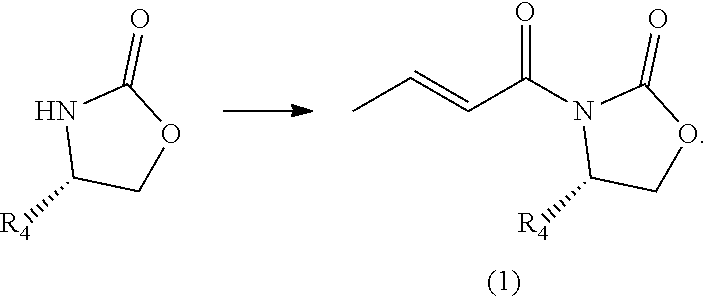
- R 5 in Formula (2) is selected from silyl groups, e.g., TMS, TES, TBDMS, TBDPS, DIPS, DPS, TIPDS, etc.; the oxazolidinone moieties in Formula (1) and Formula (2) are oxazolidinone chiral auxiliary groups, for example, R 4 is C 1-10 alkyl, substituted or unsubstituted phenyl, or substituted or unsubstituted benzyl.
- said R 4 is isopropyl, unsubstituted, monosubstituted or polysubstituted phenyl, or unsubstituted, monosubstituted or polysubstituted benzyl, in which the substituents are selected from the group consisting of hydroxy, nitro, dimethylamino.
- it also includes the step of recrystallizing the compound of Formula (2) once, twice or more times.
- the compound of Formula (2) is obtained by reacting the compound of Formula (1) with a Grignard reagent R 6 MgX or R 6 Li, in which R 6 is
- the reaction is carried out in the presence of cuprous salts, such as cuprous chloride, cuprous bromide, cuprous iodide (CuI), cuprous cyanide, etc., in an inert atmosphere, at ⁇ 50-0° C. and in a solvent.
- cuprous salts such as cuprous chloride, cuprous bromide, cuprous iodide (CuI), cuprous cyanide, etc.
- the solvent can be tetrahydrofuran or anhydrous diethyl ether, and the amount (mass) of the cuprous salt is about 10-25% of the reactant of Formula (1), preferably 15-20%.
- the content of optical isomers can be controlled and reduced by recrystallizing the compound of Formula (2).
- the solvent for the recrystallization is any solvent that can dissolve the compound of Formula (2) at room temperature or at a temperature which is slightly higher than room temperature, and can be for crystallization at a lower temperature (e.g., ⁇ 10 to ⁇ 30° C.), such as a non-polar organic solvent, preferably alkanes, for example, n-pentane, n-hexane, n-heptane, isooctane, or a mixed solvent thereof, such as petroleum ether.
- the recrystallization can be repeated multiple times. After one recrystallization, the isomer content of the compound of Formula (2) of the invention can be controlled to 1% or less, the isomer content after two recrystallizations can be controlled to 1% or less, and after multiple recrystallizations, the isomer content can be controlled in a lower range. It can be understood by those skilled in the art that the configuration of the chiral carbon atom to which the ⁇ -methyl group is connected in Formula (2) of the invention does not change in the subsequent conversion process, so the purity associated with the configuration of the chiral carbon atom is maintained.
- the method for preparing the Grignard reagent includes the following steps:
- the acid binding agent can be an organic or inorganic weak base, such as diethylamine, ethylenediamine, triethylamine, diisopropylamine, pyridine, potassium carbonate, sodium carbonate, cesium carbonate, etc.
- the halogenated vinylsilane reacts with metallic magnesium or metallic lithium in an aprotic solvent to produce the corresponding Grignard reagent or lithium reagent.
- the aprotic solvent can be an ether solvent, e.g., diethyl ether, diisopropyl ether, tert-butyl methyl ether, cyclohexyl methyl ether, tetrahydrofuran, dioxane, etc., or a hydrocarbon solvent, such as n-pentane, n-hexane, n-heptane, benzene, toluene, xylene, etc.
- the above-mentioned halogenated vinylsilane may also react with other easily obtained Grignard reagent in the above solvent, such as a methyl Grignard reagent, an ethyl Grignard reagent, a n-propyl Grignard reagent, an isopropyl Grignard reagent, etc., or an alkyllithium reagent easily obtained, such as methyl lithium, n-butyl lithium, sec-butyl lithium, tert-butyl lithium, to produce the corresponding Grignard reagent or lithium reagent through metal-halogen exchange reaction.
- other easily obtained Grignard reagent in the above solvent such as a methyl Grignard reagent, an ethyl Grignard reagent, a n-propyl Grignard reagent, an isopropyl Grignard reagent, etc.
- an alkyllithium reagent easily obtained such as methyl lithium, n-butyl lithium
- the method for preparing the compound of Formula (8) of the invention further includes the following reaction step of preparing the compound of Formula (3) from the compound of Formula (2):
- X in Formula (3) is halogen or a sulfonyloxy group.
- the halogenation reaction is known to those skilled in the art, which is carried out in a suitable solvent at a mild reaction temperature, such as from 0° C. to room temperature.
- the halogenated reagent used can be X 2 , RCO 2 X, R n SiX 4-n , wherein X is halogen of the group consisting of chlorine, bromine and iodine, and two X in X 2 may be different, R is selected from C 1-10 alkyl or fluorinated C 1-10 alkyl, and n is an integer of 1-3.
- the halogenated reagent can be elemental chlorine, elemental bromine, elemental iodine, BrCl, ICl, TMSCl, TMSI, CF 3 CO 2 I, etc.
- the method for the preparation of the invention further includes converting a compound of Formula (3) with X as halogen into a compound of Formula (3) with X as a sulfonyloxy group according to the known substitution reaction in the art.
- the reaction is performed under basic and low temperature conditions ( ⁇ 80° C. to ⁇ 20° C.), and the catalytic amount of lithium chloride and the solvent used in the reaction are selectable.
- the base is selected from organic bases, inorganic bases or mixtures thereof, such as one or more of potassium carbonate, sodium carbonate, potassium bicarbonate, sodium bicarbonate, sodium hydroxide, potassium hydroxide, cesium carbonate, triethylamine, pyridine, piperidine, n-butyl lithium (n-BuLi).
- the solvent is, for example, tetrahydrofuran, N, N-dimethylformamide (DMF), dichloroethane, ethyl ether, carbon tetrachloride, or toluene, etc.;
- the acyl compound can be an ester, a carboxylic acid, an acyl halide, or an acid anhydride.
- the oxazolidinone chiral auxiliary reacts with an acyl halide at ⁇ 80 to ⁇ 60° C., by using tetrahydrofuran as a solvent, under argon protection and in the presence of n-butyl lithium, and the mass amount of n-butyl lithium is about 30-50% of oxazolidinone; or the oxazolidinone chiral auxiliary reacts with an acid anhydride at ⁇ 30 to ⁇ 20° C., by using tetrahydrofuran as a solvent, in the presence of lithium chloride and triethylamine, and the mass amount of lithium chloride is about 35-55% of oxazolidinone.
- the method for preparing the compound of Formula (8) of the invention further includes the following step: preparing the compound of Formula (4) from the compound of Formula (3):
- the reaction is performed under such conditions as to remove and separate the oxazolidinone chiral auxiliary, preferably the oxazolidinone chiral auxiliary being hydrolytically removed under basic conditions.
- the reaction is carried out at ⁇ 15 to 5° C., under basic conditions and in a solvent medium, and optionally in hydrogen peroxide.
- the reaction temperature can be ⁇ 10 to 0° C., preferably ⁇ 5 to 0° C.
- the base can be selected from organic bases, inorganic bases or mixtures thereof, such as one or more of potassium carbonate, sodium carbonate, potassium bicarbonate, sodium bicarbonate, cesium carbonate, lithium hydroxide, lithium hydroxide hydrate, sodium hydroxide, potassium hydroxide, calcium hydroxide, ammonia, sodium acetate, triethylamine, pyridine or piperidine.
- the solvent is a mixture of water and one or more of alcohols, ethers such as THF or dioxane, and acetone.
- the ratio (volume ratio) of water to the organic solvents in the mixture can be about 1:1 to 1:6, preferably about 1:2 to 1:3.
- the reaction is carried out at ⁇ 5 to 0° C., in a mixed solvent of tetrahydrofuran and water, in the presence of lithium hydroxide monohydrate and hydrogen peroxide, and the mass ratio of the compound of Formula (3) to hydrogen peroxide to lithium hydroxide monohydrate is 12-20:3-9:1-6.
- the method for preparing the compound of Formula (8) of the invention further includes the following step: preparing the compound of Formula (5) from the compound of Formula (4):
- the reaction is carried out in the presence of coupling agents, which can be EDCI/DMAP, EDC/DMAP, EDC/NHS, or DCC/NHS system, and at 15 to 40° C., preferably at room temperature (20 to 25° C.).
- the solvent used in the reaction can be dichloromethane (DCM), tetrahydrofuran (THF), dimethylformamide (DMF), etc.
- the method for preparing the compound of Formula (8) of the invention further includes the following step: preparing the compound of Formula (6) from the compound of Formula (5) and an aldehyde:
- the reaction is performed in the presence of titanium tetrachloride (TiCl 4 ) and triethylamine (TEA), in an inert atmosphere, and at a relatively low temperature of ⁇ 10 to 10° C., preferably 0° C.
- the solvent used in the reaction can be dichloromethane (DCM), etc.
- the method for preparing the above aldehyde includes the following steps:
- X is halogen selected from the group consisting of chlorine, bromine and iodine
- R is selected from the group consisting of C 1-10 alkyl or fluorinated C 1-10 alkyl
- n is an integer of 1-3.
- the halogenated silane R n SiX 4-n is TMSCl, TMSI, TBDPSCl, or TBDPSI, etc.
- the coupling agents can be an EDCI/DMAP, EDC/DMAP, EDC/NHS, or DCC/NHS system, and the reaction is performed at 15 to 40° C., preferably at room temperature (20 to 25° C.).
- the solvent used in the reaction can be dichloromethane (DCM), tetrahydrofuran (THF), dimethylformamide (DMF), etc.
- step (II) Oxidizing the product obtained in step (I).
- the oxidation is any method for oxidizing alcohols to aldehydes or ketones as described below.
- the method for preparing the compound of Formula (8) of the invention further includes the following step: preparing the compound of Formula (7) from the compound of Formula (6):
- the oxidation of alcohols to aldehydes or ketones can be realized by any method known to those skilled in the art, such as Swern oxidation, Pfitzner-Moffatt oxidation, and Albright-Goldman oxidation.
- the Parikh-Doering oxidation method is employed: dimethyl sulfoxide (DMSO) and sulfur trioxide-pyridine complex (SO 3 ⁇ py) reacting with an alcohol at ⁇ 15-25° C. and under basic conditions.
- the base can be triethylamine or N, N-diisopropyl ethylamine (DIPEA); the reaction temperature is preferably 0° C.
- the solvent added in the reaction is optional depending on the added amount of DMSO, that is, a relatively large amount of solvent is required for a small amount of DMSO, while a small amount of solvent or no solvent is required for a large amount of DMSO.
- the solvent for example, is dichloromethane, tetrahydrofuran, chloroform, etc.
- the method for preparing the compound of Formula (8) of the invention further includes the following step: hydrolyzing the above compound of Formula (7) to obtain the compound of Formula (8) in which a carbonyl group is formed by R 2 and R 3 together with the carbon atom to which they are bonded.
- the hydrolysis reaction is carried out at 15-40° C., under basic conditions and in a solvent medium.
- the reaction temperature can be room temperature (20-25° C.)
- the base can be selected from organic bases, inorganic bases or mixtures thereof, such as one or more of potassium carbonate, sodium carbonate, potassium bicarbonate, sodium bicarbonate, cesium carbonate, lithium hydroxide, lithium hydroxide hydrate, sodium hydroxide, potassium hydroxide, calcium hydroxide, ammonia, sodium acetate, triethylamine, pyridine or piperidine.
- the solvent is a mixture of water and one or more of alcohols, ethers such as THF or dioxane, and acetone.
- the ratio (volume ratio) of water to organic solvents in the mixture can be about 1:1-1:6, preferably about 1:4.
- the hydrolysis reaction is carried out at room temperature, in a mixed solvent of tetrahydrofuran and water, and in the presence of lithium hydroxide monohydrate.
- the method for preparing the compound of Formula (8) of the invention optionally, it includes the reaction step from the compound of Formula (6) further to form the compound of Formula (8) in which R 2 and R 3 are the same or different, and independently selected from H and OR a , and R a is independently selected from H, C 1-10 alkyl, R b SO 2 , wherein R b is C 1-10 alkyl.
- the reaction is a hydroxylalkylation or sulfonation reaction known in the art.
- the method for preparing the compound of Formula (8) of the invention optionally, it includes the reaction step from the compound of Formula (8), in which a carbonyl group is formed by R 2 and R 3 together with the carbon atom to which they are bonded, further to form the compound of Formula (8) in which R 2 and R 3 are both OR a , and two R a are bonded together to form C 1-6 alkylene.
- the reaction known in the art is used in a synthesis of ketals.
- a ketone and the corresponding diol such as glycol, propylene glycol, etc., react to obtain the ketal in the presence of p-toluenesulfonic acid as catalyst, and by using benzene or toluene as a water-carrying agent.
- the compound of Formula (8) is for the synthesis of halichondrins, and particularly is the intermediate used for the synthesis of the C20-C26 fragment of eribulin or a pharmaceutically acceptable salt thereof.
- the second aspect of the invention is to provide the compound of Formula (2) which is defined as follows and a method thereof:
- R 4 and R 5 are defined as described above.
- the method for preparing the compound of Formula (2) includes the above step of preparing the compound of Formula (2) from the compound of Formula (1).
- the method for preparing the compound of Formula (2) further includes the above-mentioned step of recrystallizing once, twice or more times.
- the method for preparing the compound of Formula (2) further includes the step of preparing the compound of Formula (1) from an oxazolidinone chiral auxiliary and the corresponding acyl compound.
- the third aspect of the invention is to provide the compound of Formula (3) which is defined as follows and a method thereof:
- R 4 and X are defined as described above.
- the method for preparing the compound of Formula (3) includes the above step of preparing the compound of Formula (3) from the compound of Formula (2).
- the method for the preparation further includes the method for preparing the above compound of Formula (2).
- it further includes the step of recrystallizing the above compound of Formula (2) once, twice or more times.
- it further includes the step of preparing the compound of Formula (1) from an oxazolidinone chiral auxiliary and the corresponding acyl compound.
- the fourth aspect of the invention is to provide the compound of Formula (7) which is defined as follows and a method thereof:
- R 1 is selected from hydroxyl protecting groups
- R 2 and R 3 are the same or different, and independently selected from H and OR a , and R a is independently selected from the group consisting of H, C 1-10 alkyl, R b SO 2 , wherein R b is C 1-10 alkyl; or R 2 and R 3 are both OR a , and two R a are bonded together to form C 1-6 alkylene; or R 2 and R 3 together with the carbon atom to which they are bonded form a carbonyl group;
- X is selected from the group consisting of halogen, sulfonyloxy groups.
- R 1 is selected from the silyl hydroxyl protecting groups, such as TMS, TES, TBDMS, TBDPS, DIPS, DPS, TIPDS, etc.
- R 2 and R 3 is selected from H, the other is selected from OR a , and R a is H or i-PrSO 2 ; or R 2 and R 3 are both OR a , and two R a are bonded together to form n-propylidene; or R 2 and R 3 together with the carbon atom to which they are bonded form a carbonyl group;
- X is selected from the group consisting of chlorine, bromine, iodine, etc.
- the method for preparing the compound of Formula (7) includes the following step:
- Method 1 the compound of Formula (7) in which R 2 and R 3 together with the carbon atom to which they are bonded to form a carbonyl group is obtained by the oxidation of the compound of Formula (7) with R 2 and R 3 as H and OH respectively:
- the oxidation of alcohols to aldehydes or ketones can be realized by any method known to those skilled in the art, such as Swern oxidation, Pfitzner-Moffatt oxidation, and Albright-Goldman oxidation.
- the Parikh-Doering oxidation method is employed: dimethyl sulfoxide (DMSO) and sulfur trioxide-pyridine complex (SO 3 ⁇ py) reacting with an alcohol at ⁇ 15-25° C. and under basic conditions.
- the base can be triethylamine or N, N-diisopropyl ethylamine (DIPEA); the reaction temperature is preferably 0° C.
- the solvent added in the reaction is optional depending on the added amount of DMSO, that is, a relatively large amount of solvent is required for a small amount of DMSO, while a small amount of solvent or no solvent is required for a large amount of DMSO.
- the solvent for example, is dichloromethane, tetrahydrofuran, chloroform, etc.
- Method 2 the compound of Formula (7) with R 2 and R 3 as H and OH respectively is prepared from the following compound of Formula (5):
- the reaction is performed in the presence of titanium tetrachloride (TiCl 4 ) and triethylamine (TEA), in an inert atmosphere, and at a lower temperature of ⁇ 10 to 10° C., preferably 0° C.
- the solvent used in the reaction is selected from dichloromethane (DCM), etc.
- the compounds of Formula (7) with other defined R 2 and R 3 can be prepared by common methods known in the art, such as substitution, condensation, etc., and obtained from the compound of Formula (7) in which R 2 and R 3 together with the carbon atom to which they are bonded to form a carbonyl group, or from the compound of Formula (7) with R 2 and R 3 as H and OH respectively.
- the fifth aspect of the invention is also to provide the use of the compounds of Formula (2), Formula (3), and Formula (7), which are used for the preparation of halichondrins, particularly eribulin, pharmaceutically acceptable salts and analogs thereof.
- the compounds of Formula (2), Formula (3) and Formula (7) are used for preparing the compound of Formula (8) which is used for the synthesis of halichondrins, and particularly is the intermediate for the C20-C26 fragment of eribulin.
- the sixth aspect of the invention is to provide a method for preparing the compound of Formula (8), the method including the following step:
- it also includes the step of the oxidation of the compound of Formula (7) with R 2 and R 3 as H and OH respectively to form the compound of Formula (7) in which R 2 and R 3 together with the carbon atom to which they are bonded to form a carbonyl group:
- it also includes the step of the preparation of the compound of Formula (7) with R 2 and R 3 as H and OH respectively from the compound of Formula (5) and the compound of Formula (6):
- it also includes the above step of preparing the compound of Formula (5) from the compound of Formula (4);
- it also includes the above step of preparing the compound of Formula (4) from the compound of Formula (3);
- it also includes the above step of preparing the compound of Formula (3) from the compound of Formula (2);
- it also includes the above step of preparing the compound of Formula (2) from the compound of Formula (1);
- it also includes the step of recrystallizing the compound of Formula (2) once, twice or more times;
- it further includes the above step of preparing the compound of Formula (1) from the oxazolidinone chiral auxiliary.
- the seventh aspect of the invention is to provide the method for preparing halichondrins, eribulin, analogs or pharmaceutically acceptable salts thereof, or the C20-C26 fragment, including using the above oxazolidinone chiral auxiliary, any compound of Formula (1) to Formula (7), and/or one or more reaction steps in the above methods for preparing the compound of Formula (1) to the compound of Formula (8).
- the invention also provides the use of the above oxazolidinone chiral auxiliary and any compound of Formula (1) to Formula (7) in preparing halichondrins, eribulin, analogs, or the C20-C26 fragment.
- integers from 1 to 10 should be understood that not only each of the integers 1, 2, 3, 4, 5, 6, 7, 8, 9 and 10, but also at least the sum of each integer and 0.1, 0.2, 0.3, 0.4, 0.5, 0.6, 0.7, 0.8, 0.9, respectively is disclosed.
- halichondrin, halichondrin analog should be understood as a substance having a polyether macrolide structure, the structure containing the C20-C26 fragment of eribulin.
- eribulin, norhalichondrin A-C, halichondrin B-C, homohalichondrin A-C, or its pharmaceutically acceptable salts for instance, the salts formed with pharmaceutically acceptable acids, such as methanesulfonate, e.g., eribulin methanesulfonate.
- C 1-10 alkyl should be understood to refer preferably to a straight or branched-chain saturated monovalent hydrocarbon group having 1, 2, 3, 4, 5, 6, 7, 8, 9, or 10 carbon atoms.
- the alkyl group is, for example, methyl, ethyl, propyl, butyl, pentyl, hexyl, isopropyl, isobutyl, sec-butyl, tert-butyl, isopentyl, 2-methylbutyl, 1-methylbutyl, 1-ethylpropyl, 1,2-dimethylpropyl, neopentyl, 1,1-dimethylpropyl, 4-methylpentyl, 3-methylpentyl, 2-methylpentyl, 1-methylpentyl, 2-ethylbutyl, 1-ethylbutyl, 3,3-dimethylbutyl, 2,2-dimethylbutyl, 1,1-dimethylbutyl, 2,3-dimethylbutyl, 1,3
- the group has 1, 2, 3, 4, 5, 6 carbon atoms (“C 1-6 alkyl”), such as methyl, ethyl, propyl, butyl, isopropyl, isobutyl, sec-butyl, tert-butyl, and more particularly, the group has 1, 2 or 3 carbon atoms (“C 1-3 alkyl”), such as methyl, ethyl, n-propyl or isopropyl.
- C 1-6 alkyl such as methyl, ethyl, propyl, butyl, isopropyl, isobutyl, sec-butyl, tert-butyl
- C 1-3 alkyl such as methyl, ethyl, n-propyl or isopropyl.
- C 1-6 alkylene should be understood to refer preferably to a straight or branched-chain saturated divalent hydrocarbon group having 1, 2, 3, 4, 5 or 6 carbon atoms, such as methylene, ethylene, n-propylidene, isopropylidene, etc.
- hydroxyl protecting group means any group capable of protecting the oxygen atom to which it is attached from reacting or bonding. Hydroxyl protecting groups are known in the art. Exemplary hydroxyl protecting groups include, but are not limited to, acyl, ester, carbonate, urethane, sulfonate, and ether groups.
- exemplary ether hydroxyl protecting groups include C 1-12 alkyl groups (e.g., C 1-8 , C 1-6 , C 1-4 , C 2-7 , C 3-12 and C 3-6 alkyl), and silyl groups (e.g., tris(C 1-6 alkyl)silyl, tris(C 6-10 aryl or C 1-6 heteroaryl)silyl, bis(C 6-10 aryl or C 1-6 heteroaryl)(C 1-6 alkyl) silyl, and (C 6-10 aryl or C 1-6 heteroaryl)bis(C 1-6 alkyl) silyl).
- C 1-12 alkyl groups e.g., C 1-8 , C 1-6 , C 1-4 , C 2-7 , C 3-12 and C 3-6 alkyl
- silyl groups e.g., tris(C 1-6 alkyl)silyl, tris(C 6-10 aryl or C 1-6 heteroaryl)silyl, bis(C 6-10
- alkyl examples include methyl and tert-butyl
- silyl examples include trimethylsilyl (TMS), triethylsilyl (TES), tert-butyldimethylsilyl (TBS), tert-butyldiphenylsilyl (TBDPS), triisopropylsilyl (TIPS) and triphenylsilyl (TPS) ether groups, TBDMS, DIPS, DPS, TIPDS, etc.
- the hydroxyl protecting groups can be deprotected with deprotecting reagents.
- the deprotecting reagents used for removing the hydroxyl protecting groups are those reagents that can react with compounds with hydroxyl protecting groups to provide compounds with deprotected hydroxyl groups.
- the deprotecting reagents used for removing the hydroxyl protecting groups and the deprotection reaction conditions can be known in the art.
- protected hydroxyl groups as silyl ethers may be deprotected by reacting with fluoride compounds (e.g., a fluoride salt, such as KF or TBAF).
- the protected hydroxyl groups as TMS or TES ethers may be deprotected by reacting with Bronsted acids (e.g., carboxylic acid).
- the protected hydroxyl groups as esters can be deprotected by reacting with C 1-6 alkoxides (e.g., alkali metal C 1-6 alkoxides or alkaline earth metal C 1-6 alkoxides).
- the protected hydroxyl groups as arylalkyl ethers e.g., 1-arylalk-1-yl ether
- a reduction reaction e.g., with Pd/C and H 2 , or with Na/NH 3 ).
- the protected hydroxyl groups as alkoxy-arylalkyl ethers can be deprotected by reacting with 2,3-dichloro-5,6-dicyano-1,4-benzoquinone (DDQ).
- DDQ 2,3-dichloro-5,6-dicyano-1,4-benzoquinone
- the protected hydroxyl groups as alkoxyalkyl ethers e.g., 1-alkoxyalk-1-yl
- THP ethers can be deprotected by reacting with Bronsted acids.
- the protected cyclic diols can be deprotected by reacting with Bronsted acids (e.g., carboxylic acid).
- the sulfonyloxy groups of the invention can be alkylsulfonyloxy groups (e.g., C 1-10 alkyl), alkenylsulfonyloxy groups (e.g. C 2-10 alkenyl), arylsulfonyloxy groups.
- the embodiments include, but are not limited to: methanesulfonyloxy, toluenesulfonyloxy (e.g., p-toluenesulfonyloxy), trifluoromethanesulfonyloxy, nitrobenzenesulfonyloxy (o, p-nitrobenzenesulfonyloxy), bromobenzenesulfonyloxy(o, p-bromobenzenesulfonyloxy).
- the methylsilyl group of the invention can be tri(C 1-6 alkyl)silyl, tri(C 6-10 aryl or C 6-10 heteroaryl)silyl, di(C 6-10 aryl or C 6-10 heteroaryl) (C 1-6 alkyl)silyl and (C 6-10 aryl or C 6-10 heteroaryl)di(C 1-6 alkyl)silyl.
- silyl examples include, but are not limited to, trimethylsilyl (TMS), triethylsilyl (TES), t-butyldimethylsilyl (TBS), t-butyldiphenylsilyl (TBDPS), triisopropylsilyl (TIPS) and triphenylsilyl (TPS), TBDMS, DIPS, DPS, TIPDS, etc.
- Suitable substituents on phenyl or benzyl groups of the invention include, but are not limited to, halogen (fluoro, chloro, bromo, iodo), C 1-10 alkyl, C 1-10 alkoxy, hydroxy, nitro, amino, amino substituted by one or two C 1-10 alkyl groups, SO 3 H, SO 3 C 1-10 alkyl groups.
- the bases of the invention can be organic bases, inorganic bases or mixtures thereof, for example, selected from alkali metal or alkaline earth metal carbonates or bicarbonates, such as lithium carbonate, sodium carbonate, potassium carbonate, calcium carbonate, cesium carbonate, sodium bicarbonate, potassium bicarbonate, calcium bicarbonate; alkali metal alkoxides, such as sodium t-butanoxide or potassium t-butanoxide; organic lithium, such as butyl lithium or phenyl lithium; alkali metal hydrides, such as sodium hydride or potassium hydride; amines, such as lithium bis(trimethylsilyl)amide, potassium bis(trimethylsilyl) amide or lithium diisopropylamide (LDA); organic amines, such as triethylamine, N-methylmorpholine, piperidine, N-methylpiperidine, N,N-diisopropylethylamine, 1,5-diazabicyclo[4.3.0]non-5-ene (
- the acids of the invention can be organic acids, inorganic acids or mixtures thereof, for example, selected from one or more of the following acids: hydrochloric acid, sulfuric acid, phosphoric acid, nitric acid; carboxylic acid, such as acetic acid or trifluoroacetic acid; sulfonic acid, such as methanesulfonic acid, trifluoromethylsulfonic acid or p-toluenesulfonic acid; phosphonic acid; hydrochloric acid, sulfuric acid, phosphoric acid.
- the acids also include Lewis acid.
- the Lewis acids can be one or more selected from BF 3 OEt 2 , MgCl 2 , MgBr 2 , ZnBr 2 , ZnI 2 , ZnCl 2 , ZnSO 4 , CuCl 2 , CuCl, Cu(O 3 SCF 3 ) 2 , CoCl 2 , CoI 2 , FeI 2 , FeCl 3 , FeCl 2 , FeCl 2 , SnCl 4 , TiCl 4 , TiCl 3 , MnCl 2 , ScCl 3 , AlCl 3 , (i-C 4 H 9 ) 2 AlCl, (C 6 H 5 ) 2 AlCl, (C 6 H 5 )AlCl 2 , ReCl 5 , ZrCl 4 , NbCl 5 , VCl 3 , CrCl 2 , MoCl 5 , YCl 3 , CdCl 2 , LaCl 3 , Er(O
- the specific examples can be one or more selected from BF 3 ⁇ OEt 2 , MgCl 2 , ZnCl 2 , MgBr 2 , ZnBr 2 , AlCl 3 , SnCl 4 , TiCl 4 or trimethylsilyl trifluoromethanesulfonate.
- the solvents of the invention can be selected from, for example, one or a mixture of two or more of the following: water; ketone solvents, such as acetone and methyl ethyl ketone; ether solvents, including acyclic ethers and cyclic ethers, such as diethyl ether, tetrahydrofuran, dioxane; ester solvents, such as ethyl acetate or butyl acetate; alkane solvents, such as n-hexane or n-heptane; halogenated alkane solvents, such as monochloromethane, dichloromethane, chloroform, carbon tetrachloride, 1,2-dichloroethane; cycloalkane solvents, such as cyclohexane or cycloheptane; substituted or unsubstituted aromatic solvents, such as benzene, toluene, xylene, chlorobenzen
- the solvents are selected from inert solvents which have no reaction activity to the reaction substrates and catalysts.
- the inert solvents can be one or more selected from, for example, alcohol solvents (e.g., methanol, ethanol), ether solvents (e.g., diethyl ether, tetrahydrofuran, dioxane), halogenated alkane solvents (e.g., dichloromethane, trichloromethane, carbon tetrachloride, 1,2-dichloroethane), substituted or unsubstituted aromatic hydrocarbons (e.g., benzene, toluene, chlorobenzene).
- alcohol solvents e.g., methanol, ethanol
- ether solvents e.g., diethyl ether, tetrahydrofuran, dioxane
- halogenated alkane solvents e.g., dichloromethane, trichlorome
- the solvents of the invention are anhydrous solvents.
- the invention provides intermediates for preparing halichondrins, eribulin, or their analogs, and particularly the intermediates with the C20-C26 fragment, the methods and use thereof.
- the raw materials used in the synthetic routes of the invention are cheap and easily obtained.
- the compounds of Formula (2) and Formula (3) are both crystals, and the purity of which can be improved by recrystallization which is a simple method of purification. In particular, after the compound of Formula (2) is recrystallized twice, the optical purity can be achieved to be greater than 99.9%.
- the configuration of the chiral carbon atom, attached to the methyl group at the ⁇ position of the compound, does not change in the subsequent steps, ensures optical purities of the C20-C26 fragment of halichondrins, eribulin or their analogs.
- the method for constructing the chiral center of the C20-26 fragment of the invention has advantages of high diastereoselectivity and high yield, and by-products can only be removed by simple methods such as recrystallization. All the steps of the methods are carried out at relatively low temperature and under mild reaction conditions. Particularly in the step of preparing the compound of Formula (8) from the compound of Formula (7) the loss of the product is avoided due to the thermal decomposition at a high temperature.
- the products obtained by the entire preparation methods, especially in the front-end steps, are all crystalline solids to be easily purified and refined. Based on the above advantages, i.e., low cost, high yield and high product purity, simple processes of refining and purification, the methods of the invention are more suitable for large-scale industrialized production.
- FIG. 1 Schematic illustration of synthetic routes in Example 1 of the invention.
- Example 1 Method 1 for Preparing Compound 8 (See FIG. 1 )
- (S)-4-phenyl-2-oxazolidinone 60 g was added into a 2000 mL three-necked flask, and dissolved by adding with non-anhydrous THF (1200 mL). LiCl (26.4 g) and TEA (91.2 mL) was added into the solution at room temperature, and then crotonic anhydride (82.2 mL) was added dropwise. The internal temperature was maintained not more than 25° C. After the dropwise addition, the reaction was kept at room temperature for 3 hours. Until the spots of the starting material of (S)-4-phenyl-2-oxazolidinone disappeared that was monitored by TLC, water (800 mL) was added to dissolve the solid in the reaction solution.
- the solution was layered, and separated.
- the aqueous phase was extracted twice with ethyl acetate.
- the organic phases were combined.
- the combined organic phase was washed once with a saturated sodium chloride solution, dried by adding anhydrous sodium sulfate, and filtered.
- the filtrate was concentrated.
- the obtained concentrate was added with ethyl acetate (400 mL), and dissolved by heating under reflux. Crystals were precipated when the solution was added with n-hexane (2000 mL), cooled down, and stirred. After filtration, 72 g of a white solid product with a yield of 85% was obtained.
- Vinyltrimethylsilane 100 g was added into a 2000 mL three-necked flask, and then cooled between ⁇ 35° C. and ⁇ 30° C. Bromine water was slowly added dropwise, while heat was violently released. The internal temperature was maintained between ⁇ 30° C. and ⁇ 10° C. during the dropwise addition (when the internal temperature was lower than ⁇ 30° C., the reaction system became solid). After the dropwise addition, the temperature rose naturally to room temperature. Diethylamine (676 mL) was slowly added. At the beginning of the addition, heat was released. After the dropwise addition, the reaction solution was heated under reflux for 1.2 hours.
- reaction solution was cooled to room temperature, and diluted by adding with diethyl ether (1000 mL), washed 2-3 times with water and then with 2N hydrochloric acid until the pH value of the aqueous layer to 1.
- the organic phase was successively washed once with saturated sodium bicarbonate and once with saturated sodium chloride, dried with anhydrous sodium sulfate, and filtered. The filtrate was concentrated. The concentrate was distilled under reduced pressure. 80 g of the fraction (between 38° C. to 42° C.) was collected. The yield was 45%.
- the reaction solution was quenched by slowly adding a saturated solution of ammonium chloride, stirred vigorously for 4-6 hours to give two clear phases. The layers were separated. The aqueous phase was extracted twice with ethyl acetate. The organic phases were combined. The combined organic phase was washed twice with a saturated sodium chloride solution, dried by adding anhydrous sodium sulfate, and filtered. The filtrate was concentrated to obtain 57 g of a crude product. The crude product was dissolved in 570 mL n-hexane at room temperature. The solution was placed in a refrigerator at ⁇ 20° C., and let stand while crystals were precipated. The next day, the solution was filtered when cold. The filtrate was washed with cold n-hexane to give 42 g of a white solid. After secondary recrystallization, a product with a purity of 99.94% was obtained.
- the crude product was purified by column chromatography to obtain 15 g of a product.
- the product was heated and dissolved in a mixed solvent of n-hexane and ethyl acetate (70 mL). Crystals were precipitated when the solution was cooled down and stirred. 9.4 g of a white solid with a yield of 43% was obtained.
- the raw material 3 (14.27 g) was dissolved in a mixed solution of THF-H 2 O (148 mL-37 mL). The mixture was then cooled to about ⁇ 5° C., successively added with hydrogen peroxide (35%, 15.8 mL) and an aqueous solution of lithium hydroxide monohydrate (3.1 g/30 mL H 2 O) dropwise. After the dropwise addition, the reaction was kept at 0° C. for 2 hours. When the spots of the raw material disappeared that was monitored by TLC, the temperature of the reaction solution was increased to room temperature. A saturated solution of sodium sulfite was slowly added, until the potassium iodide starch test papers did not change color. THF was removed by distillation under reduced pressure.
- the aqueous phase was washed 2-3 times with DCM, until no more (S)-4-phenyl-2-oxazolidinone.
- the aqueous phase was added into a round-bottom flask, cooled to 0° C., and the pH of the aqueous phase was adjusted to 1 with a 10% diluted solution of hydrochloric acid. Then the solution was extracted 2-3 times with DCM, dried, and filtered. The filtrate was concentrated to obtain compound 4.
- Step 1 1,4-butanediol (100 mL) was added into a 2000 mL three-necked flask at room temperature, to which DCM (1300 mL), triethylamine (59 mL) and DMAP (4.7 g) were added, and then TBSCl was slowly added dropwise. After the dropwise addition, the reaction was kept at room temperature overnight (about 17 hours). When the spots of the raw material TBSCI disappeared that was monitored by TLC, the reaction mixture was quenched by adding a saturated solution of ammonium chloride. The solution layers were separated. The aqueous layer was extracted twice with DCM, and the organic phases were combined.
- the combined organic phase was washed once with a saturated sodium chloride solution, dried by adding anhydrous sodium sulfate, and filtered. The filtrate was concentrated. The concentrate was purified by column chromatography to obtain 108 g of a syrup-like product with a yield of 80%.
- Step 2 4-((tert-butyldiphenylsilyl)oxy)butanol (11.6 g) was dissolved in dry DCM (71 mL), and then cooled to 0° C. The solution was successively added with dry DMSO (12.6 mL) and DIPEA (15.4 mL), and added with sulfur trioxide-pyridine (11.3 g) in batches. The internal temperature was maintained not more than 10° C. After the addition, the temperature was increased to room temperature and the mixture was reacted for 0.5-1 h. When the spots of the raw material disappeared that was monitored by TLC, the reaction mixture was quenched by adding water, washed once with 1N diluted hydrochloric acid.
- the aqueous layer was extracted once with DCM, and the organic phases were combined.
- the combined organic phase was successively washed once with a saturated sodium bicarbonate solution and with a saturated sodium chloride solution, dried with anhydrous sodium sulfate, and filtered.
- the filtrate was concentrated to obtain a syrup-like product, which was directly used in the next reaction, so it was freshly prepared just before use.
- the reaction mixture was quenched by adding a saturated sodium chloride solution.
- the solution layers were separated.
- the aqueous layer was extracted twice with DCM, and the organic phases were combined.
- the combined organic phase was successively washed twice with a saturated sodium bicarbonate solution and once with a saturated sodium chloride solution, dried with anhydrous sodium sulfate, and filtered.
- the filtrate was concentrated.
- the concentrate was purified by column chromatography to obtain 13.1 g of a yellow syrup-like product with a yield of 84%.
- the raw material 6 (13.07 g) was dissolved in dry DCM (40 mL), and then cooled to 0° C. The solution was successively added with dry DMSO (6.95 mL) and DIPEA (8.54 mL), and added with sulfur trioxide-pyridine (6.23 g) in batches. The internal temperature was maintained not more than 10° C. After the addition, the temperature was increased to room temperature and the mixture was reacted for 0.5-1 h. When the spots of the raw material disappeared that was monitored by TLC, the reaction mixture was quenched by adding water, and washed once with 1N diluted hydrochloric acid. The aqueous layer was extracted once with DCM, and the organic phases were combined.
- the raw material 7 (10.4 g) was dissolved in a mixed solvent of THF and H 2 O (120 mL/30 mL). The solution was added with lithium hydroxide monohydrate (6.54 g) at room temperature. The reaction mixture was kept at room temperature and stirred for 6-8 hours. After the completion of reaction, the reaction mixture was added with water. The solution layers were separated. The aqueous layer was extracted with n-hexane, and the THF layer was concentrated under reduced pressure. The concentrate was then dissolved by adding n-hexane. The organic phases were combined. The combined organic phase was washed with a saturated sodium dihydrogen phosphate, and with a saturated sodium chloride solution, dried with anhydrous sodium sulfate, and filtered. The filtrate was concentrated. The concentrate was purified by column chromatography to obtain 7.08 g of a product with a yield of 87%.
Landscapes
- Chemical & Material Sciences (AREA)
- Organic Chemistry (AREA)
- Chemical Kinetics & Catalysis (AREA)
- Pharmaceuticals Containing Other Organic And Inorganic Compounds (AREA)
- Heterocyclic Carbon Compounds Containing A Hetero Ring Having Oxygen Or Sulfur (AREA)
- Organic Low-Molecular-Weight Compounds And Preparation Thereof (AREA)
Abstract
Description


Alternately, the intermediates shown in Formula 1b and Formula 6 below can be used to synthesize the C20-C35 fragment of eribulin.


and a halogenated reagent are mixed at a relatively low temperature (e.g., −30 to −10° C.), an acid binding agent is added at room temperature, and then the mixture is refluxed to obtain a halogenated vinylsilane. The acid binding agent can be an organic or inorganic weak base, such as diethylamine, ethylenediamine, triethylamine, diisopropylamine, pyridine, potassium carbonate, sodium carbonate, cesium carbonate, etc.


Claims (11)


Applications Claiming Priority (3)
| Application Number | Priority Date | Filing Date | Title |
|---|---|---|---|
| CN201811508481.1 | 2018-12-10 | ||
| CN201811508481.1A CN111285894B (en) | 2018-12-10 | 2018-12-10 | Intermediate for preparing halichondrin compounds and preparation method thereof |
| PCT/CN2019/116349 WO2020119345A1 (en) | 2018-12-10 | 2019-11-07 | Intermediates for preparing halichondrin compounds and preparation method therefor |
Publications (2)
| Publication Number | Publication Date |
|---|---|
| US20210163509A1 US20210163509A1 (en) | 2021-06-03 |
| US11713329B2 true US11713329B2 (en) | 2023-08-01 |
Family
ID=71018347
Family Applications (1)
| Application Number | Title | Priority Date | Filing Date |
|---|---|---|---|
| US16/768,943 Active 2040-09-05 US11713329B2 (en) | 2018-12-10 | 2019-11-07 | Intermediates useful in the preparation of halichondrin compounds and methods for preparing the same |
Country Status (5)
| Country | Link |
|---|---|
| US (1) | US11713329B2 (en) |
| EP (1) | EP3686208B1 (en) |
| JP (1) | JP7628698B2 (en) |
| CN (1) | CN111285894B (en) |
| WO (1) | WO2020119345A1 (en) |
Families Citing this family (2)
| Publication number | Priority date | Publication date | Assignee | Title |
|---|---|---|---|---|
| CN116478203B (en) * | 2023-04-04 | 2025-12-02 | 苏州美诺医药科技有限公司 | A method for preparing an intermediate of a soft sponge analogue |
| CN118834221B (en) * | 2023-08-08 | 2025-10-21 | 浙江星月药物科技有限公司 | A halichondrin B analogue |
Citations (2)
| Publication number | Priority date | Publication date | Assignee | Title |
|---|---|---|---|---|
| WO1993017690A1 (en) | 1992-03-12 | 1993-09-16 | President And Fellows Of Harvard College | Halichondrins and related compounds |
| WO2016003975A1 (en) | 2014-06-30 | 2016-01-07 | President And Fellows Of Harvard College | Synthesis of halichondrin analogs and uses thereof |
Family Cites Families (3)
| Publication number | Priority date | Publication date | Assignee | Title |
|---|---|---|---|---|
| KR101434673B1 (en) * | 2004-06-03 | 2014-08-26 | 에자이 알앤드디 매니지먼트 가부시키가이샤 | Intermediates for the preparation of halicondrine B analogs |
| JO3210B1 (en) * | 2011-10-28 | 2018-03-08 | Merck Sharp & Dohme | Fusible inhibitor of the cholesterolester transporter oxazolidinone octahedral |
| WO2017064627A2 (en) * | 2015-10-14 | 2017-04-20 | Dr. Reddy's Laboratories Limited | Process for preparation of eribulin and intermediates thereof |
-
2018
- 2018-12-10 CN CN201811508481.1A patent/CN111285894B/en active Active
-
2019
- 2019-11-07 US US16/768,943 patent/US11713329B2/en active Active
- 2019-11-07 EP EP19861292.1A patent/EP3686208B1/en active Active
- 2019-11-07 WO PCT/CN2019/116349 patent/WO2020119345A1/en not_active Ceased
- 2019-11-07 JP JP2020523997A patent/JP7628698B2/en active Active
Patent Citations (2)
| Publication number | Priority date | Publication date | Assignee | Title |
|---|---|---|---|---|
| WO1993017690A1 (en) | 1992-03-12 | 1993-09-16 | President And Fellows Of Harvard College | Halichondrins and related compounds |
| WO2016003975A1 (en) | 2014-06-30 | 2016-01-07 | President And Fellows Of Harvard College | Synthesis of halichondrin analogs and uses thereof |
Non-Patent Citations (7)
| Title |
|---|
| American Chemical Society. Chemical Abstract Service. RN 160447-16-5. First entered into STN/made available to public on Jan. 27, 1995. (Year: 1995). * |
| Atsushi Ueda et al.; Total Synthesis of Halichondrin A, the Missing Member in the Halichondrin Class of Natural Products; Journal of the American Chemical Society; Mar. 17, 2014, 136, pp. 5171-5176. |
| Cheng-Guo Dong et al.; New Syntheses of E7389 C14-C35 and Halichondrin C14-C38 Building Blocks: Reductive Cyclization and Oxy-Michael Cyclization Approaches; Journal of the American Chemical Society; Oct. 6, 2009, 131, 15642-15646. |
| Cheng-Guo Dong et al.; Supporting Information, New Syntheses of E7389 C14-C35 and Halichondrin C14-C38 Building Blocks: Reductive Cyclization and Oxy-Michael Cyclization Approaches; S1-S40, published on http://pubs.acs.org, Oct. 6, 2009. |
| Ueda, Atsushi, et al. "Total Synthesis of Halichondrin A, the Missing Member in the Halichondrin Class of Natural Products." J. Am. Chem. Soc. (2014), vol. 136, pp. 5171-5176) (Year: 2014). * |
| Zhigao Zhang et al.; Total Synthesis of ( )-Exiguolide; Organic Letters, Sep. 15, 2015, vol. 17, pp. 4706-4709. |
| Zhigao Zhang et al.; Total Synthesis of ( )-Exiguolide; Organic Letters, Sep. 15, 2015, vol. 17, pp. 4706-4709. |
Also Published As
| Publication number | Publication date |
|---|---|
| JP7628698B2 (en) | 2025-02-12 |
| EP3686208A1 (en) | 2020-07-29 |
| CN111285894B (en) | 2021-03-05 |
| US20210163509A1 (en) | 2021-06-03 |
| EP3686208A4 (en) | 2020-11-18 |
| JP2022510740A (en) | 2022-01-28 |
| CN111285894A (en) | 2020-06-16 |
| WO2020119345A1 (en) | 2020-06-18 |
| EP3686208B1 (en) | 2021-12-08 |
Similar Documents
| Publication | Publication Date | Title |
|---|---|---|
| EP2594569B1 (en) | Entecavir synthesis method and intermediate compound thereof | |
| EP2536724B1 (en) | Process for preparing entecavir and its intermediates | |
| US20260055068A1 (en) | Processes and intermediates for preparing mcl1 inhibitors | |
| EA034309B1 (en) | Processes and intermediate compounds for preparing a prostacyclin analog | |
| US20210163509A1 (en) | Intermediates useful in the preparation of halichondrin compounds and methods for preparing the same | |
| US20130296558A1 (en) | Preparation process of an antiviral drug (entecavir) and intermediates thereof | |
| JP6212429B2 (en) | Process for producing 1,3,4,5-tetracaffeoylquinic acid and intermediate compounds | |
| US20130211103A1 (en) | Intermediates and methods for making zearalenone macrolide analogs | |
| US20100228038A1 (en) | Processes for the production of polycyclic fused ring compounds | |
| CA2624471A1 (en) | Process for the synthesis of hmg-coa reductase inhibitors | |
| US7550608B2 (en) | Processes for the preparation of docetaxel | |
| JP2007513070A (en) | CROSS REFERENCE TO BI-CYCLO [3.1.0] HEXAN DERIVATIVE AND PROCESS FOR PRODUCING INTERMEDIATE THEREOF This application is hereby incorporated by reference in US Provisional Application No. 60 / 518,391, filed Nov. 7, 2003. Claims priority under 35 (35U.S.C.) 119 (e). | |
| IE903146A1 (en) | Asymmetric chemical synthesis and intermediates for making¹antifungal compounds | |
| US20110144326A1 (en) | Method for manufacturing stereoselective preparation of 4-BMA using a chiral auxiliary and chiral auxiliary | |
| US7612213B2 (en) | Compound having antitumor activity and process for producing the same | |
| WO2019087948A1 (en) | Method for producing prostaglandin derivative | |
| JPH03127760A (en) | Production of isocarbacyclines | |
| CN106588565A (en) | Synthesis method of chiral sec-allyl alcohol with hydroxyl ortho-position replaced with halogen atoms | |
| JPH09241266A (en) | Method for producing bis-tetrahydrofuran derivative |
Legal Events
| Date | Code | Title | Description |
|---|---|---|---|
| AS | Assignment |
Owner name: BEIJING TIENYI LUFU PHARMATECH CO. LTD., CHINA Free format text: ASSIGNMENT OF ASSIGNORS INTEREST;ASSIGNOR:XU, WEIPING;REEL/FRAME:052807/0638 Effective date: 20200509 |
|
| FEPP | Fee payment procedure |
Free format text: ENTITY STATUS SET TO UNDISCOUNTED (ORIGINAL EVENT CODE: BIG.); ENTITY STATUS OF PATENT OWNER: SMALL ENTITY |
|
| FEPP | Fee payment procedure |
Free format text: ENTITY STATUS SET TO SMALL (ORIGINAL EVENT CODE: SMAL); ENTITY STATUS OF PATENT OWNER: SMALL ENTITY |
|
| STPP | Information on status: patent application and granting procedure in general |
Free format text: APPLICATION DISPATCHED FROM PREEXAM, NOT YET DOCKETED |
|
| STPP | Information on status: patent application and granting procedure in general |
Free format text: DOCKETED NEW CASE - READY FOR EXAMINATION |
|
| STPP | Information on status: patent application and granting procedure in general |
Free format text: NON FINAL ACTION MAILED |
|
| STPP | Information on status: patent application and granting procedure in general |
Free format text: RESPONSE TO NON-FINAL OFFICE ACTION ENTERED AND FORWARDED TO EXAMINER |
|
| STPP | Information on status: patent application and granting procedure in general |
Free format text: FINAL REJECTION MAILED |
|
| STPP | Information on status: patent application and granting procedure in general |
Free format text: PUBLICATIONS -- ISSUE FEE PAYMENT VERIFIED |
|
| STCF | Information on status: patent grant |
Free format text: PATENTED CASE |