US11613845B2 - Apparatus for manufacturing artificial leather and method of manufacturing artificial leather using the same - Google Patents

Apparatus for manufacturing artificial leather and method of manufacturing artificial leather using the same Download PDF

Info

Publication number
US11613845B2
US11613845B2 US16/641,989 US201816641989A US11613845B2 US 11613845 B2 US11613845 B2 US 11613845B2 US 201816641989 A US201816641989 A US 201816641989A US 11613845 B2 US11613845 B2 US 11613845B2
Authority
US
United States
Prior art keywords
layer
embossing
molding
foam layer
vacuum
Prior art date
Legal status (The legal status is an assumption and is not a legal conclusion. Google has not performed a legal analysis and makes no representation as to the accuracy of the status listed.)
Active, expires
Application number
US16/641,989
Other versions
US20200354888A1 (en
Inventor
Kitae Kim
Jun Hyoung KIM
Eun Sik NAM
Jae Bong Hwang
Current Assignee (The listed assignees may be inaccurate. Google has not performed a legal analysis and makes no representation or warranty as to the accuracy of the list.)
LX Hausys Ltd
Original Assignee
LG Hausys Ltd
Priority date (The priority date is an assumption and is not a legal conclusion. Google has not performed a legal analysis and makes no representation as to the accuracy of the date listed.)
Filing date
Publication date
Application filed by LG Hausys Ltd filed Critical LG Hausys Ltd
Priority claimed from PCT/KR2018/010623 external-priority patent/WO2019054724A2/en
Assigned to LG HAUSYS, LTD. reassignment LG HAUSYS, LTD. ASSIGNMENT OF ASSIGNORS INTEREST (SEE DOCUMENT FOR DETAILS). Assignors: HWANG, JAE BONG, KIM, JUN HYOUNG, KIM, KITAE, NAM, EUN SIK
Publication of US20200354888A1 publication Critical patent/US20200354888A1/en
Application granted granted Critical
Publication of US11613845B2 publication Critical patent/US11613845B2/en
Active legal-status Critical Current
Adjusted expiration legal-status Critical

Links

Images

Classifications

    • DTEXTILES; PAPER
    • D06TREATMENT OF TEXTILES OR THE LIKE; LAUNDERING; FLEXIBLE MATERIALS NOT OTHERWISE PROVIDED FOR
    • D06NWALL, FLOOR, OR LIKE COVERING MATERIALS, e.g. LINOLEUM, OILCLOTH, ARTIFICIAL LEATHER, ROOFING FELT, CONSISTING OF A FIBROUS WEB COATED WITH A LAYER OF MACROMOLECULAR MATERIAL; FLEXIBLE SHEET MATERIAL NOT OTHERWISE PROVIDED FOR
    • D06N3/00Artificial leather, oilcloth or other material obtained by covering fibrous webs with macromolecular material, e.g. resins, rubber or derivatives thereof
    • D06N3/12Artificial leather, oilcloth or other material obtained by covering fibrous webs with macromolecular material, e.g. resins, rubber or derivatives thereof with macromolecular compounds obtained otherwise than by reactions only involving carbon-to-carbon unsaturated bonds, e.g. gelatine proteins
    • D06N3/14Artificial leather, oilcloth or other material obtained by covering fibrous webs with macromolecular material, e.g. resins, rubber or derivatives thereof with macromolecular compounds obtained otherwise than by reactions only involving carbon-to-carbon unsaturated bonds, e.g. gelatine proteins with polyurethanes
    • DTEXTILES; PAPER
    • D06TREATMENT OF TEXTILES OR THE LIKE; LAUNDERING; FLEXIBLE MATERIALS NOT OTHERWISE PROVIDED FOR
    • D06NWALL, FLOOR, OR LIKE COVERING MATERIALS, e.g. LINOLEUM, OILCLOTH, ARTIFICIAL LEATHER, ROOFING FELT, CONSISTING OF A FIBROUS WEB COATED WITH A LAYER OF MACROMOLECULAR MATERIAL; FLEXIBLE SHEET MATERIAL NOT OTHERWISE PROVIDED FOR
    • D06N3/00Artificial leather, oilcloth or other material obtained by covering fibrous webs with macromolecular material, e.g. resins, rubber or derivatives thereof
    • D06N3/04Artificial leather, oilcloth or other material obtained by covering fibrous webs with macromolecular material, e.g. resins, rubber or derivatives thereof with macromolecular compounds obtained by reactions only involving carbon-to-carbon unsaturated bonds
    • D06N3/06Artificial leather, oilcloth or other material obtained by covering fibrous webs with macromolecular material, e.g. resins, rubber or derivatives thereof with macromolecular compounds obtained by reactions only involving carbon-to-carbon unsaturated bonds with polyvinylchloride or its copolymerisation products
    • D06N3/065PVC together with other resins except polyurethanes
    • DTEXTILES; PAPER
    • D06TREATMENT OF TEXTILES OR THE LIKE; LAUNDERING; FLEXIBLE MATERIALS NOT OTHERWISE PROVIDED FOR
    • D06NWALL, FLOOR, OR LIKE COVERING MATERIALS, e.g. LINOLEUM, OILCLOTH, ARTIFICIAL LEATHER, ROOFING FELT, CONSISTING OF A FIBROUS WEB COATED WITH A LAYER OF MACROMOLECULAR MATERIAL; FLEXIBLE SHEET MATERIAL NOT OTHERWISE PROVIDED FOR
    • D06N3/00Artificial leather, oilcloth or other material obtained by covering fibrous webs with macromolecular material, e.g. resins, rubber or derivatives thereof
    • D06N3/12Artificial leather, oilcloth or other material obtained by covering fibrous webs with macromolecular material, e.g. resins, rubber or derivatives thereof with macromolecular compounds obtained otherwise than by reactions only involving carbon-to-carbon unsaturated bonds, e.g. gelatine proteins
    • D06N3/14Artificial leather, oilcloth or other material obtained by covering fibrous webs with macromolecular material, e.g. resins, rubber or derivatives thereof with macromolecular compounds obtained otherwise than by reactions only involving carbon-to-carbon unsaturated bonds, e.g. gelatine proteins with polyurethanes
    • D06N3/142Artificial leather, oilcloth or other material obtained by covering fibrous webs with macromolecular material, e.g. resins, rubber or derivatives thereof with macromolecular compounds obtained otherwise than by reactions only involving carbon-to-carbon unsaturated bonds, e.g. gelatine proteins with polyurethanes mixture of polyurethanes with other resins in the same layer
    • D06N3/144Artificial leather, oilcloth or other material obtained by covering fibrous webs with macromolecular material, e.g. resins, rubber or derivatives thereof with macromolecular compounds obtained otherwise than by reactions only involving carbon-to-carbon unsaturated bonds, e.g. gelatine proteins with polyurethanes mixture of polyurethanes with other resins in the same layer with polyurethane and polymerisation products, e.g. acrylics, PVC
    • BPERFORMING OPERATIONS; TRANSPORTING
    • B29WORKING OF PLASTICS; WORKING OF SUBSTANCES IN A PLASTIC STATE IN GENERAL
    • B29CSHAPING OR JOINING OF PLASTICS; SHAPING OF MATERIAL IN A PLASTIC STATE, NOT OTHERWISE PROVIDED FOR; AFTER-TREATMENT OF THE SHAPED PRODUCTS, e.g. REPAIRING
    • B29C59/00Surface shaping of articles, e.g. embossing; Apparatus therefor
    • B29C59/02Surface shaping of articles, e.g. embossing; Apparatus therefor by mechanical means, e.g. pressing
    • B29C59/04Surface shaping of articles, e.g. embossing; Apparatus therefor by mechanical means, e.g. pressing using rollers or endless belts
    • B29C59/046Surface shaping of articles, e.g. embossing; Apparatus therefor by mechanical means, e.g. pressing using rollers or endless belts for layered or coated substantially flat surfaces
    • BPERFORMING OPERATIONS; TRANSPORTING
    • B29WORKING OF PLASTICS; WORKING OF SUBSTANCES IN A PLASTIC STATE IN GENERAL
    • B29CSHAPING OR JOINING OF PLASTICS; SHAPING OF MATERIAL IN A PLASTIC STATE, NOT OTHERWISE PROVIDED FOR; AFTER-TREATMENT OF THE SHAPED PRODUCTS, e.g. REPAIRING
    • B29C59/00Surface shaping of articles, e.g. embossing; Apparatus therefor
    • B29C59/02Surface shaping of articles, e.g. embossing; Apparatus therefor by mechanical means, e.g. pressing
    • B29C59/06Surface shaping of articles, e.g. embossing; Apparatus therefor by mechanical means, e.g. pressing using vacuum drums
    • BPERFORMING OPERATIONS; TRANSPORTING
    • B32LAYERED PRODUCTS
    • B32BLAYERED PRODUCTS, i.e. PRODUCTS BUILT-UP OF STRATA OF FLAT OR NON-FLAT, e.g. CELLULAR OR HONEYCOMB, FORM
    • B32B27/00Layered products comprising a layer of synthetic resin
    • B32B27/06Layered products comprising a layer of synthetic resin as the main or only constituent of a layer, which is next to another layer of the same or of a different material
    • B32B27/065Layered products comprising a layer of synthetic resin as the main or only constituent of a layer, which is next to another layer of the same or of a different material of foam
    • BPERFORMING OPERATIONS; TRANSPORTING
    • B32LAYERED PRODUCTS
    • B32BLAYERED PRODUCTS, i.e. PRODUCTS BUILT-UP OF STRATA OF FLAT OR NON-FLAT, e.g. CELLULAR OR HONEYCOMB, FORM
    • B32B27/00Layered products comprising a layer of synthetic resin
    • B32B27/30Layered products comprising a layer of synthetic resin comprising vinyl (co)polymers; comprising acrylic (co)polymers
    • B32B27/304Layered products comprising a layer of synthetic resin comprising vinyl (co)polymers; comprising acrylic (co)polymers comprising vinyl halide (co)polymers, e.g. PVC, PVDC, PVF, PVDF
    • BPERFORMING OPERATIONS; TRANSPORTING
    • B32LAYERED PRODUCTS
    • B32BLAYERED PRODUCTS, i.e. PRODUCTS BUILT-UP OF STRATA OF FLAT OR NON-FLAT, e.g. CELLULAR OR HONEYCOMB, FORM
    • B32B38/00Ancillary operations in connection with laminating processes
    • B32B38/0008Electrical discharge treatment, e.g. corona, plasma treatment; wave energy or particle radiation
    • BPERFORMING OPERATIONS; TRANSPORTING
    • B32LAYERED PRODUCTS
    • B32BLAYERED PRODUCTS, i.e. PRODUCTS BUILT-UP OF STRATA OF FLAT OR NON-FLAT, e.g. CELLULAR OR HONEYCOMB, FORM
    • B32B38/00Ancillary operations in connection with laminating processes
    • B32B38/06Embossing
    • BPERFORMING OPERATIONS; TRANSPORTING
    • B32LAYERED PRODUCTS
    • B32BLAYERED PRODUCTS, i.e. PRODUCTS BUILT-UP OF STRATA OF FLAT OR NON-FLAT, e.g. CELLULAR OR HONEYCOMB, FORM
    • B32B5/00Layered products characterised by the non- homogeneity or physical structure, i.e. comprising a fibrous, filamentary, particulate or foam layer; Layered products characterised by having a layer differing constitutionally or physically in different parts
    • B32B5/02Layered products characterised by the non- homogeneity or physical structure, i.e. comprising a fibrous, filamentary, particulate or foam layer; Layered products characterised by having a layer differing constitutionally or physically in different parts characterised by structural features of a fibrous or filamentary layer
    • B32B5/022Non-woven fabric
    • BPERFORMING OPERATIONS; TRANSPORTING
    • B32LAYERED PRODUCTS
    • B32BLAYERED PRODUCTS, i.e. PRODUCTS BUILT-UP OF STRATA OF FLAT OR NON-FLAT, e.g. CELLULAR OR HONEYCOMB, FORM
    • B32B5/00Layered products characterised by the non- homogeneity or physical structure, i.e. comprising a fibrous, filamentary, particulate or foam layer; Layered products characterised by having a layer differing constitutionally or physically in different parts
    • B32B5/02Layered products characterised by the non- homogeneity or physical structure, i.e. comprising a fibrous, filamentary, particulate or foam layer; Layered products characterised by having a layer differing constitutionally or physically in different parts characterised by structural features of a fibrous or filamentary layer
    • B32B5/024Woven fabric
    • BPERFORMING OPERATIONS; TRANSPORTING
    • B32LAYERED PRODUCTS
    • B32BLAYERED PRODUCTS, i.e. PRODUCTS BUILT-UP OF STRATA OF FLAT OR NON-FLAT, e.g. CELLULAR OR HONEYCOMB, FORM
    • B32B5/00Layered products characterised by the non- homogeneity or physical structure, i.e. comprising a fibrous, filamentary, particulate or foam layer; Layered products characterised by having a layer differing constitutionally or physically in different parts
    • B32B5/18Layered products characterised by the non- homogeneity or physical structure, i.e. comprising a fibrous, filamentary, particulate or foam layer; Layered products characterised by having a layer differing constitutionally or physically in different parts characterised by features of a layer of foamed material
    • BPERFORMING OPERATIONS; TRANSPORTING
    • B32LAYERED PRODUCTS
    • B32BLAYERED PRODUCTS, i.e. PRODUCTS BUILT-UP OF STRATA OF FLAT OR NON-FLAT, e.g. CELLULAR OR HONEYCOMB, FORM
    • B32B5/00Layered products characterised by the non- homogeneity or physical structure, i.e. comprising a fibrous, filamentary, particulate or foam layer; Layered products characterised by having a layer differing constitutionally or physically in different parts
    • B32B5/22Layered products characterised by the non- homogeneity or physical structure, i.e. comprising a fibrous, filamentary, particulate or foam layer; Layered products characterised by having a layer differing constitutionally or physically in different parts characterised by the presence of two or more layers which are next to each other and are fibrous, filamentary, formed of particles or foamed
    • B32B5/24Layered products characterised by the non- homogeneity or physical structure, i.e. comprising a fibrous, filamentary, particulate or foam layer; Layered products characterised by having a layer differing constitutionally or physically in different parts characterised by the presence of two or more layers which are next to each other and are fibrous, filamentary, formed of particles or foamed one layer being a fibrous or filamentary layer
    • B32B5/245Layered products characterised by the non- homogeneity or physical structure, i.e. comprising a fibrous, filamentary, particulate or foam layer; Layered products characterised by having a layer differing constitutionally or physically in different parts characterised by the presence of two or more layers which are next to each other and are fibrous, filamentary, formed of particles or foamed one layer being a fibrous or filamentary layer another layer next to it being a foam layer
    • BPERFORMING OPERATIONS; TRANSPORTING
    • B60VEHICLES IN GENERAL
    • B60NSEATS SPECIALLY ADAPTED FOR VEHICLES; VEHICLE PASSENGER ACCOMMODATION NOT OTHERWISE PROVIDED FOR
    • B60N2/00Seats specially adapted for vehicles; Arrangement or mounting of seats in vehicles
    • B60N2/58Seat coverings
    • CCHEMISTRY; METALLURGY
    • C09DYES; PAINTS; POLISHES; NATURAL RESINS; ADHESIVES; COMPOSITIONS NOT OTHERWISE PROVIDED FOR; APPLICATIONS OF MATERIALS NOT OTHERWISE PROVIDED FOR
    • C09DCOATING COMPOSITIONS, e.g. PAINTS, VARNISHES OR LACQUERS; FILLING PASTES; CHEMICAL PAINT OR INK REMOVERS; INKS; CORRECTING FLUIDS; WOODSTAINS; PASTES OR SOLIDS FOR COLOURING OR PRINTING; USE OF MATERIALS THEREFOR
    • C09D175/00Coating compositions based on polyureas or polyurethanes; Coating compositions based on derivatives of such polymers
    • C09D175/04Polyurethanes
    • CCHEMISTRY; METALLURGY
    • C09DYES; PAINTS; POLISHES; NATURAL RESINS; ADHESIVES; COMPOSITIONS NOT OTHERWISE PROVIDED FOR; APPLICATIONS OF MATERIALS NOT OTHERWISE PROVIDED FOR
    • C09DCOATING COMPOSITIONS, e.g. PAINTS, VARNISHES OR LACQUERS; FILLING PASTES; CHEMICAL PAINT OR INK REMOVERS; INKS; CORRECTING FLUIDS; WOODSTAINS; PASTES OR SOLIDS FOR COLOURING OR PRINTING; USE OF MATERIALS THEREFOR
    • C09D7/00Features of coating compositions, not provided for in group C09D5/00; Processes for incorporating ingredients in coating compositions
    • C09D7/40Additives
    • C09D7/65Additives macromolecular
    • DTEXTILES; PAPER
    • D06TREATMENT OF TEXTILES OR THE LIKE; LAUNDERING; FLEXIBLE MATERIALS NOT OTHERWISE PROVIDED FOR
    • D06NWALL, FLOOR, OR LIKE COVERING MATERIALS, e.g. LINOLEUM, OILCLOTH, ARTIFICIAL LEATHER, ROOFING FELT, CONSISTING OF A FIBROUS WEB COATED WITH A LAYER OF MACROMOLECULAR MATERIAL; FLEXIBLE SHEET MATERIAL NOT OTHERWISE PROVIDED FOR
    • D06N3/00Artificial leather, oilcloth or other material obtained by covering fibrous webs with macromolecular material, e.g. resins, rubber or derivatives thereof
    • D06N3/0056Artificial leather, oilcloth or other material obtained by covering fibrous webs with macromolecular material, e.g. resins, rubber or derivatives thereof characterised by the compounding ingredients of the macro-molecular coating
    • D06N3/0061Organic fillers or organic fibrous fillers, e.g. ground leather waste, wood bark, cork powder, vegetable flour; Other organic compounding ingredients; Post-treatment with organic compounds
    • DTEXTILES; PAPER
    • D06TREATMENT OF TEXTILES OR THE LIKE; LAUNDERING; FLEXIBLE MATERIALS NOT OTHERWISE PROVIDED FOR
    • D06NWALL, FLOOR, OR LIKE COVERING MATERIALS, e.g. LINOLEUM, OILCLOTH, ARTIFICIAL LEATHER, ROOFING FELT, CONSISTING OF A FIBROUS WEB COATED WITH A LAYER OF MACROMOLECULAR MATERIAL; FLEXIBLE SHEET MATERIAL NOT OTHERWISE PROVIDED FOR
    • D06N3/00Artificial leather, oilcloth or other material obtained by covering fibrous webs with macromolecular material, e.g. resins, rubber or derivatives thereof
    • D06N3/007Artificial leather, oilcloth or other material obtained by covering fibrous webs with macromolecular material, e.g. resins, rubber or derivatives thereof characterised by mechanical or physical treatments
    • D06N3/0077Embossing; Pressing of the surface; Tumbling and crumbling; Cracking; Cooling; Heating, e.g. mirror finish
    • DTEXTILES; PAPER
    • D06TREATMENT OF TEXTILES OR THE LIKE; LAUNDERING; FLEXIBLE MATERIALS NOT OTHERWISE PROVIDED FOR
    • D06NWALL, FLOOR, OR LIKE COVERING MATERIALS, e.g. LINOLEUM, OILCLOTH, ARTIFICIAL LEATHER, ROOFING FELT, CONSISTING OF A FIBROUS WEB COATED WITH A LAYER OF MACROMOLECULAR MATERIAL; FLEXIBLE SHEET MATERIAL NOT OTHERWISE PROVIDED FOR
    • D06N3/00Artificial leather, oilcloth or other material obtained by covering fibrous webs with macromolecular material, e.g. resins, rubber or derivatives thereof
    • D06N3/04Artificial leather, oilcloth or other material obtained by covering fibrous webs with macromolecular material, e.g. resins, rubber or derivatives thereof with macromolecular compounds obtained by reactions only involving carbon-to-carbon unsaturated bonds
    • D06N3/06Artificial leather, oilcloth or other material obtained by covering fibrous webs with macromolecular material, e.g. resins, rubber or derivatives thereof with macromolecular compounds obtained by reactions only involving carbon-to-carbon unsaturated bonds with polyvinylchloride or its copolymerisation products
    • DTEXTILES; PAPER
    • D06TREATMENT OF TEXTILES OR THE LIKE; LAUNDERING; FLEXIBLE MATERIALS NOT OTHERWISE PROVIDED FOR
    • D06NWALL, FLOOR, OR LIKE COVERING MATERIALS, e.g. LINOLEUM, OILCLOTH, ARTIFICIAL LEATHER, ROOFING FELT, CONSISTING OF A FIBROUS WEB COATED WITH A LAYER OF MACROMOLECULAR MATERIAL; FLEXIBLE SHEET MATERIAL NOT OTHERWISE PROVIDED FOR
    • D06N3/00Artificial leather, oilcloth or other material obtained by covering fibrous webs with macromolecular material, e.g. resins, rubber or derivatives thereof
    • D06N3/12Artificial leather, oilcloth or other material obtained by covering fibrous webs with macromolecular material, e.g. resins, rubber or derivatives thereof with macromolecular compounds obtained otherwise than by reactions only involving carbon-to-carbon unsaturated bonds, e.g. gelatine proteins
    • D06N3/128Artificial leather, oilcloth or other material obtained by covering fibrous webs with macromolecular material, e.g. resins, rubber or derivatives thereof with macromolecular compounds obtained otherwise than by reactions only involving carbon-to-carbon unsaturated bonds, e.g. gelatine proteins with silicon polymers
    • BPERFORMING OPERATIONS; TRANSPORTING
    • B32LAYERED PRODUCTS
    • B32BLAYERED PRODUCTS, i.e. PRODUCTS BUILT-UP OF STRATA OF FLAT OR NON-FLAT, e.g. CELLULAR OR HONEYCOMB, FORM
    • B32B2266/00Composition of foam
    • B32B2266/02Organic
    • B32B2266/0214Materials belonging to B32B27/00
    • B32B2266/0221Vinyl resin
    • B32B2266/0235Vinyl halide, e.g. PVC, PVDC, PVF, PVDF
    • BPERFORMING OPERATIONS; TRANSPORTING
    • B32LAYERED PRODUCTS
    • B32BLAYERED PRODUCTS, i.e. PRODUCTS BUILT-UP OF STRATA OF FLAT OR NON-FLAT, e.g. CELLULAR OR HONEYCOMB, FORM
    • B32B2601/00Upholstery
    • BPERFORMING OPERATIONS; TRANSPORTING
    • B32LAYERED PRODUCTS
    • B32BLAYERED PRODUCTS, i.e. PRODUCTS BUILT-UP OF STRATA OF FLAT OR NON-FLAT, e.g. CELLULAR OR HONEYCOMB, FORM
    • B32B2605/00Vehicles
    • B32B2605/003Interior finishings
    • BPERFORMING OPERATIONS; TRANSPORTING
    • B32LAYERED PRODUCTS
    • B32BLAYERED PRODUCTS, i.e. PRODUCTS BUILT-UP OF STRATA OF FLAT OR NON-FLAT, e.g. CELLULAR OR HONEYCOMB, FORM
    • B32B2605/00Vehicles
    • B32B2605/08Cars
    • BPERFORMING OPERATIONS; TRANSPORTING
    • B60VEHICLES IN GENERAL
    • B60NSEATS SPECIALLY ADAPTED FOR VEHICLES; VEHICLE PASSENGER ACCOMMODATION NOT OTHERWISE PROVIDED FOR
    • B60N2/00Seats specially adapted for vehicles; Arrangement or mounting of seats in vehicles
    • B60N2/58Seat coverings
    • B60N2/5891Seat coverings characterised by the manufacturing process; manufacturing seat coverings not otherwise provided for
    • DTEXTILES; PAPER
    • D06TREATMENT OF TEXTILES OR THE LIKE; LAUNDERING; FLEXIBLE MATERIALS NOT OTHERWISE PROVIDED FOR
    • D06NWALL, FLOOR, OR LIKE COVERING MATERIALS, e.g. LINOLEUM, OILCLOTH, ARTIFICIAL LEATHER, ROOFING FELT, CONSISTING OF A FIBROUS WEB COATED WITH A LAYER OF MACROMOLECULAR MATERIAL; FLEXIBLE SHEET MATERIAL NOT OTHERWISE PROVIDED FOR
    • D06N2211/00Specially adapted uses
    • D06N2211/12Decorative or sun protection articles
    • D06N2211/28Artificial leather
    • DTEXTILES; PAPER
    • D10INDEXING SCHEME ASSOCIATED WITH SUBLASSES OF SECTION D, RELATING TO TEXTILES
    • D10BINDEXING SCHEME ASSOCIATED WITH SUBLASSES OF SECTION D, RELATING TO TEXTILES
    • D10B2505/00Industrial
    • D10B2505/12Vehicles

Definitions

  • the present invention relates to an apparatus for manufacturing artificial leather and a method of manufacturing artificial leather. More particularly, the present invention relates to an apparatus for manufacturing artificial leather, the apparatus including an embossing molding device capable of efficiently forming an embossed pattern on the surface of artificial leather through vacuum adsorption molding and a method of manufacturing artificial leather using the apparatus.
  • Natural leather or polyvinyl chloride (PVC) and polyurethane (PU) artificial leathers are widely used as materials for automobile seats. Artificial leather is cheaper than natural leather. However, in terms of aesthetics and functionality that provides a pleasant driving environment, natural leather is remarkably superior to artificial leather.
  • natural leather has high moisture permeability. Due to this feature, natural leather can lower the surface temperature of seats in summer. More specifically, the moisture permeability of natural leather is high because moisture and heat are transmitted through pores formed in the surface and inside of the natural leather.
  • conventional artificial leather has a structure in which a back layer, a foam layer, a skin layer, and a surface treatment layer are laminated from the bottom to the top.
  • each of the foam layer and the skin layer is mainly formed of a polyvinyl chloride (PVC) material or a thermoplastic polyurethane (TPU) material and is laminated to have a predetermined thickness through calender molding. Then, through a foaming process, the foam layer is foam-molded at a certain magnification.
  • PVC polyvinyl chloride
  • TPU thermoplastic polyurethane
  • an embossed pattern is formed on the skin layer.
  • embossing molding using roller pressing is used to form an embossed pattern.
  • a semi-finished product in which a foam layer and a skin layer are laminated is passed between rotating rollers so that an embossed pattern is transferred onto the semi-finished product.
  • foam cells contained in a foam layer have irregular shapes and are formed in small numbers.
  • foam cells due to pressurization by an embossing roll, foam cells have a distorted shape, i.e., a closed cell form, rather than a circular shape.
  • an embossed pattern is formed on the upper surface of the skin layer of heated artificial leather while an embossing roll is in constant contact with the heated artificial leather. As a result, the temperature of the embossing roll is increased.
  • an air cooling type cooling device is applied to an embossing roll to maintain an appropriate temperature.
  • a predetermined cooling time is required.
  • the present invention has been made in view of the above problems, and it is one object of the present invention to provide an apparatus for manufacturing artificial leather and a method of manufacturing artificial leather.
  • an embossed pattern is formed on the skin layer of artificial leather using an embossing roll to which vacuum adsorption molding is applied, foam cells constituting a foam layer may be prevented from being distorted or damaged.
  • cooling of an embossing roll provided in an embossing molding device is performed in a water cooling manner instead of a conventional air cooling manner, the cooling rate of the embossing roll may be increased. Accordingly, the embossing molding device and a conventional apparatus for manufacturing artificial leather may be applied together in an in-line manner.
  • an embossing molding device including a roller body ( 210 ) that is formed in a cylindrical shape and is rotated by power transmitted from a motor ( 203 ); an embossing roller ( 220 ) formed in a tubular shape so as to be coupled to an outer circumferential surface of the roller body ( 210 ) and provided with vacuum holes ( 221 ) for embossing molding and a predetermined pattern for embossing ( 223 ) on a surface thereof; a vacuum generator ( 230 ) that is connected to the vacuum holes ( 221 ) through the roller body ( 210 ) and is responsible for generating vacuum to form, through adsorption molding, an embossed pattern ( 19 ) on a surface of artificial leather being introduced and conveyed; and a water cooling-type cooler ( 240 ) that is installed inside the roller body ( 210 ) and is responsible for cooling the embossing roller ( 220 ) to a predetermined temperature.
  • an apparatus for manufacturing artificial leather including an embossing molding unit ( 200 ) for forming an embossed pattern ( 19 ) on an upper surface of a skin layer ( 15 ) of a foam-molded semi-finished product by performing adsorption molding using the embossing molding device using vacuum.
  • a method of manufacturing artificial leather including step S 1 of separately forming a pre-foam layer ( 13 a ) or a foam layer ( 13 b ) and a skin layer ( 15 ) by molding; step S 3 of laminating woven fabric or nonwoven fabric on a lower surface of the pre-foam layer ( 13 a ) or the foam layer ( 13 b ) to form a back layer ( 11 ); step S 5 of laminating the skin layer ( 15 ) on an upper surface of the pre-foam layer ( 13 a ) or the foam layer ( 13 b ) on which the back layer ( 11 ) has been formed; step S 7 of forming a surface treatment layer ( 17 ) on an upper surface of the skin layer ( 15 ); step S 9 of radiating infrared light on a surface of the surface treatment layer ( 17 ); and step S 11 of forming an embossed pattern ( 19 ) on upper surfaces of the skin layer ( 15 ) and the surface
  • the cooling rate of the embossing roll can be increased. Accordingly, in a process of manufacturing artificial leather, a surface treatment unit and an embossing molding unit can be configured in line, thereby improving production efficiency.
  • FIG. 1 is a schematic diagram showing an apparatus for manufacturing artificial leather according to one embodiment of the present invention.
  • FIG. 2 is a front view showing the overall structure of an embossing molding device using vacuum according to one embodiment of the present invention.
  • FIG. 3 is an exploded perspective view showing a coupling state between a roller body and an embossing roller according to one embodiment of the present invention.
  • FIG. 4 includes images showing an embossing roller according to one embodiment of the present invention.
  • FIG. 5 is a cross-sectional view taken along line I-I shown in FIG. 3 .
  • FIG. 6 is a drawing showing the structure of a vacuum bar assembly according to one embodiment of the present invention.
  • FIG. 7 is a detail view of part ‘A’ shown in FIG. 5 .
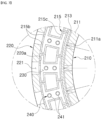
  • FIG. 8 is a detail view of part ‘B’ shown in FIG. 5 .
  • FIG. 9 is a side cross-sectional view showing the laminated structure of artificial leather according to one embodiment of the present invention.
  • FIG. 10 is a flowchart for explaining a process of manufacturing artificial leather using an apparatus for manufacturing artificial leather according to one embodiment of the present invention.
  • FIG. 1 is a schematic diagram showing an apparatus for manufacturing artificial leather according to one embodiment of the present invention.
  • the apparatus for manufacturing artificial leather includes an embossing molding unit 200 for forming an embossed pattern 19 on the upper surface of the skin layer 15 of a foam-molded semi-finished product through vacuum adsorption molding using an embossing molding device.
  • the apparatus may include, at a position ahead of the embossing molding unit 200 , a surface treatment unit 150 for forming a surface treatment layer 17 on the upper surface of the skin layer 15 , and the surface treatment unit 150 and the embossing molding unit 200 may be arranged in line.
  • the apparatus for manufacturing artificial leather according to the present invention may include, at positions ahead of the surface treatment unit 150 , a first molding unit 100 for forming a pre-foam layer 13 a or a foam layer 13 b , a second molding unit 100 ′ for forming the skin layer 15 , a back layer lamination unit 120 for laminating woven fabric or nonwoven fabric on the lower surface of the pre-foam layer 13 a or the foam layer 13 b to form a back layer 11 , and a skin layer lamination unit 130 for laminating the skin layer 15 on the upper surface of the pre-foam layer 13 a or the foam layer 13 b.
  • the first molding unit 100 and the second molding unit 100 ′ may be configured in a calendering molding manner.
  • calendering molding may be a calendering process of separately kneading a composition for preparing the pre-foam layer 13 a or the foam layer 13 b and a composition for preparing the skin layer 15 in a mixer and passing the compositions between calender rolls 111 at 160 to 170° C.
  • first molding unit 100 and the second molding unit 100 ′ may be configured in such a manner that each layer is separately formed through extrusion molding.
  • extrusion molding may be a T-die extrusion process using a T-die extruder after separately melting a composition for preparing the pre-foam layer 13 a or the foam layer 13 b and a composition for preparing the skin layer 15 in an extruder.
  • the apparatus of the present invention may include a foam molding unit 140 for forming the foam layer 13 b by passing a semi-finished product on which the skin layer 15 is laminated through an oven 141 to foam the pre-foam layer 13 a including a foaming agent at a certain magnification.
  • the apparatus of the present invention may include, between the surface treatment unit 150 and the embossing molding unit 200 , an infrared light heating unit 160 for radiating infrared light to the surface of a semi-finished product on which the surface treatment layer 17 is laminated and heating the surface of the semi-finished product.
  • the infrared light heating unit 160 is preferably configured so that an artificial leather semi-finished product being conveyed at a predetermined speed is efficiently heated and softened at a temperature of 150 to 180° C., preferably 160 to 170° C., and radiation time of infrared light is 5 to 15 seconds or 10 to 15 seconds.
  • the infrared light heating unit 160 is preferably configured to have a length of 3 to 4 m in the conveying direction of the semi-finished product.
  • the infrared light heating unit 160 when configured to be too short, radiation of infrared light is not sufficient. As a result, a semi-finished product may not be preheated to be suitable for embossing molding.
  • the infrared light heating unit 160 when configured to have a short length and heating temperature is set to 190° C. or more, the skin layer 15 of a semi-finished product may melt and be damaged.
  • the infrared light heating unit 160 may be configured to have a long length and heating temperature may be set low. In this case, installation cost is significantly increased.
  • processing speed is reduced, even when the infrared light heating unit 160 is configured to have a length of 3 m or less, a semi-finished product may be irradiated with a required amount of infrared light. In this case, there is no limitation on the lower limit thereof.
  • preferred processing speed is 12 to 15 m/min. In this case, the most suitable length is 3 to 4 m.
  • the length of a zone irradiated with infrared light is preferably 3.5 m.
  • the surface treatment unit 150 may be disposed at a position behind the embossing molding unit 200 , and the surface treatment unit 150 and the embossing molding unit 200 may be arranged in line or out line.
  • the surface treatment unit 150 is disposed between the foam molding unit 140 and the embossing molding unit 200 , and the surface treatment unit 150 is configured to be placed in line with the foam molding unit 140 and the embossing molding unit 200 .
  • the thickness of the surface treatment layer 17 may be uniform, and thus, excellent appearance without stains may be realized.
  • the foam molding unit 140 , the surface treatment unit 150 , the infrared light heating unit 160 , and the embossing molding unit 200 may be arranged in line.
  • the first molding unit 100 for forming the pre-foam layer 13 a may be arranged in line.
  • the second molding unit 100 ′ for forming the skin layer 15 may be arranged in line.
  • FIG. 2 is a front view showing the overall structure of an embossing molding device using vacuum according to one embodiment of the present invention.
  • the embossing molding device constituting the embossing molding unit 200 includes a roller body 210 , an embossing roller 220 , a vacuum generator 230 , and a water cooling-type cooler 240 .
  • the roller body 210 is formed in a cylindrical shape and is rotatably mounted on a support 201 .
  • the roller body 210 is rotated at a predetermined speed by power transmitted from a motor 203 .
  • the embossing roller 220 serves to form the embossed pattern 19 on the surface of the skin layer 15 of an artificial leather 10 being conveyed and introduced in a semi-finished form.
  • the embossing roller 220 is formed in a tubular shape so as to be coupled to the outer circumferential surface of the roller body 210 .
  • vacuum holes 221 for embossing molding and a predetermined pattern for embossing 223 are provided (see FIG. 4 ).
  • the vacuum holes 221 may be formed in the embossing roller 220 to penetrate the embossing roller 220 through a separate process.
  • the embossing roller 220 may be a porous roller, and holes formed therein may serve as the vacuum holes 221 .
  • the embossing roller 220 is a porous roller, and holes formed therein serve as the vacuum holes 221 will be described, but the present invention is not limited thereto.
  • the embossing roller 220 is provided in plural so as to manufacture the artificial leather 10 by selectively applying the predetermined pattern for embossing 223 desired by a user. That is, any one of the embossing rollers 220 is detachably coupled to the outer circumferential surface of the roller body 210 and may be replaced with another one.
  • the roller body 210 is configured so that the embossing roller 220 is integrally fixed to the roller body 210 and the embossing roller 220 is capable of being replaced.
  • the roller body 210 includes a main roller 211 for injecting air outside through a plurality of injection holes 211 a provided in the outer circumferential surface of the main roller 211 when air is fed from an air feeder (not shown), a tube-shaped rubber cover 213 that is fitted into the outer circumferential surface of the main roller 211 and is expanded outward by pressure due to air injected through the injection holes 211 a , and a vacuum bar assembly 215 that is provided with a plurality of vacuum bars 215 a bonded radially to the outer circumferential surface of the rubber cover 213 about the central axis of the main roller 211 and is provided with, on the outer circumferential surface of the vacuum bar assembly 215 , a plurality of suction holes 215 b in communication with the vacuum holes 221 .
  • a pair of fixing plates 215 c is coupled to both sides of the main roller 211 .
  • coupling grooves 215 d are formed on the opposing surfaces of the fixing plates 215 c to fix both ends of the vacuum bars 215 a .
  • the vacuum bars 215 a may be fitted radially into the outer circumferential surface of the main roller 211 .
  • the vacuum bars 215 a are preferably formed of an aluminum alloy.
  • the embossing roller 220 is loosely fitted into the outer circumferential surface of the vacuum bar assembly 215 to allow replacement of the embossing roller 220 when the air feeder is not in operation.
  • the embossing roller 220 is preferably formed of a ceramic material having higher heat resistance and hardness than metals. Specifically, the embossing roller 220 may be formed of a material including silicon dioxide (SiO 2 ), a curing agent, and glass fiber.
  • the vacuum bar assembly 215 expands radially. Accordingly, an inner circumferential surface 220 a of the embossing roller 220 is pressed by the expanded vacuum bar assembly 215 , so that the replaced embossing roller 220 may be firmly fixed.
  • the vacuum generator 230 is connected to the vacuum holes 221 of the embossing roller 220 through the suction holes 215 b of the vacuum bars 215 a constituting the roller body 210 , and forms the embossed pattern 19 on the surface of the artificial leather 10 in a semi-finished form, which is being introduced and conveyed, through vacuum adsorption molding.
  • the embossed pattern 19 may be formed on the surface of the artificial leather 10 through vacuum adsorption molding by the vacuum generator 230 .
  • the shapes of the vacuum holes 221 and the embossed pattern 19 shown in the drawing are exaggerated forms of the actual shapes thereof to easily explain the principle of adsorption molding using vacuum, and thus the actual shapes may be different.
  • the water cooling-type cooler 240 serves to cool the embossing roller 220 installed in the roller body 210 to a predetermined temperature.
  • the embossed pattern 19 is formed through molding in a state wherein the embossing roller 220 continuously contacts the surface of the heated artificial leather 10 immediately after a foaming process.
  • the temperatures of the roller body 210 and the embossing roller 220 are increased above an optimum value. Accordingly, it is necessary to reduce the temperature of the embossing roller 220 to a predetermined temperature or less through the water cooling-type cooler 240 .
  • the water cooling-type cooler 240 includes first cooling water pipes 241 provided longitudinally inside the vacuum bars 215 a to circulate cooling water fed from a cooling water feeder 240 a.
  • first cooling water pipes 241 may be connected to second cooling water pipes 243 provided inside the main roller 211 to circulate cooling water (see FIG. 5 ). With this configuration, cooling efficiency may be improved.
  • the embossing roller 220 may be cooled so that the temperature thereof is reduced to an appropriate temperature of 60 to 80° C.
  • the artificial leather 10 may include the back layer 11 , the foam layer 13 b , the skin layer 15 , and the surface treatment layer 17 , which are laminated from the bottom to the top.
  • the embossed pattern 19 may be formed on upper surfaces of the skin layer 15 and the surface treatment layer 17 .
  • the back layer 11 of the present invention serves to maintain the shape of the artificial leather and to prevent generation of wrinkles in the artificial leather, thereby improving mechanical properties of the artificial leather.
  • the back layer 11 may be formed of flexible polymers, such as woven fabric, nonwoven fabric, knitted fabric, plain weave, and spun-bonded fabric, made of various composites based on cotton, rayon, silk, polyolefins (e.g., polyethylene, polypropylene, etc.), nylon, polyesters, polyurethanes, and the like, and may optionally further include natural fiber and/or synthetic fiber.
  • the foam layer 13 b serves to impart soft properties and cushioning to artificial leather and may be formed of a composition for preparing a foam layer.
  • the composition may include a thermoplastic resin, a plasticizer, and a foaming agent.
  • thermoplastic resin may be a PVC resin capable of achieving excellent cushioning and durability and high elongation at the same time.
  • the skin layer 15 serves to secure surface smoothness and implement color and may be formed of a composition for preparing a skin layer.
  • the composition may include a thermoplastic resin, a plasticizer, and a pigment.
  • composition for preparing the skin layer 15 may further include a heat stabilizer, a flame retardant, and a filler.
  • the skin layer 15 may be coated with a two liquid-type water-based surface treatment agent, dried, and aged to form the surface treatment layer 17 .
  • the surface treatment layer 17 having a thickness of 4 to 30 ⁇ m may be formed.
  • contamination resistance may be secured while maintaining the flexibility of artificial leather.
  • the thickness of the surface treatment layer 17 is below the above range, the surface treatment layer 17 becomes too thin, resulting in poor durability.
  • the thickness of the surface treatment layer 17 exceeds the above range, the amount of a water-based surface treatment agent to be added may be increased, thereby increasing material cost.
  • the surface treatment layer 17 is preferably formed to have a thickness within the above range.
  • the embossed pattern 19 may be formed on the surfaces of the skin layer 15 and the surface treatment layer 17 of a semi-finished product heated by irradiation with infrared light and may be formed in a predetermined embossed pattern by the embossing molding device according to the present invention.
  • FIG. 10 is a flowchart for explaining a process of manufacturing artificial leather using an apparatus for manufacturing artificial leather according to one embodiment of the present invention.
  • the pre-foam layer 13 a or the foam layer 13 b and the skin layer 15 are separately formed through the first molding unit 100 and the second molding unit 100 ′ (step S 1 ).
  • woven fabric or nonwoven fabric is laminated on the lower surface of the pre-foam layer 13 a or the foam layer 13 b to form the back layer 11 (step S 3 ).
  • the skin layer 15 is laminated on the upper surface of the pre-foam layer 13 a or the foam layer 13 b on which the back layer 11 has been formed (step S 5 ).
  • step S 6 when the pre-foam layer 13 a is formed through the first molding unit 100 , a semi-finished product after the step of laminating the skin layer 15 is passed through the oven 141 and the pre-foam layer 13 a including a foaming agent is foamed at a certain magnification to form the foam layer 13 b (step S 6 ).
  • a surface treatment agent is applied to the upper surface of the skin layer 15 to form the surface treatment layer 17 (step S 7 ).
  • step S 9 the surface of a semi-finished product on which the surface treatment layer 17 has been formed is irradiated with infrared light to heat the surface of the semi-finished product.
  • step S 13 manufacture of the artificial leather according to the present invention is completed.
  • step S 6 (foam molding step), step S 7 (surface treatment layer forming step), step S 9 (infrared light radiating step), and step S 11 (embossing molding step) may be performed in an in-line manner.
  • step S 1 pre-foam layer or foam layer and skin layer molding step
  • step S 3 back layer lamination step
  • step S 5 skin layer lamination step
  • step S 6 fin molding step
  • step S 7 surface treatment layer forming step
  • step S 9 infrared light radiating step
  • step S 11 embssing molding step
  • step S 11 embssing molding step of forming the embossed pattern 19 through vacuum adsorption molding is preferably performed under a pressure of 0.02 to 0.08 MPa, preferably 0.04 to 0.07 MPa.
  • step S 11 is performed under a pressure below the above range, the embossed pattern 19 may not be clearly formed, resulting in poor cushioning.
  • step S 11 is performed under a pressure exceeding the above range, the surface treatment layer 17 may be damaged, or surface physical properties may be degraded.
  • step S 11 is preferably performed under a pressure within the above range.
  • step S 11 embssing molding step
  • step S 11 may be performed at a temperature of 150 to 190° C., preferably 160 to 180° C.
  • step S 11 is performed at a temperature below the above range
  • the embossed pattern 19 may not be sufficiently formed.
  • step S 11 is performed at a temperature exceeding the above range, the surface physical properties of artificial leather may be degraded due to high temperature, and thus the surface thereof may be rough or torn.
  • step S 11 is preferably performed at a temperature within the above range.
  • the upper surface of the skin layer 15 of a foamed semi-finished product may be irradiated with infrared light, the embossed pattern 19 may be formed on the surface of the skin layer 15 of the heated semi-finished product through vacuum adsorption molding, and then a surface treatment agent may be applied to the skin layer 15 to form the surface treatment layer 17 .
  • a surface treatment agent may be applied to the skin layer 15 to form the surface treatment layer 17 .
  • the cooling rate of the embossing roll may be increased. Accordingly, in a process of manufacturing artificial leather, the surface treatment unit 150 and the embossing molding unit 200 may be configured in line, thereby improving production efficiency.
  • Example 1 The embossing molding rates in Example in which artificial leather is manufactured using an embossing molding device including the water cooling-type cooler 240 according to the present invention and Comparative Example in which artificial leather is manufactured using a conventional embossing molding device including an air cooling-type cooler are shown in Table 1 below.
  • the embossing molding rate is about 3.3 times faster than Comparative Example in which an embossing molding device including an air cooling-type cooler is used.
  • the conventional embossing molding device including an air cooling-type cooler of Comparative Example, it takes considerable time to cool an embossing roll. That is, the conventional embossing molding device may not be provided in line with other devices constituting an apparatus for manufacturing artificial leather because the production rate of the conventional embossing molding device is different from the production rate of the above other devices.
  • the cooling rate of an embossing roll is increased compared to the conventional embossing molding device. That is, since the production rate of the embossing molding device of the present invention may match the production rates of other devices constituting an apparatus for manufacturing artificial leather, the embossing molding device and the above other devices may be provided in line. Accordingly, the production efficiency of artificial leather may be improved.
  • the embossing molding device using vacuum according to the present invention may implement an embossed pattern transfer efficiency of 100%.

Landscapes

  • Engineering & Computer Science (AREA)
  • Textile Engineering (AREA)
  • Chemical & Material Sciences (AREA)
  • Chemical Kinetics & Catalysis (AREA)
  • Mechanical Engineering (AREA)
  • Life Sciences & Earth Sciences (AREA)
  • Wood Science & Technology (AREA)
  • Dispersion Chemistry (AREA)
  • Organic Chemistry (AREA)
  • Materials Engineering (AREA)
  • Aviation & Aerospace Engineering (AREA)
  • Transportation (AREA)
  • Physics & Mathematics (AREA)
  • Plasma & Fusion (AREA)
  • Thermal Sciences (AREA)
  • Synthetic Leather, Interior Materials Or Flexible Sheet Materials (AREA)
  • Shaping Of Tube Ends By Bending Or Straightening (AREA)
  • Laminated Bodies (AREA)
  • Paints Or Removers (AREA)
  • Treatment And Processing Of Natural Fur Or Leather (AREA)

Abstract

The present invention relates to an apparatus for manufacturing artificial leather, the apparatus including an embossing molding device capable of efficiently forming an embossed pattern on the surface of artificial leather through vacuum adsorption molding and a method of manufacturing artificial leather using the apparatus.

Description

This application is a National Stage Application of International Application No. PCT/KR2018/010623, filed on Sep. 11, 2018, and claims the benefit of and priority to Korean Patent Application No. 10-2017-0117553, filed on Sep. 14, 2017, Korean Patent Application No. 10-2017-0156751, filed on Nov. 22, 2017, Korean Patent Application No. 10-2017-0156753, filed on Nov. 22, 2017 and Korean Patent Application No. 10-2017-0158895, filed on Nov. 24, 2017, all of which are hereby incorporated by reference in their entirety for all purposes as if fully set forth herein.
TECHNICAL FIELD
The present invention relates to an apparatus for manufacturing artificial leather and a method of manufacturing artificial leather. More particularly, the present invention relates to an apparatus for manufacturing artificial leather, the apparatus including an embossing molding device capable of efficiently forming an embossed pattern on the surface of artificial leather through vacuum adsorption molding and a method of manufacturing artificial leather using the apparatus.
BACKGROUND ART
In general, the inside of an automobile is considered a second home. In recent years, as demand for a pleasant and comfortable driving environment in automobiles has increased, functional seats are attracting considerable attention.
Natural leather or polyvinyl chloride (PVC) and polyurethane (PU) artificial leathers are widely used as materials for automobile seats. Artificial leather is cheaper than natural leather. However, in terms of aesthetics and functionality that provides a pleasant driving environment, natural leather is remarkably superior to artificial leather.
Accordingly, efforts have been made to develop artificial leather that can satisfy the aesthetics and functionality of natural leather at a low cost. That is, in terms of functionality, natural leather has high moisture permeability. Due to this feature, natural leather can lower the surface temperature of seats in summer. More specifically, the moisture permeability of natural leather is high because moisture and heat are transmitted through pores formed in the surface and inside of the natural leather.
Artificial leather including a foam layer for realizing properties similar to natural leather was disclosed in KR 10-0328301 B1 (Publication date: Mar. 16, 2002).
Specifically, conventional artificial leather has a structure in which a back layer, a foam layer, a skin layer, and a surface treatment layer are laminated from the bottom to the top.
In this case, each of the foam layer and the skin layer is mainly formed of a polyvinyl chloride (PVC) material or a thermoplastic polyurethane (TPU) material and is laminated to have a predetermined thickness through calender molding. Then, through a foaming process, the foam layer is foam-molded at a certain magnification.
In addition, to impart texture and cushioning similar to natural leather, an embossed pattern is formed on the skin layer.
Conventionally, embossing molding using roller pressing is used to form an embossed pattern. Specifically, a semi-finished product in which a foam layer and a skin layer are laminated is passed between rotating rollers so that an embossed pattern is transferred onto the semi-finished product.
However, in the case of conventional embossing molding using roller pressing, foam cells contained in a foam layer have irregular shapes and are formed in small numbers. In particular, due to pressurization by an embossing roll, foam cells have a distorted shape, i.e., a closed cell form, rather than a circular shape.
In addition, according to the conventional embossing molding process, immediately after a foaming process, an embossed pattern is formed on the upper surface of the skin layer of heated artificial leather while an embossing roll is in constant contact with the heated artificial leather. As a result, the temperature of the embossing roll is increased.
Meanwhile, in order for embossing molding to be performed properly, the temperature of an embossing roll must be maintained at an appropriate level. Conventionally, an air cooling type cooling device is applied to an embossing roll to maintain an appropriate temperature. In the case of the air-cooled type embossing roll, a predetermined cooling time is required.
As described above, according to the conventional method of manufacturing artificial leather, since the processing speed of embossing molding and the processing speed of steps before embossing molding are inconsistent with each other, embossing molding and other steps must be performed separately using separate equipment. As a result, the production efficiency of artificial leather is reduced.
DISCLOSURE Technical Problem
Therefore, the present invention has been made in view of the above problems, and it is one object of the present invention to provide an apparatus for manufacturing artificial leather and a method of manufacturing artificial leather. According to the present invention, since an embossed pattern is formed on the skin layer of artificial leather using an embossing roll to which vacuum adsorption molding is applied, foam cells constituting a foam layer may be prevented from being distorted or damaged. In addition, since cooling of an embossing roll provided in an embossing molding device is performed in a water cooling manner instead of a conventional air cooling manner, the cooling rate of the embossing roll may be increased. Accordingly, the embossing molding device and a conventional apparatus for manufacturing artificial leather may be applied together in an in-line manner.
Technical Solution
In accordance with one aspect of the present invention, provided is an embossing molding device including a roller body (210) that is formed in a cylindrical shape and is rotated by power transmitted from a motor (203); an embossing roller (220) formed in a tubular shape so as to be coupled to an outer circumferential surface of the roller body (210) and provided with vacuum holes (221) for embossing molding and a predetermined pattern for embossing (223) on a surface thereof; a vacuum generator (230) that is connected to the vacuum holes (221) through the roller body (210) and is responsible for generating vacuum to form, through adsorption molding, an embossed pattern (19) on a surface of artificial leather being introduced and conveyed; and a water cooling-type cooler (240) that is installed inside the roller body (210) and is responsible for cooling the embossing roller (220) to a predetermined temperature.
In accordance with another aspect of the present invention, provided is an apparatus for manufacturing artificial leather, the apparatus including an embossing molding unit (200) for forming an embossed pattern (19) on an upper surface of a skin layer (15) of a foam-molded semi-finished product by performing adsorption molding using the embossing molding device using vacuum.
In accordance with yet another aspect of the present invention, provided is a method of manufacturing artificial leather including step S1 of separately forming a pre-foam layer (13 a) or a foam layer (13 b) and a skin layer (15) by molding; step S3 of laminating woven fabric or nonwoven fabric on a lower surface of the pre-foam layer (13 a) or the foam layer (13 b) to form a back layer (11); step S5 of laminating the skin layer (15) on an upper surface of the pre-foam layer (13 a) or the foam layer (13 b) on which the back layer (11) has been formed; step S7 of forming a surface treatment layer (17) on an upper surface of the skin layer (15); step S9 of radiating infrared light on a surface of the surface treatment layer (17); and step S11 of forming an embossed pattern (19) on upper surfaces of the skin layer (15) and the surface treatment layer (17) of a semi-finished product heated by irradiation with infrared light by performing adsorption molding using the embossing molding device using vacuum.
Advantageous Effects
According to the present invention having the above configuration, since cooling of an embossing roll provided in an embossing molding device is performed in a water cooling manner instead of a conventional air cooling manner, the cooling rate of the embossing roll can be increased. Accordingly, in a process of manufacturing artificial leather, a surface treatment unit and an embossing molding unit can be configured in line, thereby improving production efficiency.
In addition, in artificial leather of the present invention, since foam cells constituting a foam layer are prevented from being distorted or damaged, excellent cushioning can be realized.
DESCRIPTION OF DRAWINGS
FIG. 1 is a schematic diagram showing an apparatus for manufacturing artificial leather according to one embodiment of the present invention.
FIG. 2 is a front view showing the overall structure of an embossing molding device using vacuum according to one embodiment of the present invention.
FIG. 3 is an exploded perspective view showing a coupling state between a roller body and an embossing roller according to one embodiment of the present invention.
FIG. 4 includes images showing an embossing roller according to one embodiment of the present invention.
FIG. 5 is a cross-sectional view taken along line I-I shown in FIG. 3 .
FIG. 6 is a drawing showing the structure of a vacuum bar assembly according to one embodiment of the present invention.
FIG. 7 is a detail view of part ‘A’ shown in FIG. 5 .
FIG. 8 is a detail view of part ‘B’ shown in FIG. 5 .
FIG. 9 is a side cross-sectional view showing the laminated structure of artificial leather according to one embodiment of the present invention.
FIG. 10 is a flowchart for explaining a process of manufacturing artificial leather using an apparatus for manufacturing artificial leather according to one embodiment of the present invention.
BEST MODE
Hereinafter, the functions or constructions of preferred embodiments of the present invention will now be described more fully with reference to the accompanying drawings.
Here, when reference numerals are applied to constituents illustrated in each drawing, it should be noted that like reference numerals indicate like elements throughout the specification.
FIG. 1 is a schematic diagram showing an apparatus for manufacturing artificial leather according to one embodiment of the present invention.
Referring to FIG. 1 , the apparatus for manufacturing artificial leather according to a preferred embodiment of the present invention includes an embossing molding unit 200 for forming an embossed pattern 19 on the upper surface of the skin layer 15 of a foam-molded semi-finished product through vacuum adsorption molding using an embossing molding device.
In this case, the apparatus may include, at a position ahead of the embossing molding unit 200, a surface treatment unit 150 for forming a surface treatment layer 17 on the upper surface of the skin layer 15, and the surface treatment unit 150 and the embossing molding unit 200 may be arranged in line.
In addition, the apparatus for manufacturing artificial leather according to the present invention may include, at positions ahead of the surface treatment unit 150, a first molding unit 100 for forming a pre-foam layer 13 a or a foam layer 13 b, a second molding unit 100′ for forming the skin layer 15, a back layer lamination unit 120 for laminating woven fabric or nonwoven fabric on the lower surface of the pre-foam layer 13 a or the foam layer 13 b to form a back layer 11, and a skin layer lamination unit 130 for laminating the skin layer 15 on the upper surface of the pre-foam layer 13 a or the foam layer 13 b.
In one embodiment, the first molding unit 100 and the second molding unit 100′ may be configured in a calendering molding manner. In this case, calendering molding may be a calendering process of separately kneading a composition for preparing the pre-foam layer 13 a or the foam layer 13 b and a composition for preparing the skin layer 15 in a mixer and passing the compositions between calender rolls 111 at 160 to 170° C.
In another embodiment, the first molding unit 100 and the second molding unit 100′ may be configured in such a manner that each layer is separately formed through extrusion molding. In this case, extrusion molding may be a T-die extrusion process using a T-die extruder after separately melting a composition for preparing the pre-foam layer 13 a or the foam layer 13 b and a composition for preparing the skin layer 15 in an extruder.
Hereinafter, a case wherein calendering molding is applied to the first molding unit 100 for forming the pre-foam layer 13 a or the foam layer 13 b and the second molding unit 100′ for forming the skin layer 15 will be described, but the present invention is not limited thereto.
Meanwhile, in the case of forming the pre-foam layer 13 a among the pre-foam layer 13 a and the foam layer 13 b in the first molding unit 100, the apparatus of the present invention may include a foam molding unit 140 for forming the foam layer 13 b by passing a semi-finished product on which the skin layer 15 is laminated through an oven 141 to foam the pre-foam layer 13 a including a foaming agent at a certain magnification.
In addition, the apparatus of the present invention may include, between the surface treatment unit 150 and the embossing molding unit 200, an infrared light heating unit 160 for radiating infrared light to the surface of a semi-finished product on which the surface treatment layer 17 is laminated and heating the surface of the semi-finished product.
Specifically, the infrared light heating unit 160 is preferably configured so that an artificial leather semi-finished product being conveyed at a predetermined speed is efficiently heated and softened at a temperature of 150 to 180° C., preferably 160 to 170° C., and radiation time of infrared light is 5 to 15 seconds or 10 to 15 seconds.
For example, when the processing speed of a semi-finished product is 13 to 17 m/min, preferably 15 m/min, the infrared light heating unit 160 is preferably configured to have a length of 3 to 4 m in the conveying direction of the semi-finished product.
That is, when the infrared light heating unit 160 is configured to be too short, radiation of infrared light is not sufficient. As a result, a semi-finished product may not be preheated to be suitable for embossing molding. For example, when the infrared light heating unit 160 is configured to have a short length and heating temperature is set to 190° C. or more, the skin layer 15 of a semi-finished product may melt and be damaged.
The infrared light heating unit 160 may be configured to have a long length and heating temperature may be set low. In this case, installation cost is significantly increased. In addition, when processing speed is reduced, even when the infrared light heating unit 160 is configured to have a length of 3 m or less, a semi-finished product may be irradiated with a required amount of infrared light. In this case, there is no limitation on the lower limit thereof. In the present invention, preferred processing speed is 12 to 15 m/min. In this case, the most suitable length is 3 to 4 m. For example, when processing speed is 15 m/min, the length of a zone irradiated with infrared light is preferably 3.5 m.
In addition, in another embodiment, the surface treatment unit 150 may be disposed at a position behind the embossing molding unit 200, and the surface treatment unit 150 and the embossing molding unit 200 may be arranged in line or out line.
Preferably, the surface treatment unit 150 is disposed between the foam molding unit 140 and the embossing molding unit 200, and the surface treatment unit 150 is configured to be placed in line with the foam molding unit 140 and the embossing molding unit 200. With this configuration, the thickness of the surface treatment layer 17 may be uniform, and thus, excellent appearance without stains may be realized.
In another embodiment, the foam molding unit 140, the surface treatment unit 150, the infrared light heating unit 160, and the embossing molding unit 200 may be arranged in line.
In another embodiment, the first molding unit 100 for forming the pre-foam layer 13 a, the second molding unit 100′ for forming the skin layer 15, the back layer lamination unit 120, the skin layer lamination unit 130, the foam molding unit 140, the surface treatment unit 150, the infrared light heating unit 160, and the embossing molding unit 200 may be arranged in line.
FIG. 2 is a front view showing the overall structure of an embossing molding device using vacuum according to one embodiment of the present invention.
Referring to FIG. 2 , the embossing molding device constituting the embossing molding unit 200 according to the present invention includes a roller body 210, an embossing roller 220, a vacuum generator 230, and a water cooling-type cooler 240.
The configuration of the present invention will be described in detail as follows.
First, the roller body 210 is formed in a cylindrical shape and is rotatably mounted on a support 201. The roller body 210 is rotated at a predetermined speed by power transmitted from a motor 203.
The embossing roller 220 serves to form the embossed pattern 19 on the surface of the skin layer 15 of an artificial leather 10 being conveyed and introduced in a semi-finished form. The embossing roller 220 is formed in a tubular shape so as to be coupled to the outer circumferential surface of the roller body 210.
Referring to FIGS. 3 and 4 , on the outer circumferential surface of the embossing roller 220, vacuum holes 221 for embossing molding and a predetermined pattern for embossing 223 are provided (see FIG. 4 ).
In this case, the vacuum holes 221 may be formed in the embossing roller 220 to penetrate the embossing roller 220 through a separate process. Alternatively, the embossing roller 220 may be a porous roller, and holes formed therein may serve as the vacuum holes 221. In the present invention, a case wherein the embossing roller 220 is a porous roller, and holes formed therein serve as the vacuum holes 221 will be described, but the present invention is not limited thereto.
The embossing roller 220 is provided in plural so as to manufacture the artificial leather 10 by selectively applying the predetermined pattern for embossing 223 desired by a user. That is, any one of the embossing rollers 220 is detachably coupled to the outer circumferential surface of the roller body 210 and may be replaced with another one.
To implement this, the roller body 210 is configured so that the embossing roller 220 is integrally fixed to the roller body 210 and the embossing roller 220 is capable of being replaced.
Referring to FIG. 5 , the roller body 210 includes a main roller 211 for injecting air outside through a plurality of injection holes 211 a provided in the outer circumferential surface of the main roller 211 when air is fed from an air feeder (not shown), a tube-shaped rubber cover 213 that is fitted into the outer circumferential surface of the main roller 211 and is expanded outward by pressure due to air injected through the injection holes 211 a, and a vacuum bar assembly 215 that is provided with a plurality of vacuum bars 215 a bonded radially to the outer circumferential surface of the rubber cover 213 about the central axis of the main roller 211 and is provided with, on the outer circumferential surface of the vacuum bar assembly 215, a plurality of suction holes 215 b in communication with the vacuum holes 221.
Referring to FIG. 6 , a pair of fixing plates 215 c is coupled to both sides of the main roller 211. In this case, coupling grooves 215 d are formed on the opposing surfaces of the fixing plates 215 c to fix both ends of the vacuum bars 215 a. Thus, the vacuum bars 215 a may be fitted radially into the outer circumferential surface of the main roller 211.
In this case, the vacuum bars 215 a are preferably formed of an aluminum alloy.
In addition, the embossing roller 220 is loosely fitted into the outer circumferential surface of the vacuum bar assembly 215 to allow replacement of the embossing roller 220 when the air feeder is not in operation.
The embossing roller 220 is preferably formed of a ceramic material having higher heat resistance and hardness than metals. Specifically, the embossing roller 220 may be formed of a material including silicon dioxide (SiO2), a curing agent, and glass fiber.
Referring to FIG. 7 , in the roller body 210 having such a configuration, upon feeding air from the air feeder, as the rubber cover 213 expands, the vacuum bar assembly 215 expands radially. Accordingly, an inner circumferential surface 220 a of the embossing roller 220 is pressed by the expanded vacuum bar assembly 215, so that the replaced embossing roller 220 may be firmly fixed.
Referring to FIG. 8 , the vacuum generator 230 is connected to the vacuum holes 221 of the embossing roller 220 through the suction holes 215 b of the vacuum bars 215 a constituting the roller body 210, and forms the embossed pattern 19 on the surface of the artificial leather 10 in a semi-finished form, which is being introduced and conveyed, through vacuum adsorption molding.
That is, in a state wherein the embossing roller 220 having an outer circumferential surface on which the pattern for embossing 223 is formed and the surface of the artificial leather 10 are in contact with each other, the embossed pattern 19 may be formed on the surface of the artificial leather 10 through vacuum adsorption molding by the vacuum generator 230.
In this case, the shapes of the vacuum holes 221 and the embossed pattern 19 shown in the drawing are exaggerated forms of the actual shapes thereof to easily explain the principle of adsorption molding using vacuum, and thus the actual shapes may be different.
The water cooling-type cooler 240 serves to cool the embossing roller 220 installed in the roller body 210 to a predetermined temperature.
That is, in an embossing molding process, the embossed pattern 19 is formed through molding in a state wherein the embossing roller 220 continuously contacts the surface of the heated artificial leather 10 immediately after a foaming process. As a result, the temperatures of the roller body 210 and the embossing roller 220 are increased above an optimum value. Accordingly, it is necessary to reduce the temperature of the embossing roller 220 to a predetermined temperature or less through the water cooling-type cooler 240.
Specifically, the water cooling-type cooler 240 includes first cooling water pipes 241 provided longitudinally inside the vacuum bars 215 a to circulate cooling water fed from a cooling water feeder 240 a.
In addition, the first cooling water pipes 241 may be connected to second cooling water pipes 243 provided inside the main roller 211 to circulate cooling water (see FIG. 5 ). With this configuration, cooling efficiency may be improved.
Through the water cooling-type cooler 240 having such a structure, the embossing roller 220 may be cooled so that the temperature thereof is reduced to an appropriate temperature of 60 to 80° C.
Hereinafter, the laminated structure of the artificial leather 10 manufactured using the apparatus for manufacturing artificial leather according to a preferred embodiment of the present invention will be described.
Referring to FIG. 9 , the artificial leather 10 may include the back layer 11, the foam layer 13 b, the skin layer 15, and the surface treatment layer 17, which are laminated from the bottom to the top. In this case, the embossed pattern 19 may be formed on upper surfaces of the skin layer 15 and the surface treatment layer 17.
In more detail, the back layer 11 of the present invention serves to maintain the shape of the artificial leather and to prevent generation of wrinkles in the artificial leather, thereby improving mechanical properties of the artificial leather. The back layer 11 may be formed of flexible polymers, such as woven fabric, nonwoven fabric, knitted fabric, plain weave, and spun-bonded fabric, made of various composites based on cotton, rayon, silk, polyolefins (e.g., polyethylene, polypropylene, etc.), nylon, polyesters, polyurethanes, and the like, and may optionally further include natural fiber and/or synthetic fiber.
The foam layer 13 b serves to impart soft properties and cushioning to artificial leather and may be formed of a composition for preparing a foam layer. In this case, the composition may include a thermoplastic resin, a plasticizer, and a foaming agent.
In this case, the thermoplastic resin may be a PVC resin capable of achieving excellent cushioning and durability and high elongation at the same time.
The skin layer 15 serves to secure surface smoothness and implement color and may be formed of a composition for preparing a skin layer. In this case, the composition may include a thermoplastic resin, a plasticizer, and a pigment.
In addition, to adjust melt strength and physical properties, the composition for preparing the skin layer 15 may further include a heat stabilizer, a flame retardant, and a filler.
The skin layer 15 may be coated with a two liquid-type water-based surface treatment agent, dried, and aged to form the surface treatment layer 17.
Specifically, by applying the two liquid-type water-based surface treatment agent to the upper surface of the skin layer 15, the surface treatment layer 17 having a thickness of 4 to 30 μm may be formed. By maintaining the thickness of the surface treatment layer 17 within the above range, contamination resistance may be secured while maintaining the flexibility of artificial leather. When the thickness of the surface treatment layer 17 is below the above range, the surface treatment layer 17 becomes too thin, resulting in poor durability. When the thickness of the surface treatment layer 17 exceeds the above range, the amount of a water-based surface treatment agent to be added may be increased, thereby increasing material cost. Thus, the surface treatment layer 17 is preferably formed to have a thickness within the above range.
The embossed pattern 19 may be formed on the surfaces of the skin layer 15 and the surface treatment layer 17 of a semi-finished product heated by irradiation with infrared light and may be formed in a predetermined embossed pattern by the embossing molding device according to the present invention.
Then, a process of manufacturing the artificial leather 10 having such a laminated structure will be described.
FIG. 10 is a flowchart for explaining a process of manufacturing artificial leather using an apparatus for manufacturing artificial leather according to one embodiment of the present invention.
Referring to FIG. 10 , first, the pre-foam layer 13 a or the foam layer 13 b and the skin layer 15 are separately formed through the first molding unit 100 and the second molding unit 100′ (step S1).
Then, woven fabric or nonwoven fabric is laminated on the lower surface of the pre-foam layer 13 a or the foam layer 13 b to form the back layer 11 (step S3).
Then, the skin layer 15 is laminated on the upper surface of the pre-foam layer 13 a or the foam layer 13 b on which the back layer 11 has been formed (step S5).
In this case, when the pre-foam layer 13 a is formed through the first molding unit 100, a semi-finished product after the step of laminating the skin layer 15 is passed through the oven 141 and the pre-foam layer 13 a including a foaming agent is foamed at a certain magnification to form the foam layer 13 b (step S6).
Then, a surface treatment agent is applied to the upper surface of the skin layer 15 to form the surface treatment layer 17 (step S7).
Then, the surface of a semi-finished product on which the surface treatment layer 17 has been formed is irradiated with infrared light to heat the surface of the semi-finished product (step S9).
Finally, by forming, through vacuum adsorption molding, the embossed pattern 19 on the upper surfaces of the skin layer 15 and the surface treatment layer 17 of the semi-finished product heated by irradiation with infrared light, manufacture of the artificial leather according to the present invention is completed (step S13).
In this case, in the method of manufacturing artificial leather according to one embodiment of the present invention, step S6 (foam molding step), step S7 (surface treatment layer forming step), step S9 (infrared light radiating step), and step S11 (embossing molding step) may be performed in an in-line manner.
Alternatively, step S1 (pre-foam layer or foam layer and skin layer molding step), step S3 (back layer lamination step), step S5 (skin layer lamination step), step S6 (foam molding step), step S7 (surface treatment layer forming step), step S9 (infrared light radiating step), and step S11 (embossing molding step) may be performed in an in-line manner.
In this case, step S11 (embossing molding step) of forming the embossed pattern 19 through vacuum adsorption molding is preferably performed under a pressure of 0.02 to 0.08 MPa, preferably 0.04 to 0.07 MPa. When step S11 is performed under a pressure below the above range, the embossed pattern 19 may not be clearly formed, resulting in poor cushioning. When step S11 is performed under a pressure exceeding the above range, the surface treatment layer 17 may be damaged, or surface physical properties may be degraded. Thus, step S11 is preferably performed under a pressure within the above range.
In addition, step S11 (embossing molding step) may be performed at a temperature of 150 to 190° C., preferably 160 to 180° C. When step S11 is performed at a temperature below the above range, the embossed pattern 19 may not be sufficiently formed. When step S11 is performed at a temperature exceeding the above range, the surface physical properties of artificial leather may be degraded due to high temperature, and thus the surface thereof may be rough or torn. Thus, step S11 is preferably performed at a temperature within the above range.
Alternatively, the upper surface of the skin layer 15 of a foamed semi-finished product may be irradiated with infrared light, the embossed pattern 19 may be formed on the surface of the skin layer 15 of the heated semi-finished product through vacuum adsorption molding, and then a surface treatment agent may be applied to the skin layer 15 to form the surface treatment layer 17. Through this process, artificial leather may be manufactured.
According to the present invention, since cooling of an embossing roll provided in an embossing molding device is performed in a water cooling manner instead of a conventional air cooling manner, the cooling rate of the embossing roll may be increased. Accordingly, in a process of manufacturing artificial leather, the surface treatment unit 150 and the embossing molding unit 200 may be configured in line, thereby improving production efficiency.
More specifically, the molding speed of the embossed pattern 19 according to methods of cooling the embossing roller 220 will be described.
The embossing molding rates in Example in which artificial leather is manufactured using an embossing molding device including the water cooling-type cooler 240 according to the present invention and Comparative Example in which artificial leather is manufactured using a conventional embossing molding device including an air cooling-type cooler are shown in Table 1 below.
TABLE 1
Example Comparative Example
Production rate [m/min] ~30 ~9
As shown in Table 1, in the case of Example in which an embossing molding device including the water cooling-type cooler 240 according to the present invention is used, the embossing molding rate is about 3.3 times faster than Comparative Example in which an embossing molding device including an air cooling-type cooler is used.
In addition, in the case of the conventional embossing molding device including an air cooling-type cooler of Comparative Example, it takes considerable time to cool an embossing roll. That is, the conventional embossing molding device may not be provided in line with other devices constituting an apparatus for manufacturing artificial leather because the production rate of the conventional embossing molding device is different from the production rate of the above other devices.
In contrast, in the case of the embossing molding device including the water cooling-type cooler 240 according to the present invention, the cooling rate of an embossing roll is increased compared to the conventional embossing molding device. That is, since the production rate of the embossing molding device of the present invention may match the production rates of other devices constituting an apparatus for manufacturing artificial leather, the embossing molding device and the above other devices may be provided in line. Accordingly, the production efficiency of artificial leather may be improved.
In addition, compared to the conventional roll pressing-type embossing molding device having an embossed pattern transfer efficiency of 80 to 90%, the embossing molding device using vacuum according to the present invention may implement an embossed pattern transfer efficiency of 100%.
As described above, the present invention has been described with reference to certain preferred embodiments, but the present invention is not limited to the above-described embodiments, and various changes and modifications may be made without departing from the spirit of the present invention.
[Description of Symbols]
10: ARTIFICIAL LEATHER 11: BACK LAYER
13a: PRE-FOAM LAYER 13b: FOAM LAYER
15: SKIN LAYER 17: SURFACE TREATMENT LAYER
19: EMBOSSED PATTERN 110: FIRST MOLDING UNIT
110′: SECOND MOLDING UNIT 111: CALENDER ROLLS
120: BACK LAYER LAMINATION UNIT 130: SKIN LAYER LAMINATION UNIT
140: FOAM MOLDING UNIT 141: OVEN
150: SURFACE TREATMENT UNIT 160: INFRARED LIGHT HEATING UNIT
200: EMBOSSING MOLDING UNIT 210: ROLLER BODY
211: MAIN ROLLER 211A: INJECTION HOLES
213: RUBBER COVER 215: VACUUM BAR ASSEMBLY
215A: VACUUM BARS 215B: SUCTION HOLES
215C: FIXING PLATES 215D: COUPLING GROOVES
220: EMBOSSING ROLLER 221: VACUUM HOLES
223: EMBOSSING PATTERN 230: VACUUM GENERATOR
240: WATER COOLING-TYPE COOLER 241: FIRST COOLING WATER PIPES
243: SECOND COOLING WATER PIPES

Claims (17)

The invention claimed is:
1. An embossing molding device, comprising:
a roller body that is formed in a cylindrical shape and is rotated by power transmitted from a motor;
an embossing roller formed in a tubular shape so as to be coupled to an outer circumferential surface of the roller body and provided with vacuum holes for embossing molding and a predetermined pattern for embossing on a surface thereof;
a vacuum generator that is connected to the vacuum holes through the roller body and is responsible for generating vacuum to form, through adsorption molding, an embossed pattern on a surface of artificial leather being introduced and conveyed; and
a water cooler that is installed inside the roller body and is responsible for cooling the embossing roller to a predetermined temperature,
wherein the roller body comprises: a main roller for injecting air outside through a plurality of injection holes provided in an outer circumferential surface of the main roller when air is fed from an air feeder; a tube-shaped rubber cover that is fitted onto the outer circumferential surface of the main roller and is expanded outward by pressure due to air injected through the plurality of injection holes; and a vacuum bar assembly that is provided with a plurality of vacuum bars bonded radially to an outer circumferential surface of the rubber cover about a central axis of the main roller and is provided with, on an outer circumferential surface of the vacuum bar assembly, a plurality of suction holes in communication with the vacuum holes, and
wherein, upon expansion of the rubber cover, the vacuum bar assembly expands to press and fix an inner circumferential surface of the embossing roller.
2. The embossing molding device according to claim 1, wherein a pair of fixing plates is coupled to respective sides of the main roller, wherein coupling grooves are formed on opposing surfaces of the fixing plates to fix respective ends of the vacuum bars.
3. The embossing molding device according to claim 1, wherein the embossing roller is loosely fitted onto an outer circumferential surface of the vacuum bar assembly to allow replacement of the embossing roller when the air feeder is not in operation.
4. The embossing molding device according to claim 1, wherein the water cooler comprises first cooling water pipes provided longitudinally inside the vacuum bars to circulate cooling water fed from a cooling water feeder; and
second cooling water pipes provided inside the main roller and connected to the first cooling water pipes.
5. An apparatus for manufacturing artificial leather, comprising an embossing molding unit for forming an embossed pattern on an upper surface of a skin layer of a foam-molded semi-finished product by performing adsorption molding, wherein the embossing molding unit comprises the embossing molding device of claim 1.
6. The apparatus according to claim 5, further comprising, at a position ahead of the embossing molding unit, a surface treatment unit for forming a surface treatment layer on an upper surface of the skin layer.
7. The apparatus according to claim 6, wherein the surface treatment unit and the embossing molding unit are arranged in line.
8. The apparatus according to claim 6, further comprising:
at positions ahead of the surface treatment unit,
a first molding unit for forming a pre-foam layer or a foam layer;
a second molding unit for forming the skin layer;
a back layer lamination unit for laminating woven fabric or nonwoven fabric on a lower surface of the pre-foam layer or the foam layer to form a back layer; and
a skin layer lamination unit for laminating the skin layer on an upper surface of the pre-foam layer or the foam layer.
9. The apparatus according to claim 8, wherein, when the pre-foam layer is formed by the first molding unit, the apparatus further comprises a foam molding unit for forming the foam layer by foaming, at a certain magnification, the pre-foam layer comprising a foaming agent while passing, through an oven, a semi-finished product on which the skin layer is laminated.
10. The apparatus according to claim 6, further comprising, between the surface treatment unit and the embossing molding unit, an infrared light heating unit for heating a surface of a semi-finished product, on which the surface treatment layer is laminated, by radiating infrared light on the surface of the semi-finished product.
11. A method of manufacturing artificial leather, comprising:
step S1 of separately forming a pre-foam layer or a foam layer and a skin layer by molding;
step S3 of laminating woven fabric or nonwoven fabric on a lower surface of the prefoam layer or the foam layer to form a back layer;
step S5 of laminating the skin layer on an upper surface of the pre-foam layer or the foam layer on which the back layer has been formed;
step S7 of forming a surface treatment layer on an upper surface of the skin layer;
step S9 of radiating infrared light on a surface of the surface treatment layer; and
step S11 of forming an embossed pattern on upper surfaces of the skin layer and the surface treatment layer of a semi-finished product heated by irradiation with infrared light by performing adsorption molding using the embossing molding device according to claim 1, and performing the adsorption molding using vacuum.
12. The method according to claim 11, wherein step S7 and step S11 are arranged in line.
13. The method according to claim 11, wherein, in step S1, the prefoam layer or the foam layer and the skin layer are formed through extrusion molding or calender molding.
14. The method according to claim 11, wherein, when the pre-foam layer and the skin layer are formed in step S1, the method further comprises, after step S5, step S6 of foaming the pre-foam layer to form the foam layer.
15. The method according to claim 11, wherein, in step S9, radiation of infrared light is performed at a temperature of 150 to 180° C. for 5 to 15 seconds.
16. The method according to claim 11, wherein a processing speed of the semifinished product is 13 to 17 m/min, and, in step S9, a length of a zone irradiated with infrared light corresponding to the processing speed is 3 to 4 m.
17. The method according to claim 11, wherein step S11 is performed at a temperature of 150 to 190° C. under a pressure of 0.02 to 0.08 MPa.
US16/641,989 2017-09-14 2018-09-11 Apparatus for manufacturing artificial leather and method of manufacturing artificial leather using the same Active 2039-09-01 US11613845B2 (en)

Applications Claiming Priority (9)

Application Number Priority Date Filing Date Title
KR20170117553 2017-09-14
KR10-2017-0117553 2017-09-14
KR1020170156751A KR102128226B1 (en) 2017-09-14 2017-11-22 Emboss processing apparatus
KR1020170156753A KR102128225B1 (en) 2017-09-14 2017-11-22 Artificial leather manufacturing apparatus and manufacturing method thereof
KR10-2017-0156751 2017-11-22
KR10-2017-0156753 2017-11-22
KR1020170158895A KR102128227B1 (en) 2017-09-14 2017-11-24 Artificial leather manufacturing apparatus and manufacturing method thereof
KR10-2017-0158895 2017-11-24
PCT/KR2018/010623 WO2019054724A2 (en) 2017-09-14 2018-09-11 Artificial leather manufacturing apparatus and artificial leather manufacturing method using same

Publications (2)

Publication Number Publication Date
US20200354888A1 US20200354888A1 (en) 2020-11-12
US11613845B2 true US11613845B2 (en) 2023-03-28

Family

ID=65949251

Family Applications (2)

Application Number Title Priority Date Filing Date
US16/641,935 Active 2040-03-08 US11739476B2 (en) 2017-09-14 2018-09-11 Method of preparing water-based surface treatment agent and water-based surface treatment agent prepared using the same
US16/641,989 Active 2039-09-01 US11613845B2 (en) 2017-09-14 2018-09-11 Apparatus for manufacturing artificial leather and method of manufacturing artificial leather using the same

Family Applications Before (1)

Application Number Title Priority Date Filing Date
US16/641,935 Active 2040-03-08 US11739476B2 (en) 2017-09-14 2018-09-11 Method of preparing water-based surface treatment agent and water-based surface treatment agent prepared using the same

Country Status (3)

Country Link
US (2) US11739476B2 (en)
KR (12) KR102128225B1 (en)
CN (2) CN111094650B (en)

Families Citing this family (20)

* Cited by examiner, † Cited by third party
Publication number Priority date Publication date Assignee Title
KR102767517B1 (en) * 2019-05-14 2025-02-17 (주)엘엑스하우시스 Artificial leather, automobile seat cover manufactured therefrom and method for preparing the same
KR102761903B1 (en) * 2019-05-14 2025-02-05 (주)엘엑스하우시스 Artificial leather, crash pad skin manufactured therefrom and method for preparing the same
KR102635537B1 (en) * 2019-06-11 2024-02-07 (주)엘엑스하우시스 Artificial leather for vehicle interior material and method for manufacturing the same
KR102635536B1 (en) * 2019-06-11 2024-02-07 (주)엘엑스하우시스 Artificial leather for vehicle interior material and method for manufacturing the same
WO2021025211A1 (en) * 2019-08-08 2021-02-11 주식회사 엘지하우시스 Artificial leather comprising circular knitted fabric backside layer and method for manufacturing same
KR102740667B1 (en) * 2020-01-02 2024-12-09 (주)엘엑스하우시스 Artificial leaher
KR102740669B1 (en) * 2020-01-02 2024-12-09 (주)엘엑스하우시스 Artificial leather
KR102611768B1 (en) * 2020-01-20 2023-12-11 (주)엘엑스하우시스 Artificial leather manufacturing method and artificial leather manufactured therefrom
CN115867701A (en) * 2020-04-04 2023-03-28 冯·霍尔茨豪森 Biodegradable synthetic leather produced from recycled materials
CN111691196B (en) * 2020-06-10 2021-05-07 浙江康成新材料科技有限公司 A kind of easy-to-clean PU automobile leather and preparation method thereof
CN112586530B (en) * 2020-12-29 2025-05-13 东莞市雄林新材料科技股份有限公司 Dough making equipment
TWI779532B (en) * 2021-03-24 2022-10-01 三芳化學工業股份有限公司 Artificial leather structure and method for manufacturing the same
KR102679890B1 (en) * 2021-09-16 2024-07-01 (주)엘엑스하우시스 High-durability aritificial leather for automobile
KR20230095465A (en) 2021-12-22 2023-06-29 (주)엘엑스하우시스 Surface-Coating Composition and Artificial Leather
CN114737402A (en) * 2022-03-31 2022-07-12 三明建华纺织有限公司 Production process and equipment of cotton cloth-based PVC artificial leather
WO2024124518A1 (en) * 2022-12-16 2024-06-20 The Hong Kong Research Institute Of Textiles And Apparel Limited Apparatus and method for making leather-like sheet structure from waste leathers or raw hide
KR102839071B1 (en) 2023-02-01 2025-07-28 진양화학 주식회사 Manufacturing method of polyvinylchloride artificial leather for sample and polyvinylchloride artificial leather for sample manufactured accordingly
KR102839089B1 (en) * 2023-03-31 2025-07-28 진양화학 주식회사 Manufacturing method of bio-balanced polyvinylchloride artificial leather using bio-platicizer and the bio-balanced polyvinylchloride artificial leather prepared thereby
DE202023104608U1 (en) * 2023-08-14 2024-08-19 Neoperl Gmbh Hose arrangement with a structure and device for introducing a structure onto a hose arrangement
DE102024113791A1 (en) * 2024-05-16 2025-11-20 Karlsruher Institut für Technologie, Körperschaft des öffentlichen Rechts Method for the continuous molding of surface structures in structurable materials and device for this purpose

Citations (10)

* Cited by examiner, † Cited by third party
Publication number Priority date Publication date Assignee Title
DE1814720A1 (en) * 1968-12-14 1970-07-16 Benecke Gmbh J Cylinder for air permeable embossing - of plastic film for leather appeearanceetc
JPH11156929A (en) 1997-11-28 1999-06-15 Ube Ind Ltd Manufacturing method of buffer sheet
KR100328301B1 (en) 1999-08-20 2002-03-16 엄성수 Manufacturing process of ventilative artificial synthetic leather
KR20060047050A (en) 2004-11-15 2006-05-18 정연창 Pile release material for drawing out pile used in construction of earth wall and its manufacturing apparatus
CN201089219Y (en) 2007-07-02 2008-07-23 林寅仁 Vacuum adsorption type pattern forming machine
KR20090078185A (en) 2008-01-14 2009-07-17 (주)아이앤에스 Acrylic foamed artificial leather and its manufacturing method
KR101433089B1 (en) 2013-02-01 2014-08-25 김종암 Forming roller of embossing seat for air cap buffering seat
US20150114062A1 (en) * 2010-02-06 2015-04-30 Illinois Tool Works Inc. Seamless sleeve and seamless substrate
US20160221226A1 (en) * 2013-09-10 2016-08-04 Renolit Se Plastics processing roll, plastic film processing device and method for producing double-sided structured plastic films
US20170095831A1 (en) * 2014-04-09 2017-04-06 Airbus Operations Gmbh Applicator

Family Cites Families (39)

* Cited by examiner, † Cited by third party
Publication number Priority date Publication date Assignee Title
JPH03294586A (en) * 1990-04-06 1991-12-25 Nippon Ueeblock Kk Wall paper having textile tone and production thereof
JP2687117B2 (en) * 1992-04-17 1997-12-08 株式会社川島織物 Cloth wall upholstery and its finishing method
KR100308508B1 (en) 1993-12-29 2001-12-28 김충세 Water-dispersive polyurethane polyol composition and aqueous coating based on the same
DE4413562A1 (en) * 1994-04-19 1995-10-26 Herberts Gmbh Aqueous dispersion of polyurethanes containing siloxane bridges, their production and use in coating compositions
JPH11156976A (en) * 1997-12-01 1999-06-15 Takashimaya Nippatsu Kogyo Kk Skin material for automotive trim
JP4000542B2 (en) * 1998-05-29 2007-10-31 東宝繊維株式会社 Base fabric for synthetic resin leather and synthetic resin leather using the same
KR20010076551A (en) * 2000-01-26 2001-08-16 김석기 Method of Manufacturing Artificial Leather
JP4024019B2 (en) 2001-07-23 2007-12-19 高圧クロス株式会社 Sheet structure and manufacturing method thereof
US7383008B2 (en) * 2003-01-28 2008-06-03 Seiko Epson Corporation Fixing rubber roller, fixing device and image forming apparatus incorporating the same
CN1624059B (en) * 2003-09-29 2012-08-01 大日本印刷株式会社 Water coating
WO2005083022A1 (en) * 2004-02-27 2005-09-09 Daicel Chemical Industries, Ltd. Aqueous polyurethane coating composition
US8309229B2 (en) * 2004-06-11 2012-11-13 Kansai Paint Co., Ltd. Polyester resin and thermosetting water-borne coating compositions
US20070224362A1 (en) * 2004-12-20 2007-09-27 Remi Briand Two-part waterborne epoxy coating composition and method
KR100649432B1 (en) * 2005-02-23 2006-11-27 조광페인트주식회사 Manufacturing method of water-dispersible UV-curable polyurethane acrylate resin and coating composition thereof
KR100616738B1 (en) 2005-12-22 2006-08-30 (주)대우인터내셔널 Manufacturing method of artificial leather for automobile interior
US20090324833A1 (en) * 2007-07-12 2009-12-31 Lung-Wen Chou Method for directly forming patterns on face membrane by vacuum absorption
KR100873655B1 (en) * 2007-07-27 2008-12-12 (주)아이앤에스 Flame retardant FISH foam artificial leather and its manufacturing method
US8673193B2 (en) * 2008-02-27 2014-03-18 Sharp Kabushiki Kaisha Roller nanoimprint apparatus, mold roller for use in roller nanoimprint apparatus, fixing roller for use in roller nanoimprint apparatus, and production method of nanoimprint sheet
JP4891376B2 (en) 2008-10-08 2012-03-07 本田技研工業株式会社 Elastic synthetic leather
KR101096796B1 (en) * 2009-09-30 2011-12-21 최임곤 Belboa double-sided brushed fabric manufacturing method and fabric
KR20120126814A (en) * 2011-05-13 2012-11-21 주식회사 화승티엔씨 Water-based paint composition
US9322130B2 (en) 2011-08-04 2016-04-26 Soon Kie JUNG Textile fabric sheet having stain and liquid resistance and the preparation method thereof
JP5195999B2 (en) 2011-12-05 2013-05-15 大日本印刷株式会社 Foam wallpaper
WO2013089926A1 (en) * 2011-12-15 2013-06-20 3M Innovative Properties Company Anti-fog coating comprising aqueous polymeric dispersion, crosslinker & surfactant
KR101450604B1 (en) 2012-04-09 2014-10-23 한화첨단소재 주식회사 Artificial leather for car seat cover and method for manufacturing thereof
JP6207304B2 (en) 2012-09-27 2017-10-04 セーレン株式会社 Synthetic leather and method for producing the same
WO2015001732A1 (en) 2013-07-05 2015-01-08 セーレン株式会社 Synthetic leather for automobile
KR101470611B1 (en) * 2014-04-02 2014-12-15 (주)인코켐 Coating composition for surface treatment of rubber and method of preparing the same
KR20150117313A (en) * 2014-04-09 2015-10-20 수산고분자 주식회사 Acryl Modified Polyurethane Water Dispersion and the use thereof
KR101598856B1 (en) 2014-04-16 2016-03-02 주식회사 덕일 Method for Manufacturing Artificial Leather Using Aqueous Polyurethane
US10173404B2 (en) * 2014-07-07 2019-01-08 Kyowa Leather Cloth Co., Ltd. Synthetic resin skin material and method of manufacturing synthetic resin skin material
KR101947421B1 (en) * 2014-10-20 2019-02-14 (주)엘지하우시스 Aqueous composition for coating a surface and a seat cover for automobile applied the same
CN107429116B (en) * 2014-12-15 2020-07-07 杜邦东丽特殊材料株式会社 Water-based coating agent composition, coating composition for water-based lubricating film composed of the composition, and parts
JP5819512B1 (en) 2014-12-26 2015-11-24 共和レザー株式会社 Skin material and method for producing skin material
CN204659147U (en) * 2015-05-27 2015-09-23 福建中慎合成革有限公司 Inhale line machine cooling water circulating device
KR101965474B1 (en) * 2015-07-09 2019-04-03 (주)엘지하우시스 Interior sheet for automobile
CN205662740U (en) * 2016-05-18 2016-10-26 河南艺龙实业有限公司 Line machine cooling water system for water cooled generator belt cleaning device is inhaled in vacuum
KR101905987B1 (en) 2016-10-19 2018-10-11 현대자동차주식회사 Artificial leather with three-dimensional pattern and manufacturing method thereof
CN107011788A (en) * 2017-04-27 2017-08-04 北京汽车研究总院有限公司 Artificial leather inorganic agent, artificial polyvinyl chloride leather, preparation method and the usage

Patent Citations (10)

* Cited by examiner, † Cited by third party
Publication number Priority date Publication date Assignee Title
DE1814720A1 (en) * 1968-12-14 1970-07-16 Benecke Gmbh J Cylinder for air permeable embossing - of plastic film for leather appeearanceetc
JPH11156929A (en) 1997-11-28 1999-06-15 Ube Ind Ltd Manufacturing method of buffer sheet
KR100328301B1 (en) 1999-08-20 2002-03-16 엄성수 Manufacturing process of ventilative artificial synthetic leather
KR20060047050A (en) 2004-11-15 2006-05-18 정연창 Pile release material for drawing out pile used in construction of earth wall and its manufacturing apparatus
CN201089219Y (en) 2007-07-02 2008-07-23 林寅仁 Vacuum adsorption type pattern forming machine
KR20090078185A (en) 2008-01-14 2009-07-17 (주)아이앤에스 Acrylic foamed artificial leather and its manufacturing method
US20150114062A1 (en) * 2010-02-06 2015-04-30 Illinois Tool Works Inc. Seamless sleeve and seamless substrate
KR101433089B1 (en) 2013-02-01 2014-08-25 김종암 Forming roller of embossing seat for air cap buffering seat
US20160221226A1 (en) * 2013-09-10 2016-08-04 Renolit Se Plastics processing roll, plastic film processing device and method for producing double-sided structured plastic films
US20170095831A1 (en) * 2014-04-09 2017-04-06 Airbus Operations Gmbh Applicator

Also Published As

Publication number Publication date
CN111094650B (en) 2022-08-30
CN111094650A (en) 2020-05-01
KR102284733B1 (en) 2021-08-03
KR102128227B1 (en) 2020-06-30
KR20190030576A (en) 2019-03-22
KR102284736B1 (en) 2021-08-03
KR20190030575A (en) 2019-03-22
KR102202657B1 (en) 2021-01-13
KR102362720B1 (en) 2022-02-15
KR102375851B1 (en) 2022-03-18
US20200248402A1 (en) 2020-08-06
KR20190030574A (en) 2019-03-22
CN111065775A (en) 2020-04-24
KR20190030569A (en) 2019-03-22
US20200354888A1 (en) 2020-11-12
KR102375858B1 (en) 2022-03-18
KR20190030543A (en) 2019-03-22
KR20190030547A (en) 2019-03-22
KR102362721B1 (en) 2022-02-15
KR20190030570A (en) 2019-03-22
US11739476B2 (en) 2023-08-29
KR102375866B1 (en) 2022-03-18
KR102128226B1 (en) 2020-06-30
KR20190030571A (en) 2019-03-22
KR20190030545A (en) 2019-03-22
KR20190030544A (en) 2019-03-22
KR102128225B1 (en) 2020-06-30
KR20190030572A (en) 2019-03-22
KR102284737B1 (en) 2021-08-03
KR20190030573A (en) 2019-03-22

Similar Documents

Publication Publication Date Title
US11613845B2 (en) Apparatus for manufacturing artificial leather and method of manufacturing artificial leather using the same
CN1894317B (en) Cross-linked foam with internal cavity structure and method of forming same
KR101450604B1 (en) Artificial leather for car seat cover and method for manufacturing thereof
KR20210151127A (en) Yellowing-resistant thermoplastic polyurethane foaming material and manufacturing method thereof
CN108136719B (en) Composite materials for embossing and embossed products
TW202306775A (en) Multilayered composite material comprising foamed granules
KR101864545B1 (en) Method for manufacturing thin layer type urethane film, and textile having the same
JP2003071988A (en) Laminated sheet and laminate
WO2019054724A2 (en) Artificial leather manufacturing apparatus and artificial leather manufacturing method using same
CN210362843U (en) Composite material formed by laminating silica aerogel flexible elastic heat-insulation and heat-preservation material and fabric
KR20190030597A (en) Artificial leather with excellent appearance and manufacturing method the same
JP3645679B2 (en) Method for manufacturing a laminate
KR102542934B1 (en) Flooring material and method for manufacturing the same
JP3481766B2 (en) Laminated body and method for manufacturing the same
JPH10278182A (en) Laminated body and method for manufacturing the same
JP7111523B2 (en) Sheet-shaped article and method for producing the same
JP3990664B2 (en) Laminate having polyurethane foam and polyurethane foam layer
US20230151171A1 (en) Polyolefin resin foam sheet and laminate
KR102205305B1 (en) Polyurethane seat cover materials and Manufacturing method thereof
KR102030936B1 (en) The method of Artificial leather and the Artificial leather manufactred thereform
JPH101560A (en) Foamable polyurethane composition and foam
MX2023005410A (en) Process for moulding a composite product for coatings.
KR20190030594A (en) Artificial leather and its manufacturing method
KR20200091796A (en) Composite fabrics for car interior with good formability and manufacturing method thereof
KR20200131772A (en) Artificial leather, automobile seat cover manufactured therefrom and method for preparing the same

Legal Events

Date Code Title Description
AS Assignment

Owner name: LG HAUSYS, LTD., KOREA, REPUBLIC OF

Free format text: ASSIGNMENT OF ASSIGNORS INTEREST;ASSIGNORS:KIM, KITAE;KIM, JUN HYOUNG;NAM, EUN SIK;AND OTHERS;REEL/FRAME:051926/0948

Effective date: 20200212

FEPP Fee payment procedure

Free format text: ENTITY STATUS SET TO UNDISCOUNTED (ORIGINAL EVENT CODE: BIG.); ENTITY STATUS OF PATENT OWNER: LARGE ENTITY

STPP Information on status: patent application and granting procedure in general

Free format text: DOCKETED NEW CASE - READY FOR EXAMINATION

STPP Information on status: patent application and granting procedure in general

Free format text: NON FINAL ACTION MAILED

STPP Information on status: patent application and granting procedure in general

Free format text: RESPONSE TO NON-FINAL OFFICE ACTION ENTERED AND FORWARDED TO EXAMINER

STPP Information on status: patent application and granting procedure in general

Free format text: NON FINAL ACTION MAILED

STPP Information on status: patent application and granting procedure in general

Free format text: RESPONSE TO NON-FINAL OFFICE ACTION ENTERED AND FORWARDED TO EXAMINER

STPP Information on status: patent application and granting procedure in general

Free format text: NOTICE OF ALLOWANCE MAILED -- APPLICATION RECEIVED IN OFFICE OF PUBLICATIONS

STCF Information on status: patent grant

Free format text: PATENTED CASE