US11551536B2 - Server device and baggage checking method - Google Patents
Server device and baggage checking method Download PDFInfo
- Publication number
- US11551536B2 US11551536B2 US16/512,459 US201916512459A US11551536B2 US 11551536 B2 US11551536 B2 US 11551536B2 US 201916512459 A US201916512459 A US 201916512459A US 11551536 B2 US11551536 B2 US 11551536B2
- Authority
- US
- United States
- Prior art keywords
- vehicle
- items
- baggage
- user
- schedule
- Prior art date
- Legal status (The legal status is an assumption and is not a legal conclusion. Google has not performed a legal analysis and makes no representation as to the accuracy of the status listed.)
- Active, expires
Links
Images


Classifications
-
- G—PHYSICS
- G08—SIGNALLING
- G08B—SIGNALLING OR CALLING SYSTEMS; ORDER TELEGRAPHS; ALARM SYSTEMS
- G08B21/00—Alarms responsive to a single specified undesired or abnormal condition and not otherwise provided for
- G08B21/18—Status alarms
- G08B21/24—Reminder alarms, e.g. anti-loss alarms
-
- G—PHYSICS
- G06—COMPUTING OR CALCULATING; COUNTING
- G06K—GRAPHICAL DATA READING; PRESENTATION OF DATA; RECORD CARRIERS; HANDLING RECORD CARRIERS
- G06K17/00—Methods or arrangements for effecting co-operative working between equipments covered by two or more of main groups G06K1/00 - G06K15/00, e.g. automatic card files incorporating conveying and reading operations
- G06K17/0022—Methods or arrangements for effecting co-operative working between equipments covered by two or more of main groups G06K1/00 - G06K15/00, e.g. automatic card files incorporating conveying and reading operations arrangements or provisions for transferring data to distant stations, e.g. from a sensing device
- G06K17/0029—Methods or arrangements for effecting co-operative working between equipments covered by two or more of main groups G06K1/00 - G06K15/00, e.g. automatic card files incorporating conveying and reading operations arrangements or provisions for transferring data to distant stations, e.g. from a sensing device the arrangement being specially adapted for wireless interrogation of grouped or bundled articles tagged with wireless record carriers
-
- G—PHYSICS
- G06—COMPUTING OR CALCULATING; COUNTING
- G06Q—INFORMATION AND COMMUNICATION TECHNOLOGY [ICT] SPECIALLY ADAPTED FOR ADMINISTRATIVE, COMMERCIAL, FINANCIAL, MANAGERIAL OR SUPERVISORY PURPOSES; SYSTEMS OR METHODS SPECIALLY ADAPTED FOR ADMINISTRATIVE, COMMERCIAL, FINANCIAL, MANAGERIAL OR SUPERVISORY PURPOSES, NOT OTHERWISE PROVIDED FOR
- G06Q10/00—Administration; Management
- G06Q10/10—Office automation; Time management
- G06Q10/109—Time management, e.g. calendars, reminders, meetings or time accounting
- G06Q10/1093—Calendar-based scheduling for persons or groups
-
- G—PHYSICS
- G06—COMPUTING OR CALCULATING; COUNTING
- G06Q—INFORMATION AND COMMUNICATION TECHNOLOGY [ICT] SPECIALLY ADAPTED FOR ADMINISTRATIVE, COMMERCIAL, FINANCIAL, MANAGERIAL OR SUPERVISORY PURPOSES; SYSTEMS OR METHODS SPECIALLY ADAPTED FOR ADMINISTRATIVE, COMMERCIAL, FINANCIAL, MANAGERIAL OR SUPERVISORY PURPOSES, NOT OTHERWISE PROVIDED FOR
- G06Q50/00—Information and communication technology [ICT] specially adapted for implementation of business processes of specific business sectors, e.g. utilities or tourism
- G06Q50/10—Services
Definitions
- the present disclosure relates to a technology for checking whether a user getting in a vehicle has enough baggage items.
- Patent Document 1 discloses a vehicular information providing device that notifies the passenger if the passenger has forgotten to load baggage to which an IC tag is attached.
- This vehicular information providing device includes a setting means for setting the types of baggage items that are in a set such as skiing gear, a type detection means for reading baggage information from IC tags and detecting the types of the baggage items, and a notification means for notifying the passenger if the types of baggage items according to the destination that are set in a navigation device are lacking. For example, when the destination is set to be a ski resort in the navigation device, if any of baggage items whose types are set as skiing gear are missing, the notification means notifies the passenger accordingly.
- Patent Document 1 Japanese Patent Application Publication No. 2005-284771
- Patent Document 1 requires time and effort for input since the types of baggage items are set in one set. Further, for example, when the user's destination is a ski resort, if another sightseeing place is set in the navigation device before going to the ski resort, the determination of whether the types of baggage items are lacking will be inaccurate.
- a purpose of the present disclosure is to provide a technology that allows for the checking of baggage items with high accuracy with regard to user's planned activities.
- a server device includes: an identification information storage configured to store identification information stored in identification tags attached to a plurality of items of a user; an identification information storage configured to store a baggage list where the items are listed for each activity; a schedule acquisition unit configured to acquire schedule information of the user; and a list generator configured to generate a baggage list according to an activity in a schedule item included in the schedule information of the user when the boarding of the user is identified.
- the list generator receives a plurality of schedule items that are set for a point of time after the boarding of the user is identified from the schedule acquisition unit and combines baggage lists that correspond to activities in the plurality of schedule items that have been received so as to generate a baggage list for checking in order to check whether there are enough baggage items.
- Another embodiment of the present disclosure relates to a baggage checking method.
- This method includes: storing identification information stored in identification tags attached to a plurality of items of a user; storing a baggage list while the items are listed for each activity; acquiring schedule information of the user; and generating a baggage list according to an activity included in the schedule information of the user when the boarding of the user is identified.
- a plurality of schedule items that are set for a point of time after the boarding of the user is identified are received, and baggage lists that correspond to activities in the plurality of schedule items that have been received are combined so as to generate a baggage list for checking in order to check whether there are enough baggage items.
- FIG. 1 is a diagram for explaining a baggage checking system according to an embodiment
- FIG. 2 is a diagram for explaining the functional configuration of a mobile terminal
- FIG. 3 is a diagram for explaining the functional configuration of a server device
- FIG. 4 is a diagram showing schedule information of the user
- FIG. 5 is a diagram for explaining a flow for learning a baggage list for each destination
- FIG. 6 is a diagram for explaining a flow for checking baggage.
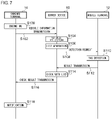
- FIG. 7 is a diagram for explaining a flow for checking baggage according to an exemplary variation.
- FIG. 1 is a diagram for explaining a baggage checking system 1 according to an embodiment.
- the baggage checking system 1 is capable of checking whether a baggage item 16 , such as a bag, of the user is missing when the user gets in a vehicle 13 and after the user gets out of the vehicle.
- the baggage checking system 1 includes an identification tag 18 attached to the baggage item 16 , a mobile terminal 12 of the user, an onboard terminal 14 mounted on the vehicle 13 , and a server device 10 connected to the mobile terminal 12 and the onboard terminal 14 via a network.
- the onboard terminal 14 transmits, to the server device 10 , information for identifying the user's getting in or out of the vehicle 13 .
- the information for identifying the user's getting in or out of the vehicle 13 may be engine on/off information, that is, on/off information for an on-vehicle power source, door lock information indicating that a vehicle door has been locked or unlocked while the on-vehicle power source is off, or the like.
- the onboard terminal 14 also transmits the terminal ID of the onboard terminal 14 when transmitting the information to the server device 10 .
- the user's baggage item 16 is an item possessed by the user and is an item expected by the server device 10 to be carried according to the schedule information of the user.
- the identification tag 18 attached to the baggage item 16 stores individual identification information and is capable of performing short-range wireless communication within several meters.
- the user attaches the identification tag 18 to the item the user possesses and registers in the server device 10 the identification information of the identification tag 18 and attribute information of the item the user possesses in association with each other via the mobile terminal 12 .
- the attribute information of the item may be the type or name of the baggage item 16 or may be information for identifying the item such as “umbrella”, “bag”, “camera”, “golf club”, or the like.
- the mobile terminal 12 can communicate with the identification tag 18 and can detect the identification tag 18 located within several meters from the mobile terminal 12 .
- FIG. 2 is a diagram for explaining the functional configuration of the mobile terminal 12 .
- the elements shown in functional blocks that indicate a variety of processes are implemented in hardware by a circuit block, a memory, other LSI's, or the like, and in software by a program loaded in a memory, etc. Therefore, it will be obvious to those skilled in the art that the functional blocks may be implemented in a variety of manners by a combination of hardware and software.
- the mobile terminal 12 includes a mobile side communication unit 20 , a list acquisition unit 22 , a collation unit 24 , a tag detection unit 26 , and a notification control unit 28 .
- the mobile side communication unit 20 can communicate with the server device 10 via a network. When transmitting information to the server device 10 , the mobile side communication unit 20 also transmits the terminal ID of the mobile terminal 12 .
- the tag detection unit 26 can communicate with an identification tag 18 and receives identification information from the identification tag 18 .
- Identification information in a group of identification tags 18 that is detected at a predetermined timing by the tag detection unit 26 is transmitted to the collation unit 24 and also transmitted to the server device 10 via the mobile side communication unit 20 .
- the list acquisition unit 22 acquires a baggage list for checking from the server device 10 via the mobile side communication unit 20 .
- the list acquisition unit 22 acquires the baggage list for checking from the server device 10 at the timing when the user gets in or out.
- the baggage list has identification information for one or more baggage items 16 and attribute information thereof. Being triggered by the acquisition of the baggage list for checking from the server device 10 performed by the list acquisition unit 22 , the tag detection unit 26 detects the identification tags 18 .
- the collation unit 24 checks whether the identification information in the group of identification tags 18 detected by the tag detection unit 26 is lacking compared to the identification information of the baggage item 16 included in the baggage list. In other words, the collation unit 24 checks whether all the identification information included in the baggage list is included in the identification information in the group of identification tags 18 detected by the tag detection unit 26 . When indicating that the identification tags 18 detected by the tag detection unit 26 are lacking compared to those in the baggage list, the collation unit 24 transmits attribute information of a missing baggage item 16 to the notification control unit 28 .
- the notification control unit 28 performs control for notifying the user of the attribute information of a baggage item 16 that corresponds to the identification tag 18 .
- the notification control unit 28 notifies the user by any method such as alert and text display, push notification, or voice notification. Further, the notification control unit 28 may display choices for checking the user whether the baggage item 16 corresponding to the missing identification tag 18 is necessary in accordance with the notification of a shortage and may transmit the selection result to the server device 10 for feedback.
- FIG. 3 is a diagram for explaining the functional configuration of the server device 10 .
- the server device 10 includes a vehicle information acquisition unit 30 , a schedule acquisition unit 32 , an identification information acquisition unit 34 , a learning unit 36 , an identification information storage 38 , a list generator 40 , and a list output unit 42 .
- the server device 10 can be connected to a schedule management device 19 via a network.
- the server device 10 manages the respective terminal IDs of the mobile terminal 12 and the onboard terminal 14 in association with each other.
- the vehicle information acquisition unit 30 acquires vehicle information from the onboard terminal 14 .
- the vehicle information includes information for identifying the user's getting in/out, position information of the vehicle, time information, and the like.
- the vehicle information acquisition unit 30 may transmit an instruction signal for causing the mobile terminal 12 to detect an identification tag 18 .
- the schedule acquisition unit 32 acquires schedule information of the user associated with the terminal ID of the mobile terminal 12 from the schedule management device 19 .
- the schedule acquisition unit 32 may acquire the schedule information from the mobile terminal 12 .
- the schedule information includes a schedule item in which a subject, a destination, and a time are set, and the schedule item indicates an activity scheduled by the user.
- the activity included in the schedule information may be, for example, merely a destination or may be an activity of the user predicted by the subject and the destination.
- the identification information acquisition unit 34 acquires the identification information in the group of identification tags 18 detected by the mobile terminal 12 when the user gets in or out of the vehicle 13 .
- the identification information in the group of identification tags 18 is stored in the identification information storage 38 in association with an activity in a schedule item scheduled thereafter.
- the learning unit 36 generates the optimal baggage list according to the activity in the schedule item based on the identification information in the group of identification tags 18 acquired by the identification information acquisition unit 34 and on the schedule item associated with the identification information.
- the learning unit 36 accumulates the identification information in the group of identification tags that has been detected in association with an activity in the schedule item and generates a baggage list for each activity based on the identification information and the activity in the schedule item that have been accumulated.
- the generation of a baggage list based on the history of identification information in a group of identification tags 18 for each activity by the learning unit 36 allows for the listing of items carried highly frequently at the time of conducting an activity in a schedule item.
- the learning unit 36 learns, for example, on a weekly basis and generates the optimal baggage list for each activity. For example, when the activity indicates golf, a baggage list for golf shoes, a golf bag, etc., is generated, and when the activity indicates a training gym, a baggage list for training shoes, training equipment, etc., is generated. Further, since a baggage list is automatically generated without the user creating a baggage list for each activity, the time and effort of the user can be saved.
- the identification information storage 38 stores identification information stored in an identification tag 18 registered by the user in advance and stores the identification information in the identification tag 18 in association with an activity and detection date and time in a schedule item. In other words, the identification information storage 38 stores identification information in the group of identification tags 18 detected by the mobile terminal 12 in association with a schedule item. Further, the identification information storage 38 stores a baggage list for each activity generated by the learning unit 36 .
- the list generator 40 At the time when the getting in/out of the user is identified by the vehicle information acquisition unit 30 , the list generator 40 generates a baggage list that corresponds to the destination according to schedule information for a schedule set after that time. If a plurality of schedule items set for a point of time after the user's getting in/out of the vehicle is identified are acquired, the list generator 40 combines baggage lists that correspond to the activities in the plurality of schedule items that have been acquired and generates a baggage list for checking in order to check whether there are enough baggage items. When the user gets in a vehicle and is planning a plurality of activities, this allows for the checking of a baggage item for each of the plurality of activities.
- schedule items when the list generator 40 combines baggage lists.
- FIG. 4 shows schedule information of the user.
- Schedule information for two days shown in FIG. 4 includes a plurality of schedule items.
- a subject “golf”, a place which is a destination, and time are set.
- a subject “accommodation”, a destination, and time are set.
- a subject “sightseeing”, a destination, and time are set.
- a subject and time are set.
- a baggage list according to the activity in the first schedule item 50 includes golf equipment.
- a baggage list according to the activity in the second schedule item 52 includes goods for an overnight stay.
- a baggage list according to the activity in the third schedule item 54 includes a camera and a small bag.
- the list generator 40 When the user gets in a vehicle from home at 9:00 am on Saturday, the list generator 40 generates a baggage list based on the schedule information. On the assumption that the activities in the first schedule item 50 , the second schedule item 52 , and the third schedule item 54 are ongoing until the user goes back home, the list generator 40 generates a baggage list for checking by combining the baggage lists that correspond to the activities in the first schedule item 50 , the second schedule item 52 , and the third schedule item 54 based on the plurality of schedule items 50 , 52 , 54 , and 56 . This allows the user to receive a baggage list that corresponds to the activities in the schedule at the time of the boarding into a vehicle, and the user can thereby check whether there are any items that are left behind for each activity. Further, when it is predicted that the schedule items are continuous, combining the baggage lists allows for accurate checking to see if there are any items that are left behind for a plurality of activities.
- the list generator 40 predicts whether the schedule items are continuous. For example, if the distance between the destinations set for the adjacent schedule items is equal to or less than a predetermined distance and/or the gap time between the adjacent schedule items is equal to or less than a predetermined time, the list generator 40 determines that the schedule items are continuous. Also, the list generator 40 may predict whether the schedule items are continuous depending on whether the user can return home during the gap time between the adjacent schedule items. The list generator 40 determines that the schedule items are continuous if returning home during the gap time is set to be impossible.
- the list generator 40 When the boarding of the user is identified, the list generator 40 generates a baggage list for checking where baggage lists that correspond to activities in a plurality of schedule items set within the time from when the vehicle leaves a reference position to when the vehicle returns to the reference position are combined.
- the reference position is, for example, the user's home.
- the list generator 40 combines baggage lists that correspond to the activities in these schedule items so as to generate a list for checking. This allows the user to check whether there are any items left behind before the user returns to the reference position such as home.
- the reference position may be able to be set by the user through the mobile terminal 12 , or the learning unit 36 may acquire position information from the onboard terminal 14 so as to identify the home and set the home as the reference position.
- the fact that the user has gotten in a vehicle from home can be identified based on the position information of the vehicle at the time when the user gets in the vehicle or the position information of the mobile terminal.
- the user will return home is identified based on the schedule information at the time when the user gets in a vehicle. For example, when a special schedule item such as a schedule item indicating an overnight stay is not scheduled when the user gets in a vehicle or when an activity of returning home is set in a schedule item, the user is identified to return home at a predetermined time such as night time. Further, the list generator 40 may predict whether the user will return home based on the distance between the destinations set for adjacent schedule items and the interval of the gap between the adjacent schedule items.
- the list generator 40 When there is a schedule item indicating an overnight stay, the list generator 40 generates a baggage list for checking in which baggage lists that correspond to activities in schedule items before and after the overnight stay are combined.
- the second schedule item 52 in FIG. 4 indicates an overnight stay, and, on the assumption that the first schedule item 50 and the third schedule item 54 before and after the second schedule item 52 are schedule items that are ongoing until the user returns home, the list generator 40 generates a new list by combining baggage lists for the schedule items at the time of the boarding at 9 a.m. on Saturday. As described, it is possible to clearly know that the user is not scheduled to return home and to check whether there is any item that is left behind for the activity planned after the overnight stay.
- the baggage list for checking is generated by combining the baggage lists that correspond to the series of schedule items expected after the user leaves home and before the user returns home.
- the list generator 40 may adjust the baggage list based on weather information and the user's past history that have been acquired and may add rain gear as a baggage item if the weather is rainy. As described above, the list generator 40 may adjust the baggage list for checking based on the weather information.
- FIG. 3 is now referred back.
- the list output unit 42 outputs, to the mobile terminal 12 , the baggage list for checking generated by the list generator 40 . Thereby, the mobile terminal 12 can check a baggage item 16 included in the baggage list for checking with an identification tag 18 that has been detected.
- FIG. 5 is a diagram for explaining a flow for learning a baggage list for each destination.
- the user enters information of an identification tag 18 attached to an item through the mobile terminal 12 (S 10 ) such that the information is transmitted to the server device 10 (S 12 ).
- the server device 10 registers the type and identification information of the item as the information of the identification tag 18 (S 14 ). Thereby, the initial registration of the identification tag 18 is completed.
- the onboard terminal 14 detects the boarding of the user who has turned on the engine (S 16 ) and transmits vehicle information to the server device 10 (S 18 ).
- the server device 10 specifies the user's boarding the acquisition of the vehicle information and transmits a signal requesting the detection of the identification tags 18 to the mobile terminal 12 (S 20 ).
- the mobile terminal 12 detects identification tags 18 located within several meters by short-range wireless communication (S 22 ) and transmits identification information in a group of identification tags 18 that has been detected to the server device 10 as a detection result (S 24 ). This allows for the detection of baggage items loaded in the vehicle.
- the server device 10 acquires schedule information from the schedule management device 19 (S 26 ), acquires the detection result of the identification tags 18 from the mobile terminal 12 (S 28 ), and stores the identification information in the group of identification tag 18 in association with schedule items (S 30 ).
- the identification information in the group of identification tags 18 that has been detected may be stored in association with a plurality of schedule items.
- the onboard terminal 14 detects the getting-out of the user who has turned off the engine (S 32 ) and also transmits vehicle information to the server device 10 (S 34 ).
- the server device 10 specifies the user's getting-out through the acquisition of the vehicle information and transmits a signal requesting the detection of the identification tags 18 to the mobile terminal 12 after a predetermined period of time (S 36 ).
- the mobile terminal 12 detects identification tags 18 located within several meters by short-range wireless communication (S 38 ) and transmits identification information in a group of identification tags 18 that has been detected to the server device 10 as a detection result (S 40 ). Thereby, the user can detect a baggage item at a position away from the vehicle after getting out.
- the server device 10 acquires the detection result of the identification tag 18 from the mobile terminal (S 42 ) and stores the identification information in the group of identification tags 18 in association with schedule items (S 44 ). As described, the identification information in an identification tag 18 attached to an item carried by the user at the time of getting in or out can be stored.
- the learning unit 36 generates a baggage list for each activity based on the accumulated identification information in the group of the identification tags 18 and on the activities in the schedule items associated with the identification information (S 46 ). As described above, a baggage list for each activity can be generated when the user gets in or out of the vehicle.
- FIG. 6 is a diagram for explaining a flow for checking baggage.
- the onboard terminal 14 detects the boarding of the user who has turned on the engine (S 50 ) and transmits vehicle information to the server device 10 (S 52 ).
- the server device 10 specifies the user's boarding through the acquisition of the vehicle information, acquires schedule information from the schedule management device 19 (S 54 ), generates a baggage list for checking that corresponds to activities in schedule items expected after the boarding (S 56 ), and transmits the baggage list for checking to the mobile terminal 12 (S 58 ).
- the mobile terminal 12 detects identification tags 18 located within several meters by short-range wireless communication (S 60 ) and checks the baggage list for checking with a group of identification tags 18 that has been detected so as to check whether the identification tags are lacking compared to the baggage list (S 62 ).
- the mobile terminal 12 notifies the user that there is an item that has been left behind when the group of identification tags 18 that has been detected is lacking compared to baggage items included in the baggage list (S 64 ). Thereby, the user can check baggage items for the future activity plan.
- the mobile terminal 12 transmits the detection result of the identification tags 18 to the server device 10 (S 65 ).
- the server device 10 acquires the detection result of the identification tags 18 (S 66 ) and stores the detection result of the identification tags 18 in association with the schedule items (S 68 ).
- the onboard terminal 14 detects the getting-out of the user who has turned off the engine (S 70 ) and also transmits vehicle information to the server device 10 (S 72 ).
- the server device 10 specifies the user's boarding through the acquisition of the vehicle information, generates a baggage list for checking that corresponds to activities in schedule items expected after the boarding (S 74 ), and transmits the baggage list for checking to the mobile terminal 12 (S 76 ).
- the mobile terminal 12 detects identification tags 18 (S 78 ) and checks the baggage list for checking with a group of identification tags 18 that has been detected so as to check whether the identification tags are lacking compared to the baggage list (S 80 ).
- the mobile terminal 12 notifies the user that there is an item that has been left behind when the group of identification tags 18 that has been detected is lacking compared to baggage items included in the baggage list (S 82 ). Thereby, the user can check baggage items for the future activity plan and can check to see if there are any items that have been left behind in the vehicle.
- the mobile terminal 12 transmits the detection result of the identification tags 18 to the server device 10 (S 84 ).
- the server device 10 acquires the detection result of the identification tags 18 (S 86 ) and stores the detection result of the identification tags 18 in association with the schedule items (S 88 ). Further, the server device 10 learns based on the detection result of the identification tags 18 that has been detected and updates the baggage list (S 90 ).
- FIG. 7 is a diagram for explaining a flow for checking baggage according to an exemplary variation.
- a baggage checking method according to the exemplary variation is different from the baggage checking method shown in FIG. 6 in that a step of checking a baggage list with the detection result of an identification tag 18 is performed in a server device 10 and notification to the user is performed by an onboard terminal 14 .
- the onboard terminal 14 detects the boarding of the user who has turned on the engine (S 100 ) and transmits vehicle information to the server device 10 (S 102 ).
- the server device 10 specifies the user's boarding through the acquisition of the vehicle information, acquires schedule information of the user from a schedule management device 19 (S 104 ), generates a baggage list for checking that corresponds to activities in schedule items expected after the boarding (S 106 ), and transmits an instruction signal requesting the detection of an identification tag 18 to the mobile terminal 12 (S 108 ).
- the mobile terminal 12 detects identification tags 18 located within several meters by short-range wireless communication (S 110 ), and the mobile terminal 12 transmits the detection result of the identification tags 18 to the server device 10 (S 112 ).
- the server device 10 according to the exemplary variation has the feature of a collation unit and checks the group of identification tags 18 that has been detected with the baggage list for checking so as to check whether the group of identification tags 18 that has been detected are lacking compared to baggage items 16 included in the baggage list (S 114 ).
- the server device 10 transmits the attribute information of a baggage item that is missing to the onboard terminal 14 (S 116 ).
- the onboard terminal 14 notifies the user of the attribute information of the baggage item indicating that there is an item that is left behind (S 118 ). As described above, even when the server device 10 performs the checking with a list or the onboard terminal 14 provides the notification to the user, checking on the baggage items can be performed.
- a mobile terminal 12 detects identification tags 18 .
- a communication device that is capable of communicating with an identification tag 18 may be provided in a vehicle 13 , and an onboard terminal 14 may acquire the detection result of an identification tag 18 .
Landscapes
- Business, Economics & Management (AREA)
- Human Resources & Organizations (AREA)
- Engineering & Computer Science (AREA)
- Physics & Mathematics (AREA)
- General Physics & Mathematics (AREA)
- Strategic Management (AREA)
- Entrepreneurship & Innovation (AREA)
- Tourism & Hospitality (AREA)
- Theoretical Computer Science (AREA)
- Marketing (AREA)
- General Business, Economics & Management (AREA)
- Economics (AREA)
- Operations Research (AREA)
- Data Mining & Analysis (AREA)
- Quality & Reliability (AREA)
- Emergency Management (AREA)
- Computer Networks & Wireless Communication (AREA)
- General Engineering & Computer Science (AREA)
- Health & Medical Sciences (AREA)
- General Health & Medical Sciences (AREA)
- Primary Health Care (AREA)
- Management, Administration, Business Operations System, And Electronic Commerce (AREA)
- Emergency Alarm Devices (AREA)
- Telephonic Communication Services (AREA)
Abstract
Description
Claims (12)
Applications Claiming Priority (3)
| Application Number | Priority Date | Filing Date | Title |
|---|---|---|---|
| JP2018-168285 | 2018-09-07 | ||
| JPJP2018-168285 | 2018-09-07 | ||
| JP2018168285A JP7040370B2 (en) | 2018-09-07 | 2018-09-07 | How to check server equipment and personal belongings |
Publications (2)
| Publication Number | Publication Date |
|---|---|
| US20200082705A1 US20200082705A1 (en) | 2020-03-12 |
| US11551536B2 true US11551536B2 (en) | 2023-01-10 |
Family
ID=69718895
Family Applications (1)
| Application Number | Title | Priority Date | Filing Date |
|---|---|---|---|
| US16/512,459 Active 2039-12-30 US11551536B2 (en) | 2018-09-07 | 2019-07-16 | Server device and baggage checking method |
Country Status (3)
| Country | Link |
|---|---|
| US (1) | US11551536B2 (en) |
| JP (1) | JP7040370B2 (en) |
| CN (1) | CN110889472B (en) |
Families Citing this family (1)
| Publication number | Priority date | Publication date | Assignee | Title |
|---|---|---|---|---|
| JP7804496B2 (en) * | 2022-03-15 | 2026-01-22 | 本田技研工業株式会社 | Vehicles and computer programs |
Citations (11)
| Publication number | Priority date | Publication date | Assignee | Title |
|---|---|---|---|---|
| US20030189094A1 (en) * | 2002-04-09 | 2003-10-09 | Trabitz Eugene L. | Baggage tracking system |
| US20040098276A1 (en) * | 2002-11-15 | 2004-05-20 | Eastman Kodak Company | Method and system for passenger and baggage security control in a tansportation system |
| US20040249500A1 (en) * | 2002-10-21 | 2004-12-09 | Baggage Airline Guest Services (Bags) | System and method for remote passenger and baggage check-in |
| JP2005284771A (en) | 2004-03-30 | 2005-10-13 | Mazda Motor Corp | Vehicular information providing system |
| US20050258231A1 (en) * | 2004-05-18 | 2005-11-24 | Keith Wiater | Cruise ship passenger and baggage processing system |
| JP2007012014A (en) | 2005-06-02 | 2007-01-18 | Denso Corp | Loaded baggage checking system |
| JP2014044522A (en) | 2012-08-24 | 2014-03-13 | Kyocera Corp | Portable communication device, things-left-behind detection system and things-left-behind detection method |
| US20150029024A1 (en) * | 2013-07-24 | 2015-01-29 | Chris Outwater | System and Method for Locating Missing Airline Baggage |
| US20160042316A1 (en) * | 2011-08-03 | 2016-02-11 | Nicholas John Gates | Item handling and tracking system and method therefor |
| US20160227897A1 (en) * | 2013-09-11 | 2016-08-11 | British Airways Plc | Identification apparatus and method |
| JP2017199119A (en) | 2016-04-26 | 2017-11-02 | 日立マクセル株式会社 | Carrying goods management device and carrying goods management system |
Family Cites Families (2)
| Publication number | Priority date | Publication date | Assignee | Title |
|---|---|---|---|---|
| KR100605628B1 (en) * | 2004-07-16 | 2006-07-31 | 엘지전자 주식회사 | Personal mobile communication terminal with automatic schedule management and its control method |
| WO2017110504A1 (en) * | 2015-12-25 | 2017-06-29 | 日立マクセル株式会社 | Carried item managing device, carried item managing method, and carried item managing system |
-
2018
- 2018-09-07 JP JP2018168285A patent/JP7040370B2/en not_active Expired - Fee Related
-
2019
- 2019-07-16 US US16/512,459 patent/US11551536B2/en active Active
- 2019-09-03 CN CN201910828150.4A patent/CN110889472B/en active Active
Patent Citations (11)
| Publication number | Priority date | Publication date | Assignee | Title |
|---|---|---|---|---|
| US20030189094A1 (en) * | 2002-04-09 | 2003-10-09 | Trabitz Eugene L. | Baggage tracking system |
| US20040249500A1 (en) * | 2002-10-21 | 2004-12-09 | Baggage Airline Guest Services (Bags) | System and method for remote passenger and baggage check-in |
| US20040098276A1 (en) * | 2002-11-15 | 2004-05-20 | Eastman Kodak Company | Method and system for passenger and baggage security control in a tansportation system |
| JP2005284771A (en) | 2004-03-30 | 2005-10-13 | Mazda Motor Corp | Vehicular information providing system |
| US20050258231A1 (en) * | 2004-05-18 | 2005-11-24 | Keith Wiater | Cruise ship passenger and baggage processing system |
| JP2007012014A (en) | 2005-06-02 | 2007-01-18 | Denso Corp | Loaded baggage checking system |
| US20160042316A1 (en) * | 2011-08-03 | 2016-02-11 | Nicholas John Gates | Item handling and tracking system and method therefor |
| JP2014044522A (en) | 2012-08-24 | 2014-03-13 | Kyocera Corp | Portable communication device, things-left-behind detection system and things-left-behind detection method |
| US20150029024A1 (en) * | 2013-07-24 | 2015-01-29 | Chris Outwater | System and Method for Locating Missing Airline Baggage |
| US20160227897A1 (en) * | 2013-09-11 | 2016-08-11 | British Airways Plc | Identification apparatus and method |
| JP2017199119A (en) | 2016-04-26 | 2017-11-02 | 日立マクセル株式会社 | Carrying goods management device and carrying goods management system |
Also Published As
| Publication number | Publication date |
|---|---|
| JP2020042451A (en) | 2020-03-19 |
| CN110889472A (en) | 2020-03-17 |
| US20200082705A1 (en) | 2020-03-12 |
| JP7040370B2 (en) | 2022-03-23 |
| CN110889472B (en) | 2023-08-29 |
Similar Documents
| Publication | Publication Date | Title |
|---|---|---|
| US9129167B2 (en) | Methods and systems for GPS-enabled baggage tags | |
| Yang et al. | Urban freight delivery stop identification with GPS data | |
| EP3588460A1 (en) | Left object detecting system | |
| US9928667B2 (en) | Determining vehicle occupancy using sensors | |
| EP1706850B1 (en) | System, method and apparatus for capturing telematics data with an active rfid tag | |
| US10584976B2 (en) | Method and system to control vehicle based on predicting destination | |
| US9563869B2 (en) | Automatic incorporation of vehicle data into documents captured at a vehicle using a mobile computing device | |
| EP1975884A1 (en) | Mobile object charging system and mobile object charging method by mobile object charging system | |
| US10643466B2 (en) | Vehicle search system, vehicle search method, and vehicle used therefor | |
| JP2019197268A (en) | Bus boarding/alighting/stopping time prediction device | |
| CN104778575A (en) | Intelligent logistics supervisory system | |
| US20100057350A1 (en) | Method and system for automatically and directly establishing contact between a driver and at least one person to be transported | |
| US20170278389A1 (en) | Vehicle surveillance system, vehicle surveillance method, and program | |
| JP2009244960A (en) | Parking lot management apparatus, parking lot information providing system | |
| US20230297936A1 (en) | System and method for asset tracking | |
| US11551536B2 (en) | Server device and baggage checking method | |
| CN110271874A (en) | Delivery system | |
| CN106878421B (en) | Method, terminal and system for booking shared vehicle | |
| US20170048662A1 (en) | Device with position determination means, server apparatus for communicating with that device, method for receiving service in accordance with position, and program | |
| JP2012068781A (en) | Vehicle crew management system, crew management method and computer program | |
| US11354731B2 (en) | Vehicle rental system and vehicle rental method | |
| Gode et al. | Intelligent Vehicle Tracking System for Motorcycle Racing Competition | |
| KR20100121824A (en) | Location detecting system of missing person by using black box of vehicle | |
| EP2945127A1 (en) | Method and a device for fare collection in public transportation vehicles | |
| JP2020177285A (en) | Data collection methods, data collection systems, and server equipment |
Legal Events
| Date | Code | Title | Description |
|---|---|---|---|
| AS | Assignment |
Owner name: TOYOTA JIDOSHA KABUSHIKI KAISHA, JAPAN Free format text: ASSIGNMENT OF ASSIGNORS INTEREST;ASSIGNOR:SUZUKI, KOICHI;REEL/FRAME:049759/0762 Effective date: 20190704 |
|
| FEPP | Fee payment procedure |
Free format text: ENTITY STATUS SET TO UNDISCOUNTED (ORIGINAL EVENT CODE: BIG.); ENTITY STATUS OF PATENT OWNER: LARGE ENTITY |
|
| STPP | Information on status: patent application and granting procedure in general |
Free format text: NON FINAL ACTION MAILED |
|
| STPP | Information on status: patent application and granting procedure in general |
Free format text: RESPONSE TO NON-FINAL OFFICE ACTION ENTERED AND FORWARDED TO EXAMINER |
|
| STPP | Information on status: patent application and granting procedure in general |
Free format text: FINAL REJECTION MAILED |
|
| STPP | Information on status: patent application and granting procedure in general |
Free format text: RESPONSE AFTER FINAL ACTION FORWARDED TO EXAMINER |
|
| STPP | Information on status: patent application and granting procedure in general |
Free format text: ADVISORY ACTION MAILED |
|
| STPP | Information on status: patent application and granting procedure in general |
Free format text: DOCKETED NEW CASE - READY FOR EXAMINATION |
|
| STPP | Information on status: patent application and granting procedure in general |
Free format text: NON FINAL ACTION MAILED |
|
| STPP | Information on status: patent application and granting procedure in general |
Free format text: RESPONSE TO NON-FINAL OFFICE ACTION ENTERED AND FORWARDED TO EXAMINER |
|
| STPP | Information on status: patent application and granting procedure in general |
Free format text: NOTICE OF ALLOWANCE MAILED -- APPLICATION RECEIVED IN OFFICE OF PUBLICATIONS |
|
| STPP | Information on status: patent application and granting procedure in general |
Free format text: PUBLICATIONS -- ISSUE FEE PAYMENT VERIFIED |
|
| STCF | Information on status: patent grant |
Free format text: PATENTED CASE |