US11522337B2 - Driver circuit and processing device - Google Patents

Driver circuit and processing device Download PDF

Info

Publication number
US11522337B2
US11522337B2 US16/391,182 US201916391182A US11522337B2 US 11522337 B2 US11522337 B2 US 11522337B2 US 201916391182 A US201916391182 A US 201916391182A US 11522337 B2 US11522337 B2 US 11522337B2
Authority
US
United States
Prior art keywords
light emitting
emitting element
current
input terminal
switching element
Prior art date
Legal status (The legal status is an assumption and is not a legal conclusion. Google has not performed a legal analysis and makes no representation as to the accuracy of the status listed.)
Active, expires
Application number
US16/391,182
Other versions
US20190326727A1 (en
Inventor
Hideki Kondo
Current Assignee (The listed assignees may be inaccurate. Google has not performed a legal analysis and makes no representation or warranty as to the accuracy of the list.)
Nichia Corp
Original Assignee
Nichia Corp
Priority date (The priority date is an assumption and is not a legal conclusion. Google has not performed a legal analysis and makes no representation as to the accuracy of the date listed.)
Filing date
Publication date
Application filed by Nichia Corp filed Critical Nichia Corp
Assigned to NICHIA CORPORATION reassignment NICHIA CORPORATION ASSIGNMENT OF ASSIGNORS INTEREST (SEE DOCUMENT FOR DETAILS). Assignors: KONDO, HIDEKI
Publication of US20190326727A1 publication Critical patent/US20190326727A1/en
Application granted granted Critical
Publication of US11522337B2 publication Critical patent/US11522337B2/en
Active legal-status Critical Current
Adjusted expiration legal-status Critical

Links

Images

Classifications

    • HELECTRICITY
    • H01ELECTRIC ELEMENTS
    • H01SDEVICES USING THE PROCESS OF LIGHT AMPLIFICATION BY STIMULATED EMISSION OF RADIATION [LASER] TO AMPLIFY OR GENERATE LIGHT; DEVICES USING STIMULATED EMISSION OF ELECTROMAGNETIC RADIATION IN WAVE RANGES OTHER THAN OPTICAL
    • H01S5/00Semiconductor lasers
    • H01S5/40Arrangement of two or more semiconductor lasers, not provided for in groups H01S5/02 - H01S5/30
    • H01S5/4018Lasers electrically in series
    • HELECTRICITY
    • H01ELECTRIC ELEMENTS
    • H01SDEVICES USING THE PROCESS OF LIGHT AMPLIFICATION BY STIMULATED EMISSION OF RADIATION [LASER] TO AMPLIFY OR GENERATE LIGHT; DEVICES USING STIMULATED EMISSION OF ELECTROMAGNETIC RADIATION IN WAVE RANGES OTHER THAN OPTICAL
    • H01S5/00Semiconductor lasers
    • H01S5/04Processes or apparatus for excitation, e.g. pumping, e.g. by electron beams
    • H01S5/042Electrical excitation ; Circuits therefor
    • BPERFORMING OPERATIONS; TRANSPORTING
    • B23MACHINE TOOLS; METAL-WORKING NOT OTHERWISE PROVIDED FOR
    • B23KSOLDERING OR UNSOLDERING; WELDING; CLADDING OR PLATING BY SOLDERING OR WELDING; CUTTING BY APPLYING HEAT LOCALLY, e.g. FLAME CUTTING; WORKING BY LASER BEAM
    • B23K26/00Working by laser beam, e.g. welding, cutting or boring
    • B23K26/02Positioning or observing the workpiece, e.g. with respect to the point of impact; Aligning, aiming or focusing the laser beam
    • B23K26/06Shaping the laser beam, e.g. by masks or multi-focusing
    • B23K26/062Shaping the laser beam, e.g. by masks or multi-focusing by direct control of the laser beam
    • B23K26/0626Energy control of the laser beam
    • BPERFORMING OPERATIONS; TRANSPORTING
    • B23MACHINE TOOLS; METAL-WORKING NOT OTHERWISE PROVIDED FOR
    • B23KSOLDERING OR UNSOLDERING; WELDING; CLADDING OR PLATING BY SOLDERING OR WELDING; CUTTING BY APPLYING HEAT LOCALLY, e.g. FLAME CUTTING; WORKING BY LASER BEAM
    • B23K26/00Working by laser beam, e.g. welding, cutting or boring
    • B23K26/36Removing material
    • B23K26/38Removing material by boring or cutting
    • GPHYSICS
    • G05CONTROLLING; REGULATING
    • G05FSYSTEMS FOR REGULATING ELECTRIC OR MAGNETIC VARIABLES
    • G05F1/00Automatic systems in which deviations of an electric quantity from one or more predetermined values are detected at the output of the system and fed back to a device within the system to restore the detected quantity to its predetermined value or values, i.e. retroactive systems
    • G05F1/10Regulating voltage or current 
    • G05F1/12Regulating voltage or current  wherein the variable actually regulated by the final control device is AC
    • G05F1/40Regulating voltage or current  wherein the variable actually regulated by the final control device is AC using discharge tubes or semiconductor devices as final control devices
    • G05F1/44Regulating voltage or current  wherein the variable actually regulated by the final control device is AC using discharge tubes or semiconductor devices as final control devices semiconductor devices only
    • HELECTRICITY
    • H01ELECTRIC ELEMENTS
    • H01SDEVICES USING THE PROCESS OF LIGHT AMPLIFICATION BY STIMULATED EMISSION OF RADIATION [LASER] TO AMPLIFY OR GENERATE LIGHT; DEVICES USING STIMULATED EMISSION OF ELECTROMAGNETIC RADIATION IN WAVE RANGES OTHER THAN OPTICAL
    • H01S5/00Semiconductor lasers
    • H01S5/04Processes or apparatus for excitation, e.g. pumping, e.g. by electron beams
    • H01S5/042Electrical excitation ; Circuits therefor
    • H01S5/0428Electrical excitation ; Circuits therefor for applying pulses to the laser
    • HELECTRICITY
    • H03ELECTRONIC CIRCUITRY
    • H03FAMPLIFIERS
    • H03F3/00Amplifiers with only discharge tubes or only semiconductor devices as amplifying elements
    • H03F3/45Differential amplifiers
    • H03F3/45071Differential amplifiers with semiconductor devices only
    • H03F3/45076Differential amplifiers with semiconductor devices only characterised by the way of implementation of the active amplifying circuit in the differential amplifier
    • H03F3/45475Differential amplifiers with semiconductor devices only characterised by the way of implementation of the active amplifying circuit in the differential amplifier using IC blocks as the active amplifying circuit
    • HELECTRICITY
    • H05ELECTRIC TECHNIQUES NOT OTHERWISE PROVIDED FOR
    • H05BELECTRIC HEATING; ELECTRIC LIGHT SOURCES NOT OTHERWISE PROVIDED FOR; CIRCUIT ARRANGEMENTS FOR ELECTRIC LIGHT SOURCES, IN GENERAL
    • H05B45/00Circuit arrangements for operating light-emitting diodes [LED]
    • HELECTRICITY
    • H03ELECTRONIC CIRCUITRY
    • H03FAMPLIFIERS
    • H03F2200/00Indexing scheme relating to amplifiers
    • H03F2200/129Indexing scheme relating to amplifiers there being a feedback over the complete amplifier
    • HELECTRICITY
    • H03ELECTRONIC CIRCUITRY
    • H03FAMPLIFIERS
    • H03F2200/00Indexing scheme relating to amplifiers
    • H03F2200/165A filter circuit coupled to the input of an amplifier
    • HELECTRICITY
    • H03ELECTRONIC CIRCUITRY
    • H03FAMPLIFIERS
    • H03F2200/00Indexing scheme relating to amplifiers
    • H03F2200/171A filter circuit coupled to the output of an amplifier
    • HELECTRICITY
    • H03ELECTRONIC CIRCUITRY
    • H03FAMPLIFIERS
    • H03F2203/00Indexing scheme relating to amplifiers with only discharge tubes or only semiconductor devices as amplifying elements covered by H03F3/00
    • H03F2203/45Indexing scheme relating to differential amplifiers
    • H03F2203/45116Feedback coupled to the input of the differential amplifier

Definitions

  • Embodiments described herein relate generally to a driver circuit and a processing device.
  • Examples of such a processing device include a laser exposure device for performing light exposure of a resist with laser light, and a laser machining device for machining, for example, cutting, an object with laser light.
  • the processing device includes a light emitting element and a driver circuit for driving the light emitting element.
  • the driver circuit controls the intensity of light radiated from the light emitting element by controlling the current flowing in the light emitting element.
  • the intensity of light radiated from the light emitting element affects the accuracy of processing the object.
  • a driver circuit includes a current-controlling switching element, a differential amplifier circuit, and an adjustment part.
  • the current-controlling switching element is electrically connected to a light emitting element.
  • the differential amplifier circuit includes an output terminal, a first input terminal, and a second input terminal.
  • the output terminal is electrically connected to the current-controlling switching element.
  • the first input terminal receives a reference signal as a reference for radiating light with a desired intensity from the light emitting element.
  • the second input terminal receives a detection signal corresponding to a detection result of a current flowing in the light emitting element.
  • the differential amplifier circuit controls the current flowing in the light emitting element and the current-controlling switching element based on a voltage of the first input terminal and a voltage of the second input terminal.
  • the adjustment part is capable of adjusting an overshoot amount of a rising edge of the current flowing in the light emitting element.
  • a processing device includes a light emitting element, a driver circuit, and a control part.
  • the driver circuit drives the light emitting element and including.
  • the current-controlling switching element is electrically connected to the light emitting element.
  • the differential amplifier circuit includes an output terminal, a first input terminal, a second input terminal, and an adjustment part.
  • the output terminal is electrically connected to the current-controlling switching element.
  • the first input terminal receives a reference signal as a reference for radiating light with a desired intensity from the light emitting element.
  • the second input terminal receives a detection signal corresponding to a detection result of a current flowing in the light emitting element.
  • the differential amplifier circuit controls the current flowing in the light emitting element and the current-controlling switching element based on a voltage of the first input terminal and a voltage of the second input terminal.
  • the adjustment part is capable of adjusting an overshoot amount of a rising edge of the current flowing in the light emitting element.
  • the control part controls operation of the driver circuit.
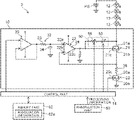
  • FIG. 1 is a block diagram schematically showing a driver circuit and a processing device according to an embodiment
  • FIG. 2 is a graph schematically showing an example of the operation of the control part according to the embodiment
  • FIG. 3 is a block diagram schematically showing a variation of the driver circuit and the processing device according to the embodiment.
  • FIG. 1 is a block diagram schematically showing a driver circuit and a processing device according to an embodiment.
  • the processing device 2 includes a driver circuit 10 and at least one light emitting element 12 .
  • the processing device 2 includes, for example, a plurality of light emitting elements 12 connected in series.
  • FIG. 1 shows four light emitting elements 12 connected in series.
  • the number of light emitting elements 12 is not required to be four, but may be appropriately determined.
  • the number of light emitting elements 12 may be one.
  • the light emitting element 12 is, for example, a laser diode. However, the light emitting element 12 is not required to be a laser diode, but may be other light emitting elements such as a light emitting diode.
  • the light emitting element 12 is electrically connected to the driver circuit 10 .
  • the light emitting element 12 is electrically connected to a DC power supply PS.
  • the DC power supply PS supplies DC supply direct-current electricity to the light emitting element 12 .
  • the light emitting element 12 radiates light in response to supply of DC power from the DC power supply PS.
  • the term “electrically connected” may refer to the state in which two members are directly connected through, for example, an interconnect, or the state in which two members are indirectly connected through, for example, another conductive member.
  • the driver circuit 10 drives the light emitting element 12 .
  • the driver circuit 10 drives supply of DC power from the DC power supply PS to the light emitting element 12 .
  • the driver circuit 10 performs switching between radiation of light and its stoppage from the light emitting element 12 , and adjusts the intensity of light radiated from the light emitting element 12 .
  • the processing device 2 performs a predetermined processing on an object by driving the light emitting element 12 with the driver circuit 10 and radiating light of a predetermined pattern from the light emitting element 12 through an optical system.
  • the processing device 2 is, for example, a light exposure device or a machining device.
  • the object to be processed by the processing device 2 is, for example, a semiconductor wafer.
  • the processing device 2 performs light exposure of a predetermined pattern on a resist applied onto the wafer surface with light radiated from the light emitting element 12 through an optical system.
  • the object to be processed by the processing device 2 is, for example, a metal plate.
  • the processing device 2 performs various machining operations such as cutting and boring on the object with light radiated from the light emitting element 12 through an optical system.
  • the processing device 2 further includes a control part 14 .
  • the control part 14 controls the operation of the driver circuit 10 .
  • the driver circuit 10 drives the light emitting element 12 based on the control of the control part 14 .
  • the driver circuit 10 may be operated based on a control signal externally inputted through, for example, a network.
  • the driver circuit 10 includes a switching element 20 , a current-controlling switching element 21 , and a differential amplifier circuit 22 .
  • the current-controlling switching element 21 is electrically connected to the light emitting element 12 .
  • the current-controlling switching element 21 is, for example, connected in series to the light emitting element 12 .
  • the light emitting element 12 is provided between the DC power supply PS and the current-controlling switching element 21 .
  • the light emitting element 12 is a laser diode.
  • the anode of one of the light emitting elements 12 is electrically connected to the DC power supply PS.
  • the cathode of one of the light emitting elements 12 is electrically connected to the current-controlling switching element 21 .
  • the switching element 20 is connected in series to the current-controlling switching element 21 .
  • the switching element 20 is provided, for example, between the current-controlling switching element 21 and the ground (common potential).
  • a current flows in the light emitting element 12 by turning on the switching elements 20 , 21 .
  • This causes light to be radiated from the light emitting element 12 .
  • supply of the current to the light emitting element 12 is stopped by turning off at least one of the switching elements 20 , 21 . This stops radiation of light from the light emitting element 12 .
  • the switching elements 20 , 21 are based on, for example, a bipolar transistor or FET. However, the switching elements 20 , 21 are not required to be those, but may appropriately be selected from ones capable of switching between supply and its stoppage of the current to the light emitting element 12 .
  • the current-controlling switching element 21 includes a first main terminal 21 a , a second main terminal 21 b , and a control terminal 21 c .
  • the first main terminal 21 a is electrically connected to the light emitting element 12 .
  • the control terminal 21 c controls the current flowing between the first main terminal 21 a and the second main terminal 21 b .
  • the current-controlling switching element 21 is an FET.
  • the first main terminal 21 a is a drain
  • the second main terminal 21 b is a source
  • the control terminal 21 c is a gate.
  • the switching element 20 includes a first main terminal 20 a , a second main terminal 20 b , and a control terminal 20 c.
  • the current-controlling switching element 21 adjusts the magnitude of the current flowing between the first main terminal 21 a and the second main terminal 21 b in response to the voltage applied to the control terminal 21 c . That is, the driver circuit 10 adjusts the magnitude of the current flowing in the light emitting element 12 by adjusting the voltage of the control terminal 21 c of the current-controlling switching element 21 . In other words, the driver circuit 10 adjusts the intensity of light radiated from the light emitting element 12 by adjusting the voltage of the control terminal 21 c of the current-controlling switching element 21 . The driver circuit 10 adjusts the voltage of the control terminal 21 c so that, for example, a substantially constant current flows in the light emitting element 12 .
  • the driver circuit 10 is, for example, a constant current circuit.
  • the differential amplifier circuit 22 includes a first input terminal 22 a , a second input terminal 22 b , and an output terminal 22 c .
  • the output terminal 22 c is electrically connected to the control terminal 21 c of the current-controlling switching element 21 .
  • the first input terminal 22 a receives a reference signal as a reference for radiating light with a desired intensity from the light emitting element 12 .
  • the second input terminal 22 b receives a detection signal corresponding to the detection result of the current flowing in the light emitting element 12 .
  • the detection signal is a feedback signal for feeding back the detection result of the current flowing in the light emitting element 12 , to the differential amplifier circuit 22 .
  • a resistor and a capacitor may be placed between the output terminal 22 c and the first main terminal 21 a of the current-controlling switching element 21 .
  • the differential amplifier circuit 22 controls the current flowing in the light emitting element 12 and the current-controlling switching element 21 based on the voltage of the first input terminal 22 a and the voltage of the second input terminal 22 b .
  • the differential amplifier circuit 22 applies a voltage in accordance with the difference between the reference signal and the detection signal to the control terminal 21 c of the current-controlling switching element 21 .
  • the differential amplifier circuit 22 causes a substantially constant current corresponding to the reference signal to flow in the light emitting element 12 .
  • the detection signal is set so as to have, for example, the same value as the reference signal when a desired current corresponding to the reference signal flows in the light emitting element 12 .
  • the differential amplifier circuit 22 causes a substantially constant current to flow in the light emitting element 12 by applying a voltage from the output terminal 22 c to the control terminal 21 c.
  • the detection signal becomes larger, and its difference from the reference signal becomes smaller than a predetermined amount.
  • the voltage applied to the control terminal 21 c becomes smaller. Accordingly, the current flowing in the light emitting element 12 is controlled to decrease. Conversely, when the current flowing in the light emitting element 12 is smaller than the desired current corresponding to the reference signal, the detection signal becomes smaller, and its difference from the reference signal becomes larger than a predetermined amount. Thus, the voltage applied to the control terminal 21 c becomes larger. Accordingly, the current flowing in the light emitting element 12 is controlled to increase. Thus, the current flowing in the light emitting element 12 can be closer to the value corresponding to the reference signal and controlled to be a substantially constant current.
  • the differential amplifier circuit 22 includes, for example, an operational amplifier 24 .
  • the first input terminal 22 a is, for example, a non-inverting input terminal of the operational amplifier 24 .
  • the second input terminal 22 b is, for example, an inverting input terminal of the operational amplifier 24 .
  • the differential amplifier circuit 22 is not required to a configuration including an operational amplifier 24 , but may be configured to have the same function by combining, for example, a plurality of transistors.
  • the first input terminal 22 a is electrically connected to the control part 14 .
  • the reference signal is inputted from the control part 14 .
  • the control part 14 controls the reference signal to be inputted into the first input terminal 22 a so that light of an appropriate intensity is radiated from the light emitting element 12 in accordance with, for example, the kind of the object or the kind of processing performed on the object.
  • the control part 14 can decrease the voltage applied to the control terminal 21 c by decreasing the reference signal (e.g., to 0 V).
  • the control part 14 can turn off the current-controlling switching element 21 . That is, the light emitting element 12 can be maintained in the unlit state.
  • the driver circuit 10 includes, for example, a voltage follower 30 and a low-pass filter 32 .
  • the voltage follower 30 is provided between the control part 14 and the first input terminal 22 a .
  • the voltage follower 30 functions as, for example, a buffer for reducing variation of the signal outputted from the control part 14 .
  • the voltage follower 30 is configured of, for example, an operational amplifier in which the output terminal and the inverting input terminal are short-circuited.
  • the low-pass filter 32 is provided between the voltage follower 30 and the first input terminal 22 a .
  • the low-pass filter 32 includes, for example, a resistor element 33 and a capacitor 34 .
  • the resistor element 33 is connected between the voltage follower 30 and the first input terminal 22 a .
  • the capacitor 34 is connected between the ground (common potential) and the signal line connecting the first input terminal 22 a and the resistor element 33 .
  • the low-pass filter 32 reduces, for example, high-frequency components contained in the signal outputted from the control part 14 (voltage follower 30 ).
  • the voltage follower 30 and the low-pass filter 32 thus provided enables a more appropriate reference signal to be inputted to the first input terminal 22 a .
  • the voltage follower 30 and the low-pass filter 32 are provided as necessary, and can be omitted.
  • the driver circuit 10 includes a resistor element 36 .
  • One end of the resistor element 36 is electrically connected to the second main terminal 21 b of the current-controlling switching element 21 .
  • the other end of the resistor element 36 is electrically connected to the first main terminal 20 a of the switching element 20 .
  • a voltage corresponding to the current flowing in the light emitting element 12 is generated across the resistor element 36 and the switching element 20 .
  • the resistor element 36 is a resistor for detecting the current flowing in the light emitting element 12 .
  • One end of the resistor element 36 is electrically connected to the second input terminal 22 b and the second main terminal 21 b of the current-controlling switching element 21 .
  • the voltage generated across the resistor element 36 and the switching element 20 is inputted to the second input terminal 22 b as a detection signal.
  • the method for inputting the detection signal to the second input terminal 22 b is not required to be those, but may be appropriately determined.
  • the second main terminal 20 b of the switching element 20 is electrically connected to the ground (common potential).
  • the control terminal 20 c of the switching element 20 is electrically connected to the control part 14 .
  • the control part 14 controls a pulse signal periodically repeating on/off to be inputted into the control terminal 20 c of the switching element 20 .
  • the pulse signal When the pulse signal is on (high), the voltage value of the pulse signal is sufficiently higher than the threshold voltage value of the switching element 20 . Thus, when the pulse signal is on, the current flowing in the light emitting element 12 is controlled based on the reference signal and the detection signal as described above.
  • the pulse signal when the pulse signal is off (low), the voltage value of the pulse signal is lower than the threshold voltage value of the switching element 20 . That is, when the pulse signal is off, radiation of light from the light emitting element 12 is stopped.
  • control part 14 controls a reference signal to be inputted into the first input terminal 22 a of the differential amplifier circuit 22 , and a pulse signal to be inputted into the control terminal 20 c of the switching element 20 . Accordingly, the control part 14 causes pulse oscillation in the light emitting element 12 .
  • the control part 14 varies the duty cycle of the pulse signal inputted to the control terminal 20 c of the switching element 20 in accordance with, for example, the kind of the object or the kind of processing performed on the object. This facilitates adjusting, for example, energy applied to the object.
  • the oscillation of the light emitting element 12 is not required to be pulse oscillation, but may be continuous oscillation.
  • the switching element 20 and the input of the pulse signal from the control part 14 to the control terminal 20 c of the switching element 20 can be omitted in the case of operation only in continuous oscillation.
  • control part 14 is illustrated as a signal source for inputting a pulse signal for causing pulse oscillation in the light emitting element 12 to the control terminal 20 c of the switching element 20 .
  • the signal source is not required to be the control part 14 , but may be an appropriately selected signal source capable of inputting a pulse signal to the control terminal 20 c of the switching element 20 .
  • a dedicated oscillation circuit may be used as a signal source.
  • the driver circuit 10 further includes an adjustment part 50 for adjusting the overshoot amount of the rising edge of the current flowing in the light emitting element 12 .
  • the adjustment part 50 includes, for example, a variable capacitor 52 and a variable resistor 56 .
  • variable capacitor 52 and the variable resistor 56 are connected in series.
  • the variable capacitor 52 and the variable resistor 56 are provided between the output terminal 22 c of the differential amplifier circuit 22 and the first main terminal 21 a of the current-controlling switching element 21 .
  • One end of the variable capacitor 52 is electrically connected to the variable resistor 56 .
  • the other end of the variable capacitor 52 is electrically connected to the first main terminal 21 a of the current-controlling switching element 21 .
  • the amount of capacitance of the variable capacitor 52 When the amount of capacitance of the variable capacitor 52 is smaller, the rising edge of the current flowing in the light emitting element 12 is steeper, and overshoot is more likely to occur. That is, in the adjustment part 50 , decreasing the amount of capacitance of the variable capacitor 52 can increase the overshoot amount of the rising edge of the current flowing in the light emitting element 12 . Also, increasing the amount of capacitance of the variable capacitor 52 can decrease the overshoot amount of the rising edge of the current flowing in the light emitting element 12 can be decreased by.
  • the variable resistor 56 is provided between the output terminal 22 c of the differential amplifier circuit 22 and the variable capacitor 52 .
  • the variable resistor 56 adjusts, for example, the voltage applied to the control terminal 21 c.
  • the resistance value of the variable resistor 56 When the resistance value of the variable resistor 56 is larger, overshoot is more likely to occur. Thus, in the adjustment part 50 , increasing the resistance value of the variable resistor 56 can increase the overshoot amount of the rising edge of the current flowing in the light emitting element 12 . Also, decreasing the resistance value of the variable resistor 56 can decrease the overshoot amount of the rising edge of the current flowing in the light emitting element 12 .
  • the variable capacitor 52 and the variable resistor 56 are electrically connected to the control part 14 .
  • the control part 14 adjusts the overshoot amount of the rising edge of the current flowing in the light emitting element 12 by varying at least one of the capacitance value of the variable capacitor 52 and the resistance value of the variable resistor 56 . That is, the control part 14 controls the adjustment of the overshoot amount by the adjustment part 50 .
  • the variable capacitor 52 is based on, for example, a digital programmable capacitor. Thus, the capacitance value of the variable capacitor 52 can be varied by control of the control part 14 .
  • the variable resistor 56 is based on, for example, a digital potentiometer. Thus, the resistance value of the variable resistor 56 can be varied by control of the control part 14 .
  • the control part 14 is electrically connected to, for example, a manipulation part 60 and a memory part 62 .
  • the manipulation part 60 can be an appropriately selected input device such as a keyboard, mouse, and touch panel.
  • the manipulation part 60 is manipulated by, for example, an operator, and controls various manipulated instructions in accordance with the received manipulation to be input into the control part 14 .
  • the control part 14 controls the adjustment of the overshoot amount by the adjustment part 50 in accordance with, for example, the manipulated instruction inputted from the manipulation part 60 . That is, the control part 14 varies at least one of the capacitance value of the variable capacitor 52 and the resistance value of the variable resistor 56 in accordance with the manipulated instruction inputted from the manipulation part 60 .
  • the memory part 62 stores association information 62 a .
  • the association information 62 a stores, for example, processing information related to the processing of the object in association with the suitable value of the overshoot amount for the processing.
  • the processing information includes, for example, information indicating the kind of the object and information of processing performed on the object.
  • the information indicating the kind of the object includes, for example, the material, size, and thickness of the object.
  • the information of processing performed on the object includes, for example, information of the kind of processing such as cutting and boring, and information of the pattern of light radiation.
  • the information included in the processing information is not required to be those, but may be information appropriately determined and necessary for processing the object.
  • the control part 14 receives processing information as one of the manipulated instructions from the manipulation part 60 .
  • the operator of the processing device 2 manipulates the manipulation part 60 and controls processing information to be inputted into the control part 14 .
  • the control part 14 refers to the association information 62 a stored in the memory part 62 and retrieves the suitable value of the overshoot amount corresponding to the inputted processing information from the association information 62 a .
  • the control part 14 controls the adjustment of the overshoot amount by the adjustment part 50 in accordance with the retrieved suitable value.
  • the adjustment by the adjustment part 50 can be automatically performed so as to achieve a suitable overshoot amount in accordance with, for example, the kind of the object and the content of processing.
  • control part 14 enables the adjustment of the overshoot amount by the adjustment part 50 to be manually configured by operating the manipulation part 60 . Furthermore, the control part 14 enables the adjustment of the overshoot amount by the adjustment part 50 to be automatically configured based on the processing information inputted from the manipulation part 60 and the association information 62 a stored in the memory part 62 .
  • the adjustment of the adjustment part 50 may be configured only manually, or may be configured only automatically. In the case of configuring the adjustment part 50 only manually, the memory part 62 can be omitted. In the case of configuring the adjustment part 50 only manually, the manipulation part 60 is not required to be electrically connected to the control part 14 .
  • the manipulation part 60 may be, for example, a dial for directly varying, for example, the capacitance value of the variable capacitor 52 and the resistance value of the variable resistor 56 . That is, the manipulation part 60 may be provided in the adjustment part 50 .
  • the processing information may be inputted from another device through, for example, a network.
  • the part 60 can be omitted.
  • the memory part 62 is not required to be electrically connected to the control part 14 .
  • the memory part 62 may be, for example, incorporated in the control part 14 .
  • the overshoot amount of the rising edge of the current flowing in the light emitting element 12 can be adjusted by the adjustment part 50 . Accordingly, the current flowing in the light emitting element 12 can be controlled more appropriately. That is, the intensity of light radiated from the light emitting element 12 can be controlled more appropriately.
  • the inventor of the present application has found that the accuracy of processing, such as machining and light exposure, can be improved by adjusting the overshoot amount of the rising edge of the current flowing in the light emitting element 12 when an object is processed in the processing device 2 .
  • a linear pattern may be formed on an object formed using a material having high heat capacity.
  • the desired shape cannot be obtained in the portion where light irradiation is started.
  • the overshoot amount is increased to increase the intensity of light at the time of starting irradiation. This can accelerate the temperature increase of the object and further improve the accuracy of processing.
  • a linear pattern may be formed on an object formed using a material having low heat capacity.
  • the overshoot amount is excessively large, an excessively large amount of energy may be applied to the portion on which irradiation is started. Thus, the overshoot amount is decreased in this case.
  • the inventor of the present application has found that the necessary overshoot amount is different depending on the object.
  • the overshoot amount can be adjusted by the adjustment part 50 . That is, the overshoot amount can be adjusted in accordance with the object so as to achieve an overshoot amount appropriate to the object.
  • the accuracy of processing can be improved also in the case of processing various objects.
  • the relationship between the object and the suitable overshoot amount is measured in advance, and stored in the memory part 62 as association information 62 a .
  • the adjustment of the adjustment part 50 can be automatically performed as described above. This can further improve the convenience of the processing device 2 .
  • FIG. 2 is a graph schematically showing an example of the operation of the control part according to the embodiment.
  • the horizontal axis of FIG. 2 represents time.
  • the vertical axis represents the current flowing in the light emitting element 12 .
  • the control part 14 causes, for example, pulse oscillation in the light emitting element 12 .
  • the control part 14 controls the adjustment part 50 so that the overshoot amount gradually decreases for each pulse oscillation from the start of the pattern toward its end.
  • the temperature of the object may increase. That is, when light is radiated in the second or later pulses, the temperature of the object may be higher than when light is radiated in the first pulse. In this case, if a fixed overshoot amount is set to form a linear pattern on the object, the line width may gradually broaden with the temperature increase of the object.
  • the overshoot amount is gradually decreased for each pulse oscillation.
  • the overshoot amount is gradually decreased in accordance with the temperature increase of the object.
  • a more appropriate amount of energy can be applied to the object in accordance with temperature variation of the object. This can attenuate, for example, the broadening of the line width and further improve the processing accuracy.
  • the overshoot amount does not need to be varied for each pulse oscillation.
  • the overshoot amount can be set to be substantially constant.
  • FIG. 3 is a block diagram schematically showing a variation of the driver circuit and the processing device according to the embodiment.
  • the processing device 2 a further includes an inspection part 64 .
  • the inspection part 64 inspects the processed object, and controls inspection information indicating the inspection result inputted into the control part 14 .
  • the inspection part 64 obtains, for example, image data of the processed object with a camera to inspect the processed object by image processing. Then, the inspection part 64 obtains, for example, information of the dimension of the processed portion as inspection information.
  • the control part 14 controls the adjustment of the overshoot amount by the adjustment part 50 based on the inspection information inputted from the inspection part 64 . For instance, in forming a linear pattern, the line width of the portion on which irradiation is started may be narrow. In this case, the overshoot amount is increased. Thus, the inspection result can be fed back to the processing for the next object. This can further improve the processing accuracy.
  • the inspection information may be inputted to the control part 14 from, for example, another inspection device, or may be manually inputted by, for example, an operator, through the manipulation part 60 .
  • the inspection part 64 can be omitted also in the case in which the adjustment part 50 is controlled in accordance with the inspection information.
  • the adjustment part 50 includes a variable capacitor 52 and a variable resistor 56 .
  • the overshoot amount can be adjusted by one of the capacitance value of the variable capacitor 52 and the resistance value of the variable resistor 56 .
  • the configuration of the adjustment part 50 is not required to be foregoing.
  • the adjustment part 50 only needs to have the variable function in at least one of the capacitor and the resistor.
  • the adjustment part 50 may include a variable capacitor 52 and a resistor, or may include a capacitor and a variable resistor 56 .
  • the configuration of the adjustment part 50 may be appropriately determined so long as the configuration capable of adjusting the overshoot amount of the rising edge of the current flowing in the light emitting element 12 .

Landscapes

  • Physics & Mathematics (AREA)
  • Optics & Photonics (AREA)
  • Engineering & Computer Science (AREA)
  • Electromagnetism (AREA)
  • General Physics & Mathematics (AREA)
  • Condensed Matter Physics & Semiconductors (AREA)
  • Power Engineering (AREA)
  • Plasma & Fusion (AREA)
  • Mechanical Engineering (AREA)
  • Radar, Positioning & Navigation (AREA)
  • Automation & Control Theory (AREA)
  • Led Devices (AREA)
  • Semiconductor Lasers (AREA)
  • Electronic Switches (AREA)

Abstract

A driver circuit includes: a current-controlling switching element electrically connected to a light emitting element; a differential amplifier circuit including: an output terminal electrically connected to the current-controlling switching element, a first input terminal configured to receive a reference signal as a reference for radiating light with a desired intensity from the light emitting element, and a second input terminal configured to receive a detection signal corresponding to a detection result of a current flowing in the light emitting element, wherein the differential amplifier circuit is configured to control the current flowing in the light emitting element and the current-controlling switching element based on a voltage of the first input terminal and a voltage of the second input terminal; and an adjustment part configured to adjust an overshoot amount of a rising edge of the current flowing in the light emitting element.

Description

CROSS-REFERENCE TO RELATED APPLICATIONS
This application is based upon and claims priority to Japanese Patent Application No. 2018-082447, filed on Apr. 23, 2018, the entire contents of which are incorporated herein by reference.
FIELD
Embodiments described herein relate generally to a driver circuit and a processing device.
BACKGROUND
There is known a processing device for processing an object by light radiated from a light emitting element.
Examples of such a processing device include a laser exposure device for performing light exposure of a resist with laser light, and a laser machining device for machining, for example, cutting, an object with laser light.
The processing device includes a light emitting element and a driver circuit for driving the light emitting element. The driver circuit controls the intensity of light radiated from the light emitting element by controlling the current flowing in the light emitting element. In the processing device, the intensity of light radiated from the light emitting element affects the accuracy of processing the object. Thus, in such a driver circuit and a processing device thereof, it is desired to control the current flowing in the light emitting element more appropriately in order to achieve higher processing accuracy.
SUMMARY
A driver circuit according to one embodiment includes a current-controlling switching element, a differential amplifier circuit, and an adjustment part. The current-controlling switching element is electrically connected to a light emitting element. The differential amplifier circuit includes an output terminal, a first input terminal, and a second input terminal. The output terminal is electrically connected to the current-controlling switching element. The first input terminal receives a reference signal as a reference for radiating light with a desired intensity from the light emitting element. The second input terminal receives a detection signal corresponding to a detection result of a current flowing in the light emitting element. The differential amplifier circuit controls the current flowing in the light emitting element and the current-controlling switching element based on a voltage of the first input terminal and a voltage of the second input terminal. The adjustment part is capable of adjusting an overshoot amount of a rising edge of the current flowing in the light emitting element.
A processing device according to one embodiment includes a light emitting element, a driver circuit, and a control part. The driver circuit drives the light emitting element and including. The current-controlling switching element is electrically connected to the light emitting element. The differential amplifier circuit includes an output terminal, a first input terminal, a second input terminal, and an adjustment part. The output terminal is electrically connected to the current-controlling switching element. The first input terminal receives a reference signal as a reference for radiating light with a desired intensity from the light emitting element. The second input terminal receives a detection signal corresponding to a detection result of a current flowing in the light emitting element. The differential amplifier circuit controls the current flowing in the light emitting element and the current-controlling switching element based on a voltage of the first input terminal and a voltage of the second input terminal. The adjustment part is capable of adjusting an overshoot amount of a rising edge of the current flowing in the light emitting element. The control part controls operation of the driver circuit.
BRIEF DESCRIPTION OF THE DRAWINGS
FIG. 1 is a block diagram schematically showing a driver circuit and a processing device according to an embodiment;
FIG. 2 is a graph schematically showing an example of the operation of the control part according to the embodiment;
FIG. 3 is a block diagram schematically showing a variation of the driver circuit and the processing device according to the embodiment.
DETAILED DESCRIPTION
Embodiments will now be described with reference to the drawings. In the drawings, the same elements are marked with the same reference numerals.
FIG. 1 is a block diagram schematically showing a driver circuit and a processing device according to an embodiment.
As shown in FIG. 1 , the processing device 2 includes a driver circuit 10 and at least one light emitting element 12. The processing device 2 includes, for example, a plurality of light emitting elements 12 connected in series. For convenience, FIG. 1 shows four light emitting elements 12 connected in series. The number of light emitting elements 12 is not required to be four, but may be appropriately determined. The number of light emitting elements 12 may be one. The light emitting element 12 is, for example, a laser diode. However, the light emitting element 12 is not required to be a laser diode, but may be other light emitting elements such as a light emitting diode.
The light emitting element 12 is electrically connected to the driver circuit 10. The light emitting element 12 is electrically connected to a DC power supply PS. The DC power supply PS supplies DC supply direct-current electricity to the light emitting element 12. The light emitting element 12 radiates light in response to supply of DC power from the DC power supply PS. The term “electrically connected” may refer to the state in which two members are directly connected through, for example, an interconnect, or the state in which two members are indirectly connected through, for example, another conductive member.
The driver circuit 10 drives the light emitting element 12. In other words, the driver circuit 10 drives supply of DC power from the DC power supply PS to the light emitting element 12. The driver circuit 10 performs switching between radiation of light and its stoppage from the light emitting element 12, and adjusts the intensity of light radiated from the light emitting element 12. Thus, the processing device 2 performs a predetermined processing on an object by driving the light emitting element 12 with the driver circuit 10 and radiating light of a predetermined pattern from the light emitting element 12 through an optical system.
More specifically, the processing device 2 is, for example, a light exposure device or a machining device. In the case of a light exposure device, the object to be processed by the processing device 2 is, for example, a semiconductor wafer. The processing device 2 performs light exposure of a predetermined pattern on a resist applied onto the wafer surface with light radiated from the light emitting element 12 through an optical system. In the case of a machining device, the object to be processed by the processing device 2 is, for example, a metal plate. The processing device 2 performs various machining operations such as cutting and boring on the object with light radiated from the light emitting element 12 through an optical system.
The processing device 2 further includes a control part 14. The control part 14 controls the operation of the driver circuit 10. The driver circuit 10 drives the light emitting element 12 based on the control of the control part 14. For instance, the driver circuit 10 may be operated based on a control signal externally inputted through, for example, a network.
The driver circuit 10 includes a switching element 20, a current-controlling switching element 21, and a differential amplifier circuit 22. The current-controlling switching element 21 is electrically connected to the light emitting element 12. The current-controlling switching element 21 is, for example, connected in series to the light emitting element 12. The light emitting element 12 is provided between the DC power supply PS and the current-controlling switching element 21. For instance, the light emitting element 12 is a laser diode. In this case, the anode of one of the light emitting elements 12 is electrically connected to the DC power supply PS. The cathode of one of the light emitting elements 12 is electrically connected to the current-controlling switching element 21.
The switching element 20 is connected in series to the current-controlling switching element 21. The switching element 20 is provided, for example, between the current-controlling switching element 21 and the ground (common potential). Thus, a current flows in the light emitting element 12 by turning on the switching elements 20, 21. This causes light to be radiated from the light emitting element 12. On the other hand, supply of the current to the light emitting element 12 is stopped by turning off at least one of the switching elements 20, 21. This stops radiation of light from the light emitting element 12.
The switching elements 20, 21 are based on, for example, a bipolar transistor or FET. However, the switching elements 20, 21 are not required to be those, but may appropriately be selected from ones capable of switching between supply and its stoppage of the current to the light emitting element 12.
The current-controlling switching element 21 includes a first main terminal 21 a, a second main terminal 21 b, and a control terminal 21 c. The first main terminal 21 a is electrically connected to the light emitting element 12. The control terminal 21 c controls the current flowing between the first main terminal 21 a and the second main terminal 21 b. For instance, the current-controlling switching element 21 is an FET. In this case, the first main terminal 21 a is a drain, the second main terminal 21 b is a source, and the control terminal 21 c is a gate. Likewise, the switching element 20 includes a first main terminal 20 a, a second main terminal 20 b, and a control terminal 20 c.
The current-controlling switching element 21 adjusts the magnitude of the current flowing between the first main terminal 21 a and the second main terminal 21 b in response to the voltage applied to the control terminal 21 c. That is, the driver circuit 10 adjusts the magnitude of the current flowing in the light emitting element 12 by adjusting the voltage of the control terminal 21 c of the current-controlling switching element 21. In other words, the driver circuit 10 adjusts the intensity of light radiated from the light emitting element 12 by adjusting the voltage of the control terminal 21 c of the current-controlling switching element 21. The driver circuit 10 adjusts the voltage of the control terminal 21 c so that, for example, a substantially constant current flows in the light emitting element 12. The driver circuit 10 is, for example, a constant current circuit.
The differential amplifier circuit 22 includes a first input terminal 22 a, a second input terminal 22 b, and an output terminal 22 c. The output terminal 22 c is electrically connected to the control terminal 21 c of the current-controlling switching element 21. The first input terminal 22 a receives a reference signal as a reference for radiating light with a desired intensity from the light emitting element 12. The second input terminal 22 b receives a detection signal corresponding to the detection result of the current flowing in the light emitting element 12. In other words, the detection signal is a feedback signal for feeding back the detection result of the current flowing in the light emitting element 12, to the differential amplifier circuit 22. A resistor and a capacitor may be placed between the output terminal 22 c and the first main terminal 21 a of the current-controlling switching element 21.
The differential amplifier circuit 22 controls the current flowing in the light emitting element 12 and the current-controlling switching element 21 based on the voltage of the first input terminal 22 a and the voltage of the second input terminal 22 b. The differential amplifier circuit 22 applies a voltage in accordance with the difference between the reference signal and the detection signal to the control terminal 21 c of the current-controlling switching element 21. Thus, the differential amplifier circuit 22 causes a substantially constant current corresponding to the reference signal to flow in the light emitting element 12.
The detection signal is set so as to have, for example, the same value as the reference signal when a desired current corresponding to the reference signal flows in the light emitting element 12. The differential amplifier circuit 22 causes a substantially constant current to flow in the light emitting element 12 by applying a voltage from the output terminal 22 c to the control terminal 21 c.
When the current flowing in the light emitting element 12 is larger than the desired current corresponding to the reference signal, the detection signal becomes larger, and its difference from the reference signal becomes smaller than a predetermined amount. Thus, the voltage applied to the control terminal 21 c becomes smaller. Accordingly, the current flowing in the light emitting element 12 is controlled to decrease. Conversely, when the current flowing in the light emitting element 12 is smaller than the desired current corresponding to the reference signal, the detection signal becomes smaller, and its difference from the reference signal becomes larger than a predetermined amount. Thus, the voltage applied to the control terminal 21 c becomes larger. Accordingly, the current flowing in the light emitting element 12 is controlled to increase. Thus, the current flowing in the light emitting element 12 can be closer to the value corresponding to the reference signal and controlled to be a substantially constant current.
The differential amplifier circuit 22 includes, for example, an operational amplifier 24. The first input terminal 22 a is, for example, a non-inverting input terminal of the operational amplifier 24. The second input terminal 22 b is, for example, an inverting input terminal of the operational amplifier 24. The differential amplifier circuit 22 is not required to a configuration including an operational amplifier 24, but may be configured to have the same function by combining, for example, a plurality of transistors.
The first input terminal 22 a is electrically connected to the control part 14. The reference signal is inputted from the control part 14. The control part 14 controls the reference signal to be inputted into the first input terminal 22 a so that light of an appropriate intensity is radiated from the light emitting element 12 in accordance with, for example, the kind of the object or the kind of processing performed on the object. The control part 14 can decrease the voltage applied to the control terminal 21 c by decreasing the reference signal (e.g., to 0 V). Thus, the control part 14 can turn off the current-controlling switching element 21. That is, the light emitting element 12 can be maintained in the unlit state.
The driver circuit 10 includes, for example, a voltage follower 30 and a low-pass filter 32. The voltage follower 30 is provided between the control part 14 and the first input terminal 22 a. The voltage follower 30 functions as, for example, a buffer for reducing variation of the signal outputted from the control part 14. The voltage follower 30 is configured of, for example, an operational amplifier in which the output terminal and the inverting input terminal are short-circuited.
The low-pass filter 32 is provided between the voltage follower 30 and the first input terminal 22 a. The low-pass filter 32 includes, for example, a resistor element 33 and a capacitor 34. The resistor element 33 is connected between the voltage follower 30 and the first input terminal 22 a. The capacitor 34 is connected between the ground (common potential) and the signal line connecting the first input terminal 22 a and the resistor element 33. The low-pass filter 32 reduces, for example, high-frequency components contained in the signal outputted from the control part 14 (voltage follower 30).
The voltage follower 30 and the low-pass filter 32 thus provided enables a more appropriate reference signal to be inputted to the first input terminal 22 a. The voltage follower 30 and the low-pass filter 32 are provided as necessary, and can be omitted.
The driver circuit 10 includes a resistor element 36. One end of the resistor element 36 is electrically connected to the second main terminal 21 b of the current-controlling switching element 21. The other end of the resistor element 36 is electrically connected to the first main terminal 20 a of the switching element 20. Thus, a voltage corresponding to the current flowing in the light emitting element 12 is generated across the resistor element 36 and the switching element 20. In other words, the resistor element 36 is a resistor for detecting the current flowing in the light emitting element 12.
One end of the resistor element 36 is electrically connected to the second input terminal 22 b and the second main terminal 21 b of the current-controlling switching element 21. Thus, the voltage generated across the resistor element 36 and the switching element 20 is inputted to the second input terminal 22 b as a detection signal. However, the method for inputting the detection signal to the second input terminal 22 b is not required to be those, but may be appropriately determined.
The second main terminal 20 b of the switching element 20 is electrically connected to the ground (common potential). The control terminal 20 c of the switching element 20 is electrically connected to the control part 14. The control part 14 controls a pulse signal periodically repeating on/off to be inputted into the control terminal 20 c of the switching element 20.
When the pulse signal is on (high), the voltage value of the pulse signal is sufficiently higher than the threshold voltage value of the switching element 20. Thus, when the pulse signal is on, the current flowing in the light emitting element 12 is controlled based on the reference signal and the detection signal as described above.
On the other hand, when the pulse signal is off (low), the voltage value of the pulse signal is lower than the threshold voltage value of the switching element 20. That is, when the pulse signal is off, radiation of light from the light emitting element 12 is stopped.
Thus, the control part 14 controls a reference signal to be inputted into the first input terminal 22 a of the differential amplifier circuit 22, and a pulse signal to be inputted into the control terminal 20 c of the switching element 20. Accordingly, the control part 14 causes pulse oscillation in the light emitting element 12.
The control part 14 varies the duty cycle of the pulse signal inputted to the control terminal 20 c of the switching element 20 in accordance with, for example, the kind of the object or the kind of processing performed on the object. This facilitates adjusting, for example, energy applied to the object. The oscillation of the light emitting element 12 is not required to be pulse oscillation, but may be continuous oscillation. The switching element 20 and the input of the pulse signal from the control part 14 to the control terminal 20 c of the switching element 20 can be omitted in the case of operation only in continuous oscillation.
In this example, the control part 14 is illustrated as a signal source for inputting a pulse signal for causing pulse oscillation in the light emitting element 12 to the control terminal 20 c of the switching element 20. The signal source is not required to be the control part 14, but may be an appropriately selected signal source capable of inputting a pulse signal to the control terminal 20 c of the switching element 20. For instance, a dedicated oscillation circuit may be used as a signal source.
The driver circuit 10 further includes an adjustment part 50 for adjusting the overshoot amount of the rising edge of the current flowing in the light emitting element 12. The adjustment part 50 includes, for example, a variable capacitor 52 and a variable resistor 56.
The variable capacitor 52 and the variable resistor 56 are connected in series. The variable capacitor 52 and the variable resistor 56 are provided between the output terminal 22 c of the differential amplifier circuit 22 and the first main terminal 21 a of the current-controlling switching element 21. One end of the variable capacitor 52 is electrically connected to the variable resistor 56. The other end of the variable capacitor 52 is electrically connected to the first main terminal 21 a of the current-controlling switching element 21.
When the amount of capacitance of the variable capacitor 52 is smaller, the rising edge of the current flowing in the light emitting element 12 is steeper, and overshoot is more likely to occur. That is, in the adjustment part 50, decreasing the amount of capacitance of the variable capacitor 52 can increase the overshoot amount of the rising edge of the current flowing in the light emitting element 12. Also, increasing the amount of capacitance of the variable capacitor 52 can decrease the overshoot amount of the rising edge of the current flowing in the light emitting element 12 can be decreased by.
The variable resistor 56 is provided between the output terminal 22 c of the differential amplifier circuit 22 and the variable capacitor 52. The variable resistor 56 adjusts, for example, the voltage applied to the control terminal 21 c.
When the resistance value of the variable resistor 56 is larger, overshoot is more likely to occur. Thus, in the adjustment part 50, increasing the resistance value of the variable resistor 56 can increase the overshoot amount of the rising edge of the current flowing in the light emitting element 12. Also, decreasing the resistance value of the variable resistor 56 can decrease the overshoot amount of the rising edge of the current flowing in the light emitting element 12.
The variable capacitor 52 and the variable resistor 56 are electrically connected to the control part 14. The control part 14 adjusts the overshoot amount of the rising edge of the current flowing in the light emitting element 12 by varying at least one of the capacitance value of the variable capacitor 52 and the resistance value of the variable resistor 56. That is, the control part 14 controls the adjustment of the overshoot amount by the adjustment part 50.
The variable capacitor 52 is based on, for example, a digital programmable capacitor. Thus, the capacitance value of the variable capacitor 52 can be varied by control of the control part 14. The variable resistor 56 is based on, for example, a digital potentiometer. Thus, the resistance value of the variable resistor 56 can be varied by control of the control part 14.
The control part 14 is electrically connected to, for example, a manipulation part 60 and a memory part 62. The manipulation part 60 can be an appropriately selected input device such as a keyboard, mouse, and touch panel. The manipulation part 60 is manipulated by, for example, an operator, and controls various manipulated instructions in accordance with the received manipulation to be input into the control part 14. The control part 14 controls the adjustment of the overshoot amount by the adjustment part 50 in accordance with, for example, the manipulated instruction inputted from the manipulation part 60. That is, the control part 14 varies at least one of the capacitance value of the variable capacitor 52 and the resistance value of the variable resistor 56 in accordance with the manipulated instruction inputted from the manipulation part 60.
The memory part 62 stores association information 62 a. The association information 62 a stores, for example, processing information related to the processing of the object in association with the suitable value of the overshoot amount for the processing. The processing information includes, for example, information indicating the kind of the object and information of processing performed on the object. The information indicating the kind of the object includes, for example, the material, size, and thickness of the object. The information of processing performed on the object includes, for example, information of the kind of processing such as cutting and boring, and information of the pattern of light radiation. The information included in the processing information is not required to be those, but may be information appropriately determined and necessary for processing the object.
The control part 14 receives processing information as one of the manipulated instructions from the manipulation part 60. When processing on the object, the operator of the processing device 2 manipulates the manipulation part 60 and controls processing information to be inputted into the control part 14. In response to receipt of the processing information, the control part 14 refers to the association information 62 a stored in the memory part 62 and retrieves the suitable value of the overshoot amount corresponding to the inputted processing information from the association information 62 a. Then, the control part 14 controls the adjustment of the overshoot amount by the adjustment part 50 in accordance with the retrieved suitable value. Thus, the adjustment by the adjustment part 50 can be automatically performed so as to achieve a suitable overshoot amount in accordance with, for example, the kind of the object and the content of processing.
Thus, the control part 14 enables the adjustment of the overshoot amount by the adjustment part 50 to be manually configured by operating the manipulation part 60. Furthermore, the control part 14 enables the adjustment of the overshoot amount by the adjustment part 50 to be automatically configured based on the processing information inputted from the manipulation part 60 and the association information 62 a stored in the memory part 62.
The adjustment of the adjustment part 50 may be configured only manually, or may be configured only automatically. In the case of configuring the adjustment part 50 only manually, the memory part 62 can be omitted. In the case of configuring the adjustment part 50 only manually, the manipulation part 60 is not required to be electrically connected to the control part 14. The manipulation part 60 may be, for example, a dial for directly varying, for example, the capacitance value of the variable capacitor 52 and the resistance value of the variable resistor 56. That is, the manipulation part 60 may be provided in the adjustment part 50.
The processing information may be inputted from another device through, for example, a network. In this case, the part 60 can be omitted. The memory part 62 is not required to be electrically connected to the control part 14. The memory part 62 may be, for example, incorporated in the control part 14.
Thus, in the processing device 2 and the driver circuit 10 according to this embodiment, the overshoot amount of the rising edge of the current flowing in the light emitting element 12 can be adjusted by the adjustment part 50. Accordingly, the current flowing in the light emitting element 12 can be controlled more appropriately. That is, the intensity of light radiated from the light emitting element 12 can be controlled more appropriately.
As a result of diligent examination, the inventor of the present application has found that the accuracy of processing, such as machining and light exposure, can be improved by adjusting the overshoot amount of the rising edge of the current flowing in the light emitting element 12 when an object is processed in the processing device 2.
For instance, a linear pattern may be formed on an object formed using a material having high heat capacity. In this case, it takes time from the start of light irradiation until the temperature of the object increases. Thus, the desired shape cannot be obtained in the portion where light irradiation is started. Accordingly, in this case, the overshoot amount is increased to increase the intensity of light at the time of starting irradiation. This can accelerate the temperature increase of the object and further improve the accuracy of processing.
Conversely, a linear pattern may be formed on an object formed using a material having low heat capacity. In this case, if the overshoot amount is excessively large, an excessively large amount of energy may be applied to the portion on which irradiation is started. Thus, the overshoot amount is decreased in this case.
Thus, the inventor of the present application has found that the necessary overshoot amount is different depending on the object. In the processing device 2 and the driver circuit 10 according to this embodiment, the overshoot amount can be adjusted by the adjustment part 50. That is, the overshoot amount can be adjusted in accordance with the object so as to achieve an overshoot amount appropriate to the object. Thus, the accuracy of processing can be improved also in the case of processing various objects.
Furthermore, for instance, the relationship between the object and the suitable overshoot amount is measured in advance, and stored in the memory part 62 as association information 62 a. Thus, the adjustment of the adjustment part 50 can be automatically performed as described above. This can further improve the convenience of the processing device 2.
FIG. 2 is a graph schematically showing an example of the operation of the control part according to the embodiment.
The horizontal axis of FIG. 2 represents time. The vertical axis represents the current flowing in the light emitting element 12.
As shown in FIG. 2 , the control part 14 causes, for example, pulse oscillation in the light emitting element 12. When performing processing of one pattern on an object, the control part 14 controls the adjustment part 50 so that the overshoot amount gradually decreases for each pulse oscillation from the start of the pattern toward its end.
For instance, each time the light emitting element 12 is subjected to pulse oscillation, the temperature of the object may increase. That is, when light is radiated in the second or later pulses, the temperature of the object may be higher than when light is radiated in the first pulse. In this case, if a fixed overshoot amount is set to form a linear pattern on the object, the line width may gradually broaden with the temperature increase of the object.
Thus, in such a case, the overshoot amount is gradually decreased for each pulse oscillation. For instance, the overshoot amount is gradually decreased in accordance with the temperature increase of the object. Thus, for instance, a more appropriate amount of energy can be applied to the object in accordance with temperature variation of the object. This can attenuate, for example, the broadening of the line width and further improve the processing accuracy. When, for example, the temperature variation of the object is small, the overshoot amount does not need to be varied for each pulse oscillation. The overshoot amount can be set to be substantially constant.
FIG. 3 is a block diagram schematically showing a variation of the driver circuit and the processing device according to the embodiment.
The elements substantially identical in function or configuration to those of the above embodiment are marked with the same reference numerals, and the detailed description thereof is omitted.
As shown in FIG. 3 , the processing device 2 a further includes an inspection part 64. The inspection part 64 inspects the processed object, and controls inspection information indicating the inspection result inputted into the control part 14. The inspection part 64 obtains, for example, image data of the processed object with a camera to inspect the processed object by image processing. Then, the inspection part 64 obtains, for example, information of the dimension of the processed portion as inspection information.
The control part 14 controls the adjustment of the overshoot amount by the adjustment part 50 based on the inspection information inputted from the inspection part 64. For instance, in forming a linear pattern, the line width of the portion on which irradiation is started may be narrow. In this case, the overshoot amount is increased. Thus, the inspection result can be fed back to the processing for the next object. This can further improve the processing accuracy.
The inspection information may be inputted to the control part 14 from, for example, another inspection device, or may be manually inputted by, for example, an operator, through the manipulation part 60. In this case, the inspection part 64 can be omitted also in the case in which the adjustment part 50 is controlled in accordance with the inspection information.
In the above embodiments, the adjustment part 50 includes a variable capacitor 52 and a variable resistor 56. The overshoot amount can be adjusted by one of the capacitance value of the variable capacitor 52 and the resistance value of the variable resistor 56. However, the configuration of the adjustment part 50 is not required to be foregoing. For instance, the adjustment part 50 only needs to have the variable function in at least one of the capacitor and the resistor. The adjustment part 50 may include a variable capacitor 52 and a resistor, or may include a capacitor and a variable resistor 56. The configuration of the adjustment part 50 may be appropriately determined so long as the configuration capable of adjusting the overshoot amount of the rising edge of the current flowing in the light emitting element 12.
While certain embodiments have been described, these embodiments have been presented by way of example only, and are not intended to limit the scope of the invention. Indeed, the novel embodiments described herein may be embodied in a variety of other forms. Furthermore, various omissions, substitutions and changes in the form of the embodiments described herein may be made without departing from the spirit of the invention. The accompanying claims and their equivalents are intended to cover such forms or modifications as would fall within the scope and spirit of the invention.
Claims (12)

What is claimed is:
1. A processing device comprising:
a DC power supply;
a light emitting element electrically connected to the DC power supply, the light emitting element being configured to radiate light in response to supply of DC power from the DC power supply; and
a current-controlling switching element electrically connected in series to the light emitting element, wherein the light emitting element is between the DC power supply and the current-controlling switching element;
a differential amplifier circuit comprising:
an output terminal electrically connected to the current-controlling switching element,
a first input terminal configured to receive a reference signal as a reference for radiating light with a desired intensity from the light emitting element, and
a second input terminal configured to receive a detection signal corresponding to a detection result of a current flowing in the light emitting element,
wherein the differential amplifier circuit is configured to control the current flowing in the light emitting element and the current-controlling switching element based on a voltage of the first input terminal and a voltage of the second input terminal; and
an adjustment part configured to adjust an overshoot amount of a rising edge of the current flowing in the light emitting element.
2. A driver circuit comprising:
a current-controlling switching element comprising a main terminal electrically connected to a light emitting element;
a differential amplifier circuit comprising:
an output terminal electrically connected to the current-controlling switching element,
a first input terminal configured to receive a reference signal as a reference for radiating light with a desired intensity from the light emitting element, and
a second input terminal configured to receive a detection signal corresponding to a detection result of a current flowing in the light emitting element,
wherein the differential amplifier circuit is configured to control the current flowing in the light emitting element and the current-controlling switching element based on a voltage of the first input terminal and a voltage of the second input terminal; and
a variable capacitor between the output terminal and the main terminal of the current-controlling switching element, the variable capacitor configured to adjust an overshoot amount of a rising edge of the current flowing in the light emitting element.
3. A driver circuit comprising:
a current-controlling switching element comprising a main terminal electrically connected to a light emitting element;
a differential amplifier circuit comprising:
an output terminal electrically connected to the current-controlling switching element,
a first input terminal configured to receive a reference signal as a reference for radiating light with a desired intensity from the light emitting element, and
a second input terminal configured to receive a detection signal corresponding to a detection result of a current flowing in the light emitting element,
wherein the differential amplifier circuit is configured to control the current flowing in the light emitting element and the current-controlling switching element based on a voltage of the first input terminal and a voltage of the second input terminal; and
a variable resistor between the output terminal and the main terminal of the current-controlling switching element, the variable resistor configured to adjust an overshoot amount of a rising edge of the current flowing in the light emitting element.
4. A processing device comprising:
a light emitting element;
a driver circuit driving the light emitting element and comprising:
a current-controlling switching element electrically connected to the light emitting element;
a differential amplifier circuit comprising:
an output terminal electrically connected to the current-controlling switching element,
a first input terminal configured to receive a reference signal as a reference for radiating light with a desired intensity from the light emitting element, and
a second input terminal configured to receive a detection signal corresponding to a detection result of a current flowing in the light emitting element,
wherein the differential amplifier circuit is configured to control the current flowing in the light emitting element and the current-controlling switching element based on a voltage of the first input terminal and a voltage of the second input terminal;
an adjustment part configured to adjust an overshoot amount of a rising edge of the current flowing in the light emitting element; and
a control part configured to:
control operation of the driver circuit;
cause pulse oscillation in the light emitting element; and
control the adjustment part such that, when performing processing of a pattern on an object, the overshoot amount gradually decreases for each of the pulse oscillations from a start of the pattern to an end of the pattern.
5. The device according to claim 4, wherein the control part is configured to control adjustment of the overshoot amount by the adjustment part based on association information in which processing information related to processing of an object is stored in association with a suitable value of the overshoot amount for the processing.
6. The device according to claim 4, wherein the control part is configured to control adjustment of the overshoot amount by the adjustment part based on inspection information indicating an inspection result of a processed object.
7. The device according to claim 4, further comprising:
a manipulation part configured to be manipulated by an operator and to provide instructions to the control part in accordance with the manipulation; wherein:
the control part is configured to control the adjustment of the overshoot amount by the adjustment part in accordance with the instructions received from the manipulation part.
8. The device according to claim 1, wherein:
the current-controlling switching element comprises a main terminal electrically connected to the light emitting element; and
the adjustment part is between the output terminal and the main terminal of the current-controlling switching element.
9. The device according to claim 1, further comprising: p1 a switching element connected in series to the current-controlling switching element; wherein:
the current-controlling switching element is configured to adjust a magnitude of the current flowing in the light emitting element; and
the switching element is configured to receive a pulse signal and cause pulse oscillation in the light emitting element based on the pulse signal.
10. The device according to claim 1, wherein:
the first input terminal is electrically connected to a control part,
the differential amplifier circuit is configured to receive the reference signal from the control part.
11. The device according to claim 10, further comprising:
a voltage follower between the control part and the first input terminal, the voltage follower being configured to reduce variation of the reference signal output from the control part.
12. The device according to claim 11, further comprising:
a low-pass filter between the voltage follower and the first input terminal, the low-pass filter being configured to reduce high-frequency components contained in the reference signal output from the control part.
US16/391,182 2018-04-23 2019-04-22 Driver circuit and processing device Active 2041-10-01 US11522337B2 (en)

Applications Claiming Priority (3)

Application Number Priority Date Filing Date Title
JP2018-082447 2018-04-23
JP2018082447A JP6819890B2 (en) 2018-04-23 2018-04-23 Drive circuit and processing equipment
JPJP2018-082447 2018-04-23

Publications (2)

Publication Number Publication Date
US20190326727A1 US20190326727A1 (en) 2019-10-24
US11522337B2 true US11522337B2 (en) 2022-12-06

Family

ID=68238225

Family Applications (1)

Application Number Title Priority Date Filing Date
US16/391,182 Active 2041-10-01 US11522337B2 (en) 2018-04-23 2019-04-22 Driver circuit and processing device

Country Status (3)

Country Link
US (1) US11522337B2 (en)
JP (1) JP6819890B2 (en)
CN (1) CN110391588B (en)

Families Citing this family (2)

* Cited by examiner, † Cited by third party
Publication number Priority date Publication date Assignee Title
EP4679644A1 (en) * 2023-03-03 2026-01-14 Nisshinbo Micro Devices Inc. Semiconductor laser drive device
EP4539271A4 (en) * 2023-08-25 2025-08-13 Suzhou Menovex Photonics Tech Co Ltd Waveform shaping circuit for laser driving circuit, laser driving circuit, and laser

Citations (11)

* Cited by examiner, † Cited by third party
Publication number Priority date Publication date Assignee Title
JP2001096794A (en) 1999-09-29 2001-04-10 Fuji Xerox Co Ltd Scanning exposure apparatus, semiconductor laser drive circuit, imaging apparatus
US20020149807A1 (en) 2001-04-16 2002-10-17 Fuji Photo Film Co., Ltd. Apparatus for and method of recording optically scanned image
JP2002303814A (en) 2001-04-03 2002-10-18 Fuji Xerox Co Ltd Optical scanner
JP2003266763A (en) 2002-03-15 2003-09-24 Fuji Xerox Co Ltd Lighting control method, driving circuit and image forming equipment
US20090003395A1 (en) 2006-09-29 2009-01-01 Pyrophotonics Lasers Inc. Method and system for a pulsed laser source emitting shaped optical waveforms
JP2010167575A (en) 2009-01-20 2010-08-05 Kyocera Mita Corp Light source drive unit, and image forming device
US20140139603A1 (en) 2012-11-21 2014-05-22 Hayato FUJITA Light source drive circuit, optical scanning apparatus, semiconductor drive circuit, and image forming apparatus
JP2014107461A (en) 2012-11-29 2014-06-09 Ricoh Co Ltd Semiconductor laser driving circuit and image forming apparatus
US20160181924A1 (en) * 2014-12-19 2016-06-23 Seiko Instruments Inc. Voltage regulator
US20170373467A1 (en) 2016-06-27 2017-12-28 Mitutoyo Corporation Current control device and laser device
JP2018041938A (en) 2016-09-09 2018-03-15 株式会社リコー Light source driving device, image forming apparatus, and light amount control method

Family Cites Families (15)

* Cited by examiner, † Cited by third party
Publication number Priority date Publication date Assignee Title
JPH0821746B2 (en) * 1986-12-08 1996-03-04 株式会社リコー Semiconductor laser drive circuit
JPH01213025A (en) * 1988-02-22 1989-08-25 Sumitomo Electric Ind Ltd Light emitting element drive circuit
JPH10284783A (en) * 1997-04-11 1998-10-23 Fujitsu Ltd Pulse waveform shaping circuit and light emitting element driving circuit using the circuit
JP2000138415A (en) * 1998-11-02 2000-05-16 Fujikura Ltd Semiconductor laser drive circuit
JP2000203080A (en) * 1999-01-12 2000-07-25 Canon Inc Image forming device
EP1585098A4 (en) * 2003-01-17 2007-03-21 Semiconductor Energy Lab Power supply circuit, signal line drive circuit, its drive method, and light-emitting device
JP2007041283A (en) * 2005-08-03 2007-02-15 Kyocera Mita Corp Image forming apparatus
WO2007110915A1 (en) * 2006-03-27 2007-10-04 Fujitsu Limited Peaking control circuit
CN101436755B (en) * 2008-11-20 2010-06-30 武汉凌云光电科技有限责任公司 Drive device for power supply of low power semiconductor laser device
US8184670B2 (en) * 2009-10-09 2012-05-22 Analog Modules, Inc. Smart linear pulsed laser diode driver, and method
JP2011210961A (en) * 2010-03-30 2011-10-20 Yokogawa Electric Corp Semiconductor light-emitting element control circuit
JP5791282B2 (en) * 2011-01-20 2015-10-07 キヤノン株式会社 Image forming apparatus
JP5574021B2 (en) * 2013-06-07 2014-08-20 富士通株式会社 Waveform control device
JP6410522B2 (en) * 2014-08-22 2018-10-24 株式会社トプコン Light emitting device
EP3406373B1 (en) * 2017-05-22 2021-12-22 nLIGHT, Inc. Fine-scale temporal control for laser material processing

Patent Citations (14)

* Cited by examiner, † Cited by third party
Publication number Priority date Publication date Assignee Title
JP2001096794A (en) 1999-09-29 2001-04-10 Fuji Xerox Co Ltd Scanning exposure apparatus, semiconductor laser drive circuit, imaging apparatus
US6388689B1 (en) 1999-09-29 2002-05-14 Fuji Xerox Co., Ltd. Scanning exposure unit, semiconductor laser driving circuit and image forming apparatus
JP2002303814A (en) 2001-04-03 2002-10-18 Fuji Xerox Co Ltd Optical scanner
US20020149807A1 (en) 2001-04-16 2002-10-17 Fuji Photo Film Co., Ltd. Apparatus for and method of recording optically scanned image
JP2002307645A (en) 2001-04-16 2002-10-23 Fuji Photo Film Co Ltd Optical scan image recording device
JP2003266763A (en) 2002-03-15 2003-09-24 Fuji Xerox Co Ltd Lighting control method, driving circuit and image forming equipment
US20090003395A1 (en) 2006-09-29 2009-01-01 Pyrophotonics Lasers Inc. Method and system for a pulsed laser source emitting shaped optical waveforms
JP2010167575A (en) 2009-01-20 2010-08-05 Kyocera Mita Corp Light source drive unit, and image forming device
US20140139603A1 (en) 2012-11-21 2014-05-22 Hayato FUJITA Light source drive circuit, optical scanning apparatus, semiconductor drive circuit, and image forming apparatus
JP2014107461A (en) 2012-11-29 2014-06-09 Ricoh Co Ltd Semiconductor laser driving circuit and image forming apparatus
US20160181924A1 (en) * 2014-12-19 2016-06-23 Seiko Instruments Inc. Voltage regulator
US20170373467A1 (en) 2016-06-27 2017-12-28 Mitutoyo Corporation Current control device and laser device
JP2018006365A (en) 2016-06-27 2018-01-11 株式会社ミツトヨ Current controller and laser device
JP2018041938A (en) 2016-09-09 2018-03-15 株式会社リコー Light source driving device, image forming apparatus, and light amount control method

Also Published As

Publication number Publication date
CN110391588A (en) 2019-10-29
JP6819890B2 (en) 2021-01-27
US20190326727A1 (en) 2019-10-24
CN110391588B (en) 2023-12-12
JP2019192735A (en) 2019-10-31

Similar Documents

Publication Publication Date Title
CN110492349B (en) Driving circuit, driving method and laser system
KR102674752B1 (en) GaN-based tunable current driver circuit
US11522337B2 (en) Driver circuit and processing device
US10355447B2 (en) Laser device
US10763642B2 (en) Driver circuit and processing device
JP6097713B2 (en) Light emitting element driving circuit, light source device, and light emitting element driving method
EP3482470B1 (en) Apparatus and method for driving laser diode arrays with high-power pulsed currents using low-side linear drive with laser diode array protection and power efficiency monitoring and adjustment
CN102090143B (en) Circuit arrangement and method for operating at least one LED
CN101742768A (en) Compensation method and circuit for line rejection enhancement
US10074960B2 (en) Predictive modification of laser diode drive current waveform in order to optimize optical output waveform in high power laser systems
CN107735943A (en) Power supply system and method for regulating the output variable of an amplification stage of the power supply system
CN110114943B (en) Power supply for driving laser diode and laser processing device
JP6772637B2 (en) Semiconductor light emitting element drive circuit
JP2020047957A (en) Semiconductor laser drive circuit
WO2013024098A1 (en) Driver arrangement and method for driving at least one light-emitting diode
JP6665835B2 (en) Semiconductor laser device
US11764033B2 (en) High voltage power supply
CN101751898B (en) A kind of gray scale potential generating device
CN110168434B (en) High-frequency drive circuit for an acousto-optic component and method for operating a high-frequency drive circuit
US10165651B2 (en) LED illumination system, LED illumination device, and brightness adjustment method for LED illumination device
US12548976B2 (en) Drive circuit and light source device
KR20160026161A (en) Current driving circuit of display driving apparatus
JP7226995B2 (en) Power supply device for light irradiator and light irradiation system
EP1715543B1 (en) Calibratable microwave circuit with illuminable GaAs FET,calibrating device and process
JP4488204B2 (en) Filament current control method and filament current control apparatus for electron gun

Legal Events

Date Code Title Description
AS Assignment

Owner name: NICHIA CORPORATION, JAPAN

Free format text: ASSIGNMENT OF ASSIGNORS INTEREST;ASSIGNOR:KONDO, HIDEKI;REEL/FRAME:048960/0760

Effective date: 20190412

FEPP Fee payment procedure

Free format text: ENTITY STATUS SET TO UNDISCOUNTED (ORIGINAL EVENT CODE: BIG.); ENTITY STATUS OF PATENT OWNER: LARGE ENTITY

STPP Information on status: patent application and granting procedure in general

Free format text: NON FINAL ACTION MAILED

STPP Information on status: patent application and granting procedure in general

Free format text: RESPONSE TO NON-FINAL OFFICE ACTION ENTERED AND FORWARDED TO EXAMINER

STPP Information on status: patent application and granting procedure in general

Free format text: NOTICE OF ALLOWANCE MAILED -- APPLICATION RECEIVED IN OFFICE OF PUBLICATIONS

STPP Information on status: patent application and granting procedure in general

Free format text: PUBLICATIONS -- ISSUE FEE PAYMENT RECEIVED

STPP Information on status: patent application and granting procedure in general

Free format text: PUBLICATIONS -- ISSUE FEE PAYMENT VERIFIED

STCF Information on status: patent grant

Free format text: PATENTED CASE

CC Certificate of correction