US11518774B2 - Method for producing iodine-containing silicon compound - Google Patents
Method for producing iodine-containing silicon compound Download PDFInfo
- Publication number
- US11518774B2 US11518774B2 US16/597,929 US201916597929A US11518774B2 US 11518774 B2 US11518774 B2 US 11518774B2 US 201916597929 A US201916597929 A US 201916597929A US 11518774 B2 US11518774 B2 US 11518774B2
- Authority
- US
- United States
- Prior art keywords
- group
- iodine
- silicon compound
- carbon atoms
- reaction
- Prior art date
- Legal status (The legal status is an assumption and is not a legal conclusion. Google has not performed a legal analysis and makes no representation as to the accuracy of the status listed.)
- Active, expires
Links
- 0 C.CC.CC.CC[1*]c1ccc(C)cc1.CC[1*]c1ccc(C)cc1.CI Chemical compound C.CC.CC.CC[1*]c1ccc(C)cc1.CC[1*]c1ccc(C)cc1.CI 0.000 description 7
- JXTBKBXBZSSUEJ-UHFFFAOYSA-N CCCCO[Si](C)(OCCCC)c1c(I)cccc1I.CCCCO[Si](C)(OCCCC)c1cc(I)ccc1I.CCCCO[Si](C)(OCCCC)c1ccc(I)cc1I.CCCCO[Si](C)(OCCCC)c1cccc(I)c1I.CCCO[Si](C)(OCCC)c1c(I)cccc1I.CCCO[Si](C)(OCCC)c1cc(I)ccc1I.CCCO[Si](C)(OCCC)c1ccc(I)cc1I.CCCO[Si](C)(OCCC)c1cccc(I)c1I.CCO[Si](C)(OCC)c1c(I)cccc1I.CCO[Si](C)(OCC)c1cc(I)ccc1I.CCO[Si](C)(OCC)c1ccc(I)cc1I.CCO[Si](C)(OCC)c1cccc(I)c1I.CO[Si](C)(OC)c1c(I)cccc1I.CO[Si](C)(OC)c1cc(I)ccc1I.CO[Si](C)(OC)c1ccc(I)cc1I.CO[Si](C)(OC)c1cccc(I)c1I Chemical compound CCCCO[Si](C)(OCCCC)c1c(I)cccc1I.CCCCO[Si](C)(OCCCC)c1cc(I)ccc1I.CCCCO[Si](C)(OCCCC)c1ccc(I)cc1I.CCCCO[Si](C)(OCCCC)c1cccc(I)c1I.CCCO[Si](C)(OCCC)c1c(I)cccc1I.CCCO[Si](C)(OCCC)c1cc(I)ccc1I.CCCO[Si](C)(OCCC)c1ccc(I)cc1I.CCCO[Si](C)(OCCC)c1cccc(I)c1I.CCO[Si](C)(OCC)c1c(I)cccc1I.CCO[Si](C)(OCC)c1cc(I)ccc1I.CCO[Si](C)(OCC)c1ccc(I)cc1I.CCO[Si](C)(OCC)c1cccc(I)c1I.CO[Si](C)(OC)c1c(I)cccc1I.CO[Si](C)(OC)c1cc(I)ccc1I.CO[Si](C)(OC)c1ccc(I)cc1I.CO[Si](C)(OC)c1cccc(I)c1I JXTBKBXBZSSUEJ-UHFFFAOYSA-N 0.000 description 1
- RKJFGVREBKUSBF-UHFFFAOYSA-N CCCCO[Si](C)(OCCCC)c1cc(I)cc(I)c1.CCCCO[Si](C)(OCCCC)c1ccc(I)c(I)c1.CCCCO[Si](C)(OCCCC)c1ccc(I)cc1.CCCCO[Si](C)(OCCCC)c1cccc(I)c1.CCCCO[Si](C)(OCCCC)c1ccccc1I.CCCO[Si](C)(OCCC)c1cc(I)cc(I)c1.CCCO[Si](C)(OCCC)c1ccc(I)c(I)c1.CCCO[Si](C)(OCCC)c1ccc(I)cc1.CCCO[Si](C)(OCCC)c1cccc(I)c1.CCCO[Si](C)(OCCC)c1ccccc1I.CCO[Si](C)(OCC)c1cc(I)cc(I)c1.CCO[Si](C)(OCC)c1ccc(I)c(I)c1.CCO[Si](C)(OCC)c1ccc(I)cc1.CCO[Si](C)(OCC)c1cccc(I)c1.CCO[Si](C)(OCC)c1ccccc1I.CO[Si](C)(OC)c1cc(I)cc(I)c1.CO[Si](C)(OC)c1ccc(I)c(I)c1.CO[Si](C)(OC)c1ccc(I)cc1.CO[Si](C)(OC)c1cccc(I)c1.CO[Si](C)(OC)c1ccccc1I Chemical compound CCCCO[Si](C)(OCCCC)c1cc(I)cc(I)c1.CCCCO[Si](C)(OCCCC)c1ccc(I)c(I)c1.CCCCO[Si](C)(OCCCC)c1ccc(I)cc1.CCCCO[Si](C)(OCCCC)c1cccc(I)c1.CCCCO[Si](C)(OCCCC)c1ccccc1I.CCCO[Si](C)(OCCC)c1cc(I)cc(I)c1.CCCO[Si](C)(OCCC)c1ccc(I)c(I)c1.CCCO[Si](C)(OCCC)c1ccc(I)cc1.CCCO[Si](C)(OCCC)c1cccc(I)c1.CCCO[Si](C)(OCCC)c1ccccc1I.CCO[Si](C)(OCC)c1cc(I)cc(I)c1.CCO[Si](C)(OCC)c1ccc(I)c(I)c1.CCO[Si](C)(OCC)c1ccc(I)cc1.CCO[Si](C)(OCC)c1cccc(I)c1.CCO[Si](C)(OCC)c1ccccc1I.CO[Si](C)(OC)c1cc(I)cc(I)c1.CO[Si](C)(OC)c1ccc(I)c(I)c1.CO[Si](C)(OC)c1ccc(I)cc1.CO[Si](C)(OC)c1cccc(I)c1.CO[Si](C)(OC)c1ccccc1I RKJFGVREBKUSBF-UHFFFAOYSA-N 0.000 description 1
- QIJCNAUPGMHXAU-UHFFFAOYSA-N CCCCO[Si](CCc1c(I)cccc1I)(OCCCC)OCCCC.CCCCO[Si](CCc1ccc(I)cc1I)(OCCCC)OCCCC.CCCCO[Si](CCc1cccc(I)c1I)(OCCCC)OCCCC.CCCO[Si](CCc1c(I)cccc1I)(OCCC)OCCC.CCCO[Si](CCc1ccc(I)cc1I)(OCCC)OCCC.CCCO[Si](CCc1cccc(I)c1I)(OCCC)OCCC.CCO[Si](CCc1c(I)cccc1I)(OCC)OCC.CCO[Si](CCc1ccc(I)cc1I)(OCC)OCC.CCO[Si](CCc1cccc(I)c1I)(OCC)OCC.CO[Si](CCc1c(I)cccc1I)(OC)OC.CO[Si](CCc1ccc(I)cc1I)(OC)OC.CO[Si](CCc1cccc(I)c1I)(OC)OC Chemical compound CCCCO[Si](CCc1c(I)cccc1I)(OCCCC)OCCCC.CCCCO[Si](CCc1ccc(I)cc1I)(OCCCC)OCCCC.CCCCO[Si](CCc1cccc(I)c1I)(OCCCC)OCCCC.CCCO[Si](CCc1c(I)cccc1I)(OCCC)OCCC.CCCO[Si](CCc1ccc(I)cc1I)(OCCC)OCCC.CCCO[Si](CCc1cccc(I)c1I)(OCCC)OCCC.CCO[Si](CCc1c(I)cccc1I)(OCC)OCC.CCO[Si](CCc1ccc(I)cc1I)(OCC)OCC.CCO[Si](CCc1cccc(I)c1I)(OCC)OCC.CO[Si](CCc1c(I)cccc1I)(OC)OC.CO[Si](CCc1ccc(I)cc1I)(OC)OC.CO[Si](CCc1cccc(I)c1I)(OC)OC QIJCNAUPGMHXAU-UHFFFAOYSA-N 0.000 description 1
- FMPOCRVEAHYJOE-UHFFFAOYSA-N CCCCO[Si](CCc1cc(I)cc(I)c1)(OCCCC)OCCCC.CCCCO[Si](CCc1cc(I)ccc1I)(OCCCC)OCCCC.CCCCO[Si](CCc1ccc(I)c(I)c1)(OCCCC)OCCCC.CCCO[Si](CCc1cc(I)cc(I)c1)(OCCC)OCCC.CCCO[Si](CCc1cc(I)ccc1I)(OCCC)OCCC.CCCO[Si](CCc1ccc(I)c(I)c1)(OCCC)OCCC.CCO[Si](CCc1cc(I)cc(I)c1)(OCC)OCC.CCO[Si](CCc1cc(I)ccc1I)(OCC)OCC.CCO[Si](CCc1ccc(I)c(I)c1)(OCC)OCC.CO[Si](CCc1cc(I)cc(I)c1)(OC)OC.CO[Si](CCc1cc(I)ccc1I)(OC)OC.CO[Si](CCc1ccc(I)c(I)c1)(OC)OC Chemical compound CCCCO[Si](CCc1cc(I)cc(I)c1)(OCCCC)OCCCC.CCCCO[Si](CCc1cc(I)ccc1I)(OCCCC)OCCCC.CCCCO[Si](CCc1ccc(I)c(I)c1)(OCCCC)OCCCC.CCCO[Si](CCc1cc(I)cc(I)c1)(OCCC)OCCC.CCCO[Si](CCc1cc(I)ccc1I)(OCCC)OCCC.CCCO[Si](CCc1ccc(I)c(I)c1)(OCCC)OCCC.CCO[Si](CCc1cc(I)cc(I)c1)(OCC)OCC.CCO[Si](CCc1cc(I)ccc1I)(OCC)OCC.CCO[Si](CCc1ccc(I)c(I)c1)(OCC)OCC.CO[Si](CCc1cc(I)cc(I)c1)(OC)OC.CO[Si](CCc1cc(I)ccc1I)(OC)OC.CO[Si](CCc1ccc(I)c(I)c1)(OC)OC FMPOCRVEAHYJOE-UHFFFAOYSA-N 0.000 description 1
- BDZDBUUCHIKRSJ-UHFFFAOYSA-N CCCCO[Si](CCc1ccc(I)cc1)(OCCCC)OCCCC.CCCCO[Si](CCc1cccc(I)c1)(OCCCC)OCCCC.CCCCO[Si](CCc1ccccc1I)(OCCCC)OCCCC.CCCCO[Si](Cc1c(I)cccc1I)(OCCCC)OCCCC.CCCO[Si](CCc1ccc(I)cc1)(OCCC)OCCC.CCCO[Si](CCc1cccc(I)c1)(OCCC)OCCC.CCCO[Si](CCc1ccccc1I)(OCCC)OCCC.CCCO[Si](Cc1c(I)cccc1I)(OCCC)OCCC.CCO[Si](CCc1ccc(I)cc1)(OCC)OCC.CCO[Si](CCc1cccc(I)c1)(OCC)OCC.CCO[Si](CCc1ccccc1I)(OCC)OCC.CCO[Si](Cc1c(I)cccc1I)(OCC)OCC.CO[Si](CCc1ccc(I)cc1)(OC)OC.CO[Si](CCc1cccc(I)c1)(OC)OC.CO[Si](CCc1ccccc1I)(OC)OC.CO[Si](Cc1c(I)cccc1I)(OC)OC Chemical compound CCCCO[Si](CCc1ccc(I)cc1)(OCCCC)OCCCC.CCCCO[Si](CCc1cccc(I)c1)(OCCCC)OCCCC.CCCCO[Si](CCc1ccccc1I)(OCCCC)OCCCC.CCCCO[Si](Cc1c(I)cccc1I)(OCCCC)OCCCC.CCCO[Si](CCc1ccc(I)cc1)(OCCC)OCCC.CCCO[Si](CCc1cccc(I)c1)(OCCC)OCCC.CCCO[Si](CCc1ccccc1I)(OCCC)OCCC.CCCO[Si](Cc1c(I)cccc1I)(OCCC)OCCC.CCO[Si](CCc1ccc(I)cc1)(OCC)OCC.CCO[Si](CCc1cccc(I)c1)(OCC)OCC.CCO[Si](CCc1ccccc1I)(OCC)OCC.CCO[Si](Cc1c(I)cccc1I)(OCC)OCC.CO[Si](CCc1ccc(I)cc1)(OC)OC.CO[Si](CCc1cccc(I)c1)(OC)OC.CO[Si](CCc1ccccc1I)(OC)OC.CO[Si](Cc1c(I)cccc1I)(OC)OC BDZDBUUCHIKRSJ-UHFFFAOYSA-N 0.000 description 1
- CZUHDFBYFISKBE-UHFFFAOYSA-N CCCCO[Si](Cc1cc(I)cc(I)c1)(OCCCC)OCCCC.CCCCO[Si](Cc1cc(I)ccc1I)(OCCCC)OCCCC.CCCCO[Si](Cc1ccc(I)c(I)c1)(OCCCC)OCCCC.CCCO[Si](Cc1cc(I)cc(I)c1)(OCCC)OCCC.CCCO[Si](Cc1cc(I)ccc1I)(OCCC)OCCC.CCCO[Si](Cc1ccc(I)c(I)c1)(OCCC)OCCC.CCO[Si](Cc1cc(I)cc(I)c1)(OCC)OCC.CCO[Si](Cc1cc(I)ccc1I)(OCC)OCC.CCO[Si](Cc1ccc(I)c(I)c1)(OCC)OCC.CO[Si](Cc1cc(I)cc(I)c1)(OC)OC.CO[Si](Cc1cc(I)ccc1I)(OC)OC.CO[Si](Cc1ccc(I)c(I)c1)(OC)OC Chemical compound CCCCO[Si](Cc1cc(I)cc(I)c1)(OCCCC)OCCCC.CCCCO[Si](Cc1cc(I)ccc1I)(OCCCC)OCCCC.CCCCO[Si](Cc1ccc(I)c(I)c1)(OCCCC)OCCCC.CCCO[Si](Cc1cc(I)cc(I)c1)(OCCC)OCCC.CCCO[Si](Cc1cc(I)ccc1I)(OCCC)OCCC.CCCO[Si](Cc1ccc(I)c(I)c1)(OCCC)OCCC.CCO[Si](Cc1cc(I)cc(I)c1)(OCC)OCC.CCO[Si](Cc1cc(I)ccc1I)(OCC)OCC.CCO[Si](Cc1ccc(I)c(I)c1)(OCC)OCC.CO[Si](Cc1cc(I)cc(I)c1)(OC)OC.CO[Si](Cc1cc(I)ccc1I)(OC)OC.CO[Si](Cc1ccc(I)c(I)c1)(OC)OC CZUHDFBYFISKBE-UHFFFAOYSA-N 0.000 description 1
- LBAPLSLLPYWHID-UHFFFAOYSA-N CCCCO[Si](Cc1ccc(I)cc1)(OCCCC)OCCCC.CCCCO[Si](Cc1cccc(I)c1)(OCCCC)OCCCC.CCCCO[Si](Cc1ccccc1I)(OCCCC)OCCCC.CCCO[Si](Cc1ccc(I)cc1)(OCCC)OCCC.CCCO[Si](Cc1cccc(I)c1)(OCCC)OCCC.CCCO[Si](Cc1ccccc1I)(OCCC)OCCC.CCO[Si](Cc1ccc(I)cc1)(OCC)OCC.CCO[Si](Cc1cccc(I)c1)(OCC)OCC.CCO[Si](Cc1ccccc1I)(OCC)OCC.CO[Si](Cc1ccc(I)cc1)(OC)OC.CO[Si](Cc1cccc(I)c1)(OC)OC.CO[Si](Cc1ccccc1I)(OC)OC Chemical compound CCCCO[Si](Cc1ccc(I)cc1)(OCCCC)OCCCC.CCCCO[Si](Cc1cccc(I)c1)(OCCCC)OCCCC.CCCCO[Si](Cc1ccccc1I)(OCCCC)OCCCC.CCCO[Si](Cc1ccc(I)cc1)(OCCC)OCCC.CCCO[Si](Cc1cccc(I)c1)(OCCC)OCCC.CCCO[Si](Cc1ccccc1I)(OCCC)OCCC.CCO[Si](Cc1ccc(I)cc1)(OCC)OCC.CCO[Si](Cc1cccc(I)c1)(OCC)OCC.CCO[Si](Cc1ccccc1I)(OCC)OCC.CO[Si](Cc1ccc(I)cc1)(OC)OC.CO[Si](Cc1cccc(I)c1)(OC)OC.CO[Si](Cc1ccccc1I)(OC)OC LBAPLSLLPYWHID-UHFFFAOYSA-N 0.000 description 1
- WKXDPCFMVHPSLN-UHFFFAOYSA-N CCCCO[Si](Cc1ccc(I)cc1I)(OCCCC)OCCCC.CCCCO[Si](Cc1cccc(I)c1I)(OCCCC)OCCCC.CCCO[Si](Cc1ccc(I)cc1I)(OCCC)OCCC.CCCO[Si](Cc1cccc(I)c1I)(OCCC)OCCC.CCO[Si](Cc1ccc(I)cc1I)(OCC)OCC.CCO[Si](Cc1cccc(I)c1I)(OCC)OCC.CO[Si](Cc1ccc(I)cc1I)(OC)OC.CO[Si](Cc1cccc(I)c1I)(OC)OC Chemical compound CCCCO[Si](Cc1ccc(I)cc1I)(OCCCC)OCCCC.CCCCO[Si](Cc1cccc(I)c1I)(OCCCC)OCCCC.CCCO[Si](Cc1ccc(I)cc1I)(OCCC)OCCC.CCCO[Si](Cc1cccc(I)c1I)(OCCC)OCCC.CCO[Si](Cc1ccc(I)cc1I)(OCC)OCC.CCO[Si](Cc1cccc(I)c1I)(OCC)OCC.CO[Si](Cc1ccc(I)cc1I)(OC)OC.CO[Si](Cc1cccc(I)c1I)(OC)OC WKXDPCFMVHPSLN-UHFFFAOYSA-N 0.000 description 1
- GIHDECLOTRXCDT-UHFFFAOYSA-N CCCCO[Si](OCCCC)(OCCCC)c1c(C)cccc1I.CCCCO[Si](OCCCC)(OCCCC)c1ccc(C)c(I)c1.CCCCO[Si](OCCCC)(OCCCC)c1cccc(I)c1C.CCCO[Si](OCCC)(OCCC)c1c(C)cccc1I.CCCO[Si](OCCC)(OCCC)c1ccc(C)c(I)c1.CCCO[Si](OCCC)(OCCC)c1cccc(I)c1C.CCO[Si](OCC)(OCC)c1c(C)cccc1I.CCO[Si](OCC)(OCC)c1ccc(C)c(I)c1.CCO[Si](OCC)(OCC)c1cccc(I)c1C.CO[Si](OC)(OC)c1c(C)cccc1I.CO[Si](OC)(OC)c1ccc(C)c(I)c1.CO[Si](OC)(OC)c1cccc(I)c1C Chemical compound CCCCO[Si](OCCCC)(OCCCC)c1c(C)cccc1I.CCCCO[Si](OCCCC)(OCCCC)c1ccc(C)c(I)c1.CCCCO[Si](OCCCC)(OCCCC)c1cccc(I)c1C.CCCO[Si](OCCC)(OCCC)c1c(C)cccc1I.CCCO[Si](OCCC)(OCCC)c1ccc(C)c(I)c1.CCCO[Si](OCCC)(OCCC)c1cccc(I)c1C.CCO[Si](OCC)(OCC)c1c(C)cccc1I.CCO[Si](OCC)(OCC)c1ccc(C)c(I)c1.CCO[Si](OCC)(OCC)c1cccc(I)c1C.CO[Si](OC)(OC)c1c(C)cccc1I.CO[Si](OC)(OC)c1ccc(C)c(I)c1.CO[Si](OC)(OC)c1cccc(I)c1C GIHDECLOTRXCDT-UHFFFAOYSA-N 0.000 description 1
- WZUMVLACTXLNIZ-UHFFFAOYSA-N CCCCO[Si](OCCCC)(OCCCC)c1c(I)cc(I)cc1I.CCCCO[Si](OCCCC)(OCCCC)c1ccc(I)c(I)c1I.CCCO[Si](OCCC)(OCCC)c1c(I)cc(I)cc1I.CCCO[Si](OCCC)(OCCC)c1ccc(I)c(I)c1I.CCO[Si](OCC)(OCC)c1c(I)cc(I)cc1I.CCO[Si](OCC)(OCC)c1ccc(I)c(I)c1I.CO[Si](OC)(OC)c1c(I)cc(I)cc1I.CO[Si](OC)(OC)c1ccc(I)c(I)c1I Chemical compound CCCCO[Si](OCCCC)(OCCCC)c1c(I)cc(I)cc1I.CCCCO[Si](OCCCC)(OCCCC)c1ccc(I)c(I)c1I.CCCO[Si](OCCC)(OCCC)c1c(I)cc(I)cc1I.CCCO[Si](OCCC)(OCCC)c1ccc(I)c(I)c1I.CCO[Si](OCC)(OCC)c1c(I)cc(I)cc1I.CCO[Si](OCC)(OCC)c1ccc(I)c(I)c1I.CO[Si](OC)(OC)c1c(I)cc(I)cc1I.CO[Si](OC)(OC)c1ccc(I)c(I)c1I WZUMVLACTXLNIZ-UHFFFAOYSA-N 0.000 description 1
- NMNTYIARZLBKFY-UHFFFAOYSA-N CCCCO[Si](OCCCC)(OCCCC)c1c(I)ccc(I)c1I.CCCCO[Si](OCCCC)(OCCCC)c1cc(I)c(I)c(I)c1.CCCCO[Si](OCCCC)(OCCCC)c1cc(I)c(I)cc1I.CCCCO[Si](OCCCC)(OCCCC)c1cc(I)cc(I)c1I.CCCO[Si](OCCC)(OCCC)c1c(I)ccc(I)c1I.CCCO[Si](OCCC)(OCCC)c1cc(I)c(I)c(I)c1.CCCO[Si](OCCC)(OCCC)c1cc(I)c(I)cc1I.CCCO[Si](OCCC)(OCCC)c1cc(I)cc(I)c1I.CCO[Si](OCC)(OCC)c1c(I)ccc(I)c1I.CCO[Si](OCC)(OCC)c1cc(I)c(I)c(I)c1.CCO[Si](OCC)(OCC)c1cc(I)c(I)cc1I.CCO[Si](OCC)(OCC)c1cc(I)cc(I)c1I.CO[Si](OC)(OC)c1c(I)ccc(I)c1I.CO[Si](OC)(OC)c1cc(I)c(I)c(I)c1.CO[Si](OC)(OC)c1cc(I)c(I)cc1I.CO[Si](OC)(OC)c1cc(I)cc(I)c1I Chemical compound CCCCO[Si](OCCCC)(OCCCC)c1c(I)ccc(I)c1I.CCCCO[Si](OCCCC)(OCCCC)c1cc(I)c(I)c(I)c1.CCCCO[Si](OCCCC)(OCCCC)c1cc(I)c(I)cc1I.CCCCO[Si](OCCCC)(OCCCC)c1cc(I)cc(I)c1I.CCCO[Si](OCCC)(OCCC)c1c(I)ccc(I)c1I.CCCO[Si](OCCC)(OCCC)c1cc(I)c(I)c(I)c1.CCCO[Si](OCCC)(OCCC)c1cc(I)c(I)cc1I.CCCO[Si](OCCC)(OCCC)c1cc(I)cc(I)c1I.CCO[Si](OCC)(OCC)c1c(I)ccc(I)c1I.CCO[Si](OCC)(OCC)c1cc(I)c(I)c(I)c1.CCO[Si](OCC)(OCC)c1cc(I)c(I)cc1I.CCO[Si](OCC)(OCC)c1cc(I)cc(I)c1I.CO[Si](OC)(OC)c1c(I)ccc(I)c1I.CO[Si](OC)(OC)c1cc(I)c(I)c(I)c1.CO[Si](OC)(OC)c1cc(I)c(I)cc1I.CO[Si](OC)(OC)c1cc(I)cc(I)c1I NMNTYIARZLBKFY-UHFFFAOYSA-N 0.000 description 1
- VHKATJGPIXOGMW-UHFFFAOYSA-N CCCCO[Si](OCCCC)(OCCCC)c1c(I)cccc1I.CCCCO[Si](OCCCC)(OCCCC)c1cc(I)ccc1I.CCCCO[Si](OCCCC)(OCCCC)c1ccc(I)cc1I.CCCCO[Si](OCCCC)(OCCCC)c1cccc(I)c1I.CCCO[Si](OCCC)(OCCC)c1c(I)cccc1I.CCCO[Si](OCCC)(OCCC)c1cc(I)ccc1I.CCCO[Si](OCCC)(OCCC)c1ccc(I)cc1I.CCCO[Si](OCCC)(OCCC)c1cccc(I)c1I.CCO[Si](OCC)(OCC)c1c(I)cccc1I.CCO[Si](OCC)(OCC)c1ccc(I)cc1I.CCO[Si](OCC)(OCC)c1cccc(I)c1I.CO[Si](OC)(OC)c1c(I)cccc1I.CO[Si](OC)(OC)c1ccc(I)cc1I.CO[Si](OC)(OC)c1cccc(I)c1I Chemical compound CCCCO[Si](OCCCC)(OCCCC)c1c(I)cccc1I.CCCCO[Si](OCCCC)(OCCCC)c1cc(I)ccc1I.CCCCO[Si](OCCCC)(OCCCC)c1ccc(I)cc1I.CCCCO[Si](OCCCC)(OCCCC)c1cccc(I)c1I.CCCO[Si](OCCC)(OCCC)c1c(I)cccc1I.CCCO[Si](OCCC)(OCCC)c1cc(I)ccc1I.CCCO[Si](OCCC)(OCCC)c1ccc(I)cc1I.CCCO[Si](OCCC)(OCCC)c1cccc(I)c1I.CCO[Si](OCC)(OCC)c1c(I)cccc1I.CCO[Si](OCC)(OCC)c1ccc(I)cc1I.CCO[Si](OCC)(OCC)c1cccc(I)c1I.CO[Si](OC)(OC)c1c(I)cccc1I.CO[Si](OC)(OC)c1ccc(I)cc1I.CO[Si](OC)(OC)c1cccc(I)c1I VHKATJGPIXOGMW-UHFFFAOYSA-N 0.000 description 1
- GXFBUNXCVYTOBX-UHFFFAOYSA-N CCCCO[Si](OCCCC)(OCCCC)c1cc(C)cc(I)c1.CCCCO[Si](OCCCC)(OCCCC)c1cc(I)ccc1C.CCCCO[Si](OCCCC)(OCCCC)c1ccc(I)c(C)c1.CCCCO[Si](OCCCC)(OCCCC)c1ccc(I)cc1C.CCCO[Si](OCCC)(OCCC)c1cc(C)cc(I)c1.CCCO[Si](OCCC)(OCCC)c1cc(I)ccc1C.CCCO[Si](OCCC)(OCCC)c1ccc(I)c(C)c1.CCCO[Si](OCCC)(OCCC)c1ccc(I)cc1C.CCO[Si](OCC)(OCC)c1cc(C)cc(I)c1.CCO[Si](OCC)(OCC)c1cc(I)ccc1C.CCO[Si](OCC)(OCC)c1ccc(I)c(C)c1.CCO[Si](OCC)(OCC)c1ccc(I)cc1C.CO[Si](OC)(OC)c1cc(C)cc(I)c1.CO[Si](OC)(OC)c1cc(I)ccc1C.CO[Si](OC)(OC)c1ccc(I)c(C)c1.CO[Si](OC)(OC)c1ccc(I)cc1C Chemical compound CCCCO[Si](OCCCC)(OCCCC)c1cc(C)cc(I)c1.CCCCO[Si](OCCCC)(OCCCC)c1cc(I)ccc1C.CCCCO[Si](OCCCC)(OCCCC)c1ccc(I)c(C)c1.CCCCO[Si](OCCCC)(OCCCC)c1ccc(I)cc1C.CCCO[Si](OCCC)(OCCC)c1cc(C)cc(I)c1.CCCO[Si](OCCC)(OCCC)c1cc(I)ccc1C.CCCO[Si](OCCC)(OCCC)c1ccc(I)c(C)c1.CCCO[Si](OCCC)(OCCC)c1ccc(I)cc1C.CCO[Si](OCC)(OCC)c1cc(C)cc(I)c1.CCO[Si](OCC)(OCC)c1cc(I)ccc1C.CCO[Si](OCC)(OCC)c1ccc(I)c(C)c1.CCO[Si](OCC)(OCC)c1ccc(I)cc1C.CO[Si](OC)(OC)c1cc(C)cc(I)c1.CO[Si](OC)(OC)c1cc(I)ccc1C.CO[Si](OC)(OC)c1ccc(I)c(C)c1.CO[Si](OC)(OC)c1ccc(I)cc1C GXFBUNXCVYTOBX-UHFFFAOYSA-N 0.000 description 1
- MBBINLAORZCHLL-UHFFFAOYSA-N CCCCO[Si](OCCCC)(OCCCC)c1cc(C)ccc1I.CCCCO[Si](OCCCC)(OCCCC)c1ccc(C)cc1I.CCCCO[Si](OCCCC)(OCCCC)c1cccc(C)c1I.CCCO[Si](OCCC)(OCCC)c1cc(C)ccc1I.CCCO[Si](OCCC)(OCCC)c1ccc(C)cc1I.CCCO[Si](OCCC)(OCCC)c1cccc(C)c1I.CCO[Si](OCC)(OCC)c1cc(C)ccc1I.CCO[Si](OCC)(OCC)c1ccc(C)cc1I.CCO[Si](OCC)(OCC)c1cccc(C)c1I.CO[Si](OC)(OC)c1cc(C)ccc1I.CO[Si](OC)(OC)c1ccc(C)cc1I.CO[Si](OC)(OC)c1cccc(C)c1I Chemical compound CCCCO[Si](OCCCC)(OCCCC)c1cc(C)ccc1I.CCCCO[Si](OCCCC)(OCCCC)c1ccc(C)cc1I.CCCCO[Si](OCCCC)(OCCCC)c1cccc(C)c1I.CCCO[Si](OCCC)(OCCC)c1cc(C)ccc1I.CCCO[Si](OCCC)(OCCC)c1ccc(C)cc1I.CCCO[Si](OCCC)(OCCC)c1cccc(C)c1I.CCO[Si](OCC)(OCC)c1cc(C)ccc1I.CCO[Si](OCC)(OCC)c1ccc(C)cc1I.CCO[Si](OCC)(OCC)c1cccc(C)c1I.CO[Si](OC)(OC)c1cc(C)ccc1I.CO[Si](OC)(OC)c1ccc(C)cc1I.CO[Si](OC)(OC)c1cccc(C)c1I MBBINLAORZCHLL-UHFFFAOYSA-N 0.000 description 1
- NHPVVAKBCBEMHL-UHFFFAOYSA-N CCCCO[Si](OCCCC)(OCCCC)c1cc(I)cc(I)c1.CCCCO[Si](OCCCC)(OCCCC)c1ccc(I)c(I)c1.CCCCO[Si](OCCCC)(OCCCC)c1ccc(I)cc1.CCCCO[Si](OCCCC)(OCCCC)c1cccc(I)c1.CCCCO[Si](OCCCC)(OCCCC)c1ccccc1I.CCCO[Si](OCCC)(OCCC)c1cc(I)cc(I)c1.CCCO[Si](OCCC)(OCCC)c1ccc(I)c(I)c1.CCCO[Si](OCCC)(OCCC)c1ccc(I)cc1.CCCO[Si](OCCC)(OCCC)c1cccc(I)c1.CCCO[Si](OCCC)(OCCC)c1ccccc1I.CCO[Si](OCC)(OCC)c1cc(I)cc(I)c1.CCO[Si](OCC)(OCC)c1cc(I)ccc1I.CCO[Si](OCC)(OCC)c1ccc(I)c(I)c1.CCO[Si](OCC)(OCC)c1ccc(I)cc1.CCO[Si](OCC)(OCC)c1cccc(I)c1.CCO[Si](OCC)(OCC)c1ccccc1I.CO[Si](OC)(OC)c1cc(I)cc(I)c1.CO[Si](OC)(OC)c1cc(I)ccc1I.CO[Si](OC)(OC)c1ccc(I)c(I)c1.CO[Si](OC)(OC)c1ccc(I)cc1.CO[Si](OC)(OC)c1cccc(I)c1.CO[Si](OC)(OC)c1ccccc1I Chemical compound CCCCO[Si](OCCCC)(OCCCC)c1cc(I)cc(I)c1.CCCCO[Si](OCCCC)(OCCCC)c1ccc(I)c(I)c1.CCCCO[Si](OCCCC)(OCCCC)c1ccc(I)cc1.CCCCO[Si](OCCCC)(OCCCC)c1cccc(I)c1.CCCCO[Si](OCCCC)(OCCCC)c1ccccc1I.CCCO[Si](OCCC)(OCCC)c1cc(I)cc(I)c1.CCCO[Si](OCCC)(OCCC)c1ccc(I)c(I)c1.CCCO[Si](OCCC)(OCCC)c1ccc(I)cc1.CCCO[Si](OCCC)(OCCC)c1cccc(I)c1.CCCO[Si](OCCC)(OCCC)c1ccccc1I.CCO[Si](OCC)(OCC)c1cc(I)cc(I)c1.CCO[Si](OCC)(OCC)c1cc(I)ccc1I.CCO[Si](OCC)(OCC)c1ccc(I)c(I)c1.CCO[Si](OCC)(OCC)c1ccc(I)cc1.CCO[Si](OCC)(OCC)c1cccc(I)c1.CCO[Si](OCC)(OCC)c1ccccc1I.CO[Si](OC)(OC)c1cc(I)cc(I)c1.CO[Si](OC)(OC)c1cc(I)ccc1I.CO[Si](OC)(OC)c1ccc(I)c(I)c1.CO[Si](OC)(OC)c1ccc(I)cc1.CO[Si](OC)(OC)c1cccc(I)c1.CO[Si](OC)(OC)c1ccccc1I NHPVVAKBCBEMHL-UHFFFAOYSA-N 0.000 description 1
- STNYZUGLPYAQMH-UHFFFAOYSA-N CCO[Si](CCCOC(=O)c1c(I)cccc1I)(OCC)OCC.CCO[Si](CCCOC(=O)c1cc(I)ccc1I)(OCC)OCC.CCO[Si](CCCOC(=O)c1ccc(I)cc1I)(OCC)OCC.CCO[Si](CCCOC(=O)c1cccc(I)c1I)(OCC)OCC.CO[Si](CCCOC(=O)c1c(I)cccc1I)(OC)OC.CO[Si](CCCOC(=O)c1cc(I)ccc1I)(OC)OC.CO[Si](CCCOC(=O)c1ccc(I)cc1I)(OC)OC.CO[Si](CCCOC(=O)c1cccc(I)c1I)(OC)OC Chemical compound CCO[Si](CCCOC(=O)c1c(I)cccc1I)(OCC)OCC.CCO[Si](CCCOC(=O)c1cc(I)ccc1I)(OCC)OCC.CCO[Si](CCCOC(=O)c1ccc(I)cc1I)(OCC)OCC.CCO[Si](CCCOC(=O)c1cccc(I)c1I)(OCC)OCC.CO[Si](CCCOC(=O)c1c(I)cccc1I)(OC)OC.CO[Si](CCCOC(=O)c1cc(I)ccc1I)(OC)OC.CO[Si](CCCOC(=O)c1ccc(I)cc1I)(OC)OC.CO[Si](CCCOC(=O)c1cccc(I)c1I)(OC)OC STNYZUGLPYAQMH-UHFFFAOYSA-N 0.000 description 1
- KPOMSPUSOWCEES-UHFFFAOYSA-N CCO[Si](CCCOC(=O)c1cc(I)cc(I)c1)(OCC)OCC.CCO[Si](CCCOC(=O)c1ccc(I)c(I)c1)(OCC)OCC.CCO[Si](CCCOC(=O)c1ccc(I)cc1)(OCC)OCC.CCO[Si](CCCOC(=O)c1ccccc1I)(OCC)OCC.CCO[Si](COC(=O)c1cccc(I)c1)(OCC)OCC.CO[Si](CCCOC(=O)c1cc(I)cc(I)c1)(OC)OC.CO[Si](CCCOC(=O)c1ccc(I)c(I)c1)(OC)OC.CO[Si](CCCOC(=O)c1ccc(I)cc1)(OC)OC.CO[Si](CCCOC(=O)c1cccc(I)c1)(OC)OC.CO[Si](CCCOC(=O)c1ccccc1I)(OC)OC Chemical compound CCO[Si](CCCOC(=O)c1cc(I)cc(I)c1)(OCC)OCC.CCO[Si](CCCOC(=O)c1ccc(I)c(I)c1)(OCC)OCC.CCO[Si](CCCOC(=O)c1ccc(I)cc1)(OCC)OCC.CCO[Si](CCCOC(=O)c1ccccc1I)(OCC)OCC.CCO[Si](COC(=O)c1cccc(I)c1)(OCC)OCC.CO[Si](CCCOC(=O)c1cc(I)cc(I)c1)(OC)OC.CO[Si](CCCOC(=O)c1ccc(I)c(I)c1)(OC)OC.CO[Si](CCCOC(=O)c1ccc(I)cc1)(OC)OC.CO[Si](CCCOC(=O)c1cccc(I)c1)(OC)OC.CO[Si](CCCOC(=O)c1ccccc1I)(OC)OC KPOMSPUSOWCEES-UHFFFAOYSA-N 0.000 description 1
- GKFPAZURNRZFKN-UHFFFAOYSA-N CCO[Si](COC(=O)c1c(I)cccc1I)(OCC)OCC.CCO[Si](COC(=O)c1cc(I)ccc1I)(OCC)OCC.CCO[Si](COC(=O)c1ccc(I)cc1I)(OCC)OCC.CCO[Si](COC(=O)c1cccc(I)c1I)(OCC)OCC.CO[Si](COC(=O)c1c(I)cccc1I)(OC)OC.CO[Si](COC(=O)c1cc(I)ccc1I)(OC)OC.CO[Si](COC(=O)c1ccc(I)cc1I)(OC)OC.CO[Si](COC(=O)c1cccc(I)c1I)(OC)OC Chemical compound CCO[Si](COC(=O)c1c(I)cccc1I)(OCC)OCC.CCO[Si](COC(=O)c1cc(I)ccc1I)(OCC)OCC.CCO[Si](COC(=O)c1ccc(I)cc1I)(OCC)OCC.CCO[Si](COC(=O)c1cccc(I)c1I)(OCC)OCC.CO[Si](COC(=O)c1c(I)cccc1I)(OC)OC.CO[Si](COC(=O)c1cc(I)ccc1I)(OC)OC.CO[Si](COC(=O)c1ccc(I)cc1I)(OC)OC.CO[Si](COC(=O)c1cccc(I)c1I)(OC)OC GKFPAZURNRZFKN-UHFFFAOYSA-N 0.000 description 1
- OZIYDFAYQOOPFE-UHFFFAOYSA-N CCO[Si](COC(=O)c1cc(I)cc(I)c1)(OCC)OCC.CCO[Si](COC(=O)c1ccc(I)c(I)c1)(OCC)OCC.CCO[Si](COC(=O)c1ccc(I)cc1)(OCC)OCC.CCO[Si](COC(=O)c1cccc(I)c1)(OCC)OCC.CCO[Si](COC(=O)c1ccccc1I)(OCC)OCC.CO[Si](COC(=O)c1cc(I)cc(I)c1)(OC)OC.CO[Si](COC(=O)c1ccc(I)c(I)c1)(OC)OC.CO[Si](COC(=O)c1ccc(I)cc1)(OC)OC.CO[Si](COC(=O)c1cccc(I)c1)(OC)OC.CO[Si](COC(=O)c1ccccc1I)(OC)OC Chemical compound CCO[Si](COC(=O)c1cc(I)cc(I)c1)(OCC)OCC.CCO[Si](COC(=O)c1ccc(I)c(I)c1)(OCC)OCC.CCO[Si](COC(=O)c1ccc(I)cc1)(OCC)OCC.CCO[Si](COC(=O)c1cccc(I)c1)(OCC)OCC.CCO[Si](COC(=O)c1ccccc1I)(OCC)OCC.CO[Si](COC(=O)c1cc(I)cc(I)c1)(OC)OC.CO[Si](COC(=O)c1ccc(I)c(I)c1)(OC)OC.CO[Si](COC(=O)c1ccc(I)cc1)(OC)OC.CO[Si](COC(=O)c1cccc(I)c1)(OC)OC.CO[Si](COC(=O)c1ccccc1I)(OC)OC OZIYDFAYQOOPFE-UHFFFAOYSA-N 0.000 description 1
- TZIHAIGZUBZKLS-UHFFFAOYSA-N CCO[Si](OCC)(c1ccc(I)cc1)c1cc(I)c(I)c(I)c1.CCO[Si](OCC)(c1ccc(I)cc1)c1cc(I)c(I)cc1I.CCO[Si](OCC)(c1ccccc1)c1cc(I)cc(I)c1I.CC[SiH](O)(c1ccc(I)cc1)(c1ccc(I)cc1)c1ccc(I)cc1.CC[SiH](O)(c1ccccc1)(c1ccccc1)c1cccc(I)c1.CC[SiH](O)(c1ccccc1)(c1ccccc1)c1ccccc1I.CO[Si](OC)(c1ccc(I)cc1)c1cc(I)c(I)c(I)c1.CO[Si](OC)(c1ccc(I)cc1)c1cc(I)c(I)cc1I.CO[Si](OC)(c1ccccc1)c1cc(I)cc(I)c1I.C[SiH](O)(c1ccc(I)cc1)(c1ccc(I)cc1)c1ccc(I)cc1.C[SiH](O)(c1ccccc1)(c1ccccc1)c1cccc(I)c1.C[SiH](O)(c1ccccc1)(c1ccccc1)c1ccccc1I Chemical compound CCO[Si](OCC)(c1ccc(I)cc1)c1cc(I)c(I)c(I)c1.CCO[Si](OCC)(c1ccc(I)cc1)c1cc(I)c(I)cc1I.CCO[Si](OCC)(c1ccccc1)c1cc(I)cc(I)c1I.CC[SiH](O)(c1ccc(I)cc1)(c1ccc(I)cc1)c1ccc(I)cc1.CC[SiH](O)(c1ccccc1)(c1ccccc1)c1cccc(I)c1.CC[SiH](O)(c1ccccc1)(c1ccccc1)c1ccccc1I.CO[Si](OC)(c1ccc(I)cc1)c1cc(I)c(I)c(I)c1.CO[Si](OC)(c1ccc(I)cc1)c1cc(I)c(I)cc1I.CO[Si](OC)(c1ccccc1)c1cc(I)cc(I)c1I.C[SiH](O)(c1ccc(I)cc1)(c1ccc(I)cc1)c1ccc(I)cc1.C[SiH](O)(c1ccccc1)(c1ccccc1)c1cccc(I)c1.C[SiH](O)(c1ccccc1)(c1ccccc1)c1ccccc1I TZIHAIGZUBZKLS-UHFFFAOYSA-N 0.000 description 1
- YPESLVPZDJRLHV-UHFFFAOYSA-N CCO[Si](OCC)(c1ccc(I)cc1)c1ccc(I)c(I)c1.CCO[Si](OCC)(c1ccc(I)cc1)c1ccc(I)cc1.CCO[Si](OCC)(c1ccc(I)cc1)c1ccc(I)cc1I.CCO[Si](OCC)(c1ccccc1)c1c(I)cccc1I.CCO[Si](OCC)(c1ccccc1)c1cc(I)cc(I)c1.CCO[Si](OCC)(c1ccccc1)c1cc(I)ccc1I.CCO[Si](OCC)(c1ccccc1)c1cccc(I)c1.CCO[Si](OCC)(c1ccccc1)c1cccc(I)c1I.CCO[Si](OCC)(c1ccccc1)c1ccccc1I.CO[Si](OC)(c1ccc(I)cc1)c1ccc(I)c(I)c1.CO[Si](OC)(c1ccc(I)cc1)c1ccc(I)cc1.CO[Si](OC)(c1ccc(I)cc1)c1ccc(I)cc1I.CO[Si](OC)(c1ccccc1)c1c(I)cccc1I.CO[Si](OC)(c1ccccc1)c1cc(I)cc(I)c1.CO[Si](OC)(c1ccccc1)c1cc(I)ccc1I.CO[Si](OC)(c1ccccc1)c1cccc(I)c1.CO[Si](OC)(c1ccccc1)c1cccc(I)c1I.CO[Si](OC)(c1ccccc1)c1ccccc1I Chemical compound CCO[Si](OCC)(c1ccc(I)cc1)c1ccc(I)c(I)c1.CCO[Si](OCC)(c1ccc(I)cc1)c1ccc(I)cc1.CCO[Si](OCC)(c1ccc(I)cc1)c1ccc(I)cc1I.CCO[Si](OCC)(c1ccccc1)c1c(I)cccc1I.CCO[Si](OCC)(c1ccccc1)c1cc(I)cc(I)c1.CCO[Si](OCC)(c1ccccc1)c1cc(I)ccc1I.CCO[Si](OCC)(c1ccccc1)c1cccc(I)c1.CCO[Si](OCC)(c1ccccc1)c1cccc(I)c1I.CCO[Si](OCC)(c1ccccc1)c1ccccc1I.CO[Si](OC)(c1ccc(I)cc1)c1ccc(I)c(I)c1.CO[Si](OC)(c1ccc(I)cc1)c1ccc(I)cc1.CO[Si](OC)(c1ccc(I)cc1)c1ccc(I)cc1I.CO[Si](OC)(c1ccccc1)c1c(I)cccc1I.CO[Si](OC)(c1ccccc1)c1cc(I)cc(I)c1.CO[Si](OC)(c1ccccc1)c1cc(I)ccc1I.CO[Si](OC)(c1ccccc1)c1cccc(I)c1.CO[Si](OC)(c1ccccc1)c1cccc(I)c1I.CO[Si](OC)(c1ccccc1)c1ccccc1I YPESLVPZDJRLHV-UHFFFAOYSA-N 0.000 description 1
Classifications
-
- C—CHEMISTRY; METALLURGY
- C07—ORGANIC CHEMISTRY
- C07F—ACYCLIC, CARBOCYCLIC OR HETEROCYCLIC COMPOUNDS CONTAINING ELEMENTS OTHER THAN CARBON, HYDROGEN, HALOGEN, OXYGEN, NITROGEN, SULFUR, SELENIUM OR TELLURIUM
- C07F7/00—Compounds containing elements of Groups 4 or 14 of the Periodic Table
- C07F7/02—Silicon compounds
- C07F7/08—Compounds having one or more C—Si linkages
- C07F7/18—Compounds having one or more C—Si linkages as well as one or more C—O—Si linkages
- C07F7/1804—Compounds having Si-O-C linkages
- C07F7/1872—Preparation; Treatments not provided for in C07F7/20
- C07F7/1892—Preparation; Treatments not provided for in C07F7/20 by reactions not provided for in C07F7/1876 - C07F7/1888
-
- C—CHEMISTRY; METALLURGY
- C07—ORGANIC CHEMISTRY
- C07F—ACYCLIC, CARBOCYCLIC OR HETEROCYCLIC COMPOUNDS CONTAINING ELEMENTS OTHER THAN CARBON, HYDROGEN, HALOGEN, OXYGEN, NITROGEN, SULFUR, SELENIUM OR TELLURIUM
- C07F7/00—Compounds containing elements of Groups 4 or 14 of the Periodic Table
- C07F7/02—Silicon compounds
- C07F7/08—Compounds having one or more C—Si linkages
- C07F7/18—Compounds having one or more C—Si linkages as well as one or more C—O—Si linkages
- C07F7/1804—Compounds having Si-O-C linkages
-
- G—PHYSICS
- G03—PHOTOGRAPHY; CINEMATOGRAPHY; ANALOGOUS TECHNIQUES USING WAVES OTHER THAN OPTICAL WAVES; ELECTROGRAPHY; HOLOGRAPHY
- G03F—PHOTOMECHANICAL PRODUCTION OF TEXTURED OR PATTERNED SURFACES, e.g. FOR PRINTING, FOR PROCESSING OF SEMICONDUCTOR DEVICES; MATERIALS THEREFOR; ORIGINALS THEREFOR; APPARATUS SPECIALLY ADAPTED THEREFOR
- G03F7/00—Photomechanical, e.g. photolithographic, production of textured or patterned surfaces, e.g. printing surfaces; Materials therefor, e.g. comprising photoresists; Apparatus specially adapted therefor
- G03F7/004—Photosensitive materials
- G03F7/09—Photosensitive materials characterised by structural details, e.g. supports, auxiliary layers
- G03F7/11—Photosensitive materials characterised by structural details, e.g. supports, auxiliary layers having cover layers or intermediate layers, e.g. subbing layers
Definitions
- the present invention relates to a method for producing an iodine-containing silicon compound.
- Iodine-containing compounds highly efficient in absorbing EUV light are expected to improve the performance of resist for EUV, which is currently one of problems in the industrialization of EUV lithography.
- an organic group having iodine directly bonded to an aromatic ring, particularly an iodophenyl group is introduced into a silicon-containing resist underlayer film (hereinafter referred to as polysiloxane underlayer film).
- polysiloxane underlayer film silicon-containing resist underlayer film
- Such an underlayer film is expected to have a possibility of improving the performance of patterning an EUV resist.
- a hydrolysable silicon compound having an iodophenyl group introduced therein is necessary (hereinafter referred to also as iodine-containing silicon compound).
- the hydrolysable alkoxy groups of the iodine-containing silicon compound have to be a particular group having low reactivity. This limits the hydrolytic properties of the iodine-containing silicon compound to be obtained, and consequently only a compound which is narrowly applicable is produced in some cases.
- the production reaction progresses under moderate conditions for a period as long as 44 hours, which is uneconomical.
- an iodophenyl group is possibly synthesized via a benzene diazonium salt as shown in the following reaction equation. Nevertheless, this is not suitable for the production of a hydrolysable silicon-containing compound because an aqueous reagent needs to be used during the course of the reaction.
- Patent Document 1 WO 01/83608
- Patent Document 2 Japanese Unexamined Patent Application Publication No. 2008-214314
- An object of the present invention is to provide a method for economically producing an iodophenyl group-containing silicon compound without causing hydrolysis of a hydrolysable alkoxy group.
- the present invention provides a method for producing a silicon compound containing an iodophenyl group, comprising substituting iodine for a trialkylsilyl ((R 0 ) 3 Si) group bonded to a phenyl group by using an iodine-containing electrophilic reagent (I-X) as shown by the following reaction equation:
- R 0 's may be identical to or different from each other and each represent an alkyl group having 1 to 6 carbon atoms;
- R 1 represents a single bond or a divalent organic group;
- R 2 represents an organic group having 1 to 10 carbon atoms;
- R 3 represents an organic group having 1 to 10 carbon atoms;
- R represents an organic group having 1 to 6 carbon atoms;
- n0 is 1, 2, or 3, n1 is 1, 2, or 3, n2 is 0, 1, or 2, and n3 is 0, 1, or 2, provided that 1 ⁇ n1+n3 ⁇ 3;
- X represents a counter substituent of iodine, acting as an electrophilic reactive species.
- the inventive production method makes it possible to economically produce an iodophenyl group-containing silicon compound without causing hydrolysis of the hydrolysable alkoxy group.
- the R 0 is preferably a methyl group or an ethyl group.
- the trialkylsilyl ((R 0 ) 3 Si) group readily leaves, so that the reaction progresses under moderate conditions, and an iodophenyl group-containing silicon compound can be produced more economically without causing hydrolysis of the hydrolysable alkoxy group.
- the iodine-containing electrophilic reagent is preferably iodine monochloride.
- the inventive method for producing a silicon compound containing an iodophenyl group makes it possible to economically produce an iodophenyl group-containing silicon compound, which is industrially useful, particularly useful in forming an underlayer film for EUV lithography. Accordingly, the industrial value of the inventive method is quite high.
- the present inventors have earnestly studied to solve the above problems and consequently developed a method in which, first, a trialkylsilyl group is introduced to a desired position on a phenyl group, the skeleton of a silicon compound is formed by various organic reactions, and finally the trialkylsilyl group is replaced with iodine. Thereby, the present invention has been completed.
- the present invention is a method for producing a silicon compound containing an iodophenyl group, comprising substituting iodine for a trialkylsilyl ((R 0 ) 3 Si) group bonded to a phenyl group by using an iodine-containing electrophilic reagent (I-X) as shown by the following reaction equation:
- R 0 's may be identical to or different from each other and each represent an alkyl group having 1 to 6 carbon atoms;
- R 1 represents a single bond or a divalent organic group;
- R 2 represents an organic group having 1 to 10 carbon atoms;
- R 3 represents an organic group having 1 to 10 carbon atoms;
- R represents an organic group having 1 to 6 carbon atoms;
- n0 is 1, 2, or 3, n1 is 1, 2, or 3, n2 is 0, 1, or 2, and n3 is 0, 1, or 2, provided that 1 ⁇ n1+n3 ⁇ 3;
- X represents a counter substituent of iodine, acting as an electrophilic reactive species.
- an electrophilic reagent containing iodine is caused to act on a trialkylsilyl ((R 0 ) 3 Si) group having been introduced as a leaving group on a phenyl group, and the ipso position of the trialkylsilyl group, that is, a trialkylsilyl group itself, is substituted with iodine.
- iodine can be introduced efficiently in terms of positional selectivity under moderate conditions at approximately room temperature in a short time.
- R 0 's may be identical to or different from each other and each represent an alkyl group having 1 to 6 carbon atoms
- R 1 represents a single bond or a divalent organic group
- R 2 represents an organic group having 1 to 10 carbon atoms
- R 3 represents an organic group having 1 to 10 carbon atoms
- R represents an organic group having 1 to 6 carbon atoms.
- n0 is 1, 2, or 3
- n1 is 1, 2, or 3
- n2 is 0, 1, or 2
- n3 is 0, 1, or 2, provided that 1 ⁇ n1+n3 ⁇ 3.
- X is a counter substituent of iodine and acts as an electrophilic reactive species.
- a raw material used in the inventive production method specifically a silicon compound having a trialkylsilyl ((R 0 ) 3 Si) group bonded to a phenyl group, is a compound shown by the following general formula (1) (hereinafter also referred to as “trialkylsilylphenyl group-containing silicon compound”).
- All of R 0 's may be the same as or different from each other and each represent an alkyl group having 1 to 6 carbon atoms, preferably an alkyl group having 1 to 3 carbon atoms, more preferably a methyl group or an ethyl group because the leaving ability of the (R 0 ) 3 Si group is higher.
- R 1 is a single bond or a divalent organic group.
- the divalent organic group is not particularly limited. Examples thereof include a linear, branched, or cyclic alkylene group, a carbonyl group, an ester group (carbonyloxy group), an ether group, etc., and combinations thereof.
- Examples of the alkylene group include a methylene group, an ethylene group, and a propylene group. Examples of the combinations include combinations of a carbonyloxy group and an alkylene group (such as a carbonyloxymethylene group, a carbonyloxypropylene group).
- R 2 is an organic group having 1 to 10 carbon atoms. Examples thereof include a linear, branched, or cyclic alkyl group, an alkoxy group, and an ester group. The alkyl group may further have an ester group, an ether group, or the like. Examples of the R 2 include a methyl group, an ethyl group, and a propyl group.
- R 3 is an organic group having 1 to 10 carbon atoms. Examples thereof include those exemplified above as R 2 .
- R is an organic group having 1 to 6 carbon atoms. Examples thereof include a linear, branched, or cyclic alkyl group such as a methyl group, an ethyl group, a propyl group, and a butyl group.
- n0 is 1, 2, or 3.
- n1 is 1, 2, or 3.
- n2 is 0, 1, or 2.
- n3 is 0, 1, or 2. Since 1 ⁇ n1+n3 ⁇ 3, the aforementioned raw material has 1 to 3 (OR) groups and is hydrolysable.
- the trialkylsilyl ((R 0 ) 3 Si) group bonded to the phenyl group in the trialkylsilylphenyl group-containing silicon compound is substituted with iodine by the iodine-containing electrophilic reagent (I-X).
- I-X iodine-containing electrophilic reagent
- examples of the iodine-containing electrophilic reagent (I-X, where I represents iodine, and X represents a counter substituent of iodine, acting as an electrophilic reactive species) used in the present invention include iodine, iodine halides (such as iodine monochloride, iodine monobromide), pyridine adducts thereof (such as PyICl), N-iodoimides, metal iodides, and the like. Particularly, iodine and iodine monochloride are preferable.
- the materials may be irradiated with light or mixed with a Lewis acid such as aluminum chloride, zinc chloride, titanium tetrachloride, or boron trifluoride.
- the electrophilic reagent may be added in an amount of approximately 1 mol or more, at most 2 mol, relative to 1 mol of the trialkylsilyl group to be replaced with iodine. It is more preferable to adjust the amount of the electrophilic reagent to be added while tracing the reaction, as will be described below, so as not to induce side reaction.
- the iodine-containing electrophilic reagent can be added after dissolved in the following solvent.
- the solvent used in the reaction examples include acetic acid, methylene chloride, chloroform, tetrachloromethane, chlorobenzene, and the like. Particularly, a halogenated hydrocarbon is preferable.
- the reaction temperature is preferably 0° C. or more but not more than the boiling point of the solvent, particularly preferably 10° C. or more and 40° C. or less from the economical viewpoint.
- the reaction may be performed under the reflux condition of the solvent.
- the atmosphere under which the reaction is performed is not particularly limited, but can be an inert gas atmosphere such as nitrogen. By preventing water from entering the reaction system under such an atmosphere, it is possible to avoid the hydrolysis of the raw material and the final product during the reaction.
- reaction time may be approximately 0.1 to 5 hours after the electrophilic reagent is added dropwise completely.
- a trialkylhalosilane may be obtained as a by-product (when the counter substituent X of iodine is a halogen).
- the target product can be isolated by distilling off the trialkylhalosilane obtained as the by-product together with the reaction solvent under reduced pressure.
- an alcohol-amine mixture may be added as a reaction terminator. This makes it possible to suppress a side reaction which progresses during the post-treatment of the reaction.
- the trialkylhalosilane reacts therewith, forming trialkylalkoxysilane and an amine salt of hydrogen halide.
- an iodine-containing silicon compound can be obtained by distilling off the alcohol, the amine, and the reaction solvent.
- Iodine monochloride is preferably used as the iodine-containing electrophilic reagent because trialkylchlorosilane formed as a by-product can be easily separated from the product as described above.
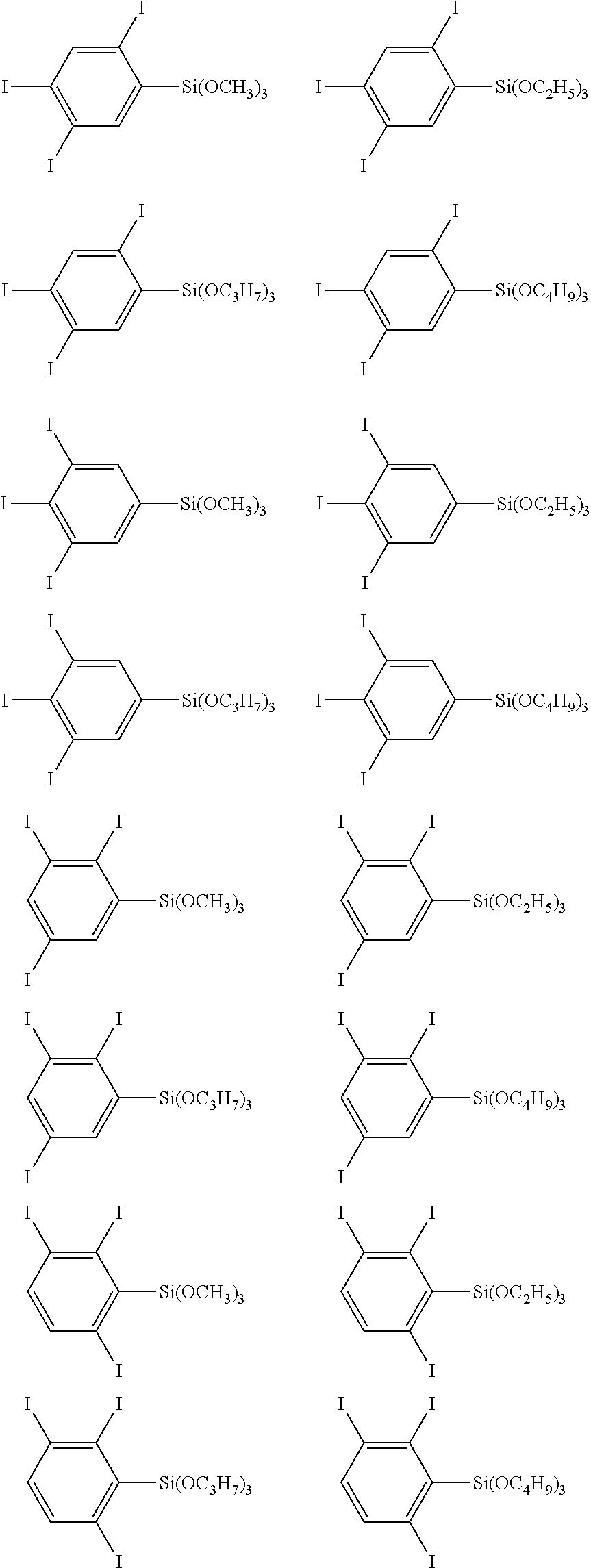
- the iodophenyl group-containing silicon compound that can be produced according to the inventive method as described above is not particularly limited. Examples thereof include the following compounds.
- the resulting iodine-containing silicon compound can be directly used to produce an iodine-containing polysiloxane, or can be used to produce an iodine-containing polysiloxane after purified by distillation in some cases.
- a 300-ml three-necked glass flask was equipped with a reflux condenser and a thermometer. The inside of the flask was purged with nitrogen. This flask was charged with 27 g (0.1 mol) of 4-trimethylsilylphenyltrimethoxysilane and 80 g of methylene chloride. While the mixture was being stirred with a magnetic stirrer, the temperature inside the flask was adjusted to 10° C., and a mixture of 16.5 g of iodine monochloride and 80 g of methylene chloride was added dropwise over 30 minutes. Then, the resultant was aged at 25° C. for 1 hour.
- a 500-ml three-necked glass flask was equipped with a reflux condenser and a thermometer. The inside of the flask was purged with nitrogen. This flask was charged with 34 g (0.1 mol) of 3-trimethylsilylphenylethyltriethoxysilane and 100 g of methylene chloride. While the mixture was being stirred with a magnetic stirrer, the temperature inside the flask was adjusted to 10° C., and a mixture of 16.5 g of iodine monochloride and 80 g of methylene chloride was added dropwise over 30 minutes. Then, the resultant was aged at 25° C. for 1 hour.
- a 1000-ml three-necked glass flask was equipped with a reflux condenser and a thermometer. The inside of the flask was purged with nitrogen. This flask was charged with 34 g (0.1 mol) of 3, 4-bistrimethylsilylphenyltrimethoxysilane and 200 g of methylene chloride. While the mixture was being stirred with a magnetic stirrer, the temperature inside the flask was adjusted to 10° C., and a mixture of 33 g of iodine monochloride and 200 g of methylene chloride was added dropwise over 30 minutes. Then, the resultant was aged at 25° C. for 2 hours.
- a 300-ml three-necked glass flask was equipped with a reflux condenser and a thermometer. The inside of the flask was purged with nitrogen. This flask was charged with 20 g (0.1 mol) of phenyltrimethoxysilane and 80 g of methylene chloride. While the mixture was being stirred with a magnetic stirrer, the temperature inside the flask was adjusted to 10° C., and a mixture of 16.5 g of iodine monochloride and 80 g of methylene chloride was added dropwise over 30 minutes. Then, the resultant was aged at 25° C. for 1 hour. When the reaction was checked by GC, the raw material remained unreacted. Subsequently, the reaction temperature was adjusted to 40° C., and the reaction was allowed for another 3 hours. Consequently, the raw material broke down, and a peak of iodobenzene was exhibited.
- a 300-ml three-necked glass flask was equipped with a reflux condenser and a thermometer. The inside of the flask was purged with nitrogen. This flask was charged with 23 g (0.1 mol) of phenylethyltrimethoxysilane and 80 g of methylene chloride. While the mixture was being stirred with a magnetic stirrer, the temperature inside the flask was adjusted to 10° C., and a mixture of 16.5 g of iodine monochloride and 80 g of methylene chloride was added dropwise over 30 minutes. Then, the resultant was aged at 25° C. for 1 hour. When the reaction was checked by GC, the raw material remained unreacted. Subsequently, the reaction temperature was adjusted to 40° C., and the reaction was allowed for another 30 hours, but no progress in the reaction was observed.
- each raw material did not break down by the reaction at 25° C. (around room temperature) for 1 to 2 hours, but the raw material successfully disappeared. Thus, it was possible to obtain the target iodophenyl group-containing silicon compounds in high yields.
- an iodine-containing silicon compound can be produced by substituting iodine for a trialkylsilyl group under moderate conditions in a short time, in other words, an iodophenyl group-containing silicon compound can be economically produced without causing hydrolysis of a hydrolysable alkoxy group.
- the present invention is capable of economically producing an iodophenyl group-containing hydrolysable silicon compound, which is for forming an iodophenyl group-containing polysiloxane underlayer film expected to improve EUV lithography performance. This indicates that the industrial value of the present invention is quite high.
Landscapes
- Chemical & Material Sciences (AREA)
- Organic Chemistry (AREA)
- Chemical Kinetics & Catalysis (AREA)
- Engineering & Computer Science (AREA)
- Architecture (AREA)
- Structural Engineering (AREA)
- Physics & Mathematics (AREA)
- General Physics & Mathematics (AREA)
Abstract

where all of R0's may be identical to or different from each other and each represent an alkyl group having 1 to 6 carbon atoms; R1 represents a single bond or a divalent organic group; R2 represents an organic group having 1 to 10 carbon atoms; R3 represents an organic group having 1 to 10 carbon atoms; R represents an organic group having 1 to 6 carbon atoms; n0 is 1, 2, or 3, n1 is 1, 2, or 3, n2 is 0, 1, or 2, and n3 is 0, 1, or 2, provided that 1≤n1+n3≤3; and X represents a counter substituent of iodine, acting as an electrophilic reactive species.
Description


wherein all of R0's may be identical to or different from each other and each represent an alkyl group having 1 to 6 carbon atoms; R1 represents a single bond or a divalent organic group; R2 represents an organic group having 1 to 10 carbon atoms; R3 represents an organic group having 1 to 10 carbon atoms; R represents an organic group having 1 to 6 carbon atoms; n0 is 1, 2, or 3, n1 is 1, 2, or 3, n2 is 0, 1, or 2, and n3 is 0, 1, or 2, provided that 1≤n1+n3≤3; and X represents a counter substituent of iodine, acting as an electrophilic reactive species.

wherein all of R0's may be identical to or different from each other and each represent an alkyl group having 1 to 6 carbon atoms; R1 represents a single bond or a divalent organic group; R2 represents an organic group having 1 to 10 carbon atoms; R3 represents an organic group having 1 to 10 carbon atoms; R represents an organic group having 1 to 6 carbon atoms; n0 is 1, 2, or 3, n1 is 1, 2, or 3, n2 is 0, 1, or 2, and n3 is 0, 1, or 2, provided that 1≤n1+n3≤3; and X represents a counter substituent of iodine, acting as an electrophilic reactive species.

In the reaction equation, all of R0's may be identical to or different from each other and each represent an alkyl group having 1 to 6 carbon atoms, R1 represents a single bond or a divalent organic group, R2 represents an organic group having 1 to 10 carbon atoms, R3 represents an organic group having 1 to 10 carbon atoms, and R represents an organic group having 1 to 6 carbon atoms. n0 is 1, 2, or 3, n1 is 1, 2, or 3, n2 is 0, 1, or 2, and n3 is 0, 1, or 2, provided that 1≤n1+n3≤3. X is a counter substituent of iodine and acts as an electrophilic reactive species.




Claims (4)

Applications Claiming Priority (3)
| Application Number | Priority Date | Filing Date | Title |
|---|---|---|---|
| JP2018212146A JP7406300B2 (en) | 2018-11-12 | 2018-11-12 | Method for producing iodine-containing silicon compound |
| JPJP2018-212146 | 2018-11-12 | ||
| JP2018-212146 | 2018-11-12 |
Publications (2)
| Publication Number | Publication Date |
|---|---|
| US20200148709A1 US20200148709A1 (en) | 2020-05-14 |
| US11518774B2 true US11518774B2 (en) | 2022-12-06 |
Family
ID=68581265
Family Applications (1)
| Application Number | Title | Priority Date | Filing Date |
|---|---|---|---|
| US16/597,929 Active 2040-12-11 US11518774B2 (en) | 2018-11-12 | 2019-10-10 | Method for producing iodine-containing silicon compound |
Country Status (6)
| Country | Link |
|---|---|
| US (1) | US11518774B2 (en) |
| EP (1) | EP3650452B1 (en) |
| JP (1) | JP7406300B2 (en) |
| KR (1) | KR102376869B1 (en) |
| CN (1) | CN111171070A (en) |
| TW (1) | TWI705070B (en) |
Citations (12)
| Publication number | Priority date | Publication date | Assignee | Title |
|---|---|---|---|---|
| US4048206A (en) * | 1975-04-22 | 1977-09-13 | Mikhail Grigorievich Voronkov | Process for the production of 1-organylsilatranes and carbofunctional derivatives thereof |
| WO2001083608A1 (en) | 2000-04-27 | 2001-11-08 | Dow Corning Corporation | Curable silicone resin composition and reactive silicon compounds |
| JP2005001996A (en) * | 2003-06-09 | 2005-01-06 | Asahi Glass Co Ltd | New compounds and their uses |
| WO2006097717A1 (en) * | 2005-03-15 | 2006-09-21 | Isis Innovation Limited | Highly branched dendrimers |
| US20080227941A1 (en) | 2007-03-07 | 2008-09-18 | Kabushiki Kaisha Toyota Chuo Kenkyusho | Organosilane compound and organosilica obtained therefrom |
| CN102051121A (en) * | 2009-12-02 | 2011-05-11 | 合肥凯蒙新材料有限公司 | Antireflection coating for 193-nano-wavelength photolithography and preparation method and application thereof |
| WO2011108712A1 (en) | 2010-03-04 | 2011-09-09 | 国立大学法人北海道大学 | 6,13-dihalogen-5,14-dihydropentacene derivative and method for producing 6,13-substituted-5,14-dihydropentacene derivative using same |
| WO2013056073A1 (en) | 2011-10-14 | 2013-04-18 | The Board Of Trustees Of The University Of Illinois | Compounds and anti-tumor nqo1 substrates |
| JP2015122437A (en) | 2013-12-24 | 2015-07-02 | 富士フイルム株式会社 | Organic membrane transistor, organic semiconductor membrane and organic semiconductor material |
| JP2018029264A (en) * | 2016-08-17 | 2018-02-22 | キヤノン株式会社 | Image processing apparatus, control method for the same, and program |
| US20190258160A1 (en) * | 2018-02-22 | 2019-08-22 | Shin-Etsu Chemical Co., Ltd. | Resist composition and patterning process |
| US20200159120A1 (en) * | 2018-11-21 | 2020-05-21 | Shin-Etsu Chemical Co., Ltd. | Thermosetting iodine- and silicon-containing material, composition containing the material for forming resist underlayer film for euv lithography, and patterning process |
Family Cites Families (2)
| Publication number | Priority date | Publication date | Assignee | Title |
|---|---|---|---|---|
| US8053588B2 (en) * | 2007-03-07 | 2011-11-08 | Kabushiki Kaisha Toyota Chuo Kenkyusho | Organosilane compound and organosilica obtained therefrom |
| JP5830044B2 (en) * | 2013-02-15 | 2015-12-09 | 信越化学工業株式会社 | Resist underlayer film forming composition and pattern forming method |
-
2018
- 2018-11-12 JP JP2018212146A patent/JP7406300B2/en active Active
-
2019
- 2019-10-10 US US16/597,929 patent/US11518774B2/en active Active
- 2019-11-08 CN CN201911088837.5A patent/CN111171070A/en active Pending
- 2019-11-08 TW TW108140556A patent/TWI705070B/en active
- 2019-11-11 KR KR1020190143460A patent/KR102376869B1/en active Active
- 2019-11-12 EP EP19208618.9A patent/EP3650452B1/en active Active
Patent Citations (19)
| Publication number | Priority date | Publication date | Assignee | Title |
|---|---|---|---|---|
| US4048206A (en) * | 1975-04-22 | 1977-09-13 | Mikhail Grigorievich Voronkov | Process for the production of 1-organylsilatranes and carbofunctional derivatives thereof |
| WO2001083608A1 (en) | 2000-04-27 | 2001-11-08 | Dow Corning Corporation | Curable silicone resin composition and reactive silicon compounds |
| US20030130389A1 (en) | 2000-04-27 | 2003-07-10 | Pierre Chevalier | Curable silicone resin composition and reactive silicon compounds |
| JP2003531942A (en) | 2000-04-27 | 2003-10-28 | ダウ・コ−ニング・コ−ポレ−ション | Curable silicone resin composition and reactive silicon compound |
| US6780471B2 (en) * | 2000-04-27 | 2004-08-24 | Dow Corning Corporation | Curable silicone resin composition and reactive silicon compounds |
| JP2005001996A (en) * | 2003-06-09 | 2005-01-06 | Asahi Glass Co Ltd | New compounds and their uses |
| WO2006097717A1 (en) * | 2005-03-15 | 2006-09-21 | Isis Innovation Limited | Highly branched dendrimers |
| US20080227941A1 (en) | 2007-03-07 | 2008-09-18 | Kabushiki Kaisha Toyota Chuo Kenkyusho | Organosilane compound and organosilica obtained therefrom |
| JP2008214314A (en) | 2007-03-07 | 2008-09-18 | Toyota Central R&D Labs Inc | Organosilane compound and organosilica obtained using the same |
| CN102051121A (en) * | 2009-12-02 | 2011-05-11 | 合肥凯蒙新材料有限公司 | Antireflection coating for 193-nano-wavelength photolithography and preparation method and application thereof |
| WO2011108712A1 (en) | 2010-03-04 | 2011-09-09 | 国立大学法人北海道大学 | 6,13-dihalogen-5,14-dihydropentacene derivative and method for producing 6,13-substituted-5,14-dihydropentacene derivative using same |
| US20130079530A1 (en) | 2010-03-04 | 2013-03-28 | National University Corporation Hokkaido University | 6,13-dihalogen-5,14-dihydropentacene derivative and method for producing 6,13-substituted-5,14-dihydropentacene derivative using same |
| WO2013056073A1 (en) | 2011-10-14 | 2013-04-18 | The Board Of Trustees Of The University Of Illinois | Compounds and anti-tumor nqo1 substrates |
| US20150011509A1 (en) | 2011-10-14 | 2015-01-08 | The Board Of Trustees Of The University Of Illnois | Compounds and anti-tumor nqo1 substrates |
| JP2015122437A (en) | 2013-12-24 | 2015-07-02 | 富士フイルム株式会社 | Organic membrane transistor, organic semiconductor membrane and organic semiconductor material |
| US20160301018A1 (en) | 2013-12-24 | 2016-10-13 | Fujifilm Corporation | Organic Transistor, Compound, Organic Semiconductor Material for Non-Light-Emitting Organic Semiconductor Device, Material for Organic Transistor, Coating Solution for Non-Light-Emitting Organic Semiconductor Device, and Organic Semiconductor Film for Non-Light-Emitting Organic Semiconductor Device |
| JP2018029264A (en) * | 2016-08-17 | 2018-02-22 | キヤノン株式会社 | Image processing apparatus, control method for the same, and program |
| US20190258160A1 (en) * | 2018-02-22 | 2019-08-22 | Shin-Etsu Chemical Co., Ltd. | Resist composition and patterning process |
| US20200159120A1 (en) * | 2018-11-21 | 2020-05-21 | Shin-Etsu Chemical Co., Ltd. | Thermosetting iodine- and silicon-containing material, composition containing the material for forming resist underlayer film for euv lithography, and patterning process |
Non-Patent Citations (15)
| Title |
|---|
| G. Cerveau et al., 626 Journal of Organometallic Chemistry, 92-99 (2001) (Year: 2001). * |
| H. Kinoshita et al., 15 Organic Letters, 2962-2965 (2013) (Year: 2013). * |
| Jan. 18, 2022 Office Action issued in Japanese Patent Application No. 2018-212146. |
| Jesus Hierrezuelo et al: "Synthesis and Structural Analysis of Substituted Tripod-Shaped Tri- and Tetra(p-phenylene)s", Eur. J. Org. Chem., 2010, pp. 5672-5680. |
| Jul. 13, 2021 Notification of Reasons for Refusal issued in Japanese Patent Application No. 2018-212146. |
| Jul. 23, 2021 Office Action issued in Korean Patent Application No. 10-2019-0143460. |
| M. Kauch et al., 10 Synthesis, 1578-1589 (2006) (Year: 2006). * |
| Maegawa Yoshifumi et al: "A new synthetic approach for functional triisopropoxyorganosilanes using molecular building blocks", Tetrahedron, Elsevier Science Publishrs, Amsterdam, NL, vol. 69, No. 26, pp. 5312-5318, XP028551479. |
| Maegawa Yoshifumi et al: "Preparation of functionalized aryl(diallyl)ethoxysilanes and their palladium-catalyzed coupling reactions giving sol-gel precursors", Tetrahedron, Elsevier Science Publishrs, Amsterdam, NL, vol. 63, No. 46, pp. 11467-11474, XP022284182. |
| MAEGAWA YOSHIFUMI; WAKI MINORU; UMEMOTO AKINARI; SHIMADA TOYOSHI; INAGAKI SHINJI: "A new synthetic approach for functional triisopropoxyorganosilanes using molecular building blocks", TETRAHEDRON, ELSEVIER SIENCE PUBLISHERS, AMSTERDAM, NL, vol. 69, no. 26, 2 May 2013 (2013-05-02), AMSTERDAM, NL , pages 5312 - 5318, XP028551479, ISSN: 0040-4020, DOI: 10.1016/j.tet.2013.04.130 |
| MAEGAWA, Y. NAGANO, T. YABUNO, T. NAKAGAWA, H. SHIMADA, T.: "Preparation of functionalized aryl(diallyl)ethoxysilanes and their palladium-catalyzed coupling reactions giving sol-gel precursors", TETRAHEDRON, ELSEVIER SIENCE PUBLISHERS, AMSTERDAM, NL, vol. 63, no. 46, 4 October 2007 (2007-10-04), AMSTERDAM, NL , pages 11467 - 11474, XP022284182, ISSN: 0040-4020, DOI: 10.1016/j.tet.2007.08.011 |
| Mar. 12, 2020 Extended European Search Report issued in European Patent Application No. 19208618.9. |
| R. Beckwith, 554 Nature, 36-38 (2018) (Year: 2018). * |
| Y. Maegawa et al., 63 Tetrahedron, 11467-11474 (2013) (Year: 2013). * |
| Y. Maegawa et al., 69 Tetrahedron, 5312-5318 (2013) (Year: 2013). * |
Also Published As
| Publication number | Publication date |
|---|---|
| TW202024104A (en) | 2020-07-01 |
| TWI705070B (en) | 2020-09-21 |
| US20200148709A1 (en) | 2020-05-14 |
| KR102376869B1 (en) | 2022-03-18 |
| JP7406300B2 (en) | 2023-12-27 |
| EP3650452A1 (en) | 2020-05-13 |
| EP3650452B1 (en) | 2021-09-08 |
| KR20200054896A (en) | 2020-05-20 |
| CN111171070A (en) | 2020-05-19 |
| JP2020079208A (en) | 2020-05-28 |
Similar Documents
| Publication | Publication Date | Title |
|---|---|---|
| US8329931B2 (en) | Organoaluminum compound | |
| US6946566B2 (en) | Process for preparation of optically active halogeno hydroxypropyl compound and glycidyl compound | |
| US20170282169A1 (en) | Aluminum catalyst | |
| US9181283B2 (en) | Methods of preparing low molecular weight carbosilanes and precursors thereof | |
| JP4351689B2 (en) | Method for producing N, N'-disubstituted p-quinonediimine, stabilizer comprising the diamine, organobrown composition, method for stabilizing the same, and phase transfer catalyst method | |
| JP6818741B2 (en) | Method for preparing 1,4-bis (ethoxymethyl) cyclohexane | |
| US20210355145A1 (en) | Process for producing dimethylchlorosilane compound | |
| US20200148709A1 (en) | Method for producing iodine-containing silicon compound | |
| EP3344634A1 (en) | Organosilicon compounds having (meth)acrylate groups and a process for preparation thereof | |
| JP2009149595A (en) | Method for producing cyanoethyl ethers | |
| CN1764622A (en) | Process for producing 2-(l-menthoxy)ethanol compound | |
| US12630569B2 (en) | Method for producing organic silicon compound having ketimine structure | |
| JP2021143159A (en) | Method for producing organic silicon compound having ketimine structure | |
| JP4440585B2 (en) | Process for producing 4-methyl-5-formylthiazole | |
| US6545166B2 (en) | Process for producing spiro acetal derivative | |
| EP3660025B1 (en) | Nitrogen-containing cyclic organoxysilane compound and method for producing the same | |
| JP4173378B2 (en) | Substituted aminoalkyl acrylate derivative or salt thereof | |
| KR101175203B1 (en) | Manufacturing Method of Silylferrocene-HTPB Complex | |
| EP1288184B1 (en) | Bis(diphenylvinyl)arene compound | |
| JP4788907B2 (en) | Method for producing silicone resin | |
| JP3871620B2 (en) | Method for producing thiol compound | |
| JP4362268B2 (en) | Method for producing chlorinated aromatic compound | |
| JPH03135986A (en) | Preparation of o-sililate aliphatic hydroxyl compound | |
| JP2014108923A (en) | Organosilicon compound | |
| JPH10139787A (en) | New silane coupling agent |
Legal Events
| Date | Code | Title | Description |
|---|---|---|---|
| FEPP | Fee payment procedure |
Free format text: ENTITY STATUS SET TO UNDISCOUNTED (ORIGINAL EVENT CODE: BIG.); ENTITY STATUS OF PATENT OWNER: LARGE ENTITY |
|
| STPP | Information on status: patent application and granting procedure in general |
Free format text: NON FINAL ACTION MAILED |
|
| STPP | Information on status: patent application and granting procedure in general |
Free format text: RESPONSE TO NON-FINAL OFFICE ACTION ENTERED AND FORWARDED TO EXAMINER |
|
| STPP | Information on status: patent application and granting procedure in general |
Free format text: FINAL REJECTION MAILED |
|
| STPP | Information on status: patent application and granting procedure in general |
Free format text: RESPONSE AFTER FINAL ACTION FORWARDED TO EXAMINER |
|
| STPP | Information on status: patent application and granting procedure in general |
Free format text: NOTICE OF ALLOWANCE MAILED -- APPLICATION RECEIVED IN OFFICE OF PUBLICATIONS |
|
| STPP | Information on status: patent application and granting procedure in general |
Free format text: PUBLICATIONS -- ISSUE FEE PAYMENT VERIFIED |
|
| STCF | Information on status: patent grant |
Free format text: PATENTED CASE |