US114792A - Improvement in printing-telegraph apparatus - Google Patents
Improvement in printing-telegraph apparatus Download PDFInfo
- Publication number
- US114792A US114792A US114792DA US114792A US 114792 A US114792 A US 114792A US 114792D A US114792D A US 114792DA US 114792 A US114792 A US 114792A
- Authority
- US
- United States
- Prior art keywords
- wheel
- printing
- magnet
- type
- circuit
- Prior art date
- Legal status (The legal status is an assumption and is not a legal conclusion. Google has not performed a legal analysis and makes no representation as to the accuracy of the status listed.)
- Expired - Lifetime
Links
- 238000000034 method Methods 0.000 description 4
- 150000001875 compounds Chemical class 0.000 description 3
- 230000033001 locomotion Effects 0.000 description 3
- 230000005540 biological transmission Effects 0.000 description 1
- 238000010276 construction Methods 0.000 description 1
- XEEYBQQBJWHFJM-UHFFFAOYSA-N iron Substances [Fe] XEEYBQQBJWHFJM-UHFFFAOYSA-N 0.000 description 1
- 229910052742 iron Inorganic materials 0.000 description 1
- 239000002184 metal Substances 0.000 description 1
- 229910052751 metal Inorganic materials 0.000 description 1
Images

Classifications
-
- H—ELECTRICITY
- H04—ELECTRIC COMMUNICATION TECHNIQUE
- H04L—TRANSMISSION OF DIGITAL INFORMATION, e.g. TELEGRAPHIC COMMUNICATION
- H04L13/00—Details of the apparatus or circuits covered by groups H04L15/00 or H04L17/00
- H04L13/02—Details not particular to receiver or transmitter
- H04L13/06—Tape or page guiding or feeding devices
Definitions
- Figure 2 is a side elevation of the same.
- Figure 3 are the arrangements of the magnets and circuits.
- F designates a metallic frame, which forms the bearings for the working parts of our apparatus.
- this frame F In the upper part of this frame F is secured the type-wheel shaft A, on which is secured the type-wheel B, the said type-wheel being movable upon its axis A, and held in place by the collets-c c and a dog, D, acting in a catch or space, a or a.
- a piece, w Secured to wheel B is a piece, w, which may be metal or otherwise, having upon its lower edge or surface two beveled sides or faces, forming a triangularshaped space, 0, and upon its upper surface is atooth,. c, and two corresponding spaces, a a.
- an arm, E upon which works or swings the dog or detent D, which plays in the spaces a. or a, and is held in place by the spring s.
- printing-lever P is moved suddenly toward the wheel B, and the stud t, acting upon the dog D, displaces it from the space a, and the stud j, acting upon one of the faces of the triangular-shaped space 0, causes the type-wheel B to turn on its axis Athe distance of one tooth, and the dog D, being pressed into the space a by the spring S, the wheel B is again secured, and by the movement the type-wheel B hasbeen placed in position to be used as afignre, fraction, and sign-wheel, converting it, therefore, alternately, and at will, into a letter or a figure and fraction-wheel; w'e dispense with the second wheel which it has been necessary to use, and at the same time work ourdouble' wheel as rapidly as though it had only half the number of characters upon its periphery; so that insteadof loss of time in transmission from having a large wheel, vwhich is necessary to have where so many characters are used, we gain in speed and can do more work with our double wheel and-
- an electro-magnet M, figs. 2 and 3, in 'the circuit with-our compound magnet A A A",in such a manner that when the type-wheel is being rotated the magnet M in the same circuit with the typewlieel magnet prevents the printing-lever, or any part connected therewith, from coming in contact with or striking against the type-wheel B, and when the typewheel is brought to a desired position, the current over magnet M being broken, the impression is taken from the wheel by the use of a spring, S, instead of using an electro-magnet, as is the practice.
- the circuit may be closed or broken or changed by or with any of the weli-known circuit closers or ⁇ 10161 changers, and especially by the pole-changer described and secured tons in Letters Patent bearing date or granted December 16.
- the circuit passes from post 1 over wire a to magnet M, over wire a" and helix A and wire a! to post 2, and then as before;
Landscapes
- Engineering & Computer Science (AREA)
- Computer Networks & Wireless Communication (AREA)
- Signal Processing (AREA)
- Printing Methods (AREA)
Description
2 Shl=.ets--Sheet1= CHARLES A. RANDALL. ent in Printing T. M. FOOTE 8L ovem -Telegraph Apparatus.
lmpr
Patented May I6, 187?.
Mim
m emu l 2 Sheets Sheet 2. T. M. FOOTLE & CHARLES A. RANDALL.
Improvement in Printing-Telegraph Apparatus. .NO. 114,792. Patented May16,187l.'
mt: c0. :1. Y- (assvmvz's PROCESS.)
"(taint State;
haunt hffiu.
rnnononn M. FOOTE AND CHARLES A. RANDALL, or BROOKLYN, n. 1).,
NEW YORK.
Letters Patent No. 114,792, dated May 16,1871.
IMPROVEMENT IN PRINTING-TELEGRAPH APPARATUS.
The Schedule referred to in these Letters Patent and making part of the lame.
To all whom it may concern Be it known that we, Tnnononn MxFootrn and Onannns A. RANDALL, of Brooklyn, E. D., in the county of Kings and State of N ew York, have invented new and useful Improvements in Printing-Telegraph Apparatus; and we do hereby declare the following to be a fu]1,clear, and exact description thereof, which will enable those skilled in the art to make and use the same, reference being had to the accompanying drawingforming part of this specification.
.The principal features of these improvements relate to the substituting of a'type-wheel that shall andmay be used in place ofthe two type-wheels it has ever been necessary to use in single-wired printing-telegraph instruments where letters, figures, fractions, and'signs havebeen used.
Second, to .the taking of the impressions from the type-wheel by means of or by the use of a spring, instead of using an electro-magnet, as has ever been the practice. By reference to the drawing, plate 2 and figs. 2 and 3, it is shown that we substitute an electro-magnet, M, in place of a spring, in combination with the paperfeeding apparatus, and. do the printing by the use of a spring, in contradistinctiou to the usual method,and an improvement over it for various reasons. 'We also show and may use an electromagnet, M, in circuit with the type-wheel magnet, the said magnet operating the printing-lever, to print by means of an extra current being sent over the magnet M, when the type-wheel has been brought to a desired position.
Third, the arranging of electro-magnets in a circuit in such a manner that no local battery shall be required upon the printing apparatus.
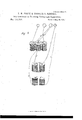
The'arrangement of the various parts of these improvements will be better understood by reference to the accompanying drawing, in which- Figure 1 is an end view.
Figure 2 is a side elevation of the same.
Figure 3 are the arrangements of the magnets and circuits.
Similar letters and marks of reference indicate like parts.
F, figs. 1 and 2, designates a metallic frame, which forms the bearings for the working parts of our apparatus.
In the upper part of this frame F is secured the type-wheel shaft A, on which is secured the type-wheel B, the said type-wheel being movable upon its axis A, and held in place by the collets-c c and a dog, D, acting in a catch or space, a or a.
Secured to wheel B is a piece, w, which may be metal or otherwise, having upon its lower edge or surface two beveled sides or faces, forming a triangularshaped space, 0, and upon its upper surface is atooth,. c, and two corresponding spaces, a a.
Secured upon the shaft A is an arm, E, upon which works or swings the dog or detent D, which plays in the spaces a. or a, and is held in place by the spring s.
Upon the periphery of the type-wheel B, fig. 1, are
the letters, figures, fractions, and signs, the letters being out upon every second tooth from a given point, and the figures, fractions, signs, 8250., being out upon the teeth between the letters.
Having, then, half as many teeth or movements in an escapemeut (where a step-by-step motion is imparted to a type-wheel, as is shown in our patents of July 5 and December 16, 1870) as. there are teeth in the typewheel, or letters, figures, fractions, 850., upon the periphery of the type-wheel, we complete the whole revolution of the type-wheel in the same time it would require to revolve a type-wheel having only thesaine number of teeth or letters, 860., as there are teeth in the escapement.
It is evident, however, that if we can get only half of the characters on a type-wheel at one and each revolution, there must be some way arranged by which we may obtain impressions from the other half of the characters. Having then used our letter-wheel, we,
stop our wheel B at some given point.
By means of a spring, S, on an electro-magnet, the
printing-lever P is moved suddenly toward the wheel B, and the stud t, acting upon the dog D, displaces it from the space a, and the stud j, acting upon one of the faces of the triangular-shaped space 0, causes the type-wheel B to turn on its axis Athe distance of one tooth, and the dog D, being pressed into the space a by the spring S, the wheel B is again secured, and by the movement the type-wheel B hasbeen placed in position to be used as afignre, fraction, and sign-wheel, converting it, therefore, alternately, and at will, into a letter or a figure and fraction-wheel; w'e dispense with the second wheel which it has been necessary to use, and at the same time work ourdouble' wheel as rapidly as though it had only half the number of characters upon its periphery; so that insteadof loss of time in transmission from having a large wheel, vwhich is necessary to have where so many characters are used, we gain in speed and can do more work with our double wheel and-one wire than is done with two wheels and one or more wires in other printing-telegraphs.
We do not confine ourselves to the use of one wheel of this construction, neither to a type-wheel with any especial number of characters upon it.
In operating our printing-telegraph we employ a compound magnet, having a soft-iron bar or vibrating armature passing through the helix A, fig. 3 The said compound magnet, together with the escapement used, having been described and secured by Letters Patent hearing date July 5 and December 16, 1870, further detail is unnecessary.
We do also use, for a purpose we believe to be new and advantageous, an electro-magnet, M, figs. 2 and 3, in 'the circuit with-our compound magnet A A A",in such a manner that when the type-wheel is being rotated the magnet M in the same circuit with the typewlieel magnet prevents the printing-lever, or any part connected therewith, from coming in contact with or striking against the type-wheel B, and when the typewheel is brought to a desired position, the current over magnet M being broken, the impression is taken from the wheel by the use of a spring, S, instead of using an electro-magnet, as is the practice.
The circuit may be closed or broken or changed by or with any of the weli-known circuit closers or {10161 changers, and especially by the pole-changer described and secured tons in Letters Patent bearing date or granted December 16.
We also show and may use an electro-magnet, M, figs. 2 and 3, in the circuit with the type-wheel magnet in such a manner that the currents operating the type-wheel magnet will have no effect upon the magnet M, and when the type-wheel is brought to a desired position an extra current over magnet M, which may be quantity or intensity, will so affect and operate the magnet M that the printing is effected. By referenge to fig. 3 the currents will be more fully understoo I The current coming in at post 1 passes over wire a and magnet M, over wire 0 and helix A and wire 0 to post 2, and from there to line, and to other instruments in same circuit or to ground.
In the second method the circuit passes from post 1 over wire a to magnet M, over wire a" and helix A and wire a! to post 2, and then as before;
We are aware that it is not new to construct and operate one or more printing-telegraph instruments in one or more circuits without the aid of localbatteries,
and an electro-magnet has been used for the printing in the same line circuit with the type-wheel magnets, and we do not claim simply an electro-magnet for giving the impressions in the circuit with the typewheel magnets.
We are also well aware that the use of an increased second current over the line to eifect the printing is not new, as it is shown in the patent of J. Selden, March 23, 1869, No. 91,527; but he describes and claims only one magnet in aliue circuit, operating two armatures, one worked by' a weak current, and the other by a strong current, and they may be so connected that they shall throw in locals for working type-wheel and for printing.
Disclaiming, therefore any part or parts of this combination or improvements, we are aware that it is not newto operate theprintinglever by the direct action of the spring, as such a device, in combination with a relay and local battery, is shown in the English patent of M. Theiler, 1861, No. 2,429. g
What we believe to be new, and claim and desire to secure by Letters Patent, is-
1. The combination, with the type-wheel magnets, of an electro-mag'net, M, placed in the line circuit,
and the printing-lever operated directly thereby, as
shown and described.
2. The combination of the type-wheel magnets and an electro-magnet, M, placed inthe line circuit, the printing-lever P, and the spring S, when the retractive force of the said spring causes the impression to-be efl'ected on the interruption of the circuit, as set'forth.
3. The combination of the type-wheel B, printinglever'P,-studs 'i/ and j, arm E, dog D, spring S, and catch 10, provided with the depressions a and a, constructed and operating as set forth.
4. The method of feeding or spacing the paper after. each impression by the direct action of an electromagnet, as set'forth.
THEODORE M. FOOTE. CHARLES A. RANDALL.
Witnesses: CHARLES G. 00E, JAMES L. Nonms.
Publications (1)
| Publication Number | Publication Date |
|---|---|
| US114792A true US114792A (en) | 1871-05-16 |
Family
ID=2184252
Family Applications (1)
| Application Number | Title | Priority Date | Filing Date |
|---|---|---|---|
| US114792D Expired - Lifetime US114792A (en) | Improvement in printing-telegraph apparatus |
Country Status (1)
| Country | Link |
|---|---|
| US (1) | US114792A (en) |
-
0
- US US114792D patent/US114792A/en not_active Expired - Lifetime
Similar Documents
| Publication | Publication Date | Title |
|---|---|---|
| US367720A (en) | Heney mahnlven | |
| US26003A (en) | Improvement in telegraphic machines | |
| US544348A (en) | And emil germ ann | |
| US215551A (en) | Improvement in printing-telegraphs | |
| US112360A (en) | Improvement in telegraph apparatus | |
| US126329A (en) | Improvement in printing-telegraphs | |
| US578386A (en) | Telegraphic register | |
| US985824A (en) | Electric type-writing machine. | |
| US319001A (en) | Unison device for printing-telegraphs | |
| US116826A (en) | Improvement in printing-telegraphs | |
| US105060A (en) | Improvement in telegraphic printing apparatus | |
| US114793A (en) | foote | |
| US370691A (en) | Stephen d | |
| US102320A (en) | Improvement in printing-telegraph apparatus | |
| US525037A (en) | wendelboe | |
| US177661A (en) | Improvement in printing-telegraphs | |
| US328500A (en) | Printing-telegraph | |
| US179875A (en) | Improvement in printing-telegraphs | |
| US506269A (en) | Ments | |
| US106493A (en) | Improvement in electro-magnetic motors | |
| US103924A (en) | Improvement in printing-telegraph instruments | |
| US335275A (en) | Eichaed n | |
| USRE5267E (en) | Improvement in printing-telegraphs | |
| US140488A (en) | Improvement in printing-telegraphs | |
| US403472A (en) | hotchkiss |