US11413585B2 - Membrane element and membrane separation device - Google Patents
Membrane element and membrane separation device Download PDFInfo
- Publication number
- US11413585B2 US11413585B2 US16/912,286 US202016912286A US11413585B2 US 11413585 B2 US11413585 B2 US 11413585B2 US 202016912286 A US202016912286 A US 202016912286A US 11413585 B2 US11413585 B2 US 11413585B2
- Authority
- US
- United States
- Prior art keywords
- membrane
- threads
- filtration membrane
- melting point
- low
- Prior art date
- Legal status (The legal status is an assumption and is not a legal conclusion. Google has not performed a legal analysis and makes no representation as to the accuracy of the status listed.)
- Active, expires
Links
Images


Classifications
-
- B—PERFORMING OPERATIONS; TRANSPORTING
- B01—PHYSICAL OR CHEMICAL PROCESSES OR APPARATUS IN GENERAL
- B01D—SEPARATION
- B01D69/00—Semi-permeable membranes for separation processes or apparatus characterised by their form, structure or properties; Manufacturing processes specially adapted therefor
- B01D69/10—Supported membranes; Membrane supports
-
- B—PERFORMING OPERATIONS; TRANSPORTING
- B01—PHYSICAL OR CHEMICAL PROCESSES OR APPARATUS IN GENERAL
- B01D—SEPARATION
- B01D63/00—Apparatus in general for separation processes using semi-permeable membranes
- B01D63/08—Flat membrane modules
-
- B—PERFORMING OPERATIONS; TRANSPORTING
- B01—PHYSICAL OR CHEMICAL PROCESSES OR APPARATUS IN GENERAL
- B01D—SEPARATION
- B01D63/00—Apparatus in general for separation processes using semi-permeable membranes
- B01D63/08—Flat membrane modules
- B01D63/081—Manufacturing thereof
-
- B—PERFORMING OPERATIONS; TRANSPORTING
- B01—PHYSICAL OR CHEMICAL PROCESSES OR APPARATUS IN GENERAL
- B01D—SEPARATION
- B01D63/00—Apparatus in general for separation processes using semi-permeable membranes
- B01D63/08—Flat membrane modules
- B01D63/082—Flat membrane modules comprising a stack of flat membranes
-
- B—PERFORMING OPERATIONS; TRANSPORTING
- B01—PHYSICAL OR CHEMICAL PROCESSES OR APPARATUS IN GENERAL
- B01D—SEPARATION
- B01D63/00—Apparatus in general for separation processes using semi-permeable membranes
- B01D63/08—Flat membrane modules
- B01D63/082—Flat membrane modules comprising a stack of flat membranes
- B01D63/0821—Membrane plate arrangements for submerged operation
-
- B—PERFORMING OPERATIONS; TRANSPORTING
- B01—PHYSICAL OR CHEMICAL PROCESSES OR APPARATUS IN GENERAL
- B01D—SEPARATION
- B01D69/00—Semi-permeable membranes for separation processes or apparatus characterised by their form, structure or properties; Manufacturing processes specially adapted therefor
- B01D69/06—Flat membranes
-
- B—PERFORMING OPERATIONS; TRANSPORTING
- B01—PHYSICAL OR CHEMICAL PROCESSES OR APPARATUS IN GENERAL
- B01D—SEPARATION
- B01D69/00—Semi-permeable membranes for separation processes or apparatus characterised by their form, structure or properties; Manufacturing processes specially adapted therefor
- B01D69/10—Supported membranes; Membrane supports
- B01D69/107—Organic support material
- B01D69/1071—Woven, non-woven or net mesh
-
- B—PERFORMING OPERATIONS; TRANSPORTING
- B01—PHYSICAL OR CHEMICAL PROCESSES OR APPARATUS IN GENERAL
- B01D—SEPARATION
- B01D69/00—Semi-permeable membranes for separation processes or apparatus characterised by their form, structure or properties; Manufacturing processes specially adapted therefor
- B01D69/12—Composite membranes; Ultra-thin membranes
- B01D69/1213—Laminated layers
-
- C—CHEMISTRY; METALLURGY
- C02—TREATMENT OF WATER, WASTE WATER, SEWAGE, OR SLUDGE
- C02F—TREATMENT OF WATER, WASTE WATER, SEWAGE, OR SLUDGE
- C02F3/00—Biological treatment of water, waste water, or sewage
- C02F3/02—Aerobic processes
- C02F3/12—Activated sludge processes
- C02F3/1236—Particular type of activated sludge installations
- C02F3/1268—Membrane bioreactor systems
- C02F3/1273—Submerged membrane bioreactors
-
- B—PERFORMING OPERATIONS; TRANSPORTING
- B01—PHYSICAL OR CHEMICAL PROCESSES OR APPARATUS IN GENERAL
- B01D—SEPARATION
- B01D2313/00—Details relating to membrane modules or apparatus
- B01D2313/08—Flow guidance means within the module or the apparatus
-
- B—PERFORMING OPERATIONS; TRANSPORTING
- B01—PHYSICAL OR CHEMICAL PROCESSES OR APPARATUS IN GENERAL
- B01D—SEPARATION
- B01D2313/00—Details relating to membrane modules or apparatus
- B01D2313/14—Specific spacers
- B01D2313/146—Specific spacers on the permeate side
-
- B—PERFORMING OPERATIONS; TRANSPORTING
- B01—PHYSICAL OR CHEMICAL PROCESSES OR APPARATUS IN GENERAL
- B01D—SEPARATION
- B01D2315/00—Details relating to the membrane module operation
- B01D2315/06—Submerged-type; Immersion type
-
- B—PERFORMING OPERATIONS; TRANSPORTING
- B01—PHYSICAL OR CHEMICAL PROCESSES OR APPARATUS IN GENERAL
- B01D—SEPARATION
- B01D2325/00—Details relating to properties of membranes
- B01D2325/40—Fibre reinforced membranes
-
- B—PERFORMING OPERATIONS; TRANSPORTING
- B01—PHYSICAL OR CHEMICAL PROCESSES OR APPARATUS IN GENERAL
- B01D—SEPARATION
- B01D71/00—Semi-permeable membranes for separation processes or apparatus characterised by the material; Manufacturing processes specially adapted therefor
- B01D71/06—Organic material
- B01D71/30—Polyalkenyl halides
- B01D71/32—Polyalkenyl halides containing fluorine atoms
- B01D71/36—Polytetrafluoroethylene
-
- Y—GENERAL TAGGING OF NEW TECHNOLOGICAL DEVELOPMENTS; GENERAL TAGGING OF CROSS-SECTIONAL TECHNOLOGIES SPANNING OVER SEVERAL SECTIONS OF THE IPC; TECHNICAL SUBJECTS COVERED BY FORMER USPC CROSS-REFERENCE ART COLLECTIONS [XRACs] AND DIGESTS
- Y02—TECHNOLOGIES OR APPLICATIONS FOR MITIGATION OR ADAPTATION AGAINST CLIMATE CHANGE
- Y02W—CLIMATE CHANGE MITIGATION TECHNOLOGIES RELATED TO WASTEWATER TREATMENT OR WASTE MANAGEMENT
- Y02W10/00—Technologies for wastewater treatment
- Y02W10/10—Biological treatment of water, waste water, or sewage
Definitions
- the present invention relates to a membrane element for separating sludge and treated water employed in a field of membrane bioreactors (MBR) using activated sludge, and a submersions-type membrane separation device provided with such membrane elements.
- MLR membrane bioreactors
- FIG. 9 shows an example of a conventional membrane element of this type, in which a filtration membrane 102 is joined to both sides of a filter plate 101 made of a resin.
- a peripheral edge portion 102 a of the filtration membrane 102 is bonded to the filter plate 101 by thermal welding or ultrasonic welding.
- a flow path (not shown) for permeated liquid is formed between the filter plate 101 and the filtration membrane 102 and inside the filter plate 101 , and a permeated liquid outlet 103 in communication with the permeated liquid flow path is provided at an upper edge of the filter plate 101 .
- a plurality of membrane elements 104 such as that which are described above are arranged in a membrane case (not shown) at predetermined intervals.
- liquid to be treated is filtered by passing through the filtration membrane 102 from the primary side to the secondary side, and then flows through the permeated liquid flow path as the permeated liquid 105 , to be taken out through the permeated liquid outlet 103 .
- backwashing water is injected into the permeated liquid flow path from the permeated liquid outlet 103 .
- the backwash water passes through the filtration membrane 102 from the secondary side to the primary side, whereby the filtration membrane 102 is backwashed.
- the filtration membrane 102 may bulge outwardly (to the primary side) and come into contact with another filtration membrane 102 of an adjacent membrane element 104 , as indicated by the two-dot chain line. If the filtration membranes 102 of the adjacent membrane elements 104 bulge out and come into contact with each other, it may decrease the effectiveness of the backwashing. Furthermore, introducing the backwash water to the secondary side for a long period of time to swell the filtration membrane 102 may cause the welded portion of the peripheral edge portion 102 a of the filtration membrane 102 to break open.
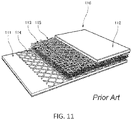
- a membrane element 116 as shown in FIG. 11 which includes a first filtration membrane 111 , a second filtration membrane 112 , a drainage fabric 113 provided between the filtration membranes 111 and 112 , an adhesive net 114 for bonding the first filtration membrane 111 and the drainage fabric 113 , and an adhesive net 115 for bonding the second filtration membrane 112 and the drainage fabric 113 .
- the drainage fabric 113 is a spacer fabric knitted into a three-dimensional structure forming loops.
- the drainage fabric 113 and the adhesive nets 114 and 115 are laminated between the first filtration membrane 111 and the second filtration membrane 112 .
- the adhesive nets 114 and 115 are temporarily melted, whereby the first filter membrane 111 and the drainage fabric 113 are bonded via the first adhesive net 114 , while the second filter membrane 112 and the drainage fabric 113 are bonded via the second adhesive net 115 so as to form the completed membrane element 116 .
- International Publication No. WO 2009/127345 A1 Japanese Patent Publication No. 2011-519716 illustrates such a membrane element 116 as described above.
- International Publication No. WO 2006/015461 A1 describes a method for forming a filtration membrane layer by coating a liquid membrane material resin (hereinafter referred to as a “dope”) dissolved in a solvent directly onto to one or both sides (faces) of a spacer fabric, and performing a phase separation.
- a liquid membrane material resin hereinafter referred to as a “dope”
- inner spaces (channels) of the spacer fabric serve as flow passages for the permeated liquid that has passed through the filtration membrane layer.
- the dope when the dope is directly applied to the surface of the spacer fabric and if the viscosity of the dope is low, the dope may enter such inner spaces (channels) of the spacer fabric and solidify therein, thereby impeding the flow of the permeate liquid inside the spacer fabric.
- an object of the present invention is to provide a membrane element and a membrane separation device capable of reducing the number of constituent parts.
- a membrane element in accordance with one aspect of the present invention, includes a filtration membrane and a flowpath member joined to the filtration membrane, where the flowpath member is formed of threads arranged into a three-dimensional structure.
- the flow path material includes (a) inner spaces formed therein through which permeated liquid permeated through the filtration membrane flows, and (b) an outer bonding surface joined to the filtration membrane. At least part of the threads forming the outer bonding surface is made of low-melting point yarn having a softening point lower than that of a material forming the filtration membrane.
- the filtration membrane is directly disposed onto the bonding surface of the flowpath member, and the flowpath member and the filtration membrane thus arranged are heated to such a temperature that is equal to or higher than the softening point of the low-melting point yarn forming the bonding surface, and lower than the softening point of the material forming the filtration membrane.
- the low-melting point yarn of the bonding surface is softened and the resin of the low-melting point yarn is entangled with the filtration membrane, whereby the filtration membrane is joined to the bonding surface of the flowpath member. Accordingly, since the membrane element can be manufactured with the flowpath member and the filtration membrane alone, it is possible to eliminate the need of a bonding-dedicated member such as an adhesive net, thereby reducing the number and types of the constituent parts to form the membrane element.
- the flowpath member is made of yarn arranged into a three-dimensional structure, where the flowpath member includes (a) inner spaces through which permeated liquid permeated through the filtration membrane flows, and (b) an outer bonding surface joined to the filtration membrane.
- the threads forming the outer bonding surface are formed by twisting a plurality of constituent threads, and at least one of the constituent threads is a low-melting point yarn having a softening point lower than that of a material forming the filtration membrane.
- the filtration membrane is directly disposed on the bonding surface of the flowpath member, and the thus-arranged flowpath member and filtration membrane are heated to such a temperature which is equal to or higher than the softening point of the low-melting point yarn forming the bonding surface, and lower than the softening point of the material forming the filtration membrane.
- the low-melting point yarn on the bonding surface is softened such that the resin of the low-melting-point yarn is entangled with the filtration membrane, whereby the filtration membrane is joined to the bonding surface of the flowpath member.
- the membrane element can be manufactured with the flowpath member and the filtration membrane alone, the need of a bonding-dedicated member, such as an adhesive net, is eliminated, whereby the number and types of constituent parts forming the membrane element can be reduced. In addition, softening of the filtration membrane can be prevented, thereby preventing changes in the pore size distribution of the filtration membrane.
- the low-melting point yarn is formed of a core material and a sheath material covering the core material, where the sheath material has a softening point lower than that of the material forming the filtration membrane, while the core material has a softening point higher than that of the sheath material.
- the filtration membrane is disposed on the bonding surface of the flowpath member, and the flowpath member and the filtration membrane are heated to a temperature which is equal to or higher than the softening point of the sheath material of the low-melting point yarn forming the bonding surface, and lower than the softening point of the core material thereof.
- the sheath material made of the low-melting point yarn is softened and the resin of the sheath material is entangled with the filtration membrane, whereby the filtration membrane is joined to the bonding surface of the flowpath member.
- the core material since the core material is prevented from softening during the heating process, the core material may be formed using a resin stronger than the sheath material of the yarn so as to improve the strength of the bonding surface, thereby increasing the rigidity of the flowpath member.
- the material of the low-melting point yarn is a polyolefin resin.
- the sheath material is a polyolefin resin.
- the flowpath member includes coupling threads coupled to the outer bonding surface, where the coupling threads form the inner spaces through which the permeated liquid flows.
- the coupling threads have a softening point higher than that of the low-melting point yarn forming the outer bonding surface.
- the filtration membrane is disposed on the bonding surface of the flowpath member, and the flowpath member and the filtration membrane are heated to the temperature which is equal to or higher than the softening point of the low-melting point yarn, and lower than the softening point of the coupling threads.
- softening of the coupling threads of the flowpath member is prevented such that the inner spaces are securely formed between the coupling threads, thereby allowing the permeated liquid that has passed through the filtration membrane to flow through the inner spaces within the flowpath member.
- the material forming the coupling threads is polyester resin.
- the filtration membrane has a porous membrane made of polytetrafluoroethylene (PTFE).
- a membrane separation device in accordance with another aspect of the present invention, includes a plurality of membrane elements each of which is according to one of the above-described membrane elements, and a support member supporting the plurality of membrane elements.
- the support member has a water collecting space therein, such that an end of each membrane element is inserted into the water collecting space, whereby the permeated liquid flows into the water collecting space through the inner spaces of the flowpath member.
- the liquid to be treated is filtered as passing through the filtration membrane of the membrane element from the primary side to the secondary side, and then, as the permeated liquid, flows into the inner spaces of the flowpath member through the bonding surface thereof, and then flows into the water collecting space of the support member through the inner spaces of the flowpath member.
- the membrane element can be formed by the flowpath member and the filtration membrane, a specific member for bonding, such as an adhesive net, is not required, whereby the number and types of the components forming the membrane element can be reduced.
- FIG. 1 is a front view of a membrane separation apparatus using a plurality of membrane separation devices according to a first embodiment of the present invention.
- FIG. 2 is a perspective view of the membrane separation device according to the first embodiment of the present invention.
- FIG. 3 is a sectional view of the membrane separation device according to the first embodiment of the present invention.
- FIG. 4 is a perspective view with a partial cutaway showing a structure of the membrane element of the membrane separation device according to the first embodiment of the present invention.
- FIG. 5 is a diagram schematically showing an enlarged view of the cross section of the membrane element according to the first embodiment of the present invention.
- FIG. 6 is a diagram schematically showing an enlarged view of the cross section of the flowpath member of the membrane element according to the first embodiment of the present invention.
- FIG. 7 is a view taken along the line XX in FIG. 6 , schematically showing an enlarged view of the bonding surface of the flowpath member.
- FIG. 8 is a diagram schematically showing an enlarged view of a cross section of a membrane element according to a second embodiment of the present invention.
- FIG. 9 is a front view of a conventional membrane element.
- FIG. 10 is a side view of the conventional membrane element, showing a state in which a plurality of membrane elements are arranged at predetermined intervals.
- FIG. 11 is a perspective view with a partial cutaway showing the structure of another conventional membrane element.
- an immersion type membrane separation device 1 is installed in a treatment tank 3 and immersed in liquid to be treated 2 such as organic waste water so as to perform membrane filtration operation.
- the membrane separation device 1 includes a plurality of membrane separation devices 5 (also referred to as membrane filtration modules) which are vertically stacked, and an air diffuser 6 is provided at the bottom under the stack of the membrane separation devices 5 .
- each membrane separation device 5 includes a pair of left and right water collecting cases 11 (an example of a supporting member), a plurality of membrane elements 12 supported between the pair of water collecting cases 11 , and a pair of front and rear connecting plates 13 .
- the water collecting case 11 is a hollow member having a water collecting space 15 therein.
- the front and rear connecting plates 13 are provided between the front end portions and between the rear end portions of the pair of water collecting cases 11 , respectively.
- the water collecting space 15 in the water collecting case 11 of the membrane separation device 5 is in communication with another water collecting space 15 of the water collection case of an upper or lower membrane separation device 5 adjacent thereto via a communication port 16 .
- An inner wall 17 of the water collecting case 11 is provided with a plurality of through holes extending vertically, such that the left or right side ends of the membrane elements 12 are inserted into the through holes so as to protrude into the water collecting space 15 , as shown in FIG. 3 .
- Each membrane element 12 is, for example, a flexible, quadrangular-shaped sheet member, and includes a flowpath member 21 and filtration membranes 22 joined to both of the front and back surfaces of the flowpath member 21 , as shown in FIG. 4 .
- the flowpath member 21 is a spacer fabric made of threads arranged into a three-dimensional structure.
- the flowpath member 21 includes a pair of bonding surfaces 25 (faces) each joined to the filtration membrane 22 , and a large number of pile threads 27 (an example of coupling threads) connecting the pair of the bonding surfaces 25 .
- Each of the bonding surfaces 25 is a textile (cloth) having a large number of warp threads 29 and woof threads 30 which intersect each other.
- the warp threads 29 and woof threads 30 are made of low-melting point yarn having a softening point T 2 lower than a softening point T 1 of the filtration membrane 22 .
- the softening point is a temperature at which the resin or the like is softened and become deformable.
- the warp threads 29 and the woof threads 30 are made of polyethylene (PE) yarn having a softening point T 2 of about 80° C. to 120° C.
- PE polyethylene
- Each of the warp threads 29 and the woof threads 30 may be formed by twisting a plurality of thinner constituent threads into a single warp thread 29 or woof thread 30 .
- the pile threads 27 are made of high-melting point yarn having a softening point T 3 higher than the softening point T 2 of the warp and woof threads 29 and 30 (an example of the low melting point yarn forming the bonding surface 25 ).
- the pile threads 27 may be polyethylene terephthalate (PET) yarn having the softening point T 3 of 260° C. or higher. Minute spaces (gaps) 32 are formed between the pile threads 27 , through which the permeated liquid 33 having passed through the filtration membrane 22 flows.
- the flowpath member 21 made of the spacer fabric as described above may employ yarn types as follows: the yarn type of the warp and woof threads 29 and 30 forming the bonding surface 25 (face) is SD84T24, the yarn type of the pile threads 27 is SD55T1, and the density of the pile threads 27 is about 380 threads/cm 2 .
- a thickness A of the flowpath member 21 as a single member before manufacturing the membrane element 12 is, for example, about 2 mm to 5 mm.
- SD84T24 means that the twisted yarn has a thickness of 84 dtex and the number of the twisted threads (component yarn) is 24, while SD55T1 means that the twisted yarn has a thickness of 55 dtex and the number of twisted threads (component yarn) is one.
- the filtration membrane 22 has a porous resin layer 22 a on the outer surface side thereof, and a resin-made support member 22 b on the inner surface side.
- the resin layer 22 a is a sheet of porous membrane having a large number of fine pores.
- the resin-made support member 22 b may be a resin layer such as a non-woven fabric, and supports the porous resin layer 22 a .
- the material of the porous resin layer 22 a may be polytetrafluoroethylene (PTFE), and the material of the resin-made support member 22 b may be polyethylene-terephthalate (PET) having a softening point T 1 of 260° C. to 280° C. (the softening point T 1 of the filtration membrane 22 ).
- the softening point of polytetrafluoroethylene is about 330° C. to 350° C. which is higher than the softening point T 1 of polyethylene-terephthalate.
- the flowpath member 21 is disposed between a pair of filtration membranes 22 .
- the three components of the flowpath member 21 and the pair of filtration membranes 22 are together inserted between a pair of upper and lower heating rolls, such that the three components are heated while compressed.
- the heating is conducted such that the temperature of the warp and woof threads 29 and 30 forming the bonding surface 25 of the flowpath member 21 becomes equal to or higher than the softening point T 2 thereof (that is, 80° C. to 120° C.) and yet lower than the softening point T 1 of the resin-made support member 22 b (that is, 260° C. to 280° C.).
- This allows the warp and woof threads 29 and 30 to soften such that the resin of the warp and woof threads 29 and 30 entangles with the resin-made support member 22 b of the filtration membrane 22 , whereby the filtration membrane 22 is joined to the bonding surface 25 of the flowpath member 21 .
- the heating temperature (the temperature of the heating roll) is set to 120° C. to 170° C. higher than the softening point T 2 .
- the filtration membrane 22 is joined to the flowpath member 21 by a number of contact points which are intersections of the warp threads 29 and the woof threads 30 . Since the temperature of the heated warp and woof threads 29 and 30 is set equal to or higher than the softening point T 2 thereof, and lower than the softening point T 1 of the resin-made support member 22 b , as described above, the filtration membrane 22 is prevented from softening. Accordingly, it is possible to prevent the pore size distribution of the filtration membrane 22 from changing, and the filtration membrane 22 from wrinkling.
- the membrane element 12 can be manufactured from the flowpath member 21 and the filtration membrane 22 alone, another member dedicated to adhesion such as an adhesive net is not necessary, the number of types of components (constituent parts) for the membrane element 12 can be reduced.
- the thickness of the membrane element 12 manufactured in this way is, for example, 1 to 3 mm.
- the softening point T 3 of the pile threads 27 is higher than the softening point T 2 of the warp and woof threads 29 and 30 , and is the same as that of the softening point T 1 of the resin-made support member 22 b , the temperature of the pile threads 27 heated by the heating rolls is lower than the softening point T 3 thereof, as described above. Accordingly, the pile threads 27 are prevented from softening and deforming, which ensures that the minute spaces 32 serving as channels are reliably formed between and among the pile threads 27 within the flowpath member 21 .
- the membrane element 12 of the present invention is made by heating such that the filtration membrane 22 is fused to the flowpath member 21 (spacer fabric), unlikely to a conventional method, it does not use a dope which is dissolved in a solvent and directly applied to a surface of the spacer fabric to form a filtration membrane layer thereon. Thus, there is no such a risk as that the dope infiltrates into the minute spaces 32 in the flowpath member 21 and solidifies therein, blocking or obstructing the minute spaces 32 serving as channels for the permeated liquid 33 .
- a filtration operation for liquid to be treated 2 is performed by a plurality of membrane separation devices 5 immersed therein, each of which is provided with a plurality of flexible membrane elements 12 manufactured as described above.
- the liquid to be treated 2 is filtered by passing through the filtration membrane 22 of the membrane element 12 from the primary side to the secondary side, and then, as permeated liquid 33 , flows into the minute spaces 32 of the flowpath member 21 through each opening 31 formed between the warp threads 29 and the woof threads 30 of the bonding surface 25 of the flowpath member 21 (See FIG. 7 ).
- the permeated liquid 33 flows through the minute spaces 32 out of the flowpath member 21 into the water collecting space 15 of the water collecting case 11 in each membrane separation device 5 .
- the permeated liquid 33 thus collected in each water collecting case 11 communicates through the communication port 16 and then is taken out from the water collecting case 11 of the uppermost membrane separation device 5 to the outside of the treatment tank 3 .
- the warp and woof threads 29 and 30 are made of the low-melting point yarn having the softening point T 2 lower than the softening point T 1 of the resin-made support member 22 b of the filtration membrane 22 .
- the bonding surface 25 may be such a textile in which the low-melting point yarn may is used for every few threads thereof.
- part of the warp and woof threads 29 and 30 may be made of the low-melting point yarn.
- each of the warp and woof threads 29 and 30 may be formed by twisting a plurality of constituent threads, and one or more of the constituent threads of the warp and woof threads 29 and 30 may be made of the low-melting point yarn.
- the low-melting point yarn may be made of polyethylene
- the constituent threads other than that made of polyethylene yarn may be made of polyethylene-terephthalate yarn.
- either one of the warp and woof threads 29 and 30 may be made of the low-melting point yarn, and the other may be formed by twisting a plurality of constituent threads, where one or more of the plurality of constituent threads may be made of the low-melting point yarn.
- polyethylene is used for the warp and woof threads 29 and 30 .
- the present invention is not limited to this, and a polyolefin resin other than polyethylene may be used.
- polyethylene-terephthalate is used for the pile threads 27
- the material for the pile threads is not limited to this, and a polyester resin other than polyethylene-terephthalate may be used.
- the bonding surface 25 of the flowpath member 21 is a textile having a large number of warp threads 29 and woof threads 30 which intersect with each other.
- the warp and woof threads 29 and 30 are made of composite yarn having a core material 45 and a sheath material 46 covering the outer surface of the core material 45 .
- the sheath material 46 has a softening point T 4 lower than the softening point T 1 of the resin-made support member 22 b of the filtration membrane 22 .
- the sheath material 46 is made of polyethylene (PE) having a softening point T 4 of about 80° C. to 120° C.
- the core material 45 has a softening point T 5 higher than the softening point T 4 of the sheath material 46 .
- the core material 45 is made of polyethylene terephthalate (PET) having a softening point T 5 of 260° C. or higher.
- the flowpath member 21 is sandwiched between a pair of filtration membranes 22 , and the three components of the flowpath member 21 and the pair of filtration membranes 22 are inserted together between a pair of upper and lower heating rolls so as to be heated while compressed.
- the heating is performed such that the temperature of the heated warp and woof threads 29 and 30 forming the bonding surface 25 of the flowpath member 21 becomes equal to or higher than the softening point T 4 of the sheath member 46 (that is, 80° C. to 120° C.), and lower than the softening point T 1 of the resin-made support member 22 b (that is, 260° C. to 280° C.).
- the sheath material 46 of the warp and woof threads 29 and 30 is softened such that the resin of the sheath material 46 of the warp and woof threads 29 and 30 is entangled with the resin-made support member 22 b of the filtration membrane 22 , whereby the filtration membrane 22 is joined to the bonding surface 25 of the flowpath member 21 .
- the filtration membrane 22 is joined to the flowpath member 21 by a number of contact points which are the intersections of the warp threads 29 and the woof threads 30 . Since the temperature of the heated warp and woof threads 29 and 30 is set equal to or higher than the softening point T 4 of the sheath material 46 , and lower than the softening point T 1 of the resin-made support member 22 b , the filtration membrane 22 is prevented from softening.
- the softening point T 5 of the core material 45 is higher than the softening point T 4 of the sheath material 46 , and the same as the softening point T 1 of the resin-made support member 22 b , when heated by the heating rolls as describe above, the temperature of the heated core material 45 is lower than the softening point T 5 thereof, and thus the core material 45 is prevented from softening.
- the core material 45 by forming the core material 45 using a resin stronger than that of the sheath material 46 , the strength of the bonding surface 25 can be improved and the rigidity of the flowpath member 21 can be increased.
- the composite yarn having the core material 45 and the sheath material 46 is used for the warp and woof threads 29 and 30 .
- the warp and woof threads 29 and 30 may be twisted yarn formed by twisting a plurality of component threads, and one or more of such component threads may be such composite yarn having the core material 45 and the sheath material 46 .
- polyethylene is used for the sheath material 46 , but the material is not limited to this, and a polyolefin resin other than polyethylene may be used.
- the filtration membrane 22 has the porous resin layer 22 a and the resin-made support member 22 b .
- the resin-made support member 22 b is not required when forming the porous membrane, the filtration membrane 22 can be formed by the porous resin layer 22 a alone.
- the filtration membrane 22 is joined to each of the front and back surfaces of the flowpath member 21 .
- the filtration membrane 22 is joined to either one of the front and back surfaces of the flowpath member 21 , and the other surface may be made watertight.
- the bonding surface 25 of the flowpath member 21 is a textile having a large number of the warp and woof threads 29 and 30 which intersect with each other.
- the bonding surface 25 is not limited to such a fine lattice textile in which the warp threads 29 and the woof thread 30 are woven into a lattice-shaped texture, but other types of texture can be used.
- the softening points T1 though T5 are used as indexes, but the melting points may be used as indexes instead of the softening points T1 to T5. If the melting points are used as the indexes, the same temperature relationships as that of the corresponding softening points T1 to T5 hold.
- the materials such as polyethylene, polyethylene terephthalate, polytetrafluoroethylene and the like and the associated numerical values mentioned in each of the above embodiments are examples, and the present invention is not limited to these specific materials and numbers.
Landscapes
- Chemical & Material Sciences (AREA)
- Chemical Kinetics & Catalysis (AREA)
- Life Sciences & Earth Sciences (AREA)
- Engineering & Computer Science (AREA)
- Biodiversity & Conservation Biology (AREA)
- Microbiology (AREA)
- Hydrology & Water Resources (AREA)
- Environmental & Geological Engineering (AREA)
- Water Supply & Treatment (AREA)
- Organic Chemistry (AREA)
- Manufacturing & Machinery (AREA)
- Separation Using Semi-Permeable Membranes (AREA)
Abstract
Description
Claims (18)
Applications Claiming Priority (4)
| Application Number | Priority Date | Filing Date | Title |
|---|---|---|---|
| JP2017-252740 | 2017-12-28 | ||
| JP2017252740A JP6986440B2 (en) | 2017-12-28 | 2017-12-28 | Membrane element and membrane separation device |
| JPJP2017-252740 | 2017-12-28 | ||
| PCT/JP2018/047209 WO2019131493A1 (en) | 2017-12-28 | 2018-12-21 | Membrane element and membrane separation equipment |
Related Parent Applications (1)
| Application Number | Title | Priority Date | Filing Date |
|---|---|---|---|
| PCT/JP2018/047209 Continuation WO2019131493A1 (en) | 2017-12-28 | 2018-12-21 | Membrane element and membrane separation equipment |
Publications (2)
| Publication Number | Publication Date |
|---|---|
| US20200324251A1 US20200324251A1 (en) | 2020-10-15 |
| US11413585B2 true US11413585B2 (en) | 2022-08-16 |
Family
ID=67067305
Family Applications (1)
| Application Number | Title | Priority Date | Filing Date |
|---|---|---|---|
| US16/912,286 Active 2039-01-26 US11413585B2 (en) | 2017-12-28 | 2020-06-25 | Membrane element and membrane separation device |
Country Status (4)
| Country | Link |
|---|---|
| US (1) | US11413585B2 (en) |
| JP (1) | JP6986440B2 (en) |
| CN (1) | CN111587144B (en) |
| WO (1) | WO2019131493A1 (en) |
Families Citing this family (1)
| Publication number | Priority date | Publication date | Assignee | Title |
|---|---|---|---|---|
| CN114250546B (en) * | 2021-12-21 | 2023-11-07 | 福建福联精编有限公司 | Bundling type three-dimensional tow fabric and preparation method thereof |
Citations (12)
| Publication number | Priority date | Publication date | Assignee | Title |
|---|---|---|---|---|
| US5409515A (en) | 1992-01-14 | 1995-04-25 | Daikin Industries, Ltd. | Filter apparatus and filter element |
| JP2000042322A (en) | 1992-01-14 | 2000-02-15 | Daikin Ind Ltd | Reinforcement sheet for filter medium, filter medium for air filter and air filter device |
| US20040182775A1 (en) * | 2003-03-20 | 2004-09-23 | Nitto Denko Corporation | Spiral separation membrane element |
| WO2006015461A1 (en) | 2004-08-11 | 2006-02-16 | Vlaamse Instelling Voor Technologisch Onderzoek (Vito) | Integrated permeate channel membrane |
| US20060151094A1 (en) * | 2003-07-07 | 2006-07-13 | Reemay, Inc. | Production of wetlaid-spunbond laminate membrane support |
| WO2009127345A1 (en) | 2008-04-15 | 2009-10-22 | Microdyn-Nadir Gmbh | Filter compound material, method for the production thereof and flat filter elements made of the filter compound material |
| JP2011005455A (en) | 2009-06-29 | 2011-01-13 | Toray Ind Inc | Separation membrane support, separation membrane using the same, and membrane separation element |
| WO2011004743A1 (en) | 2009-07-10 | 2011-01-13 | 住友電工ファインポリマー株式会社 | Flat membrane element for filtration, flat membrane type separation membrane module, and filtration device |
| WO2013146838A1 (en) | 2012-03-30 | 2013-10-03 | 東レ株式会社 | Separation membrane element having surface fastener, and membrane module |
| US20130299412A1 (en) * | 2011-01-18 | 2013-11-14 | Kubota Corporation | Membrane separation device |
| US20170056836A1 (en) * | 2014-04-30 | 2017-03-02 | Wta Vogtland Gmbh | Filter element and method for the production thereof |
| US20200095709A1 (en) * | 2017-07-05 | 2020-03-26 | Kb Seiren, Ltd. | Filament for Palatable Beverage Extracting Filter, and Woven Fabric for Palatable Beverage Extracting Filter Comprising the Filament |
Family Cites Families (1)
| Publication number | Priority date | Publication date | Assignee | Title |
|---|---|---|---|---|
| EP2260926B1 (en) * | 2008-03-27 | 2018-09-05 | Kubota Corporation | Membrane module with slidable connectors |
-
2017
- 2017-12-28 JP JP2017252740A patent/JP6986440B2/en active Active
-
2018
- 2018-12-21 CN CN201880084717.5A patent/CN111587144B/en not_active Expired - Fee Related
- 2018-12-21 WO PCT/JP2018/047209 patent/WO2019131493A1/en not_active Ceased
-
2020
- 2020-06-25 US US16/912,286 patent/US11413585B2/en active Active
Patent Citations (15)
| Publication number | Priority date | Publication date | Assignee | Title |
|---|---|---|---|---|
| US5409515A (en) | 1992-01-14 | 1995-04-25 | Daikin Industries, Ltd. | Filter apparatus and filter element |
| JP2000042322A (en) | 1992-01-14 | 2000-02-15 | Daikin Ind Ltd | Reinforcement sheet for filter medium, filter medium for air filter and air filter device |
| US20040182775A1 (en) * | 2003-03-20 | 2004-09-23 | Nitto Denko Corporation | Spiral separation membrane element |
| US20060151094A1 (en) * | 2003-07-07 | 2006-07-13 | Reemay, Inc. | Production of wetlaid-spunbond laminate membrane support |
| WO2006015461A1 (en) | 2004-08-11 | 2006-02-16 | Vlaamse Instelling Voor Technologisch Onderzoek (Vito) | Integrated permeate channel membrane |
| JP2011519716A (en) | 2008-04-15 | 2011-07-14 | マイクロダイン‐ナディア、ゲゼルシャフト、ミット、ベシュレンクテル、ハフツング | FILTER COMPOSITE MATERIAL, ITS MANUFACTURING METHOD, AND FLAT FILTER MEMBER PRODUCED FROM FILTER COMPOSITE MATERIAL |
| US20110024348A1 (en) * | 2008-04-15 | 2011-02-03 | Ulrich Meyer-Blumenroth | Filter compound material, method for the production thereof and flat filter elements made of the filter compound material |
| WO2009127345A1 (en) | 2008-04-15 | 2009-10-22 | Microdyn-Nadir Gmbh | Filter compound material, method for the production thereof and flat filter elements made of the filter compound material |
| JP2011005455A (en) | 2009-06-29 | 2011-01-13 | Toray Ind Inc | Separation membrane support, separation membrane using the same, and membrane separation element |
| WO2011004743A1 (en) | 2009-07-10 | 2011-01-13 | 住友電工ファインポリマー株式会社 | Flat membrane element for filtration, flat membrane type separation membrane module, and filtration device |
| US20120111784A1 (en) | 2009-07-10 | 2012-05-10 | Sumitomo Electric Fine Polymer, Inc. | Filtration purpose flat-membrane element, flat-membrane-type separation membrane module, and filtration apparatus |
| US20130299412A1 (en) * | 2011-01-18 | 2013-11-14 | Kubota Corporation | Membrane separation device |
| WO2013146838A1 (en) | 2012-03-30 | 2013-10-03 | 東レ株式会社 | Separation membrane element having surface fastener, and membrane module |
| US20170056836A1 (en) * | 2014-04-30 | 2017-03-02 | Wta Vogtland Gmbh | Filter element and method for the production thereof |
| US20200095709A1 (en) * | 2017-07-05 | 2020-03-26 | Kb Seiren, Ltd. | Filament for Palatable Beverage Extracting Filter, and Woven Fabric for Palatable Beverage Extracting Filter Comprising the Filament |
Non-Patent Citations (1)
| Title |
|---|
| International Search Report from International Application No. PCT/JP2018/047209 dated Mar. 19, 2019. |
Also Published As
| Publication number | Publication date |
|---|---|
| JP2019118840A (en) | 2019-07-22 |
| US20200324251A1 (en) | 2020-10-15 |
| WO2019131493A1 (en) | 2019-07-04 |
| CN111587144A (en) | 2020-08-25 |
| JP6986440B2 (en) | 2021-12-22 |
| CN111587144B (en) | 2022-08-09 |
Similar Documents
| Publication | Publication Date | Title |
|---|---|---|
| CN102006917B (en) | Filter compound material, method for the production thereof and flat filter elements made of the filter compound material | |
| KR101993023B1 (en) | Backwashable filtration element | |
| KR101353830B1 (en) | Liquid separation device, flow channel material and process for producing the same | |
| CN100522328C (en) | Integrated permeate channel membrane | |
| KR102390788B1 (en) | Filter media, method for manufacturing thereof and Filter unit comprising the same | |
| KR101946852B1 (en) | Filter for flat type water treatment | |
| US9050564B2 (en) | Filter module and system having spirally wound membrane filters, and method for the production thereof | |
| US11141686B2 (en) | Backwashable depth filter | |
| US20200324251A1 (en) | Membrane element and membrane separation device | |
| KR20180069721A (en) | Filter media, method for manufacturing thereof and Filter unit comprising the same | |
| JP7228360B2 (en) | Membrane elements and membrane separation equipment | |
| JP6941559B2 (en) | Membrane element and membrane separation device | |
| JP7228361B2 (en) | MEMBRANE ELEMENT MANUFACTURING METHOD | |
| JP7158270B2 (en) | Membrane separation equipment | |
| KR102591620B1 (en) | Filter for flat type water treatment | |
| US12616942B2 (en) | Flat sheet membrane with integral posts | |
| KR102591625B1 (en) | Filter for flat type water treatment | |
| KR20180069351A (en) | Filter media, method for manufacturing thereof and Filter unit comprising the same | |
| KR102591622B1 (en) | Filter for flat type water treatment | |
| KR102323141B1 (en) | Tublar filter for water-treatment and water-treatment filter module comprising thereof | |
| KR102603560B1 (en) | Filter for flat type water treatment | |
| JPH11267465A (en) | Filter element | |
| JPH07518U (en) | Flat membrane unit | |
| JP2017104851A (en) | Separation membrane and separation membrane element |
Legal Events
| Date | Code | Title | Description |
|---|---|---|---|
| AS | Assignment |
Owner name: KUBOTA CORPORATION, JAPAN Free format text: ASSIGNMENT OF ASSIGNORS INTEREST;ASSIGNORS:MORI, SHIGEYUKI;MATSUZAKI, YOSHIO;MAEDA, JUN;AND OTHERS;SIGNING DATES FROM 20200616 TO 20200624;REEL/FRAME:053043/0186 |
|
| FEPP | Fee payment procedure |
Free format text: ENTITY STATUS SET TO UNDISCOUNTED (ORIGINAL EVENT CODE: BIG.); ENTITY STATUS OF PATENT OWNER: LARGE ENTITY |
|
| STPP | Information on status: patent application and granting procedure in general |
Free format text: DOCKETED NEW CASE - READY FOR EXAMINATION |
|
| STPP | Information on status: patent application and granting procedure in general |
Free format text: NON FINAL ACTION MAILED |
|
| STPP | Information on status: patent application and granting procedure in general |
Free format text: RESPONSE TO NON-FINAL OFFICE ACTION ENTERED AND FORWARDED TO EXAMINER |
|
| STPP | Information on status: patent application and granting procedure in general |
Free format text: FINAL REJECTION MAILED |
|
| STPP | Information on status: patent application and granting procedure in general |
Free format text: RESPONSE AFTER FINAL ACTION FORWARDED TO EXAMINER |
|
| STPP | Information on status: patent application and granting procedure in general |
Free format text: NOTICE OF ALLOWANCE MAILED -- APPLICATION RECEIVED IN OFFICE OF PUBLICATIONS |
|
| STPP | Information on status: patent application and granting procedure in general |
Free format text: PUBLICATIONS -- ISSUE FEE PAYMENT VERIFIED |
|
| STCF | Information on status: patent grant |
Free format text: PATENTED CASE |
|
| MAFP | Maintenance fee payment |
Free format text: PAYMENT OF MAINTENANCE FEE, 4TH YEAR, LARGE ENTITY (ORIGINAL EVENT CODE: M1551); ENTITY STATUS OF PATENT OWNER: LARGE ENTITY Year of fee payment: 4 |