US11289238B2 - Compositions for the filling of high aspect ratio vertical interconnect access (VIA) holes - Google Patents
Compositions for the filling of high aspect ratio vertical interconnect access (VIA) holes Download PDFInfo
- Publication number
- US11289238B2 US11289238B2 US16/703,574 US201916703574A US11289238B2 US 11289238 B2 US11289238 B2 US 11289238B2 US 201916703574 A US201916703574 A US 201916703574A US 11289238 B2 US11289238 B2 US 11289238B2
- Authority
- US
- United States
- Prior art keywords
- acid
- alcohol
- instances
- isocyanate
- electroconductive
- Prior art date
- Legal status (The legal status is an assumption and is not a legal conclusion. Google has not performed a legal analysis and makes no representation as to the accuracy of the status listed.)
- Active
Links
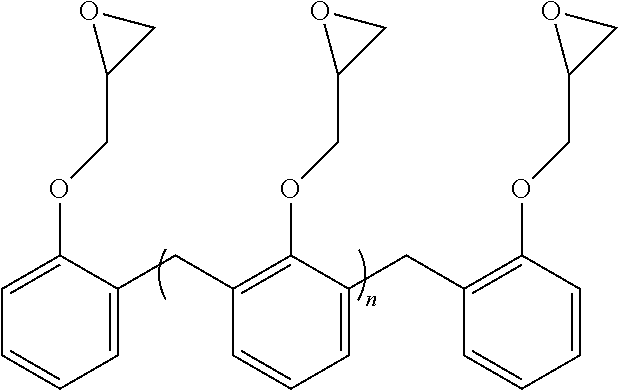
- QTBLRCGITQNBLW-UHFFFAOYSA-N c1ccc(OCC2CO2)c(Cc2cccc(Cc3ccccc3OCC3CO3)c2OCC2CO2)c1 Chemical compound c1ccc(OCC2CO2)c(Cc2cccc(Cc3ccccc3OCC3CO3)c2OCC2CO2)c1 QTBLRCGITQNBLW-UHFFFAOYSA-N 0.000 description 1
Images


Classifications
-
- H—ELECTRICITY
- H01—ELECTRIC ELEMENTS
- H01B—CABLES; CONDUCTORS; INSULATORS; SELECTION OF MATERIALS FOR THEIR CONDUCTIVE, INSULATING OR DIELECTRIC PROPERTIES
- H01B1/00—Conductors or conductive bodies characterised by the conductive materials; Selection of materials as conductors
- H01B1/20—Conductive material dispersed in non-conductive organic material
- H01B1/22—Conductive material dispersed in non-conductive organic material the conductive material comprising metals or alloys
-
- C—CHEMISTRY; METALLURGY
- C08—ORGANIC MACROMOLECULAR COMPOUNDS; THEIR PREPARATION OR CHEMICAL WORKING-UP; COMPOSITIONS BASED THEREON
- C08G—MACROMOLECULAR COMPOUNDS OBTAINED OTHERWISE THAN BY REACTIONS ONLY INVOLVING UNSATURATED CARBON-TO-CARBON BONDS
- C08G59/00—Polycondensates containing more than one epoxy group per molecule; Macromolecules obtained by polymerising compounds containing more than one epoxy group per molecule using curing agents or catalysts which react with the epoxy groups
- C08G59/18—Macromolecules obtained by polymerising compounds containing more than one epoxy group per molecule using curing agents or catalysts which react with the epoxy groups ; e.g. general methods of curing
- C08G59/20—Macromolecules obtained by polymerising compounds containing more than one epoxy group per molecule using curing agents or catalysts which react with the epoxy groups ; e.g. general methods of curing characterised by the epoxy compounds used
- C08G59/32—Epoxy compounds containing three or more epoxy groups
- C08G59/3218—Carbocyclic compounds
-
- C—CHEMISTRY; METALLURGY
- C08—ORGANIC MACROMOLECULAR COMPOUNDS; THEIR PREPARATION OR CHEMICAL WORKING-UP; COMPOSITIONS BASED THEREON
- C08G—MACROMOLECULAR COMPOUNDS OBTAINED OTHERWISE THAN BY REACTIONS ONLY INVOLVING UNSATURATED CARBON-TO-CARBON BONDS
- C08G59/00—Polycondensates containing more than one epoxy group per molecule; Macromolecules obtained by polymerising compounds containing more than one epoxy group per molecule using curing agents or catalysts which react with the epoxy groups
- C08G59/18—Macromolecules obtained by polymerising compounds containing more than one epoxy group per molecule using curing agents or catalysts which react with the epoxy groups ; e.g. general methods of curing
- C08G59/20—Macromolecules obtained by polymerising compounds containing more than one epoxy group per molecule using curing agents or catalysts which react with the epoxy groups ; e.g. general methods of curing characterised by the epoxy compounds used
- C08G59/32—Epoxy compounds containing three or more epoxy groups
- C08G59/36—Epoxy compounds containing three or more epoxy groups together with mono-epoxy compounds
-
- C—CHEMISTRY; METALLURGY
- C08—ORGANIC MACROMOLECULAR COMPOUNDS; THEIR PREPARATION OR CHEMICAL WORKING-UP; COMPOSITIONS BASED THEREON
- C08G—MACROMOLECULAR COMPOUNDS OBTAINED OTHERWISE THAN BY REACTIONS ONLY INVOLVING UNSATURATED CARBON-TO-CARBON BONDS
- C08G59/00—Polycondensates containing more than one epoxy group per molecule; Macromolecules obtained by polymerising compounds containing more than one epoxy group per molecule using curing agents or catalysts which react with the epoxy groups
- C08G59/18—Macromolecules obtained by polymerising compounds containing more than one epoxy group per molecule using curing agents or catalysts which react with the epoxy groups ; e.g. general methods of curing
- C08G59/40—Macromolecules obtained by polymerising compounds containing more than one epoxy group per molecule using curing agents or catalysts which react with the epoxy groups ; e.g. general methods of curing characterised by the curing agents used
- C08G59/4007—Curing agents not provided for by the groups C08G59/42 - C08G59/66
- C08G59/4078—Curing agents not provided for by the groups C08G59/42 - C08G59/66 boron containing compounds
-
- C—CHEMISTRY; METALLURGY
- C08—ORGANIC MACROMOLECULAR COMPOUNDS; THEIR PREPARATION OR CHEMICAL WORKING-UP; COMPOSITIONS BASED THEREON
- C08G—MACROMOLECULAR COMPOUNDS OBTAINED OTHERWISE THAN BY REACTIONS ONLY INVOLVING UNSATURATED CARBON-TO-CARBON BONDS
- C08G59/00—Polycondensates containing more than one epoxy group per molecule; Macromolecules obtained by polymerising compounds containing more than one epoxy group per molecule using curing agents or catalysts which react with the epoxy groups
- C08G59/18—Macromolecules obtained by polymerising compounds containing more than one epoxy group per molecule using curing agents or catalysts which react with the epoxy groups ; e.g. general methods of curing
- C08G59/40—Macromolecules obtained by polymerising compounds containing more than one epoxy group per molecule using curing agents or catalysts which react with the epoxy groups ; e.g. general methods of curing characterised by the curing agents used
- C08G59/50—Amines
- C08G59/5006—Amines aliphatic
-
- C—CHEMISTRY; METALLURGY
- C08—ORGANIC MACROMOLECULAR COMPOUNDS; THEIR PREPARATION OR CHEMICAL WORKING-UP; COMPOSITIONS BASED THEREON
- C08K—Use of inorganic or non-macromolecular organic substances as compounding ingredients
- C08K3/00—Use of inorganic substances as compounding ingredients
- C08K3/02—Elements
- C08K3/08—Metals
-
- C—CHEMISTRY; METALLURGY
- C08—ORGANIC MACROMOLECULAR COMPOUNDS; THEIR PREPARATION OR CHEMICAL WORKING-UP; COMPOSITIONS BASED THEREON
- C08L—COMPOSITIONS OF MACROMOLECULAR COMPOUNDS
- C08L63/00—Compositions of epoxy resins; Compositions of derivatives of epoxy resins
-
- C—CHEMISTRY; METALLURGY
- C09—DYES; PAINTS; POLISHES; NATURAL RESINS; ADHESIVES; COMPOSITIONS NOT OTHERWISE PROVIDED FOR; APPLICATIONS OF MATERIALS NOT OTHERWISE PROVIDED FOR
- C09D—COATING COMPOSITIONS, e.g. PAINTS, VARNISHES OR LACQUERS; FILLING PASTES; CHEMICAL PAINT OR INK REMOVERS; INKS; CORRECTING FLUIDS; WOODSTAINS; PASTES OR SOLIDS FOR COLOURING OR PRINTING; USE OF MATERIALS THEREFOR
- C09D11/00—Inks
- C09D11/02—Printing inks
- C09D11/03—Printing inks characterised by features other than the chemical nature of the binder
- C09D11/037—Printing inks characterised by features other than the chemical nature of the binder characterised by the pigment
-
- C—CHEMISTRY; METALLURGY
- C09—DYES; PAINTS; POLISHES; NATURAL RESINS; ADHESIVES; COMPOSITIONS NOT OTHERWISE PROVIDED FOR; APPLICATIONS OF MATERIALS NOT OTHERWISE PROVIDED FOR
- C09D—COATING COMPOSITIONS, e.g. PAINTS, VARNISHES OR LACQUERS; FILLING PASTES; CHEMICAL PAINT OR INK REMOVERS; INKS; CORRECTING FLUIDS; WOODSTAINS; PASTES OR SOLIDS FOR COLOURING OR PRINTING; USE OF MATERIALS THEREFOR
- C09D11/00—Inks
- C09D11/52—Electrically conductive inks
-
- C—CHEMISTRY; METALLURGY
- C08—ORGANIC MACROMOLECULAR COMPOUNDS; THEIR PREPARATION OR CHEMICAL WORKING-UP; COMPOSITIONS BASED THEREON
- C08K—Use of inorganic or non-macromolecular organic substances as compounding ingredients
- C08K3/00—Use of inorganic substances as compounding ingredients
- C08K3/02—Elements
- C08K3/08—Metals
- C08K2003/0806—Silver
-
- C—CHEMISTRY; METALLURGY
- C08—ORGANIC MACROMOLECULAR COMPOUNDS; THEIR PREPARATION OR CHEMICAL WORKING-UP; COMPOSITIONS BASED THEREON
- C08K—Use of inorganic or non-macromolecular organic substances as compounding ingredients
- C08K2201/00—Specific properties of additives
- C08K2201/001—Conductive additives
-
- C—CHEMISTRY; METALLURGY
- C08—ORGANIC MACROMOLECULAR COMPOUNDS; THEIR PREPARATION OR CHEMICAL WORKING-UP; COMPOSITIONS BASED THEREON
- C08K—Use of inorganic or non-macromolecular organic substances as compounding ingredients
- C08K2201/00—Specific properties of additives
- C08K2201/002—Physical properties
- C08K2201/003—Additives being defined by their diameter
-
- C—CHEMISTRY; METALLURGY
- C08—ORGANIC MACROMOLECULAR COMPOUNDS; THEIR PREPARATION OR CHEMICAL WORKING-UP; COMPOSITIONS BASED THEREON
- C08K—Use of inorganic or non-macromolecular organic substances as compounding ingredients
- C08K5/00—Use of organic ingredients
- C08K5/16—Nitrogen-containing compounds
- C08K5/17—Amines; Quaternary ammonium compounds
-
- C—CHEMISTRY; METALLURGY
- C08—ORGANIC MACROMOLECULAR COMPOUNDS; THEIR PREPARATION OR CHEMICAL WORKING-UP; COMPOSITIONS BASED THEREON
- C08K—Use of inorganic or non-macromolecular organic substances as compounding ingredients
- C08K5/00—Use of organic ingredients
- C08K5/54—Silicon-containing compounds
- C08K5/541—Silicon-containing compounds containing oxygen
- C08K5/5415—Silicon-containing compounds containing oxygen containing at least one Si—O bond
-
- C—CHEMISTRY; METALLURGY
- C08—ORGANIC MACROMOLECULAR COMPOUNDS; THEIR PREPARATION OR CHEMICAL WORKING-UP; COMPOSITIONS BASED THEREON
- C08K—Use of inorganic or non-macromolecular organic substances as compounding ingredients
- C08K7/00—Use of ingredients characterised by shape
- C08K7/16—Solid spheres
- C08K7/18—Solid spheres inorganic
Definitions
- inventions of the disclosure relate to compositions and methods for the filling of high aspect ratio vertical interconnect access (via) holes. More specifically, the inventions of the disclosure relate to the use of compositions that, after being filled into a via hole, do not shrink during drying or curing processes during fabrication of via hole-containing substrate
- Conductive via holes are conventionally used as a means for interconnecting regions on one surface of a compound semiconductor substrate, such as a printed circuit board or integrated circuit, to regions on the opposing surface of the semiconducting substrate.
- a compound semiconductor substrate such as a printed circuit board or integrated circuit
- the hole filling process is affected by a number of processing and material parameters such as the diameter of the via hole, the depth of the hole, and the type of the substrate material.
- a number of techniques have been used to perform the via hole filling process. Depending on the type of the substrate, the techniques may include electroplating, electroless plating, injection molding (both pressurized and vacuum) solder paste screen printing and conductive paste screen printing.
- via holes are filled with a composition having conductive metal particles, a polymer material and solvent.
- Such compositions have been found disadvantageous, however, because during drying or curing, the solvent evaporates and the resulting conductive particle-polymeric material composite (the “via plug”) incompletely fills the via hole, leaving gaps or voids between the via plug and the wall of the via.
- compositions and methods for effectively filling high aspect ratio via holes in compound semiconducting substrates are directed to compositions and methods for effectively filling high aspect ratio via holes in compound semiconducting substrates.
- the invention provides a solvent-free electroconductive composition for the fabrication of electroconductive lines, patterns or contacts on a surface of a substrate, or electroconductive plugs within via holes of a substrate.
- the solvent-free electroconductive composition is generally made of about 40 to about 95 wt % of a conductive component, about 4 to about 30 wt % of a polymer or oligomer comprising a reactive functional group, up to about 20 wt % of a monomeric diluent comprising a reactive functional group, and up to about 3 wt % of a curing agent.
- the solvent-free electroconductive composition further includes up to about 3 wt % of a lubricating compound.
- Solvent-free electroconductive compositions have been found superior to other prior art electroconductive pastes or inks because they exhibit very little or no shrinkage when cured to form a hardened electroconductive material, form hardened electroconductive material without cracks, voids or other detrimental physical properties, and uniformly or substantially uniformly contact the surface of a substrate. Solvent-free electroconductive compositions have been found superior to other prior art electroconductive pastes or inks because they effectively fill high aspect ratio via holes that have a depth to width aspect ratio of at least 5:1 and diameters of 100 ⁇ m or less.
- electroconductive compositions described herein may be used to fill via holes which have diameters of 80 ⁇ m or less, alternatively 60 ⁇ m or less, alternatively 40 ⁇ m or less, and alternatively 20 ⁇ m or less.
- electroconductive ink or paste compositions described herein may be used to fill via holes which have aspect ratios of 6:1 or greater, alternatively 7:1 or greater, alternatively 8:1 or greater, alternatively 9:1 or greater, alternatively 10:1 or greater, alternatively 15:1 or greater.
- solvent-free electroconductive compositions are prepared as a paste. In some instances, solvent-free electroconductive compositions are prepared as an ink.
- the conductive component of solvent-free electroconductive compositions is a plurality of metallic particles.
- Suitable metallic particles include at least one of silver, copper, gold, aluminum, nickel, platinum, palladium, tin, molybdenum, and mixtures, alloys or core-shell structures thereof.
- the metallic particles comprise silver.
- the metallic particles consist of silver.
- the metallic particles consist essentially of silver.
- the metallic particles may be silica particles, alumina particles or graphite particles coated with a suitable metal.
- at least a portion of the metallic particles are spherical or substantially spherical.
- the metallic particles have a D 50 from about 100 nm to about 5.0 ⁇ m.
- the conductive metal particles may have a D 50 of anywhere from about 1.5 ⁇ m to about 2.5 ⁇ m, alternatively from about 1.0 ⁇ m to about 3.0 ⁇ m, and alternatively from about 500 nm to about 3.5 ⁇ m.
- the polymer or oligomer of solvent-free electroconductive compositions includes at least one reactive functional group.
- the reactive functional group may be an epoxy, an alkene, a hydroxyl, a carboxylic acid, a carboxylate, an amine, an amide, an isocyanate, an imide, an anhydride or an acrylate.
- the polymer or oligomer has more than one type of reactive functional group.
- the reactive functional group of the polymer or oligomer is selected for its capability to cross-link or otherwise chemically bind with a reactive functional group of the monomeric diluent during drying or curing after placement on a surface of a substrate or within a via hole of a substrate.
- the monomeric diluent of solvent-free electroconductive compositions includes a reactive functional group.
- the reactive functional group may be an epoxy, an alkene, a hydroxyl, a carboxylic acid, a carboxylate an amine, an amide, an isocyanate, an imide, an anhydride, or an acrylate.
- the reactive functional group of the monomeric diluent is selected for its capability to cross-link or otherwise chemically bind with a reactive functional group of the polymer or oligomer during drying or curing after placement on a surface of a substrate or within a via hole of a substrate.
- the reactive functional groups of the monomeric diluent and the polymer or oligomer are of the same or substantially similar.
- the reactive functional groups of the monomeric diluent and the polymer or oligomer are different.
- the curing agent of solvent-free electroconductive compositions may be thermally curable, ultraviolet (UV) curable or curable by any other suitable energy input.
- the curing agent may be an epoxy, a hydroxyl, a carboxylic acid, an amine, an isocyanate, an imide, an aziridine, an amide, an organic imidazole, a melamine formaldehyde, an anhydride, an amine-Lewis acid adduct, or a radical initiator.
- the curing agent is a combination curing agents described above.
- a substrate may include a via hole and an electroconductive plug in at least partially filling the via hole.
- the electroconductive plug may be formed by injecting or otherwise disposing a solvent-free electroconductive composition in accordance with the disclosure and curing the solvent-free electroconductive composition.
- curing may take place at a temperature from about 100 to about 400° C.
- curing may take place over a period of time ranging from about 5 minutes to about 2 hours.
- curing may take place at more than one temperature over time. For example, in some instances, curing may take place at a first temperature for a first period of time followed by a second temperature for a second period of time. In accordance with the examples, the first temperature and first period of time is 200° C.
- the second temperature and second period of time is 300° C. and 60 minutes.
- the first temperature may range from about 100 to about 250° C.
- the first period of time may range from about 5 minutes to about 30 minutes.
- the second temperature may range from about 250 to about 400° C.
- the second period of time may range from about 5 minutes to about 90 minutes.
- curing may take place by a direct transition from the first temperature to the second temperature. In other instances, curing may take place by a ramped transition from the first temperature to the second temperature over a period of about 1 to about 20 minutes.
- Solvent-free electroconductive compositions have been found to be effective in the formation of electroconductive plugs in via holes that have a depth to width aspect ratio of at least 5:1 and diameters of 100 ⁇ m or less.
- electroconductive compositions described herein may be used to fill via holes which have diameters of 80 ⁇ m or less, alternatively 60 ⁇ m or less, alternatively 40 ⁇ m or less, and alternatively 20 ⁇ m or less.
- electroconductive ink or paste compositions described herein may be used to fill via holes which have aspect ratios of 6:1 or greater, alternatively 7:1 or greater, alternatively 8:1 or greater, alternatively 9:1 or greater, alternatively 10:1 or greater, alternatively 15:1 or greater.
- Substrates having via holes with electroconductive plugs formed therein from electroconductive compositions may be incorporated as a component of any one of a printed circuit board (PCB), an integrated circuit, a solar cell, a capacitor, a resistor, a thermistor, a varistor, a resonator, a transducer, an inductor, and a multilayer ferrite bead.
- PCB printed circuit board
- a substrate may include a surface and an electroconductive line, pattern, or contact on at least a portion of the substrate surface.
- the electroconductive line, pattern, or contact may be formed on the substrate surface disposing a solvent-free electroconductive composition according to the disclosure on the substrate of the surface and curing the solvent-free electroconductive composition.
- curing may take place at a temperature from about 100 to about 400° C.
- curing may take place over a period of time ranging from about 5 minutes to about 2 hours.
- curing may take place at more than one temperature over time. For example, in some instances, curing may take place at a first temperature for a first period of time followed by a second temperature for a second period of time.
- the first temperature and first period of time is 200° C. and 10 minutes
- the second temperature and second period of time is 300° C. and 60 minutes.
- the first temperature may range from about 100 to about 250° C.
- the first period of time may range from about 5 minutes to about 30 minutes.
- the second temperature may range from about 250 to about 400° C.
- the second period of time may range from about 5 minutes to about 90 minutes.
- curing may take place by a direct transition from the first temperature to the second temperature. In other instances, curing may take place by a ramped transition from the first temperature to the second temperature over a period of about 1 to about 20 minutes.
- Substrates having electroconductive lines, patterns, or contacts formed thereon from electroconductive compositions according to this disclosure may be incorporated as a component of any one of a printed circuit board (PCB), an integrated circuit, a solar cell, a capacitor, a resistor, a thermistor, a varistor, a resonator, a transducer, an inductor, and a multilayer ferrite bead.
- PCB printed circuit board
- an electroconductive composition may be applied on a surface of a substrate, or within a via hole of a substrate, by screen-printing.
- techniques such as doctor-blading, dip-coating, spin-coating, inkjet printing, pneumatic spray printing, pad printing, dot matrix printing, laser printing, 3D printing, or any other suitable application technique may be used.
- the substrate, with or without via holes may be a ceramic, glass or coated glass. In some instances, the substrate, with or without via holes, may be made of a conductive or non-conductive polymer. In some instances, the substrate, with or without via holes, may be a silicon, a copper indium gallium sulfide/selenide (Cu(In,Ga)(S,Se) 2 , or “CIGS”), a cadmium telluride, a copper zinc tin sulfide (CZTS), a silver zinc tin sulfide (AZTS), and gallium arsenide.
- Cu(In,Ga)(S,Se) 2 or “CIGS”
- CZTS copper zinc tin sulfide
- AZTS silver zinc tin sulfide
- FIG. 1 is an image of a substrate having electroconductive lines formed thereon, the electroconductive lines formed by applying an electroconductive composition curing the electroconductive composition;
- FIG. 2 is a graph displaying the resistivities of electroconductive line-coated substrates formed using an electroconductive composition cured under varying conditions
- FIG. 3 is a graph displaying the thicknesses of electroconductive lines formed substrates from an electroconductive composition cured under varying conditions
- FIG. 4 is a magnified cross-sectional image of a via hole filled with an electroconductive plug, the electroconductive plug formed by curing an electroconductive composition within the via hole;
- FIG. 5 is a magnified cross-sectional image of another via hole filled with an electroconductive plug, the electroconductive plug formed by curing an electroconductive composition within the via hole;
- FIG. 6 is a scanning electron microscope (SEM) cross-sectional image of another via hole filled with an electroconductive plug the electroconductive plug formed by curing an electroconductive within the via hole;
- FIG. 7 is an optical microscopy image of a top of the electroconductive plug shown in FIG. 6 .
- ranges are used as shorthand for describing each and every value that is within the range. Any value within the range may be selected as the terminus of the range. Unless otherwise specified, all percentages and amounts expressed herein and elsewhere in the specification should be understood to refer to percentages by weight.
- this term may be construed as including a deviation of ⁇ 10 percent, alternatively ⁇ 5 percent, alternatively ⁇ 1 percent, alternatively ⁇ 0.5 percent, and alternatively ⁇ 0.1 percent of the given numeric value provided such a deviation does not alter the end function or result of the value. Accordingly, unless indicated to the contrary, the numerical parameters set forth in this specification and attached claims are approximations that may vary depending upon the desired properties sought to be obtained by the invention.
- the term “substantially” is defined to be essentially conforming to the particular dimension, shape or other word that substantially modifies, such that the component need not be exact. For example, “substantially spherical” means that the object resembles a sphere, but may have one or more deviations from a true sphere.
- the terms “comprise” (as well as forms, derivatives, or variations thereof, such as “comprising” and “comprises”), “include” (as well as forms, derivatives, or variations thereof, such as “including” and “includes”) and “has” (as well as forms, derivatives, or variations thereof, such as “having” and “have”) are inclusive (i.e., open-ended) and do not exclude additional elements or steps. Accordingly, these terms are intended to not only cover the recited element(s) or step(s), but may also include other elements or steps not expressly recited.
- a solvent-free thick film ink or paste composition for use in the filling of a via hole of a substrate includes a combination of a conductive component, a polymer or oligomer having a functional group capable of cross-linking, a monomeric diluent having a functional group capable of cross-linking, and a curing agent.
- the conductive component may be from about 40 to about 95 wt % of the thick film ink or paste composition.
- the conductive component may be from about 50 to about 95 wt %, alternatively from about from about 60 to about 95 wt %, alternatively from about 70 to about 90 wt %, alternatively from about 80 to about 90 wt %, and alternatively from about 85 to about 90 wt % of the thick film ink or paste composition.
- the polymer or oligomer may be from about 4 to about 30 wt % of the thick film ink or paste composition.
- the polymer or oligomer may be from about 4.5 to about 25 wt %, alternatively from about from about 5 to about 20 wt %, alternatively from about 5.5 to about 15 wt %, alternatively from about 6 to about 10 wt %, and alternatively from about 7 to about 9 wt % of the thick film ink or paste composition.
- the monomeric diluent may be from about 0 to about 20 wt % of the thick film ink or paste composition.
- the monomeric diluent may be from about 0.1 to about 20 wt %, alternatively from about from about 0.25 to about 15 wt %, alternatively from about 0.5 to about 10 wt %, alternatively from about 0.75 to about 5 wt %, and alternatively from about 1 to about 3 wt % of the thick film ink or paste composition.
- the curing agent may be from about 0 to about 10 wt % of the thick film ink or paste composition.
- the curing agent may be from about 0.01 to about 10 wt %, alternatively from about from about 0.1 to about 5 wt %, alternatively from about 0.2 to about 2.5 wt %, alternatively from about 0.3 to about 1 wt %, and alternatively from about 0.4 to about 0.6 wt % of the thick film ink or paste composition.
- a solvent-free thick film ink or paste composition for use in the filling of a via hole of a substrate includes a combination of a conductive component, a polymer or oligomer having a functional group capable of cross-linking, a monomeric diluent having a functional group capable of cross-linking, a curing agent and a lubricating compound.
- a lubricating compound When a lubricating compound is used in a thick film ink or paste composition, the lubricating compound may be from about 0 to about 3 wt %, alternatively from about 0.1 to about 2.5 wt %, and alternatively from about 0.25 to about 2 wt % of the thick film ink or paste composition.
- the conductive component of pastes generally includes conductive metallic particles.
- the conductive component may generally be in the form of a powder.
- Preferred conductive metallic particles are those which exhibit optimal conductivity and dispersibility within the paste.
- Conductive metallic particles include, but are not limited to, elemental metals, alloys, mixtures of at least two metals, mixtures of at least two alloys or mixtures of at least one metal with at least one alloy.
- Metals which may be employed as the metallic particles include at least one of silver, copper, gold, aluminum, nickel, platinum, palladium, tin, molybdenum, and mixtures or alloys thereof.
- the metallic particles are silver.
- the silver particles may be present as elemental silver, one or more silver derivatives, or mixtures thereof.
- Silver powders may vary based on the production method, purity, particle size, particle shape, apparent density, conductivity, oxygen level, color and flow rate.
- metallic particles at least partially coated with another metal may be used.
- each of the core and shell may be made of a metal or alloy such as, but not limited to silver, gold, platinum, palladium, copper, iron, aluminum, zinc, nickel, brass or bronze.
- a core-shell particle will have a less conductive core covered by a more conductive coating or shell.
- a less noble metal core is covered by more noble metal coating or shell.
- Ag coated Cu or Ag coated Cu alloys, or Ag coated Ni or Ag coated Ni alloys are good examples. They offer cost benefit as well as better leach resistance than Ag particles. Moreover, more noble metal coating improves the oxidation resistance of the less noble metal.
- the core of a core-shell particle is made of a composition selected from the group consisting of nickel, nickel alloys, copper, copper alloys, non-noble transition metals, alloys of non-noble transition metals, polymers, silica, alumina, glass, graphite and combinations thereof.
- Single-metal particles may be envisioned, indirectly in the case where the core and shell are the same metal.
- the core-shell particles of the invention may be silver coated nickel particles, silver coated copper particles, silver coated polymer particles, silver coated silica particles, silver coated alumina particles, silver coated glass particles, silver coated graphite particles, gold coated nickel particles, gold coated copper particles, gold coated polymer particles, gold coated silica particles, gold coated alumina particles, gold coated glass particles, gold coated graphite particles, platinum coated nickel particles, platinum coated copper particles, platinum coated polymer particles, platinum coated silica particles, platinum coated alumina particles, platinum coated glass particles, platinum coated graphite particles, palladium coated nickel particles, palladium coated copper particles, palladium coated polymer particles, palladium coated silica particles, palladium coated alumina particles, palladium coated glass particles, palladium coated graphite particles, and combinations thereof.
- the core is copper and the shell is silver.
- the conductive metallic particles may exhibit a variety of general shapes, surfaces, sizes, surface area to volume ratios, oxygen content and oxide layers. Some examples of general shapes include, but are not limited to, round or spherical, angular, irregular, and elongated (rod or needle like). Silver particles may also be present as a combination of particles of different shapes, sizes and/or surface area to volume ratios. In a preferred embodiment, the conductive metal particles are spherical or substantially spherical.
- PSD particle size distribution
- D 50 is the median diameter or the medium value of the PSD. It is the value of the particle diameter at 50% in the cumulative distribution.
- Other parameters of PSD are D 10 , which represents the particle diameter corresponding to 10% cumulative (from 0 to 100%) undersize PSD, and D 90 , which represents the particle diameter corresponding to 90% cumulative (from 0 to 100%) undersize PSD.
- PSD may be measured via laser diffraction, dynamic light scattering, imaging, electrophoretic light scattering, or any other methods known to one skilled in the art. In a preferred embodiment, laser diffraction is used.
- the conductive metal particles have a D 50 of about 2 micrometers ( ⁇ m). In other instances, the conductive metal particles may have a D 50 of anywhere from about 1.5 ⁇ m to about 2.5 ⁇ m, alternatively from about 1.0 ⁇ m to about 3.0 ⁇ m, alternatively from about 500 nm to about 3.5 ⁇ m, alternatively from about 250 nm to about 4.0 ⁇ m, alternatively from about 100 nm to about 5.0 ⁇ m, and alternatively from about 50 nm to about 10.0 ⁇ m.
- the polymer or oligomer of pastes includes a functional group that is capable of cross-linking or otherwise chemically binding with the monomeric diluent during drying or curing after placement within a via hole.
- the polymer or oligomer is preferably in liquid form under ambient temperature and atmospheric pressure.
- the functional group is any one of an epoxy, an alkene, a hydroxyl, a carboxylic acid or carboxylate, an amine, an amide, an isocyanate, an imide, an anhydride or an acrylate.
- suitable oligomers include but are not limited to, octaethylene glycol, dodecaethylene glycol, O-methyl-heptaethylene glycol, O-(2-azidoethyl)heptaethylene glycol, octacosaethylene glycol, O-(2-azidoethyl)nonadecaethylene glycol, O-(2-tert-butyloxycarbonylethyl)dodecaethylene glycol, O-methyl-undecaethylene glycol, tetraethylene glycol, HO-PEG12-OH, mPEG12-OH, mPEG7-OH, mPEG6-OH, O-(2-Carboxyethyl)-O′-(2-mercaptoethyl)heptaethylene glycol, O-(2-carboxyethyl)-O′-methyl-undecaethylene glycol, O,O′-bis(2-carboxyethyl)dodecaethylene glycol,
- the polymer may be a monofunctional polyethylene glycol (PEG) having an epoxy, an alkene, a hydroxyl, a carboxylic acid, an amine, an amide, an isocyanate, an imide, an anhydride or an acrylate functional group.
- PEG polyethylene glycol
- the polymer may be a homobifunctional polyethylene glycol (PEG) having an epoxy, an alkene, a hydroxyl, a carboxylic acid, an amine, an amide, an isocyanate, an imide, an anhydride or an acrylate functional group.
- PEG polyethylene glycol
- poly(ethylene glycol) diacrylamide M n ⁇ 3,700
- the polymer may be a heterobifunctional polyethylene glycol (PEG) having an epoxy, an alkene, a hydroxyl, a carboxylic acid, an amine, an amide, an isocyanate, an imide, an anhydride or an acrylate functional group.
- PEG polyethylene glycol
- the polymer may be a polyethylene glycol (PEG) copolymer having an epoxy, an alkene, a hydroxyl, a carboxylic acid, an amine, an amide, an isocyanate, an imide, and anhydride or an acrylate functional group.
- PEG polyethylene glycol
- the polymer may be a block copolymer having an epoxy, an alkene, a hydroxyl, a carboxylic acid, an amine, an amide, an isocyanate, an imide, an anhydride or an acrylate functional group.
- suitable diblock copolymers include, but are not limited to, poly(styrene)-block-poly(acrylic acid), polystyrene-block-polybutadiene-block-polystyrene, polystyrene-block-poly(ethylene-ran-butylene)-block-polystyrene-graft-maleic anhydride, and polystyrene-block-polyisoprene-block-polystyrene.
- the polymer may be a ⁇ -conjugated polymer having an epoxy, an alkene, a hydroxyl, a carboxylic acid, an amine, an amide, an isocyanate, an imide, an anhydride or an acrylate functional group.
- the polymer may be a bisphenol A polymer or an epoxy prepolymer resin.
- the polymer may be a formaldehyde, epoxy or urethane copolymer having an epoxy, an alkene, a hydroxyl, a carboxylic acid, an amine, an isocyanate, an imide or an acrylate functional group.
- the polymer may be a hydrophilic polymer having an epoxy, an alkene, a hydroxyl, a carboxylic acid, an amine, an amide, an isocyanate, an imide, an anhydride or an acrylate functional group.
- PNIPAM poly
- suitable hydrophilic polymers may include polyethylenimines.
- suitable hydrophilic polymers may include poly(vinyl pyrrolidones), polyacrylic acids, polyallylamines, a poly(methyl vinyl ether-alt-maleic acid), poly(2-hydroxyethyl methacrylate), poly(methyl methacrylate-co-methacrylic acid), poly(acrylic acid-co-maleic acid), poly(2-ethylacrylic acid), and polyepoxysuccinic acids.
- the polymer may be a hydrophobic polymer having an epoxy, an alkene, a hydroxyl, a carboxylic acid, an amine, an amide, an isocyanate, an imide, an anhydride or an acrylate functional group.
- suitable hydrophobic polymers include, but are not limited to, polybutadienes, dicarboxy-terminated polybutadienes, hydroxyl-terminated polybutadienes, polyisoprenes, polyisoprene-graft-maleic anhydrides, hydroxyl-terminated polypropylene glycols, 2-aminopropyl ether-terminated polypropylene glycols, methacrylate-terminated polypropylene glycols, glycidyl ether-terminated polypropylene glycols, polypropylene-graft-maleic anhydrides, poly(ethylene-co-acrylic acid) acrylic acids, polyethylene-co-glycidyl methacrylates, polyethylene-graft-maleic anhydrides, poly(ethylene-co-methacrylic acid), polyethylene monoalcohols, poly(ethylene-co-methyl acrylate-co-glycidyl methacrylate), poly(isobutylene-alt-maleic anhydride), poly(male
- the polymer may be a polysiloxane having an epoxy, an alkene, a hydroxyl, a carboxylic acid, an amine, an amide, an isocyanate, an imide, an anhydride or an acrylate functional group.
- suitable polysiloxanes include, but are not limited to, epoxy-functionalized polysiloxanes such as, but not limited to, poly[dimethylsiloxane-co-(2-(3,4-epoxycyclohexyl)ethyl)methylsiloxane] (M n ⁇ 3,600), diglycidyl ether-terminated poly(dimethylsiloxane) (M n ⁇ 800), monoglycidyl ether terminated poly(dimethylsiloxane) (M n ⁇ 5,000); alkene-functionalized polysiloxanes such as, but not limited to, divinyl terminated poly(dimethylsiloxane-co-diphenylsiloxane (M n ⁇ 9,300), vinyl-terminated poly(dimethylsiloxane) (M n ⁇ 25,000); hydroxyl-functionalized polysiloxanes such as, but not limited to, poly[dimethylsiloxane
- the polymer may be an epoxy phenol novolac resin.
- the monomeric diluent of pastes includes a functional group that is capable of cross-linking or otherwise chemically binding with the polymer or oligomer during drying or curing after placement within a via hole.
- the monomeric diluent is preferably in liquid form under ambient temperature and atmospheric pressure.
- the functional group is any one of an epoxy, an alkene, a hydroxyl, a carboxylate or carboxylic acid, an amine, an amide, an imide, an isocyanate, an anhydride or an acrylate.
- the monomeric diluent may contain a combination these functional groups.
- suitable epoxies include, but are not limited to, ethyl glycidyl ether, n-butyl glycidyl ether, cresyl glycidyl ether, 2-ethyl hexyl glycidyl ether, a C 8 -C 10 alkyl glycidyl ether, a C 10 -C 12 alkyl glycidyl ether, a C 12 -C 13 alkyl glycidyl ether, a C 12 -C 14 alkyl glycidyl ether, p-tertiary butyl phenol glycidyl ether, benzyl glycidyl ether, tert-butyldimethylsilyl glycidyl ether, neodecanoic acid glycidyl ether, 2-biphenylyl glycidyl ether, neopent
- one or more of the epoxy monomeric diluents above also include, or may be modified to include, one or more alkene, hydroxyl, carboxylic acid, amine, amide, imine, isocyanate, anhydride, or acrylate functional groups.
- suitable alkenes may include, but are not limited to isoprene, 2-butene, 1-pentene, 2-pentene, 1-hexene, 2-hexene, 3-hexene, 1-heptene, 2-heptene, 3-heptene, 1-octene, 2-octene, 3-octene, 4-octene, 1-nonene, 1-decene, 1-undecene, 1-dodecene, 1-tridecene, 1-tetradecene, 1-pentadecene, 1-hexadecene, 1-heptadecene, 1-octadecene, 1-eicosene, 2-bromoacrolein, allyl chloride, allyl bromide, allyl iodide, allyl alcohol, allylamine, 1,3-butadiene, 2,3-dimethyl-1,3-butadiene, 1,4-pentad
- alkene monomeric diluents also include, or may be modified to include, one or more epoxy, hydroxyl, carboxylic acid, amine, amide, imine, isocyanate, anhydride or acrylate functional groups.
- suitable hydroxyls include, but are not limited to, ethanol, propanol, isopropanol, butanol, isobutanol, tert-butanol, sec-butanol, pentanol, hexanol, heptanol octanol, phenol, benzyl alcohol, isoamyl alcohol, allyl alcohol, cetyl alcohol, lauryl alcohol, capric alcohol, nonanol, undecanol, myristyl alcohol, palmitoleyl alcohol, eicosanol, hexacosanol, 1-docosanol, elaidyl alcohol, 1-tetracosanol, petroselinyl alcohol, propgaryl alcohol, cinnamyl alcohol, vanillyl alcohol, furfuryl alcohol, diacetone alcohol, oleyl alcohol, stearyl alcohol, phenylethyl alcohol, tetrahydr
- one or more of the hydroxyl monomeric diluents above also include, or may be modified to include, one or more epoxy, alkene, carboxylic acid, amine, amide, imine, isocyanate, anhydride or acrylate functional groups.
- suitable carboxylic acids include, but are not limited to, acetic acid, butyric acid, isobutyric acid, propionic acid, pentanoic acid, hexanoic acid, heptanoic acid, C 8 -C 26 saturated or unsaturated fatty acids, malonic acid, benzoic acid, citric acid, salicylic acid, lactic acid, acetylsalicylic acid, oxalic acid, tartaric acid, acrylic acid, succinic acid, glutamic acid, glutaric acid, gallic acid, maleic acid, malic acid, folic acid, adipic acid, phenylacetic acid, methacrylic acid, retinoic acid, cinnamic acid, aspartic acid, fumaric acid, nicotinic acid, caffeic acid, anthranilic acid, ferulic acid, mandelic acid, valproic acid, pyruvic acid, glycolic acid, edetic acid, ethylene
- carboxylic acid monomeric diluents also include, or may be modified to include, one or more epoxy, alkene, hydroxyl, amine, amide, imine, isocyanate, anhydride or acrylate functional groups.
- suitable amines include primary amines such as, but not limited to, C 3 -C 24 linear, branched or cyclic alkyl amines, C 3 -C 24 linear, branched or cyclic alkenyl amines, C 3 -C 24 linear, branched, or cyclic alkynyl amines, allyl amine, (3-methylpentyl)amine, 4-pentyn-1-amine, 2-ethylcyclopropan-1-amine, 3-buten-1-amine, (1-cyclopropylpropyl)amine, 2-(1-cyclohexenyl)ethylamine, 2-(2-pyridyl)ethylamine, 1-(1-naphthyeethylamine, 2-(ethylthio)ethylamine, 2-cyclohexyl-ethylamine, 1-cyclopropyl-ethylamine, 4-aminophenyl propargyl ether,
- one or more of the primary amine monomeric diluents above also include, or may be modified to include, one or more epoxy, alkene, hydroxyl, carboxylic acid, secondary amine, amide, imine, isocyanate, anhydride or acrylate functional groups.
- suitable amines include secondary amines such as, but not limited to, pyrrole, aziridine, azetidine, indole, morpholine, piperidine, pyrrolidine, histidine, tetrazole, imidazole, pyrazole, pentazole, 1,2,3-traizole, 1,2,4-triazole, dipropylamine, dibutylamine, diisobutylamine, dihexylamine, N-ethylbutylamine, 2-ethyl-N-butylamine, N-ethyl-N-propylamine, di-n-butylethylamine, N-methylpropylamine, N-methyldodecylamine, N-methyloctadecylamine, N-methyloctylamine, N-heptylmethylamine, N-hexylmethylamine, dioctadecylamine, didocecylamine, dide
- one or more of the secondary amine monomeric diluents above also include, or may be modified to include, one or more epoxy, alkene, hydroxyl, carboxylic acid, primary amine, amide, imine, isocyanate, anhydride or acrylate functional groups.
- suitable amides include, but are not limited to, formamide, niacinamide, acetamide, octadecanamide, butyramide, behenamide, acrylamide, oleamide, 1,2,4,5-benzenetetracarboxamide, 2,2-diethoxyacetamide, benzamide, glutamine, carbamylurea, pyrazinamide, antranilamide, isonicotinamide, DL-lactamide, pentanamide, propiolamide, linoleamide, benzanilide, tert-butyl carbamate, 9-fluorenylmethyl carbamate, 3-amino-4-chlorobenzamide, 2-chloro-N-phenylacetamide, 2,2-dibromo-2-cyanoacetamide, acetoacetanilide, acetanilide, formanilide, DL-norleucine amide, L-asparagine, N-acetylcysteine
- amide monomeric diluents also include, or may be modified to include, one or more epoxy, alkene, hydroxyl, carboxylic acid, amide, imine, isocyanate, anhydride or acrylate functional groups.
- suitable imines include, but are not limited to be, primary or secondary aldimines, primary or secondary ketimines, amidines, cyclic imines and acyclic imines.
- suitable imines include, but are not limited to, formamidine, acetamidine, 2-aminoacetamidine, chloroacetamidine, benzamidine, benzothiazole, N-benzylideneaniline, benzophenone imine, N-benzylidenemethylamine, N-benzylideneethylamine, 2,2,4,4-tetramethyl-3-pentanone imine, auramine, 2-methyl-1-pyrroline, and N-butyl-2-pyridylmethanimine.
- one or more of the imine monomeric diluents above also include, or may be modified to include, one or more epoxy, alkene, hydroxyl, carboxylic acid, amine, amide, isocyanate, anhydride or acrylate functional groups.
- suitable isocyanates include, but are not limited to, ethyl isocyanate, 2-bromoethyl isocyanate, 2-chloroethyl isocyanate, allyl isocyanate, propyl isocyanate, isopropyl isocyanate, 3-chloropropyl isocyanate, butyl isocyanate, tert-butyl isocyanate, pentyl isocyanate, hexyl isocyanate, heptyl isocyanate, decyl isocyanate, undecyl isocyanate, octadecyl isocyanate, hexadecyl isocyanate, tetradecyl isocyanate, dodecyl isocyanate, cyclohexanemethyl isocyanate, benzyl isocyanate, isocyanatocyclobutane, cyclopentyl isocyanate, cycloh
- one or more of the isocyanate monomeric diluents above also include, or may be modified to include, one or more epoxy, alkene, hydroxyl, carboxylic acid, amine, amide, imine, anhydride or acrylate functional groups.
- suitable anhydrides include, but are not limited to, acetic anhydride, maleic anhydride, 1,8-naphthalic anhydride, succinic anhydride, phthalic anhydride, propionic anhydride, methacrylic anhydride, glutaric anhydride, citraconic anhydride, butyric anhydride, isatoic anhydride, 3,4,5,6-tetrahydrophthalic anhydride, diglycolic anhydride, itaconic anhydride, crotonic anhydride, trans-1,2-cyclohexanedicarboxylic anhydride, 2,3-dimethylmaleic anhydride, homophthalic anhydride, hexahydro-4-methylphthalic anhydride, 3,3-tetramethyleneglutaric anhydride, valeric anhydride, hexanoic anhydride, stearic anhydride, cis-aconitic anhydride, phenylsuccinic anhydride,
- anhydride monomeric diluents also include, or may be modified to include, one or more epoxy, alkene, hydroxyl, carboxylic acid, amine, amide, imine, isocyanate or acrylate functional groups.
- suitable anhydrides include, but are not limited to, 4-acetoxyphenethyl acrylate, 6-acetylthiohexyl methacrylate, acryloyl chloride, 4-acryloylmorpholine, [2-(acryloyloxy)ethyl]trimethylammonium chloride, 2-(4-benzoyl-3-hydroxyphenoxy)ethyl acrylate, benzyl 2-propylacrylate, butyl acrylate, tert-butyl acrylate, 2-[[(butylamino)carbonyl]oxy]ethyl acrylate, tert-butyl 2-bromoacrylate, 2-carboxyethyl acrylate, 2-chloroethyl acrylate, 2-(diethylamino)ethyl acrylate, di(ethylene glycol) ethyl ether acrylate, 2-(dimethylamino)ethyl acrylate, ethyl acryl
- one or more of the acrylate monomeric diluents above also include, or may be modified to include, one or more epoxy, alkene, hydroxyl, carboxylic acid, amine, amide, imine, isocyanate or anhydride functional groups.
- the function group of the monomeric diluent is the same as the functional group of the Polymer or oligomer.
- the curing agent of pastes generally includes an epoxy, an alkene, a hydroxyl, a carboxylic acid, an amine, an isocyanate, an imide, an aziridine, an amide, an organic imidazole, a melamine formaldehyde, an anhydride, an amine-Lewis acid adduct, a radical initiator, or any combination thereof.
- boron trifluoride ethylamine (BF 3 :C 2 H 5 NH 2 ) is used as the curing agent.
- the lubricating compound of pastes generally includes a surfactant, an organosilicon or a combination thereof.
- Preferred surfactants are those which contribute to the formation of a paste with favorable stability, printability, injectability, viscosity and sintering properties.
- Preferred surfactants are those based on linear chains, branched chains, aromatic chains, fluorinated chains, siloxane chains, polyether chains and combinations thereof.
- Preferred surfactants include, but are not limited to, single chained, double chained or poly chained polymers.
- Preferred surfactants may have non-ionic, anionic, cationic, amphiphilic, or zwitterionic heads.
- Preferred surfactants may be polymeric and monomeric or a mixture thereof.
- Preferred surfactants may have pigment affinic groups, preferably hydroxyfunctional carboxylic acid esters with pigment affinic groups (e.g., DISPERBYK®-108, manufactured by BYK USA, Inc.), polycarboxylic acid salt of polyamine amides (e.g., ANTI-TERRA® 204, manufactured by BYK USA, Inc.), acrylate copolymers with pigment affinic groups (e.g., DISPERBYK®-116, manufactured by BYK USA, Inc.), modified polyethers with pigment affinic groups (e.g., TEGO® DISPERS 655, manufactured by Evonik Tego Chemie GmbH), fatty alkyl amine (e.g., Duomeen® TDO, manufactured by AkzoNobel N.V.), or other surfactants with groups of high pigment affinity (e.g., TEGO® DISPERS 662 C, manufactured by Evonik Tego Chemie GmbH).
- pigment affinic groups preferably
- polymers not in the above list include, but are not limited to, polyethylene oxide, polyethylene glycol and its derivatives, and alkyl carboxylic acids and their derivatives or salts, or mixtures thereof.
- the preferred polyethylene glycol derivative is poly(ethyleneglycol)acetic acid.
- Preferred alkyl carboxylic acids are those with fully saturated and those with singly or poly unsaturated alkyl chains or mixtures thereof.
- Preferred carboxylic acids with saturated alkyl chains are those with alkyl chains lengths in a range from about 8 to about 20 carbon atoms, preferably C 9 H 19 COOH (capric acid), C 11 H 23 COOH (lauric acid), C 13 H 27 COOH (myristic acid) C 15 H 31 COOH (palmitic acid), C 17 H 35 COOH (stearic acid), or salts or mixtures thereof.
- Preferred carboxylic acids with unsaturated alkyl chains are C 18 H 34 O 2 (oleic acid) and C 18 H 32 O 2 (linoleic acid).
- a preferred monomeric surfactant is benzotriazole and its derivatives.
- Preferred organosilicons are those which contribute to the formation of a paste with favorable stability, printability, injectability, viscosity and sintering properties.
- Preferred organosilicons include, but are not limited to polydimethylsiloxanes (PDMS), polymethylhydrosiloxanes (PHMS), tetramethylcyclotetrasiloxane, hexamethylcyclotrisiloxane, octamethylcyclotetrasiloxane, decamethylcyclopentasiloxane, dodecamethylcyclohexasiloxane, octaethylcyclotetrasiloxane, hexaethylcyclotrisiloxane, decamethylcyclopentasiloxane, methacryloxypropyl-terminated polydimethylsiloxanes, trimethylsilyl-terminated polymethylhydrosiloxanes, phenylhydrocyclosiloxanes,
- Solvent-free thick film ink or paste compositions may be formed by combining predetermined amounts of a conductive component, a polymer or oligomer, a monomeric diluent, a curing agent and, optionally, a lubricating compound.
- the amount and type of each component utilized may be determined by the final desired formulation viscosity, fineness of grind of the paste, the desired wet print thickness when to be applied on a substrate, and/or the desired injectability when to be applied within a via hole.
- suitable equipment such as a three-roll mill
- Electroconductive lines, patterns or contacts may be produced by applying any electroconductive ink or paste disclosed herein to a surface of a substrate.
- an electroconductive ink or paste may be applied to a surface of a substrate by screen- or stencil printing.
- an electroconductive ink or paste may be applied to a surface of a substrate by doctor-blading, dip-coating, spin-coating, inkjet printing, pneumatic spray printing, pad printing, dot matrix printing, laser printing, 3D printing, or any other suitable application technique.
- An electroconductive ink or paste may be applied to a surface of a substrate at a desired wet thickness such as, for example from about 5 to about 100 ⁇ m, alternatively from about 7.5 to about 80 ⁇ m, alternatively from about 10 to about 60 ⁇ m, alternatively from about 12.5 to about 40 ⁇ m, alternatively from about 15 to about 30 ⁇ m, and alternatively about 15 to about 25 ⁇ m.
- a desired wet thickness such as, for example from about 5 to about 100 ⁇ m, alternatively from about 7.5 to about 80 ⁇ m, alternatively from about 10 to about 60 ⁇ m, alternatively from about 12.5 to about 40 ⁇ m, alternatively from about 15 to about 30 ⁇ m, and alternatively about 15 to about 25 ⁇ m.
- automatic screen-printing techniques may be employed using a 200-400 mesh screen.
- the electroconductive ink or paste is then cured to convert the ink or paste to a solid electroconductive line, pattern, contact, etc.
- curing may take place at a temperature from about 100 to about 400° C. In other instances, curing may take place at a temperature from about 125 to about 375° C., alternatively from about 150 to about 350° C., alternatively from about 175 to about 325° C., and alternatively from about 200 to about 300° C. In some instances, curing may take place over a period of time ranging from about 5 minutes to about 2 hours. In some instances, curing may take place over a period of time ranging from about 10 to about 90 minutes, alternatively from about 15 to about 80 minutes, and alternatively from about 30 to about 60 minutes.
- curing may take place at more than one temperature over time.
- curing may take place at a first temperature for a first period of time followed by a second temperature for a second period of time.
- the first temperature and first period of time is 200° C. and 10 minutes
- the second temperature and second period of time is 300° C. and 60 minutes.
- the first temperature may range from about 100 to about 250° C.
- the first period of time may range from about 5 minutes to about 30 minutes.
- the second temperature may range from about 250 to about 400° C.
- the second period of time may range from about 5 minutes to about 90 minutes.
- curing may take place by a direct transition from the first temperature to the second temperature.
- curing may take place by a ramped transition from the first temperature to the second temperature over a period of about 1 to about 20 minutes.
- the substrate and electroconductive coating may be fired for as little as 1 second up to about 30 seconds at peak temperature, in a belt conveyor furnace in air.
- the conductive component within the electroconductive coating may be sintered.
- An electroconductive plug may be produced by injecting or otherwise disposing any electroconductive ink or paste disclosed herein within a via hole of a substrate.
- an electroconductive ink or paste may be disposed within a via hole by screen- or stencil-printing.
- an electroconductive ink or paste may be applied to a surface of a substrate by doctor-blading, dip-coating, spin-coating, inkjet printing, pneumatic spray printing, pad printing, dot matrix printing, laser printing, 3D printing, or any other suitable application technique.
- An electroconductive ink or paste may be applied to a surface of a substrate at a desired wet thickness such as, for example from about 5 to about 100 micrometers ( ⁇ m), alternatively from about 7.5 to about 80 ⁇ m, alternatively from about 10 to about 60 ⁇ m, alternatively from about 12.5 to about 40 ⁇ m, alternatively from about 15 to about 30 ⁇ m, and alternatively about 15 to about 25 ⁇ m.
- a desired wet thickness such as, for example from about 5 to about 100 micrometers ( ⁇ m), alternatively from about 7.5 to about 80 ⁇ m, alternatively from about 10 to about 60 ⁇ m, alternatively from about 12.5 to about 40 ⁇ m, alternatively from about 15 to about 30 ⁇ m, and alternatively about 15 to about 25 ⁇ m.
- automatic screen-printing techniques may be employed using a 200-400 mesh screen.
- the electroconductive ink or paste located within the via hole is then cured to convert the ink or paste to a solid plug.
- curing may take place at a temperature from about 100 to about 400° C. In other instances, curing may take place at a temperature from about 125 to about 375° C., alternatively from about 150 to about 350° C., alternatively from about 175 to about 325° C., and alternatively from about 200 to about 300° C. In some instances, curing may take place over a period of time ranging from about 5 minutes to about 2 hours. In some instances, curing may take place over a period of time ranging from about 10 to about 90 minutes, alternatively from about 15 to about 80 minutes, and alternatively from about 30 to about 60 minutes.
- curing may take place at more than one temperature over time.
- curing may take place at a first temperature for a first period of time followed by a second temperature for a second period of time.
- the first temperature and first period of time is 200° C. and 10 minutes
- the second temperature and second period of time is 300° C. and 60 minutes.
- the first temperature may range from about 100 to about 250° C.
- the first period of time may range from about 5 minutes to about 30 minutes.
- the second temperature may range from about 250 to about 400° C.
- the second period of time may range from about 5 minutes to about 90 minutes.
- curing may take place by a direct transition from the first temperature to the second temperature.
- curing may take place by a ramped transition from the first temperature to the second temperature over a period of about 1 to about 20 minutes.
- the substrate and electroconductive plug may be fired for as little as 1 second up to about 30 seconds at peak temperature, in a belt conveyor furnace in air.
- the conductive component within the electroconductive plug may be sintered.
- the electroconductive ink or paste compositions may be applied to the surface of any suitable substrate and subsequently cured to form electroconductive lines, patters or contacts thereon.
- the electroconductive ink or paste compositions may also be injected or otherwise disposed within a via hole of any suitable substrate and subsequently cured to form electroconductive plugs therein.
- electroconductive ink or paste compositions may be used in the fabrication of solar cells.
- electroconductive ink or paste compositions may be used in the fabrication of printed circuit boards (PCB's).
- electroconductive ink or paste compositions may be used in the fabrication of integrated circuits (IC's).
- electroconductive ink or paste compositions may be used in the fabrication of solar cells, disc and multilayer capacitors, chip resistors, disc and multilayer negative temperature coefficient (NTC) thermistors, disc and multilayer positive temperature coefficient (PTC) thermistors, disc and multilayer varistors, resonators, multilayer lead zirconate titanate (PZT) transducers, inductors, and multilayer ferrite beads.
- NTC negative temperature coefficient
- PTC positive temperature coefficient
- PZT multilayer lead zirconate titanate
- the substrate, with or without via holes may be a ceramic, glass or coated glass.
- Suitable ceramics, glasses or coated glasses include but are not limited to, a silicate, fused quartz, a soda-lime glass, a fluorosilicate, a borosilicate, a borofluorosilicate, a woven fiberglass, a lead oxide, an aluminosilicate, a germanium-oxide, an indium-tin oxide (ITO), an indium-zinc oxide (IZO), an aluminum oxide, a cerium oxide, a zinc oxide, an aluminum-doped zinc oxide (AZO), an indium-doped cadmium oxide, a fluorine-doped tin oxide (FTO), beryllium oxide, barium stannate, aluminum nitride, titanium nitride, a zirconium oxide, and oxides of strontium vanadate and calcium vanadate.
- the substrate may be made of a conductive or non-conductive polymer such as, but not limited to, a polyacetylene or derivative thereof, a polyaniline or derivative thereof, a polypyrrole or derivative thereof, a polythiophene or derivative thereof, a polyimide or derivative thereof, a phenol formaldehyde resin, a polyvinylidene fluoride (PVDF), a polyethylene terephthalate (PET) or derivative thereof, a polycarbonate or derivative thereof, a polyacrylate or derivative thereof, a polymethacrylate or derivative thereof, a polyester or derivative thereof, a polyether ether ketone (PEEK) or derivative thereof, a poly-oxydiphenylene-pyromellitimide, poly(3,4-ethylenedioxythiophene) (PEDOT), PEDOT: poly(styrene sulfonate) (PSS), and poly(4,4-dioctyl cyclopen
- the substrate may be a silicon, a copper indium gallium sulfide/selenide (Cu(In,Ga)(S,Se) 2 , or “CIGS”), a cadmium telluride, a copper zinc tin sulfide (CZTS), a silver zinc tin sulfide (AZTS), and gallium arsenide.
- CIGS copper indium gallium sulfide/selenide
- CZTS copper zinc tin sulfide
- AZTS silver zinc tin sulfide
- gallium arsenide gallium arsenide
- electroconductive ink or paste compositions described herein are particularly useful for the filling via holes which have diameters of 100 ⁇ m or less and high aspect ratios (i.e., a high depth-to-width ratios), specifically aspect ratios of 5:1 or greater.
- electroconductive ink or paste compositions described herein may be used to fill via holes which have diameters of 80 ⁇ m or less, alternatively 60 ⁇ m or less, alternatively 40 ⁇ m or less, and alternatively 20 ⁇ m or less.
- electroconductive ink or paste compositions described herein may be used to fill via holes which have aspect ratios of 6:1 or greater, alternatively 7:1 or greater, alternatively 8:1 or greater, alternatively 9:1 or greater, alternatively 10:1 or greater, alternatively 15:1 or greater. Electroconductive plugs formed in such via holes exhibit little to no little to no cracking, void spaces or gaps within the plugs or at interfaces between the plugs and the interior surfaces of via holes. Also, electroconductive ink or paste compositions described herein, because they are solvent-free is, experience minimal volumetric losses or shrinkage upon curing, allowing for the formation of uniform electroconductive lines, on substrates, or plugs, within via holes, in a reliable and reproducible fashion.
- An electroconductive ink was prepared by combining 50 g of a silver powder, 4.46 grams of an epoxy resin (Epalloy® 8250), 0.86 g of a reactive diluent (Epodil® 759, an aliphatic glycidyl ether [C 12 -C 13 ], Evonik Corporation), and 0.26 g of a curing agent (boron trifluoride ethylamine [BF 3 :C 2 H 5 NH 2 ], Atotech). The combined materials were roll-milled to form the paste. After roll-milling, the paste exhibited a dynamic viscosity of 105 kcP.
- the ink of Example 1.1 was screen-printed in various patterns on Kapton substrates. Following screen-printing, the ink-coated Kapton substrates were cured, forming electroconductive lines of the Kapton substrates ( FIG. 1 ). Different ink-coated Kapton substrates were cured under different conditions. In a first instance, an ink-coated Kapton substrate was cured at 200° C. for 10 minutes. In a second instance, an ink-coated Kapton substrate was cured at 200° C. for 30 minutes. In a third instance, an ink-coated Kapton substrate was cured at 200° C. for 10 minutes and cured again at 300° C. for 1 hour. After curing, the resistivities of the formed electroconductive line-coated Kapton substrates ( FIG.
- FIG. 2 indicates that the resistivity of electroconductive lines formed from an electroconductive ink of the disclosure decreases with longer curing times, higher curing temperatures, or a combination of longer curing times and higher curing temperatures.
- FIG. 3 indicates that, regardless of curing time and/or temperature, the overall thickness of the electroconductive lines do not change. This data indicates that there is no appreciable change in the volume, or shrinkage, of the electroconductive lines due to alteration of the curing procedure.
- Example 1.1 The ink of Example 1.1 was injected into, and filled, via holes of an aluminum oxide (Al 2 O 3 ) substrate.
- the via holes were approximately 646 micrometers in depth and 403 micrometers in diameter.
- the ink was subsequently cured at 300° C. for 1 hour to form electroconductive plugs within the via holes.
- FIG. 4 is a magnified cross-sectional image of a via hole filled with an electroconductive plug according to this example. No appreciable shrinkage was observed as a result of the curing process, indicating that the conversion of the ink of Example 1.1 to plugs occurs without loss of volume.
- An electroconductive ink was prepared by combining 1000 g of a silver powder, 89.2 grams of an epoxy resin (Epalloy® 8250), 17.2 g of a reactive diluent (Epodil® 759, an aliphatic glycidyl ether [C 12 -C 13 ], Evonik Corporation), and 5.2 g of a curing agent (boron trifluoride ethylamine [BF 3 :C 2 H 5 NH 2 ], Atotech). The combined materials were roll-milled to form the paste. After roll-milling, the paste exhibited a dynamic viscosity of 95 kcP.
- the ink of Example 2.1 was injected into a via hole of a substrate.
- the via hole was approximately 400 micrometers in depth and 40 micrometers in diameter.
- the ink was then cured by heating from 200 to 300° C. over a period of 10 minutes, and then heating at 300° C. for 50 minutes to form an electroconductive plug within the via hole. After curing, the top-most 10 micrometers of the via hole was not filled with the electroconductive plug.
- FIG. 5 is a magnified cross-sectional image of a via hole filled with an electroconductive plug according to this example. As with Example 1.3, no appreciable shrinkage was observed as a result of the curing process, indicating that the conversion of the ink of Example 2.1 to plugs occurs with minimal loss of volume.
- the ink of Example 2.1 was injected into a via hole of a glass substrate.
- the via hole was approximately 403 micrometers in depth and 83.4 micrometers in diameter. Using profilometry, it was determined that the via hole was only partially filled with the ink such that the top-most 8 micrometers and the bottom-most 8 micrometers of the via hole was devoid of ink (that is, the middle 387 micrometers of the via hole were filled with the ink).
- the ink was then cured by heating from 200 to 300° C. over a period of 20 minutes, and then heating at 300° C. for 30 minutes to form an electroconductive plug within the via hole. After curing, the top-most 30 micrometers and a bottom-most 20 micrometers of the via hole was not filled with the electroconductive plug (that is, the middle 353 micrometers of the via hole were filled with the electroconductive plug).
- Example 2.1 The ink of Example 2.1 was injected into a via hole of a glass substrate.
- the via hole was approximately 403 micrometers in depth and 83.4 micrometers in diameter.
- the ink was then cured by heating from 200 to 300° C. over a period of 20 minutes, and then heating at 300° C. for 30 minutes to form an electroconductive plug within the via hole.
- FIG. 6 is a scanning electron microscope (SEM) cross-sectional image of a via hole filled with an electroconductive plug according to this example.
- FIG. 7 is an optical microscopy image of a top of the electroconductive plug produced according to this example. No cracks or void appear to be present in the electroconductive plug as viewed in FIGS. 6-7 .
Landscapes
- Chemical & Material Sciences (AREA)
- Organic Chemistry (AREA)
- Chemical Kinetics & Catalysis (AREA)
- Medicinal Chemistry (AREA)
- Health & Medical Sciences (AREA)
- Polymers & Plastics (AREA)
- Physics & Mathematics (AREA)
- Dispersion Chemistry (AREA)
- Spectroscopy & Molecular Physics (AREA)
- Wood Science & Technology (AREA)
- Materials Engineering (AREA)
- Engineering & Computer Science (AREA)
- Life Sciences & Earth Sciences (AREA)
- General Chemical & Material Sciences (AREA)
- Conductive Materials (AREA)
Abstract
Description
Claims (9)
Priority Applications (2)
| Application Number | Priority Date | Filing Date | Title |
|---|---|---|---|
| US16/703,574 US11289238B2 (en) | 2019-12-04 | 2019-12-04 | Compositions for the filling of high aspect ratio vertical interconnect access (VIA) holes |
| PCT/US2020/047665 WO2021112933A1 (en) | 2019-12-04 | 2020-08-24 | Compositions for the filling of high aspect ratio vertical interconnect access (via) holes |
Applications Claiming Priority (1)
| Application Number | Priority Date | Filing Date | Title |
|---|---|---|---|
| US16/703,574 US11289238B2 (en) | 2019-12-04 | 2019-12-04 | Compositions for the filling of high aspect ratio vertical interconnect access (VIA) holes |
Publications (2)
| Publication Number | Publication Date |
|---|---|
| US20210174983A1 US20210174983A1 (en) | 2021-06-10 |
| US11289238B2 true US11289238B2 (en) | 2022-03-29 |
Family
ID=76210126
Family Applications (1)
| Application Number | Title | Priority Date | Filing Date |
|---|---|---|---|
| US16/703,574 Active US11289238B2 (en) | 2019-12-04 | 2019-12-04 | Compositions for the filling of high aspect ratio vertical interconnect access (VIA) holes |
Country Status (2)
| Country | Link |
|---|---|
| US (1) | US11289238B2 (en) |
| WO (1) | WO2021112933A1 (en) |
Citations (8)
| Publication number | Priority date | Publication date | Assignee | Title |
|---|---|---|---|---|
| US4999136A (en) | 1988-08-23 | 1991-03-12 | Westinghouse Electric Corp. | Ultraviolet curable conductive resin |
| US5786785A (en) * | 1984-05-21 | 1998-07-28 | Spectro Dynamics Systems, L.P. | Electromagnetic radiation absorptive coating composition containing metal coated microspheres |
| US20040094751A1 (en) | 2002-03-25 | 2004-05-20 | Toshiaki Ogiwara | Composition for filling through-holes in printed wiring boards |
| US20140332071A1 (en) * | 2011-12-13 | 2014-11-13 | Heraeus Precious Metals North America Conshohocken Llc | Electrically conductive polymeric compositions, contacts, assemblies, and methods |
| US20170137655A1 (en) | 2014-07-03 | 2017-05-18 | Tanaka Kikinzoku Kogyo K.K. | Photocurable electroconductive ink composition |
| CN108728010A (en) * | 2017-04-18 | 2018-11-02 | 中国科学院苏州纳米技术与纳米仿生研究所 | A kind of denatured conductive filler, preparation method and application |
| US20190359842A1 (en) * | 2017-01-26 | 2019-11-28 | The Yokohama Rubber Co., Ltd. | Electrically Conductive Composition |
| US20200157388A1 (en) * | 2017-06-07 | 2020-05-21 | Tanaka Kikinzoku Kogyo K.K. | Thermally-conductive and electrically-conductive adhesive composition |
-
2019
- 2019-12-04 US US16/703,574 patent/US11289238B2/en active Active
-
2020
- 2020-08-24 WO PCT/US2020/047665 patent/WO2021112933A1/en not_active Ceased
Patent Citations (8)
| Publication number | Priority date | Publication date | Assignee | Title |
|---|---|---|---|---|
| US5786785A (en) * | 1984-05-21 | 1998-07-28 | Spectro Dynamics Systems, L.P. | Electromagnetic radiation absorptive coating composition containing metal coated microspheres |
| US4999136A (en) | 1988-08-23 | 1991-03-12 | Westinghouse Electric Corp. | Ultraviolet curable conductive resin |
| US20040094751A1 (en) | 2002-03-25 | 2004-05-20 | Toshiaki Ogiwara | Composition for filling through-holes in printed wiring boards |
| US20140332071A1 (en) * | 2011-12-13 | 2014-11-13 | Heraeus Precious Metals North America Conshohocken Llc | Electrically conductive polymeric compositions, contacts, assemblies, and methods |
| US20170137655A1 (en) | 2014-07-03 | 2017-05-18 | Tanaka Kikinzoku Kogyo K.K. | Photocurable electroconductive ink composition |
| US20190359842A1 (en) * | 2017-01-26 | 2019-11-28 | The Yokohama Rubber Co., Ltd. | Electrically Conductive Composition |
| CN108728010A (en) * | 2017-04-18 | 2018-11-02 | 中国科学院苏州纳米技术与纳米仿生研究所 | A kind of denatured conductive filler, preparation method and application |
| US20200157388A1 (en) * | 2017-06-07 | 2020-05-21 | Tanaka Kikinzoku Kogyo K.K. | Thermally-conductive and electrically-conductive adhesive composition |
Non-Patent Citations (3)
| Title |
|---|
| Applications: Free Radical Initiators, SIGMA-ALDRICH, Nov. 27, 2014 (Nov. 27, 2014), p. 5, [retrieved Oct. 28, 2020 (Oct. 28, 2020) via <https://web.archive.org/web/20141127121307/https://www.sigmaaldrlch.com/contenVdam/slgma-aldrich/docs/Aldrich/General_Information/photoinitiators.pdf>. |
| FR-4, Wikipedia, Oct. 29, 2019 (Oct. 29, 2019), p. 1, [retrieved Oct. 28, 2020 15-16 (Oct. 28, 2020) via <https://en.wikipedia.org/w/index.php?title=FR-4&direction=next&oldid=923520649> ]. |
| ISR and Written Opinion issued in PCT/US20/47665 dated Nov. 20, 2020. |
Also Published As
| Publication number | Publication date |
|---|---|
| WO2021112933A1 (en) | 2021-06-10 |
| US20210174983A1 (en) | 2021-06-10 |
Similar Documents
| Publication | Publication Date | Title |
|---|---|---|
| KR102088652B1 (en) | Solder composition and printed circuit board using the same | |
| CN105001759B (en) | Molybdate Doped polypyrrole/epoxy resin self-healing coatings and its preparation and application | |
| TWI579242B (en) | Silver nanoparticles, method of producing the same, silver nanoparticle dispersion, and substrate having silver element formed thereon | |
| EP1835002A2 (en) | Non-stick ceramic coating composition and process | |
| EP3141322B1 (en) | Bonding material and bonding method using same | |
| CN101899657B (en) | Chromium-free passivating treatment agent and method for preparing same | |
| EP3984655B1 (en) | Hydrophilization treatment agent and method for forming hydrophilic coating film | |
| CN112724428A (en) | Preparation method and application of weather-resistant wear-resistant hydrophobic auxiliary agent | |
| KR20170125068A (en) | Conductive coated composite body and method for producing same | |
| KR20140125414A (en) | Surface-treated metal powder and manufacturing method therefor | |
| WO2014119282A1 (en) | Organosilane composition | |
| CN103897558A (en) | High-performance water-based polyaniline anticorrosive coating material and preparation method and application thereof | |
| EP2670885B1 (en) | Solution derived nanocomposite precursor solutions | |
| KR101297368B1 (en) | Hyhobic polymetylhydrosiloxane based hybrid for coating applications | |
| CN1119202A (en) | Non-aqueous coating composition and use thereof | |
| US11289238B2 (en) | Compositions for the filling of high aspect ratio vertical interconnect access (VIA) holes | |
| CN118048095A (en) | A preparation process of solvent-free epoxy composite coating | |
| EP2510061A2 (en) | Environmentally friendly protective coatings for substrates | |
| KR102766672B1 (en) | Composition for water repellent coating comprising organic/inorganic hybrided nanoparticles synthesized with bridged organosilica precursor and method thereof | |
| CN115850663A (en) | Pre-embedded-bionic grafted organic amine polymer, preparation method, application | |
| CN114479660A (en) | Chromium-free zinc-aluminum-nickel coating composite product and application thereof | |
| CN1051373A (en) | The manufacture method of coating composition and the metal products that applied thereof | |
| CN116554756B (en) | High-performance special coating and preparation method thereof | |
| KR101105112B1 (en) | Method for producing nano metal powder with excellent dispersion stability in solution into which polymer is introduced, resin composition containing the metal powder, surface treated steel plate using the same | |
| KR101886054B1 (en) | Ceramic nano-coating agent for metal surface having improved corrosion resistance and the metal surface treating method using the same |
Legal Events
| Date | Code | Title | Description |
|---|---|---|---|
| FEPP | Fee payment procedure |
Free format text: ENTITY STATUS SET TO UNDISCOUNTED (ORIGINAL EVENT CODE: BIG.); ENTITY STATUS OF PATENT OWNER: LARGE ENTITY |
|
| AS | Assignment |
Owner name: HERAEUS PRECIOUS METALS NORTH AMERICA CONSHOHOCKEN LLC, PENNSYLVANIA Free format text: ASSIGNMENT OF ASSIGNORS INTEREST;ASSIGNOR:SUH, SEIGI;REEL/FRAME:051639/0732 Effective date: 20191212 |
|
| STPP | Information on status: patent application and granting procedure in general |
Free format text: RESPONSE TO NON-FINAL OFFICE ACTION ENTERED AND FORWARDED TO EXAMINER |
|
| STPP | Information on status: patent application and granting procedure in general |
Free format text: FINAL REJECTION MAILED |
|
| STPP | Information on status: patent application and granting procedure in general |
Free format text: DOCKETED NEW CASE - READY FOR EXAMINATION |
|
| STPP | Information on status: patent application and granting procedure in general |
Free format text: PUBLICATIONS -- ISSUE FEE PAYMENT VERIFIED |
|
| STCF | Information on status: patent grant |
Free format text: PATENTED CASE |
|
| MAFP | Maintenance fee payment |
Free format text: PAYMENT OF MAINTENANCE FEE, 4TH YEAR, LARGE ENTITY (ORIGINAL EVENT CODE: M1551); ENTITY STATUS OF PATENT OWNER: LARGE ENTITY Year of fee payment: 4 |