US11272620B2 - Embedded circuit board, mobile terminal, and method for manufacturing embedded circuit board - Google Patents

Embedded circuit board, mobile terminal, and method for manufacturing embedded circuit board Download PDF

Info

Publication number
US11272620B2
US11272620B2 US17/134,478 US202017134478A US11272620B2 US 11272620 B2 US11272620 B2 US 11272620B2 US 202017134478 A US202017134478 A US 202017134478A US 11272620 B2 US11272620 B2 US 11272620B2
Authority
US
United States
Prior art keywords
wiring board
outer wiring
groove
board
circuit board
Prior art date
Legal status (The legal status is an assumption and is not a legal conclusion. Google has not performed a legal analysis and makes no representation as to the accuracy of the status listed.)
Active
Application number
US17/134,478
Other versions
US20220015237A1 (en
Inventor
Lixiang Huang
Zedong Wang
Hua Miao
Current Assignee (The listed assignees may be inaccurate. Google has not performed a legal analysis and makes no representation or warranty as to the accuracy of the list.)
Shennan Circuit Co Ltd
Original Assignee
Shennan Circuit Co Ltd
Priority date (The priority date is an assumption and is not a legal conclusion. Google has not performed a legal analysis and makes no representation as to the accuracy of the date listed.)
Filing date
Publication date
Priority claimed from CN202010645388.6A external-priority patent/CN112203414A/en
Application filed by Shennan Circuit Co Ltd filed Critical Shennan Circuit Co Ltd
Assigned to Shennan Circuits Co., Ltd. reassignment Shennan Circuits Co., Ltd. ASSIGNMENT OF ASSIGNORS INTEREST (SEE DOCUMENT FOR DETAILS). Assignors: HUANG, LIXIANG, MIAO, HUA, WANG, Zedong
Publication of US20220015237A1 publication Critical patent/US20220015237A1/en
Application granted granted Critical
Publication of US11272620B2 publication Critical patent/US11272620B2/en
Active legal-status Critical Current
Anticipated expiration legal-status Critical

Links

Images

Classifications

    • HELECTRICITY
    • H05ELECTRIC TECHNIQUES NOT OTHERWISE PROVIDED FOR
    • H05KPRINTED CIRCUITS; CASINGS OR CONSTRUCTIONAL DETAILS OF ELECTRIC APPARATUS; MANUFACTURE OF ASSEMBLAGES OF ELECTRICAL COMPONENTS
    • H05K1/00Printed circuits
    • H05K1/18Printed circuits structurally associated with non-printed electric components
    • H05K1/182Printed circuits structurally associated with non-printed electric components associated with components mounted in the printed circuit board, e.g. insert mounted components [IMC]
    • H05K1/185Components encapsulated in the insulating substrate of the printed circuit or incorporated in internal layers of a multilayer circuit
    • HELECTRICITY
    • H01ELECTRIC ELEMENTS
    • H01FMAGNETS; INDUCTANCES; TRANSFORMERS; SELECTION OF MATERIALS FOR THEIR MAGNETIC PROPERTIES
    • H01F27/00Details of transformers or inductances, in general
    • H01F27/24Magnetic cores
    • HELECTRICITY
    • H01ELECTRIC ELEMENTS
    • H01FMAGNETS; INDUCTANCES; TRANSFORMERS; SELECTION OF MATERIALS FOR THEIR MAGNETIC PROPERTIES
    • H01F27/00Details of transformers or inductances, in general
    • H01F27/28Coils; Windings; Conductive connections
    • HELECTRICITY
    • H01ELECTRIC ELEMENTS
    • H01FMAGNETS; INDUCTANCES; TRANSFORMERS; SELECTION OF MATERIALS FOR THEIR MAGNETIC PROPERTIES
    • H01F41/00Apparatus or processes specially adapted for manufacturing or assembling magnets, inductances or transformers; Apparatus or processes specially adapted for manufacturing materials characterised by their magnetic properties
    • HELECTRICITY
    • H05ELECTRIC TECHNIQUES NOT OTHERWISE PROVIDED FOR
    • H05KPRINTED CIRCUITS; CASINGS OR CONSTRUCTIONAL DETAILS OF ELECTRIC APPARATUS; MANUFACTURE OF ASSEMBLAGES OF ELECTRICAL COMPONENTS
    • H05K1/00Printed circuits
    • H05K1/02Details
    • HELECTRICITY
    • H05ELECTRIC TECHNIQUES NOT OTHERWISE PROVIDED FOR
    • H05KPRINTED CIRCUITS; CASINGS OR CONSTRUCTIONAL DETAILS OF ELECTRIC APPARATUS; MANUFACTURE OF ASSEMBLAGES OF ELECTRICAL COMPONENTS
    • H05K1/00Printed circuits
    • H05K1/02Details
    • H05K1/0213Electrical arrangements not otherwise provided for
    • H05K1/0216Reduction of cross-talk, noise or electromagnetic interference
    • HELECTRICITY
    • H05ELECTRIC TECHNIQUES NOT OTHERWISE PROVIDED FOR
    • H05KPRINTED CIRCUITS; CASINGS OR CONSTRUCTIONAL DETAILS OF ELECTRIC APPARATUS; MANUFACTURE OF ASSEMBLAGES OF ELECTRICAL COMPONENTS
    • H05K1/00Printed circuits
    • H05K1/02Details
    • H05K1/0271Arrangements for reducing stress or warp in rigid printed circuit boards, e.g. caused by loads, vibrations or differences in thermal expansion
    • HELECTRICITY
    • H05ELECTRIC TECHNIQUES NOT OTHERWISE PROVIDED FOR
    • H05KPRINTED CIRCUITS; CASINGS OR CONSTRUCTIONAL DETAILS OF ELECTRIC APPARATUS; MANUFACTURE OF ASSEMBLAGES OF ELECTRICAL COMPONENTS
    • H05K1/00Printed circuits
    • H05K1/02Details
    • H05K1/0296Conductive pattern lay-out details not covered by sub groups H05K1/02 - H05K1/0295
    • H05K1/0298Multilayer circuits
    • HELECTRICITY
    • H05ELECTRIC TECHNIQUES NOT OTHERWISE PROVIDED FOR
    • H05KPRINTED CIRCUITS; CASINGS OR CONSTRUCTIONAL DETAILS OF ELECTRIC APPARATUS; MANUFACTURE OF ASSEMBLAGES OF ELECTRICAL COMPONENTS
    • H05K1/00Printed circuits
    • H05K1/02Details
    • H05K1/03Use of materials for the substrate
    • HELECTRICITY
    • H05ELECTRIC TECHNIQUES NOT OTHERWISE PROVIDED FOR
    • H05KPRINTED CIRCUITS; CASINGS OR CONSTRUCTIONAL DETAILS OF ELECTRIC APPARATUS; MANUFACTURE OF ASSEMBLAGES OF ELECTRICAL COMPONENTS
    • H05K1/00Printed circuits
    • H05K1/02Details
    • H05K1/09Use of materials for the conductive, e.g. metallic pattern
    • HELECTRICITY
    • H05ELECTRIC TECHNIQUES NOT OTHERWISE PROVIDED FOR
    • H05KPRINTED CIRCUITS; CASINGS OR CONSTRUCTIONAL DETAILS OF ELECTRIC APPARATUS; MANUFACTURE OF ASSEMBLAGES OF ELECTRICAL COMPONENTS
    • H05K1/00Printed circuits
    • H05K1/02Details
    • H05K1/11Printed elements for providing electric connections to or between printed circuits
    • HELECTRICITY
    • H05ELECTRIC TECHNIQUES NOT OTHERWISE PROVIDED FOR
    • H05KPRINTED CIRCUITS; CASINGS OR CONSTRUCTIONAL DETAILS OF ELECTRIC APPARATUS; MANUFACTURE OF ASSEMBLAGES OF ELECTRICAL COMPONENTS
    • H05K1/00Printed circuits
    • H05K1/02Details
    • H05K1/11Printed elements for providing electric connections to or between printed circuits
    • H05K1/115Via connections; Lands around holes or via connections
    • HELECTRICITY
    • H05ELECTRIC TECHNIQUES NOT OTHERWISE PROVIDED FOR
    • H05KPRINTED CIRCUITS; CASINGS OR CONSTRUCTIONAL DETAILS OF ELECTRIC APPARATUS; MANUFACTURE OF ASSEMBLAGES OF ELECTRICAL COMPONENTS
    • H05K1/00Printed circuits
    • H05K1/18Printed circuits structurally associated with non-printed electric components
    • HELECTRICITY
    • H05ELECTRIC TECHNIQUES NOT OTHERWISE PROVIDED FOR
    • H05KPRINTED CIRCUITS; CASINGS OR CONSTRUCTIONAL DETAILS OF ELECTRIC APPARATUS; MANUFACTURE OF ASSEMBLAGES OF ELECTRICAL COMPONENTS
    • H05K3/00Apparatus or processes for manufacturing printed circuits
    • HELECTRICITY
    • H05ELECTRIC TECHNIQUES NOT OTHERWISE PROVIDED FOR
    • H05KPRINTED CIRCUITS; CASINGS OR CONSTRUCTIONAL DETAILS OF ELECTRIC APPARATUS; MANUFACTURE OF ASSEMBLAGES OF ELECTRICAL COMPONENTS
    • H05K3/00Apparatus or processes for manufacturing printed circuits
    • H05K3/10Apparatus or processes for manufacturing printed circuits in which conductive material is applied to the insulating support in such a manner as to form the desired conductive pattern
    • H05K3/107Apparatus or processes for manufacturing printed circuits in which conductive material is applied to the insulating support in such a manner as to form the desired conductive pattern by filling grooves in the support with conductive material
    • HELECTRICITY
    • H05ELECTRIC TECHNIQUES NOT OTHERWISE PROVIDED FOR
    • H05KPRINTED CIRCUITS; CASINGS OR CONSTRUCTIONAL DETAILS OF ELECTRIC APPARATUS; MANUFACTURE OF ASSEMBLAGES OF ELECTRICAL COMPONENTS
    • H05K3/00Apparatus or processes for manufacturing printed circuits
    • H05K3/22Secondary treatment of printed circuits
    • HELECTRICITY
    • H05ELECTRIC TECHNIQUES NOT OTHERWISE PROVIDED FOR
    • H05KPRINTED CIRCUITS; CASINGS OR CONSTRUCTIONAL DETAILS OF ELECTRIC APPARATUS; MANUFACTURE OF ASSEMBLAGES OF ELECTRICAL COMPONENTS
    • H05K3/00Apparatus or processes for manufacturing printed circuits
    • H05K3/22Secondary treatment of printed circuits
    • H05K3/28Applying non-metallic protective coatings
    • HELECTRICITY
    • H05ELECTRIC TECHNIQUES NOT OTHERWISE PROVIDED FOR
    • H05KPRINTED CIRCUITS; CASINGS OR CONSTRUCTIONAL DETAILS OF ELECTRIC APPARATUS; MANUFACTURE OF ASSEMBLAGES OF ELECTRICAL COMPONENTS
    • H05K3/00Apparatus or processes for manufacturing printed circuits
    • H05K3/30Assembling printed circuits with electric components, e.g. with resistor
    • HELECTRICITY
    • H05ELECTRIC TECHNIQUES NOT OTHERWISE PROVIDED FOR
    • H05KPRINTED CIRCUITS; CASINGS OR CONSTRUCTIONAL DETAILS OF ELECTRIC APPARATUS; MANUFACTURE OF ASSEMBLAGES OF ELECTRICAL COMPONENTS
    • H05K3/00Apparatus or processes for manufacturing printed circuits
    • H05K3/30Assembling printed circuits with electric components, e.g. with resistor
    • H05K3/32Assembling printed circuits with electric components, e.g. with resistor electrically connecting electric components or wires to printed circuits
    • HELECTRICITY
    • H05ELECTRIC TECHNIQUES NOT OTHERWISE PROVIDED FOR
    • H05KPRINTED CIRCUITS; CASINGS OR CONSTRUCTIONAL DETAILS OF ELECTRIC APPARATUS; MANUFACTURE OF ASSEMBLAGES OF ELECTRICAL COMPONENTS
    • H05K3/00Apparatus or processes for manufacturing printed circuits
    • H05K3/40Forming printed elements for providing electric connections to or between printed circuits
    • HELECTRICITY
    • H05ELECTRIC TECHNIQUES NOT OTHERWISE PROVIDED FOR
    • H05KPRINTED CIRCUITS; CASINGS OR CONSTRUCTIONAL DETAILS OF ELECTRIC APPARATUS; MANUFACTURE OF ASSEMBLAGES OF ELECTRICAL COMPONENTS
    • H05K3/00Apparatus or processes for manufacturing printed circuits
    • H05K3/40Forming printed elements for providing electric connections to or between printed circuits
    • H05K3/42Plated through-holes or plated via connections
    • HELECTRICITY
    • H05ELECTRIC TECHNIQUES NOT OTHERWISE PROVIDED FOR
    • H05KPRINTED CIRCUITS; CASINGS OR CONSTRUCTIONAL DETAILS OF ELECTRIC APPARATUS; MANUFACTURE OF ASSEMBLAGES OF ELECTRICAL COMPONENTS
    • H05K3/00Apparatus or processes for manufacturing printed circuits
    • H05K3/40Forming printed elements for providing electric connections to or between printed circuits
    • H05K3/42Plated through-holes or plated via connections
    • H05K3/425Plated through-holes or plated via connections characterised by the sequence of steps for plating the through-holes or via connections in relation to the conductive pattern
    • H05K3/427Plated through-holes or plated via connections characterised by the sequence of steps for plating the through-holes or via connections in relation to the conductive pattern initial plating of through-holes in metal-clad substrates
    • HELECTRICITY
    • H05ELECTRIC TECHNIQUES NOT OTHERWISE PROVIDED FOR
    • H05KPRINTED CIRCUITS; CASINGS OR CONSTRUCTIONAL DETAILS OF ELECTRIC APPARATUS; MANUFACTURE OF ASSEMBLAGES OF ELECTRICAL COMPONENTS
    • H05K3/00Apparatus or processes for manufacturing printed circuits
    • H05K3/46Manufacturing multilayer circuits
    • H10W70/60
    • H10W74/01
    • H10W74/10
    • H10W90/00
    • H10W99/00
    • HELECTRICITY
    • H05ELECTRIC TECHNIQUES NOT OTHERWISE PROVIDED FOR
    • H05KPRINTED CIRCUITS; CASINGS OR CONSTRUCTIONAL DETAILS OF ELECTRIC APPARATUS; MANUFACTURE OF ASSEMBLAGES OF ELECTRICAL COMPONENTS
    • H05K1/00Printed circuits
    • H05K1/02Details
    • H05K1/0213Electrical arrangements not otherwise provided for
    • H05K1/0237High frequency adaptations
    • H05K1/0243Printed circuits associated with mounted high frequency components
    • HELECTRICITY
    • H05ELECTRIC TECHNIQUES NOT OTHERWISE PROVIDED FOR
    • H05KPRINTED CIRCUITS; CASINGS OR CONSTRUCTIONAL DETAILS OF ELECTRIC APPARATUS; MANUFACTURE OF ASSEMBLAGES OF ELECTRICAL COMPONENTS
    • H05K2201/00Indexing scheme relating to printed circuits covered by H05K1/00
    • H05K2201/01Dielectrics
    • H05K2201/0137Materials
    • H05K2201/0162Silicon containing polymer, e.g. silicone
    • HELECTRICITY
    • H05ELECTRIC TECHNIQUES NOT OTHERWISE PROVIDED FOR
    • H05KPRINTED CIRCUITS; CASINGS OR CONSTRUCTIONAL DETAILS OF ELECTRIC APPARATUS; MANUFACTURE OF ASSEMBLAGES OF ELECTRICAL COMPONENTS
    • H05K2201/00Indexing scheme relating to printed circuits covered by H05K1/00
    • H05K2201/01Dielectrics
    • H05K2201/0183Dielectric layers
    • H05K2201/0195Dielectric or adhesive layers comprising a plurality of layers, e.g. in a multilayer structure
    • HELECTRICITY
    • H05ELECTRIC TECHNIQUES NOT OTHERWISE PROVIDED FOR
    • H05KPRINTED CIRCUITS; CASINGS OR CONSTRUCTIONAL DETAILS OF ELECTRIC APPARATUS; MANUFACTURE OF ASSEMBLAGES OF ELECTRICAL COMPONENTS
    • H05K2201/00Indexing scheme relating to printed circuits covered by H05K1/00
    • H05K2201/10Details of components or other objects attached to or integrated in a printed circuit board
    • H05K2201/10007Types of components
    • H05K2201/10068Non-printed resonator
    • HELECTRICITY
    • H05ELECTRIC TECHNIQUES NOT OTHERWISE PROVIDED FOR
    • H05KPRINTED CIRCUITS; CASINGS OR CONSTRUCTIONAL DETAILS OF ELECTRIC APPARATUS; MANUFACTURE OF ASSEMBLAGES OF ELECTRICAL COMPONENTS
    • H05K2201/00Indexing scheme relating to printed circuits covered by H05K1/00
    • H05K2201/10Details of components or other objects attached to or integrated in a printed circuit board
    • H05K2201/10007Types of components
    • H05K2201/10083Electromechanical or electro-acoustic component, e.g. microphone
    • HELECTRICITY
    • H05ELECTRIC TECHNIQUES NOT OTHERWISE PROVIDED FOR
    • H05KPRINTED CIRCUITS; CASINGS OR CONSTRUCTIONAL DETAILS OF ELECTRIC APPARATUS; MANUFACTURE OF ASSEMBLAGES OF ELECTRICAL COMPONENTS
    • H05K2201/00Indexing scheme relating to printed circuits covered by H05K1/00
    • H05K2201/10Details of components or other objects attached to or integrated in a printed circuit board
    • H05K2201/10007Types of components
    • H05K2201/10151Sensor
    • HELECTRICITY
    • H05ELECTRIC TECHNIQUES NOT OTHERWISE PROVIDED FOR
    • H05KPRINTED CIRCUITS; CASINGS OR CONSTRUCTIONAL DETAILS OF ELECTRIC APPARATUS; MANUFACTURE OF ASSEMBLAGES OF ELECTRICAL COMPONENTS
    • H05K3/00Apparatus or processes for manufacturing printed circuits
    • H05K3/46Manufacturing multilayer circuits
    • H05K3/4697Manufacturing multilayer circuits having cavities, e.g. for mounting components

Definitions

  • the present disclosure relates to the field of circuit boards, and in particular to an embedded circuit board, a mobile terminal, and a method for manufacturing an embedded circuit board.
  • the resonant circuit is generally formed by connecting a capacitor and an inductor in parallel.
  • the number of inductors and the number of capacitors are huge. How to integrate the huge numbers of the inductors and capacitors is an important factor affecting miniaturization of the product.
  • an embedded circuit board includes: a first outer wiring board, a base board, a second outer wiring board, and an electronic element.
  • the first outer wiring board, the base board, and the second outer wiring board are stacked sequentially.
  • the base board defines at least one groove between the first outer wiring board and the second outer wiring board.
  • a through hole is defined in each of the first outer wiring board, the base board, and the second outer wiring board.
  • the through hole in the first outer wiring board, the through hole in the base board, and the through hole in the second outer wiring board are communicated with each other to serve as a resonant chamber.
  • a minimal distance between a side wall of the at least one groove and a side wall of the through hole adjacent to the at least one groove is in a range of 50 um to 400 um.
  • the electronic element is received in the groove.
  • a mobile terminal includes an embedded circuit board.
  • the embedded circuit board includes: a first outer wiring board, a base board, a second outer wiring board, and an electronic element.
  • the first outer wiring board, the base board, and the second outer wiring board are stacked sequentially.
  • the base board defines at least one groove between the first outer wiring board and the second outer wiring board.
  • a resonant chamber is defined in the embedded circuit board and extending through the first outer wiring board, the base board, and the second outer wiring board.
  • the electronic element is received in the groove.
  • the resonant chamber includes two adjacent resonant chambers and defined by a chamber wall in common.
  • the chamber wall defines a coupling window, and signals between the two adjacent resonant chambers are coupled through the coupling window.
  • a resonant oscillator is received in each of the two resonant chambers, a coupling block is received in the coupling window of the chamber wall.
  • An end face is arranged at each of two end portions of the coupling block, and the end face is parallel to a surface of the resonant oscillator.
  • An electromagnetic field is generated at an outer periphery of the end face of the coupling block, and a direction of the electromagnetic field is the same as a direction of the surface of the resonant oscillator
  • a method for manufacturing an embedded circuit board includes: providing a base board having at least one groove, wherein an electronic element is received in the at least one groove; disposing a first outer wiring board and a second outer wiring board on two opposite sides of the base board; compressing the first outer wiring board, the second outer wiring board, and the base board to fix the first outer wiring board, the second outer wiring board, and the base board; defining a hole in the first outer wiring board, the second outer wiring board, and the base board to obtain at least one through hole in the first outer wiring board, the second outer wiring board, and the base board.
  • the at least one through hole serves as a resonant chamber, and a minimal distance between a side wall of the at least one groove and a side wall of the through hole adjacent to the at least one groove is in a range of 100 um to 500 um.
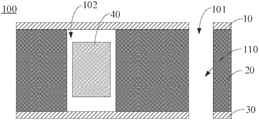
  • FIG. 1 is a structural schematic view of an embedded circuit board according to a first embodiment of the present disclosure.
  • FIG. 2 is a structural schematic view of an embedded circuit board according to a second embodiment of the present disclosure.
  • FIG. 3 is a structural schematic view of an embedded circuit board according to a third embodiment of the present disclosure.
  • FIG. 4 is a structural schematic view of an embedded circuit board according to a fourth embodiment of the present disclosure.
  • FIG. 5 is a structural schematic view of an embedded circuit board according to a fifth embodiment of the present disclosure.
  • FIG. 6 is a flow chart of a method for manufacturing the embedded circuit board according to an embodiment of the present disclosure.
  • the embedded circuit board 100 may include: a first outer wiring board 10 , a base board 20 , and a second outer wiring board 30 , which are stacked sequentially.
  • the first outer wiring board 10 may be disposed on an upper surface of the base board 20 .
  • the first outer wiring board 10 may be a copper layer on the upper surface of the base board 20 .
  • the second outer wiring board 30 may be disposed on a lower surface of the base board 20 .
  • the second outer wiring board 30 may be a copper layer on the lower surface of the base board 20 .
  • the base board 20 may define at least one though hole 101 and at least one groove 102 .
  • the groove 102 may be defined by depth-control milling.
  • the depth-control milling may refer to a technology of using a milling machine for controlling a depth along a Z direction, and the technology may be limited by accuracy of depth-control milling along the Z direction of the milling machine.
  • a length and a width of the groove 102 may be greater than a length and a width of an embedded chip, such that a space of the groove 102 may be enough to receive the embedded chip.
  • the groove 102 may be in a shape of a regular cube, may be trapezoid, or may be step-shaped. The shape of the groove 102 may be determined based on actual needs of a practical work, and will not be limited by the present disclosure. In order to provide intuitive description, the groove 102 is shown as cuboid in the present disclosure.
  • the at least one through hole 101 may further be defined in each of the first outer wiring board 10 and the second outer wiring board 30 .
  • the through hole 101 in the first outer wiring board 10 , the through hole 101 in the base board 20 , and the through hole 101 in the second outer wiring board 30 may communicate with each other to serve as a resonant chamber 110 .
  • the resonant chamber 110 may be squared. In other embodiments, the resonant chamber 110 may be L-shaped, circular, U-shaped, or S-shaped.
  • the embedded circuit board 100 may further include an electronic element 40 .
  • the electronic element 40 may be received in the groove 102 of the base board 20 .
  • the number of grooves 102 may be equal to the number of electronic elements 40 . In this situation, one electronic element 40 may be received in one groove 102 .
  • the number of grooves 102 may be different from the number of electronic elements 40 . In detail, the number of grooves 102 may be less than the number of electronic elements 40 . In this situation, two or more electronic elements 40 may be received in one groove 102 .
  • the electronic element 40 may be a device working by physical vibration, such as at least one of, but not limited to: a mini-microphone, a mini-loudspeaker, an acoustic wave resonator, a microwave resonator, an ultrasonic transducer, a sensor chip, a digital chip.
  • the electronic element 40 may be a tuning element.
  • the tuning element may adjust a resonance frequency of a resonator corresponding to the resonant chamber 110 .
  • the tuning element may be a capacitor and/or an inductor.
  • a minimal distance between a side wall of the groove 102 and a side wall of the through hole 101 adjacent to the groove 102 may be 50 ⁇ m to 500 ⁇ m, such as 100 ⁇ m, 200 ⁇ m, 400 ⁇ m, or 500 ⁇ m.
  • the minimal distance between the side wall of the groove 102 and the side wall of the through hole 101 may be 200 ⁇ m to 450 ⁇ m, such as, 200 ⁇ m, 300 ⁇ m, 400 ⁇ m, or 450 ⁇ m.
  • An inner circumferential wall of the resonant chamber 110 may be an insulated inner circumferential wall.
  • a function of the resonant chamber 110 may be different from that of a metallized through hole.
  • the resonant chamber 110 may not be electrically conductive, but may conduct and amplify information such as sound wave vibration, an atmospheric pressure, temperature, and humidity, such that the information may be sensed by the electronic element 40 (such as a sensor chip) received in the groove 102 . In this way, the information may be converted into an electric signal and displayed in a product, such as a mobile device, a sensor assembly, and so on.
  • a copper layer 70 may be disposed on the inner circumferential wall of the resonant chamber 110 to serve as an electrical connection layer.
  • each of the first outer wiring board 10 , the base board 20 , and the second outer wiring board 30 may define the through hole 101 , and the through holes 101 may communicate with each other to serve as the resonant chamber 110 .
  • the electronic element 40 may be received in the groove 102 of the base board 20 . In this way, the number of elements disposed on a surface of the entire circuit board 100 may be reduced, and miniaturization of the circuit board may be achieved.
  • the minimal distance between the side wall of the groove 102 and the side wall of the through hole 101 adjacent to the groove 102 may be 50 ⁇ m to 500 ⁇ m, such that the resonant wave may be prevented from transmitting to the electronic element 40 directly, the electronic element 40 may be protected from being loose and falling off, and the electronic element 40 received in the groove 102 may be protected from being harmed while defining the through hole 101 .
  • a plurality of electronic elements may be received into one same resonant chamber.
  • the circuit board may be highly waterproof and may have a relatively low manufacturing cost.
  • two adjacent resonant chambers 110 A and 110 B may be defined by a chamber wall 120 in common.
  • the chamber wall 120 may define a coupling window 130 .
  • the coupling window 130 may be defined to allow signals of the two adjacent resonant chamber 110 A and 110 B to be coupled.
  • the coupling window 130 may be a general inductive coupling structure, or a capacitive coupling structure having a protrusion on a top of the window and a protrusion on a bottom of the window.
  • two adjacent resonant chambers 110 A and 110 B may be shown for illustration.
  • the two resonant chambers 110 A and 110 B may be spaced apart from each other by the chamber wall 120 .
  • the coupling window 130 of the chamber wall 120 may extend from a top of the chamber wall 120 to a bottom of the chamber wall 120 . In this way, a coupling strength may be maximized.
  • a resonant oscillator (not shown in the figures) may be received in each of the two resonant chambers 110 A and 110 B, and a coupling block (not shown in the figures) in a certain shape may be received in the coupling window 130 of the chamber wall 120 .
  • An end face may be arranged at each of two end portions of the coupling block respectively, and the end face may be parallel to a surface of the resonant oscillator. In this way, an electromagnetic field may be generated at a periphery of the end face of the coupling block, and a direction of the electromagnetic field may be the same as a direction of the surface of the resonant oscillator.
  • the coupling block may generate sufficient perturbation to the electromagnetic field at an outer side of the surface of the resonant oscillator, such that a coupling effect between the two adjacent resonant chambers 110 A and 110 B may be improved.
  • the base board 20 may include a plurality of meltable dielectric layers 22 and a plurality of sub-boards 21 .
  • the plurality of meltable dielectric layers 22 and the plurality of sub-boards 21 may be stacked alternately. At least one of the plurality of sub-boards 21 may define the groove 102 . After the plurality of sub-boards 21 and the plurality of meltable dielectric layers 22 are compressed, at least a portion of the plurality of meltable dielectric layers 22 may flow to a space between the electronic element 40 and the side wall of the groove 102 .
  • each of the plurality of sub-boards 22 may be a non-copper core board or a copper clad laminate. Configuring each of the plurality of sub-boards 22 to be the non-copper core board is to increase a thickness of the embedded circuit board 100 , such that the thickness of the embedded circuit board may be adapted to allow the electronic element 40 to be embedded therein.
  • Each of the plurality of sub-boards 22 may be the copper clad laminate, and wires may be configured on the copper clad laminate for electrical connection.
  • Each of the plurality of meltable dielectric layers 22 may be disposed between two adjacent ones of the plurality of sub-boards 21 . While compressing, at least a portion of the plurality of meltable dielectric layers 22 may flow into the space between the electronic element 40 and the side wall of the groove 102 , and may contact the electronic element 40 . In this way, the plurality of sub-boards 21 and the electronic element 40 may be bonded together.
  • Material of the plurality of meltable dielectric layers 22 may be at least one or a combination of resin and silicone resin glue.
  • the resin may refer to an organic polymer, which has a softening or melting range after being heated, and tends to flow under an external force during softening.
  • the resin may be solid, semi-solid, and sometimes, liquid at a room temperature.
  • the resin may be an adhesive, such as epoxy resin, silicone resin, polyimide resin, phenolic resin, polyurethane, acrylic resin and so on.
  • the silicone resin glue is a colorless and transparent liquid.
  • the silicone resin glue has certain air permeability and elasticity after curing.
  • the silicone resin glue may have temperature resistance, weather resistance, electrical insulation, physiological inertia, low surface tension and a low surface energy.
  • the groove 102 may be defined in each of the plurality of sub-boards 21 and each of the plurality of meltable dielectric layers 22 disposed between adjacent sub-boards 22 . That is, the groove 102 may be defined to extend through each of the plurality of sub-boards 21 and each of the plurality of meltable dielectric layers 22 disposed between adjacent sub-boards 22 .
  • a package 50 may be coated on an outer surface of the electronic element 40 . After the plurality of sub-boards 21 and the plurality of meltable dielectric layers 22 are compressed, at least a portion of the plurality of meltable dielectric layers 22 may flow to a space between the package 50 and the side wall of the groove 102 , and may contact the package 50 .
  • Material of the package 50 may be the silicone resin glue.
  • the silicone resin glue may be the colorless and transparent liquid, and may have certain air permeability and elasticity after curing.
  • the silicone resin glue may have temperature resistance, weather resistance, electrical insulation, physiological inertia, low surface tension and the low surface energy.
  • the package 50 made of the silicone resin glue may be coated on the outer surface of the electronic element 40 .
  • the silicone resin glue may have better performance on transferring heat, conducting heat and dissipating heat. Therefore, the package 50 may be resistant to a high temperature have an excellent heat dissipation capability. While the electronic element 40 is working, a temperature of the electronic element 40 may be increased, and the package 50 may dissipate the heat rapidly. At the same time, the package 50 made of the silicone resin glue may stably bond with the side walls of the electronic device 40 and the groove 102 . Therefore, the problem of the electronic element 40 falling off and expanding may be solved effectively.
  • a metal sheet (not shown in the figure) may be disposed inside the package 50 .
  • the metal sheet may be configured in the silicone resin glue of the package, an end of the metal sheet may be electrically connected to the electronic element 40 , and the other end of the metal sheet may protrude out of the package 50 and may be electrically connected to a ground line layer, a signal line layer, or a conductive element 60 .
  • the metal sheet may be made of metal only.
  • Material of the metal sheet may include, but is not limited to, copper, copper alloy, aluminum, aluminum alloy, iron, iron alloy, nickel, nickel alloy, gold, gold alloy, silver, silver alloy, platinum group, platinum group alloy, chromium, chromium alloy, magnesium, magnesium alloy, tungsten, tungsten alloy, Molybdenum, molybdenum alloy, lead, lead alloy, tin, tin alloy, indium, indium alloy, zinc, zinc alloy, and so on.
  • the metal sheet may be made of a metal base block and a conductive graphite sheet. Since thermal resistance of the conductive graphite sheet is lower than that of an ordinary metal and alloy, the conductive graphite sheet can be embedded in the metal base block to make heat conduction faster.
  • the conductive element 60 may be configured in the base board 20 to allow a plurality of layers to be connected.
  • a connection end of the electronic element 40 may be electrically connected to the first outer wiring board and/or the second outer wiring board through the conductive via 60 .
  • a hole may be defined in the base board 20 .
  • the hole may extend through each of the plurality of sub-boards 21 and each of the plurality of meltable dielectric layers 22 .
  • a signal layer electrically connected to the sub-boards 21 and/or a conductive layer connected to the ground layer may be received in the hole.
  • the conductive element 60 may be obtained.
  • the hole may be metallized by electroplating.
  • the metal of a wall of the hole may be used as a cathode, and cations of the metal to be electroplated in the electroplating solution may be deposited on the metal of the wall of the hole through electrolysis.
  • a conductive layer may be formed.
  • Metals commonly used for electroplating may include, but are not limited to, titanium, palladium, zinc, cadmium, gold, and brass.
  • the metallization of the hole may also be achieved by coating.
  • one or more components may be configured on a side of the first outer wiring board or a side of the second outer wiring board away from the base board 20 .
  • a plurality of components may be configured on the side of the first outer wiring board away from the base board 20
  • a plurality of components may be configured on the side of the second outer wiring board away from the base board 20 .
  • the plurality of components may be electrically connected to the electronic element 40 via the first outer wiring board and/or the second outer wiring board.
  • the components may be one or more of: a microphone chip, a capacitor chip, a resistor chip, a power source component.
  • electronic elements such as a digital chip and the like
  • components such as the microphone chip and the like
  • the resonant chamber may not affect the digital chip.
  • a better shielding effect may be achieved, external interference, such as noise, received by the electronic elements may be reduced, and performance of the electronic elements may be improved.
  • the embedded circuit board 100 may be applied in a mobile device or a sensor assembly.
  • a method for manufacturing the embedded circuit board includes following operations.
  • a base board having at least one groove may be provided, and an electronic element may be received in the groove.
  • the groove and at least one through hole may be defined in the base board firstly, and the electronic element may be received in the groove correspondingly.
  • a first outer wiring board and a second outer wiring board may be disposed on two opposite sides of the base board respectively.
  • the first outer wiring board, the base board, and the second outer wiring board may be compressed to be fixed.
  • a through hole may be defined in each of the first outer wiring board, the base board, and the second outer wiring board, such that the hole may extend through the first outer wiring board, the base board, and the second outer wiring board to serve as the resonant chamber.
  • the through hole may be defined in the first outer wiring board, the base board, and the second outer wiring board first, and subsequently, the first outer wiring board, the base board, and the second outer wiring board may be stacked and compressed.
  • a minimal distance between a side wall of the groove and a side wall of the through hole adjacent to the groove may be 50 ⁇ m to 500 ⁇ m.
  • the through hole may be defined in the first outer wiring board, the base board, and the second outer wiring board to serve as the resonant chamber, and the electronic elements may be received in the groove of the base board.
  • the minimal distance between the side wall of the groove and the side wall of adjacent communicating through holes may be 50 ⁇ m to 500 ⁇ m.
  • the resonant wave may not be transmitted to the electronic element directly, such that the electronic element may be protected from being loose and falling off, and the electronic element may be protected from being harmed while defining the through hole.
  • a plurality of electronic elements may be embedded into the circuit board, and the plurality of electronic elements may be received in a resonant chamber in common.
  • the circuit board may be highly waterproof and may have a relatively low manufacturing cost.
  • the present disclosure further provides a mobile terminal including the embedded circuit board 100 as mentioned in the above embodiments.
  • the present disclosure further provides a sensor assembly including the embedded circuit board 100 as mentioned in the above embodiments.

Landscapes

  • Engineering & Computer Science (AREA)
  • Microelectronics & Electronic Packaging (AREA)
  • Manufacturing & Machinery (AREA)
  • Power Engineering (AREA)
  • Physics & Mathematics (AREA)
  • Electromagnetism (AREA)
  • Structure Of Printed Boards (AREA)
  • Combinations Of Printed Boards (AREA)

Abstract

The present disclosure relates to the technical field of circuit boards, and provides an embedded circuit board and a method for manufacturing the embedded circuit board. The embedded circuit board includes: a first outer wiring board, a base board, and a second outer wiring board. The base board has at least one groove, the first outer wiring board, the base board and the second outer wiring board define through holes to form a resonant chamber. A minimal distance between the side walls of the groove and the side walls of the adjacent through holes is 50 um-400 um. An electronic device is received in the groove.

Description

CROSS-REFERENCE TO RELATED APPLICATIONS
The present application is a continuation-application of International (PCT) Patent Application No. PCT/CN2020/127021 filed on Nov. 6, 2020, which claims a foreign priority of Chinese Patent Application No. 202010645388.6, filed on Jul. 7, 2020 in the National Intellectual Property Administration of China, the entire contents of which are hereby incorporated by reference in their entireties.
TECHNICAL FIELD
The present disclosure relates to the field of circuit boards, and in particular to an embedded circuit board, a mobile terminal, and a method for manufacturing an embedded circuit board.
BACKGROUND
As electronic products are developed to be miniaturization, having high density and various functions, the number of components and the number of interconnections in the electronic products have gradually increased, and the physical sizes of the components and the interconnections have become increasingly smaller. Therefore, the system-in-package technology, which integrates electronic systems composed of various active and passive components into a common package, has become a significant trend in the future.
Many printed circuit boards have resonant circuits, and the resonant circuits are configured to form a bandpass filter. The resonant circuit is generally formed by connecting a capacitor and an inductor in parallel. In a high-density printed circuit board, the number of inductors and the number of capacitors are huge. How to integrate the huge numbers of the inductors and capacitors is an important factor affecting miniaturization of the product.
SUMMARY OF THE DISCLOSURE
According to a first aspect of the present disclosure, an embedded circuit board is provided and includes: a first outer wiring board, a base board, a second outer wiring board, and an electronic element. The first outer wiring board, the base board, and the second outer wiring board are stacked sequentially. The base board defines at least one groove between the first outer wiring board and the second outer wiring board. A through hole is defined in each of the first outer wiring board, the base board, and the second outer wiring board. The through hole in the first outer wiring board, the through hole in the base board, and the through hole in the second outer wiring board are communicated with each other to serve as a resonant chamber. A minimal distance between a side wall of the at least one groove and a side wall of the through hole adjacent to the at least one groove is in a range of 50 um to 400 um. The electronic element is received in the groove.
According to a second aspect of the present disclosure, a mobile terminal is provided and includes an embedded circuit board. The embedded circuit board includes: a first outer wiring board, a base board, a second outer wiring board, and an electronic element. The first outer wiring board, the base board, and the second outer wiring board are stacked sequentially. The base board defines at least one groove between the first outer wiring board and the second outer wiring board. A resonant chamber is defined in the embedded circuit board and extending through the first outer wiring board, the base board, and the second outer wiring board. The electronic element is received in the groove. The resonant chamber includes two adjacent resonant chambers and defined by a chamber wall in common. The chamber wall defines a coupling window, and signals between the two adjacent resonant chambers are coupled through the coupling window. A resonant oscillator is received in each of the two resonant chambers, a coupling block is received in the coupling window of the chamber wall. An end face is arranged at each of two end portions of the coupling block, and the end face is parallel to a surface of the resonant oscillator. An electromagnetic field is generated at an outer periphery of the end face of the coupling block, and a direction of the electromagnetic field is the same as a direction of the surface of the resonant oscillator
According to a third aspect of the present disclosure, a method for manufacturing an embedded circuit board is provided and includes: providing a base board having at least one groove, wherein an electronic element is received in the at least one groove; disposing a first outer wiring board and a second outer wiring board on two opposite sides of the base board; compressing the first outer wiring board, the second outer wiring board, and the base board to fix the first outer wiring board, the second outer wiring board, and the base board; defining a hole in the first outer wiring board, the second outer wiring board, and the base board to obtain at least one through hole in the first outer wiring board, the second outer wiring board, and the base board. The at least one through hole serves as a resonant chamber, and a minimal distance between a side wall of the at least one groove and a side wall of the through hole adjacent to the at least one groove is in a range of 100 um to 500 um.
BRIEF DESCRIPTION OF THE DRAWINGS
In order to illustrate technical solutions of embodiments of the present disclosure clearly, accompanying drawings for describing the embodiments will be introduced in brief. Obviously, the drawings in the following description are only some embodiments of the present application. For those skilled in the art, other drawings can be acquired based on the provided drawings without any creative work.
FIG. 1 is a structural schematic view of an embedded circuit board according to a first embodiment of the present disclosure.
FIG. 2 is a structural schematic view of an embedded circuit board according to a second embodiment of the present disclosure.
FIG. 3 is a structural schematic view of an embedded circuit board according to a third embodiment of the present disclosure.
FIG. 4 is a structural schematic view of an embedded circuit board according to a fourth embodiment of the present disclosure.
FIG. 5 is a structural schematic view of an embedded circuit board according to a fifth embodiment of the present disclosure.
FIG. 6 is a flow chart of a method for manufacturing the embedded circuit board according to an embodiment of the present disclosure.
DETAILED DESCRIPTION
Technical solutions of the embodiments of the present disclosure may be clearly and comprehensively described by referring to accompanying figures of the embodiments. Obviously, embodiments to be described are only a part of, but not all of, the embodiments of the present disclosure. Any ordinary skilled person in the art may obtain other embodiments based on the embodiments of the present disclosure without any creative work, and the other embodiments should be included in the scope of the present disclosure.
As shown in FIG. 1, the present disclosure provides an embedded circuit board 100. The embedded circuit board 100 may include: a first outer wiring board 10, a base board 20, and a second outer wiring board 30, which are stacked sequentially.
The first outer wiring board 10 may be disposed on an upper surface of the base board 20. The first outer wiring board 10 may be a copper layer on the upper surface of the base board 20. The second outer wiring board 30 may be disposed on a lower surface of the base board 20. The second outer wiring board 30 may be a copper layer on the lower surface of the base board 20.
The base board 20 may define at least one though hole 101 and at least one groove 102. The groove 102 may be defined by depth-control milling. The depth-control milling may refer to a technology of using a milling machine for controlling a depth along a Z direction, and the technology may be limited by accuracy of depth-control milling along the Z direction of the milling machine. A length and a width of the groove 102 may be greater than a length and a width of an embedded chip, such that a space of the groove 102 may be enough to receive the embedded chip. The groove 102 may be in a shape of a regular cube, may be trapezoid, or may be step-shaped. The shape of the groove 102 may be determined based on actual needs of a practical work, and will not be limited by the present disclosure. In order to provide intuitive description, the groove 102 is shown as cuboid in the present disclosure.
The at least one through hole 101 may further be defined in each of the first outer wiring board 10 and the second outer wiring board 30. The through hole 101 in the first outer wiring board 10, the through hole 101 in the base board 20, and the through hole 101 in the second outer wiring board 30 may communicate with each other to serve as a resonant chamber 110. In the present embodiment, the resonant chamber 110 may be squared. In other embodiments, the resonant chamber 110 may be L-shaped, circular, U-shaped, or S-shaped.
Further, the embedded circuit board 100 may further include an electronic element 40. The electronic element 40 may be received in the groove 102 of the base board 20. The number of grooves 102 may be equal to the number of electronic elements 40. In this situation, one electronic element 40 may be received in one groove 102. The number of grooves 102 may be different from the number of electronic elements 40. In detail, the number of grooves 102 may be less than the number of electronic elements 40. In this situation, two or more electronic elements 40 may be received in one groove 102. The electronic element 40 may be a device working by physical vibration, such as at least one of, but not limited to: a mini-microphone, a mini-loudspeaker, an acoustic wave resonator, a microwave resonator, an ultrasonic transducer, a sensor chip, a digital chip. The electronic element 40 may be a tuning element. The tuning element may adjust a resonance frequency of a resonator corresponding to the resonant chamber 110. The tuning element may be a capacitor and/or an inductor.
Further, a minimal distance between a side wall of the groove 102 and a side wall of the through hole 101 adjacent to the groove 102 may be 50 μm to 500 μm, such as 100 μm, 200 μm, 400 μm, or 500 μm. Preferably, the minimal distance between the side wall of the groove 102 and the side wall of the through hole 101 may be 200 μm to 450 μm, such as, 200 μm, 300 μm, 400 μm, or 450 μm.
An inner circumferential wall of the resonant chamber 110 may be an insulated inner circumferential wall. A function of the resonant chamber 110 may be different from that of a metallized through hole. The resonant chamber 110 may not be electrically conductive, but may conduct and amplify information such as sound wave vibration, an atmospheric pressure, temperature, and humidity, such that the information may be sensed by the electronic element 40 (such as a sensor chip) received in the groove 102. In this way, the information may be converted into an electric signal and displayed in a product, such as a mobile device, a sensor assembly, and so on.
In another embodiment, as shown in FIG. 2, a copper layer 70 may be disposed on the inner circumferential wall of the resonant chamber 110 to serve as an electrical connection layer.
According to the present embodiment, each of the first outer wiring board 10, the base board 20, and the second outer wiring board 30 may define the through hole 101, and the through holes 101 may communicate with each other to serve as the resonant chamber 110. The electronic element 40 may be received in the groove 102 of the base board 20. In this way, the number of elements disposed on a surface of the entire circuit board 100 may be reduced, and miniaturization of the circuit board may be achieved. At the same time, the minimal distance between the side wall of the groove 102 and the side wall of the through hole 101 adjacent to the groove 102 may be 50 μm to 500 μm, such that the resonant wave may be prevented from transmitting to the electronic element 40 directly, the electronic element 40 may be protected from being loose and falling off, and the electronic element 40 received in the groove 102 may be protected from being harmed while defining the through hole 101. At the same time, a plurality of electronic elements may be received into one same resonant chamber. The circuit board may be highly waterproof and may have a relatively low manufacturing cost.
As shown in FIG. 3, two adjacent resonant chambers 110A and 110B may be defined by a chamber wall 120 in common. The chamber wall 120 may define a coupling window 130. The coupling window 130 may be defined to allow signals of the two adjacent resonant chamber 110A and 110B to be coupled. The coupling window 130 may be a general inductive coupling structure, or a capacitive coupling structure having a protrusion on a top of the window and a protrusion on a bottom of the window.
In the present embodiment, two adjacent resonant chambers 110A and 110B may be shown for illustration. The two resonant chambers 110A and 110B may be spaced apart from each other by the chamber wall 120. Further, the coupling window 130 of the chamber wall 120 may extend from a top of the chamber wall 120 to a bottom of the chamber wall 120. In this way, a coupling strength may be maximized.
Further, a resonant oscillator (not shown in the figures) may be received in each of the two resonant chambers 110A and 110B, and a coupling block (not shown in the figures) in a certain shape may be received in the coupling window 130 of the chamber wall 120. An end face may be arranged at each of two end portions of the coupling block respectively, and the end face may be parallel to a surface of the resonant oscillator. In this way, an electromagnetic field may be generated at a periphery of the end face of the coupling block, and a direction of the electromagnetic field may be the same as a direction of the surface of the resonant oscillator. When the resonant oscillator and the coupling block are close enough, the coupling block may generate sufficient perturbation to the electromagnetic field at an outer side of the surface of the resonant oscillator, such that a coupling effect between the two adjacent resonant chambers 110A and 110B may be improved.
As shown in FIG. 4, the base board 20 may include a plurality of meltable dielectric layers 22 and a plurality of sub-boards 21. The plurality of meltable dielectric layers 22 and the plurality of sub-boards 21 may be stacked alternately. At least one of the plurality of sub-boards 21 may define the groove 102. After the plurality of sub-boards 21 and the plurality of meltable dielectric layers 22 are compressed, at least a portion of the plurality of meltable dielectric layers 22 may flow to a space between the electronic element 40 and the side wall of the groove 102.
In detail, each of the plurality of sub-boards 22 may be a non-copper core board or a copper clad laminate. Configuring each of the plurality of sub-boards 22 to be the non-copper core board is to increase a thickness of the embedded circuit board 100, such that the thickness of the embedded circuit board may be adapted to allow the electronic element 40 to be embedded therein. Each of the plurality of sub-boards 22 may be the copper clad laminate, and wires may be configured on the copper clad laminate for electrical connection.
Each of the plurality of meltable dielectric layers 22 may be disposed between two adjacent ones of the plurality of sub-boards 21. While compressing, at least a portion of the plurality of meltable dielectric layers 22 may flow into the space between the electronic element 40 and the side wall of the groove 102, and may contact the electronic element 40. In this way, the plurality of sub-boards 21 and the electronic element 40 may be bonded together.
Material of the plurality of meltable dielectric layers 22 may be at least one or a combination of resin and silicone resin glue. In detail, the resin may refer to an organic polymer, which has a softening or melting range after being heated, and tends to flow under an external force during softening. The resin may be solid, semi-solid, and sometimes, liquid at a room temperature. The resin may be an adhesive, such as epoxy resin, silicone resin, polyimide resin, phenolic resin, polyurethane, acrylic resin and so on. The silicone resin glue is a colorless and transparent liquid. The silicone resin glue has certain air permeability and elasticity after curing. The silicone resin glue may have temperature resistance, weather resistance, electrical insulation, physiological inertia, low surface tension and a low surface energy.
Further, as shown in FIG. 5, the groove 102 may be defined in each of the plurality of sub-boards 21 and each of the plurality of meltable dielectric layers 22 disposed between adjacent sub-boards 22. That is, the groove 102 may be defined to extend through each of the plurality of sub-boards 21 and each of the plurality of meltable dielectric layers 22 disposed between adjacent sub-boards 22.
Further, as shown in FIG. 3 and FIG. 4, a package 50 may be coated on an outer surface of the electronic element 40. After the plurality of sub-boards 21 and the plurality of meltable dielectric layers 22 are compressed, at least a portion of the plurality of meltable dielectric layers 22 may flow to a space between the package 50 and the side wall of the groove 102, and may contact the package 50.
Material of the package 50 may be the silicone resin glue. The silicone resin glue may be the colorless and transparent liquid, and may have certain air permeability and elasticity after curing. The silicone resin glue may have temperature resistance, weather resistance, electrical insulation, physiological inertia, low surface tension and the low surface energy.
According to the above embodiment, the package 50 made of the silicone resin glue may be coated on the outer surface of the electronic element 40. The silicone resin glue may have better performance on transferring heat, conducting heat and dissipating heat. Therefore, the package 50 may be resistant to a high temperature have an excellent heat dissipation capability. While the electronic element 40 is working, a temperature of the electronic element 40 may be increased, and the package 50 may dissipate the heat rapidly. At the same time, the package 50 made of the silicone resin glue may stably bond with the side walls of the electronic device 40 and the groove 102. Therefore, the problem of the electronic element 40 falling off and expanding may be solved effectively.
Further, a metal sheet (not shown in the figure) may be disposed inside the package 50. The metal sheet may be configured in the silicone resin glue of the package, an end of the metal sheet may be electrically connected to the electronic element 40, and the other end of the metal sheet may protrude out of the package 50 and may be electrically connected to a ground line layer, a signal line layer, or a conductive element 60. The metal sheet may be made of metal only. Material of the metal sheet may include, but is not limited to, copper, copper alloy, aluminum, aluminum alloy, iron, iron alloy, nickel, nickel alloy, gold, gold alloy, silver, silver alloy, platinum group, platinum group alloy, chromium, chromium alloy, magnesium, magnesium alloy, tungsten, tungsten alloy, Molybdenum, molybdenum alloy, lead, lead alloy, tin, tin alloy, indium, indium alloy, zinc, zinc alloy, and so on. In another embodiment, the metal sheet may be made of a metal base block and a conductive graphite sheet. Since thermal resistance of the conductive graphite sheet is lower than that of an ordinary metal and alloy, the conductive graphite sheet can be embedded in the metal base block to make heat conduction faster.
As shown in FIG. 4, the conductive element 60 may be configured in the base board 20 to allow a plurality of layers to be connected. A connection end of the electronic element 40 may be electrically connected to the first outer wiring board and/or the second outer wiring board through the conductive via 60.
In detail, a hole may be defined in the base board 20. In the present embodiment, the hole may extend through each of the plurality of sub-boards 21 and each of the plurality of meltable dielectric layers 22. A signal layer electrically connected to the sub-boards 21 and/or a conductive layer connected to the ground layer may be received in the hole. In this way, the conductive element 60 may be obtained. In the present embodiment, the hole may be metallized by electroplating. In detail, in a salt solution containing the metal to be electroplated, the metal of a wall of the hole may be used as a cathode, and cations of the metal to be electroplated in the electroplating solution may be deposited on the metal of the wall of the hole through electrolysis. In this way, a conductive layer may be formed. Metals commonly used for electroplating may include, but are not limited to, titanium, palladium, zinc, cadmium, gold, and brass. Of course, in other embodiments, the metallization of the hole may also be achieved by coating.
Alternatively, one or more components (not shown in the figures) may be configured on a side of the first outer wiring board or a side of the second outer wiring board away from the base board 20. Alternatively, a plurality of components may be configured on the side of the first outer wiring board away from the base board 20, and a plurality of components may be configured on the side of the second outer wiring board away from the base board 20. The plurality of components may be electrically connected to the electronic element 40 via the first outer wiring board and/or the second outer wiring board. The components may be one or more of: a microphone chip, a capacitor chip, a resistor chip, a power source component.
According to the present disclosure, electronic elements, such as a digital chip and the like, may be embedded in the base board, whereas components, such as the microphone chip and the like, may still be disposed to the surface of the circuit board and above the through hole 101. In this way, the overall thickness and size of the embedded circuit board 100 may be reduced. At the same time, as the electronic elements, such as the digital chip and the like, are disposed inside the base board and completely covered by the base board, the resonant chamber may not affect the digital chip. A better shielding effect may be achieved, external interference, such as noise, received by the electronic elements may be reduced, and performance of the electronic elements may be improved.
The embedded circuit board 100 according to the embodiment of the present disclosure may be applied in a mobile device or a sensor assembly.
As shown in FIG. 6, a method for manufacturing the embedded circuit board is provided includes following operations.
In an operation S10, a base board having at least one groove may be provided, and an electronic element may be received in the groove.
In other embodiments, the groove and at least one through hole may be defined in the base board firstly, and the electronic element may be received in the groove correspondingly.
In an operation S20, a first outer wiring board and a second outer wiring board may be disposed on two opposite sides of the base board respectively.
In an operation S30, the first outer wiring board, the base board, and the second outer wiring board may be compressed to be fixed.
In an operation S40, a through hole may be defined in each of the first outer wiring board, the base board, and the second outer wiring board, such that the hole may extend through the first outer wiring board, the base board, and the second outer wiring board to serve as the resonant chamber.
In other embodiments, the through hole may be defined in the first outer wiring board, the base board, and the second outer wiring board first, and subsequently, the first outer wiring board, the base board, and the second outer wiring board may be stacked and compressed.
A minimal distance between a side wall of the groove and a side wall of the through hole adjacent to the groove may be 50 μm to 500 μm.
According to the present embodiment, the through hole may be defined in the first outer wiring board, the base board, and the second outer wiring board to serve as the resonant chamber, and the electronic elements may be received in the groove of the base board. In this way, the number of elements disposed on the surface of the entire circuit board may be reduced, and miniaturization of the circuit may be achieved. At the same time, the minimal distance between the side wall of the groove and the side wall of adjacent communicating through holes may be 50 μm to 500 μm. The resonant wave may not be transmitted to the electronic element directly, such that the electronic element may be protected from being loose and falling off, and the electronic element may be protected from being harmed while defining the through hole. Further, a plurality of electronic elements may be embedded into the circuit board, and the plurality of electronic elements may be received in a resonant chamber in common. The circuit board may be highly waterproof and may have a relatively low manufacturing cost.
The present disclosure further provides a mobile terminal including the embedded circuit board 100 as mentioned in the above embodiments.
The present disclosure further provides a sensor assembly including the embedded circuit board 100 as mentioned in the above embodiments.
The above only describes implementations of the present disclosure, and does not limit the scope of the present disclosure. Any equivalent structural or equivalent process transformation performed based on the content of the present description and drawings, directly or indirectly applied to other related art, should also be included in the scope of the present disclosure.
Claims (20)

What is claimed is:
1. An embedded circuit board, comprising:
a first outer wiring board, a base board, and a second outer wiring board, stacking sequentially, wherein
the base board defines at least one groove between the first outer wiring board and the second outer wiring board; a through hole is defined in each of the first outer wiring board, the base board, and the second outer wiring board, the through hole in the first outer wiring board, the through hole in the base board, and the through hole in the second outer wiring board are communicated with each other to serve as a resonant chamber; and
a minimal distance between a side wall of the at least one groove and a side wall of the through hole adjacent to the at least one groove is in a range of 50 um to 500 um; and
an electronic element, received in the groove,
wherein the resonant chamber is configured to conduct and amplify information to the electronic element, and the electronic element is configured to sense the information and convert the information into an electric signal.
2. The embedded circuit board according to claim 1, wherein the minimal distance between the side wall of the at least one groove and the side wall of the through hole adjacent to the at least one groove is in a range of 200 um to 450 um.
3. The embedded circuit board according to claim 1, wherein a copper layer is disposed on an inner circumferential wall of the resonant chamber.
4. The embedded circuit board according to claim 1, wherein
the resonant chamber comprises two adjacent resonant chambers defined by a chamber wall in common;
the chamber wall defines a coupling window, and the signals between the two adjacent resonant chambers are coupled through the coupling window.
5. The embedded circuit board according to claim 4, wherein
a resonant oscillator is received in each of the two adjacent resonant chambers, a coupling block is received in the coupling window of the chamber wall;
an end face is arranged at each of two end portions of the coupling block, and the end face is parallel to a surface of the resonant oscillator; and
an electromagnetic field is generated at an outer periphery of the end face of the coupling block, and a direction of the electromagnetic field is the same as a direction of the surface of the resonant oscillator.
6. The embedded circuit board according to claim 1, wherein
the base board comprises a plurality of meltable dielectric layers and a plurality of sub-boards, the plurality of meltable dielectric layers and the plurality of sub-boards are stacked alternately;
the groove is defined in at least one of the plurality of sub-boards;
the plurality of meltable dielectric layers and the plurality of sub-boards are compressed, and at least a portion of the plurality of meltable dielectric layers flow to a space between the electronic element and the side wall of the at least one groove.
7. The embedded circuit board according to claim 6, wherein the at least one groove is defined in each of the plurality of sub-boards and each of the plurality of meltable dielectric layers.
8. The embedded circuit board according to claim 7, further comprising a package, disposed on an outer surface of the electronic element, wherein
the plurality of meltable dielectric layers and the plurality of sub-boards are compressed, and at least a portion of the plurality of meltable dielectric layers flows to a space between the package and the side wall of the at least one groove and contacts the package.
9. The embedded circuit board according to claim 6, further comprising a package, disposed on an outer surface of the electronic element, wherein
the plurality of meltable dielectric layers and the plurality of sub-boards are compressed, and at least a portion of the plurality of meltable dielectric layers flows to a space between the package and the side wall of the at least one groove and contacts the package.
10. The embedded circuit board according to claim 6, wherein the plurality of sub-boards are non-copper core boards.
11. The embedded circuit board according to claim 1, wherein the electronic element is at least one of a mini-microphone, a mini-loudspeaker, a capacitor, an inductor, an acoustic wave resonator, a microwave resonator, an ultrasonic transducer, and a digital chip.
12. The embedded circuit board according to claim 1, wherein the base board is configured with a conductive element for connecting layers, and a connection end of the electronic element is electrically connected to the first outer wiring board and/or the second outer wiring board through the conductive board.
13. The embedded circuit board according to claim 11, wherein
at least one component is disposed on a side of the first outer wiring board and/or a side of the second outer wiring board away from the base board;
the at least one component is electrically connected to the electronic element through the first outer wiring board and/or the second outer wiring board; and
the at least one component is at least one of a microphone chip, a capacitor component, a resistor component, and a power source component.
14. The embedded circuit board according to claim 1, wherein the embedded circuit board is configured in a mobile terminal or a sensor assembly.
15. A mobile terminal, comprising an embedded circuit board, wherein the embedded circuit board comprises:
a first outer wiring board, a base board, and a second outer wiring board, stacking sequentially, wherein
the base board defines at least one groove between the first outer wiring board and the second outer wiring board;
a resonant chamber is defined in the embedded circuit board and extending through the first outer wiring board, the base board, and the second outer wiring board; and
an electronic element, received in the groove;
wherein the resonant chamber comprises two adjacent resonant chambers and defined by a chamber wall in common;
the chamber wall defines a coupling window, and signals between the two adjacent resonant chambers are coupled through the coupling window;
a resonant oscillator is received in each of the two resonant chambers, a coupling block is received in the coupling window of the chamber wall;
an end face is arranged at each of two end portions of the coupling block, and the end face is parallel to a surface of the resonant oscillator; and
an electromagnetic field is generated at an outer periphery of the end face of the coupling block, and a direction of the electromagnetic field is the same as a direction of the surface of the resonant oscillator,
wherein the resonant chamber is configured to conduct and amplify information to the electronic element, and the electronic element is configured to sense the information and convert the information into an electric signal.
16. The mobile terminal according to claim 15, wherein a minimal distance between a side wall of the at least one groove and a side wall of the resonant chamber adjacent to the at least one groove is in a range of 50 um to 500 um.
17. The mobile terminal according to claim 15, wherein a copper layer is disposed on an inner circumferential wall of the resonant chamber.
18. The mobile terminal according to claim 15, wherein
the base board comprises a plurality of meltable dielectric layers and a plurality of sub-boards, the plurality of meltable dielectric layers and the plurality of sub-boards are stacked alternately;
the groove is defined in at least one of the plurality of sub-boards;
the plurality of meltable dielectric layers and the plurality of sub-boards are compressed, and at least a portion of the plurality of meltable dielectric layers flow to a space between the electronic element and the side wall of the at least one groove.
19. The mobile terminal according to claim 18, wherein
the embedded circuit board further comprises a package, disposed on an outer surface of the electronic element; and
the plurality of meltable dielectric layers and the plurality of sub-boards are compressed, and at least a portion of the plurality of meltable dielectric layers flows to a space between the package and the side wall of the at least one groove and contacts the package.
20. A method for manufacturing an embedded circuit board, comprising:
providing a base board having at least one groove, wherein an electronic element is received in the at least one groove;
disposing a first outer wiring board and a second outer wiring board on two opposite sides of the base board;
compressing the first outer wiring board, the second outer wiring board, and the base board to fix the first outer wiring board, the second outer wiring board, and the base board;
defining a hole in the first outer wiring board, the second outer wiring board, and the base board to obtain at least one through hole in the first outer wiring board, the second outer wiring board, and the base board,
wherein the at least one through hole serves as a resonant chamber, and a minimal distance between a side wall of the at least one groove and a side wall of the through hole adjacent to the at least one groove is in a range of 100 um to 500 um, and
wherein the resonant chamber is configured to conduct and amplify information to the electronic element, and the electronic element is configured to sense the information and convert the information into an electric signal.
US17/134,478 2020-07-07 2020-12-27 Embedded circuit board, mobile terminal, and method for manufacturing embedded circuit board Active US11272620B2 (en)

Applications Claiming Priority (3)

Application Number Priority Date Filing Date Title
CN202010645388.6 2020-07-07
CN202010645388.6A CN112203414A (en) 2019-07-07 2020-07-07 Embedded circuit board and method of making the embedded circuit board
PCT/CN2020/127021 WO2022007278A1 (en) 2019-07-07 2020-11-06 Embedded circuit board, and manufacturing method for embedded circuit board

Related Parent Applications (1)

Application Number Title Priority Date Filing Date
PCT/CN2020/127021 Continuation WO2022007278A1 (en) 2019-07-07 2020-11-06 Embedded circuit board, and manufacturing method for embedded circuit board

Publications (2)

Publication Number Publication Date
US20220015237A1 US20220015237A1 (en) 2022-01-13
US11272620B2 true US11272620B2 (en) 2022-03-08

Family

ID=79173410

Family Applications (1)

Application Number Title Priority Date Filing Date
US17/134,478 Active US11272620B2 (en) 2020-07-07 2020-12-27 Embedded circuit board, mobile terminal, and method for manufacturing embedded circuit board

Country Status (2)

Country Link
US (1) US11272620B2 (en)
EP (1) EP4017226B1 (en)

Families Citing this family (1)

* Cited by examiner, † Cited by third party
Publication number Priority date Publication date Assignee Title
CN119031579A (en) * 2023-05-24 2024-11-26 庆鼎精密电子(淮安)有限公司 Circuit board and method for manufacturing the same

Citations (11)

* Cited by examiner, † Cited by third party
Publication number Priority date Publication date Assignee Title
US20080136013A1 (en) * 2006-12-06 2008-06-12 Denso Corporation Multilayer substrate and method of manufacturing the same
CN101511148A (en) 2009-03-13 2009-08-19 深圳市深南电路有限公司 Method for preparing resonant cavity integrated on PCB
CN201797029U (en) 2010-06-11 2011-04-13 深南电路有限公司 High-frequency filter with resonator
CN102254885A (en) 2010-05-20 2011-11-23 深南电路有限公司 Passive device, passive device-embedded circuit board and manufacturing method
US20120186866A1 (en) * 2011-01-20 2012-07-26 Ibiden Co., Ltd. Wiring board and method for manufacturing the same
CN203150678U (en) 2013-04-02 2013-08-21 武汉凡谷电子技术股份有限公司 Coupling connection structure for dielectric resonant cavities
JP2013211426A (en) 2012-03-30 2013-10-10 Dainippon Printing Co Ltd Component built-in wiring board and manufacturing method of the same
US20160330840A1 (en) * 2015-05-08 2016-11-10 At&S Austria Technologie & Systemtechnik Aktiengesellschaft Printed Circuit Board
CN106848519A (en) 2017-01-17 2017-06-13 电子科技大学 A kind of integrated suspended substrate stripline of medium of artificial complex media filling
US10568209B2 (en) * 2015-07-13 2020-02-18 Murata Manufacturing Co., Ltd. Resin substrate, component-mounted resin substrate, and method of manufacturing component-mounted resin substrate
US20200112075A1 (en) 2018-10-04 2020-04-09 International Business Machines Corporation Embedded Filtering in PCB Integrated Ultra High Speed Dielectric Waveguides Using Photonic Band Gap Structures

Family Cites Families (4)

* Cited by examiner, † Cited by third party
Publication number Priority date Publication date Assignee Title
JP3910045B2 (en) * 2001-11-05 2007-04-25 シャープ株式会社 Method for manufacturing electronic component internal wiring board
US8225503B2 (en) * 2008-02-11 2012-07-24 Ibiden Co., Ltd. Method for manufacturing board with built-in electronic elements
KR102158068B1 (en) * 2014-02-05 2020-09-21 엘지이노텍 주식회사 Embedded printed circuit substrate
JP6648626B2 (en) * 2016-04-27 2020-02-14 オムロン株式会社 Electronic device and method of manufacturing the same

Patent Citations (11)

* Cited by examiner, † Cited by third party
Publication number Priority date Publication date Assignee Title
US20080136013A1 (en) * 2006-12-06 2008-06-12 Denso Corporation Multilayer substrate and method of manufacturing the same
CN101511148A (en) 2009-03-13 2009-08-19 深圳市深南电路有限公司 Method for preparing resonant cavity integrated on PCB
CN102254885A (en) 2010-05-20 2011-11-23 深南电路有限公司 Passive device, passive device-embedded circuit board and manufacturing method
CN201797029U (en) 2010-06-11 2011-04-13 深南电路有限公司 High-frequency filter with resonator
US20120186866A1 (en) * 2011-01-20 2012-07-26 Ibiden Co., Ltd. Wiring board and method for manufacturing the same
JP2013211426A (en) 2012-03-30 2013-10-10 Dainippon Printing Co Ltd Component built-in wiring board and manufacturing method of the same
CN203150678U (en) 2013-04-02 2013-08-21 武汉凡谷电子技术股份有限公司 Coupling connection structure for dielectric resonant cavities
US20160330840A1 (en) * 2015-05-08 2016-11-10 At&S Austria Technologie & Systemtechnik Aktiengesellschaft Printed Circuit Board
US10568209B2 (en) * 2015-07-13 2020-02-18 Murata Manufacturing Co., Ltd. Resin substrate, component-mounted resin substrate, and method of manufacturing component-mounted resin substrate
CN106848519A (en) 2017-01-17 2017-06-13 电子科技大学 A kind of integrated suspended substrate stripline of medium of artificial complex media filling
US20200112075A1 (en) 2018-10-04 2020-04-09 International Business Machines Corporation Embedded Filtering in PCB Integrated Ultra High Speed Dielectric Waveguides Using Photonic Band Gap Structures

Non-Patent Citations (1)

* Cited by examiner, † Cited by third party
Title
International search report,International Application No. PCT/CN2020/127021, dated Jun. 4, 2021 (16 pages).

Also Published As

Publication number Publication date
EP4017226A1 (en) 2022-06-22
EP4017226C0 (en) 2025-04-16
EP4017226A4 (en) 2023-07-19
US20220015237A1 (en) 2022-01-13
EP4017226B1 (en) 2025-04-16

Similar Documents

Publication Publication Date Title
CN213280231U (en) Embedded circuit boards, mobile devices, and sensing components
CN110739288B (en) Millimeter wave frequency band amplifier chip packaging structure and manufacturing method
US8289725B2 (en) Package substrate having embedded capacitor
CN112153811B (en) Circuit board and manufacturing method thereof
JP2017098404A (en) Wiring substrate and manufacturing method of the same
CN112533358A (en) High-frequency microwave multilayer circuit board and high-frequency microwave assembly
EP3796562B1 (en) Wireless transmission module and fabrication method therefor
KR101555403B1 (en) Wiring board
US11272620B2 (en) Embedded circuit board, mobile terminal, and method for manufacturing embedded circuit board
US11527807B2 (en) Electronic device having first and second component carrier parts with cut-outs therein and adhesively joined to form a cavity that supports an electronic component therein
CN102024565A (en) Capacitor structure
CN112533349B (en) Circuit board and manufacturing method thereof
JPH08236940A (en) Multilayered wiring board
CN112738994B (en) Printed circuit board with embedded power device
CN111212521B (en) Multilayer circuit board with buried plane resistor ceramic powder filled with hydrocarbon resin
JP2649252B2 (en) Multilayer printed wiring board
JP2784523B2 (en) Substrate for mounting electronic components
CN205755064U (en) Component carrier
JP2784525B2 (en) Substrate for mounting electronic components
CN210271842U (en) Low loss transmission line and apparatus
CN218041922U (en) Circuit board assembly
CN216357301U (en) MEMS microphone and electronic equipment
CN119584421A (en) Printed circuit board and manufacturing method thereof, and electronic equipment
JP2007318048A (en) Multilayer wiring board and manufacturing method therefor
JP6882069B2 (en) Wiring board

Legal Events

Date Code Title Description
AS Assignment

Owner name: SHENNAN CIRCUITS CO., LTD., CHINA

Free format text: ASSIGNMENT OF ASSIGNORS INTEREST;ASSIGNORS:HUANG, LIXIANG;WANG, ZEDONG;MIAO, HUA;REEL/FRAME:054750/0495

Effective date: 20201207

FEPP Fee payment procedure

Free format text: ENTITY STATUS SET TO UNDISCOUNTED (ORIGINAL EVENT CODE: BIG.); ENTITY STATUS OF PATENT OWNER: LARGE ENTITY

STCF Information on status: patent grant

Free format text: PATENTED CASE

MAFP Maintenance fee payment

Free format text: PAYMENT OF MAINTENANCE FEE, 4TH YEAR, LARGE ENTITY (ORIGINAL EVENT CODE: M1551); ENTITY STATUS OF PATENT OWNER: LARGE ENTITY

Year of fee payment: 4