US11231655B2 - Control apparatus, exposure apparatus, and manufacturing method for article - Google Patents

Control apparatus, exposure apparatus, and manufacturing method for article Download PDF

Info

Publication number
US11231655B2
US11231655B2 US16/751,813 US202016751813A US11231655B2 US 11231655 B2 US11231655 B2 US 11231655B2 US 202016751813 A US202016751813 A US 202016751813A US 11231655 B2 US11231655 B2 US 11231655B2
Authority
US
United States
Prior art keywords
currents
control apparatus
driving unit
value
driving
Prior art date
Legal status (The legal status is an assumption and is not a legal conclusion. Google has not performed a legal analysis and makes no representation as to the accuracy of the status listed.)
Active
Application number
US16/751,813
Other versions
US20200241430A1 (en
Inventor
Takeshi Motegi
Current Assignee (The listed assignees may be inaccurate. Google has not performed a legal analysis and makes no representation or warranty as to the accuracy of the list.)
Canon Inc
Original Assignee
Canon Inc
Priority date (The priority date is an assumption and is not a legal conclusion. Google has not performed a legal analysis and makes no representation as to the accuracy of the date listed.)
Filing date
Publication date
Application filed by Canon Inc filed Critical Canon Inc
Assigned to CANON KABUSHIKI KAISHA reassignment CANON KABUSHIKI KAISHA ASSIGNMENT OF ASSIGNORS INTEREST (SEE DOCUMENT FOR DETAILS). Assignors: MOTEGI, TAKESHI
Publication of US20200241430A1 publication Critical patent/US20200241430A1/en
Application granted granted Critical
Publication of US11231655B2 publication Critical patent/US11231655B2/en
Active legal-status Critical Current
Anticipated expiration legal-status Critical

Links

Images

Classifications

    • HELECTRICITY
    • H02GENERATION; CONVERSION OR DISTRIBUTION OF ELECTRIC POWER
    • H02PCONTROL OR REGULATION OF ELECTRIC MOTORS, ELECTRIC GENERATORS OR DYNAMO-ELECTRIC CONVERTERS; CONTROLLING TRANSFORMERS, REACTORS OR CHOKE COILS
    • H02P25/00Arrangements or methods for the control of AC motors characterised by the kind of AC motor or by structural details
    • H02P25/02Arrangements or methods for the control of AC motors characterised by the kind of AC motor or by structural details characterised by the kind of motor
    • H02P25/06Linear motors
    • GPHYSICS
    • G03PHOTOGRAPHY; CINEMATOGRAPHY; ANALOGOUS TECHNIQUES USING WAVES OTHER THAN OPTICAL WAVES; ELECTROGRAPHY; HOLOGRAPHY
    • G03FPHOTOMECHANICAL PRODUCTION OF TEXTURED OR PATTERNED SURFACES, e.g. FOR PRINTING, FOR PROCESSING OF SEMICONDUCTOR DEVICES; MATERIALS THEREFOR; ORIGINALS THEREFOR; APPARATUS SPECIALLY ADAPTED THEREFOR
    • G03F7/00Photomechanical, e.g. photolithographic, production of textured or patterned surfaces, e.g. printing surfaces; Materials therefor, e.g. comprising photoresists; Apparatus specially adapted therefor
    • G03F7/20Exposure; Apparatus therefor
    • GPHYSICS
    • G03PHOTOGRAPHY; CINEMATOGRAPHY; ANALOGOUS TECHNIQUES USING WAVES OTHER THAN OPTICAL WAVES; ELECTROGRAPHY; HOLOGRAPHY
    • G03FPHOTOMECHANICAL PRODUCTION OF TEXTURED OR PATTERNED SURFACES, e.g. FOR PRINTING, FOR PROCESSING OF SEMICONDUCTOR DEVICES; MATERIALS THEREFOR; ORIGINALS THEREFOR; APPARATUS SPECIALLY ADAPTED THEREFOR
    • G03F7/00Photomechanical, e.g. photolithographic, production of textured or patterned surfaces, e.g. printing surfaces; Materials therefor, e.g. comprising photoresists; Apparatus specially adapted therefor
    • G03F7/70Microphotolithographic exposure; Apparatus therefor
    • G03F7/70483Information management; Active and passive control; Testing; Wafer monitoring, e.g. pattern monitoring
    • G03F7/70491Information management, e.g. software; Active and passive control, e.g. details of controlling exposure processes or exposure tool monitoring processes
    • GPHYSICS
    • G03PHOTOGRAPHY; CINEMATOGRAPHY; ANALOGOUS TECHNIQUES USING WAVES OTHER THAN OPTICAL WAVES; ELECTROGRAPHY; HOLOGRAPHY
    • G03FPHOTOMECHANICAL PRODUCTION OF TEXTURED OR PATTERNED SURFACES, e.g. FOR PRINTING, FOR PROCESSING OF SEMICONDUCTOR DEVICES; MATERIALS THEREFOR; ORIGINALS THEREFOR; APPARATUS SPECIALLY ADAPTED THEREFOR
    • G03F7/00Photomechanical, e.g. photolithographic, production of textured or patterned surfaces, e.g. printing surfaces; Materials therefor, e.g. comprising photoresists; Apparatus specially adapted therefor
    • G03F7/70Microphotolithographic exposure; Apparatus therefor
    • G03F7/70691Handling of masks or workpieces
    • G03F7/70716Stages
    • G03F7/70725Stages control
    • HELECTRICITY
    • H02GENERATION; CONVERSION OR DISTRIBUTION OF ELECTRIC POWER
    • H02PCONTROL OR REGULATION OF ELECTRIC MOTORS, ELECTRIC GENERATORS OR DYNAMO-ELECTRIC CONVERTERS; CONTROLLING TRANSFORMERS, REACTORS OR CHOKE COILS
    • H02P7/00Arrangements for regulating or controlling the speed or torque of electric DC motors
    • H02P7/02Arrangements for regulating or controlling the speed or torque of electric DC motors the DC motors being of the linear type
    • YGENERAL TAGGING OF NEW TECHNOLOGICAL DEVELOPMENTS; GENERAL TAGGING OF CROSS-SECTIONAL TECHNOLOGIES SPANNING OVER SEVERAL SECTIONS OF THE IPC; TECHNICAL SUBJECTS COVERED BY FORMER USPC CROSS-REFERENCE ART COLLECTIONS [XRACs] AND DIGESTS
    • Y10TECHNICAL SUBJECTS COVERED BY FORMER USPC
    • Y10STECHNICAL SUBJECTS COVERED BY FORMER USPC CROSS-REFERENCE ART COLLECTIONS [XRACs] AND DIGESTS
    • Y10S388/00Electricity: motor control systems
    • Y10S388/907Specific control circuit element or device
    • Y10S388/912Pulse or frequency counter

Definitions

  • the present invention relates to a control apparatus, and more particularly, to a control apparatus suitable to control driving of a stage in an exposure apparatus.
  • a control apparatus for driving such a stage is required to enable large current and high voltage.
  • a current amplifier that adopts a PWM method is provided as a current source for supplying current required to drive the driving unit.
  • the PWM method is a modulation method that uses a reference wave, and hence nonlinear components are included. It has been known that distortion is involved in dead time and further in output current due to the effect of the nonlinear components.
  • a PWM amplifier including a dead time compensation circuit configured to apply offset voltage to reduce distortion.
  • an object of the present invention is to provide a control apparatus with which driving of a driving unit can be controlled with high accuracy with a simple configuration, an exposure apparatus, and a manufacturing method for an article.
  • a control apparatus including: a plurality of current sources each being configured to supply current based on a PWM method; a first detection unit configured to detect a driving state of a driving unit; and a control unit configured to change values of a plurality of currents which are supplied from the plurality of current sources based on a result of the detection by the first detection unit, and which are required to drive the driving unit, when a value of at least one of the plurality of currents is a predetermined value.
  • FIG. 1 is a block diagram for illustrating one of control apparatus according to a first embodiment of the present invention.
  • FIG. 2A is a chart for schematically showing a waveform of output current from the control apparatus according to the first embodiment.
  • FIG. 2B is a chart for schematically showing a waveform of output current from the control apparatus according to the first embodiment.
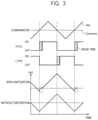
  • FIG. 3 shows charts for schematically showing how distortion occurs in output current from the control apparatus according to the first embodiment.
  • FIG. 4A is a diagram for illustrating how the control apparatus according to the first embodiment controls a fine movement stage.
  • FIG. 4B is a diagram for illustrating how the control apparatus according to the first embodiment controls the fine movement stage.
  • FIG. 5 shows charts for schematically showing drive profiles of a fine movement stage in an exposure apparatus including control apparatus according to a second embodiment of the present invention.
  • FIG. 6 is a block diagram for illustrating one of the control apparatus according to the second embodiment.
  • FIG. 7 is a top view for schematically illustrating a stage apparatus installed in an exposure apparatus including the control apparatus according to the first embodiment.
  • FIG. 7 is a top view for schematically illustrating a stage apparatus 10 installed in an exposure apparatus including control apparatus 100 according to a first embodiment of the present invention.
  • a direction extending from the back to the front of the drawing sheet is defined as a z-axis direction
  • a direction extending perpendicularly to the z-axis direction toward the right side of the drawing sheet is defined as an x-axis direction
  • a direction extending perpendicularly to the z-axis direction and the x-axis direction toward the upper side of the drawing sheet is defined as a y-axis direction.
  • the stage apparatus 10 includes a y coarse movement stage 11 , a fine movement stage 14 , and an x coarse movement stage 15 .
  • the y coarse movement stage 11 is driven along the y-axis direction with use of a surface plate 12 having a mirror-finished guide surface for the y coarse movement stage 11 , a yaw guide 13 , and a static pressure guide (not shown).
  • the x coarse movement stage 15 is provided to sandwich, in the y-axis direction, the y coarse movement stage 11 with a static pressure guide (not shown) being provided on the surface plate 12 , and is driven in the x-axis direction along the y coarse movement stage 11 .
  • a y coarse movement linear motor for driving the y coarse movement stage 11 includes movable elements 23 a and 23 b formed from coils.
  • the y coarse movement stage 11 is connected to the y coarse movement linear motor via connecting plates 25 a and 25 b , and subjected to positioning control by a control system (not shown) and the y coarse movement linear motor.
  • An x coarse movement linear motor for driving the x coarse movement stage 15 includes a stator 27 provided on the y coarse movement stage 11 and a movable element (not shown).
  • the x coarse movement stage 15 is subjected to positioning control in the x-axis direction by the x coarse movement linear motor and a control system (not shown).
  • the fine movement stage 14 is provided on the x coarse movement stage 15 .
  • Fine movement x linear motors 31 a and 31 b configured to generate driving force in the x-axis direction
  • fine movement y linear motors 32 a and 32 b configured to generate driving force in the y-axis direction are provided between the x coarse movement stage 15 and the fine movement stage 14 .
  • fine movement z linear motors 33 a , 33 b , 33 c , and 33 d configured to generate driving force in the z-axis direction are provided between the x coarse movement stage 15 and the fine movement stage 14 .
  • those fine movement linear motors are driven on an axis basis by separate control apparatus 100 , to thereby enable positioning control on the fine movement stage 14 along six axes (x axis, y axis, z axis, and rotational directions around those axes).
  • FIG. 1 is a block diagram for illustrating one of the control apparatus 100 according to the first embodiment.
  • the control apparatus 100 includes an amplifier (current source) 20 , a controller (control unit) 50 , and a detector (first detection unit) 70 .
  • the amplifier 20 is configured to output current Iout for driving a linear motor LM (driving unit) for the fine movement stage 14 .
  • the linear motors LM correspond to any one of the fine movement x linear motor, the fine movement y linear motor, and the fine movement z linear motor.
  • the detector 70 is configured to detect a position (driving state) of the fine movement stage 14
  • the controller 50 is configured to transmit a command value Command to the amplifier 20 based on a result of the detection by the detector 70 .
  • a switching controller 20 a is configured to switch on one of two combinations, that is, a first combination of switching circuits H 1 and L 2 and a second combination of switching circuits H 2 and L 1 , and switch off the other combination in accordance with the transmitted command value Command and a reference triangular wave Wst.
  • the amplifier 20 adopts a PWM method.
  • desired current Iout can be output, which has a ripple waveform having frequency components corresponding to a frequency Fsw of the reference wave Wst as shown in FIG. 2A .
  • the generated through-current causes heat generation and breakdown of the switching circuits H 1 , H 2 , L 1 , and L 2 .
  • Such through-current may be possibly generated upon turning on one combination switched from the other combination.
  • the generation of the through-current can be suppressed by setting a period in which the first combination of switching circuits H 1 and L 2 and the second combination of switching circuits H 2 and L 1 are both turned off, that is, a dead time.
  • This configuration is generally used in the PWM method.
  • the command value Command is changed with respect to the reference triangular wave Wst, to thereby offset current to be output from the amplifier 20 .
  • distortion occurs when a reference value of a driver matches any value on and around an inflection point of the current change at which the dead time is generated.
  • desired offset current is required in settling of the fine movement stage 14 , for example, because of disturbance caused by other components of magnets used in the fine movement linear motors and by installation of cables.
  • FIG. 3 shows charts for schematically showing how distortion occurs in the output current Iout from the control apparatus 100 .
  • a predetermined dead time is set before switching an off state to an on state so as to suppress generation of the through-current described above.
  • This output current is represented by Iout_dist.
  • Iout_dist the current Iout of a waveform having distortion at portions as indicated by Iout_dist in FIG. 2B is output.
  • FIG. 4A and FIG. 4B are diagrams for illustrating how to control the fine movement x linear motors 31 a and 31 b configured to generate driving force for the fine movement stage 14 in the x-axis direction, and the fine movement y linear motors 32 a and 32 b configured to generate driving force for the fine movement stage 14 in the y-axis direction.
  • separate amplifiers 20 are provided for the fine movement x linear motors 31 a and 31 b and the fine movement y linear motors 32 a and 32 b , and caused to output currents Ixf, Ixb, Iyl, and Iyr by the controller 50 .
  • predetermined thrust force is required in the x-axis direction and the y-axis direction so as to control the fine movement stage 14 in a predetermined position in the rotational direction.
  • the thrust force is proportional to a total value of control currents for the linear motors from the plurality of amplifiers 20 .
  • this total value Istage can be represented by the vector sum of the currents Ixf, Ixb, Iyl, and Iyr.
  • the distortion-involved output current Iout_dist (predetermined value) as described above is measured in advance in a corresponding amplifier 20 , and stored in the controller 50 .
  • the fine movement stage 14 is disadvantageously controlled with a delay due to the distortion of the output current Iout from the amplifier 20 . As a result, an accuracy of positional control on the fine movement stage 14 is lowered.
  • offset current Iadd is added to each of the currents Ixf, Ixb, Iyl, and Iyr for the fine movement x linear motors 31 a and 31 b and the fine movement y linear motors 32 a and 32 b while maintaining the total value Istage.
  • the fine movement stage 14 can be controlled with high accuracy by changing current required in settling of the fine movement stage 14 in accordance with the distortion-involved output current of a corresponding amplifier 20 .
  • the distortion-involved output current Iout_dist of a corresponding amplifier 20 can be changed as well in accordance with the current required in settling of the fine movement stage 14 .
  • the distortion-involved output current Iout_dist of a corresponding amplifier 20 can be varied through changing the settings of the amplifier 20 (for example, changing the dead time, the switching frequency Fsw, or filter constant).
  • the current required in settling of the fine movement stage 14 can be changed by changing a distance between the fine movement stage 14 and the x coarse movement stage 15 .
  • FIG. 5 shows charts for showing drive profiles of the fine movement stage 14 in an exposure apparatus including control apparatus 200 according to the second embodiment.
  • the fine movement stage 14 is driven with accelerated driving, constant-velocity driving, and decelerated driving being switched.
  • the exposure apparatus performs exposure during the constant-velocity driving of the fine movement stage 14 , and hence highly accurate positional control is required for the fine movement stage 14 during the constant-velocity driving.
  • the current required to drive the fine movement stage 14 varies for the accelerated driving, the constant-velocity driving, and the decelerated driving, and thus changes constantly upon switching the accelerated driving, the constant-velocity driving, and the decelerated driving.
  • predetermined current is required in the accelerated driving just before the constant-velocity driving, and the required current is reduced in a constant-velocity drive section.
  • the error Stage error increases due to the effect of the distortion-involved output current Iout_dist of the output current Iout from the amplifier 20 , and disadvantageously affects the accuracy of controlling the fine movement stage 14 in the constant-velocity drive section.
  • FIG. 6 is a control block diagram for illustrating one of control apparatus 200 according to the second embodiment.
  • a monitor 30 (second detection unit) is provided to monitor the output current Iout from a corresponding amplifier 20 .
  • a compensation current source 40 is caused to supply the offset current Iadd so as to compensate for the output current Iout.
  • control apparatus 200 can prevent the error of the fine movement stage 14 from increasing due to the distortion-involved output current Iout_dist by feedback control of the output current Iout from a corresponding amplifier 20 . Therefore, the accuracy of controlling the fine movement stage 14 can be maintained.
  • the feedback control of the output current Iout is performed.
  • this feedback control can be also performed by changing a control gain (not shown) and compensating for the output current Iout with the gain.
  • the feedback control is performed so as to compensate for the output current in accordance with the distortion-involved output current of a corresponding amplifier 20 .
  • the fine movement stage 14 can be controlled with high accuracy.
  • the distortion-involved output current Iout_dist of a corresponding amplifier 20 can also be changed in accordance with current required in the drive section of the fine movement stage 14 .
  • the distortion-involved output current Iout_dist of a corresponding amplifier 20 can be varied through changing the settings of the amplifier 20 (for example, changing the control gain in the amplifier 20 ).
  • the current required in the drive section of the fine movement stage 14 can be changed as well through changing the distance between the fine movement stage 14 and the x coarse movement stage 15 .
  • the control apparatus 200 is also applicable to a case in which the required current and the distortion-involved output current Iout_dist of a corresponding amplifier 20 match or affect each other even after the settling of the fine movement stage 14 .
  • the output current Iout from a corresponding amplifier 20 is subjected to feedback control, but the present invention is not limited thereto.
  • the fine movement stage 14 can be controlled with high accuracy by feedforward control of the output current Iout from a corresponding amplifier 20 to reduce any effect of the distortion.
  • a manufacturing method for a device for example, semiconductor integrated circuit element or liquid crystal display element as an article includes a step of forming a pattern on a substrate (wafer, glass plate, or film-like substrate) with use of the exposure apparatus including the control apparatus described above.
  • the manufacturing method may further include a step of developing the substrate having formed thereon the pattern, and a step of etching certain portions of the substrate.
  • the manufacturing method may include executing, instead of etching, other processing such as processing of the substrate on which the pattern is formed.
  • the manufacturing method for an article of the embodiment is advantageous in terms of at least one of performance, quality, yield, and production costs of the article as compared with related-art methods.
  • control apparatus with which driving of the driving unit can be controlled with high accuracy with a simple configuration, the exposure apparatus, and the manufacturing method for an article can be provided.

Landscapes

  • Physics & Mathematics (AREA)
  • General Physics & Mathematics (AREA)
  • Engineering & Computer Science (AREA)
  • Power Engineering (AREA)
  • Exposure And Positioning Against Photoresist Photosensitive Materials (AREA)
  • Control Of Ac Motors In General (AREA)
  • Control Of Multiple Motors (AREA)

Abstract

To provide a control apparatus, with which driving of a driving unit can be controlled with high accuracy with a simple configuration, the control apparatus (100) according to the present invention include: a plurality of current sources (20) each being configured to supply current based on a PWM method; a first detection unit configured to detect a driving state of a driving unit (14); and a control unit (50) configured to change values of a plurality of currents (Ixf, Ixb, Iyl, and Iyr) which are supplied from the plurality of current sources (20) based on a result of the detection by the first detection unit, and which are required to drive the driving unit (14), when a value of at least one of the plurality of currents (Ixf, Ixb, Iyl, and Iyr) is a predetermined value.

Description

BACKGROUND OF THE INVENTION Field of the Invention
The present invention relates to a control apparatus, and more particularly, to a control apparatus suitable to control driving of a stage in an exposure apparatus.
Description of the Related Art
Along with recent advances toward high-speed driving of a stage aimed at improving productivity of a semiconductor exposure apparatus, a control apparatus for driving such a stage is required to enable large current and high voltage.
In the control apparatus adapted to enable large current and high voltage and configured to control driving of a driving unit, for example, for a stage, a current amplifier that adopts a PWM method is provided as a current source for supplying current required to drive the driving unit.
However, the PWM method is a modulation method that uses a reference wave, and hence nonlinear components are included. It has been known that distortion is involved in dead time and further in output current due to the effect of the nonlinear components.
In Japanese Patent Application Laid-Open No. 2013-31204, there is disclosed a PWM amplifier including a dead time compensation circuit configured to apply offset voltage to reduce distortion.
However, when distortion of output current is to be compensated for as in the PWM amplifier disclosed in Japanese Patent Application Laid-Open No. 2013-31204, an additional compensation circuit is required, and hence a control apparatus including such a PWM amplifier is disadvantageously complicated.
In view of the above, an object of the present invention is to provide a control apparatus with which driving of a driving unit can be controlled with high accuracy with a simple configuration, an exposure apparatus, and a manufacturing method for an article.
SUMMARY OF THE INVENTION
According to one embodiment of the present invention, there is provided a control apparatus including: a plurality of current sources each being configured to supply current based on a PWM method; a first detection unit configured to detect a driving state of a driving unit; and a control unit configured to change values of a plurality of currents which are supplied from the plurality of current sources based on a result of the detection by the first detection unit, and which are required to drive the driving unit, when a value of at least one of the plurality of currents is a predetermined value.
Further features of the present invention will become apparent from the following description of exemplary embodiments with reference to the attached drawings.
BRIEF DESCRIPTION OF THE DRAWINGS
FIG. 1 is a block diagram for illustrating one of control apparatus according to a first embodiment of the present invention.
FIG. 2A is a chart for schematically showing a waveform of output current from the control apparatus according to the first embodiment.
FIG. 2B is a chart for schematically showing a waveform of output current from the control apparatus according to the first embodiment.
FIG. 3 shows charts for schematically showing how distortion occurs in output current from the control apparatus according to the first embodiment.
FIG. 4A is a diagram for illustrating how the control apparatus according to the first embodiment controls a fine movement stage.
FIG. 4B is a diagram for illustrating how the control apparatus according to the first embodiment controls the fine movement stage.
FIG. 5 shows charts for schematically showing drive profiles of a fine movement stage in an exposure apparatus including control apparatus according to a second embodiment of the present invention.
FIG. 6 is a block diagram for illustrating one of the control apparatus according to the second embodiment.
FIG. 7 is a top view for schematically illustrating a stage apparatus installed in an exposure apparatus including the control apparatus according to the first embodiment.
DESCRIPTION OF THE EMBODIMENTS
A control apparatus according to an embodiment of the present invention is described below in detail with reference to the accompanying drawings. Some of the drawings referred to below may be drawn in scales different from the actual scale for easier understanding of the embodiment.
First Embodiment
FIG. 7 is a top view for schematically illustrating a stage apparatus 10 installed in an exposure apparatus including control apparatus 100 according to a first embodiment of the present invention.
In FIG. 7, a direction extending from the back to the front of the drawing sheet is defined as a z-axis direction, a direction extending perpendicularly to the z-axis direction toward the right side of the drawing sheet is defined as an x-axis direction, and a direction extending perpendicularly to the z-axis direction and the x-axis direction toward the upper side of the drawing sheet is defined as a y-axis direction.
The stage apparatus 10 includes a y coarse movement stage 11, a fine movement stage 14, and an x coarse movement stage 15.
The y coarse movement stage 11 is driven along the y-axis direction with use of a surface plate 12 having a mirror-finished guide surface for the y coarse movement stage 11, a yaw guide 13, and a static pressure guide (not shown).
The x coarse movement stage 15 is provided to sandwich, in the y-axis direction, the y coarse movement stage 11 with a static pressure guide (not shown) being provided on the surface plate 12, and is driven in the x-axis direction along the y coarse movement stage 11.
A y coarse movement linear motor for driving the y coarse movement stage 11 includes movable elements 23 a and 23 b formed from coils.
The y coarse movement stage 11 is connected to the y coarse movement linear motor via connecting plates 25 a and 25 b, and subjected to positioning control by a control system (not shown) and the y coarse movement linear motor.
An x coarse movement linear motor for driving the x coarse movement stage 15 includes a stator 27 provided on the y coarse movement stage 11 and a movable element (not shown).
The x coarse movement stage 15 is subjected to positioning control in the x-axis direction by the x coarse movement linear motor and a control system (not shown).
The fine movement stage 14 is provided on the x coarse movement stage 15. Fine movement x linear motors 31 a and 31 b configured to generate driving force in the x-axis direction, and fine movement y linear motors 32 a and 32 b configured to generate driving force in the y-axis direction are provided between the x coarse movement stage 15 and the fine movement stage 14. Further, fine movement z linear motors 33 a, 33 b, 33 c, and 33 d configured to generate driving force in the z-axis direction are provided between the x coarse movement stage 15 and the fine movement stage 14.
As described below, those fine movement linear motors are driven on an axis basis by separate control apparatus 100, to thereby enable positioning control on the fine movement stage 14 along six axes (x axis, y axis, z axis, and rotational directions around those axes).
FIG. 1 is a block diagram for illustrating one of the control apparatus 100 according to the first embodiment.
The control apparatus 100 includes an amplifier (current source) 20, a controller (control unit) 50, and a detector (first detection unit) 70.
The amplifier 20 is configured to output current Iout for driving a linear motor LM (driving unit) for the fine movement stage 14. The linear motors LM correspond to any one of the fine movement x linear motor, the fine movement y linear motor, and the fine movement z linear motor.
As illustrated in FIG. 1, the detector 70 is configured to detect a position (driving state) of the fine movement stage 14, and the controller 50 is configured to transmit a command value Command to the amplifier 20 based on a result of the detection by the detector 70.
In the amplifier 20, a switching controller 20 a is configured to switch on one of two combinations, that is, a first combination of switching circuits H1 and L2 and a second combination of switching circuits H2 and L1, and switch off the other combination in accordance with the transmitted command value Command and a reference triangular wave Wst. In short, the amplifier 20 adopts a PWM method.
With this operation, desired current Iout can be output, which has a ripple waveform having frequency components corresponding to a frequency Fsw of the reference wave Wst as shown in FIG. 2A.
Actually, when the first combination of switching circuits H1 and L2 and the second combination of switching circuits H2 and L1 are both turned on in the amplifier 20, through-current flows between a power supply voltage +V side and a power supply voltage −V side.
In this case, the generated through-current causes heat generation and breakdown of the switching circuits H1, H2, L1, and L2.
Such through-current may be possibly generated upon turning on one combination switched from the other combination.
The generation of the through-current can be suppressed by setting a period in which the first combination of switching circuits H1 and L2 and the second combination of switching circuits H2 and L1 are both turned off, that is, a dead time. This configuration is generally used in the PWM method.
In this case, it is known that when the dead time is set, distortion occurs at specific offset current values as indicated by Iout_dist in FIG. 2B.
Specifically, the command value Command is changed with respect to the reference triangular wave Wst, to thereby offset current to be output from the amplifier 20. At this time, distortion occurs when a reference value of a driver matches any value on and around an inflection point of the current change at which the dead time is generated.
Upon settling the fine movement stage 14, desired offset current is required in settling of the fine movement stage 14, for example, because of disturbance caused by other components of magnets used in the fine movement linear motors and by installation of cables.
At this time, when the offset current required in settling of the fine movement stage 14 matches distortion-involved output current Iout_dist of the amplifier 20, a control delay occurs in connection with control characteristics for the fine movement stage 14, and performance of the exposure apparatus is disadvantageously lowered.
FIG. 3 shows charts for schematically showing how distortion occurs in the output current Iout from the control apparatus 100.
As shown in FIG. 3, when the reference wave Wst and the command value Command, which are input to a comparator (not shown) in the amplifier 20, cross each other, one of the first combination of switching circuits H1 and L2 and the second combination of switching circuits H2 and L1 is switched to the other, and the other combination is turned on.
In this case, a predetermined dead time is set before switching an off state to an on state so as to suppress generation of the through-current described above.
In this state, as shown in FIG. 3, when the polarity of the output current Iout is not inverted during the dead time, the output current Iout without distortion can be obtained.
As shown in FIG. 3, however, when the polarity of the output current Iout is inverted during the dead time, the current of the inverted polarity cannot be controlled, and hence distortion occurs in the output current Iout.
This output current is represented by Iout_dist. In this case, the current Iout of a waveform having distortion at portions as indicated by Iout_dist in FIG. 2B is output.
FIG. 4A and FIG. 4B are diagrams for illustrating how to control the fine movement x linear motors 31 a and 31 b configured to generate driving force for the fine movement stage 14 in the x-axis direction, and the fine movement y linear motors 32 a and 32 b configured to generate driving force for the fine movement stage 14 in the y-axis direction.
As illustrated in FIG. 4A, separate amplifiers 20 are provided for the fine movement x linear motors 31 a and 31 b and the fine movement y linear motors 32 a and 32 b, and caused to output currents Ixf, Ixb, Iyl, and Iyr by the controller 50.
Upon settling the fine movement stage 14, predetermined thrust force is required in the x-axis direction and the y-axis direction so as to control the fine movement stage 14 in a predetermined position in the rotational direction.
The thrust force is proportional to a total value of control currents for the linear motors from the plurality of amplifiers 20. Specifically, this total value Istage can be represented by the vector sum of the currents Ixf, Ixb, Iyl, and Iyr.
In this example, the distortion-involved output current Iout_dist (predetermined value) as described above is measured in advance in a corresponding amplifier 20, and stored in the controller 50.
At this time, when any one of the currents Ixf, Ixb, Iyl, and Iyr matches the distortion-involved output current Iout_dist stored in the controller 50, the fine movement stage 14 is disadvantageously controlled with a delay due to the distortion of the output current Iout from the amplifier 20. As a result, an accuracy of positional control on the fine movement stage 14 is lowered.
To address this, as illustrated in FIG. 4B, offset current Iadd is added to each of the currents Ixf, Ixb, Iyl, and Iyr for the fine movement x linear motors 31 a and 31 b and the fine movement y linear motors 32 a and 32 b while maintaining the total value Istage.
Consequently, the currents Ixf, Ixb, Iyl, and Iyr can be changed not to match the distortion-involved output current Iout_dist without changing the total value Istage.
In this way, through changing current required in settling of the fine movement stage 14 not to match distortion of the distortion-involved output current of a corresponding amplifier 20, any reduction in stage control accuracy can be prevented.
As described above, in the exposure apparatus including the control apparatus 100 according to the first embodiment, the fine movement stage 14 can be controlled with high accuracy by changing current required in settling of the fine movement stage 14 in accordance with the distortion-involved output current of a corresponding amplifier 20.
In the control apparatus 100 according to the first embodiment, the distortion-involved output current Iout_dist of a corresponding amplifier 20 can be changed as well in accordance with the current required in settling of the fine movement stage 14.
Specifically, the distortion-involved output current Iout_dist of a corresponding amplifier 20 can be varied through changing the settings of the amplifier 20 (for example, changing the dead time, the switching frequency Fsw, or filter constant).
Further, a feedback control mechanism described below in a second embodiment of the present invention can be used instead.
Alternatively, the current required in settling of the fine movement stage 14 can be changed by changing a distance between the fine movement stage 14 and the x coarse movement stage 15.
Second Embodiment
FIG. 5 shows charts for showing drive profiles of the fine movement stage 14 in an exposure apparatus including control apparatus 200 according to the second embodiment.
Components of the control apparatus 200 according to the second embodiment, which are the same as those of the control apparatus 100 according to the first embodiment, are denoted by identical reference symbols, and the descriptions regarding the components are omitted.
As illustrated in FIG. 5, the fine movement stage 14 is driven with accelerated driving, constant-velocity driving, and decelerated driving being switched.
In this case, the exposure apparatus performs exposure during the constant-velocity driving of the fine movement stage 14, and hence highly accurate positional control is required for the fine movement stage 14 during the constant-velocity driving.
The current required to drive the fine movement stage 14 varies for the accelerated driving, the constant-velocity driving, and the decelerated driving, and thus changes constantly upon switching the accelerated driving, the constant-velocity driving, and the decelerated driving.
Further, predetermined current is required in the accelerated driving just before the constant-velocity driving, and the required current is reduced in a constant-velocity drive section.
At this time, however, when the current required for the accelerated driving of the fine movement stage 14 matches the distortion-involved output current of a corresponding amplifier 20, a response of the amplifier 20 is delayed, and the positional control on the fine movement stage 14 transiently worsens.
Consequently, as illustrated in FIG. 5, a large error Stage error of the fine movement stage 14 remains in the constant-velocity drive section.
Specifically, the error Stage error increases due to the effect of the distortion-involved output current Iout_dist of the output current Iout from the amplifier 20, and disadvantageously affects the accuracy of controlling the fine movement stage 14 in the constant-velocity drive section.
FIG. 6 is a control block diagram for illustrating one of control apparatus 200 according to the second embodiment.
As illustrated in FIG. 6, in the control apparatus 200 of the second embodiment, a monitor 30 (second detection unit) is provided to monitor the output current Iout from a corresponding amplifier 20.
Further, when the monitor 30 detects that the output current Iout matches the distortion-involved output current Iout_dist, a compensation current source 40 is caused to supply the offset current Iadd so as to compensate for the output current Iout.
In this way, the control apparatus 200 according to the second embodiment can prevent the error of the fine movement stage 14 from increasing due to the distortion-involved output current Iout_dist by feedback control of the output current Iout from a corresponding amplifier 20. Therefore, the accuracy of controlling the fine movement stage 14 can be maintained.
In the control apparatus 200 according to the second embodiment, the feedback control of the output current Iout is performed. However, this feedback control can be also performed by changing a control gain (not shown) and compensating for the output current Iout with the gain.
In this case, when the gain is increased excessively, oscillation is induced in a large-current output region or a high-frequency region. To avoid this, it may be effective to provide a limiter to a gain compensation circuit.
As described above, in the control apparatus 200 according to the second embodiment, in the drive section of the fine movement stage 14 (during driving), the feedback control is performed so as to compensate for the output current in accordance with the distortion-involved output current of a corresponding amplifier 20. With this operation, the fine movement stage 14 can be controlled with high accuracy.
In the control apparatus 200 according to the second embodiment, the distortion-involved output current Iout_dist of a corresponding amplifier 20 can also be changed in accordance with current required in the drive section of the fine movement stage 14.
Specifically, the distortion-involved output current Iout_dist of a corresponding amplifier 20 can be varied through changing the settings of the amplifier 20 (for example, changing the control gain in the amplifier 20).
Further, the current required in the drive section of the fine movement stage 14 can be changed as well through changing the distance between the fine movement stage 14 and the x coarse movement stage 15.
The control apparatus 200 is also applicable to a case in which the required current and the distortion-involved output current Iout_dist of a corresponding amplifier 20 match or affect each other even after the settling of the fine movement stage 14.
Further, in the control apparatus 200 according to the second embodiment, the output current Iout from a corresponding amplifier 20 is subjected to feedback control, but the present invention is not limited thereto. Alternatively, the fine movement stage 14 can be controlled with high accuracy by feedforward control of the output current Iout from a corresponding amplifier 20 to reduce any effect of the distortion.
The exemplary embodiments of the present invention are described above, but the present invention is not limited to these embodiments and can be modified and changed variously within the scope of the gist thereof.
(Embodiment Relating to Manufacturing Method for Article)
A manufacturing method for a device (for example, semiconductor integrated circuit element or liquid crystal display element) as an article includes a step of forming a pattern on a substrate (wafer, glass plate, or film-like substrate) with use of the exposure apparatus including the control apparatus described above. The manufacturing method may further include a step of developing the substrate having formed thereon the pattern, and a step of etching certain portions of the substrate. In manufacturing a patterned medium (recording medium), an optical element, or other such articles, the manufacturing method may include executing, instead of etching, other processing such as processing of the substrate on which the pattern is formed. The manufacturing method for an article of the embodiment is advantageous in terms of at least one of performance, quality, yield, and production costs of the article as compared with related-art methods.
According to the present invention, the control apparatus with which driving of the driving unit can be controlled with high accuracy with a simple configuration, the exposure apparatus, and the manufacturing method for an article can be provided.
While the present invention has been described with reference to exemplary embodiments, it is to be understood that the invention is not limited to the disclosed exemplary embodiments. The scope of the following claims is to be accorded the broadest interpretation so as to encompass all such modifications and equivalent structures and functions.
This application claims the benefit of Japanese Patent Application No. 2019-013061, filed Jan. 29, 2019, which is hereby incorporated by reference herein in its entirety.

Claims (17)

What is claimed is:
1. A control apparatus for controlling a driving unit, the control apparatus comprising:
a plurality of current sources each being configured to supply current based on a PWM method;
a first detection unit configured to detect a driving state of the driving unit; and
a control unit configured to change values of a plurality of currents which are supplied from the plurality of current sources based on a result of the detection by the first detection unit, and which are required to drive the driving unit, in a case where a value of at least one of the plurality of currents is a predetermined value, such that a total value expressed by a vector sum of the plurality of currents is not changed,
wherein a thrust force generated by the driving unit is proportional to the total value expressed by the vector sum of the plurality of currents.
2. The control apparatus according to claim 1, wherein the control unit is configured to compare the values of the plurality of currents required to drive the driving unit and the predetermined value stored in the control unit.
3. The control apparatus according to claim 1, further comprising a second detection unit configured to detect the plurality of currents,
wherein the control unit is configured to change the values of the plurality of currents in a case where the second detection unit detects that a value of at least one of the plurality of currents is the predetermined value.
4. The control apparatus according to claim 1, wherein the predetermined value is a value of current which involves distortion caused by the PWM method, and which is measured in the plurality of current sources.
5. The control apparatus according to claim 1, wherein the predetermined value is a value of current required in settling of the driving unit.
6. The control apparatus according to claim 1, wherein the predetermined value is a value of current required in driving of the driving unit.
7. The control apparatus according to claim 1, wherein the predetermined value is a value of the at least one of the plurality of currents when a distortion in a value of the at least one of the plurality of currents with respect to a time occurs by providing the time when the at least one of the plurality of currents is not supplied from at least one of the plurality of current sources.
8. An exposure apparatus comprising:
a control apparatus for controlling a driving unit, the control apparatus comprising:
a plurality of current sources each being configured to supply current based on a PWM method;
a first detection unit configured to detect a driving state of the driving unit; and
a control unit configured to change values of a plurality of currents which are supplied from the plurality of current sources based on a result of the detection by the first detection unit, and which are required to drive the driving unit, in a case where a value of at least one of the plurality of currents is a predetermined value, such that a total value expressed by a vector sum of the plurality of currents is not changed,
wherein a thrust force generated by the driving unit is proportional to the total value expressed by the vector sum of the plurality of currents; and
a stage driven with use of current supplied by the control apparatus.
9. A manufacturing method for an article comprising:
exposing a substrate using an exposure apparatus comprising:
a control apparatus for controlling a driving unit, the control apparatus comprising:
a plurality of current sources each being configured to supply current based on a PWM method;
a first detection unit configured to detect a driving state of the driving unit; and
a control unit configured to change values of a plurality of currents which are supplied from the plurality of current sources based on a result of the detection by the first detection unit, and which are required to drive the driving unit, in a case where a value of at least one of the plurality of currents is a predetermined value, such that a total value expressed by a vector sum of the plurality of currents is not changed,
wherein a thrust force generated by the driving unit is proportional to the total value expressed by the vector sum of the plurality of currents; and
a stage driven with use of current supplied by the control apparatus; and
developing the substrate,
wherein the article is manufactured from the developed substrate.
10. A control apparatus for controlling a driving unit with a plurality of linear motors, the control apparatus comprising:
a plurality of current sources each being configured to supply current to a corresponding linear motor of the plurality of linear motors based on a PWM method;
a first detection unit configured to detect a driving state of the driving unit; and
a control unit configured to change values of a plurality of currents which are supplied from the plurality of current sources based on a result of the detection by the first detection unit, and which are required to drive the driving unit, in a case where a value of at least one of the plurality of currents is a predetermined value, such that a thrust force generated by driving unit is not changed,
wherein each of the plurality of linear motors generates a thrust force in a different direction from each other, and
wherein the thrust force generated by the driving unit corresponds to a sum of the respective thrust forces generated by the plurality of linear motors.
11. The control apparatus according to claim 10, wherein the control unit is configured to compare the values of the plurality of currents required to drive the driving unit and the predetermined value stored in the control unit.
12. The control apparatus according to claim 10, further comprising a second detection unit configured to detect the plurality of currents,
wherein the control unit is configured to change the values of the plurality of currents in a case where the second detection unit detects that a value of at least one of the plurality of currents is the predetermined value.
13. The control apparatus according to claim 10, wherein the predetermined value is a value of current which involves distortion caused by the PWM method, and which is measured in the plurality of current sources.
14. The control apparatus according to claim 10, wherein the predetermined value is a value of current required in settling of the driving unit.
15. The control apparatus according to claim 10, wherein the predetermined value is a value of current required in driving of the driving unit.
16. An exposure apparatus comprising:
a control apparatus for controlling a driving unit with a plurality of linear motors, the control apparatus comprising:
a plurality of current sources each being configured to supply current to a corresponding linear motor of the plurality of linear motors based on a PWM method;
a first detection unit configured to detect a driving state of the driving unit; and
a control unit configured to change values of a plurality of currents which are supplied from the plurality of current sources based on a result of the detection by the first detection unit, and which are required to drive the driving unit, in a case where a value of at least one of the plurality of currents is a predetermined value, such that a thrust force generated by driving unit is not changed,
wherein each of the plurality of linear motors generates a thrust force in a different direction from each other, and
wherein the thrust force generated by the driving unit corresponds to a sum of the respective thrust forces generated by the plurality of linear motors; and
a stage driven with use of current supplied by the control apparatus.
17. A manufacturing method for an article comprising:
exposing a substrate using an exposure apparatus comprising:
a control apparatus for controlling a driving unit with a plurality of linear motors, the control apparatus comprising:
a plurality of current sources each being configured to supply current to a corresponding linear motor of the plurality of linear motors based on a PWM method;
a first detection unit configured to detect a driving state of the driving unit; and
a control unit configured to change values of a plurality of currents which are supplied from the plurality of current sources based on a result of the detection by the first detection unit, and which are required to drive the driving unit, in a case where a value of at least one of the plurality of currents is a predetermined value, such that a thrust force generated by driving unit is not changed,
wherein each of the plurality of linear motors generates a thrust force in a different direction from each other, and
wherein the thrust force generated by the driving unit corresponds to a sum of the respective thrust forces generated by the plurality of linear motors; and
a stage driven with use of current supplied by the control apparatus; and developing the substrate,
wherein the article is manufactured from the developed substrate.
US16/751,813 2019-01-29 2020-01-24 Control apparatus, exposure apparatus, and manufacturing method for article Active US11231655B2 (en)

Applications Claiming Priority (3)

Application Number Priority Date Filing Date Title
JP2019013061A JP2020124010A (en) 2019-01-29 2019-01-29 Control device, exposure apparatus, and item production method
JP2019-013061 2019-01-29
JPJP2019-013061 2019-01-29

Publications (2)

Publication Number Publication Date
US20200241430A1 US20200241430A1 (en) 2020-07-30
US11231655B2 true US11231655B2 (en) 2022-01-25

Family

ID=71731236

Family Applications (1)

Application Number Title Priority Date Filing Date
US16/751,813 Active US11231655B2 (en) 2019-01-29 2020-01-24 Control apparatus, exposure apparatus, and manufacturing method for article

Country Status (4)

Country Link
US (1) US11231655B2 (en)
JP (1) JP2020124010A (en)
KR (1) KR20200094109A (en)
CN (1) CN111487847A (en)

Citations (17)

* Cited by examiner, † Cited by third party
Publication number Priority date Publication date Assignee Title
US20040201834A1 (en) * 2002-08-29 2004-10-14 Canon Kabushiki Kaisha Stage apparatus and its driving method, exposure apparatus and device manufacturing method
US20060170888A1 (en) * 2005-01-31 2006-08-03 Canon Kabushiki Kaisha Moving control apparatus and moving control method
US20080266907A1 (en) * 2007-04-25 2008-10-30 Jin-Tae Kim Switch controller, switch control method, converter using the same, and driving method thereof
US20130026924A1 (en) * 2011-01-28 2013-01-31 Seoul Semiconductor Co., Ltd. Led driving circuit package
JP2013031204A (en) 2012-09-12 2013-02-07 Renesas Electronics Corp Pwm amplifier
US20150103328A1 (en) * 2013-10-16 2015-04-16 Canon Kabushiki Kaisha Lithography apparatus, power supplying method, and article manufacturing method
US20150303841A1 (en) * 2014-04-18 2015-10-22 Canon Kabushiki Kaisha Linear motor control apparatus and linear motor control system
US20160373045A1 (en) * 2015-06-16 2016-12-22 Canon Kabushiki Kaisha Motor driving device for controlling motor with pulse signal
US20160381773A1 (en) * 2015-06-23 2016-12-29 Panasonic Intellectual Property Management Co., Ltd. Semiconductor light source driving apparatus
US20170077712A1 (en) * 2014-03-27 2017-03-16 Autonetworks Technologies, Ltd. Power source control device and power source control method
US20170288589A1 (en) * 2016-03-30 2017-10-05 Canon Kabushiki Kaisha Motor driving apparatus, sheet conveyance apparatus, document feeding apparatus, document reading apparatus and image forming apparatus
US20180254733A1 (en) * 2017-03-01 2018-09-06 Canon Kabushiki Kaisha Control device and control method
US20180301977A1 (en) * 2017-04-14 2018-10-18 Renesas Electronics Corporation Semiconductor device and control method thereof
US20190193975A1 (en) * 2017-12-22 2019-06-27 Seiko Epson Corporation Recording device and control method for recording device
US20200012200A1 (en) * 2018-07-04 2020-01-09 Canon Kabushiki Kaisha Control apparatus, exposure apparatus, and method of manufacturing article
US20200028457A1 (en) * 2018-07-20 2020-01-23 Minebea Mitsumi Inc. Motor driving control device and motor driving control method
US20200266732A1 (en) * 2019-02-14 2020-08-20 Minebea Mitsumi Inc. Motor driving control device and motor driving control method

Family Cites Families (2)

* Cited by examiner, † Cited by third party
Publication number Priority date Publication date Assignee Title
JP3073879B2 (en) * 1994-03-25 2000-08-07 キヤノン株式会社 Anti-vibration device
JP2003037986A (en) * 2001-07-25 2003-02-07 Nikon Corp Motor driving device, stage device, and exposure apparatus having the same

Patent Citations (17)

* Cited by examiner, † Cited by third party
Publication number Priority date Publication date Assignee Title
US20040201834A1 (en) * 2002-08-29 2004-10-14 Canon Kabushiki Kaisha Stage apparatus and its driving method, exposure apparatus and device manufacturing method
US20060170888A1 (en) * 2005-01-31 2006-08-03 Canon Kabushiki Kaisha Moving control apparatus and moving control method
US20080266907A1 (en) * 2007-04-25 2008-10-30 Jin-Tae Kim Switch controller, switch control method, converter using the same, and driving method thereof
US20130026924A1 (en) * 2011-01-28 2013-01-31 Seoul Semiconductor Co., Ltd. Led driving circuit package
JP2013031204A (en) 2012-09-12 2013-02-07 Renesas Electronics Corp Pwm amplifier
US20150103328A1 (en) * 2013-10-16 2015-04-16 Canon Kabushiki Kaisha Lithography apparatus, power supplying method, and article manufacturing method
US20170077712A1 (en) * 2014-03-27 2017-03-16 Autonetworks Technologies, Ltd. Power source control device and power source control method
US20150303841A1 (en) * 2014-04-18 2015-10-22 Canon Kabushiki Kaisha Linear motor control apparatus and linear motor control system
US20160373045A1 (en) * 2015-06-16 2016-12-22 Canon Kabushiki Kaisha Motor driving device for controlling motor with pulse signal
US20160381773A1 (en) * 2015-06-23 2016-12-29 Panasonic Intellectual Property Management Co., Ltd. Semiconductor light source driving apparatus
US20170288589A1 (en) * 2016-03-30 2017-10-05 Canon Kabushiki Kaisha Motor driving apparatus, sheet conveyance apparatus, document feeding apparatus, document reading apparatus and image forming apparatus
US20180254733A1 (en) * 2017-03-01 2018-09-06 Canon Kabushiki Kaisha Control device and control method
US20180301977A1 (en) * 2017-04-14 2018-10-18 Renesas Electronics Corporation Semiconductor device and control method thereof
US20190193975A1 (en) * 2017-12-22 2019-06-27 Seiko Epson Corporation Recording device and control method for recording device
US20200012200A1 (en) * 2018-07-04 2020-01-09 Canon Kabushiki Kaisha Control apparatus, exposure apparatus, and method of manufacturing article
US20200028457A1 (en) * 2018-07-20 2020-01-23 Minebea Mitsumi Inc. Motor driving control device and motor driving control method
US20200266732A1 (en) * 2019-02-14 2020-08-20 Minebea Mitsumi Inc. Motor driving control device and motor driving control method

Also Published As

Publication number Publication date
JP2020124010A (en) 2020-08-13
KR20200094109A (en) 2020-08-06
US20200241430A1 (en) 2020-07-30
CN111487847A (en) 2020-08-04

Similar Documents

Publication Publication Date Title
US8849456B2 (en) Robot, carriage device, and control method using inertia sensor
US9715124B2 (en) Control device, actuator including control device, image blur correction device, interchangeable lens, image pickup apparatus, and automatic stage
EP3118985B1 (en) Control apparatus of vibration actuator, method for controlling vibration actuator, driving apparatus, and imaging apparatus
JP6667220B2 (en) Vibration-type actuator control device and control method, drive device, imaging device, and automatic stage
JPWO2014167808A1 (en) Motor drive device
JP2015033240A (en) Linear motor system
CN111193402B (en) Digital control system and method of DC-DC power supply
US11231655B2 (en) Control apparatus, exposure apparatus, and manufacturing method for article
CN108233815A (en) A kind of voice coil motor high speed and precision light beam pointing system control method based on PWM
CN101496275A (en) Drive and method
EP2869121B1 (en) Computer-readable storage medium, generating method, generating apparatus, driving apparatus, processing apparatus, lithography apparatus, and method of manufacturing article
US11652435B2 (en) Command generation device and command generation method
JP2002163006A (en) Motor control device and control method
JP6971785B2 (en) Drives, their control methods, and programs, as well as electronics.
JP2004094368A (en) Control method for servo system and its controller
CN111865140A (en) A method and implementation device for reducing motor tracking error based on micro-drive unit
JP5055932B2 (en) Synchronous motor controller
CN113054888B (en) Motor control device and motor control method
JP7467201B2 (en) Motor Control Device
JPS6132120A (en) Positioning control system
KR0160745B1 (en) Method for twin-x-y robot control
Mirtchev et al. Optimizing the feedback control of Galvo scanners for laser manufacturing systems
KR0160680B1 (en) Control method for twin x-y coordinate robot when it returns to origin
JPH06276774A (en) Positioning control method for motor
JP2006288029A (en) Vehicle motor current control apparatus and motor current control method

Legal Events

Date Code Title Description
FEPP Fee payment procedure

Free format text: ENTITY STATUS SET TO UNDISCOUNTED (ORIGINAL EVENT CODE: BIG.); ENTITY STATUS OF PATENT OWNER: LARGE ENTITY

AS Assignment

Owner name: CANON KABUSHIKI KAISHA, JAPAN

Free format text: ASSIGNMENT OF ASSIGNORS INTEREST;ASSIGNOR:MOTEGI, TAKESHI;REEL/FRAME:052374/0680

Effective date: 20200108

STPP Information on status: patent application and granting procedure in general

Free format text: RESPONSE TO NON-FINAL OFFICE ACTION ENTERED AND FORWARDED TO EXAMINER

STPP Information on status: patent application and granting procedure in general

Free format text: FINAL REJECTION MAILED

STPP Information on status: patent application and granting procedure in general

Free format text: NOTICE OF ALLOWANCE MAILED -- APPLICATION RECEIVED IN OFFICE OF PUBLICATIONS

STPP Information on status: patent application and granting procedure in general

Free format text: DOCKETED NEW CASE - READY FOR EXAMINATION

STPP Information on status: patent application and granting procedure in general

Free format text: NOTICE OF ALLOWANCE MAILED -- APPLICATION RECEIVED IN OFFICE OF PUBLICATIONS

STPP Information on status: patent application and granting procedure in general

Free format text: PUBLICATIONS -- ISSUE FEE PAYMENT VERIFIED

STCF Information on status: patent grant

Free format text: PATENTED CASE

FEPP Fee payment procedure

Free format text: MAINTENANCE FEE REMINDER MAILED (ORIGINAL EVENT CODE: REM.); ENTITY STATUS OF PATENT OWNER: LARGE ENTITY