US11230206B2 - Method and device for adjusting position of seat in vehicle - Google Patents

Method and device for adjusting position of seat in vehicle Download PDF

Info

Publication number
US11230206B2
US11230206B2 US16/480,928 US201716480928A US11230206B2 US 11230206 B2 US11230206 B2 US 11230206B2 US 201716480928 A US201716480928 A US 201716480928A US 11230206 B2 US11230206 B2 US 11230206B2
Authority
US
United States
Prior art keywords
pressure sensor
seat
adjusting
value
comparison value
Prior art date
Legal status (The legal status is an assumption and is not a legal conclusion. Google has not performed a legal analysis and makes no representation as to the accuracy of the status listed.)
Active, expires
Application number
US16/480,928
Other versions
US20190389330A1 (en
Inventor
Yuen YIN
Yue Liu
Wenwei JIA
Current Assignee (The listed assignees may be inaccurate. Google has not performed a legal analysis and makes no representation or warranty as to the accuracy of the list.)
Beijing Automotive Group Co Ltd
Beijing Automotive Research Institute Co Ltd
Original Assignee
Beijing Automotive Group Co Ltd
Beijing Automotive Research Institute Co Ltd
Priority date (The priority date is an assumption and is not a legal conclusion. Google has not performed a legal analysis and makes no representation as to the accuracy of the date listed.)
Filing date
Publication date
Application filed by Beijing Automotive Group Co Ltd, Beijing Automotive Research Institute Co Ltd filed Critical Beijing Automotive Group Co Ltd
Assigned to BEIJING AUTOMOTIVE GROUP CO. LTD, Beijing Automobile Research Institute Co., Ltd. reassignment BEIJING AUTOMOTIVE GROUP CO. LTD ASSIGNMENT OF ASSIGNORS INTEREST (SEE DOCUMENT FOR DETAILS). Assignors: JIA, Wenwei, LIU, YUE, YIN, Yuen
Publication of US20190389330A1 publication Critical patent/US20190389330A1/en
Application granted granted Critical
Publication of US11230206B2 publication Critical patent/US11230206B2/en
Active legal-status Critical Current
Adjusted expiration legal-status Critical

Links

Images

Classifications

    • BPERFORMING OPERATIONS; TRANSPORTING
    • B60VEHICLES IN GENERAL
    • B60NSEATS SPECIALLY ADAPTED FOR VEHICLES; VEHICLE PASSENGER ACCOMMODATION NOT OTHERWISE PROVIDED FOR
    • B60N2/00Seats specially adapted for vehicles; Arrangement or mounting of seats in vehicles
    • B60N2/02Seats specially adapted for vehicles; Arrangement or mounting of seats in vehicles the seat or part thereof being movable, e.g. adjustable
    • B60N2/04Seats specially adapted for vehicles; Arrangement or mounting of seats in vehicles the seat or part thereof being movable, e.g. adjustable the whole seat being movable
    • B60N2/06Seats specially adapted for vehicles; Arrangement or mounting of seats in vehicles the seat or part thereof being movable, e.g. adjustable the whole seat being movable slidable
    • AHUMAN NECESSITIES
    • A47FURNITURE; DOMESTIC ARTICLES OR APPLIANCES; COFFEE MILLS; SPICE MILLS; SUCTION CLEANERS IN GENERAL
    • A47CCHAIRS; SOFAS; BEDS
    • A47C31/00Details or accessories for chairs, beds, or the like, not provided for in other groups of this subclass, e.g. upholstery fasteners, mattress protectors, stretching devices for mattress nets
    • A47C31/12Means, e.g. measuring means, for adapting chairs, beds or mattresses to the shape or weight of persons
    • A47C31/126Means, e.g. measuring means, for adapting chairs, beds or mattresses to the shape or weight of persons for chairs
    • BPERFORMING OPERATIONS; TRANSPORTING
    • B60VEHICLES IN GENERAL
    • B60NSEATS SPECIALLY ADAPTED FOR VEHICLES; VEHICLE PASSENGER ACCOMMODATION NOT OTHERWISE PROVIDED FOR
    • B60N2/00Seats specially adapted for vehicles; Arrangement or mounting of seats in vehicles
    • B60N2/002Seats provided with an occupancy detection means mounted therein or thereon
    • B60N2/0021Seats provided with an occupancy detection means mounted therein or thereon characterised by the type of sensor or measurement
    • B60N2/003Seats provided with an occupancy detection means mounted therein or thereon characterised by the type of sensor or measurement characterised by the sensor mounting location in or on the seat
    • BPERFORMING OPERATIONS; TRANSPORTING
    • B60VEHICLES IN GENERAL
    • B60NSEATS SPECIALLY ADAPTED FOR VEHICLES; VEHICLE PASSENGER ACCOMMODATION NOT OTHERWISE PROVIDED FOR
    • B60N2/00Seats specially adapted for vehicles; Arrangement or mounting of seats in vehicles
    • B60N2/02Seats specially adapted for vehicles; Arrangement or mounting of seats in vehicles the seat or part thereof being movable, e.g. adjustable
    • B60N2/0224Non-manual adjustments, e.g. with electrical operation
    • B60N2/0244Non-manual adjustments, e.g. with electrical operation with logic circuits
    • BPERFORMING OPERATIONS; TRANSPORTING
    • B60VEHICLES IN GENERAL
    • B60NSEATS SPECIALLY ADAPTED FOR VEHICLES; VEHICLE PASSENGER ACCOMMODATION NOT OTHERWISE PROVIDED FOR
    • B60N2/00Seats specially adapted for vehicles; Arrangement or mounting of seats in vehicles
    • B60N2/02Seats specially adapted for vehicles; Arrangement or mounting of seats in vehicles the seat or part thereof being movable, e.g. adjustable
    • B60N2/0224Non-manual adjustments, e.g. with electrical operation
    • B60N2/0244Non-manual adjustments, e.g. with electrical operation with logic circuits
    • B60N2/0268Non-manual adjustments, e.g. with electrical operation with logic circuits using sensors or detectors for adapting the seat or seat part, e.g. to the position of an occupant
    • BPERFORMING OPERATIONS; TRANSPORTING
    • B60VEHICLES IN GENERAL
    • B60NSEATS SPECIALLY ADAPTED FOR VEHICLES; VEHICLE PASSENGER ACCOMMODATION NOT OTHERWISE PROVIDED FOR
    • B60N2/00Seats specially adapted for vehicles; Arrangement or mounting of seats in vehicles
    • B60N2/02Seats specially adapted for vehicles; Arrangement or mounting of seats in vehicles the seat or part thereof being movable, e.g. adjustable
    • B60N2/0224Non-manual adjustments, e.g. with electrical operation
    • B60N2/0244Non-manual adjustments, e.g. with electrical operation with logic circuits
    • B60N2/0277Non-manual adjustments, e.g. with electrical operation with logic circuits characterised by the calculation method or calculation flow chart of sensor data for adjusting the seat
    • BPERFORMING OPERATIONS; TRANSPORTING
    • B60VEHICLES IN GENERAL
    • B60NSEATS SPECIALLY ADAPTED FOR VEHICLES; VEHICLE PASSENGER ACCOMMODATION NOT OTHERWISE PROVIDED FOR
    • B60N2/00Seats specially adapted for vehicles; Arrangement or mounting of seats in vehicles
    • B60N2/02Seats specially adapted for vehicles; Arrangement or mounting of seats in vehicles the seat or part thereof being movable, e.g. adjustable
    • B60N2/04Seats specially adapted for vehicles; Arrangement or mounting of seats in vehicles the seat or part thereof being movable, e.g. adjustable the whole seat being movable
    • B60N2/06Seats specially adapted for vehicles; Arrangement or mounting of seats in vehicles the seat or part thereof being movable, e.g. adjustable the whole seat being movable slidable
    • B60N2/062Seats specially adapted for vehicles; Arrangement or mounting of seats in vehicles the seat or part thereof being movable, e.g. adjustable the whole seat being movable slidable transversally slidable
    • BPERFORMING OPERATIONS; TRANSPORTING
    • B60VEHICLES IN GENERAL
    • B60QARRANGEMENT OF SIGNALLING OR LIGHTING DEVICES, THE MOUNTING OR SUPPORTING THEREOF OR CIRCUITS THEREFOR, FOR VEHICLES IN GENERAL
    • B60Q9/00Arrangement or adaptation of signal devices not provided for in one of main groups B60Q1/00 - B60Q7/00, e.g. haptic signalling
    • BPERFORMING OPERATIONS; TRANSPORTING
    • B60VEHICLES IN GENERAL
    • B60RVEHICLES, VEHICLE FITTINGS, OR VEHICLE PARTS, NOT OTHERWISE PROVIDED FOR
    • B60R16/00Electric or fluid circuits specially adapted for vehicles and not otherwise provided for; Arrangement of elements of electric or fluid circuits specially adapted for vehicles and not otherwise provided for
    • B60R16/02Electric or fluid circuits specially adapted for vehicles and not otherwise provided for; Arrangement of elements of electric or fluid circuits specially adapted for vehicles and not otherwise provided for electric constitutive elements
    • B60R16/037Electric or fluid circuits specially adapted for vehicles and not otherwise provided for; Arrangement of elements of electric or fluid circuits specially adapted for vehicles and not otherwise provided for electric constitutive elements for occupant comfort, e.g. for automatic adjustment of appliances according to personal settings, e.g. seats, mirrors, steering wheel
    • B60N2002/0268
    • BPERFORMING OPERATIONS; TRANSPORTING
    • B60VEHICLES IN GENERAL
    • B60NSEATS SPECIALLY ADAPTED FOR VEHICLES; VEHICLE PASSENGER ACCOMMODATION NOT OTHERWISE PROVIDED FOR
    • B60N2210/00Sensor types, e.g. for passenger detection systems or for controlling seats
    • B60N2210/40Force or pressure sensors

Definitions

  • the present disclosure relates to the field of vehicle seat control technology, in particular to a method and device for adjusting the position of a seat in a vehicle.
  • Pressure sensors are distributed too densely at an edge where no stress exists, which is a waste of sensors, but they are sparsely distributed at a center where stress is concentrated, causing significantly different pressure values on sensors at the center. Serious errors will therefore occur in the calculation of the stress, and a seat cannot be adjusted to the most comfortable position for the driver as a result;
  • An object of the present disclosure is to provide a method and device for adjusting a position of a seat in a vehicle to the most comfortable position for drivers, which is impossible with the prior art.
  • the present disclosure provides a method for adjusting position of a seat in a vehicle, a method for adjusting the position of a seat in a vehicle, and a method for adjusting the position of a seat in a vehicle, wherein front, rear, left, right and central areas of a seat face are respectively provided with a front pressure sensor, a rear pressure sensor, a left pressure sensor, a right pressure sensor, and a pressure sensor ring which comprises a plurality of sub-sensors distributed in a circular manner.
  • the method comprises:
  • the adjusting fore-and-aft positions of the seat according to the pressure values output by the front pressure sensor and the rear pressure sensor comprises:
  • the first comparison value is equal to a ratio of the pressure value output by the front pressure sensor to the pressure value output by the rear pressure sensor;
  • the adjusting fore-and-aft positions of the seat according to the first comparison value comprises:
  • the adjusting lateral positions of the seat according to the pressure values output by the left pressure sensor and the right pressure sensor comprises:
  • the second comparison value is equal to a ratio of the pressure value output by the left pressure sensor to the pressure value output by the right pressure sensor;
  • the adjusting lateral positions of the seat according to the second comparison value comprises:
  • controlling the seat to move left when the second comparison value is greater than the leftward-adjusting threshold comprises:
  • controlling the seat to move right when the second comparison value is less than the rightward-adjusting threshold comprises:
  • the method also comprises:
  • the present disclosure also provides a device for adjusting the position of a seat in a vehicle, where front, rear, left, right and central areas of a seat face are respectively provided with a front pressure sensor, a rear pressure sensor, a left pressure sensor, a right pressure sensor, and a pressure sensor ring which comprises a plurality of sub-sensors distributed in a circular manner.
  • the device comprises:
  • a second acquisition module for obtaining pressure values output by the sub-sensors
  • a calculating module for calculating a mean square value and an average value of the pressure values output by the sub-sensors
  • a judging module for judging whether a ratio of the mean square value to the average value is greater than a preset value
  • a first acquisition module for obtaining pressure values output by the front pressure sensor, the rear pressure sensor, the left pressure sensor and the right pressure sensor when the ratio of the mean square value to the average value is greater than a preset value
  • a first adjusting module for adjusting fore-and-aft positions of the seat according to pressure values output by the front pressure sensor and the rear pressure sensor;
  • a second adjusting module for adjusting lateral positions of the seat according to the pressure values output by the left pressure sensor and the right pressure sensor.
  • the first adjusting module comprises:
  • a first comparison submodule for comparing pressure values output by the front pressure sensor and the rear pressure sensor to obtain a first comparison value
  • a first adjusting submodule for adjusting fore-and-aft positions of the seat according to the first comparison value.
  • the first comparison value is equal to a ratio of the pressure value output by the front pressure sensor to the pressure value output by the rear pressure sensor;
  • the first adjusting submodule is specifically used for:
  • the second adjusting module comprises:
  • a second comparison submodule for comparing the pressure values output by the left pressure sensor and the right pressure sensor to obtain a second comparison value
  • a second adjusting submodule for adjusting lateral positions of the seat according to the second comparison value.
  • the second comparison value is equal to a ratio of the pressure value output by the left pressure sensor to the pressure value output by the right pressure sensor;
  • the second adjusting submodule is specifically used for:
  • the second adjusting submodule comprises:
  • a first output submodule for outputting a first prompt message which is used to prompt a user sitting on the seat to move right when the second comparison value is greater than the leftward-adjusting threshold
  • a first judging submodule for judging whether the second comparison value changes in a first preset period
  • a first control submodule for controlling the seat to move left when the second comparison value does not change in the first preset period.
  • the second adjusting submodule comprises:
  • a second output submodule for outputting a second prompt message which is used to prompt a user sitting on the seat to move left when the second comparison value is less than the rightward-adjusting threshold
  • a second judging submodule for judging whether the second comparison value changes in a second preset period
  • a second control submodule which controls the seat to move right when the second comparison value does not change in the second preset period.
  • the device also comprises:
  • a locking module for locking a position of a seat when a ratio of the mean square value to the average value is less than or equal to the preset value so that the seat does not move.
  • the present disclosure not only reduces costs as less pressure sensors are needed, but also optimizes the method for seat positions by adjusting a seat to the most comfortable position for a driver, which is impossible with the prior art.
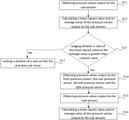
  • FIG. 1 is a flowchart illustrating a method for adjusting the position of a seat in a vehicle according to an exemplary embodiment.
  • FIG. 2 is a structure diagram of a vehicle seat as shown in accordance with an exemplary embodiment.
  • FIG. 3 is a top view of the distribution of sensors in FIG. 2 .
  • FIG. 4 is a flowchart showing adjusting front and rear positions of a seat included in a method for adjusting the position of a seat in a vehicle shown according to an exemplary embodiment.
  • FIG. 5 is a flowchart showing adjusting lateral positions of a seat included in a method for adjusting the position of a seat in a vehicle shown according to an exemplary embodiment.
  • FIG. 6 is a block diagram of a device for adjusting the position of a seat in a vehicle shown in accordance with an exemplary embodiment.
  • FIG. 7 is a block diagram of a first adjusting module of a device for adjusting the position of a seat in a vehicle in accordance with an exemplary embodiment.
  • FIG. 8 is a block diagram of a second adjusting module of a device for adjusting the position of a seat in a vehicle in accordance with an exemplary embodiment.
  • FIG. 9 is a block diagram of the second adjusting submodule in FIG. 8 .
  • FIG. 10 is another block diagram of the second adjusting submodule in FIG. 8 .
  • FIG. 2 is a structure diagram of a vehicle seat shown in accordance with an exemplary embodiment.
  • FIG. 3 is a top view of the distribution of sensors in FIG. 2 .
  • the seat 1 comprises a seat back 10 and a seat face 11 .
  • the front, rear, left and right parts of the seat face 11 are respectively provided with a front pressure sensor 21 , a rear pressure sensor 22 , a left pressure sensor 23 and a right pressure sensor 24 .
  • the central area of the seat face 11 is also provided with a pressure sensor ring 3 which comprises a plurality of sub-sensors distributed in a circular manner, wherein the front pressure sensor 21 , the rear pressure sensor 22 , the left pressure sensor 23 , the right pressure sensor 24 and the pressure sensor ring 3 may be spread on the surface of the seat face 11 or embedded inside the seat face 11 .
  • the front pressure sensor 21 and the rear pressure sensor 22 are arranged on a center line 110 of the seat face 11
  • the left pressure sensor 23 and the right pressure sensor 24 are respectively arranged on the left and right sides of the center line 110 of the seat face 11
  • the front pressure sensor 21 , the rear pressure sensor 22 , the left pressure sensor 23 and the right pressure sensor 24 are distributed in a parallelogram on the seat face 11 .
  • FIG. 1 is a flowchart illustrating a method for adjusting the position of a seat in a vehicle according to an exemplary embodiment. As shown in FIG. 1 and FIG. 2 , the method comprises the following steps:
  • Step S 11 obtaining pressure values output by the sub-sensors
  • Step S 12 calculating a mean square value and an average value of the pressure values output by the sub-sensors
  • Step S 13 judging whether a ratio of the mean square value to the average value is greater than a preset value
  • Step S 14 obtaining pressure values output by the front pressure sensor 21 , the rear pressure sensor 22 , the left pressure sensor 23 and the right pressure sensor 24 when a ratio of the mean square value to the average value is greater than the preset value;
  • Step S 15 adjusting fore-and-aft positions of the seat 1 according to the pressure values output by the front pressure sensor 21 and the rear pressure sensor 22 ;
  • Step S 16 adjusting lateral positions of the seat 1 according to the pressure values output by the left pressure sensor 23 and the right pressure sensor 24 ;
  • Step S 17 locking a position of the seat 1 when a ratio of the mean square value to the average value is less than or equal to the preset value so that the seat 1 does not move.
  • the sub-sensors of the pressure sensor ring 3 are distributed in a circular manner, and preferably, in a circular and equidistant manner.
  • the number of the sub-sensors may be four, and two of the sub-sensors are located on a center line of the seat face 11 .
  • the number of the sub-sensors is eight, and four of the sub-sensors are located on the center line 110 of the seat face 11 , as illustrated in FIG. 2 and FIG. 3 .
  • the preset value may range from 1.9 to 2.1, and is preferably set to be 2.
  • the present disclosure calculates a mean square value and an average value of the pressure values output by the sub-sensors, and determines whether a ratio of the mean square value to the average value is greater than a preset value. When a ratio of the mean square value to the average value is greater than 2, for example, it indicates that all sub-sensors of the pressure sensor ring bear uneven forces, which happens only if a driver is not at a right position on a seat, therefore the seat needs to be adjusted.
  • the present disclosure only needs to collect pressure values output by the front pressure sensor 21 , the rear pressure sensor 22 , the left pressure sensor 23 and the right pressure sensor 24 by reasonably arranging the pressure sensors on the seat face 11 , and adjust fore-and-aft positions of the seat 1 according to the pressure values collected, wherein lengthwise positions (i.e., fore-and-aft positions) of the seat 1 in the front-rear direction need to be adjusted only according to the pressure values output by the front pressure sensor 21 and the rear pressure sensor 22 , and lateral positions (i.e., left-right positions) of the seat 1 in the left-right direction need to be adjusted only according to the pressure values output by the left pressure sensor 23 and the right pressure sensor 24 .
  • a ratio of the mean square value to the average value is less than or equal to the preset value, less than or equal to 2 for example, it indicates that all sub-sensors of the pressure sensor ring bear even forces, which happens only if a driver is at a right position on a seat, therefore the seat position needs to be locked, instead of being adjusted, to prevent the seat from moving. In this way, the method for positioning of a vehicle seat is further optimized.
  • the present disclosure not only reduces costs as less pressure sensors are needed, but also optimizes the method for adjusting seat positions by adjusting a seat to the most comfortable position for a driver, which is impossible with the prior art.
  • FIG. 4 is a flowchart showing adjustment of front and rear positions of a seat included in a method for adjusting the position of a seat in a vehicle according to an exemplary embodiment.
  • the adjusting fore-and-aft positions of the seat according to the pressure values output by the front pressure sensor 21 and the rear pressure sensor 22 comprises the following steps:
  • Step S 151 comparing the pressure values output by the front pressure sensor 21 and the rear pressure sensor 22 to obtain a first comparison value
  • Step S 152 adjusting fore-and-aft positions of the seat 1 according to the first comparison value.
  • the first comparison value is equal to a ratio of the pressure value output by the front pressure sensor 21 to the pressure value output by the rear pressure sensor 22 .
  • the adjusting fore-and-aft positions of the seat 1 according to the first comparison value may comprise: maintaining a current position of the seat 1 in the front-rear direction when the first comparison value is greater than or equal to a backward-adjusting threshold and less than or equal to a forward-adjusting threshold; controlling the seat 1 to move backward when the first comparison value is less than the backward-adjusting threshold; controlling the seat 1 to move forward when the first comparison value is greater than the forward-adjusting threshold.
  • the backward-adjusting threshold may range from 0.85 to 0.99 and the forward-adjusting threshold may range from 1.00 to 1.15.
  • the backward-adjusting threshold is 0.95 and the forward-adjusting threshold is 1.05.
  • a fore-and-aft position of the seat 1 may be considered to be so appropriate that there is no need to adjust the fore-and-aft position of the seat 1 .
  • the seat 1 When the first comparison value is less than 0.95, the seat 1 is adjusted backward for a certain distance, 1 cm for example. Next, the step of obtaining the pressure values output by the front pressure sensor 21 and the rear pressure sensor 22 is repeated. If the first comparison value is still less than 0.95, the seat 1 is adjusted backward for another and yet another 1 cm until the first comparison value is greater than or equal to 0.95.
  • the seat 1 When the first comparison value is greater than 1.05, the seat 1 is adjusted forward for a certain distance, 1 cm for example. Next, the step of obtaining the pressure values output by the front pressure sensor 21 and the rear pressure sensor 22 is repeated. If the first comparison value is still greater than 1.05, the seat 1 needs to be adjusted forward for another and yet another 1 cm until the first comparison value is less than or equal to 1.05.
  • FIG. 5 is a flowchart showing adjusting lateral positions of a seat included in a method for adjusting the position of a seat in a vehicle according to an exemplary embodiment.
  • the adjusting lateral positions of the seat 1 according to the pressure values output by the left pressure sensor 23 and the right pressure sensor 24 comprises the following steps:
  • Step S 161 comparing with the pressure values output by the left pressure sensor 23 and the right pressure sensor 24 to obtain a second comparison value
  • Step S 162 adjusting lateral positions of the seat 1 according to the second comparison value.
  • the second comparison value is equal to a ratio of the pressure value output by the left pressure sensor 23 to the pressure value output by the right pressure sensor 24 .
  • the adjusting lateral positions of the seat 1 according to the second comparison value may comprise: maintaining a current position of the seat 1 in the left-right direction when the second comparison second is greater than or equal to a rightward-adjusting threshold and less than or equal to a leftward-adjusting threshold; controlling the seat 1 to move left when the second comparison value is greater than the leftward-adjusting threshold; controlling the seat 1 to move right when the second comparison value is less than the rightward-adjusting threshold.
  • the rightward-adjusting threshold may range from 0.85 to 0.99 and the forward-adjusting threshold may range from 1.00 to 1.15.
  • the rightward-adjusting threshold is 0.95 and the leftward-adjusting threshold is 1.05.
  • a lateral position of the seat 1 may be considered to be so appropriate that there is no need to adjust the lateral position of seat 1 .
  • the seat is adjusted to the right for a certain distance, 1 cm for example.
  • the step of obtaining the pressure values output by the left pressure sensor 23 and the right pressure sensor 24 is repeated. If the second comparison value is still less than 0.95, the seat 1 is adjusted to the right for another and yet another 1 cm until the second comparison value is greater than or equal to 0.95.
  • the seat 1 When the second comparison value is greater than 1.05, the seat 1 is adjusted to the left for a certain distance, 1 cm for example. Next, the step of obtaining the pressure values output by the left pressure sensor 23 and the right pressure sensor 24 is repeated. If the second comparison value is still greater than 1.05, the seat 1 is adjusted to the left for another and yet another 1 cm until the second comparison value is less than or equal to 1.05.
  • controlling the seat 1 to move left when the second comparison value is greater than the leftward-adjusting threshold may comprise: outputting a first prompt message which is used to prompt a user sitting on the seat 1 to move right; judging whether the second comparison value changes in a first preset period (2 s for example); controlling the seat 1 to move left when the second comparison value does not change in the first preset period.
  • controlling the seat 1 to move right when the second comparison value is less than the rightward-adjusting threshold may comprise: outputting a second prompt message which is used to prompt a user sitting on the seat 1 to move left; judging whether the second comparison value changes in a second preset period (2 s for example); and controlling the seat 1 to move right when the second comparison value does not change in the second preset period.
  • the first or the second prompt message may be a voice reminder displayed through speakers, or a text or icon displayed on display screens for reminding.
  • a step of controlling the seat 1 to move left or right is no longer needed when the user makes an active movement to above directions.
  • the seat 1 still needs to be adjusted leftwards or rightwards when the user does not move left or right in a first or a second preset period.
  • the method for adjusting positions of the vehicle seat 1 is more automatic and intelligent.
  • FIG. 6 is a block diagram of a device for adjusting the position of a seat in a vehicle shown in accordance with an exemplary embodiment.
  • the front, rear, left and right parts of a face of the seat are respectively provided with a front pressure sensor, a rear pressure sensor, a left pressure sensor and a right pressure sensor.
  • a center area of the seat face is also provided with a pressure sensor ring which comprises a plurality of sub-sensors distributed in a circular manner.
  • the device 700 comprises:
  • a second acquisition module 740 for obtaining pressure values output by the sub-sensors
  • a calculating module 750 for calculating a mean square value and an average value of the pressure values output by the sub-sensors
  • a judging module 760 for judging whether a ratio of the mean square value to the average value is greater than a preset value
  • a first acquisition module 710 for obtaining pressure values output by the front pressure sensor, the rear pressure sensor, the left pressure sensor and the right pressure sensor when a ratio of the mean square value to the average value is greater than a preset value;
  • a first adjusting module 720 for adjusting fore-and-aft positions of the seat according to pressure values output by the front pressure sensor and the rear pressure sensor;
  • a second adjusting module 730 for adjusting lateral positions of the seat according to pressure values output by the left pressure sensor and the right pressure sensor.
  • the first adjusting module 720 comprises:
  • a first comparison submodule 721 for comparing pressure values output by the front pressure sensor and the rear pressure sensor to obtain a first comparison value
  • a first adjusting submodule 722 which adjusts fore-and-aft positions of the seat according to the first comparison value.
  • the first comparison value is equal to a ratio of the pressure value output by the front pressure sensor to the pressure value output by the rear pressure sensor;
  • the first adjusting submodule 722 is specifically used for:
  • the second adjusting module 730 comprises:
  • a second comparison submodule 731 for comparing the pressure values output by the left pressure sensor and the right pressure sensor to obtain a second comparison value
  • a second adjusting submodule 732 for adjusting lateral positions of the seat according to the second comparison value.
  • the second comparison value is equal to a ratio of a pressure value output by the left pressure sensor to a pressure value output by the right pressure sensor;
  • the second adjusting submodule 732 is specifically used for:
  • the second adjusting submodule 732 comprises:
  • a first output submodule 7321 for outputting a first prompt message which is used to prompt a user sitting on the seat to move right when the second comparison value is greater than the leftward-adjusting threshold
  • a first judging submodule 7322 for judging whether the second comparison value changes in a first preset period
  • a first control submodule 7323 for controlling the seat to move left when the second comparison value does not change during the first preset period.
  • the second adjusting submodule 732 comprises:
  • a second output submodule 7324 for outputting a second prompt message which is used to prompt a user sitting on the seat to move left when the second comparison value is less than the rightward-adjusting threshold;
  • a second judging submodule 7325 for judging whether the second comparison value changes in a second preset period
  • a second control submodule 7326 for controlling the seat to move right when the second comparison value does not change in the second preset period.
  • the device 700 comprises:
  • a locking module 770 for locking a position of a seat when a ratio of the mean square value to the average value is less than or equal to the preset value so that the seat does not move.
  • any combination of the various embodiments of the present disclosure may also be made, as long as the combination does not violate the ideas of the present disclosure, and the combination shall likewise be regarded as the content disclosed in the present disclosure.

Landscapes

  • Engineering & Computer Science (AREA)
  • Mechanical Engineering (AREA)
  • Aviation & Aerospace Engineering (AREA)
  • Transportation (AREA)
  • Human Computer Interaction (AREA)
  • Seats For Vehicles (AREA)
  • Chair Legs, Seat Parts, And Backrests (AREA)

Abstract

Methods and devices for adjusting the position of a seat in a vehicle are described herein. The methods include obtaining pressure values output by a plurality of sub-sensors; calculating a mean square value and an average value of the pressure values output by the sub-sensors; judging whether a ratio of the mean square value to the average value is greater than a preset value; obtaining pressure values output by a front pressure sensor, a rear pressure sensor, a left pressure sensor and a right pressure sensor when the ratio of the mean square value to the average value is greater than the preset value; adjusting fore-and-aft positions of the seat according to the pressure values output by the front pressure sensor and the rear pressure sensor; and adjusting lateral positions of the seat according to the pressure values output by the left pressure sensor and the right pressure sensor.

Description

CROSS-REFERENCE TO RELATED APPLICATIONS AND PRIORITY
The present application is a U.S. National Phase of International Patent Application Serial No. PCT/CN2017/085678 filed May 24, 2017, which claims priority from CN Application No. 201710104301.2 filed Feb. 24, 2017. The entire contents of the above-cited applications are hereby incorporated by reference in their entirety for all purposes.
FIELD OF THE INVENTION
The present disclosure relates to the field of vehicle seat control technology, in particular to a method and device for adjusting the position of a seat in a vehicle.
BACKGROUND OF THE INVENTION
Nowadays, a growing number of car rental companies are springing up due to the influence of license plate restriction policy in big cities and the rise of self-driving tourism, and a large number of people are also willing to enjoy the convenience brought by short-term car rental, which, however, poses a big problem that rented cars are often driven by drivers of various heights and weights, who have different requirements on a seat position: those who are tall call for a lower seat while those who are short may want a higher one. Car seats of rented cars, as a result, need to be adjusted again and again after each drive to meet requirements of different drivers for seat positions.
Pressure sensors disclosed in the prior art are evenly distributed in a matrix form, which has the following problems:
I. Pressure sensors are distributed too densely at an edge where no stress exists, which is a waste of sensors, but they are sparsely distributed at a center where stress is concentrated, causing significantly different pressure values on sensors at the center. Serious errors will therefore occur in the calculation of the stress, and a seat cannot be adjusted to the most comfortable position for the driver as a result; and
II. The need for a large number of pressure sensors increases seat costs.
SUMMARY OF THE INVENTION
An object of the present disclosure is to provide a method and device for adjusting a position of a seat in a vehicle to the most comfortable position for drivers, which is impossible with the prior art.
In order to achieve the above object, the present disclosure provides a method for adjusting position of a seat in a vehicle, a method for adjusting the position of a seat in a vehicle, and a method for adjusting the position of a seat in a vehicle, wherein front, rear, left, right and central areas of a seat face are respectively provided with a front pressure sensor, a rear pressure sensor, a left pressure sensor, a right pressure sensor, and a pressure sensor ring which comprises a plurality of sub-sensors distributed in a circular manner. The method comprises:
obtaining pressure values output by the sub-sensors;
calculating a mean square value and an average value of the pressure values output by the sub-sensors;
judging whether a ratio of the mean square value to the average value is greater than a preset value;
obtaining pressure values output by the front pressure sensor, the rear pressure sensor, the left pressure sensor and the right pressure sensor when the ratio of the mean square value to the average value is greater than the preset value;
adjusting fore-and-aft positions of the seat according to the pressure values output by the front pressure sensor and the rear pressure sensor; and
adjusting lateral positions of the seat according to the pressure values output by the left pressure sensor and the right pressure sensor.
Optionally, the adjusting fore-and-aft positions of the seat according to the pressure values output by the front pressure sensor and the rear pressure sensor comprises:
comparing the pressure values output by the front pressure sensor and the rear pressure sensor to obtain a first comparison value; and
adjusting fore-and-aft positions of the seat according to the first comparison value.
Optionally, the first comparison value is equal to a ratio of the pressure value output by the front pressure sensor to the pressure value output by the rear pressure sensor;
The adjusting fore-and-aft positions of the seat according to the first comparison value comprises:
maintaining a current position of the seat in the front-rear direction when the first comparison value is greater than or equal to a backward-adjusting threshold and less than or equal to a forward-adjusting threshold;
controlling the seat to move backward when the first comparison value is less than the backward-adjusting threshold; and
controlling the seat to move forward when the first comparison value is greater than the forward-adjusting threshold.
Optionally, the adjusting lateral positions of the seat according to the pressure values output by the left pressure sensor and the right pressure sensor comprises:
comparing the pressure values output by the left pressure sensor and the right pressure sensor to obtain a second comparison value; and
adjusting lateral positions of the seat according to the second comparison value.
Optionally, the second comparison value is equal to a ratio of the pressure value output by the left pressure sensor to the pressure value output by the right pressure sensor;
the adjusting lateral positions of the seat according to the second comparison value comprises:
maintaining a current position of the seat in the left-right direction when the second comparison value is greater than or equal to a rightward-adjusting threshold and less than or equal to a leftward-adjusting threshold;
controlling the seat to move left when the second comparison value is greater than the leftward-adjusting threshold; and
controlling the seat to move right when the second comparison value is less than the rightward-adjusting threshold.
Optionally, the controlling the seat to move left when the second comparison value is greater than the leftward-adjusting threshold comprises:
outputting a first prompt message which is used to prompt a user sitting on the seat to move right;
judging whether the second comparison value changes in a first preset period; and
controlling the seat to move left when the second comparison value does not change in the first preset period.
Optionally, the controlling the seat to move right when the second comparison value is less than the rightward-adjusting threshold comprises:
outputting a second prompt message which is used to prompt a user sitting on the seat to move left;
judging whether the second comparison value changes in a second preset period; and
controlling the seat to move right when the second comparison value does not change in the second preset period.
Optionally, the method also comprises:
locking a position of the seat when a ratio of the mean square value to the average value is less than or equal to the preset value so that the seat does not move.
The present disclosure also provides a device for adjusting the position of a seat in a vehicle, where front, rear, left, right and central areas of a seat face are respectively provided with a front pressure sensor, a rear pressure sensor, a left pressure sensor, a right pressure sensor, and a pressure sensor ring which comprises a plurality of sub-sensors distributed in a circular manner. The device comprises:
a second acquisition module for obtaining pressure values output by the sub-sensors;
a calculating module for calculating a mean square value and an average value of the pressure values output by the sub-sensors;
a judging module for judging whether a ratio of the mean square value to the average value is greater than a preset value;
a first acquisition module for obtaining pressure values output by the front pressure sensor, the rear pressure sensor, the left pressure sensor and the right pressure sensor when the ratio of the mean square value to the average value is greater than a preset value;
a first adjusting module for adjusting fore-and-aft positions of the seat according to pressure values output by the front pressure sensor and the rear pressure sensor; and
a second adjusting module for adjusting lateral positions of the seat according to the pressure values output by the left pressure sensor and the right pressure sensor.
Optionally, the first adjusting module comprises:
a first comparison submodule for comparing pressure values output by the front pressure sensor and the rear pressure sensor to obtain a first comparison value; and
a first adjusting submodule for adjusting fore-and-aft positions of the seat according to the first comparison value.
Optionally, the first comparison value is equal to a ratio of the pressure value output by the front pressure sensor to the pressure value output by the rear pressure sensor;
the first adjusting submodule is specifically used for:
maintaining a current position of the seat in the front-rear direction when the first comparison value is greater than or equal to a backward-adjusting threshold and less than or equal to a forward-adjusting threshold;
controlling the seat to move backward when the first comparison value is less than the backward-adjusting threshold; and
controlling the seat to move forward when the first comparison value is greater than the forward-adjusting threshold.
Optionally, the second adjusting module comprises:
a second comparison submodule for comparing the pressure values output by the left pressure sensor and the right pressure sensor to obtain a second comparison value; and
a second adjusting submodule for adjusting lateral positions of the seat according to the second comparison value.
Optionally, the second comparison value is equal to a ratio of the pressure value output by the left pressure sensor to the pressure value output by the right pressure sensor;
the second adjusting submodule is specifically used for:
maintaining a current position of the seat in the left-right direction when the second comparison value is greater than or equal to a rightward-adjusting threshold and less than or equal to a leftward-adjusting threshold;
controlling the seat to move left when the second comparison value is greater than the leftward-adjusting threshold; and
controlling the seat to move right when the second comparison value is less than the rightward-adjusting threshold.
Optionally, the second adjusting submodule comprises:
a first output submodule for outputting a first prompt message which is used to prompt a user sitting on the seat to move right when the second comparison value is greater than the leftward-adjusting threshold;
a first judging submodule for judging whether the second comparison value changes in a first preset period; and
a first control submodule for controlling the seat to move left when the second comparison value does not change in the first preset period.
Optionally, the second adjusting submodule comprises:
a second output submodule for outputting a second prompt message which is used to prompt a user sitting on the seat to move left when the second comparison value is less than the rightward-adjusting threshold;
a second judging submodule for judging whether the second comparison value changes in a second preset period; and
a second control submodule which controls the seat to move right when the second comparison value does not change in the second preset period.
Optionally, the device also comprises:
a locking module for locking a position of a seat when a ratio of the mean square value to the average value is less than or equal to the preset value so that the seat does not move.
The technical proposal provided in embodiments of the present disclosure may have the following beneficial effects:
The present disclosure not only reduces costs as less pressure sensors are needed, but also optimizes the method for seat positions by adjusting a seat to the most comfortable position for a driver, which is impossible with the prior art.
Other features and advantages of the present disclosure will be described in detail in Detailed Description of the Embodiments below.
BRIEF DESCRIPTION OF THE DRAWINGS
The accompanying drawings, which are intended to provide a further understanding of the present disclosure and constitute a part of this specification, serve to explain the present disclosure together with Detailed Description of the Embodiments below, but do not constitute limitations to the present disclosure. In the drawings:
FIG. 1 is a flowchart illustrating a method for adjusting the position of a seat in a vehicle according to an exemplary embodiment.
FIG. 2 is a structure diagram of a vehicle seat as shown in accordance with an exemplary embodiment.
FIG. 3 is a top view of the distribution of sensors in FIG. 2.
FIG. 4 is a flowchart showing adjusting front and rear positions of a seat included in a method for adjusting the position of a seat in a vehicle shown according to an exemplary embodiment.
FIG. 5 is a flowchart showing adjusting lateral positions of a seat included in a method for adjusting the position of a seat in a vehicle shown according to an exemplary embodiment.
FIG. 6 is a block diagram of a device for adjusting the position of a seat in a vehicle shown in accordance with an exemplary embodiment.
FIG. 7 is a block diagram of a first adjusting module of a device for adjusting the position of a seat in a vehicle in accordance with an exemplary embodiment.
FIG. 8 is a block diagram of a second adjusting module of a device for adjusting the position of a seat in a vehicle in accordance with an exemplary embodiment.
FIG. 9 is a block diagram of the second adjusting submodule in FIG. 8.
FIG. 10 is another block diagram of the second adjusting submodule in FIG. 8.
DETAILED DESCRIPTION OF THE PREFERRED EMBODIMENTS
Exemplary embodiments are described in detail here, examples of which are illustrated in the accompanying drawings. When the following description refers to the accompanying drawings, unless otherwise indicated, the same numbers in different drawings represent the same or similar elements. The embodiments described in the following exemplary embodiments do not represent all embodiments consistent with the present disclosure. On the contrary, the embodiments are only examples of devices and methods consistent with some of the aspects, as detailed in the attached claims, of the present disclosure.
Please refer to FIG. 2 and FIG. 3. FIG. 2 is a structure diagram of a vehicle seat shown in accordance with an exemplary embodiment. FIG. 3 is a top view of the distribution of sensors in FIG. 2.
As shown in FIG. 2 and FIG. 3, the seat 1 comprises a seat back 10 and a seat face 11. The front, rear, left and right parts of the seat face 11 are respectively provided with a front pressure sensor 21, a rear pressure sensor 22, a left pressure sensor 23 and a right pressure sensor 24. The central area of the seat face 11 is also provided with a pressure sensor ring 3 which comprises a plurality of sub-sensors distributed in a circular manner, wherein the front pressure sensor 21, the rear pressure sensor 22, the left pressure sensor 23, the right pressure sensor 24 and the pressure sensor ring 3 may be spread on the surface of the seat face 11 or embedded inside the seat face 11.
Preferably, as shown in FIG. 2 and FIG. 3, the front pressure sensor 21 and the rear pressure sensor 22 are arranged on a center line 110 of the seat face 11, and the left pressure sensor 23 and the right pressure sensor 24 are respectively arranged on the left and right sides of the center line 110 of the seat face 11. Further, the front pressure sensor 21, the rear pressure sensor 22, the left pressure sensor 23 and the right pressure sensor 24 are distributed in a parallelogram on the seat face 11. By arranging the four pressure sensors on the seat face 11 in the above manner of distribution, required pressure data can be collected with a small number of pressure sensors, thus saving costs.
Please refer to FIG. 1 and FIG. 2. FIG. 1 is a flowchart illustrating a method for adjusting the position of a seat in a vehicle according to an exemplary embodiment. As shown in FIG. 1 and FIG. 2, the method comprises the following steps:
Step S11: obtaining pressure values output by the sub-sensors;
Step S12: calculating a mean square value and an average value of the pressure values output by the sub-sensors;
Step S13: judging whether a ratio of the mean square value to the average value is greater than a preset value;
Step S14: obtaining pressure values output by the front pressure sensor 21, the rear pressure sensor 22, the left pressure sensor 23 and the right pressure sensor 24 when a ratio of the mean square value to the average value is greater than the preset value;
Step S15: adjusting fore-and-aft positions of the seat 1 according to the pressure values output by the front pressure sensor 21 and the rear pressure sensor 22;
Step S16: adjusting lateral positions of the seat 1 according to the pressure values output by the left pressure sensor 23 and the right pressure sensor 24; and
Step S17: locking a position of the seat 1 when a ratio of the mean square value to the average value is less than or equal to the preset value so that the seat 1 does not move.
As shown in FIG. 2 and FIG. 3, the sub-sensors of the pressure sensor ring 3 are distributed in a circular manner, and preferably, in a circular and equidistant manner. The number of the sub-sensors may be four, and two of the sub-sensors are located on a center line of the seat face 11. Preferably, the number of the sub-sensors is eight, and four of the sub-sensors are located on the center line 110 of the seat face 11, as illustrated in FIG. 2 and FIG. 3.
The preset value may range from 1.9 to 2.1, and is preferably set to be 2. The present disclosure calculates a mean square value and an average value of the pressure values output by the sub-sensors, and determines whether a ratio of the mean square value to the average value is greater than a preset value. When a ratio of the mean square value to the average value is greater than 2, for example, it indicates that all sub-sensors of the pressure sensor ring bear uneven forces, which happens only if a driver is not at a right position on a seat, therefore the seat needs to be adjusted.
Whenever it is determined that a seat needs to be adjusted, the present disclosure only needs to collect pressure values output by the front pressure sensor 21, the rear pressure sensor 22, the left pressure sensor 23 and the right pressure sensor 24 by reasonably arranging the pressure sensors on the seat face 11, and adjust fore-and-aft positions of the seat 1 according to the pressure values collected, wherein lengthwise positions (i.e., fore-and-aft positions) of the seat 1 in the front-rear direction need to be adjusted only according to the pressure values output by the front pressure sensor 21 and the rear pressure sensor 22, and lateral positions (i.e., left-right positions) of the seat 1 in the left-right direction need to be adjusted only according to the pressure values output by the left pressure sensor 23 and the right pressure sensor 24.
When a ratio of the mean square value to the average value is less than or equal to the preset value, less than or equal to 2 for example, it indicates that all sub-sensors of the pressure sensor ring bear even forces, which happens only if a driver is at a right position on a seat, therefore the seat position needs to be locked, instead of being adjusted, to prevent the seat from moving. In this way, the method for positioning of a vehicle seat is further optimized.
The present disclosure not only reduces costs as less pressure sensors are needed, but also optimizes the method for adjusting seat positions by adjusting a seat to the most comfortable position for a driver, which is impossible with the prior art.
FIG. 4 is a flowchart showing adjustment of front and rear positions of a seat included in a method for adjusting the position of a seat in a vehicle according to an exemplary embodiment. As illustrated by FIG. 4, the adjusting fore-and-aft positions of the seat according to the pressure values output by the front pressure sensor 21 and the rear pressure sensor 22 comprises the following steps:
Step S151: comparing the pressure values output by the front pressure sensor 21 and the rear pressure sensor 22 to obtain a first comparison value; and
Step S152: adjusting fore-and-aft positions of the seat 1 according to the first comparison value.
The first comparison value is equal to a ratio of the pressure value output by the front pressure sensor 21 to the pressure value output by the rear pressure sensor 22. In Step 152, the adjusting fore-and-aft positions of the seat 1 according to the first comparison value may comprise: maintaining a current position of the seat 1 in the front-rear direction when the first comparison value is greater than or equal to a backward-adjusting threshold and less than or equal to a forward-adjusting threshold; controlling the seat 1 to move backward when the first comparison value is less than the backward-adjusting threshold; controlling the seat 1 to move forward when the first comparison value is greater than the forward-adjusting threshold. The backward-adjusting threshold may range from 0.85 to 0.99 and the forward-adjusting threshold may range from 1.00 to 1.15. Preferably, the backward-adjusting threshold is 0.95 and the forward-adjusting threshold is 1.05.
For instance, when the first comparison value is greater than or equal to 0.95 and less than or equal to 1.05, a fore-and-aft position of the seat 1 may be considered to be so appropriate that there is no need to adjust the fore-and-aft position of the seat 1.
When the first comparison value is less than 0.95, the seat 1 is adjusted backward for a certain distance, 1 cm for example. Next, the step of obtaining the pressure values output by the front pressure sensor 21 and the rear pressure sensor 22 is repeated. If the first comparison value is still less than 0.95, the seat 1 is adjusted backward for another and yet another 1 cm until the first comparison value is greater than or equal to 0.95.
When the first comparison value is greater than 1.05, the seat 1 is adjusted forward for a certain distance, 1 cm for example. Next, the step of obtaining the pressure values output by the front pressure sensor 21 and the rear pressure sensor 22 is repeated. If the first comparison value is still greater than 1.05, the seat 1 needs to be adjusted forward for another and yet another 1 cm until the first comparison value is less than or equal to 1.05.
FIG. 5 is a flowchart showing adjusting lateral positions of a seat included in a method for adjusting the position of a seat in a vehicle according to an exemplary embodiment. As illustrated by FIG. 5, the adjusting lateral positions of the seat 1 according to the pressure values output by the left pressure sensor 23 and the right pressure sensor 24 comprises the following steps:
Step S161: comparing with the pressure values output by the left pressure sensor 23 and the right pressure sensor 24 to obtain a second comparison value; and
Step S162: adjusting lateral positions of the seat 1 according to the second comparison value.
The second comparison value is equal to a ratio of the pressure value output by the left pressure sensor 23 to the pressure value output by the right pressure sensor 24. In Step S162: the adjusting lateral positions of the seat 1 according to the second comparison value may comprise: maintaining a current position of the seat 1 in the left-right direction when the second comparison second is greater than or equal to a rightward-adjusting threshold and less than or equal to a leftward-adjusting threshold; controlling the seat 1 to move left when the second comparison value is greater than the leftward-adjusting threshold; controlling the seat 1 to move right when the second comparison value is less than the rightward-adjusting threshold. The rightward-adjusting threshold may range from 0.85 to 0.99 and the forward-adjusting threshold may range from 1.00 to 1.15. Preferably, the rightward-adjusting threshold is 0.95 and the leftward-adjusting threshold is 1.05.
For instance, when the second comparison value is greater than or equal to 0.95 and less than or equal to 1.05, a lateral position of the seat 1 may be considered to be so appropriate that there is no need to adjust the lateral position of seat 1.
When the second comparison value is less than 0.95, the seat is adjusted to the right for a certain distance, 1 cm for example. Next, the step of obtaining the pressure values output by the left pressure sensor 23 and the right pressure sensor 24 is repeated. If the second comparison value is still less than 0.95, the seat 1 is adjusted to the right for another and yet another 1 cm until the second comparison value is greater than or equal to 0.95.
When the second comparison value is greater than 1.05, the seat 1 is adjusted to the left for a certain distance, 1 cm for example. Next, the step of obtaining the pressure values output by the left pressure sensor 23 and the right pressure sensor 24 is repeated. If the second comparison value is still greater than 1.05, the seat 1 is adjusted to the left for another and yet another 1 cm until the second comparison value is less than or equal to 1.05.
Optionally, the controlling the seat 1 to move left when the second comparison value is greater than the leftward-adjusting threshold may comprise: outputting a first prompt message which is used to prompt a user sitting on the seat 1 to move right; judging whether the second comparison value changes in a first preset period (2 s for example); controlling the seat 1 to move left when the second comparison value does not change in the first preset period.
Optionally, the controlling the seat 1 to move right when the second comparison value is less than the rightward-adjusting threshold may comprise: outputting a second prompt message which is used to prompt a user sitting on the seat 1 to move left; judging whether the second comparison value changes in a second preset period (2 s for example); and controlling the seat 1 to move right when the second comparison value does not change in the second preset period.
The first or the second prompt message may be a voice reminder displayed through speakers, or a text or icon displayed on display screens for reminding. By prompting a user to move left or right with output prompt messages, a step of controlling the seat 1 to move left or right is no longer needed when the user makes an active movement to above directions. Of course, the seat 1 still needs to be adjusted leftwards or rightwards when the user does not move left or right in a first or a second preset period. In this way, the method for adjusting positions of the vehicle seat 1, as disclosed in the present disclosure, is more automatic and intelligent.
FIG. 6 is a block diagram of a device for adjusting the position of a seat in a vehicle shown in accordance with an exemplary embodiment. With reference to FIG. 6, the front, rear, left and right parts of a face of the seat are respectively provided with a front pressure sensor, a rear pressure sensor, a left pressure sensor and a right pressure sensor. A center area of the seat face is also provided with a pressure sensor ring which comprises a plurality of sub-sensors distributed in a circular manner. The device 700 comprises:
a second acquisition module 740 for obtaining pressure values output by the sub-sensors;
a calculating module 750 for calculating a mean square value and an average value of the pressure values output by the sub-sensors;
a judging module 760 for judging whether a ratio of the mean square value to the average value is greater than a preset value;
a first acquisition module 710 for obtaining pressure values output by the front pressure sensor, the rear pressure sensor, the left pressure sensor and the right pressure sensor when a ratio of the mean square value to the average value is greater than a preset value;
a first adjusting module 720 for adjusting fore-and-aft positions of the seat according to pressure values output by the front pressure sensor and the rear pressure sensor; and
a second adjusting module 730 for adjusting lateral positions of the seat according to pressure values output by the left pressure sensor and the right pressure sensor.
Optionally, as shown in FIG. 7, the first adjusting module 720 comprises:
a first comparison submodule 721 for comparing pressure values output by the front pressure sensor and the rear pressure sensor to obtain a first comparison value; and
a first adjusting submodule 722 which adjusts fore-and-aft positions of the seat according to the first comparison value.
Optionally, the first comparison value is equal to a ratio of the pressure value output by the front pressure sensor to the pressure value output by the rear pressure sensor;
the first adjusting submodule 722 is specifically used for:
maintaining a current position of the seat in the front-rear direction when the first comparison value is greater than or equal to a backward-adjusting threshold and less than or equal to a forward-adjusting threshold;
controlling the seat to move backward when the first comparison value is less than the backward-adjusting threshold; and
controlling the seat to move forward when the first comparison value is greater than the forward-adjusting threshold.
Optionally, as shown in FIG. 8, the second adjusting module 730 comprises:
a second comparison submodule 731 for comparing the pressure values output by the left pressure sensor and the right pressure sensor to obtain a second comparison value; and
a second adjusting submodule 732 for adjusting lateral positions of the seat according to the second comparison value.
Optionally, the second comparison value is equal to a ratio of a pressure value output by the left pressure sensor to a pressure value output by the right pressure sensor;
the second adjusting submodule 732 is specifically used for:
maintaining a current position of the seat in the left-right direction when the second comparison value is greater than or equal to a rightward-adjusting threshold and less than or equal to a leftward-adjusting threshold;
controlling the seat to move left when the second comparison value is greater than the leftward-adjusting threshold; and
controlling the seat to move right when the second comparison value is less than the rightward-adjusting threshold.
Optionally, as shown in FIG. 9, the second adjusting submodule 732 comprises:
a first output submodule 7321 for outputting a first prompt message which is used to prompt a user sitting on the seat to move right when the second comparison value is greater than the leftward-adjusting threshold;
a first judging submodule 7322 for judging whether the second comparison value changes in a first preset period; and
a first control submodule 7323 for controlling the seat to move left when the second comparison value does not change during the first preset period.
Optionally, as shown in FIG. 10, the second adjusting submodule 732 comprises:
a second output submodule 7324 for outputting a second prompt message which is used to prompt a user sitting on the seat to move left when the second comparison value is less than the rightward-adjusting threshold;
a second judging submodule 7325 for judging whether the second comparison value changes in a second preset period; and
a second control submodule 7326 for controlling the seat to move right when the second comparison value does not change in the second preset period.
Optionally, as shown in FIG. 6, the device 700 comprises:
a locking module 770 for locking a position of a seat when a ratio of the mean square value to the average value is less than or equal to the preset value so that the seat does not move.
With regard to the device 700 for positions of a vehicle seat in the above embodiment, the specific manner that each module performs an operation has been described in detail in embodiments of the method, and will not be elaborated here.
The preferred embodiments of the present disclosure are described in detail above in conjunction with the accompanying drawings. However, the present disclosure is not limited to the specific details of the above-mentioned embodiments. Within the scope of the technical concept disclosed herein, a variety of simple variants of the technical solution of the present disclosure may be made, and all the variations fall within the scope of protection of the present disclosure.
It should be further noted that the specific technical features described in the above specific embodiments may be combined in any appropriate way without conflicts. In order to avoid unnecessary repetition, various possible combinations are not described separately in the present disclosure.
In addition, any combination of the various embodiments of the present disclosure may also be made, as long as the combination does not violate the ideas of the present disclosure, and the combination shall likewise be regarded as the content disclosed in the present disclosure.

Claims (16)

The invention claimed is:
1. A method for adjusting a position of a seat in a vehicle, wherein front, rear, left, right and central areas of a seat face are respectively provided with a front pressure sensor, a rear pressure sensor, a left pressure sensor, a right pressure sensor, and a pressure sensor ring which comprises a plurality of sub-sensors distributed in a circular manner; the method comprises:
obtaining pressure values output by the sub-sensors;
calculating a mean square value and an average value of the pressure values output by the sub-sensors;
judging whether a ratio of the mean square value to the average value is greater than a preset value;
obtaining pressure values output by the front pressure sensor, the rear pressure sensor, the left pressure sensor and the right pressure sensor when the ratio of the mean square value to the average value is greater than the preset value;
adjusting fore-and-aft positions of the seat according to the pressure values output by the front pressure sensor and the rear pressure sensor; and
adjusting lateral positions of the seat according to the pressure values output by the left pressure sensor and the right pressure sensor.
2. The method as claimed in claim 1, wherein the adjusting fore-and-aft positions of the seat according to the pressure values output by the front pressure sensor and the rear pressure sensor comprises:
comparing the pressure values output by the front pressure sensor and the rear pressure sensor to obtain a first comparison value; and
adjusting fore-and-aft positions of the seat according to the first comparison value.
3. The method as claimed in claim 2, wherein the first comparison value is equal to a ratio of the pressure value output by the front pressure sensor to the pressure value output by the rear pressure sensor; and
the adjusting fore-and-aft positions of the seat according to the first comparison value comprises:
maintaining a current position of the seat in the front-rear direction when the first comparison value is greater than or equal to a backward-adjusting threshold and less than or equal to a forward-adjusting threshold;
controlling the seat to move backward when the first comparison value is less than the backward-adjusting threshold; and
controlling the seat to move forward when the first comparison value is greater than the forward-adjusting threshold.
4. The method as claimed in claim 1, wherein the adjusting lateral positions of the seat according to the pressure values output by the left pressure sensor and the right pressure sensor comprises:
comparing the pressure values output by the left pressure sensor and the right pressure sensor to obtain a second comparison value; and
adjusting lateral positions of the seat according to the second comparison value.
5. The method as claimed in claim 4, wherein the second comparison value is equal to a ratio of the pressure value output by the left pressure sensor to the pressure value output by the right pressure sensor; and
the adjusting lateral positions of the seat according to the second comparison value comprises:
maintaining a current position of the seat in the left-right direction when the second comparison value is greater than or equal to a rightward-adjusting threshold and less than or equal to a leftward-adjusting threshold;
controlling the seat to move left when the second comparison value is greater than the leftward-adjusting threshold; and
controlling the seat to move right when the second comparison value is less than the rightward-adjusting threshold.
6. The method as claimed in claim 5, wherein the controlling the seat to move left when the second comparison value is greater than the leftward-adjusting threshold comprises:
outputting a first prompt message which is used to prompt a user sitting on the seat to move right;
judging whether the second comparison value changes in a first preset period; and
controlling the seat to move left when the second comparison value does not change in the first preset period.
7. The method as claimed in claim 5, wherein the controlling the seat to move right when the second comparison value is less than the rightward-adjusting threshold comprises:
outputting a second prompt message which is used to prompt a user sitting on the seat to move left;
judging whether the second comparison value changes in a second preset period; and
controlling the seat to move right when the second comparison value does not change in the second preset period.
8. The method as claimed in claim 1, further comprising:
locking a position of a seat when a ratio of the mean square value to the average value is less than or equal to the preset value so that the seat does not move.
9. A device for adjusting a position of a seat in a vehicle, wherein front, rear, left, right and central areas of a seat face are respectively provided with a front pressure sensor, a rear pressure sensor, a left pressure sensor, a right pressure sensor and a pressure sensor ring which comprises a plurality of sub-sensors distributed in a circular manner; the device comprises:
a second acquisition module for obtaining pressure values output by the sub-sensors;
a calculating module for calculating a mean square value and an average value of the pressure values output by the sub-sensors;
a judging module for judging whether a ratio of the mean square value to the average value is greater than a preset value;
a first acquisition module for obtaining pressure values output by the front pressure sensor, the rear pressure sensor, the left pressure sensor and the right pressure sensor when a ratio of the mean square value to the average value is greater than a preset value;
a first adjusting module for adjusting fore-and-aft positions of the seat according to the pressure values output by the front pressure sensor and the rear pressure sensor; and
a second adjusting module for adjusting lateral positions of the seat according to the pressure values output by the left pressure sensor and the right pressure sensor.
10. The device as claimed in claim 9, wherein the first adjusting module comprises:
a first comparison submodule for comparing the pressure values output by the front pressure sensor and the rear pressure sensor to obtain a first comparison value; and
a first adjusting submodule for adjusting fore-and-aft positions of the seat according to the first comparison value.
11. The device as claimed in claim 10, wherein the first comparison value is equal to a ratio of the pressure value output by the front pressure sensor to the pressure value output by the rear pressure sensor; and
the first adjusting submodule is specifically used for:
maintaining a current position of the seat in the front-rear direction when the first comparison value is greater than or equal to a backward-adjusting threshold and less than or equal to a forward-adjusting threshold;
controlling the seat to move backward when the first comparison value is less than the backward-adjusting threshold; and
controlling the seat to move forward when the first comparison value is greater than the forward-adjusting threshold.
12. The device as claimed in claim 9, wherein the second adjusting module comprises:
a second comparison submodule for comparing the pressure values output by the left pressure sensor and the right pressure sensor to obtain a second comparison value; and
a second adjusting submodule for adjusting lateral positions of the seat according to the second comparison value.
13. The device as claimed in claim 12, wherein the second comparison value is equal to a ratio of the pressure value output by the left pressure sensor to the pressure value output by the right pressure sensor; and
the second adjusting submodule is specifically used for:
maintaining a current position of the seat in the left-right direction when the second comparison value is greater than or equal to a rightward-adjusting threshold and less than or equal to a leftward-adjusting threshold;
controlling the seat to move left when the second comparison value is greater than the leftward-adjusting threshold; and
controlling the seat to move right when the second comparison value is less than the rightward-adjusting threshold.
14. The device as claimed in claim 13, wherein the second adjusting submodule comprises:
a first output submodule for outputting a first prompt message which is used to prompt a user sitting on the seat to move right when the second comparison value is greater than the leftward-adjusting threshold;
a first judging submodule for judging whether the second comparison value changes in a first preset period; and
a first control submodule for controlling the seat to move left when the second comparison value does not change during the first preset period.
15. The device as claimed in claim 13, wherein the second adjusting submodule comprises:
a second output submodule for outputting a second prompt message which is used to prompt a user sitting on the seat to move left when the second comparison value is less than the rightward-adjusting threshold;
a second judging submodule for judging whether the second comparison value changes in a second preset period; and
a second control submodule for controlling the seat to move right when the second comparison value does not change in the second preset period.
16. The device as claimed in claim 9, wherein the device further comprises:
a locking module for locking a position of a seat when a ratio of the mean square value to the average value is less than or equal to the preset value so that the seat does not move.
US16/480,928 2017-02-24 2017-05-24 Method and device for adjusting position of seat in vehicle Active 2038-05-06 US11230206B2 (en)

Applications Claiming Priority (3)

Application Number Priority Date Filing Date Title
CN201710104301.2 2017-02-24
CN201710104301.2A CN106864311B (en) 2017-02-24 2017-02-24 The adjusting method and device of vehicle seat position
PCT/CN2017/085678 WO2018152979A1 (en) 2017-02-24 2017-05-24 Method and device for adjusting position of seat in vehicle

Publications (2)

Publication Number Publication Date
US20190389330A1 US20190389330A1 (en) 2019-12-26
US11230206B2 true US11230206B2 (en) 2022-01-25

Family

ID=59167707

Family Applications (1)

Application Number Title Priority Date Filing Date
US16/480,928 Active 2038-05-06 US11230206B2 (en) 2017-02-24 2017-05-24 Method and device for adjusting position of seat in vehicle

Country Status (3)

Country Link
US (1) US11230206B2 (en)
CN (1) CN106864311B (en)
WO (1) WO2018152979A1 (en)

Families Citing this family (8)

* Cited by examiner, † Cited by third party
Publication number Priority date Publication date Assignee Title
CN110271506A (en) * 2018-03-13 2019-09-24 蔚来汽车有限公司 Method and apparatus for automatically adjusting vehicle seat
JP2019156247A (en) * 2018-03-15 2019-09-19 本田技研工業株式会社 Seat device
CN110356287B (en) * 2018-03-26 2020-12-08 北汽福田汽车股份有限公司 Vehicle seat adjusting method and device, vehicle seat and vehicle
CN108887961B (en) * 2018-06-20 2021-10-15 新华网股份有限公司 Seats and Seat-Based Concentration Assessment Methods
CN111422153B (en) * 2020-02-21 2022-06-14 浙江吉利汽车研究院有限公司 A method, device, medium and terminal for vehicle personalized setting
CN112651082B (en) * 2020-12-24 2024-09-27 东风汽车有限公司 Vehicle seat pitch value calculating and adjusting method, storage medium and electronic device
KR102895311B1 (en) * 2021-07-06 2025-12-03 현대자동차주식회사 System and method for pressing feeling evaluation of vehicle seat
CN115848249A (en) * 2022-11-21 2023-03-28 舒茨曼座椅(宁波)有限公司 Waist support, control method and device thereof, seat and vehicle

Citations (13)

* Cited by examiner, † Cited by third party
Publication number Priority date Publication date Assignee Title
US20030004628A1 (en) * 2001-07-02 2003-01-02 Rennaker Royce L. Vehicle occupant characterization method with rough road compensation
JP2005212496A (en) 2004-01-27 2005-08-11 Honda Motor Co Ltd Occupant detection device
JP2006084356A (en) 2004-09-16 2006-03-30 Honda Motor Co Ltd Occupant detection device
CN101670817A (en) 2009-10-09 2010-03-17 宁波双林汽车部件股份有限公司 LIN bus one-key automobile chair and rearview mirror controller
US20100276973A1 (en) * 2007-11-08 2010-11-04 Bayerische Motoren Werke Aktiengesellschaft Method and Device for Adjusting a Seat
US8256842B2 (en) 2008-04-25 2012-09-04 Grammer Ag Vehicle seat having a device for vehicle seat occupancy detection
CN102874134A (en) 2012-06-13 2013-01-16 浙江吉利汽车研究院有限公司杭州分公司 Automobile seat regulating system and automobile seat regulation control method
CN104260647A (en) 2014-04-17 2015-01-07 浙江吉利控股集团有限公司 Intelligent adjustable electric seat of automobile
CN204774761U (en) 2015-07-20 2015-11-18 王陆峰 Crashproof seat of car initiative
CN106143370A (en) 2016-08-24 2016-11-23 东风汽车公司 Seat intelligent regulating device and method
CN106394320A (en) 2015-07-29 2017-02-15 上海汽车集团股份有限公司 Adjusting system for car seat and car
US20170043681A1 (en) 2015-08-14 2017-02-16 Faurecia Automotive Seating, Llc Occupant-recognition system for vehicle seat
CN206465807U (en) 2017-02-24 2017-09-05 北京汽车集团有限公司 Vehicle seat control system and vehicle

Patent Citations (13)

* Cited by examiner, † Cited by third party
Publication number Priority date Publication date Assignee Title
US20030004628A1 (en) * 2001-07-02 2003-01-02 Rennaker Royce L. Vehicle occupant characterization method with rough road compensation
JP2005212496A (en) 2004-01-27 2005-08-11 Honda Motor Co Ltd Occupant detection device
JP2006084356A (en) 2004-09-16 2006-03-30 Honda Motor Co Ltd Occupant detection device
US20100276973A1 (en) * 2007-11-08 2010-11-04 Bayerische Motoren Werke Aktiengesellschaft Method and Device for Adjusting a Seat
US8256842B2 (en) 2008-04-25 2012-09-04 Grammer Ag Vehicle seat having a device for vehicle seat occupancy detection
CN101670817A (en) 2009-10-09 2010-03-17 宁波双林汽车部件股份有限公司 LIN bus one-key automobile chair and rearview mirror controller
CN102874134A (en) 2012-06-13 2013-01-16 浙江吉利汽车研究院有限公司杭州分公司 Automobile seat regulating system and automobile seat regulation control method
CN104260647A (en) 2014-04-17 2015-01-07 浙江吉利控股集团有限公司 Intelligent adjustable electric seat of automobile
CN204774761U (en) 2015-07-20 2015-11-18 王陆峰 Crashproof seat of car initiative
CN106394320A (en) 2015-07-29 2017-02-15 上海汽车集团股份有限公司 Adjusting system for car seat and car
US20170043681A1 (en) 2015-08-14 2017-02-16 Faurecia Automotive Seating, Llc Occupant-recognition system for vehicle seat
CN106143370A (en) 2016-08-24 2016-11-23 东风汽车公司 Seat intelligent regulating device and method
CN206465807U (en) 2017-02-24 2017-09-05 北京汽车集团有限公司 Vehicle seat control system and vehicle

Also Published As

Publication number Publication date
CN106864311B (en) 2019-06-25
WO2018152979A1 (en) 2018-08-30
US20190389330A1 (en) 2019-12-26
CN106864311A (en) 2017-06-20

Similar Documents

Publication Publication Date Title
US11230206B2 (en) Method and device for adjusting position of seat in vehicle
RU2594059C2 (en) Interaction with driver related to economical automatic maintenance of speed
US20140265479A1 (en) Seat adjustment system
CN103587485B (en) The setting device of car-mounted terminal read-out and method
WO2003095263A3 (en) Seating arrangement for a vehicle
US20200207240A1 (en) Seat adjustment mechanism for a vehicle seat, and vehicle seat
CN110217140A (en) Vehicle seat regulating system, adjusting method and vehicle
US20190054864A1 (en) Seating assembly to support a mobile computing device and method of supporting the mobile computing device with the seating assembly
EP4166409B1 (en) A driving control system for a vehicle
US11724578B2 (en) Liftgate operation systems and methods
JP2019111876A (en) Vehicle seat control device
US6720750B2 (en) Method for tilting a seat of a vehicle
US20170291521A1 (en) Multi-component spring system for dynamic thigh and cushion support
US20070297692A1 (en) Image Interpolation Device and Display Device
CN117719398A (en) Driving seat adjustment method, device, media and electronic equipment
US5380064A (en) Rotatable seat
CN108859879A (en) A kind of seat-regulating method, device, terminal and storage medium
US20060202528A1 (en) Barrel shaped chair of a racing car
CN206465807U (en) Vehicle seat control system and vehicle
CN206485224U (en) Vehicle seat control system and vehicle
CN208903239U (en) It is a kind of to support to slide the terminal for carrying out screen exchange based on gesture
CN106882085B (en) The adjusting method and device of vehicle seat position
CN109664808B (en) Automatic adjustment system and method for footrest and vehicle provided with automatic adjustment system
CN108608895A (en) A kind of method and system of automotive seat adjust automatically
CN221457434U (en) Seat cushion depth and height adjusting mechanism and seat using same

Legal Events

Date Code Title Description
AS Assignment

Owner name: BEIJING AUTOMOBILE RESEARCH INSTITUTE CO., LTD., CHINA

Free format text: ASSIGNMENT OF ASSIGNORS INTEREST;ASSIGNORS:YIN, YUEN;LIU, YUE;JIA, WENWEI;REEL/FRAME:049863/0408

Effective date: 20190703

Owner name: BEIJING AUTOMOBILE RESEARCH INSTITUTE CO., LTD., C

Free format text: ASSIGNMENT OF ASSIGNORS INTEREST;ASSIGNORS:YIN, YUEN;LIU, YUE;JIA, WENWEI;REEL/FRAME:049863/0408

Effective date: 20190703

Owner name: BEIJING AUTOMOTIVE GROUP CO. LTD, CHINA

Free format text: ASSIGNMENT OF ASSIGNORS INTEREST;ASSIGNORS:YIN, YUEN;LIU, YUE;JIA, WENWEI;REEL/FRAME:049863/0408

Effective date: 20190703

FEPP Fee payment procedure

Free format text: ENTITY STATUS SET TO UNDISCOUNTED (ORIGINAL EVENT CODE: BIG.); ENTITY STATUS OF PATENT OWNER: LARGE ENTITY

STPP Information on status: patent application and granting procedure in general

Free format text: DOCKETED NEW CASE - READY FOR EXAMINATION

STPP Information on status: patent application and granting procedure in general

Free format text: NOTICE OF ALLOWANCE MAILED -- APPLICATION RECEIVED IN OFFICE OF PUBLICATIONS

STPP Information on status: patent application and granting procedure in general

Free format text: PUBLICATIONS -- ISSUE FEE PAYMENT VERIFIED

STCF Information on status: patent grant

Free format text: PATENTED CASE

MAFP Maintenance fee payment

Free format text: PAYMENT OF MAINTENANCE FEE, 4TH YEAR, LARGE ENTITY (ORIGINAL EVENT CODE: M1551); ENTITY STATUS OF PATENT OWNER: LARGE ENTITY

Year of fee payment: 4