US11229065B2 - Network access of a wireless device to a communications network - Google Patents
Network access of a wireless device to a communications network Download PDFInfo
- Publication number
- US11229065B2 US11229065B2 US16/905,580 US202016905580A US11229065B2 US 11229065 B2 US11229065 B2 US 11229065B2 US 202016905580 A US202016905580 A US 202016905580A US 11229065 B2 US11229065 B2 US 11229065B2
- Authority
- US
- United States
- Prior art keywords
- coverage
- wireless device
- network access
- starting
- classes
- Prior art date
- Legal status (The legal status is an assumption and is not a legal conclusion. Google has not performed a legal analysis and makes no representation as to the accuracy of the status listed.)
- Active, expires
Links
Images



Classifications
-
- H—ELECTRICITY
- H04—ELECTRIC COMMUNICATION TECHNIQUE
- H04W—WIRELESS COMMUNICATION NETWORKS
- H04W4/00—Services specially adapted for wireless communication networks; Facilities therefor
- H04W4/70—Services for machine-to-machine communication [M2M] or machine type communication [MTC]
-
- H—ELECTRICITY
- H04—ELECTRIC COMMUNICATION TECHNIQUE
- H04B—TRANSMISSION
- H04B17/00—Monitoring; Testing
- H04B17/30—Monitoring; Testing of propagation channels
- H04B17/309—Measuring or estimating channel quality parameters
- H04B17/318—Received signal strength
-
- H—ELECTRICITY
- H04—ELECTRIC COMMUNICATION TECHNIQUE
- H04L—TRANSMISSION OF DIGITAL INFORMATION, e.g. TELEGRAPHIC COMMUNICATION
- H04L27/00—Modulated-carrier systems
- H04L27/26—Systems using multi-frequency codes
- H04L27/2601—Multicarrier modulation systems
- H04L27/2602—Signal structure
- H04L27/2605—Symbol extensions, e.g. Zero Tail, Unique Word [UW]
- H04L27/2607—Cyclic extensions
-
- H—ELECTRICITY
- H04—ELECTRIC COMMUNICATION TECHNIQUE
- H04L—TRANSMISSION OF DIGITAL INFORMATION, e.g. TELEGRAPHIC COMMUNICATION
- H04L27/00—Modulated-carrier systems
- H04L27/26—Systems using multi-frequency codes
- H04L27/2601—Multicarrier modulation systems
- H04L27/2602—Signal structure
- H04L27/261—Details of reference signals
- H04L27/2613—Structure of the reference signals
-
- H—ELECTRICITY
- H04—ELECTRIC COMMUNICATION TECHNIQUE
- H04L—TRANSMISSION OF DIGITAL INFORMATION, e.g. TELEGRAPHIC COMMUNICATION
- H04L27/00—Modulated-carrier systems
- H04L27/26—Systems using multi-frequency codes
- H04L27/2601—Multicarrier modulation systems
- H04L27/2602—Signal structure
- H04L27/261—Details of reference signals
- H04L27/2613—Structure of the reference signals
- H04L27/26132—Structure of the reference signals using repetition
-
- H—ELECTRICITY
- H04—ELECTRIC COMMUNICATION TECHNIQUE
- H04L—TRANSMISSION OF DIGITAL INFORMATION, e.g. TELEGRAPHIC COMMUNICATION
- H04L27/00—Modulated-carrier systems
- H04L27/26—Systems using multi-frequency codes
- H04L27/2601—Multicarrier modulation systems
- H04L27/2614—Peak power aspects
-
- H—ELECTRICITY
- H04—ELECTRIC COMMUNICATION TECHNIQUE
- H04L—TRANSMISSION OF DIGITAL INFORMATION, e.g. TELEGRAPHIC COMMUNICATION
- H04L27/00—Modulated-carrier systems
- H04L27/26—Systems using multi-frequency codes
- H04L27/2601—Multicarrier modulation systems
- H04L27/2626—Arrangements specific to the transmitter only
- H04L27/2627—Modulators
- H04L27/2634—Inverse fast Fourier transform [IFFT] or inverse discrete Fourier transform [IDFT] modulators in combination with other circuits for modulation
- H04L27/2636—Inverse fast Fourier transform [IFFT] or inverse discrete Fourier transform [IDFT] modulators in combination with other circuits for modulation with FFT or DFT modulators, e.g. standard single-carrier frequency-division multiple access [SC-FDMA] transmitter or DFT spread orthogonal frequency division multiplexing [DFT-SOFDM]
-
- H—ELECTRICITY
- H04—ELECTRIC COMMUNICATION TECHNIQUE
- H04L—TRANSMISSION OF DIGITAL INFORMATION, e.g. TELEGRAPHIC COMMUNICATION
- H04L5/00—Arrangements affording multiple use of the transmission path
- H04L5/003—Arrangements for allocating sub-channels of the transmission path
- H04L5/0048—Allocation of pilot signals, i.e. of signals known to the receiver
-
- H—ELECTRICITY
- H04—ELECTRIC COMMUNICATION TECHNIQUE
- H04W—WIRELESS COMMUNICATION NETWORKS
- H04W48/00—Access restriction; Network selection; Access point selection
- H04W48/08—Access restriction or access information delivery, e.g. discovery data delivery
- H04W48/12—Access restriction or access information delivery, e.g. discovery data delivery using downlink control channel
-
- H—ELECTRICITY
- H04—ELECTRIC COMMUNICATION TECHNIQUE
- H04W—WIRELESS COMMUNICATION NETWORKS
- H04W74/00—Wireless channel access
- H04W74/002—Transmission of channel access control information
- H04W74/006—Transmission of channel access control information in the downlink, i.e. towards the terminal
-
- H—ELECTRICITY
- H04—ELECTRIC COMMUNICATION TECHNIQUE
- H04W—WIRELESS COMMUNICATION NETWORKS
- H04W74/00—Wireless channel access
- H04W74/08—Non-scheduled access, e.g. ALOHA
- H04W74/0833—Random access procedures, e.g. with 4-step access
-
- H—ELECTRICITY
- H04—ELECTRIC COMMUNICATION TECHNIQUE
- H04W—WIRELESS COMMUNICATION NETWORKS
- H04W74/00—Wireless channel access
- H04W74/08—Non-scheduled access, e.g. ALOHA
- H04W74/0833—Random access procedures, e.g. with 4-step access
- H04W74/0841—Random access procedures, e.g. with 4-step access with collision treatment
-
- H—ELECTRICITY
- H04—ELECTRIC COMMUNICATION TECHNIQUE
- H04W—WIRELESS COMMUNICATION NETWORKS
- H04W74/00—Wireless channel access
- H04W74/08—Non-scheduled access, e.g. ALOHA
- H04W74/0833—Random access procedures, e.g. with 4-step access
- H04W74/0841—Random access procedures, e.g. with 4-step access with collision treatment
- H04W74/085—Random access procedures, e.g. with 4-step access with collision treatment collision avoidance
-
- H—ELECTRICITY
- H04—ELECTRIC COMMUNICATION TECHNIQUE
- H04L—TRANSMISSION OF DIGITAL INFORMATION, e.g. TELEGRAPHIC COMMUNICATION
- H04L5/00—Arrangements affording multiple use of the transmission path
- H04L5/0001—Arrangements for dividing the transmission path
- H04L5/0003—Two-dimensional division
- H04L5/0005—Time-frequency
- H04L5/0007—Time-frequency the frequencies being orthogonal, e.g. OFDM(A) or DMT
-
- H—ELECTRICITY
- H04—ELECTRIC COMMUNICATION TECHNIQUE
- H04W—WIRELESS COMMUNICATION NETWORKS
- H04W74/00—Wireless channel access
- H04W74/08—Non-scheduled access, e.g. ALOHA
- H04W74/0833—Random access procedures, e.g. with 4-step access
- H04W74/0841—Random access procedures, e.g. with 4-step access with collision treatment
- H04W74/0858—Random access procedures, e.g. with 4-step access with collision treatment collision detection
Definitions
- Embodiments presented herein relate to a method, a wireless device, a computer program, and a computer program product for network access of the wireless device to a communications network. Further embodiments presented herein relate to a method, a network node, a computer program, and a computer program product for enabling network access of the wireless device to the communications network.
- communications networks there may be a challenge to obtain good performance and capacity for a given communications protocol, its parameters and the physical environment in which the communications network is deployed.
- SoC system-on-a-chip
- PA integrated power amplifier
- PA backoff may be defined as the ratio of maximal saturation output power and average output power of the PA.
- PA backoff is needed when the communication signal has significant non-unity peak-to-average power ratio (PAPR).
- PAPR peak-to-average power ratio
- Higher PA backoff also gives rise to lower PA efficiency, and thus lower device battery lifetime.
- LTE Long Term Evolution
- NB-IoT Narrowband Internet-of-Things
- SC-FDMA single-carrier frequency-division multiple-access
- a method for network access of a wireless device to a communications network The wireless device is associated with a coverage class from a set of coverage classes. The method is performed by the wireless device. The method comprises initiating network access to the communications network by transmitting a preamble sequence for random access on a physical random access channel (PRACH). Wherein the network access is initiated during a starting opportunity defined by the coverage class of the wireless device.
- PRACH physical random access channel
- a wireless device for network access of the wireless device to a communications network.
- the wireless device is associated with a coverage class from a set of coverage classes.
- the wireless device comprises processing circuitry.
- the processing circuitry is configured to cause the wireless device to initiate network access to the communications network by transmitting a preamble sequence for random access on a physical random access channel (PRACH).
- PRACH physical random access channel
- a wireless device for network access of the wireless device to a communications network.
- the wireless device is associated with a coverage class from a set of coverage classes.
- the wireless device comprises processing circuitry and a computer program product storing instructions that, when executed by the processing circuitry, causes the wireless device to initiate network access to the communications network by transmitting a preamble sequence for random access on a physical random access channel (PRACH).
- PRACH physical random access channel
- a wireless device for network access of the wireless device to a communications network.
- the wireless device is associated with a coverage class from a set of coverage classes.
- the wireless device comprises an initiate module configured to initiate network access to the communications network by transmitting a preamble sequence for random access on a physical random access channel (PRACH).
- PRACH physical random access channel
- a fifth aspect there is presented a computer program for network access of a wireless device to a communications network, the computer program comprising computer program code which, when run on processing circuitry of the wireless device, causes the wireless device to perform a method according to the first aspect.
- a method for enabling network access of a wireless device to a communications network The wireless device is associated with a coverage class from a set of coverage classes.
- the method is performed by a network node.
- the method comprises providing a network access configuration to the wireless device.
- the network access configuration specifies network access initiation to the communications network for the wireless device.
- the network access configuration specifies a starting opportunity defined by the coverage class of the wireless device during which network access is to be initiated.
- a network node for enabling network access of a wireless device to a communications network.
- the wireless device is associated with a coverage class from a set of coverage classes.
- the network node comprises processing circuitry.
- the processing circuitry is configured to cause the network node to provide a network access configuration to the wireless device.
- the network access configuration specifies network access initiation to the communications network for the wireless device.
- the network access configuration specifies a starting opportunity defined by the coverage class of the wireless device during which network access is to be initiated.
- a network node for enabling network access of a wireless device to a communications network.
- the wireless device is associated with a coverage class from a set of coverage classes.
- the network node comprises processing circuitry and a computer program product storing instructions that, when executed by the processing circuitry, causes the network node to provide a network access configuration to the wireless device.
- the network access configuration specifies network access initiation to the communications network for the wireless device.
- the network access configuration specifies a starting opportunity defined by the coverage class of the wireless device during which network access is to be initiated.
- a network node for enabling network access of a wireless device to a communications network.
- the network node comprises a provide module configured to provide a network access configuration to the wireless device.
- the network access configuration specifies network access initiation to the communications network for the wireless device.
- the network access configuration specifies that the network access is to be initiated during a starting opportunity defined by the coverage class of the wireless device.
- a computer program for enabling network access of a wireless device to a communications network, the computer program comprising computer program code which, when run on processing circuitry of a network node, causes the network node to perform a method according to the sixth aspect.
- a computer program product comprising a computer program according to at least one of the fifth aspect and the tenth aspect and a computer readable storage medium on which the computer program is stored.
- the computer readable storage medium can be a non-transitory computer readable storage medium.
- any feature of the first, second, third, fourth, fifth, sixth, seventh, eighth, ninth, tenth and eleventh aspects may be applied to any other aspect, wherever appropriate.
- any advantage of the first aspect may equally apply to the second, third, fourth, fifth, sixth, seventh, eighth, ninth, tenth, and/or eleventh aspect, respectively, and vice versa.
- FIG. 1 is a schematic diagram illustrating a communication network according to embodiments
- FIG. 2 schematically illustrates reception of random access preambles at a radio access network node
- FIG. 3 schematically illustrates a PRACH symbol group structure
- FIG. 4 schematically illustrates a PRACH hopping pattern
- FIG. 5 schematically illustrates a 12-tone (12-subcarrier) NPRACH band
- FIGS. 6-7 schematically illustrate PRACH opportunities according to prior art
- FIGS. 8-12 schematically illustrate PRACH opportunities according to embodiments
- FIGS. 13-16 are flowcharts of methods according to embodiments.
- FIG. 17 is a schematic diagram showing functional units of a wireless device according to an embodiment
- FIG. 18 is a schematic diagram showing functional modules of a wireless device according to an embodiment
- FIG. 19 is a schematic diagram showing functional units of a network node according to an embodiment
- FIG. 20 is a schematic diagram showing functional modules of a network node according to an embodiment.
- FIG. 21 shows one example of a computer program product comprising computer readable means according to an embodiment.
- NPRACH signals have low PAPR, and thus the use of NPRACH reduces the need for PA backoff and maximizes PA efficiency.
- NPRACH signals are compatible with SC-FDMA and orthogonal frequency-division multiple-access (OFDMA) since, in any OFDM symbol interval, the NPRACH signals appear like an OFDM signal of one single subcarrier.
- the network node should be able to configure time resource information that informs the wireless devices when (in time) to transmit the NPRACH and frequency resource information that directs wireless devices where (in frequency) to transmit the NPRACH.
- coverage classes are also referred to as coverage levels, coverage enhancement levels (CE levels or CELs), or enhanced coverage levels; the term coverage classes will be used hereinafter.
- coverage classes may correspond to a value of a minimum coupling loss (MCL), which may signify a minimum distance loss—possibly including antenna gain—measured between antenna connectors, such as 144 dB MCL or 164 dB MCL. More generally, coverage classes may correspond to x dB MCL, where x is selected from a predetermined collection of two or more values, e.g. ⁇ 144, 164 ⁇ .
- Coverage classes may alternatively be associated with respective values of a received power of a signal which the wireless device receives, in particular a reference signal. As discussed in more detail below, coverage classes may correspond to the number of repetitions of an NPRACH signal that a UE transmits.
- the received powers of NPRACH transmissions from wireless devices in different coverage classes can differ significantly, resulting in a severe near-far problem if the transmissions use the same time and frequency NPRACH opportunities.
- supporting 164 dB maximum coupling loss is a design target of NB-IoT, while the maximum coupling loss of wireless devices in normal coverage is often limited to 144 dB. This may result in 20 dB received power difference under the ideal conditions that the wireless devices are able to estimate their coupling loss perfectly and the open loop power control used in NPRACH transmissions is perfect.
- the estimate of coupling loss by the wireless devices may be subject to errors in, e.g., the range [ ⁇ 6, 6] dB, leading to even larger received power differences in NPRACH transmissions. It is therefore proposed to separate NPRACH opportunities of different coverage classes in time and/or frequency domain.
- One alternative to separating NPRACH opportunities of different coverage classes is to configure different NPRACH frequency bands for different coverage classes in the frequency domain. However, if the network node is to configure only one or two NPRACH frequency bands, a mechanism is still needed to separate the NPRACH of three different coverage classes in the time domain.
- random access serves multiple purposes such as initial network access when a radio link is established between the wireless device and the communications network, scheduling request for the wireless device, etc.
- one objective of random access is to achieve uplink synchronization for maintaining the uplink orthogonality in LTE.
- the time of arrival of each wireless device's signal needs to be within the cyclic prefix (CP) of the OFDMA or SC-FDMA signal at the network node.
- CP cyclic prefix
- LTE random access can be either contention-based or contention-free.
- the contention-based random access procedure consists of four steps, as illustrated in FIG. 1 .
- FIG. 1 is a schematic diagram illustrating a communications network 100 where embodiments presented herein can be applied.
- the communications network 100 comprises a radio access network 110 , a core network 120 and a service network 130 .
- the radio access network 110 comprises at least one radio access network node (RANN) 140 .
- the radio access network node 140 can be provided by any of a radio base station, a base transceiver station, a remote radio head, an access point, an access node, a NodeB, or an evolved NodeB.
- the radio access network node 140 provides services and network access to at least one wireless device (WD) 200 .
- WD wireless device
- the wireless device 200 can be a portable wireless device, a mobile station, a mobile phone, a handset, a wireless local-loop phone, a user equipment (UE), a smartphone, a laptop computer, a tablet computer, a network equipped sensor device, an Internet-of-Things device, or a wireless broadband modem.
- a portable wireless device a mobile station, a mobile phone, a handset, a wireless local-loop phone, a user equipment (UE), a smartphone, a laptop computer, a tablet computer, a network equipped sensor device, an Internet-of-Things device, or a wireless broadband modem.
- the radio access network 110 is operatively connected to the core network 120 , which in turn is operatively connected to the service network 130 .
- a wireless device 200 being operatively connected to the radio access network node 140 is thereby enabled to access services and exchange data with the service network 130 .
- the communications network 100 further comprises at least one network node 300 . Further details of the network node 300 will be disclosed below.
- the contention-based random access procedure comprises steps 1-4:
- step 1 involves physical-layer processing specifically designed for random access, while the remaining steps 2-4 follow the same physical-layer processing used in uplink and downlink data transmission.
- the wireless device uses reserved preambles assigned by the base station. In this case, contention resolution is not needed, and thus only steps 1 and 2 are required.
- NPRACH serves similar purposes as in LTE and reuses the random access procedure in LTE.
- a PRACH preamble sequence is sent by the UE during a random access time segment illustrated in FIG. 2 .
- the PRACH preamble sequence does not occupy the entire random access segment, leaving some time as guard time (GT).
- GT guard time
- PRACH preambles should be designed such that accurate time-of-arrival estimation can be performed by the base stations.
- the terms PRACH signal and PRACH preamble will be used interchangeably.
- FIG. 3 One example of the basic structure of a PRACH symbol group is illustrated in FIG. 3 . It is basically a single tone OFDM signal. Unlike traditional OFDM symbols where the non-CP part consists of a single symbol, the non-CP part of the PRACH symbol group in FIG. 3 may consist of one or more symbols. As an example, one CP (of length either 266.7 ⁇ s or 66.7 ⁇ s) and five symbols constitute a basic symbol group. The symbol structure with 266.7 ⁇ s CP and five symbols is illustrated in FIG. 3 .
- One example of a hopping pattern is illustrated in FIG. 4 .
- This 12-tone NPRACH band concept is illustrated in FIG. 5 .
- a NPRACH preamble transmission with 4 or 8 symbol groups can be sufficient in order for the wireless device to successfully complete the random access procedure.
- a NPRACH preamble transmission with 128 or more symbol groups may be required.
- the range for the RRC parameter for PRACH starting subframe periodicity (expressed in terms of PRACH opportunities) is defined by prachStartingSubframe, which may take one of the values in the set ⁇ 2, 4, 8, 16, 32, 64, 128, 256 ⁇ , where prachStartingSubframe is a parameter defining the PRACH starting subframe.
- the offset (expressed in terms of PRACH opportunities) is defined by N ⁇ prachStartingSubframe+numRepetitionPerPreambleAttempt, where N ⁇ 0 is an integer, and where numRepetitionPerPreambleAttempt is a parameter defining the number of repetitions of random access transmissions allowed per preamble attempt.
- the initial transmission of a preamble sequence is counted in the “number of repetitions”; for example, transmitting a preamble sequence twice per attempt may correspond to numRepetititionsPerPreambleAttempt being equal to 2.
- the total number of repetitions may depend on the number of allowed preamble transmission attempts, which may correspond to a different parameter.
- Time-domain PRACH opportunities can be regarded as slots in the time domain resources that can be used for PRACH transmissions, as illustrated in FIG. 6 .
- Time-domain resources between slots may be used for other purposes, such as data transmissions. Since time-domain resources between PRACH opportunities are not relevant for the embodiments disclosed herein, such time-domain resources will be omitted in below-referenced FIGS. 7-12 .
- coverage class 1 coverage class 2
- coverage class 3 coverage class 3
- the embodiments disclosed herein relate to mechanisms for handling time collision of PRACH opportunities of different coverage classes.
- the embodiments disclosed herein thus relate to mechanisms for network access of a wireless device to a communications network.
- a wireless device 200 a method performed by the wireless device 200 , a computer program product comprising code, for example in the form of a computer program, that when run on processing circuitry of the wireless device 200 , causes the wireless device 200 to perform the method.
- a network node 300 a method performed by the network node 300 , and a computer program product comprising code, for example in the form of a computer program, that when run on processing circuitry of the network node 300 , causes the network node 300 to perform the method.
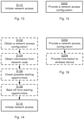
- FIGS. 13 and 14 are flow charts illustrating embodiments of methods for network access of the wireless device 200 to the communications network 100 as performed by the wireless device 200 .
- FIGS. 15 and 16 are flow charts illustrating embodiments of methods for enabling network access of the wireless device 200 to the communications network 100 as performed by the network node 300 .
- the methods are advantageously provided as computer programs 420 a , 420 b.
- FIG. 13 illustrating a method for network access of the wireless device 200 to the communications network 100 as performed by the wireless device 200 according to an embodiment.
- the wireless device 200 is associated with a coverage class from a set of coverage classes.
- the set comprises two, three or more coverage classes.
- the wireless device 200 initiates network access to the communications network 100 by transmitting a preamble sequence for random access on a physical random access channel (PRACH).
- PRACH physical random access channel
- the network access is initiated during a starting opportunity defined by the coverage class of the wireless device 200 . Accordingly, the preamble sequence is transmitted during the starting opportunity and possibly repeated.
- step S 110 is performed as described with reference to FIG. 13 .
- the wireless device 200 is configured to perform step S 102 .
- the wireless device 200 obtains the network access configuration from the network node 300 .
- the wireless device 200 can be provided with information from the network node 300 on how many of the coverage classes in the set of coverage classes share the frequency band of the coverage class of the wireless device 200 . According to an embodiment the wireless device 200 is therefore configured to perform step S 104 .
- the wireless device 200 obtains information from the network node 300 on how many of the coverage classes in the set of coverage classes share the frequency band of the coverage class of the wireless device 200 .
- FIG. 15 illustrating a method for enabling network access of the wireless device 200 to the communications network 100 as performed by the network node 300 according to an embodiment.
- the wireless device 200 is associated with a coverage class from a set of coverage classes.
- the network node 300 provides a network access configuration to the wireless device 200 .
- the network access configuration specifies network access initiation to the communications network 100 for the wireless device 200 .
- the network access configuration specifies that the network access is to be initiated during a starting opportunity defined by the coverage class of the wireless device 200 .
- the network node 300 provides the wireless device 200 with a network access configuration including a plurality of starting opportunities associated with different coverage classes.
- the starting opportunities may relate to distinct time resources.
- the coverage class of the wireless device 200 defines a starting opportunity during which the wireless device 200 is to initiate network access by transmitting a preamble sequence for random access on a physical random access channel. This may imply that the wireless device 200 receives a network access configuration which, in addition to the one or more starting opportunities of the wireless device 200 , specifies at least one further starting opportunity; the further starting opportunity may be used by wireless devices associated with a different coverage class.
- FIG. 16 illustrating methods for enabling network access of the wireless device 200 to the communications network 100 as performed by the network node 300 according to further embodiments. It is assumed that step S 202 is performed as described with reference to FIG. 15 .
- the network node 300 is configured to perform step S 204 :
- the network node 300 provides information to the wireless device 200 on how many of the coverage classes in the set of coverage classes share the frequency band of the coverage class of the wireless device 200 .
- the network access initiation as performed by the wireless device 200 in step S 110 takes the place of transmitting the random access preamble in step 1. It can be assumed that the preamble sequence for random access as transmitted by the wireless device 200 is received by the network node 300 . Steps 2-4 of FIG. 1 may then follow; in case contention resolution is not needed only steps 1 and 2 are required to be performed.
- the starting opportunities are unique for each coverage class. Hence, according to an embodiment no two different coverage classes in the set of coverage classes share a common starting opportunity. According to some other aspects the starting opportunities are shared for some coverage classes. Particularly, according to an embodiment each coverage class in the set of coverage classes is associated with a respective received power level, and those coverage classes whose received power levels differ less than a threshold value have at least partly overlapping starting opportunities.
- all coverage classes in the set of coverage classes share a common starting subframe for initiating the network access.
- the starting opportunity, during which the network access is initiated is determined based on the common starting subframe.
- a common prachStartingSubframe can thus be configured.
- collisions can be avoided since different offsets can be used for different coverage classes.
- different time offsets relative to the common starting subframe can be used. In other words, the offset can be dependent on the coverage class, and each coverage class can have its own offset.
- all coverage classes in the set of coverage classes share a common starting subframe for initiating said network access
- each coverage class in the set of coverage classes has a unique offset for initiating the network access in relation to the common starting subframe, and the network access is initiated according to the unique offset.
- the offset may be defined in relation to the common starting subframe.
- the offset may for instance include a number of subframes indicating the distance in time from the common starting subframe to the starting opportunity.
- the offset may alternatively include a distance in time from the common starting subframe to the starting opportunity.
- Embodiments relating to determination of explicit starting opportunities used by the wireless device 200 for avoiding PRACH collision will now be disclosed.
- each coverage class in the set of coverage classes is associated with a unique number of repetitions for performing the network access.
- the number of repetitions may be signaled by a parameter indicating the number of repetitions per attempt and an optional parameter indicating the number of attempts.
- network access may be initiated in a subframe containing the starting opportunity, the subsequent repetitions may be outside this subframe.
- the unique offset for a given coverage class in the set of coverage classes is proportional to the unique number of repetitions for the given coverage class.
- FIG. 8 illustrates use of three different offsets.
- network access may be initiated in one subframe (starting opportunity) but may continue (e.g., by one or more repeated transmissions of the preamble sequence) into subsequent subframes.
- start opportunity e.g., a subframe
- continue e.g., by one or more repeated transmissions of the preamble sequence
- One drawback is that not all the PRACH opportunities can be used.
- each of the coverage classes in the set of coverage classes is associated with a unique number of starting opportunities. Further, each coverage class in the set of coverage classes can be associated with a unique number of repetitions for initiating the network access. Network access may be initiated in said subframe but subsequent subframes may contain one or more transmissions repeating a same random access preamble sequence. The number of starting opportunities for a coverage class with relatively fewer repetitions is then higher than the number of starting opportunities for a coverage class with relatively many repetitions. To fully utilize the PRACH opportunities, the following scheduling of the starting opportunities could thus be used:
- the PRACH of all three coverage classes share the same PRACH frequency band.
- the number of PRACH opportunities in a period of length P is a function of the number of the repetitions of the given coverage class.
- the PRACH opportunities for the three coverage classes are illustrated in FIG. 9 .
- One drawback is that all the PRACH opportunities for a given coverage class are clustered. It can be assumed that the network access is initiated in a frequency band. According to an embodiment the starting opportunity is dependent on how many of the coverage classes in the set of coverage classes share the frequency band of the coverage class of the wireless device.
- the wireless device 200 can then be provided with information from the network node 300 on how many of the coverage classes in the set of coverage classes share the frequency band of the coverage class of the wireless device 200 , as in above steps S 104 , S 204 .
- coverage class 2 uses a single PRACH frequency band, there is no collision.
- coverage class 1 and coverage class 3 collision can be avoided as illustrated in FIG. 10 .
- the wireless device 200 becomes aware of this configuration by receiving information from the network node 300 that one coverage class defines several possible starting opportunities between which at least one starting opportunity defined by a different coverage class is interposed.
- a ranking of wireless devices may arise from the fact that, on the one hand, each wireless device 200 is associated with a coverage class and, on the other hand, the coverage classes in the set of coverage classes are ranked in the sense that a given first coverage class is either higher, lower or identical to a given second coverage class.
- the starting opportunity is defined by the wireless device 200 backing off from initiating the network access.
- the wireless device 200 may perform said backing-off on the basis of possible starting opportunities. If the wireless device 200 has backed off from initiating the network access in one possible starting opportunity, it will then determine whether to initiate the network access in a next possible starting opportunity. As a result, no two different coverage classes will share a common starting opportunity.
- the scheduling of the starting opportunities is based on a ranking approach. Specifically, the wireless devices are ranked according to their coverage class. Then, a higher coverage class is given higher priority over a lower coverage class.
- each coverage class in the set of coverage classes has its own set of starting opportunities for network access. In other words, when wireless devices in a lower coverage class determine their starting opportunities, they back off from those starting opportunities that may be used by wireless devices in higher coverage classes.
- all coverage classes in the set of coverage classes are ranked, and the wireless device backs off from a starting opportunity used by wireless devices in a higher ranked coverage class.
- the wireless device is thereby enabled to determine the next available subframe (containing the PRACH) permitted by the restrictions given by the subframes containing PRACH resources of a higher enhanced coverage class.
- the following starting opportunities are scheduled as followed (as illustrated in FIG. 12 ):
- the wireless device is configured to perform steps S 106 and S 108 , as follows.
- the wireless device checks possible starting opportunities of its own coverage class and of a higher ranked coverage class.
- S 108 The wireless device backs off from initiating network access in any of its possible starting opportunities that may be used by the higher coverage class.
- Coverage class 1 has no repetitions (which may be represented by a value 1 of a repetition parameter) and potentially can use any PRACH opportunity with the following restriction. Coverage class 1 has the lowest priority. Wireless devices in this coverage class then check the possible starting opportunities used by coverage class 2 and coverage class 3, and back off from the PRACH resources that collide with coverage class 2 and coverage class 3 as a result of performing steps S 106 and S 108 .
- the ranking approach allows different prachStartingSubframe to be configured for different coverage classes.
- the ranking approach allows full utilization of all the PRACH opportunities.
- the ranking approach allows clustering of PRACH opportunities of any coverage class to be avoided. Furthermore, since the task of finding the available starting opportunities among the possible starting opportunities for a given coverage class is delegated to the wireless device 200 , the ranking approach simplifies the central scheduling.
- the backing off is specified according to a physical layer specification or a medium access layer specification associated with the communications network. Below are two examples.
- the starting opportunities can be scheduled according to a physical layer specification by using, e.g., explicit formulas and/or pseudocode that direct the wireless device 200 to determine the allowed starting opportunities.
- the starting opportunities can be defined as part of the wireless device behavior by being realized at the medium access layer by specifying the behaviors in the presence of collision.
- FIG. 17 schematically illustrates, in terms of a number of functional units, the components of a wireless device 200 according to an embodiment.
- Processing circuitry 210 is provided using any combination of one or more of a suitable central processing unit (CPU), multiprocessor, microcontroller, digital signal processor (DSP), etc., capable of executing software instructions stored in a computer program product 410 a (as in FIG. 21 ), e.g., in the form of a storage medium 230 .
- the processing circuitry 210 may further be provided as at least one application specific integrated circuit (ASIC), or field programmable gate array (FPGA).
- ASIC application specific integrated circuit
- FPGA field programmable gate array
- the processing circuitry 210 is configured to cause the wireless device 200 to perform a set of operations, or steps, S 102 -S 110 , as disclosed above.
- the storage medium 230 may store the set of operations
- the processing circuitry 210 may be configured to retrieve the set of operations from the storage medium 230 to cause the wireless device 200 to perform the set of operations.
- the set of operations may be provided as a set of executable instructions.
- the processing circuitry 210 is thereby arranged to execute methods as disclosed herein.
- the storage medium 230 may also comprise persistent storage, which, for example, can be any single one or combination of magnetic memory, optical memory, solid state memory or even remotely mounted memory.
- the wireless device 200 may further comprise a communications interface 220 for communications at least with the network node 300 .
- the communications interface 220 may comprise one or more transmitters and receivers, comprising analogue and digital components and a suitable number of antennas for wireless communications and ports for wireline communications.
- the processing circuitry 210 controls the general operation of the wireless device 200 e.g. by transmitting data and control signals to the communications interface 220 and the storage medium 230 , by receiving data and reports from the communications interface 220 , and by retrieving data and instructions from the storage medium 230 .
- Other components, as well as the related functionality, of the wireless device 200 are omitted in order not to obscure the concepts presented herein.
- FIG. 18 schematically illustrates, in terms of a number of functional modules, the components of a wireless device 200 according to an embodiment.
- the wireless device 200 of FIG. 18 comprises an initiate module 210 a configured to perform step S 110 .
- the wireless device 200 of FIG. 18 may further comprise a number of optional functional modules, such as any of an obtain module 210 b configured to perform step S 102 , an obtain module 210 c configured to perform step S 104 , a check module 210 d configured to perform step S 106 , and a back-off module 210 e configured to perform step S 108 .
- each functional module 210 a - 210 e may be implemented in hardware or in software.
- one or more or all functional modules 210 a - 210 e may be implemented by the processing circuitry 210 , possibly in cooperation with the communications interface 220 and/or the storage medium 230 .
- the processing circuitry 210 may thus be arranged to fetch, from the storage medium 230 , instructions as provided by a functional module 210 a - 210 e , and to execute these instructions, thereby performing any steps of the wireless device 200 as disclosed herein.
- FIG. 19 schematically illustrates, in terms of a number of functional units, the components of a network node 300 according to an embodiment.
- Processing circuitry 310 is provided using any combination of one or more of a suitable central processing unit (CPU), multiprocessor, microcontroller, digital signal processor (DSP), etc., capable of executing software instructions stored in a computer program product 410 b (as in FIG. 21 ), e.g. in the form of a storage medium 330 .
- the processing circuitry 310 may further be provided as at least one application specific integrated circuit (ASIC), or field programmable gate array (FPGA).
- ASIC application specific integrated circuit
- FPGA field programmable gate array
- the processing circuitry 310 is configured to cause the network node 300 to perform a set of operations, or steps, S 202 -S 204 , as disclosed above.
- the storage medium 330 may store the set of operations
- the processing circuitry 310 may be configured to retrieve the set of operations from the storage medium 330 to cause the network node 300 to perform the set of operations.
- the set of operations may be provided as a set of executable instructions.
- the processing circuitry 310 is thereby arranged to execute methods as disclosed herein.
- the storage medium 330 may also comprise persistent storage, which, for example, can be one of magnetic memory, optical memory, solid state memory or even remotely mounted memory, or a combination of two or more of these memory types.
- the network node 300 may further comprise a communications interface 320 for communications at least with a wireless device 200 .
- the communications interface 320 may comprise one or more transmitters and receivers, comprising analogue and digital components and a suitable number of antennas for wireless communications and ports for wireline communications.
- the processing circuitry 310 controls the general operation of the network node 300 e.g. by transmitting data and control signals to the communications interface 320 and the storage medium 330 , by receiving data and reports from the communications interface 320 , and by retrieving data and instructions from the storage medium 330 .
- Other components, as well as the related functionality, of the network node 300 are omitted in order not to obscure the concepts presented herein.
- FIG. 20 schematically illustrates, in terms of a number of functional modules, the components of a network node 300 according to an embodiment.
- the network node 300 of FIG. 20 comprises a provide module 310 a configured to perform step S 202 .
- the network node 300 of FIG. 20 may further comprise a number of optional functional modules, such as a further provide module 310 b configured to perform step S 204 .
- each functional module 310 a - 310 b may be implemented in hardware or in software.
- one or more or all functional modules 310 a - 310 b may be implemented by the processing circuitry 310 , possibly in cooperation with functional units 320 and/or 330 .
- the processing circuitry 310 may thus be arranged to fetch, from the storage medium 330 , instructions as provided by a functional module 310 a - 310 b and to execute these instructions, thereby performing any steps of the network node 300 as disclosed herein.
- the network node 300 may be provided as a standalone device or as a part of at least one further device.
- the network node 300 may be provided in a node of the radio access network 110 or in a node of the core network 120 , or even in a node of the service network 130 .
- functionality of the network node 300 may be distributed between at least two devices, or nodes. These at least two nodes, or devices, may either be part of the same network part (such as the radio access network 110 or the core network 120 ) or may be spread between at least two such network parts.
- instructions that are required to be performed in real time may be performed in a device, or node, operatively closer to the cell than instructions that are not required to be performed in real time.
- a first portion of the instructions performed by the network node 300 may be executed in a first device, and a second portion of the of the instructions performed by the network node 300 may be executed in a second device; the embodiments disclosed herein are not limited to any particular number of devices on which the instructions performed by the network node 300 may be executed.
- the methods according to the embodiments disclosed herein are suitable to be performed by a network node 300 residing in a cloud computational environment. Therefore, although a single processing circuitry 310 is illustrated in FIG. 18 the processing circuitry 310 may be distributed among a plurality of devices, or nodes. The same applies to the functional modules 310 a - 310 b of FIG. 20 and the computer program 420 b of FIG. 21 (see below).
- FIG. 21 shows one example of a computer program product 410 a , 410 b comprising computer readable means 430 .
- a computer program 420 a can be stored, which computer program 420 a can cause the processing circuitry 210 and thereto operatively coupled entities and devices, such as the communications interface 220 and the storage medium 230 , to execute methods according to embodiments described herein.
- the computer program 420 a and/or computer program product 410 a may thus provide means for performing any steps of the wireless device 200 as disclosed herein.
- a computer program 420 b can be stored, which computer program 420 b can cause the processing circuitry 310 and thereto operatively coupled entities and devices, such as the communications interface 320 and the storage medium 330 , to execute methods according to embodiments described herein.
- the computer program 420 b and/or computer program product 410 b may thus provide means for performing any steps of the network node 300 as disclosed herein.
- the computer program product 410 a , 410 b is illustrated as an optical disc, such as a CD (compact disc) or a DVD (digital versatile disc) or a Blu-ray DiscTM.
- the computer program product 410 a , 410 b could also be embodied as a memory, such as a random access memory (RAM), a read-only memory (ROM), an erasable programmable read-only memory (EPROM), or an electrically erasable programmable read-only memory (EEPROM) and more particularly as a non-volatile storage medium of a device in an external memory such as a USB (Universal Serial Bus) memory or a flash memory, such as a compact flash memory.
- RAM random access memory
- ROM read-only memory
- EPROM erasable programmable read-only memory
- EEPROM electrically erasable programmable read-only memory
- the computer program 420 a , 420 b is here schematically shown as a track on the depicted optical disk, the computer program 420 a , 420 b can be stored in any way which is suitable for the computer program product 410 a , 410 b.
Landscapes
- Engineering & Computer Science (AREA)
- Signal Processing (AREA)
- Computer Networks & Wireless Communication (AREA)
- Physics & Mathematics (AREA)
- Computer Security & Cryptography (AREA)
- Discrete Mathematics (AREA)
- General Physics & Mathematics (AREA)
- Mathematical Physics (AREA)
- Quality & Reliability (AREA)
- Electromagnetism (AREA)
- Mobile Radio Communication Systems (AREA)
Abstract
Description
-
- Step 1: The
wireless device 200 transmits a random access preamble to thenetwork node 300. - Step 2: The
network node 300 responds to the random access preamble by transmitting a random access response including, for example, an uplink grant, to thewireless device 200. - Step 3: The
wireless device 200 transmits a scheduled transmission to thenetwork node 300. - Step 4: The
network node 300 transmits a message for contention resolution of thewireless device 200.
- Step 1: The
N·prachStartingSubframe+numRepetitionPerPreambleAttempt,
where N≥0 is an integer, and where numRepetitionPerPreambleAttempt is a parameter defining the number of repetitions of random access transmissions allowed per preamble attempt. In 3GPP specifications of eMTC, the initial transmission of a preamble sequence is counted in the “number of repetitions”; for example, transmitting a preamble sequence twice per attempt may correspond to numRepetititionsPerPreambleAttempt being equal to 2. The total number of repetitions may depend on the number of allowed preamble transmission attempts, which may correspond to a different parameter.
-
- For
coverage class value 1 of a repetition parameter) and can be transmitted completely using one PRACH opportunity. - For
coverage class value 2 of a repetition parameter) and can be transmitted using 2 PRACH opportunities. - For
coverage class 3, 32 symbol groups are needed (i.e., 8 repetitions with respect to a set of 4 symbol groups; this may correspond to avalue 8 of a repetition parameter) and can be transmitted using 8 PRACH opportunities.
- For
-
-
Coverage class 2 has 2 repetitions: prachStartingSubframe=4 and thus the offset is any value in the set {0, 1, 2, 3}·4+2={2, 6, 10, 14} within 16 opportunities. As seen inFIG. 7 , N=0, 1, 2 or 3 forcoverage class 2.FIG. 7 shows four preamble transmission attempts with two repetitions each. -
Coverage class 3 has 8 repetitions: prachStartingSubframe=16 and thus the offset is 0 16+8=8 within 16 opportunities. As seen inFIG. 7 , N=0 forcoverage class 3.
-
-
-
Coverage class 1 has no repetitions (repetition parameter=1) and thus
offset=0·16+1=1, -
Coverage class 2 has 2 repetitions (repetition parameter=2) and thus
offset=0·16+2=2, and -
Coverage class 3 has 8 repetitions (repetition parameter=8) and thus
offset=0·16+8=8.
-
-
-
Coverage class 1 has starting subframes indexed j·P+k·Nrep,1, for - k=0, 1, . . . , (P/(4·Nrep,1)−1). Here Nrep,1 is the number of repetitions of
coverage class 1, and j is a sequence number of the period (time interval of length P). Transmitting the preamble sequence once may correspond to Nrep,1=1. -
Coverage class 2 has starting subframes (j+¼)·P+k·Nrep,2, for - k=0, 1, . . . , (P/(4·Nrep,2)−1). Here Nrep,2 is the number of repetitions of
coverage class 2. -
Coverage class 3 has starting subframes (j+½)·P+k·Nrep,3, for - k=0, 1, . . . , (P/(2·Nrep,3)−1). Here Nrep,3 is the number of repetitions of
coverage class 3.
-
-
-
Coverage class 1 has no repetition and starting opportunities insubframes -
Coverage class 2 has 2 repetitions and starting opportunities insubframes -
Coverage class 3 has 8 repetitions and starting opportunities insubframe 8.
-
-
-
Coverage class 1 has starting subframes j·PbandA+k·Nrep,1, for - k=0, 1, . . . , (PbandA/(2·Nrep,1)−1). Here Nrep,1 is the number of repetitions of
coverage class 1, and j is again a sequence number of the period (time interval of length P). -
Coverage class 2 has starting subframes j·PbandB. Parameter PbandB can be set with value PbandB≥Nrep,2, with PbandB=Nrep,2 allowing the maximum number of PRACH opportunities forcoverage class 2. -
Coverage class 3 has starting subframes (j+½)·PbandA+k·Nrep,3, for - k=0, 1, . . . , (PbandA/(2·Nrep,3)−1). Here Nrep,3 is the number of repetitions of
coverage class 3.
-
-
-
Coverage class 3 has 8 repetitions: prachStartingSubframe=16 and thus offset=0·16+8=8 within 16 starting opportunities.Coverage class 3 has the highest priority and does not need to back off from any NPRACH resource. -
Coverage class 2 has 2 repetitions: prachStartingSubframe=4 and thus offset={0, 1, 2, 3}·4+2={2, 6, 10, 14} within 16 starting opportunities.Coverage class 2 has lower priority thancoverage class 3. Wireless devices in this coverage class then check the possible starting opportunities used bycoverage class 3, and find that offset {2, 3} would lead to collision and thus back off from the collided PRACH resource.
-
Claims (23)
Priority Applications (1)
| Application Number | Priority Date | Filing Date | Title |
|---|---|---|---|
| US16/905,580 US11229065B2 (en) | 2016-03-16 | 2020-06-18 | Network access of a wireless device to a communications network |
Applications Claiming Priority (4)
| Application Number | Priority Date | Filing Date | Title |
|---|---|---|---|
| US201662309389P | 2016-03-16 | 2016-03-16 | |
| US15/295,525 US9661663B1 (en) | 2016-03-16 | 2016-10-17 | Network access of a wireless device to a communications network |
| PCT/SE2017/050237 WO2017160210A1 (en) | 2016-03-16 | 2017-03-10 | Network access of a wireless device to a communications network |
| US16/905,580 US11229065B2 (en) | 2016-03-16 | 2020-06-18 | Network access of a wireless device to a communications network |
Related Parent Applications (2)
| Application Number | Title | Priority Date | Filing Date |
|---|---|---|---|
| US16/084,334 Continuation US10728930B2 (en) | 2016-03-16 | 2017-03-10 | Network access of a wireless device to a communications network |
| PCT/SE2017/050237 Continuation WO2017160210A1 (en) | 2016-03-16 | 2017-03-10 | Network access of a wireless device to a communications network |
Publications (2)
| Publication Number | Publication Date |
|---|---|
| US20200322985A1 US20200322985A1 (en) | 2020-10-08 |
| US11229065B2 true US11229065B2 (en) | 2022-01-18 |
Family
ID=58708443
Family Applications (3)
| Application Number | Title | Priority Date | Filing Date |
|---|---|---|---|
| US15/295,525 Active US9661663B1 (en) | 2016-03-16 | 2016-10-17 | Network access of a wireless device to a communications network |
| US16/084,334 Active 2036-10-24 US10728930B2 (en) | 2016-03-16 | 2017-03-10 | Network access of a wireless device to a communications network |
| US16/905,580 Active 2036-11-15 US11229065B2 (en) | 2016-03-16 | 2020-06-18 | Network access of a wireless device to a communications network |
Family Applications Before (2)
| Application Number | Title | Priority Date | Filing Date |
|---|---|---|---|
| US15/295,525 Active US9661663B1 (en) | 2016-03-16 | 2016-10-17 | Network access of a wireless device to a communications network |
| US16/084,334 Active 2036-10-24 US10728930B2 (en) | 2016-03-16 | 2017-03-10 | Network access of a wireless device to a communications network |
Country Status (17)
| Country | Link |
|---|---|
| US (3) | US9661663B1 (en) |
| EP (3) | EP3691395B1 (en) |
| JP (2) | JP6651020B2 (en) |
| KR (3) | KR102369790B1 (en) |
| CN (2) | CN108886817B (en) |
| AR (1) | AR107896A1 (en) |
| AU (1) | AU2017233227B2 (en) |
| CL (1) | CL2018002615A1 (en) |
| DK (1) | DK3691395T3 (en) |
| ES (2) | ES2774079T3 (en) |
| MX (1) | MX389540B (en) |
| MY (1) | MY195028A (en) |
| PH (1) | PH12018501344A1 (en) |
| PL (2) | PL3691395T3 (en) |
| RU (1) | RU2711474C1 (en) |
| WO (1) | WO2017160210A1 (en) |
| ZA (1) | ZA201804256B (en) |
Families Citing this family (25)
| Publication number | Priority date | Publication date | Assignee | Title |
|---|---|---|---|---|
| US10090880B2 (en) * | 2015-12-18 | 2018-10-02 | Qualcomm Incorporated | Narrow band PRACH with multiple tone hopping distances |
| WO2017131459A1 (en) | 2016-01-29 | 2017-08-03 | 성균관대학교 산학협력단 | Random access method considering coverage level and subcarrier spacing configuration and/or multi-tone configuration in internet of things environment |
| US10506605B2 (en) * | 2016-01-29 | 2019-12-10 | Research & Business Foundation Sungkyunkwan University | Random access method considering a coverage level, subcarrier spacing configuration and/or multi-tone configuration in internet of things environment |
| US9661663B1 (en) | 2016-03-16 | 2017-05-23 | Telefonaktiebolaget Lm Ericsson (Publ) | Network access of a wireless device to a communications network |
| WO2018030935A1 (en) * | 2016-08-12 | 2018-02-15 | Telefonaktiebolaget Lm Ericsson (Publ) | Determining a position of a wireless device in a cellular network |
| WO2018128579A1 (en) | 2017-01-05 | 2018-07-12 | Telefonaktiebolaget Lm Ericsson (Publ) | Narrowband physical random access channel (nprach) for extended range |
| EP3603304B1 (en) * | 2017-03-23 | 2023-08-09 | Apple Inc. | Narrowband internet-of-things (nb-iot) enhacements |
| CN107347216B (en) * | 2017-06-12 | 2020-06-19 | 西安交通大学 | Method for allocating uplink and downlink resources in 5G large-connection Internet of things |
| US11116005B2 (en) | 2017-06-26 | 2021-09-07 | Lg Electronics Inc. | Method and device for transmitting NPRACH preamble in narrowband IoT system supporting frame structure type 2 |
| CA3069783C (en) | 2017-07-13 | 2023-06-20 | Zte Corporation | System and method for transmitting a signal |
| CN107404347B (en) * | 2017-07-25 | 2019-11-12 | 福州大学 | A remote monitoring system and method for drones based on NB-IoT |
| EP4224776A1 (en) * | 2017-08-10 | 2023-08-09 | Apple Inc. | Uplink transmission in tdd supporting fenb-iot operation |
| US10785739B2 (en) | 2017-08-10 | 2020-09-22 | Ofinno, Llc | Beam indication in RACH |
| BR112020002784A2 (en) * | 2017-08-10 | 2020-07-28 | Huawei Technologies Co., Ltd. | signal sending method and device and signal receiving method and device |
| US11792630B2 (en) * | 2017-08-10 | 2023-10-17 | Apple Inc. | Uplink transmission in TDD supporting feNB-IoT operation |
| WO2019036846A1 (en) | 2017-08-21 | 2019-02-28 | Qualcomm Incorporated | Nprach having improved reliability performance |
| KR102372029B1 (en) | 2017-09-07 | 2022-03-08 | 삼성전자주식회사 | Method for random access based on mobility and the appratus thereof |
| US10461896B2 (en) | 2017-09-08 | 2019-10-29 | At&T Intellectual Property I, L.P. | Configuration of repetition factors for transmitting feedback data for 5G or other next generation network |
| EP3711367B1 (en) * | 2017-11-13 | 2024-01-03 | Telefonaktiebolaget LM Ericsson (publ) | Implicit temporal network access load distribution |
| JP7155250B2 (en) * | 2018-01-25 | 2022-10-18 | エルジー エレクトロニクス インコーポレイティド | Method and apparatus for transmitting and receiving NPRACH preamble in wireless communication system supporting TDD |
| CN112136300B (en) * | 2018-05-21 | 2022-02-08 | 华为技术有限公司 | Communication method, communication device and network device |
| KR102174653B1 (en) * | 2018-10-24 | 2020-11-05 | 연세대학교 산학협력단 | Appratus and method for random access in wireless communication system |
| CN111224745B (en) * | 2018-11-26 | 2023-03-28 | 中国电信股份有限公司 | Narrow-band Internet of things NB-IoT network resource allocation method, terminal, equipment and system |
| KR20210122709A (en) * | 2020-03-31 | 2021-10-12 | 아서스테크 컴퓨터 인코포레이션 | Method and apparatus for random access preamble partition for small data transmission in a wireless communication system |
| JP2025157811A (en) * | 2024-04-03 | 2025-10-16 | シャープ株式会社 | Terminal device and communication method |
Citations (28)
| Publication number | Priority date | Publication date | Assignee | Title |
|---|---|---|---|---|
| US20030139170A1 (en) * | 2001-12-10 | 2003-07-24 | Samsung Electronics Co., Ltd. | Method of reducing access time to UTRAN in UMTS |
| WO2009088338A1 (en) | 2008-01-11 | 2009-07-16 | Telefonaktiebolaget L M Ericsson (Publ) | Methods and devices for random access power control in a communications network |
| US20100067470A1 (en) | 2008-09-12 | 2010-03-18 | Qualcomm Incorporated | Physical random access channel (prach) transmission in multicarrier operation |
| RU2472318C2 (en) | 2008-01-11 | 2013-01-10 | Телефонактиеболагет Лм Эрикссон (Пабл) | Methods and devices to control capacity with random access in communication network |
| US20140044108A1 (en) | 2011-02-11 | 2014-02-13 | Blackberry Limited | Time-advanced random access channel transmission |
| US20140079011A1 (en) * | 2011-05-05 | 2014-03-20 | Telefonaktiebolaget L M Ericsson (Publ) | Methods and Arrangements for Adapting Random Access Allocation of Resources to User Equipments |
| US20140098761A1 (en) | 2012-10-05 | 2014-04-10 | Interdigital Patent Holdings, Inc. | Method and apparatus for enhancing coverage of machine type communication (mtc) devices |
| US20140313999A1 (en) | 2013-04-17 | 2014-10-23 | Qualcomm Incorporated | Control-less operation for coverage limited machine-type-communications |
| WO2015005701A1 (en) | 2013-07-10 | 2015-01-15 | Samsung Electronics Co., Ltd. | Method and apparatus for coverage enhancement for a random access process |
| US20150078330A1 (en) | 2008-08-04 | 2015-03-19 | Panasonic Intellectual Property Corporation Of America | Base station, terminal, band allocation method, and downlink data communication method |
| US20150078264A1 (en) | 2013-09-17 | 2015-03-19 | Seunghee Han | Generation of random access preambles |
| US20150085717A1 (en) | 2013-09-20 | 2015-03-26 | Samsung Electronics Co., Ltd. | System and method for coverage enhancements of broadcast channels |
| US20150117233A1 (en) | 2013-10-31 | 2015-04-30 | Alcatel Lucent | Methods and systems for implementing a repetition level for a channel |
| US20150236932A1 (en) | 2012-11-02 | 2015-08-20 | Huawei Technologies Co., Ltd. | Method, base station, and user equipment for determining channel loss |
| WO2015142072A1 (en) | 2014-03-21 | 2015-09-24 | Samsung Electronics Co., Ltd. | Random access method and apparatus for use in wireless communication system supporting dual connectivity |
| US20160007377A1 (en) | 2014-02-10 | 2016-01-07 | Telefonaktiebolaget L M Ericsson (Publ) | User Equipment, Network Node and Methods Therein for Handling Preamble Transmissions on a Random Access Channel in a Radio Communications Network |
| US20160227582A1 (en) | 2015-01-30 | 2016-08-04 | Qualcomm Incorporated | Random access procedure and broadcast prioritization for machine type communications (mtc) |
| US20160338032A1 (en) | 2015-05-11 | 2016-11-17 | Qualcomm Incorporated | Resource allocation and message identification of control signals in cellular systems |
| US20160353440A1 (en) | 2014-01-29 | 2016-12-01 | Interdigital Patent Holdings, Inc. | Method of access and link adaptation for coverage enhanced wireless transmissions |
| US20160353486A1 (en) | 2014-02-10 | 2016-12-01 | Huawei Technologies Co., Ltd. | Method for configuring prach resource, method for acquiring resource configuration, base station, and user equipment |
| US20170048014A1 (en) | 2015-08-13 | 2017-02-16 | Spreadtrum Hong Kong Limited | Apparatus and method for generating scrambling codes for repetition transmissions |
| WO2017055302A1 (en) | 2015-09-28 | 2017-04-06 | Telefonaktiebolaget Lm Ericsson (Publ) | Random access preamble for minimizing pa backoff |
| US9661663B1 (en) | 2016-03-16 | 2017-05-23 | Telefonaktiebolaget Lm Ericsson (Publ) | Network access of a wireless device to a communications network |
| WO2017131577A1 (en) | 2016-01-29 | 2017-08-03 | Telefonaktiebolaget Lm Ericsson (Publ) | Frequency hopping for random access |
| WO2017137060A1 (en) | 2016-02-08 | 2017-08-17 | Sony Mobile Communications Inc. | Terminal device, network node and method for random access in coverage enhancement operation |
| US20170280484A1 (en) | 2014-09-26 | 2017-09-28 | Nec Corporation | Communication system |
| US20170290064A1 (en) | 2014-09-26 | 2017-10-05 | Sharp Kabushiki Kaisha | Method for configuring random access response window, base station and user equipment |
| US20170347361A1 (en) | 2015-01-08 | 2017-11-30 | Sharp Kabushiki Kaisha | Terminal device, monitoring method, and integrated circuit |
-
2016
- 2016-10-17 US US15/295,525 patent/US9661663B1/en active Active
-
2017
- 2017-03-10 KR KR1020217007218A patent/KR102369790B1/en active Active
- 2017-03-10 AU AU2017233227A patent/AU2017233227B2/en active Active
- 2017-03-10 ES ES17713486T patent/ES2774079T3/en active Active
- 2017-03-10 CN CN201780017454.1A patent/CN108886817B/en active Active
- 2017-03-10 JP JP2018533900A patent/JP6651020B2/en active Active
- 2017-03-10 ES ES20152498T patent/ES2921778T3/en active Active
- 2017-03-10 PL PL20152498.0T patent/PL3691395T3/en unknown
- 2017-03-10 EP EP20152498.0A patent/EP3691395B1/en active Active
- 2017-03-10 KR KR1020187026655A patent/KR102125903B1/en not_active Expired - Fee Related
- 2017-03-10 DK DK20152498.0T patent/DK3691395T3/en active
- 2017-03-10 EP EP17713486.3A patent/EP3378268B1/en active Active
- 2017-03-10 US US16/084,334 patent/US10728930B2/en active Active
- 2017-03-10 KR KR1020207017506A patent/KR102228218B1/en active Active
- 2017-03-10 RU RU2018136249A patent/RU2711474C1/en active
- 2017-03-10 MY MYPI2018703250A patent/MY195028A/en unknown
- 2017-03-10 PL PL17713486T patent/PL3378268T3/en unknown
- 2017-03-10 EP EP22171143.5A patent/EP4061087A1/en active Pending
- 2017-03-10 CN CN202210397978.0A patent/CN114710766A/en active Pending
- 2017-03-10 WO PCT/SE2017/050237 patent/WO2017160210A1/en not_active Ceased
- 2017-03-10 MX MX2018010082A patent/MX389540B/en unknown
- 2017-03-16 AR ARP170100652A patent/AR107896A1/en active IP Right Grant
-
2018
- 2018-06-22 PH PH12018501344A patent/PH12018501344A1/en unknown
- 2018-06-25 ZA ZA2018/04256A patent/ZA201804256B/en unknown
- 2018-09-12 CL CL2018002615A patent/CL2018002615A1/en unknown
-
2020
- 2020-01-21 JP JP2020007807A patent/JP6983919B2/en active Active
- 2020-06-18 US US16/905,580 patent/US11229065B2/en active Active
Patent Citations (31)
| Publication number | Priority date | Publication date | Assignee | Title |
|---|---|---|---|---|
| US20030139170A1 (en) * | 2001-12-10 | 2003-07-24 | Samsung Electronics Co., Ltd. | Method of reducing access time to UTRAN in UMTS |
| WO2009088338A1 (en) | 2008-01-11 | 2009-07-16 | Telefonaktiebolaget L M Ericsson (Publ) | Methods and devices for random access power control in a communications network |
| RU2472318C2 (en) | 2008-01-11 | 2013-01-10 | Телефонактиеболагет Лм Эрикссон (Пабл) | Methods and devices to control capacity with random access in communication network |
| US20150078330A1 (en) | 2008-08-04 | 2015-03-19 | Panasonic Intellectual Property Corporation Of America | Base station, terminal, band allocation method, and downlink data communication method |
| US20100067470A1 (en) | 2008-09-12 | 2010-03-18 | Qualcomm Incorporated | Physical random access channel (prach) transmission in multicarrier operation |
| KR20110053386A (en) | 2008-09-12 | 2011-05-20 | 콸콤 인코포레이티드 | Physical Random Access Channel (PRAHC) Transmission in Multicarrier Operation |
| US20140044108A1 (en) | 2011-02-11 | 2014-02-13 | Blackberry Limited | Time-advanced random access channel transmission |
| US20140079011A1 (en) * | 2011-05-05 | 2014-03-20 | Telefonaktiebolaget L M Ericsson (Publ) | Methods and Arrangements for Adapting Random Access Allocation of Resources to User Equipments |
| US20140098761A1 (en) | 2012-10-05 | 2014-04-10 | Interdigital Patent Holdings, Inc. | Method and apparatus for enhancing coverage of machine type communication (mtc) devices |
| US20150236932A1 (en) | 2012-11-02 | 2015-08-20 | Huawei Technologies Co., Ltd. | Method, base station, and user equipment for determining channel loss |
| US20140313999A1 (en) | 2013-04-17 | 2014-10-23 | Qualcomm Incorporated | Control-less operation for coverage limited machine-type-communications |
| WO2015005701A1 (en) | 2013-07-10 | 2015-01-15 | Samsung Electronics Co., Ltd. | Method and apparatus for coverage enhancement for a random access process |
| US20150078264A1 (en) | 2013-09-17 | 2015-03-19 | Seunghee Han | Generation of random access preambles |
| US20150085717A1 (en) | 2013-09-20 | 2015-03-26 | Samsung Electronics Co., Ltd. | System and method for coverage enhancements of broadcast channels |
| US20150117233A1 (en) | 2013-10-31 | 2015-04-30 | Alcatel Lucent | Methods and systems for implementing a repetition level for a channel |
| US20160353440A1 (en) | 2014-01-29 | 2016-12-01 | Interdigital Patent Holdings, Inc. | Method of access and link adaptation for coverage enhanced wireless transmissions |
| US20160353486A1 (en) | 2014-02-10 | 2016-12-01 | Huawei Technologies Co., Ltd. | Method for configuring prach resource, method for acquiring resource configuration, base station, and user equipment |
| US20160007377A1 (en) | 2014-02-10 | 2016-01-07 | Telefonaktiebolaget L M Ericsson (Publ) | User Equipment, Network Node and Methods Therein for Handling Preamble Transmissions on a Random Access Channel in a Radio Communications Network |
| WO2015142072A1 (en) | 2014-03-21 | 2015-09-24 | Samsung Electronics Co., Ltd. | Random access method and apparatus for use in wireless communication system supporting dual connectivity |
| KR20150109925A (en) | 2014-03-21 | 2015-10-02 | 삼성전자주식회사 | Method and appratus of performing random access with multiple base station in mobile communication system |
| US20170280484A1 (en) | 2014-09-26 | 2017-09-28 | Nec Corporation | Communication system |
| US20170290064A1 (en) | 2014-09-26 | 2017-10-05 | Sharp Kabushiki Kaisha | Method for configuring random access response window, base station and user equipment |
| US20170347361A1 (en) | 2015-01-08 | 2017-11-30 | Sharp Kabushiki Kaisha | Terminal device, monitoring method, and integrated circuit |
| US20160227582A1 (en) | 2015-01-30 | 2016-08-04 | Qualcomm Incorporated | Random access procedure and broadcast prioritization for machine type communications (mtc) |
| US20160338032A1 (en) | 2015-05-11 | 2016-11-17 | Qualcomm Incorporated | Resource allocation and message identification of control signals in cellular systems |
| US20170048014A1 (en) | 2015-08-13 | 2017-02-16 | Spreadtrum Hong Kong Limited | Apparatus and method for generating scrambling codes for repetition transmissions |
| WO2017055302A1 (en) | 2015-09-28 | 2017-04-06 | Telefonaktiebolaget Lm Ericsson (Publ) | Random access preamble for minimizing pa backoff |
| WO2017131577A1 (en) | 2016-01-29 | 2017-08-03 | Telefonaktiebolaget Lm Ericsson (Publ) | Frequency hopping for random access |
| WO2017137060A1 (en) | 2016-02-08 | 2017-08-17 | Sony Mobile Communications Inc. | Terminal device, network node and method for random access in coverage enhancement operation |
| US20190044659A1 (en) | 2016-02-08 | 2019-02-07 | Sony Mobile Communications Inc. | Terminal device, network node and method for random access in coverage enhancement operation |
| US9661663B1 (en) | 2016-03-16 | 2017-05-23 | Telefonaktiebolaget Lm Ericsson (Publ) | Network access of a wireless device to a communications network |
Non-Patent Citations (25)
| Title |
|---|
| Ericsson et al., "WF on PRACH design", 3GPP TSG-RAN WG1 NB-IOT Ad Hoc Meeting, Jan. 18, 2016, pp. 1-3, Budapest, Hungary, R1-16xxxx. |
| Ericsson, "LS on PRACH format", 3GPP TSG-RAN WG1 NB-IOT Ad Hoc Meeting, Jan. 18, 2016, p. 1, Budapest, Hungary, R1-160200. |
| Ericsson, "NB-IoT—Random access", 3GPP TSG RAN WG1 Meeting #84, Feb. 15, 2016, pp. 1-4, St. Julian's, Malta, R1-160278. |
| Ericsson, "NB-IoT—Random access", 3GPP TSG-RAN WG1 NB-IoT Ad Hoc Meeting, Jan. 18, 2016, pp. 1-5, Budapest, Hungary, R1-160096. |
| Ericsson, "NB-IoT—Remaining issues for random access procedure", 3GPP TSG-RAN WG1 NB-IoT Ad-Hoc Meeting, Mar. 22, 2016, pp. 1-7, Sophia Antipolis, France, R1-161836. |
| Ericsson, Narrowband IoT—Random Access Design, 3GPP TSG-RAN1 #83, Nov. 15-22, 2015, Anaheim, US, R1-157424. |
| ETRI, "Considerations on random access design", 3GPP TSG RAN WG1 Meeting #83, Nov. 16, 2015, pp. 1-3, Anaheim, USA, R1-157108. |
| Huawei et al., "NB-PRACH design", 3GPP TSG RAN WG1 Meeting #84, Feb. 15, 2016, pp. 1-8, St. Julian's, Malta, R1-160316. |
| Huawei et al., "NB-PRACH design", 3GPP TSG RAN WG1 Meeting #84, Feb. 15, 2016, pp. 1-8, St. Julian's, Malta, R1-161357. |
| Huawei et al., "Remaining NB-IoT random access physical layer aspects", 3GPP TSG RAN WG1 Meeting #84, Feb. 15, 2016, pp. 1-4, St. Julian's, Malta, R1-160327. |
| Huawei et al., "WF on NB-PRACH coverage level procedures", 3GPP TSG RAN WG1 Meeting #84, Feb. 15, 2016, pp. 1-3, St. Julian's, Malta, R1-161313. |
| Huawei et al., "WF on random access procedures", 3GPP TSG RAN WG1 Meeting #84, Feb. 15, 2016, pp. 1-4, St. Julian's, Malta, R1-161314. |
| Huawei, et al., "Considerations on the random access of MTC UEs with coverage improvement", 3GPP TSG RAN WG I Meeting #75, San Francisco, USA, Nov. 11, 2013, pp. 1-5, RI-135020. |
| Intel Corporation, "NB-PRACH and random access procedure", 3GPP TSG RAN WG1 Meeting #84, 12016-02-15, pp. 1-4, St. Julian's, Malta, R1-160415. |
| LG Electronics, "Discussion on Random Access Procedure for NB-IoT", 3GPP TSG RAN WG1 Meeting #83, Nov. 15, 2015, pp. 1-4, Anaheim, USA, R1-156885. |
| Lg et al., "WF on Random access procedures", 3GPP TSG RAN WG1 #84, Feb. 15, 2016, pp. 1-2, St. Julian's, Malta, R1-161367. |
| Nokia Networks, et al., "NB-PRACH design for NB-IoT", 3GPP TSG RAN WG1 Meeting #84, Feb. 15, 2016, pp. 1-3, St. Julian's, Malta, R1-160457. |
| Nokia Networks, et al., "Random Access procedure for NB-IoT", 3GPP TSG-RAN WG1 Meeting #84, Feb. 15, 2016, pp. 1-3, St. Julian's, Malta, R1-160458. |
| Nokia Networks, et al., "Random Access procedure for NB-IoT", 3GPP TSG-RAN WG2 Meeting #93, St. Julian's, Malta, Feb. 15, 2016, pp. 1-4, R2-161526. |
| Sony, "NB-PRACH Coverage Levels", 3GPP TSG RAN WG1 Meeting #84, Feb. 15, 2016, pp. 1-3, St. Julian's, Malta, R1-160768. |
| WI Rapporteur (Ericsson), "RAN1 agreements for Rel-13 eMTC sorted and edited by topic," 3GPP TSG RAN WG1 Meeting #84, Feb. 15, 2016, pp. 1-44, St. Julian's, Malta, R1-161546. |
| WI Rapporteur (Ericsson), "RAN1 Chairman's Notes," 3GPP TSG RAN WG1 Meeting #84, Feb. 15, 2016, pp. 1-72, St. Julian's, Malta. |
| ZTE, "NB-IoT—Initial analysis of PRACH capacity", 3GPP TSG RAN WG1 Meeting #83, Nov. 16, 2015, pp. 1-3, Anaheim, USA, R1-157199. |
| ZTE, "Random Access Design of NB-IoT", 3GPP TSG RAN WG1 Meeting #83, Nov. 15, 2015, pp. 1-4, Anaheim, USA, R1-156628. |
| ZTE, "Random access procedure for NB-IoT", 3GPP TSG RAN WG1 #84, Feb. 15, 2016, pp. 1-3, St. Julian's, Malta, R1-160483. |
Also Published As
Similar Documents
| Publication | Publication Date | Title |
|---|---|---|
| US11229065B2 (en) | Network access of a wireless device to a communications network | |
| CN114365577B (en) | Method and apparatus for NR unlicensed wideband PRACH configuration | |
| US11523426B2 (en) | Methods, network nodes and devices for communicating at an unlicensed frequency spectrum | |
| JP6616905B2 (en) | Frequency hopping for random access | |
| US11690106B2 (en) | Random access configurations | |
| BR112020009495A2 (en) | mapping rules between sync signal blocks and random access channel resources | |
| US20180234965A1 (en) | Method and apparatus for transmitting data in unlicensed band | |
| US12075432B2 (en) | Resource allocation for uplink transmissions in unlicensed spectrum | |
| OA19549A (en) | Network access of a wireless device to a communications network. | |
| HK40000576A (en) | Network access of a wireless device to a communications network | |
| HK40000576B (en) | Network access of a wireless device to a communications network | |
| BR112018068612B1 (en) | A method employed by a wireless device to access a communications network and related wireless devices. |
Legal Events
| Date | Code | Title | Description |
|---|---|---|---|
| AS | Assignment |
Owner name: TELEFONAKTIEBOLAGET LM ERICSSON (PUBL), SWEDEN Free format text: ASSIGNMENT OF ASSIGNORS INTEREST;ASSIGNORS:ADHIKARY, ANSUMAN;GROEVLEN, ASBJOERN;SHOKRI RAZAGHI, HAZHIR;AND OTHERS;SIGNING DATES FROM 20161019 TO 20161101;REEL/FRAME:052981/0811 |
|
| FEPP | Fee payment procedure |
Free format text: ENTITY STATUS SET TO UNDISCOUNTED (ORIGINAL EVENT CODE: BIG.); ENTITY STATUS OF PATENT OWNER: LARGE ENTITY |
|
| STPP | Information on status: patent application and granting procedure in general |
Free format text: DOCKETED NEW CASE - READY FOR EXAMINATION |
|
| STPP | Information on status: patent application and granting procedure in general |
Free format text: NOTICE OF ALLOWANCE MAILED -- APPLICATION RECEIVED IN OFFICE OF PUBLICATIONS |
|
| STPP | Information on status: patent application and granting procedure in general |
Free format text: AWAITING TC RESP., ISSUE FEE NOT PAID |
|
| STPP | Information on status: patent application and granting procedure in general |
Free format text: NOTICE OF ALLOWANCE MAILED -- APPLICATION RECEIVED IN OFFICE OF PUBLICATIONS |
|
| STPP | Information on status: patent application and granting procedure in general |
Free format text: PUBLICATIONS -- ISSUE FEE PAYMENT VERIFIED |
|
| STCF | Information on status: patent grant |
Free format text: PATENTED CASE |
|
| CC | Certificate of correction | ||
| MAFP | Maintenance fee payment |
Free format text: PAYMENT OF MAINTENANCE FEE, 4TH YEAR, LARGE ENTITY (ORIGINAL EVENT CODE: M1551); ENTITY STATUS OF PATENT OWNER: LARGE ENTITY Year of fee payment: 4 |