US11227834B2 - Package grounding system - Google Patents

Package grounding system Download PDF

Info

Publication number
US11227834B2
US11227834B2 US16/776,255 US202016776255A US11227834B2 US 11227834 B2 US11227834 B2 US 11227834B2 US 202016776255 A US202016776255 A US 202016776255A US 11227834 B2 US11227834 B2 US 11227834B2
Authority
US
United States
Prior art keywords
ground
noise
mitigation
package
storage device
Prior art date
Legal status (The legal status is an assumption and is not a legal conclusion. Google has not performed a legal analysis and makes no representation as to the accuracy of the status listed.)
Active
Application number
US16/776,255
Other versions
US20210233845A1 (en
Inventor
Karthik Chandrasekar
Ratnakar Dadi
Shawn Tzung-Sheng Lo
Emmanuel Atta
Alexander Tain
Subodh Yashwant Bhike
Current Assignee (The listed assignees may be inaccurate. Google has not performed a legal analysis and makes no representation or warranty as to the accuracy of the list.)
Seagate Technology LLC
Original Assignee
Seagate Technology LLC
Priority date (The priority date is an assumption and is not a legal conclusion. Google has not performed a legal analysis and makes no representation as to the accuracy of the date listed.)
Filing date
Publication date
Application filed by Seagate Technology LLC filed Critical Seagate Technology LLC
Priority to US16/776,255 priority Critical patent/US11227834B2/en
Assigned to SEAGATE TECHNOLOGY LLC reassignment SEAGATE TECHNOLOGY LLC ASSIGNMENT OF ASSIGNORS INTEREST (SEE DOCUMENT FOR DETAILS). Assignors: BHIKE, SUBODH YASHWANT, DADI, RATNAKAR, CHANDRASEKAR, KARTHIK, ATTA, EMMANUEL, LO, SHAWN TZUNG-SHENG, TAIN, ALEXANDER
Publication of US20210233845A1 publication Critical patent/US20210233845A1/en
Application granted granted Critical
Publication of US11227834B2 publication Critical patent/US11227834B2/en
Active legal-status Critical Current
Anticipated expiration legal-status Critical

Links

Images

Classifications

    • HELECTRICITY
    • H01ELECTRIC ELEMENTS
    • H01LSEMICONDUCTOR DEVICES NOT COVERED BY CLASS H10
    • H01L23/00Details of semiconductor or other solid state devices
    • H01L23/52Arrangements for conducting electric current within the device in operation from one component to another, i.e. interconnections, e.g. wires, lead frames
    • H01L23/522Arrangements for conducting electric current within the device in operation from one component to another, i.e. interconnections, e.g. wires, lead frames including external interconnections consisting of a multilayer structure of conductive and insulating layers inseparably formed on the semiconductor body
    • H01L23/528Layout of the interconnection structure
    • H01L23/5286Arrangements of power or ground buses
    • GPHYSICS
    • G11INFORMATION STORAGE
    • G11BINFORMATION STORAGE BASED ON RELATIVE MOVEMENT BETWEEN RECORD CARRIER AND TRANSDUCER
    • G11B33/00Constructional parts, details or accessories not provided for in the other groups of this subclass
    • G11B33/12Disposition of constructional parts in the apparatus, e.g. of power supply, of modules
    • G11B33/121Disposition of constructional parts in the apparatus, e.g. of power supply, of modules the apparatus comprising a single recording/reproducing device
    • G11B33/122Arrangements for providing electrical connections, e.g. connectors, cables, switches
    • H10W20/427
    • GPHYSICS
    • G11INFORMATION STORAGE
    • G11BINFORMATION STORAGE BASED ON RELATIVE MOVEMENT BETWEEN RECORD CARRIER AND TRANSDUCER
    • G11B33/00Constructional parts, details or accessories not provided for in the other groups of this subclass
    • G11B33/12Disposition of constructional parts in the apparatus, e.g. of power supply, of modules
    • G11B33/125Disposition of constructional parts in the apparatus, e.g. of power supply, of modules the apparatus comprising a plurality of recording/reproducing devices, e.g. modular arrangements, arrays of disc drives
    • G11B33/126Arrangements for providing electrical connections, e.g. connectors, cables, switches
    • GPHYSICS
    • G11INFORMATION STORAGE
    • G11BINFORMATION STORAGE BASED ON RELATIVE MOVEMENT BETWEEN RECORD CARRIER AND TRANSDUCER
    • G11B33/00Constructional parts, details or accessories not provided for in the other groups of this subclass
    • G11B33/14Reducing influence of physical parameters, e.g. temperature change, moisture, dust
    • G11B33/1493Electro-Magnetic Interference [EMI] or Radio Frequency Interference [RFI] shielding; grounding of static charges
    • HELECTRICITY
    • H01ELECTRIC ELEMENTS
    • H01LSEMICONDUCTOR DEVICES NOT COVERED BY CLASS H10
    • H01L23/00Details of semiconductor or other solid state devices
    • H01L23/48Arrangements for conducting electric current to or from the solid state body in operation, e.g. leads, terminal arrangements ; Selection of materials therefor
    • H01L23/488Arrangements for conducting electric current to or from the solid state body in operation, e.g. leads, terminal arrangements ; Selection of materials therefor consisting of soldered or bonded constructions
    • H01L23/498Leads, i.e. metallisations or lead-frames on insulating substrates, e.g. chip carriers
    • HELECTRICITY
    • H01ELECTRIC ELEMENTS
    • H01LSEMICONDUCTOR DEVICES NOT COVERED BY CLASS H10
    • H01L23/00Details of semiconductor or other solid state devices
    • H01L23/52Arrangements for conducting electric current within the device in operation from one component to another, i.e. interconnections, e.g. wires, lead frames
    • H01L23/522Arrangements for conducting electric current within the device in operation from one component to another, i.e. interconnections, e.g. wires, lead frames including external interconnections consisting of a multilayer structure of conductive and insulating layers inseparably formed on the semiconductor body
    • H01L23/528Layout of the interconnection structure
    • H01L23/5283Cross-sectional geometry
    • HELECTRICITY
    • H01ELECTRIC ELEMENTS
    • H01LSEMICONDUCTOR DEVICES NOT COVERED BY CLASS H10
    • H01L23/00Details of semiconductor or other solid state devices
    • H01L23/552Protection against radiation, e.g. light or electromagnetic waves
    • H10W20/435
    • H10W42/20
    • H10W44/20
    • H10W70/60
    • H10W44/234
    • H10W90/724

Definitions

  • a system comprises an analog block and a digital block.
  • the analog block and the digital block are arranged on a package.
  • the package comprises a first ground coupled to the analog block and a second ground coupled to the digital block.
  • the second ground is physically separate from the first ground.
  • the package also includes a noise-mitigation stitching connector that has a first end connected to the first ground and a second end connected to the second ground.
  • a data storage device comprises a printed circuit board assembly.
  • the printed circuit board assembly comprises a storage device analog block and a storage device digital block.
  • the storage device analog block and the storage device digital block are arranged on a package.
  • the package comprises a first ground coupled to the storage device analog block and a second ground coupled to the storage device digital block.
  • the second ground is physically separate from the first ground.
  • the package also includes a noise-mitigation stitching connector that has a first end connected to the first ground and a second end connected to the second ground.
  • a method in yet another embodiment, includes arranging an analog block and digital block on a package. The method also includes coupling the analog block to a first ground on the package, and coupling the digital block to a second ground on the package, the second ground being physically separate from the first ground. The method further includes connecting a first end of a noise-mitigation stitching connector to the first ground and connecting a second end of the noise mitigation stitching connector to the second ground.
  • FIG. 1 illustrates an example of a data storage device in which embodiments of the present application can be used.
  • FIG. 2 is a block diagram of a disk drive in accordance with one embodiment.
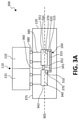
  • FIG. 3A is a cross-sectional view of an embodiment of a package grounding system in accordance with one embodiment.
  • FIG. 3B is a perspective view of a package grounding system in accordance with yet another embodiment.
  • FIG. 4A is a cross-sectional view of a package in accordance with the embodiment of FIG. 3A .
  • FIG. 4B is a cross-sectional view of a package in accordance with the embodiment of FIG. 3B .
  • FIG. 5 is a block diagram of a method in accordance with one embodiment.
  • the present disclosure provides a package ground isolation technique which mitigates analog to digital noise coupling on a die.
  • noise coupling between analog and digital blocks on a package or die with a shared ground is mitigated by splitting ground planes on the package or die, or by including additional layers above the package core.
  • noise mitigation measures may result in signal integrity (SI) weakness, high inductance, etc.
  • Splitting the ground plane on the package may lead to SI weakness with a circuit return path, or a high inductance. Moving the grounds farther away from the die and closer to the printed circuit board (PCB) layers may decrease the robustness of the ground plane connection and increase the return path inductance.
  • PCB printed circuit board
  • Embodiments of this disclosure provide mitigation of noise coupling between an analog and a digital block by providing the analog block with a first ground and the digital block with a second ground, which is physically separated from the first ground.
  • the first ground is electrically coupled to the second ground by a noise-mitigation stitching connector.
  • This solution does not utilize explicit package layer isolation globally, and employs local isolation, which helps in preserving SI return path performance for input/output (I/O) interfaces and sensitive clock routes.
  • I/O input/output
  • FIG. 1 shows an illustrative operating environment in which certain embodiments disclosed herein may be incorporated.
  • the operating environment shown in FIG. 1 is for illustration purposes only. Embodiments of the present disclosure are not limited to any particular operating environment such as the operating environment shown in FIG. 1 . Embodiments of the present disclosure are illustratively practiced within any number of different types of operating environments.
  • any labels such as “left,” “right,” “front,” “back,” “top,” “bottom,” “forward,” “reverse,” “clockwise,” “counter clockwise,” “up,” “down,” or other similar terms such as “upper,” “lower,” “aft,” “fore,” “vertical,” “horizontal,” “proximal,” “distal,” “intermediate” and the like are used for convenience and are not intended to imply, for example, any particular fixed location, orientation, or direction. Instead, such labels are used to reflect, for example, relative location, orientation, or directions. It should also be understood that the singular forms of “a,” “an,” and “the” include plural references unless the context clearly dictates otherwise.
  • FIG. 1 illustrates provides an exploded view of a Hard Disk Drive (HDD) 104 in which embodiments of the disclosure are useful.
  • HDD 104 includes a housing 118 having a top cover 121 , a base-deck frame 122 and a base-deck floor 124 .
  • base-deck frame 122 and base-deck floor 124 are two separate pieces.
  • base-deck frame 122 and base-deck floor 124 may be a single piece.
  • the housing 118 may adhere to any of a number of different form factors, including, for example, the 2.5′′ and 3.5′′ form factors for HDDs.
  • Data storage disks 112 are the primary data storage media in HDD 104 .
  • HDD 104 further includes a PCB 128 assembly that includes analog-to-digital converter (ADC) die 110 mounted on a package 120 .
  • ADC die 110 may be a configured as a flip chip (FC). Die 110 may comprise an analog block 131 and a digital block 132 mounted on package 120 .
  • Package 120 may include a plurality of grounds (not shown) connected by a noise-mitigation stitching connector 160 .
  • Analog block 131 and digital block 132 may include circuitry that helps perform operations related to reading data from and writing data to data storage disks 112 . Details regarding HDD components employed to carry out read and write operations are provided below in connection with FIG. 2 .
  • FIG. 2 illustrates a disk storage system 200 as found in the HDD 104 of FIG. 1 .
  • Disk storage system 200 includes PCB 128 and a head-disk assembly (HDA) 204 .
  • PCB 128 includes circuitry and processors, which provide a target interface controller (or drive controller) for communicating between a host system 206 and HDA 204 .
  • Host system 206 can include a microprocessor-based data processing system such as a personal computer or other system capable of performing a sequence of logical operations. Data is transmitted between host system 206 and PCB 128 via a host bus connector 208 .
  • HDA 204 includes an actuator assembly 210 , a preamplifier 212 , and a disk assembly 214 .
  • Disk assembly 214 includes one or more media disks 215 , stacked on a spindle assembly 218 .
  • Spindle assembly 218 is mechanically coupled to a spindle motor 220 for rotating the disk(s) at a high rate
  • Actuator assembly 210 includes a voice coil motor and multiple actuator arms. Located at the end of each actuator arm are one or more sliders/transducer heads such as 222 , which are associated with a respective disk surface. Transducer heads 222 communicate with PCB 128 via cable assembly 224 connected to preamplifier 212 for reading and writing data to the transducer head's associated disk surface. Preamplifier 212 provides an amplified signal to a read/write channel 226 of PCB 128 . Read/write channel 226 performs encoding and decoding of data written to and read from the disk.
  • Data storage control circuitry such as a servo processor 246 provides intelligent control of actuator assembly 210 and spindle motor 220 through a servo controller 248 .
  • voice coil motor (VCM) driver 250 is coupled to move actuator assembly 210
  • spindle motor driver 252 is coupled to maintain a constant spin rate of spindle motor 220 .
  • PCB 128 includes a host interface disk controller (HIDC) application-specific integrated circuit (ASIC) 228 .
  • ASIC 228 includes a host interface 230 , a buffer controller 232 , and a disk controller 234 .
  • Host interface 230 communicates with host system 206 via host bus connector 208 by receiving commands and data from and transmitting status and data back to host system 206 .
  • a command queuing engine (CQE) 258 is incorporated in host interface 230 .
  • CQE command queuing engine
  • Buffer controller 232 controls a non-volatile buffer memory 236 .
  • Disk controller 234 tracks the timing of data sectors passing under a currently selected transducer head and accordingly sends data to and receives data from read/write channel 226 .
  • Disk controller 234 also provides for error correction and error detection on data transmitted to and read from disk assembly 214 .
  • An interface processor 238 manages a queue of commands received from host system 206 with the assistance of the CQE 258 embedded in host interface 230 .
  • Interface processor 238 interfaces with functional elements of PCB 128 over a bus 240 , for transfer of commands, data, and status.
  • Disk system operational programs may be stored in non-volatile program storage memory 254 , such as read-only memory (ROM) or flash memory, and are loaded into random access memory (RAM) or program loading memory 256 for execution by interface processor 238 .
  • servo processor 246 may have integrated or separate memory 260 for storage of servo programs.
  • preamplifier 212 provides an amplified signal to a read/write channel 226 of PCB 128 .
  • Read/write channel 226 includes ADC die 110 .
  • Analog block 131 as mentioned in FIG. 1 may include read/write channel 226 and ADC die 110 for converting the analog signal to a digital for digital block 132 , which may be configured as servo controller 248 .
  • analog block 131 has a high resistance metallization or is more sensitive in terms of having higher jitter sensitivity, noise can dominate the analog block, necessitating mitigation of the noise.
  • noise coupling between analog and digital blocks on a package or die has previously been mitigated by splitting ground planes on the package or die, or by including additional layers above the package core.
  • these solutions may result in SI weakness or high inductance or increase cost due to the need for additional layers on package 120 .
  • the mentioned solutions may add thermal challenges, for example, additional package layers for HDD may make it harder to conform to height/thermal constraints of HDD.
  • FIG. 3A showing a cross-sectional view of a grounding system 300 for ADC die 110 shown in FIGS. 1 and 2 .
  • Analog block 131 and digital block 132 in ADC die 110 may be arranged on package 120 .
  • Package 120 may have a first ground 340 coupled to analog block 131 and a second ground 350 coupled to digital block 132 .
  • Second ground 350 is physically separate from first ground 340 .
  • First ground 340 and second ground 350 may be configured as a plane or a strip.
  • Noise-mitigation stitching connector 160 has a first end 310 connected to first ground 340 and a second end 320 connected to second ground 350 .
  • Noise-mitigation stitching connector 160 connects first ground 340 and second ground 350 such that noise in package 120 is reduced, noise-mitigation stitching connector 160 itself being the mechanism to reduce noise.
  • First ground 340 includes a first proximate end 341 and a first distal end 342 .
  • Second ground 350 includes a second distal end 351 and a second proximate end 352 .
  • First ground 340 and second ground 350 may be arranged along an axis 305 of package 120 .
  • First ground 340 and second ground 350 may be physically separated by a first separation distance 360 where the first separation distance 360 is the distance between first proximate end 341 of first ground 340 and second proximate end 352 of second ground 350 .
  • a connection point 370 for noise-mitigation stitching connector 160 is arranged at first proximate end 341 of first ground 340 and a connection point 370 is arranged at second distal end 351 of second ground 350 .
  • the connections are not limited to this arrangement.
  • noise-mitigation stitching connector 160 may be connected to first ground 340 and second ground 350 at any point, as long as a length 315 of noise-mitigating stitching connector 160 is greater than first separation distance 360 between first proximate end 341 and second proximate end 352 .
  • Length 315 is the length of the noise-mitigating stitching connector 160 between the connection points to first ground 340 and second ground 350 .
  • ADC die 110 may comprise connectors 380 connected to lines 385 which connect analog block 131 to first ground 340 and digital block 132 to second ground 350 .
  • FIG. 3B illustrates a top view of an embodiment of package 120 of grounding system 300 .
  • first ground 340 , second ground 350 and noise-mitigation stitching connector 160 may be arranged on a top surface 375 of package 120 .
  • Connectors 380 of ADC die 110 may have a direct physical connection (shown in FIG. 4B ) to first ground 340 and second ground 350 rather than having lines 385 through a material of package 120 .
  • FIG. 4A illustrates a cross-sectional view of an embodiment of package 120 corresponding to FIG. 3A having a plurality of layers 401 , 402 , 403 , 404 .
  • Package 120 may include more or fewer layers.
  • layers 401 , 402 , 403 , 404 may be copper layers.
  • first ground 340 and second ground are arranged in a second layer 402 .
  • Noise-mitigating stitching connector 160 may be arranged through multiple layers.
  • FIG. 4A illustrates noise-mitigating stitching connector 160 being arranged through second layer 402 and third layer 403 .
  • FIG. 4B illustrates a cross-sectional view of an embodiment of package 120 corresponding to FIG. 3B .
  • First ground 340 and second ground 350 may be arranged at top surface 375 of first layer 401 .
  • First end 310 of noise-mitigating stitching connector 160 may be connected to first ground 340 at first proximate end 341 and second end 320 may be connected to second distal end 35 land arranged on top surface 375 of first layer 401 .
  • FIG. 4B is a cross-sectional view of package 120 shown in top view format in FIG. 3B .
  • noise-mitigating stitching connector 160 is planar with top surface 375 of first layer 401 , noise-mitigating stitching connector 160 is not explicitly shown, rather, the dot on connection point 370 arranged on first ground 340 indicates first end 310 coming out of the page on first ground 340 and the dot on connection point 370 arranged on second ground 350 indicates second end 320 of noise-mitigating stitching connector 160 coming out of the page. This is to indicate that the noise-mitigating stitching connector 160 , first ground 340 and second ground 350 are arranged on the same plane 401 .
  • FIG. 5 illustrates a method 500 according to the above mentioned embodiments.
  • the method 500 includes arranging an analog block and a digital block on the package in block 501 . Coupling the analog block to the first ground on the package is shown in block 502 . Coupling the digital block to the second ground on the package, the second ground being physically separate from the first ground is shown in block 503 . Connecting the first end of the noise-mitigation stitching connector to the first ground is shown in block 504 . Connecting the second end of the noise-mitigation stitching connector to the second ground is shown in block 505 .
  • the transfer impedance was found to be 116 milliohms (mohms). However, using an embodiment of the present disclosure, the transfer impedance was 82 mohms. The lower transfer impedance implies a lower noise coupling.
  • a shared ground package showed a relatively high clock peak-to-peak jitter (e.g., a relatively high deviation of a clock pulse edge location from an ideal clock pulse edge location) of 149 picoseconds (ps).
  • a simulation of an embodiment described above showed a peak-to-peak jitter of 55 ps. This indicates that transient noise in the present embodiments produces an active clock jitter that is less than that produced by the traditional shared ground package.

Landscapes

  • Physics & Mathematics (AREA)
  • Condensed Matter Physics & Semiconductors (AREA)
  • General Physics & Mathematics (AREA)
  • Engineering & Computer Science (AREA)
  • Computer Hardware Design (AREA)
  • Microelectronics & Electronic Packaging (AREA)
  • Power Engineering (AREA)
  • Geometry (AREA)
  • Health & Medical Sciences (AREA)
  • Electromagnetism (AREA)
  • Toxicology (AREA)
  • Shielding Devices Or Components To Electric Or Magnetic Fields (AREA)

Abstract

A system including an analog block and a digital block. The analog block and the digital block are arranged on a package. The package includes a first ground coupled to the analog block and a second ground coupled to the digital block. The second ground is physically separate from the first ground. The package also includes a noise-mitigation stitching connector that has a first end connected to the first ground and a second end connected to the second ground.

Description

SUMMARY
In one embodiment, a system comprises an analog block and a digital block. The analog block and the digital block are arranged on a package. The package comprises a first ground coupled to the analog block and a second ground coupled to the digital block. The second ground is physically separate from the first ground. The package also includes a noise-mitigation stitching connector that has a first end connected to the first ground and a second end connected to the second ground.
In another embodiment, a data storage device comprises a printed circuit board assembly. The printed circuit board assembly comprises a storage device analog block and a storage device digital block. The storage device analog block and the storage device digital block are arranged on a package. The package comprises a first ground coupled to the storage device analog block and a second ground coupled to the storage device digital block. The second ground is physically separate from the first ground. The package also includes a noise-mitigation stitching connector that has a first end connected to the first ground and a second end connected to the second ground.
In yet another embodiment, a method is provided. The method includes arranging an analog block and digital block on a package. The method also includes coupling the analog block to a first ground on the package, and coupling the digital block to a second ground on the package, the second ground being physically separate from the first ground. The method further includes connecting a first end of a noise-mitigation stitching connector to the first ground and connecting a second end of the noise mitigation stitching connector to the second ground.
This summary is not intended to describe each disclosed embodiment or every implementation of elements of the package grounding system. Many other novel advantages, features, and relationships will become apparent as this description proceeds. The figures and the description that follow more particularly exemplify illustrative embodiments.
BRIEF DESCRIPTION OF THE DRAWINGS
FIG. 1 illustrates an example of a data storage device in which embodiments of the present application can be used.
FIG. 2 is a block diagram of a disk drive in accordance with one embodiment.
FIG. 3A is a cross-sectional view of an embodiment of a package grounding system in accordance with one embodiment.
FIG. 3B is a perspective view of a package grounding system in accordance with yet another embodiment.
FIG. 4A is a cross-sectional view of a package in accordance with the embodiment of FIG. 3A.
FIG. 4B is a cross-sectional view of a package in accordance with the embodiment of FIG. 3B.
FIG. 5 is a block diagram of a method in accordance with one embodiment.
DETAILED DESCRIPTION
The present disclosure provides a package ground isolation technique which mitigates analog to digital noise coupling on a die.
Currently, noise coupling between analog and digital blocks on a package or die with a shared ground is mitigated by splitting ground planes on the package or die, or by including additional layers above the package core. However, such noise mitigation measures may result in signal integrity (SI) weakness, high inductance, etc.
Splitting the ground plane on the package may lead to SI weakness with a circuit return path, or a high inductance. Moving the grounds farther away from the die and closer to the printed circuit board (PCB) layers may decrease the robustness of the ground plane connection and increase the return path inductance.
Embodiments of this disclosure provide mitigation of noise coupling between an analog and a digital block by providing the analog block with a first ground and the digital block with a second ground, which is physically separated from the first ground. The first ground is electrically coupled to the second ground by a noise-mitigation stitching connector. This solution does not utilize explicit package layer isolation globally, and employs local isolation, which helps in preserving SI return path performance for input/output (I/O) interfaces and sensitive clock routes. Prior to providing additional details regarding the different embodiments, a description of an illustrative operating environment is provided below.
FIG. 1 shows an illustrative operating environment in which certain embodiments disclosed herein may be incorporated. The operating environment shown in FIG. 1 is for illustration purposes only. Embodiments of the present disclosure are not limited to any particular operating environment such as the operating environment shown in FIG. 1. Embodiments of the present disclosure are illustratively practiced within any number of different types of operating environments.
It should be noted that the same reference numerals are used in different figures for same or similar elements. It should also be understood that the terminology used herein is for the purpose of describing embodiments, and the terminology is not intended to be limiting. Unless indicated otherwise, ordinal numbers (e.g., first, second, third, etc.) are used to distinguish or identify different elements or steps in a group of elements or steps, and do not supply a serial or numerical limitation on the elements or steps of the embodiments thereof. For example, “first,” “second,” and “third” elements or steps need not necessarily appear in that order, and the embodiments thereof need not necessarily be limited to three elements or steps. It should also be understood that, unless indicated otherwise, any labels such as “left,” “right,” “front,” “back,” “top,” “bottom,” “forward,” “reverse,” “clockwise,” “counter clockwise,” “up,” “down,” or other similar terms such as “upper,” “lower,” “aft,” “fore,” “vertical,” “horizontal,” “proximal,” “distal,” “intermediate” and the like are used for convenience and are not intended to imply, for example, any particular fixed location, orientation, or direction. Instead, such labels are used to reflect, for example, relative location, orientation, or directions. It should also be understood that the singular forms of “a,” “an,” and “the” include plural references unless the context clearly dictates otherwise.
It will be understood that when an element is referred to as being “connected,” “coupled,” or “attached” to another element, it can be directly connected, coupled or attached to the other element, or it can be indirectly connected, coupled, or attached to the other element where intervening or intermediate elements may be present. In contrast, if an element is referred to as being “directly connected,” “directly coupled” or “directly attached” to another element, there are no intervening elements present. Drawings illustrating direct connections, couplings or attachments between elements also include embodiments, in which the elements are indirectly connected, coupled or attached to each other.
FIG. 1 illustrates provides an exploded view of a Hard Disk Drive (HDD) 104 in which embodiments of the disclosure are useful. As can be seen in FIG. 1, HDD 104 includes a housing 118 having a top cover 121, a base-deck frame 122 and a base-deck floor 124. In the embodiment shown in FIG. 1, base-deck frame 122 and base-deck floor 124 are two separate pieces. However, in other embodiments, base-deck frame 122 and base-deck floor 124 may be a single piece. The housing 118, including the base-deck frame 122, base-deck floor 124 and the top cover 121, may adhere to any of a number of different form factors, including, for example, the 2.5″ and 3.5″ form factors for HDDs. Data storage disks 112 are the primary data storage media in HDD 104. HDD 104 further includes a PCB 128 assembly that includes analog-to-digital converter (ADC) die 110 mounted on a package 120. ADC die 110 may be a configured as a flip chip (FC). Die 110 may comprise an analog block 131 and a digital block 132 mounted on package 120. Package 120 may include a plurality of grounds (not shown) connected by a noise-mitigation stitching connector 160. Noise mitigation connection configurations are described in detail further below. Analog block 131 and digital block 132 may include circuitry that helps perform operations related to reading data from and writing data to data storage disks 112. Details regarding HDD components employed to carry out read and write operations are provided below in connection with FIG. 2.
FIG. 2 illustrates a disk storage system 200 as found in the HDD 104 of FIG. 1. Disk storage system 200 includes PCB 128 and a head-disk assembly (HDA) 204. PCB 128 includes circuitry and processors, which provide a target interface controller (or drive controller) for communicating between a host system 206 and HDA 204. Host system 206 can include a microprocessor-based data processing system such as a personal computer or other system capable of performing a sequence of logical operations. Data is transmitted between host system 206 and PCB 128 via a host bus connector 208. HDA 204 includes an actuator assembly 210, a preamplifier 212, and a disk assembly 214. Disk assembly 214 includes one or more media disks 215, stacked on a spindle assembly 218. Spindle assembly 218 is mechanically coupled to a spindle motor 220 for rotating the disk(s) at a high rate of speed.
Actuator assembly 210 includes a voice coil motor and multiple actuator arms. Located at the end of each actuator arm are one or more sliders/transducer heads such as 222, which are associated with a respective disk surface. Transducer heads 222 communicate with PCB 128 via cable assembly 224 connected to preamplifier 212 for reading and writing data to the transducer head's associated disk surface. Preamplifier 212 provides an amplified signal to a read/write channel 226 of PCB 128. Read/write channel 226 performs encoding and decoding of data written to and read from the disk.
Data storage control circuitry such as a servo processor 246 provides intelligent control of actuator assembly 210 and spindle motor 220 through a servo controller 248. By commands issued to servo controller 248 by servo processor 246, voice coil motor (VCM) driver 250 is coupled to move actuator assembly 210, and spindle motor driver 252 is coupled to maintain a constant spin rate of spindle motor 220.
PCB 128 includes a host interface disk controller (HIDC) application-specific integrated circuit (ASIC) 228. ASIC 228 includes a host interface 230, a buffer controller 232, and a disk controller 234. Host interface 230 communicates with host system 206 via host bus connector 208 by receiving commands and data from and transmitting status and data back to host system 206. A command queuing engine (CQE) 258 is incorporated in host interface 230.
Buffer controller 232 controls a non-volatile buffer memory 236. Disk controller 234 tracks the timing of data sectors passing under a currently selected transducer head and accordingly sends data to and receives data from read/write channel 226. Disk controller 234 also provides for error correction and error detection on data transmitted to and read from disk assembly 214.
An interface processor 238 manages a queue of commands received from host system 206 with the assistance of the CQE 258 embedded in host interface 230. Interface processor 238 interfaces with functional elements of PCB 128 over a bus 240, for transfer of commands, data, and status.
Disk system operational programs may be stored in non-volatile program storage memory 254, such as read-only memory (ROM) or flash memory, and are loaded into random access memory (RAM) or program loading memory 256 for execution by interface processor 238. Suitably, servo processor 246 may have integrated or separate memory 260 for storage of servo programs.
As mentioned above, preamplifier 212 provides an amplified signal to a read/write channel 226 of PCB 128. Read/write channel 226 includes ADC die 110.
Analog block 131 as mentioned in FIG. 1 may include read/write channel 226 and ADC die 110 for converting the analog signal to a digital for digital block 132, which may be configured as servo controller 248.
In situations where analog block 131 has a high resistance metallization or is more sensitive in terms of having higher jitter sensitivity, noise can dominate the analog block, necessitating mitigation of the noise.
As mentioned above, noise coupling between analog and digital blocks on a package or die has previously been mitigated by splitting ground planes on the package or die, or by including additional layers above the package core. However, these solutions may result in SI weakness or high inductance or increase cost due to the need for additional layers on package 120. Further, the mentioned solutions may add thermal challenges, for example, additional package layers for HDD may make it harder to conform to height/thermal constraints of HDD.
To address these problems, an embodiment of this disclosure is illustrated in FIG. 3A showing a cross-sectional view of a grounding system 300 for ADC die 110 shown in FIGS. 1 and 2. Analog block 131 and digital block 132 in ADC die 110 may be arranged on package 120. Package 120 may have a first ground 340 coupled to analog block 131 and a second ground 350 coupled to digital block 132. Second ground 350 is physically separate from first ground 340. First ground 340 and second ground 350 may be configured as a plane or a strip. Noise-mitigation stitching connector 160 has a first end 310 connected to first ground 340 and a second end 320 connected to second ground 350. Noise-mitigation stitching connector 160 connects first ground 340 and second ground 350 such that noise in package 120 is reduced, noise-mitigation stitching connector 160 itself being the mechanism to reduce noise.
First ground 340 includes a first proximate end 341 and a first distal end 342. Second ground 350 includes a second distal end 351 and a second proximate end 352. First ground 340 and second ground 350 may be arranged along an axis 305 of package 120. First ground 340 and second ground 350 may be physically separated by a first separation distance 360 where the first separation distance 360 is the distance between first proximate end 341 of first ground 340 and second proximate end 352 of second ground 350.
In the embodiment illustrated in FIG. 3A, a connection point 370 for noise-mitigation stitching connector 160 is arranged at first proximate end 341 of first ground 340 and a connection point 370 is arranged at second distal end 351 of second ground 350. However, it should be noted that the connections are not limited to this arrangement. In fact, noise-mitigation stitching connector 160 may be connected to first ground 340 and second ground 350 at any point, as long as a length 315 of noise-mitigating stitching connector 160 is greater than first separation distance 360 between first proximate end 341 and second proximate end 352. Length 315 is the length of the noise-mitigating stitching connector 160 between the connection points to first ground 340 and second ground 350.
For grounding system 300 where first ground 340 and second ground 350 are embedded within package 120, ADC die 110 may comprise connectors 380 connected to lines 385 which connect analog block 131 to first ground 340 and digital block 132 to second ground 350.
FIG. 3B illustrates a top view of an embodiment of package 120 of grounding system 300. In the illustrated arrangement, first ground 340, second ground 350 and noise-mitigation stitching connector 160 may be arranged on a top surface 375 of package 120. Connectors 380 of ADC die 110 may have a direct physical connection (shown in FIG. 4B) to first ground 340 and second ground 350 rather than having lines 385 through a material of package 120.
FIG. 4A illustrates a cross-sectional view of an embodiment of package 120 corresponding to FIG. 3A having a plurality of layers 401, 402, 403, 404. Package 120 may include more or fewer layers. In certain embodiments, layers 401, 402, 403, 404 may be copper layers. As illustrated, first ground 340 and second ground are arranged in a second layer 402. Noise-mitigating stitching connector 160 may be arranged through multiple layers. As a non-limiting example, FIG. 4A illustrates noise-mitigating stitching connector 160 being arranged through second layer 402 and third layer 403.
FIG. 4B illustrates a cross-sectional view of an embodiment of package 120 corresponding to FIG. 3B. First ground 340 and second ground 350 may be arranged at top surface 375 of first layer 401. First end 310 of noise-mitigating stitching connector 160 may be connected to first ground 340 at first proximate end 341 and second end 320 may be connected to second distal end 35 land arranged on top surface 375 of first layer 401. It should be noted that in the embodiment illustrated in FIG. 4B is a cross-sectional view of package 120 shown in top view format in FIG. 3B. Because noise-mitigating stitching connector 160 is planar with top surface 375 of first layer 401, noise-mitigating stitching connector 160 is not explicitly shown, rather, the dot on connection point 370 arranged on first ground 340 indicates first end 310 coming out of the page on first ground 340 and the dot on connection point 370 arranged on second ground 350 indicates second end 320 of noise-mitigating stitching connector 160 coming out of the page. This is to indicate that the noise-mitigating stitching connector 160, first ground 340 and second ground 350 are arranged on the same plane 401.
FIG. 5 illustrates a method 500 according to the above mentioned embodiments. The method 500 includes arranging an analog block and a digital block on the package in block 501. Coupling the analog block to the first ground on the package is shown in block 502. Coupling the digital block to the second ground on the package, the second ground being physically separate from the first ground is shown in block 503. Connecting the first end of the noise-mitigation stitching connector to the first ground is shown in block 504. Connecting the second end of the noise-mitigation stitching connector to the second ground is shown in block 505.
In a simulation for a traditional ground design, where the analog and digital blocks share a ground, the transfer impedance was found to be 116 milliohms (mohms). However, using an embodiment of the present disclosure, the transfer impedance was 82 mohms. The lower transfer impedance implies a lower noise coupling.
In further simulations, a shared ground package showed a relatively high clock peak-to-peak jitter (e.g., a relatively high deviation of a clock pulse edge location from an ideal clock pulse edge location) of 149 picoseconds (ps). In contrast, a simulation of an embodiment described above showed a peak-to-peak jitter of 55 ps. This indicates that transient noise in the present embodiments produces an active clock jitter that is less than that produced by the traditional shared ground package.
The illustrations of the embodiments described herein are intended to provide a general understanding of the structure of the various embodiments. The illustrations are not intended to serve as a complete description of all of the elements and features of apparatus and systems that utilize the structures or methods described herein. Many other embodiments may be apparent to those of skill in the art upon reviewing the disclosure. Other embodiments may be utilized and derived from the disclosure, such that structural and logical substitutions and changes may be made without departing from the scope of the disclosure. Additionally, the illustrations are merely representational and therefore are not drawn to scale. Certain proportions within the illustrations may be exaggerated, while other proportions may be reduced. Accordingly, the disclosure and the figures are to be regarded as illustrative rather than restrictive.
Although specific embodiments have been illustrated and described herein, it should be appreciated that any subsequent arrangement designed to achieve the same or similar purpose may be substituted for the specific embodiments shown. This disclosure is intended to cover any and all subsequent adaptations or variations of various embodiments. Combinations of the above embodiments, and other embodiments not specifically described herein, will be apparent to those of skill in the art upon reviewing the description.
In addition, in the foregoing Detailed Description, various features may be grouped together or described in a single embodiment for the purpose of streamlining the disclosure. This disclosure is not to be interpreted as reflecting an intention that the claimed embodiments employ more features than are expressly recited in each claim. Rather, as the following claims reflect, inventive subject matter may be directed to less than all of the features of any of the disclosed embodiments.
The above-disclosed subject matter is to be considered illustrative, and not restrictive, and the appended claims are intended to cover all such modifications, enhancements, and other embodiments, which fall within the true spirit and scope of the present disclosure. Thus, to the maximum extent allowed by law, the scope of the present disclosure is to be determined by the broadest permissible interpretation of the following claims and their equivalents and shall not be restricted or limited by the foregoing detailed description.

Claims (20)

What is claimed is:
1. A system comprising:
an analog block;
a digital block;
a package on which the analog block and the digital block are arranged, the package comprising:
a first ground coupled to the analog block;
a second ground coupled to the digital block and that is physically separate from the first ground, thereby providing a space between the first ground and second around; and
a noise-mitigation stitching connector having a first end connected to the first ground and a second end connected to the second ground, such that the noise-mitigation stitching connector is positioned outside the space between the first ground and the second ground.
2. The system of claim 1, wherein the first and the second grounds are arranged in different planes.
3. The system of claim 1, wherein the first ground has a first proximate end and a first distal end, and the second ground has a second proximate end and a second distal end, the first ground and the second ground are arranged along a same axis with a first separation distance between the first proximate end and the second proximate end.
4. The system of claim 3, wherein the noise-mitigation stitching connector has a length that is greater than the first separation distance.
5. The system of claim 3, wherein the first end is connected to the first ground between the first proximate end and the first distal end.
6. The system of claim 3, wherein the first end of the noise-mitigation stitching connector is connected to the first distal end.
7. The system of claim 3, wherein the second end of the noise-mitigation stitching connector is connected between the second proximate end and the second distal end.
8. The system of claim 3, wherein the second end of the noise-mitigation stitching connector is connected to the second distal end.
9. The system of claim 1, wherein the noise-mitigation stitching connector is planar with a top surface of the package.
10. The system of claim 1, wherein the package comprises a plurality of layers.
11. The system of claim 10, wherein the noise-mitigation stitching connector is arranged in the plurality of layers.
12. A data storage device comprising:
a printed circuit board assembly comprising:
a storage device analog Nock;
a storage device digital block;
a package on which the storage device analog Nock and the storage device digital block are arranged, the package comprising:
a first ground coupled to the storage device analog block;
a second ground coupled to the storage device digital block, the second ground being physically separate from the first ground, and thereby providing, a space between the first ground and second ground; and
a noise-mitigation stitching connector having a first end connected to the first ground and a second end connected to the second ground, such that the noise-mitigation stitching connector is positioned outside the space between the first ground and the second ground.
13. The data storage device of claim 12, wherein the first ground has a first proximate end and a first distal end, and the second ground has a second proximate end and a second distal end, the first and second grounds are arranged along a same axis with a first separation distance between the first proximate end and the second proximate end.
14. The data storage device of claim 13, wherein the noise-mitigation stitching connector has a length that is greater than the first, separation distance.
15. The data storage device of claim 12, wherein the storage device analog block comprises read/write channel circuitry and wherein the storage device digital block comprises data storage control circuitry.
16. A method comprising:
arranging an analog block and a digital block on a package;
coupling the analog block to a first ground on the package;
coupling the digital block to a second ground on the package, the second ground being physically separate from the first ground, and thereby providing a space between the first ground and second ground;
connecting a first end of a noise-mitigation stitching connector to the first ground, and connecting a second end of the noise-mitigation stitching connector to the second ground, such that the noise-mitigation stitching connector is positioned outside the space between the first ground and the second ground.
17. The method of claim 16, wherein the first ground has a first proximate end and a first distal end, and the second ground has a second proximate end and a second distal end, the method further comprising arranging the first and second grounds along a same axis with a first separation distance between the first proximate end and the second proximate end.
18. The method of claim 17, further comprising connecting the first end of the noise-mitigation stitching connector to the first distal end.
19. The method of claim 17, further comprising connecting the first end of the noise-mitigation stitching connector between the first proximate end and the first distal end.
20. The method of claim 17, further comprising connecting the second end of the noise-mitigation stitching connector between the second proximate end and the second distal end.
US16/776,255 2020-01-29 2020-01-29 Package grounding system Active US11227834B2 (en)

Priority Applications (1)

Application Number Priority Date Filing Date Title
US16/776,255 US11227834B2 (en) 2020-01-29 2020-01-29 Package grounding system

Applications Claiming Priority (1)

Application Number Priority Date Filing Date Title
US16/776,255 US11227834B2 (en) 2020-01-29 2020-01-29 Package grounding system

Publications (2)

Publication Number Publication Date
US20210233845A1 US20210233845A1 (en) 2021-07-29
US11227834B2 true US11227834B2 (en) 2022-01-18

Family

ID=76970244

Family Applications (1)

Application Number Title Priority Date Filing Date
US16/776,255 Active US11227834B2 (en) 2020-01-29 2020-01-29 Package grounding system

Country Status (1)

Country Link
US (1) US11227834B2 (en)

Citations (11)

* Cited by examiner, † Cited by third party
Publication number Priority date Publication date Assignee Title
WO2001052344A1 (en) 2000-01-14 2001-07-19 Cts Corporation Ceramic bandstop monoblock filter with coplanar waveguide transmission lines
US6808399B2 (en) 2002-12-02 2004-10-26 Tyco Electronics Corporation Electrical connector with wafers having split ground planes
US20070289771A1 (en) * 2006-06-02 2007-12-20 Hideki Osaka Semiconductor device
US20080211068A1 (en) * 2006-12-27 2008-09-04 Nan-Jang Chen Method for manufacturing leadframe, packaging method for using the leadframe and semiconductor package product
US20090080135A1 (en) * 2007-09-21 2009-03-26 Broadcom Corporation Apparatus and Method for ESD Protection of an Integrated Circuit
US20090262475A1 (en) * 2008-04-17 2009-10-22 Hooman Darabi Method and system for mitigating risk of electrostatic discharge for a system on chip (soc)
US20100258905A1 (en) * 2009-04-10 2010-10-14 Samsung Electronics Co., Ltd Semiconductor package to remove power noise using ground impedance
US20110222247A1 (en) * 2010-03-12 2011-09-15 Ricoh Company, Limited. Printed wiring board
JP2014007518A (en) 2012-06-22 2014-01-16 Panasonic Corp Noise reduction system of analog-digital converter and noise reduction method
US8669646B2 (en) 2011-05-31 2014-03-11 Broadcom Corporation Apparatus and method for grounding an IC package lid for EMI reduction
JP2016192761A (en) 2015-03-30 2016-11-10 ルネサスエレクトロニクス株式会社 Apparatus and system using the same

Patent Citations (11)

* Cited by examiner, † Cited by third party
Publication number Priority date Publication date Assignee Title
WO2001052344A1 (en) 2000-01-14 2001-07-19 Cts Corporation Ceramic bandstop monoblock filter with coplanar waveguide transmission lines
US6808399B2 (en) 2002-12-02 2004-10-26 Tyco Electronics Corporation Electrical connector with wafers having split ground planes
US20070289771A1 (en) * 2006-06-02 2007-12-20 Hideki Osaka Semiconductor device
US20080211068A1 (en) * 2006-12-27 2008-09-04 Nan-Jang Chen Method for manufacturing leadframe, packaging method for using the leadframe and semiconductor package product
US20090080135A1 (en) * 2007-09-21 2009-03-26 Broadcom Corporation Apparatus and Method for ESD Protection of an Integrated Circuit
US20090262475A1 (en) * 2008-04-17 2009-10-22 Hooman Darabi Method and system for mitigating risk of electrostatic discharge for a system on chip (soc)
US20100258905A1 (en) * 2009-04-10 2010-10-14 Samsung Electronics Co., Ltd Semiconductor package to remove power noise using ground impedance
US20110222247A1 (en) * 2010-03-12 2011-09-15 Ricoh Company, Limited. Printed wiring board
US8669646B2 (en) 2011-05-31 2014-03-11 Broadcom Corporation Apparatus and method for grounding an IC package lid for EMI reduction
JP2014007518A (en) 2012-06-22 2014-01-16 Panasonic Corp Noise reduction system of analog-digital converter and noise reduction method
JP2016192761A (en) 2015-03-30 2016-11-10 ルネサスエレクトロニクス株式会社 Apparatus and system using the same

Non-Patent Citations (4)

* Cited by examiner, † Cited by third party
Title
Bryant, James et al., "Chapter 9, Hardware Design Techniques", Hardware Design Techniques 9.1 Passive Components, 216 pages.
Jeong, Youchul et al., "Hybrid Analytical Modeling Method for Split Power Bus in Multilayered Package", IEEE Transactions on Electromagnetic Compatiblity, vol. 48, No. 1, Feb. 2006, 0018-9375/$20.00 © 2006 IEEE, 14 pages.
Knack, Lee RitcheyKella, "Properly ground your circuits", EDN Network, Jan. 6, 2017, 6 pages.
Zumbahlen, Hank, "Staying Well Grounded", Analog Dialogue 46-06, Jun. 2012, www.analog.com/analogdialogue, 9 pages.

Also Published As

Publication number Publication date
US20210233845A1 (en) 2021-07-29

Similar Documents

Publication Publication Date Title
US8179627B2 (en) Floating guard band for shingle magnetic recording
US7414814B1 (en) Disk drives, head stack, head gimbal and suspension assemblies having a compliant suspension tail design for solder reflow
US9613642B1 (en) Read/write head with a switching element coupled to read or write transducers
US20110096438A1 (en) Head-gimbal assembly with trace configured to reduce stress on a microactuator and disk drive including the head-gimbal assembly
US20090094389A1 (en) System and method of matching data rates
US10614852B2 (en) Data-center drive with split-actuator that increases read/write performance via data striping
US10600435B2 (en) Recording head gimbal assembly programming by selective application of interconnects
US8122322B2 (en) System and method of storing reliability data
JP2023510263A (en) Magnetic thin film recording head module
US11456009B1 (en) Shared disk configuration in a multiple actuator hard disk drive
US7163422B2 (en) Protection of hard drive interface connector
US20120140360A1 (en) Integrated lead suspension (ils) for use with a dual stage actuator (dsa)
US8014245B2 (en) System and method of defect description of a data storage medium
US11227834B2 (en) Package grounding system
US8289015B2 (en) Apparatus and test method for a head assembly in a depopulated configuration
JP7300532B2 (en) Hard disk drive suspension tail with narrowing tip
US20150124352A1 (en) Flexible cable assembly having reduced-tolerance electrical connection pads
US6384998B1 (en) Multiplexing servo tracking signals in a disk drive
US20240040688A1 (en) Flexible printed circuit finger layout for low crosstalk
US11069375B1 (en) Suspension standoff arrangement for confining adhesive
US20110090601A1 (en) Suspension with flexure tail and manufacturing method thereof, head stack assembly and disk drive unit with the same
US11222658B1 (en) Power latency control in data storage devices
US11081130B1 (en) Suspension standoff arrangement for confining adhesive
US9489971B1 (en) Flexible circuit for concurrently active recording heads
US9196266B1 (en) Integrated lead suspension (ILS) for two-dimensional magnetic recording (TDMR) disk drive

Legal Events

Date Code Title Description
AS Assignment

Owner name: SEAGATE TECHNOLOGY LLC, CALIFORNIA

Free format text: ASSIGNMENT OF ASSIGNORS INTEREST;ASSIGNORS:CHANDRASEKAR, KARTHIK;DADI, RATNAKAR;LO, SHAWN TZUNG-SHENG;AND OTHERS;SIGNING DATES FROM 20200123 TO 20200128;REEL/FRAME:051663/0132

FEPP Fee payment procedure

Free format text: ENTITY STATUS SET TO UNDISCOUNTED (ORIGINAL EVENT CODE: BIG.); ENTITY STATUS OF PATENT OWNER: LARGE ENTITY

STPP Information on status: patent application and granting procedure in general

Free format text: NON FINAL ACTION MAILED

STPP Information on status: patent application and granting procedure in general

Free format text: RESPONSE TO NON-FINAL OFFICE ACTION ENTERED AND FORWARDED TO EXAMINER

STPP Information on status: patent application and granting procedure in general

Free format text: NOTICE OF ALLOWANCE MAILED -- APPLICATION RECEIVED IN OFFICE OF PUBLICATIONS

STPP Information on status: patent application and granting procedure in general

Free format text: PUBLICATIONS -- ISSUE FEE PAYMENT VERIFIED

STCF Information on status: patent grant

Free format text: PATENTED CASE

CC Certificate of correction
MAFP Maintenance fee payment

Free format text: PAYMENT OF MAINTENANCE FEE, 4TH YEAR, LARGE ENTITY (ORIGINAL EVENT CODE: M1551); ENTITY STATUS OF PATENT OWNER: LARGE ENTITY

Year of fee payment: 4