US11224385B2 - Method for determining a person's sleeping phase which is favourable for waking up - Google Patents
Method for determining a person's sleeping phase which is favourable for waking up Download PDFInfo
- Publication number
- US11224385B2 US11224385B2 US14/865,879 US201514865879A US11224385B2 US 11224385 B2 US11224385 B2 US 11224385B2 US 201514865879 A US201514865879 A US 201514865879A US 11224385 B2 US11224385 B2 US 11224385B2
- Authority
- US
- United States
- Prior art keywords
- value
- over
- sleep
- range
- cpu
- Prior art date
- Legal status (The legal status is an assumption and is not a legal conclusion. Google has not performed a legal analysis and makes no representation as to the accuracy of the status listed.)
- Active, expires
Links
Images


Classifications
-
- A—HUMAN NECESSITIES
- A61—MEDICAL OR VETERINARY SCIENCE; HYGIENE
- A61B—DIAGNOSIS; SURGERY; IDENTIFICATION
- A61B5/00—Measuring for diagnostic purposes; Identification of persons
- A61B5/72—Signal processing specially adapted for physiological signals or for diagnostic purposes
- A61B5/7235—Details of waveform analysis
-
- G—PHYSICS
- G04—HOROLOGY
- G04G—ELECTRONIC TIME-PIECES
- G04G13/00—Producing acoustic time signals
- G04G13/02—Producing acoustic time signals at preselected times, e.g. alarm clocks
- G04G13/021—Details
- G04G13/023—Adjusting the duration or amplitude of signals
-
- A—HUMAN NECESSITIES
- A61—MEDICAL OR VETERINARY SCIENCE; HYGIENE
- A61B—DIAGNOSIS; SURGERY; IDENTIFICATION
- A61B5/00—Measuring for diagnostic purposes; Identification of persons
- A61B5/02—Detecting, measuring or recording for evaluating the cardiovascular system, e.g. pulse, heart rate, blood pressure or blood flow
- A61B5/0205—Simultaneously evaluating both cardiovascular conditions and different types of body conditions, e.g. heart and respiratory condition
-
- A—HUMAN NECESSITIES
- A61—MEDICAL OR VETERINARY SCIENCE; HYGIENE
- A61B—DIAGNOSIS; SURGERY; IDENTIFICATION
- A61B5/00—Measuring for diagnostic purposes; Identification of persons
- A61B5/02—Detecting, measuring or recording for evaluating the cardiovascular system, e.g. pulse, heart rate, blood pressure or blood flow
- A61B5/024—Measuring pulse rate or heart rate
- A61B5/02438—Measuring pulse rate or heart rate with portable devices, e.g. worn by the patient
-
- A—HUMAN NECESSITIES
- A61—MEDICAL OR VETERINARY SCIENCE; HYGIENE
- A61B—DIAGNOSIS; SURGERY; IDENTIFICATION
- A61B5/00—Measuring for diagnostic purposes; Identification of persons
- A61B5/08—Measuring devices for evaluating the respiratory organs
- A61B5/0816—Measuring devices for examining respiratory frequency
-
- A—HUMAN NECESSITIES
- A61—MEDICAL OR VETERINARY SCIENCE; HYGIENE
- A61B—DIAGNOSIS; SURGERY; IDENTIFICATION
- A61B5/00—Measuring for diagnostic purposes; Identification of persons
- A61B5/103—Measuring devices for testing the shape, pattern, colour, size or movement of the body or parts thereof, for diagnostic purposes
- A61B5/11—Measuring movement of the entire body or parts thereof, e.g. head or hand tremor or mobility of a limb
-
- A—HUMAN NECESSITIES
- A61—MEDICAL OR VETERINARY SCIENCE; HYGIENE
- A61B—DIAGNOSIS; SURGERY; IDENTIFICATION
- A61B5/00—Measuring for diagnostic purposes; Identification of persons
- A61B5/24—Detecting, measuring or recording bioelectric or biomagnetic signals of the body or parts thereof
- A61B5/316—Modalities, i.e. specific diagnostic methods
- A61B5/318—Heart-related electrical modalities, e.g. electrocardiography [ECG]
- A61B5/346—Analysis of electrocardiograms
- A61B5/349—Detecting specific parameters of the electrocardiograph cycle
- A61B5/352—Detecting R peaks, e.g. for synchronising diagnostic apparatus; Estimating R-R interval
-
- A—HUMAN NECESSITIES
- A61—MEDICAL OR VETERINARY SCIENCE; HYGIENE
- A61B—DIAGNOSIS; SURGERY; IDENTIFICATION
- A61B5/00—Measuring for diagnostic purposes; Identification of persons
- A61B5/48—Other medical applications
- A61B5/4806—Sleep evaluation
- A61B5/4812—Detecting sleep stages or cycles
-
- A—HUMAN NECESSITIES
- A61—MEDICAL OR VETERINARY SCIENCE; HYGIENE
- A61B—DIAGNOSIS; SURGERY; IDENTIFICATION
- A61B5/00—Measuring for diagnostic purposes; Identification of persons
- A61B5/68—Arrangements of detecting, measuring or recording means, e.g. sensors, in relation to patient
- A61B5/6801—Arrangements of detecting, measuring or recording means, e.g. sensors, in relation to patient specially adapted to be attached to or worn on the body surface
- A61B5/6802—Sensor mounted on worn items
- A61B5/681—Wristwatch-type devices
-
- A—HUMAN NECESSITIES
- A61—MEDICAL OR VETERINARY SCIENCE; HYGIENE
- A61B—DIAGNOSIS; SURGERY; IDENTIFICATION
- A61B5/00—Measuring for diagnostic purposes; Identification of persons
- A61B5/24—Detecting, measuring or recording bioelectric or biomagnetic signals of the body or parts thereof
- A61B5/316—Modalities, i.e. specific diagnostic methods
- A61B5/318—Heart-related electrical modalities, e.g. electrocardiography [ECG]
- A61B5/346—Analysis of electrocardiograms
- A61B5/349—Detecting specific parameters of the electrocardiograph cycle
-
- G—PHYSICS
- G04—HOROLOGY
- G04C—ELECTROMECHANICAL CLOCKS OR WATCHES
- G04C3/00—Electromechanical clocks or watches independent of other time-pieces and in which the movement is maintained by electric means
- G04C3/001—Electromechanical switches for setting or display
Definitions
- the invention relates to the field of measurements of human condition parameters for diagnostic purposes, in particular to measurement of parameters characterizing human sleep.
- human sleep consists of alternating phases of the so-called non-REM and REM sleep.
- the above phases follow each other in cycles (typically from 4 to 6 cycles) during healthy human sleep.
- the experience has shown that the REM phase is the most favorable to awakening.
- the development of simple, small and easy-to-use technical means designed to determine sleep phase optimal for awakening and providing control over wake-up devices generating a waking sound or other signal is important.
- patent RU 2061406 describes a method for waking up a person during a predetermined sleep phase.
- EEG is recorded during sleep by means of sensors to identify the current REM phase and the wake-up signal generated in a predetermined interval of time is synchronized with said EEG.
- EEG at REM sleep is distinguished by desynchronization with the emergence of beta waves in the range of 18 Hz to 32 Hz and by low-amplitude mixed activity with theta waves present.
- US Patent Application 20110230790 describes a method and device for waking up a person during a required sleep phase before a predetermined ultimate wake-up time, and for identifying the best time to go bed.
- REM phase is identified by the motor activity registered with accelerometer attached to human leg or arm.
- US Patent Application 20050190065 describes a method for waking up a person in the sleep phase the most favorable thereto.
- REM phase is characterized by cardiac blood flow increase, poor thermoregulation of body (its temperature may rise or fall depending on the ambient temperature); vasoconstriction and reduction of vascular blood flow which can be measured by peripheral arterial blood pressure monitor; unstable and increased heart rate, blood pressure and respiratory rate.
- the closest to the claimed invention is the method for waking up a person at optimal time within a preset period and during a favorable sleep phase, as described in patent DE 4,209,336.
- REM phase is identified by measuring heart rate, respiratory rate, bodily or head temperature, and detecting eye and body movements.
- Devices implementing said method can be made in the form of an armband, ear clip, chest belt, etc.
- the task to be solved by the present invention is to provide a simple and reliable method for identifying a sleep phase favorable to awakening, i.e., REM sleep, and capable of being embodied a device easily attached onto a person and not disturbing person's sleep.
- P 1 is the mean value of RR intervals over time interval ⁇ t i ;
- P 2 is the minimum value of RR intervals over time interval ⁇ t i ;
- P 3 is the maximum value of RR intervals over time interval ⁇ t i ;
- P 4 is standard deviation of RR intervals over the preceding time interval of 3-20 min;
- P 5 is the mean value of respiratory rate over time interval ⁇ t i ;
- P 6 is the average number of detected limb movements over the preceding period of 0.5-10 minutes
- K 1 -K 6 are weight coefficients characterizing the contribution of corresponding parameter P 1 -P 6 to function value F( ⁇ t i ).
- the certainty and reliability of identification of sleep phase favorable to awakening is defined by the fact experimentally established by the inventors that selected parameters P 1 -P 6 are informative and allow, when combined, to identify the onset and termination of REM phase. On the other hand, all these parameters are determined solely by registering pulse wave signal and movements of human limbs, which requires such sensors that would not disturb human sleep when attached onto human body. Also important is the fact that the selected parameters are members of equation (1) with certain weight coefficients K 1 -K 6 which can also be determined experimentally, thus making it possible to obtain function values F( ⁇ t i ) which provide a reliable identification of the onset and termination of phase favorable to human awakening.
- the time interval during which the value of parameter P 4 is measured should be selected preferably in the range from 4 minutes to 6 minutes.
- the time interval during which the value of parameter P 6 is determined should be selected preferably in the range from 4 minutes to 6 minutes.
- the value of weight coefficient K 1 may be selected in the range from 0.6 ms ⁇ 1 to 3 ms ⁇ 1 , preferably from 0.9 ms ⁇ 1 to 1.05 ms ⁇ 1 ;
- the value of weight coefficient K 2 may be selected in the range from 0.1 ms ⁇ 1 to 0.7 ms ⁇ 1 , preferably from 0.1 ms ⁇ 1 to 0.2 ms ⁇ 1 ;
- the value of weight coefficient K 3 may be selected in the range from 0.01 ms ⁇ 1 to 0.3 ms ⁇ 1 , preferably from 0.02 ms ⁇ 1 to 0.05 ms ⁇ 1 ;
- the value of weight coefficient K 4 may be selected in the range from 0.5 ms ⁇ 1 to 3 ms ⁇ 1 , preferably from 1.3 ms ⁇ 1 to 1.5 ms ⁇ 1 ;
- the value of weight coefficient K 5 may be selected in the range from 1 min to 10 min, preferably from 1.5 min to 2.3 min;
- weight coefficient K 6 can be selected in the range from 5 to 50, preferably from 18 to 24.
- pulse wave may be registered using piezoelectric sensor, strain gage, or optical sensor fixed on the wrist or forearm, while the motion detector can be represented by an accelerometer fixed on the arm or leg.
- Time intervals ⁇ t i may be selected in the range from 1 minute to 6 minutes.
- the onset of sleep phase favorable to awakening is identified if the increment of function F( ⁇ t i ) over time period ⁇ t i exceeds a first preset threshold value.
- the end of sleep phase favorable to awakening is identified if the increment of function F( ⁇ t i ) over time period ⁇ t i becomes less than a second preset threshold value.
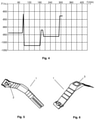
- FIG. 1 shows an example of identifying REM sleep phase for one of the test subjects (8VAV), whereat FIG. 1 a shows a graph of function F( ⁇ t i ) for one of the registered REM phases, while FIG. 1 b shows a graph ⁇ F( ⁇ t i ) of function increment F( ⁇ t i ), shown in FIG. 1 a;
- FIG. 2 shows a graph of function F( ⁇ t i ) over the entire sleep duration for the same test subject (8VAV) whose sleep is illustrated in FIG. 1 , wherein the graph fragment shown in more detail in FIG. 1 a is circled;
- FIG. 3 shows a graph of function F( ⁇ t i ) over the entire sleep duration for another test subject (7ESA);
- FIG. 4 shows a graph of function F( ⁇ t i ) over the entire sleep duration for yet another test subject (3SOR).
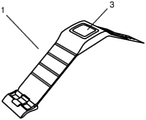
- FIG. 5 and FIG. 6 schematically show the design of an exemplary portable device made in the form of a bracelet with sensors that implements the method in accordance with the present invention, whereat FIG. 5 gives the view of the device from its inner side contacting the wrist, and FIG. 6 shows the device from the outside, where the indicator is located.
- a method for determining the sleep phase favorable to awakening can be implemented using two sensors: a pulse wave sensor and a sensor capable of responding to arm or leg movement, i.e., a motion sensor such as an accelerometer.
- the sensors can be mounted on a human body separately from each other.
- the motion sensor can be attached to an arm or a leg, while the pulse wave sensor onto the wrist or forearm.
- Pulse wave sensors may be represented by piezoelectric sensors, strain gages, and optical sensors.
- the use of an optical sensor or photoplethysmographic sensor sensitive to vascular blood filling of bodily areas is preferable. It is more convenient for the user if both pulse wave sensor and motion sensor are mounted in a single device, such as shown in FIG. 5 and FIG. 6 and made in the form of bracelet 1 to be worn on the wrist.
- the inner side of bracelet 1 carries pulse wave sensor 2 based, for example, on piezoelectric cell.
- pulse wave sensor 2 may be used to ensure a reliable skin contact with the wrist area where pulse wave signal is detected.
- Bracelet 1 may have indicator 3 which displays the initial settings and operation mode of the device.
- the device may also generate a wake-up signal during favorable sleep phase, for example, by means of a vibrator (not shown in the drawings) mounted in bracelet 1 .
- An accelerometer (not shown in the drawings) may be mounted inside bracelet 1 for detecting arm movements of a sleeping person.
- Pulse wave sensor 2 and the accelerometer are connected to the measuring unit of bracelet 1 , which registers pulse wave signals and accelerometer-generated signals.
- the registered signals are processed in a CPU which can be co-located with the measuring unit in bracelet 1 or made as a separate unit to be attached to human body or carried by person, whereat said CPU receives signals transmitted from the measuring unit by radio or some other means.
- RR intervals and respiratory rate are determined in human sleep based on registered pulse wave signal. Since a pulse wave signal is a periodic signal that varies in synchronism with heartbeat, the time intervals between any characteristic points on pulsogram (e.g., peak value of the signal or its derivative) correspond exactly to RR intervals. Instrumental methods for determining heart rate or RR intervals from a pulse wave signal are well known to those skilled in the art. It is also known that, alongside with the above-mentioned periodic variations corresponding to blood filling dynamics at each cardiac cycle, pulse wave signal includes a low frequency component corresponding to respiratory cycle. Instrumental methods of determining the respiratory rate based on low-pass filtering of respiratory component out of pulse wave signal are well known to those skilled in the art.
- the time interval ⁇ t i over which said parameters are measured is selected in the range from 1 minute to 6 minutes.
- i is the serial number of i-th time interval.
- parameter P 4 is determined as the standard deviation of RR intervals over the preceding time interval of 3 minutes to 20 minutes, preferably from 4 minutes to 6 minutes.
- the mean number of limb movements P 6 over the preceding time interval from 0.5 minutes to 10 minutes, preferably from 4 minutes to 6 minutes, is another parameter needed for final identification of REM sleep phase. Since the occurrence of motor activity is informative by itself for identification of REM sleep, all limb movements detected by accelerometer over a 10 seconds period are taken for one movement.
- K 1 -K 6 are weight coefficients characterizing the contribution of corresponding parameter P 1 -P 6 to the value of F( ⁇ t i ).
- Table 1 shows the value ranges of weight coefficients K 1 -K 6 , as well optimal value thereof.
- the increment ⁇ F( ⁇ t i ) of function F( ⁇ t i )) over time ⁇ t i is used to identify the onset and termination of REM sleep. If the difference between the current function value F( ⁇ t i ) and its previous value F( ⁇ t i-1 ) exceeds the first preset threshold value, the onset of REM sleep is identified. If said difference is less than the second preset threshold value, the termination of REM sleep is identified.
- FIG. 1 - FIG. 4 show examples of function F( ⁇ t i ) obtained for different test subjects during their sleep.
- Optimal weight coefficients K 1 -K 6 given in Table 1 were selected in the course of studies to calculate function values F( ⁇ t i ).
- FIG. 1 FIG. 4 demonstrate a smoothed form of function F( ⁇ t i )).
- the measuring resolution of accelerometer and pulse wave sensor signals amounted 0.1 in the testing process. All limb movements detected over 10-second time interval were considered to be a single movement and were averaged over the period of 5 min Function values F( ⁇ t i ) were calculated every minute, in other words, value ⁇ t i was taken to be 1 minute for each i-th time interval.
- the first threshold value L 1 was selected in the range from 20 to 30, while the second threshold value L 2 was selected in the range from ⁇ 30 to ⁇ 20.
- FIG. 1 a shows a fragment of function F( ⁇ t i )) which includes one of REM phases registered during the sleep of one of the test subjects (8VAV).
- function value F( ⁇ t i )) rises sharply at 202-th minute of sleep, which indicates the onset of REM sleep, whereas at 210-th minute said function value F( ⁇ t i ) falls abruptly, which indicates the termination of REM sleep.
- FIG. 1 b shows a graph of increment ⁇ F( ⁇ t i ) of function F( ⁇ t i ) from FIG. 1 a .
- the increment value ⁇ F( ⁇ t i ) considerably exceeds the first threshold value L 1 with the onset of REM sleep, and becomes noticeably lower than the second threshold value L 2 with REM sleep termination.
- FIG. 1 The example illustrated in FIG. 1 is presented in Table 2 in the form of parameter values P 1 -P 6 , function values F( ⁇ t i ) and function increment ⁇ F( ⁇ t i ).
- the lines with parameter values presented in bold type in Table 2 correspond to REM sleep onset and termination in test subject.
- FIG. 2 is a graph of function F( ⁇ t i ) over the entire sleep duration for the same test subject (8VAV). As follows from function values F( ⁇ t i ), there occurred four REM phases during the sleep of the test subject.
- FIG. 3 shows a graph of function F( ⁇ t i ) for another test subject (7ESA). As follows from the graph, four REM phases favorable to awakening were similarly registered during subject's sleep. The subject woke up by himself during the last REM phase.
- the number of REM phases may vary during sleep.
- FIG. 4 shows that three REM phases occurred during the sleep of another test subject (3SOR).
- the graph also shows that different REM phases feature different absolute values of function F( ⁇ t i ) throughout sleep duration and that REM sleep onset and termination can be reliably identified only by the increment of said function.
Landscapes
- Health & Medical Sciences (AREA)
- Life Sciences & Earth Sciences (AREA)
- Physics & Mathematics (AREA)
- Engineering & Computer Science (AREA)
- Cardiology (AREA)
- Surgery (AREA)
- Veterinary Medicine (AREA)
- Biophysics (AREA)
- Biomedical Technology (AREA)
- Heart & Thoracic Surgery (AREA)
- Medical Informatics (AREA)
- Molecular Biology (AREA)
- Pathology (AREA)
- Animal Behavior & Ethology (AREA)
- General Health & Medical Sciences (AREA)
- Public Health (AREA)
- Physiology (AREA)
- Pulmonology (AREA)
- General Physics & Mathematics (AREA)
- Dentistry (AREA)
- Oral & Maxillofacial Surgery (AREA)
- Artificial Intelligence (AREA)
- Computer Vision & Pattern Recognition (AREA)
- Psychiatry (AREA)
- Signal Processing (AREA)
- Measurement Of The Respiration, Hearing Ability, Form, And Blood Characteristics Of Living Organisms (AREA)
- Measuring Pulse, Heart Rate, Blood Pressure Or Blood Flow (AREA)
Abstract
Description
F(Δt i)=−K 1 P 1 −K 2 P 2 −K 3 P 3 +K 4 P 4 +K 5 P 5 K 6 P 6, (1)
F(Δt i)=−K 1 P 1 −K 2 P 2 −K 3 P 3 +K 4 P 4 +K 5 P 5 K 6 P 6,
| TABLE 1 |
| Weight Coefficient Values |
| Parameters, | Weight coefficients |
| units of | Weight coefficient values |
| measurement | Designation | min | max | optimal |
| P1, ms | K1 | 0.6 | |
3 | |
1 | ms1 |
| P2, ms | K2 | 0.1 | ms1 | 0.7 | ms1 | 0.14 | ms1 |
| P3, ms | K3 | 0.01 | ms1 | 0.3 | ms1 | 0.03 | ms1 |
| P4, ms | K4 | 0.5 | |
3 | ms1 | 1.4 | ms1 |
| P5, min−1 | K5 | 1 | min | 10 | |
2 | min |
| P6 | K6 | 5 | 50 | 22 |
| TABLE 2 | |||||||||
| Sleep | Number | ||||||||
| Duration, | P1, | P2, | P3, | P4, | P5, | of | P6 over | ||
| in min. | ms | ms | ms | ms | min | Movements | 5 min. | F (Δti) | ΔF (Δti) |
| 185 | 92 | 1201 | 1422 | — | 14 | 0 | — | — | |
| 186 | 1273 | 1200 | 1421 | — | 15 | 1 | — | — | |
| 187 | 1272 | 1199 | 1420 | — | 15 | 0 | — | — | |
| 188 | 1272 | 1198 | 1418 | — | 15 | 0 | — | — | |
| 189 | 1272 | 1199 | 1418 | 92 | 15 | 0 | 0.2 | −1319 | |
| 190 | 1274 | 1198 | 1419 | 92 | 15 | 0 | 0.2 | −1321 | −1.9 |
| 191 | 1273 | 1201 | 1419 | 94 | 14 | 0 | 0 | −1324 | −3.0 |
| 192 | 1272 | 1202 | 1421 | 92 | 14 | 0 | 0 | −1326 | −2.0 |
| 193 | 1272 | 1200 | 1422 | 92 | 14 | 0 | 0 | −1326 | 0.3 |
| 194 | 1271 | 1202 | 1421 | 92 | 14 | 0 | 0 | −1325 | 0.8 |
| 195 | 1272 | 1201 | 1421 | 92 | 14 | 0 | 0 | −1326 | −0.9 |
| 196 | 1272 | 1202 | 1422 | 92 | 15 | 0 | 0 | −1324 | 1.8 |
| 197 | 1272 | 1202 | 1420 | 93 | 15 | 0 | 0 | −1323 | 1.5 |
| 198 | 1271 | 1198 | 1422 | 92 | 15 | 0 | 0 | −1323 | 0.1 |
| 199 | 1272 | 1199 | 1421 | 92 | 15 | 0 | 0 | −1324 | −1.1 |
| 200 | 1272 | 1200 | 1418 | 92 | 15 | 0 | 0 | −1324 | 0.0 |
| 201 | 1273 | 1197 | 1418 | 92 | 16 | 0 | 0 | −1322 | 1.4 |
| 202 | 1206 | 1015 | 1290 | 89 | 18 | 0 | 0 | −1226 | 96.1 |
| 203 | 1207 | 1011 | 1290 | 88 | 19 | 0 | 0 | −1226 | 0.2 |
| 204 | 1207 | 1012 | 1290 | 89 | 19 | 0 | 0 | −1225 | 1.3 |
| 205 | 1208 | 1012 | 1290 | 89 | 19 | 0 | 0 | −1226 | −1.0 |
| 206 | 1207 | 1010 | 1290 | 90 | 18 | 0 | 0 | −1225 | 0.7 |
| 207 | 1207 | 1012 | 1290 | 89 | 19 | 0 | 0 | −1225 | 0.3 |
| 208 | 1206 | 1013 | 1290 | 88 | 19 | 0 | 0 | −1225 | −0.5 |
| 209 | 1207 | 1012 | 1290 | 89 | 19 | 0 | 0 | −1225 | 0.5 |
| 210 | 1367 | 1290 | 1500 | 97 | 14 | 1 | 0.2 | −1424 | −199.6 |
| 211 | 1369 | 1300 | 1505 | 98 | 16 | 0 | 0.2 | −1422 | 1.9 |
| 212 | 1369 | 1290 | 1501 | 99 | 15 | 0 | 0.2 | −1421 | 0.9 |
| 213 | 1367 | 1290 | 1498 | 100 | 14 | 0 | 0.2 | −1420 | 1.5 |
| 214 | 1367 | 1285 | 1498 | 99 | 13 | 0 | 0.2 | −1422 | −2.7 |
| 215 | 1367 | 1290 | 1500 | 100 | 15 | 0 | 0 | −1422 | 0.2 |
Claims (15)
F(Δt i)=K 1 P 1 −K 2 P 2 −K 3 P 3 +K 4 P 4 +K 5 P 5 +K 6 P 6, and wherein
Applications Claiming Priority (3)
| Application Number | Priority Date | Filing Date | Title |
|---|---|---|---|
| RU2013116790 | 2013-04-05 | ||
| RU2013116790/14A RU2522400C1 (en) | 2013-04-05 | 2013-04-05 | Method for determining human sleep phase favourable to awakening |
| PCT/RU2014/000237 WO2014163537A1 (en) | 2013-04-05 | 2014-04-02 | Method for determining a person's sleeping phase which is favourable for waking up |
Related Parent Applications (1)
| Application Number | Title | Priority Date | Filing Date |
|---|---|---|---|
| PCT/RU2014/000237 Continuation WO2014163537A1 (en) | 2013-04-05 | 2014-04-02 | Method for determining a person's sleeping phase which is favourable for waking up |
Publications (2)
| Publication Number | Publication Date |
|---|---|
| US20160007931A1 US20160007931A1 (en) | 2016-01-14 |
| US11224385B2 true US11224385B2 (en) | 2022-01-18 |
Family
ID=51217348
Family Applications (1)
| Application Number | Title | Priority Date | Filing Date |
|---|---|---|---|
| US14/865,879 Active 2034-08-04 US11224385B2 (en) | 2013-04-05 | 2015-09-25 | Method for determining a person's sleeping phase which is favourable for waking up |
Country Status (9)
| Country | Link |
|---|---|
| US (1) | US11224385B2 (en) |
| EP (1) | EP2982299B1 (en) |
| JP (1) | JP6216439B2 (en) |
| KR (1) | KR20150129765A (en) |
| CN (1) | CN105142515B (en) |
| ES (1) | ES2694133T3 (en) |
| MY (1) | MY174252A (en) |
| RU (1) | RU2522400C1 (en) |
| WO (1) | WO2014163537A1 (en) |
Families Citing this family (37)
| Publication number | Priority date | Publication date | Assignee | Title |
|---|---|---|---|---|
| US11247040B2 (en) | 2011-11-15 | 2022-02-15 | Neurometrix, Inc. | Dynamic control of transcutaneous electrical nerve stimulation therapy using continuous sleep detection |
| US10112040B2 (en) | 2011-11-15 | 2018-10-30 | Neurometrix, Inc. | Transcutaneous electrical nerve stimulation using novel unbalanced biphasic waveform and novel electrode arrangement |
| US11259744B2 (en) * | 2011-11-15 | 2022-03-01 | Neurometrix, Inc. | Transcutaneous electrical nerve stimulator with automatic detection of leg orientation and leg motion for enhanced sleep analysis, including enhanced transcutaneous electrical nerve stimulation (TENS) using the same |
| US9474898B2 (en) | 2013-03-29 | 2016-10-25 | Neurometrix, Inc. | Detecting cutaneous electrode peeling using electrode-skin impedance |
| CN104168951B (en) | 2011-11-15 | 2017-07-11 | 神经系统检测公司 | Device and method for pain relief using transcutaneous electrical nerve stimulation |
| WO2013132147A2 (en) * | 2012-03-05 | 2013-09-12 | Polar Electro Oy | Optical detection of motion effects |
| US10940311B2 (en) | 2013-03-29 | 2021-03-09 | Neurometrix, Inc. | Apparatus and method for button-free control of a wearable transcutaneous electrical nerve stimulator using interactive gestures and other means |
| CN105431196B (en) | 2013-04-15 | 2019-02-01 | Gsk消费者健康有限公司 | Transcutaneous electrical nerve stimulator with automatic detection of user sleep-wake state |
| US9186479B1 (en) | 2014-06-05 | 2015-11-17 | Morphy Inc. | Methods and systems for gathering human biological signals and controlling a bed device |
| JP2016013221A (en) * | 2014-07-01 | 2016-01-28 | セイコーエプソン株式会社 | Biological information processing system and biological information processing system control method |
| JP2016014542A (en) * | 2014-07-01 | 2016-01-28 | セイコーエプソン株式会社 | Biological information processing system, and control method of biological information processing system |
| JP2016016144A (en) * | 2014-07-09 | 2016-02-01 | セイコーエプソン株式会社 | Biological information processing system and control method of biological information processing system |
| US10013025B2 (en) * | 2014-12-11 | 2018-07-03 | Intel Corporation | Wearable device with power state control |
| CN105093919A (en) * | 2015-08-13 | 2015-11-25 | 小米科技有限责任公司 | Alarm clock management method and device and electronic equipment |
| US10105092B2 (en) | 2015-11-16 | 2018-10-23 | Eight Sleep Inc. | Detecting sleeping disorders |
| CN108289633B (en) | 2015-12-01 | 2022-05-03 | 皇家飞利浦有限公司 | Sleep study system and method |
| RU2749068C2 (en) * | 2015-12-01 | 2021-06-03 | Конинклейке Филипс Н.В. | System and method for sleep research |
| US10624574B2 (en) | 2016-06-27 | 2020-04-21 | Koninklijke Philips N.V. | Determination system and method for determining a sleep stage of a subject |
| CN106331342A (en) * | 2016-08-23 | 2017-01-11 | 京东方科技集团股份有限公司 | Alarm clock realization method and device in electronic device and wearable device |
| US10636524B2 (en) * | 2016-08-26 | 2020-04-28 | TCL Research America Inc. | Method and system for optimized wake-up strategy via sleeping stage prediction with recurrent neural networks |
| US11594111B2 (en) * | 2016-09-16 | 2023-02-28 | Bose Corporation | Intelligent wake-up system |
| US10434279B2 (en) | 2016-09-16 | 2019-10-08 | Bose Corporation | Sleep assistance device |
| US10653856B2 (en) | 2016-09-16 | 2020-05-19 | Bose Corporation | Sleep system |
| US10963146B2 (en) | 2016-09-16 | 2021-03-30 | Bose Corporation | User interface for a sleep system |
| US11317857B2 (en) | 2016-12-20 | 2022-05-03 | Koninklijke Philips N.V. | Patient monitoring |
| WO2018119424A1 (en) | 2016-12-23 | 2018-06-28 | Neurometrix, Inc. | Smart"electrode assembly for transcutaneous electrical nerve stimulation (tens) |
| KR102783429B1 (en) * | 2017-01-25 | 2025-03-18 | 삼성디스플레이 주식회사 | Display device |
| US11058877B2 (en) | 2017-05-30 | 2021-07-13 | Neurometrix, Inc. | Apparatus and method for the automated control of transcutaneous electrical nerve stimulation based on current and forecasted weather conditions |
| GB2584242B (en) | 2018-01-09 | 2022-09-14 | Eight Sleep Inc | Systems and methods for detecting a biological signal of a user of an article of furniture |
| GB2584241B (en) | 2018-01-19 | 2023-03-08 | Eight Sleep Inc | Sleep pod |
| US11883661B2 (en) | 2018-12-07 | 2024-01-30 | Neurometrix, Inc. | Intelligent determination of therapeutic stimulation intensity for transcutaneous electrical nerve stimulation |
| EP4030994A4 (en) * | 2019-09-21 | 2023-10-11 | Mycardio LLC | Systems and methods for designation of rem and wake states |
| EP3821793A1 (en) * | 2019-11-12 | 2021-05-19 | Koninklijke Philips N.V. | A method for determining the risk of a user waking up in an undesirable state |
| USD980431S1 (en) | 2021-03-25 | 2023-03-07 | Eisai R&D Management Co., Ltd | Component for a health condition monitoring system |
| RU2763641C1 (en) * | 2021-09-22 | 2021-12-30 | Федеральное Государственное Бюджетное Образовательное Учреждение Высшего Образования "Тюменский Государственный Медицинский Университет" Министерства Здравоохранения Российской Федерации | Method for assessing the predicted shift in the corrected mean sleep phase according to the munich chrono-type questionnaire test when changing the time of daytime light exposure in individuals with a free work schedule |
| RU2762612C1 (en) * | 2021-10-25 | 2021-12-21 | Федеральное Государственное Бюджетное Образовательное Учреждение Высшего Образования "Тюменский Государственный Медицинский Университет" Министерства Здравоохранения Российской Федерации | Method for predicting the corrected mean sleep phase according to the munich test in persons aged 18 to 22 years inclusive with an increase in screen time |
| CN116269355B (en) * | 2023-05-11 | 2023-08-01 | 江西珉轩智能科技有限公司 | Safety monitoring system based on figure gesture recognition |
Citations (18)
| Publication number | Priority date | Publication date | Assignee | Title |
|---|---|---|---|---|
| US4306567A (en) * | 1977-12-22 | 1981-12-22 | Krasner Jerome L | Detection and monitoring device |
| DE4209336A1 (en) | 1992-03-23 | 1993-09-30 | Soenke Knutzen | Procedure for minimum stress waking of sleeping person - establishes sleep pattern for individual using suitable sensors and records data in pulse sensor for rousing during light sleep phase |
| US5280791A (en) | 1991-11-19 | 1994-01-25 | The Sleep Disorders Diagnostic And Treatment Center, Ltd. | Monitor system for determining the sleep stages of a person |
| RU2061406C1 (en) | 1993-07-14 | 1996-06-10 | Евгений Антонович Юматов | Method and device for waking a person during a preset sleep phase |
| JP2003260040A (en) | 2002-03-11 | 2003-09-16 | Sanyo Electric Co Ltd | Sleeping depth estimation device |
| US20040034289A1 (en) * | 2000-06-16 | 2004-02-19 | Eric Teller | System for monitoring health, wellness and fitness |
| US20050190065A1 (en) | 2004-02-26 | 2005-09-01 | Ronnholm Valter A.G. | Natural alarm clock |
| US20060111635A1 (en) | 2004-11-22 | 2006-05-25 | Koby Todros | Sleep staging based on cardio-respiratory signals |
| US20060241510A1 (en) * | 2005-04-25 | 2006-10-26 | Earlysense Ltd. | Techniques for prediction and monitoring of clinical episodes |
| WO2007143535A2 (en) | 2006-06-01 | 2007-12-13 | Biancamed Ltd. | Apparatus, system, and method for monitoring physiological signs |
| US20080269625A1 (en) | 2004-02-05 | 2008-10-30 | Earlysense Ltd. | Prediction and monitoring of clinical episodes |
| US20110230790A1 (en) | 2010-03-16 | 2011-09-22 | Valeriy Kozlov | Method and system for sleep monitoring, regulation and planning |
| US20110264164A1 (en) * | 2008-11-19 | 2011-10-27 | Inspire Medical Systems, Inc. | Method of treating sleep disordered breathing |
| US20120083705A1 (en) * | 2010-09-30 | 2012-04-05 | Shelten Gee Jao Yuen | Activity Monitoring Systems and Methods of Operating Same |
| KR20120045661A (en) | 2010-10-29 | 2012-05-09 | 아주대학교산학협력단 | Arraratus and method determining quality of sleep |
| US20130261404A1 (en) * | 2012-03-30 | 2013-10-03 | Tanita Corporation | Sleep management system and sleep monitor |
| US20140327515A1 (en) * | 2013-03-15 | 2014-11-06 | AlipCom | Combination speaker and light source responsive to state(s) of an organism based on sensor data |
| US20150112606A1 (en) * | 2013-10-23 | 2015-04-23 | Quanttus, Inc. | Calculating Pulse Transit Time |
Family Cites Families (9)
| Publication number | Priority date | Publication date | Assignee | Title |
|---|---|---|---|---|
| JP3987053B2 (en) * | 2004-03-30 | 2007-10-03 | 株式会社東芝 | Sleep state determination device and sleep state determination method |
| JP2006043304A (en) * | 2004-08-06 | 2006-02-16 | Sanyo Electric Co Ltd | Sleep cycle controlling apparatus and program |
| CN101610716B (en) * | 2007-02-13 | 2011-10-19 | 皇家飞利浦电子股份有限公司 | Device and method for measuring the arousal of a user |
| US9072870B2 (en) * | 2008-01-25 | 2015-07-07 | Medtronic, Inc. | Sleep stage detection |
| RU2548791C2 (en) * | 2008-04-14 | 2015-04-20 | Итамар Медикал Лтд. | Non-invasive method and device for determination of stages of superficial and deep sleep |
| JP2012110536A (en) * | 2010-11-25 | 2012-06-14 | Sony Corp | Wake-up assisting apparatus and wake-up assisting method |
| EP2524647A1 (en) * | 2011-05-18 | 2012-11-21 | Alain Gilles Muzet | System and method for determining sleep stages of a person |
| US9192326B2 (en) * | 2011-07-13 | 2015-11-24 | Dp Technologies, Inc. | Sleep monitoring system |
| US20130291404A1 (en) * | 2012-05-03 | 2013-11-07 | John William Follows | Recovery shoe |
-
2013
- 2013-04-05 RU RU2013116790/14A patent/RU2522400C1/en active
-
2014
- 2014-04-02 WO PCT/RU2014/000237 patent/WO2014163537A1/en not_active Ceased
- 2014-04-02 CN CN201480019586.4A patent/CN105142515B/en active Active
- 2014-04-02 KR KR1020157027424A patent/KR20150129765A/en not_active Abandoned
- 2014-04-02 MY MYPI2015703481A patent/MY174252A/en unknown
- 2014-04-02 JP JP2016506286A patent/JP6216439B2/en active Active
- 2014-04-02 EP EP14779903.5A patent/EP2982299B1/en not_active Not-in-force
- 2014-04-02 ES ES14779903.5T patent/ES2694133T3/en active Active
-
2015
- 2015-09-25 US US14/865,879 patent/US11224385B2/en active Active
Patent Citations (19)
| Publication number | Priority date | Publication date | Assignee | Title |
|---|---|---|---|---|
| US4306567A (en) * | 1977-12-22 | 1981-12-22 | Krasner Jerome L | Detection and monitoring device |
| US5280791A (en) | 1991-11-19 | 1994-01-25 | The Sleep Disorders Diagnostic And Treatment Center, Ltd. | Monitor system for determining the sleep stages of a person |
| DE4209336A1 (en) | 1992-03-23 | 1993-09-30 | Soenke Knutzen | Procedure for minimum stress waking of sleeping person - establishes sleep pattern for individual using suitable sensors and records data in pulse sensor for rousing during light sleep phase |
| RU2061406C1 (en) | 1993-07-14 | 1996-06-10 | Евгений Антонович Юматов | Method and device for waking a person during a preset sleep phase |
| US20040034289A1 (en) * | 2000-06-16 | 2004-02-19 | Eric Teller | System for monitoring health, wellness and fitness |
| JP2003260040A (en) | 2002-03-11 | 2003-09-16 | Sanyo Electric Co Ltd | Sleeping depth estimation device |
| US20080269625A1 (en) | 2004-02-05 | 2008-10-30 | Earlysense Ltd. | Prediction and monitoring of clinical episodes |
| US20050190065A1 (en) | 2004-02-26 | 2005-09-01 | Ronnholm Valter A.G. | Natural alarm clock |
| US20060111635A1 (en) | 2004-11-22 | 2006-05-25 | Koby Todros | Sleep staging based on cardio-respiratory signals |
| US20060241510A1 (en) * | 2005-04-25 | 2006-10-26 | Earlysense Ltd. | Techniques for prediction and monitoring of clinical episodes |
| WO2007143535A2 (en) | 2006-06-01 | 2007-12-13 | Biancamed Ltd. | Apparatus, system, and method for monitoring physiological signs |
| US20090203972A1 (en) * | 2006-06-01 | 2009-08-13 | Biancamed Ltd. | Apparatus, system, and method for monitoring physiological signs |
| US20110264164A1 (en) * | 2008-11-19 | 2011-10-27 | Inspire Medical Systems, Inc. | Method of treating sleep disordered breathing |
| US20110230790A1 (en) | 2010-03-16 | 2011-09-22 | Valeriy Kozlov | Method and system for sleep monitoring, regulation and planning |
| US20120083705A1 (en) * | 2010-09-30 | 2012-04-05 | Shelten Gee Jao Yuen | Activity Monitoring Systems and Methods of Operating Same |
| KR20120045661A (en) | 2010-10-29 | 2012-05-09 | 아주대학교산학협력단 | Arraratus and method determining quality of sleep |
| US20130261404A1 (en) * | 2012-03-30 | 2013-10-03 | Tanita Corporation | Sleep management system and sleep monitor |
| US20140327515A1 (en) * | 2013-03-15 | 2014-11-06 | AlipCom | Combination speaker and light source responsive to state(s) of an organism based on sensor data |
| US20150112606A1 (en) * | 2013-10-23 | 2015-04-23 | Quanttus, Inc. | Calculating Pulse Transit Time |
Non-Patent Citations (4)
| Title |
|---|
| Gecht et al., Sleep-Wakefulness Cycle: Nightdreams and Health, Journal of New Medical Technologies, 1994, v. 1, No. 2, pp. 45-50. |
| International Search Report from International Application No. PCT/RU2014/000237, filed Apr. 2, 2014, dated Aug. 28, 2014. |
| Miele "Polysonmography," http://www.zonasna.ru/serv002.html, Feb. 21, 2010. |
| Tsiboulsky et al, On Functional Role of Paradoxical Phase of Sleep, The Central Mechanisms of Motivation and Sensory Processes: Coll. Art, 1988, pp. 113-120, Baku. |
Also Published As
| Publication number | Publication date |
|---|---|
| JP6216439B2 (en) | 2017-10-18 |
| EP2982299A1 (en) | 2016-02-10 |
| HK1218379A1 (en) | 2017-02-17 |
| EP2982299A4 (en) | 2017-02-15 |
| US20160007931A1 (en) | 2016-01-14 |
| ES2694133T3 (en) | 2018-12-18 |
| EP2982299B1 (en) | 2018-08-08 |
| CN105142515B (en) | 2017-09-05 |
| WO2014163537A1 (en) | 2014-10-09 |
| RU2522400C1 (en) | 2014-07-10 |
| JP2016517729A (en) | 2016-06-20 |
| KR20150129765A (en) | 2015-11-20 |
| MY174252A (en) | 2020-04-01 |
| CN105142515A (en) | 2015-12-09 |
Similar Documents
| Publication | Publication Date | Title |
|---|---|---|
| EP2982299B1 (en) | Method for determining a person's sleeping phase which is favourable for waking up | |
| US10213153B2 (en) | Wearable pain monitor using accelerometry | |
| EP3429456B1 (en) | A method and apparatus for determining a baseline for one or more physiological characteristics of a subject | |
| EP3927234B1 (en) | A sleep monitoring system and method | |
| EP1259157B1 (en) | Method and apparatus for the non-invasive detection of particular sleep-state conditions by monitoring the peripheral vascular system | |
| US10631739B2 (en) | Monitoring vital signs | |
| EP3261526B1 (en) | Apparatus and method for providing a control signal for a blood pressure measurement device | |
| AU2001237695A1 (en) | Method and apparatus for the non-invasive detection of particular sleep-state conditions by monitoring the peripheral vascular system | |
| KR20160081740A (en) | Method for obtaining oxygen desaturation index using unconstrained measurement of bio-signals | |
| KR102403717B1 (en) | A method for detecting vital signs based on a radar senor and a system for monitoring and improving state of sleeping | |
| EP3417771A1 (en) | A method for monitoring blood pressure, and a device thereof | |
| JP2021535817A (en) | Providing time information of the target person | |
| CA3100475C (en) | Apparatus and a method for monitoring a patient during his sleep | |
| Mohammadi-Koushki et al. | A wearable device for continuous cardiorespiratory System Monitoring | |
| WO2016040647A2 (en) | Method and apparatus for monitoring eye tremor | |
| KR20250101351A (en) | Sleep Evaluation Device using Non-Invasively Measured Core Body Temperature | |
| HK1218379B (en) | Method for determining a person's sleeping phase which is favourable for waking up | |
| HK1260339A1 (en) | A method for monitoring blood pressure, and a device thereof |
Legal Events
| Date | Code | Title | Description |
|---|---|---|---|
| AS | Assignment |
Owner name: OBSCHESTVO S OGRANICHENNOY OTVETSTVENNOSTYU "HILBI", RUSSIAN FEDERATION Free format text: ASSIGNMENT OF ASSIGNORS INTEREST;ASSIGNORS:RUBIN, MIKHAIL S.;SVIRYAEV, YURY V.;REEL/FRAME:036660/0936 Effective date: 20150820 Owner name: OBSCHESTVO S OGRANICHENNOY OTVETSTVENNOSTYU "HILBI Free format text: ASSIGNMENT OF ASSIGNORS INTEREST;ASSIGNORS:RUBIN, MIKHAIL S.;SVIRYAEV, YURY V.;REEL/FRAME:036660/0936 Effective date: 20150820 Owner name: HEALBE CORPORATION, CALIFORNIA Free format text: ASSIGNMENT OF ASSIGNORS INTEREST;ASSIGNOR:OBSCHESTVO S OGRANICHENNOY OTVETSTVENNOSTYU "HILBI";REEL/FRAME:036660/0942 Effective date: 20150909 |
|
| STPP | Information on status: patent application and granting procedure in general |
Free format text: FINAL REJECTION MAILED |
|
| STPP | Information on status: patent application and granting procedure in general |
Free format text: RESPONSE AFTER FINAL ACTION FORWARDED TO EXAMINER |
|
| STPP | Information on status: patent application and granting procedure in general |
Free format text: NON FINAL ACTION MAILED |
|
| STPP | Information on status: patent application and granting procedure in general |
Free format text: RESPONSE TO NON-FINAL OFFICE ACTION ENTERED AND FORWARDED TO EXAMINER |
|
| STPP | Information on status: patent application and granting procedure in general |
Free format text: FINAL REJECTION MAILED |
|
| STPP | Information on status: patent application and granting procedure in general |
Free format text: ADVISORY ACTION MAILED |
|
| STPP | Information on status: patent application and granting procedure in general |
Free format text: DOCKETED NEW CASE - READY FOR EXAMINATION |
|
| STPP | Information on status: patent application and granting procedure in general |
Free format text: NON FINAL ACTION MAILED |
|
| STPP | Information on status: patent application and granting procedure in general |
Free format text: RESPONSE TO NON-FINAL OFFICE ACTION ENTERED AND FORWARDED TO EXAMINER |
|
| STPP | Information on status: patent application and granting procedure in general |
Free format text: FINAL REJECTION MAILED |
|
| STPP | Information on status: patent application and granting procedure in general |
Free format text: DOCKETED NEW CASE - READY FOR EXAMINATION |
|
| STPP | Information on status: patent application and granting procedure in general |
Free format text: NOTICE OF ALLOWANCE MAILED -- APPLICATION RECEIVED IN OFFICE OF PUBLICATIONS |
|
| STPP | Information on status: patent application and granting procedure in general |
Free format text: PUBLICATIONS -- ISSUE FEE PAYMENT VERIFIED |
|
| STCF | Information on status: patent grant |
Free format text: PATENTED CASE |
|
| FEPP | Fee payment procedure |
Free format text: MAINTENANCE FEE REMINDER MAILED (ORIGINAL EVENT CODE: REM.); ENTITY STATUS OF PATENT OWNER: SMALL ENTITY |
|
| FEPP | Fee payment procedure |
Free format text: SURCHARGE FOR LATE PAYMENT, SMALL ENTITY (ORIGINAL EVENT CODE: M2554); ENTITY STATUS OF PATENT OWNER: SMALL ENTITY |
|
| MAFP | Maintenance fee payment |
Free format text: PAYMENT OF MAINTENANCE FEE, 4TH YR, SMALL ENTITY (ORIGINAL EVENT CODE: M2551); ENTITY STATUS OF PATENT OWNER: SMALL ENTITY Year of fee payment: 4 |