US11220130B2 - Method for finishing a large-size supplied building panel - Google Patents
Method for finishing a large-size supplied building panel Download PDFInfo
- Publication number
- US11220130B2 US11220130B2 US16/972,837 US201916972837A US11220130B2 US 11220130 B2 US11220130 B2 US 11220130B2 US 201916972837 A US201916972837 A US 201916972837A US 11220130 B2 US11220130 B2 US 11220130B2
- Authority
- US
- United States
- Prior art keywords
- embossing
- upper side
- press
- building panel
- embossed
- Prior art date
- Legal status (The legal status is an assumption and is not a legal conclusion. Google has not performed a legal analysis and makes no representation as to the accuracy of the status listed.)
- Active
Links
Images




Classifications
-
- B—PERFORMING OPERATIONS; TRANSPORTING
- B44—DECORATIVE ARTS
- B44C—PRODUCING DECORATIVE EFFECTS; MOSAICS; TARSIA WORK; PAPERHANGING
- B44C5/00—Processes for producing special ornamental bodies
- B44C5/04—Ornamental plaques, e.g. decorative panels, decorative veneers
- B44C5/0469—Ornamental plaques, e.g. decorative panels, decorative veneers comprising a decorative sheet and a core formed by one or more resin impregnated sheets of paper
- B44C5/0476—Ornamental plaques, e.g. decorative panels, decorative veneers comprising a decorative sheet and a core formed by one or more resin impregnated sheets of paper with abrasion resistant properties
-
- B—PERFORMING OPERATIONS; TRANSPORTING
- B32—LAYERED PRODUCTS
- B32B—LAYERED PRODUCTS, i.e. PRODUCTS BUILT-UP OF STRATA OF FLAT OR NON-FLAT, e.g. CELLULAR OR HONEYCOMB, FORM
- B32B21/00—Layered products comprising a layer of wood, e.g. wood board, veneer, wood particle board
- B32B21/02—Layered products comprising a layer of wood, e.g. wood board, veneer, wood particle board the layer being formed of fibres, chips, or particles, e.g. MDF, HDF, OSB, chipboard, particle board, hardboard
-
- B—PERFORMING OPERATIONS; TRANSPORTING
- B32—LAYERED PRODUCTS
- B32B—LAYERED PRODUCTS, i.e. PRODUCTS BUILT-UP OF STRATA OF FLAT OR NON-FLAT, e.g. CELLULAR OR HONEYCOMB, FORM
- B32B21/00—Layered products comprising a layer of wood, e.g. wood board, veneer, wood particle board
- B32B21/04—Layered products comprising a layer of wood, e.g. wood board, veneer, wood particle board comprising wood as the main or only constituent of a layer, which is next to another layer of the same or of a different material
- B32B21/06—Layered products comprising a layer of wood, e.g. wood board, veneer, wood particle board comprising wood as the main or only constituent of a layer, which is next to another layer of the same or of a different material of paper or cardboard
-
- B—PERFORMING OPERATIONS; TRANSPORTING
- B44—DECORATIVE ARTS
- B44C—PRODUCING DECORATIVE EFFECTS; MOSAICS; TARSIA WORK; PAPERHANGING
- B44C1/00—Processes, not specifically provided for elsewhere, for producing decorative surface effects
- B44C1/24—Pressing or stamping ornamental designs on surfaces
-
- B—PERFORMING OPERATIONS; TRANSPORTING
- B44—DECORATIVE ARTS
- B44C—PRODUCING DECORATIVE EFFECTS; MOSAICS; TARSIA WORK; PAPERHANGING
- B44C5/00—Processes for producing special ornamental bodies
- B44C5/04—Ornamental plaques, e.g. decorative panels, decorative veneers
-
- E—FIXED CONSTRUCTIONS
- E04—BUILDING
- E04F—FINISHING WORK ON BUILDINGS, e.g. STAIRS, FLOORS
- E04F13/00—Coverings or linings, e.g. for walls or ceilings
- E04F13/07—Coverings or linings, e.g. for walls or ceilings composed of covering or lining elements; Sub-structures therefor; Fastening means therefor
- E04F13/08—Coverings or linings, e.g. for walls or ceilings composed of covering or lining elements; Sub-structures therefor; Fastening means therefor composed of a plurality of similar covering or lining elements
- E04F13/0871—Coverings or linings, e.g. for walls or ceilings composed of covering or lining elements; Sub-structures therefor; Fastening means therefor composed of a plurality of similar covering or lining elements having an ornamental or specially shaped visible surface
-
- E—FIXED CONSTRUCTIONS
- E04—BUILDING
- E04F—FINISHING WORK ON BUILDINGS, e.g. STAIRS, FLOORS
- E04F13/00—Coverings or linings, e.g. for walls or ceilings
- E04F13/07—Coverings or linings, e.g. for walls or ceilings composed of covering or lining elements; Sub-structures therefor; Fastening means therefor
- E04F13/08—Coverings or linings, e.g. for walls or ceilings composed of covering or lining elements; Sub-structures therefor; Fastening means therefor composed of a plurality of similar covering or lining elements
- E04F13/10—Coverings or linings, e.g. for walls or ceilings composed of covering or lining elements; Sub-structures therefor; Fastening means therefor composed of a plurality of similar covering or lining elements of wood or with an outer layer of wood
- E04F13/105—Coverings or linings, e.g. for walls or ceilings composed of covering or lining elements; Sub-structures therefor; Fastening means therefor composed of a plurality of similar covering or lining elements of wood or with an outer layer of wood with an outer layer imitating natural stone, brick work, tiled surface or the like
-
- E—FIXED CONSTRUCTIONS
- E04—BUILDING
- E04F—FINISHING WORK ON BUILDINGS, e.g. STAIRS, FLOORS
- E04F15/00—Flooring
- E04F15/02—Flooring or floor layers composed of a number of similar elements
- E04F15/02005—Construction of joints, e.g. dividing strips
- E04F15/02033—Joints with beveled or recessed upper edges
-
- E—FIXED CONSTRUCTIONS
- E04—BUILDING
- E04F—FINISHING WORK ON BUILDINGS, e.g. STAIRS, FLOORS
- E04F15/00—Flooring
- E04F15/02—Flooring or floor layers composed of a number of similar elements
- E04F15/10—Flooring or floor layers composed of a number of similar elements of other materials, e.g. fibrous or chipped materials, organic plastics, magnesite tiles, hardboard, or with a top layer of other materials
- E04F15/102—Flooring or floor layers composed of a number of similar elements of other materials, e.g. fibrous or chipped materials, organic plastics, magnesite tiles, hardboard, or with a top layer of other materials of fibrous or chipped materials, e.g. bonded with synthetic resins
-
- B—PERFORMING OPERATIONS; TRANSPORTING
- B32—LAYERED PRODUCTS
- B32B—LAYERED PRODUCTS, i.e. PRODUCTS BUILT-UP OF STRATA OF FLAT OR NON-FLAT, e.g. CELLULAR OR HONEYCOMB, FORM
- B32B2451/00—Decorative or ornamental articles
-
- B—PERFORMING OPERATIONS; TRANSPORTING
- B32—LAYERED PRODUCTS
- B32B—LAYERED PRODUCTS, i.e. PRODUCTS BUILT-UP OF STRATA OF FLAT OR NON-FLAT, e.g. CELLULAR OR HONEYCOMB, FORM
- B32B2607/00—Walls, panels
Definitions
- the invention relates to a method for finishing a large-size supplied building panel made of HDF with an upper side and a lower side, said method featuring the following steps: a) in a first embossing step, a relief is embossed at least into the upper side in the form of at least one strip-shaped depression with a depth, b) a decorative paper is applied to the upper side, c) an overlay paper is applied to the decorative paper as an abrasion-resistant layer, d) the lower side is provided with a backing layer, e) the thus-prepared structure is fed to a press and pressed at a high pressure and high temperature, and f) during the pressing process, a strip-shaped depression is again embossed in a second embossing step without changing the depth.
- EP 1 820 640 B1 describes a method for finishing a large-size supplied building panel made of MDF, wherein a structure or relief is embossed in the upper side, a decorative pattern is applied to the embossed upper side and the decorative pattern is subsequently sealed with an abrasion-resistant layer.
- EP 3 023 261 B1 discloses a method for finishing a wood material panel with an upper side and a lower side, wherein a layer of liquid synthetic resin is first applied at least to the upper side or the lower side, then at least one paper layer impregnated with a synthetic resin is laid on top; this structure is subsequently pressed in a press at a high pressure and high temperature, thereby melting the resin and bonding it to the wood material panel.
- such building panels are divided into individual panels and used, for instance, as floor or wall and ceiling panels; they are often given a wooden, stone or fantasy decorative pattern with a superimposed, three-dimensional surface.
- the divided panels features joining elements (tongue and groove) and are generally equipped with locking elements for locking adjacent panels in the horizontal and vertical direction (so-called click panels).
- the superimposition of a decorative pattern and three-dimensional surface results in a realistic impression of the imitated material, both in terms of looks and feel.
- the decorative pattern is either a paper layer laminated onto the carrier plate or coating printed directly onto the carrier plate.
- the decorative pattern is also equipped with an anti-wear layer.
- abrasion-resistant paper layers so-called overlays, or, after curing, abrasion-resistant lacquer or resin layers are used.
- the EIR structure is in the form of a three-dimensional surface structure and is embossed in the panel surface by means of a corresponding three-dimensionally structured press plate.
- the structure generally has a height of up to 500 ⁇ m.
- the number and depth of the structures are limited by the available quantity of activated components on the one hand, and by the press force on the other.
- WO 2016/180643 A1 describes a method for producing floor panels which feature locking profiles for mechanically locking similar panels together, wherein two panels locked together form a common joint at the upper side.
- DE 10 2008 008 240 A1 describes a carrier plate, on the upper side of which water is applied before coating, which is absorbed and causes a steam shock during the subsequent pressing process, thereby causing the uppermost layer to heat up very quickly.
- the heat and moisture result in a better plastic deformability and thus enable the embossing of deeper pressed sheet structures.
- the moisture also improves the heat transfer from the press plates of the short-cycle press into the wood material panel.
- EP 3 059 020 A1 describes the treatment of a wood material panel with steam, which can have a temperature of up to 60° C.
- the purpose of this treatment is to achieve as uniform a moisture level as possible on the carrier plate in order to improve the primer for printing.
- the moistened upper side is first sanded and then preheated to a temperature of approximately 45° C. This is followed by a first application of resin as a rolling base. A white primer is rolled onto this rolling base.
- the method according to the preamble is characterized in that
- the large-size panel is later divided into individual panels along the embossed depressions.
- the upper side of the panels is lowered at the side edges.
- the joint edges of adjoining panels are therefore lower than on the upper side.
- height offset cannot cause shadows that are visually noticeable because all butt joints are lowered.
- a firm joint between adjacent panels can be achieved by means of appropriate edge profiling, which effectively prevents liquid from penetrating too quickly into the butt joint.
- the pressing of the structure in the short-cycle press is conducted at high pressure and high temperature.
- the conceivable range of pressure ranges from 40 to 100 kg/cm 2 , whereby 40 kg/cm 2 is standard for older short-cycle presses. Newer systems achieve 60 or even 80 kg/cm 2 .
- some short-cycle presses are known which work at a pressure of 100 kg/cm 2 .
- the temperature of the heating plates in the short-cycle press is 180 to 200° C.
- At least one further depression is preferably embossed at an angle transverse to the at least one depression.
- a number of transversely running depressions are preferably embossed, along which the panels can then be divided in the transverse direction.
- the bulk density profile (progression of the density across the cross-section of the panel) of the HDF panel is lowered compared to a conventional bulk density profile, as known from EP 3 023 261 B1, for example.
- a conventional bulk density profile as known from EP 3 023 261 B1
- the greatest bulk density occurs in the region of the upper and lower side of the panel.
- a press skin forms on the upper and lower side, which is also called the “rotting layer”. Since the panel has been pressed with a maximum bulk density in the top layers of 950-1000 kg/m 3 , it can be supplied press-finished, i.e. the press skin is not removed. However, it is also possible to at least partially sand down the press skin to reduce the density on the upper side, for instance to a thickness of 0.3-0.5 mm.
- a tempering agent which is an aqueous melamine resin, is applied to the upper side.
- the tempering agent ensures that the previously reduced bulk density on the upper side (in the top layer) is increased again to achieve sufficient strength properties on subsequent panels.
- the building panel is preferably heated to 30 to 50° C. and during the embossing of the at least one depression, a surface temperature of up to 220° C. is achieved.
- the building panel can be heated using steam.
- the first embossing step can be carried out using at least one calender roll. This has the advantage that the embossing step can be integrated into the production line. Embossing can then follow on directly from the pressing of the wood material panel in a continuous press, in which the previously scattered fiber cake has been pressed to form a panel of the desired thickness. However, the first embossing step can also occur in a short-cycle press, in which the upper press plate features strip-shaped elevations.
- one or several paper layers can be applied as an underlay under the decorative paper. These paper layers are impregnated with a melamine resin like the decorative paper.
- the building panel is laminated in a short-cycle press under high pressure and at a high temperature.
- a second embossing step it is embossed once again in the at least one strip-shaped depression to achieve the formation of the side walls without changing the position of the bottom wall in terms of depth.
- the side walls formed in the first embossing step are “rounded”, so that the second embossing step transforms these rounded sections back into a flat surface.
- this structure can also consist of the underlay papers arranged under the decorative paper.
- the melamine resin cures already during the first embossing step and increases the bulk density. If the tempering agent is not applied until after the first embossing step, it cures in the short-cycle press during the second embossing step. The same applies if a sufficiently high temperature is not achieved in the first embossing step.
- the depth of the at least one depression is preferably up to 0.7 mm and can in particular be graded so that the bottom wall is in the form of steps. In such a case, several first pressing steps with different press depths are carried out.
- markings which may be in the form of lines, circles, dots, crosses or other graphic characters, can be printed on the decorative paper where it reaches the base walls of the at least one depression.
- lines are used.
- markings can also be embossed in the second embossing step which are transferred to the building panel as matt or shiny areas or geometric figures with the aid of the press plate. These markings can be used by a camera system to align the building panel for either the second embossing step or solely for further subsequent processing steps.
- markings can also be provided on the edge of the decorative paper so that they are located on the outer edge of the coated building panel.
- Re-embossing in the depression in the second embossing step is preferably conducted in a short-cycle press, in which strip-shaped elevations are applied to the press plate.
- a structure can be embossed into the upper side which is at least partially synchronous with the decorative pattern; in technical terminology, this is known as “embossed in register”.
- FIG. 1 a perspective partial image of a large-size building panel
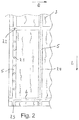
- FIG. 2 the top view of the building panel according to FIG. 1 ;
- FIG. 3 a schematic partial image before the second embossing step
- FIG. 4 an enlarged partial image during the second embossing step
- FIG. 5 a schematic partial image during the first embossing step
- FIG. 6 a schematic image of the building panel in the short-cycle press
- FIG. 7 a typical bulk density profile of an HDF panel
- FIG. 8 the bulk density profile of a first large-size building panel
- FIG. 9 the bulk density profile of a second large-size building panel
- the starting point is a large-size HDF panel with a length of 2800 or 1860 mm, a width of 2070 mm and a thickness of 7 to 14 mm.
- the bulk density is lower than that of a conventional HDF panel, as a comparison of FIG. 7 with FIGS. 8 and 9 shows.
- the peaks of the top layer have been lowered by at least 40 kg/m 3 compared to the standard. Good results have been achieved with a lowering of up to 60 kg/m 3 .
- the bulk density then ranges from 950 to 1000 kg/m 3 .
- An example of the bulk density profile of a conventional HDF panel is shown in FIG. 7 .
- FIGS. 8 and 9 depict examples of bulk density profiles of building panels used according to the invention.
- the HDF panel can supplied press-finished, i.e. with the complete press skin.
- the press skin is sanded down to a thickness of about 0.3 mm in order to deliberately “weaken” the top layer.
- said panel is first heated to a temperature between 30 and 50° C. by applying 10 to 30 g/m 2 of steam. 10 to 50 g/m 2 , preferably 30 g/m 2 , aqueous melamine resin is then applied as a tempering agent.
- aqueous melamine resin is then applied as a tempering agent.
- This can be a standard impregnating resin with a solid content of 50 to 65% by weight, preferably 60% by weight.
- other additives such as curing agents, wetting agents and the like may be present in the formula.
- UF resin or, in mixtures, UF and melamine resin can be used as a tempering agent.
- a postforming resin or a standard impregnating resin, which is rendered more elastic by adding flexibilizing agents (e.g. 1,4-butanediol, caprolactam, polyglycol etc.)
- flexibilizing agents e.g. 1,4-butanediol, caprolactam, polyglycol etc.
- a subsequent addition of the elasticizer should be in the range of about 3 to 7% by weight.
- the building panel 1 pre-treated in this way is passed through one or more calender rolls 20 arranged one behind the other with embossing rings 21 arranged parallel to them.
- a first embossing step depressions 5 , 6 with a depth T of up to 0.7 mm are embossed into the upper side 2 via the at least two embossing rings 21 , wherein said depressions extend in longitudinal direction L and transverse direction Q.
- the line pressure of the embossing rings 21 is up to 300 N/mm and the surface temperature is up to 220° C.
- the tempering agent on the upper side 2 is at least partially converted, i.e. it cures at least partially and thus increases the bulk density again.
- the depressions 5 , 6 can be formed in steps, for example by using several calender rolls 20 with different embossing rings 21 and initially embossing, for example, 0.3 mm and then a further depth T of up to 0.7 mm.
- calender roll 20 If the diameter of the calender roll 20 is large enough, webs running parallel to the axial direction can also be provided on its circumference, with which the depressions 6 can be embossed in the transverse direction Q. If necessary, a calender roll 20 with embossing rings 21 can be followed by a calender roll with parallel webs running only in the axial direction.
- one or more layers of resin-impregnated paper can be applied to the upper side 2 as an underlay and a decorative paper 3 then applied on top; it is also possible to only apply such a decorative paper.
- the decorative paper 3 can be single-colored or multicolored and is applied in such a way that it is at least partially synchronised with the structure that has just been embossed.
- the decorative paper 3 may feature markings 7 .
- the markings 7 can be circles 7 . 1 , crosses 7 . 2 , lines 7 . 3 and dashes 7 . 4 or other geometrical figures. Via these markings 7 , the building panel 2 can be aligned by a camera system for carrying out further processing steps.
- a backing layer 8 is subsequently placed on the lower side 9 of the building panel 1 and an overlay paper 4 on the decorative paper 3 as an abrasion-resistant layer.
- This structure is then fed to a short cycle press 30 with an upper press plate 31 and a lower press plate 33 .
- the upper press plate 31 features strip-shaped elevations 32 .
- the building panel 1 is aligned so that the elevations 32 dip again into the embossed depressions 5 , 6 during the subsequent pressing of the structure and the side walls 5 . 1 , 5 . 2 of the depressions 5 , 6 , which are rounded during the coating of the upper side 2 , are embossed again in order to adjust parallel and flat side walls 5 . 1 , 5 .
- the elevations 32 in the transition area from the side walls 5 . 1 , 5 . 2 to the bottom wall 5 . 3 are designed to be larger than the width of the depressions 5 , 6 , in order to safely form the lower edges of the depressions 5 , 6 .
- the press plate 31 can feature an engraving by means of which a structure is embossed into the upper side of the overlay during pressing, said structure being at least partially aligned synchronously with the decoration (embossed in register).
- geometric figures or lines can also be embossed on the floor walls 5 . 3 , which appear as matt or shiny areas on the surface.
- the press time in the second embossing step is between 10 and 30 seconds, preferably 12 to 15 seconds, during which time the resins melt and bond to the building panel 1 .
- the temperature of the press plates 31 , 33 is up to 200° C.
- the pressure curve changes from a pressure build-up phase to a holding phase and a pressure reduction phase.
- the embossing depth T will occur in the manner of a path control.
- the pressure in the short cycle press is 40 to 100 kg/cm 2 .
- the temperature of the heating plate, via which the press plates 31 , 33 are heated, is 180 to 220° C.
- pressing is carried out at a heating plate temperature between 190 and 210° C.
- At least two depressions 5 , 6 must be embossed in the first embossing step in the longitudinal direction L and at least two in the transverse direction Q, so that the side edges of the divided panels are all lowered.
Landscapes
- Engineering & Computer Science (AREA)
- Architecture (AREA)
- Civil Engineering (AREA)
- Structural Engineering (AREA)
- Life Sciences & Earth Sciences (AREA)
- Wood Science & Technology (AREA)
- Finishing Walls (AREA)
- Laminated Bodies (AREA)
- Floor Finish (AREA)
Applications Claiming Priority (4)
| Application Number | Priority Date | Filing Date | Title |
|---|---|---|---|
| EP18176817.7 | 2018-06-08 | ||
| EP8176817 | 2018-06-08 | ||
| EP18176817.7A EP3578382B1 (de) | 2018-06-08 | 2018-06-08 | Verfahren zur veredelung einer bauplatte |
| PCT/EP2019/065013 WO2019234239A1 (de) | 2018-06-08 | 2019-06-07 | VERFAHREN ZUR VEREDLUNG EINER GROßFORMATIG BEREITGESTELLTEN BAUPLATTE |
Publications (2)
| Publication Number | Publication Date |
|---|---|
| US20210323343A1 US20210323343A1 (en) | 2021-10-21 |
| US11220130B2 true US11220130B2 (en) | 2022-01-11 |
Family
ID=62715828
Family Applications (1)
| Application Number | Title | Priority Date | Filing Date |
|---|---|---|---|
| US16/972,837 Active US11220130B2 (en) | 2018-06-08 | 2019-06-07 | Method for finishing a large-size supplied building panel |
Country Status (8)
| Country | Link |
|---|---|
| US (1) | US11220130B2 (pl) |
| EP (2) | EP3578382B1 (pl) |
| CN (1) | CN112351893B (pl) |
| ES (2) | ES2837473T3 (pl) |
| PL (1) | PL3802147T3 (pl) |
| PT (1) | PT3578382T (pl) |
| RU (1) | RU2763243C1 (pl) |
| WO (1) | WO2019234239A1 (pl) |
Families Citing this family (2)
| Publication number | Priority date | Publication date | Assignee | Title |
|---|---|---|---|---|
| CA3154007A1 (en) * | 2019-10-11 | 2021-04-15 | Louisiana-Pacific Corporation | Integrated roof system with engineered wood |
| US20230313533A1 (en) * | 2019-10-11 | 2023-10-05 | Louisiana-Pacific Corporation | Integrated roof system with engineered wood |
Citations (10)
| Publication number | Priority date | Publication date | Assignee | Title |
|---|---|---|---|---|
| EP1820640A1 (de) | 2006-02-21 | 2007-08-22 | Flooring Technologies Ltd. | Verfahren zur Veredelung einer Bauplatte |
| DE102008008240A1 (de) | 2008-02-08 | 2009-08-20 | Flooring Technologies Ltd. | Verfahren zur Herstellung einer Bauplatte, Vorrichtung zur Durchführung des Verfahrens und Fußbodenpaneel |
| DE102008012220A1 (de) | 2008-03-03 | 2009-09-17 | Flooring Technologies Ltd. | Verfahren und Vorrichtung zum Herstellen einer Holzwerkstoffplatte |
| CN104002349A (zh) | 2007-11-19 | 2014-08-27 | 瓦林格创新股份有限公司 | 具有耐磨表面的基于纤维的镶板 |
| EP2905135A2 (de) | 2014-02-05 | 2015-08-12 | Dirk Dammers | Verfahren zur Herstellung eines Paneels |
| EP3023261A1 (de) | 2014-11-20 | 2016-05-25 | Flooring Technologies Ltd. | Verfahren zum Veredeln einer Holzwerkstoffplatte |
| EP3059020A1 (de) | 2015-02-23 | 2016-08-24 | Flooring Technologies Ltd. | Verfahren zur Herstellung einer Holzwerkstoffplatte, insbesondere einer mit einer Dekorschicht versehenen Holzwerkstoffplatte |
| WO2016180643A1 (de) | 2015-05-11 | 2016-11-17 | Fritz Egger Gmbh & Co. Og | Verfahren zur herstellung von vertiefungen aufweisenden paneelen |
| EP3118015A1 (de) * | 2015-07-16 | 2017-01-18 | Flooring Technologies Ltd. | Verfahren zur herstellung eines laminates bestehend aus trägerplatte und dekorpapier |
| RU2612647C2 (ru) | 2012-12-12 | 2017-03-13 | Флуринг Текнолоджис Лтд. | Способ производства древесной плиты, снабженной декоративным слоем |
-
2018
- 2018-06-08 PT PT181768177T patent/PT3578382T/pt unknown
- 2018-06-08 EP EP18176817.7A patent/EP3578382B1/de active Active
- 2018-06-08 ES ES18176817T patent/ES2837473T3/es active Active
-
2019
- 2019-06-07 ES ES19729001T patent/ES2960526T3/es active Active
- 2019-06-07 CN CN201980038218.7A patent/CN112351893B/zh active Active
- 2019-06-07 PL PL19729001.8T patent/PL3802147T3/pl unknown
- 2019-06-07 RU RU2020141770A patent/RU2763243C1/ru active
- 2019-06-07 EP EP19729001.8A patent/EP3802147B1/de active Active
- 2019-06-07 US US16/972,837 patent/US11220130B2/en active Active
- 2019-06-07 WO PCT/EP2019/065013 patent/WO2019234239A1/de not_active Ceased
Patent Citations (12)
| Publication number | Priority date | Publication date | Assignee | Title |
|---|---|---|---|---|
| EP1820640A1 (de) | 2006-02-21 | 2007-08-22 | Flooring Technologies Ltd. | Verfahren zur Veredelung einer Bauplatte |
| CN104002349A (zh) | 2007-11-19 | 2014-08-27 | 瓦林格创新股份有限公司 | 具有耐磨表面的基于纤维的镶板 |
| DE102008008240A1 (de) | 2008-02-08 | 2009-08-20 | Flooring Technologies Ltd. | Verfahren zur Herstellung einer Bauplatte, Vorrichtung zur Durchführung des Verfahrens und Fußbodenpaneel |
| DE102008012220A1 (de) | 2008-03-03 | 2009-09-17 | Flooring Technologies Ltd. | Verfahren und Vorrichtung zum Herstellen einer Holzwerkstoffplatte |
| RU2612647C2 (ru) | 2012-12-12 | 2017-03-13 | Флуринг Текнолоджис Лтд. | Способ производства древесной плиты, снабженной декоративным слоем |
| EP2905135A2 (de) | 2014-02-05 | 2015-08-12 | Dirk Dammers | Verfahren zur Herstellung eines Paneels |
| EP3023261A1 (de) | 2014-11-20 | 2016-05-25 | Flooring Technologies Ltd. | Verfahren zum Veredeln einer Holzwerkstoffplatte |
| US20170334088A1 (en) | 2014-11-20 | 2017-11-23 | Flooring Technologies Ltd. | Method for finishing a wood board |
| EP3059020A1 (de) | 2015-02-23 | 2016-08-24 | Flooring Technologies Ltd. | Verfahren zur Herstellung einer Holzwerkstoffplatte, insbesondere einer mit einer Dekorschicht versehenen Holzwerkstoffplatte |
| WO2016180643A1 (de) | 2015-05-11 | 2016-11-17 | Fritz Egger Gmbh & Co. Og | Verfahren zur herstellung von vertiefungen aufweisenden paneelen |
| US20180133922A1 (en) | 2015-05-11 | 2018-05-17 | Fritz Egger Gmbh & Co. Og | Method for Producing Panels Having Recesses |
| EP3118015A1 (de) * | 2015-07-16 | 2017-01-18 | Flooring Technologies Ltd. | Verfahren zur herstellung eines laminates bestehend aus trägerplatte und dekorpapier |
Non-Patent Citations (4)
| Title |
|---|
| Chinese Office action in CN Application No. 201980038218.7 dated Jun. 11, 2021, 6 pages. |
| International Search Report in related International Application No. PCT/EP2019/065013 dated Aug. 20, 2019, 8 pages. |
| Notice of Allowance in RU Application No. 2020141770/03(077584) dated Nov. 5, 2021, 7 pages. |
| Written Opinion in related International Application No. PCT/EP2019/065013 dated Dec. 12, 2019, 7 pages. |
Also Published As
| Publication number | Publication date |
|---|---|
| PT3578382T (pt) | 2021-01-04 |
| EP3578382A1 (de) | 2019-12-11 |
| EP3802147B1 (de) | 2023-08-02 |
| EP3802147A1 (de) | 2021-04-14 |
| ES2960526T3 (es) | 2024-03-05 |
| CN112351893A (zh) | 2021-02-09 |
| CN112351893B (zh) | 2022-05-13 |
| EP3578382B1 (de) | 2020-10-07 |
| RU2763243C1 (ru) | 2021-12-28 |
| PL3802147T3 (pl) | 2024-01-08 |
| US20210323343A1 (en) | 2021-10-21 |
| WO2019234239A1 (de) | 2019-12-12 |
| ES2837473T3 (es) | 2021-06-30 |
| EP3802147C0 (de) | 2023-08-02 |
Similar Documents
| Publication | Publication Date | Title |
|---|---|---|
| EP1859912B1 (de) | Verfahren und Vorrichtung zur Herstellung eines Paneels | |
| EP1820640B1 (de) | Verfahren zur Veredelung einer Bauplatte | |
| US10000040B2 (en) | Floor panel, methods for manufacturing laminate panels and method for treating material sheets applied herewith | |
| KR102847278B1 (ko) | 장식 디자인을 구비한 기판의 제조 시스템 | |
| KR101813456B1 (ko) | 목재 보드의 피니싱 방법 | |
| US20130014891A1 (en) | Methods for manufacturing laminate panels | |
| US11220130B2 (en) | Method for finishing a large-size supplied building panel | |
| EP2179863B1 (de) | Verfahren zum Veredeln einer Trägerplatte, insbesondere einer Holz- oder Holzwerkstoffplatte | |
| EP4159470B1 (de) | Verfahren zur veredelung einer bauplatte | |
| US11156004B2 (en) | Method for finishing a supplied building panel | |
| EP3711970B1 (de) | Verfahren zur veredlung einer bereitgestellten bauplatte | |
| CN115135499A (zh) | 用于制备不含聚氯乙烯的覆盖层的方法、不含聚氯乙烯的覆盖层以及饰面元件 | |
| EP2179864B1 (de) | Verfahren zum Veredeln einer Trägerplatte |
Legal Events
| Date | Code | Title | Description |
|---|---|---|---|
| FEPP | Fee payment procedure |
Free format text: ENTITY STATUS SET TO UNDISCOUNTED (ORIGINAL EVENT CODE: BIG.); ENTITY STATUS OF PATENT OWNER: LARGE ENTITY |
|
| AS | Assignment |
Owner name: FLOORING TECHNOLOGIES LTD, MALTA Free format text: ASSIGNMENT OF ASSIGNORS INTEREST;ASSIGNORS:BRAUN, ROGER;OLDORFF, FRANK;LEHNHOFF, INGO;AND OTHERS;SIGNING DATES FROM 20210108 TO 20210112;REEL/FRAME:055234/0474 |
|
| STPP | Information on status: patent application and granting procedure in general |
Free format text: NOTICE OF ALLOWANCE MAILED -- APPLICATION RECEIVED IN OFFICE OF PUBLICATIONS |
|
| STPP | Information on status: patent application and granting procedure in general |
Free format text: AWAITING TC RESP, ISSUE FEE PAYMENT VERIFIED |
|
| STPP | Information on status: patent application and granting procedure in general |
Free format text: PUBLICATIONS -- ISSUE FEE PAYMENT VERIFIED |
|
| STCF | Information on status: patent grant |
Free format text: PATENTED CASE |
|
| MAFP | Maintenance fee payment |
Free format text: PAYMENT OF MAINTENANCE FEE, 4TH YEAR, LARGE ENTITY (ORIGINAL EVENT CODE: M1551); ENTITY STATUS OF PATENT OWNER: LARGE ENTITY Year of fee payment: 4 |