US11219836B2 - Information processing program, information processing system, and server for displaying parameters for a game battle - Google Patents
Information processing program, information processing system, and server for displaying parameters for a game battle Download PDFInfo
- Publication number
- US11219836B2 US11219836B2 US16/857,684 US202016857684A US11219836B2 US 11219836 B2 US11219836 B2 US 11219836B2 US 202016857684 A US202016857684 A US 202016857684A US 11219836 B2 US11219836 B2 US 11219836B2
- Authority
- US
- United States
- Prior art keywords
- display
- character
- battle
- characters
- parameters
- Prior art date
- Legal status (The legal status is an assumption and is not a legal conclusion. Google has not performed a legal analysis and makes no representation as to the accuracy of the status listed.)
- Active
Links
- 230000010365 information processing Effects 0.000 title claims abstract description 40
- 238000012545 processing Methods 0.000 claims abstract description 110
- 230000009471 action Effects 0.000 claims description 57
- 238000000034 method Methods 0.000 claims description 57
- 230000008859 change Effects 0.000 claims description 18
- 239000012769 display material Substances 0.000 claims description 12
- 230000003247 decreasing effect Effects 0.000 claims description 7
- 230000009467 reduction Effects 0.000 claims description 2
- 230000008569 process Effects 0.000 description 45
- 238000004891 communication Methods 0.000 description 25
- 230000006870 function Effects 0.000 description 17
- 238000005516 engineering process Methods 0.000 description 14
- 238000013500 data storage Methods 0.000 description 10
- 238000010586 diagram Methods 0.000 description 10
- 230000005856 abnormality Effects 0.000 description 7
- 230000007423 decrease Effects 0.000 description 6
- 230000004048 modification Effects 0.000 description 6
- 238000012986 modification Methods 0.000 description 6
- 230000000694 effects Effects 0.000 description 5
- 230000003287 optical effect Effects 0.000 description 3
- 238000011084 recovery Methods 0.000 description 3
- 239000004065 semiconductor Substances 0.000 description 3
- 238000013461 design Methods 0.000 description 2
- 238000007781 pre-processing Methods 0.000 description 2
- 230000004044 response Effects 0.000 description 2
- 230000001010 compromised effect Effects 0.000 description 1
- 230000007123 defense Effects 0.000 description 1
- 230000000670 limiting effect Effects 0.000 description 1
- 238000006467 substitution reaction Methods 0.000 description 1
Images




Classifications
-
- A—HUMAN NECESSITIES
- A63—SPORTS; GAMES; AMUSEMENTS
- A63F—CARD, BOARD, OR ROULETTE GAMES; INDOOR GAMES USING SMALL MOVING PLAYING BODIES; VIDEO GAMES; GAMES NOT OTHERWISE PROVIDED FOR
- A63F13/00—Video games, i.e. games using an electronically generated display having two or more dimensions
- A63F13/50—Controlling the output signals based on the game progress
- A63F13/53—Controlling the output signals based on the game progress involving additional visual information provided to the game scene, e.g. by overlay to simulate a head-up display [HUD] or displaying a laser sight in a shooting game
- A63F13/537—Controlling the output signals based on the game progress involving additional visual information provided to the game scene, e.g. by overlay to simulate a head-up display [HUD] or displaying a laser sight in a shooting game using indicators, e.g. showing the condition of a game character on screen
-
- A—HUMAN NECESSITIES
- A63—SPORTS; GAMES; AMUSEMENTS
- A63F—CARD, BOARD, OR ROULETTE GAMES; INDOOR GAMES USING SMALL MOVING PLAYING BODIES; VIDEO GAMES; GAMES NOT OTHERWISE PROVIDED FOR
- A63F13/00—Video games, i.e. games using an electronically generated display having two or more dimensions
- A63F13/55—Controlling game characters or game objects based on the game progress
- A63F13/58—Controlling game characters or game objects based on the game progress by computing conditions of game characters, e.g. stamina, strength, motivation or energy level
-
- A—HUMAN NECESSITIES
- A63—SPORTS; GAMES; AMUSEMENTS
- A63F—CARD, BOARD, OR ROULETTE GAMES; INDOOR GAMES USING SMALL MOVING PLAYING BODIES; VIDEO GAMES; GAMES NOT OTHERWISE PROVIDED FOR
- A63F13/00—Video games, i.e. games using an electronically generated display having two or more dimensions
- A63F13/80—Special adaptations for executing a specific game genre or game mode
- A63F13/822—Strategy games; Role-playing games
-
- A—HUMAN NECESSITIES
- A63—SPORTS; GAMES; AMUSEMENTS
- A63F—CARD, BOARD, OR ROULETTE GAMES; INDOOR GAMES USING SMALL MOVING PLAYING BODIES; VIDEO GAMES; GAMES NOT OTHERWISE PROVIDED FOR
- A63F2300/00—Features of games using an electronically generated display having two or more dimensions, e.g. on a television screen, showing representations related to the game
- A63F2300/80—Features of games using an electronically generated display having two or more dimensions, e.g. on a television screen, showing representations related to the game specially adapted for executing a specific type of game
- A63F2300/807—Role playing or strategy games
Definitions
- the present invention relates to information processing programs, information processing systems, and servers.
- FIG. 51 in Patent Literature 1 and FIG. 3 in Patent Literature 2 disclose simultaneously displaying parameters for a plurality of enemy characters and individual parameters of a plurality of ally characters.
- the present invention has been made in view of the situation described above, and it is an object thereof to more suitably display parameters for each character during a battle.
- an information processing program causes a computer to execute control processing including:
- the iterative processing is continued by iteratively performing the first step to the fifth step in a predetermined order until the determination parameter for each character included in the first character group or each character included in the second character group satisfies a predetermined condition, and the iterative processing is terminated when the predetermined condition is satisfied.
- the present invention makes it possible to more suitably display parameters for each character during a battle.
- FIG. 1 is a block diagram showing the hardware configuration of an information processing device according to a first embodiment of the present invention.
- FIG. 2 is a functional block diagram showing the functional configuration for executing a battle execution process in the first embodiment in the functional configuration of the information processing device in FIG. 1 .
- FIG. 3 is a flowchart for explaining the flow of the battle execution process that is executed by the information processing device in FIG. 1 , having the functional configuration in FIG. 2 .
- FIG. 4 is a schematic illustration showing a display example that is displayed in the battle execution process that is executed by the information processing device in FIG. 1 , having the functional configuration in FIG. 2 .
- FIG. 5 is a schematic illustration showing another display example that is displayed in the battle execution process that is executed by the information processing device in FIG. 1 , having the functional configuration in FIG. 2 .
- FIG. 6 is a schematic illustration showing a display example in a battle execution process in an ordinary technology.
- FIG. 7 is a schematic illustration for comparing the examples of display in the first embodiment of the present invention and the display example in the battle execution process in the ordinary technology.
- FIG. 8 is a block diagram showing the hardware configuration of a player terminal and a server according to a second embodiment and a third embodiment of the present invention.
- FIG. 9 is a functional block diagram showing the functional configuration for executing a battle execution process in the second embodiment in the functional configuration of the player terminal and the server in FIG. 8 .
- FIG. 10 is a sequence chart for explaining the flow of the battle execution process in the second embodiment, which is executed by the player terminal and the server in FIG. 8 , having the functional configuration in FIG. 9 .
- FIG. 11 is a functional block diagram showing the functional configuration for executing a battle execution process in the third embodiment in the functional configuration of the player terminal and the server in FIG. 8 .
- FIG. 12 is a sequence chart for explaining the flow of the battle execution process in the third embodiment, which is executed by the player terminal and the server in FIG. 8 , having the functional configuration in FIG. 11 .
- the parameter display mode for each character is changed in accordance with increases and decreases in the number of characters in the battle included in at least one of the character groups.
- parameters for each character during a battle can be displayed more suitably compared with ordinary technologies, which do not involve such changes in the display mode.
- the first embodiment is an embodiment in which the abovementioned changes in the parameter display mode are realized by an independent information processing device, without requiring communication with other devices.
- the second embodiment and the third embodiment are embodiments in which the abovementioned changes in the parameter display mode are realized by what is called a client-server system, in which a player terminal acting as a client cooperates with a server. Note that the distribution of functions between the player terminal and the server differs between the second embodiment and the third embodiment.
- FIG. 1 is a block diagram showing the hardware configuration of an information processing device 1 according to the first embodiment of the present invention.
- the information processing device 1 is configured as a game machine or a personal computer.
- the information processing device 1 includes a central processing unit (CPU) 11 , a read only memory (ROM) 12 , a random access memory (RAM) 13 , a bus 14 , an input/output interface 15 , an input unit 16 , an output unit 17 , a storage unit 18 , and a drive 19 .
- CPU central processing unit
- ROM read only memory
- RAM random access memory
- the CPU 11 executes various kinds of processing according to programs recorded in the ROM 12 or programs loaded from the storage unit 18 into the RAM 13 .
- the RAM 13 also stores, as appropriate, data, etc. needed for the execution of various kinds of processing by the CPU 11 .
- the CPU 11 , the ROM 12 , and the RAM 13 are connected to each other via the bus 14 .
- the input/output interface 15 is also connected to the bus 14 .
- the input unit 16 , the output unit 17 , the storage unit 18 , and the drive 19 are connected to the input/output interface 15 .
- the input unit 16 is constituted of various buttons, a touchscreen, a microphone, or the like, and allows the input of various kinds of information in response to instruction operations by a player.
- the input unit 16 may be realized by a controller that is independent of a main unit accommodating the other units of the information processing device 1 .
- the configuration may be such that the input unit 16 and the main unit perform wired or wireless communication via a communication unit, which is not shown, whereby the operations by the player are accepted by the main unit.
- the output unit 17 is a unit that outputs image data or audio data to a display, a speaker, or the like.
- the image data or audio data output from the output unit 17 is output from the display, the speaker, or the like in a form that can be recognized by the player as an image or audio.
- the display or the speaker may be realized in a form integrated with the information processing device 1 .
- the storage unit 18 is constituted of a semiconductor memory, such as a dynamic random access memory (DRAM), and stores various kinds of data.
- DRAM dynamic random access memory
- the drive 19 is provided as needed and as appropriate.
- a removable medium 100 formed of a magnetic disk, an optical disk, a magneto-optical disk, a semiconductor memory, or the like, is loaded in the drive 19 as appropriate.
- the removable medium 100 stores a program for executing a game and various kinds of data such as image data.
- the program and the various kinds of data such as image data, read from the removable medium 100 by the drive 19 are installed in the storage unit 18 as needed.
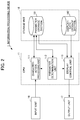
- FIG. 2 is a functional block diagram showing the functional configuration for executing a battle execution process in the functional configuration of the information processing device 1 in FIG. 1 .
- the battle execution process refers to a series of processing steps including a processing step for changing the parameter display mode for each character when a plurality of character groups are engaged in a battle against each other, in accordance with increases and decreases in the number of characters in the battle included in at least one of the character groups.
- the CPU 11 When the battle execution processing is executed, the CPU 11 functions as a character-action processing unit 111 , a parameter determination unit 112 , and a display control unit 113 , as shown in FIG. 2 .
- a parameter storage section 181 and a display-data storage section 182 are set in an area of the storage unit 18 .
- the character-action processing unit 111 is a unit that executes processing for causing ally characters and enemy characters to take actions, where the ally characters are characters that are operated by the player, and the enemy characters are characters that battle against the ally characters.
- the following description will be given in the context of an example where a plurality of characters are included in the ally characters and also a plurality of characters are included in the enemy characters.
- the plurality of ally characters will be collectively referred to, as appropriate, as an “ally character group”.
- the plurality of enemy characters will be collectively referred to, as appropriate, as an “enemy character group”.
- the ally characters and the enemy characters will be referred to as “characters” when no distinction is made therebetween.
- the character-action processing unit 111 causes the ally characters to take actions in accordance with the content of an action instruction based on a player's operation input from the input unit 16 , as well as predetermined conditions. Furthermore, the character-action processing unit 111 causes the enemy characters to take actions alternately with the ally characters.
- a character action refers to, for example, an action involving processing with which a certain character affects another character.
- An example of a character action is an action in which the characters in one of the character groups attack the characters in the other character group, thereby decreasing the hit points or involving a predetermined status abnormality for the characters in the other character group.
- Another example of a character action is an action in which a character in one of the character groups performs a recovery action on the character group to which the character belongs, thereby recovering the hit points or recovering from the predetermined status abnormality for the characters in the character group to which the character belongs.
- the hit points refers to a parameter for determining whether or not to permit participation in a battle, and a character is prohibited from participating in the battle when the hit points for that character become a predetermined value (e.g., less than or equal to zero).
- Hit points refer to a “determination parameter” in the present invention.
- the predetermined status abnormality is invoked, for example, when the value of a parameter relating to the predetermined status abnormality for each character is changed.
- a character for which the status abnormality has been invoked for example, processing for limiting actions by the character or processing for temporarily increasing or decreasing a parameter indicating the defensive ability of the character is executed.
- character actions are only examples, and character actions may be changed, as appropriate, in accordance with the rules of a game to which this embodiment is applied.
- a character in one of the character groups may attack the character group to which the character belongs, or a character in one of the character groups may take a recovery action for a character in the other character group.
- a predetermined value e.g., less than or equal to zero
- this character may be permitted to participate in the battle again by taking a recovery action.
- the character-action processing unit 111 reads the parameters associated with each character, stored in the parameter storage section 181 , and causes the character to take an action, as described above. Furthermore, the character-action processing unit 111 changes the parameters for each character in accordance with the result of an action by that character. Furthermore, the character-action processing unit 111 updates the parameters for each character, stored in the parameter storage section 181 , to the latest values on the basis of the changed parameters.
- hit points is mainly used as an example of a parameter for each character.
- the character-action processing unit 111 also changes parameters other than the hit points (e.g., a parameter for using magic, such as magic points, or a parameter for a character to invoke a predetermined special action (skill)), in accordance with character actions.
- the character-action processing unit 111 also stores these other parameters in the parameter storage section 181 .
- the character-action processing unit 111 also changes these other parameters, as appropriate, to the latest values in accordance with the actions of each character.
- the parameter determination unit 112 is a unit that performs determination based on a parameter.
- the parameter determination unit 112 performs determination on the basis of the value of the hit points, which is one of the parameters. Then, on the basis of the result of the determination, the parameter determination unit 112 issues an instruction for changing the parameter display mode or an instruction for terminating the battle.
- the determination performed by the parameter determination unit 112 will be described later with reference to a flowchart in FIG. 3 .
- the display control unit 113 is a unit that executes control for performing battle-related display on the basis of the latest parameters updated by the character-action processing unit 111 , stored in the parameter storage section 181 , and the display data stored in the display-data storage section 182 .
- Executing control for performing battle-related display refers to, for example, executing control processing for outputting image data for performing display from the output unit 17 and for displaying an image on a display or the like connected to the output unit 17 .
- the display control unit 113 executes control, for example, to display an image and/or text indicating each character engaged in the battle, an image and/or text indicating the parameters for each character, an image and/or text indicating the action status of each character, an image (e.g., an image indicating a value of damage given to the character) and/or text indicating changes in the parameters associated with an action by each character, and an image and/or text indicating various kinds of effects or the like.
- Specific examples of display by the display control unit 113 will be described later with reference to FIG. 4 , etc.
- the parameters displayed as an image correspond to “display target parameters” in the present invention. That is, in this embodiment, the hit points value, which is a determination parameter, is displayed as at least one of the display target parameters.
- the parameter storage section 181 is a section where parameters for each character, such as the hit points and the magic points, are stored, as described earlier. These parameters are updated to the latest values by the character-action processing unit 111 , as described earlier.
- the parameter storage section 181 also stores parameters indicating the abilities of each character.
- the parameters indicating the abilities of each character include parameters indicating the attack ability, defense ability, etc. of each character and parameters indicating magic and skills available for each character.
- the character-action processing calculates the result of an action by each character on the basis of these parameters indicating the abilities of that character, as well as a predetermined formula.
- the character-action processing unit 111 calculates the value of damage or the like given by an attack on the basis of the parameters indicating the abilities of each character, as well as the predetermined formula.
- the display-data storage section 182 is a section where image data for performing display by the display control unit 113 , data indicating the position where the image data is to be laid out, etc. are stored. Although the image data for performing display by the display control unit 113 may be stored only in the display-data storage section 182 , the image data may be read, as appropriate, from the removable medium 100 by the drive 19 .
- FIG. 4 is a flowchart for explaining the flow of the battle execution process executed by the information processing device 1 in FIG. 1 , which has the functional configuration in FIG. 2 .
- the battle execution process is executed when a battle is played between enemy characters and ally characters in a game executed on the information processing device 1 . It is assumed that the battle is played between an ally character group including at least one ally character and an enemy character group including a plurality of enemy characters.
- step S 11 the parameter determination unit 112 stores a first number, which is the number of enemy characters participating in the battle.
- step S 12 the display control unit 113 executes control to display images indicating the individual characters participating in the battle and the parameters for the individual characters on the display connected to the output unit 17 .
- the processing in step S 11 above and this step S 12 corresponds to “preprocessing” in the present invention.
- the processing in the following step S 13 to step S 19 corresponds to “iterative processing” in the present invention.
- step S 13 in iterative processing that is iterated during the battle, the parameter determination unit 112 stores a second number, which is the number of enemy characters determined on the basis of the hit points as participating in the battle.
- step S 14 the character-action processing unit 111 causes an ally character to take an action in accordance with an action instruction input by the player via the input unit 16 or in accordance with a predetermined condition. Furthermore, the character-action processing unit 111 causes the enemy characters to take actions mutually with the ally characters. In step S 14 , there may be cases, depending on the situation in the game, where only either the ally characters or the enemy characters take actions instead of the ally characters and the enemy characters mutually taking actions.
- step S 15 the character-action processing unit 111 changes the parameters for the individual characters, including the hit points, in accordance with the individual actions of the characters. Furthermore, the character-action processing unit 111 updates the parameters stored in the parameter storage section 181 to the latest values on the basis of the changed parameters.
- step S 16 the display control unit 113 executes control to display images indicating the individual characters determined as participating in the battle on the basis of the hit points changed in step S 15 , as well as the parameters for the individual characters, on the display connected to the output unit 17 .
- step S 17 the parameter determination unit 112 determines whether or not a battle termination condition is satisfied.
- the battle termination condition is satisfied when the hit points of each of the characters included in the ally character group or the hit points of each of the characters included in the enemy character group has become a predetermined value (e.g., less than or equal to zero) and thus there is no character that can participate in the battle in one of the character groups.
- the battle termination condition may be satisfied when a predetermined time has elapsed since the start of the battle execution process.
- the battle termination condition may be satisfied when the player has issued a predetermined action instruction (e.g., an instruction for fleeing from the battle).
- the battle termination condition may be satisfied when the player has issued the predetermined action instruction (e.g., an instruction for fleeing from the battle) and the predetermined action (e.g., fleeing from the battle) is successful.
- step S 17 results in Yes, and the battle execution process is terminated. Meanwhile, in the case where the battle termination condition is not satisfied, the determination in step S 17 results in No, and the process proceeds to step S 18 .
- step S 18 the parameter determination unit 112 determines whether or not a condition regarding at least one of the first number and the second number (hereinafter referred to as a “number-of-characters condition”), which is a condition for determining whether or not to change the display mode, is satisfied.
- a condition regarding at least one of the first number and the second number hereinafter referred to as a “number-of-characters condition”
- the number-of-characters condition may be defined arbitrarily; for example, the number-of-characters condition may be one of the following three conditions or a combination of these conditions.
- First condition A change is detected as a result of comparing the first number with the number of enemy characters determined as participating in the battle on the basis of the hit points changed in step S 15 .
- Second condition A change is detected as a result of comparing the second number with the number of enemy characters determined as participating in the battle on the basis of the hit points changed in step S 15 .
- the number of enemy characters determined as participating in the battle on the basis of the hit points changed in step S 15 is a predetermined number.
- step S 18 In the case where the number-of-characters condition is satisfied, the determination in step S 18 results in Yes, and the process proceeds to step S 19 . Meanwhile, in the case where the number-of-characters condition is not satisfied, the determination in step S 18 results in No, and the process proceeds to step S 13 . Then, the processing in and after step S 13 , which is iterative processing, is iterated again.
- step S 19 the display control unit 113 changes the display mode of the parameters, such as the hit points, displayed on the display connected to the output unit 17 . Specific examples of changes in the display mode will be described next with reference to FIG. 4 and other figures. Then, the process proceeds to step S 13 . Then, the processing in and after step S 13 , which is iterative processing, is iterated again.
- the parameter display mode for each character is changed in accordance with increases and decreases in the number of characters in the battle included in at least one of the character groups.
- parameters for each character during a battle can be displayed more suitably compared with ordinary technologies, which do not involve such changes in the display mode.
- FIGS. 4 and 5 are illustrations showing examples of a screen that is displayed on the display connected to the output unit 17 under the control of the display control unit 113 in this embodiment.
- FIG. 4 shows an example of a screen before the display mode is changed.
- a character C 11 , a character C 12 , and a character C 13 which are enemy characters, are displayed on the left side of the screen.
- a character C 21 , a character C 22 , a character C 23 , and a character C 24 which are ally characters, are displayed on the right side of the screen.
- parameters for the individual enemy characters are displayed in an upper portion of the screen.
- parameters P 11 which are parameters for the character C 11
- parameters P 12 which are parameters for the character C 12
- parameters P 13 which are parameters for the character C 13
- the player can proceed with the battle while determining the actions, etc. of the ally characters with reference to the parameters.
- the parameter determination unit 112 issues an instruction to the display control unit 113 so as to change the display mode.
- the display control unit 113 changes the display mode according to this instruction.
- FIG. 5 shows a display example after the display mode is changed.
- the display mode is changed so as to increase the size of the area for displaying the parameters P 13 , which are parameters for the character C 13 , whereby the parameters 13 are displayed in a larger size compared with the example in FIG. 4 . This allows the player to view the parameters P 13 more easily.
- parameters for each character during a battle can be displayed more suitably compared with ordinary technologies, which do not involve such changes in the display mode.
- a display material used to display a parameter (e.g., an image corresponding to a parameter) is switched from a first display material, which is currently being used, to a second display material, which has a size different from the first display material when displayed.
- a parameter e.g., an image corresponding to a parameter
- a second display material which has a size different from the first display material when displayed.
- a display material used to display a parameter is subjected to enlargement processing or reduction processing.
- this second method since there is no need to prepare a plurality of display materials, it is possible to reduce the amount of image data.
- changing the display mode so as to display a parameter in a larger size is just an example of changing the display mode, and it is also possible to change the display mode by using other methods. This will be described later with reference to FIG. 7 .
- FIG. 6 shows a display example in an ordinary technology.
- the hit points of the character C 11 and the character C 12 which are enemy characters, have become a predetermined value (e.g., less than or equal to zero) from the state in FIG. 4 , whereby the characters C 11 and C 12 are prohibited from participating in the battle.
- the display mode is not changed in particular, and the parameters P 13 , which are parameters for the character C 13 , are displayed similarly to the example in FIG. 4 .
- the visibility of the parameters P 13 is lower compared with the display example in FIG. 5 .
- this embodiment it is possible to improve the visibility for the user by changing the display mode, as described earlier. That is, this embodiment exhibits an advantageous effect compared with the ordinary technology.
- Part (A) in FIG. 7 shows an example of parameter display when three enemies appear and a battle is started. That is, part (A) in FIG. 7 shows an example of parameter display before changing the display mode.
- the following description will be given by using the parameters P 13 , which are parameters for the character C 13 , as an example in particular.
- a parameter P 131 indicates the hit points of the character C 13 .
- the parameter P 132 indicates the time before the character C 13 is attacked.
- the parameter P 133 indicates a status abnormality of the character C 13 .
- the number-of-characters condition in this embodiment is satisfied as a result of a change in the number of enemies.
- a determination based on the number-of-characters conditions or a change in the display mode is not performed.
- the display mode of the parameters P 13 is not changed, and the parameter P 131 , the parameter P 132 , and the parameter 133 are displayed similarly to part (A) in FIG. 7 .
- the display mode is changed, as shown in part (C) in FIG. 7 .
- the parameter P 131 is displayed in a larger size by increasing the size of the parameter display area and replacing or otherwise changing the display material.
- the layout of the parameters is also changed so as to move the parameter P 133 from below the parameter P 132 to above the parameter P 131 .
- the number of icons that can be displayed as the parameters P 133 is four at most because of the limited display area in part (A) in FIG. 7
- the number of icons that can be displayed is increased by increasing the size of the display area when changing the display mode.
- eight icons are displayed.
- a greater number of icons may be displayed in the case where the character C 13 has more status abnormalities.
- the kinds of parameters that are displayed may be increased, as well as increasing the number of items (e.g., icons) that are displayed for a certain kind of parameter (e.g., the parameter P 133 ).
- the size of the display area may be increased when changing the display mode so that a new parameter (e.g., a parameter P 134 ) that is not displayed in part (A) in FIG. 7 can be displayed.
- the display mode may be changed from the display state in part (C) in FIG. 7 to that in part (A) in FIG. 7 . That is, the size of parameter display may be decreased or the number of icons may be decreased in accordance with the content of the number-of-characters condition that is satisfied.
- This embodiment is realized in the form of a client-server system in which the functionality of the information processing device 1 in the first embodiment is realized in a form distributed to a player terminal 2 and a server 3 .
- FIG. 8 is a block diagram showing the hardware configuration of the player terminal 2 and the server 3 according to the second embodiment of the present invention.
- reference signs corresponding to the player terminal 2 are given without parentheses attached thereto, and reference signs corresponding to the server 3 are given with parentheses attached thereto.
- the player terminal 2 is configured as a smartphone, a game machine, or a personal computer
- the server 3 is configured as a server device.
- the player terminal 2 includes a CPU 21 , a ROM 22 , a RAM 23 , a bus 24 , an input/output interface 25 , an input unit 26 , an output unit 27 , a storage unit 28 , a communication unit 29 , and a drive 30 .
- the server 3 includes a CPU 31 , a ROM 32 , a RAM 33 , a bus 34 , an input/output interface 35 , an input unit 36 , an output unit 37 , a storage unit 38 , a communication unit 39 , and a drive 40 .
- the communication unit 29 and the communication unit 39 control communication carried out with other devices via a network such as the Internet.
- the player terminal 2 and the server 3 carry out communication with each other by using the communication unit 29 and the communication unit 39 .
- the hardware configuration of the player terminal 2 and the server 3 according to the second embodiment has been described above.
- a plurality of player terminals 2 may exist, and the plurality of player terminals 2 may be connected to the single server 3 . That is, the relationship between the player terminal 2 and the server 3 may be one to one or many to one.
- the functionality of the server 3 is provided in a form distributed to a plurality of server devices, the relationship between the player terminal 2 and the server 3 may be one to many or many to many.
- FIG. 9 is a functional block diagram showing the functional configuration for executing a battle execution process in the functional configuration of the player terminal 2 and the server 3 in FIG. 8 .
- the second embodiment and the third embodiment have the same hardware configuration, but the functional configuration varies between the second embodiment and the third embodiment.
- the second embodiment will be described with “a” appended to each reference sign, like the player terminal 2 a , the CPU 21 a , the storage unit 28 a , the server 3 a , the CPU 31 a , and the storage unit 38 a .
- the third embodiment will be described with “b” appended to each reference sign, like the player terminal 2 b , the CPU 21 b , the storage unit 28 b , the server 3 b , the CPU 31 b , and the storage unit 38 b , as distinguished from the second embodiment.
- the CPU 21 a When the battle execution process is executed, as shown in FIG. 9 , the CPU 21 a functions as a player-operation notification unit 211 , a parameter determination unit 212 , and a display control unit 213 . Furthermore, a display-data storage section 281 is set in an area of the storage unit 28 .
- the CPU 31 a functions as a character-operation processing unit 311 and a parameter notification unit 312 . Furthermore, a parameter storage section 381 is set in an area of the storage unit 38 a.
- the functional blocks other than the player-operation notification unit 211 and the parameter notification unit 312 have functions that are equivalent to the functions of the functional blocks having the same names with different reference signs, included in the information processing device 1 described with reference to FIG. 2 , and thus, repeated descriptions thereof will be omitted.
- the player-operation notification unit 211 is a unit that sends an operation instruction input by the player via the input unit 26 to the character-operation processing unit 311 of the server 3 a via the communication unit 29 .
- the parameter notification unit 312 is a unit that sends the latest values of parameters stored in the parameter storage section 381 to the parameter determination unit 212 and the display control unit 213 of the player terminal 2 a via the communication unit 39 .
- FIG. 10 is a flowchart for explaining the flow of the battle execution process that is executed by the player terminal 2 a and the server 3 a in FIG. 8 , having the functional configuration in FIG. 9 .
- the battle execution process is executed when a battle is played between enemy characters and ally characters in a game that is executed on the player terminal 2 a and the server 3 a . It is assumed that the battle is played between an ally character group including at least one ally character and an enemy character group including a plurality of enemy characters.
- steps having the same content as those in the flowchart in FIG. 3 are designated by the same reference signs (e.g., “S 1 ”). Furthermore, repeated descriptions of the steps having the same content as those in the flowchart in FIG. 3 will be omitted to simplify the description.
- step S 21 the parameter notification unit 312 sends the latest values of the parameters stored in the parameter storage section 381 to the player terminal 2 a via the communication unit 39 .
- step S 11 the parameter determination unit 212 stores a first number.
- step S 21 the display control unit 213 executes control to display images of the individual characters participating in the battle and the parameters for the individual characters.
- step S 13 the parameter determination unit 212 stores a second number.
- step S 22 the player-operation notification unit 211 sends an operation instruction input by the player via the input unit 26 to the server 3 a via the communication unit 29 .
- step S 14 the character-action processing unit 311 causes an ally character to take an action in accordance with the action instruction received from the player terminal 2 a or a predetermined condition. Furthermore, the character-action processing unit 311 causes the enemy characters to take actions mutually with the ally characters.
- step S 15 the character-action processing unit 311 changes the parameters for the individual characters, including the hit points, in accordance with the individual actions of the characters. Furthermore, the character-action processing unit 311 updates the parameters stored in the parameter storage section 381 to the latest values on the basis of the changed parameters.
- step S 23 the parameter notification unit 312 sends the latest values of the parameters stored in the parameter storage section 381 , changed in step S 15 , to the player terminal 2 a via the communication unit 39 .
- step S 16 display control unit 213 executes control to display, on the display connected to the output unit 27 , images indicating the individual parameters determined as participating in the battle on the basis of the hit points changed in step S 15 or the parameters for the individual characters.
- step S 17 the parameter determination unit 212 determines whether or not a battle termination condition is satisfied.
- step S 17 results in Yes, and the battle execution process is terminated. Meanwhile, in the case where the battle termination condition is not satisfied, the determination in step S 17 results in No, and the process proceeds to step S 18 .
- step S 18 the parameter determination unit 212 determines whether a number-of-characters condition is satisfied.
- step S 18 In the case where the number-of-characters condition is satisfied, the determination in step S 18 results in Yes, and the process proceeds to step S 19 . Meanwhile, in the case where the number-of-characters condition is not satisfied, the determination in step S 18 results in No, and the process proceeds to step S 13 . Then, the processing in and after step S 13 , which is iterative processing, is iterated again.
- step S 19 display control unit 213 changes the display mode of the parameters, such as the hit points, displayed on the display connected to the output unit 27 . Then, the process proceeds to step S 13 . Then, the processing in and after step S 13 , which is iterative processing, is iterated again.
- the parameter display mode for each character is changed in accordance with increases or decreases in the number of characters in the battle included in at least one of the character groups.
- parameters for each character during a battle can be displayed more suitably compared with ordinary technologies, which do not involve such changes in the display mode.
- This embodiment is realized in the form of a client-server system in which the functionality of the information processing device 1 in the first embodiment is realized in a form distributed to the player terminal 2 and the server 3 .
- the functionality of the information processing device 1 in the first embodiment is realized in a form distributed to the player terminal 2 and the server 3 .
- more functions are realized by the server 3 b compared with the second embodiment.
- FIG. 11 is a functional block diagram showing the functional configuration for executing a battle execution process in the functional configuration of the player terminal 2 and the server 3 in FIG. 8 .
- the CPU 21 b functions as a player-operation notification unit 211 and a player-terminal-side display control unit 214 .
- the CPU 31 b functions as a character-action processing unit 311 , a parameter determination unit 313 , and a server-side display control unit 314 . Furthermore, a parameter storage section 381 and a display-data storage section 382 are set in an area of the storage unit 38 b.
- the functional blocks other than the player-operation notification unit 211 , the player-terminal-side display control unit 214 , and the server-side display control unit 314 , as well as the individual storage units, have functions that are equivalent to the functions of the functional blocks having the same names with different reference signs, included in the information processing device 1 described with reference to FIG. 2 , and thus, repeated descriptions thereof will be omitted.
- the player-operation notification unit 211 is a unit that sends an action instruction input by the player via the input unit 26 to the character-action processing unit 311 of the server 3 b via the communication unit 29 .
- the server-side display control unit 314 and the player-terminal-side display control unit 214 are parts that cooperate with each other to realize display control similarly to the display control unit 113 . Specifically, the server-side display control unit 314 generates image data for performing display on the display connected to the output unit 27 on the basis of the latest values of the parameters stored in the parameter storage section 381 and the display data stored in the display-data storage section. Then, the server-side display control unit 314 sends the generated image data to the server 3 b via the communication unit 29 .
- the player-terminal-side display control unit 214 receives this image data and executes control for performing display on the display connected to the output unit 27 .
- FIG. 12 is a flowchart for explaining the flow of the battle execution process that is executed by the player terminal 2 b and the server 3 b in FIG. 8 , having the functional configuration in FIG. 11 .
- the battle execution process is executed when a battle is played between enemy characters and ally characters in a game that is executed on the player terminal 2 b and the server 3 b . It is assumed that the battle is played between an ally character group including at least one ally character and an enemy character group including a plurality of enemy characters.
- steps having the same content as those in the flowchart in FIG. 3 are designated by the same reference signs (e.g., “S 1 ”). Furthermore, repeated descriptions of the steps having the same content as those in the flowchart in FIG. 3 will be omitted to simplify the description.
- step S 11 the parameter determination unit 313 stores a first number.
- step S 31 the server-side display control unit 314 generates image data for performing display on the display connected to the output unit 27 on the basis of the latest values of the parameters stored in the parameter storage section 381 and the display data stored in the display-data storage section 382 . Then, the server-side display control unit 314 sends the generated image data to the server 3 b via the communication unit 29 .
- step S 12 the player-terminal-side display control unit 214 executes control to display images indicating the individual characters or the parameters for the individual characters on the display connected to the output unit 27 on the basis of the image data received from the server-side display control unit 314 .
- step S 13 the parameter determination unit 313 stores a second number.
- step S 32 the player-operation notification unit 211 sends an action instruction input by the player via the input unit 26 to the server 3 b via the communication unit 29 .
- step S 14 the character-action processing unit 311 causes an ally character to take an action in accordance with the action instruction received from the player terminal 2 b or a predetermined condition. Furthermore, the character-action processing unit 311 causes the enemy characters to take actions mutually with the ally characters.
- step S 15 the character-action processing unit 311 changes the parameters for the individual characters, including the hit points, in accordance with the individual actions of the characters. Furthermore, the character-action processing unit 311 updates the latest values of the parameters stored in the parameter storage section 381 on the basis of the changed parameters.
- step S 33 the server-side display control unit 314 generates image data for performing display on the display connected to the output unit 27 on the basis of the latest values of the parameters stored in the parameter storage section 381 , updated in step S 15 , and the display data stored in the display data storage section 382 . Then, the server-side display control unit 314 sends the generated image data to the server 3 b via the communication unit 29 .
- step S 16 the player-terminal-side display control unit 214 executes control to display images indicating the individual characters and the parameters for the individual characters on the display connected to the output unit 27 on the basis of the image data received from the server-side display control unit 314 .
- step S 17 the parameter determination unit 313 determines whether or not a battle termination condition is satisfied.
- step S 17 results in Yes, and the battle execution process is terminated. Meanwhile, in the case where the battle termination condition is not satisfied, the determination in step S 17 results in No, and the process proceeds to step S 18 .
- step S 18 the parameter determination unit 313 determines whether or not a number-of-characters condition is satisfied.
- step S 18 In the case where the number-of-characters condition is satisfied, the determination in step S 18 results in Yes, and the process proceeds to step S 33 . Meanwhile, in the case where the number-of-characters condition is not satisfied, the determination in step S 18 results in No, and the process proceeds to step S 13 . Then, the processing in and after step S 13 , which is iterative processing, is iterated again.
- step S 33 the server-side display control unit 314 generates image data for changing the display mode of the parameters displayed on the display connected to the output unit 27 , such as the hit points. Then, the server-side display control unit 314 sends the generated image data to the server 3 b via the communication unit 29 .
- step S 19 the player-terminal-side display control unit 214 receives this image data and executes control to perform display on the display connected to the output unit 27 .
- step S 13 the processing in and after step S 13 , which is iterative processing, is iterated again.
- the parameter display mode for each character is changed in accordance with increases or decreases in the number of characters in the battle included in at least one of the character groups.
- parameters for each character during a battle can be displayed more suitably compared with ordinary technologies, which do not involve such changes in the display mode.
- the present invention is widely applicable to information processing devices that output various kinds of information, such as parameters, in a form that is recognizable by a player.
- the information processing device 1 or the player terminal 2 to which the present invention is applied is a game machine or a smartphone
- the present invention is applicable to electronic appliances having information processing functions in general.
- FIGS. 2, 9, and 11 are only examples, and there is no particular limitation thereto. That is, it suffices to provide the information processing device 1 , the player terminal 2 , or the server 3 with functions that make it possible to execute the series of processing steps described above as a whole, and the choice of specific functional blocks for realizing those functions is not limited to that in the examples in FIGS. 2, 9 , and 11 .
- each functional block may be implemented by hardware alone, by software alone, or by a combination of hardware and software.
- processors that can be used in the embodiments include a processor constituted of only an information processing device of various kinds, such as a single processor, a multiprocessor, or a multicore processor, as well as a combination of one of these various kinds of processing device and a processing circuit such as an application specific integrated circuit (ASIC) or a field-programmable gate array (FPGA).
- ASIC application specific integrated circuit
- FPGA field-programmable gate array
- a program constituting the software is installed in a computer or the like from a network or a recording medium.
- the computer may be a computer embedded in special hardware.
- the computer may be a computer that is capable of executing various functions when various programs are installed therein, such as a general-purpose personal computer.
- a recording medium including such a program is implemented by the removable medium 100 in FIG. 1 or FIG. 8 , which is distributed separately from the main unit of a device in order to provide the player with the program, or is implemented by a recording medium or the like that is provided to a player in a state embedded in advance in the main unit of a device.
- the removable medium 100 is implemented, for example, by a magnetic disk (including a floppy disk), an optical disk, or a magneto-optical disk.
- the optical disk is implemented, for example, by a compact disk-read only memory (CD-ROM), a digital versatile disk (DVD), or a Blu-ray (registered trademark) disc.
- the magneto-optical disk is implemented, for example, by a mini-disk (MD).
- the recording medium that is provided to a player in a state embedded in advance in the main unit of a device is implemented, for example, by the ROM 12 in FIG. 1 , in which a program is recorded, or a semiconductor memory included in the storage unit 18 in FIG. 1 .
- steps defining the program recorded in the recording medium may include processing that is not necessarily executed sequentially but is executed in parallel or individually, as well as processing that is executed sequentially in order. Furthermore, steps that are executed according to the program recorded in the recording medium may be executed in an arbitrary order within a scope not departing from the spirit of the present invention.
- three conditions namely, the first condition, the second condition, and the third condition, described earlier, are given as examples of a number-of-characters condition, and it is described that these conditions may be combined; however, there is no limitation thereto.
- the third condition described earlier is easily satisfied, and thus, changes in the display mode frequently occur if the third condition is used as a number-of-characters condition.
- the third condition is used as a number-of-characters condition.
- a connection for communication fails because of congestion of the circuit between the player terminal 2 and the server 3 or a failure of the player terminal 2 to suitably send and receive radio waves for communication.
- the player terminal 2 may attempt to reconnect to the server 3 (reloading) automatically or in response to a player's operation.
- the iterative processing starting from step S 13 may be executed again after the reconnection.
- determination should be performed by using the second condition, which is a condition involving the first number, as a number-of-characters condition instead of using the first condition, which is a condition involving the second number, as a number-of-characters condition.
- step S 18 and step S 19 may be performed before executing step S 13 at the time of reconnection.
- the display mode for displaying the parameters for enemy characters is changed in the embodiments described above, the invention is not limited thereto, the display mode for displaying the parameters for ally characters may be changed. Furthermore, the display modes for displaying the parameters for both enemy characters and ally characters may be changed.
Landscapes
- Engineering & Computer Science (AREA)
- Multimedia (AREA)
- Theoretical Computer Science (AREA)
- Human Computer Interaction (AREA)
- Physics & Mathematics (AREA)
- Optics & Photonics (AREA)
- Processing Or Creating Images (AREA)
- User Interface Of Digital Computer (AREA)
Abstract
Description
-
- Japanese Unexamined Patent Application, Publication No. 2005-6992
- Japanese Unexamined Patent Application, Publication No. 2015-54220
- 1 Information processing device
- 2 Player terminal
- 3 Server
- 11, 21, 31 CPU
- 12, 22, 32 ROM
- 13, 23, 33 RAM
- 14, 24, 34 Bus
- 15, 25, 35 Input/output interface
- 16, 26, 36 Input unit
- 17, 27, 37 Output unit
- 18, 28, 38 Storage unit
- 29, 39 Communication unit
- 19, 30, 40 Drive
- 100 Removable medium
- 111, 311 Character-action processing unit
- 112, 212, 313 Parameter determination unit
- 113, 213 Display control unit
- 181, 381 Parameter storage section
- 182, 281, 382 Display-data storage section
- 211 Player-operation notification unit
- 214 Player-terminal-side display control unit
- 312 Parameter notification unit
- 314 Server-side display control unit
Claims (9)
Applications Claiming Priority (4)
| Application Number | Priority Date | Filing Date | Title |
|---|---|---|---|
| JP2017207871A JP6333457B1 (en) | 2017-10-27 | 2017-10-27 | Information processing program, information processing system, and server |
| JPJP2017-207871 | 2017-10-27 | ||
| JP2017-207871 | 2017-10-27 | ||
| PCT/JP2018/039023 WO2019082813A1 (en) | 2017-10-27 | 2018-10-19 | Information processing program, information processing system and server |
Related Parent Applications (1)
| Application Number | Title | Priority Date | Filing Date |
|---|---|---|---|
| PCT/JP2018/039023 Continuation WO2019082813A1 (en) | 2017-10-27 | 2018-10-19 | Information processing program, information processing system and server |
Publications (2)
| Publication Number | Publication Date |
|---|---|
| US20200246708A1 US20200246708A1 (en) | 2020-08-06 |
| US11219836B2 true US11219836B2 (en) | 2022-01-11 |
Family
ID=62238891
Family Applications (1)
| Application Number | Title | Priority Date | Filing Date |
|---|---|---|---|
| US16/857,684 Active US11219836B2 (en) | 2017-10-27 | 2020-04-24 | Information processing program, information processing system, and server for displaying parameters for a game battle |
Country Status (3)
| Country | Link |
|---|---|
| US (1) | US11219836B2 (en) |
| JP (1) | JP6333457B1 (en) |
| WO (1) | WO2019082813A1 (en) |
Citations (22)
| Publication number | Priority date | Publication date | Assignee | Title |
|---|---|---|---|---|
| US6336861B1 (en) * | 1998-10-02 | 2002-01-08 | Namco, Ltd. | Game machine and information storage medium |
| US20040209684A1 (en) * | 2002-10-15 | 2004-10-21 | Namco Ltd. | Method of controlling game system, program, information storage medium and game system |
| JP2004351229A (en) | 2004-09-07 | 2004-12-16 | Sega Corp | Image display method, computer game processing method, and recording medium |
| JP2005006992A (en) | 2003-06-19 | 2005-01-13 | Aruze Corp | GAME DEVICE, GAME PROGRAM, AND RECORDING MEDIUM CONTAINING THE GAME PROGRAM |
| JP2005034208A (en) | 2003-07-15 | 2005-02-10 | Namco Ltd | GAME DEVICE, GAME CONTROL PROGRAM, AND RECORDING MEDIUM CONTAINING THE PROGRAM |
| US20050054402A1 (en) * | 2003-07-17 | 2005-03-10 | Namco Ltd. | Game apparatus, game control method and recording medium storing program for executing the method |
| US20070026944A1 (en) * | 2005-07-28 | 2007-02-01 | Kabushiki Kaisha Square Enix (Also Trading As Square Enix Co., Ltd.) | A video game processing apparatus, a method and a computer program product for processing a video game |
| US20070076015A1 (en) * | 2005-10-04 | 2007-04-05 | Nintendo Co., Ltd. | Video game program and video game device |
| JP2008073254A (en) | 2006-09-21 | 2008-04-03 | Square Enix Co Ltd | Video game apparatus, video game progress method and program |
| US20080119268A1 (en) * | 2006-11-16 | 2008-05-22 | Kabushiki Kaisha Square Enix (Also Trading As Square Enix Co., Ltd.) | Video game processing apparatus, a method and a computer program product for processing a video game |
| US20080211686A1 (en) * | 2005-03-03 | 2008-09-04 | Konami Digital Entertainment Co., Ltd. | Message Image Display Device, Message Image Display Device Control Method, and Information Recording Medium |
| US20090102975A1 (en) * | 2005-03-14 | 2009-04-23 | Hiroaki Arai | Message image display device, message image display device control method, and information storage medium |
| US20090305758A1 (en) * | 2008-06-05 | 2009-12-10 | Kabushiki Kaisha Square Enix (Also Trading As Square Enix Co., Ltd.) | Game apparatus and program |
| US7887403B2 (en) * | 2005-10-14 | 2011-02-15 | Sony Computer Entertainment Inc. | Method and system for controlling a game involving battles |
| US20110124415A1 (en) * | 2009-11-25 | 2011-05-26 | Namco Bandai Games Inc. | Item management method and server system |
| US8105162B2 (en) * | 2008-09-11 | 2012-01-31 | Kabushiki Kaisha Square Enix | Video game processing apparatus, method and computer program product for controlling progress of a video game |
| US20130165194A1 (en) * | 2011-12-22 | 2013-06-27 | Konami Digital Entertainment Co., Ltd. | Game device, method of controlling a game device, and information storage medium |
| US20130288789A1 (en) * | 2012-04-26 | 2013-10-31 | Nintendo Co., Ltd. | Game system, game processing method, computer-readable storage medium having stored therein game program, and game apparatus |
| JP2015054220A (en) | 2013-09-13 | 2015-03-23 | 株式会社バンダイナムコゲームス | Program and game system |
| JP2016135212A (en) | 2015-01-23 | 2016-07-28 | 株式会社コナミデジタルエンタテインメント | GAME DEVICE AND GAME CONTROL PROGRAM |
| US20180161674A1 (en) * | 2015-06-11 | 2018-06-14 | Bandai Namco Entertainment Inc. | Terminal device |
| US10463966B2 (en) * | 2016-03-16 | 2019-11-05 | Bandai Namco Entertainment Inc. | Game device, processing method, and information storage medium |
-
2017
- 2017-10-27 JP JP2017207871A patent/JP6333457B1/en active Active
-
2018
- 2018-10-19 WO PCT/JP2018/039023 patent/WO2019082813A1/en not_active Ceased
-
2020
- 2020-04-24 US US16/857,684 patent/US11219836B2/en active Active
Patent Citations (23)
| Publication number | Priority date | Publication date | Assignee | Title |
|---|---|---|---|---|
| US6336861B1 (en) * | 1998-10-02 | 2002-01-08 | Namco, Ltd. | Game machine and information storage medium |
| US20040209684A1 (en) * | 2002-10-15 | 2004-10-21 | Namco Ltd. | Method of controlling game system, program, information storage medium and game system |
| JP2005006992A (en) | 2003-06-19 | 2005-01-13 | Aruze Corp | GAME DEVICE, GAME PROGRAM, AND RECORDING MEDIUM CONTAINING THE GAME PROGRAM |
| JP2005034208A (en) | 2003-07-15 | 2005-02-10 | Namco Ltd | GAME DEVICE, GAME CONTROL PROGRAM, AND RECORDING MEDIUM CONTAINING THE PROGRAM |
| US20050054402A1 (en) * | 2003-07-17 | 2005-03-10 | Namco Ltd. | Game apparatus, game control method and recording medium storing program for executing the method |
| JP2004351229A (en) | 2004-09-07 | 2004-12-16 | Sega Corp | Image display method, computer game processing method, and recording medium |
| US20080211686A1 (en) * | 2005-03-03 | 2008-09-04 | Konami Digital Entertainment Co., Ltd. | Message Image Display Device, Message Image Display Device Control Method, and Information Recording Medium |
| US20090102975A1 (en) * | 2005-03-14 | 2009-04-23 | Hiroaki Arai | Message image display device, message image display device control method, and information storage medium |
| US20070026944A1 (en) * | 2005-07-28 | 2007-02-01 | Kabushiki Kaisha Square Enix (Also Trading As Square Enix Co., Ltd.) | A video game processing apparatus, a method and a computer program product for processing a video game |
| US20070076015A1 (en) * | 2005-10-04 | 2007-04-05 | Nintendo Co., Ltd. | Video game program and video game device |
| US7887403B2 (en) * | 2005-10-14 | 2011-02-15 | Sony Computer Entertainment Inc. | Method and system for controlling a game involving battles |
| JP2008073254A (en) | 2006-09-21 | 2008-04-03 | Square Enix Co Ltd | Video game apparatus, video game progress method and program |
| US20080254849A1 (en) * | 2006-09-21 | 2008-10-16 | Kabushiki Kaisha Square Enix (Also Trading As Square Enix Co., Ltd.) | Video game device, video game implementation method and program |
| US20080119268A1 (en) * | 2006-11-16 | 2008-05-22 | Kabushiki Kaisha Square Enix (Also Trading As Square Enix Co., Ltd.) | Video game processing apparatus, a method and a computer program product for processing a video game |
| US20090305758A1 (en) * | 2008-06-05 | 2009-12-10 | Kabushiki Kaisha Square Enix (Also Trading As Square Enix Co., Ltd.) | Game apparatus and program |
| US8105162B2 (en) * | 2008-09-11 | 2012-01-31 | Kabushiki Kaisha Square Enix | Video game processing apparatus, method and computer program product for controlling progress of a video game |
| US20110124415A1 (en) * | 2009-11-25 | 2011-05-26 | Namco Bandai Games Inc. | Item management method and server system |
| US20130165194A1 (en) * | 2011-12-22 | 2013-06-27 | Konami Digital Entertainment Co., Ltd. | Game device, method of controlling a game device, and information storage medium |
| US20130288789A1 (en) * | 2012-04-26 | 2013-10-31 | Nintendo Co., Ltd. | Game system, game processing method, computer-readable storage medium having stored therein game program, and game apparatus |
| JP2015054220A (en) | 2013-09-13 | 2015-03-23 | 株式会社バンダイナムコゲームス | Program and game system |
| JP2016135212A (en) | 2015-01-23 | 2016-07-28 | 株式会社コナミデジタルエンタテインメント | GAME DEVICE AND GAME CONTROL PROGRAM |
| US20180161674A1 (en) * | 2015-06-11 | 2018-06-14 | Bandai Namco Entertainment Inc. | Terminal device |
| US10463966B2 (en) * | 2016-03-16 | 2019-11-05 | Bandai Namco Entertainment Inc. | Game device, processing method, and information storage medium |
Non-Patent Citations (3)
| Title |
|---|
| International Search Report issued in Application No. PCT/JP2018/039023, dated Dec. 11, 2018 (4 pages). |
| Notification of Reasons for Refusal issued in Japanese Application No. 2017-207871, dated Dec. 19, 2017 (2 pages). |
| Written Opinion issued in International Application No. PCT/JP2018/039023, dated Dec. 11, 2018 (4 pages). |
Also Published As
| Publication number | Publication date |
|---|---|
| JP2019076653A (en) | 2019-05-23 |
| WO2019082813A1 (en) | 2019-05-02 |
| JP6333457B1 (en) | 2018-05-30 |
| US20200246708A1 (en) | 2020-08-06 |
Similar Documents
| Publication | Publication Date | Title |
|---|---|---|
| US8790172B2 (en) | Game providing apparatus and recording medium | |
| KR101514164B1 (en) | Video game processing device and video game processing program | |
| US12208330B2 (en) | Information processing program, information processing method, and information processing device for avoidance operations based on different attacks | |
| US20200070049A1 (en) | Gaming system and method for attack targeted at coordinates | |
| JP2015054220A (en) | Program and game system | |
| CN112221148B (en) | Game skill release state synchronization method, server and readable storage medium | |
| EP4061499A1 (en) | Server-based generation of a help map in a video game | |
| JP5480944B2 (en) | Video game processing apparatus and video game processing program | |
| US11219836B2 (en) | Information processing program, information processing system, and server for displaying parameters for a game battle | |
| JP2014027975A (en) | Program, information storage medium, game device, and server | |
| JP6412667B1 (en) | Server, method, and program for providing game | |
| JP2017038992A (en) | Program, game device and server | |
| US20250073592A1 (en) | Program, information processing apparatus, method and system | |
| US12251633B2 (en) | Program, server, method, and system for increasing predictability of enemy next action | |
| CN116032988B (en) | A method, device, electronic device and storage medium for synchronizing location information | |
| JP6373521B1 (en) | Information processing program, information processing system, and server | |
| JP6053545B2 (en) | Program, game device, and server | |
| JP6570726B1 (en) | Program, information processing apparatus and control method | |
| JP7236232B2 (en) | Program, information processing method, and information processing apparatus | |
| CN111359212A (en) | Game object control and model training method and device | |
| CN110841283A (en) | Game role control method and device, terminal device and storage medium | |
| JP6940560B2 (en) | Programs, information processing devices and control methods | |
| CN121243775A (en) | Game copy information processing method, electronic device and readable storage medium | |
| JP2026041177A (en) | Information processing program, information processing method, and information processing device | |
| JP2024077713A (en) | Program and information processing system |
Legal Events
| Date | Code | Title | Description |
|---|---|---|---|
| FEPP | Fee payment procedure |
Free format text: ENTITY STATUS SET TO UNDISCOUNTED (ORIGINAL EVENT CODE: BIG.); ENTITY STATUS OF PATENT OWNER: LARGE ENTITY |
|
| STPP | Information on status: patent application and granting procedure in general |
Free format text: APPLICATION DISPATCHED FROM PREEXAM, NOT YET DOCKETED |
|
| STPP | Information on status: patent application and granting procedure in general |
Free format text: DOCKETED NEW CASE - READY FOR EXAMINATION |
|
| STPP | Information on status: patent application and granting procedure in general |
Free format text: NON FINAL ACTION MAILED |
|
| STPP | Information on status: patent application and granting procedure in general |
Free format text: RESPONSE TO NON-FINAL OFFICE ACTION ENTERED AND FORWARDED TO EXAMINER |
|
| STPP | Information on status: patent application and granting procedure in general |
Free format text: NOTICE OF ALLOWANCE MAILED -- APPLICATION RECEIVED IN OFFICE OF PUBLICATIONS |
|
| AS | Assignment |
Owner name: CYGAMES, INC., JAPAN Free format text: ASSIGNMENT OF ASSIGNORS INTEREST;ASSIGNORS:NAKAJIMA, SATOSHI;FUKUHARA, TETSUYA;MATSUDA, KUNIHIKO;REEL/FRAME:057996/0078 Effective date: 20211026 |
|
| STPP | Information on status: patent application and granting procedure in general |
Free format text: PUBLICATIONS -- ISSUE FEE PAYMENT VERIFIED |
|
| STCF | Information on status: patent grant |
Free format text: PATENTED CASE |
|
| MAFP | Maintenance fee payment |
Free format text: PAYMENT OF MAINTENANCE FEE, 4TH YEAR, LARGE ENTITY (ORIGINAL EVENT CODE: M1551); ENTITY STATUS OF PATENT OWNER: LARGE ENTITY Year of fee payment: 4 |