US11160870B2 - Extended release microparticles and suspensions thereof for medical therapy - Google Patents
Extended release microparticles and suspensions thereof for medical therapy Download PDFInfo
- Publication number
- US11160870B2 US11160870B2 US15/976,847 US201815976847A US11160870B2 US 11160870 B2 US11160870 B2 US 11160870B2 US 201815976847 A US201815976847 A US 201815976847A US 11160870 B2 US11160870 B2 US 11160870B2
- Authority
- US
- United States
- Prior art keywords
- microparticle
- plga
- microparticles
- solid aggregating
- acid
- Prior art date
- Legal status (The legal status is an assumption and is not a legal conclusion. Google has not performed a legal analysis and makes no representation as to the accuracy of the status listed.)
- Expired - Fee Related
Links
- 0 *CCC[C@@H]1[C@@H](C/C=C\CCCC(C)=O)[C@@H]([1*]O)C[C@H]1[2*]O Chemical compound *CCC[C@@H]1[C@@H](C/C=C\CCCC(C)=O)[C@@H]([1*]O)C[C@H]1[2*]O 0.000 description 151
- AQRUXQNIYIESSE-NRPADANISA-N CCN[C@H]1C[C@H](C)S(=O)(=O)C2=C1C=C(S(=O)(=O)NC(=O)[C@H](C)O)S2 Chemical compound CCN[C@H]1C[C@H](C)S(=O)(=O)C2=C1C=C(S(=O)(=O)NC(=O)[C@H](C)O)S2 AQRUXQNIYIESSE-NRPADANISA-N 0.000 description 8
- QHEZSYAZOCXSBH-GJZGRUSLSA-N O=C(O)/C=C\C(=O)O.[H]N(C[C@@H](COC1=NSN=C1N1CCOCC1)OC(=O)[C@H](C)OC(=O)CCC)C(C)(C)C Chemical compound O=C(O)/C=C\C(=O)O.[H]N(C[C@@H](COC1=NSN=C1N1CCOCC1)OC(=O)[C@H](C)OC(=O)CCC)C(C)(C)C QHEZSYAZOCXSBH-GJZGRUSLSA-N 0.000 description 8
- KJIKLUHBAXJMDN-ZPOZCXQZSA-N CCNC(=O)CCC/C=C\C[C@H]1[C@@H](OC(=O)[C@H](C)OC(C)=O)C[C@@H](OC(=O)[C@H](C)OC(C)=O)[C@@H]1/C=C/[C@H](CCC1=CC=CC=C1)OC(=O)[C@H](C)OC(C)=O Chemical compound CCNC(=O)CCC/C=C\C[C@H]1[C@@H](OC(=O)[C@H](C)OC(C)=O)C[C@@H](OC(=O)[C@H](C)OC(C)=O)[C@@H]1/C=C/[C@H](CCC1=CC=CC=C1)OC(=O)[C@H](C)OC(C)=O KJIKLUHBAXJMDN-ZPOZCXQZSA-N 0.000 description 5
- SAOOKEGBMBAOCY-JQWIXIFHSA-N CCN[C@H]1CN(CCCOC)S(=O)(=O)C2=C1C=C(S(=O)(=O)NC(=O)[C@H](C)O)S2 Chemical compound CCN[C@H]1CN(CCCOC)S(=O)(=O)C2=C1C=C(S(=O)(=O)NC(=O)[C@H](C)O)S2 SAOOKEGBMBAOCY-JQWIXIFHSA-N 0.000 description 5
- MLLUWJOGMCUTSH-CROJHUNRSA-N CC(=O)O[C@@H](C)C(=O)OC(CCC1=CC=CC=C1)CCC1C(OC(=O)[C@H](C)OC(C)=O)CC(OC(=O)[C@H](C)OC(C)=O)C1C/C=C\CCCC(=O)OC(C)C Chemical compound CC(=O)O[C@@H](C)C(=O)OC(CCC1=CC=CC=C1)CCC1C(OC(=O)[C@H](C)OC(C)=O)CC(OC(=O)[C@H](C)OC(C)=O)C1C/C=C\CCCC(=O)OC(C)C MLLUWJOGMCUTSH-CROJHUNRSA-N 0.000 description 4
- INKBOTXQCWXWAR-XESZTULISA-N CCN(CC)CCNC(=O)C1=C(C)NC(/C=C2\C(=O)NC3=CC=C(OC(=O)[C@H](C)OC(C)=O)C=C32)=C1C Chemical compound CCN(CC)CCNC(=O)C1=C(C)NC(/C=C2\C(=O)NC3=CC=C(OC(=O)[C@H](C)OC(C)=O)C=C32)=C1C INKBOTXQCWXWAR-XESZTULISA-N 0.000 description 4
- VXFYMAREJVGMJA-FZMZJTMJSA-N CCN[C@H]1CN(CCCOC)S(=O)(=O)C2=C1C=C(S(=O)(=O)NC(=O)[C@H](C)OC(C)=O)S2 Chemical compound CCN[C@H]1CN(CCCOC)S(=O)(=O)C2=C1C=C(S(=O)(=O)NC(=O)[C@H](C)OC(C)=O)S2 VXFYMAREJVGMJA-FZMZJTMJSA-N 0.000 description 4
- NLKVVTOVCBALKX-AUTRQRHGSA-N CCN[C@H]1C[C@H](C)S(=O)(=O)C2=C1C=C(S(=O)(=O)NC(=O)[C@H](C)OC(C)=O)S2 Chemical compound CCN[C@H]1C[C@H](C)S(=O)(=O)C2=C1C=C(S(=O)(=O)NC(=O)[C@H](C)OC(C)=O)S2 NLKVVTOVCBALKX-AUTRQRHGSA-N 0.000 description 4
- PKDIBGOQYKSZTB-SREVYHEPSA-N CCOC(=O)/C=C\C(=O)C(C)(C)C Chemical compound CCOC(=O)/C=C\C(=O)C(C)(C)C PKDIBGOQYKSZTB-SREVYHEPSA-N 0.000 description 4
- YJZPIJZRGNDMHO-AFNCTOJWSA-N CCOC(=O)/C=C\C(=O)O[C@@H](CNC(C)(C)C)COC1=NSN=C1N1CCOCC1.O=C(O)/C=C\C(=O)O Chemical compound CCOC(=O)/C=C\C(=O)O[C@@H](CNC(C)(C)C)COC1=NSN=C1N1CCOCC1.O=C(O)/C=C\C(=O)O YJZPIJZRGNDMHO-AFNCTOJWSA-N 0.000 description 4
- WXQPDADLQJVTNJ-XUXIUFHCSA-N C[C@H](O)C(=O)O[C@@H](C)C(=O)O[C@@H](C)C(=O)O[C@@H](C)C(=O)N1CCN=C1NC1=CC=C2N=CC=NC2=C1Br Chemical compound C[C@H](O)C(=O)O[C@@H](C)C(=O)O[C@@H](C)C(=O)O[C@@H](C)C(=O)N1CCN=C1NC1=CC=C2N=CC=NC2=C1Br WXQPDADLQJVTNJ-XUXIUFHCSA-N 0.000 description 4
- XKPFDEBNIBBQSC-UHFFFAOYSA-N C=C(CC)C(=O)C1=C(Cl)C(Cl)=C(OCC(=O)OC(C)C(=O)OC(C)C(=O)OC(C)C(=O)OC(C)C(=O)N2CCN=C2NC2=C(Br)C3=C(C=C2)N=CC=N3)C=C1 Chemical compound C=C(CC)C(=O)C1=C(Cl)C(Cl)=C(OCC(=O)OC(C)C(=O)OC(C)C(=O)OC(C)C(=O)OC(C)C(=O)N2CCN=C2NC2=C(Br)C3=C(C=C2)N=CC=N3)C=C1 XKPFDEBNIBBQSC-UHFFFAOYSA-N 0.000 description 3
- XKPFDEBNIBBQSC-TUFLPTIASA-N C=C(CC)C(=O)C1=C(Cl)C(Cl)=C(OCC(=O)O[C@@H](C)C(=O)O[C@@H](C)C(=O)O[C@@H](C)C(=O)O[C@@H](C)C(=O)N2CCN=C2NC2=C(Br)C3=C(C=C2)N=CC=N3)C=C1 Chemical compound C=C(CC)C(=O)C1=C(Cl)C(Cl)=C(OCC(=O)O[C@@H](C)C(=O)O[C@@H](C)C(=O)O[C@@H](C)C(=O)O[C@@H](C)C(=O)N2CCN=C2NC2=C(Br)C3=C(C=C2)N=CC=N3)C=C1 XKPFDEBNIBBQSC-TUFLPTIASA-N 0.000 description 3
- ONDGKDDNXANFTJ-NPCPNIGUSA-N CC(=O)/C=C/C(=O)OC(C)C(=O)C(C)(C)C.CC(=O)C(C)OC(=O)/C=C/C(=O)C(C)(C)C.CC(=O)C(C)OC(=O)/C=C\C(=O)C(C)(C)C.CC(C)(C)C(=O)CCC(=O)O.CCOC(=O)/C=C/C(=O)C(C)(C)C.CCOC(=O)/C=C\C(=O)C(C)(C)C.CCOC(=O)CC(=O)C(C)(C)C.CCOC(=O)CCC(=O)C(C)(C)C.CCOC(=O)CCC(=O)C(C)(C)C Chemical compound CC(=O)/C=C/C(=O)OC(C)C(=O)C(C)(C)C.CC(=O)C(C)OC(=O)/C=C/C(=O)C(C)(C)C.CC(=O)C(C)OC(=O)/C=C\C(=O)C(C)(C)C.CC(C)(C)C(=O)CCC(=O)O.CCOC(=O)/C=C/C(=O)C(C)(C)C.CCOC(=O)/C=C\C(=O)C(C)(C)C.CCOC(=O)CC(=O)C(C)(C)C.CCOC(=O)CCC(=O)C(C)(C)C.CCOC(=O)CCC(=O)C(C)(C)C ONDGKDDNXANFTJ-NPCPNIGUSA-N 0.000 description 3
- PUXHGLSFWCDZCS-TVKQRKNISA-N CC(=O)OC(C)C(=O)OC(C)C(=O)OC(C)C(=O)OC(C)C(=O)N1CCN(C(C)=O)/C1=N\C1=CC=C2N=CC=NC2=C1Br Chemical compound CC(=O)OC(C)C(=O)OC(C)C(=O)OC(C)C(=O)OC(C)C(=O)N1CCN(C(C)=O)/C1=N\C1=CC=C2N=CC=NC2=C1Br PUXHGLSFWCDZCS-TVKQRKNISA-N 0.000 description 3
- FFVYTHNRHPBOHG-UHFFFAOYSA-N CC(=O)OC(C)C(=O)OC(C)C(=O)OC(C)C(=O)OC(C)C(=O)OC(C)C(=O)OC(C)C(=O)N1CCN=C1NC1=CC=C2N=CC=NC2=C1Br Chemical compound CC(=O)OC(C)C(=O)OC(C)C(=O)OC(C)C(=O)OC(C)C(=O)OC(C)C(=O)OC(C)C(=O)N1CCN=C1NC1=CC=C2N=CC=NC2=C1Br FFVYTHNRHPBOHG-UHFFFAOYSA-N 0.000 description 3
- DBHULENBJHWHTG-UHFFFAOYSA-N CC(=O)OC(C)C(=O)OC(C)C(=O)OC(C)C(=O)OC(C)C(=O)OC(C)C(=O)OC(C)C(=O)OC(C)C(=O)OC(C)C(=O)N1CCN=C1NC1=CC=C2N=CC=NC2=C1Br Chemical compound CC(=O)OC(C)C(=O)OC(C)C(=O)OC(C)C(=O)OC(C)C(=O)OC(C)C(=O)OC(C)C(=O)OC(C)C(=O)OC(C)C(=O)N1CCN=C1NC1=CC=C2N=CC=NC2=C1Br DBHULENBJHWHTG-UHFFFAOYSA-N 0.000 description 3
- KYTZRTHUQWRFBQ-VIFPVBQESA-N CC(=O)O[C@@H](C)C(=O)N1CCN=C1NC1=C(Br)C2=C(C=C1)N=CC=N2 Chemical compound CC(=O)O[C@@H](C)C(=O)N1CCN=C1NC1=C(Br)C2=C(C=C1)N=CC=N2 KYTZRTHUQWRFBQ-VIFPVBQESA-N 0.000 description 3
- FFVYTHNRHPBOHG-DYKIIFRCSA-N CC(=O)O[C@@H](C)C(=O)O[C@@H](C)C(=O)O[C@@H](C)C(=O)O[C@@H](C)C(=O)O[C@@H](C)C(=O)O[C@@H](C)C(=O)N1CCN=C1NC1=CC=C2N=CC=NC2=C1Br Chemical compound CC(=O)O[C@@H](C)C(=O)O[C@@H](C)C(=O)O[C@@H](C)C(=O)O[C@@H](C)C(=O)O[C@@H](C)C(=O)O[C@@H](C)C(=O)N1CCN=C1NC1=CC=C2N=CC=NC2=C1Br FFVYTHNRHPBOHG-DYKIIFRCSA-N 0.000 description 3
- DBHULENBJHWHTG-FTQGCKHGSA-N CC(=O)O[C@@H](C)C(=O)O[C@@H](C)C(=O)O[C@@H](C)C(=O)O[C@@H](C)C(=O)O[C@@H](C)C(=O)O[C@@H](C)C(=O)O[C@@H](C)C(=O)O[C@@H](C)C(=O)N1CCN=C1NC1=CC=C2N=CC=NC2=C1Br Chemical compound CC(=O)O[C@@H](C)C(=O)O[C@@H](C)C(=O)O[C@@H](C)C(=O)O[C@@H](C)C(=O)O[C@@H](C)C(=O)O[C@@H](C)C(=O)O[C@@H](C)C(=O)O[C@@H](C)C(=O)N1CCN=C1NC1=CC=C2N=CC=NC2=C1Br DBHULENBJHWHTG-FTQGCKHGSA-N 0.000 description 3
- FQWMQYSNBSPWGQ-BBRMVZONSA-N CC(=O)O[C@@H](C)C(=O)O[C@H](COC1=NSN=C1N1CCOCC1)CN(C(C)=O)C(C)(C)C Chemical compound CC(=O)O[C@@H](C)C(=O)O[C@H](COC1=NSN=C1N1CCOCC1)CN(C(C)=O)C(C)(C)C FQWMQYSNBSPWGQ-BBRMVZONSA-N 0.000 description 3
- HYHYNLCKSDUTQU-LBPRGKRZSA-N CC(C)(C)NC[C@@H](COC1=NSN=C1N1CCOCC1)OC(=O)CCC(=O)O Chemical compound CC(C)(C)NC[C@@H](COC1=NSN=C1N1CCOCC1)OC(=O)CCC(=O)O HYHYNLCKSDUTQU-LBPRGKRZSA-N 0.000 description 3
- FUGLWQKKNCJYOC-UHFFFAOYSA-N CC(O)C(=O)N1CCN=C1NC1=CC=C2N=CC=NC2=C1Br Chemical compound CC(O)C(=O)N1CCN=C1NC1=CC=C2N=CC=NC2=C1Br FUGLWQKKNCJYOC-UHFFFAOYSA-N 0.000 description 3
- LGDPYQNEYUPBNH-UHFFFAOYSA-N CC(O)C(=O)OC(C)C(=O)N1CCN=C1NC1=CC=C2N=CC=NC2=C1Br Chemical compound CC(O)C(=O)OC(C)C(=O)N1CCN=C1NC1=CC=C2N=CC=NC2=C1Br LGDPYQNEYUPBNH-UHFFFAOYSA-N 0.000 description 3
- WXQPDADLQJVTNJ-UHFFFAOYSA-N CC(O)C(=O)OC(C)C(=O)OC(C)C(=O)OC(C)C(=O)N1CCN=C1NC1=CC=C2N=CC=NC2=C1Br Chemical compound CC(O)C(=O)OC(C)C(=O)OC(C)C(=O)OC(C)C(=O)N1CCN=C1NC1=CC=C2N=CC=NC2=C1Br WXQPDADLQJVTNJ-UHFFFAOYSA-N 0.000 description 3
- QDJAKWWYDZKJIS-HRTMPFAESA-N CC(OC(=O)CCC(=O)O[C@@H](CNC(C)(C)C)COC1=NSN=C1N1CCOCC1)C(=O)OC(C)C(=O)N1CCN=C1NC1=CC=C2N=CC=NC2=C1Br.O=C(O)/C=C\C(=O)O Chemical compound CC(OC(=O)CCC(=O)O[C@@H](CNC(C)(C)C)COC1=NSN=C1N1CCOCC1)C(=O)OC(C)C(=O)N1CCN=C1NC1=CC=C2N=CC=NC2=C1Br.O=C(O)/C=C\C(=O)O QDJAKWWYDZKJIS-HRTMPFAESA-N 0.000 description 3
- AOBCPHYIDJNDAA-WSDBEMKQSA-N CC/C=C\C/C=C\C/C=C\C/C=C\C/C=C\C/C=C\CCC(=O)C(C)(C)C Chemical compound CC/C=C\C/C=C\C/C=C\C/C=C\C/C=C\C/C=C\CCC(=O)C(C)(C)C AOBCPHYIDJNDAA-WSDBEMKQSA-N 0.000 description 3
- FUSZSCXNJZBJLS-HOCLYGCPSA-N CCCC(=O)O[C@@H](C)C(=O)CS(=O)(=O)C1=CC2=C(S1)S(=O)(=O)N(CCCOC)C[C@@H]2NCC Chemical compound CCCC(=O)O[C@@H](C)C(=O)CS(=O)(=O)C1=CC2=C(S1)S(=O)(=O)N(CCCOC)C[C@@H]2NCC FUSZSCXNJZBJLS-HOCLYGCPSA-N 0.000 description 3
- XHAXDUGTUQMLAT-OBJOEFQTSA-N CCCC(=O)O[C@@H](C)C(=O)CS(=O)(=O)C1=CC2=C(S1)S(=O)(=O)[C@@H](C)C[C@@H]2NCC Chemical compound CCCC(=O)O[C@@H](C)C(=O)CS(=O)(=O)C1=CC2=C(S1)S(=O)(=O)[C@@H](C)C[C@@H]2NCC XHAXDUGTUQMLAT-OBJOEFQTSA-N 0.000 description 3
- ATKCXIKSEOBIPB-UMLPJKBESA-N CCN[C@H]1C[C@H](C)S(=O)(=O)C2=C1C=C(S(=O)(=O)CC(=O)[C@H](C)OC(=O)CCC(=O)OC1=CC=C3NC(=O)/C(=C\C4=C(C)C(C(=O)NCCN(CC)CC)=C(C)N4)C3=C1)S2 Chemical compound CCN[C@H]1C[C@H](C)S(=O)(=O)C2=C1C=C(S(=O)(=O)CC(=O)[C@H](C)OC(=O)CCC(=O)OC1=CC=C3NC(=O)/C(=C\C4=C(C)C(C(=O)NCCN(CC)CC)=C(C)N4)C3=C1)S2 ATKCXIKSEOBIPB-UMLPJKBESA-N 0.000 description 3
- PKDIBGOQYKSZTB-VOTSOKGWSA-N CCOC(=O)/C=C/C(=O)C(C)(C)C Chemical compound CCOC(=O)/C=C/C(=O)C(C)(C)C PKDIBGOQYKSZTB-VOTSOKGWSA-N 0.000 description 3
- YJZPIJZRGNDMHO-UZYOAWRESA-N CCOC(=O)/C=C/C(=O)O[C@@H](CNC(C)(C)C)COC1=NSN=C1N1CCOCC1.Cl Chemical compound CCOC(=O)/C=C/C(=O)O[C@@H](CNC(C)(C)C)COC1=NSN=C1N1CCOCC1.Cl YJZPIJZRGNDMHO-UZYOAWRESA-N 0.000 description 3
- WMDCTIWVKYQABP-UHFFFAOYSA-N CCOC(=O)C(C)OC(C)(C)C Chemical compound CCOC(=O)C(C)OC(C)(C)C WMDCTIWVKYQABP-UHFFFAOYSA-N 0.000 description 3
- LKARHAZZTRICNC-UHFFFAOYSA-N COC1=CC=CC(CN(CCOC(=O)C(C)OC(=O)C(C)OC(=O)CCC(=O)N2CCN=C2NC2=CC=C3N=CC=NC3=C2Br)C(=O)NC2=C(OCCN3CCCC3)C=C(C3=CNN=C3)C=C2)=C1 Chemical compound COC1=CC=CC(CN(CCOC(=O)C(C)OC(=O)C(C)OC(=O)CCC(=O)N2CCN=C2NC2=CC=C3N=CC=NC3=C2Br)C(=O)NC2=C(OCCN3CCCC3)C=C(C3=CNN=C3)C=C2)=C1 LKARHAZZTRICNC-UHFFFAOYSA-N 0.000 description 3
- YSOYODYKNVONQS-UHFFFAOYSA-N COC1=CC=CC(CN(CCOC(=O)C(C)OC(=O)C(C)OC(=O)CCC(=O)N2CCN=C2NC2=CC=C3N=CC=NC3=C2Br)C(=O)NC2=CC=C(C3=CNN=C3)C=C2)=C1 Chemical compound COC1=CC=CC(CN(CCOC(=O)C(C)OC(=O)C(C)OC(=O)CCC(=O)N2CCN=C2NC2=CC=C3N=CC=NC3=C2Br)C(=O)NC2=CC=C(C3=CNN=C3)C=C2)=C1 YSOYODYKNVONQS-UHFFFAOYSA-N 0.000 description 3
- LKARHAZZTRICNC-CONSDPRKSA-N COC1=CC=CC(CN(CCOC(=O)[C@H](C)OC(=O)[C@H](C)OC(=O)CCC(=O)N2CCN=C2NC2=CC=C3N=CC=NC3=C2Br)C(=O)NC2=C(OCCN3CCCC3)C=C(C3=CNN=C3)C=C2)=C1 Chemical compound COC1=CC=CC(CN(CCOC(=O)[C@H](C)OC(=O)[C@H](C)OC(=O)CCC(=O)N2CCN=C2NC2=CC=C3N=CC=NC3=C2Br)C(=O)NC2=C(OCCN3CCCC3)C=C(C3=CNN=C3)C=C2)=C1 LKARHAZZTRICNC-CONSDPRKSA-N 0.000 description 3
- YSOYODYKNVONQS-UIOOFZCWSA-N COC1=CC=CC(CN(CCOC(=O)[C@H](C)OC(=O)[C@H](C)OC(=O)CCC(=O)N2CCN=C2NC2=CC=C3N=CC=NC3=C2Br)C(=O)NC2=CC=C(C3=CNN=C3)C=C2)=C1 Chemical compound COC1=CC=CC(CN(CCOC(=O)[C@H](C)OC(=O)[C@H](C)OC(=O)CCC(=O)N2CCN=C2NC2=CC=C3N=CC=NC3=C2Br)C(=O)NC2=CC=C(C3=CNN=C3)C=C2)=C1 YSOYODYKNVONQS-UIOOFZCWSA-N 0.000 description 3
- KLANVLQQSBUBSU-MLCQCVOFSA-N COC1=CC=CC(CN(CCOC(=O)[C@H](C)OC(=O)[C@H](C)OC(=O)[C@H](C)OC(=O)[C@H](C)OC(C)=O)C(=O)NC2=CC=C(C3=CNN=C3)C=C2)=C1 Chemical compound COC1=CC=CC(CN(CCOC(=O)[C@H](C)OC(=O)[C@H](C)OC(=O)[C@H](C)OC(=O)[C@H](C)OC(C)=O)C(=O)NC2=CC=C(C3=CNN=C3)C=C2)=C1 KLANVLQQSBUBSU-MLCQCVOFSA-N 0.000 description 3
- FUGLWQKKNCJYOC-QMMMGPOBSA-N C[C@H](O)C(=O)N1CCN=C1NC1=CC=C2N=CC=NC2=C1Br Chemical compound C[C@H](O)C(=O)N1CCN=C1NC1=CC=C2N=CC=NC2=C1Br FUGLWQKKNCJYOC-QMMMGPOBSA-N 0.000 description 3
- LGDPYQNEYUPBNH-UWVGGRQHSA-N C[C@H](O)C(=O)O[C@@H](C)C(=O)N1CCN=C1NC1=CC=C2N=CC=NC2=C1Br Chemical compound C[C@H](O)C(=O)O[C@@H](C)C(=O)N1CCN=C1NC1=CC=C2N=CC=NC2=C1Br LGDPYQNEYUPBNH-UWVGGRQHSA-N 0.000 description 3
- QDJAKWWYDZKJIS-FKBYEOEOSA-N C[C@H](OC(=O)CCC(=O)O[C@@H](CNC(C)(C)C)COC1=NSN=C1N1CCOCC1)C(=O)O[C@@H](C)C(=O)N1CCN=C1NC1=CC=C2N=CC=NC2=C1Br.O=C(O)/C=C\C(=O)O Chemical compound C[C@H](OC(=O)CCC(=O)O[C@@H](CNC(C)(C)C)COC1=NSN=C1N1CCOCC1)C(=O)O[C@@H](C)C(=O)N1CCN=C1NC1=CC=C2N=CC=NC2=C1Br.O=C(O)/C=C\C(=O)O QDJAKWWYDZKJIS-FKBYEOEOSA-N 0.000 description 3
- MNFVXADQSFOFOG-AAEUAGOBSA-N [H]O[C@@H](C)C(=O)CS(=O)(=O)C1=CC2=C(S1)S(=O)(=O)N(CCCOC)C[C@@H]2NCC Chemical compound [H]O[C@@H](C)C(=O)CS(=O)(=O)C1=CC2=C(S1)S(=O)(=O)N(CCCOC)C[C@@H]2NCC MNFVXADQSFOFOG-AAEUAGOBSA-N 0.000 description 3
- QZXGWWGEMIHPCD-UHFFFAOYSA-N C=C(CC)C(=O)C1=C(Cl)C(Cl)=C(OCC(=O)C(C)(C)C)C=C1 Chemical compound C=C(CC)C(=O)C1=C(Cl)C(Cl)=C(OCC(=O)C(C)(C)C)C=C1 QZXGWWGEMIHPCD-UHFFFAOYSA-N 0.000 description 2
- NBFAHCNGGPNMFN-KQWNVCNZSA-N C=C(NCCN(CC)CC)C1=C(C)NC(/C=C2\C(=O)NC3=C2C=C(CC(C)(C)C)C=C3)=C1C Chemical compound C=C(NCCN(CC)CC)C1=C(C)NC(/C=C2\C(=O)NC3=C2C=C(CC(C)(C)C)C=C3)=C1C NBFAHCNGGPNMFN-KQWNVCNZSA-N 0.000 description 2
- BRVGHPLRJJDAAG-JWGURIENSA-N C=C(NCCN(CC)CC)C1=C(C)NC(/C=C2\C(=O)NC3=C2C=C(OC(C)(C)C)C=C3)=C1C Chemical compound C=C(NCCN(CC)CC)C1=C(C)NC(/C=C2\C(=O)NC3=C2C=C(OC(C)(C)C)C=C3)=C1C BRVGHPLRJJDAAG-JWGURIENSA-N 0.000 description 2
- BBXPKBLGOFVYEC-UHFFFAOYSA-N CC(=O)C(C)OC(=O)COC(C)(C)C Chemical compound CC(=O)C(C)OC(=O)COC(C)(C)C BBXPKBLGOFVYEC-UHFFFAOYSA-N 0.000 description 2
- FBFCLISROFJUFU-UHFFFAOYSA-N CC(=O)OC(C)C(=O)OC(C)C(=O)N1CCN(C(=O)C(C)OC(=O)C(C)OC(C)=O)C1=NC1=CC=C2N=CC=NC2=C1Br Chemical compound CC(=O)OC(C)C(=O)OC(C)C(=O)N1CCN(C(=O)C(C)OC(=O)C(C)OC(C)=O)C1=NC1=CC=C2N=CC=NC2=C1Br FBFCLISROFJUFU-UHFFFAOYSA-N 0.000 description 2
- JVIWDFWHBLLDSE-DAFNUICNSA-N CC(=O)OC(C)C(=O)OC(C)C(=O)N1CCN(C(C)=O)/C1=N/C1=CC=C2N=CC=NC2=C1Br Chemical compound CC(=O)OC(C)C(=O)OC(C)C(=O)N1CCN(C(C)=O)/C1=N/C1=CC=C2N=CC=NC2=C1Br JVIWDFWHBLLDSE-DAFNUICNSA-N 0.000 description 2
- FDIXCVLRORFFDY-UHFFFAOYSA-N CC(=O)OC(C)C(=O)OC(C)C(=O)N1CCN=C1N(C(C)=O)C1=CC=C2N=CC=NC2=C1Br Chemical compound CC(=O)OC(C)C(=O)OC(C)C(=O)N1CCN=C1N(C(C)=O)C1=CC=C2N=CC=NC2=C1Br FDIXCVLRORFFDY-UHFFFAOYSA-N 0.000 description 2
- FCVQFUKCSDBYQL-UHFFFAOYSA-N CC(=O)OC(C)C(=O)OC(C)C(=O)OC(C)C(=O)OC(C)C(=O)N(C1=NCCN1C(C)=O)C1=C(Br)C2=C(C=C1)N=CC=N2 Chemical compound CC(=O)OC(C)C(=O)OC(C)C(=O)OC(C)C(=O)OC(C)C(=O)N(C1=NCCN1C(C)=O)C1=C(Br)C2=C(C=C1)N=CC=N2 FCVQFUKCSDBYQL-UHFFFAOYSA-N 0.000 description 2
- PUXHGLSFWCDZCS-QVTSOHHYSA-N CC(=O)OC(C)C(=O)OC(C)C(=O)OC(C)C(=O)OC(C)C(=O)N1CCN(C(C)=O)/C1=N/C1=CC=C2N=CC=NC2=C1Br Chemical compound CC(=O)OC(C)C(=O)OC(C)C(=O)OC(C)C(=O)OC(C)C(=O)N1CCN(C(C)=O)/C1=N/C1=CC=C2N=CC=NC2=C1Br PUXHGLSFWCDZCS-QVTSOHHYSA-N 0.000 description 2
- PPCFKSJGZURTCA-UHFFFAOYSA-N CC(=O)OC(C)C(=O)OC(C)C(=O)OC(C)C(=O)OC(C)C(=O)OC(C)C(=O)OC(C)C(=O)N(C1=CC=C2N=CC=NC2=C1Br)C1=NCCN1 Chemical compound CC(=O)OC(C)C(=O)OC(C)C(=O)OC(C)C(=O)OC(C)C(=O)OC(C)C(=O)OC(C)C(=O)N(C1=CC=C2N=CC=NC2=C1Br)C1=NCCN1 PPCFKSJGZURTCA-UHFFFAOYSA-N 0.000 description 2
- UPOIOJYFZDJNOJ-UHFFFAOYSA-N CC(=O)OC(C)C(=O)OC(C)C(=O)OC(C)C(=O)OC(C)C(=O)OC(C)C(=O)OC(C)C(=O)N(C1=NCCN1C(C)=O)C1=C(Br)C2=C(C=C1)N=CC=N2 Chemical compound CC(=O)OC(C)C(=O)OC(C)C(=O)OC(C)C(=O)OC(C)C(=O)OC(C)C(=O)OC(C)C(=O)N(C1=NCCN1C(C)=O)C1=C(Br)C2=C(C=C1)N=CC=N2 UPOIOJYFZDJNOJ-UHFFFAOYSA-N 0.000 description 2
- UYPGGZULGFDGDZ-HVWRNLNVSA-N CC(=O)OC(C)C(=O)OC(C)C(=O)OC(C)C(=O)OC(C)C(=O)O[C@H](COC1=NSN=C1N1CCOCC1)CN(C(=O)C(C)OC(=O)C(C)OC(C)=O)C(C)(C)C Chemical compound CC(=O)OC(C)C(=O)OC(C)C(=O)OC(C)C(=O)OC(C)C(=O)O[C@H](COC1=NSN=C1N1CCOCC1)CN(C(=O)C(C)OC(=O)C(C)OC(C)=O)C(C)(C)C UYPGGZULGFDGDZ-HVWRNLNVSA-N 0.000 description 2
- HHOIAIJIRXUVHG-UHYCVJNDSA-N CC(=O)OC(C)C(=O)OCC(=O)O[C@H](COC1=NSN=C1N1CCOCC1)CN(C(=O)COC(=O)C(C)OC(C)=O)C(C)(C)C Chemical compound CC(=O)OC(C)C(=O)OCC(=O)O[C@H](COC1=NSN=C1N1CCOCC1)CN(C(=O)COC(=O)C(C)OC(C)=O)C(C)(C)C HHOIAIJIRXUVHG-UHYCVJNDSA-N 0.000 description 2
- FDIXCVLRORFFDY-RYUDHWBXSA-N CC(=O)O[C@@H](C)C(=O)O[C@@H](C)C(=O)N1CCN=C1N(C(C)=O)C1=CC=C2N=CC=NC2=C1Br Chemical compound CC(=O)O[C@@H](C)C(=O)O[C@@H](C)C(=O)N1CCN=C1N(C(C)=O)C1=CC=C2N=CC=NC2=C1Br FDIXCVLRORFFDY-RYUDHWBXSA-N 0.000 description 2
- PUXHGLSFWCDZCS-ZJKYSFFPSA-N CC(=O)O[C@@H](C)C(=O)O[C@@H](C)C(=O)O[C@@H](C)C(=O)O[C@@H](C)C(=O)N1CCN(C(C)=O)/C1=N\C1=C(Br)C2=C(C=C1)N=CC=N2 Chemical compound CC(=O)O[C@@H](C)C(=O)O[C@@H](C)C(=O)O[C@@H](C)C(=O)O[C@@H](C)C(=O)N1CCN(C(C)=O)/C1=N\C1=C(Br)C2=C(C=C1)N=CC=N2 PUXHGLSFWCDZCS-ZJKYSFFPSA-N 0.000 description 2
- UPOIOJYFZDJNOJ-RABCQHRBSA-N CC(=O)O[C@@H](C)C(=O)O[C@@H](C)C(=O)O[C@@H](C)C(=O)O[C@@H](C)C(=O)O[C@@H](C)C(=O)O[C@@H](C)C(=O)N(C1=NCCN1C(C)=O)C1=C(Br)C2=C(C=C1)N=CC=N2 Chemical compound CC(=O)O[C@@H](C)C(=O)O[C@@H](C)C(=O)O[C@@H](C)C(=O)O[C@@H](C)C(=O)O[C@@H](C)C(=O)O[C@@H](C)C(=O)N(C1=NCCN1C(C)=O)C1=C(Br)C2=C(C=C1)N=CC=N2 UPOIOJYFZDJNOJ-RABCQHRBSA-N 0.000 description 2
- FQWMQYSNBSPWGQ-CJNGLKHVSA-N CC(=O)O[C@H](C)C(=O)O[C@H](COC1=NSN=C1N1CCOCC1)CN(C(C)=O)C(C)(C)C Chemical compound CC(=O)O[C@H](C)C(=O)O[C@H](COC1=NSN=C1N1CCOCC1)CN(C(C)=O)C(C)(C)C FQWMQYSNBSPWGQ-CJNGLKHVSA-N 0.000 description 2
- YCPUHJKAPCDIFC-SFHVURJKSA-N CC(C)(C)NC[C@@H](COC1=NSN=C1N1CCOCC1)OC(=O)CCC(=O)N1CCN=C1NC1=CC=C2N=CC=NC2=C1Br.O=C(O)/C=C\C(=O)O Chemical compound CC(C)(C)NC[C@@H](COC1=NSN=C1N1CCOCC1)OC(=O)CCC(=O)N1CCN=C1NC1=CC=C2N=CC=NC2=C1Br.O=C(O)/C=C\C(=O)O YCPUHJKAPCDIFC-SFHVURJKSA-N 0.000 description 2
- GQVLDARUDCMIFH-IBGZPJMESA-N CC(C)(C)NC[C@@H](COC1=NSN=C1N1CCOCC1)OC(=O)CCCC(=O)N1CCN/C1=N\C1=CC=C2N=CC=NC2=C1Br.O=C(O)/C=C\C(=O)O Chemical compound CC(C)(C)NC[C@@H](COC1=NSN=C1N1CCOCC1)OC(=O)CCCC(=O)N1CCN/C1=N\C1=CC=C2N=CC=NC2=C1Br.O=C(O)/C=C\C(=O)O GQVLDARUDCMIFH-IBGZPJMESA-N 0.000 description 2
- MHVLHZKWVRFOJI-ZDUSSCGKSA-N CC(C)(C)NC[C@@H](COC1=NSN=C1N1CCOCC1)OC(=O)CCCC(=O)O Chemical compound CC(C)(C)NC[C@@H](COC1=NSN=C1N1CCOCC1)OC(=O)CCCC(=O)O MHVLHZKWVRFOJI-ZDUSSCGKSA-N 0.000 description 2
- VUVVDDCBCLMDME-UHFFFAOYSA-N CC(C)(C)OCCN1CCCC1 Chemical compound CC(C)(C)OCCN1CCCC1 VUVVDDCBCLMDME-UHFFFAOYSA-N 0.000 description 2
- FDHZGYKJMWQKCD-UHFFFAOYSA-N CC(C)(C)OCCN1CCCC1.CN(C)CCOC(C)(C)C.CN(CCN1CCCC1)C(C)(C)C Chemical compound CC(C)(C)OCCN1CCCC1.CN(C)CCOC(C)(C)C.CN(CCN1CCCC1)C(C)(C)C FDHZGYKJMWQKCD-UHFFFAOYSA-N 0.000 description 2
- KLFJNXSEORGOOF-OEBRWYAZSA-N CC(C)=O.CCN(C(=O)[C@H](C)OC(C)=O)[C@H]1CN(CCCOC)S(=O)(=O)C2=C1C=C(S(=O)(=O)CC(=O)[C@H](C)O)S2 Chemical compound CC(C)=O.CCN(C(=O)[C@H](C)OC(C)=O)[C@H]1CN(CCCOC)S(=O)(=O)C2=C1C=C(S(=O)(=O)CC(=O)[C@H](C)O)S2 KLFJNXSEORGOOF-OEBRWYAZSA-N 0.000 description 2
- AIWHIOFQUHFJNW-UHFFFAOYSA-N CC(C)C(=O)OC(C)C(=O)OC(C)C(=O)C(C)(C)C.COC(C)C(=O)OCC(=O)C(C)(C)C.COC(C)COC(C)C(=O)C(C)(C)C.COCC(=O)OC(C)C(=O)C(C)(C)C.COCCOCC(=O)C(C)(C)C Chemical compound CC(C)C(=O)OC(C)C(=O)OC(C)C(=O)C(C)(C)C.COC(C)C(=O)OCC(=O)C(C)(C)C.COC(C)COC(C)C(=O)C(C)(C)C.COCC(=O)OC(C)C(=O)C(C)(C)C.COCCOCC(=O)C(C)(C)C AIWHIOFQUHFJNW-UHFFFAOYSA-N 0.000 description 2
- WCDPYUDSFRBXAZ-UHFFFAOYSA-N CC(O)C(=O)OC(C)C(=O)OC(C)C(=O)OC(C)C(=O)N(C1=CC=C2N=CC=NC2=C1Br)C1=NCCN1 Chemical compound CC(O)C(=O)OC(C)C(=O)OC(C)C(=O)OC(C)C(=O)N(C1=CC=C2N=CC=NC2=C1Br)C1=NCCN1 WCDPYUDSFRBXAZ-UHFFFAOYSA-N 0.000 description 2
- MSSMUMBGXGDAJS-UHFFFAOYSA-N CC(OC(=O)C(C)OC(=O)CCC(=O)N1CCN=C1NC1=CC=C2N=CC=NC2=C1Br)C(=O)O Chemical compound CC(OC(=O)C(C)OC(=O)CCC(=O)N1CCN=C1NC1=CC=C2N=CC=NC2=C1Br)C(=O)O MSSMUMBGXGDAJS-UHFFFAOYSA-N 0.000 description 2
- HBWKPFJPEPNSQH-NSHDSACASA-N CCCC(=O)O[C@@H](C)C(=O)N1CCN=C1NC1=C(Br)C2=C(C=C1)N=CC=N2 Chemical compound CCCC(=O)O[C@@H](C)C(=O)N1CCN=C1NC1=C(Br)C2=C(C=C1)N=CC=N2 HBWKPFJPEPNSQH-NSHDSACASA-N 0.000 description 2
- MJMDPNWMNOMKKT-ZFWWWQNUSA-N CCCC(=O)O[C@@H](C)C(=O)NS(=O)(=O)C1=CC2=C(S1)S(=O)(=O)N(CCCOC)C[C@@H]2NCC Chemical compound CCCC(=O)O[C@@H](C)C(=O)NS(=O)(=O)C1=CC2=C(S1)S(=O)(=O)N(CCCOC)C[C@@H]2NCC MJMDPNWMNOMKKT-ZFWWWQNUSA-N 0.000 description 2
- QIJQCFJUXQIUOD-GVXVVHGQSA-N CCCC(=O)O[C@@H](C)C(=O)NS(=O)(=O)C1=CC2=C(S1)S(=O)(=O)[C@@H](C)C[C@@H]2NCC Chemical compound CCCC(=O)O[C@@H](C)C(=O)NS(=O)(=O)C1=CC2=C(S1)S(=O)(=O)[C@@H](C)C[C@@H]2NCC QIJQCFJUXQIUOD-GVXVVHGQSA-N 0.000 description 2
- HOVNEMYGKXGCSI-DYMSMYCYSA-N CCCCC/C=C\C/C=C\CCCCCCCC(=O)O[C@@H](CNC(C)(C)C)COC1=NSN=C1N1CCOCC1.O=C(O)/C=C\C(=O)O Chemical compound CCCCC/C=C\C/C=C\CCCCCCCC(=O)O[C@@H](CNC(C)(C)C)COC1=NSN=C1N1CCOCC1.O=C(O)/C=C\C(=O)O HOVNEMYGKXGCSI-DYMSMYCYSA-N 0.000 description 2
- FFHWIDNWGUBIIJ-QDEBQFNMSA-N CCCCCCCCCCCCOC(=O)/C=C/C(=O)O[C@@H](CNC(C)(C)C)COC1=NSN=C1N1CCOCC1 Chemical compound CCCCCCCCCCCCOC(=O)/C=C/C(=O)O[C@@H](CNC(C)(C)C)COC1=NSN=C1N1CCOCC1 FFHWIDNWGUBIIJ-QDEBQFNMSA-N 0.000 description 2
- VXODFIUKGQIJJQ-QNGOZBTKSA-N CCN(CC)CCNC(=O)C1=C(C)NC(/C=C2\C(=O)NC3=CC=C(CC(=O)CCC(=O)O)C=C32)=C1C Chemical compound CCN(CC)CCNC(=O)C1=C(C)NC(/C=C2\C(=O)NC3=CC=C(CC(=O)CCC(=O)O)C=C32)=C1C VXODFIUKGQIJJQ-QNGOZBTKSA-N 0.000 description 2
- NGXQYUZPIQYQSL-VUCYJDPESA-N CCN[C@H]1CN(CCCOC)S(=O)(=O)C2=C1C=C(S(=O)(=O)CC(=O)[C@H](C)OC(=O)CCC(=O)OC1=CC=C3NC(=O)/C(=C\C4=C(C)C(C(=O)NCCN(CC)CC)=C(C)N4)C3=C1)S2 Chemical compound CCN[C@H]1CN(CCCOC)S(=O)(=O)C2=C1C=C(S(=O)(=O)CC(=O)[C@H](C)OC(=O)CCC(=O)OC1=CC=C3NC(=O)/C(=C\C4=C(C)C(C(=O)NCCN(CC)CC)=C(C)N4)C3=C1)S2 NGXQYUZPIQYQSL-VUCYJDPESA-N 0.000 description 2
- BXECRKZKZMJQLT-RIVSHMCHSA-N CCN[C@H]1C[C@H](C)S(=O)(=O)C2=C1C=C(S(=O)(=O)NC(=O)/C=C/C(=O)OCC)S2 Chemical compound CCN[C@H]1C[C@H](C)S(=O)(=O)C2=C1C=C(S(=O)(=O)NC(=O)/C=C/C(=O)OCC)S2 BXECRKZKZMJQLT-RIVSHMCHSA-N 0.000 description 2
- CFDQCDDNTDLTBW-WHLNPGIBSA-N CCOC(=O)/C=C\C(=O)O[C@H](CCC1=NSN=C1N1CCOCC1)CNC(C)(C)C.O=C(O)/C=C\C(=O)O Chemical compound CCOC(=O)/C=C\C(=O)O[C@H](CCC1=NSN=C1N1CCOCC1)CNC(C)(C)C.O=C(O)/C=C\C(=O)O CFDQCDDNTDLTBW-WHLNPGIBSA-N 0.000 description 2
- FUCPUODHDLBLAU-UHFFFAOYSA-N CCOC(=O)CCC(=O)C(C)(C)C Chemical compound CCOC(=O)CCC(=O)C(C)(C)C FUCPUODHDLBLAU-UHFFFAOYSA-N 0.000 description 2
- MZCQYYMPPDWDHE-AWEZNQCLSA-N CCOC(=O)CCC(=O)O[C@@H](CNC(C)(C)C)COC1=NSN=C1N1CCOCC1.O=C(O)/C=C\C(=O)O Chemical compound CCOC(=O)CCC(=O)O[C@@H](CNC(C)(C)C)COC1=NSN=C1N1CCOCC1.O=C(O)/C=C\C(=O)O MZCQYYMPPDWDHE-AWEZNQCLSA-N 0.000 description 2
- XWJNAHMQABNZPP-UHFFFAOYSA-N CCOC(C)C(=O)OCCC(C)(C)C Chemical compound CCOC(C)C(=O)OCCC(C)(C)C XWJNAHMQABNZPP-UHFFFAOYSA-N 0.000 description 2
- KLANVLQQSBUBSU-UHFFFAOYSA-N COC1=CC=CC(CN(CCOC(=O)C(C)OC(=O)C(C)OC(=O)C(C)OC(=O)C(C)OC(C)=O)C(=O)NC2=CC=C(C3=CNN=C3)C=C2)=C1 Chemical compound COC1=CC=CC(CN(CCOC(=O)C(C)OC(=O)C(C)OC(=O)C(C)OC(=O)C(C)OC(C)=O)C(=O)NC2=CC=C(C3=CNN=C3)C=C2)=C1 KLANVLQQSBUBSU-UHFFFAOYSA-N 0.000 description 2
- SIWJAIIHDAPHKQ-QCOJBMJGSA-N COC1=CC=CC(CN(CCOC(=O)[C@H](C)OC(=O)[C@H](C)OC(=O)[C@H](C)OC(=O)[C@H](C)OC(=O)[C@H](C)OC(=O)[C@H](C)OC(C)=O)C(=O)NC2=CC=C(C3=CNN=C3)C=C2)=C1 Chemical compound COC1=CC=CC(CN(CCOC(=O)[C@H](C)OC(=O)[C@H](C)OC(=O)[C@H](C)OC(=O)[C@H](C)OC(=O)[C@H](C)OC(=O)[C@H](C)OC(C)=O)C(=O)NC2=CC=C(C3=CNN=C3)C=C2)=C1 SIWJAIIHDAPHKQ-QCOJBMJGSA-N 0.000 description 2
- MSSMUMBGXGDAJS-RYUDHWBXSA-N C[C@H](OC(=O)[C@H](C)OC(=O)CCC(=O)N1CCN=C1NC1=CC=C2N=CC=NC2=C1Br)C(=O)O Chemical compound C[C@H](OC(=O)[C@H](C)OC(=O)CCC(=O)N1CCN=C1NC1=CC=C2N=CC=NC2=C1Br)C(=O)O MSSMUMBGXGDAJS-RYUDHWBXSA-N 0.000 description 2
- CBXBHZOMXIWNJG-FIXSFTCYSA-N O=C(O)/C=C\C(=O)O.[H]N(C[C@@H](COC1=NSN=C1N1CCOCC1)OC(=O)CCC(=O)O[C@@H](C)C(=O)NS(=O)(=O)C1=CC2=C(S1)S(=O)(=O)N(CCCOC)C[C@@H]2NCC)C(C)(C)C Chemical compound O=C(O)/C=C\C(=O)O.[H]N(C[C@@H](COC1=NSN=C1N1CCOCC1)OC(=O)CCC(=O)O[C@@H](C)C(=O)NS(=O)(=O)C1=CC2=C(S1)S(=O)(=O)N(CCCOC)C[C@@H]2NCC)C(C)(C)C CBXBHZOMXIWNJG-FIXSFTCYSA-N 0.000 description 2
- JHNCWGPSDHTJKT-XWUOBKMESA-N O=C(O)/C=C\C(=O)O.[H]N(C[C@@H](COC1=NSN=C1N1CCOCC1)OC(=O)CCC(=O)O[C@@H](C)C(=O)NS(=O)(=O)C1=CC2=C(S1)S(=O)(=O)[C@@H](C)C[C@@H]2NCC)C(C)(C)C Chemical compound O=C(O)/C=C\C(=O)O.[H]N(C[C@@H](COC1=NSN=C1N1CCOCC1)OC(=O)CCC(=O)O[C@@H](C)C(=O)NS(=O)(=O)C1=CC2=C(S1)S(=O)(=O)[C@@H](C)C[C@@H]2NCC)C(C)(C)C JHNCWGPSDHTJKT-XWUOBKMESA-N 0.000 description 2
- FTBWWTKUEDZQLL-ATVHPVEESA-N [H]/C(C1=C(C)C(C(=O)NCCC)=C(C)N1)=C1/C(=O)NC2=CC=C(OC(C)(C)C)C=C21 Chemical compound [H]/C(C1=C(C)C(C(=O)NCCC)=C(C)N1)=C1/C(=O)NC2=CC=C(OC(C)(C)C)C=C21 FTBWWTKUEDZQLL-ATVHPVEESA-N 0.000 description 2
- ALCIZFBVAAGMPU-YIBCTDNLSA-N [H]/C(C1=C(C)C(C(=O)NCCN(CC)CC)=C(C)N1)=C1/C(=O)NC2=C\C=C(OC(=O)CCC(=O)O[C@@H](C)C(=O)O[C@H](COC3=NSN=C3N3CCOCC3)CN(C(C)=O)C(C)(C)C)/C=C\21 Chemical compound [H]/C(C1=C(C)C(C(=O)NCCN(CC)CC)=C(C)N1)=C1/C(=O)NC2=C\C=C(OC(=O)CCC(=O)O[C@@H](C)C(=O)O[C@H](COC3=NSN=C3N3CCOCC3)CN(C(C)=O)C(C)(C)C)/C=C\21 ALCIZFBVAAGMPU-YIBCTDNLSA-N 0.000 description 2
- VUXXBWXMLAXCHT-QIBLCLSYSA-N C.CC(=O)OC(C)C(=O)OC(C)C(=O)OC(C)C(=O)OC(C)C(=O)O[C@H](COC1=NSN=C1N1CCOCC1)CN(C(=O)C(C)OC(=O)C(C)OC(=O)C(C)OC(=O)C(C)OC(C)=O)C(C)(C)C.CCOC(=O)CCC(=O)O[C@H](COC1=NSN=C1N1CCOCC1)CN(C(=O)C(C)OC(=O)C(C)OC(=O)C(C)OC(=O)C(C)OC(C)=O)C(C)(C)C Chemical compound C.CC(=O)OC(C)C(=O)OC(C)C(=O)OC(C)C(=O)OC(C)C(=O)O[C@H](COC1=NSN=C1N1CCOCC1)CN(C(=O)C(C)OC(=O)C(C)OC(=O)C(C)OC(=O)C(C)OC(C)=O)C(C)(C)C.CCOC(=O)CCC(=O)O[C@H](COC1=NSN=C1N1CCOCC1)CN(C(=O)C(C)OC(=O)C(C)OC(=O)C(C)OC(=O)C(C)OC(C)=O)C(C)(C)C VUXXBWXMLAXCHT-QIBLCLSYSA-N 0.000 description 1
- CVXBLSWHJDJRCV-OJMBOOSISA-N C/C=C/C(C)(C)C.CCC.CCC.CCC.CCC.CCCC(C)(C)C.CCCCC(C)(C)C.CCCCCC(C)(C)C Chemical compound C/C=C/C(C)(C)C.CCC.CCC.CCC.CCC.CCCC(C)(C)C.CCCCC(C)(C)C.CCCCCC(C)(C)C CVXBLSWHJDJRCV-OJMBOOSISA-N 0.000 description 1
- DEOXPJZWOOHEHB-UHFFFAOYSA-N C1CCNC1.CC(C)(C)N1CCOCC1.CC(C)C.CC(C)C.CC1(F)CCNC1.CC1(F)CN(C(C)(C)C)C1 Chemical compound C1CCNC1.CC(C)(C)N1CCOCC1.CC(C)C.CC(C)C.CC1(F)CCNC1.CC1(F)CN(C(C)(C)C)C1 DEOXPJZWOOHEHB-UHFFFAOYSA-N 0.000 description 1
- DSJJZEYUTBMFHW-FKPVTISGSA-N C=C(C)OC(C)C(=O)C(=O)OC(C)C(=O)OC(C)C(=O)N(C[C@@H](COC1=NSN=C1N1CCOCC1)OC(=O)C(C)OC(=O)C(C)OC(C)=O)C(C)(C)C.C=C(C)OC(C)C(=O)OC(C)C(=O)N(C[C@@H](COC1=NSN=C1N1CCOCC1)OC(=O)C(C)OC(=O)C(C)OC(=O)C(C)OC(=O)C(C)OC(C)=O)C(C)(C)C Chemical compound C=C(C)OC(C)C(=O)C(=O)OC(C)C(=O)OC(C)C(=O)N(C[C@@H](COC1=NSN=C1N1CCOCC1)OC(=O)C(C)OC(=O)C(C)OC(C)=O)C(C)(C)C.C=C(C)OC(C)C(=O)OC(C)C(=O)N(C[C@@H](COC1=NSN=C1N1CCOCC1)OC(=O)C(C)OC(=O)C(C)OC(=O)C(C)OC(=O)C(C)OC(C)=O)C(C)(C)C DSJJZEYUTBMFHW-FKPVTISGSA-N 0.000 description 1
- FULXRPPCSFVZHS-XAPTYQOPSA-N C=C(C)OC(C)C(=O)NC(C)(C)C.C=C(C)OCC(=O)NC(C)(C)C.CC(/C=N/C(C)(C)C)OC(=O)C(C)OC(=O)C(C)C.COC(C)C(=O)NC(C)(C)C.COC(C)C(=O)OCC(=O)OC/C=N/C(C)(C)C.COC(C)COC(C)/C=N/C(C)(C)C.COCC(=O)NC(C)(C)C.COCC(=O)OC(C)C(=O)OC(C)/C=N/C(C)(C)C.COCCOC/C=N/C(C)(C)C.COCCOC/C=N/C(C)(C)C Chemical compound C=C(C)OC(C)C(=O)NC(C)(C)C.C=C(C)OCC(=O)NC(C)(C)C.CC(/C=N/C(C)(C)C)OC(=O)C(C)OC(=O)C(C)C.COC(C)C(=O)NC(C)(C)C.COC(C)C(=O)OCC(=O)OC/C=N/C(C)(C)C.COC(C)COC(C)/C=N/C(C)(C)C.COCC(=O)NC(C)(C)C.COCC(=O)OC(C)C(=O)OC(C)/C=N/C(C)(C)C.COCCOC/C=N/C(C)(C)C.COCCOC/C=N/C(C)(C)C FULXRPPCSFVZHS-XAPTYQOPSA-N 0.000 description 1
- JOPGJSPKNCEAAR-DFQZGSQUSA-N C=C(C)OC(C)C(=O)OC(C)C(=O)N(C[C@@H](COC1=NSN=C1N1CCOCC1)OC(C)=O)C(C)(C)C.CC(=O)OC(C)C(=O)OC(C)C(=O)OCC(=O)OCC(=O)O[C@H](COC1=NSN=C1N1CCOCC1)CN(C(=O)COC(=O)COC(=O)C(C)OC(=O)C(C)OC(=O)C(C)OC(=O)C(C)OC(C)=O)C(C)(C)C.CC(=O)OC(C)C(=O)OCC(=O)N(C[C@@H](COC1=NSN=C1N1CCOCC1)OC(C)=O)C(C)(C)C Chemical compound C=C(C)OC(C)C(=O)OC(C)C(=O)N(C[C@@H](COC1=NSN=C1N1CCOCC1)OC(C)=O)C(C)(C)C.CC(=O)OC(C)C(=O)OC(C)C(=O)OCC(=O)OCC(=O)O[C@H](COC1=NSN=C1N1CCOCC1)CN(C(=O)COC(=O)COC(=O)C(C)OC(=O)C(C)OC(=O)C(C)OC(=O)C(C)OC(C)=O)C(C)(C)C.CC(=O)OC(C)C(=O)OCC(=O)N(C[C@@H](COC1=NSN=C1N1CCOCC1)OC(C)=O)C(C)(C)C JOPGJSPKNCEAAR-DFQZGSQUSA-N 0.000 description 1
- VBKMTUIPLVDABJ-OPBCMPBVSA-N C=C(C)OC(C)C(=O)OC(C)C(=O)OCC(=O)O[C@H](COC1=NSN=C1N1CCOCC1)CN(C(=O)COC(=O)C(C)OC(=O)C(C)OC(C)=O)C(C)(C)C.C=C(C)OC(C)C(=O)OCC(=O)O[C@H](COC1=NSN=C1N1CCOCC1)CN(C(=O)COC(=O)C(C)OC(C)=O)C(C)(C)C.CC(=O)OC(C)C(=O)OC(C)C(=O)OC(C)C(=O)OC(C)C(=O)OCC(=O)O[C@H](COC1=NSN=C1N1CCOCC1)CN(C(=O)COC(=O)C(C)OC(=O)C(C)OC(=O)C(C)OC(=O)C(C)OC(C)=O)C(C)(C)C Chemical compound C=C(C)OC(C)C(=O)OC(C)C(=O)OCC(=O)O[C@H](COC1=NSN=C1N1CCOCC1)CN(C(=O)COC(=O)C(C)OC(=O)C(C)OC(C)=O)C(C)(C)C.C=C(C)OC(C)C(=O)OCC(=O)O[C@H](COC1=NSN=C1N1CCOCC1)CN(C(=O)COC(=O)C(C)OC(C)=O)C(C)(C)C.CC(=O)OC(C)C(=O)OC(C)C(=O)OC(C)C(=O)OC(C)C(=O)OCC(=O)O[C@H](COC1=NSN=C1N1CCOCC1)CN(C(=O)COC(=O)C(C)OC(=O)C(C)OC(=O)C(C)OC(=O)C(C)OC(C)=O)C(C)(C)C VBKMTUIPLVDABJ-OPBCMPBVSA-N 0.000 description 1
- AMJSWCKPHYJTIR-PGVZAPSLSA-N C=C(CC)C(=O)C1=C(Cl)C(Cl)=C(OCC(=O)OC(C)(C)C)C=C1.CC(C)(C)OC(=O)C1=CC(N[SH](=O)=O)=C(Cl)C=C1NCC1=CC=CO1.CC(C)(C)OC(=O)C1=CC(N[SH](=O)=O)=C(OC2=CC=CC=C2)C(N2CCCC2)=C1.CCCCNC1=CC(C(=O)OC(C)(C)C)=CC(N[SH](=O)=O)=C1OC1=CC=CC=C1.CN1C(=O)C(N2CCCCC2)S/C1=C/C(=O)OC(C)(C)C Chemical compound C=C(CC)C(=O)C1=C(Cl)C(Cl)=C(OCC(=O)OC(C)(C)C)C=C1.CC(C)(C)OC(=O)C1=CC(N[SH](=O)=O)=C(Cl)C=C1NCC1=CC=CO1.CC(C)(C)OC(=O)C1=CC(N[SH](=O)=O)=C(OC2=CC=CC=C2)C(N2CCCC2)=C1.CCCCNC1=CC(C(=O)OC(C)(C)C)=CC(N[SH](=O)=O)=C1OC1=CC=CC=C1.CN1C(=O)C(N2CCCCC2)S/C1=C/C(=O)OC(C)(C)C AMJSWCKPHYJTIR-PGVZAPSLSA-N 0.000 description 1
- ZFJIXUCNHXVXRF-UHFFFAOYSA-N C=C(CC)C(=O)C1=C(Cl)C(Cl)=C(OCC(=O)OC(C)C(=O)OC(C)C(=O)OC(C)C(=O)OC(C)C(=O)N(C2=NCCN2)C2=C(Br)C3=C(C=C2)N=CC=N3)C=C1 Chemical compound C=C(CC)C(=O)C1=C(Cl)C(Cl)=C(OCC(=O)OC(C)C(=O)OC(C)C(=O)OC(C)C(=O)OC(C)C(=O)N(C2=NCCN2)C2=C(Br)C3=C(C=C2)N=CC=N3)C=C1 ZFJIXUCNHXVXRF-UHFFFAOYSA-N 0.000 description 1
- JLOGJYICHPFITK-UHFFFAOYSA-N C=C(CC)C(=O)C1=C(Cl)C(Cl)=C(OCC(=O)OC(C)C(=O)OC(C)C(=O)OC(C)C(=O)OC(C)C(=O)OC(C)C(=O)OC(C)C(=O)OC(C)C(=O)OC(C)C(=O)OCC)C=C1 Chemical compound C=C(CC)C(=O)C1=C(Cl)C(Cl)=C(OCC(=O)OC(C)C(=O)OC(C)C(=O)OC(C)C(=O)OC(C)C(=O)OC(C)C(=O)OC(C)C(=O)OC(C)C(=O)OC(C)C(=O)OCC)C=C1 JLOGJYICHPFITK-UHFFFAOYSA-N 0.000 description 1
- HUFGOWDLEHBFEO-UHFFFAOYSA-N C=C(CC)C(=O)C1=C(Cl)C(Cl)=C(OCC(=O)OC(C)C(=O)OC(C)C(=O)OC(C)C(=O)OC(C)C(=O)OC(C)C(=O)OC(C)C(=O)OCC)C=C1 Chemical compound C=C(CC)C(=O)C1=C(Cl)C(Cl)=C(OCC(=O)OC(C)C(=O)OC(C)C(=O)OC(C)C(=O)OC(C)C(=O)OC(C)C(=O)OC(C)C(=O)OCC)C=C1 HUFGOWDLEHBFEO-UHFFFAOYSA-N 0.000 description 1
- JXDKYKABDXFZDF-QXPFVDMISA-N C=C(CC)C(=O)C1=C(Cl)C(Cl)=C(OCC(=O)OC(C)COC(=O)CCC(=O)CC2=CC=C3NC(=O)/C(=C\C4=C(C)C(C(=O)NCCN(CC)CC)=C(C)N4)C3=C2)C=C1 Chemical compound C=C(CC)C(=O)C1=C(Cl)C(Cl)=C(OCC(=O)OC(C)COC(=O)CCC(=O)CC2=CC=C3NC(=O)/C(=C\C4=C(C)C(C(=O)NCCN(CC)CC)=C(C)N4)C3=C2)C=C1 JXDKYKABDXFZDF-QXPFVDMISA-N 0.000 description 1
- AYDSPOJZJFEVCJ-QXPFVDMISA-N C=C(CC)C(=O)C1=C(Cl)C(Cl)=C(OCC(=O)OCC(C)OC(=O)CCC(=O)CC2=CC=C3NC(=O)/C(=C\C4=C(C)C(C(=O)NCCN(CC)CC)=C(C)N4)C3=C2)C=C1 Chemical compound C=C(CC)C(=O)C1=C(Cl)C(Cl)=C(OCC(=O)OCC(C)OC(=O)CCC(=O)CC2=CC=C3NC(=O)/C(=C\C4=C(C)C(C(=O)NCCN(CC)CC)=C(C)N4)C3=C2)C=C1 AYDSPOJZJFEVCJ-QXPFVDMISA-N 0.000 description 1
- IPHMMWWSJNQQQX-HTYUJRJUSA-N C=C(CC)C(=O)C1=C(Cl)C(Cl)=C(OCC(=O)O[C@@H](C)C(=O)OC2=CC=C3NC(=O)/C(=C\C4=C(C)C(C(=O)NCCN(CC)CC)=C(C)N4)C3=C2)C=C1 Chemical compound C=C(CC)C(=O)C1=C(Cl)C(Cl)=C(OCC(=O)O[C@@H](C)C(=O)OC2=CC=C3NC(=O)/C(=C\C4=C(C)C(C(=O)NCCN(CC)CC)=C(C)N4)C3=C2)C=C1 IPHMMWWSJNQQQX-HTYUJRJUSA-N 0.000 description 1
- ZFJIXUCNHXVXRF-TUFLPTIASA-N C=C(CC)C(=O)C1=C(Cl)C(Cl)=C(OCC(=O)O[C@@H](C)C(=O)O[C@@H](C)C(=O)O[C@@H](C)C(=O)O[C@@H](C)C(=O)N(C2=NCCN2)C2=C(Br)C3=C(C=C2)N=CC=N3)C=C1 Chemical compound C=C(CC)C(=O)C1=C(Cl)C(Cl)=C(OCC(=O)O[C@@H](C)C(=O)O[C@@H](C)C(=O)O[C@@H](C)C(=O)O[C@@H](C)C(=O)N(C2=NCCN2)C2=C(Br)C3=C(C=C2)N=CC=N3)C=C1 ZFJIXUCNHXVXRF-TUFLPTIASA-N 0.000 description 1
- HUFGOWDLEHBFEO-PXQJOHHUSA-N C=C(CC)C(=O)C1=C(Cl)C(Cl)=C(OCC(=O)O[C@@H](C)C(=O)O[C@@H](C)C(=O)O[C@@H](C)C(=O)O[C@@H](C)C(=O)O[C@@H](C)C(=O)O[C@@H](C)C(=O)OCC)C=C1 Chemical compound C=C(CC)C(=O)C1=C(Cl)C(Cl)=C(OCC(=O)O[C@@H](C)C(=O)O[C@@H](C)C(=O)O[C@@H](C)C(=O)O[C@@H](C)C(=O)O[C@@H](C)C(=O)O[C@@H](C)C(=O)OCC)C=C1 HUFGOWDLEHBFEO-PXQJOHHUSA-N 0.000 description 1
- JLOGJYICHPFITK-PRQSBNOCSA-N C=C(CC)C(=O)C1=C(Cl)C(Cl)=C(OCC(=O)O[C@@H](C)C(=O)O[C@@H](C)C(=O)O[C@@H](C)C(=O)O[C@@H](C)C(=O)O[C@@H](C)C(=O)O[C@@H](C)C(=O)O[C@@H](C)C(=O)O[C@@H](C)C(=O)OCC)C=C1 Chemical compound C=C(CC)C(=O)C1=C(Cl)C(Cl)=C(OCC(=O)O[C@@H](C)C(=O)O[C@@H](C)C(=O)O[C@@H](C)C(=O)O[C@@H](C)C(=O)O[C@@H](C)C(=O)O[C@@H](C)C(=O)O[C@@H](C)C(=O)O[C@@H](C)C(=O)OCC)C=C1 JLOGJYICHPFITK-PRQSBNOCSA-N 0.000 description 1
- NIRHGIPUENYODS-KRWDZBQOSA-N C=C(CC)C(=O)C1=C(Cl)C(Cl)=C(OCC(=O)O[C@@H](CNC(C)(C)C)COC2=NSN=C2N2CCOCC2)C=C1.O=C(O)/C=C\C(=O)O Chemical compound C=C(CC)C(=O)C1=C(Cl)C(Cl)=C(OCC(=O)O[C@@H](CNC(C)(C)C)COC2=NSN=C2N2CCOCC2)C=C1.O=C(O)/C=C\C(=O)O NIRHGIPUENYODS-KRWDZBQOSA-N 0.000 description 1
- HUFGOWDLEHBFEO-UCGFNCKJSA-N C=C(CC)C(=O)C1=C(Cl)C(Cl)=C(OCC(=O)O[C@H](C)C(=O)O[C@H](C)C(=O)O[C@H](C)C(=O)O[C@H](C)C(=O)O[C@H](C)C(=O)O[C@H](C)C(=O)OCC)C=C1 Chemical compound C=C(CC)C(=O)C1=C(Cl)C(Cl)=C(OCC(=O)O[C@H](C)C(=O)O[C@H](C)C(=O)O[C@H](C)C(=O)O[C@H](C)C(=O)O[C@H](C)C(=O)O[C@H](C)C(=O)OCC)C=C1 HUFGOWDLEHBFEO-UCGFNCKJSA-N 0.000 description 1
- SFBLQACFHPBUTP-FJNRAFCLSA-N C=C(CC)C(=O)C1=C(Cl)C(Cl)=C(OCC(=O)O[C@H](C)C(=O)O[C@H](C)C(=O)O[C@H](C)C(=O)O[C@H](C)C(=O)O[C@H](C)C(=O)O[C@H](C)C(=O)OCC)C=C1.C=C(CC)C(=O)C1=C(Cl)C(Cl)=C(OCC(=O)O[C@H](C)C(=O)O[C@H](C)C(=O)O[C@H](C)C(=O)O[C@H](C)C(=O)O[C@H](C)C(=O)O[C@H](C)C(=O)O[C@H](C)C(=O)O[C@H](C)C(=O)OCC)C=C1.C=C(CC)C(=O)C1=CC=C(OCC(=O)O[C@@H](C)C(=O)O[C@@H](C)C(=O)O[C@H](C)C(=O)O[C@H](C)C(=O)OCC)C(Cl)=C1Cl Chemical compound C=C(CC)C(=O)C1=C(Cl)C(Cl)=C(OCC(=O)O[C@H](C)C(=O)O[C@H](C)C(=O)O[C@H](C)C(=O)O[C@H](C)C(=O)O[C@H](C)C(=O)O[C@H](C)C(=O)OCC)C=C1.C=C(CC)C(=O)C1=C(Cl)C(Cl)=C(OCC(=O)O[C@H](C)C(=O)O[C@H](C)C(=O)O[C@H](C)C(=O)O[C@H](C)C(=O)O[C@H](C)C(=O)O[C@H](C)C(=O)O[C@H](C)C(=O)O[C@H](C)C(=O)OCC)C=C1.C=C(CC)C(=O)C1=CC=C(OCC(=O)O[C@@H](C)C(=O)O[C@@H](C)C(=O)O[C@H](C)C(=O)O[C@H](C)C(=O)OCC)C(Cl)=C1Cl SFBLQACFHPBUTP-FJNRAFCLSA-N 0.000 description 1
- JLOGJYICHPFITK-HJXFITINSA-N C=C(CC)C(=O)C1=C(Cl)C(Cl)=C(OCC(=O)O[C@H](C)C(=O)O[C@H](C)C(=O)O[C@H](C)C(=O)O[C@H](C)C(=O)O[C@H](C)C(=O)O[C@H](C)C(=O)O[C@H](C)C(=O)O[C@H](C)C(=O)OCC)C=C1 Chemical compound C=C(CC)C(=O)C1=C(Cl)C(Cl)=C(OCC(=O)O[C@H](C)C(=O)O[C@H](C)C(=O)O[C@H](C)C(=O)O[C@H](C)C(=O)O[C@H](C)C(=O)O[C@H](C)C(=O)O[C@H](C)C(=O)O[C@H](C)C(=O)OCC)C=C1 JLOGJYICHPFITK-HJXFITINSA-N 0.000 description 1
- HPRQTFQESRDUNN-IMRQLAEWSA-N C=C(CC)C(=O)C1=CC=C(OCC(=O)CC2=CC=C3NC(=O)/C(=C\C4=C(C)C(C(=O)NCCN(CC)CC)=C(C)N4)C3=C2)C(Cl)=C1Cl Chemical compound C=C(CC)C(=O)C1=CC=C(OCC(=O)CC2=CC=C3NC(=O)/C(=C\C4=C(C)C(C(=O)NCCN(CC)CC)=C(C)N4)C3=C2)C(Cl)=C1Cl HPRQTFQESRDUNN-IMRQLAEWSA-N 0.000 description 1
- VGFZLVWYUZGELT-DKFPFZJXSA-N C=C(CC)C(=O)C1=CC=C(OCC(=O)OC(C)C(=O)OC(C)C(=O)OC(C)C(=O)OC(C)C(=O)NS(=O)(=O)C2=CC3=C(S2)S(=O)(=O)[C@@H](C)C[C@@H]3NCC)C(Cl)=C1Cl Chemical compound C=C(CC)C(=O)C1=CC=C(OCC(=O)OC(C)C(=O)OC(C)C(=O)OC(C)C(=O)OC(C)C(=O)NS(=O)(=O)C2=CC3=C(S2)S(=O)(=O)[C@@H](C)C[C@@H]3NCC)C(Cl)=C1Cl VGFZLVWYUZGELT-DKFPFZJXSA-N 0.000 description 1
- QKXLPXSVAYIXGH-UHFFFAOYSA-N C=C(CC)C(=O)C1=CC=C(OCC(=O)OC(C)C(=O)OC(C)C(=O)OC(C)C(=O)OC(C)C(=O)OCC)C(Cl)=C1Cl Chemical compound C=C(CC)C(=O)C1=CC=C(OCC(=O)OC(C)C(=O)OC(C)C(=O)OC(C)C(=O)OC(C)C(=O)OCC)C(Cl)=C1Cl QKXLPXSVAYIXGH-UHFFFAOYSA-N 0.000 description 1
- YMIAFGOWHYFZGN-UHFFFAOYSA-N C=C(CC)C(=O)C1=CC=C(OCC(=O)OC(C)C(=O)OC(C)C(=O)OCC)C(Cl)=C1Cl Chemical compound C=C(CC)C(=O)C1=CC=C(OCC(=O)OC(C)C(=O)OC(C)C(=O)OCC)C(Cl)=C1Cl YMIAFGOWHYFZGN-UHFFFAOYSA-N 0.000 description 1
- YMIAFGOWHYFZGN-STQMWFEESA-N C=C(CC)C(=O)C1=CC=C(OCC(=O)O[C@@H](C)C(=O)O[C@@H](C)C(=O)OCC)C(Cl)=C1Cl Chemical compound C=C(CC)C(=O)C1=CC=C(OCC(=O)O[C@@H](C)C(=O)O[C@@H](C)C(=O)OCC)C(Cl)=C1Cl YMIAFGOWHYFZGN-STQMWFEESA-N 0.000 description 1
- MZHGCJPVRAOJTM-LUVDPRQJSA-N C=C(CC)C(=O)C1=CC=C(OCC(=O)O[C@@H](C)C(=O)O[C@@H](C)C(=O)O[C@@H](C)C(=O)OCC(=O)NS(=O)(=O)C2=CC3=C(S2)S(=O)(=O)[C@@H](C)C[C@@H]3NCC)C(Cl)=C1Cl Chemical compound C=C(CC)C(=O)C1=CC=C(OCC(=O)O[C@@H](C)C(=O)O[C@@H](C)C(=O)O[C@@H](C)C(=O)OCC(=O)NS(=O)(=O)C2=CC3=C(S2)S(=O)(=O)[C@@H](C)C[C@@H]3NCC)C(Cl)=C1Cl MZHGCJPVRAOJTM-LUVDPRQJSA-N 0.000 description 1
- QKXLPXSVAYIXGH-TWMKSMIVSA-N C=C(CC)C(=O)C1=CC=C(OCC(=O)O[C@@H](C)C(=O)O[C@@H](C)C(=O)O[C@H](C)C(=O)O[C@H](C)C(=O)OCC)C(Cl)=C1Cl Chemical compound C=C(CC)C(=O)C1=CC=C(OCC(=O)O[C@@H](C)C(=O)O[C@@H](C)C(=O)O[C@H](C)C(=O)O[C@H](C)C(=O)OCC)C(Cl)=C1Cl QKXLPXSVAYIXGH-TWMKSMIVSA-N 0.000 description 1
- YMIAFGOWHYFZGN-CHWSQXEVSA-N C=C(CC)C(=O)C1=CC=C(OCC(=O)O[C@H](C)C(=O)O[C@H](C)C(=O)OCC)C(Cl)=C1Cl Chemical compound C=C(CC)C(=O)C1=CC=C(OCC(=O)O[C@H](C)C(=O)O[C@H](C)C(=O)OCC)C(Cl)=C1Cl YMIAFGOWHYFZGN-CHWSQXEVSA-N 0.000 description 1
- QKXLPXSVAYIXGH-VVLHAWIVSA-N C=C(CC)C(=O)C1=CC=C(OCC(=O)O[C@H](C)C(=O)O[C@H](C)C(=O)O[C@@H](C)C(=O)O[C@@H](C)C(=O)OCC)C(Cl)=C1Cl Chemical compound C=C(CC)C(=O)C1=CC=C(OCC(=O)O[C@H](C)C(=O)O[C@H](C)C(=O)O[C@@H](C)C(=O)O[C@@H](C)C(=O)OCC)C(Cl)=C1Cl QKXLPXSVAYIXGH-VVLHAWIVSA-N 0.000 description 1
- VGFZLVWYUZGELT-NHHOILBKSA-N C=C(CC)C(=O)C1=CC=C(OCC(=O)O[C@H](C)C(=O)O[C@H](C)C(=O)O[C@H](C)C(=O)O[C@H](C)C(=O)NS(=O)(=O)C2=CC3=C(S2)S(=O)(=O)[C@@H](C)C[C@@H]3NCC)C(Cl)=C1Cl Chemical compound C=C(CC)C(=O)C1=CC=C(OCC(=O)O[C@H](C)C(=O)O[C@H](C)C(=O)O[C@H](C)C(=O)O[C@H](C)C(=O)NS(=O)(=O)C2=CC3=C(S2)S(=O)(=O)[C@@H](C)C[C@@H]3NCC)C(Cl)=C1Cl VGFZLVWYUZGELT-NHHOILBKSA-N 0.000 description 1
- VQAVOBZOQQFPIO-JKGYJARJSA-N CC(/C=N/C(C)(C)C)OC(=O)C(C)OC(=O)C(C)C.COC(C)C(=O)OCC(=O)OC/C=N/C(C)(C)C.COC(C)COC(C)/C=N/C(C)(C)C.COC(C)COC(C)/C=N/C(C)(C)C.COCC(=O)OC(C)C(=O)OC(C)/C=N/C(C)(C)C Chemical compound CC(/C=N/C(C)(C)C)OC(=O)C(C)OC(=O)C(C)C.COC(C)C(=O)OCC(=O)OC/C=N/C(C)(C)C.COC(C)COC(C)/C=N/C(C)(C)C.COC(C)COC(C)/C=N/C(C)(C)C.COCC(=O)OC(C)C(=O)OC(C)/C=N/C(C)(C)C VQAVOBZOQQFPIO-JKGYJARJSA-N 0.000 description 1
- KNPRQFJCEBSNCW-RZBVBNACSA-N CC(=O)/C=C/C(=O)OC(C)C(=O)NC(C)(C)C.CC(=O)/C=C/C(=O)OCC(=O)NC(C)(C)C.CC(=O)/C=C\C(=O)OC(C)C(=O)NC(C)(C)C.CC(=O)C(C)OC(=O)/C=C/C(=O)NC(C)(C)C.CC(=O)C(C)OC(=O)/C=C\C(=O)NC(C)(C)C.CC(C)(C)NC(=O)CCC(=O)O.CCOC(=O)/C=C/C(=O)NC(C)(C)C.CCOC(=O)/C=C\C(=O)NC(C)(C)C.CCOC(=O)CC(=O)NC(C)(C)C.CCOC(=O)CCC(=O)NC(C)(C)C Chemical compound CC(=O)/C=C/C(=O)OC(C)C(=O)NC(C)(C)C.CC(=O)/C=C/C(=O)OCC(=O)NC(C)(C)C.CC(=O)/C=C\C(=O)OC(C)C(=O)NC(C)(C)C.CC(=O)C(C)OC(=O)/C=C/C(=O)NC(C)(C)C.CC(=O)C(C)OC(=O)/C=C\C(=O)NC(C)(C)C.CC(C)(C)NC(=O)CCC(=O)O.CCOC(=O)/C=C/C(=O)NC(C)(C)C.CCOC(=O)/C=C\C(=O)NC(C)(C)C.CCOC(=O)CC(=O)NC(C)(C)C.CCOC(=O)CCC(=O)NC(C)(C)C KNPRQFJCEBSNCW-RZBVBNACSA-N 0.000 description 1
- GAWNDBOYYKOWNL-BJBNQHIHSA-N CC(=O)/C=C\C(=O)O.CC(=O)/C=C\C(=O)O.CCOC(=O)/C=C/C(=O)O[C@@H](CNC(C)(C)C)COC1=NSN=C1N1CCOCC1.CCOC(=O)/C=C/C(=O)O[C@@H](CNC(C)(C)C)COC1=NSN=C1N1CCOCC1.CCOC(=O)/C=C\C(=O)O[C@@H](CNC(C)(C)C)COC1=NSN=C1N1CCOCC1.CCOC(=O)/C=C\C(=O)O[C@@H](CNC(C)(C)C)COC1=NSN=C1N1CCOCC1.O=C(O)/C=C\C(=O)O.O=C(O)/C=C\C(=O)O Chemical compound CC(=O)/C=C\C(=O)O.CC(=O)/C=C\C(=O)O.CCOC(=O)/C=C/C(=O)O[C@@H](CNC(C)(C)C)COC1=NSN=C1N1CCOCC1.CCOC(=O)/C=C/C(=O)O[C@@H](CNC(C)(C)C)COC1=NSN=C1N1CCOCC1.CCOC(=O)/C=C\C(=O)O[C@@H](CNC(C)(C)C)COC1=NSN=C1N1CCOCC1.CCOC(=O)/C=C\C(=O)O[C@@H](CNC(C)(C)C)COC1=NSN=C1N1CCOCC1.O=C(O)/C=C\C(=O)O.O=C(O)/C=C\C(=O)O GAWNDBOYYKOWNL-BJBNQHIHSA-N 0.000 description 1
- GFEMQXUFLLZQNQ-UHFFFAOYSA-N CC(=O)C(C)OC(=O)C(C)OC(=O)C(C)C(C)(C)C.CCC(C)OC(=O)C(C)OC(=O)C(C)C(C)(C)C.COC(=O)C(C)OC(=O)C(C)OC(=O)C(C)C(C)(C)C.COC(C)COC(C)CC(C)(C)C.COC(C)COC(C)CC(C)(C)C.COCC(=O)OC(C)C(=O)OC(C)CC(C)(C)C.COCC(=O)OC(C)C(=O)OC(C)CC(C)(C)C.COCC(=O)OC(C)C(=O)OCCC(C)(C)C.COCC(C)OC(=O)C(C)OC(=O)C(C)C(C)(C)C.COCCOCCC(C)(C)C.COCCOCCC(C)(C)C Chemical compound CC(=O)C(C)OC(=O)C(C)OC(=O)C(C)C(C)(C)C.CCC(C)OC(=O)C(C)OC(=O)C(C)C(C)(C)C.COC(=O)C(C)OC(=O)C(C)OC(=O)C(C)C(C)(C)C.COC(C)COC(C)CC(C)(C)C.COC(C)COC(C)CC(C)(C)C.COCC(=O)OC(C)C(=O)OC(C)CC(C)(C)C.COCC(=O)OC(C)C(=O)OC(C)CC(C)(C)C.COCC(=O)OC(C)C(=O)OCCC(C)(C)C.COCC(C)OC(=O)C(C)OC(=O)C(C)C(C)(C)C.COCCOCCC(C)(C)C.COCCOCCC(C)(C)C GFEMQXUFLLZQNQ-UHFFFAOYSA-N 0.000 description 1
- LXBNQUYLHJGKDE-UHFFFAOYSA-N CC(=O)C(C)OC(=O)C(C)OC(=O)C(C)C(C)(C)C.CCC(C)OC(=O)C(C)OC(=O)C(C)C(C)(C)C.COC(C)C(=O)OCC(=O)OCCC(C)(C)C.COC(C)COC(C)CC(C)(C)C.COCC(=O)OC(C)C(=O)OC(C)CC(C)(C)C.COCCOCCC(C)(C)C Chemical compound CC(=O)C(C)OC(=O)C(C)OC(=O)C(C)C(C)(C)C.CCC(C)OC(=O)C(C)OC(=O)C(C)C(C)(C)C.COC(C)C(=O)OCC(=O)OCCC(C)(C)C.COC(C)COC(C)CC(C)(C)C.COCC(=O)OC(C)C(=O)OC(C)CC(C)(C)C.COCCOCCC(C)(C)C LXBNQUYLHJGKDE-UHFFFAOYSA-N 0.000 description 1
- FGEHTBJGOCIZJC-UHFFFAOYSA-N CC(=O)C(C)OC(=O)CCCC(C)(C)C.CC(=O)C(C)OC(=O)CCOC(C)(C)C.CC(=O)COC(=O)C(C)OC(=O)CCOC(C)(C)C.CC(=O)COC(=O)CCOC(C)(C)C.[H]N(CCC(=O)OC(C)C(=O)OCC(C)=O)C(C)(C)C.[H]N(CCC(=O)OCC(C)=O)C(C)(C)C Chemical compound CC(=O)C(C)OC(=O)CCCC(C)(C)C.CC(=O)C(C)OC(=O)CCOC(C)(C)C.CC(=O)COC(=O)C(C)OC(=O)CCOC(C)(C)C.CC(=O)COC(=O)CCOC(C)(C)C.[H]N(CCC(=O)OC(C)C(=O)OCC(C)=O)C(C)(C)C.[H]N(CCC(=O)OCC(C)=O)C(C)(C)C FGEHTBJGOCIZJC-UHFFFAOYSA-N 0.000 description 1
- UACFKHQINMOCFQ-UHFFFAOYSA-N CC(=O)C(C)OC(=O)COC(=O)CNC(=O)C(C)(C)C Chemical compound CC(=O)C(C)OC(=O)COC(=O)CNC(=O)C(C)(C)C UACFKHQINMOCFQ-UHFFFAOYSA-N 0.000 description 1
- UQBYOCZOLVMASZ-OUWOURDVSA-N CC(=O)CCC/C=C\C[C@H]1[C@@H](O)C[C@@H](O)[C@@H]1CC[C@H](CCC1=CC=CC=C1)OC(=O)COC(=O)OC(C)C(=O)N1CCN=C1NC1=C(Br)C2=C(C=C1)N=CC=N2 Chemical compound CC(=O)CCC/C=C\C[C@H]1[C@@H](O)C[C@@H](O)[C@@H]1CC[C@H](CCC1=CC=CC=C1)OC(=O)COC(=O)OC(C)C(=O)N1CCN=C1NC1=C(Br)C2=C(C=C1)N=CC=N2 UQBYOCZOLVMASZ-OUWOURDVSA-N 0.000 description 1
- BXFMGMMTRAKLDT-UHFFFAOYSA-N CC(=O)COC(=O)C(C)OC(C)(C)C Chemical compound CC(=O)COC(=O)C(C)OC(C)(C)C BXFMGMMTRAKLDT-UHFFFAOYSA-N 0.000 description 1
- KKJVWCBWUAYCRX-UHFFFAOYSA-N CC(=O)COC(C)(C)C Chemical compound CC(=O)COC(C)(C)C KKJVWCBWUAYCRX-UHFFFAOYSA-N 0.000 description 1
- UKNXHWGIZCJRLH-XUJLQICISA-N CC(=O)N(C[C@@H](COC1=NSN=C1N1CCOCC1)OC(=O)C(C)OC(=O)C(C)O)C(C)(C)C Chemical compound CC(=O)N(C[C@@H](COC1=NSN=C1N1CCOCC1)OC(=O)C(C)OC(=O)C(C)O)C(C)(C)C UKNXHWGIZCJRLH-XUJLQICISA-N 0.000 description 1
- NMUUYRRFVPOTFY-HNNXBMFYSA-N CC(=O)N(C[C@@H](COC1=NSN=C1N1CCOCC1)OC(=O)OC(C)(C)C)C(C)(C)C Chemical compound CC(=O)N(C[C@@H](COC1=NSN=C1N1CCOCC1)OC(=O)OC(C)(C)C)C(C)(C)C NMUUYRRFVPOTFY-HNNXBMFYSA-N 0.000 description 1
- UKNXHWGIZCJRLH-DZKIICNBSA-N CC(=O)N(C[C@@H](COC1=NSN=C1N1CCOCC1)OC(=O)[C@H](C)OC(=O)[C@H](C)O)C(C)(C)C Chemical compound CC(=O)N(C[C@@H](COC1=NSN=C1N1CCOCC1)OC(=O)[C@H](C)OC(=O)[C@H](C)O)C(C)(C)C UKNXHWGIZCJRLH-DZKIICNBSA-N 0.000 description 1
- VFNOHFNVRANDDB-LBPRGKRZSA-N CC(=O)N(C[C@H](O)COC1=NSN=C1N1CCOCC1)C(C)(C)C Chemical compound CC(=O)N(C[C@H](O)COC1=NSN=C1N1CCOCC1)C(C)(C)C VFNOHFNVRANDDB-LBPRGKRZSA-N 0.000 description 1
- GADUASLYYYXIGK-UHFFFAOYSA-N CC(=O)OC(C)C(=O)C(C)(C)C Chemical compound CC(=O)OC(C)C(=O)C(C)(C)C GADUASLYYYXIGK-UHFFFAOYSA-N 0.000 description 1
- MUVMGFOLPJYZGP-IIJNDDDSSA-N CC(=O)OC(C)C(=O)N(C[C@@H](COC1=NSN=C1N1CCOCC1)OC(C)=O)C(C)(C)C.CC(=O)OC(C)C(=O)OC(C)C(=O)OCC(=O)O[C@H](COC1=NSN=C1N1CCOCC1)CN(C(=O)COC(=O)C(C)OC(=O)C(C)OC(C)=O)C(C)(C)C.CC(=O)OC(C)C(=O)OCC(=O)O[C@H](COC1=NSN=C1N1CCOCC1)CN(C(=O)COC(=O)C(C)OC(C)=O)C(C)(C)C.CC(=O)OC(C)C(=O)OCC(=O)O[C@H](COC1=NSN=C1N1CCOCC1)CN(C(=O)COC(=O)C(C)OC(C)=O)C(C)(C)C Chemical compound CC(=O)OC(C)C(=O)N(C[C@@H](COC1=NSN=C1N1CCOCC1)OC(C)=O)C(C)(C)C.CC(=O)OC(C)C(=O)OC(C)C(=O)OCC(=O)O[C@H](COC1=NSN=C1N1CCOCC1)CN(C(=O)COC(=O)C(C)OC(=O)C(C)OC(C)=O)C(C)(C)C.CC(=O)OC(C)C(=O)OCC(=O)O[C@H](COC1=NSN=C1N1CCOCC1)CN(C(=O)COC(=O)C(C)OC(C)=O)C(C)(C)C.CC(=O)OC(C)C(=O)OCC(=O)O[C@H](COC1=NSN=C1N1CCOCC1)CN(C(=O)COC(=O)C(C)OC(C)=O)C(C)(C)C MUVMGFOLPJYZGP-IIJNDDDSSA-N 0.000 description 1
- OHUSBXFPYJPPNT-VKYQZJIISA-N CC(=O)OC(C)C(=O)N1CCN(C(=O)C(C)OC(C)=O)C1=NC1=CC(Br)=C2N=CC=NC2=C1.CC(=O)OC(C)C(=O)OC(C)C(=O)N1CCN(C(=O)C(C)OC(C)=O)/C1=N/C1=CC(Br)=C2N=CC=NC2=C1.CC(=O)OC(C)C(=O)OC(C)C(=O)OC(C)C(=O)OC(C)C(=O)N1CCN(C(=O)C(C)OC(C)=O)/C1=N/C1=CC(Br)=C2N=CC=NC2=C1.CC(=O)OC(C)C(=O)OC(C)C(=O)OC(C)C(=O)OC(C)C(=O)OC(C)C(=O)OC(C)C(=O)N1CCN(C(=O)C(C)OC(C)=O)/C1=N/C1=CC(Br)=C2N=CC=NC2=C1 Chemical compound CC(=O)OC(C)C(=O)N1CCN(C(=O)C(C)OC(C)=O)C1=NC1=CC(Br)=C2N=CC=NC2=C1.CC(=O)OC(C)C(=O)OC(C)C(=O)N1CCN(C(=O)C(C)OC(C)=O)/C1=N/C1=CC(Br)=C2N=CC=NC2=C1.CC(=O)OC(C)C(=O)OC(C)C(=O)OC(C)C(=O)OC(C)C(=O)N1CCN(C(=O)C(C)OC(C)=O)/C1=N/C1=CC(Br)=C2N=CC=NC2=C1.CC(=O)OC(C)C(=O)OC(C)C(=O)OC(C)C(=O)OC(C)C(=O)OC(C)C(=O)OC(C)C(=O)N1CCN(C(=O)C(C)OC(C)=O)/C1=N/C1=CC(Br)=C2N=CC=NC2=C1 OHUSBXFPYJPPNT-VKYQZJIISA-N 0.000 description 1
- UYOBCWGBIJTLRZ-UHFFFAOYSA-N CC(=O)OC(C)C(=O)NC(C)(C)C Chemical compound CC(=O)OC(C)C(=O)NC(C)(C)C UYOBCWGBIJTLRZ-UHFFFAOYSA-N 0.000 description 1
- LEFUSBAIVSLZCQ-UHFFFAOYSA-N CC(=O)OC(C)C(=O)NC(C)(C)C.CC(=O)OCC(=O)NC(C)(C)C.COC(C)C(=O)NC(C)(C)C.COCC(=O)NC(C)(C)C Chemical compound CC(=O)OC(C)C(=O)NC(C)(C)C.CC(=O)OCC(=O)NC(C)(C)C.COC(C)C(=O)NC(C)(C)C.COCC(=O)NC(C)(C)C LEFUSBAIVSLZCQ-UHFFFAOYSA-N 0.000 description 1
- WJHUPSPLGNZWDY-UHFFFAOYSA-N CC(=O)OC(C)C(=O)OC(C)C(=O)N(C1=NCCN1C(C)=O)C1=C(Br)C2=C(C=C1)N=CC=N2 Chemical compound CC(=O)OC(C)C(=O)OC(C)C(=O)N(C1=NCCN1C(C)=O)C1=C(Br)C2=C(C=C1)N=CC=N2 WJHUPSPLGNZWDY-UHFFFAOYSA-N 0.000 description 1
- JVIWDFWHBLLDSE-NJNXFGOHSA-N CC(=O)OC(C)C(=O)OC(C)C(=O)N1CCN(C(C)=O)/C1=N\C1=C(Br)C2=C(C=C1)N=CC=N2 Chemical compound CC(=O)OC(C)C(=O)OC(C)C(=O)N1CCN(C(C)=O)/C1=N\C1=C(Br)C2=C(C=C1)N=CC=N2 JVIWDFWHBLLDSE-NJNXFGOHSA-N 0.000 description 1
- LFKNBVDJSSJLKZ-UHFFFAOYSA-N CC(=O)OC(C)C(=O)OC(C)C(=O)N1CCN=C1N(C(=O)C(C)OC(=O)C(C)OC(C)=O)C1=CC=C2N=CC=NC2=C1Br Chemical compound CC(=O)OC(C)C(=O)OC(C)C(=O)N1CCN=C1N(C(=O)C(C)OC(=O)C(C)OC(C)=O)C1=CC=C2N=CC=NC2=C1Br LFKNBVDJSSJLKZ-UHFFFAOYSA-N 0.000 description 1
- CLVXOUWFMDTNCQ-UHFFFAOYSA-N CC(=O)OC(C)C(=O)OC(C)C(=O)N1CCN=C1NC1=CC=C2N=CC=NC2=C1Br.CC(=O)OC(C)C(=O)OC(C)C(=O)OC(C)C(=O)N1CCN=C1NC1=CC=C2N=CC=NC2=C1Br.CC(=O)OC(C)C(=O)OC(C)C(=O)OC(C)C(=O)OC(C)C(=O)N1CCN=C1NC1=CC=C2N=CC=NC2=C1Br.CCCCCCCCCCCCCCCCCC(=O)OC(C)C(=O)OC(C)C(=O)OC(C)C(=O)N1CCN=C1NC1=CC=C2N=CC=NC2=C1Br.CCCCCCCCCCCCCCCCCC(=O)OC(C)C(=O)OC(C)C(=O)OC(C)C(=O)OC(C)C(=O)N1CCN=C1NC1=CC=C2N=CC=NC2=C1Br Chemical compound CC(=O)OC(C)C(=O)OC(C)C(=O)N1CCN=C1NC1=CC=C2N=CC=NC2=C1Br.CC(=O)OC(C)C(=O)OC(C)C(=O)OC(C)C(=O)N1CCN=C1NC1=CC=C2N=CC=NC2=C1Br.CC(=O)OC(C)C(=O)OC(C)C(=O)OC(C)C(=O)OC(C)C(=O)N1CCN=C1NC1=CC=C2N=CC=NC2=C1Br.CCCCCCCCCCCCCCCCCC(=O)OC(C)C(=O)OC(C)C(=O)OC(C)C(=O)N1CCN=C1NC1=CC=C2N=CC=NC2=C1Br.CCCCCCCCCCCCCCCCCC(=O)OC(C)C(=O)OC(C)C(=O)OC(C)C(=O)OC(C)C(=O)N1CCN=C1NC1=CC=C2N=CC=NC2=C1Br CLVXOUWFMDTNCQ-UHFFFAOYSA-N 0.000 description 1
- RMOUSGALFGPVHA-HVWRNLNVSA-N CC(=O)OC(C)C(=O)OC(C)C(=O)OC(C)C(=O)OC(C)C(=O)N(C[C@@H](COC1=NSN=C1N1CCOCC1)OC(=O)C(C)OC(=O)C(C)OC(C)=O)C(C)(C)C Chemical compound CC(=O)OC(C)C(=O)OC(C)C(=O)OC(C)C(=O)OC(C)C(=O)N(C[C@@H](COC1=NSN=C1N1CCOCC1)OC(=O)C(C)OC(=O)C(C)OC(C)=O)C(C)(C)C RMOUSGALFGPVHA-HVWRNLNVSA-N 0.000 description 1
- VCLFIDVVSSCMRP-NUESRRLCSA-N CC(=O)OC(C)C(=O)OC(C)C(=O)OC(C)C(=O)OC(C)C(=O)N(C[C@@H](COC1=NSN=C1N1CCOCC1)OC(=O)C(C)OC(=O)C(C)OC(C)=O)C(C)(C)C.CC(=O)OC(C)C(=O)OC(C)C(=O)OC(C)C(=O)OC(C)C(=O)OCC(=O)N(C[C@@H](COC1=NSN=C1N1CCOCC1)OC(=O)C(C)OC(=O)C(C)OC(C)=O)C(C)(C)C.CC(=O)OC(C)C(=O)OC(C)C(=O)OC(C)C(=O)OC(C)C(=O)O[C@H](COC1=NSN=C1N1CCOCC1)CN(C(=O)C(C)OC(=O)C(C)OC(C)=O)C(C)(C)C.CC(=O)OC(C)C(=O)OC(C)C(=O)OCC(=O)N(C[C@@H](COC1=NSN=C1N1CCOCC1)OC(=O)C(C)OC(=O)C(C)OC(=O)C(C)OC(=O)C(C)OC(C)=O)C(C)(C)C Chemical compound CC(=O)OC(C)C(=O)OC(C)C(=O)OC(C)C(=O)OC(C)C(=O)N(C[C@@H](COC1=NSN=C1N1CCOCC1)OC(=O)C(C)OC(=O)C(C)OC(C)=O)C(C)(C)C.CC(=O)OC(C)C(=O)OC(C)C(=O)OC(C)C(=O)OC(C)C(=O)OCC(=O)N(C[C@@H](COC1=NSN=C1N1CCOCC1)OC(=O)C(C)OC(=O)C(C)OC(C)=O)C(C)(C)C.CC(=O)OC(C)C(=O)OC(C)C(=O)OC(C)C(=O)OC(C)C(=O)O[C@H](COC1=NSN=C1N1CCOCC1)CN(C(=O)C(C)OC(=O)C(C)OC(C)=O)C(C)(C)C.CC(=O)OC(C)C(=O)OC(C)C(=O)OCC(=O)N(C[C@@H](COC1=NSN=C1N1CCOCC1)OC(=O)C(C)OC(=O)C(C)OC(=O)C(C)OC(=O)C(C)OC(C)=O)C(C)(C)C VCLFIDVVSSCMRP-NUESRRLCSA-N 0.000 description 1
- FLGARIFHKGQKOU-UHFFFAOYSA-N CC(=O)OC(C)C(=O)OC(C)C(=O)OC(C)C(=O)OC(C)C(=O)N1CCN(C(=O)C(C)OC(=O)C(C)OC(=O)C(C)OC(=O)C(C)OC(C)=O)C1=NC1=CC=C2N=CC=NC2=C1Br Chemical compound CC(=O)OC(C)C(=O)OC(C)C(=O)OC(C)C(=O)OC(C)C(=O)N1CCN(C(=O)C(C)OC(=O)C(C)OC(=O)C(C)OC(=O)C(C)OC(C)=O)C1=NC1=CC=C2N=CC=NC2=C1Br FLGARIFHKGQKOU-UHFFFAOYSA-N 0.000 description 1
- PUXHGLSFWCDZCS-UHFFFAOYSA-N CC(=O)OC(C)C(=O)OC(C)C(=O)OC(C)C(=O)OC(C)C(=O)N1CCN(C(C)=O)C1=NC1=CC=C2N=CC=NC2=C1Br Chemical compound CC(=O)OC(C)C(=O)OC(C)C(=O)OC(C)C(=O)OC(C)C(=O)N1CCN(C(C)=O)C1=NC1=CC=C2N=CC=NC2=C1Br PUXHGLSFWCDZCS-UHFFFAOYSA-N 0.000 description 1
- KUHFHJLQIDVWCY-UHFFFAOYSA-N CC(=O)OC(C)C(=O)OC(C)C(=O)OC(C)C(=O)OC(C)C(=O)N1CCN=C1N(C(=O)C(C)OC(=O)C(C)OC(=O)C(C)OC(=O)C(C)OC(C)=O)C1=CC=C2N=CC=NC2=C1Br Chemical compound CC(=O)OC(C)C(=O)OC(C)C(=O)OC(C)C(=O)OC(C)C(=O)N1CCN=C1N(C(=O)C(C)OC(=O)C(C)OC(=O)C(C)OC(=O)C(C)OC(C)=O)C1=CC=C2N=CC=NC2=C1Br KUHFHJLQIDVWCY-UHFFFAOYSA-N 0.000 description 1
- WFWZRWJKRSNZNL-UHFFFAOYSA-N CC(=O)OC(C)C(=O)OC(C)C(=O)OC(C)C(=O)OC(C)C(=O)N1CCN=C1N(C(C)=O)C1=CC=C2N=CC=NC2=C1Br Chemical compound CC(=O)OC(C)C(=O)OC(C)C(=O)OC(C)C(=O)OC(C)C(=O)N1CCN=C1N(C(C)=O)C1=CC=C2N=CC=NC2=C1Br WFWZRWJKRSNZNL-UHFFFAOYSA-N 0.000 description 1
- UJWMNLPLQWMWLA-FJSCPDHXSA-N CC(=O)OC(C)C(=O)OC(C)C(=O)OC(C)C(=O)OC(C)C(=O)OC(C)C(=O)OC(C)C(=O)N1CCN(C(C)=O)/C1=N/C1=CC=C2N=CC=NC2=C1Br Chemical compound CC(=O)OC(C)C(=O)OC(C)C(=O)OC(C)C(=O)OC(C)C(=O)OC(C)C(=O)OC(C)C(=O)N1CCN(C(C)=O)/C1=N/C1=CC=C2N=CC=NC2=C1Br UJWMNLPLQWMWLA-FJSCPDHXSA-N 0.000 description 1
- UJWMNLPLQWMWLA-LAWMERGMSA-N CC(=O)OC(C)C(=O)OC(C)C(=O)OC(C)C(=O)OC(C)C(=O)OC(C)C(=O)OC(C)C(=O)N1CCN(C(C)=O)/C1=N\C1=C(Br)C2=C(C=C1)N=CC=N2 Chemical compound CC(=O)OC(C)C(=O)OC(C)C(=O)OC(C)C(=O)OC(C)C(=O)OC(C)C(=O)OC(C)C(=O)N1CCN(C(C)=O)/C1=N\C1=C(Br)C2=C(C=C1)N=CC=N2 UJWMNLPLQWMWLA-LAWMERGMSA-N 0.000 description 1
- UJWMNLPLQWMWLA-UHFFFAOYSA-N CC(=O)OC(C)C(=O)OC(C)C(=O)OC(C)C(=O)OC(C)C(=O)OC(C)C(=O)OC(C)C(=O)N1CCN(C(C)=O)C1=NC1=CC=C2N=CC=NC2=C1Br Chemical compound CC(=O)OC(C)C(=O)OC(C)C(=O)OC(C)C(=O)OC(C)C(=O)OC(C)C(=O)OC(C)C(=O)N1CCN(C(C)=O)C1=NC1=CC=C2N=CC=NC2=C1Br UJWMNLPLQWMWLA-UHFFFAOYSA-N 0.000 description 1
- FUARRFPJDKJOPK-UHFFFAOYSA-N CC(=O)OC(C)C(=O)OC(C)C(=O)OC(C)C(=O)OC(C)C(=O)OC(C)C(=O)OC(C)C(=O)N1CCN=C1N(C(C)=O)C1=CC=C2N=CC=NC2=C1Br Chemical compound CC(=O)OC(C)C(=O)OC(C)C(=O)OC(C)C(=O)OC(C)C(=O)OC(C)C(=O)OC(C)C(=O)N1CCN=C1N(C(C)=O)C1=CC=C2N=CC=NC2=C1Br FUARRFPJDKJOPK-UHFFFAOYSA-N 0.000 description 1
- KKOGCPMOJLOVKV-UHFFFAOYSA-N CC(=O)OC(C)C(=O)OC(C)C(=O)OC(C)C(=O)OC(C)C(=O)OC(C)C(=O)OC(C)C(=O)OC(C)C(=O)OC(C)C(=O)N(C1=CC=C2N=CC=NC2=C1Br)C1=NCCN1 Chemical compound CC(=O)OC(C)C(=O)OC(C)C(=O)OC(C)C(=O)OC(C)C(=O)OC(C)C(=O)OC(C)C(=O)OC(C)C(=O)OC(C)C(=O)N(C1=CC=C2N=CC=NC2=C1Br)C1=NCCN1 KKOGCPMOJLOVKV-UHFFFAOYSA-N 0.000 description 1
- CFWJQGDFTGNVIP-GSZTVPSQSA-N CC(=O)OC(C)C(=O)OC(C)C(=O)OC(C)C(=O)OC(C)C(=O)OC(C)C(=O)OC(C)C(=O)O[C@H](COC1=NSN=C1N1CCOCC1)CN(C(=O)C(C)OC(=O)C(C)OC(=O)C(C)OC(=O)C(C)OC(=O)C(C)OC(=O)C(C)OC(C)=O)C(C)(C)C Chemical compound CC(=O)OC(C)C(=O)OC(C)C(=O)OC(C)C(=O)OC(C)C(=O)OC(C)C(=O)OC(C)C(=O)O[C@H](COC1=NSN=C1N1CCOCC1)CN(C(=O)C(C)OC(=O)C(C)OC(=O)C(C)OC(=O)C(C)OC(=O)C(C)OC(=O)C(C)OC(C)=O)C(C)(C)C CFWJQGDFTGNVIP-GSZTVPSQSA-N 0.000 description 1
- ZGKZZIKFPYQGQT-MNPQBBNDSA-N CC(=O)OC(C)C(=O)OC(C)C(=O)OC(C)C(=O)OC(C)C(=O)OC(C)C(=O)OC(C)C(=O)O[C@H](COC1=NSN=C1N1CCOCC1)CN(C(=O)C(C)OC(=O)C(C)OC(=O)C(C)OC(=O)C(C)OC(=O)C(C)OC(=O)C(C)OC(C)=O)C(C)(C)C.CC(=O)OC(C)C(=O)OC(C)C(=O)OC(C)C(=O)OC(C)C(=O)O[C@H](COC1=NSN=C1N1CCOCC1)CN(C(=O)C(C)OC(=O)C(C)OC(=O)C(C)OC(=O)C(C)OC(C)=O)C(C)(C)C.CC(=O)OC(C)C(=O)OC(C)C(=O)O[C@H](COC1=NSN=C1N1CCOCC1)CN(C(=O)C(C)OC(=O)C(C)OC(C)=O)C(C)(C)C.CC(=O)OC(C)C(=O)O[C@H](COC1=NSN=C1N1CCOCC1)CN(C(=O)C(C)OC(C)=O)C(C)(C)C Chemical compound CC(=O)OC(C)C(=O)OC(C)C(=O)OC(C)C(=O)OC(C)C(=O)OC(C)C(=O)OC(C)C(=O)O[C@H](COC1=NSN=C1N1CCOCC1)CN(C(=O)C(C)OC(=O)C(C)OC(=O)C(C)OC(=O)C(C)OC(=O)C(C)OC(=O)C(C)OC(C)=O)C(C)(C)C.CC(=O)OC(C)C(=O)OC(C)C(=O)OC(C)C(=O)OC(C)C(=O)O[C@H](COC1=NSN=C1N1CCOCC1)CN(C(=O)C(C)OC(=O)C(C)OC(=O)C(C)OC(=O)C(C)OC(C)=O)C(C)(C)C.CC(=O)OC(C)C(=O)OC(C)C(=O)O[C@H](COC1=NSN=C1N1CCOCC1)CN(C(=O)C(C)OC(=O)C(C)OC(C)=O)C(C)(C)C.CC(=O)OC(C)C(=O)O[C@H](COC1=NSN=C1N1CCOCC1)CN(C(=O)C(C)OC(C)=O)C(C)(C)C ZGKZZIKFPYQGQT-MNPQBBNDSA-N 0.000 description 1
- NDNZUHYBVMRZDD-VXOILEOYSA-N CC(=O)OC(C)C(=O)OC(C)C(=O)OC(C)C(=O)OC(C)C(=O)OCC(=O)N(C[C@@H](COC1=NSN=C1N1CCOCC1)OC(=O)C(C)OC(=O)C(C)OC(=O)C(C)OC(=O)C(C)OC(C)=O)C(C)(C)C.CC(=O)OC(C)C(=O)OC(C)C(=O)OC(C)C(=O)OCC(=O)N(C[C@@H](COC1=NSN=C1N1CCOCC1)OC(=O)C(C)OC(=O)C(C)OC(=O)C(C)OC(C)=O)C(C)(C)C.CC(=O)OC(C)C(=O)OC(C)C(=O)OCC(=O)N(C[C@@H](COC1=NSN=C1N1CCOCC1)OC(=O)C(C)OC(=O)C(C)OC(C)=O)C(C)(C)C.CC(=O)OC(C)C(=O)OCC(=O)N(C[C@@H](COC1=NSN=C1N1CCOCC1)OC(=O)C(C)OC(C)=O)C(C)(C)C Chemical compound CC(=O)OC(C)C(=O)OC(C)C(=O)OC(C)C(=O)OC(C)C(=O)OCC(=O)N(C[C@@H](COC1=NSN=C1N1CCOCC1)OC(=O)C(C)OC(=O)C(C)OC(=O)C(C)OC(=O)C(C)OC(C)=O)C(C)(C)C.CC(=O)OC(C)C(=O)OC(C)C(=O)OC(C)C(=O)OCC(=O)N(C[C@@H](COC1=NSN=C1N1CCOCC1)OC(=O)C(C)OC(=O)C(C)OC(=O)C(C)OC(C)=O)C(C)(C)C.CC(=O)OC(C)C(=O)OC(C)C(=O)OCC(=O)N(C[C@@H](COC1=NSN=C1N1CCOCC1)OC(=O)C(C)OC(=O)C(C)OC(C)=O)C(C)(C)C.CC(=O)OC(C)C(=O)OCC(=O)N(C[C@@H](COC1=NSN=C1N1CCOCC1)OC(=O)C(C)OC(C)=O)C(C)(C)C NDNZUHYBVMRZDD-VXOILEOYSA-N 0.000 description 1
- XRIINHKELVNUOR-XYQGESJPSA-N CC(=O)OC(C)C(=O)OC(C)C(=O)OC(C)C(=O)OC(C)C(=O)OCC(=O)O[C@H](COC1=NSN=C1N1CCOCC1)CN(C(=O)COC(=O)C(C)OC(=O)C(C)OC(=O)C(C)OC(=O)C(C)OC(C)=O)C(C)(C)C Chemical compound CC(=O)OC(C)C(=O)OC(C)C(=O)OC(C)C(=O)OC(C)C(=O)OCC(=O)O[C@H](COC1=NSN=C1N1CCOCC1)CN(C(=O)COC(=O)C(C)OC(=O)C(C)OC(=O)C(C)OC(=O)C(C)OC(C)=O)C(C)(C)C XRIINHKELVNUOR-XYQGESJPSA-N 0.000 description 1
- BAYJPJXFHVJNMD-MLPORXRYSA-N CC(=O)OC(C)C(=O)OC(C)C(=O)OC(C)C(=O)OC(C)C(=O)OCC(=O)O[C@H](COC1=NSN=C1N1CCOCC1)CN(C(=O)COC(=O)C(C)OC(=O)C(C)OC(=O)C(C)OC(=O)C(C)OC(C)=O)C(C)(C)C.CC(=O)OC(C)C(=O)OC(C)C(=O)OCC(=O)O[C@H](COC1=NSN=C1N1CCOCC1)CN(C(=O)COC(=O)C(C)OC(=O)C(C)OC(C)=O)C(C)(C)C Chemical compound CC(=O)OC(C)C(=O)OC(C)C(=O)OC(C)C(=O)OC(C)C(=O)OCC(=O)O[C@H](COC1=NSN=C1N1CCOCC1)CN(C(=O)COC(=O)C(C)OC(=O)C(C)OC(=O)C(C)OC(=O)C(C)OC(C)=O)C(C)(C)C.CC(=O)OC(C)C(=O)OC(C)C(=O)OCC(=O)O[C@H](COC1=NSN=C1N1CCOCC1)CN(C(=O)COC(=O)C(C)OC(=O)C(C)OC(C)=O)C(C)(C)C BAYJPJXFHVJNMD-MLPORXRYSA-N 0.000 description 1
- INJRRIZMRRUAQX-IQPRUBQESA-N CC(=O)OC(C)C(=O)OC(C)C(=O)OC(C)C(=O)OC(C)C(=O)O[C@H](COC1=NSN=C1N1CCOCC1)CN(C(=O)C(C)OC(=O)C(C)OC(=O)C(C)OC(=O)C(C)OC(C)=O)C(C)(C)C Chemical compound CC(=O)OC(C)C(=O)OC(C)C(=O)OC(C)C(=O)OC(C)C(=O)O[C@H](COC1=NSN=C1N1CCOCC1)CN(C(=O)C(C)OC(=O)C(C)OC(=O)C(C)OC(=O)C(C)OC(C)=O)C(C)(C)C INJRRIZMRRUAQX-IQPRUBQESA-N 0.000 description 1
- UEASWFBFDDNFEA-UHFFFAOYSA-N CC(=O)OC(C)C(=O)OC(C)C(=O)OC(C)CC(C)(C)C.CC(=O)OC(C)C(=O)OCC(=O)OCCC(C)(C)C.CC(=O)OC(C)COC(C)CC(C)(C)C.CC(=O)OCC(C)OC(=O)C(C)OC(=O)C(C)C(C)(C)C.CC(=O)OCCOCCC(C)(C)C.COC(C)C(=O)OCC(=O)OC(C)CC(C)(C)C Chemical compound CC(=O)OC(C)C(=O)OC(C)C(=O)OC(C)CC(C)(C)C.CC(=O)OC(C)C(=O)OCC(=O)OCCC(C)(C)C.CC(=O)OC(C)COC(C)CC(C)(C)C.CC(=O)OCC(C)OC(=O)C(C)OC(=O)C(C)C(C)(C)C.CC(=O)OCCOCCC(C)(C)C.COC(C)C(=O)OCC(=O)OC(C)CC(C)(C)C UEASWFBFDDNFEA-UHFFFAOYSA-N 0.000 description 1
- WAFJZUJLEWEKDP-UTPTYXDVSA-N CC(=O)OC(C)C(=O)OC(C)C(=O)OCC(=O)O[C@H](COC1=NSN=C1N1CCOCC1)CN(C(=O)COC(=O)C(C)OC(=O)C(C)OC(C)=O)C(C)(C)C Chemical compound CC(=O)OC(C)C(=O)OC(C)C(=O)OCC(=O)O[C@H](COC1=NSN=C1N1CCOCC1)CN(C(=O)COC(=O)C(C)OC(=O)C(C)OC(C)=O)C(C)(C)C WAFJZUJLEWEKDP-UTPTYXDVSA-N 0.000 description 1
- IBIIEJUKBLEROY-RTRRFCSQSA-N CC(=O)OC(C)C(=O)OC(C)C(=O)O[C@H](COC1=NSN=C1N1CCOCC1)CN(C(=O)C(C)OC(=O)C(C)OC(C)=O)C(C)(C)C Chemical compound CC(=O)OC(C)C(=O)OC(C)C(=O)O[C@H](COC1=NSN=C1N1CCOCC1)CN(C(=O)C(C)OC(=O)C(C)OC(C)=O)C(C)(C)C IBIIEJUKBLEROY-RTRRFCSQSA-N 0.000 description 1
- XPQXVLQPEAACHJ-UHFFFAOYSA-N CC(=O)OC(C)C(=O)OC(CNC(C)(C)C)COC1=NSN=C1N1CCOCC1.CC(=O)OC(C)C(=O)OC(CNC(C)(C)C)COC1=NSN=C1N1CCOCC1.CCCC(=O)OC(C)C(=O)OC(CNC(C)(C)C)COC1=NSN=C1N1CCOCC1.COC(C)C(=O)OC(CNC(C)(C)C)COC1=NSN=C1N1CCOCC1.COC(C)C(=O)OC(CNC(C)(C)C)COC1=NSN=C1N1CCOCC1 Chemical compound CC(=O)OC(C)C(=O)OC(CNC(C)(C)C)COC1=NSN=C1N1CCOCC1.CC(=O)OC(C)C(=O)OC(CNC(C)(C)C)COC1=NSN=C1N1CCOCC1.CCCC(=O)OC(C)C(=O)OC(CNC(C)(C)C)COC1=NSN=C1N1CCOCC1.COC(C)C(=O)OC(CNC(C)(C)C)COC1=NSN=C1N1CCOCC1.COC(C)C(=O)OC(CNC(C)(C)C)COC1=NSN=C1N1CCOCC1 XPQXVLQPEAACHJ-UHFFFAOYSA-N 0.000 description 1
- NKENETGGTCPUAW-UHFFFAOYSA-N CC(=O)OCC(=O)OC(C)C(=O)OCC(=O)C(C)(C)C.CC(=O)OCC(=O)OCC(=O)OC(C)C(=O)C(C)(C)C.CC(=O)OCC(=O)OCC(=O)OC(C)C(=O)C(C)(C)C.CC(=O)OCCOCCOCC(=O)C(C)(C)C.CC(=O)OCCOCCOCC(=O)C(C)(C)C.CC(C)(C)C(=O)COCCOCCO.CC(C)(C)C(=O)COCCOCCO.CC(CO)OC(=O)C(C)OC(=O)C(C)(C)C.CCOC(C)OC(=O)C(C)OC(=O)C(C)(C)C.COC(=O)C(C)OC(=O)C(C)(C)C.COC(=O)COC(=O)C(C)(C)C Chemical compound CC(=O)OCC(=O)OC(C)C(=O)OCC(=O)C(C)(C)C.CC(=O)OCC(=O)OCC(=O)OC(C)C(=O)C(C)(C)C.CC(=O)OCC(=O)OCC(=O)OC(C)C(=O)C(C)(C)C.CC(=O)OCCOCCOCC(=O)C(C)(C)C.CC(=O)OCCOCCOCC(=O)C(C)(C)C.CC(C)(C)C(=O)COCCOCCO.CC(C)(C)C(=O)COCCOCCO.CC(CO)OC(=O)C(C)OC(=O)C(C)(C)C.CCOC(C)OC(=O)C(C)OC(=O)C(C)(C)C.COC(=O)C(C)OC(=O)C(C)(C)C.COC(=O)COC(=O)C(C)(C)C NKENETGGTCPUAW-UHFFFAOYSA-N 0.000 description 1
- HECGREUSGXRLCJ-UHFFFAOYSA-N CC(=O)OCC(=O)OC(C)C(=O)OCC(=O)C(C)(C)C.CC(=O)OCC(=O)OCC(=O)OC(C)C(=O)C(C)(C)C.CC(=O)OCCOCCOCC(=O)C(C)(C)C.CC(C)(C)C(=O)COCCOCCO.CC(C)(C)C(=O)COCCOCCO.CC(C)(C)C(=O)OCC(=O)OCCO.CC(CO)OC(=O)C(C)OC(=O)C(C)(C)C.CC(OC(=O)CO)C(=O)OCC(=O)C(C)(C)C.CC(OC(=O)COC(=O)CO)C(=O)C(C)(C)C.COC(=O)COC(=O)C(C)(C)C Chemical compound CC(=O)OCC(=O)OC(C)C(=O)OCC(=O)C(C)(C)C.CC(=O)OCC(=O)OCC(=O)OC(C)C(=O)C(C)(C)C.CC(=O)OCCOCCOCC(=O)C(C)(C)C.CC(C)(C)C(=O)COCCOCCO.CC(C)(C)C(=O)COCCOCCO.CC(C)(C)C(=O)OCC(=O)OCCO.CC(CO)OC(=O)C(C)OC(=O)C(C)(C)C.CC(OC(=O)CO)C(=O)OCC(=O)C(C)(C)C.CC(OC(=O)COC(=O)CO)C(=O)C(C)(C)C.COC(=O)COC(=O)C(C)(C)C HECGREUSGXRLCJ-UHFFFAOYSA-N 0.000 description 1
- UCPMYFCDPRDVPD-UHFFFAOYSA-N CC(=O)OCC(=O)OCC(=O)OC(C)C(=O)C(C)(C)C.CC(=O)OCCOCCOCC(=O)C(C)(C)C.CC(C)(C)C(=O)COCCOCCO.CC(OC(=O)CO)C(=O)OCC(=O)C(C)(C)C.CC(OC(=O)COC(=O)CO)C(=O)C(C)(C)C.CCOC(=O)C(C)OC(=O)C(C)(C)C.CCOC(=O)C(C)OC(=O)C(C)(C)C.CCOCC(=O)OCC(=O)OC(C)C(=O)C(C)(C)C.COC(C)OC(=O)C(C)OC(=O)C(C)(C)C.COCCOCCOCC(=O)C(C)(C)C.COCOC(=O)COC(=O)C(C)(C)C Chemical compound CC(=O)OCC(=O)OCC(=O)OC(C)C(=O)C(C)(C)C.CC(=O)OCCOCCOCC(=O)C(C)(C)C.CC(C)(C)C(=O)COCCOCCO.CC(OC(=O)CO)C(=O)OCC(=O)C(C)(C)C.CC(OC(=O)COC(=O)CO)C(=O)C(C)(C)C.CCOC(=O)C(C)OC(=O)C(C)(C)C.CCOC(=O)C(C)OC(=O)C(C)(C)C.CCOCC(=O)OCC(=O)OC(C)C(=O)C(C)(C)C.COC(C)OC(=O)C(C)OC(=O)C(C)(C)C.COCCOCCOCC(=O)C(C)(C)C.COCOC(=O)COC(=O)C(C)(C)C UCPMYFCDPRDVPD-UHFFFAOYSA-N 0.000 description 1
- RIEYWXYOUPLBSO-ICHQUAGMSA-N CC(=O)OCC(=O)O[C@@H](C)C(=O)O[C@@H](C)C(=O)O[C@@H](C)C(=O)O[C@@H](C)C(=O)O[C@@H](C)C(=O)O[C@H](COC1=NSN=C1N1CCOCC1)CN(C(=O)[C@H](C)OC(=O)[C@H](C)OC(=O)[C@H](C)OC(=O)[C@H](C)OC(=O)[C@H](C)OC(=O)[C@H](C)OC(C)=O)C(C)(C)C Chemical compound CC(=O)OCC(=O)O[C@@H](C)C(=O)O[C@@H](C)C(=O)O[C@@H](C)C(=O)O[C@@H](C)C(=O)O[C@@H](C)C(=O)O[C@H](COC1=NSN=C1N1CCOCC1)CN(C(=O)[C@H](C)OC(=O)[C@H](C)OC(=O)[C@H](C)OC(=O)[C@H](C)OC(=O)[C@H](C)OC(=O)[C@H](C)OC(C)=O)C(C)(C)C RIEYWXYOUPLBSO-ICHQUAGMSA-N 0.000 description 1
- WJHUPSPLGNZWDY-RYUDHWBXSA-N CC(=O)O[C@@H](C)C(=O)O[C@@H](C)C(=O)N(C1=NCCN1C(C)=O)C1=C(Br)C2=C(C=C1)N=CC=N2 Chemical compound CC(=O)O[C@@H](C)C(=O)O[C@@H](C)C(=O)N(C1=NCCN1C(C)=O)C1=C(Br)C2=C(C=C1)N=CC=N2 WJHUPSPLGNZWDY-RYUDHWBXSA-N 0.000 description 1
- FBFCLISROFJUFU-VGWMRTNUSA-N CC(=O)O[C@@H](C)C(=O)O[C@@H](C)C(=O)N1CCN(C(=O)[C@H](C)OC(=O)[C@H](C)OC(C)=O)C1=NC1=CC=C2N=CC=NC2=C1Br Chemical compound CC(=O)O[C@@H](C)C(=O)O[C@@H](C)C(=O)N1CCN(C(=O)[C@H](C)OC(=O)[C@H](C)OC(C)=O)C1=NC1=CC=C2N=CC=NC2=C1Br FBFCLISROFJUFU-VGWMRTNUSA-N 0.000 description 1
- JVIWDFWHBLLDSE-PLFVUGTNSA-N CC(=O)O[C@@H](C)C(=O)O[C@@H](C)C(=O)N1CCN(C(C)=O)/C1=N/C1=CC=C2N=CC=NC2=C1Br Chemical compound CC(=O)O[C@@H](C)C(=O)O[C@@H](C)C(=O)N1CCN(C(C)=O)/C1=N/C1=CC=C2N=CC=NC2=C1Br JVIWDFWHBLLDSE-PLFVUGTNSA-N 0.000 description 1
- JVIWDFWHBLLDSE-RAQXUNMKSA-N CC(=O)O[C@@H](C)C(=O)O[C@@H](C)C(=O)N1CCN(C(C)=O)/C1=N\C1=C(Br)C2=C(C=C1)N=CC=N2 Chemical compound CC(=O)O[C@@H](C)C(=O)O[C@@H](C)C(=O)N1CCN(C(C)=O)/C1=N\C1=C(Br)C2=C(C=C1)N=CC=N2 JVIWDFWHBLLDSE-RAQXUNMKSA-N 0.000 description 1
- JVIWDFWHBLLDSE-RYUDHWBXSA-N CC(=O)O[C@@H](C)C(=O)O[C@@H](C)C(=O)N1CCN(C(C)=O)C1=NC1=CC=C2N=CC=NC2=C1Br Chemical compound CC(=O)O[C@@H](C)C(=O)O[C@@H](C)C(=O)N1CCN(C(C)=O)C1=NC1=CC=C2N=CC=NC2=C1Br JVIWDFWHBLLDSE-RYUDHWBXSA-N 0.000 description 1
- LFKNBVDJSSJLKZ-VGWMRTNUSA-N CC(=O)O[C@@H](C)C(=O)O[C@@H](C)C(=O)N1CCN=C1N(C(=O)[C@H](C)OC(=O)[C@H](C)OC(C)=O)C1=CC=C2N=CC=NC2=C1Br Chemical compound CC(=O)O[C@@H](C)C(=O)O[C@@H](C)C(=O)N1CCN=C1N(C(=O)[C@H](C)OC(=O)[C@H](C)OC(C)=O)C1=CC=C2N=CC=NC2=C1Br LFKNBVDJSSJLKZ-VGWMRTNUSA-N 0.000 description 1
- FCVQFUKCSDBYQL-VGWMRTNUSA-N CC(=O)O[C@@H](C)C(=O)O[C@@H](C)C(=O)O[C@@H](C)C(=O)O[C@@H](C)C(=O)N(C1=NCCN1C(C)=O)C1=C(Br)C2=C(C=C1)N=CC=N2 Chemical compound CC(=O)O[C@@H](C)C(=O)O[C@@H](C)C(=O)O[C@@H](C)C(=O)O[C@@H](C)C(=O)N(C1=NCCN1C(C)=O)C1=C(Br)C2=C(C=C1)N=CC=N2 FCVQFUKCSDBYQL-VGWMRTNUSA-N 0.000 description 1
- FLGARIFHKGQKOU-OPKHLUCYSA-N CC(=O)O[C@@H](C)C(=O)O[C@@H](C)C(=O)O[C@@H](C)C(=O)O[C@@H](C)C(=O)N1CCN(C(=O)[C@H](C)OC(=O)[C@H](C)OC(=O)[C@H](C)OC(=O)[C@H](C)OC(C)=O)C1=NC1=CC=C2N=CC=NC2=C1Br Chemical compound CC(=O)O[C@@H](C)C(=O)O[C@@H](C)C(=O)O[C@@H](C)C(=O)O[C@@H](C)C(=O)N1CCN(C(=O)[C@H](C)OC(=O)[C@H](C)OC(=O)[C@H](C)OC(=O)[C@H](C)OC(C)=O)C1=NC1=CC=C2N=CC=NC2=C1Br FLGARIFHKGQKOU-OPKHLUCYSA-N 0.000 description 1
- PUXHGLSFWCDZCS-DNZXTKCBSA-N CC(=O)O[C@@H](C)C(=O)O[C@@H](C)C(=O)O[C@@H](C)C(=O)O[C@@H](C)C(=O)N1CCN(C(C)=O)/C1=N/C1=CC=C2N=CC=NC2=C1Br Chemical compound CC(=O)O[C@@H](C)C(=O)O[C@@H](C)C(=O)O[C@@H](C)C(=O)O[C@@H](C)C(=O)N1CCN(C(C)=O)/C1=N/C1=CC=C2N=CC=NC2=C1Br PUXHGLSFWCDZCS-DNZXTKCBSA-N 0.000 description 1
- PUXHGLSFWCDZCS-VGWMRTNUSA-N CC(=O)O[C@@H](C)C(=O)O[C@@H](C)C(=O)O[C@@H](C)C(=O)O[C@@H](C)C(=O)N1CCN(C(C)=O)C1=NC1=CC=C2N=CC=NC2=C1Br Chemical compound CC(=O)O[C@@H](C)C(=O)O[C@@H](C)C(=O)O[C@@H](C)C(=O)O[C@@H](C)C(=O)N1CCN(C(C)=O)C1=NC1=CC=C2N=CC=NC2=C1Br PUXHGLSFWCDZCS-VGWMRTNUSA-N 0.000 description 1
- KUHFHJLQIDVWCY-OPKHLUCYSA-N CC(=O)O[C@@H](C)C(=O)O[C@@H](C)C(=O)O[C@@H](C)C(=O)O[C@@H](C)C(=O)N1CCN=C1N(C(=O)[C@H](C)OC(=O)[C@H](C)OC(=O)[C@H](C)OC(=O)[C@H](C)OC(C)=O)C1=CC=C2N=CC=NC2=C1Br Chemical compound CC(=O)O[C@@H](C)C(=O)O[C@@H](C)C(=O)O[C@@H](C)C(=O)O[C@@H](C)C(=O)N1CCN=C1N(C(=O)[C@H](C)OC(=O)[C@H](C)OC(=O)[C@H](C)OC(=O)[C@H](C)OC(C)=O)C1=CC=C2N=CC=NC2=C1Br KUHFHJLQIDVWCY-OPKHLUCYSA-N 0.000 description 1
- WFWZRWJKRSNZNL-VGWMRTNUSA-N CC(=O)O[C@@H](C)C(=O)O[C@@H](C)C(=O)O[C@@H](C)C(=O)O[C@@H](C)C(=O)N1CCN=C1N(C(C)=O)C1=CC=C2N=CC=NC2=C1Br Chemical compound CC(=O)O[C@@H](C)C(=O)O[C@@H](C)C(=O)O[C@@H](C)C(=O)O[C@@H](C)C(=O)N1CCN=C1N(C(C)=O)C1=CC=C2N=CC=NC2=C1Br WFWZRWJKRSNZNL-VGWMRTNUSA-N 0.000 description 1
- PPCFKSJGZURTCA-DYKIIFRCSA-N CC(=O)O[C@@H](C)C(=O)O[C@@H](C)C(=O)O[C@@H](C)C(=O)O[C@@H](C)C(=O)O[C@@H](C)C(=O)O[C@@H](C)C(=O)N(C1=CC=C2N=CC=NC2=C1Br)C1=NCCN1 Chemical compound CC(=O)O[C@@H](C)C(=O)O[C@@H](C)C(=O)O[C@@H](C)C(=O)O[C@@H](C)C(=O)O[C@@H](C)C(=O)O[C@@H](C)C(=O)N(C1=CC=C2N=CC=NC2=C1Br)C1=NCCN1 PPCFKSJGZURTCA-DYKIIFRCSA-N 0.000 description 1
- UJWMNLPLQWMWLA-ZCILUUENSA-N CC(=O)O[C@@H](C)C(=O)O[C@@H](C)C(=O)O[C@@H](C)C(=O)O[C@@H](C)C(=O)O[C@@H](C)C(=O)O[C@@H](C)C(=O)N1CCN(C(C)=O)/C1=N/C1=CC=C2N=CC=NC2=C1Br Chemical compound CC(=O)O[C@@H](C)C(=O)O[C@@H](C)C(=O)O[C@@H](C)C(=O)O[C@@H](C)C(=O)O[C@@H](C)C(=O)O[C@@H](C)C(=O)N1CCN(C(C)=O)/C1=N/C1=CC=C2N=CC=NC2=C1Br UJWMNLPLQWMWLA-ZCILUUENSA-N 0.000 description 1
- UJWMNLPLQWMWLA-ILHALDGBSA-N CC(=O)O[C@@H](C)C(=O)O[C@@H](C)C(=O)O[C@@H](C)C(=O)O[C@@H](C)C(=O)O[C@@H](C)C(=O)O[C@@H](C)C(=O)N1CCN(C(C)=O)/C1=N\C1=C(Br)C2=C(C=C1)N=CC=N2 Chemical compound CC(=O)O[C@@H](C)C(=O)O[C@@H](C)C(=O)O[C@@H](C)C(=O)O[C@@H](C)C(=O)O[C@@H](C)C(=O)O[C@@H](C)C(=O)N1CCN(C(C)=O)/C1=N\C1=C(Br)C2=C(C=C1)N=CC=N2 UJWMNLPLQWMWLA-ILHALDGBSA-N 0.000 description 1
- UJWMNLPLQWMWLA-RABCQHRBSA-N CC(=O)O[C@@H](C)C(=O)O[C@@H](C)C(=O)O[C@@H](C)C(=O)O[C@@H](C)C(=O)O[C@@H](C)C(=O)O[C@@H](C)C(=O)N1CCN(C(C)=O)C1=NC1=CC=C2N=CC=NC2=C1Br Chemical compound CC(=O)O[C@@H](C)C(=O)O[C@@H](C)C(=O)O[C@@H](C)C(=O)O[C@@H](C)C(=O)O[C@@H](C)C(=O)O[C@@H](C)C(=O)N1CCN(C(C)=O)C1=NC1=CC=C2N=CC=NC2=C1Br UJWMNLPLQWMWLA-RABCQHRBSA-N 0.000 description 1
- FUARRFPJDKJOPK-RABCQHRBSA-N CC(=O)O[C@@H](C)C(=O)O[C@@H](C)C(=O)O[C@@H](C)C(=O)O[C@@H](C)C(=O)O[C@@H](C)C(=O)O[C@@H](C)C(=O)N1CCN=C1N(C(C)=O)C1=CC=C2N=CC=NC2=C1Br Chemical compound CC(=O)O[C@@H](C)C(=O)O[C@@H](C)C(=O)O[C@@H](C)C(=O)O[C@@H](C)C(=O)O[C@@H](C)C(=O)O[C@@H](C)C(=O)N1CCN=C1N(C(C)=O)C1=CC=C2N=CC=NC2=C1Br FUARRFPJDKJOPK-RABCQHRBSA-N 0.000 description 1
- KKOGCPMOJLOVKV-FTQGCKHGSA-N CC(=O)O[C@@H](C)C(=O)O[C@@H](C)C(=O)O[C@@H](C)C(=O)O[C@@H](C)C(=O)O[C@@H](C)C(=O)O[C@@H](C)C(=O)O[C@@H](C)C(=O)O[C@@H](C)C(=O)N(C1=CC=C2N=CC=NC2=C1Br)C1=NCCN1 Chemical compound CC(=O)O[C@@H](C)C(=O)O[C@@H](C)C(=O)O[C@@H](C)C(=O)O[C@@H](C)C(=O)O[C@@H](C)C(=O)O[C@@H](C)C(=O)O[C@@H](C)C(=O)O[C@@H](C)C(=O)N(C1=CC=C2N=CC=NC2=C1Br)C1=NCCN1 KKOGCPMOJLOVKV-FTQGCKHGSA-N 0.000 description 1
- CFWJQGDFTGNVIP-LDDOXPRTSA-N CC(=O)O[C@@H](C)C(=O)O[C@@H](C)C(=O)O[C@@H](C)C(=O)O[C@@H](C)C(=O)O[C@@H](C)C(=O)O[C@@H](C)C(=O)O[C@H](COC1=NSN=C1N1CCOCC1)CN(C(=O)[C@H](C)OC(=O)[C@H](C)OC(=O)[C@H](C)OC(=O)[C@H](C)OC(=O)[C@H](C)OC(=O)[C@H](C)OC(C)=O)C(C)(C)C Chemical compound CC(=O)O[C@@H](C)C(=O)O[C@@H](C)C(=O)O[C@@H](C)C(=O)O[C@@H](C)C(=O)O[C@@H](C)C(=O)O[C@@H](C)C(=O)O[C@H](COC1=NSN=C1N1CCOCC1)CN(C(=O)[C@H](C)OC(=O)[C@H](C)OC(=O)[C@H](C)OC(=O)[C@H](C)OC(=O)[C@H](C)OC(=O)[C@H](C)OC(C)=O)C(C)(C)C CFWJQGDFTGNVIP-LDDOXPRTSA-N 0.000 description 1
- INJRRIZMRRUAQX-KDCAPFNOSA-N CC(=O)O[C@@H](C)C(=O)O[C@@H](C)C(=O)O[C@@H](C)C(=O)O[C@@H](C)C(=O)O[C@H](COC1=NSN=C1N1CCOCC1)CN(C(=O)[C@H](C)OC(=O)[C@H](C)OC(=O)[C@H](C)OC(=O)[C@H](C)OC(C)=O)C(C)(C)C Chemical compound CC(=O)O[C@@H](C)C(=O)O[C@@H](C)C(=O)O[C@@H](C)C(=O)O[C@@H](C)C(=O)O[C@H](COC1=NSN=C1N1CCOCC1)CN(C(=O)[C@H](C)OC(=O)[C@H](C)OC(=O)[C@H](C)OC(=O)[C@H](C)OC(C)=O)C(C)(C)C INJRRIZMRRUAQX-KDCAPFNOSA-N 0.000 description 1
- UYPGGZULGFDGDZ-JSXAIPONSA-N CC(=O)O[C@@H](C)C(=O)O[C@@H](C)C(=O)O[C@@H](C)C(=O)O[C@@H](C)C(=O)O[C@H](COC1=NSN=C1N1CCOCC1)CN(C(=O)[C@H](C)OC(=O)[C@H](C)OC(C)=O)C(C)(C)C Chemical compound CC(=O)O[C@@H](C)C(=O)O[C@@H](C)C(=O)O[C@@H](C)C(=O)O[C@@H](C)C(=O)O[C@H](COC1=NSN=C1N1CCOCC1)CN(C(=O)[C@H](C)OC(=O)[C@H](C)OC(C)=O)C(C)(C)C UYPGGZULGFDGDZ-JSXAIPONSA-N 0.000 description 1
- RMOUSGALFGPVHA-JSXAIPONSA-N CC(=O)O[C@@H](C)C(=O)O[C@@H](C)C(=O)O[C@H](COC1=NSN=C1N1CCOCC1)CN(C(=O)[C@H](C)OC(=O)[C@H](C)OC(=O)[C@H](C)OC(=O)[C@H](C)OC(C)=O)C(C)(C)C Chemical compound CC(=O)O[C@@H](C)C(=O)O[C@@H](C)C(=O)O[C@H](COC1=NSN=C1N1CCOCC1)CN(C(=O)[C@H](C)OC(=O)[C@H](C)OC(=O)[C@H](C)OC(=O)[C@H](C)OC(C)=O)C(C)(C)C RMOUSGALFGPVHA-JSXAIPONSA-N 0.000 description 1
- IBIIEJUKBLEROY-SHUHUVMISA-N CC(=O)O[C@@H](C)C(=O)O[C@@H](C)C(=O)O[C@H](COC1=NSN=C1N1CCOCC1)CN(C(=O)[C@H](C)OC(=O)[C@H](C)OC(C)=O)C(C)(C)C Chemical compound CC(=O)O[C@@H](C)C(=O)O[C@@H](C)C(=O)O[C@H](COC1=NSN=C1N1CCOCC1)CN(C(=O)[C@H](C)OC(=O)[C@H](C)OC(C)=O)C(C)(C)C IBIIEJUKBLEROY-SHUHUVMISA-N 0.000 description 1
- AEZNWCMDCIKOIP-LBPRGKRZSA-N CC(=O)O[C@@H](CNC(C)(C)C)COC1=NSN=C1N1CCOCC1.O=C(O)/C=C\C(=O)O Chemical compound CC(=O)O[C@@H](CNC(C)(C)C)COC1=NSN=C1N1CCOCC1.O=C(O)/C=C\C(=O)O AEZNWCMDCIKOIP-LBPRGKRZSA-N 0.000 description 1
- UPOIOJYFZDJNOJ-BZIXAJQCSA-N CC(=O)O[C@H](C)C(=O)O[C@H](C)C(=O)O[C@H](C)C(=O)O[C@H](C)C(=O)O[C@H](C)C(=O)O[C@H](C)C(=O)N(C1=NCCN1C(C)=O)C1=C(Br)C2=C(C=C1)N=CC=N2 Chemical compound CC(=O)O[C@H](C)C(=O)O[C@H](C)C(=O)O[C@H](C)C(=O)O[C@H](C)C(=O)O[C@H](C)C(=O)O[C@H](C)C(=O)N(C1=NCCN1C(C)=O)C1=C(Br)C2=C(C=C1)N=CC=N2 UPOIOJYFZDJNOJ-BZIXAJQCSA-N 0.000 description 1
- UJWMNLPLQWMWLA-NWTBBJRRSA-N CC(=O)O[C@H](C)C(=O)O[C@H](C)C(=O)O[C@H](C)C(=O)O[C@H](C)C(=O)O[C@H](C)C(=O)O[C@H](C)C(=O)N1CCN(C(C)=O)/C1=N/C1=CC=C2N=CC=NC2=C1Br Chemical compound CC(=O)O[C@H](C)C(=O)O[C@H](C)C(=O)O[C@H](C)C(=O)O[C@H](C)C(=O)O[C@H](C)C(=O)O[C@H](C)C(=O)N1CCN(C(C)=O)/C1=N/C1=CC=C2N=CC=NC2=C1Br UJWMNLPLQWMWLA-NWTBBJRRSA-N 0.000 description 1
- UJWMNLPLQWMWLA-MPAMDIRTSA-N CC(=O)O[C@H](C)C(=O)O[C@H](C)C(=O)O[C@H](C)C(=O)O[C@H](C)C(=O)O[C@H](C)C(=O)O[C@H](C)C(=O)N1CCN(C(C)=O)/C1=N\C1=C(Br)C2=C(C=C1)N=CC=N2 Chemical compound CC(=O)O[C@H](C)C(=O)O[C@H](C)C(=O)O[C@H](C)C(=O)O[C@H](C)C(=O)O[C@H](C)C(=O)O[C@H](C)C(=O)N1CCN(C(C)=O)/C1=N\C1=C(Br)C2=C(C=C1)N=CC=N2 UJWMNLPLQWMWLA-MPAMDIRTSA-N 0.000 description 1
- UJWMNLPLQWMWLA-BZIXAJQCSA-N CC(=O)O[C@H](C)C(=O)O[C@H](C)C(=O)O[C@H](C)C(=O)O[C@H](C)C(=O)O[C@H](C)C(=O)O[C@H](C)C(=O)N1CCN(C(C)=O)C1=NC1=CC=C2N=CC=NC2=C1Br Chemical compound CC(=O)O[C@H](C)C(=O)O[C@H](C)C(=O)O[C@H](C)C(=O)O[C@H](C)C(=O)O[C@H](C)C(=O)O[C@H](C)C(=O)N1CCN(C(C)=O)C1=NC1=CC=C2N=CC=NC2=C1Br UJWMNLPLQWMWLA-BZIXAJQCSA-N 0.000 description 1
- FUARRFPJDKJOPK-BZIXAJQCSA-N CC(=O)O[C@H](C)C(=O)O[C@H](C)C(=O)O[C@H](C)C(=O)O[C@H](C)C(=O)O[C@H](C)C(=O)O[C@H](C)C(=O)N1CCN=C1N(C(C)=O)C1=CC=C2N=CC=NC2=C1Br Chemical compound CC(=O)O[C@H](C)C(=O)O[C@H](C)C(=O)O[C@H](C)C(=O)O[C@H](C)C(=O)O[C@H](C)C(=O)O[C@H](C)C(=O)N1CCN=C1N(C(C)=O)C1=CC=C2N=CC=NC2=C1Br FUARRFPJDKJOPK-BZIXAJQCSA-N 0.000 description 1
- CFWJQGDFTGNVIP-RXNBBWGGSA-N CC(=O)O[C@H](C)C(=O)O[C@H](C)C(=O)O[C@H](C)C(=O)O[C@H](C)C(=O)O[C@H](C)C(=O)O[C@H](C)C(=O)O[C@H](COC1=NSN=C1N1CCOCC1)CN(C(=O)[C@@H](C)OC(=O)[C@@H](C)OC(=O)[C@@H](C)OC(=O)[C@@H](C)OC(=O)[C@@H](C)OC(=O)[C@@H](C)OC(C)=O)C(C)(C)C Chemical compound CC(=O)O[C@H](C)C(=O)O[C@H](C)C(=O)O[C@H](C)C(=O)O[C@H](C)C(=O)O[C@H](C)C(=O)O[C@H](C)C(=O)O[C@H](COC1=NSN=C1N1CCOCC1)CN(C(=O)[C@@H](C)OC(=O)[C@@H](C)OC(=O)[C@@H](C)OC(=O)[C@@H](C)OC(=O)[C@@H](C)OC(=O)[C@@H](C)OC(C)=O)C(C)(C)C CFWJQGDFTGNVIP-RXNBBWGGSA-N 0.000 description 1
- UYPGGZULGFDGDZ-IEGNLPLESA-N CC(=O)O[C@H](C)C(=O)O[C@H](C)C(=O)O[C@H](C)C(=O)O[C@H](C)C(=O)O[C@H](COC1=NSN=C1N1CCOCC1)CN(C(=O)[C@@H](C)OC(=O)[C@@H](C)OC(C)=O)C(C)(C)C Chemical compound CC(=O)O[C@H](C)C(=O)O[C@H](C)C(=O)O[C@H](C)C(=O)O[C@H](C)C(=O)O[C@H](COC1=NSN=C1N1CCOCC1)CN(C(=O)[C@@H](C)OC(=O)[C@@H](C)OC(C)=O)C(C)(C)C UYPGGZULGFDGDZ-IEGNLPLESA-N 0.000 description 1
- RMOUSGALFGPVHA-IEGNLPLESA-N CC(=O)O[C@H](C)C(=O)O[C@H](C)C(=O)O[C@H](COC1=NSN=C1N1CCOCC1)CN(C(=O)[C@@H](C)OC(=O)[C@@H](C)OC(=O)[C@@H](C)OC(=O)[C@@H](C)OC(C)=O)C(C)(C)C Chemical compound CC(=O)O[C@H](C)C(=O)O[C@H](C)C(=O)O[C@H](COC1=NSN=C1N1CCOCC1)CN(C(=O)[C@@H](C)OC(=O)[C@@H](C)OC(=O)[C@@H](C)OC(=O)[C@@H](C)OC(C)=O)C(C)(C)C RMOUSGALFGPVHA-IEGNLPLESA-N 0.000 description 1
- PBGYTOZMZATMCT-YLGOGADGSA-N CC(C([C@H](C)OC(C)(C)C(C)=O)=O)O[C@@H](CNC(C)(C)C)COc1n[s]nc1N1CCOCC1 Chemical compound CC(C([C@H](C)OC(C)(C)C(C)=O)=O)O[C@@H](CNC(C)(C)C)COc1n[s]nc1N1CCOCC1 PBGYTOZMZATMCT-YLGOGADGSA-N 0.000 description 1
- FWNOMGZRIVUESK-QIBQBOPJSA-N CC(C)(C)/N=C/COCCOCCO.CC/C=C/CC/C=N/C(C)(C)C.CC/C=C\C/C=C\C/C=C\C/C=C\C/C=C\C/C=C\CC/C=N/C(C)(C)C.CC/C=C\CCCCCCC/C=C\CCCC/C=C\CC/C=N/C(C)(C)C.CCCC#CC/C=N/C(C)(C)C.CCCCCCCCCCCCCCCCCCCCC/C=N/C(C)(C)C.COC(C)OC(=O)C(C)OC(=O)C(C)/C=N/C(C)(C)C.COCCOCCOC/C=N/C(C)(C)C Chemical compound CC(C)(C)/N=C/COCCOCCO.CC/C=C/CC/C=N/C(C)(C)C.CC/C=C\C/C=C\C/C=C\C/C=C\C/C=C\C/C=C\CC/C=N/C(C)(C)C.CC/C=C\CCCCCCC/C=C\CCCC/C=C\CC/C=N/C(C)(C)C.CCCC#CC/C=N/C(C)(C)C.CCCCCCCCCCCCCCCCCCCCC/C=N/C(C)(C)C.COC(C)OC(=O)C(C)OC(=O)C(C)/C=N/C(C)(C)C.COCCOCCOC/C=N/C(C)(C)C FWNOMGZRIVUESK-QIBQBOPJSA-N 0.000 description 1
- KSSQYRKIMWTEME-PLNGDYQASA-N CC(C)(C)C(=O)/C=C\C(=O)O Chemical compound CC(C)(C)C(=O)/C=C\C(=O)O KSSQYRKIMWTEME-PLNGDYQASA-N 0.000 description 1
- FSZDZPZFDKTEIM-UHFFFAOYSA-N CC(C)(C)C(=O)CCC(=O)O Chemical compound CC(C)(C)C(=O)CCC(=O)O FSZDZPZFDKTEIM-UHFFFAOYSA-N 0.000 description 1
- JZXWOVJQNQPMPO-UHFFFAOYSA-N CC(C)(C)C(=O)OCC(=O)OCCO.CC(OC(=O)C(C)(C)C)C(=O)O.CC(OC(=O)CO)C(=O)OCC(=O)C(C)(C)C.CC(OC(=O)CO)C(=O)OCC(=O)C(C)(C)C.CC(OC(=O)COC(=O)CO)C(=O)C(C)(C)C.CC(OC(=O)COC(=O)CO)C(=O)C(C)(C)C.CCOCC(=O)OC(C)C(=O)OCC(=O)C(C)(C)C.CCOCC(=O)OCC(=O)OC(C)C(=O)C(C)(C)C Chemical compound CC(C)(C)C(=O)OCC(=O)OCCO.CC(OC(=O)C(C)(C)C)C(=O)O.CC(OC(=O)CO)C(=O)OCC(=O)C(C)(C)C.CC(OC(=O)CO)C(=O)OCC(=O)C(C)(C)C.CC(OC(=O)COC(=O)CO)C(=O)C(C)(C)C.CC(OC(=O)COC(=O)CO)C(=O)C(C)(C)C.CCOCC(=O)OC(C)C(=O)OCC(=O)C(C)(C)C.CCOCC(=O)OCC(=O)OC(C)C(=O)C(C)(C)C JZXWOVJQNQPMPO-UHFFFAOYSA-N 0.000 description 1
- MOWPIVAVKJYSOK-UHFFFAOYSA-N CC(C)(C)N1CC(F)(F)C1.CC(C)(C)N1CCC(F)(F)C1.CC(C)(C)N1CCCC1.CC(C)(C)N1CCOCC1 Chemical compound CC(C)(C)N1CC(F)(F)C1.CC(C)(C)N1CCC(F)(F)C1.CC(C)(C)N1CCCC1.CC(C)(C)N1CCOCC1 MOWPIVAVKJYSOK-UHFFFAOYSA-N 0.000 description 1
- OOSIGGDTYPAIJB-KTRBRXNASA-N CC(C)(C)NC[C@@H](CCC1=NSN=C1N1CCOCC1)OC(=O)/C=C/C(=O)O Chemical compound CC(C)(C)NC[C@@H](CCC1=NSN=C1N1CCOCC1)OC(=O)/C=C/C(=O)O OOSIGGDTYPAIJB-KTRBRXNASA-N 0.000 description 1
- TXQJCLQCKJSPMK-KDFLPFIWSA-N CC(C)(C)NC[C@@H](COC1=NSN=C1N1CCOCC1)OC(=O)/C=C/C(=O)O[C@@H](CNC(C)(C)C)COC1=NSN=C1N1CCOCC1.O=C(O)/C=C\C(=O)O.O=C(O)/C=C\C(=O)O Chemical compound CC(C)(C)NC[C@@H](COC1=NSN=C1N1CCOCC1)OC(=O)/C=C/C(=O)O[C@@H](CNC(C)(C)C)COC1=NSN=C1N1CCOCC1.O=C(O)/C=C\C(=O)O.O=C(O)/C=C\C(=O)O TXQJCLQCKJSPMK-KDFLPFIWSA-N 0.000 description 1
- MGIAXRFZDNBKRF-RXNFCKPNSA-N CC(C)(C)NC[C@@H](COC1=NSN=C1N1CCOCC1)OC(=O)/C=C\C(=O)O Chemical compound CC(C)(C)NC[C@@H](COC1=NSN=C1N1CCOCC1)OC(=O)/C=C\C(=O)O MGIAXRFZDNBKRF-RXNFCKPNSA-N 0.000 description 1
- RXCGHHUBOXDQKZ-SFHVURJKSA-N CC(C)(C)NC[C@@H](COC1=NSN=C1N1CCOCC1)OC(=O)CCC(=O)N(C1=CC=C2N=CC=NC2=C1Br)C1=NCCN1.O=C(O)/C=C\C(=O)O Chemical compound CC(C)(C)NC[C@@H](COC1=NSN=C1N1CCOCC1)OC(=O)CCC(=O)N(C1=CC=C2N=CC=NC2=C1Br)C1=NCCN1.O=C(O)/C=C\C(=O)O RXCGHHUBOXDQKZ-SFHVURJKSA-N 0.000 description 1
- IOOQEQQEUMLLSX-HBUOZDOVSA-N CC(C)(C)NC[C@@H](COC1=NSN=C1N1CCOCC1)OC(=O)CCC(=O)N1CCN=C1=NC1=C(Br)C2=C(C=C1)N=CC=N2.O=C(O)/C=C\C(=O)O Chemical compound CC(C)(C)NC[C@@H](COC1=NSN=C1N1CCOCC1)OC(=O)CCC(=O)N1CCN=C1=NC1=C(Br)C2=C(C=C1)N=CC=N2.O=C(O)/C=C\C(=O)O IOOQEQQEUMLLSX-HBUOZDOVSA-N 0.000 description 1
- CTMCWJWSWSIMGR-VXKWHMMOSA-N CC(C)(C)NC[C@@H](COC1=NSN=C1N1CCOCC1)OC(=O)CCC(=O)O[C@@H](CNC(C)(C)C)COC1=NSN=C1N1CCOCC1.O=C(O)/C=C\C(=O)O Chemical compound CC(C)(C)NC[C@@H](COC1=NSN=C1N1CCOCC1)OC(=O)CCC(=O)O[C@@H](CNC(C)(C)C)COC1=NSN=C1N1CCOCC1.O=C(O)/C=C\C(=O)O CTMCWJWSWSIMGR-VXKWHMMOSA-N 0.000 description 1
- QNJAUWRSTZLNRD-IBGZPJMESA-N CC(C)(C)NC[C@@H](COC1=NSN=C1N1CCOCC1)OC(=O)CCCC(=O)N(C1=CC=C2N=CC=NC2=C1Br)C1=NCCN1.O=C(O)/C=C\C(=O)O Chemical compound CC(C)(C)NC[C@@H](COC1=NSN=C1N1CCOCC1)OC(=O)CCCC(=O)N(C1=CC=C2N=CC=NC2=C1Br)C1=NCCN1.O=C(O)/C=C\C(=O)O QNJAUWRSTZLNRD-IBGZPJMESA-N 0.000 description 1
- ZEJVTKMUJQSIPE-NRFANRHFSA-N CC(C)(C)NC[C@@H](COC1=NSN=C1N1CCOCC1)OC(=O)CCCC(=O)N1CCN=C1CC1=CC=C2N=CC=NC2=C1Br.O=C(O)/C=C\C(=O)O Chemical compound CC(C)(C)NC[C@@H](COC1=NSN=C1N1CCOCC1)OC(=O)CCCC(=O)N1CCN=C1CC1=CC=C2N=CC=NC2=C1Br.O=C(O)/C=C\C(=O)O ZEJVTKMUJQSIPE-NRFANRHFSA-N 0.000 description 1
- XNSZWXCAIJCBQS-GOTSBHOMSA-N CC(C)(C)NC[C@@H](COC1=NSN=C1N1CCOCC1)OC(=O)CCCC(=O)O[C@@H](CNC(C)(C)C)COC1=NSN=C1N1CCOCC1.O=C(O)/C=C\C(=O)O Chemical compound CC(C)(C)NC[C@@H](COC1=NSN=C1N1CCOCC1)OC(=O)CCCC(=O)O[C@@H](CNC(C)(C)C)COC1=NSN=C1N1CCOCC1.O=C(O)/C=C\C(=O)O XNSZWXCAIJCBQS-GOTSBHOMSA-N 0.000 description 1
- VKRWRBUSAQBSKF-NSOVKSMOSA-N CC(C)(C)NC[C@@H](COC1=NSN=C1N1CCOCC1)OC(=O)CCCCCCCCC(=O)O[C@@H](CNC(C)(C)C)COC1=NSN=C1N1CCOCC1.O=C(O)/C=C\C(=O)O Chemical compound CC(C)(C)NC[C@@H](COC1=NSN=C1N1CCOCC1)OC(=O)CCCCCCCCC(=O)O[C@@H](CNC(C)(C)C)COC1=NSN=C1N1CCOCC1.O=C(O)/C=C\C(=O)O VKRWRBUSAQBSKF-NSOVKSMOSA-N 0.000 description 1
- CRWXZEINGIEOGV-ZDUSSCGKSA-N CC(C)(C)NC[C@@H](COC1=NSN=C1N1CCOCC1)OC(=O)OC(C)(C)C Chemical compound CC(C)(C)NC[C@@H](COC1=NSN=C1N1CCOCC1)OC(=O)OC(C)(C)C CRWXZEINGIEOGV-ZDUSSCGKSA-N 0.000 description 1
- FROGSDBJOLDQDV-UHFFFAOYSA-N CC(C)C(=O)OC(C)C(=O)OC(C)C(=O)C(C)(C)C.COC(C)COC(C)C(=O)C(C)(C)C.COCC(=O)OC(C)C(=O)C(C)(C)C.COCC(=O)OCC(=O)C(C)(C)C.COCCOCC(=O)C(C)(C)C Chemical compound CC(C)C(=O)OC(C)C(=O)OC(C)C(=O)C(C)(C)C.COC(C)COC(C)C(=O)C(C)(C)C.COCC(=O)OC(C)C(=O)C(C)(C)C.COCC(=O)OCC(=O)C(C)(C)C.COCCOCC(=O)C(C)(C)C FROGSDBJOLDQDV-UHFFFAOYSA-N 0.000 description 1
- OOLNXHQUKJITQC-UHFFFAOYSA-N CC(C)OCC(NC(C)(C)C)=O Chemical compound CC(C)OCC(NC(C)(C)C)=O OOLNXHQUKJITQC-UHFFFAOYSA-N 0.000 description 1
- AOWISVVYDPUFKP-UHFFFAOYSA-N CC(O)C(=O)N(C1=CC=C2N=CC=NC2=C1Br)C1=NCCN1 Chemical compound CC(O)C(=O)N(C1=CC=C2N=CC=NC2=C1Br)C1=NCCN1 AOWISVVYDPUFKP-UHFFFAOYSA-N 0.000 description 1
- CXRONPJINOXBNU-UHFFFAOYSA-N CC(O)C(=O)OC(C)C(=O)N(C1=CC=C2N=CC=NC2=C1Br)C1=NCCN1 Chemical compound CC(O)C(=O)OC(C)C(=O)N(C1=CC=C2N=CC=NC2=C1Br)C1=NCCN1 CXRONPJINOXBNU-UHFFFAOYSA-N 0.000 description 1
- NNTKNYSQBDNNTP-UHFFFAOYSA-N CC(OC(=O)C(C)OC(=O)CCC(=O)N(C1=CC=C2N=CC=NC2=C1Br)C1=NCCN1)C(=O)O Chemical compound CC(OC(=O)C(C)OC(=O)CCC(=O)N(C1=CC=C2N=CC=NC2=C1Br)C1=NCCN1)C(=O)O NNTKNYSQBDNNTP-UHFFFAOYSA-N 0.000 description 1
- UEBKEEQHVLHUHK-UHFFFAOYSA-N CC(OC(=O)C(C)OC(=O)CCC(=O)N1CCN/C1=N/C1=CC=C2N=CC=NC2=C1)C(=O)O Chemical compound CC(OC(=O)C(C)OC(=O)CCC(=O)N1CCN/C1=N/C1=CC=C2N=CC=NC2=C1)C(=O)O UEBKEEQHVLHUHK-UHFFFAOYSA-N 0.000 description 1
- MMJRITQIWDPLHD-HRTMPFAESA-N CC(OC(=O)CCC(=O)O[C@@H](CNC(C)(C)C)COC1=NSN=C1N1CCOCC1)C(=O)OC(C)C(=O)N(C1=CC=C2N=CC=NC2=C1Br)C1=NCCN1.O=C(O)/C=C\C(=O)O Chemical compound CC(OC(=O)CCC(=O)O[C@@H](CNC(C)(C)C)COC1=NSN=C1N1CCOCC1)C(=O)OC(C)C(=O)N(C1=CC=C2N=CC=NC2=C1Br)C1=NCCN1.O=C(O)/C=C\C(=O)O MMJRITQIWDPLHD-HRTMPFAESA-N 0.000 description 1
- OOWNGCFVPMTQDV-NJCOSBDJSA-N CC/C=C\C/C=C\C/C=C\C/C=C\C/C=C\C/C=C\CCC(=O)CS(=O)(=O)C1=CC2=C(S1)S(=O)(=O)[C@@H](C)C[C@@H]2NCC Chemical compound CC/C=C\C/C=C\C/C=C\C/C=C\C/C=C\C/C=C\CCC(=O)CS(=O)(=O)C1=CC2=C(S1)S(=O)(=O)[C@@H](C)C[C@@H]2NCC OOWNGCFVPMTQDV-NJCOSBDJSA-N 0.000 description 1
- IHEYSZGGFQKISK-XTJKPUCJSA-N CC/C=C\C/C=C\C/C=C\C/C=C\C/C=C\C/C=C\CCC(=O)OC(C)C(=O)C(C)(C)C Chemical compound CC/C=C\C/C=C\C/C=C\C/C=C\C/C=C\C/C=C\CCC(=O)OC(C)C(=O)C(C)(C)C IHEYSZGGFQKISK-XTJKPUCJSA-N 0.000 description 1
- WZHPHLJCNGMZRP-WTZQHLIPSA-N CC/C=C\C/C=C\C/C=C\C/C=C\C/C=C\C/C=C\CCC(=O)OC(C)C(=O)OC(C)C(=O)OC(C)C(=O)OC(C)C(=O)O[C@H](COC1=NSN=C1N1CCOCC1)CN(C(C)=O)C(C)(C)C Chemical compound CC/C=C\C/C=C\C/C=C\C/C=C\C/C=C\C/C=C\CCC(=O)OC(C)C(=O)OC(C)C(=O)OC(C)C(=O)OC(C)C(=O)O[C@H](COC1=NSN=C1N1CCOCC1)CN(C(C)=O)C(C)(C)C WZHPHLJCNGMZRP-WTZQHLIPSA-N 0.000 description 1
- GLBDRCROQADCQX-GDZRQAPESA-N CC/C=C\C/C=C\C/C=C\C/C=C\C/C=C\C/C=C\CCC(=O)OC1=CC=C2NC(=O)/C(=C\C3=C(C)C(C(=O)NCCN(CC)CC)=C(C)N3)C2=C1 Chemical compound CC/C=C\C/C=C\C/C=C\C/C=C\C/C=C\C/C=C\CCC(=O)OC1=CC=C2NC(=O)/C(=C\C3=C(C)C(C(=O)NCCN(CC)CC)=C(C)N3)C2=C1 GLBDRCROQADCQX-GDZRQAPESA-N 0.000 description 1
- ZDMIENUAGMSSHB-XRRRWDRXSA-N CC/C=C\C/C=C\C/C=C\C/C=C\C/C=C\C/C=C\CCC(=O)O[C@@H](C)C(=O)OC(C)C(=O)O[C@H](COC1=NSN=C1N1CCOCC1)CN(C(C)=O)C(C)(C)C Chemical compound CC/C=C\C/C=C\C/C=C\C/C=C\C/C=C\C/C=C\CCC(=O)O[C@@H](C)C(=O)OC(C)C(=O)O[C@H](COC1=NSN=C1N1CCOCC1)CN(C(C)=O)C(C)(C)C ZDMIENUAGMSSHB-XRRRWDRXSA-N 0.000 description 1
- ZDMIENUAGMSSHB-UWDJFEHOSA-N CC/C=C\C/C=C\C/C=C\C/C=C\C/C=C\C/C=C\CCC(=O)O[C@@H](C)C(=O)O[C@@H](C)C(=O)O[C@H](COC1=NSN=C1N1CCOCC1)CN(C(C)=O)C(C)(C)C Chemical compound CC/C=C\C/C=C\C/C=C\C/C=C\C/C=C\C/C=C\CCC(=O)O[C@@H](C)C(=O)O[C@@H](C)C(=O)O[C@H](COC1=NSN=C1N1CCOCC1)CN(C(C)=O)C(C)(C)C ZDMIENUAGMSSHB-UWDJFEHOSA-N 0.000 description 1
- XVWNHHCYXIDFGV-AFQRRYQGSA-N CC/C=C\C/C=C\C/C=C\C/C=C\C/C=C\C/C=C\CCC(=O)O[C@@H](C)C(=O)O[C@H](COC1=NSN=C1N1CCOCC1)CN(C(C)=O)C(C)(C)C Chemical compound CC/C=C\C/C=C\C/C=C\C/C=C\C/C=C\C/C=C\CCC(=O)O[C@@H](C)C(=O)O[C@H](COC1=NSN=C1N1CCOCC1)CN(C(C)=O)C(C)(C)C XVWNHHCYXIDFGV-AFQRRYQGSA-N 0.000 description 1
- FAKUYSXJGDQDGK-LNOSLZOPSA-N CC/C=C\C/C=C\C/C=C\C/C=C\C/C=C\C/C=C\CCC(=O)O[C@H](COC1=NSN=C1N1CCOCC1)CN(C(C)=O)C(C)(C)C Chemical compound CC/C=C\C/C=C\C/C=C\C/C=C\C/C=C\C/C=C\CCC(=O)O[C@H](COC1=NSN=C1N1CCOCC1)CN(C(C)=O)C(C)(C)C FAKUYSXJGDQDGK-LNOSLZOPSA-N 0.000 description 1
- CWOSOTOFWGNRSA-WSDBEMKQSA-N CC/C=C\C/C=C\C/C=C\C/C=C\C/C=C\C/C=C\CCC(C)(C)C Chemical compound CC/C=C\C/C=C\C/C=C\C/C=C\C/C=C\C/C=C\CCC(C)(C)C CWOSOTOFWGNRSA-WSDBEMKQSA-N 0.000 description 1
- XSAHROBNNMDUHD-UHFFFAOYSA-N CCC(=O)OC(C)C(=O)C(C)(C)C Chemical compound CCC(=O)OC(C)C(=O)C(C)(C)C XSAHROBNNMDUHD-UHFFFAOYSA-N 0.000 description 1
- ZPTCTPXUKUSVPA-LNUOLKGFSA-N CCCC(=O)OC(C)C(=O)OC(C)C(=O)OC(C)C(=O)OC(C)C(=O)OC(C)C(=O)OC(C)C(=O)NS(=O)(=O)C1=CC2=C(S1)S(=O)(=O)[C@@H](C)C[C@@H]2NCC.CCCC(=O)OC(C)C(=O)OC(C)C(=O)OC(C)C(=O)OC(C)C(=O)OC(C)C(=O)OC(C)C(=O)OC(C)C(=O)NS(=O)(=O)C1=CC2=C(S1)S(=O)(=O)[C@@H](C)C[C@@H]2NCC.CCCC(=O)OC(C)C(=O)OC(C)C(=O)OC(C)C(=O)OC(C)C(=O)OC(C)C(=O)OC(C)C(=O)OC(C)C(=O)OC(C)C(=O)NS(=O)(=O)C1=CC2=C(S1)S(=O)(=O)[C@@H](C)C[C@@H]2NCC.CCN[C@H]1C[C@H](C)S(=O)(=O)C2=C1C=C(S(=O)(=O)NC(=O)C(C)OC(=O)C(C)OC(=O)C(C)OC(=O)C(C)OC(=O)C(C)OC(=O)C(C)OC(=O)C(C)OC(=O)C(C)OC(C)=O)S2.CCN[C@H]1C[C@H](C)S(=O)(=O)C2=C1C=C(S(=O)(=O)NC(=O)C(C)OC(=O)C(C)OC(=O)C(C)OC(=O)C(C)OC(=O)C(C)OC(=O)C(C)OC(=O)C(C)OC(C)=O)S2.CCN[C@H]1C[C@H](C)S(=O)(=O)C2=C1C=C(S(=O)(=O)NC(=O)C(C)OC(=O)C(C)OC(=O)C(C)OC(=O)C(C)OC(=O)C(C)OC(C)=O)S2 Chemical compound CCCC(=O)OC(C)C(=O)OC(C)C(=O)OC(C)C(=O)OC(C)C(=O)OC(C)C(=O)OC(C)C(=O)NS(=O)(=O)C1=CC2=C(S1)S(=O)(=O)[C@@H](C)C[C@@H]2NCC.CCCC(=O)OC(C)C(=O)OC(C)C(=O)OC(C)C(=O)OC(C)C(=O)OC(C)C(=O)OC(C)C(=O)OC(C)C(=O)NS(=O)(=O)C1=CC2=C(S1)S(=O)(=O)[C@@H](C)C[C@@H]2NCC.CCCC(=O)OC(C)C(=O)OC(C)C(=O)OC(C)C(=O)OC(C)C(=O)OC(C)C(=O)OC(C)C(=O)OC(C)C(=O)OC(C)C(=O)NS(=O)(=O)C1=CC2=C(S1)S(=O)(=O)[C@@H](C)C[C@@H]2NCC.CCN[C@H]1C[C@H](C)S(=O)(=O)C2=C1C=C(S(=O)(=O)NC(=O)C(C)OC(=O)C(C)OC(=O)C(C)OC(=O)C(C)OC(=O)C(C)OC(=O)C(C)OC(=O)C(C)OC(=O)C(C)OC(C)=O)S2.CCN[C@H]1C[C@H](C)S(=O)(=O)C2=C1C=C(S(=O)(=O)NC(=O)C(C)OC(=O)C(C)OC(=O)C(C)OC(=O)C(C)OC(=O)C(C)OC(=O)C(C)OC(=O)C(C)OC(C)=O)S2.CCN[C@H]1C[C@H](C)S(=O)(=O)C2=C1C=C(S(=O)(=O)NC(=O)C(C)OC(=O)C(C)OC(=O)C(C)OC(=O)C(C)OC(=O)C(C)OC(C)=O)S2 ZPTCTPXUKUSVPA-LNUOLKGFSA-N 0.000 description 1
- YHHUQZSBWGUHCF-TVPLGVNVSA-N CCCC(=O)OC(C)C(=O)OC(C)C(=O)O[C@H](COC1=NSN=C1N1CCOCC1)CN(C(C)=O)C(C)(C)C Chemical compound CCCC(=O)OC(C)C(=O)OC(C)C(=O)O[C@H](COC1=NSN=C1N1CCOCC1)CN(C(C)=O)C(C)(C)C YHHUQZSBWGUHCF-TVPLGVNVSA-N 0.000 description 1
- QHEZSYAZOCXSBH-UHFFFAOYSA-N CCCC(=O)OC(C)C(=O)OC(CNC(C)(C)C)COC1=NSN=C1N1CCOCC1 Chemical compound CCCC(=O)OC(C)C(=O)OC(CNC(C)(C)C)COC1=NSN=C1N1CCOCC1 QHEZSYAZOCXSBH-UHFFFAOYSA-N 0.000 description 1
- YHHUQZSBWGUHCF-LNLFQRSKSA-N CCCC(=O)O[C@@H](C)C(=O)O[C@@H](C)C(=O)O[C@H](COC1=NSN=C1N1CCOCC1)CN(C(C)=O)C(C)(C)C Chemical compound CCCC(=O)O[C@@H](C)C(=O)O[C@@H](C)C(=O)O[C@H](COC1=NSN=C1N1CCOCC1)CN(C(C)=O)C(C)(C)C YHHUQZSBWGUHCF-LNLFQRSKSA-N 0.000 description 1
- PBEXBDIUBKVGTF-ACCUITESSA-N CCCCCCC/C=N/C(C)(C)C Chemical compound CCCCCCC/C=N/C(C)(C)C PBEXBDIUBKVGTF-ACCUITESSA-N 0.000 description 1
- BSYMIUKDBCSPOA-URYRZZJXSA-N CCCCCCCCCCCCCCCCCC(=O)OC(C)C(=O)OC(C)C(=O)OC(C)C(=O)OC(C)C(=O)O[C@H](COC1=NSN=C1N1CCOCC1)CN(C(C)=O)C(C)(C)C Chemical compound CCCCCCCCCCCCCCCCCC(=O)OC(C)C(=O)OC(C)C(=O)OC(C)C(=O)OC(C)C(=O)O[C@H](COC1=NSN=C1N1CCOCC1)CN(C(C)=O)C(C)(C)C BSYMIUKDBCSPOA-URYRZZJXSA-N 0.000 description 1
- LVNCIUQWXZKEPC-AFTFUCMJSA-N CCCCCCCCCCCCCCCCCC(=O)OC(C)C(=O)OC(C)C(=O)O[C@H](COC1=NSN=C1N1CCOCC1)CN(C(C)=O)C(C)(C)C Chemical compound CCCCCCCCCCCCCCCCCC(=O)OC(C)C(=O)OC(C)C(=O)O[C@H](COC1=NSN=C1N1CCOCC1)CN(C(C)=O)C(C)(C)C LVNCIUQWXZKEPC-AFTFUCMJSA-N 0.000 description 1
- OUUWUKZGDVRWTL-RDFOUATCSA-N CCCCCCCCCCCCCCCCCC(=O)OC(C)C(=O)O[C@H](COC1=NSN=C1N1CCOCC1)CN(C(C)=O)C(C)(C)C Chemical compound CCCCCCCCCCCCCCCCCC(=O)OC(C)C(=O)O[C@H](COC1=NSN=C1N1CCOCC1)CN(C(C)=O)C(C)(C)C OUUWUKZGDVRWTL-RDFOUATCSA-N 0.000 description 1
- BSYMIUKDBCSPOA-HBETUCEISA-N CCCCCCCCCCCCCCCCCC(=O)O[C@@H](C)C(=O)O[C@@H](C)C(=O)O[C@@H](C)C(=O)O[C@@H](C)C(=O)O[C@H](COC1=NSN=C1N1CCOCC1)CN(C(C)=O)C(C)(C)C Chemical compound CCCCCCCCCCCCCCCCCC(=O)O[C@@H](C)C(=O)O[C@@H](C)C(=O)O[C@@H](C)C(=O)O[C@@H](C)C(=O)O[C@H](COC1=NSN=C1N1CCOCC1)CN(C(C)=O)C(C)(C)C BSYMIUKDBCSPOA-HBETUCEISA-N 0.000 description 1
- LVNCIUQWXZKEPC-PHDGFQFKSA-N CCCCCCCCCCCCCCCCCC(=O)O[C@@H](C)C(=O)O[C@@H](C)C(=O)O[C@H](COC1=NSN=C1N1CCOCC1)CN(C(C)=O)C(C)(C)C Chemical compound CCCCCCCCCCCCCCCCCC(=O)O[C@@H](C)C(=O)O[C@@H](C)C(=O)O[C@H](COC1=NSN=C1N1CCOCC1)CN(C(C)=O)C(C)(C)C LVNCIUQWXZKEPC-PHDGFQFKSA-N 0.000 description 1
- OUUWUKZGDVRWTL-SMCANUKXSA-N CCCCCCCCCCCCCCCCCC(=O)O[C@@H](C)C(=O)O[C@H](COC1=NSN=C1N1CCOCC1)CN(C(C)=O)C(C)(C)C Chemical compound CCCCCCCCCCCCCCCCCC(=O)O[C@@H](C)C(=O)O[C@H](COC1=NSN=C1N1CCOCC1)CN(C(C)=O)C(C)(C)C OUUWUKZGDVRWTL-SMCANUKXSA-N 0.000 description 1
- MTEDSIAUEKRQOH-YOWPFKENSA-N CCCCCCCCCCCCCCCCCCOC(=O)/C=C/C(=O)O[C@@H](CNC(C)(C)C)COC1=NSN=C1N1CCOCC1.O=C(O)/C=C\C(=O)O Chemical compound CCCCCCCCCCCCCCCCCCOC(=O)/C=C/C(=O)O[C@@H](CNC(C)(C)C)COC1=NSN=C1N1CCOCC1.O=C(O)/C=C\C(=O)O MTEDSIAUEKRQOH-YOWPFKENSA-N 0.000 description 1
- XMDMTJOJPFCIJT-IIFBREJWSA-N CCCCCCCCCCCCCCCCCCOC(=O)/C=C\C(=O)NS(=O)(=O)C1=CC2=C(S1)S(=O)(=O)[C@@H](C)C[C@@H]2NCC Chemical compound CCCCCCCCCCCCCCCCCCOC(=O)/C=C\C(=O)NS(=O)(=O)C1=CC2=C(S1)S(=O)(=O)[C@@H](C)C[C@@H]2NCC XMDMTJOJPFCIJT-IIFBREJWSA-N 0.000 description 1
- MTEDSIAUEKRQOH-ONYMQZCISA-N CCCCCCCCCCCCCCCCCCOC(=O)/C=C\C(=O)O[C@@H](CNC(C)(C)C)COC1=NSN=C1N1CCOCC1.O=C(O)/C=C\C(=O)O Chemical compound CCCCCCCCCCCCCCCCCCOC(=O)/C=C\C(=O)O[C@@H](CNC(C)(C)C)COC1=NSN=C1N1CCOCC1.O=C(O)/C=C\C(=O)O MTEDSIAUEKRQOH-ONYMQZCISA-N 0.000 description 1
- YEMDRCOARUEFMU-NGBZPGHQSA-N CCCCCCCCCCCCCCCCCOC(=O)/C=C/C(=O)O[C@@H](CNC(C)(C)C)COC1=NSN=C1N1CCOCC1 Chemical compound CCCCCCCCCCCCCCCCCOC(=O)/C=C/C(=O)O[C@@H](CNC(C)(C)C)COC1=NSN=C1N1CCOCC1 YEMDRCOARUEFMU-NGBZPGHQSA-N 0.000 description 1
- OJIJEVPBDCUXMH-SCTAXSCYSA-N CCCCCCCCCCCCOC(=O)/C=C/C(=O)NS(=O)(=O)C1=CC2=C(S1)S(=O)(=O)[C@@H](C)C[C@@H]2NCC Chemical compound CCCCCCCCCCCCOC(=O)/C=C/C(=O)NS(=O)(=O)C1=CC2=C(S1)S(=O)(=O)[C@@H](C)C[C@@H]2NCC OJIJEVPBDCUXMH-SCTAXSCYSA-N 0.000 description 1
- FFHWIDNWGUBIIJ-ISHSZONUSA-N CCCCCCCCCCCCOC(=O)/C=C\C(=O)O[C@@H](CNC(C)(C)C)COC1=NSN=C1N1CCOCC1.O=C(O)/C=C\C(=O)O Chemical compound CCCCCCCCCCCCOC(=O)/C=C\C(=O)O[C@@H](CNC(C)(C)C)COC1=NSN=C1N1CCOCC1.O=C(O)/C=C\C(=O)O FFHWIDNWGUBIIJ-ISHSZONUSA-N 0.000 description 1
- PDBGIHXDOCWQTR-TUFLPTIASA-N CCCCNC1=CC(C(=O)O[C@@H](C)C(=O)O[C@@H](C)C(=O)O[C@@H](C)C(=O)O[C@@H](C)C(=O)OCC)=CC(S(N)(=O)=O)=C1OC1=CC=CC=C1 Chemical compound CCCCNC1=CC(C(=O)O[C@@H](C)C(=O)O[C@@H](C)C(=O)O[C@@H](C)C(=O)O[C@@H](C)C(=O)OCC)=CC(S(N)(=O)=O)=C1OC1=CC=CC=C1 PDBGIHXDOCWQTR-TUFLPTIASA-N 0.000 description 1
- LQHXPXHMIDVHBB-OOPVGHQCSA-N CCCCNC1=CC(C(=O)O[C@@H](C)C(=O)O[C@@H](C)C(=O)O[C@@H](C)C(=O)O[C@@H](C)C(=O)O[C@@H](C)C(=O)O[C@@H](C)C(=O)OCC)=CC(S(N)(=O)=O)=C1OC1=CC=CC=C1 Chemical compound CCCCNC1=CC(C(=O)O[C@@H](C)C(=O)O[C@@H](C)C(=O)O[C@@H](C)C(=O)O[C@@H](C)C(=O)O[C@@H](C)C(=O)O[C@@H](C)C(=O)OCC)=CC(S(N)(=O)=O)=C1OC1=CC=CC=C1 LQHXPXHMIDVHBB-OOPVGHQCSA-N 0.000 description 1
- XFIHLMJUKYWCIV-MRHIQRDNSA-N CCN(C(=O)[C@H](C)OC(C)=O)[C@H]1C[C@H](C)S(=O)(=O)C2=C1C=C(S(=O)(=O)CC(=O)[C@H](C)OC(C)=O)S2 Chemical compound CCN(C(=O)[C@H](C)OC(C)=O)[C@H]1C[C@H](C)S(=O)(=O)C2=C1C=C(S(=O)(=O)CC(=O)[C@H](C)OC(C)=O)S2 XFIHLMJUKYWCIV-MRHIQRDNSA-N 0.000 description 1
- WMZRJBABLYWVHN-JHWBTVERSA-N CCN(CC)CCNC(=O)C1=C(C)CC(/C=C2\C(=O)CC3=C2C=C(OC(=O)[C@H](C)OC(=O)CCC(=O)O[C@@H](CCC2=CC=CC=C2)CC[C@H]2[C@H](O)C[C@H](O)[C@@H]2C/C=C\CCCC(C)=O)C=C3)=C1C Chemical compound CCN(CC)CCNC(=O)C1=C(C)CC(/C=C2\C(=O)CC3=C2C=C(OC(=O)[C@H](C)OC(=O)CCC(=O)O[C@@H](CCC2=CC=CC=C2)CC[C@H]2[C@H](O)C[C@H](O)[C@@H]2C/C=C\CCCC(C)=O)C=C3)=C1C WMZRJBABLYWVHN-JHWBTVERSA-N 0.000 description 1
- QMEXGKHETKSPLC-GGRXWJNVSA-N CCN(CC)CCNC(=O)C1=C(C)NC(/C=C2\C(=O)NC3=C2C=C(CC(=O)CCC(=O)OC(C)C(=O)OC(C)C(=O)OCC(=O)O[C@H](COC2=NSN=C2N2CCOCC2)CN(C(=O)COC(=O)C(C)OC(=O)C(C)OC(=O)C(C)OC(=O)C(C)OC(C)=O)C(C)(C)C)C=C3)=C1C.CCN(CC)CCNC(=O)C1=C(C)NC(/C=C2\C(=O)NC3=C2C=C(OC(=O)CCC(=O)OC(C)C(=O)OC(C)C(=O)OC(C)C(=O)N(C[C@@H](COC2=NSN=C2N2CCOCC2)OC(=O)C(C)OC(C)=O)C(C)(C)C)C=C3)=C1C.CCN[C@H]1C[C@H](C)S(=O)(=O)C2=C1C=C(S(=O)(=O)NC(=O)C(C)OC(=O)CCC(=O)OCC(=O)OCC(=O)N(C[C@@H](COC1=NSN=C1N1CCOCC1)OC(=O)COC(=O)COC(=O)C(C)OC(=O)C(C)OC(C)=O)C(C)(C)C)S2 Chemical compound CCN(CC)CCNC(=O)C1=C(C)NC(/C=C2\C(=O)NC3=C2C=C(CC(=O)CCC(=O)OC(C)C(=O)OC(C)C(=O)OCC(=O)O[C@H](COC2=NSN=C2N2CCOCC2)CN(C(=O)COC(=O)C(C)OC(=O)C(C)OC(=O)C(C)OC(=O)C(C)OC(C)=O)C(C)(C)C)C=C3)=C1C.CCN(CC)CCNC(=O)C1=C(C)NC(/C=C2\C(=O)NC3=C2C=C(OC(=O)CCC(=O)OC(C)C(=O)OC(C)C(=O)OC(C)C(=O)N(C[C@@H](COC2=NSN=C2N2CCOCC2)OC(=O)C(C)OC(C)=O)C(C)(C)C)C=C3)=C1C.CCN[C@H]1C[C@H](C)S(=O)(=O)C2=C1C=C(S(=O)(=O)NC(=O)C(C)OC(=O)CCC(=O)OCC(=O)OCC(=O)N(C[C@@H](COC1=NSN=C1N1CCOCC1)OC(=O)COC(=O)COC(=O)C(C)OC(=O)C(C)OC(C)=O)C(C)(C)C)S2 QMEXGKHETKSPLC-GGRXWJNVSA-N 0.000 description 1
- ILTBENHZDPJCRY-MTMHCEHFSA-N CCN(CC)CCNC(=O)C1=C(C)NC(/C=C2\C(=O)NC3=C2C=C(NC(=O)CCC(=O)OC(C)C(=O)N(C[C@@H](COC2=NSN=C2N2CCOCC2)OC(=O)C(C)OC(C)=O)C(C)(C)C)C=C3)=C1C.CCN(CC)CCNC(=O)C1=C(C)NC(/C=C2\C(=O)NC3=C2C=C(NC(=O)CCC(=O)OC(C)C(=O)OC(C)C(=O)N(C[C@@H](COC2=NSN=C2N2CCOCC2)OC(=O)C(C)OC(C)=O)C(C)(C)C)C=C3)=C1C.CCN(CC)CCNC(=O)C1=C(C)NC(/C=C2\C(=O)NC3=C2C=C(OC(=O)CCC(=O)OC(C)C(=O)N(C[C@@H](COC2=NSN=C2N2CCOCC2)OC(=O)C(C)OC(C)=O)C(C)(C)C)C=C3)=C1C Chemical compound CCN(CC)CCNC(=O)C1=C(C)NC(/C=C2\C(=O)NC3=C2C=C(NC(=O)CCC(=O)OC(C)C(=O)N(C[C@@H](COC2=NSN=C2N2CCOCC2)OC(=O)C(C)OC(C)=O)C(C)(C)C)C=C3)=C1C.CCN(CC)CCNC(=O)C1=C(C)NC(/C=C2\C(=O)NC3=C2C=C(NC(=O)CCC(=O)OC(C)C(=O)OC(C)C(=O)N(C[C@@H](COC2=NSN=C2N2CCOCC2)OC(=O)C(C)OC(C)=O)C(C)(C)C)C=C3)=C1C.CCN(CC)CCNC(=O)C1=C(C)NC(/C=C2\C(=O)NC3=C2C=C(OC(=O)CCC(=O)OC(C)C(=O)N(C[C@@H](COC2=NSN=C2N2CCOCC2)OC(=O)C(C)OC(C)=O)C(C)(C)C)C=C3)=C1C ILTBENHZDPJCRY-MTMHCEHFSA-N 0.000 description 1
- CBLWFMPBFRJANI-KQNGNULHSA-N CCN(CC)CCNC(=O)C1=C(C)NC(/C=C2\C(=O)NC3=C2C=C(NC(=O)CCC(=O)OC(C)C(=O)OC(C)C(=O)O[C@H](COC2=NSN=C2N2CCOCC2)CN(C(C)=O)C(C)(C)C)C=C3)=C1C Chemical compound CCN(CC)CCNC(=O)C1=C(C)NC(/C=C2\C(=O)NC3=C2C=C(NC(=O)CCC(=O)OC(C)C(=O)OC(C)C(=O)O[C@H](COC2=NSN=C2N2CCOCC2)CN(C(C)=O)C(C)(C)C)C=C3)=C1C CBLWFMPBFRJANI-KQNGNULHSA-N 0.000 description 1
- LCIGIOMPFMMRRA-OJRSCHQFSA-N CCN(CC)CCNC(=O)C1=C(C)NC(/C=C2\C(=O)NC3=C2C=C(OC(=O)CCC(=O)OC(C)C(=O)O[C@@H](CCC2=CC=CC=C2)CC[C@H]2[C@H](O)C[C@H](O)[C@@H]2C/C=C\CCCC(C)=O)C=C3)=C1C Chemical compound CCN(CC)CCNC(=O)C1=C(C)NC(/C=C2\C(=O)NC3=C2C=C(OC(=O)CCC(=O)OC(C)C(=O)O[C@@H](CCC2=CC=CC=C2)CC[C@H]2[C@H](O)C[C@H](O)[C@@H]2C/C=C\CCCC(C)=O)C=C3)=C1C LCIGIOMPFMMRRA-OJRSCHQFSA-N 0.000 description 1
- SEHRLFNQCIPSFZ-BBZZDYRGSA-N CCN(CC)CCNC(=O)C1=C(C)NC(/C=C2\C(=O)NC3=CC=C(CC(=O)CCC(=O)O[C@@H](CNC(C)(C)C)COC4=NSN=C4N4CCOCC4)C=C32)=C1C.O=C(O)/C=C\C(=O)O Chemical compound CCN(CC)CCNC(=O)C1=C(C)NC(/C=C2\C(=O)NC3=CC=C(CC(=O)CCC(=O)O[C@@H](CNC(C)(C)C)COC4=NSN=C4N4CCOCC4)C=C32)=C1C.O=C(O)/C=C\C(=O)O SEHRLFNQCIPSFZ-BBZZDYRGSA-N 0.000 description 1
- AFCFBNXUSFWIAW-MEFGMAGPSA-N CCN(CC)CCNC(=O)C1=C(C)NC(/C=C2\C(=O)NC3=CC=C(CC(=O)CCCCCCCCC(=O)O)C=C32)=C1C Chemical compound CCN(CC)CCNC(=O)C1=C(C)NC(/C=C2\C(=O)NC3=CC=C(CC(=O)CCCCCCCCC(=O)O)C=C32)=C1C AFCFBNXUSFWIAW-MEFGMAGPSA-N 0.000 description 1
- BSWIFRAZYUZWPD-RGEXLXHISA-N CCN(CC)CCNC(=O)C1=C(C)NC(/C=C2\C(=O)NC3=CC=C(N4C(=O)CCC4=O)C=C32)=C1C Chemical compound CCN(CC)CCNC(=O)C1=C(C)NC(/C=C2\C(=O)NC3=CC=C(N4C(=O)CCC4=O)C=C32)=C1C BSWIFRAZYUZWPD-RGEXLXHISA-N 0.000 description 1
- OPTXNPDPZNUBLP-HKWRFOASSA-N CCN(CC)CCNC(=O)C1=C(C)NC(/C=C2\C(=O)NC3=CC=C(NC(=O)CCCC(=O)O)C=C32)=C1C Chemical compound CCN(CC)CCNC(=O)C1=C(C)NC(/C=C2\C(=O)NC3=CC=C(NC(=O)CCCC(=O)O)C=C32)=C1C OPTXNPDPZNUBLP-HKWRFOASSA-N 0.000 description 1
- YBNMTJYLJWAMGJ-ATVHPVEESA-N CCN(CC)CCNC(=O)C1=C(C)NC(/C=C2\C(=O)NC3=CC=C(O)C=C32)=C1C Chemical compound CCN(CC)CCNC(=O)C1=C(C)NC(/C=C2\C(=O)NC3=CC=C(O)C=C32)=C1C YBNMTJYLJWAMGJ-ATVHPVEESA-N 0.000 description 1
- ICXMZCDCCLQUBO-AHXGCMQLSA-N CCN(CC)CCNC1=C(C)NC(/C=C2\C(=O)NC3=CC=C(NC(=O)CCC(=O)O[C@@H](C)C(=O)O[C@@H](C)C(=O)O[C@H](COC4=NSN=C4N4CCOCC4)CN(C(C)=O)C(C)(C)C)C=C32)=C1C Chemical compound CCN(CC)CCNC1=C(C)NC(/C=C2\C(=O)NC3=CC=C(NC(=O)CCC(=O)O[C@@H](C)C(=O)O[C@@H](C)C(=O)O[C@H](COC4=NSN=C4N4CCOCC4)CN(C(C)=O)C(C)(C)C)C=C32)=C1C ICXMZCDCCLQUBO-AHXGCMQLSA-N 0.000 description 1
- ICXMZCDCCLQUBO-WSQJJDEWSA-N CCN(CC)CCNC1=C(C)NC(/C=C2\C(=O)NC3=CC=C(NC(=O)CCC(=O)O[C@H](C)C(=O)O[C@H](C)C(=O)O[C@H](COC4=NSN=C4N4CCOCC4)CN(C(C)=O)C(C)(C)C)C=C32)=C1C Chemical compound CCN(CC)CCNC1=C(C)NC(/C=C2\C(=O)NC3=CC=C(NC(=O)CCC(=O)O[C@H](C)C(=O)O[C@H](C)C(=O)O[C@H](COC4=NSN=C4N4CCOCC4)CN(C(C)=O)C(C)(C)C)C=C32)=C1C ICXMZCDCCLQUBO-WSQJJDEWSA-N 0.000 description 1
- DYYWNSFVKBDZTO-PLNGDYQASA-N CCNC(/C=C\C(C)=O)=N Chemical compound CCNC(/C=C\C(C)=O)=N DYYWNSFVKBDZTO-PLNGDYQASA-N 0.000 description 1
- ITKGBOPPGFSBEJ-ZJRRGWEMSA-N CCNC1C[C@H](C)S(=O)(=O)C2=C1C=C(S(=O)(=O)NC(=O)C(C)OC(=O)C(C)OC(=O)C(C)OC(=O)C(C)OC(=O)C(C)OC(=O)C(C)OC(=O)C(C)OC(=O)C(C)OC(=O)C(C)OC(=O)C(C)OC(=O)C(C)OC(=O)C(C)OC(C)=O)S2 Chemical compound CCNC1C[C@H](C)S(=O)(=O)C2=C1C=C(S(=O)(=O)NC(=O)C(C)OC(=O)C(C)OC(=O)C(C)OC(=O)C(C)OC(=O)C(C)OC(=O)C(C)OC(=O)C(C)OC(=O)C(C)OC(=O)C(C)OC(=O)C(C)OC(=O)C(C)OC(=O)C(C)OC(C)=O)S2 ITKGBOPPGFSBEJ-ZJRRGWEMSA-N 0.000 description 1
- YJYYZONKZWCQBV-XUFCUGJWSA-N CCN[C@@H](C[C@@H]1C)c(cc([s]2)S(NC(C)C([C@H](C)OC(C)C(C)=O)=O)(=O)=O)c2S1(=O)=O Chemical compound CCN[C@@H](C[C@@H]1C)c(cc([s]2)S(NC(C)C([C@H](C)OC(C)C(C)=O)=O)(=O)=O)c2S1(=O)=O YJYYZONKZWCQBV-XUFCUGJWSA-N 0.000 description 1
- DYMFFCBSNVKCEQ-UPVQGACJSA-N CCN[C@H]1CN(CCCOC)S(=O)(=O)C2=C1/C=C(/S(=O)(=O)CC(=O)CCC(=O)O[C@@H](CNC(C)(C)C)COC1=NSN=C1N1CCOCC1)S2.O=C(O)/C=C\C(=O)O Chemical compound CCN[C@H]1CN(CCCOC)S(=O)(=O)C2=C1/C=C(/S(=O)(=O)CC(=O)CCC(=O)O[C@@H](CNC(C)(C)C)COC1=NSN=C1N1CCOCC1)S2.O=C(O)/C=C\C(=O)O DYMFFCBSNVKCEQ-UPVQGACJSA-N 0.000 description 1
- SUAUGWQFSLSTKQ-UVMOTJCTSA-N CCN[C@H]1CN(CCCOC)S(=O)(=O)C2=C1C=C(S(=O)(=O)NC(=O)[C@H](C)OC(=O)CCC(=O)OC1=CC3=C(C=C1)CC(=O)/C3=C/C1=C(C)C(C(=O)NCCN(CC)CC)=C(C)N1)S2 Chemical compound CCN[C@H]1CN(CCCOC)S(=O)(=O)C2=C1C=C(S(=O)(=O)NC(=O)[C@H](C)OC(=O)CCC(=O)OC1=CC3=C(C=C1)CC(=O)/C3=C/C1=C(C)C(C(=O)NCCN(CC)CC)=C(C)N1)S2 SUAUGWQFSLSTKQ-UVMOTJCTSA-N 0.000 description 1
- AHYLHNIZBRTBRV-ZFWWWQNUSA-N CCN[C@H]1CN(CCCOC)S(=O)(=O)C2=C1C=C(S(=O)(=O)NC(=O)[C@H](C)OC(C)(C)C)S2 Chemical compound CCN[C@H]1CN(CCCOC)S(=O)(=O)C2=C1C=C(S(=O)(=O)NC(=O)[C@H](C)OC(C)(C)C)S2 AHYLHNIZBRTBRV-ZFWWWQNUSA-N 0.000 description 1
- ZEJFWHLSYHGKCR-ZJOUEHCJSA-N CCN[C@H]1C[C@H](C)S(=O)(=O)C2=C1/C=C(/S(=O)(=O)NC(=O)CCCC(=O)O[C@@H](CNC(C)(C)C)COC1=NSN=C1N1CCOCC1)S2.O=C(O)/C=C\C(=O)O Chemical compound CCN[C@H]1C[C@H](C)S(=O)(=O)C2=C1/C=C(/S(=O)(=O)NC(=O)CCCC(=O)O[C@@H](CNC(C)(C)C)COC1=NSN=C1N1CCOCC1)S2.O=C(O)/C=C\C(=O)O ZEJFWHLSYHGKCR-ZJOUEHCJSA-N 0.000 description 1
- KUHPMOMUNNMCTD-MEQIJJHFSA-N CCN[C@H]1C[C@H](C)S(=O)(=O)C2=C1C=C(S(=O)(=O)CC(=O)/C=C/C(=O)OCC)S2 Chemical compound CCN[C@H]1C[C@H](C)S(=O)(=O)C2=C1C=C(S(=O)(=O)CC(=O)/C=C/C(=O)OCC)S2 KUHPMOMUNNMCTD-MEQIJJHFSA-N 0.000 description 1
- KUHPMOMUNNMCTD-ZEWCDIPDSA-N CCN[C@H]1C[C@H](C)S(=O)(=O)C2=C1C=C(S(=O)(=O)CC(=O)/C=C\C(=O)OCC)S2 Chemical compound CCN[C@H]1C[C@H](C)S(=O)(=O)C2=C1C=C(S(=O)(=O)CC(=O)/C=C\C(=O)OCC)S2 KUHPMOMUNNMCTD-ZEWCDIPDSA-N 0.000 description 1
- ATYXWMQXKBIXGU-YFKMNXKPSA-N CCN[C@H]1C[C@H](C)S(=O)(=O)C2=C1C=C(S(=O)(=O)CC(=O)C(C)OC(=O)C(C)OC(=O)C(C)OC(=O)C(C)OC(=O)CCC(=O)OC1=CC=C3NC(=O)/C(=C\C4=C(C)C(C(=O)NCCN(CC)CC)=C(C)N4)C3=C1)S2.CCN[C@H]1C[C@H](C)S(=O)(=O)C2=C1C=C(S(=O)(=O)CC(=O)C(C)OC(=O)C(C)OC(=O)C(C)OC(=O)CCC(=O)CC1=CC=C3NC(=O)/C(=C\C4=C(C)C(C(=O)NCCN(CC)CC)=C(C)N4)C3=C1)S2.CCN[C@H]1C[C@H](C)S(=O)(=O)C2=C1C=C(S(=O)(=O)CC(=O)C(C)OC(=O)C(C)OC(=O)C(C)OC(=O)CCC(=O)OC1=CC=C3NC(=O)/C(=C\C4=C(C)C(C(=O)NCCN(CC)CC)=C(C)N4)C3=C1)S2.CCN[C@H]1C[C@H](C)S(=O)(=O)C2=C1C=C(S(=O)(=O)CC(=O)C(C)OC(=O)C(C)OC(=O)CCC(=O)OC1=CC=C3NC(=O)/C(=C\C4=C(C)C(C(=O)NCCN(CC)CC)=C(C)N4)C3=C1)S2 Chemical compound CCN[C@H]1C[C@H](C)S(=O)(=O)C2=C1C=C(S(=O)(=O)CC(=O)C(C)OC(=O)C(C)OC(=O)C(C)OC(=O)C(C)OC(=O)CCC(=O)OC1=CC=C3NC(=O)/C(=C\C4=C(C)C(C(=O)NCCN(CC)CC)=C(C)N4)C3=C1)S2.CCN[C@H]1C[C@H](C)S(=O)(=O)C2=C1C=C(S(=O)(=O)CC(=O)C(C)OC(=O)C(C)OC(=O)C(C)OC(=O)CCC(=O)CC1=CC=C3NC(=O)/C(=C\C4=C(C)C(C(=O)NCCN(CC)CC)=C(C)N4)C3=C1)S2.CCN[C@H]1C[C@H](C)S(=O)(=O)C2=C1C=C(S(=O)(=O)CC(=O)C(C)OC(=O)C(C)OC(=O)C(C)OC(=O)CCC(=O)OC1=CC=C3NC(=O)/C(=C\C4=C(C)C(C(=O)NCCN(CC)CC)=C(C)N4)C3=C1)S2.CCN[C@H]1C[C@H](C)S(=O)(=O)C2=C1C=C(S(=O)(=O)CC(=O)C(C)OC(=O)C(C)OC(=O)CCC(=O)OC1=CC=C3NC(=O)/C(=C\C4=C(C)C(C(=O)NCCN(CC)CC)=C(C)N4)C3=C1)S2 ATYXWMQXKBIXGU-YFKMNXKPSA-N 0.000 description 1
- VVVFQVSLDVCPBI-LUBLZZAVSA-N CCN[C@H]1C[C@H](C)S(=O)(=O)C2=C1C=C(S(=O)(=O)CC(=O)C(C)OC(=O)C(C)OC(=O)C(C)OC(=O)CCC(=O)CC1=CC=C3NC(=O)/C(=C\C4=C(C)C(C(=O)NCCN(CC)CC)=C(C)N4)C3=C1)S2.CCN[C@H]1C[C@H](C)S(=O)(=O)C2=C1C=C(S(=O)(=O)CC(=O)C(C)OC(=O)C(C)OC(=O)C(C)OC(=O)CCC(=O)OC1=CC=C3NC(=O)/C(=C\C4=C(C)C(C(=O)NCCN(CC)CC)=C(C)N4)C3=C1)S2.CCN[C@H]1C[C@H](C)S(=O)(=O)C2=C1C=C(S(=O)(=O)CC(=O)C(C)OC(=O)C(C)OC(=O)CCC(=O)OC1=CC=C3NC(=O)/C(=C\C4=C(C)C(C(=O)NCCN(CC)CC)=C(C)N4)C3=C1)S2 Chemical compound CCN[C@H]1C[C@H](C)S(=O)(=O)C2=C1C=C(S(=O)(=O)CC(=O)C(C)OC(=O)C(C)OC(=O)C(C)OC(=O)CCC(=O)CC1=CC=C3NC(=O)/C(=C\C4=C(C)C(C(=O)NCCN(CC)CC)=C(C)N4)C3=C1)S2.CCN[C@H]1C[C@H](C)S(=O)(=O)C2=C1C=C(S(=O)(=O)CC(=O)C(C)OC(=O)C(C)OC(=O)C(C)OC(=O)CCC(=O)OC1=CC=C3NC(=O)/C(=C\C4=C(C)C(C(=O)NCCN(CC)CC)=C(C)N4)C3=C1)S2.CCN[C@H]1C[C@H](C)S(=O)(=O)C2=C1C=C(S(=O)(=O)CC(=O)C(C)OC(=O)C(C)OC(=O)CCC(=O)OC1=CC=C3NC(=O)/C(=C\C4=C(C)C(C(=O)NCCN(CC)CC)=C(C)N4)C3=C1)S2 VVVFQVSLDVCPBI-LUBLZZAVSA-N 0.000 description 1
- AYPUTDCWJAIGGQ-VCOUNFBDSA-N CCN[C@H]1C[C@H](C)S(=O)(=O)C2=C1C=C(S(=O)(=O)CC(=O)CCC(=O)O[C@@H](CNC(C)(C)C)COC1=NSN=C1N1CCOCC1)S2.O=C(O)/C=C\C(=O)O Chemical compound CCN[C@H]1C[C@H](C)S(=O)(=O)C2=C1C=C(S(=O)(=O)CC(=O)CCC(=O)O[C@@H](CNC(C)(C)C)COC1=NSN=C1N1CCOCC1)S2.O=C(O)/C=C\C(=O)O AYPUTDCWJAIGGQ-VCOUNFBDSA-N 0.000 description 1
- JIKGWTBFLYWDSU-LAERFEMTSA-N CCN[C@H]1C[C@H](C)S(=O)(=O)C2=C1C=C(S(=O)(=O)CC(=O)[C@H](C)OC(=O)CCC(=O)CC1=CC=C3NC(=O)/C(=C\C4=C(C)C(C(=O)NCCN(CC)CC)=C(C)N4)C3=C1)S2 Chemical compound CCN[C@H]1C[C@H](C)S(=O)(=O)C2=C1C=C(S(=O)(=O)CC(=O)[C@H](C)OC(=O)CCC(=O)CC1=CC=C3NC(=O)/C(=C\C4=C(C)C(C(=O)NCCN(CC)CC)=C(C)N4)C3=C1)S2 JIKGWTBFLYWDSU-LAERFEMTSA-N 0.000 description 1
- JPWKMPQTSXAIJG-JTWOCWHFSA-N CCN[C@H]1C[C@H](C)S(=O)(=O)C2=C1C=C(S(=O)(=O)NC(=O)C(C)C)S2.CCN[C@H]1C[C@H](C)S(=O)(=O)C2=C1C=C(S(=O)(=O)NC(=O)C(C)OC(=O)C(C)OC(=O)C(C)OC(=O)C(C)OC(=O)C(C)OC(=O)C(C)OC(=O)C(C)OC(=O)C(C)OC(=O)C(C)OC(=O)C(C)OC)S2.CCN[C@H]1C[C@H](C)S(=O)(=O)C2=C1C=C(S(=O)(=O)NC(=O)C(C)OC(=O)C(C)OC(=O)C(C)OC(=O)C(C)OC(=O)C(C)OC)S2.CCN[C@H]1C[C@H](C)S(=O)(=O)C2=C1C=C(S(=O)(=O)NC(=O)C(C)OC(=O)C(C)OC(=O)C(C)OC(=O)C(C)OC)S2.CCN[C@H]1C[C@H](C)S(=O)(=O)C2=C1C=C(S(=O)(=O)NC(=O)C(C)OC(=O)C(C)OC(=O)C(C)OC)S2.CCN[C@H]1C[C@H](C)S(=O)(=O)C2=C1C=C(S(=O)(=O)NC(=O)C(C)OC(=O)C(C)OC)S2 Chemical compound CCN[C@H]1C[C@H](C)S(=O)(=O)C2=C1C=C(S(=O)(=O)NC(=O)C(C)C)S2.CCN[C@H]1C[C@H](C)S(=O)(=O)C2=C1C=C(S(=O)(=O)NC(=O)C(C)OC(=O)C(C)OC(=O)C(C)OC(=O)C(C)OC(=O)C(C)OC(=O)C(C)OC(=O)C(C)OC(=O)C(C)OC(=O)C(C)OC(=O)C(C)OC)S2.CCN[C@H]1C[C@H](C)S(=O)(=O)C2=C1C=C(S(=O)(=O)NC(=O)C(C)OC(=O)C(C)OC(=O)C(C)OC(=O)C(C)OC(=O)C(C)OC)S2.CCN[C@H]1C[C@H](C)S(=O)(=O)C2=C1C=C(S(=O)(=O)NC(=O)C(C)OC(=O)C(C)OC(=O)C(C)OC(=O)C(C)OC)S2.CCN[C@H]1C[C@H](C)S(=O)(=O)C2=C1C=C(S(=O)(=O)NC(=O)C(C)OC(=O)C(C)OC(=O)C(C)OC)S2.CCN[C@H]1C[C@H](C)S(=O)(=O)C2=C1C=C(S(=O)(=O)NC(=O)C(C)OC(=O)C(C)OC)S2 JPWKMPQTSXAIJG-JTWOCWHFSA-N 0.000 description 1
- CZTLZMMBEJBFEX-USTRBONZSA-N CCN[C@H]1C[C@H](C)S(=O)(=O)C2=C1C=C(S(=O)(=O)NC(=O)C(C)OC(=O)C(C)OC(=O)C(C)OC(=O)C(C)OC(=O)C(C)OC(=O)C(C)OC(=O)C(C)OC(=O)C(C)OC(=O)C(C)OC(=O)C(C)OC(=O)C(C)OC(=O)C(C)OC(=O)C(C)OC(=O)C(C)OC)S2.CCN[C@H]1C[C@H](C)S(=O)(=O)C2=C1C=C(S(=O)(=O)NC(=O)C(C)OC(=O)C(C)OC(=O)C(C)OC(=O)C(C)OC(=O)C(C)OC(=O)C(C)OC(=O)C(C)OC(=O)C(C)OC(=O)C(C)OC(=O)C(C)OC(=O)C(C)OC(=O)C(C)OC(=O)C(C)OC)S2.CCN[C@H]1C[C@H](C)S(=O)(=O)C2=C1C=C(S(=O)(=O)NC(=O)C(C)OC(=O)C(C)OC(=O)C(C)OC(=O)C(C)OC(=O)C(C)OC(=O)C(C)OC(=O)C(C)OC(=O)C(C)OC(=O)C(C)OC(=O)C(C)OC(=O)C(C)OC(=O)C(C)OC)S2.CCN[C@H]1C[C@H](C)S(=O)(=O)C2=C1C=C(S(=O)(=O)NC(=O)C(C)OC(=O)C(C)OC(=O)C(C)OC(=O)C(C)OC(=O)C(C)OC(=O)C(C)OC(=O)C(C)OC(=O)C(C)OC(=O)C(C)OC(=O)C(C)OC(=O)C(C)OC)S2.CCN[C@H]1C[C@H](C)S(=O)(=O)C2=C1C=C(S(=O)(=O)NC(=O)C(C)OC(=O)C(C)OC(=O)C(C)OC(=O)C(C)OC(C)=O)S2.CCN[C@H]1C[C@H](C)S(=O)(=O)C2=C1C=C(S(=O)(=O)NC(=O)C(C)OC(=O)C(C)OC(=O)C(C)OC(C)=O)S2 Chemical compound CCN[C@H]1C[C@H](C)S(=O)(=O)C2=C1C=C(S(=O)(=O)NC(=O)C(C)OC(=O)C(C)OC(=O)C(C)OC(=O)C(C)OC(=O)C(C)OC(=O)C(C)OC(=O)C(C)OC(=O)C(C)OC(=O)C(C)OC(=O)C(C)OC(=O)C(C)OC(=O)C(C)OC(=O)C(C)OC(=O)C(C)OC)S2.CCN[C@H]1C[C@H](C)S(=O)(=O)C2=C1C=C(S(=O)(=O)NC(=O)C(C)OC(=O)C(C)OC(=O)C(C)OC(=O)C(C)OC(=O)C(C)OC(=O)C(C)OC(=O)C(C)OC(=O)C(C)OC(=O)C(C)OC(=O)C(C)OC(=O)C(C)OC(=O)C(C)OC(=O)C(C)OC)S2.CCN[C@H]1C[C@H](C)S(=O)(=O)C2=C1C=C(S(=O)(=O)NC(=O)C(C)OC(=O)C(C)OC(=O)C(C)OC(=O)C(C)OC(=O)C(C)OC(=O)C(C)OC(=O)C(C)OC(=O)C(C)OC(=O)C(C)OC(=O)C(C)OC(=O)C(C)OC(=O)C(C)OC)S2.CCN[C@H]1C[C@H](C)S(=O)(=O)C2=C1C=C(S(=O)(=O)NC(=O)C(C)OC(=O)C(C)OC(=O)C(C)OC(=O)C(C)OC(=O)C(C)OC(=O)C(C)OC(=O)C(C)OC(=O)C(C)OC(=O)C(C)OC(=O)C(C)OC(=O)C(C)OC)S2.CCN[C@H]1C[C@H](C)S(=O)(=O)C2=C1C=C(S(=O)(=O)NC(=O)C(C)OC(=O)C(C)OC(=O)C(C)OC(=O)C(C)OC(C)=O)S2.CCN[C@H]1C[C@H](C)S(=O)(=O)C2=C1C=C(S(=O)(=O)NC(=O)C(C)OC(=O)C(C)OC(=O)C(C)OC(C)=O)S2 CZTLZMMBEJBFEX-USTRBONZSA-N 0.000 description 1
- ACLHAVHSBUUYRK-LJBGXLDASA-N CCN[C@H]1C[C@H](C)S(=O)(=O)C2=C1C=C(S(=O)(=O)NC(=O)C(C)OC(=O)C(C)OC(=O)C(C)OC(=O)C(C)OC(=O)C(C)OC(=O)C(C)OC(=O)CCC(=O)NC1=CC3=C(C=C1)NC(=O)/C3=C\C1=C(C)C(C(=O)NCCN(CC)CC)=C(C)N1)S2 Chemical compound CCN[C@H]1C[C@H](C)S(=O)(=O)C2=C1C=C(S(=O)(=O)NC(=O)C(C)OC(=O)C(C)OC(=O)C(C)OC(=O)C(C)OC(=O)C(C)OC(=O)C(C)OC(=O)CCC(=O)NC1=CC3=C(C=C1)NC(=O)/C3=C\C1=C(C)C(C(=O)NCCN(CC)CC)=C(C)N1)S2 ACLHAVHSBUUYRK-LJBGXLDASA-N 0.000 description 1
- CAHSXFVIDSCUHE-PRGAINDRSA-N CCN[C@H]1C[C@H](C)S(=O)(=O)C2=C1C=C(S(=O)(=O)NC(=O)C(C)OC(=O)C(C)OC(=O)C(C)OC(=O)C(C)OC(=O)C(C)OC(=O)C(C)OC(C)=O)S2 Chemical compound CCN[C@H]1C[C@H](C)S(=O)(=O)C2=C1C=C(S(=O)(=O)NC(=O)C(C)OC(=O)C(C)OC(=O)C(C)OC(=O)C(C)OC(=O)C(C)OC(=O)C(C)OC(C)=O)S2 CAHSXFVIDSCUHE-PRGAINDRSA-N 0.000 description 1
- QDHKQYAGQWUPFX-RITHLUSDSA-N CCN[C@H]1C[C@H](C)S(=O)(=O)C2=C1C=C(S(=O)(=O)NC(=O)C(C)OC(=O)C(C)OC(=O)C(C)OC(=O)CCC(=O)O[C@H](COC1=NSN=C1N1CCOCC1)CN(C(=O)C(C)OC(=O)CC)C(C)(C)C)S2.CCN[C@H]1C[C@H](C)S(=O)(=O)C2=C1C=C(S(=O)(=O)NC(=O)C(C)OC(=O)C(C)OC(=O)C(C)OC(=O)CCC(=O)O[C@H](COC1=NSN=C1N1CCOCC1)CN(C(=O)C(C)OC(=O)CC)C(C)(C)C)S2.CCN[C@H]1C[C@H](C)S(=O)(=O)C2=C1C=C(S(=O)(=O)NC(=O)C(C)OC(=O)C(C)OC(=O)C(C)OC(=O)CCC(=O)O[C@H](COC1=NSN=C1N1CCOCC1)CN(C(C)=O)C(C)(C)C)S2.[H]/C(C1=C(C)C(C(=O)NCCC)=C(C)N1)=C1/C(=O)NC2=CC=C(OC(=O)CCC(=O)OC(C)C(=O)O[C@H](COC3=NSN=C3N3CCOCC3)CN(C(=O)C(C)OC(C)=O)C(C)(C)C)C=C21 Chemical compound CCN[C@H]1C[C@H](C)S(=O)(=O)C2=C1C=C(S(=O)(=O)NC(=O)C(C)OC(=O)C(C)OC(=O)C(C)OC(=O)CCC(=O)O[C@H](COC1=NSN=C1N1CCOCC1)CN(C(=O)C(C)OC(=O)CC)C(C)(C)C)S2.CCN[C@H]1C[C@H](C)S(=O)(=O)C2=C1C=C(S(=O)(=O)NC(=O)C(C)OC(=O)C(C)OC(=O)C(C)OC(=O)CCC(=O)O[C@H](COC1=NSN=C1N1CCOCC1)CN(C(=O)C(C)OC(=O)CC)C(C)(C)C)S2.CCN[C@H]1C[C@H](C)S(=O)(=O)C2=C1C=C(S(=O)(=O)NC(=O)C(C)OC(=O)C(C)OC(=O)C(C)OC(=O)CCC(=O)O[C@H](COC1=NSN=C1N1CCOCC1)CN(C(C)=O)C(C)(C)C)S2.[H]/C(C1=C(C)C(C(=O)NCCC)=C(C)N1)=C1/C(=O)NC2=CC=C(OC(=O)CCC(=O)OC(C)C(=O)O[C@H](COC3=NSN=C3N3CCOCC3)CN(C(=O)C(C)OC(C)=O)C(C)(C)C)C=C21 QDHKQYAGQWUPFX-RITHLUSDSA-N 0.000 description 1
- AFTZNNRUEDXKCH-VRCAACPSSA-N CCN[C@H]1C[C@H](C)S(=O)(=O)C2=C1C=C(S(=O)(=O)NC(=O)C(C)OC(=O)C(C)OC(=O)CCC(=O)NC1=CC3=C(C=C1)NC(=O)/C3=C\C1=C(C)C(C(=O)NCCN(CC)CC)=C(C)N1)S2 Chemical compound CCN[C@H]1C[C@H](C)S(=O)(=O)C2=C1C=C(S(=O)(=O)NC(=O)C(C)OC(=O)C(C)OC(=O)CCC(=O)NC1=CC3=C(C=C1)NC(=O)/C3=C\C1=C(C)C(C(=O)NCCN(CC)CC)=C(C)N1)S2 AFTZNNRUEDXKCH-VRCAACPSSA-N 0.000 description 1
- NLKVVTOVCBALKX-OYGLUPDLSA-N CCN[C@H]1C[C@H](C)S(=O)(=O)C2=C1C=C(S(=O)(=O)NC(=O)C(C)OC(C)=O)S2 Chemical compound CCN[C@H]1C[C@H](C)S(=O)(=O)C2=C1C=C(S(=O)(=O)NC(=O)C(C)OC(C)=O)S2 NLKVVTOVCBALKX-OYGLUPDLSA-N 0.000 description 1
- HPQREYQGXNLPQO-XZGFQQOESA-N CCN[C@H]1C[C@H](C)S(=O)(=O)C2=C1C=C(S(=O)(=O)NC(=O)CCC(=O)OC(C)C(=O)OC(C)C(=O)OCCN(CC1=CC(OC)=CC=C1)C(=O)NC1=CC=C(C3=CNN=C3)C=C1)S2 Chemical compound CCN[C@H]1C[C@H](C)S(=O)(=O)C2=C1C=C(S(=O)(=O)NC(=O)CCC(=O)OC(C)C(=O)OC(C)C(=O)OCCN(CC1=CC(OC)=CC=C1)C(=O)NC1=CC=C(C3=CNN=C3)C=C1)S2 HPQREYQGXNLPQO-XZGFQQOESA-N 0.000 description 1
- IDRMAKHHTUCXCD-VCSNXNPMSA-N CCN[C@H]1C[C@H](C)S(=O)(=O)C2=C1C=C(S(=O)(=O)NC(=O)CCC(=O)OC(C)C(=O)OC(C)C(=O)OCCN(CC1=CC(OC)=CC=C1)C(=O)NC1=CC=C(C3=CNN=C3)C=C1OCCN1CCCC1)S2 Chemical compound CCN[C@H]1C[C@H](C)S(=O)(=O)C2=C1C=C(S(=O)(=O)NC(=O)CCC(=O)OC(C)C(=O)OC(C)C(=O)OCCN(CC1=CC(OC)=CC=C1)C(=O)NC1=CC=C(C3=CNN=C3)C=C1OCCN1CCCC1)S2 IDRMAKHHTUCXCD-VCSNXNPMSA-N 0.000 description 1
- HPQREYQGXNLPQO-GHTOCUPCSA-N CCN[C@H]1C[C@H](C)S(=O)(=O)C2=C1C=C(S(=O)(=O)NC(=O)CCC(=O)O[C@@H](C)C(=O)O[C@@H](C)C(=O)OCCN(CC1=CC(OC)=CC=C1)C(=O)NC1=CC=C(C3=CNN=C3)C=C1)S2 Chemical compound CCN[C@H]1C[C@H](C)S(=O)(=O)C2=C1C=C(S(=O)(=O)NC(=O)CCC(=O)O[C@@H](C)C(=O)O[C@@H](C)C(=O)OCCN(CC1=CC(OC)=CC=C1)C(=O)NC1=CC=C(C3=CNN=C3)C=C1)S2 HPQREYQGXNLPQO-GHTOCUPCSA-N 0.000 description 1
- IDRMAKHHTUCXCD-DVHKSSBSSA-N CCN[C@H]1C[C@H](C)S(=O)(=O)C2=C1C=C(S(=O)(=O)NC(=O)CCC(=O)O[C@@H](C)C(=O)O[C@@H](C)C(=O)OCCN(CC1=CC(OC)=CC=C1)C(=O)NC1=CC=C(C3=CNN=C3)C=C1OCCN1CCCC1)S2 Chemical compound CCN[C@H]1C[C@H](C)S(=O)(=O)C2=C1C=C(S(=O)(=O)NC(=O)CCC(=O)O[C@@H](C)C(=O)O[C@@H](C)C(=O)OCCN(CC1=CC(OC)=CC=C1)C(=O)NC1=CC=C(C3=CNN=C3)C=C1OCCN1CCCC1)S2 IDRMAKHHTUCXCD-DVHKSSBSSA-N 0.000 description 1
- ZAXOFNMTFYHTND-BPBUEVEBSA-N CCN[C@H]1C[C@H](C)S(=O)(=O)C2=C1C=C(S(=O)(=O)NC(=O)[C@@H](C)OC(=O)[C@@H](C)OC(=O)CCC(=O)NC1=CC=C3NC(=O)/C(=C\C4=C(C)C(NCCN(CC)CC)=C(C)N4)C3=C1)S2 Chemical compound CCN[C@H]1C[C@H](C)S(=O)(=O)C2=C1C=C(S(=O)(=O)NC(=O)[C@@H](C)OC(=O)[C@@H](C)OC(=O)CCC(=O)NC1=CC=C3NC(=O)/C(=C\C4=C(C)C(NCCN(CC)CC)=C(C)N4)C3=C1)S2 ZAXOFNMTFYHTND-BPBUEVEBSA-N 0.000 description 1
- WOCIIGZMGWYSCL-MDFTXQIOSA-N CCN[C@H]1C[C@H](C)S(=O)(=O)C2=C1C=C(S(=O)(=O)NC(=O)[C@@H](C)OC(=O)[C@@H](C)OC(=O)[C@@H](C)OC(=O)[C@@H](C)OC(=O)[C@@H](C)OC(=O)[C@@H](C)OC(=O)CCC(=O)NC1=CC=C3NC(=O)/C(=C\C4=C(C)C(NCCN(CC)CC)=C(C)N4)C3=C1)S2 Chemical compound CCN[C@H]1C[C@H](C)S(=O)(=O)C2=C1C=C(S(=O)(=O)NC(=O)[C@@H](C)OC(=O)[C@@H](C)OC(=O)[C@@H](C)OC(=O)[C@@H](C)OC(=O)[C@@H](C)OC(=O)[C@@H](C)OC(=O)CCC(=O)NC1=CC=C3NC(=O)/C(=C\C4=C(C)C(NCCN(CC)CC)=C(C)N4)C3=C1)S2 WOCIIGZMGWYSCL-MDFTXQIOSA-N 0.000 description 1
- ITKGBOPPGFSBEJ-RLEFKPRWSA-N CCN[C@H]1C[C@H](C)S(=O)(=O)C2=C1C=C(S(=O)(=O)NC(=O)[C@@H](C)OC(=O)[C@@H](C)OC(=O)[C@@H](C)OC(=O)[C@@H](C)OC(=O)[C@@H](C)OC(=O)[C@@H](C)OC(=O)[C@@H](C)OC(=O)[C@@H](C)OC(=O)[C@@H](C)OC(=O)[C@@H](C)OC(=O)[C@@H](C)OC(=O)[C@@H](C)OC(C)=O)S2 Chemical compound CCN[C@H]1C[C@H](C)S(=O)(=O)C2=C1C=C(S(=O)(=O)NC(=O)[C@@H](C)OC(=O)[C@@H](C)OC(=O)[C@@H](C)OC(=O)[C@@H](C)OC(=O)[C@@H](C)OC(=O)[C@@H](C)OC(=O)[C@@H](C)OC(=O)[C@@H](C)OC(=O)[C@@H](C)OC(=O)[C@@H](C)OC(=O)[C@@H](C)OC(=O)[C@@H](C)OC(C)=O)S2 ITKGBOPPGFSBEJ-RLEFKPRWSA-N 0.000 description 1
- ZAXOFNMTFYHTND-QZKGQZSNSA-N CCN[C@H]1C[C@H](C)S(=O)(=O)C2=C1C=C(S(=O)(=O)NC(=O)[C@H](C)OC(=O)[C@H](C)OC(=O)CCC(=O)NC1=CC=C3NC(=O)/C(=C\C4=C(C)C(NCCN(CC)CC)=C(C)N4)C3=C1)S2 Chemical compound CCN[C@H]1C[C@H](C)S(=O)(=O)C2=C1C=C(S(=O)(=O)NC(=O)[C@H](C)OC(=O)[C@H](C)OC(=O)CCC(=O)NC1=CC=C3NC(=O)/C(=C\C4=C(C)C(NCCN(CC)CC)=C(C)N4)C3=C1)S2 ZAXOFNMTFYHTND-QZKGQZSNSA-N 0.000 description 1
- WOCIIGZMGWYSCL-OTQGWBMCSA-N CCN[C@H]1C[C@H](C)S(=O)(=O)C2=C1C=C(S(=O)(=O)NC(=O)[C@H](C)OC(=O)[C@H](C)OC(=O)[C@H](C)OC(=O)[C@H](C)OC(=O)[C@H](C)OC(=O)[C@H](C)OC(=O)CCC(=O)NC1=CC=C3NC(=O)/C(=C\C4=C(C)C(NCCN(CC)CC)=C(C)N4)C3=C1)S2 Chemical compound CCN[C@H]1C[C@H](C)S(=O)(=O)C2=C1C=C(S(=O)(=O)NC(=O)[C@H](C)OC(=O)[C@H](C)OC(=O)[C@H](C)OC(=O)[C@H](C)OC(=O)[C@H](C)OC(=O)[C@H](C)OC(=O)CCC(=O)NC1=CC=C3NC(=O)/C(=C\C4=C(C)C(NCCN(CC)CC)=C(C)N4)C3=C1)S2 WOCIIGZMGWYSCL-OTQGWBMCSA-N 0.000 description 1
- ITKGBOPPGFSBEJ-SJSMDACESA-N CCN[C@H]1C[C@H](C)S(=O)(=O)C2=C1C=C(S(=O)(=O)NC(=O)[C@H](C)OC(=O)[C@H](C)OC(=O)[C@H](C)OC(=O)[C@H](C)OC(=O)[C@H](C)OC(=O)[C@H](C)OC(=O)[C@H](C)OC(=O)[C@H](C)OC(=O)[C@H](C)OC(=O)[C@H](C)OC(=O)[C@H](C)OC(=O)[C@H](C)OC(C)=O)S2 Chemical compound CCN[C@H]1C[C@H](C)S(=O)(=O)C2=C1C=C(S(=O)(=O)NC(=O)[C@H](C)OC(=O)[C@H](C)OC(=O)[C@H](C)OC(=O)[C@H](C)OC(=O)[C@H](C)OC(=O)[C@H](C)OC(=O)[C@H](C)OC(=O)[C@H](C)OC(=O)[C@H](C)OC(=O)[C@H](C)OC(=O)[C@H](C)OC(=O)[C@H](C)OC(C)=O)S2 ITKGBOPPGFSBEJ-SJSMDACESA-N 0.000 description 1
- LGCCQPXOSUCCDM-QOORHRFWSA-N CCOC(=O)/C=C/C(=O)O[C@@H](CNC(C)(C)C)COC1=NSN=C1N1CCOCC1.CCOC(=O)/C=C\C(=O)O[C@@H](CNC(C)(C)C)COC1=NSN=C1N1CCOCC1 Chemical compound CCOC(=O)/C=C/C(=O)O[C@@H](CNC(C)(C)C)COC1=NSN=C1N1CCOCC1.CCOC(=O)/C=C\C(=O)O[C@@H](CNC(C)(C)C)COC1=NSN=C1N1CCOCC1 LGCCQPXOSUCCDM-QOORHRFWSA-N 0.000 description 1
- CFDQCDDNTDLTBW-XVJNWHFHSA-N CCOC(=O)/C=C/C(=O)O[C@H](CCC1=NSN=C1N1CCOCC1)CNC(C)(C)C.O=C(O)/C=C\C(=O)O Chemical compound CCOC(=O)/C=C/C(=O)O[C@H](CCC1=NSN=C1N1CCOCC1)CNC(C)(C)C.O=C(O)/C=C\C(=O)O CFDQCDDNTDLTBW-XVJNWHFHSA-N 0.000 description 1
- PRQMNGJZHYQZEQ-UHFFFAOYSA-N CCOC(=O)C(C)OC(=O)C(C)OC(=O)C(C)OC(=O)C(C)OC(=O)C(C)(C)C Chemical compound CCOC(=O)C(C)OC(=O)C(C)OC(=O)C(C)OC(=O)C(C)OC(=O)C(C)(C)C PRQMNGJZHYQZEQ-UHFFFAOYSA-N 0.000 description 1
- PGBWEKYIULPPRY-UHFFFAOYSA-N CCOC(=O)C(C)OC(=O)C(C)OC(=O)C(C)OC(=O)C(C)OC(=O)C(C)OC(=O)C(C)OC(=O)C(C)(C)C Chemical compound CCOC(=O)C(C)OC(=O)C(C)OC(=O)C(C)OC(=O)C(C)OC(=O)C(C)OC(=O)C(C)OC(=O)C(C)(C)C PGBWEKYIULPPRY-UHFFFAOYSA-N 0.000 description 1
- BIYINGUPOBFJBH-UHFFFAOYSA-N CCOC(=O)C(C)OC(=O)C(C)OC(=O)C(C)OC(=O)C(C)OC(=O)C(C)OC(=O)C(C)OC(=O)C(C)OC(=O)C(C)OC(=O)C(C)(C)C Chemical compound CCOC(=O)C(C)OC(=O)C(C)OC(=O)C(C)OC(=O)C(C)OC(=O)C(C)OC(=O)C(C)OC(=O)C(C)OC(=O)C(C)OC(=O)C(C)(C)C BIYINGUPOBFJBH-UHFFFAOYSA-N 0.000 description 1
- LSAIMINARYGIIB-BLJKDTPWSA-N CCOC(=O)C(C)OC(=O)C(C)OC(=O)C(C)OC(=O)C(C)OC(=O)CCC(=O)O[C@@H](CNC(C)(C)C)COC1=NSN=C1N1CCOCC1.O=C(O)/C=C\C(=O)O Chemical compound CCOC(=O)C(C)OC(=O)C(C)OC(=O)C(C)OC(=O)C(C)OC(=O)CCC(=O)O[C@@H](CNC(C)(C)C)COC1=NSN=C1N1CCOCC1.O=C(O)/C=C\C(=O)O LSAIMINARYGIIB-BLJKDTPWSA-N 0.000 description 1
- ZOTQMYKBIPENJW-UDECNIMRSA-N CCOC(=O)CCC(=O)O[C@H](COC1=NSN=C1N1CCOCC1)CN(C(=O)C(C)OC(=O)C(C)OC(=O)C(C)OC(=O)C(C)OC(C)=O)C(C)(C)C Chemical compound CCOC(=O)CCC(=O)O[C@H](COC1=NSN=C1N1CCOCC1)CN(C(=O)C(C)OC(=O)C(C)OC(=O)C(C)OC(=O)C(C)OC(C)=O)C(C)(C)C ZOTQMYKBIPENJW-UDECNIMRSA-N 0.000 description 1
- KYBAHFYDWZRHOA-QLOJAFMTSA-N CCOC(=O)CCC(=O)O[C@H](COC1=NSN=C1N1CCOCC1)CN(C(=O)C(C)OC(=O)C(C)OC(C)=O)C(C)(C)C Chemical compound CCOC(=O)CCC(=O)O[C@H](COC1=NSN=C1N1CCOCC1)CN(C(=O)C(C)OC(=O)C(C)OC(C)=O)C(C)(C)C KYBAHFYDWZRHOA-QLOJAFMTSA-N 0.000 description 1
- ZOTQMYKBIPENJW-YGQNSOCVSA-N CCOC(=O)CCC(=O)O[C@H](COC1=NSN=C1N1CCOCC1)CN(C(=O)[C@H](C)OC(=O)[C@H](C)OC(=O)[C@H](C)OC(=O)[C@H](C)OC(C)=O)C(C)(C)C Chemical compound CCOC(=O)CCC(=O)O[C@H](COC1=NSN=C1N1CCOCC1)CN(C(=O)[C@H](C)OC(=O)[C@H](C)OC(=O)[C@H](C)OC(=O)[C@H](C)OC(C)=O)C(C)(C)C ZOTQMYKBIPENJW-YGQNSOCVSA-N 0.000 description 1
- KYBAHFYDWZRHOA-BJLQDIEVSA-N CCOC(=O)CCC(=O)O[C@H](COC1=NSN=C1N1CCOCC1)CN(C(=O)[C@H](C)OC(=O)[C@H](C)OC(C)=O)C(C)(C)C Chemical compound CCOC(=O)CCC(=O)O[C@H](COC1=NSN=C1N1CCOCC1)CN(C(=O)[C@H](C)OC(=O)[C@H](C)OC(C)=O)C(C)(C)C KYBAHFYDWZRHOA-BJLQDIEVSA-N 0.000 description 1
- QGTKDMPTCPCRAK-BBUKYQEGSA-N CCOC(=O)[C@H](C)OC(=O)[C@H](C)OC(=O)[C@H](C)OC(=O)[C@H](C)CC(=O)CCC(=O)O[C@@H](CNC(C)(C)C)COC1=NSN=C1N1CCOCC1.O=C(O)/C=C\C(=O)O Chemical compound CCOC(=O)[C@H](C)OC(=O)[C@H](C)OC(=O)[C@H](C)OC(=O)[C@H](C)CC(=O)CCC(=O)O[C@@H](CNC(C)(C)C)COC1=NSN=C1N1CCOCC1.O=C(O)/C=C\C(=O)O QGTKDMPTCPCRAK-BBUKYQEGSA-N 0.000 description 1
- DVHXJNDWMHNRMH-OIKKAWRASA-N CCOC(=O)[C@H](C)OC(=O)[C@H](C)OC(=O)[C@H](C)OC(=O)[C@H](C)OC(=O)/C=C1/SC(N2CCCCC2)C(=O)N1C Chemical compound CCOC(=O)[C@H](C)OC(=O)[C@H](C)OC(=O)[C@H](C)OC(=O)[C@H](C)OC(=O)/C=C1/SC(N2CCCCC2)C(=O)N1C DVHXJNDWMHNRMH-OIKKAWRASA-N 0.000 description 1
- CPJGSGWNJKWZGT-VGWMRTNUSA-N CCOC(=O)[C@H](C)OC(=O)[C@H](C)OC(=O)[C@H](C)OC(=O)[C@H](C)OC(=O)C1=CC(S(N)(=O)=O)=C(Cl)C=C1NCC1=CC=CO1 Chemical compound CCOC(=O)[C@H](C)OC(=O)[C@H](C)OC(=O)[C@H](C)OC(=O)[C@H](C)OC(=O)C1=CC(S(N)(=O)=O)=C(Cl)C=C1NCC1=CC=CO1 CPJGSGWNJKWZGT-VGWMRTNUSA-N 0.000 description 1
- SJMVUQHEJONKQW-TUFLPTIASA-N CCOC(=O)[C@H](C)OC(=O)[C@H](C)OC(=O)[C@H](C)OC(=O)[C@H](C)OC(=O)C1=CC(S(N)(=O)=O)=C(OC2=CC=CC=C2)C(N2CCCC2)=C1 Chemical compound CCOC(=O)[C@H](C)OC(=O)[C@H](C)OC(=O)[C@H](C)OC(=O)[C@H](C)OC(=O)C1=CC(S(N)(=O)=O)=C(OC2=CC=CC=C2)C(N2CCCC2)=C1 SJMVUQHEJONKQW-TUFLPTIASA-N 0.000 description 1
- LYMGBORNHZWLRM-QIZQNWHSSA-N CCOC(=O)[C@H](C)OC(=O)[C@H](C)OC(=O)[C@H](C)OC(=O)[C@H](C)OC(=O)[C@H](C)OC(=O)[C@H](C)OC(=O)/C=C1/SC(N2CCCCC2)C(=O)N1C Chemical compound CCOC(=O)[C@H](C)OC(=O)[C@H](C)OC(=O)[C@H](C)OC(=O)[C@H](C)OC(=O)[C@H](C)OC(=O)[C@H](C)OC(=O)/C=C1/SC(N2CCCCC2)C(=O)N1C LYMGBORNHZWLRM-QIZQNWHSSA-N 0.000 description 1
- LRBFUURJXBXPMY-RABCQHRBSA-N CCOC(=O)[C@H](C)OC(=O)[C@H](C)OC(=O)[C@H](C)OC(=O)[C@H](C)OC(=O)[C@H](C)OC(=O)[C@H](C)OC(=O)C1=CC(S(N)(=O)=O)=C(Cl)C=C1NCC1=CC=CO1 Chemical compound CCOC(=O)[C@H](C)OC(=O)[C@H](C)OC(=O)[C@H](C)OC(=O)[C@H](C)OC(=O)[C@H](C)OC(=O)[C@H](C)OC(=O)C1=CC(S(N)(=O)=O)=C(Cl)C=C1NCC1=CC=CO1 LRBFUURJXBXPMY-RABCQHRBSA-N 0.000 description 1
- LYAISEXOYMDMCF-OOPVGHQCSA-N CCOC(=O)[C@H](C)OC(=O)[C@H](C)OC(=O)[C@H](C)OC(=O)[C@H](C)OC(=O)[C@H](C)OC(=O)[C@H](C)OC(=O)C1=CC(S(N)(=O)=O)=C(OC2=CC=CC=C2)C(N2CCCC2)=C1 Chemical compound CCOC(=O)[C@H](C)OC(=O)[C@H](C)OC(=O)[C@H](C)OC(=O)[C@H](C)OC(=O)[C@H](C)OC(=O)[C@H](C)OC(=O)C1=CC(S(N)(=O)=O)=C(OC2=CC=CC=C2)C(N2CCCC2)=C1 LYAISEXOYMDMCF-OOPVGHQCSA-N 0.000 description 1
- UEFLVYUELXWOQZ-LUKFGJPWSA-N CCOC(CCC(O[C@@H](CN1C(C(C)OC(C(C)OC(C(C)OC(C(C)OC(C)=O)=O)=O)=O)=[O]C1(C)C)COc1n[s]nc1N1CCOCC1)=O)=O Chemical compound CCOC(CCC(O[C@@H](CN1C(C(C)OC(C(C)OC(C(C)OC(C(C)OC(C)=O)=O)=O)=O)=[O]C1(C)C)COc1n[s]nc1N1CCOCC1)=O)=O UEFLVYUELXWOQZ-LUKFGJPWSA-N 0.000 description 1
- WTMQSBKVEGYKAN-UHFFFAOYSA-N COC1=CC=CC(CN(CCOC(=O)C(C)OC(=O)C(C)OC(=O)C(C)OC(=O)C(C)OC(=O)C(C)OC(=O)C(C)OC(C)=O)C(=O)NC2=C(OCCN3CCCC3)C=C(C3=CNN=C3)C=C2)=C1 Chemical compound COC1=CC=CC(CN(CCOC(=O)C(C)OC(=O)C(C)OC(=O)C(C)OC(=O)C(C)OC(=O)C(C)OC(=O)C(C)OC(C)=O)C(=O)NC2=C(OCCN3CCCC3)C=C(C3=CNN=C3)C=C2)=C1 WTMQSBKVEGYKAN-UHFFFAOYSA-N 0.000 description 1
- SIWJAIIHDAPHKQ-UHFFFAOYSA-N COC1=CC=CC(CN(CCOC(=O)C(C)OC(=O)C(C)OC(=O)C(C)OC(=O)C(C)OC(=O)C(C)OC(=O)C(C)OC(C)=O)C(=O)NC2=CC=C(C3=CNN=C3)C=C2)=C1 Chemical compound COC1=CC=CC(CN(CCOC(=O)C(C)OC(=O)C(C)OC(=O)C(C)OC(=O)C(C)OC(=O)C(C)OC(=O)C(C)OC(C)=O)C(=O)NC2=CC=C(C3=CNN=C3)C=C2)=C1 SIWJAIIHDAPHKQ-UHFFFAOYSA-N 0.000 description 1
- MRIUJZAZMUPOFF-UHFFFAOYSA-N COC1=CC=CC(CN(CCOC(=O)C(C)OC(=O)C(C)OC(=O)C(C)OC(=O)C(C)OC(C)=O)C(=O)NC2=C(OCCN3CCCC3)C=C(C3=CNN=C3)C=C2)=C1 Chemical compound COC1=CC=CC(CN(CCOC(=O)C(C)OC(=O)C(C)OC(=O)C(C)OC(=O)C(C)OC(C)=O)C(=O)NC2=C(OCCN3CCCC3)C=C(C3=CNN=C3)C=C2)=C1 MRIUJZAZMUPOFF-UHFFFAOYSA-N 0.000 description 1
- KGIRGTKMAIEZLA-UHFFFAOYSA-N COC1=CC=CC(CN(CCOC(=O)C(C)OC(=O)C(C)OC(=O)C(C)OC(=O)C(C)OC(C)=O)C(=O)NC2=CC=C(C3=CN(C(=O)C(C)OC(=O)C(C)OC(=O)C(C)OC(=O)C(C)OC(C)=O)N=C3)C=C2)=C1 Chemical compound COC1=CC=CC(CN(CCOC(=O)C(C)OC(=O)C(C)OC(=O)C(C)OC(=O)C(C)OC(C)=O)C(=O)NC2=CC=C(C3=CN(C(=O)C(C)OC(=O)C(C)OC(=O)C(C)OC(=O)C(C)OC(C)=O)N=C3)C=C2)=C1 KGIRGTKMAIEZLA-UHFFFAOYSA-N 0.000 description 1
- MLYBBCRSSLFHNF-UHFFFAOYSA-N COC1=CC=CC(CN(CCOC(=O)C(C)OC(=O)C(C)OC(=O)CCC(=O)N(C2=CC=C3N=CC=NC3=C2Br)C2=NCCN2)C(=O)NC2=C(OCCN3CCCC3)C=C(C3=CNN=C3)C=C2)=C1 Chemical compound COC1=CC=CC(CN(CCOC(=O)C(C)OC(=O)C(C)OC(=O)CCC(=O)N(C2=CC=C3N=CC=NC3=C2Br)C2=NCCN2)C(=O)NC2=C(OCCN3CCCC3)C=C(C3=CNN=C3)C=C2)=C1 MLYBBCRSSLFHNF-UHFFFAOYSA-N 0.000 description 1
- AEMMTEQUWZKQQY-UHFFFAOYSA-N COC1=CC=CC(CN(CCOC(=O)C(C)OC(=O)C(C)OC(=O)CCC(=O)N(C2=CC=C3N=CC=NC3=C2Br)C2=NCCN2)C(=O)NC2=CC=C(C3=CNN=C3)C=C2)=C1 Chemical compound COC1=CC=CC(CN(CCOC(=O)C(C)OC(=O)C(C)OC(=O)CCC(=O)N(C2=CC=C3N=CC=NC3=C2Br)C2=NCCN2)C(=O)NC2=CC=C(C3=CNN=C3)C=C2)=C1 AEMMTEQUWZKQQY-UHFFFAOYSA-N 0.000 description 1
- YSZVQFLDVARLLO-CSQJRYFPSA-N COC1=CC=CC(CN(CCOC(=O)C(C)OC(=O)C(C)OC(=O)CCC(=O)O[C@@H](CNC(C)(C)C)COC2=NSN=C2N2CCOCC2)C(=O)NC2=CC=C(C3=CNN=C3)C=C2)=C1 Chemical compound COC1=CC=CC(CN(CCOC(=O)C(C)OC(=O)C(C)OC(=O)CCC(=O)O[C@@H](CNC(C)(C)C)COC2=NSN=C2N2CCOCC2)C(=O)NC2=CC=C(C3=CNN=C3)C=C2)=C1 YSZVQFLDVARLLO-CSQJRYFPSA-N 0.000 description 1
- MLPIOFDQFOSJPV-IHVSBJKJSA-N COC1=CC=CC(CN(CCOC(=O)C(C)OC(=O)C(C)OC(=O)CCC(=O)O[C@H](CCC2=NSN=C2N2CCOCC2)CNC(C)(C)C)C(=O)NC2=CC=C(C3=CNN=C3)C=C2OCCN2CCCC2)=C1 Chemical compound COC1=CC=CC(CN(CCOC(=O)C(C)OC(=O)C(C)OC(=O)CCC(=O)O[C@H](CCC2=NSN=C2N2CCOCC2)CNC(C)(C)C)C(=O)NC2=CC=C(C3=CNN=C3)C=C2OCCN2CCCC2)=C1 MLPIOFDQFOSJPV-IHVSBJKJSA-N 0.000 description 1
- MLYBBCRSSLFHNF-CONSDPRKSA-N COC1=CC=CC(CN(CCOC(=O)[C@H](C)OC(=O)[C@H](C)OC(=O)CCC(=O)N(C2=CC=C3N=CC=NC3=C2Br)C2=NCCN2)C(=O)NC2=C(OCCN3CCCC3)C=C(C3=CNN=C3)C=C2)=C1 Chemical compound COC1=CC=CC(CN(CCOC(=O)[C@H](C)OC(=O)[C@H](C)OC(=O)CCC(=O)N(C2=CC=C3N=CC=NC3=C2Br)C2=NCCN2)C(=O)NC2=C(OCCN3CCCC3)C=C(C3=CNN=C3)C=C2)=C1 MLYBBCRSSLFHNF-CONSDPRKSA-N 0.000 description 1
- AEMMTEQUWZKQQY-UIOOFZCWSA-N COC1=CC=CC(CN(CCOC(=O)[C@H](C)OC(=O)[C@H](C)OC(=O)CCC(=O)N(C2=CC=C3N=CC=NC3=C2Br)C2=NCCN2)C(=O)NC2=CC=C(C3=CNN=C3)C=C2)=C1 Chemical compound COC1=CC=CC(CN(CCOC(=O)[C@H](C)OC(=O)[C@H](C)OC(=O)CCC(=O)N(C2=CC=C3N=CC=NC3=C2Br)C2=NCCN2)C(=O)NC2=CC=C(C3=CNN=C3)C=C2)=C1 AEMMTEQUWZKQQY-UIOOFZCWSA-N 0.000 description 1
- YSZVQFLDVARLLO-RLSUVSHZSA-N COC1=CC=CC(CN(CCOC(=O)[C@H](C)OC(=O)[C@H](C)OC(=O)CCC(=O)O[C@@H](CNC(C)(C)C)COC2=NSN=C2N2CCOCC2)C(=O)NC2=CC=C(C3=CNN=C3)C=C2)=C1 Chemical compound COC1=CC=CC(CN(CCOC(=O)[C@H](C)OC(=O)[C@H](C)OC(=O)CCC(=O)O[C@@H](CNC(C)(C)C)COC2=NSN=C2N2CCOCC2)C(=O)NC2=CC=C(C3=CNN=C3)C=C2)=C1 YSZVQFLDVARLLO-RLSUVSHZSA-N 0.000 description 1
- RJMQKPIULGEIAP-VUBYTHPOSA-N COC1=CC=CC(CN(CCOC(=O)[C@H](C)OC(=O)[C@H](C)OC(=O)CCC(=O)O[C@@H](CNC(C)(C)C)COC2=NSN=C2N2CCOCC2)C(=O)NC2=CC=C(C3=CNN=C3)C=C2OCCN2CCCC2)=C1 Chemical compound COC1=CC=CC(CN(CCOC(=O)[C@H](C)OC(=O)[C@H](C)OC(=O)CCC(=O)O[C@@H](CNC(C)(C)C)COC2=NSN=C2N2CCOCC2)C(=O)NC2=CC=C(C3=CNN=C3)C=C2OCCN2CCCC2)=C1 RJMQKPIULGEIAP-VUBYTHPOSA-N 0.000 description 1
- WTMQSBKVEGYKAN-JNRWAQIZSA-N COC1=CC=CC(CN(CCOC(=O)[C@H](C)OC(=O)[C@H](C)OC(=O)[C@H](C)OC(=O)[C@H](C)OC(=O)[C@H](C)OC(=O)[C@H](C)OC(C)=O)C(=O)NC2=C(OCCN3CCCC3)C=C(C3=CNN=C3)C=C2)=C1 Chemical compound COC1=CC=CC(CN(CCOC(=O)[C@H](C)OC(=O)[C@H](C)OC(=O)[C@H](C)OC(=O)[C@H](C)OC(=O)[C@H](C)OC(=O)[C@H](C)OC(C)=O)C(=O)NC2=C(OCCN3CCCC3)C=C(C3=CNN=C3)C=C2)=C1 WTMQSBKVEGYKAN-JNRWAQIZSA-N 0.000 description 1
- CVUQAPYLDRVNQK-DLRFBOKSSA-N COC1=CC=CC(CN(CCOC(=O)[C@H](C)OC(=O)[C@H](C)OC(=O)[C@H](C)OC(=O)[C@H](C)OC(=O)[C@H](C)OC(=O)[C@H](C)OC(C)=O)C(=O)NC2=CC=C(C3=CNN=C3)C=C2)=C1.COC1=CC=CC(CN(CCOC(=O)[C@H](C)OC(=O)[C@H](C)OC(=O)[C@H](C)OC(=O)[C@H](C)OC(C)=O)C(=O)NC2=CC=C(C3=CNN=C3)C=C2)=C1 Chemical compound COC1=CC=CC(CN(CCOC(=O)[C@H](C)OC(=O)[C@H](C)OC(=O)[C@H](C)OC(=O)[C@H](C)OC(=O)[C@H](C)OC(=O)[C@H](C)OC(C)=O)C(=O)NC2=CC=C(C3=CNN=C3)C=C2)=C1.COC1=CC=CC(CN(CCOC(=O)[C@H](C)OC(=O)[C@H](C)OC(=O)[C@H](C)OC(=O)[C@H](C)OC(C)=O)C(=O)NC2=CC=C(C3=CNN=C3)C=C2)=C1 CVUQAPYLDRVNQK-DLRFBOKSSA-N 0.000 description 1
- MRIUJZAZMUPOFF-LJWNLINESA-N COC1=CC=CC(CN(CCOC(=O)[C@H](C)OC(=O)[C@H](C)OC(=O)[C@H](C)OC(=O)[C@H](C)OC(C)=O)C(=O)NC2=C(OCCN3CCCC3)C=C(C3=CNN=C3)C=C2)=C1 Chemical compound COC1=CC=CC(CN(CCOC(=O)[C@H](C)OC(=O)[C@H](C)OC(=O)[C@H](C)OC(=O)[C@H](C)OC(C)=O)C(=O)NC2=C(OCCN3CCCC3)C=C(C3=CNN=C3)C=C2)=C1 MRIUJZAZMUPOFF-LJWNLINESA-N 0.000 description 1
- KGIRGTKMAIEZLA-ALERXTORSA-N COC1=CC=CC(CN(CCOC(=O)[C@H](C)OC(=O)[C@H](C)OC(=O)[C@H](C)OC(=O)[C@H](C)OC(C)=O)C(=O)NC2=CC=C(C3=CN(C(=O)[C@H](C)OC(=O)[C@H](C)OC(=O)[C@H](C)OC(=O)[C@H](C)OC(C)=O)N=C3)C=C2)=C1 Chemical compound COC1=CC=CC(CN(CCOC(=O)[C@H](C)OC(=O)[C@H](C)OC(=O)[C@H](C)OC(=O)[C@H](C)OC(C)=O)C(=O)NC2=CC=C(C3=CN(C(=O)[C@H](C)OC(=O)[C@H](C)OC(=O)[C@H](C)OC(=O)[C@H](C)OC(C)=O)N=C3)C=C2)=C1 KGIRGTKMAIEZLA-ALERXTORSA-N 0.000 description 1
- SJVQHLPISAIATJ-ZDUSSCGKSA-N C[C@H](NC1=NC=NC2=C1N=CN2)C1=CC2=CC=CC(Cl)=C2C(=O)N1C1=CC=CC=C1 Chemical compound C[C@H](NC1=NC=NC2=C1N=CN2)C1=CC2=CC=CC(Cl)=C2C(=O)N1C1=CC=CC=C1 SJVQHLPISAIATJ-ZDUSSCGKSA-N 0.000 description 1
- AOWISVVYDPUFKP-QMMMGPOBSA-N C[C@H](O)C(=O)N(C1=CC=C2N=CC=NC2=C1Br)C1=NCCN1 Chemical compound C[C@H](O)C(=O)N(C1=CC=C2N=CC=NC2=C1Br)C1=NCCN1 AOWISVVYDPUFKP-QMMMGPOBSA-N 0.000 description 1
- CXRONPJINOXBNU-UWVGGRQHSA-N C[C@H](O)C(=O)O[C@@H](C)C(=O)N(C1=CC=C2N=CC=NC2=C1Br)C1=NCCN1 Chemical compound C[C@H](O)C(=O)O[C@@H](C)C(=O)N(C1=CC=C2N=CC=NC2=C1Br)C1=NCCN1 CXRONPJINOXBNU-UWVGGRQHSA-N 0.000 description 1
- WCDPYUDSFRBXAZ-XUXIUFHCSA-N C[C@H](O)C(=O)O[C@@H](C)C(=O)O[C@@H](C)C(=O)O[C@@H](C)C(=O)N(C1=CC=C2N=CC=NC2=C1Br)C1=NCCN1 Chemical compound C[C@H](O)C(=O)O[C@@H](C)C(=O)O[C@@H](C)C(=O)O[C@@H](C)C(=O)N(C1=CC=C2N=CC=NC2=C1Br)C1=NCCN1 WCDPYUDSFRBXAZ-XUXIUFHCSA-N 0.000 description 1
- MMJRITQIWDPLHD-FKBYEOEOSA-N C[C@H](OC(=O)CCC(=O)O[C@@H](CNC(C)(C)C)COC1=NSN=C1N1CCOCC1)C(=O)O[C@@H](C)C(=O)N(C1=CC=C2N=CC=NC2=C1Br)C1=NCCN1.O=C(O)/C=C\C(=O)O Chemical compound C[C@H](OC(=O)CCC(=O)O[C@@H](CNC(C)(C)C)COC1=NSN=C1N1CCOCC1)C(=O)O[C@@H](C)C(=O)N(C1=CC=C2N=CC=NC2=C1Br)C1=NCCN1.O=C(O)/C=C\C(=O)O MMJRITQIWDPLHD-FKBYEOEOSA-N 0.000 description 1
- NNTKNYSQBDNNTP-RYUDHWBXSA-N C[C@H](OC(=O)[C@H](C)OC(=O)CCC(=O)N(C1=CC=C2N=CC=NC2=C1Br)C1=NCCN1)C(=O)O Chemical compound C[C@H](OC(=O)[C@H](C)OC(=O)CCC(=O)N(C1=CC=C2N=CC=NC2=C1Br)C1=NCCN1)C(=O)O NNTKNYSQBDNNTP-RYUDHWBXSA-N 0.000 description 1
- UEBKEEQHVLHUHK-STQMWFEESA-N C[C@H](OC(=O)[C@H](C)OC(=O)CCC(=O)N1CCN/C1=N/C1=CC=C2N=CC=NC2=C1)C(=O)O Chemical compound C[C@H](OC(=O)[C@H](C)OC(=O)CCC(=O)N1CCN/C1=N/C1=CC=C2N=CC=NC2=C1)C(=O)O UEBKEEQHVLHUHK-STQMWFEESA-N 0.000 description 1
- KLJUXNKEVGMADY-SHTDOVBQSA-N O=C(O)/C=C\C(=O)O.[H]N(C[C@@H](COC1=NSN=C1N1CCOCC1)OC(=O)CC/C=C\C/C=C\C/C=C\C/C=C\C/C=C\C/C=C\CC)C(C)(C)C Chemical compound O=C(O)/C=C\C(=O)O.[H]N(C[C@@H](COC1=NSN=C1N1CCOCC1)OC(=O)CC/C=C\C/C=C\C/C=C\C/C=C\C/C=C\C/C=C\CC)C(C)(C)C KLJUXNKEVGMADY-SHTDOVBQSA-N 0.000 description 1
- QPNYMIMPMVZVNZ-MXWYISHJSA-N O=C(O)/C=C\C(=O)O.[H]N(C[C@@H](COC1=NSN=C1N1CCOCC1)OC(=O)CCC(=O)O[C@@H](C)C(=O)[C@@H](C)C(=O)[C@@H](C)C(=O)NS(=O)(=O)C1=CC2=C(S1)S(=O)(=O)[C@@H](C)C[C@@H]2NCC)C(C)(C)C Chemical compound O=C(O)/C=C\C(=O)O.[H]N(C[C@@H](COC1=NSN=C1N1CCOCC1)OC(=O)CCC(=O)O[C@@H](C)C(=O)[C@@H](C)C(=O)[C@@H](C)C(=O)NS(=O)(=O)C1=CC2=C(S1)S(=O)(=O)[C@@H](C)C[C@@H]2NCC)C(C)(C)C QPNYMIMPMVZVNZ-MXWYISHJSA-N 0.000 description 1
- IGJCFKQCZRWRRM-ZDUSSCGKSA-N O=C(O)/C=C\C(=O)O.[H]N(C[C@@H](COC1=NSN=C1N1CCOCC1)OC(=O)CCC)C(C)(C)C Chemical compound O=C(O)/C=C\C(=O)O.[H]N(C[C@@H](COC1=NSN=C1N1CCOCC1)OC(=O)CCC)C(C)(C)C IGJCFKQCZRWRRM-ZDUSSCGKSA-N 0.000 description 1
- RORHBLRYBIVBJC-UTLQIZQXSA-N O=C(O)/C=C\C(=O)O.[H]N(C[C@@H](COC1=NSN=C1N1CCOCC1)OC(=O)CCCC(=O)OC(C)C(=O)C(C)C(=O)C(C)C(=O)NS(=O)(=O)C1=CC2=C(S1)S(=O)(=O)[C@@H](C)C[C@@H]2NCC)C(C)(C)C Chemical compound O=C(O)/C=C\C(=O)O.[H]N(C[C@@H](COC1=NSN=C1N1CCOCC1)OC(=O)CCCC(=O)OC(C)C(=O)C(C)C(=O)C(C)C(=O)NS(=O)(=O)C1=CC2=C(S1)S(=O)(=O)[C@@H](C)C[C@@H]2NCC)C(C)(C)C RORHBLRYBIVBJC-UTLQIZQXSA-N 0.000 description 1
- LHWJDOYCLMMNLD-FKEBYFGASA-N O=C(O)/C=C\C(=O)O.[H]N(C[C@@H](COC1=NSN=C1N1CCOCC1)OC(=O)CCCC(=O)O[C@@H](C)C(=O)NS(=O)(=O)C1=CC2=C(S1)S(=O)(=O)[C@@H](C)C[C@@H]2NCC)C(C)(C)C Chemical compound O=C(O)/C=C\C(=O)O.[H]N(C[C@@H](COC1=NSN=C1N1CCOCC1)OC(=O)CCCC(=O)O[C@@H](C)C(=O)NS(=O)(=O)C1=CC2=C(S1)S(=O)(=O)[C@@H](C)C[C@@H]2NCC)C(C)(C)C LHWJDOYCLMMNLD-FKEBYFGASA-N 0.000 description 1
- AQVNRPAQBQROIQ-OCCSQVGLSA-N O=C(O)/C=C\C(=O)O.[H]N(C[C@@H](COC1=NSN=C1N1CCOCC1)OC(=O)[C@@H](C)OC(C)=O)C(C)(C)C Chemical compound O=C(O)/C=C\C(=O)O.[H]N(C[C@@H](COC1=NSN=C1N1CCOCC1)OC(=O)[C@@H](C)OC(C)=O)C(C)(C)C AQVNRPAQBQROIQ-OCCSQVGLSA-N 0.000 description 1
- AQVNRPAQBQROIQ-JSGCOSHPSA-N O=C(O)/C=C\C(=O)O.[H]N(C[C@@H](COC1=NSN=C1N1CCOCC1)OC(=O)[C@H](C)OC(C)=O)C(C)(C)C Chemical compound O=C(O)/C=C\C(=O)O.[H]N(C[C@@H](COC1=NSN=C1N1CCOCC1)OC(=O)[C@H](C)OC(C)=O)C(C)(C)C AQVNRPAQBQROIQ-JSGCOSHPSA-N 0.000 description 1
- VVENMOASYDTELM-UHFFFAOYSA-N O=C1CCC(=O)N(C2=CC=C3N=CC=NC3=C2Br)C2=NCCN12 Chemical compound O=C1CCC(=O)N(C2=CC=C3N=CC=NC3=C2Br)C2=NCCN12 VVENMOASYDTELM-UHFFFAOYSA-N 0.000 description 1
- GKCIVPYVOWKYRD-MKUMZIATSA-N [H]/C(C1=C(C)C(C(=O)NCCN(CC)CC)=C(C)N1)=C1/C(=O)NC2=CC=C(NC(=O)CCC(=O)OC(C)C(=O)OC(C)C(=O)OCCN(CC3=CC(OC)=CC=C3)C(=O)NC3=CC=C(C4=CNN=C4)C=C3)C=C21 Chemical compound [H]/C(C1=C(C)C(C(=O)NCCN(CC)CC)=C(C)N1)=C1/C(=O)NC2=CC=C(NC(=O)CCC(=O)OC(C)C(=O)OC(C)C(=O)OCCN(CC3=CC(OC)=CC=C3)C(=O)NC3=CC=C(C4=CNN=C4)C=C3)C=C21 GKCIVPYVOWKYRD-MKUMZIATSA-N 0.000 description 1
- ZODOKDWXYNGSDD-CXPAJFSZSA-N [H]/C(C1=C(C)C(C(=O)NCCN(CC)CC)=C(C)N1)=C1/C(=O)NC2=CC=C(NC(=O)CCC(=O)OC(C)C(=O)OC(C)C(=O)OCCN(CC3=CC(OC)=CC=C3)C(=O)NC3=CC=C(C4=CNN=C4)C=C3OCCN3CCCC3)C=C21 Chemical compound [H]/C(C1=C(C)C(C(=O)NCCN(CC)CC)=C(C)N1)=C1/C(=O)NC2=CC=C(NC(=O)CCC(=O)OC(C)C(=O)OC(C)C(=O)OCCN(CC3=CC(OC)=CC=C3)C(=O)NC3=CC=C(C4=CNN=C4)C=C3OCCN3CCCC3)C=C21 ZODOKDWXYNGSDD-CXPAJFSZSA-N 0.000 description 1
- GKCIVPYVOWKYRD-KLUSHYHASA-N [H]/C(C1=C(C)C(C(=O)NCCN(CC)CC)=C(C)N1)=C1/C(=O)NC2=CC=C(NC(=O)CCC(=O)O[C@@H](C)C(=O)O[C@@H](C)C(=O)OCCN(CC3=CC(OC)=CC=C3)C(=O)NC3=CC=C(C4=CNN=C4)C=C3)C=C21 Chemical compound [H]/C(C1=C(C)C(C(=O)NCCN(CC)CC)=C(C)N1)=C1/C(=O)NC2=CC=C(NC(=O)CCC(=O)O[C@@H](C)C(=O)O[C@@H](C)C(=O)OCCN(CC3=CC(OC)=CC=C3)C(=O)NC3=CC=C(C4=CNN=C4)C=C3)C=C21 GKCIVPYVOWKYRD-KLUSHYHASA-N 0.000 description 1
- ZODOKDWXYNGSDD-FTNRFEODSA-N [H]/C(C1=C(C)C(C(=O)NCCN(CC)CC)=C(C)N1)=C1/C(=O)NC2=CC=C(NC(=O)CCC(=O)O[C@@H](C)C(=O)O[C@@H](C)C(=O)OCCN(CC3=CC(OC)=CC=C3)C(=O)NC3=CC=C(C4=CNN=C4)C=C3OCCN3CCCC3)C=C21 Chemical compound [H]/C(C1=C(C)C(C(=O)NCCN(CC)CC)=C(C)N1)=C1/C(=O)NC2=CC=C(NC(=O)CCC(=O)O[C@@H](C)C(=O)O[C@@H](C)C(=O)OCCN(CC3=CC(OC)=CC=C3)C(=O)NC3=CC=C(C4=CNN=C4)C=C3OCCN3CCCC3)C=C21 ZODOKDWXYNGSDD-FTNRFEODSA-N 0.000 description 1
- OFTCKNXMRNUEIU-QYQHSDTDSA-N [H]/C(C1=C(C)C(C(=O)NCCN(CC)CC)=C(C)N1)=C1/C(=O)NC2=CC=C(NC(=O)CCCCCCCCCCC(=O)O)C=C21 Chemical compound [H]/C(C1=C(C)C(C(=O)NCCN(CC)CC)=C(C)N1)=C1/C(=O)NC2=CC=C(NC(=O)CCCCCCCCCCC(=O)O)C=C21 OFTCKNXMRNUEIU-QYQHSDTDSA-N 0.000 description 1
- XCFQBOOAAFPVIO-MKUMZIATSA-N [H]/C(C1=C(C)C(C(=O)NCCN(CC)CC)=C(C)N1)=C1/C(=O)NC2=CC=C(OC(=O)CCC(=O)OC(C)C(=O)OC(C)C(=O)OCCN(CC3=CC(OC)=CC=C3)C(=O)NC3=CC=C(C4=CNN=C4)C=C3)C=C21 Chemical compound [H]/C(C1=C(C)C(C(=O)NCCN(CC)CC)=C(C)N1)=C1/C(=O)NC2=CC=C(OC(=O)CCC(=O)OC(C)C(=O)OC(C)C(=O)OCCN(CC3=CC(OC)=CC=C3)C(=O)NC3=CC=C(C4=CNN=C4)C=C3)C=C21 XCFQBOOAAFPVIO-MKUMZIATSA-N 0.000 description 1
- JFDUQMIUXDPXEZ-CXPAJFSZSA-N [H]/C(C1=C(C)C(C(=O)NCCN(CC)CC)=C(C)N1)=C1/C(=O)NC2=CC=C(OC(=O)CCC(=O)OC(C)C(=O)OC(C)C(=O)OCCN(CC3=CC(OC)=CC=C3)C(=O)NC3=CC=C(C4=CNN=C4)C=C3OCCN3CCCC3)C=C21 Chemical compound [H]/C(C1=C(C)C(C(=O)NCCN(CC)CC)=C(C)N1)=C1/C(=O)NC2=CC=C(OC(=O)CCC(=O)OC(C)C(=O)OC(C)C(=O)OCCN(CC3=CC(OC)=CC=C3)C(=O)NC3=CC=C(C4=CNN=C4)C=C3OCCN3CCCC3)C=C21 JFDUQMIUXDPXEZ-CXPAJFSZSA-N 0.000 description 1
- XCFQBOOAAFPVIO-KLUSHYHASA-N [H]/C(C1=C(C)C(C(=O)NCCN(CC)CC)=C(C)N1)=C1/C(=O)NC2=CC=C(OC(=O)CCC(=O)O[C@@H](C)C(=O)O[C@@H](C)C(=O)OCCN(CC3=CC(OC)=CC=C3)C(=O)NC3=CC=C(C4=CNN=C4)C=C3)C=C21 Chemical compound [H]/C(C1=C(C)C(C(=O)NCCN(CC)CC)=C(C)N1)=C1/C(=O)NC2=CC=C(OC(=O)CCC(=O)O[C@@H](C)C(=O)O[C@@H](C)C(=O)OCCN(CC3=CC(OC)=CC=C3)C(=O)NC3=CC=C(C4=CNN=C4)C=C3)C=C21 XCFQBOOAAFPVIO-KLUSHYHASA-N 0.000 description 1
- JFDUQMIUXDPXEZ-FTNRFEODSA-N [H]/C(C1=C(C)C(C(=O)NCCN(CC)CC)=C(C)N1)=C1/C(=O)NC2=CC=C(OC(=O)CCC(=O)O[C@@H](C)C(=O)O[C@@H](C)C(=O)OCCN(CC3=CC(OC)=CC=C3)C(=O)NC3=CC=C(C4=CNN=C4)C=C3OCCN3CCCC3)C=C21 Chemical compound [H]/C(C1=C(C)C(C(=O)NCCN(CC)CC)=C(C)N1)=C1/C(=O)NC2=CC=C(OC(=O)CCC(=O)O[C@@H](C)C(=O)O[C@@H](C)C(=O)OCCN(CC3=CC(OC)=CC=C3)C(=O)NC3=CC=C(C4=CNN=C4)C=C3OCCN3CCCC3)C=C21 JFDUQMIUXDPXEZ-FTNRFEODSA-N 0.000 description 1
- YMLXXLMHONIDGO-WYMMNEPGSA-N [H]/C(C1=C(C)C(C(=O)NCCN(CC)CC)=C(C)N1)=C1/C(=O)NC2=CC=C(OC(=O)CCC(=O)O[C@@H](C)C(=O)O[C@@H](C)C(=O)O[C@@H](C)C(=O)O[C@@H](C)C(=O)O[C@H](COC3=NSN=C3N3CCOCC3)CN(C(C)=O)C(C)(C)C)C=C21.[H]/C(C1=C(C)C(C(=O)NCCN(CC)CC)=C(C)N1)=C1/C(=O)NC2=CC=C(OC(=O)CCC(=O)O[C@@H](C)C(=O)O[C@@H](C)C(=O)O[C@H](COC3=NSN=C3N3CCOCC3)CN(C(C)=O)C(C)(C)C)C=C21 Chemical compound [H]/C(C1=C(C)C(C(=O)NCCN(CC)CC)=C(C)N1)=C1/C(=O)NC2=CC=C(OC(=O)CCC(=O)O[C@@H](C)C(=O)O[C@@H](C)C(=O)O[C@@H](C)C(=O)O[C@@H](C)C(=O)O[C@H](COC3=NSN=C3N3CCOCC3)CN(C(C)=O)C(C)(C)C)C=C21.[H]/C(C1=C(C)C(C(=O)NCCN(CC)CC)=C(C)N1)=C1/C(=O)NC2=CC=C(OC(=O)CCC(=O)O[C@@H](C)C(=O)O[C@@H](C)C(=O)O[C@H](COC3=NSN=C3N3CCOCC3)CN(C(C)=O)C(C)(C)C)C=C21 YMLXXLMHONIDGO-WYMMNEPGSA-N 0.000 description 1
- WOTAFAFCMACUPL-IKFXIAFHSA-N [H]/C(C1=CC(C(=O)NCCN(CC)CC)=C(C)N1)=C1/C(=O)NC2=C\C=C(OC(=O)CCC(=O)OC(C)C(=O)OC(C)C(=O)OC(C)C(=O)OC(C)C(=O)O[C@H](COC3=NSN=C3N3CCOCC3)CN(C(C)=O)C(C)(C)C)/C=C\21 Chemical compound [H]/C(C1=CC(C(=O)NCCN(CC)CC)=C(C)N1)=C1/C(=O)NC2=C\C=C(OC(=O)CCC(=O)OC(C)C(=O)OC(C)C(=O)OC(C)C(=O)OC(C)C(=O)O[C@H](COC3=NSN=C3N3CCOCC3)CN(C(C)=O)C(C)(C)C)/C=C\21 WOTAFAFCMACUPL-IKFXIAFHSA-N 0.000 description 1
- PBXMFNXOOYQYCW-DCPHMIMLSA-N [H]/C(C1=CC(C(=O)NCCN(CC)CC)=C(C)N1)=C1/C(=O)NC2=C\C=C(OC(=O)CCC(=O)OC(C)C(=O)OC(C)C(=O)O[C@H](COC3=NSN=C3N3CCOCC3)CN(C(C)=O)C(C)(C)C)/C=C\21 Chemical compound [H]/C(C1=CC(C(=O)NCCN(CC)CC)=C(C)N1)=C1/C(=O)NC2=C\C=C(OC(=O)CCC(=O)OC(C)C(=O)OC(C)C(=O)O[C@H](COC3=NSN=C3N3CCOCC3)CN(C(C)=O)C(C)(C)C)/C=C\21 PBXMFNXOOYQYCW-DCPHMIMLSA-N 0.000 description 1
- QHEZSYAZOCXSBH-CABCVRRESA-N [H]N(C[C@@H](COC1=NSN=C1N1CCOCC1)OC(=O)[C@@H](C)OC(=O)CCC)C(C)(C)C Chemical compound [H]N(C[C@@H](COC1=NSN=C1N1CCOCC1)OC(=O)[C@@H](C)OC(=O)CCC)C(C)(C)C QHEZSYAZOCXSBH-CABCVRRESA-N 0.000 description 1
- UDHMZGCZOUPHJH-AXMWAMBBSA-N [H]O[C@@H](C)C(=O)NS(=O)(=O)C1=CC2=C(S1)S(=O)(=O)N(CCCOC)C[C@@H]2N(CC)C(=O)CCC(=O)OC1=CC=C2NC(=O)/C(=C\C3=C(C)C(C(=O)NCCN(CC)CC)=C(C)N3)C2=C1 Chemical compound [H]O[C@@H](C)C(=O)NS(=O)(=O)C1=CC2=C(S1)S(=O)(=O)N(CCCOC)C[C@@H]2N(CC)C(=O)CCC(=O)OC1=CC=C2NC(=O)/C(=C\C3=C(C)C(C(=O)NCCN(CC)CC)=C(C)N3)C2=C1 UDHMZGCZOUPHJH-AXMWAMBBSA-N 0.000 description 1
- DOUFSNKLQJGBRV-UEIJICEPSA-N [H]O[C@@H](C)C(=O)OC1=CC=C2NC(=O)/C(=C\C3=C(C)C(C(=O)NCCN(CC)CC)=C(C)N3)C2=C1 Chemical compound [H]O[C@@H](C)C(=O)OC1=CC=C2NC(=O)/C(=C\C3=C(C)C(C(=O)NCCN(CC)CC)=C(C)N3)C2=C1 DOUFSNKLQJGBRV-UEIJICEPSA-N 0.000 description 1
Images


Classifications
-
- A—HUMAN NECESSITIES
- A61—MEDICAL OR VETERINARY SCIENCE; HYGIENE
- A61K—PREPARATIONS FOR MEDICAL, DENTAL OR TOILETRY PURPOSES
- A61K47/00—Medicinal preparations characterised by the non-active ingredients used, e.g. carriers or inert additives; Targeting or modifying agents chemically bound to the active ingredient
- A61K47/50—Medicinal preparations characterised by the non-active ingredients used, e.g. carriers or inert additives; Targeting or modifying agents chemically bound to the active ingredient the non-active ingredient being chemically bound to the active ingredient, e.g. polymer-drug conjugates
- A61K47/51—Medicinal preparations characterised by the non-active ingredients used, e.g. carriers or inert additives; Targeting or modifying agents chemically bound to the active ingredient the non-active ingredient being chemically bound to the active ingredient, e.g. polymer-drug conjugates the non-active ingredient being a modifying agent
- A61K47/54—Medicinal preparations characterised by the non-active ingredients used, e.g. carriers or inert additives; Targeting or modifying agents chemically bound to the active ingredient the non-active ingredient being chemically bound to the active ingredient, e.g. polymer-drug conjugates the non-active ingredient being a modifying agent the modifying agent being an organic compound
-
- A—HUMAN NECESSITIES
- A61—MEDICAL OR VETERINARY SCIENCE; HYGIENE
- A61K—PREPARATIONS FOR MEDICAL, DENTAL OR TOILETRY PURPOSES
- A61K31/00—Medicinal preparations containing organic active ingredients
- A61K31/12—Ketones
- A61K31/122—Ketones having the oxygen directly attached to a ring, e.g. quinones, vitamin K1, anthralin
-
- A—HUMAN NECESSITIES
- A61—MEDICAL OR VETERINARY SCIENCE; HYGIENE
- A61K—PREPARATIONS FOR MEDICAL, DENTAL OR TOILETRY PURPOSES
- A61K31/00—Medicinal preparations containing organic active ingredients
- A61K31/21—Esters, e.g. nitroglycerine, selenocyanates
- A61K31/215—Esters, e.g. nitroglycerine, selenocyanates of carboxylic acids
- A61K31/216—Esters, e.g. nitroglycerine, selenocyanates of carboxylic acids of acids having aromatic rings, e.g. benactizyne, clofibrate
-
- A—HUMAN NECESSITIES
- A61—MEDICAL OR VETERINARY SCIENCE; HYGIENE
- A61K—PREPARATIONS FOR MEDICAL, DENTAL OR TOILETRY PURPOSES
- A61K31/00—Medicinal preparations containing organic active ingredients
- A61K31/33—Heterocyclic compounds
- A61K31/38—Heterocyclic compounds having sulfur as a ring hetero atom
- A61K31/382—Heterocyclic compounds having sulfur as a ring hetero atom having six-membered rings, e.g. thioxanthenes
-
- A—HUMAN NECESSITIES
- A61—MEDICAL OR VETERINARY SCIENCE; HYGIENE
- A61K—PREPARATIONS FOR MEDICAL, DENTAL OR TOILETRY PURPOSES
- A61K31/00—Medicinal preparations containing organic active ingredients
- A61K31/33—Heterocyclic compounds
- A61K31/395—Heterocyclic compounds having nitrogen as a ring hetero atom, e.g. guanethidine or rifamycins
- A61K31/40—Heterocyclic compounds having nitrogen as a ring hetero atom, e.g. guanethidine or rifamycins having five-membered rings with one nitrogen as the only ring hetero atom, e.g. sulpiride, succinimide, tolmetin, buflomedil
- A61K31/403—Heterocyclic compounds having nitrogen as a ring hetero atom, e.g. guanethidine or rifamycins having five-membered rings with one nitrogen as the only ring hetero atom, e.g. sulpiride, succinimide, tolmetin, buflomedil condensed with carbocyclic rings, e.g. carbazole
- A61K31/404—Indoles, e.g. pindolol
-
- A—HUMAN NECESSITIES
- A61—MEDICAL OR VETERINARY SCIENCE; HYGIENE
- A61K—PREPARATIONS FOR MEDICAL, DENTAL OR TOILETRY PURPOSES
- A61K31/00—Medicinal preparations containing organic active ingredients
- A61K31/33—Heterocyclic compounds
- A61K31/395—Heterocyclic compounds having nitrogen as a ring hetero atom, e.g. guanethidine or rifamycins
- A61K31/41—Heterocyclic compounds having nitrogen as a ring hetero atom, e.g. guanethidine or rifamycins having five-membered rings with two or more ring hetero atoms, at least one of which being nitrogen, e.g. tetrazole
- A61K31/415—1,2-Diazoles
- A61K31/4155—1,2-Diazoles non condensed and containing further heterocyclic rings
-
- A—HUMAN NECESSITIES
- A61—MEDICAL OR VETERINARY SCIENCE; HYGIENE
- A61K—PREPARATIONS FOR MEDICAL, DENTAL OR TOILETRY PURPOSES
- A61K31/00—Medicinal preparations containing organic active ingredients
- A61K31/33—Heterocyclic compounds
- A61K31/395—Heterocyclic compounds having nitrogen as a ring hetero atom, e.g. guanethidine or rifamycins
- A61K31/495—Heterocyclic compounds having nitrogen as a ring hetero atom, e.g. guanethidine or rifamycins having six-membered rings with two or more nitrogen atoms as the only ring heteroatoms, e.g. piperazine or tetrazines
- A61K31/498—Pyrazines or piperazines ortho- and peri-condensed with carbocyclic ring systems, e.g. quinoxaline, phenazine
-
- A—HUMAN NECESSITIES
- A61—MEDICAL OR VETERINARY SCIENCE; HYGIENE
- A61K—PREPARATIONS FOR MEDICAL, DENTAL OR TOILETRY PURPOSES
- A61K31/00—Medicinal preparations containing organic active ingredients
- A61K31/33—Heterocyclic compounds
- A61K31/395—Heterocyclic compounds having nitrogen as a ring hetero atom, e.g. guanethidine or rifamycins
- A61K31/535—Heterocyclic compounds having nitrogen as a ring hetero atom, e.g. guanethidine or rifamycins having six-membered rings with at least one nitrogen and one oxygen as the ring hetero atoms, e.g. 1,2-oxazines
- A61K31/5375—1,4-Oxazines, e.g. morpholine
- A61K31/5377—1,4-Oxazines, e.g. morpholine not condensed and containing further heterocyclic rings, e.g. timolol
-
- A—HUMAN NECESSITIES
- A61—MEDICAL OR VETERINARY SCIENCE; HYGIENE
- A61K—PREPARATIONS FOR MEDICAL, DENTAL OR TOILETRY PURPOSES
- A61K31/00—Medicinal preparations containing organic active ingredients
- A61K31/33—Heterocyclic compounds
- A61K31/395—Heterocyclic compounds having nitrogen as a ring hetero atom, e.g. guanethidine or rifamycins
- A61K31/54—Heterocyclic compounds having nitrogen as a ring hetero atom, e.g. guanethidine or rifamycins having six-membered rings with at least one nitrogen and one sulfur as the ring hetero atoms, e.g. sulthiame
- A61K31/542—Heterocyclic compounds having nitrogen as a ring hetero atom, e.g. guanethidine or rifamycins having six-membered rings with at least one nitrogen and one sulfur as the ring hetero atoms, e.g. sulthiame ortho- or peri-condensed with heterocyclic ring systems
-
- A—HUMAN NECESSITIES
- A61—MEDICAL OR VETERINARY SCIENCE; HYGIENE
- A61K—PREPARATIONS FOR MEDICAL, DENTAL OR TOILETRY PURPOSES
- A61K9/00—Medicinal preparations characterised by special physical form
- A61K9/0012—Galenical forms characterised by the site of application
- A61K9/0048—Eye, e.g. artificial tears
- A61K9/0051—Ocular inserts or implants
-
- A—HUMAN NECESSITIES
- A61—MEDICAL OR VETERINARY SCIENCE; HYGIENE
- A61K—PREPARATIONS FOR MEDICAL, DENTAL OR TOILETRY PURPOSES
- A61K9/00—Medicinal preparations characterised by special physical form
- A61K9/48—Preparations in capsules, e.g. of gelatin, of chocolate
- A61K9/50—Microcapsules having a gas, liquid or semi-solid filling; Solid microparticles or pellets surrounded by a distinct coating layer, e.g. coated microspheres, coated drug crystals
- A61K9/5005—Wall or coating material
- A61K9/5021—Organic macromolecular compounds
- A61K9/5031—Organic macromolecular compounds obtained otherwise than by reactions only involving carbon-to-carbon unsaturated bonds, e.g. polyethylene glycol, poly(lactide-co-glycolide)
-
- A—HUMAN NECESSITIES
- A61—MEDICAL OR VETERINARY SCIENCE; HYGIENE
- A61P—SPECIFIC THERAPEUTIC ACTIVITY OF CHEMICAL COMPOUNDS OR MEDICINAL PREPARATIONS
- A61P27/00—Drugs for disorders of the senses
- A61P27/02—Ophthalmic agents
Definitions
- This invention is in the area of improved microparticles, lyophilized or otherwise solidified microparticles, or microparticle suspensions, and processes thereof, which can, optimally, be loaded with an active drug or a prodrug of an active drug, for use in medical drug delivery, including for ocular drug delivery.
- the structure of the eye can be divided into two segments referred to as the anterior and posterior.
- the anterior segment comprises the front third of the eye and includes the structures in front of the vitreous humor: the cornea, iris, ciliary body, and lens.
- the posterior segment includes the back two-thirds of the eye and includes the sclera, choroid, retinal pigment epithelium, neural retina, optic nerve, and vitreous humor.
- Important diseases affecting the anterior segment of the eye include glaucoma, allergic conjunctivitis, anterior uveitis, and cataracts.
- Diseases affecting the posterior segment of the eye include dry and wet age-related macular degeneration (AMD), cytomegalovirus (CMV) infection, diabetic retinopathy, choroidal neovascularization, acute macular neuroretinopathy, macular edema (such as cystoid macular edema and diabetic macular edema), Behcet's disease, retinal disorders, diabetic retinopathy (including proliferative diabetic retinopathy), retinal arterial occlusive disease, central retinal vein occlusion, uveitis retinal disease, retinal detachment, ocular trauma, damage caused by ocular laser treatment or photodynamic therapy, photocoagulation, radiation retinopathy, epiretinal membrane disorders, branch retinal vein occlusion, anterior ischemic optic neuropathy, non-retinopathy diabetic retina
- Typical routes of drug administration to the eye include topical, systemic, intravitreal, intraocular, intracameral, subconjunctival, sub-tenon, retrobulbar, and posterior juxtascleral.
- a number of types of delivery systems have been developed to deliver therapeutic agents to the eye.
- Such delivery systems include conventional (solution, suspension, emulsion, ointment, inserts, and gels), vesicular (liposomes, niosomes, discomes, and pharmacosomes), advanced materials (scleral plugs, gene delivery, siRNA, and stem cells), and controlled-release systems (implants, hydrogels, dendrimers, iontophoresis, collagen shields, polymeric solutions, therapeutic contact lenses, cyclodextrin carriers, microneedles, microemulsions, and particulates (microparticles and nanoparticles)).
- Drug delivery to the posterior segment of the eye is typically achieved via an intravitreal injection, the periocular route, implant, or by systemic administration.
- Drug delivery to the posterior segment by way of the periocular route can involve the application of a drug solution to the close proximity of the sclera, resulting in high retinal and vitreal concentrations.
- Intravitreal injection is often carried out with a 30 gauge or less needle. While intravitreal injections offer high concentrations of drug to the vitreous chamber and retina, they can be associated with various short-term complications such as retinal detachment, endophthalmitis, and intravitreal hemorrhages. Experience shows that injection of small particles can lead to the rapid dispersal of the particles that can obstruct vision (experienced by the patient as “floaties” or “floaters”) and the rapid removal of the particles from the injection site (which can occur via the lymphatic drainage system or by phagocytosis). In addition, immunogenicity can occur upon recognition of the microspheres by macrophages and other cells and mediators of the immune system.
- Complications in periocular injections include increased intraocular pressure, cataract, lur, strabismus, and corneal decompensation.
- Transscleral delivery with periocular administration is seen as an alternative to intravitreal injections.
- ocular barriers such as the sclera, choroid, retinal pigment epithelium, lymphatic flow, and general blood flow can compromise efficacy.
- Systemic administration which is not advantageous given the ratio of the volume of the eye to the entire body, can lead to potential systemic toxicity.
- Allergan has disclosed a biodegradable microsphere to deliver a therapeutic agent that is formulated in a high viscosity carrier suitable for intraocular injection or to treat a non-ocular disorder (U.S. publication 2010/0074957 and U.S. publication 2015/0147406 claiming priority to a series of applications back to Dec. 16, 2003).
- the '957 application describes a biocompatible, intraocular drug delivery system that includes a plurality of biodegradable microspheres, a therapeutic agent, and a viscous carrier, wherein the carrier has a viscosity of at least about 10 cps at a shear rate of 0.1/second at 25° C.
- Allergan has also disclosed a composite drug delivery material that can be injected into the eye of a patient that includes a plurality of microparticles dispersed in a media, wherein the microparticles contain a drug and a biodegradable or bioerodible coating and the media includes the drug dispersed in a depot-forming material, wherein the media composition may gel or solidify on injection into the eye (WO 2013/112434 A1, claiming priority to Jan. 23, 2012). Allergan states that this invention can be used to provide a depot means to implant a solid sustained drug delivery system into the eye without an incision. In general, the depot on injection transforms to a material that has a viscosity that may be difficult or impossible to administer by injection.
- Allergan has disclosed biodegradable microspheres between 40 and 200 ⁇ m in diameter, with a mean diameter between 60 and 150 ⁇ m that are effectively retained in the anterior chamber of the eye without producing hyperemia (US 2014/0294986).
- the microspheres contain a drug effective for an ocular condition with greater than seven-day release following administration to the anterior chamber of the eye. The administration of these large particles is intended to overcome the disadvantages of injecting 1-30 ⁇ m particles which are generally poorly tolerated.
- Regentec Limited has filed a series of patent applications on the preparation of porous particles that can be used as tissue scaffolding (WO 2004/084,968 and U.S. publication 2006/0263335 (filed Mar. 27, 2003) and U.S. publication 2008/0241248 (filed Sep. 20, 2005) and WO 2008/041,001 (filed Oct. 7, 2006)).
- the porosity of the particles must be sufficient to receive cells to be held in the particle.
- the cells can be added to the matrix at, or prior to, implantation of the matrix or afterward in the case of recruitment from endogenous cells in situ.
- Regentec also published an article on tissue scaffolding with porous particles (Qutachi et al. “Injectable and porous PLGA microspheres that form highly porous scaffolds at body temperature”, Acta Biomaterialia, 10, 5080-5098, (2014)).
- Regentec Limited also filed patent applications on the preparation of large porous particles that can be used in drug delivery (WO 2010/100,506 and U.S. publication 2012/0063997 (filed Mar. 5, 2009)).
- the porosity of the particles allows for quick delivery of the therapeutic agent.
- the particles are intended to form a scaffold that fills the space in which they are injected by a trigger such as a change in temperature.
- EP 2125048 filed by Locate Therapeutics Limited (filed Feb. 1, 2007) as well as WO 2008/093094, U.S. publication 2010/0063175 (filed Feb. 1, 2007), and WO 2008/093095 (filed Feb. 1, 2007) filed by Regentec Limited disclose the preparation of particles that are not necessarily porous but that when exposed to a trigger (such as temperature) form a tissue scaffold useful in the repair of damaged or missing tissue in a host.
- a trigger such as temperature
- Additional references pertaining to particles for ocular delivery include the following. Ayalasomayajula, S. P. and Kompella, U. B. have disclosed the subconjunctival administration of celecoxib-poly(lactide co-glycolide) (PLGA) microparticles in rats (Ayalasomayajula, S. P. and Kompella, U. B., “Subconjunctivally administered celecoxib-PLGA microparticles sustain retinal drug levels and alleviate diabetes-induced oxidative stress in a rat model”, Eur. J. Pharm., 511, 191-198 (2005)).
- PLGA celecoxib-poly(lactide co-glycolide)
- Danbiosyst UK Ltd. has disclosed a microparticle comprising a mixture of a biodegradable polymer, a water soluble polymer of 8,000 Daltons or higher and an active agent (U.S. Pat. No. 5,869,103).
- Poly-Med, Inc. has disclosed compositions comprising a hydrogel mass and a carrier having a biological active agent deposited on the carrier (U.S. Pat. No. 6,413,539).
- MacroMed Inc. has disclosed the use of an agent delivery system comprising a microparticle and a biodegradable gel (U.S. Pat. Nos. 6,287,588 and 6,589,549).
- Novartis has disclosed ophthalmic depot formulations for periocular or subconjunctival administration where the pharmacologically acceptable polymer is a polylactide-co-glycolide ester of a polyol (U.S. publication 2004/0234611, U.S. publication 2008/0305172, U.S. publication 2012/0269894, and U.S. publication 2013/0122064).
- the Universidad De Navarra has disclosed oral pegylated nanoparticles for carrying biologically active molecules comprising a pegylated biodegradable polymer (U.S. Pat. No. 8,628,801).
- Surmodics, Inc. has disclosed microparticles containing matrices for drug delivery (U.S. Pat. No.
- Minu, L.L.C. has disclosed the use of an agent in microparticle of nanoparticle form to facilitate transmembrane transport.
- Emory University and Georgia Tech Research Corporation have disclosed particles dispersed in a non-Newtonian fluid that facilitates the migration of the therapeutic particles from the insertion site in the suprachoroidal space to the treatment site (U.S. 2016/0310417).
- Pfizer has disclosed nanoparticles as injectable depot formulations (U.S. publication 2008/0166411).
- Abbott has disclosed a pharmaceutical dosage form that comprises a pharmaceutically acceptable polymer for the delivery of a tyrosine kinase inhibitor (U.S. publication 2009/0203709). The Brigham and Women's Hospital, Inc.
- BIND Therapeutics, Inc. has disclosed therapeutic nanoparticles comprising about 50 to 99.75 weight percent of a diblock poly (lactic) acid-poly(ethylene)glycol copolymer or a diblock poly (lactic acid-co-glycolic acid)-poly(ethylene)glycol copolymer wherein the therapeutic nanoparticle comprises 10 to about 30 weight percent poly(ethylene)glycol (U.S. publication 2014/0178475). Additional publications assigned to BIND Therapeutics, Inc. include U.S. publication 2014/0248358 and U.S. publication 2014/0249158.
- Allergan has disclosed the use of biodegradable microspheres containing a drug to treat an ocular condition (U.S. publication 2010/0074957, U.S. publication 2014/0294986, U.S. publication 2015/0147406, EP 1742610, and WO 2013/112434). Allergan has also disclosed a biocompatible implant containing a prostamide component, which can exist in particle form, and a biodegradable polymer that allows for slow release of the drug over the course of 1 week to 6 months for the treatment of an ocular condition, such as glaucoma (U.S. application 2015/0157562 and U.S. application 2015/0099805).
- Jade Therapeutics has disclosed formulations containing an active agent and a polymer matrix that can be delivered directly to the target tissue or placed in a suitable delivery device (U.S. publication 2014/0107025).
- Bayer Healthcare has disclosed a topical ophthalmological pharmaceutical composition comprising sunitinib and at least one pharmaceutically acceptable vehicle (WO 2013/188,283).
- pSivida Us, Inc. has disclosed biodegradable drug eluting particles comprising a microporous or mesoporous silicon body for intraocular use (U.S. Pat. No. 9,023,896). Additional patents assigned to pSivida Us, Inc. include: U.S. Pat. Nos.
- ForSight Vision4, Inc. has disclosed therapeutic devices for implantation in the eye (U.S. Pat. No. 8,808,727). Additional patents assigned to ForSight Vision4, Inc. include: U.S. Pat. Nos.
- GrayBug Vision, Inc. discloses prodrugs for the treatment of ocular therapy in US 2018-0036416, US 2018-0064823, US 2018-0110865, US 2018-0104350, granted U.S. Pat. Nos. 9,808,531 and 9,956,302 and PCT application WO2017/053,638. Aggregating microparticles for ocular therapy are described in US 2017-0135960 and WO2017/083,779.
- the drug In order to treat ocular diseases, and in particular diseases of the posterior segment, the drug must be delivered in therapeutic levels and for a sufficient duration to achieve efficacy. This seemingly straightforward goal is difficult to achieve in practice.
- the object of this invention is to provide compositions and methods to treat ocular disorders.
- the present invention has at least the following aspects:
- microparticles and microparticle suspensions are provided that have improved aggregation to a pellet for medical therapy due to enhanced wettability in vivo.
- processes that provide improved aggregation of particles to the desired ocular pellet include, but are not limited to, one or a combination of 1) applying a vacuum to the particle suspension to facilitate the disassociation of air from particles; 2) adding one or more excipients to reduce surface hydrophobicity of particles and thus reduce the amount of air adhering to the particles; and, 3) sonication to facilitate the disassociation of air from the particles, either prior to lyophilization or other drying means to make a solid reconstitutable microparticle material, or by carrying out one or more of these processes after reconstitution.
- processes are described in more detail below.
- the therapeutic agent is a lipophilic prodrug as described herein.
- the lipophilic prodrug releases a prostaglandin, carbonic anhydrase inhibitor, receptor tyrosine kinase inhibitor (RTKIs), Rho kinase (ROCK) inhibitor, beta-blocker, alpha-adrenergic agonist, or loop diuretic.
- the therapeutic agent is the active agent itself not in prodrug form, such as a prostaglandin, a carbonic anhydrase inhibitor, a receptor tyrosine kinase inhibitor (RTKIs), a Rho kinase (ROCK) inhibitor, a beta-blocker, an alpha-adrenergic agonists, or a loop diuretic.
- a prostaglandin such as a carbonic anhydrase inhibitor, a receptor tyrosine kinase inhibitor (RTKIs), a Rho kinase (ROCK) inhibitor, a beta-blocker, an alpha-adrenergic agonists, or a loop diuretic.
- RTKIs receptor tyrosine kinase inhibitor
- ROCK Rho kinase
- the vessel with the dried microparticles can be placed under pressure for storage before use.
- the container storing the surface-treated microparticles can be placed under vacuum directly before administration. In other embodiments, it is not necessary to remove air or gas from the active-loaded microparticle at any stage of manufacture to achieve a suitable therapeutic effect.
- the process to prepare the improved suspension for medical use is conducted following mild surface treatment, isolation, and reconstitution in an appropriate diluent.
- Non-limiting illustrations in Examples 32-37 establish that treatments to provide an improved suspension of microparticles upon injection in an aqueous solution result in less floatation and better aggregation compared to microparticles that have not been treated for enhanced wettability.
- FIGS. 22A-22C and 23A-23L illustrate the effect of vacuum strength on particle floatation and aggregation
- FIGS. 27A-27L illustrate the effect of excipient addition on particle floatation and aggregation.
- FIGS. 29A, 29B and 30 depict the effect of sonication on particle floatation and aggregation.
- the microparticles are mildly surface treated prior to treatments for enhanced wettability.
- the solid biodegradable microparticles are suitable for ocular injection, at which point the particles aggregate to form a pellet that remains outside the visual axis so as not to significantly impair vision.
- the particles can aggregate into one or several pellets. The size of the aggregate depends on the concentration and volume of the microparticle suspensions injected and the diluent in which the microparticles are suspended.
- the improved process of (i) for preparing a microparticle or lyophilized or otherwise solidified material thereof or a suspension thereof, leading to an aggregated pellet in vivo can be used in combination with a selected method and for forming aggregating microparticles described in U.S. Ser. No. 15/349,985 and PCT/US16/61706 (and the resulting materials thereof).
- methods include providing solid aggregating microparticles that include at least one biodegradable polymer, wherein the solid aggregating microparticles have a solid core, include a therapeutic agent, have a modified surface which has been treated under mild conditions at a temperature, that may optionally be at or less than about 18° C., to remove surface surfactant, are sufficiently small to be injected in vivo, and are capable of aggregating in vivo to form at least one pellet of at least 500 ⁇ m in vivo to provide sustained drug delivery in vivo for at least three months, four months, five months, six months seven months, eight months, nine months or more.
- sustained drug deliver in vivo is provided for up to one year.
- the solid aggregating microparticles are suitable, for example, for an intravitreal injection, implant, including an ocular implant, periocular delivery, or delivery in vivo outside of the eye.
- the therapeutic agent is a prodrug as described herein.
- the present invention includes a process for the preparation of surface-modified solid aggregating microparticles that are advantageous for pellet formation in vivo, and microparticle materials made thereby, that includes:
- step D. above can be carried out following isolation of the microparticles and/or upon reconstitution prior to injection.
- the surface treated solid biodegradable microparticles do not significantly aggregate during the manufacturing process.
- the surface treated solid biodegradable microparticles do not significantly aggregate when resuspended and loaded into a syringe.
- the syringe is approximately 30, 29, 28, 27, 26 or 25 gauge, with either normal or thin wall.
- a process for preparing a suspension comprising a microparticle and a pharmaceutically active compound encapsulated in the microparticle and the resulting materials thereof comprises:
- a process for preparing an improved lyophilized material or a suspension of microparticles following reconstitution includes suspending the particles in a diluent and subjecting the particles to vacuum treatment at a pressure of about less than about 500, 400, 300, 200, 150, 100, 75, 50, 40, 35, 34, 33, 32, 31, 30, 29, 28 or 25 Torr for a suitable amount of time to substantially remove air attached to the particles, which in some embodiments can be up to 3, 5, 8, 10, 20, 30, 40, 50, 60, 70, 80, or 90 minutes or up to 2, 3, 4, 5, or 6, 10, 15 or 24 or more hours.
- the vacuum treatment is conducted with a VacLock syringe in a size of up to at least 10, 20, 30, or 60 mL.
- the microparticles are vacuumed at a strength of less than 40 Torr for about 3, 5, 8, 10, 20, 30, 45, 60, 75, or 90 minutes. In certain non-limiting embodiments, the microparticles are vacuumed at a strength less than 40 Torr from about 1 to 90 minutes, from about 1 to 60 minutes, from about 1 to 45 minutes, from about 1 to 30 minutes, from about 1 to 15 minutes, or from about 1 to 5 minutes.
- the diluent for suspending particles is ProVisc.
- the microparticles are diluted from about 10-fold to about 40-fold, from about 15-fold to about 35-fold, or from about 20-fold to about 25-fold.
- the diluent for suspending particles is a 10 ⁇ -diluted ProVisc (0.1% HA in PBS) solution, a 20 ⁇ -diluted ProVisc (0.05% HA in PBS) solution, or a 40 ⁇ -diluted ProVisc (0.025% HA in PBS) solution.
- the particles are suspended in the diluent at a concentration of at least about 100 mg/mL, 200 mg/mL, 300 mg/mL, 400 mg/mL, or 500 mg/mL.
- FIG. 1 illustrates the aggregation of non-surface treated microparticles (NSTMP) (S-1 and S-5) and surface treated microparticles (STMP) (S-3 and S-8) after injection into PBS and incubation at 37° C. for 2 hours.
- NSTMP non-surface treated microparticles
- STMP surface treated microparticles
- S-1 and S-5 started to disperse immediately when the tubes were inverted after the 2 hour-incubation, while the STMP, S-3 and S-8, remained aggregated at the bottom of the tubes without dispersion throughout the entire period of observation (about 10 minutes).
- Samples from left to right are S-1, S-3, S-5 and S-8 (Example 5).
- FIG. 2 illustrates the aggregation of surface treated microparticles (STMP) (S-3 and S-8) after injection into HA and incubation at 37° C. for 2 hours. Samples left to right are S-1, S-3, S-5 and S-8 (Example 5).
- STMP surface treated microparticles
- FIG. 3 illustrates the result of in vitro aggregation and dispersion of particles after a 2-hour incubation in PBS at 37° C. followed by agitation to detach the aggregates from the bottom of the tubes.
- FIG. 4 illustrates in vitro aggregation of representative surface treated microparticles (STMP) treated with PBS/EtOH (sample S-21) after a 2-hour incubation in PBS at 37° C. followed by agitation by tapping and flicking the tube (Example 6).
- STMP surface treated microparticles
- FIG. 5 illustrates the in vitro accelerated drug release profile of a representative batch of surface treated microparticles (STMP) (S-12) (Example 12).
- STMP surface treated microparticles
- S-12 Example 12
- the x-axis is time measured in days and the y-axis is cumulative release percent.
- FIG. 6 illustrates the in vitro drug release profiles for samples S-1, S-2, and S-3 in PBS with 1% Tween 20 at 37° C. (Example 13).
- the x-axis is time measured in days and the y-axis is cumulative release percent.
- FIG. 7 illustrates the in vitro drug release profile of S-13, S-14, S-15 and S-16 in PBS with 1% Tween 20 at 37° C. (Example 15).
- the x-axis is time measured in days and the y-axis is cumulative release percent.
- FIG. 8A illustrates the in vitro aggregation of surface treated microparticles (STMP) in 5-fold diluted ProVisc at a concentration of 100 mg/mL into 4 mL of PBS after incubation at 37° C. for 2 hours (top) and after incubation at 37° C. for 2 hours followed by shaking at 250 rpm for 2 minutes on an orbital shaker (bottom) (Example 17).
- STMP surface treated microparticles
- FIG. 8B illustrates the in vitro aggregation of surface treated microparticles (STMP) in 5-fold diluted ProVisc at a concentration of 100 mg/mL into 4 mL of HA (5 mg/mL solution) after incubation at 37° C. for 2 hours (top) and after incubation at 37° C. for 2 hours followed by shaking at 250 rpm for 2 minutes on an orbital shaker (bottom) (Example 17).
- STMP surface treated microparticles
- FIG. 8C illustrates the in vitro aggregation of surface treated microparticles (STMP) in 5-fold diluted ProVisc at a concentration of 200 mg/mL into 4 mL of PBS after incubation at 37° C. for 2 hours followed by shaking at 250 rpm for 2 minutes on an orbital shaker (bottom) (Example 17).
- STMP surface treated microparticles
- FIG. 8D illustrates the in vitro aggregation of surface treated microparticles (STMP) in 5-fold diluted ProVisc at a concentration of 200 mg/mL into 4 mL of HA (5 mg/mL solution) after incubation at 37° C. for 2 hours followed by shaking at 250 rpm for 2 minutes on an orbital shaker (bottom) (Example 17).
- STMP surface treated microparticles
- FIG. 9 illustrates photos of aggregates of particles in an ex vivo cow eye 2 hours after injection (Example 18).
- FIG. 10A are photos of particle aggregates in the vitreous (left) and out of the vitreous (right) following injection of STMP, S-10, suspended in PBS into the central vitreous of rabbit eyes (Example 19).
- FIG. 10B are photos of particle aggregates in the vitreous (left) and out of the vitreous (right) following injection of STMP, S-10, suspended in 5-fold diluted ProVisc into the central vitreous of rabbit eyes (Example 19).
- FIG. 11A illustrates representative 1-month histology images of rabbit eyes injected with surface treated microparticles (STMP) (Example 20).
- STMP surface treated microparticles
- FIG. 11B illustrates representative 1-month histology images of rabbit eyes injected with non-surface treated microparticles (NSTMP) (Example 20).
- FIG. 12 illustrates the size distribution of a representative batch of surface treated microparticles (STMP) (S-12) (Example 22).
- STMP surface treated microparticles
- S-12 Example 22
- the x-axis represents particle diameter measured in micrometers and the y-axis represents volume percent.
- FIG. 13A illustrates select PK profiles for sunitinib in the retina following a bilateral injection of sunitinib malate (free drug) at a dose of 0.0125 mg/eye or 0.00125 mg/eye in pigmented rabbits (Example 24).
- the x-axis is time measured in hours and the y-axis is the concentration of sunitinib in ng/g.
- FIG. 13B illustrates select PK profiles for sunitinib in the vitreous following a bilateral injection of sunitinib malate (free drug) at a dose of 0.0125 mg/eye or 0.00125 mg/eye in pigmented rabbits (Example 24).
- the x-axis is time measured in hours and the y-axis is the concentration of sunitinib in ng/g.
- FIG. 13C illustrates select PK profiles for sunitinib in the plasma following a bilateral injection of sunitinib malate (free drug) at a dose of 2.5 mg/eye, 0.25 mg/eye, or 0.025 mg/eye in pigmented rabbits (Example 24).
- the x-axis is time measured in hours and the y-axis is the concentration of sunitinib in ng/g.
- FIG. 14 illustrates sunitinib levels (ng/g) in rabbits injected with 10 mg of STMP containing 1 mg sunitinib for 7-months post-dose.
- the rabbits were sacrificed at 7 months and sunitinib levels (ng/g) were determined in the vitreous, retina, plasma, and RPE-Choroid.
- Sunitinib levels were above the K i for sunitinib against VEGFR and PDGFR (Example 20).
- the x-axis represents time post-dose in month and the y-axis represents the concentration of sunitinib measured in ng/g.
- FIG. 15 illustrates sunitinib levels (ng/g) in rabbits injected with 2 mg of STMP containing 0.2 mg sunitinib (10% w/w STMP) for 4-months post-dose.
- the rabbits were sacrificed at 4 months and sunitinib levels (ng/g) were determined in the vitreous, retina, plasma, and RPE-Choroid.
- Sunitinib levels were above the K i for sunitinib against VEGFR and PDGFR in the RPE-Choroid and retina (Example 20).
- the x-axis represents time post-dose in months and the y-axis represents the concentration of sunitinib measured in ng/g.
- FIG. 16 illustrates sunitinib levels (ng/g) in rabbits injected with 10 mg of STMP containing 0.2 mg sunitinib (2% w/w STMP). The rabbits were sacrificed at 4 months and sunitinib levels (ng/g) were determined in the vitreous, retina, plasma, and RPE-Choroid. Sunitinib levels were above the K i for sunitinib against VEGFR and PDGFR in the RPE-Choroid and retina (Example 20). The x-axis represents time post-dose in month and the y-axis represents the concentration of sunitinib measured in ng/g.
- FIG. 17 illustrates the aggregation of surface treated microparticles (STMP) (S-28 to S-37 and S-12) after injection into PBS and incubation at 37° C. for 2 hours. After the 2 hour-incubation, the non-surface treated microparticles (NSTMP), S-27, became dispersed when the test tube was placed on an orbital shaker at 400 rpm for 30 seconds, while the surface treated microparticles (STMP), S-28 to S-37 and S-12, remained aggregated under the same agitation condition.
- STMP surface treated microparticles
- Samples from left to right, top row to bottom row are S-28, S-29, S-30, S-31, S-32, S-33, S-34, S-35, S-36, S-37, S-12 and S-27 (Example 10).
- FIG. 18 illustrates the aggregation of surface treated microparticles (STMP) (S-39 to S-45) after injection into PBS and incubation at 37° C. for 2 hours.
- STMP surface treated microparticles
- NSTEP non-surface treated microparticles
- S-38 became dispersed when the test tube was placed on an orbital shaker at 400 rpm for 30 seconds, while the surface treated microparticles (STMP), S-39 to S-45, remained aggregated under the same agitation condition.
- Samples from left to right, top row to bottom row are S-39, S-40, S-41, S-42, S-43, S-44 and S-45 (Example 10).
- FIG. 19 is a graph depicting PK after a single IVT injection of STMP containing 1 mg sunitinib malate in rabbits.
- the rabbits were sacrificed at 10 days and 3 months and sunitinib levels (ng/g) were determined in the vitreous, retina, and RPE-Choroid.
- Sunitinib levels were above the K i for sunitinib against VEGFR and PDGFR in the RPE-Choroid and retina (Example 29).
- the x-axis represents time post-dose in moths and the y-axis represents the concentration of sunitinib measured in ng/g.
- FIG. 20A is a schematic representation of the locking mechanism of the VacLock syringe highlighting the locking fins and stopping pin as described in Example 31A.
- FIG. 20B is a schematic representation of the VacLock syringe when the apparatus is being used for normal sliding use.
- the stopping pin is positioned in such a way that the pin does not make contact with a locking fin as described in Example 31A.
- FIG. 20C is a schematic representation of the VacLock syringe when the apparatus is capable of being locked to hold vacuum.
- the stopping pin is positioned to make contact with the locking fins as described in Example 31A.
- FIG. 21 is an image of a 60 mL VacLok syringe attached to a suspension vial through a vial adapter as described in Example 31A.
- the syringe plunger is locked at 50 mL to create a pressure of approximately 40 Torr inside the vial.
- the parts of the apparatus are as follows: 1) syringe plunger, which can be locked in different positions to create different pressures inside the glass vial; 2) 60 mL lockable syringe; 3) vial adapter; and, 4) 2 mL glass vial containing the particle suspension.
- FIG. 22A is an image depicting the effect of vacuum treatment as described in Example 31A. The image was taken following the injection of particles into 37° C. phosphate buffered saline solution (PBS). Compared to the FIG. 22B , the microparticles floated following injection.
- PBS phosphate buffered saline solution
- FIG. 22B is an image depicting the effect of vacuum treatment as described in the optimized procedure of Example 31B. The image was taken following the injection of particles into 37° C. phosphate buffered saline solution (PBS). Compared to FIG. 22A , microparticle floatation was reduced.
- PBS phosphate buffered saline solution
- FIG. 22C is a comparison of microparticles subjected to the vacuum procedure of Example 31A (left) and the optimized vacuum procedure of Example 31B (right). The images were taken following the injection of particles into 37° C. phosphate buffered saline solution (PBS). Microparticles subjected to the optimized procedure were less dispersed compared to the particles subjected to the procedure in Example 31A.
- PBS phosphate buffered saline solution
- FIG. 23A is an image depicting the effect of vacuum treatment as described in Example 32 on particle floatation during injection. The image was taken during the injection of particles into a glass tube containing 37° C. phosphate buffered saline solution (PBS).
- PBS phosphate buffered saline solution
- FIG. 23B is an image depicting the effect of vacuum treatment as described in Example 32 on particle floatation during injection.
- the image was taken during the injection of particles into a glass tube containing 37° C. phosphate buffered saline solution (PBS).
- PBS phosphate buffered saline solution
- FIG. 23C is an image depicting the effect of vacuum treatment as described in Example 32 on particle floatation during injection.
- the image was taken during the injection of particles into a glass tube containing 37° C. phosphate buffered saline solution (PBS).
- PBS phosphate buffered saline solution
- FIG. 23D is an image depicting the effect of vacuum treatment as described in Example 32 on particle floatation during injection.
- the image was taken during the injection of particles into a glass tube containing 37° C. phosphate buffered saline solution (PBS).
- PBS phosphate buffered saline solution
- FIG. 23E is an image depicting the effect of vacuum treatment as described in Example 32 on particle floatation 10 seconds after injection.
- the image was taken after the injection of particles into a glass tube containing 37° C. phosphate buffered saline solution (PBS).
- PBS phosphate buffered saline solution
- the particles had not been subjected to vacuum treatment prior to injection (no vacuum was pulled, but the pressure in the vial attached to the VacLock syringe was approximately 550 Torr due to the slight vacuum introduced before vial capping).
- FIG. 23F is an image depicting the effect of vacuum treatment as described in Example 32 on particle floatation 10 seconds after injection.
- the image was taken after the injection of particles into a glass tube containing 37° C. phosphate buffered saline solution (PBS). The particles had been subjected to vacuum treatment for 10 minutes at 143 Torr prior to injection.
- PBS phosphate buffered saline solution
- FIG. 23G is an image depicting the effect of vacuum treatment as described in Example 32 on particle floatation 10 seconds after injection.
- the image was taken after the injection of particles into a glass tube containing 37° C. phosphate buffered saline solution (PBS).
- PBS phosphate buffered saline solution
- FIG. 23H is an image depicting the effect of vacuum treatment as described in Example 32 on particle floatation 10 seconds after injection.
- the image was taken after the injection of particles into a glass tube containing 37° C. phosphate buffered saline solution (PBS). The particles had been subjected to vacuum treatment for 10 minutes at 32 Torr prior to injection.
- PBS phosphate buffered saline solution
- FIG. 23I is an image depicting the effect of vacuum treatment as described in Example 32 on particle aggregation.
- the image was taken after particles were allowed to incubate for 2 hours in a glass tube containing 37° C. phosphate buffered saline solution (PBS) and the particles were detached from the bottom of the glass by gently tapping.
- PBS phosphate buffered saline solution
- the particles had not been subjected to vacuum treatment prior to injection (no vacuum was pulled, but the pressure in the vial attached to the VacLock syringe was approximately 550 Torr due to the slight vacuum introduced before vial capping).
- FIG. 23J is an image depicting the effect of vacuum treatment as described in Example 32 on particle aggregation. The image was taken after particles were allowed to incubate for 2 hours in a glass tube containing 37° C. phosphate buffered saline solution (PBS) and the particles were detached from the bottom of the glass by gently tapping. The particles had been subjected to vacuum treatment for 10 minutes at 143 Torr prior to injection.
- PBS phosphate buffered saline solution
- FIG. 23K is an image depicting the effect of vacuum treatment as described in Example 32 on particle aggregation. The image was taken after particles were allowed to incubate for 2 hours in a glass tube containing 37° C. phosphate buffered saline solution (PBS) and the particles were detached from the bottom of the glass by gently tapping. The particles had been subjected to vacuum treatment for 10 minutes at 87 Torr prior to injection.
- PBS phosphate buffered saline solution
- FIG. 23L is an image depicting the effect of vacuum treatment as described in Example 32 on particle aggregation. The image was taken after particles were allowed to incubate for 2 hours in a glass tube containing 37° C. phosphate buffered saline solution (PBS) and the particles were detached from the bottom of the glass by gently tapping. The particles had been subjected to vacuum treatment for 10 minutes at 32 Torr prior to injection.
- PBS phosphate buffered saline solution
- FIG. 24A is an image depicting the effect of particle concentration on vacuuming outcome as described in Example 33.
- the image was taken after particles (200 mg/mL) were injected into a glass tube containing 37° C. phosphate buffered saline solution (PBS) following vacuuming treatment for 20 minutes at approximately 30 Torr.
- PBS phosphate buffered saline solution
- FIG. 24B is an image depicting the effect of particle concentration on vacuuming outcome as described in Example 33.
- the image was taken after particles (400 mg/mL) were injected into a plastic tube containing 37° C. phosphate buffered saline solution (PBS) following vacuuming treatment for 20 minutes at approximately 30 Torr.
- PBS phosphate buffered saline solution
- FIG. 25A is an image depicting the effect of vacuum treatment time on particle floatation as described in Example 34.
- the image was taken after particles (400 mg/mL) were injected into a plastic tube containing 37° C. phosphate buffered saline solution (PBS) following vacuuming treatment for 10 minutes at approximately 30 Torr.
- PBS phosphate buffered saline solution
- FIG. 25B is an image depicting the effect of vacuum treatment time on particle floatation as described in Example 34.
- the image was taken after particles (400 mg/mL) were injected into a plastic tube containing 37° C. phosphate buffered saline solution (PBS) following vacuuming treatment for 30 minutes at approximately 30 Torr.
- PBS phosphate buffered saline solution
- FIG. 26A is an image depicting the effect of vacuum treatment on particle floatation as described in Example 35. The image was taken after particles (400 mg/mL) were injected into a plastic tube containing 37° C. phosphate buffered saline solution (PBS) following high vacuuming treatment for 10 minutes at approximately 35 Torr.
- PBS phosphate buffered saline solution
- FIG. 26B is an image depicting the effect of vacuum treatment on particle floatation as described in Example 35. The image was taken after particles (400 mg/mL) were injected into a plastic tube containing 37° C. phosphate buffered saline solution (PBS) following low vacuuming treatment for 10 minutes at approximately 550 Torr.
- PBS phosphate buffered saline solution
- FIG. 27A is an image depicting the effects of excipient type and concentration on particle floatation as described in Example 36. The image was taken after particles were injected into a glass tube containing phosphate buffered saline solution (PBS) following lyophilization in 1% sucrose.
- PBS phosphate buffered saline solution
- FIG. 27B is an image depicting the effects of excipient type and concentration on particle floatation as described in Example 36. The image was taken after particles were injected into a glass tube containing phosphate buffered saline solution (PBS) following lyophilization in 10% sucrose.
- PBS phosphate buffered saline solution
- FIG. 27C is an image depicting the effects of excipient type and concentration on particle floatation as described in Example 36. The image was taken after particles were injected into a glass tube containing HA solution (5 mg/mL) following lyophilization in 1% sucrose.
- FIG. 27D is an image depicting the effects of excipient type and concentration on particle floatation as described in Example 36. The image was taken after particles were injected into a glass tube containing HA solution (5 mg/mL) following lyophilization in 10% sucrose.
- FIG. 27E is an image depicting the effects of excipient type and concentration on particle floatation as described in Example 36. The image was taken after particles were injected into a glass tube containing phosphate buffered saline solution (PBS) following lyophilization in 1% mannitol.
- PBS phosphate buffered saline solution
- FIG. 27F is an image depicting the effects of excipient type and concentration on particle floatation as described in Example 36. The image was taken after particles were injected into a glass tube containing phosphate buffered saline solution (PBS) following lyophilization in 10% mannitol.
- PBS phosphate buffered saline solution
- FIG. 27G is an image depicting the effects of excipient type and concentration on particle floatation as described in Example 36. The image was taken after particles were injected into a glass tube containing HA solution (5 mg/mL) following lyophilization in 1% mannitol.
- FIG. 27H is an image depicting the effects of excipient type and concentration on particle floatation as described in Example 36. The image was taken after particles were injected into a glass tube containing HA solution (5 mg/mL) following lyophilization in 10% mannitol.
- FIG. 27I is an image depicting the effects of excipient type and concentration on particle floatation as described in Example 36. The image was taken after particles were injected into a glass tube containing HA solution (5 mg/mL) following lyophilization in 1% trehalose.
- FIG. 27J is an image depicting the effects of excipient type and concentration on particle floatation as described in Example 36. The image was taken after particles were injected into a glass tube containing HA solution (5 mg/mL) following lyophilization in 10% trehalose.
- FIG. 27K is an image depicting the effects of excipient type and concentration on particle floatation as described in Example 36. The image was taken after particles were injected into a glass tube containing phosphate buffered saline solution (PBS) without any lyophilization pre-treatment.
- PBS phosphate buffered saline solution
- FIG. 27L is an image depicting the effects of excipient type and concentration on particle floatation as described in Example 36. The image was taken after particles were injected into a glass tube containing HA solution (5 mg/mL) without any lyophilization pre-treatment.
- FIG. 28 is an image depicting the effects of excipient type and concentration on particle aggregation as described in Example 36.
- the image was taken after particles were allowed to incubate for 2 hours in a glass tube containing phosphate buffered saline solution (PBS) and the particles were detached from the bottom of the glass by gently tapping. Prior to injection, the particles were subjected to lyophilization in mannitol, sucrose, or trehalose solution. Particles with excipients aggregated, while the control had poor aggregation.
- Excipient solutions for lyophilization included 10% mannitol, 10% sucrose, 10% trehalose, 1% sucrose, 10% sucrose, and control.
- FIG. 29A is an image depicting the effect of sonication on particle floatation as described in Example 37. The image was taken after particles suspended in HA were injected into a glass tube containing PBS solution before the particles were sonicated.
- FIG. 29B is an image depicting the effect of sonication on particle floatation as described in Example 37. The image was taken after particles suspended in HA were injected into a glass tube containing PBS solution after the particles were sonicated.
- FIG. 30 is an image depicting the effect of sonication on particle aggregation as described in Example 37.
- the image was taken after particles suspended in HA were allowed to incubate for 2 hours in a glass tube containing phosphate buffered saline solution (PBS) and the particles were detached from the bottom of the glass by gently tapping.
- Sample 1 in an image of particle aggregation when the particles were not subjected to sonication prior to incubation in PBS.
- Sample 2 is an image of particle aggregation when the particles were subjected to sonication prior to incubation in PBS. Aggregation was improved when particles were pre-treated with sonication.
- FIG. 31 is a graft depicting the in vitro drug release profile determined at 37° C. of the compounds of Table 13 in Example 38.
- the x-axis is time measured in days and the y-axis is cumulative release percent.
- FIG. 32 is a graft depicting the in vitro drug release profile of the microparticles Table 14 at 37° C. as described in Example 38.
- the x-axis is time measured in days and the y-axis is cumulative release percent.
- FIG. 33 is a graft depicting the in vitro drug release profile of the microparticles Table 15 at 37° C. as described in Example 38.
- the x-axis is time measured in days and the y-axis is cumulative release percent.
- FIG. 34 is a graft depicting the in vitro drug release profile at 37° C. of the microparticles SM60, SM72, a 7:3 blend of SM60 and SM72, and a 7:3 blend of SM79 and SM78 as described in Example 38.
- the x-axis is time measured in days and the y-axis is cumulative release percent.
- FIG. 35 is a graft depicting the in vitro drug release profile of the microparticles SM90, SM91, SM92, and SM93 as described in Table 18A and Table 18B as described in Example 38.
- SM 72 is also shown for comparison.
- the x-axis is time measured in days and the y-axis is cumulative release percent.
- FIG. 36 is a graft depicting the in vitro drug release profile of the microparticles SM94, SM61, and SM93 as described in Table 19A and Table 19B as described in Example 38.
- the x-axis is time measured in days and the y-axis is cumulative release percent.
- FIG. 37 is a graft depicting the in vitro drug release profile of microparticle blends as described in Example 39.
- the x-axis is time measured in days and the y-axis is cumulative release percent.
- FIG. 38 is a graph depicting the in vivo release of the microparticles SM72, SM60, and a 7:3 mass ratio blend of SM60 and SM72 in a rabbit vitreous after a single intravitreal injection as described in Example 40.
- the x-axis is time measured in months and the y-axis is cumulative release percent.
- FIG. 39A is a graph depicting the in vivo release profile of the microparticles SM72, SM60, and a 7:3 mass ratio blend of SM60 and SM72 in a rabbit RPE-Choroid as described in Example 40.
- the x-axis is time measured in months and the y-axis is the level of sunitinib (ng/g).
- FIG. 39B is a graph depicting in vivo release profile of the microparticles SM72, SM60, and a 7:3 mass ratio blend of SM60 and SM72 in a rabbit retina as described in Example 40.
- the x-axis is time measured in months and the y-axis is the level of sunitinib (ng/g).
- FIG. 40A is a graph depicting the sunitinib levels in the central retina and the RPE/choroid area following dosing with SM74, SM75, and SM76 as described in Example 40.
- the x-axis is time measured in days and the y-axis is the level of sunitinib (ng/g).
- FIG. 40B is a graph depicting the remaining sunitinib encapsulated in particles after dosing with SM74, SM75, and SM76 as described in Example 40.
- the x-axis is time measured in days and the y-axis is sunitinib remaining measured in percent.
- the present invention has at least the following aspects:
- microparticles and microparticle suspensions are provided that have improved aggregation to a pellet for medical therapy due to enhanced wettability in vivo.
- processes that provide improved aggregation of particles to the desired ocular pellet include, but are not limited to, one or a combination of 1) applying a vacuum to the particle suspension to facilitate the disassociation of air from particles; 2) adding one or more excipients to reduce surface hydrophobicity of particles and thus reduce the amount of air adhering to the particles; and, 3) sonication to facilitate the disassociation of air from the particles, either prior to lyophilization or other drying means to make a solid reconstitutable microparticle material, or by carrying out one or more of these processes after reconstitution.
- processes are described in more detail below.
- the therapeutic agent is a lipophilic prodrug as described herein.
- the lipophilic prodrug releases a prostaglandin, carbonic anhydrase inhibitor, receptor tyrosine kinase inhibitor (RTKIs), Rho kinase (ROCK) inhibitor, beta-blocker, alpha-adrenergic agonist, or loop diuretic.
- the therapeutic agent is the active agent itself not in prodrug form, such as a prostaglandin, a carbonic anhydrase inhibitor, a receptor tyrosine kinase inhibitor (RTKIs), a Rho kinase (ROCK) inhibitor, a beta-blocker, an alpha-adrenergic agonists, or a loop diuretic.
- a prostaglandin such as a carbonic anhydrase inhibitor, a receptor tyrosine kinase inhibitor (RTKIs), a Rho kinase (ROCK) inhibitor, a beta-blocker, an alpha-adrenergic agonists, or a loop diuretic.
- RTKIs receptor tyrosine kinase inhibitor
- ROCK Rho kinase
- the vessel with the dried microparticles can be placed under pressure for storage before use.
- the container storing the surface-treated microparticles can be placed under vacuum directly before administration. In other embodiments, it is not necessary to remove air or gas from the active-loaded microparticle at any stage of manufacture to achieve a suitable therapeutic effect.
- the process to prepare the improved suspension for medical use is conducted following mild surface treatment, isolation, and reconstitution in an appropriate diluent.
- Non-limiting illustrations in Examples 32-37 establish that treatments to provide an improved suspension of microparticles upon injection in an aqueous solution result in less floatation and better aggregation compared to microparticles that have not been treated for enhanced wettability.
- FIGS. 22A-22C and 23A-23L illustrate the effect of vacuum strength on particle floatation and aggregation
- FIGS. 27A-27L illustrate the effect of excipient addition on particle floatation and aggregation
- FIGS. 29A, 29B and 30 depict the effect of sonication on particle floatation and aggregation.
- the microparticles are mildly surface treated prior to treatments for enhanced wettability.
- the solid biodegradable microparticles are suitable for ocular injection, at which point the particles aggregate to form a pellet that remains outside the visual axis so as not to significantly impair vision.
- the particles can aggregate into one or several pellets. The size of the aggregate depends on the concentration and volume of the microparticle suspensions injected and the diluent in which the microparticles are suspended.
- the improved process of (i) for preparing a microparticle or lyophilized or otherwise solidified material thereof or a suspension thereof, leading to an aggregated pellet in vivo can be used in combination with a selected method and for forming aggregating microparticles described in U.S. Ser. No. 15/349,985 and PCT/US16/61706 (and the resulting materials thereof).
- methods include providing solid aggregating microparticles that include at least one biodegradable polymer, wherein the solid aggregating microparticles have a solid core, include a therapeutic agent, have a modified surface which has been treated under mild conditions at a temperature, that may optionally be at or less than about 18° C., to remove surface surfactant, are sufficiently small to be injected in vivo, and are capable of aggregating in vivo to form at least one pellet of at least 500 ⁇ m in vivo to provide sustained drug delivery in vivo for at least three months, four months, five months, six months seven months, eight months, nine months or more.
- sustained drug deliver in vivo is provided for up to one year.
- the solid aggregating microparticles are suitable, for example, for an intravitreal injection, implant, including an ocular implant, periocular delivery, or delivery in vivo outside of the eye.
- the therapeutic agent is a prodrug as described herein.
- the present invention includes a process for the preparation of surface-modified solid aggregating microparticles that are advantageous for pellet formation in vivo, and microparticle materials made thereby, that includes:
- step D. above can be carried out following isolation of the microparticles and/or upon reconstitution prior to injection.
- the surface treated solid biodegradable microparticles do not significantly aggregate during the manufacturing process.
- the surface treated solid biodegradable microparticles do not significantly aggregate when resuspended and loaded into a syringe.
- the syringe is approximately 30, 29, 28, 27, 26 or 25 gauge, with either normal or thin wall.
- a process for preparing a suspension comprising a microparticle and a pharmaceutically active compound encapsulated in the microparticle and the resulting materials thereof comprises:
- a process for preparing an improved lyophilized material or a suspension of microparticles following reconstitution includes suspending the particles in a diluent and subjecting the particles to vacuum treatment at a pressure of about less than about 500, 400, 300, 200, 150, 100, 75, 50, 40, 35, 34, 33, 32, 31, 30, 29, 28 or 25 Torr for a suitable amount of time to substantially remove air attached to the particles, which in some embodiments can be up to 3, 5, 8, 10, 20, 30, 40, 50, 60, 70, 80, or 90 minutes or up to 2, 3, 4, 5, or 6, 10, 15 or 24 or more hours.
- the vacuum treatment is conducted with a VacLock syringe in a size of up to at least 10, 20, 30, or 60 mL.
- the microparticles are vacuumed at a strength of less than 40 Torr for about 3, 5, 8, 10, 20, 30, 45, 60, 75, or 90 minutes. In certain non-limiting embodiments, the microparticles are vacuumed at a strength less than 40 Torr from about 1 to 90 minutes, from about 1 to 60 minutes, from about 1 to 45 minutes, from about 1 to 30 minutes, from about 1 to 15 minutes, or from about 1 to 5 minutes.
- the diluent for suspending particles is ProVisc.
- the microparticles are diluted from about 10-fold to about 40-fold, from about 15-fold to about 35-fold, or from about 20-fold to about 25-fold.
- the diluent for suspending particles is a 10 ⁇ -diluted ProVisc (0.1% HA in PBS) solution, a 20 ⁇ -diluted ProVisc (0.05% HA in PBS) solution, or a 40 ⁇ -diluted ProVisc (0.025% HA in PBS) solution.
- the particles are suspended in the diluent at a concentration of at least about 100 mg/mL, 200 mg/mL, 300 mg/mL, 400 mg/mL, or 500 mg/mL.
- carrier refers to a diluent, excipient, or vehicle.
- a “dosage form” means a unit of administration of a composition that includes a surface treated microparticle and a therapeutically active compound.
- dosage forms include injections, suspensions, liquids, emulsions, implants, particles, spheres, creams, ointments, inhalable forms, transdermal forms, buccal, sublingual, topical, gel, mucosal, and the like.
- a “dosage form” can also include, for example, a surface treated microparticle comprising a pharmaceutically active compound in a carrier.
- microparticle means a particle whose size is measured in micrometers (m). Typically, the microparticle has an average diameter of from about 1 ⁇ m to 100 ⁇ m. In some embodiments, the microparticle has an average diameter of from about 1 ⁇ m to 60 ⁇ m, for instance from about 1 ⁇ m to 40 ⁇ m; from about 10 ⁇ m to 40 ⁇ m; from about 20 ⁇ m to 40 ⁇ m; from about 25 ⁇ m to 40 ⁇ m; from about 25 ⁇ m to about 30 ⁇ m; from about 20 ⁇ m to 35 ⁇ m.
- the microparticle may have an average diameter of from 20 ⁇ m to 40 ⁇ m, and in certain embodiments, 20, 21, 22, 23, 24, 25, 26, 27, 28, 29, 30, 31, 32 or 33.
- the term “microsphere” means a substantially spherical microparticle.
- a “patient” or “host” or “subject” is typically a human, however, may be more generally a mammal. In an alternative embodiment it can refer to, for example, a cow, sheep, goat, horse, dog, cat, rabbit, rat, mouse, bird and the like.
- the term “mild” or “mildly” when used to describe the surface modification of the microparticles means that the modification (typically the removal of surfactant from the surface, as opposed to the inner core, of the particle) is less severe, pronounced or extensive than when carried out at room temperature with the otherwise same conditions.
- the surface modification of the solid microparticles of the present invention is carried out in a manner that does not create significant channels or large pores that would significantly accelerate the degradation of the microparticle in vivo, yet serves to soften and decrease the hydrophilicity of the surface to facilitate in vivo aggregation.
- solid as used to characterize the mildly surface treated microparticle means that the particle is substantially continuous in material structure as opposed to heterogeneous with significant channels and large pores that would undesirably shorten the time of biodegradation.
- ultrasonicate means to subject the microparticle suspension to ultrasonic vibration, or high frequency sound waves.
- the present invention provides processes for producing suspensions of surface-treated aggregating microparticles for therapeutic purposes that aggregate in vivo to form pellet(s).
- the processes include improving the wettability of surface-treated microparticles by removing air or air bubbles from the surface of the microparticle.
- the treatment for enhanced wettability is conducted following mild surface treatment, isolation, and reconstitution in an appropriate diluent.
- the invention is thus solid aggregating microparticles treated for improved wettability that include at least one biodegradable polymer, wherein the surface-modified solid aggregating microparticles have a solid core, include a therapeutic agent, have a modified surface which has been treated under mild conditions at a temperature at or less than about 18° C.
- the surface modified solid aggregating microparticles are suitable, for example, for an intravitreal injection, implant, including an ocular implant, periocular delivery or delivery in vivo outside of the eye.
- the present invention further includes a process for the preparation of surface-modified solid aggregating microparticles that have also been treated for enhanced wettability that includes
- the surface treatment includes treating microparticles with aqueous base, for example, sodium hydroxide and a solvent (such as an alcohol, for example ethanol or methanol, or an organic solvent such as DMF, DMSO or ethyl acetate) as otherwise described above.
- a hydroxide base is used, for example, potassium hydroxide.
- An organic base can also be used.
- the surface treatment as described above is carried out in aqueous acid, for example hydrochloric acid.
- the surface treatment includes treating microparticles with phosphate buffered saline and ethanol.
- the surface treatment is carried out at a temperature of not more than 5, 6, 7, 8, 9, 10, 11, 12, 13, 14, 15, 16, 17 or 18° C., at a reduced temperature of about 5 to about 18° C., about 5 to about 16° C., about 5 to about 15° C., about 0 to about 10° C., about 0 to about 8° C., or about 1 to about 5° C., about 5 to about 20° C., about 1 to about 10° C., about 0 to about 15° C., about 0 to about 10° C., about 1 to about 8° C., or about 1 to about 5° C.
- Each combination of each of these conditions is considered independently disclosed as if each combination were separately listed.
- the pH of the surface treatment will of course vary based on whether the treatment is carried out in basic, neutral or acidic conditions.
- the pH may range from about 7.5 to about 14, including not more than about 8, 9, 10, 11, 12, 13 or 14.
- the pH may range from about 6.5 to about 1, including not less than 1, 2, 3, 4, 5, or 6.
- the pH may typically range from about 6.4 or 6.5 to about 7.4 or 7.5.
- a key aspect of the present invention is that the treatment, whether done in basic, neutral or acidic conditions, includes a selection of the combination of the time, temperature, pH agent and solvent that causes a mild treatment that does not significantly damage the particle in a manner that forms pores, holes or channels.
- Each combination of each of these conditions is considered independently disclosed as if each combination were separately listed.
- the treatment conditions should simply mildly treat the surface in a manner that allows the particles to remain as solid particles, be injectable without undue aggregation or clumping, and form at least one aggregate particle of at least 500 ⁇ m.
- the surface treatment includes treating microparticles with an organic solvent at a reduced temperature of about 0 to about 18° C., about 0 to about 16° C., about 0 to about 15° C., about 0 to about 10° C., about 0 to about 8° C., or about 0 to about 5° C.
- the decreased temperature of processing assists to ensure that the particles are only “mildly” surface treated.
- a method for the treatment of an ocular disorder includes administering to a host in need thereof solid aggregating microparticles described herein that include an effective amount of a therapeutic agent, wherein the solid aggregating microparticles are injected into the eye and aggregate in vivo to form at least one pellet of at least 500 ⁇ m that provides sustained drug delivery for at least approximately one, two, three, four, five, six, seven, eight, nine, ten, eleven, twelve or more months in such a manner that the pellet stays substantially outside the visual axis so as not to significantly impair vision.
- the solid biodegradable microparticles release about 1 to about 20 percent, about 1 to about 15 percent, about 1 to about 10 percent, or about 5 to 20 percent, for example, up to about 1, 5, 10, 15 or 20 percent, of the therapeutic agent over the first twenty-four-hour period.
- the process for providing an improved microparticle suspension prior to injection includes vacuum treatment wherein the particles are suspended in a diluent and subjected to negative pressure to remove unwanted air at the surface of the microparticles.
- Neglimiting examples of the negative pressure can be about or less than 300, 200, 100, 150, 145, 143, 90, 89, 88, 87, 86, 85, 75, 50, 35, 34, 33, 32, 31, or 30 Torr for any appropriate time to achieve the desired results, including but not limited to 120, 110, 100, 90, 80, 70, 60, 50, 40, 30, 20, 10, 8, 5, or 3 minutes.
- microparticles are stored under negative pressure following the manufacturing and isolation process, wherein negative pressure is defined as any pressure lower than the pressure of ambient room temperature (approximately 760 Torr).
- the microparticles are stored at a pressure of less than about 700 Torr, 550 Torr, 500 Torr, 450 Torr, 400 Torr, 350 Torr, 300 Torr, 250 Torr, 200 Torr, 150 Torr, 100 Torr, 90 Torr, 80 Torr, 60 Torr, 40 Torr, 35 Torr, 32 Torr, 30 Torr, or 25 Torr following the manufacturing and isolation process.
- the microparticles are stored at a pressure of about 500 Torr to about 25 Torr following the manufacturing and isolation process.
- the microparticles are stored at a pressure of about 300 Torr to about 25 Torr following the manufacturing and isolation process. In one embodiment, the microparticles are stored at a pressure of about 100 Torr to about 25 Torr following the manufacturing and isolation process. In one embodiment, the microparticles are stored at a pressure of about 90 Torr to about 25 Torr following the manufacturing and isolation process. In one embodiment, the microparticles are stored at a pressure of about 50 Torr to about 25 Torr following the manufacturing and isolation process. In one embodiment, the microparticles are stored at a pressure of about 40 Torr to about 25 Torr following the manufacturing and isolation process. In one embodiment, the microparticles are stored at a pressure of about 35 Torr to about 25 Torr following the manufacturing and isolation process.
- the microparticles are stored at a temperature of between about 2-8° C. at a pressure that is less than about 700, 550, 500, 450, 400, 350, 300, 250, 200, 150, 100, 80, 60, 50, 40, 35, 32, 30, or 25 Torr.
- the microparticles are stored at pressure for up to 1 week, 2 weeks, 3 weeks, 4 weeks, 1 month, 2 months, 3 months, 4 months, or more following the manufacture and isolation process. In one embodiment, the microparticles are stored for up to 1 week to up to 4 weeks at a pressure that is less than 700, 550, 500, 450, 400, 350, 300, 250, 200, 150, 100, 80, 60, 50, 40, 35, 32, or 30 Torr. In one embodiment, the microparticles are stored for up to 1 month to up to 2 months at a pressure that is less than 700, 550, 500, 450, 400, 350, 300, 250, 200, 150, 100, 80, 60, 50, 40, 35, 32, or 30 Torr.
- the microparticles are stored for up to 3 months at a pressure that is less than 700, 550, 500, 450, 400, 350, 300, 250, 200, 150, 100, 80, 60, 50, 40, 35, 32, or 30 Torr
- the microparticles are stored at a temperature of between about 2-8° C. following the manufacturing and isolation process and the microparticles are vacuumed less than about 2 hours, 1 hour, 30 minutes, 15 minutes, or 10 minutes prior to in vivo injection. In one embodiment, the microparticles are stored at a temperature of between about 2-8° C. following the manufacturing and isolation process and the microparticles are vacuumed 1 hour to 30 minutes prior to in vivo injection. In one embodiment, the microparticles are stored at a temperature of between about 2-8° C. following the manufacturing and isolation process and the microparticles are vacuumed 30 minutes to 10 minutes prior to in vivo injection. In one embodiment, the microparticles are stored at a temperature of between about 2-8° C. following the manufacturing and isolation process and the microparticles are vacuumed immediately prior to in vivo injection.
- the microparticles are stored at a temperature of between about 2-8° C. and the microparticles are vacuumed for less than 1 hour, 30 minutes, 20 minutes, 15 minutes, or 10 minutes at a strength of less than about 35 Torr immediately prior to in vivo injection. In one embodiment, the microparticles are stored at a temperature of between about 2-8° C. and the microparticles are vacuumed for 1 hour to 30 minutes at a strength of less than about 35 Torr immediately prior to in vivo injection. In one embodiment, the microparticles are stored at a temperature of between about 2-8° C. and the microparticles are vacuumed for 30 minutes to 10 minutes at a strength of less than about 35 Torr immediately prior to in vivo injection.
- the particles are suspended in a glass vial that is attached to a vial adapter and the vial adapter is in turn attached to a VacLok syringe ( FIG. 21 ).
- a negative pressure is created in the vial by pulling the plunger of the syringe into a locking position as shown in FIG. 20C .
- the vacuum treatment is conducted in a syringe of the 60 mL, 30 mL, 20 mL, or 10 mL size. The vacuum is then held in the syringe with the vial facing up and the large syringe attached for up to at least 10 minutes, 20 minutes, 30 minutes, 40 minutes, 50 minutes, 60 minutes, 70 minutes, 90 minutes, 100 minutes, or 129 minutes. The vacuum is released, the large syringe is detached, and a syringe is attached for in vivo injection.
- the particles are subjected to vacuum treatment at a strength of about 143 Torr for about at least 10 minutes, 20 minutes, 30 minutes, 40 minutes, 50 minutes, 60 minutes, 70 minutes, 80 minutes, 90 minutes, 100 minutes, or 120 minutes. In one embodiment, the particles are subjected to vacuum treatment at a strength of at least about 90, 89, 88, 87, 86, or 85 Torr for at least about at 10 minutes, 20 minutes, 30 minutes, or 40 minutes. In one embodiment, the particles are subjected to vacuum treatment at a strength of at least about 87 Torr for at least about 10 minutes, 20 minutes, 30 minutes, 40 minutes, 60 minutes, 90 minutes, or 120 minutes.
- the particles are subjected to vacuum treatment at a strength of at least about 35, 34, 33, 32, 31, or 30 Torr for at least 5 minutes. In one embodiment, the particles are subjected to vacuum treatment at a strength of at least about 35, 34, 33, 32, 31, or 30 Torr for at least 8 minutes. In one embodiment, the particles are subjected to vacuum treatment at a strength of at least about 35, 34, 33, 32, 31, or 30 Torr for at least 10 minutes. In one embodiment, the particles are subjected to vacuum treatment at a strength of at least about 35, 34, 33, 32, 31, or 30 Torr for at least 20 minutes.
- the particles are subjected to vacuum treatment at a strength of at least about 35, 34, 33, 32, 31, or 30 Torr for at least 30 minutes. In one embodiment, the particles are subjected to vacuum treatment at a strength of at least about 35, 34, 33, 32, 31, or 30 Torr for at least 40 minutes. In one embodiment, the particles are subjected to 30 Torr for at least 5, 10, 15, 20, 25, 30, 35, 40, 45, 50, 55, 60, 65, 70, 75, 80, 85, or 90 minutes. In one embodiment, the particles are subjected to vacuum treatment at a strength of about 35 Torr for at least 90 minutes. In one embodiment, the particles are subjected to vacuum treatment at a strength of about 35 Torr for at least 60 minutes.
- the particles are subjected to vacuum treatment at a strength of about 35 Torr for at least 30 minutes. In one embodiment, the particles are subjected to vacuum treatment at a strength of about 35 Torr for at least 15 minutes. In one embodiment, the particles are subjected to vacuum treatment at a strength of about 35 Torr for at least 5 minutes. In one embodiment, the particles are subjected to vacuum treatment at a strength of about 32 Torr for at least 30 minutes. In one embodiment, the particles are subjected to vacuum treatment at a strength of about 32 Torr for at least 15 minutes. In one embodiment, the particles are subjected to vacuum treatment at a strength of about 32 Torr for at least 5 minutes.
- the particles are subjected to vacuum treatment at a strength of about 30 Torr for at least 30 minutes. In one embodiment, the particles are subjected to vacuum treatment at a strength of about 30 Torr for at least 15 minutes. In one embodiment, the particles are subjected to vacuum treatment at a strength of about 30 Torr for at least 5 minutes.
- the particles are suspended in a diluent in a vial attached to a vial adapter that is further attached to a 60 mL VacLok syringe containing a plunger (as shown in FIG. 21 ) wherein the plunger is pulled to the 50 mL mark and locked to create a negative pressure of approximately 30 Torr and the pressure is held for at least about 3, 5, 8, 10, 15, 20, 25, 30, or 35 minutes.
- the particles are suspended in a diluent in a vial attached to a vial adapter that is further attached to a 60 mL VacLok syringe containing a plunger wherein the plunger is pulled to the 45 mL mark, locked, and held for at least about 3, 5, 8, 10, 15, 20, 25, 30, 35, 40, 45, 50, 55, 60, 65, 70, 75, 80, 85, or 90 minutes.
- the particles are suspended in a diluent in a vial attached to a vial adapter that is further attached to a 60 mL VacLok syringe containing a plunger wherein the plunger is pulled to the 40 mL mark, locked, and the pressure is held for at least about 3, 5, 8, 10, 15, 20, 25, 30, or 35 minutes.
- the particles are suspended in a diluent in a vial attached to a vial adapter that is further attached to a 60 mL VacLok syringe containing a plunger wherein the plunger is pulled to the 35 mL mark, locked, and held for about at least 3, 5, 8, 10, 15, 20, 25, 30, or 35 minutes.
- the particles are suspended in a diluent in a vial attached to a vial adapter that is further attached to a 60 mL VacLok syringe containing a plunger wherein the plunger is pulled to the 30 mL mark, locked, and held for at least about 3, 5, 8, 10, 15, 20, 25, 30, or 35 minutes.
- the particles are suspended in a diluent in a vial attached to a vial adapter that is further attached to a 60 mL VacLok syringe containing a plunger wherein the plunger is pulled to the 25 mL mark, locked, and held for at least about 3, 5, 8, 10, 15, 20, 25, 30, or 35 minutes.
- the particles are suspended in a diluent and the suspension is exposed to a pressure of less than 40 Torr for between about 90 minutes and 1 minute, between about 60 minutes and 1 minute, between about 45 minutes and 1 minute, between about 30 minutes and 1 minute, between about 15 minutes and 1 minute, or between about 5 minutes and 1 minute.
- the particles are suspended in a diluent and the suspension is exposed to a pressure of less than 30 Torr for between about 90 minutes and 1 minute, between about 60 minutes and 1 minute, between about 45 minutes and 1 minute, between about 30 minutes and 1 minute, between about 15 minutes and 1 minute, or between about 5 minutes and 1 minute.
- the microparticles are suspended in a diluent of 10 ⁇ ProVisc-diluted (0.1% HA in PBS) solution. In one embodiment, the microparticles are suspended in a diluent of 20 ⁇ -diluted ProVisc (0.05% HA in PBS). In one embodiment, the microparticles are suspended in a diluent of 40 ⁇ -diluted ProVisc (0.025% HA in PBS).
- the particles are suspended in the diluent at a concentration of 100 mg/mL, 150 mg/mL, 200 mg/mL, 250 mg/mL, 300 mg/mL, 350 mg/mL, 400 mg/mL, 450 mg/mL or 500 mg/mL. In one embodiment, the particles are suspended in 10 ⁇ -diluted ProVisc (0.1% HA in PBS) solution and the suspension has a final concentration of 200 mg/mL. In one embodiment, the particles are suspended in 10 ⁇ -diluted ProVisc (0.1% HA in PBS) solution and the suspension has a final concentration of 400 mg/mL.
- the particles are suspended in a 20 ⁇ -diluted ProVisc (0.05% HA in PBS) and the suspension has a final concentration of 200 mg/mL. In one embodiment, the particles are suspended in a 20 ⁇ -diluted ProVisc (0.05% HA in PBS) and the suspension has a final concentration of 400 mg/mL. In one embodiment, the particles are suspended in a 40 ⁇ -diluted ProVisc (0.025% HA in PBS) and the suspension has a concentration of 200 mg/mL. In one embodiment, the particles are suspended in a 40 ⁇ -diluted ProVisc (0.025% HA in PBS) and the suspension has a concentration of 400 mg/mL.
- the process for preparing an improved microparticle suspension prior to injection is the addition of at least one excipient, typically prior to lyophilization that reduces the amount of air adhering to the particles.
- Particles are suspended in an aqueous solution and sonicated before being flash frozen in ⁇ 80° C. ethanol and lyophilized overnight.
- the particles are suspended in an aqueous sugar solution that is 1%, 2%, 3%, 4%, 5%, 6%, 7%, 8%, 9%, 10%, 11%, 12%, 13%, 14%, or 15% sugar.
- the sugar is sucrose.
- the sugar is mannitol.
- the sugar is trehalose.
- the sugar is glucose.
- the sugar is selected from arabinose, fucose, mannose, rhamnose, xylose, D-xylose, glucose, fructose, ribose, D-ribose, galactose, dextrose, dextran, lactose, maltodextrin, maltose, glycerol, erythritol, threitol, arabitol, xylitol, ribitol, sorbitol, galactitol, fucitol, iditol, inositol, volemitol, isomalt, maltitol, lactitol, maltotriitol, maltotetraitol, and polyglycitol.
- the sugar is selected from aspartame, saccharin, stevia, sucralose, acesulfame potassium, advantame, alitame, neotame, and sucralose.
- the particles are suspended in an aqueous sugar solution that is 1%, 2%, 3%, 4%, 5%, 6%, 7%, 8%, 9%, 10%, 11%, 12%, 13%, 14%, or 15% sucrose.
- the particles are suspended in a 1% sucrose solution.
- the particles are suspended in a 10% sucrose solution.
- the particles are suspended in an aqueous sugar solution that is 1%, 2%, 3%, 4%, 5%, 6%, 7%, 8%, 9%, 10%, 11%, 12%, 13%, 14%, or 15% mannitol.
- the particles are suspended in a 1% mannitol solution.
- the particles are suspended in a 10% mannitol solution.
- the particles are suspended in a 1% trehalose solution.
- the particles are suspended in a 10% trehalose solution.
- the particles are suspended in an aqueous sugar solution that is 1%, 2%, 3%, 4%, 5%, 6%, 7%, 8%, 9%, 10%, 11%, 12%, 13%, 14%, or 15% trehalose.
- the particles are suspended in a small surfactant molecule, including, but not limited to tween 20 or tween 80.
- the particles are flash frozen in ⁇ 80° C. methanol or isopropanol.
- a process for providing an improved microparticle suspension prior to injection is sonication wherein particles are suspended in a diluent and the suspension of microparticles is sonicated for at least 30 minutes, at least 25 minutes, at least 20 minutes, at least 15 minutes, at least 10 minutes, at least 8 minutes, at least 5 minutes, or at least 3 minutes.
- the particle solutions are sonicated at a frequency of 40 kHz.
- the particles are suspended in the diluent at a concentration of 100 mg/mL, 150 mg/mL, 200 mg/mL, 250 mg/mL, 300 mg/mL, 350 mg/mL, 400 mg/mL, 450 mg/mL or 500 mg/mL.
- the diluent is hyaluronic acid.
- the diluent is selected from hyaluronic acid, hydroxypropyl methylcellulose, chondroitin sulfate, or a blend of at least two diluents selected from hyaluronic acid, hydroxypropyl methylcellulose, and chondroitin sulfate.
- the diluent is selected from aacia, tragacanth, alginic acid, carrageenan, locust bean gum, gellan gum, guar gum, gelatin, starch, methylcellulose, sodium carboxymethylcellulose, hydroxyethylcellulose, hydroxypropyl cellulose, Carbopol® homopolymers (acrylic acid crosslinked with allyl sucrose or allyl pentaerythritol), and Carbopol® copolymers (acrylic acid and C 10 -C 30 alkyl acrylate crosslinked with allyl pentaerythritol).
- a combination of vacuum treatment, the addition of excipients, and sonication can be used following isolation and reconstitution of the microparticles.
- the methods for enhancing wettability are conducted at least 1 hour prior to in vivo injection, at least 45 minutes prior to in vivo injection, at least 30 minutes prior to in vivo injection, at least 25 minutes prior to in vivo injection, at least 20 minutes prior to injection, at least 15 minutes prior to in vivo injection, at least 10 minutes prior to in vivo injection, or at least 5 minutes prior to in vivo injection.
- the vacuum treatment, addition of an excipient, and/or sonication is conducted immediately before in vivo injection.
- the particles are vacuumed at a strength of less than 35 Torr for less than 30 minutes and are immediately injected in vivo. In an alternative embodiment, the particles are vacuumed at a strength of less than 35 Torr for less than 20 minutes and are immediately injected in vivo. In an alternative embodiment, the particles are vacuumed at a strength of less than 35 Torr for less than 15 minutes and are immediately injected in vivo. In an alternative embodiment, the particles are vacuumed at a strength of less than 35 Torr for less than 10 minutes and are immediately injected in vivo.
- the microparticles are stored at a temperature of between about 2-8° C. following the manufacturing and isolation process and the microparticles are held under negative pressure for about 24, 12, 8, 6, 2 hours, 1 hour, 30 minutes, 15 minutes, or 10 minutes or less prior to in vivo injection. In one embodiment, the microparticles are stored at a temperature of between about 2-8° C. following the manufacturing and isolation process and the microparticles are held under negative pressure 1 hour to 30 minutes prior to in vivo injection. In one embodiment, the microparticles are stored at a temperature of between about 2-8° C. following the manufacturing and isolation process and the microparticles are vacuumed 30 minutes to 10 minutes prior to in vivo injection. In one embodiment, the microparticles are stored at a temperature of between about 2-8° C. following the manufacturing and isolation process and the microparticles are vacuumed immediately prior to in vivo injection.
- the microparticles are stored at a temperature of between about 2-8° C. and the microparticles are vacuumed for less than 1 hour, 30 minutes, 20 minutes, 15 minutes, or 10 minutes at a strength of less than about 35 Torr immediately prior to in vivo injection. In one embodiment, the microparticles are stored at a temperature of between about 2-8° C. and the microparticles are vacuumed for 1 hour to 30 minutes at a strength of less than about 35 Torr immediately prior to in vivo injection. In one embodiment, the microparticles are stored at a temperature of between about 2-8° C. and the microparticles are vacuumed for 30 minutes to 10 minutes at a strength of less than about 35 Torr immediately prior to in vivo injection.
- the microparticles are stored at negative pressure for up to 1 week, 2 weeks, 3 weeks, 4 weeks, 1 month, 2 months, 3 months, 4 months, or more following the manufacture and isolation process. In one embodiment, the microparticles are stored for up to 1 week to up to 4 weeks at a negative pressure that is less than 700, 550, 500, 450, 400, 350, 300, 250, 200, 150, 100, 80, 60, 50, 40, 35, 32, or 30 Torr. In one embodiment, the microparticles are stored for up to 1 month to up to 2 months at a negative pressure that is less than 700, 550, 500, 450, 400, 350, 300, 250, 200, 150, 100, 80, 60, 50, 40, 35, 32, or 30 Torr.
- the microparticles are stored for up to 3 months at a negative pressure that is less than 700, 550, 500, 450, 400, 350, 300, 250, 200, 150, 100, 80, 60, 50, 40, 35, 32, or 30 Torr.
- the improved microparticles and microparticle suspensions are made from mildly surface treated solid biodegradable microparticles that upon injection in vivo, aggregate to a larger particle (pellet) in a manner that reduces unwanted side effects of the smaller particles and are suitable for long term (for example, up to or at least three month, up to four month, up to five month, up to six months, up to seven months, up to eight months, up to nine months or longer) sustained delivery of a therapeutic agent.
- the lightly surface treated solid biodegradable microparticles are suitable for ocular injection, at which point the particles aggregate to form a pellet and thus remains outside the visual axis as not to significantly impair vision.
- the particles can aggregate into one or several pellets. The size of the aggregate depends on the mass (weight) of the particles injected.
- the mildly surface treated biodegradable microparticles provided herein are distinguished from “scaffold” microparticles, which are used for tissue regrowth via pores that cells or tissue material can occupy.
- the present microparticles are designed to be solid materials of sufficiently low porosity so that they can aggregate to form a larger combined particle that erodes primarily by surface erosion for long-term controlled drug delivery.
- the surface modified solid aggregating microparticles of the present invention are suitable, for example, for intravitreal injection, implant, periocular delivery, or delivery in vivo outside the eye.
- the surface modified solid aggregating microparticles of the present invention are also suitable for systemic, parenteral, transmembrane, transdermal, buccal, subcutaneous, endosinusial, intra-abdominal, intra-articular, intracartilaginous, intracerebral, intracoronal, dental, intradiscal, intramuscular, intratumor, topical, or vaginal delivery in any manner useful for in vivo delivery.
- the invention is thus surface-modified solid aggregating microparticles that include at least one biodegradable polymer, wherein the surface-modified solid aggregating microparticles have a solid core, include a therapeutic agent, have a modified surface which has been treated under mild conditions at a temperature at or less than about 18° C. to remove surface surfactant or cause surface polymer to partially degrade, are sufficiently small to be injected in vivo, and aggregate in vivo to form at least one pellet of at least 500 ⁇ m in vivo in a manner that provides sustained drug delivery in vivo for at least one, two, three, four, five, six seven, eight, nine, ten, eleven, twelve months or more.
- the surface modified solid aggregating microparticles are suitable, for example, for an intravitreal injection, implant, including an ocular implant, periocular delivery or delivery in vivo outside of the eye.
- the therapeutic agent is a prodrug as described herein.
- microparticles have also been treated for enhanced wettability.
- the surface treatment is conducted at a temperature at or less than about 10° C., 8° C. or 5° C.
- the surface treatment can be carried out at any pH that achieves the desired purpose.
- Nonlimiting examples of the pH are between about 6 and about 8, 6.5 and about 7.5, about 1 and about 4; about 4 and about 6; and 6 and about 8.
- the surface treatment can be conducted at a pH between about 8 and about 10.
- the surface treatment can be conducted at a pH between about 10.0 and about 13.0.
- the surface treatment can be conducted at a pH between about 10.0 and about 12.0.
- the surface treatment can be conducted at a pH between about 12 and about 14.
- the surface treatment can be conducted with an organic solvent.
- the surface treatment can be conducted with ethanol.
- the surface treatment is carried out in a solvent selected from methanol, ethyl acetate and ethanol.
- a solvent selected from methanol, ethyl acetate and ethanol.
- Nonlimiting examples are ethanol with an aqueous organic base; ethanol and aqueous inorganic base; ethanol and sodium hydroxide; ethanol and potassium hydroxide; an aqueous acidic solution in ethanol; aqueous hydrochloric acid in ethanol; and aqueous potassium chloride in ethanol.
- solid cores included in the present invention include solid cores comprising a biodegradable polymer with less than 10 percent porosity, 8 percent porosity, 7 percent porosity, 6 percent porosity, 5 percent porosity, 4 percent porosity, 3 percent porosity, or 2 percent porosity.
- Porosity as used herein is defined by ratio of void space to total volume of the surface-modified solid aggregating microparticle.
- the surface-modified solid aggregating microparticles of the present invention provides sustained delivery for at least one month, or at least two months, or at least three months, or at least four months, or at least five months, or at least six months, or at least seven months, or at least eight months, or at least nine months, or at least ten months, or at least eleven months, or at least twelve months.
- the therapeutic agent delivered by the surface-modified solid aggregating microparticle is in one embodiment a pharmaceutical drug or a biologic.
- the pharmaceutical drugs include sunitinib, another tyrosine kinase inhibitor, an anti-inflammatory drug, an antibiotic, an immunosuppressing agent, an anti-VEGF agent, an anti-PDGF agent, or other therapeutic agents as described below.
- the tyrosine kinase inhibitor is selected from Tivosinib, Imatinib, Gefitinib, Erlotinib, Lapatinib, Canertinib, Semaxinib, Vatalaninib, Sorafenib, Axitinib, Pazopanib, Dasatinib, Nilotinib, Crizotinib, Ruxolitinib, Vandetanib, Vemurafenib, Bosutinib, Cabozantinib, Regorafenib, Vismodegib, and Ponatinib.
- the surface-modified solid aggregating microparticle has a mean diameter between 10 and 60 ⁇ m, 20 and 50 ⁇ m, 20 and 40 ⁇ m, 20 and 30 ⁇ m, 25 and 40 ⁇ m, or 25 and 35 ⁇ m.
- the surface-modified solid aggregating microparticles of the disclosed invention can aggregate to produce at least one pellet when administered in vivo that has a diameter of at least about 300 ⁇ m, 400 ⁇ m, 500 ⁇ m, 600 ⁇ m, 700 ⁇ m, 1 ⁇ m, 1.5 mm, 2 mm, 3 mm, 4 mm, or 5 mm.
- the surface-modified solid aggregating microparticles of the present invention produces a pellet in vivo that releases the therapeutic agent without a burst of more than about 10 percent or 15 percent of the total payload of the therapeutic agent over a one week, or a five, four, three, two day or one day period.
- the long-term controlled drug delivery is accomplished by a combination of surface erosion of an aggregated microparticle over several months (for example, one, two, three, or four months or more) followed by erosion of remaining parts of the aggregated microparticle, followed by slow release of active material from in vivo proteins to which it has bound over the period of long term release from the aggregated particle.
- the microparticle degrades substantially by surface erosion over a period of at least about one, two, three, four, five or six months or more.
- the surface-modified solid aggregating microparticles of the present invention have a drug loading of 1-40 percent, 5-25 percent, or 5-15 percent weight/weight.
- polymeric compositions included in surface-modified solid aggregating microparticles of the present invention include, but are not limited to: poly(lactide co-glycolide); poly(lactide-co-glycolide) covalently linked to polyethylene glycol; more than one biodegradable polymer or copolymer mixed together, for example, a mixture of poly(lactide-co-glycolide) and poly(lactide-co-glycolide) covalently linked to polyethylene glycol, a mixture of poly(lactic acid) and poly(lactide-co-glycolide) covalently linked to polyethylene glycol, or a mixture of poly(lactic acid), poly(lactide-co-glycolide) and poly(lactide-co-glycolide) covalently linked to polyethylene glycol; poly(lactic acid); a surfactant, such as polyvinyl alcohol (which can be hydrolyzed polyvinyl acetate).
- a surfactant such as polyvinyl alcohol
- the invention is an injectable material that includes the microparticles of the present invention in a pharmaceutically acceptable carrier for administration in vivo.
- the injectable material may include a compound that inhibits aggregation of microparticles prior to injection and/or a viscosity enhancer and/or a salt.
- the injectable material has a range of concentration of the surface-modified solid aggregating microparticles of about 50-700 mg/ml, 500 or less mg/ml, 400 or less mg/ml, 300 or less mg/ml, 200 or less mg/ml, or 150 or less mg/ml.
- the present invention further includes a process for the preparation of surface-modified solid aggregating microparticles that includes
- the process for the preparation of surface-treated solid aggregating microparticles includes a fourth step for improving the aggregation potential of the particles by subjecting the particles to at least one process selected from 1) vacuum treatment, wherein the microparticles are suspended in a diluent and the suspension is placed under vacuum prior to use; 2) excipient addition, wherein an excipient is added prior to lyophilization; and 3) sonication, wherein the microparticles are suspended in a diluent and sonicated; 4) sealing the vial containing the dry powder of particles under vacuum, including but not limited to high vacuum; or 5) pre-wetting (i.e., resuspending) the surface-treated microparticles in a diluent for 2-24 hours before injecting into the eye, for example in a hyaluronic acid solution or other sterile solution suitable for ocular injection.
- a fourth step for improving the aggregation potential of the particles by subjecting the particles to at least one process selected from
- step (ii) above is carried out at a temperature below 17° C., 15° C., 10° C., or 5° C. Further, step (iii) is optionally carried out at a temperature below 25° C., below 17° C., 15° C., 10° C., 8° C. or 5° C. Step (ii), for example, can be carried out for less than 8, less than 6, less than 4, less than 3, less than 2, or less than 1 minutes. In one embodiment, step (ii) is carried out for less than 60, 50, 40, 30, 20, or 10 minutes.
- the process of manufacturing surface-modified solid aggregating microparticles includes using an agent that removes surface surfactant.
- an agent that removes surface surfactant include for example, those selected from: aqueous acid, phosphate buffered saline, water, aqueous NaOH, aqueous hydrochloric acid, aqueous potassium chloride, alcohol or ethanol.
- the process of manufacturing surface-modified solid aggregating microparticles includes using an agent that removes surface surfactant which comprises, for example, a solvent selected from an alcohol, for example, ethanol; ether, acetone, acetonitrile, DMSO, DMF, THF, dimethylacetamide, carbon disulfide, chloroform, 1,1-dichloroethane, dichloromethane, ethyl acetate, heptane, hexane, methanol, methyl acetate, methyl t-butyl ether (MTBE), pentane, propanol, 2-propanol, toluene, N-methyl pyrrolidinone (NMP), acetamide, piperazine, triethylenediamine, diols, and CO 2 .
- an agent that removes surface surfactant which comprises, for example, a solvent selected from an alcohol, for example, ethanol; ether, acetone, acetonitrile,
- the agent that removes the surface surfactant can comprise a basic buffer solution. Further, the agent that removes surface surfactant can comprise a base selected from sodium hydroxide, lithium hydroxide, potassium hydroxide, calcium hydroxide, magnesium hydroxide, lithium amide, sodium amide, barium carbonate, barium hydroxide, barium hydroxide hydrate, calcium carbonate, cesium carbonate, cesium hydroxide, lithium carbonate, magnesium carbonate, potassium carbonate, sodium carbonate, strontium carbonate, ammonia, methylamine, ethylamine, propylamine, isopropylamine, dimethylamine, diethylamine, dipropylamine, diisopropylamine, trimethylamine, triethylamine, tripropylamine, triisopropylamine, aniline, methylaniline, dimethylaniline, pyridine, azajulolidine, benzylamine, methylbenzylamine, dimethylbenzylamine, DABCO, 1,5-di
- the process of manufacturing surface-modified solid aggregating microparticles includes using an agent that removes surface surfactant, for example, those selected from the following: aqueous acid, phosphate buffered saline, water, or NaOH in the presence of a solvent such as an alcohol, for example, ethanol, ether, acetone, acetonitrile, DMSO, DMF, THF, dimethylacetamide, carbon disulfide, chloroform, 1,1-dichloroethane, dichloromethane, ethyl acetate, heptane, hexane, methanol, methyl acetate, methyl t-butyl ether (MTBE), pentane, ethanol, propanol, 2-propanol, toluene, N-methyl pyrrolidinone (NMP), acetamide, piperazine, triethylenediamine, diols, and CO 2 .
- a solvent such as an alcohol, for example
- the agent that removes the surface surfactant can comprise an aqueous acid.
- the agent that removes the surface surfactant can comprise an acid derived from inorganic acids including, but not limited to, hydrochloric, hydrobromic, sulfuric, sulfamic, phosphoric, nitric and the like; or organic acids including, but not limited to, acetic, propionic, succinic, glycolic, stearic, lactic, malic, tartaric, citric, ascorbic, pamoic, maleic, hydroxymaleic, phenylacetic, glutamic, benzoic, salicylic, mesylic, esylic, besylic, sulfanilic, 2-acetoxybenzoic, fumaric, toluenesulfonic, methanesulfonic, ethane disulfonic, oxalic, isethionic, HOOC—(CH 2 ) n —COOH where n is 0-4, and
- the agent that removes surface surfactant is not a degrading agent of the biodegradable polymer under the conditions of the reaction.
- the hydrophilicity of the microparticles can be decreased by removing surfactant.
- the process of manufacturing surface-modified solid aggregating microparticles comprises using an agent that removes surface surfactant that comprises a solvent selected from an alcohol, for example, ethanol, ether, acetone, acetonitrile, DMSO, DMF, THF, dimethylacetamide, carbon disulfide, chloroform, 1,1-dichloroethane, dichloromethane, ethyl acetate, heptane, hexane, methanol, methyl acetate, methyl t-butyl ether (MTBE), pentane, ethanol, propanol, 2-propanol, toluene, N-methyl pyrrolidinone (NMP), acetamide, piperazine, triethylenediamine, diols, and CO 2 .
- the process of surface treating comprises an agent that removes surface surfactant that comprises ethanol.
- the encapsulation efficiency of the process of manufacturing surface-modified solid aggregating microparticles depends on the microparticle forming conditions and the properties of the therapeutic agent. In certain embodiments, the encapsulation efficiency can be greater than about 50 percent, greater than about 75 percent, greater than about 80 percent, or greater than about 90 percent.
- the process of manufacturing surface-modified solid aggregating microparticles includes 5/95, 10/90, 15/85, 20/80, 25/75, 30/70, 35/65, 40/60, 45/55, 50/50, 55/45, 60/40, 65/35, 70/30, 75/25, 80/20, 85/15, 90/10, 95/5 PLGA as a biodegradable polymer.
- the process of manufacturing surface-modified solid aggregating microparticles includes 50/50 PLGA as a biodegradable polymer.
- the process of manufacturing surface-modified solid aggregating microparticles includes PLA as a biodegradable polymer. In one embodiment, the process of manufacturing surface-modified solid aggregating microparticles includes PLA and PLGA as a biodegradable polymer. In one embodiment, the process of manufacturing surface-modified solid aggregating microparticles includes PLA and 75/25 PLGA as a biodegradable polymer. In one embodiment, the process of manufacturing surface-modified solid aggregating microparticles includes PLA and 50/50 PLGA as a biodegradable polymer. In one embodiment, the process of manufacturing surface-modified solid aggregating microparticles includes PLGA as a biodegradable polymer.
- the process of manufacturing surface-modified solid aggregating microparticles is carried out below about a pH of 14 and above a pH of 12, below a pH of 12 and above a pH of 10, below a pH of about 10 and above a pH of 8, below about a pH of 8 and above a pH of about 6, neutral pH, below about a pH of 7 and above a pH of 4, below about a pH of 4 and above a pH of about 1.0.
- step (ii) above is carried out for a time of about less than 140, 120, 110, 100, 90, 60, 40, 30, 20, 10, 3, 2, or 1 minutes.
- a method for the treatment of an ocular disorder includes administering to a host in need thereof surface-modified solid aggregating microparticles that include an effective amount of a therapeutic agent, wherein the therapeutic agent containing surface-modified solid aggregating microparticles are injected into the eye and in vivo aggregate to form at least one pellet of at least 500 ⁇ m that provides sustained drug delivery for at least one, two, or three, four, five, six, seven, eight, nine, ten, eleven, twelve or more months in such a manner that the pellet stays substantially outside the visual axis as not to significantly impair vision.
- the therapeutic agent is a prodrug as described herein.
- the weight percent of surface-modified solid aggregating microparticles that are not aggregated into a larger pellet in vivo is about 10 percent or less, 7 percent or less, 5 percent or less, or 2 percent or less by total weight administered.
- the surface-modified solid aggregating microparticles do not cause substantial inflammation in the eye.
- the surface-modified solid aggregating microparticles do not cause an immune response in the eye.
- the surface-modified microparticles of the present invention are used to treat a medical disorder which is glaucoma, a disorder mediated by carbonic anhydrase, a disorder or abnormality related to an increase in intraocular pressure (IOP), a disorder mediated by nitric oxide synthase (NOS), or a disorder requiring neuroprotection such as to regenerate/repair optic nerves.
- a medical disorder which is glaucoma, a disorder mediated by carbonic anhydrase, a disorder or abnormality related to an increase in intraocular pressure (IOP), a disorder mediated by nitric oxide synthase (NOS), or a disorder requiring neuroprotection such as to regenerate/repair optic nerves.
- IOP intraocular pressure
- NOS nitric oxide synthase
- the disorder treated is allergic conjunctivitis, anterior uveitis, cataracts, dry or wet age-related macular degeneration (AMD), or
- a surface treated microparticle comprising an effective amount of a pharmaceutically active compound or a pharmaceutically acceptable salt thereof, optionally in a pharmaceutically acceptable carrier, to a host to treat an ocular or other disorder that can benefit from topical or local delivery.
- the therapy can be delivered to the anterior or posterior chamber of the eye.
- a surface treated microparticle comprising an effective amount of a pharmaceutically active compound is administered to treat a disorder of the cornea, conjunctiva, aqueous humor, iris, ciliary body, lens sclera, choroid, retinal pigment epithelium, neural retina, optic nerve, or vitreous humor.
- compositions described can be administered to the eye as described further herein in any desired form of administration, including via intravitreal, intrastromal, intracameral, subtenon, sub-retinal, retrobulbar, peribulbar, suprachoroidal, subchoroidal, conjunctival, subconjunctival, episcleral, posterior juxtascleral, circumcorneal, tear duct injections, or through a mucus, mucin, or a mucosal barrier, in an immediate or controlled release fashion.
- the disclosure provides a beta-adrenergic antagonist for ocular therapy, which can be released from a surface treated microparticle while maintaining efficacy over an extended time such as up to at least 1, 2, 3, 4, 5, 6, 7, 8, 9, 10, 11, or 12 months.
- the disclosure provides a prostaglandin or a prodrug thereof for ocular therapy, which can be released from a surface treated microparticle while maintaining efficacy over an extended time such as up to at least 1, 2, 3, 4, 5, 6, 7, 8, 9, 10, 11, or 12 months.
- the disclosure provides an adrenergic agonist for ocular therapy, which can be released from a surface treated microparticle while maintaining efficacy over an extended time such as up to at least 1, 2, 3, 4, 5, 6, 7, 8, 9, 10, 11, or 12 months.
- the disclosure provides a carbonic anhydrase inhibitor for ocular therapy, which can be released from a surface treated microparticle while maintaining efficacy over an extended time such as up to at least 1, 2, 3, 4, 5, 6, 7, 8, 9, 10, 11, or 12 months.
- the disclosure provides a parasympathomimetic agent for ocular therapy, which can be released from a surface treated microparticle while maintaining efficacy over an extended time such as up to at least 1, 2, 3, 4, 5, 6, 7, 8, 9, 10, 11, or 12 months.
- the disclosure provides a dual anti-VEGF/anti-PDGF agent for ocular therapy, which can be released from a surface treated microparticle while maintaining efficacy over an extended time such as up to at least 1, 2, 3, 4, 5, 6, 7, 8, 9, 10, 11, or 12 months.
- the disclosure provides a loop diuretic for ocular therapy, which can be released from a surface treated microparticle while maintaining efficacy over an extended time such as up to at least 1, 2, 3, 4, 5, 6, 7, 8, 9, 10, 11, or 12 months.
- the disclosure provides a Rho kinase (ROCK) inhibitor for ocular therapy, which can be released from a surface treated microparticle while maintaining efficacy over an extended time such as up to at least 1, 2, 3, 4, 5, 6, 7, 8, 9, 10, 11, or 12 months.
- ROCK Rho kinase
- the disclosure provides a prodrug as described herein for ocular therapy, which can be released from a surface treated microparticle while maintaining efficacy over an extended time such as up to at least 1, 2, 3, 4, 5, 6, 7, 8, 9, 10, 11, or 12 months.
- Methods of treating or preventing ocular disorders including glaucoma, a disorder mediated by carbonic anhydrase, a disorder or abnormality related to an increase in intraocular pressure (IOP), a disorder mediated by nitric oxide synthase (NOS), a disorder requiring neuroprotection such as to regenerate/repair optic nerves, allergic conjunctivitis, anterior uveitis, cataracts, dry or wet age-related macular degeneration (AMD) or diabetic retinopathy are disclosed comprising administering a therapeutically effective amount of a surface treated microparticle comprising a pharmaceutically active compound to a host, including a human, in need of such treatment.
- the host is a human.
- an effective amount of a surface treated microparticle comprising a pharmaceutically active compound is provided to decrease intraocular pressure (IOP) caused by glaucoma.
- the surface treated microparticle comprising a pharmaceutically active compound can be used to decrease intraocular pressure (IOP), regardless of whether it is associated with glaucoma.
- the disorder is associated with an increase in intraocular pressure (IOP) caused by potential or previously poor patient compliance to glaucoma treatment.
- the disorder is associated with potential or poor neuroprotection through neuronal nitric oxide synthase (NOS).
- the surface treated microparticle comprising a pharmaceutically active compound provided herein may thus dampen or inhibit glaucoma in a host, by administration of an effective amount in a suitable manner to a host, typically a human, in need thereof.
- IOP intraocular pressure
- IOP optic nerve damage caused by either high intraocular pressure
- NOS neuronal nitric oxide synthase
- an effective amount of a pharmaceutically active compound as described herein is incorporated into a surface treated microparticle, e.g., for convenience of delivery and/or sustained release delivery.
- a surface treated microparticle e.g., for convenience of delivery and/or sustained release delivery.
- the use of materials in micrometer scale provides one the ability to modify fundamental physical properties such as solubility, diffusivity, and drug release characteristics. These micrometer scale agents may provide more effective and/or more convenient routes of administration, lower therapeutic toxicity, extend the product life cycle, and ultimately reduce healthcare costs.
- surface treated microparticles can allow targeted delivery and sustained release.
- the surface treated microparticle is coated with a surface agent.
- the present invention further comprises a method of producing surface treated microparticles comprising a pharmaceutically active compound.
- the present invention further comprises methods of using the surface treated microparticles comprising a pharmaceutically active compound to treat a patient.
- surface treated microparticles including a pharmaceutically active compound are obtained by forming an emulsion and using a bead column as described in, for example, U.S. Pat. No. 8,916,196.
- surface treated microparticles including a pharmaceutically active compound are obtained by using a vibrating mesh or microsieve.
- surface treated microparticles including a pharmaceutically active compound are obtained by using slurry sieving.
- the processes of producing microspheres described herein are amenable to methods of manufacture that narrow the size distribution of the resultant particles.
- the particles are manufactured by a method of spraying the material through a nozzle with acoustic excitation (vibrations) to produce uniform droplets.
- a carrier stream can also be utilized through the nozzle to allow further control of droplet size.
- Such methods are described in detail in: Berkland, C., K. Kim, et al. (2001). “Fabrication of PLG microspheres with precisely controlled and monodisperse size distributions.” J Control Release 73(1): 59-74; Berkland, C., M. King, et al. (2002).
- microparticles of uniform size can be manufactured by methods that utilize microsieves of the desired size.
- the microsieves can either be used directly during production to influence the size of microparticles formed, or alternatively post production to purify the microparticles to a uniform size.
- the microsieves can either be mechanical (inorganic material) or biological in nature (organic material such as a membrane). One such method is described in detail in U.S. Pat. No. 8,100,348.
- the surface treated microparticles comprise a therapeutically active compound and have a particle size of 25 ⁇ Dv50 ⁇ 40 ⁇ m, Dv90 ⁇ 45 ⁇ m.
- the surface treated microparticles comprise a therapeutically active compound and have a particle size of Dv10>10 ⁇ m.
- the surface treated microparticles comprise a therapeutically active compound and have only residual solvents that are pharmaceutically acceptable.
- the surface treated microparticles comprise a therapeutically active compound and afford a total release of greater than eighty percent by day 14.
- the surface treated microparticles comprise a therapeutically active agent and have syringeability with a regular-walled 26-, 27-, 28-, 29- or 30-gauge needle of 200 mg/ml with no clogging of the syringe.
- the surface treated microparticles comprise a therapeutically active agent and have syringeability with a thin-walled 26-, 27-, 28-, 29- or 30-gauge needle of 200 mg/ml with no clogging of the syringe.
- the surface treated microparticles comprises sunitinib have a particle size of 25 ⁇ Dv50 ⁇ 40 ⁇ m, Dv90 ⁇ 45 ⁇ m.
- the surface treated microparticles comprising sunitinib have a particle size of Dv10>10 ⁇ m.
- the surface treated microparticles comprising sunitinib have only residual solvents that are pharmaceutically acceptable.
- the surface treated microparticles comprising sunitinib afford a total release of greater than eighty percent by day 14.
- the surface treated microparticles comprising sunitinib have syringeability with a regular-walled 26-, 27-, 28-, 29- or 30-gauge needle of 200 mg/ml with no clogging of the syringe.
- the surface treated microparticles comprising sunitinib have syringeability with a thin-walled 26-, 27-, 28-, 29- or 30-gauge needle of 200 mg/ml with no clogging of the syringe.
- the surface treated microparticles comprising sunitinib have an endotoxin level of less than 0.02 EU/mg.
- the surface treated microparticles comprising sunitinib have a bioburden level of less than 10 CFU/g.
- the surface treated microparticles can include one or more biodegradable polymers or copolymers.
- the polymers should be biocompatible in that they can be administered to a patient without an unacceptable adverse effect.
- Biodegradable polymers are well known to those in the art and are the subject of extensive literature and patents.
- the biodegradable polymer or combination of polymers can be selected to provide the target characteristics of the microparticles, including the appropriate mix of hydrophobic and hydrophilic qualities, half-life and degradation kinetics in vivo, compatibility with the therapeutic agent to be delivered, appropriate behavior at the site of injection, etc.
- microparticles of the present invention can be tailored to the desired level of solubility, rate of release of pharmaceutical agent, and rate of degradation.
- the microparticle includes a poly( ⁇ -hydroxyacid).
- poly( ⁇ -hydroxyacids) include poly lactic acid (PLA), polyglycolic acid (PGA), poly(D,L-lactide-co-glycolide)(PLGA), and poly D,L-lactic acid (PDLLA).
- polyesters poly ( ⁇ -caprolactone), poly (3-hydroxy-butyrate), poly (s-caproic acid), poly (p-dioxanone), poly (propylene fumarate), poly (ortho esters), polyol/diketene acetals, polyanhydrides, poly (sebacic anhydride) (PSA), poly (carboxybis-carboxyphenoxyphosphazene) (PCPP), poly [bis (p-carboxyphenoxy) methane](PCPM), copolymers of SA, CPP and CPM (as described in Tamat and Langer in Journal of Biomaterials Science Polymer Edition, 3, 315-353, 1992 and by Domb in Chapter 8 of The Handbook of Biodegradable Polymers , Editors Domb A J and Wiseman R M, Harwood Academic Publishers), and poly (amino acids).
- PSA poly (sebacic anhydride)
- PCPP poly (carboxybis-carboxyphenoxyphosphazene)
- the microparticle includes about at least 90 percent hydrophobic polymer and about not more than 10 percent hydrophilic polymer.
- hydrophobic polymers include polyesters such as poly lactic acid (PLA), polyglycolic acid (PGA), poly(D,L-lactide-co-glycolide)(PLGA), and poly D,L-lactic acid (PDLLA); polycaprolactone; polyanhydrides, such as polysebacic anhydride, poly(maleic anhydride); and copolymers thereof.
- hydrophilic polymers examples include poly(alkylene glycols) such as polyethylene glycol (PEG), polyethylene oxide (PEO), and poly(ethylene glycol) amine; polysaccharides; poly(vinyl alcohol) (PVA); polypyrrolidone; polyacrylamide (PAM); polyethylenimine (PEI); poly(acrylic acid); poly(vinylpyrolidone) (PVP); or a copolymer thereof.
- PEG polyethylene glycol
- PEO polyethylene oxide
- PEO poly(ethylene glycol) amine
- PVA poly(vinyl alcohol)
- PAM polypyrrolidone
- PEI polyethylenimine
- PVP poly(acrylic acid); poly(vinylpyrolidone) (PVP); or a copolymer thereof.
- the microparticle includes about at least 85 percent hydrophobic polymer and at most 15 percent hydrophilic polymer.
- the microparticle includes about at least 80 percent hydrophobic polymer and at most 20 percent hydrophilic polymer.
- the microparticle includes PLA.
- the PLA is acid-capped. In one embodiment, the PLA is ester-capped.
- the microparticle includes PLA and PLGA-PEG.
- the microparticle includes PLA and PLGA-PEG and PVA.
- the microparticle includes PLA, PLGA, and PLGA-PEG.
- the microparticle includes PLA, PLGA, and PLGA-PEG and PVA.
- the microparticle includes PLGA.
- the microparticle includes a copolymer of PLGA and PEG.
- the microparticle includes a copolymer of PLA and PEG.
- the microparticle comprises PLGA and PLGA-PEG, and combinations thereof.
- the microparticle comprises PLA and PLA-PEG.
- the microparticle includes PVA.
- the microparticles include PLGA, PLGA-PEG, PVA, or combinations thereof.
- the microparticles include the biocompatible polymers PLA, PLA-PEG, PVA, or combinations thereof.
- the microparticles have a mean size of about 20 ⁇ m to about 50 ⁇ m, m to about 45 ⁇ m, 25 ⁇ m to about 30 ⁇ m and a median size of about 29 ⁇ m to about 31 ⁇ m before surface treatment.
- the microparticles after surface treatment have about the same mean size and median size. In another embodiment, the microparticles after surface treatment have a mean size which is larger than the median size. In another embodiment, the microparticles after surface treatment have a mean size which is smaller than the median size.
- the microparticles have a mean size of about 20 ⁇ m to about 50 ⁇ m, m to about 45 rpm, 25 ⁇ m to about 30 ⁇ m, or 30 to 33 ⁇ m and a median size of about 31 ⁇ m to about 33 ⁇ m after surface treatment with approximately 0.0075 M NaOH/ethanol to 0.75 M NaOH/ethanol (30:70, v:v).
- the microparticles have a mean size of about 20 ⁇ m to about 50 ⁇ m, m to about 45 ⁇ m, 25 ⁇ m to about 30 ⁇ m or 30 to 33 ⁇ m and a median size of about 31 ⁇ m to about 33 ⁇ m after surface treatment with approximately 0.75 M NaOH/ethanol to 2.5 M NaOH/ethanol (30:70, v:v).
- the microparticles have a mean size of about 20 ⁇ m to about 50 ⁇ m, about 25 ⁇ m to about 45 ⁇ m, about 25 ⁇ m to about 30 ⁇ m or 30 to 33 ⁇ m and a median size of about 31 ⁇ m to about 33 ⁇ m after surface treatment with approximately 0.0075 M HCl/ethanol to 0.75 M NaOH/ethanol (30:70, v:v).
- the microparticles have a mean size of about 20 ⁇ m to about 50 ⁇ m, about 25 ⁇ m to about 45 ⁇ m, about 25 ⁇ m to about 30 ⁇ m or 30 to 33 ⁇ m and a median size of about 31 ⁇ m to about 33 ⁇ m after surface treatment with approximately 0.75 M NaOH/ethanol to 2.5 M HCl/ethanol (30:70, v:v).
- a surface-modified solid aggregating microparticle is manufactured using a wet microparticle.
- the surface-modified solid aggregating microparticle can release a therapeutic agent over a longer period of time when compared to a non-surface treated microparticle.
- a surface-modified solid aggregating microparticle contains less surfactant than a microparticle prior to the surface modification.
- a surface-modified solid aggregating microparticle is more hydrophobic than a microparticle prior to the surface modification.
- a surface-modified solid aggregating microparticle is less inflammatory than a non-surface treated microparticle.
- the agent that removes the surface surfactant of a surface-modified solid aggregating microparticle comprises a solvent that partially dissolves or swells the surface-modified solid aggregating microparticle.
- an effective amount of a pharmaceutically active compound as described herein is incorporated into a surface treated microparticle, e.g., for convenience of delivery and/or sustained release delivery.
- a surface treated microparticle e.g., for convenience of delivery and/or sustained release delivery.
- the use of materials provides the ability to modify fundamental physical properties such as solubility, diffusivity, and drug release characteristics.
- These micrometer scale agents may provide more effective and/or more convenient routes of administration, lower therapeutic toxicity, extend the product life cycle, and ultimately reduce healthcare costs.
- surface treated microparticles can allow targeted delivery and sustained release.
- the manufacture of the microparticle includes a surfactant.
- surfactants include, for example, polyoxyethylene glycol, polyoxypropylene glycol, decyl glucoside, lauryl glucoside, octyl glucoside, polyoxyethylene glycol octylphenol, Triton X-100, glycerol alkyl ester, glyceryl laurate, cocamide MEA, cocamide DEA, dodecyldimethylamine oxide, and poloxamers.
- poloxamers include, poloxamers 188, 237, 338 and 407.
- Poloxamer 188 is a block copolymer with an average molecular mass of about 7,000 to about 10,000 Da, or about 8,000 to about 9,000 Da, or about 8,400 Da.
- Poloxamer 237 is a block copolymer with an average molecular mass of about 6,000 to about 9,000 Da, or about 6,500 to about 8,000 Da, or about 7,700 Da.
- Poloxamer 338 is a block copolymer with an average molecular mass of about 12,000 to about 18,000 Da, or about 13,000 to about 15,000 Da, or about 14,600 Da.
- Poloxamer 407 is a polyoxyethylene-polyoxypropylene triblock copolymer in a ratio of between about E101 P56 E101 to about E106 P70 E106, or about E101 P56E101, or about E106 P70 E106, with an average molecular mass of about 10,000 to about 15,000 Da, or about 12,000 to about 14,000 Da, or about 12,000 to about 13,000 Da, or about 12,600 Da.
- surfactants that can be used in the invention include, but are not limited to, polyvinyl alcohol (which can be hydrolyzed polyvinyl acetate), polyvinyl acetate, Vitamin E-TPGS, poloxamers, cholic acid sodium salt, dioctyl sulfosuccinate sodium, hexadecyltrimethyl ammonium bromide, saponin, TWEEN® 20, TWEEN® 80, sugar esters, Triton X series, L-a-phosphatidylcholine (PC), 1,2-dipalmitoylphosphatidylcholine (DPPC), oleic acid, sorbitan trioleate, sorbitan mono-oleate, sorbitan monolaurate, polyoxyethylene (20) sorbitan monolaurate, polyoxyethylene (20) sorbitan monooleate, natural lecithin, oleyl polyoxyethylene (2) ether, stearyl polyoxyethylene (2) ether, lauryl polyoxyethylene
- some surfactants can be used as polymers in the manufacture of the microparticle. It should also be recognized by one skilled in the art that in some manufacture the microparticle may retain a small amount of surfactant which allows further modification of properties as desired.
- solid aggregating microparticles include a poly( ⁇ -hydroxyacid) biodegradable polymer, for example poly-lactic acid (PLA) biodegradable polymer, and a hydrophobic polymer covalently bound to a hydrophilic polymer, for example PLGA-PEG biodegradable polymer, wherein the solid aggregating microparticles have a solid core, include a therapeutic agent, are sufficiently small to be injected in vivo, and are capable of aggregating in vivo.
- PLA poly-lactic acid
- hydrophobic polymer covalently bound to a hydrophilic polymer for example PLGA-PEG biodegradable polymer
- the microparticles aggregate in vivo to form at least one pellet of at least 500 ⁇ m in vivo to provide sustained drug delivery in vivo for at least one month, two months, three months, four months, five months, six months, seven months, eight months, nine months, or more.
- the microparticles are about 10 ⁇ m to about 50 ⁇ m, from about 20 ⁇ m to about 45 ⁇ m, from about 25 ⁇ m to about 35 ⁇ m.
- PLA in certain microparticle formulations allows for the achievement of long-term slow substantially surface erosion for example, 9 months, 10 months, 11 months, 12 months or greater.
- nearly zero-order or linear release drug delivery in vivo can be achieved.
- PLA for use in the present invention can include any known variant, for example, but not limited to, PLLA (Poly-L-lactic Acid), racemic PLLA (Poly-L-lactic Acid), PDLA (Poly-D-lactic Acid), and PDLLA (Poly-DL-lactic Acid), or a mixture thereof.
- the PLA is Poly-L-lactic Acid.
- the PLA can be ester end-capped or acid end-capped.
- the PLA comprises at least about 40%, 45%, 50%, 55%, 60%, 65%, 70%, 75%, 80%, 85%, 90%, 95%, 96%, 97%, 98%, 99%, 99.5%, or 99.9% of the microparticle.
- the PLA has a molecular weight between about 30 and 60 kD, about 35 and 55 kD, or about 40 and 50 kD.
- the microparticle further includes a hydrophobic polymer covalently bound to a hydrophilic biodegradable polymer.
- Hydrophobic degradable polymers include, but are not limited to, polyglycolic acid (PGA), poly(D,L-lactide-co-glycolide)(PLGA), and poly D,L-lactic acid (PDLLA); polycaprolactone; polyanhydrides, such as polysebacic anhydride, poly(maleic anhydride); and copolymers thereof.
- Hydrophilic polymers include, for example poly(alkylene glycols) such as polyethylene glycol (PEG), polyethylene oxide (PEO), and poly(ethylene glycol) amine; polysaccharides; poly(vinyl alcohol) (PVA); polypyrrolidone; polyacrylamide (PAM); polyethylenimine (PEI); poly(acrylic acid); poly(vinylpyrolidone) (PVP); or a copolymer thereof.
- poly(alkylene glycols) such as polyethylene glycol (PEG), polyethylene oxide (PEO), and poly(ethylene glycol) amine
- PVA polysaccharides
- PVA poly(vinyl alcohol)
- PAM polypyrrolidone
- PAM polyacrylamide
- PEI polyethylenimine
- PVP poly(acrylic acid); poly(vinylpyrolidone) (PVP); or a copolymer thereof.
- Hydrophobic polymers covalently bound to hydrophilic polymers include, for example, PLGA-PEG, PLA-PEG, PCL-PEG in an amount from about 0.5 percent to about 10 percent, about 0.5 percent to about 5 percent, about 0.5 percent to about 4 percent, about 0.5 percent to about 3 percent, or about 0.1 percent to about 1, 2, 5, or 10 percent.
- the hydrophobic polymer covalently bound to the hydrophilic polymer is PLGA-PEG.
- the ratio of PLA/hydrophobic polymer covalently bound to a hydrophilic polymer in the microparticle is between about 40/1 to about 120/1. In one embodiment, the ratio of PLA/hydrophobic polymer covalently bound to hydrophilic polymer in the microparticle is about 45/1, 50/1, 55/1, 60/1, 65/1, 70/1, 75/1, 80/1, 85/1, 90/1, 95/1, 96/1, 97/1, 98/1, 99/1, 99.5/1, 99.9/1, 100/1, 101/1, 102/1, 103/1, 104/1, 105/1, or greater than 105/1. In one embodiment, the hydrophobic polymer covalently bound to a hydrophilic polymer is PLGA-PEG.
- the PLA/hydrophobic polymer covalently bound to hydrophilic polymer microparticle further comprises an additional hydrophobic biodegradable polymer, for example polyglycolic acid (PGA), poly(D,L-lactide-co-glycolide)(PLGA), and poly D,L-lactic acid (PDLLA); polycaprolactone; polyanhydrides, such as polysebacic anhydride, poly(maleic anhydride); and copolymers thereof.
- the additional hydrophobic biodegradable polymer comprises about 1%, 5%, 10%, 15%, 20%, 25%, 30%, 35%, 40%, 45%, 50%, or 55% of the microparticle.
- the additional hydrophobic polymer is PLGA.
- the ratio of lactide/glycolide in the PLGA is about 5/95, 10/90, 15/85, 20/80, 25/75, 30/70, 35/65, 40/60, 45/55, 50/50, 55/45, 60/40, 65/35, 70/30, 75/25, 80/20, 85/15, 90/10, or 95/5.
- the PLGA can be acid end-capped or ester end-capped.
- the PLA can be acid end-capped or ester end-capped.
- the microparticle contains PLA, PLGA, and PLGA-PEG.
- the ratio of PLA/PLGA/PLGA-PEG in the microparticle is about 5/95/1, 10/90/1, 15/85/1, 20/80/1, 25/75/1, 30/70/1, 35/65/1, 40/60/1, 45/55/1, 40/60/1, 45/55/1, 50/50/1, 55/45/1, 60/40/1, 65/35/1, 70/30/1, 75/25/1, 80/20/1, 85/15/1, 90/10/1, 95/5/1, or 100/1/1/1.
- PLA-PEG or PLC-PEG is substituted for PLGA-PEG.
- the microparticles comprise PLA/PLGA45k-PEG5k.
- the PLA can be ester or acid end-capped.
- the PLA is acid end-capped.
- the microparticles comprise PLA/PLGA45k-PEG5k in a ratio of between about 100/1 to 80/20, about 100/1, 95/5, 90/10, 85/15, or 80/20.
- the microparticles comprise PLA/PLGA7525/PLGA45k-PEG5k in a ratio of between about 99/1/1 to 1/99/1, about 99/1/1, 95/5/1, 90/10/1, 85/15/1, 80/20/1, 75/25/1, 70/30/1, 65/35/1, 60/40/1, 55/45/1, 50/50/1, 45/55/1, 40/60/1, 35/65/1, 30/70/1, 25/75/1, 20/80/1, 15/85/1, 10/90/1, 5/95/1, or 1/99/1.
- the PLGA7525 and PLA can be acid or ester end capped. In one embodiment, both the PLGA7525 and PLA are acid end-capped.
- the microparticles comprise PLA/PLGA5050/PLGA45k-PEG5k. In one embodiment, the microparticles comprise PLA/PLGA5050/PLGA45k-PEG5k in a ratio of about 99/1/1, 95/5/1, 90/10/1, 85/15/1, 80/20/1, 75/25/1, 70/30/1, 65/35/1, 60/40/1, 55/45/1, 50/50/1, 45/55/1, 40/60/1, 35/65/1, 30/70/1, 25/75/1, 20/80/1, 15/85/1, 10/90/1, 5/95/1, or 1/99/1.
- the PLA and PLGA5050 can be acid or ester end-capped. In one embodiment, both the PLA and PLGA are acid end-capped.
- the PLA microparticles described herein is surface modified.
- the microparticles have a modified surface which has been treated under mild conditions at a temperature at or less than about 18° C. to remove surface surfactant or cause surface polymer to partially degrade.
- the solid aggregating microparticles are suitable, for example, for an intravitreal injection, implant, including an ocular implant, periocular delivery, or delivery in vivo outside of the eye.
- the aggregate formed in vivo is a blend or mix of microparticles, wherein at least one of the microparticles includes a poly-lactic acid (PLA) biodegradable polymer and a hydrophobic biodegradable polymer covalently linked to a hydrophilic polymer, for example PLGA-PEG biodegradable polymer.
- the mix or blend includes one or more microparticles comprised of a non-PLA polymer.
- the mix or blend includes PLA/PLGA-PEG microparticles and PLGA/PLGA-PEG microparticles.
- the mix or blend comprises a ratio of PLA/PLGA-PEG to PLGA/PLGA-PEG of about 1/99, 5/95, 10/90, 15/85, 20/80, 25/75, 30/70, 35/65, 40/60, 45/55, 50/50, 55/45, 60/40, 65/35, 70/30, 75/25, 80/20, 85/15, 90/10, 95/5, or 99/1.
- the ratio of lactide/glycolide in the PLGA or PLGA-PEG is about 5/95, 10/90, 15/85, 20/80, 25/75, 30/70, 35/65, 40/60, 45/55, 50/50, 55/45, 60/40, 65/35, 70/30, 75/25, 80/20, 85/15, 90/10, or 95/5.
- the PLGA can be acid end capped or ester end capped.
- the PLGA is a block co-polymer, for example, diblock, triblock, multiblock, or star-shaped block.
- the PLGA is a random co-polymer.
- the mix or blend includes PLA/PLGA-PEG microparticles and PLA/PLGA/PLGA-PEG microparticles.
- the mix or blend comprises a ratio of PLA/PLGA-PEG to PLA/PLGA/PLGA-PEG of about 1/99, 5/95, 10/90, 15/85, 20/80, 25/75, 30/70, 35/65, 40/60, 45/55, 50/50, 55/45, 60/40, 65/35, 70/30, 75/25, 80/20, 85/15, 90/10, 95/5, or 99/1.
- the ratio of lactide/glycolide in the PLGA or PLGA-PEG is about 5/95, 10/90, 15/85, 20/80, 25/75, 30/70, 35/65, 40/60, 45/55, 50/50, 55/45, 60/40, 65/35, 70/30, 75/25, 80/20, 85/15, 90/10, or 95/5.
- the PLGA is in a lactide/glycolide ratio of 95/5, 90/10, 85/15, 80/20, 75/25, 70/30, 65/35, 60/40, 55/45, 50/50, 45/55, 40/60, 35/65, 30/70, 25/75, 20/80, 15/85, 10/90, 5/95.
- the PLGA can be acid end capped or ester end capped.
- the PLGA is a block co-polymer, for example, diblock, triblock, multiblock, or star-shaped block. In one embodiment, the PLGA is a random co-polymer.
- the blend or mix of microparticles is comprised of a PLA/PLGA-PEG microparticle, wherein the PLA comprises from about 80% to 99.9% of the microparticle, and a PLGA/PLGA-PEG microparticle, wherein the PLGA comprises from about 80% to 99.9% of the microparticle.
- the blend or mix of microparticles is comprised of a PLA/PLGA45k-PEG5k microparticle and a PLGA7525/PLGA45k-PEG5k microparticle in a ratio of from about 1/99 to about 99/1, about 1.99, 5/95, 10/90, 15/85, 20/80, 25/75, 30/70, 35/65, 40/60, 45/55, 50/50, 55/45, 60/40, 65/35, 70/30, 75/25, 80/20, 85/15, 90/10, 95/5, or 99/1.
- the ratio of PLA/PLGA45k-PEG5k microparticle to PLGA7525/PLGA45k-PEG5k microparticles is between about 20/80 to 40/60, about 20/80, 25/75, 30/70, 35/65, or 40/60.
- the PLA and PLGA can be ester or acid end capped.
- the blend or mix of microparticles is comprised of a PLA 4A/PLGA45k-PEG5k microparticle and a PLGA7525 4A/PLGA45k-PEG5k microparticle in a ratio of from about 1/99 to about 99/1, about 1.99, 5/95, 10/90, 15/85, 20/80, 25/75, 30/70, 35/65, 40/60, 45/55, 50/50, 55/45, 60/40, 65/35, 70/30, 75/25, 80/20, 85/15, 90/10, 95/5, or 99/1.
- the ratio of PLA 4A/PLGA45k-PEG5k microparticle to PLGA7525 4A/PLGA45k-PEG5k microparticles is between about 20/80 to 40/60, about 20/80, 25/75, 30/70, 35/65, or 40/60.
- the blend or mix of microparticles is comprised of a PLA/PLGA45k-PEG5k microparticle and a PLGA5050/PLGA45k-PEG5k microparticle in a ratio of from about 1/99 to about 99/1, about 1.99, 5/95, 10/90, 15/85, 20/80, 25/75, 30/70, 35/65, 40/60, 45/55, 50/50, 55/45, 60/40, 65/35, 70/30, 75/25, 80/20, 85/15, 90/10, 95/5, or 99/1.
- the ratio of PLA/PLGA45k-PEG5k microparticle to PLGA5050/PLGA45k-PEG5k microparticles is between about 20/80 to 40/60, about 20/80, 25/75, 30/70, 35/65, or 40/60.
- the PLA and PLGA can be ester or acid end capped.
- the blend or mix of microparticles is comprised of a PLA 4A/PLGA45k-PEG5k microparticle and a PLGA5050 4A/PLGA45k-PEG5k microparticle in a ratio of from about 1/99 to about 99/1, about 1.99, 5/95, 10/90, 15/85, 20/80, 25/75, 30/70, 35/65, 40/60, 45/55, 50/50, 55/45, 60/40, 65/35, 70/30, 75/25, 80/20, 85/15, 90/10, 95/5, or 99/1.
- the ratio of PLA 4A/PLGA45k-PEG5k microparticle to PLGA5050 4A/PLGA45k-PEG5k microparticles is between about 20/80 to 40/60, about 20/80, 25/75, 30/70, 35/65, or 40/60.
- the blend or mix of microparticles is comprised of a PLA/PLGA/PLGA-PEG microparticle and a PLGA/PLGA-PEG microparticle
- the blend or mix of microparticles is comprised of a PLA/PLGA/PLGA45k-PEG5k microparticle and a PLGA/PLGA45k-PEG5k microparticle in a ratio of from about 1/99 to about 99/1, about 1.99, 5/95, 10/90, 15/85, 20/80, 25/75, 30/70, 35/65, 40/60, 45/55, 50/50, 55/45, 60/40, 65/35, 70/30, 75/25, 80/20, 85/15, 90/10, 95/5, or 99/1.
- the blend or mix of microparticles is comprised of a PLA/PLGA7525/PLGA45k-PEG5k microparticle and a PLGA7525/PLGA45k-PEG5k microparticle in a ratio of from about 1/99 to about 99/1, about 1.99, 5/95, 10/90, 15/85, 20/80, 25/75, 30/70, 35/65, 40/60, 45/55, 50/50, 55/45, 60/40, 65/35, 70/30, 75/25, 80/20, 85/15, 90/10, 95/5, or 99/1.
- the blend or mix of microparticles is comprised of a PLA/PLGA7525/PLGA45k-PEG5k microparticle and a PLGA5050/PLGA45k-PEG5k microparticle in a ratio of from about 1/99 to about 99/1, about 1.99, 5/95, 10/90, 15/85, 20/80, 25/75, 30/70, 35/65, 40/60, 45/55, 50/50, 55/45, 60/40, 65/35, 70/30, 75/25, 80/20, 85/15, 90/10, 95/5, or 99/1.
- the blend or mix of microparticles is comprised of a PLA/PLGA5050/PLGA45k-PEG5k microparticle and a PLGA7525/PLGA45k-PEG5k microparticle in a ratio of from about 1/99 to about 99/1, about 1.99, 5/95, 10/90, 15/85, 20/80, 25/75, 30/70, 35/65, 40/60, 45/55, 50/50, 55/45, 60/40, 65/35, 70/30, 75/25, 80/20, 85/15, 90/10, 95/5, or 99/1.
- the PLA and PLGA can be acid end capped or ester end capped.
- the microparticle comprises a blend or mix of ratio of PLA4A/PLGA45k-PEG5k and PLGA7525 4A/PLGA45k-PEG5k.
- the blend or mix of microparticles comprise a ratio of PLA 4A/PLGA45k-PEG5k microparticle to PLGA7525 4A/PLGA45k-PEG5k microparticles is between about 20/80 to 40/60, about 20/80, 25/75, 30/70, 35/65, or 40/60.
- the blend or mix of microparticles is comprised of a PLA 4A/PLGA45k-PEG5k microparticle and a PLGA5050 4A/PLGA45k-PEG5k microparticle in a ratio of from about 1/99 to about 99/1, about 1.99, 5/95, 10/90, 15/85, 20/80, 25/75, 30/70, 35/65, 40/60, 45/55, 50/50, 55/45, 60/40, 65/35, 70/30, 75/25, 80/20, 85/15, 90/10, 95/5, or 99/1.
- the ratio of PLA 4A/PLGA45k-PEG5k microparticle to PLGA5050 4A/PLGA45k-PEG5k microparticles is between about 20/80 to 50/50, about 20/80, 25/75, 30/70, 35/65, 40/60, or 50/50.
- PLA as utilized herein, can be replaced with a different poly( ⁇ -hydroxyacid) biodegradable polymer, for example, polyglycolic acid (PGA), poly(D,L-lactide-co-glycolide)(PLGA), and poly D,L-lactic acid (PDLLA).
- PGA polyglycolic acid
- PLGA poly(D,L-lactide-co-glycolide)
- PDLLA poly D,L-lactic acid
- polyesters poly ( ⁇ -caprolactone), poly (3-hydroxy-butyrate), poly (s-caproic acid), poly (p-dioxanone), poly (propylene fumarate), poly (ortho esters), polyol/diketene acetals, polyanhydrides, poly (sebacic anhydride) (PSA), poly (carboxybis-carboxyphenoxyphosphazene) (PCPP), poly [bis (p-carboxyphenoxy) methane](PCPM), copolymers of SA, CPP, CPM, and poly(amino acids).
- PSA poly (sebacic anhydride)
- PCPP poly (carboxybis-carboxyphenoxyphosphazene)
- PCPM poly [bis (p-carboxyphenoxy) methane]
- Non-limiting embodiments of solid aggregating microparticles, injections, and suspensions include:
- a solid aggregating microparticle comprising surface surfactant and a prodrug disclosed herein encapsulated in at least one biodegradable polymer selected from PLA and PLGA and at least one hydrophobic polymer covalently bound to a hydrophillic polymer, wherein the microparticle has a mean diameter between 10 ⁇ m and 60 ⁇ m that:
- a solid aggregating microparticle comprising surface surfactant and a tyrosine kinase inhibitor selected from Tivosinib, Imatinib, Gefitinib, Erlotinib, Lapatinib, Canertinib, Semaxinib, Vatalaninib, Sorafenib, Axitinib, Pazopanib, Dasatinib, Nilotinib, Crizotinib, Ruxolitinib, Vandetanib, Vemurafenib, Bosutinib, Cabozantinib, Regorafenib, Vismodegib, and Ponatinib encapsulated in at least one biodegradable polymer selected from PLA and PLGA and at least one hydrophobic polymer covalently bound to a hydrophillic polymer, wherein the microparticle has a mean diameter between 10 ⁇ m and 60 ⁇ m that:
- a solid aggregating microparticle comprising surface surfactant and a loop diuretic selected from furosemide, bumetanide, piretanide, ethacrynic acid, etozolin, and ozolinone, encapsulated in at least one biodegradable polymer selected from PLA and PLGA and at least one hydrophobic polymer covalently bound to a hydrophillic polymer, wherein the microparticle has a mean diameter between 10 ⁇ m and 60 ⁇ m that:
- composition comprising a mixture or blend of solid aggregating microparticles wherein the microparticles are capable of aggregating in vivo to form at least one pellet of at least 500 ⁇ m in vivo capable of sustained drug delivery in vivo for at least four months wherein the composition comprises:
- composition comprising a mixture or blend of solid aggregating microparticles wherein the microparticles are capable of aggregating in vivo to form at least one pellet of at least 500 ⁇ m in vivo capable of sustained drug delivery in vivo for at least four months wherein the composition comprises:
- composition comprising a mixture or blend of solid aggregating microparticles wherein the microparticles are capable of aggregating in vivo to form at least one pellet of at least 500 ⁇ m in vivo capable of sustained drug delivery in vivo for at least four months wherein the composition comprises:
- composition of (V), wherein the ratio of PLGA to PLGA-PEG in the second microparticle is between about 105/1 to about 80/10.
- composition of (V), wherein the ratio of PLGA to PLGA-PEG in the second microparticle is between about 100/1.
- composition of (VI) or (VII), wherein the ratio of PLA/PLGA/PLGA-PEG in the second microparticle is 80/20/1.
- composition of (VI) or (VII), wherein the ratio of PLA/PLGA/PLGA-PEG in the second microparticle is 75/25/1.
- composition of (VI) or (VII), wherein the ratio of PLA/PLGA/PLGA-PEG in the second microparticle is 70/30/1.
- composition of (VI) or (VII), wherein the ratio of PLA/PLGA/PLGA-PEG in the second microparticle is 65/35/1.
- composition of (VI) or (VII), wherein the ratio of PLA/PLGA/PLGA-PEG in the second microparticle is 60/40/1.
- composition of (VI) or (VII), wherein the ratio of PLA/PLGA/PLGA-PEG in the second microparticle is 55/45/1.
- composition of (VI) or (VII), wherein the ratio of PLA/PLGA/PLGA-PEG in the second microparticle is 50/50/1.
- composition of (VI) or (VII), wherein the ratio of PLA/PLGA/PLGA-PEG in the second microparticle is 45/55/1.
- composition of (VI) or (VII), wherein the ratio of PLA/PLGA/PLGA-PEG in the second microparticle is 40/60/1.
- composition of (VI) or (VII), wherein the ratio of PLA/PLGA/PLGA-PEG in the second microparticle is 35/65/1.
- composition of (VI) or (VII), wherein the ratio of PLA/PLGA/PLGA-PEG in the second microparticle is 30/70/1.
- composition of (VI) or (VII), wherein the ratio of PLA/PLGA/PLGA-PEG in the second microparticle is 25/75/1.
- composition of (VI) or (VII), wherein the ratio of PLA/PLGA/PLGA-PEG in the second microparticle is 20/80/1.
- composition of (VI) or (VII), wherein the ratio of PLA/PLGA/PLGA-PEG in the second microparticle is 15/85/1.
- composition of (VI) or (VII), wherein the ratio of PLA/PLGA/PLGA-PEG in the second microparticle is 10/90/1.
- composition of (V), (VI) or (VII), wherein the PLGA is acid end-capped is acid end-capped.
- composition of (V), (VI) or (VII), wherein the microparticles are surface-modified wherein the microparticles are surface-modified.
- composition of (V), (VI) or (VII), wherein the therapeutic agent is a pharmaceutical drug is a pharmaceutical drug.
- composition of (V), (VI) or (VII), wherein the therapeutic agent is sunitinib malate.
- composition of (V), (VI) or (VII), wherein the therapeutic agent is selected from Tivosinib, Imatinib, Gefitinib, and Erlotinib.
- composition of (V), (VI) or (VII), wherein the therapeutic agent is selected from Lapatinib, Canertinib, Semaxinib, and Vatalaninib
- the composition of (V), (VI) or (VII), wherein the therapeutic agent is selected from Sorafenib, Axitinib, Pazopanib, and Dasatinib.
- composition of (V), (VI) or (VII), wherein the therapeutic agent is selected from Nilotinib, Crizotinib, Ruxolitinib, Vandetanib, and Vemurafenib.
- composition of (V), (VI) or (VII), wherein the therapeutic agent is selected from Bosutinib, Cabozantinib, Regorafenib, Vismodegib, and Ponatinib.
- the microparticles described herein and a pharmaceutically active compound encapsulated in the microparticle optionally in combination with a pharmaceutically acceptable carrier, excipient, or diluent are used for the treatment of a disorder, including a human disorder.
- the composition is a pharmaceutical composition for treating an eye disorder or eye disease.
- Non-limiting exemplary eye disorders or diseases treatable with the composition include age related macular degeneration, alkaline erosive keratoconjunctivitis, allergic conjunctivitis, allergic keratitis, anterior uveitis, Behcet's disease, blepharitis, blood-aqueous barrier disruption, choroiditis, chronic uveitis, conjunctivitis, contact lens-induced keratoconjunctivitis, corneal abrasion, corneal trauma, corneal ulcer, crystalline retinopathy, cystoid macular edema, dacryocystitis, diabetic keratopathy, diabetic macular edema, diabetic retinopathy, dry eye disease, dry age-related macular degeneration, eosinophilic granuloma, episcleritis, exudative macular edema, Fuchs' Dystrophy, giant cell arteritis, giant papillary conjunctivitis
- a wide variety of therapeutic agents can be delivered in a long term sustained manner in vivo using the present invention.
- a “therapeutically effective amount” of a pharmaceutical composition/combination of this invention means an amount effective, when administered to a patient, to provide a therapeutic benefit such as an amelioration of symptoms of the selected disorder, typically an ocular disorder.
- the disorder is glaucoma, a disorder mediated by carbonic anhydrase, a disorder or abnormality related to an increase in intraocular pressure (IOP), a disorder mediated by nitric oxide synthase (NOS), a disorder requiring neuroprotection such as to regenerate/repair optic nerves, allergic conjunctivitis, anterior uveitis, cataracts, dry or wet age-related macular degeneration (AMD), or diabetic retinopathy.
- IOP intraocular pressure
- NOS nitric oxide synthase
- APD age-related macular degeneration
- a “pharmaceutically acceptable salt” is formed when a therapeutically active compound is modified by making an inorganic or organic, non-toxic, acid or base addition salt thereof.
- Salts can be synthesized from a parent compound that contains a basic or acidic moiety by conventional chemical methods. Generally, such a salt can be prepared by reacting a free acid form of the compound with a stoichiometric amount of the appropriate base (such as Na, Ca, Mg, or K hydroxide, carbonate, bicarbonate, or the like), or by reacting a free base form of the compound with a stoichiometric amount of the appropriate acid. Such reactions are typically carried out in water or in an organic solvent, or in a mixture of the two.
- a stoichiometric amount of the appropriate base such as Na, Ca, Mg, or K hydroxide, carbonate, bicarbonate, or the like
- non-aqueous media like ether, ethyl acetate, ethanol, isopropanol, or acetonitrile are typical, where practicable.
- pharmaceutically acceptable salts include, but are not limited to, mineral or organic acid salts of basic residues such as amines; alkali or organic salts of acidic residues such as carboxylic acids; and the like.
- the pharmaceutically acceptable salts include the conventional non-toxic salts and the quaternary ammonium salts of the parent compound formed, for example, from non-toxic inorganic or organic acids.
- conventional non-toxic acid salts include those derived from inorganic acids such as hydrochloric, hydrobromic, sulfuric, sulfamic, phosphoric, nitric and the like; and the salts prepared from organic acids such as acetic, propionic, succinic, glycolic, stearic, lactic, malic, tartaric, citric, ascorbic, pamoic, maleic, hydroxymaleic, phenylacetic, glutamic, benzoic, salicylic, mesylic, esylic, besylic, sulfanilic, 2-acetoxybenzoic, fumaric, toluenesulfonic, methanesulfonic, ethane disulfonic, oxalic, isethionic, HOOC—(CH 2 ) n —COOH where n is 0-4, and the like. Lists of additional suitable salts may be found, e.g., in Remington's Pharmaceutical Sciences, 17th
- the microparticles of the present invention can comprise a compound for the treatment of glaucoma, for instance a beta-adrenergic antagonists, a prostaglandin analog, an adrenergic agonist, a carbonic anhydrase inhibitor, a parasympathomimetic agent, a dual anti-VEGF/Anti-PDGF therapeutic or a dual leucine zipper kinase (DLK) inhibitor.
- the microparticles of the present invention can comprise a compound for the treatment of diabetic retinopathy. Such compounds may be administered in lower doses according to the invention as they may be administered at the site of the ocular disease.
- loop diuretics examples include furosemide, bumetanide, piretanide, ethacrynic acid, etozolin, and ozolinone.
- beta-adrenergic antagonists include, but are not limited to, timolol (Timoptic®), levobunolol (Betagan®), carteolol (Ocupress®), Betaxolol (Betoptic), and metipranolol (OptiPranolol®).
- prostaglandin analogs include, but are not limited to, latanoprost (Xalatan®), travoprost (Travatan®), bimatoprost (Lumigan®) and tafluprost (Zioptan®).
- adrenergic agonists include, but are not limited to, brimonidine (Alphagan®), epinephrine, dipivefrin (Propine®) and apraclonidine (Lopidine®).
- carbonic anhydrase inhibitors include, but are not limited to, dorzolamide (Trusopt®), brinzolamide (Azopt®), acetazolamide (Diamox®) and methazolamide (Neptazane®), see structures below:
- tyrosine kinase inhibitors include Tivosinib, Imatinib, Gefitinib, Erlotinib, Lapatinib, Canertinib, Semaxinib, Vatalaninib, Sorafenib, Axitinib, Pazopanib, Dasatinib, Nilotinib, Crizotinib, Ruxolitinib, Vandetanib, Vemurafenib, Bosutinib, Cabozantinib, Regorafenib, Vismodegib, and Ponatinib.
- the tyrosine kinase inhibitor is selected from Tivosinib, Imatinib, Gefitinib, and Erlotinib. In one embodiment, the tyrosine kinase inhibitor is selected from Lapatinib, Canertinib, Semaxinib, and Vatalaninib. In one embodiment, the tyrosine kinase inhibitor is selected from Sorafenib, Axitinib, Pazopanib, and Dasatinib.
- the tyrosine kinase inhibitor is selected from Nilotinib, Crizotinib, Ruxolitinib, Vandetanib, and Vemurafenib. In one embodiment, the tyrosine kinase inhibitor is selected from Bosutinib, Cabozantinib, Regorafenib, Vismodegib, and Ponatinib.
- An example of a parasympathomimetic includes, but is not limited to, pilocarpine.
- DLK inhibitors include, but are not limited to, Crizotinib, KW-2449 and Tozasertib, see structure below.
- Drugs used to treat diabetic retinopathy include, but are not limited to, ranibizumab (Lucentis®).
- the dual anti-VEGF/Anti-PDGF therapeutic is sunitinib malate (Sutent®).
- the compound is a treatment for glaucoma and can be used as an effective amount to treat a host in need of glaucoma treatment.
- the compound acts through a mechanism other than those associated with glaucoma to treat a disorder described herein in a host, typically a human.
- the therapeutic agent is selected from a phosphoinositide 3-kinase (PI3K) inhibitor, a Bruton's tyrosine kinase (BTK) inhibitor, or a spleen tyrosine kinase (Syk) inhibitor, or a combination thereof.
- PI3K phosphoinositide 3-kinase
- BTK Bruton's tyrosine kinase
- Syk spleen tyrosine kinase
- PI3K inhibitors that may be used in the present invention are well known.
- PI3 kinase inhibitors include but are not limited to Wortmannin, demethoxyviridin, perifosine, idelalisib, Pictilisib, Palomid 529, ZSTK474, PWT33597, CUDC-907, and AEZS-136, duvelisib, GS-9820, BKM120, GDC-0032 (Taselisib) (2-[4-[2-(2-Isopropyl-5-methyl-1,2,4-triazol-3-yl)-5,6-dihydroimidazo[1,2-d][1,4]benzoxazepin-9-yl]pyrazol-1-yl]-2-methylpropanamide), MLN-1117 ((2R)-1-Phenoxy-2-butanyl hydrogen (S)-methylphosphonate; or Methyl(oxo) ⁇ [(2R
- BTK inhibitors for use in the present invention are well known.
- BTK inhibitors include ibrutinib (also known as PCI-32765)(ImbmvicaTM)(1-[(3R)-3-[4-amino-3-(4-phenoxy-phenyl)pyrazolo[3,4-d]pyrimidin-1-yl]piperidin-1-yl]prop-2-en-1-one), dianilinopyrimidine-based inhibitors such as AVL-101 and AVL-291/292 (N-(3-((5-fluoro-2-((4-(2-methoxyethoxy)phenyl)amino)pyrimidin-4-yl)amino)phenyl)acrylamide) (Avila Therapeutics) (US Patent publication No 2011/0117073, incorporated herein in its entirety), Dasatinib ([N-(2-chloro-6-methylphenyl)-2-(6-(4-(2-hydroxyethyl)
- Syk inhibitors for use in the present invention are well known, and include, for example, Cerdulatinib (4-(cyclopropylamino)-2-((4-(4-(ethylsulfonyl)piperazin-1-yl)phenyl)amino)pyrimidine-5-carboxamide), entospletinib (6-(1H-indazol-6-yl)-N-(4-morpholinophenyl)imidazo[1,2-a]pyrazin-8-amine), fostamatinib ([6-( ⁇ 5-Fluoro-2-[(3,4,5-trimethoxyphenyl)amino]-4-pyrimidinyl ⁇ amino)-2,2-dimethyl-3-oxo-2,3-dihydro-4H-pyrido[3,2-b][1,4]oxazin-4-yl]methyl dihydrogen phosphate), fostamatinib disodium salt (sodium (6-((
- the therapeutic agent is a MEK inhibitor.
- MEK inhibitors for use in the present invention are well known, and include, for example, trametinib/GSK1120212 (N-(3- ⁇ 3-Cyclopropyl-5-[(2-fluoro-4-iodophenyl)amino]-6,8-dimethyl-2,4,7-trioxo-3,4,6,7-tetrahydropyrido[4,3-d]pyrimidin-1(2H-yl ⁇ phenyl)acetamide), selumetinib (6-(4-bromo-2-chloroanilino)-7-fluoro-N-(2-hydroxyethoxy)-3-methylbenzimidazole-5-carboxamide), pimasertib/AS703026/MSC 1935369 ((S)—N-(2,3-dihydroxypropyl)-3-((2-fluoro-4-iodophenyl)amino)isonicotin
- the therapeutic agent is a Raf inhibitor.
- Raf inhibitors for use in the present invention are well known, and include, for example, Vemurafinib (N-[3-[[5-(4-Chlorophenyl)-1H-pyrrolo[2,3-b]pyridin-3-yl]carbonyl]-2,4-difluorophenyl]-1-propanesulfonamide), sorafenib tosylate (4-[4-[[4-chloro-3-(trifluoromethyl)phenyl]carbamoylamino]phenoxy]-N-methylpyridine-2-carboxamide; 4-methylbenzenesulfonate), AZ628 (3-(2-cyanopropan-2-yl)-N-(4-methyl-3-(3-methyl-4-oxo-3,4-dihydroquinazolin-6-ylamino)phenyl)benzamide), NVP-BHG712 (4-methyl-3-(1-methyl)
- the therapeutic agent is a programmed death protein 1 (PD-1) inhibitor, a programmed death protein ligand 1 (PDL1) inhibitor, or a programmed death protein ligand 2 (PDL2) inhibitor.
- PD-1, PDL1, and PDL2 inhibitors are known in the art, and include, for example, nivolumab (BMS), pembrolizumab (Merck), pidilizumab (CureTech/Teva), AMP-244 (Amplimmune/GSK), BMS-936559 (BMS), and MEDI4736 (Roche/Genentech), and MPDL3280A (Genentech).
- a therapeutic agent can be administered in a sustained fashion.
- the therapeutic agent is a monoclonal antibody (MAb).
- MAbs stimulate an immune response that destroys cancer cells. Similar to the antibodies produced naturally by B cells, these MAbs “coat” the cancer cell surface, triggering its destruction by the immune system.
- bevacizumab targets vascular endothelial growth factor (VEGF), a protein secreted by tumor cells and other cells in the tumor's microenvironment that promotes the development of tumor blood vessels. When bound to bevacizumab, VEGF cannot interact with its cellular receptor, preventing the signaling that leads to the growth of new blood vessels.
- VEGF vascular endothelial growth factor
- cetuximab and panitumumab target the epidermal growth factor receptor (EGFR), and trastuzumab targets the human epidermal growth factor receptor 2 (HER-2).
- MAbs that bind to cell surface growth factor receptors prevent the targeted receptors from sending their normal growth-promoting signals. They may also trigger apoptosis and activate the immune system to destroy tumor cells.
- agents may include, but are not limited to, at least one of tamoxifen, midazolam, letrozole, bortezomib, anastrozole, goserelin, an mTOR inhibitor, a PI3 kinase inhibitor as described above, a dual mTOR-PI3K inhibitor, a MEK inhibitor, a RAS inhibitor, ALK inhibitor, an HSP inhibitor (for example, HSP70 and HSP 90 inhibitor, or a combination thereof), a BCL-2 inhibitor as described above, apopototic inducing compounds, an AKT inhibitor, including but not limited to, MK-2206, GSK690693, Perifosine, (KRX-0401), GDC-0068, Triciribine, AZD5363, Honokiol, PF-04691502, and Miltefosine, a PD-1 inhibitor as described above including but not limited to, Nivolumab, CT-011, MK-3475, BMS936558, and AMP
- mTOR inhibitors include but are not limited to rapamycin and its analogs, everolimus (Afinitor), temsirolimus, ridaforolimus, sirolimus, and deforolimus.
- MEK inhibitors include but are not limited to tametinib/GSK1120212 (N-(3- ⁇ 3-Cyclopropyl-5-[(2-fluoro-4-iodophenyl)amino]-6,8-dimethyl-2,4,7-trioxo-3,4,6,7-tetrahydropyrido[4,3-d]pyrimidin-1(2H-yl ⁇ phenyl)acetamide), selumetinob (6-(4-bromo-2-chloroanilino)-7-fluoro-N-(2-hydroxyethoxy)-3-methylbenzimidazole-5-carboxamide), pimasertib/AS703026/MSC1935369 ((S)—N-(2,
- RAS inhibitors include but are not limited to Reolysin and siGl2D LODER.
- ALK inhibitors include but are not limited to Crizotinib, Ceritinib (Zykadia), AP26113, and LDK378.
- HSP inhibitors include but are not limited to Geldanamycin or 17-N-Allylamino-17-demethoxygeldanamycin (17AAG), and Radicicol.
- the therapeutic agent is an anti-inflammatory agent, a chemotherapeutic agent, a radiotherapeutic, an additional therapeutic agent, or an immunosuppressive agent.
- a chemotherapeutic is selected from, but not limited to, imatinib mesylate (Gleevac®), dasatinib (Sprycel®), nilotinib (Tasigna®), bosutinib (Bosulif®), trastuzumab (Herceptin®), trastuzumab-DM1, pertuzumab (PerjetaTM), lapatinib (Tykerb®), gefitinib (Iressa®), erlotinib (Tarceva®), cetuximab (Erbitux®), panitumumab (Vectibix®), vandetanib (Caprelsa®), vemurafenib (Zelboraf®), vorinostat (Zolinza®), romidepsin (Istodax®), bexarotene (Tagretin®), alitretinoin (Panretin®), tretinoi
- Additional chemotherapeutic agents include, but are not limited to, a radioactive molecule, a toxin, also referred to as cytotoxin or cytotoxic agent, which includes any agent that is detrimental to the viability of cells, and liposomes or other vesicles containing chemotherapeutic compounds.
- General anticancer pharmaceutical agents include: vincristine (Oncovin®) or liposomal vincristine (Marqibo®), daunorubicin (daunomycin or Cerubidine®) or doxorubicin (Adriamycin®), cytarabine (cytosine arabinoside, ara-C, or Cytosar®), L-asparaginase (Elspar®) or PEG-L-asparaginase (pegaspargase or Oncaspar®), etoposide (VP-16), teniposide (Vumon®), 6-mercaptopurine (6-MP or Purinethol®), Methotrexate, cyclophosphamide (Cytoxan®), Prednisone, dexamethasone (Decadron), imatinib (Gleevec®), dasatinib (Sprycel®), nilotinib (Tasigna®), bosutinib
- chemotherapeutic agents include but are not limited to 1-dehydrotestosterone, 5-fluorouracil decarbazine, 6-mercaptopurine, 6-thioguanine, actinomycin D, adriamycin, aldesleukin, an alkylating agent, allopurinol sodium, altretamine, amifostine, anastrozole, anthramycin (AMC)), an anti-mitotic agent, cis-dichlorodiamine platinum (II) (DDP) cisplatin), diamino dichloro platinum, anthracycline, an antibiotic, an antimetabolite, asparaginase, BCG live (intravesical), betamethasone sodium phosphate and betamethasone acetate, bicalutamide, bleomycin sulfate, busulfan, calcium leucouorin, calicheamicin, capecitabine, carboplatin, lomustine (CCNU), carmustine (BSNU)
- Additional therapeutic agents can include bevacizumab, sutinib, sorafenib, 2-methoxyestradiol or 2ME2, finasunate, vatalanib, vandetanib, aflibercept, volociximab, etaracizumab (MEDI-522), cilengitide, erlotinib, cetuximab, panitumumab, gefitinib, trastuzumab, dovitinib, figitumumab, atacicept, rituximab, alemtuzumab, aldesleukine, atlizumab, tocilizumab, temsirolimus, everolimus, lucatumumab, dacetuzumab, HLL1, huN901-DM1, atiprimod, natalizumab, bortezomib, carfilzomib, marizomib, tanespimycin,
- an immunosuppressive agent is used, preferably selected from the group consisting of a calcineurin inhibitor, e.g. a cyclosporin or an ascomycin, e.g. Cyclosporin A (NEORAL®), FK506 (tacrolimus), pimecrolimus, a mTOR inhibitor, e.g. rapamycin or a derivative thereof, e.g. Sirolimus (RAPAMUNE®), Everolimus (Certican®), temsirolimus, zotarolimus, biolimus-7, biolimus-9, a rapalog, e.g.
- Mycophenolate Mofetil (CELLCEPT®), OKT3 (ORTHOCLONE OKT3®), Prednisone, ATGAM®, THYMOGLOBULIN®, Brequinar Sodium, OKT4, T10B9.A-3A, 33B3.1, 15-deoxyspergualin, tresperimus, Leflunomide ARAVA®, CTLAI-Ig, anti-CD25, anti-IL2R, Basiliximab (SIMULECT®), Daclizumab (ZENAPAX®), mizorbine, methotrexate, dexamethasone, ISAtx-247, SDZ ASM 981 (pimecrolimus, Elidel®), CTLA4lg (Abatacept), belatacept, LFA3lg, etanercept (sold as Enbrel® by Immunex), adalimumab (Humira®), infliximab (Remicade®), an anti-LFA-1 antibody,
- Examples of types of therapeutic agents that can be eluted from the microparticles include anti-inflammatory drugs, antimicrobial agents, anti-angiogenesis agents, immunosuppressants, antibodies, steroids, ocular antihypertensive drugs and combinations thereof.
- therapeutic agents include amikacin, anecortane acetate, anthracenedione, anthracycline, an azole, amphotericin B, bevacizumab, camptothecin, cefuroxime, chloramphenicol, chlorhexidine, chlorhexidine digluconate, clortrimazole, a clotrimazole cephalosporin, corticosteroids, dexamethasone, desamethazone, econazole, eftazidime, epipodophyllotoxin, fluconazole, flucytosine, fluoropyrimidines, fluoroquinolines, gatifloxacin, glycopeptides, imidazoles, itracon
- immunosuppressive agents are calcineurin inhibitor, e.g., a cyclosporin or an ascomycin, e.g., Cyclosporin A (NEORAL®), FK506 (tacrolimus), pimecrolimus, a mTOR inhibitor, e.g., rapamycin or a derivative thereof, e.g., Sirolimus (RAPAMUNE®), Everolimus (Certican®), temsirolimus, zotarolimus, biolimus-7, biolimus-9, a rapalog, e.g., ridaforolimus, azathioprine, campath 1H, a S1P receptor modulator, e.g., fingolimod or an analogue thereof, an anti IL-8 antibody, mycophenolic acid or a salt thereof, e.g., sodium salt, or a prodrug thereof, e.g., Mycophenolate Mofetil (CELLCEPT®),
- the surface-treated microparticles of the present invention can comprise a prodrug as disclosed below.
- the polymer moieties described in this specification where the structures are depicted as block copolymers (for example, blocks of “x” followed by blocks of “y”) it is intended that the polymer can alternately be a random or alternating copolymer (for example, “x” and “y”, are either randomly distributed or alternate).
- each individual moiety of each oligomer that has a chiral center can be presented at the chiral carbon in (R) or (S) configuration or a mixture thereof, including a racemic mixture.
- prodrug moieties that have repetitive units of the same or varying monomers, for example including but not limited to an oligomer of polylactic acid, polylactide-coglycolide, or polypropylene oxide, that has a chiral carbon can be used with the chiral carbons all having the same stereochemistry, random stereochemistry (by either monomer or oligomer), racemic (by either monomer or oligomer) or ordered but different stereochemistry such as a block of S enantiomer units followed by a block of R enantiomer units in each oligomeric unit.
- lactic acid is used in its naturally occurring S enantiomeric form.
- the disclosure provides prostaglandin prodrugs of Formula IA:
- L 1 is selected from:
- L 2 is selected from:
- A is selected from: H, alkyl, cycloalkyl, cycloalkylalkyl, heterocycle, heterocycloalkyl, aryl, arylalkyl, heteroaryl, heteroarylalkyl, aryloxy, and alkyloxy wherein each group can be optionally substituted with another desired substituent group which is pharmaceutically acceptable and sufficiently stable under the conditions of use, for example selected from R 5 ;
- R 1 , R 2 , and R 3 are selected from: —C(O)R 4 , C(O)A, and hydrogen wherein in Formula IA either R 1 or R 2 cannot be hydrogen and wherein R 1 , R 2 , and R 3 can be further optionally substituted with R 5 ;
- R 4 is selected from:
- R 5 is selected from: halogen, hydroxyl, cyano, mercapto, amino, alkyl, alkoxy, alkenyl, alkynyl, cycloalkyl, cycloalkylalkyl, heterocyclyl, heterocycloalkyl, aryl, arylalkyl, heteroaryl, heteroarylalkyl, aryloxy, —S(O) 2 alkyl, —S(O)alkyl, —P(O)(Oalkyl) 2 , B(OH) 2 , —Si(CH 3 ) 3 , —COOH, —COOalkyl, and —CONH 2 , each of which except halogen, cyano, and —Si(CH 3 ) 3 may be optionally substituted, for example with halogen, alkyl, aryl, heterocycle or heteroaryl if desired and if the resulting compound achieves the desired purpose, wherein the group cannot be substituted with itself,
- Non-limiting examples of R 4 include:
- n, m, and o are independently selected from any integer between 0 and 29 (1, 2, 3, 4, 5, 6, 7, 8, 9, 10, 11, 12, 13, 14, 15, 16, 17, 18, 19, 20, 21, 22, 23, 24, 25, 26, 27, 28 or 29) wherein n+m+o is 7 to 30 carbons and wherein mm is any integer between 1 and 30 (1, 2, 3, 4, 5, 6, 7, 8, 9, 10, 11, 12, 13, 14, 15, 16, 17, 18, 19, 20, 21, 22, 23, 24, 25, 26, 27, 28, 29 or 30).
- mm is independently selected from the following ranges: 1 to 5, 6 to 11, 12 to 17, 18 to 23, and 24 to 30 (e.g., 1, 2, 3, 4, 5, 6, 7, 8, 9, 10, 11, 12, 13, 14, 15, 16, 17, 18, 19, 20, 21, 22, 23, 24, 25, 26, 27, 28, 29 or 30).
- —C 10 -C 30 as used in the definition of R 4 is —C 10 -C 28 , —C 10 -C 26 , —C 10 -C 24 , —C 10 -C 22 , —C 10 -C 20 , —C 10 -C 18 , —C 10 -C 16 , —C 10 -C 14 , or —C 10 -C 12 .
- Non-limiting examples of Formula IA include:
- the disclosure provides prostaglandin prodrugs of Formula IIA:
- the compound can be capped with hydrogen, or can be capped to create a terminal ester or ether.
- the moiety can be capped with a terminal hydroxyl or carboxy which can be further derivatized to an ether or ester;
- R 6 can only be selected from (ii), (iii), and (iv) in Formula IIA if at least one of R 7 and R 8 is selected to be R 50 ;
- R 7 and R 8 are independently selected from: —C(O)R 4 , —C(O)A, hydrogen, and R 50 ;
- R 50 is selected from carbonyl derivatives of polyethylene glycol, polypropylene glycol, polypropylene oxide, polylactic acid, and poly(lactic-co-glycolic acid) including:
- the compound can be capped with hydrogen, or can be capped to create a terminal ester or ether.
- the moiety can be capped with a terminal hydroxyl or carboxy which can be further derivatized to an ether or ester;
- R 311 is hydroxy, amino, A, alkyl, alkoxy, alkenyl, alkynyl, cycloalkyl, cycloalkylalkyl, heterocyclyl, heterocycloalkyl, aryl, arylalkyl, heteroaryl, heteroarylalkyl, aryloxy, or polyethylene glycol;
- R 31 is hydrogen, A, —COOH, —C(O)A, alkyl, alkoxy, alkenyl, alkynyl cycloalkyl, cycloalkylalkyl, heterocyclyl, heterocycloalkyl, aryl, arylalkyl, heteroaryl, heteroarylalkyl, aryloxy, hydroxy, and polyethylene glycol; and
- R 31a is hydrogen, —C(O)alkyl, aryl, alkyl, cycloalkyl, cycloalkylalkyl, heterocyclyl, heterocycloalkyl, arylalkyl, heteroaryl, heteroarylalkyl, polylactic acid, polygylcolic acid, polyethylene glycol, stearoyl, or
- x and y are independently selected from any integer between 1 and 30 (1, 2, 3, 4, 5, 6, 7, 8, 9, 10, 11, 12, 13, 14, 15, 16, 17, 18, 19, 20, 21, 22, 23, 24, 25, 26, 27, 28, 29 or 30).
- x and y are independently selected from the following ranges: 1 to 5, 6 to 11, 12 to 17, 18 to 23, and 24 to 30 (e.g., 1, 2, 3, 4, 5, 6, 7, 8, 9, 10, 11, 12, 13, 14, 15, 16, 17, 18, 19, 20, 21, 22, 23, 24, 25, 26, 27, 28, 29 or 30) and in a preferred embodiment, x and y are independently selected form an integer between 1 and 12 (1, 2, 3, 4, 5, 6, 7, 8, 9, 10, 11, and 12);
- z is independently selected from any integer between 0 and 20 (0, 1, 2, 3, 4, 5, 6, 7, 8, 9, 10, 11, 12, 13, 14, 15, 16, 17, 18, 19, or 20) and in a preferred embodiment, z is an integer between 0 and 12 (0, 1, 2, 3, 4, 5, 6, 7, 8, 9, 10, 11, or 12) or between 0 and 6 (0, 1, 2, 3, 4, 5, or 6);
- zz is independently selected from any integer between 1 and 20 (1, 2, 3, 4, 5, 6, 7, 8, 9, 10, 11, 12, 13, 14, 15, 16, 17, 18, 19, or 20) and in a preferred embodiment, z is an integer between 1 and 12 (1, 2, 3, 4, 5, 6, 7, 8, 9, 10, 11, or 12) or between 1 and 6 (1, 2, 3, 4, 5, or 6); and
- Non-limiting examples of R 50 include:
- —C 10 -C 30 as used in the definition of R 6 is —C 10 -C 28 , —C 10 -C 26 , —C 10 -C 24 , —C 10 -C 22 , —C 10 -C 20 , —C 10 -C 18 , —C 10 -C 16 , —C 10 -C 14 , or —C 10 -C 12 .
- R 6 is isopropyl
- Non-limiting examples of Formula IIA include:
- the disclosure provides prostaglandin prodrugs of Formula IIIA:
- L 3 is selected from:
- —C 10 -C 30 as used in the definition of R 6 is —C 12 -C 28 , —C 12 -C 26 , —C 12 -C 24 , —C 14 -C 22 , —C 14 -C 20 , —C 14 -C 18 , —C 14 -C 16 , or —C 12 -C 14 .
- Non-limiting examples of Formula IIIA include:
- the disclosure provides prostaglandin prodrugs of Formula IVA:
- R 11 can be further substituted with R 5 if valence permits, a stable compound is formed, and the resulting compound is pharmaceutically acceptable;
- R 12 is selected from:
- R 13 is selected from:
- R 15 is selected from R 16 and R 17 ;
- R 16 is selected from:
- the compound can be capped with hydrogen, or can be capped to create a terminal ester or ether.
- the moiety can be capped with a terminal hydroxyl or carboxy which can be further derivatized to an ether or ester;
- R 17 is selected from: H and —C(O)A;
- L 4 is bond, alkyl, alkenyl, alkynyl, —C(O)—, —C(S)—, —NH—, —N(alkyl)-, —O—, or alkyl-C(O)—;
- L 5 is double bond, alkyl, or alkenyl
- R 11 is selected from: —NH—C 4 -C 29 alkenyl-CH ⁇ R 13 , —NH—C 4 -C 29 alkynyl-CH ⁇ R 13 , —NH—C 4 -C 29 alkenylalkynyl-CH ⁇ R 13 , —NH—C 2 -C 29 alkyl-CH ⁇ R 13 , —O—C 4 -C 29 alkenyl-CH ⁇ R 13 , —O—C 4 -C 29 alkynyl-CH ⁇ R 13 , —O—C 4 -C 29 alkenylalkynyl-CH ⁇ R 13 , and —O—C 2 -C 29 alkyl-CH ⁇ R 13 .
- —C 4 -C 29 as used in the definition of R 11 may be —C 4 -C 28 , —C 4 -C 26 , —C 4 -C 24 , —C 6 -C 22 , —C 6 -C 20 , —C 8 -C 18 , —C 8 -C 16 , —C 8 -C 14 , —C 8 - C 12 , —C 8 -C 20 , or —C 6 -C 24 .
- R 11 include:
- n, m, o, x, and y are as defined above.
- R 16 include:
- Non-limiting examples of Formula IVA include:
- the disclosure provides prostaglandin prodrugs of Formula VA:
- R 103 is selected from: H, alkyl, cycloalkyl, cycloalkylalkyl, heterocycle, heterocycloalkyl, aryl, arylalkyl, heteroaryl, and heteroarylalkyl wherein each group other than hydrogen can be optionally substituted with another desired substituent group which is pharmaceutically acceptable and sufficiently stable under the conditions of use, for example selected from R 5 ;
- R 100 is selected from:
- R 100 in Formula VA can only be selected from (i), (ii), and (iii) above if at least one of R 7 and R 8 is selected to be R 50 ;
- —C 0 -C 30 as used in the definition of R 100 is —C 12 -C 28 , —C 12 -C 26 , —C 12 -C 24 , —C 14 -C 22 , —C 14 -C 20 , —C 14 -C 18 , —C 14 -C 16 , or —C 12 -C 14 .
- Non-limiting examples of Formula VA include:
- the disclosure provides prostaglandin prodrugs of Formula VIA:
- Non-limiting examples of Formula VIA include:
- R 100 is ethyl and R 103 is hydrogen.
- R 50 is N-(2-aminoethyl)-2-aminoethyl-N-(2-aminoethyl)-2-aminoethyl-N-(2-aminoethyl)-2-aminoethyl-N-(2-aminoethyl)-2-aminoethyl-N-(2-aminoethyl)-2-aminoethyl
- the disclosure provides prostaglandin prodrugs of Formula VIIA:
- L 2′ is selected from:
- B is selected from: heterocycle, heterocycloalkyl, aryl, arylalkyl, heteroaryl, heteroarylalkyl, aryloxy, and alkyloxy wherein each group can be optionally substituted with another desired substituent group which is pharmaceutically acceptable and sufficiently stable under the conditions of use, for example selected from R 5 ; and
- R 1 , R 2 , and R 3 are independently selected from: —C(O)R 4 , C(O)A, and hydrogen,
- R 1 or R 2 is —C(O)R 4 ;
- R 124 is selected from:
- Non-limiting examples of Formula VIIA include:
- —C 22 -C 30 as used in the definition of R 4 is —C 22 -C 28 , —C 22 -C 26 , or —C 22 -C 24 .
- the disclosure provides prostaglandin prodrugs of Formula VIIIA:
- R 111 is selected from:
- R 111 can be further substituted with R 5 if valence permits, a stable compound is formed, and the resulting compound is pharmaceutically acceptable;
- —C 2 -C 30 as used in the definition of R 111 may be —C 2 -C 28 , —C 4 -C 26 , —C 4 -C 24 , —C 6 -C 22 , —C 6 -C 20 , —C 5 -C 18 , —C 5 -C 16 , —C 5 -C 14 , —C 5 -C 12 , —C 8 -C 20 , or —C 6 -C 24
- Non-limiting examples of Formula VIIIA include:
- the disclosure also provides prostaglandin prodrugs of Formula IXA, Formula XA, Formula XIA, and Formula XIIA:
- L 7 is selected from:
- R 208 and R 209 are independently selected from: —C(O)R 4b , —C(O)A, hydrogen, R 211 , and L 8 -R 212 ;
- R 4b is selected from:
- R 208 and R 209 are R 211 or L-R 212 ; or L 7 is selected from
- L 8 is —C(O)-alkyl-C(O)—, and —C(O)-alkenyl-C(O)—;
- R 211 is selected from:
- R 212 is selected from:
- R 212 is
- the disclosure provides carbonic anhydrase inhibitor prodrugs of Formula IB, Formula IIB, Formula IIIB and Formula IVB:
- the compound can be capped with hydrogen, or can be capped to create a terminal ester or ether.
- the moiety can be capped with a terminal hydroxyl or carboxy which can be further derivatized to an ether or ester.
- R 5 if valence permits, a stable compound is formed, and the resulting compound is pharmaceutically acceptable; and wherein in some embodiments a terminal hydroxy or carboxy group can be substituted to create an ether or ester, respectively;
- R 620 is selected at each instance from hydrogen, alkyl, alkenyl, alkynyl cycloalkyl, cycloalkylalkyl, heterocyclyl, heterocycloalkyl, aryl, arylalkyl, heteroaryl, or heteroarylalkyl, each of which except hydrogen may be optionally substituted with R 5 if the resulting compound is stable and achieves the desired purpose and wherein the group cannot be substituted with itself, for example alkyl would not be substituted with alkyl;
- R 622 is hydrogen, hydroxy, amino, A, alkyl, alkoxy, alkenyl, alkynyl cycloalkyl, cycloalkylalkyl, heterocyclyl, heterocycloalkyl, aryl, arylalkyl, heteroaryl, heteroarylalkyl, aryloxy, or stearoyl;
- —C 3 -C 30 as used in the definition of R 10 is —C 3 -C 28 , —C 3 -C 26 , —C 3 -C 24 , —C 3 -C 22 , —C 3 -C 20 , —C 3 -C 18 , —C 3 -C 16 , —C 3 -C 14 , —C 3 -C 12 , —C 5 -C 12 , —C 7 -C 12 , or —C 7 -C 10 .
- R 10 is selected from —N ⁇ CH—C 3 -C 30 alkenylR 5 , —N ⁇ CH—C 3 -C 30 alkynylR 5 , —N ⁇ CH—C 3 -C 30 alkenylalkynylR 5 , —N ⁇ C 1 -C 30 alkylR 5 , —N ⁇ CH—C 3 -C 30 alkenyl, —N ⁇ CH—C 3 -C 30 alkynyl, —N ⁇ CH—C 3 -C 30 alkenylalkynyl, —N ⁇ C 1 -C 30 alkyl;
- R 10 is selected from
- R 10 is
- x is an integer selected from 1, 2, 3, 4, 5, 6, 7, or 8, and R 15 is hydrogen. In a further embodiment, x is 2, 4, or 6.
- R 10 is selected from —NH(lactide-co-glycolide) 2-10 C(O)C 1-20 alkyl, —NH(lactide-co-glycolide) 4-10 C(O)C 1-20 alkyl, —NH(lactide-co-glycolide) 2-10 C(O)C 1-10 alkyl, and —NH(lactide-co-glycolide) 2-10 C(O)C 4-20 alkyl and R 15 is hydrogen.
- R 10 include:
- Non-limiting examples of Formula IIB include
- the compound of Formula IIB is N-(2-aminoethyl)-2-aminoethyl-N-(2-aminoethyl)-2-aminoethyl-N-(2-aminoethyl)-2-aminoethyl-N-(2-aminoethyl)-2-aminoethyl-N-(2-aminoethyl)-2-aminoethyl-N-N-phenyl
- the disclosure provides carbonic anhydrase inhibitor prodrugs of Formula VB, Formula VIB, and Formula VIIB:
- R 118 is selected from:
- —C 10 -C 30 as used in the definition of R 118 is —C 10 -C 18 , —C 10 -C 16 , —C 10 -C 14 , —C 10 -C 12 , —C 19 -C 28 , —C 19 -C 26 , —C 19 -C 24 , —C 19 -C 22 , —C 19 -C 20 , —C 20 -C 28 , —C 20 -C 26 , —C 20 -C 24 , —C 20 -C 22 , —C 22 -C 28 , —C 22 -C 26 , —C 22 -C 24 , or —C 26 -C 28 .
- Non-limiting examples of Formula VB include:
- compounds of Formula VIIB are the Z isomer. In one embodiment, compounds of Formula VIIB are the E isomer. For example, in one embodiment,
- the disclosure provides carbonic anhydrase inhibitor prodrugs of Formula VIIIB and Formula IXB:
- R 323 is independently selected from polyethylene glycol, polypropylene glycol, polypropylene oxide, polylactic acid, poly(lactic-co-glycolic acid), polyglycolic acid, polyester, polyamide,
- R 323 is
- R 31a is —C(O)alkyl.
- R 323 is
- R 31a is —C(O)alkyl.
- R 323 is
- R 31a is —C(O)alkyl.
- Non-limiting examples of Formula VIIIB include
- compounds of Formula VIIIB are the Z isomer. In one embodiment, compounds of Formula VIIIB are the E isomer.
- the disclosure provides carbonic anhydrase inhibitor prodrugs of Formula XB, Formula XIB, Formula XIIB, Formula XIIIB, Formula XIVB, and Formula XVB:
- R 119 is selected from: acyl, R 120 , polyethylene glycol, polypropylene glycol, polypropylene oxide, polylactic acid, poly(lactic-co-glycolic acid), a polyglycolic acid, a polyester, polyamide, or other biodegradable polymer, wherein each R 119 other than R 120 is substituted with at least one L 4 -R 121 .
- R 120 is selected from:
- R 121 is selected from:
- Q is selected from: N, CH, and CR 23 ;
- R 23 , R 24 , and R 25 are independently selected from: hydrogen, halogen, hydroxyl, cyano, mercapto, nitro, amino, aryl, alkyl, alkoxy, alkenyl, alkynyl cycloalkyl, cycloalkylalkyl, heterocyclyl, heterocycloalkyl, aryl, arylalkyl, heteroaryl, heteroarylalkyl, aryloxy, —S(O) 2 alkyl, —S(O)alkyl, —P(O)(Oalkyl) 2 , B(OH) 2 , —Si(CH 3 ) 3 , —COOH, —COOalkyl, —CONH 2 ,
- halogen nitro, and cyano
- R 26 is selected from H, C(O)A, —C 0 -C 10 alkylR 5 , —C 2 -C 10 alkenylR 5 , —C 2 -C 10 alkynylR 5 , —C 2 -C 10 alkenyl, and —C 2 -C 10 alkynyl.
- R 141 is selected from hydrogen, —C(O)NR 161 R 162 , —C(O)R 161 , —C(O)OR 161 , nitro, amino, —NR 134 R 135 , alkyl, alkoxy, alkylalkoxy, alkoxyalkoxy, haloalkoxy, cycloalkyl, heterocycloalkyl, heteroaryl, aryl, and halogen;
- R 134 and R 135 are independently selected from H, alkyl, —SO 2 CH 3 , —C(O)CH 3 , and —C(O)NH 2 ;
- R 161 and R 162 are independently selected from hydrogen, aryl, alkyl, cycloalkyl, arylalkyl, heteroaryl, heteroarylalkyl, and heterocyclyl;
- R 301 is selected from hydrogen, —C(O)NR 161 R 162 , —C(O)R 161 , —C(O)OR 161 , nitro, amino, —NR 134 R 135 , alkyl, alkoxy, alkylalkoxy, alkoxyalkoxy, haloalkoxy, cycloalkyl, heterocycloalkyl, heteroaryl, aryl, halogen, —O(CH 2 ) 2 NR 134 R 135 , and —N(CH 3 )(CH 2 ) 2 NR 134 R 135 ;
- R 134 and R 135 can together form a heterocycloalkyl
- R 180 is C 1 -C 6 alkyl, acyl, or hydrogen
- R 191 is selected from:
- t is independently selected from 0, 1, 2, 3, and 4;
- R 192 is independently selected from alkyl, cycloalkyl, aryl, heteroaryl, heterocycle, cyano, amino, hydroxyl, and acyl, each of which R 192 is optionally substituted with a R 175 group;
- R 193 is independently selected from alkyl, cycloalkyl, aryl, heteroaryl, heterocycle, amino, hydroxyl, and acyl;
- R 194 is selected from alkyl, cycloalkyl, R 175 , and acyl;
- R 195 is selected from aryl, heteroaryl, cycloalkyl, and heterocycle, wherein each R 195 is optionally substituted with 1, 2, 3, or 4 R 192 groups;
- R 175 is selected from: C(O)A, C(O)R 4 , and R 178 ;
- R 178 is selected from:
- each R 178 is optionally substituted with R 31a or R 311 , and wherein each of R 178 with a terminal hydroxy or carboxy group can be substituted to create an ether or ester;
- R 615 and R 616 are independently selected from: —C(O)R 618 , C(O)A, and hydrogen, each of which except hydrogen can be optionally substituted with R 5 ;
- R 617 is selected from:
- R 618 is selected from:
- R 636 is selected from C(O)A,
- R 637 is selected from hydrogen, —C(O)A, —C(O)alkyl, aryl, alkyl, cycloalkyl, cycloalkylalkyl, heterocyclyl, heterocycloalkyl, arylalkyl, heteroaryl, and heteroarylalkyl; and
- L 33 is selected from: bond, —OC 1 -C 30 alkyl-O—, —NHC 1 -C 30 alkyl-O—, N(alkyl)C 1 -C 30 alkyl-O—, —NHC 1 -C 30 alkyl-NH—, N(alkyl)C 1 -C 30 alkyl-NH—, —NHC 1 -C 30 alkyl-N(alkyl)-, —N(alkyl)C 1 -C 30 alkyl-N-(alkyl)-, —OC 1 -C 30 alkenyl-O—, —NHC 1 -C 30 alkenyl-O—, N(alkyl)C 1 -C 30 alkenyl-O—, —NHC 1 -C 30 alkenyl-NH—, N(alkyl)C 1 -C 30 alkenyl-NH—, —NHC 1 -C 30 alkenyl-N(alkyl)-,
- the disclosure provides carbonic anhydrase inhibitor prodrugs of Formula XVIB, Formula XVIIB, and Formula XVIIIB:
- R 116 is selected from: R 117 , alkyl, alkyloxy, acyl, polyethylene glycol, polypropylene glycol, polypropylene oxide, polylactic acid, poly(lactic-co-glycolic acid), a polyglycolic acid, a polyester, polyamide, or other biodegradable polymer, wherein each R 116 other than R 117 is substituted with at least one L 4 -R 121 ;
- R 116 can be further substituted with R 5 if valence permits, a stable compound is formed, and the resulting compound is pharmaceutically acceptable.
- R 117 is selected from:
- the disclosure provides carbonic anhydrase inhibitor prodrugs of Formula XIXB:
- R 341a and R 341b are independently selected from hydrogen and alkyl.
- R 341a and R 341b are hydrogen.
- R 341a is hydrogen and R 341b is methyl.
- R 341a is methyl and R 341b is hydrogen.
- Formula XIXB is the malic salt.
- Formula XIXB is the maleate salt.
- Sunitinib marketed in the form of the ( ⁇ )-malic acid salt as SUTENT® by Pfizer, and previously known as SU11248, which is an oral, small-molecule, multi-targeted receptor tyrosine kinase (RTK) inhibitor that was approved by the FDA for the treatment of renal cell carcinoma (RCC) and imatinib-resistant gastrointestinal stromal tumor (GIST) on Jan. 26, 2006.
- RTC renal cell carcinoma
- GIST imatinib-resistant gastrointestinal stromal tumor
- Sunitinib was the first cancer drug simultaneously approved for two different indications.
- Sunitinib inhibits cellular signaling by targeting multiple receptor tyrosine kinases (RTKs).
- PDGF-Rs platelet-derived growth factor
- VEGFRs vascular endothelial growth factor receptors
- R 30 is selected from:
- R 30 is optionally substituted with R 31 , and wherein each R 30 with a terminal hydroxy or carboxy group can be substituted to create an ether or ester, respectively;
- L 10 is —O—, —NH—, or —N(alkyl)-;
- R 314 is an unsaturated fatty acid residue including but not limited to the carbon chains from linoleic acid (—(CH 2 ) 8 (CH) 2 CH 2 (CH) 2 (CH 2 ) 4 CH 3 )), docosahexaenoic acid (—(CH 2 ) 3 (CHCHCH 2 ) 6 CH 3 )), eicosapentaenoic acid (—(CH 2 ) 4 (CHCHCHCH 2 ) 5 CH 3 )), alphalinolenic acid (—(CH 2 ) 8 (CHCHCH 2 ) 3 CH 3 )), stearidonic acid, y-linolenic acid, arachidonic acid, docosatetraenoic acid, palmitoleic acid, vaccenic acid, paullinic acid, oleic acid, elaidic acid, gondoic acid, euric acid, nervonic acid and mead acid, and wherein, if desired, each of which can be substituted with
- R 5 is defined above.
- R 314 is
- R 121 is as defined herein.
- R 32 is selected from: R 35 , R 121 , alkyl, alkyloxy, polyethylene glycol, polypropylene glycol, polypropylene oxide, polylactic acid, poly(lactic-co-glycolic acid), a polyglycolic acid, a polyester, polyamide, or other biodegradable polymer, wherein each R 32 other than R 35 and R 121 is substituted with at least one L 4 -R 121 ;
- R 32 can be further substituted with R 5 if valence permits, a stable compound is formed, and the resulting compound is pharmaceutically acceptable.
- R 35 is selected from:
- R 35 is selected from
- R 15 , and R 15 is hydrogen.
- x and y are independently selected from 1, 2, 3, 4, 5, and 6.
- R 35 is
- R 15 is hydrogen
- Non-limiting examples of Formula VC include
- L 6 is selected from —O—, —NH—, —N(alkyl) 1-4 -, —C(O)O—, —S—, —C(O)— and —OC(O)—;
- R 37 is selected from: R 121 , polyethylene glycol, polypropylene glycol, polypropylene oxide, polylactic acid, poly(lactic-co-glycolic acid), a polyglycolic acid, a polyester, a polyamide, or other biodegradable polymer, wherein each R 37 other than R 38 and R 121 is substituted with at least one L 6 -R 121
- R 38 is selected from:
- each R 33 is optionally substituted with R 31a or R 311 , and wherein each of R 33 with a terminal hydroxy or carboxy group can be substituted to create an ether or ester, respectively;
- R 433 is selected from hydrogen, —C(O)A, acyl, aryl, alkyl, alkenyl, alkynyl cycloalkyl, cycloalkylalkyl, heterocyclyl, heterocycloalkyl, aryl, arylalkyl, heteroaryl, and heteroarylalkyl; and wherein all other variables are as defined herein.
- R 31 is —C(O)A, alkyl, or PEG.
- R 31 is —C(O)A, wherein A is methyl.
- R 33 is
- R 43 is hydrogen
- R 33 is —C(O)(CH 2 ) 16 CH 3 and R 433 is hydrogen.
- R 433 is hydrogen and R 33 is
- R 33 is
- R 433 is hydrogen
- R 33 is
- R 433 is hydrogen
- R 33 is
- R 433 is hydrogen
- R 33 is
- R 433 is hydrogen
- R 33 is
- R 433 is hydrogen
- R 33 is
- R 433 is hydrogen
- R 33 is
- R 433 is hydrogen
- R 33 is
- R 433 is hydrogen
- R 33 is
- R 433 is hydrogen
- R 33 is
- R 433 is hydrogen
- R 33 is
- R 433 is hydrogen, x is selected from 1, 2, 3, 4, 5, and 6, and R 31 is —C(O)Me.
- a compound of Formula ID is the pharmaceutically acceptable HCl salt.
- a compound of Formula ID is the pharmaceutically acceptable maleic salt.
- ID include
- R 123 is selected from:
- R 106 is selected from:
- x′ and y′ are independently selected from any integer between 1 and 30 (1, 2, 3, 4, 5, 6, 7, 8, 9, 10, 11, 12, 13, 14, 15, 16, 17, 18, 19, 20, 21, 22, 23, 24, 25, 26, 27, 28, 29 or 30).
- x′ and y′ are independently selected from the following ranges: 1 to 5, 6 to 11, 12 to 17, 18 to 23, and 24 to 30 (e.g., 1, 2, 3, 4, 5, 6, 7, 8, 9, 10, 11, 12, 13, 14, 15, 16, 17, 18, 19, 20, 21, 22, 23, 24, 25, 26, 27, 28, 29 or 30).
- x and y are independently selected from any integer between 1 and 10 (1, 2, 3, 4, 5, 6, 7, 8, 9, or 10); and
- R 106 is —C(O)(CH 2 ) 16 CH 3 and R 123 is hydrogen.
- R 123 is hydrogen and R 106 is
- R 123 is
- R 123 is
- R 123 is
- R 106 is
- R 123 is —C(O)A.
- R 106 is
- R 31a is —C(O)alkyl.
- R 106 is
- R 31a is —C(O)alkyl wherein alkyl is methyl.
- R 123 is selected from
- R 31a is selected from —C(O)alkyl, stearoyl, and
- the disclosure provides Timolol prodrugs of Formula IIID and Formula IVD:
- R 34 is selected from: R 381 , carbonyl linked polyethylene glycol, carbonyl linked polypropylene glycol, carbonyl linked polypropylene oxide, polylactic acid, and poly(lactic-co-glycolic acid), a polyglycolic acid, a polyester, polyamide,
- each R 34 other than R 381 is substituted with at least one L 4 -R 121 .
- R 31b is hydrogen, aryl, alkyl, cycloalky, cycloalkyl, cycloalkylalkyl, heterocyclyl, heterocycloalkyl, arylalkyl, heteroaryl, heteroarylalkyl, and polyethylene glycol;
- R 381 is selected from:
- R 364 is selected from: acyl, carbonyl linked polyethylene glycol, carbonyl linked polypropylene glycol, carbonyl linked polypropylene oxide, polylactic acid, poly(lactic-co-glycolic acid), polyglycolic acid, polyester, polyamide,
- R 360 is selected from
- R 364 is
- R 31a is —C(O)alkyl.
- R 364 is
- R 31a is —C(O)Me.
- R 364 is
- R 31a is —C(O)Me, and x′ is an integer between 1 and 6 (1, 2, 3, 4, 5, or 6);
- R 364 is
- R 31a is stearoyl
- R 364 is
- x′ is an integer between 1 and 6 (1, 2, 3, 4, 5, or 6), and y is 11 or 17, or in an alternative embodiment, y is 10 or 16.
- R 360 is
- R 121 is
- R 15 is hydrogen
- R 360 is
- R 121 is
- R 15 is hydrogen
- R 360 is
- R 121 is
- R 360 is
- R 121 is
- R 360 is
- x and y are independently selected from 1, 2, 3, 4, 5, and 6, and z is 1, 2, or 3.
- R 360 is
- x and y are independently selected from 1, 2, and 3, and z is 1, 2, or 3.
- R 360 is
- x and y are independently selected from 1, 2, and 3, z is 1, 2, or 3, and R 364 is
- x′ and x are 1 and y and y′ are independently selected from 1, 2, 3, 4, 5, and 6.
- x′ and x are 2 and y and y′ are independently selected from 1, 2, 3, 4, 5, and 6.
- x′ and x are 3 and y and y′ are independently selected from 1, 2, 3, 4, 5, and 6.
- x′ and x are 1 and y and y′ are independently selected from 1, 2, or 3.
- x′ and x are 2 and y and y′ are independently selected from 1, 2, or 3.
- y′ and y are 1 and x and x′ are independently selected from 1, 2, 3, 4, 5, and 6.
- y′ and y are 2 and x and x′ are independently selected from 1, 2, 3, 4, 5, and 6.
- y′ and y are 3 and x and x′ are independently selected from 1, 2, 3, 4, 5, and 6.
- y′ and y are 1 and x and x′ are independently selected from 1, 2, and 3.
- y′ and y are 2 and x and x′ are independently selected from 1, 2, and 3.
- Non-limiting examples of compounds of Formula VD include
- Non-limiting Examples of Compound of Formula VID include:
- R 366 is selected from
- R 316 is selected from
- R 617 include:
- R 360 is
- R 360 is
- R 360 is
- x is 1, 2, 3, or 4
- z is 1, 2, 3, or 4.
- R 366 is
- x′ an integer between 0 and 4 (0, 1, 2, 3, or 4), and z is an integer between 1 and 4 (1, 2, 3, or 4).
- R 360 is
- R 121 is
- R 360 is
- R 121 is
- Non-limiting Examples of Compounds of Formula VIID include:
- x and x′ are independently selected from 1, 2, 3, 4, 5, or 6; y and y′ are independently selected from 1, 2, 3, 4, 5, or 6; and z is independently selected at each instance from 1, 2, and 3.
- x and x′ are independently selected from 1, 2, or 3; y and y′ are independently selected from 1, 2, or 3; and z is independently selected at each instance from 1, 2, and 3.
- x and x′ are independently selected from 1, 2, or 3; y and y′ are independently selected from 1, 2, or 3; and z in at least one instance is 1.
- x and x′ are independently selected from 1, 2, or 3; y and y′ are independently selected from 1, 2, or 3; and z in at least one instance is 2.
- x and x′ are independently selected from 1, 2, or 3; y and y′ are independently selected from 1, 2, or 3; and z in at least one instance is 3.
- x and x′ are 1; y and y′ are independently selected from 1, 2, or 3; and z is independently selected at each instance from 1, 2, and 3.
- x and x′ are 2; y and y′ are independently selected from 1, 2, or 3; and z is independently selected at each instance from 1, 2, and 3.
- x and x′ are 3; y and y′ are independently selected from 1, 2, or 3; and z is independently selected at each instance from 1, 2, and 3.
- x and x′ are independently selected from 1, 2, or 3; y and y′ are 1; and z is independently selected at each instance from 1, 2, and 3.
- x and x′ are independently selected from 1, 2, or 3; y and y′ are 2; and z is independently selected at each instance from 1, 2, and 3.
- x and x′ are independently selected from 1, 2, or 3; y and y′ are 3; and z is independently selected at each instance from 1, 2, and 3.
- R 8 is selected from: —C(O)CH 2 CH 2 C 19 -C 30 alkylR 5 , —C(O)CH 2 CH 2 C 19 -C 30 alkenylR 5 , —C(O)CH 2 CH 2 C 19 -C 30 alkynylR 5 , —C(O)CH 2 CH 2 C 19 -C 30 alkenylalkynylR 5 , —C(O)CH 2 CH 2 C 19 -C 30 alkyl, —C(O)CH 2 CH 2 C 19 -C 30 alkenyl, —C(O)CH 2 CH 2 C 19 -C 30 alkynyl, —C(O)CH 2 CH 2 C 19 -C 30 alkenylalkynyl, and R 19 wherein R 18 can be further optionally further substituted with R 5 (including for example a second R 5 ) if valence permits, a stable compound is formed, and the resulting compound is pharmaceutically acceptable;
- —C 19 -C 30 as used in the definition of R 18 is —C 19 -C 28 , —C 19 -C 26 , —C 19 -C 24 , —C 19 -C 22 , —C 19 -C 20 , —C 20 -C 28 , —C 20 -C 26 , —C 20 -C 24 , —C 20 -C 22 , —C 22 -C 28 , —C 22 -C 26 , —C 22 -C 24 , or —C 26 -C 28 .
- R 19 is selected from:
- polyglycolic acid or polyglycolic acid, or a polyester, polyamide, or other biodegradable polymer, each of which can be capped to complete the terminal valence or to create a terminal ether.
- R 20 is selected from: —C(O)CH 2 CH 2 C 9 -C 30 alkylR 5 , —C(O)CH 2 CH 2 C 9 -C 30 alkenylR 5 , —C(O)CH 2 CH 2 C 9 -C 30 alkynylR 5 , —C(O)CH 2 CH 2 C 9 -C 30 alkenylalkynylR 5 , —C(O)CH 2 CH 2 C 9 -C 30 alkyl, —C(O)CH 2 CH 2 C 9 -C 30 alkenyl, —C(O)CH 2 CH 2 C 9 -C 30 alkynyl, —C(O)CH 2 CH 2 C 9 -C 30 alkenylalkynyl, and R 21 .
- —C 9 -C 30 as used in the definition of R 20 is —C 10 -C 28 , —C 11 -C 26 , —C 11 -C 24 , —C 12 -C 22 , —C 12 -C 20 , —C 12 -C 18 , —C 12 -C 16 , or —C 12 -C 14
- R 21 is selected from:
- polyglycolic acid or polyglycolic acid, or a polyester, polyamide, or other biodegradable polymer, each of which can be capped to complete the terminal valence or to create a terminal ether.
- Q is selected from: N, CH, and CR 23 .
- R 22 is selected from: —C(O)CH 2 CH2C 11 -C 30 alkylR 5 , —C(O)CH 2 CH 2 C 11 -C 30 alkenylR 5 , —C(O)CH 2 CH 2 C 11 -C 30 alkynylR 5 , —C(O)CH 2 CH 2 C 11 -C 30 alkenylalkynylR 5 , —C(O)CH 2 CH 2 C 11 -C 30 alkyl, —C(O)CH 2 CH 2 C 11 -C 30 alkenyl, —C(O)CH 2 CH 2 C 11 -C 30 alkynyl, —C(O)CH 2 CH 2 C 11 -C 30 alkenylalkynyl and R 21 and wherein R 22 can be further substituted with R 5 (including for example a second R 5 ) if valence permits, a stable compound is formed, and the resulting compound is pharmaceutically acceptable.
- R 5 including for example
- —C 11 -C 30 as used in the definition of R 22 is —C 12 -C 28 , —C 13 -C 26 , —C 13 -C 24 , —C 13 -C 22 , —C 13 -C 20 , —C 13 -C 18 , —C 13 -C 16 , or —C 13 -C 14 .
- R 23 , R 24 , and R 25 are independently selected from: hydrogen, halogen, hydroxyl, cyano, mercapto, nitro, amino, aryl, alkyl, alkoxy, alkenyl, alkynyl cycloalkyl, cycloalkylalkyl, heterocyclyl, heterocycloalkyl, aryl, arylalkyl, heteroaryl, heteroarylalkyl, aryloxy, —S(O) 2 alkyl, —S(O)alkyl, —P(O)(Oalkyl) 2 , B(OH) 2 , —Si(CH 3 ) 3 , —COOH, —COOalkyl, —CONH 2 ,
- halogen nitro, and cyano
- R 26 is selected from H, C(O)A, —C 0 -C 10 alkylR 5 , —C 2 -C 10 alkenylR 5 , —C 2 -C 10 alkynylR 5 , —C 2 -C 10 alkenyl, and —C 2 -C 10 alkynyl.
- —C 2 -C 10 as used in R 26 is —C 4 -C 10 , —C 6 -C 10 , or —C 8 -C 10 .
- the disclosure also provides a prodrug of Formula IVE:
Landscapes
- Health & Medical Sciences (AREA)
- Chemical & Material Sciences (AREA)
- Medicinal Chemistry (AREA)
- Pharmacology & Pharmacy (AREA)
- Life Sciences & Earth Sciences (AREA)
- Animal Behavior & Ethology (AREA)
- General Health & Medical Sciences (AREA)
- Public Health (AREA)
- Veterinary Medicine (AREA)
- Epidemiology (AREA)
- Engineering & Computer Science (AREA)
- Bioinformatics & Cheminformatics (AREA)
- Ophthalmology & Optometry (AREA)
- Chemical Kinetics & Catalysis (AREA)
- General Chemical & Material Sciences (AREA)
- Nuclear Medicine, Radiotherapy & Molecular Imaging (AREA)
- Organic Chemistry (AREA)
- Emergency Medicine (AREA)
- Medicinal Preparation (AREA)
- Pharmaceuticals Containing Other Organic And Inorganic Compounds (AREA)
- Medicines That Contain Protein Lipid Enzymes And Other Medicines (AREA)
- Biological Depolymerization Polymers (AREA)
Abstract
Description
-
- (i) A lyophilized microparticle solid material that has less propensity to result in floating microparticles than the same microparticle solid material that has not been processed as described herein, when resuspended in fluid for example buffered aqueous solution or aqueous hyaluronic acid, for in vivo delivery. The process as described herein is based on the discovery that very small air bubbles or gas or a thin layer of air adhered to microparticles can adversely affect the quality of the resuspended microparticle of the present invention, and that improved microparticles for lyophilization can be provided by removing adhered air or gas by treating the microparticles with a vacuum, sonication, or excipient addition or other method that removes or decreases the adhered air or gas prior to lyophilization, or by doing so after resuspending the lyophilized microparticle material. It has been discovered that the issue of air adhered to the microparticle can be more pronounced if the microparticle has been surface treated even under mild conditions to remove or decrease surface surfactant, such as those described in U.S. Ser. No. 15/349,985 and PCT/US16/61706 (see nonlimiting Example 2 below).
- (ii) An improved lyophilized microparticle, microparticle suspension, and method for manufacture thereof, processed as described in (i) that is loaded with a pharmaceutically active agent, including those listed below, which can be active in the form delivered or is a prodrug, with non-limiting examples provided herein, for in vivo treatment of a patient in need thereof.
- (iii) Microparticles as described herein, and lyophilized or suspended materials thereof, whether treated to remove adhered air or gas, and which include any of the active drugs, including prodrugs, described herein.
-
- A. a first step of preparing microparticles comprising one or more biodegradable polymers by dissolving or dispersing the polymer(s) and a therapeutic agent in one or more solvents to form a polymer and therapeutic agent solution or dispersion, mixing the polymer and the therapeutic agent solution or dispersion with an aqueous phase containing a surfactant to produce solvent-laden microparticles and then removing the solvent(s) to produce polymer microparticles that contain the therapeutic agent, polymer and surfactant; and
- B. a second step of mildly treating the surface of microparticles of step (i) at a temperature at or below about 18, 15, 10, 8 or 5° C. optionally up to about 1, 2, 3, 4, 5, 10, 30, 40, 50, 60, 70, 80, 90 100, 11, 120 or 140 minutes with an agent that removes surface surfactant, surface polymer, or surface oligomer in a manner that does not significantly produce internal pores; and
- C. isolating the surface treated microparticles; and
- D. subjecting the microparticles to at least one process selected from 1) vacuum treatment prior to lyophilization or other form of reconstitutable solidification, or after the step of reconstitution wherein the microparticles are suspended in a diluent and the suspension is placed under vacuum prior to use; 2) excipient addition, wherein an excipient is added prior to lyophilization; and 3) sonication, prior to lyophilization or other form of reconstitutable solidification, or after the step of reconstitution; 4) sealing the vial containing the dry powder of particles under vacuum, including but not limited to high vacuum; or 5) pre-wetting (i.e., resuspending) the surface-treated microparticles in a diluent for 2-24 hours before injecting into the eye, for example in a hyaluronic acid solution or other sterile solution suitable for ocular injection.
-
- (a) preparing a solution or suspension (organic phase) comprising: (i) PLGA or PLA or PLA and PLGA, (ii) PLGA-PEG or PLA-PEG (iii) a pharmaceutically active compound, for example, as described herein and (iv) one or more organic solvents;
- (b) preparing an emulsion in an aqueous polyvinyl alcohol (PVA) solution (aqueous phase) by adding the organic phase into the aqueous phase and mixing them until particle formation (for example at about 3,000 to about 10,000 rpm for about 1 to about 30 minutes);
- (c) removing additional solvent as necessary using known techniques;
- (d) centrifuging or causing the sedimentation of the microparticle that is loaded with a pharmaceutically active compound or prodrug thereof;
- (e) optionally removing additional solvent and/or washing the microparticle loaded with the pharmaceutically active compound or prodrug thereof with water;
- (f) filtering the microparticle loaded with pharmaceutically active compound or prodrug thereof to remove aggregates or particles larger than the desired size;
- (g) optionally lyophilizing the microparticle comprising the pharmaceutically active compound and storing the microparticle as a dry powder in a manner that maintains stability for up to about 6, 8, 10, 12, 20, 22, or 24 months or more; and
- (h) optionally improving the aggregation potential of the particles by subjecting the particles to at least one process selected from 1) vacuum treatment prior to step (g), or after reconstitution wherein the microparticles are suspended in a diluent and the suspension is placed under vacuum; 2) excipient addition, wherein an excipient is added prior to lyophilization; and 3) sonication prior to step (g), or during reconstitution wherein the microparticles are suspended in a diluent and sonicated; 4) sealing the vial containing the dry powder of particles under vacuum, including but not limited to high vacuum; or 5) pre-wetting (i.e., resuspending) the surface-treated microparticles in a diluent for 2-24 hours before injecting into the eye, for example in a hyaluronic acid solution or other sterile solution suitable for ocular injection.
-
- (i) A lyophilized or otherwise reconstitutable microparticle composition that has less propensity to result in floating microparticles than the same microparticle composition that has not been processed as described herein, when resuspended in fluid, such as including but not limited to buffered aqueous solution or aqueous hyaluronic acid, for in vivo delivery. The process as described herein is based on the discovery that very small air bubbles or gas or a thin layer of air adhered to microparticles can adversely affect the quality of the resuspended microparticle of the present invention, and that improved microparticles for lyophilization can be provided by removing adhered air or gas by treating the microparticles with a vacuum, sonication, or excipient addition or other method that removes or decreases the adhered air or gas prior to lyophilization, or by doing so after resuspending the lyophilized microparticle material. It has been discovered that the issue of air adhered to the microparticle can be more pronounced if the microparticle has been surface treated even under mild conditions to remove or decrease surface surfactant, such as those described in U.S. Ser. No. 15/349,985 and PCT/US16/61706 (see nonlimiting Example 2 below).
- (ii) An improved lyophilized microparticle, microparticle suspension, and method for manufacture thereof, processed as described in (i) that is loaded with a pharmaceutically active agent, including those listed below, which can be active in the form delivered or is a prodrug, with non-limiting examples provided herein, for in vivo treatment of a patient in need thereof.
- (iii) Microparticles as described herein, and lyophilized or suspended materials thereof, whether treated to remove adhered air or gas, and which include any of the active drugs, including prodrugs, described herein.
-
- A. a first step of preparing microparticles comprising one or more biodegradable polymers by dissolving or dispersing the polymer(s) and a therapeutic agent in one or more solvents to form a polymer and therapeutic agent solution or dispersion, mixing the polymer and the therapeutic agent solution or dispersion with an aqueous phase containing a surfactant to produce solvent-laden microparticles and then removing the solvent(s) to produce polymer microparticles that contain the therapeutic agent, polymer and surfactant; and
- B. a second step of mildly treating the surface of microparticles of step (i) at a temperature at or below about 18, 15, 10, 8 or 5° C. optionally up to about 1, 2, 3, 4, 5, 10, 30, 40, 50, 60, 70, 80, 90 100, 11, 120 or 140 minutes with an agent that removes surface surfactant, surface polymer, or surface oligomer in a manner that does not significantly produce internal pores; and
- C. isolating the surface treated microparticles; and
- D. subjecting the microparticles to at least one process selected from 1) vacuum treatment prior to lyophilization or other form of reconstitutable solidification, or after the step of reconstitution wherein the microparticles are suspended in a diluent and the suspension is placed under vacuum prior to use; 2) excipient addition, wherein an excipient is added prior to lyophilization; and 3) sonication, prior to lyophilization or other form of reconstitutable solidification, or after the step of reconstitution; 4) sealing the vial containing the dry powder of particles under vacuum, including but not limited to high vacuum; or 5) pre-wetting (i.e., resuspending) the surface-treated microparticles in a diluent for 2-24 hours before injecting into the eye, for example in a hyaluronic acid solution or other sterile solution suitable for ocular injection.
-
- (i) preparing a solution or suspension (organic phase) comprising: (i) PLGA or PLA or PLA and PLGA, (ii) PLGA-PEG or PLA-PEG (iii) a pharmaceutically active compound, for example, as described herein and (iv) one or more organic solvents;
- (j) preparing an emulsion in an aqueous polyvinyl alcohol (PVA) solution (aqueous phase) by adding the organic phase into the aqueous phase and mixing them until particle formation (for example at about 3,000 to about 10,000 rpm for about 1 to about 30 minutes);
- (k) removing additional solvent as necessary using known techniques;
- (l) centrifuging or causing the sedimentation of the microparticle that is loaded with a pharmaceutically active compound or prodrug thereof;
- (m) optionally removing additional solvent and/or washing the microparticle loaded with the pharmaceutically active compound or prodrug thereof with water;
- (n) filtering the microparticle loaded with pharmaceutically active compound or prodrug thereof to remove aggregates or particles larger than the desired size;
- (o) optionally lyophilizing the microparticle comprising the pharmaceutically active compound and storing the microparticle as a dry powder in a manner that maintains stability for up to about 6, 8, 10, 12, 20, 22, or 24 months or more; and
- (p) optionally improving the aggregation potential of the particles by subjecting the particles to at least one process selected from 1) vacuum treatment prior to step (g), or after reconstitution wherein the microparticles are suspended in a diluent and the suspension is placed under vacuum; 2) excipient addition, wherein an excipient is added prior to lyophilization; and 3) sonication prior to step (g), or during reconstitution wherein the microparticles are suspended in a diluent and sonicated; 4) sealing the vial containing the dry powder of particles under vacuum, including but not limited to high vacuum; or 5) pre-wetting (i.e., resuspending) the surface-treated microparticles in a diluent for 2-24 hours before injecting into the eye, for example in a hyaluronic acid solution or other sterile solution suitable for ocular injection.
-
- (i) a first step of preparing microparticles comprising one or more biodegradable polymers by dissolving or dispersing the polymer(s) and a therapeutic agent in one or more solvents to form a polymer and therapeutic agent solution or dispersion, mixing the polymer and the therapeutic agent solution or dispersion with an aqueous phase containing a surfactant to produce microparticles that contain the therapeutic agent, polymer and surfactant; and
- (ii) a second step of mildly treating the surface of microparticles of step (i) at a temperature at or below about 18, 15, 10, 8 or 5° C. optionally up to about 1, 2, 3, 4, 5, 10, 30, 40, 50, 60, 70, 80, 90 100, 11, 120 or 140 minutes with an agent that removes surface surfactant, surface polymer, or surface oligomer in a manner that does not significantly produce internal pores; and
- (iii) isolating the surface treated microparticles; and
- (iv) improving the aggregation potential of the particles by subjecting the particles to at least one process selected from 1) vacuum treatment, wherein the microparticles are suspended in a diluent and the suspension is placed under vacuum prior to use; 2) excipient addition, wherein an excipient is added prior to lyophilization; and 3) sonication, wherein the microparticles are suspended in a diluent and sonicated; 4) sealing the vial containing the dry powder of particles under vacuum, including but not limited to high vacuum; or 5) pre-wetting (i.e., resuspending) the surface-treated microparticles in a diluent for 2-24 hours before injecting into the eye, for example in a hyaluronic acid solution or other sterile solution suitable for ocular injection.
-
- (i) a first step of preparing microparticles comprising one or more biodegradable polymers by dissolving or dispersing the polymer(s) and a therapeutic agent in one or more solvents to form a polymer and therapeutic agent solution or dispersion, mixing the polymer and the therapeutic agent solution or dispersion with an aqueous phase containing a surfactant to produce microparticles that contain the therapeutic agent, polymer and surfactant; and
- (ii) a second step of mildly surface-only treating the microparticles of step (i) at a temperature at or below about 18° C. for optionally up to about 140, 120, 110, 100, 90, 80, 70, 60, 50, 40, 30, 10, 8, 5, 4, 3, 2, or 1 minutes with an agent that removes surface surfactant, surface polymers, or surface oligomers in a manner that does not significantly produce internal pores; and
- (iii) isolating the surface treated microparticles.
-
- (i) has a solid core with less than 10% porosity by ratio of void space to total volume;
- (ii) has a modified surface which has been treated under mild conditions at a temperature less than about 18° C. to remove surface surfactant; and
- (iii) is capable of aggregating in vivo to form at least one pellet of at least 500 μm in vivo capable of sustained drug delivery in vivo for at least three months.
-
- (i) has a solid core with less than 10% porosity by ratio of void space to total volume;
- (ii) has a modified surface which has been treated under mild conditions at a temperature less than about 18° C. to remove surface surfactant; and
- (iii) is capable of aggregating in vivo to form at least one pellet of at least 500 μm in vivo capable of sustained drug delivery in vivo for at least three months.
-
- (i) has a solid core with less than 10% porosity by ratio of void space to total volume;
- (ii) has a modified surface which has been treated under mild conditions at a temperature less than about 18° C. to remove surface surfactant; and
- (iii) is capable of aggregating in vivo to form at least one pellet of at least 500 μm in vivo capable of sustained drug delivery in vivo for at least three months.
-
- (i) a first microparticle with a solid core comprising surface surfactant and a therapeutic agent encapsulated in PLA and PLGA-PEG; and
- (ii) a second microparticle with a solid core comprising surface surfactant and a therapeutic agent encapsulated in PLGA and PLGA-PEG; and
-
- (i) a first microparticle with a solid core comprising surface surfactant and a therapeutic agent encapsulated in PLA and PLGA-PEG; and
- (ii) a second microparticle with a solid core comprising surface surfactant and a therapeutic agent encapsulated in PLA/PLGA and PLGA-PEG.
-
- (i) a first microparticle with a solid core comprising surface surfactant and a therapeutic agent encapsulated in PLGA and PLGA-PEG; and
- (ii) a second microparticle with a solid core comprising surface surfactant and a therapeutic agent encapsulated in PLA/PLGA and PLGA-PEG.


-
- (i) —C10-C30alkylR5, —C10-C30alkenylR5, —C10-C30alkynylR5, —C10-C30alkenylalkynylR5, —C10-C30alkyl, —C10-C30alkenyl, —C10-C30alkynyl, —C10-C30alkenylalkynyl; and
- (ii) an unsaturated fatty acid residue including but not limited to the carbon chains from linoleic acid (—(CH2)8(CH)2CH2(CH)2(CH2)4CH3)), docosahexaenoic acid (—(CH2)3(CHCHCH2)6CH3)), eicosapentaenoic acid (—(CH2)4(CHCHCH2)5CH3)), alpha-linolenic acid (—(CH2)8(CHCHCH2)3CH3)), stearidonic acid, y-linolenic acid, arachidonic acid, docosatetraenoic acid, palmitoleic acid, vaccenic acid, paullinic acid, oleic acid, elaidic acid, gondoic acid, euric acid, nervonic acid and mead acid, and wherein, if desired, each of which can be substituted with R5; and


-
- or a pharmaceutically acceptable composition, salt, or isotopic derivative thereof wherein R6 is selected from:
- (i) polyethylene glycol, polypropylene glycol, polypropylene oxide, polylactic acid, and poly(lactic-co-glycolic acid) including:

or polyglycolic acid, or a polyester, polyamide, or other biodegradable polymer, each of which can be capped to complete the terminal valence. In some embodiments, the compound can be capped with hydrogen, or can be capped to create a terminal ester or ether. For example, the moiety can be capped with a terminal hydroxyl or carboxy which can be further derivatized to an ether or ester;
-
- (ii) —C10-C30alkylR5, —C10-C30alkenylR5, —C10-C30alkynylR5, —C10-C30alkenylalkynylR5, —C10-C30alkyl, —C10-C30alkenyl, —C10-C30alkynyl, —C10-C30alkenylalkynyl;
- (iii) an unsaturated fatty acid residue including but not limited the carbon fragment taken from linoleic acid (—(CH2)8(CH)2CH2(CH)2(CH2)4CH3)), docosahexaenoic acid (—(CH2)3(CHCHCH2)6CH3)), eicosapentaenoic acid (—(CH2)4(CHCHCH2)5CH3)), alpha-linolenic acid (—(CH2)8(CHCHCH2)3CH3)) stearidonic acid, y-linolenic acid, arachidonic acid, docosatetraenoic acid, palmitoleic acid, vaccenic acid, paullinic acid, oleic acid, elaidic acid, gondoic acid, euric acid, nervonic acid or mead acid;
- (iv) alkyl, cycloalkyl, cycloalkylalkyl, heterocycle, heterocycloalkyl, arylalkyl, heteroarylalkyl;


or polyglycolic acid, or a polyester, polyamide, or other biodegradable polymer, each of which can be capped to complete the terminal valence. In some embodiments, the compound can be capped with hydrogen, or can be capped to create a terminal ester or ether. For example, the moiety can be capped with a terminal hydroxyl or carboxy which can be further derivatized to an ether or ester; and


-
- or a pharmaceutically acceptable composition, salt, or isotopic derivative thereof wherein R11 is selected from:
- (i) R12;
- (ii) —NH—C4-C30alkenyl-C(O)R12, —NH—C4-C30alkynyl-C(O)R12, —NH—C4-C30alkenylalkynyl-C(O)R12, —NH—C2-C30alkyl-C(O)R12, —O—C4-C30alkenyl-C(O)R12, —O—C4-C30alkynyl-C(O)R12, —O—C4-C30alkenylalkynyl-C(O)R12, and —O—C2-C30alkyl-C(O)R12;
- (iii) —NH—C4-C30alkenyl=R13, —NH—C4-C30alkynyl=R13, —NH—C4-C30alkenylalkynyl=R13, —NH—C2-C30alkyl=R13, —O—C4-C30alkenyl=R13, —O—C4-C30alkynyl=R13, —O—C4-C30alkenylalkynyl=R13, —O—C2-C30alkyl=R13;
- (iv) polyethylene glycol, polypropylene glycol, polypropylene oxide, polylactic acid, and poly(lactic-co-glycolic acid), polyglycolic acid, or a polyester, polyamide, or other biodegradable polymer, each of which is substituted with at least one L4-R12 including:

and
-
- (v) polyethylene glycol, polypropylene glycol, polypropylene oxide, polylactic acid, and poly(lactic-co-glycolic acid), polyglycolic acid, or a polyester, polyamide, or other biodegradable polymer, each of which is substituted with at least one moiety of L=R13 including


and
-
- (i) —C(O)C3-C30alkylR5, —C(O)C3-C30alkenylR5, —C(O)C3-C30alkynylR5, —C(O)C3-C30alkenylalkynylR5, —C(O)C3-C30alkyl, —C(O)C3-C30alkenyl, —C(O)C3-C30alkynyl, and —C(O)C3-C30alkenylalkynyl;
- (ii) an unsaturated fatty acid residue including but not limited the carbonyl fragment taken from linoleic acid (—C(O)(CH2)7(CH)2CH2(CH)2(CH2)4CH3)), docosahexaenoic acid (—C(O)(CH2)2(CHCHCH2)6CH3)), eicosapentaenoic acid (—C(O)(CH2)3(CHCHCH2)5CH3)), alpha-linolenic acid (—C(O)(CH2)7(CHCHCH2)3CH3)) stearidonic acid, y-linolenic acid, arachidonic acid, docosatetraenoic acid, palmitoleic acid, vaccenic acid, paullinic acid, oleic acid, elaidic acid, gondoic acid, euric acid, nervonic acid and mead acid;
- (iii) polyethylene glycol, polypropylene glycol, polypropylene oxide, polylactic acid, and poly(lactic-co-glycolic acid) including:

or polyglycolic acid, or a polyester, polyamide, or other biodegradable polymer, each of which can be capped to complete the terminal valence. In some embodiments, the compound can be capped with hydrogen, or can be capped to create a terminal ester or ether. For example, the moiety can be capped with a terminal hydroxyl or carboxy which can be further derivatized to an ether or ester;


wherein n, m, o, x, and y are as defined above.


-
- (i) C1-C10alkyl, —C0-C10alkyl(C3-C7cycloalkyl), heterocycle, —C0-C10alkyl(C3-C7heterocycloalkyl), -arylC0-C10alkyl, -heteroarylalkyl, —C0-C10alkylC2-C10alkenyl, and C2-C10alkynyl;
- (ii) an unsaturated fatty acid residue including but not limited the carbon fragment taken from linoleic acid (—(CH2)8(CH)2CH2(CH)2(CH2)4CH3)), docosahexaenoic acid (—(CH2)3(CHCHCH2)6CH3)), eicosapentaenoic acid (—(CH2)4(CHCHCH2)5CH3)), alpha-linolenic acid (—(CH2)8(CHCHCH2)3CH3)) stearidonic acid, y-linolenic acid, arachidonic acid, docosatetraenoic acid, palmitoleic acid, vaccenic acid, paullinic acid, oleic acid, elaidic acid, gondoic acid, euric acid, nervonic acid and mead acid;
- (iii) —C10-C30alkylR5, —C10-C30alkenylR5, —C10-C30alkynylR5, —C10-C30alkenylalkynylR5, —C10-C30alkyl, —C10-C30alkenyl, —C10-C30alkynyl, —C10-C30alkenylalkynyl; and
- (iv) R50;


-
- or a pharmaceutically acceptable composition, salt, or isotopic derivative thereof wherein all variables are as defined herein.


-
- (i) an unsaturated fatty acid residue containing at least 22 carbon atoms including but not limited to the carbon chains from docosahexaenoic acid (—(CH2)3(CHCHCH2)6CH3)), alpha-linolenic acid (—(CH2)8(CHCHCH2)3CH3)), docosatetraenoic acid, and nervonic acid,
- (ii) —C22-C30alkylR5, —C22-C30alkenylR5, —C22-C30alkynylR5, —C22-C30alkenylalkynylR5, —C22-C30alkyl, —C22-C30alkenyl, —C22-C30alkynyl, —C22-C30alkenylalkynyl;
- and wherein, if desired, each R124 can be substituted with R5; and
- wherein all other variables are defined herein.


-
- (i) R102;
- (ii) —NH—C2-C30alkenyl-C(O)R102, —NH—C2-C30alkynyl-C(O)R102, —NH—C2-C30alkenylalkynyl-C(O)R102, —NH—C1-C30alkyl-C(O)R102, —O—C2-C30alkenyl-C(O)R102, —O—C2-C30alkynyl-C(O)R102, —O—C2-C30alkenylalkynyl-C(O)R102, and —O—C1-C30alkyl-C(O)R102;

-
- (iv) polyethylene glycol, polypropylene glycol, polypropylene oxide, polylactic acid, and poly(lactic-co-glycolic acid) capped with R102,


and


-
- or a pharmaceutically acceptable composition, salt, or isotopic derivative thereof wherein R310 is alkyl or hydrogen;

-
- (i) —C10-C30alkylR5, —C10-C30alkenylR5, —C10-C30alkynylR5, —C10-C30alkenylalkynylR5, —C10-C30alkyl, —C10-C30alkenyl, —C10-C30alkynyl, —C10-C30alkenylalkynyl;
- (ii) an unsaturated fatty acid residue including but not limited to the carbon chains from linoleic acid (—(CH2)8(CH)2CH2(CH)2(CH2)4CH3)), docosahexaenoic acid (—(CH2)3(CHCHCH2)6CH3)), eicosapentaenoic acid (—(CH2)4(CHCHCH2)5CH3)), alpha-linolenic acid (—(CH2)8(CHCHCH2)3CH3)) stearidonic acid, y-linolenic acid, arachidonic acid, docosatetraenoic acid, palmitoleic acid, vaccenic acid, paullinic acid, oleic acid, elaidic acid, gondoic acid, euric acid, nervonic acid or mead acid, and wherein, if desired, each of which can be substituted with R5.


and

Carbonic Anhydrase Inhibitor Prodrugs

-
- or a pharmaceutically acceptable composition, salt, or isotopic derivative thereof wherein R10 is selected from:
- (i) N═C4-C30alkenylR5, —N═C4-C30alkynylR5, —N═C4-C30alkenylalkynylR5, —N═C1-C30alkylR5, —N═C4-C30alkenyl, —N═C4-C30alkynyl, —N═C4-C30alkenylalkynyl, —N═C1-C30alkyl, —N═CH—C3-C30alkenylR5, —N═CH—C3-C30alkynylR5, —N═CH—C3-C30alkenylalkynylR5, —N═C1-C30alkylR5, —N═CH—C3-C30alkenyl, —N═CH—C3-C30alkynyl, —N═CH—C3-C30alkenylalkynyl, —N═C1-C30alkyl, —NHC3-C30alkenylR5, —NH—C3-C30alkynylR5, —NH—C5-C30alkenylalkynylR5, —NHC0-C30alkylR5, —NHC3-C30alkenylR16, —NH—C3-C30alkynylR16, —NH—C5-C30alkenylalkynylR16, —NHC0-C30alkylR16;
- (ii) an imine-, amine- or amide-linked unsaturated fatty acid residue including but not limited to derivatives of linoleic acid (—N═CH(CH2)7(CH)2CH2(CH)2(CH2)4CH3, —NHCH2(CH2)7(CH)2CH2(CH)2(CH2)4CH3, or —NHC(O)(CH2)7(CH)2CH2(CH)2(CH2)4CH3), docosahexaenoic acid (—N═CH(CH2)2(CHCHCH2)6CH3, —NH(CH2)3(CHCHCH2)6CH3, or —NHC(O)(CH2)2(CHCHCH2)6CH3), eicosapentaenoic acid (—N═CH(CH2)3(CHCHCH2)5CH3, —NH(CH2)4(CHCHCH2)5CH3, or —NHC(O)(CH2)3(CHCHCH2)5CH3), alpha-linolenic acid (—N═CH(CH2)7(CHCHCH2)3CH3, —NH(CH2)4(CHCHCH2)5CH3, or —NHC(O)(CH2)3(CHCHCH2)5CH3), stearidonic acid, y-linolenic acid, arachidonic acid, docosatetraenoic acid, palmitoleic acid, vaccenic acid, paullinic acid, oleic acid, elaidic acid, gondoic acid, euric acid, nervonic acid or mead acid, each of which can be further substituted with R5 (including for example a second R5) if valence permits, a stable compound is formed, and the resulting compound is pharmaceutically acceptable;
- (iii) an imine-, amine- or amide-linked polypropylene glycol, polypropylene oxide, polylactic acid, or poly(lactic-co-glycolic acid) including:
- or a pharmaceutically acceptable composition, salt, or isotopic derivative thereof wherein R10 is selected from:


or polyglycolic acid, or a polyester, polyamide, or other biodegradable polymer, each of which can be capped to complete the terminal valence. In some embodiments, the compound can be capped with hydrogen, or can be capped to create a terminal ester or ether. For example, the moiety can be capped with a terminal hydroxyl or carboxy which can be further derivatized to an ether or ester. And wherein each of which can be further substituted with R5 if valence permits, a stable compound is formed, and the resulting compound is pharmaceutically acceptable; and wherein in some embodiments a terminal hydroxy or carboxy group can be substituted to create an ether or ester, respectively;
-
- (iv) —NHC(O)C1-20alkyl, —NHC(O)C1-20alkenyl, —NHC1-20alkynyl, —NHC(O)(C1-20alkyl with at least one R5 substituent on the alkyl chain), —NHC(O)(C1-20alkenyl with at least one R5 substituent on the alkenyl chain), —NHC(O)(C1-20alkynyl with at least one R5 substituent on the alkynyl chain), —NH(lactic acid)2-20C(O)C1-20alkyl, —NH(lactic acid)2-10C(O)C1-20alkyl, —NH(lactic acid)4-20C(O)C1-20alkyl, —NH(lactic acid)2-20C(O)C1-10alkyl, —NH(lactic acid)2-20C(O)C4-10alkyl, —NH(lactic acid)2-20C(O)OH, —NH(lactic acid)2-10C(O)OH, —NH(lactic acid)4-20C(O)OH, —NH(lactic acid)2-10C(O)OH, —NH(lactic acid)4-10C(O)OH, —NH(lactide-co-glycolide)2-10C(O)C1-20alkyl, —NH(lactide-co-glycolide)4-10C(O)C1-20alkyl, —NH(lactide-co-glycolide)2-10C(O)C1-10alkyl, —NH(lactide-co-glycolide)2-10C(O)C4-20alkyl, —NH(glycolic acid)2-10C(O)C1-10alkyl, —NH(glycolic acid)4-10C(O)C1-10alkyl, —NH(lactic acid)4-10C(O)C1-10alkyl, —NH(lactic acid)2-10C(O)C1-10alkyl, NH(lactic acid)2-10C(O)C4-10alkyl, —NH(lactic acid)2-10C(O)C4-10alkyl, or —NH(lactic acid)2-10C(O)C4-10alkyl;


-
- (vi) NH2 wherein R15 is R16;

and x and R15 is hydrogen.

x is an integer selected from 1, 2, 3, 4, 5, 6, 7, or 8, and R15 is hydrogen. In a further embodiment, x is 2, 4, or 6.


wherein all other variables are as defined herein.


or a pharmaceutically acceptable composition, salt, or isotopic derivative thereof wherein
-
- (i) —C(O)C5-C30alkylR5, —C(O)C2-C30alkenylR5, —C(O)C2-C30alkynylR5, —C(O)C4-C30alkenylalkynylR5, —C(O)C5-C30alkyl, —C(O)C2-C30alkenyl, —C(O)C2-C30alkynyl, and —C(O)C4-C30alkenylalkynyl;
- (ii) —C(O)(C1-30alkyl with at least one R5 substituent on the alkyl chain), —C(O)(C1-30alkenyl with at least one R5 substituent on the alkenyl chain), —C(O)(C1-30alkynyl with at least one R5 substituent on the alkynyl chain), -(lactic acid)1-20C(O)C1-30alkyl, -(lactic acid)1-10C(O)C1-30alkyl, -(lactic acid)4-20C(O)C1-30alkyl, -(lactic acid)1-20C(O)C1-10alkyl, -(lactic acid)1-20C(O)C4-10alkyl, -(lactic acid)1-20C(O)OH, -(lactic acid)1-10C(O)OH, -(lactic acid)4-20C(O)OH, -(lactic acid)1-10C(O)OH, -(lactic acid)4-10C(O)OH, -(lactide-co-glycolide)1-10C(O)C1-30alkyl, -(lactide-co-glycolide)4-10C(O)C1-30alkyl, -(lactide-co-glycolide)1-10C(O)C1-12alkyl, -(lactide-co-glycolide)1-10C(O)C4-22alkyl, -(glycolic acid)1-10C(O)C1-10alkyl, -(glycolic acid)4-10C(O)C1-10alkyl, -(lactic acid)4-10C(O)C1-10alkyl, -(lactic acid)1-10C(O)C1-10alkyl, -(lactic acid)1-10C(O)C4-10alkyl, -(lactic acid)1-10C(O)C4-10alkyl, and —(lactic acid)1-10C(O)C4-10alkyl;
- (iii) an unsaturated fatty acid residue including but not limited to the carbonyl fragment taken from linoleic acid (—(CH2)8(CH)2CH2(CH)2(CH2)4CH3)), docosahexaenoic acid (—(CH2)3(CHCHCH2)6CH3)), eicosapentaenoic acid (—(CH2)4(CHCHCH2)5CH3)), alpha-linolenic acid (—(CH2)8(CHCHCH2)3CH3)), stearidonic acid, y-linolenic acid, arachidonic acid, docosatetraenoic acid, palmitoleic acid, vaccenic acid, paullinic acid, oleic acid, elaidic acid, gondoic acid, euric acid, nervonic acid and mead acid, each of which can be further optionally further substituted with R5 (including for example a second R5) if valence permits, a stable compound is formed, and the resulting compound is pharmaceutically acceptable;
- (iv) polyethylene glycol, polypropylene glycol, polypropylene oxide, polylactic acid, poly(lactic-co-glycolic acid), polyglycolic acid, polyester, polyamide, and other biodegradable polymers, each of which can be capped to complete the terminal valence or to create a terminal ether or ester;

-
- (vi) —(C(O)CH2O)1-20C(O)C1-30alkyl, —(C(O)CH(CH3)O)1-20C(O)C1-30alkyl, —(C(O)CH2O)1-10C(O)C1-30alkyl, —(C(O)CH(CH3)O)1-10C(O)C1-30alkyl, —(C(O)CH2O)4-20C(O)C1-30alkyl, —(C(O)CH(CH3)O)4-20C(O)C1-30alkyl, —(C(O)CH2O)1-20C(O)C1-10alkyl, —(C(O)CH(CH3)O)1-20C(O)C1-10alkyl, —(C(O)CH2O)1-20C(O)C4-10alkyl, —(C(O)CH(CH3)O)1-20C(O)C4-10alkyl, —(C(O)CH(CH3)O)4-10C(O)C1-10alkyl, —(C(O)CH2O)4-10C(O)C1-10alkyl, —(C(O)CH(CH3)O)1-10C(O)C1-10alkyl, —(C(O)CH2O)1-10C(O)C1-10alkyl, —(C(O)CH(CH3)O)1-10C(O)C4-10alkyl, (C(O)CH2O)1-10C(O)C4-10alkyl, —(C(O)CH2O)1-10C(O)C4-10alkyl, —(C(O)CH(CH3)O)1-10C(O)C4-10alkyl, —(C(O)CH2O)1-10C(O)C4-10alkyl, —(C(O)CH(CH3)O)1-10C(O)C4-10alkyl, —(C(O)CH2O)1-10(C(O)CH(CH3)O)1-10C(O)C1-30alkyl, —(C(O)CH2O)2-10(C(O)CH(CH3)O)2-10C(O)C1-30alkyl, —(C(O)CH2O)1-10(C(O)CH(CH3)O)1-10C(O)C1-12alkyl, —(C(O)CH2O)1-10(C(O)CH(CH3)O)1-10C(O)C4-22alkyl, —(C(O)CH(CH3)O)1-10(C(O)CH2O)1-10C(O)C1-30alkyl, —(C(O)CH(CH3)O)2-10(C(O)CH2O)2-10C(O)C1-30alkyl, —(C(O)CH(CH3)O)1-10(C(O)CH2O)1-10C(O)C1-12alkyl, and —(C(O)CH(CH3)O)1-10(C(O)CH2O)1-10C(O)C4-22alkyl; and


where the bond between the aromatic ring and the imidazole ring is drawn as a wavy line. In one embodiment, compounds of Formula VIIB are the Z isomer. In one embodiment, compounds of Formula VIIB are the E isomer. For example, in one embodiment,

is the Z isomer:

and


and R31a is —C(O)alkyl.

and R31a is —C(O)alkyl.

and R31a is —C(O)alkyl.


where the bond between the aromatic ring and the imidazole ring is drawn as a wavy line. In one embodiment, compounds of Formula VIIIB are the Z isomer. In one embodiment, compounds of Formula VIIIB are the E isomer.


each of which except halogen, nitro, and cyano, may be optionally substituted, for example with halogen, alkyl, aryl, heterocycle or heteroaryl.

-
- (i) carbonyl linked polyethylene glycol, carbonyl linked polypropylene glycol, carbonyl linked polypropylene oxide, polylactic acid, poly(lactic-co-glycolic acid), polyglycolic acid, polyester, polyamide,

and other biodegradable polymers, wherein each R178 is optionally substituted with R31a or R311, and wherein each of R178 with a terminal hydroxy or carboxy group can be substituted to create an ether or ester;
-
- (ii) —(lactic acid)1-20C(O)C1-22alkyl, -(lactic acid)1-10C(O)C1-22alkyl, -(lactic acid)4-20C(O)C1-22alkyl, -(lactic acid)1-20C(O)C1-10alkyl, -(lactic acid)1-20C(O)C4-10alkyl, -(lactic acid)1-20C(O)OH, -(lactic acid)1-10C(O)OH, -(lactic acid)4-20C(O)OH, -(lactic acid)1-10C(O)OH, -(lactic acid)4-10C(O)OH, -(lactide-co-glycolide)1-10C(O)C1-22alkyl, -(lactide-co-glycolide)4-10C(O)C1-22alkyl, -(lactide-co-glycolide)1-10C(O)C1-12alkyl, -(lactide-co-glycolide)1-10C(O)C4-22alkyl, -(glycolic acid)1-10C(O)C1-10alkyl, -(glycolic acid)4-10C(O)C1-10alkyl, -(lactic acid)4-10C(O)C1-10alkyl, -(lactic acid)1-10C(O)C1-10alkyl, -(lactic acid)1-10C(O)C4-10alkyl, -(lactic acid)1-10C(O)C4-10alkyl, or —(lactic acid)1-10C(O)C4-10alkyl;
- (iii) —(C(O)CH2O)1-20C(O)C1-30alkyl, —(C(O)CH(CH3)O)1-20C(O)C1-30alkyl, —(C(O)CH2O)1-10C(O)C1-30alkyl, —(C(O)CH(CH3)O)1-10—C(O)C1-30alkyl, —(C(O)CH2O)4-20C(O)C1-30alkyl, —(C(O)CH(CH3)O)4-20C(O)C1-30alkyl, —(C(O)CH2O)1-20C(O)C1-10alkyl, —(C(O)CH(CH3)O)1-20C(O)C1-10alkyl, —(C(O)CH2O)1-20C(O)C4-10alkyl, —(C(O)CH(CH3)O)1-20C(O)C4-10alkyl, —(C(O)CH(CH3)O)4-10C(O)C1-10alkyl, —(C(O)CH2O)4-10C(O)C1-10alkyl, —(C(O)CH(CH3)O)1-10C(O)C1-10alkyl, —(C(O)CH2O)1-10C(O)C1-10alkyl, —(C(O)CH(CH3)O)1-10C(O)C4-10alkyl, (C(O)CH2O)1-10C(O)C4-10alkyl, —(C(O)CH2O)1-10C(O)C4-10alkyl, —(C(O)CH(CH3)O)1-10C(O)C4-10alkyl, —(C(O)CH2O)1-10C(O)C4-10alkyl, —(C(O)CH(CH3)O)1-10C(O)C4-10alkyl, —(C(O)CH2O)1-10(C(O)CH(CH3)O)1-10C(O)C1-30alkyl, —(C(O)CH2O)2-10(C(O)CH(CH3)O)2-10C(O)C1-30alkyl, —(C(O)CH2O)1-10(C(O)CH(CH3)O)1-10C(O)C1-12alkyl, —(C(O)CH2O)1-10(C(O)CH(CH3)O)1-10C(O)C4-22alkyl, —(C(O)CH(CH3)O)1-10(C(O)CH2O)1-10C(O)C1-30alkyl, —(C(O)CH(CH3)O)2-10(C(O)CH2O)2-10C(O)C1-30alkyl, —(C(O)CH(CH3)O)1-10(C(O)CH2O)1-10C(O)C1-12alkyl, and —(C(O)CH(CH3)O)1-10(C(O)CH2O)1-10C(O)C4-22alkyl;


-
- (i) polyethylene glycol, polypropylene glycol, polypropylene oxide, polylactic acid, and poly(lactic-co-glycolic acid), polyglycolic acid, or a polyester, a polyamide, or other biodegradable polymers, wherein a terminal hydroxy or carboxy group can be substituted to create an ether or ester, respectively;
- (ii) —C10-C30alkylR5, —C10-C30alkenylR5, —C10-C30alkynylR5, —C10-C30alkenylalkynylR5, —C10-C30alkyl, —C10-C30alkenyl, —C10-C30alkynyl, —C10-C30alkenylalkynyl;
- (iii) an unsaturated fatty acid residue including but not limited the carbon fragment taken from linoleic acid (—(CH2)8(CH)2CH2(CH)2(CH2)4CH3)), docosahexaenoic acid (—(CH2)3(CHCHCH2)6CH3)), eicosapentaenoic acid (—(CH2)4(CHCHCH2)5CH3)), alpha-linolenic acid (—(CH2)8(CHCHCH2)3CH3)) stearidonic acid, y-linolenic acid, arachidonic acid, docosatetraenoic acid, palmitoleic acid, vaccenic acid, paullinic acid, oleic acid, elaidic acid, gondoic acid, euric acid, nervonic acid or mead acid; and
- (iv) alkyl, cycloalkyl, cycloalkylalkyl, heterocycle, heterocycloalkyl, arylalkyl, heteroarylalkyl;
-
- (iii) —C10-C30alkylR5, —C10-C30alkenylR5, —C10-C30alkynylR5, —C10-C30alkenylalkynylR5, —C10-C30alkyl, —C10-C30alkenyl, —C10-C30alkynyl, —C10-C30alkenylalkynyl; and
- (iv) an unsaturated fatty acid residue including but not limited to the carbon chains from linoleic acid (—(CH2)8(CH)2CH2(CH)2(CH2)4CH3)), docosahexaenoic acid (—(CH2)3(CHCHCH2)6CH3)), eicosapentaenoic acid (—(CH2)4(CHCHCH2)5CH3)), alpha-linolenic acid (—(CH2)8(CHCHCH2)3CH3)), stearidonic acid, y-linolenic acid, arachidonic acid, docosatetraenoic acid, palmitoleic acid, vaccenic acid, paullinic acid, oleic acid, elaidic acid, gondoic acid, euric acid, nervonic acid and mead acid, and wherein, if desired, each of which can be substituted with R5;


and


-
- (i) polyethylene glycol, polypropylene glycol, polypropylene oxide, polylactic acid, poly(lactic-co-glycolic acid), a polyglycolic acid, a polyester, and a polyamide

wherein R30 is optionally substituted with R31, and wherein each R30 with a terminal hydroxy or carboxy group can be substituted to create an ether or ester, respectively;


and


or a pharmaceutically acceptable composition, salt, or isotopic derivative thereof wherein R121 is as defined herein.


R15, and R15 is hydrogen.

and R15 is hydrogen.


-
- or a pharmaceutically acceptable composition, salt, or isotopic derivative thereof wherein R33 is selected from:
- (i) carbonyl linked polyethylene glycol, carbonyl linked polypropylene glycol, carbonyl linked polypropylene oxide, polylactic acid, poly(lactic-co-glycolic acid), a polyglycolic acid, a polyester, and a polyamide;
- or a pharmaceutically acceptable composition, salt, or isotopic derivative thereof wherein R33 is selected from:


or other biodegradable polymer, wherein each R33 is optionally substituted with R31a or R311, and wherein each of R33 with a terminal hydroxy or carboxy group can be substituted to create an ether or ester, respectively; and
-
-
- (iii) —C(O)C17-30alkyl, —C(O)C10-30alkenyl, —C(O)C10-30alkynyl, —C(O)(C10-30alkyl with at least one R5 substituent on the alkyl chain), —C(O)(C10-30alkenyl, with at least one R5 substituent on the alkenyl chain), and —C(O)(C10-30alkynyl, with at least one R5 substituent on the alkynyl chain);
- (iv) —(lactic acid)1-20C(O)C1-30alkyl, —(lactic acid)1-10C(O)C1-30alkyl, -(lactic acid)4-20C(O)C1-30alkyl, —(lactic acid)1-20C(O)C1-10alkyl, -(lactic acid)1-20C(O)C4-10alkyl, —(lactic acid)1-20C(O)OH, -(lactic acid)1-10C(O)OH, -(lactic acid)4-20C(O)OH, —(lactic acid)1-10C(O)OH, -(lactic acid)4-10C(O)OH, —(lactide-co-glycolide)1-10C(O)C1-22alkyl, -(lactide-co-glycolide)4-10C(O)C1-22alkyl, -(lactide-co-glycolide)1-10C(O)C1-12alkyl, -(lactide-co-glycolide)1-10C(O)C4-22alkyl, -(glycolic acid)1-10C(O)C1-10alkyl, -(glycolic acid)4-10C(O)C1-10alkyl, -(lactic acid)4-10C(O)C1-10alkyl, -(lactic acid)1-10C(O)C1-10alkyl, —(lactic acid)1-10C(O)C4-10alkyl, -(lactic acid)1-10C(O)C4-10alkyl, or —(lactic acid)1-10C(O)C4-10alkyl;
- (v) —(C(O)CH2O)1-20C(O)C1-30alkyl, —(C(O)CH(CH3)O)1-20C(O)C1-30alkyl, —(C(O)CH2O)1-10C(O)C1-30alkyl, —(C(O)CH(CH3)O)1-10C(O)C1-30alkyl, —(C(O)CH2O)4-20C(O)C1-30alkyl, —(C(O)CH(CH3)O)4-20C(O)C1-30alkyl, —(C(O)CH2O)1-20C(O)C1-10alkyl, —(C(O)CH(CH3)O)1-20C(O)C1-10alkyl, —(C(O)CH2O)1-20C(O)C4-10alkyl, —(C(O)CH(CH3)O)1-20C(O)C4-10alkyl, —(C(O)CH(CH3)O)4-10C(O)C1-10alkyl, —(C(O)CH2O)4-10C(O)C1-10alkyl, —(C(O)CH(CH3)O)1-10C(O)C1-10alkyl, —(C(O)CH2O)1-10C(O)C1-10alkyl, —(C(O)CH(CH3)O)1-10C(O)C4-10alkyl, (C(O)CH2O)1-10C(O)C4-10alkyl, —(C(O)CH2O)1-10C(O)C4-10alkyl, —(C(O)CH(CH3)O)1-10C(O)C4-10alkyl, —(C(O)CH2O)1-10C(O)C4-10alkyl, —(C(O)CH(CH3)O)1-10C(O)C4-10alkyl, —(C(O)CH2O)1-10(C(O)CH(CH3)O)1-10C(O)C1-30alkyl, —(C(O)CH2O)2-10(C(O)CH(CH3)O)2-10C(O)C1-30alkyl, —(C(O)CH2O)1-10(C(O)CH(CH3)O)1-10C(O)C1-12alkyl, —(C(O)CH2O)1-10(C(O)CH(CH3)O)1-10C(O)C4-22alkyl, —(C(O)CH(CH3)O)1-10(C(O)CH2O)1-10C(O)C1-30alkyl, —(C(O)CH(CH3)O)2-10(C(O)CH2O)2-10C(O)C1-30alkyl, —(C(O)CH(CH3)O)1-10(C(O)CH2O)1-10C(O)C1-12alkyl, and —(C(O)CH(CH3)O)1-10(C(O)CH2O)1-10C(O)C4-22alkyl;
-


and R43 is hydrogen.


and R433 is hydrogen.

and R433 is hydrogen.

and R433 is hydrogen.

and R433 is hydrogen.

and R433 is hydrogen.

and R433 is hydrogen.

and R433 is hydrogen.

and R433 is hydrogen.

and R433 is hydrogen.

and R433 is hydrogen.

R433 is hydrogen, x is selected from 1, 2, 3, 4, 5, and 6, and R31 is —C(O)Me.


or a pharmaceutically acceptable composition, salt, or isotopic derivative thereof.
-
- (ii) polyethylene glycol, polypropylene glycol, polypropylene oxide, polylactic acid, poly(lactic-co-glycolic acid), polyglycolic acid, polyester, polyamide,


-
- wherein each R123 is optionally substituted with R311 or R31a, and wherein each of R123 with a terminal hydroxy or carboxy group can be substituted to create an ether or ester;
- (ii) —C(O)C17-30alkyl, —C(O)C10-30alkenyl, —C(O)C10-30alkynyl, —C(O)(C10-30alkyl with at least one R5 substituent on the alkyl chain), —C(O)(C10-30alkenyl, with at least one R5 substituent on the alkenyl chain) —C(O)(C10-30alkynyl, with at least one R5 substituent on the alkynyl chain), -(lactic acid)1-20C(O)C1-30alkyl, —(lactic acid)1-10C(O)C1-30alkyl, -(lactic acid)4-20C(O)C1-30alkyl, —(lactic acid)1-20C(O)C1-10alkyl, -(lactic acid)1-20C(O)C4-10alkyl, —(lactic acid)1-20C(O)OH, -(lactic acid)1-10C(O)OH, -(lactic acid)4-20C(O)OH, —(lactic acid)1-10C(O)OH, -(lactic acid)4-10C(O)OH, —(lactide-co-glycolide)1-10C(O)C1-22alkyl, -(lactide-co-glycolide)4-10C(O)C1-22alkyl, -(lactide-co-glycolide)1-10C(O)C1-12alkyl, -(lactide-co-glycolide)1-10C(O)C4-22alkyl, -(glycolic acid)1-10C(O)C1-10alkyl, -(glycolic acid)4-10C(O)C1-10alkyl, -(lactic acid)4-10C(O)C1-10alkyl, -(lactic acid)1-10C(O)C1-10alkyl, —(lactic acid)1-10C(O)C4-10alkyl, -(lactic acid)1-10C(O)C4-10alkyl, or —(lactic acid)1-10C(O)C4-10alkyl;
- (iii) —(C(O)CH2O)1-20C(O)C1-30alkyl, —(C(O)CH(CH3)O)1-20C(O)C1-30alkyl, —(C(O)CH2O)1-10C(O)C1-30alkyl, —(C(O)CH(CH3)O)1-10C(O)C1-30alkyl, —(C(O)CH2O)4-20C(O)C1-30alkyl, —(C(O)CH(CH3)O)4-20C(O)C1-30alkyl, —(C(O)CH2O)1-20C(O)C1-10alkyl, —(C(O)CH(CH3)O)1-20C(O)C1-10alkyl, —(C(O)CH2O)1-20C(O)C4-10alkyl, —(C(O)CH(CH3)O)1-20C(O)C4-10alkyl, —(C(O)CH(CH3)O)4-10C(O)C1-10alkyl, —(C(O)CH2O)4-10C(O)C1-10alkyl, —(C(O)CH(CH3)O)1-10C(O)C1-10alkyl, —(C(O)CH2O)1-10C(O)C1-10alkyl, —(C(O)CH(CH3)O)1-10C(O)C4-10alkyl, (C(O)CH2O)1-10C(O)C4-10alkyl, —(C(O)CH2O)1-10C(O)C4-10alkyl, —(C(O)CH(CH3)O)1-10C(O)C4-10alkyl, —(C(O)CH2O)1-10C(O)C4-10alkyl, —(C(O)CH(CH3)O)1-10C(O)C4-10alkyl, —(C(O)CH2O)1-10(C(O)CH(CH3)O)1-10C(O)C1-30alkyl, —(C(O)CH2O)2-10(C(O)CH(CH3)O)2-10C(O)C1-30alkyl, —(C(O)CH2O)1-10(C(O)CH(CH3)O)1-10C(O)C1-12alkyl, —(C(O)CH2O)1-10(C(O)CH(CH3)O)1-10C(O)C4-22alkyl, —(C(O)CH(CH3)O)1-10(C(O)CH2O)1-10C(O)C1-30alkyl, —(C(O)CH(CH3)O)2-10(C(O)CH2O)2-10C(O)C1-30alkyl, —(C(O)CH(CH3)O)1-10(C(O)CH2O)1-10C(O)C1-12alkyl, and —(C(O)CH(CH3)O)1-10(C(O)CH2O)1-10C(O)C4-22alkyl;
- (iv) hydrogen, —C(O)A, aryl, alkyl, alkenyl, alkynyl cycloalkyl, cycloalkylalkyl, heterocyclyl, heterocycloalkyl, aryl, arylalkyl, heteroaryl, and heteroarylalkyl;


-
- (ii) —C(O)C10-30alkyl, —C(O)C10-30alkenyl, —C(O)C10-30alkynyl, —C(O)(C10-30alkyl with at least one R5 substituent on the alkyl chain), —C(O)(C10-30alkenyl, with at least one R5 substituent on the alkenyl chain) —C(O)(C10-30alkynyl, with at least one R5 substituent on the alkynyl chain), -(lactic acid)1-20C(O)C1-30alkyl, —(lactic acid)1-10C(O)C1-30alkyl, -(lactic acid)4-20C(O)C1-30alkyl, —(lactic acid)1-20C(O)C1-10alkyl, -(lactic acid)1-20C(O)C4-10alkyl, —(lactic acid)1-20C(O)OH, -(lactic acid)1-10C(O)OH, -(lactic acid)4-20C(O)OH, —(lactic acid)1-10C(O)OH, -(lactic acid)4-10C(O)OH, —(lactide-co-glycolide)1-10C(O)C1-22alkyl, -(lactide-co-glycolide)4-10C(O)C1-22alkyl, —(lactide-co-glycolide)1-10C(O)C1-12alkyl, -(lactide-co-glycolide)1-10C(O)C4-22alkyl, —(glycolic acid)1-10C(O)C1-10alkyl, -(glycolic acid)4-10C(O)C1-10alkyl, —(lactic acid)4-10C(O)C1-10alkyl, -(lactic acid)1-10C(O)C1-10alkyl, —(lactic acid)1-10C(O)C4-10alkyl, -(lactic acid)1-10C(O)C4-10alkyl, and —(lactic acid)1-10C(O)C4-10alkyl;
- (iii) —(C(O)CH2O)1-20C(O)C1-30alkyl, —(C(O)CH(CH3)O)1-20C(O)C1-30alkyl, —(C(O)CH2O)1-10C(O)C1-30alkyl, —(C(O)CH(CH3)O)1-10C(O)C1-30alkyl, —(C(O)CH2O)4-20C(O)C1-30alkyl, —(C(O)CH(CH3)O)4-20C(O)C1-30alkyl, —(C(O)CH2O)1-20C(O)C1-10alkyl, —(C(O)CH(CH3)O)1-20C(O)C1-10alkyl, —(C(O)CH2O)1-20C(O)C4-10alkyl, —(C(O)CH(CH3)O)1-20C(O)C4-10alkyl, —(C(O)CH(CH3)O)4-10C(O)C1-10alkyl, —(C(O)CH2O)4-10C(O)C1-10alkyl, —(C(O)CH(CH3)O)1-10C(O)C1-10alkyl, —(C(O)CH2O)1-10C(O)C1-10alkyl, —(C(O)CH(CH3)O)1-10C(O)C4-10alkyl, (C(O)CH2O)1-10C(O)C4-10alkyl, —(C(O)CH2O)1-10C(O)C4-10alkyl, —(C(O)CH(CH3)O)1-10C(O)C4-10alkyl, —(C(O)CH2O)1-10C(O)C4-10alkyl, —(C(O)CH(CH3)O)1-10C(O)C4-10alkyl, —(C(O)CH2O)1-10(C(O)CH(CH3)O)1-10C(O)C1-30alkyl, —(C(O)CH2O)2-10(C(O)CH(CH3)O)2-10C(O)C1-30alkyl, —(C(O)CH2O)1-10(C(O)CH(CH3)O)1-10C(O)C1-12alkyl, —(C(O)CH2O)1-10(C(O)CH(CH3)O)1-10C(O)C4-22alkyl, —(C(O)CH(CH3)O)1-10(C(O)CH2O)1-10C(O)C1-30alkyl, —(C(O)CH(CH3)O)2-10(C(O)CH2O)2-10C(O)C1-30alkyl, —(C(O)CH(CH3)O)1-10(C(O)CH2O)1-10C(O)C1-12alkyl, and —(C(O)CH(CH3)O)1-10(C(O)CH2O)1-10C(O)C4-22alkyl;


x is 1, and R123 is —C(O)A.

and R31a is —C(O)alkyl.

and R31a is —C(O)alkyl wherein alkyl is methyl.


or other biodegradable polymer, wherein each R34 other than R381 is substituted with at least one L4-R121.


and
-
- wherein all other variables are as defined herein.


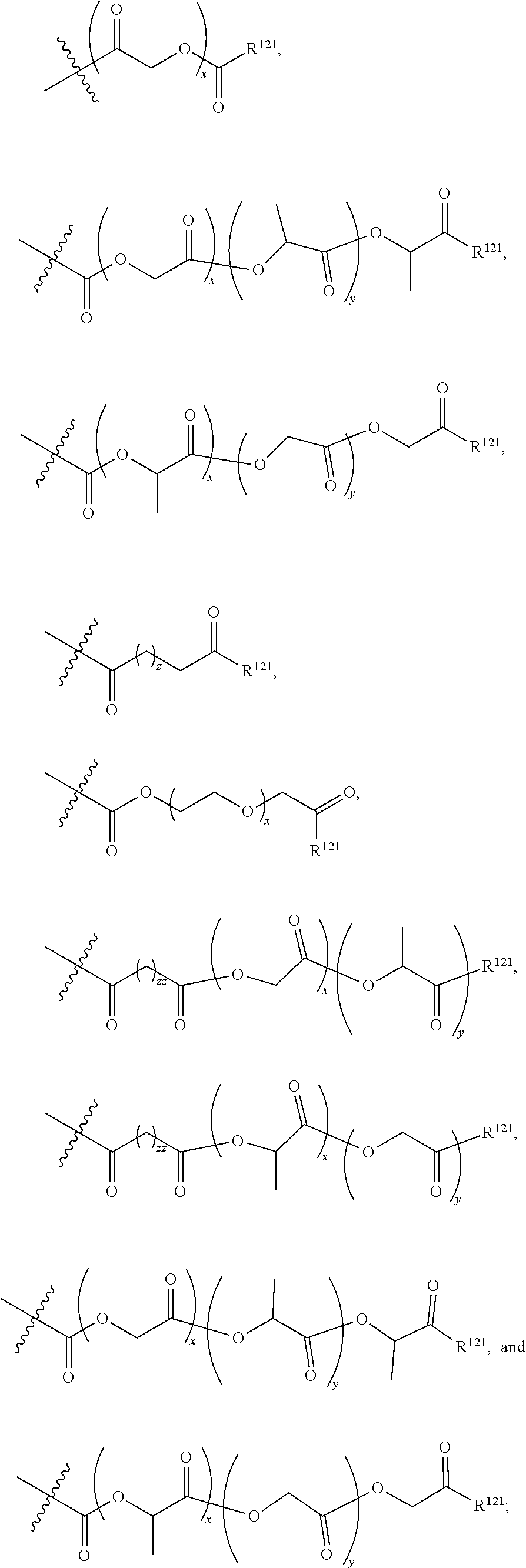
and

and R31a is —C(O)alkyl.

and R31a is —C(O)Me.

R31a is —C(O)Me, and x′ is an integer between 1 and 6 (1, 2, 3, 4, 5, or 6);

and R31a is stearoyl;

x′ is an integer between 1 and 6 (1, 2, 3, 4, 5, or 6), and y is 11 or 17, or in an alternative embodiment, y is 10 or 16.

R121 is

and R15 is hydrogen.

R121 is

and R15 is hydrogen.

R121 is


and R121 is


x and y are independently selected from 1, 2, 3, 4, 5, and 6, and z is 1, 2, or 3.

x and y are independently selected from 1, 2, and 3, and z is 1, 2, or 3.

x and y are independently selected from 1, 2, and 3, z is 1, 2, or 3, and R364 is


or a pharmaceutically acceptable composition, salt, or isotopic derivative thereof


and


and R366 is


and R366 is


x is 1, 2, 3, or 4, and z is 1, 2, 3, or 4.

x′ an integer between 0 and 4 (0, 1, 2, 3, or 4), and z is an integer between 1 and 4 (1, 2, 3, or 4).

R366

R121 is

and R316 is


R366 is

R121 is

and R316 is


or a pharmaceutically acceptable composition, salt, or isotopic derivative thereof.
-
- (i) an unsaturated fatty acid residue including but not limited to the carbonyl fragment taken from docosahexaenoic acid (—C(O)(CH2)2(CHCHCH2)6CH3)), docosatetraenoic acid, euric acid, or nervonic acid;
- (ii) polyethylene glycol, polypropylene glycol, polypropylene oxide, polylactic acid, or poly(lactic-co-glycolic acid) including:

or polyglycolic acid, or a polyester, polyamide, or other biodegradable polymer, each of which can be capped to complete the terminal valence or to create a terminal ether.

-
- (i) an unsaturated fatty acid residue including but not limited the carbonyl fragment taken from linoleic acid (—C(O)(CH2)7(CH)2CH2(CH)2(CH2)4CH3)), docosahexaenoic acid (—C(O)(CH2)2(CHCHCH2)6CH3)), eicosapentaenoic acid (—C(O)(CH2)3(CHCHCH2)5CH3)), alpha-linolenic acid (—C(O)(CH2)7(CHCHCH2)3CH3)) stearidonic acid, y-linolenic acid, arachidonic acid, docosatetraenoic acid, palmitoleic acid, vaccenic acid, paullinic acid, oleic acid, elaidic acid, gondoic acid, euric acid, nervonic acid and mead acid, each of which can be further substituted with R5 if valence permits, a stable compound is formed, and the resulting compound is pharmaceutically acceptable;
- (ii) polyethylene glycol, polypropylene glycol, polypropylene oxide, polylactic acid, and poly(lactic-co-glycolic acid) including:

or polyglycolic acid, or a polyester, polyamide, or other biodegradable polymer, each of which can be capped to complete the terminal valence or to create a terminal ether.
-
- (iii) The disclosure provides duel leucine zipper kinase prodrugs of Formula IIIE:


each of which except halogen, nitro, and cyano, may be optionally substituted, for example with halogen, alkyl, aryl, heterocycle or heteroaryl.


or other biodegradable polymer, wherein each R39 other than R40 is substituted with at least one L4-R121;


Rho Kinase (ROCK) Inhibitor Prodrugs

-
- R137 is selected from:


wherein all other variables are as defined herein.

wherein:

wherein:

wherein:


wherein:


and


and R121 is


and R121 is


-
- or a pharmaceutically acceptable composition, salt, or isotopic derivative thereof wherein Y is CR150 or N;
-
- (i) polyethylene glycol, polypropylene glycol, polypropylene oxide, polylactic acid, poly(lactic-co-glycolic acid) polyglycolic acid, polyester, polyamide, and other biodegradable polymers, each of which can be capped to complete the terminal valence or to create a terminal ether or ester, in one embodiment the capping group is selected from R311; and


or a pharmaceutically acceptable composition, salt, or isotopic derivative thereof wherein
-
- (i) polyethylene glycol, polypropylene glycol, polypropylene oxide, polylactic acid, poly(lactic-co-glycolic acid) polyglycolic acid, polyester, polyamide, and other biodegradable polymers, each of which can be capped to complete the terminal valence or to create a terminal ether or ester;


and R31a is —C(O)CH3.

and R31a is stearoyl.

and R31a is —C(O)CH3.

and R31a is —C(O)CH3.

and x is an integer between 1 and 6.

and y is 11.

and y is 17.

and R31a is —C(O)alkyl.


Beta-Blocker Prodrugs


and R185;


and
-
- wherein all other variables are defined herein.


-
- (i) —C(O)OC5-C30alkylR5, —C(O)OC2-C30alkenylR5, —C(O)OC2-C30alkynylR5, —C(O)OC4-C30alkenylalkynylR5, —C(O)OC5-C30alkyl, —C(O)OC2-C30alkenyl, —C(O)OC2-C30alkynyl, and —C(O)OC4-C30alkenylalkynyl;
- (ii) —C(O)O(C1-30alkyl with at least one R5 substituent on the alkyl chain, —C(O)O(C1-30alkenyl, with at least one R5 substituent on the alkenyl chain, and —C(O)O(C1-30alkynyl, with at least one R5 substituent on the alkynyl chain;
- (iii) —C(O)(OCH2C(O))1-20OC1-30alkyl, —C(O)(OCH(CH3)C(O))1-20OC1-30alkyl, —C(O)(OCH2C(O))1-10OC1-30alkyl, —C(O)(OCH(CH3)C(O))1-10OC1-30alkyl, —C(O)(OCH2C(O))4-20OC1-30alkyl, —C(O)(OCH(CH3)C(O))4-20OC1-30alkyl, —C(O)(OCH2C(O))1-20OC1-10alkyl, —C(O)(OCH(CH3)C(O))1-20OC1-10alkyl, —C(O)(OCH2C(O))1-20OC4-10alkyl, —C(O)(OCH(CH3)C(O))1-20OC4-10alkyl, —C(O)(OCH2C(O))1-20OH, —C(O)(OCH(CH3)C(O))1-20OH, —C(O)(OCH2C(O))1-10OH, —C(O)(OCH(CH3)C(O))1-10OH, —C(O)(OCH2C(O))4-20OH, —C(O)(OCH(CH3)C(O))4-20OH, —C(O)(OCH2C(O))4-10OH, —C(O)(OCH(CH3)C(O))4-10OH, —C(O)(OCH(CH3)C(O))4-10OC1-10alkyl, —C(O)(OCH2C(O))4-10OC1-10alkyl, —C(O)(OCH(CH3)C(O))1-10OC1-10alkyl, —C(O)(OCH2C(O))1-10OC1-10alkyl, —C(O)(OCH(CH3)C(O))1-10OC4-10alkyl, —C(O)(OCH2C(O))1-10OC4-10alkyl, —C(O)(OCH2C(O))1-10OC4-10alkyl, —C(O)(OCH(CH3)C(O))1-10OC4-10alkyl, —C(O)(OCH2C(O))1-10OC4-10alkyl, —C(O)(OCH(CH3)C(O))1-10OC4-10alkyl, —C(O)(OCH2C(O))1-10(OCH(CH3)C(O))1-10OC1-30alkyl, —C(O)(OCH2C(O))2-10(OCH(CH3)C(O))2-10OC1-30alkyl, —C(O)(OCH2C(O))1-10(OCH(CH3)C(O))1-10OC1-12alkyl, —C(O)(OCH2C(O))1-10(OCH(CH3)C(O))1-10OC4-22alkyl, —C(O)(OCH(CH3)C(O))1-10(OCH2C(O))1-10OC1-30alkyl, —C(O)(OCH(CH3)C(O))2-10(OCH2C(O))2-10OC1-30alkyl, —C(O)(OCH(CH3)C(O))1-10(OCH2C(O))1-10OC1-12alkyl, and —C(O)(OCH(CH3)C(O))1-10(OCH2C(O))1-10OC4-22alkyl;
- (iv) polypropylene glycol, polypropylene oxide, polylactic acid, poly(lactic-co-glycolic acid), polyglycolic acid, polyester, polyamide, and other biodegradable polymers, each of which can be capped to complete the terminal valence or to create a terminal ether or ester; and


and

and x is 4.

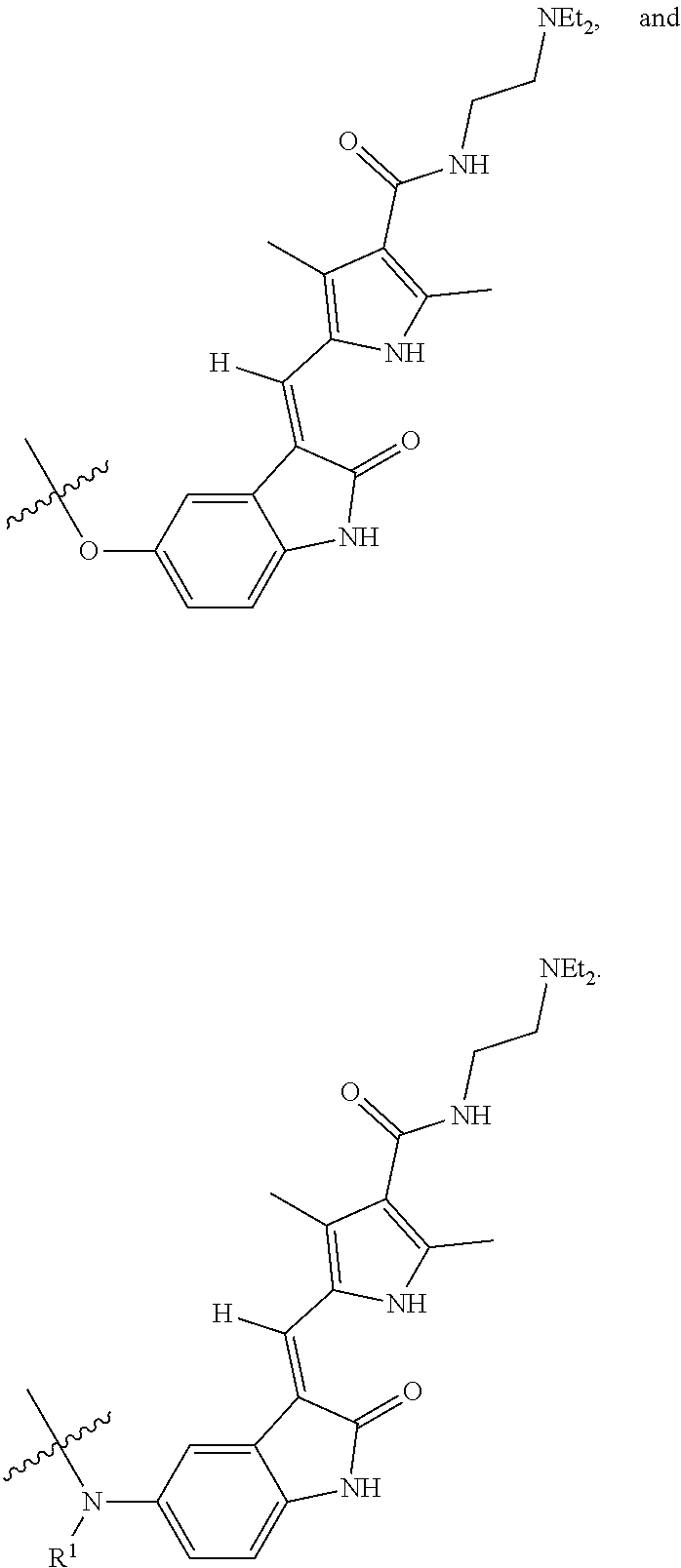

-
- (i) —OC15-C30alkylR5, —OC2-C30alkenylR5, —OC2-C30alkynylR5, —OC4-C30alkenylalkynylR5, —OC15-C30alkyl, —OC2-C30alkenyl, —OC2-C30alkynyl, and —OC4-C30alkenylalkynyl;
- (ii) —OC15-30alkyl with at least one R5 substituent on the alkyl chain, —OC1-30alkenyl with at least one R5 substituent on the alkenyl chain, and —OC1-30alkynyl with at least one R5 substituent on the alkynyl chain;
- (iii) —(OCH2C(O))1-20OC1-3alkyl, —(OCH(CH3)C(O))1-20OC1-3alkyl, —(OCH2C(O))1-10OC1-30alkyl, —(OCH(CH3)C(O))1-10OC1-30alkyl, —(OCH2C(O))4-20OC1-30alkyl, —(OCH(CH3)C(O))4-20OC1-30alkyl, —(OCH2C(O))1-20OC1-10alkyl, —(OCH(CH3)C(O))1-20OC1-10alkyl, —(OCH2C(O))1-20OC4-10alkyl, —(OCH(CH3)C(O))1-20OC4-10alkyl, —(OCH2C(O))1-20OH, —(OCH(CH3)C(O))1-20OH, —(OCH2C(O))1-10OH, —(OCH(CH3)C(O))1-10OH, —(OCH2C(O))4-20OH, —(OCH(CH3)C(O))4-20OH, —(OCH2C(O))4-10OH, —(OCH(CH3)C(O))4-10OH, —(OCH(CH3)C(O))4-10OC1-10alkyl, —(OCH2C(O))4-10OC1-10alkyl, —(OCH(CH3)C(O))1-10OC1-10alkyl, —(OCH2C(O))1-10OC1-10alkyl, —(OCH(CH3)C(O))1-10OC4-10alkyl, —(OCH2C(O))1-10OC4-10alkyl, —(OCH2C(O))1-10OC4-10alkyl, —(OCH(CH3)C(O))1-10OC4-10alkyl, —(OCH2C(O))1-10OC4-10alkyl, —(OCH(CH3)C(O))1-10OC4-10alkyl, —(OCH2C(O))1-10(OCH(CH3)C(O))1-10OC1-30alkyl, —(OCH2C(O))2-10(OCH(CH3)C(O))2-10OC1-30alkyl, —(OCH2C(O))1-10(OCH(CH3)C(O))1-10OC1-12alkyl, —(OCH2C(O))1-10(OCH(CH3)C(O))1-10OC4-22alkyl, —(OCH(CH3)C(O))1-10(OCH2C(O))1-10OC1-3alkyl, —(OCH(CH3)C(O))2-10(OCH2C(O))2-10OC1-3alkyl, —(OCH(CH3)C(O))1-10(OCH2C(O))1-10OC1-12alkyl, and —(OCH(CH3)C(O))1-10(OCH2C(O))1-10OC4-22alkyl;
- (iv) polypropylene glycol, polypropylene oxide, polylactic acid, poly(lactic-co-glycolic acid), polyglycolic acid, a polyester, a polyamide, and other biodegradable polymers, each of which can be capped to complete the terminal valence or to create a terminal ether or ester;


and


and


and R121 is


and R121 is


and R121 is


and R121 is


| TABLE A |
| Non-limiting Examples of Prodrugs |
| Comp. | Structure | |
| 1 |
 |
| 2 |
 |
| 3 |
 |
| 4 |
 |
| 5 |
 |
| 6 |
 |
| 7 |
 |
| 8 |
 |
| 9 |
 |
| 10 |
 |
| 11 |
 |
| 12 |
 |
| 13 |
 |
| 14 |
 |
| 15 |
 |
| 16 |
 |
| 17 |
 |
| 18 |
 |
| 19 |
 |
| 20 |
 |
| 21 |
 |
| 22 |
 |
| 23 |
 |
| 24 |
 |
| 25 |
 |
| 26 |
 |
| 27 |
 |
| 28 |
 |
| 29 |
 |
| 30 |
 |
| 31 |
 |
| 32 |
 |
| 33 |
 |
| 34 |
 |
| 35 |
 |
| 36 |
 |
| 37 |
 |
| 38 |
 |
| 39 |
 |
| 40 |
 |
| 41 |
 |
| 42 |
 |
| 43 |
 |
| 44 |
 |
| TABLE B |
| Non-limiting Examples of |
| 45 |
 |
| 46 |
 |
| 47 |
 |
| 48 |
 |
| 49 |
 |
| 50 |
 |
| 51 |
 |
| 52 |
 |
| 53 |
 |
| 54 |
 |
| 55 |
 |
| 56 |
 |
| 57 |
 |
| 58 |
 |
| 59 |
 |
| 60 |
 |
| 61 |
 |
| 62 |
 |
| 63 |
 |
| 64 |
 |
| 65 |
 |
| 66 |
 |
| 67 |
 |
| 68 |
 |
| 69 |
 |
| 70 |
 |
| 71 |
 |
| 72 |
 |
| 73 |
 |
| 74 |
 |
| 75 |
 |
| 76 |
 |
| 77 |
 |
| 78 |
 |
| 79 |
 |
| 80 |
 |
| 81 |
 |
| 82 |
 |
| 83 |
 |
| 84 |
 |
| 85 |
 |
| 86 |
 |
| 87 |
 |
| 88 |
 |
| 89 |
 |
| 90 |
 |
| 91 |
 |
| 92 |
 |
| 93 |
 |
| 94 |
 |
| 95 |
 |
| 96 |
 |
| TABLE C |
| Non-limiting Examples of Prodrugs |
| 97 |
 |
| 98 |
 |
| 99 |
 |
| 100 |
 |
| 101 |
 |
| 102 |
 |
| 103 |
 |
| 104 |
 |
| 105 |
 |
| 106 |
 |
| 107 |
 |
| 108 |
 |
| 109 |
 |
| 110 |
 |
| 111 |
 |
| 112 |
 |
| 113 |
 |
| 114 |
 |
| 115 |
 |
| 116 |
 |
| 117 |
 |
| 118 |
 |
| 119 |
 |
| 120 |
 |
| 121 |
 |
| 122 |
 |
| 123 |
 |
| 124 |
 |
| 125 |
 |
| 126 |
 |
| 127 |
 |
| 128 |
 |
| 129 |
 |
| 130 |
 |
| 131 |
 |
| 132 |
 |
| 133 |
 |
| 134 |
 |
| 135 |
 |
| 136 |
 |
| 137 |
 |
| 138 |
 |
| 139 |
 |
| 140 |
 |
| 141 |
 |
| 142 |
 |
| 143 |
 |
| 144 |
 |
| 145 |
 |
| 146 |
 |
| 147 |
 |
| 148 |
 |
| 149 |
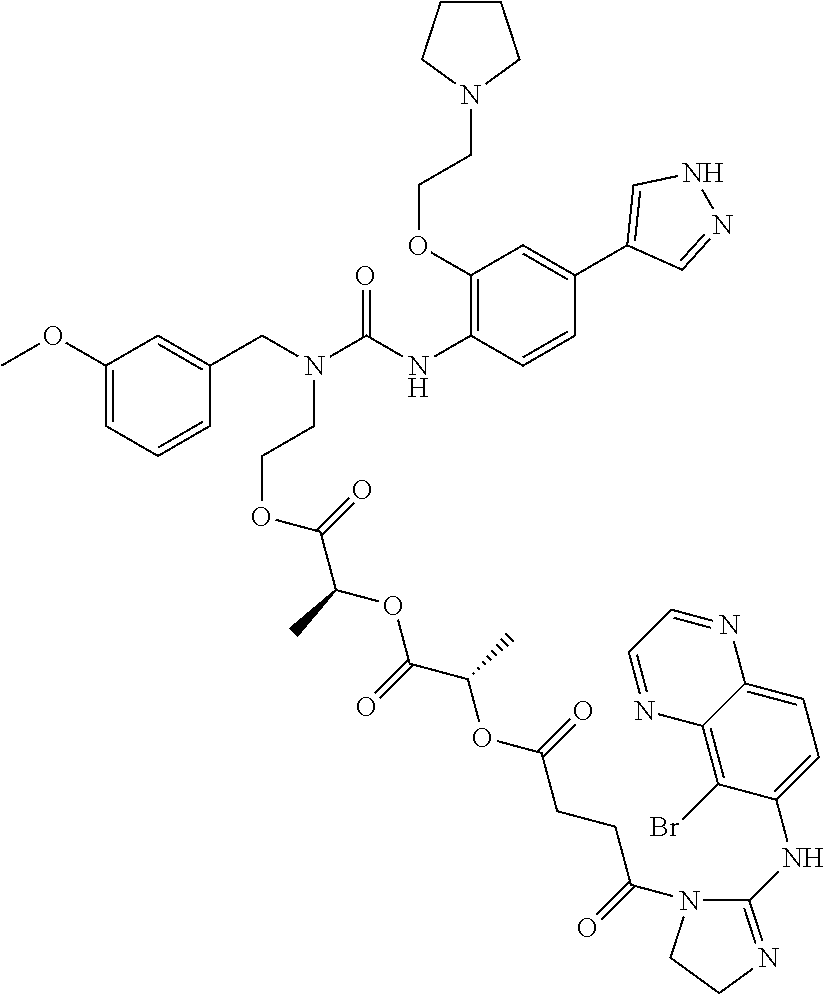 |
| 150 |
 |
| 151 |
 |
| 152 |
 |
| 153 |
 |
| 154 |
 |
| 155 |
 |
| 156 |
 |
| 157 |
 |
| 158 |
 |
| 159 |
 |
| 160 |
 |
| 161 |
 |
| 162 |
 |
| 163 |
 |
| 164 |
 |
| 165 |
 |
| 166 |
 |
| 167 |
 |
| 168 |
 |
| 169 |
 |
| 170 |
 |
| 171 |
 |
| 172 |
 |
| 173 |
 |
| 174 |
 |
| 175 |
 |
| 176 |
 |
| 177 |
 |
| 178 |
 |
| 179 |
 |
| 180 |
 |
| 181 |
 |
| 182 |
 |
| 183 |
 |
| 184 |
 |
| 185 |
 |
| 186 |
 |
| 187 |
 |
| 188 |
 |
| 189 |
 |
| 190 |
 |
| 191 |
 |
| 192 |
 |
| 193 |
 |
| 194 |
 |
| 195 |
 |
| 196 |
 |
| 197 |
 |
| 198 |
 |
| 199 |
 |
| 200 |
 |
| 201 |
 |
| 202 |
 |
| 203 |
 |
| 204 |
 |
| TABLE D |
| Non-limiting Examples of Prodrugs |
| 205 |
 |
| 206 |
 |
| 207 |
 |
| 208 |
 |
| 209 |
 |
| 210 |
 |
| 211 |
 |
| 212 |
 |
| 213 |
 |
| 214 |
 |
| 215 |
 |
| 216 |
 |
| 217 |
 |
| 218 |
 |
| 219 |
 |
| 220 |
 |
| 221 |
 |
| 222 |
 |
| 223 |
 |
| 224 |
 |
| 225 |
 |
| 226 |
 |
| 227 |
 |
| 228 |
 |
| 229 |
 |
| 230 |
 |
| 231 |
 |
| 232 |
 |
| 233 |
 |
| 234 |
 |
| 235 |
 |
| 236 |
 |
| 237 |
 |
| 238 |
 |
| 239 |
 |
| 240 |
 |
| 241 |
 |
| 242 |
 |
| 243 |
 |
| 244 |
 |
| 245 |
 |
| 246 |
 |
| 247 |
 |
| 248 |
 |
| 249 |
 |
| 250 |
 |
| 251 |
 |
| 252 |
 |
| 253 |
 |
| 254 |
 |
| 255 |
 |
| 256 |
 |
| 257 |
 |
| 258 |
 |
| 259 |
 |
| 260 |
 |
| 261 |
 |
| 262 |
 |
| 263 |
 |
| 264 |
 |
| 265 |
 |
| 266 |
 |
| 267 |
 |
| 268 |
 |
| 269 |
 |
| 270 |
 |
| 271 |
 |
| 272 |
 |
| 273 |
 |
| 274 |
 |
| 275 |
 |
| 276 |
 |
| 277 |
 |
| 278 |
 |
| 279 |
 |
| 280 |
 |
| 281 |
 |
| 282 |
 |
| 283 |
 |
| TABLE E |
| Select Compounds of the Present Invention |
| 284 |
 |
||
| 285 |
 |
||
| 286 |
 |
||
| 287 |
 |
||
| 288 |
 |
||
| 289 |
 |
||
| 290 |
 |
||
| 291 |
 |
||
| 292 |
 |
||
| 293 |
 |
||
| 294 |
 |
||
| 295 |
 |
||
| 296 |
 |
||
| 297 |
 |
||
| 298 |
 |
||
| 299 |
 |
||
| 300 |
 |
||
| 301 |
 |
||
| 302 |
 |
||
| 303 |
 |
||
| 304 |
 |
||
| 305 |
 |
||
| 306 |
 |
||
| 307 |
 |
||
| 308 |
 |
||
| 309 |
 |
||
| 310 |
 |
||
| 311 |
 |
||
| 312 |
 |
||
| 313 |
 |
||
| 314 |
 |
||
| 315 |
 |
||
| 316 |
 |
||
| 317 |
 |
||
| 318 |
 |
||
| 319 |
 |
||
| 320 |
 |
||
| TABLE F |
| Compounds of the Present Invention |
| Compd | |
| No. | Structure |
| 321 |
 |
| 322 |
 |
| 323 |
 |
| 324 |
 |
| 325 |
 |
| 326 |
 |
| 327 |
 |
| 328 |
 |
| 329 |
 |
| 330 |
 |
| 331 |
 |
| 332 |
 |
| 333 |
 |
| 334 |
 |
| 335 |
 |
| 336 |
 |
| 337 |
 |
| 338 |
 |
| 339 |
 |
| 340 |
 |
| 341 |
 |
| 342 |
 |
| 343 |
 |
| 344 |
 |
| 345 |
 |
| 346 |
 |
| 347 |
 |
| TABLE G |
| Compounds of the Present Invention |
| 348 |
 |
||
| 349 |
 |
||
| 350 |
 |
||
| 351 |
 |
||
| 352 |
 |
||
| 353 |
 |
||
| 354 |
 |
||
| 355 |
 |
||
| 356 |
 |
||
| 357 |
 |
||
| 358 |
 |
||
| 359 |
 |
||
| 360 |
 |
||
| 361 |
 |
||
| 362 |
 |
||
| TABLE H |
| Additional Compounds of the Present Invention |
| 363 |
 |
||
| 364 |
 |
||
| 365 |
 |
||
| 366 |
 |
||
| 367 |
 |
||
| TABLE I |
| Additional Compounds of the Present Invention |
| 368 |
 |
||
| 369 |
 |
||
| 370 |
 |
||
| 371 |
 |
||
| 372 |
 |
||
| 373 |
 |
||
| 374 |
 |
||
| 375 |
 |
||

encapsulated in the biodegradable polymer is provided.

encapsulated in the biodegradable polymer is provided.

encapsulated in the biodegradable polymer is provided.

encapsulated in the biodegradable polymer is provided.

encapsulated in the biodegradable polymer is provided.

encapsulated in the biodegradable polymer is provided.

encapsulated in the biodegradable polymer is provided.

encapsulated in the biodegradable polymer is provided.

encapsulated in the biodegradable polymer is provided.


encapsulated in the biodegradable polymer is provided.

encapsulated in the biodegradable polymer is provided.
-
- (i) dissolving or dispersing the therapeutic agent or its salt in an organic solvent optionally with an alkaline agent;
- (ii) mixing the solution/dispersion of step (i) with a polymer solution that has a viscosity of at least about 300 cPs (or perhaps at least about 350, 400, 500, 600, 700 or 800 or more cPs);
- (iii) mixing the therapeutic agent polymer solution/dispersion of step (ii) with an aqueous non-acidic or alkaline solution (for example at least approximately a pH of 7, 8, or 9 and typically not higher than about 10) optionally with a surfactant or emulsifier, to form a solvent-laden therapeutic agent encapsulated microparticle,
- (iv) isolating the microparticles.
In one embodiment, the therapeutic agent is sunitinib.
- DCM, CH2Cl2 Dichloromethane
- DL Drug loading
- DMSO Dimethyl sulfoxide
- EtOH Ethanol
- HA Sodium hyaluronate
- hr, h Hour
- min Minute
- NaOH Sodium hydroxide
- NSTMP Non-surface treated microparticles
- PBS Dulbecco's phosphate-buffered saline
- PCL Polycaprolactone
- PEG Polyethylene glycol
- PLA Poly(lactic acid)
- PLGA Poly(lactic-co-glycolic acid)
- PVA Polyvinyl alcohol
- Rpm Revolutions per minute
- RT, r.t. Room temperature
- SD Standard deviation
- STMP Surface treated microparticles
- UV Ultraviolet
| TABLE 1 |
| Detailed batch information on NaOH(aq)/EtOH surface treated |
| microparticles |
| Batch | Ratio of 0.25M | Treatment | ||
| Microparticles before | size | NaOH (aq) | Time | STMP |
| surface treatment | (mg) | to EtOH (v/v) | (min) | ID |
| S-1 (99% PLGA 7525 4A, | 200 | 30/70 | 3 | S-2 |
| 1% PLGA-PEG) | 200 | 6 | S-3 | |
| DL = 18.0% | 200 | 10 | S-4 | |
| S-5 (90% PLGA 7525 4A, | 200 | 50/50 | 3 | S-6 |
| 10% PLGA-PEG) | 200 | 6 | S-7 | |
| DL = 18.9% | 200 | 30/70 | 6 | S-8 |
| S-9 (99% PLGA 7525 4A, | 1000 | 30/70 | 3 | S-10 |
| 1% PLGA-PEG) | ||||
| DL = 18.3% | ||||
| S-11 (99% PLGA 7525 | 2300 | 30/70 | 3 | S-12 |
| 4A, 1% PLGA-PEG) | ||||
| DL = 11.1% | ||||
| S-13 (99% PLGA 7525 | 3600 | 30/70 | 3 | S-14 |
| 4A, 1% PLGA-PEG) | ||||
| DL = 11.9% | ||||
| S-15 (99% PLGA 7525 | 2000 | 30/70 | 3 | S-16 |
| 4A, 1% PLGA-PEG) | ||||
| DL = 2.15% | ||||
| S-17 (99% PLGA 7525 | 2000 | 30/70 | 3 | S-18 |
| 4A, 1% PLGA-PEG) | ||||
| DL = 2.21% | ||||
| DL = Drug loading. | ||||
| TABLE 2 |
| NSTMP and STMP containing different percentages of PLGA:PLGA-PEG |
| Formulation | PLGA-PEG | Surface Treatment | |
| # | PLGA (wt %) | (wt %) | Condition |
| S-1 | 99% | 1% | None |
| S-3 | 99% | 1% | 0.25M NaOH/EtOH (30/70, |
| v/v), 6 min | |||
| S-5 | 90% | 10% | None |
| S-8 | 90% | 10% | 0.25M NaOH/EtOH (30/70, |
| v/v), 6 min | |||
| TABLE 3 |
| Formulation composition and conditions of |
| surface treatment with PBS/EtOH |
| Particle ID | Batch | PBS/ | Treatment | |||
| before | Drug | size | EtOH | Time | STMP | |
| treatment | Composition | Loading | (mg) | (v/v) | (min) | ID |
| S-11 | 99% PLGA | 11.1% | 200 | 30/70 | 3 | S-21 |
| S-19 | 7525 4A, 1% | 11.8% | 500 | S-22 | ||
| PLGA-PEG | 500 | S-23 | ||||
| 500 | 6 | S-24 | ||||
| S-20 | 0% | 200 | 6 | S-25 | ||
| 200 | 12 | S-26 | ||||
| TABLE 4 |
| Detailed batch information on modified NaOH(aq)/EtOH STMP |
| NaOH | |||||
| Batch | concentration | ||||
| Microparticles before | size | in H2O/EtOH | H2O/EtOH | Treatment | |
| surface treatment | (mg) | mixture (M) | ratio (v/v) | Time (min) | STMP ID |
| S-27 (99% PLGA 7525 | 200 | 0.075 | 50/50 | 10 | S-28 |
| 4A, 1% PLGA-PEG) | 200 | 50/50 | 20 | S-29 | |
| DL = 11.3% | 200 | 70/30 | 15 | S-30 | |
| 200 | 70/30 | 30 | S-31 | ||
| 200 | 0.0075 | 30/70 | 3 | S-32 | |
| 200 | 30/70 | 10 | S-33 | ||
| 200 | 0.00075 | 30/70 | 3 | S-34 | |
| 200 | 30/70 | 10 | S-35 | ||
| TABLE 5 |
| Detailed batch information of HCl/EtOH treated STMP |
| HCl | |||||
| Batch | concentration | Final surface | |||
| Microparticles before | size | in H2O/EtOH | H2O/EtOH | Treatment | treated |
| surface treatment | (mg) | mixture (M) | ratio (v/v) | Time (min) | particles |
| S-27 (99% PLGA 7525 | 200 | 0.075 | 30/70 | 3 | S-36 |
| 4A, 1% PLGA-PEG) | 200 | 0.0075 | 30/70 | 3 | S-37 |
| DL = 11.3% | |||||
| TABLE 6 |
| Detailed batch information and experimental conditions |
| of surface treatment on “wet” microparticles |
| Final surface | ||||
| Micro- | treatment solvent |
| particles | Solute | Solute | H2O/ | |||
| before | Batch | (base, | concentration | EtOH | Treatment | |
| surface | size | acid or | in H2O/EtOH | ratio | Time | STMP |
| treatment | (mg) | salt) | mixture (M) | (v/v) | (min) | ID |
| S-38 | 450 | NaOH | 0.075 | 30/70 | 3 | S-39 |
| (99% PLGA | 450 | 0.0075 | 30/70 | 10 | S-40 | |
| 7525 4A, 1% | 450 | 0.075 | 70/30 | 15 | S-41 | |
| PLGA-PEG) | 450 | 0.00075 | 70/30 | 30 | S-42 | |
| DL = 11.6% | 450 | HCl | 0.0075 | 30/70 | 3 | S-43 |
| 450 | KCl | 0.075 | 30/70 | 20 | S-44 | |
| 450 | 0.35 | 30/70 | 20 | S-45 | ||
| TABLE 7 |
| Yield and drug loading of STMP |
| Drug loading (DL) prior to | Drug loading after surface | ||
| Sample | Yield | surface treatment | treatment |
| S-2 | 51% | 18.0% | 14.2% |
| S-3 | 50% | 18.0% | 15.3% |
| S-4 | 36% | 18.0% | 6.3% |
| S-6 | 30% | 18.9% | 15.0% |
| S-7 | 35% | 18.9% | 14.7% |
| S-8 | 28% | 18.9% | 11.6% |
| S-10 | 67% | 18.3% | 18.6% |
| S-12 | 68% | 11.1% | 11.6% |
| S-14 | 70% | 11.9% | 12.0% |
| S-16 | 56% | 2.15% | 2.11% |
| S-28 | 43% | 11.3% | 11.8% |
| S-29 | 49% | 11.3% | 11.0% |
| S-30 | 60% | 11.3% | 10.1% |
| S-31 | 61% | 11.3% | 10.6% |
| S-32 | 44% | 11.3% | 12.0% |
| S-33 | 48% | 11.3% | 11.5% |
| S-34 | 49% | 11.3% | 11.5% |
| S-35 | 58% | 11.3% | 12.0% |
| S-36 | 61% | 11.3% | 10.3% |
| S-37 | 69% | 11.3% | 11.6% |
| S-42 | 44% | 11.6% | 11.2% |
| S-44 | 50% | 11.6% | 12.0% |
| S-45 | 43% | 11.6% | 12.1% |
| TABLE 8 |
| Injectability and dosing consistency of STMP |
| Average dose | Standard | Standard | Standard | Standard | ||||
| Sample | UV | Dose | per syringe | deviation | deviation | Average dose | deviation | deviation |
| Name | Reading | (mg) | n = 3 (mg) | (mg) | (%) | n = 9 (mg) | (mg) | (%) |
| Syringe | 1.019 | .1966 | .1974 | .0140 | 7.0942 | |||
| 1-a | ||||||||
| Syringe | .953 | .1838 | ||||||
| 1-b | ||||||||
| Syringe | 1.098 | .2118 | ||||||
| 1-c | ||||||||
| Syringe | 1.136 | .2191 | .2058 | .0122 | 5.9332 | .2031 | .0129 | 6.3345 |
| 2-a | ||||||||
| Syringe | 1.052 | .2029 | ||||||
| 2-b | ||||||||
| Syringe | 1.012 | .1952 | ||||||
| 2-c | ||||||||
| Syringe | 1.052 | .2029 | .2062 | .0156 | 7.5633 | |||
| 3-a | ||||||||
| Syringe | 1.157 | .2232 | ||||||
| 3-b | ||||||||
| Syringe | .998 | .1925 | ||||||
| 3-c | ||||||||
| TABLE 9 |
| Detailed information on rabbit study groups and dosing conditions |
| Group | Microsphere | *SM | Microsphere |
| Microsphere Type | # | Mass | Dose | Drug Loading | Injection Volume |
| With | Drug- | #1 | 2 mg | 0.2 |
10% | 10 uL | ||
| surface | loaded | #2 | 10 mg | 1.0 |
10% | 50 | ||
| treatment | # | |||||||
| 3 | 10 mg | 0.2 |
2% | 50 uL | ||||
| | # | 7 | 2 and 10 | None | None | 10 uL (Left eye) | ||
| 50 uL (Right eye) | ||||||||
| Without | Drug- | #4 | 2 mg | 0.2 |
10% | 10 uL | ||
| surface | loaded | #5 | 10 mg | 1.0 |
10% | 50 | ||
| treatment | # | |||||||
| 6 | 10 mg | 0.2 |
2% | 50 uL | ||||
| | # | 8 | 2 and 10 | None | None | 10 uL (Left eye) | ||
| 50 uL (Right eye) | ||||||||
| *SM = Sunitinib Malate Dose | ||||||||
| TABLE 10 |
| HPLC analysis of drug purity in STMP |
| Peak Number | Retention time | Area (%) |
| 1 | 0.24 | 0.157 |
| 2 | 0.78 | 0.283 |
| 3 | 0.82 | 0.044 |
| 4 | 1.00 | 99.39 |
| 5 | 1.12 | 0.046 |
| 6 | 1.41 | 0.084 |
| TABLE 11 |
| Detailed formulation information of STMP comprising PLA |
| NSTMP | Surface Treatment |
| STMP | Aqueous | Particle | Treatment | |||||
| ID | Polymer | Drug | Phase | Mixing | Solution | Conc. | Time | |
| S-46 | 800 |
100 |
200 mL of | 5000 | 0.075M | 200 | 3 |
|
| 4A and 8 | sunitinib | 1% PVA in | rpm | NaOH and | mg/mL | |||
| PLGA-PEG in | malate in | |
1 |
50 |
||||
| 4 |
1 mL | |||||||
| DMSO | ||||||||
| S-47 | 800 |
1 |
200 mL of | 5000 | 0.075M | 200 | 3 |
|
| 4A and 8 | DMSO | 1% PVA in | rpm | NaOH and | mg/mL | |||
| PLGA-PEG in | |
1 |
50 |
|||||
| 4 mL DCM | ||||||||
| S-48 | 640 |
2 |
200 mL of | 5000 | 0.075M | 200 | 3 |
|
| 4A and 6.4 | DMSO | 1% PVA in | rpm | NaOH and | mg/mL | |||
| PLGA-PEG in | |
1 |
50 |
|||||
| 4 mL DCM | ||||||||
| TABLE 12 |
| Formulation and process parameters of STMP produced on larger scale |
| NSTMP |
| DP |
| PLGA | PLGA- | Sunitinib | Mixing | Surface Treatment |
| 7525 4A | PEG5k | DCM | Malate | DMSO | speed | Time | NaOH | ||
| (g) | (g) | (g) | (g) | (g) | (rpm) | (min) | EtOH | (mM) | Excipient |
| 86 | 0.86 | 640 | 16.5 | 260 | 4000 | 30 | 30% | 0.53 | |
| 86 | 0.86 | 640 | 16.5 | 260 | 4000 | 60 | 30% | 75 | |
| 86 | 0.86 | 640 | 15.3 | 260 | 4000 | 30 | 40% | 0.075 | |
| 86 | 0.86 | 640 | 15.3 | 260 | 4000 | 30 | 40% | 0.75 | |
| 86 | 0.86 | 640 | 15.3 | 260 | 4000 | 30 | 40% | 0.75 | |
| 86 | 0.86 | 640 | 15.3 | 260 | 4000 | 30 | 40% | 0.75 | |
| 86 | 0.86 | 640 | 3600 | 30 | 50% | 0.75 | |||
| 86 | 0.86 | 640 | 3600 | 30 | 40% | 0.75 | |||
| 86 | 0.86 | 640 | 260 | 3300 | 30 | 50% | 0.75 | ||
| 86 | 0.86 | 640 | 15.3 | 260 | 4000 | 30 | 40% | 0.75 | |
| 86 | 0.86 | 640 | 3600 | 30 | 60% | 0.75 | |||
| 86 | 0.86 | 640 | 15.3 | 260 | 4000 | 30 | 40% | 0.75 | |
| 86 | 0.86 | 640 | 3600 | 30 | 70% | 0.75 | |||
| 86 | 0.86 | 640 | 15.3 | 260 | 4000 | 30 | 50% | 0.75 | Mannitol |
| 86 | 0.86 | 640 | 15.3 | 260 | 4000 | 30 | 60% | 0.75 | Mannitol |
| 86 | 0.86 | 640 | 15.3 | 260 | 4000 | 30 | 70% | 0.75 | Mannitol |
| 172 | 1.72 | 1280 | 30.6 | 520 | 4000 | 30 | 70% | 0.75 | Mannitol |
| 172 | 1.72 | 1280 | 3600 | 30 | 70% | 0.75 | |||
| 172 | 1.72 | 1280 | 3600 | 25 | 70% | 0.75 | |||
| 172 | 1.72 | 1280 | 30.6 | 520 | 4000 | 30 | 60% | 0.75 | Mannitol |
| 172 | 1.72 | 1280 | 30.6 | 520 | 4000 | 30 | 60% | 0.75 | Mannitol |
| 172 | 1.72 | 1280 | 3600 | 25 | 70% | 0.75 | Mannitol | ||
| 172 | 1.72 | 1280 | 30.6 | 520 | 3800 | 30 | 60% | 0.75 | Mannitol |
| 172 | 1.72 | 1280 | 30.6 | 520 | 4000 | 30 | 60% | 0.75 | |
| 172 | 1.72 | 1280 | 30.6 | 520 | 4000 | 30 | 60% | 0.75 | |
| TABLE 13 |
| Polymer Composition, Formulation Parameters, and In Vitro |
| Characterization of Sunitinib-encapsulated Microparticles. |
| Ratio and | Polymer | Sunitinib | ||||||
| conc. of | conc. in | Malate in | DCM to | Drug | Mean | In | ||
| Polymer | polymer | DCM | DMSO | DMSO | loading | Size | Vitro | |
| ID | Composition | composition | (mg/mL) | (mg/mL) | ratio | (wt %) | (μm) | burst % |
| SM | PLGA 75:25a | 100/1 | 140 | 45 | 2:1 | 12.0 | 31 | 0.92 |
| 72 | 4A/PLGA- | (99% PLGA | ||||||
| PEG | and 1% | |||||||
| PLGA- | ||||||||
| PEG) | ||||||||
| SM | PLA | 100/1 | 200 | 100 | 4:1 | 13.3 | 26 | 0.41 |
| 60 | 4A/PLGA- | (99% PLA | ||||||
| PEG | and 1% | |||||||
| PLGA- | ||||||||
| PEG) | ||||||||
| SM | PLA | 100/1 | 200 | 100 | 2:1 | 18.5 | 40 | 2.08 |
| 61 | 4A/PLGA- | (99% PLA | ||||||
| PEG | and 1% | |||||||
| PLGA- | ||||||||
| PEG) | ||||||||
| SM | PLA | 90/10/1 | 200 | 100 | 2:1 | 18.6 | 40 | 1.81 |
| 62 | 4A/PLGA/ | (99% PLA, | ||||||
| PLGA- | PLGA blend | |||||||
| PEG | and 1% | |||||||
| PLGA- | ||||||||
| PEG) | ||||||||
| SM | PLA | 70/30/1 | 200 | 100 | 2:1 | 18.5 | 38 | 2.23 |
| 63 | 4A/PLGA/ | (99% PLA, | ||||||
| PLGA- | PLGA blend | |||||||
| PEG | and 1% | |||||||
| PLGA- | ||||||||
| PEG) | ||||||||
| SM | PLA | 50/50/1 | 200 | 100 | 2:1 | 17.6 | 38 | 1.92 |
| 64 | 4A/PLGA/ | (49.5% PLA, | ||||||
| PLGA- | 49.5% PLGA | |||||||
| PEG | and 1% | |||||||
| PLGA- | ||||||||
| PEG) | ||||||||
| aPLGA 75:25 is a PLGA polymer where the ratio of lactide units to glycolide units is 75 to 25 | ||||||||
| TABLE 14 |
| Polymer Composition, Formulation Parameters, and In Vitro |
| Characterization of Sunitinib-encapsulated Microparticles. |
| Ratio and | Polymer | Sunitinib | ||||||
| conc. of | conc. in | Malate in | DCM to | Drug | Mean | In | ||
| Polymer | polymer | DCM | DMSO | DMSO | loading | Size | Vitro | |
| ID | Composition | composition | (mg/mL) | (mg/mL) | ratio | (wt %) | (μm) | burst % |
| SM | PLA | 95/5/1 | 200 | 100 | 2:1 | 18.2 | 26 | 2.16 |
| 65 | 4A/PLGA | (99% PLA, | ||||||
| 5050a | PLGA blend | |||||||
| 4A/PLGA- | and 1% | |||||||
| PEG = | PLGA- | |||||||
| 95/5/1 | PEG) | |||||||
| SM | PLA | 90/10/1 | 200 | 100 | 2:1 | 20.3 | 22 | 2.49 |
| 66 | 4A/PLGA | (99% PLA, | ||||||
| 5050a | PLGA blend | |||||||
| 4A/PLGA- | and 1% | |||||||
| PEG = | PLGA- | |||||||
| 90/10/1 | PEG) | |||||||
| SM | PLA | 95/5/1 | 200 | 100 | 2:1 | 17.4 | 25 | 1.75 |
| 67 | 4A/PLGA | (99% PLA, | ||||||
| 5050a | PLGA blend | |||||||
| 5A/PLGA- | and 1% | |||||||
| PEG = | PLGA- | |||||||
| 95/5/1 | PEG) | |||||||
| SM | PLA | 70/30/1 | 200 | 100 | 2:1 | 18.1 | 25 | 2.03 |
| 68 | 4A/PLGA | (99% PLA, | ||||||
| 5050a | PLGA blend | |||||||
| 5E/PLGA- | and 1% | |||||||
| PEG = | PLGA- | |||||||
| 70/30/1 | PEG) | |||||||
| SM | PLA | 90/10/1 | 200 | 100 | 2:1 | 16.5 | 27 | 1.07 |
| 69 | 4A/PLGA | (99% PLA, | ||||||
| 5050a | PLGA blend | |||||||
| 5E/PLGA- | and 1% | |||||||
| PEG = | PLGA- | |||||||
| 90/10/1 | PEG) | |||||||
| SM | PLA | 70/30/1 | 200 | 100 | 2:1 | 15.2 | 24 | 6.61 |
| 70 | 4A/PLGA | (99% PLA, | ||||||
| 7525b | PLGA blend | |||||||
| 3A/PLGA- | and 1% | |||||||
| PEG = | PLGA- | |||||||
| 70/30/1 | PEG) | |||||||
| SM | PLA | 90/10/1 | 200 | 100 | 2:1 | 18.1 | 25 | 3.78 |
| 71 | 4A/PLGA | (99% PLA, | ||||||
| 7525b | PLGA blend | |||||||
| 3A/PLGA- | and 1% | |||||||
| PEG = | PLGA- | |||||||
| 90/10/1 | PEG) | |||||||
| aPLGA 50:50 is a PLGA polymer where the ratio of lactide units to glycolide units is 50 to 50 | ||||||||
| bPLGA 75:25 is a PLGA polymer where the ratio of lactide units to glycolide units is 75 to 25 | ||||||||
| TABLE 15 |
| Polymer Composition, Formulation Parameters, and In Vitro |
| Characterization of Sunitinib-encapsulated Microparticles. |
| Ratio and | Polymer | Sunitinib | |||||||
| conc. of | conc. in | Malate in | DCM to | Drug | Mean | In | |||
| Polymer | polymer | DCM | DMSO | DMSO | loading | Size | Vitro | ||
| ID | Composition | composition | (mg/mL) | (mg/mL) | ratio | (wt %) | (μm) | burst | |
| SM | PLA | ||||||||
| 90/10/1 | 200 | 110 | 2:1 | 19.0 | 26 | 0.87 | |||
| 74 | 4A/PLGA | (99% PLA, | |||||||
| 75:25a | |
||||||||
| 4A/PLGA- | and 1% | ||||||||
| PEG | PLGA- | ||||||||
| PEG) | |||||||||
| | PLA | 70/30/1 | 200 | 110 | 2:1 | 18.8 | 25 | 1.78 | |
| 75 | 4A/PLGA | (99% PLA, | |||||||
| 75:25a | |
||||||||
| 4A/PLGA- | and 1% | ||||||||
| PEG | PLGA- | ||||||||
| PEG) | |||||||||
| | PLA | 50/50/1 | 200 | 110 | 2:1 | 18.1 | 28 | 3.03 | |
| 76 | 4A/PLGA | (49.5% PLA, | |||||||
| 75:25a | 49.5 |
||||||||
| 4A/PLGA- | and 1% | ||||||||
| PEG | PLGA- | ||||||||
| PEG) | |||||||||
| | PLA | 100/1 | 200 | 110 | 2:1 | 18.8 | 28 | 1.52 | |
| 77 | 4A/PLGA- | (99% PLA | |||||||
| PEG | and 1% | ||||||||
| PLGA- | |||||||||
| PEG) | |||||||||
| aPLGA 75:25 is a PLGA polymer where the ratio of lactide units to glycolide units is 75 to 25 | |||||||||
| TABLE 16 |
| Polymer Composition, Formulation Parameters, and In Vitro |
| Characterization of Sunitinib-encapsulated Microparticles. |
| Ratio and | Polymer | Sunitinib | |||||||
| conc. of | conc. in | Malate in | DCM to | Drug | Mean | In | |||
| Polymer | polymer | DCM | DMSO | DMSO | loading | Size | Vitro | ||
| ID | Composition | composition | (mg/mL) | (mg/mL) | ratio | (wt %) | (μm) | burst | |
| SM | PLGA | ||||||||
| 100/1 | 140 | 45 | 2:1 | 13.3 | 28 | n/a | |||
| 78 | 75:25a | (99 |
|||||||
| 4A/PLGA- | and 1% | ||||||||
| PEG | PLGA- | ||||||||
| PEG) | |||||||||
| | PLA | 100/1 | 200 | 100 | 4:1 | 12.0 | 24 | n/a | |
| 79 | 4A/PLGA- | (99% PLA | |||||||
| PEG | and 1% | ||||||||
| PLGA- | |||||||||
| PEG) | |||||||||
| aPLGA 75:25 is a PLGA polymer where the ratio of lactide units to glycolide units is 75 to 25 | |||||||||
| TABLE 17 |
| Polymer Composition, Formulation Parameters, and In Vitro |
| Characterization of Sunitinib-encapsulated Microparticles. |
| Polymer | Sunitinib | |||||
| conc. in | Malate in | DCM to | Drug | Mean | ||
| Polymer | DCM | DMSO | DMSO | loading | Size | |
| ID | Composition | (mg/mL) | (mg/mL) | ratio | (wt %) | (μm) |
| | PLA | 100 | 105 | 2:1 | 27.0 | 28.1 | |
| 80 | 6E/PLGA- | ||||||
| PEG = | |||||||
| 100/1 | |||||||
| (99% PLA | |||||||
| and 1% | |||||||
| PLGA- | |||||||
| PEG) | |||||||
| | PLGA | 80 | 105 | 2:1 | 30.1 | 24.5 | |
| 81 | 7525 | ||||||
| 8E/PLGA- | |||||||
| PEG = | |||||||
| 100/1 | |||||||
| (99% PLGA | |||||||
| and 1% | |||||||
| PLGA- | |||||||
| PEG) | |||||||
| | PLGA | 100 | 105 | 2:1 | 27.9 | 32.7 | |
| 82 | 7525 | ||||||
| 8E/PLGA- | |||||||
| PEG = | |||||||
| 100/1 | |||||||
| (99% PLGA | |||||||
| and 1% | |||||||
| PLGA- | |||||||
| PEG) | |||||||
| | PLGA | 50 | 75 | 2:1 | 31.0 | 22.9 | |
| 83 | 7525 | ||||||
| 8E/PLGA- | |||||||
| PEG = | |||||||
| 100/1 | |||||||
| (99% PLGA | |||||||
| and 1% | |||||||
| PLGA- | |||||||
| PEG) | |||||||
| | PLGA | 50 | 105 | 2:1 | 37.2 | 25.0 | |
| 84 | 7525 | ||||||
| 8E/PLGA- | |||||||
| PEG = | |||||||
| 100/1 | |||||||
| (99% PLGA | |||||||
| and 1% | |||||||
| PLGA- | |||||||
| PEG) | |||||||
| TABLE 18A |
| Characterization of PLA/PLGA/PLGA-PLA Blended Microparticles |
| Composition | |||||||||
| ( |
|||||||||
| 4A/PLGA | In vitro | In vitro | |||||||
| 7525 | In vitro | aggregation | burst at | |
|||||
| 4A/PLGA- | DL | Endotoxin | aggregation | ( |
37° C. | Yield | Yield | size | |
| ID | PEG) | (%) | (surface) | (PBS/PBS) | PV/PBS) | (~3 h) | (g) | (%) | (um) |
| |
90/10/1 | 19.02 | 0.000055 | Good | Good | 0.87 | 4.55 | 34.7 | 25.17 |
| 90 | (99% PLA, | ||||||||
| PLGA blend | |||||||||
| and 1% | |||||||||
| PLGA- | |||||||||
| PEG) | |||||||||
| |
70/30/1 | 18.78 | 0.000034 | Good | Good | 1.88 | 6.01 | 46.6 | 25.33 |
| 91 | (99% PLA, | ||||||||
| PLGA blend | |||||||||
| and 1% | |||||||||
| PLGA- | |||||||||
| PEG) | |||||||||
| |
50/50/1 | 18.09 | 0.00022 | Good | Good | 3.28 | 3.58 | 27.6 | 27.84 |
| 92 | (99% PLA, | ||||||||
| PLGA blend | |||||||||
| and 1% | |||||||||
| PLGA- | |||||||||
| PEG) | |||||||||
| |
100/0/1 | 18.76 | 0.00023 | Good | Good | 1.59 | 4.24 | 32.9 | 28.15 |
| 93 | (99% PLA | ||||||||
| and 1% | |||||||||
| PLGA- | |||||||||
| PEG) | |||||||||
| TABLE 18B |
| Characterization of PLA/PLGA/PLGA-PLA Blended Microparticles |
| Composition | |||||||
| ( |
|||||||
| 4A/PLGA | |||||||
| 7525 | |||||||
| 4A/PLGA- | Mean | Median | S.D. | d10 | d50 | d90 | |
| ID | PEG) | (μm) | (μm) | (μm) | (μm) | (μm) | (μm) |
| |
90/10/1 | 25.17 | 25.69 | 6.685 | 16.33 | 25.69 | 32.84 |
| (99% PLA, | |||||||
| PLGA blend | |||||||
| and 1% | |||||||
| PLGA- | |||||||
| PEG) | |||||||
| |
70/30/1 | 25.33 | 25.87 | 7.866 | 14.48 | 25.87 | 34.92 |
| (99% PLA, | |||||||
| PLGA blend | |||||||
| and 1% | |||||||
| PLGA- | |||||||
| PEG) | |||||||
| |
50/50/1 | 27.84 | 27.82 | 8.6 | 16.81 | 27.82 | 38.98 |
| (99% PLA, | |||||||
| PLGA blend | |||||||
| and 1% | |||||||
| PLGA- | |||||||
| PEG) | |||||||
| |
100/0/1 | 28.15 | 28.15 | 8.704 | 16.8 | 28.15 | 39.37 |
| (99% PLA | |||||||
| and 1% | |||||||
| PLGA- | |||||||
| PEG) | |||||||
| TABLE 19A |
| Characterization of Microparticles formulated with PLA |
| Polymer | API | DCM | |||||
| Homo- | Surface | conc. in | conc. in | to | |||
| genizer | treated | DCM | DMSO | DMSO | |||
| ID | Composition | type | (Y/N) | (mg/mL) | (mg/mL) | | |
| SM | |||||||
| 99% | Small | N | 200 | 100 | 4:1 | ||
| 94 | 4A/1% | probe | |||||
| PLGA- | |||||||
| | |||||||
| SM | |||||||
| 100% | Small | N | 200 | 100 | 2:1 | ||
| 61 | 4A/1% | probe | |||||
| PLGA- | |||||||
| | |||||||
| SM | |||||||
| 100 |
|||||||
| 93 | 4A/1% | In- | Y | 200 | 110 | ||
| PLGA- | mixer | ||||||
| PEG | |||||||
| TABLE 19B |
| Drug loading, mean size, and in vitro burst percent of microparticles |
| formulated with PLA |
| In vitro | ||||
| ID | Composition | Drug loading (wt %) | Mean Size (μm) | burst |
| SM | ||||
| 99% PLA | 13.3 | 26 | 0.41 | |
| 94 | 4A/1% PLGA- | |||
| | ||||
| SM | ||||
| 100% PLA | 18.5 | 40 | 2.08 | |
| 61 | 4A/1% PLGA- | |||
| | ||||
| SM | ||||
| 100% PLA | 18.8 | 28 | 1.59 | |
| 93 | 4A/1% PLGA- | |||
| PEG | ||||
Claims (57)


Priority Applications (4)
| Application Number | Priority Date | Filing Date | Title |
|---|---|---|---|
| US15/976,847 US11160870B2 (en) | 2017-05-10 | 2018-05-10 | Extended release microparticles and suspensions thereof for medical therapy |
| US16/821,738 US20200230246A1 (en) | 2017-05-10 | 2020-03-17 | Extended release microparticles and suspensions thereof for medical therapy |
| US17/530,347 US20230058971A1 (en) | 2017-05-10 | 2021-11-18 | Extended release microparticles and suspensions thereof for medical therapy |
| US17/530,351 US20230056284A1 (en) | 2017-05-10 | 2021-11-18 | Extended release microparticles and suspensions thereof for medical therapy |
Applications Claiming Priority (3)
| Application Number | Priority Date | Filing Date | Title |
|---|---|---|---|
| US201762504366P | 2017-05-10 | 2017-05-10 | |
| US201762508355P | 2017-05-18 | 2017-05-18 | |
| US15/976,847 US11160870B2 (en) | 2017-05-10 | 2018-05-10 | Extended release microparticles and suspensions thereof for medical therapy |
Related Child Applications (1)
| Application Number | Title | Priority Date | Filing Date |
|---|---|---|---|
| US16/821,738 Continuation US20200230246A1 (en) | 2017-05-10 | 2020-03-17 | Extended release microparticles and suspensions thereof for medical therapy |
Publications (2)
| Publication Number | Publication Date |
|---|---|
| US20180326078A1 US20180326078A1 (en) | 2018-11-15 |
| US11160870B2 true US11160870B2 (en) | 2021-11-02 |
Family
ID=64095930
Family Applications (4)
| Application Number | Title | Priority Date | Filing Date |
|---|---|---|---|
| US15/976,847 Expired - Fee Related US11160870B2 (en) | 2017-05-10 | 2018-05-10 | Extended release microparticles and suspensions thereof for medical therapy |
| US16/821,738 Abandoned US20200230246A1 (en) | 2017-05-10 | 2020-03-17 | Extended release microparticles and suspensions thereof for medical therapy |
| US17/530,351 Abandoned US20230056284A1 (en) | 2017-05-10 | 2021-11-18 | Extended release microparticles and suspensions thereof for medical therapy |
| US17/530,347 Abandoned US20230058971A1 (en) | 2017-05-10 | 2021-11-18 | Extended release microparticles and suspensions thereof for medical therapy |
Family Applications After (3)
| Application Number | Title | Priority Date | Filing Date |
|---|---|---|---|
| US16/821,738 Abandoned US20200230246A1 (en) | 2017-05-10 | 2020-03-17 | Extended release microparticles and suspensions thereof for medical therapy |
| US17/530,351 Abandoned US20230056284A1 (en) | 2017-05-10 | 2021-11-18 | Extended release microparticles and suspensions thereof for medical therapy |
| US17/530,347 Abandoned US20230058971A1 (en) | 2017-05-10 | 2021-11-18 | Extended release microparticles and suspensions thereof for medical therapy |
Country Status (10)
| Country | Link |
|---|---|
| US (4) | US11160870B2 (en) |
| EP (1) | EP3621654A4 (en) |
| JP (1) | JP2020519585A (en) |
| CN (1) | CN111201040A (en) |
| AU (1) | AU2018265415A1 (en) |
| BR (1) | BR112019022908A2 (en) |
| CA (1) | CA3057875A1 (en) |
| MX (1) | MX2019013363A (en) |
| RU (1) | RU2019139817A (en) |
| WO (1) | WO2018209155A1 (en) |
Cited By (1)
| Publication number | Priority date | Publication date | Assignee | Title |
|---|---|---|---|---|
| US11548861B2 (en) * | 2017-03-23 | 2023-01-10 | Graybug Vision, Inc. | Drugs and compositions for the treatment of ocular disorders |
Families Citing this family (11)
| Publication number | Priority date | Publication date | Assignee | Title |
|---|---|---|---|---|
| TWI831259B (en) | 2018-06-15 | 2024-02-01 | 漢達生技醫藥股份有限公司 | Capsule containing dasatinib lauryl sulfate composition |
| WO2020102758A1 (en) * | 2018-11-15 | 2020-05-22 | Graybug Vision, Inc. | Improved aggregated microparticles |
| WO2020243608A1 (en) | 2019-05-31 | 2020-12-03 | Dose Medical Corporation | Bioerodible polyester polymer implants and related methods of use |
| CN111548482B (en) * | 2020-04-02 | 2022-09-13 | 复旦大学 | Nitric oxide donor modified copolymer, sustained-release preparation containing nitric oxide donor modified copolymer, and preparation method and application of nitric oxide donor modified copolymer |
| BR112022020991A2 (en) * | 2020-08-31 | 2023-03-07 | Vaim Co Ltd | BIODEGRADABLE POLYMER DISPERSION, COMPOSITION COMPRISING THE SAME AND SKIN ENHANCEMENT SYSTEM |
| CN114533648B (en) * | 2020-11-26 | 2026-04-07 | 成都康弘药业集团股份有限公司 | An intraocular implant of axitinib |
| CN113546058A (en) * | 2021-07-06 | 2021-10-26 | 吕梁学院 | Nanoparticles for inhibiting TERT (TERT-terminal electron transfer) nucleation, preparation method and application |
| CA3267932A1 (en) | 2022-10-05 | 2024-04-11 | Mireca Medicines Gmbh | MICROPARTICLE AND IMPLANT FORMULATIONS FOR cGMP ANALOG THERAPY |
| WO2024151628A1 (en) * | 2023-01-09 | 2024-07-18 | The General Hospital Corporation | Polymeric microparticles encapsulated with active pharmaceutical ingredients and related methods of use and manufacture |
| WO2024163400A1 (en) | 2023-01-31 | 2024-08-08 | Handa Oncology, Llc | Improved cabozantinib compositions and methods of use |
| WO2024206475A1 (en) * | 2023-03-27 | 2024-10-03 | Cellular Longevity, Inc. | Pharmaceutical formulations for longevity in mammals |
Citations (220)
| Publication number | Priority date | Publication date | Assignee | Title |
|---|---|---|---|---|
| GB929401A (en) | 1958-12-22 | 1963-06-19 | Upjohn Co | Encapsulated emulsions and processes for their preparation |
| GB929406A (en) | 1958-12-22 | 1963-06-19 | Upjohn Co | A process for the production of encapsulated material |
| US4460563A (en) | 1980-04-09 | 1984-07-17 | Eurand S.P.A. | Process for preparing microcapsules in a liquid vehicle |
| US4760057A (en) * | 1983-06-23 | 1988-07-26 | Merck & Co., Inc. | (Acyloxyalkoxy)carbonyl derivatives as bioreversible prodrug moieties for primary and secondary amine functions in drugs |
| WO1988007044A1 (en) | 1987-03-17 | 1988-09-22 | Insite Vision, Inc. | Timolol derivatives |
| US4794000A (en) | 1987-01-08 | 1988-12-27 | Synthetic Blood Corporation | Coacervate-based oral delivery system for medically useful compositions |
| US4911920A (en) | 1986-07-30 | 1990-03-27 | Alcon Laboratories, Inc. | Sustained release, comfort formulation for glaucoma therapy |
| US4997652A (en) | 1987-12-22 | 1991-03-05 | Visionex | Biodegradable ocular implants |
| US4997443A (en) | 1985-08-26 | 1991-03-05 | Hana Biologics, Inc. | Transplantable artificial tissue and process |
| US5013556A (en) | 1989-10-20 | 1991-05-07 | Liposome Technology, Inc. | Liposomes with enhanced circulation time |
| US5019400A (en) | 1989-05-01 | 1991-05-28 | Enzytech, Inc. | Very low temperature casting of controlled release microspheres |
| US5286495A (en) | 1992-05-11 | 1994-02-15 | University Of Florida | Process for microencapsulating cells |
| US5344701A (en) | 1992-06-09 | 1994-09-06 | Minnesota Mining And Manufacturing Company | Porous supports having azlactone-functional surfaces |
| US5441722A (en) | 1994-02-18 | 1995-08-15 | Merck & Co., Inc. | Short synthesis of 5,6-dihydro-(S)-4-(ethylamino)-(S)-6-[C3 H3 ]-4[2,3-b]thiopyran-2-sulfonamide 7,7-dioxide and related non radioactive compounds |
| US5502092A (en) | 1994-02-18 | 1996-03-26 | Minnesota Mining And Manufacturing Company | Biocompatible porous matrix of bioabsorbable material |
| WO1996020698A2 (en) | 1995-01-05 | 1996-07-11 | The Board Of Regents Acting For And On Behalf Of The University Of Michigan | Surface-modified nanoparticles and method of making and using same |
| US5565215A (en) | 1993-07-23 | 1996-10-15 | Massachusettes Institute Of Technology | Biodegradable injectable particles for imaging |
| US5612052A (en) | 1995-04-13 | 1997-03-18 | Poly-Med, Inc. | Hydrogel-forming, self-solvating absorbable polyester copolymers, and methods for use thereof |
| US5612053A (en) | 1995-04-07 | 1997-03-18 | Edward Mendell Co., Inc. | Controlled release insufflation carrier for medicaments |
| US5624677A (en) | 1995-06-13 | 1997-04-29 | Pentech Pharmaceuticals, Inc. | Controlled release of drugs delivered by sublingual or buccal administration |
| US5650541A (en) | 1993-04-19 | 1997-07-22 | Alcon Laboratories, Inc. | Ethacrynic acid-like compounds and use thereof to treat glaucoma |
| US5681964A (en) | 1990-10-23 | 1997-10-28 | University Of Kentucky Research Foundation | Permeable, non-irritating prodrugs of nonsteroidal and steroidal agents |
| US5855615A (en) | 1996-06-07 | 1999-01-05 | Menlo Care, Inc. | Controller expansion sphincter augmentation media |
| WO1999001498A1 (en) | 1997-07-03 | 1999-01-14 | West Pharmaceutical Services Drug Delivery & Clinical Research Centre Limited | Conjugate of polyethylene glycol and chitosan |
| US5866155A (en) | 1996-11-20 | 1999-02-02 | Allegheny Health, Education And Research Foundation | Methods for using microsphere polymers in bone replacement matrices and composition produced thereby |
| US5869103A (en) | 1994-06-18 | 1999-02-09 | Danbiosyst Uk Limited | Polymer microparticles for drug delivery |
| WO1999025391A2 (en) | 1997-11-14 | 1999-05-27 | Bonetec Corporation | Biodegradable polymer scaffold |
| US5916586A (en) | 1995-08-24 | 1999-06-29 | Lever Brothers Company, Inc. | Personal cleansing system comprising polymeric diamond-mesh bath sponge and liquid cleanser with deodorant composition |
| US5945126A (en) | 1997-02-13 | 1999-08-31 | Oakwood Laboratories L.L.C. | Continuous microsphere process |
| US6007845A (en) | 1994-07-22 | 1999-12-28 | Massachusetts Institute Of Technology | Nanoparticles and microparticles of non-linear hydrophilic-hydrophobic multiblock copolymers |
| US6051576A (en) | 1994-01-28 | 2000-04-18 | University Of Kentucky Research Foundation | Means to achieve sustained release of synergistic drugs by conjugation |
| US6129761A (en) | 1995-06-07 | 2000-10-10 | Reprogenesis, Inc. | Injectable hydrogel compositions |
| WO2000064977A1 (en) | 1999-04-26 | 2000-11-02 | California Institute Of Technology | In situ forming hydrogels |
| WO2000064953A1 (en) | 1999-03-19 | 2000-11-02 | Vinod Chintamani Malshe | A process for production of micro-porous microspheres of polymers and polymeric pigments therefrom |
| US6201072B1 (en) | 1997-10-03 | 2001-03-13 | Macromed, Inc. | Biodegradable low molecular weight triblock poly(lactide-co- glycolide) polyethylene glycol copolymers having reverse thermal gelation properties |
| WO2001040767A1 (en) | 1999-12-01 | 2001-06-07 | Ap Biotech Ab | Method of producing porous spherical particles |
| US6270802B1 (en) | 1998-10-28 | 2001-08-07 | Oakwood Laboratories L.L.C. | Method and apparatus for formulating microspheres and microcapsules |
| US6287588B1 (en) | 1999-04-29 | 2001-09-11 | Macromed, Inc. | Agent delivering system comprised of microparticle and biodegradable gel with an improved releasing profile and methods of use thereof |
| US6290729B1 (en) | 1992-03-25 | 2001-09-18 | Endoluminal Therapeutics, Inc. | Local polymeric gel cellular therapy |
| US6306169B1 (en) | 1997-03-07 | 2001-10-23 | Abonetics Ltd. | Tissue implant |
| US6375972B1 (en) | 2000-04-26 | 2002-04-23 | Control Delivery Systems, Inc. | Sustained release drug delivery devices, methods of use, and methods of manufacturing thereof |
| WO2002038127A2 (en) | 2000-11-09 | 2002-05-16 | Nektar Therapeutics Uk Limited | Particle formation methods and their products |
| US6413539B1 (en) | 1996-10-31 | 2002-07-02 | Poly-Med, Inc. | Hydrogel-forming, self-solvating absorbable polyester copolymers, and methods for use thereof |
| WO2002053189A2 (en) | 2001-01-06 | 2002-07-11 | Benedikt Timmerman | Immunogenic complex |
| US20020128224A1 (en) | 2000-08-21 | 2002-09-12 | Boyer Jose L. | Compositions and methods for the treatment of glaucoma or ocular hypertension |
| WO2002080910A1 (en) | 2001-04-10 | 2002-10-17 | Universidade Federal De Minas Gerais-Ufmg | Preparation of formulations of angiotensin ii at1 receptors antagonists for the treatment of arterial hypertension, other cardiovascular illnesses and its complications |
| US20020183858A1 (en) | 2001-06-05 | 2002-12-05 | Contiliano Joseph H. | Attachment of absorbable tissue scaffolds to scaffold fixation devices |
| US6495164B1 (en) | 2000-05-25 | 2002-12-17 | Alkermes Controlled Therapeutics, Inc. I | Preparation of injectable suspensions having improved injectability |
| WO2003000237A2 (en) | 2001-06-22 | 2003-01-03 | Johns Hopkins University School Of Medicine | Biodegradable polymer coompositions |
| US6534084B1 (en) | 1999-06-30 | 2003-03-18 | Ethicon, Inc. | Porous tissue scaffoldings for the repair or regeneration of tissue |
| US6566406B1 (en) | 1998-12-04 | 2003-05-20 | Incept, Llc | Biocompatible crosslinked polymers |
| US6573293B2 (en) | 2000-02-15 | 2003-06-03 | Sugen, Inc. | Pyrrole substituted 2-indolinone protein kinase inhibitors |
| US20030118528A1 (en) | 2001-11-19 | 2003-06-26 | Walters Kenneth A. | Topical delivery of codrugs |
| US6589549B2 (en) | 2000-04-27 | 2003-07-08 | Macromed, Incorporated | Bioactive agent delivering system comprised of microparticles within a biodegradable to improve release profiles |
| US6632457B1 (en) | 1998-08-14 | 2003-10-14 | Incept Llc | Composite hydrogel drug delivery systems |
| US20030220509A1 (en) | 2000-09-04 | 2003-11-27 | Ragactives, S.L. | Process for obtaining 4-(N-alkylamino)-5,6-dihydro-4H-thien-(2,3-b)-thiopyran-2-sulfonamide-7,7-dioxides and intermediates |
| US6703047B2 (en) | 2001-02-02 | 2004-03-09 | Incept Llc | Dehydrated hydrogel precursor-based, tissue adherent compositions and methods of use |
| US6706289B2 (en) | 2000-10-31 | 2004-03-16 | Pr Pharmaceuticals, Inc. | Methods and compositions for enhanced delivery of bioactive molecules |
| WO2004028583A2 (en) | 2002-09-26 | 2004-04-08 | Angiotech International Ag | Perivascular wraps |
| US6765019B1 (en) | 1999-05-06 | 2004-07-20 | University Of Kentucky Research Foundation | Permeable, water soluble, non-irritating prodrugs of chemotherapeutic agents with oxaalkanoic acids |
| US20040175429A1 (en) | 2002-12-31 | 2004-09-09 | Sreedhara Alavattam | Biodegradable microparticles that stabilize and control the release of proteins |
| US20040180036A1 (en) | 2003-01-21 | 2004-09-16 | Control Delivery Systems, Inc. | Salts of codrugs and uses related thereto |
| WO2004084968A1 (en) | 2003-03-27 | 2004-10-07 | Regentec Ltd | Porous matrix |
| US20040209807A1 (en) | 2002-12-17 | 2004-10-21 | Nastech Pharmaceutical Company Inc. | Compositions and methods for enhanced mucosal delivery of Y2 receptor-binding peptides and methods for treating and preventing obesity |
| US6818018B1 (en) | 1998-08-14 | 2004-11-16 | Incept Llc | In situ polymerizable hydrogels |
| US20040234611A1 (en) | 2001-09-14 | 2004-11-25 | Marklus Ahlheim | Ophthalmic deport formulations for periocular or subconjunctival administration |
| US20040258763A1 (en) | 1999-02-03 | 2004-12-23 | Bell Steve J.D. | Methods of manufacture and use of calcium phosphate particles containing allergens |
| US6841617B2 (en) | 2000-09-28 | 2005-01-11 | Battelle Memorial Institute | Thermogelling biodegradable aqueous polymer solution |
| US20050048123A1 (en) | 2003-06-26 | 2005-03-03 | Control Delivery System, Inc. | In situ gelling drug delivery system |
| US20050101676A1 (en) | 2003-08-07 | 2005-05-12 | Fahl William E. | Amino thiol compounds and compositions for use in conjunction with cancer therapy |
| US20050164994A1 (en) | 2001-12-10 | 2005-07-28 | Control Deliver Systems, Inc. | Treatment of genitourinary tract disorders |
| US20050175709A1 (en) | 2003-12-11 | 2005-08-11 | Baty Ace M.Iii | Therapeutic microparticles |
| US20050249773A1 (en) | 2004-05-06 | 2005-11-10 | Maspero Fabrizio A | Biocompatible bone implant compositions and methods for repairing a bone defect |
| WO2005112884A1 (en) | 2004-04-30 | 2005-12-01 | Allergan, Inc. | Intravitreal implants comprising microspheres which encapsulate a tyrosine kinase inhibitor and a biodegradable polymer |
| US20060083781A1 (en) | 2004-10-14 | 2006-04-20 | Shastri V P | Functionalized solid lipid nanoparticles and methods of making and using same |
| US20060135609A1 (en) | 2004-10-21 | 2006-06-22 | Duke University | Ophthamological drugs |
| US20060134221A1 (en) | 2004-12-03 | 2006-06-22 | Vical Incorporated | Methods for producing block copolymer/amphiphilic particles |
| US20060246145A1 (en) | 2004-04-30 | 2006-11-02 | Allergan, Inc. | Methods for treating ocular conditions with cyclic lipid containing microparticles |
| WO2006116107A2 (en) | 2005-04-22 | 2006-11-02 | Alza Corporation | Immunoliposome composition for targeting to a her2 cell receptor |
| US20060260777A1 (en) | 2005-04-27 | 2006-11-23 | Julia Rashba-Step | Surface-modified microparticles and methods of forming and using the same |
| WO2006133519A1 (en) | 2005-06-17 | 2006-12-21 | Australian Nuclear Science And Technology Organisation | Particles comprising a releasable dopant therein |
| US7211600B2 (en) | 1999-12-22 | 2007-05-01 | Sugen Inc. | Methods of modulating c-kit tyrosine protein kinase function with indolinone compounds |
| US7211275B2 (en) | 2004-01-16 | 2007-05-01 | Massachusetts Institute Of Technology | Composite materials for controlled release of water soluble products |
| US20070112050A1 (en) | 2005-04-12 | 2007-05-17 | Psivida Inc. | HMGCoA reductase inhibitor combinations and uses thereof |
| WO2007062266A2 (en) | 2005-11-28 | 2007-05-31 | Marinus Pharmaceuticals | Ganaxolone formulations and methods for the making and use thereof |
| WO2007065933A1 (en) | 2005-12-09 | 2007-06-14 | Qiagen Gmbh | Magnetic polymer particles |
| WO2007068489A2 (en) | 2005-12-14 | 2007-06-21 | Scil Technology Gmbh | A moldable biomaterial for bone regeneration |
| US20070149593A1 (en) | 2005-12-23 | 2007-06-28 | Alcon, Inc. | PHARMACEUTICAL FORMULATION FOR DELIVERY OF RECEPTOR TYROSINE KINASE INHIBITING (RTKi) COMPOUNDS TO THE EYE |
| WO2007090793A1 (en) | 2006-02-06 | 2007-08-16 | Nicox S.A. | Nitrooxy-comprising derivatives of apraclonidine and brimodnidine as al pha2 -adrenergic receptor agonists |
| CN101081206A (en) | 2007-06-29 | 2007-12-05 | 济南康泉医药科技有限公司 | Anti-cancer medicine composition containing tyrosine kinase restraining agent |
| WO2008030557A2 (en) | 2006-09-08 | 2008-03-13 | Johns Hopkins University | Compositions and methods for enhancing transport through mucus |
| WO2008041001A1 (en) | 2006-10-07 | 2008-04-10 | Regentec Limited | Porous particles |
| US20080166411A1 (en) | 2006-04-10 | 2008-07-10 | Pfizer Inc | Injectable Depot Formulations And Methods For Providing Sustained Release Of Poorly Soluble Drugs Comprising Nanoparticles |
| US20080187568A1 (en) | 2007-02-06 | 2008-08-07 | Sawhney Amarpreet S | Polymerization with precipitation of proteins for elution in physiological solution |
| WO2008093095A2 (en) | 2007-02-01 | 2008-08-07 | Regentec Limited | Composition comprising polymer particles |
| US20080299205A1 (en) | 2004-07-19 | 2008-12-04 | Mayer Lawrence D | Particulate Constructs For Release of Active Agents |
| US20080306041A1 (en) | 2005-01-21 | 2008-12-11 | Garvey David S | Cardiovascular Compounds Comprising Heterocyclic Nitric Oxide Donor Groups, Compositions and Methods of Use |
| US7470717B2 (en) | 2003-07-30 | 2008-12-30 | Kyowa Hakko Kogyo Co., Ltd. | Indazole derivatives |
| US7501179B2 (en) | 2005-12-21 | 2009-03-10 | Boston Scientific Scimed, Inc. | Block copolymer particles |
| WO2009030270A1 (en) | 2007-09-03 | 2009-03-12 | Novartis Ag | Dihydroindole derivatives useful in parkinson's disease |
| WO2009035565A1 (en) | 2007-09-07 | 2009-03-19 | Qlt Plug Delivery, Inc | Prostaglandin analogues for implant devices and methods |
| US20090163457A1 (en) | 2003-05-21 | 2009-06-25 | Psivida, Inc. | Compositions and methods for delivering a biologically active agent |
| WO2009089070A2 (en) | 2008-01-10 | 2009-07-16 | The Johns Hopkins University | Compositions and methods for reducing particle penetration through mucus |
| US20090203709A1 (en) | 2008-02-07 | 2009-08-13 | Abbott Laboratories | Pharmaceutical Dosage Form For Oral Administration Of Tyrosine Kinase Inhibitor |
| US7585075B2 (en) | 2004-05-20 | 2009-09-08 | Forsight Labs, Llc | Corneal onlays and wavefront aberration correction to enhance vision |
| WO2009109501A2 (en) | 2008-03-07 | 2009-09-11 | Ctg Pharma S.R.L. | Ocular pharmaceutical compositions |
| US20100063135A1 (en) | 2008-09-10 | 2010-03-11 | Abbott Laboratories | Polyethylene glycol lipid conjugates and uses thereof |
| US20100063035A1 (en) | 2006-12-15 | 2010-03-11 | Nicox S.A. | Carbonic anhydrase inhibitors derivatives |
| US20100074957A1 (en) | 2003-11-12 | 2010-03-25 | Allergan, Inc. | Intraocular formulation |
| US20100124565A1 (en) | 2008-11-17 | 2010-05-20 | Allergan Inc. | Biodegradable alpha-2 agonist polymeric implants and therapeutic uses thereof |
| US20100143479A1 (en) | 2008-12-04 | 2010-06-10 | Oakwood Laboratories, Llc | Method of making sustained release microparticles |
| US20100152272A1 (en) | 2005-01-28 | 2010-06-17 | Bezwada Biomedical, Llc | Functionalized drugs and polymers therefrom |
| US20100227905A1 (en) | 2009-03-03 | 2010-09-09 | Alcon Research, Ltd. | Pharmaceutical Composition for Delivery of Receptor Tyrosine Kinase Inhibiting (RTKi) Compounds to the Eye |
| US20100227865A1 (en) | 2007-03-12 | 2010-09-09 | Jennifer Riggs-Sauthier | Oligomer-Beta Blocker Conjugates |
| US20100226985A1 (en) | 2006-08-11 | 2010-09-09 | Sophie Rolande Van Tomme | Viscoelastic aqueous gels comprising microspheres |
| WO2010100506A2 (en) | 2009-03-05 | 2010-09-10 | Regentec Limited | Delivery system |
| US20100233277A1 (en) * | 2007-10-26 | 2010-09-16 | Amulya Kumar Panda | Biodegradable polymer scaffold and process for preparation thereof |
| US20100247669A1 (en) | 2009-03-30 | 2010-09-30 | Cerulean Pharma Inc. | Polymer-agent conjugates, particles, compositions, and related methods of use |
| US7828844B2 (en) | 2002-09-13 | 2010-11-09 | Forsight Labs, Llc | Inserting lenses into corneal epithelial pockets to improve vision |
| US7883520B2 (en) | 2006-04-10 | 2011-02-08 | Forsight Labs, Llc | Corneal epithelial pocket formation systems, components and methods |
| US20110123446A1 (en) | 2008-04-25 | 2011-05-26 | The University Of North Carolina At Chapel Hill | Degradable compounds and methods of use thereof, particularly with particle replication in non-wetting templates |
| US20110142936A1 (en) | 2009-12-15 | 2011-06-16 | Patrick Campbell | Implants and biodegradable fiducial markers |
| US7998108B2 (en) | 2006-09-12 | 2011-08-16 | Psivida Us, Inc. | Injector apparatus and method of use |
| US8008283B2 (en) | 1998-12-23 | 2011-08-30 | Neurotherapeutics Pharma, Inc. | Methods and compositions for the treatment of neuropsychiatric disorders |
| WO2011119777A2 (en) | 2010-03-23 | 2011-09-29 | The Johns Hopkins University | Compositions and methods for treatment of neurodegenerative disease |
| US20120004225A1 (en) | 2009-01-22 | 2012-01-05 | Neurotherapeutics Pharma, Inc. | Bumetanide, furosemide, piretanide, azosemide, and torsemide analogs, compositions and methods of use |
| US20120052041A1 (en) | 2009-02-04 | 2012-03-01 | The Brigham And Women's Hospital, Inc. | Polymeric nanoparticles with enhanced drug-loading and methods of use thereof |
| US20120071865A1 (en) | 2010-09-17 | 2012-03-22 | Peter Jarrett | Flowable hydrogels for control of cell in-migration |
| WO2012054923A2 (en) | 2010-10-22 | 2012-04-26 | Bind Biosciences, Inc. | Therapeutic nanoparticles with high molecular weight copolymers |
| US8167941B2 (en) | 2008-01-03 | 2012-05-01 | Forsight Labs, Llc | Intraocular, accommodating lens and methods of use |
| WO2012061703A1 (en) | 2010-11-05 | 2012-05-10 | The Johns Hopkins University | Compositions and methods relating to reduced mucoadhesion |
| US8192408B2 (en) | 2009-02-10 | 2012-06-05 | Psivida Us, Inc. | Ocular trocar assembly |
| WO2012112674A2 (en) | 2011-02-15 | 2012-08-23 | The Johns Hopkins University | Compounds and methods of use thereof for treating neurodegenerative disorders |
| US8252307B2 (en) | 1999-03-22 | 2012-08-28 | Psivida Us, Inc. | Method for treating and/or preventing retinal diseases with sustained release corticosteroids |
| US8277830B2 (en) | 2009-01-29 | 2012-10-02 | Forsight Vision4, Inc. | Posterior segment drug delivery |
| US20120259008A1 (en) | 2011-04-07 | 2012-10-11 | Sucampo Ag | Method for treating asthenopia |
| US20120263803A1 (en) | 2011-04-12 | 2012-10-18 | R-Tech Ueno, Ltd. | Aqueous ophthalmic composition |
| US20120321719A1 (en) * | 2010-02-25 | 2012-12-20 | The Johns Hopkins University | Sustained Delivery of Therapeutic Agents to an Eye Compartment |
| US20130071349A1 (en) | 2010-03-02 | 2013-03-21 | Allergan, Inc. | Biodegradable polymers for lowering intraocular pressure |
| US20130071462A1 (en) | 2011-09-16 | 2013-03-21 | Peter Jarrett | Drug Delivery Systems and Applications |
| US8409606B2 (en) | 2009-02-12 | 2013-04-02 | Incept, Llc | Drug delivery through hydrogel plugs |
| US8414646B2 (en) | 2007-12-27 | 2013-04-09 | Forsight Labs, Llc | Intraocular, accommodating lens and methods of use |
| US20130183244A1 (en) | 2010-09-10 | 2013-07-18 | The Johns Hopkins University | Rapid Diffusion of Large Polymeric Nanoparticles in the Mammalian Brain |
| US8492334B2 (en) | 2007-06-21 | 2013-07-23 | Yale University | Sustained intraocular delivery of drugs from biodegradable polymeric microparticles |
| WO2013112434A1 (en) | 2012-01-23 | 2013-08-01 | Allergan, Inc. | Time released biodegradable or bioerodible microspheres or microparticles suspended in a solidifying depot-forming injectable drug formulation |
| US20130272994A1 (en) | 2012-03-16 | 2013-10-17 | The Johns Hopkins University | Non-Linear Multiblock Copolymer-Drug Conjugates for the Delivery of Active Agents |
| US20130281637A1 (en) | 2012-04-20 | 2013-10-24 | Sucampo Ag | Fatty acid derivative-polymer conjugate |
| WO2013166385A1 (en) | 2012-05-03 | 2013-11-07 | Kala Pharmaceuticals, Inc. | Pharmaceutical nanoparticles showing improved mucosal transport |
| US8592427B2 (en) | 2010-06-24 | 2013-11-26 | Alkermes Pharma Ireland Limited | Prodrugs of NH-acidic compounds: ester, carbonate, carbamate and phosphonate derivatives |
| US20130316006A1 (en) | 2012-05-03 | 2013-11-28 | Kala Pharmaceuticals, Inc. | Particles, compositions and methods for ophthalmic and/or other applications |
| WO2013177367A2 (en) | 2012-05-23 | 2013-11-28 | The Johns Hopkins University | Compounds and methods of use thereof for treating neurodegenerative disorders |
| US20130331425A1 (en) | 2010-12-23 | 2013-12-12 | Nektar Therapeutics | Polymer-sunitinib conjugates |
| WO2013188283A1 (en) | 2012-06-12 | 2013-12-19 | Bayer Healthcare Llc | Topical ophthalmological pharmaceutical composition containing sunitinib |
| US8623395B2 (en) | 2010-01-29 | 2014-01-07 | Forsight Vision4, Inc. | Implantable therapeutic device |
| US8628801B2 (en) | 2004-04-29 | 2014-01-14 | Universidad De Navarra | Pegylated nanoparticles |
| US8632809B2 (en) | 2006-11-09 | 2014-01-21 | Alcon Research, Ltd. | Water insoluble polymer matrix for drug delivery |
| US20140039030A1 (en) | 2010-12-23 | 2014-02-06 | Nektar Therapeutics | Polymer-des-ethyl sunitinib conjugates |
| US8663674B2 (en) | 2006-01-13 | 2014-03-04 | Surmodics, Inc. | Microparticle containing matrices for drug delivery |
| US8685435B2 (en) | 2004-04-30 | 2014-04-01 | Allergan, Inc. | Extended release biodegradable ocular implants |
| US20140107025A1 (en) | 2012-04-16 | 2014-04-17 | Jade Therapeutics, Llc | Ocular drug delivery system |
| US8710069B2 (en) | 2008-03-27 | 2014-04-29 | University Of Kentucky Research Foundation | Opioid-nornicotine codrugs combinations for pain management |
| US8710070B2 (en) | 2008-03-27 | 2014-04-29 | University Of Kentucky Research Foundation | Opioid-ketamine and norketamine codrug combinations for pain management |
| CN103833998A (en) | 2012-11-26 | 2014-06-04 | 杨子剑 | Novel compound with ethacrynic acid structure as well as preparation method and application of novel compound |
| US20140178475A1 (en) | 2012-09-17 | 2014-06-26 | Bind Therapeutics, Inc. | Therapeutic Nanoparticles Comprising a Therapeutic Agent and Methods of Making and Using Same |
| CN103897174A (en) | 2012-12-26 | 2014-07-02 | 杨子剑 | Novel polymer containing ethacrynic acid structure, preparation method thereof and applications thereof |
| US8815284B2 (en) | 2003-06-26 | 2014-08-26 | Psivida Us, Inc. | Bioerodible sustained release drug delivery systems |
| US20140276482A1 (en) | 2013-03-14 | 2014-09-18 | Forsight Vision4, Inc. | Systems for Sustained Intraocular Delivery of Low Solubility Compounds from a Port Delivery System Implant |
| WO2014146486A1 (en) | 2013-03-19 | 2014-09-25 | 浙江导明医药科技有限公司 | Three-level cyclic amine alk kinase inhibitor for treating cancer |
| US20140294986A1 (en) | 2013-04-01 | 2014-10-02 | Allergan, Inc. | Microsphere Drug Delivery System for Sustained Intraocular Release |
| US8871241B2 (en) | 2002-05-07 | 2014-10-28 | Psivida Us, Inc. | Injectable sustained release delivery devices |
| US20140323407A1 (en) | 2011-05-11 | 2014-10-30 | Apellis Pharmaceuticals, Inc. | Cell-reactive, long-acting, or targeted compstatin analogs and uses thereof |
| US20140329913A1 (en) | 2011-12-14 | 2014-11-06 | The Johns Hopkins University | Nanoparticles with enhanced mucosal penetration or decreased inflammation |
| US8905963B2 (en) | 2010-08-05 | 2014-12-09 | Forsight Vision4, Inc. | Injector apparatus and method for drug delivery |
| US8939948B2 (en) | 2010-06-01 | 2015-01-27 | Forsight Vision5, Inc. | Ocular insert apparatus and methods |
| US8957034B2 (en) | 2004-01-28 | 2015-02-17 | Johns Hopkins University | Drugs and gene carrier particles that rapidly move through mucous barriers |
| US8962577B2 (en) | 2012-03-16 | 2015-02-24 | The Johns Hopkins University | Controlled release formulations for the delivery of HIF-1 inhibitors |
| WO2015035974A1 (en) | 2013-09-12 | 2015-03-19 | Universitätsklinikum Jena | Cell-specific targeting using nanostructured delivery systems |
| US20150086484A1 (en) | 2012-05-04 | 2015-03-26 | The Johns Hopkins University | Lipid-Based Drug Carriers for Rapid Penetration Through Mucus Linings |
| US8993615B2 (en) | 2008-08-08 | 2015-03-31 | The Johns Hopkins University | Compositions and methods for treatment of neurodegenerative disease |
| US20150099805A1 (en) | 2004-04-30 | 2015-04-09 | Allergan, Inc. | Hypotensive lipid-containing biodegradable intraocular implants and related methods |
| US20150099802A1 (en) | 2013-10-03 | 2015-04-09 | Sucampo Ag | Selective tumor treatment |
| US9023896B2 (en) | 2009-05-04 | 2015-05-05 | Psivida Us, Inc. | Porous silicon drug-eluting particles |
| US20150140106A1 (en) | 2013-10-29 | 2015-05-21 | Shaker A. Mousa | Ocular nanoformulation and method of use in angiogenesis-mediated disorders |
| US9044319B2 (en) | 2013-03-01 | 2015-06-02 | Cormatrix Cardiovascular, Inc. | Anchored cardiovascular valve |
| US20150157562A1 (en) | 2004-04-30 | 2015-06-11 | Patrick M. Hughes | Hypotensive lipid-containing biodegradable intraocular implants and related implants |
| US9114070B2 (en) | 2008-02-29 | 2015-08-25 | Nagoya Industrial Science Research Institute | Liposome for delivery to posterior segment of eye and pharmaceutical composition for disease in posterior segment of eye |
| US9125735B2 (en) | 2008-04-04 | 2015-09-08 | Forsight Labs, Llc | Method of correcting vision using corneal onlays |
| US9125807B2 (en) | 2007-07-09 | 2015-09-08 | Incept Llc | Adhesive hydrogels for ophthalmic drug delivery |
| US9161903B2 (en) | 2008-10-31 | 2015-10-20 | Warsaw Orthopedic, Inc. | Flowable composition that hardens on delivery to a target tissue site beneath the skin |
| US9161938B2 (en) | 2004-04-30 | 2015-10-20 | Allergan, Inc. | Sustained release intraocular implants and methods for treating ocular vasculopathies |
| KR101564401B1 (en) | 2014-04-10 | 2015-11-02 | 한국화학연구원 | Process for the preparation of brinzolamide |
| WO2015172149A1 (en) | 2014-05-09 | 2015-11-12 | Yale University | Hyperbranched polyglycerol-coated particles and methods of making and using thereof |
| US9205150B2 (en) | 2011-12-05 | 2015-12-08 | Incept, Llc | Medical organogel processes and compositions |
| US9222060B2 (en) | 2009-03-27 | 2015-12-29 | Australian Nuclear Science And Technology Organisation | Triggered release |
| WO2016025215A1 (en) | 2014-08-13 | 2016-02-18 | The Johns Hopkins University | Glucocorticoid-loaded nanoparticles for prevention of corneal allograft rejection and neovascularization |
| US20160106587A1 (en) | 2014-10-16 | 2016-04-21 | Incept, Llc | Ocular gels or hydrogels and microinjectors |
| US9327037B2 (en) | 2011-02-08 | 2016-05-03 | The Johns Hopkins University | Mucus penetrating gene carriers |
| US20160166504A1 (en) | 2014-12-10 | 2016-06-16 | Incept, Llc | Hydrogel drug delivery implants |
| WO2016100380A1 (en) | 2014-12-15 | 2016-06-23 | The Johns Hopkins University | Sunitinib formulations and methods for use thereof in treatment of glaucoma |
| JP2016132616A (en) | 2015-01-15 | 2016-07-25 | 大内新興化学工業株式会社 | Nanoparticle formulations for eye disease therapy |
| US9399636B2 (en) | 2012-05-22 | 2016-07-26 | Genentech, Inc. | Substituted dipyridylamines and uses thereof |
| WO2016118506A1 (en) | 2015-01-20 | 2016-07-28 | The Johns Hopkins University | Compositions for the sustained release of anti-glaucoma agents to control intraocular pressure |
| US9415020B2 (en) | 2012-01-19 | 2016-08-16 | The Johns Hopkins University | Nanoparticle formulations with enhanced mucosal penetration |
| US20160310417A1 (en) | 2013-12-20 | 2016-10-27 | Emory University | Formulations and Methods For Targeted Ocular Delivery of Therapeutic Agents |
| US20160324836A1 (en) | 2015-05-05 | 2016-11-10 | pSivida US.Inc. | Injectable depot formulations |
| US20160331738A1 (en) | 2015-05-12 | 2016-11-17 | Incept, Llc | Drug delivery from hydrogels |
| US9533068B2 (en) | 2012-05-04 | 2017-01-03 | The Johns Hopkins University | Drug loaded microfiber sutures for ophthalmic application |
| US20170020729A1 (en) | 2015-07-22 | 2017-01-26 | Incept, Llc | Coated implants |
| US20170143636A1 (en) | 2015-11-25 | 2017-05-25 | Incept, Llc | Shape changing drug delivery devices and methods |
| US9669136B2 (en) | 2009-01-12 | 2017-06-06 | Yissum Research Development Company Of The Hebrew University Of Jerusalem | Tissue regeneration membrane |
| US9789198B2 (en) | 2013-05-31 | 2017-10-17 | Jenkem Technology Co., Ltd. (Tianjin) | Low molecular weight polyethylene glycol drug conjugates having improved drug biological activity |
| US9868720B2 (en) | 2013-05-01 | 2018-01-16 | Genentech, Inc. | C-linked heterocycloaklyl substituted pyrimidines and their uses |
| US9968708B2 (en) | 2013-11-19 | 2018-05-15 | Cornell University | Tissue scaffold materials for tissue regeneration and methods of making |
| WO2018175922A1 (en) | 2017-03-23 | 2018-09-27 | Graybug Vision, Inc. | Drugs and compositions for the treatment of ocular disorders |
| US20180333282A1 (en) | 2014-10-24 | 2018-11-22 | Incept, Llc | Extra luminal scaffold |
| WO2019118924A1 (en) | 2017-12-14 | 2019-06-20 | Graybug Vision, Inc. | Drugs and compositions for ocular delivery |
| WO2019209883A1 (en) | 2018-04-23 | 2019-10-31 | Graybug Vision, Inc. | Improved continuous microparticle manufacture |
| WO2019210215A1 (en) | 2018-04-26 | 2019-10-31 | Graybug Vision, Inc. | Drugs to treat ocular disorders |
| WO2020069353A1 (en) | 2018-09-27 | 2020-04-02 | Graybug Vision, Inc. | Compounds and compositions for ocular delivery |
| WO2020102758A1 (en) | 2018-11-15 | 2020-05-22 | Graybug Vision, Inc. | Improved aggregated microparticles |
Family Cites Families (3)
| Publication number | Priority date | Publication date | Assignee | Title |
|---|---|---|---|---|
| US7115585B2 (en) * | 2000-08-21 | 2006-10-03 | Inspire Pharmaceuticals, Inc. | Compositions for treating epithelial and retinal tissue diseases |
| KR20180058758A (en) * | 2015-09-22 | 2018-06-01 | 그레이버그 비젼, 인크. | Compounds and compositions for the treatment of ocular disorders |
| HK1257499A1 (en) * | 2015-11-12 | 2019-10-25 | Graybug Vision, Inc. | Aggregating microparticles for therapy |
-
2018
- 2018-05-10 AU AU2018265415A patent/AU2018265415A1/en not_active Abandoned
- 2018-05-10 CN CN201880031244.2A patent/CN111201040A/en active Pending
- 2018-05-10 BR BR112019022908-6A patent/BR112019022908A2/en not_active Application Discontinuation
- 2018-05-10 JP JP2019561234A patent/JP2020519585A/en not_active Withdrawn
- 2018-05-10 RU RU2019139817A patent/RU2019139817A/en unknown
- 2018-05-10 EP EP18797994.3A patent/EP3621654A4/en not_active Withdrawn
- 2018-05-10 MX MX2019013363A patent/MX2019013363A/en unknown
- 2018-05-10 WO PCT/US2018/032167 patent/WO2018209155A1/en not_active Ceased
- 2018-05-10 CA CA3057875A patent/CA3057875A1/en active Pending
- 2018-05-10 US US15/976,847 patent/US11160870B2/en not_active Expired - Fee Related
-
2020
- 2020-03-17 US US16/821,738 patent/US20200230246A1/en not_active Abandoned
-
2021
- 2021-11-18 US US17/530,351 patent/US20230056284A1/en not_active Abandoned
- 2021-11-18 US US17/530,347 patent/US20230058971A1/en not_active Abandoned
Patent Citations (272)
| Publication number | Priority date | Publication date | Assignee | Title |
|---|---|---|---|---|
| GB929406A (en) | 1958-12-22 | 1963-06-19 | Upjohn Co | A process for the production of encapsulated material |
| GB929401A (en) | 1958-12-22 | 1963-06-19 | Upjohn Co | Encapsulated emulsions and processes for their preparation |
| US4460563A (en) | 1980-04-09 | 1984-07-17 | Eurand S.P.A. | Process for preparing microcapsules in a liquid vehicle |
| US4760057A (en) * | 1983-06-23 | 1988-07-26 | Merck & Co., Inc. | (Acyloxyalkoxy)carbonyl derivatives as bioreversible prodrug moieties for primary and secondary amine functions in drugs |
| US4997443A (en) | 1985-08-26 | 1991-03-05 | Hana Biologics, Inc. | Transplantable artificial tissue and process |
| US4911920A (en) | 1986-07-30 | 1990-03-27 | Alcon Laboratories, Inc. | Sustained release, comfort formulation for glaucoma therapy |
| US4794000A (en) | 1987-01-08 | 1988-12-27 | Synthetic Blood Corporation | Coacervate-based oral delivery system for medically useful compositions |
| WO1988007044A1 (en) | 1987-03-17 | 1988-09-22 | Insite Vision, Inc. | Timolol derivatives |
| US4997652A (en) | 1987-12-22 | 1991-03-05 | Visionex | Biodegradable ocular implants |
| US5019400A (en) | 1989-05-01 | 1991-05-28 | Enzytech, Inc. | Very low temperature casting of controlled release microspheres |
| US5013556A (en) | 1989-10-20 | 1991-05-07 | Liposome Technology, Inc. | Liposomes with enhanced circulation time |
| US5681964A (en) | 1990-10-23 | 1997-10-28 | University Of Kentucky Research Foundation | Permeable, non-irritating prodrugs of nonsteroidal and steroidal agents |
| US6290729B1 (en) | 1992-03-25 | 2001-09-18 | Endoluminal Therapeutics, Inc. | Local polymeric gel cellular therapy |
| US5286495A (en) | 1992-05-11 | 1994-02-15 | University Of Florida | Process for microencapsulating cells |
| US5344701A (en) | 1992-06-09 | 1994-09-06 | Minnesota Mining And Manufacturing Company | Porous supports having azlactone-functional surfaces |
| US5650541A (en) | 1993-04-19 | 1997-07-22 | Alcon Laboratories, Inc. | Ethacrynic acid-like compounds and use thereof to treat glaucoma |
| US5565215A (en) | 1993-07-23 | 1996-10-15 | Massachusettes Institute Of Technology | Biodegradable injectable particles for imaging |
| US6051576A (en) | 1994-01-28 | 2000-04-18 | University Of Kentucky Research Foundation | Means to achieve sustained release of synergistic drugs by conjugation |
| US5502092A (en) | 1994-02-18 | 1996-03-26 | Minnesota Mining And Manufacturing Company | Biocompatible porous matrix of bioabsorbable material |
| US5441722A (en) | 1994-02-18 | 1995-08-15 | Merck & Co., Inc. | Short synthesis of 5,6-dihydro-(S)-4-(ethylamino)-(S)-6-[C3 H3 ]-4[2,3-b]thiopyran-2-sulfonamide 7,7-dioxide and related non radioactive compounds |
| US5869103A (en) | 1994-06-18 | 1999-02-09 | Danbiosyst Uk Limited | Polymer microparticles for drug delivery |
| US6007845A (en) | 1994-07-22 | 1999-12-28 | Massachusetts Institute Of Technology | Nanoparticles and microparticles of non-linear hydrophilic-hydrophobic multiblock copolymers |
| WO1996020698A2 (en) | 1995-01-05 | 1996-07-11 | The Board Of Regents Acting For And On Behalf Of The University Of Michigan | Surface-modified nanoparticles and method of making and using same |
| US5612053A (en) | 1995-04-07 | 1997-03-18 | Edward Mendell Co., Inc. | Controlled release insufflation carrier for medicaments |
| US5612052A (en) | 1995-04-13 | 1997-03-18 | Poly-Med, Inc. | Hydrogel-forming, self-solvating absorbable polyester copolymers, and methods for use thereof |
| US6129761A (en) | 1995-06-07 | 2000-10-10 | Reprogenesis, Inc. | Injectable hydrogel compositions |
| US5624677A (en) | 1995-06-13 | 1997-04-29 | Pentech Pharmaceuticals, Inc. | Controlled release of drugs delivered by sublingual or buccal administration |
| US5916586A (en) | 1995-08-24 | 1999-06-29 | Lever Brothers Company, Inc. | Personal cleansing system comprising polymeric diamond-mesh bath sponge and liquid cleanser with deodorant composition |
| US5855615A (en) | 1996-06-07 | 1999-01-05 | Menlo Care, Inc. | Controller expansion sphincter augmentation media |
| US6413539B1 (en) | 1996-10-31 | 2002-07-02 | Poly-Med, Inc. | Hydrogel-forming, self-solvating absorbable polyester copolymers, and methods for use thereof |
| US5866155A (en) | 1996-11-20 | 1999-02-02 | Allegheny Health, Education And Research Foundation | Methods for using microsphere polymers in bone replacement matrices and composition produced thereby |
| US5945126A (en) | 1997-02-13 | 1999-08-31 | Oakwood Laboratories L.L.C. | Continuous microsphere process |
| US6306169B1 (en) | 1997-03-07 | 2001-10-23 | Abonetics Ltd. | Tissue implant |
| WO1999001498A1 (en) | 1997-07-03 | 1999-01-14 | West Pharmaceutical Services Drug Delivery & Clinical Research Centre Limited | Conjugate of polyethylene glycol and chitosan |
| US6201072B1 (en) | 1997-10-03 | 2001-03-13 | Macromed, Inc. | Biodegradable low molecular weight triblock poly(lactide-co- glycolide) polyethylene glycol copolymers having reverse thermal gelation properties |
| US6379962B1 (en) | 1997-11-14 | 2002-04-30 | Bonetec Corporation | Polymer scaffold having microporous polymer struts defining interconnected macropores |
| WO1999025391A2 (en) | 1997-11-14 | 1999-05-27 | Bonetec Corporation | Biodegradable polymer scaffold |
| US6632457B1 (en) | 1998-08-14 | 2003-10-14 | Incept Llc | Composite hydrogel drug delivery systems |
| US6818018B1 (en) | 1998-08-14 | 2004-11-16 | Incept Llc | In situ polymerizable hydrogels |
| US6270802B1 (en) | 1998-10-28 | 2001-08-07 | Oakwood Laboratories L.L.C. | Method and apparatus for formulating microspheres and microcapsules |
| US6566406B1 (en) | 1998-12-04 | 2003-05-20 | Incept, Llc | Biocompatible crosslinked polymers |
| US8008283B2 (en) | 1998-12-23 | 2011-08-30 | Neurotherapeutics Pharma, Inc. | Methods and compositions for the treatment of neuropsychiatric disorders |
| US20040258763A1 (en) | 1999-02-03 | 2004-12-23 | Bell Steve J.D. | Methods of manufacture and use of calcium phosphate particles containing allergens |
| WO2000064953A1 (en) | 1999-03-19 | 2000-11-02 | Vinod Chintamani Malshe | A process for production of micro-porous microspheres of polymers and polymeric pigments therefrom |
| US8252307B2 (en) | 1999-03-22 | 2012-08-28 | Psivida Us, Inc. | Method for treating and/or preventing retinal diseases with sustained release corticosteroids |
| WO2000064977A1 (en) | 1999-04-26 | 2000-11-02 | California Institute Of Technology | In situ forming hydrogels |
| US6287588B1 (en) | 1999-04-29 | 2001-09-11 | Macromed, Inc. | Agent delivering system comprised of microparticle and biodegradable gel with an improved releasing profile and methods of use thereof |
| US6765019B1 (en) | 1999-05-06 | 2004-07-20 | University Of Kentucky Research Foundation | Permeable, water soluble, non-irritating prodrugs of chemotherapeutic agents with oxaalkanoic acids |
| US6534084B1 (en) | 1999-06-30 | 2003-03-18 | Ethicon, Inc. | Porous tissue scaffoldings for the repair or regeneration of tissue |
| WO2001040767A1 (en) | 1999-12-01 | 2001-06-07 | Ap Biotech Ab | Method of producing porous spherical particles |
| US6841097B2 (en) | 1999-12-01 | 2005-01-11 | Amersham Biosciences Ab | Method of producing porous spherical particles |
| US7211600B2 (en) | 1999-12-22 | 2007-05-01 | Sugen Inc. | Methods of modulating c-kit tyrosine protein kinase function with indolinone compounds |
| US6573293B2 (en) | 2000-02-15 | 2003-06-03 | Sugen, Inc. | Pyrrole substituted 2-indolinone protein kinase inhibitors |
| US8574659B2 (en) | 2000-04-26 | 2013-11-05 | Psivida Us, Inc. | Sustained release drug delivery devices, methods of use, and methods of manufacturing thereof |
| US8574613B2 (en) | 2000-04-26 | 2013-11-05 | Psivida Us, Inc. | Sustained release drug delivery devices, methods of use, and methods of manufacturing thereof |
| US6375972B1 (en) | 2000-04-26 | 2002-04-23 | Control Delivery Systems, Inc. | Sustained release drug delivery devices, methods of use, and methods of manufacturing thereof |
| US6589549B2 (en) | 2000-04-27 | 2003-07-08 | Macromed, Incorporated | Bioactive agent delivering system comprised of microparticles within a biodegradable to improve release profiles |
| US6495164B1 (en) | 2000-05-25 | 2002-12-17 | Alkermes Controlled Therapeutics, Inc. I | Preparation of injectable suspensions having improved injectability |
| US20020128224A1 (en) | 2000-08-21 | 2002-09-12 | Boyer Jose L. | Compositions and methods for the treatment of glaucoma or ocular hypertension |
| US20030220509A1 (en) | 2000-09-04 | 2003-11-27 | Ragactives, S.L. | Process for obtaining 4-(N-alkylamino)-5,6-dihydro-4H-thien-(2,3-b)-thiopyran-2-sulfonamide-7,7-dioxides and intermediates |
| US7030250B2 (en) | 2000-09-04 | 2006-04-18 | Ragatives, S.L. | Process for obtaining 4-(N-alkylamino)-5,6-dihydro-4H-thien-(2,3-b)-thiopyran-2-sulfonamide-7,7-dioxides and intermediates |
| US6841617B2 (en) | 2000-09-28 | 2005-01-11 | Battelle Memorial Institute | Thermogelling biodegradable aqueous polymer solution |
| US6706289B2 (en) | 2000-10-31 | 2004-03-16 | Pr Pharmaceuticals, Inc. | Methods and compositions for enhanced delivery of bioactive molecules |
| WO2002038127A2 (en) | 2000-11-09 | 2002-05-16 | Nektar Therapeutics Uk Limited | Particle formation methods and their products |
| US7115280B2 (en) | 2000-11-09 | 2006-10-03 | Nektar Therapeutics Uk, Ltd. | Particle formation methods and their products |
| WO2002053189A2 (en) | 2001-01-06 | 2002-07-11 | Benedikt Timmerman | Immunogenic complex |
| US6703047B2 (en) | 2001-02-02 | 2004-03-09 | Incept Llc | Dehydrated hydrogel precursor-based, tissue adherent compositions and methods of use |
| WO2002080910A1 (en) | 2001-04-10 | 2002-10-17 | Universidade Federal De Minas Gerais-Ufmg | Preparation of formulations of angiotensin ii at1 receptors antagonists for the treatment of arterial hypertension, other cardiovascular illnesses and its complications |
| US20020183858A1 (en) | 2001-06-05 | 2002-12-05 | Contiliano Joseph H. | Attachment of absorbable tissue scaffolds to scaffold fixation devices |
| US7163697B2 (en) | 2001-06-22 | 2007-01-16 | Johns Hopkins University School Of Medicine | Biodegradable polymer compositions, compositions and uses related thereto |
| WO2003000237A2 (en) | 2001-06-22 | 2003-01-03 | Johns Hopkins University School Of Medicine | Biodegradable polymer coompositions |
| US20040234611A1 (en) | 2001-09-14 | 2004-11-25 | Marklus Ahlheim | Ophthalmic deport formulations for periocular or subconjunctival administration |
| US20120269894A1 (en) | 2001-09-14 | 2012-10-25 | Marklus Ahlheim | Ophthalmic Depot Formulations for Periocular or Suconjunctival Administration |
| US20130122064A1 (en) | 2001-09-14 | 2013-05-16 | Novartis Ag | Ophthalmic Depot Formulations for Periocular or Suconjunctival Administration |
| US20080305172A1 (en) | 2001-09-14 | 2008-12-11 | Marklus Ahlheim | Ophthalmic depot formulations for periocular or suconjunctival administration |
| US20030118528A1 (en) | 2001-11-19 | 2003-06-26 | Walters Kenneth A. | Topical delivery of codrugs |
| US20050164994A1 (en) | 2001-12-10 | 2005-07-28 | Control Deliver Systems, Inc. | Treatment of genitourinary tract disorders |
| US8871241B2 (en) | 2002-05-07 | 2014-10-28 | Psivida Us, Inc. | Injectable sustained release delivery devices |
| US7828844B2 (en) | 2002-09-13 | 2010-11-09 | Forsight Labs, Llc | Inserting lenses into corneal epithelial pockets to improve vision |
| WO2004028583A2 (en) | 2002-09-26 | 2004-04-08 | Angiotech International Ag | Perivascular wraps |
| US20040209807A1 (en) | 2002-12-17 | 2004-10-21 | Nastech Pharmaceutical Company Inc. | Compositions and methods for enhanced mucosal delivery of Y2 receptor-binding peptides and methods for treating and preventing obesity |
| US20040175429A1 (en) | 2002-12-31 | 2004-09-09 | Sreedhara Alavattam | Biodegradable microparticles that stabilize and control the release of proteins |
| US20040180036A1 (en) | 2003-01-21 | 2004-09-16 | Control Delivery Systems, Inc. | Salts of codrugs and uses related thereto |
| US20060263335A1 (en) | 2003-03-27 | 2006-11-23 | Regentec Ltd. | Porous matrix |
| WO2004084968A1 (en) | 2003-03-27 | 2004-10-07 | Regentec Ltd | Porous matrix |
| US20080241248A1 (en) | 2003-03-27 | 2008-10-02 | Regentec Ltd. | Porous Matrix |
| US20090163457A1 (en) | 2003-05-21 | 2009-06-25 | Psivida, Inc. | Compositions and methods for delivering a biologically active agent |
| US20050048123A1 (en) | 2003-06-26 | 2005-03-03 | Control Delivery System, Inc. | In situ gelling drug delivery system |
| US8815284B2 (en) | 2003-06-26 | 2014-08-26 | Psivida Us, Inc. | Bioerodible sustained release drug delivery systems |
| US7470717B2 (en) | 2003-07-30 | 2008-12-30 | Kyowa Hakko Kogyo Co., Ltd. | Indazole derivatives |
| US20050101676A1 (en) | 2003-08-07 | 2005-05-12 | Fahl William E. | Amino thiol compounds and compositions for use in conjunction with cancer therapy |
| US20150147406A1 (en) | 2003-11-12 | 2015-05-28 | Allergan, Inc. | Intraocular Formulation |
| US20100074957A1 (en) | 2003-11-12 | 2010-03-25 | Allergan, Inc. | Intraocular formulation |
| US20050175709A1 (en) | 2003-12-11 | 2005-08-11 | Baty Ace M.Iii | Therapeutic microparticles |
| US7211275B2 (en) | 2004-01-16 | 2007-05-01 | Massachusetts Institute Of Technology | Composite materials for controlled release of water soluble products |
| US8957034B2 (en) | 2004-01-28 | 2015-02-17 | Johns Hopkins University | Drugs and gene carrier particles that rapidly move through mucous barriers |
| US8628801B2 (en) | 2004-04-29 | 2014-01-14 | Universidad De Navarra | Pegylated nanoparticles |
| US20060246145A1 (en) | 2004-04-30 | 2006-11-02 | Allergan, Inc. | Methods for treating ocular conditions with cyclic lipid containing microparticles |
| US9161938B2 (en) | 2004-04-30 | 2015-10-20 | Allergan, Inc. | Sustained release intraocular implants and methods for treating ocular vasculopathies |
| US20150157562A1 (en) | 2004-04-30 | 2015-06-11 | Patrick M. Hughes | Hypotensive lipid-containing biodegradable intraocular implants and related implants |
| US8685435B2 (en) | 2004-04-30 | 2014-04-01 | Allergan, Inc. | Extended release biodegradable ocular implants |
| US20150099805A1 (en) | 2004-04-30 | 2015-04-09 | Allergan, Inc. | Hypotensive lipid-containing biodegradable intraocular implants and related methods |
| US8409607B2 (en) | 2004-04-30 | 2013-04-02 | Allergan, Inc. | Sustained release intraocular implants containing tyrosine kinase inhibitors and related methods |
| WO2005112884A1 (en) | 2004-04-30 | 2005-12-01 | Allergan, Inc. | Intravitreal implants comprising microspheres which encapsulate a tyrosine kinase inhibitor and a biodegradable polymer |
| US7771742B2 (en) | 2004-04-30 | 2010-08-10 | Allergan, Inc. | Sustained release intraocular implants containing tyrosine kinase inhibitors and related methods |
| US20050249773A1 (en) | 2004-05-06 | 2005-11-10 | Maspero Fabrizio A | Biocompatible bone implant compositions and methods for repairing a bone defect |
| US7585075B2 (en) | 2004-05-20 | 2009-09-08 | Forsight Labs, Llc | Corneal onlays and wavefront aberration correction to enhance vision |
| US20080299205A1 (en) | 2004-07-19 | 2008-12-04 | Mayer Lawrence D | Particulate Constructs For Release of Active Agents |
| US20060083781A1 (en) | 2004-10-14 | 2006-04-20 | Shastri V P | Functionalized solid lipid nanoparticles and methods of making and using same |
| WO2006044660A2 (en) | 2004-10-14 | 2006-04-27 | Vanderbilt University | Functionalized solid lipid nanoparticles and methods of making and using same |
| US20060135609A1 (en) | 2004-10-21 | 2006-06-22 | Duke University | Ophthamological drugs |
| US20060134221A1 (en) | 2004-12-03 | 2006-06-22 | Vical Incorporated | Methods for producing block copolymer/amphiphilic particles |
| US20080306041A1 (en) | 2005-01-21 | 2008-12-11 | Garvey David S | Cardiovascular Compounds Comprising Heterocyclic Nitric Oxide Donor Groups, Compositions and Methods of Use |
| US20100152272A1 (en) | 2005-01-28 | 2010-06-17 | Bezwada Biomedical, Llc | Functionalized drugs and polymers therefrom |
| US20070112050A1 (en) | 2005-04-12 | 2007-05-17 | Psivida Inc. | HMGCoA reductase inhibitor combinations and uses thereof |
| WO2006116107A2 (en) | 2005-04-22 | 2006-11-02 | Alza Corporation | Immunoliposome composition for targeting to a her2 cell receptor |
| US20060260777A1 (en) | 2005-04-27 | 2006-11-23 | Julia Rashba-Step | Surface-modified microparticles and methods of forming and using the same |
| WO2006133519A1 (en) | 2005-06-17 | 2006-12-21 | Australian Nuclear Science And Technology Organisation | Particles comprising a releasable dopant therein |
| WO2007062266A2 (en) | 2005-11-28 | 2007-05-31 | Marinus Pharmaceuticals | Ganaxolone formulations and methods for the making and use thereof |
| WO2007065933A1 (en) | 2005-12-09 | 2007-06-14 | Qiagen Gmbh | Magnetic polymer particles |
| WO2007068489A2 (en) | 2005-12-14 | 2007-06-21 | Scil Technology Gmbh | A moldable biomaterial for bone regeneration |
| US20090148487A1 (en) | 2005-12-14 | 2009-06-11 | Scil Technology Gmbh | Moldable biomaterial for bone regeneration |
| US7501179B2 (en) | 2005-12-21 | 2009-03-10 | Boston Scientific Scimed, Inc. | Block copolymer particles |
| US20070149593A1 (en) | 2005-12-23 | 2007-06-28 | Alcon, Inc. | PHARMACEUTICAL FORMULATION FOR DELIVERY OF RECEPTOR TYROSINE KINASE INHIBITING (RTKi) COMPOUNDS TO THE EYE |
| US8663674B2 (en) | 2006-01-13 | 2014-03-04 | Surmodics, Inc. | Microparticle containing matrices for drug delivery |
| WO2007090793A1 (en) | 2006-02-06 | 2007-08-16 | Nicox S.A. | Nitrooxy-comprising derivatives of apraclonidine and brimodnidine as al pha2 -adrenergic receptor agonists |
| US7883520B2 (en) | 2006-04-10 | 2011-02-08 | Forsight Labs, Llc | Corneal epithelial pocket formation systems, components and methods |
| US20080166411A1 (en) | 2006-04-10 | 2008-07-10 | Pfizer Inc | Injectable Depot Formulations And Methods For Providing Sustained Release Of Poorly Soluble Drugs Comprising Nanoparticles |
| US20100226985A1 (en) | 2006-08-11 | 2010-09-09 | Sophie Rolande Van Tomme | Viscoelastic aqueous gels comprising microspheres |
| WO2008030557A2 (en) | 2006-09-08 | 2008-03-13 | Johns Hopkins University | Compositions and methods for enhancing transport through mucus |
| US20100215580A1 (en) | 2006-09-08 | 2010-08-26 | The Johns Hopkins University | Compositions and methods for enhancing transport through mucus |
| US7998108B2 (en) | 2006-09-12 | 2011-08-16 | Psivida Us, Inc. | Injector apparatus and method of use |
| WO2008041001A1 (en) | 2006-10-07 | 2008-04-10 | Regentec Limited | Porous particles |
| US8632809B2 (en) | 2006-11-09 | 2014-01-21 | Alcon Research, Ltd. | Water insoluble polymer matrix for drug delivery |
| US20100063035A1 (en) | 2006-12-15 | 2010-03-11 | Nicox S.A. | Carbonic anhydrase inhibitors derivatives |
| WO2008093095A2 (en) | 2007-02-01 | 2008-08-07 | Regentec Limited | Composition comprising polymer particles |
| US20100063175A1 (en) | 2007-02-01 | 2010-03-11 | Regentec Limited | Composition |
| US20080187568A1 (en) | 2007-02-06 | 2008-08-07 | Sawhney Amarpreet S | Polymerization with precipitation of proteins for elution in physiological solution |
| US20100227865A1 (en) | 2007-03-12 | 2010-09-09 | Jennifer Riggs-Sauthier | Oligomer-Beta Blocker Conjugates |
| US8492334B2 (en) | 2007-06-21 | 2013-07-23 | Yale University | Sustained intraocular delivery of drugs from biodegradable polymeric microparticles |
| CN101081206A (en) | 2007-06-29 | 2007-12-05 | 济南康泉医药科技有限公司 | Anti-cancer medicine composition containing tyrosine kinase restraining agent |
| US9775906B2 (en) | 2007-07-09 | 2017-10-03 | Incept Llc | Hydrogel polymeric compositions and methods |
| US9125807B2 (en) | 2007-07-09 | 2015-09-08 | Incept Llc | Adhesive hydrogels for ophthalmic drug delivery |
| WO2009030270A1 (en) | 2007-09-03 | 2009-03-12 | Novartis Ag | Dihydroindole derivatives useful in parkinson's disease |
| WO2009035565A1 (en) | 2007-09-07 | 2009-03-19 | Qlt Plug Delivery, Inc | Prostaglandin analogues for implant devices and methods |
| US20100233277A1 (en) * | 2007-10-26 | 2010-09-16 | Amulya Kumar Panda | Biodegradable polymer scaffold and process for preparation thereof |
| US8268342B2 (en) | 2007-10-26 | 2012-09-18 | National Institute Of Immunology | Biodegradable polymer scaffold and process for preparation thereof |
| US9107748B2 (en) | 2007-12-27 | 2015-08-18 | Forsight Labs, Llc | Intraocular, accommodating lens and methods of use |
| US8715346B2 (en) | 2007-12-27 | 2014-05-06 | Forsight Labs, Llc | Intraocular, accommodating lens and methods of use |
| US8414646B2 (en) | 2007-12-27 | 2013-04-09 | Forsight Labs, Llc | Intraocular, accommodating lens and methods of use |
| US9050765B2 (en) | 2008-01-03 | 2015-06-09 | Forsight Labs, Llc | Intraocular, accommodating lens and methods of use |
| US8167941B2 (en) | 2008-01-03 | 2012-05-01 | Forsight Labs, Llc | Intraocular, accommodating lens and methods of use |
| WO2009089070A2 (en) | 2008-01-10 | 2009-07-16 | The Johns Hopkins University | Compositions and methods for reducing particle penetration through mucus |
| US20090203709A1 (en) | 2008-02-07 | 2009-08-13 | Abbott Laboratories | Pharmaceutical Dosage Form For Oral Administration Of Tyrosine Kinase Inhibitor |
| US9114070B2 (en) | 2008-02-29 | 2015-08-25 | Nagoya Industrial Science Research Institute | Liposome for delivery to posterior segment of eye and pharmaceutical composition for disease in posterior segment of eye |
| WO2009109501A2 (en) | 2008-03-07 | 2009-09-11 | Ctg Pharma S.R.L. | Ocular pharmaceutical compositions |
| US8710069B2 (en) | 2008-03-27 | 2014-04-29 | University Of Kentucky Research Foundation | Opioid-nornicotine codrugs combinations for pain management |
| US8710070B2 (en) | 2008-03-27 | 2014-04-29 | University Of Kentucky Research Foundation | Opioid-ketamine and norketamine codrug combinations for pain management |
| US9125735B2 (en) | 2008-04-04 | 2015-09-08 | Forsight Labs, Llc | Method of correcting vision using corneal onlays |
| US20110123446A1 (en) | 2008-04-25 | 2011-05-26 | The University Of North Carolina At Chapel Hill | Degradable compounds and methods of use thereof, particularly with particle replication in non-wetting templates |
| US8993615B2 (en) | 2008-08-08 | 2015-03-31 | The Johns Hopkins University | Compositions and methods for treatment of neurodegenerative disease |
| US20100063135A1 (en) | 2008-09-10 | 2010-03-11 | Abbott Laboratories | Polyethylene glycol lipid conjugates and uses thereof |
| US9161903B2 (en) | 2008-10-31 | 2015-10-20 | Warsaw Orthopedic, Inc. | Flowable composition that hardens on delivery to a target tissue site beneath the skin |
| US20160038407A1 (en) | 2008-10-31 | 2016-02-11 | Warsaw Orthopedic, Inc. | Flowable composition that hardens on delivery to a target tissue site beneath the skin |
| US20100124565A1 (en) | 2008-11-17 | 2010-05-20 | Allergan Inc. | Biodegradable alpha-2 agonist polymeric implants and therapeutic uses thereof |
| US9095506B2 (en) | 2008-11-17 | 2015-08-04 | Allergan, Inc. | Biodegradable alpha-2 agonist polymeric implants and therapeutic uses thereof |
| US20100143479A1 (en) | 2008-12-04 | 2010-06-10 | Oakwood Laboratories, Llc | Method of making sustained release microparticles |
| US9669136B2 (en) | 2009-01-12 | 2017-06-06 | Yissum Research Development Company Of The Hebrew University Of Jerusalem | Tissue regeneration membrane |
| US9682928B2 (en) | 2009-01-22 | 2017-06-20 | Neuropro Therapeutics, Inc. | Bumetanide analogs, compositions and methods of use |
| US20120004225A1 (en) | 2009-01-22 | 2012-01-05 | Neurotherapeutics Pharma, Inc. | Bumetanide, furosemide, piretanide, azosemide, and torsemide analogs, compositions and methods of use |
| US8298578B2 (en) | 2009-01-29 | 2012-10-30 | Forsight Vision4, Inc. | Posterior segment drug delivery |
| US8795712B2 (en) | 2009-01-29 | 2014-08-05 | Forsight Vision4, Inc. | Posterior segment drug delivery |
| US8808727B2 (en) | 2009-01-29 | 2014-08-19 | Forsight Vision4, Inc. | Posterior segment drug delivery |
| US8399006B2 (en) | 2009-01-29 | 2013-03-19 | Forsight Vision4, Inc. | Posterior segment drug delivery |
| US8277830B2 (en) | 2009-01-29 | 2012-10-02 | Forsight Vision4, Inc. | Posterior segment drug delivery |
| US9066779B2 (en) | 2009-01-29 | 2015-06-30 | Forsight Vision4, Inc. | Implantable therapeutic device |
| US20120052041A1 (en) | 2009-02-04 | 2012-03-01 | The Brigham And Women's Hospital, Inc. | Polymeric nanoparticles with enhanced drug-loading and methods of use thereof |
| US8192408B2 (en) | 2009-02-10 | 2012-06-05 | Psivida Us, Inc. | Ocular trocar assembly |
| US8409606B2 (en) | 2009-02-12 | 2013-04-02 | Incept, Llc | Drug delivery through hydrogel plugs |
| US20100227905A1 (en) | 2009-03-03 | 2010-09-09 | Alcon Research, Ltd. | Pharmaceutical Composition for Delivery of Receptor Tyrosine Kinase Inhibiting (RTKi) Compounds to the Eye |
| EP2403335B1 (en) | 2009-03-03 | 2014-08-20 | Alcon Research, Ltd. | Pharmaceutical composition for delivery of receptor tyrosine kinase inhibiting (rtki) compounds to the eye |
| US20120063997A1 (en) | 2009-03-05 | 2012-03-15 | Regentec Limited | Delivery system with scaffolds |
| WO2010100506A2 (en) | 2009-03-05 | 2010-09-10 | Regentec Limited | Delivery system |
| US9222060B2 (en) | 2009-03-27 | 2015-12-29 | Australian Nuclear Science And Technology Organisation | Triggered release |
| US20100247669A1 (en) | 2009-03-30 | 2010-09-30 | Cerulean Pharma Inc. | Polymer-agent conjugates, particles, compositions, and related methods of use |
| US9023896B2 (en) | 2009-05-04 | 2015-05-05 | Psivida Us, Inc. | Porous silicon drug-eluting particles |
| US20110142936A1 (en) | 2009-12-15 | 2011-06-16 | Patrick Campbell | Implants and biodegradable fiducial markers |
| US8623395B2 (en) | 2010-01-29 | 2014-01-07 | Forsight Vision4, Inc. | Implantable therapeutic device |
| US8889193B2 (en) | 2010-02-25 | 2014-11-18 | The Johns Hopkins University | Sustained delivery of therapeutic agents to an eye compartment |
| US20120321719A1 (en) * | 2010-02-25 | 2012-12-20 | The Johns Hopkins University | Sustained Delivery of Therapeutic Agents to an Eye Compartment |
| US20130071349A1 (en) | 2010-03-02 | 2013-03-21 | Allergan, Inc. | Biodegradable polymers for lowering intraocular pressure |
| WO2011119777A2 (en) | 2010-03-23 | 2011-09-29 | The Johns Hopkins University | Compositions and methods for treatment of neurodegenerative disease |
| US9162981B2 (en) | 2010-03-23 | 2015-10-20 | The Johns Hopkins University | Compositions and methods for treatment of neurodegenerative disease |
| US8939948B2 (en) | 2010-06-01 | 2015-01-27 | Forsight Vision5, Inc. | Ocular insert apparatus and methods |
| US8592427B2 (en) | 2010-06-24 | 2013-11-26 | Alkermes Pharma Ireland Limited | Prodrugs of NH-acidic compounds: ester, carbonate, carbamate and phosphonate derivatives |
| US9033911B2 (en) | 2010-08-05 | 2015-05-19 | Forsight Vision4, Inc. | Injector apparatus and method for drug delivery |
| US8905963B2 (en) | 2010-08-05 | 2014-12-09 | Forsight Vision4, Inc. | Injector apparatus and method for drug delivery |
| US20130183244A1 (en) | 2010-09-10 | 2013-07-18 | The Johns Hopkins University | Rapid Diffusion of Large Polymeric Nanoparticles in the Mammalian Brain |
| US20120071865A1 (en) | 2010-09-17 | 2012-03-22 | Peter Jarrett | Flowable hydrogels for control of cell in-migration |
| WO2012054923A2 (en) | 2010-10-22 | 2012-04-26 | Bind Biosciences, Inc. | Therapeutic nanoparticles with high molecular weight copolymers |
| US20150056300A1 (en) | 2010-10-22 | 2015-02-26 | Bind Therapeutics, Inc. | Therapeutic nanoparticles with high molecular weight copolymers |
| WO2012061703A1 (en) | 2010-11-05 | 2012-05-10 | The Johns Hopkins University | Compositions and methods relating to reduced mucoadhesion |
| US20120121718A1 (en) | 2010-11-05 | 2012-05-17 | The Johns Hopkins University | Compositions and methods relating to reduced mucoadhesion |
| US20130331425A1 (en) | 2010-12-23 | 2013-12-12 | Nektar Therapeutics | Polymer-sunitinib conjugates |
| US20140039030A1 (en) | 2010-12-23 | 2014-02-06 | Nektar Therapeutics | Polymer-des-ethyl sunitinib conjugates |
| US9327037B2 (en) | 2011-02-08 | 2016-05-03 | The Johns Hopkins University | Mucus penetrating gene carriers |
| WO2012112674A2 (en) | 2011-02-15 | 2012-08-23 | The Johns Hopkins University | Compounds and methods of use thereof for treating neurodegenerative disorders |
| US9382229B2 (en) | 2011-02-15 | 2016-07-05 | The Johns Hopkins University | Compounds and methods of use thereof for treating neurodegenerative disorders |
| US20120259008A1 (en) | 2011-04-07 | 2012-10-11 | Sucampo Ag | Method for treating asthenopia |
| US20120263803A1 (en) | 2011-04-12 | 2012-10-18 | R-Tech Ueno, Ltd. | Aqueous ophthalmic composition |
| US20140323407A1 (en) | 2011-05-11 | 2014-10-30 | Apellis Pharmaceuticals, Inc. | Cell-reactive, long-acting, or targeted compstatin analogs and uses thereof |
| US20130071462A1 (en) | 2011-09-16 | 2013-03-21 | Peter Jarrett | Drug Delivery Systems and Applications |
| US9205150B2 (en) | 2011-12-05 | 2015-12-08 | Incept, Llc | Medical organogel processes and compositions |
| US20140329913A1 (en) | 2011-12-14 | 2014-11-06 | The Johns Hopkins University | Nanoparticles with enhanced mucosal penetration or decreased inflammation |
| US9415020B2 (en) | 2012-01-19 | 2016-08-16 | The Johns Hopkins University | Nanoparticle formulations with enhanced mucosal penetration |
| WO2013112434A1 (en) | 2012-01-23 | 2013-08-01 | Allergan, Inc. | Time released biodegradable or bioerodible microspheres or microparticles suspended in a solidifying depot-forming injectable drug formulation |
| US20130272994A1 (en) | 2012-03-16 | 2013-10-17 | The Johns Hopkins University | Non-Linear Multiblock Copolymer-Drug Conjugates for the Delivery of Active Agents |
| US8962577B2 (en) | 2012-03-16 | 2015-02-24 | The Johns Hopkins University | Controlled release formulations for the delivery of HIF-1 inhibitors |
| US20140107025A1 (en) | 2012-04-16 | 2014-04-17 | Jade Therapeutics, Llc | Ocular drug delivery system |
| US20130281637A1 (en) | 2012-04-20 | 2013-10-24 | Sucampo Ag | Fatty acid derivative-polymer conjugate |
| WO2013166385A1 (en) | 2012-05-03 | 2013-11-07 | Kala Pharmaceuticals, Inc. | Pharmaceutical nanoparticles showing improved mucosal transport |
| US9056057B2 (en) | 2012-05-03 | 2015-06-16 | Kala Pharmaceuticals, Inc. | Nanocrystals, compositions, and methods that aid particle transport in mucus |
| US20130316006A1 (en) | 2012-05-03 | 2013-11-28 | Kala Pharmaceuticals, Inc. | Particles, compositions and methods for ophthalmic and/or other applications |
| US9533068B2 (en) | 2012-05-04 | 2017-01-03 | The Johns Hopkins University | Drug loaded microfiber sutures for ophthalmic application |
| US20150086484A1 (en) | 2012-05-04 | 2015-03-26 | The Johns Hopkins University | Lipid-Based Drug Carriers for Rapid Penetration Through Mucus Linings |
| US9399636B2 (en) | 2012-05-22 | 2016-07-26 | Genentech, Inc. | Substituted dipyridylamines and uses thereof |
| WO2013177367A2 (en) | 2012-05-23 | 2013-11-28 | The Johns Hopkins University | Compounds and methods of use thereof for treating neurodegenerative disorders |
| US9539259B2 (en) | 2012-05-23 | 2017-01-10 | The Johns Hopkins University | Compounds and methods of use thereof for treating neurodegenerative disorders |
| WO2013188283A1 (en) | 2012-06-12 | 2013-12-19 | Bayer Healthcare Llc | Topical ophthalmological pharmaceutical composition containing sunitinib |
| US20150174096A1 (en) | 2012-06-12 | 2015-06-25 | Bayer Healthcare Llc | Topical ophthalmological pharmaceutical composition containing sunitinib |
| US20140249158A1 (en) | 2012-09-17 | 2014-09-04 | Bind Therapeutics, Inc. | Therapeutic Nanoparticles Comprising a Therapeutic Agent and Methods of Making and Using Same |
| US20140248358A1 (en) | 2012-09-17 | 2014-09-04 | Bind Therapeutics, Inc. | Therapeutic Nanoparticles Comprising a Therapeutic Agent and Methods of Making and Using Same |
| US20140178475A1 (en) | 2012-09-17 | 2014-06-26 | Bind Therapeutics, Inc. | Therapeutic Nanoparticles Comprising a Therapeutic Agent and Methods of Making and Using Same |
| CN103833998B (en) | 2012-11-26 | 2017-10-27 | 杨子剑 | Noval chemical compound and preparation method and purposes containing ethacrynic acid structure |
| CN103833998A (en) | 2012-11-26 | 2014-06-04 | 杨子剑 | Novel compound with ethacrynic acid structure as well as preparation method and application of novel compound |
| CN103897174A (en) | 2012-12-26 | 2014-07-02 | 杨子剑 | Novel polymer containing ethacrynic acid structure, preparation method thereof and applications thereof |
| US9044319B2 (en) | 2013-03-01 | 2015-06-02 | Cormatrix Cardiovascular, Inc. | Anchored cardiovascular valve |
| US20140276482A1 (en) | 2013-03-14 | 2014-09-18 | Forsight Vision4, Inc. | Systems for Sustained Intraocular Delivery of Low Solubility Compounds from a Port Delivery System Implant |
| WO2014146486A1 (en) | 2013-03-19 | 2014-09-25 | 浙江导明医药科技有限公司 | Three-level cyclic amine alk kinase inhibitor for treating cancer |
| US20140294986A1 (en) | 2013-04-01 | 2014-10-02 | Allergan, Inc. | Microsphere Drug Delivery System for Sustained Intraocular Release |
| US9868720B2 (en) | 2013-05-01 | 2018-01-16 | Genentech, Inc. | C-linked heterocycloaklyl substituted pyrimidines and their uses |
| US9789198B2 (en) | 2013-05-31 | 2017-10-17 | Jenkem Technology Co., Ltd. (Tianjin) | Low molecular weight polyethylene glycol drug conjugates having improved drug biological activity |
| EP3006050B1 (en) | 2013-05-31 | 2018-02-21 | Jenkem Technology Co. Ltd. (Tianjin) | Low molecular weight polyethylene glycol drug conjugates having improved drug biological activity |
| WO2015035974A1 (en) | 2013-09-12 | 2015-03-19 | Universitätsklinikum Jena | Cell-specific targeting using nanostructured delivery systems |
| US20150099802A1 (en) | 2013-10-03 | 2015-04-09 | Sucampo Ag | Selective tumor treatment |
| US20150140106A1 (en) | 2013-10-29 | 2015-05-21 | Shaker A. Mousa | Ocular nanoformulation and method of use in angiogenesis-mediated disorders |
| US9968708B2 (en) | 2013-11-19 | 2018-05-15 | Cornell University | Tissue scaffold materials for tissue regeneration and methods of making |
| US20160310417A1 (en) | 2013-12-20 | 2016-10-27 | Emory University | Formulations and Methods For Targeted Ocular Delivery of Therapeutic Agents |
| KR101564401B1 (en) | 2014-04-10 | 2015-11-02 | 한국화학연구원 | Process for the preparation of brinzolamide |
| WO2015172149A1 (en) | 2014-05-09 | 2015-11-12 | Yale University | Hyperbranched polyglycerol-coated particles and methods of making and using thereof |
| US20170157147A1 (en) | 2014-08-13 | 2017-06-08 | The Johns Hopkins University | Glucocorticoid-loaded nanoparticles for prevention of corneal allograft rejection and neovascularization |
| WO2016025215A1 (en) | 2014-08-13 | 2016-02-18 | The Johns Hopkins University | Glucocorticoid-loaded nanoparticles for prevention of corneal allograft rejection and neovascularization |
| US20160106587A1 (en) | 2014-10-16 | 2016-04-21 | Incept, Llc | Ocular gels or hydrogels and microinjectors |
| US20180333282A1 (en) | 2014-10-24 | 2018-11-22 | Incept, Llc | Extra luminal scaffold |
| US20160166504A1 (en) | 2014-12-10 | 2016-06-16 | Incept, Llc | Hydrogel drug delivery implants |
| US20170273901A1 (en) | 2014-12-15 | 2017-09-28 | The Johns Hopkins University | Sunitinib formulations and methods for use thereof in treatment of ocular disorders |
| WO2016100392A1 (en) | 2014-12-15 | 2016-06-23 | The Johns Hopkins University | Sunitinib formulations and methods for use thereof in treatment of ocular disorders |
| WO2016100380A1 (en) | 2014-12-15 | 2016-06-23 | The Johns Hopkins University | Sunitinib formulations and methods for use thereof in treatment of glaucoma |
| US20170360750A1 (en) | 2014-12-15 | 2017-12-21 | The Johns Hopkins University | Sunitinib formulations and methods for use thereof in treatment of glaucoma |
| JP2016132616A (en) | 2015-01-15 | 2016-07-25 | 大内新興化学工業株式会社 | Nanoparticle formulations for eye disease therapy |
| US20180008718A1 (en) | 2015-01-20 | 2018-01-11 | The Johns Hopkins University | Compositions for the sustained release of anti-glaucoma agents to control intraocular pressure |
| WO2016118506A1 (en) | 2015-01-20 | 2016-07-28 | The Johns Hopkins University | Compositions for the sustained release of anti-glaucoma agents to control intraocular pressure |
| US20160324836A1 (en) | 2015-05-05 | 2016-11-10 | pSivida US.Inc. | Injectable depot formulations |
| US20160331738A1 (en) | 2015-05-12 | 2016-11-17 | Incept, Llc | Drug delivery from hydrogels |
| US20170020729A1 (en) | 2015-07-22 | 2017-01-26 | Incept, Llc | Coated implants |
| US20170143636A1 (en) | 2015-11-25 | 2017-05-25 | Incept, Llc | Shape changing drug delivery devices and methods |
| WO2018175922A1 (en) | 2017-03-23 | 2018-09-27 | Graybug Vision, Inc. | Drugs and compositions for the treatment of ocular disorders |
| WO2019118924A1 (en) | 2017-12-14 | 2019-06-20 | Graybug Vision, Inc. | Drugs and compositions for ocular delivery |
| WO2019209883A1 (en) | 2018-04-23 | 2019-10-31 | Graybug Vision, Inc. | Improved continuous microparticle manufacture |
| WO2019210215A1 (en) | 2018-04-26 | 2019-10-31 | Graybug Vision, Inc. | Drugs to treat ocular disorders |
| WO2020069353A1 (en) | 2018-09-27 | 2020-04-02 | Graybug Vision, Inc. | Compounds and compositions for ocular delivery |
| WO2020102758A1 (en) | 2018-11-15 | 2020-05-22 | Graybug Vision, Inc. | Improved aggregated microparticles |
Non-Patent Citations (91)
| Title |
|---|
| Alexander et al. (Acyloxy)alkyl Carbamates as Novel Bioreversible Prodrugs for Amines: Increased Permeation through Biological Membranes; J. Med. Chem. 1988, 31, 318-322; American Chemical Society (1988). |
| Amparo F. et al. "Safety and efficacy of the multitargeted receptor kinase inhibitor pazopanib in the treatment of corneal neovascularization" Invest Ophthalmol Vis Sci. 2013; 54(1), 537-44. |
| Anderson et al. "Biodegradation and biocompatibility of PLA and PLGA microspheres" Advanced Drug Delivery Reviews, 28, 5-24 (1997). |
| Ayalasomayajula, S.P. and Kompella, U.B., "Subconjunctivally administered celecoxib-PLGA microparticles sustain retinal drug levels and alleviate diabetes-induced oxidative stress in a rat model", Eur. J. Pharm., 511, 191-198 (2005). |
| Baiardo et al. "Thermal and Mechanical Properties of Plasticized Poly(L-lactic acid)" Journal of Applied Polymer Science, 90, 1731-1738 (2003). |
| Barot et al; title: Prodrug Strategies in Ocular Drug Delivery, Med Chem. Jul. 2012; vol. 8(4); pp. 753-768. (Year: 2012). * |
| Benny, O. "Local Delivery of Poly Lactic-co-glycolic Acid Microspheres Containing Imatinib Mesylate Inhibits Intracranial Xenograft Glioma Growth" Clin Cancer Res 2009; 15(4), 1222-1231. |
| Bible et al. "Attachment of stem cells to scaffold particles for intra-cerebral transplantation", Nat. Protoc., 10, 1440-1453, (2009). |
| Bouligand, et al., "The lyotropic polymorphism of two pharmacologically active molecules", Liquid Crystals, vol. 26, No. 9, Dec. 1293, 1999. |
| Bundhaard, H., "Communications to the Editor" J. Med. Chem. 1988, 31, 2066-2069. |
| Cattel et al. From conventional to stealth liposomes a new frontier in cancer chemotherapy, Tumori, 83(3):237-249 (2003). |
| Chang et al., "Improved Corneal Penetration of Timolol by Prodrugs as a Means to Reduce Systemic Drug Load", Investigative Ophthalmology & Visual Science, Mar. 1987 vol. 28. |
| Chang SC, et al; title: Improved corneal penetration of timolol by prodrugs as a means to reduce systemic drug load; Invest Ophthalmol Vis Sci.; vol. 28(3); pp. 487-491; Mar. 1987 (Year: 1987). * |
| Chang, et al., "Synthesis and Characterization of Novel PGA and PLA Prodrug with Sulfadiazine and 5-Fluorouracil Terminal Groups", Journal of Macromolecular Science, Part A: Pure and Applied Chemistry, (2007) 44, 887-892. |
| Chien, et al., "Role of Enzymatic Lability in the Corneal and Conjunctival Penetration of Timolol Ester Prodrugs in the Pigmented Rabbit", Pharmaceutical Research, vol. 8, No. 6, 1991. |
| Cynkowski et al. (2005). "Novel antiglaucoma prodrugs and codrugs of ethacrynic acid" Bioorganic & Medicinal Chemistry Letters 15: 3524-3527. |
| Fuchs et al. "Sunitinib-eluting beads for chemoembolization: methods for in vitro evaluation of drug release" International Journal of Pharmaceutics 482, 68-74 (2015). |
| Garbuzenko et al. Effect of grafted PEG on liposome size on compressibility and packing of lipid bilayer, Chem Phys Lipids, 135:117-129 (2005). |
| Gaudana, R. et al. "Recent Perspectives in Ocular Drug Delivery" Pharm Res. 2009; 26(5), 1197-1216. |
| Hedberg, et al. "Controlled release of an osteogenic peptide from injectable biodegradable polymeric composites" Journal of Controlled Release, 84, 137-150 (2002). |
| Herrero-Vanrell et al. "The potential of using biodegradable microspheres in retinal diseases and othe rintraocular pathologies" Progress in Retinal and Eye Research 42, 27-43 (2014). |
| Hou, et al. "In Situ Gelling Hydogels Incorporating Microparticles as Drug Delivery Carriers for Regenerative Medicine" Journal of Pharmaceutical Sciences, 97, 3972-3980 (2008). |
| Huang et al., "Prodrug AST-003 Improves the Therapeutic Index of the Multi-Targeted Tyrosine Kinase Inhibitor Sunitinib", PLOS ONE DOI:10.1371-/journal.pones.0141395, Oct. 20, 2015. |
| Hutmacher D.W. "Scaffolds in tissue engineering bone and cartilage." Biomaterials, 21, 2529-2543 (2000). |
| Immordino et al. "Stealth liposomes: review of the basic science, rationale, and clinical applications, existing and potential," Int J Naomed., 1(3):297-315 (2006). |
| International Search Report and Written Opinion for International Application PCT/US2016/053210; International Filing Date: Sep. 22, 2016; dated Feb. 3, 2017; 11 pages. |
| International Search Report and Written Opinion for International Application PCT/US2016/061706; International Filing Date: Nov. 11, 2016; dated Mar. 16, 2017; 12 pages. |
| International Search Report and Written Opinion for International Application PCT/US2018/24080; International Filing Date: Mar. 23, 2018; dated Jul. 30, 2018; 12 pages. |
| International Search Report and Written Opinion for International Application PCT/US2018/32167; International Filing Date: May 10, 2018; dated Aug. 1, 2018; 9 pages. |
| Jacobs et al. Polymer Delivery Systems Concepts in Polymeric Delivery Systems; El-Nokaly, M., et al.; ACS Symposium Series; American Chemical Society: Washington, DC, 1993. |
| Jeyanthi et al. "Effect of solvent removal technique on the matrix characteristics of polylactide/glycolide microspheres for peptide delivery" Journal of Controlled Release 1996; 38, 235-244. |
| Kempen et al. "Controlled drug release from a novel injectable biodegradable microsphere/scaffold composite based on poly(propylene funarate)" J Biomed Mater Res A. 2006, 77, 103-111. |
| Kim et al. "Biodegradable polymeric microspheres with "open/closed" pores for sustained release of human growth hormone" J. of Controlled Release, 112, 167-174, (2006). |
| Kirby, G. et al. "PLGA-Based Microparticles for the Sustained Release of BMP-2" Polymers 2011; 3(1), 571-586. |
| Lai et al. "Rapid transport of large polymeric nanoparticles in fresh undiluted human mucas" PNAS, 2007, 104, 1482-1487. |
| Li et al. (2008). "Microencapsulation by solvent evaporation: State of the art for process engineering approaches" International Journal of Pharmaceutics 363: 26-39. |
| Luan X et al. "Key parameters affecting the initial release (burst) and encapsulation efficiency of peptide-containing poly(lactide-co-glycolide) microparticles," International Journal of Pharmaceutics, 2006; 324(2), 168-175. |
| Luo, et al., "One-pot preparation of polylactic acid-ibuprofen conjugates and their performance characterization", Polymer Chemistry; Issue 45, 2017. |
| Makadia et al. "Poly Lactic-co-Glycolic Acid (PLGA) as Biodegradable Controlled Drug Delivery Carrier" Polymers (Basel). 3, 1377-1397 (2011). |
| Makadia, et al; title: Poly Lactic-co-Glycolic Acid (PLGA) as Biodegradable Controlled Drug Delivery Carrier; Polymers (Basel). Sep. 1, 2011; 3(3): 1377-1397; published online Aug. 26, 2011. (Year: 2011). * |
| Pech, et al., "Preliminary Evaluation of a Series of Amphiphilic Timolol Prodrugs: Possible Evidence for Transcleral Absorption" Journal of Ocular Pharmacology, vol. 9, No. 2, 1993. |
| Peeters, et al. "Can ultrasound solve the transport barrier of the neural retina," Pharma Res., 25(11):2657-65 (2008). |
| Prajapati et al. "Current knowledge on biodegradable microspheres in drug delivery," Expert Opinion on Drug Delivery, 12, 1238-1299 (2015). |
| Pubchem CID 33624 (Create Date: Jun. 24, 2005). |
| Qiang Huang, et al; title: Prodrug AST-003 Improves the Therapeutic Index of the Multi-Targeted Tyrosine Kinase Inhibitor Sunitinib; PLoS One; 2015; vol. 10(10); pp. 1-14; Published online Oct. 29, 2015. (Year: 2015). * |
| Qiang Huang, et al; title: Prodrug AST-003 Improves the Therapeutic Index of the Multi-Targeted Tyrosine Kinase Inhibitor Sunitinib; PLoS One; 2015; vol. 10(10); pp. 1-14; Published online Oct. 29, 2015. (Year: 2015). * |
| Qutachi et al. "Injectable and porous PLGA microspheres that form highly porous scaffolds at body temperature", Acta Biomaterialia, 10, 5080-5098, (2014). |
| Rahman et al. "PLGA/PEG-hydrogel composite scaffolds with controllable mechanical properties" J. of Biomedical Materials Research, 101, 648-655, (2013). |
| Ramazani et al. (2015) "Sunitinib microspheres based on [PDLLA-PEG-PDLLA]-b-PLLA multi-block copolymers for ocular drug delivery" Eur J Pharm Biopharm. 95(Pt B):368-77. |
| Rao et al. (1989). "Zur Acylierung von Hydroxy- and Mercapto-carbonsaureestern nach dem Carbodiimid/Acylierungskatalysator—Verfahren" Arch. Pharm. (Weinheim) 322:523-530, Table 3, compound 18. |
| Sahoo et al. "Residual polyvinyl alcohol associated with poly(D,L-lactide-co-glycolide) nanoparticles affects their physical properties and cellular uptake" Journal of Controlled Release 2002, 82, 105-114. |
| Saralidze et al. "Polymeric Microspheres for Medical Applications", Materials 2010, 3, 3537-3564; doi:10.3390/ma3063537. |
| Saralidze et al; title: Polymeric Microspheres for Medical Applications; Materials, vol. 3, pp. 3537-356; published Jun. 7, 2010. (Year: 2010). * |
| Sawhney et al. "Bioerodible Hydogels Based on Photopolymerized Poly(ethyleneglycol)-co-poly({acute over (α)}-hydroxy acid) Diacrylate Macromers" Macromolecules, 26, 581-587 (1993). |
| Shahzard et at, title: Aggregation and clogging phenomena of rigid microparticles in microfluidics, Microfluidics and Nanofluidics; vol. 22, issue 104; pp. 1-17; Aug. 2018. (Year: 2018). * |
| Sigma-Aldrich, title: Hydrophilic polymers, product information downloaded from website of Sigma-Aldrich on Feb. 5, 2020. (Year 2020). |
| Signa-Aldrich, title: hydrophilic polymers, product information downloaded from website of Signa-Aldrich on Feb. 5, 2020. (Year: 2020). * |
| Signa-Aldrich, title: hydrophobic polymers, product information downloaded from website of Signa-Aldrich on Feb. 5, 2020. (Year: 2020). * |
| Suh et al. "PEGylation of nanoparticles improves their cytoplasmic transport" International Journal of Nanomedicine 2007, 2, 735-741. |
| Sun, et al., "Control of encapsulation efficiency and drug loading in PLGA microsphere", Journal of Guangdong Pharmaceutical University, 2011, 27(6), 643-647; publication date Dec. 31, 2011. |
| Sun, et al., "Control of encapsulation efficiency and drug loading in PLGA microsphere", Journal of Guangdong Pharmaceutical University, 2011, 27(6), 643-647; publication date Dec. 31, 2011—Machine Translation. |
| Takahashi, H. et al. "A Novel Vascular Endothelial Growth Factor Receptor 2 Inhibitor, SU11248, Suppresses Choroidal Neovascularization In Vitro" Journal of Ocular Pharmacology and Therapeutics, 22, 213-219, (2006). |
| Tam, et al. Oligo(lactic acid)n-Paclitaxel Prodrugs for Poly(ethylene glycol)-block-poly(lactic acid) Micelles: Loading, Release, and Backbiting Conversion for Anticancer Activity. |
| Tam, et al. Oligo(lactic acid)n-Paclitaxel Prodrugs for Polyethylene glycol)-block-poly(lactic acid) Micelles: Loading, Release, and Backbiting Conversion for Anti cancer Activity, Supplemtal information. J. Am. Chem. Soc. 2016, 138, 28, 8674-8677 Publication Date:Jul. 3, 2016 (Year: 2016). * |
| U.S. Appl. No. 17/212,873, Bauman et al., filed Mar. 25, 2021. |
| U.S. Pat. No. 10,098,965, B2, U.S. Appl. No. 15/782,744, Cleland et al., Oct. 6, 2018. |
| U.S. Pat. No. 10,111,964, B2, U.S. Appl. No. 15/842,712, Cleland et al., Oct. 30, 2018. |
| U.S. Pat. No. 10,117,950, B2, U.S. Appl. No. 15/782,749, Cleland et al., Nov. 6, 2018. |
| U.S. Pat. No. 9,808,531, B2, U.S. Appl. No. 15/273,686, Cleland et al., Nov. 7, 2017. |
| U.S. Pat. No. 9,956,302, B2, U.S. Appl. No. 15/782,755, Cleland et al., May 1, 2018. |
| Ungaro et al. "Microsphere-integrated collagen scaffolds for tissue engineering: effect of microspheres formulation and scaffold properties on protein release kinetics" J Control Release, 113(2):128-136 (2006). |
| US 2017/0135960, A1, U.S. Appl. No. 15/349,985, Yu et al., May 18, 2017. |
| US 2018/0110864, A1, U.S. Appl. No. 15/842,684, Cleland et al., Apr. 26, 2018. |
| US 2019-0060474 A1, U.S. Appl. No. 16/162,158, Cleland et al., Feb. 28, 2019. |
| US, 2020/0308162, A1, U.S. Appl. No. 16/899,422, Cleland et al., Oct. 1, 2020. |
| US, 2020-0230246, A1, U.S. Appl. No. 16/821,738, Yang et al., Jul. 23, 2020. |
| US, 2021/0040111, A1, U.S. Appl. No. 17/077,853, Yang et al., Feb. 11, 2021. |
| US, 2021/0085607, A1, U.S. Appl. No. 17/077,856, Saragnese et al., Mar. 25, 2021. |
| US, US 2020-0000734, A1, U.S. Appl. No. 16/566,721, Yu et al., Jan. 20, 2020. |
| US, US 2020-0000735, A1, U.S. Appl. No. 16/566,724, Yu et al., Jan. 20, 2020. |
| US, US 2020-0031783, A1, U.S. Appl. No. 16/578,003, Yang et al., Jan. 30, 2020. |
| Van De Ven et al. Journal of Controlled Release, 158, 148-155, 2012. |
| Wagh, et al. "Polymers used in ocular dosage form and drug delivery systems" Asian Journal of Pharmaceutics—Jan. 2008. |
| Wang et al. "Combination of hyaluronic acid hydrogel scaffold and PLGA microspheres for supporting survival of neural stem cells." Pharm Res. 28(6): 1406-1414 (2011). |
| Welsbie et al. (2013). "Functional genomic screening identifies dual leucine zipper kinase as a key mediator of retinal ganglion cell death" PNAS 110:4045-4050. |
| WO 2018/175922, A1, PCT/US18/24080, Cleland et al., Sep. 27, 2018. |
| Xingguo, M. "Microcanier Drug Delivery System", Huazhong University of Science & Technology Press; p. 50 (Nov. 30, 2009). |
| Xingguo, M. "Microcanier Drug Delivery System", Huazhong University of Science & Technology Press; p. 50 (Nov. 30, 2009)—Machine Translation. |
| Yang et al. "Effect of preparation conditions on morphology and release profiles of biodegradable polymeric microspheres containing protein fabricated by double-emulsion method" Chemical Engineering Science 2000; 55, 2223-2236. |
| Yang et al. "The Design of Scaffolds for Use in Tissue Engineering. Part I. Traditional Factors" Tissue Engineering, 7, 679-689 (2001). |
| Zhao, Z. "Preparation and characterization of sunitinib-loaded microspheres for arterial embolization" Journal of Chinese Pharmaceutical Sciences 23, 558-564 (2014). |
Cited By (1)
| Publication number | Priority date | Publication date | Assignee | Title |
|---|---|---|---|---|
| US11548861B2 (en) * | 2017-03-23 | 2023-01-10 | Graybug Vision, Inc. | Drugs and compositions for the treatment of ocular disorders |
Also Published As
| Publication number | Publication date |
|---|---|
| AU2018265415A1 (en) | 2019-10-31 |
| US20200230246A1 (en) | 2020-07-23 |
| US20230058971A1 (en) | 2023-02-23 |
| BR112019022908A2 (en) | 2020-05-26 |
| RU2019139817A (en) | 2021-06-10 |
| US20180326078A1 (en) | 2018-11-15 |
| RU2019139817A3 (en) | 2021-09-20 |
| MX2019013363A (en) | 2020-01-13 |
| JP2020519585A (en) | 2020-07-02 |
| US20230056284A1 (en) | 2023-02-23 |
| CN111201040A (en) | 2020-05-26 |
| EP3621654A4 (en) | 2021-02-17 |
| EP3621654A1 (en) | 2020-03-18 |
| WO2018209155A1 (en) | 2018-11-15 |
| CA3057875A1 (en) | 2018-11-15 |
Similar Documents
| Publication | Publication Date | Title |
|---|---|---|
| US20240041783A1 (en) | Aggregating microparticles for medical therapy | |
| US11160870B2 (en) | Extended release microparticles and suspensions thereof for medical therapy | |
| US20210275456A1 (en) | Aggregated microparticles | |
| JP2019038825A (en) | Crystalline forms of therapeutic compounds and uses thereof | |
| JP2019038824A (en) | Crystalline forms of therapeutic compounds and uses thereof |
Legal Events
| Date | Code | Title | Description |
|---|---|---|---|
| FEPP | Fee payment procedure |
Free format text: ENTITY STATUS SET TO UNDISCOUNTED (ORIGINAL EVENT CODE: BIG.); ENTITY STATUS OF PATENT OWNER: SMALL ENTITY |
|
| FEPP | Fee payment procedure |
Free format text: ENTITY STATUS SET TO SMALL (ORIGINAL EVENT CODE: SMAL); ENTITY STATUS OF PATENT OWNER: SMALL ENTITY |
|
| STPP | Information on status: patent application and granting procedure in general |
Free format text: DOCKETED NEW CASE - READY FOR EXAMINATION |
|
| AS | Assignment |
Owner name: GRAYBUG VISION, INC., CALIFORNIA Free format text: ASSIGNMENT OF ASSIGNORS INTEREST;ASSIGNORS:YU, YUN;YU, WEILING;KAYS, JOSHUA;AND OTHERS;SIGNING DATES FROM 20170522 TO 20170613;REEL/FRAME:046830/0781 Owner name: GRAYBUG VISION, INC., CALIFORNIA Free format text: ASSIGNMENT OF ASSIGNORS INTEREST;ASSIGNORS:YANG, MING;CLELAND, JEFFREY L.;YU, YUN;AND OTHERS;SIGNING DATES FROM 20180119 TO 20180508;REEL/FRAME:046830/0773 |
|
| STPP | Information on status: patent application and granting procedure in general |
Free format text: NON FINAL ACTION MAILED |
|
| STPP | Information on status: patent application and granting procedure in general |
Free format text: RESPONSE TO NON-FINAL OFFICE ACTION ENTERED AND FORWARDED TO EXAMINER |
|
| STPP | Information on status: patent application and granting procedure in general |
Free format text: NON FINAL ACTION MAILED |
|
| STPP | Information on status: patent application and granting procedure in general |
Free format text: RESPONSE TO NON-FINAL OFFICE ACTION ENTERED AND FORWARDED TO EXAMINER |
|
| STPP | Information on status: patent application and granting procedure in general |
Free format text: FINAL REJECTION MAILED |
|
| STPP | Information on status: patent application and granting procedure in general |
Free format text: DOCKETED NEW CASE - READY FOR EXAMINATION |
|
| STPP | Information on status: patent application and granting procedure in general |
Free format text: NON FINAL ACTION MAILED |
|
| STPP | Information on status: patent application and granting procedure in general |
Free format text: RESPONSE TO NON-FINAL OFFICE ACTION ENTERED AND FORWARDED TO EXAMINER |
|
| STPP | Information on status: patent application and granting procedure in general |
Free format text: NOTICE OF ALLOWANCE MAILED -- APPLICATION RECEIVED IN OFFICE OF PUBLICATIONS |
|
| STPP | Information on status: patent application and granting procedure in general |
Free format text: NOTICE OF ALLOWANCE MAILED -- APPLICATION RECEIVED IN OFFICE OF PUBLICATIONS |
|
| STPP | Information on status: patent application and granting procedure in general |
Free format text: AWAITING TC RESP., ISSUE FEE NOT PAID |
|
| STPP | Information on status: patent application and granting procedure in general |
Free format text: NOTICE OF ALLOWANCE MAILED -- APPLICATION RECEIVED IN OFFICE OF PUBLICATIONS |
|
| STPP | Information on status: patent application and granting procedure in general |
Free format text: AWAITING TC RESP., ISSUE FEE NOT PAID |
|
| STPP | Information on status: patent application and granting procedure in general |
Free format text: PUBLICATIONS -- ISSUE FEE PAYMENT VERIFIED |
|
| STPP | Information on status: patent application and granting procedure in general |
Free format text: AWAITING TC RESP, ISSUE FEE PAYMENT VERIFIED |
|
| STPP | Information on status: patent application and granting procedure in general |
Free format text: PUBLICATIONS -- ISSUE FEE PAYMENT VERIFIED |
|
| STPP | Information on status: patent application and granting procedure in general |
Free format text: PUBLICATIONS -- ISSUE FEE PAYMENT VERIFIED |
|
| STCF | Information on status: patent grant |
Free format text: PATENTED CASE |
|
| FEPP | Fee payment procedure |
Free format text: MAINTENANCE FEE REMINDER MAILED (ORIGINAL EVENT CODE: REM.); ENTITY STATUS OF PATENT OWNER: SMALL ENTITY |
|
| AS | Assignment |
Owner name: CALCIMEDICA, INC., CALIFORNIA Free format text: CHANGE OF NAME;ASSIGNOR:GRAYBUG VISION, INC.;REEL/FRAME:072498/0491 Effective date: 20230320 |
|
| LAPS | Lapse for failure to pay maintenance fees |
Free format text: PATENT EXPIRED FOR FAILURE TO PAY MAINTENANCE FEES (ORIGINAL EVENT CODE: EXP.); ENTITY STATUS OF PATENT OWNER: SMALL ENTITY |
|
| STCH | Information on status: patent discontinuation |
Free format text: PATENT EXPIRED DUE TO NONPAYMENT OF MAINTENANCE FEES UNDER 37 CFR 1.362 |
|
| FP | Lapsed due to failure to pay maintenance fee |
Effective date: 20251102 |