US11140839B2 - Method for calculating depth of sprayed water of translational sprinkler in different working conditions - Google Patents
Method for calculating depth of sprayed water of translational sprinkler in different working conditions Download PDFInfo
- Publication number
- US11140839B2 US11140839B2 US16/343,967 US201616343967A US11140839B2 US 11140839 B2 US11140839 B2 US 11140839B2 US 201616343967 A US201616343967 A US 201616343967A US 11140839 B2 US11140839 B2 US 11140839B2
- Authority
- US
- United States
- Prior art keywords
- sprinkler
- rain gauge
- translational
- sprinkling
- bucket
- Prior art date
- Legal status (The legal status is an assumption and is not a legal conclusion. Google has not performed a legal analysis and makes no representation as to the accuracy of the status listed.)
- Expired - Fee Related, expires
Links
Images


Classifications
-
- A—HUMAN NECESSITIES
- A01—AGRICULTURE; FORESTRY; ANIMAL HUSBANDRY; HUNTING; TRAPPING; FISHING
- A01G—HORTICULTURE; CULTIVATION OF VEGETABLES, FLOWERS, RICE, FRUIT, VINES, HOPS OR SEAWEED; FORESTRY; WATERING
- A01G25/00—Watering gardens, fields, sports grounds or the like
- A01G25/16—Control of watering
-
- B—PERFORMING OPERATIONS; TRANSPORTING
- B05—SPRAYING OR ATOMISING IN GENERAL; APPLYING FLUENT MATERIALS TO SURFACES, IN GENERAL
- B05B—SPRAYING APPARATUS; ATOMISING APPARATUS; NOZZLES
- B05B1/00—Nozzles, spray heads or other outlets, with or without auxiliary devices such as valves, heating means
- B05B1/14—Nozzles, spray heads or other outlets, with or without auxiliary devices such as valves, heating means with multiple outlet openings; with strainers in or outside the outlet opening
- B05B1/16—Nozzles, spray heads or other outlets, with or without auxiliary devices such as valves, heating means with multiple outlet openings; with strainers in or outside the outlet opening having selectively- effective outlets
- B05B1/1627—Nozzles, spray heads or other outlets, with or without auxiliary devices such as valves, heating means with multiple outlet openings; with strainers in or outside the outlet opening having selectively- effective outlets with a selecting mechanism comprising a gate valve, a sliding valve or a cock
- B05B1/1636—Nozzles, spray heads or other outlets, with or without auxiliary devices such as valves, heating means with multiple outlet openings; with strainers in or outside the outlet opening having selectively- effective outlets with a selecting mechanism comprising a gate valve, a sliding valve or a cock by relative rotative movement of the valve elements
- B05B1/1645—Nozzles, spray heads or other outlets, with or without auxiliary devices such as valves, heating means with multiple outlet openings; with strainers in or outside the outlet opening having selectively- effective outlets with a selecting mechanism comprising a gate valve, a sliding valve or a cock by relative rotative movement of the valve elements the outlets being rotated during selection
- B05B1/1654—Nozzles, spray heads or other outlets, with or without auxiliary devices such as valves, heating means with multiple outlet openings; with strainers in or outside the outlet opening having selectively- effective outlets with a selecting mechanism comprising a gate valve, a sliding valve or a cock by relative rotative movement of the valve elements the outlets being rotated during selection about an axis parallel to the liquid passage in the stationary valve element
-
- B—PERFORMING OPERATIONS; TRANSPORTING
- B05—SPRAYING OR ATOMISING IN GENERAL; APPLYING FLUENT MATERIALS TO SURFACES, IN GENERAL
- B05B—SPRAYING APPARATUS; ATOMISING APPARATUS; NOZZLES
- B05B1/00—Nozzles, spray heads or other outlets, with or without auxiliary devices such as valves, heating means
- B05B1/14—Nozzles, spray heads or other outlets, with or without auxiliary devices such as valves, heating means with multiple outlet openings; with strainers in or outside the outlet opening
- B05B1/16—Nozzles, spray heads or other outlets, with or without auxiliary devices such as valves, heating means with multiple outlet openings; with strainers in or outside the outlet opening having selectively- effective outlets
- B05B1/169—Nozzles, spray heads or other outlets, with or without auxiliary devices such as valves, heating means with multiple outlet openings; with strainers in or outside the outlet opening having selectively- effective outlets having three or more selectively effective outlets
-
- G—PHYSICS
- G16—INFORMATION AND COMMUNICATION TECHNOLOGY [ICT] SPECIALLY ADAPTED FOR SPECIFIC APPLICATION FIELDS
- G16Z—INFORMATION AND COMMUNICATION TECHNOLOGY [ICT] SPECIALLY ADAPTED FOR SPECIFIC APPLICATION FIELDS, NOT OTHERWISE PROVIDED FOR
- G16Z99/00—Subject matter not provided for in other main groups of this subclass
-
- B—PERFORMING OPERATIONS; TRANSPORTING
- B05—SPRAYING OR ATOMISING IN GENERAL; APPLYING FLUENT MATERIALS TO SURFACES, IN GENERAL
- B05B—SPRAYING APPARATUS; ATOMISING APPARATUS; NOZZLES
- B05B13/00—Machines or plants for applying liquids or other fluent materials to surfaces of objects or other work by spraying, not covered by groups B05B1/00 - B05B11/00
- B05B13/02—Means for supporting work; Arrangement or mounting of spray heads; Adaptation or arrangement of means for feeding work
- B05B13/04—Means for supporting work; Arrangement or mounting of spray heads; Adaptation or arrangement of means for feeding work the spray heads being moved during spraying operation
- B05B13/0405—Means for supporting work; Arrangement or mounting of spray heads; Adaptation or arrangement of means for feeding work the spray heads being moved during spraying operation with reciprocating or oscillating spray heads
- B05B13/041—Means for supporting work; Arrangement or mounting of spray heads; Adaptation or arrangement of means for feeding work the spray heads being moved during spraying operation with reciprocating or oscillating spray heads with spray heads reciprocating along a straight line
-
- G—PHYSICS
- G06—COMPUTING OR CALCULATING; COUNTING
- G06Q—INFORMATION AND COMMUNICATION TECHNOLOGY [ICT] SPECIALLY ADAPTED FOR ADMINISTRATIVE, COMMERCIAL, FINANCIAL, MANAGERIAL OR SUPERVISORY PURPOSES; SYSTEMS OR METHODS SPECIALLY ADAPTED FOR ADMINISTRATIVE, COMMERCIAL, FINANCIAL, MANAGERIAL OR SUPERVISORY PURPOSES, NOT OTHERWISE PROVIDED FOR
- G06Q50/00—Information and communication technology [ICT] specially adapted for implementation of business processes of specific business sectors, e.g. utilities or tourism
- G06Q50/02—Agriculture; Fishing; Forestry; Mining
Definitions
- the present invention relates to the technical field of automatic sprinkling irrigation, particularly to a method for calculating the depth of water sprinkled of a translational sprinkler in different working conditions.
- Sprinkling intensity is an important index for evaluating a sprinkler irrigation system.
- the value of the sprinkling intensity shall not exceed the allowable sprinkling intensity of the soil.
- the sprinkling intensity of the unit can be changed when the volume of sprinkled water or travel speed of the unit is changed.
- the movement speed of the sprinkler determines the primary sprinkling depth.
- the precipitation depth is maximum when the movement speed of the sprinkler is minimum, provided that the sprinkling depth is slightly greater than the infiltration speed in the soil. Impounded surface water and runoff, etc.
- the object of the present invention is to provide a method for calculating the depth of water sprinkled of a small-scale translational sprinkler in different working conditions, in order to solve the problem for controlling travel speed of a translational sprinkler, to realize reasonable sprinkling irrigation and reduce cost.
- the present invention provides a method for calculating the depth of water sprinkled of a translational sprinkler in different working conditions, which comprises the following steps:
- H ′ ⁇ 0 t 2 ⁇ f ⁇ ( t ) ⁇ dt collected after the sprinkler passes by the rain gauge bucket completely, which is the depth of sprinkled water at the rain gauge bucket in a travel cycle of the translational sprinkler.
- the number n of rows of the rain gauge buckets is greater than 1, and the number m of rain gauge buckets in each row is greater than 1.
- the number b of repetition times of the test is greater than 1.
- the sprinkling radius R of the sprinkler heads is about 3.6 m
- the number of the sprinkler heads is 3
- the mounting spacing between the 3 sprinkler heads is 3 m
- the altitude of the sprinkler heads from the ground is 1 m
- the diameter D of the water-receiving opening of the rain gauge bucket is 0.2 m
- the spacing a between the rain gauge buckets is 0.3 m.
- the method for calculating the depth of water sprinkled of a translational sprinkler in different working conditions provided in the present invention is simple and quick to operate, can effectively save cost, and provides a basis for optimization of the movement speed of a translational sprinkler.
- FIG. 1 is a schematic layout diagram of the rain gauge buckets for a translational sprinkler.
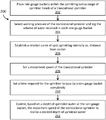
- FIG. 2 is a flow diagram illustrating a method for controlling the movement and speed of a translational sprinkler in different working conditions.
- the relation curve of sprinkling intensity vs. distance from the sprinkler head at the center into a relation curve of sprinkling intensity vs. time t.
- H ′ ⁇ 0 t 2 ⁇ f ⁇ ( t ) ⁇ dt collected after the sprinkler 1 passes by the rain gauge bucket 3 completely is calculated by integration according to the above-mentioned mathematical functional relationship y′. Since only the positive half of x-axis is taken into consideration, the depth of sprinkled water at a rain gauge bucket in a travel cycle of the translational sprinkler 1 is
- FIG. 2 is a flow diagram illustrating a method 200 for controlling the movement and speed of a translational sprinkler in different working conditions.
- the method 200 includes placing rain gauge buckets within a sprinkling radius range of sprinkler heads of a translational sprinkler at a step 202 .
- the method 200 further includes selecting a working pressure of the translational sprinkler and logging the volume of water received in each rain gauge bucket at a step 204 .
- the method 200 further includes establishing a relation curve of spot sprinkling intensity vs. distance from center at a step 206 .
- the method 200 further includes setting a movement speed of the translational sprinkler at a step 208 .
- the method 200 further includes setting a time required for the sprinkler to pass by a rain gauge bucket completely at a step 210 .
- the method 200 further includes controlling, based on a depth of sprinkled water at the rain gauge bucket, the movement speed of the translational sprinkler to realize a desired depth of sprinkled water at a step 212 .
Landscapes
- Engineering & Computer Science (AREA)
- Water Supply & Treatment (AREA)
- Life Sciences & Earth Sciences (AREA)
- Environmental Sciences (AREA)
- Catching Or Destruction (AREA)
Abstract
Description
wherein i=1, 2, . . . , n;
collected after the sprinkler passes by the rain gauge bucket completely, which is the depth of sprinkled water at the rain gauge bucket in a travel cycle of the translational sprinkler.
-
- 1. translational sprinkler; 2—sprinkler head; 3—rain gauge bucket
is calculated, wherein i=1, 2, . . . , n.
| TABLE 1 |
| Average Volume of Sprinkled Water Received in Each Rain Gauge Bucket and Sprinkling Intensity |
| Row No. |
| 1 | 2 | 3 | 4 | 5 | 6 | 7 | 8 | 9 | 10 | 11 | ||
| Volume | 1st time | 354 | 150 | 180 | 194 | 283 | 351 | 366 | 385 | 384 | 175 | 40 |
| of | 2nd time | 418 | 154 | 190 | 215 | 287 | 417 | 470 | 490 | 485 | 372 | 136 |
| Sprinkled | 3rd time | 370 | 146 | 185 | 194 | 283 | 390 | 453 | 522 | 520 | 355 | 110 |
| Water, | Average | 380 | 149.6 | 181.6 | 201 | 284.3 | 386 | 429.6 | 465.6 | 463 | 300.6 | 94.6 |
| mL | value |
| Sprinkling Intensity | 12.1 | 4.76 | 5.78 | 6.4 | 9.05 | 12.29 | 13.7 | 14.8 | 14.7 | 9.6 | 3.0 |
| (mm/h) | |||||||||||
d=−33.55x+25.17x 2−4.91x 3+18.89
d′=−67.1t+100.68t 2−39.28t 3+18.89
collected after the sprinkler 1 passes by the rain gauge bucket 3 completely is calculated by integration according to the above-mentioned mathematical functional relationship y′. Since only the positive half of x-axis is taken into consideration, the depth of sprinkled water at a rain gauge bucket in a travel cycle of the translational sprinkler 1 is
Through the calculation, a result Q=1.07 mm is obtained, i.e., the depth of sprinkled water is 1.07 mm.
Claims (5)
Applications Claiming Priority (4)
| Application Number | Priority Date | Filing Date | Title |
|---|---|---|---|
| CN20161940702.7 | 2016-01-11 | ||
| CN201610940702.7 | 2016-11-01 | ||
| CN201610940702.7A CN106570321B (en) | 2016-11-01 | 2016-11-01 | A kind of calculation method of the translation type sprinkler difference operating condition sprinkling depth of water |
| PCT/CN2016/106704 WO2018082128A1 (en) | 2016-11-01 | 2016-11-22 | Method for calculating depth of sprayed water of translational sprinkler in different working conditions |
Publications (2)
| Publication Number | Publication Date |
|---|---|
| US20190269077A1 US20190269077A1 (en) | 2019-09-05 |
| US11140839B2 true US11140839B2 (en) | 2021-10-12 |
Family
ID=58534734
Family Applications (1)
| Application Number | Title | Priority Date | Filing Date |
|---|---|---|---|
| US16/343,967 Expired - Fee Related US11140839B2 (en) | 2016-11-01 | 2016-11-22 | Method for calculating depth of sprayed water of translational sprinkler in different working conditions |
Country Status (3)
| Country | Link |
|---|---|
| US (1) | US11140839B2 (en) |
| CN (1) | CN106570321B (en) |
| WO (1) | WO2018082128A1 (en) |
Families Citing this family (2)
| Publication number | Priority date | Publication date | Assignee | Title |
|---|---|---|---|---|
| CN108470015A (en) * | 2018-01-29 | 2018-08-31 | 江苏大学镇江流体工程装备技术研究院 | A kind of computational methods of the translation type sprinkler combination uniformity |
| CN109444992B (en) * | 2018-12-05 | 2023-08-15 | 南京信息工程大学 | An optical rain gauge and its system |
Citations (3)
| Publication number | Priority date | Publication date | Assignee | Title |
|---|---|---|---|---|
| CN1908615A (en) | 2006-08-11 | 2007-02-07 | 西北农林科技大学 | A method for measuring uniformity of sprinkler irrigation based on continuous system |
| CN102864546A (en) | 2012-10-08 | 2013-01-09 | 如皋市丁堰纺织有限公司 | Reverse twist-on-twist double-layer binary composite yarn, and manufacturing method and fabric of reverse twist-on-twist double-layer binary composite yarn |
| CN104268313A (en) | 2014-09-09 | 2015-01-07 | 江苏大学 | Method for optimizing installation position of vertical rocker arm type nozzle fluid director |
Family Cites Families (1)
| Publication number | Priority date | Publication date | Assignee | Title |
|---|---|---|---|---|
| CN102854546B (en) * | 2012-05-07 | 2015-02-04 | 江苏大学 | Portable sprinkling irrigation rain gauge in field |
-
2016
- 2016-11-01 CN CN201610940702.7A patent/CN106570321B/en active Active
- 2016-11-22 US US16/343,967 patent/US11140839B2/en not_active Expired - Fee Related
- 2016-11-22 WO PCT/CN2016/106704 patent/WO2018082128A1/en not_active Ceased
Patent Citations (3)
| Publication number | Priority date | Publication date | Assignee | Title |
|---|---|---|---|---|
| CN1908615A (en) | 2006-08-11 | 2007-02-07 | 西北农林科技大学 | A method for measuring uniformity of sprinkler irrigation based on continuous system |
| CN102864546A (en) | 2012-10-08 | 2013-01-09 | 如皋市丁堰纺织有限公司 | Reverse twist-on-twist double-layer binary composite yarn, and manufacturing method and fabric of reverse twist-on-twist double-layer binary composite yarn |
| CN104268313A (en) | 2014-09-09 | 2015-01-07 | 江苏大学 | Method for optimizing installation position of vertical rocker arm type nozzle fluid director |
Non-Patent Citations (6)
| Title |
|---|
| Clark et al., "Measured and simulated uniformity of low drift nozzle sprinklers", 2003, Transactions of the ASAE 46.2, pp. 321-330. * |
| Haijun et al., "Characterizing center pivot irrigation with fixed spray plate sprinklers", 2010, Science China Technological Sciences 53.5, pp. 1398-1405. * |
| Jing-Hong Wan et al., "Tranlocating Speed Ration Effect on Water Distribution Uniformity of Lightweight Lateral Move Irrigation System", Water Saving Irrigation, pp. 87-93, Sep. 2016. |
| King and Bjomeberg, Center pivot simulator for evaluating system design and management effects on infiltration and erosion, 2007, pp. 166-175. * |
| Plaán et al., "Characterizing pivot sprinklers using an experimental irrigation machine", 2004, Agricultural water management 70.3, pp. 177-193. * |
| Zhu et al., "Comparison of fluidic and impact sprinklers based on hydraulic performance," Irrig Sci (2015) 33:367-374. |
Also Published As
| Publication number | Publication date |
|---|---|
| WO2018082128A1 (en) | 2018-05-11 |
| US20190269077A1 (en) | 2019-09-05 |
| CN106570321B (en) | 2019-06-28 |
| CN106570321A (en) | 2017-04-19 |
Similar Documents
| Publication | Publication Date | Title |
|---|---|---|
| US11140839B2 (en) | Method for calculating depth of sprayed water of translational sprinkler in different working conditions | |
| Moazed et al. | Effects of climatic and hydraulic parameters on water uniformity coefficient in solid set systems | |
| CN105160096A (en) | Method for establishing three-dimensional dynamic water distribution model of variable-speed spray head | |
| Miller et al. | Methods for minimising drift and off-target exposure from boom sprayer applications. | |
| CN103266586B (en) | Self-control movable dross absorber | |
| CN210381990U (en) | Green wall of planting that can drip irrigation automatically | |
| CN110702397A (en) | Device and method for testing spray drift amount of plant protection unmanned aerial vehicle | |
| CN203411931U (en) | Guardrail with potted plants and automatic watering function | |
| CN203834540U (en) | Hydraulic engineering silt discharging device | |
| CN215454166U (en) | Crop planting frame for mine restoration | |
| CN212753579U (en) | High steep slope watering device | |
| CN211148004U (en) | Plant protection unmanned aerial vehicle spraying drift volume testing arrangement | |
| CN108470015A (en) | A kind of computational methods of the translation type sprinkler combination uniformity | |
| CN204690662U (en) | A kind of building site atomizing de-dusting apparatus | |
| CN219330296U (en) | Remove water-saving irrigation device | |
| CN206403004U (en) | A kind of rail mounted intelligent monitoring flusher | |
| CN104268313A (en) | Method for optimizing installation position of vertical rocker arm type nozzle fluid director | |
| CN210695355U (en) | Efficient drip irrigation device | |
| CN212034991U (en) | Landscape artistic structure built by utilizing waste steel | |
| CN105930683B (en) | A kind of damping nozzle water droplet distribution of SMD method for establishing model | |
| US20200047205A1 (en) | Method for Calculating Instantaneous Sprinkler Strength | |
| CN220920416U (en) | Be used for forestry soil to restore automatic soil device that turns over | |
| CN221306730U (en) | Portable gardens irrigation equipment | |
| CN213127472U (en) | Underlying driving structure of spray pipe | |
| CN221306602U (en) | Ecological corridor vegetation wall |
Legal Events
| Date | Code | Title | Description |
|---|---|---|---|
| AS | Assignment |
Owner name: JIANGSU UNIVERSITY, CHINA Free format text: PATENT ASSIGNMENT;ASSIGNORS:ZHU, XINGYE;YUAN, SHOUQI;LIU, JUNPING;AND OTHERS;REEL/FRAME:048963/0704 Effective date: 20190419 |
|
| FEPP | Fee payment procedure |
Free format text: ENTITY STATUS SET TO UNDISCOUNTED (ORIGINAL EVENT CODE: BIG.); ENTITY STATUS OF PATENT OWNER: SMALL ENTITY |
|
| FEPP | Fee payment procedure |
Free format text: ENTITY STATUS SET TO SMALL (ORIGINAL EVENT CODE: SMAL); ENTITY STATUS OF PATENT OWNER: SMALL ENTITY |
|
| STPP | Information on status: patent application and granting procedure in general |
Free format text: APPLICATION DISPATCHED FROM PREEXAM, NOT YET DOCKETED |
|
| STPP | Information on status: patent application and granting procedure in general |
Free format text: DOCKETED NEW CASE - READY FOR EXAMINATION |
|
| STPP | Information on status: patent application and granting procedure in general |
Free format text: NON FINAL ACTION MAILED |
|
| STPP | Information on status: patent application and granting procedure in general |
Free format text: RESPONSE TO NON-FINAL OFFICE ACTION ENTERED AND FORWARDED TO EXAMINER |
|
| STPP | Information on status: patent application and granting procedure in general |
Free format text: NOTICE OF ALLOWANCE MAILED -- APPLICATION RECEIVED IN OFFICE OF PUBLICATIONS |
|
| STPP | Information on status: patent application and granting procedure in general |
Free format text: PUBLICATIONS -- ISSUE FEE PAYMENT RECEIVED |
|
| STCF | Information on status: patent grant |
Free format text: PATENTED CASE |
|
| FEPP | Fee payment procedure |
Free format text: MAINTENANCE FEE REMINDER MAILED (ORIGINAL EVENT CODE: REM.); ENTITY STATUS OF PATENT OWNER: SMALL ENTITY |
|
| LAPS | Lapse for failure to pay maintenance fees |
Free format text: PATENT EXPIRED FOR FAILURE TO PAY MAINTENANCE FEES (ORIGINAL EVENT CODE: EXP.); ENTITY STATUS OF PATENT OWNER: SMALL ENTITY |
|
| STCH | Information on status: patent discontinuation |
Free format text: PATENT EXPIRED DUE TO NONPAYMENT OF MAINTENANCE FEES UNDER 37 CFR 1.362 |
|
| FP | Lapsed due to failure to pay maintenance fee |
Effective date: 20251012 |