US11117869B2 - Compounds, compositions and methods for treatment of myopia - Google Patents
Compounds, compositions and methods for treatment of myopia Download PDFInfo
- Publication number
- US11117869B2 US11117869B2 US16/779,188 US202016779188A US11117869B2 US 11117869 B2 US11117869 B2 US 11117869B2 US 202016779188 A US202016779188 A US 202016779188A US 11117869 B2 US11117869 B2 US 11117869B2
- Authority
- US
- United States
- Prior art keywords
- methyl
- alkyl
- composition
- azabicyclo
- myopia
- Prior art date
- Legal status (The legal status is an assumption and is not a legal conclusion. Google has not performed a legal analysis and makes no representation as to the accuracy of the status listed.)
- Active
Links
- 0 *C(CBC)(C(=O)*C1CC2CCC(C1)N2C)C1=CC=CC=C1.CC Chemical compound *C(CBC)(C(=O)*C1CC2CCC(C1)N2C)C1=CC=CC=C1.CC 0.000 description 7
- PNZIHQPZINPBQX-HIBCXSJKSA-O CC(C)=CCCN1CCC(CC(=O)C(O)(C2=CC=CC=C2)C2CCCC2)CC1.CCN(CC)CC#CCOC(=O)C(O)(C1=CC=CC=C1)C1CCCCC1.OC(CCN1CCCC1)(C1=CC=CC=C1)C1CCCCC1.OC(CC[NH+]1CCCC1)(C1=CC=CC=C1)C1CCCCC1.[CH3-].[Cl-].[H][C@]1(OC(=O)C(O)(C2=CC=CS2)C2=CC=CS2)C[C@@]2([H])[C@]3([H])O[C@]3([H])[C@@]([H])(C1)[N+]2(C)C Chemical compound CC(C)=CCCN1CCC(CC(=O)C(O)(C2=CC=CC=C2)C2CCCC2)CC1.CCN(CC)CC#CCOC(=O)C(O)(C1=CC=CC=C1)C1CCCCC1.OC(CCN1CCCC1)(C1=CC=CC=C1)C1CCCCC1.OC(CC[NH+]1CCCC1)(C1=CC=CC=C1)C1CCCCC1.[CH3-].[Cl-].[H][C@]1(OC(=O)C(O)(C2=CC=CS2)C2=CC=CS2)C[C@@]2([H])[C@]3([H])O[C@]3([H])[C@@]([H])(C1)[N+]2(C)C PNZIHQPZINPBQX-HIBCXSJKSA-O 0.000 description 4
- QQPIPQBQGATVAU-AWRLCIOJSA-N CN1[C@H]2CC[C@@H]1C[C@H](OC(=O)N1CC3=CC=CC=C3CC1=O)C2.C[N+]1(C)CCC(OC(=O)C(C2=CC=CC=C2)C2=CC=CC=C2)CC1.NC(=O)C(C1=CC=CC=C1)(C1=CC=CC=C1)[C@@H]1CCN(CCC2=CC3=C(C=C2)OCC3)C1.O=C(OC1CN2CCC1CC2)C(O)(C1=CC=CC=C1)C1CCCC1.O=C(O[C@H]1C[N+]2(CCCOC3=CC=CC=C3)CCC1CC2)C(O)(C1=CC=CS1)C1=CC=CS1 Chemical compound CN1[C@H]2CC[C@@H]1C[C@H](OC(=O)N1CC3=CC=CC=C3CC1=O)C2.C[N+]1(C)CCC(OC(=O)C(C2=CC=CC=C2)C2=CC=CC=C2)CC1.NC(=O)C(C1=CC=CC=C1)(C1=CC=CC=C1)[C@@H]1CCN(CCC2=CC3=C(C=C2)OCC3)C1.O=C(OC1CN2CCC1CC2)C(O)(C1=CC=CC=C1)C1CCCC1.O=C(O[C@H]1C[N+]2(CCCOC3=CC=CC=C3)CCC1CC2)C(O)(C1=CC=CS1)C1=CC=CS1 QQPIPQBQGATVAU-AWRLCIOJSA-N 0.000 description 4
- ATTBUZQYEBHVME-IBIYBEDHSA-N C1=CC=C(C(O[C@@H]2CCCN(CCC3=C/C=C4/OCO/C4=C\3)C2)C2=CC=CC=C2)C=C1.CC1=CC=C(O)C([C@@H](CCN(C(C)C)C(C)C)C2=CC=CC=C2)=C1 Chemical compound C1=CC=C(C(O[C@@H]2CCCN(CCC3=C/C=C4/OCO/C4=C\3)C2)C2=CC=CC=C2)C=C1.CC1=CC=C(O)C([C@@H](CCN(C(C)C)C(C)C)C2=CC=CC=C2)=C1 ATTBUZQYEBHVME-IBIYBEDHSA-N 0.000 description 3
- GAULUAKWLKMVTN-UHFFFAOYSA-N CC(C)[N+]1(C)C2CCC1CC(OC(=O)C(CO)C1=CC=CC=C1)C2.[CH3-] Chemical compound CC(C)[N+]1(C)C2CCC1CC(OC(=O)C(CO)C1=CC=CC=C1)C2.[CH3-] GAULUAKWLKMVTN-UHFFFAOYSA-N 0.000 description 3
- IVWFNRDBUPWDFQ-UHFFFAOYSA-N CC1=CC=CC(C(CO)C(=O)OC2CC3CCC(C2)N3C)=C1 Chemical compound CC1=CC=CC(C(CO)C(=O)OC2CC3CCC(C2)N3C)=C1 IVWFNRDBUPWDFQ-UHFFFAOYSA-N 0.000 description 3
- YPBKGKBXDYDLTP-UHFFFAOYSA-N CC.CCCC(C)(C(=O)CC1CC2CCC(C1)N2C)C1=CC=CC=C1 Chemical compound CC.CCCC(C)(C(=O)CC1CC2CCC(C1)N2C)C1=CC=CC=C1 YPBKGKBXDYDLTP-UHFFFAOYSA-N 0.000 description 2
- MBQWCGASNSJRSL-NBNUKKFVSA-N CC1=CC=C([C@H](C(=O)CC2CC3CCC(C2)N3C)C(C)O)C=C1.CC1=CC=C([C@H](C(=O)CC2CC3CCC(C2)N3C)C2(O)CCCC2)C=C1.CC1=CC=CC(C(CO)C(=O)OC2CC3CCC(C2)N3C)=C1.CCC1=CC=C([C@@H](CN)C(=O)CC2CC3CCC(C2)N3C)C=C1.CCC1=CC=C([C@@H](CN)C(=O)CC2CC3CCC(C2)N3C)C=C1.CN1C2CCC1CC(CC(=O)C(CO)C1=CC=CC=C1)C2.CN1C2CCC1CC(OC(=O)C(CN)C1=C(F)C=CC=C1)C2.CN1C2CCC1CC(OC(=O)C(CN)C1=CN=CC=C1)C2.COC1=CC=CC(C(CN)C(=O)OC2CC3CCC(C2)N3C)=C1 Chemical compound CC1=CC=C([C@H](C(=O)CC2CC3CCC(C2)N3C)C(C)O)C=C1.CC1=CC=C([C@H](C(=O)CC2CC3CCC(C2)N3C)C2(O)CCCC2)C=C1.CC1=CC=CC(C(CO)C(=O)OC2CC3CCC(C2)N3C)=C1.CCC1=CC=C([C@@H](CN)C(=O)CC2CC3CCC(C2)N3C)C=C1.CCC1=CC=C([C@@H](CN)C(=O)CC2CC3CCC(C2)N3C)C=C1.CN1C2CCC1CC(CC(=O)C(CO)C1=CC=CC=C1)C2.CN1C2CCC1CC(OC(=O)C(CN)C1=C(F)C=CC=C1)C2.CN1C2CCC1CC(OC(=O)C(CN)C1=CN=CC=C1)C2.COC1=CC=CC(C(CN)C(=O)OC2CC3CCC(C2)N3C)=C1 MBQWCGASNSJRSL-NBNUKKFVSA-N 0.000 description 2
- LQNLZXIWGBFVJN-UHFFFAOYSA-N CCCCC(=O)C(C)(CC)C(C)(C)CC Chemical compound CCCCC(=O)C(C)(CC)C(C)(C)CC LQNLZXIWGBFVJN-UHFFFAOYSA-N 0.000 description 2
- BSHVVYULAVQDCE-UHFFFAOYSA-N CCN1C2CCC1CC(OC(=O)C(CN)C1=CC(OC)=CC=C1)C2 Chemical compound CCN1C2CCC1CC(OC(=O)C(CN)C1=CC(OC)=CC=C1)C2 BSHVVYULAVQDCE-UHFFFAOYSA-N 0.000 description 2
- YIENPHTZIDSDBT-HZFREWSRSA-N CN1C2CCC1CC(CC(=O)[C@H](CN)C1=CC=C(CO)C=C1)C2 Chemical compound CN1C2CCC1CC(CC(=O)[C@H](CN)C1=CC=C(CO)C=C1)C2 YIENPHTZIDSDBT-HZFREWSRSA-N 0.000 description 2
- REZAJQSSMVBGHO-UHFFFAOYSA-N CN1C2CCC1CC(OC(=O)C(C)(CO)C1=CC=C(F)C=C1)C2 Chemical compound CN1C2CCC1CC(OC(=O)C(C)(CO)C1=CC=C(F)C=C1)C2 REZAJQSSMVBGHO-UHFFFAOYSA-N 0.000 description 2
- XZPAMMPYTOAFOU-UHFFFAOYSA-N CN1C2CCC1CC(OC(=O)C(C)(CO)C1=CC=CC=C1)C2 Chemical compound CN1C2CCC1CC(OC(=O)C(C)(CO)C1=CC=CC=C1)C2 XZPAMMPYTOAFOU-UHFFFAOYSA-N 0.000 description 2
- HBIMCWVSXKMBMB-UHFFFAOYSA-N CN1C2CCC1CC(OC(=O)C(CN)C1=CN=CC=C1)C2 Chemical compound CN1C2CCC1CC(OC(=O)C(CN)C1=CN=CC=C1)C2 HBIMCWVSXKMBMB-UHFFFAOYSA-N 0.000 description 2
- RAZSLOISWZJZKO-UHFFFAOYSA-N CN1C2CCC1CC(OC(=O)C(CO)C1=C(Cl)C=CC=C1)C2 Chemical compound CN1C2CCC1CC(OC(=O)C(CO)C1=C(Cl)C=CC=C1)C2 RAZSLOISWZJZKO-UHFFFAOYSA-N 0.000 description 2
- ABSIQMWYHINTED-UHFFFAOYSA-N CN1C2CCC1CC(OC(=O)C(CO)C1=CC=CC(Cl)=C1)C2 Chemical compound CN1C2CCC1CC(OC(=O)C(CO)C1=CC=CC(Cl)=C1)C2 ABSIQMWYHINTED-UHFFFAOYSA-N 0.000 description 2
- XENMSANTVYBNMJ-UHFFFAOYSA-N CNC(=O)C1=CC=C(C(CN)C(=O)OC2CC3CCC(C2)N3C)C=C1 Chemical compound CNC(=O)C1=CC=C(C(CN)C(=O)OC2CC3CCC(C2)N3C)C=C1 XENMSANTVYBNMJ-UHFFFAOYSA-N 0.000 description 2
- UQSQCWZRJUPIOP-HNNXBMFYSA-N O=C(CCC1=CC=CC=C1)[C@@H](CO)C1=CC=NC=C1 Chemical compound O=C(CCC1=CC=CC=C1)[C@@H](CO)C1=CC=NC=C1 UQSQCWZRJUPIOP-HNNXBMFYSA-N 0.000 description 2
- UQSQCWZRJUPIOP-OAHLLOKOSA-N O=C(CCC1=CC=CC=C1)[C@H](CO)C1=CC=NC=C1 Chemical compound O=C(CCC1=CC=CC=C1)[C@H](CO)C1=CC=NC=C1 UQSQCWZRJUPIOP-OAHLLOKOSA-N 0.000 description 2
- JVZPOVRLZVAIAI-UHFFFAOYSA-N [H]C(CN)(C(=O)NC1CC2CCC(C1)N2C)C1=CN=CC=C1 Chemical compound [H]C(CN)(C(=O)NC1CC2CCC(C1)N2C)C1=CN=CC=C1 JVZPOVRLZVAIAI-UHFFFAOYSA-N 0.000 description 2
- BEMVVMCHJBZPPK-UHPDLMBCSA-N *.CC1=CC(C(CO)C(=O)OC2CC3CCC(C2)N3C)=CC=C1.CC1=CC=C([C@H](C(=O)CC2CC3CCC(C2)N3C)C(C)O)C=C1.CC1=CC=C([C@H](C(=O)CC2CC3CCC(C2)N3C)C2(O)CCCC2)C=C1.CCC1=CC=C([C@@H](CN)C(=O)CC2CC3CCC(C2)N3C)C=C1.CCC1=CC=C([C@@H](CN)C(=O)CC2CC3CCC(C2)N3C)C=C1.CN1C2CCC1CC(CC(=O)C(CO)C1=CC=CC=C1)C2.CN1C2CCC1CC(OC(=O)C(C)(CO)C1=CC=CC=C1)C2.CN1C2CCC1CC(OC(=O)C(C)(CO)C1=CC=CC=C1)C2.S.S Chemical compound *.CC1=CC(C(CO)C(=O)OC2CC3CCC(C2)N3C)=CC=C1.CC1=CC=C([C@H](C(=O)CC2CC3CCC(C2)N3C)C(C)O)C=C1.CC1=CC=C([C@H](C(=O)CC2CC3CCC(C2)N3C)C2(O)CCCC2)C=C1.CCC1=CC=C([C@@H](CN)C(=O)CC2CC3CCC(C2)N3C)C=C1.CCC1=CC=C([C@@H](CN)C(=O)CC2CC3CCC(C2)N3C)C=C1.CN1C2CCC1CC(CC(=O)C(CO)C1=CC=CC=C1)C2.CN1C2CCC1CC(OC(=O)C(C)(CO)C1=CC=CC=C1)C2.CN1C2CCC1CC(OC(=O)C(C)(CO)C1=CC=CC=C1)C2.S.S BEMVVMCHJBZPPK-UHPDLMBCSA-N 0.000 description 1
- RNIPFGWSNCNVPJ-UHFFFAOYSA-N *.CN1C2CCC1CC(OC(=O)C(C)(CO)C1=CC=CC=C1)C2.S.S Chemical compound *.CN1C2CCC1CC(OC(=O)C(C)(CO)C1=CC=CC=C1)C2.S.S RNIPFGWSNCNVPJ-UHFFFAOYSA-N 0.000 description 1
- BDNFQGRSKSQXRI-XMMPIXPASA-N C(CN(CCC1)C[C@@H]1OC(c1ccccc1)c1ccccc1)c1ccc2OCOc2c1 Chemical compound C(CN(CCC1)C[C@@H]1OC(c1ccccc1)c1ccccc1)c1ccc2OCOc2c1 BDNFQGRSKSQXRI-XMMPIXPASA-N 0.000 description 1
- QBSRTMGBCLDNCO-UHFFFAOYSA-N C.CC(C)[N+]1(C)C2CCC1CC(OC(=O)C(CO)C1=CC=CC=C1)C2.[CH3-] Chemical compound C.CC(C)[N+]1(C)C2CCC1CC(OC(=O)C(CO)C1=CC=CC=C1)C2.[CH3-] QBSRTMGBCLDNCO-UHFFFAOYSA-N 0.000 description 1
- GHWZBXJBTDBMBP-UHFFFAOYSA-N C.CC.CC.CC.CC.CC.CC.CC.CCC(C)(C)C(C)(CC)C(=O)CC1=CSC2=CC=CC=C12.CCC(C)(C)C(C)(CC)C(=O)CCC1=CC=CC=C1.CCC(C)(C)C(C)(CC)C(=O)CCC1=CC=CC=C1.CCC(C)(C)C(C)(CC)C(=O)CCC1=CC=CC=C1.CCC(C)(C)C(C)(CC)C(=O)CCC1=CN=CC=C1.CCC(C)(C)C(C)(CC)C(=O)CCC1=NC=CC=C1.CCC(C)(C)C(C)(CC)C(=O)CCC1=NC=CC=N1 Chemical compound C.CC.CC.CC.CC.CC.CC.CC.CCC(C)(C)C(C)(CC)C(=O)CC1=CSC2=CC=CC=C12.CCC(C)(C)C(C)(CC)C(=O)CCC1=CC=CC=C1.CCC(C)(C)C(C)(CC)C(=O)CCC1=CC=CC=C1.CCC(C)(C)C(C)(CC)C(=O)CCC1=CC=CC=C1.CCC(C)(C)C(C)(CC)C(=O)CCC1=CN=CC=C1.CCC(C)(C)C(C)(CC)C(=O)CCC1=NC=CC=C1.CCC(C)(C)C(C)(CC)C(=O)CCC1=NC=CC=N1 GHWZBXJBTDBMBP-UHFFFAOYSA-N 0.000 description 1
- ABTIXYGZUAOCDV-UHFFFAOYSA-N C.CC1=CC=C(C(C)(CO)C(=O)OCC2=CC=NC=C2F)C=C1.CC1=CC=C(C(CN)C(=O)OCC2=NC=NC=C2)C=C1.CCC(CN)(C(=O)OCC1=CC=NC=C1)C1=CC=C(C)C=C1 Chemical compound C.CC1=CC=C(C(C)(CO)C(=O)OCC2=CC=NC=C2F)C=C1.CC1=CC=C(C(CN)C(=O)OCC2=NC=NC=C2)C=C1.CCC(CN)(C(=O)OCC1=CC=NC=C1)C1=CC=C(C)C=C1 ABTIXYGZUAOCDV-UHFFFAOYSA-N 0.000 description 1
- KUFICFRQCIXVOB-BPWNOUAGSA-N C.CO.O=C(O)C(CO)C1=CC=CC=C1.[2H]CSC.[H][C@]12CC[C@]([H])(C[C@@H](CC(=O)C(CO)C3=CC=CC=C3)C1)N2C.[H][C@]12CC[C@]([H])(C[C@@H](N)C1)N2C Chemical compound C.CO.O=C(O)C(CO)C1=CC=CC=C1.[2H]CSC.[H][C@]12CC[C@]([H])(C[C@@H](CC(=O)C(CO)C3=CC=CC=C3)C1)N2C.[H][C@]12CC[C@]([H])(C[C@@H](N)C1)N2C KUFICFRQCIXVOB-BPWNOUAGSA-N 0.000 description 1
- JCNRJABKBOAORZ-JLMMQWLNSA-N C.COC1=NC=C(CCCC(C(=O)O)C2=CC=CC=C2)C=C1.COC1=NC=C(CN)C=C1.O=C(O)C(CO)C1=CC=CC=C1.[2H]CSC Chemical compound C.COC1=NC=C(CCCC(C(=O)O)C2=CC=CC=C2)C=C1.COC1=NC=C(CN)C=C1.O=C(O)C(CO)C1=CC=CC=C1.[2H]CSC JCNRJABKBOAORZ-JLMMQWLNSA-N 0.000 description 1
- YSPFCPUVMZBYBT-VRMXRTMFSA-N C1=CC=C(C(O[C@@H]2CCCN(CCC3=CC=C4OCOC4=C3)C2)C2=CC=CC=C2)C=C1.CC1=CC=C(O)C([C@@H](CCN(C(C)C)C(C)C)C2=CC=CC=C2)=C1.O=C(CCC1=CC=CC=C1)C(CO)C1=CC=C(F)C=C1.O=C(CCC1=CC=CC=C1)C(CO)C1=CC=CC(F)=C1.O=C(CCC1=CC=CC=C1)C(CO)C1=CC=CC=C1F.O=C(CCC1=CC=CC=C1)[C@@H](CO)C1=CC=C(Cl)C=C1.O=C(CCC1=CC=CC=C1)[C@@H](CO)C1=CC=CC=C1Cl Chemical compound C1=CC=C(C(O[C@@H]2CCCN(CCC3=CC=C4OCOC4=C3)C2)C2=CC=CC=C2)C=C1.CC1=CC=C(O)C([C@@H](CCN(C(C)C)C(C)C)C2=CC=CC=C2)=C1.O=C(CCC1=CC=CC=C1)C(CO)C1=CC=C(F)C=C1.O=C(CCC1=CC=CC=C1)C(CO)C1=CC=CC(F)=C1.O=C(CCC1=CC=CC=C1)C(CO)C1=CC=CC=C1F.O=C(CCC1=CC=CC=C1)[C@@H](CO)C1=CC=C(Cl)C=C1.O=C(CCC1=CC=CC=C1)[C@@H](CO)C1=CC=CC=C1Cl YSPFCPUVMZBYBT-VRMXRTMFSA-N 0.000 description 1
- OGDHJNJMWFDWPP-PXCCBYQZSA-N C=C(CN)C(=O)OC1CC2CCC(C1)N(C)C2.CC1=CC=CC([C@H](CO)C(=O)OC2CC3CCC(C2)N3C)=C1.CN1C2CCC1CC(OC(=O)[C@@](C)(CN)C1=CC=C(Cl)C=C1)C2.CN1CC2CCC1CC(OC(=O)C(CN)C1=CC=CS1)C2.CN1CC2CCC1CC(OC(=O)[C@](C)(CO)C1=CC=C(OC(F)(F)F)C=C1)C2.COC1=CC=C([C@@H](CO)C(=O)OC2CC3CCC(C2)N3C)C=C1.COCC1=CC=C(C(CN)C(=O)OC2CC3CCC(C2)N3C)C=C1 Chemical compound C=C(CN)C(=O)OC1CC2CCC(C1)N(C)C2.CC1=CC=CC([C@H](CO)C(=O)OC2CC3CCC(C2)N3C)=C1.CN1C2CCC1CC(OC(=O)[C@@](C)(CN)C1=CC=C(Cl)C=C1)C2.CN1CC2CCC1CC(OC(=O)C(CN)C1=CC=CS1)C2.CN1CC2CCC1CC(OC(=O)[C@](C)(CO)C1=CC=C(OC(F)(F)F)C=C1)C2.COC1=CC=C([C@@H](CO)C(=O)OC2CC3CCC(C2)N3C)C=C1.COCC1=CC=C(C(CN)C(=O)OC2CC3CCC(C2)N3C)C=C1 OGDHJNJMWFDWPP-PXCCBYQZSA-N 0.000 description 1
- NNMKSIRXGWPVRX-UHFFFAOYSA-N C=C(CN)C(=O)OC1CC2CCC(C1)N2C Chemical compound C=C(CN)C(=O)OC1CC2CCC(C1)N2C NNMKSIRXGWPVRX-UHFFFAOYSA-N 0.000 description 1
- QEHLMPIORXIJEH-MZRAEMKCSA-N C=C(CN)C(=O)OC1CC2CCC(C1)N2C.CC1=CC=CC(C(CO)C(=O)OC2CC3CCC(C2)N3C)=C1.CN1C2CCC1CC(OC(=O)C(CN)C1=CC3=C(C=C1)N=CN3)C2.CN1C2CCC1CC(OC(=O)C(CN)C1=CC=CS1)C2.CN1C2CCC1CC(OC(=O)C(CO)C1=CC3=C(C=CC=C3)S1)C2.CN1C2CCC1CC(OC(=O)[C@](C)(CO)C1=CC=C(OC(F)(F)F)C=C1)C2 Chemical compound C=C(CN)C(=O)OC1CC2CCC(C1)N2C.CC1=CC=CC(C(CO)C(=O)OC2CC3CCC(C2)N3C)=C1.CN1C2CCC1CC(OC(=O)C(CN)C1=CC3=C(C=C1)N=CN3)C2.CN1C2CCC1CC(OC(=O)C(CN)C1=CC=CS1)C2.CN1C2CCC1CC(OC(=O)C(CO)C1=CC3=C(C=CC=C3)S1)C2.CN1C2CCC1CC(OC(=O)[C@](C)(CO)C1=CC=C(OC(F)(F)F)C=C1)C2 QEHLMPIORXIJEH-MZRAEMKCSA-N 0.000 description 1
- MBKVLEXYQRUJTN-ADPWUKOQSA-N C=C(CN)C(=O)OC1CC2CCC(C1)N2C.CC1=CC=CC([C@H](CO)C(=O)OC2CC3CCC(C2)N3C)=C1.CN1C2CCC1CC(OC(=O)C(CN)C1=CC=CS1)C2.CN1C2CCC1CC(OC(=O)[C@@](C)(CN)C1=CC=C(Cl)C=C1)C2.CN1C2CCC1CC(OC(=O)[C@](C)(CO)C1=CC=C(OC(F)(F)F)C=C1)C2.COC1=CC=C([C@@H](CO)C(=O)OC2CC3CCC(C2)N3C)C=C1.COCC1=CC=C(C(CN)C(=O)OC2CC3CCC(C2)N3C)C=C1 Chemical compound C=C(CN)C(=O)OC1CC2CCC(C1)N2C.CC1=CC=CC([C@H](CO)C(=O)OC2CC3CCC(C2)N3C)=C1.CN1C2CCC1CC(OC(=O)C(CN)C1=CC=CS1)C2.CN1C2CCC1CC(OC(=O)[C@@](C)(CN)C1=CC=C(Cl)C=C1)C2.CN1C2CCC1CC(OC(=O)[C@](C)(CO)C1=CC=C(OC(F)(F)F)C=C1)C2.COC1=CC=C([C@@H](CO)C(=O)OC2CC3CCC(C2)N3C)C=C1.COCC1=CC=C(C(CN)C(=O)OC2CC3CCC(C2)N3C)C=C1 MBKVLEXYQRUJTN-ADPWUKOQSA-N 0.000 description 1
- PETODPJZLDJWDM-RIMUKSHESA-N CC(=O)C(CO)C1=CC=CC=C1.[H][C@]12CC[C@]([H])(C[C@H](OC(=O)C(CC(F)(F)F)C3=CC=CC=C3)C1)N2C Chemical compound CC(=O)C(CO)C1=CC=CC=C1.[H][C@]12CC[C@]([H])(C[C@H](OC(=O)C(CC(F)(F)F)C3=CC=CC=C3)C1)N2C PETODPJZLDJWDM-RIMUKSHESA-N 0.000 description 1
- WBISGHDYLOFGMW-MOPPJUEZSA-N CC(C)(C)CC(=O)CCC(C(=O)O)C1=CC=CC=C1.ClCCl.[H][C@]12CC[C@]([H])(C[C@H](OC(=O)C(CCC(=O)CC(C)(C)C)C3=CC=CC=C3)C1)N2C.[H][C@]12CC[C@]([H])(C[C@H](OC(=O)C(CN)C3=CC=CC=C3)C1)N2C Chemical compound CC(C)(C)CC(=O)CCC(C(=O)O)C1=CC=CC=C1.ClCCl.[H][C@]12CC[C@]([H])(C[C@H](OC(=O)C(CCC(=O)CC(C)(C)C)C3=CC=CC=C3)C1)N2C.[H][C@]12CC[C@]([H])(C[C@H](OC(=O)C(CN)C3=CC=CC=C3)C1)N2C WBISGHDYLOFGMW-MOPPJUEZSA-N 0.000 description 1
- KJDPSZOGYSPBET-GGHOMKCWSA-N CC(C)(O)C(C(=O)OC1=CSC2=CC=CC=C12)C1=CC=CC=C1.CC(CO)(C(=O)OCC1=C(F)C=CC=C1)C1=CC=CC=C1.CC(CO)(C(=O)OCC1=CC=CC=C1)C1=CC=CC=C1.CCC(O)(CC)C(C(=O)OCC1=CC=CC=C1)C1=CC=C(C)C=C1.O=C(OCC1=C(F)C=CC=C1)C(C1=CC=CC(Cl)=C1)C1(O)CCCC1.O=C(OCC1=CC=CC=C1)[C@H](CO)C1=CC=C(Cl)C=C1 Chemical compound CC(C)(O)C(C(=O)OC1=CSC2=CC=CC=C12)C1=CC=CC=C1.CC(CO)(C(=O)OCC1=C(F)C=CC=C1)C1=CC=CC=C1.CC(CO)(C(=O)OCC1=CC=CC=C1)C1=CC=CC=C1.CCC(O)(CC)C(C(=O)OCC1=CC=CC=C1)C1=CC=C(C)C=C1.O=C(OCC1=C(F)C=CC=C1)C(C1=CC=CC(Cl)=C1)C1(O)CCCC1.O=C(OCC1=CC=CC=C1)[C@H](CO)C1=CC=C(Cl)C=C1 KJDPSZOGYSPBET-GGHOMKCWSA-N 0.000 description 1
- NQAZEJQTCQWBJV-MWDPITGYSA-N CC(C)(O)C(C(=O)OC1=CSC2=CC=CC=C12)C1=CC=CC=C1.CC(CO)(C(=O)OCC1=C(F)C=CC=C1)C1=CC=CC=C1.CC(O)C(C(=O)O/C1=C/SC2=CC=NC=C21)C1=CC=C(F)C=C1.CC1=CC=C(C(C(=O)OCC2=CC=CC=C2)C(O)C2CC2)C=C1.CCC(O)(CC)C(C(=O)OCC1=CC=CC=C1)C1=CC=C(C)C=C1.O=C(OCC1=C(F)C=CC=C1)C(C1=CC=CC(Cl)=C1)C1(O)CCCC1.O=C(OCC1=CC=CC=C1)[C@H](CO)C1=CC=C(Cl)C=C1 Chemical compound CC(C)(O)C(C(=O)OC1=CSC2=CC=CC=C12)C1=CC=CC=C1.CC(CO)(C(=O)OCC1=C(F)C=CC=C1)C1=CC=CC=C1.CC(O)C(C(=O)O/C1=C/SC2=CC=NC=C21)C1=CC=C(F)C=C1.CC1=CC=C(C(C(=O)OCC2=CC=CC=C2)C(O)C2CC2)C=C1.CCC(O)(CC)C(C(=O)OCC1=CC=CC=C1)C1=CC=C(C)C=C1.O=C(OCC1=C(F)C=CC=C1)C(C1=CC=CC(Cl)=C1)C1(O)CCCC1.O=C(OCC1=CC=CC=C1)[C@H](CO)C1=CC=C(Cl)C=C1 NQAZEJQTCQWBJV-MWDPITGYSA-N 0.000 description 1
- BZMICPHPHYPREX-GGHOMKCWSA-N CC(C)(O)C(C(=O)OC1=CSC2=CC=CC=C12)C1=CC=CC=C1.CC(O)C(C(=O)OC1=CSC2=CC=NC=C12)C1=CC=C(F)C=C1.CC1=CC=C(C(C(=O)OCC2=CC=CC=C2)C(O)C2CC2)C=C1.CCC(O)(CC)C(C(=O)OCC1=CC=CC=C1)C1=CC=C(C)C=C1.O=C(OCC1=C(F)C=CC=C1)C(C1=CC=CC(Cl)=C1)C1(O)CCCC1.O=C(OCC1=CC=CC=C1)[C@H](CO)C1=CC=C(Cl)C=C1 Chemical compound CC(C)(O)C(C(=O)OC1=CSC2=CC=CC=C12)C1=CC=CC=C1.CC(O)C(C(=O)OC1=CSC2=CC=NC=C12)C1=CC=C(F)C=C1.CC1=CC=C(C(C(=O)OCC2=CC=CC=C2)C(O)C2CC2)C=C1.CCC(O)(CC)C(C(=O)OCC1=CC=CC=C1)C1=CC=C(C)C=C1.O=C(OCC1=C(F)C=CC=C1)C(C1=CC=CC(Cl)=C1)C1(O)CCCC1.O=C(OCC1=CC=CC=C1)[C@H](CO)C1=CC=C(Cl)C=C1 BZMICPHPHYPREX-GGHOMKCWSA-N 0.000 description 1
- HGNDCAMJZIXFBG-DOFCDOPISA-N CC(C)(O)C(C(=O)OC1=CSC2=CN=CC=C12)C1=CC=CC=C1.CC(CO)(C(=O)OCC1=CC=NC=C1)C1=CC=CC=C1.CC(CO)(C(=O)OCC1=CC=NC=C1F)C1=CC=CC=C1.CC(CO)(C(=O)OCC1=CC=NC=C1F)C1=CC=CC=C1.CC1=CC(C(C(=O)OCC2=CC=NC=C2F)C2(O)CCCC2)=CC=C1.CC1=CC=C([C@@H](CO)C(=O)OCC2=CC=NC=C2)C=C1.CCC(O)(CC)C(C(=O)OCC1=CC=NC=C1)C1=CC=C(C)C=C1 Chemical compound CC(C)(O)C(C(=O)OC1=CSC2=CN=CC=C12)C1=CC=CC=C1.CC(CO)(C(=O)OCC1=CC=NC=C1)C1=CC=CC=C1.CC(CO)(C(=O)OCC1=CC=NC=C1F)C1=CC=CC=C1.CC(CO)(C(=O)OCC1=CC=NC=C1F)C1=CC=CC=C1.CC1=CC(C(C(=O)OCC2=CC=NC=C2F)C2(O)CCCC2)=CC=C1.CC1=CC=C([C@@H](CO)C(=O)OCC2=CC=NC=C2)C=C1.CCC(O)(CC)C(C(=O)OCC1=CC=NC=C1)C1=CC=C(C)C=C1 HGNDCAMJZIXFBG-DOFCDOPISA-N 0.000 description 1
- ZLPOUMKFDWCVII-UHFFFAOYSA-N CC(C)C(O)C(C(=O)OCC1=CC=CC=C1)C1=CC=C(F)C=C1.CC(O)C(C(=O)OC1=CSC2=CC=NC=C12)C1=CC=C(F)C=C1.CC1=CC(COC(=O)C(C2=CC=C(F)C=C2)C(C)(C)O)=CC=C1.CC1=CC=C(C(C(=O)OCC2=CC=CC=C2)C(O)C2CC2)C=C1.CCC(O)C(C(=O)OCC1=CC=CC=C1)C1=CC=CC=C1.CCCC(CCC)C(=O)OCC1=CC=CC=C1 Chemical compound CC(C)C(O)C(C(=O)OCC1=CC=CC=C1)C1=CC=C(F)C=C1.CC(O)C(C(=O)OC1=CSC2=CC=NC=C12)C1=CC=C(F)C=C1.CC1=CC(COC(=O)C(C2=CC=C(F)C=C2)C(C)(C)O)=CC=C1.CC1=CC=C(C(C(=O)OCC2=CC=CC=C2)C(O)C2CC2)C=C1.CCC(O)C(C(=O)OCC1=CC=CC=C1)C1=CC=CC=C1.CCCC(CCC)C(=O)OCC1=CC=CC=C1 ZLPOUMKFDWCVII-UHFFFAOYSA-N 0.000 description 1
- LZHMLQPCXRTWOJ-QDYDTIBTSA-N CC(C)C(O)C(C(=O)OCC1=CC=CC=C1)C1=CC=C(F)C=C1.CC1=CC(COC(=O)C(C2=CC=C(F)C=C2)C(C)(C)O)=CC=C1.CCC(O)C(C(=O)OCC1=CC=CC=C1)C1=CC=CC=C1.CCCC(CCC)C(=O)OCC1=CC=CC=C1.CC[C@@H](O)C(C(=O)OCC1=CC=CC=C1)C1=CC=C(F)C=C1.CC[C@H](O)C(C(=O)OCC1=CC=CC=C1)C1=CC=C(F)C=C1 Chemical compound CC(C)C(O)C(C(=O)OCC1=CC=CC=C1)C1=CC=C(F)C=C1.CC1=CC(COC(=O)C(C2=CC=C(F)C=C2)C(C)(C)O)=CC=C1.CCC(O)C(C(=O)OCC1=CC=CC=C1)C1=CC=CC=C1.CCCC(CCC)C(=O)OCC1=CC=CC=C1.CC[C@@H](O)C(C(=O)OCC1=CC=CC=C1)C1=CC=C(F)C=C1.CC[C@H](O)C(C(=O)OCC1=CC=CC=C1)C1=CC=C(F)C=C1 LZHMLQPCXRTWOJ-QDYDTIBTSA-N 0.000 description 1
- LMVUEZHALZJKQI-VBGNUDMOSA-N CC(C)C(O)C(C(=O)OCC1=CC=CC=C1)C1=CC=C(F)C=C1.CC1=CC(COC(=O)C(C2=CC=C(F)C=C2)C(C)(C)O)=CC=C1.CCC(O)C(C(=O)OCC1=CC=CC=C1)C1=CC=CC=C1.CCCC(CCC)C(=O)OCC1=CC=CC=C1.CC[C@@H](O)C(C(=O)OCC1=CC=CC=C1)C1=CC=C(F)C=C1.CC[C@H](O)C(C(=O)OCC1=CC=CC=C1)C1=CC=C(F)C=C1.O=C(OCC1=CC=CN=C1)C(C1=CC=C(F)C=C1)C1(O)CCCC1 Chemical compound CC(C)C(O)C(C(=O)OCC1=CC=CC=C1)C1=CC=C(F)C=C1.CC1=CC(COC(=O)C(C2=CC=C(F)C=C2)C(C)(C)O)=CC=C1.CCC(O)C(C(=O)OCC1=CC=CC=C1)C1=CC=CC=C1.CCCC(CCC)C(=O)OCC1=CC=CC=C1.CC[C@@H](O)C(C(=O)OCC1=CC=CC=C1)C1=CC=C(F)C=C1.CC[C@H](O)C(C(=O)OCC1=CC=CC=C1)C1=CC=C(F)C=C1.O=C(OCC1=CC=CN=C1)C(C1=CC=C(F)C=C1)C1(O)CCCC1 LMVUEZHALZJKQI-VBGNUDMOSA-N 0.000 description 1
- LEFMVIXKJANHFA-UHFFFAOYSA-N CC(CO)(C(=O)OCC1=C(F)C=CC=C1)C1=CC=C(C(F)(F)F)C=C1.CC1=CC(COC(=O)C(C)(CO)C2=CC=C(F)C=C2)=CC=C1.CC1=CC=C(C(C(=O)OCC2=NC=CC=N2)C2(O)CCCC2)C=C1.CCC(CN)(C(=O)OCC1=CC=CC=C1)C1=CC=C(Cl)C=C1.O=C(OCC1=CC=CC=N1)C(C1=CC=C(F)C=C1)C1(O)CCCC1 Chemical compound CC(CO)(C(=O)OCC1=C(F)C=CC=C1)C1=CC=C(C(F)(F)F)C=C1.CC1=CC(COC(=O)C(C)(CO)C2=CC=C(F)C=C2)=CC=C1.CC1=CC=C(C(C(=O)OCC2=NC=CC=N2)C2(O)CCCC2)C=C1.CCC(CN)(C(=O)OCC1=CC=CC=C1)C1=CC=C(Cl)C=C1.O=C(OCC1=CC=CC=N1)C(C1=CC=C(F)C=C1)C1(O)CCCC1 LEFMVIXKJANHFA-UHFFFAOYSA-N 0.000 description 1
- QSVDWCYQUQFSGO-UHFFFAOYSA-N CC(CO)(C(=O)OCC1=C(F)C=CC=C1)C1=CC=C(C(F)(F)F)C=C1.CC1=CC(COC(=O)C(C)(CO)C2=CC=C(F)C=C2)=CC=C1.CCC(CN)(C(=O)OCC1=CC=CC=C1)C1=CC=C(Cl)C=C1.NCC(C(=O)OCC1=CC=CC=N1)C1=CC=C(Cl)C=C1.O=C(CC(O)CC1=CC=CC=C1)OCC1=CC=CC=C1 Chemical compound CC(CO)(C(=O)OCC1=C(F)C=CC=C1)C1=CC=C(C(F)(F)F)C=C1.CC1=CC(COC(=O)C(C)(CO)C2=CC=C(F)C=C2)=CC=C1.CCC(CN)(C(=O)OCC1=CC=CC=C1)C1=CC=C(Cl)C=C1.NCC(C(=O)OCC1=CC=CC=N1)C1=CC=C(Cl)C=C1.O=C(CC(O)CC1=CC=CC=C1)OCC1=CC=CC=C1 QSVDWCYQUQFSGO-UHFFFAOYSA-N 0.000 description 1
- XNMCNMBUHAEKPZ-UHFFFAOYSA-N CC(CO)(C(=O)OCC1=C(F)C=CC=C1)C1=CC=C(C(F)(F)F)C=C1.CCC(CN)(C(=O)OCC1=CC=CC=C1)C1=CC=C(Cl)C=C1.NCC(C(=O)OCC1=CC=CC=N1)C1=CC=C(Cl)C=C1 Chemical compound CC(CO)(C(=O)OCC1=C(F)C=CC=C1)C1=CC=C(C(F)(F)F)C=C1.CCC(CN)(C(=O)OCC1=CC=CC=C1)C1=CC=C(Cl)C=C1.NCC(C(=O)OCC1=CC=CC=N1)C1=CC=C(Cl)C=C1 XNMCNMBUHAEKPZ-UHFFFAOYSA-N 0.000 description 1
- KEAHFCKNFKKOIO-OGHYORBMSA-N CC(CO)(C(=O)OCC1=C(F)C=CC=C1)C1=CC=CC=C1.CC(CO)(C(=O)OCC1=CC=CC=C1)C1=CC=CC=C1.NC[C@@H](C(=O)CCC1=CC=CN=C1)C1=CC=CO1.NC[C@@H](C(=O)CCC1=CC=CN=C1)C1=CC=CS1.NC[C@@H](C(=O)CCC1=CC=CN=C1)C1=CSC=C1.O=C(CCC1=CC=CN=C1)[C@@H](CO)C1=CC=CS1.O=C(CCC1=CC=CN=C1)[C@@H](CO)C1=CSC=C1 Chemical compound CC(CO)(C(=O)OCC1=C(F)C=CC=C1)C1=CC=CC=C1.CC(CO)(C(=O)OCC1=CC=CC=C1)C1=CC=CC=C1.NC[C@@H](C(=O)CCC1=CC=CN=C1)C1=CC=CO1.NC[C@@H](C(=O)CCC1=CC=CN=C1)C1=CC=CS1.NC[C@@H](C(=O)CCC1=CC=CN=C1)C1=CSC=C1.O=C(CCC1=CC=CN=C1)[C@@H](CO)C1=CC=CS1.O=C(CCC1=CC=CN=C1)[C@@H](CO)C1=CSC=C1 KEAHFCKNFKKOIO-OGHYORBMSA-N 0.000 description 1
- AWULVUOMZIMWAI-DGUIIVKTSA-N CC(CO)(C(=O)OCC1=CC=CC=C1)C1=CC=CC=C1.NC[C@@H](C(=O)CCC1=CC=CN=C1)C1=CC=CO1.NC[C@@H](C(=O)CCC1=CC=CN=C1)C1=CC=CS1.NC[C@@H](C(=O)CCC1=CC=CN=C1)C1=CSC=C1.NC[C@H](C(=O)CCC1=CC=CN=C1)C1=COC=C1.O=C(CCC1=CC=CC=N1)[C@@H](CO)C1=COC=C1.O=C(CCC1=CC=CN=C1)[C@@H](CO)C1=CC=CO1.O=C(CCC1=CC=CN=C1)[C@@H](CO)C1=CC=CS1.O=C(CCC1=CC=CN=C1)[C@@H](CO)C1=CSC=C1 Chemical compound CC(CO)(C(=O)OCC1=CC=CC=C1)C1=CC=CC=C1.NC[C@@H](C(=O)CCC1=CC=CN=C1)C1=CC=CO1.NC[C@@H](C(=O)CCC1=CC=CN=C1)C1=CC=CS1.NC[C@@H](C(=O)CCC1=CC=CN=C1)C1=CSC=C1.NC[C@H](C(=O)CCC1=CC=CN=C1)C1=COC=C1.O=C(CCC1=CC=CC=N1)[C@@H](CO)C1=COC=C1.O=C(CCC1=CC=CN=C1)[C@@H](CO)C1=CC=CO1.O=C(CCC1=CC=CN=C1)[C@@H](CO)C1=CC=CS1.O=C(CCC1=CC=CN=C1)[C@@H](CO)C1=CSC=C1 AWULVUOMZIMWAI-DGUIIVKTSA-N 0.000 description 1
- IKWPZTHLGAUHRZ-UHFFFAOYSA-N CC.CC.CCC(C)(C)C(C)(C(=O)CCC1=CC=CC=C1)C1=CC=CC=C1 Chemical compound CC.CC.CCC(C)(C)C(C)(C(=O)CCC1=CC=CC=C1)C1=CC=CC=C1 IKWPZTHLGAUHRZ-UHFFFAOYSA-N 0.000 description 1
- LPTQSFHJPXPOFP-HOEMALTHSA-N CC1=CC(C(CO)C(=O)CCC2=CC=CC=C2)=CC=C1.COC1=CC=C(C(CO)C(=O)CCC2=CC=CC=C2)C=C1.NCC(C(=O)CCC1=CC=CC=C1)C1=CC=C(F)C=C1.NC[C@@H](C(=O)CCC1=CC=CC=C1)C1=CC=CC=C1F.NC[C@H](C(=O)CCC1=CC=CC=C1)C1=CC=NC=C1.NC[C@H](C(=O)CCC1=CC=CN=C1)C1=CC=CC=C1F.O=C(CCC1=CC=CC=C1)[C@H](CO)C1=CC=CC(Cl)=C1 Chemical compound CC1=CC(C(CO)C(=O)CCC2=CC=CC=C2)=CC=C1.COC1=CC=C(C(CO)C(=O)CCC2=CC=CC=C2)C=C1.NCC(C(=O)CCC1=CC=CC=C1)C1=CC=C(F)C=C1.NC[C@@H](C(=O)CCC1=CC=CC=C1)C1=CC=CC=C1F.NC[C@H](C(=O)CCC1=CC=CC=C1)C1=CC=NC=C1.NC[C@H](C(=O)CCC1=CC=CN=C1)C1=CC=CC=C1F.O=C(CCC1=CC=CC=C1)[C@H](CO)C1=CC=CC(Cl)=C1 LPTQSFHJPXPOFP-HOEMALTHSA-N 0.000 description 1
- UKHXYZCISWLSRI-LLXFTVMTSA-N CC1=CC(C(CO)C(=O)CCC2=CC=CC=C2)=CC=C1.COC1=CC=C(C(CO)C(=O)CCC2=CC=CC=C2)C=C1.NCC(C(=O)CCC1=CC=CC=C1)C1=CC=C(F)C=C1.NC[C@@H](C(=O)CCC1=CC=CC=C1)C1=CC=NC=C1.NC[C@H](C(=O)CCC1=CC=CC=C1)C1=CC=NC=C1.NC[C@H](C(=O)CCC1=CC=CN=C1)C1=CC=CC=C1F.O=C(CCC1=CC=CC=C1)[C@H](CO)C1=CC=NC=C1 Chemical compound CC1=CC(C(CO)C(=O)CCC2=CC=CC=C2)=CC=C1.COC1=CC=C(C(CO)C(=O)CCC2=CC=CC=C2)C=C1.NCC(C(=O)CCC1=CC=CC=C1)C1=CC=C(F)C=C1.NC[C@@H](C(=O)CCC1=CC=CC=C1)C1=CC=NC=C1.NC[C@H](C(=O)CCC1=CC=CC=C1)C1=CC=NC=C1.NC[C@H](C(=O)CCC1=CC=CN=C1)C1=CC=CC=C1F.O=C(CCC1=CC=CC=C1)[C@H](CO)C1=CC=NC=C1 UKHXYZCISWLSRI-LLXFTVMTSA-N 0.000 description 1
- CEHKQGVKRBVZDF-UHFFFAOYSA-N CC1=CC(C(CO)C(=O)CCC2=CC=NC=C2)=CC=C1 Chemical compound CC1=CC(C(CO)C(=O)CCC2=CC=NC=C2)=CC=C1 CEHKQGVKRBVZDF-UHFFFAOYSA-N 0.000 description 1
- PUHBZUKOEFDMAZ-UHFFFAOYSA-N CC1=CC(C)=C(C(CN)C(=O)OC2CC3CCC(C2)N3C)C=C1 Chemical compound CC1=CC(C)=C(C(CN)C(=O)OC2CC3CCC(C2)N3C)C=C1 PUHBZUKOEFDMAZ-UHFFFAOYSA-N 0.000 description 1
- AUWYUSNVTZRYRN-UHFFFAOYSA-N CC1=CC(C)=C(C(CO)C(=O)OC2CC3CCC(C2)N3C)C=C1.CCN1C2CCC1CC(OC(=O)C(CN)C1=CC(OC)=CC=C1)C2.CCN1C2CCC1CC(OC(=O)C(CN)C1=CC=NC=N1)C2.CN1C2CCC1CC(OC(=O)C(C)(CO)C1=CC=C(CO)C=C1)C2.CN1C2CCC1CC(OC(=O)C(C)(CO)C1=CC=C(F)C=C1)C2.CN1C2CCC1CC(OC(=O)C(CN)C1=CSC=C1)C2.CN1C2CCC1CC(OC(=O)C(CO)C1=CC=NC=C1)C2 Chemical compound CC1=CC(C)=C(C(CO)C(=O)OC2CC3CCC(C2)N3C)C=C1.CCN1C2CCC1CC(OC(=O)C(CN)C1=CC(OC)=CC=C1)C2.CCN1C2CCC1CC(OC(=O)C(CN)C1=CC=NC=N1)C2.CN1C2CCC1CC(OC(=O)C(C)(CO)C1=CC=C(CO)C=C1)C2.CN1C2CCC1CC(OC(=O)C(C)(CO)C1=CC=C(F)C=C1)C2.CN1C2CCC1CC(OC(=O)C(CN)C1=CSC=C1)C2.CN1C2CCC1CC(OC(=O)C(CO)C1=CC=NC=C1)C2 AUWYUSNVTZRYRN-UHFFFAOYSA-N 0.000 description 1
- JBVSKHOGZFBMRJ-UHFFFAOYSA-N CC1=CC(C)=C(C(CO)C(=O)OC2CC3CCC(C2)N3C)C=C1.CCN1C2CCC1CC(OC(=O)C(CN)C1=CC(OC)=CC=C1)C2.CCN1C2CCC1CC(OC(=O)C(CN)C1=CC=NC=N1)C2.CN1C2CCC1CC(OC(=O)C(C)(CO)C1=CC=C(F)C=C1)C2.CN1C2CCC1CC(OC(=O)C(CN)C1=CSC=C1)C2.CN1C2CCC1CC(OC(=O)C(CO)C1=CC=C(CO)C=C1)C2.CN1C2CCC1CC(OC(=O)C(CO)C1=CC=NC=C1)C2 Chemical compound CC1=CC(C)=C(C(CO)C(=O)OC2CC3CCC(C2)N3C)C=C1.CCN1C2CCC1CC(OC(=O)C(CN)C1=CC(OC)=CC=C1)C2.CCN1C2CCC1CC(OC(=O)C(CN)C1=CC=NC=N1)C2.CN1C2CCC1CC(OC(=O)C(C)(CO)C1=CC=C(F)C=C1)C2.CN1C2CCC1CC(OC(=O)C(CN)C1=CSC=C1)C2.CN1C2CCC1CC(OC(=O)C(CO)C1=CC=C(CO)C=C1)C2.CN1C2CCC1CC(OC(=O)C(CO)C1=CC=NC=C1)C2 JBVSKHOGZFBMRJ-UHFFFAOYSA-N 0.000 description 1
- JUTHLQDXSKRKRX-UHFFFAOYSA-N CC1=CC(C)=C(C(CO)C(=O)OC2CC3CCC(C2)N3C)C=C1.CCN1C2CCC1CC(OC(=O)C(CN)C1=CC(OC)=CC=C1)C2.CCN1C2CCC1CC(OC(=O)C(CN)C1=CC=NC=N1)C2.CN1C2CCC1CC(OC(=O)C(C)(CO)C1=CC=C(F)C=C1)C2.CN1C2CCC1CC(OC(=O)C(CN)C1=CSC=C1)C2.CN1C2CCC1CC(OC(=O)C(CO)C1=CC=NC=C1)C2 Chemical compound CC1=CC(C)=C(C(CO)C(=O)OC2CC3CCC(C2)N3C)C=C1.CCN1C2CCC1CC(OC(=O)C(CN)C1=CC(OC)=CC=C1)C2.CCN1C2CCC1CC(OC(=O)C(CN)C1=CC=NC=N1)C2.CN1C2CCC1CC(OC(=O)C(C)(CO)C1=CC=C(F)C=C1)C2.CN1C2CCC1CC(OC(=O)C(CN)C1=CSC=C1)C2.CN1C2CCC1CC(OC(=O)C(CO)C1=CC=NC=C1)C2 JUTHLQDXSKRKRX-UHFFFAOYSA-N 0.000 description 1
- MWSWEBCNVCPOQT-UHFFFAOYSA-N CC1=CC(COC(=O)C(C)(CO)C2=CC=C(F)C=C2)=CC=C1.CC1=CC=C(C(C(=O)OCC2=NC=CC=N2)C2(O)CCCC2)C=C1.O=C(CC(O)CC1=CC=CC=C1)OCC1=CC=CC=C1.O=C(CC1(O)CCCC1C1=CC=CC=C1)OCC1=CC=CC=N1.O=C(OCC1=CC=CC=N1)C(C1=CC=C(F)C=C1)C1(O)CCCC1.O=C(OCC1=CC=CN=C1)C(C1=CC=C(F)C=C1)C1(O)CCCC1 Chemical compound CC1=CC(COC(=O)C(C)(CO)C2=CC=C(F)C=C2)=CC=C1.CC1=CC=C(C(C(=O)OCC2=NC=CC=N2)C2(O)CCCC2)C=C1.O=C(CC(O)CC1=CC=CC=C1)OCC1=CC=CC=C1.O=C(CC1(O)CCCC1C1=CC=CC=C1)OCC1=CC=CC=N1.O=C(OCC1=CC=CC=N1)C(C1=CC=C(F)C=C1)C1(O)CCCC1.O=C(OCC1=CC=CN=C1)C(C1=CC=C(F)C=C1)C1(O)CCCC1 MWSWEBCNVCPOQT-UHFFFAOYSA-N 0.000 description 1
- CBWXXMCFNWXWQL-VSRCZENHSA-N CC1=CC=C(C(C(=O)OC2=CSC3=CC=NC=C23)C(C)O)C=C1.CC1=CC=C(C(C(=O)OCC2=CC=NC(C)=C2)C(C)(C)O)C=C1.CC1=CC=C(C(C(=O)OCC2=CC=NC=C2)C(O)C(C)C)C=C1.CC1=CC=C(C(C(=O)OCC2=CC=NC=C2)C(O)C2CC2)C=C1.CCC(O)C(C(=O)OCC1=CC=NC=C1)C1=CC=CC=C1.CCCC(CCC)C(=O)OCC1=CC=NC=C1.CC[C@@H](O)C(C(=O)OCC1=CC=NC=C1)C1=CC=C(C)C=C1 Chemical compound CC1=CC=C(C(C(=O)OC2=CSC3=CC=NC=C23)C(C)O)C=C1.CC1=CC=C(C(C(=O)OCC2=CC=NC(C)=C2)C(C)(C)O)C=C1.CC1=CC=C(C(C(=O)OCC2=CC=NC=C2)C(O)C(C)C)C=C1.CC1=CC=C(C(C(=O)OCC2=CC=NC=C2)C(O)C2CC2)C=C1.CCC(O)C(C(=O)OCC1=CC=NC=C1)C1=CC=CC=C1.CCCC(CCC)C(=O)OCC1=CC=NC=C1.CC[C@@H](O)C(C(=O)OCC1=CC=NC=C1)C1=CC=C(C)C=C1 CBWXXMCFNWXWQL-VSRCZENHSA-N 0.000 description 1
- OQONNWXGEKSTPH-ZMACKCPLSA-N CC1=CC=C(C(C(=O)OCC2=CC=CC=N2)C2(O)CCCC2)C=C1.CC1=CC=C(C(C(=O)OCC2=CN=CN=C2)C2(O)CCCC2)C=C1.CC1=CC=C(C(C(=O)OCC2=NC=CC=N2)C2(O)CCCC2)C=C1.CC1=CC=C(C(C)(CO)C(=O)OCC2=CC=NC(C)=C2)C=C1.CC[C@H](O)C(C(=O)OCC1=CC=NC=C1)C1=CC=C(C)C=C1.O=C(CC(O)CC1=CC=CC=C1)OCC1=CC=NC=C1.O=C(CC1(O)CCCC1C1=CC=CC=C1)OCC1=CC=CC=N1 Chemical compound CC1=CC=C(C(C(=O)OCC2=CC=CC=N2)C2(O)CCCC2)C=C1.CC1=CC=C(C(C(=O)OCC2=CN=CN=C2)C2(O)CCCC2)C=C1.CC1=CC=C(C(C(=O)OCC2=NC=CC=N2)C2(O)CCCC2)C=C1.CC1=CC=C(C(C)(CO)C(=O)OCC2=CC=NC(C)=C2)C=C1.CC[C@H](O)C(C(=O)OCC1=CC=NC=C1)C1=CC=C(C)C=C1.O=C(CC(O)CC1=CC=CC=C1)OCC1=CC=NC=C1.O=C(CC1(O)CCCC1C1=CC=CC=C1)OCC1=CC=CC=N1 OQONNWXGEKSTPH-ZMACKCPLSA-N 0.000 description 1
- QTPCPEZQLSSBPT-TUQOVNDFSA-N CC1=CC=C(C(C(=O)OCC2=NC=CC=N2)C2(O)CCCC2)C=C1.CC[C@@H](O)C(C(=O)OCC1=CC=CC=C1)C1=CC=C(F)C=C1.CC[C@H](O)C(C(=O)OCC1=CC=CC=C1)C1=CC=C(F)C=C1.O=C(CC1(O)CCCC1C1=CC=CC=C1)OCC1=CC=CC=N1.O=C(OCC1=CC=CC=N1)C(C1=CC=C(F)C=C1)C1(O)CCCC1.O=C(OCC1=CC=CN=C1)C(C1=CC=C(F)C=C1)C1(O)CCCC1 Chemical compound CC1=CC=C(C(C(=O)OCC2=NC=CC=N2)C2(O)CCCC2)C=C1.CC[C@@H](O)C(C(=O)OCC1=CC=CC=C1)C1=CC=C(F)C=C1.CC[C@H](O)C(C(=O)OCC1=CC=CC=C1)C1=CC=C(F)C=C1.O=C(CC1(O)CCCC1C1=CC=CC=C1)OCC1=CC=CC=N1.O=C(OCC1=CC=CC=N1)C(C1=CC=C(F)C=C1)C1(O)CCCC1.O=C(OCC1=CC=CN=C1)C(C1=CC=C(F)C=C1)C1(O)CCCC1 QTPCPEZQLSSBPT-TUQOVNDFSA-N 0.000 description 1
- QQCHEYAINORSOC-KDWZWNGLSA-N CC1=CC=C(C(C)(CN)C(=O)NC2CC3CCC(C2)N3C)C=C1.CC1=CC=C(C(C)(CO)C(=O)NC2CC3CCC(C2)N3C)C=C1.CC1=CC=C(C(C)(CO)C(=O)NC2CC3CCC(C2)N3C)C=C1.CC[C@@](C)(C(=O)NC1CC2CCC(C1)N2C)C1=CC=C(F)C=C1.[H]C(CN)(C(=O)NC1CC2CCC(C1)N2C)C1=CC=C(C)C=C1.[H]C(CO)(C(=O)NC1CC2CCC(C1)N2C)C1=CC=C(C)C=C1.[H][C@@](CC)(C(=O)NC1CC2CCC(C1)N2C)C1=CC=C(C)C=C1 Chemical compound CC1=CC=C(C(C)(CN)C(=O)NC2CC3CCC(C2)N3C)C=C1.CC1=CC=C(C(C)(CO)C(=O)NC2CC3CCC(C2)N3C)C=C1.CC1=CC=C(C(C)(CO)C(=O)NC2CC3CCC(C2)N3C)C=C1.CC[C@@](C)(C(=O)NC1CC2CCC(C1)N2C)C1=CC=C(F)C=C1.[H]C(CN)(C(=O)NC1CC2CCC(C1)N2C)C1=CC=C(C)C=C1.[H]C(CO)(C(=O)NC1CC2CCC(C1)N2C)C1=CC=C(C)C=C1.[H][C@@](CC)(C(=O)NC1CC2CCC(C1)N2C)C1=CC=C(C)C=C1 QQCHEYAINORSOC-KDWZWNGLSA-N 0.000 description 1
- DKCQRTZJWGDFRQ-UHFFFAOYSA-N CC1=CC=C(C(C)(CN)C(=O)NC2CC3CCC(C2)N3C)C=C1.CC1=CC=C(C(C)(CO)C(=O)NC2CC3CCC(C2)N3C)C=C1.[H]C(CN)(C(=O)NC1CC2CCC(C1)N2C)C1=CC=C(C)C=C1.[H]C(CO)(C(=O)NC1CC2CCC(C1)N2C)C1=CC=C(C)C=C1.[H]C(CO)(C(=O)NC1CC2CCC(C1)N2C)C1=CC=C(C)C=C1 Chemical compound CC1=CC=C(C(C)(CN)C(=O)NC2CC3CCC(C2)N3C)C=C1.CC1=CC=C(C(C)(CO)C(=O)NC2CC3CCC(C2)N3C)C=C1.[H]C(CN)(C(=O)NC1CC2CCC(C1)N2C)C1=CC=C(C)C=C1.[H]C(CO)(C(=O)NC1CC2CCC(C1)N2C)C1=CC=C(C)C=C1.[H]C(CO)(C(=O)NC1CC2CCC(C1)N2C)C1=CC=C(C)C=C1 DKCQRTZJWGDFRQ-UHFFFAOYSA-N 0.000 description 1
- ZFDPBSMBYYNOQH-IWBBVGBWSA-N CC1=CC=C(C(C)(CN)C(=O)NC2CC3CCC(C2)N3C)C=C1.CCC(C(=O)OC1CC2CCC(C1)N2C)C1=C(C)C=CC=C1.CCC(C(=O)OC1CC2CCC(C1)N2C)C1=CC=CC=C1.CC[C@](C)(C(=O)OC1CC2CCC(C1)N2C)C1=CC(C)=CC=C1.CN1C2CCC1CC(OC(=O)C(C[H]C(F)F)C1=CC(Cl)=CC=C1)C2.CN1C2CCC1CC(OC(=O)C(C[H]C(F)F)C1=CC=CC=C1)C2.COC1=CC=C(C(C[H]C(F)F)C(=O)OC2CC3CCC(C2)N3C)C=C1.[H]C(CO)(C(=O)NC1CC2CCC(C1)N2C)C1=CC=C(C)C=C1 Chemical compound CC1=CC=C(C(C)(CN)C(=O)NC2CC3CCC(C2)N3C)C=C1.CCC(C(=O)OC1CC2CCC(C1)N2C)C1=C(C)C=CC=C1.CCC(C(=O)OC1CC2CCC(C1)N2C)C1=CC=CC=C1.CC[C@](C)(C(=O)OC1CC2CCC(C1)N2C)C1=CC(C)=CC=C1.CN1C2CCC1CC(OC(=O)C(C[H]C(F)F)C1=CC(Cl)=CC=C1)C2.CN1C2CCC1CC(OC(=O)C(C[H]C(F)F)C1=CC=CC=C1)C2.COC1=CC=C(C(C[H]C(F)F)C(=O)OC2CC3CCC(C2)N3C)C=C1.[H]C(CO)(C(=O)NC1CC2CCC(C1)N2C)C1=CC=C(C)C=C1 ZFDPBSMBYYNOQH-IWBBVGBWSA-N 0.000 description 1
- ZEWBBNTYCJAOLF-JMQNYPIXSA-N CC1=CC=C(C(C)(CO)C(=O)NC2CC3CCC(C2)N3C)C=C1.CC1=CC=C(C(C)(CO)C(=O)NC2CC3CCC(C2)N3C)C=C1.CC1=CC=C([C@@](C)(CN)C(=O)NC2CC3CCC(C2)N3C)C=C1.CN1C2CCC1CC(NC(=O)C(C)(CO)C1=NC=CC=C1)C2.[H]C(CN)(C(=O)NC1CC2CCC(C1)N2C)C1=CC=C(C)C=C1.[H]C(CN)(C(=O)NC1CC2CCC(C1)N2C)C1=CC=CC=C1.[H]C(CO)(C(=O)NC1CC2CCC(C1)N2C)C1=CC=C(C)C=C1.[H]C(CO)(C(=O)NC1CC2CCC(C1)N2C)C1=CC=CC=C1.[H][C@@](CC)(C(=O)NC1CC2CCC(C1)N2C)C1=CC=C(C)C=C1 Chemical compound CC1=CC=C(C(C)(CO)C(=O)NC2CC3CCC(C2)N3C)C=C1.CC1=CC=C(C(C)(CO)C(=O)NC2CC3CCC(C2)N3C)C=C1.CC1=CC=C([C@@](C)(CN)C(=O)NC2CC3CCC(C2)N3C)C=C1.CN1C2CCC1CC(NC(=O)C(C)(CO)C1=NC=CC=C1)C2.[H]C(CN)(C(=O)NC1CC2CCC(C1)N2C)C1=CC=C(C)C=C1.[H]C(CN)(C(=O)NC1CC2CCC(C1)N2C)C1=CC=CC=C1.[H]C(CO)(C(=O)NC1CC2CCC(C1)N2C)C1=CC=C(C)C=C1.[H]C(CO)(C(=O)NC1CC2CCC(C1)N2C)C1=CC=CC=C1.[H][C@@](CC)(C(=O)NC1CC2CCC(C1)N2C)C1=CC=C(C)C=C1 ZEWBBNTYCJAOLF-JMQNYPIXSA-N 0.000 description 1
- KPLZGQUTBWWGHN-UHFFFAOYSA-N CC1=CC=C(C(C[H]C(F)F)C(=O)OC2CC3CCC(C2)N3C)C=C1 Chemical compound CC1=CC=C(C(C[H]C(F)F)C(=O)OC2CC3CCC(C2)N3C)C=C1 KPLZGQUTBWWGHN-UHFFFAOYSA-N 0.000 description 1
- UNQDZZIGRLCDPT-HETCIYLVSA-N CC1=CC=C(C(C[H]C(F)F)C(=O)OC2CC3CCC(C2)N3C)C=C1.CC[C@@H](C(=O)OC1CC2CCC(C1)N2C)C1=CC=C(C)C=C1.CN1C2CCC1CC(OC(=O)C(CN)C1=C/C3=C(\C=C/1)N=CN3)C2.CN1C2CCC1CC(OC(=O)C(CO)C1=CC3=C(C=CC=C3)S1)C2.CN1C2CCC1CC(OC(=O)[C@H](C[H]C(F)F)C1=CC=CC=C1)C2.CNC(=O)C1=CC=C(C(CN)C(=O)OC2CC3CCC(C2)N3C)C=C1.COC(=O)C1=CC=CC(C(CN)C(=O)OC2CC3CCC(C2)N3C)=C1 Chemical compound CC1=CC=C(C(C[H]C(F)F)C(=O)OC2CC3CCC(C2)N3C)C=C1.CC[C@@H](C(=O)OC1CC2CCC(C1)N2C)C1=CC=C(C)C=C1.CN1C2CCC1CC(OC(=O)C(CN)C1=C/C3=C(\C=C/1)N=CN3)C2.CN1C2CCC1CC(OC(=O)C(CO)C1=CC3=C(C=CC=C3)S1)C2.CN1C2CCC1CC(OC(=O)[C@H](C[H]C(F)F)C1=CC=CC=C1)C2.CNC(=O)C1=CC=C(C(CN)C(=O)OC2CC3CCC(C2)N3C)C=C1.COC(=O)C1=CC=CC(C(CN)C(=O)OC2CC3CCC(C2)N3C)=C1 UNQDZZIGRLCDPT-HETCIYLVSA-N 0.000 description 1
- ZGJGYKSGUJCBEW-BNJPSZGSSA-N CC1=CC=C(C(C[H]C(F)F)C(=O)OC2CC3CCC(C2)N3C)C=C1.CC[C@@H](C(=O)OC1CC2CCC(C1)N2C)C1=CC=C(C)C=C1.CN1C2CCC1CC(OC(=O)[C@H](C[H]C(F)F)C1=CC=CC=C1)C2.CNC(=O)C1=CC=C(C(CN)C(=O)OC2CC3CCC(C2)N3C)C=C1.COC(=O)C1=CC=CC(C(CN)C(=O)OC2CC3CCC(C2)N3C)=C1.COC1=CC=C(C(C[H]C(F)F)C(=O)OC2CC3CCC(C2)N3C)C=C1 Chemical compound CC1=CC=C(C(C[H]C(F)F)C(=O)OC2CC3CCC(C2)N3C)C=C1.CC[C@@H](C(=O)OC1CC2CCC(C1)N2C)C1=CC=C(C)C=C1.CN1C2CCC1CC(OC(=O)[C@H](C[H]C(F)F)C1=CC=CC=C1)C2.CNC(=O)C1=CC=C(C(CN)C(=O)OC2CC3CCC(C2)N3C)C=C1.COC(=O)C1=CC=CC(C(CN)C(=O)OC2CC3CCC(C2)N3C)=C1.COC1=CC=C(C(C[H]C(F)F)C(=O)OC2CC3CCC(C2)N3C)C=C1 ZGJGYKSGUJCBEW-BNJPSZGSSA-N 0.000 description 1
- UTDMFIFLTAXQJM-ACJVDORSSA-N CC1=CC=C([C@H](C(=O)CC2CC3CCC(C2)N3C)C(C)O)C=C1 Chemical compound CC1=CC=C([C@H](C(=O)CC2CC3CCC(C2)N3C)C(C)O)C=C1 UTDMFIFLTAXQJM-ACJVDORSSA-N 0.000 description 1
- LTURCFYYAXNDPN-UHFFFAOYSA-N CC1=CC=CC(C(CN)C(=O)OC2CC3CCC(C2)N3C)=C1 Chemical compound CC1=CC=CC(C(CN)C(=O)OC2CC3CCC(C2)N3C)=C1 LTURCFYYAXNDPN-UHFFFAOYSA-N 0.000 description 1
- LIBKCFFLCMJMNT-UTFDJIKKSA-N CC1=CC=CC(C(CO)C(=O)OC2CC3CCC(C2)N3C)=C1.CCC(C(=O)OC1CC2CCC(C1)N2C)C1=C(C)C=CC=C1.CCC(C(=O)OC1CC2CCC(C1)N2C)C1=CC=CC=C1.CC[C@](C)(C(=O)OC1CC2CCC(C1)N2C)C1=CC(C)=CC=C1.CN1C2CCC1CC(OC(=O)C(C[H]C(F)F)C1=CC(Cl)=CC=C1)C2.CN1C2CCC1CC(OC(=O)C(C[H]C(F)F)C1=CC=CC=C1)C2.[H]C(CO)(C(=O)NC1CC2CCC(C1)N2C)C1=CC=C(C)C=C1 Chemical compound CC1=CC=CC(C(CO)C(=O)OC2CC3CCC(C2)N3C)=C1.CCC(C(=O)OC1CC2CCC(C1)N2C)C1=C(C)C=CC=C1.CCC(C(=O)OC1CC2CCC(C1)N2C)C1=CC=CC=C1.CC[C@](C)(C(=O)OC1CC2CCC(C1)N2C)C1=CC(C)=CC=C1.CN1C2CCC1CC(OC(=O)C(C[H]C(F)F)C1=CC(Cl)=CC=C1)C2.CN1C2CCC1CC(OC(=O)C(C[H]C(F)F)C1=CC=CC=C1)C2.[H]C(CO)(C(=O)NC1CC2CCC(C1)N2C)C1=CC=C(C)C=C1 LIBKCFFLCMJMNT-UTFDJIKKSA-N 0.000 description 1
- ATPRTFRWRKVTME-UHFFFAOYSA-N CC1=CC=CC(C(CO)C(=O)OC2CC3CCC(C2)N3C)=C1.CN1C2CCC1CC(OC(=O)C(CN)C1=C(F)C=CC=C1)C2.CN1C2CCC1CC(OC(=O)C(CN)C1=CC=C(Cl)C=C1)C2.CN1C2CCC1CC(OC(=O)C(CN)C1=CN=CC=C1)C2.CN1C2CCC1CC(OC(=O)C(CO)C1=C(Cl)C=CC=C1)C2.CN1C2CCC1CC(OC(=O)C(CO)C1=CC=C(Cl)C=C1)C2.COC1=CC=CC(C(CN)C(=O)OC2CC3CCC(C2)N3C)=C1 Chemical compound CC1=CC=CC(C(CO)C(=O)OC2CC3CCC(C2)N3C)=C1.CN1C2CCC1CC(OC(=O)C(CN)C1=C(F)C=CC=C1)C2.CN1C2CCC1CC(OC(=O)C(CN)C1=CC=C(Cl)C=C1)C2.CN1C2CCC1CC(OC(=O)C(CN)C1=CN=CC=C1)C2.CN1C2CCC1CC(OC(=O)C(CO)C1=C(Cl)C=CC=C1)C2.CN1C2CCC1CC(OC(=O)C(CO)C1=CC=C(Cl)C=C1)C2.COC1=CC=CC(C(CN)C(=O)OC2CC3CCC(C2)N3C)=C1 ATPRTFRWRKVTME-UHFFFAOYSA-N 0.000 description 1
- HALURBVWHWAFEF-KPUSHHHUSA-N CC1=CC=CC([C@H](CO)C(=O)OC2CC3CCC(C2)N3C)=C1.CN1C2CCC1CC(OC(=O)C(CO)C1=CC=C(CO)C=C1)C2.CN1C2CCC1CC(OC(=O)[C@@](C)(CN)C1=CC=C(Cl)C=C1)C2.COC1=CC=C(C(CO)C(=O)OC2CC3CCC(C2)N3C)C=C1.COC1=CC=C([C@@H](CO)C(=O)OC2CC3CCC(C2)N3C)C=C1.COCC1=CC=C(C(CN)C(=O)OC2CC3CCC(C2)N3C)C=C1 Chemical compound CC1=CC=CC([C@H](CO)C(=O)OC2CC3CCC(C2)N3C)=C1.CN1C2CCC1CC(OC(=O)C(CO)C1=CC=C(CO)C=C1)C2.CN1C2CCC1CC(OC(=O)[C@@](C)(CN)C1=CC=C(Cl)C=C1)C2.COC1=CC=C(C(CO)C(=O)OC2CC3CCC(C2)N3C)C=C1.COC1=CC=C([C@@H](CO)C(=O)OC2CC3CCC(C2)N3C)C=C1.COCC1=CC=C(C(CN)C(=O)OC2CC3CCC(C2)N3C)C=C1 HALURBVWHWAFEF-KPUSHHHUSA-N 0.000 description 1
- IFLWDIAMNQXZHJ-YCLMWWAKSA-N CC1=CC=CC=C1C(CO)C(=O)CCC1=CC=CC=C1.C[C@@](CN)(C(=O)CCC1=CC=CN=C1)C1=CC=C(F)C=C1.NC[C@@H](C(=O)CCC1=CC=CC=C1)C1=CC=NC=C1.O=C(CCC1=CC=CC=C1)[C@@H](CO)C1=CC=NC=C1.O=C(CCC1=CC=CC=C1)[C@H](CO)C1=CC=NC=C1.O=C(CCC1=CC=CC=N1)[C@@H](CO)C1=COC=C1 Chemical compound CC1=CC=CC=C1C(CO)C(=O)CCC1=CC=CC=C1.C[C@@](CN)(C(=O)CCC1=CC=CN=C1)C1=CC=C(F)C=C1.NC[C@@H](C(=O)CCC1=CC=CC=C1)C1=CC=NC=C1.O=C(CCC1=CC=CC=C1)[C@@H](CO)C1=CC=NC=C1.O=C(CCC1=CC=CC=C1)[C@H](CO)C1=CC=NC=C1.O=C(CCC1=CC=CC=N1)[C@@H](CO)C1=COC=C1 IFLWDIAMNQXZHJ-YCLMWWAKSA-N 0.000 description 1
- AHYKGDBNXBTNJD-OAKZPWAASA-N CC1=CC=CC=C1C(CO)C(=O)CCC1=CC=CC=C1.C[C@@](CN)(C(=O)CCC1=CC=CN=C1)C1=CC=C(F)C=C1.NC[C@H](C(=O)CCC1=CC=CN=C1)C1=COC=C1.O=C(CCC1=CC=CC=C1)[C@@H](CO)C1=CC=NC=C1.O=C(CCC1=CC=CC=N1)[C@@H](CO)C1=COC=C1.O=C(CCC1=CC=CN=C1)[C@@H](CO)C1=CC=CO1 Chemical compound CC1=CC=CC=C1C(CO)C(=O)CCC1=CC=CC=C1.C[C@@](CN)(C(=O)CCC1=CC=CN=C1)C1=CC=C(F)C=C1.NC[C@H](C(=O)CCC1=CC=CN=C1)C1=COC=C1.O=C(CCC1=CC=CC=C1)[C@@H](CO)C1=CC=NC=C1.O=C(CCC1=CC=CC=N1)[C@@H](CO)C1=COC=C1.O=C(CCC1=CC=CN=C1)[C@@H](CO)C1=CC=CO1 AHYKGDBNXBTNJD-OAKZPWAASA-N 0.000 description 1
- HNSIXCMMUSMMEV-UHFFFAOYSA-N CC1=CC=CC=C1C(CO)C(=O)CCC1=CC=NC=C1 Chemical compound CC1=CC=CC=C1C(CO)C(=O)CCC1=CC=NC=C1 HNSIXCMMUSMMEV-UHFFFAOYSA-N 0.000 description 1
- FKNQCJSGGFJEIZ-UHFFFAOYSA-N CC1=CC=NC=C1 Chemical compound CC1=CC=NC=C1 FKNQCJSGGFJEIZ-UHFFFAOYSA-N 0.000 description 1
- QEPNQJSUTWNMAD-UHFFFAOYSA-N CCC(C(=O)CCC1=CC=NC=C1)C1=CC(Cl)=CC=C1 Chemical compound CCC(C(=O)CCC1=CC=NC=C1)C1=CC(Cl)=CC=C1 QEPNQJSUTWNMAD-UHFFFAOYSA-N 0.000 description 1
- QNJCSODJCBFEKL-UHFFFAOYSA-N CCC(C(=O)NC1CC2CCC(C1)N2C)C1=CC=CC=C1.CCC(C(=O)O)C1=CC=CC=C1.CCC(C(=O)O)C1=CC=CC=C1.CCC(C(=O)OC1CC2CCC(C1)N2C)C1=CC=CC=C1.CN1C2CCC1CC(N)C2.CN1C2CCC1CC(N)C2.CN1C2CCC1CC(NC(=O)C(C[H]C(F)F)C1=CC=CC=C1)C2.CN1C2CCC1CC(O)C2.CN1C2CCC1CC(O)C2.CN1C2CCC1CC(OC(=O)C(C[H]C(F)F)C1=CC=CC=C1)C2.COC(=O)C(C[H]C(F)F)C1=CC=CC=C1.COC(=O)C(C[H]C(F)F)C1=CC=CC=C1 Chemical compound CCC(C(=O)NC1CC2CCC(C1)N2C)C1=CC=CC=C1.CCC(C(=O)O)C1=CC=CC=C1.CCC(C(=O)O)C1=CC=CC=C1.CCC(C(=O)OC1CC2CCC(C1)N2C)C1=CC=CC=C1.CN1C2CCC1CC(N)C2.CN1C2CCC1CC(N)C2.CN1C2CCC1CC(NC(=O)C(C[H]C(F)F)C1=CC=CC=C1)C2.CN1C2CCC1CC(O)C2.CN1C2CCC1CC(O)C2.CN1C2CCC1CC(OC(=O)C(C[H]C(F)F)C1=CC=CC=C1)C2.COC(=O)C(C[H]C(F)F)C1=CC=CC=C1.COC(=O)C(C[H]C(F)F)C1=CC=CC=C1 QNJCSODJCBFEKL-UHFFFAOYSA-N 0.000 description 1
- CNYQPYIFDSZPJK-UHFFFAOYSA-N CCC(C(=O)O)C1=CC=CC=C1.CCC(C(=O)OC1CC2CCC(C1)N2C)C1=CC=CC=C1.CN1C2CCC1CC(O)C2.ClCCl Chemical compound CCC(C(=O)O)C1=CC=CC=C1.CCC(C(=O)OC1CC2CCC(C1)N2C)C1=CC=CC=C1.CN1C2CCC1CC(O)C2.ClCCl CNYQPYIFDSZPJK-UHFFFAOYSA-N 0.000 description 1
- AZFIWKOTSJZYKS-UHFFFAOYSA-N CCC(C(=O)O)C1=CC=CC=C1.CCC(C(=O)OCC1=CC=NC=C1)C1=CC=CC=C1.COC(=O)C(C[H]C(F)F)C1=CC=CC=C1.NCC1=CC=NC=C1.O=C(NCC1=CC=NC=C1)C(C[H]C(F)F)C1=CC=CC=C1.OCC1=CC=NC=C1 Chemical compound CCC(C(=O)O)C1=CC=CC=C1.CCC(C(=O)OCC1=CC=NC=C1)C1=CC=CC=C1.COC(=O)C(C[H]C(F)F)C1=CC=CC=C1.NCC1=CC=NC=C1.O=C(NCC1=CC=NC=C1)C(C[H]C(F)F)C1=CC=CC=C1.OCC1=CC=NC=C1 AZFIWKOTSJZYKS-UHFFFAOYSA-N 0.000 description 1
- IBWHIXLRXISDGY-UHFFFAOYSA-N CCC(C(=O)OC1CC2CCC(C1)N2C)C1=C(C)C=CC=C1 Chemical compound CCC(C(=O)OC1CC2CCC(C1)N2C)C1=C(C)C=CC=C1 IBWHIXLRXISDGY-UHFFFAOYSA-N 0.000 description 1
- FCLAAKQIHWIKQY-UHFFFAOYSA-N CCC(C(=O)OC1CC2CCC(C1)N2C)C1=CC=CC=C1 Chemical compound CCC(C(=O)OC1CC2CCC(C1)N2C)C1=CC=CC=C1 FCLAAKQIHWIKQY-UHFFFAOYSA-N 0.000 description 1
- NEDMWQIDMNSKPV-UHFFFAOYSA-N CCC(C(=O)OC1CC2CCC(C1)N2C)C1=CC=CC=C1.CN1C2CCC1CC(OC(=O)C(CN)C1=CC=CC=C1)C2.ClCCl Chemical compound CCC(C(=O)OC1CC2CCC(C1)N2C)C1=CC=CC=C1.CN1C2CCC1CC(OC(=O)C(CN)C1=CC=CC=C1)C2.ClCCl NEDMWQIDMNSKPV-UHFFFAOYSA-N 0.000 description 1
- BQLHADCRKPWVSJ-UHFFFAOYSA-N CCC(C(=O)OCC1=CN=CC=C1)C1=CC=CC=C1 Chemical compound CCC(C(=O)OCC1=CN=CC=C1)C1=CC=CC=C1 BQLHADCRKPWVSJ-UHFFFAOYSA-N 0.000 description 1
- VYKQHVNHNARSHI-UHFFFAOYSA-N CCC(C)(C(=O)NC1CC2CCC(C1)N2C)C1=NC=CC=N1.CN1C2CCC1CC(NC(=O)C(C)(CO)C1=NC=CC=C1)C2 Chemical compound CCC(C)(C(=O)NC1CC2CCC(C1)N2C)C1=NC=CC=N1.CN1C2CCC1CC(NC(=O)C(C)(CO)C1=NC=CC=C1)C2 VYKQHVNHNARSHI-UHFFFAOYSA-N 0.000 description 1
- JHPWAZCILACWHA-UHFFFAOYSA-N CCC(C)(C(=O)NC1CC2CCC(C1)N2C)C1=NC=CC=N1.O=C(CCC1=CC=CC=C1)C(CO)C1=CC=CC=C1F.[H]C(CC)(C(=O)NC1CC2CCC(C1)N2C)C1=NC=CS1.[H]C(CC)(C(=O)NC1CC2CCC(C1)N2C)C1CCCCN1.[H]C(CC)(C(=O)NC1CC2CCC(C1)N2C)C1CCNCC1.[H]C(CO)(C(=O)NC1CC2CCC(C1)N2C)C1=NC=CC=C1.[H]C(CO)(C(=O)NC1CC2CCC(C1)N2C)C1=NC=CC=N1.[H]C(CO)(C(=O)NC1CC2CCC(C1)N2C)C1CCCCC1.[H]C(CO)(C(=O)NC1CC2CCC(C1)N2C)C1CCCCC1.[H]C(CO)(C(=O)NC1CC2CCC(C1)N2C)C1CCCCC1 Chemical compound CCC(C)(C(=O)NC1CC2CCC(C1)N2C)C1=NC=CC=N1.O=C(CCC1=CC=CC=C1)C(CO)C1=CC=CC=C1F.[H]C(CC)(C(=O)NC1CC2CCC(C1)N2C)C1=NC=CS1.[H]C(CC)(C(=O)NC1CC2CCC(C1)N2C)C1CCCCN1.[H]C(CC)(C(=O)NC1CC2CCC(C1)N2C)C1CCNCC1.[H]C(CO)(C(=O)NC1CC2CCC(C1)N2C)C1=NC=CC=C1.[H]C(CO)(C(=O)NC1CC2CCC(C1)N2C)C1=NC=CC=N1.[H]C(CO)(C(=O)NC1CC2CCC(C1)N2C)C1CCCCC1.[H]C(CO)(C(=O)NC1CC2CCC(C1)N2C)C1CCCCC1.[H]C(CO)(C(=O)NC1CC2CCC(C1)N2C)C1CCCCC1 JHPWAZCILACWHA-UHFFFAOYSA-N 0.000 description 1
- YLYXZKQASFEMFI-UHFFFAOYSA-N CCC(C)(C(=O)NC1CC2CCC(C1)N2C)C1=NC=CC=N1.[H]C(CC)(C(=O)NC1CC2CCC(C1)N2C)C1CCCCN1.[H]C(CC)(C(=O)NC1CC2CCC(C1)N2C)C1CCNCC1.[H]C(CO)(C(=O)NC1CC2CCC(C1)N2C)C1=NC=CC=C1.[H]C(CO)(C(=O)NC1CC2CCC(C1)N2C)C1=NC=CC=N1.[H]C(CO)(C(=O)NC1CC2CCC(C1)N2C)C1CCCCC1.[H]C(CO)(C(=O)NC1CC2CCC(C1)N2C)C1CCNCC1 Chemical compound CCC(C)(C(=O)NC1CC2CCC(C1)N2C)C1=NC=CC=N1.[H]C(CC)(C(=O)NC1CC2CCC(C1)N2C)C1CCCCN1.[H]C(CC)(C(=O)NC1CC2CCC(C1)N2C)C1CCNCC1.[H]C(CO)(C(=O)NC1CC2CCC(C1)N2C)C1=NC=CC=C1.[H]C(CO)(C(=O)NC1CC2CCC(C1)N2C)C1=NC=CC=N1.[H]C(CO)(C(=O)NC1CC2CCC(C1)N2C)C1CCCCC1.[H]C(CO)(C(=O)NC1CC2CCC(C1)N2C)C1CCNCC1 YLYXZKQASFEMFI-UHFFFAOYSA-N 0.000 description 1
- SJHDSLZUSOQJTH-UHFFFAOYSA-N CCN1C2CCC1CC(OC(=O)C(CN)C1=CC=NC=N1)C2 Chemical compound CCN1C2CCC1CC(OC(=O)C(CN)C1=CC=NC=N1)C2 SJHDSLZUSOQJTH-UHFFFAOYSA-N 0.000 description 1
- SCHPWOBWQIQVIW-VHYNJHTPSA-N CC[C@@H](C(=O)OC1CC2CCC(C1)N2C)C1=CC=C(C)C=C1 Chemical compound CC[C@@H](C(=O)OC1CC2CCC(C1)N2C)C1=CC=C(C)C=C1 SCHPWOBWQIQVIW-VHYNJHTPSA-N 0.000 description 1
- QYGVYFGAADJUHM-KSCVJGPOSA-N CC[C@@](C)(C(=O)NC1CC2CCC(C1)N2C)C1=CC=C(F)C=C1.CN1C2CCC1CC(NC(=O)C(C)(CO)C1=CC=C(F)C=C1)C2.CN1C2CCC1CC(NC(=O)C(C)(CO)C1=CC=NC=C1)C2.CN1C2CCC1CC(NC(=O)C(C)(CO)C1=NC=CC=C1)C2.[H]C(CC)(C(=O)NC1CC2CCC(C1)N2C)C1=CN=CC=C1.[H]C(CC)(C(=O)NC1CC2CCC(C1)N2C)C1=NC=CS1.[H]C(CO)(C(=O)NC1CC2CCC(C1)N2C)C1=CC=CC=C1.[H][C@@](CC)(C(=O)NC1CC2CCC(C1)N2C)C1=CC=C(C)C=C1.[H][C@](CC)(C(=O)NC1CC2CCC(C1)N2C)C1=CC=NC=C1 Chemical compound CC[C@@](C)(C(=O)NC1CC2CCC(C1)N2C)C1=CC=C(F)C=C1.CN1C2CCC1CC(NC(=O)C(C)(CO)C1=CC=C(F)C=C1)C2.CN1C2CCC1CC(NC(=O)C(C)(CO)C1=CC=NC=C1)C2.CN1C2CCC1CC(NC(=O)C(C)(CO)C1=NC=CC=C1)C2.[H]C(CC)(C(=O)NC1CC2CCC(C1)N2C)C1=CN=CC=C1.[H]C(CC)(C(=O)NC1CC2CCC(C1)N2C)C1=NC=CS1.[H]C(CO)(C(=O)NC1CC2CCC(C1)N2C)C1=CC=CC=C1.[H][C@@](CC)(C(=O)NC1CC2CCC(C1)N2C)C1=CC=C(C)C=C1.[H][C@](CC)(C(=O)NC1CC2CCC(C1)N2C)C1=CC=NC=C1 QYGVYFGAADJUHM-KSCVJGPOSA-N 0.000 description 1
- XGBNEQYKDAVPKD-MPTUAUJUSA-N CC[C@](C)(C(=O)OC1CC2CCC(C1)N2C)C1=CC(C)=CC=C1 Chemical compound CC[C@](C)(C(=O)OC1CC2CCC(C1)N2C)C1=CC(C)=CC=C1 XGBNEQYKDAVPKD-MPTUAUJUSA-N 0.000 description 1
- BSZKHRFHLQSLRQ-UHFFFAOYSA-N CN1C2CCC(NC(=O)C(CO)C3=CC=CC=C3)CC1CC2 Chemical compound CN1C2CCC(NC(=O)C(CO)C3=CC=CC=C3)CC1CC2 BSZKHRFHLQSLRQ-UHFFFAOYSA-N 0.000 description 1
- BKDVCFYVWHAOIT-UHFFFAOYSA-N CN1C2CCC1CC(CC(=O)C(CO)C1=CC=CC=C1)C2 Chemical compound CN1C2CCC1CC(CC(=O)C(CO)C1=CC=CC=C1)C2 BKDVCFYVWHAOIT-UHFFFAOYSA-N 0.000 description 1
- CZCUUPAYXUDPDA-FRLDMYIXSA-N CN1C2CCC1CC(CC(=O)[C@@H](C1=CC=C(Cl)C=C1)C1(O)CCCC1)C2 Chemical compound CN1C2CCC1CC(CC(=O)[C@@H](C1=CC=C(Cl)C=C1)C1(O)CCCC1)C2 CZCUUPAYXUDPDA-FRLDMYIXSA-N 0.000 description 1
- RFZMLGPTFWXAQI-UHFFFAOYSA-N CN1C2CCC1CC(NC(=O)C(C)(CN)C1=CC=C(Cl)C=C1)C2 Chemical compound CN1C2CCC1CC(NC(=O)C(C)(CN)C1=CC=C(Cl)C=C1)C2 RFZMLGPTFWXAQI-UHFFFAOYSA-N 0.000 description 1
- GGQOUSDQYBSVAQ-UHFFFAOYSA-N CN1C2CCC1CC(NC(=O)C(C)(CN)C1=NC=CC=N1)C2 Chemical compound CN1C2CCC1CC(NC(=O)C(C)(CN)C1=NC=CC=N1)C2 GGQOUSDQYBSVAQ-UHFFFAOYSA-N 0.000 description 1
- LQXJXKWABTXWGV-UHFFFAOYSA-N CN1C2CCC1CC(NC(=O)C(C)(CO)C1=CC=C(C(F)(F)F)C=C1)C2 Chemical compound CN1C2CCC1CC(NC(=O)C(C)(CO)C1=CC=C(C(F)(F)F)C=C1)C2 LQXJXKWABTXWGV-UHFFFAOYSA-N 0.000 description 1
- FJNBQVKELPRCNA-UHFFFAOYSA-N CN1C2CCC1CC(NC(=O)C(C)(CO)C1=CC=C(F)C=C1)C2 Chemical compound CN1C2CCC1CC(NC(=O)C(C)(CO)C1=CC=C(F)C=C1)C2 FJNBQVKELPRCNA-UHFFFAOYSA-N 0.000 description 1
- IQZPLFZLMLYQOI-UHFFFAOYSA-N CN1C2CCC1CC(NC(=O)C(C)(CO)C1=CC=NC=C1)C2 Chemical compound CN1C2CCC1CC(NC(=O)C(C)(CO)C1=CC=NC=C1)C2 IQZPLFZLMLYQOI-UHFFFAOYSA-N 0.000 description 1
- QLRDQLWSSBTWEU-YBLCSBDRSA-N CN1C2CCC1CC(NC(=O)C(C)(CO)C1=CC=NC=C1)C2.CN1C2CCC1CC(NC(=O)C(C)(CO)C1=NC=CC=C1)C2.[H]C(CC)(C(=O)NC1CC2CCC(C1)N2C)C1=CN=CC=C1.[H]C(CC)(C(=O)NC1CC2CCC(C1)N2C)C1=NC=CS1.[H]C(CC)(C(=O)NC1CC2CCC(C1)N2C)C1=NC=CS1.[H]C(CO)(C(=O)NC1CC2CCC(C1)N2C)C1=CC=CC=C1.[H]C(CO)(C(=O)NC1CC2CCC(C1)N2C)C1CCCCN1.[H][C@](CC)(C(=O)NC1CC2CCC(C1)N2C)C1=CC=NC=C1 Chemical compound CN1C2CCC1CC(NC(=O)C(C)(CO)C1=CC=NC=C1)C2.CN1C2CCC1CC(NC(=O)C(C)(CO)C1=NC=CC=C1)C2.[H]C(CC)(C(=O)NC1CC2CCC(C1)N2C)C1=CN=CC=C1.[H]C(CC)(C(=O)NC1CC2CCC(C1)N2C)C1=NC=CS1.[H]C(CC)(C(=O)NC1CC2CCC(C1)N2C)C1=NC=CS1.[H]C(CO)(C(=O)NC1CC2CCC(C1)N2C)C1=CC=CC=C1.[H]C(CO)(C(=O)NC1CC2CCC(C1)N2C)C1CCCCN1.[H][C@](CC)(C(=O)NC1CC2CCC(C1)N2C)C1=CC=NC=C1 QLRDQLWSSBTWEU-YBLCSBDRSA-N 0.000 description 1
- HURLKPNTBZLYNY-AURFANMGSA-N CN1C2CCC1CC(NC(=O)C(C)(CO)C1=CC=NC=C1)C2.[H]C(CC)(C(=O)NC1CC2CCC(C1)N2C)C1=NC=CS1.[H]C(CC)(C(=O)NC1CC2CCC(C1)N2C)C1=NC=CS1.[H]C(CC)(C(=O)NC1CC2CCC(C1)N2C)C1CCCCN1.[H]C(CC)(C(=O)NC1CC2CCC(C1)N2C)C1CCNCC1.[H]C(CO)(C(=O)NC1CC2CCC(C1)N2C)C1=NC=CC=N1.[H]C(CO)(C(=O)NC1CC2CCC(C1)N2C)C1CCCCC1.[H]C(CO)(C(=O)NC1CC2CCC(C1)N2C)C1CCCCN1.[H]C(CO)(C(=O)NC1CC2CCC(C1)N2C)C1CCNCC1.[H][C@](CC)(C(=O)NC1CC2CCC(C1)N2C)C1=CC=NC=C1 Chemical compound CN1C2CCC1CC(NC(=O)C(C)(CO)C1=CC=NC=C1)C2.[H]C(CC)(C(=O)NC1CC2CCC(C1)N2C)C1=NC=CS1.[H]C(CC)(C(=O)NC1CC2CCC(C1)N2C)C1=NC=CS1.[H]C(CC)(C(=O)NC1CC2CCC(C1)N2C)C1CCCCN1.[H]C(CC)(C(=O)NC1CC2CCC(C1)N2C)C1CCNCC1.[H]C(CO)(C(=O)NC1CC2CCC(C1)N2C)C1=NC=CC=N1.[H]C(CO)(C(=O)NC1CC2CCC(C1)N2C)C1CCCCC1.[H]C(CO)(C(=O)NC1CC2CCC(C1)N2C)C1CCCCN1.[H]C(CO)(C(=O)NC1CC2CCC(C1)N2C)C1CCNCC1.[H][C@](CC)(C(=O)NC1CC2CCC(C1)N2C)C1=CC=NC=C1 HURLKPNTBZLYNY-AURFANMGSA-N 0.000 description 1
- QMWFSOAOEGLRAG-UHFFFAOYSA-N CN1C2CCC1CC(NC(=O)C(C)(CO)C1=NC=CC=C1)C2 Chemical compound CN1C2CCC1CC(NC(=O)C(C)(CO)C1=NC=CC=C1)C2 QMWFSOAOEGLRAG-UHFFFAOYSA-N 0.000 description 1
- AMRMDWJDGMRKNV-XKVNHCMESA-N CN1C2CCC1CC(NC(=O)[C@](C)(CN)C1=CC=C(F)C=C1)C2 Chemical compound CN1C2CCC1CC(NC(=O)[C@](C)(CN)C1=CC=C(F)C=C1)C2 AMRMDWJDGMRKNV-XKVNHCMESA-N 0.000 description 1
- PDKXMYCWSZEZOZ-UHFFFAOYSA-N CN1C2CCC1CC(OC(=O)C(CN)C1=C(F)C=CC=C1)C2 Chemical compound CN1C2CCC1CC(OC(=O)C(CN)C1=C(F)C=CC=C1)C2 PDKXMYCWSZEZOZ-UHFFFAOYSA-N 0.000 description 1
- WSULZYVDFBITQX-UHFFFAOYSA-N CN1C2CCC1CC(OC(=O)C(CN)C1=CC3=C(C=C1)N=CN3)C2 Chemical compound CN1C2CCC1CC(OC(=O)C(CN)C1=CC3=C(C=C1)N=CN3)C2 WSULZYVDFBITQX-UHFFFAOYSA-N 0.000 description 1
- DEBLSCVFGUTHCH-UHFFFAOYSA-N CN1C2CCC1CC(OC(=O)C(CN)C1=CC3=C(C=C1)N=CN3)C2.CN1C2CCC1CC(OC(=O)C(CO)C1=CC3=C(C=CC=C3)S1)C2.COC(=O)C1=CC=CC(C(CN)C(=O)OC2CC3CCC(C2)N3C)=C1 Chemical compound CN1C2CCC1CC(OC(=O)C(CN)C1=CC3=C(C=C1)N=CN3)C2.CN1C2CCC1CC(OC(=O)C(CO)C1=CC3=C(C=CC=C3)S1)C2.COC(=O)C1=CC=CC(C(CN)C(=O)OC2CC3CCC(C2)N3C)=C1 DEBLSCVFGUTHCH-UHFFFAOYSA-N 0.000 description 1
- LUVXFNFKSPNYIP-UHFFFAOYSA-N CN1C2CCC1CC(OC(=O)C(CN)C1=CC=C(Cl)C=C1)C2 Chemical compound CN1C2CCC1CC(OC(=O)C(CN)C1=CC=C(Cl)C=C1)C2 LUVXFNFKSPNYIP-UHFFFAOYSA-N 0.000 description 1
- VNZSRQOOIMHAAP-UHFFFAOYSA-N CN1C2CCC1CC(OC(=O)C(CN)C1=CC=CS1)C2 Chemical compound CN1C2CCC1CC(OC(=O)C(CN)C1=CC=CS1)C2 VNZSRQOOIMHAAP-UHFFFAOYSA-N 0.000 description 1
- ZQKJLTVMGWZKKM-UHFFFAOYSA-N CN1C2CCC1CC(OC(=O)C(CN)C1=CSC=C1)C2 Chemical compound CN1C2CCC1CC(OC(=O)C(CN)C1=CSC=C1)C2 ZQKJLTVMGWZKKM-UHFFFAOYSA-N 0.000 description 1
- GIRHEEMWQFOZKZ-UHFFFAOYSA-N CN1C2CCC1CC(OC(=O)C(CO)/C1=C/C3=C(C=CC=C3)S1)C2 Chemical compound CN1C2CCC1CC(OC(=O)C(CO)/C1=C/C3=C(C=CC=C3)S1)C2 GIRHEEMWQFOZKZ-UHFFFAOYSA-N 0.000 description 1
- IAGUFAOVMVWAGP-UHFFFAOYSA-N CN1C2CCC1CC(OC(=O)C(CO)C1=CC=C(CO)C=C1)C2 Chemical compound CN1C2CCC1CC(OC(=O)C(CO)C1=CC=C(CO)C=C1)C2 IAGUFAOVMVWAGP-UHFFFAOYSA-N 0.000 description 1
- OLUBFGKMXSPBNJ-UHFFFAOYSA-N CN1C2CCC1CC(OC(=O)C(CO)C1=CC=C(Cl)C=C1)C2 Chemical compound CN1C2CCC1CC(OC(=O)C(CO)C1=CC=C(Cl)C=C1)C2 OLUBFGKMXSPBNJ-UHFFFAOYSA-N 0.000 description 1
- GXTGXRAMKARMAR-UHFFFAOYSA-N CN1C2CCC1CC(OC(=O)C(CO)C1=CC=NC=C1)C2 Chemical compound CN1C2CCC1CC(OC(=O)C(CO)C1=CC=NC=C1)C2 GXTGXRAMKARMAR-UHFFFAOYSA-N 0.000 description 1
- ZAQSMHWJJAIHKN-UHFFFAOYSA-N CN1C2CCC1CC(OC(=O)C(C[H]C(F)F)C1=CC(Cl)=CC=C1)C2 Chemical compound CN1C2CCC1CC(OC(=O)C(C[H]C(F)F)C1=CC(Cl)=CC=C1)C2 ZAQSMHWJJAIHKN-UHFFFAOYSA-N 0.000 description 1
- DXMQLXFNNLQWLS-UHFFFAOYSA-N CN1C2CCC1CC(OC(=O)C(C[H]C(F)F)C1=CC=CC=C1)C2 Chemical compound CN1C2CCC1CC(OC(=O)C(C[H]C(F)F)C1=CC=CC=C1)C2 DXMQLXFNNLQWLS-UHFFFAOYSA-N 0.000 description 1
- HVHVBXIPWAFBLG-GUZDXLFXSA-N CN1C2CCC1CC(OC(=O)[C@@](C)(CN)C1=CC=C(Cl)C=C1)C2 Chemical compound CN1C2CCC1CC(OC(=O)[C@@](C)(CN)C1=CC=C(Cl)C=C1)C2 HVHVBXIPWAFBLG-GUZDXLFXSA-N 0.000 description 1
- DXMQLXFNNLQWLS-LGGPCSOHSA-N CN1C2CCC1CC(OC(=O)[C@H](C[H]C(F)F)C1=CC=CC=C1)C2 Chemical compound CN1C2CCC1CC(OC(=O)[C@H](C[H]C(F)F)C1=CC=CC=C1)C2 DXMQLXFNNLQWLS-LGGPCSOHSA-N 0.000 description 1
- PXILPARSZJFQBO-VYZBWRQNSA-N CN1C2CCC1CC(OC(=O)[C@](C)(CN)C1=CC=C(OC(F)(F)F)C=C1)C2 Chemical compound CN1C2CCC1CC(OC(=O)[C@](C)(CN)C1=CC=C(OC(F)(F)F)C=C1)C2 PXILPARSZJFQBO-VYZBWRQNSA-N 0.000 description 1
- XLRPYZSEQKXZAA-UHFFFAOYSA-N CN1C2CCCC1CC2 Chemical compound CN1C2CCCC1CC2 XLRPYZSEQKXZAA-UHFFFAOYSA-N 0.000 description 1
- CRJQLHOIWULZQO-UHFFFAOYSA-N COC(=O)C1=CC=CC(C(CN)C(=O)OC2CC3CCC(C2)N3C)=C1 Chemical compound COC(=O)C1=CC=CC(C(CN)C(=O)OC2CC3CCC(C2)N3C)=C1 CRJQLHOIWULZQO-UHFFFAOYSA-N 0.000 description 1
- PBNWKCXEHBWUCP-WHDVZIBDSA-N COC1=CC(C(CO)C(=O)CCC2=CC=CC=C2)=CC=C1.COC1=CC=C(C(CO)C(=O)CCC2=CC=CC=C2)C=C1.COC1=CC=CC=C1C(CO)C(=O)CCC1=CC=CC=C1.C[C@@](CN)(C(=O)CCC1=CC=CN=C1)C1=CC=C(F)C=C1.NC[C@@H](C(=O)CCC1=CC=CC=C1)C1=CC=NC=C1.NC[C@H](C(=O)CCC1=CC=CC=C1)C1=CC=NC=C1.O=C(CCC1=CC=CC=C1)[C@@H](CO)C1=CC=NC=C1.O=C(CCC1=CC=CC=C1)[C@H](CO)C1=CC=NC=C1 Chemical compound COC1=CC(C(CO)C(=O)CCC2=CC=CC=C2)=CC=C1.COC1=CC=C(C(CO)C(=O)CCC2=CC=CC=C2)C=C1.COC1=CC=CC=C1C(CO)C(=O)CCC1=CC=CC=C1.C[C@@](CN)(C(=O)CCC1=CC=CN=C1)C1=CC=C(F)C=C1.NC[C@@H](C(=O)CCC1=CC=CC=C1)C1=CC=NC=C1.NC[C@H](C(=O)CCC1=CC=CC=C1)C1=CC=NC=C1.O=C(CCC1=CC=CC=C1)[C@@H](CO)C1=CC=NC=C1.O=C(CCC1=CC=CC=C1)[C@H](CO)C1=CC=NC=C1 PBNWKCXEHBWUCP-WHDVZIBDSA-N 0.000 description 1
- UZIQNXLQPZALCA-UHFFFAOYSA-N COC1=CC=C(C(CO)C(=O)CCC2=CC=NC=C2)C=C1 Chemical compound COC1=CC=C(C(CO)C(=O)CCC2=CC=NC=C2)C=C1 UZIQNXLQPZALCA-UHFFFAOYSA-N 0.000 description 1
- OMPLHFKUSGGZFF-UHFFFAOYSA-N COC1=CC=C(C(CO)C(=O)OC2CC3CCC(C2)N3C)C=C1 Chemical compound COC1=CC=C(C(CO)C(=O)OC2CC3CCC(C2)N3C)C=C1 OMPLHFKUSGGZFF-UHFFFAOYSA-N 0.000 description 1
- XHTVSHVDIGQINS-UHFFFAOYSA-N COC1=CC=C(C(C[H]C(F)F)C(=O)OC2CC3CCC(C2)N3C)C=C1 Chemical compound COC1=CC=C(C(C[H]C(F)F)C(=O)OC2CC3CCC(C2)N3C)C=C1 XHTVSHVDIGQINS-UHFFFAOYSA-N 0.000 description 1
- OMPLHFKUSGGZFF-UJCFSERGSA-N COC1=CC=C([C@@H](CO)C(=O)OC2CC3CCC(C2)N3C)C=C1 Chemical compound COC1=CC=C([C@@H](CO)C(=O)OC2CC3CCC(C2)N3C)C=C1 OMPLHFKUSGGZFF-UJCFSERGSA-N 0.000 description 1
- CPKISRHOHZQOLJ-UHFFFAOYSA-N COC1=CC=CC(C(CN)C(=O)OC2CC3CCC(C2)N3C)=C1 Chemical compound COC1=CC=CC(C(CN)C(=O)OC2CC3CCC(C2)N3C)=C1 CPKISRHOHZQOLJ-UHFFFAOYSA-N 0.000 description 1
- NMXFHDBQWQGFFC-UHFFFAOYSA-N COC1=NC=C(CCC(=O)C(CO)C2=CC=CC=C2)C=C1 Chemical compound COC1=NC=C(CCC(=O)C(CO)C2=CC=CC=C2)C=C1 NMXFHDBQWQGFFC-UHFFFAOYSA-N 0.000 description 1
- LUUVGDHOTWYMGU-UHFFFAOYSA-N COCC1=CC=C(C(CN)C(=O)OC2CC3CCC(C2)N3C)C=C1 Chemical compound COCC1=CC=C(C(CN)C(=O)OC2CC3CCC(C2)N3C)C=C1 LUUVGDHOTWYMGU-UHFFFAOYSA-N 0.000 description 1
- BXTBRIZQOHDLQW-KRWDZBQOSA-N C[C@@](CO)(C(=O)CCC1=CC=CN=C1)C1=CC=C(F)C=C1 Chemical compound C[C@@](CO)(C(=O)CCC1=CC=CN=C1)C1=CC=C(F)C=C1 BXTBRIZQOHDLQW-KRWDZBQOSA-N 0.000 description 1
- WDJXLSSHVKKTLE-VKFIQFPUSA-N Cc1ccc([C@@H](CC(F)(F)F)C(OC2CC(CC3)N(C)C3C2)=O)cc1 Chemical compound Cc1ccc([C@@H](CC(F)(F)F)C(OC2CC(CC3)N(C)C3C2)=O)cc1 WDJXLSSHVKKTLE-VKFIQFPUSA-N 0.000 description 1
- HBTSJTIMAYNSSW-FBLRXGCSSA-N NCC(C(=O)CCC1=CC=CC=C1)C1=CC=C(F)C=C1.NC[C@@H](C(=O)CCC1=CC=CC=C1)C1=CC=CC=C1F.NC[C@H](C(=O)CCC1=CC=CN=C1)C1=CC=CC=C1F.O=C(CCC1=CC=CC=C1)C(CO)C1=CC=C(F)C=C1.O=C(CCC1=CC=CC=C1)C(CO)C1=CC=CC(F)=C1.O=C(CCC1=CC=CC=C1)[C@@H](CO)C1=CC=C(Cl)C=C1.O=C(CCC1=CC=CC=C1)[C@@H](CO)C1=CC=CC=C1Cl.O=C(CCC1=CC=CC=C1)[C@H](CO)C1=CC=CC(Cl)=C1 Chemical compound NCC(C(=O)CCC1=CC=CC=C1)C1=CC=C(F)C=C1.NC[C@@H](C(=O)CCC1=CC=CC=C1)C1=CC=CC=C1F.NC[C@H](C(=O)CCC1=CC=CN=C1)C1=CC=CC=C1F.O=C(CCC1=CC=CC=C1)C(CO)C1=CC=C(F)C=C1.O=C(CCC1=CC=CC=C1)C(CO)C1=CC=CC(F)=C1.O=C(CCC1=CC=CC=C1)[C@@H](CO)C1=CC=C(Cl)C=C1.O=C(CCC1=CC=CC=C1)[C@@H](CO)C1=CC=CC=C1Cl.O=C(CCC1=CC=CC=C1)[C@H](CO)C1=CC=CC(Cl)=C1 HBTSJTIMAYNSSW-FBLRXGCSSA-N 0.000 description 1
- XCZHYDMOUZFDML-UHFFFAOYSA-N NCC(C(=O)CCC1=CC=NC=C1)C1=CC(Cl)=CC=C1 Chemical compound NCC(C(=O)CCC1=CC=NC=C1)C1=CC(Cl)=CC=C1 XCZHYDMOUZFDML-UHFFFAOYSA-N 0.000 description 1
- KOILMEGBJFPYEL-UHFFFAOYSA-N NCC(C(=O)CCC1=CC=NC=C1)C1=CC=C(F)C=C1 Chemical compound NCC(C(=O)CCC1=CC=NC=C1)C1=CC=C(F)C=C1 KOILMEGBJFPYEL-UHFFFAOYSA-N 0.000 description 1
- QXKUXKBYOFBRKX-UHFFFAOYSA-N NCC(C(=O)OCC1=CC=CC=N1)C1=CC=C(Cl)C=C1 Chemical compound NCC(C(=O)OCC1=CC=CC=N1)C1=CC=C(Cl)C=C1 QXKUXKBYOFBRKX-UHFFFAOYSA-N 0.000 description 1
- GZZXUAMMOAPMGF-UHFFFAOYSA-N NCC(C(=O)OCC1=CN=CC=C1)C1=CC=CC=C1 Chemical compound NCC(C(=O)OCC1=CN=CC=C1)C1=CC=CC=C1 GZZXUAMMOAPMGF-UHFFFAOYSA-N 0.000 description 1
- XDJAQNLZMHBAGW-SYMJAYNASA-N NC[C@@H](C(=O)CCC1=CC=CC=C1)C1=CC=CC=C1F.O=C(CCC1=CC=CC=C1)C(CO)C1=CC=C(F)C=C1.O=C(CCC1=CC=CC=C1)C(CO)C1=CC=CC(F)=C1.O=C(CCC1=CC=CC=C1)C(CO)C1=CC=CC=C1F.O=C(CCC1=CC=CC=C1)[C@@H](CO)C1=CC=C(Cl)C=C1.O=C(CCC1=CC=CC=C1)[C@@H](CO)C1=CC=CC=C1Cl.O=C(CCC1=CC=CC=C1)[C@H](CO)C1=CC=CC(Cl)=C1 Chemical compound NC[C@@H](C(=O)CCC1=CC=CC=C1)C1=CC=CC=C1F.O=C(CCC1=CC=CC=C1)C(CO)C1=CC=C(F)C=C1.O=C(CCC1=CC=CC=C1)C(CO)C1=CC=CC(F)=C1.O=C(CCC1=CC=CC=C1)C(CO)C1=CC=CC=C1F.O=C(CCC1=CC=CC=C1)[C@@H](CO)C1=CC=C(Cl)C=C1.O=C(CCC1=CC=CC=C1)[C@@H](CO)C1=CC=CC=C1Cl.O=C(CCC1=CC=CC=C1)[C@H](CO)C1=CC=CC(Cl)=C1 XDJAQNLZMHBAGW-SYMJAYNASA-N 0.000 description 1
- VVQNZKITGCPJAB-OXIXZEITSA-N NC[C@@H](C(=O)CCC1=CC=CN=C1)C1=CC=CO1.NC[C@@H](C(=O)CCC1=CC=CN=C1)C1=CC=CS1.NC[C@@H](C(=O)CCC1=CC=CN=C1)C1=CSC=C1.NC[C@H](C(=O)CCC1=CC=CN=C1)C1=COC=C1.O=C(CCC1=CC=CN=C1)[C@@H](CO)C1=CC=CO1.O=C(CCC1=CC=CN=C1)[C@@H](CO)C1=CC=CS1.O=C(CCC1=CC=CN=C1)[C@@H](CO)C1=CSC=C1 Chemical compound NC[C@@H](C(=O)CCC1=CC=CN=C1)C1=CC=CO1.NC[C@@H](C(=O)CCC1=CC=CN=C1)C1=CC=CS1.NC[C@@H](C(=O)CCC1=CC=CN=C1)C1=CSC=C1.NC[C@H](C(=O)CCC1=CC=CN=C1)C1=COC=C1.O=C(CCC1=CC=CN=C1)[C@@H](CO)C1=CC=CO1.O=C(CCC1=CC=CN=C1)[C@@H](CO)C1=CC=CS1.O=C(CCC1=CC=CN=C1)[C@@H](CO)C1=CSC=C1 VVQNZKITGCPJAB-OXIXZEITSA-N 0.000 description 1
- VUOXOKXLJCIRFN-LBPRGKRZSA-N NC[C@@H](C(=O)CCC1=CC=CN=C1)C1=CC=CS1 Chemical compound NC[C@@H](C(=O)CCC1=CC=CN=C1)C1=CC=CS1 VUOXOKXLJCIRFN-LBPRGKRZSA-N 0.000 description 1
- FLSXCZCOVHVYJV-ZDUSSCGKSA-N NC[C@H](C(=O)CCC1=CC=CN=C1)C1=COC=C1 Chemical compound NC[C@H](C(=O)CCC1=CC=CN=C1)C1=COC=C1 FLSXCZCOVHVYJV-ZDUSSCGKSA-N 0.000 description 1
- BCCNVRNNAQQGGE-ZDUSSCGKSA-N NC[C@H](C(=O)CCC1=CC=CN=C1)C1=CSC=C1 Chemical compound NC[C@H](C(=O)CCC1=CC=CN=C1)C1=CSC=C1 BCCNVRNNAQQGGE-ZDUSSCGKSA-N 0.000 description 1
- YYGDMMNSJHRFKC-LBPRGKRZSA-N NC[C@H](C(NCc1cnccc1)=O)c1c[s]cc1 Chemical compound NC[C@H](C(NCc1cnccc1)=O)c1c[s]cc1 YYGDMMNSJHRFKC-LBPRGKRZSA-N 0.000 description 1
- QPKVCWBADSIOJQ-ZDUSSCGKSA-N O=C(CCC1=CC=CC=N1)[C@@H](CO)C1=COC=C1 Chemical compound O=C(CCC1=CC=CC=N1)[C@@H](CO)C1=COC=C1 QPKVCWBADSIOJQ-ZDUSSCGKSA-N 0.000 description 1
- SWIRQWBTCXAQHF-AWEZNQCLSA-N O=C(CCC1=CC=CN=C1)[C@@H](CO)C1=CC=CC=C1F Chemical compound O=C(CCC1=CC=CN=C1)[C@@H](CO)C1=CC=CC=C1F SWIRQWBTCXAQHF-AWEZNQCLSA-N 0.000 description 1
- CCCMQGOYZLFSHW-GFCCVEGCSA-N O=C(CCC1=CC=CN=C1)[C@@H](CO)C1=CC=CO1 Chemical compound O=C(CCC1=CC=CN=C1)[C@@H](CO)C1=CC=CO1 CCCMQGOYZLFSHW-GFCCVEGCSA-N 0.000 description 1
- DFWYJKWWKMHOKJ-GFCCVEGCSA-N O=C(CCC1=CC=CN=C1)[C@@H](CO)C1=CC=CS1 Chemical compound O=C(CCC1=CC=CN=C1)[C@@H](CO)C1=CC=CS1 DFWYJKWWKMHOKJ-GFCCVEGCSA-N 0.000 description 1
- CCCMQGOYZLFSHW-LBPRGKRZSA-N O=C(CCC1=CC=CN=C1)[C@H](CO)C1=CC=CO1 Chemical compound O=C(CCC1=CC=CN=C1)[C@H](CO)C1=CC=CO1 CCCMQGOYZLFSHW-LBPRGKRZSA-N 0.000 description 1
- XPDHVRJYCMLJSA-CYBMUJFWSA-N O=C(CCC1=CC=CN=C1)[C@H](CO)C1=CSC=C1 Chemical compound O=C(CCC1=CC=CN=C1)[C@H](CO)C1=CSC=C1 XPDHVRJYCMLJSA-CYBMUJFWSA-N 0.000 description 1
- XHNXGKCJHPVUFT-UHFFFAOYSA-N O=C(CCC1=CC=NC=C1)C(CO)C1=CC=C(F)C=C1 Chemical compound O=C(CCC1=CC=NC=C1)C(CO)C1=CC=C(F)C=C1 XHNXGKCJHPVUFT-UHFFFAOYSA-N 0.000 description 1
- RCHXFBHJKKAEFX-UHFFFAOYSA-N O=C(CCC1=CC=NC=C1)C(CO)C1=CC=CC(F)=C1 Chemical compound O=C(CCC1=CC=NC=C1)C(CO)C1=CC=CC(F)=C1 RCHXFBHJKKAEFX-UHFFFAOYSA-N 0.000 description 1
- QTYOYFXLLGHYCL-UHFFFAOYSA-N O=C(CCC1=CC=NC=C1)C(CO)C1=CC=CC=C1F Chemical compound O=C(CCC1=CC=NC=C1)C(CO)C1=CC=CC=C1F QTYOYFXLLGHYCL-UHFFFAOYSA-N 0.000 description 1
- VKPWQUYBUOWXBS-HNNXBMFYSA-N O=C(CCC1=CC=NC=C1)[C@@H](CO)C1=CC=C(Cl)C=C1 Chemical compound O=C(CCC1=CC=NC=C1)[C@@H](CO)C1=CC=C(Cl)C=C1 VKPWQUYBUOWXBS-HNNXBMFYSA-N 0.000 description 1
- RPQARKVFISJGIM-AWEZNQCLSA-N O=C(CCC1=CC=NC=C1)[C@@H](CO)C1=CC=CC=C1Cl Chemical compound O=C(CCC1=CC=NC=C1)[C@@H](CO)C1=CC=CC=C1Cl RPQARKVFISJGIM-AWEZNQCLSA-N 0.000 description 1
- KPRUYBZWWJAGFC-OAHLLOKOSA-N O=C(CCC1=CC=NC=C1)[C@H](CO)C1=CC=CC(Cl)=C1 Chemical compound O=C(CCC1=CC=NC=C1)[C@H](CO)C1=CC=CC(Cl)=C1 KPRUYBZWWJAGFC-OAHLLOKOSA-N 0.000 description 1
- QTYOYFXLLGHYCL-CQSZACIVSA-N O=C(CCC1=CC=NC=C1)[C@H](CO)C1=CC=CC=C1F Chemical compound O=C(CCC1=CC=NC=C1)[C@H](CO)C1=CC=CC=C1F QTYOYFXLLGHYCL-CQSZACIVSA-N 0.000 description 1
- QUXDNZPZALRJBC-CQSZACIVSA-N OC[C@@H](C(NCc1ccccc1)=O)c1ccncc1 Chemical compound OC[C@@H](C(NCc1ccccc1)=O)c1ccncc1 QUXDNZPZALRJBC-CQSZACIVSA-N 0.000 description 1
- XKWPMFUITPFHGG-AWEZNQCLSA-N OC[C@H](C(NCc1ccncc1)=O)c(cc1)ccc1Cl Chemical compound OC[C@H](C(NCc1ccncc1)=O)c(cc1)ccc1Cl XKWPMFUITPFHGG-AWEZNQCLSA-N 0.000 description 1
- IJNCQPARZARDEE-UHFFFAOYSA-N [H]C(CN)(C(=O)NC1CC2CCC(C1)N2C)C1=CC=C(C(F)(F)F)C=C1 Chemical compound [H]C(CN)(C(=O)NC1CC2CCC(C1)N2C)C1=CC=C(C(F)(F)F)C=C1 IJNCQPARZARDEE-UHFFFAOYSA-N 0.000 description 1
- OIETUBJAOITBPY-UHFFFAOYSA-N [H]C(CN)(C(=O)NC1CC2CCC(C1)N2C)C1=NC=CS1 Chemical compound [H]C(CN)(C(=O)NC1CC2CCC(C1)N2C)C1=NC=CS1 OIETUBJAOITBPY-UHFFFAOYSA-N 0.000 description 1
- ONQJVPYKRQPCJA-UHFFFAOYSA-N [H]C(CN)(C(=O)NC1CC2CCC(C1)N2C)C1CCCCN1 Chemical compound [H]C(CN)(C(=O)NC1CC2CCC(C1)N2C)C1CCCCN1 ONQJVPYKRQPCJA-UHFFFAOYSA-N 0.000 description 1
- ZEJLBRFUTOFFJV-UHFFFAOYSA-N [H]C(CN)(C(=O)NC1CC2CCC(C1)N2C)C1CCNCC1 Chemical compound [H]C(CN)(C(=O)NC1CC2CCC(C1)N2C)C1CCNCC1 ZEJLBRFUTOFFJV-UHFFFAOYSA-N 0.000 description 1
- VPDVQNRJRUKIIC-UHFFFAOYSA-N [H]C(CO)(C(=O)NC1CC2CCC(C1)N2C)C1=CC=C(C)C=C1 Chemical compound [H]C(CO)(C(=O)NC1CC2CCC(C1)N2C)C1=CC=C(C)C=C1 VPDVQNRJRUKIIC-UHFFFAOYSA-N 0.000 description 1
- OJAFEHLADNPDMN-UHFFFAOYSA-N [H]C(CO)(C(=O)NC1CC2CCC(C1)N2C)C1=CC=C(Cl)C=C1 Chemical compound [H]C(CO)(C(=O)NC1CC2CCC(C1)N2C)C1=CC=C(Cl)C=C1 OJAFEHLADNPDMN-UHFFFAOYSA-N 0.000 description 1
- LWMIFOYILVMUIQ-UHFFFAOYSA-N [H]C(CO)(C(=O)NC1CC2CCC(C1)N2C)C1=CN=CC=C1 Chemical compound [H]C(CO)(C(=O)NC1CC2CCC(C1)N2C)C1=CN=CC=C1 LWMIFOYILVMUIQ-UHFFFAOYSA-N 0.000 description 1
- SCBSPIDQZPWSLH-UHFFFAOYSA-N [H]C(CO)(C(=O)NC1CC2CCC(C1)N2C)C1=NC=CC=N1 Chemical compound [H]C(CO)(C(=O)NC1CC2CCC(C1)N2C)C1=NC=CC=N1 SCBSPIDQZPWSLH-UHFFFAOYSA-N 0.000 description 1
- UZCOJPSJNUXBEG-UHFFFAOYSA-N [H]C(CO)(C(=O)NC1CC2CCC(C1)N2C)C1=NC=CS1 Chemical compound [H]C(CO)(C(=O)NC1CC2CCC(C1)N2C)C1=NC=CS1 UZCOJPSJNUXBEG-UHFFFAOYSA-N 0.000 description 1
- VXEKITYESMIJIJ-UHFFFAOYSA-N [H]C(CO)(C(=O)NC1CC2CCC(C1)N2C)C1=NN=CC=C1 Chemical compound [H]C(CO)(C(=O)NC1CC2CCC(C1)N2C)C1=NN=CC=C1 VXEKITYESMIJIJ-UHFFFAOYSA-N 0.000 description 1
- UGBWKKAYZORZQN-UHFFFAOYSA-N [H]C(CO)(C(=O)NC1CC2CCC(C1)N2C)C1CCCCN1 Chemical compound [H]C(CO)(C(=O)NC1CC2CCC(C1)N2C)C1CCCCN1 UGBWKKAYZORZQN-UHFFFAOYSA-N 0.000 description 1
- DPSOXKFOEATTRT-UHFFFAOYSA-N [H]C(CO)(C(=O)NC1CC2CCC(C1)N2C)C1CCCNC1 Chemical compound [H]C(CO)(C(=O)NC1CC2CCC(C1)N2C)C1CCCNC1 DPSOXKFOEATTRT-UHFFFAOYSA-N 0.000 description 1
- TWPQLYCDMLCPAM-UHFFFAOYSA-N [H]C(CO)(C(=O)NC1CC2CCC(C1)N2C)C1CCNCC1 Chemical compound [H]C(CO)(C(=O)NC1CC2CCC(C1)N2C)C1CCNCC1 TWPQLYCDMLCPAM-UHFFFAOYSA-N 0.000 description 1
- ZGCXKCLEUVVFBK-GZUIOVLMSA-N [H][C@@](CN)(C(=O)NC1CC2CCC(C1)N2C)C1=CC=C(C)C=C1 Chemical compound [H][C@@](CN)(C(=O)NC1CC2CCC(C1)N2C)C1=CC=C(C)C=C1 ZGCXKCLEUVVFBK-GZUIOVLMSA-N 0.000 description 1
- HGRFPYHLJWERCW-MLGYPOCJSA-N [H][C@](CN)(C(=O)NC1CC2CCC(C1)N2C)C1=CC=NC=C1 Chemical compound [H][C@](CN)(C(=O)NC1CC2CCC(C1)N2C)C1=CC=NC=C1 HGRFPYHLJWERCW-MLGYPOCJSA-N 0.000 description 1
- SMZJQTLGCPJZMS-GPDGNRMDSA-N [H][C@]12CC[C@]([H])(C[C@@H](CC(=O)C(CC(F)(F)F)C3=CC=CC(Cl)=C3)C1)N2C Chemical compound [H][C@]12CC[C@]([H])(C[C@@H](CC(=O)C(CC(F)(F)F)C3=CC=CC(Cl)=C3)C1)N2C SMZJQTLGCPJZMS-GPDGNRMDSA-N 0.000 description 1
- XZFBMFJFVXOGPX-UDZMTLJJSA-N [H][C@]12CC[C@]([H])(C[C@@H](CC(=O)C(CCC(=O)OC(C)(C)C)C3=CC=CC=C3)C1)N2C Chemical compound [H][C@]12CC[C@]([H])(C[C@@H](CC(=O)C(CCC(=O)OC(C)(C)C)C3=CC=CC=C3)C1)N2C XZFBMFJFVXOGPX-UDZMTLJJSA-N 0.000 description 1
- WTLPUXOYVGTTEY-KIDQGGTOSA-N [H][C@]12CC[C@]([H])(C[C@@H](CC(=O)C(CN)C3=CC=CC=C3)C1)N2C Chemical compound [H][C@]12CC[C@]([H])(C[C@@H](CC(=O)C(CN)C3=CC=CC=C3)C1)N2C WTLPUXOYVGTTEY-KIDQGGTOSA-N 0.000 description 1
- BKDVCFYVWHAOIT-KIDQGGTOSA-N [H][C@]12CC[C@]([H])(C[C@@H](CC(=O)C(CO)C3=CC=CC=C3)C1)N2C Chemical compound [H][C@]12CC[C@]([H])(C[C@@H](CC(=O)C(CO)C3=CC=CC=C3)C1)N2C BKDVCFYVWHAOIT-KIDQGGTOSA-N 0.000 description 1
- VHLZUQNQPBRKFT-YAPDASTHSA-N [H][C@]12CC[C@]([H])(C[C@@H](NC(=O)C(CCC(=N)OC(C)(C)C)C3=CC=CC=C3)C1)N2C Chemical compound [H][C@]12CC[C@]([H])(C[C@@H](NC(=O)C(CCC(=N)OC(C)(C)C)C3=CC=CC=C3)C1)N2C VHLZUQNQPBRKFT-YAPDASTHSA-N 0.000 description 1
- QQLZMXGXWNMORW-RKZNWXTNSA-N [H][C@]12CC[C@]([H])(C[C@H](NC(=O)C(CCC(=O)OC(C)(C)C)C3=CC=CC=C3)C1)N2C Chemical compound [H][C@]12CC[C@]([H])(C[C@H](NC(=O)C(CCC(=O)OC(C)(C)C)C3=CC=CC=C3)C1)N2C QQLZMXGXWNMORW-RKZNWXTNSA-N 0.000 description 1
- YZLFOZUDBLSMCG-WHEYWXMQSA-N [H][C@]12CC[C@]([H])(C[C@H](NC(=O)C(CN)C3=CC=CC=C3)C1)N2C Chemical compound [H][C@]12CC[C@]([H])(C[C@H](NC(=O)C(CN)C3=CC=CC=C3)C1)N2C YZLFOZUDBLSMCG-WHEYWXMQSA-N 0.000 description 1
- BZZZEQDAUNEWBH-SPUOUPEWSA-N [H][C@]12CC[C@]([H])(C[C@H](OC(=O)C(CC(F)(F)F)C3=CC=CC=C3)C1)N2C Chemical compound [H][C@]12CC[C@]([H])(C[C@H](OC(=O)C(CC(F)(F)F)C3=CC=CC=C3)C1)N2C BZZZEQDAUNEWBH-SPUOUPEWSA-N 0.000 description 1
- XOMLICCCMDDEPM-PMQUEXKOSA-N [H][C@]12CC[C@]([H])(C[C@H](OC(=O)C(CCC(=O)OC(C)(C)C)C3=CC=CC=C3)C1)N2C Chemical compound [H][C@]12CC[C@]([H])(C[C@H](OC(=O)C(CCC(=O)OC(C)(C)C)C3=CC=CC=C3)C1)N2C XOMLICCCMDDEPM-PMQUEXKOSA-N 0.000 description 1
- XMROVFIQPQKVKE-SPUOUPEWSA-N [H][C@]12CC[C@]([H])(C[C@H](OC(=O)C(CN)C3=CC=CC=C3)C1)N2C Chemical compound [H][C@]12CC[C@]([H])(C[C@H](OC(=O)C(CN)C3=CC=CC=C3)C1)N2C XMROVFIQPQKVKE-SPUOUPEWSA-N 0.000 description 1
Images


Classifications
-
- C—CHEMISTRY; METALLURGY
- C07—ORGANIC CHEMISTRY
- C07D—HETEROCYCLIC COMPOUNDS
- C07D451/00—Heterocyclic compounds containing 8-azabicyclo [3.2.1] octane, 9-azabicyclo [3.3.1] nonane, or 3-oxa-9-azatricyclo [3.3.1.0<2,4>] nonane ring systems, e.g. tropane or granatane alkaloids, scopolamine; Cyclic acetals thereof
- C07D451/02—Heterocyclic compounds containing 8-azabicyclo [3.2.1] octane, 9-azabicyclo [3.3.1] nonane, or 3-oxa-9-azatricyclo [3.3.1.0<2,4>] nonane ring systems, e.g. tropane or granatane alkaloids, scopolamine; Cyclic acetals thereof containing not further condensed 8-azabicyclo [3.2.1] octane or 3-oxa-9-azatricyclo [3.3.1.0<2,4>] nonane ring systems, e.g. tropane; Cyclic acetals thereof
-
- A—HUMAN NECESSITIES
- A61—MEDICAL OR VETERINARY SCIENCE; HYGIENE
- A61K—PREPARATIONS FOR MEDICAL, DENTAL OR TOILETRY PURPOSES
- A61K31/00—Medicinal preparations containing organic active ingredients
- A61K31/33—Heterocyclic compounds
- A61K31/395—Heterocyclic compounds having nitrogen as a ring hetero atom, e.g. guanethidine or rifamycins
- A61K31/435—Heterocyclic compounds having nitrogen as a ring hetero atom, e.g. guanethidine or rifamycins having six-membered rings with one nitrogen as the only ring hetero atom
- A61K31/46—8-Azabicyclo [3.2.1] octane; Derivatives thereof, e.g. atropine, cocaine
-
- A—HUMAN NECESSITIES
- A61—MEDICAL OR VETERINARY SCIENCE; HYGIENE
- A61K—PREPARATIONS FOR MEDICAL, DENTAL OR TOILETRY PURPOSES
- A61K31/00—Medicinal preparations containing organic active ingredients
- A61K31/33—Heterocyclic compounds
- A61K31/395—Heterocyclic compounds having nitrogen as a ring hetero atom, e.g. guanethidine or rifamycins
- A61K31/495—Heterocyclic compounds having nitrogen as a ring hetero atom, e.g. guanethidine or rifamycins having six-membered rings with two or more nitrogen atoms as the only ring heteroatoms, e.g. piperazine or tetrazines
- A61K31/505—Pyrimidines; Hydrogenated pyrimidines, e.g. trimethoprim
- A61K31/506—Pyrimidines; Hydrogenated pyrimidines, e.g. trimethoprim not condensed and containing further heterocyclic rings
-
- A—HUMAN NECESSITIES
- A61—MEDICAL OR VETERINARY SCIENCE; HYGIENE
- A61K—PREPARATIONS FOR MEDICAL, DENTAL OR TOILETRY PURPOSES
- A61K9/00—Medicinal preparations characterised by special physical form
- A61K9/0012—Galenical forms characterised by the site of application
- A61K9/0048—Eye, e.g. artificial tears
-
- A—HUMAN NECESSITIES
- A61—MEDICAL OR VETERINARY SCIENCE; HYGIENE
- A61P—SPECIFIC THERAPEUTIC ACTIVITY OF CHEMICAL COMPOUNDS OR MEDICINAL PREPARATIONS
- A61P27/00—Drugs for disorders of the senses
- A61P27/02—Ophthalmic agents
- A61P27/10—Ophthalmic agents for accommodation disorders, e.g. myopia
-
- C—CHEMISTRY; METALLURGY
- C07—ORGANIC CHEMISTRY
- C07D—HETEROCYCLIC COMPOUNDS
- C07D213/00—Heterocyclic compounds containing six-membered rings, not condensed with other rings, with one nitrogen atom as the only ring hetero atom and three or more double bonds between ring members or between ring members and non-ring members
- C07D213/02—Heterocyclic compounds containing six-membered rings, not condensed with other rings, with one nitrogen atom as the only ring hetero atom and three or more double bonds between ring members or between ring members and non-ring members having three double bonds between ring members or between ring members and non-ring members
- C07D213/04—Heterocyclic compounds containing six-membered rings, not condensed with other rings, with one nitrogen atom as the only ring hetero atom and three or more double bonds between ring members or between ring members and non-ring members having three double bonds between ring members or between ring members and non-ring members having no bond between the ring nitrogen atom and a non-ring member or having only hydrogen or carbon atoms directly attached to the ring nitrogen atom
- C07D213/24—Heterocyclic compounds containing six-membered rings, not condensed with other rings, with one nitrogen atom as the only ring hetero atom and three or more double bonds between ring members or between ring members and non-ring members having three double bonds between ring members or between ring members and non-ring members having no bond between the ring nitrogen atom and a non-ring member or having only hydrogen or carbon atoms directly attached to the ring nitrogen atom with substituted hydrocarbon radicals attached to ring carbon atoms
- C07D213/28—Radicals substituted by singly-bound oxygen or sulphur atoms
- C07D213/30—Oxygen atoms
-
- C—CHEMISTRY; METALLURGY
- C07—ORGANIC CHEMISTRY
- C07D—HETEROCYCLIC COMPOUNDS
- C07D213/00—Heterocyclic compounds containing six-membered rings, not condensed with other rings, with one nitrogen atom as the only ring hetero atom and three or more double bonds between ring members or between ring members and non-ring members
- C07D213/02—Heterocyclic compounds containing six-membered rings, not condensed with other rings, with one nitrogen atom as the only ring hetero atom and three or more double bonds between ring members or between ring members and non-ring members having three double bonds between ring members or between ring members and non-ring members
- C07D213/04—Heterocyclic compounds containing six-membered rings, not condensed with other rings, with one nitrogen atom as the only ring hetero atom and three or more double bonds between ring members or between ring members and non-ring members having three double bonds between ring members or between ring members and non-ring members having no bond between the ring nitrogen atom and a non-ring member or having only hydrogen or carbon atoms directly attached to the ring nitrogen atom
- C07D213/24—Heterocyclic compounds containing six-membered rings, not condensed with other rings, with one nitrogen atom as the only ring hetero atom and three or more double bonds between ring members or between ring members and non-ring members having three double bonds between ring members or between ring members and non-ring members having no bond between the ring nitrogen atom and a non-ring member or having only hydrogen or carbon atoms directly attached to the ring nitrogen atom with substituted hydrocarbon radicals attached to ring carbon atoms
- C07D213/36—Radicals substituted by singly-bound nitrogen atoms
- C07D213/40—Acylated substituent nitrogen atom
-
- C—CHEMISTRY; METALLURGY
- C07—ORGANIC CHEMISTRY
- C07D—HETEROCYCLIC COMPOUNDS
- C07D239/00—Heterocyclic compounds containing 1,3-diazine or hydrogenated 1,3-diazine rings
- C07D239/02—Heterocyclic compounds containing 1,3-diazine or hydrogenated 1,3-diazine rings not condensed with other rings
- C07D239/24—Heterocyclic compounds containing 1,3-diazine or hydrogenated 1,3-diazine rings not condensed with other rings having three or more double bonds between ring members or between ring members and non-ring members
- C07D239/26—Heterocyclic compounds containing 1,3-diazine or hydrogenated 1,3-diazine rings not condensed with other rings having three or more double bonds between ring members or between ring members and non-ring members with only hydrogen atoms, hydrocarbon or substituted hydrocarbon radicals, directly attached to ring carbon atoms
-
- C—CHEMISTRY; METALLURGY
- C07—ORGANIC CHEMISTRY
- C07D—HETEROCYCLIC COMPOUNDS
- C07D405/00—Heterocyclic compounds containing both one or more hetero rings having oxygen atoms as the only ring hetero atoms, and one or more rings having nitrogen as the only ring hetero atom
- C07D405/02—Heterocyclic compounds containing both one or more hetero rings having oxygen atoms as the only ring hetero atoms, and one or more rings having nitrogen as the only ring hetero atom containing two hetero rings
- C07D405/12—Heterocyclic compounds containing both one or more hetero rings having oxygen atoms as the only ring hetero atoms, and one or more rings having nitrogen as the only ring hetero atom containing two hetero rings linked by a chain containing hetero atoms as chain links
-
- C—CHEMISTRY; METALLURGY
- C07—ORGANIC CHEMISTRY
- C07D—HETEROCYCLIC COMPOUNDS
- C07D409/00—Heterocyclic compounds containing two or more hetero rings, at least one ring having sulfur atoms as the only ring hetero atoms
- C07D409/02—Heterocyclic compounds containing two or more hetero rings, at least one ring having sulfur atoms as the only ring hetero atoms containing two hetero rings
- C07D409/12—Heterocyclic compounds containing two or more hetero rings, at least one ring having sulfur atoms as the only ring hetero atoms containing two hetero rings linked by a chain containing hetero atoms as chain links
-
- C—CHEMISTRY; METALLURGY
- C07—ORGANIC CHEMISTRY
- C07D—HETEROCYCLIC COMPOUNDS
- C07D451/00—Heterocyclic compounds containing 8-azabicyclo [3.2.1] octane, 9-azabicyclo [3.3.1] nonane, or 3-oxa-9-azatricyclo [3.3.1.0<2,4>] nonane ring systems, e.g. tropane or granatane alkaloids, scopolamine; Cyclic acetals thereof
- C07D451/02—Heterocyclic compounds containing 8-azabicyclo [3.2.1] octane, 9-azabicyclo [3.3.1] nonane, or 3-oxa-9-azatricyclo [3.3.1.0<2,4>] nonane ring systems, e.g. tropane or granatane alkaloids, scopolamine; Cyclic acetals thereof containing not further condensed 8-azabicyclo [3.2.1] octane or 3-oxa-9-azatricyclo [3.3.1.0<2,4>] nonane ring systems, e.g. tropane; Cyclic acetals thereof
- C07D451/04—Heterocyclic compounds containing 8-azabicyclo [3.2.1] octane, 9-azabicyclo [3.3.1] nonane, or 3-oxa-9-azatricyclo [3.3.1.0<2,4>] nonane ring systems, e.g. tropane or granatane alkaloids, scopolamine; Cyclic acetals thereof containing not further condensed 8-azabicyclo [3.2.1] octane or 3-oxa-9-azatricyclo [3.3.1.0<2,4>] nonane ring systems, e.g. tropane; Cyclic acetals thereof with hetero atoms directly attached in position 3 of the 8-azabicyclo [3.2.1] octane or in position 7 of the 3-oxa-9-azatricyclo [3.3.1.0<2,4>] nonane ring system
-
- C—CHEMISTRY; METALLURGY
- C07—ORGANIC CHEMISTRY
- C07D—HETEROCYCLIC COMPOUNDS
- C07D451/00—Heterocyclic compounds containing 8-azabicyclo [3.2.1] octane, 9-azabicyclo [3.3.1] nonane, or 3-oxa-9-azatricyclo [3.3.1.0<2,4>] nonane ring systems, e.g. tropane or granatane alkaloids, scopolamine; Cyclic acetals thereof
- C07D451/02—Heterocyclic compounds containing 8-azabicyclo [3.2.1] octane, 9-azabicyclo [3.3.1] nonane, or 3-oxa-9-azatricyclo [3.3.1.0<2,4>] nonane ring systems, e.g. tropane or granatane alkaloids, scopolamine; Cyclic acetals thereof containing not further condensed 8-azabicyclo [3.2.1] octane or 3-oxa-9-azatricyclo [3.3.1.0<2,4>] nonane ring systems, e.g. tropane; Cyclic acetals thereof
- C07D451/04—Heterocyclic compounds containing 8-azabicyclo [3.2.1] octane, 9-azabicyclo [3.3.1] nonane, or 3-oxa-9-azatricyclo [3.3.1.0<2,4>] nonane ring systems, e.g. tropane or granatane alkaloids, scopolamine; Cyclic acetals thereof containing not further condensed 8-azabicyclo [3.2.1] octane or 3-oxa-9-azatricyclo [3.3.1.0<2,4>] nonane ring systems, e.g. tropane; Cyclic acetals thereof with hetero atoms directly attached in position 3 of the 8-azabicyclo [3.2.1] octane or in position 7 of the 3-oxa-9-azatricyclo [3.3.1.0<2,4>] nonane ring system
- C07D451/06—Oxygen atoms
-
- C—CHEMISTRY; METALLURGY
- C07—ORGANIC CHEMISTRY
- C07D—HETEROCYCLIC COMPOUNDS
- C07D471/00—Heterocyclic compounds containing nitrogen atoms as the only ring hetero atoms in the condensed system, at least one ring being a six-membered ring with one nitrogen atom, not provided for by groups C07D451/00 - C07D463/00
- C07D471/02—Heterocyclic compounds containing nitrogen atoms as the only ring hetero atoms in the condensed system, at least one ring being a six-membered ring with one nitrogen atom, not provided for by groups C07D451/00 - C07D463/00 in which the condensed system contains two hetero rings
- C07D471/08—Bridged systems
-
- C—CHEMISTRY; METALLURGY
- C07—ORGANIC CHEMISTRY
- C07D—HETEROCYCLIC COMPOUNDS
- C07D495/00—Heterocyclic compounds containing in the condensed system at least one hetero ring having sulfur atoms as the only ring hetero atoms
- C07D495/02—Heterocyclic compounds containing in the condensed system at least one hetero ring having sulfur atoms as the only ring hetero atoms in which the condensed system contains two hetero rings
- C07D495/04—Ortho-condensed systems
Definitions
- 8-methyl-8-azabicyclo[3.2.1]octan-3-yl and pyridin-4-ylmethanyl ester and amide compounds and compositions are also provided herein. Also provided herein are methods of preventing or delaying the onset of myopia in a subject in need thereof, comprising administering the compounds or compositions provided herein to the subject. Also provided herein are methods for reducing or preventing the progression of myopia in a subject in need thereof, comprising administering the compounds or compositions provided herein to the subject.
- Myopia otherwise known as, nearsightedness or short sightedness, is a type of refractive error of the eye, in which the visual image is focused in front of the retina, typically resulting in blurred vision of distant objects. Myopia is especially prevalent among Asians and has been reported to be as high as 70-90% in Asian countries. Myopia may be corrected by prescription lenses (for example, spectacles or contact lenses) or refractive surgery (for example, LASIK or phakic intraocular lens implantation).
- prescription lenses for example, spectacles or contact lenses
- refractive surgery for example, LASIK or phakic intraocular lens implantation
- patients having a higher degree of myopia are at a higher risk of developing sight threatening disorders such as degenerative retina changes such as peripheral lattice changes, tears and detachment, myopic choroidal neo-vascularization, myopic macular schists and holes, posterior staphylomas, myopic macular degeneration, early-onset cataracts (in the 30 s-40 s), open angle glaucoma, and peri-papillary atrophy, optic disc tilt and pits.
- degenerative retina changes such as peripheral lattice changes, tears and detachment, myopic choroidal neo-vascularization, myopic macular schists and holes, posterior staphylomas, myopic macular degeneration, early-onset cataracts (in the 30 s-40 s), open angle glaucoma, and peri-papillary atrophy, optic disc tilt and pits.
- degenerative retina changes such as peripheral lattice changes, tears and detachment, myopic
- This application relates to compounds, and compositions thereof, to prevent or delay onset of myopia, if given before myopia occurs, or preventing or reducing the progression of myopia, if present. While not wishing to be bound by theory, it is thought that these compounds work by antagonizing one or more of the family of muscarinic receptors. Although much work had been done in the area of muscarinic receptors, common side effects such as blurred vision, and a lack of truly selective antagonists remain.
- R and R′ are, independently, H or lower alkyl
- a and B are, independently, CH 2 , NR 1 , or O
- R 1 is H or lower alkyl
- X is hydrogen, hydroxyl, halogen, C 1 -C 4 alkyl, amino, nitro, cyano, C 1 -C 4 carbonyl, C 1 -C 4 carbonylamino, C 1 -C 4 alkoxy, C 1 -C 4 sulfonyl, C 1 -C 4 sulfonylamino, C 1 -C 4 thioalkyl or C 1 -C 4 carboxyl.
- the attachment of the heteroatom to the 8-methyl-8-azabicyclo[3.2.1]octan-3-yl system may be either endo or exo, provided that when the configuration is endo, then R and R′ cannot both be hydrogen and A be oxygen at the same time.
- R and R′ are, independently, H or lower alkyl
- a and B are, independently, CH 2 , CF 3 , CF 2 H, NR 1 , or O
- R 1 is H or lower alkyl
- X and Y are, independently, hydrogen, hydroxyl, halogen, C 1 -C 4 alkyl, amino, nitro, cyano, C 1 -C 4 carbonyl, C 1 -C 4 carbonylamino, C 1 -C 4 alkoxy, C 1 -C 4 sulfonyl, C 1 -C 4 sulfonylamino, C 1 -C 4 thioalkyl or C 1 -C 4 carboxyl.
- R and R′ are, independently, H or lower alkyl
- a and B are, independently, CH 2 , NR 1 , or O
- R 1 is H or lower alkyl
- X is hydrogen, hydroxyl, halogen, C 1 -C 4 alkyl, amino, nitro, cyano, C 1 -C 4 carbonyl, C 1 -C 4 carbonylamino, C 1 -C 4 alkoxy, C 1 -C 4 sulfonyl, C 1 -C 4 sulfonylamino, C 1 -C 4 thioalkyl or C 1 -C 4 carboxyl.
- the attachment of the heteroatom to the 8-methyl-8-azabicyclo[3.2.1]octan-3-yl system may be either endo or exo.
- R and R′ are, independently, H or lower alkyl
- a and B are, independently, CH 2 , CF 3 , CF 2 H, NR 1 , or O
- R 1 is H or lower alkyl
- X and Y are, independently, hydrogen, hydroxyl, halogen, C 1 -C 4 alkyl, amino, nitro, cyano, C 1 -C 4 carbonyl, C 1 -C 4 carbonylamino, C 1 -C 4 alkoxy, C 1 -C 4 sulfonyl, C 1 -C 4 sulfonylamino, C 1 -C 4 thioalkyl or C 1 -C 4 carboxyl.
- compositions comprising: a compound of Formula (I), a compound of Formula (II), a compound of Formula (III), a compound of Formula (IV), benzeneacetic acid, ⁇ -(hydroxymethyl)-(3-endo)-8-methyl-8-azabicyclo[3.2.1]oct-3-yl ester, ( ⁇ R)-benzeneacetic acid, ⁇ -(hydroxymethyl)-(3-endo)-8-methyl-8-azabicyclo[3.2.1]oct-3-yl ester, ( ⁇ S)-benzeneacetic acid, ⁇ -(hydroxymethyl)-(3-endo)-8-methyl-8-azabicyclo[3.2.1]oct-3-yl ester, endo-benzeneacetic acid, ⁇ -(hydroxymethyl)-8-(methyl-d 3 )-8-azabicyclo[3.2.1]oct3-yl ester,
- compositions comprising: a compound of Formula (I), a compound of Formula (II), a compound of Formula (III), a compound of Formula (IV), benzeneacetic acid, ⁇ -(hydroxymethyl)-(3-endo)-8-methyl-8-azabicyclo[3.2.1]oct-3-yl ester, ( ⁇ R)-benzeneacetic acid, ⁇ -(hydroxymethyl)-(3-endo)-8-methyl-8-azabicyclo[3.2.1]oct-3-yl ester, ( ⁇ S)-benzeneacetic acid, ⁇ -(hydroxymethyl)-(3-endo)-8-methyl-8-azabicyclo[3.2.1]oct-3-yl ester, endo-benzeneacetic acid, ⁇ -(hydroxymethyl)-8-(methyl-d 3 )-8-azabicyclo[3.2.1]oct-3-yl ester,
- Suitable compounds can be also found in the publication Archiv der Pharmazie (Weinheim, Germany) Volume 306 Issue 12 Pages 943-7 1973, and are herein incorporated by reference.
- some natural products will be found to possess the necessary structures, one example is Dokladi na Bulgarskata Akademiya na Naukite Volume 57 Issue 5 Pages 41-44, 2004, but all natural products encompassed by Formula III and IV are specifically contemplated.
- this disclosure provides a method for preventing or delaying the onset of myopia comprising administering to a subject in an eye a composition comprising less than 0.1% of the compounds of Formula III or Formula IV.
- the compound is present in the form of a pharmaceutically-acceptable salt.
- the composition comprises about 0.01% of a compound of Formula III or Formula IV.
- wherein the composition comprises about 1.0% to 0.0049% of a compound of Formula III or Formula IV.
- the subject is a human being, between 4 and 21 years old.
- the subject is the subject is a human being, between 5 and 10 years old.
- the subject has pre-myopia.
- the composition of a compound of Formula III or Formula IV is administered every other day, or at least once daily, or at least twice daily. In some embodiments, each administration is performed by instilling at least one drop, at least two drops, or at least three drops to each eye, wherein each drop contains about 20-100 microliter of the composition. In some embodiments, the administration continues for at least six months, or at least one year, or at least two years, or at least 10 years or longer.
- the composition further comprises a non-aqueous formulation. In some embodiments, the composition further comprises a non-aqueous formulation that contains one or more partially fluorinated hydrocarbons (these are also known as semi-fluorinated alkanes, or SFAs).
- At least one pharmaceutically acceptable excipient is selected from the group consisting of benzalkonium chloride.
- benzalkonium chloride is present in the composition at a concentration of about 0.01%.
- no preservative excipients are present in the composition.
- the Spherical Equivalent (SE) of the eye is within the range of from ⁇ 1.00 D to ⁇ 0.49 D before administration of the composition.
- the SE is measured by autorefractor after administration of cycloplegia.
- the subject has no astigmatism or has astigmatism of not more than 1.50 D as measured by cycloplegic or non-cycloplegic autorefraction before administration of the composition.
- the pupil of the eye has no dilation or a dilation of no greater than 2 mm, e.g., no greater than 1.9 mm, no greater than 1.8 mm, no greater than 1.7 mm, no greater than 1.5 mm, no greater than 1.49 mm during the period of administration of the composition.
- the eye has no clinically significant loss of accommodation or experience a loss of accommodation of no greater than 10 D, e.g., no greater than 9 D, no greater than 8.5 D, no greater than 8.8 D, or no greater than 8 D. In some embodiments, the eye has no clinically significant loss of near visual acuity from loss of accommodation. In some embodiments, wherein the onset of myopia is delayed for greater than 6 months, 12 months, 18 months, two years, three years, five years, six years, eight years, or longer.
- this disclosure provides a method for reducing or preventing myopia progression comprising administering to a subject in an eye the composition of a compound of Formula III or Formula IV, wherein the composition is administered no more frequently than once every two days, once every three days, or once every four days.
- each administration is performed by instilling at least one drop, at least two drops, or at least three drops to the eye, wherein each, drop contains about 20-100 microliters of liquid.
- the SE of the eye is less than ⁇ 1.50 D before administration of the composition.
- the SE of the eye is within the range of from ⁇ 0.50 D to ⁇ 1.50 D before administration of the composition.
- the subject is between 4 to 21 years old.
- the subject is between 5 and 9 years old.
- the composition of a compound of Formula III or Formula IV is presented in perfluorohexyloctane.
- the composition of a compound of Formula III or Formula IV, presented in perfluorohexyloctane comprises about 0.1% to 0.0049% a compound of Formula III or Formula IV,
- the composition further comprises at least one pharmaceutically acceptable excipient.
- the at least one pharmaceutically acceptable excipient is selected from ethyl alcohol.
- composition of Formula III and IV further comprises an additional therapeutic agent, or a polymorph, zwitterion, solvate, or pharmaceutically acceptable salt of such additional therapeutic agent.
- the composition of Formula III and IV further comprises at least one additional therapeutic agent that is a known muscarinic receptor antagonist.
- composition of Formula III and IV further comprises one or more additional active(s) that is a known muscarinic receptor antagonist, chosen from the list:
- the mean change of SE during a two-year period following the start of administration of the composition is reduced by at least 20% as compared to controls.
- treating a patient e.g., a patient having pre-myopia
- treating a patient having pre-myopia with a composition comprising a compound of Formula III or Formula IV reduces the further increase of the axial length by at least 10%, at least 15%, at least 20%, at least 30% over a period of 1 week, 2 weeks, 1 month, 2 months, 6 months, one year, two years or more from or more, from the initiation of the treatment.
- treating a patient having pre-myopia, with the composition with a composition comprising a compound of Formula III or Formula IV, disclosed herein can reduce change in refraction by at least 10%, at least 20%, at least 30%, or at least 40%.
- administration of the composition comprising a compound of Formula III or Formula IV, disclosed herein reduces the change in refraction (i.e., myopic refractive error shift) by at least 10%, e.g., at least 20%, at least 30%, or at least 40%, at least 50%, as compared to controls.
- the pupil of the eye of the patient evinces no dilation or a dilation of no greater than 1.9 mm, no greater than 1.8 mm, no greater than 1.7 mm, no greater than 1.5 mm, no greater than 1.49 mm during the period of administration of the composition comprising a compound of Formula III or Formula IV.
- the eye has no loss of accommodation or a loss of accommodation of no greater than 10 D, e.g., no greater than 9 D, no greater than 8.5 D, no greater than 8.8 D, or no greater than 8 D.
- a compound of Formula III or Formula IV in the preparation of a composition for preventing or delaying the onset of myopia progression and the composition comprises a partially fluorinated hydrocarbon as the carrier.
- a compound of Formula III can also be used to treat a number of other ocular diseases such as uveitis and early amblyopia.
- FIG. 1 shows the superior stability of the SFA formulation of Table 8 as compared to aqueous formulations for other compounds provided herein.
- FIG. 2 shows the superior stability of the SFA formulation of Table 8 as compared to aqueous formulations for other compounds provided herein.
- FIG. 3 shows the superior stability of the SFA formulation of Table 8 as compared to aqueous formulations for other compounds provided herein.
- Alkyl refers to a saturated aliphatic hydrocarbon including straight chain and branched chain groups (e.g., C 1 -C 20 alkyl, C 1 -C 10 alkyl, or C 1 -C 4 alkyl). “Alkyl” may be exemplified by groups such as methyl, ethyl, n-propyl, isopropyl, n-butyl and the like. Alkyl groups may be substituted or unsubstituted. Substituents may also be themselves substituted. When substituted, the substituent group is preferably but not limited to C 1 -C 4 alkyl, aryl, amino, cyano, halogen, alkoxy or hydroxyl. “C 1 -C 4 alkyl” refers to alkyl groups containing one to four carbon atoms.
- Alkenyl refers to an unsaturated aliphatic hydrocarbon moiety including straight chain and branched chain groups. Alkenyl moieties must contain at least one alkene. “Alkenyl” may be exemplified by groups such as ethenyl, n-propenyl, isopropenyl, n-butenyl and the like. Alkenyl groups may be substituted or unsubstituted. Substituents may also be themselves substituted. When substituted, the substituent group is preferably alkyl, halogen or alkoxy. Substituents may also be themselves substituted. Substituents be placed on the alkene itself and also on the adjacent member atoms or the alkynyl moiety. “C 2 -C 4 alkenyl” refers to alkenyl groups containing two to four carbon atoms.
- Alkynyl refers to an unsaturated aliphatic hydrocarbon moiety including straight chain and branched chain groups. Alkynyl moieties must contain at least one alkyne. “Alkynyl” may be exemplified by groups such as ethynyl, propynyl, n-butynyl and the like. Alkynyl groups may be substituted or unsubstituted. When substituted, the substituent group is preferably alkyl, amino, cyano, halogen, alkoxyl or hydroxyl. Substituents may also be themselves substituted.
- C 2 -C 4 alkynyl refers to alkynyl groups containing two to four carbon atoms.
- Alkyl or “carbonyl” refers to the group —C(O)R wherein R is alkyl, alkenyl, alkynyl, aryl, heteroaryl, carbocydic, heterocarbocyclic, alkylaryl or alkylheteroaryl.
- Alkylcarbonyl refers to a group wherein the carbonyl moiety is preceded by an alkyl chain of 1-4 carbon atoms.
- Alkoxy refers to the group —O—R wherein R is acyl, alkyl alkenyl, alkyl alkynyl, aryl, carbocyclic, heterocarbocyclic, heteroaryl, C 1 -C 4 alkyl aryl or C 1 -C 4 alkyl heteroaryl.
- Amino refers to the group —NR′R′ wherein each R′ is, independently, hydrogen, amino, hydroxyl, alkoxyl, alkyl, aryl, cycloalkyl, heterocycloalkyl, heteroaryl, C 1 -C 4 alkyl aryl or C 1 -C 4 alkyl heteroaryl.
- the two R′ groups may themselves be linked to form a ring.
- the R′ groups may themselves be further substituted, in which case the group also known as guanidyl is specifically contemplated under the term “amino”.
- Aryl refers to an aromatic carbocyclic group. “Aryl” may be exemplified by phenyl. The aryl group may be substituted or unsubstituted. Substituents may also be themselves substituted. When substituted, the substituent group is preferably but not limited to heteroaryl; acyl, carboxyl, carbonylamino, nitro, amino, cyano, halogen, or hydroxyl.
- 8-methyl-8-azabicyclo[3.2.1]octan-3-yl refers to the bicyclic heteroaliphatic ring structure:
- Patentin-4-ylmethanyl refers to the heteroaromatic ring structure:
- Carboxyl refers to the group —C( ⁇ O)O—C 1 -C 4 alkyl.
- Carbonyl refers to the group —C(O)R wherein each R is, independently, hydrogen, alkyl, aryl, cycloalkyl; heterocycloalkyl; heteroaryl, C 1 -C 4 alkyl aryl or C 1 -C 4 alkyl heteroaryl.
- Carbonylamino refers to the group —C(O)NR′R′ wherein each R′ is, independently, hydrogen, alkyl, aryl, cycloalkyl; heterocycloalkyl; heteroaryl, C 1 -C 4 alkyl aryl or C 1 -C 4 alkyl heteroaryl.
- the two R′ groups may themselves be linked to form a ring.
- Alkylaryl refers to alkyl groups having an aryl substituent such that the aryl substituent is bonded through an alkyl group. “Alkylaryl” may be exemplified by benzyl.
- Alkylheteroaryl refers to alkyl groups having a heteroaryl substituent such that the heteroaryl substituent is bonded through an alkyl group.
- Carbocyclic group or “cycloalkyl” means a monovalent saturated or unsaturated hydrocarbon ring.
- Carbocyclic groups are monocyclic, or are fused, spiro, or bridged bicyclic ring systems.
- Monocyclic carbocyclic groups contain 3 to 10 carbon atoms, preferably 4 to 7 carbon atoms, and more preferably 5 to 6 carbon atoms in the ring.
- Bicyclic carbocyclic groups contain 8 to 12 carbon atoms, preferably 9 to 10 carbon atoms in the ring.
- Carbocyclic groups may be substituted or unsubstituted. Substituents may also be themselves substituted.
- Preferred carbocyclic groups include cydopropyl, cyclobutyl, cyclopentyl, cyclohexyl, cyclohexenyl, and cycloheptyl. More preferred carbocyclic groups include cyclopropyl and cyclobutyl. The most preferred carbocyclic group is cyclopropyl. Carbocyclic groups are not aromatic.
- Halogen refers to fluoro, chloro, bromo or iodo moieties.
- the halogen is fluoro, chloro, or bromo.
- Heteroaryl or “heteroaromatic” refers to a monocyclic or bicyclic aromatic carbocyclic radical having one or more heteroatoms in the carbocyclic ring. Heteroaryl may be substituted or unsubstituted. When substituted, the substituents may themselves be substituted. Preferred but non-limiting substituents are aryl; C 1 -C 4 alkylaryl; amino; halogen, hydroxy, cyano, nitro; carboxyl; carbonylamino or C 1 -C 4 alkyl.
- Preferred heteroaromatic groups include isoquinolinyl, benzoisothiazolyl, benzoisothiadiazolyl, benzothiofuranyl, thienyl, furanyl, tetrazoyl, triazolyl, and pyridyl.
- Heteroatom means an atom other than carbon in the ring of a heterocyclic group or a heteroaromatic group or the chain of a heterogeneous group.
- heteroatoms are selected from the group consisting of nitrogen, sulfur, and oxygen atoms.
- Groups containing more than one heteroatom may contain different heteroatoms.
- Heterocarbocyclic group or “heterocycloalkyl” or “heterocyclic” means a monovalent saturated or unsaturated hydrocarbon ring containing at least one heteroatom.
- Heterocarbocyclic groups are monocyclic, or are fused, spiro, or bridged bicyclic ring systems.
- Monocyclic heterocarbocyclic groups contain 3 to 10 carbon atoms, preferably 4 to 7 carbon atoms, and more preferably 5 to 6 carbon atoms in the ring.
- Bicyclic heterocarbocyclic groups contain 8 to 12 carbon atoms, preferably 9 to 10 carbon atoms in the ring.
- Heterocarbocyclic groups may be substituted or unsubstituted.
- heterocarbocyclic groups include epoxy, tetrahydrofuranyl, azacyclopentyl, azacyclohexyl, piperidyl, and homopiperidyl. More preferred heterocarbocyclic groups include piperidyl, and homopiperidyl. The most preferred heterocarbocyclic group is piperidyl. Heterocarbocyclic groups are not aromatic.
- “Hydroxy” or “hydroxyl” means a chemical entity that consists of —OH. Alcohols contain hydroxy groups. Hydroxy groups may be free or protected. An alternative name for hydroxyl is hydroxyl.
- Linker means a linear chain of n member atoms where n is an integer of from 1 to 4.
- Member atom means a carbon, nitrogen, oxygen or sulfur atom. Member atoms may be substituted up to their normal valence. If substitution is not specified the substituents required for valency are hydrogen.
- Rings means a collection of member atoms that are cyclic. Rings may be carbocyclic, aromatic, or heterocyclic or heteroaromatic, and may be substituted or unsubstituted, and may be saturated or unsaturated. Ring junctions with the main chain may be fused or spirocyclic. Rings may be monocyclic or bicyclic. Rings contain at least three (3) member atoms and at most 10 member atoms. Monocyclic rings may contain 3 to 7 member atoms and bicyclic rings may contain from 8 to 12 member atoms. Bicyclic rings themselves may be fused or spirocyclic.
- Thioalkyl refers to the group —S-alkyl.
- “Sulfonyl” refers to the —S(O) 2 R′ group wherein R′ is alkoxy, alkyl, aryl, carbocyclic, heterocarbocyclic; heteroaryl, C 1 -C 4 alkyl aryl or C 1 -C 4 alkyl heteroaryl.
- “Sulfonylamino” refers to the —S(O) 2 NR′R′ group wherein each R′ is independently alkyl, aryl, heteroaryl, C 1 -C 4 alkyl aryl or C 1 -C 4 alkyl heteroaryl.
- “Pharmaceutically acceptable carrier” means a carrier that is useful for the preparation of a pharmaceutical composition that is: generally compatible with the other ingredients of the composition, not deleterious to the recipient, and neither biologically nor otherwise undesirable.
- “A pharmaceutically acceptable carrier” includes both one and more than one carrier. Embodiments include carriers for topical, ocular, parenteral, intravenous, intraperitoneal intramuscular, sublingual, nasal and oral administration. “Pharmaceutically acceptable carrier” also includes agents for preparation of aqueous dispersions and sterile powders for injection or dispersions.
- Excipient as used herein includes physiologically compatible additives useful in preparation of a pharmaceutical composition.
- Examples of pharmaceutically acceptable carriers and excipients can for example be found in Remington Pharmaceutical Science, 16 th Ed.
- “pharmaceutically acceptable salts” refers to an ionizable therapeutic agent that has been combined with a counter-ion to form a neutral complex. Lists of suitable salts are found in Remington's Pharmaceutical Sciences, 17th ed., Mack Publishing Company, Easton, Pa., 1985, p. 1418 and Journal of Pharmaceutical Science, 66, 2 (1977), each of which is incorporated herein by reference in its entirety.
- compositions and methods are intended to mean that the compositions and methods include the recited elements, but do not exclude others.
- therapeutic agent refers to a compound or substance in a pharmaceutical composition that is biologically active and produces the effects of the pharmaceutical composition.
- composition refers to a composition that comprises a therapeutic agent (i.e. a compound provided herein), excipient, a carrier, etc. Generally, pharmaceutical compositions are administered to a patient rather than the therapeutic agent alone.
- a therapeutic agent i.e. a compound provided herein
- excipient i.e. a compound provided herein
- carrier i.e. a carrier
- treatment refers to the application of one or more specific procedures used for the amelioration of a disease.
- the specific procedure is the administration of one or more pharmaceutical agents.
- Treatment includes, but is not limited to, administration of a therapeutic agent or a pharmaceutical composition, and may be performed either prophylactically or subsequent to the initiation of a pathologic event or contact with an etiologic agent. Treatment includes any desirable effect on the symptoms or pathology of a disease or condition, and may include, for example, minimal changes or improvements in one or more measurable markers of the disease or condition being treated.
- prophylactic treatments which can be directed to reducing the rate of progression of the disease or condition being treated, delaying the onset of that disease or condition, or reducing the severity of its onset.
- zwitterion refers to a molecule or ion having separate positively and negatively charged groups.
- solvate refers to a complex of a solute molecule and at least one solvent molecule.
- polymorph or “polymorphism” as used herein refer to the ability of a solid material to exist in more than one form or crystal.
- a crystal form may be referred to herein as being characterized by graphical data.
- Such data include, for example, powder X-ray diffractograms and solid-state NMR spectra.
- the graphical data potentially provides additional technical information to further define the respective solid state form (a so-called “fingerprint”) which can not necessarily be described by reference to numerical values or peak positions alone.
- an amount i.e. a dosage, of therapeutic agent administered to a subject (e.g., a mammalian subject, i.e. a human subject), either as a single dose or as part of a series of doses, which is effective to produce a desired therapeutic effect (e.g., effective for influencing, reducing or inhibiting the activity of or preventing activation of a kinase, or effective at bringing about a desired in vivo effect in an animal, preferably, a human, such as reduction in intraocular pressure).
- a desired therapeutic effect e.g., effective for influencing, reducing or inhibiting the activity of or preventing activation of a kinase, or effective at bringing about a desired in vivo effect in an animal, preferably, a human, such as reduction in intraocular pressure.
- administering refers to administration of the compounds as needed to achieve the desired effect.
- Eye disease includes, but is not limited to, glaucoma, allergy, cancers of the eye, neurodegenerative diseases of the eye such as DME and AMD, and dry eye.
- disease or condition associated with kinase activity is used to mean a disease or condition treatable, in whole or in part, by inhibition of one or more kinases.
- controlling the disease or condition is used to mean changing the activity of one or more kinases to affect the disease or condition.
- contacting a cell is used to mean contacting a cell in vitro or in vivo (i.e. in a subject, such as a mammal, including humans, cats and dogs).
- non-aqueous solvent is used to mean a solvent or mixture of solvents that contain less than 5% water by weight.
- Non-aqueous solvents include mixtures where the main solvent is a partially fluorinated hydrocarbon.
- Non-aqueous solvents may have preservatives or be preservative free.
- partially fluorinated hydrocarbon refers to a hydrocarbon wherein some, but not all, of the hydrogen atoms of the hydrocarbon have been replaced by fluorine atoms.
- Non-limiting examples include perfluorohexyloctane, and perfluropentylnonane. These are also known as semi-fluorinated alkanes, or SFA's in the art.
- myopia refers to a patient's condition in which the patient has at least one eye with an SE value greater than ⁇ 0.5 D, for example, ⁇ 1.0 D, ⁇ 2.0 D. Depending on context, “myopia” also refers to the condition of the eye, the SE value of which is higher than ⁇ 0.5 D.
- pre-myopia refers to a patient's condition in which the patient has at least one eye with an SE value within the range of ⁇ 0.49 D to 1.00 D.
- myopic can also refer to the condition of the eye, the SE value of which is within the range of ⁇ 0.49 D to 1.00 D.
- low myopia refers to a patient's condition in which the patient has at least one eye with an SE value within the range of ⁇ 0,501) to ⁇ 1.501).
- low7 myopia can also refer to the condition of the eye, the SE value of which is within the range of 0.50 D to ⁇ 1.50 D
- high myopia refers to a person having at least one eye with an SE value that is greater than ⁇ 5.0 D. Depending on context, “high myopia” can also refer to the condition of the eye, the SE value of winch is greater than ⁇ 5.0 D.
- drop refers to tire a unit of measure of volume, which is equal to the amount dispensed as one drop from a dropper or drip chamber to the eye.
- a drop that is water-based contains 20-100 microliter liquid.
- a drop contains between 30 microliters to 70 microliters, e.g., about 50 microliter liquid.
- Some drops, especially of partially fluorinated hydrocarbons, may be smaller than 30 microliters.
- X 1 is hydrogen, hydroxyl, halogen, C 1 alkyl, amino, nitro, cyano, C 1-4 carbonyl, C 1-4 carbonylamino, C 1-4 alkoxy, C 1-4 sulfonyl, C 1-4 sulfonylamino, C 1-4 thioalkyl, or C 1-4 carboxyl;
- X 2 is H or lower alkyl
- X 3 is H or lower alkyl
- J 1 is —CH 2 —, —N(R 1 )—, or —O—, wherein R 1 is H or lower alkyl;
- Z 1 is —CH 2 —, —N(R 2 )—, or —O—, wherein R 2 is H or lower alkyl;
- the 8-methyl-8-azabicyclo[3.2.1]octan-3-yl moiety is in an endo conformation.
- the 8-methyl-8-azabicyclo[3.2.1]octan-3-yl moiety is in an exo conformation.
- J 1 is —CH 2 — or —N(R 1 )—.
- X 2 is lower alkyl or X 3 is lower alkyl.
- Z 1 is CH 2 or N(R 2 ).
- X 2 is lower alkyl or X 3 is lower alkyl.
- X 1 is hydroxyl, halogen, C 1-4 alkyl, amino, nitro, cyano, C 1-4 carbonyl, C 1-4 carbonylamino, C 1-4 alkoxy, C 1-4 sulfonyl, C 1-4 sulfonylamino, C 1-4 thioalkyl, or C 1-4 carboxyl.
- X 1 is hydroxyl, C 1-4 alkyl, amino, nitro, cyano, C 1-4 carbonyl, C 1-4 carbonylamino, C 1-4 alkoxy, C 1-4 sulfonyl, C 1-4 sulfonylamino, C 1-4 thioalkyl, or C 1-4 carboxyl.
- X 1 is hydroxyl, C 1-4 alkyl, amino, nitro, cyano, C 1-4 carbonyl, C 1-4 carbonylamino, C 1-4 sulfonyl, C 1-4 sulfonylamino, C 1-4 thioalkyl, or C 1-4 carboxyl.
- Z 1 is —CH 2 — or —N(R 2 )—; and X 1 is hydrogen, hydroxyl, C 1-4 alkyl, amino, nitro, cyano, C 1-4 carbonyl, C 1-4 carbonylamino, C 1-4 alkoxy, C 1-4 sulfonyl, C 1-4 sulfonylamino, C 1-4 thioalkyl, or C 1-4 carboxyl.
- the compound is:
- X 4 is hydrogen, hydroxyl, halogen, C 1-4 alkyl, C 1-4 haloalkyl, amino, nitro, cyano, C 1-4 carbonyl, C 1-4 carbonylamino, C 1-4 alkoxy, C 1-4 sulfonyl, C 1-4 sulfonylamino, C 1-4 thioalkyl, or C 1-4 carboxyl;
- X 5 is H or lower alkyl
- X 6 is H or lower alkyl
- X 7 is hydrogen, hydroxyl, halogen, C 1-4 alkyl, amino, nitro, cyano, C 1-4 carbonyl, C 1-4 carbonylamino, C 1-4 alkoxy, C 1-4 sulfonyl, C 1-4 sulfonylamino, C 1-4 thioalkyl, or C 1-4 carboxyl;
- X 8 is phenyl, pyridinyl, pyrimidinyl, or thienopyridinyl
- X 9 is phenyl, pyridinyl, pyrimidinyl, furanyl, or thiophenyl;
- X 10 is hydrogen, halogen, C 1-4 alkyl, C 3-7 cycloalkyl, C 1-4 alkoxy, C 1-4 thioalkyl, or C 1-4 alkyl-phenyl;
- X 11 is hydrogen, halogen, C 1-4 alkyl, C 3-7 cycloalkyl, C 1-4 alkoxy, C 1-4 thioalkyl, or C 1-4 alkyl-phenyl;
- each X 12 is, independently, halogen, hydroxyl, C 1-4 alkyl, C 1-4 alkoxy, C 1-4 haloalkyl, or phenyl, and p is 0, 1, 2, or 3;
- J 2 is —CH 2 —, —N(R 3 )—, or —O—, wherein R 3 is H or lower alkyl;
- Z 2 is —CH 2 , —N(R 4 )—, or —O—, wherein R 4 is H or lower alkyl;
- n 0 or 1.
- Formula (II) is of:
- Formula (II) is of Formula (IIb-1),
- X 8 is phenyl or pyridinyl
- X 9 is phenyl, pyridinyl, furanyl, or thiophenyl.
- X 4 is hydrogen, halogen, C 1-4 alkyl, C 1-4 haloalkyl, or C 1-4 alkoxy.
- X 7 is hydrogen, halogen, or C 1-4 alkyl.
- —Z 2 —X 6 is —OH or —NH 2 .
- X 10 is hydrogen, C 1-4 alkyl, C 3-7 cycloalkyl, or C 1-4 alkyl-phenyl
- X 11 is hydrogen or C 1-4 alkyl
- X 10 and X 11 together with the atom to which they are attached, form C 3-7 cycloalkyl or C 3-7 cycloalkyl-phenyl.
- the compound is:
- compositions comprising a compound provided herein.
- compositions comprise a semi-fluorinated alkane.
- compositions comprising a semi-fluorinated alkane and:
- X 1 is hydrogen, hydroxyl, halogen, C 1-4 alkyl, amino, nitro, cyano, C 1-4 carbonyl, C 1-4 carbonylamino, C 1-4 alkoxy, C 1-4 sulfonyl, C 1-4 sulfonylamino, C 1-4 thioalkyl, or C 1-4 carboxyl,
- X 2 is H or lower alkyl
- X 3 is H or lower alkyl
- J 1 is —CH 2 —, —N(R 1 )—, or —O—, wherein R 1 is H or lower alkyl,
- Z 1 is —CH 2 —, —N(R 2 )—, or —O—, wherein R 2 is H or lower alkyl, and
- X 4 is hydrogen, hydroxyl, halogen, C 1-4 alkyl, C 1-4 haloalkyl, amino, nitro, cyano, C 1-4 carbonyl, C 1-4 carbonylamino, C 1-4 alkoxy, C 1-4 sulfonyl, C 1-4 sulfonylamino, C 1-4 thioalkyl, or C 1-4 carboxyl,
- X 5 is H or lower alkyl
- X 6 is H or lower alkyl
- X 7 is hydrogen, hydroxyl, halogen, C 1-4 alkyl, amino, nitro, cyano, C 1-4 carbonyl, C 1-4 carbonylamino, C 1-4 alkoxy, C 1-4 sulfonyl, C 1-4 sulfonylamino, C 1 -4 thioalkyl, or C 1-4 carboxyl,
- X 8 is phenyl, pyridinyl, pyrimidinyl, or thienopyridinyl
- X 9 is phenyl, pyridinyl, pyrimidinyl, furanyl, or thiophenyl,
- X 10 is hydrogen, halogen, C 1-4 alkyl, C 3-7 cycloalkyl, C 1-4 alkoxy, C 1-4 thioalkyl, or C 1-4 alkyl-phenyl,
- X 11 is hydrogen, halogen, C 1-4 alkyl, C 3-7 cycloalkyl, C 1-4 alkoxy, C 1-4 thioalkyl, or C 1-4 alkyl-phenyl,
- each X 12 is, independently, halogen, hydroxyl, C 1-4 alkyl, C 1-4 alkoxy, C 1-4 haloalkyl, or phenyl, and p is 0, 1, 2, or 3,
- J 2 is —CH 2 —, —N(R 3 )—, or —O—, wherein R 3 is H or lower alkyl
- Z 2 is —CH 2 —, —N(R 4 )—, or —O—, wherein R 4 is H or lower alkyl, and
- n 0 or 1.
- compositions comprising a semi-fluorinated alkane, and a compound, wherein the compound is:
- the semi-fluorinated alkane is perflurohexyloctane or perflurohexylnonane.
- the composition is a non-aqueous composition.
- compositions provided herein are pharmaceutical compositions, comprising a compound provided herein or a composition provided herein, and a pharmaceutically acceptable excipient.
- kits comprising a compound provided herein, a composition provided herein, or a pharmaceutical composition provided herein, and instructions for use thereof.
- articles of manufacture comprising a compound provided herein, a composition provided herein, or a pharmaceutical composition provided herein.
- provided herein are useful in treating eye diseases or conditions.
- methods of treating myopia in a subject in need thereof comprising administering to the subject a therapeutically effective amount of a compound provided herein, a composition provided herein, or a pharmaceutical composition provided herein.
- the sight threatening disease or disorder comprises peripheral lattice change, tear, detachment, myopic choroidal neo-vascularization, myopic macular schist, myopic macular hole, posterior staphyloma, myopic macular degeneration, early-onset cataracts, open angle glaucoma, peri-papillary atrophy, optic disc tilt, optic disc pits, or a combination thereof.
- the selected acid (S4) is activated with an appropriate agent such as EDC then coupled to an 8-methyl-8-azabicyclo[3.2.1]octan-3-yl and pyridin-4-ylmethanyl alcohol (S5) or amine (S8) using standard coupling procedures to form the desired intermediates (S6, S9, S12 and S15).
- EDC 8-methyl-8-azabicyclo[3.2.1]octan-3-yl and pyridin-4-ylmethanyl alcohol
- S8 amine
- the protected amine of (S6), or the protected alcohol of (S8, S10, S12 and S15) is reacted with HCl in methylene chloride to generate the amide (S11) directly.
- an additional therapeutic agent with a compound provided herein will enable lower doses of the other therapeutic agents to be administered for a longer period of time.
- compositions including 8-methyl-8-azabicyclo[3.2.1]octan-3-yl and pyridin-4-ylmethanyl alkyl, ester and amide derivatives of Formulae I, II, or III may be obtained in the form of various salts or solvates.
- the salts physiologically acceptable salts or salts available as raw materials are used.
- Compositions may include one or more of the isoforms of Formula I or II or III or IV when present. When racemates exists, each enantiomer or diastereomer may be separately used, or they may be combined in any proportion. Where tautomers exist all possible tautomers are specifically contemplated.
- compositions for use in accordance as provided herein may be formulated in a conventional manner using one or more physiologically acceptable carriers or excipients.
- the compounds and their physiologically acceptable salts and solvates may be formulated for administration by, for example, solid dosing, eyedrop, in a topical oil-based formulation, injection, inhalation (either through the mouth or the nose), implants—including bioerodible implants placed in either the front or the back of the eye, or oral, buccal, parenteral or rectal administration.
- Techniques and formulations may generally be found in “Reminington's Pharmaceutical Sciences”, (Meade Publishing Co., Easton, Pa.). Therapeutic compositions must typically be sterile and stable under the conditions of manufacture and storage.
- compositions provided herein may comprise a safe and effective amount of the subject compounds, and a pharmaceutically-acceptable carrier.
- safe and effective amount means an amount of a compound sufficient to significantly induce a positive modification in the condition to be treated, but low enough to avoid serious side effects (at a reasonable benefit/risk ratio), within the scope of sound medical judgment.
- a safe and effective amount of a compound will vary with the particular condition being treated, the age and physical condition of the patient being treated, the severity of the condition, duration of treatment, the nature of concurrent therapy, the particular pharmaceutically-acceptable carrier utilized, and like factors within the knowledge and expertise of the attending physician.
- composition may be in a variety of forms, suitable, for example, for systemic administration (e.g., oral, rectal, nasal, sublingual, buccal, implants, or parenteral) or topical administration (e.g., local application on the skin, ocular, liposome delivery systems, or iontophoresis).
- systemic administration e.g., oral, rectal, nasal, sublingual, buccal, implants, or parenteral
- topical administration e.g., local application on the skin, ocular, liposome delivery systems, or iontophoresis.
- Carriers for systemic administration typically comprise at least one of a) diluents, b) lubricants, c) binders, d) disintegrants, e) colorants, f) flavors, g) sweeteners, h) antioxidants, j) preservatives, k) glidants, m) solvents, n) suspending agents, o) wetting agents, p) surfactants, q) biodegradable polymers, r) plasticizers, combinations thereof, and others. All carriers are optional in the systemic compositions.
- Ingredient a) is a diluent.
- Suitable diluents for solid dosage forms include sugars such as glucose, lactose, dextrose, and sucrose; diols such as propylene glycol; calcium carbonate; sodium carbonate; sugar alcohols, such as glycerin; mannitol; and sorbitol.
- the amount of ingredient a) in the systemic or topical composition is typically about 50 to about 90%.
- Ingredient b) is a lubricant.
- Suitable lubricants for solid dosage forms are exemplified by solid lubricants including silica, talc, stearic acid and its magnesium salts and calcium salts, calcium sulfate; and liquid lubricants such as polyethylene glycol and vegetable oils such as peanut oil, cottonseed oil, sesame oil, olive oil, corn oil and oil of theobroma.
- the amount of ingredient b) in the systemic or topical composition is typically about 5 to about 10%.
- Ingredient c) is a binder.
- Suitable binders for solid dosage forms include polyvinyl pyrrolidone; magnesium aluminum silicate; starches such as corn starch and potato starch; gelatin; tragacanth; and cellulose and its derivatives, such as sodium carboxymethylcellulose, ethyl cellulose, methylcellulose, microcrystalline cellulose, and sodium carboxymethylcellulose.
- the amount of ingredient c) in the systemic composition is typically about 5 to about 50%, and in ocular solid dosing forms up to 99%.
- Ingredient d) is a disintegrant.
- Suitable disintegrants for solid dosage forms include agar, alginic acid and the sodium salt thereof, effervescent mixtures, croscarmelose, crospovidone, sodium carboxymethyl starch, sodium starch glycolate, clays, and ion exchange resins.
- the amount of ingredient d) in the systemic or topical composition is typically about 0.1 to about 10%.
- Ingredient e) for solid dosage forms is a colorant such as an FD&C dye.
- the amount of ingredient e) in the systemic or topical composition is typically about 0.005 to about 0.1%.
- Ingredient f) for solid dosage forms is a flavor such as menthol, peppermint, and fruit flavors.
- the amount of ingredient f), when used, in the systemic or topical composition is typically about 0.1 to about 1.0%.
- Ingredient g) for solid dosage forms is a sweetener such as aspartame and saccharin.
- the amount of ingredient g) in the systemic or topical composition is typically about 0.001 to about 1%.
- Ingredient h) is an antioxidant such as butylated hydroxyanisole (“BHA”), butylated hydroxytoluene (“BHT”), and vitamin E.
- BHA butylated hydroxyanisole
- BHT butylated hydroxytoluene
- the amount of ingredient h) in the systemic or topical composition is typically about 0.1 to about 5%.
- Ingredient j) is a preservative such as benzalkonium chloride, methyl paraben and sodium benzoate.
- the amount of ingredient j) in the systemic or topical composition is typically about 0.01 to about 5%.
- Ingredient k) for solid dosage forms is a glidant such as silicon dioxide.
- the amount of ingredient k) in the systemic or topical composition is typically about 1 to about 5%.
- Ingredient m) is a solvent, such as a partially fluorinated hydrocarbon, water, isotonic saline, ethyl oleate, glycerine, hydroxylated castor oils, alcohols such as ethanol, and phosphate buffer solutions.
- the amount of ingredient m) in the systemic or topical composition is typically from about 0 to about 100%.
- Ingredient n) is a suspending agent.
- Suitable suspending agents include AVICEL® RC-591 (from FMC Corporation of Philadelphia, Pa.) and sodium alginate.
- the amount of ingredient n) in the systemic or topical composition is typically about 1 to about 8%.
- Ingredient o) is a surfactant such as lecithin, Polysorbate 80, and sodium lauryl sulfate, and the TWEENS® from Atlas Powder Company of Wilmington, Del.
- Suitable surfactants include those disclosed in the C.T.F.A. Cosmetic Ingredient Handbook, 1992, pp. 587-592; Remington's Pharmaceutical Sciences, 15th Ed. 1975, pp. 335-337; and McCutcheon's Volume 1, Emulsifiers & Detergents, 1994, North American Edition, pp. 236-239.
- the amount of ingredient o) in the systemic or topical composition is typically about 0.1% to about 5%.
- Ingredient p) is a surfactant.
- Ingredient q is a biodegradable polymer.
- PLA or PLGA polymers, and well as PEA polymers, are specifically contemplated.
- Ingredient r is a plasticizer. These lower the TM of the polymer to allow for manufacturing at lower temperatures or under other conditions to make the manufacturing more facile.
- system compositions comprise 0.01% to 50% of component A and 50 to 99.99% of component B.
- compositions for parenteral administration typically comprise A) 0.1 to 10% of the compounds provided herein and B) 90 to 99.9% of a carrier comprising a) a diluent and m) a solvent.
- component a) comprises propylene glycol and m) comprises ethanol or ethyl oleate.
- compositions for oral administration can have various dosage forms.
- solid forms include tablets, capsules, granules, and bulk powders.
- These oral dosage forms comprise a safe and effective amount, usually at least about 5%, and more particularly from about 25% to about 50% of component A).
- the oral dosage compositions further comprise about 50 to about 95% of component B), and more particularly, from about 50 to about 75%.
- Tablets can be compressed, tablet triturates, enteric-coated, sugar-coated, film-coated, or multiple-compressed. Tablets typically comprise component A, and component B a carrier comprising ingredients selected from the group consisting of a) diluents, b) lubricants, c) binders, d) disintegrants, e) colorants, f) flavors, g) sweeteners, k) glidants, and combinations thereof.
- Specific diluents include calcium carbonate, sodium carbonate, mannitol, lactose and cellulose.
- Specific binders include starch, gelatin, and sucrose.
- Specific disintegrants include alginic acid and croscarmellose.
- Specific lubricants include magnesium stearate, stearic acid, and talc.
- Specific colorants are the FD&C dyes, which can be added for appearance.
- Chewable tablets preferably contain g) sweeteners such as aspartame and saccharin, or f) flavors such as menthol, peppermint, fruit flavors, or a combination thereof.
- Capsules typically comprise component A, and a carrier comprising one or more a) diluents disclosed above in a capsule comprising gelatin.
- Granules typically comprise component A, and preferably further comprise k) glidants such as silicon dioxide to improve flow characteristics.
- Implants can be of the biodegradable or the non-biodegradable type. Implants may be prepared using any known biocompatible formulation.
- ingredients in the carrier for oral compositions depends on secondary considerations including, but not limited to taste, cost, and shelf stability.
- the solid compositions may also be coated by conventional methods, typically with pH or time-dependent coatings, such that component A is released in the gastrointestinal tract in the vicinity of the desired application, or at various points and times to extend the desired action.
- the coatings typically comprise one or more components selected from the group consisting of cellulose acetate phthalate, polyvinyl acetate phthalate, hydroxypropyl methyl cellulose phthalate, ethyl cellulose, EUDRAGIT coatings (available from Rohm & Haas G.M.B.H. of Darmstadt, Germany), waxes and shellac.
- compositions for oral administration can also have liquid forms.
- suitable liquid forms include aqueous solutions, emulsions, suspensions, solutions reconstituted from non-effervescent granules, suspensions reconstituted from non-effervescent granules, effervescent preparations reconstituted from effervescent granules, elixirs, tinctures, syrups, and the like.
- Liquid orally administered compositions typically comprise component A and component B, namely, a carrier comprising ingredients selected from the group consisting of a) diluents, e) colorants, f) flavors, g) sweeteners, j) preservatives, m) solvents, n) suspending agents, and o) surfactants.
- Peroral liquid compositions preferably comprise one or more ingredients selected from the group consisting of e) colorants, f) flavors, and g) sweeteners.
- compositions useful for attaining systemic delivery of the subject compounds include implanted, sublingual, buccal and nasal dosage forms.
- Such compositions typically comprise one or more of soluble or biodegradable filler substances such as a) diluents including sucrose, sorbitol and mannitol; and c) binders such as acacia, microcrystalline cellulose, carboxymethyl cellulose, and hydroxypropyl methylcellulose.
- Such compositions may further comprise b) lubricants, e) colorants, f) flavors, g) sweeteners, h) antioxidants, and k) glidants.
- Implanted formulations typically include q) biodegradable polymers and optionally, r) plasticizers.
- Topical compositions that can be applied locally to the eye may be in any form known in the art, non-limiting examples of which include solids, gelable drops, sprays, ointments, or a sustained or non-sustained release unit placed in the conjunctival cul-du-sac of the eye, in the intracameral space, in the aqueous humor, in the vitreous humor, or another appropriate location.
- Topical compositions that can be applied locally to the skin may be in any form including solids, solutions, oils, creams, ointments, gels, lotions, shampoos, leave-on and rinse-out hair conditioners, milks, cleansers, moisturizers, sprays, skin patches, and the like.
- Topical compositions comprise: component A, the compounds described above, and component B, a carrier.
- the carrier of the topical composition preferably aids penetration of the compounds into the eye.
- Component B may further comprise one or more optional components.
- the dosage range of the compound for systemic administration is from about 0.0001 to about 1000 ⁇ g/kg body weight, preferably from about 0.1 to about 100 ⁇ g/kg per body weight, most preferably form about 1 to about 50 ⁇ g/kg body weight per day. While these dosages are based upon a daily administration rate, weekly or monthly accumulated dosages may also be used to calculate the clinical requirements.
- Dosages may be varied based on the patient being treated, the condition being treated, the severity of the condition being treated, the route of administration, etc. to achieve the desired effect.
- the compounds provided herein are useful in decreasing intraocular pressure. Thus, these compounds are useful in the treatment of glaucoma.
- the preferred route of administration for treating glaucoma is topically.
- each component in the topical composition depends on various factors.
- the amount of component A added to the topical composition is dependent on the IC 50 of component A, typically expressed in nanomolar (nM) units. For example, if the IC 50 of the medicament is 1 nM, the amount of component A will be from about 0.0001 to about 0.3%. If the IC 50 of the medicament is 10 nM, the amount of component A) will be from about 0.001 to about 1%. If the IC 50 of the medicament is 100 nM, the amount of component A will be from about 0.01 to about 10%. If the IC 50 of the medicament is 1000 nM, the amount of component A will be 1 to 100%, preferably 5% to 50%. If the amount of component A is outside the ranges specified above (i.e., lower), efficacy of the treatment may be reduced. The remainder of the composition, up to 100%, is component B.
- the amount of the carrier employed in conjunction with component A is sufficient to provide a practical quantity of composition for administration per unit dose of the medicament.
- Techniques and compositions for making dosage forms useful in the methods provided herein are described in the following references: Modern Pharmaceutics, Chapters 9 and 10, Banker & Rhodes, eds. (1979); Lieberman et al., Pharmaceutical Dosage Forms: Tablets (1981); and Ansel, Introduction to Pharmaceutical Dosage Forms, 2 nd Ed., (1976).
- Component B may comprise a single ingredient or a combination of two or more ingredients.
- component B comprises a topical carrier.
- Suitable topical carriers comprise one or more ingredients selected from the group consisting of partially fluorinated hydrocarbons, phosphate buffered saline, isotonic water, deionized water, monofunctional alcohols, symmetrical alcohols, aloe vera gel, allantoin, glycerin, vitamin A and E oils, mineral oil, propylene glycol, PPG-2 myristyl propionate, dimethyl isosorbide, castor oil, combinations thereof, and the like.
- carriers for skin applications include partially fluorinated hydrocarbons, propylene glycol, dimethyl isosorbide, and water, and even more particularly, partially fluorinated hydrocarbons, phosphate buffered saline, isotonic water, deionized water, monofunctional alcohols and symmetrical alcohols.
- the carrier of the topical composition may further comprise one or more ingredients selected from the group consisting of q) emollients, r) propellants, s) solvents, t) humectants, u) thickeners, v) powders, w) fragrances, x) pigments, and y) preservatives.
- Ingredient q) is an emollient.
- the amount of ingredient q) in a skin-based topical composition is typically about 5 to about 95%.
- Suitable emollients include stearyl alcohol, glyceryl monoricinoleate, glyceryl monostearate, propane-1,2-diol, butane-1,3-diol, mink oil, cetyl alcohol, isopropyl isostearate, stearic acid, isobutyl palmitate, isocetyl stearate, oleyl alcohol, isopropyl laurate, hexyl laurate, decyl oleate, octadecan-2-ol, isocetyl alcohol, cetyl palmitate, di-n-butyl sebacate, isopropyl myristate, isopropyl palmitate, isopropyl stearate, butyl stearate, polyethylene glycol, triethylene glyco
- Ingredient r) is a propellant.
- the amount of ingredient r) in the topical composition is typically about 0 to about 95%.
- Suitable propellants include propane, butane, isobutane, dimethyl ether, carbon dioxide, nitrous oxide, and combinations thereof.
- Ingredient s) is a solvent.
- the amount of ingredient s) in the topical composition is typically about 0 to about 95%.
- Suitable solvents include partially fluorinated hydrocarbons, water, ethyl alcohol, methylene chloride, isopropanol, castor oil, ethylene glycol monoethyl ether, diethylene glycol monobutyl ether, diethylene glycol monoethyl ether, dimethylsulfoxide, dimethyl formamide, tetrahydrofuran, and combinations thereof.
- Specific solvents include ethyl alcohol and homotopic alcohols.
- Ingredient t) is a humectant.
- the amount of ingredient t) in the topical composition is typically 0 to 95%.
- Suitable humectants include glycerin, sorbitol, sodium 2-pyrrolidone-5-carboxylate, soluble collagen, dibutyl phthalate, gelatin, and combinations thereof.
- Specific humectants include glycerin.
- Ingredient u) is a thickener.
- the amount of ingredient u) in the topical composition is typically about 0 to about 95%.
- Ingredient v) is a powder.
- the amount of ingredient v) in the topical composition is typically 0 to 95%.
- Suitable powders include beta-cyclodextrins, hydroxypropyl cyclodextrins, chalk, talc, fullers earth, kaolin, starch, gums, colloidal silicon dioxide, sodium polyacrylate, tetra alkyl ammonium smectites, trialkyl aryl ammonium smectites, chemically-modified magnesium aluminum silicate, organically-modified Montmorillonite clay, hydrated aluminum silicate, fumed silica, carboxyvinyl polymer, sodium carboxymethyl cellulose, ethylene glycol monostearate, and combinations thereof.
- specific powders include beta-cyclodextrin, hydroxypropyl cyclodextrin, and sodium polyacrylate.
- sodium polyacrylate may be used.
- Ingredient w) is a fragrance.
- the amount of ingredient w) in the topical composition is typically about 0 to about 0.5%, particularly, about 0.001 to about 0.1%.
- a fragrance is not typically used.
- Ingredient x) is a pigment.
- Suitable pigments for skin applications include inorganic pigments, organic lake pigments, pearlescent pigments, and mixtures thereof.
- Inorganic pigments useful as provided herein include those selected from the group consisting of rutile or anatase titanium dioxide, coded in the Color Index under the reference CI 77,891; black, yellow, red and brown iron oxides, coded under references CI 77,499, 77,492 and, 77,491; manganese violet (CI 77,742); ultramarine blue (CI 77,007); chromium oxide (CI 77,288); chromium hydrate (CI 77,289); and ferric blue (CI 77,510) and mixtures thereof.
- the organic pigments and lakes useful as provided herein include those selected from the group consisting of D&C Red No. 19 (CI 45,170), D&C Red No. 9 (CI 15,585), D&C Red No. 21 (CI 45,380), D&C Orange No. 4 (CI 15,510), D&C Orange No. 5 (CI 45,370), D&C Red No. 27 (CI 45,410), D&C Red No. 13 (CI 15,630), D&C Red No. 7 (CI 15,850), D&C Red No. 6 (CI 15,850), D&C Yellow No. 5 (CI 19,140), D&C Red No. 36 (CI 12,085), D&C Orange No. 10 (CI 45,425), D&C Yellow No. 6 (CI 15,985), D&C Red No. 30 (CI 73,360), D&C Red No. 3 (CI 45,430), the dye or lakes based on Cochineal Carmine (CI 75,570) and mixtures thereof.
- the pearlescent pigments useful as provided herein include those selected from the group consisting of the white pearlescent pigments such as mica coated with titanium oxide, bismuth oxychloride, colored pearlescent pigments such as titanium mica with iron oxides, titanium mica with ferric blue, chromium oxide and the like, titanium mica with an organic pigment of the above-mentioned type as well as those based on bismuth oxychloride and mixtures thereof.
- the amount of pigment in the topical composition is typically about 0 to about 10%. For ocular applications a pigment is generally not used.
- topical pharmaceutical compositions for ocular administration are prepared typically comprising component A and B (a carrier), such as purified water, and one or more ingredients selected from the group consisting of y) sugars or sugar alcohols such as dextrans, particularly mannitol and dextran 70, z) cellulose or a derivative thereof, aa) a salt, bb) disodium EDTA (Edetate disodium), and cc) a pH adjusting additive.
- a carrier such as purified water
- y sugars or sugar alcohols
- dextrans particularly mannitol and dextran 70, z
- cellulose or a derivative thereof aa salt
- bb) disodium EDTA (Edetate disodium) a pH adjusting additive
- Examples of z) cellulose derivatives suitable for use in the topical pharmaceutical composition for ocular administration include sodium carboxymethylcellulose, ethylcellulose, methylcellulose, and hydroxypropyl-methylcellulose, particularly, hydroxypropyl-methylcellulose.
- Examples of aa) salts suitable for use in the topical pharmaceutical composition for ocular administration include mono-, di- and trisodium phosphate, sodium chloride, potassium chloride, and combinations thereof.
- pH adjusting additives examples include HCl or NaOH in amounts sufficient to adjust the pH of the topical pharmaceutical composition for ocular administration to 4.5-7.5.
- Component A may be included in kits comprising component A, a systemic or topical composition described above, or both; and information, instructions, or both that use of the kit will provide treatment for cosmetic and medical conditions in mammals (particularly humans).
- the information and instructions may be in the form of words, pictures, or both, and the like.
- the kit may comprise the medicament, a composition, or both; and information, instructions, or both, regarding methods of application of medicament, or of composition, preferably with the benefit of treating or preventing cosmetic and medical conditions in mammals (e.g., humans).
- HPLC purification when appropriate, was performed by redissolving the compound in a small volume of DMSO and filtering through a 0.45 micron (nylon disc) syringe filter. The solution was then purified using, for example, a 50 mm Varian Dynamax HPLC 21.4 mm Microsorb Guard-8 C 8 column. A typical initial eluting mixture of 40-80% MeOH:H 2 O was selected as appropriate for the target compound. This initial gradient was maintained for 0.5 minutes then increased to 100% MeOH:0% H 2 O over 5 minutes. 100% MeOH was maintained for 2 more minutes before re-equilibration back to the initial starting gradient. A typical total run time was 8 minutes. The resulting fractions were analyzed, combined as appropriate, and then evaporated to provide purified material.
- Proton magnetic resonance ( 1 H NMR) spectra were recorded on either a Varian INOVA 600 MHz ( 1 H) NMR spectrometer, Varian INOVA 500 MHz ( 1 H) NMR spectrometer, Varian Mercury 300 MHz ( 1 H) NMR spectrometer, or a Varian Mercury 200 MHz ( 1 H) NMR spectrometer. All spectra have been determined in the solvents indicated. Although chemical shifts are reported in ppm downfield of tetramethylsilane, they are referenced to the residual proton peak of the respective solvent peak for 1 H NMR. Interproton coupling constants are reported in Hertz (Hz).
- the settings for the MS probe were a cone voltage at 38 mV and a desolvation temperature at 250° C. Any variations in these methods are noted below.
- the mouse is a good preclinical model to evaluate pharmacological treatments for myopia since the mouse eye has a very similar structure and biochemistry as the human eye, and previous studies have confirmed the utility of the mouse model of myopia.
- the mouse eye also has pharmacological targets similar to those in the human eye.
- the results show that 8-methyl-8-azabicyclo[3.2.1]octan-3-yl analogues given topically prior to the eye experiencing a procedure to induce myopia can avert some or all of the myopic changes. It has been shown that the relevant all of muscarinic receptor types in the fibroblasts of the tough outer connective tissue coating of the eye, the sclera are similar for the mouse eye and the human eye.
- form deprivation myopia (“FDNT”) in the mouse can be reliably created by attaching a ⁇ IOD lens over the mouse eye for 6 weeks. This causes an increase in axial length and refractive error of the mouse eye. In this procedure, the eyes will be treated with 8-methyl-8-azabicyclo[3.2.1]octan-3-yl analogues once daily for 1-14 days prior to placing the ⁇ IOD lens over the eye.
- FDNT form deprivation myopia
- Initial experimental groups will include: a) 8-methyl-8-azabicyclo[3.2.1]octan-3-yl analogues treatment starting day 21 without lens placement and continuing for four weeks; b) ⁇ IOD lens placement at day 35 after two weeks of 8-methyl-8-azabicyclo[3.2.1]octan-3-yl analogues treatment and continuing lens treatment for 4 weeks; c) ⁇ IOD lens placement at day 35 after one week of 8-methyl-8-azabicydo[3.2.1]octan-3-yl analogues treatment and continuing lens treatment for 4 weeks; d) ⁇ IOD lens placement at day 35 without prior 8-methyl-8-azabicyclo[3.2.1]octan-3-yl analogues treatment and continuing for 4 weeks; e) control without lens or 8-methyl-8-azabicydo[3.2.1]octan-3-yl analogues.
- mice After experimental treatment begins, the mice will be monitored every two weeks for axial length and refractive error changes using procedures as previously published. Refractions and biometry measurements will be carried out every two weeks. Axial length is measured with the in vivo ‘Optic Low Coherence interferometry’(OLCTAcMaster). Refraction is measured by automated eccentric photo refractor. Details of the methods have been previously described (Barathi V A & Beuerman R W, 2011; Barathi et al 2013).
- mice Breeding pair B6J ( Mus musculus ) mice were obtained from Jackson Lab and produced offspring. Naive control animals were housed in groups of 6 while experimental animals were housed individually in standard mouse cages after 21 days of age at 25° C. on a schedule of 12:12 h of light on and off with mouse pellets and water available ad libitum.
- Murine Myopia Model A ⁇ IOD contact lens (PMMA Contact Lens in Grey Tint, 8.5 mm diameter, 8 mm base curve, refractive Index: 1.43, axial, thickness: 0.5 mm) was placed over the right eye on day 21 by gluing to an annulus of Velcro, and then attaching to a matching piece of Velcro that had been previously sutured to the skin around the eye. The spectacle lenses were cleaned daily in dim light and left eyes were uncovered and served as controls. All optical appliances were removed on postnatal day 63.
- PMMA Contact Lens in Grey Tint 8.5 mm diameter, 8 mm base curve, refractive Index: 1.43, axial, thickness: 0.5 mm
- the spectacle lenses were cleaned daily in dim light and left eyes were uncovered and served as controls. All optical appliances were removed on postnatal day 63.
- Ocular biometry assessment Refractions and biometry measurements were recorded every week until the end of the study. Axial length was measured with in vivo Optic Low Coherence Interferometry (OLCI-AcMaster). Refraction was measured by automated eccentric photo refractor. Details of the methods were previously described (Barathi V A et al, 2013; Barathi V A & Beuerman R W, 2011).
- Topical pharmaceutical compositions for treatment of myopia are prepared by conventional methods and formulated as shown in Table 3.
- a compound provided herein is used as the 8-methyl-8-azabicyclo[3.2.1]octan-3-yl and pyridin-4-ylmethanyl ester derivative.
- the above composition decreases the rate of myopia progression.
- Example 1 is repeated using 8-methyl-8-azabicyclo[3.2.1]octan-3-yl 3-hydroxy-2-phenylpropanamide methansulfonate (E23) provided herein.
- E23 8-methyl-8-azabicyclo[3.2.1]octan-3-yl 3-hydroxy-2-phenylpropanamide methansulfonate
- Example 1 is repeated using an 8-methyl-8-azabicyclo[3.2.1]octan-3-yl and pyridin-4-ylmethanyl amide provided herein.
- the above composition prevents the onset of myopia in a pre-myopic patient.
- Example 1 is repeated using 8-methyl-8-azabicyclo[3.2.1]octan-3-yl 2-(4-fluorophenyl)-3-hydroxypropanoate toluensulfonate provided herein.
- the above composition When administered as a drop thrice per day, the above composition substantially decreases allergic symptoms and relieves dry eye syndrome.
- Example 1 is repeated using substantially the R isomer of 8-methyl-8-azabicyclo[3.2.1]octan-3-yl 3-hydroxy-2-methyl-2-phenylpropanoate hydrochloride (E22R) provided herein.
- E22R 8-methyl-8-azabicyclo[3.2.1]octan-3-yl 3-hydroxy-2-methyl-2-phenylpropanoate hydrochloride
- Example 1 is repeated using substantially the S-isomer of 8-methyl-8-azabicyclo[3.2.1]octan-3-yl 3-hydroxy-2-methyl-2-phenylpropanoate hydrochloride (E44S) provided herein.
- E44S 8-methyl-8-azabicyclo[3.2.1]octan-3-yl 3-hydroxy-2-methyl-2-phenylpropanoate hydrochloride
- Example 1 is repeated using 8-methyl-8-azabicyclo[3.2.1]octan-3-yl 2-(3-chlorophenyl)-3-hydroxypropanoate hydrochloride (E21) provided herein.
- E21 8-methyl-8-azabicyclo[3.2.1]octan-3-yl 2-(3-chlorophenyl)-3-hydroxypropanoate hydrochloride
- Example 1 is repeated using (S)-3-amino-2-(4-(hydroxymethyl)phenyl)-N-((1R,3-endo,5S)-8-methyl-8-azabicyclo[3.2.]octan-3-yl)propanamide ditosylate (E20S) provided herein.
- E20S 3-amino-2-(4-(hydroxymethyl)phenyl)-N-((1R,3-endo,5S)-8-methyl-8-azabicyclo[3.2.]octan-3-yl)propanamide ditosylate
- Topical pharmaceutical compositions for prevention and treatment of myopia are prepared by conventional methods and formulated as shown in Table 4.
- Topical pharmaceutical compositions for prevention and treatment of myopia are prepared by conventional methods and formulated as shown in Table 5.
- Topical pharmaceutical compositions for prevention and treatment of myopia are prepared by conventional methods and formulated as shown in Table 6.
- Topical pharmaceutical compositions for prevention and treatment of myopia are prepared by conventional methods and formulated as shown in Table 7.
- Topical pharmaceutical compositions for prevention and treatment of myopia are prepared by conventional methods and formulated as shown in Table 8.
- FIG. 1 , FIG. 2 , and FIG. 3 show the superior stability of the above SFA formulation (Table 8) as compared to aqueous formulations for compounds provided herein.
- Topical Ointment pharmaceutical composition for prevention and treatment of myopia is prepared by conventional methods and formulated as shown in Table 9.
- Methanesulfonic acid (2.5 eq. or 1.2 eq.) is added dropwise to a stirred solution of a compound provided herein (5.0 g 1 eq.) in DCM (dichloromethane) (10 vol).
- DCM dichloromethane
- the reaction mixture is stirred at room temperature over 4 hours and completion of the reaction is ascertained by HPLC.
- a gradual solvent switch from dichloromethane to 2-BuOH is then carried out.
- the solution of the DCM solvent is removed by distillation under vacuum.
- 2-BuOH two substantial portions of 2-BuOH are added to the residue followed by vacuum distillation.
- 2-BuOH (10 vol) is added to the residue and the reaction mixture is stirred at room temperature over a period of 15 hours.
- the dimesylate salt or monomesylate salt is isolated as a solid by filtration under nitrogen. After washing with 2-BuOH (2 ⁇ 1 vol) and heptane (2 ⁇ 1 vol), the solid is dried in a vacuum oven at 50° C. over 15 hours.
- Various salt forms of the compounds provided herein may be prepared according to this procedure.
- a compound provided herein is prepared and placed in a container for storage at ambient or elevated temperature.
- a container for storage at ambient or elevated temperature.
- discoloration of the compound is reduced, whether dissolved or suspended in a liquid composition (e.g., an aqueous or organic liquid solution), or as a solid.
- the container reduces the compound's exposure to electromagnetic radiation, whether visible light (e.g., having a wavelength of about 380-780 nm) or ultraviolet (UV) light (e.g., having a wavelength of about 190-320 nm (UV-B light) or about 320-380 nm (UV-A light)).
- Some containers also include the capacity to reduce exposure of the container's contents to infrared light, or a second component with such a capacity.
- the containers used include those made from a polyolefin such as polyethylene, polypropylene, polyethylene terephthalate, polycarbonate, polymethylpentene, polybutene, or a combination thereof, especially polyethylene, polypropylene, or a combination thereof.
- the container may further be disposed within a second container, for example, a paper, cardboard, or foil container to further reduce exposure of the container's contents to UV, visible, or infrared light.
- Compounds and compositions benefiting from reduced discoloration, decomposition, or both during storage include eye drop solutions that include a compound or composition thereof provided herein. Eye drop solutions may need storage lasting up to, or longer than, three months.
- the containers described herein may be eye drop containers.
- the containers may be in any form suitable to contain the contents; for example, a bag or a bottle.
- Compositions disposed within the containers described may include: boric acid, D-mannitol, benzalkonium chloride, polyoxyl 40 stearate, polyethylene glycol 400, ethylenediamine tetraacetic acid, or a combination thereof; and water or another suitable solvent vehicle.
Landscapes
- Chemical & Material Sciences (AREA)
- Organic Chemistry (AREA)
- Health & Medical Sciences (AREA)
- Animal Behavior & Ethology (AREA)
- Veterinary Medicine (AREA)
- Public Health (AREA)
- Medicinal Chemistry (AREA)
- General Health & Medical Sciences (AREA)
- Pharmacology & Pharmacy (AREA)
- Life Sciences & Earth Sciences (AREA)
- Epidemiology (AREA)
- Ophthalmology & Optometry (AREA)
- Chemical Kinetics & Catalysis (AREA)
- Nuclear Medicine, Radiotherapy & Molecular Imaging (AREA)
- General Chemical & Material Sciences (AREA)
- Bioinformatics & Cheminformatics (AREA)
- Engineering & Computer Science (AREA)
- Emergency Medicine (AREA)
- Pharmaceuticals Containing Other Organic And Inorganic Compounds (AREA)
- Medicinal Preparation (AREA)
- Heterocyclic Carbon Compounds Containing A Hetero Ring Having Oxygen Or Sulfur (AREA)
- Acyclic And Carbocyclic Compounds In Medicinal Compositions (AREA)
- Pyridine Compounds (AREA)
- Plural Heterocyclic Compounds (AREA)
Abstract
Description

or a polymorph, zwitterion, solvate, or a pharmaceutically acceptable salt thereof,
wherein R and R′ are, independently, H or lower alkyl, A and B are, independently, CH2, NR1, or O, R1 is H or lower alkyl, and X is hydrogen, hydroxyl, halogen, C1-C4 alkyl, amino, nitro, cyano, C1-C4 carbonyl, C1-C4 carbonylamino, C1-C4 alkoxy, C1-C4 sulfonyl, C1-C4 sulfonylamino, C1-C4 thioalkyl or C1-C4 carboxyl. The attachment of the heteroatom to the 8-methyl-8-azabicyclo[3.2.1]octan-3-yl system may be either endo or exo, provided that when the configuration is endo, then R and R′ cannot both be hydrogen and A be oxygen at the same time.

or a polymorph, zwitterion, solvate, or a pharmaceutically acceptable salt thereof,
wherein R and R′ are, independently, H or lower alkyl, A and B are, independently, CH2, CF3, CF2H, NR1, or O, R1 is H or lower alkyl, and X and Y are, independently, hydrogen, hydroxyl, halogen, C1-C4 alkyl, amino, nitro, cyano, C1-C4 carbonyl, C1-C4 carbonylamino, C1-C4 alkoxy, C1-C4 sulfonyl, C1-C4 sulfonylamino, C1-C4 thioalkyl or C1-C4 carboxyl.

or a polymorph, zwitterion, solvate, or a pharmaceutically acceptable salt thereof,
wherein R and R′ are, independently, H or lower alkyl, A and B are, independently, CH2, NR1, or O, R1 is H or lower alkyl, and X is hydrogen, hydroxyl, halogen, C1-C4 alkyl, amino, nitro, cyano, C1-C4 carbonyl, C1-C4 carbonylamino, C1-C4 alkoxy, C1-C4 sulfonyl, C1-C4 sulfonylamino, C1-C4 thioalkyl or C1-C4 carboxyl. The attachment of the heteroatom to the 8-methyl-8-azabicyclo[3.2.1]octan-3-yl system may be either endo or exo.

or a polymorph, zwitterion, solvate, or a pharmaceutically acceptable salt thereof,
wherein R and R′ are, independently, H or lower alkyl, A and B are, independently, CH2, CF3, CF2H, NR1, or O, R1 is H or lower alkyl, and X and Y are, independently, hydrogen, hydroxyl, halogen, C1-C4 alkyl, amino, nitro, cyano, C1-C4 carbonyl, C1-C4 carbonylamino, C1-C4 alkoxy, C1-C4 sulfonyl, C1-C4 sulfonylamino, C1-C4 thioalkyl or C1-C4 carboxyl.

the (3R,2′R)-enantiomer of EA-3167,

wherein X is Cl, Br or I,

wherein X is Cl, Br or I,

or a polymorph, zwitterion, solvate, or a pharmaceutically acceptable salt thereof or a combination thereof; and a pharmaceutically acceptable vehicle.

the (3R,2′R)-enantiomer of EA-3167,

wherein X is Cl, Br or I,

wherein X is Cl, Br or I,

or a polymorph, zwitterion, solvate, or a pharmaceutically acceptable salt thereof, or a combination thereof; and a non-aqueous solvent. Suitable compounds can be also found in the publication Archiv der Pharmazie (Weinheim, Germany) Volume 306 Issue 12 Pages 943-7 1973, and are herein incorporated by reference. In addition, some natural products will be found to possess the necessary structures, one example is Dokladi na Bulgarskata Akademiya na Naukite Volume 57

the (3R,2′R)-enantiomer of EA-3167,

wherein X is Cl, Br or I,

wherein X is Cl, Br or I,

When used with another agent.

with the systematic numbering as shown, wherein the bicyclic ring is attached to the remainder of the molecule via

with the systematic numbering shown, wherein the ring system is attached to the remainder of the molecule via attachment to the methyl which itself is attached to the ring at the 4-position.


-
- benzeneacetic acid,
- α-(hydroxymethyl)-(3-endo)-8-methyl-8-azabicyclo[3.2.1]oct-3-yl ester, (αR)-benzeneacetic acid,
- α-(hydroxymethyl)-(3-endo)-8-methyl-8-azabicyclo[3.2.1]oct-3-yl ester, (αS)-Benzeneacetic acid,
- α-(hydroxymethyl)-(3-endo)-8-methyl-8-azabicyclo[3.2.1]oct-3-yl ester, endo-benzeneacetic acid,
- α-(hydroxymethyl)-8-(methyl-d3)-8-azabicyclo[3.2.1]oct-3-yl ester,

the (3R,2′R)-enantiomer of EA-3167,

wherein X is Cl, Br or I,

wherein X is Cl, Br or I,


| TABLE 1 | |||
| Gradient A | Gradient B | ||
| Time | A % | B % | Time | A % | B % | ||
| 0.00 | 80.0 | 20.0 | 0.00 | 80.0 | 20.0 | ||
| 1.00 | 80.0 | 20.0 | 1.00 | 80.0 | 20.0 | ||
| 6.00 | 25.0 | 75.0 | 6.00 | 25.0 | 75.0 | ||
| 7.00 | 5.0 | 95.0 | 7.00 | 5.0 | 95.0 | ||
| 8.00 | 5.0 | 95.0 | 8.00 | 5.0 | 95.0 | ||
| 9.00 | 80.0 | 20.0 | 9.00 | 80.0 | 20.0 | ||
| 12.00 | 80.0 | 20.0 | 12.00 | 80.0 | 20.0 | ||


| TABLE 2 |
 |
 |
 |
 |
 |
 |
 |
 |
 |
 |
 |
 |
 |
 |
 |
 |
 |
 |
 |
 |
 |
 |
 |
 |
 |
 |
 |
 |
 |
 |
 |
 |
 |
 |
 |
 |
 |
 |
 |
 |
 |
 |
 |
 |
 |
 |
 |
 |
 |
 |
 |
 |
 |
 |
 |
 |
 |
 |
 |
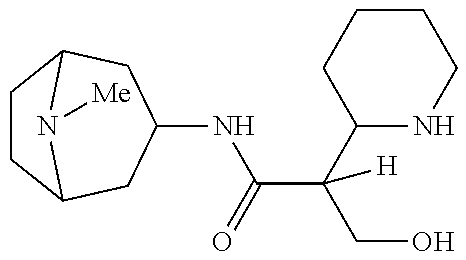 |
 |
 |
 |
 |
 |
 |
 |
 |
 |
 |
 |
 |
 |
 |
 |
 |
 |
 |
 |
 |
 |
 |
 |
 |
 |
 |
 |
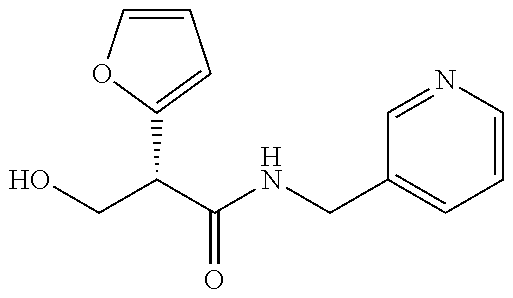 |
 |
 |
 |
 |


| TABLE 3 | |||
| Ingredient | Amount (wt %) | ||
| 8-methyl-8-azabicyclo[3.2.1]octan-3-yl ester | 0.10 | ||
| |
0.1 | ||
| Hydroxypropyl methylcellulose | 0.3 | ||
| Sodium Chloride | 0.77 | ||
| Potassium chloride | 0.12 | ||
| Disodium EDTA | 0.05 | ||
| Benzalkonium chloride | 0.01 | ||
| HCl and/or NaOH | pH 5.5-6.5 | ||
| Purified water | q.s. to 100% | ||


| TABLE 4 | |||
| Ingredient | Amount (wt %) | ||
| 8-methyl-8-azabicyclo[3.2.1]octan-3-yl ester | 0.50 | ||
| SFA | 95.00 | ||
| 95% EtOH | q.s. to 100% | ||
| TABLE 5 | |||
| Ingredient | Amount (wt %) | ||
| 8-methyl-8-azabicyclo[3.2.1]octan-3-yl amide | 0.50 | ||
| SFA | 99.00 | ||
| 95% EtOH | q.s. to 100% | ||
| TABLE 6 | |||
| Ingredient | Amount (wt %) | ||
| 8-methyl-8-azabicyclo[3.2.1]octan-3-yl ester | 0.50 | ||
| SFA | 99.00 | ||
| 95% EtOH | q.s. to 100% | ||
| TABLE 7 | |||
| Ingredient | Amount (wt %) | ||
| pyridin-4-ylmethanyl amide | 0.50 | ||
| SFA | 99.00 | ||
| 95% EtOH | q.s. to 100% | ||
| TABLE 8 | |||
| Ingredient | Amount (wt %) | ||
| pyridin-4-ylmethanyl ester | 0.50 | ||
| SFA | q.s. to 100% | ||
| TABLE 9 | |||
| Ingredient | Amount (wt %) | ||
| pyridin-4-ylmethanyl ester | 1.0 | ||
| Mineral Oil | 20.0 | ||
| White Petrolatum | 79.0 | ||


| TABLE 10 | |
| Compound Structure | Compound Name |
 |
3-amino-2-(3-chlorophenyl)-N-(pyridin- 4-ylmethyl)propanamide |
 |
pyridin-3-ylmethyl 3-amino-2- phenylpropanoate |
 |
3-hydroxy-N-((6-methoxypyridin-3- yl)methyl)-2-phenylpropanamide |
 |
tert-butyl (2-(3-chlorophenyl)-3-oxo-3- ((pyridin-4- ylmethyl)amino)propyl)carbamate |
 |
pyridin-3-ylmethyl 3-((tert- butoxycarbonyl)amino)-2- phenylpropanoate |
 |
Exo-rel-tert-butyl (3-(((1R,3S,5S)-8- methyl-8-azabicyclo[3.2.1]octan-3- yl)amino)-3-oxo-2-phenylpropyl) carbamimidate |
 |
endo-rel-tert-butyl (3-(((1R,3S,5S)- 8-methyl-8-azabicyclo[3.2.1]octan- 3-yl)amino)-3-oxo-2- phenylpropyl)carbamate |
 |
3-amino-N-((1R,3s,5S)-8-methyl-8- azabicyclo[3.2.1]octan-3-yl)-2- phenylpropanamide |
 |
3-amino-N-((1R,3r,5S)-8-methyl-8- azabicyclo[3.2.1]octan-3-yl)-2- phenylpropanamide |
 |
endo 8-methyl-8- azabicyclo[3.2.1]octan-3- |
 |
endo 8-methyl-8- azabicyclo[3.2.1]octan-3-yl 3-amino- 2-phenylpropanoate |
 |
endo 8-methyl-8- azabicyclo[3.2.1]octan-3-yl 3-((tert- butoxycarbonyl)amino)-2- phenylpropanoate |
 |
exo 3-hydroxy-n-(8-methyl-8- azabicyclo[3.2.1]octan-3-yl)-2- phenylpropanamide |
 |
exo2-(3-chlorophenyl)-4,4,4- trifluoro-8-methyl-8- azabicyclo[3.2.1]octan-3- yl)butanamide |
 |
|
Claims (2)


Priority Applications (1)
| Application Number | Priority Date | Filing Date | Title |
|---|---|---|---|
| US16/779,188 US11117869B2 (en) | 2019-02-01 | 2020-01-31 | Compounds, compositions and methods for treatment of myopia |
Applications Claiming Priority (4)
| Application Number | Priority Date | Filing Date | Title |
|---|---|---|---|
| US201962800312P | 2019-02-01 | 2019-02-01 | |
| US201962801515P | 2019-02-05 | 2019-02-05 | |
| US201962819236P | 2019-03-15 | 2019-03-15 | |
| US16/779,188 US11117869B2 (en) | 2019-02-01 | 2020-01-31 | Compounds, compositions and methods for treatment of myopia |
Publications (2)
| Publication Number | Publication Date |
|---|---|
| US20200247760A1 US20200247760A1 (en) | 2020-08-06 |
| US11117869B2 true US11117869B2 (en) | 2021-09-14 |
Family
ID=71837288
Family Applications (1)
| Application Number | Title | Priority Date | Filing Date |
|---|---|---|---|
| US16/779,188 Active US11117869B2 (en) | 2019-02-01 | 2020-01-31 | Compounds, compositions and methods for treatment of myopia |
Country Status (8)
| Country | Link |
|---|---|
| US (1) | US11117869B2 (en) |
| EP (1) | EP3917923A4 (en) |
| JP (2) | JP7665519B2 (en) |
| KR (1) | KR102534570B1 (en) |
| CN (1) | CN113614078A (en) |
| AU (1) | AU2020216470B2 (en) |
| CA (1) | CA3128224A1 (en) |
| WO (1) | WO2020160493A2 (en) |
Families Citing this family (4)
| Publication number | Priority date | Publication date | Assignee | Title |
|---|---|---|---|---|
| US11191751B1 (en) * | 2020-10-08 | 2021-12-07 | Ads Therapeutics Llc | Topical ophthalmological atropine free base compositions |
| CN114306331B (en) * | 2020-10-10 | 2023-07-18 | 远大生命科学(武汉)有限公司 | Use of penehyclidine in the treatment or prevention of vision-impairing eye diseases |
| EP4288151A4 (en) | 2021-02-03 | 2025-01-01 | ADS Therapeutics LLC | TOPICAL OPHTHALMOLOGICAL COMPOSITIONS |
| JP2025541009A (en) | 2022-12-23 | 2025-12-17 | ノバリック ゲーエムベーハー | Semi-fluorinated alkane compositions containing hyoscyamine |
Citations (1)
| Publication number | Priority date | Publication date | Assignee | Title |
|---|---|---|---|---|
| ES2526580A1 (en) * | 2013-07-08 | 2015-01-13 | Consejo Superior De Investigaciones Científicas (Csic) | Use of a compound of formula (I) as a bactericide against streptococcus (Machine-translation by Google Translate, not legally binding) |
Family Cites Families (13)
| Publication number | Priority date | Publication date | Assignee | Title |
|---|---|---|---|---|
| US2726245A (en) * | 1955-12-06 | Substituted tropic acid n-fr-picolyl | ||
| US2776294A (en) * | 1957-01-01 | Tropic acid n- | ||
| GB746926A (en) * | 1954-04-28 | 1956-03-21 | Roche Products Ltd | Tropic acid n-substituted-n-(-a-picolyl)-amides and process for the manufacture thereof |
| GB994493A (en) * | 1963-02-06 | 1965-06-10 | Lepetit Spa | Tropine derivative |
| ES358028A1 (en) * | 1967-09-12 | 1970-06-01 | Boehringer Sohn Ingelheim | PROCEDURE FOR THE PREPARATION OF TROPIC ACID ESTERS. |
| WO2004005509A1 (en) | 2002-07-02 | 2004-01-15 | Genox Research, Inc. | Method of examining allergic disaese and drug for treating the same |
| WO2006089054A1 (en) | 2005-02-16 | 2006-08-24 | Achillion Pharmaceuticals, Inc. | New isothiazoloquinolones and related compounds as anti-infective agents |
| ES2352799T3 (en) | 2005-07-27 | 2011-02-23 | Achillion Pharmaceuticals, Inc. | 8-METOXI-9H-ISOTIAZOLO [5,4-B] QUINOLINA-3,4-DIONAS AND RELATED COMPOUNDS. |
| JP2011011984A (en) * | 2009-06-30 | 2011-01-20 | Lion Corp | Therapeutic agent for pseudomyopia |
| ES2564502T3 (en) * | 2010-03-17 | 2016-03-23 | Novaliq Gmbh | Pharmaceutical composition for the treatment of increased intraocular pressure |
| RU2593333C2 (en) * | 2014-12-24 | 2016-08-10 | Закрытое акционерное общество "Активный Компонент" | Method of troventol producing |
| CN109803650A (en) * | 2016-09-28 | 2019-05-24 | 诺瓦利克有限责任公司 | Composition comprising Cannabined receptor binding partner |
| ES3064457T3 (en) | 2017-11-03 | 2026-04-24 | Alcon Inc | Azabicyclo derivatives for treating ocular disorders |
-
2020
- 2020-01-31 AU AU2020216470A patent/AU2020216470B2/en active Active
- 2020-01-31 US US16/779,188 patent/US11117869B2/en active Active
- 2020-01-31 CA CA3128224A patent/CA3128224A1/en active Pending
- 2020-01-31 CN CN202080021208.5A patent/CN113614078A/en active Pending
- 2020-01-31 KR KR1020217028091A patent/KR102534570B1/en active Active
- 2020-01-31 WO PCT/US2020/016246 patent/WO2020160493A2/en not_active Ceased
- 2020-01-31 JP JP2021544698A patent/JP7665519B2/en active Active
- 2020-01-31 EP EP20748332.2A patent/EP3917923A4/en active Pending
-
2025
- 2025-04-09 JP JP2025064422A patent/JP2025108537A/en active Pending
Patent Citations (1)
| Publication number | Priority date | Publication date | Assignee | Title |
|---|---|---|---|---|
| ES2526580A1 (en) * | 2013-07-08 | 2015-01-13 | Consejo Superior De Investigaciones Científicas (Csic) | Use of a compound of formula (I) as a bactericide against streptococcus (Machine-translation by Google Translate, not legally binding) |
Non-Patent Citations (5)
| Title |
|---|
| Balant ed in Wolff et al. Burger's Medicinal Chemistry and Drug Discovery. 5th ed. vol. 1: Principles and Practice, pp. 949-982, 1996. * |
| Ettmayer et al. "Lessons Learned from Marketed and Investigational Prodrugs." J. Med. Chem., (2004), 47(10): 2393-2404. * |
| Jordan "Tamoxifen . . . " Nature Rev. v.2, p. 205-213 (2003). * |
| Stella, Valentino. "Prodrugs as therapeutics." Expert Opin. Ther. Patents (2004), 14(3): 277-280. * |
| Testa, Bernard. "Prodrug research: futile or fertile?" Biochemical Pharmacology, 68 (2004): 2097-2106. * |
Also Published As
| Publication number | Publication date |
|---|---|
| KR20210123361A (en) | 2021-10-13 |
| JP7665519B2 (en) | 2025-04-21 |
| EP3917923A2 (en) | 2021-12-08 |
| CA3128224A1 (en) | 2020-08-06 |
| WO2020160493A3 (en) | 2020-09-10 |
| US20200247760A1 (en) | 2020-08-06 |
| KR102534570B1 (en) | 2023-05-18 |
| AU2020216470B2 (en) | 2023-05-04 |
| CN113614078A (en) | 2021-11-05 |
| EP3917923A4 (en) | 2023-02-08 |
| WO2020160493A2 (en) | 2020-08-06 |
| AU2020216470A1 (en) | 2021-09-02 |
| JP2022523332A (en) | 2022-04-22 |
| JP2025108537A (en) | 2025-07-23 |
Similar Documents
| Publication | Publication Date | Title |
|---|---|---|
| US8455514B2 (en) | 6-and 7-amino isoquinoline compounds and methods for making and using the same | |
| US20200247760A1 (en) | Compounds, Compositions and Methods for Treatment of Myopia | |
| US7531550B2 (en) | Pseudobase benzo[c]phenanthridines with improved efficacy, stability, and safety | |
| US9994560B2 (en) | HPTP-β inhibitors | |
| US9963432B2 (en) | Beta-amino-isoquinolinyl amide compounds | |
| CN109528721A (en) | Combination therapy | |
| US11414406B2 (en) | Antagonists of the muscarinic acetylcholine receptor M4 | |
| US20180170898A1 (en) | Beta- and gamma-amino-isoquinoline amide compounds and substituted benzamide compounds | |
| US20250144115A1 (en) | Amide compound as potassium channel regulator, and preparation therefor and use thereof | |
| US12269818B2 (en) | Analogs of xanomeline | |
| US20220110933A1 (en) | Methods of treating disease with magl inhibitors | |
| JP2023549583A (en) | Drugs for treating ryanodine receptor-related disorders | |
| US20250115596A1 (en) | Esters of 8-methyl-8-azabicyclo[3.2.1] octan-3-yl 3-hydroxy-2-phenylpropanoate | |
| US11931332B2 (en) | Phenyl alkyl carbamate compounds for use in preventing or treating neurodegenerative disease | |
| US20260007648A1 (en) | Compound with sting degradation activity, and composition and application thereof | |
| US20250066383A1 (en) | Pde 7 modulator compounds | |
| HK40007624A (en) | Beta-amino-isoquinolinyl amide compounds |
Legal Events
| Date | Code | Title | Description |
|---|---|---|---|
| AS | Assignment |
Owner name: AERIE PHARMACEUTICALS, INC., NEW JERSEY Free format text: ASSIGNMENT OF ASSIGNORS INTEREST;ASSIGNORS:CARLSON, ERIC;DELONG, MITCHELL A.;SIGNING DATES FROM 20190522 TO 20190923;REEL/FRAME:051690/0214 Owner name: AERIE PHARMACEUTICALS, INC., NEW JERSEY Free format text: ASSIGNMENT OF ASSIGNORS INTEREST;ASSIGNORS:CARLSON, ERIC;DELONG, MITCHELL A.;REEL/FRAME:051690/0175 Effective date: 20190226 |
|
| FEPP | Fee payment procedure |
Free format text: ENTITY STATUS SET TO UNDISCOUNTED (ORIGINAL EVENT CODE: BIG.); ENTITY STATUS OF PATENT OWNER: SMALL ENTITY |
|
| FEPP | Fee payment procedure |
Free format text: ENTITY STATUS SET TO SMALL (ORIGINAL EVENT CODE: SMAL); ENTITY STATUS OF PATENT OWNER: SMALL ENTITY |
|
| STPP | Information on status: patent application and granting procedure in general |
Free format text: NON FINAL ACTION MAILED |
|
| AS | Assignment |
Owner name: AERIE PHARMACEUTICALS, INC., NEW JERSEY Free format text: ASSIGNMENT OF ASSIGNORS INTEREST;ASSIGNORS:GORDHAN, HEEREN;LICHOROWIC, CYNTHIA L.;STURDIVANT, JILL M.;REEL/FRAME:053538/0606 Effective date: 20200811 |
|
| STPP | Information on status: patent application and granting procedure in general |
Free format text: RESPONSE TO NON-FINAL OFFICE ACTION ENTERED AND FORWARDED TO EXAMINER |
|
| STPP | Information on status: patent application and granting procedure in general |
Free format text: NON FINAL ACTION MAILED |
|
| STPP | Information on status: patent application and granting procedure in general |
Free format text: RESPONSE TO NON-FINAL OFFICE ACTION ENTERED AND FORWARDED TO EXAMINER |
|
| STPP | Information on status: patent application and granting procedure in general |
Free format text: NOTICE OF ALLOWANCE MAILED -- APPLICATION RECEIVED IN OFFICE OF PUBLICATIONS |
|
| STPP | Information on status: patent application and granting procedure in general |
Free format text: PUBLICATIONS -- ISSUE FEE PAYMENT VERIFIED |
|
| STCF | Information on status: patent grant |
Free format text: PATENTED CASE |
|
| FEPP | Fee payment procedure |
Free format text: ENTITY STATUS SET TO UNDISCOUNTED (ORIGINAL EVENT CODE: BIG.); ENTITY STATUS OF PATENT OWNER: LARGE ENTITY |
|
| AS | Assignment |
Owner name: ALCON INC., SWITZERLAND Free format text: ASSIGNMENT OF ASSIGNORS INTEREST;ASSIGNOR:AERIE PHARMACEUTICALS, INC.;REEL/FRAME:067822/0168 Effective date: 20240618 |
|
| MAFP | Maintenance fee payment |
Free format text: PAYMENT OF MAINTENANCE FEE, 4TH YEAR, LARGE ENTITY (ORIGINAL EVENT CODE: M1551); ENTITY STATUS OF PATENT OWNER: LARGE ENTITY Year of fee payment: 4 |