US11111244B2 - Organic compound and organic electroluminescence device using the same - Google Patents
Organic compound and organic electroluminescence device using the same Download PDFInfo
- Publication number
- US11111244B2 US11111244B2 US16/153,853 US201816153853A US11111244B2 US 11111244 B2 US11111244 B2 US 11111244B2 US 201816153853 A US201816153853 A US 201816153853A US 11111244 B2 US11111244 B2 US 11111244B2
- Authority
- US
- United States
- Prior art keywords
- group
- substituted
- unsubstituted
- formula
- organic
- Prior art date
- Legal status (The legal status is an assumption and is not a legal conclusion. Google has not performed a legal analysis and makes no representation as to the accuracy of the status listed.)
- Expired - Fee Related, expires
Links
- 0 *C.*C.C1=CC2=C(C=C1)C1=C(C=C2)C2=C(C=CC=C2)C2=C1C=CC=C2.C1=CC2=CC3=C(C=C2C=C1)C1=C(C=CC=C1)C1=C3C=CC=C1.CC.CC.[2*]C.[2*]C Chemical compound *C.*C.C1=CC2=C(C=C1)C1=C(C=C2)C2=C(C=CC=C2)C2=C1C=CC=C2.C1=CC2=CC3=C(C=C2C=C1)C1=C(C=CC=C1)C1=C3C=CC=C1.CC.CC.[2*]C.[2*]C 0.000 description 20
- BJHDPGARXLWTPZ-UHFFFAOYSA-N C1=CC=C(C2=CC(C3=CC(C4=CC=CC=C4)=NC(N4C5=CC6=C(C=C5C5=C4C=CC=C5)C4=C(C=CC=C4)C4=CC5=C(C=CC=C5)C=C46)=N3)=CC=C2)C=C1.C1=CC=C(C2=NC(C3=CC=CC=C3)=NC(N3C4=CC5=C(C=C4C4=C3C=CC=C4)C3=CC4=C(C=CC=C4)C=C3C3=C5C=CC=C3)=N2)C=C1.C1=CC=C(N2C3=CC4=C(C=C3C3=C2C=CC=C3)C2=C3C=CC=CC3=CC=C2C2=C4C=CC=C2)C=C1 Chemical compound C1=CC=C(C2=CC(C3=CC(C4=CC=CC=C4)=NC(N4C5=CC6=C(C=C5C5=C4C=CC=C5)C4=C(C=CC=C4)C4=CC5=C(C=CC=C5)C=C46)=N3)=CC=C2)C=C1.C1=CC=C(C2=NC(C3=CC=CC=C3)=NC(N3C4=CC5=C(C=C4C4=C3C=CC=C4)C3=CC4=C(C=CC=C4)C=C3C3=C5C=CC=C3)=N2)C=C1.C1=CC=C(N2C3=CC4=C(C=C3C3=C2C=CC=C3)C2=C3C=CC=CC3=CC=C2C2=C4C=CC=C2)C=C1 BJHDPGARXLWTPZ-UHFFFAOYSA-N 0.000 description 2
- AFZKWQQADYRLMO-UHFFFAOYSA-N C1=CC=C(C2=NC(C3=CC=CC=C3)=NC(C3=CC=C(N4C5=CC6=C(C=C5C5=C4C=CC=C5)C4=CC=C5C=CC=CC5=C4C4=C6C=CC=C4)C=C3)=N2)C=C1.CC1(C)C2=CC3=C(C=C2C2=C1C=C(N(C1=CC=CC=C1)C1=CC=CC=C1)C=C2)C1=C(C=CC=C1)C1=C2C=CC=CC2=CC=C31.CCCCC1(CCCC)C2=CC3=C(C=C2C2=C1C=C(N(C1=CC(C)=CC(C)=C1)C1=CC(C)=CC(C)=C1)C=C2)C1=CC=CC=C1C1=C3C2=C(C=CC=C2)C=C1 Chemical compound C1=CC=C(C2=NC(C3=CC=CC=C3)=NC(C3=CC=C(N4C5=CC6=C(C=C5C5=C4C=CC=C5)C4=CC=C5C=CC=CC5=C4C4=C6C=CC=C4)C=C3)=N2)C=C1.CC1(C)C2=CC3=C(C=C2C2=C1C=C(N(C1=CC=CC=C1)C1=CC=CC=C1)C=C2)C1=C(C=CC=C1)C1=C2C=CC=CC2=CC=C31.CCCCC1(CCCC)C2=CC3=C(C=C2C2=C1C=C(N(C1=CC(C)=CC(C)=C1)C1=CC(C)=CC(C)=C1)C=C2)C1=CC=CC=C1C1=C3C2=C(C=CC=C2)C=C1 AFZKWQQADYRLMO-UHFFFAOYSA-N 0.000 description 2
- AFOYLEFICGEOOD-UHFFFAOYSA-N C1=CC=C(N(C2=CC(N3C4=CC5=C(C=C4C4=C3C=CC=C4)C3=CC=CC=C3C3=C5C4=C(C=CC=C4)C=C3)=CC=C2)C2=C3OC4=C(C=CC=C4)C3=CC=C2)C=C1 Chemical compound C1=CC=C(N(C2=CC(N3C4=CC5=C(C=C4C4=C3C=CC=C4)C3=CC=CC=C3C3=C5C4=C(C=CC=C4)C=C3)=CC=C2)C2=C3OC4=C(C=CC=C4)C3=CC=C2)C=C1 AFOYLEFICGEOOD-UHFFFAOYSA-N 0.000 description 2
- TWBXTOZVWTZKHK-UHFFFAOYSA-N CC(C)(C)C1=C2/C=C\C=C3\C4=C(C=CC=C4)C(=C23)C=C1.CC(C)(C)C1=C2C=CC=CC2=CC2=C1C=CC=C2.CC(C)(C)C1=CC=C2/C=C\C3=C(C=CC=C3)C2=C1.CC(C)(C)C1=CC=C2C=CC3=C4C(=CC=C3)/C=C\C1=C24.CC(C)(C)C1=CC=C2C=CC=CC2=C1.CC(C)(C)C1=CC=CC(C2=CC=CC=C2)=C1.CC(C)(C)C1=CC=CC2=C1C=CC=C2.CC(C)(C)N(C1=CC=CC=C1)C1=CC=CC2=C1C=CC=C2.CC(C)(C)N(C1=CC=CC=C1)C1=CC=CC=C1.CC(C)C1=CC=C(N(C2=CC=CC3=C2OC2=C3C=CC=C2)C(C)(C)C)C=C1.CC1=CC=CC(N(C2=CC(C)=CC=C2)C(C)(C)C)=C1 Chemical compound CC(C)(C)C1=C2/C=C\C=C3\C4=C(C=CC=C4)C(=C23)C=C1.CC(C)(C)C1=C2C=CC=CC2=CC2=C1C=CC=C2.CC(C)(C)C1=CC=C2/C=C\C3=C(C=CC=C3)C2=C1.CC(C)(C)C1=CC=C2C=CC3=C4C(=CC=C3)/C=C\C1=C24.CC(C)(C)C1=CC=C2C=CC=CC2=C1.CC(C)(C)C1=CC=CC(C2=CC=CC=C2)=C1.CC(C)(C)C1=CC=CC2=C1C=CC=C2.CC(C)(C)N(C1=CC=CC=C1)C1=CC=CC2=C1C=CC=C2.CC(C)(C)N(C1=CC=CC=C1)C1=CC=CC=C1.CC(C)C1=CC=C(N(C2=CC=CC3=C2OC2=C3C=CC=C2)C(C)(C)C)C=C1.CC1=CC=CC(N(C2=CC(C)=CC=C2)C(C)(C)C)=C1 TWBXTOZVWTZKHK-UHFFFAOYSA-N 0.000 description 2
- SHJKHHBXMDTVGE-UHFFFAOYSA-N CC(C)(c1c2)c(cc3c4c(cccc5)c5ccc4c4ccccc4c3c3)c3-c1ccc2N1c2ccccc2N(c2ccccc2)c2c1cccc2 Chemical compound CC(C)(c1c2)c(cc3c4c(cccc5)c5ccc4c4ccccc4c3c3)c3-c1ccc2N1c2ccccc2N(c2ccccc2)c2c1cccc2 SHJKHHBXMDTVGE-UHFFFAOYSA-N 0.000 description 2
- FTTAKCPGMCLQAG-UHFFFAOYSA-N CC(C)(c1c2)c3cc4c(c5ccccc5cc5)c5c(cccc5)c5c4cc3-c1ccc2Br Chemical compound CC(C)(c1c2)c3cc4c(c5ccccc5cc5)c5c(cccc5)c5c4cc3-c1ccc2Br FTTAKCPGMCLQAG-UHFFFAOYSA-N 0.000 description 2
- NGZCPBFZIKYAFH-UHFFFAOYSA-N Oc(c1c2cccc1)cc1c2c(cc2[o]c3ccccc3c2c2)c2c2c1cccc2 Chemical compound Oc(c1c2cccc1)cc1c2c(cc2[o]c3ccccc3c2c2)c2c2c1cccc2 NGZCPBFZIKYAFH-UHFFFAOYSA-N 0.000 description 2
- MEOJKAOHWKMMQF-XHBQMLOASA-N BN=P.C1=CC=C(C2=CC(C3=CC=C4C=CC=CC4=C3)=NC3=C2C=CC2=C3N=C(C3=CC4=C(C=CC=C4)C=C3)C=C2C2=CC=CC=C2)C=C1.C1=CC=C(N(C2=CC=C(C3=CC=C(N(C4=CC=CC=C4)C4=C5C=CC=CC5=CC=C4)C=C3)C=C2)C2=CC=CC3=C2C=CC=C3)C=C1.C1=CC=C(N(C2=CC=CC=C2)C2=CC=C(/C=C/C3=CC4=C(C=C3)C=C(N(C3=CC=CC=C3)C3=CC=CC=C3)C=C4)C=C2)C=C1.CC1(C)C2=CC(/C3=C/C=C4/C=C\C5=CC=CC6=CC=C3C4=C65)=CC=C2C2=C1C=C(/C1=C/C=C3/C=C\C4=CC=CC5=CC=C1C3=C54)C=C2.[2H]F.[2H]P.[C-]#[N+]C1=NC2=C(N=C1C#N)C1=C(N=C(C#N)C(C#N)=N1)C1=C2N=C([N+]#[C-])C([N+]#[C-])=N1 Chemical compound BN=P.C1=CC=C(C2=CC(C3=CC=C4C=CC=CC4=C3)=NC3=C2C=CC2=C3N=C(C3=CC4=C(C=CC=C4)C=C3)C=C2C2=CC=CC=C2)C=C1.C1=CC=C(N(C2=CC=C(C3=CC=C(N(C4=CC=CC=C4)C4=C5C=CC=CC5=CC=C4)C=C3)C=C2)C2=CC=CC3=C2C=CC=C3)C=C1.C1=CC=C(N(C2=CC=CC=C2)C2=CC=C(/C=C/C3=CC4=C(C=C3)C=C(N(C3=CC=CC=C3)C3=CC=CC=C3)C=C4)C=C2)C=C1.CC1(C)C2=CC(/C3=C/C=C4/C=C\C5=CC=CC6=CC=C3C4=C65)=CC=C2C2=C1C=C(/C1=C/C=C3/C=C\C4=CC=CC5=CC=C1C3=C54)C=C2.[2H]F.[2H]P.[C-]#[N+]C1=NC2=C(N=C1C#N)C1=C(N=C(C#N)C(C#N)=N1)C1=C2N=C([N+]#[C-])C([N+]#[C-])=N1 MEOJKAOHWKMMQF-XHBQMLOASA-N 0.000 description 1
- DYOVYFYTIAOFDF-XZVVQQHRSA-N BrB(Br)Br.COC1=CC2=C(C3=C1C=CC=C3)C1=C(/C=C3/C4=C(C=CC=C4)O/C3=C/1)C1=C2C=CC=C1.OC1=CC2=C(C3=C1C=CC=C3)C1=C(/C=C3/C4=C(C=CC=C4)O/C3=C/1)C1=C2C=CC=C1.[2H]CC Chemical compound BrB(Br)Br.COC1=CC2=C(C3=C1C=CC=C3)C1=C(/C=C3/C4=C(C=CC=C4)O/C3=C/1)C1=C2C=CC=C1.OC1=CC2=C(C3=C1C=CC=C3)C1=C(/C=C3/C4=C(C=CC=C4)O/C3=C/1)C1=C2C=CC=C1.[2H]CC DYOVYFYTIAOFDF-XZVVQQHRSA-N 0.000 description 1
- WQGANQWZHSLMDH-UHFFFAOYSA-N BrC1=C/C2=C(\C=C/1)OC1=C2C=CC=C1.COC1=CC(C2=C(B(O)O)C=CC=C2)=CC2=C1C=CC=C2.COC1=CC(C2=C(C3=C/C4=C(\C=C/3)OC3=C4C=CC=C3)C=CC=C2)=CC2=C1C=CC=C2 Chemical compound BrC1=C/C2=C(\C=C/1)OC1=C2C=CC=C1.COC1=CC(C2=C(B(O)O)C=CC=C2)=CC2=C1C=CC=C2.COC1=CC(C2=C(C3=C/C4=C(\C=C/3)OC3=C4C=CC=C3)C=CC=C2)=CC2=C1C=CC=C2 WQGANQWZHSLMDH-UHFFFAOYSA-N 0.000 description 1
- YOSWKJZXSIPRNR-UHFFFAOYSA-N BrC1=C2C=CC=CC2=C(C2=CC=CC=C2)C2=C1C=CC=C2.C#CC#CC#CC#CC#CC#CC#CC#CC#CC#CC#CC#CC#CC#CC#CC#CC#CC#CC#CC#CC#CC.C1=CC=C(C2=C3C=CC=CC3=C(C3=CC4=C(C=C3)OC3=CC5=C(C=C34)C3=CC=CC=C3C3=C5C4=C(C=CC=C4)C=C3)C3=C2C=CC=C3)C=C1.CC1(C)OB(C2=CC3=C(C=C2)OC2=CC4=C(C=C23)C2=CC=CC=C2C2=C4C3=C(C=CC=C3)C=C2)OC1(C)C Chemical compound BrC1=C2C=CC=CC2=C(C2=CC=CC=C2)C2=C1C=CC=C2.C#CC#CC#CC#CC#CC#CC#CC#CC#CC#CC#CC#CC#CC#CC#CC#CC#CC#CC#CC#CC#CC.C1=CC=C(C2=C3C=CC=CC3=C(C3=CC4=C(C=C3)OC3=CC5=C(C=C34)C3=CC=CC=C3C3=C5C4=C(C=CC=C4)C=C3)C3=C2C=CC=C3)C=C1.CC1(C)OB(C2=CC3=C(C=C2)OC2=CC4=C(C=C23)C2=CC=CC=C2C2=C4C3=C(C=CC=C3)C=C2)OC1(C)C YOSWKJZXSIPRNR-UHFFFAOYSA-N 0.000 description 1
- XRUURZJTXWKRON-UHFFFAOYSA-N BrC1=CC2=C(C=C1)OC1=CC3=C(C=C12)C1=CC=CC=C1C1=C3C2=C(C=CC=C2)C=C1.BrC1=CC2=C(C=C1)OC1=CC=C(C3=CC=CC=C3C3=CC4=C(C=CC=C4)C=C3)C=C12 Chemical compound BrC1=CC2=C(C=C1)OC1=CC3=C(C=C12)C1=CC=CC=C1C1=C3C2=C(C=CC=C2)C=C1.BrC1=CC2=C(C=C1)OC1=CC=C(C3=CC=CC=C3C3=CC4=C(C=CC=C4)C=C3)C=C12 XRUURZJTXWKRON-UHFFFAOYSA-N 0.000 description 1
- ADCCNAUMZBJEHW-UHFFFAOYSA-N BrC1=CC2=C(C=C1)OC1=CC3=C(C=C12)C1=CC=CC=C1C1=C3C2=C(C=CC=C2)C=C1.C#CC#CC#CC#CC#CC#CC#CC#CC#CC#CC#CC#CC#CC#CC#CC#CC#CC#CC#CC#CC#CC#CC#CC#CC.C1=CC=C(C2=CC=C(N(C3=CC=CC=C3)C3=CC4=C(C=C3)OC3=CC5=C(C=C34)C3=CC=CC=C3C3=C5C4=C(C=CC=C4)C=C3)C=C2)C=C1.C1=CC=C(NC2=CC=C(C3=CC=CC=C3)C=C2)C=C1 Chemical compound BrC1=CC2=C(C=C1)OC1=CC3=C(C=C12)C1=CC=CC=C1C1=C3C2=C(C=CC=C2)C=C1.C#CC#CC#CC#CC#CC#CC#CC#CC#CC#CC#CC#CC#CC#CC#CC#CC#CC#CC#CC#CC#CC#CC#CC#CC.C1=CC=C(C2=CC=C(N(C3=CC=CC=C3)C3=CC4=C(C=C3)OC3=CC5=C(C=C34)C3=CC=CC=C3C3=C5C4=C(C=CC=C4)C=C3)C=C2)C=C1.C1=CC=C(NC2=CC=C(C3=CC=CC=C3)C=C2)C=C1 ADCCNAUMZBJEHW-UHFFFAOYSA-N 0.000 description 1
- WRCRPKCUKHEXSO-UHFFFAOYSA-N BrC1=CC2=C(C=C1)OC1=CC3=C(C=C12)C1=CC=CC=C1C1=C3C2=C(C=CC=C2)C=C1.CC1(C)OB(B2OC(C)(C)C(C)(C)O2)OC1(C)C.CC1(C)OB(C2=CC3=C(C=C2)OC2=CC4=C(C=C23)C2=CC=CC=C2C2=C4C3=C(C=CC=C3)C=C2)OC1(C)C Chemical compound BrC1=CC2=C(C=C1)OC1=CC3=C(C=C12)C1=CC=CC=C1C1=C3C2=C(C=CC=C2)C=C1.CC1(C)OB(B2OC(C)(C)C(C)(C)O2)OC1(C)C.CC1(C)OB(C2=CC3=C(C=C2)OC2=CC4=C(C=C23)C2=CC=CC=C2C2=C4C3=C(C=CC=C3)C=C2)OC1(C)C WRCRPKCUKHEXSO-UHFFFAOYSA-N 0.000 description 1
- NRPBRORCBZOFDW-UHFFFAOYSA-N BrC1=CC2=C(C=C1)OC1=CC=C(C3=CC=CC=C3C3=CC4=C(C=CC=C4)C=C3)C=C12.BrC1=CC=C2OC3=C(/C=C(Br)\C=C/3)C2=C1.OB(O)C1=C(C2=CC3=C(C=CC=C3)C=C2)C=CC=C1 Chemical compound BrC1=CC2=C(C=C1)OC1=CC=C(C3=CC=CC=C3C3=CC4=C(C=CC=C4)C=C3)C=C12.BrC1=CC=C2OC3=C(/C=C(Br)\C=C/3)C2=C1.OB(O)C1=C(C2=CC3=C(C=CC=C3)C=C2)C=CC=C1 NRPBRORCBZOFDW-UHFFFAOYSA-N 0.000 description 1
- QXNZUBHCRXLZON-UHFFFAOYSA-N BrC1=CC=CC(N(C2=CC=CC=C2)C2=C3OC4=C(C=CC=C4)C3=CC=C2)=C1.C#CC#CC#CC#CC#CC#CC#CC#CC#CC#CC#CC#CC#CC#CC#CC#CC#CC#CC#CC#CC#CC#CC#CC#CC#CC#CC#CC#CC#C.C1=CC=C(N(C2=CC(N3C4=CC5=C(C=C4C4=C3C=CC=C4)C3=CC=CC=C3C3=C5C4=C(C=CC=C4)C=C3)=CC=C2)C2=C3OC4=C(C=CC=C4)C3=CC=C2)C=C1.C1=CC=C2C(=C1)C1=C(C=C3NC4=C(C=CC=C4)C3=C1)C1=C2C=CC2=C1C=CC=C2 Chemical compound BrC1=CC=CC(N(C2=CC=CC=C2)C2=C3OC4=C(C=CC=C4)C3=CC=C2)=C1.C#CC#CC#CC#CC#CC#CC#CC#CC#CC#CC#CC#CC#CC#CC#CC#CC#CC#CC#CC#CC#CC#CC#CC#CC#CC#CC#CC#CC#C.C1=CC=C(N(C2=CC(N3C4=CC5=C(C=C4C4=C3C=CC=C4)C3=CC=CC=C3C3=C5C4=C(C=CC=C4)C=C3)=CC=C2)C2=C3OC4=C(C=CC=C4)C3=CC=C2)C=C1.C1=CC=C2C(=C1)C1=C(C=C3NC4=C(C=CC=C4)C3=C1)C1=C2C=CC2=C1C=CC=C2 QXNZUBHCRXLZON-UHFFFAOYSA-N 0.000 description 1
- VPRGCOHZIVOZRV-UHFFFAOYSA-N C#CC#CC#CC#CC#CC#CC#CC#CC#C.C1=CC=C(N2C3=C(C=CC=C3)NC3=C2C=CC=C3)C=C1.CC1(C)C2=CC3=C(C=C2C2=C1/C=C(Br)\C=C/2)C1=C(C=CC=C1)C1=C3C2=C(C=CC=C2)C=C1.CC1(C)C2=CC3=C(C=C2C2=C1C=C(N1C4=C(C=CC=C4)N(C4=CC=CC=C4)C4=C1C=CC=C4)C=C2)C1=CC=CC=C1C1=C3C2=C(C=CC=C2)C=C1 Chemical compound C#CC#CC#CC#CC#CC#CC#CC#CC#C.C1=CC=C(N2C3=C(C=CC=C3)NC3=C2C=CC=C3)C=C1.CC1(C)C2=CC3=C(C=C2C2=C1/C=C(Br)\C=C/2)C1=C(C=CC=C1)C1=C3C2=C(C=CC=C2)C=C1.CC1(C)C2=CC3=C(C=C2C2=C1C=C(N1C4=C(C=CC=C4)N(C4=CC=CC=C4)C4=C1C=CC=C4)C=C2)C1=CC=CC=C1C1=C3C2=C(C=CC=C2)C=C1 VPRGCOHZIVOZRV-UHFFFAOYSA-N 0.000 description 1
- HKAPWRMBOQLJJT-UHFFFAOYSA-N C#CC#CC#CC#CC#CC#CC#CC#CC#CC#CC#CC#CC#CC#CC#CC#CC#CC#CC#CC#CC#CC#CC#CC#CC#CC#CC#C.C1=CC=C(C2=CC=C(C3=NC(C4=CC5=C(C6=C4C=CC=C6)C4=C(C=C6C(=C4)OC4=C6C=CC=C4)C4=C5C=CC=C4)=NC(C4=CC=CC=C4)=N3)C=C2)C=C1.CC1(C)OB(C2=CC3=C(C4=C2C=CC=C4)C2=C(C=C4C(=C2)OC2=C4C=CC=C2)C2=C3C=CC=C2)OC1(C)C.ClC1=NC(C2=CC=C(C3=CC=CC=C3)C=C2)=NC(C2=CC=CC=C2)=N1 Chemical compound C#CC#CC#CC#CC#CC#CC#CC#CC#CC#CC#CC#CC#CC#CC#CC#CC#CC#CC#CC#CC#CC#CC#CC#CC#CC#CC#C.C1=CC=C(C2=CC=C(C3=NC(C4=CC5=C(C6=C4C=CC=C6)C4=C(C=C6C(=C4)OC4=C6C=CC=C4)C4=C5C=CC=C4)=NC(C4=CC=CC=C4)=N3)C=C2)C=C1.CC1(C)OB(C2=CC3=C(C4=C2C=CC=C4)C2=C(C=C4C(=C2)OC2=C4C=CC=C2)C2=C3C=CC=C2)OC1(C)C.ClC1=NC(C2=CC=C(C3=CC=CC=C3)C=C2)=NC(C2=CC=CC=C2)=N1 HKAPWRMBOQLJJT-UHFFFAOYSA-N 0.000 description 1
- QURUTEUIFYKDNR-UHFFFAOYSA-N C#CC#CC#CC#CC#CC#CC#CC#CC#CC#CC#CC#CC#CC#CC#CC#CC#CC#CC#CC#CC.CC1(C)C2=CC3=C(C=C2C2=C1C=C(B1OC(C)(C)C(C)(C)O1)C=C2)C1=C(C=CC=C1)C1=C3C2=C(C=CC=C2)C=C1.CC1(C)C2=CC3=C(C=C2C2=C1C=C(C1=NC(C4=CC=CC=C4)=NC(C4=CC=CC=C4)=N1)C=C2)C1=C(C=CC=C1)C1=C3C2=C(C=CC=C2)C=C1.ClC1=NC(C2=CC=CC=C2)=NC(C2=CC=CC=C2)=N1 Chemical compound C#CC#CC#CC#CC#CC#CC#CC#CC#CC#CC#CC#CC#CC#CC#CC#CC#CC#CC#CC#CC.CC1(C)C2=CC3=C(C=C2C2=C1C=C(B1OC(C)(C)C(C)(C)O1)C=C2)C1=C(C=CC=C1)C1=C3C2=C(C=CC=C2)C=C1.CC1(C)C2=CC3=C(C=C2C2=C1C=C(C1=NC(C4=CC=CC=C4)=NC(C4=CC=CC=C4)=N1)C=C2)C1=C(C=CC=C1)C1=C3C2=C(C=CC=C2)C=C1.ClC1=NC(C2=CC=CC=C2)=NC(C2=CC=CC=C2)=N1 QURUTEUIFYKDNR-UHFFFAOYSA-N 0.000 description 1
- DDIJQOAMBCQLSO-UHFFFAOYSA-N C#CC#CC#CC#CC#CC#CC#CC#CC#CC#CC#CC#CC#CC#CC#CC#CC#CC#CC.C1=CC=C2C(=C1)C1=C(C=C3OC4=C(C=C(C5=NC6=C(C=C5)C=CC5=C6N=CC=C5)C=C4)C3=C1)C1=C2C=CC2=C1C=CC=C2.CC1(C)OB(C2=CC3=C(C=C2)OC2=CC4=C(C=C23)C2=CC=CC=C2C2=C4C3=C(C=CC=C3)C=C2)OC1(C)C.ClC1=NC2=C(C=C1)C=CC1=C2N=CC=C1 Chemical compound C#CC#CC#CC#CC#CC#CC#CC#CC#CC#CC#CC#CC#CC#CC#CC#CC#CC#CC.C1=CC=C2C(=C1)C1=C(C=C3OC4=C(C=C(C5=NC6=C(C=C5)C=CC5=C6N=CC=C5)C=C4)C3=C1)C1=C2C=CC2=C1C=CC=C2.CC1(C)OB(C2=CC3=C(C=C2)OC2=CC4=C(C=C23)C2=CC=CC=C2C2=C4C3=C(C=CC=C3)C=C2)OC1(C)C.ClC1=NC2=C(C=C1)C=CC1=C2N=CC=C1 DDIJQOAMBCQLSO-UHFFFAOYSA-N 0.000 description 1
- JLUFTKXJJFYCJG-UHFFFAOYSA-N C#CC#CC#CC#CC#CC#CC#CC#CC#CC#CC#CC#CC.C1=CC=C(C2=CC=C(C3=NC(N4C5=CC6=C(C=C5C5=C4C=CC=C5)C4=CC=CC=C4C4=C6C5=C(C=CC=C5)C=C4)=NC(C4=CC=CC=C4)=N3)C=C2)C=C1.C1=CC=C2C(=C1)C1=C(C=C3NC4=C(C=CC=C4)C3=C1)C1=C2C=CC2=C1C=CC=C2.ClC1=NC(C2=CC=C(C3=CC=CC=C3)C=C2)=NC(C2=CC=CC=C2)=N1 Chemical compound C#CC#CC#CC#CC#CC#CC#CC#CC#CC#CC#CC#CC.C1=CC=C(C2=CC=C(C3=NC(N4C5=CC6=C(C=C5C5=C4C=CC=C5)C4=CC=CC=C4C4=C6C5=C(C=CC=C5)C=C4)=NC(C4=CC=CC=C4)=N3)C=C2)C=C1.C1=CC=C2C(=C1)C1=C(C=C3NC4=C(C=CC=C4)C3=C1)C1=C2C=CC2=C1C=CC=C2.ClC1=NC(C2=CC=C(C3=CC=CC=C3)C=C2)=NC(C2=CC=CC=C2)=N1 JLUFTKXJJFYCJG-UHFFFAOYSA-N 0.000 description 1
- AIQTXVBMKPURHG-UHFFFAOYSA-N C.C1=CC=C(P(C2=CC=CC=C2)C2=CC=CC=C2)C=C1.C1=CC=C2C(=C1)C1=C(C=C3NC4=C(C=CC=C4)C3=C1)C1=C2C=CC2=C1C=CC=C2.O=[N+]([O-])C1=C(C2=CC3=C(C=C2)C2=C(C=CC4=C2C=CC=C4)C2=CC=CC=C23)C=CC=C1 Chemical compound C.C1=CC=C(P(C2=CC=CC=C2)C2=CC=CC=C2)C=C1.C1=CC=C2C(=C1)C1=C(C=C3NC4=C(C=CC=C4)C3=C1)C1=C2C=CC2=C1C=CC=C2.O=[N+]([O-])C1=C(C2=CC3=C(C=C2)C2=C(C=CC4=C2C=CC=C4)C2=CC=CC=C23)C=CC=C1 AIQTXVBMKPURHG-UHFFFAOYSA-N 0.000 description 1
- GBKXBDSQIFJCDJ-UHFFFAOYSA-N C.CC1(C)C2=CC(Br)=CC=C2C2=C1/C=C(Br)\C=C/2.CC1(C)C2=CC(C3=C(C4=CC=CC=C4)C=CC4=C3C=CC=C4)=CC=C2C2=C1/C=C(Br)\C=C/2.OB(O)C1=C2C=CC=CC2=CC=C1C1=CC=CC=C1 Chemical compound C.CC1(C)C2=CC(Br)=CC=C2C2=C1/C=C(Br)\C=C/2.CC1(C)C2=CC(C3=C(C4=CC=CC=C4)C=CC4=C3C=CC=C4)=CC=C2C2=C1/C=C(Br)\C=C/2.OB(O)C1=C2C=CC=CC2=CC=C1C1=CC=CC=C1 GBKXBDSQIFJCDJ-UHFFFAOYSA-N 0.000 description 1
- QAYHVQMCCBVILT-UHFFFAOYSA-N C.CC1(C)C2=CC3=C(C=C2C2=C1/C=C(Br)\C=C/2)C1=C(C=CC=C1)C1=C3C2=C(C=CC=C2)C=C1.CC1(C)C2=CC3=C(C=C2C2=C1C=C(B1OC(C)(C)C(C)(C)O1)C=C2)C1=C(C=CC=C1)C1=C3C2=C(C=CC=C2)C=C1.CC1(C)OB(B2OC(C)(C)C(C)(C)O2)OC1(C)C Chemical compound C.CC1(C)C2=CC3=C(C=C2C2=C1/C=C(Br)\C=C/2)C1=C(C=CC=C1)C1=C3C2=C(C=CC=C2)C=C1.CC1(C)C2=CC3=C(C=C2C2=C1C=C(B1OC(C)(C)C(C)(C)O1)C=C2)C1=C(C=CC=C1)C1=C3C2=C(C=CC=C2)C=C1.CC1(C)OB(B2OC(C)(C)C(C)(C)O2)OC1(C)C QAYHVQMCCBVILT-UHFFFAOYSA-N 0.000 description 1
- URIODBZTXIZYTH-JLMMQWLNSA-N C.CC1=CC2=C(C3=C1C=CC=C3)C1=C(/C=C3/C4=C(C=CC=C4)O/C3=C/1)C1=C2C=CC=C1.O=S(=O)(OS(=O)(=O)C(F)(F)F)C(F)(F)F.OC1=CC2=C(C3=C1C=CC=C3)C1=C(/C=C3/C4=C(C=CC=C4)O/C3=C/1)C1=C2C=CC=C1.[2H]CC Chemical compound C.CC1=CC2=C(C3=C1C=CC=C3)C1=C(/C=C3/C4=C(C=CC=C4)O/C3=C/1)C1=C2C=CC=C1.O=S(=O)(OS(=O)(=O)C(F)(F)F)C(F)(F)F.OC1=CC2=C(C3=C1C=CC=C3)C1=C(/C=C3/C4=C(C=CC=C4)O/C3=C/1)C1=C2C=CC=C1.[2H]CC URIODBZTXIZYTH-JLMMQWLNSA-N 0.000 description 1
- RMXDNZZMCZPMRE-UHFFFAOYSA-N C1=CC(C2=CC3=C(C=C2)OC2=C3C3=C(C=C2)C2=C(C=CC4=C2C=CC=C4)C2=C3C=CC=C2)=CC(C2=C3SC4=C(C=CC=C4)C3=CC=C2)=C1.C1=CC=C(C2=CC=C(N(C3=CC=CC=C3)C3=CC4=C(C=C3)OC3=CC5=C(C=C34)C3=CC=CC=C3C3=C5C4=C(C=CC=C4)C=C3)C=C2)C=C1.C1=CC=C(N2C3=C(C=CC=C3)C3=C2C=CC(N2C4=C(C=CC=C4)C4=C2C=CC2=C4C4=C(C=CC=C4)C4=C2C2=C(C=CC=C2)C=C4)=C3)C=C1.CC1(C)C2=C(C=CC(N(C3=CC=CC=C3)C3=CC=CC=C3)=C2)C2=C1C1=C(C=C2)C2=C(C=CC3=C2C=CC=C3)C2=C1C=CC=C2 Chemical compound C1=CC(C2=CC3=C(C=C2)OC2=C3C3=C(C=C2)C2=C(C=CC4=C2C=CC=C4)C2=C3C=CC=C2)=CC(C2=C3SC4=C(C=CC=C4)C3=CC=C2)=C1.C1=CC=C(C2=CC=C(N(C3=CC=CC=C3)C3=CC4=C(C=C3)OC3=CC5=C(C=C34)C3=CC=CC=C3C3=C5C4=C(C=CC=C4)C=C3)C=C2)C=C1.C1=CC=C(N2C3=C(C=CC=C3)C3=C2C=CC(N2C4=C(C=CC=C4)C4=C2C=CC2=C4C4=C(C=CC=C4)C4=C2C2=C(C=CC=C2)C=C4)=C3)C=C1.CC1(C)C2=C(C=CC(N(C3=CC=CC=C3)C3=CC=CC=C3)=C2)C2=C1C1=C(C=C2)C2=C(C=CC3=C2C=CC=C3)C2=C1C=CC=C2 RMXDNZZMCZPMRE-UHFFFAOYSA-N 0.000 description 1
- PVTXLMBYYYLRRY-UHFFFAOYSA-N C1=CC(C2=CC3=C(C=C2)OC2=C3C3=C(C=C2)C2=C(C=CC4=C2C=CC=C4)C2=C3C=CC=C2)=CC(C2=C3\SC4=C(C=CC=C4)\C3=C/C=C\2)=C1.C1=CC=C(C2=CC=C(N(C3=CC=CC=C3)C3=CC4=C(C=C3)OC3=CC5=C(C=C34)C3=CC=CC=C3C3=C5C4=C(C=CC=C4)C=C3)C=C2)C=C1.C1=CC=C2C(=C1)C1=C(C=C3SC4=C(C=C(C5=CC6=C(C=CC=C6)C=C5)C=C4)C3=C1)C1=C2C=CC2=C1C=CC=C2.C1=CC=C2C(=C1)C1=C(C=C3SC4=C(C=C(C5=CC=C6C7=C(C=CC=C7)C7=CC=CC5=C76)C=C4)C3=C1)C1=C2C=CC2=C1C=CC=C2.CC1(C)C2=C(C=CC(N(C3=CC=CC=C3)C3=CC=CC=C3)=C2)C2=C1C1=C(C=C2)C2=C(C=CC3=C2C=CC=C3)C2=C1C=CC=C2 Chemical compound C1=CC(C2=CC3=C(C=C2)OC2=C3C3=C(C=C2)C2=C(C=CC4=C2C=CC=C4)C2=C3C=CC=C2)=CC(C2=C3\SC4=C(C=CC=C4)\C3=C/C=C\2)=C1.C1=CC=C(C2=CC=C(N(C3=CC=CC=C3)C3=CC4=C(C=C3)OC3=CC5=C(C=C34)C3=CC=CC=C3C3=C5C4=C(C=CC=C4)C=C3)C=C2)C=C1.C1=CC=C2C(=C1)C1=C(C=C3SC4=C(C=C(C5=CC6=C(C=CC=C6)C=C5)C=C4)C3=C1)C1=C2C=CC2=C1C=CC=C2.C1=CC=C2C(=C1)C1=C(C=C3SC4=C(C=C(C5=CC=C6C7=C(C=CC=C7)C7=CC=CC5=C76)C=C4)C3=C1)C1=C2C=CC2=C1C=CC=C2.CC1(C)C2=C(C=CC(N(C3=CC=CC=C3)C3=CC=CC=C3)=C2)C2=C1C1=C(C=C2)C2=C(C=CC3=C2C=CC=C3)C2=C1C=CC=C2 PVTXLMBYYYLRRY-UHFFFAOYSA-N 0.000 description 1
- GIQOFCNJBNUGTR-UHFFFAOYSA-N C1=CC2=C(C=C1)C1=C(C=C2)C2=C(C=CC=C2)C2=C1C=CC1=C2OC2=C1C=C(C1=NC3=C(C=C1)C=CC1=C3N=CC=C1)C=C2.CC1(C)C2=C(C=CC(C3=C4/C=C\C5=C6C(=CC=C5)C=CC(=C46)C=C3)=C2)C2=C1C1=C(C=C2)C2=C(C3=CC=CC=C31)C1=C(C=CC=C1)C=C2.CC1=C(C2=C(C)C=CC3=C2C2=CC=C4C=CC=CC4=C2C2=C3C=CC=C2)C=C(C2=C3C=CC=CC3=CC3=C2C=CC=C3)C=C1.CCC1=NC2=C(C=CC=C2)N1C1=CC2=C(C=C1)OC1=C2C2=C(C=C1)C1=C(C3=CC=CC=C32)C2=C(C=CC=C2)C=C1 Chemical compound C1=CC2=C(C=C1)C1=C(C=C2)C2=C(C=CC=C2)C2=C1C=CC1=C2OC2=C1C=C(C1=NC3=C(C=C1)C=CC1=C3N=CC=C1)C=C2.CC1(C)C2=C(C=CC(C3=C4/C=C\C5=C6C(=CC=C5)C=CC(=C46)C=C3)=C2)C2=C1C1=C(C=C2)C2=C(C3=CC=CC=C31)C1=C(C=CC=C1)C=C2.CC1=C(C2=C(C)C=CC3=C2C2=CC=C4C=CC=CC4=C2C2=C3C=CC=C2)C=C(C2=C3C=CC=CC3=CC3=C2C=CC=C3)C=C1.CCC1=NC2=C(C=CC=C2)N1C1=CC2=C(C=C1)OC1=C2C2=C(C=C1)C1=C(C3=CC=CC=C32)C2=C(C=CC=C2)C=C1 GIQOFCNJBNUGTR-UHFFFAOYSA-N 0.000 description 1
- YWAMZRCDUMXINH-UHFFFAOYSA-N C1=CC2=C(C=C1)C=C1C(=C2)C2=C(C=CC=C2)C2=C1C=CC1=C2C2=C(C=CC(N3C4=C(C=CC=C4)OC4=C3C=CC=C4)=C2)O1.C1=CC=C(C2=C3C=CC=CC3=C(C3=CC4=C(C5=C3C=CC=C5)C3=C(C=C5C(=C3)OC3=C5C=CC=C3)C3=C4C=CC=C3)C3=C2C=CC=C3)C=C1.C1=CC=C(C2=CC=C(C3=NC(C4=CC5=C(C6=C4C=CC=C6)C4=C(C=C6C(=C4)OC4=C6C=CC=C4)C4=C5C=CC=C4)=NC(C4=CC=CC=C4)=N3)C=C2)C=C1.C1=CC=C2C(=C1)C1=C(C=C3OC4=C(C=C(C5=CC6=C(C=C5)C5=C(C=CC=C5)C5=C6C=CC=C5)C=C4)C3=C1)C1=C2C=CC2=C1C=CC=C2 Chemical compound C1=CC2=C(C=C1)C=C1C(=C2)C2=C(C=CC=C2)C2=C1C=CC1=C2C2=C(C=CC(N3C4=C(C=CC=C4)OC4=C3C=CC=C4)=C2)O1.C1=CC=C(C2=C3C=CC=CC3=C(C3=CC4=C(C5=C3C=CC=C5)C3=C(C=C5C(=C3)OC3=C5C=CC=C3)C3=C4C=CC=C3)C3=C2C=CC=C3)C=C1.C1=CC=C(C2=CC=C(C3=NC(C4=CC5=C(C6=C4C=CC=C6)C4=C(C=C6C(=C4)OC4=C6C=CC=C4)C4=C5C=CC=C4)=NC(C4=CC=CC=C4)=N3)C=C2)C=C1.C1=CC=C2C(=C1)C1=C(C=C3OC4=C(C=C(C5=CC6=C(C=C5)C5=C(C=CC=C5)C5=C6C=CC=C5)C=C4)C3=C1)C1=C2C=CC2=C1C=CC=C2 YWAMZRCDUMXINH-UHFFFAOYSA-N 0.000 description 1
- OIOCXGRRDCQYIV-UHFFFAOYSA-N C1=CC2=C(C=C1)C=C1C(=C2)C2=C(C=CC=C2)C2=C1C=CC1=C2C2=C(C=CC(N3C4=C(C=CC=C4)OC4=C3C=CC=C4)=C2)O1.C1=CC=C2C(=C1)C1=C(C=C3OC4=C(C=C(C5=CC6=C(C=C5)C5=C(C=CC=C5)C5=C6C=CC=C5)C=C4)C3=C1)C1=C2C=CC2=C1C=CC=C2.C1=CC=C2C(=C1)C1=C(C=C3SC4=C(C=C(C5=CC6=C(C=CC=C6)C=C5)C=C4)C3=C1)C1=C2C=CC2=C1C=CC=C2.C1=CC=C2C(=C1)C1=C(C=C3SC4=C(C=C(C5=CC=C6C7=C(C=CC=C7)C7=CC=CC5=C76)C=C4)C3=C1)C1=C2C=CC2=C1C=CC=C2 Chemical compound C1=CC2=C(C=C1)C=C1C(=C2)C2=C(C=CC=C2)C2=C1C=CC1=C2C2=C(C=CC(N3C4=C(C=CC=C4)OC4=C3C=CC=C4)=C2)O1.C1=CC=C2C(=C1)C1=C(C=C3OC4=C(C=C(C5=CC6=C(C=C5)C5=C(C=CC=C5)C5=C6C=CC=C5)C=C4)C3=C1)C1=C2C=CC2=C1C=CC=C2.C1=CC=C2C(=C1)C1=C(C=C3SC4=C(C=C(C5=CC6=C(C=CC=C6)C=C5)C=C4)C3=C1)C1=C2C=CC2=C1C=CC=C2.C1=CC=C2C(=C1)C1=C(C=C3SC4=C(C=C(C5=CC=C6C7=C(C=CC=C7)C7=CC=CC5=C76)C=C4)C3=C1)C1=C2C=CC2=C1C=CC=C2 OIOCXGRRDCQYIV-UHFFFAOYSA-N 0.000 description 1
- RABNTVRTVMJKLW-UHFFFAOYSA-N C1=CC2=C(N=C1)C1=C(C=CC(C3=CC4=C(C=C3)OC3=C4C=CC4=C3C3=C(C=CC=C3)C3=C4/C4=C(/C=C\C=C/4)\C=C\3)=N1)C=C2.C1=CC=C(N2C(C3=CC4=C(C=C3)OC3=C4C4=C(C=C3)C3=CC5=C(C=CC=C5)C=C3C3=C4/C=C/C=C\3)=NC3=C2C=CC=C3)C=C1.CC1(C)C2=C(C=CC(C3=C4C=CC5=C6C(=CC=C5)/C=C\C(=C46)C=C3)=C2)C2=C1C1=C(C=C2)C2=C(\C3=CC=CC=C31)C1=C(C=CC=C1)/C=C\2.CC1(C)C2=C(C=CC=C2)N(C2=CC3=C(C=C2)OC2=CC4=C(C=C23)C2=CC=CC=C2C2=C4/C3=C(/C=C\C=C/3)\C=C\2)C2=C1C=CC=C2 Chemical compound C1=CC2=C(N=C1)C1=C(C=CC(C3=CC4=C(C=C3)OC3=C4C=CC4=C3C3=C(C=CC=C3)C3=C4/C4=C(/C=C\C=C/4)\C=C\3)=N1)C=C2.C1=CC=C(N2C(C3=CC4=C(C=C3)OC3=C4C4=C(C=C3)C3=CC5=C(C=CC=C5)C=C3C3=C4/C=C/C=C\3)=NC3=C2C=CC=C3)C=C1.CC1(C)C2=C(C=CC(C3=C4C=CC5=C6C(=CC=C5)/C=C\C(=C46)C=C3)=C2)C2=C1C1=C(C=C2)C2=C(\C3=CC=CC=C31)C1=C(C=CC=C1)/C=C\2.CC1(C)C2=C(C=CC=C2)N(C2=CC3=C(C=C2)OC2=CC4=C(C=C23)C2=CC=CC=C2C2=C4/C3=C(/C=C\C=C/3)\C=C\2)C2=C1C=CC=C2 RABNTVRTVMJKLW-UHFFFAOYSA-N 0.000 description 1
- RBZUCHIWDRPQTM-UHFFFAOYSA-N C1=CC2=CC3=C(C=CC=C3)C(C3=CC4=C(C=C3)OC3=C4C4=C(C=C3)C3=C(/C=C/C=C/3)C3=C5C=CC=CC5=CC=C43)=C2C=C1.CC(C)C1=CC=C(N(C2=CC3=C(C=C2)C2=C(C4=C(C=C2)C2=C(/C=C/C=C/2)C2=CC=C5C=CC=CC5=C24)C3(C)C)C2=C3OC4=C(C=CC=C4)C3=CC=C2)C=C1.CC1(C)C2=C(C=CC(C3=C4C=CC=CC4=CC=C3)=C2)C2=C1C1=C(C=C2)C2=C(/C=C/C=C/2)C2=CC3=C(C=CC=C3)C=C21.CC1(C)C2=C(C=CC(C3=CC(C4=CC=CC=C4)=CC=C3)=C2)C2=C1C=CC1=C2C2=CC3=C(C=CC=C3)C=C2C2=C1/C=C/C=C\2.CC1(C)C2=C(C=CC(C3=CC4=C(C=C3)C=CC3=C4C=CC=C3)=C2)C2=C1C1=C(C=C2)C2=C(/C=C/C=C/2)C2=C3C=CC=CC3=CC=C12 Chemical compound C1=CC2=CC3=C(C=CC=C3)C(C3=CC4=C(C=C3)OC3=C4C4=C(C=C3)C3=C(/C=C/C=C/3)C3=C5C=CC=CC5=CC=C43)=C2C=C1.CC(C)C1=CC=C(N(C2=CC3=C(C=C2)C2=C(C4=C(C=C2)C2=C(/C=C/C=C/2)C2=CC=C5C=CC=CC5=C24)C3(C)C)C2=C3OC4=C(C=CC=C4)C3=CC=C2)C=C1.CC1(C)C2=C(C=CC(C3=C4C=CC=CC4=CC=C3)=C2)C2=C1C1=C(C=C2)C2=C(/C=C/C=C/2)C2=CC3=C(C=CC=C3)C=C21.CC1(C)C2=C(C=CC(C3=CC(C4=CC=CC=C4)=CC=C3)=C2)C2=C1C=CC1=C2C2=CC3=C(C=CC=C3)C=C2C2=C1/C=C/C=C\2.CC1(C)C2=C(C=CC(C3=CC4=C(C=C3)C=CC3=C4C=CC=C3)=C2)C2=C1C1=C(C=C2)C2=C(/C=C/C=C/2)C2=C3C=CC=CC3=CC=C12 RBZUCHIWDRPQTM-UHFFFAOYSA-N 0.000 description 1
- AMVOHFHFRBIOSB-UHFFFAOYSA-N C1=CC2=CC3=C(C=CC=C3)C(C3=CC4=C(C=C3)OC3=C4C4=C(C=C3)C3=C(C=CC=C3)C3=C5C=CC=CC5=CC=C34)=C2C=C1.CC1(C)C2=C(C=CC(C3=C4C=CC=CC4=CC=C3)=C2)C2=C1C1=C(C=C2)C2=C(C=CC=C2)C2=CC3=C(C=CC=C3)C=C21.CC1(C)C2=C(C=CC(C3=CC(C4=CC=CC=C4)=CC=C3)=C2)C2=C1C=CC1=C2C2=CC3=C(C=CC=C3)C=C2C2=C1C=CC=C2.CC1(C)C2=C(C=CC(C3=CC4=C(C=C3)C=CC3=C4C=CC=C3)=C2)C2=C1C1=C(C=C2)C2=C(C=CC=C2)C2=C3C=CC=CC3=CC=C21.CC1(C)C2=C(C=CC(N(C3=CC=CC=C3)C3=C4C=CC=CC4=CC=C3)=C2)C2=C1C=CC1=C2C2=C3/C=C\C=C/C3=CC=C2C2=C1C=CC=C2 Chemical compound C1=CC2=CC3=C(C=CC=C3)C(C3=CC4=C(C=C3)OC3=C4C4=C(C=C3)C3=C(C=CC=C3)C3=C5C=CC=CC5=CC=C34)=C2C=C1.CC1(C)C2=C(C=CC(C3=C4C=CC=CC4=CC=C3)=C2)C2=C1C1=C(C=C2)C2=C(C=CC=C2)C2=CC3=C(C=CC=C3)C=C21.CC1(C)C2=C(C=CC(C3=CC(C4=CC=CC=C4)=CC=C3)=C2)C2=C1C=CC1=C2C2=CC3=C(C=CC=C3)C=C2C2=C1C=CC=C2.CC1(C)C2=C(C=CC(C3=CC4=C(C=C3)C=CC3=C4C=CC=C3)=C2)C2=C1C1=C(C=C2)C2=C(C=CC=C2)C2=C3C=CC=CC3=CC=C21.CC1(C)C2=C(C=CC(N(C3=CC=CC=C3)C3=C4C=CC=CC4=CC=C3)=C2)C2=C1C=CC1=C2C2=C3/C=C\C=C/C3=CC=C2C2=C1C=CC=C2 AMVOHFHFRBIOSB-UHFFFAOYSA-N 0.000 description 1
- RRYZXVOVTQHWLW-UHFFFAOYSA-N C1=CC=C(C2=C3C=CC=CC3=C(C3=CC4=C(C5=C3C=CC=C5)C3=C(C=C5C(=C3)OC3=C5C=CC=C3)C3=C4C=CC=C3)C3=C2C=CC=C3)C=C1.C1=CC=C(C2=CC=C(C3=NC(C4=CC5=C(C6=C4C=CC=C6)C4=C(C=C6C(=C4)OC4=C6C=CC=C4)C4=C5C=CC=C4)=NC(C4=CC=CC=C4)=N3)C=C2)C=C1.CC(C)C1=NC2=C(C=C1)C=CC1=C2N=C(C2=CC3=C(C4=C2C=CC=C4)C2=C(C=C4C(=C2)OC2=C4C=CC=C2)C2=C3C=CC=C2)C=C1.CC1=CC=C(N(C2=CC=C(C)C=C2)C2=CC=C(N3C4=CC5=C(C=C4C4=C3C=CC=C4)C3=CC4=C(C=CC=C4)C=C3C3=C5C=CC=C3)C=C2)C=C1 Chemical compound C1=CC=C(C2=C3C=CC=CC3=C(C3=CC4=C(C5=C3C=CC=C5)C3=C(C=C5C(=C3)OC3=C5C=CC=C3)C3=C4C=CC=C3)C3=C2C=CC=C3)C=C1.C1=CC=C(C2=CC=C(C3=NC(C4=CC5=C(C6=C4C=CC=C6)C4=C(C=C6C(=C4)OC4=C6C=CC=C4)C4=C5C=CC=C4)=NC(C4=CC=CC=C4)=N3)C=C2)C=C1.CC(C)C1=NC2=C(C=C1)C=CC1=C2N=C(C2=CC3=C(C4=C2C=CC=C4)C2=C(C=C4C(=C2)OC2=C4C=CC=C2)C2=C3C=CC=C2)C=C1.CC1=CC=C(N(C2=CC=C(C)C=C2)C2=CC=C(N3C4=CC5=C(C=C4C4=C3C=CC=C4)C3=CC4=C(C=CC=C4)C=C3C3=C5C=CC=C3)C=C2)C=C1 RRYZXVOVTQHWLW-UHFFFAOYSA-N 0.000 description 1
- SCYRLFBFFOLFMJ-UHFFFAOYSA-N C1=CC=C(C2=C3C=CC=CC3=C(C3=CC4=C(C=C3)OC3=CC5=C(C=C34)C3=CC=CC=C3C3=C5/C4=C(/C=C\C=C/4)\C=C\3)C3=C2C=CC=C3)C=C1.C1=CC=C(C2=NC3=C(C=C2)C=CC2=C3N=C(C3=CC4=C(C=C3)SC3=CC5=C(C=C34)C3=CC=CC=C3C3=C5/C4=C(/C=C\C=C/4)\C=C\3)C=C2)C=C1.CC1(C)C2=C(C=CC=C2)C2=C1C1=C(C=C2)/C2=C(/C=C(P(=O)(C3=CC=CC=C3)C3=CC=CC=C3)\C3=C2\C=C/C=C/3)C2=C1C=CC=C2.CC1(C)C2=CC3=C(C=C2C2=C1C=C(C1=CC4=C(C=C1)N(C1=CC=CC=C1)C1=C4C=CC=C1)C=C2)C1=CC=CC=C1C1=C3/C2=C(/C=C\C=C/2)\C=C\1.O=P(C1=CC=CC=C1)(C1=CC=CC=C1)C1=CC2=C(C=C1)C1=CC3=C(C=C1C2(C1=CC=CC=C1)C1=CC=CC=C1)/C1=C(/C=C\C2=C1\C=C/C=C/2)C1=CC=CC=C13 Chemical compound C1=CC=C(C2=C3C=CC=CC3=C(C3=CC4=C(C=C3)OC3=CC5=C(C=C34)C3=CC=CC=C3C3=C5/C4=C(/C=C\C=C/4)\C=C\3)C3=C2C=CC=C3)C=C1.C1=CC=C(C2=NC3=C(C=C2)C=CC2=C3N=C(C3=CC4=C(C=C3)SC3=CC5=C(C=C34)C3=CC=CC=C3C3=C5/C4=C(/C=C\C=C/4)\C=C\3)C=C2)C=C1.CC1(C)C2=C(C=CC=C2)C2=C1C1=C(C=C2)/C2=C(/C=C(P(=O)(C3=CC=CC=C3)C3=CC=CC=C3)\C3=C2\C=C/C=C/3)C2=C1C=CC=C2.CC1(C)C2=CC3=C(C=C2C2=C1C=C(C1=CC4=C(C=C1)N(C1=CC=CC=C1)C1=C4C=CC=C1)C=C2)C1=CC=CC=C1C1=C3/C2=C(/C=C\C=C/2)\C=C\1.O=P(C1=CC=CC=C1)(C1=CC=CC=C1)C1=CC2=C(C=C1)C1=CC3=C(C=C1C2(C1=CC=CC=C1)C1=CC=CC=C1)/C1=C(/C=C\C2=C1\C=C/C=C/2)C1=CC=CC=C13 SCYRLFBFFOLFMJ-UHFFFAOYSA-N 0.000 description 1
- HTRHLZVUYXIVGA-UHFFFAOYSA-N C1=CC=C(C2=C3C=CC=CC3=C(C3=CC4=C(C=C3)OC3=CC5=C(C=C34)C3=CC=CC=C3C3=C5C4=C(C=CC=C4)C=C3)C3=C2C=CC=C3)C=C1.C1=CC=C(C2=C3C=CC=CC3=C(C3=CC4=C(C=C3)SC3=CC5=C(C=C34)C3=CC4=C(C=CC=C4)C=C3C3=C5C=CC=C3)C3=C2C=CC=C3)C=C1.C1=CC=C(C2=CC=C(C3=CC(C4=CC=CC=C4)=NC(C4=CC5=C(C=C4)OC4=C5C5=C(C=C4)C4=C(C=CC6=C4C=CC=C6)C4=C5C=CC=C4)=N3)C=C2)C=C1.C1=CC=C(C2=NC3=C(C=C2)C=CC2=C3N=C(C3=CC4=C(C=C3)SC3=CC5=C(C=C34)C3=CC=CC=C3C3=C5C4=C(C=CC=C4)C=C3)C=C2)C=C1.C1=CC=C(C2=NC3C(C=C2)C=CC2C=CC(C4=CC5=C(C=C4)SC4=CC6C7=C(C=CC8=C7C=CC=C8)C7=CC=CC=C7C6C=C45)=NC23)C=C1 Chemical compound C1=CC=C(C2=C3C=CC=CC3=C(C3=CC4=C(C=C3)OC3=CC5=C(C=C34)C3=CC=CC=C3C3=C5C4=C(C=CC=C4)C=C3)C3=C2C=CC=C3)C=C1.C1=CC=C(C2=C3C=CC=CC3=C(C3=CC4=C(C=C3)SC3=CC5=C(C=C34)C3=CC4=C(C=CC=C4)C=C3C3=C5C=CC=C3)C3=C2C=CC=C3)C=C1.C1=CC=C(C2=CC=C(C3=CC(C4=CC=CC=C4)=NC(C4=CC5=C(C=C4)OC4=C5C5=C(C=C4)C4=C(C=CC6=C4C=CC=C6)C4=C5C=CC=C4)=N3)C=C2)C=C1.C1=CC=C(C2=NC3=C(C=C2)C=CC2=C3N=C(C3=CC4=C(C=C3)SC3=CC5=C(C=C34)C3=CC=CC=C3C3=C5C4=C(C=CC=C4)C=C3)C=C2)C=C1.C1=CC=C(C2=NC3C(C=C2)C=CC2C=CC(C4=CC5=C(C=C4)SC4=CC6C7=C(C=CC8=C7C=CC=C8)C7=CC=CC=C7C6C=C45)=NC23)C=C1 HTRHLZVUYXIVGA-UHFFFAOYSA-N 0.000 description 1
- IHGDRIRNYWUQGI-UHFFFAOYSA-N C1=CC=C(C2=C3C=CC=CC3=C(C3=CC4=C(C=C3)OC3=CC5=C(C=C34)C3=CC=CC=C3C3=C5C4=C(C=CC=C4)C=C3)C3=C2C=CC=C3)C=C1.C1=CC=C(C2=C3C=CC=CC3=C(C3=CC4=C(C=C3)SC3=CC5=C(C=C34)C3=CC4=C(C=CC=C4)C=C3C3=C5C=CC=C3)C3=C2C=CC=C3)C=C1.C1=CC=C(C2=CC=C(C3=CC(C4=CC=CC=C4)=NC(C4=CC5=C(C=C4)OC4=C5C5=C(C=C4)C4=C(C=CC6=C4C=CC=C6)C4=C5C=CC=C4)=N3)C=C2)C=C1.C1=CC=C(N2C3=C(C=CC=C3)C3=C2/C=C\C(N2C4=C(C=CC=C4)C4=C2C=CC2=C4C4=C(C=CC=C4)C4=C2C2=C(C=CC=C2)C=C4)=C/3)C=C1 Chemical compound C1=CC=C(C2=C3C=CC=CC3=C(C3=CC4=C(C=C3)OC3=CC5=C(C=C34)C3=CC=CC=C3C3=C5C4=C(C=CC=C4)C=C3)C3=C2C=CC=C3)C=C1.C1=CC=C(C2=C3C=CC=CC3=C(C3=CC4=C(C=C3)SC3=CC5=C(C=C34)C3=CC4=C(C=CC=C4)C=C3C3=C5C=CC=C3)C3=C2C=CC=C3)C=C1.C1=CC=C(C2=CC=C(C3=CC(C4=CC=CC=C4)=NC(C4=CC5=C(C=C4)OC4=C5C5=C(C=C4)C4=C(C=CC6=C4C=CC=C6)C4=C5C=CC=C4)=N3)C=C2)C=C1.C1=CC=C(N2C3=C(C=CC=C3)C3=C2/C=C\C(N2C4=C(C=CC=C4)C4=C2C=CC2=C4C4=C(C=CC=C4)C4=C2C2=C(C=CC=C2)C=C4)=C/3)C=C1 IHGDRIRNYWUQGI-UHFFFAOYSA-N 0.000 description 1
- GMHJGXYJGIXIDH-UHFFFAOYSA-N C1=CC=C(C2=C3C=CC=CC3=C(C3=CC4=C(C=C3)SC3=CC5=C(C=C34)C3=CC4=C(C=CC=C4)C=C3C3=C5/C=C/C=C\3)C3=C2C=CC=C3)C=C1.C1=CC=C(C2=CC(C3=CC(C4=CC=CC=C4)=NC(N4C5=CC6=C(C=C5C5=C4C=CC=C5)C4=C(/C=C/C=C/4)C4=CC5=C(C=CC=C5)C=C46)=N3)=CC=C2)C=C1.C1=CC=C(C2=CC=C(C3=CC(C4=CC=CC=C4)=NC(C4=CC5=C(C=C4)OC4=C5C5=C(C=C4)/C4=C(/C=C\C6=C4\C=C/C=C/6)C4=C5C=CC=C4)=N3)C=C2)C=C1.C1=CC=C(C2=CC=C(N(C3=CC=CC=C3)C3=CC4=C(C=C3)OC3=CC5=C(C=C34)C3=CC=CC=C3C3=C5/C4=C(/C=C\C=C/4)\C=C\3)C=C2)C=C1 Chemical compound C1=CC=C(C2=C3C=CC=CC3=C(C3=CC4=C(C=C3)SC3=CC5=C(C=C34)C3=CC4=C(C=CC=C4)C=C3C3=C5/C=C/C=C\3)C3=C2C=CC=C3)C=C1.C1=CC=C(C2=CC(C3=CC(C4=CC=CC=C4)=NC(N4C5=CC6=C(C=C5C5=C4C=CC=C5)C4=C(/C=C/C=C/4)C4=CC5=C(C=CC=C5)C=C46)=N3)=CC=C2)C=C1.C1=CC=C(C2=CC=C(C3=CC(C4=CC=CC=C4)=NC(C4=CC5=C(C=C4)OC4=C5C5=C(C=C4)/C4=C(/C=C\C6=C4\C=C/C=C/6)C4=C5C=CC=C4)=N3)C=C2)C=C1.C1=CC=C(C2=CC=C(N(C3=CC=CC=C3)C3=CC4=C(C=C3)OC3=CC5=C(C=C34)C3=CC=CC=C3C3=C5/C4=C(/C=C\C=C/4)\C=C\3)C=C2)C=C1 GMHJGXYJGIXIDH-UHFFFAOYSA-N 0.000 description 1
- JQGDWQZJNDRKKD-UHFFFAOYSA-N C1=CC=C(C2=C3C=CC=CC3=NC(C3=CC=CC(N4C5=C(C=CC=C5)C5=C4C4=C(C=C5)C5=C(C=CC6=C5C=CC=C6)C5=C4C=CC=C5)=C3)=N2)C=C1.C1=CC=C(C2=C3C=CC=CC3=NC(N3C4=C(C=CC=C4)C4=C3C3=C(C=C4)C4=C(C=CC5=C4C=CC=C5)C4=C3C=CC=C4)=N2)C=C1.C1=CC=C(C2=NC3=C(C=C2)C=CC2=C3N=C(C3=CC4=C(C=C3)OC3=C4C4=C(C=C3)C3=C(C=CC5=C3C=CC=C5)C3=C4C=CC=C3)C=C2)C=C1.CC1(C)C2=C(C=CC(C3=C4C=CC=CC4=CC4=C3C=CC=C4)=C2)C2=C1C=CC1=C2C2=CC3=C(C=CC=C3)C=C2C2=C1C=CC=C2 Chemical compound C1=CC=C(C2=C3C=CC=CC3=NC(C3=CC=CC(N4C5=C(C=CC=C5)C5=C4C4=C(C=C5)C5=C(C=CC6=C5C=CC=C6)C5=C4C=CC=C5)=C3)=N2)C=C1.C1=CC=C(C2=C3C=CC=CC3=NC(N3C4=C(C=CC=C4)C4=C3C3=C(C=C4)C4=C(C=CC5=C4C=CC=C5)C4=C3C=CC=C4)=N2)C=C1.C1=CC=C(C2=NC3=C(C=C2)C=CC2=C3N=C(C3=CC4=C(C=C3)OC3=C4C4=C(C=C3)C3=C(C=CC5=C3C=CC=C5)C3=C4C=CC=C3)C=C2)C=C1.CC1(C)C2=C(C=CC(C3=C4C=CC=CC4=CC4=C3C=CC=C4)=C2)C2=C1C=CC1=C2C2=CC3=C(C=CC=C3)C=C2C2=C1C=CC=C2 JQGDWQZJNDRKKD-UHFFFAOYSA-N 0.000 description 1
- KBMCEAILTNJXLK-UHFFFAOYSA-N C1=CC=C(C2=C3C=CC=CC3=NC(C3=CC=CC(N4C5=C(C=CC=C5)C5=C4C4=C(C=C5)C5=C(C=CC6=C5C=CC=C6)C5=C4C=CC=C5)=C3)=N2)C=C1.C1=CC=C(C2=NC3=C(C=C2)C=CC2=C3N=C(C3=CC4=C(C=C3)OC3=C4C4=C(C=C3)C3=C(C=CC5=C3C=CC=C5)C3=C4C=CC=C3)C=C2)C=C1.C1=CC=C(N2C3=CC=C(C4=CC5=C(C6=C4C=CC=C6)C4=C(C=C6C(=C4)OC4=C6C=CC=C4)C4=CC=CC=C45)C=C3C3=C2C=CC=C3)C=C1.CC1(C)C2=C(C=CC(C3=C4C=CC=CC4=CC4=C3C=CC=C4)=C2)C2=C1C=CC1=C2C2=CC3=C(C=CC=C3)C=C2C2=C1C=CC=C2 Chemical compound C1=CC=C(C2=C3C=CC=CC3=NC(C3=CC=CC(N4C5=C(C=CC=C5)C5=C4C4=C(C=C5)C5=C(C=CC6=C5C=CC=C6)C5=C4C=CC=C5)=C3)=N2)C=C1.C1=CC=C(C2=NC3=C(C=C2)C=CC2=C3N=C(C3=CC4=C(C=C3)OC3=C4C4=C(C=C3)C3=C(C=CC5=C3C=CC=C5)C3=C4C=CC=C3)C=C2)C=C1.C1=CC=C(N2C3=CC=C(C4=CC5=C(C6=C4C=CC=C6)C4=C(C=C6C(=C4)OC4=C6C=CC=C4)C4=CC=CC=C45)C=C3C3=C2C=CC=C3)C=C1.CC1(C)C2=C(C=CC(C3=C4C=CC=CC4=CC4=C3C=CC=C4)=C2)C2=C1C=CC1=C2C2=CC3=C(C=CC=C3)C=C2C2=C1C=CC=C2 KBMCEAILTNJXLK-UHFFFAOYSA-N 0.000 description 1
- ZAGAUMINIQXYGM-UHFFFAOYSA-N C1=CC=C(C2=C3C=CC=CC3=NC(N3C4=C(C=CC=C4)C4=C3C3=C(C=C4)C4=C(C=CC5=C4C=CC=C5)C4=C3C=CC=C4)=N2)C=C1.C1=CC=C(C2=NC(C3=CC(N4C5=CC6=C(C=C5C5=C4C=CC=C5)C4=CC=C5C=CC=CC5=C4C4=C6C=CC=C4)=CC=C3)=NC3=C2OC2=C3C=CC=C2)C=C1.C1=CC=C(C2=NC(N3C4=CC5=C(C=C4C4=C3C=CC=C4)C3=C(C=CC=C3)C3=C4C=CC=CC4=CC=C53)=NC3=C2OC2=C3C=CC=C2)C=C1 Chemical compound C1=CC=C(C2=C3C=CC=CC3=NC(N3C4=C(C=CC=C4)C4=C3C3=C(C=C4)C4=C(C=CC5=C4C=CC=C5)C4=C3C=CC=C4)=N2)C=C1.C1=CC=C(C2=NC(C3=CC(N4C5=CC6=C(C=C5C5=C4C=CC=C5)C4=CC=C5C=CC=CC5=C4C4=C6C=CC=C4)=CC=C3)=NC3=C2OC2=C3C=CC=C2)C=C1.C1=CC=C(C2=NC(N3C4=CC5=C(C=C4C4=C3C=CC=C4)C3=C(C=CC=C3)C3=C4C=CC=CC4=CC=C53)=NC3=C2OC2=C3C=CC=C2)C=C1 ZAGAUMINIQXYGM-UHFFFAOYSA-N 0.000 description 1
- WEBILZXQXXIJAW-UHFFFAOYSA-N C1=CC=C(C2=CC=C(C3=NC(N4C5=CC6=C(C=C5C5=C4C=CC=C5)C4=C5/C=C\C=C/C5=CC=C4C4=C6C=CC=C4)=NC4=C3SC3=C4C=CC=C3)C=C2)C=C1.C1=CC=C(C2=NC(C3=CC(N4C5=CC6=C(C=C5C5=C4C=CC=C5)C4=CC=C5C=CC=CC5=C4C4=C6C=CC=C4)=CC=C3)=NC3=C2OC2=C3C=CC=C2)C=C1.C1=CC=C(C2=NC(N3C4=CC5=C(C=C4C4=C3C=CC=C4)C3=C(C=CC=C3)C3=C4C=CC=CC4=CC=C53)=NC3=C2OC2=C3C=CC=C2)C=C1 Chemical compound C1=CC=C(C2=CC=C(C3=NC(N4C5=CC6=C(C=C5C5=C4C=CC=C5)C4=C5/C=C\C=C/C5=CC=C4C4=C6C=CC=C4)=NC4=C3SC3=C4C=CC=C3)C=C2)C=C1.C1=CC=C(C2=NC(C3=CC(N4C5=CC6=C(C=C5C5=C4C=CC=C5)C4=CC=C5C=CC=CC5=C4C4=C6C=CC=C4)=CC=C3)=NC3=C2OC2=C3C=CC=C2)C=C1.C1=CC=C(C2=NC(N3C4=CC5=C(C=C4C4=C3C=CC=C4)C3=C(C=CC=C3)C3=C4C=CC=CC4=CC=C53)=NC3=C2OC2=C3C=CC=C2)C=C1 WEBILZXQXXIJAW-UHFFFAOYSA-N 0.000 description 1
- QXOJRECMOLGVKG-UHFFFAOYSA-N C1=CC=C(C2=CC=C(C3=NC(N4C5=CC6=C(C=C5C5=C4C=CC=C5)C4=C5\C=CC=C\C5=C/C=C\4C4=C6C=CC=C4)=NC4=C3SC3=C4C=CC=C3)C=C2)C=C1.C1=CC=C(C2=CC=C(C3=NC(N4C5=CC6=C(C=C5C5=C4C=CC=C5)C4=CC=CC=C4C4=C6C5=C(C=CC=C5)C=C4)=NC(C4=CC=CC=C4)=N3)C=C2)C=C1.C1=CC=C2C(=C1)C1=C(C=C3SC4=C(C=C(C5=CC=CC6=C5SC5=C6C=CC=C5)C=C4)C3=C1)C1=C2C=CC2=C1C=CC=C2 Chemical compound C1=CC=C(C2=CC=C(C3=NC(N4C5=CC6=C(C=C5C5=C4C=CC=C5)C4=C5\C=CC=C\C5=C/C=C\4C4=C6C=CC=C4)=NC4=C3SC3=C4C=CC=C3)C=C2)C=C1.C1=CC=C(C2=CC=C(C3=NC(N4C5=CC6=C(C=C5C5=C4C=CC=C5)C4=CC=CC=C4C4=C6C5=C(C=CC=C5)C=C4)=NC(C4=CC=CC=C4)=N3)C=C2)C=C1.C1=CC=C2C(=C1)C1=C(C=C3SC4=C(C=C(C5=CC=CC6=C5SC5=C6C=CC=C5)C=C4)C3=C1)C1=C2C=CC2=C1C=CC=C2 QXOJRECMOLGVKG-UHFFFAOYSA-N 0.000 description 1
- YRJPIEMEOWYWBF-UHFFFAOYSA-N C1=CC=C(C2=CC=C(C3=NC(N4C5=CC6=C(C=C5C5=C4C=CC=C5)C4=CC=CC=C4C4=C6C5=C(C=CC=C5)C=C4)=NC(C4=CC=CC=C4)=N3)C=C2)C=C1.C1=CC=C(C2=NC(C3=CC=CC=C3)=NC(C3=CC4=C(C=C3)C3=CC5=C(C=C3[Si]4(C3=CC=CC=C3)C3=CC=CC=C3)C3=C(C=CC4=C3C=CC=C4)C3=CC=CC=C35)=N2)C=C1.C1=CC=C2C(=C1)C1=C(C=C3SC4=C(C=C(/C5=C/C=C\C6=C5SC5=C6C=CC=C5)C=C4)C3=C1)C1=C2C=CC2=C1C=CC=C2.CCCC[Si]1(CCCC)C2=CC3=C(C=C2C2=C1C=C(C1=NC(C4=CC=CC=C4)=CC(C4=CC=CC=C4)=N1)C=C2)C1=CC=CC=C1C1=C3C2=C(C=CC=C2)C=C1 Chemical compound C1=CC=C(C2=CC=C(C3=NC(N4C5=CC6=C(C=C5C5=C4C=CC=C5)C4=CC=CC=C4C4=C6C5=C(C=CC=C5)C=C4)=NC(C4=CC=CC=C4)=N3)C=C2)C=C1.C1=CC=C(C2=NC(C3=CC=CC=C3)=NC(C3=CC4=C(C=C3)C3=CC5=C(C=C3[Si]4(C3=CC=CC=C3)C3=CC=CC=C3)C3=C(C=CC4=C3C=CC=C4)C3=CC=CC=C35)=N2)C=C1.C1=CC=C2C(=C1)C1=C(C=C3SC4=C(C=C(/C5=C/C=C\C6=C5SC5=C6C=CC=C5)C=C4)C3=C1)C1=C2C=CC2=C1C=CC=C2.CCCC[Si]1(CCCC)C2=CC3=C(C=C2C2=C1C=C(C1=NC(C4=CC=CC=C4)=CC(C4=CC=CC=C4)=N1)C=C2)C1=CC=CC=C1C1=C3C2=C(C=CC=C2)C=C1 YRJPIEMEOWYWBF-UHFFFAOYSA-N 0.000 description 1
- OAXUAEMLONRMMX-UHFFFAOYSA-N C1=CC=C(C2=NC(C3=CC(N4C5=CC6=C(C=C5C5=C4C=CC=C5)C4=CC=C5C=CC=CC5=C4C4=C6/C=C/C=C\4)=CC=C3)=NC3=C2OC2=C3C=CC=C2)C=C1.C1=CC=C(C2=NC(C3=CC=CC=C3)=NC(C3=CC4=C(C=C3)C3=CC5=C(C=C3[Si]4(C3=CC=CC=C3)C3=CC=CC=C3)/C3=C(/C=C\C4=C3\C=C/C=C/4)C3=CC=CC=C35)=N2)C=C1.CCCC[Si]1(CCCC)C2=CC3=C(C=C2C2=C1C=C(C1=NC(C4=CC=CC=C4)=NC(C4=CC=CC=C4)=N1)C=C2)C1=CC=CC=C1C1=C3/C2=C(/C=C\C=C/2)\C=C\1 Chemical compound C1=CC=C(C2=NC(C3=CC(N4C5=CC6=C(C=C5C5=C4C=CC=C5)C4=CC=C5C=CC=CC5=C4C4=C6/C=C/C=C\4)=CC=C3)=NC3=C2OC2=C3C=CC=C2)C=C1.C1=CC=C(C2=NC(C3=CC=CC=C3)=NC(C3=CC4=C(C=C3)C3=CC5=C(C=C3[Si]4(C3=CC=CC=C3)C3=CC=CC=C3)/C3=C(/C=C\C4=C3\C=C/C=C/4)C3=CC=CC=C35)=N2)C=C1.CCCC[Si]1(CCCC)C2=CC3=C(C=C2C2=C1C=C(C1=NC(C4=CC=CC=C4)=NC(C4=CC=CC=C4)=N1)C=C2)C1=CC=CC=C1C1=C3/C2=C(/C=C\C=C/2)\C=C\1 OAXUAEMLONRMMX-UHFFFAOYSA-N 0.000 description 1
- SLAXLWQPOBIXQN-UHFFFAOYSA-N C1=CC=C(C2=NC(C3=CC=CC=C3)=NC(C3=CC4=C(C5=C(C=C6C(=C5)SC5=C6C=CC=C5)C5=CC=CC=C54)C4=C3C=CC=C4)=N2)C=C1.C1=CC=C(C2=NC(C3=CC=CC=C3)=NC(C3=CC4=C(C5=C3C=CC=C5)C3=C(C5=C4C=CC=C5)C4=C(C=C3)C3=C(C=CC=C3)O4)=N2)C=C1.C1=CC=C2C(=C1)C1=C(C=C3OC4=C(C=C(C5=NC6=C(C=C5)C=CC5=C6N=CC=C5)C=C4)C3=C1)C1=C2C=CC2=C1C=CC=C2.CC1(C)C2=CC3=C(C=C2C2=C1C=C(C1=CC4=C(C=C1)N(C1=CC=CC=C1)C1=C4C=CC=C1)C=C2)C1=CC=CC=C1C1=C3C2=C(C=CC=C2)C=C1 Chemical compound C1=CC=C(C2=NC(C3=CC=CC=C3)=NC(C3=CC4=C(C5=C(C=C6C(=C5)SC5=C6C=CC=C5)C5=CC=CC=C54)C4=C3C=CC=C4)=N2)C=C1.C1=CC=C(C2=NC(C3=CC=CC=C3)=NC(C3=CC4=C(C5=C3C=CC=C5)C3=C(C5=C4C=CC=C5)C4=C(C=C3)C3=C(C=CC=C3)O4)=N2)C=C1.C1=CC=C2C(=C1)C1=C(C=C3OC4=C(C=C(C5=NC6=C(C=C5)C=CC5=C6N=CC=C5)C=C4)C3=C1)C1=C2C=CC2=C1C=CC=C2.CC1(C)C2=CC3=C(C=C2C2=C1C=C(C1=CC4=C(C=C1)N(C1=CC=CC=C1)C1=C4C=CC=C1)C=C2)C1=CC=CC=C1C1=C3C2=C(C=CC=C2)C=C1 SLAXLWQPOBIXQN-UHFFFAOYSA-N 0.000 description 1
- JTJZKQHOYJDSLF-UHFFFAOYSA-N C1=CC=C(C2=NC(C3=CC=CC=C3)=NC(C3=CC4=C(C5=C(C=C6C(=C5)SC5=C6C=CC=C5)C5=CC=CC=C54)C4=C3C=CC=C4)=N2)C=C1.C1=CC=C(C2=NC(C3=CC=CC=C3)=NC(C3=CC4=C(C5=C3C=CC=C5)C3=C(C5=CC=CC=C54)C4=C(C=C3)C3=C(C=CC=C3)O4)=N2)C=C1.C1=CC=C(N2C3=CC=C(C4=CC5=C(C6=C4C=CC=C6)C4=C(C=C6C(=C4)OC4=C6C=CC=C4)C4=CC=CC=C45)C=C3C3=C2C=CC=C3)C=C1.C1=CC=C2C(=C1)C1=C(C=C3OC4=C(C=C(C5=NC6=C(C=C5)C=CC5=C6N=CC=C5)C=C4)C3=C1)C1=C2C=CC2=C1C=CC=C2.CC1(C)C2=CC3=C(C=C2C2=C1C=C(C1=C\C4=C(\C=C/1)N(C1=CC=CC=C1)C1=C4C=CC=C1)C=C2)C1=CC=CC=C1C1=C3C2=C(C=CC=C2)C=C1 Chemical compound C1=CC=C(C2=NC(C3=CC=CC=C3)=NC(C3=CC4=C(C5=C(C=C6C(=C5)SC5=C6C=CC=C5)C5=CC=CC=C54)C4=C3C=CC=C4)=N2)C=C1.C1=CC=C(C2=NC(C3=CC=CC=C3)=NC(C3=CC4=C(C5=C3C=CC=C5)C3=C(C5=CC=CC=C54)C4=C(C=C3)C3=C(C=CC=C3)O4)=N2)C=C1.C1=CC=C(N2C3=CC=C(C4=CC5=C(C6=C4C=CC=C6)C4=C(C=C6C(=C4)OC4=C6C=CC=C4)C4=CC=CC=C45)C=C3C3=C2C=CC=C3)C=C1.C1=CC=C2C(=C1)C1=C(C=C3OC4=C(C=C(C5=NC6=C(C=C5)C=CC5=C6N=CC=C5)C=C4)C3=C1)C1=C2C=CC2=C1C=CC=C2.CC1(C)C2=CC3=C(C=C2C2=C1C=C(C1=C\C4=C(\C=C/1)N(C1=CC=CC=C1)C1=C4C=CC=C1)C=C2)C1=CC=CC=C1C1=C3C2=C(C=CC=C2)C=C1 JTJZKQHOYJDSLF-UHFFFAOYSA-N 0.000 description 1
- QLFWGLLPKGXRLX-UHFFFAOYSA-N C1=CC=C(C2=NC(C3=CC=CC=C3)=NC(C3=CC4=C(C=C3)C3=CC5=C(C=C3[Si]4(C3=CC=CC=C3)C3=CC=CC=C3)C3=C(C=CC4=C3C=CC=C4)C3=CC=CC=C35)=N2)C=C1.C1=CC=C2C(=C1)C1=C(C=C3SC4=C(C=C(N5C6=C(C=CC=C6)SC6=C5C=CC=C6)C=C4)C3=C1)C1=C2C=CC2=C1C=CC=C2.CC1(C)C2=CC3=C(C=C2C2=C1C=C(N(C1=CC=CC=C1)C1=CC=CC4=C1SC1=C4C=CC=C1)C=C2)C1=CC=CC=C1C1=C3C2=C(C=CC=C2)C=C1.CCCC[Si]1(CCCC)C2=CC3=C(C=C2C2=C1C=C(C1=NC(C4=CC=CC=C4)=CC(C4=CC=CC=C4)=N1)C=C2)C1=CC=CC=C1C1=C3C2=C(C=CC=C2)C=C1 Chemical compound C1=CC=C(C2=NC(C3=CC=CC=C3)=NC(C3=CC4=C(C=C3)C3=CC5=C(C=C3[Si]4(C3=CC=CC=C3)C3=CC=CC=C3)C3=C(C=CC4=C3C=CC=C4)C3=CC=CC=C35)=N2)C=C1.C1=CC=C2C(=C1)C1=C(C=C3SC4=C(C=C(N5C6=C(C=CC=C6)SC6=C5C=CC=C6)C=C4)C3=C1)C1=C2C=CC2=C1C=CC=C2.CC1(C)C2=CC3=C(C=C2C2=C1C=C(N(C1=CC=CC=C1)C1=CC=CC4=C1SC1=C4C=CC=C1)C=C2)C1=CC=CC=C1C1=C3C2=C(C=CC=C2)C=C1.CCCC[Si]1(CCCC)C2=CC3=C(C=C2C2=C1C=C(C1=NC(C4=CC=CC=C4)=CC(C4=CC=CC=C4)=N1)C=C2)C1=CC=CC=C1C1=C3C2=C(C=CC=C2)C=C1 QLFWGLLPKGXRLX-UHFFFAOYSA-N 0.000 description 1
- MLJTYWAQMZPWSA-UHFFFAOYSA-N C1=CC=C(C2=NC(C3=CC=CC=C3)=NC(C3=CC=C(N4C5=C(C=CC=C5)C5=C\C6=C(\C=C/54)C4=C(C=CC=C4)C4=C5C=CC=CC5=CC=C46)C=C3)=N2)C=C1.CC(C)C1=CC=C(N(C2=CC3=C(C=C2)C2=C(C4=C(C=C2)C2=C(C=CC=C2)C2=CC=C5/C=C\C=C/C5=C24)C3(C)C)C2=C3OC4=C(C=CC=C4)C3=CC=C2)C=C1.CC1(C)C2=CC3=C(C=C2C2=C1C=C(N(C1=CC=CC=C1)C1=CC=CC=C1)C=C2)C1=C(C=CC=C1)C1=C2C=CC=CC2=CC=C31.CCCCC1(CCCC)C2=CC3=C(C=C2C2=C1C=C(N(C1=CC(C)=CC(C)=C1)C1=CC(C)=CC(C)=C1)C=C2)C1=CC=CC=C1C1=C3C2=C(C=CC=C2)C=C1 Chemical compound C1=CC=C(C2=NC(C3=CC=CC=C3)=NC(C3=CC=C(N4C5=C(C=CC=C5)C5=C\C6=C(\C=C/54)C4=C(C=CC=C4)C4=C5C=CC=CC5=CC=C46)C=C3)=N2)C=C1.CC(C)C1=CC=C(N(C2=CC3=C(C=C2)C2=C(C4=C(C=C2)C2=C(C=CC=C2)C2=CC=C5/C=C\C=C/C5=C24)C3(C)C)C2=C3OC4=C(C=CC=C4)C3=CC=C2)C=C1.CC1(C)C2=CC3=C(C=C2C2=C1C=C(N(C1=CC=CC=C1)C1=CC=CC=C1)C=C2)C1=C(C=CC=C1)C1=C2C=CC=CC2=CC=C31.CCCCC1(CCCC)C2=CC3=C(C=C2C2=C1C=C(N(C1=CC(C)=CC(C)=C1)C1=CC(C)=CC(C)=C1)C=C2)C1=CC=CC=C1C1=C3C2=C(C=CC=C2)C=C1 MLJTYWAQMZPWSA-UHFFFAOYSA-N 0.000 description 1
- USUILPLTYWOQCH-UHFFFAOYSA-K C1=CC=C(C2=NC(C3=CC=CC=C3)=NC(N3C4=CC5=C(C=C4C4=C3C=CC=C4)C3=CC4=C(C=CC=C4)C=C3C3=C5C=CC=C3)=N2)C=C1.C1=CC=C(N2C3=CC4=C(C=C3C3=C2C=CC=C3)C2=C3/C=C\C=C/C3=CC=C2C2=C4C=CC=C2)C=C1.C1=CC=C2C(=C1)[Ir]N1=C2C2=C(C=CC=C2)C=C1.C1=CC=C2C(=C1)[Ir]N1=C2C=CC2=C1C=CC=C2.CC1=CC=C2C=CC=C3O[AlH]4(OC5=CC=C(C6=CC=CC=C6)C=C5)(OC5=CC=CC6=C5N4=C(C)C=C6)N1=C23 Chemical compound C1=CC=C(C2=NC(C3=CC=CC=C3)=NC(N3C4=CC5=C(C=C4C4=C3C=CC=C4)C3=CC4=C(C=CC=C4)C=C3C3=C5C=CC=C3)=N2)C=C1.C1=CC=C(N2C3=CC4=C(C=C3C3=C2C=CC=C3)C2=C3/C=C\C=C/C3=CC=C2C2=C4C=CC=C2)C=C1.C1=CC=C2C(=C1)[Ir]N1=C2C2=C(C=CC=C2)C=C1.C1=CC=C2C(=C1)[Ir]N1=C2C=CC2=C1C=CC=C2.CC1=CC=C2C=CC=C3O[AlH]4(OC5=CC=C(C6=CC=CC=C6)C=C5)(OC5=CC=CC6=C5N4=C(C)C=C6)N1=C23 USUILPLTYWOQCH-UHFFFAOYSA-K 0.000 description 1
- JJSXVIAUNJRQIX-UHFFFAOYSA-N C1=CC=C(C2=NC3=C(C=C2)C=CC2=C3N=C(C3=CC4=C(C=C3)SC3=CC5=C(C=C34)C3=CC=CC=C3C3=C5C4=C(C=CC=C4)C=C3)C=C2)C=C1.CC1(C)C2=C(C=CC(C3=NC(C4=CC=CC=C4)=NC(C4=CC=CC=C4)=N3)=C2)C2=C1C1=C(C=C2)C2=C(C=CC3=C2C=CC=C3)C2=C1C=CC=C2.CC1(C)C2=C(C=CC=C2)C2=C1C1=C(C=C2)C2=C(C=C(P(=O)(C3=CC=CC=C3)C3=CC=CC=C3)C3=C2C=CC=C3)C2=C1C=CC=C2.CC1(C)C2=CC3=C(C=C2C2=C1C=C(C1=NC(C4=CC=CC=C4)=NC(C4=CC=CC=C4)=N1)C=C2)C1=CC=CC=C1C1=C3C2=C(C=CC=C2)C=C1.O=P(C1=CC=CC=C1)(C1=CC=CC=C1)C1=CC2=C(C=C1)C1=CC3=C(C=C1C2(C1=CC=CC=C1)C1=CC=CC=C1)C1=C(C=CC2=C1C=CC=C2)C1=CC=CC=C13 Chemical compound C1=CC=C(C2=NC3=C(C=C2)C=CC2=C3N=C(C3=CC4=C(C=C3)SC3=CC5=C(C=C34)C3=CC=CC=C3C3=C5C4=C(C=CC=C4)C=C3)C=C2)C=C1.CC1(C)C2=C(C=CC(C3=NC(C4=CC=CC=C4)=NC(C4=CC=CC=C4)=N3)=C2)C2=C1C1=C(C=C2)C2=C(C=CC3=C2C=CC=C3)C2=C1C=CC=C2.CC1(C)C2=C(C=CC=C2)C2=C1C1=C(C=C2)C2=C(C=C(P(=O)(C3=CC=CC=C3)C3=CC=CC=C3)C3=C2C=CC=C3)C2=C1C=CC=C2.CC1(C)C2=CC3=C(C=C2C2=C1C=C(C1=NC(C4=CC=CC=C4)=NC(C4=CC=CC=C4)=N1)C=C2)C1=CC=CC=C1C1=C3C2=C(C=CC=C2)C=C1.O=P(C1=CC=CC=C1)(C1=CC=CC=C1)C1=CC2=C(C=C1)C1=CC3=C(C=C1C2(C1=CC=CC=C1)C1=CC=CC=C1)C1=C(C=CC2=C1C=CC=C2)C1=CC=CC=C13 JJSXVIAUNJRQIX-UHFFFAOYSA-N 0.000 description 1
- MZKYLESJFYROSH-UHFFFAOYSA-N C1=CC=C(N(C2=CC(C3C4=CC5=C(C=C4C4=C3C=CC=C4)C3=CC=CC=C3C3=C5/C4=C(/C=C\C=C/4)\C=C\3)=CC=C2)C2=C3OC4=C(C=CC=C4)C3=CC=C2)C=C1 Chemical compound C1=CC=C(N(C2=CC(C3C4=CC5=C(C=C4C4=C3C=CC=C4)C3=CC=CC=C3C3=C5/C4=C(/C=C\C=C/4)\C=C\3)=CC=C2)C2=C3OC4=C(C=CC=C4)C3=CC=C2)C=C1 MZKYLESJFYROSH-UHFFFAOYSA-N 0.000 description 1
- GANLFBZAFNHFMF-UHFFFAOYSA-N C1=CC=C(N(C2=CC(N3C4=CC5=C(C=C4C4=C3C=CC=C4)C3=CC=CC=C3C3=C5C4=C(C=CC=C4)C=C3)=CC=C2)C2=C3\OC4=C(C=CC=C4)\C3=C/C=C\2)C=C1.CC(C)C1=NC2=C(C=C1)C=CC1=C2N=C(C2=CC3=C(C4=C2C=CC=C4)C2=C(C=C4C(=C2)OC2=C4C=CC=C2)C2=C3C=CC=C2)C=C1.CC1=CC=C(N(C2=CC=C(C)C=C2)C2=CC=C(N3C4=CC5=C(C=C4C4=C3C=CC=C4)C3=CC4=C(C=CC=C4)C=C3C3=C5C=CC=C3)C=C2)C=C1 Chemical compound C1=CC=C(N(C2=CC(N3C4=CC5=C(C=C4C4=C3C=CC=C4)C3=CC=CC=C3C3=C5C4=C(C=CC=C4)C=C3)=CC=C2)C2=C3\OC4=C(C=CC=C4)\C3=C/C=C\2)C=C1.CC(C)C1=NC2=C(C=C1)C=CC1=C2N=C(C2=CC3=C(C4=C2C=CC=C4)C2=C(C=C4C(=C2)OC2=C4C=CC=C2)C2=C3C=CC=C2)C=C1.CC1=CC=C(N(C2=CC=C(C)C=C2)C2=CC=C(N3C4=CC5=C(C=C4C4=C3C=CC=C4)C3=CC4=C(C=CC=C4)C=C3C3=C5C=CC=C3)C=C2)C=C1 GANLFBZAFNHFMF-UHFFFAOYSA-N 0.000 description 1
- FYDSUTWRWBJGOW-UHFFFAOYSA-N C1=CC=C(N2C(C3=CC4=C(C=C3)OC3=C4C4=C(C=C3)C3=CC5=C(C=CC=C5)C=C3C3=C4C=CC=C3)=NC3=C2C=CC=C3)C=C1.CC1(C)C2=C(C=CC=C2)N(C2=CC3=C(C=C2)OC2=CC4=C(C=C23)C2=CC=CC=C2C2=C4C3=C(C=CC=C3)C=C2)C2=C1C=CC=C2.CC1(C)C2=CC3=C(C=C2C2=C1C=C(N1C4=C(C=CC=C4)N(C4=CC=CC=C4)C4=C1C=CC=C4)C=C2)C1=CC=CC=C1C1=C3C2=C(C=CC=C2)C=C1.O=P(C1=CC=CC=C1)(C1=CC=CC=C1)C1=CC2=C(C=C1)OC1=C2C=CC2=C1C1=C(C=CC=C1)C1=CC3=C(C=CC=C3)C=C12 Chemical compound C1=CC=C(N2C(C3=CC4=C(C=C3)OC3=C4C4=C(C=C3)C3=CC5=C(C=CC=C5)C=C3C3=C4C=CC=C3)=NC3=C2C=CC=C3)C=C1.CC1(C)C2=C(C=CC=C2)N(C2=CC3=C(C=C2)OC2=CC4=C(C=C23)C2=CC=CC=C2C2=C4C3=C(C=CC=C3)C=C2)C2=C1C=CC=C2.CC1(C)C2=CC3=C(C=C2C2=C1C=C(N1C4=C(C=CC=C4)N(C4=CC=CC=C4)C4=C1C=CC=C4)C=C2)C1=CC=CC=C1C1=C3C2=C(C=CC=C2)C=C1.O=P(C1=CC=CC=C1)(C1=CC=CC=C1)C1=CC2=C(C=C1)OC1=C2C=CC2=C1C1=C(C=CC=C1)C1=CC3=C(C=CC=C3)C=C12 FYDSUTWRWBJGOW-UHFFFAOYSA-N 0.000 description 1
- DTFSTMNIOOURQN-UHFFFAOYSA-N C1=CC=C(N2C3=C(C=CC=C3)/N=C\2C2=CC3=C(C=C2)OC2=C3C3=C(C=C2)C2=CC4=C(C=CC=C4)C=C2C2=C3C=CC=C2)C=C1.CC/C1=N/C2=C(C=CC=C2)N1C1=CC2=C(C=C1)OC1=C2C2=C(C=C1)C1=C(C3=CC=CC=C32)C2=C(C=CC=C2)C=C1.CC1(C)C2=C(C=CC(C3=C4/C=C\C5=C6C(=CC=C5)C=CC(=C46)C=C3)=C2)C2=C1C1=C(C=C2)C2=C(C3=CC=CC=C31)C1=C(C=CC=C1)C=C2.CC1=C(C2=C(C)C3=C(C=C2)C2=C(C=CC4=C2C=CC=C4)C2=C3C=CC=C2)C=C(C2=NC3=C(C=C2)C=CC2=C3N=CC=C2)C=C1 Chemical compound C1=CC=C(N2C3=C(C=CC=C3)/N=C\2C2=CC3=C(C=C2)OC2=C3C3=C(C=C2)C2=CC4=C(C=CC=C4)C=C2C2=C3C=CC=C2)C=C1.CC/C1=N/C2=C(C=CC=C2)N1C1=CC2=C(C=C1)OC1=C2C2=C(C=C1)C1=C(C3=CC=CC=C32)C2=C(C=CC=C2)C=C1.CC1(C)C2=C(C=CC(C3=C4/C=C\C5=C6C(=CC=C5)C=CC(=C46)C=C3)=C2)C2=C1C1=C(C=C2)C2=C(C3=CC=CC=C31)C1=C(C=CC=C1)C=C2.CC1=C(C2=C(C)C3=C(C=C2)C2=C(C=CC4=C2C=CC=C4)C2=C3C=CC=C2)C=C(C2=NC3=C(C=C2)C=CC2=C3N=CC=C2)C=C1 DTFSTMNIOOURQN-UHFFFAOYSA-N 0.000 description 1
- KYJGOAHSIVTYLL-UHFFFAOYSA-N C1=CC=C2C(=C1)C1=C(C=C3SC4=C(C=C(N5C6=C(C=CC=C6)SC6=C5C=CC=C6)C=C4)C3=C1)C1=C2C=CC2=C1C=CC=C2.CC1(C)C2=C(C=CC=C2)N(C2=CC3=C(C=C2)OC2=CC4=C(C=C23)C2=CC=CC=C2C2=C4C3=C(C=CC=C3)C=C2)C2=C1C=CC=C2.CC1(C)C2=CC3=C(C=C2C2=C1C=C(N(C1=CC=CC=C1)C1=C/C=C/C4=C\1SC1=C4C=CC=C1)C=C2)C1=CC=CC=C1C1=C3C2=C(C=CC=C2)C=C1.CC1(C)C2=CC3=C(C=C2C2=C1C=C(N1C4=C(C=CC=C4)N(C4=CC=CC=C4)C4=C1C=CC=C4)C=C2)C1=CC=CC=C1C1=C3C2=C(C=CC=C2)C=C1.O=P(C1=CC=CC=C1)(C1=CC=CC=C1)C1=CC2=C(C=C1)OC1=C2C=CC2=C1C1=C(C=CC=C1)C1=CC3=C(C=CC=C3)C=C12 Chemical compound C1=CC=C2C(=C1)C1=C(C=C3SC4=C(C=C(N5C6=C(C=CC=C6)SC6=C5C=CC=C6)C=C4)C3=C1)C1=C2C=CC2=C1C=CC=C2.CC1(C)C2=C(C=CC=C2)N(C2=CC3=C(C=C2)OC2=CC4=C(C=C23)C2=CC=CC=C2C2=C4C3=C(C=CC=C3)C=C2)C2=C1C=CC=C2.CC1(C)C2=CC3=C(C=C2C2=C1C=C(N(C1=CC=CC=C1)C1=C/C=C/C4=C\1SC1=C4C=CC=C1)C=C2)C1=CC=CC=C1C1=C3C2=C(C=CC=C2)C=C1.CC1(C)C2=CC3=C(C=C2C2=C1C=C(N1C4=C(C=CC=C4)N(C4=CC=CC=C4)C4=C1C=CC=C4)C=C2)C1=CC=CC=C1C1=C3C2=C(C=CC=C2)C=C1.O=P(C1=CC=CC=C1)(C1=CC=CC=C1)C1=CC2=C(C=C1)OC1=C2C=CC2=C1C1=C(C=CC=C1)C1=CC3=C(C=CC=C3)C=C12 KYJGOAHSIVTYLL-UHFFFAOYSA-N 0.000 description 1
- YUMUHYWOVLVYKP-UHFFFAOYSA-N CC(C)(C)C1=CC(C2=CC=CC3=C2SC2=C3C=CC=C2)=CC=C1.CC(C)(C)C1=CC2=C(C=C1)N(C1=CC=CC=C1)C1=C2/C=C\C=C/1.CC(C)(C)C1=CC=C2/C=C\C3=C(N=C(C4=CC=CC=C4)C=C3)C2=N1.CC(C)(C)C1=CC=C2/C=C\C3=C(N=CC=C3)C2=N1.CC(C)(C)C1=CC=C2C(=C1)C1=C(C=CC=C1)C1=C2C=CC=C1.CC(C)(C)C1=CC=CC(C2=NC=CC=C2)=N1.CC(C)(C)C1=CC=CC2=C1OC1=C2C=CC=C1.CC(C)(C)C1=CC=CC2=C1SC1=C2C=CC=C1.CC(C)(C)C1=NC2=C(C=CC=C2)C(C2=CC=CC=C2)=N1.CC(C)(C)C1=NC2=C(C=CC=C2)N1C1=CC=CC=C1.CC/C1=N(\C(C)(C)C)C2=C(C=CC=C2)N1.CC1(C)C2=C(C=CC=C2)N(C(C)(C)C)C2=C1C=CC=C2 Chemical compound CC(C)(C)C1=CC(C2=CC=CC3=C2SC2=C3C=CC=C2)=CC=C1.CC(C)(C)C1=CC2=C(C=C1)N(C1=CC=CC=C1)C1=C2/C=C\C=C/1.CC(C)(C)C1=CC=C2/C=C\C3=C(N=C(C4=CC=CC=C4)C=C3)C2=N1.CC(C)(C)C1=CC=C2/C=C\C3=C(N=CC=C3)C2=N1.CC(C)(C)C1=CC=C2C(=C1)C1=C(C=CC=C1)C1=C2C=CC=C1.CC(C)(C)C1=CC=CC(C2=NC=CC=C2)=N1.CC(C)(C)C1=CC=CC2=C1OC1=C2C=CC=C1.CC(C)(C)C1=CC=CC2=C1SC1=C2C=CC=C1.CC(C)(C)C1=NC2=C(C=CC=C2)C(C2=CC=CC=C2)=N1.CC(C)(C)C1=NC2=C(C=CC=C2)N1C1=CC=CC=C1.CC/C1=N(\C(C)(C)C)C2=C(C=CC=C2)N1.CC1(C)C2=C(C=CC=C2)N(C(C)(C)C)C2=C1C=CC=C2 YUMUHYWOVLVYKP-UHFFFAOYSA-N 0.000 description 1
- MMYMLYOZDRVBRO-UHFFFAOYSA-N CC(C)(C)C1=CC(C2=CC=CC3=C2SC2=C3C=CC=C2)=CC=C1.CC(C)(C)C1=CC=CC(C2=NC(C3=CC=CC=C3)=NC(C3=CC=CC=C3)=N2)=C1.CC(C)(C)C1=NC(C2=CC=CC=C2)=CC(C2=CC=CC=C2)=N1.CC(C)(C)C1=NC(C2=CC=CC=C2)=NC(C2=CC=CC=C2)=N1.CC(C)(C)N1C2=C(C=CC=C2)N(C2=CC=CC=C2)C2=C1C=CC=C2.CC(C)(C)N1C2=C(C=CC=C2)OC2=C1C=CC=C2.CC(C)(C)N1C2=C(C=CC=C2)SC2=C1C=CC=C2.CC(C)(C)P(=O)(C1=CC=CC=C1)C1=CC=CC=C1.CC1(C)C2=C(C=CC=C2)N(C(C)(C)C)C2=C1C=CC=C2 Chemical compound CC(C)(C)C1=CC(C2=CC=CC3=C2SC2=C3C=CC=C2)=CC=C1.CC(C)(C)C1=CC=CC(C2=NC(C3=CC=CC=C3)=NC(C3=CC=CC=C3)=N2)=C1.CC(C)(C)C1=NC(C2=CC=CC=C2)=CC(C2=CC=CC=C2)=N1.CC(C)(C)C1=NC(C2=CC=CC=C2)=NC(C2=CC=CC=C2)=N1.CC(C)(C)N1C2=C(C=CC=C2)N(C2=CC=CC=C2)C2=C1C=CC=C2.CC(C)(C)N1C2=C(C=CC=C2)OC2=C1C=CC=C2.CC(C)(C)N1C2=C(C=CC=C2)SC2=C1C=CC=C2.CC(C)(C)P(=O)(C1=CC=CC=C1)C1=CC=CC=C1.CC1(C)C2=C(C=CC=C2)N(C(C)(C)C)C2=C1C=CC=C2 MMYMLYOZDRVBRO-UHFFFAOYSA-N 0.000 description 1
- XXCGRACZRUQYGA-UHFFFAOYSA-N CC(C)(C)C1=CC2=C(C=C1)N(C1=CC=CC=C1)C1=C2/C=C\C=C/1.CC(C)(C)C1=CC=C2C(=C1)C1=C(C=CC=C1)C1=C2C=CC=C1.CC(C)(C)C1=CC=C2C=CC3=C(N=C(C4=CC=CC=C4)C=C3)C2=N1.CC(C)(C)C1=CC=C2C=CC3=C(N=CC=C3)C2=N1.CC(C)(C)C1=CC=CC(C2=NC=CC=C2)=N1.CC(C)(C)C1=CC=CC2=C1OC1=C2C=CC=C1.CC(C)(C)C1=CC=CC2=C1SC1=C2C=CC=C1.CC(C)(C)C1=NC2=C(C=CC=C2)C(C2=CC=CC=C2)=C1.CC(C)(C)C1=NC2=C(C=CC=C2)N1C1=CC=CC=C1.CC/C1=N(\C(C)(C)C)C2=C(C=CC=C2)N1 Chemical compound CC(C)(C)C1=CC2=C(C=C1)N(C1=CC=CC=C1)C1=C2/C=C\C=C/1.CC(C)(C)C1=CC=C2C(=C1)C1=C(C=CC=C1)C1=C2C=CC=C1.CC(C)(C)C1=CC=C2C=CC3=C(N=C(C4=CC=CC=C4)C=C3)C2=N1.CC(C)(C)C1=CC=C2C=CC3=C(N=CC=C3)C2=N1.CC(C)(C)C1=CC=CC(C2=NC=CC=C2)=N1.CC(C)(C)C1=CC=CC2=C1OC1=C2C=CC=C1.CC(C)(C)C1=CC=CC2=C1SC1=C2C=CC=C1.CC(C)(C)C1=NC2=C(C=CC=C2)C(C2=CC=CC=C2)=C1.CC(C)(C)C1=NC2=C(C=CC=C2)N1C1=CC=CC=C1.CC/C1=N(\C(C)(C)C)C2=C(C=CC=C2)N1 XXCGRACZRUQYGA-UHFFFAOYSA-N 0.000 description 1
- UMFFWKMVIFMHKG-UHFFFAOYSA-N CC(C)(C)C1=CC=CC(C2=NC(C3=CC=CC=C3)=NC(C3=CC=CC=C3)=N2)=C1.CC(C)(C)C1=NC(C2=CC=CC=C2)=CC(C2=CC=CC=C2)=N1.CC(C)(C)C1=NC(C2=CC=CC=C2)=NC(C2=CC=CC=C2)=N1.CC(C)(C)N1C2=C(C=CC=C2)N(C2=CC=CC=C2)C2=C1C=CC=C2.CC(C)(C)N1C2=C(C=CC=C2)OC2=C1C=CC=C2.CC(C)(C)N1C2=C(C=CC=C2)SC2=C1C=CC=C2.CC(C)(C)P(=O)(C1=CC=CC=C1)C1=CC=CC=C1 Chemical compound CC(C)(C)C1=CC=CC(C2=NC(C3=CC=CC=C3)=NC(C3=CC=CC=C3)=N2)=C1.CC(C)(C)C1=NC(C2=CC=CC=C2)=CC(C2=CC=CC=C2)=N1.CC(C)(C)C1=NC(C2=CC=CC=C2)=NC(C2=CC=CC=C2)=N1.CC(C)(C)N1C2=C(C=CC=C2)N(C2=CC=CC=C2)C2=C1C=CC=C2.CC(C)(C)N1C2=C(C=CC=C2)OC2=C1C=CC=C2.CC(C)(C)N1C2=C(C=CC=C2)SC2=C1C=CC=C2.CC(C)(C)P(=O)(C1=CC=CC=C1)C1=CC=CC=C1 UMFFWKMVIFMHKG-UHFFFAOYSA-N 0.000 description 1
- ZPJCAKIHZBCQMD-UHFFFAOYSA-N CC(C)(c1c2)c3cc(Br)ccc3-c1ccc2-c(c1ccccc1cc1)c1-c1ccccc1 Chemical compound CC(C)(c1c2)c3cc(Br)ccc3-c1ccc2-c(c1ccccc1cc1)c1-c1ccccc1 ZPJCAKIHZBCQMD-UHFFFAOYSA-N 0.000 description 1
- NMKWKTUJMGEVIY-UHFFFAOYSA-N CC(C)(c1cc(N(c2ccccc2)c2cccc3c2[s]c2c3cccc2)ccc1-c1c2)c1cc1c2c2ccccc2c2c1c(cccc1)c1cc2 Chemical compound CC(C)(c1cc(N(c2ccccc2)c2cccc3c2[s]c2c3cccc2)ccc1-c1c2)c1cc1c2c2ccccc2c2c1c(cccc1)c1cc2 NMKWKTUJMGEVIY-UHFFFAOYSA-N 0.000 description 1
- BKNZWHFIZFZOCS-UHFFFAOYSA-N CC(C)C1=CC=C(N(C2=CC3=C(C=C2)C2=C(C4=C(C=C2)C2=C(C=CC=C2)/C2=C/C=C5\C=CC=C\C5=C\42)C3(C)C)C2=C3OC4=C(C=CC=C4)C3=CC=C2)C=C1.CC1(C)C2=C(C=CC(C3=C4C=CC=CC4=CC=C3)=C2)C2=C1C1=C(C=C2)C2=C(C=CC=C2)C2=CC3=C(C=CC=C3)C=C21.CC1(C)C2=C(C=CC(C3=CC(C4=CC=CC=C4)=CC=C3)=C2)C2=C1C=CC1=C2C2=CC3=C(C=CC=C3)C=C2C2=C1C=CC=C2.CC1(C)C2=C(C=CC(C3=CC4=C(C=C3)C=CC3=C4C=CC=C3)=C2)C2=C1C1=C(C=C2)C2=C(C=CC=C2)C2=C3C=CC=CC3=CC=C21.CC1(C)C2=C(C=CC(N(C3=CC=CC=C3)C3=C4C=CC=CC4=CC=C3)=C2)C2=C1C=CC1=C2C2=C3\C=CC=C\C3=C/C=C\2C2=C1C=CC=C2 Chemical compound CC(C)C1=CC=C(N(C2=CC3=C(C=C2)C2=C(C4=C(C=C2)C2=C(C=CC=C2)/C2=C/C=C5\C=CC=C\C5=C\42)C3(C)C)C2=C3OC4=C(C=CC=C4)C3=CC=C2)C=C1.CC1(C)C2=C(C=CC(C3=C4C=CC=CC4=CC=C3)=C2)C2=C1C1=C(C=C2)C2=C(C=CC=C2)C2=CC3=C(C=CC=C3)C=C21.CC1(C)C2=C(C=CC(C3=CC(C4=CC=CC=C4)=CC=C3)=C2)C2=C1C=CC1=C2C2=CC3=C(C=CC=C3)C=C2C2=C1C=CC=C2.CC1(C)C2=C(C=CC(C3=CC4=C(C=C3)C=CC3=C4C=CC=C3)=C2)C2=C1C1=C(C=C2)C2=C(C=CC=C2)C2=C3C=CC=CC3=CC=C21.CC1(C)C2=C(C=CC(N(C3=CC=CC=C3)C3=C4C=CC=CC4=CC=C3)=C2)C2=C1C=CC1=C2C2=C3\C=CC=C\C3=C/C=C\2C2=C1C=CC=C2 BKNZWHFIZFZOCS-UHFFFAOYSA-N 0.000 description 1
- HDKZDZYZOHIXJL-UHFFFAOYSA-N CC1(C)C2=C(C=CC(C3=NC(C4=CC=CC=C4)=NC(C4=CC=CC=C4)=N3)=C2)C2=C1C1=C(C=C2)C2=C(C=CC3=C2C=CC=C3)C2=C1C=CC=C2.CC1(C)C2=C(C=CC=C2)C2=C1C1=C(C=C2)C2=C(C=C(P(=O)(C3=CC=CC=C3)C3=CC=CC=C3)C3=C2C=CC=C3)C2=C1C=CC=C2.CC1(C)C2=CC3=C(C=C2C2=C1C=C(C1=NC(C4=CC=CC=C4)=NC(C4=CC=CC=C4)=N1)C=C2)C1=CC=CC=C1C1=C3C2=C(C=CC=C2)C=C1.O=P(C1=CC=CC=C1)(C1=CC=CC=C1)C1=CC2=C(C=C1)C1=CC3=C(C=C1C2(C1=CC=CC=C1)C1=CC=CC=C1)C1=C(C=CC2=C1C=CC=C2)C1=CC=CC=C13 Chemical compound CC1(C)C2=C(C=CC(C3=NC(C4=CC=CC=C4)=NC(C4=CC=CC=C4)=N3)=C2)C2=C1C1=C(C=C2)C2=C(C=CC3=C2C=CC=C3)C2=C1C=CC=C2.CC1(C)C2=C(C=CC=C2)C2=C1C1=C(C=C2)C2=C(C=C(P(=O)(C3=CC=CC=C3)C3=CC=CC=C3)C3=C2C=CC=C3)C2=C1C=CC=C2.CC1(C)C2=CC3=C(C=C2C2=C1C=C(C1=NC(C4=CC=CC=C4)=NC(C4=CC=CC=C4)=N1)C=C2)C1=CC=CC=C1C1=C3C2=C(C=CC=C2)C=C1.O=P(C1=CC=CC=C1)(C1=CC=CC=C1)C1=CC2=C(C=C1)C1=CC3=C(C=C1C2(C1=CC=CC=C1)C1=CC=CC=C1)C1=C(C=CC2=C1C=CC=C2)C1=CC=CC=C13 HDKZDZYZOHIXJL-UHFFFAOYSA-N 0.000 description 1
- XXIGYRXLZALCSM-UHFFFAOYSA-N CC1(C)C2=CC(C3=C(C4=CC=CC=C4)C=CC4=C3C=CC=C4)=CC=C2C2=C1/C=C(Br)\C=C/2.CC1(C)C2=CC3=C(C=C2C2=C1/C=C(Br)\C=C/2)C1=C(C=CC=C1)C1=C3C2=C(C=CC=C2)C=C1 Chemical compound CC1(C)C2=CC(C3=C(C4=CC=CC=C4)C=CC4=C3C=CC=C4)=CC=C2C2=C1/C=C(Br)\C=C/2.CC1(C)C2=CC3=C(C=C2C2=C1/C=C(Br)\C=C/2)C1=C(C=CC=C1)C1=C3C2=C(C=CC=C2)C=C1 XXIGYRXLZALCSM-UHFFFAOYSA-N 0.000 description 1
- UZTMMFOQEKQMRQ-UHFFFAOYSA-N CC1(C)OB(B2OC(C)(C)C(C)(C)O2)OC1(C)C.CC1(C)OB(C2=CC3=C(C4=C2C=CC=C4)C2=C(C=C4C(=C2)OC2=C4C=CC=C2)C2=C3C=CC=C2)OC1(C)C.CC1=CC2=C(C3=C1C=CC=C3)C1=C(/C=C3/C4=C(C=CC=C4)O/C3=C/1)C1=C2C=CC=C1 Chemical compound CC1(C)OB(B2OC(C)(C)C(C)(C)O2)OC1(C)C.CC1(C)OB(C2=CC3=C(C4=C2C=CC=C4)C2=C(C=C4C(=C2)OC2=C4C=CC=C2)C2=C3C=CC=C2)OC1(C)C.CC1=CC2=C(C3=C1C=CC=C3)C1=C(/C=C3/C4=C(C=CC=C4)O/C3=C/1)C1=C2C=CC=C1 UZTMMFOQEKQMRQ-UHFFFAOYSA-N 0.000 description 1
- WETUYJRZWDMPCL-UHFFFAOYSA-N CC1(C)OB(C2=CC3=C(C=C2)C2=C(C=CC4=C2C=CC=C4)C2=CC=CC=C23)OC1(C)C.O=[N+]([O-])C1=C(Br)C=CC=C1.O=[N+]([O-])C1=C(C2=CC3=C(C=C2)C2=C(C=CC4=C2C=CC=C4)C2=CC=CC=C23)C=CC=C1 Chemical compound CC1(C)OB(C2=CC3=C(C=C2)C2=C(C=CC4=C2C=CC=C4)C2=CC=CC=C23)OC1(C)C.O=[N+]([O-])C1=C(Br)C=CC=C1.O=[N+]([O-])C1=C(C2=CC3=C(C=C2)C2=C(C=CC4=C2C=CC=C4)C2=CC=CC=C23)C=CC=C1 WETUYJRZWDMPCL-UHFFFAOYSA-N 0.000 description 1
- KIMFYFUREDDBHW-UHFFFAOYSA-N CC1(C)c(cccc2)c2N(c(cc2)cc(c3c4)c2[o]c3cc2c4c(cccc3)c3c3c2c2ccccc2cc3)c2c1cccc2 Chemical compound CC1(C)c(cccc2)c2N(c(cc2)cc(c3c4)c2[o]c3cc2c4c(cccc3)c3c3c2c2ccccc2cc3)c2c1cccc2 KIMFYFUREDDBHW-UHFFFAOYSA-N 0.000 description 1
- FGLTXVIBBRUGOI-UHFFFAOYSA-N COC1=CC(C2=C(C3=C/C4=C(\C=C/3)OC3=C4C=CC=C3)C=CC=C2)=CC2=C1C=CC=C2.COC1=CC2=C(C3=C1C=CC=C3)C1=C(/C=C3/C4=C(C=CC=C4)O/C3=C/1)C1=C2C=CC=C1 Chemical compound COC1=CC(C2=C(C3=C/C4=C(\C=C/3)OC3=C4C=CC=C3)C=CC=C2)=CC2=C1C=CC=C2.COC1=CC2=C(C3=C1C=CC=C3)C1=C(/C=C3/C4=C(C=CC=C4)O/C3=C/1)C1=C2C=CC=C1 FGLTXVIBBRUGOI-UHFFFAOYSA-N 0.000 description 1
- NITYNKGYDMEWJG-UHFFFAOYSA-N O=P(c1ccccc1)(c1ccccc1)c(cc1)cc2c1[o]c1c2ccc2c1c1ccccc1c1cc(cccc3)c3cc21 Chemical compound O=P(c1ccccc1)(c1ccccc1)c(cc1)cc2c1[o]c1c2ccc2c1c1ccccc1c1cc(cccc3)c3cc21 NITYNKGYDMEWJG-UHFFFAOYSA-N 0.000 description 1
- JIVJCHANLVMJEU-UHFFFAOYSA-N O=S(OS(C(F)(F)F)(=O)=O)=O Chemical compound O=S(OS(C(F)(F)F)(=O)=O)=O JIVJCHANLVMJEU-UHFFFAOYSA-N 0.000 description 1
- FSLONPZGCKWGIA-UHFFFAOYSA-N c(cc1)ccc1-[n]1c(-c(cc2)cc3c2[o]c2ccc(c4cc(cccc5)c5cc4c4ccccc44)c4c32)nc2c1cccc2 Chemical compound c(cc1)ccc1-[n]1c(-c(cc2)cc3c2[o]c2ccc(c4cc(cccc5)c5cc4c4ccccc44)c4c32)nc2c1cccc2 FSLONPZGCKWGIA-UHFFFAOYSA-N 0.000 description 1
- GORJLENLWOPDOA-UHFFFAOYSA-N c(cc1)ccc1-c1nc(-c2ccccc2)nc(-c(cc2)cc3c2-c(cc(c(cccc2)c2c2ccc(cccc4)c4c22)c2c2)c2[Si]3(c2ccccc2)c2ccccc2)n1 Chemical compound c(cc1)ccc1-c1nc(-c2ccccc2)nc(-c(cc2)cc3c2-c(cc(c(cccc2)c2c2ccc(cccc4)c4c22)c2c2)c2[Si]3(c2ccccc2)c2ccccc2)n1 GORJLENLWOPDOA-UHFFFAOYSA-N 0.000 description 1
- JGGSOWGJMBNDHS-UHFFFAOYSA-N c(cc1)ccc1N1c(cccc2)c2Nc2c1cccc2 Chemical compound c(cc1)ccc1N1c(cccc2)c2Nc2c1cccc2 JGGSOWGJMBNDHS-UHFFFAOYSA-N 0.000 description 1
- LNMLCRJPZMELCE-UHFFFAOYSA-N c1cc2ccc(c3ccccc3c(c3c4)cc5c4[s]c(cc4)c5cc4N4c5ccccc5Sc5c4cccc5)c3c2cc1 Chemical compound c1cc2ccc(c3ccccc3c(c3c4)cc5c4[s]c(cc4)c5cc4N4c5ccccc5Sc5c4cccc5)c3c2cc1 LNMLCRJPZMELCE-UHFFFAOYSA-N 0.000 description 1
Images


Classifications
-
- C—CHEMISTRY; METALLURGY
- C07—ORGANIC CHEMISTRY
- C07D—HETEROCYCLIC COMPOUNDS
- C07D209/00—Heterocyclic compounds containing five-membered rings, condensed with other rings, with one nitrogen atom as the only ring hetero atom
- C07D209/56—Ring systems containing three or more rings
- C07D209/80—[b, c]- or [b, d]-condensed
-
- C—CHEMISTRY; METALLURGY
- C07—ORGANIC CHEMISTRY
- C07D—HETEROCYCLIC COMPOUNDS
- C07D241/00—Heterocyclic compounds containing 1,4-diazine or hydrogenated 1,4-diazine rings
- C07D241/36—Heterocyclic compounds containing 1,4-diazine or hydrogenated 1,4-diazine rings condensed with carbocyclic rings or ring systems
- C07D241/38—Heterocyclic compounds containing 1,4-diazine or hydrogenated 1,4-diazine rings condensed with carbocyclic rings or ring systems with only hydrogen or carbon atoms directly attached to the ring nitrogen atoms
- C07D241/46—Phenazines
-
- C—CHEMISTRY; METALLURGY
- C07—ORGANIC CHEMISTRY
- C07C—ACYCLIC OR CARBOCYCLIC COMPOUNDS
- C07C13/00—Cyclic hydrocarbons containing rings other than, or in addition to, six-membered aromatic rings
- C07C13/28—Polycyclic hydrocarbons or acyclic hydrocarbon derivatives thereof
- C07C13/32—Polycyclic hydrocarbons or acyclic hydrocarbon derivatives thereof with condensed rings
- C07C13/62—Polycyclic hydrocarbons or acyclic hydrocarbon derivatives thereof with condensed rings with more than three condensed rings
-
- C—CHEMISTRY; METALLURGY
- C07—ORGANIC CHEMISTRY
- C07C—ACYCLIC OR CARBOCYCLIC COMPOUNDS
- C07C13/00—Cyclic hydrocarbons containing rings other than, or in addition to, six-membered aromatic rings
- C07C13/28—Polycyclic hydrocarbons or acyclic hydrocarbon derivatives thereof
- C07C13/32—Polycyclic hydrocarbons or acyclic hydrocarbon derivatives thereof with condensed rings
- C07C13/62—Polycyclic hydrocarbons or acyclic hydrocarbon derivatives thereof with condensed rings with more than three condensed rings
- C07C13/66—Polycyclic hydrocarbons or acyclic hydrocarbon derivatives thereof with condensed rings with more than three condensed rings the condensed ring system contains only four rings
-
- C—CHEMISTRY; METALLURGY
- C07—ORGANIC CHEMISTRY
- C07C—ACYCLIC OR CARBOCYCLIC COMPOUNDS
- C07C211/00—Compounds containing amino groups bound to a carbon skeleton
- C07C211/43—Compounds containing amino groups bound to a carbon skeleton having amino groups bound to carbon atoms of six-membered aromatic rings of the carbon skeleton
- C07C211/57—Compounds containing amino groups bound to a carbon skeleton having amino groups bound to carbon atoms of six-membered aromatic rings of the carbon skeleton having amino groups bound to carbon atoms of six-membered aromatic rings being part of condensed ring systems of the carbon skeleton
- C07C211/61—Compounds containing amino groups bound to a carbon skeleton having amino groups bound to carbon atoms of six-membered aromatic rings of the carbon skeleton having amino groups bound to carbon atoms of six-membered aromatic rings being part of condensed ring systems of the carbon skeleton with at least one of the condensed ring systems formed by three or more rings
-
- C—CHEMISTRY; METALLURGY
- C07—ORGANIC CHEMISTRY
- C07D—HETEROCYCLIC COMPOUNDS
- C07D209/00—Heterocyclic compounds containing five-membered rings, condensed with other rings, with one nitrogen atom as the only ring hetero atom
- C07D209/56—Ring systems containing three or more rings
- C07D209/80—[b, c]- or [b, d]-condensed
- C07D209/82—Carbazoles; Hydrogenated carbazoles
- C07D209/88—Carbazoles; Hydrogenated carbazoles with hetero atoms or with carbon atoms having three bonds to hetero atoms with at the most one bond to halogen, e.g. ester or nitrile radicals, directly attached to carbon atoms of the ring system
-
- C—CHEMISTRY; METALLURGY
- C07—ORGANIC CHEMISTRY
- C07D—HETEROCYCLIC COMPOUNDS
- C07D251/00—Heterocyclic compounds containing 1,3,5-triazine rings
- C07D251/02—Heterocyclic compounds containing 1,3,5-triazine rings not condensed with other rings
- C07D251/12—Heterocyclic compounds containing 1,3,5-triazine rings not condensed with other rings having three double bonds between ring members or between ring members and non-ring members
- C07D251/14—Heterocyclic compounds containing 1,3,5-triazine rings not condensed with other rings having three double bonds between ring members or between ring members and non-ring members with hydrogen or carbon atoms directly attached to at least one ring carbon atom
- C07D251/24—Heterocyclic compounds containing 1,3,5-triazine rings not condensed with other rings having three double bonds between ring members or between ring members and non-ring members with hydrogen or carbon atoms directly attached to at least one ring carbon atom to three ring carbon atoms
-
- C—CHEMISTRY; METALLURGY
- C07—ORGANIC CHEMISTRY
- C07D—HETEROCYCLIC COMPOUNDS
- C07D307/00—Heterocyclic compounds containing five-membered rings having one oxygen atom as the only ring hetero atom
- C07D307/77—Heterocyclic compounds containing five-membered rings having one oxygen atom as the only ring hetero atom ortho- or peri-condensed with carbocyclic rings or ring systems
-
- C—CHEMISTRY; METALLURGY
- C07—ORGANIC CHEMISTRY
- C07D—HETEROCYCLIC COMPOUNDS
- C07D307/00—Heterocyclic compounds containing five-membered rings having one oxygen atom as the only ring hetero atom
- C07D307/77—Heterocyclic compounds containing five-membered rings having one oxygen atom as the only ring hetero atom ortho- or peri-condensed with carbocyclic rings or ring systems
- C07D307/91—Dibenzofurans; Hydrogenated dibenzofurans
-
- C—CHEMISTRY; METALLURGY
- C07—ORGANIC CHEMISTRY
- C07D—HETEROCYCLIC COMPOUNDS
- C07D333/00—Heterocyclic compounds containing five-membered rings having one sulfur atom as the only ring hetero atom
- C07D333/50—Heterocyclic compounds containing five-membered rings having one sulfur atom as the only ring hetero atom condensed with carbocyclic rings or ring systems
-
- C—CHEMISTRY; METALLURGY
- C07—ORGANIC CHEMISTRY
- C07D—HETEROCYCLIC COMPOUNDS
- C07D333/00—Heterocyclic compounds containing five-membered rings having one sulfur atom as the only ring hetero atom
- C07D333/50—Heterocyclic compounds containing five-membered rings having one sulfur atom as the only ring hetero atom condensed with carbocyclic rings or ring systems
- C07D333/76—Dibenzothiophenes
-
- C—CHEMISTRY; METALLURGY
- C07—ORGANIC CHEMISTRY
- C07D—HETEROCYCLIC COMPOUNDS
- C07D403/00—Heterocyclic compounds containing two or more hetero rings, having nitrogen atoms as the only ring hetero atoms, not provided for by group C07D401/00
- C07D403/02—Heterocyclic compounds containing two or more hetero rings, having nitrogen atoms as the only ring hetero atoms, not provided for by group C07D401/00 containing two hetero rings
- C07D403/04—Heterocyclic compounds containing two or more hetero rings, having nitrogen atoms as the only ring hetero atoms, not provided for by group C07D401/00 containing two hetero rings directly linked by a ring-member-to-ring-member bond
-
- C—CHEMISTRY; METALLURGY
- C07—ORGANIC CHEMISTRY
- C07D—HETEROCYCLIC COMPOUNDS
- C07D403/00—Heterocyclic compounds containing two or more hetero rings, having nitrogen atoms as the only ring hetero atoms, not provided for by group C07D401/00
- C07D403/02—Heterocyclic compounds containing two or more hetero rings, having nitrogen atoms as the only ring hetero atoms, not provided for by group C07D401/00 containing two hetero rings
- C07D403/10—Heterocyclic compounds containing two or more hetero rings, having nitrogen atoms as the only ring hetero atoms, not provided for by group C07D401/00 containing two hetero rings linked by a carbon chain containing aromatic rings
-
- C—CHEMISTRY; METALLURGY
- C07—ORGANIC CHEMISTRY
- C07D—HETEROCYCLIC COMPOUNDS
- C07D405/00—Heterocyclic compounds containing both one or more hetero rings having oxygen atoms as the only ring hetero atoms, and one or more rings having nitrogen as the only ring hetero atom
- C07D405/02—Heterocyclic compounds containing both one or more hetero rings having oxygen atoms as the only ring hetero atoms, and one or more rings having nitrogen as the only ring hetero atom containing two hetero rings
- C07D405/04—Heterocyclic compounds containing both one or more hetero rings having oxygen atoms as the only ring hetero atoms, and one or more rings having nitrogen as the only ring hetero atom containing two hetero rings directly linked by a ring-member-to-ring-member bond
-
- C—CHEMISTRY; METALLURGY
- C07—ORGANIC CHEMISTRY
- C07D—HETEROCYCLIC COMPOUNDS
- C07D405/00—Heterocyclic compounds containing both one or more hetero rings having oxygen atoms as the only ring hetero atoms, and one or more rings having nitrogen as the only ring hetero atom
- C07D405/02—Heterocyclic compounds containing both one or more hetero rings having oxygen atoms as the only ring hetero atoms, and one or more rings having nitrogen as the only ring hetero atom containing two hetero rings
- C07D405/12—Heterocyclic compounds containing both one or more hetero rings having oxygen atoms as the only ring hetero atoms, and one or more rings having nitrogen as the only ring hetero atom containing two hetero rings linked by a chain containing hetero atoms as chain links
-
- C—CHEMISTRY; METALLURGY
- C07—ORGANIC CHEMISTRY
- C07D—HETEROCYCLIC COMPOUNDS
- C07D409/00—Heterocyclic compounds containing two or more hetero rings, at least one ring having sulfur atoms as the only ring hetero atoms
- C07D409/02—Heterocyclic compounds containing two or more hetero rings, at least one ring having sulfur atoms as the only ring hetero atoms containing two hetero rings
- C07D409/04—Heterocyclic compounds containing two or more hetero rings, at least one ring having sulfur atoms as the only ring hetero atoms containing two hetero rings directly linked by a ring-member-to-ring-member bond
-
- C—CHEMISTRY; METALLURGY
- C07—ORGANIC CHEMISTRY
- C07D—HETEROCYCLIC COMPOUNDS
- C07D409/00—Heterocyclic compounds containing two or more hetero rings, at least one ring having sulfur atoms as the only ring hetero atoms
- C07D409/02—Heterocyclic compounds containing two or more hetero rings, at least one ring having sulfur atoms as the only ring hetero atoms containing two hetero rings
- C07D409/10—Heterocyclic compounds containing two or more hetero rings, at least one ring having sulfur atoms as the only ring hetero atoms containing two hetero rings linked by a carbon chain containing aromatic rings
-
- C—CHEMISTRY; METALLURGY
- C07—ORGANIC CHEMISTRY
- C07D—HETEROCYCLIC COMPOUNDS
- C07D413/00—Heterocyclic compounds containing two or more hetero rings, at least one ring having nitrogen and oxygen atoms as the only ring hetero atoms
- C07D413/02—Heterocyclic compounds containing two or more hetero rings, at least one ring having nitrogen and oxygen atoms as the only ring hetero atoms containing two hetero rings
- C07D413/04—Heterocyclic compounds containing two or more hetero rings, at least one ring having nitrogen and oxygen atoms as the only ring hetero atoms containing two hetero rings directly linked by a ring-member-to-ring-member bond
-
- C—CHEMISTRY; METALLURGY
- C07—ORGANIC CHEMISTRY
- C07D—HETEROCYCLIC COMPOUNDS
- C07D417/00—Heterocyclic compounds containing two or more hetero rings, at least one ring having nitrogen and sulfur atoms as the only ring hetero atoms, not provided for by group C07D415/00
- C07D417/02—Heterocyclic compounds containing two or more hetero rings, at least one ring having nitrogen and sulfur atoms as the only ring hetero atoms, not provided for by group C07D415/00 containing two hetero rings
- C07D417/04—Heterocyclic compounds containing two or more hetero rings, at least one ring having nitrogen and sulfur atoms as the only ring hetero atoms, not provided for by group C07D415/00 containing two hetero rings directly linked by a ring-member-to-ring-member bond
-
- C—CHEMISTRY; METALLURGY
- C07—ORGANIC CHEMISTRY
- C07D—HETEROCYCLIC COMPOUNDS
- C07D471/00—Heterocyclic compounds containing nitrogen atoms as the only ring hetero atoms in the condensed system, at least one ring being a six-membered ring with one nitrogen atom, not provided for by groups C07D451/00 - C07D463/00
- C07D471/02—Heterocyclic compounds containing nitrogen atoms as the only ring hetero atoms in the condensed system, at least one ring being a six-membered ring with one nitrogen atom, not provided for by groups C07D451/00 - C07D463/00 in which the condensed system contains two hetero rings
- C07D471/04—Ortho-condensed systems
-
- C—CHEMISTRY; METALLURGY
- C07—ORGANIC CHEMISTRY
- C07D—HETEROCYCLIC COMPOUNDS
- C07D491/00—Heterocyclic compounds containing in the condensed ring system both one or more rings having oxygen atoms as the only ring hetero atoms and one or more rings having nitrogen atoms as the only ring hetero atoms, not provided for by groups C07D451/00 - C07D459/00, C07D463/00, C07D477/00 or C07D489/00
- C07D491/02—Heterocyclic compounds containing in the condensed ring system both one or more rings having oxygen atoms as the only ring hetero atoms and one or more rings having nitrogen atoms as the only ring hetero atoms, not provided for by groups C07D451/00 - C07D459/00, C07D463/00, C07D477/00 or C07D489/00 in which the condensed system contains two hetero rings
- C07D491/04—Ortho-condensed systems
- C07D491/044—Ortho-condensed systems with only one oxygen atom as ring hetero atom in the oxygen-containing ring
- C07D491/048—Ortho-condensed systems with only one oxygen atom as ring hetero atom in the oxygen-containing ring the oxygen-containing ring being five-membered
-
- C—CHEMISTRY; METALLURGY
- C07—ORGANIC CHEMISTRY
- C07D—HETEROCYCLIC COMPOUNDS
- C07D495/00—Heterocyclic compounds containing in the condensed system at least one hetero ring having sulfur atoms as the only ring hetero atoms
- C07D495/02—Heterocyclic compounds containing in the condensed system at least one hetero ring having sulfur atoms as the only ring hetero atoms in which the condensed system contains two hetero rings
- C07D495/04—Ortho-condensed systems
-
- C—CHEMISTRY; METALLURGY
- C07—ORGANIC CHEMISTRY
- C07F—ACYCLIC, CARBOCYCLIC OR HETEROCYCLIC COMPOUNDS CONTAINING ELEMENTS OTHER THAN CARBON, HYDROGEN, HALOGEN, OXYGEN, NITROGEN, SULFUR, SELENIUM OR TELLURIUM
- C07F7/00—Compounds containing elements of Groups 4 or 14 of the Periodic Table
- C07F7/02—Silicon compounds
- C07F7/08—Compounds having one or more C—Si linkages
- C07F7/0803—Compounds with Si-C or Si-Si linkages
- C07F7/081—Compounds with Si-C or Si-Si linkages comprising at least one atom selected from the elements N, O, halogen, S, Se or Te
- C07F7/0812—Compounds with Si-C or Si-Si linkages comprising at least one atom selected from the elements N, O, halogen, S, Se or Te comprising a heterocyclic ring
- C07F7/0816—Compounds with Si-C or Si-Si linkages comprising at least one atom selected from the elements N, O, halogen, S, Se or Te comprising a heterocyclic ring said ring comprising Si as a ring atom
-
- C—CHEMISTRY; METALLURGY
- C07—ORGANIC CHEMISTRY
- C07F—ACYCLIC, CARBOCYCLIC OR HETEROCYCLIC COMPOUNDS CONTAINING ELEMENTS OTHER THAN CARBON, HYDROGEN, HALOGEN, OXYGEN, NITROGEN, SULFUR, SELENIUM OR TELLURIUM
- C07F9/00—Compounds containing elements of Groups 5 or 15 of the Periodic Table
- C07F9/02—Phosphorus compounds
- C07F9/28—Phosphorus compounds with one or more P—C bonds
- C07F9/50—Organo-phosphines
- C07F9/53—Organo-phosphine oxides; Organo-phosphine thioxides
- C07F9/5325—Aromatic phosphine oxides or thioxides (P-C aromatic linkage)
-
- C—CHEMISTRY; METALLURGY
- C07—ORGANIC CHEMISTRY
- C07F—ACYCLIC, CARBOCYCLIC OR HETEROCYCLIC COMPOUNDS CONTAINING ELEMENTS OTHER THAN CARBON, HYDROGEN, HALOGEN, OXYGEN, NITROGEN, SULFUR, SELENIUM OR TELLURIUM
- C07F9/00—Compounds containing elements of Groups 5 or 15 of the Periodic Table
- C07F9/02—Phosphorus compounds
- C07F9/547—Heterocyclic compounds, e.g. containing phosphorus as a ring hetero atom
- C07F9/655—Heterocyclic compounds, e.g. containing phosphorus as a ring hetero atom having oxygen atoms, with or without sulfur, selenium, or tellurium atoms, as the only ring hetero atoms
- C07F9/65515—Heterocyclic compounds, e.g. containing phosphorus as a ring hetero atom having oxygen atoms, with or without sulfur, selenium, or tellurium atoms, as the only ring hetero atoms the oxygen atom being part of a five-membered ring
- C07F9/65517—Heterocyclic compounds, e.g. containing phosphorus as a ring hetero atom having oxygen atoms, with or without sulfur, selenium, or tellurium atoms, as the only ring hetero atoms the oxygen atom being part of a five-membered ring condensed with carbocyclic rings or carbocyclic ring systems
-
- H01L51/0058—
-
- H01L51/006—
-
- H01L51/0067—
-
- H01L51/0072—
-
- H01L51/0073—
-
- H01L51/0074—
-
- H01L51/5012—
-
- H—ELECTRICITY
- H10—SEMICONDUCTOR DEVICES; ELECTRIC SOLID-STATE DEVICES NOT OTHERWISE PROVIDED FOR
- H10K—ORGANIC ELECTRIC SOLID-STATE DEVICES
- H10K50/00—Organic light-emitting devices
- H10K50/10—OLEDs or polymer light-emitting diodes [PLED]
- H10K50/11—OLEDs or polymer light-emitting diodes [PLED] characterised by the electroluminescent [EL] layers
-
- H—ELECTRICITY
- H10—SEMICONDUCTOR DEVICES; ELECTRIC SOLID-STATE DEVICES NOT OTHERWISE PROVIDED FOR
- H10K—ORGANIC ELECTRIC SOLID-STATE DEVICES
- H10K50/00—Organic light-emitting devices
- H10K50/10—OLEDs or polymer light-emitting diodes [PLED]
- H10K50/14—Carrier transporting layers
- H10K50/16—Electron transporting layers
-
- H—ELECTRICITY
- H10—SEMICONDUCTOR DEVICES; ELECTRIC SOLID-STATE DEVICES NOT OTHERWISE PROVIDED FOR
- H10K—ORGANIC ELECTRIC SOLID-STATE DEVICES
- H10K85/00—Organic materials used in the body or electrodes of devices covered by this subclass
- H10K85/40—Organosilicon compounds, e.g. TIPS pentacene
-
- H—ELECTRICITY
- H10—SEMICONDUCTOR DEVICES; ELECTRIC SOLID-STATE DEVICES NOT OTHERWISE PROVIDED FOR
- H10K—ORGANIC ELECTRIC SOLID-STATE DEVICES
- H10K85/00—Organic materials used in the body or electrodes of devices covered by this subclass
- H10K85/60—Organic compounds having low molecular weight
- H10K85/615—Polycyclic condensed aromatic hydrocarbons, e.g. anthracene
-
- H—ELECTRICITY
- H10—SEMICONDUCTOR DEVICES; ELECTRIC SOLID-STATE DEVICES NOT OTHERWISE PROVIDED FOR
- H10K—ORGANIC ELECTRIC SOLID-STATE DEVICES
- H10K85/00—Organic materials used in the body or electrodes of devices covered by this subclass
- H10K85/60—Organic compounds having low molecular weight
- H10K85/615—Polycyclic condensed aromatic hydrocarbons, e.g. anthracene
- H10K85/625—Polycyclic condensed aromatic hydrocarbons, e.g. anthracene containing at least one aromatic ring having 7 or more carbon atoms, e.g. azulene
-
- H—ELECTRICITY
- H10—SEMICONDUCTOR DEVICES; ELECTRIC SOLID-STATE DEVICES NOT OTHERWISE PROVIDED FOR
- H10K—ORGANIC ELECTRIC SOLID-STATE DEVICES
- H10K85/00—Organic materials used in the body or electrodes of devices covered by this subclass
- H10K85/60—Organic compounds having low molecular weight
- H10K85/615—Polycyclic condensed aromatic hydrocarbons, e.g. anthracene
- H10K85/626—Polycyclic condensed aromatic hydrocarbons, e.g. anthracene containing more than one polycyclic condensed aromatic rings, e.g. bis-anthracene
-
- H—ELECTRICITY
- H10—SEMICONDUCTOR DEVICES; ELECTRIC SOLID-STATE DEVICES NOT OTHERWISE PROVIDED FOR
- H10K—ORGANIC ELECTRIC SOLID-STATE DEVICES
- H10K85/00—Organic materials used in the body or electrodes of devices covered by this subclass
- H10K85/60—Organic compounds having low molecular weight
- H10K85/631—Amine compounds having at least two aryl rest on at least one amine-nitrogen atom, e.g. triphenylamine
- H10K85/633—Amine compounds having at least two aryl rest on at least one amine-nitrogen atom, e.g. triphenylamine comprising polycyclic condensed aromatic hydrocarbons as substituents on the nitrogen atom
-
- H—ELECTRICITY
- H10—SEMICONDUCTOR DEVICES; ELECTRIC SOLID-STATE DEVICES NOT OTHERWISE PROVIDED FOR
- H10K—ORGANIC ELECTRIC SOLID-STATE DEVICES
- H10K85/00—Organic materials used in the body or electrodes of devices covered by this subclass
- H10K85/60—Organic compounds having low molecular weight
- H10K85/649—Aromatic compounds comprising a hetero atom
- H10K85/654—Aromatic compounds comprising a hetero atom comprising only nitrogen as heteroatom
-
- H—ELECTRICITY
- H10—SEMICONDUCTOR DEVICES; ELECTRIC SOLID-STATE DEVICES NOT OTHERWISE PROVIDED FOR
- H10K—ORGANIC ELECTRIC SOLID-STATE DEVICES
- H10K85/00—Organic materials used in the body or electrodes of devices covered by this subclass
- H10K85/60—Organic compounds having low molecular weight
- H10K85/649—Aromatic compounds comprising a hetero atom
- H10K85/657—Polycyclic condensed heteroaromatic hydrocarbons
-
- H—ELECTRICITY
- H10—SEMICONDUCTOR DEVICES; ELECTRIC SOLID-STATE DEVICES NOT OTHERWISE PROVIDED FOR
- H10K—ORGANIC ELECTRIC SOLID-STATE DEVICES
- H10K85/00—Organic materials used in the body or electrodes of devices covered by this subclass
- H10K85/60—Organic compounds having low molecular weight
- H10K85/649—Aromatic compounds comprising a hetero atom
- H10K85/657—Polycyclic condensed heteroaromatic hydrocarbons
- H10K85/6572—Polycyclic condensed heteroaromatic hydrocarbons comprising only nitrogen in the heteroaromatic polycondensed ring system, e.g. phenanthroline or carbazole
-
- H—ELECTRICITY
- H10—SEMICONDUCTOR DEVICES; ELECTRIC SOLID-STATE DEVICES NOT OTHERWISE PROVIDED FOR
- H10K—ORGANIC ELECTRIC SOLID-STATE DEVICES
- H10K85/00—Organic materials used in the body or electrodes of devices covered by this subclass
- H10K85/60—Organic compounds having low molecular weight
- H10K85/649—Aromatic compounds comprising a hetero atom
- H10K85/657—Polycyclic condensed heteroaromatic hydrocarbons
- H10K85/6574—Polycyclic condensed heteroaromatic hydrocarbons comprising only oxygen in the heteroaromatic polycondensed ring system, e.g. cumarine dyes
-
- H—ELECTRICITY
- H10—SEMICONDUCTOR DEVICES; ELECTRIC SOLID-STATE DEVICES NOT OTHERWISE PROVIDED FOR
- H10K—ORGANIC ELECTRIC SOLID-STATE DEVICES
- H10K85/00—Organic materials used in the body or electrodes of devices covered by this subclass
- H10K85/60—Organic compounds having low molecular weight
- H10K85/649—Aromatic compounds comprising a hetero atom
- H10K85/657—Polycyclic condensed heteroaromatic hydrocarbons
- H10K85/6576—Polycyclic condensed heteroaromatic hydrocarbons comprising only sulfur in the heteroaromatic polycondensed ring system, e.g. benzothiophene
-
- C—CHEMISTRY; METALLURGY
- C07—ORGANIC CHEMISTRY
- C07C—ACYCLIC OR CARBOCYCLIC COMPOUNDS
- C07C2603/00—Systems containing at least three condensed rings
- C07C2603/02—Ortho- or ortho- and peri-condensed systems
- C07C2603/04—Ortho- or ortho- and peri-condensed systems containing three rings
- C07C2603/22—Ortho- or ortho- and peri-condensed systems containing three rings containing only six-membered rings
- C07C2603/24—Anthracenes; Hydrogenated anthracenes
-
- C—CHEMISTRY; METALLURGY
- C07—ORGANIC CHEMISTRY
- C07C—ACYCLIC OR CARBOCYCLIC COMPOUNDS
- C07C2603/00—Systems containing at least three condensed rings
- C07C2603/02—Ortho- or ortho- and peri-condensed systems
- C07C2603/40—Ortho- or ortho- and peri-condensed systems containing four condensed rings
- C07C2603/42—Ortho- or ortho- and peri-condensed systems containing four condensed rings containing only six-membered rings
- C07C2603/50—Pyrenes; Hydrogenated pyrenes
-
- C—CHEMISTRY; METALLURGY
- C07—ORGANIC CHEMISTRY
- C07C—ACYCLIC OR CARBOCYCLIC COMPOUNDS
- C07C2603/00—Systems containing at least three condensed rings
- C07C2603/02—Ortho- or ortho- and peri-condensed systems
- C07C2603/54—Ortho- or ortho- and peri-condensed systems containing more than five condensed rings
-
- H01L51/5076—
-
- H01L51/5206—
-
- H01L51/5221—
-
- H—ELECTRICITY
- H10—SEMICONDUCTOR DEVICES; ELECTRIC SOLID-STATE DEVICES NOT OTHERWISE PROVIDED FOR
- H10K—ORGANIC ELECTRIC SOLID-STATE DEVICES
- H10K50/00—Organic light-emitting devices
- H10K50/10—OLEDs or polymer light-emitting diodes [PLED]
- H10K50/14—Carrier transporting layers
- H10K50/16—Electron transporting layers
- H10K50/165—Electron transporting layers comprising dopants
-
- H—ELECTRICITY
- H10—SEMICONDUCTOR DEVICES; ELECTRIC SOLID-STATE DEVICES NOT OTHERWISE PROVIDED FOR
- H10K—ORGANIC ELECTRIC SOLID-STATE DEVICES
- H10K50/00—Organic light-emitting devices
- H10K50/80—Constructional details
- H10K50/805—Electrodes
- H10K50/81—Anodes
-
- H—ELECTRICITY
- H10—SEMICONDUCTOR DEVICES; ELECTRIC SOLID-STATE DEVICES NOT OTHERWISE PROVIDED FOR
- H10K—ORGANIC ELECTRIC SOLID-STATE DEVICES
- H10K50/00—Organic light-emitting devices
- H10K50/80—Constructional details
- H10K50/805—Electrodes
- H10K50/82—Cathodes
Definitions
- the present invention relates to a novel organic compound and, more particularly, to an organic electroluminescence device using the organic compound.
- An organic electroluminescence (organic EL) device is an organic light-emitting diode (OLED) in which the light emitting layer is a film made from organic compounds, which emits light in response to the electric current.
- the light emitting layer containing the organic compound is sandwiched between two electrodes.
- the organic EL device is applied to flat panel displays due to its high illumination, low weight, ultra-thin profile, self-illumination without back light, low power consumption, wide viewing angle, high contrast, simple fabrication methods and rapid response time.
- the organic EL device is composed of organic material layers sandwiched between two electrodes.
- the organic material layers include, e.g., hole injection layer(HIL), hole transporting layer (HTL), emitting layer (EML), electron transporting layer (ETL), and electron injection layer (EIL).
- HIL hole injection layer
- HTL hole transporting layer
- EML emitting layer
- ETL electron transporting layer
- EIL electron injection layer
- the basic mechanism of organic EL involves the injection, transport, and recombination of carriers as well as exciton formation for emitting light.
- an external voltage is applied across the organic EL device, electrons and holes are injected from the cathode and the anode, respectively.
- Electrons will be injected from the cathode into a LUMO (lowest unoccupied molecular orbital) and holes will be injected from the anode into a HOMO (highest occupied molecular orbital). Subsequently, the electrons recombine with holes in the light emitting layer to form excitons, which then deactivate to emit light.
- the exciton may either be in a singlet state or a triplet state, depending on how the spins of the electrons and holes have been combined. It is well known that the excitons formed under electrical excitation typically include 25% singlet excitons and 75% triplet excitons.
- a fluorescent electroluminescence device In the fluorescence materials, however, the electrically generated energy in the 75% triplet excitons will be dissipated as heat for decay from the triplet state is spin forbidden. Therefore, a fluorescent electroluminescence device has only 25% internal quantum efficiency, which leads to the theoretically highest external quantum efficiency (EQE) of only 5% due to only 20% of the light out-coupling efficiency of the device.
- EQE theoretically highest external quantum efficiency
- phosphorescent organic EL devices make use of spin-orbit interactions to facilitate intersystem crossing between singlet and triplet states, thus obtaining emission from both singlet and triplet states and the internal quantum efficiency of electroluminescence devices from 25% to 100%.
- the organic materials used in the organic EL devices are still unsatisfactory in half-life time, power consumption, luminance, and current efficiency. Therefore, there is still a need for an organic compound that can lower the driving voltage, increase the current efficiency and luminance, and prolong the half-life time for the organic EL device.
- an object of the invention is to provide a novel organic compound and an organic EL device using the same, which can exhibit improved luminance, current efficiency, and half-life time.
- Another object of the invention is to provide a novel organic compound and an organic EL device using the same, which can operate under reduced voltage and exhibit higher current efficiency and longer half-life time.
- Still another object of the present invention is to provide an organic compound, which can be used as a phosphorescent host material, a fluorescent host material, or a fluorescent dopant material in the emitting layer, and/or an electron transporting material in an organic EL device to improve the power consumption, luminance, current efficiency, or life time.
- organic compound which can be used in organic EL devices.
- the organic compound is represented by the following formula (1) or formula (2):
- R 1 to R 3 are independently absent, a hydrogen atom, a halogen, a substituted or unsubstituted aryl group having 5 to 30 ring atoms, a substituted or unsubstituted heteroaryl group having 5 to 30 ring atoms, a substituted or unsubstituted arylamine group having 5 to 30 ring atoms, or a substituted or unsubstituted heteroarylamine group having 5 to 30 ring atoms;
- R 4 is a hydrogen atom, a halogen, a substituted or unsubstituted aryl group having 5 to 30 ring atoms, a substituted or unsubstituted heteroaryl group having 5 to 30 ring atoms, a substituted or unsubstituted arylamine group having 5 to 30 ring atoms;
- the present invention further discloses an organic electroluminescence device.
- the organic electroluminescence device comprises a pair of electrodes composed of a cathode and an anode, and a light emitting layer and one or more organic thin film layers between the pair of electrodes. At least one of the light emitting layer and the organic thin film layer comprises the organic compound of formula (1) or formula (2).
- the FIGURE is a schematic view showing an organic EL device according to an embodiment of the present invention.
- an organic compound which can be used as the phosphorescent host material, the fluorescent host material, or the fluorescent dopant material of the light emitting layer, and/or the electron transporting material of the organic EL device is disclosed.
- the organic compound is represented by the following formula (1) or formula (2):
- R 1 to R 3 are independently absent, a hydrogen atom, a halogen, a substituted or unsubstituted aryl group having 5 to 30 ring atoms, a substituted or unsubstituted heteroaryl group having 5 to 30 ring atoms, a substituted or unsubstituted arylamine group having 5 to 30 ring atoms, or a substituted or unsubstituted heteroarylamine group having 5 to 30 ring atoms;
- R 4 is a hydrogen atom, a halogen, a substituted or unsubstituted aryl group having 5 to 30 ring atoms, a substituted or unsubstituted heteroaryl group having 5 to 30 ring atoms, a substituted or unsubstituted arylamine group having 5 to 30 ring atoms;
- the organic compound is represented by one of the following formula (4) to formula (21):
- the alkyl group, aralkyl group, aryl group, heteroaryl group, arylamine group, or heteroarylamine group may be substituted by a halogen, an alkyl group, an aryl group, or a heteroaryl group.
- R 1 to R 4 are independently a substituted or unsubstituted phenyl group, a substituted or unsubstituted biphenyl group, a substituted or unsubstituted fluorene group, a substituted or unsubstituted benzofluorene group, a substituted or unsubstituted naphthyl group, a substituted or unsubstituted anthracenyl group, a substituted or unsubstituted phenanthrenyl group, a substituted or unsubstituted pyrenyl group, a substituted or unsubstituted chrysenyl group, a substituted or unsubstituted triphenylenyl group, a substituted or unsubstituted benzimidazole group, a substituted or unsubstituted carbazolyl group, a substituted or unsubstituted biscarbazolyl group, a substituted
- R 1 to R 4 independently represent one of the following substituents:
- the organic compound is one of the following compounds:
- an organic electroluminescence device in another embodiment, comprises a pair of electrodes composed of a cathode and an anode, and a light emitting layer and one or more organic thin film layers between the pair of electrodes. At least one of the light emitting layer and the organic thin film layer comprises the organic compound of formula (1) or formula (2).
- the light emitting layer comprising the organic compound of formula (1) or formula (2) is a host material.
- the host material may be a phosphorescent host material or a fluorescent host material.
- the light emitting layer comprising the organic compound of formula (1) or formula (2) is used as a fluorescent dopant material.
- the organic thin film layer comprising the organic compound of formula (1) or formula (2) is an electron transporting layer.
- the organic electroluminescence device is a lighting panel. In other embodiment of the present invention, the organic electroluminescence device is a backlight panel.
- ITO-coated glasses with 12 ohm/square in resistance and 120 nm in thickness are provided (hereinafter ITO substrate) and cleaned in a number of cleaning steps in an ultrasonic bath (e.g. detergent, deionized water). Before vapor deposition of the organic layers, cleaned ITO substrates are further treated by UV and ozone. All pre-treatment processes for ITO substrates are under clean room (class 100).
- an ultrasonic bath e.g. detergent, deionized water
- the organic layers are applied onto the ITO substrate in order by vapor deposition in a high-vacuum unit (10 ⁇ 7 Torr), such as: resistively heated quartz boats.
- a high-vacuum unit 10 ⁇ 7 Torr
- the thickness of the respective layer and the vapor deposition rate (0.1 ⁇ 0.3 nm/sec) are precisely monitored or set with the aid of a quartz-crystal monitor.
- individual layers can consist of more than one compound, i.e. in general a host material doped with a dopant material. This is successfully achieved by co-vaporization from two or more sources, which means the organic compounds of the present invention are thermally stable.
- Dipyrazino[2,3-f:2,3-]quinoxaline-2,3,6,7,10,11-hexacarbonitrile HAT-CN
- HAT-CN N,N-bis(naphthalene-1-yl)-N,N-bis(phenyl)-benzidine
- NPB N,N-bis(naphthalene-1-yl)-N,N-bis(phenyl)-benzidine
- NPhen 2,9-bis(naphthalene-2-yl)-4,7-diphenyl-1,10-phenanthroline (NPhen) is used as the electron transporting material in organic EL device for its high thermal stability and long life-time than BPhen or BCP.
- 1,1′-(9,9-dimethyl-9H-fluorene-2,7-diyl)dipyrene DFDP
- E -6-(4-(diphenylamino) styryl)-N,N-diphenylnaphthalen-2-amine (D1) is used as the fluorescent dopant.
- bis(2-methyl-8-quinolinolate)-4-(phenylphenolato)aluminium (BAlq) is used as the host material of emitting layer, and tris(1-phenylisoquinoline)-Iridium(III) (Ir(piq) 3 ) or tris(2-phenylquinoline)iridium(III) (Ir(2-phq) 3 ) is used as the dopant material.
- Compounds C9, C10, C11, C12, C13, C34, C43, and C44 are used as the fluorescent host materials to compare with DFDP.
- Compounds C5, C6, C7, C16, C19 and C49 are used as the fluorescent dopant materials to compare with D1.
- Compounds C15, C22, C23, C42 and C45 are used as the electron transporting materials to compare with NPhen.
- Compounds C1, C2, C3, C4, C27, C39, C40 and C58 are used as the phosphorescent host materials to compare with BAlq.
- the chemical structures of conventional OLED materials and the exemplary organic compounds of the present invention for producing control and exemplary organic EL devices in this invention are shown as follows:
- a typical organic EL device consists of low work function metals, such as A1, Mg, Ca, Li and K, as the cathode by thermal evaporation, and the low work function metals can help electrons injecting the electron transporting layer from cathode.
- the low work function metals can help electrons injecting the electron transporting layer from cathode.
- a thin-film electron injecting layer is introduced between the cathode and the electron transporting layer.
- Conventional materials of electron injecting layer are metal halide or metal oxide with low work function, such as: LiF, MgO, or Li 2 O.
- EL spectra and CIE coordination are measured by using a PR650 spectra scan spectrometer. Furthermore, the current/voltage, luminescence/voltage, and yield/voltage characteristics are taken with a Keithley 2400 programmable voltage-current source.
- the above-mentioned apparatuses are operated at room temperature (about 25° C.) and under atmospheric pressure.
- organic EL devices emitting blue fluorescence and having the following device structure as shown in the FIGURE were produced: ITO/HAT-CN(20 nm)/NPB(50 nm)/fluorescent blue host (DFDP or C9, C10, C11, C12, C13, C34, C43, or C44)+5% dopant(D1 or C5, C6, C7, C16, C19 or C49) (30 nm)/NPhen (30 nm)/LiF (0.5 nm)/A1(160 nm).
- the hole injection layer 20 is deposited onto the transparent electrode 10
- the hole transport layer 30 is deposited onto the hole injection layer 20
- the emitting layer 40 is deposited onto the hole transport layer 30
- the electron transport layer 50 is deposited onto the emitting layer 40
- the electron injection layer 60 is deposited onto the electron transport layer 50
- the metal electrode 70 is deposited onto the electron injection layer 60 .
- Table 1 The I-V-B and half-life time test reports of these fluorescent blue-emitting organic EL devices are summarized in Table 1 below, and the half-life time is defined as the time the initial luminance of 3000 cd/m 2 has dropped to half.
- the organic compound of formula (1) or formula (2) used as the fluorescent blue host or dopant material exhibits better performance than the prior art materials.
- the organic EL devices of the present invention employing the organic compound of formula (1) or formula (2) as the dopant material or host material to collocate with the host material DFDP or the dopant material D1 have improved luminance, current efficiency, and half-life time under the same voltage.
- organic EL devices having the following device structure were produced: ITO/HAT-CN(20 nm)/NPB(50 nm)/DFDP+5% D1 (30 nm)/NPhen or C15, C22, C23, C42 or C45 (30 nm)/LiF(0.5 nm)/A1(160 nm).
- the I-V-B and half-life time test reports of these blue fluorescence-emitting organic EL devices are summarized in Table 2 below, and the half-life time is defined as the time the initial luminance of 3000 cd/m 2 has dropped to half.
- the organic compound of formula (1) or formula (2) used as the electron transporting material exhibits better performance than the prior art material NPhen.
- the organic EL device of the present invention using the organic compound of formula (1) or formula (2) as the electron transporting material to collocate with the host material DFDP and the dopant material D1 has lower power consumption, higher current efficiency, and longer half-life time.
- organic EL devices emitting phosphorescence and having the following device structure were produced: ITO/HAT-CN(20 nm)/NPB(50 nm)/phosphorescent host (C1, C2, C3, C4, C27, C39, C40 or C58)+10% dopant (30 nm)/NPhen (30 nm)/LiF(0.5 nm)/A1(160 nm).
- the I-V-B and half-life time test reports of these phosphorescence emitting organic EL devices are summarized in Table 3 below, and the half-life time is defined as the time the initial luminance of 3000 cd/m 2 has dropped to half.
- organic compound of formula (1) or formula (2) used as the phosphorescent host material has better performance than the prior art material BAlq.
- the organic EL devices of the present invention using the organic compound of formula (1) or formula (2) as the phosphorescent host material to collocate with the dopant material Ir(piq) 3 or Ir(2-phq) 3 have superior luminance and current efficiency and extended half-life time under the same voltage.
- the present invention discloses an organic compound, which can be used as the phosphorescent host material, the fluorescent host material, or the fluorescent dopant material of the light emitting layer, or the electron transporting material in organic EL devices.
- the mentioned organic compound is represented by the following formula (1) or formula (2):
- R 1 to R 3 are independently absent, a hydrogen atom, a halogen, a substituted or unsubstituted aryl group having 5 to 30 ring atoms, a substituted or unsubstituted heteroaryl group having 5 to 30 ring atoms, a substituted or unsubstituted arylamine group having 5 to 30 ring atoms, or a substituted or unsubstituted heteroarylamine group having 5 to 30 ring atoms;
- R 4 is a hydrogen atom, a halogen, a substituted or unsubstituted aryl group having 5 to 30 ring atoms, a substituted or unsubstituted heteroaryl group having 5 to 30 ring atoms, a substituted or unsubstituted arylamine group having 5 to 30 ring atoms;
Landscapes
- Chemical & Material Sciences (AREA)
- Organic Chemistry (AREA)
- Physics & Mathematics (AREA)
- Engineering & Computer Science (AREA)
- Materials Engineering (AREA)
- Spectroscopy & Molecular Physics (AREA)
- Life Sciences & Earth Sciences (AREA)
- Molecular Biology (AREA)
- General Health & Medical Sciences (AREA)
- Biochemistry (AREA)
- Health & Medical Sciences (AREA)
- Optics & Photonics (AREA)
- Electroluminescent Light Sources (AREA)
- Luminescent Compositions (AREA)
Abstract
Description

wherein Q is a group represented by formula (3) below:

wherein X is a divalent bridge selected from the group consisting of O, S, NR4, CR5R6, and SiR7R8; R1 to R3 are independently absent, a hydrogen atom, a halogen, a substituted or unsubstituted aryl group having 5 to 30 ring atoms, a substituted or unsubstituted heteroaryl group having 5 to 30 ring atoms, a substituted or unsubstituted arylamine group having 5 to 30 ring atoms, or a substituted or unsubstituted heteroarylamine group having 5 to 30 ring atoms; R4 is a hydrogen atom, a halogen, a substituted or unsubstituted aryl group having 5 to 30 ring atoms, a substituted or unsubstituted heteroaryl group having 5 to 30 ring atoms, a substituted or unsubstituted arylamine group having 5 to 30 ring atoms, or a substituted or unsubstituted heteroarylamine group having 5 to 30 ring atoms; and R5 to R8 are independently a hydrogen atom, a halogen, a substituted or unsubstituted alkyl group having 1 to 30 carbon atoms, a substituted or unsubstituted aryl group having 6 to 30 carbon atoms, a substituted or unsubstituted aralkyl group having 6 to 30 carbon atoms, or a substituted or unsubstituted heteroaryl group having 3 to 30 carbon atoms.

wherein Q is a group represented by formula (3) below:

wherein X is a divalent bridge selected from the group consisting of O, S, NR4, CR5R6, and SiR7R8; R1 to R3 are independently absent, a hydrogen atom, a halogen, a substituted or unsubstituted aryl group having 5 to 30 ring atoms, a substituted or unsubstituted heteroaryl group having 5 to 30 ring atoms, a substituted or unsubstituted arylamine group having 5 to 30 ring atoms, or a substituted or unsubstituted heteroarylamine group having 5 to 30 ring atoms; R4 is a hydrogen atom, a halogen, a substituted or unsubstituted aryl group having 5 to 30 ring atoms, a substituted or unsubstituted heteroaryl group having 5 to 30 ring atoms, a substituted or unsubstituted arylamine group having 5 to 30 ring atoms, or a substituted or unsubstituted heteroarylamine group having 5 to 30 ring atoms; and R5 to R8 are independently a hydrogen atom, a halogen, a substituted or unsubstituted alkyl group having 1 to 30 carbon atoms, a substituted or unsubstituted aryl group having 6 to 30 carbon atoms, a substituted or unsubstituted aralkyl group having 6 to 30 carbon atoms, or a substituted or unsubstituted heteroaryl group having 3 to 30 carbon atoms.


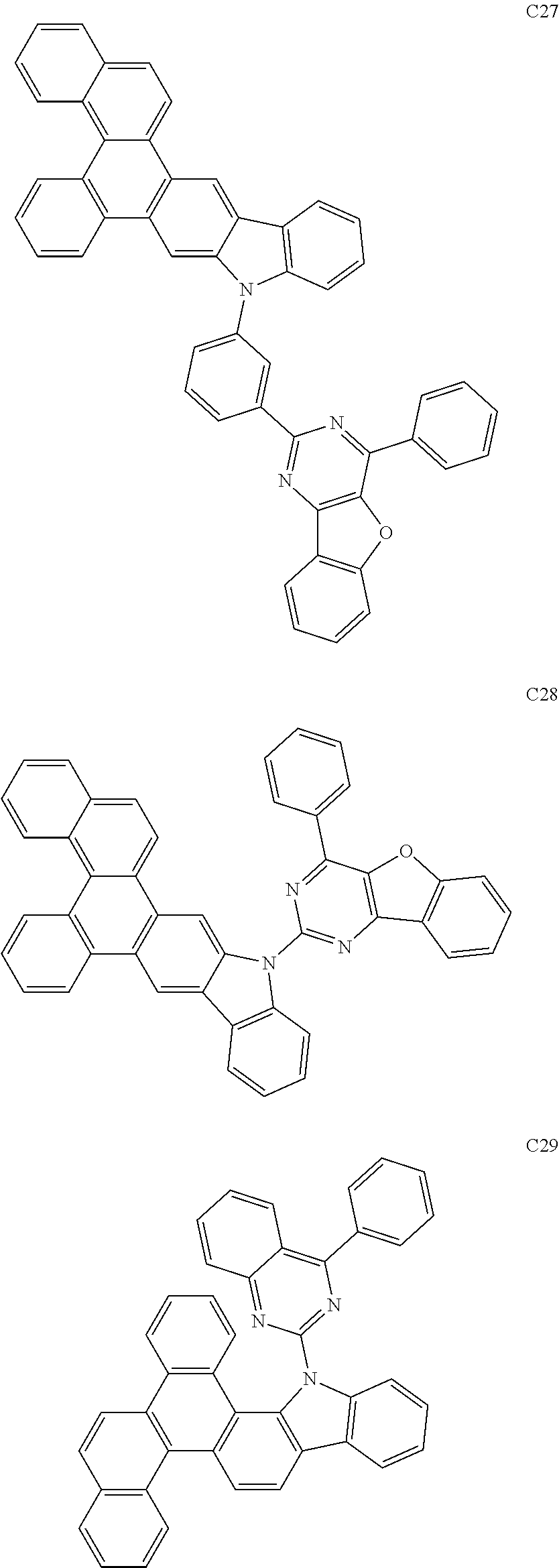


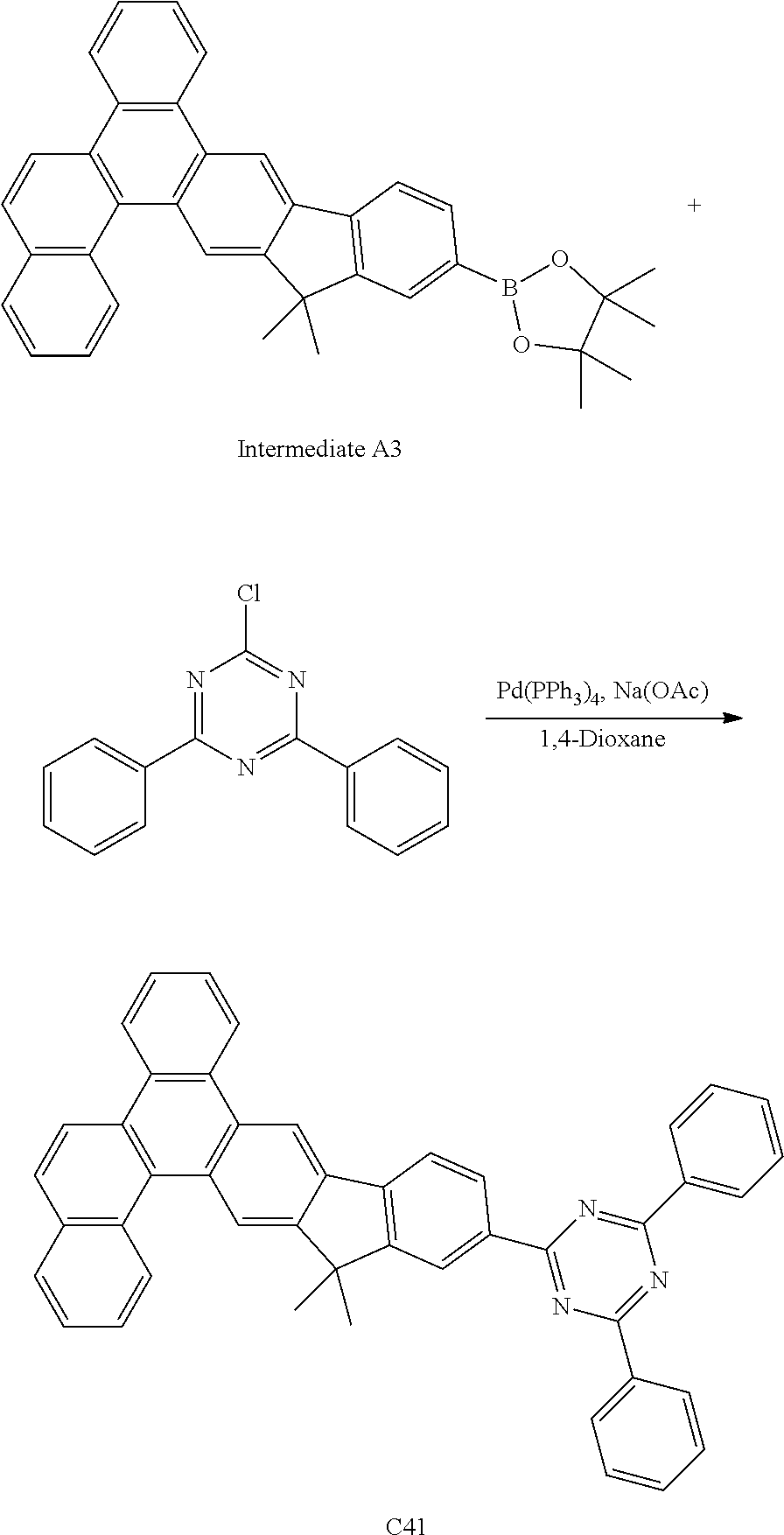


| TABLE 1 | |||||
| Fluorescent | |||||
| blue host + | Voltage | Luminance | Efficiency | CIE | Half-life |
| 5% dopant | (V) | (cd/m2) | (cd/A) | (y) | time (hr) |
| DFDP + D1 | 6 | 965 | 5.02 | 0.17 | 300 |
| DFDP + C5 | 6 | 1124 | 5.83 | 0.15 | 410 |
| DFDP + C6 | 6 | 1333 | 6.73 | 0.15 | 436 |
| DFDP + C7 | 6 | 1276 | 6.63 | 0.15 | 442 |
| DFDP + C16 | 6 | 1362 | 6.31 | 0.15 | 450 |
| DFDP + C19 | 6 | 1441 | 6.83 | 0.15 | 421 |
| DFDP + C49 | 6 | 1584 | 8.21 | 0.14 | 492 |
| C9 + D1 | 6 | 1165 | 5.63 | 0.15 | 400 |
| C10 + D1 | 6 | 1122 | 5.52 | 0.15 | 314 |
| C11 + D1 | 6 | 998 | 5.13 | 0.15 | 323 |
| C12 + D1 | 6 | 1255 | 6.36 | 0.15 | 389 |
| C13 + D1 | 6 | 1050 | 5.24 | 0.15 | 332 |
| C34 + D1 | 6 | 1181 | 5.58 | 0.15 | 392 |
| C43 + D1 | 6 | 1436 | 6.66 | 0.15 | 434 |
| C44 + D1 | 6 | 1231 | 6.45 | 0.15 | 411 |
| TABLE 2 | ||||||
| Efficiency | CIE | Half-life | ||||
| ETM | Voltage (V) | (cd/A) | (y) | time (hr) | ||
| NPhen | 6.2 | 5.12 | 0.17 | 310 | ||
| C15 | 4.5 | 8.61 | 0.17 | 483 | ||
| C22 | 4.8 | 7.82 | 0.17 | 423 | ||
| C23 | 4.7 | 7.43 | 0.17 | 410 | ||
| C42 | 4.7 | 8.53 | 0.17 | 490 | ||
| C45 | 4.6 | 8.32 | 0.17 | 488 | ||
| TABLE 3 | |||||
| Phosphorescent | Voltage | Luminance | Efficiency | Device | Half-life |
| host + 10% dopant | (V) | (cd/m2) | (cd/A) | color | time (hr) |
| BAlq + Ir(piq)3 | 6 | 671 | 8.14 | red | 450 |
| C1 + Ir(piq)3 | 6 | 900 | 10.55 | red | 550 |
| C2 + Ir(piq)3 | 6 | 1135 | 13.40 | red | 820 |
| C3 + Ir(piq)3 | 6 | 1185 | 12.53 | red | 717 |
| C4 + Ir(piq)3 | 6 | 1341 | 15.05 | red | 891 |
| C27 + Ir(piq)3 | 6 | 1231 | 14.23 | red | 834 |
| C39 + Ir(piq)3 | 6 | 910 | 11.28 | red | 651 |
| C40 + Ir(piq)3 | 6 | 1080 | 13.28 | red | 778 |
| C58 + Ir(piq)3 | 6 | 1113 | 11.83 | red | 751 |
| BAlq + Ir(2-phq)3 | 6 | 511 | 14.12 | yellow | 472 |
| C1 + Ir(2-phq)3 | 6 | 1010 | 28.31 | yellow | 852 |
| C2 + Ir(2-phq)3 | 6 | 1220 | 35.36 | yellow | 998 |
| C3 + Ir(2-phq)3 | 6 | 1059 | 29.46 | yellow | 775 |
| C4 + Ir(2-phq)3 | 6 | 1130 | 30.78 | yellow | 878 |
| C27 + Ir(2-phq)3 | 6 | 1158 | 31.63 | yellow | 888 |
| C39 + Ir(2-phq)3 | 6 | 988 | 20.81 | yellow | 709 |
| C40 + Ir(2-phq)3 | 6 | 1310 | 36.22 | yellow | 984 |
| C58 + Ir(2-phq)3 | 6 | 1078 | 30.58 | yellow | 869 |

wherein Q is a group represented by formula (3) below:

wherein X is a divalent bridge selected from the group consisting of O, S, NR4, CR5R6, and SiR7R8; R1 to R3 are independently absent, a hydrogen atom, a halogen, a substituted or unsubstituted aryl group having 5 to 30 ring atoms, a substituted or unsubstituted heteroaryl group having 5 to 30 ring atoms, a substituted or unsubstituted arylamine group having 5 to 30 ring atoms, or a substituted or unsubstituted heteroarylamine group having 5 to 30 ring atoms; R4 is a hydrogen atom, a halogen, a substituted or unsubstituted aryl group having 5 to 30 ring atoms, a substituted or unsubstituted heteroaryl group having 5 to 30 ring atoms, a substituted or unsubstituted arylamine group having 5 to 30 ring atoms, or a substituted or unsubstituted heteroarylamine group having 5 to 30 ring atoms; and R5 to R8 are independently a hydrogen atom, a halogen, a substituted or unsubstituted alkyl group having 1 to 30 carbon atoms, a substituted or unsubstituted aryl group having 6 to 30 carbon atoms, a substituted or unsubstituted aralkyl group having 6 to 30 carbon atoms, or a substituted or unsubstituted heteroaryl group having 3 to 30 carbon atoms.
Claims (11)


Priority Applications (3)
| Application Number | Priority Date | Filing Date | Title |
|---|---|---|---|
| US16/153,853 US11111244B2 (en) | 2018-10-08 | 2018-10-08 | Organic compound and organic electroluminescence device using the same |
| TW108136123A TWI773930B (en) | 2018-10-08 | 2019-10-04 | Organic compound and organic electroluminescence device using the same |
| CN201910951538.3A CN111004168B (en) | 2018-10-08 | 2019-10-08 | Organic compounds and organic electroluminescent components using the same |
Applications Claiming Priority (1)
| Application Number | Priority Date | Filing Date | Title |
|---|---|---|---|
| US16/153,853 US11111244B2 (en) | 2018-10-08 | 2018-10-08 | Organic compound and organic electroluminescence device using the same |
Publications (2)
| Publication Number | Publication Date |
|---|---|
| US20200109138A1 US20200109138A1 (en) | 2020-04-09 |
| US11111244B2 true US11111244B2 (en) | 2021-09-07 |
Family
ID=70051339
Family Applications (1)
| Application Number | Title | Priority Date | Filing Date |
|---|---|---|---|
| US16/153,853 Expired - Fee Related US11111244B2 (en) | 2018-10-08 | 2018-10-08 | Organic compound and organic electroluminescence device using the same |
Country Status (3)
| Country | Link |
|---|---|
| US (1) | US11111244B2 (en) |
| CN (1) | CN111004168B (en) |
| TW (1) | TWI773930B (en) |
Families Citing this family (10)
| Publication number | Priority date | Publication date | Assignee | Title |
|---|---|---|---|---|
| CN111087416B (en) * | 2018-10-24 | 2024-05-14 | 北京夏禾科技有限公司 | Silicon-containing electron transport material and use thereof |
| US11038120B2 (en) * | 2019-01-17 | 2021-06-15 | Luminescence Technology Corp. | Organic compound and organic electroluminescence device using the same |
| KR102442580B1 (en) * | 2020-04-09 | 2022-09-13 | 주식회사 엘지화학 | Novel compound and organic light emitting device comprising the same |
| TWI783361B (en) * | 2021-01-29 | 2022-11-11 | 機光科技股份有限公司 | Organic compound and application in blue organic electroluminescent device thereof |
| CN113512043A (en) * | 2021-08-17 | 2021-10-19 | 浙江华显光电科技有限公司 | Organic compound, preparation, organic light-emitting device, and display or lighting device |
| CN114057752B (en) * | 2021-11-12 | 2023-04-07 | 上海八亿时空先进材料有限公司 | Tetraazafluoranthene compound and application thereof |
| CN117720473A (en) * | 2022-09-08 | 2024-03-19 | 北京夏禾科技有限公司 | Organic electroluminescent materials and devices |
| CN116162069B (en) * | 2023-01-20 | 2025-06-24 | 宁波卢米蓝新材料有限公司 | Organic electroluminescent material and application thereof |
| CN117645592B (en) * | 2024-01-29 | 2024-07-16 | 广东阿格蕾雅光电材料有限公司 | Compound and organic electroluminescent device |
| CN117924225B (en) * | 2024-02-28 | 2025-05-06 | 广东阿格蕾雅光电材料有限公司 | Compound and organic electroluminescent device |
Citations (5)
| Publication number | Priority date | Publication date | Assignee | Title |
|---|---|---|---|---|
| US20060244698A1 (en) * | 2005-05-02 | 2006-11-02 | Fuji Xerox Co., Ltd. | Multi-level optical writer |
| US20080111473A1 (en) * | 2004-12-22 | 2008-05-15 | Idemitsu Kosan Co., Ltd. | Anthracene Derivative and Organic Electroluminescent Element Using the Same |
| KR20170069724A (en) * | 2015-12-11 | 2017-06-21 | 엘에스산전 주식회사 | Vacuum level measuring apparatus for vacuum interrupter |
| WO2017109722A1 (en) | 2015-12-21 | 2017-06-29 | Idemitsu Kosan Co., Ltd. | Nitrogen-containing heterocyclic compounds and organic electroluminescence devices containing them |
| US20180155325A1 (en) | 2016-12-02 | 2018-06-07 | Samsung Sdi Co., Ltd. | Compound for organic optoelectronic device, composition for organic optoelectronic device and organic optoelectronic device and display device |
Family Cites Families (8)
| Publication number | Priority date | Publication date | Assignee | Title |
|---|---|---|---|---|
| US9698357B2 (en) * | 2014-11-28 | 2017-07-04 | Luminescence Technology Corporation | Phenanthroline-based compound and use thereof |
| US9793493B2 (en) * | 2014-12-30 | 2017-10-17 | Luminescence Technology Corp. | Organic material and organic electroluminescent device using the same |
| US10115905B2 (en) * | 2015-09-22 | 2018-10-30 | Feng-wen Yen | Organic compound for organic electroluminescence device and using the same |
| US10392387B2 (en) * | 2017-05-19 | 2019-08-27 | Arizona Board Of Regents On Behalf Of Arizona State University | Substituted benzo[4,5]imidazo[1,2-a]phenanthro[9,10-c][1,8]naphthyridines, benzo[4,5]imidazo[1,2-a]phenanthro[9,10-c][1,5]naphthyridines and dibenzo[f,h]benzo[4,5]imidazo[2,1-a]pyrazino[2,3-c]isoquinolines as thermally assisted delayed fluorescent materials |
| KR102107086B1 (en) * | 2017-06-05 | 2020-05-06 | 주식회사 엘지화학 | Novel compound and organic light emitting device comprising the same |
| KR102166850B1 (en) * | 2017-06-08 | 2020-10-16 | 주식회사 엘지화학 | Novel compound and organic light emitting device comprising the same |
| US20190378994A1 (en) * | 2018-06-12 | 2019-12-12 | Luminescence Technology Corporation | Organic compound and organic electroluminescence device using the same |
| CN110759850A (en) * | 2018-07-26 | 2020-02-07 | 北京鼎材科技有限公司 | Compound and application thereof |
-
2018
- 2018-10-08 US US16/153,853 patent/US11111244B2/en not_active Expired - Fee Related
-
2019
- 2019-10-04 TW TW108136123A patent/TWI773930B/en not_active IP Right Cessation
- 2019-10-08 CN CN201910951538.3A patent/CN111004168B/en not_active Expired - Fee Related
Patent Citations (5)
| Publication number | Priority date | Publication date | Assignee | Title |
|---|---|---|---|---|
| US20080111473A1 (en) * | 2004-12-22 | 2008-05-15 | Idemitsu Kosan Co., Ltd. | Anthracene Derivative and Organic Electroluminescent Element Using the Same |
| US20060244698A1 (en) * | 2005-05-02 | 2006-11-02 | Fuji Xerox Co., Ltd. | Multi-level optical writer |
| KR20170069724A (en) * | 2015-12-11 | 2017-06-21 | 엘에스산전 주식회사 | Vacuum level measuring apparatus for vacuum interrupter |
| WO2017109722A1 (en) | 2015-12-21 | 2017-06-29 | Idemitsu Kosan Co., Ltd. | Nitrogen-containing heterocyclic compounds and organic electroluminescence devices containing them |
| US20180155325A1 (en) | 2016-12-02 | 2018-06-07 | Samsung Sdi Co., Ltd. | Compound for organic optoelectronic device, composition for organic optoelectronic device and organic optoelectronic device and display device |
Also Published As
| Publication number | Publication date |
|---|---|
| TW202022088A (en) | 2020-06-16 |
| CN111004168A (en) | 2020-04-14 |
| TWI773930B (en) | 2022-08-11 |
| CN111004168B (en) | 2021-11-05 |
| US20200109138A1 (en) | 2020-04-09 |
Similar Documents
| Publication | Publication Date | Title |
|---|---|---|
| US20200109138A1 (en) | Organic compound and organic electroluminescence device using the same | |
| TWI458694B (en) | Organic light field components | |
| US11038120B2 (en) | Organic compound and organic electroluminescence device using the same | |
| CN102598344B (en) | Organic electroluminescent element | |
| US10454045B2 (en) | Organic compound and organic electroluminescence device using the same | |
| US9698351B2 (en) | Organic material for electroluminescent device | |
| US9190619B2 (en) | Compound for organic electroluminescence device | |
| US9893305B2 (en) | Indenotriphenylene-based iridium complexes for organic electroluminescence device | |
| US11236075B2 (en) | Organic compound and organic electroluminescence device using the same | |
| US11276828B2 (en) | Organic compound and organic electroluminescence device using the same | |
| WO2011048822A1 (en) | Organic electroluminescent element | |
| CN105009316B (en) | Organic electric-field light-emitting element boron compound and organic electric-field light-emitting element | |
| US10079347B2 (en) | Compounds for organic electroluminescence device | |
| WO2012001986A1 (en) | Compound with carbazole ring structure and organic electroluminescent element | |
| WO2011048821A1 (en) | Organic electroluminescent element | |
| WO2018173598A1 (en) | Organic electroluminescent element | |
| US20200235306A1 (en) | Organic compound and organic electroluminescence device using the same | |
| US20160380207A1 (en) | Triphenylene-based fused biscarbazole derivative and use thereof | |
| KR20140086880A (en) | Novel organic compound and organic electroluminescent device comprising same | |
| US10844043B2 (en) | Heteroaromatic compound and organic electroluminescence device using the same | |
| US10056561B2 (en) | Organic material and organic electroluminescent device using the same | |
| TWI741047B (en) | Organic electroluminescent device | |
| US10807972B2 (en) | Indenotriphenylene-based amine derivative and organic electroluminescence device using the same | |
| US20200227658A1 (en) | Organic compound and organic electroluminescence device using the same | |
| US20190378994A1 (en) | Organic compound and organic electroluminescence device using the same |
Legal Events
| Date | Code | Title | Description |
|---|---|---|---|
| FEPP | Fee payment procedure |
Free format text: ENTITY STATUS SET TO UNDISCOUNTED (ORIGINAL EVENT CODE: BIG.); ENTITY STATUS OF PATENT OWNER: SMALL ENTITY |
|
| FEPP | Fee payment procedure |
Free format text: ENTITY STATUS SET TO SMALL (ORIGINAL EVENT CODE: SMAL); ENTITY STATUS OF PATENT OWNER: SMALL ENTITY |
|
| AS | Assignment |
Owner name: LUMINESCENCE TECHNOLOGY CORP., TAIWAN Free format text: ASSIGNMENT OF ASSIGNORS INTEREST;ASSIGNORS:YEN, FENG-WEN;YEH, SHU-HUA;REEL/FRAME:053650/0442 Effective date: 20200901 |
|
| STPP | Information on status: patent application and granting procedure in general |
Free format text: NON FINAL ACTION MAILED |
|
| STPP | Information on status: patent application and granting procedure in general |
Free format text: RESPONSE TO NON-FINAL OFFICE ACTION ENTERED AND FORWARDED TO EXAMINER |
|
| STPP | Information on status: patent application and granting procedure in general |
Free format text: NOTICE OF ALLOWANCE MAILED -- APPLICATION RECEIVED IN OFFICE OF PUBLICATIONS |
|
| STPP | Information on status: patent application and granting procedure in general |
Free format text: PUBLICATIONS -- ISSUE FEE PAYMENT VERIFIED |
|
| STCF | Information on status: patent grant |
Free format text: PATENTED CASE |
|
| FEPP | Fee payment procedure |
Free format text: MAINTENANCE FEE REMINDER MAILED (ORIGINAL EVENT CODE: REM.); ENTITY STATUS OF PATENT OWNER: SMALL ENTITY |
|
| LAPS | Lapse for failure to pay maintenance fees |
Free format text: PATENT EXPIRED FOR FAILURE TO PAY MAINTENANCE FEES (ORIGINAL EVENT CODE: EXP.); ENTITY STATUS OF PATENT OWNER: SMALL ENTITY |
|
| STCH | Information on status: patent discontinuation |
Free format text: PATENT EXPIRED DUE TO NONPAYMENT OF MAINTENANCE FEES UNDER 37 CFR 1.362 |
|
| FP | Lapsed due to failure to pay maintenance fee |
Effective date: 20250907 |