US11106963B2 - Tag embedding system - Google Patents
Tag embedding system Download PDFInfo
- Publication number
- US11106963B2 US11106963B2 US16/296,759 US201916296759A US11106963B2 US 11106963 B2 US11106963 B2 US 11106963B2 US 201916296759 A US201916296759 A US 201916296759A US 11106963 B2 US11106963 B2 US 11106963B2
- Authority
- US
- United States
- Prior art keywords
- tag
- interior surface
- recess
- opening
- fold
- Prior art date
- Legal status (The legal status is an assumption and is not a legal conclusion. Google has not performed a legal analysis and makes no representation as to the accuracy of the status listed.)
- Active, expires
Links
Images




Classifications
-
- G—PHYSICS
- G06—COMPUTING OR CALCULATING; COUNTING
- G06K—GRAPHICAL DATA READING; PRESENTATION OF DATA; RECORD CARRIERS; HANDLING RECORD CARRIERS
- G06K19/00—Record carriers for use with machines and with at least a part designed to carry digital markings
- G06K19/06—Record carriers for use with machines and with at least a part designed to carry digital markings characterised by the kind of the digital marking, e.g. shape, nature, code
- G06K19/067—Record carriers with conductive marks, printed circuits or semiconductor circuit elements, e.g. credit or identity cards also with resonating or responding marks without active components
- G06K19/07—Record carriers with conductive marks, printed circuits or semiconductor circuit elements, e.g. credit or identity cards also with resonating or responding marks without active components with integrated circuit chips
- G06K19/077—Constructional details, e.g. mounting of circuits in the carrier
- G06K19/07749—Constructional details, e.g. mounting of circuits in the carrier the record carrier being capable of non-contact communication, e.g. constructional details of the antenna of a non-contact smart card
-
- G—PHYSICS
- G06—COMPUTING OR CALCULATING; COUNTING
- G06K—GRAPHICAL DATA READING; PRESENTATION OF DATA; RECORD CARRIERS; HANDLING RECORD CARRIERS
- G06K19/00—Record carriers for use with machines and with at least a part designed to carry digital markings
- G06K19/06—Record carriers for use with machines and with at least a part designed to carry digital markings characterised by the kind of the digital marking, e.g. shape, nature, code
- G06K19/067—Record carriers with conductive marks, printed circuits or semiconductor circuit elements, e.g. credit or identity cards also with resonating or responding marks without active components
- G06K19/07—Record carriers with conductive marks, printed circuits or semiconductor circuit elements, e.g. credit or identity cards also with resonating or responding marks without active components with integrated circuit chips
- G06K19/077—Constructional details, e.g. mounting of circuits in the carrier
- G06K19/0772—Physical layout of the record carrier
-
- G—PHYSICS
- G06—COMPUTING OR CALCULATING; COUNTING
- G06K—GRAPHICAL DATA READING; PRESENTATION OF DATA; RECORD CARRIERS; HANDLING RECORD CARRIERS
- G06K19/00—Record carriers for use with machines and with at least a part designed to carry digital markings
- G06K19/06—Record carriers for use with machines and with at least a part designed to carry digital markings characterised by the kind of the digital marking, e.g. shape, nature, code
- G06K19/067—Record carriers with conductive marks, printed circuits or semiconductor circuit elements, e.g. credit or identity cards also with resonating or responding marks without active components
- G06K19/07—Record carriers with conductive marks, printed circuits or semiconductor circuit elements, e.g. credit or identity cards also with resonating or responding marks without active components with integrated circuit chips
- G06K19/077—Constructional details, e.g. mounting of circuits in the carrier
- G06K19/07749—Constructional details, e.g. mounting of circuits in the carrier the record carrier being capable of non-contact communication, e.g. constructional details of the antenna of a non-contact smart card
- G06K19/07758—Constructional details, e.g. mounting of circuits in the carrier the record carrier being capable of non-contact communication, e.g. constructional details of the antenna of a non-contact smart card arrangements for adhering the record carrier to further objects or living beings, functioning as an identification tag
Definitions
- the present disclosure relates generally to radio frequency identification (RFID) tags and more specifically, to systems and methods of tagging work pieces with RFID tags.
- RFID radio frequency identification
- RFID tags are a type of tracking system that uses smart barcodes to identify items. For instance, RFID tags are generally used to track manufactured parts and work pieces. RFID tags contain electronically stored information that can be retrieved using a scanner or a reader without contacting the tag.
- the RFID tags are commonly used in manufacturing settings where they can be attached to a work piece to provide for the work piece to be electronically tracked through production to completion of a finished article.
- the RFID tag can include data for inventory control and instructions for incorporating the work piece in to a product during manufacturing.
- the present disclosure provides systems and methods of embedding radio frequency identification tags in articles.
- a work piece tagging system in some embodiments, includes a work piece having a body.
- the body includes an outer surface defining an opening and a tubular portion defining a recess extending inwardly from the opening.
- the tubular portion has a first interior surface opposed to the opening.
- the system also includes a tag having a fold extending from a first side of the tag to a second side of the tag.
- the fold defines a first corner on the first side of the tag, a second corner on the second side of the tag and first and second sections of the tag on a same side of the fold.
- the fold has a length that is less than a width of the opening and greater than a width of at least a portion of the first interior surface of the tubular portion.
- the tag is retained in the recess by the first and second corners of the tag engaging the portion of the first interior surface when the tag is inserted fold first through the opening into the recess.
- a work piece in another aspect, includes a body comprising an outer surface defining an opening and a tubular portion defining a recess extending inwardly from the opening.
- the tubular portion has a first interior surface opposed to the opening.
- the work piece also includes a tag having a fold extending from a first side of the tag to a second side of the tag. The fold defines a first corner on the first side of the tag, a second corner on the second side of the tag and first and second sections of the tag on a same side of the fold.
- the fold has a length that is less than a width of the opening and greater than a width of at least a portion of the first interior surface of the tubular portion to provide for the tag to be retained in the recess by the first and second corners of the tag engaging the portion of the first interior surface when the tag is inserted through the opening into the recess fold first.
- a method of tagging work pieces includes providing a work piece having a body, the body comprising an outer surface defining an opening; and a tubular portion defining a recess extending inwardly from the opening, the tubular portion having a first interior surface opposed to the opening.
- the method also includes providing a tag having a fold extending from a first side of the tag to a second side of the tag, the fold defining a first corner on the first side of the tag, a second corner on the second side of the tag and first and second sections of the tag on a same side of the fold, the fold having a length that is less than a width of the opening of the work piece and greater than a width of at least a portion of the first interior surface.
- the method also includes inserting the tag fold first through the opening and into the recess until the corners of the tag engage the portion of the first interior surface to retain the tag in the recess.
- FIG. 1 is a perspective view of a work piece tagging system including a work piece, a tag and a shuttle, according to one embodiment
- FIG. 2 is a perspective view of a tubular portion of the work piece of the work piece tagging system of FIG. 1 , according to one embodiment
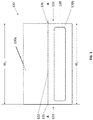
- FIG. 1 top view of a work piece of the work piece tagging system of FIG. 1 , according to one embodiment
- FIG. 3 is a top view of a tag of the work piece tagging system of FIG. 1 when the tag is in an open configuration, according to one embodiment
- FIG. 4 is a top view of a work piece of the work piece tagging system of FIG. 1 , according to one embodiment.
- FIG. 5 is a block diagram of a method of tagging a work piece, according to one embodiment.
- one of the first and second sections of the tag may carry a radio frequency identification (RFID) tag.
- RFID radio frequency identification
- At least a portion of the first section of the tag may engages a second interior surface of the tubular portion when the tag is inserted into the recess, the second interior surface being perpendicular to the first interior surface.
- At least a portion of the second section of the tag may engage a third interior surface of the tubular portion when the tag is inserted into the recess, the third interior surface being perpendicular to the first interior surface.
- the portion of the first interior surface may have an arcuate shape
- the portion of the first interior surface may have a semi-circular shape.
- the first interior surface may be a continuous surface that extends inwardly from the opening of the work piece.
- the first section of the tag and the second section of the tag may be the same size.
- the first and second corners of the tag may be configured to be embedded in the portion of the first interior surface of the tubular portion to retain the tag in the recess.
- the systems may further comprise a shuttle configured to be positioned against the fold when the tag is inserted through the opening and into the recess.
- the tag may be made of paper, plastic or a combination of paper and plastic.
- providing the tag may include providing one of the first and second sections of the tag with a RFID tag.
- inserting the tag into the recess may include pressing a shuttle against the fold, the shuttle having a width that is about the same as a width of the tag; inserting the shuttle and the tag fold first through the opening and into the recess; and pressing the shuttle and the tag against the first interior surface of the tubular portion until the corners of the tag engage the portion of the first interior surface to retain the in the tag in the recess.
- At least one in reference to a list of one or more entities should be understood to mean at least one entity selected from any one or more of the entity in the list of entities, but not necessarily including at least one of each and every entity specifically listed within the list of entities and not excluding any combinations of entities in the list of entities.
- This definition also allows that entities may optionally be present other than the entities specifically identified within the list of entities to which the phrase “at least one” refers, whether related or unrelated to those entities specifically identified.
- “at least one of A and B” may refer, to at least one, optionally including more than one, A, with no B present (and optionally including entities other than B); to at least one, optionally including more than one, B, with no A present (and optionally including entities other than A); to at least one, optionally including more than one, A, and at least one, optionally including more than one, B (and optionally including other entities).
- the phrases “at least one,” “one or more,” and “and/or” are open-ended expressions that are both conjunctive and disjunctive in operation.
- each of the expressions “at least one of A, B and C,” “at least one of A, B, or C,” “one or more of A, B, and C,” “one or more of A, B, or C” and “A, B, and/or C” may mean A alone, B alone, C alone, A and B together, A and C together, B and C together, A, B and C together, and optionally any of the above in combination with at least one other entity.
- the phrases “for example,” “as an example,” and/or simply the terms “example” or “exemplary,” when used with reference to one or more components, features, details, structures, methods and/or figures according to the present disclosure, are intended to convey that the described component, feature, detail, structure, method and/or figure is an illustrative, non-exclusive example of components, features, details, structures, methods and/or figures according to the present disclosure.
- System 100 includes a work piece 110 and a tag 120 .
- the system 100 also includes a shuttle 140 for inserting the tag 120 into the work piece 110 .
- Work piece 110 can be any object that has been or can be worked on by a tool or a machine, such as but not limited to a beam or other dimensioned piece of lumber, fiber board or a piece of composite material.
- Work piece 110 has a body 111 including an outer surface 113 and a tubular portion 115 .
- Outer surface 113 may be a planar surface and defines an opening 112 .
- Opening 112 can have any shape that provides for opening 112 to receive at least one tag 120 .
- opening 112 has a slot-like shape with a width W 1 that is greater than a height H.
- Shuttle 140 may be made of any rigid material and have a thickness that is less than the height H of the opening 112 and a width that is less than the width W 1 of the opening 112 .
- tubular portion 115 of the work piece 110 illustrated therein is tubular portion 115 of the work piece 110 .
- Tubular portion 115 extends inwardly from the opening 112 in outer surface 113 of work piece 110 to define recess 114 .
- Recess 114 can have any shape to provide for retaining tag 120 therein when the tag 120 is inserted through the opening 112 into the recess 114 .
- Tubular portion 115 includes a first interior surface 116 that is opposed to the opening 112 .
- first interior surface 116 extends inwardly from either side of the opening 112 and has a continuous, semi-circular shape.
- first interior surface 116 may have an arcuate shape.
- only a portion of first interior surface 116 may have either a semi-circular or an arcuate shape.
- interior surface 113 may be entirely opposed to opening 112 but not extend from either side of the opening 112 . Rather, first interior surface 116 may extend along width W 1 of the opening 112 and be indirectly connected to sides of the opening 112 .
- First interior surface 116 can generally have any shape to engage with at least a portion of the tag 120 to retain the tag 120 in the recess 114 . At least a portion of the first interior surface 116 is shaped to have a width W 2 that is less than width W 1 of the opening 112 . For instance, at least a portion of first interior surface 116 is shaped to provide two points of contact for the tag 120 (e.g. corners of the tag 120 ) when the tag 120 is inserted into the recess 114 .
- engage refers to a state or condition of physically touching and includes, but is not limited to, any or all of contacting, touching, connecting, adhering, and/or embedding, both directly and indirectly.
- first interior surface 116 is shaped to retain tag 120 in the recess 114 by the corners 125 , 126 of the tag 120 engaging with the first interior surface 116 .
- the corners 125 , 126 exert a force outwardly from the tag 120 against the first interior surface 116 to retain the tag 120 in the recess 114 .
- the tag 120 is retained in the recess 114 by friction between the corners 125 , 126 of the tag 120 and the first interior surface 116 of the recess 114 .
- first interior surface 116 may be a continuous surface extending inwardly from the opening 112 . In other embodiments, first interior surface 116 may include one or more continuous surfaces extending inwardly from the opening 112 . In some embodiments, first interior surface 116 may be a continuous surface opposed to the opening 112 . In other embodiments, first interior surface 116 may include one or more continuous surfaces opposed to the opening 112 .
- first interior surface 116 may include two planar surfaces that meet at a joint, where the joint extends inwardly from the opening 112 .
- first interior surface 116 may include two planar surfaces that meet at a joint, where the joint is opposed to the opening 112 .
- first interior surface 116 has a semi-circular shape and is a continuous surface that extends inwardly from both sides of the opening 112 .
- recess 114 may be formed in the work piece 110 by, for example but not limited to, a circular saw or the like pressed against the outer surface 113 .
- Tubular portion 115 may also include second and third interior surfaces 117 and 118 , respectively. Generally, second interior surface 117 and third interior surface 118 are opposed to each other. In the embodiment shown in the Figures, second interior surface 117 and third interior surface 118 are each perpendicular to the opening 112 . Second interior surface 117 and third interior surface 118 may also, either both or individually, be perpendicular to the first interior surface 116 . In some embodiments, second interior surface 117 and third interior surface 118 may engage with a portion of tag 120 when tag 120 is inserted into the recess 114 and contribute to tag 120 being retained in the recess 114 . For instance, second interior surface 117 and third interior surface 118 may engage with edges of the tag 120 when tag 120 is folded and inserted into the recess 114 .
- Tag 120 is generally made of a flexible material that provides for a fold 122 to be formed in the tag 120 .
- tag 120 may be made of paper, plastic, or a combination of both.
- Tag 120 generally has a thickness that is sufficiently thin to provide for bending (i.e. about 0.25 mm or less).
- Tag 120 includes a fold 122 extending from a first side 123 of the tag 120 to a second side 124 of the tag 120 .
- fold 120 bisects the tag 120 into a first section 120 a and a second section 120 b.
- At least one of first section 120 a and a second section 120 b carries a radio frequency identification (RFID) tag 128 .
- RFID tag 128 is shown as being carried by second section 120 b .
- RFID tag 128 is attached to second section 120 b with an adhesive and/or is sandwiched between two layers of paper or plastic and is positioned in about a middle of the second section 120 b (i.e. equally spaced from each edge of the second section 120 b and the fold 122 ).
- RFID tag 128 generally includes any tag that uses an electromagnetic field to automatically identify and track tags attached to objects.
- RFID tag 128 contains electronically-stored information.
- RFID tag 128 may be a passive tag or an active tag. Passive tags generally collect energy from a nearby RFID reader's interrogating radio waves, whereas active tags include a local power source (such as a battery) and may operate at greater distances from a RFID reader than passive tags.
- Fold 122 defines a first corner 125 on the first side 123 of the tag 120 and a second corner 126 on the second side 124 of the tag 120 .
- Fold 122 has a length W 3 that generally corresponds to a width of the tag 120 .
- Length W 3 is less than width W 1 of the opening 112 .
- Length W 3 is also generally greater than width W 2 of at least a portion of the interior surface 116 of the recess 114 .
- the fold 122 provides for the tag 120 to be retained in the recess 114 by the first and second corners 125 , 126 , respectively, engaging at least a portion of the first interior surface 116 of the recess 114 when the tag 120 is inserted through the opening 112 into the recess 114 .
- FIG. 4 shows a top down view of work piece 110 of FIG. 1 with tag 120 of FIG. 1 in a folded configuration (i.e. first section 120 a and second section 120 b are vertically spaced from each other and positioned on a same side of the fold 122 ) and inserted into recess 114 , where tag 120 is shown in dotted lines.
- fold 122 has been formed in tag 120 and tag 120 , when in its folded configuration, has been inserted fold first into the recess 114 though the opening 112 .
- “fold first” means that the tag 120 was inserted through the opening 112 and into the recess 114 with the first section 120 a of the tag 120 and second section 120 b of the tag 120 trailing the fold 122 .
- Fold 122 has an axis A that is generally parallel to the width W 1 of the opening 112 when the tag 120 is retained in the recess 114 .
- first section 120 a and the second section 120 b are urged upwardly and downwardly, respectively, when the tag 120 is inserted into the recess 114 .
- at least a portion of first section 120 a may engage second interior surface 117 and/or at least a portion of second section 120 b (e.g. an edge thereof) may engage third interior surface 118 to contribute to tag 120 being retained in the recess 114 (e.g. by friction).
- the method 500 includes a step 502 of providing a work piece such as work piece 110 .
- work piece 110 includes a tubular portion 115 defining a recess 114 extending inwardly from an opening 112 in an outer surface 113 of the work piece 110 .
- First interior surface 116 of the tubular portion 115 is opposed to the opening 112 .
- Method 500 also includes a step 504 of providing a tag such as but not limited to tag 120 having a fold 122 extending from a first side 123 of the tag 120 to a second side 124 of the tag 120 .
- the fold 122 defines a first corner 125 on the first side 123 of the tag 120 , a second corner 126 on the second side 124 of the tag 120 and first and second sections 120 a , 120 b , respectively, of the tag 120 on either side of the fold 122 .
- the fold 122 length W 3 is less than width W 1 of the opening 112 of the work piece 110 and is greater than width W 2 of at least a portion of an interior surface 116 of the recess 114 .
- Method 500 also includes a step 506 of inserting the tag 110 into the recess 114 fold first through the opening 112 until the corners 125 , 126 of the tag 120 engage the portion of the first interior surface 116 to retain the tag 120 in the recess 114 .
- the system 100 may include a shuttle 140 (see FIG. 1 ).
- Shuttle 140 may be used to insert the tag 120 into the work piece 110 .
- shuttle 140 has a width that is generally the same as the width W 3 of the tag 120 .
- a user of the shuttle 140 can press the shuttle 140 against fold 122 of tag 120 when the tag 120 is in its folded configuration and insert the tag 120 into the recess 114 thorough the opening 112 .
- a user may then press the shuttle 140 against the first interior surface 116 to facilitate engagement of the tag 120 and the first interior surface 116 to retain the tag 120 in the recess 114 .
- the shuttle 140 can then be withdrawn from the recess 114 , leaving the tag 120 retained in the work piece 110 .
Landscapes
- Engineering & Computer Science (AREA)
- Computer Hardware Design (AREA)
- Microelectronics & Electronic Packaging (AREA)
- Physics & Mathematics (AREA)
- General Physics & Mathematics (AREA)
- Theoretical Computer Science (AREA)
- Details Of Rigid Or Semi-Rigid Containers (AREA)
- Burglar Alarm Systems (AREA)
Abstract
Description
Claims (20)
Priority Applications (2)
| Application Number | Priority Date | Filing Date | Title |
|---|---|---|---|
| US16/296,759 US11106963B2 (en) | 2019-03-08 | 2019-03-08 | Tag embedding system |
| CA3037521A CA3037521C (en) | 2019-03-08 | 2019-03-21 | Tag embedding system |
Applications Claiming Priority (1)
| Application Number | Priority Date | Filing Date | Title |
|---|---|---|---|
| US16/296,759 US11106963B2 (en) | 2019-03-08 | 2019-03-08 | Tag embedding system |
Publications (2)
| Publication Number | Publication Date |
|---|---|
| US20200285930A1 US20200285930A1 (en) | 2020-09-10 |
| US11106963B2 true US11106963B2 (en) | 2021-08-31 |
Family
ID=72335366
Family Applications (1)
| Application Number | Title | Priority Date | Filing Date |
|---|---|---|---|
| US16/296,759 Active 2039-08-16 US11106963B2 (en) | 2019-03-08 | 2019-03-08 | Tag embedding system |
Country Status (1)
| Country | Link |
|---|---|
| US (1) | US11106963B2 (en) |
Families Citing this family (1)
| Publication number | Priority date | Publication date | Assignee | Title |
|---|---|---|---|---|
| CN110431559B (en) * | 2016-09-09 | 2023-09-19 | 香港物流及供应链管理应用技术研发中心 | Radio frequency communications equipment and methods of use |
Citations (6)
| Publication number | Priority date | Publication date | Assignee | Title |
|---|---|---|---|---|
| US5947524A (en) * | 1995-11-08 | 1999-09-07 | Avery Dennison Corporation | Cover folder |
| US20090160653A1 (en) * | 2007-12-21 | 2009-06-25 | Industrial Technology Research Institute | Anti-metal RFID tag and manufacturing method thereof |
| US20110050426A1 (en) * | 2009-08-27 | 2011-03-03 | Alex Poh Teck Choong | RFID label readable on surfaces which interferes with RF waves and method of manufacturing the same |
| US8646697B1 (en) | 2011-05-13 | 2014-02-11 | Northern Apex Corporation | Self locking tagging system |
| US20160307092A1 (en) * | 2015-04-16 | 2016-10-20 | Jabil Circuit, Inc. | Reflow soldering-compatible integrated rfid barcode label |
| US20180330220A1 (en) * | 2015-11-16 | 2018-11-15 | Gemalto Sa | Method for producing conducting tracks on a substrate |
-
2019
- 2019-03-08 US US16/296,759 patent/US11106963B2/en active Active
Patent Citations (6)
| Publication number | Priority date | Publication date | Assignee | Title |
|---|---|---|---|---|
| US5947524A (en) * | 1995-11-08 | 1999-09-07 | Avery Dennison Corporation | Cover folder |
| US20090160653A1 (en) * | 2007-12-21 | 2009-06-25 | Industrial Technology Research Institute | Anti-metal RFID tag and manufacturing method thereof |
| US20110050426A1 (en) * | 2009-08-27 | 2011-03-03 | Alex Poh Teck Choong | RFID label readable on surfaces which interferes with RF waves and method of manufacturing the same |
| US8646697B1 (en) | 2011-05-13 | 2014-02-11 | Northern Apex Corporation | Self locking tagging system |
| US20160307092A1 (en) * | 2015-04-16 | 2016-10-20 | Jabil Circuit, Inc. | Reflow soldering-compatible integrated rfid barcode label |
| US20180330220A1 (en) * | 2015-11-16 | 2018-11-15 | Gemalto Sa | Method for producing conducting tracks on a substrate |
Also Published As
| Publication number | Publication date |
|---|---|
| US20200285930A1 (en) | 2020-09-10 |
| CA3037521A1 (en) | 2020-09-08 |
Similar Documents
| Publication | Publication Date | Title |
|---|---|---|
| US9836688B2 (en) | System, method, and apparatus for RFID hang tag | |
| AU2005310019B2 (en) | Removable identification device for multilayer tubular structures | |
| US20230116234A1 (en) | Composite merchandise label constructions | |
| EP2772873A1 (en) | Rfid tag for flexible material product, rfid antenna of rfid tag for flexible material product, and rfid antenna continuum of same | |
| MXPA06011565A (en) | Identification device for multilayer tubular structures. | |
| US11106963B2 (en) | Tag embedding system | |
| WO2014159693A1 (en) | Card with edge indicators | |
| CA3037521C (en) | Tag embedding system | |
| JP2007094634A (en) | RFID tag | |
| JP5115278B2 (en) | Wireless tag label and wireless tag, method of attaching wireless tag to book, method of manufacturing wireless tag label | |
| KR102281412B1 (en) | A metal card and a method for producing the metal card | |
| US8228260B2 (en) | Structure having an antenna incorporated therein | |
| JP7467990B2 (en) | RF tagged cardboard and method for manufacturing RF tagged cardboard | |
| US20250028927A1 (en) | Systems, devices and methods of tracking inventory | |
| KR20120036492A (en) | Apparatus for production of rfid label and method for production of that | |
| CN106845604A (en) | A kind of flexible UHF RFID anti-metal tags | |
| CN223155495U (en) | RFID anti-metal tag easy to conformally attach | |
| CN206601722U (en) | A kind of flexible UHF RFID anti-metal tags | |
| US11699059B2 (en) | Transaction card with lightweight core | |
| KR200406501Y1 (en) | RFID tagged book | |
| KR101042087B1 (en) | RDF tag cover and RDF tag unit using the RDF tag cover | |
| JP2009086968A (en) | IC tag | |
| JP2022045472A (en) | Furniture for goods | |
| JP2022039242A (en) | Furniture for goods | |
| JP2006297769A (en) | Book with ic tag |
Legal Events
| Date | Code | Title | Description |
|---|---|---|---|
| FEPP | Fee payment procedure |
Free format text: ENTITY STATUS SET TO UNDISCOUNTED (ORIGINAL EVENT CODE: BIG.); ENTITY STATUS OF PATENT OWNER: SMALL ENTITY |
|
| FEPP | Fee payment procedure |
Free format text: ENTITY STATUS SET TO SMALL (ORIGINAL EVENT CODE: SMAL); ENTITY STATUS OF PATENT OWNER: SMALL ENTITY |
|
| STPP | Information on status: patent application and granting procedure in general |
Free format text: RESPONSE TO NON-FINAL OFFICE ACTION ENTERED AND FORWARDED TO EXAMINER |
|
| STPP | Information on status: patent application and granting procedure in general |
Free format text: NOTICE OF ALLOWANCE MAILED -- APPLICATION RECEIVED IN OFFICE OF PUBLICATIONS |
|
| AS | Assignment |
Owner name: 8370605 CANADA INC., CANADA Free format text: ASSIGNMENT OF ASSIGNORS INTEREST;ASSIGNORS:BUHLER, JAMES;ELIAS, LUKE;BUHLER, LESTER A.;SIGNING DATES FROM 20200502 TO 20210604;REEL/FRAME:056797/0887 |
|
| STCF | Information on status: patent grant |
Free format text: PATENTED CASE |
|
| CC | Certificate of correction | ||
| AS | Assignment |
Owner name: MUSKOKA CABINET COMPANY INC., CANADA Free format text: ASSIGNMENT OF ASSIGNORS INTEREST;ASSIGNOR:8370605 CANADA INC.;REEL/FRAME:068011/0992 Effective date: 20240628 |
|
| MAFP | Maintenance fee payment |
Free format text: PAYMENT OF MAINTENANCE FEE, 4TH YR, SMALL ENTITY (ORIGINAL EVENT CODE: M2551); ENTITY STATUS OF PATENT OWNER: SMALL ENTITY Year of fee payment: 4 |