US11084806B2 - Compound for organic optoelectronic device, composition for organic optoelectronic device, organic optoelectronic device, and display device - Google Patents
Compound for organic optoelectronic device, composition for organic optoelectronic device, organic optoelectronic device, and display device Download PDFInfo
- Publication number
- US11084806B2 US11084806B2 US16/097,657 US201716097657A US11084806B2 US 11084806 B2 US11084806 B2 US 11084806B2 US 201716097657 A US201716097657 A US 201716097657A US 11084806 B2 US11084806 B2 US 11084806B2
- Authority
- US
- United States
- Prior art keywords
- group
- substituted
- unsubstituted
- chemical formula
- optoelectronic device
- Prior art date
- Legal status (The legal status is an assumption and is not a legal conclusion. Google has not performed a legal analysis and makes no representation as to the accuracy of the status listed.)
- Active, expires
Links
- 0 *c(cc1)ccc1-c1ccccc1 Chemical compound *c(cc1)ccc1-c1ccccc1 0.000 description 16
- WXIDEEFIOWPGKK-UHFFFAOYSA-N C1=CC=C(C2=CC(C3=CC(C4=CC=CC=C4)=NC(C4=CC=CC(C5=NC(C6=CC7=C(C=C6)C6=CC=CC=C6O7)=NC(C6=CC=CC=C6)=N5)=C4)=N3)=CC=C2)C=C1.C1=CC=C(C2=CC(C3=CC(C4=CC=CC=C4)=NC(C4=CC=CC(C5=NC(C6=CC7=C(C=C6)C6=CC=CC=C6S7)=NC(C6=CC=CC=C6)=N5)=C4)=N3)=CC=C2)C=C1.C1=CC=C(C2=CC=C(C3=CC(C4=CC=CC=C4)=NC(C4=CC=CC(C5=NC(C6=CC7=C(C=C6)C6=CC=CC=C6O7)=NC(C6=CC=CC=C6)=N5)=C4)=N3)C=C2)C=C1.C1=CC=C(C2=CC=C(C3=CC(C4=CC=CC=C4)=NC(C4=CC=CC(C5=NC(C6=CC7=C(C=C6)C6=CC=CC=C6S7)=NC(C6=CC=CC=C6)=N5)=C4)=N3)C=C2)C=C1.C1=CC=C(C2=CC=C(C3=NC(C4=CC=CC=C4)=NC(C4=CC=CC(C5=NC(C6=CC7=C(C=C6)C6=CC=CC=C6O7)=NC(C6=CC=CC=C6)=N5)=C4)=C3)C=C2)C=C1.C1=CC=C(C2=CC=C(C3=NC(C4=CC=CC=C4)=NC(C4=CC=CC(C5=NC(C6=CC7=C(C=C6)C6=CC=CC=C6S7)=NC(C6=CC=CC=C6)=N5)=C4)=C3)C=C2)C=C1 Chemical compound C1=CC=C(C2=CC(C3=CC(C4=CC=CC=C4)=NC(C4=CC=CC(C5=NC(C6=CC7=C(C=C6)C6=CC=CC=C6O7)=NC(C6=CC=CC=C6)=N5)=C4)=N3)=CC=C2)C=C1.C1=CC=C(C2=CC(C3=CC(C4=CC=CC=C4)=NC(C4=CC=CC(C5=NC(C6=CC7=C(C=C6)C6=CC=CC=C6S7)=NC(C6=CC=CC=C6)=N5)=C4)=N3)=CC=C2)C=C1.C1=CC=C(C2=CC=C(C3=CC(C4=CC=CC=C4)=NC(C4=CC=CC(C5=NC(C6=CC7=C(C=C6)C6=CC=CC=C6O7)=NC(C6=CC=CC=C6)=N5)=C4)=N3)C=C2)C=C1.C1=CC=C(C2=CC=C(C3=CC(C4=CC=CC=C4)=NC(C4=CC=CC(C5=NC(C6=CC7=C(C=C6)C6=CC=CC=C6S7)=NC(C6=CC=CC=C6)=N5)=C4)=N3)C=C2)C=C1.C1=CC=C(C2=CC=C(C3=NC(C4=CC=CC=C4)=NC(C4=CC=CC(C5=NC(C6=CC7=C(C=C6)C6=CC=CC=C6O7)=NC(C6=CC=CC=C6)=N5)=C4)=C3)C=C2)C=C1.C1=CC=C(C2=CC=C(C3=NC(C4=CC=CC=C4)=NC(C4=CC=CC(C5=NC(C6=CC7=C(C=C6)C6=CC=CC=C6S7)=NC(C6=CC=CC=C6)=N5)=C4)=C3)C=C2)C=C1 WXIDEEFIOWPGKK-UHFFFAOYSA-N 0.000 description 2
- AOYNACJJYOYKSI-UHFFFAOYSA-N C1=CC=C(C2=CC(C3=CC=CC=C3)=NC(C3=CC(C4=CC=CC(C5=NC(C6=CC7=C(C=C6)C6=CC=CC=C6O7)=NC(C6=CC=CC=C6)=N5)=C4)=CC=C3)=N2)C=C1.C1=CC=C(C2=CC(C3=CC=CC=C3)=NC(C3=CC(C4=CC=CC(C5=NC(C6=CC7=C(C=C6)C6=CC=CC=C6S7)=NC(C6=CC=CC=C6)=N5)=C4)=CC=C3)=N2)C=C1 Chemical compound C1=CC=C(C2=CC(C3=CC=CC=C3)=NC(C3=CC(C4=CC=CC(C5=NC(C6=CC7=C(C=C6)C6=CC=CC=C6O7)=NC(C6=CC=CC=C6)=N5)=C4)=CC=C3)=N2)C=C1.C1=CC=C(C2=CC(C3=CC=CC=C3)=NC(C3=CC(C4=CC=CC(C5=NC(C6=CC7=C(C=C6)C6=CC=CC=C6S7)=NC(C6=CC=CC=C6)=N5)=C4)=CC=C3)=N2)C=C1 AOYNACJJYOYKSI-UHFFFAOYSA-N 0.000 description 2
- LZJZJNGSKVBNRC-UHFFFAOYSA-N C1=CC=C(C2=CC(C3=CC=CC=C3)=NC(C3=CC=CC(C4=NC(C5=CC6=C(C=C5)C5=CC=CC=C5O6)=NC(C5=CC=CC=C5)=N4)=C3)=N2)C=C1.C1=CC=C(C2=CC(C3=CC=CC=C3)=NC(C3=CC=CC(C4=NC(C5=CC6=C(C=C5)C5=CC=CC=C5S6)=NC(C5=CC=CC=C5)=N4)=C3)=N2)C=C1.C1=CC=C(C2=NC(C3=CC(C4=CC=CC(C5=CC(C6=NC(C7=CC=CC=C7)=NC(C7=CC=CC=C7)=N6)=CC=C5)=C4)=CC=C3)=CC(C3=CC4=C(C=C3)C3=CC=CC=C3O4)=N2)C=C1.C1=CC=C(C2=NC(C3=CC(C4=CC=CC(C5=CC(C6=NC(C7=CC=CC=C7)=NC(C7=CC=CC=C7)=N6)=CC=C5)=C4)=CC=C3)=CC(C3=CC4=C(C=C3)C3=CC=CC=C3S4)=N2)C=C1.C1=CC=C(C2=NC(C3=CC=CC=C3)=NC(C3=CC=CC(C4=NC(C5=CC6=C(C=C5)C5=CC=CC=C5O6)=NC(C5=CC=CC=C5)=N4)=C3)=C2)C=C1.C1=CC=C(C2=NC(C3=CC=CC=C3)=NC(C3=CC=CC(C4=NC(C5=CC6=C(C=C5)C5=CC=CC=C5S6)=NC(C5=CC=CC=C5)=N4)=C3)=C2)C=C1 Chemical compound C1=CC=C(C2=CC(C3=CC=CC=C3)=NC(C3=CC=CC(C4=NC(C5=CC6=C(C=C5)C5=CC=CC=C5O6)=NC(C5=CC=CC=C5)=N4)=C3)=N2)C=C1.C1=CC=C(C2=CC(C3=CC=CC=C3)=NC(C3=CC=CC(C4=NC(C5=CC6=C(C=C5)C5=CC=CC=C5S6)=NC(C5=CC=CC=C5)=N4)=C3)=N2)C=C1.C1=CC=C(C2=NC(C3=CC(C4=CC=CC(C5=CC(C6=NC(C7=CC=CC=C7)=NC(C7=CC=CC=C7)=N6)=CC=C5)=C4)=CC=C3)=CC(C3=CC4=C(C=C3)C3=CC=CC=C3O4)=N2)C=C1.C1=CC=C(C2=NC(C3=CC(C4=CC=CC(C5=CC(C6=NC(C7=CC=CC=C7)=NC(C7=CC=CC=C7)=N6)=CC=C5)=C4)=CC=C3)=CC(C3=CC4=C(C=C3)C3=CC=CC=C3S4)=N2)C=C1.C1=CC=C(C2=NC(C3=CC=CC=C3)=NC(C3=CC=CC(C4=NC(C5=CC6=C(C=C5)C5=CC=CC=C5O6)=NC(C5=CC=CC=C5)=N4)=C3)=C2)C=C1.C1=CC=C(C2=NC(C3=CC=CC=C3)=NC(C3=CC=CC(C4=NC(C5=CC6=C(C=C5)C5=CC=CC=C5S6)=NC(C5=CC=CC=C5)=N4)=C3)=C2)C=C1 LZJZJNGSKVBNRC-UHFFFAOYSA-N 0.000 description 2
- DPQKTPDDXINPPC-UHFFFAOYSA-N C1=CC=C(C2=CC(C3=NC(C4=CC(C5=CC=CC(C6=CC(C7=CC8=C(C=C7)C7=CC=CC=C7O8)=NC(C7=CC=CC=C7)=N6)=C5)=CC=C4)=NC(C4=CC=CC=C4)=N3)=CC=C2)C=C1.C1=CC=C(C2=NC(C3=CC(C4=CC=CC(C5=CC(C6=NC(C7=CC=CC=C7)=NC(C7=CC=CC=C7)=N6)=CC=C5)=C4)=CC=C3)=NC(C3=CC4=C(C=C3)C3=CC=CC=C3O4)=C2)C=C1.C1=CC=C(C2=NC(C3=CC(C4=CC=CC(C5=CC(C6=NC(C7=CC=CC=C7)=NC(C7=CC=CC=C7)=N6)=CC=C5)=C4)=CC=C3)=NC(C3=CC4=C(C=C3)C3=CC=CC=C3S4)=C2)C=C1 Chemical compound C1=CC=C(C2=CC(C3=NC(C4=CC(C5=CC=CC(C6=CC(C7=CC8=C(C=C7)C7=CC=CC=C7O8)=NC(C7=CC=CC=C7)=N6)=C5)=CC=C4)=NC(C4=CC=CC=C4)=N3)=CC=C2)C=C1.C1=CC=C(C2=NC(C3=CC(C4=CC=CC(C5=CC(C6=NC(C7=CC=CC=C7)=NC(C7=CC=CC=C7)=N6)=CC=C5)=C4)=CC=C3)=NC(C3=CC4=C(C=C3)C3=CC=CC=C3O4)=C2)C=C1.C1=CC=C(C2=NC(C3=CC(C4=CC=CC(C5=CC(C6=NC(C7=CC=CC=C7)=NC(C7=CC=CC=C7)=N6)=CC=C5)=C4)=CC=C3)=NC(C3=CC4=C(C=C3)C3=CC=CC=C3S4)=C2)C=C1 DPQKTPDDXINPPC-UHFFFAOYSA-N 0.000 description 2
- VOGFIBBQJSEIBU-UHFFFAOYSA-N C1=CC=C(C2=CC(C3=NC(C4=CC(C5=CC=CC(C6=CC(C7=CC8=C(C=C7)C7=CC=CC=C7S8)=NC(C7=CC=CC=C7)=N6)=C5)=CC=C4)=NC(C4=CC=CC=C4)=N3)=CC=C2)C=C1.C1=CC=C(C2=CC=C(C3=NC(C4=CC=CC=C4)=NC(C4=CC(C5=CC=CC(C6=CC(C7=CC8=C(C=C7)C7=CC=CC=C7O8)=NC(C7=CC=CC=C7)=N6)=C5)=CC=C4)=N3)C=C2)C=C1.C1=CC=C(C2=CC=C(C3=NC(C4=CC=CC=C4)=NC(C4=CC(C5=CC=CC(C6=CC(C7=CC8=C(C=C7)C7=CC=CC=C7S8)=NC(C7=CC=CC=C7)=N6)=C5)=CC=C4)=N3)C=C2)C=C1 Chemical compound C1=CC=C(C2=CC(C3=NC(C4=CC(C5=CC=CC(C6=CC(C7=CC8=C(C=C7)C7=CC=CC=C7S8)=NC(C7=CC=CC=C7)=N6)=C5)=CC=C4)=NC(C4=CC=CC=C4)=N3)=CC=C2)C=C1.C1=CC=C(C2=CC=C(C3=NC(C4=CC=CC=C4)=NC(C4=CC(C5=CC=CC(C6=CC(C7=CC8=C(C=C7)C7=CC=CC=C7O8)=NC(C7=CC=CC=C7)=N6)=C5)=CC=C4)=N3)C=C2)C=C1.C1=CC=C(C2=CC=C(C3=NC(C4=CC=CC=C4)=NC(C4=CC(C5=CC=CC(C6=CC(C7=CC8=C(C=C7)C7=CC=CC=C7S8)=NC(C7=CC=CC=C7)=N6)=C5)=CC=C4)=N3)C=C2)C=C1 VOGFIBBQJSEIBU-UHFFFAOYSA-N 0.000 description 2
- STUZOXHMQAROHL-UHFFFAOYSA-N C1=CC=C(C2=CC(C3=NC(C4=CC(C5=CC=CC(C6=NC(C7=CC8=C(C=C7)C7=CC=CC=C7O8)=CC(C7=CC=CC=C7)=N6)=C5)=CC=C4)=NC(C4=CC=CC=C4)=N3)=CC=C2)C=C1.C1=CC=C(C2=NC(C3=CC=CC=C3)=NC(C3=CC=CC(C4=CC(C5=CC=CC(C6=NC(C7=CC8=C(C=C7)C7=CC=CC=C7O8)=NC(C7=CC=CC=C7)=N6)=C5)=CC=C4)=C3)=N2)C=C1.C1=CC=C(C2=NC(C3=CC=CC=C3)=NC(C3=CC=CC(C4=CC(C5=CC=CC(C6=NC(C7=CC8=C(C=C7)C7=CC=CC=C7S8)=NC(C7=CC=CC=C7)=N6)=C5)=CC=C4)=C3)=N2)C=C1 Chemical compound C1=CC=C(C2=CC(C3=NC(C4=CC(C5=CC=CC(C6=NC(C7=CC8=C(C=C7)C7=CC=CC=C7O8)=CC(C7=CC=CC=C7)=N6)=C5)=CC=C4)=NC(C4=CC=CC=C4)=N3)=CC=C2)C=C1.C1=CC=C(C2=NC(C3=CC=CC=C3)=NC(C3=CC=CC(C4=CC(C5=CC=CC(C6=NC(C7=CC8=C(C=C7)C7=CC=CC=C7O8)=NC(C7=CC=CC=C7)=N6)=C5)=CC=C4)=C3)=N2)C=C1.C1=CC=C(C2=NC(C3=CC=CC=C3)=NC(C3=CC=CC(C4=CC(C5=CC=CC(C6=NC(C7=CC8=C(C=C7)C7=CC=CC=C7S8)=NC(C7=CC=CC=C7)=N6)=C5)=CC=C4)=C3)=N2)C=C1 STUZOXHMQAROHL-UHFFFAOYSA-N 0.000 description 2
- YSKYQTWRNIYTJS-UHFFFAOYSA-N C1=CC=C(C2=CC(C3=NC(C4=CC(C5=CC=CC(C6=NC(C7=CC8=C(C=C7)C7=CC=CC=C7O8)=NC(C7=CC=CC=C7)=N6)=C5)=CC=C4)=NC(C4=CC=CC=C4)=N3)=CC=C2)C=C1.C1=CC=C(C2=CC(C3=NC(C4=CC(C5=NC(C6=CC=CC=C6)=NC(C6=CC=CC=C6)=N5)=CC=C4)=CC(C4=CC5=C(C=C4)C4=CC=CC=C4O5)=N3)=CC=C2)C=C1.C1=CC=C(C2=CC(C3=NC(C4=CC(C5=NC(C6=CC=CC=C6)=NC(C6=CC=CC=C6)=N5)=CC=C4)=CC(C4=CC5=C(C=C4)C4=CC=CC=C4S5)=N3)=CC=C2)C=C1.C1=CC=C(C2=CC(C3=NC(C4=CC=CC=C4)=NC(C4=CC=CC(C5=CC(C6=CC7=C(C=C6)C6=CC=CC=C6O7)=NC(C6=CC=CC=C6)=N5)=C4)=N3)=CC=C2)C=C1.C1=CC=C(C2=CC(C3=NC(C4=CC=CC=C4)=NC(C4=CC=CC(C5=CC(C6=CC7=C(C=C6)C6=CC=CC=C6S7)=NC(C6=CC=CC=C6)=N5)=C4)=N3)=CC=C2)C=C1 Chemical compound C1=CC=C(C2=CC(C3=NC(C4=CC(C5=CC=CC(C6=NC(C7=CC8=C(C=C7)C7=CC=CC=C7O8)=NC(C7=CC=CC=C7)=N6)=C5)=CC=C4)=NC(C4=CC=CC=C4)=N3)=CC=C2)C=C1.C1=CC=C(C2=CC(C3=NC(C4=CC(C5=NC(C6=CC=CC=C6)=NC(C6=CC=CC=C6)=N5)=CC=C4)=CC(C4=CC5=C(C=C4)C4=CC=CC=C4O5)=N3)=CC=C2)C=C1.C1=CC=C(C2=CC(C3=NC(C4=CC(C5=NC(C6=CC=CC=C6)=NC(C6=CC=CC=C6)=N5)=CC=C4)=CC(C4=CC5=C(C=C4)C4=CC=CC=C4S5)=N3)=CC=C2)C=C1.C1=CC=C(C2=CC(C3=NC(C4=CC=CC=C4)=NC(C4=CC=CC(C5=CC(C6=CC7=C(C=C6)C6=CC=CC=C6O7)=NC(C6=CC=CC=C6)=N5)=C4)=N3)=CC=C2)C=C1.C1=CC=C(C2=CC(C3=NC(C4=CC=CC=C4)=NC(C4=CC=CC(C5=CC(C6=CC7=C(C=C6)C6=CC=CC=C6S7)=NC(C6=CC=CC=C6)=N5)=C4)=N3)=CC=C2)C=C1 YSKYQTWRNIYTJS-UHFFFAOYSA-N 0.000 description 2
- ZSERLDKJRWTCLU-UHFFFAOYSA-N C1=CC=C(C2=CC(C3=NC(C4=CC(C5=CC=CC(C6=NC(C7=CC8=C(C=C7)C7=CC=CC=C7S8)=CC(C7=CC=CC=C7)=N6)=C5)=CC=C4)=NC(C4=CC=CC=C4)=N3)=CC=C2)C=C1.C1=CC=C(C2=CC=C(C3=NC(C4=CC=CC=C4)=NC(C4=CC(C5=CC=CC(C6=NC(C7=CC8=C(C=C7)C7=CC=CC=C7O8)=CC(C7=CC=CC=C7)=N6)=C5)=CC=C4)=N3)C=C2)C=C1.C1=CC=C(C2=CC=C(C3=NC(C4=CC=CC=C4)=NC(C4=CC(C5=CC=CC(C6=NC(C7=CC8=C(C=C7)C7=CC=CC=C7S8)=CC(C7=CC=CC=C7)=N6)=C5)=CC=C4)=N3)C=C2)C=C1 Chemical compound C1=CC=C(C2=CC(C3=NC(C4=CC(C5=CC=CC(C6=NC(C7=CC8=C(C=C7)C7=CC=CC=C7S8)=CC(C7=CC=CC=C7)=N6)=C5)=CC=C4)=NC(C4=CC=CC=C4)=N3)=CC=C2)C=C1.C1=CC=C(C2=CC=C(C3=NC(C4=CC=CC=C4)=NC(C4=CC(C5=CC=CC(C6=NC(C7=CC8=C(C=C7)C7=CC=CC=C7O8)=CC(C7=CC=CC=C7)=N6)=C5)=CC=C4)=N3)C=C2)C=C1.C1=CC=C(C2=CC=C(C3=NC(C4=CC=CC=C4)=NC(C4=CC(C5=CC=CC(C6=NC(C7=CC8=C(C=C7)C7=CC=CC=C7S8)=CC(C7=CC=CC=C7)=N6)=C5)=CC=C4)=N3)C=C2)C=C1 ZSERLDKJRWTCLU-UHFFFAOYSA-N 0.000 description 2
- JZMGLDJFIUUCNL-UHFFFAOYSA-N C1=CC=C(C2=CC(C3=NC(C4=CC(C5=CC=CC(C6=NC(C7=CC8=C(C=C7)C7=CC=CC=C7S8)=NC(C7=CC=CC=C7)=N6)=C5)=CC=C4)=NC(C4=CC=CC=C4)=N3)=CC=C2)C=C1.C1=CC=C(C2=CC=C(C3=NC(C4=CC=CC=C4)=NC(C4=CC(C5=CC=CC(C6=NC(C7=CC8=C(C=C7)C7=CC=CC=C7O8)=NC(C7=CC=CC=C7)=N6)=C5)=CC=C4)=N3)C=C2)C=C1.C1=CC=C(C2=CC=C(C3=NC(C4=CC=CC=C4)=NC(C4=CC(C5=CC=CC(C6=NC(C7=CC8=C(C=C7)C7=CC=CC=C7S8)=NC(C7=CC=CC=C7)=N6)=C5)=CC=C4)=N3)C=C2)C=C1 Chemical compound C1=CC=C(C2=CC(C3=NC(C4=CC(C5=CC=CC(C6=NC(C7=CC8=C(C=C7)C7=CC=CC=C7S8)=NC(C7=CC=CC=C7)=N6)=C5)=CC=C4)=NC(C4=CC=CC=C4)=N3)=CC=C2)C=C1.C1=CC=C(C2=CC=C(C3=NC(C4=CC=CC=C4)=NC(C4=CC(C5=CC=CC(C6=NC(C7=CC8=C(C=C7)C7=CC=CC=C7O8)=NC(C7=CC=CC=C7)=N6)=C5)=CC=C4)=N3)C=C2)C=C1.C1=CC=C(C2=CC=C(C3=NC(C4=CC=CC=C4)=NC(C4=CC(C5=CC=CC(C6=NC(C7=CC8=C(C=C7)C7=CC=CC=C7S8)=NC(C7=CC=CC=C7)=N6)=C5)=CC=C4)=N3)C=C2)C=C1 JZMGLDJFIUUCNL-UHFFFAOYSA-N 0.000 description 2
- CZMXCRKHJSOYGR-UHFFFAOYSA-N C1=CC=C(C2=CC(C3=NC(C4=CC(C5=NC(C6=CC=CC=C6)=NC(C6=CC=CC=C6)=N5)=CC=C4)=NC(C4=CC5=C(C=C4)C4=CC=CC=C4O5)=C3)=CC=C2)C=C1.C1=CC=C(C2=CC(C3=NC(C4=CC(C5=NC(C6=CC=CC=C6)=NC(C6=CC=CC=C6)=N5)=CC=C4)=NC(C4=CC5=C(C=C4)C4=CC=CC=C4S5)=C3)=CC=C2)C=C1.C1=CC=C(C2=CC(C3=NC(C4=CC=CC=C4)=NC(C4=CC=CC(C5=NC(C6=CC7=C(C=C6)C6=CC=CC=C6O7)=CC(C6=CC=CC=C6)=N5)=C4)=N3)=CC=C2)C=C1.C1=CC=C(C2=CC(C3=NC(C4=CC=CC=C4)=NC(C4=CC=CC(C5=NC(C6=CC7=C(C=C6)C6=CC=CC=C6S7)=CC(C6=CC=CC=C6)=N5)=C4)=N3)=CC=C2)C=C1.C1=CC=C(C2=CC=C(C3=NC(C4=CC(C5=NC(C6=CC=CC=C6)=NC(C6=CC=CC=C6)=N5)=CC=C4)=NC(C4=CC5=C(C=C4)C4=CC=CC=C4O5)=C3)C=C2)C=C1.C1=CC=C(C2=CC=C(C3=NC(C4=CC(C5=NC(C6=CC=CC=C6)=NC(C6=CC=CC=C6)=N5)=CC=C4)=NC(C4=CC5=C(C=C4)C4=CC=CC=C4S5)=C3)C=C2)C=C1 Chemical compound C1=CC=C(C2=CC(C3=NC(C4=CC(C5=NC(C6=CC=CC=C6)=NC(C6=CC=CC=C6)=N5)=CC=C4)=NC(C4=CC5=C(C=C4)C4=CC=CC=C4O5)=C3)=CC=C2)C=C1.C1=CC=C(C2=CC(C3=NC(C4=CC(C5=NC(C6=CC=CC=C6)=NC(C6=CC=CC=C6)=N5)=CC=C4)=NC(C4=CC5=C(C=C4)C4=CC=CC=C4S5)=C3)=CC=C2)C=C1.C1=CC=C(C2=CC(C3=NC(C4=CC=CC=C4)=NC(C4=CC=CC(C5=NC(C6=CC7=C(C=C6)C6=CC=CC=C6O7)=CC(C6=CC=CC=C6)=N5)=C4)=N3)=CC=C2)C=C1.C1=CC=C(C2=CC(C3=NC(C4=CC=CC=C4)=NC(C4=CC=CC(C5=NC(C6=CC7=C(C=C6)C6=CC=CC=C6S7)=CC(C6=CC=CC=C6)=N5)=C4)=N3)=CC=C2)C=C1.C1=CC=C(C2=CC=C(C3=NC(C4=CC(C5=NC(C6=CC=CC=C6)=NC(C6=CC=CC=C6)=N5)=CC=C4)=NC(C4=CC5=C(C=C4)C4=CC=CC=C4O5)=C3)C=C2)C=C1.C1=CC=C(C2=CC=C(C3=NC(C4=CC(C5=NC(C6=CC=CC=C6)=NC(C6=CC=CC=C6)=N5)=CC=C4)=NC(C4=CC5=C(C=C4)C4=CC=CC=C4S5)=C3)C=C2)C=C1 CZMXCRKHJSOYGR-UHFFFAOYSA-N 0.000 description 2
- WXRWGWRFEDBWLF-UHFFFAOYSA-N C1=CC=C(C2=CC(C3=NC(C4=CC(C5=NC(C6=CC=CC=C6)=NC(C6=CC=CC=C6)=N5)=CC=C4)=NC(C4=CC5=C(C=C4)C4=CC=CC=C4O5)=N3)=CC=C2)C=C1.C1=CC=C(C2=CC(C3=NC(C4=CC(C5=NC(C6=CC=CC=C6)=NC(C6=CC=CC=C6)=N5)=CC=C4)=NC(C4=CC5=C(C=C4)C4=CC=CC=C4S5)=N3)=CC=C2)C=C1.C1=CC=C(C2=CC(C3=NC(C4=CC=CC=C4)=NC(C4=CC=CC(C5=NC(C6=CC7=C(C=C6)C6=CC=CC=C6O7)=NC(C6=CC=CC=C6)=N5)=C4)=N3)=CC=C2)C=C1.C1=CC=C(C2=CC(C3=NC(C4=CC=CC=C4)=NC(C4=CC=CC(C5=NC(C6=CC7=C(C=C6)C6=CC=CC=C6S7)=NC(C6=CC=CC=C6)=N5)=C4)=N3)=CC=C2)C=C1.C1=CC=C(C2=NC(C3=CC(C4=NC(C5=CC=CC=C5)=NC(C5=CC=CC=C5)=N4)=CC=C3)=NC(C3=CC4=C(C=C3)C3=CC=CC=C3O4)=C2)C=C1.C1=CC=C(C2=NC(C3=CC(C4=NC(C5=CC=CC=C5)=NC(C5=CC=CC=C5)=N4)=CC=C3)=NC(C3=CC4=C(C=C3)C3=CC=CC=C3S4)=C2)C=C1 Chemical compound C1=CC=C(C2=CC(C3=NC(C4=CC(C5=NC(C6=CC=CC=C6)=NC(C6=CC=CC=C6)=N5)=CC=C4)=NC(C4=CC5=C(C=C4)C4=CC=CC=C4O5)=N3)=CC=C2)C=C1.C1=CC=C(C2=CC(C3=NC(C4=CC(C5=NC(C6=CC=CC=C6)=NC(C6=CC=CC=C6)=N5)=CC=C4)=NC(C4=CC5=C(C=C4)C4=CC=CC=C4S5)=N3)=CC=C2)C=C1.C1=CC=C(C2=CC(C3=NC(C4=CC=CC=C4)=NC(C4=CC=CC(C5=NC(C6=CC7=C(C=C6)C6=CC=CC=C6O7)=NC(C6=CC=CC=C6)=N5)=C4)=N3)=CC=C2)C=C1.C1=CC=C(C2=CC(C3=NC(C4=CC=CC=C4)=NC(C4=CC=CC(C5=NC(C6=CC7=C(C=C6)C6=CC=CC=C6S7)=NC(C6=CC=CC=C6)=N5)=C4)=N3)=CC=C2)C=C1.C1=CC=C(C2=NC(C3=CC(C4=NC(C5=CC=CC=C5)=NC(C5=CC=CC=C5)=N4)=CC=C3)=NC(C3=CC4=C(C=C3)C3=CC=CC=C3O4)=C2)C=C1.C1=CC=C(C2=NC(C3=CC(C4=NC(C5=CC=CC=C5)=NC(C5=CC=CC=C5)=N4)=CC=C3)=NC(C3=CC4=C(C=C3)C3=CC=CC=C3S4)=C2)C=C1 WXRWGWRFEDBWLF-UHFFFAOYSA-N 0.000 description 2
- DQODJMQRFXAXSU-UHFFFAOYSA-N C1=CC=C(C2=NC(C3=CC(C4=CC=CC(C5=NC(C6=CC=CC=C6)=NC(C6=CC=CC=C6)=N5)=C4)=CC=C3)=CC(C3=CC4=C(C=C3)C3=CC=CC=C3O4)=N2)C=C1.C1=CC=C(C2=NC(C3=CC(C4=CC=CC(C5=NC(C6=CC=CC=C6)=NC(C6=CC=CC=C6)=N5)=C4)=CC=C3)=CC(C3=CC4=C(C=C3)C3=CC=CC=C3S4)=N2)C=C1.C1=CC=C(C2=NC(C3=CC(C4=NC(C5=CC=CC=C5)=NC(C5=CC=CC=C5)=N4)=CC=C3)=CC(C3=CC4=C(C=C3)C3=CC=CC=C3O4)=N2)C=C1.C1=CC=C(C2=NC(C3=CC(C4=NC(C5=CC=CC=C5)=NC(C5=CC=CC=C5)=N4)=CC=C3)=CC(C3=CC4=C(C=C3)C3=CC=CC=C3S4)=N2)C=C1 Chemical compound C1=CC=C(C2=NC(C3=CC(C4=CC=CC(C5=NC(C6=CC=CC=C6)=NC(C6=CC=CC=C6)=N5)=C4)=CC=C3)=CC(C3=CC4=C(C=C3)C3=CC=CC=C3O4)=N2)C=C1.C1=CC=C(C2=NC(C3=CC(C4=CC=CC(C5=NC(C6=CC=CC=C6)=NC(C6=CC=CC=C6)=N5)=C4)=CC=C3)=CC(C3=CC4=C(C=C3)C3=CC=CC=C3S4)=N2)C=C1.C1=CC=C(C2=NC(C3=CC(C4=NC(C5=CC=CC=C5)=NC(C5=CC=CC=C5)=N4)=CC=C3)=CC(C3=CC4=C(C=C3)C3=CC=CC=C3O4)=N2)C=C1.C1=CC=C(C2=NC(C3=CC(C4=NC(C5=CC=CC=C5)=NC(C5=CC=CC=C5)=N4)=CC=C3)=CC(C3=CC4=C(C=C3)C3=CC=CC=C3S4)=N2)C=C1 DQODJMQRFXAXSU-UHFFFAOYSA-N 0.000 description 2
- AUWGHOFGMBKJMY-UHFFFAOYSA-N C1=CC=C(C2=NC(C3=CC=CC=C3)=NC(C3=CC(C4=CC=CC(C5=NC(C6=CC7=C(C=C6)C6=CC=CC=C6O7)=NC(C6=CC=CC=C6)=N5)=C4)=CC=C3)=C2)C=C1.C1=CC=C(C2=NC(C3=CC=CC=C3)=NC(C3=CC(C4=CC=CC(C5=NC(C6=CC7=C(C=C6)C6=CC=CC=C6S7)=NC(C6=CC=CC=C6)=N5)=C4)=CC=C3)=C2)C=C1 Chemical compound C1=CC=C(C2=NC(C3=CC=CC=C3)=NC(C3=CC(C4=CC=CC(C5=NC(C6=CC7=C(C=C6)C6=CC=CC=C6O7)=NC(C6=CC=CC=C6)=N5)=C4)=CC=C3)=C2)C=C1.C1=CC=C(C2=NC(C3=CC=CC=C3)=NC(C3=CC(C4=CC=CC(C5=NC(C6=CC7=C(C=C6)C6=CC=CC=C6S7)=NC(C6=CC=CC=C6)=N5)=C4)=CC=C3)=C2)C=C1 AUWGHOFGMBKJMY-UHFFFAOYSA-N 0.000 description 2
- GPAYWZMKCWFHJG-UHFFFAOYSA-N C1=CC=C(C2=NC(C3=CC=CC=C3)=NC(C3=CC(C4=CC=CC(C5=NC(C6=CC7=C(C=C6)C6=CC=CC=C6O7)=NC(C6=CC=CC=C6)=N5)=C4)=CC=C3)=N2)C=C1.C1=CC=C(C2=NC(C3=CC=CC=C3)=NC(C3=CC(C4=CC=CC(C5=NC(C6=CC7=C(C=C6)C6=CC=CC=C6S7)=NC(C6=CC=CC=C6)=N5)=C4)=CC=C3)=N2)C=C1.C1=CC=C(C2=NC(C3=CC=CC=C3)=NC(C3=CC=CC(C4=NC(C5=CC6=C(C=C5)C5=CC=CC=C5O6)=NC(C5=CC=CC=C5)=N4)=C3)=N2)C=C1.C1=CC=C(C2=NC(C3=CC=CC=C3)=NC(C3=CC=CC(C4=NC(C5=CC6=C(C=C5)C5=CC=CC=C5S6)=NC(C5=CC=CC=C5)=N4)=C3)=N2)C=C1 Chemical compound C1=CC=C(C2=NC(C3=CC=CC=C3)=NC(C3=CC(C4=CC=CC(C5=NC(C6=CC7=C(C=C6)C6=CC=CC=C6O7)=NC(C6=CC=CC=C6)=N5)=C4)=CC=C3)=N2)C=C1.C1=CC=C(C2=NC(C3=CC=CC=C3)=NC(C3=CC(C4=CC=CC(C5=NC(C6=CC7=C(C=C6)C6=CC=CC=C6S7)=NC(C6=CC=CC=C6)=N5)=C4)=CC=C3)=N2)C=C1.C1=CC=C(C2=NC(C3=CC=CC=C3)=NC(C3=CC=CC(C4=NC(C5=CC6=C(C=C5)C5=CC=CC=C5O6)=NC(C5=CC=CC=C5)=N4)=C3)=N2)C=C1.C1=CC=C(C2=NC(C3=CC=CC=C3)=NC(C3=CC=CC(C4=NC(C5=CC6=C(C=C5)C5=CC=CC=C5S6)=NC(C5=CC=CC=C5)=N4)=C3)=N2)C=C1 GPAYWZMKCWFHJG-UHFFFAOYSA-N 0.000 description 2
- OHIZNRWOEACNGU-UHFFFAOYSA-N CC1=CC(C2=CC=CC=C2)=CC(C2=CC=CC=C2)=C1.CC1=CC(C2=CC=CC=C2)=CC=C1.CC1=CC2=C(C=C1)C1=CC=CC=C1C2(C)C.CC1=CC=C(C2=CC=CC=C2)C=C1.CC1=CC=CC2=C1OC1=CC=CC=C12.CC1=CC=CC2=C1SC1=CC=CC=C12.CC1=CC=CC=C1 Chemical compound CC1=CC(C2=CC=CC=C2)=CC(C2=CC=CC=C2)=C1.CC1=CC(C2=CC=CC=C2)=CC=C1.CC1=CC2=C(C=C1)C1=CC=CC=C1C2(C)C.CC1=CC=C(C2=CC=CC=C2)C=C1.CC1=CC=CC2=C1OC1=CC=CC=C12.CC1=CC=CC2=C1SC1=CC=CC=C12.CC1=CC=CC=C1 OHIZNRWOEACNGU-UHFFFAOYSA-N 0.000 description 2
- KGQFSEFZSATVAC-UHFFFAOYSA-N CC1=CC(C2=CC=CC=C2)=NC(C2=CC=CC=C2)=C1.CC1=CC=C(C2=C3OC4=C(C=CC=C4)C3=CC=C2)C=C1.CC1=CC=C(C2=C3SC4=C(C=CC=C4)C3=CC=C2)C=C1.CC1=CC=NC=C1.CC1=NC(C2=CC=CC=C2)=CC(C2=CC=CC=C2)=C1 Chemical compound CC1=CC(C2=CC=CC=C2)=NC(C2=CC=CC=C2)=C1.CC1=CC=C(C2=C3OC4=C(C=CC=C4)C3=CC=C2)C=C1.CC1=CC=C(C2=C3SC4=C(C=CC=C4)C3=CC=C2)C=C1.CC1=CC=NC=C1.CC1=NC(C2=CC=CC=C2)=CC(C2=CC=CC=C2)=C1 KGQFSEFZSATVAC-UHFFFAOYSA-N 0.000 description 2
- YZJZMPFZKYPBFR-UHFFFAOYSA-N CC1=CC(C2=CC=NC=C2)=CC(C2=CC=CC=C2)=C1.CC1=CC(C2=CN=CC=C2)=CC(C2=CC=CC=C2)=C1.CC1=CC(C2=NC=CC=C2)=CC(C2=CC=CC=C2)=C1.CC1=CC2=C(C=C1)C1=C(C=CC=C1)C1=C2C=CC=C1.CC1=CC=CC2=C1C=CC=C2.CC1=CN=CN=C1 Chemical compound CC1=CC(C2=CC=NC=C2)=CC(C2=CC=CC=C2)=C1.CC1=CC(C2=CN=CC=C2)=CC(C2=CC=CC=C2)=C1.CC1=CC(C2=NC=CC=C2)=CC(C2=CC=CC=C2)=C1.CC1=CC2=C(C=C1)C1=C(C=CC=C1)C1=C2C=CC=C1.CC1=CC=CC2=C1C=CC=C2.CC1=CN=CN=C1 YZJZMPFZKYPBFR-UHFFFAOYSA-N 0.000 description 2
- FILQESNLOJHIAQ-UHFFFAOYSA-N CC1=CC2=C(C=C1)C(C)(C)C1=CC=CC=C12.CC1=CC2=C(C=C1)N(C1=CC=CC=C1)C1=CC=CC=C12.CC1=CC2=C(C=C1)OC1=CC=CC=C12.CC1=CC2=C(C=C1)SC1=CC=CC=C12.CC1=CN=CC=C1.CC1=NC=CC=C1.CN1C2=CC=CC=C2C2=C1C=CC=C2 Chemical compound CC1=CC2=C(C=C1)C(C)(C)C1=CC=CC=C12.CC1=CC2=C(C=C1)N(C1=CC=CC=C1)C1=CC=CC=C12.CC1=CC2=C(C=C1)OC1=CC=CC=C12.CC1=CC2=C(C=C1)SC1=CC=CC=C12.CC1=CN=CC=C1.CC1=NC=CC=C1.CN1C2=CC=CC=C2C2=C1C=CC=C2 FILQESNLOJHIAQ-UHFFFAOYSA-N 0.000 description 2
- WWNKJXUGWRQGSS-UHFFFAOYSA-N CC1=CC=C(C2=CC(C3=CC=CC=C3)=CC(C3=CC=CC=C3)=C2)C=C1.CC1=CC=C(C2=CC(C3=CC=CC=C3)=CC=C2)C=C1.CC1=CC=C(C2=CC=C(C3=CC=CC=C3)C=C2)C=C1 Chemical compound CC1=CC=C(C2=CC(C3=CC=CC=C3)=CC(C3=CC=CC=C3)=C2)C=C1.CC1=CC=C(C2=CC(C3=CC=CC=C3)=CC=C2)C=C1.CC1=CC=C(C2=CC=C(C3=CC=CC=C3)C=C2)C=C1 WWNKJXUGWRQGSS-UHFFFAOYSA-N 0.000 description 2
- INOMBKBVFIIRLL-UHFFFAOYSA-N CN1C2=C(C=CC=C2)C2=C1C=C(C1=CC=CC3=C1N(C)C1=CC=CC=C13)C=C2.CN1C2=CC(C3=CC4=C(C=C3)C3=CC=CC=C3N4C)=CC=C2C2=C1C=CC=C2.CN1C2=CC=C(C3=CC4=C(C=C3)C3=CC=CC=C3N4C)C=C2C2=C1C=CC=C2.CN1C2=CC=C(C3=CC=CC4=C3N(C)C3=CC=CC=C34)C=C2C2=C1C=CC=C2.CN1C2=CC=CC=C2C2=C1C(C1=C3C(=C\C=C/1)/C1=C(C=CC=C1)N/3C)=CC=C2.CN1C2=CC=CC=C2C2=C1C(C1=C3\C4=C(C=CC=C4)N(C)\C3=C/C=C\1)=CC=C2 Chemical compound CN1C2=C(C=CC=C2)C2=C1C=C(C1=CC=CC3=C1N(C)C1=CC=CC=C13)C=C2.CN1C2=CC(C3=CC4=C(C=C3)C3=CC=CC=C3N4C)=CC=C2C2=C1C=CC=C2.CN1C2=CC=C(C3=CC4=C(C=C3)C3=CC=CC=C3N4C)C=C2C2=C1C=CC=C2.CN1C2=CC=C(C3=CC=CC4=C3N(C)C3=CC=CC=C34)C=C2C2=C1C=CC=C2.CN1C2=CC=CC=C2C2=C1C(C1=C3C(=C\C=C/1)/C1=C(C=CC=C1)N/3C)=CC=C2.CN1C2=CC=CC=C2C2=C1C(C1=C3\C4=C(C=CC=C4)N(C)\C3=C/C=C\1)=CC=C2 INOMBKBVFIIRLL-UHFFFAOYSA-N 0.000 description 2
- WBBDMPGXYPCQAT-UHFFFAOYSA-N c(cc1)ccc1-c(cc1)ccc1-c1nc(-c2cccc(-c3cc(-c4nc(-c5ccccc5)cc(-c5ccc(c6ccccc6[o]6)c6c5)n4)ccc3)c2)nc(-c2ccccc2)n1 Chemical compound c(cc1)ccc1-c(cc1)ccc1-c1nc(-c2cccc(-c3cc(-c4nc(-c5ccccc5)cc(-c5ccc(c6ccccc6[o]6)c6c5)n4)ccc3)c2)nc(-c2ccccc2)n1 WBBDMPGXYPCQAT-UHFFFAOYSA-N 0.000 description 2
- JLTRZTPNTJKKDH-UHFFFAOYSA-N c(cc1)ccc1-c(cc1)ccc1-c1nc(-c2cccc(-c3cc(-c4nc(-c5ccccc5)cc(-c5ccc(c6ccccc6[s]6)c6c5)n4)ccc3)c2)nc(-c2ccccc2)n1 Chemical compound c(cc1)ccc1-c(cc1)ccc1-c1nc(-c2cccc(-c3cc(-c4nc(-c5ccccc5)cc(-c5ccc(c6ccccc6[s]6)c6c5)n4)ccc3)c2)nc(-c2ccccc2)n1 JLTRZTPNTJKKDH-UHFFFAOYSA-N 0.000 description 2
- RUXIVKGBXWDKED-UHFFFAOYSA-N BrC1=CC=C(C2=C3OC4=C(C=CC=C4)C3=CC=C2)C=C1.C1=CC=C(N2C3=CC=C(C4=CC5=C(C=C4)CC4=C5/C=C\C=C/4)C=C3C3=C2C=CC=C3)C=C1.C1=CC=C(N2C3=CC=C(C4=CC5=C(C=C4)N(C4=CC=C(C6=C7OC8=C(C=CC=C8)C7=CC=C6)C=C4)C4=C5C=CC=C4)C=C3C3=C2C=CC=C3)C=C1 Chemical compound BrC1=CC=C(C2=C3OC4=C(C=CC=C4)C3=CC=C2)C=C1.C1=CC=C(N2C3=CC=C(C4=CC5=C(C=C4)CC4=C5/C=C\C=C/4)C=C3C3=C2C=CC=C3)C=C1.C1=CC=C(N2C3=CC=C(C4=CC5=C(C=C4)N(C4=CC=C(C6=C7OC8=C(C=CC=C8)C7=CC=C6)C=C4)C4=C5C=CC=C4)C=C3C3=C2C=CC=C3)C=C1 RUXIVKGBXWDKED-UHFFFAOYSA-N 0.000 description 1
- FIQJFYOMHGFYHO-UHFFFAOYSA-M Br[Mg]C1=CC=CC(C2=CC=CC=C2)=C1.C1=CC=C(C2=CC=CC(C3=NC(C4=CC=C5OC6=C(C=CC=C6)C5=C4)=NC(C4=CC5=C(C=C4)OC4=C5C=CC=C4)=N3)=C2)C=C1.ClC1=NC(Cl)=NC(C2=CC(C3=CC=CC=C3)=CC=C2)=N1.ClC1=NC(Cl)=NC(Cl)=N1.OB(O)C1=CC2=C(C=C1)OC1=CC=CC=C12 Chemical compound Br[Mg]C1=CC=CC(C2=CC=CC=C2)=C1.C1=CC=C(C2=CC=CC(C3=NC(C4=CC=C5OC6=C(C=CC=C6)C5=C4)=NC(C4=CC5=C(C=C4)OC4=C5C=CC=C4)=N3)=C2)C=C1.ClC1=NC(Cl)=NC(C2=CC(C3=CC=CC=C3)=CC=C2)=N1.ClC1=NC(Cl)=NC(Cl)=N1.OB(O)C1=CC2=C(C=C1)OC1=CC=CC=C12 FIQJFYOMHGFYHO-UHFFFAOYSA-M 0.000 description 1
- CKDOOLPBSADAQS-UHFFFAOYSA-N C1=C(c(cc2)ccc2-c2ccccc2)N=C(c2cccc(-c3nc(-c4ccccc4)nc(-c(cc4)cc5c4c4ccccc4[o]5)n3)c2)NC1c1ccccc1 Chemical compound C1=C(c(cc2)ccc2-c2ccccc2)N=C(c2cccc(-c3nc(-c4ccccc4)nc(-c(cc4)cc5c4c4ccccc4[o]5)n3)c2)NC1c1ccccc1 CKDOOLPBSADAQS-UHFFFAOYSA-N 0.000 description 1
- ZRWDZIJWBDFVSW-UHFFFAOYSA-N C1=CC2=C(C=C1)C1=C(C=C(N3C4=C(C=CC=C4)C4=C3C=C(C3=CC5=C(C=C3)C3=C(C=CC=C3)N5C3=CC=NC=C3)C=C4)C=C1)C1=C2C=CC=C1.C1=CC2=C(C=C1)C1=C(C=C(N3C4=C(C=CC=C4)C4=C3C=CC(C3=CC=C5C(=C3)N(C3=CC=NC=C3)C3=C5C=CC=C3)=C4)C=C1)C1=C2C=CC=C1.C1=CC2=C(C=C1)C1=C(C=C(N3C4=C(C=CC=C4)C4=C\C(C5=CC6=C(C=C5)N(C5=CC=NC=C5)C5=C6C=CC=C5)=C/C=C\43)C=C1)C1=C2C=CC=C1.C1=CC=C(C2=CC=C(N3C4=C(C=CC=C4)C4=C3/C=C\C(C3=CC5=C(C=C3)N(C3=CC(C6=CC=CC=C6)=CC=C3)C3=C5C=CC=C3)=C/4)C=C2)C=C1.C1=CC=C(N2C3=C(C=CC=C3)C3=C2C=C(C2=CC4=C(C=C2)C2=C(C=CC=C2)N4C2=CC4=C(C=C2)C2=C(C=CC=C2)C2=C4C=CC=C2)C=C3)C=C1.C1=CC=C(N2C3=CC(C4=CC5=C(C=C4)N(C4=CC6=C(C=C4)C4=C(C=CC=C4)C4=C6C=CC=C4)C4=C5C=CC=C4)=CC=C3C3=C2C=CC=C3)C=C1 Chemical compound C1=CC2=C(C=C1)C1=C(C=C(N3C4=C(C=CC=C4)C4=C3C=C(C3=CC5=C(C=C3)C3=C(C=CC=C3)N5C3=CC=NC=C3)C=C4)C=C1)C1=C2C=CC=C1.C1=CC2=C(C=C1)C1=C(C=C(N3C4=C(C=CC=C4)C4=C3C=CC(C3=CC=C5C(=C3)N(C3=CC=NC=C3)C3=C5C=CC=C3)=C4)C=C1)C1=C2C=CC=C1.C1=CC2=C(C=C1)C1=C(C=C(N3C4=C(C=CC=C4)C4=C\C(C5=CC6=C(C=C5)N(C5=CC=NC=C5)C5=C6C=CC=C5)=C/C=C\43)C=C1)C1=C2C=CC=C1.C1=CC=C(C2=CC=C(N3C4=C(C=CC=C4)C4=C3/C=C\C(C3=CC5=C(C=C3)N(C3=CC(C6=CC=CC=C6)=CC=C3)C3=C5C=CC=C3)=C/4)C=C2)C=C1.C1=CC=C(N2C3=C(C=CC=C3)C3=C2C=C(C2=CC4=C(C=C2)C2=C(C=CC=C2)N4C2=CC4=C(C=C2)C2=C(C=CC=C2)C2=C4C=CC=C2)C=C3)C=C1.C1=CC=C(N2C3=CC(C4=CC5=C(C=C4)N(C4=CC6=C(C=C4)C4=C(C=CC=C4)C4=C6C=CC=C4)C4=C5C=CC=C4)=CC=C3C3=C2C=CC=C3)C=C1 ZRWDZIJWBDFVSW-UHFFFAOYSA-N 0.000 description 1
- MJAXUMWWUBGGKK-UHFFFAOYSA-N C1=CC2=C(C=C1)N(C1=CC=NC=C1)C1=C2C=C(C2=C/C3=C(\C=C/2)N(C2=CC=NC=C2)C2=C3C=CC=C2)C=C1.C1=CC2=C(C=C1)N(C1=CN=CN=C1)C1=C2C=C(C2=C/C3=C(\C=C/2)N(C2=CN=CN=C2)C2=C3C=CC=C2)C=C1.C1=CC=C(C2=CC(C3=CC=CC=C3)=CC(N3C4=CC=C(C5=CC6=C(C=C5)N(C5=CC7=C(C=C5)SC5=C7C=CC=C5)C5=C6C=CC=C5)C=C4C4=C3C=CC=C4)=C2)C=C1.C1=CC=C(C2=CC=C(N3C4=CC=C(C5=CC6=C(C=C5)N(C5=CC7=C(C=C5)SC5=C7C=CC=C5)C5=C6C=CC=C5)C=C4C4=C3C=CC=C4)C=C2)C=C1.C1=CC=C(N2C3=C(C=CC=C3)C3=C2C=CC(C2=C/C4=C(\C=C/2)N(C2=CC=CC=C2)C2=C4C=CC=C2)=C3)C=C1.C1=CC=C(N2C3=C(C=CC=C3)C3=C2C=CC(C2=C/C=C4C(=C/2)\C2=C(C=CC=C2)N\4C2=CC4=C(C=C2)C2=C(C=CC=C2)C2=C4C=CC=C2)=C3)C=C1 Chemical compound C1=CC2=C(C=C1)N(C1=CC=NC=C1)C1=C2C=C(C2=C/C3=C(\C=C/2)N(C2=CC=NC=C2)C2=C3C=CC=C2)C=C1.C1=CC2=C(C=C1)N(C1=CN=CN=C1)C1=C2C=C(C2=C/C3=C(\C=C/2)N(C2=CN=CN=C2)C2=C3C=CC=C2)C=C1.C1=CC=C(C2=CC(C3=CC=CC=C3)=CC(N3C4=CC=C(C5=CC6=C(C=C5)N(C5=CC7=C(C=C5)SC5=C7C=CC=C5)C5=C6C=CC=C5)C=C4C4=C3C=CC=C4)=C2)C=C1.C1=CC=C(C2=CC=C(N3C4=CC=C(C5=CC6=C(C=C5)N(C5=CC7=C(C=C5)SC5=C7C=CC=C5)C5=C6C=CC=C5)C=C4C4=C3C=CC=C4)C=C2)C=C1.C1=CC=C(N2C3=C(C=CC=C3)C3=C2C=CC(C2=C/C4=C(\C=C/2)N(C2=CC=CC=C2)C2=C4C=CC=C2)=C3)C=C1.C1=CC=C(N2C3=C(C=CC=C3)C3=C2C=CC(C2=C/C=C4C(=C/2)\C2=C(C=CC=C2)N\4C2=CC4=C(C=C2)C2=C(C=CC=C2)C2=C4C=CC=C2)=C3)C=C1 MJAXUMWWUBGGKK-UHFFFAOYSA-N 0.000 description 1
- FNQLKECFJRQPJL-UHFFFAOYSA-N C1=CC=C(C2=CC(C3=CC=C(N4C5=CC=C(C6=CC7=C(C=C6)N(C6=CC=C(C8=CC(C9=CC=CC=C9)=CC(C9=CC=CC=C9)=C8)C=C6)C6=C7C=CC=C6)C=C5C5=C4C=CC=C5)C=C3)=CC=C2)C=C1.C1=CC=C(C2=CC=C(N3C4=CC=C(C5=CC6=C(C=C5)N(C5=CC=C(C7=CC(C8=CC=CC=C8)=CC=C7)C=C5)C5=C6C=CC=C5)C=C4C4=C3C=CC=C4)C=C2)C=C1 Chemical compound C1=CC=C(C2=CC(C3=CC=C(N4C5=CC=C(C6=CC7=C(C=C6)N(C6=CC=C(C8=CC(C9=CC=CC=C9)=CC(C9=CC=CC=C9)=C8)C=C6)C6=C7C=CC=C6)C=C5C5=C4C=CC=C5)C=C3)=CC=C2)C=C1.C1=CC=C(C2=CC=C(N3C4=CC=C(C5=CC6=C(C=C5)N(C5=CC=C(C7=CC(C8=CC=CC=C8)=CC=C7)C=C5)C5=C6C=CC=C5)C=C4C4=C3C=CC=C4)C=C2)C=C1 FNQLKECFJRQPJL-UHFFFAOYSA-N 0.000 description 1
- AVCOLEPSBWKICG-UHFFFAOYSA-N C1=CC=C(C2=CC(C3=CC=CC=C3)=CC(C3=CC=C(N4C5=C(C=CC=C5)C5=C4C=C(C4=CC6=C(C=C4)C4=C(C=CC=C4)N6C4=CC=CC(C6=CC=CC=C6)=C4)C=C5)C=C3)=C2)C=C1.C1=CC=C(C2=CC(C3=CC=CC=C3)=CC(N3C4=C(C=CC=C4)C4=C3C=CC(C3=C(C5=CC=CC6=C5C5=C(C=CC=C5)N6C5=CC=CC=C5)C=CC=C3)=C4)=C2)C=C1.C1=CC=C(C2=CC=CC(C3=CC=C(N4C5=C(C=CC=C5)C5=C4C=C(C4=CC6=C(C=C4)C4=C(C=CC=C4)N6C4=CC=CC(C6=CC=CC=C6)=C4)C=C5)C=C3)=C2)C=C1.C1=CC=C(N2C3=C(C=CC=C3)C3=C2C=CC=C3C2=C(C3=CC4=C(C=C3)N(C3=CC5=C(C=C3)SC3=C5C=CC=C3)C3=C4C=CC=C3)C=CC=C2)C=C1.CC1(C)C2=C(C=CC=C2)C2=C1C=CC(N1C3=C(C=CC=C3)C3=C1C=CC(C1=C(C4=CC=CC5=C4C4=C(C=CC=C4)N5C4=CC=CC=C4)C=CC=C1)=C3)=C2 Chemical compound C1=CC=C(C2=CC(C3=CC=CC=C3)=CC(C3=CC=C(N4C5=C(C=CC=C5)C5=C4C=C(C4=CC6=C(C=C4)C4=C(C=CC=C4)N6C4=CC=CC(C6=CC=CC=C6)=C4)C=C5)C=C3)=C2)C=C1.C1=CC=C(C2=CC(C3=CC=CC=C3)=CC(N3C4=C(C=CC=C4)C4=C3C=CC(C3=C(C5=CC=CC6=C5C5=C(C=CC=C5)N6C5=CC=CC=C5)C=CC=C3)=C4)=C2)C=C1.C1=CC=C(C2=CC=CC(C3=CC=C(N4C5=C(C=CC=C5)C5=C4C=C(C4=CC6=C(C=C4)C4=C(C=CC=C4)N6C4=CC=CC(C6=CC=CC=C6)=C4)C=C5)C=C3)=C2)C=C1.C1=CC=C(N2C3=C(C=CC=C3)C3=C2C=CC=C3C2=C(C3=CC4=C(C=C3)N(C3=CC5=C(C=C3)SC3=C5C=CC=C3)C3=C4C=CC=C3)C=CC=C2)C=C1.CC1(C)C2=C(C=CC=C2)C2=C1C=CC(N1C3=C(C=CC=C3)C3=C1C=CC(C1=C(C4=CC=CC5=C4C4=C(C=CC=C4)N5C4=CC=CC=C4)C=CC=C1)=C3)=C2 AVCOLEPSBWKICG-UHFFFAOYSA-N 0.000 description 1
- LIQOZZXLHSEWJC-UHFFFAOYSA-N C1=CC=C(C2=CC(C3=CC=CC=C3)=CC(C3=CC=C(N4C5=C(C=CC=C5)C5=C4C=CC=C5C4=CC=C5C(=C4)C4=C(C=CC=C4)N5C4=CC=CC=C4)C=C3)=C2)C=C1.C1=CC=C(C2=CC3=C(C=C2)N(C2=CC=CC=C2)C2=C3/C=C(C3=CC4=C(C=C3)N(C3=CC=CC=C3)C3=C4C=CC=C3)\C=C/2)C=C1.C1=CC=C(C2=CC=C(C3=CC=C(N4C5=C(C=CC=C5)C5=C4C=CC=C5C4=CC=C5C(=C4)C4=C(C=CC=C4)N5C4=CC=CC=C4)C=C3)C=C2)C=C1.C1=CC=C(C2=CC=C(N3C4=C(C=C(C5=CC=CC=C5)C=C4)C4=C3/C=C\C(C3=CC5=C(C=C3)N(C3=CC=CC=C3)C3=C5C=CC=C3)=C/4)C=C2)C=C1.C1=CC=C(C2=CC=C(N3C4=CC=C(C5=CC6=C(C=C5)N(C5=CC=C(C7=CC(C8=CC=CC=C8)=CC(C8=CC=CC=C8)=C7)C=C5)C5=C6C=CC=C5)C=C4C4=C3C=CC=C4)C=C2)C=C1.C1=CC=C(C2=CC=CC(N3C4=C(C=C(C5=CC=CC=C5)C=C4)C4=C3/C=C\C(C3=CC5=C(C=C3)N(C3=CC=CC=C3)C3=C5C=CC=C3)=C/4)=C2)C=C1 Chemical compound C1=CC=C(C2=CC(C3=CC=CC=C3)=CC(C3=CC=C(N4C5=C(C=CC=C5)C5=C4C=CC=C5C4=CC=C5C(=C4)C4=C(C=CC=C4)N5C4=CC=CC=C4)C=C3)=C2)C=C1.C1=CC=C(C2=CC3=C(C=C2)N(C2=CC=CC=C2)C2=C3/C=C(C3=CC4=C(C=C3)N(C3=CC=CC=C3)C3=C4C=CC=C3)\C=C/2)C=C1.C1=CC=C(C2=CC=C(C3=CC=C(N4C5=C(C=CC=C5)C5=C4C=CC=C5C4=CC=C5C(=C4)C4=C(C=CC=C4)N5C4=CC=CC=C4)C=C3)C=C2)C=C1.C1=CC=C(C2=CC=C(N3C4=C(C=C(C5=CC=CC=C5)C=C4)C4=C3/C=C\C(C3=CC5=C(C=C3)N(C3=CC=CC=C3)C3=C5C=CC=C3)=C/4)C=C2)C=C1.C1=CC=C(C2=CC=C(N3C4=CC=C(C5=CC6=C(C=C5)N(C5=CC=C(C7=CC(C8=CC=CC=C8)=CC(C8=CC=CC=C8)=C7)C=C5)C5=C6C=CC=C5)C=C4C4=C3C=CC=C4)C=C2)C=C1.C1=CC=C(C2=CC=CC(N3C4=C(C=C(C5=CC=CC=C5)C=C4)C4=C3/C=C\C(C3=CC5=C(C=C3)N(C3=CC=CC=C3)C3=C5C=CC=C3)=C/4)=C2)C=C1 LIQOZZXLHSEWJC-UHFFFAOYSA-N 0.000 description 1
- NOJDSDAJCMNRPP-UHFFFAOYSA-N C1=CC=C(C2=CC(C3=CC=CC=C3)=CC(C3=CC=C(N4C5=CC=C(C6=CC7=C(C=C6)N(C6=CC=C(C8=CC(C9=CC=CC=C9)=CC(C9=CC=CC=C9)=C8)C=C6)C6=C7C=CC=C6)C=C5C5=C4C=CC=C5)C=C3)=C2)C=C1.C1=CC=C(C2=CC=CC(C3=CC(N4C5=CC(C6=CC7=C(C=C6)C6=C(C=CC=C6)N7C6=CC=C(C7=CC(C8=CC=CC=C8)=CC(C8=CC=CC=C8)=C7)C=C6)=CC=C5C5=C4C=CC=C5)=CC=C3)=C2)C=C1 Chemical compound C1=CC=C(C2=CC(C3=CC=CC=C3)=CC(C3=CC=C(N4C5=CC=C(C6=CC7=C(C=C6)N(C6=CC=C(C8=CC(C9=CC=CC=C9)=CC(C9=CC=CC=C9)=C8)C=C6)C6=C7C=CC=C6)C=C5C5=C4C=CC=C5)C=C3)=C2)C=C1.C1=CC=C(C2=CC=CC(C3=CC(N4C5=CC(C6=CC7=C(C=C6)C6=C(C=CC=C6)N7C6=CC=C(C7=CC(C8=CC=CC=C8)=CC(C8=CC=CC=C8)=C7)C=C6)=CC=C5C5=C4C=CC=C5)=CC=C3)=C2)C=C1 NOJDSDAJCMNRPP-UHFFFAOYSA-N 0.000 description 1
- FOLCLNFIFWREQQ-UHFFFAOYSA-N C1=CC=C(C2=CC(C3=CC=CC=C3)=CC(N3C4=C(C=CC=C4)C4=C3C=CC(C3=C/C5=C(\C=C/3)N(C3=CC=CC(C6=CC=CC=C6)=C3)C3=C5C=CC=C3)=C4)=C2)C=C1.C1=CC=C(C2=CC=C(N3C4=C(C=CC=C4)C4=C3/C=C\C(C3=CC5=C(C=C3)N(C3=CC(C6=CC=CC=C6)=CC(C6=CC=CC=C6)=C3)C3=C5C=CC=C3)=C/4)C=C2)C=C1.CC1(C)C2=CC=C(N3C4=C(C=CC=C4)C4=C3C=CC(C3=CC=C5C(=C3)C3=C(C=CC=C3)N5C3=CC(C5=CC=CC=C5)=CC(C5=CC=CC=C5)=C3)=C4)C=C2C2=C1C=CC=C2.CC1(C)C2=CC=C(N3C4=C(C=CC=C4)C4=C3C=CC(C3=CC=C5C(=C3)C3=C(C=CC=C3)N5C3=CC=C(C5=CC=CC=C5)C=C3)=C4)C=C2C2=C1C=CC=C2.CC1(C)C2=CC=C(N3C4=C(C=CC=C4)C4=C3C=CC(C3=CC=C5C(=C3)C3=C(C=CC=C3)N5C3=CC=CC(C5=CC=CC=C5)=C3)=C4)C=C2C2=C1C=CC=C2.CC1(C)C2=CC=C(N3C4=C(C=CC=C4)C4=C3C=CC(C3=CC=C5C(=C3)C3=C(C=CC=C3)N5C3=CC=CC=C3)=C4)C=C2C2=C1C=CC=C2 Chemical compound C1=CC=C(C2=CC(C3=CC=CC=C3)=CC(N3C4=C(C=CC=C4)C4=C3C=CC(C3=C/C5=C(\C=C/3)N(C3=CC=CC(C6=CC=CC=C6)=C3)C3=C5C=CC=C3)=C4)=C2)C=C1.C1=CC=C(C2=CC=C(N3C4=C(C=CC=C4)C4=C3/C=C\C(C3=CC5=C(C=C3)N(C3=CC(C6=CC=CC=C6)=CC(C6=CC=CC=C6)=C3)C3=C5C=CC=C3)=C/4)C=C2)C=C1.CC1(C)C2=CC=C(N3C4=C(C=CC=C4)C4=C3C=CC(C3=CC=C5C(=C3)C3=C(C=CC=C3)N5C3=CC(C5=CC=CC=C5)=CC(C5=CC=CC=C5)=C3)=C4)C=C2C2=C1C=CC=C2.CC1(C)C2=CC=C(N3C4=C(C=CC=C4)C4=C3C=CC(C3=CC=C5C(=C3)C3=C(C=CC=C3)N5C3=CC=C(C5=CC=CC=C5)C=C3)=C4)C=C2C2=C1C=CC=C2.CC1(C)C2=CC=C(N3C4=C(C=CC=C4)C4=C3C=CC(C3=CC=C5C(=C3)C3=C(C=CC=C3)N5C3=CC=CC(C5=CC=CC=C5)=C3)=C4)C=C2C2=C1C=CC=C2.CC1(C)C2=CC=C(N3C4=C(C=CC=C4)C4=C3C=CC(C3=CC=C5C(=C3)C3=C(C=CC=C3)N5C3=CC=CC=C3)=C4)C=C2C2=C1C=CC=C2 FOLCLNFIFWREQQ-UHFFFAOYSA-N 0.000 description 1
- ATOCSVDRYDFNFK-UHFFFAOYSA-N C1=CC=C(C2=CC(C3=CC=CC=C3)=CC(N3C4=C(C=CC=C4)C4=C3C=CC(C3=CC5=C(C=C3)C3=C(/C=C\C=C/3)N5C3=CC5=C(C=C3)OC3=C5C=CC=C3)=C4)=C2)C=C1.C1=CC=C(C2=CC(C3=CC=CC=C3)=CC(N3C4=C(C=CC=C4)C4=C3C=CC(C3=CC5=C(C=C3)C3=C(/C=C\C=C/3)N5C3=CC5=C(C=C3)SC3=C5C=CC=C3)=C4)=C2)C=C1.C1=CC=C(C2=CC=C(N3C4=C(C=CC=C4)C4=C3C=CC(C3=CC5=C(C=C3)C3=C(/C=C\C=C/3)N5C3=CC5=C(C=C3)OC3=C5C=CC=C3)=C4)C=C2)C=C1.C1=CC=C(C2=CC=C(N3C4=C(C=CC=C4)C4=C3C=CC(C3=CC5=C(C=C3)C3=C(/C=C\C=C/3)N5C3=CC5=C(C=C3)SC3=C5C=CC=C3)=C4)C=C2)C=C1.C1=CC=C(C2=CC=CC(N3C4=C(C=CC=C4)C4=C3C=CC(C3=CC5=C(C=C3)C3=C(/C=C\C=C/3)N5C3=CC(C5=CC=CC=C5)=NC(C5=CC=CC=C5)=C3)=C4)=C2)C=C1.C1=CC=C(C2=CC=CC(N3C4=C(C=CC=C4)C4=C3C=CC(C3=CC5=C(C=C3)C3=C(/C=C\C=C/3)N5C3=CC(C5=CC=NC=C5)=CC(C5=CC=CC=C5)=C3)=C4)=C2)C=C1.C1=CC=C(C2=CC=CC(N3C4=C(C=CC=C4)C4=C3C=CC(C3=CC5=C(C=C3)C3=C(/C=C\C=C/3)N5C3=CC5=C(C=C3)OC3=C5C=CC=C3)=C4)=C2)C=C1.C1=CC=C(C2=CC=CC(N3C4=C(C=CC=C4)C4=C3C=CC(C3=CC5=C(C=C3)C3=C(/C=C\C=C/3)N5C3=CC5=C(C=C3)SC3=C5C=CC=C3)=C4)=C2)C=C1.C1=CC=C(N2C3=C(C=CC=C3)C3=C2C=CC(C2=CC4=C(C=C2)C2=C(/C=C\C=C/2)N4C2=CC4=C(C=C2)OC2=C4C=CC=C2)=C3)C=C1.C1=CC=C(N2C3=C(C=CC=C3)C3=C2C=CC(C2=CC4=C(C=C2)C2=C(/C=C\C=C/2)N4C2=CC4=C(C=C2)SC2=C4C=CC=C2)=C3)C=C1 Chemical compound C1=CC=C(C2=CC(C3=CC=CC=C3)=CC(N3C4=C(C=CC=C4)C4=C3C=CC(C3=CC5=C(C=C3)C3=C(/C=C\C=C/3)N5C3=CC5=C(C=C3)OC3=C5C=CC=C3)=C4)=C2)C=C1.C1=CC=C(C2=CC(C3=CC=CC=C3)=CC(N3C4=C(C=CC=C4)C4=C3C=CC(C3=CC5=C(C=C3)C3=C(/C=C\C=C/3)N5C3=CC5=C(C=C3)SC3=C5C=CC=C3)=C4)=C2)C=C1.C1=CC=C(C2=CC=C(N3C4=C(C=CC=C4)C4=C3C=CC(C3=CC5=C(C=C3)C3=C(/C=C\C=C/3)N5C3=CC5=C(C=C3)OC3=C5C=CC=C3)=C4)C=C2)C=C1.C1=CC=C(C2=CC=C(N3C4=C(C=CC=C4)C4=C3C=CC(C3=CC5=C(C=C3)C3=C(/C=C\C=C/3)N5C3=CC5=C(C=C3)SC3=C5C=CC=C3)=C4)C=C2)C=C1.C1=CC=C(C2=CC=CC(N3C4=C(C=CC=C4)C4=C3C=CC(C3=CC5=C(C=C3)C3=C(/C=C\C=C/3)N5C3=CC(C5=CC=CC=C5)=NC(C5=CC=CC=C5)=C3)=C4)=C2)C=C1.C1=CC=C(C2=CC=CC(N3C4=C(C=CC=C4)C4=C3C=CC(C3=CC5=C(C=C3)C3=C(/C=C\C=C/3)N5C3=CC(C5=CC=NC=C5)=CC(C5=CC=CC=C5)=C3)=C4)=C2)C=C1.C1=CC=C(C2=CC=CC(N3C4=C(C=CC=C4)C4=C3C=CC(C3=CC5=C(C=C3)C3=C(/C=C\C=C/3)N5C3=CC5=C(C=C3)OC3=C5C=CC=C3)=C4)=C2)C=C1.C1=CC=C(C2=CC=CC(N3C4=C(C=CC=C4)C4=C3C=CC(C3=CC5=C(C=C3)C3=C(/C=C\C=C/3)N5C3=CC5=C(C=C3)SC3=C5C=CC=C3)=C4)=C2)C=C1.C1=CC=C(N2C3=C(C=CC=C3)C3=C2C=CC(C2=CC4=C(C=C2)C2=C(/C=C\C=C/2)N4C2=CC4=C(C=C2)OC2=C4C=CC=C2)=C3)C=C1.C1=CC=C(N2C3=C(C=CC=C3)C3=C2C=CC(C2=CC4=C(C=C2)C2=C(/C=C\C=C/2)N4C2=CC4=C(C=C2)SC2=C4C=CC=C2)=C3)C=C1 ATOCSVDRYDFNFK-UHFFFAOYSA-N 0.000 description 1
- KPIPBYFOACIQDU-UHFFFAOYSA-N C1=CC=C(C2=CC(C3=CC=CC=C3)=CC(N3C4=CC=C(C5=CC(C6=CC7=C(C=C6)N(C6=CC=CC=C6)C6=C7C=CC=C6)=CC=C5)C=C4C4=C3C=CC=C4)=C2)C=C1.C1=CC=C(C2=CC=C(N3C4=C(C=CC=C4)C4=C3C=CC(C3=CC=C(C5=CC=C6C(=C5)C5=C(C=CC=C5)N6C5=CC=CC(C6=CC=CC=C6)=C5)C=C3)=C4)C=C2)C=C1.C1=CC=C(C2=CC=C(N3C4=C(C=CC=C4)C4=C3C=CC(C3=CC=C(C5=CC=C6C(=C5)C5=C(C=CC=C5)N6C5=CC=CC=C5)C=C3)=C4)C=C2)C=C1.C1=CC=C(C2=CC=C(N3C4=C(C=CC=C4)C4=C3C=CC(C3=CC=CC(C5=CC=C6C(=C5)C5=C(C=CC=C5)N6C5=CC=CC(C6=CC=CC=C6)=C5)=C3)=C4)C=C2)C=C1.C1=CC=C(N2C3=CC=C(C4=CC(C5=CC6=C(C=C5)N(C5=CC=CC=C5)C5=C6C=CC=C5)=CC=C4)C=C3C3=C2C=CC=C3)C=C1.C1=CC=C(N2C3=CC=C(C4=CC=C(C5=CC6=C(C=C5)N(C5=CC=CC=C5)C5=C6C=CC=C5)C=C4)C=C3C3=C2C=CC=C3)C=C1.CC1(C)C2=C(C=CC=C2)C2=C1C=CC(N1C3=C(C=CC=C3)C3=C1C=CC(C1=CC=C(C4=CC=C5C(=C4)C4=C(C=CC=C4)N5C4=CC=CC=C4)C=C1)=C3)=C2 Chemical compound C1=CC=C(C2=CC(C3=CC=CC=C3)=CC(N3C4=CC=C(C5=CC(C6=CC7=C(C=C6)N(C6=CC=CC=C6)C6=C7C=CC=C6)=CC=C5)C=C4C4=C3C=CC=C4)=C2)C=C1.C1=CC=C(C2=CC=C(N3C4=C(C=CC=C4)C4=C3C=CC(C3=CC=C(C5=CC=C6C(=C5)C5=C(C=CC=C5)N6C5=CC=CC(C6=CC=CC=C6)=C5)C=C3)=C4)C=C2)C=C1.C1=CC=C(C2=CC=C(N3C4=C(C=CC=C4)C4=C3C=CC(C3=CC=C(C5=CC=C6C(=C5)C5=C(C=CC=C5)N6C5=CC=CC=C5)C=C3)=C4)C=C2)C=C1.C1=CC=C(C2=CC=C(N3C4=C(C=CC=C4)C4=C3C=CC(C3=CC=CC(C5=CC=C6C(=C5)C5=C(C=CC=C5)N6C5=CC=CC(C6=CC=CC=C6)=C5)=C3)=C4)C=C2)C=C1.C1=CC=C(N2C3=CC=C(C4=CC(C5=CC6=C(C=C5)N(C5=CC=CC=C5)C5=C6C=CC=C5)=CC=C4)C=C3C3=C2C=CC=C3)C=C1.C1=CC=C(N2C3=CC=C(C4=CC=C(C5=CC6=C(C=C5)N(C5=CC=CC=C5)C5=C6C=CC=C5)C=C4)C=C3C3=C2C=CC=C3)C=C1.CC1(C)C2=C(C=CC=C2)C2=C1C=CC(N1C3=C(C=CC=C3)C3=C1C=CC(C1=CC=C(C4=CC=C5C(=C4)C4=C(C=CC=C4)N5C4=CC=CC=C4)C=C1)=C3)=C2 KPIPBYFOACIQDU-UHFFFAOYSA-N 0.000 description 1
- ROGPBDBCBQQZHM-UHFFFAOYSA-N C1=CC=C(C2=CC(C3=CC=CC=C3)=CC(N3C4=CC=C(C5=CC(C6=CC7=C(C=C6)N(C6=CC=CC=C6)C6=C7C=CC=C6)=CC=C5)C=C4C4=C3C=CC=C4)=C2)C=C1.C1=CC=C(C2=CC=C(N3C4=C(C=CC=C4)C4=C3C=CC(C3=CC=CC(C5=CC=C6C(=C5)C5=C(C=CC=C5)N6C5=CC=CC(C6=CC=CC=C6)=C5)=C3)=C4)C=C2)C=C1.C1=CC=C(C2=CC=C(N3C4=C(C=CC=C4)C4=C3C=CC(C3=CC=CC(C5=CC=C6C(=C5)N(C5=CC(C7=CC=CC=C7)=CC(C7=CC=CC=C7)=C5)C5=C6C=CC=C5)=C3)=C4)C=C2)C=C1.C1=CC=C(C2=CC=C(N3C4=C(C=CC=C4)C4=C3C=CC(C3=CC=CC(C5=CC=C6C(=C5)N(C5=CC=CC=C5)C5=C6C=CC=C5)=C3)=C4)C=C2)C=C1.C1=CC=C(N2C3=CC=C(C4=CC(C5=CC6=C(C=C5)N(C5=CC=CC=C5)C5=C6C=CC=C5)=CC=C4)C=C3C3=C2C=CC=C3)C=C1.C1=CC=C(N2C3=CC=C(C4=CC=C(C5=CC6=C(C=C5)N(C5=CC7=C(C=C5)OC5=C7C=CC=C5)C5=C6C=CC=C5)C=C4)C=C3C3=C2C=CC=C3)C=C1.C1=CC=C(N2C3=CC=C(C4=CC=C(C5=CC6=C(C=C5)N(C5=CC7=C(C=C5)SC5=C7C=CC=C5)C5=C6C=CC=C5)C=C4)C=C3C3=C2C=CC=C3)C=C1.C1=CC=C(N2C3=CC=C(C4=CC=CC=C4C4=C(C5=CC6=C(C=C5)N(C5=CC=CC=C5)C5=C6C=CC=C5)C=CC=C4)C=C3C3=C2C=CC=C3)C=C1 Chemical compound C1=CC=C(C2=CC(C3=CC=CC=C3)=CC(N3C4=CC=C(C5=CC(C6=CC7=C(C=C6)N(C6=CC=CC=C6)C6=C7C=CC=C6)=CC=C5)C=C4C4=C3C=CC=C4)=C2)C=C1.C1=CC=C(C2=CC=C(N3C4=C(C=CC=C4)C4=C3C=CC(C3=CC=CC(C5=CC=C6C(=C5)C5=C(C=CC=C5)N6C5=CC=CC(C6=CC=CC=C6)=C5)=C3)=C4)C=C2)C=C1.C1=CC=C(C2=CC=C(N3C4=C(C=CC=C4)C4=C3C=CC(C3=CC=CC(C5=CC=C6C(=C5)N(C5=CC(C7=CC=CC=C7)=CC(C7=CC=CC=C7)=C5)C5=C6C=CC=C5)=C3)=C4)C=C2)C=C1.C1=CC=C(C2=CC=C(N3C4=C(C=CC=C4)C4=C3C=CC(C3=CC=CC(C5=CC=C6C(=C5)N(C5=CC=CC=C5)C5=C6C=CC=C5)=C3)=C4)C=C2)C=C1.C1=CC=C(N2C3=CC=C(C4=CC(C5=CC6=C(C=C5)N(C5=CC=CC=C5)C5=C6C=CC=C5)=CC=C4)C=C3C3=C2C=CC=C3)C=C1.C1=CC=C(N2C3=CC=C(C4=CC=C(C5=CC6=C(C=C5)N(C5=CC7=C(C=C5)OC5=C7C=CC=C5)C5=C6C=CC=C5)C=C4)C=C3C3=C2C=CC=C3)C=C1.C1=CC=C(N2C3=CC=C(C4=CC=C(C5=CC6=C(C=C5)N(C5=CC7=C(C=C5)SC5=C7C=CC=C5)C5=C6C=CC=C5)C=C4)C=C3C3=C2C=CC=C3)C=C1.C1=CC=C(N2C3=CC=C(C4=CC=CC=C4C4=C(C5=CC6=C(C=C5)N(C5=CC=CC=C5)C5=C6C=CC=C5)C=CC=C4)C=C3C3=C2C=CC=C3)C=C1 ROGPBDBCBQQZHM-UHFFFAOYSA-N 0.000 description 1
- YSKXWJVDPXAPGP-UHFFFAOYSA-N C1=CC=C(C2=CC(C3=CC=CC=C3)=CC(N3C4=CC=C(C5=CC6=C(C=C5)N(C5=CC(C7=CC=CC=C7)=CC(C7=CC=CC=C7)=N5)C5=C6C=CC=C5)C=C4C4=C3C=CC=C4)=C2)C=C1.C1=CC=C(C2=CC(C3=CC=CC=C3)=CC(N3C4=CC=C(C5=CC6=C(C=C5)N(C5=CC(C7=CC=CC=C7)=NC(C7=CC=CC=C7)=C5)C5=C6C=CC=C5)C=C4C4=C3C=CC=C4)=C2)C=C1.C1=CC=C(C2=CC(C3=CC=CC=C3)=NC(N3C4=C(C=CC=C4)C4=C3C=CC(C3=CC=C5C(=C3)C3=C(C=CC=C3)N5C3=C5C=CC=CC5=CC=C3)=C4)=C2)C=C1.C1=CC=C(C2=CC(C3=CC=CC=C3)=NC(N3C4=C(C=CC=C4)C4=C3C=CC(C3=CC=C5C(=C3)C3=C(C=CC=C3)N5C3=CC=CC=C3)=C4)=C2)C=C1.C1=CC=C(C2=CC(N3C4=C(C=CC=C4)C4=C3C=CC(C3=CC=C5C(=C3)C3=C(C=CC=C3)N5C3=CC=CC=C3)=C4)=CC(C3=CC=CC=C3)=N2)C=C1.C1=CC=C(C2=CC=C(N3C4=CC=C(C5=CC6=C(C=C5)N(C5=CC(C7=CC=CC=C7)=CC(C7=CC=CC=C7)=N5)C5=C6C=CC=C5)C=C4C4=C3C=CC=C4)C=C2)C=C1 Chemical compound C1=CC=C(C2=CC(C3=CC=CC=C3)=CC(N3C4=CC=C(C5=CC6=C(C=C5)N(C5=CC(C7=CC=CC=C7)=CC(C7=CC=CC=C7)=N5)C5=C6C=CC=C5)C=C4C4=C3C=CC=C4)=C2)C=C1.C1=CC=C(C2=CC(C3=CC=CC=C3)=CC(N3C4=CC=C(C5=CC6=C(C=C5)N(C5=CC(C7=CC=CC=C7)=NC(C7=CC=CC=C7)=C5)C5=C6C=CC=C5)C=C4C4=C3C=CC=C4)=C2)C=C1.C1=CC=C(C2=CC(C3=CC=CC=C3)=NC(N3C4=C(C=CC=C4)C4=C3C=CC(C3=CC=C5C(=C3)C3=C(C=CC=C3)N5C3=C5C=CC=CC5=CC=C3)=C4)=C2)C=C1.C1=CC=C(C2=CC(C3=CC=CC=C3)=NC(N3C4=C(C=CC=C4)C4=C3C=CC(C3=CC=C5C(=C3)C3=C(C=CC=C3)N5C3=CC=CC=C3)=C4)=C2)C=C1.C1=CC=C(C2=CC(N3C4=C(C=CC=C4)C4=C3C=CC(C3=CC=C5C(=C3)C3=C(C=CC=C3)N5C3=CC=CC=C3)=C4)=CC(C3=CC=CC=C3)=N2)C=C1.C1=CC=C(C2=CC=C(N3C4=CC=C(C5=CC6=C(C=C5)N(C5=CC(C7=CC=CC=C7)=CC(C7=CC=CC=C7)=N5)C5=C6C=CC=C5)C=C4C4=C3C=CC=C4)C=C2)C=C1 YSKXWJVDPXAPGP-UHFFFAOYSA-N 0.000 description 1
- KSDDRJMRRPKZRF-UHFFFAOYSA-N C1=CC=C(C2=CC(C3=CC=CC=C3)=CC(N3C4=CC=C(C5=CC6=C(C=C5)N(C5=CC7=C(C=C5)OC5=C7C=CC=C5)C5=C6C=CC=C5)C=C4C4=C3C=CC=C4)=C2)C=C1.C1=CC=C(C2=CC=C(N3C4=CC=C(C5=CC6=C(C=C5)N(C5=CC7=C(C=C5)OC5=C7C=CC=C5)C5=C6C=CC=C5)C=C4C4=C3C=CC=C4)C=C2)C=C1.C1=CC=C(N2C3=CC=C(C4=CC5=C(C=C4)N(C4=CC6=C(C=C4)OC4=C6C=CC=C4)C4=C5C=CC=C4)C=C3C3=C2C=CC=C3)C=C1.C1=CC=C(N2C3=CC=C(C4=CC5=C(C=C4)N(C4=CC6=C(C=C4)SC4=C6C=CC=C4)C4=C5C=CC=C4)C=C3C3=C2C=CC=C3)C=C1.CC1(C)C2=C(C=CC=C2)C2=C1C=C(N1C3=C(C=CC=C3)C3=C1C=CC(C1=CC=C4C(=C1)C1=C(C=CC=C1)N4C1=CC(C4=CC=CC=C4)=CC(C4=CC=CC=C4)=C1)=C3)C=C2.CC1(C)C2=C(C=CC=C2)C2=C1C=C(N1C3=C(C=CC=C3)C3=C1C=CC(C1=CC=C4C(=C1)C1=C(C=CC=C1)N4C1=CC=C(C4=CC=CC=C4)C=C1)=C3)C=C2.CC1(C)C2=C(C=CC=C2)C2=C1C=C(N1C3=C(C=CC=C3)C3=C1C=CC(C1=CC=C4C(=C1)C1=C(C=CC=C1)N4C1=CC=CC=C1)=C3)C=C2 Chemical compound C1=CC=C(C2=CC(C3=CC=CC=C3)=CC(N3C4=CC=C(C5=CC6=C(C=C5)N(C5=CC7=C(C=C5)OC5=C7C=CC=C5)C5=C6C=CC=C5)C=C4C4=C3C=CC=C4)=C2)C=C1.C1=CC=C(C2=CC=C(N3C4=CC=C(C5=CC6=C(C=C5)N(C5=CC7=C(C=C5)OC5=C7C=CC=C5)C5=C6C=CC=C5)C=C4C4=C3C=CC=C4)C=C2)C=C1.C1=CC=C(N2C3=CC=C(C4=CC5=C(C=C4)N(C4=CC6=C(C=C4)OC4=C6C=CC=C4)C4=C5C=CC=C4)C=C3C3=C2C=CC=C3)C=C1.C1=CC=C(N2C3=CC=C(C4=CC5=C(C=C4)N(C4=CC6=C(C=C4)SC4=C6C=CC=C4)C4=C5C=CC=C4)C=C3C3=C2C=CC=C3)C=C1.CC1(C)C2=C(C=CC=C2)C2=C1C=C(N1C3=C(C=CC=C3)C3=C1C=CC(C1=CC=C4C(=C1)C1=C(C=CC=C1)N4C1=CC(C4=CC=CC=C4)=CC(C4=CC=CC=C4)=C1)=C3)C=C2.CC1(C)C2=C(C=CC=C2)C2=C1C=C(N1C3=C(C=CC=C3)C3=C1C=CC(C1=CC=C4C(=C1)C1=C(C=CC=C1)N4C1=CC=C(C4=CC=CC=C4)C=C1)=C3)C=C2.CC1(C)C2=C(C=CC=C2)C2=C1C=C(N1C3=C(C=CC=C3)C3=C1C=CC(C1=CC=C4C(=C1)C1=C(C=CC=C1)N4C1=CC=CC=C1)=C3)C=C2 KSDDRJMRRPKZRF-UHFFFAOYSA-N 0.000 description 1
- WBMJWBDJMVIJQJ-UHFFFAOYSA-N C1=CC=C(C2=CC(C3=CC=CC=C3)=CC(N3C4=CC=C(C5=CC6=C(C=C5)N(C5=CC=CC7=C5OC5=C7C=CC=C5)C5=C6C=CC=C5)C=C4C4=C3C=CC=C4)=C2)C=C1.C1=CC=C(C2=CC(N3C4=CC=C(C5=CC6=C(C=C5)N(C5=CC=C7OC8=C(C=CC=C8)C7=C5)C5=C6C=CC=C5)C=C4C4=C3C=CC=C4)=CC=C2)C=C1.C1=CC=C(C2=CC(N3C4=CC=C(C5=CC6=C(C=C5)N(C5=CC=C7SC8=C(C=CC=C8)C7=C5)C5=C6C=CC=C5)C=C4C4=C3C=CC=C4)=CC=C2)C=C1.C1=CC=C(C2=CC(N3C4=CC=C(C5=CC6=C(C=C5)N(C5=CC=CC7=C5OC5=C7C=CC=C5)C5=C6C=CC=C5)C=C4C4=C3C=CC=C4)=CC=C2)C=C1.C1=CC=C(C2=CC=C(N3C4=CC=C(C5=CC6=C(C=C5)N(C5=CC=CC7=C5OC5=C7C=CC=C5)C5=C6C=CC=C5)C=C4C4=C3C=CC=C4)C=C2)C=C1.C1=CC=C(N2C3=CC=C(C4=CC5=C(C=C4)N(C4=CC=C6C(=C4)C4=C(C=CC=C4)N6C4=CC=CC=C4)C4=C5C=CC=C4)C=C3C3=C2C=CC=C3)C=C1.C1=CC=C(N2C3=CC=C(C4=CC5=C(C=C4)N(C4=CC=CC6=C4OC4=C6C=CC=C4)C4=C5C=CC=C4)C=C3C3=C2C=CC=C3)C=C1.C1=CC=C(N2C3=CC=C(C4=CC5=C(C=C4)N(C4=CC=CC6=C4SC4=C6C=CC=C4)C4=C5C=CC=C4)C=C3C3=C2C=CC=C3)C=C1 Chemical compound C1=CC=C(C2=CC(C3=CC=CC=C3)=CC(N3C4=CC=C(C5=CC6=C(C=C5)N(C5=CC=CC7=C5OC5=C7C=CC=C5)C5=C6C=CC=C5)C=C4C4=C3C=CC=C4)=C2)C=C1.C1=CC=C(C2=CC(N3C4=CC=C(C5=CC6=C(C=C5)N(C5=CC=C7OC8=C(C=CC=C8)C7=C5)C5=C6C=CC=C5)C=C4C4=C3C=CC=C4)=CC=C2)C=C1.C1=CC=C(C2=CC(N3C4=CC=C(C5=CC6=C(C=C5)N(C5=CC=C7SC8=C(C=CC=C8)C7=C5)C5=C6C=CC=C5)C=C4C4=C3C=CC=C4)=CC=C2)C=C1.C1=CC=C(C2=CC(N3C4=CC=C(C5=CC6=C(C=C5)N(C5=CC=CC7=C5OC5=C7C=CC=C5)C5=C6C=CC=C5)C=C4C4=C3C=CC=C4)=CC=C2)C=C1.C1=CC=C(C2=CC=C(N3C4=CC=C(C5=CC6=C(C=C5)N(C5=CC=CC7=C5OC5=C7C=CC=C5)C5=C6C=CC=C5)C=C4C4=C3C=CC=C4)C=C2)C=C1.C1=CC=C(N2C3=CC=C(C4=CC5=C(C=C4)N(C4=CC=C6C(=C4)C4=C(C=CC=C4)N6C4=CC=CC=C4)C4=C5C=CC=C4)C=C3C3=C2C=CC=C3)C=C1.C1=CC=C(N2C3=CC=C(C4=CC5=C(C=C4)N(C4=CC=CC6=C4OC4=C6C=CC=C4)C4=C5C=CC=C4)C=C3C3=C2C=CC=C3)C=C1.C1=CC=C(N2C3=CC=C(C4=CC5=C(C=C4)N(C4=CC=CC6=C4SC4=C6C=CC=C4)C4=C5C=CC=C4)C=C3C3=C2C=CC=C3)C=C1 WBMJWBDJMVIJQJ-UHFFFAOYSA-N 0.000 description 1
- UBDAUUJDEITGTA-UHFFFAOYSA-N C1=CC=C(C2=CC(C3=CC=CC=C3)=CC(N3C4=CC=C(C5=CC6=C(C=C5)N(C5=CC=CC7=C5SC5=C7C=CC=C5)C5=C6C=CC=C5)C=C4C4=C3C=CC=C4)=C2)C=C1.C1=CC=C(C2=CC(N3C4=CC=C(C5=CC6=C(C=C5)N(C5=CC=CC7=C5SC5=C7C=CC=C5)C5=C6C=CC=C5)C=C4C4=C3C=CC=C4)=CC=C2)C=C1.C1=CC=C(C2=CC=C(N3C4=CC=C(C5=CC6=C(C=C5)N(C5=CC=CC7=C5SC5=C7C=CC=C5)C5=C6C=CC=C5)C=C4C4=C3C=CC=C4)C=C2)C=C1.CC1(C)C2=CC=C(N3C4=C(C=CC=C4)C4=C3C=CC(C3=CC=C5C(=C3)C3=C(C=CC=C3)N5C3=CC(C5=CC=CC=C5)=CC(C5=CC=CC=C5)=N3)=C4)C=C2C2=C1C=CC=C2.CC1(C)C2=CC=C(N3C4=C(C=CC=C4)C4=C3C=CC(C3=CC=C5C(=C3)C3=C(C=CC=C3)N5C3=CC(C5=CC=CC=C5)=CC(C5=CC=NC=C5)=C3)=C4)C=C2C2=C1C=CC=C2.CC1(C)C2=CC=C(N3C4=C(C=CC=C4)C4=C3C=CC(C3=CC=C5C(=C3)C3=C(C=CC=C3)N5C3=CC(C5=CC=CC=C5)=NC(C5=CC=CC=C5)=C3)=C4)C=C2C2=C1C=CC=C2 Chemical compound C1=CC=C(C2=CC(C3=CC=CC=C3)=CC(N3C4=CC=C(C5=CC6=C(C=C5)N(C5=CC=CC7=C5SC5=C7C=CC=C5)C5=C6C=CC=C5)C=C4C4=C3C=CC=C4)=C2)C=C1.C1=CC=C(C2=CC(N3C4=CC=C(C5=CC6=C(C=C5)N(C5=CC=CC7=C5SC5=C7C=CC=C5)C5=C6C=CC=C5)C=C4C4=C3C=CC=C4)=CC=C2)C=C1.C1=CC=C(C2=CC=C(N3C4=CC=C(C5=CC6=C(C=C5)N(C5=CC=CC7=C5SC5=C7C=CC=C5)C5=C6C=CC=C5)C=C4C4=C3C=CC=C4)C=C2)C=C1.CC1(C)C2=CC=C(N3C4=C(C=CC=C4)C4=C3C=CC(C3=CC=C5C(=C3)C3=C(C=CC=C3)N5C3=CC(C5=CC=CC=C5)=CC(C5=CC=CC=C5)=N3)=C4)C=C2C2=C1C=CC=C2.CC1(C)C2=CC=C(N3C4=C(C=CC=C4)C4=C3C=CC(C3=CC=C5C(=C3)C3=C(C=CC=C3)N5C3=CC(C5=CC=CC=C5)=CC(C5=CC=NC=C5)=C3)=C4)C=C2C2=C1C=CC=C2.CC1(C)C2=CC=C(N3C4=C(C=CC=C4)C4=C3C=CC(C3=CC=C5C(=C3)C3=C(C=CC=C3)N5C3=CC(C5=CC=CC=C5)=NC(C5=CC=CC=C5)=C3)=C4)C=C2C2=C1C=CC=C2 UBDAUUJDEITGTA-UHFFFAOYSA-N 0.000 description 1
- MTHXFZNESOYAIH-UHFFFAOYSA-N C1=CC=C(C2=CC(C3=CC=CC=C3)=NC(N3C4=C(C=CC=C4)C4=C3C(C3=CC5=C(C=C3)N(C3=CC=CC=C3)C3=C5C=CC=C3)=CC=C4)=C2)C=C1.C1=CC=C(C2=CC(C3=CC=CC=C3)=NC(N3C4=C(C=CC=C4)C4=C3C=C(C3=CC=CC5=C3C3=C(C=CC=C3)N5C3=CC=CC=C3)C=C4)=C2)C=C1.C1=CC=C(C2=CC(C3C4=CC(C5=CC6=C(C=C5)C5=C(C=CC=C5)N6C5=CC=CC=C5)=CC=C4C4=C3C=CC=C4)=NC(C3=CC=CC=C3)=C2)C=C1.C1=CC=C(C2=CC(N3C4=C(C=CC=C4)C4=C3C(C3=CC5=C(C=C3)C3=C(C=CC=C3)N5C3=CC(C5=CC=CC=C5)=CC(C5=CC=CC=C5)=N3)=CC=C4)=CC=C2)C=C1.C1=CC=C(C2=CC(N3C4=C(C=CC=C4)C4=C3C=C(C3=CC=CC5=C3N(C3=CC(C6=CC=CC=C6)=CC(C6=CC=CC=C6)=N3)C3=C5C=CC=C3)C=C4)=CC=C2)C=C1.C1=CC=C(C2=CC(N3C4=C(C=CC=C4)C4=C3C=CC=C4C3=CC4=C(C=C3)C3=C(C=CC=C3)N4C3=CC=CC=C3)=NC(C3=CC=CC=C3)=C2)C=C1.C1=CC=C(C2=CC(N3C4=CC=C(C5=CC=CC6=C5N(C5=CC=CC=C5)C5=C6C=CC=C5)C=C4C4=C3C=CC=C4)=NC(C3=CC=CC=C3)=C2)C=C1.C1=CC=C(C2=CC(N3C4=CC=CC(C5=CC=CC6=C5N(C5=CC=CC=C5)C5=C6C=CC=C5)=C4C4=C3C=CC=C4)=NC(C3=CC=CC=C3)=C2)C=C1 Chemical compound C1=CC=C(C2=CC(C3=CC=CC=C3)=NC(N3C4=C(C=CC=C4)C4=C3C(C3=CC5=C(C=C3)N(C3=CC=CC=C3)C3=C5C=CC=C3)=CC=C4)=C2)C=C1.C1=CC=C(C2=CC(C3=CC=CC=C3)=NC(N3C4=C(C=CC=C4)C4=C3C=C(C3=CC=CC5=C3C3=C(C=CC=C3)N5C3=CC=CC=C3)C=C4)=C2)C=C1.C1=CC=C(C2=CC(C3C4=CC(C5=CC6=C(C=C5)C5=C(C=CC=C5)N6C5=CC=CC=C5)=CC=C4C4=C3C=CC=C4)=NC(C3=CC=CC=C3)=C2)C=C1.C1=CC=C(C2=CC(N3C4=C(C=CC=C4)C4=C3C(C3=CC5=C(C=C3)C3=C(C=CC=C3)N5C3=CC(C5=CC=CC=C5)=CC(C5=CC=CC=C5)=N3)=CC=C4)=CC=C2)C=C1.C1=CC=C(C2=CC(N3C4=C(C=CC=C4)C4=C3C=C(C3=CC=CC5=C3N(C3=CC(C6=CC=CC=C6)=CC(C6=CC=CC=C6)=N3)C3=C5C=CC=C3)C=C4)=CC=C2)C=C1.C1=CC=C(C2=CC(N3C4=C(C=CC=C4)C4=C3C=CC=C4C3=CC4=C(C=C3)C3=C(C=CC=C3)N4C3=CC=CC=C3)=NC(C3=CC=CC=C3)=C2)C=C1.C1=CC=C(C2=CC(N3C4=CC=C(C5=CC=CC6=C5N(C5=CC=CC=C5)C5=C6C=CC=C5)C=C4C4=C3C=CC=C4)=NC(C3=CC=CC=C3)=C2)C=C1.C1=CC=C(C2=CC(N3C4=CC=CC(C5=CC=CC6=C5N(C5=CC=CC=C5)C5=C6C=CC=C5)=C4C4=C3C=CC=C4)=NC(C3=CC=CC=C3)=C2)C=C1 MTHXFZNESOYAIH-UHFFFAOYSA-N 0.000 description 1
- HMSFZIAKBCPQRU-UHFFFAOYSA-N C1=CC=C(C2=CC(C3=CC=CC=C3)=NC(N3C4=C(C=CC=C4)C4=C3C=CC(C3=CC=C5C(=C3)C3=C(C=CC=C3)N5C3=CC5=C(C=C3)C3=C(C=CC=C3)C3=C5C=CC=C3)=C4)=C2)C=C1.C1=CC=C(C2=CC(C3=CC=CC=C3)=NC(N3C4=C(C=CC=C4)C4=C3C=CC(C3=CC=C5C(=C3)C3=C(C=CC=C3)N5C3=NC(C5=CC=CC=C5)=CC(C5=CC=CC=C5)=C3)=C4)=C2)C=C1.C1=CC=C(C2=CC(N3C4=C(C=CC=C4)C4=C3C=CC(C3=CC=C5C(=C3)C3=C(C=CC=C3)N5C3=C5C=CC=CC5=CC=C3)=C4)=CC(C3=CC=CC=C3)=N2)C=C1.C1=CC=C(C2=CC(N3C4=C(C=CC=C4)C4=C3C=CC(C3=CC=C5C(=C3)C3=C(C=CC=C3)N5C3=CC5=C(C=C3)C3=C(C=CC=C3)C3=C5C=CC=C3)=C4)=CC(C3=CC=CC=C3)=N2)C=C1.C1=CC=C(C2=CC(N3C4=CC=C(C5=CC6=C(C=C5)N(C5=CC(C7=CC=CC=C7)=NC(C7=CC=CC=C7)=C5)C5=C6C=CC=C5)C=C4C4=C3C=CC=C4)=CC(C3=CC=CC=C3)=N2)C=C1.C1=CC=C(C2=CC(N3C4=CC=C(C5=CC6=C(C=C5)N(C5=CC(C7=CC=CC=C7)=NC(C7=CC=CC=C7)=C5)C5=C6C=CC=C5)C=C4C4=C3C=CC=C4)=NC(C3=CC=CC=C3)=C2)C=C1 Chemical compound C1=CC=C(C2=CC(C3=CC=CC=C3)=NC(N3C4=C(C=CC=C4)C4=C3C=CC(C3=CC=C5C(=C3)C3=C(C=CC=C3)N5C3=CC5=C(C=C3)C3=C(C=CC=C3)C3=C5C=CC=C3)=C4)=C2)C=C1.C1=CC=C(C2=CC(C3=CC=CC=C3)=NC(N3C4=C(C=CC=C4)C4=C3C=CC(C3=CC=C5C(=C3)C3=C(C=CC=C3)N5C3=NC(C5=CC=CC=C5)=CC(C5=CC=CC=C5)=C3)=C4)=C2)C=C1.C1=CC=C(C2=CC(N3C4=C(C=CC=C4)C4=C3C=CC(C3=CC=C5C(=C3)C3=C(C=CC=C3)N5C3=C5C=CC=CC5=CC=C3)=C4)=CC(C3=CC=CC=C3)=N2)C=C1.C1=CC=C(C2=CC(N3C4=C(C=CC=C4)C4=C3C=CC(C3=CC=C5C(=C3)C3=C(C=CC=C3)N5C3=CC5=C(C=C3)C3=C(C=CC=C3)C3=C5C=CC=C3)=C4)=CC(C3=CC=CC=C3)=N2)C=C1.C1=CC=C(C2=CC(N3C4=CC=C(C5=CC6=C(C=C5)N(C5=CC(C7=CC=CC=C7)=NC(C7=CC=CC=C7)=C5)C5=C6C=CC=C5)C=C4C4=C3C=CC=C4)=CC(C3=CC=CC=C3)=N2)C=C1.C1=CC=C(C2=CC(N3C4=CC=C(C5=CC6=C(C=C5)N(C5=CC(C7=CC=CC=C7)=NC(C7=CC=CC=C7)=C5)C5=C6C=CC=C5)C=C4C4=C3C=CC=C4)=NC(C3=CC=CC=C3)=C2)C=C1 HMSFZIAKBCPQRU-UHFFFAOYSA-N 0.000 description 1
- LFPWQZQIIBBHTD-UHFFFAOYSA-N C1=CC=C(C2=CC(C3=CC=CC=C3)=NC(N3C4=C(C=CC=C4)C4=C3C=CC(C3=CC=CC5=C3C3=C(C=CC=C3)N5C3=CC=CC=C3)=C4)=C2)C=C1.C1=CC=C(C2=CC(C3=CC=CC=C3)=NC(N3C4=C(C=CC=C4)C4=C3C=CC=C4C3=CC=CC4=C3C3=C(C=CC=C3)N4C3=CC=CC=C3)=C2)C=C1.C1=CC=C(C2=CC(N3C4=C(C=C(C5=CC=C6C(=C5)C5=C(C=CC=C5)N6C5=CC=CC=C5)C=C4)C4=C3/C=C\C=C/4)=CC=C2)C=C1.C1=CC=C(C2=CC(N3C4=CC=C(C5=CC6=C(C=C5)N(C5=CC=CC(C7=CC=CC=C7)=C5)C5=C6/C=C\C=C/5)C=C4C4=C3C=CC=C4)=CC=C2)C=C1.C1=CC=C(C2=CC=C(N3C4=CC=C(C5=CC6=C(C=C5)N(C5=CC=C(C7=CC=CC=C7)C=C5)C5=C6/C=C\C=C/5)C=C4C4=C3C=CC=C4)C=C2)C=C1.C1=CC=C(C2=CC=CC(N3C4=C(C=CC=C4)C4=C3C=CC(C3=CC=CC5=C3C3=C(C=CC=C3)N5C3=CC(C5=CC=CC=C5)=CC(C5=CC=CC=C5)=N3)=C4)=C2)C=C1 Chemical compound C1=CC=C(C2=CC(C3=CC=CC=C3)=NC(N3C4=C(C=CC=C4)C4=C3C=CC(C3=CC=CC5=C3C3=C(C=CC=C3)N5C3=CC=CC=C3)=C4)=C2)C=C1.C1=CC=C(C2=CC(C3=CC=CC=C3)=NC(N3C4=C(C=CC=C4)C4=C3C=CC=C4C3=CC=CC4=C3C3=C(C=CC=C3)N4C3=CC=CC=C3)=C2)C=C1.C1=CC=C(C2=CC(N3C4=C(C=C(C5=CC=C6C(=C5)C5=C(C=CC=C5)N6C5=CC=CC=C5)C=C4)C4=C3/C=C\C=C/4)=CC=C2)C=C1.C1=CC=C(C2=CC(N3C4=CC=C(C5=CC6=C(C=C5)N(C5=CC=CC(C7=CC=CC=C7)=C5)C5=C6/C=C\C=C/5)C=C4C4=C3C=CC=C4)=CC=C2)C=C1.C1=CC=C(C2=CC=C(N3C4=CC=C(C5=CC6=C(C=C5)N(C5=CC=C(C7=CC=CC=C7)C=C5)C5=C6/C=C\C=C/5)C=C4C4=C3C=CC=C4)C=C2)C=C1.C1=CC=C(C2=CC=CC(N3C4=C(C=CC=C4)C4=C3C=CC(C3=CC=CC5=C3C3=C(C=CC=C3)N5C3=CC(C5=CC=CC=C5)=CC(C5=CC=CC=C5)=N3)=C4)=C2)C=C1 LFPWQZQIIBBHTD-UHFFFAOYSA-N 0.000 description 1
- SEUFHCWHFGTIEF-UHFFFAOYSA-N C1=CC=C(C2=CC(C3=CC=CC=C3)=NC(N3C4=CC=C(C5=CC6=C(C=C5)N(C5=CC=C7OC8=C(C=CC=C8)C7=C5)C5=C6C=CC=C5)C=C4C4=C3C=CC=C4)=C2)C=C1.C1=CC=C(C2=CC(C3=CC=CC=C3)=NC(N3C4=CC=C(C5=CC6=C(C=C5)N(C5=CC=C7SC8=C(C=CC=C8)C7=C5)C5=C6C=CC=C5)C=C4C4=C3C=CC=C4)=C2)C=C1.C1=CC=C(C2=CC(C3=CC=CC=N3)=CC(N3C4=CC=C(C5=CC6=C(C=C5)N(C5=CC=C7OC8=C(C=CC=C8)C7=C5)C5=C6C=CC=C5)C=C4C4=C3C=CC=C4)=C2)C=C1.C1=CC=C(C2=CC(C3=CC=CN=C3)=CC(N3C4=CC=C(C5=CC6=C(C=C5)N(C5=CC=C7OC8=C(C=CC=C8)C7=C5)C5=C6C=CC=C5)C=C4C4=C3C=CC=C4)=C2)C=C1.C1=CC=C(C2=CC(C3=CC=NC=C3)=CC(N3C4=CC=C(C5=CC6=C(C=C5)N(C5=CC=C7OC8=C(C=CC=C8)C7=C5)C5=C6C=CC=C5)C=C4C4=C3C=CC=C4)=C2)C=C1.C1=CC=C(C2=CC(C3=CC=NC=C3)=CC(N3C4=CC=C(C5=CC6=C(C=C5)N(C5=CC=C7SC8=C(C=CC=C8)C7=C5)C5=C6C=CC=C5)C=C4C4=C3C=CC=C4)=C2)C=C1.CC1(C)C2=CC=C(N3C4=C(C=CC=C4)C4=C3C=CC(C3=CC=C5C(=C3)C3=C(C=CC=C3)N5C3=CC(C5=CC=CC=C5)=CC(C5=CN=CC=C5)=C3)=C4)C=C2C2=C1C=CC=C2.CC1(C)C2=CC=C(N3C4=C(C=CC=C4)C4=C3C=CC(C3=CC=C5C(=C3)C3=C(C=CC=C3)N5C3=CC(C5=CC=CC=C5)=CC(C5=NC=CC=C5)=C3)=C4)C=C2C2=C1C=CC=C2 Chemical compound C1=CC=C(C2=CC(C3=CC=CC=C3)=NC(N3C4=CC=C(C5=CC6=C(C=C5)N(C5=CC=C7OC8=C(C=CC=C8)C7=C5)C5=C6C=CC=C5)C=C4C4=C3C=CC=C4)=C2)C=C1.C1=CC=C(C2=CC(C3=CC=CC=C3)=NC(N3C4=CC=C(C5=CC6=C(C=C5)N(C5=CC=C7SC8=C(C=CC=C8)C7=C5)C5=C6C=CC=C5)C=C4C4=C3C=CC=C4)=C2)C=C1.C1=CC=C(C2=CC(C3=CC=CC=N3)=CC(N3C4=CC=C(C5=CC6=C(C=C5)N(C5=CC=C7OC8=C(C=CC=C8)C7=C5)C5=C6C=CC=C5)C=C4C4=C3C=CC=C4)=C2)C=C1.C1=CC=C(C2=CC(C3=CC=CN=C3)=CC(N3C4=CC=C(C5=CC6=C(C=C5)N(C5=CC=C7OC8=C(C=CC=C8)C7=C5)C5=C6C=CC=C5)C=C4C4=C3C=CC=C4)=C2)C=C1.C1=CC=C(C2=CC(C3=CC=NC=C3)=CC(N3C4=CC=C(C5=CC6=C(C=C5)N(C5=CC=C7OC8=C(C=CC=C8)C7=C5)C5=C6C=CC=C5)C=C4C4=C3C=CC=C4)=C2)C=C1.C1=CC=C(C2=CC(C3=CC=NC=C3)=CC(N3C4=CC=C(C5=CC6=C(C=C5)N(C5=CC=C7SC8=C(C=CC=C8)C7=C5)C5=C6C=CC=C5)C=C4C4=C3C=CC=C4)=C2)C=C1.CC1(C)C2=CC=C(N3C4=C(C=CC=C4)C4=C3C=CC(C3=CC=C5C(=C3)C3=C(C=CC=C3)N5C3=CC(C5=CC=CC=C5)=CC(C5=CN=CC=C5)=C3)=C4)C=C2C2=C1C=CC=C2.CC1(C)C2=CC=C(N3C4=C(C=CC=C4)C4=C3C=CC(C3=CC=C5C(=C3)C3=C(C=CC=C3)N5C3=CC(C5=CC=CC=C5)=CC(C5=NC=CC=C5)=C3)=C4)C=C2C2=C1C=CC=C2 SEUFHCWHFGTIEF-UHFFFAOYSA-N 0.000 description 1
- TZFCXUNFSFJKAN-UHFFFAOYSA-N C1=CC=C(C2=CC(C3=CC=CC=N3)=CC(N3C4=CC=C(C5=CC6=C(C=C5)N(C5=CC=C7SC8=C(C=CC=C8)C7=C5)C5=C6C=CC=C5)C=C4C4=C3C=CC=C4)=C2)C=C1.C1=CC=C(C2=CC(C3=CC=CN=C3)=CC(N3C4=CC=C(C5=CC6=C(C=C5)N(C5=CC=C7SC8=C(C=CC=C8)C7=C5)C5=C6C=CC=C5)C=C4C4=C3C=CC=C4)=C2)C=C1.C1=CC=C(C2=CC(N3C4=C(C=CC=C4)C4=C3C=CC(C3=CC5=C(C=C3)C3=C(/C=C\C=C/3)N5C3=CC=CC=C3)=C4)=CC(C3=CC=CC=C3)=N2)C=C1.C1=CC=C(C2=CC(N3C4=C(C=CC=C4)C4=C3C=CC(C3=CC5=C(C=C3)C3=C(/C=C\C=C/3)N5C3=CC=CC=C3)=C4)=CC(C3=CC=NC=C3)=C2)C=C1.C1=CC=C(C2=CC(N3C4=C(C=CC=C4)C4=C3C=CC(C3=CC5=C(C=C3)C3=C(/C=C\C=C/3)N5C3=CC=CC=C3)=C4)=NC(C3=CC=CC=C3)=C2)C=C1.C1=CC=C(C2=CC=C(N3C4=C(C=CC(C5=CC6=C(C=C5)N(C5=CC(C7=CC=CC=C7)=NC(C7=CC=CC=C7)=C5)C5=C6C=CC=C5)=C4)C4=C3/C=C\C=C/4)C=C2)C=C1.C1=CC=C(C2=CC=C(N3C4=C(C=CC(C5=CC6=C(C=C5)N(C5=CC(C7=CC=NC=C7)=CC(C7=CC=CC=C7)=C5)C5=C6C=CC=C5)=C4)C4=C3/C=C\C=C/4)C=C2)C=C1.C1=CC=C(C2=CC=C(N3C4=C(C=CC(C5=CC6=C(C=C5)N(C5=NC(C7=CC=CC=C7)=CC(C7=CC=CC=C7)=C5)C5=C6C=CC=C5)=C4)C4=C3/C=C\C=C/4)C=C2)C=C1 Chemical compound C1=CC=C(C2=CC(C3=CC=CC=N3)=CC(N3C4=CC=C(C5=CC6=C(C=C5)N(C5=CC=C7SC8=C(C=CC=C8)C7=C5)C5=C6C=CC=C5)C=C4C4=C3C=CC=C4)=C2)C=C1.C1=CC=C(C2=CC(C3=CC=CN=C3)=CC(N3C4=CC=C(C5=CC6=C(C=C5)N(C5=CC=C7SC8=C(C=CC=C8)C7=C5)C5=C6C=CC=C5)C=C4C4=C3C=CC=C4)=C2)C=C1.C1=CC=C(C2=CC(N3C4=C(C=CC=C4)C4=C3C=CC(C3=CC5=C(C=C3)C3=C(/C=C\C=C/3)N5C3=CC=CC=C3)=C4)=CC(C3=CC=CC=C3)=N2)C=C1.C1=CC=C(C2=CC(N3C4=C(C=CC=C4)C4=C3C=CC(C3=CC5=C(C=C3)C3=C(/C=C\C=C/3)N5C3=CC=CC=C3)=C4)=CC(C3=CC=NC=C3)=C2)C=C1.C1=CC=C(C2=CC(N3C4=C(C=CC=C4)C4=C3C=CC(C3=CC5=C(C=C3)C3=C(/C=C\C=C/3)N5C3=CC=CC=C3)=C4)=NC(C3=CC=CC=C3)=C2)C=C1.C1=CC=C(C2=CC=C(N3C4=C(C=CC(C5=CC6=C(C=C5)N(C5=CC(C7=CC=CC=C7)=NC(C7=CC=CC=C7)=C5)C5=C6C=CC=C5)=C4)C4=C3/C=C\C=C/4)C=C2)C=C1.C1=CC=C(C2=CC=C(N3C4=C(C=CC(C5=CC6=C(C=C5)N(C5=CC(C7=CC=NC=C7)=CC(C7=CC=CC=C7)=C5)C5=C6C=CC=C5)=C4)C4=C3/C=C\C=C/4)C=C2)C=C1.C1=CC=C(C2=CC=C(N3C4=C(C=CC(C5=CC6=C(C=C5)N(C5=NC(C7=CC=CC=C7)=CC(C7=CC=CC=C7)=C5)C5=C6C=CC=C5)=C4)C4=C3/C=C\C=C/4)C=C2)C=C1 TZFCXUNFSFJKAN-UHFFFAOYSA-N 0.000 description 1
- VTDFPBOHHTTWIK-UHFFFAOYSA-N C1=CC=C(C2=CC(N3C4=C(C=CC(C5=CC6=C(C=C5)N(C5=CC(C7=CC=CC=C7)=NC(C7=CC=CC=C7)=C5)C5=C6C=CC=C5)=C4)C4=C3/C=C\C=C/4)=CC=C2)C=C1.C1=CC=C(C2=CC(N3C4=C(C=CC(C5=CC6=C(C=C5)N(C5=CC=CC=C5)C5=C6C=CC=C5)=C4)C4=C3/C=C\C=C/4)=CC(C3=CC=CC=C3)=N2)C=C1.C1=CC=C(C2=CC(N3C4=C(C=CC(C5=CC6=C(C=C5)N(C5=CC=CC=C5)C5=C6C=CC=C5)=C4)C4=C3/C=C\C=C/4)=CC(C3=CC=NC=C3)=C2)C=C1.C1=CC=C(C2=CC(N3C4=C(C=CC(C5=CC6=C(C=C5)N(C5=CC=CC=C5)C5=C6C=CC=C5)=C4)C4=C3/C=C\C=C/4)=NC(C3=CC=CC=C3)=C2)C=C1.C1=CC=C(C2=CC(N3C4=C(C=CC(C5=CC6=C(C=C5)N(C5=NC(C7=CC=CC=C7)=CC(C7=CC=CC=C7)=C5)C5=C6C=CC=C5)=C4)C4=C3/C=C\C=C/4)=CC=C2)C=C1.C1=CC=C(C2=CC(N3C4=C(C=CC=C4)C4=C3C=CC(C3=CC5=C(C=C3)C3=C(/C=C\C=C/3)N5C3=CC=CC(C5=CC=CC=C5)=C3)=C4)=CC(C3=CC=NC=C3)=C2)C=C1.C1=CC=C(C2=CC=C(N3C4=C(C=CC=C4)C4=C3C=CC(C3=CC5=C(C=C3)C3=C(/C=C\C=C/3)N5C3=CC(C5=CC=CC=C5)=NC(C5=CC=CC=C5)=C3)=C4)C=C2)C=C1.C1=CC=C(C2=CC=C(N3C4=C(C=CC=C4)C4=C3C=CC(C3=CC5=C(C=C3)C3=C(/C=C\C=C/3)N5C3=CC(C5=CC=NC=C5)=CC(C5=CC=CC=C5)=C3)=C4)C=C2)C=C1.C1=CC=C(C2=CC=C(N3C4=C(C=CC=C4)C4=C3C=CC(C3=CC5=C(C=C3)C3=C(/C=C\C=C/3)N5C3=NC(C5=CC=CC=C5)=CC(C5=CC=CC=C5)=C3)=C4)C=C2)C=C1.C1=CC=C(C2=CC=CC(N3C4=C(C=CC=C4)C4=C3C=CC(C3=CC5=C(C=C3)C3=C(/C=C\C=C/3)N5C3=NC(C5=CC=CC=C5)=CC(C5=CC=CC=C5)=C3)=C4)=C2)C=C1 Chemical compound C1=CC=C(C2=CC(N3C4=C(C=CC(C5=CC6=C(C=C5)N(C5=CC(C7=CC=CC=C7)=NC(C7=CC=CC=C7)=C5)C5=C6C=CC=C5)=C4)C4=C3/C=C\C=C/4)=CC=C2)C=C1.C1=CC=C(C2=CC(N3C4=C(C=CC(C5=CC6=C(C=C5)N(C5=CC=CC=C5)C5=C6C=CC=C5)=C4)C4=C3/C=C\C=C/4)=CC(C3=CC=CC=C3)=N2)C=C1.C1=CC=C(C2=CC(N3C4=C(C=CC(C5=CC6=C(C=C5)N(C5=CC=CC=C5)C5=C6C=CC=C5)=C4)C4=C3/C=C\C=C/4)=CC(C3=CC=NC=C3)=C2)C=C1.C1=CC=C(C2=CC(N3C4=C(C=CC(C5=CC6=C(C=C5)N(C5=CC=CC=C5)C5=C6C=CC=C5)=C4)C4=C3/C=C\C=C/4)=NC(C3=CC=CC=C3)=C2)C=C1.C1=CC=C(C2=CC(N3C4=C(C=CC(C5=CC6=C(C=C5)N(C5=NC(C7=CC=CC=C7)=CC(C7=CC=CC=C7)=C5)C5=C6C=CC=C5)=C4)C4=C3/C=C\C=C/4)=CC=C2)C=C1.C1=CC=C(C2=CC(N3C4=C(C=CC=C4)C4=C3C=CC(C3=CC5=C(C=C3)C3=C(/C=C\C=C/3)N5C3=CC=CC(C5=CC=CC=C5)=C3)=C4)=CC(C3=CC=NC=C3)=C2)C=C1.C1=CC=C(C2=CC=C(N3C4=C(C=CC=C4)C4=C3C=CC(C3=CC5=C(C=C3)C3=C(/C=C\C=C/3)N5C3=CC(C5=CC=CC=C5)=NC(C5=CC=CC=C5)=C3)=C4)C=C2)C=C1.C1=CC=C(C2=CC=C(N3C4=C(C=CC=C4)C4=C3C=CC(C3=CC5=C(C=C3)C3=C(/C=C\C=C/3)N5C3=CC(C5=CC=NC=C5)=CC(C5=CC=CC=C5)=C3)=C4)C=C2)C=C1.C1=CC=C(C2=CC=C(N3C4=C(C=CC=C4)C4=C3C=CC(C3=CC5=C(C=C3)C3=C(/C=C\C=C/3)N5C3=NC(C5=CC=CC=C5)=CC(C5=CC=CC=C5)=C3)=C4)C=C2)C=C1.C1=CC=C(C2=CC=CC(N3C4=C(C=CC=C4)C4=C3C=CC(C3=CC5=C(C=C3)C3=C(/C=C\C=C/3)N5C3=NC(C5=CC=CC=C5)=CC(C5=CC=CC=C5)=C3)=C4)=C2)C=C1 VTDFPBOHHTTWIK-UHFFFAOYSA-N 0.000 description 1
- CYVSVFGNFWMXBK-UHFFFAOYSA-N C1=CC=C(C2=CC3=C(C=C2)C2=C(/C=C\C(C4=CC5=C(C=C4)N(C4=CC=CC=C4)C4=C5C=CC=C4)=C/2)N3C2=CC=CC=C2)C=C1.C1=CC=C(C2=CC=C(C3=CC4=C(C=C3)N(C3=CC=CC=C3)C3=C4/C=C(C4=CC5=C(C=C4)N(C4=CC=CC=C4)C4=C5C=CC=C4)\C=C/3)C=C2)C=C1.C1=CC=C(C2=CC=C(N3C4=C(C=C(C5=CC=C6C(=C5)C5=C(C=CC=C5)N6C5=CC=CC=C5)C=C4)C4=C3/C=C\C=C/4)C=C2)C=C1.C1=CC=C(C2=CC=C(N3C4=C(C=C(C5=CC=CC=C5)C=C4)C4=C3/C=C\C(C3=CC5=C(C=C3)C3=C(C=CC=C3)N5C3=CC=CC=C3)=C/4)C=C2)C=C1.C1=CC=C(C2=CC=C(N3C4=C(C=CC=C4)C4=C3/C=C\C(C3=CC5=C(C=C3)N(C3=CC(C6=CC=CC=C6)=CC=C3)C3=C5C=CC=C3)=C/4)C=C2)C=C1.C1=CC=C(C2=CC=C(N3C4=C(C=CC=C4)C4=C3C=CC(C3=C/C5=C(\C=C/3)N(C3=CC=CC=C3)C3=C5C=CC(C5=CC=CC=C5)=C3)=C4)C=C2)C=C1 Chemical compound C1=CC=C(C2=CC3=C(C=C2)C2=C(/C=C\C(C4=CC5=C(C=C4)N(C4=CC=CC=C4)C4=C5C=CC=C4)=C/2)N3C2=CC=CC=C2)C=C1.C1=CC=C(C2=CC=C(C3=CC4=C(C=C3)N(C3=CC=CC=C3)C3=C4/C=C(C4=CC5=C(C=C4)N(C4=CC=CC=C4)C4=C5C=CC=C4)\C=C/3)C=C2)C=C1.C1=CC=C(C2=CC=C(N3C4=C(C=C(C5=CC=C6C(=C5)C5=C(C=CC=C5)N6C5=CC=CC=C5)C=C4)C4=C3/C=C\C=C/4)C=C2)C=C1.C1=CC=C(C2=CC=C(N3C4=C(C=C(C5=CC=CC=C5)C=C4)C4=C3/C=C\C(C3=CC5=C(C=C3)C3=C(C=CC=C3)N5C3=CC=CC=C3)=C/4)C=C2)C=C1.C1=CC=C(C2=CC=C(N3C4=C(C=CC=C4)C4=C3/C=C\C(C3=CC5=C(C=C3)N(C3=CC(C6=CC=CC=C6)=CC=C3)C3=C5C=CC=C3)=C/4)C=C2)C=C1.C1=CC=C(C2=CC=C(N3C4=C(C=CC=C4)C4=C3C=CC(C3=C/C5=C(\C=C/3)N(C3=CC=CC=C3)C3=C5C=CC(C5=CC=CC=C5)=C3)=C4)C=C2)C=C1 CYVSVFGNFWMXBK-UHFFFAOYSA-N 0.000 description 1
- WENXFHAGUZJCOV-UHFFFAOYSA-N C1=CC=C(C2=CC=C(C3=CC(C4=CC=CC=C4)=NC(C4=CC=CC(C5=NC(C6=CC7=C(C=C6)C6=CC=CC=C6O7)=NC(C6=CC=CC=C6)=N5)=C4)=N3)C=C2)C=C1.CC1(C)OB(C2=CC=CC(C3=NC(C4=CC=C(C5=CC=CC=C5)C=C4)=CC(C4=CC=CC=C4)=N3)=C2)OC1(C)C.ClC1=CC=CC(C2=NC(C3=CC=C(C4=CC=CC=C4)C=C3)=CC(C3=CC=CC=C3)=N2)=C1.ClC1=CC=CC(C2=NC(Cl)=CC(C3=CC=CC=C3)=N2)=C1.ClC1=NC(C2=CC=CC=C2)=NC(C2=CC3=C(C=C2)C2=CC=CC=C2O3)=N1.OB(O)C1=CC=C(C2=CC=CC=C2)C=C1.[C-49] Chemical compound C1=CC=C(C2=CC=C(C3=CC(C4=CC=CC=C4)=NC(C4=CC=CC(C5=NC(C6=CC7=C(C=C6)C6=CC=CC=C6O7)=NC(C6=CC=CC=C6)=N5)=C4)=N3)C=C2)C=C1.CC1(C)OB(C2=CC=CC(C3=NC(C4=CC=C(C5=CC=CC=C5)C=C4)=CC(C4=CC=CC=C4)=N3)=C2)OC1(C)C.ClC1=CC=CC(C2=NC(C3=CC=C(C4=CC=CC=C4)C=C3)=CC(C3=CC=CC=C3)=N2)=C1.ClC1=CC=CC(C2=NC(Cl)=CC(C3=CC=CC=C3)=N2)=C1.ClC1=NC(C2=CC=CC=C2)=NC(C2=CC3=C(C=C2)C2=CC=CC=C2O3)=N1.OB(O)C1=CC=C(C2=CC=CC=C2)C=C1.[C-49] WENXFHAGUZJCOV-UHFFFAOYSA-N 0.000 description 1
- UHXOZTIQVQRUFY-UHFFFAOYSA-N C1=CC=C(C2=CC=C(C3=NC(C4=CC=CC=C4)=NC(C4=CC=CC(C5=NC(C6=CC7=C(C=C6)C6=CC=CC=C6O7)=NC(C6=CC=CC=C6)=N5)=C4)=C3)C=C2)C=C1.[C-51] Chemical compound C1=CC=C(C2=CC=C(C3=NC(C4=CC=CC=C4)=NC(C4=CC=CC(C5=NC(C6=CC7=C(C=C6)C6=CC=CC=C6O7)=NC(C6=CC=CC=C6)=N5)=C4)=C3)C=C2)C=C1.[C-51] UHXOZTIQVQRUFY-UHFFFAOYSA-N 0.000 description 1
- VEQXQEUYARREAH-UHFFFAOYSA-N C1=CC=C(C2=NC(C3=CC(C4=CC=C5OC6=C(C=CC=C6)C5=C4)=CC=C3)=NC(C3=CC=CC(C4=CC5=C(C=C4)OC4=C5C=CC=C4)=C3)=N2)C=C1.ClC1=NC(Cl)=NC(C2=CC=CC=C2)=N1.OB(O)C1=CC(C2=CC3=C(C=C2)OC2=CC=CC=C23)=CC=C1 Chemical compound C1=CC=C(C2=NC(C3=CC(C4=CC=C5OC6=C(C=CC=C6)C5=C4)=CC=C3)=NC(C3=CC=CC(C4=CC5=C(C=C4)OC4=C5C=CC=C4)=C3)=N2)C=C1.ClC1=NC(Cl)=NC(C2=CC=CC=C2)=N1.OB(O)C1=CC(C2=CC3=C(C=C2)OC2=CC=CC=C23)=CC=C1 VEQXQEUYARREAH-UHFFFAOYSA-N 0.000 description 1
- RPORWLIXYHRGBO-UHFFFAOYSA-N C1=CC=C(C2=NC(C3=CC(C4=NC(C5=CC=CC=C5)=NC(C5=CC=CC=C5)=N4)=CC=C3)=NC(C3=CC4=C(C=C3)C3=CC=CC=C3S4)=C2)C=C1.C=C(N)C1=CC(Cl)=CC=C1.CC1(C)OB(C2=CC=CC(C3=NC(C4=CC5=C(C=C4)C4=CC=CC=C4S5)=CC(C4=CC=CC=C4)=N3)=C2)OC1(C)C.CCOC(=O)CC(=O)C1=CC=CC=C1.ClC1=CC=CC(C2=NC(C3=CC4=C(C=C3)C3=CC=CC=C3S4)=CC(C3=CC=CC=C3)=N2)=C1.ClC1=CC=CC(C2=NC(Cl)=CC(C3=CC=CC=C3)=N2)=C1.ClC1=NC(C2=CC=CC=C2)=NC(C2=CC=CC=C2)=N1.O=PC(I)(I)I.OB(O)C1=CC2=C(C=C1)C1=CC=CC=C1S2.OC1=CC(C2=CC=CC=C2)=NC(C2=CC(Cl)=CC=C2)=N1.[C-10] Chemical compound C1=CC=C(C2=NC(C3=CC(C4=NC(C5=CC=CC=C5)=NC(C5=CC=CC=C5)=N4)=CC=C3)=NC(C3=CC4=C(C=C3)C3=CC=CC=C3S4)=C2)C=C1.C=C(N)C1=CC(Cl)=CC=C1.CC1(C)OB(C2=CC=CC(C3=NC(C4=CC5=C(C=C4)C4=CC=CC=C4S5)=CC(C4=CC=CC=C4)=N3)=C2)OC1(C)C.CCOC(=O)CC(=O)C1=CC=CC=C1.ClC1=CC=CC(C2=NC(C3=CC4=C(C=C3)C3=CC=CC=C3S4)=CC(C3=CC=CC=C3)=N2)=C1.ClC1=CC=CC(C2=NC(Cl)=CC(C3=CC=CC=C3)=N2)=C1.ClC1=NC(C2=CC=CC=C2)=NC(C2=CC=CC=C2)=N1.O=PC(I)(I)I.OB(O)C1=CC2=C(C=C1)C1=CC=CC=C1S2.OC1=CC(C2=CC=CC=C2)=NC(C2=CC(Cl)=CC=C2)=N1.[C-10] RPORWLIXYHRGBO-UHFFFAOYSA-N 0.000 description 1
- MIAIDGQICVPUHX-UHFFFAOYSA-N C1=CC=C(C2=NC(C3=CC=C(C4=CC5=C(C=C4)C4=C(C=CC=C4)O5)C=C3)=CC(C3=CC=C(C4=CC=C5C(=C4)OC4=C5C=CC=C4)C=C3)=N2)C=C1.CC1(C)OB(C2=CC=C(C3=CC=C4C(=C3)OC3=C4C=CC=C3)C=C2)OC1(C)C.ClC1=CC(Cl)=NC(C2=CC=CC=C2)=N1.ClC1=CC=C(Br)C=C1.ClC1=CC=C(C2=CC=C3C(=C2)OC2=C3C=CC=C2)C=C1.OBOC1=CC=C2C(=C1)OC1=C2C=CC=C1 Chemical compound C1=CC=C(C2=NC(C3=CC=C(C4=CC5=C(C=C4)C4=C(C=CC=C4)O5)C=C3)=CC(C3=CC=C(C4=CC=C5C(=C4)OC4=C5C=CC=C4)C=C3)=N2)C=C1.CC1(C)OB(C2=CC=C(C3=CC=C4C(=C3)OC3=C4C=CC=C3)C=C2)OC1(C)C.ClC1=CC(Cl)=NC(C2=CC=CC=C2)=N1.ClC1=CC=C(Br)C=C1.ClC1=CC=C(C2=CC=C3C(=C2)OC2=C3C=CC=C2)C=C1.OBOC1=CC=C2C(=C1)OC1=C2C=CC=C1 MIAIDGQICVPUHX-UHFFFAOYSA-N 0.000 description 1
- OCDILZCRRNTSCI-UHFFFAOYSA-N C1=CC=C(C2=NC(C3=CC=CC=C3)=NC(C3=CC(C4=CC=CC(C5=NC(C6=CC7=C(C=C6)C6=CC=CC=C6O7)=NC(C6=CC=CC=C6)=N5)=C4)=CC=C3)=N2)C=C1.CC1(C)OB(C2=CC=CC(C3=NC(C4=CC=CC=C4)=NC(C4=CC=CC=C4)=N3)=C2)OC1(C)C.ClC1=CC=CC(C2=NC(C3=CC4=C(C=C3)C3=CC=CC=C3O4)=NC(C3=CC=CC=C3)=N2)=C1.ClC1=NC(C2=CC=CC=C2)=NC(C2=CC3=C(C=C2)C2=CC=CC=C2O3)=N1.OB(O)C1=CC=CC(Cl)=C1.[CH-3] Chemical compound C1=CC=C(C2=NC(C3=CC=CC=C3)=NC(C3=CC(C4=CC=CC(C5=NC(C6=CC7=C(C=C6)C6=CC=CC=C6O7)=NC(C6=CC=CC=C6)=N5)=C4)=CC=C3)=N2)C=C1.CC1(C)OB(C2=CC=CC(C3=NC(C4=CC=CC=C4)=NC(C4=CC=CC=C4)=N3)=C2)OC1(C)C.ClC1=CC=CC(C2=NC(C3=CC4=C(C=C3)C3=CC=CC=C3O4)=NC(C3=CC=CC=C3)=N2)=C1.ClC1=NC(C2=CC=CC=C2)=NC(C2=CC3=C(C=C2)C2=CC=CC=C2O3)=N1.OB(O)C1=CC=CC(Cl)=C1.[CH-3] OCDILZCRRNTSCI-UHFFFAOYSA-N 0.000 description 1
- GCYZESOOBUXEIE-UHFFFAOYSA-N C1=CC=C(C2=NC(C3=CC=CC=C3)=NC(C3=CC4=C(C=C3)C3=CC=CC=C3S4)=N2)C=C1.ClC1=NC(C2=CC=CC=C2)=NC(C2=CC=CC=C2)=N1.OB(O)C1=CC2=C(C=C1)C1=CC=CC=C1S2 Chemical compound C1=CC=C(C2=NC(C3=CC=CC=C3)=NC(C3=CC4=C(C=C3)C3=CC=CC=C3S4)=N2)C=C1.ClC1=NC(C2=CC=CC=C2)=NC(C2=CC=CC=C2)=N1.OB(O)C1=CC2=C(C=C1)C1=CC=CC=C1S2 GCYZESOOBUXEIE-UHFFFAOYSA-N 0.000 description 1
- VAOUAKQSQXLJNL-UHFFFAOYSA-N C1=CC=C(C2=NC(C3=CC=CC=C3)=NC(C3=CC=CC(C4=NC(C5=CC6=C(C=C5)C5=CC=CC=C5O6)=NC(C5=CC=CC=C5)=N4)=C3)=N2)C=C1.CC1(C)OB(C2=CC=CC(C3=NC(C4=CC=CC=C4)=NC(C4=CC=CC=C4)=N3)=C2)OC1(C)C.ClC1=NC(C2=CC=CC=C2)=NC(C2=CC3=C(C=C2)C2=CC=CC=C2O3)=N1.ClC1=NC(Cl)=NC(C2=CC=CC=C2)=N1.OB(O)C1=CC2=C(C=C1)C1=CC=CC=C1O2.[CH3-] Chemical compound C1=CC=C(C2=NC(C3=CC=CC=C3)=NC(C3=CC=CC(C4=NC(C5=CC6=C(C=C5)C5=CC=CC=C5O6)=NC(C5=CC=CC=C5)=N4)=C3)=N2)C=C1.CC1(C)OB(C2=CC=CC(C3=NC(C4=CC=CC=C4)=NC(C4=CC=CC=C4)=N3)=C2)OC1(C)C.ClC1=NC(C2=CC=CC=C2)=NC(C2=CC3=C(C=C2)C2=CC=CC=C2O3)=N1.ClC1=NC(Cl)=NC(C2=CC=CC=C2)=N1.OB(O)C1=CC2=C(C=C1)C1=CC=CC=C1O2.[CH3-] VAOUAKQSQXLJNL-UHFFFAOYSA-N 0.000 description 1
- CUESPPORCKPNIZ-UHFFFAOYSA-N C1=CC=C(C2=NC(C3=CC=CC=C3)=NC(C3=CC=CC(C4=NC(C5=CC6=C(C=C5)C5=CC=CC=C5S6)=NC(C5=CC=CC=C5)=N4)=C3)=N2)C=C1.CC1(C)OB(C2=CC=CC(C3=NC(C4=CC=CC=C4)=NC(C4=CC=CC=C4)=N3)=C2)OC1(C)C.ClC1=NC(C2=CC=CC=C2)=NC(C2=CC3=C(C=C2)C2=CC=CC=C2S3)=N1.ClC1=NC(Cl)=NC(C2=CC=CC=C2)=N1.OB(O)C1=CC2=C(C=C1)C1=CC=CC=C1S2.[CH2-2] Chemical compound C1=CC=C(C2=NC(C3=CC=CC=C3)=NC(C3=CC=CC(C4=NC(C5=CC6=C(C=C5)C5=CC=CC=C5S6)=NC(C5=CC=CC=C5)=N4)=C3)=N2)C=C1.CC1(C)OB(C2=CC=CC(C3=NC(C4=CC=CC=C4)=NC(C4=CC=CC=C4)=N3)=C2)OC1(C)C.ClC1=NC(C2=CC=CC=C2)=NC(C2=CC3=C(C=C2)C2=CC=CC=C2S3)=N1.ClC1=NC(Cl)=NC(C2=CC=CC=C2)=N1.OB(O)C1=CC2=C(C=C1)C1=CC=CC=C1S2.[CH2-2] CUESPPORCKPNIZ-UHFFFAOYSA-N 0.000 description 1
- LYJJXFFWLASODD-UHFFFAOYSA-N C1=CC=C(N2C3=CC=C(C4=CC5=C(C=C4)N(C4=CC=C(C6=C7OC8=C(C=CC=C8)C7=CC=C6)C=C4)C4=C5/C=C\C=C/4)C=C3C3=C2C=CC=C3)C=C1.C1=CC=C(N2C3=CC=C(C4=CC5=C(C=C4)N(C4=CC=C(C6=C7SC8=C(C=CC=C8)C7=CC=C6)C=C4)C4=C5/C=C\C=C/4)C=C3C3=C2C=CC=C3)C=C1 Chemical compound C1=CC=C(N2C3=CC=C(C4=CC5=C(C=C4)N(C4=CC=C(C6=C7OC8=C(C=CC=C8)C7=CC=C6)C=C4)C4=C5/C=C\C=C/4)C=C3C3=C2C=CC=C3)C=C1.C1=CC=C(N2C3=CC=C(C4=CC5=C(C=C4)N(C4=CC=C(C6=C7SC8=C(C=CC=C8)C7=CC=C6)C=C4)C4=C5/C=C\C=C/4)C=C3C3=C2C=CC=C3)C=C1 LYJJXFFWLASODD-UHFFFAOYSA-N 0.000 description 1
- KAUZVXPFUOWTCW-UHFFFAOYSA-N CC1(C)OB(C2=CC=CC(C3=CC(C4=CC=C(C5=CC=CC=C5)C=C4)=NC(C4=CC=CC=C4)=N3)=C2)OC1(C)C.ClC1=CC(C2=CC=C(C3=CC=CC=C3)C=C2)=NC(C2=CC=CC=C2)=N1.ClC1=CC(Cl)=NC(C2=CC=CC=C2)=N1.ClC1=CC=CC(C2=CC(C3=CC=C(C4=CC=CC=C4)C=C3)=NC(C3=CC=CC=C3)=N2)=C1.ClC1=NC(C2=CC=CC=C2)=NC(C2=CC3=C(C=C2)C2=CC=CC=C2O3)=N1.OBOC1=CC=C(C2=CC=CC=C2)C=C1 Chemical compound CC1(C)OB(C2=CC=CC(C3=CC(C4=CC=C(C5=CC=CC=C5)C=C4)=NC(C4=CC=CC=C4)=N3)=C2)OC1(C)C.ClC1=CC(C2=CC=C(C3=CC=CC=C3)C=C2)=NC(C2=CC=CC=C2)=N1.ClC1=CC(Cl)=NC(C2=CC=CC=C2)=N1.ClC1=CC=CC(C2=CC(C3=CC=C(C4=CC=CC=C4)C=C3)=NC(C3=CC=CC=C3)=N2)=C1.ClC1=NC(C2=CC=CC=C2)=NC(C2=CC3=C(C=C2)C2=CC=CC=C2O3)=N1.OBOC1=CC=C(C2=CC=CC=C2)C=C1 KAUZVXPFUOWTCW-UHFFFAOYSA-N 0.000 description 1
- FXHGBACNYDFALU-UHFFFAOYSA-N CC1(C)OB(c2cc(-c3nc(-c4ccccc4)nc(-c4ccccc4)n3)ccc2)OC1(C)C Chemical compound CC1(C)OB(c2cc(-c3nc(-c4ccccc4)nc(-c4ccccc4)n3)ccc2)OC1(C)C FXHGBACNYDFALU-UHFFFAOYSA-N 0.000 description 1
- KXRDOSITQGFXHN-AQTBWJFISA-N CC1(C)OB(c2cc(/C(/N=C)=N/C)ccc2)OC1(C)C Chemical compound CC1(C)OB(c2cc(/C(/N=C)=N/C)ccc2)OC1(C)C KXRDOSITQGFXHN-AQTBWJFISA-N 0.000 description 1
- AMMGFADMQJBLLT-UHFFFAOYSA-N CN1C2=C(C=C(C3=CC=CC=C3)C=C2)C2=C1C=CC(C1=CC3=C(C=C1)C1=C(C=CC=C1)N3C)=C2.CN1C2=C(C=CC=C2)C2=C1C=CC(C1=C(C3=CC=CC4=C3C3=C(C=CC=C3)N4C)C=CC=C1)=C2.CN1C2=CC(C3=CC(C4=CC5=C(C=C4)N(C)C4=C5C=CC=C4)=CC=C3)=CC=C2C2=C1C=CC=C2.CN1C2=CC=C(C3=CC=CC=C3C3=C(C4=CC=C5C(=C4)C4=C(C=CC=C4)N5C)C=CC=C3)C=C2C2=C1C=CC=C2 Chemical compound CN1C2=C(C=C(C3=CC=CC=C3)C=C2)C2=C1C=CC(C1=CC3=C(C=C1)C1=C(C=CC=C1)N3C)=C2.CN1C2=C(C=CC=C2)C2=C1C=CC(C1=C(C3=CC=CC4=C3C3=C(C=CC=C3)N4C)C=CC=C1)=C2.CN1C2=CC(C3=CC(C4=CC5=C(C=C4)N(C)C4=C5C=CC=C4)=CC=C3)=CC=C2C2=C1C=CC=C2.CN1C2=CC=C(C3=CC=CC=C3C3=C(C4=CC=C5C(=C4)C4=C(C=CC=C4)N5C)C=CC=C3)C=C2C2=C1C=CC=C2 AMMGFADMQJBLLT-UHFFFAOYSA-N 0.000 description 1
- ATVDGSQOKYIRGA-UHFFFAOYSA-N CN1C2=C(C=C(C3=CC=CC=C3)C=C2)C2=C1C=CC(C1=CC3=C(C=C1)C1=C(C=CC=C1)N3C)=C2.CN1C2=CC=C(C3=CC4=C(C=C3)N(C)C3=C4C=CC=C3)C=C2C2=C1C=CC(C1=CC=C(C3=CC=CC=C3)C=C1)=C2.CN1C2=CC=C(C3=CC4=C(C=C3)N(C)C3=C4C=CC=C3)C=C2C2=C1C=CC(C1=CC=CC=C1)=C2 Chemical compound CN1C2=C(C=C(C3=CC=CC=C3)C=C2)C2=C1C=CC(C1=CC3=C(C=C1)C1=C(C=CC=C1)N3C)=C2.CN1C2=CC=C(C3=CC4=C(C=C3)N(C)C3=C4C=CC=C3)C=C2C2=C1C=CC(C1=CC=C(C3=CC=CC=C3)C=C1)=C2.CN1C2=CC=C(C3=CC4=C(C=C3)N(C)C3=C4C=CC=C3)C=C2C2=C1C=CC(C1=CC=CC=C1)=C2 ATVDGSQOKYIRGA-UHFFFAOYSA-N 0.000 description 1
- JAIBIZDJDLGOBN-UHFFFAOYSA-N CN1C2=C(C=CC=C2)C2=C1C=CC(C1=C(C3=CC=CC4=C3C3=C(C=CC=C3)N4C)C=CC=C1)=C2.CN1C2=CC(C3=CC(C4=CC5=C(C=C4)N(C)C4=C5C=CC=C4)=CC=C3)=CC=C2C2=C1C=CC=C2.CN1C2=CC=C(C3=CC=CC(C4=CC=C5C(=C4)C4=C(C=CC=C4)N5C)=C3)C=C2C2=C1C=CC=C2.CN1C2=CC=C(C3=CC=CC=C3C3=C(C4=CC=C5C(=C4)C4=C(C=CC=C4)N5C)C=CC=C3)C=C2C2=C1C=CC=C2 Chemical compound CN1C2=C(C=CC=C2)C2=C1C=CC(C1=C(C3=CC=CC4=C3C3=C(C=CC=C3)N4C)C=CC=C1)=C2.CN1C2=CC(C3=CC(C4=CC5=C(C=C4)N(C)C4=C5C=CC=C4)=CC=C3)=CC=C2C2=C1C=CC=C2.CN1C2=CC=C(C3=CC=CC(C4=CC=C5C(=C4)C4=C(C=CC=C4)N5C)=C3)C=C2C2=C1C=CC=C2.CN1C2=CC=C(C3=CC=CC=C3C3=C(C4=CC=C5C(=C4)C4=C(C=CC=C4)N5C)C=CC=C3)C=C2C2=C1C=CC=C2 JAIBIZDJDLGOBN-UHFFFAOYSA-N 0.000 description 1
- HLVBZQNAUCFGHJ-UHFFFAOYSA-N CN1C2=CC=C(C3=C4C(=CC=C3)N(C)C3=C4C=CC=C3)C=C2C2=C1C=CC=C2.CN1C2=CC=C(C3=CC=C(C4=CC=C5C(=C4)C4=C(C=CC=C4)N5C)C=C3)C=C2C2=C1C=CC=C2.CN1C2=CC=C(C3=CC=C4C(=C3)C3=C(C=CC=C3)N4C)C=C2C2=C1C=CC=C2.CN1C2=CC=C(C3=CC=CC(C4=CC=C5C(=C4)C4=C(C=CC=C4)N5C)=C3)C=C2C2=C1C=CC=C2.CN1C2=CC=CC(C3=CC=CC4=C3C3=C(C=CC=C3)N4C)=C2C2=C1C=CC=C2.CN1C2=CC=CC=C2C2=C1C=C(C1=CC=CC3=C1C1=C(C=CC=C1)N3C)C=C2 Chemical compound CN1C2=CC=C(C3=C4C(=CC=C3)N(C)C3=C4C=CC=C3)C=C2C2=C1C=CC=C2.CN1C2=CC=C(C3=CC=C(C4=CC=C5C(=C4)C4=C(C=CC=C4)N5C)C=C3)C=C2C2=C1C=CC=C2.CN1C2=CC=C(C3=CC=C4C(=C3)C3=C(C=CC=C3)N4C)C=C2C2=C1C=CC=C2.CN1C2=CC=C(C3=CC=CC(C4=CC=C5C(=C4)C4=C(C=CC=C4)N5C)=C3)C=C2C2=C1C=CC=C2.CN1C2=CC=CC(C3=CC=CC4=C3C3=C(C=CC=C3)N4C)=C2C2=C1C=CC=C2.CN1C2=CC=CC=C2C2=C1C=C(C1=CC=CC3=C1C1=C(C=CC=C1)N3C)C=C2 HLVBZQNAUCFGHJ-UHFFFAOYSA-N 0.000 description 1
- JWBKRCZVAHKKIO-UHFFFAOYSA-N CN1C2=CC=C(C3=C4C(=CC=C3)N(C)C3=C4C=CC=C3)C=C2C2=C1C=CC=C2.CN1C2=CC=C(C3=CC=C(C4=CC=C5C(=C4)C4=C(C=CC=C4)N5C)C=C3)C=C2C2=C1C=CC=C2.CN1C2=CC=C(C3=CC=C4C(=C3)C3=C(C=CC=C3)N4C)C=C2C2=C1C=CC=C2.CN1C2=CC=CC(C3=CC=CC4=C3C3=C(C=CC=C3)N4C)=C2C2=C1C=CC=C2.CN1C2=CC=CC=C2C2=C1C=C(C1=CC=CC3=C1C1=C(C=CC=C1)N3C)C=C2 Chemical compound CN1C2=CC=C(C3=C4C(=CC=C3)N(C)C3=C4C=CC=C3)C=C2C2=C1C=CC=C2.CN1C2=CC=C(C3=CC=C(C4=CC=C5C(=C4)C4=C(C=CC=C4)N5C)C=C3)C=C2C2=C1C=CC=C2.CN1C2=CC=C(C3=CC=C4C(=C3)C3=C(C=CC=C3)N4C)C=C2C2=C1C=CC=C2.CN1C2=CC=CC(C3=CC=CC4=C3C3=C(C=CC=C3)N4C)=C2C2=C1C=CC=C2.CN1C2=CC=CC=C2C2=C1C=C(C1=CC=CC3=C1C1=C(C=CC=C1)N3C)C=C2 JWBKRCZVAHKKIO-UHFFFAOYSA-N 0.000 description 1
- SVCBAXAFJYCDDS-UHFFFAOYSA-N CN1C2=CC=C(C3=CC4=C(C=C3)N(C)C3=C4C=CC=C3)C=C2C2=C1C=CC(C1=CC=C(C3=CC=CC=C3)C=C1)=C2.CN1C2=CC=C(C3=CC4=C(C=C3)N(C)C3=C4C=CC=C3)C=C2C2=C1C=CC(C1=CC=CC=C1)=C2 Chemical compound CN1C2=CC=C(C3=CC4=C(C=C3)N(C)C3=C4C=CC=C3)C=C2C2=C1C=CC(C1=CC=C(C3=CC=CC=C3)C=C1)=C2.CN1C2=CC=C(C3=CC4=C(C=C3)N(C)C3=C4C=CC=C3)C=C2C2=C1C=CC(C1=CC=CC=C1)=C2 SVCBAXAFJYCDDS-UHFFFAOYSA-N 0.000 description 1
- NPDIDUXTRAITDE-UHFFFAOYSA-N Cc1cccc(-c2ccccc2)c1 Chemical compound Cc1cccc(-c2ccccc2)c1 NPDIDUXTRAITDE-UHFFFAOYSA-N 0.000 description 1
- KRALGGTVYYURNV-UHFFFAOYSA-N Clc1cc(-c2nc(-c3ccccc3)cc(-c(cc3)ccc3-c3ccccc3)n2)ccc1 Chemical compound Clc1cc(-c2nc(-c3ccccc3)cc(-c(cc3)ccc3-c3ccccc3)n2)ccc1 KRALGGTVYYURNV-UHFFFAOYSA-N 0.000 description 1
- WWAWKLROZTVUOI-UHFFFAOYSA-N Clc1cc(-c2nc(-c3ccccc3)cc(Cl)n2)ccc1 Chemical compound Clc1cc(-c2nc(-c3ccccc3)cc(Cl)n2)ccc1 WWAWKLROZTVUOI-UHFFFAOYSA-N 0.000 description 1
- MPIJGSAWPMMKMU-UHFFFAOYSA-N Clc1nc(-c(cc2)cc3c2c2ccccc2[o]3)nc(-c2ccccc2)n1 Chemical compound Clc1nc(-c(cc2)cc3c2c2ccccc2[o]3)nc(-c2ccccc2)n1 MPIJGSAWPMMKMU-UHFFFAOYSA-N 0.000 description 1
- JQGZWTSPQDXIKD-UHFFFAOYSA-N Clc1nc(-c2ccc(c3ccccc3[s]3)c3c2)nc(-c2ccccc2)n1 Chemical compound Clc1nc(-c2ccc(c3ccccc3[s]3)c3c2)nc(-c2ccccc2)n1 JQGZWTSPQDXIKD-UHFFFAOYSA-N 0.000 description 1
- AMEVJOWOWQPPJQ-UHFFFAOYSA-N Clc1nc(Cl)nc(-c2ccccc2)n1 Chemical compound Clc1nc(Cl)nc(-c2ccccc2)n1 AMEVJOWOWQPPJQ-UHFFFAOYSA-N 0.000 description 1
- BXEQXYPLBSWJDQ-UHFFFAOYSA-N c(cc1)ccc1-c(cc1)ccc1-[n](c(cccc1)c1c1c2)c1ccc2-c(cc1c2c3cccc2)ccc1[n]3-c(cc1)ccc1-c1cc(-c2ccccc2)ccc1 Chemical compound c(cc1)ccc1-c(cc1)ccc1-[n](c(cccc1)c1c1c2)c1ccc2-c(cc1c2c3cccc2)ccc1[n]3-c(cc1)ccc1-c1cc(-c2ccccc2)ccc1 BXEQXYPLBSWJDQ-UHFFFAOYSA-N 0.000 description 1
- BNJNGQHZPIGEKV-UHFFFAOYSA-N c(cc1)ccc1-c1cc(-c(cc2)cc3c2c2ccccc2[o]3)nc(-c2cccc(-c3cc(-c4cc(-c5nc(-c6ccccc6)nc(-c6ccccc6)n5)ccc4)ccc3)c2)n1 Chemical compound c(cc1)ccc1-c1cc(-c(cc2)cc3c2c2ccccc2[o]3)nc(-c2cccc(-c3cc(-c4cc(-c5nc(-c6ccccc6)nc(-c6ccccc6)n5)ccc4)ccc3)c2)n1 BNJNGQHZPIGEKV-UHFFFAOYSA-N 0.000 description 1
- VVOUAJAMODQBTD-UHFFFAOYSA-N c(cc1)ccc1-c1cc(-c2cccc(-c3cc(-c4nc(-c5ccccc5)nc(-c(cc5)cc6c5c5ccccc5[o]6)n4)ccc3)c2)nc(-c2ccccc2)n1 Chemical compound c(cc1)ccc1-c1cc(-c2cccc(-c3cc(-c4nc(-c5ccccc5)nc(-c(cc5)cc6c5c5ccccc5[o]6)n4)ccc3)c2)nc(-c2ccccc2)n1 VVOUAJAMODQBTD-UHFFFAOYSA-N 0.000 description 1
- JOCJHGNXIHGQNX-UHFFFAOYSA-N c(cc1)ccc1-c1cc(-c2cccc(-c3cc(-c4nc(-c5ccccc5)nc(-c5ccc(c(cccc6)c6[s]6)c6c5)n4)ccc3)c2)nc(-c2ccccc2)n1 Chemical compound c(cc1)ccc1-c1cc(-c2cccc(-c3cc(-c4nc(-c5ccccc5)nc(-c5ccc(c(cccc6)c6[s]6)c6c5)n4)ccc3)c2)nc(-c2ccccc2)n1 JOCJHGNXIHGQNX-UHFFFAOYSA-N 0.000 description 1
- XSVGBTRJEGSRFC-UHFFFAOYSA-N c(cc1)ccc1-c1cc(-c2nc(-c3ccccc3)nc(-c3cccc(-c4cc(-c5nc(-c6ccccc6)cc(-c6ccc(c7ccccc7[s]7)c7c6)n5)ccc4)c3)n2)ccc1 Chemical compound c(cc1)ccc1-c1cc(-c2nc(-c3ccccc3)nc(-c3cccc(-c4cc(-c5nc(-c6ccccc6)cc(-c6ccc(c7ccccc7[s]7)c7c6)n5)ccc4)c3)n2)ccc1 XSVGBTRJEGSRFC-UHFFFAOYSA-N 0.000 description 1
- HCIREYZYNOAELD-UHFFFAOYSA-N c(cc1)ccc1-c1nc(-c2cccc(-c3nc(-c4ccccc4)nc(-c(cc4)cc5c4c4ccccc4[s]5)n3)c2)nc(-c2ccccc2)n1 Chemical compound c(cc1)ccc1-c1nc(-c2cccc(-c3nc(-c4ccccc4)nc(-c(cc4)cc5c4c4ccccc4[s]5)n3)c2)nc(-c2ccccc2)n1 HCIREYZYNOAELD-UHFFFAOYSA-N 0.000 description 1
Images


Classifications
-
- C—CHEMISTRY; METALLURGY
- C07—ORGANIC CHEMISTRY
- C07D—HETEROCYCLIC COMPOUNDS
- C07D251/00—Heterocyclic compounds containing 1,3,5-triazine rings
- C07D251/02—Heterocyclic compounds containing 1,3,5-triazine rings not condensed with other rings
- C07D251/12—Heterocyclic compounds containing 1,3,5-triazine rings not condensed with other rings having three double bonds between ring members or between ring members and non-ring members
- C07D251/14—Heterocyclic compounds containing 1,3,5-triazine rings not condensed with other rings having three double bonds between ring members or between ring members and non-ring members with hydrogen or carbon atoms directly attached to at least one ring carbon atom
- C07D251/24—Heterocyclic compounds containing 1,3,5-triazine rings not condensed with other rings having three double bonds between ring members or between ring members and non-ring members with hydrogen or carbon atoms directly attached to at least one ring carbon atom to three ring carbon atoms
-
- C—CHEMISTRY; METALLURGY
- C07—ORGANIC CHEMISTRY
- C07D—HETEROCYCLIC COMPOUNDS
- C07D405/00—Heterocyclic compounds containing both one or more hetero rings having oxygen atoms as the only ring hetero atoms, and one or more rings having nitrogen as the only ring hetero atom
- C07D405/14—Heterocyclic compounds containing both one or more hetero rings having oxygen atoms as the only ring hetero atoms, and one or more rings having nitrogen as the only ring hetero atom containing three or more hetero rings
-
- C—CHEMISTRY; METALLURGY
- C07—ORGANIC CHEMISTRY
- C07D—HETEROCYCLIC COMPOUNDS
- C07D407/00—Heterocyclic compounds containing two or more hetero rings, at least one ring having oxygen atoms as the only ring hetero atoms, not provided for by group C07D405/00
- C07D407/14—Heterocyclic compounds containing two or more hetero rings, at least one ring having oxygen atoms as the only ring hetero atoms, not provided for by group C07D405/00 containing three or more hetero rings
-
- C—CHEMISTRY; METALLURGY
- C07—ORGANIC CHEMISTRY
- C07D—HETEROCYCLIC COMPOUNDS
- C07D409/00—Heterocyclic compounds containing two or more hetero rings, at least one ring having sulfur atoms as the only ring hetero atoms
- C07D409/14—Heterocyclic compounds containing two or more hetero rings, at least one ring having sulfur atoms as the only ring hetero atoms containing three or more hetero rings
-
- C—CHEMISTRY; METALLURGY
- C09—DYES; PAINTS; POLISHES; NATURAL RESINS; ADHESIVES; COMPOSITIONS NOT OTHERWISE PROVIDED FOR; APPLICATIONS OF MATERIALS NOT OTHERWISE PROVIDED FOR
- C09K—MATERIALS FOR MISCELLANEOUS APPLICATIONS, NOT PROVIDED FOR ELSEWHERE
- C09K11/00—Luminescent materials, e.g. electroluminescent or chemiluminescent
- C09K11/06—Luminescent materials, e.g. electroluminescent or chemiluminescent containing organic luminescent materials
-
- H01L51/0067—
-
- H01L51/0073—
-
- H01L51/0074—
-
- H01L51/4273—
-
- H—ELECTRICITY
- H10—SEMICONDUCTOR DEVICES; ELECTRIC SOLID-STATE DEVICES NOT OTHERWISE PROVIDED FOR
- H10K—ORGANIC ELECTRIC SOLID-STATE DEVICES
- H10K30/00—Organic devices sensitive to infrared radiation, light, electromagnetic radiation of shorter wavelength or corpuscular radiation
- H10K30/30—Organic devices sensitive to infrared radiation, light, electromagnetic radiation of shorter wavelength or corpuscular radiation comprising bulk heterojunctions, e.g. interpenetrating networks of donor and acceptor material domains
- H10K30/353—Organic devices sensitive to infrared radiation, light, electromagnetic radiation of shorter wavelength or corpuscular radiation comprising bulk heterojunctions, e.g. interpenetrating networks of donor and acceptor material domains comprising blocking layers, e.g. exciton blocking layers
-
- H—ELECTRICITY
- H10—SEMICONDUCTOR DEVICES; ELECTRIC SOLID-STATE DEVICES NOT OTHERWISE PROVIDED FOR
- H10K—ORGANIC ELECTRIC SOLID-STATE DEVICES
- H10K50/00—Organic light-emitting devices
- H10K50/10—OLEDs or polymer light-emitting diodes [PLED]
- H10K50/11—OLEDs or polymer light-emitting diodes [PLED] characterised by the electroluminescent [EL] layers
-
- H—ELECTRICITY
- H10—SEMICONDUCTOR DEVICES; ELECTRIC SOLID-STATE DEVICES NOT OTHERWISE PROVIDED FOR
- H10K—ORGANIC ELECTRIC SOLID-STATE DEVICES
- H10K50/00—Organic light-emitting devices
- H10K50/10—OLEDs or polymer light-emitting diodes [PLED]
- H10K50/14—Carrier transporting layers
- H10K50/15—Hole transporting layers
-
- H—ELECTRICITY
- H10—SEMICONDUCTOR DEVICES; ELECTRIC SOLID-STATE DEVICES NOT OTHERWISE PROVIDED FOR
- H10K—ORGANIC ELECTRIC SOLID-STATE DEVICES
- H10K50/00—Organic light-emitting devices
- H10K50/10—OLEDs or polymer light-emitting diodes [PLED]
- H10K50/14—Carrier transporting layers
- H10K50/16—Electron transporting layers
-
- H—ELECTRICITY
- H10—SEMICONDUCTOR DEVICES; ELECTRIC SOLID-STATE DEVICES NOT OTHERWISE PROVIDED FOR
- H10K—ORGANIC ELECTRIC SOLID-STATE DEVICES
- H10K50/00—Organic light-emitting devices
- H10K50/10—OLEDs or polymer light-emitting diodes [PLED]
- H10K50/17—Carrier injection layers
- H10K50/171—Electron injection layers
-
- H—ELECTRICITY
- H10—SEMICONDUCTOR DEVICES; ELECTRIC SOLID-STATE DEVICES NOT OTHERWISE PROVIDED FOR
- H10K—ORGANIC ELECTRIC SOLID-STATE DEVICES
- H10K85/00—Organic materials used in the body or electrodes of devices covered by this subclass
- H10K85/60—Organic compounds having low molecular weight
- H10K85/649—Aromatic compounds comprising a hetero atom
- H10K85/654—Aromatic compounds comprising a hetero atom comprising only nitrogen as heteroatom
-
- H—ELECTRICITY
- H10—SEMICONDUCTOR DEVICES; ELECTRIC SOLID-STATE DEVICES NOT OTHERWISE PROVIDED FOR
- H10K—ORGANIC ELECTRIC SOLID-STATE DEVICES
- H10K85/00—Organic materials used in the body or electrodes of devices covered by this subclass
- H10K85/60—Organic compounds having low molecular weight
- H10K85/649—Aromatic compounds comprising a hetero atom
- H10K85/657—Polycyclic condensed heteroaromatic hydrocarbons
- H10K85/6574—Polycyclic condensed heteroaromatic hydrocarbons comprising only oxygen in the heteroaromatic polycondensed ring system, e.g. cumarine dyes
-
- H—ELECTRICITY
- H10—SEMICONDUCTOR DEVICES; ELECTRIC SOLID-STATE DEVICES NOT OTHERWISE PROVIDED FOR
- H10K—ORGANIC ELECTRIC SOLID-STATE DEVICES
- H10K85/00—Organic materials used in the body or electrodes of devices covered by this subclass
- H10K85/60—Organic compounds having low molecular weight
- H10K85/649—Aromatic compounds comprising a hetero atom
- H10K85/657—Polycyclic condensed heteroaromatic hydrocarbons
- H10K85/6576—Polycyclic condensed heteroaromatic hydrocarbons comprising only sulfur in the heteroaromatic polycondensed ring system, e.g. benzothiophene
-
- C—CHEMISTRY; METALLURGY
- C09—DYES; PAINTS; POLISHES; NATURAL RESINS; ADHESIVES; COMPOSITIONS NOT OTHERWISE PROVIDED FOR; APPLICATIONS OF MATERIALS NOT OTHERWISE PROVIDED FOR
- C09K—MATERIALS FOR MISCELLANEOUS APPLICATIONS, NOT PROVIDED FOR ELSEWHERE
- C09K2211/00—Chemical nature of organic luminescent or tenebrescent compounds
- C09K2211/10—Non-macromolecular compounds
- C09K2211/1018—Heterocyclic compounds
- C09K2211/1025—Heterocyclic compounds characterised by ligands
- C09K2211/1059—Heterocyclic compounds characterised by ligands containing three nitrogen atoms as heteroatoms
-
- C—CHEMISTRY; METALLURGY
- C09—DYES; PAINTS; POLISHES; NATURAL RESINS; ADHESIVES; COMPOSITIONS NOT OTHERWISE PROVIDED FOR; APPLICATIONS OF MATERIALS NOT OTHERWISE PROVIDED FOR
- C09K—MATERIALS FOR MISCELLANEOUS APPLICATIONS, NOT PROVIDED FOR ELSEWHERE
- C09K2211/00—Chemical nature of organic luminescent or tenebrescent compounds
- C09K2211/10—Non-macromolecular compounds
- C09K2211/1018—Heterocyclic compounds
- C09K2211/1025—Heterocyclic compounds characterised by ligands
- C09K2211/1088—Heterocyclic compounds characterised by ligands containing oxygen as the only heteroatom
-
- H01L51/5056—
-
- H01L51/5072—
-
- H01L51/5092—
-
- H—ELECTRICITY
- H10—SEMICONDUCTOR DEVICES; ELECTRIC SOLID-STATE DEVICES NOT OTHERWISE PROVIDED FOR
- H10K—ORGANIC ELECTRIC SOLID-STATE DEVICES
- H10K2101/00—Properties of the organic materials covered by group H10K85/00
- H10K2101/10—Triplet emission
-
- H—ELECTRICITY
- H10—SEMICONDUCTOR DEVICES; ELECTRIC SOLID-STATE DEVICES NOT OTHERWISE PROVIDED FOR
- H10K—ORGANIC ELECTRIC SOLID-STATE DEVICES
- H10K30/00—Organic devices sensitive to infrared radiation, light, electromagnetic radiation of shorter wavelength or corpuscular radiation
- H10K30/50—Photovoltaic [PV] devices
-
- H—ELECTRICITY
- H10—SEMICONDUCTOR DEVICES; ELECTRIC SOLID-STATE DEVICES NOT OTHERWISE PROVIDED FOR
- H10K—ORGANIC ELECTRIC SOLID-STATE DEVICES
- H10K85/00—Organic materials used in the body or electrodes of devices covered by this subclass
- H10K85/30—Coordination compounds
- H10K85/341—Transition metal complexes, e.g. Ru(II)polypyridine complexes
- H10K85/342—Transition metal complexes, e.g. Ru(II)polypyridine complexes comprising iridium
-
- H—ELECTRICITY
- H10—SEMICONDUCTOR DEVICES; ELECTRIC SOLID-STATE DEVICES NOT OTHERWISE PROVIDED FOR
- H10K—ORGANIC ELECTRIC SOLID-STATE DEVICES
- H10K85/00—Organic materials used in the body or electrodes of devices covered by this subclass
- H10K85/60—Organic compounds having low molecular weight
- H10K85/649—Aromatic compounds comprising a hetero atom
- H10K85/657—Polycyclic condensed heteroaromatic hydrocarbons
- H10K85/6572—Polycyclic condensed heteroaromatic hydrocarbons comprising only nitrogen in the heteroaromatic polycondensed ring system, e.g. phenanthroline or carbazole
-
- Y—GENERAL TAGGING OF NEW TECHNOLOGICAL DEVELOPMENTS; GENERAL TAGGING OF CROSS-SECTIONAL TECHNOLOGIES SPANNING OVER SEVERAL SECTIONS OF THE IPC; TECHNICAL SUBJECTS COVERED BY FORMER USPC CROSS-REFERENCE ART COLLECTIONS [XRACs] AND DIGESTS
- Y02—TECHNOLOGIES OR APPLICATIONS FOR MITIGATION OR ADAPTATION AGAINST CLIMATE CHANGE
- Y02E—REDUCTION OF GREENHOUSE GAS [GHG] EMISSIONS, RELATED TO ENERGY GENERATION, TRANSMISSION OR DISTRIBUTION
- Y02E10/00—Energy generation through renewable energy sources
- Y02E10/50—Photovoltaic [PV] energy
- Y02E10/549—Organic PV cells
Definitions
- a compound for an organic optoelectronic device a composition for an organic optoelectronic device, an organic optoelectronic device, and a display device are disclosed.
- organic optoelectronic device is a device that converts electrical energy into photoenergy, and vice versa.
- An organic optoelectronic device may be classified as follows in accordance with its driving principles.
- One is a photoelectric device where excitons are generated by photoenergy, separated into electrons and holes, and are transferred to different electrodes to generate electrical energy
- the other is a light emitting device where a voltage or a current is supplied to an electrode to generate photoenergy from electrical energy.
- Examples of the organic optoelectronic device may be an organic photoelectric device, an organic light emitting diode, an organic solar cell, and an organic photo conductor drum.
- the organic light emitting diode is a device converting electrical energy into light by applying current to an organic light emitting material, and has a structure in which an organic layer is disposed between an anode and a cathode.
- the organic layer may include a light emitting layer and optionally an auxiliary layer, and the auxiliary layer may be, for example at least one layer selected from a hole injection layer, a hole transport layer, an electron blocking layer, an electron transport layer, an electron injection layer, and a hole blocking layer.
- Performance of an organic light emitting diode may be affected by characteristics of the organic layer, and among them, may be mainly affected by characteristics of an organic material of the organic layer.
- An embodiment provides a compound for an organic optoelectronic device capable of realizing an organic optoelectronic device having high efficiency and a long life-span.
- Another embodiment provides a composition for an organic optoelectronic device including the compound for an organic optoelectronic device.
- Yet another embodiment provides an organic optoelectronic device including the compound.
- Still another embodiment provides a display device including the organic optoelectronic device.
- a compound for an organic optoelectronic device represented by Chemical Formula 1 is provided.
- X 1 to X 6 are independently N or CR a ,
- At least two of X 1 to X 3 are N,
- At least two of X 4 to X 6 are N,
- Y is O or S
- Ar 1 to Ar 3 are independently a substituted or unsubstituted C6 to C30 aryl group
- R a and R 1 to R 3 are independently hydrogen, deuterium, a substituted or unsubstituted C1 to C10 alkyl group, a substituted or unsubstituted C6 to C30 aryl group, or a combination thereof,
- n1 and n2 are independently one of integers of 0 to 2
- the “substituted” refers to replacement of at least one hydrogen by deuterium, a C1 to C20 alkyl group, a C6 to C30 aryl group, or a C2 to C30 heteroaryl group.
- a composition for an organic optoelectronic device includes the first compound for an organic optoelectronic device; and a second compound for an organic optoelectronic device represented by Chemical Formula 2.
- L 1 and L 2 are independently a single bond, a substituted or unsubstituted C6 to C30 arylene group, a substituted or unsubstituted C2 to C30 heteroarylene group, or a combination thereof,
- Z 1 and Z 2 are independently a substituted or unsubstituted C6 to C30 aryl group, a substituted or unsubstituted C2 to C30 heterocyclic group, or a combination thereof,
- R 4 to R 9 are independently hydrogen, deuterium, a substituted or unsubstituted C1 to C20 alkyl group, a substituted or unsubstituted C6 to 030 aryl group, a substituted or unsubstituted C2 to C30 heterocyclic group, or a combination thereof,
- n is one of integers of 0 to 2;
- the “substituted” refers to replacement of at least one hydrogen by deuterium, a C1 to C4 alkyl group, a C6 to C18 aryl group, or a C2 to C30 heteroaryl group.
- an organic optoelectronic device includes an anode and a cathode facing each other and at least one organic layer disposed between the anode and the cathode, wherein the organic layer includes the compound for an organic optoelectronic device, or the composition for an organic optoelectronic device.
- a display device includes the organic optoelectronic device.
- An organic optoelectronic device having high efficiency and a long life-span may be realized.
- FIGS. 1 and 2 are cross-sectional views showing organic light emitting diodes according embodiments.
- substituted refers to replacement of at least one hydrogen of a substituent or a compound by deuterium, a halogen, a hydroxyl group, an amino group, a substituted or unsubstituted C1 to C30 amine group, a nitro group, a substituted or unsubstituted C1 to C40 silyl group, a C1 to C30 alkyl group, a C1 to 010 alkylsilyl group, a C6 to C30 arylsilyl group, a C3 to C30 cycloalkyl group, a C3 to C30 heterocycloalkyl group, a C6 to C30 aryl group, a C2 to C30 heteroaryl group, a C1 to C20 alkoxy group, a C1 to 010 trifluoroalkyl group, a cyano group, or a combination thereof.
- the “substituted” refers to replacement of at least one hydrogen of a substituent or a compound by deuterium, a C1 to C30 alkyl group, a C1 to C10 alkylsilyl group, a C6 to C30 arylsilyl group, a C3 to C30 cycloalkyl group, a C3 to C30 heterocycloalkyl group, a C6 to C30 aryl group, or a C2 to C30 heteroaryl group.
- the “substituted” refers to replacement of at least one hydrogen of a substituent or a compound by deuterium, a C1 to C20 alkyl group, a C6 to C30 aryl group, or a C2 to C30 heteroaryl group.
- the “substituted” refers to replacement of at least one hydrogen of a substituent or a compound by deuterium, a C1 to C5 alkyl group, a C6 to C18 aryl group, a pyridinyl group, a quinolinyl group, an isoquinolinyl group, a dibenzofuranyl group, a dibenzothiophenyl group, or a carbazolyl group.
- the “substituted” refers to replacement of at least one hydrogen of a substituent or a compound by deuterium, a C1 to C5 alkyl group, a C6 to C18 aryl group, a dibenzofuranyl group, or a dibenzothiophenyl group.
- the “substituted” refers to replacement of at least one hydrogen of a substituent or a compound by deuterium, a methyl group, an ethyl group, a propanyl group, a butyl group, a phenyl group, a biphenyl group, a terphenyl group, a naphthyl group, a triphenyl group, a dibenzofuranyl group, or a dibenzothiophenyl group.
- hetero refers to one including one to three heteroatoms selected from N, O, S, P, and Si, and remaining carbons in one functional group.
- an alkyl group refers to an aliphatic hydrocarbon group.
- the alkyl group may be “a saturated alkyl group” without any double bond or triple bond.
- the alkyl group may be a C1 to C30 alkyl group. More specifically, the alkyl group may be a C1 to C20 alkyl group or a C1 to C10 alkyl group.
- a C1 to C4 alkyl group may have one to four carbon atoms in the alkyl chain, and may be selected from methyl, ethyl, propyl, iso-propyl, n-butyl, iso-butyl, sec-butyl, and t-butyl.
- alkyl group may be a methyl group, an ethyl group, a propyl group, an isopropyl group, a butyl group, an isobutyl group, a t-butyl group, a pentyl group, a hexyl group, a cyclopropyl group, a cyclobutyl group, a cyclopentyl group, a cyclohexyl group, and the like.
- an aryl group refers to a group including at least one hydrocarbon aromatic moiety
- two or more hydrocarbon aromatic moieties may be linked by a sigma bond and may be, for example a biphenyl group, a terphenyl group, a quarterphenyl group, and the like, and
- two or more hydrocarbon aromatic moieties are fused directly or indirectly to provide a non-aromatic fused ring.
- a non-aromatic fused ring may be a fluorenyl group.
- the aryl group may include a monocyclic, polycyclic or fused ring polycyclic (i.e., rings sharing adjacent pairs of carbon atoms) functional group.
- a heterocyclic group is a generic concept of a heteroaryl group, and may include at least one heteroatom selected from N, O, S, P, and Si instead of carbon (C) in a cyclic compound such as an aryl group, a cycloalkyl group, a fused ring thereof, or a combination thereof.
- a cyclic compound such as an aryl group, a cycloalkyl group, a fused ring thereof, or a combination thereof.
- the heterocyclic group is a fused ring, the entire ring or each ring of the heterocyclic group may include one or more heteroatoms.
- a heteroaryl group may refer to an aryl group including at least one heteroatom selected from N, O, S, P, and Si. Two or more heteroaryl groups are linked by a sigma bond directly, or when the heteroaryl group includes two or more rings, the two or more rings may be fused. When the heteroaryl group is a fused ring, each ring may include one to three heteroatoms.
- heterocyclic group may be a pyridinyl group, a pyrimidinyl group, a pyrazinyl group, a pyridazinyl group, a triazinyl group, a quinolinyl group, an isoquinolinyl group, and the like.
- the substituted or unsubstituted C6 to C30 aryl group and/or the substituted or unsubstituted C2 to C30 heterocyclic group may be a substituted or unsubstituted phenyl group, a substituted or unsubstituted naphthyl group, a substituted or unsubstituted anthracenyl group, a substituted or unsubstituted phenanthrenyl group, a substituted or unsubstituted naphthacenyl group, a substituted or unsubstituted pyrenyl group, a substituted or unsubstituted biphenyl group, a substituted or unsubstituted p-terphenyl group, a substituted or unsubstituted m-terphenyl group, a substituted or unsubstituted o-terphenyl group, a substituted or unsubstituted chrysenyl group,
- hole characteristics refer to an ability to donate an electron to form a hole when an electric field is applied and that a hole formed in the anode may be easily injected into the light emitting layer and transported in the light emitting layer due to conductive characteristics according to a highest occupied molecular orbital (HOMO) level.
- HOMO highest occupied molecular orbital
- electron characteristics refer to an ability to accept an electron when an electric field is applied and that electron formed in the cathode may be easily injected into the light emitting layer and transported in the light emitting layer due to conductive characteristics according to a lowest unoccupied molecular orbital (LUMO) level.
- LUMO lowest unoccupied molecular orbital
- a compound for an organic optoelectronic device according to an embodiment is represented by Chemical Formula 1.
- X 1 to X 6 are independently N or CR a ,
- At least two of X 1 to X 3 are N,
- At least two of X 4 to X 6 are N,
- Y is O or S
- Ar 1 to Ar 3 are independently a substituted or unsubstituted C6 to C30 aryl group
- R a and R 1 to R 3 are independently hydrogen, deuterium, a substituted or unsubstituted C1 to C10 alkyl group, a substituted or unsubstituted C6 to C30 aryl group, or a combination thereof,
- n1 and n2 are independently one of integers of 0 to 2
- the “substituted” refers to replacement of at least one hydrogen by deuterium, a C1 to C20 alkyl group, a C6 to C30 aryl group, or a C2 to C30 heteroaryl group.
- the “substituted” refers to replacement of at least one hydrogen by deuterium, a C1 to C20 alkyl group, a C6 to C30 aryl group, a pyridinyl group, a quinolinyl group, an isoquinolinyl group, a dibenzofuranyl group, or a dibenzothiophenyl group.
- the “substituted” refers to replacement of at least one hydrogen by deuterium, a phenyl group, a biphenyl group, or a naphthyl group.
- a compound for an organic optoelectronic device includes an ET core including an N-containing 6-membered ring that includes a substituent directly linked with dibenzofuran or dibenzothiophene at a position No. 3 without a linking group, and thereby a LUMO energy band is effectively expanded, planarity of a molecular structure is increased, and the compound may become a structure capable of accepting electrons when an electric field is applied, and accordingly an organic optoelectronic device including the compound for an organic optoelectronic device may exhibit a lowered driving voltage.
- Such a LUMO expansion and ring fusion increase stability for electrons of the ET core and life-span of a device is effectively improved.
- a kinked moiety such as the meta-bound arylene increases a glass transition temperature (Tg) of a compound and stability of a compound may be increased and degradation may be suppressed when it is applied to a device.
- Tg glass transition temperature
- the glass transition temperature (Tg) may have a relation with thermal stability of a compound and a device including the same. That is, a compound for an organic optoelectronic device having a high glass transition temperature (Tg) is applied to an organic light emitting diode in a thin film form, in subsequent processes after depositing the compound for an organic optoelectronic device, for example in an encapsulation process, degradation by a temperature may be prevented and thus life-span characteristics of an organic compound and a device may be ensured.
- a driving voltage may be further lowered by an ET-dimer including an additional ET group (triazine or pyrimidine) including a linker in one direction of substitutents and such a structure increases electron transport capability and realizes a fast electron transport layer or low-driving host device effectively.
- an ET-dimer including an additional ET group triazine or pyrimidine
- Ar 1 to Ar 3 may be independently a substituted or unsubstituted phenyl group, a substituted or unsubstituted biphenyl group, a substituted or unsubstituted terphenyl group, a substituted or unsubstituted naphthyl group, or a substituted or unsubstituted fluorenyl group.
- Ar 1 to Ar 3 are independently a phenyl group, or a biphenyl group, and more specifically, Ar 1 may be a phenyl group and Ar 2 and Ar 3 are independently a phenyl group or a biphenyl group.
- Ar 2 and Ar 3 may be a phenyl group or one of Ar 2 and Ar 3 may be a phenyl group and the remainder may be a biphenyl group.
- the biphenyl group may be more specifically an ortho-biphenyl group, a meta-biphenyl group, or a para-biphenyl group.
- the R a and R 1 to R 3 may independently be hydrogen, deuterium, a methyl group, an ethyl group, a n-propyl group, an iso-propyl group, a substituted or unsubstituted phenyl group, or a substituted or unsubstituted naphthyl group, specifically the R a and R 1 to R 3 may independently be hydrogen, a methyl group, an ethyl group, or a phenyl group, and in the most specific embodiment of the present invention, the R a may be hydrogen, R 1 to R 3 may be hydrogen or a phenyl group, and more specifically the R a , R 1 , and R 3 may be hydrogen and R 2 may be hydrogen or a phenyl group.
- the R a and R 1 to R 3 may be all hydrogen.
- Chemical Formula 1 may be represented by Chemical Formula 1a including a kinked terphenyl.
- a glass transition temperature (Tg) may be increased very effectively and a compound having a low molecular weight and a high glass transition temperature (Tg) may be designed and thereby thermal characteristics may be improved and stability may be ensured.
- an ET core formed by the X 1 to X 3 and an ET group formed by additional X 4 to X 6 may be pyrimidine or triazine
- Chemical Formula 1 may be for example represented by one of Chemical Formula 1-I, Chemical Formula 1-II, Chemical Formula 1-III, Chemical Formula 1-IV, Chemical Formula 1-V, and Chemical Formula 1-VI, and may specifically be represented by one of Chemical Formula 1-I, Chemical Formula 1-VI, Chemical Formula 1-IV, and Chemical Formula 1-VI. More specifically, Chemical Formula 1 may be represented by Chemical Formula 1-VI.
- Chemical Formula 1-I Chemical Formula 1-II, Chemical Formula 1-III, Chemical Formula 1-IV, Chemical Formula 1-V, and Chemical Formula 1-VI
- Y, Ar 1 to Ar 3 , R 1 to R 3 , n1, and n2 are the same as described above.
- n1 may be an integer ranging from 0 to 2 and n2 may be an integer of 0 or 1.
- each R 1 may be the same or different.
- n1 may be an integer of 0 or 1.
- n2 may be an integer ranging from 0 to 2 and n1 may be an integer of 0 or 1.
- each R 3 may be the same or different.
- n2 may be an integer of 0 or 1.
- n1 and n2 may independently be an integer of 0 or 1, for example n1 and n2 are 0 or at least one of n1 and n2 may be 1.
- Chemical Formulae 1 may be for example represented by one of Chemical Formulae 1-1 to 1-3.
- X 1 to X 6 may independently be N or CH and at least two of X 1 to X 3 and X 4 to X 6 may be N.
- a specific example embodiment of the present invention may be represented by Chemical Formula 1-1 or Chemical Formula 1-2, and may be for example represented by Chemical Formula 1-1.
- the compound for an organic optoelectronic device represented by Chemical Formula 1 may be for example selected from compounds of Group 1, but is not limited thereto.
- the first compound for an organic optoelectronic device may be applied to an organic optoelectronic device and may be applied in an organic optoelectronic device alone or with other compounds for an organic optoelectronic device.
- the compound for an organic optoelectronic device may be applied with other compounds for an organic optoelectronic device, it may be applied in a form of a composition.
- composition for an organic optoelectronic device including the first compound for an organic optoelectronic device is described.
- composition for an organic optoelectronic device includes the first compound for an organic optoelectronic device; and a second compound for an organic optoelectronic device represented by Chemical Formula 2.
- L 1 and L 2 are independently a single bond, a substituted or unsubstituted C6 to C30 arylene group, a substituted or unsubstituted C2 to C30 heteroarylene group, or a combination thereof,
- Z 1 and Z 2 are independently a substituted or unsubstituted C6 to C30 aryl group, a substituted or unsubstituted C2 to C30 heterocyclic group, or a combination thereof,
- R 4 to R 9 are independently hydrogen, deuterium, a substituted or unsubstituted C1 to C20 alkyl group, a substituted or unsubstituted C6 to C30 aryl group, a substituted or unsubstituted C2 to C30 heterocyclic group, or a combination thereof,
- n is one of integers of 0 to 2
- the “substituted” refers to replacement of at least one hydrogen by deuterium, a C1 to C4 alkyl group, a C6 to C18 aryl group, or a C2 to C30 heteroaryl group.
- the “substituted” refers to replacement of at least one hydrogen by deuterium, a phenyl group, an ortho-biphenyl group, a meta-biphenyl group, a para-biphenyl group, a terphenyl group, a naphthyl group, a dibenzofuranyl group, or a dibenzothiophenyl group.
- L 1 and L 2 of Chemical Formula 2 may independently be a single bond, or a substituted or unsubstituted C6 to C18 arylene group.
- L 1 and L 2 may be a single bond, a meta-phenylene group, or a para-phenylene group.
- Z 1 and Z 2 of Chemical Formula 2 may independently be a substituted or unsubstituted phenyl group, a substituted or unsubstituted biphenyl group, a substituted or unsubstituted terphenyl group, a substituted or unsubstituted naphthyl group, a substituted or unsubstituted anthracenyl group, a substituted or unsubstituted triphenylene group, a substituted or unsubstituted pyridinyl group, a substituted or unsubstituted pyrimidinyl group, a substituted or unsubstituted quinazolyl group, a substituted or unsubstituted dibenzothiophenyl group, a substituted or unsubstituted dibenzofuranyl group, a substituted or unsubstituted triazinyl group, a substituted or unsubstituted quinolin
- Z 1 and Z 2 may be a substituted or unsubstituted phenyl group, a substituted or unsubstituted biphenyl group, a substituted or unsubstituted terphenyl group, a substituted or unsubstituted naphthyl group, a substituted or unsubstituted triphenylene group, a substituted or unsubstituted dibenzothiophenyl group, or a substituted or unsubstituted dibenzofuranyl group.
- R 4 to R 9 of Chemical Formula 2 may independently be hydrogen, deuterium, or a substituted or unsubstituted C6 to C12 aryl group.
- R 4 to R 9 may be hydrogen or a phenyl group, and for example one of R 4 to R 9 may be a phenyl group and the remainder may be hydrogen.
- m of Chemical Formula 2 may be 0 or 1.
- Chemical Formula 2 may have one of structures of Group I and the *-L 1 -Z 1 and *-L 2 -Z 2 may be one of substituents of Group II.
- the second compound for an organic optoelectronic device represented by
- Chemical Formula 2 may be for example selected from compounds of Group 2.
- the above compound for an organic optoelectronic device and the second compound may variously be combined to prepare various compositions.
- a composition according to an example embodiment of the present invention may include a compound represented by Chemical Formula 1-I, Chemical Formula 1-II, Chemical Formula 1-IV, or Chemical Formula 1-VI as a first host and a compound represented by Chemical Formula C-8 or Chemical Formula C-17 of Group I as a second host.
- a composition according to an example embodiment of the present invention may include a compound represented by Chemical Formula 1-1, or Chemical Formula 1-2 as a first host and a compound represented by Chemical Formula C-8 or Chemical Formula C-17 of Group I as a second host.
- *-L 1 -Z 1 and *-L 2 -Z 2 of Chemical Formula 2 may be selected from B-1, B-2, B-3, B-16, and B-17 of Group II.
- the second compound for an organic optoelectronic device is used with the first compound for an organic optoelectronic device in the light emitting layer and increases charge mobility and stability, and thereby luminous efficiency and life-span characteristics may be improved.
- a ratio of the second compound for an organic optoelectronic device and the first compound for an organic optoelectronic device may be adjusted and thereby charge mobility may be controlled.
- the first compound for an organic optoelectronic device and the second compound for an organic optoelectronic device may be included at 3:7.
- efficiency and life-span may be simultaneously improved.
- composition may further include one or more organic compounds in addition to the first compound for an organic optoelectronic device and the second compound for an organic optoelectronic device.
- the composition for an organic optoelectronic device may further include a dopant.
- the dopant may be a red, green, or blue dopant.
- the dopant is mixed in a small amount to cause light emission, and may be generally a material such as a metal complex that emits light by multiple excitation into a triplet or more.
- the dopant may be, for example an inorganic, organic, or organic/inorganic compound, and one or more kinds thereof may be used.
- the dopant may be for example a phosphorescent dopant and examples of the phosphorescent dopant may be an organometallic compound including Ir, Pt, Os, Ti, Zr, Hf, Eu, Tb, Tm, Fe, Co, Ni, Ru, Rh, Pd, or a combination thereof.
- the phosphorescent dopant may be for example a compound represented by Chemical Formula Z, but is not limited thereto. L 2 MX [Chemical Formula Z]
- M is a metal
- L and X are the same or different, and are a ligand to form a complex compound with M.
- the M may be for example Ir, Pt, Os, Ti, Zr, Hf, Eu, Tb, Tm, Fe, Co, Ni, Ru, Rh, Pd, or a combination thereof and the L and X may be for example a bidendate ligand.
- an organic optoelectronic device including the compound for an organic optoelectronic device or the composition for an organic optoelectronic device is described.
- An organic optoelectronic device includes an anode and a cathode facing each other and at least one organic layer disposed between the anode and the cathode, wherein the organic layer includes the compound for an organic optoelectronic device or the composition for an organic optoelectronic device.
- the organic layer may include a light emitting layer and the light emitting layer may include the compound for an organic optoelectronic device or the composition for an organic optoelectronic device of the present invention.
- the compound for an organic optoelectronic device or the composition for an organic optoelectronic device may be included as a host, for example a green host of the light emitting layer.
- the organic layer may include a light emitting layer and at least one auxiliary layer selected from a hole injection layer, a hole transport layer, an electron blocking layer, an electron transport layer, an electron injection layer, and a hole blocking layer and the auxiliary layer may include the compound for an organic optoelectronic device or the composition for an organic optoelectronic device.
- the auxiliary layer may further include an electron transport auxiliary layer that is adjacent to the light emitting layer and the electron transport auxiliary layer may include the compound for an organic optoelectronic device or the composition for an organic optoelectronic device.
- the compound for an organic optoelectronic device included in the electron transport auxiliary layer may be represented by Chemical Formula 1-VI.
- the compound for an organic optoelectronic device included in the electron transport auxiliary layer may be represented by Chemical Formula 1-1 or Chemical Formula 1-2.
- the organic optoelectronic device may be any device to convert electrical energy into photoenergy and vice versa without particular limitation, and may be, for example an organic photoelectric device, an organic light emitting diode, an organic solar cell, and an organic photo conductor drum.
- FIGS. 1 and 2 are cross-sectional views of an organic light emitting diode according to an embodiment.
- an organic light emitting diode 100 includes an anode 120 and a cathode 110 and an organic layer 105 disposed between the anode 120 and the cathode 110 .
- the anode 120 may be made of a conductor having a large work function to help hole injection and may be for example made of a metal, a metal oxide and/or a conductive polymer.
- the anode 120 may be, for example a metal nickel, platinum, vanadium, chromium, copper, zinc, gold, and the like or an alloy thereof; metal oxide such as zinc oxide, indium oxide, indium tin oxide (ITO), indium zinc oxide (IZO), and the like; a combination of metal and oxide such as ZnO and Al or SnO 2 and Sb; a conductive polymer such as poly(3-methylthiophene), poly(3,4-(ethylene-1,2-dioxy)thiophene) (PEDT), polypyrrole, and polyaniline, but is not limited thereto.
- the cathode 110 may be made of a conductor having a small work function to help electron injection, and may be for example made of a metal, a metal oxide and/or a conductive polymer.
- the cathode 110 may be for example a metal or an alloy thereof such as magnesium, calcium, sodium, potassium, titanium, indium, yttrium, lithium, gadolinium, aluminum, silver, tin, lead, cesium, barium, and the like; a multi-layer structure material such as LiF/Al, LiO 2 /Al, LiF/Ca, LiF/Al and BaF 2 /Ca, but is not limited thereto.
- the organic layer 105 includes a light emitting layer 130 including the compound for an organic optoelectronic device or the composition for an organic optoelectronic device.
- FIG. 2 is a cross-sectional view showing an organic light emitting diode according to another embodiment.
- an organic light emitting diode 200 further include a hole auxiliary layer 140 in addition to the light emitting layer 130 .
- the hole auxiliary layer 140 may further increase hole injection and/or hole mobility and block electrons between the anode 120 and the light emitting layer 130 .
- the hole auxiliary layer 140 may be, for example a hole transport layer, a hole injection layer, and/or an electron blocking layer, and may include at least one layer.
- the organic layer 105 of FIG. 1 or 2 may further include an electron injection layer, an electron transport layer, an electron transport auxiliary layer, a hole transport layer, a hole transport auxiliary layer, a hole injection layer, or a combination thereof even if they are not shown.
- the compound for an organic optoelectronic device or the composition for an organic optoelectronic device of the present invention may be included in these organic layers.
- the organic light emitting diodes 100 and 200 may be manufactured by forming an anode or a cathode on a substrate, forming an organic layer using a dry film formation method such as a vacuum deposition method (evaporation), sputtering, plasma plating, and ion plating or a wet coating method such as spin coating, dipping, and flow coating, and forming a cathode or an anode thereon.
- a dry film formation method such as a vacuum deposition method (evaporation), sputtering, plasma plating, and ion plating or a wet coating method such as spin coating, dipping, and flow coating, and forming a cathode or an anode thereon.
- the organic light emitting diode may be applied to an organic light emitting diode display.
- Compound A-2 was synthesized according to the same method as b) of Synthesis Example 1 except for using Intermediate A-2-1 and 1.1 equivalents of Intermediate A-1-2.
- Compound A-10 was synthesized according to the same method as b) of Synthesis Example 1 except for using 1 equivalent of Intermediate A-10-4 and 1.1 equivalents of 2-chloro-4,6-diphenyl-1,3,5-triazine A-10-5.
- Compound A-49 was synthesized according to the same method as b) of Synthesis Example 1 except for using 1 equivalent of Intermediate A-49-2 and 1.1 equivalents of Intermediate A-1-1.
- Compound A-51 was synthesized according to the same method as b) of Synthesis Example 1 except for using 1 equivalent of Intermediate A-51-3 and 1.1 equivalents of Intermediate A-1-1.
- Compound E-138 was synthesized using 1 eq of N-phenyl-3,3-bicarbazole and 1 eq of 4-(4-bromophenyl)dibenzo[b,d]furan.
- Comparative Compound 1 was synthesized according to the same method as b) of Synthesis Example 1 except for using 2-chloro-4,6-diphenyltriazine and dibenzothiophene-3-boronic acid.
- Comparative Compound 2 was synthesized according to the same method as b) of Synthesis Example 1 except for using Intermediate 2-1 and dibenzofuran-2-boronic acid.
- Comparative Compound 3 was synthesized according to the same method as b) of Synthesis Example 1 except for using 2,4-dichloro-6-phenyl-1,3,5-triazine and dibenzofuran-2-yl-3-phenylboronic acid (3-1).
- Comparative Compound 4 was synthesized according to the same method as b) of Synthesis Example 1 except for using Intermediate 4-2 and 4,6-dichloro-2-phenyl-1,3-pyrimidine.
- ITO indium tin oxide
- a solvent such as isopropyl alcohol, acetone, methanol, and the like
- This obtained ITO transparent electrode was used as an anode
- Compound A was vacuum-deposited on the ITO substrate to form a 700 ⁇ -thick hole injection layer
- Compound B was deposited to be 50 ⁇ thick on the injection layer
- Compound C was deposited to be 1020 ⁇ thick to form a hole transport layer.
- a 400 ⁇ -thick light emitting layer was formed on the hole transport layer by vacuum-depositing Compound A-1 of Synthesis Example 1 and Compound E-130 simultaneously as hosts and 10 wt % of tris(2-phenylpyridine)iridium (III) [Ir(ppy) 3 ] as a dopant.
- Compound A-1 and Compound E-130 were used in a 7:3 ratio and their ratios of the following examples were separately described.
- Compound D and Liq were vacuum-deposited simultaneously at a 1:1 ratio on the light emitting layer to form a 300 ⁇ -thick electron transport layer and a cathode was formed by sequentially vacuum-depositing Liq to be 15 ⁇ thick and Al to be 1200 ⁇ thick on the electron transport layer, manufacturing an organic light emitting diode.
- the organic light emitting diode had a five-layered organic thin layer, and specifically
- Compound B 1,4,5,8,9,11-hexaazatriphenylene-hexacarbonitrile (HAT-CN),
- Compound D 8-(4-(4,6-di(naphthalen-2-yl)-1,3,5-triazin-2-yl)phenyl)quinolone.
- Diodes according to Example 2 and Example 3 were manufactured according to the same method as Example 1 by using Compound A-1 and Compound A-2 alone respectively as shown in Table 1.
- Diodes according to Example 4 to Example 11 were manufactured according to the same method as Example 1 by using the first host and the second host respectively as shown in Tables 2 and 3.
- Luminous efficiency and life-span characteristics of each of the organic light emitting diodes according to Examples 1 to 11 and Comparative Examples 1 to 6 were evaluated. Specific measurement methods are as follows, and the results are shown in Table 1 to Table 3.
- the obtained organic light emitting diodes were measured regarding a current value flowing in the unit device, while increasing the voltage from 0 V to 10 V using a current-voltage meter (Keithley 2400), and the measured current value was divided by area to provide the results.
- Luminance was measured by using a luminance meter (Minolta Cs-1000A), while the voltage of the organic light emitting diodes was increased from 0 V to 10 V.
- T97 life-spans of the organic light emitting diodes according to Examples 1 to 12 and Comparative Example 1 to Comparative Example 7 were measured as a time when their luminance decreased down to 90% relative to the initial luminance (cd/m 2 ) after emitting light with 5000 cd/m 2 as the initial luminance (cd/m 2 ) and measuring their luminance decrease depending on a time with a Polanonix life-span measurement system.
- Example 2 Compound A-1 green 42 3.5
- Example 3 Compound A-2 green 39 3.5 Comparative Comparative green 32 3.7
- Example 1 Compound 1 Comparative Comparative green 28 4.0
- Example 2 Compound 2
- dimers may provide a lower driving voltage despite dibenzofuran linked with triazine at the same position No. 3.
- examples using the first host and the second host according to the present invention showed improved life-span and lowered driving compared with comparative example using a mixed host of the same second host or compounds of comparative examples when a linking position of dibenzofuran linked with triazine is No. 3 with a structural specialty and/or a dimer with another triazine is designed.
- ITO indium tin oxide
- a solvent such as isopropyl alcohol, acetone, methanol, and the like and dried and then, moved to a plasma cleaner, cleaned by using oxygen plasma for 10 minutes, and moved to a vacuum depositor.
- ITO transparent electrode was used as an anode, Compound A was vacuum-deposited on the ITO substrate to form a 700 ⁇ -thick hole injection layer, Compound B was deposited to be 50 ⁇ thick on the injection layer, and Compound C was deposited to be 1020 ⁇ thick to form a hole transport layer. Then, a 200 ⁇ -thick light emitting layer was formed thereon by vacuum-depositing BH113 and BD370 (Manufacturer: SFC Inc.) as a blue fluorescent luminescent host and a dopant in a dopant concentration of 5 wt %. On the light emitting layer, Compound A-1 was vacuum-deposited to form a 50 ⁇ -thick electron transport auxiliary layer.
- BH113 and BD370 Manufacturer: SFC Inc.
- a 300 ⁇ -thick electron transport layer was formed by vacuum-depositing Compound D and Liq simultaneously in a weight ratio of 1:1, and on the electron transport layer, a cathode was formed by sequentially vacuum-depositing Liq to be 15 ⁇ thick and Al to be 1200 ⁇ thick, manufacturing an organic light emitting diode.
- Example 13 and Example 14 were manufactured according to the same method as Example 12 except for using Compound A-2 and Compound A-3 respectively.
- An organic light emitting diode was manufactured according to the same method as Example 12 except for using Comparative Compound 1.
- T97 life-spans of the organic light emitting diodes according to Examples 12 to Example 14 and Comparative Example 7 were measured as a time when their luminance decreased down to 97% relative to the initial luminance (cd/m 2 ) after emitting light with 750 cd/m 2 as the initial luminance (cd/m 2 ) and measuring their luminance decrease depending on a time with a Polanonix life-span measurement system.
- the organic light emitting diodes according to Examples 12 to 14 showed simultaneously improved luminous efficiency and life-span characteristics compared with the organic light emitting diode according to Comparative Example 7.
Landscapes
- Chemical & Material Sciences (AREA)
- Organic Chemistry (AREA)
- Physics & Mathematics (AREA)
- Engineering & Computer Science (AREA)
- Materials Engineering (AREA)
- Spectroscopy & Molecular Physics (AREA)
- Optics & Photonics (AREA)
- Electromagnetism (AREA)
- Electroluminescent Light Sources (AREA)
- Plural Heterocyclic Compounds (AREA)
- Devices For Indicating Variable Information By Combining Individual Elements (AREA)
- Photovoltaic Devices (AREA)
Abstract
Description


may have a meta bond or a para bond, and Chemical Formulae 1 may be for example represented by one of Chemical Formulae 1-1 to 1-3.


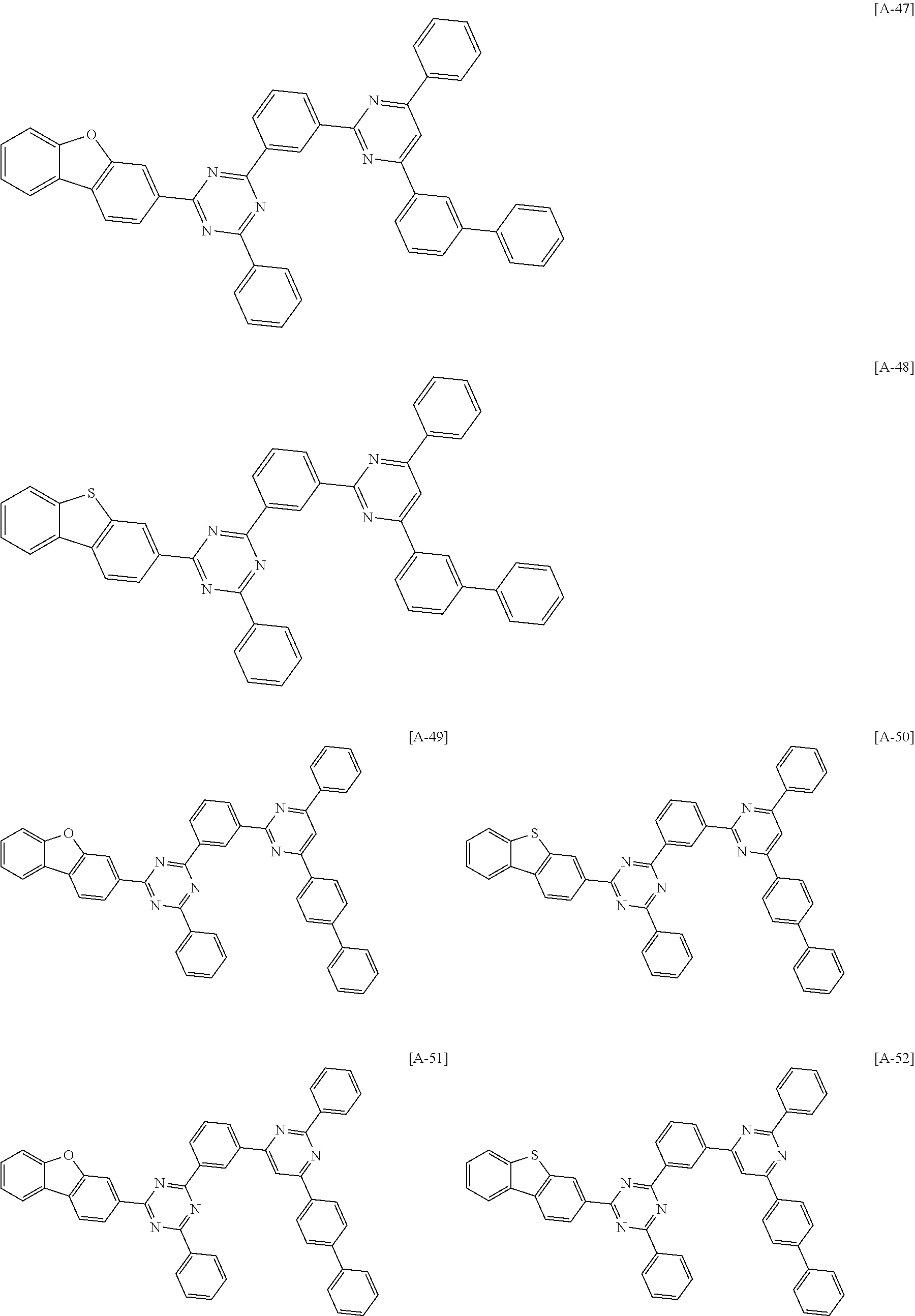


L2MX [Chemical Formula Z]


| TABLE 1 |
| Single Host Device |
| Efficiency | Driving | ||||
| Host | Color | Cd/A | (Vd) | ||
| Example 2 | Compound A-1 | green | 42 | 3.5 |
| Example 3 | Compound A-2 | green | 39 | 3.5 |
| Comparative | Comparative | green | 32 | 3.7 |
| Example 1 | Compound 1 | |||
| Comparative | Comparative | green | 28 | 4.0 |
| Example 2 | Compound 2 | |||
| TABLE 2 |
| Mixed Host Device Effect - structure including a triazinyl group |
| First | Life- | |||||||
| Second | host:Second | Efficiency | span | Driving | ||||
| First host | host | host ratio | Color | Cd/A | (T90) | (Vd) | ||
| Example 1 | Compound | Compound | 3:7 | green | 52 | 550 | 3.6 |
| A-1 | E-130 | ||||||
| Example 4 | Compound | Compound | 3:7 | green | 51 | 600 | 3.4 |
| A-1 | E-99 | ||||||
| Example 5 | Compound | Compound | 3:7 | green | 51 | 650 | 3.6 |
| A-1 | E-137 | ||||||
| Example 6 | Compound | Compound | 3:7 | green | 52 | 570 | 3.7 |
| A-1 | E-138 | ||||||
| Example 7 | Compound | Compound | 3:7 | green | 50 | 470 | 3.7 |
| A-2 | E-137 | ||||||
| Example 8 | Compound | Compound | 3:7 | green | 50 | 640 | 3.7 |
| A-3 | E-137 | ||||||
| Comparative | Comparative | Compound | 3:7 | green | 48 | 360 | 4.0 |
| Example 3 | Compound 1 | E-137 | |||||
| Comparative | Comparative | Compound | 3:7 | green | 46 | 240 | 4.4 |
| Example 4 | Compound 2 | E-137 | |||||
| Comparative | Comparative | Compound | 3:7 | green | 46 | 230 | 4.7 |
| Example 5 | Compound 3 | E-137 | |||||
| TABLE 3 |
| Mixed Host Device Effect - structure including a pyrimidinyl group |
| First | Life- | |||||||
| Second | host:Second | Efficiency | span | Driving | ||||
| First host | host | host ratio | Color | Cd/A | (T90) | (Vd) | ||
| Example 9 | Compound | Compound | 3:7 | green | 52 | 590 | 3.6 |
| A-10 | E-137 | ||||||
| Example 10 | Compound | Compound | 3:7 | green | 51 | 530 | 3.6 |
| A-49 | E-137 | ||||||
| Example 11 | Compound | Compound | 3:7 | green | 50 | 510 | 3.7 |
| A-51 | E-137 | ||||||
| Comparative | Comparative | Compound | 3:7 | green | 52 | 190 | 4.5 |
| Example 6 | Compound 4 | E-137 | |||||
| TABLE 4 | ||||
| Luminous | Color | |||
| Electron transport | efficiency | coordinate | T97(h) | |
| Devices | auxiliary layer | (cd/A) | (x, y) | @750 nit |
| Example 12 | Compound A-1 | 6.2 | (0.132, 0.149) | 95 |
| Example 13 | Compound A-2 | 6.1 | (0.131, 0.148) | 85 |
| Example 14 | Compound A-3 | 6.4 | (0.132, 0.150) | 110 |
| Comparative | Comparative | 5.9 | (0.133, 0.149) | 48 |
| Example 7 | Compound 1 | |||
Claims (14)


Applications Claiming Priority (3)
| Application Number | Priority Date | Filing Date | Title |
|---|---|---|---|
| KR10-2016-0088232 | 2016-07-12 | ||
| KR1020160088232A KR102050000B1 (en) | 2016-07-12 | 2016-07-12 | Compound for organic optoelectronic device, composition for organic optoelectronic device and organic optoelectronic device and display device |
| PCT/KR2017/004834 WO2018012718A1 (en) | 2016-07-12 | 2017-05-10 | Compound for organic optoelectronic device, composition for organic optoelectronic device, organic optoelectronic device, and display device |
Publications (2)
| Publication Number | Publication Date |
|---|---|
| US20200317654A1 US20200317654A1 (en) | 2020-10-08 |
| US11084806B2 true US11084806B2 (en) | 2021-08-10 |
Family
ID=60951832
Family Applications (1)
| Application Number | Title | Priority Date | Filing Date |
|---|---|---|---|
| US16/097,657 Active 2038-02-28 US11084806B2 (en) | 2016-07-12 | 2017-05-10 | Compound for organic optoelectronic device, composition for organic optoelectronic device, organic optoelectronic device, and display device |
Country Status (7)
| Country | Link |
|---|---|
| US (1) | US11084806B2 (en) |
| EP (1) | EP3486299B1 (en) |
| JP (1) | JP6781327B2 (en) |
| KR (1) | KR102050000B1 (en) |
| CN (1) | CN109312230B (en) |
| TW (1) | TWI641605B (en) |
| WO (1) | WO2018012718A1 (en) |
Cited By (1)
| Publication number | Priority date | Publication date | Assignee | Title |
|---|---|---|---|---|
| US11968891B2 (en) | 2018-06-26 | 2024-04-23 | Samsung Display Co., Ltd. | Organic electroluminescence device and heterocyclic compound for organic electroluminescence device |
Families Citing this family (15)
| Publication number | Priority date | Publication date | Assignee | Title |
|---|---|---|---|---|
| KR101847347B1 (en) * | 2017-06-30 | 2018-04-09 | 주식회사 두산 | Organic compound and organic electroluminescent device using the same |
| KR101884130B1 (en) * | 2017-08-29 | 2018-07-31 | 주식회사 두산 | Organic electroluminescent device |
| KR102147908B1 (en) * | 2018-05-11 | 2020-08-25 | 주식회사 엘지화학 | Novel hetero-cyclic compound and organic light emitting device comprising the same |
| WO2019216743A1 (en) * | 2018-05-11 | 2019-11-14 | 주식회사 엘지화학 | Novel heterocyclic compound and organic light emitting diode using same |
| KR102044943B1 (en) | 2018-05-28 | 2019-11-14 | 삼성에스디아이 주식회사 | Compound, composition and organic optoelectronic device and display device |
| CN112566908A (en) * | 2018-08-13 | 2021-03-26 | 辛诺拉有限公司 | Organic molecules for optoelectronic devices |
| JP7631663B2 (en) * | 2018-10-22 | 2025-02-19 | 東ソー株式会社 | Cyclic azine compound, material for organic electroluminescent device, electron transport material for organic electroluminescent device, and organic electroluminescent device |
| WO2020085319A1 (en) * | 2018-10-22 | 2020-04-30 | 東ソー株式会社 | Cyclic azine compound, material for organic electroluminescent elements, electron transport material for organic electroluminescent elements, and organic electroluminescent element |
| KR102808267B1 (en) * | 2019-09-16 | 2025-05-20 | 솔루스첨단소재 주식회사 | Organic electroluminescent device |
| KR102624670B1 (en) | 2019-10-29 | 2024-01-11 | 삼성에스디아이 주식회사 | Compound for organic optoelectronic device, composition for organic optoelectronic device and organic optoelectronic device and display device |
| CN111116562A (en) * | 2019-12-24 | 2020-05-08 | 吉林奥来德光电材料股份有限公司 | An organic light-emitting compound and its preparation method and application |
| KR102902621B1 (en) * | 2019-12-31 | 2025-12-22 | 엘지디스플레이 주식회사 | Organic electronic element, display panel comprising the same and display device comprising the same |
| CN114057706B (en) * | 2020-07-31 | 2023-12-01 | 江苏三月科技股份有限公司 | Organic compound containing triazine structure and application thereof |
| CN115340531B (en) * | 2021-05-12 | 2024-02-13 | 江苏三月科技股份有限公司 | A compound containing triazine and pyrimidine structures and its application in organic electroluminescent devices |
| WO2026084165A1 (en) * | 2024-10-15 | 2026-04-23 | 솔루스첨단소재 주식회사 | Organic compound and organic electroluminescent device comprising same |
Citations (79)
| Publication number | Priority date | Publication date | Assignee | Title |
|---|---|---|---|---|
| US6229012B1 (en) | 1998-10-01 | 2001-05-08 | Xerox Corporation | Triazine compositions |
| US20040164292A1 (en) | 2003-02-21 | 2004-08-26 | Yeh-Jiun Tung | Transflective display having an OLED backlight |
| US20060046342A1 (en) | 2004-08-30 | 2006-03-02 | International Business Machines Corporation | Organic optoelectronic device |
| US20070141387A1 (en) | 2005-12-15 | 2007-06-21 | Idemitsu Kosan Co., Ltd. | Material for organic electroluminescence device and electroluminescence device employing the same |
| WO2010044342A1 (en) | 2008-10-15 | 2010-04-22 | コニカミノルタホールディングス株式会社 | Organic el element, organic el element manufacturing method, white organic el element, display device, and illumination device |
| KR20100118690A (en) | 2009-04-29 | 2010-11-08 | 다우어드밴스드디스플레이머티리얼 유한회사 | Novel organic electroluminescent compounds and organic electroluminescent device using the same |
| KR20110096453A (en) | 2010-02-22 | 2011-08-30 | 제일모직주식회사 | Compound for organic photoelectric device and organic photoelectric device comprising same |
| KR20120129733A (en) | 2011-05-20 | 2012-11-28 | (주)씨에스엘쏠라 | Organic light compound and organic light device using the same |
| CN102850329A (en) | 2012-08-28 | 2013-01-02 | 李崇 | Triazinyl derivative compound and its application in OLED (organic light emission diode) |
| KR20130036048A (en) | 2010-06-18 | 2013-04-09 | 바스프 에스이 | Organic electronic devices comprising a layer of a dibenzofurane compound and a 8-hydroxyquinolinolato earth alkaline metal, or alkali metal complex |
| WO2013077352A1 (en) | 2011-11-22 | 2013-05-30 | 出光興産株式会社 | Aromatic heterocyclic derivative, material for organic electroluminescent element, and organic electroluminescent element |
| KR20130061371A (en) | 2011-12-01 | 2013-06-11 | 롬엔드하스전자재료코리아유한회사 | Novel organic electroluminescence compounds and organic electroluminescence device using the same |
| CN103232843A (en) | 2013-04-18 | 2013-08-07 | 烟台万润精细化工股份有限公司 | Electroluminescent material and application thereof |
| US20130264560A1 (en) | 2010-12-20 | 2013-10-10 | E I Du Pont De Nemours And Company | Triazine derivatives for electronic applications |
| KR20140005804A (en) | 2012-07-04 | 2014-01-15 | 제일모직주식회사 | Composition for organic light emitting diode, organic light emitting layer including the composition, and organic light emitting diode |
| KR20140010133A (en) | 2011-04-07 | 2014-01-23 | 미쓰비시 가가꾸 가부시키가이샤 | Organic compound, charge transport material, composition containing said compound, organic electroluminescent element, display device, and lighting device |
| JP2014040423A (en) | 2010-04-20 | 2014-03-06 | Idemitsu Kosan Co Ltd | Biscarbazole derivative, material for organic electroluminescence element, and organic electroluminescence element by using the same |
| WO2014054912A1 (en) | 2012-10-04 | 2014-04-10 | Rohm And Haas Electronic Materials Korea Ltd. | Organic electroluminescent compounds and organic electroluminescent device comprising the same |
| JP2014123687A (en) | 2012-12-21 | 2014-07-03 | Idemitsu Kosan Co Ltd | Organic electroluminescent element and electronic device |
| JP5541167B2 (en) | 2009-02-06 | 2014-07-09 | コニカミノルタ株式会社 | ORGANIC ELECTROLUMINESCENCE ELEMENT, LIGHTING DEVICE AND DISPLAY DEVICE HAVING THE ELEMENT |
| KR101423067B1 (en) | 2012-10-04 | 2014-07-29 | 롬엔드하스전자재료코리아유한회사 | Novel organic electroluminescence compounds and organic electroluminescence device comprising the same |
| JP2014157947A (en) | 2013-02-15 | 2014-08-28 | Idemitsu Kosan Co Ltd | Organic electroluminescent element, and electronic device |
| US20140361258A1 (en) | 2013-06-10 | 2014-12-11 | Samsung Display Co., Ltd. | Heterocyclic compound and organic light-emitting diode comprising the same |
| KR20140144550A (en) | 2013-06-11 | 2014-12-19 | 롬엔드하스전자재료코리아유한회사 | Organic Electroluminescent Compounds and Organic Electroluminescent Device Comprising the Same |
| WO2014208755A1 (en) | 2013-06-28 | 2014-12-31 | 東ソー株式会社 | Cyclic azine compound, method for producing same, and organic electroluminescent element using same |
| WO2015000549A1 (en) | 2013-07-02 | 2015-01-08 | Merck Patent Gmbh | Materials for electronic devices |
| US20150028320A1 (en) | 2012-04-24 | 2015-01-29 | Konica Minolta, Inc. | Transparent electrode, electronic device, and transparent electrode manufacturing method |
| KR20150036736A (en) | 2012-07-23 | 2015-04-07 | 메르크 파텐트 게엠베하 | Materials for organic electroluminescent devices |
| KR20150042335A (en) | 2013-10-10 | 2015-04-21 | 주식회사 두산 | Organic compounds and organic electro luminescence device comprising the same |
| US20150171336A1 (en) | 2013-12-13 | 2015-06-18 | Samsung Display Co., Ltd. | Triazine-based compounds and organic light-emitting devices including triazine-based compounds |
| US20150171340A1 (en) | 2013-12-17 | 2015-06-18 | Samsung Electronics Co., Ltd. | Condensed cyclic compound and organic light-emitting device including the same |
| US20150207082A1 (en) | 2014-01-23 | 2015-07-23 | Universal Display Corporation | Organic materials for oleds |
| KR101542714B1 (en) | 2014-04-04 | 2015-08-12 | 주식회사 엘지화학 | Hetero-cyclic compound and organic light emitting device comprising the same |
| CN104885247A (en) | 2012-12-17 | 2015-09-02 | 新日铁住金化学株式会社 | Organic electrical field light-emitting element |
| WO2015156587A1 (en) | 2014-04-08 | 2015-10-15 | Rohm And Haas Electronic Materials Korea Ltd. | Multi-component host material and organic electroluminescent device comprising the same |
| KR20150116776A (en) | 2014-04-08 | 2015-10-16 | 롬엔드하스전자재료코리아유한회사 | Multi-component host material and organic electroluminescence device comprising the same |
| CN104995187A (en) | 2013-02-06 | 2015-10-21 | 株式会社Lg化学 | New compounds and organic electronic devices using them |
| WO2015160224A1 (en) | 2014-04-18 | 2015-10-22 | Rohm And Haas Electronic Materials Korea Ltd. | Multi-component host material and an organic electroluminescence device comprising the same |
| KR20150129282A (en) | 2014-05-09 | 2015-11-19 | 주식회사 엠비케이 | Novel compoung for organic electroluminescent device, organic electroluminescent device including the same and electric apparatus |
| KR20150131998A (en) | 2014-05-15 | 2015-11-25 | 주식회사 엘지화학 | Hetero-cyclic compound and organic light emitting device comprising the same |
| US20150349268A1 (en) | 2014-05-27 | 2015-12-03 | Universal Display Corporation | Organic Electroluminescent Materials and Devices |
| KR20150136942A (en) | 2014-05-28 | 2015-12-08 | 덕산네오룩스 주식회사 | Compound for organic electronic element, organic electronic element using the same, and an electronic device thereof |
| CN105153130A (en) | 2015-08-03 | 2015-12-16 | 上海道亦化工科技有限公司 | Electron transport compound adopting triazine derivative and OLED (organic light-emitting device) applying electron transport compound |
| EP2966706A2 (en) | 2014-07-09 | 2016-01-13 | Universal Display Corporation | Organic electroluminescent materials and devices |
| JP5847420B2 (en) | 2010-09-08 | 2016-01-20 | ユー・ディー・シー アイルランド リミテッド | Organic electroluminescent device and compound |
| KR101593465B1 (en) | 2013-06-28 | 2016-02-12 | (주)피엔에이치테크 | Novel compound for organic electroluminescent device and organic electroluminescent device comprising the same |
| CN105359290A (en) | 2013-07-02 | 2016-02-24 | 默克专利有限公司 | Organic electroluminescent device |
| JP2016506414A (en) | 2013-01-03 | 2016-03-03 | メルク パテント ゲーエムベーハー | Materials for electronic devices |
| KR20160028524A (en) | 2014-05-05 | 2016-03-11 | 메르크 파텐트 게엠베하 | Materials for organic light emitting devices |
| KR20160034528A (en) | 2014-09-19 | 2016-03-30 | 삼성디스플레이 주식회사 | Organic light-emitting diode |
| KR20160038006A (en) | 2013-07-30 | 2016-04-06 | 메르크 파텐트 게엠베하 | Materials for electronic devices |
| KR20160037909A (en) | 2013-07-03 | 2016-04-06 | 보르그워너 인코퍼레이티드 | Sliding member, chain link, and chain comprising said link |
| CN105473684A (en) | 2013-08-12 | 2016-04-06 | 三星Sdi株式会社 | Composition, organic optoelectronic element, and display device |
| KR20160055556A (en) | 2014-11-10 | 2016-05-18 | 삼성디스플레이 주식회사 | Organic light-emitting device |
| WO2016076384A1 (en) | 2014-11-14 | 2016-05-19 | 保土谷化学工業株式会社 | Organic electroluminescent element |
| TW201619152A (en) | 2014-07-29 | 2016-06-01 | 麥克專利有限公司 | Organic electroluminescent device material |
| WO2016084962A1 (en) | 2014-11-28 | 2016-06-02 | 出光興産株式会社 | Compound, organic electroluminescence element material, organic electroluminescence element and electronic device |
| KR20160080090A (en) | 2014-12-29 | 2016-07-07 | 주식회사 동진쎄미켐 | Novel compound and organic electroluminescent device comprising same |
| KR20160110078A (en) | 2015-03-13 | 2016-09-21 | 롬엔드하스전자재료코리아유한회사 | A plurality of host materials and organic electroluminescent device comprising the same |
| WO2016148390A1 (en) | 2015-03-13 | 2016-09-22 | Rohm And Haas Electronic Materials Korea Ltd. | A plurality of host materials and organic electroluminescent device comprising the same |
| WO2016172414A1 (en) | 2015-04-22 | 2016-10-27 | Rohm And Haas Electronic Materials Llc | Electron transport layer and film having improved thermal stability |
| US20160329502A1 (en) | 2015-05-07 | 2016-11-10 | Universal Display Corporation | Organic Electroluminescent Materials and Devices |
| US20170025618A1 (en) | 2015-04-06 | 2017-01-26 | Universal Display Corporation | Organic Electroluminescent Materials and Devices |
| WO2017016630A1 (en) | 2015-07-30 | 2017-02-02 | Merck Patent Gmbh | Materials for organic electroluminescent devices |
| KR20170022865A (en) | 2015-08-19 | 2017-03-02 | 롬엔드하스전자재료코리아유한회사 | Organic electroluminescent compounds and organic electroluminescent device comprising the same |
| KR20170089599A (en) | 2016-01-27 | 2017-08-04 | 에스에프씨 주식회사 | Novel heterocyclic compounds and organic light-emitting diode including the same |
| CN107093677A (en) | 2016-02-18 | 2017-08-25 | 三星显示有限公司 | Organic light emitting apparatus |
| WO2017146466A1 (en) | 2016-02-23 | 2017-08-31 | 주식회사 엘지화학 | Heterocyclic compound and organic light emitting element comprising same |
| WO2017171420A1 (en) | 2016-03-30 | 2017-10-05 | 주식회사 엘지화학 | Compound and organic light emitting element using same |
| KR20170116992A (en) | 2016-04-12 | 2017-10-20 | 주식회사 엘지화학 | Compound and organic electronic device comprising the same |
| CN107325090A (en) | 2016-04-12 | 2017-11-07 | 株式会社Lg化学 | Compound and organic electronic components containing it |
| KR20170141144A (en) | 2016-06-14 | 2017-12-22 | 주식회사 엘지화학 | Novel hetero-cyclic compound and organic light emitting device comprising the same |
| WO2018016742A1 (en) | 2016-07-20 | 2018-01-25 | 주식회사 엘지화학 | Novel heterocyclic compound and organic light-emitting device using same |
| WO2018021663A1 (en) | 2016-07-29 | 2018-02-01 | 삼성에스디아이 주식회사 | Composition for organic optoelectronic element, organic optoelectronic element, and display device |
| US9893290B2 (en) | 2013-07-01 | 2018-02-13 | Cheil Industries, Inc. | Composition and organic optoelectric device and display device |
| WO2018062659A1 (en) | 2016-09-29 | 2018-04-05 | 삼성에스디아이 주식회사 | Compound for organic optoelectronic diode, composition for organic optoelectronic diode, organic optoelectronic diode, and display apparatus |
| WO2018093026A1 (en) | 2016-11-16 | 2018-05-24 | 삼성에스디아이 주식회사 | Organic optoelectronic diode and display device |
| WO2018097461A1 (en) | 2016-11-24 | 2018-05-31 | 삼성에스디아이 주식회사 | Organic optoelectronic element and display device |
| WO2018128255A1 (en) | 2017-01-05 | 2018-07-12 | 삼성에스디아이 주식회사 | Compound for organic optoelectronic element, composition for organic optoelectronic element, organic optoelectronic element, and display device |
-
2016
- 2016-07-12 KR KR1020160088232A patent/KR102050000B1/en active Active
-
2017
- 2017-05-10 CN CN201780036346.9A patent/CN109312230B/en active Active
- 2017-05-10 US US16/097,657 patent/US11084806B2/en active Active
- 2017-05-10 EP EP17827792.7A patent/EP3486299B1/en active Active
- 2017-05-10 JP JP2019501478A patent/JP6781327B2/en active Active
- 2017-05-10 WO PCT/KR2017/004834 patent/WO2018012718A1/en not_active Ceased
- 2017-06-02 TW TW106118179A patent/TWI641605B/en active
Patent Citations (98)
| Publication number | Priority date | Publication date | Assignee | Title |
|---|---|---|---|---|
| US6229012B1 (en) | 1998-10-01 | 2001-05-08 | Xerox Corporation | Triazine compositions |
| US20040164292A1 (en) | 2003-02-21 | 2004-08-26 | Yeh-Jiun Tung | Transflective display having an OLED backlight |
| US20060046342A1 (en) | 2004-08-30 | 2006-03-02 | International Business Machines Corporation | Organic optoelectronic device |
| US20070141387A1 (en) | 2005-12-15 | 2007-06-21 | Idemitsu Kosan Co., Ltd. | Material for organic electroluminescence device and electroluminescence device employing the same |
| WO2010044342A1 (en) | 2008-10-15 | 2010-04-22 | コニカミノルタホールディングス株式会社 | Organic el element, organic el element manufacturing method, white organic el element, display device, and illumination device |
| JP5541167B2 (en) | 2009-02-06 | 2014-07-09 | コニカミノルタ株式会社 | ORGANIC ELECTROLUMINESCENCE ELEMENT, LIGHTING DEVICE AND DISPLAY DEVICE HAVING THE ELEMENT |
| KR20100118690A (en) | 2009-04-29 | 2010-11-08 | 다우어드밴스드디스플레이머티리얼 유한회사 | Novel organic electroluminescent compounds and organic electroluminescent device using the same |
| KR20110096453A (en) | 2010-02-22 | 2011-08-30 | 제일모직주식회사 | Compound for organic photoelectric device and organic photoelectric device comprising same |
| JP2014040423A (en) | 2010-04-20 | 2014-03-06 | Idemitsu Kosan Co Ltd | Biscarbazole derivative, material for organic electroluminescence element, and organic electroluminescence element by using the same |
| KR20130036048A (en) | 2010-06-18 | 2013-04-09 | 바스프 에스이 | Organic electronic devices comprising a layer of a dibenzofurane compound and a 8-hydroxyquinolinolato earth alkaline metal, or alkali metal complex |
| JP5847420B2 (en) | 2010-09-08 | 2016-01-20 | ユー・ディー・シー アイルランド リミテッド | Organic electroluminescent device and compound |
| US20130264560A1 (en) | 2010-12-20 | 2013-10-10 | E I Du Pont De Nemours And Company | Triazine derivatives for electronic applications |
| KR20140010133A (en) | 2011-04-07 | 2014-01-23 | 미쓰비시 가가꾸 가부시키가이샤 | Organic compound, charge transport material, composition containing said compound, organic electroluminescent element, display device, and lighting device |
| KR20120129733A (en) | 2011-05-20 | 2012-11-28 | (주)씨에스엘쏠라 | Organic light compound and organic light device using the same |
| WO2013077352A1 (en) | 2011-11-22 | 2013-05-30 | 出光興産株式会社 | Aromatic heterocyclic derivative, material for organic electroluminescent element, and organic electroluminescent element |
| US20140001456A1 (en) | 2011-11-22 | 2014-01-02 | Idemitsu Kosan Co., Ltd. | Aromatic heterocyclic derivative, material for organic eletroluminescent element, and organic electroluminescent element |
| CN103380508A (en) | 2011-11-22 | 2013-10-30 | 出光兴产株式会社 | Aromatic heterocyclic derivative, material for organic electroluminescent element, and organic electroluminescent element |
| US9209406B2 (en) | 2011-11-22 | 2015-12-08 | Idemitsu Kosan Co., Ltd. | Aromatic heterocyclic derivative, material for organic electroluminescent element, and organic electroluminescent element |
| KR20130061371A (en) | 2011-12-01 | 2013-06-11 | 롬엔드하스전자재료코리아유한회사 | Novel organic electroluminescence compounds and organic electroluminescence device using the same |
| US20150028320A1 (en) | 2012-04-24 | 2015-01-29 | Konica Minolta, Inc. | Transparent electrode, electronic device, and transparent electrode manufacturing method |
| KR20140005804A (en) | 2012-07-04 | 2014-01-15 | 제일모직주식회사 | Composition for organic light emitting diode, organic light emitting layer including the composition, and organic light emitting diode |
| CN104271703A (en) | 2012-07-04 | 2015-01-07 | 三星Sdi株式会社 | Compound for organic light emitting diode, organic light emitting layer comprising said compound for organic light emitting diode, and organic light emitting diode |
| KR20150036736A (en) | 2012-07-23 | 2015-04-07 | 메르크 파텐트 게엠베하 | Materials for organic electroluminescent devices |
| CN102850329A (en) | 2012-08-28 | 2013-01-02 | 李崇 | Triazinyl derivative compound and its application in OLED (organic light emission diode) |
| CN104812750A (en) | 2012-10-04 | 2015-07-29 | 罗门哈斯电子材料韩国有限公司 | Organic electroluminescent compounds and organic electroluminescent device comprising the same |
| WO2014054912A1 (en) | 2012-10-04 | 2014-04-10 | Rohm And Haas Electronic Materials Korea Ltd. | Organic electroluminescent compounds and organic electroluminescent device comprising the same |
| KR101423067B1 (en) | 2012-10-04 | 2014-07-29 | 롬엔드하스전자재료코리아유한회사 | Novel organic electroluminescence compounds and organic electroluminescence device comprising the same |
| CN104885247A (en) | 2012-12-17 | 2015-09-02 | 新日铁住金化学株式会社 | Organic electrical field light-emitting element |
| JP2014123687A (en) | 2012-12-21 | 2014-07-03 | Idemitsu Kosan Co Ltd | Organic electroluminescent element and electronic device |
| JP2016506414A (en) | 2013-01-03 | 2016-03-03 | メルク パテント ゲーエムベーハー | Materials for electronic devices |
| CN104995187A (en) | 2013-02-06 | 2015-10-21 | 株式会社Lg化学 | New compounds and organic electronic devices using them |
| JP2014157947A (en) | 2013-02-15 | 2014-08-28 | Idemitsu Kosan Co Ltd | Organic electroluminescent element, and electronic device |
| CN103232843B (en) | 2013-04-18 | 2015-02-25 | 烟台万润精细化工股份有限公司 | Electroluminescent material and application thereof |
| CN103232843A (en) | 2013-04-18 | 2013-08-07 | 烟台万润精细化工股份有限公司 | Electroluminescent material and application thereof |
| US20140361258A1 (en) | 2013-06-10 | 2014-12-11 | Samsung Display Co., Ltd. | Heterocyclic compound and organic light-emitting diode comprising the same |
| KR20140144550A (en) | 2013-06-11 | 2014-12-19 | 롬엔드하스전자재료코리아유한회사 | Organic Electroluminescent Compounds and Organic Electroluminescent Device Comprising the Same |
| WO2014208755A1 (en) | 2013-06-28 | 2014-12-31 | 東ソー株式会社 | Cyclic azine compound, method for producing same, and organic electroluminescent element using same |
| KR101593465B1 (en) | 2013-06-28 | 2016-02-12 | (주)피엔에이치테크 | Novel compound for organic electroluminescent device and organic electroluminescent device comprising the same |
| US9893290B2 (en) | 2013-07-01 | 2018-02-13 | Cheil Industries, Inc. | Composition and organic optoelectric device and display device |
| JP2016525081A (en) | 2013-07-02 | 2016-08-22 | メルク パテント ゲーエムベーハー | Materials for electronic devices |
| CN105359290A (en) | 2013-07-02 | 2016-02-24 | 默克专利有限公司 | Organic electroluminescent device |
| WO2015000549A1 (en) | 2013-07-02 | 2015-01-08 | Merck Patent Gmbh | Materials for electronic devices |
| KR20160037909A (en) | 2013-07-03 | 2016-04-06 | 보르그워너 인코퍼레이티드 | Sliding member, chain link, and chain comprising said link |
| KR20160038006A (en) | 2013-07-30 | 2016-04-06 | 메르크 파텐트 게엠베하 | Materials for electronic devices |
| CN105473684A (en) | 2013-08-12 | 2016-04-06 | 三星Sdi株式会社 | Composition, organic optoelectronic element, and display device |
| KR20150042335A (en) | 2013-10-10 | 2015-04-21 | 주식회사 두산 | Organic compounds and organic electro luminescence device comprising the same |
| US20150171336A1 (en) | 2013-12-13 | 2015-06-18 | Samsung Display Co., Ltd. | Triazine-based compounds and organic light-emitting devices including triazine-based compounds |
| KR20150070860A (en) | 2013-12-17 | 2015-06-25 | 삼성전자주식회사 | Condensed cyclic compound and organic light emitting device including the same |
| US20150171340A1 (en) | 2013-12-17 | 2015-06-18 | Samsung Electronics Co., Ltd. | Condensed cyclic compound and organic light-emitting device including the same |
| US20150207082A1 (en) | 2014-01-23 | 2015-07-23 | Universal Display Corporation | Organic materials for oleds |
| KR101542714B1 (en) | 2014-04-04 | 2015-08-12 | 주식회사 엘지화학 | Hetero-cyclic compound and organic light emitting device comprising the same |
| KR20150116776A (en) | 2014-04-08 | 2015-10-16 | 롬엔드하스전자재료코리아유한회사 | Multi-component host material and organic electroluminescence device comprising the same |
| US20170117488A1 (en) | 2014-04-08 | 2017-04-27 | Rohm And Haas Electronic Materials Korea Ltd. | Multi-component host material and organic electroluminescent device comprising the same |
| WO2015156587A1 (en) | 2014-04-08 | 2015-10-15 | Rohm And Haas Electronic Materials Korea Ltd. | Multi-component host material and organic electroluminescent device comprising the same |
| WO2015160224A1 (en) | 2014-04-18 | 2015-10-22 | Rohm And Haas Electronic Materials Korea Ltd. | Multi-component host material and an organic electroluminescence device comprising the same |
| KR20160028524A (en) | 2014-05-05 | 2016-03-11 | 메르크 파텐트 게엠베하 | Materials for organic light emitting devices |
| KR20150129282A (en) | 2014-05-09 | 2015-11-19 | 주식회사 엠비케이 | Novel compoung for organic electroluminescent device, organic electroluminescent device including the same and electric apparatus |
| KR20150131998A (en) | 2014-05-15 | 2015-11-25 | 주식회사 엘지화학 | Hetero-cyclic compound and organic light emitting device comprising the same |
| US20150349268A1 (en) | 2014-05-27 | 2015-12-03 | Universal Display Corporation | Organic Electroluminescent Materials and Devices |
| CN105315219A (en) | 2014-05-27 | 2016-02-10 | 环球展览公司 | Organic electroluminescent materials and their uses |
| KR20150136942A (en) | 2014-05-28 | 2015-12-08 | 덕산네오룩스 주식회사 | Compound for organic electronic element, organic electronic element using the same, and an electronic device thereof |
| EP2966706A2 (en) | 2014-07-09 | 2016-01-13 | Universal Display Corporation | Organic electroluminescent materials and devices |
| CN105315265A (en) | 2014-07-09 | 2016-02-10 | 环球展览公司 | Organic Electroluminescent Materials and Devices |
| JP2016019002A (en) | 2014-07-09 | 2016-02-01 | ユニバーサル ディスプレイ コーポレイション | Organic electroluminescent materials and devices |
| US20160028021A1 (en) | 2014-07-09 | 2016-01-28 | Universal Display Corporation | Organic electroluminescent materials and devices |
| TW201609712A (en) | 2014-07-09 | 2016-03-16 | 環球展覽公司 | Organic electroluminescent material and device |
| KR20160006633A (en) | 2014-07-09 | 2016-01-19 | 유니버셜 디스플레이 코포레이션 | Organic electroluminescent materials and devices |
| TW201619152A (en) | 2014-07-29 | 2016-06-01 | 麥克專利有限公司 | Organic electroluminescent device material |
| KR20160034528A (en) | 2014-09-19 | 2016-03-30 | 삼성디스플레이 주식회사 | Organic light-emitting diode |
| KR20160055556A (en) | 2014-11-10 | 2016-05-18 | 삼성디스플레이 주식회사 | Organic light-emitting device |
| WO2016076384A1 (en) | 2014-11-14 | 2016-05-19 | 保土谷化学工業株式会社 | Organic electroluminescent element |
| WO2016084962A1 (en) | 2014-11-28 | 2016-06-02 | 出光興産株式会社 | Compound, organic electroluminescence element material, organic electroluminescence element and electronic device |
| KR20160080090A (en) | 2014-12-29 | 2016-07-07 | 주식회사 동진쎄미켐 | Novel compound and organic electroluminescent device comprising same |
| EP3268449A1 (en) | 2015-03-13 | 2018-01-17 | Rohm And Haas Electronic Materials Korea Ltd. | A plurality of host materials and organic electroluminescent device comprising the same |
| JP2018514081A (en) | 2015-03-13 | 2018-05-31 | ローム・アンド・ハース・エレクトロニック・マテリアルズ・コリア・リミテッド | Multiple host materials and organic electroluminescent devices comprising the same |
| KR20160110078A (en) | 2015-03-13 | 2016-09-21 | 롬엔드하스전자재료코리아유한회사 | A plurality of host materials and organic electroluminescent device comprising the same |
| WO2016148390A1 (en) | 2015-03-13 | 2016-09-22 | Rohm And Haas Electronic Materials Korea Ltd. | A plurality of host materials and organic electroluminescent device comprising the same |
| US20180033975A1 (en) | 2015-03-13 | 2018-02-01 | Rohm And Haas Electronic Materials Korea Ltd. | A plurality of host materials and organic electroluminescent device comprising the same |
| US20170025618A1 (en) | 2015-04-06 | 2017-01-26 | Universal Display Corporation | Organic Electroluminescent Materials and Devices |
| WO2016172414A1 (en) | 2015-04-22 | 2016-10-27 | Rohm And Haas Electronic Materials Llc | Electron transport layer and film having improved thermal stability |
| US20160329502A1 (en) | 2015-05-07 | 2016-11-10 | Universal Display Corporation | Organic Electroluminescent Materials and Devices |
| WO2017016630A1 (en) | 2015-07-30 | 2017-02-02 | Merck Patent Gmbh | Materials for organic electroluminescent devices |
| CN105153130A (en) | 2015-08-03 | 2015-12-16 | 上海道亦化工科技有限公司 | Electron transport compound adopting triazine derivative and OLED (organic light-emitting device) applying electron transport compound |
| KR20170022865A (en) | 2015-08-19 | 2017-03-02 | 롬엔드하스전자재료코리아유한회사 | Organic electroluminescent compounds and organic electroluminescent device comprising the same |
| KR20170089599A (en) | 2016-01-27 | 2017-08-04 | 에스에프씨 주식회사 | Novel heterocyclic compounds and organic light-emitting diode including the same |
| CN107093677A (en) | 2016-02-18 | 2017-08-25 | 三星显示有限公司 | Organic light emitting apparatus |
| WO2017146466A1 (en) | 2016-02-23 | 2017-08-31 | 주식회사 엘지화학 | Heterocyclic compound and organic light emitting element comprising same |
| CN108290854A (en) | 2016-02-23 | 2018-07-17 | 株式会社Lg化学 | Heterocyclic compound and organic light emitting device comprising same |
| WO2017171420A1 (en) | 2016-03-30 | 2017-10-05 | 주식회사 엘지화학 | Compound and organic light emitting element using same |
| KR20170116992A (en) | 2016-04-12 | 2017-10-20 | 주식회사 엘지화학 | Compound and organic electronic device comprising the same |
| CN107325090A (en) | 2016-04-12 | 2017-11-07 | 株式会社Lg化学 | Compound and organic electronic components containing it |
| KR20170141144A (en) | 2016-06-14 | 2017-12-22 | 주식회사 엘지화학 | Novel hetero-cyclic compound and organic light emitting device comprising the same |
| WO2018016742A1 (en) | 2016-07-20 | 2018-01-25 | 주식회사 엘지화학 | Novel heterocyclic compound and organic light-emitting device using same |
| WO2018021663A1 (en) | 2016-07-29 | 2018-02-01 | 삼성에스디아이 주식회사 | Composition for organic optoelectronic element, organic optoelectronic element, and display device |
| WO2018062659A1 (en) | 2016-09-29 | 2018-04-05 | 삼성에스디아이 주식회사 | Compound for organic optoelectronic diode, composition for organic optoelectronic diode, organic optoelectronic diode, and display apparatus |
| WO2018093026A1 (en) | 2016-11-16 | 2018-05-24 | 삼성에스디아이 주식회사 | Organic optoelectronic diode and display device |
| WO2018097461A1 (en) | 2016-11-24 | 2018-05-31 | 삼성에스디아이 주식회사 | Organic optoelectronic element and display device |
| WO2018128255A1 (en) | 2017-01-05 | 2018-07-12 | 삼성에스디아이 주식회사 | Compound for organic optoelectronic element, composition for organic optoelectronic element, organic optoelectronic element, and display device |
Non-Patent Citations (17)
| Title |
|---|
| European Office action dated Mar. 25, 2021. |
| European Search Report dated Dec. 19, 2019, Application No. 17820373.3. |
| European Search Report dated Jan. 8, 2020, Application No. 17820372.5. |
| Extended European Search Report dated Feb. 17, 2020, corresponding European Patent Application No. 17827792.7. |
| Extended European Search Report dated Feb. 28, 2020, European Patent Application No. 17834608.6. |
| International Search Report dated Apr. 24, 2017. |
| Japanese Notice of Allowance dated Oct. 6, 2020, received in Japanese Application No. 2019-503551. |
| Japanese Office action dated Sep. 29, 2020, received in Japanese Application No. 2018-568699. |
| U.S. Appl. No. 16/099,507, filed Nov. 7, 2018. |
| U.S. Appl. No. 16/099,523, filed Nov. 7, 2018. |
| U.S. Appl. No. 16/321,228, filed Jan. 28, 2019. |
| U.S. Appl. No. 16/468,779, filed Jun. 12, 2019. |
| U.S. Office Action dated Jan. 13, 2021 from Co-pending U.S. Appl. No. 16/468,779. |
| U.S. Office action received in co pending application U.S. Appl. No. 16/099,507, dated Apr. 16, 2021. |
| U.S. Office action received in co pending application U.S. Appl. No. 16/099,523, dated Apr. 19, 2021. |
| US. Office Action received in Co Pending U.S. Appl. No. 16/321,228 dated Jun. 25, 2021. |
| Yu, Organic Electronics, 38, 2016, 301-306. |
Cited By (2)
| Publication number | Priority date | Publication date | Assignee | Title |
|---|---|---|---|---|
| US11968891B2 (en) | 2018-06-26 | 2024-04-23 | Samsung Display Co., Ltd. | Organic electroluminescence device and heterocyclic compound for organic electroluminescence device |
| US12497389B2 (en) | 2018-06-26 | 2025-12-16 | Samsung Display Co., Ltd. | Organic electroluminescence device and heterocyclic compound for organic electroluminescence device |
Also Published As
| Publication number | Publication date |
|---|---|
| CN109312230B (en) | 2021-12-14 |
| WO2018012718A1 (en) | 2018-01-18 |
| JP6781327B2 (en) | 2020-11-04 |
| EP3486299A4 (en) | 2020-03-18 |
| EP3486299B1 (en) | 2023-02-15 |
| TWI641605B (en) | 2018-11-21 |
| US20200317654A1 (en) | 2020-10-08 |
| CN109312230A (en) | 2019-02-05 |
| JP2019527930A (en) | 2019-10-03 |
| EP3486299A1 (en) | 2019-05-22 |
| TW201802082A (en) | 2018-01-16 |
| KR20180007243A (en) | 2018-01-22 |
| KR102050000B1 (en) | 2019-11-28 |
Similar Documents
| Publication | Publication Date | Title |
|---|---|---|
| US20250169360A1 (en) | Composition for organic optoelectronic device, organic optoelectronic device, and display device | |
| US11706975B2 (en) | Compound for organic optoelectronic device, composition for organic optoelectronic device, organic optoelectronic device and display apparatus | |
| US11696498B2 (en) | Compound for an organic optoelectronic device, organic optoelectronic device, and display device using the same | |
| US11264574B2 (en) | Composition for organic optoelectronic element, organic optoelectronic element, and display device | |
| US11482682B2 (en) | Compound for organic optoelectronic diode, organic optoelectronic diode, and display device | |
| US20200317654A1 (en) | Compound for organic optoelectronic device, composition for organic optoelectronic device, organic optoelectronic device, and display device | |
| US11450813B2 (en) | Organic optoelectronic diode and display device | |
| US11678572B2 (en) | Compound for organic optoelectronic device, composition for organic optoelectronic device, organic optoelectronic device and display apparatus | |
| US20190198775A1 (en) | Composition and organic optoelectronic device and display device | |
| US11362281B2 (en) | Compound for organic optoelectronic diode, composition for organic optoelectronic diode, organic optoelectronic diode, and display apparatus | |
| US11158817B2 (en) | Compound for organic optoelectronic device, composition for organic optoelectronic device and organic optoelectronic device and display device | |
| US20190326518A1 (en) | Organic optoelectronic device and display device | |
| US20190280211A1 (en) | Organic optoelectronic device and display device | |
| US12557546B2 (en) | Compound for organic optoelectronic device, composition for organic optoelectronic device, organic optoelectronic device and display device | |
| US12108657B2 (en) | Compound for organic optoelectronic device, composition for organic optoelectronic device, organic optoelectronic device and display device | |
| US20190198776A1 (en) | Composition and organic optoelectronic device and display device | |
| US10319921B2 (en) | Composition for organic optoelectronic device and organic optoelectronic device and display device | |
| US20240292749A1 (en) | Compound for organic optoelectronic device, organic optoelectronic device and display device | |
| US11690288B2 (en) | Composition for organic optoelectronic diode, organic optoelectronic diode, and display device | |
| US12213378B2 (en) | Compound for organic optoelectronic device, organic optoelectronic device, and display device | |
| US11637247B2 (en) | Compound for optoelectronic device and organic optoelectronic device and display device | |
| US11453659B2 (en) | Compound for organic optoelectronic device, composition for organic optoelectronic device, organic optoelectronic device and display device |
Legal Events
| Date | Code | Title | Description |
|---|---|---|---|
| AS | Assignment |
Owner name: SAMSUNG SDI CO., LTD., KOREA, REPUBLIC OF Free format text: ASSIGNMENT OF ASSIGNORS INTEREST;ASSIGNORS:JANG, KIPO;KIM, YOUNGKWON;LUI, JINHYUN;AND OTHERS;REEL/FRAME:047353/0635 Effective date: 20181004 |
|
| FEPP | Fee payment procedure |
Free format text: ENTITY STATUS SET TO UNDISCOUNTED (ORIGINAL EVENT CODE: BIG.); ENTITY STATUS OF PATENT OWNER: LARGE ENTITY |
|
| STPP | Information on status: patent application and granting procedure in general |
Free format text: NON FINAL ACTION MAILED |
|
| STPP | Information on status: patent application and granting procedure in general |
Free format text: RESPONSE TO NON-FINAL OFFICE ACTION ENTERED AND FORWARDED TO EXAMINER |
|
| STPP | Information on status: patent application and granting procedure in general |
Free format text: NOTICE OF ALLOWANCE MAILED -- APPLICATION RECEIVED IN OFFICE OF PUBLICATIONS |
|
| STPP | Information on status: patent application and granting procedure in general |
Free format text: NOTICE OF ALLOWANCE MAILED -- APPLICATION RECEIVED IN OFFICE OF PUBLICATIONS |
|
| STPP | Information on status: patent application and granting procedure in general |
Free format text: NOTICE OF ALLOWANCE MAILED -- APPLICATION RECEIVED IN OFFICE OF PUBLICATIONS |
|
| STPP | Information on status: patent application and granting procedure in general |
Free format text: NOTICE OF ALLOWANCE MAILED -- APPLICATION RECEIVED IN OFFICE OF PUBLICATIONS Free format text: AWAITING TC RESP., ISSUE FEE NOT PAID |
|
| STPP | Information on status: patent application and granting procedure in general |
Free format text: PUBLICATIONS -- ISSUE FEE PAYMENT VERIFIED |
|
| STPP | Information on status: patent application and granting procedure in general |
Free format text: PUBLICATIONS -- ISSUE FEE PAYMENT VERIFIED |
|
| STCF | Information on status: patent grant |
Free format text: PATENTED CASE |
|
| MAFP | Maintenance fee payment |
Free format text: PAYMENT OF MAINTENANCE FEE, 4TH YEAR, LARGE ENTITY (ORIGINAL EVENT CODE: M1551); ENTITY STATUS OF PATENT OWNER: LARGE ENTITY Year of fee payment: 4 |