US11054783B2 - Image reading device and image forming apparatus including the same - Google Patents
Image reading device and image forming apparatus including the same Download PDFInfo
- Publication number
- US11054783B2 US11054783B2 US16/233,656 US201816233656A US11054783B2 US 11054783 B2 US11054783 B2 US 11054783B2 US 201816233656 A US201816233656 A US 201816233656A US 11054783 B2 US11054783 B2 US 11054783B2
- Authority
- US
- United States
- Prior art keywords
- document
- image
- predetermined mark
- reading
- image data
- Prior art date
- Legal status (The legal status is an assumption and is not a legal conclusion. Google has not performed a legal analysis and makes no representation as to the accuracy of the status listed.)
- Expired - Fee Related, expires
Links
Images




Classifications
-
- G—PHYSICS
- G03—PHOTOGRAPHY; CINEMATOGRAPHY; ANALOGOUS TECHNIQUES USING WAVES OTHER THAN OPTICAL WAVES; ELECTROGRAPHY; HOLOGRAPHY
- G03G—ELECTROGRAPHY; ELECTROPHOTOGRAPHY; MAGNETOGRAPHY
- G03G15/00—Apparatus for electrographic processes using a charge pattern
- G03G15/50—Machine control of apparatus for electrographic processes using a charge pattern, e.g. regulating differents parts of the machine, multimode copiers, microprocessor control
- G03G15/5025—Machine control of apparatus for electrographic processes using a charge pattern, e.g. regulating differents parts of the machine, multimode copiers, microprocessor control by measuring the original characteristics, e.g. contrast, density
-
- G—PHYSICS
- G03—PHOTOGRAPHY; CINEMATOGRAPHY; ANALOGOUS TECHNIQUES USING WAVES OTHER THAN OPTICAL WAVES; ELECTROGRAPHY; HOLOGRAPHY
- G03G—ELECTROGRAPHY; ELECTROPHOTOGRAPHY; MAGNETOGRAPHY
- G03G15/00—Apparatus for electrographic processes using a charge pattern
- G03G15/65—Apparatus which relate to the handling of copy material
- G03G15/6502—Supplying of sheet copy material; Cassettes therefor
- G03G15/6508—Automatic supply devices interacting with the rest of the apparatus, e.g. selection of a specific cassette
-
- G—PHYSICS
- G03—PHOTOGRAPHY; CINEMATOGRAPHY; ANALOGOUS TECHNIQUES USING WAVES OTHER THAN OPTICAL WAVES; ELECTROGRAPHY; HOLOGRAPHY
- G03G—ELECTROGRAPHY; ELECTROPHOTOGRAPHY; MAGNETOGRAPHY
- G03G15/00—Apparatus for electrographic processes using a charge pattern
- G03G15/20—Apparatus for electrographic processes using a charge pattern for fixing, e.g. by using heat
- G03G15/2003—Apparatus for electrographic processes using a charge pattern for fixing, e.g. by using heat using heat
-
- G—PHYSICS
- G03—PHOTOGRAPHY; CINEMATOGRAPHY; ANALOGOUS TECHNIQUES USING WAVES OTHER THAN OPTICAL WAVES; ELECTROGRAPHY; HOLOGRAPHY
- G03G—ELECTROGRAPHY; ELECTROPHOTOGRAPHY; MAGNETOGRAPHY
- G03G15/00—Apparatus for electrographic processes using a charge pattern
- G03G15/60—Apparatus which relate to the handling of originals
- G03G15/602—Apparatus which relate to the handling of originals for transporting
-
- G—PHYSICS
- G03—PHOTOGRAPHY; CINEMATOGRAPHY; ANALOGOUS TECHNIQUES USING WAVES OTHER THAN OPTICAL WAVES; ELECTROGRAPHY; HOLOGRAPHY
- G03G—ELECTROGRAPHY; ELECTROPHOTOGRAPHY; MAGNETOGRAPHY
- G03G15/00—Apparatus for electrographic processes using a charge pattern
- G03G15/65—Apparatus which relate to the handling of copy material
- G03G15/6582—Special processing for irreversibly adding or changing the sheet copy material characteristics or its appearance, e.g. stamping, annotation printing, punching
- G03G15/6585—Special processing for irreversibly adding or changing the sheet copy material characteristics or its appearance, e.g. stamping, annotation printing, punching by using non-standard toners, e.g. transparent toner, gloss adding devices
-
- H—ELECTRICITY
- H04—ELECTRIC COMMUNICATION TECHNIQUE
- H04N—PICTORIAL COMMUNICATION, e.g. TELEVISION
- H04N1/00—Scanning, transmission or reproduction of documents or the like, e.g. facsimile transmission; Details thereof
- H04N1/00567—Handling of original or reproduction media, e.g. cutting, separating, stacking
-
- H—ELECTRICITY
- H04—ELECTRIC COMMUNICATION TECHNIQUE
- H04N—PICTORIAL COMMUNICATION, e.g. TELEVISION
- H04N1/00—Scanning, transmission or reproduction of documents or the like, e.g. facsimile transmission; Details thereof
- H04N1/00567—Handling of original or reproduction media, e.g. cutting, separating, stacking
- H04N1/0057—Conveying sheets before or after scanning
-
- H—ELECTRICITY
- H04—ELECTRIC COMMUNICATION TECHNIQUE
- H04N—PICTORIAL COMMUNICATION, e.g. TELEVISION
- H04N1/00—Scanning, transmission or reproduction of documents or the like, e.g. facsimile transmission; Details thereof
- H04N1/00681—Detecting the presence, position or size of a sheet or correcting its position before scanning
- H04N1/00742—Detection methods
- H04N1/00761—Detection methods using reference marks, e.g. on sheet, sheet holder or guide
-
- H—ELECTRICITY
- H04—ELECTRIC COMMUNICATION TECHNIQUE
- H04N—PICTORIAL COMMUNICATION, e.g. TELEVISION
- H04N1/00—Scanning, transmission or reproduction of documents or the like, e.g. facsimile transmission; Details thereof
- H04N1/00795—Reading arrangements
- H04N1/00798—Circuits or arrangements for the control thereof, e.g. using a programmed control device or according to a measured quantity
-
- H—ELECTRICITY
- H04—ELECTRIC COMMUNICATION TECHNIQUE
- H04N—PICTORIAL COMMUNICATION, e.g. TELEVISION
- H04N1/00—Scanning, transmission or reproduction of documents or the like, e.g. facsimile transmission; Details thereof
- H04N1/00795—Reading arrangements
- H04N1/00798—Circuits or arrangements for the control thereof, e.g. using a programmed control device or according to a measured quantity
- H04N1/00801—Circuits or arrangements for the control thereof, e.g. using a programmed control device or according to a measured quantity according to characteristics of the original
- H04N1/00803—Presence or absence of information
-
- G—PHYSICS
- G03—PHOTOGRAPHY; CINEMATOGRAPHY; ANALOGOUS TECHNIQUES USING WAVES OTHER THAN OPTICAL WAVES; ELECTROGRAPHY; HOLOGRAPHY
- G03G—ELECTROGRAPHY; ELECTROPHOTOGRAPHY; MAGNETOGRAPHY
- G03G15/00—Apparatus for electrographic processes using a charge pattern
- G03G15/60—Apparatus which relate to the handling of originals
-
- G—PHYSICS
- G03—PHOTOGRAPHY; CINEMATOGRAPHY; ANALOGOUS TECHNIQUES USING WAVES OTHER THAN OPTICAL WAVES; ELECTROGRAPHY; HOLOGRAPHY
- G03G—ELECTROGRAPHY; ELECTROPHOTOGRAPHY; MAGNETOGRAPHY
- G03G21/00—Arrangements not provided for by groups G03G13/00 - G03G19/00, e.g. cleaning, elimination of residual charge
- G03G21/04—Preventing copies being made of an original
- G03G21/046—Preventing copies being made of an original by discriminating a special original, e.g. a bank note
-
- G—PHYSICS
- G03—PHOTOGRAPHY; CINEMATOGRAPHY; ANALOGOUS TECHNIQUES USING WAVES OTHER THAN OPTICAL WAVES; ELECTROGRAPHY; HOLOGRAPHY
- G03G—ELECTROGRAPHY; ELECTROPHOTOGRAPHY; MAGNETOGRAPHY
- G03G2215/00—Apparatus for electrophotographic processes
- G03G2215/00172—Apparatus for electrophotographic processes relative to the original handling
- G03G2215/00177—Apparatus for electrophotographic processes relative to the original handling for scanning
-
- G—PHYSICS
- G03—PHOTOGRAPHY; CINEMATOGRAPHY; ANALOGOUS TECHNIQUES USING WAVES OTHER THAN OPTICAL WAVES; ELECTROGRAPHY; HOLOGRAPHY
- G03G—ELECTROGRAPHY; ELECTROPHOTOGRAPHY; MAGNETOGRAPHY
- G03G2215/00—Apparatus for electrophotographic processes
- G03G2215/00172—Apparatus for electrophotographic processes relative to the original handling
- G03G2215/00341—Jam handling in document feeder
Definitions
- the technology of the present disclosure relates to an image reading device and an image forming apparatus including the same.
- an image reading device including a document feeding device that automatically feeds a document.
- the document feeding device has a document conveyance path from a sheet feeding port to a sheet discharge port via an upper surface side of an automatic reading glass.
- An image reading position is set directly above the automatic reading glass in the document conveyance path.
- an image reading unit stopped at a lower surface side of the automatic reading glass optically reads a document image passing through the image reading position.
- the document image read by the image reading unit is subjected to photoelectric conversion and then is stored in a data storage unit as image data.
- An image reading device includes a document feeding device, a first reading unit, and an image data processing unit.
- the document feeding device has a document conveyance path from a sheet feeding port to a sheet discharge port via an upper surface side of an automatic reading glass and conveys a document set on a document placing part along the document conveyance path.
- the first reading unit reads a document image of one surface of the document passing through a first reading position set at the upper surface side of the automatic reading glass in the document conveyance path from a lower surface side of the automatic reading glass.
- the image data processing unit converts the document image read by the first reading unit into image data and stores the image data.
- the image reading device further includes a first marking part and a first mark erasing part.
- the first marking part is provided at a downstream side in a document conveyance direction from the first reading position in the document conveyance path.
- the first marking part applies a first predetermined mark to a margin of an upstream side in the document conveyance direction from an image formation region on the one surface of the document.
- the first mark erasing part is provided in the vicinity of the sheet discharge port of the document feeding device.
- the first mark erasing part erases the first predetermined mark applied to the margin of the document when the first predetermined mark passes through the sheet discharge port.
- the image data processing unit determines whether the first predetermined mark exists in the image data of the document image of the one surface read by the first reading unit. When it is determined that the first predetermined mark exists, the image data processing unit erases the image data.
- FIG. 1 is a schematic configuration diagram illustrating an image forming apparatus including an image reading device in the present embodiment.
- FIG. 2 is a block diagram illustrating a configuration of a control system of an image reading device.
- FIG. 3 is an enlarged side view illustrating a document feeding device mounted at an image reading device.
- FIG. 4 is a diagram illustrating a state in which a predetermined mark (a first predetermined mark) has been applied to a margin of a rear end side of an image formation region on a front surface of a document.
- FIG. 5 is an enlarged side view illustrating a marking part.
- FIG. 6A is a flowchart illustrating details of marking control performed by a control unit.
- FIG. 6B is a flowchart illustrating details of document feeding control including a jam detection process performed by a control unit.
- FIG. 7 is a diagram illustrating a state in which image reading of a document has been completed when document conveyance has stopped while the document is passing through a sheet discharge port.
- FIG. 8 is a view illustrating a state in which image reading of a document has not been completed when document conveyance has stopped while the document is passing through a sheet discharge port.
- FIG. 9 is a view corresponding to FIG. 3 , which illustrates an embodiment 2.
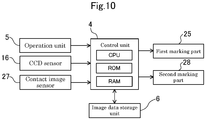
- FIG. 10 is a view corresponding to FIG. 2 , which illustrates an embodiment 2.
- FIG. 11 is a diagram illustrating a state in which a predetermined mark (a second predetermined mark) has been applied to a margin of a rear end side of an image formation region on a back surface of a document.
- FIG. 12A is a view corresponding to FIG. 6A , which illustrates an embodiment 2.
- FIG. 12B is a view corresponding to FIG. 6B , which illustrates an embodiment 2.
- FIG. 13 is a diagram illustrating a state in which reading of a document image on a back surface and a front surface of a document has not been completed in an embodiment 2.
- FIG. 14 is a diagram illustrating a state in which reading of a back surface of a document has been completed and reading of a front surface has not been completed in an embodiment 2.
- FIG. 15 is a diagram illustrating a state in which reading of a front surface and a back surface of a document has been completed in an embodiment 2.
- FIG. 1 illustrates a multifunctional peripheral Y including an image reading device X in an embodiment.
- the multifunctional peripheral Y includes an image reading unit 1 , a document feeding device 2 , an image forming unit 3 , a control unit 4 , an operation unit 5 (illustrated only in FIG. 2 ) and the like.
- the image reading unit 1 and the document feeding device 2 constitute the image reading device X.
- the multifunctional peripheral Y also serves as an electrophotographic image forming apparatus that forms an image on a sheet on the basis of image data read by the image reading unit 1 or image data inputted from an information processing apparatus such as an external personal computer.
- the image forming unit 3 includes a sheet feeding cassette 30 , a photosensitive drum 31 , a charging device 32 , a developing device 33 , a toner container 34 , a transfer roller 35 , a static eliminating device 36 , a fixing roller 37 , a pressure roller 38 , a sheet discharge tray 39 and the like.
- an image is formed on a sheet supplied from the sheet feeding cassette 30 according to the following procedure. Specifically, firstly, the photosensitive drum 31 is uniformly charged to a predetermined potential by the charging device 32 . Next, light based on image data is irradiated to a surface of the photosensitive drum 31 from a laser scanning unit (LSU; not illustrated). In this way, an electrostatic latent image is formed on the surface of the photosensitive drum 31 . Then, the electrostatic latent image on the photosensitive drum 31 is developed by the developing device 33 as a toner image. It is noted that toner is replenished to the developing device 33 from the toner container 34 .
- LSU laser scanning unit
- the toner image formed on the photosensitive drum 31 is transferred to a sheet by the transfer roller 35 . Thereafter, the toner image transferred to the sheet is heated in the fixing roller 37 so as to be molten and fixed when the sheet passes through between the fixing roller 37 and the pressure roller 38 . It is noted that the potential of the photosensitive drum 31 is eliminated by the static eliminating device 36 .
- the image reading unit 1 includes a contact glass 11 , a reading unit 12 , mirrors 13 and 14 , an optical lens 15 , and a CCD sensor 16 .
- the contact glass 11 is provided on an upper surface of a rectangular box-like case body constituting an outer wall of the image reading unit 1 .
- the contact glass 11 is configured with a fixed reading glass 11 a that occupies the majority of the upper surface and a rectangular plate-like automatic reading glass 11 b positioned at the left side of the fixed reading glass 11 a to extend in a front and rear direction.
- the reading unit 12 is provided in the case body and has a LED light source 121 and a mirror 122 .
- the reading unit 12 is configured to be movable in a right and left direction (a sub-scanning direction) of FIG. 1 by a driving mechanism (not illustrated) using a driving motor such as a stepping motor.
- a driving motor such as a stepping motor.
- the mirror 122 reflects, toward a mirror 13 , reflected light when light has been irradiated from the LED light source 121 to a document P passing through a reading position 12 A. Then, the light reflected by the mirror 122 is led to the optical lens 15 by the mirrors 13 and 14 . It is noted that the mirrors 13 and 14 are installed in a carriage (not illustrated) and move in the sub-scanning direction at a half speed of the reading unit 12 at the time of a reading operation by a sheet fixing scheme to be described later.
- the optical lens 15 collects incident light and causes the light to be incident on the CCD sensor 16 .
- the CCD sensor photoelectrically converts the reflected light from the document image into analog image data and outputs the analog image data to a control unit (an image data processing unit) 4 .
- the control unit 4 converts the document image into digital data (image data) on the basis of the analog image data received from the CCD sensor 16 , and allows an image data storage unit 6 (see FIG. 2 ) to store the digital data.
- the document feeding device 2 is an automatic document feeding device including a document feeding tray (a document placing part) 21 , a plurality of conveying rollers 22 , a document cover 23 , and a sheet discharge tray 24 . Furthermore, the document feeding device 2 is openable/closeable with respect to the contact glass 11 .
- each of the conveying rollers 22 is driven by a motor (not illustrated), so that the document P set on the document feeding tray 21 is conveyed along a predetermined document conveyance path T.
- the document conveyance path T is an approximately U shape conveyance path from a sheet feeding port 2 a of the document feeding device 2 to a sheet discharge port 2 b via the automatic reading glass 11 b .
- the document feeding tray 21 is provided at a conveyance upstream side of the sheet feeding port 2 a and the sheet discharge tray 24 is provided at a conveyance downstream side of the sheet discharge port 2 b .
- the document P discharged from the sheet discharge port 2 b is sequentially stacked on the sheet discharge tray 24 .
- the reading position 12 A is set above the automatic reading glass 11 b in the document conveyance path T.
- a reading scheme of the document image by the image reading device X includes two schemes of a sheet-through scheme and a fixing scheme.
- the reading unit 12 is made stationary below the automatic reading glass 11 b (the reading position 12 A), and in that state, the document P is moved and conveyed by the document feeding device 2 from one side to the other side in the sub-scanning direction with respect to the reading position 12 A, so that the image of each document P is read.
- the reading unit 12 is moved from one side to the other side in the sub-scanning direction in a state in which the document P has been fixed on the fixed reading glass 11 a , so that the image of the document P is read.
- the document feeding device 2 simply serves as a document pressing unit.
- a marking part 25 is provided to apply a predetermined mark M to the document P after passing through the reading position 12 A. Furthermore, in the vicinity of the sheet discharge port 2 b of the document feeding device 2 , a heater part 26 is provided as a mark erasing part for erasing the predetermined mark applied to the document P.
- the marking part 25 applies the predetermined mark M to a rear end of the document P by using ink (for example, commercial friction ink and the like) that becomes transparent and invisible when heat is applied thereto.
- FIG. 4 illustrates an example of the predetermined mark M applied to the document P by the marking part 25 .
- the predetermined mark M is formed in a margin R 2 of a document rear end side other than an image formation region R 1 (a region where an image can be formed) of the document P.
- the predetermined mark M is formed at a center part of the margin R 2 in a document width direction; however, the present disclosure is not limited thereto and for example, the predetermined mark M may be formed at one end in the document width direction.
- the predetermined mark M has a triangular shape of solid coating as an example; however, the present disclosure is not limited thereto and the predetermined mark M may be any marks as long as they are marks having a size and a density readable by the reading unit 12 .
- FIG. 5 is an enlarged side view illustrating the marking part 25 .
- the marking part 25 has a trapezoidal column-shaped body case 25 a extending in the document width direction (a direction vertical to the paper surface of FIG. 5 ) and an ink hole 25 b for injecting ink.
- An upper surface 25 c of the body case 25 a is an inclined surface which becomes higher as it goes from an upstream side to a downstream side in the document conveyance direction and also serves as a guide surface that guides the document P.
- the ink hole 25 b is formed at an end of the upper surface 25 c of the body case 25 a at the conveyance upstream side. The closer the position of the ink hole 25 b to the reading position 12 A, the greater the effect.
- the body case 25 a is provided therein with a mechanism (for example, a piezoelectric element) for discharging ink from the ink hole 25 b , and the like.
- the heater part 26 is provided in the vicinity just below the ink hole 25 b in the present embodiment.
- the heater part 26 has a trapezoidal columnar shape when viewed from the document width direction.
- the heater part 26 for example, is provided therein with an electric heater.
- An upper surface of the heater part 26 is an inclined surface which becomes higher as it goes from the upstream side to the downstream side in the document conveyance direction.
- the upper surface of the heater part 26 also serves as a guide surface that guides the document P.
- the heater part 26 is configured to be able to generate a heat quantity enough to allow the predetermined mark M applied to the document P passing through its own upper surface to be transparent.
- the dimension of the heater part 26 in the document width direction is set to be identical to or slightly larger than the width of the predetermined mark M.
- the heater part 26 is slidable between a first position and a second position in the document width direction.
- the first position is a position at which a center part (a part provided with the predetermined mark M) in the sheet width direction of the document P passes through the heater part 26 and a position at which the predetermined mark M can be transparent by the heat of the heater part 26 .
- the second position for example, is a position at which the heater part 26 is located outward from positions of both ends in the width direction of the document P and a position at which the predetermined mark M is not be able to be transparent by the heat of the heater part 26 .
- the heater part 26 is used at the first position during document conveyance (during image reading) by the document feeding device 2 .
- the operations of the marking part 25 and the heater part 26 are controlled by the control unit 4 .
- the control unit 4 includes a microcomputer having a CPU, a ROM, and a RAM.
- the control unit 4 operates the marking part 25 when automatic reading control (reading control by the sheet-through scheme to be described later) of the document P is performed, thereby applying the predetermined mark M to the document P.
- the control unit 4 determines the presence or absence of the predetermined mark M and erases or stores image data.
- step SA 1 after the image reading device X is powered on, the control unit 4 operates the heater part 26 .
- step SA 2 on the basis of an operation signal from the operation unit 5 , the control unit 4 determines whether there is an automatic reading instruction (that is, a reading instruction by the sheet-through scheme) of the document P from a user. When this determination is NO, the control unit 4 returns, and when this determination is YES, the control unit 4 proceeds to step SA 3 .
- an automatic reading instruction that is, a reading instruction by the sheet-through scheme
- step SA 3 the control unit 4 operates the document feeding device 2 to convey the document P set on the document feeding tray 21 along the document conveyance path T one by one.
- step SA 4 the control unit 4 calculates the position of the document P on the basis of a signal from a document detection sensor (not illustrated) provided on the document conveyance path T and a conveyance speed. Then, when it is determined that the margin R 2 (see FIG. 4 ) of the rear end of the document P has reached the ink hole 25 b of the marking part 25 , the control unit 4 operates the marking part 25 to discharge ink from the ink hole 25 b . By so doing, the predetermined mark M is applied to the margin (see FIG. 4 ).
- step SA 101 on the basis of a signal from a jam sensor (not illustrated) provided in the document feeding device 2 , the control unit 4 determines whether a jam (a document jam) has occurred. When this determination is NO, the control unit 4 proceeds to step SA 107 , and when this determination is YES, the control unit 4 proceeds to step SA 102 .
- step SA 102 the control unit 4 suspends the automatic feeding operation (that is, the automatic reading operation) of the document performed by the document feeding device 2 .
- step SA 103 on the basis of an operation signal from the operation unit 5 , the control unit 4 determines whether there is a restarting instruction of the automatic reading of the document P. When this determination is NO, the control unit 4 performs the process of step SA 103 again, and when this determination is YES, the control unit 4 proceeds to step SA 104 .
- step SA 104 the control unit 4 determines whether the predetermined mark M exists in document image data of an initially read document P after the automatic reading is restarted. When this determination is NO, the control unit 4 proceeds to step SA 106 , and when this determination is YES, the control unit 4 proceeds to step SA 105 .
- step SA 105 the control unit 4 erases the document image data having the predetermined mark M from a memory without storing the document image data in the image data storage unit 6 , and then returns.
- step SA 106 the control unit 4 stores the document image data in the image data storage unit 6 together with page information thereof, and then returns.
- step SA 107 which is performed when the determination of step SA 101 is NO, the control unit 4 determines whether the image reading has been completed for all documents P initially set on the document feeding tray 21 . When this determination is NO, the control unit 4 proceeds to step SA 109 to continue the automatic feeding operation of the document P and to perform reading of a document image by the CCD sensor 16 of the image reading unit 1 , and then returns. On the other hand, when this determination is YES, the control unit 4 proceeds to step SA 108 to stop the automatic feeding operation of the document P, and proceeds to end.
- the image reading unit 1 configured as above, when a sheet jam (a jam) has occurred during the automatic reading (during the sheet feeding operation by the document feeding device 2 ) of the document P, a user opens the outer cover of the document feeding device 2 and removes the cause of the sheet jam, and then needs to set the document P on the document feeding tray 21 again.
- a document P already discharged from the sheet discharge port 2 b is set, time required for reading the document P again becomes longer. Consequently, many users determines that image reading of a document P completely discharged from the document feeding device 2 has been completed, and sets only other documents P on the document feeding tray 21 again.
- the marking part 25 is configured to be provided at the downstream side in the document conveyance direction from the reading position 12 A in the document conveyance path T, and to apply the predetermined mark M to the margin R 2 (see FIG. 4 ) of the rear end of the document P having passed through the reading position 12 A.
- the control unit 4 is configured to determine whether the predetermined mark M exists in document image data after a jam occurs and a reading operation of the document P is restarted, and to erase the document image data when it is determined that the predetermined mark M exists (in the case of YES in step SA 104 ). Consequently, as indicated by the thick line of FIG.
- the image data of the document P stopped in the state in which document image reading has been completed can be prevented from being redundantly stored in the image data storage unit 6 .
- the image data of the document P is stored in the image data storage unit 6 . Consequently, as indicated by the thick line of FIG. 8 , the image data of the document P stopped in the state in which the document image reading has not been completed is not lost without being stored.
- the heater part is configured to be slidably movable between the first position, at which the predetermined mark M applied to the document P discharged from the sheet discharge port 2 b is erasable, and the second position at which the predetermined mark M is not erasable.
- the marking part 25 applies the predetermined mark M by using ink (ink erasable by heat) that becomes transparent by heat, and the applied predetermined mark M is erased by the heat of the heater part 26 .
- FIG. 9 is a view corresponding to FIG. 3 , which illustrates an embodiment 2.
- An image reading device X of the present embodiment is different from the embodiment 1 in that images of both surfaces (a front surface and a rear surface) of the document P fed by the document feeding device 2 are readable.
- an upper surface of the document P set on the document feeding tray 21 is defined as a front surface (one surface) and a lower surface of the document P is defined as a back surface (the other surface).
- the same elements as those of the embodiment 1 are denoted by the same reference numerals and detailed description thereof will be omitted.
- a contact image sensor 27 is provided to read a document image of the back surface of the document P.
- the contact image sensor 27 is disposed to face a reading position 12 B set between two conveying rollers 22 closer to an upstream side than a curved part of the U-shaped document conveyance path T.
- the contact image sensor 27 is provided adjacent to the inside of the U-shaped document conveyance path T.
- the CCD sensor 16 corresponds to a first reading unit and the contact image sensor 27 corresponds to a second reading unit.
- the reading position 12 A corresponds to a first reading position and the reading position 12 B corresponds to a second reading position.
- the contact image sensor 27 includes a box-like sensor casing extending in the document width direction (a main scanning direction).
- the sensor casing is provided therein with an optical element (not illustrated) such as a line sensor and a light source.
- the contact image sensor 27 is connected to the control unit 4 via a signal line.
- the control unit 4 receives an image signal of a back side image of the document P from the contact image sensor 27 , and receives an image signal of a front side image of the document P from the CCD sensor 16 . On the basis of these signals, the control unit 4 stores the document images of the document P together with page information and front/back information thereof.
- the page information is information indicating a sheet number of the document P having the document image
- the front/back information is information indicating whether the document image is the front side image or the back side image of the document P.
- the control unit 4 displays the stored document images on a display screen (not illustrated) in page order and in order from front to back as necessary.
- a marking part 28 is provided at the conveyance downstream side of the contact image sensor 27 .
- the marking part 25 provided at the downstream side of the reading position 12 A is called a first marking part and the marking part 28 provided at the downstream side of the contact image sensor 27 is called a second marking part.
- the first marking part 25 applies the predetermined mark M (hereinafter, referred to as a first predetermined mark) to the margin R 2 of the rear end of the front surface of the document P.
- the marking part 28 applies a predetermined mark m (hereinafter, referred to as a second predetermined mark) to a margin r 2 of the document rear end side from an image formation region r 1 of the document P.
- the second predetermined mark m applied by the second marking part 28 is different from the first predetermined mark M applied by the first marking part 25 , and for example, has a circular shape of solid coating. It is noted that the first predetermined mark M and the second predetermined mark m may be the same mark.
- the second marking part 28 operates by discharging ink from an ink hole similarly to the first marking part 25 .
- An ink discharge side-surface of the second marking part 28 is a flat surface along the document conveyance path T and serves as a guide surface that guides the document P. The closer the ink hole of the second marking part 28 to the contact image sensor 27 , the greater the effect.
- a first heater part 26 (a first mark erasing part) and a second heater part 29 (a second mark erasing part) are provided.
- the first heater part 26 erases the first predetermined mark M applied to the front surface of the document P by heat. Since the configuration of the first heater part 26 has been described in the embodiment 1, detailed description thereof will be omitted.
- the second heater part 29 is disposed to face the first heater part 26 while interposing the document conveyance path T between the second heater part 29 and the first heater part 26 .
- the second heater part 29 erases the second predetermined mark m applied to the back surface of the document P by heat.
- the second heater part 29 is provided therein with an electric heater similarly to the first heater part 26 .
- the first heater part 26 and the second heater part 29 are connected to each other via a connection member (not illustrated). Furthermore, the first heater part 26 and the second heater part 29 are slidable between a first position and a second position in the document width direction.
- the first position is a position at which a center part (a part provided with the first and second predetermined mark M and m) in the sheet width direction of the document P passes through the first and second heater parts 26 and 29 . That is, the first position is a position at which the first and second predetermined mark M and m can be transparent by the heat of the first and second heater parts 26 and 29 .
- the second position for example, is a position at which the first and second heater parts 26 and 29 are located outward from positions of both ends in the width direction of the document P.
- the second position is a position at which the first and second predetermined mark M and m are not be able to be transparent by the heat of the first and second heater parts 26 and 29 .
- Each of the first and second heater parts 26 and 29 is used at the first position during document conveyance (during image reading) by the document feeding device 2 .
- step SB 1 after the image reading device X is powered on, the control unit 4 operates the first heater part 26 and the second heater part 29 .
- control unit 4 performs processes similar to those of steps SA 2 and SA 3 of the embodiment 1.
- step SB 4 the control unit 4 calculates the position of the document P on the basis of a signal from a document detection sensor (not illustrated) provided on the document conveyance path T and a conveyance speed. Then, when it is determined that the margin r 2 (see FIG. 11 ) of the rear end of the back surface of the document P has reached the ink hole of the second marking part 28 , the control unit 4 operates the second marking part 28 to discharge ink from the ink hole. By so doing, the second predetermined mark m is applied to the margin r 2 .
- step SB 5 when it is determined that the margin R 2 (see FIG. 4 ) of the rear end of the front surface of the document P has reached the ink hole 25 b of the first marking part 25 , the control unit 4 operates the first marking part 25 to discharge ink from the ink hole 25 b . By so doing, the control unit 4 allows the first predetermined mark M to be applied to the margin R 2 , and then returns.
- control unit 4 performs processes similar to those of steps SA 101 to SA 103 of the embodiment 1.
- step SB 104 the control unit 4 determines whether the first predetermined mark M or the second predetermined mark m exists in initially read document image data after automatic reading is restarted. When this determination is NO, the control unit 4 proceeds to step SB 106 , and when this determination is YES, the control unit 4 proceeds to step SB 105 .
- step SB 105 the control unit 4 erases the document image data of a surface (the front surface or the back surface) having the mark M or m.
- step SB 106 the control unit 4 stores the document image data in the image data storage unit 6 together with page information and front/back information thereof, and then returns.
- steps SB 107 and SB 108 the control unit 4 performs processes similar to those of steps SA 107 and SA 108 of the embodiment 1.
- step SB 109 the control unit 4 continues the automatic feeding operation of the document P and performs a document image reading operation by the contact image sensor 27 and the CCD sensor 16 , and then returns.
- control unit 4 is configured to determine whether the first predetermined mark M exists in image data of a document image initially read by the image reading device X after a jam occurs, to allow the image data storage unit 6 to store the image data when it is determined that the first predetermined mark M does not exist, and to erase the image data when it is determined that the first predetermined mark M exists. Furthermore, the control unit 4 is configured to determine whether the second predetermined mark m exists in the image data of the document image initially read by the image reading device X after the jam occurs, to allow the image data storage unit 6 to store the image data when it is determined that the second predetermined mark m does not exist, and to erase the image data when it is determined that the second predetermined mark m exists.
- storage and erasing of document image data are appropriately performed according to whether the state of the document P stopped while passing through the sheet discharge port 2 b corresponds to (I) a first state (a state of FIG. 13 ) in which reading of the back surface and the front surface have not been completed, (II) a second state (a state of FIG. 14 ) in which the reading of the back surface has been completed and the reading of the front surface has not been completed, or (III) a third state (a state of FIG. 15 ) in which the reading of the front surface and the back surface have been completed, so that it is possible to prevent a read image from being lost or redundantly stored after the document P is set again.
- the rear end of the document P has passed through the second marking part 28 , but does not reach the first marking part 25 . Therefore, the second predetermined mark m is applied to the back surface of the document P, but the first predetermined mark M is not applied to the front surface of the document P. Consequently, after the reading of the document P is restarted, the image data of both the back surface of the document P is erased by the control unit 4 (SB 105 ) and the image data of the front surface of the document P is stored in the image data storage unit 6 (step SB 106 ). Thus, it is possible to prevent the image data of the back surface of the document P from being redundantly stored.
- the third state (the state of FIG. 15 ) since the rear end of the document P has passed through the first marking part 25 and the second marking part 28 , the first predetermined mark M is applied to the front surface of the document P and the second predetermined mark m is applied to the back surface of the document P. Consequently, after the reading of the document P is restarted, the image data of the front surface and the back surface of the document P is erased by the control unit 4 (SB 105 ), so that it is possible to prevent image data from being redundantly stored.
- the second predetermined mark m applied to the back surface of the document P is different from the predetermined mark M applied to the front surface. Consequently, when a document image is read again, even though a worker has erroneously set the front and back of the document P in a reverse direction, the control unit 4 can recognize the error on the basis of the shape of the read predetermined mark. When the control unit 4 recognizes an error on the front and back when a document is set again, an error may be displayed or subsidiary front/back information of a document image may be corrected to correct information.
- the predetermined mark M (the first and second predetermined marks M and m in the embodiment 2) is erased by heat; however, the present disclosure is not limited thereto and the predetermined mark M (the first and second predetermined marks M and m) may be formed of a material erasable by light irradiation.
- the mark erasing part is configured by a light irradiation part that irradiates light toward the predetermined mark M (the first and second predetermined marks M and m).
- the predetermined mark M (the first and second predetermined marks M and m in the embodiment 2) is erased by making it transparent; however, the predetermined mark M (the first and second predetermined marks M and m) may be erased by directly scrubbing it with an eraser and the like. That is, the transparentization of the predetermined mark M (the first and second predetermined marks M and m) is only an example of a method for erasing the predetermined mark M (the first and second predetermined marks M and m), and other methods may be used.
- the predetermined mark M (the first and second predetermined marks M and m in the embodiment 2) exists in the document image data of an initially read document P and a process for erasing or storing the image data is performed; however, the present disclosure is not limited thereto and the process may be performed for all documents P read after the automatic reading is restarted.
- the multifunctional peripheral Y has been described as an example of an image forming apparatus; however, the present disclosure is not limited thereto. That is, the image forming apparatus, for example, may include a printer, a facsimile, a copy machine and the like.
Landscapes
- Physics & Mathematics (AREA)
- General Physics & Mathematics (AREA)
- Engineering & Computer Science (AREA)
- Multimedia (AREA)
- Signal Processing (AREA)
- Microelectronics & Electronic Packaging (AREA)
- Facsimiles In General (AREA)
- Facsimile Scanning Arrangements (AREA)
Abstract
Description
Claims (7)
Applications Claiming Priority (6)
| Application Number | Priority Date | Filing Date | Title |
|---|---|---|---|
| JP2017-254901 | 2017-12-28 | ||
| JP2017254901 | 2017-12-28 | ||
| JPJP2017-254901 | 2017-12-28 | ||
| JP2018059515A JP6848914B2 (en) | 2017-12-28 | 2018-03-27 | An image reader and an image forming apparatus provided with the image reader. |
| JPJP2018-059515 | 2018-03-27 | ||
| JP2018-059515 | 2018-03-27 |
Publications (2)
| Publication Number | Publication Date |
|---|---|
| US20190204773A1 US20190204773A1 (en) | 2019-07-04 |
| US11054783B2 true US11054783B2 (en) | 2021-07-06 |
Family
ID=67059605
Family Applications (1)
| Application Number | Title | Priority Date | Filing Date |
|---|---|---|---|
| US16/233,656 Expired - Fee Related US11054783B2 (en) | 2017-12-28 | 2018-12-27 | Image reading device and image forming apparatus including the same |
Country Status (2)
| Country | Link |
|---|---|
| US (1) | US11054783B2 (en) |
| CN (1) | CN109981914B (en) |
Families Citing this family (2)
| Publication number | Priority date | Publication date | Assignee | Title |
|---|---|---|---|---|
| US20230176516A1 (en) * | 2020-03-13 | 2023-06-08 | Kyocera Document Solutions Inc. | Image forming device |
| US11868072B2 (en) * | 2022-02-23 | 2024-01-09 | Toshiba Tec Kabushiki Kaisha | Image processing apparatus |
Citations (8)
| Publication number | Priority date | Publication date | Assignee | Title |
|---|---|---|---|---|
| JPS59212069A (en) * | 1983-05-18 | 1984-11-30 | Ricoh Co Ltd | Marking method |
| JPH0635272A (en) | 1992-07-15 | 1994-02-10 | Ricoh Co Ltd | Unread document discriminating device for automatic document feeder |
| JP2008182671A (en) | 2006-12-26 | 2008-08-07 | Konica Minolta Business Technologies Inc | Document reading apparatus |
| JP2010087953A (en) * | 2008-10-01 | 2010-04-15 | Ricoh Co Ltd | Image reader |
| JP2010114807A (en) | 2008-11-10 | 2010-05-20 | Sharp Corp | Image reading device and image forming apparatus |
| JP2011205273A (en) | 2010-03-25 | 2011-10-13 | Kyocera Mita Corp | Image reading device and image forming apparatus including the same |
| JP2013138391A (en) * | 2011-12-28 | 2013-07-11 | Ricoh Co Ltd | Document transport device, image reader and image forming apparatus |
| US20170187901A1 (en) * | 2015-12-29 | 2017-06-29 | Kabushiki Kaisha Toshiba | Marking apparatus and decoloring apparatus |
Family Cites Families (5)
| Publication number | Priority date | Publication date | Assignee | Title |
|---|---|---|---|---|
| JP3980247B2 (en) * | 2000-04-25 | 2007-09-26 | 株式会社リコー | Colorless ink and ink jet printer using the same |
| JP2009303112A (en) * | 2008-06-17 | 2009-12-24 | Fuji Xerox Co Ltd | Image forming apparatus, image forming system and program |
| JP2010100044A (en) * | 2008-10-22 | 2010-05-06 | Toshiba Corp | Image forming apparatus and image forming method |
| JP2010124441A (en) * | 2008-11-21 | 2010-06-03 | Konica Minolta Business Technologies Inc | Image reading apparatus |
| JP5622813B2 (en) * | 2012-08-24 | 2014-11-12 | 株式会社東芝 | Erase device and erase method |
-
2018
- 2018-12-24 CN CN201811584922.6A patent/CN109981914B/en not_active Expired - Fee Related
- 2018-12-27 US US16/233,656 patent/US11054783B2/en not_active Expired - Fee Related
Patent Citations (8)
| Publication number | Priority date | Publication date | Assignee | Title |
|---|---|---|---|---|
| JPS59212069A (en) * | 1983-05-18 | 1984-11-30 | Ricoh Co Ltd | Marking method |
| JPH0635272A (en) | 1992-07-15 | 1994-02-10 | Ricoh Co Ltd | Unread document discriminating device for automatic document feeder |
| JP2008182671A (en) | 2006-12-26 | 2008-08-07 | Konica Minolta Business Technologies Inc | Document reading apparatus |
| JP2010087953A (en) * | 2008-10-01 | 2010-04-15 | Ricoh Co Ltd | Image reader |
| JP2010114807A (en) | 2008-11-10 | 2010-05-20 | Sharp Corp | Image reading device and image forming apparatus |
| JP2011205273A (en) | 2010-03-25 | 2011-10-13 | Kyocera Mita Corp | Image reading device and image forming apparatus including the same |
| JP2013138391A (en) * | 2011-12-28 | 2013-07-11 | Ricoh Co Ltd | Document transport device, image reader and image forming apparatus |
| US20170187901A1 (en) * | 2015-12-29 | 2017-06-29 | Kabushiki Kaisha Toshiba | Marking apparatus and decoloring apparatus |
Also Published As
| Publication number | Publication date |
|---|---|
| US20190204773A1 (en) | 2019-07-04 |
| CN109981914A (en) | 2019-07-05 |
| CN109981914B (en) | 2021-01-08 |
Similar Documents
| Publication | Publication Date | Title |
|---|---|---|
| US6931230B2 (en) | Image forming apparatus and image forming method including low-noise mode at paper sheet reverse section | |
| US8917299B2 (en) | Erasing device, image forming apparatus, and erasing method | |
| US20140212160A1 (en) | Image forming apparatus | |
| US8477359B2 (en) | Image processing apparatus for accessing a storage medium on a sheet | |
| US8995028B2 (en) | Reading apparatus | |
| US20140029021A1 (en) | Image forming apparatus, method for controlling same, and storage medium | |
| JP6855269B2 (en) | Document reader and image forming device | |
| US11054783B2 (en) | Image reading device and image forming apparatus including the same | |
| US10237443B2 (en) | Image reading apparatus and image forming apparatus | |
| JP2005234222A (en) | Image forming apparatus | |
| JP2016192745A (en) | Image reading apparatus, image forming apparatus, and image reading method | |
| US20170163834A1 (en) | Image forming apparatus capable of forming images based on image data, image forming method | |
| JP4566897B2 (en) | Image recording device | |
| JP4538270B2 (en) | Image reading apparatus and image forming apparatus | |
| JP6848914B2 (en) | An image reader and an image forming apparatus provided with the image reader. | |
| JP5167978B2 (en) | Fixing apparatus and image forming apparatus | |
| JP6812259B2 (en) | Image reader and image forming device | |
| JP2006308854A (en) | Image forming apparatus | |
| JP2006347645A (en) | Image forming apparatus | |
| JP2014144856A (en) | Paper sheet conveying device, image forming apparatus, abnormality detection method | |
| US20180234576A1 (en) | Image reading apparatus and image forming apparatus | |
| US20080204815A1 (en) | Image forming apparatus, segragation method in image forming apparatus | |
| US10863051B2 (en) | Image forming apparatus which detects an overrun | |
| JP2013097017A (en) | Image forming apparatus | |
| JP2009016915A (en) | Document reading apparatus, image forming apparatus including the same, and image processing method |
Legal Events
| Date | Code | Title | Description |
|---|---|---|---|
| AS | Assignment |
Owner name: KYOCERA DOCUMENT SOLUTIONS INC., JAPAN Free format text: ASSIGNMENT OF ASSIGNORS INTEREST;ASSIGNOR:MIYAGAWA, SEIJI;REEL/FRAME:047861/0341 Effective date: 20181210 |
|
| FEPP | Fee payment procedure |
Free format text: ENTITY STATUS SET TO UNDISCOUNTED (ORIGINAL EVENT CODE: BIG.); ENTITY STATUS OF PATENT OWNER: LARGE ENTITY |
|
| STPP | Information on status: patent application and granting procedure in general |
Free format text: NOTICE OF ALLOWANCE MAILED -- APPLICATION RECEIVED IN OFFICE OF PUBLICATIONS |
|
| STPP | Information on status: patent application and granting procedure in general |
Free format text: PUBLICATIONS -- ISSUE FEE PAYMENT RECEIVED |
|
| STPP | Information on status: patent application and granting procedure in general |
Free format text: PUBLICATIONS -- ISSUE FEE PAYMENT VERIFIED |
|
| STCF | Information on status: patent grant |
Free format text: PATENTED CASE |
|
| FEPP | Fee payment procedure |
Free format text: MAINTENANCE FEE REMINDER MAILED (ORIGINAL EVENT CODE: REM.); ENTITY STATUS OF PATENT OWNER: LARGE ENTITY |
|
| LAPS | Lapse for failure to pay maintenance fees |
Free format text: PATENT EXPIRED FOR FAILURE TO PAY MAINTENANCE FEES (ORIGINAL EVENT CODE: EXP.); ENTITY STATUS OF PATENT OWNER: LARGE ENTITY |
|
| STCH | Information on status: patent discontinuation |
Free format text: PATENT EXPIRED DUE TO NONPAYMENT OF MAINTENANCE FEES UNDER 37 CFR 1.362 |
|
| FP | Lapsed due to failure to pay maintenance fee |
Effective date: 20250706 |