US11053240B2 - 2-amino-quinoline derivatives - Google Patents

2-amino-quinoline derivatives Download PDF

Info

Publication number
US11053240B2
US11053240B2 US16/608,581 US201816608581A US11053240B2 US 11053240 B2 US11053240 B2 US 11053240B2 US 201816608581 A US201816608581 A US 201816608581A US 11053240 B2 US11053240 B2 US 11053240B2
Authority
US
United States
Prior art keywords
quinolin
ethoxymethyl
optionally substituted
salt
imidazo
Prior art date
Legal status (The legal status is an assumption and is not a legal conclusion. Google has not performed a legal analysis and makes no representation as to the accuracy of the status listed.)
Expired - Fee Related
Application number
US16/608,581
Other versions
US20200055851A1 (en
Inventor
Lixin Li
Huiping Guan
Current Assignee (The listed assignees may be inaccurate. Google has not performed a legal analysis and makes no representation or warranty as to the accuracy of the list.)
Birdie Biopharmaceuticals Inc Cayman Islands
Original Assignee
Birdie Biopharmaceuticals Inc Cayman Islands
Priority date (The priority date is an assumption and is not a legal conclusion. Google has not performed a legal analysis and makes no representation as to the accuracy of the date listed.)
Filing date
Publication date
Application filed by Birdie Biopharmaceuticals Inc Cayman Islands filed Critical Birdie Biopharmaceuticals Inc Cayman Islands
Assigned to BIRDIE BIOPHARMACEUTICALS, INC. reassignment BIRDIE BIOPHARMACEUTICALS, INC. ASSIGNMENT OF ASSIGNORS INTEREST (SEE DOCUMENT FOR DETAILS). Assignors: LI, LIXIN, GUAN, HUIPING
Publication of US20200055851A1 publication Critical patent/US20200055851A1/en
Application granted granted Critical
Publication of US11053240B2 publication Critical patent/US11053240B2/en
Expired - Fee Related legal-status Critical Current
Anticipated expiration legal-status Critical

Links

Classifications

    • AHUMAN NECESSITIES
    • A61MEDICAL OR VETERINARY SCIENCE; HYGIENE
    • A61PSPECIFIC THERAPEUTIC ACTIVITY OF CHEMICAL COMPOUNDS OR MEDICINAL PREPARATIONS
    • A61P19/00Drugs for skeletal disorders
    • AHUMAN NECESSITIES
    • A61MEDICAL OR VETERINARY SCIENCE; HYGIENE
    • A61KPREPARATIONS FOR MEDICAL, DENTAL OR TOILETRY PURPOSES
    • A61K31/00Medicinal preparations containing organic active ingredients
    • A61K31/33Heterocyclic compounds
    • A61K31/395Heterocyclic compounds having nitrogen as a ring hetero atom, e.g. guanethidine or rifamycins
    • A61K31/495Heterocyclic compounds having nitrogen as a ring hetero atom, e.g. guanethidine or rifamycins having six-membered rings with two or more nitrogen atoms as the only ring heteroatoms, e.g. piperazine or tetrazines
    • A61K31/505Pyrimidines; Hydrogenated pyrimidines, e.g. trimethoprim
    • A61K31/519Pyrimidines; Hydrogenated pyrimidines, e.g. trimethoprim ortho- or peri-condensed with heterocyclic rings
    • AHUMAN NECESSITIES
    • A61MEDICAL OR VETERINARY SCIENCE; HYGIENE
    • A61PSPECIFIC THERAPEUTIC ACTIVITY OF CHEMICAL COMPOUNDS OR MEDICINAL PREPARATIONS
    • A61P29/00Non-central analgesic, antipyretic or antiinflammatory agents, e.g. antirheumatic agents; Non-steroidal antiinflammatory drugs [NSAID]
    • AHUMAN NECESSITIES
    • A61MEDICAL OR VETERINARY SCIENCE; HYGIENE
    • A61PSPECIFIC THERAPEUTIC ACTIVITY OF CHEMICAL COMPOUNDS OR MEDICINAL PREPARATIONS
    • A61P31/00Antiinfectives, i.e. antibiotics, antiseptics, chemotherapeutics
    • A61P31/12Antivirals
    • AHUMAN NECESSITIES
    • A61MEDICAL OR VETERINARY SCIENCE; HYGIENE
    • A61PSPECIFIC THERAPEUTIC ACTIVITY OF CHEMICAL COMPOUNDS OR MEDICINAL PREPARATIONS
    • A61P31/00Antiinfectives, i.e. antibiotics, antiseptics, chemotherapeutics
    • A61P31/12Antivirals
    • A61P31/14Antivirals for RNA viruses
    • AHUMAN NECESSITIES
    • A61MEDICAL OR VETERINARY SCIENCE; HYGIENE
    • A61PSPECIFIC THERAPEUTIC ACTIVITY OF CHEMICAL COMPOUNDS OR MEDICINAL PREPARATIONS
    • A61P35/00Antineoplastic agents
    • AHUMAN NECESSITIES
    • A61MEDICAL OR VETERINARY SCIENCE; HYGIENE
    • A61PSPECIFIC THERAPEUTIC ACTIVITY OF CHEMICAL COMPOUNDS OR MEDICINAL PREPARATIONS
    • A61P37/00Drugs for immunological or allergic disorders
    • A61P37/08Antiallergic agents
    • CCHEMISTRY; METALLURGY
    • C07ORGANIC CHEMISTRY
    • C07DHETEROCYCLIC COMPOUNDS
    • C07D471/00Heterocyclic compounds containing nitrogen atoms as the only ring hetero atoms in the condensed system, at least one ring being a six-membered ring with one nitrogen atom, not provided for by groups C07D451/00 - C07D463/00
    • C07D471/02Heterocyclic compounds containing nitrogen atoms as the only ring hetero atoms in the condensed system, at least one ring being a six-membered ring with one nitrogen atom, not provided for by groups C07D451/00 - C07D463/00 in which the condensed system contains two hetero rings
    • C07D471/04Ortho-condensed systems
    • CCHEMISTRY; METALLURGY
    • C07ORGANIC CHEMISTRY
    • C07DHETEROCYCLIC COMPOUNDS
    • C07D487/00Heterocyclic compounds containing nitrogen atoms as the only ring hetero atoms in the condensed system, not provided for by groups C07D451/00 - C07D477/00
    • C07D487/02Heterocyclic compounds containing nitrogen atoms as the only ring hetero atoms in the condensed system, not provided for by groups C07D451/00 - C07D477/00 in which the condensed system contains two hetero rings
    • C07D487/04Ortho-condensed systems
    • CCHEMISTRY; METALLURGY
    • C07ORGANIC CHEMISTRY
    • C07DHETEROCYCLIC COMPOUNDS
    • C07D498/00Heterocyclic compounds containing in the condensed system at least one hetero ring having nitrogen and oxygen atoms as the only ring hetero atoms
    • C07D498/12Heterocyclic compounds containing in the condensed system at least one hetero ring having nitrogen and oxygen atoms as the only ring hetero atoms in which the condensed system contains three hetero rings
    • C07D498/16Peri-condensed systems

Definitions

  • the present invention relates to 2-amino-quinoline derivatives, such as imidazoquinoline and pyrazoloquinoline analogs as agonists of toll-like receptors 7 and 8 (TLR7 and TLR8), as well as pharmaceutical compositions comprising the same.
  • the present invention also relates to the use of the compounds, compositions, and the method of activating TLR7 and TLR8 in treating various diseases.
  • TLR7 and TLR8 are toll-like receptors 7 and 8 respectively, and they lie in close proximity to each other on the human X chromosome. Both TLR7 and TLR8 recognize single-stranded RNA of viruses such as HIV and HCV. TLR7 has been shown to play a significant role in the pathogenesis of autoimmune disorders such as Systemic Lupus Erythematosus (SLE) as well as in the regulation of antiviral immunity. Genetic variants in TLR8 have recently been linked to susceptibility to pulmonary tuberculosis. TLR7 is functional both in human and mouse, while TLR8 is only functional in human, but it seems to counteract TLR7 activity.
  • SLE Systemic Lupus Erythematosus
  • TLR7/8 agonists as immune response enhancers are their simultaneous stimulation of several cell types.
  • TLR7 and TLR8 are expressed mostly on immune cells such as antigen presenting cells, including plasmacytoid dendritic cells (pDC) and myeloid dendritic cells (mDC), as well as natural killer cells, and macrophages.
  • pDC plasmacytoid dendritic cells
  • mDC myeloid dendritic cells
  • Activation of TLR7/8 on pDCs and mDCs results in the induction and release of type I interferons (IFN), tumor necrosis factor alpha (TNF ⁇ ), and interleukin 12 (IL-12), which is an important step for the initiation of innate and adaptive immunities to kill cancer cells.
  • IFN type I interferons
  • TNF ⁇ tumor necrosis factor alpha
  • IL-12 interleukin 12
  • TLR7 and TLR8 Small molecule agonists at TLR7 and TLR8 have increased interest in both antiviral and cancer research own to their profound antiviral and antitumor activity.
  • the lead compound of the imidazoquinoline family, imiquimod is efficacious against many primary skin tumors and cutaneous metastases and is marketed as a topical formulation.
  • Resiquimod (R-848) from the same imidazoquinoline family, is a low molecular weight synthetic molecule that activates immune cells via the TLR7/TLR8 MyD88-dependent signaling pathway. It acts as an immune response modifier and has antiviral and antitumor activity. It has several mechanisms of action, being both an agonist for toll-like receptors 7 and 8, and an upregulator of the opioid growth factor receptor.
  • R-848 is used as a topical gel in the treatment of skin lesions such as those caused by the herpes simplex virus and cutaneous T cell lymphoma, as an adjuvant to increase the effectiveness of vaccines, and as an adjuvant to immunotherapy in allergic rhinitis (AR) patient. Therefore, in addition to their use as stand-alone immunotherapeutic agent, TLR7/8 agonists hold promise as adjuvants in cancer vaccine or adoptive T cell transfer protocols. Extension of the families of the known synthetic TLR7/8 agonists, such as described above, pave the way to the development and identification of TLR7/8 agonists that are well tolerated, more selective with potent antitumor and antiviral activity, broadly applicable, and more effective as adjuvants.
  • 2-amino-quinoline derivatives Described herein are 2-amino-quinoline derivatives, pharmaceutically acceptable salts, solvates, prodrug and active metabolites, that are agonists of toll-like receptors 7 and 8 (TLR7/8). These compounds may be used to treat viral infection, such as HCV, cancer, and allergic diseases in need thereof by administering a therapeutically effective amount of a 2-amino-quinoline derivative.
  • Some embodiments include a compound represented by Formula 1:
  • a dashed line represents the presence or absence of a bond
  • a 1 is CR 1 , NR 1A , or N
  • a 2 is CR 2 , NR 2A , O, or S
  • B 1 is CR 5 or N
  • B 2 is CR 6 or N
  • B 3 is CR 7 or N
  • R 1 and R 2 are independently F, Cl, Br, I, NO 2 , CN, R a , —OR a , —NR a R b , —NHCOR a , —NHSO 2 R a , —OCOR a , or —SO 2 R a
  • X is a bond, O, NR a , —CO—, —SO—, or —SO 2 —, —CONR a , hydrocarbyl
  • R 3 is H or C 1-30 organyl
  • X—R 3 is F or Cl
  • Some embodiments include a pharmaceutical dosage form comprising a subject compound.
  • a subject compound or a subject composition may be used for activating TLR7/8.
  • a subject compound or composition may be used as adjuvants in cancer vaccine or adoptive T cell transfer protocols.
  • Some embodiments include a method of treating a disease or disorder associated with a TLR7/8 agonist comprising administering an effective amount of a subject compound to a mammal in need thereof.
  • Some embodiments include use of a subject compound in the manufacture of a medicament for the treatment of a disease or disorder associated with a TLR7/8 agonist.
  • a compound or chemical structural feature such as alkyl, alkenyl, alkynyl, aryl, heteroaryl, etc.
  • substituted has the broadest meaning known to one of ordinary skill in the art, and includes a moiety that occupies a position normally occupied by one or more hydrogen atoms attached to a parent compound or structural feature.
  • a substituent may be an ordinary organic moiety known in the art, which may have a molecular weight (e.g. the sum of the atomic masses of the atoms of the substituent) of 15-50 g/mol, 15-100 g/mol, 15-150 g/mol, 15-200 g/mol, 15-300 g/mol, or 15-500 g/mol.
  • a molecular weight e.g. the sum of the atomic masses of the atoms of the substituent
  • a substituent comprises, or consists of: 0-30, 0-20, 0-10, or 0-5 carbon atoms; and 0-30, 0-20, 0-10, or 0-5 heteroatoms, wherein each heteroatom may independently be: N, O, S, Si, F, Cl, Br, or I; provided that the substituent includes one C, N, O, S, Si, F, Cl, Br, or I atom.
  • substituents include, but are not limited to, alkyl, alkenyl, alkynyl, heteroalkyl, aryl, heteroaryl, hydroxy, alkoxy, aryloxy, acyl, acyloxy, alkylcarboxylate, thiol, alkylthio, cyano, halo, thiocarbonyl, O-carbamyl, N-carbamyl, O-thiocarbamyl, N-thiocarbamyl, C-amido, N-amido, S-sulfonamido, N-sulfonamido, isocyanato, thiocyanato, isothiocyanato, nitro, silyl, sulfenyl, sulfinyl, sulfonyl, haloalkyl, haloalkoxyl, trihalomethanesulfonyl, trihalomethanesulfonamido, amino, etc
  • molecular weight is used with respect to a moiety or part of a molecule to indicate the sum of the atomic masses of the atoms in the moiety or part of a molecule, even though it may not be a complete molecule.
  • alkyl has the broadest meaning generally understood in the art and may include a moiety composed of carbon and hydrogen containing no double or triple bonds.
  • Alkyl may be linear alkyl, branched alkyl, cycloalkyl, or a combination thereof and in some embodiments, may contain from one to thirty-five carbon atoms.
  • alkyl may include C 1-10 linear alkyl, such as methyl (—CH 3 ), methylene (—CH 2 —), ethyl (—CH 2 CH 3 ), ethylene (—C 2 H 4 —), propylene (—C 3 CH 6 —), n-butyl (—CH 2 CH 2 CH 2 CH 3 ), n-pentyl (—CH 2 CH 2 CH 2 CH 2 CH 3 ), n-hexyl (—CH 2 CH 2 CH 2 CH 2 CH 2 CH 3 ), etc.; C 3-10 branched alkyl, such as C 3 H 7 (e.g. iso-propyl), C 4 H 9 (e.g.
  • branched butyl isomers C 5 H 11 (e.g. branched pentyl isomers), C 6 H 13 (e.g. branched hexyl isomers), C 7 H 15 (e.g. heptyl isomers), etc.; C 3-10 cycloalkyl, such as C 3 H 5 (e.g. cyclopropyl), C 4 H 7 (e.g. cyclobutyl isomers such as cyclobutyl, methylcyclopropyl, etc.), C 5 H 9 (e.g.
  • cyclopentyl isomers such as cyclopentyl, methylcyclobutyl, dimethylcyclopropyl, etc.) C 6 H 11 (e.g. cyclohexyl isomers), C 7 H 13 (e.g. cycloheptyl isomers), etc.; and the like.
  • aryl includes a group that can be derived from a monocyclic and polycyclic aromatic hydrocarbon by removal of a hydrogen atom from a ring carbon atom.
  • the “aryl” may include an aromatic ring or aromatic ring system such as phenyl, naphthyl, etc.
  • heteroaryl has the broadest meaning understood by a person of ordinary skill in the art and includes an “aryl” which has one or more heteroatoms in the ring or ring system, such as pyridinyl, furyl, thienyl, oxazolyl, thiazolyl, imidazolyl, triazolyl, oxadiazolyl, isoxazolyl, indolyl, quinolinyl, benzofuranyl, benzothienyl, benzooxazolyl, benzothiazolyl, benzoimidazolyl, etc.
  • any reference to a compound herein by structure, name, or any other means includes pharmaceutically acceptable salts, such as HCl, HBr, HI, H 2 SO 4 , acetate, citrate, phosphate, sodium, potassium, and ammonium salts; prodrugs, such as ester prodrugs; alternate solid forms, such as polymorphs, solvates, hydrates, etc.; tautomers; or any other chemical species that may rapidly convert to a compound described herein under conditions in which the compounds are used as described.
  • pharmaceutically acceptable salts such as HCl, HBr, HI, H 2 SO 4 , acetate, citrate, phosphate, sodium, potassium, and ammonium salts
  • prodrugs such as ester prodrugs
  • alternate solid forms such as polymorphs, solvates, hydrates, etc.
  • tautomers or any other chemical species that may rapidly convert to a compound described herein under conditions in which the compounds are used as described.
  • a name or structural representation includes any stereoisomer or any mixture of stereoisomers.
  • treat includes use of a compound, composition, therapeutically active agent, or drug in the diagnosis, cure, mitigation, treatment, or prevention of disease or other undesirable condition.
  • a dashed line represents the presence or absence of a bond.
  • compounds represented by Formulas 1A and 1B are included.
  • a 1 is CR 1 , NR 1A , or N. In some embodiments, A 1 is CR 1 . In some embodiments, A 1 is NR 1A . In some embodiment, A 1 is N.
  • a 2 is CR 2 , NR 2A , O, or S.
  • a 2 is CR 2 .
  • a 2 is NR 2A .
  • a 2 is O.
  • a 2 is S.
  • X is a bond, O, NR a , —C( ⁇ O)—, —S( ⁇ O)—, —S( ⁇ O) 2 —, —CONR a , hydrocarbyl, and R 3 is H or C 1-30 organyl; or X—R 3 is F or Cl.
  • X is a bond.
  • X is O.
  • X is NR a .
  • X is —C( ⁇ O)—.
  • X is —S( ⁇ O)—.
  • X is —S( ⁇ O) 2 —.
  • X—R 3 is F.
  • X—R 3 is Cl.
  • R a or R b is independently H or organyl, such as C 1-30 organyl, including any organic substituent group, regardless of functional type, having a free valence at a carbon, such as optionally substituted alkyl, e.g.
  • C 1-30 , C 1-12 , C 1-6 , or C 1-3 alkyl including methyl, ethyl, C 3 alkyl, C 4 alkyl, C 5 alkyl, C 6 alkyl, C 7 alkyl, C 8 alkyl, C 9 alkyl, C 10 alkyl, C 11 alkyl, C 12 alkyl, C 13 alkyl, C 14 alkyl, C 15 alkyl, C 16 alkyl, C 17 alkyl, C 18 alkyl, C 19 alkyl, C 20 alkyl, C 21 alkyl, C 22 alkyl, C 23 alkyl, C 24 alkyl, C 25 alkyl, C 26 alkyl, C 27 alkyl, C 28 alkyl, C 29 alkyl, C 30 alkyl, C 3 cycloalkyl, C 4 cycloalkyl, C 5 cycloalkyl, C 6 cycloalkyl, C 7 cycloalkyl, C 8 cyclo
  • alkenyl including ethenyl, C 3 alkenyl, C 4 alkenyl, C 5 alkenyl, C 6 alkenyl, C 7 alkenyl, C 8 alkenyl, C 9 alkenyl, C 10 alkenyl, C 11 alkenyl, C 12 alkenyl, C 4 cycloalkenyl, C 5 cycloalkenyl, C 6 cycloalkenyl, C 7 cycloalkenyl, C 8 cycloalkenyl, C 9 cycloalkenyl, C 10 cycloalkenyl, C 11 cycloalkenyl, C 12 cycloalkenyl, etc.; optionally substituted alkynyl, e.g.
  • C 2-12 or C 2-6 alkynyl including ethynyl, C 3 alkynyl, C 4 alkynyl, C 5 alkynyl, C 6 alkynyl, C 7 alkynyl, C 8 alkynyl, C 9 alkynyl, C 10 alkynyl, C 11 alkynyl, C 12 alkynyl, C 5 cycloalkynyl, C 6 cycloalkynyl, C 7 cycloalkynyl, C 8 cycloalkynyl, C 9 cycloalkynyl, C 10 cycloalkynyl, C 11 cycloalkynyl, C 12 cycloalkynyl, etc.; optionally substituted aryl, such as optionally substituted phenyl, optionally substituted naphthyl, etc.; optionally substituted heterocyclyl, optionally substituted heteroaryl, etc.; organyl also includes ethyn
  • R a or R b is independently H or C 1-30 hydrocarbyl, such as alkyl, alkenyl, alkynyl, or phenyl.
  • C 1-30 organyl can be substituted by halogen, hydroxyl, amines, alkoxyl, aryl, heteroaryl, sulfone, sulfonamide, carboxylic acid, amide, reversed amide, ester, cycloalkyl, heterocycloalkyl, carbonyl, alkyl, alkenyl, alkynyl, phosphonamidic acid, phosphinic amide, or phosphine oxide.
  • Some embodiments include a compound of Formula 2 or Formula 2A.
  • B 1 is CR 5 or N. In some embodiments, B 1 is CR 5 . In some embodiments, B 1 is N.
  • B 2 is CR 6 or N. In some embodiments, B 2 is CR 6 . In some embodiments, B 2 is N.
  • B 3 is CR 7 or N. In some embodiments, B 3 is CR 7 . In some embodiments, B 3 is N.
  • Some embodiments include a compound of Formula 3A, 3B, 3C, 3D, 3E, 4, 5, 6, 7, 8, 9, 10, 11, 12, or 13.
  • R 1 or R 1A is independently H or any substituent, such as F, Cl, Br, I, NO 2 , CN, R a , —OR a , —NR a R b , —NHCOR a , —NHSO 2 R a , —OCOR a , or —SO 2 R a .
  • R 1 or R 1A is C r H 2r+1 O, wherein r is 1, 2, 3, 4, 5, 6, 7, 8, 9, or 10, including C 2 H 5 O, such as —(CH 2 ) 2 OH; C 3 H 7 O, such as —CH 2 OCH 2 CH 3 , —(CH 2 ) 2 OCH 3 , etc.; C 1-12 alkyl, such as —(CH 2 ) 3 CH 3 , —CH 2 CH 2 CH(CH 3 ) 2 .
  • R 1 or R 1A is —(CH 2 ) 2 OH. In some embodiments, R 1 or R 1A is —CH 2 OCH 2 CH 3 . In some embodiments, R 1 or R 1A is —(CH 2 ) 2 OCH 3 . In some embodiments, R 1 or R 1A is —(CH 2 ) 3 CH 3 . In some embodiments, R 1 or R 1A is —CH 2 CH 2 CH(CH 3 ) 2 .
  • R 2 or R 2A is independently H or any substituent, such as —CH 3 , —CH 2 CH(CH 3 ) 2 , —CH 2 C(CH 3 ) 2 R 8 , —CH 2 CH 2 C(CH 3 ) 2 R 8 , —C 4 H 9 O, —CH 2 CH 2 OCH(CH 3 ) 2 .
  • R 2 or R 2A is H. In some embodiments, R 2 or R 2A is CH 3 . In some embodiments, R 2 or R 2A is —CH 2 CH(CH 3 ) 2 . In some embodiments, R 2 or R 2A is —CH 2 C(CH 3 ) 2 R 8 . In some embodiments, R 2 or R 2A is —CH 2 C(CH 3 ) 2 OH. In some embodiments, R 2 or R 2A is —CH 2 CH 2 C(CH 3 ) 2 OH. In some embodiments, R 2 or R 2A is —CH 2 CH 2 OCH(CH 3 ) 2 .
  • R 3 is any substituent, such as CH 1-30 optionally substituted alkyl, —C w H 2w+1 O or an ester thereof, wherein w is 0, 1, 2, 3, 4, 5, 6, 7, 8, 9, or 10; —(C u H 2u O 0-1 )—Z—(C v H 2v+1 ), wherein Z is a bond, O, NHSO 2 , or NHCO, u is 0, 1, 2, 3, 4, 5, 6, 7, 8, 9, or 10, and v is 1, 2, 3, 4, 5, 6, 7, 8, 9, 10, 11, 12, 13, 14, 15, 16, 17, 18, 19, 20, 21, 22, 23, or 24; or —(C t H 2t O 0 ⁇ 1 )-Ht, wherein t is 0, 1, 2, 3, 4, 5, 6, 7, 8, 9, 10, 11, 12, 13, 14, 15, 16, 17, 18, 19, or 20, and Ht is optionally substituted C 3-10 heterocyclyl.
  • substituent such as CH 1-30 optionally substituted alkyl, —C w H 2w+1 O or an ester thereof, wherein w is 0, 1, 2, 3, 4,
  • R 3 is H. In some embodiment, R 3 is CH 3 . In some embodiments, R 3 is —CH 2 CH(CH 3 ) 2 . In some embodiments, R 3 is —(CH 2 ) 2 CH(CH 3 ) 2 . In some embodiments, R 3 is —CH 2 CH(OH)CH 3 . In some embodiments, R 3 is —(CH 2 ) 2 CH(OH)CH 3. In some embodiments, R 3 is —(CH 2 ) 2 C(CH 3 ) 2 OH.
  • R 3 is (CH 2 ) 2 OCH(CH 3 ) 2 , —(CH 2 ) 3 NHSO 2 CH 3 , —(CH 2 ) 4 NHSO 2 CH 3 , —(CH 2 ) 2 O(CH 2 ) 2 NHSO 2 CH 3 , —(CH 2 ) 3 NHCOCH 17 H 35 , —(CH 2 ) 3 NHCOCH 3 , —(CH 2 ) 4 NHCOCH 3 , —(CH 2 ) 4 NHCOC 17 H 35 , —(CH 2 ) 3 NH 2 ,
  • R 3 is C 1-3 alkyl optionally substituted with 1 to 6 of R 8A , same or different, wherein R 8A is OH, oxide, C 1-6 organyl, or —O—(C 1-6 organyl).
  • R 4 is H or any substituent, such as hydrocarbyl.
  • R 4 is H.
  • R 5 is H or any substituent, such as F, Cl, R a , —CO 2 R a , —CONR a R b , CN, —OR a , —NR a R b , —NHCOR a , —NHSO 2 R a , —OCOR a , or —SO 2 R a , wherein R a and R b are independently H or C 1-30 organyl.
  • R 5 is —(C m H 2m O 0-1 )—Z—(C n H 2n+1 ), wherein Z is a bond, O, —NHSO 2 , or —NHCO, m is 0, 1, 2, 3, 4, 5, 6, 7, 8, 9, or 10, and n is 1, 2, 3, 4, 5, 6, 7, 8, 9, 10, 11, 12, 13, 14, 15, 16, 17, 18, 19, 20, 21, 22, 23, or 24. In some embodiments, R 5 is H.
  • R 6 is H or any substituent, such as F, Cl, R a , —CO 2 R a , —CONR a R b , CN, —OR a , —NR a R b , —NHCOR a , —NHSO 2 R a , —OCOR a , or —SO 2 R a , wherein R a and R b are independently H or C 1-30 organyl.
  • R 6 is —(C m H 2m O 0-1 )—Z—(C n H 2n+1 ), wherein Z is a bond, O, —NHSO 2 , or —NHCO, m is 0, 1, 2, 3, 4, 5, 6, 7, 8, 9, or 10, and n is 1, 2, 3, 4, 5, 6, 7, 8, 9, 10, 11, 12, 13, 14, 15, 16, 17, 18, 19, 20, 21, 22, 23, or 24. In some embodiments, R 6 is H.
  • R 7 is H or any substituent, such as F, Cl, R a , —CO 2 R a , —CONR a R b , CN, —OR a , —NR a R b , —NHCOR a , —NHSO 2 R a , —OCOR a , or —SO 2 R a , wherein R a and R b are independently H or C 1-30 organyl.
  • R 7 is —(C m H 2m O 0-1 )—Z—(C n H 2n+1 ), wherein Z is a bond, O, —NHSO 2 , or —NHCO, m is 0, 1, 2, 3, 4, 5, 6, 7, 8, 9, or 10, and n is 1, 2, 3, 4, 5, 6, 7, 8, 9, 10, 11, 12, 13, 14, 15, 16, 17, 18, 19, 20, 21, 22, 23, or 24. In some embodiments, R 7 is H.
  • R 8 is H, OH or C 1-6 alkyl. In some embodiments, R 8 is H. In some embodiments, R 8 is OH. In some embodiment, R 8 is CH 3 .
  • R 8A is OH, oxide, C 1-6 organyl, or —O—(C 1-6 organyl). 1 to 6, same or different R 8A can be attached at any ring C-atom.
  • R 8A is OH.
  • R 8A is CH 3 .
  • two different R 8A such as CH 3 and OH, are attached to a same ring C-atom.
  • R 8A is —C(CH 3 ) 2 OH.
  • R 3 and R 4 are independently H or C 1-12 organyl;
  • R 1 , R 2 , R 5 , R 6 , and R 7 are independently F, Cl, Br, I, NO 2 , CN, —OR a , —NR a R b , —OCOR a , or —SO 2 R a ;
  • R 1A and R 2A are R a ;
  • R a and R b are independently H or C 1-12 organyl;
  • R 8 is H or OH.
  • R 5 and R 6 or R 6 and R 7 can be optionally linked to form a saturated or an unsaturated ring.
  • Some embodiments include optionally substituted 9-methoxy-1H-imidazo[4,5-c]quinolin-4-amine or a salt thereof.
  • Some embodiments include optionally substituted 1-(4-amino-2-(ethoxymethyl)-9-methoxy-1H-imidazo[4,5-c]quinolin-1-yl)-2-methylpropan-2-ol or a salt thereof; optionally substituted 2-(ethoxymethyl)-1-isobutyl-9-methoxy-1H-imidazo[4,5-c]quinolin-4-amine or a salt thereof; optionally substituted 1-(4-amino-9-methoxy-2-(2-methoxyethyl)-1H-imidazo[4,5-c]quinolin-1-yl)-2-methylpropan-2-ol or a salt thereof; optionally substituted 1-(4-amino-2-(2-hydroxyethyl)-9-methoxy-1H-imidazo[4,5-c]quinolin-1-yl)-2-methylpropan-2-ol or a salt thereof; optionally substituted 4-((4-amino-2-(ethoxymethyl)-1H-imi
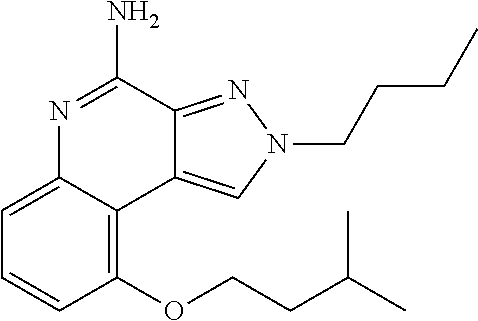
  • Some embodiments include optionally substituted 4-amino-2H-pyrazolo[3,4-c]quinolin-9-ol or a salt thereof; or optionally substituted 4-amino-2-isopentyl-2H-pyrazolo[3,4-c]quinolin-9-ol or a salt thereof; optionally substituted 2-isopentyl-9-(isopentyloxy)-2H-pyrazolo[3,4-c]quinolin-4-amine or a salt thereof; or optionally substituted 2-butyl-9-(isopentyloxy)-2H-pyrazolo[3,4-c]quinolin-4-amine or a salt thereof.
  • a 1 is CR 1 , NR 1A , or N;
  • a 2 is CR 2 , NR 2A , O, or S;
  • B 1 is CR 5 or N
  • B 2 is CR 6 or N
  • B 3 is CR 7 or N
  • R 3 and R 2 are independently F, Cl, Br, I, NO 2 , CN, R a , —OR a , —NR a R b , —NHCOR a , —NHSO 2 R a , —OCOR a , or —SO 2 R a ;
  • X is a bond, O, NR a , —CO—, —SO—, or —SO 2 —, —CONR a , hydrocarbyl, and R 3 is H or C 1-30 organyl; or X—R 3 is F or Cl;
  • R 1A , R 2A , R 4 , R a , and R b are independently H or C 1-30 organyl;
  • R 5 , R 6 , and R 7 are independently F, Cl, Br, I, NO 2 , CN, R a , —OR a , —NR a R b , —NHCOR a , —NHSO 2 R a , —OCOR a , —SO 2 R a , or —X 1 —(C m H 2m O 0-1 )—Z—(C n H 2n+1 ), —(C m H 2m O 0-1 )—Z—(C n H 2n+1 ), wherein R 5 and R 6 or R 6 and R 7 can be optionally linked to form a ring;
  • X 1 is a bond, O, NR a , —CO—, —SO—, or —SO 2 —;
  • Z is a bond, O, NHSO 2 , or NHCO;
  • n 0, 1, 2, 3, 4, 5, 6, 7, 8, 9, or 10;
  • n 1, 2, 3, 4, 5, 6, 7, 8, 9, 10, 11, 12, 13, 14, 15, 16, 17, 18, 19, 20, 21, 22, or 23.
  • R 3 is C 1-30 organyl.
  • R 3 is C 1-3 alkyl optionally substituted with 1 to 6 R 8A groups, wherein each R 8A group is independently OH, oxide, C 1-6 organyl, or —O—(C 1-6 organyl).
  • R 4 is H, C 1-30 non-aromatic organyl, or C 1-30 aromatic organyl containing an aromatic group that is not directly attached to the N atom.
  • R 1 or R 1A is —C r H 2r+1 O, or an ester thereof, wherein r is 1, 2, 3, 4, 5, 6, 7, 8, 9, or 10.
  • R 2 or R 2A is H or C 1-12 optionally substituted alkyl.
  • R 2 or R 2A is C 1-6 alkyl, or —C y H 2y+1 O or an ester thereof, wherein y is 1, 2, 3, 4, 5, 6, 7, 8, 9, or 10.
  • R 3 is C 1-10 alkyl, or —C w H 2w+1 O or an ester thereof, wherein w is 1, 2, 3, 4, 5, 6, 7, 8, 9, or 10.
  • R 3 is —(C t H 2t O 0 ⁇ 1 )-Ht, wherein t is 0, 1, 2, 3, 4, 5, 6, 7, 8, 9, or 10, and Ht is optionally substituted C 3-6 heterocyclyl.
  • R 3 is —(C u H 2u O 0-1 )—Z—(C v H 2v+1 ), wherein Z is a bond, O, NHSO 2 , or NHCO, u is 0, 1, 2, 3, 4, 5, or 6, and v is 1, 2, 3, 4, 5, 6, 7, 8, 9, 10, 11, 12, 13, 14, 15, 16, 17, 18, 19, 20, 21, 22, or 23.
  • R 5 is R a , F, Cl, —CO 2 R a , —CONR a R b , CN, —OR a , —NR a R b , —OCOR a , or —SO 2 R a , wherein R a and R b are independently H or C 1-6 alkyl.
  • R 5 is —(C m H 2m O 0-1 )—Z—(C n H 2n+1 ), wherein Z is a bond, O, NHSO 2 , or NHCO, m is 0, 1, 2, 3, 4, 5, 6, 7, 8, 9, or 10, and n is 1, 2, 3, 4, 5, 6, 7, 8, 9, 10, 11, 12, 13, 14, 15, 16, 17, 18, 19, 20, 21, 22, 23, 24 or 25.
  • R 6 is R a , F, Cl, —CO 2 R a , —CONR a R b , CN, —OR a , —NR a R b , —OCOR a , or —SO 2 R a , wherein R a and R b are independently H or C 1-6 alkyl.
  • R 6 is —(C m H 2m O 0-1 )—Z—(C n H 2n+1 ), wherein Z is a bond, O, NHSO 2 , or NHCO, m is 0, 1, 2, 3, 4, 5, 6, 7, 8, 9, or 10, and n is 1, 2, 3, 4, 5, 6, 7, 8, 9, 10, 11, 12, 13, 14, 15, 16, 17, 18, 19, 20, 21, 22, or 23.
  • R 7 is R a , F, Cl, —CO 2 R a , —CONR a R b , CN, —OR a , —NR a R b , —OCOR a , or —SO 2 R a , R a and R b are independently H or C 1-6 alkyl.
  • R 7 is —(C m H 2m O 0-1 )—Z—(C n H 2n+1 ), wherein Z is a bond, O, NHSO 2 , or NHCO, m is 0, 1, 2, 3, 4, 5, 6, 7, 8, 9, or 10, and n is 1, 2, 3, 4, 5, 6, 7, 8, 9, 10, 11, 12, 13, 14, 15, 16, 17, 18, 19, 20, 21, 22, or 23.
  • R 8 is H, OH, or CH 3 .
  • a compound which is:
  • the compound of embodiment 36 which is optionally substituted 1-(4-amino-2-(ethoxymethyl)-9-methoxy-1H-imidazo[4,5-c]quinolin-1-yl)-2-methylpropan-2-ol or a salt thereof; optionally substituted 2-(ethoxymethyl)-1-isobutyl-9-methoxy-1H-imidazo[4,5-c]quinolin-4-amine or a salt thereof; optionally substituted 1-(4-amino-9-methoxy-2-(2-methoxyethyl)-1H-imidazo[4,5-c]quinolin-1-yl)-2-methylpropan-2-ol or a salt thereof; optionally substituted 1-(4-amino-2-(2-hydroxyethyl)-9-methoxy-1H-imidazo[4,5-c]quinolin-1-yl)-2-methylpropan-2-ol or a salt thereof; optionally substituted 4-((4-amino-2-(ethoxymethyl)-1
  • the compound of embodiment 37 which is optionally substituted 4-amino-2H-pyrazolo[3,4-c]quinolin-9-ol or a salt thereof; optionally substituted 4-amino-2-isopentyl-2H-pyrazolo[3,4-c]quinolin-9-ol or a salt thereof; optionally substituted 2-isopentyl-9-(isopentyloxy)-2H-pyrazolo[3,4-c]quinolin-4-amine or a salt thereof; or optionally substituted 2-butyl-9-(isopentyloxy)-2H-pyrazolo[3,4-c]quinolin-4-amine or a salt thereof.
  • a method of treating viral infection, cancer, or an allergic disease comprising administering a compound according to embodiment 1, 2, 3, 4, 5, 6, 7, 8, 9, 10, 11, 12, 13, 14, 15, 16, 17, 18, 19, 20, 21, 22, 23, 24, 25, 26, 27, 28, 29, 30, 31, 32, 33, 34, 35, 36 37, 38, or 39, to a mammal in need thereof.
  • a dosage form suitable for administration to a mammal comprising a compound of embodiment 1, 2, 3, 4, 5, 6, 7, 8, 9, 10, 11, 12, 13, 14, 15, 16, 17, 18, 19, 20, 21, 22, 23, 24, 25, 26, 27, 28, 29, 30, 31, 32, 33, 34, 35, 36, 37, 38, or 39.
  • NMR spectra and 13 C-NMR were recorded on a Varian Mercury-VX400 instrument operating at 400 MHZ.
  • NMR spectra were obtained as CDCl 3 solutions (reported in ppm), using chloroform as the reference standard (7.27 ppm for the proton and 77.00 ppm for carbon), CD 3 OD (3.4 and 4.8 ppm for the protons and 49.3 ppm for carbon), DMSO-d 6 (2.49 ppm for proton), or internally tetramethylsilane (0.00 ppm) when appropriate.
  • Other NMR solvents were used as needed.
  • Step 3 Synthesis of 1-[2-(Ethoxymethyl)-9-methoxy-imidazo[4,5-c]quinolin-1-yl]-2-methyl-propan-2-ol
  • Step 4 Synthesis of 1-[2-(Ethoxymethyl)-9-methoxy-5-oxido-imidazo[4,5-c]quinolin-5-ium-1-yl]-2-methyl-propan-2-ol
  • Step 5 Synthesis of 1-[4-Amino-2-(ethoxymethyl)-9-methoxy-imidazo[4,5-c]quinolin-1-yl]-2-methyl-propan-2-ol
  • Step 4 Synthesis of 1-[[2-(Ethoxymethyl)-5-oxido-1H-imidazo[4,5-c]quinolin-5-ium-9-yl]oxy]propan-2-ol
  • Step 5 Synthesis of 1-[[4-Amino-2-(ethoxymethyl)-1H-imidazo[4,5-c]quinolin-9-yl]oxy]-propan-2-ol
  • Step 1 Synthesis of 4-[[2-(2-Methoxyethyl)-1H-imidazo[4,5-c]quinolin-9-yl]oxy]-2-methyl-butan-2-ol
  • Step 2 Synthesis of 4-[[2-(2-Methoxyethyl)-5-oxido-1H-imidazo[4,5-c]quinolin-5-ium-9-yl]oxy]-2-methyl-butan-2-ol
  • Step 3 Synthesis of 4-[[4-Amino-2-(2-methoxyethyl)-1H-imidazo[4,5-c]quinolin-9-yl]oxy]-2-methyl-butan-2-ol
  • Step 4 Synthesis of 4-[2-(ethoxymethyl)-1-methyl-imidazo[4,5-c]quinolin-9-yl]oxy-2-methyl-butan-2-ol
  • Step 5 Synthesis of 4-[2-(Ethoxymethyl)-1-methyl-5-oxido-imidazo[4,5-c]quinolin-5-ium-9-yl]oxy-2-methyl-butan-2-ol
  • Step 6 Synthesis of 4-[4-Amino-2-(ethoxymethyl)-1-methyl-imidazo[4,5-c]quinolin-9-yl]oxy-2-methyl-butan-2-ol
  • Step 3 Synthesis of 4-[2-(Ethoxymethyl)-1-isobutyl-imidazo[4,5-c]quinolin-9-yl]oxy-2-methyl-butan-2-ol
  • Step 4 Synthesis of 4-[2-(Ethoxymethyl)-1-isobutyl-5-oxido-imidazo[4,5-c]quinolin-5-ium-9-yl]oxy-2-methyl-butan-2-ol
  • Step 5 Synthesis of 4-[4-Amino-2-(ethoxymethyl)-1-isobutyl-imidazo[4,5-c]quinolin-9-yl]oxy-2-methyl-butan-2-ol
  • Step 2 Synthesis of N 4 -isobutyl-5-methoxy-quinoline-3,4-diamine
  • 3-Methoxypropanoyl chloride was prepared in the same way as intermediate 6 using the corresponding starting material of 3-methoxypropanoic acid in 84.9% yield as yellow oil.
  • Acetonyl 4-methylbenzenesulfonate was prepared in a similar way as intermediate 8 using the corresponding starting material of 1-hydroxypropan-2-one in 25.31% yield as a colorless oil.
  • the compound functionality was tested for some of the compounds prepared by stimulation and determination of cytokine production in PBMCs.
  • Human PBMCs were prepared from buffy coat obtained from healthy volunteer donor by Ficoll centrifugation and were adjusted to the final cell concentration to 1 ⁇ 10 6 cells/mL.
  • PBMCs were plated in a 96-well plate in 100 ⁇ l of RPMI 1640 complete medium (cat no. 31800-022, GIBCO by Life Technologies, Grand Island, N.Y., USA) supplemented with 10% fetal bovine serum, the tested compound was first dissolved in DMSO and further diluted in PBS and RPMI 1640 medium to the final concentration of 20 ⁇ M (corresponding to 6.28 ⁇ g/mL), then 3-fold serially dilution was made in a 96-well round-bottom plate. 100 ⁇ l diluted compound was added to the same volume of 1 ⁇ 10 5 PBMCs plate and cultured for 20-22 hours at 37° C.
  • RPMI 1640 complete medium catalog no. 31800-022, GIBCO by Life Technologies, Grand Island, N.Y., USA
  • Table 2 lists the testing results on the evaluation of cytokine production for most of the compounds prepared.

Landscapes

  • Health & Medical Sciences (AREA)
  • Chemical & Material Sciences (AREA)
  • Organic Chemistry (AREA)
  • Life Sciences & Earth Sciences (AREA)
  • Pharmacology & Pharmacy (AREA)
  • Veterinary Medicine (AREA)
  • Public Health (AREA)
  • General Health & Medical Sciences (AREA)
  • Animal Behavior & Ethology (AREA)
  • Medicinal Chemistry (AREA)
  • Chemical Kinetics & Catalysis (AREA)
  • General Chemical & Material Sciences (AREA)
  • Nuclear Medicine, Radiotherapy & Molecular Imaging (AREA)
  • Virology (AREA)
  • Oncology (AREA)
  • Communicable Diseases (AREA)
  • Engineering & Computer Science (AREA)
  • Bioinformatics & Cheminformatics (AREA)
  • Molecular Biology (AREA)
  • Pulmonology (AREA)
  • Immunology (AREA)
  • Rheumatology (AREA)
  • Pain & Pain Management (AREA)
  • Physical Education & Sports Medicine (AREA)
  • Epidemiology (AREA)
  • Pharmaceuticals Containing Other Organic And Inorganic Compounds (AREA)
  • Nitrogen And Oxygen Or Sulfur-Condensed Heterocyclic Ring Systems (AREA)
  • Nitrogen Condensed Heterocyclic Rings (AREA)
  • Acyclic And Carbocyclic Compounds In Medicinal Compositions (AREA)
  • Plural Heterocyclic Compounds (AREA)

Abstract

Described herein are 2-amino-quinoline derivatives that are agonists of toll-like receptors 7 and 8 (TLR7/8), pharmaceutical compositions, and methods of use of the compounds and compositions to treat various diseases, such as viral, cancer, and allergic diseases, in need thereof by administering a therapeutically effective amount of a 2-amino-quinoline derivative.

Description

CROSS-REFERENCE TO RELATED APPLICATIONS
This application is a 35 U.S.C. 371 national phase entry of PCT/CN2018/084674, filed Apr. 26, 2018, which claims the benefit of, and priority to, Chinese Patent Application Serial No. 201710287322.2, filed Apr. 27, 2017, the entire disclosures of which are hereby incorporated by reference in their entireties.
FIELD OF THE INVENTION
The present invention relates to 2-amino-quinoline derivatives, such as imidazoquinoline and pyrazoloquinoline analogs as agonists of toll-like receptors 7 and 8 (TLR7 and TLR8), as well as pharmaceutical compositions comprising the same. The present invention also relates to the use of the compounds, compositions, and the method of activating TLR7 and TLR8 in treating various diseases.
BACKGROUND OF THE INVENTION
The TLR family plays a fundamental role in pathogen recognition and activation of innate immunity. TLR7 and TLR8 are toll-like receptors 7 and 8 respectively, and they lie in close proximity to each other on the human X chromosome. Both TLR7 and TLR8 recognize single-stranded RNA of viruses such as HIV and HCV. TLR7 has been shown to play a significant role in the pathogenesis of autoimmune disorders such as Systemic Lupus Erythematosus (SLE) as well as in the regulation of antiviral immunity. Genetic variants in TLR8 have recently been linked to susceptibility to pulmonary tuberculosis. TLR7 is functional both in human and mouse, while TLR8 is only functional in human, but it seems to counteract TLR7 activity. The major benefit of TLR7/8 agonists as immune response enhancers is their simultaneous stimulation of several cell types. TLR7 and TLR8 are expressed mostly on immune cells such as antigen presenting cells, including plasmacytoid dendritic cells (pDC) and myeloid dendritic cells (mDC), as well as natural killer cells, and macrophages. Activation of TLR7/8 on pDCs and mDCs results in the induction and release of type I interferons (IFN), tumor necrosis factor alpha (TNFα), and interleukin 12 (IL-12), which is an important step for the initiation of innate and adaptive immunities to kill cancer cells. For these reasons, TLR7 and TLR8 have become interesting targets in both antiviral and cancer therapy. There is also a growing interest in the targeting of toll-like receptors, such as TLR7/8 for the treatment of allergic diseases.
Small molecule agonists at TLR7 and TLR8 have increased interest in both antiviral and cancer research own to their profound antiviral and antitumor activity. The lead compound of the imidazoquinoline family, imiquimod, is efficacious against many primary skin tumors and cutaneous metastases and is marketed as a topical formulation. Resiquimod (R-848), from the same imidazoquinoline family, is a low molecular weight synthetic molecule that activates immune cells via the TLR7/TLR8 MyD88-dependent signaling pathway. It acts as an immune response modifier and has antiviral and antitumor activity. It has several mechanisms of action, being both an agonist for toll-like receptors 7 and 8, and an upregulator of the opioid growth factor receptor. R-848 is used as a topical gel in the treatment of skin lesions such as those caused by the herpes simplex virus and cutaneous T cell lymphoma, as an adjuvant to increase the effectiveness of vaccines, and as an adjuvant to immunotherapy in allergic rhinitis (AR) patient. Therefore, in addition to their use as stand-alone immunotherapeutic agent, TLR7/8 agonists hold promise as adjuvants in cancer vaccine or adoptive T cell transfer protocols. Extension of the families of the known synthetic TLR7/8 agonists, such as described above, pave the way to the development and identification of TLR7/8 agonists that are well tolerated, more selective with potent antitumor and antiviral activity, broadly applicable, and more effective as adjuvants.
SUMMARY OF THE INVENTION
Described herein are 2-amino-quinoline derivatives, pharmaceutically acceptable salts, solvates, prodrug and active metabolites, that are agonists of toll-like receptors 7 and 8 (TLR7/8). These compounds may be used to treat viral infection, such as HCV, cancer, and allergic diseases in need thereof by administering a therapeutically effective amount of a 2-amino-quinoline derivative.
Some embodiments include a compound represented by Formula 1:
Figure US11053240-20210706-C00001

wherein a dashed line represents the presence or absence of a bond; A1 is CR1, NR1A, or N; A2 is CR2, NR2A, O, or S; B1 is CR5 or N; B2 is CR6 or N; B3 is CR7 or N; R1 and R2 are independently F, Cl, Br, I, NO2, CN, Ra, —ORa, —NRaRb, —NHCORa, —NHSO2Ra, —OCORa, or —SO2Ra; X is a bond, O, NRa, —CO—, —SO—, or —SO2—, —CONRa, hydrocarbyl, and R3 is H or C1-30 organyl; or X—R3 is F or Cl; R1A, R2A, R4, Ra, and Rb are independently H or C1-30 organyl; R5, R6, and R7 are independently F, Cl, Br, I, NO2, CN, Ra, —ORa, —NRaRb, —NHCORa, —NHSO2Ra, —OCORa, —SO2Ra, —SO2NHRa, or —X1—(CmH2mO0-1)—Z—(CnH2n+1), —(CmH2mO0-1)—Z—(CnH2n+1), wherein R5 and R6 or R6 and R7 can be optionally linked to form a ring; wherein X1 is a bond, O, NRa, —CO—, —SO—, or —SO2—; Z is a bond, O, NHSO2, or NHCO; m is 0, 1, 2, 3, 4, 5, 6, 7, 8, 9, or 10; and n is 1, 2, 3, 4, 5, 6, 7, 8, 9, 10, 11, 12, 13, 14, 15, 16, 17, 18, 19, 20, 21, 22, or 23.
Some embodiments include a pharmaceutical dosage form comprising a subject compound. A subject compound or a subject composition may be used for activating TLR7/8. In addition to its use as a stand-alone immunotherapeutic agent, such as an antiviral and anticancer agent, a subject compound or composition may be used as adjuvants in cancer vaccine or adoptive T cell transfer protocols.
Some embodiments include a method of treating a disease or disorder associated with a TLR7/8 agonist comprising administering an effective amount of a subject compound to a mammal in need thereof.
Some embodiments include use of a subject compound in the manufacture of a medicament for the treatment of a disease or disorder associated with a TLR7/8 agonist.
DETAILED DESCRIPTION OF THE INVENTION
Unless otherwise indicated, when a compound or chemical structural feature, such as alkyl, alkenyl, alkynyl, aryl, heteroaryl, etc., is referred to as being “optionally substituted,” it includes a feature that has no substituents (i.e. unsubstituted), or a feature that is “substituted,” meaning that the feature has one or more substituents. The term “substituent” has the broadest meaning known to one of ordinary skill in the art, and includes a moiety that occupies a position normally occupied by one or more hydrogen atoms attached to a parent compound or structural feature. In some embodiments, a substituent may be an ordinary organic moiety known in the art, which may have a molecular weight (e.g. the sum of the atomic masses of the atoms of the substituent) of 15-50 g/mol, 15-100 g/mol, 15-150 g/mol, 15-200 g/mol, 15-300 g/mol, or 15-500 g/mol. In some embodiments, a substituent comprises, or consists of: 0-30, 0-20, 0-10, or 0-5 carbon atoms; and 0-30, 0-20, 0-10, or 0-5 heteroatoms, wherein each heteroatom may independently be: N, O, S, Si, F, Cl, Br, or I; provided that the substituent includes one C, N, O, S, Si, F, Cl, Br, or I atom. Examples of substituents include, but are not limited to, alkyl, alkenyl, alkynyl, heteroalkyl, aryl, heteroaryl, hydroxy, alkoxy, aryloxy, acyl, acyloxy, alkylcarboxylate, thiol, alkylthio, cyano, halo, thiocarbonyl, O-carbamyl, N-carbamyl, O-thiocarbamyl, N-thiocarbamyl, C-amido, N-amido, S-sulfonamido, N-sulfonamido, isocyanato, thiocyanato, isothiocyanato, nitro, silyl, sulfenyl, sulfinyl, sulfonyl, haloalkyl, haloalkoxyl, trihalomethanesulfonyl, trihalomethanesulfonamido, amino, etc.
For convenience, the term “molecular weight” is used with respect to a moiety or part of a molecule to indicate the sum of the atomic masses of the atoms in the moiety or part of a molecule, even though it may not be a complete molecule.
As used herein, the term “alkyl” has the broadest meaning generally understood in the art and may include a moiety composed of carbon and hydrogen containing no double or triple bonds. Alkyl may be linear alkyl, branched alkyl, cycloalkyl, or a combination thereof and in some embodiments, may contain from one to thirty-five carbon atoms. In some embodiments, alkyl may include C1-10 linear alkyl, such as methyl (—CH3), methylene (—CH2—), ethyl (—CH2CH3), ethylene (—C2H4—), propylene (—C3CH6—), n-butyl (—CH2CH2CH2CH3), n-pentyl (—CH2CH2CH2CH2CH3), n-hexyl (—CH2CH2CH2CH2CH2CH3), etc.; C3-10 branched alkyl, such as C3H7 (e.g. iso-propyl), C4H9 (e.g. branched butyl isomers), C5H11 (e.g. branched pentyl isomers), C6H13 (e.g. branched hexyl isomers), C7H15 (e.g. heptyl isomers), etc.; C3-10 cycloalkyl, such as C3H5 (e.g. cyclopropyl), C4H7 (e.g. cyclobutyl isomers such as cyclobutyl, methylcyclopropyl, etc.), C5H9 (e.g. cyclopentyl isomers such as cyclopentyl, methylcyclobutyl, dimethylcyclopropyl, etc.) C6H11 (e.g. cyclohexyl isomers), C7H13 (e.g. cycloheptyl isomers), etc.; and the like.
As used herein the term “aryl” includes a group that can be derived from a monocyclic and polycyclic aromatic hydrocarbon by removal of a hydrogen atom from a ring carbon atom. The “aryl” may include an aromatic ring or aromatic ring system such as phenyl, naphthyl, etc.
The term “heteroaryl” has the broadest meaning understood by a person of ordinary skill in the art and includes an “aryl” which has one or more heteroatoms in the ring or ring system, such as pyridinyl, furyl, thienyl, oxazolyl, thiazolyl, imidazolyl, triazolyl, oxadiazolyl, isoxazolyl, indolyl, quinolinyl, benzofuranyl, benzothienyl, benzooxazolyl, benzothiazolyl, benzoimidazolyl, etc.
Unless otherwise indicated, any reference to a compound herein by structure, name, or any other means includes pharmaceutically acceptable salts, such as HCl, HBr, HI, H2SO4, acetate, citrate, phosphate, sodium, potassium, and ammonium salts; prodrugs, such as ester prodrugs; alternate solid forms, such as polymorphs, solvates, hydrates, etc.; tautomers; or any other chemical species that may rapidly convert to a compound described herein under conditions in which the compounds are used as described.
If stereochemistry is not indicated, a name or structural representation includes any stereoisomer or any mixture of stereoisomers.
For the purposes of this disclosure, “treat,” “treating,” or “treatment” includes use of a compound, composition, therapeutically active agent, or drug in the diagnosis, cure, mitigation, treatment, or prevention of disease or other undesirable condition.
With respect to any relevant structural representation, such as Formula 1, a dashed line represents the presence or absence of a bond. For example, compounds represented by Formulas 1A and 1B are included.
Figure US11053240-20210706-C00002
With respect to any relevant structural representation, such as Formula 1, 1A, or 1B, A1 is CR1, NR1A, or N. In some embodiments, A1 is CR1. In some embodiments, A1 is NR1A. In some embodiment, A1 is N.
With respect to any relevant structural representation, such as Formula 1, 1A, or 1B A2 is CR2, NR2A, O, or S. In some embodiments, A2 is CR2. In some embodiments, A2 is NR2A. In some embodiments, A2 is O. In some embodiments, A2 is S.
With respect to any relevant structural representation, such as Formula 1, 1A, or 1B, X is a bond, O, NRa, —C(═O)—, —S(═O)—, —S(═O)2—, —CONRa, hydrocarbyl, and R3 is H or C1-30 organyl; or X—R3 is F or Cl. In some embodiments, X is a bond. In some embodiments, X is O. In some embodiments, X is NRa. In some embodiments, X is —C(═O)—. In some embodiments, X is —S(═O)—. In some embodiments, X is —S(═O)2—. In some embodiments, X—R3 is F. In some embodiment, X—R3 is Cl.
With respect to any relevant structural representation, such as Ra, NRa, —ORa, —OCORa, or —SO2Ra, —NRaRb, in such as Formula 1, 1A or 1B, Ra or Rb is independently H or organyl, such as C1-30 organyl, including any organic substituent group, regardless of functional type, having a free valence at a carbon, such as optionally substituted alkyl, e.g. optionally substituted C1-30, C1-12, C1-6, or C1-3 alkyl, including methyl, ethyl, C3 alkyl, C4 alkyl, C5 alkyl, C6 alkyl, C7 alkyl, C8 alkyl, C9 alkyl, C10 alkyl, C11 alkyl, C12 alkyl, C13 alkyl, C14 alkyl, C15 alkyl, C16 alkyl, C17 alkyl, C18 alkyl, C19 alkyl, C20 alkyl, C21 alkyl, C22 alkyl, C23 alkyl, C24 alkyl, C25 alkyl, C26 alkyl, C27 alkyl, C28 alkyl, C29 alkyl, C30 alkyl, C3 cycloalkyl, C4 cycloalkyl, C5 cycloalkyl, C6 cycloalkyl, C7 cycloalkyl, C8 cycloalkyl, C9 cycloalkyl, C10 cycloalkyl, C11 cycloalkyl, C12 cycloalkyl, etc.; optionally substituted alkenyl, e.g. optionally substituted C2-12 or C2-6, alkenyl, including ethenyl, C3 alkenyl, C4 alkenyl, C5 alkenyl, C6 alkenyl, C7 alkenyl, C8 alkenyl, C9 alkenyl, C10 alkenyl, C11 alkenyl, C12 alkenyl, C4 cycloalkenyl, C5 cycloalkenyl, C6 cycloalkenyl, C7 cycloalkenyl, C8 cycloalkenyl, C9 cycloalkenyl, C10 cycloalkenyl, C11 cycloalkenyl, C12 cycloalkenyl, etc.; optionally substituted alkynyl, e.g. optionally substituted C2-12 or C2-6 alkynyl, including ethynyl, C3 alkynyl, C4 alkynyl, C5 alkynyl, C6 alkynyl, C7 alkynyl, C8 alkynyl, C9 alkynyl, C10 alkynyl, C11 alkynyl, C12 alkynyl, C5 cycloalkynyl, C6 cycloalkynyl, C7 cycloalkynyl, C8 cycloalkynyl, C9 cycloalkynyl, C10 cycloalkynyl, C11 cycloalkynyl, C12 cycloalkynyl, etc.; optionally substituted aryl, such as optionally substituted phenyl, optionally substituted naphthyl, etc.; optionally substituted heterocyclyl, optionally substituted heteroaryl, etc.; organyl also includes CN, —C(O)Ra, —C(O)ORa, —C(O)NHRa, —C(O)NRaRb, —C(O)—Z-organyl, wherein Z is a bond, O, S, or NRaRb, —C(RaRb)—ORa, —C(RaRb)—NRaRb. In some embodiments, Ra or Rb is independently H or C1-30 hydrocarbyl, such as alkyl, alkenyl, alkynyl, or phenyl. In some embodiments, C1-30 organyl can be substituted by halogen, hydroxyl, amines, alkoxyl, aryl, heteroaryl, sulfone, sulfonamide, carboxylic acid, amide, reversed amide, ester, cycloalkyl, heterocycloalkyl, carbonyl, alkyl, alkenyl, alkynyl, phosphonamidic acid, phosphinic amide, or phosphine oxide.
Some embodiments include a compound of Formula 2 or Formula 2A.
Figure US11053240-20210706-C00003
With respect to any relevant structural representation, such as Formula 1, 1A, 1B, 2, or 2A, B1 is CR5 or N. In some embodiments, B1 is CR5. In some embodiments, B1 is N.
With respect to any relevant structural representation, such as Formula 1, 1A, 1B, 2, or 2A, B2 is CR6 or N. In some embodiments, B2 is CR6. In some embodiments, B2 is N.
With respect to any relevant structural representation, such as Formula 1, 1A, 1B, 2, or 2A, B3 is CR7 or N. In some embodiments, B3 is CR7. In some embodiments, B3 is N.
Some embodiments include a compound of Formula 3A, 3B, 3C, 3D, 3E, 4, 5, 6, 7, 8, 9, 10, 11, 12, or 13.
Figure US11053240-20210706-C00004
Figure US11053240-20210706-C00005
Figure US11053240-20210706-C00006
With respect to any relevant structural representation, such as Formula 1, 1A, 1B, 2, 2A, 3A, 3B, 3C, 3D, 3E, 4, 5, 6, 7, 8, 9, 10, 11, 12, or 13, R1 or R1A is independently H or any substituent, such as F, Cl, Br, I, NO2, CN, Ra, —ORa, —NRaRb, —NHCORa, —NHSO2Ra, —OCORa, or —SO2Ra. In some embodiments, R1 or R1A is CrH2r+1O, wherein r is 1, 2, 3, 4, 5, 6, 7, 8, 9, or 10, including C2H5O, such as —(CH2)2OH; C3H7O, such as —CH2OCH2CH3, —(CH2)2OCH3, etc.; C1-12 alkyl, such as —(CH2)3CH3, —CH2CH2CH(CH3)2.
In some embodiments, R1 or R1A is —(CH2)2OH. In some embodiments, R1 or R1A is —CH2OCH2CH3. In some embodiments, R1 or R1A is —(CH2)2OCH3. In some embodiments, R1 or R1A is —(CH2)3CH3. In some embodiments, R1 or R1A is —CH2CH2CH(CH3)2.
With respect to any relevant structural representation, such as Formula 1, 1A, 1B, 2, 2A, 3A, 3B, 4, 5, 6, 7, 8, 9, or 10, R2 or R2A is independently H or any substituent, such as —CH3, —CH2CH(CH3)2, —CH2C(CH3)2R8, —CH2CH2C(CH3)2R8, —C4H9O, —CH2CH2OCH(CH3)2.
In some embodiments, R2 or R2A is H. In some embodiments, R2 or R2A is CH3. In some embodiments, R2 or R2A is —CH2CH(CH3)2. In some embodiments, R2 or R2A is —CH2C(CH3)2R8. In some embodiments, R2 or R2A is —CH2C(CH3)2OH. In some embodiments, R2 or R2A is —CH2CH2C(CH3)2OH. In some embodiments, R2 or R2A is —CH2CH2OCH(CH3)2.
With respect to any relevant structural representation, such as Formula 1, 1A, 1B, 2, 2A, 3A, 3B, 3C, 3D, 4, 5, 6, 7, 8, 9, or 10, R3 is any substituent, such as CH1-30 optionally substituted alkyl, —CwH2w+1O or an ester thereof, wherein w is 0, 1, 2, 3, 4, 5, 6, 7, 8, 9, or 10; —(CuH2uO0-1)—Z—(CvH2v+1), wherein Z is a bond, O, NHSO2, or NHCO, u is 0, 1, 2, 3, 4, 5, 6, 7, 8, 9, or 10, and v is 1, 2, 3, 4, 5, 6, 7, 8, 9, 10, 11, 12, 13, 14, 15, 16, 17, 18, 19, 20, 21, 22, 23, or 24; or —(CtH2tO0−1)-Ht, wherein t is 0, 1, 2, 3, 4, 5, 6, 7, 8, 9, 10, 11, 12, 13, 14, 15, 16, 17, 18, 19, or 20, and Ht is optionally substituted C3-10 heterocyclyl.
In some embodiments, R3 is H. In some embodiment, R3 is CH3. In some embodiments, R3 is —CH2CH(CH3)2. In some embodiments, R3 is —(CH2)2CH(CH3)2. In some embodiments, R3 is —CH2CH(OH)CH3. In some embodiments, R3 is —(CH2)2CH(OH)CH3. In some embodiments, R3 is —(CH2)2C(CH3)2OH. In some embodiments, R3 is (CH2)2OCH(CH3)2, —(CH2)3NHSO2CH3, —(CH2)4NHSO2CH3, —(CH2)2O(CH2)2NHSO2CH3, —(CH2)3NHCOCH17H35, —(CH2)3NHCOCH3, —(CH2)4NHCOCH3, —(CH2)4NHCOC17H35, —(CH2)3NH2,
Figure US11053240-20210706-C00007
With respect to any relevant structural representation, such as Formula 3E, R3 is C1-3 alkyl optionally substituted with 1 to 6 of R8A, same or different, wherein R8A is OH, oxide, C1-6 organyl, or —O—(C1-6 organyl).
With respect to any relevant structural representation, such as Formula 1, 1A, 1B, 2, 2A, 3A, 3B, 3C, 3D, 3E, 4, 5, 6, 7, 8, 9, 10, 11, 12, or 13, R4 is H or any substituent, such as hydrocarbyl.
In some embodiments, R4 is H.
With respect to any relevant structural representation, such as Formula 1, 1A, 1B, 2, 2A, 3A, 3B, 3C, 3D, 3E, 4, 5, 6, 7, 8, 9, 10, 11, 12, or 13, R5 is H or any substituent, such as F, Cl, Ra, —CO2Ra, —CONRaRb, CN, —ORa, —NRaRb, —NHCORa, —NHSO2Ra, —OCORa, or —SO2Ra, wherein Ra and Rb are independently H or C1-30 organyl. In some embodiments, R5 is —(CmH2mO0-1)—Z—(CnH2n+1), wherein Z is a bond, O, —NHSO2, or —NHCO, m is 0, 1, 2, 3, 4, 5, 6, 7, 8, 9, or 10, and n is 1, 2, 3, 4, 5, 6, 7, 8, 9, 10, 11, 12, 13, 14, 15, 16, 17, 18, 19, 20, 21, 22, 23, or 24. In some embodiments, R5 is H.
With respect to any relevant structural representation, such as Formula 1, 1A, 1B, 2, 2A, 3A, 3B, 3C, 3D, 3E, 4, 5, 6, 7, 8, 9, 10, 11, 12, or 13, R6 is H or any substituent, such as F, Cl, Ra, —CO2Ra, —CONRaRb, CN, —ORa, —NRaRb, —NHCORa, —NHSO2Ra, —OCORa, or —SO2Ra, wherein Ra and Rb are independently H or C1-30 organyl. In some embodiment, R6 is —(CmH2mO0-1)—Z—(CnH2n+1), wherein Z is a bond, O, —NHSO2, or —NHCO, m is 0, 1, 2, 3, 4, 5, 6, 7, 8, 9, or 10, and n is 1, 2, 3, 4, 5, 6, 7, 8, 9, 10, 11, 12, 13, 14, 15, 16, 17, 18, 19, 20, 21, 22, 23, or 24. In some embodiments, R6 is H.
With respect to any relevant structural representation, such as Formula 1, 1A, 1B, 2, 2A, 3A, 3B, 3C, 3D, 3E, 4, 5, 6, 7, 8, 9, 10, 11, 12, or 13, R7 is H or any substituent, such as F, Cl, Ra, —CO2Ra, —CONRaRb, CN, —ORa, —NRaRb, —NHCORa, —NHSO2Ra, —OCORa, or —SO2Ra, wherein Ra and Rb are independently H or C1-30 organyl. In some embodiment, R7 is —(CmH2mO0-1)—Z—(CnH2n+1), wherein Z is a bond, O, —NHSO2, or —NHCO, m is 0, 1, 2, 3, 4, 5, 6, 7, 8, 9, or 10, and n is 1, 2, 3, 4, 5, 6, 7, 8, 9, 10, 11, 12, 13, 14, 15, 16, 17, 18, 19, 20, 21, 22, 23, or 24. In some embodiments, R7 is H.
With respect to any relevant structural representation, such as Formula 4, 5, 6, 7, 8, 9, or 10, R8 is H, OH or C1-6 alkyl. In some embodiments, R8 is H. In some embodiments, R8 is OH. In some embodiment, R8 is CH3.
With respect to any relevant structural representation, such as Formula 3E, R8A is OH, oxide, C1-6 organyl, or —O—(C1-6 organyl). 1 to 6, same or different R8A can be attached at any ring C-atom. In some embodiments, R8A is OH. In some embodiments, R8A is CH3. In some embodiments, two different R8A, such as CH3 and OH, are attached to a same ring C-atom. In some embodiments, R8A is —C(CH3)2OH.
With respect to any relevant structural representation, such as Formula 1, 1A, 1B, 2, 2A, 3A, 3B, 3C, 3D, 4, 5, 6, 7, 8, 9, or 10, in some embodiment, R3 and R4 are independently H or C1-12 organyl; R1, R2, R5, R6, and R7 are independently F, Cl, Br, I, NO2, CN, —ORa, —NRaRb, —OCORa, or —SO2Ra; R1A and R2A are Ra; Ra and Rb are independently H or C1-12 organyl; and R8 is H or OH. In some embodiment, R5 and R6 or R6 and R7 can be optionally linked to form a saturated or an unsaturated ring.
Some embodiments include optionally substituted 9-methoxy-1H-imidazo[4,5-c]quinolin-4-amine or a salt thereof.
Some embodiments include optionally substituted 1-(4-amino-2-(ethoxymethyl)-9-methoxy-1H-imidazo[4,5-c]quinolin-1-yl)-2-methylpropan-2-ol or a salt thereof; optionally substituted 2-(ethoxymethyl)-1-isobutyl-9-methoxy-1H-imidazo[4,5-c]quinolin-4-amine or a salt thereof; optionally substituted 1-(4-amino-9-methoxy-2-(2-methoxyethyl)-1H-imidazo[4,5-c]quinolin-1-yl)-2-methylpropan-2-ol or a salt thereof; optionally substituted 1-(4-amino-2-(2-hydroxyethyl)-9-methoxy-1H-imidazo[4,5-c]quinolin-1-yl)-2-methylpropan-2-ol or a salt thereof; optionally substituted 4-((4-amino-2-(ethoxymethyl)-1H-imidazo[4,5-c]quinolin-9-yl)oxy)-2-methylbutan-2-ol or a salt thereof; optionally substituted 2-(ethoxymethyl)-9-(isopentyloxy)-1H-imidazo[4,5-c]quinolin-4-amine or a salt thereof; optionally substituted 4-((4-amino-2-(ethoxymethyl)-1H-imidazo[4,5-c]quinolin-9-yl)oxy)butan-2-ol or a salt thereof; optionally substituted 1-((4-amino-2-(ethoxymethyl)-1H-imidazo[4,5-c]quinolin-9-yl)oxy)propan-2-ol or a salt thereof; optionally substituted 4-((4-amino-2-(2-methoxyethyl)-1H-imidazo[4,5-c]quinolin-9-yl)oxy)-2-methylbutan-2-ol or a salt thereof; optionally substituted 4-((4-amino-2-(ethoxymethyl)-1-methyl-1H-imidazo[4,5-c]quinolin-9-yl)oxy)-2-methylbutan-2-ol or a salt thereof; optionally substituted 2-(ethoxymethyl)-9-(2-isopropoxyethoxy)-1H-imidazo[4,5-c]quinolin-4-amine or a salt thereof; or optionally substituted 4-((4-amino-2-(ethoxymethyl)-1-isobutyl-1H-imidazo[4,5-c]quinolin-9-yl)oxy)-2-methylbutan-2-ol or a salt thereof; optionally substituted 2-(ethoxymethyl)-1-(2-isopropoxyethyl)-9-methoxy-1H-imidazo[4,5-c]quinolin-4-amine or a salt thereof; optionally substituted 4-(4-amino-2-(ethoxymethyl)-9-methoxy-1H-imidazo[4,5-c]quinolin-1-yl)-2-methylbutan-2-ol or a salt thereof; optionally substituted 2-(ethoxymethyl)-9-isobutoxy-1H-imidazo[4,5-c]quinolin-4-amine or a salt thereof; optionally substituted 2-(ethoxymethyl)-9-(2-isopropoxyethoxy)-1-methyl-1H-imidazo[4,5-c]quinolin-4-amine or a salt thereof; optionally substituted 2-(ethoxymethyl)-9-(isopentyloxy)-1-methyl-1H-imidazo[4,5-c]quinolin-4-amine or a salt thereof; optionally substituted 2-(ethoxymethyl)-9-isobutoxy-1-methyl-1H-imidazo[4,5-c]quinolin-4-amine or a salt thereof; optionally substituted N-(3-((4-amino-2-(ethoxymethyl)-1-methyl-1H-imidazo[4,5-c]quinolin-9-yl)oxy)propyl)methanesulfonamide or a salt thereof; optionally substituted N-(2-(2-((4-amino-2-(ethoxymethyl)-1-methyl-1H-imidazo[4,5-c]quinolin-9-yl)oxy)ethoxy)ethyl)-methanesulfonamide or a salt thereof; optionally substituted N-(3-((4-amino-2-(ethoxymethyl)-1-methyl-1H-imidazo[4,5-c]quinolin-9-yl)oxy)propyl)acetamide or a salt thereof; optionally substituted N-(4-((4-amino-2-(ethoxymethyl)-1-methyl-1H-imidazo[4,5-c]quinolin-9-yl)oxy)butyl)methanesulfonamide or a salt thereof; optionally substituted N-(3-((4-amino-2-(ethoxymethyl)-1-methyl-1H-imidazo[4,5-c]quinolin-9-yl)oxy)propyl)stearamide or a salt thereof; optionally substituted N-(4-((4-amino-2-(ethoxymethyl)-1-methyl-1H-imidazo[4,5-c]quinolin-9-yl)oxy)butyl)acetamide or a salt thereof; optionally substituted N-(4-((4-amino-2-(ethoxymethyl)-1-methyl-1H-imidazo[4,5-c]quinolin-9-yl)oxy)butyl)-stearamide or a salt thereof; optionally substituted 2-(ethoxymethyl)-1-methyl-9-(2-morpholinoethoxy)-1H-imidazo[4,5-c]quinolin-4-amine or a salt thereof; optionally substituted 2-(ethoxymethyl)-1-methyl-9-((tetrahydrofuran-3-yl)oxy)-1H-imidazo[4,5-c]quinolin-4-amine or a salt thereof; optionally substituted 2-(ethoxymethyl)-1-methyl-9-(pyrrolidin-3-yloxy)-1H-imidazo[4,5-c]quinolin-4-amine or a salt thereof; optionally substituted 2-(ethoxymethyl)-1-methyl-9-(piperidin-4-yloxy)-1H-imidazo[4,5-c]quinolin-4-amine or a salt thereof; optionally substituted N-(3-((4-amino-2-(ethoxymethyl)-1-methyl-1H-imidazo[4,5-c]quinolin-9-yl)oxy)propyl)palmitamide or a salt thereof; optionally substituted N-(4-((4-amino-2-(ethoxymethyl)-1-methyl-1H-imidazo[4,5-c]quinolin-9-yl)oxy)butyl)palmitamide or a salt thereof; optionally substituted 9-(3-aminopropoxy)-2-(ethoxymethyl)-1-methyl-1H-imidazo[4,5-c]quinolin-4-amine or a salt thereof; optionally substituted 2-(ethoxymethyl)-9-isopropoxy-1-methyl-1H-imidazo[4,5-c]quinolin-4-amine or a salt thereof; optionally substituted 1-((4-amino-2-(ethoxymethyl)-1-methyl-1H-imidazo[4,5-c]quinolin-9-yl)oxy)-2-methylpropan-2-ol or a salt thereof; optionally substituted 2-(ethoxymethyl)-3,4-dihydro-5-oxa-1,2a,9-triazanaphtho[2,1,8-cde]azulen-10-amine or a salt thereof; optionally substituted (R)-2-(10-amino-2-(ethoxymethyl)-3,4-dihydro-5-oxa-1,2a,9-triazanaphtho[2,1,8-cde]azulen-3-yl)propan-2-ol or a salt thereof; optionally substituted (S)-2-(10-amino-2-(ethoxymethyl)-3,4-dihydro-5-oxa-1,2a,9-triazanaphtho[2,1,8-cde]azulen-3-yl)propan-2-ol or a salt thereof; optionally substituted (S)-2-amino-12-(ethoxymethyl)-6-methyl-6,7-dihydro-5H-3,4-(azenometheno)[1,5]oxazocino[4,3,2-de]quinolin-6-ol or a salt thereof; optionally substituted (R)-2-amino-12-(ethoxymethyl)-6-methyl-6,7-dihydro-5H-3,4-(azenometheno)[1,5]oxazocino[4,3,2-de]quinolin-6-ol or a salt thereof; optionally substituted (R)-2-amino-12-(ethoxymethyl)-6,7-dihydro-5H-3,4-(azenometheno)[1,5]oxazocino[4,3,2-de]quinolin-6-ol or a salt thereof; optionally substituted (S)-2-amino-12-(ethoxymethyl)-6,7-dihydro-5H-3,4-(azenometheno)[1,5]oxazocino-[4,3,2-de]quinolin-6-ol or a salt thereof; optionally substituted 2-amino-12-(ethoxymethyl)-5H-3,4-(azenometheno)[1,5]oxazocino[4,3,2-de]quinolin-6(7H)-one or a salt thereof; or optionally substituted tert-butyl 4-((4-amino-2-(ethoxymethyl)-1-methyl-1H-imidazo[4,5-c]quinolin-9-yl)oxy)piperidine-1-carboxylate or a salt thereof.
TABLE 3
Compound Name Structure
9-methoxy-1H-imidazo[4,5-c]quinolin-4-amine
Figure US11053240-20210706-C00008
1-(4-amino-2-(ethoxymethyl)-9-methoxy-1H- imidazo[4,5-c]quinolin-1-yl)-2-methylpropan-2-ol
Figure US11053240-20210706-C00009
2-(ethoxymethyl)-1-isobutyl-9-methoxy-1H- imidazo[4,5-c]quinolin-4-amine
Figure US11053240-20210706-C00010
1-(4-amino-9-methoxy-2-(2-methoxyethyl)-1H- imidazo[4,5-c]quinolin-1-yl)-2-methylpropan-2-ol
Figure US11053240-20210706-C00011
1-(4-amino-2-(2-hydroxyethyl)-9-methoxy-1H- imidazo[4,5-c]quinolin-1-yl)-2-methylpropan-2-ol
Figure US11053240-20210706-C00012
4-((4-amino-2-(ethoxymethyl)-1H-imidazo[4,5- c]quinolin-9-yl)oxy)-2-methylbutan-2-ol
Figure US11053240-20210706-C00013
2-(ethoxymethyl)-9-(isopentyloxy)-1H- imidazo[4,5-c]quinolin-4-amine
Figure US11053240-20210706-C00014
4-((4-amino-2-(ethoxymethyl)-1H-imidazo[4,5- c]quinolin-9-yl)oxy)butan-2-ol
Figure US11053240-20210706-C00015
1-((4-amino-2-(ethoxymethyl)-1H-imidazo[4,5- c]quinolin-9-yl)oxy)propan-2-ol
Figure US11053240-20210706-C00016
4-((4-amino-2-(2-methoxyethyl)-1H-imidazo[4,5- c]quinolin-9-yl)oxy)-2-methylbutan-2-ol
Figure US11053240-20210706-C00017
4-((4-amino-2-(ethoxymethyl)-1-methyl-1H- imidazo[4,5-c]quinolin-9-yl)oxy)-2-methylbutan- 2-ol
Figure US11053240-20210706-C00018
2-(ethoxymethyl)-9-(2-isopropoxyethoxy)- 1H-imidazo[4,5-c]quinolin-4-amine
Figure US11053240-20210706-C00019
4-((4-amino-2-(ethoxymethyl)-1-isobutyl-1H- imidazo[4,5-c]quinolin-9-yl)oxy)-2-methylbutan- 2-ol
Figure US11053240-20210706-C00020
2-(ethoxymethyl)-1-(2-isopropoxyethyl)-9- methoxy-1H-imidazo[4,5-c]quinolin-4-amine
Figure US11053240-20210706-C00021
4-(4-amino-2-(ethoxymethyl)-9-methoxy-1H- imidazo[4,5-c]quinolin-1-yl)-2-methylbutan-2-ol
Figure US11053240-20210706-C00022
2-(ethoxymethyl)-9-isobutoxy-1H-imidazo[4,5- c]quinolin-4-amine
Figure US11053240-20210706-C00023
2-(ethoxymethyl)-9-(2-isopropoxyethoxy)-1- methyl-1H-imidazo[4,5-c]quinolin-4-amine
Figure US11053240-20210706-C00024
2-(ethoxymethyl)-9-isobutoxy-1-methyl-1H- imidazo[4,5-c]quinolin-4-amine
Figure US11053240-20210706-C00025
2-(ethoxymethyl)-9-isobutoxy-1-methyl-1H- imidazo[4,5-c]quinolin-4-amine
Figure US11053240-20210706-C00026
N-(3-((4-amino-2-(ethoxymethyl)-1-methyl-1H- imidazo[4,5-c]quinolin-9- yl)oxy)propyl)methanesulfonamide
Figure US11053240-20210706-C00027
N-(2-(2-((4-amino-2-(ethoxymethyl)-1-methyl- 1H-imidazo[4,5-c]quinolin-9- yl)oxy)ethoxy)ethyl)methanesulfonamide
Figure US11053240-20210706-C00028
N-(3-((4-amino-2-(ethoxymethyl)-1-methyl-1H- imidazo[4,5-c]quinolin-9- yl)oxy)propyl)acetamide
Figure US11053240-20210706-C00029
N-(4-((4-amino-2-(ethoxymethyl)-1-methyl-1H- imidazo[4,5-c]quinolin-9- yl)oxy)butyl)methanesulfonamide
Figure US11053240-20210706-C00030
N-(3-((4-amino-2-(ethoxymethyl)-1-methyl-1H- imidazo[4,5-c]quinolin-9- yl)oxy)propyl)stearamide
Figure US11053240-20210706-C00031
N-(4-((4-amino-2-(ethoxymethyl)-1-methyl-1H- imidazo[4,5-c]quinolin-9-yl)oxy)butyl)acetamide
Figure US11053240-20210706-C00032
N-(4-((4-amino-2-(ethoxymethyl)-1-methyl-1H- imidazo[4,5-c]quinolin-9-yl)oxy)butyl)stearamide
Figure US11053240-20210706-C00033
2-(ethoxymethyl)-1-methyl-9-(2- morpholinoethoxy)-1H-imidazo[4,5-c]quinolin-4- amine
Figure US11053240-20210706-C00034
2-(ethoxymethyl)-1-methyl-9-((tetrahydrofuran-3- yl)oxy)-1H-imidazo[4,5-c]quinolin-4-amine
Figure US11053240-20210706-C00035
2-(ethoxymethyl)-1-methyl-9-(pyrrolidin-3- yloxy)-1H-imidazo[4,5-c]quinolin-4-amine
Figure US11053240-20210706-C00036
2-(ethoxymethyl)-1-methyl-9-(piperidin-4-yloxy)- 1H-imidazo[4,5-c]quinolin-4-amine
Figure US11053240-20210706-C00037
N-(3-((4-amino-2-(ethoxymethyl)-1-methyl-1H- imidazo[4,5-c]quinolin-9- yl)oxy)propyl)palmitamide
Figure US11053240-20210706-C00038
N-(4-((4-amino-2-(ethoxymethyl)-1-methyl-1H- imidazo[4,5-c]quinolin-9- yl)oxy)butyl)palmitamide
Figure US11053240-20210706-C00039
9-(3-aminopropoxy)-2-(ethoxymethyl)-1-methyl- 1H-imidazo[4,5-c]quinolin-4-amine
Figure US11053240-20210706-C00040
2-(ethoxymethyl)-9-isopropoxy-1-methyl-1H- imidazo[4,5-c]quinolin-4-amine
Figure US11053240-20210706-C00041
1-((4-amino-2-(ethoxymethyl)-1-methyl-1H- imidazo[4,5-c]quinolin-9-yl)oxy)-2- methylpropan-2-ol
Figure US11053240-20210706-C00042
2-(ethoxymethyl)-3,4-dihydro-5-oxa-1,2a,9- triazanaphtho[2,1,8-cde]azulen-10-amine
Figure US11053240-20210706-C00043
(R)-2-(10-amino-2-(ethoxymethyl)-3,4-dihydro-5- oxa-1,2a,9-triazanaphtho[2,1,8-cde]azulen-3- yl)propan-2-ol
Figure US11053240-20210706-C00044
(S)-2-(10-amino-2-(ethoxymethyl)-3,4-dihydro-5- oxa-1,2a,9-triazanaphtho[2,1,8-cde]azulen-3- yl)propan-2-ol
Figure US11053240-20210706-C00045
(S)-2-amino-12-(ethoxymethyl)-6-methyl-6,7- dihydro-5H-3,4- (azenometheno)[1,5]oxazocino[4,3,2-de]quinolin- 6-ol
Figure US11053240-20210706-C00046
(R)-2-amino-12-(ethoxymethyl)-6-methyl-6,7- dihydro-5H-3,4- (azenometheno)[1,5]oxazocino[4,3,2-de]quinolin- 6-ol
Figure US11053240-20210706-C00047
(R)-2-amino-12-(ethoxymethyl)-6,7-dihydro-5H- 3,4-(azenometheno)[1,5]oxazocino[4,3,2- de]quinolin-6-ol
Figure US11053240-20210706-C00048
(S)-2-amino-12-(ethoxymethyl)-6,7-dihydro-5H- 3,4-(azenometheno)[1,5]oxazocino[4,3,2- de]quinolin-6-ol
Figure US11053240-20210706-C00049
2-amino-12-(ethoxymethyl)-5H-3,4- (azenometheno)[1,5]oxazocino[4,3,2-de]quinolin- 6(7H)-one
Figure US11053240-20210706-C00050
tert-butyl 4-((4-amino-2-(ethoxymethyl)-1- methyl-1H-imidazo[4,5-c]quinolin-9- yl)oxy)piperidine-1-carboxylate
Figure US11053240-20210706-C00051
Some embodiments include optionally substituted 4-amino-2H-pyrazolo[3,4-c]quinolin-9-ol or a salt thereof; or optionally substituted 4-amino-2-isopentyl-2H-pyrazolo[3,4-c]quinolin-9-ol or a salt thereof; optionally substituted 2-isopentyl-9-(isopentyloxy)-2H-pyrazolo[3,4-c]quinolin-4-amine or a salt thereof; or optionally substituted 2-butyl-9-(isopentyloxy)-2H-pyrazolo[3,4-c]quinolin-4-amine or a salt thereof.
TABLE 4
Compound Name Structure
4-amino-2H-pyrazolo[3,4-c]quinolin-9-ol
Figure US11053240-20210706-C00052
4-amino-2-isopentyl-2H-pyrazolo[3,4-c]quinolin- 9-ol
Figure US11053240-20210706-C00053
2-isopentyl-9-(isopentyloxy)-2H-pyrazolo[3,4- c]quinolin-4-amine
Figure US11053240-20210706-C00054
2-butyl-9-(isopentyloxy)-2H-pyrazolo[3,4- c]quinolin-4-amine
Figure US11053240-20210706-C00055
The following embodiments are specifically contemplated herein.
Embodiment 1
A compound represented by a formula:
Figure US11053240-20210706-C00056

or a salt thereof;
wherein a dashed line represents the presence or absence of a bond;
A1 is CR1, NR1A, or N;
A2 is CR2, NR2A, O, or S;
B1 is CR5 or N;
B2 is CR6 or N;
B3 is CR7 or N;
R3 and R2 are independently F, Cl, Br, I, NO2, CN, Ra, —ORa, —NRaRb, —NHCORa, —NHSO2Ra, —OCORa, or —SO2Ra;
X is a bond, O, NRa, —CO—, —SO—, or —SO2—, —CONRa, hydrocarbyl, and R3 is H or C1-30 organyl; or X—R3 is F or Cl;
R1A, R2A, R4, Ra, and Rb are independently H or C1-30 organyl;
R5, R6, and R7 are independently F, Cl, Br, I, NO2, CN, Ra, —ORa, —NRaRb, —NHCORa, —NHSO2Ra, —OCORa, —SO2Ra, or —X1—(CmH2mO0-1)—Z—(CnH2n+1), —(CmH2mO0-1)—Z—(CnH2n+1), wherein R5 and R6 or R6 and R7 can be optionally linked to form a ring;
wherein X1 is a bond, O, NRa, —CO—, —SO—, or —SO2—;
Z is a bond, O, NHSO2, or NHCO;
m is 0, 1, 2, 3, 4, 5, 6, 7, 8, 9, or 10; and
n is 1, 2, 3, 4, 5, 6, 7, 8, 9, 10, 11, 12, 13, 14, 15, 16, 17, 18, 19, 20, 21, 22, or 23.
Embodiment 2
The compound of embodiment 1, further represented by a formula:
Figure US11053240-20210706-C00057
or a salt thereof, wherein R3 is C1-30 organyl. In some embodiments, R3 is C1-3 alkyl optionally substituted with 1 to 6 R8A groups, wherein each R8A group is independently OH, oxide, C1-6 organyl, or —O—(C1-6 organyl).
Embodiment 3
The compound of embodiment 1, further represented by a formula:
Figure US11053240-20210706-C00058

or a salt thereof;
wherein R4 is H, C1-30 non-aromatic organyl, or C1-30 aromatic organyl containing an aromatic group that is not directly attached to the N atom.
Embodiment 4
The compound of embodiment 1, 2 or 3, wherein R1 or R1A is C1-12 optionally substituted alkyl.
Embodiment 5
The compound of embodiment 4, wherein R1 or R1A is —CrH2r+1O, or an ester thereof, wherein r is 1, 2, 3, 4, 5, 6, 7, 8, 9, or 10.
Embodiment 6
The compound of embodiment 5, wherein R1 or R1A is —C3H7O.
Embodiment 7
The compound of embodiment 6, wherein R1 or R1A is —CH2OCH2CH3.
Embodiment 8
The compound of embodiment 1, 2, 3, 4, 5, 6, or 7, wherein R2 or R2A is H or C1-12 optionally substituted alkyl.
Embodiment 9
The compound of embodiment 8, wherein R2 or R2A is C1-6 alkyl, or —CyH2y+1O or an ester thereof, wherein y is 1, 2, 3, 4, 5, 6, 7, 8, 9, or 10.
Embodiment 10
The compound of embodiment 9, wherein R2 or R2A is —C4H9O.
Embodiment 11
The compound of embodiment 10, wherein R2 or R2A is —CH2—CH(CH3)2—OH.
Embodiment 12
The compound of embodiment 8, wherein R2 or R2A is H.
Embodiment 13
The compound of embodiment 1, 2, 3, 4, 5, 6, 7, 8, 9, 10, 11, or 12, wherein R3 is C1-30 optionally substituted alkyl.
Embodiment 14
The compound of embodiment 13, wherein R3 is C1-10 alkyl, or —CwH2w+1O or an ester thereof, wherein w is 1, 2, 3, 4, 5, 6, 7, 8, 9, or 10.
Embodiment 15
The compound of embodiment 1, 2, 3, 4, 5, 6, 7, 8, 9, 10, 11, 12, or 13, wherein R3 is —(CtH2tO0−1)-Ht, wherein t is 0, 1, 2, 3, 4, 5, 6, 7, 8, 9, or 10, and Ht is optionally substituted C3-6 heterocyclyl.
Embodiment 16
The compound of embodiment 1, 2, 3, 4, 5, 6, 7, 8, 9, 10, 11, 12, or 13, wherein R3 is —(CuH2uO0-1)—Z—(CvH2v+1), wherein Z is a bond, O, NHSO2, or NHCO, u is 0, 1, 2, 3, 4, 5, or 6, and v is 1, 2, 3, 4, 5, 6, 7, 8, 9, 10, 11, 12, 13, 14, 15, 16, 17, 18, 19, 20, 21, 22, or 23.
Embodiment 17
The compound of embodiment 1, 2, 3, 4, 5, 6, 7, 8, 9, 10, 11, 12, or 13, wherein R3 is —(CuH2uO0-1)—NRaRb, and u is 1, 2, 3, 4, 5, or 6, wherein Ra and Rb are independently H or C1-6 alkyl.
Embodiment 18
The compound of embodiment 14, wherein R3 is C5H11O.
Embodiment 19
The compound of embodiment 18, wherein R3 is —CH2—CH2—CH(CH3)2OH.
Embodiment 20
The compound of embodiment 17, wherein R3 is —CH2—CH2—CH2—NH2.
Embodiment 21
The compound of embodiment 1, 2, 3, 4, 5, 6, 7, 8, 9, 10, 11, 12, 13, 14, 15, 16, 17, 18, 19, or 20, wherein R4 is H or C1-6 alkyl.
Embodiment 22
The compound of embodiment 21, wherein R4 is H.
Embodiment 23
The compound of embodiment 1, 2, 3, 4, 5, 6, 7, 8, 9, 10, 11, 12, 13, 14, 15, 16, 17, 18, 19, 20, 21, or 22, wherein R5 is Ra, F, Cl, —CO2Ra, —CONRaRb, CN, —ORa, —NRaRb, —OCORa, or —SO2Ra, wherein Ra and Rb are independently H or C1-6 alkyl.
Embodiment 24
The compound of embodiment 23, wherein R5 is H.
Embodiment 25
The compound of embodiment 1, 2, 3, 4, 5, 6, 7, 8, 9, 10, 11, 12, 13, 14, 15, 16, 17, 18, 19, 20, 21, or 22, wherein R5 is —(CmH2mO0-1)—Z—(CnH2n+1), wherein Z is a bond, O, NHSO2, or NHCO, m is 0, 1, 2, 3, 4, 5, 6, 7, 8, 9, or 10, and n is 1, 2, 3, 4, 5, 6, 7, 8, 9, 10, 11, 12, 13, 14, 15, 16, 17, 18, 19, 20, 21, 22, 23, 24 or 25.
Embodiment 26
The compound of embodiment 1, 2, 3, 4, 5, 6, 7, 8, 9, 10, 11, 12, 13, 14, 15, 16, 17, 18, 19, 20, 21, 22, 23, 24, or 25, wherein R6 is Ra, F, Cl, —CO2Ra, —CONRaRb, CN, —ORa, —NRaRb, —OCORa, or —SO2Ra, wherein Ra and Rb are independently H or C1-6 alkyl.
Embodiment 27
The compound of embodiment 26, wherein R6 is H.
Embodiment 28
The compound of embodiment 1, 2, 3, 4, 5, 6, 7, 8, 9, 10, 11, 12, 13, 14, 15, 16, 17, 18, 19, 20, 21, 22, 23, 24 or 25, wherein R6 is —(CmH2mO0-1)—Z—(CnH2n+1), wherein Z is a bond, O, NHSO2, or NHCO, m is 0, 1, 2, 3, 4, 5, 6, 7, 8, 9, or 10, and n is 1, 2, 3, 4, 5, 6, 7, 8, 9, 10, 11, 12, 13, 14, 15, 16, 17, 18, 19, 20, 21, 22, or 23.
Embodiment 29
The compound of embodiment 1, 2, 3, 4, 5, 6, 7, 8, 9, 10, 11, 12, 13, 14, 15, 16, 17, 18, 19, 20, 21, 22, 23, 24, 25, 26, 27 or 28, wherein R7 is Ra, F, Cl, —CO2Ra, —CONRaRb, CN, —ORa, —NRaRb, —OCORa, or —SO2Ra, Ra and Rb are independently H or C1-6 alkyl.
Embodiment 30
The compound of embodiment 29, wherein R7 is H.
Embodiment 31
The compound of embodiment 1, 2, 3, 4, 5, 6, 7, 8, 9, 10, 11, 12, 13, 14, 15, 16, 17, 18, 19, 20, 21, 22, 23, 24, 25, 26, 27, or 28, wherein R7 is —(CmH2mO0-1)—Z—(CnH2n+1), wherein Z is a bond, O, NHSO2, or NHCO, m is 0, 1, 2, 3, 4, 5, 6, 7, 8, 9, or 10, and n is 1, 2, 3, 4, 5, 6, 7, 8, 9, 10, 11, 12, 13, 14, 15, 16, 17, 18, 19, 20, 21, 22, or 23.
Embodiment 32
The compound of embodiment 1, 2, 3, 4, 5, 6, 7, 8, 9, 10, 11, 12, 13, 14, 15, 16, 17, 18, 19, 20, 21, 22, 23, 24, 25, 26, 27, 28, 29, 30, or 31, R8 is H, OH, or CH3.
Embodiment 33
The compound of embodiment 32, wherein R8 is OH.
Embodiment 34
The compound of embodiment 32, wherein R8 is H.
Embodiment 35
A compound, which is:
Figure US11053240-20210706-C00059
Figure US11053240-20210706-C00060
Figure US11053240-20210706-C00061
Figure US11053240-20210706-C00062
Figure US11053240-20210706-C00063
Figure US11053240-20210706-C00064
Figure US11053240-20210706-C00065
Figure US11053240-20210706-C00066

a salt of any of these compounds, or an ester of any of these compounds having an —OH group.
Embodiment 36
A compound which is optionally substituted 9-methoxy-1H-imidazo[4,5-c]quinolin-4-amine.
Embodiment 37
A compound which is optionally substituted 9-methoxy-2H-pyrazolo[3,4-c]quinolin-4-amine.
Embodiment 38
The compound of embodiment 36, which is optionally substituted 1-(4-amino-2-(ethoxymethyl)-9-methoxy-1H-imidazo[4,5-c]quinolin-1-yl)-2-methylpropan-2-ol or a salt thereof; optionally substituted 2-(ethoxymethyl)-1-isobutyl-9-methoxy-1H-imidazo[4,5-c]quinolin-4-amine or a salt thereof; optionally substituted 1-(4-amino-9-methoxy-2-(2-methoxyethyl)-1H-imidazo[4,5-c]quinolin-1-yl)-2-methylpropan-2-ol or a salt thereof; optionally substituted 1-(4-amino-2-(2-hydroxyethyl)-9-methoxy-1H-imidazo[4,5-c]quinolin-1-yl)-2-methylpropan-2-ol or a salt thereof; optionally substituted 4-((4-amino-2-(ethoxymethyl)-1H-imidazo[4,5-c]quinolin-9-yl)oxy)-2-methylbutan-2-ol or a salt thereof; optionally substituted 2-(ethoxymethyl)-9-(isopentyloxy)-1H-imidazo[4,5-c]quinolin-4-amine or a salt thereof; optionally substituted 4-((4-amino-2-(ethoxymethyl)-1H-imidazo[4,5-c]quinolin-9-yl)oxy)butan-2-ol or a salt thereof; optionally substituted 1-((4-amino-2-(ethoxymethyl)-1H-imidazo[4,5-c]quinolin-9-yl)oxy)propan-2-ol or a salt thereof; optionally substituted 4-((4-amino-2-(2-methoxyethyl)-1H-imidazo[4,5-c]quinolin-9-yl)oxy)-2-methylbutan-2-ol or a salt thereof; optionally substituted 4-((4-amino-2-(ethoxymethyl)-1-methyl-1H-imidazo[4,5-c]quinolin-9-yl)oxy)-2-methylbutan-2-ol or a salt thereof; optionally substituted 2-(ethoxymethyl)-9-(2-isopropoxyethoxy)-1H-imidazo[4,5-c]quinolin-4-amine or a salt thereof; optionally substituted 4-((4-amino-2-(ethoxymethyl)-1-isobutyl-1H-imidazo[4,5-c]quinolin-9-yl)oxy)-2-methylbutan-2-ol or a salt thereof; optionally substituted 2-(ethoxymethyl)-1-(2-isopropoxyethyl)-9-methoxy-1H-imidazo[4,5-c]quinolin-4-amine or a salt thereof; optionally substituted 4-(4-amino-2-(ethoxymethyl)-9-methoxy-1H-imidazo[4,5-c]quinolin-1-yl)-2-methylbutan-2-ol or a salt thereof; optionally substituted 2-(ethoxymethyl)-9-isobutoxy-1H-imidazo[4,5-c]quinolin-4-amine or a salt thereof; optionally substituted 2-(ethoxymethyl)-9-(2-isopropoxyethoxy)-1-methyl-1H-imidazo[4,5-c]quinolin-4-amine or a salt thereof; optionally substituted 2-(ethoxymethyl)-9-(isopentyloxy)-1-methyl-1H-imidazo[4,5-c]quinolin-4-amine or a salt thereof; optionally substituted 2-(ethoxymethyl)-9-isobutoxy-1-methyl-1H-imidazo[4,5-c]quinolin-4-amine or a salt thereof; optionally substituted N-(3-((4-amino-2-(ethoxymethyl)-1-methyl-1H-imidazo[4,5-c]quinolin-9-yl)oxy)propyl)methanesulfonamide or a salt thereof; optionally substituted N-(2-(2-((4-amino-2-(ethoxymethyl)-1-methyl-1H-imidazo[4,5-c]quinolin-9-yl)oxy)ethoxy)ethyl)-methanesulfonamide or a salt thereof; optionally substituted N-(3-((4-amino-2-(ethoxymethyl)-1-methyl-1H-imidazo[4,5-c]quinolin-9-yl)oxy)propyl)acetamide or a salt thereof; optionally substituted N-(4-((4-amino-2-(ethoxymethyl)-1-methyl-1H-imidazo[4,5-c]quinolin-9-yl)oxy)butyl)methane-sulfonamide or a salt thereof; optionally substituted N-(3-((4-amino-2-(ethoxymethyl)-1-methyl-1H-imidazo[4,5-c]quinolin-9-yl)oxy)propyl)stearamide or a salt thereof; optionally substituted N-(4-((4-amino-2-(ethoxymethyl)-1-methyl-1H-imidazo[4,5-c]quinolin-9-yl)oxy)butyl)acetamide or a salt thereof; optionally substituted N-(4-((4-amino-2-(ethoxymethyl)-1-methyl-1H-imidazo[4,5-c]quinolin-9-yl)oxy)butyl)-stearamide or a salt thereof; optionally substituted 2-(ethoxymethyl)-1-methyl-9-(2-morpholinoethoxy)-1H-imidazo[4,5-c]quinolin-4-amine or a salt thereof; optionally substituted 2-(ethoxymethyl)-1-methyl-9-((tetrahydrofuran-3-yl)oxy)-1H-imidazo[4,5-c]quinolin-4-amine or a salt thereof; optionally substituted 2-(ethoxymethyl)-1-methyl-9-(pyrrolidin-3-yloxy)-1H-imidazo[4,5-c]quinolin-4-amine or a salt thereof; optionally substituted 2-(ethoxymethyl)-1-methyl-9-(piperidin-4-yloxy)-1H-imidazo[4,5-c]quinolin-4-amine or a salt thereof; optionally substituted N-(3-((4-amino-2-(ethoxymethyl)-1-methyl-1H-imidazo[4,5-c]quinolin-9-yl)oxy)propyl)palmitamide or a salt thereof; optionally substituted N-(4-((4-amino-2-(ethoxymethyl)-1-methyl-1H-imidazo[4,5-c]quinolin-9-yl)oxy)butyl)palmitamide or a salt thereof; optionally substituted 9-(3-aminopropoxy)-2-(ethoxymethyl)-1-methyl-1H-imidazo[4,5-c]quinolin-4-amine or a salt thereof; optionally substituted 2-(ethoxymethyl)-9-isopropoxy-1-methyl-1H-imidazo[4,5-c]quinolin-4-amine or a salt thereof; optionally substituted 1-((4-amino-2-(ethoxymethyl)-1-methyl-1H-imidazo[4,5-c]quinolin-9-yl)oxy)-2-methylpropan-2-ol or a salt thereof; optionally substituted 2-(ethoxymethyl)-3,4-dihydro-5-oxa-1,2a,9-triazanaphtho[2,1,8-cde]azulen-10-amine or a salt thereof; optionally substituted (R)-2-(10-amino-2-(ethoxymethyl)-3,4-dihydro-5-oxa-1,2a,9-triazanaphtho[2,1,8-cde]azulen-3-yl)propan-2-ol or a salt thereof; optionally substituted (S)-2-(10-amino-2-(ethoxymethyl)-3,4-dihydro-5-oxa-1,2a,9-triazanaphtho[2,1,8-cde]azulen-3-yl)propan-2-ol or a salt thereof; optionally substituted (S)-2-amino-12-(ethoxymethyl)-6-methyl-6,7-dihydro-5H-3,4-(azenometheno)[1,5]oxazocino[4,3,2-de]quinolin-6-ol or a salt thereof; optionally substituted (R)-2-amino-12-(ethoxymethyl)-6-methyl-6,7-dihydro-5H-3,4-(azenometheno)[1,5]oxazocino[4,3,2-de]quinolin-6-ol or a salt thereof; optionally substituted (R)-2-amino-12-(ethoxymethyl)-6,7-dihydro-5H-3,4-(azenometheno)[1,5]oxazocino[4,3,2-de]quinolin-6-ol or a salt thereof; optionally substituted (S)-2-amino-12-(ethoxymethyl)-6,7-dihydro-5H-3,4-(azenometheno)[1,5]oxazocino-[4,3,2-de]quinolin-6-ol or a salt thereof; optionally substituted 2-amino-12-(ethoxymethyl)-5H-3,4-(azenometheno)[1,5]oxazocino[4,3,2-de]quinolin-6(7H)-one or a salt thereof; or optionally substituted tert-butyl 4-((4-amino-2-(ethoxymethyl)-1-methyl-1H-imidazo[4,5-c]quinolin-9-yl)oxy)piperidine-1-carboxylate or a salt thereof.
Embodiment 39
The compound of embodiment 37 which is optionally substituted 4-amino-2H-pyrazolo[3,4-c]quinolin-9-ol or a salt thereof; optionally substituted 4-amino-2-isopentyl-2H-pyrazolo[3,4-c]quinolin-9-ol or a salt thereof; optionally substituted 2-isopentyl-9-(isopentyloxy)-2H-pyrazolo[3,4-c]quinolin-4-amine or a salt thereof; or optionally substituted 2-butyl-9-(isopentyloxy)-2H-pyrazolo[3,4-c]quinolin-4-amine or a salt thereof.
Embodiment 40
A method of treating viral infection, cancer, or an allergic disease, comprising administering a compound according to embodiment 1, 2, 3, 4, 5, 6, 7, 8, 9, 10, 11, 12, 13, 14, 15, 16, 17, 18, 19, 20, 21, 22, 23, 24, 25, 26, 27, 28, 29, 30, 31, 32, 33, 34, 35, 36 37, 38, or 39, to a mammal in need thereof.
Embodiment 41
Use of a compound of embodiment 1, 2, 3, 4, 5, 6, 7, 8, 9, 10, 11, 12, 13, 14, 15, 16, 17, 18, 19, 20, 21, 22, 23, 24, 25, 26, 27, 28, 29, 30, 31, 32, 33, 34, 35, 36, 37, 38, or 39, in the manufacture of a medicament for the treatment of viral infection, cancer, or an allergic disease.
Embodiment 42
The method of embodiment 40 or use of embodiment 41, wherein the viral infection comprises HCV infection.
Embodiment 43
A dosage form suitable for administration to a mammal, comprising a compound of embodiment 1, 2, 3, 4, 5, 6, 7, 8, 9, 10, 11, 12, 13, 14, 15, 16, 17, 18, 19, 20, 21, 22, 23, 24, 25, 26, 27, 28, 29, 30, 31, 32, 33, 34, 35, 36, 37, 38, or 39.
EXAMPLES
In the synthetic schemes described below, unless otherwise indicated all temperatures are set forth in degrees Celsius and all parts and percentages are by weight. Reagents and solvents were purchased from commercial suppliers such as Aldrich Chemical Company and were used without further purification unless otherwise indicated. Tetrahydrofuran (THF) and N,N-dimethylforamide (DMF) were purchased from commercial sources in Sure Seal bottles and used as received.
The reactions set forth below were done generally under a positive pressure of argon or nitrogen at an ambient temperature (unless otherwise stated) in anhydrous solvents. Glassware was oven dried and/or heat dried. The reactions were assayed by TLC and/or analyzed by LC-MS and terminated as judged by the consumption of starting material. Analytical thin layer chromatography (TLC) was performed on glass plates pre-coated with silica gel 60 F254 0.25 mm plates (EM Science), and visualized with UV light (254 nm) and/or heating with commercial ethanolic phosphomolybdic acid. Preparative thin layer chromatography (TLC) was performed on glass-plates pre-coated with silica gel 60 F254 0.5 mm plates (20×20 cm, from commercial sources) and visualized with UV light (254 nm).
Work-ups were typically done by doubling the reaction volume with the reaction solvent or extraction solvent and then washing with the indicated aqueous solutions using 25% by volume of the extraction volume unless otherwise indicated. Product solutions were dried over anhydrous Na2SO4 and/or Mg2SO4 prior to filtration and evaporation of the solvents under reduced pressure on a rotary evaporator and noted as solvents removed in vacuo. Column chromatography was completed under positive pressure using 230-400 mesh silica gel.
1H-NMR spectra and 13C-NMR were recorded on a Varian Mercury-VX400 instrument operating at 400 MHZ. NMR spectra were obtained as CDCl3 solutions (reported in ppm), using chloroform as the reference standard (7.27 ppm for the proton and 77.00 ppm for carbon), CD3OD (3.4 and 4.8 ppm for the protons and 49.3 ppm for carbon), DMSO-d6 (2.49 ppm for proton), or internally tetramethylsilane (0.00 ppm) when appropriate. Other NMR solvents were used as needed.
Example 1 Synthesis of 1-[4-Amino-2-(ethoxymethyl)-9-methoxy-imidazo[4,5-c]quinolin-1-yl]-2-methyl-propan-2-ol
Figure US11053240-20210706-C00067
Step 1: Synthesis of 1-[(5-Methoxy-3-nitro-4-quinolyl)amino]-2-methyl-propan-2-ol
To a solution of 1-amino-2-methyl-propan-2-ol (747.10 mg, 8.38 mmol, 2.0 eq.) and Et3N (2.12 g, 20.95 mmol, 2.90 mL, 5.0 eq.) in DCM (50.00 mL) was added 4-chloro-5-methoxy-3-nitro-quinoline (1.00 g, 4.19 mmol, 1.0 eq.). The resulting mixture was stirred at 25° C. for 0.5 h. The reaction mixture was washed with water (30 mL) and brine (30 mL) via extraction. The organic phase was dried over anhydrous Na2SO4, filtered, and concentrated in vacuo. The residue was purified with column chromatography (DCM to DCM/MeOH=20/1). The desired product of 1-[(5-methoxy-3-nitro-4-quinolyl)amino]-2-methyl-propan-2-ol (1.00 g, 3.43 mmol, 81.86% yield) was obtained as a yellow solid. 1H NMR (400 MHz, CDCl3) δ ppm: 9.51 (s, 1H), 9.03 (s, 1H), 7.63 (t, J=8.0 Hz, 1H), 7.58 (d, J=8.4 Hz, 1H), 6.94 (d, J=7.2 Hz, 1H), 4.10 (s, 3H), 2.95 (d, J=4.8 Hz, 2H), 1.29 (s, 6H); ES-LCMS m/z 292.3 [M+H]+.
Step 2: Synthesis of 1-[(3-Amino-5-methoxy-4-quinolyl)amino]-2-methyl-propan-2-ol
To a solution of 1-[(5-methoxy-3-nitro-4-quinolyl)amino]-2-methyl-propan-2-ol (1.00 g, 3.43 mmol, 1.0 eq.) in MeOH (100.00 mL) was added Raney-Ni (626.42 mg, 7.31 mmol, 2.1 eq.) under N2. The suspension was degassed under vacuum and purged with H2 several times. The resulting mixture was stirred under H2 (15 psi) at 25° C. for 3 h. The reaction mixture was filtered. The filtrate was concentrated in vacuo. The desired product of 1-[(3-amino-5-methoxy-4-quinolyl)amino]-2-methyl-propan-2-ol (870.00 mg, 3.33 mmol, 97.08% yield) was obtained as a yellow solid. 1H NMR (400 MHz, CD3OD) δ ppm: 8.26 (s, 1H), 7.38 (d, J=8.0 Hz, 1H), 7.31 (t, J=8.0 Hz, 1H), 6.88 (d, J=7.6 Hz, 1H), 4.02 (s, 3H), 3.22 (s, 2H), 1.29 (s, 6H); ES-LCMS m/z 262.3 [M+H]+.
Step 3: Synthesis of 1-[2-(Ethoxymethyl)-9-methoxy-imidazo[4,5-c]quinolin-1-yl]-2-methyl-propan-2-ol
A solution of 1-[(3-amino-5-methoxy-4-quinolyl)amino]-2-methyl-propan-2-ol (400.00 mg, 1.53 mmol, 1.0 eq.) and 4 Å MS (200 mg) in 2-ethoxyacetic acid (3.30 g, 31.7 mmol, 3 mL, 20.7 eq.) was stirred at 120° C. for 4 h under microwave. The reaction mixture was then filtered. The filtrate was dissolved in DCM (80 mL) and adjusted to pH=8 with 2 M NaOH. The organic layer was separated and dried over anhydrous Na2SO4, filtered and concentrated in vacuo. The mixture was purified with column chromatography (DCM to DCM/MeOH=10/1). The desired product of 1-[2-(ethoxymethyl)-9-methoxy-imidazo[4,5-c]quinolin-1-yl]-2-methyl-propan-2-ol (230.00 mg, 698.26 μmol, 45.62% yield) was obtained as a yellow solid. 1H NMR (400 MHz, CD3OD) δ ppm: 9.09 (s, 1H), 7.79 (d, J=8.0 Hz, 1H), 7.67 (t, J=8.2 Hz, 1H), 7.25 (d, J=7.2 Hz, 1H), 5.68 (s, 1H), 5.39 (s, 1H), 4.63 (m, 2H), 4.14 (s, 3H), 3.62 (m, 2H), 1.32-1.26 (m, 3H), 1.25-1.23 (m, 3H), 0.76 (m, 3H); ES-LCMS m/z: 330.3 [M+H]+.
Step 4: Synthesis of 1-[2-(Ethoxymethyl)-9-methoxy-5-oxido-imidazo[4,5-c]quinolin-5-ium-1-yl]-2-methyl-propan-2-ol
To a solution of 1-[2-(ethoxymethyl)-9-methoxy-imidazo[4,5-c]quinolin-1-yl]-2-methyl-propan-2-ol (230.00 mg, 698.26 μmol, 1.0 eq.) in DCM (30.00 mL) was added m-CPBA (212.64 mg, 1.05 mmol, 85% purity, 1.5 eq.). The resulting mixture was stirred at 25° C. for 1 h. The reaction mixture was then adjusted to pH=8 with aqueous K2CO3 and partitioned between DCM (50 mL) and water (20 mL). The organic layer was separated, washed with brine (20 mL), dried over Na2SO4, and filtered. After filtration, the filtrate was concentrated in vacuo. The residue was purified with prep-TLC (DCM/MeOH=8/1, Rf=0.3). The desired product of 1-[2-(ethoxymethyl)-9-methoxy-5-oxido-imidazo[4,5-c]quinolin-5-ium-1-yl]-2-methyl-propan-2-ol (150.00 mg, 434.29 μmol, 62.20% yield) was obtained as a yellow solid. 1H NMR (400 MHz, CD3OD) δ ppm: 9.10 (s, 1H), 8.52 (d, J=8.8 Hz, 1H), 7.85 (t, J=8.6 Hz, 1H), 7.45 (d, J=7.6 Hz, 1H), 5.54 (s, 1H), 5.31 (s, 1H), 4.58 (s, 2H), 4.19 (s, 3H), 3.62 (m, 2H), 1.28-1.23 (m, 6H), 0.84 (m, 3H); ES-LCMS m/z: 346.3 [M+H]+.
Step 5: Synthesis of 1-[4-Amino-2-(ethoxymethyl)-9-methoxy-imidazo[4,5-c]quinolin-1-yl]-2-methyl-propan-2-ol
To a solution of 1-[2-(ethoxymethyl)-9-methoxy-5-oxido-imidazo[4,5-c]quinolin-5-ium-1-yl]-2-methyl-propan-2-ol (150.00 mg, 434.29 μmol, 1.0 eq.) and NH3.H2O (543.64 mg, 4.34 mmol, 597.41 μL, 28% purity, 10.0 eq.) in CHCl3 (20.00 mL) was added TsCl (99.36 mg, 521.15 μmol, 1.2 eq.). The resulting mixture was stirred at 20° C. for 0.5 h. The solvent was removed in vacuo. The residue was purified with prep-HPLC (MeCN/H2O as eluents, acidic condition). After lyophilization, the desired product of 1-[4-amino-2-(ethoxymethyl)-9-methoxy-imidazo[4,5-c]quinolin-1-yl]-2-methyl-propan-2-ol (50.00 mg, 131.28 μmol, 30.23% yield, 100% purity, as HCl salt) was obtained as a white solid. 1H NMR (400 MHz, CD3OD) δ ppm: 7.63 (t, J=8.2 Hz, 1H), 7.30 (d, J=8.0 Hz, 1H), 7.13 (d, J=8.0 Hz, 1H), 5.50 (s, 1H), 5.21 (s, 1H), 4.76 (s, 1H), 4.55 (s, 1H), 4.09 (s, 3H), 3.59 (m, 2H), 1.23-1.20 (m, 6H), 0.82 (m, 3H); ES-LCMS m/z: 345.3 [M+H]+
Example 2 Synthesis of 2-(Ethoxymethyl)-1-isobutyl-9-methoxy-imidazo[4,5-c]quinolin-4-amine
Figure US11053240-20210706-C00068
Step 1: Synthesis of 2-(Ethoxymethyl)-1-isobutyl-9-methoxy-imidazo[4,5-c]quinoline
To a solution of N4-isobutyl-5-methoxy-quinoline-3,4-diamine (100.00 mg, 407.63 μmol, 1.0 eq.) and pyridine (322.44 mg, 4.08 mmol, 329.02 μL, 10.0 eq.) in DCM (4.00 mL) was added 2-ethoxyacetyl chloride (99.91 mg, 815.26 μmol, 2.0 eq.). The resulting mixture was stirred at 25° C. for 1 h. The solvent was removed in vacuo. The residue was dissolved in NaOH (2 M, 4.95 mL, 24.3 eq.) and stirred at 100° C. for 5 h. The mixture was dissolved in water (10 mL) and extracted with DCM (50 mL×2). The combined organic phase was washed with brine (20 mL), dried over anhydrous Na2SO4, filtered and concentrated in vacuo. The residue was purified with prep-TLC (DCM/MeOH=15/1). The desired product of 2-(ethoxymethyl)-1-isobutyl-9-methoxy-imidazo[4,5-c]quinoline (80.00 mg, 255.27 μmol, 62.62% yield) was obtained as a brown solid. 1H NMR (400 MHz, CDCl3) δ ppm: 9.27 (s, 1H), 7.70 (d, J=8.4 Hz, 1H), 7.60 (t, J=8.2 Hz, 1H), 7.04 (d, J=8.0 Hz, 1H), 4.89 (s, 2H), 4.62 (br, s. 2H), 4.08 (s, 3H), 3.65-3.59 (m, 2H), 2.11-2.02 (m, 1H), 1.26 (t, J=7.0 Hz, 3H), 0.75-0.72 (m, 6H); ES-LCMS m/z: 314.3 [M+H]+.
Step 2: 2-(Ethoxymethyl)-1-isobutyl-9-methoxy-5-oxido-imidazo[4,5-c]quinolin-5-ium
To a solution of 2-(ethoxymethyl)-1-isobutyl-9-methoxy-imidazo[4,5-c]quinoline (50.00 mg, 159.55 μmol, 1.0 eq.) in DCM (5.00 mL) was added m-CPBA (48.59 mg, 239.33 μmol, 85% purity, 1.5 eq.). The resulting mixture was stirred at 25° C. for 0.5 h. DCM (40 mL) and water (10 mL) were added, and pH was adjusted to 8 by addition of aqueous NaOH. The organic layer was then separated, washed with brine (10 mL), dried over Na2SO4 and filtered. The filtrate was concentrated in vacuo. The desired product of 2-(ethoxymethyl)-1-isobutyl-9-methoxy-5-oxido-imidazo[4,5-c]quinolin-5-ium (50.00 mg, 151.80 μmol, 95.14% yield) was obtained as a yellow solid. 1H NMR (400 MHz, CDCl3) δ ppm: 9.05 (s, 1H), 8.71 (d, J=8.8 Hz, 1H), 7.70 (t, J=8.2 Hz, 1H), 7.17 (d, J=7.2 Hz, 1H), 4.56 (s, 2H), 4.44 (br, s. 2H), 4.11 (s, 3H), 3.65-3.59 (m, 2H), 2.06-1.99 (m, 1H), 1.27 (t, J=7.0 Hz, 3H), 0.76-0.72 (m, 6H); ES-LCMS m/z: 330.2 [M+H]+.
Step 3: 2-(Ethoxymethyl)-1-isobutyl-9-methoxy-imidazo[4,5-c]quinolin-4-amine
To a solution of 2-(ethoxymethyl)-1-isobutyl-9-methoxy-5-oxido-imidazo[4,5-c]-quinolin-5-ium (50.00 mg, 151.80 μmol, 1.0 eq.) and NH3.H2O (190.27 mg, 1.52 mmol, 209.09 μL, 28% purity, 10.0 eq.) in CHCl3 (10.00 mL) was added TsCl (34.73 mg, 182.16 μmol, 1.2 eq.). The resulting mixture was stirred at 25° C. for 0.5 h. The solvent was removed in vacuo. The residue was purified with prep-HPLC (MeCN/H2O as eluents, acidic condition). After lyophilization, the desired product of 2-(ethoxymethyl)-1-isobutyl-9-methoxy-imidazo[4,5-c]quinolin-4-amine (30.00 mg, 78.31 μmol, 51.59% yield, 95.24% purity, as HCl salt) was obtained as a white solid. 1H NMR (400 MHz, CD3OD) δ ppm: 7.69 (t, J=8.2 Hz, 1H), 7.36 (d, J=8.0 Hz, 1H), 7.18 (d, J=8.4 Hz, 1H), 4.87 (s, 2H), 4.62 (br, s. 2H), 4.13 (s, 3H), 3.69-3.64 (m, 2H), 2.05-1.95 (m, 1H), 1.27 (t, J=7.0 Hz, 3H), 0.80-0.75 (m, 6H); ES-LCMS m/z: 329.4 [M+H]+.
The following compounds were prepared using the same method as that in Example 1 or 2 using corresponding reagents.
Figure US11053240-20210706-C00069
1-[4-Amino-9-methoxy-2-(2-methoxyethyl)imidazo[4,5-c]quinolin-1-yl]-2-methyl-propan-2-ol was obtained as a white solid in 9.18% yield as a HCl salt with 98.5% purity. 1H NMR (400 MHz, CD3OD) δ ppm: 7.67 (t, J=8.4 Hz, 1H), 7.35 (d, J=8.4 Hz, 1H), 7.18 (d, J=8.4 Hz, 1H), 5.60 (m, 1H), 4.48 (m, 1H), 4.14 (s, 3H), 3.97 (m, 2H), 3.47-3.44 (m, 2H), 3.42 (s, 3H), 1.26 (s, 3H), 0.89 (s, 3H); ES-LCMS m/z: 345.3 [M+H]+.
Figure US11053240-20210706-C00070
1-[4-Amino-2-(2-hydroxyethyl)-9-methoxy-imidazo[4,5-c]quinolin-1-yl]-2-methyl-pro-pan-2-ol was obtained as a white solid in 3.47% yield as a HCl salt with 100% purity. 1H NMR (400 MHz, CD3OD) δ ppm: 7.61 (t, J=8.4 Hz, 1H), 7.28 (d, J=8.0 Hz, 1H), 7.12 (d, J=7.6 Hz, 1H), 5.54 (m, 1H), 4.41 (m, 1H), 4.08 (s, 3H), 4.07-4.05 (m, 2H), 3.27 (m, 2H), 1.20 (s, 3H), 0.85 (s, 3H); ES-LCMS m/z: 331.2 [M+H]+.
Figure US11053240-20210706-C00071
4-[[4-Amino-2-(ethoxymethyl)-1H-imidazo[4,5-c]quinolin-9-yl]oxy]-2-methyl-butan-2-ol was obtained as a white solid in 40.57% yield as a HCl salt. 1H NMR (400 MHz, CD3OD) δ ppm: 7.68 (t, J=8.4 Hz, 1H), 7.34 (d, J=8.4 Hz, 1H), 7.15 (d, J=8.4 Hz, 1H), 4.84 (s, 2H), 4.50 (t, J=6.0 Hz, 2H), 3.76-3.70 (m, 2H), 2.19 (t, J=5.8 Hz, 2H), 1.43 (s, 6H), 1.31 (t, J=7.0 Hz, 3H); ES-LCMS m/z: 345.3 [M+H]+.
Example 3 Synthesis of 2-(Ethoxymethyl)-9-isopentyloxy-1H-imidazo[4,5-c]quinolin-4-amine
Figure US11053240-20210706-C00072
Step 1: Synthesis of 5-Isopentyloxy-3-nitro-quinolin-4-amine
To a solution of 4-amino-3-nitro-quinolin-5-ol (300.00 mg, 1.46 mmol, 1.0 eq.), TBAB (470.66 mg, 1.46 mmol, 1.0 eq.) and KI (242.36 mg, 1.46 mmol, 1.0 eq.) in NaOH (1 M, 4.38 mL, 3.0 eq.) was added a solution of isopentyl 4-methylbenzenesulfonate (1.06 g, 4.38 mmol, 3.0 eq.) in DCM (4.00 mL). The resulting mixture was stirred at 20° C. for 40 h. The reaction mixture was diluted with H2O (10 mL) and extracted with DCM (30 mL×2). The combined organic layers were washed with brine (10 mL), dried over Na2SO4, filtered and concentrated under reduced pressure to give a residue. The residue was purified with column chromatography (PE to PE/EA=1/2). The desired product of 5-isopentyloxy-3-nitro-quinolin-4-amine (140.00 mg, 508.54 μmol, 34.83% yield) was obtained as a yellow solid. 1H NMR (400 MHz, CDCl3) δ ppm: 9.33 (s, 1H), 9.25 (s, 1H), 9.10 (s, 1H), 7.66 (t, J=8.2 Hz, 1H), 7.57 (d, J=8.4 Hz, 1H), 6.94 (d, J=7.6 Hz, 1H), 4.28 (t, J=6.2 Hz, 2H), 1.88 (m, 3H), 1.05 (d, J=6.0 Hz, 6H); ES-LCMS m/z: 276.3 [M+H]+.
Step 2: Synthesis of 5-Isopentyloxyquinoline-3,4-diamine
To a solution of 5-isopentyloxy-3-nitro-quinolin-4-amine (140.00 mg, 508.54 μmol, 1.0 eq.) in MeOH (50.00 mL) was added Raney-Ni (100.00 mg, 1.17 mmol, 2.3 eq.) under N2. The suspension was degassed under vacuum and purged with H2 three times. The resulting mixture was stirred under H2 (15 psi) at 20° C. for 2 h. The reaction mixture was filtered. The filtrate was concentrated in vacuo. The desired product of 5-isopentyloxyquinoline-3,4-diamine (120.00 mg, 489.16 μmol, 96.19% yield) was obtained as a green solid. 1H NMR (400 MHz, CD3OD) δ ppm: 8.01 (s, 1H), 7.53 (t, J=8.2 Hz, 1H), 7.27 (d, J=8.8 Hz, 1H), 6.96 (d, J=8.0 Hz, 1H), 4.30 (t, J=6.2 Hz, 2H), 1.89-1.87 (m, 3H), 1.04 (d, J=6.4 Hz, 6H); ES-LCMS m/z: 246.3 [M+H]+.
Step 3: Synthesis of 2-(Ethoxymethyl)-9-isopentyloxy-1H-imidazo[4,5-c]quinoline
5-Isopentyloxyquinoline-3,4-diamine (110.00 mg, 448.39 μmol, 1.0 eq.), 2-ethoxyacetic acid (1.21 g, 11.62 mmol, 1.10 mL, 25.9 eq.) and 4 Å MS (150.00 mg) were placed into a microwave tube. The sealed tube was heated at 130° C. for 1 h under microwave. The solid was filtered off. The filtrate was diluted with DCM (50 mL) and water (20 mL). The mixture was adjusted to pH=7 with aqueous NaOH (1 M). The layers were separated. The organic phase was washed with brine (20 mL), dried over anhydrous Na2SO4, filtered and concentrated in vacuo. The residue was purified with prep-TLC (DCM/MeOH=20/1). The desired product of 2-(ethoxymethyl)-9-isopentyloxy-1H-imidazo[4,5-c]quinoline (130.00 mg, 414.82 μmol, 92.51% yield) was obtained as a yellow solid. 1H NMR (400 MHz, CD3OD) δ ppm: 9.10 (s, 1H), 7.73 (d, J=8.8 Hz, 1H), 7.66 (t, J=8.4 Hz, 1H), 7.20 (d, J=7.6 Hz, 1H), 4.80 (s, 2H), 4.48 (t, J=6.6 Hz, 2H), 3.73-3.68 (m, 2H), 1.95-1.88 (m, 3H), 1.29 (t, J=7.0 Hz, 3H), 1.05 (d, J=6.0 Hz, 6H); ES-LCMS m/z: 314.3 [M+H]+.
Step 4: Synthesis of 2-(Ethoxymethyl)-9-isopentyloxy-5-oxido-1H-imidazo[4,5-c]quinolin-5-ium
To a solution of 2-(ethoxymethyl)-9-isopentyloxy-1H-imidazo[4,5-c]quinoline (130.00 mg, 414.82 μmol, 1.0 eq.) in DCM (30.00 mL) was added m-CPBA (126.33 mg, 622.23 μmol, 85% purity, 1.5 eq.). The resulting mixture was stirred at 20° C. for 0.5 h. The reaction mixture was diluted with DCM (20 mL) and washed with saturated K2CO3 (10 mL) via extraction. The combined organic layers were washed with brine (15 mL), dried over Na2SO4, filtered and concentrated under reduced pressure. The desired product of 2-(ethoxymethyl)-9-isopentyloxy-5-oxido-1H-imidazo[4,5-c]quinolin-5-ium (130.00 mg, 394.67 μmol, 95.14% yield) was obtained as a brown solid. 1H NMR (400 MHz, CD3OD) δ ppm: 9.11 (s, 1H), 8.31 (d, J=8.4 Hz, 1H), 7.82 (t, J=8.8 Hz, 1H), 7.41-7.38 (m, 1H), 4.88 (s, 2H), 4.54 (t, J=6.6 Hz, 2H), 3.73-3.67 (m, 2H), 1.94-1.86 (m, 3H), 1.29 (t, J=7.0 Hz, 3H), 1.04 (d, J=6.0 Hz, 6H); ES-LCMS m/z: 330.3 [M+H]+.
Step 5: Synthesis of 2-(Ethoxymethyl)-9-isopentyloxy-1H-imidazo[4,5-c]quinolin-4-amine
To a solution of 2-(ethoxymethyl)-9-isopentyloxy-5-oxido-1H-imidazo[4,5-c]-quinolin-5-ium (130.00 mg, 394.67 μmol, 1.0 eq.) and NH3.H2O (494.04 mg, 3.95 mmol, 542.90 μL, 28% purity, 10.0 eq.) in CHCl3 (6.00 mL) was added TsCl (112.87 mg, 592.00 μmol, 1.5 eq.). The resulting mixture was stirred at 25° C. for 0.5 h. The solvent was then removed in vacuo. The residue was purified with prep-HPLC (MeCN/H2O as eluents, acidic condition). After lyophilization, the desired product of 2-(ethoxymethyl)-9-isopentyloxy-1H-imidazo[4,5-c]quinolin-4-amine (75.00 mg, 196.61 μmol, 49.82% yield, 95.65% purity, as HCl salt) was obtained as a white solid. 1H NMR (400 MHz, CD3OD) ≃ ppm: 7.68 (t, J=8.2 Hz, 1H), 7.33 (d, J=8.4 Hz, 1H), 7.17 (d, J=8.4 Hz, 1H), 4.86 (s, 2H), 4.51 (t, J=6.8 Hz, 2H), 3.75-3.70 (m, 2H), 1.94-1.86 (m, 3H), 1.31 (t, J=7.0 Hz, 3H), 1.05 (d, J=6.4 Hz, 6H); ES-LCMS m/z: 329.3 [M+H]+.
The following compound was prepared using the same method as that described in Example 3 using corresponding reagents.
Figure US11053240-20210706-C00073
4-[[4-Amino-2-(ethoxymethyl)-1H-imidazo[4,5-c]quinolin-9-yl]oxy]butan-2-ol HCl salt was obtained in 20.06% yield with 100% purity as a white solid. 1H NMR (400 MHz, CD3OD) δ ppm: 7.65 (t, J=8.4 Hz, 1H), 7.31 (d, J=8.0 Hz, 1H), 7.13 (d, J=8.4 Hz, 1H), 4.79 (s, 2H), 4.54-4.53 (m, 1H), 4.42-4.40 (m, 1H), 4.25-4.16 (m, 1H), 3.72-3.66 (m, 2H), 2.15-2.09 (m, 2H), 1.35 (d, J=6.4 Hz, 3H), 1.27 (t, J=7.0 Hz, 3H); ES-LCMS m/z: 330.9 [M+H]+.
Example 4 Synthesis of 1-((4-amino-2-(ethoxymethyl)-1H-imidazo[4,5-c]quinolin-9-yl)oxy)propan-2-ol
Figure US11053240-20210706-C00074
Step 1: Synthesis of 1-[(4-Amino-3-nitro-5-quinolyl)oxy]propan-2-one
To a solution of 4-amino-3-nitro-quinolin-5-ol (1.00 g, 4.87 mmol, 1.0 eq.), TBAB (1.57 g, 4.87 mmol, 1.0 eq.), KI (809.09 mg, 4.87 mmol, 1.0 eq.) in NaOH (2 M, 7.31 mL, 3.0 eq.) was added acetonyl 4-methylbenzenesulfonate (3.33 g, 14.61 mmol, 3.0 eq.) in DCM (8.00 mL) at 25° C. The mixture was stirred at 25° C. for 48 h. The reaction mixture was diluted with H2O (20 mL) and extracted with DCM (50 mL×2). The combined organic layers were washed with brine (20 mL), dried over Na2SO4, filtered and concentrated under reduced pressure to give a residue. The residue was purified with column chromatography (DCM to DCM/MeOH=20/1). The desired product of 1-[(4-amino-3-nitro-5-quinolyl)oxy]propan-2-one (220.00 mg, 842.17 μmol, 17.29% yield) was obtained as a yellow solid. 1H NMR (400 MHz, CDCl3) δ ppm: 9.84 (br s, 1H), 9.41 (br s, 1H), 9.35 (s, 1H), 7.66-7.60 (m, 2H), 6.80-6.77 (m, 1H), 4.92 (s, 2H), 2.37 (s, 3H); ES-LCMS m/z: 262.2 [M+H]+.
Step 2: Synthesis of 1-[(3,4-Diamino-5-quinolyl)oxy]propan-2-ol
To a solution of 1-[(4-amino-3-nitro-5-quinolyl)oxy]propan-2-one (220.00 mg, 842.17 μmol, 1.0 eq.) in MeOH (100.00 mL) was added Raney-Ni (100.29 mg, 1.17 mmol, 1.39 eq.) under N2. The suspension was degassed under vacuum and purged with H2 several times. The mixture was stirred under H2 (15 psi) at 25° C. for 1 h. The solid was filtered off. The filtrate was concentrated in vacuo. The desired product of 1-[(3,4-diamino-5-quinolyl)oxy]-propan-2-ol (160.00 mg, 685.90 μmol, 81.44% yield) was obtained as a green solid. 1H NMR (400 MHz, CD3OD) δ ppm: 7.95 (s, 1H), 7.64-7.60 (m, 1H), 7.28-7.26 (m, 1H), 7.02-6.90 (m, 1H), 4.32-4.29 (m, 2H), 4.07-4.04 (m, 1H), 1.33 (d, J=6.4 Hz, 3H); ES-LCMS m/z: 234.1 [M+H]+.
Step 3: Synthesis of 1-[[2-(Ethoxymethyl)-1H-imidazo[4,5-c]quinolin-9-yl]oxy]propan-2-ol
1-[(3,4-Diamino-5-quinolyl)oxy]propan-2-ol (150.00 mg, 643.03 μmol, 1.0 eq.), 2-ethoxyacetic acid (1.10 g, 10.57 mmol, 1.00 mL, 16.4 eq.) and 4 Å MS (50.00 mg) were placed into a microwave tube. The sealed tube was heated at 120° C. for 0.5 h under microwave. An aqueous solution of 3 M NaOH (10 mL) and THF (3 mL) were added into the reaction mixture. The resulting mixture was stirred at 50° C. for 2 h. The mixture was extracted with ethyl acetate (50 mL×3). The combined organic layers were washed with saturated brine (10 mL), dried over anhydrous Na2SO4, filtered and concentrated under reduced pressure to give a residue. The residue was purified with prep-TLC (DCM/MeOH=15/1). The desired product of 1-[[2-(ethoxymethyl)-1H-imidazo[4,5-c]quinolin-9-yl]oxy]-propan-2-ol (23.00 mg, 76.33 μmol, 11.87% yield) was obtained as a yellow solid. 1H NMR (400 MHz, CDCl3) δ ppm: 11.52 (s, 1H), 9.20 (s, 1H), 7.81 (d, J=8.4 Hz, 1H), 7.50 (t, J=8.0 Hz, 1H), 6.97 (d, J=7.6 Hz, 1H), 4.83 (s, 2H), 4.42 (m, 1H), 4.32-4.28 (m, 1H), 4.02 (t, J=8.2 Hz, 1H), 3.64-3.61 (m, 2H), 1.40 (m, 3H), 1.25 (m, 3H); ES-LCMS m/z: 302.2 [M+H]+.
Step 4: Synthesis of 1-[[2-(Ethoxymethyl)-5-oxido-1H-imidazo[4,5-c]quinolin-5-ium-9-yl]oxy]propan-2-ol
To a mixture of 1-[[2-(ethoxymethyl)-1H-imidazo[4,5-c]quinolin-9-yl]oxy]propan-2-ol (23.00 mg, 76.33 μmol, 1.0 eq.) in DCM (8.00 mL) was added m-CPBA (30.99 mg, 152.65 μmol, 85% purity, 2.0 eq.) in one portion at 25° C. The mixture was stirred at 25° C. for 1 h. The solvent was removed in vacuo. The crude product was used for the next step without further purification. The crude product of 1-[[2-(ethoxymethyl)-5-oxido-1H-imidazo[4,5-c]-quinolin-5-ium-9-yl]oxy]propan-2-ol (20.00 mg, 63.02 μmol, 82.57% yield) was obtained as a brown solid. 1H NMR (400 MHz, CDCl3) δ ppm: 9.17 (s, 1H), 8.39 (d, J=8.8 Hz, 1H), 7.47-7.45 (m, 1H), 7.05-7.01 (m, 1H), 4.86 (s, 2H), 4.48 (m, 1H), 4.37 (m, 1H), 4.06 (d, J=8.4 Hz, 1H), 3.74-3.71 (m, 2H), 1.47 (br d, J=6.4 Hz, 3H), 1.35 (t, J=7.2 Hz, 3H); ES-LCMS m/z:=318.2 [M+H]+.
Step 5: Synthesis of 1-[[4-Amino-2-(ethoxymethyl)-1H-imidazo[4,5-c]quinolin-9-yl]oxy]-propan-2-ol
To a mixture of 1-[[2-(ethoxymethyl)-5-oxido-1H-imidazo[4,5-c]quinolin-5-ium-9-yl]oxy]propan-2-ol (20.00 mg, 63.02 μmol, 1.0 eq.) and NH3.H2O (78.89 mg, 630.24 μmol, 86.69 μL, 28% purity, 10.0 eq.) in CHCl3 (6.00 mL) was added TsCl (24.03 mg, 126.05 μmol, 2.0 eq.) at 25° C. The mixture was stirred at 25° C. for 3 h. The reaction mixture was concentrated under reduced pressure to remove the solvent. The residue was purified with preparative HPLC (MeCN/H2O as eluents, acidic condition). After lyophilization, the desired product of 1-[[4-amino-2-(ethoxymethyl)-1H-imidazo[4,5-c]quinolin-9-yl]oxy]propan-2-ol (4.68 mg, 13.26 μmol, 21.04% yield, as HCl salt) was obtained as a white solid. 1H NMR (400 MHz, CD3OD) δ ppm: 7.66 (t, J=8.4 Hz, 1H), 7.35 (d, J=8.4 Hz, 1H), 7.20 (d, J=8.4 Hz, 1H), 4.83 (s, 2H), 4.42-4.39 (m, 1H), 4.36 (m, 1H), 4.18-4.16 (m, 1H), 3.71-3.68 (m, 2H), 1.36 (d, J=6.4 Hz, 3H), 1.29 (t, J=7.2 Hz, 3H); ES-LCMS m/z: 317.2 [M+H]+.
Example 5 Synthesis of 4-[[4-Amino-2-(2-methoxyethyl)-1H-imidazo[4,5-c]quinolin-9-yl]oxy]-2-methyl-butan-2-ol
Figure US11053240-20210706-C00075
Step 1: Synthesis of 4-[[2-(2-Methoxyethyl)-1H-imidazo[4,5-c]quinolin-9-yl]oxy]-2-methyl-butan-2-ol
To a solution of 4-[(3,4-diamino-5-quinolyl)oxy]-2-methyl-butan-2-ol (179.17 mg, 329.10 μmol, 1.0 eq.) and pyridine (260.32 mg, 3.29 mmol, 265.63 μL, 10.0 eq.) in DCM (2.00 mL) was added 3-methoxypropanoyl chloride (80.66 mg, 658.20 μmol, 2.0 eq.). The resulting mixture was stirred at 25° C. for 16 h. The solvent was removed in vacuo. The residue was dissolved in NaOH (2 M, 4.00 mL, 24.3 eq.) and stirred at 100° C. for 1 h. The mixture was diluted with water (10 mL) and extracted with DCM (50 mL×2). The combined organic phase was washed with brine (30 mL), dried over Na2SO4, filtered and concentrated in vacuo. The residue was purified with prep-TLC (DCM/MeOH=15/1). The desired product of 4-[[2-(2-methoxyethyl)-1H-imidazo[4,5-c]quinolin-9-yl]oxy]-2-methyl-butan-2-ol (90.00 mg, 273.23 μmol, 83.02% yield) was obtained as a brown solid. 1H NMR (400 MHz, CD3OD) δ ppm: 9.08 (s, 1H), 7.73 (d, J=8.4 Hz, 1H), 7.65 (t, J=8.0 Hz, 1H), 7.18 (d, J=7.2 Hz, 1H), 4.51 (t, J=6.0 Hz, 2H), 3.93 (t, J=6.4 Hz, 2H), 3.42 (s, 3H), 3.33-3.28 (m, 2H), 2.23 (t, J=6.0 Hz, 2H), 1.44 (s, 6H); ES-LCMS m/z: 330.3 [M+H]+.
Step 2: Synthesis of 4-[[2-(2-Methoxyethyl)-5-oxido-1H-imidazo[4,5-c]quinolin-5-ium-9-yl]oxy]-2-methyl-butan-2-ol
To a solution of 4-[[2-(2-methoxyethyl)-1H-imidazo[4,5-c]quinolin-9-yl]oxy]-2-methyl-butan-2-ol (90.00 mg, 273.23 μmol, 1.0 eq.) in DCM (10.00 mL) was added m-CPBA (83.21 mg, 409.85 μmol, 85% purity, 1.5 eq.). The resulting mixture was stirred at 25° C. for 0.5 h. The solvent was removed in vacuo. The residue was purified with prep-TLC (DCM/MeOH=15/1). The desired product of 4-[[2-(2-methoxyethyl)-5-oxido-1H-imidazo[4,5-c]-quinolin-5-ium-9-yl]oxy]-2-methyl-butan-2-ol (60.00 mg, 173.72 μmol, 63.58% yield) was obtained as a yellow solid. 1H NMR (400 MHz, CDCl3) δ ppm: 8.97 (s, 1H), 8.36 (d, J=8.8 Hz, 1H), 7.54 (t, J=8.4 Hz, 1H), 6.94 (d, J=8.0 Hz, 1H), 4.38 (t, J=5.6 Hz, 2H), 3.81 (t, J=6.2 Hz, 2H), 3.40 (s, 3H), 3.17 (t, J=6.0 Hz, 2H), 2.24 (t, J=5.6 Hz, 2H), 1.48 (s, 6H); ES-LCMS m/z: 345.9 [M+H]+.
Step 3: Synthesis of 4-[[4-Amino-2-(2-methoxyethyl)-1H-imidazo[4,5-c]quinolin-9-yl]oxy]-2-methyl-butan-2-ol
To a solution of 4-[[2-(2-methoxyethyl)-5-oxido-1H-imidazo[4,5-c]quinolin-5-ium-9-yl]oxy]-2-methyl-butan-2-ol (60.00 mg, 173.72 μmol, 1.0 eq.) and NH3.H2O (217.81 mg, 1.74 mmol, 239.35 μL, 28% purity, 10.0 eq.) in CHCl3 (6.00 mL) was added TsCl (66.24 mg, 347.44 μmol, 2.0 eq.). The resulting mixture was stirred at 25° C. for 0.5 h. The solvent was removed in vacuo. The residue was purified with prep-HPLC (MeCN/H2O as eluents, acidic condition). After lyophilization, the desired product of 4-[[4-amino-2-(2-methoxyethyl)-1H-imidazo[4,5-c]quinolin-9-yl]oxy]-2-methyl-butan-2-ol (24.95 mg, 63.20 μmol, 36.38% yield, 96.48% purity, as HCl salt) was obtained as a white solid. 1H NMR (400 MHz, CD3OD) δ ppm: 7.66 (t, J=8.2 Hz, 1H), 7.32 (d, J=8.0 Hz, 1H), 7.13 (d, J=8.0 Hz, 1H), 4.49 (t, J=6.0 Hz, 2H), 3.93 (t, J=6.6 Hz, 2H), 3.42 (s, 3H), 3.26 (t, J=6.2 Hz, 2H), 2.19 (t, J=5.8 Hz, 2H), 1.43 (s, 6H); ES-LCMS m/z: 345.3 [M+H]+.
Example 6 Synthesis of 4-[4-Amino-2-(ethoxymethyl)-1-methyl-imidazo[4,5-c]quinolin-9-yl]oxy-2-methyl-butan-2-ol
Figure US11053240-20210706-C00076
Step 1: Synthesis of 4-(methylamino)-3-nitro-quinolin-5-ol
To a solution of 5-methoxy-N-methyl-3-nitro-quinolin-4-amine (300.00 mg, 1.29 mmol, 1.0 eq.) in DCM (15.00 mL) was added BBr3 (1.62 g, 6.45 mmol, 621.48 μL, 5.0 eq.) dropwise at −78° C. The resulting mixture was stirred at 60° C. for 2 h. The mixture was added to MeOH (100 mL) dropwise at −30° C. The solvent was removed in vacuo. The desired product of 4-(methylamino)-3-nitro-quinolin-5-ol (300.00 mg, crude) was obtained as a brown solid. 1H NMR (400 MHz, CD3OD) δ ppm: 9.22 (s, 1H), 7.79 (m, 1H), 7.33 (m, 1H), 7.15-7.13 (m, 1H), 3.08 (s, 3H); ES-LCMS m/z: 220.2 M+H+.
Step 2: Synthesis of 2-methyl-4-[[4-(methylamino)-3-nitro-5-quinolyl]oxy]butan-2-ol
To a solution of 4-(methylamino)-3-nitro-quinolin-5-ol (250.00 mg, 1.14 mmol, 1.0 eq.), TBAB (367.67 mg, 1.14 mmol, 1.0 eq.) and KI (189.32 mg, 1.14 mmol, 1.0 eq.) in NaOH (2 M, 1.71 mL, 3.0 eq.) was added a solution of (3-hydroxy-3-methyl-butyl)4-methylbenzenesulfonate (883.49 mg, 3.42 mmol, 3.0 eq.) in DCM (3.00 mL). The resulting mixture was stirred at 25° C. for 64 h. The reaction mixture was diluted with H2O (10 mL) and extracted with DCM (30 mL×2). The combined organic layers were washed with brine (10 mL), dried over Na2SO4, filtered and concentrated under reduced pressure to give a residue. The residue was purified with column chromatography (DCM to DCM/MeOH=20/1). The desired product of 2-methyl-4-[[4-(methylamino)-3-nitro-5-quinolyl]oxy]butan-2-ol (100.00 mg, 327.51 μmol, 28.73% yield) was obtained as a yellow solid. 1H NMR (400 MHz, CDCl3) δ ppm: 9.36 (s, 1H), 9.02 (s, 1H), 7.61-7.55 (m, 2H), 6.91 (d, J=6.8 Hz, 1H), 4.36 (t, J=5.8 Hz, 2H), 2.84 (d, J=5.2 Hz, 3H), 2.13 (t, J=5.8 Hz, 2H), 1.41 (s, 6H); ES-LCMS m/z: 306.0 [M+H]+.
Step 3: Synthesis of 4-[[3-Amino-4-(methylamino)-5-quinolyl]oxy]-2-methyl-butan-2-ol
To a solution of 2-methyl-4-[[4-(methylamino)-3-nitro-5-quinolyl]oxy]butan-2-ol (100.00 mg, 327.51 μmol, 1.0 eq.) in MeOH (50.00 mL) was added Raney-Ni (100.00 mg, 1.17 mmol, 3.6 eq.) under N2. The suspension was degassed under vacuum and purged with H2 several times. The mixture was stirred under H2 (15 psi) at 25° C. for 1 h. The mixture was filtered. The filtrate was concentrated in vacuo. The desired product of 4-[[3-amino-4-(methylamino)-5-quinolyl]oxy]-2-methyl-butan-2-ol (80.00 mg, 290.54 μmol, 88.71% yield) was obtained as a green solid. 1H NMR (400 MHz, CD3OD) δ ppm: 8.07 (s, 1H), 7.44 (t, J=8.0 Hz, 1H), 7.29 (d, J=8.4 Hz, 1H), 6.95 (d, J=7.6 Hz, 1H), 4.35 (t, J=6.4 Hz, 2H), 3.19 (d, J=10.4 Hz, 3H), 2.10 (d, J=6.4 Hz, 2H), 1.33 (s, 6H); ES-LCMS m/z: 276.3 [M+H]+.
Step 4: Synthesis of 4-[2-(ethoxymethyl)-1-methyl-imidazo[4,5-c]quinolin-9-yl]oxy-2-methyl-butan-2-ol
4-[[3-Amino-4-(methylamino)-5-quinolyl]oxy]-2-methyl-butan-2-ol (70.00 mg, 254.22 μmol, 1.0 eq.), 2-ethoxyacetic acid (1.65 g, 15.85 mmol, 1.50 mL, 62.4 eq.) and 4 Å MS (100.00 mg) were placed into a microwave tube. The sealed tube was heated at 120° C. for 30 minutes under microwave. The mixture was filtered. The filtrate was diluted with DCM (50 mL) and water (10 mL) and was adjusted to pH=7 by aqueous NaOH (2 M). The organic layer was separated and washed with brine (10 mL), dried with anhydrous Na2SO4, filtered and concentrated in vacuo. The crude product was purified with prep-TLC (DCM/MeOH=15/1). The desired product of 4-[2-(ethoxymethyl)-1-methyl-imidazo[4,5-c]quinolin-9-yl]oxy-2-methyl-butan-2-ol (20.00 mg, 58.24 μmol, 22.91% yield) was obtained as a yellow solid. 1H NMR (400 MHz, CDCl3) δ ppm: 9.25 (s, 1H), 7.88 (d, J=7.6 Hz, 1H), 7.59 (t, J=8.2 Hz, 1H), 7.10 (d, J=7.2 Hz, 1H), 4.89 (s, 2H), 4.48 (t, J=7.6 Hz, 2H), 4.32 (s, 3H), 3.66-3.61 (m, 2H), 2.20 (t, J=7.6 Hz, 2H), 1.38 (s, 6H), 1.26 (m, 3H); ES-LCMS m/z: 344.3 [M+H]+.
Step 5: Synthesis of 4-[2-(Ethoxymethyl)-1-methyl-5-oxido-imidazo[4,5-c]quinolin-5-ium-9-yl]oxy-2-methyl-butan-2-ol
To a solution of 4-[2-(ethoxymethyl)-1-methyl-imidazo[4,5-c]quinolin-9-yl]-oxy-2-methyl-butan-2-ol (20.00 mg, 58.24 μmol, 1.0 eq.) in DCM (5.00 mL) was added m-CPBA (23.65 mg, 116.48 μmol, 85% purity, 2.0 eq.). The resulting mixture was stirred at 25° C. for 0.5 h. The solvent was removed in vacuo. The residue was purified with prep-TLC (DCM/MeOH=10/1). The desired product of 4-[2-(ethoxymethyl)-1-methyl-5-oxido-imidazo[4,5-c]quinolin-5-ium-9-yl]oxy-2-methyl-butan-2-ol (20.00 mg, crude) was obtained as a white solid. 1H NMR (400 MHz, CDCl3) δ ppm: 9.28 (s, 1H), 8.70 (d, J=8.8 Hz, 1H), 7.71 (t, J=8.2 Hz, 1H), 7.22 (d, J=8.0 Hz, 1H), 4.86 (s, 2H), 4.52-4.48 (m, 2H), 4.28 (s, 3H), 3.67-3.61 (m, 2H), 2.23-2.16 (m, 2H), 1.35 (s, 6H), 1.29-1.27 (m, 3H); ES-LCMS m/z: 360.3 [M+H]+.
Step 6: Synthesis of 4-[4-Amino-2-(ethoxymethyl)-1-methyl-imidazo[4,5-c]quinolin-9-yl]oxy-2-methyl-butan-2-ol
To a solution of 4-[2-(ethoxymethyl)-1-methyl-5-oxido-imidazo[4,5-c]quinolin-5-ium-9-yl]oxy-2-methyl-butan-2-ol (20.00 mg, 55.65 μmol, 1.0 eq.) and NH3.H2O (69.66 mg, 556.45 μmol, 76.54 μL, 28% purity, 10.0 eq.) in CHCl3 (2.00 mL) was added TsCl (15.91 mg, 83.47 μmol, 1.5 eq.). The resulting mixture was stirred at 25° C. for 0.5 h. The solvent was removed in vacuo. The residue was purified with prep-HPLC (MeCN/H2O as eluents, acidic condition). After lyophilization, the desired product of 4-[4-amino-2-(ethoxymethyl)-1-methyl-imidazo[4,5-c]quinolin-9-yl]oxy-2-methyl-butan-2-ol (6.00 mg, 15.19 μmol, 27.30% yield, as a HCl salt) was obtained as a white solid: 1H NMR (400 MHz, CD3OD) δ ppm: 7.65 (t, J=8.2 Hz, 1H), 7.31 (d, J=8.4 Hz, 1H), 7.18 (d, J=8.0 Hz, 1H), 4.85 (s, 2H), 4.48 (t, J=7.8 Hz, 2H), 4.26 (s, 3H), 3.68-3.63 (m, 2H), 2.16 (t, J=7.8 Hz, 2H), 1.31 (s, 6H), 1.26 (t, J=6.8 Hz, 3H); ES-LCMS m/z: 359.3 [M+H]+.
The following compound was prepared in a similar way as that described in Examples 5 and 6 using corresponding reagents.
Figure US11053240-20210706-C00077
2-(Ethoxymethyl)-9-(2-isopropoxyethoxy)-1H-imidazo[4,5-c]quinolin-4-amine was obtained in 40.79% yield with 100% purity as a HCl salt as a white solid. 1H NMR (400 MHz, CD3OD) δ ppm: 7.63 (t, J=8.2 Hz, 1H), 7.30 (d, J=8.4 Hz, 1H), 7.18 (d, J=8.0 Hz, 1H), 4.79 (s, 2H), 4.54-4.51 (m, 2H), 3.94-3.91 (m, 2H), 3.75-3.69 (m, 1H), 3.66-3.64 (m, 2H), 1.24 (t, J=7.0 Hz, 3H), 1.15 (d, J=6.0 Hz, 6H); ES-LCMS m/z: 345.3 [M+H].
Example 7 Synthesis of 4-[4-Amino-2-(ethoxymethyl)-1-isobutyl-imidazo[4,5-c]quinolin-9-yl]oxy-2-methyl-butan-2-ol
Figure US11053240-20210706-C00078
Step 1: Synthesis of 3-Amino-4-(isobutylamino)quinolin-5-ol
To a solution of N4-isobutyl-5-methoxy-quinoline-3,4-diamine (450.00 mg, 1.83 mmol, 1.0 eq.) in DCM (30.00 mL) was added BBr3 (2.30 g, 9.17 mmol, 883.73 μL, 5.0 eq.) dropwise at −78° C. The resulting mixture was stirred at 60° C. for 2 h. The mixture was added to Me0H (100 mL) dropwise at −30° C. The solvent was removed in vacuo. The desired product of 3-amino-4-(isobutylamino) quinolin-5-ol (500.00 mg, 1.64 mmol, 89.81% yield, as 2HCl salt) was obtained as a brown solid. 1H NMR (400 MHz, CD3OD) δ ppm: 8.19 (s, 1H), 7.65 (t, J=8.2 Hz, 1H), 7.24 (d, J=8.4 Hz, 1H), 6.97 (d, J=7.2 Hz, 1H), 3.80 (d, J=6.4 Hz, 2H), 2.07-2.02 (m, 1H), 1.10 (d, J=6.4 Hz, 6H); ES-LCMS m/z: 232.3 [M+H]+.
Step 2: Synthesis of 2-(Ethoxymethyl)-1-isobutyl-imidazo[4,5-c]quinolin-9-ol
To a solution of 3-amino-4-(isobutylamino)quinolin-5-ol (450.00 mg, 1.48 mmol, 1.0 eq., as 2HCl salt) in Pyridine (4.90 g, 61.95 mmol, 5.0 mL, 41.9 eq.) was added 2-ethoxyacetyl chloride (271.92 mg, 2.22 mmol, 1.5 eq.). The resulting mixture was stirred at 25° C. for 1 h. The solvent was removed in vacuo. The residue was dissolved in NaOH (2 M, 7.40 mmol, 3.0 mL, 5.0 eq.) and stirred at 100° C. for 2 h. The mixture was partitioned between DCM (40 mL) and water (10 mL). The organic layer was separated, washed with brine (10 mL), dried over Na2SO4, filtered and concentrated in vacuo. The residue was purified with column chromatography (DCM to DCM/MeOH=10/1). The desired product of 2-(ethoxymethyl)-1-isobutyl-imidazo[4,5-c]quinolin-9-ol (100.00 mg, 334.03 μmol, 22.58% yield) was obtained as a red solid. 1H NMR (400 MHz, CD3OD) δ ppm: 9.06 (s, 1H), 7.69-7.67 (m, 1H), 7.56 (t, J=8.0 Hz, 1H), 7.11-7.08 (m, 1H), 4.89 (s, 2H), 4.65-4.63 (m. 2H), 3.68-3.62 (m, 2H), 2.24-2.16 (m, 1H), 1.26 (t, J=7.0 Hz, 3H), 0.79-0.76 (m, 6H); ES-LCMS m/z: 300.3 [M+H]+.
Step 3: Synthesis of 4-[2-(Ethoxymethyl)-1-isobutyl-imidazo[4,5-c]quinolin-9-yl]oxy-2-methyl-butan-2-ol
To a solution of 2-(ethoxymethyl)-1-isobutyl-imidazo[4,5-c]quinolin-9-ol (60.00 mg, 200.42 μmol, 1.0 eq.), TBAB (64.61 mg, 200.42 μmol, 1.0 eq.) and KI (33.27 mg, 200.42 μmol, 1.0 eq.) in NaOH (2 M, 300.63 μL, 3.0 eq.) was added a solution of (3-hydroxy-3-methyl-butyl)4-methylbenzenesulfonate (155.32 mg, 601.26 μmol, 3.0 eq.) in DCM (3.00 mL). The resulting mixture was stirred at 25° C. for 64 h. The reaction mixture was diluted with H2O (20 mL) and extracted with DCM (50 mL×2). The combined organic layers were washed with brine (20 mL), dried over Na2SO4, filtered and concentrated under reduced pressure to give a residue. The residue was purified with column chromatography (DCM to DCM/MeOH=10/1). The desired product of 4-[2-(ethoxymethyl)-1-isobutyl-imidazo[4,5-c]quinolin-9-yl]oxy-2-methyl-butan-2-ol (60.00 mg, 155.64 μmol, 77.66% yield) was obtained as a red solid. 1H NMR (400 MHz, CDCl3) δ ppm: 9.26 (s, 1H), 7.88 (d, J=8.4 Hz, 1H), 7.59 (t, J=8.2 Hz, 1H), 7.09 (d, J=7.2 Hz, 1H), 4.88 (s, 2H), 4.68 (br, s. 2H), 4.48 (t, J=7.4 Hz, 2H), 3.65-3.59 (m, 2H), 2.19 (t, J=7.6 Hz, 2H), 2.06-2.02 (m, 1H), 1.34 (s, 6H), 1.28-1.24 (m, 3H), 0.66 (d, J=6.0 Hz, 6H); ES-LCMS m/z: 386.4 [M+H]+.
Step 4: Synthesis of 4-[2-(Ethoxymethyl)-1-isobutyl-5-oxido-imidazo[4,5-c]quinolin-5-ium-9-yl]oxy-2-methyl-butan-2-ol
To a solution of 4-[2-(ethoxymethyl)-1-isobutyl-imidazo[4,5-c]quinolin-9-yl]oxy-2-methyl-butan-2-ol (60.00 mg, 155.64 μmol, 1.0 eq.) in DCM (10.00 mL) was added m-CPBA (47.40 mg, 233.46 μmol, 85% purity, 1.5 eq.). The resulting mixture was stirred at 25° C. for 0.5 h. The solvent was removed in vacuo. The residue was purified with prep-TLC (DCM/MeOH=10/1). The desired product of 4-[2-(ethoxymethyl)-1-isobutyl-5-oxido-imidazo[4,5-c]quinolin-5-ium-9-yl]oxy-2-methyl-butan-2-ol (50.00 mg, 124.53 μmol, 80.01% yield) was obtained as a yellow solid. 1H NMR (400 MHz, CDCl3) δ ppm: 9.07 (s, 1H), 8.68 (d, J=8.0 Hz, 1H), 7.68 (t, J=8.4 Hz, 1H), 7.22 (d, J=8.0 Hz, 1H), 4.84 (s, 2H), 4.61 (br, s. 2H), 4.51 (t, J=7.8 Hz, 2H), 3.65-3.59 (m, 2H), 2.19 (t, J=7.6 Hz, 2H), 1.99-1.94 (m, 1H), 1.35 (s, 6H), 1.29-1.27 (m, 3H), 0.67 (d, J=6.0 Hz, 6H); ES-LCMS m/z: 402.4 [M+H]+.
Step 5: Synthesis of 4-[4-Amino-2-(ethoxymethyl)-1-isobutyl-imidazo[4,5-c]quinolin-9-yl]oxy-2-methyl-butan-2-ol
To a solution of 4-[2-(ethoxymethyl)-1-isobutyl-5-oxido-imidazo[4,5-c]quinolin-5-ium-9-yl]oxy-2-methyl-butan-2-ol (50.00 mg, 124.53 μmol, 1.0 eq.) and NH3.H2O (155.89 mg, 1.25 mmol, 171.31 μL, 28% purity, 10.0 eq.) in CHCl3 (5.00 mL) was added TsCl (28.49 mg, 149.44 μmol, 1.2 eq.). The resulting mixture was stirred at 25° C. for 0.5 h. The solvent was removed in vacuo. The residue was purified with prep-HPLC (MeCN/H2O as eluents, acidic condition). After lyophilization, the desired product of 4-[4-amino-2-(ethoxymethyl)-1-isobutyl-imidazo[4,5-c]quinolin-9-yl]oxy-2-methyl-butan-2-ol (26.50 mg, 60.38 μmol, 48.48% yield, 99.56% purity, as a HCl salt) was obtained as a white solid. 1H NMR (400 MHz, CD3OD) δ ppm: 7.69 (t, J=8.2 Hz, 1H), 7.34 (t, J=8.0 Hz, 1H), 7.22 (d, J=8.4 Hz, 1H), 4.87 (s, 2H), 4.71 (br, s. 2H), 4.53 (t, J=7.6 Hz, 1H), 3.69-3.63 (m, 2H), 2.18 (t, J=7.6 Hz, 2H), 2.02-1.97 (m, 1H), 1.29 (s, 6H), 1.26 (t, J=7.0 Hz, 3H), 0.74 (d, J=4.2 Hz, 6H); ES-LCMS m/z: 401.4 [M+H]+.
Example 8 Preparation of Intermediates Intermediate 1: 4-Chloro-5-methoxy-3-nitro-quinoline
Figure US11053240-20210706-C00079
Step 1: Synthesis of 2-methoxy-6-[[(E)-2-nitrovinyl]amino]benzoic acid
To a solution of NaOH (40.20 g, 1.01 mol, 3.4 eq.) in water (100 mL) was added CH3NO2 (23.73 g, 388.84 mmol, 21.00 mL, 1.3 eq.) at 0° C. The mixture was warmed to 40° C. and additional amount of CH3NO2 (23.73 g, 388.84 mmol, 21.00 mL, 1.3 eq.) was added slowly at 40° C. This temperature was maintained until all solids dissolved and a clear red solution was obtained. The solution was cooled to 30° C., poured into 300 g of chipped ice, and acidified with concentrated HCl (100 mL). The mixture was immediately added to a solution of 2-amino-6-methoxy-benzoic acid (50.00 g, 299.11 mmol, 1.0 eq.) and conc. HCl (35 mL) in water (1400 mL). The solution was allowed to stir at 20° C. for 16 h. The mixture was filtered. The cake was washed with water (300 mL×3), and dried in vacuo. The desired product of 2-methoxy-6-[[(E)-2-nitrovinyl]amino]benzoic acid (67.00 g, 281.28 mmol, 94.04% yield) was obtained as a yellow solid. 1H NMR (400 MHz, CD3OD) δ ppm: 7.70 (d, J=6.0 Hz, 1H), 7.51 (t, J=8.4 Hz, 1H), 7.11 (d, J=8.4 Hz, 1H), 6.93 (d, J=8.4 Hz, 1H), 6.68 (d, J=6.0 Hz, 1H), 3.89 (d, J=4.4 Hz, 3H); ES-LCMS m/z: 261.1 [M+Na]+.
Step 2: Synthesis of 5-methoxy-3-nitro-quinolin-4-ol
A solution of 2-methoxy-6-[[(E)-2-nitrovinyl]amino]benzoic acid (56.00 g, 235.10 mmol, 1.0 eq.) in Ac2O (300.00 mL) was heated at 105° C. for 0.5 h, and a clear solution was obtained. AcOK (27.69 g, 282.12 mmol, 1.2 eq.) was added. The resulting mixture was stirred at 105° C. for 2 h. The mixture was filtered. The cake was washed with acetic acid (30 mL×2) and water (100 mL×3). The cake was dried on oil pump. The desired product of 5-methoxy-3-nitro-quinolin-4-ol (19.00 g, 86.29 mmol, 36.70% yield) was obtained as an off-white solid. 1H NMR (400 MHz, DMSO-d6) δ ppm: 12.59 (s, 1H), 8.96 (s, 1H), 7.62 (t, J=8.2 Hz, 1H), 7.16 (d, J=8.0 Hz, 1H), 6.95 (d, J=8.0 Hz, 1H), 3.83 (s, 3H); ES-LCMS m/z: 221.2 [M+H]+.
Step 3: Synthesis of 4-chloro-5-methoxy-3-nitro-quinoline
To a suspension of 5-methoxy-3-nitro-quinolin-4-ol (2.00 g, 9.08 mmol, 1.0 eq.) in SOCl2 (8.20 g, 68.92 mmol, 5.00 mL, 7.6 eq.) was added DMF (66.39 mg, 908.35 μmol, 69.89 μL, 0.1 eq.). The resulting mixture was stirred at 80° C. for 4 h. The solvent was removed in vacuo. The desired product of 4-chloro-5-methoxy-3-nitro-quinoline (2.10 g, 8.80 mmol, 96.92% yield) was obtained as a brown solid. 1H NMR (400 MHz, CDCl3) δ ppm: 9.12 (s, 1H), 8.08 (t, J=8.8 Hz, 1H), 7.96-7.92 (m, 1H), 7.20 (d, J=8.4 Hz, 1H), 4.08 (s, 3H); ES-LCMS m/z: 239.2 [M+H]+.
Intermediate 2: 4-Amino-3-nitro-quinolin-5-ol
Figure US11053240-20210706-C00080
Step 1: Synthesis of 5-methoxy-3-nitro-quinolin-4-amine
A solution of 4-chloro-5-methoxy-3-nitro-quinoline (5.28 g, 22.13 mmol, 1.0 eq.) in THF (50 mL) was added to NH3.H2O (91.00 g, 726.96 mmol, 100.00 mL, 28% purity, 32.9 eq.) in THF (100 mL) dropwise at 0° C. The mixture was stirred at 25° C. for 2 h. The reaction mixture was filtered. The residue was washed with H2O (50 mL×3) and dried in vacuo. The desired product of 5-methoxy-3-nitro-quinolin-4-amine (4.83 g, 22.03 mmol, 99.55% yield) was obtained as a yellow solid. 1H NMR (400 MHz, CD3OD) δ ppm: 9.17 (s, 1H), 7.75 (t, J=8.4 Hz, 1H), 7.46 (d, J=8.4 Hz, 1H), 7.15 (d, J=8.0 Hz, 1H), 4.13 (s, 3H); ES-LCMS m/z: 220.2 [M+H]+.
Step 2: Synthesis of 4-amino-3-nitro-quinolin-5-ol
To a solution of 5-methoxy-3-nitro-quinolin-4-amine (2.00 g, 9.12 mmol, 1.0 eq.) in DCM (100.00 mL) was added BBr3 (22.86 g, 91.20 mmol, 8.79 mL, 10.0 eq.) dropwise at −78° C. The reaction mixture was stirred at 60° C. for 16 h. The reaction mixture was added to MeOH (200 mL) at −30° C., and then concentrated under reduced pressure to give a residue. The residue was suspended in DCM and filtered. The cake was dried in vacuo. The desired product of 4-amino-3-nitro-quinolin-5-ol (2.53 g, crude) was obtained as a green solid. 1H NMR (400 MHz, CD3OD) δ ppm: 9.41 (s, 1H), 7.83 (t, J=8.4 Hz, 1H), 7.33 (d, J=8.4 Hz, 1H), 7.13 (d, J=8.4 Hz, 1H); ES-LCMS m/z: 206.2 [M+H]+.
Intermediate 3: N4-Isobutyl-5-methoxy-quinoline-3,4-diamine
Figure US11053240-20210706-C00081
Step 1: Synthesis of N-isobutyl-5-methoxy-3-nitro-quinolin-4-amine
To a solution of 2-methylpropan-1-amine (612.91 mg, 8.38 mmol, 828.26 μL, 2.0 eq.) and Et3N (2.12 g, 20.95 mmol, 2.90 mL, 5.0 eq.) in DCM (50.00 mL) was added 4-chloro-5-methoxy-3-nitro-quinoline (1.00 g, 4.19 mmol, 1.0 eq.). The resulting mixture was stirred at 25° C. for 0.5 h. The reaction mixture was washed with water (30 mL) and brine (30 mL) via extraction. The organic phase was dried over anhydrous Na2SO4, filtered and concentrated in vacuo. The residue was purified with column chromatography (PE to PE/EtOAc=1/1). The desired product of N-isobutyl-5-methoxy-3-nitro-quinolin-4-amine (1.00 g, 3.63 mmol, 86.69% yield) was obtained as a yellow solid. 1H NMR (400 MHz, CD3OD) δ ppm: 8.85 (s, 1H), 7.70 (t, J=8.2 Hz, 1H), 7.47 (d, J=7.6 Hz, 1H), 7.16 (d, J=8.0 Hz, 1H), 4.14 (s, 3H), 2.85 (d, J=6.4 Hz, 2H), 2.04-1.94 (m, 1H), 1.00 (d, J=6.8 Hz, 6H); ES-LCMS m/z: 276.2 [M+H]+.
Step 2: Synthesis of N4-isobutyl-5-methoxy-quinoline-3,4-diamine
To a solution of N-isobutyl-5-methoxy-3-nitro-quinolin-4-amine (300.00 mg, 1.09 mmol, 1.0 eq.) in MeOH (50.00 mL) was added Raney-Ni (100.00 mg, 1.17 mmol, 1.1 eq.) under N2. The suspension was degassed under vacuum and purged with H2 several times. The mixture was stirred under H2 (15 psi) at 25° C. for 1 h. The reaction mixture was filtered. The filtrate was concentrated in vacuo. The desired product of N4-isobutyl-5-methoxy-quinoline-3,4-diamine (250.00 mg, 1.02 mmol, 93.49% yield) was obtained as a yellow solid. 1H NMR (400 MHz, CD3OD) δ ppm: 8.28 (s, 1H), 7.42-7.40 (m, 1H), 7.33 (t, J=8.2 Hz, 1H), 6.91 (d, J=7.6 Hz, 1H), 4.03 (s, 3H), 3.08 (d, J=6.8 Hz, 2H), 1.90-1.80 (m, 1H), 1.02 (d, J=6.8 Hz, 6H); ES-LCMS m/z: 246.3 [M+H]+.
Intermediate 4: 4-[3,4-Diamino-5-quinolyl)oxy]-2-methyl-butan-2-ol
Figure US11053240-20210706-C00082
Step 1: Synthesis of 4-[(4-amino-3-nitro-5-quinolyl)oxy]-2-methyl-butan-2-ol
To a solution of 4-amino-3-nitro-quinolin-5-ol (1.50 g, 7.31 mmol, 1.0 eq.), TBAB (2.36 g, 7.31 mmol, 1.0 eq.) and KI (405.04 mg, 2.44 mmol, 1.0 eq.) in NaOH (2 M, 3.66 mL, 3.0 eq.) was added a solution of (3-hydroxy-3-methyl-butyl)4-methylbenzenesulfonate (5.67 g, 21.93 mmol, 3.0 eq.) in DCM (15.00 mL). The resulting mixture was stirred at 25° C. for 64 h. The reaction mixture was diluted with H2O (10 mL) and extracted with DCM (50 mL×2). The combined organic layers were washed with brine (10 mL), dried over anhydrous Na2SO4, filtered and concentrated under reduced pressure to give a residue. The residue was purified with column chromatography (SiO2, DCM/MeOH=100/1 to 20/1). The desired product of 4-[4-amino-3-nitro-5-quinolyl)oxy]-2-methyl-butan-2-ol (646.00 mg, 2.22 mmol, 30.34% yield) was obtained as a yellow solid. 1H NMR (400 MHz, CDCl3) δ ppm: 9.59 (br s, 1H), 9.29 (s, 1H), 9.22 (br s, 1H), 7.63 (t, J=8.2 Hz, 1H), 7.54 (dd, J=8.4, 0.8 Hz, 1H), 6.92 (d, J=7.6 Hz, 1H), 4.38 (t, J=6.2 Hz, 2H), 2.14 (t, J=6.2 Hz, 2H), 1.41 (s, 6H); ES-LCMS m/z: 292.3 [M+H]+.
Step 2: Synthesis of 4-[(3,4-diamino-5-quinolyl)oxy]-2-methyl-butan-2-ol
To a solution of 4-[4-amino-3-nitro-5-quinolyl)oxy]-2-methyl-butan-2-ol (640.00 mg, 2.20 mmol, 1.0 eq.) in MeOH (150.00 mL) was added Raney-Ni (200.00 mg, 2.33 mmol, 1.1 eq.) under N2. The suspension was degassed under vacuum and purged with H2 several times. The mixture was stirred under H2 (15 psi) at 25° C. for 1 h. The reaction mixture was filtered. The filtrate was concentrated under reduced pressure to give a residue. The product was directly used in the next step without further purification. The desired crude product of 4-[(3,4-diamino-5-quinolyl) oxy]-2-methyl-butan-2-ol (570.00 mg, 2.18 mmol, 99.15% yield) was obtained as a black brown solid. 1H NMR (400 MHz, CDCl3) δ ppm: 8.24 (s, 1H), 7.47 (d, J=8.4 Hz, 1H), 7.30 (t, J=8.0 Hz, 1H), 6.68 (d, J=7.6 Hz, 1H), 5.89 (br s, 2H), 4.28 (t, J=6.4 Hz, 2H), 2.11 (t, J=6.4 Hz, 2H), 1.36 (s, 6H); ES-LCMS m/z: 262.2 [M+H].
Intermediate 5: 5-Methoxy-N-methyl-3-nitro-quinolin-4-amine
Figure US11053240-20210706-C00083
A solution of 4-chloro-5-methoxy-3-nitro-quinoline (1.00 g, 4.19 mmol, 1.0 eq.) in DCM (30.00 mL) was added to MeNH2 (2 M in THF, 40.00 mL, 19.1 eq.). The mixture was stirred at 25° C. for 2 h. The mixture was concentrated to give a residue. The residue was purified with column chromatography (SiO2, DCM/MeOH=50/1 to 20/1). The desired product of 5-methoxy-N-methyl-3-nitro-quinolin-4-amine (400.00 mg, 1.72 mmol, 40.93% yield) was obtained as a yellow solid. 1H NMR (400 MHz, CDCl3) δ ppm: 9.03 (s, 1H), 8.79 (s, 1H), 7.62-7.60 (m, 2H), 6.94-6.92 (m, 1H), 4.09 (s, 3H), 2.94 (d, J=5.6 Hz, 3H); ES-LCMS m/z: 234.0 [M+H]+.
Intermediate 6: 2-Ethoxyacetyl Chloride
Figure US11053240-20210706-C00084
To a solution of 2-ethoxyacetic acid (1.00 g, 9.61 mmol, 909.09 μL, 1.0 eq.) and catalytic amount of DMF (10.00 mg, 136.82 μmol, 10.53 μL, 0.01 eq.) in DCM (30.00 mL) was added oxalyl chloride (1.83 g, 14.41 mmol, 1.26 mL, 1.5 eq.) at 0° C. The resulting mixture was stirred at 25° C. for 2 h. The reaction mixture was concentrated under reduced pressure to remove the solvent. 2-Ethoxyacetyl chloride (900.00 mg, 7.34 mmol, 76.42% yield) was obtained as yellow oil.
Intermediate 7: 3-Methoxypropanoyl Chloride
Figure US11053240-20210706-C00085
3-Methoxypropanoyl chloride was prepared in the same way as intermediate 6 using the corresponding starting material of 3-methoxypropanoic acid in 84.9% yield as yellow oil.
Intermediate 8: (3-Hydroxy-3-methyl-butyl) 4-methylbenzenesulfonate
Figure US11053240-20210706-C00086
To a solution of 3-methylbutane-1,3-diol (10.00 g, 96.02 mmol, 10.20 mL, 1.0 eq.), Et3N (14.57 g, 144.03 mmol, 19.96 mL, 1.5 eq.) and DMAP (14.08 g, 115.22 mmol, 1.2 eq.) in DCM (200.00 mL) was added a solution of TsCl (17.39 g, 91.22 mmol, 0.95 eq) in DCM (100 mL) dropwise at 0° C. The resulting mixture was stirred at 0° C. for 1 h. The mixture was adjusted to pH=6 with citric acid. The organic layer was separated and washed with brine (100 mL), dried over anhydrous Na2SO4, filtered and concentrated in vacuo. (3-Hydroxy-3-methyl-butyl)4-methylbenzenesulfonate (19.80 g, 76.65 mmol, 79.83% yield) was obtained as a colorless oil. 1H NMR (400 MHz, CDCl3) δ ppm: 7.80-7.78 (m, 2H), 7.34 (d, J=8.0 Hz, 2H), 4.22-4.19 (m, 2H), 2.45 (s, 3H), 1.87-1.84 (m, 2H), 1.21 (d, J=1.2 Hz, 6H); ES-LCMS m/z: 276.2 [M+H2O]+.
Intermediate 9: Isopentyl 4-methylbenzenesulfonate
Figure US11053240-20210706-C00087
Isopentyl 4-methylbenzenesulfonate was prepared in a similar way as intermediate 8 using the corresponding starting material of 3-methylbutan-1-ol and purified with silica gel chromatography (PE/EA=20/1 to 10/1) to give 72.76% isolated yield as a yellow oil. 1H NMR (400 MHz, CDCl3) δ ppm: 7.81-7.79 (m, 2H), 7.35 (d, J=8.0 Hz, 2H), 4.06 (t, J=6.6 Hz, 2H), 2.46 (s, 3H), 1.70-1.67 (m, 1H), 1.57-1.51 (m, 2H), 0.88-0.84 (m, 6H); ES-LCMS m/z: 264.9 [M+Na]+.
Intermediate 10: 2-Isopropoxyethyl 4-methylbenzenesulfonate
Figure US11053240-20210706-C00088
2-Isopropoxyethyl 4-methylbenzenesulfonate was prepared in a similar way as intermediate 8 using the corresponding starting material of 2-isopropoxyethanol in 81.44% yield as a colorless oil. 1H NMR (400 MHz, CDCl3) δ ppm: 7.80 (d, J=8.0 Hz, 2H), 7.33 (d, J=8.4 Hz, 2H), 4.14-4.11 (m, 2H), 3.60-3.58 (m, 2H), 3.55-3.54 (m, 1H), 2.44 (s, 3H), 1.08 (d, J=6.0 Hz, 6H); ES-LCMS m/z: 259.3 [M+H]+.
Intermediate 11: 3-Hydroxybutyl 4-methylbenzenesulfonate
Figure US11053240-20210706-C00089
3-Hydroxybutyl 4-methylbenzenesulfonate was prepared in a similar way as intermediate 8 using the corresponding starting material of butane-1,3-diol in 59.04% yield as a colorless oil. 1H NMR (400 MHz, CDCl3) δ ppm: 7.83-7.79 (m, 2H), 7.37-7.34 (m, 2H), 4.26-4.22 (m, 1H), 4.15-4.12 (m, 1H), 3.98-3.93 (m, 1H), 2.46 (s, 3H), 1.85-1.81 (m, 1H), 1.74-1.68 (m, 1H), 1.20 (m, 3H); ES-LCMS m/z: 245.2 [M+H]+.
Intermediate 12: Acetonyl 4-methylbenzenesulfonate
Figure US11053240-20210706-C00090
Acetonyl 4-methylbenzenesulfonate was prepared in a similar way as intermediate 8 using the corresponding starting material of 1-hydroxypropan-2-one in 25.31% yield as a colorless oil. 1H NMR (400 MHz, CDCl3) δ ppm: 7.82 (d, J=8.4 Hz, 2H), 7.37 (d, J=8.4 Hz, 2H), 4.48 (s, 2H), 2.46 (s, 3H), 2.22 (s, 3H); ES-LCMS m/z: 229.2 [M+H]+.
Other 2-aminoquinoline derivatives were prepared in a similar way as that described in Examples 1-7, and they are listed in Table 1. These compounds were prepared in HCl salt forms, and/or in the forms of neutral amine. A person skilled in the art can clearly understand and know that the other analogs could be prepared by the same or similar methods as described in Examples 1-7. These examples are not in any way to limit the analogs that can be made by applying the same or similar methods presented herein.
TABLE 1
2-Amino-Quinoline Derivatives Prepared
Cmpd
No. Structure
1
Figure US11053240-20210706-C00091
2
Figure US11053240-20210706-C00092
3
Figure US11053240-20210706-C00093
4
Figure US11053240-20210706-C00094
5
Figure US11053240-20210706-C00095
6
Figure US11053240-20210706-C00096
7
Figure US11053240-20210706-C00097
8
Figure US11053240-20210706-C00098
9
Figure US11053240-20210706-C00099
10
Figure US11053240-20210706-C00100
11
Figure US11053240-20210706-C00101
12
Figure US11053240-20210706-C00102
13
Figure US11053240-20210706-C00103
14
Figure US11053240-20210706-C00104
15
Figure US11053240-20210706-C00105
16
Figure US11053240-20210706-C00106
17
Figure US11053240-20210706-C00107
18
Figure US11053240-20210706-C00108
19
Figure US11053240-20210706-C00109
20
Figure US11053240-20210706-C00110
21
Figure US11053240-20210706-C00111
22
Figure US11053240-20210706-C00112
23
Figure US11053240-20210706-C00113
24
Figure US11053240-20210706-C00114
25
Figure US11053240-20210706-C00115
26
Figure US11053240-20210706-C00116
27
Figure US11053240-20210706-C00117
28
Figure US11053240-20210706-C00118
29
Figure US11053240-20210706-C00119
30
Figure US11053240-20210706-C00120
31
Figure US11053240-20210706-C00121
32
Figure US11053240-20210706-C00122
33
Figure US11053240-20210706-C00123
34
Figure US11053240-20210706-C00124
35
Figure US11053240-20210706-C00125
36
Figure US11053240-20210706-C00126
37
Figure US11053240-20210706-C00127
38
Figure US11053240-20210706-C00128
39
Figure US11053240-20210706-C00129
40
Figure US11053240-20210706-C00130
41
Figure US11053240-20210706-C00131
42
Figure US11053240-20210706-C00132
43
Figure US11053240-20210706-C00133
44
Figure US11053240-20210706-C00134
45
Figure US11053240-20210706-C00135
46
Figure US11053240-20210706-C00136
47
Figure US11053240-20210706-C00137
The compound functionality was tested for some of the compounds prepared by stimulation and determination of cytokine production in PBMCs.
Human PBMCs were prepared from buffy coat obtained from healthy volunteer donor by Ficoll centrifugation and were adjusted to the final cell concentration to 1×10⁶ cells/mL.
For evaluation of compound activities, 1×10⁵ PBMCs were plated in a 96-well plate in 100 μl of RPMI 1640 complete medium (cat no. 31800-022, GIBCO by Life Technologies, Grand Island, N.Y., USA) supplemented with 10% fetal bovine serum, the tested compound was first dissolved in DMSO and further diluted in PBS and RPMI 1640 medium to the final concentration of 20 μM (corresponding to 6.28 μg/mL), then 3-fold serially dilution was made in a 96-well round-bottom plate. 100 μl diluted compound was added to the same volume of 1×10⁵ PBMCs plate and cultured for 20-22 hours at 37° C. in a humidified atmosphere of 5% CO2. The supernatant was collected for human IFN-α, IL12 (p70) and IL-6 analysis by ELISA assay according to the manufacturer's instructions (Mabtech AB, Sweden). Resiquimod was used as a positive control.
Table 2 below lists the testing results on the evaluation of cytokine production for most of the compounds prepared.
TABLE 2*
Compound Production of IFNa Production of IL-6
No. Structure M.W. on PBMC* on PBMC*
1
Figure US11053240-20210706-C00138
344.41 + +
2
Figure US11053240-20210706-C00139
328.41 + +
3
Figure US11053240-20210706-C00140
344.41
4
Figure US11053240-20210706-C00141
330.38
5
Figure US11053240-20210706-C00142
344.41 + +
6
Figure US11053240-20210706-C00143
328.41 N/A +
7
Figure US11053240-20210706-C00144
330.38 N/A +
8
Figure US11053240-20210706-C00145
316.35 + +
9
Figure US11053240-20210706-C00146
344.41 N/A +
10
Figure US11053240-20210706-C00147
358.43 N/A +
11
Figure US11053240-20210706-C00148
344.41 + +
12
Figure US11053240-20210706-C00149
400.51 + +
13
Figure US11053240-20210706-C00150
358.43 + +
14
Figure US11053240-20210706-C00151
358.43 + +
15
Figure US11053240-20210706-C00152
314.38 + +
16
Figure US11053240-20210706-C00153
358.43 + +
17
Figure US11053240-20210706-C00154
342.44 + +
18
Figure US11053240-20210706-C00155
328.41 + +
19
Figure US11053240-20210706-C00156
407.49 + +
20
Figure US11053240-20210706-C00157
437.51 + +
22
Figure US11053240-20210706-C00158
421.51 + +
23
Figure US11053240-20210706-C00159
595.86 + +
24
Figure US11053240-20210706-C00160
385.46 + +
25
Figure US11053240-20210706-C00161
609.89 + +
27
Figure US11053240-20210706-C00162
342.39 + +
28
Figure US11053240-20210706-C00163
341.41 + +
29
Figure US11053240-20210706-C00164
355.43 + +
31
Figure US11053240-20210706-C00165
270.33
32
Figure US11053240-20210706-C00166
340.46
33
Figure US11053240-20210706-C00167
326.44 +
34
Figure US11053240-20210706-C00168
567.81 + +
35
Figure US11053240-20210706-C00169
581.83 + +
36
Figure US11053240-20210706-C00170
329.40 + +
37
Figure US11053240-20210706-C00171
314.38 + +
38
Figure US11053240-20210706-C00172
344.41 + +
39
Figure US11053240-20210706-C00173
284.31 + +
40
Figure US11053240-20210706-C00174
342.39 N/A
41
Figure US11053240-20210706-C00175
342.39 N/A +
42
Figure US11053240-20210706-C00176
328.37 + +
43
Figure US11053240-20210706-C00177
328.37 N/A
44
Figure US11053240-20210706-C00178
314.34 N/A
45
Figure US11053240-20210706-C00179
314.34 N/A +
46
Figure US11053240-20210706-C00180
312.32 N/A +
*Note 1:
All the compounds were tested at concentration of 10 μM.
Note 2:
“+” means that there was production of IFNa or IL-6 on PBMC; while
“−” means that no production of IFNa or IL-6 on PBMC was detected.

Claims (34)

What is claimed is:
1. A compound represented by a formula:
Figure US11053240-20210706-C00181
or a salt thereof;
wherein a dashed line represents the presence or absence of a bond;
A1 is CR1, NR1A, or N;
A2 is NR2A;
B1 is CR5 or N;
B2 is CR6 or N;
B3 is CR7 or N;
R1 is F, Cl, Br, I, NO2, CN, Ra, —ORa, —NRaRb, —NHCORa, —NHSO2Ra, —OCORa, or —SO2Ra;
X is a bond, O, NRa, —CO—, —SO—, or —SO2—, —CONRa, hydrocarbyl, and R3 is H or C1-30 organyl; or X—R3 is F or Cl;
R1A, R2A, R4, Ra, and Rb are independently H or C1-30 organyl;
R5, R6, and R7 are independently F, Cl, Br, I, NO2, CN, Ra, —ORa, —NRaRb, —NHCORa, —NHSO2Ra, —ORa, —SO2Ra, —SO2NHRa, or —X1—(CmH2mO0−1)—Z—(CnH2n+1), —(CmH2mO0−1)—Z—(CnH2n+1), wherein R5 and R6 or R6 and R7 can be optionally linked to form a ring;
wherein X1 is a bond, 0, NRa, —CO—, —SO—, or —SO2—;
Z is a bond, O, NHSO2, or NHCO;
m is 0, 1, 2, 3, 4, 5, 6, 7, 8, 9, or 10; and
n is 1, 2, 3, 4, 5, 6, 7, 8, 9, 10, 11, 12, 13, 14, 15, 16, 17, 18, 19, 20, 21, 22, or 23,
wherein C1-30 organyl, is an optionally substituted organic substituent group having a free valence at a carbon, selected from the group consisting of alkyl, C1-30 alkyl, C1-12 alkyl, C1-6 alkyl, C1-3 alkyl, methyl, ethyl, C3 alkyl, C4 alkyl, C5 alkyl, C6 alkyl, C7 alkyl, C8 alkyl, C9 alkyl, C10 alkyl, C11 alkyl, C12 alkyl, C13 alkyl, C14 alkyl, C15 alkyl, C16 alkyl, C17 alkyl, C18 alkyl, C19 alkyl, C20 alkyl, C21 alkyl, C22 alkyl, C23 alkyl, C24 alkyl, C25 alkyl, C26 alkyl, C27 alkyl, C28 alkyl, C29 alkyl, C30 alkyl, C3 cycloalkyl, C4 cycloalkyl, C5 cycloalkyl, C6 cycloalkyl, C7 cycloalkyl, C8 cycloalkyl, C9 cycloalkyl, C10 cycloalkyl, C11 cycloalkyl, C12 cycloalkyl, alkenyl, C2-12 alkenyl, C2-6 alkenyl, ethenyl, C3 alkenyl, C4 alkenyl, C5 alkenyl, C6 alkenyl, C7 alkenyl, C8 alkenyl, C9 alkenyl, C10 alkenyl, C11 alkenyl, C12 alkenyl, C4 cycloalkenyl, C5 cycloalkenyl, C6 cycloalkenyl, C7 cycloalkenyl, C8 cycloalkenyl, C9 cycloalkenyl, C10 cycloalkenyl, C11 cycloalkenyl, C12 cycloalkenyl; alkynyl, C2-12 alkynyl, C2-6 alkynyl, ethynyl, C3 alkynyl, C4 alkynyl, C5 alkynyl, C6 alkynyl, C7 alkynyl, C8 alkynyl, C9 alkynyl, C10 alkynyl, C11 alkynyl, C12 alkynyl, C5 cycloalkynyl, C6 cycloalkynyl, C7 cycloalkynyl, C8 cycloalkynyl, C9 cycloalkynyl, C10 cycloalkynyl, C11 cycloalkynyl, C12 cycloalkynyl, aryl, phenyl, naphthyl; heterocyclyl, heteroary, CN, —C(O)Ra, —C(O)ORa, —C(O)NHRa, —C(O)NRaRb, —C(O)—Z-organyl, wherein Z is a bond, O, S, or NRaRb, —C(RaRb)—ORa, —C(RaRb)— and NRaRb; wherein Ra and Rb are each independently H or C1-30 alkyl, alkenyl, alkynyl, or phenyl; wherein the optional substitution comprises halogen, hydroxyl, amine, alkoxyl, aryl, heteroaryl, sulfone, sulfonamide, carboxylic acid, amide, reversed amide, ester, cycloalkyl, heterocycloalkyl, carbonyl, alkyl, alkenyl, alkynyl, phosphonamidic acid, phosphinic amide, or phosphine oxide.
2. The compound of claim 1, represented by a formula:
Figure US11053240-20210706-C00182
or a salt thereof, wherein R3 is C1-30 organyl.
3. The compound of claim 1, wherein R1 or R1A is C1-12 optionally substituted alkyl.
4. The compound of claim 3, wherein R1 or R1A is —CrH2r+1O, or an ester thereof, wherein r is 1, 2, 3, 4, 5, 6, 7, 8, 9, or 10.
5. The compound of claim 4, wherein R1 or R1A is —C3H7O.
6. The compound of claim 5, wherein R1 or R1A is —CH2OCH2CH3.
7. The compound of claim 1, wherein R2A is H or C1-12 optionally substituted alkyl.
8. The compound of claim 7, wherein R2A is C1-6 alkyl, or —CyH2y+1O or an ester thereof, wherein y is 1, 2, 3, 4, 5, 6, 7, 8, 9, or 10.
9. The compound of claim 8, wherein R2A is CH3.
10. The compound of claim 7, wherein R2A is H.
11. The compound of claim 7, wherein R2A is C4H9.
12. The compound of claim 1, wherein R3 is C1-30 optionally substituted alkyl.
13. The compound of claim 12, wherein R3 is C1-10 alkyl, or —CwH2w+1O or an ester thereof, wherein w is 1, 2, 3, 4, 5, 6, 7, 8, 9, or 10.
14. The compound of claim 1, wherein R3 is —(CtH2tO0−1)—Ht, wherein t is 0, 1, 2, 3, 4, 5, 6, 7, 8, 9, or 10, and Ht is optionally substituted C3-6 heterocyclyl.
15. The compound of claim 1, wherein R3 is —(CuH2uO0−1)—Z—(CvH2v+1), wherein Z is a bond, O, NHSO2, or NHCO, u is 0, 1, 2, 3, 4, 5, or 6, and v is 1, 2, 3, 4, 5, 6, 7, 8, 9, 10, 11, 12, 13, 14, 15, 16, 17, 18, 19, 20, 21, 22, or 23.
16. The compound of claim 1, wherein R3 is —(Cu H2uO0−1)—NRaRb, and u is 1, 2, 3, 4, 5, or 6, wherein Ra and Rb are independently H or C1-6 alkyl.
17. The compound of claim 13, wherein R3 is C5H11O.
18. The compound of claim 13, wherein R3 is —CH2—CH2—C(CH3)2OH.
19. The compound of claim 16, wherein R3 is —CH2—CH2—CH2—NH2.
20. The compound of claim 1, wherein R4 is H or C1-6 alkyl.
21. The compound of claim 20, wherein R4 is H.
22. The compound of claim 1, wherein R5 is Ra, F, Cl, —CN, —ORa, —NRaRb, —OCORa, or —SO2Ra, —SO2NHRa, wherein Ra and Rb are independently H or C1-6 alkyl.
23. The compound of claim 22, wherein R5 is H.
24. The compound of claim 1, wherein R5 is —(CmH2mO0−1)—Z—(CnH2n+1), wherein Z is a bond, O, NHSO2, or NHCO, m is 0, 1, 2, 3, 4, 5, 6, 7, 8, 9, or 10, and n is 1, 2, 3, 4, 5, 6, 7, 8, 9, 10, 11, 12, 13, 14, 15, 16, 17, 18, 19, 20, 21, 22, or 23.
25. The compound of claim 1, wherein R6 is Ra, F, Cl, —CN, —ORa, —NRaRb, —OCORa, or —SO2Ra, —SO2NHRa, wherein Ra and Rb are independently H or C1-6 alkyl.
26. The compound of claim 25, wherein R6 is H.
27. The compound of claim 1, wherein R6 is —(CmH2mO0−1)—Z—(CnH2n+1), wherein Z is a bond, O, NHSO2, or NHCO, m is 0, 1, 2, 3, 4, 5, 6, 7, 8, 9, or 10, and n is 1, 2, 3, 4, 5, 6, 7, 8, 9, 10, 11, 12, 13, 14, 15, 16, 17, 18, 19, 20, 21, 22, or 23.
28. The compound of claim 1, wherein R7 is Ra, F, Cl, —CN, —ORa, —NRaRb, —OCORa, or —SO2Ra, —SO2NHRa, wherein Ra and Rb are independently H or C1-6 alkyl.
29. The compound of claim 28, wherein R7 is H.
30. The compound of claim 1, wherein R7 is —(CmH2mO0−1)—Z—(CnH2n+1), wherein Z is a bond, O, NHSO2, or NHCO, m is 0, 1, 2, 3, 4, 5, 6, 7, 8, 9, or 10, and n is 1, 2, 3, 4, 5, 6, 7, 8, 9, 10, 11, 12, 13, 14, 15, 16, 17, 18, 19, 20, 21, 22, or 23.
31. The compound of claim 1, which is:
Figure US11053240-20210706-C00183
Figure US11053240-20210706-C00184
Figure US11053240-20210706-C00185
Figure US11053240-20210706-C00186
Figure US11053240-20210706-C00187
Figure US11053240-20210706-C00188
Figure US11053240-20210706-C00189
Figure US11053240-20210706-C00190
a salt of any of these compounds, or an ester of any of these compounds having an —OH group.
32. The compound of claim 1 which is optionally substituted 9-methoxy-1H-imidazo[4,5-c]quinolin-4-amine.
33. The compound of claim 32, which is optionally substituted 1-(4-amino-2-(ethoxymethyl)-9-methoxy-1H-imidazo[4,5-c]quinolin-1-yl)-2-methylpropan-2-ol or a salt thereof; optionally substituted 2-(ethoxymethyl)-1-isobutyl-9-methoxy-1H-imidazo[4,5-c]quinolin-4-amine or a salt thereof; optionally substituted 1-(4-amino-9-methoxy-2-(2-methoxyethyl)-1H-imidazo[4,5-c]quinolin-1-yl)-2-methylpropan-2-ol or a salt thereof; optionally substituted 1-(4-amino-2-(2-hydroxyethyl)-9-methoxy-1H-imidazo[4,5-c]quinolin-1-yl)-2-methylpropan-2-ol or a salt thereof; optionally substituted 4-((4-amino-2-(ethoxymethyl)-1H-imidazo[4,5-c]quinolin-9-yl)oxy)-2-methylbutan-2-ol or a salt thereof; optionally substituted 2-(ethoxymethyl)-9-(isopentyloxy)-1H-imidazo[4,5-c]quinolin-4-amine or a salt thereof; optionally substituted 4-((4-amino-2-(ethoxymethyl)-1H-imidazo[4,5-c]quinolin-9-yl)oxy)butan-2-ol or a salt thereof; optionally substituted 1-((4-amino-2-(ethoxymethyl)-1H-imidazo[4,5-c]quinolin-9-yl)oxy)propan-2-ol or a salt thereof; optionally substituted 4-((4-amino-2-(2-methoxyethyl)-1H-imidazo[4,5-c]quinolin-9-yl)oxy)-2-methylbutan-2-ol or a salt thereof; optionally substituted 44(4-amino-2-(ethoxymethyl)-1-methyl-1H-imidazo[4,5-c]quinolin-9-yl)oxy)-2-methylbutan-2-ol or a salt thereof; optionally substituted 2-(ethoxymethyl)-9-(2-isopropoxyethoxy)-1H-imidazo[4,5-c]quinolin-4-amine or a salt thereof; optionally substituted 4-((4-amino-2-(ethoxymethyl)-1-isobutyl-1H-imidazo[4,5-c]quinolin-9-yl)oxy)-2-methylbutan-2-ol or a salt thereof; optionally substituted 2-(ethoxymethyl)-1-(2-isopropoxyethyl)-9-methoxy-1H-imidazo[4,5-c]quinolin-4-amine or a salt thereof; optionally substituted 4-(4-amino-2-(ethoxymethyl)-9-methoxy-1H-imidazo[4,5-c]quinolin-1-yl)-2-methylbutan-2-ol or a salt thereof; optionally substituted 2-(ethoxymethyl)-9-isobutoxy-1H-imidazo[4,5-c]quinolin-4-amine or a salt thereof; optionally substituted 2-(ethoxymethyl)-9-(2-isopropoxyethoxy)-1-methyl-1H-imidazo[4,5-c]quinolin-4-amine or a salt thereof; optionally substituted 2-(ethoxymethyl)-9-(isopentyloxy)-1-methyl-1H-imidazo[4,5-c]quinolin-4-amine or a salt thereof; optionally substituted 2-(ethoxymethyl)-9-isobutoxy-1-methyl-1H-imidazo[4,5-c]quinolin-4-amine or a salt thereof; optionally substituted N-(3-((4-amino-2-(ethoxymethyl)-1-methyl-1H-imidazo[4,5-c]quinolin-9-yl)oxy)propyl)methanesulfonamide or a salt thereof; optionally substituted N-(2-(2-((4-amino-2-(ethoxymethyl)-1-methyl-1H-imidazo[4,5-c]quinolin-9-yl)oxy)ethoxy)ethyl)-methanesulfonamide or a salt thereof; optionally substituted N-(3-((4-amino-2-(ethoxymethyl)-1-methyl-1H-imidazo[4,5-c]quinolin-9-yl)oxy)propyl)acetamide or a salt thereof; optionally substituted N-(4-((4-amino-2-(ethoxymethyl)-1-methyl-1H-imidazo[4,5-c]quinolin-9-yl)oxy)butyl)methanesulfonamide or a salt thereof; optionally substituted N-(3-((4-amino-2-(ethoxymethyl)-1-methyl-1H-imidazo[4,5-c]quinolin-9-yl)oxy)propyl)stearamide or a salt thereof; optionally substituted N-(4-((4-amino-2-(ethoxymethyl)-1-methyl-1H-imidazo[4,5-c]quinolin-9-yl)oxy)butyl)acetamide or a salt thereof; optionally substituted N-(4-((4-amino-2-(ethoxymethyl)-1-methyl-1H-imidazo[4,5-c]quinolin-9-yl)oxy)butyl)-stearamide or a salt thereof; optionally substituted 2-(ethoxymethyl)-1-methyl-9-(2-morpholinoethoxy)-1H-imidazo[4,5-c]quinolin-4-amine or a salt thereof; optionally substituted 2-(ethoxymethyl)-1-methyl-9-((tetrahydrofuran-3-yl)oxy)-1H-imidazo[4,5-c]quinolin-4-amine or a salt thereof; optionally substituted 2-(ethoxymethyl)-1-methyl-9-(pyrrolidin-3-yloxy)-1H-imidazo[4,5-c]quinolin-4-amine or a salt thereof; optionally substituted 2-(ethoxymethyl)-1-methyl-9-(piperidin-4-yloxy)-1H-imidazo[4,5-c]quinolin-4-amine or a salt thereof; optionally substituted N-(3-((4-amino-2-(ethoxymethyl)-1-methyl-1H-imidazo[4,5-c]quinolin-9-yl)oxy)propyl)palmitamide or a salt thereof; optionally substituted N-(4-((4-amino-2-(ethoxymethyl)-1-methyl-1H-imidazo[4,5-c]quinolin-9-yl)oxy)butyl)palmitamide or a salt thereof; optionally substituted 9-(3-aminopropoxy)-2-(ethoxymethyl)-1-methyl-1H-imidazo[4,5-c]quinolin-4-amine or a salt thereof; optionally substituted 2-(ethoxymethyl)-9-isopropoxy-1-methyl-1H-imidazo[4,5-c]quinolin-4-amine or a salt thereof; optionally substituted 1-((4-amino-2-(ethoxymethyl)-1-methyl-1H-imidazo[4,5-c]quinolin-9-yl)oxy)-2-methylpropan-2-ol or a salt thereof; optionally substituted 2-(ethoxymethyl)-3,4-dihydro-5-oxa-1,2a,9-triazanaphtho[2,1,8-cde]azulen-10-amine or a salt thereof; optionally substituted (R)-2-(10-amino-2-(ethoxymethyl)-3,4-dihydro-5-oxa-1,2a,9-triazanaphtho[2,1,8-cde]azulen-3-yl)propan-2-ol or a salt thereof; optionally substituted (S)-2-(10-amino-2-(ethoxymethyl)-3,4-dihydro-5-oxa-1,2a,9-triazanaphtho[2,1,8-cde]azulen-3-yl)propan-2-ol or a salt thereof; optionally substituted (S)-2-amino-12-(ethoxymethyl)-6-methyl-6,7-dihydro-5H-3,4-(azenometheno)[1,5]oxazocino[4,3,2-de]quinolin-6-ol or a salt thereof; optionally substituted (R)-2-amino-12-(ethoxymethyl)-6-methyl-6,7-dihydro-5H-3,4-(azenometheno)[1,5]oxazocino[4,3,2-de]quinolin-6-ol or a salt thereof; optionally substituted (R)-2-amino-12-(ethoxymethyl)-6,7-dihydro-5H-3,4-(azenometheno)[1,5]oxazocino[4,3,2-de]quinolin-6-ol or a salt thereof; optionally substituted (S)-2-amino-12-(ethoxymethyl)-6,7-dihydro-5H-3,4-(azenometheno)[1,5]oxazocino-[4,3,2-de]quinolin-6-ol or a salt thereof; optionally substituted 2-amino-12-(ethoxymethyl)-5H-3,4-(azenometheno)[1,5]oxazocino[4,3,2-de]quinolin-6(7H)-one or a salt thereof; or optionally substituted tert-butyl 4-((4-amino-2-(ethoxymethyl)-1-methyl-1H-imidazo[4,5-c]quinolin-9-yl)oxy)piperidine-1-carboxylate or a salt thereof.
34. A dosage form suitable for administration to a mammal, comprising a compound of claim 1.
US16/608,581 2017-04-27 2018-04-26 2-amino-quinoline derivatives Expired - Fee Related US11053240B2 (en)

Applications Claiming Priority (3)

Application Number Priority Date Filing Date Title
CN201710287322.2 2017-04-27
CN201710287322.2A CN108794467A (en) 2017-04-27 2017-04-27 2-amino-quinoline derivatives
PCT/CN2018/084674 WO2018196823A1 (en) 2017-04-27 2018-04-26 2-amino-quinoline derivatives

Related Parent Applications (1)

Application Number Title Priority Date Filing Date
PCT/CN2018/084674 A-371-Of-International WO2018196823A1 (en) 2017-04-27 2018-04-26 2-amino-quinoline derivatives

Related Child Applications (2)

Application Number Title Priority Date Filing Date
US17/315,162 Continuation US20210261549A1 (en) 2017-04-27 2021-05-07 2-amino-quinoline derivatives
US17/315,156 Division US11834448B2 (en) 2017-04-27 2021-05-07 2-amino-quinoline derivatives

Publications (2)

Publication Number Publication Date
US20200055851A1 US20200055851A1 (en) 2020-02-20
US11053240B2 true US11053240B2 (en) 2021-07-06

Family

ID=63918846

Family Applications (3)

Application Number Title Priority Date Filing Date
US16/608,581 Expired - Fee Related US11053240B2 (en) 2017-04-27 2018-04-26 2-amino-quinoline derivatives
US17/315,156 Active US11834448B2 (en) 2017-04-27 2021-05-07 2-amino-quinoline derivatives
US17/315,162 Abandoned US20210261549A1 (en) 2017-04-27 2021-05-07 2-amino-quinoline derivatives

Family Applications After (2)

Application Number Title Priority Date Filing Date
US17/315,156 Active US11834448B2 (en) 2017-04-27 2021-05-07 2-amino-quinoline derivatives
US17/315,162 Abandoned US20210261549A1 (en) 2017-04-27 2021-05-07 2-amino-quinoline derivatives

Country Status (13)

Country Link
US (3) US11053240B2 (en)
EP (1) EP3615539B1 (en)
JP (1) JP7179357B2 (en)
KR (1) KR102541238B1 (en)
CN (3) CN118515666A (en)
AU (1) AU2018259831B2 (en)
BR (1) BR112019022246A2 (en)
CA (1) CA3061187A1 (en)
IL (1) IL270219B (en)
MX (1) MX2019012676A (en)
RU (1) RU2019138177A (en)
SG (1) SG11201909325RA (en)
WO (1) WO2018196823A1 (en)

Cited By (17)

* Cited by examiner, † Cited by third party
Publication number Priority date Publication date Assignee Title
US20210261549A1 (en) * 2017-04-27 2021-08-26 Birdie Biopharmaceuticals, Inc. 2-amino-quinoline derivatives
US11220552B2 (en) 2016-01-07 2022-01-11 Birdie Biopharmaceuticals, Inc. Anti-CD20 combinations for treating tumors
US11400164B2 (en) 2019-03-15 2022-08-02 Bolt Biotherapeutics, Inc. Immunoconjugates targeting HER2
US11517567B2 (en) 2017-06-23 2022-12-06 Birdie Biopharmaceuticals, Inc. Pharmaceutical compositions
US11530218B2 (en) 2020-01-20 2022-12-20 Incyte Corporation Spiro compounds as inhibitors of KRAS
US11547761B1 (en) 2016-07-07 2023-01-10 The Board Of Trustees Of The Leland Stanford Junior University Antibody adjuvant conjugates
US11633495B2 (en) 2014-01-10 2023-04-25 Birdie Biopharmaceuticals, Inc. Compounds and compositions for immunotherapy
US11702476B2 (en) 2016-01-07 2023-07-18 Birdie Biopharmaceuticals, Inc. Anti-EGFR combinations for treating tumors
US11739102B2 (en) 2020-05-13 2023-08-29 Incyte Corporation Fused pyrimidine compounds as KRAS inhibitors
US11767320B2 (en) 2020-10-02 2023-09-26 Incyte Corporation Bicyclic dione compounds as inhibitors of KRAS
US11939328B2 (en) 2021-10-14 2024-03-26 Incyte Corporation Quinoline compounds as inhibitors of KRAS
US11999752B2 (en) 2020-08-28 2024-06-04 Incyte Corporation Vinyl imidazole compounds as inhibitors of KRAS
US12030883B2 (en) 2021-09-21 2024-07-09 Incyte Corporation Hetero-tricyclic compounds as inhibitors of KRAS
US12030884B2 (en) 2021-10-01 2024-07-09 Incyte Corporation Pyrazoloquinoline KRAS inhibitors
US12077539B2 (en) 2021-03-22 2024-09-03 Incyte Corporation Imidazole and triazole KRAS inhibitors
US12441727B2 (en) 2021-07-07 2025-10-14 Incyte Corporation Tricyclic compounds as inhibitors of KRAS
US12441742B2 (en) 2021-08-31 2025-10-14 Incyte Corporation Naphthyridine compounds as inhibitors of KRAS

Families Citing this family (12)

* Cited by examiner, † Cited by third party
Publication number Priority date Publication date Assignee Title
CN103566377A (en) 2012-07-18 2014-02-12 上海博笛生物科技有限公司 Targeted immunotherapy for cancer
CN105440135A (en) 2014-09-01 2016-03-30 博笛生物科技有限公司 Anti-PD-L1 conjugates for the treatment of tumors
JP6760919B2 (en) 2014-07-09 2020-09-23 バーディー バイオファーマシューティカルズ インコーポレイテッド Anti-PD-L1 combination for treating tumors
CN106943598A (en) 2016-01-07 2017-07-14 博笛生物科技(北京)有限公司 Anti-HER2 Combinations for the Treatment of Tumors
JP7287708B2 (en) 2019-02-08 2023-06-06 プロジェニア インコーポレイテッド Toll-like receptor 7 or 8 agonist-cholesterol conjugate and use thereof
MX2021010669A (en) * 2019-03-07 2021-09-28 BioNTech SE Process for the preparation of a substituted imidazoquinoline.
US11339159B2 (en) * 2019-07-17 2022-05-24 Pfizer Inc. Toll-like receptor agonists
AU2021231160A1 (en) 2020-03-02 2022-09-22 Progeneer Inc. Live-pathogen-mimetic nanoparticles based on pathogen cell wall skeleton, and production method thereof
JP2023536954A (en) 2020-08-04 2023-08-30 プロジェニア インコーポレイテッド Conjugate of Toll-like Receptor 7 or 8 Agonist with Temporarily Inactivated Activation Site and Functional Drug, and Use of the Same
EP4194008A4 (en) 2020-08-04 2025-01-08 Progeneer Inc. KINETIC ACTION ADJUVANT SET
WO2022031021A1 (en) 2020-08-04 2022-02-10 성균관대학교산학협력단 Mrna vaccine comprising adjuvant capable of kinetic control
EP4294805A1 (en) * 2021-02-22 2023-12-27 Regents of the University of Minnesota Immunomodulators and immunomodulator conjugates

Citations (95)

* Cited by examiner, † Cited by third party
Publication number Priority date Publication date Assignee Title
US4689338A (en) 1983-11-18 1987-08-25 Riker Laboratories, Inc. 1H-Imidazo[4,5-c]quinolin-4-amines and antiviral use
US5352784A (en) 1993-07-15 1994-10-04 Minnesota Mining And Manufacturing Company Fused cycloalkylimidazopyridines
US5389640A (en) 1991-03-01 1995-02-14 Minnesota Mining And Manufacturing Company 1-substituted, 2-substituted 1H-imidazo[4,5-c]quinolin-4-amines
US5482936A (en) 1995-01-12 1996-01-09 Minnesota Mining And Manufacturing Company Imidazo[4,5-C]quinoline amines
US6110929A (en) 1998-07-28 2000-08-29 3M Innovative Properties Company Oxazolo, thiazolo and selenazolo [4,5-c]-quinolin-4-amines and analogs thereof
WO2001000244A2 (en) 1999-06-25 2001-01-04 Genentech, Inc. METHODS OF TREATMENT USING ANTI-ErbB ANTIBODY-MAYTANSINOID CONJUGATES
US6194425B1 (en) 1997-12-11 2001-02-27 3M Innovative Properties Company Imidazonaphthyridines
US6331539B1 (en) 1999-06-10 2001-12-18 3M Innovative Properties Company Sulfonamide and sulfamide substituted imidazoquinolines
WO2002046191A2 (en) 2000-12-08 2002-06-13 3M Innovative Properties Company Urea substituted imidazoquinoline ethers
WO2002046194A2 (en) 2000-12-08 2002-06-13 3M Innovative Properties Company Substituted imidazopyridines
US6451810B1 (en) 1999-06-10 2002-09-17 3M Innovative Properties Company Amide substituted imidazoquinolines
WO2003043572A2 (en) 2001-11-16 2003-05-30 3M Innovative Properties Company Methods and compositions related to irm compounds and toll-like receptor pathways
WO2003050121A1 (en) 2001-12-06 2003-06-19 3M Innovative Properties Company Thioether substituted imidazoquinolines
US20030139364A1 (en) 2001-10-12 2003-07-24 University Of Iowa Research Foundation Methods and products for enhancing immune responses using imidazoquinoline compounds
WO2003070234A1 (en) 2002-02-19 2003-08-28 Case Western Reserve University Alkylating agent combinations in the treatment of cancer
WO2004029206A2 (en) 2002-09-27 2004-04-08 Vaccinex, Inc. Targeted cd1d molecules
WO2004056875A1 (en) 2002-12-23 2004-07-08 Wyeth Antibodies against pd-1 and uses therefor
WO2004062603A2 (en) 2003-01-09 2004-07-29 Arizeke Pharmaceuticals Inc. Methods of treating lung diseases
US20040162309A1 (en) 2003-02-13 2004-08-19 3M Innovative Properties Company Methods and compositions related to IRM compounds and toll-like receptor 8
WO2005025583A2 (en) 2003-09-05 2005-03-24 Anadys Pharmaceuticals, Inc. Tlr7 ligands for the treatment of hepatitis c
WO2005032484A2 (en) 2003-10-03 2005-04-14 3M Innovative Properties Company Alkoxy substituted imidazoquinolines
WO2005034979A2 (en) 2003-10-11 2005-04-21 Inex Pharmaceuticals Corporation Methods and compositions for enhancing innate immunity and antibody dependent cellular cytotoxicity
US6924271B2 (en) 2001-11-27 2005-08-02 Anadys Pharmaceuticals, Inc. 3-β-D-ribofuranosylthiazolo[4-5-d]pyridimine nucleosides and uses thereof
US20050180983A1 (en) 2003-01-31 2005-08-18 Celldex Therapeutics, Inc. Antibody vaccine conjugates and uses therefor
US20050239735A1 (en) 2003-12-30 2005-10-27 3M Innovative Properties Company Enhancement of immune responses
WO2006020266A2 (en) 2004-07-20 2006-02-23 Alexion Pharmaceuticals, Inc. Polypeptides and antibodies derived from chronic lymphocytic leukemia cells and uses thereof
US20060110383A1 (en) 2002-07-03 2006-05-25 Tasuku Honjo Immunopotentiative composition
US20060135459A1 (en) 2004-11-09 2006-06-22 Epstein Alan L Targeted innate immunity
US20060142202A1 (en) 2000-12-08 2006-06-29 3M Innovative Properties Company Compositions and methods for targeted delivery of immune response modifiers
WO2006071997A2 (en) 2004-12-30 2006-07-06 3M Innovative Properties Company Treatment for cutaneous metastases
WO2006116423A2 (en) 2005-04-26 2006-11-02 Eisai Co., Ltd Compositions and methods for cancer immunotherapy
WO2006134423A2 (en) 2004-07-18 2006-12-21 Coley Pharmaceutical Group, Ltd. Methods and compositions for inducing innate immune responses
WO2007024612A2 (en) 2005-08-19 2007-03-01 Array Biopharma Inc. 8-substituted benzoazepines as toll-like receptor modulators
WO2007030642A2 (en) 2005-09-07 2007-03-15 Medimmune, Inc. Toxin conjugated eph receptor antibodies
WO2007040840A2 (en) 2005-08-19 2007-04-12 Array Biopharma Inc. Aminodiazepines as toll-like receptor modulators
WO2007103048A2 (en) 2006-03-01 2007-09-13 Regents Of The University Of Colorado Tlr agonist (flagellin)/cd40 agonist/antigen protein and dna conjugates and use thereof for inducing synergistic enhancement in immunity
US20080025980A1 (en) 2002-05-23 2008-01-31 Curetech Ltd. Humanized immunomodulatory monoclonal antibodies for the treatment of neoplastic disease or immunodeficiency
US20080031887A1 (en) 2006-06-30 2008-02-07 Joseph Lustgarten Conjugates for inducing targeted immune responses and methods of making and using same
WO2008052187A2 (en) 2006-10-27 2008-05-02 Genentech. Inc. Antibodies and immunoconjugates and uses therefor
WO2008079924A1 (en) 2006-12-22 2008-07-03 3M Innovative Properties Company Immune response modifier compositions and methods
WO2008082601A2 (en) 2006-12-28 2008-07-10 Idenix Pharmaceuticals, Inc. Compounds and pharmaceutical compositions for the treatment of viral infections
WO2008097870A2 (en) 2007-02-02 2008-08-14 Baylor Research Institute Agents that engage antigen - presenting cells through dendritic cell asialoglycoprotein receptor (dc- asgpr)
WO2008115319A2 (en) 2007-02-07 2008-09-25 Regents Of The University Of California Conjugates of synthetic tlr agonists and uses therefor
WO2009018500A1 (en) 2007-07-31 2009-02-05 The Johns Hopkins University Polypeptide-nucleic acid conjugate for immunoprophylaxis or immunotherapy for neoplastic or infectious disorders
US20090111756A1 (en) 2005-07-07 2009-04-30 Seattle Genectics, Inc. Monomethylvaline Compounds Having Phenylalanine Carboxy Modifications at the C-Terminus
WO2009089900A1 (en) 2008-01-15 2009-07-23 Meda Ab Treatment of colon diseases or prevention of colorectal carcinoma with imidazoquinoline derivatives
WO2009093250A2 (en) 2008-01-25 2009-07-30 Gavish-Galilee Bio Applications Ltd Targeting of innate immune response to tumor site
WO2009099650A2 (en) 2008-02-07 2009-08-13 Carson Dennis A Treatment of bladder diseases with a tlr7 activator
US20100143301A1 (en) 2008-12-09 2010-06-10 Gilead Sciences, Inc. Modulators of toll-like receptors
US7943743B2 (en) 2005-07-01 2011-05-17 Medarex, Inc. Human monoclonal antibodies to programmed death ligand 1 (PD-L1)
WO2011066389A1 (en) 2009-11-24 2011-06-03 Medimmmune, Limited Targeted binding agents against b7-h1
US7994135B2 (en) 2003-11-06 2011-08-09 Seattle Genetics, Inc. Monomethylvaline compounds capable of conjugation to ligands
US8008449B2 (en) 2005-05-09 2011-08-30 Medarex, Inc. Human monoclonal antibodies to programmed death 1 (PD-1) and methods for treating cancer using anti-PD-1 antibodies alone or in combination with other immunotherapeutics
US8067546B2 (en) 2005-04-19 2011-11-29 Seattle Genetics, Inc. Humanized anti-CD70 binding agents and uses thereof
US20120039916A1 (en) 2010-08-13 2012-02-16 Baylor Research Institute Novel vaccine adjuvants based on targeting adjuvants to antibodies directly to antigen-presenting cells
US8138172B2 (en) 2006-07-05 2012-03-20 Astrazeneca Ab 8-oxoadenine derivatives acting as modulators of TLR7
WO2012078771A1 (en) 2010-12-09 2012-06-14 Genentech, Inc. Treatment of her2-positive cancer with paclitaxel and trastuzumab-mcc-dm1
US8246968B2 (en) 2007-03-30 2012-08-21 Bind Biosciences, Inc. Cancer cell targeting using nanoparticles
US20120231023A1 (en) 2011-03-08 2012-09-13 Baylor Research Institute Novel Vaccine Adjuvants Based on Targeting Adjuvants to Antibodies Directly to Antigen-Presenting Cells
WO2012143143A1 (en) 2011-04-21 2012-10-26 Origenis Gmbh Heterocyclic compounds as kinase inhibitors
US8337856B2 (en) 2000-03-16 2012-12-25 Immunogen, Inc. Methods of treatment using anti-ERBB antibody-maytansinoid conjugates
US20130022595A1 (en) 2011-07-24 2013-01-24 Curetech Ltd. Variants of humanized immunomodulatory monoclonal antibodies
WO2013019906A1 (en) 2011-08-01 2013-02-07 Genentech, Inc. Methods of treating cancer using pd-1 axis binding antagonists and mek inhibitors
WO2013022595A1 (en) 2011-08-11 2013-02-14 Huntsman Advanced Materials Americas Llc Method for producing benzoxazine compounds
US8383768B2 (en) 2009-05-07 2013-02-26 Immunocellular Therapeutics, Ltd. CD133 epitopes
WO2013043647A1 (en) 2011-09-19 2013-03-28 The Johns Hopkins University Cancer immunotherapy
WO2013063275A1 (en) 2011-10-25 2013-05-02 Corning Incorporated Delamination resistant pharmaceutical glass containers containing active pharmaceutical ingredients
WO2013067597A1 (en) 2011-11-09 2013-05-16 Ascend Biopharmaceuticals Pty Ltd Immunomodulatory conjugates
US8552154B2 (en) 2008-09-26 2013-10-08 Emory University Anti-PD-L1 antibodies and uses therefor
US8575180B2 (en) 2004-03-26 2013-11-05 Astrazeneca Aktiebolag 9-substituted 8-oxoadenine compound
WO2013166110A1 (en) 2012-05-02 2013-11-07 Yale University Tlr-agonist-conjugated antibody recruiting molecules (tlr_arms)
WO2014012479A1 (en) 2012-07-18 2014-01-23 Shanghai Birdie Biotech, Inc. Compounds for targeted immunotherapy
WO2014022758A1 (en) 2012-08-03 2014-02-06 Dana-Farber Cancer Institute, Inc. Single agent anti-pd-l1 and pd-l2 dual binding antibodies and methods of use
US20140044738A1 (en) 2011-04-20 2014-02-13 Amplimmune, Inc. Antibodies And Other Molecules That Bind B7-H1 And PD-1
WO2014032021A1 (en) 2012-08-23 2014-02-27 Agensys, Inc. Antibody drug conjugates (adc) that bind to 158p1d7 proteins
US8663643B2 (en) 2008-03-18 2014-03-04 Genentech, Inc. Combinations of an anti-HER2 antibody-drug conjugate and chemotherapeutic agents, and methods of use
US20140088085A1 (en) 2011-01-12 2014-03-27 Array Biopharma, Inc Substituted Benzoazepines As Toll-Like Receptor Modulators
WO2014060112A1 (en) 2012-10-19 2014-04-24 Origenis Gmbh Pyrazolo[4,3-d]pyrimidines as kinase inhibitors
WO2014060113A1 (en) 2012-10-19 2014-04-24 Origenis Gmbh Novel kinase inhibitors
US8951528B2 (en) 2006-02-22 2015-02-10 3M Innovative Properties Company Immune response modifier conjugates
WO2015103989A1 (en) 2014-01-10 2015-07-16 Shanghai Birdie Biotech, Inc. Compounds and compositions for immunotherapy
WO2016004876A1 (en) 2014-07-09 2016-01-14 Shanghai Birdie Biotech, Inc. Anti-pd-l1 combinations for treating tumors
WO2016004875A1 (en) 2014-07-09 2016-01-14 Shanghai Birdie Biotech, Inc. Combination therapy compositions and methods for treating cancers
WO2016034085A1 (en) 2014-09-01 2016-03-10 Birdie Biopharmaceuticals, Inc. Anti-pd-l1 conjugates for treating tumors
US20160339090A1 (en) 2013-12-20 2016-11-24 The Board Institute Inc. Combination therapy with neoantigen vaccine
US20170128477A1 (en) 2015-11-09 2017-05-11 Snu R&Db Foundation Composition for inhibiting myeloid-derived suppressor cells comprising decitabine or its pharmaceutically acceptable salt as active ingredient
WO2017118405A1 (en) 2016-01-07 2017-07-13 Birdie Biopharmaceuticals, Inc. Anti-her2 combinations for treating tumors
US20180134701A1 (en) 2011-05-18 2018-05-17 The University Of Kansas Toll-like receptor-7 and -8 modulatory 1h imidazoquinoline derived compounds
US20180148452A1 (en) 2014-12-29 2018-05-31 Medshine Discovery Inc. Toll-like receptor-7 agonist
WO2018196823A1 (en) 2017-04-27 2018-11-01 Birdie Biopharmaceuticals, Inc. 2-amino-quinoline derivatives
WO2018232725A1 (en) 2017-06-23 2018-12-27 Birdie Biopharmaceuticals, Inc. PHARMACEUTICAL COMPOSITIONS
US20190016819A1 (en) 2016-01-07 2019-01-17 Birdie Biopharmaceuticals, Inc. Anti-cd20 combinations for treating tumors
US20190016808A1 (en) 2016-01-07 2019-01-17 Birdie Biopharmaceuticals, Inc. Anti-egfr combinations for treating tumors
WO2020051356A1 (en) 2018-09-07 2020-03-12 Birdie Biopharmaceuticals, Inc. Imidazoquinoline compounds and uses thereof
WO2020139618A1 (en) 2018-12-26 2020-07-02 Birdie Biopharmaceuticals, Inc. Immune modulatory combinations and methods for treating cancers

Family Cites Families (28)

* Cited by examiner, † Cited by third party
Publication number Priority date Publication date Assignee Title
CA1271477A (en) 1983-11-18 1990-07-10 John F. Gerster 1h-imidazo[4,5-c]quinolin-4-amines
US6608201B2 (en) 1992-08-28 2003-08-19 3M Innovative Properties Company Process for preparing 1-substituted, 2-substituted 1H-imidazo[4,5-c]quinolin-4-amines
US6376669B1 (en) 1999-11-05 2002-04-23 3M Innovative Properties Company Dye labeled imidazoquinoline compounds
NZ540826A (en) 2002-12-20 2008-07-31 3M Innovative Properties Co Aryl / hetaryl substituted imidazoquinolines
MY146124A (en) 2003-10-03 2012-06-29 3M Innovative Properties Co Pyrazolopyridines and analogs thereof
RU2426734C2 (en) 2003-10-03 2011-08-20 Зм Инновейтив Пропертиз Компани Pyrazolopyridines and analogues thereof
AU2006216629A1 (en) 2005-02-24 2006-08-31 Janssen Pharmaceutica N.V. Novel quinoline derivatives as potassium ion channel openers
JP2008535508A (en) 2005-04-14 2008-09-04 メルク パテント ゲゼルシャフト ミット ベシュレンクテル ハフトング Anti-EGFR antibody therapy based on increased copy number EGFR gene in tumor tissue
ZA200803029B (en) 2005-09-09 2009-02-25 Coley Pharm Group Inc Amide and carbamate derivatives of alkyl substituted /V-[4-(4-amino-1H-imidazo[4,5-c] quinolin-1-yl)butyl] methane-sulfonamides and methods
KR101148580B1 (en) 2006-12-21 2012-05-24 에프. 호프만-라 로슈 아게 Polymorphs of a mglur5 receptor antagonist
CA2686163A1 (en) 2007-05-08 2008-11-13 Astrazenca Ab Imidazoquinolines with immuno-modulating properties
GB0715428D0 (en) 2007-08-08 2007-09-19 Imp Innovations Ltd Compositions and uses thereof
US8772243B2 (en) 2008-08-20 2014-07-08 Inserm (Institut National De La Sante Et De La Recherche Medicale) Methods for predicting the response to anti-cancer treatment with an agonist of TLR7 or an agonist of TLR8
WO2010132622A2 (en) 2009-05-14 2010-11-18 The Regents Of The University Of California Anticd20-cpg conjugates and methods of treating b cell malignancies
US20110077263A1 (en) 2009-09-29 2011-03-31 University Of Southern California Methods and Compositions of Toll-Like Receptor (TLR) Agonists
WO2011084725A1 (en) 2009-12-21 2011-07-14 3M Innovative Properties Company 4-AMINO-2-(ETHOXYMETHYL)-1-(2-HYDROXY-2-METHYLPROPYL)-1H-IMIDAZO[4,5-c]QUINOLIN-5-IUM 1-HYDROXYNAPHTHALENE-2-CARBOXYLATE COMPOSITIONS AND METHODS
WO2011084726A1 (en) 2009-12-21 2011-07-14 3M Innovative Properties Company BIS [4-AMINO-2-(ETHOXYMETHYL)-1-(2-HYDROXY-2-METHYLPROPYL)-1H-IMIDAZO[4,5-c]QUINOLIN-5-IUM] 4-[(3-CARBOXYLATO-2-HYDROXYNAPHTHALEN-1-YL)METHYL]-3-HYDROXYNAPHTHALENE-2-CARBOXYLATE COMPOSITIONS AND METHODS
NZ602892A (en) 2010-04-13 2014-08-29 Celldex Therapeutics Inc Antibodies that bind human cd27 and uses thereof
EA030813B1 (en) 2010-05-26 2018-10-31 Селекта Байосайенсиз, Инк Methods of generating an antibody immune response and enhancing local induction of immune cytokines when using synthetic nanocarriers coupled with adjuvants
NZ608673A (en) 2010-10-01 2015-04-24 Univ Pennsylvania Therapeutic use of a tlr agonist and combination therapy
US9540433B2 (en) 2011-02-01 2017-01-10 Genmab A/S Human antibodies and antibody-drug conjugates against CD74
AR086196A1 (en) * 2011-04-21 2013-11-27 Origenis Gmbh DERIVATIVES OF PIRAZOLO [3,4-C] QUINOLINA, QUINASA INHIBITORS
SG10201700698WA (en) 2012-05-15 2017-02-27 Bristol Myers Squibb Co Cancer immunotherapy by disrupting pd-1/pd-l1 signaling
EP2787005A1 (en) 2013-04-02 2014-10-08 Activartis Biotech GmbH Targeted cancer immune therapy
WO2015200728A1 (en) 2014-06-25 2015-12-30 Selecta Biosciences, Inc. Methods and compositions for treatment with synthetic nanocarriers and immune checkpoint inhibitors
DK3345907T3 (en) 2015-09-01 2020-06-22 Taiho Pharmaceutical Co Ltd PYRAZOLO [3,4-D] PYRIMIDINE COMPOUNDS OR SALTS THEREOF
JP2022525216A (en) 2019-03-15 2022-05-11 バーディー バイオファーマシューティカルズ インコーポレイテッド Immunomodulatory compositions and methods for the treatment of cancer
AU2021332350A1 (en) 2020-08-26 2023-03-16 Birdie Pharmaceuticals, Inc. Cancer treatment with TLR agonist

Patent Citations (135)

* Cited by examiner, † Cited by third party
Publication number Priority date Publication date Assignee Title
US4689338A (en) 1983-11-18 1987-08-25 Riker Laboratories, Inc. 1H-Imidazo[4,5-c]quinolin-4-amines and antiviral use
US5389640A (en) 1991-03-01 1995-02-14 Minnesota Mining And Manufacturing Company 1-substituted, 2-substituted 1H-imidazo[4,5-c]quinolin-4-amines
US5352784A (en) 1993-07-15 1994-10-04 Minnesota Mining And Manufacturing Company Fused cycloalkylimidazopyridines
US5482936A (en) 1995-01-12 1996-01-09 Minnesota Mining And Manufacturing Company Imidazo[4,5-C]quinoline amines
US6194425B1 (en) 1997-12-11 2001-02-27 3M Innovative Properties Company Imidazonaphthyridines
US6110929A (en) 1998-07-28 2000-08-29 3M Innovative Properties Company Oxazolo, thiazolo and selenazolo [4,5-c]-quinolin-4-amines and analogs thereof
US6451810B1 (en) 1999-06-10 2002-09-17 3M Innovative Properties Company Amide substituted imidazoquinolines
US6331539B1 (en) 1999-06-10 2001-12-18 3M Innovative Properties Company Sulfonamide and sulfamide substituted imidazoquinolines
WO2001000244A2 (en) 1999-06-25 2001-01-04 Genentech, Inc. METHODS OF TREATMENT USING ANTI-ErbB ANTIBODY-MAYTANSINOID CONJUGATES
JP2010270129A (en) 1999-06-25 2010-12-02 Genentech Inc Treatment using anti-ErbB antibody-maytansinoid complex
US8337856B2 (en) 2000-03-16 2012-12-25 Immunogen, Inc. Methods of treatment using anti-ERBB antibody-maytansinoid conjugates
WO2002046191A2 (en) 2000-12-08 2002-06-13 3M Innovative Properties Company Urea substituted imidazoquinoline ethers
WO2006091720A2 (en) 2000-12-08 2006-08-31 3M Innovative Properties Company Compositions and methods for targeted delivery of immune response modifiers
US20060142202A1 (en) 2000-12-08 2006-06-29 3M Innovative Properties Company Compositions and methods for targeted delivery of immune response modifiers
WO2002046192A2 (en) 2000-12-08 2002-06-13 3M Innovative Properties Company Thioether substituted imidazoquinolines
WO2002046194A2 (en) 2000-12-08 2002-06-13 3M Innovative Properties Company Substituted imidazopyridines
US20030139364A1 (en) 2001-10-12 2003-07-24 University Of Iowa Research Foundation Methods and products for enhancing immune responses using imidazoquinoline compounds
US20060188913A1 (en) 2001-10-12 2006-08-24 University Of Iowa Research Foundation Methods and products for enhancing immune responses using imidazoquinoline compounds
US20040014779A1 (en) 2001-11-16 2004-01-22 3M Innovative Properties Company Methods and compositions related to IRM compounds and toll-like recptor pathways
WO2003043572A2 (en) 2001-11-16 2003-05-30 3M Innovative Properties Company Methods and compositions related to irm compounds and toll-like receptor pathways
US6924271B2 (en) 2001-11-27 2005-08-02 Anadys Pharmaceuticals, Inc. 3-β-D-ribofuranosylthiazolo[4-5-d]pyridimine nucleosides and uses thereof
WO2003050121A1 (en) 2001-12-06 2003-06-19 3M Innovative Properties Company Thioether substituted imidazoquinolines
WO2003070234A1 (en) 2002-02-19 2003-08-28 Case Western Reserve University Alkylating agent combinations in the treatment of cancer
US20080025980A1 (en) 2002-05-23 2008-01-31 Curetech Ltd. Humanized immunomodulatory monoclonal antibodies for the treatment of neoplastic disease or immunodeficiency
US20060110383A1 (en) 2002-07-03 2006-05-25 Tasuku Honjo Immunopotentiative composition
WO2004029206A2 (en) 2002-09-27 2004-04-08 Vaccinex, Inc. Targeted cd1d molecules
WO2004056875A1 (en) 2002-12-23 2004-07-08 Wyeth Antibodies against pd-1 and uses therefor
US7488802B2 (en) 2002-12-23 2009-02-10 Wyeth Antibodies against PD-1
WO2004062603A2 (en) 2003-01-09 2004-07-29 Arizeke Pharmaceuticals Inc. Methods of treating lung diseases
US9259459B2 (en) 2003-01-31 2016-02-16 Celldex Therapeutics Inc. Antibody vaccine conjugates and uses therefor
US20050180983A1 (en) 2003-01-31 2005-08-18 Celldex Therapeutics, Inc. Antibody vaccine conjugates and uses therefor
US20040162309A1 (en) 2003-02-13 2004-08-19 3M Innovative Properties Company Methods and compositions related to IRM compounds and toll-like receptor 8
US20100256169A1 (en) 2003-09-05 2010-10-07 Anadys Pharmaceuticals, Inc. Administration of tlr7 ligands and prodrugs thereof for treatment of infection by hepatitis c virus
WO2005025583A2 (en) 2003-09-05 2005-03-24 Anadys Pharmaceuticals, Inc. Tlr7 ligands for the treatment of hepatitis c
US7576068B2 (en) 2003-09-05 2009-08-18 Anadys Pharmaceuticals, Inc. Administration of TLR7 ligands and prodrugs thereof for treatment of infection by hepatitis C virus
WO2005032484A2 (en) 2003-10-03 2005-04-14 3M Innovative Properties Company Alkoxy substituted imidazoquinolines
WO2005034979A2 (en) 2003-10-11 2005-04-21 Inex Pharmaceuticals Corporation Methods and compositions for enhancing innate immunity and antibody dependent cellular cytotoxicity
US7994135B2 (en) 2003-11-06 2011-08-09 Seattle Genetics, Inc. Monomethylvaline compounds capable of conjugation to ligands
US20050239735A1 (en) 2003-12-30 2005-10-27 3M Innovative Properties Company Enhancement of immune responses
US8575180B2 (en) 2004-03-26 2013-11-05 Astrazeneca Aktiebolag 9-substituted 8-oxoadenine compound
WO2006134423A2 (en) 2004-07-18 2006-12-21 Coley Pharmaceutical Group, Ltd. Methods and compositions for inducing innate immune responses
WO2006020266A2 (en) 2004-07-20 2006-02-23 Alexion Pharmaceuticals, Inc. Polypeptides and antibodies derived from chronic lymphocytic leukemia cells and uses thereof
US9522958B2 (en) 2004-11-09 2016-12-20 University Of Southern California Cancer targeted innate immunity
US20060135459A1 (en) 2004-11-09 2006-06-22 Epstein Alan L Targeted innate immunity
WO2006071997A2 (en) 2004-12-30 2006-07-06 3M Innovative Properties Company Treatment for cutaneous metastases
US8067546B2 (en) 2005-04-19 2011-11-29 Seattle Genetics, Inc. Humanized anti-CD70 binding agents and uses thereof
WO2006116423A2 (en) 2005-04-26 2006-11-02 Eisai Co., Ltd Compositions and methods for cancer immunotherapy
US8008449B2 (en) 2005-05-09 2011-08-30 Medarex, Inc. Human monoclonal antibodies to programmed death 1 (PD-1) and methods for treating cancer using anti-PD-1 antibodies alone or in combination with other immunotherapeutics
US7943743B2 (en) 2005-07-01 2011-05-17 Medarex, Inc. Human monoclonal antibodies to programmed death ligand 1 (PD-L1)
US20090111756A1 (en) 2005-07-07 2009-04-30 Seattle Genectics, Inc. Monomethylvaline Compounds Having Phenylalanine Carboxy Modifications at the C-Terminus
WO2007040840A2 (en) 2005-08-19 2007-04-12 Array Biopharma Inc. Aminodiazepines as toll-like receptor modulators
WO2007024612A2 (en) 2005-08-19 2007-03-01 Array Biopharma Inc. 8-substituted benzoazepines as toll-like receptor modulators
WO2007030642A2 (en) 2005-09-07 2007-03-15 Medimmune, Inc. Toxin conjugated eph receptor antibodies
US20150141625A1 (en) 2006-02-22 2015-05-21 3M Innovative Properties Company Immune response modifier conjugates
US8951528B2 (en) 2006-02-22 2015-02-10 3M Innovative Properties Company Immune response modifier conjugates
US20090004194A1 (en) 2006-03-01 2009-01-01 Regents Of The University Of Colorado Tlr agonist (flagellin)/cd40 agonist/antigen protein and dna conjugates and use thereof for inducing synergistic enhancement in immunity
WO2007103048A2 (en) 2006-03-01 2007-09-13 Regents Of The University Of Colorado Tlr agonist (flagellin)/cd40 agonist/antigen protein and dna conjugates and use thereof for inducing synergistic enhancement in immunity
US20080031887A1 (en) 2006-06-30 2008-02-07 Joseph Lustgarten Conjugates for inducing targeted immune responses and methods of making and using same
US8138172B2 (en) 2006-07-05 2012-03-20 Astrazeneca Ab 8-oxoadenine derivatives acting as modulators of TLR7
WO2008052187A2 (en) 2006-10-27 2008-05-02 Genentech. Inc. Antibodies and immunoconjugates and uses therefor
WO2008079924A1 (en) 2006-12-22 2008-07-03 3M Innovative Properties Company Immune response modifier compositions and methods
WO2008082601A2 (en) 2006-12-28 2008-07-10 Idenix Pharmaceuticals, Inc. Compounds and pharmaceutical compositions for the treatment of viral infections
WO2008097870A2 (en) 2007-02-02 2008-08-14 Baylor Research Institute Agents that engage antigen - presenting cells through dendritic cell asialoglycoprotein receptor (dc- asgpr)
WO2008115319A2 (en) 2007-02-07 2008-09-25 Regents Of The University Of California Conjugates of synthetic tlr agonists and uses therefor
US8246968B2 (en) 2007-03-30 2012-08-21 Bind Biosciences, Inc. Cancer cell targeting using nanoparticles
WO2009018500A1 (en) 2007-07-31 2009-02-05 The Johns Hopkins University Polypeptide-nucleic acid conjugate for immunoprophylaxis or immunotherapy for neoplastic or infectious disorders
US20090123467A1 (en) 2007-07-31 2009-05-14 The Johns Hopkins University Polypeptide-Nucleic Acid Conjugate for Immunoprophylaxis or Immunotherapy for Neoplastic or Infectious Disorders
WO2009089900A1 (en) 2008-01-15 2009-07-23 Meda Ab Treatment of colon diseases or prevention of colorectal carcinoma with imidazoquinoline derivatives
WO2009093250A2 (en) 2008-01-25 2009-07-30 Gavish-Galilee Bio Applications Ltd Targeting of innate immune response to tumor site
US20110123629A1 (en) 2008-01-25 2011-05-26 Gavish-Galilee Bio Appliactions Ltd. Targeting of innate immune response to tumor site
WO2009099650A2 (en) 2008-02-07 2009-08-13 Carson Dennis A Treatment of bladder diseases with a tlr7 activator
US8663643B2 (en) 2008-03-18 2014-03-04 Genentech, Inc. Combinations of an anti-HER2 antibody-drug conjugate and chemotherapeutic agents, and methods of use
US8552154B2 (en) 2008-09-26 2013-10-08 Emory University Anti-PD-L1 antibodies and uses therefor
US20100143301A1 (en) 2008-12-09 2010-06-10 Gilead Sciences, Inc. Modulators of toll-like receptors
US8383768B2 (en) 2009-05-07 2013-02-26 Immunocellular Therapeutics, Ltd. CD133 epitopes
WO2011066389A1 (en) 2009-11-24 2011-06-03 Medimmmune, Limited Targeted binding agents against b7-h1
US8779108B2 (en) 2009-11-24 2014-07-15 Medimmune, Limited Targeted binding agents against B7-H1
US20120039916A1 (en) 2010-08-13 2012-02-16 Baylor Research Institute Novel vaccine adjuvants based on targeting adjuvants to antibodies directly to antigen-presenting cells
WO2012078771A1 (en) 2010-12-09 2012-06-14 Genentech, Inc. Treatment of her2-positive cancer with paclitaxel and trastuzumab-mcc-dm1
US20140088085A1 (en) 2011-01-12 2014-03-27 Array Biopharma, Inc Substituted Benzoazepines As Toll-Like Receptor Modulators
US20120231023A1 (en) 2011-03-08 2012-09-13 Baylor Research Institute Novel Vaccine Adjuvants Based on Targeting Adjuvants to Antibodies Directly to Antigen-Presenting Cells
US20140044738A1 (en) 2011-04-20 2014-02-13 Amplimmune, Inc. Antibodies And Other Molecules That Bind B7-H1 And PD-1
WO2012143143A1 (en) 2011-04-21 2012-10-26 Origenis Gmbh Heterocyclic compounds as kinase inhibitors
US20180134701A1 (en) 2011-05-18 2018-05-17 The University Of Kansas Toll-like receptor-7 and -8 modulatory 1h imidazoquinoline derived compounds
US20130022595A1 (en) 2011-07-24 2013-01-24 Curetech Ltd. Variants of humanized immunomodulatory monoclonal antibodies
WO2013019906A1 (en) 2011-08-01 2013-02-07 Genentech, Inc. Methods of treating cancer using pd-1 axis binding antagonists and mek inhibitors
WO2013022595A1 (en) 2011-08-11 2013-02-14 Huntsman Advanced Materials Americas Llc Method for producing benzoxazine compounds
US9308253B2 (en) 2011-09-19 2016-04-12 The Johns Hopkins University Cancer immunotherapy
WO2013043647A1 (en) 2011-09-19 2013-03-28 The Johns Hopkins University Cancer immunotherapy
WO2013063275A1 (en) 2011-10-25 2013-05-02 Corning Incorporated Delamination resistant pharmaceutical glass containers containing active pharmaceutical ingredients
WO2013067597A1 (en) 2011-11-09 2013-05-16 Ascend Biopharmaceuticals Pty Ltd Immunomodulatory conjugates
WO2013166110A1 (en) 2012-05-02 2013-11-07 Yale University Tlr-agonist-conjugated antibody recruiting molecules (tlr_arms)
US20200246478A1 (en) 2012-07-18 2020-08-06 Birdie Biopharmaceuticals, Inc. Compounds for targeted immunotherapy
US20150174268A1 (en) 2012-07-18 2015-06-25 Shanghai Birdie Biotech, Inc. Compounds for targeted immunotherapy
WO2014012479A1 (en) 2012-07-18 2014-01-23 Shanghai Birdie Biotech, Inc. Compounds for targeted immunotherapy
US20200179527A1 (en) 2012-07-18 2020-06-11 Birdie Biopharmaceuticals, Inc. Compounds for targeted immunotherapy
US20180177887A1 (en) 2012-07-18 2018-06-28 Birdie Biopharmaceuticals, Inc. Compounds for targeted immunotherapy
US20180177888A1 (en) 2012-07-18 2018-06-28 Birdie Biopharmaceuticals, Inc. Compounds for targeted immunotherapy
US9878052B2 (en) 2012-07-18 2018-01-30 Birdie Biopharmaceuticals Inc. Compounds for targeted immunotherapy
WO2014022758A1 (en) 2012-08-03 2014-02-06 Dana-Farber Cancer Institute, Inc. Single agent anti-pd-l1 and pd-l2 dual binding antibodies and methods of use
WO2014032021A1 (en) 2012-08-23 2014-02-27 Agensys, Inc. Antibody drug conjugates (adc) that bind to 158p1d7 proteins
WO2014060113A1 (en) 2012-10-19 2014-04-24 Origenis Gmbh Novel kinase inhibitors
WO2014060112A1 (en) 2012-10-19 2014-04-24 Origenis Gmbh Pyrazolo[4,3-d]pyrimidines as kinase inhibitors
US20160339090A1 (en) 2013-12-20 2016-11-24 The Board Institute Inc. Combination therapy with neoantigen vaccine
US20170028079A1 (en) 2014-01-10 2017-02-02 Shanghai Birdie Biotech, Inc. Compounds and Compositions for Treating HER2 Positive Tumors
WO2015103990A1 (en) 2014-01-10 2015-07-16 Shanghai Birdie Biotech, Inc. Compounds and compositions for treating egfr expressing tumors
US20160324983A1 (en) 2014-01-10 2016-11-10 Shanghai Birdie Biotech, Inc. Compounds and Compositions for Immunotherapy
US20200276327A1 (en) 2014-01-10 2020-09-03 Birdie Biopharmaceuticals, Inc. Compounds and compositions for treating her2 positive tumors
WO2015103989A1 (en) 2014-01-10 2015-07-16 Shanghai Birdie Biotech, Inc. Compounds and compositions for immunotherapy
WO2015103987A1 (en) 2014-01-10 2015-07-16 Shanghai Birdie Biotech, Inc. Compounds and compositions for treating her2 positive tumors
US20200155700A1 (en) 2014-01-10 2020-05-21 Lixin Li Compounds and compositions for treating egfr expressing tumors
US20190269789A1 (en) 2014-01-10 2019-09-05 Birdie Biopharmaceuticals, Inc. Compounds and compositions for immunotherapy
US9827329B2 (en) 2014-01-10 2017-11-28 Birdie Biopharmaceuticals, Inc. Compounds and compositions for immunotherapy
US20190269790A1 (en) 2014-01-10 2019-09-05 Birdie Biopharmaceuticals, Inc. Compounds and compositions for immunotherapy
US20180110874A1 (en) 2014-01-10 2018-04-26 Birdie Biopharmaceuticals, Inc. Compounds and Compositions for Immunotherapy
US20160375148A1 (en) 2014-01-10 2016-12-29 Shanghai Birdie Biotech, Inc. Compounds and Compositions for Treating EGFR Expressing Tumors
US20190099415A1 (en) 2014-07-09 2019-04-04 Birdie Biopharmaceuticals, Inc. Combination therapy compositions and methods for treating cancers
WO2016004875A1 (en) 2014-07-09 2016-01-14 Shanghai Birdie Biotech, Inc. Combination therapy compositions and methods for treating cancers
US20170056391A1 (en) 2014-07-09 2017-03-02 Birdie Biopharmaceuticals, Inc. Combination therapy compositions and methods for treating cancers
US20170114137A1 (en) 2014-07-09 2017-04-27 Birdie Biopharmaceuticals, Inc. Anti-pd-l1 combinations for treating tumors
US20180346572A1 (en) 2014-07-09 2018-12-06 Birdie Biopharmaceuticals, Inc. Anti-pd-l1 combinations for treating tumors
WO2016004876A1 (en) 2014-07-09 2016-01-14 Shanghai Birdie Biotech, Inc. Anti-pd-l1 combinations for treating tumors
US20190048084A1 (en) 2014-07-09 2019-02-14 Birdie Biopharmaceuticals, Inc. Anti-pd-l1 combinations for treating tumors
WO2016034085A1 (en) 2014-09-01 2016-03-10 Birdie Biopharmaceuticals, Inc. Anti-pd-l1 conjugates for treating tumors
US20170290923A1 (en) 2014-09-01 2017-10-12 Birdie Biopharmaceuticals, Inc. Anti PD-L1 Conjugates for Treating Tumors
US20180148452A1 (en) 2014-12-29 2018-05-31 Medshine Discovery Inc. Toll-like receptor-7 agonist
US20170128477A1 (en) 2015-11-09 2017-05-11 Snu R&Db Foundation Composition for inhibiting myeloid-derived suppressor cells comprising decitabine or its pharmaceutically acceptable salt as active ingredient
US20190016819A1 (en) 2016-01-07 2019-01-17 Birdie Biopharmaceuticals, Inc. Anti-cd20 combinations for treating tumors
US20190016808A1 (en) 2016-01-07 2019-01-17 Birdie Biopharmaceuticals, Inc. Anti-egfr combinations for treating tumors
US20190002583A1 (en) 2016-01-07 2019-01-03 Birdie Biopharmaceuticals, Inc. Anti-her2 combinations for treating tumors
WO2017118405A1 (en) 2016-01-07 2017-07-13 Birdie Biopharmaceuticals, Inc. Anti-her2 combinations for treating tumors
WO2018196823A1 (en) 2017-04-27 2018-11-01 Birdie Biopharmaceuticals, Inc. 2-amino-quinoline derivatives
WO2018232725A1 (en) 2017-06-23 2018-12-27 Birdie Biopharmaceuticals, Inc. PHARMACEUTICAL COMPOSITIONS
WO2020051356A1 (en) 2018-09-07 2020-03-12 Birdie Biopharmaceuticals, Inc. Imidazoquinoline compounds and uses thereof
WO2020139618A1 (en) 2018-12-26 2020-07-02 Birdie Biopharmaceuticals, Inc. Immune modulatory combinations and methods for treating cancers

Non-Patent Citations (94)

* Cited by examiner, † Cited by third party
Title
Agata et al., Expression of the PD-1 antigen on the surface of stimulated mouse T and B lymphocytes. Int. Immunol. 8(5):765-772 (1996).
Bastin et al., Salt selection and optimisation procedures for pharmaceutical new chemical entities. Organic Process Research & Development, 4(5):427-435 (2000).
Berenbaum, M.C. Synergy, additivism and antagonism in immunosuppression. Clin. Exp. Immunol., 28, 1-18 (1977).
Betting, et al., in vivo eradication of a rituximab-resistant human CD20+ B cell lymphoma by rituximab-CpG oligodeoxynucleotide conjugate is mediated by natural killer cells and complement. Blood (ASH Annual Meeting Abstracts), 114: Abstract 723 (2009).
Blencowe et al., Self-immolative linkers in polymeric delivery systems. Polym. Chem., 2:773-790 (2011).
Bonifaz, et al., Efficient targeting of protein antigen to the dendritic cell receptor DEC-205 in the steady state leads to antigen presentation on major histocompatibility complex class I products and peripheral CD8+ T cell tolerance. The Journal of Experimental Medicine, vol. 196, No. 12, pp. 1627-1638 (2002).
Braga et al., Crystal polymorphism and multiple crystal forms. Struct Bond, 132:25-50 (2009).
Butchar et al., Reciprocal regulation of activating and inhibitory Fcgamma receptors by TLR7/8 activation: Implications for tumor immunotherapy. Clin. Cancer Res., 16(7): 2065-2075 (2010).
Butchar et al., TLR7/8 Agnosits overcome the suprresion of Fc gamma R activity in monocytes from chronic lymphocytic leukemia patients. Blood, vol. 120, No. 21, pp. 4595 (2012).
Carter, et al., Preferential induction of CD4+ T cell responses through in vivo targeting of antigen to dendritic cell-associated C-type lectin-1. The Journal of Immunology, vol. 177, No. 4, pp. 2276-2284 (2006).
Cherfils-Vicini et al., Triggering of TLR7 and TLR8 expressed by human lung cancer cells induces cell survival and chemoresistance. J. Clin. Investigation. 120(4):1285-1297 (2010).
Damiano et al., A Novel Toll-Like Receptor 9 Agonist Cooperates with Trastuzumab in Trastuzumab-Resistant Breast Tumors through Multiple Mechanisms of Action. Clinical Cancer Research, 15(22):6921-6930 (2009).
Dotan et al., Impact of Rituximab (Rituxan) on the treatment of B-cell non-hodgkin's lymphoma. P&T, 35(3):148-157 (2010).
Dovedi et al., Systemic delivery of a TLR7 agonist in combination with radiation primes durable antitumor immune responses in mouse models of lymphoma. Blood, 121(2):251-259 (2013).
Dummer et al., Imiquimod in basal cell carcinoma: How does it work? Br. J. Dermatol., 149(Suppl. 66):57-58 (2003).
Engel et al., The pharmacokinetics of Toll-like receptor agonists and the impact on the immune system. Expert Rev. Clin. Pharmacol., 4(2):275-289 (2011).
Eriksson et al., Gemcitabine reduces MDSCs tregs and TGFB.1 while restoring the teff/treg ratio in patients with pancreatic cancer. J. Transl. Med., 14:282, 12 pp (2016).
Extended European Search Report for European Patent Application No. 15818970.4 dated May 14, 2018.
Gerster, John F. Synthesis and structure-activity-relationships of 1H-imidazo[4, 5-c]quinolines that induce interferon production. Journal of Medicinal Chemistry, No. 10, vol. 48, pp. 3481-3491 (2005).
Grosso et al., Association of tumor PD-L1 expression and immune biomarkers with clinical activity in patients (pts) with advanced solid tumors treated with nivolumab (anti-PD-1; BMS-936558; ONO-4538). J. Clin. Oncol., Jun. 1, 2013, vol. 31, No. 15.
Hamid et al., Safety and tumor responses with lambrolizumab (anti-PD-1) in melanoma. New Engl. J. Med., Jun. 2, 2013, vol. 369, No. 2, pp. 134-144.
Hengge et al., Letter to the editor: Topical imiquimod to treat recurrent breast cancer. Breast Cancer Research and Treatment, 94:93-94 (2005).
Hofman et al., Phase I evaluation of intralesionally injected TLR9-agonist PF-3512676 in patients with basal cell carcinoma or metastatic melanoma. J. Immunother. 31:520-527 (2008).
Hurvitz et al., The potential for trastuzumab emtansine in human epidermal growth factor receptor 2 positive metastatic breast cancer: latest evidence and ongoing studies. Therapeutic Advances in Medical Oncology, 4(5): 235-245 (2012).
International Patent Application Serial No. PCT/US2019/049784 filed on Sep. 5, 2019.
International Patent Application Serial No. PCT/US2019/066796 filed on Dec. 17, 2019.
International Search Report and Written Opinion for International Application No. PCT/CN2015/070377 filed on Jan. 8, 2015.
International Search Report and Written Opinion for International Application No. PCT/CN2015/070379 filed on Jan. 8, 2015.
International Search Report and Written Opinion for International Application No. PCT/CN2015/070380 filed on Jan. 8, 2015.
International Search Report and Written Opinion for International Application No. PCT/CN2015/083583 filed on Jul. 8, 2015.
International Search Report and Written Opinion for International Application No. PCT/CN2015/083585 filed on Jul. 8, 2015.
International Search Report and Written Opinion for International Application No. PCT/CN2015/088456 filed on Aug. 29, 2015.
International Search Report and Written Opinion, dated Aug. 6, 2018, for International Application No. PCT/CN2018/084674 filed on Apr. 26, 2018.
International Search Report and Written Opinion, dated Dec. 27, 2019, for International Patent Application Serial No. PCT/US2019/049784 filed on Sep. 5, 2019.
International Search Report and Written Opinion, dated Mar. 28, 2018, for International Application No. PCT/CN2017/089718 filed on Jun. 23, 2017.
International Search Report and Written Opinion, dated Mar. 9, 2020, for International Patent Application No. PCT/US2019/066796 filed on Dec. 17, 2019.
International Search Report of PCT/CN2015/070379 dated Apr. 8, 2015.
Johnson et al., Impact of NRAS Mutations for Patients with Advanced Melanoma Treated with Immune Therapies. Cancer Immunol Res, 3(3):288-295 (2015).
Lee et al., Resiquimod, a TLR7/8 agonist, promotes differentiation of myeloid-derived suppressor cells into macrophages and dendritic cells. Arch. Pharm. Res., 37:1234-1240 (2014).
Lu et al., TLR agonists for cancer immunotherapy: tipping the balance between the immune stimulatory and inhibitory effects. Front. Immunol., vol. 5, pp. 1-4 (2014).
Lu et al., VTX-2337 is a novel TLR8 agonist that activates NK cells and augments ADCC. Clin. Cancer Res., 18(2): 499-509 (2011).
Makkouk et al., the potential use of toll-like receptor (TLR) agonists and antagonists as prophylactic and/or therapeutc agents. Immunopharmacology and Immunotoxicology, vol. 31, No. 3, pp. 331-338 (2009).
McMahon et al. (2000). *
Melani, et al., Targeting of Interleukin 2 to human ovarian carcinoma by fusion with a single-chain Fv of antifolate receptor antibody. Cancer Research, vol. 58, No. 18, pp. 4146-4154 (1998).
Miller et al., Imiquimod applied topically: a novel immune response modifier and new class of drug. Int. J. Immunopharmacol. 21:1-14 (1999).
Morissette et al., High-throughput crystallization: polymorphs, salts, co-crystals and solvates of pharmaceutical solids. Advanced Drug Delivery Reviews, 56:275-300 (2004).
Mosser et al., Exploring the full spectrum of macrophage activation. Nat Rev Immunol., 8(12):958-969 (2008).
Office Action, dated Aug. 19, 2020 for Russian Patent Application No. 2020102453 (Original and Translation enclosed).
Pinedo et al. (2000). *
Pockros et al., Oral resiquimod in chronic HCV infection: Safety and efficacy in 2 placebo-controlled, double-blind phase IIa studies. Journal of Hepatology, 47:174-182 (2007).
Pribble et al., EC145: A novel targeted agent for adenocarcinoma of the lung. Expert Opin. Investig. Drugs 21:755-761 (2012).
Roses et al., Differential production of IL-23 and IL-12 by myeloid-derived dendritic cells in response to TLR agonists. J. Immunol., 181:5120-5127 (2008).
Rudnick et al., IT-020: A dramatic clinical and cytologic response to ipilimumab in a multi-drug regiment with bevacizumab. Neuro-Oncology, vol. 15, Suppl. 3, pp. iii68-iii74 (2013).
Schneble et al., Breast cancer immunotherapy. Medica—A Journal of Clinical Medicine, 10(2)185-191 (2015).
Scott et al., Antibody therapy of cancer. Nat. Rev. Cancer 12:278-87 (2012).
Search Report for Russian Patent Application No. 2020102453 (Original and Translation enclosed).
Search results by the Chinese Patent Office for Chinese Patent Application No. CN201410325480 dated Dec. 21, 2018 (English translation included).
Shah et al., Toll-like receptor 2 Ligands Regulate Monocyte Fc gamma Receptor Expression and Function. J. Biol. Chem., 288(17):12345-12352 (2013).
Shi et al., Discovery of imidazoquinolines with Toll-like receptor 7/8 independent cytokine induction. ACS Medicinal Chemistry Letters, vol. 3, No. 6, pp. 501-504 (2012).
Singaporean Further Written Opinion for Singaporean Patent Application No. 11201700079V filed on Jul. 8, 2015, dated Mar. 20, 2019.
Singaporean Search Report and Written Opinion for Singaporean Patent Application No. 11201500399S filed on Jul. 16, 2013 (Search completed on Mar. 16, 2016 and dated Apr. 12, 2016).
Singaporean Search Report and Written Opinion for Singaporean Patent Application No. 11201700079V filed on Jul. 8, 2015 (search completed on Mar. 6, 2018 and dated Mar. 9, 2018).
Smorlesi et al., Imiquimod and S-27609 as adjuvants of DNA vaccination in a transgenic murine model of HER2/neu-positive mammary carcinoma. Gene Therapy, 12:1324-1332 (2005).
Smyth et al., Activation of NK cell cytotoxicity. Molecular Immunology, 42:501-510 (2005).
Sousa, Activation of dendritic cells: translating innate into adaptive immunity. Current Opinion in Immunology, 16:21-25 (2004).
Stephenson et al., TLR8 Stimulation enchances cetuximab-mediated natural killer cell lysis of head and neck cancer cells and dendritic cell cross priming of EGFR-specific CD8+ T cells. Cancer Immunol. Immunother., vol. 62, No. 8, pp. 1347-1357 (2013).
Stier et al., Combinations of TLR Ligands: A Promising Approach in Cancer Immunotherapy. Clin. & Dev. Immunol. 2013:1-14 (2013).
Supplementary European Search Report and Opinion for European Patent Application No. 15818970 (search completed on Jan. 29, 2018 and dated May 14, 2018).
Supplementary European Search Report and Opinion for European Patent Application No. 15819519 (search completed on Jan. 29, 2018 and dated Feb. 2, 2018).
Supplementary European Search Report and Opinion for European Patent Application No. 15839010 (search completed on Feb. 20, 2018 and dated Mar. 1, 2018).
Supplementary European Search Report for European Patent Application No. 13820359.1 filed on Jul. 16, 2013 (Search completed on Jan. 27, 2016 and dated Apr. 1, 2016).
Supplementary European Search Report for European Patent Application No. 15735122 dated Aug. 23, 2017.
Supplementary European Search Report for European Patent Application No. 15735519 dated Aug. 23, 2017.
Supplementary European Search Report, dated Jul. 14, 2020, for European Patent Application Serial No. 18792253.
Supplementary Partial European Search Report for European Patent Application No. 13820359.1 filed on Jul. 16, 2013 (Search completed on Jan. 27, 2016 and dated Feb. 3, 2016).
Supplementary Partial European Search Report for European Patent Application No. 15818970 (search completed on Jan. 29, 2018 and dated Feb. 8, 2018).
SupplementaryEuropean Search Report and Opinion for European Patent Application No. 15734849 (search completed on Aug. 11, 2017 and dated Apr. 13, 2018).
Suzanne et al., Targeting the PD-1/B7-H1(PD-L1) pathway to activate anti-tumor immunity. Current Opinion in Immunology, vol. 24, No. 2, pp. 207-212 (2012).
Sznol et al., Antagonist antibodies to PD-1 and 87-H1 (PD-L1) in the treatment of advanced human cancer. Clin. Cancer Res., 19(5): 1021-1034 (2013).
Tanji et al., Structural reorganization of the toll-like receptor 8 dimer induced by agonistic ligands. Science, vol. 339, pp. 1426-1429 (2013) (also includes supplementary materials).
Timmerman, et al., in vivo activity of rituximab-CpG oligodeoxynucleotide conjugate against rituximab-resistant human CD20+ B-cell lymphoma. Journal of Clinical Oncology (ASCO Annual Meeting Proceedings—Post-Meeting Edition), vol. 27, No. 158: 8529 (2009).
Tomai et al., Resiquimod and other immune response modifiers as vaccine adjuvants. Expert Rev. Vaccines 6 (5):835-847 (2007).
Topalian et al., Targeting the PD-1/B7-H1(PD-L1) pathway to activate anti-tumor immunity. Curr. Opin. Immunol., 24 (2):207-212 (2012).
U.S. Appl. No. 16/624,860, filed Dec. 19, 2019.
U.S. Appl. No. 16/711,652, filed Dec. 12, 2019.
U.S. Appl. No. 16/794,056, filed Feb. 18, 2020.
U.S. Appl. No. 16/794,069, filed Feb. 18, 2020.
U.S. Appl. No. 16/878,010, filed May 19, 2020.
U.S. Appl. No. 16/940,697, filed Jul. 28, 2020.
Van Egmond et al., Cross-talk between pathogen recognizing Toll-like receptors and immunoglobulin Fc receptors in immunity. Immunological Reviews, 268(1):311-327 (2015).
Vippagunta et al., Crystalline solids. Advanced Drug Delivery Reviews, 48:3-26 (2001).
West, Anthony. Solid State Chemistry and its Applications. Wiley, New York, 358 (1988).
Wiesenthal, http://weisenthal.org/feedback, 2002.
Yrlid et al., Regulation of intestinal dendritic cell migration and activation by plasmacytoid dendritic cells, TNF-alpha and Type 1 IFNs after feeding a TLR7/8 ligand. J. Immunol., 176:5205-5212 (2006).

Cited By (22)

* Cited by examiner, † Cited by third party
Publication number Priority date Publication date Assignee Title
US11786604B2 (en) 2014-01-10 2023-10-17 Birdie Biopharmaceuticals, Inc. Compounds and compositions for treating HER2 positive tumors
US11633495B2 (en) 2014-01-10 2023-04-25 Birdie Biopharmaceuticals, Inc. Compounds and compositions for immunotherapy
US11633494B2 (en) 2014-01-10 2023-04-25 Birdie Biopharmaceuticals, Inc. Compounds and compositions for immunotherapy
US11702476B2 (en) 2016-01-07 2023-07-18 Birdie Biopharmaceuticals, Inc. Anti-EGFR combinations for treating tumors
US11220552B2 (en) 2016-01-07 2022-01-11 Birdie Biopharmaceuticals, Inc. Anti-CD20 combinations for treating tumors
US11547761B1 (en) 2016-07-07 2023-01-10 The Board Of Trustees Of The Leland Stanford Junior University Antibody adjuvant conjugates
US11834448B2 (en) 2017-04-27 2023-12-05 Birdie Biopharmaceuticals, Inc. 2-amino-quinoline derivatives
US20210261549A1 (en) * 2017-04-27 2021-08-26 Birdie Biopharmaceuticals, Inc. 2-amino-quinoline derivatives
US11517567B2 (en) 2017-06-23 2022-12-06 Birdie Biopharmaceuticals, Inc. Pharmaceutical compositions
US12295950B2 (en) 2017-06-23 2025-05-13 Birdie Biopharmaceuticals, Inc. Pharmaceutical compositions
US11400164B2 (en) 2019-03-15 2022-08-02 Bolt Biotherapeutics, Inc. Immunoconjugates targeting HER2
US11530218B2 (en) 2020-01-20 2022-12-20 Incyte Corporation Spiro compounds as inhibitors of KRAS
US11739102B2 (en) 2020-05-13 2023-08-29 Incyte Corporation Fused pyrimidine compounds as KRAS inhibitors
US11999752B2 (en) 2020-08-28 2024-06-04 Incyte Corporation Vinyl imidazole compounds as inhibitors of KRAS
US11767320B2 (en) 2020-10-02 2023-09-26 Incyte Corporation Bicyclic dione compounds as inhibitors of KRAS
US12077539B2 (en) 2021-03-22 2024-09-03 Incyte Corporation Imidazole and triazole KRAS inhibitors
US12441727B2 (en) 2021-07-07 2025-10-14 Incyte Corporation Tricyclic compounds as inhibitors of KRAS
US12441742B2 (en) 2021-08-31 2025-10-14 Incyte Corporation Naphthyridine compounds as inhibitors of KRAS
US12030883B2 (en) 2021-09-21 2024-07-09 Incyte Corporation Hetero-tricyclic compounds as inhibitors of KRAS
US12030884B2 (en) 2021-10-01 2024-07-09 Incyte Corporation Pyrazoloquinoline KRAS inhibitors
US11939328B2 (en) 2021-10-14 2024-03-26 Incyte Corporation Quinoline compounds as inhibitors of KRAS
US12378243B2 (en) 2021-10-14 2025-08-05 Incyte Corporation Quinoline compounds as inhibitors of KRAS

Also Published As

Publication number Publication date
US20200055851A1 (en) 2020-02-20
KR20190141174A (en) 2019-12-23
JP2020517711A (en) 2020-06-18
AU2018259831A1 (en) 2019-10-31
JP7179357B2 (en) 2022-11-29
KR102541238B1 (en) 2023-06-08
RU2019138177A (en) 2021-05-27
CN108794467A (en) 2018-11-13
WO2018196823A1 (en) 2018-11-01
MX2019012676A (en) 2020-02-05
SG11201909325RA (en) 2019-11-28
US20210261548A1 (en) 2021-08-26
BR112019022246A2 (en) 2020-08-11
EP3615539B1 (en) 2023-08-09
CN110637018B (en) 2025-06-06
EP3615539A1 (en) 2020-03-04
IL270219A (en) 2019-12-31
EP3615539A4 (en) 2020-08-19
IL270219B (en) 2022-09-01
AU2018259831B2 (en) 2022-06-16
RU2019138177A3 (en) 2021-05-27
US11834448B2 (en) 2023-12-05
CA3061187A1 (en) 2018-11-01
CN110637018A (en) 2019-12-31
CN118515666A (en) 2024-08-20
US20210261549A1 (en) 2021-08-26

Similar Documents

Publication Publication Date Title
US11834448B2 (en) 2-amino-quinoline derivatives
US10428027B2 (en) Sulfinylphenyl or sulfonimidoylphenyl benzazepines
US7642350B2 (en) Purine derivatives
US8846710B2 (en) Method of preferentially inducing the biosynthesis of interferon
US20120302598A1 (en) Imidazopyridinones
US20090029988A1 (en) Hydroxyalkyl Substituted Imidazoquinolines
US20120034250A1 (en) Condensed pyrrolopyridine derivative
US11192900B2 (en) Substituted 1,6-dihydropyridinones and 1,2-dihydroisoquinolinones as bet inhibitors
EA029926B1 (en) 1,2-DISUBSTITUTED 4-AMINO-IMIDAZOQUINOLINES, PHARMACEUTICAL COMPOSITION COMPRISING SAME AND USE THEREOF AS Toll-LIKE RECEPTORS 7 (EMBODIMENTS)
US12122772B2 (en) Imidazoquinoline amine derivatives, pharmaceutical compositions and therapeutic methods thereof
US20250195524A1 (en) Pyrimido-pyridazinone compound as toll-like receptor agonist
HK40025120B (en) 2-amino-quinoline derivatives
HK40025120A (en) 2-amino-quinoline derivatives
JP2025501049A (en) Tricyclic compounds, methods for preparing same, and uses thereof

Legal Events

Date Code Title Description
AS Assignment

Owner name: BIRDIE BIOPHARMACEUTICALS, INC., CAYMAN ISLANDS

Free format text: ASSIGNMENT OF ASSIGNORS INTEREST;ASSIGNORS:LI, LIXIN;GUAN, HUIPING;SIGNING DATES FROM 20191008 TO 20191011;REEL/FRAME:050829/0925

FEPP Fee payment procedure

Free format text: ENTITY STATUS SET TO UNDISCOUNTED (ORIGINAL EVENT CODE: BIG.); ENTITY STATUS OF PATENT OWNER: SMALL ENTITY

FEPP Fee payment procedure

Free format text: ENTITY STATUS SET TO SMALL (ORIGINAL EVENT CODE: SMAL); ENTITY STATUS OF PATENT OWNER: SMALL ENTITY

STPP Information on status: patent application and granting procedure in general

Free format text: NON FINAL ACTION MAILED

STPP Information on status: patent application and granting procedure in general

Free format text: RESPONSE TO NON-FINAL OFFICE ACTION ENTERED AND FORWARDED TO EXAMINER

STPP Information on status: patent application and granting procedure in general

Free format text: NOTICE OF ALLOWANCE MAILED -- APPLICATION RECEIVED IN OFFICE OF PUBLICATIONS

STPP Information on status: patent application and granting procedure in general

Free format text: AWAITING TC RESP., ISSUE FEE NOT PAID

STPP Information on status: patent application and granting procedure in general

Free format text: NOTICE OF ALLOWANCE MAILED -- APPLICATION RECEIVED IN OFFICE OF PUBLICATIONS

STPP Information on status: patent application and granting procedure in general

Free format text: AWAITING TC RESP., ISSUE FEE NOT PAID

STPP Information on status: patent application and granting procedure in general

Free format text: PUBLICATIONS -- ISSUE FEE PAYMENT RECEIVED

STPP Information on status: patent application and granting procedure in general

Free format text: PUBLICATIONS -- ISSUE FEE PAYMENT VERIFIED

STPP Information on status: patent application and granting procedure in general

Free format text: AWAITING TC RESP, ISSUE FEE PAYMENT VERIFIED

STCF Information on status: patent grant

Free format text: PATENTED CASE

FEPP Fee payment procedure

Free format text: MAINTENANCE FEE REMINDER MAILED (ORIGINAL EVENT CODE: REM.); ENTITY STATUS OF PATENT OWNER: SMALL ENTITY

LAPS Lapse for failure to pay maintenance fees

Free format text: PATENT EXPIRED FOR FAILURE TO PAY MAINTENANCE FEES (ORIGINAL EVENT CODE: EXP.); ENTITY STATUS OF PATENT OWNER: SMALL ENTITY

STCH Information on status: patent discontinuation

Free format text: PATENT EXPIRED DUE TO NONPAYMENT OF MAINTENANCE FEES UNDER 37 CFR 1.362

FP Lapsed due to failure to pay maintenance fee

Effective date: 20250706