US10988684B2 - Electrochromic compound, electrochromic composition, electrochromic element, and electrochromic dimming element - Google Patents
Electrochromic compound, electrochromic composition, electrochromic element, and electrochromic dimming element Download PDFInfo
- Publication number
- US10988684B2 US10988684B2 US15/554,289 US201615554289A US10988684B2 US 10988684 B2 US10988684 B2 US 10988684B2 US 201615554289 A US201615554289 A US 201615554289A US 10988684 B2 US10988684 B2 US 10988684B2
- Authority
- US
- United States
- Prior art keywords
- group
- electrochromic
- compound
- substituent
- electrode
- Prior art date
- Legal status (The legal status is an assumption and is not a legal conclusion. Google has not performed a legal analysis and makes no representation as to the accuracy of the status listed.)
- Expired - Fee Related, expires
Links
- 0 [1*]C1=C([2*])C([3*])=C(N(C2=C([6*])C(C)=C([8*])C([9*])=C2[10*])C2=C([11*])C([12*])=C([15*])C([14*])=C2[13*])C([4*])=C1[5*].[16*]C1=C([17*])C([18*])=C([19*])C([20*])=C1[21*] Chemical compound [1*]C1=C([2*])C([3*])=C(N(C2=C([6*])C(C)=C([8*])C([9*])=C2[10*])C2=C([11*])C([12*])=C([15*])C([14*])=C2[13*])C([4*])=C1[5*].[16*]C1=C([17*])C([18*])=C([19*])C([20*])=C1[21*] 0.000 description 11
- FENUAAMUQIBAQN-UHFFFAOYSA-N CC.CC.CC.C[N+]1=CC=C(C2=CC=C(C3=CC=[N+](C)C=C3)N=C2)C=C1 Chemical compound CC.CC.CC.C[N+]1=CC=C(C2=CC=C(C3=CC=[N+](C)C=C3)N=C2)C=C1 FENUAAMUQIBAQN-UHFFFAOYSA-N 0.000 description 9
- QMFQZAYHEHXULL-UHFFFAOYSA-N BrC1=CC=C(Br)N=C1.C1=CC(C2=CC=C(C3=CC=NC=C3)N=C2)=CC=N1.CC1(C)OB(C2=CC=NC=C2)OC1(C)C.O=PO(O)CCCCCCCC[N+]1=CC=C(C2=CC=C(C3=CC=[N+](CCCCCCCCP(=O)(O)O)C=C3)N=C2)C=C1.[Br-].[Br-] Chemical compound BrC1=CC=C(Br)N=C1.C1=CC(C2=CC=C(C3=CC=NC=C3)N=C2)=CC=N1.CC1(C)OB(C2=CC=NC=C2)OC1(C)C.O=PO(O)CCCCCCCC[N+]1=CC=C(C2=CC=C(C3=CC=[N+](CCCCCCCCP(=O)(O)O)C=C3)N=C2)C=C1.[Br-].[Br-] QMFQZAYHEHXULL-UHFFFAOYSA-N 0.000 description 2
- YSLMABAVJCGPSV-UHFFFAOYSA-N O=PO(O)CCCCCCCC[N+]1=CC=C(C2=CC=C(C3=CC=[N+](CCCCCCCCP(=O)(O)O)C=C3)N=C2)C=C1.[Br-].[Br-] Chemical compound O=PO(O)CCCCCCCC[N+]1=CC=C(C2=CC=C(C3=CC=[N+](CCCCCCCCP(=O)(O)O)C=C3)N=C2)C=C1.[Br-].[Br-] YSLMABAVJCGPSV-UHFFFAOYSA-N 0.000 description 2
- RIFWOTMVWHBEQV-UHFFFAOYSA-N BrC1=CC=C(Br)N=C1.C1=CC(C2=CC=C(C3=CC=NC=C3)N=C2)=CC=N1.CC1(C)OB(C2=CC=NC=C2)OC1(C)C.O=PO(O)CC1=CC=C(C[N+]2=CC=C(C3=CC=C(C4=CC=[N+](CC5=CC=C(CP(=O)(O)O)C=C5)C=C4)N=C3)C=C2)C=C1.[Br-].[Br-] Chemical compound BrC1=CC=C(Br)N=C1.C1=CC(C2=CC=C(C3=CC=NC=C3)N=C2)=CC=N1.CC1(C)OB(C2=CC=NC=C2)OC1(C)C.O=PO(O)CC1=CC=C(C[N+]2=CC=C(C3=CC=C(C4=CC=[N+](CC5=CC=C(CP(=O)(O)O)C=C5)C=C4)N=C3)C=C2)C=C1.[Br-].[Br-] RIFWOTMVWHBEQV-UHFFFAOYSA-N 0.000 description 1
- CBWNXGHIBVHSCJ-UHFFFAOYSA-N BrC1=CN=C(Br)C=N1.C1=CC(C2=CN=C(C3=CC=NC=C3)C=N2)=CC=N1.CC1(C)OB(C2=CC=NC=C2)OC1(C)C.O=PO(O)CCCCCCCC[N+]1=CC=C(C2=NC=C(C3=CC=[N+](CCCCCCCCP(=O)(O)O)C=C3)N=C2)C=C1.[Br-].[Br-] Chemical compound BrC1=CN=C(Br)C=N1.C1=CC(C2=CN=C(C3=CC=NC=C3)C=N2)=CC=N1.CC1(C)OB(C2=CC=NC=C2)OC1(C)C.O=PO(O)CCCCCCCC[N+]1=CC=C(C2=NC=C(C3=CC=[N+](CCCCCCCCP(=O)(O)O)C=C3)N=C2)C=C1.[Br-].[Br-] CBWNXGHIBVHSCJ-UHFFFAOYSA-N 0.000 description 1
- XRRWDHGUHLVBHW-UHFFFAOYSA-N BrC1=CN=C(Br)N=C1.C1=CC(C2=CN=C(C3=CC=NC=C3)N=C2)=CC=N1.CC1(C)OB(C2=CC=NC=C2)OC1(C)C.O=PO(O)CCCCCCCC[N+]1=CC=C(C2=CN=C(C3=CC=[N+](CCCCCCCCP(=O)(O)O)C=C3)N=C2)C=C1.[Br-].[Br-] Chemical compound BrC1=CN=C(Br)N=C1.C1=CC(C2=CN=C(C3=CC=NC=C3)N=C2)=CC=N1.CC1(C)OB(C2=CC=NC=C2)OC1(C)C.O=PO(O)CCCCCCCC[N+]1=CC=C(C2=CN=C(C3=CC=[N+](CCCCCCCCP(=O)(O)O)C=C3)N=C2)C=C1.[Br-].[Br-] XRRWDHGUHLVBHW-UHFFFAOYSA-N 0.000 description 1
- UNNIJFDNWSXPRX-UHFFFAOYSA-O C1=CC(C2=CC=C(C3=CC=NC=C3)N=C2)=CC=N1.O=C(O)C1=CC=C(CCBr)C=C1.O=C=O.[Br-].[Br-].[H]C1=CC=C(CC[N+]2=CC=C(C3=CC=C(C4=CC=[N+](CCC5=CC=C(C(=O)O)C=C5)C=C4)N=C3)C=C2)C=C1 Chemical compound C1=CC(C2=CC=C(C3=CC=NC=C3)N=C2)=CC=N1.O=C(O)C1=CC=C(CCBr)C=C1.O=C=O.[Br-].[Br-].[H]C1=CC=C(CC[N+]2=CC=C(C3=CC=C(C4=CC=[N+](CCC5=CC=C(C(=O)O)C=C5)C=C4)N=C3)C=C2)C=C1 UNNIJFDNWSXPRX-UHFFFAOYSA-O 0.000 description 1
- IGTRSNKOOLSLNH-UHFFFAOYSA-N C1=CC(C2=CC=C(C3=CC=NC=C3)N=C2)=CC=N1.OB(O)C1=CC=C(CBr)C=C1.OBOC1=CC=C(C[N+]2=CC=C(C3=CC=C(C4=CC=[N+](CC5=CC=C(B(O)O)C=C5)C=C4)N=C3)C=C2)C=C1.[Br-].[Br-] Chemical compound C1=CC(C2=CC=C(C3=CC=NC=C3)N=C2)=CC=N1.OB(O)C1=CC=C(CBr)C=C1.OBOC1=CC=C(C[N+]2=CC=C(C3=CC=C(C4=CC=[N+](CC5=CC=C(B(O)O)C=C5)C=C4)N=C3)C=C2)C=C1.[Br-].[Br-] IGTRSNKOOLSLNH-UHFFFAOYSA-N 0.000 description 1
- MCXNDMBRGQJDHC-UHFFFAOYSA-N C=CC(=O)OCCC1=CC=C(C2=CC=C(N(C3=CC=C(C)C=C3)C3=CC=C(C)C=C3)C=C2)C=C1.C=CC(=O)OCCC1=CC=C(N(C2=CC=C(C)C=C2)C2=CC=C(C)C=C2)C=C1.C=CC(=O)OCCCOC1=CC=C(N(C2=CC=C(C3=CC=C(N(C4=CC=C(C)C=C4C)C4=C(C)C=C(C)C=C4)C=C3)C=C2)C2=C(C)C=C(C)C=C2)C=C1.C=CC(=O)OCCOC1=CC=C(C2=CC=C(N(C3=CC=C(C)C=C3)C3=CC=C(C)C=C3)C=C2)C=C1 Chemical compound C=CC(=O)OCCC1=CC=C(C2=CC=C(N(C3=CC=C(C)C=C3)C3=CC=C(C)C=C3)C=C2)C=C1.C=CC(=O)OCCC1=CC=C(N(C2=CC=C(C)C=C2)C2=CC=C(C)C=C2)C=C1.C=CC(=O)OCCCOC1=CC=C(N(C2=CC=C(C3=CC=C(N(C4=CC=C(C)C=C4C)C4=C(C)C=C(C)C=C4)C=C3)C=C2)C2=C(C)C=C(C)C=C2)C=C1.C=CC(=O)OCCOC1=CC=C(C2=CC=C(N(C3=CC=C(C)C=C3)C3=CC=C(C)C=C3)C=C2)C=C1 MCXNDMBRGQJDHC-UHFFFAOYSA-N 0.000 description 1
- KZGBCGHUSZCYSG-UHFFFAOYSA-N C=CC(=O)OCCCC1=CC=C(N(C2=CC=C(C)C=C2)C2=CC=C(C3=CC(C)=C(N(C4=CC=C(C)C=C4)C4=CC=C(C)C=C4)C=C3)C=C2C)C=C1 Chemical compound C=CC(=O)OCCCC1=CC=C(N(C2=CC=C(C)C=C2)C2=CC=C(C3=CC(C)=C(N(C4=CC=C(C)C=C4)C4=CC=C(C)C=C4)C=C3)C=C2C)C=C1 KZGBCGHUSZCYSG-UHFFFAOYSA-N 0.000 description 1
- HEEWTOIFZKIBGC-UHFFFAOYSA-N CC.CC.CC1=C(C2=CC=[N+](CCCCCCCCP(=O)(O)O)C=C2)N=CC(C2=CC=[N+](CCCCCCCCO(O)P=O)C=C2)=C1.CC1=NC(C2=CC=[N+](CCCCCCCCP(=O)(O)O)C=C2)=CC=C1C1=CC=[N+](CCCCCCCCO(O)P=O)C=C1.CO(O)P=O.C[N+]1=CC=C(C2=NC=C(C3=CC=[N+](CCCCCCCCP(=O)(O)O)C=C3)N=C2)C=C1.[Br-].[Br-].[Br-].[Br-].[Br-].[Br-] Chemical compound CC.CC.CC1=C(C2=CC=[N+](CCCCCCCCP(=O)(O)O)C=C2)N=CC(C2=CC=[N+](CCCCCCCCO(O)P=O)C=C2)=C1.CC1=NC(C2=CC=[N+](CCCCCCCCP(=O)(O)O)C=C2)=CC=C1C1=CC=[N+](CCCCCCCCO(O)P=O)C=C1.CO(O)P=O.C[N+]1=CC=C(C2=NC=C(C3=CC=[N+](CCCCCCCCP(=O)(O)O)C=C3)N=C2)C=C1.[Br-].[Br-].[Br-].[Br-].[Br-].[Br-] HEEWTOIFZKIBGC-UHFFFAOYSA-N 0.000 description 1
- HCMVJSSTHCATLB-UHFFFAOYSA-N CC.CC1=CC=C(C)N=C1 Chemical compound CC.CC1=CC=C(C)N=C1 HCMVJSSTHCATLB-UHFFFAOYSA-N 0.000 description 1
- WUFMZMYPMYOAIS-UHFFFAOYSA-N CC.CC1=CC=NC=C1 Chemical compound CC.CC1=CC=NC=C1 WUFMZMYPMYOAIS-UHFFFAOYSA-N 0.000 description 1
- JYPIGAZRWANLGF-UHFFFAOYSA-N CC1(C)OB(C2=CC=NC=C2)OC1(C)C.CC1=C(Br)N=CC(Br)=C1.CC1=C(C2=CC=NC=C2)N=CC(C2=CC=NC=C2)=C1.CC1=C(C2=CC=[N+](CCCCCCCCP(=O)(O)O)C=C2)N=CC(C2=CC=[N+](CCCCCCCCO(O)P=O)C=C2)=C1.[Br-].[Br-] Chemical compound CC1(C)OB(C2=CC=NC=C2)OC1(C)C.CC1=C(Br)N=CC(Br)=C1.CC1=C(C2=CC=NC=C2)N=CC(C2=CC=NC=C2)=C1.CC1=C(C2=CC=[N+](CCCCCCCCP(=O)(O)O)C=C2)N=CC(C2=CC=[N+](CCCCCCCCO(O)P=O)C=C2)=C1.[Br-].[Br-] JYPIGAZRWANLGF-UHFFFAOYSA-N 0.000 description 1
- WUNHNEGCJJNURI-UHFFFAOYSA-N CC1(C)OB(C2=CC=NC=C2)OC1(C)C.CC1=NC(Br)=CC=C1Br.CC1=NC(C2=CC=NC=C2)=CC=C1C1=CC=NC=C1.CC1=NC(C2=CC=[N+](CCCCCCCCP(=O)(O)O)C=C2)=CC=C1C1=CC=[N+](CCCCCCCCO(O)P=O)C=C1.[Br-].[Br-] Chemical compound CC1(C)OB(C2=CC=NC=C2)OC1(C)C.CC1=NC(Br)=CC=C1Br.CC1=NC(C2=CC=NC=C2)=CC=C1C1=CC=NC=C1.CC1=NC(C2=CC=[N+](CCCCCCCCP(=O)(O)O)C=C2)=CC=C1C1=CC=[N+](CCCCCCCCO(O)P=O)C=C1.[Br-].[Br-] WUNHNEGCJJNURI-UHFFFAOYSA-N 0.000 description 1
- SCPNKOBZROCFHJ-UHFFFAOYSA-N CC1=C(C2=CC=[N+](CCCCCCCCP(=O)(O)O)C=C2)N=CC(C2=CC=[N+](CCCCCCCCO(O)P=O)C=C2)=C1.[Br-].[Br-] Chemical compound CC1=C(C2=CC=[N+](CCCCCCCCP(=O)(O)O)C=C2)N=CC(C2=CC=[N+](CCCCCCCCO(O)P=O)C=C2)=C1.[Br-].[Br-] SCPNKOBZROCFHJ-UHFFFAOYSA-N 0.000 description 1
- QBVYJSLYMVCQGP-UHFFFAOYSA-P CC1=C(C2=CC=[N+](CCP(=O)(O)O)C=C2)C=C(C(F)(F)F)C(C2=CC=[N+](CCP(=O)(O)O)C=C2)=C1.[Br-].[BrH2+] Chemical compound CC1=C(C2=CC=[N+](CCP(=O)(O)O)C=C2)C=C(C(F)(F)F)C(C2=CC=[N+](CCP(=O)(O)O)C=C2)=C1.[Br-].[BrH2+] QBVYJSLYMVCQGP-UHFFFAOYSA-P 0.000 description 1
- VTIFURQELSYBRU-UHFFFAOYSA-P CC1=CC(C2=CC=[N+](CCCCCCCCP(=O)(O)O)C=C2)=C(C)C=C1C1=CC=[N+](CCCCCCCCP(=O)(O)O)C=C1.[Br-].[Br-] Chemical compound CC1=CC(C2=CC=[N+](CCCCCCCCP(=O)(O)O)C=C2)=C(C)C=C1C1=CC=[N+](CCCCCCCCP(=O)(O)O)C=C1.[Br-].[Br-] VTIFURQELSYBRU-UHFFFAOYSA-P 0.000 description 1
- PCAHPXXELIHHDE-UHFFFAOYSA-N CC1=NC(C2=CC=[N+](CCCCCCCCP(=O)(O)O)C=C2)=CC=C1C1=CC=[N+](CCCCCCCCO(O)P=O)C=C1.[Br-].[Br-] Chemical compound CC1=NC(C2=CC=[N+](CCCCCCCCP(=O)(O)O)C=C2)=CC=C1C1=CC=[N+](CCCCCCCCO(O)P=O)C=C1.[Br-].[Br-] PCAHPXXELIHHDE-UHFFFAOYSA-N 0.000 description 1
- VOQSAJHWUHLGKD-UHFFFAOYSA-P CC[N+]1=CC=C(C2=CC=[N+](CCP(=O)(O)O)C=C2)C=C1.[Br-].[Br-] Chemical compound CC[N+]1=CC=C(C2=CC=[N+](CCP(=O)(O)O)C=C2)C=C1.[Br-].[Br-] VOQSAJHWUHLGKD-UHFFFAOYSA-P 0.000 description 1
- LIMXEVCFAUTBCK-UHFFFAOYSA-N Cc(cc(cn1)Br)c1Br Chemical compound Cc(cc(cn1)Br)c1Br LIMXEVCFAUTBCK-UHFFFAOYSA-N 0.000 description 1
- PAOBQXLXZBCNHV-UHFFFAOYSA-O O=C=O.[Br-].[Br-].[H]C1=CC=C(CC[N+]2=CC=C(C3=CC=C(C4=CC=[N+](CCC5=CC=C(C(=O)O)C=C5)C=C4)N=C3)C=C2)C=C1 Chemical compound O=C=O.[Br-].[Br-].[H]C1=CC=C(CC[N+]2=CC=C(C3=CC=C(C4=CC=[N+](CCC5=CC=C(C(=O)O)C=C5)C=C4)N=C3)C=C2)C=C1 PAOBQXLXZBCNHV-UHFFFAOYSA-O 0.000 description 1
- SKRLQAITBHGKGS-UHFFFAOYSA-P O=P(O)(O)CC1=CC=C(C[N+]2=CC=C(C3=C(Cl)C(Cl)=C(C4=CC=[N+](CC5=CC=C(CP(=O)(O)O)C=C5)C=C4)C4=NSN=C43)C=C2)C=C1.[Br-].[Br-] Chemical compound O=P(O)(O)CC1=CC=C(C[N+]2=CC=C(C3=C(Cl)C(Cl)=C(C4=CC=[N+](CC5=CC=C(CP(=O)(O)O)C=C5)C=C4)C4=NSN=C43)C=C2)C=C1.[Br-].[Br-] SKRLQAITBHGKGS-UHFFFAOYSA-P 0.000 description 1
- QHCUREWLUJBSEO-UHFFFAOYSA-P O=P(O)(O)CC1=CC=C(C[N+]2=CC=C(C3=C4C=CC=CC4=C(C4=CC=[N+](CC5=CC=C(CP(=O)(O)O)C=C5)C=C4)C=C3)C=C2)C=C1.[Br-].[Br-] Chemical compound O=P(O)(O)CC1=CC=C(C[N+]2=CC=C(C3=C4C=CC=CC4=C(C4=CC=[N+](CC5=CC=C(CP(=O)(O)O)C=C5)C=C4)C=C3)C=C2)C=C1.[Br-].[Br-] QHCUREWLUJBSEO-UHFFFAOYSA-P 0.000 description 1
- LLUBJVDLUZDTNQ-UHFFFAOYSA-P O=P(O)(O)CC1=CC=C(C[N+]2=CC=C(C3=CC4=C(C=C3)C=C(C3=CC=[N+](CC5=CC=C(CP(=O)(O)O)C=C5)C=C3)C=C4)C=C2)C=C1.[Br-].[Br-] Chemical compound O=P(O)(O)CC1=CC=C(C[N+]2=CC=C(C3=CC4=C(C=C3)C=C(C3=CC=[N+](CC5=CC=C(CP(=O)(O)O)C=C5)C=C3)C=C4)C=C2)C=C1.[Br-].[Br-] LLUBJVDLUZDTNQ-UHFFFAOYSA-P 0.000 description 1
- JKOXBCZFZULFKO-UHFFFAOYSA-P O=P(O)(O)CC1=CC=C(C[N+]2=CC=C(C3=CC=C(C4=CC=[N+](CC5=CC=C(CP(=O)(O)O)C=C5)C=C4)C4=C3N=CC=N4)C=C2)C=C1.[Br-].[Br-] Chemical compound O=P(O)(O)CC1=CC=C(C[N+]2=CC=C(C3=CC=C(C4=CC=[N+](CC5=CC=C(CP(=O)(O)O)C=C5)C=C4)C4=C3N=CC=N4)C=C2)C=C1.[Br-].[Br-] JKOXBCZFZULFKO-UHFFFAOYSA-P 0.000 description 1
- WURWXPHLEFYJKX-UHFFFAOYSA-P O=P(O)(O)CC1=CC=C(C[N+]2=CC=C(C3=CC=C(C4=CC=[N+](CC5=CC=C(CP(=O)(O)O)C=C5)C=C4)C4=NCN=C34)C=C2)C=C1.[Br-].[Br-] Chemical compound O=P(O)(O)CC1=CC=C(C[N+]2=CC=C(C3=CC=C(C4=CC=[N+](CC5=CC=C(CP(=O)(O)O)C=C5)C=C4)C4=NCN=C34)C=C2)C=C1.[Br-].[Br-] WURWXPHLEFYJKX-UHFFFAOYSA-P 0.000 description 1
- VASQLVYTDVDBGJ-UHFFFAOYSA-P O=P(O)(O)CC1=CC=C(C[N+]2=CC=C(C3=CC=C(C4=CC=[N+](CC5=CC=C(CP(=O)(O)O)C=C5)C=C4)C4=NON=C34)C=C2)C=C1.[Br-].[Br-] Chemical compound O=P(O)(O)CC1=CC=C(C[N+]2=CC=C(C3=CC=C(C4=CC=[N+](CC5=CC=C(CP(=O)(O)O)C=C5)C=C4)C4=NON=C34)C=C2)C=C1.[Br-].[Br-] VASQLVYTDVDBGJ-UHFFFAOYSA-P 0.000 description 1
- KQCVZAZJATZAAH-UHFFFAOYSA-P O=P(O)(O)CC1=CC=C(C[N+]2=CC=C(C3=CC=C(C4=CC=[N+](CC5=CC=C(CP(=O)(O)O)C=C5)C=C4)C4=NSN=C34)C=C2)C=C1.[Br-].[Br-] Chemical compound O=P(O)(O)CC1=CC=C(C[N+]2=CC=C(C3=CC=C(C4=CC=[N+](CC5=CC=C(CP(=O)(O)O)C=C5)C=C4)C4=NSN=C34)C=C2)C=C1.[Br-].[Br-] KQCVZAZJATZAAH-UHFFFAOYSA-P 0.000 description 1
- MKHSFUHHAXPTGH-UHFFFAOYSA-P O=P(O)(O)CC1=CC=C(C[N+]2=CC=C(C3=CN=C(C4=CC=[N+](CC5=CC=C(CP(=O)(O)O)C=C5)C=C4)C=C3)C=C2)C=C1.[Br-].[Br-] Chemical compound O=P(O)(O)CC1=CC=C(C[N+]2=CC=C(C3=CN=C(C4=CC=[N+](CC5=CC=C(CP(=O)(O)O)C=C5)C=C4)C=C3)C=C2)C=C1.[Br-].[Br-] MKHSFUHHAXPTGH-UHFFFAOYSA-P 0.000 description 1
- GQHDKPYHKZCHLO-UHFFFAOYSA-P O=P(O)(O)CC1=CC=C(C[N+]2=CC=C(C3=NN=C(C4=CC=[N+](CC5=CC=C(CP(=O)(O)O)C=C5)C=C4)C4=C3C=CC=C4)C=C2)C=C1.[Br-].[Br-] Chemical compound O=P(O)(O)CC1=CC=C(C[N+]2=CC=C(C3=NN=C(C4=CC=[N+](CC5=CC=C(CP(=O)(O)O)C=C5)C=C4)C4=C3C=CC=C4)C=C2)C=C1.[Br-].[Br-] GQHDKPYHKZCHLO-UHFFFAOYSA-P 0.000 description 1
- FFMODTBIAFSGIA-UHFFFAOYSA-P O=P(O)(O)CC1=CC=C(C[N+]2=CC=C(C3=NN=C(C4=CC=[N+](CC5=CC=C(CP(=O)(O)O)C=C5)C=C4)C=C3)C=C2)C=C1.[Br-].[Br-] Chemical compound O=P(O)(O)CC1=CC=C(C[N+]2=CC=C(C3=NN=C(C4=CC=[N+](CC5=CC=C(CP(=O)(O)O)C=C5)C=C4)C=C3)C=C2)C=C1.[Br-].[Br-] FFMODTBIAFSGIA-UHFFFAOYSA-P 0.000 description 1
- NTULEHNIXJPNDR-UHFFFAOYSA-P O=P(O)(O)CCCCCCCC[N+]1=CC=C(C2=CC(F)=C(C3=CC=[N+](CCCCCCCCP(=O)(O)O)C=C3)C=C2F)C=C1.[Br-].[Br-] Chemical compound O=P(O)(O)CCCCCCCC[N+]1=CC=C(C2=CC(F)=C(C3=CC=[N+](CCCCCCCCP(=O)(O)O)C=C3)C=C2F)C=C1.[Br-].[Br-] NTULEHNIXJPNDR-UHFFFAOYSA-P 0.000 description 1
- WGFLCLHPYCUUIZ-UHFFFAOYSA-O O=P(O)(O)CCCCCCCC[N+]1=CC=C(C2=CC=C(C3=CC=CS3)C=C2)C=C1.[Br-] Chemical compound O=P(O)(O)CCCCCCCC[N+]1=CC=C(C2=CC=C(C3=CC=CS3)C=C2)C=C1.[Br-] WGFLCLHPYCUUIZ-UHFFFAOYSA-O 0.000 description 1
- YPMNEOMXNQLLRR-UHFFFAOYSA-O O=P(O)(O)CCCCCCCC[N+]1=CC=C(C2=CC=C(C3=NC=CC=N3)C=C2)C=C1.[Br-] Chemical compound O=P(O)(O)CCCCCCCC[N+]1=CC=C(C2=CC=C(C3=NC=CC=N3)C=C2)C=C1.[Br-] YPMNEOMXNQLLRR-UHFFFAOYSA-O 0.000 description 1
- YTTLDDCDRDSSEU-UHFFFAOYSA-P O=P(O)(O)CCCCCCCC[N+]1=CC=C(C2=CN=C(C3=CC=[N+](CCCCCCCCP(=O)(O)O)C=C3)C=C2)C=C1.[Br-].[Br-] Chemical compound O=P(O)(O)CCCCCCCC[N+]1=CC=C(C2=CN=C(C3=CC=[N+](CCCCCCCCP(=O)(O)O)C=C3)C=C2)C=C1.[Br-].[Br-] YTTLDDCDRDSSEU-UHFFFAOYSA-P 0.000 description 1
- TXKKAZJMXFSQSF-UHFFFAOYSA-P O=PO(O)CC1=CC=C(C[N+]2=CC=C(C3=C(C4=CC=[N+](CC5=CC=C(CP(=O)(O)O)C=C5)C=C4)N=CC=N3)C=C2)C=C1 Chemical compound O=PO(O)CC1=CC=C(C[N+]2=CC=C(C3=C(C4=CC=[N+](CC5=CC=C(CP(=O)(O)O)C=C5)C=C4)N=CC=N3)C=C2)C=C1 TXKKAZJMXFSQSF-UHFFFAOYSA-P 0.000 description 1
- BWCXJEUNBMXAPD-UHFFFAOYSA-N O=PO(O)CC1=CC=C(C[N+]2=CC=C(C3=CC=C(C4=CC=[N+](CC5=CC=C(CP(=O)(O)O)C=C5)C=C4)N=C3)C=C2)C=C1.[Br-].[Br-] Chemical compound O=PO(O)CC1=CC=C(C[N+]2=CC=C(C3=CC=C(C4=CC=[N+](CC5=CC=C(CP(=O)(O)O)C=C5)C=C4)N=C3)C=C2)C=C1.[Br-].[Br-] BWCXJEUNBMXAPD-UHFFFAOYSA-N 0.000 description 1
- KILMEMHZIACWKO-UHFFFAOYSA-N O=PO(O)CC1=CC=C(C[N+]2=CC=C(C3=CC=C(C4=CC=[N+](CC5=CC=C(CP(=O)(O)O)C=C5)C=C4)N=N3)C=C2)C=C1.[Br-].[Br-] Chemical compound O=PO(O)CC1=CC=C(C[N+]2=CC=C(C3=CC=C(C4=CC=[N+](CC5=CC=C(CP(=O)(O)O)C=C5)C=C4)N=N3)C=C2)C=C1.[Br-].[Br-] KILMEMHZIACWKO-UHFFFAOYSA-N 0.000 description 1
- MJSICRFLGSIRHI-UHFFFAOYSA-N O=PO(O)CC1=CC=C(C[N+]2=CC=C(C3=NN=C(C4=CC=[N+](CC5=CC=C(CP(=O)(O)O)C=C5)C=C4)C4=C3C=CC=C4)C=C2)C=C1.[Br-].[Br-] Chemical compound O=PO(O)CC1=CC=C(C[N+]2=CC=C(C3=NN=C(C4=CC=[N+](CC5=CC=C(CP(=O)(O)O)C=C5)C=C4)C4=C3C=CC=C4)C=C2)C=C1.[Br-].[Br-] MJSICRFLGSIRHI-UHFFFAOYSA-N 0.000 description 1
- VXJSLLYGVIBTHG-UHFFFAOYSA-N O=PO(O)CCCCCCCC[N+]1=CC=C(C2=CN=C(C3=CC=[N+](CCCCCCCCP(=O)(O)O)C=C3)N=C2)C=C1.[Br-].[Br-] Chemical compound O=PO(O)CCCCCCCC[N+]1=CC=C(C2=CN=C(C3=CC=[N+](CCCCCCCCP(=O)(O)O)C=C3)N=C2)C=C1.[Br-].[Br-] VXJSLLYGVIBTHG-UHFFFAOYSA-N 0.000 description 1
- ZURLMVKZQDWMMI-UHFFFAOYSA-N O=PO(O)CCCCCCCC[N+]1=CC=C(C2=NC=C(C3=CC=[N+](CCCCCCCCP(=O)(O)O)C=C3)N=C2)C=C1.[Br-].[Br-] Chemical compound O=PO(O)CCCCCCCC[N+]1=CC=C(C2=NC=C(C3=CC=[N+](CCCCCCCCP(=O)(O)O)C=C3)N=C2)C=C1.[Br-].[Br-] ZURLMVKZQDWMMI-UHFFFAOYSA-N 0.000 description 1
- WKBXFYJLGOZPRB-UHFFFAOYSA-P O=PO(O)CCCCCCCC[N+]1=CC=C(C2=NC=NC(C3=CC=[N+](CCCCCCCCP(=O)(O)O)C=C3)=C2)C=C1 Chemical compound O=PO(O)CCCCCCCC[N+]1=CC=C(C2=NC=NC(C3=CC=[N+](CCCCCCCCP(=O)(O)O)C=C3)=C2)C=C1 WKBXFYJLGOZPRB-UHFFFAOYSA-P 0.000 description 1
- QMNPQEXBWTXLQO-UHFFFAOYSA-P O=[N+]([O-])C1=CC(C2=CC=[N+](CC3=CC=C(CP(=O)(O)O)C=C3)C=C2)=CC=C1C1=CC=C(C2=CC=[N+](CC3=CC=C(CP(=O)(O)O)C=C3)C=C2)C=C1.[Br-].[Br-] Chemical compound O=[N+]([O-])C1=CC(C2=CC=[N+](CC3=CC=C(CP(=O)(O)O)C=C3)C=C2)=CC=C1C1=CC=C(C2=CC=[N+](CC3=CC=C(CP(=O)(O)O)C=C3)C=C2)C=C1.[Br-].[Br-] QMNPQEXBWTXLQO-UHFFFAOYSA-P 0.000 description 1
- NFKUUGVCVWVGKD-UHFFFAOYSA-N OBOC1=CC=C(C[N+]2=CC=C(C3=CC=C(C4=CC=[N+](CC5=CC=C(B(O)O)C=C5)C=C4)N=C3)C=C2)C=C1.[Br-].[Br-] Chemical compound OBOC1=CC=C(C[N+]2=CC=C(C3=CC=C(C4=CC=[N+](CC5=CC=C(B(O)O)C=C5)C=C4)N=C3)C=C2)C=C1.[Br-].[Br-] NFKUUGVCVWVGKD-UHFFFAOYSA-N 0.000 description 1
Images


Classifications
-
- C—CHEMISTRY; METALLURGY
- C09—DYES; PAINTS; POLISHES; NATURAL RESINS; ADHESIVES; COMPOSITIONS NOT OTHERWISE PROVIDED FOR; APPLICATIONS OF MATERIALS NOT OTHERWISE PROVIDED FOR
- C09K—MATERIALS FOR MISCELLANEOUS APPLICATIONS, NOT PROVIDED FOR ELSEWHERE
- C09K9/00—Tenebrescent materials, i.e. materials for which the range of wavelengths for energy absorption is changed as a result of excitation by some form of energy
- C09K9/02—Organic tenebrescent materials
-
- C—CHEMISTRY; METALLURGY
- C07—ORGANIC CHEMISTRY
- C07F—ACYCLIC, CARBOCYCLIC OR HETEROCYCLIC COMPOUNDS CONTAINING ELEMENTS OTHER THAN CARBON, HYDROGEN, HALOGEN, OXYGEN, NITROGEN, SULFUR, SELENIUM OR TELLURIUM
- C07F9/00—Compounds containing elements of Groups 5 or 15 of the Periodic Table
- C07F9/02—Phosphorus compounds
- C07F9/547—Heterocyclic compounds, e.g. containing phosphorus as a ring hetero atom
- C07F9/553—Heterocyclic compounds, e.g. containing phosphorus as a ring hetero atom having one nitrogen atom as the only ring hetero atom
- C07F9/576—Six-membered rings
- C07F9/58—Pyridine rings
-
- C—CHEMISTRY; METALLURGY
- C07—ORGANIC CHEMISTRY
- C07F—ACYCLIC, CARBOCYCLIC OR HETEROCYCLIC COMPOUNDS CONTAINING ELEMENTS OTHER THAN CARBON, HYDROGEN, HALOGEN, OXYGEN, NITROGEN, SULFUR, SELENIUM OR TELLURIUM
- C07F9/00—Compounds containing elements of Groups 5 or 15 of the Periodic Table
- C07F9/02—Phosphorus compounds
- C07F9/547—Heterocyclic compounds, e.g. containing phosphorus as a ring hetero atom
- C07F9/6558—Heterocyclic compounds, e.g. containing phosphorus as a ring hetero atom containing at least two different or differently substituted hetero rings neither condensed among themselves nor condensed with a common carbocyclic ring or ring system
- C07F9/65583—Heterocyclic compounds, e.g. containing phosphorus as a ring hetero atom containing at least two different or differently substituted hetero rings neither condensed among themselves nor condensed with a common carbocyclic ring or ring system each of the hetero rings containing nitrogen as ring hetero atom
-
- C—CHEMISTRY; METALLURGY
- C07—ORGANIC CHEMISTRY
- C07F—ACYCLIC, CARBOCYCLIC OR HETEROCYCLIC COMPOUNDS CONTAINING ELEMENTS OTHER THAN CARBON, HYDROGEN, HALOGEN, OXYGEN, NITROGEN, SULFUR, SELENIUM OR TELLURIUM
- C07F9/00—Compounds containing elements of Groups 5 or 15 of the Periodic Table
- C07F9/02—Phosphorus compounds
- C07F9/547—Heterocyclic compounds, e.g. containing phosphorus as a ring hetero atom
- C07F9/6558—Heterocyclic compounds, e.g. containing phosphorus as a ring hetero atom containing at least two different or differently substituted hetero rings neither condensed among themselves nor condensed with a common carbocyclic ring or ring system
- C07F9/65586—Heterocyclic compounds, e.g. containing phosphorus as a ring hetero atom containing at least two different or differently substituted hetero rings neither condensed among themselves nor condensed with a common carbocyclic ring or ring system at least one of the hetero rings does not contain nitrogen as ring hetero atom
-
- G—PHYSICS
- G02—OPTICS
- G02F—OPTICAL DEVICES OR ARRANGEMENTS FOR THE CONTROL OF LIGHT BY MODIFICATION OF THE OPTICAL PROPERTIES OF THE MEDIA OF THE ELEMENTS INVOLVED THEREIN; NON-LINEAR OPTICS; FREQUENCY-CHANGING OF LIGHT; OPTICAL LOGIC ELEMENTS; OPTICAL ANALOGUE/DIGITAL CONVERTERS
- G02F1/00—Devices or arrangements for the control of the intensity, colour, phase, polarisation or direction of light arriving from an independent light source, e.g. switching, gating or modulating; Non-linear optics
- G02F1/01—Devices or arrangements for the control of the intensity, colour, phase, polarisation or direction of light arriving from an independent light source, e.g. switching, gating or modulating; Non-linear optics for the control of the intensity, phase, polarisation or colour
- G02F1/15—Devices or arrangements for the control of the intensity, colour, phase, polarisation or direction of light arriving from an independent light source, e.g. switching, gating or modulating; Non-linear optics for the control of the intensity, phase, polarisation or colour based on an electrochromic effect
-
- G—PHYSICS
- G02—OPTICS
- G02F—OPTICAL DEVICES OR ARRANGEMENTS FOR THE CONTROL OF LIGHT BY MODIFICATION OF THE OPTICAL PROPERTIES OF THE MEDIA OF THE ELEMENTS INVOLVED THEREIN; NON-LINEAR OPTICS; FREQUENCY-CHANGING OF LIGHT; OPTICAL LOGIC ELEMENTS; OPTICAL ANALOGUE/DIGITAL CONVERTERS
- G02F1/00—Devices or arrangements for the control of the intensity, colour, phase, polarisation or direction of light arriving from an independent light source, e.g. switching, gating or modulating; Non-linear optics
- G02F1/01—Devices or arrangements for the control of the intensity, colour, phase, polarisation or direction of light arriving from an independent light source, e.g. switching, gating or modulating; Non-linear optics for the control of the intensity, phase, polarisation or colour
- G02F1/15—Devices or arrangements for the control of the intensity, colour, phase, polarisation or direction of light arriving from an independent light source, e.g. switching, gating or modulating; Non-linear optics for the control of the intensity, phase, polarisation or colour based on an electrochromic effect
- G02F1/1514—Devices or arrangements for the control of the intensity, colour, phase, polarisation or direction of light arriving from an independent light source, e.g. switching, gating or modulating; Non-linear optics for the control of the intensity, phase, polarisation or colour based on an electrochromic effect characterised by the electrochromic material, e.g. by the electrodeposited material
- G02F1/1516—Devices or arrangements for the control of the intensity, colour, phase, polarisation or direction of light arriving from an independent light source, e.g. switching, gating or modulating; Non-linear optics for the control of the intensity, phase, polarisation or colour based on an electrochromic effect characterised by the electrochromic material, e.g. by the electrodeposited material comprising organic material
-
- G—PHYSICS
- G02—OPTICS
- G02F—OPTICAL DEVICES OR ARRANGEMENTS FOR THE CONTROL OF LIGHT BY MODIFICATION OF THE OPTICAL PROPERTIES OF THE MEDIA OF THE ELEMENTS INVOLVED THEREIN; NON-LINEAR OPTICS; FREQUENCY-CHANGING OF LIGHT; OPTICAL LOGIC ELEMENTS; OPTICAL ANALOGUE/DIGITAL CONVERTERS
- G02F1/00—Devices or arrangements for the control of the intensity, colour, phase, polarisation or direction of light arriving from an independent light source, e.g. switching, gating or modulating; Non-linear optics
- G02F1/01—Devices or arrangements for the control of the intensity, colour, phase, polarisation or direction of light arriving from an independent light source, e.g. switching, gating or modulating; Non-linear optics for the control of the intensity, phase, polarisation or colour
- G02F1/15—Devices or arrangements for the control of the intensity, colour, phase, polarisation or direction of light arriving from an independent light source, e.g. switching, gating or modulating; Non-linear optics for the control of the intensity, phase, polarisation or colour based on an electrochromic effect
- G02F1/153—Constructional details
-
- G—PHYSICS
- G02—OPTICS
- G02F—OPTICAL DEVICES OR ARRANGEMENTS FOR THE CONTROL OF LIGHT BY MODIFICATION OF THE OPTICAL PROPERTIES OF THE MEDIA OF THE ELEMENTS INVOLVED THEREIN; NON-LINEAR OPTICS; FREQUENCY-CHANGING OF LIGHT; OPTICAL LOGIC ELEMENTS; OPTICAL ANALOGUE/DIGITAL CONVERTERS
- G02F1/00—Devices or arrangements for the control of the intensity, colour, phase, polarisation or direction of light arriving from an independent light source, e.g. switching, gating or modulating; Non-linear optics
- G02F1/01—Devices or arrangements for the control of the intensity, colour, phase, polarisation or direction of light arriving from an independent light source, e.g. switching, gating or modulating; Non-linear optics for the control of the intensity, phase, polarisation or colour
- G02F1/15—Devices or arrangements for the control of the intensity, colour, phase, polarisation or direction of light arriving from an independent light source, e.g. switching, gating or modulating; Non-linear optics for the control of the intensity, phase, polarisation or colour based on an electrochromic effect
- G02F1/153—Constructional details
- G02F1/155—Electrodes
-
- C—CHEMISTRY; METALLURGY
- C09—DYES; PAINTS; POLISHES; NATURAL RESINS; ADHESIVES; COMPOSITIONS NOT OTHERWISE PROVIDED FOR; APPLICATIONS OF MATERIALS NOT OTHERWISE PROVIDED FOR
- C09K—MATERIALS FOR MISCELLANEOUS APPLICATIONS, NOT PROVIDED FOR ELSEWHERE
- C09K2211/00—Chemical nature of organic luminescent or tenebrescent compounds
- C09K2211/10—Non-macromolecular compounds
- C09K2211/1003—Carbocyclic compounds
- C09K2211/1011—Condensed systems
-
- C—CHEMISTRY; METALLURGY
- C09—DYES; PAINTS; POLISHES; NATURAL RESINS; ADHESIVES; COMPOSITIONS NOT OTHERWISE PROVIDED FOR; APPLICATIONS OF MATERIALS NOT OTHERWISE PROVIDED FOR
- C09K—MATERIALS FOR MISCELLANEOUS APPLICATIONS, NOT PROVIDED FOR ELSEWHERE
- C09K2211/00—Chemical nature of organic luminescent or tenebrescent compounds
- C09K2211/10—Non-macromolecular compounds
- C09K2211/1003—Carbocyclic compounds
- C09K2211/1014—Carbocyclic compounds bridged by heteroatoms, e.g. N, P, Si or B
-
- C—CHEMISTRY; METALLURGY
- C09—DYES; PAINTS; POLISHES; NATURAL RESINS; ADHESIVES; COMPOSITIONS NOT OTHERWISE PROVIDED FOR; APPLICATIONS OF MATERIALS NOT OTHERWISE PROVIDED FOR
- C09K—MATERIALS FOR MISCELLANEOUS APPLICATIONS, NOT PROVIDED FOR ELSEWHERE
- C09K2211/00—Chemical nature of organic luminescent or tenebrescent compounds
- C09K2211/10—Non-macromolecular compounds
- C09K2211/1018—Heterocyclic compounds
- C09K2211/1025—Heterocyclic compounds characterised by ligands
- C09K2211/1029—Heterocyclic compounds characterised by ligands containing one nitrogen atom as the heteroatom
-
- C—CHEMISTRY; METALLURGY
- C09—DYES; PAINTS; POLISHES; NATURAL RESINS; ADHESIVES; COMPOSITIONS NOT OTHERWISE PROVIDED FOR; APPLICATIONS OF MATERIALS NOT OTHERWISE PROVIDED FOR
- C09K—MATERIALS FOR MISCELLANEOUS APPLICATIONS, NOT PROVIDED FOR ELSEWHERE
- C09K2211/00—Chemical nature of organic luminescent or tenebrescent compounds
- C09K2211/10—Non-macromolecular compounds
- C09K2211/1018—Heterocyclic compounds
- C09K2211/1025—Heterocyclic compounds characterised by ligands
- C09K2211/1044—Heterocyclic compounds characterised by ligands containing two nitrogen atoms as heteroatoms
-
- C—CHEMISTRY; METALLURGY
- C09—DYES; PAINTS; POLISHES; NATURAL RESINS; ADHESIVES; COMPOSITIONS NOT OTHERWISE PROVIDED FOR; APPLICATIONS OF MATERIALS NOT OTHERWISE PROVIDED FOR
- C09K—MATERIALS FOR MISCELLANEOUS APPLICATIONS, NOT PROVIDED FOR ELSEWHERE
- C09K2211/00—Chemical nature of organic luminescent or tenebrescent compounds
- C09K2211/10—Non-macromolecular compounds
- C09K2211/1018—Heterocyclic compounds
- C09K2211/1025—Heterocyclic compounds characterised by ligands
- C09K2211/1044—Heterocyclic compounds characterised by ligands containing two nitrogen atoms as heteroatoms
- C09K2211/1051—Heterocyclic compounds characterised by ligands containing two nitrogen atoms as heteroatoms with sulfur
-
- C—CHEMISTRY; METALLURGY
- C09—DYES; PAINTS; POLISHES; NATURAL RESINS; ADHESIVES; COMPOSITIONS NOT OTHERWISE PROVIDED FOR; APPLICATIONS OF MATERIALS NOT OTHERWISE PROVIDED FOR
- C09K—MATERIALS FOR MISCELLANEOUS APPLICATIONS, NOT PROVIDED FOR ELSEWHERE
- C09K2211/00—Chemical nature of organic luminescent or tenebrescent compounds
- C09K2211/10—Non-macromolecular compounds
- C09K2211/1018—Heterocyclic compounds
- C09K2211/1025—Heterocyclic compounds characterised by ligands
- C09K2211/1044—Heterocyclic compounds characterised by ligands containing two nitrogen atoms as heteroatoms
- C09K2211/1055—Heterocyclic compounds characterised by ligands containing two nitrogen atoms as heteroatoms with other heteroatoms
-
- C—CHEMISTRY; METALLURGY
- C09—DYES; PAINTS; POLISHES; NATURAL RESINS; ADHESIVES; COMPOSITIONS NOT OTHERWISE PROVIDED FOR; APPLICATIONS OF MATERIALS NOT OTHERWISE PROVIDED FOR
- C09K—MATERIALS FOR MISCELLANEOUS APPLICATIONS, NOT PROVIDED FOR ELSEWHERE
- C09K2211/00—Chemical nature of organic luminescent or tenebrescent compounds
- C09K2211/10—Non-macromolecular compounds
- C09K2211/1018—Heterocyclic compounds
- C09K2211/1025—Heterocyclic compounds characterised by ligands
- C09K2211/1092—Heterocyclic compounds characterised by ligands containing sulfur as the only heteroatom
-
- G—PHYSICS
- G02—OPTICS
- G02F—OPTICAL DEVICES OR ARRANGEMENTS FOR THE CONTROL OF LIGHT BY MODIFICATION OF THE OPTICAL PROPERTIES OF THE MEDIA OF THE ELEMENTS INVOLVED THEREIN; NON-LINEAR OPTICS; FREQUENCY-CHANGING OF LIGHT; OPTICAL LOGIC ELEMENTS; OPTICAL ANALOGUE/DIGITAL CONVERTERS
- G02F1/00—Devices or arrangements for the control of the intensity, colour, phase, polarisation or direction of light arriving from an independent light source, e.g. switching, gating or modulating; Non-linear optics
- G02F1/01—Devices or arrangements for the control of the intensity, colour, phase, polarisation or direction of light arriving from an independent light source, e.g. switching, gating or modulating; Non-linear optics for the control of the intensity, phase, polarisation or colour
- G02F1/15—Devices or arrangements for the control of the intensity, colour, phase, polarisation or direction of light arriving from an independent light source, e.g. switching, gating or modulating; Non-linear optics for the control of the intensity, phase, polarisation or colour based on an electrochromic effect
- G02F1/1514—Devices or arrangements for the control of the intensity, colour, phase, polarisation or direction of light arriving from an independent light source, e.g. switching, gating or modulating; Non-linear optics for the control of the intensity, phase, polarisation or colour based on an electrochromic effect characterised by the electrochromic material, e.g. by the electrodeposited material
- G02F1/1516—Devices or arrangements for the control of the intensity, colour, phase, polarisation or direction of light arriving from an independent light source, e.g. switching, gating or modulating; Non-linear optics for the control of the intensity, phase, polarisation or colour based on an electrochromic effect characterised by the electrochromic material, e.g. by the electrodeposited material comprising organic material
- G02F1/15165—Polymers
-
- G—PHYSICS
- G02—OPTICS
- G02F—OPTICAL DEVICES OR ARRANGEMENTS FOR THE CONTROL OF LIGHT BY MODIFICATION OF THE OPTICAL PROPERTIES OF THE MEDIA OF THE ELEMENTS INVOLVED THEREIN; NON-LINEAR OPTICS; FREQUENCY-CHANGING OF LIGHT; OPTICAL LOGIC ELEMENTS; OPTICAL ANALOGUE/DIGITAL CONVERTERS
- G02F1/00—Devices or arrangements for the control of the intensity, colour, phase, polarisation or direction of light arriving from an independent light source, e.g. switching, gating or modulating; Non-linear optics
- G02F1/01—Devices or arrangements for the control of the intensity, colour, phase, polarisation or direction of light arriving from an independent light source, e.g. switching, gating or modulating; Non-linear optics for the control of the intensity, phase, polarisation or colour
- G02F1/15—Devices or arrangements for the control of the intensity, colour, phase, polarisation or direction of light arriving from an independent light source, e.g. switching, gating or modulating; Non-linear optics for the control of the intensity, phase, polarisation or colour based on an electrochromic effect
- G02F1/1514—Devices or arrangements for the control of the intensity, colour, phase, polarisation or direction of light arriving from an independent light source, e.g. switching, gating or modulating; Non-linear optics for the control of the intensity, phase, polarisation or colour based on an electrochromic effect characterised by the electrochromic material, e.g. by the electrodeposited material
- G02F1/1516—Devices or arrangements for the control of the intensity, colour, phase, polarisation or direction of light arriving from an independent light source, e.g. switching, gating or modulating; Non-linear optics for the control of the intensity, phase, polarisation or colour based on an electrochromic effect characterised by the electrochromic material, e.g. by the electrodeposited material comprising organic material
- G02F2001/1517—Cyano complex compounds, e.g. Prussian blue
-
- G—PHYSICS
- G02—OPTICS
- G02F—OPTICAL DEVICES OR ARRANGEMENTS FOR THE CONTROL OF LIGHT BY MODIFICATION OF THE OPTICAL PROPERTIES OF THE MEDIA OF THE ELEMENTS INVOLVED THEREIN; NON-LINEAR OPTICS; FREQUENCY-CHANGING OF LIGHT; OPTICAL LOGIC ELEMENTS; OPTICAL ANALOGUE/DIGITAL CONVERTERS
- G02F1/00—Devices or arrangements for the control of the intensity, colour, phase, polarisation or direction of light arriving from an independent light source, e.g. switching, gating or modulating; Non-linear optics
- G02F1/01—Devices or arrangements for the control of the intensity, colour, phase, polarisation or direction of light arriving from an independent light source, e.g. switching, gating or modulating; Non-linear optics for the control of the intensity, phase, polarisation or colour
- G02F1/15—Devices or arrangements for the control of the intensity, colour, phase, polarisation or direction of light arriving from an independent light source, e.g. switching, gating or modulating; Non-linear optics for the control of the intensity, phase, polarisation or colour based on an electrochromic effect
- G02F2001/164—Devices or arrangements for the control of the intensity, colour, phase, polarisation or direction of light arriving from an independent light source, e.g. switching, gating or modulating; Non-linear optics for the control of the intensity, phase, polarisation or colour based on an electrochromic effect the electrolyte is made of polymers
Definitions
- the present invention relates to electrochromic compounds, electrochromic compositions, electrochromic elements, and electrochromic dimming elements.
- Electrochromism is a phenomenon where an oxidation-reduction reaction is reversibly caused to reversibly change a color, as voltage is applied.
- the electrochromism is typically established between two facing electrodes, and causes oxidation-reduction reactions with a structure where the space between the electrode is filled with an electrolyte layer capable of conducting ions.
- an oxidation reaction which is a reverse reaction of the reduction reaction, is caused adjacent to the other electrode.
- the electrochromic element is formed with materials, which are colorless and transparent.
- viologen compound that is transparent in the neutralized state, and exhibits an electrochromic phenomenon where the compound colors in the reduced state.
- titanium oxide is suitably used.
- titanium oxide particles it has been reported that use of titanium oxide particles as particles bearing the electrochromic compound in the laminate structure can maintain a high optical density and high contrast ratio.
- a polymer obtained by polymerizing an electrochromic composition including a radically polymerizable compound containing tryarylamine, which is transparent in the neutralized state, and exhibits an electrochromic phenomenon where the polymer colors in the reduced state is effective. It has been reported that use of the compound as an electrochromic material can secure high operation stability, and high lightfastness (for example, see NPL 1).
- an element be driven with the lower voltage than the voltage as reported in the aforementioned literature. Moreover, it is desired to maintain the higher driving stability to achieve practical use of the electrochromic element.
- NPL 1 Org. Electron. 2014, 15, 428-434.
- the present invention aims to provide an electrochromic compound, which has excellent durability to repetitive use, and is colorless in a discharged state, without having an absorption band in a visible wavelength range, as discharged.
- the electrochromic compound of the present invention is represented by the following general formula (1).
- X 1 and X 2 are each independently a carbon atom or a nitrogen atom
- R 1 , R 2 and R 3 are each independently a halogen atom, a substituted or unsubstituted alkyl group, or a substituted or unsubstituted alkoxy group
- x is an integer selected from 0 through 3
- y and z are each independently an integer selected from 0 through 4
- at least one of L 1 and L 2 is a monovalent functional group bonded to a nitrogen atom of a pyridinium ring directly, or via a divalent substituent.
- the present invention can provide an electrochromic compound, which has excellent durability to repetitive use, and is colorless in a discharged state, without having an absorption band in a visible wavelength range, as discharged.
- FIG. 1 is a schematic view illustrating one example of the electrochromic element of the present invention.
- FIG. 2 is a schematic view illustrating another example of the electrochromic element of the present invention.
- FIG. 3 is a schematic view illustrating one example of an electrochromic dimming element using the electrochromic compound of the present invention.
- FIG. 4 is a graph depicting an evaluation result of the repeating test performed on the electrochromic element of Example 10.
- FIG. 5 is a diagram depicting changes in the transmittance spectrums of discharging and charging in Example 10.
- FIG. 6 is a diagram depicting a change in the absorption spectrum of Comparative Example 1.
- FIG. 7 is a diagram depicting a change in the absorption spectrum of Comparative Example 2.
- An electrochromic compound of the present invention is represented by the following general formula (1).
- X 1 and X 2 are each independently a carbon atom or a nitrogen atom
- R 1 , R 2 and R 3 are each independently a halogen atom, a substituted or unsubstituted alkyl group, or a substituted or unsubstituted alkoxy group
- x is an integer selected from 0 through 3
- y and z are each independently an integer selected from 0 through 4
- at least one of L 1 and L 2 is a monovalent functional group bonded to a nitrogen atom of a pyridinium ring directly, or via a divalent substituent.
- At least one of R 1 to R 3 , and L 1 and L 2 contain a functional group capable of directly or indirectly bonding to a hydroxyl group, in view of a structure and general characteristics of a resulting electrochromic element.
- At least one of L 1 and L 2 contain a functional group capable of directly or indirectly bonding to a hydroxyl group.
- the functional group capable of directly or indirectly bonding to a hydroxyl group be a phosphonic acid group, a phosphoric acid group, a carboxylic acid group, a silyl group, or a silanol group.
- Examples of the halogen atom as any of R 1 to R 3 in the general formula (1) include a fluorine atom, a chlorine atom, a bromine atom, and an iodine atom. Among them, a fluorine atom is preferable in view of stability.
- Examples of the substituted or unsubstituted alkyl group as any of R 1 to R 3 include a methyl group, an ethyl group, a n-propyl group, an i-propyl group, a t-butyl group, a s-butyl group, a n-butyl group, an i-butyl group, a pentyl group, a hexyl group, a heptyl group, an octyl group, a nonyl group, a decyl group, an undecyl group, a dodecyl group, a 9-heptadecyl group, a 3,7-dimethyloctyl group, a 2-ethylhexyl group, a trifluoromethyl group, a 2-cyanoethyl group, a benzyl group, a 4-chlorobenzyl group, a 4-methylbenzyl group, a
- alkyl groups may be bonded to each other to form a ring.
- alkoxy group, and the alkylthio group include an alkoxy group or alkylthio group, prepared by inserting an oxygen atom or sulfur atom into a linking site of the alkyl group.
- the electrochromic compound of the present invention represented by the general formula (1) contains a pyridinium structure.
- a counter anion is present in the electrochromic compound of the present invention, which is represented by the general formula (1).
- the counter anion is appropriately selected depending on the intended purpose without any limitation, provided that the anion stably forms a pair with the cation site of the pyridinium structure. Examples of the anion include Br ion, Cl ion, ClO 4 ion, PF 6 ion, BF 4 ion, and CF 3 SO 3 ion.
- L 1 and L 2 in the general formula (1) include a functional group directly bonding to a nitrogen atom in a ring, or a monofunctional group indirectly bonding to a nitrogen atom in a ring via a divalent hydrocarbon residue, where the hydrocarbon residue may contain a substituent.
- the divalent hydrocarbon residue include an alkylenyl group that may include a substituent, an alkenylenyl group that may include a substituent, and an arylenyl group that may include a substituent.
- substituent of the divalent hydrocarbon residue include an alkyl group, an alkenyl group, an alkynyl group, and an aryl group.
- At least one of a plurality of L may be a functional group capable of directly or indirectly bonding to a hydroxyl group.
- the functional group capable of directly or indirectly bonding to a hydroxyl group may be a functional group, which itself has a hydroxyl group, is capable of bonding directly to or indirectly to a nitrogen atom in a ring via the divalent hydrocarbon residue, and is easily changed into a hydroxyl group (e.g., a strong Lewis acid group that can be easily hydrolyzed into a hydroxyl group with moistures).
- a structure of the functional group capable of directly or indirectly bonding to a hydroxyl group is not particularly limited, provided that the functional group is a functional group that can be directly or indirectly bonded to a hydroxyl group with hydrogen bonding, adsorption, or a chemical reaction.
- the functional group capable of directly or indirectly bonding to a hydroxyl group include a phosphonic acid group, a phosphoric acid group, a carboxyl group, a trichlorosilyl group, a trialkoxysilyl group, a monochlorosilyl group, and a monoalkoxysilyl group.
- the trialkoxysilyl group is preferably a triethoxysilyl group, or a trimethoxysilyl group.
- a trialkoxysilyl group and phosphonic acid group which have high bonding forces to the below-mentioned conductive or semiconductive nano structure.
- These functional groups capable of directly or indirectly bonding to a hydroxyl group may be arranged at any site in the molecule of the electrochromic compound of the present invention.
- the functional group capable of directly or indirectly bonding to a hydroxyl group is preferably arranged at the L site in the general formula (1).
- electrochromic compound of the present invention represented by the general formula (1) are listed below, but the electrochromic compound of the present invention is not limited to the following examples.
- Electrochromic Compound (1-1) Electrochromic Compound (1-2) Electrochromic Compound (1-3) Electrochromic Compound (1-4) Electrochromic Compound (1-5) Electrochromic Compound (1-6) Electrochromic Compound (1-7)
- a production method of the electroactive compound of the present invention which is represented by the general formula (1), is specifically described.
- the electroactive compound can be obtained, for example, by allowing a nitrogen-containing heteroaromatic ring derivative represented by the following general formula (1a) and a pyridine compound represented by the following general formula (1b) to react through across-coupling reaction in an appropriate solvent using a palladium catalyst or a nickel catalyst.
- a nitrogen-containing heteroaromatic ring derivative represented by the following general formula (1a) and a pyridine compound represented by the following general formula (1b) to react through across-coupling reaction in an appropriate solvent using a palladium catalyst or a nickel catalyst.
- a palladium catalyst or a nickel catalyst a palladium catalyst or a nickel catalyst.
- conventional methods such as Suzuki-Miyaura cross-coupling, and Stille coupling.
- R 1 is the same as the aforementioned R 1 described above.
- Hal is a halogen atom, preferably a chlorine atom, a bromine atom, or an iodine atom.
- y and R 2 are both the same as y and R 2 described above.
- Z is a substituent active for coupling, such as a boronic acid group, a boronic acid ester group, and a trialkylstannyl group.
- a compound, in which two halogens represented by the general formula (1a) are substituted with pyridine units represented by the general formula (1b), can be obtained by using the compound represented by the general formula (1b) in the amount of 2 mol or greater relative to the compound represented by the general formula (1a). Moreover, different units each represented by the general formula (1b) can be introduced by performing a reaction in stages.
- the A is a monovalent group that may contain a functional group selected from the group consisting of an alkyl group, an alkenyl group, an alkynyl group, and an aryl group, and the monovalent group may include a substituent.
- the B is preferably a halogen atom, a tosyl group, a mesyl group, or a trifyl group.
- the solubility of the compound, or adsorption ability of the compound to bearing particles can be controlled by appropriately changing the substituent A. Moreover, the efficiency of a quaternary chloride reaction of the pyridine ring by appropriately changing the B.
- the solvent used for the reaction may be appropriately selected depending on the intended purpose without any limitation, but the solvent is preferably a polarity solvent, more preferably an aprotic polar solvent.
- the solvent include acetone, acetonitrile, dimethylformamide, dimethylacctoamide, N-methylpyrrolidone, dioxane, and tetrahydrofuran. These solvents may be used alone or in combination.
- the purification of the crude product obtained after the reaction can be performed, specifically, by various purification methods known in the art, such as solvent washing, recrystallization, column chromatography, and reprecipitation.
- the electrochromic composition of the present invention includes a conductive or scmiconductivc nanostructure, and the electrochromic compound (the electrochromic compound represented by the general formula (1)) of the present invention, which can be bonded to or adsorbed onto the conductive or scmiconductivc nano structure.
- the electrochromic composition When the electrochromic composition is used in an electrochromic element, the electrochromic composition colors in black, and a resulting electrochromic element has excellent memory properties, specifically, excellent retainability of a colored image.
- the conductive or scmiconductivc nano structure is a structure having nano-scale irregularities, such as nano particles, and a nano-porous structure.
- the electrochromic compound of the present invention contains a sulfonic acid group, a phosphoric acid group, or a carboxyl group as a bonding or adsorption structure
- the electrochromic compound easily forms a composite with the nano structure, to thereby provide an electrochromic composition having excellent coloring image retainability.
- a plurality of the sulfonic acid groups, phosphoric acid groups, and carboxyl groups may be included in the electrochromic compound.
- the electrochromic compound of the present invention include a silyl group or silanol group
- the electrochromic compound is bonded to the nano structure via a siloxane bond, which is a solid bond. Accordingly, a stable electrochromic composition is attained.
- the siloxane bond is a chemical bond via a silicon atom and an oxygen atom.
- the bonding method and bonding embodiment of the electrochromic composition are not particularly limited, as long as the electrochromic composition has a structure where the electrochromic compound and the nano structure are bonded together with a siloxane bond.
- a material for constituting the conductive or semiconductive nano structure is preferably metal oxide in view of transparency and conductivity.
- the metal oxide include titanium oxide, zinc oxide, tin oxide, zirconium oxide, cerium oxide, yttrium oxide, boron oxide, magnesium oxide, indium oxide, strontium titanate, potassium titanate, barium titanate, calcium titanate, calcium oxide, ferrite, hafnium oxide, tungsten oxide, iron oxide, copper oxide, nickel oxide, cobalt oxide, barium oxide, strontium oxide, vanadium oxide, aluminosilicic acid, calcium phosphate, and aluminosilicate. These metal oxides may be used alone or in combination.
- titanium oxide preferred in view of electric properties, such as electroconductivity,, or physical properties, such as optical characteristics, are titanium oxide, zinc oxide, tin oxide, zirconium oxide, iron oxide, magnesium oxide, indium oxide, and tungsten oxide. Titanium oxide is particularly preferable in view of a coloring-discharging response speed.
- a shape of the metal oxide is appropriately selected depending on the intended purpose without any limitation, but the shape of the metal oxide is preferably metal oxide particles having the average primary particle diameter of 30 nm or smaller. As the average primary particle diameter of the metal oxide is smaller, transmittance of the metal oxide to light is improved more. Accordingly, a shape thereof having a large surface area per unit volume (referred to as “specific surface area” hereinafter) is used.
- the electrochromic compound is more efficiently born on the nano structure, leading to an electrochromic clement that realizes excellent coloring-discharging display contrast ratio, and excellent multicolor display.
- the specific surface area of the nano structure is appropriately selected depending on the intended purpose without any limitation, but the specific surface area of the nano structure is preferably 100 m 2 /g or greater.
- the electrochromic clement of the present invention includes a first support, a first electrode formed on the first support, a first electroactive layer, a second support disposed to face the first support, a second electrode formed on the second support at a side of the first support, a second electroactive layer, and an electrolyte filling between the first electrode and the second electrode.
- the electrochromic clement of the present invention preferably further includes an insulating porous layer, and may further contain other members, if necessary.
- the first electroactive layer contains an electrochromic compound, which colors through a reduction reaction, and is represented by the above general formula (1), and the second electroactive layer contains a charge-storing material.
- the aforementioned other members are appropriately selected depending on the intended purpose without any limitation, and examples of the aforementioned other members include an antideterioration layer, and a protective layer.
- FIG. 1 is a cross-sectional view illustrating an example of the electrochromic device according to a first embodiment.
- the electrochromic device contains a first support 11 , a first electrode 12 formed on the first support 11 , a first electroactive layer 13 disposed to be in contact with the first electrode 12 , a second support 18 , a second electrode 17 formed on the second support 18 , a second electroactive layer 16 disposed to be in contact with the second electrode 17 , an insulating porous layer 14 , which is disposed between the first electrode 12 and the second electrode 17 to prevent electrical short circuit between the both electrodes, and is formed to be in contact with the first electroactive layer 13 and the second electroactive layer 16 , and an electrolyte 15 configured to perform ion conduction between the electrodes.
- the insulating porous layer 14 configured to prevent electrical short circuit between the both electrodes may be formed on a surface of the second electroactive layer 16 , as illustrated in FIG. 2 .
- the constitutional elements are specifically described hereinafter.
- the first support 11 has a function of supporting the first electrode 12 , the first electroactive layer 13 , and the insulating porous layer 14 .
- the second support 18 has a function of supporting the second electrode 17 , the second electroactive layer 16 , and the insulating porous layer.
- an organic material or inorganic material known in the art can be used as it is, provided that the material is a transparent material capable of supporting the aforementioned layers.
- a glass substrate such as non-alkali glass, borosilicate glass, float glass, and soda-lime glass
- a resin substrate such as of a polycarbonate resin, an acrylic resin, polyethylene, polyvinyl chloride, polyester, an epoxy resin, a melamine resin, a phenol resin, a polyurethane resin, and a polyimide resin
- a surface of the support may be coated with a transparent insulating layer, or an antireflection layer, in order to enhance water- vapor barrier properties, gas barrier properties, and visibility.
- a shape of the support is appropriately selected depending on the intended purpose without any limitation, and the shape thereof may be a rectangle or a circle, and may have a flat surface, or a spherical surface structure, such as a lens.
- the first electrode 12 and the second electrode 17 are not particularly limited, as long as cither or both of the first electrode 12 and the second electrode 17 is or are transparent. Moreover, materials of the first electrode 12 and the second electrode 17 are not particularly limited, as long as the materials are conductive materials. Use of the aforementioned electrodes can enhance coloring contrast.
- the transparent conductive material for example, an inorganic material, such as tin-doped indium oxide (abbrev. ITO), fluorine-doped tin oxide (abbrev. FTO), and antimony-doped tin oxide (abbrev. ATO), can be used.
- the transparent conductive material is preferably an inorganic material containing at least one selected from the group consisting of indium oxide (referred to as In oxide hereinafter), tin oxide (referred to as Sn oxide hereinafter), and zinc oxide (referred to as Zn oxide hereinafter).
- the In oxide, Sn oxide and Zn oxide are materials, which can be easily formed into a film by sputtering, and give excellent transparency and electroconductivity. Among them particularly preferred are InSnO, GaZnO, SnO, In 2 O 3 , and ZnO.
- an electrode which is prepared by forming transparent carbon nanotube, or a highly-conductive non-transparent material, such as Au, Ag, Pt, and Cu, into a fine network, to improve conductivity with maintaining transparency, may be used.
- a thickness of each of the first electrode 12 and the second electrode 17 is adjusted to attain sufficient electric resistance value required for oxidation-reduction reactions of the electrochromic layer.
- a thickness of each of the first electrode 12 and the second electrode 17 is preferably 50 nm or greater but 500 nm or less.
- Examples of a production method of each of the first electrode 12 and the second electrode 17 include vacuum vapor deposition, sputtering, and ion plating.
- the production method is appropriately selected depending on the intended purpose without any limitation, provided that a material of each of the first electrode 12 and the second electrode 17 can be applied through coating, to thereby form a layer.
- the coating method for example, various coating or printing methods, such as spin coating, casting, microgravure coating, gravure coating, bar coating, roll coating, wire- bar coating, dip coating, slit coating, capillary coating, spray coating, nozzle coating, gravure printing, screen printing, flexographic printing, offset printing, reverse printing, and inkjet printing, can be used.
- a metal plate such as titanium, and zinc, can be also used as the electrode.
- the electrochromic compound represented by the general formula (1) can be used for the first electroactive layer 13 .
- Use of the certain heterocyclic compound in the first electroactive layer can be realize low voltage driving, and achieve operation stability.
- titanium oxide is suitably used.
- titanium oxide particles are preferably used as bearing particles of the electroactive compound, in order to secure a high optical density and high contrast ratio.
- the electrochromic compound colors and discharges through oxidation and reduction reactions only at a surface of the electrode.
- the electrochromic compound can change an absorption spectrum thereof through the presence of substituents at L 1 and L 2 in the general formula (1). Accordingly, an absorption band, such as color tone, can be adjusted by blending a dye having substituents at both L 1 and L 2 and a dye having a substituent at cither L 1 or L 2 in the first electroactive layer, and adjusting the abundance ratio of each dye.
- Examples of a formation method of the first electroactive layer include vacuum vapor deposition, sputtering, and ion plating.
- various coating or printing methods such as spin coating, casting, microgravure coating, gravure coating, bar coating, roll coating, wire-bar coating, dip coating, slit coating, capillary coating, spray coating, nozzle coating, gravure printing, screen printing, flexographic printing, offset printing, reverse printing, and inkjet printing, can be used.
- the second electroactive layer contains a charge-storing material.
- the charge-storing material is a material, which itself can store electric charge, and is used in the second electrochromic layer as a material that can store electric charge.
- the second electroactive layer also functions as the second electrode 17 .
- Examples of the charge-storing material include conductive or semiconductive hearing particles, a compound including a radical, and a compound including triarylamine.
- a material of the conductive or semiconductive bearing particles is not particularly limited, as long as the material is a material which is configured to, as the conductive or semiconductive bearing particles, prevent corrosion of the counter electrode due to irreversible an oxidation or reduction reaction.
- the material include various materials, such as an insulating material (e.g., Al 2 O 3 , SiO 2 , and an insulating material containing any of the foregoing materials), a semiconductive material (e.g., zinc oxide, titanium oxide, a semiconductive material containing any of the foregoing materials), and an organic material (e.g., polyimide).
- conductive or semiconductive metal oxide particles e.g., antimony-doped in oxide, nickel oxide
- a binder such as an acrylic binder, an alkyd binder, an isocyanate binder, an urethane binder, an epoxy binder, and a phenol binder.
- a material exhibiting an oxidation reaction which is a reverse reaction of a reaction of the electrochromic compound contained in the first electroactive layer 13 , is more preferably used than the conductive or semiconductive bearing particles.
- the first electrochromic layer and the second electrochromic layer carry out opposite reactions to each other at the same time.
- a material colors through a reduction reaction is used as the first electrochromic layer.
- a material that is oxidation reactive which is a reverse reaction to the reaction of the first electrochromic layer, is used for the second electrochromic layer.
- Examples of the oxidation reactive material include a compound including a functional group containing radical.
- the compound including a functional group containing radical may be a compound that is turned into a precursor of a radical compound, i.e., a compound turned into a radical state through oxidation or reduction, such as an electrode reaction. In this case, a radical side is generated through an oxidation or reduction reaction, such as an electrode reaction, after producing a gel.
- oxidation reactive compound examples include an azobenzene compound, a tetralhiafulvalene compound, a triphenylmethane compound, a triphenylamine compound, and a leuco dye.
- a radically polymerizable compound including a triarylamine structure site is particularly preferable in view of high driving durability and lightfastness.
- the second electroactive layer contain an oxidation-reactive material including a triarylamine structure site, where the oxidation-reactive material including a triarylamine structure site contains a cross-linked product obtained by crosslinking a radically polymerizable compound including a triarylamine structure site, and a polymerizable composition including another radically polymerizable compound different from the radically polymerizable compound including a triarylamine structure site.
- the radically polymerizable compound including a triarylamine structure site, or the another radically polymerizable compound different from the radically polymerizable compound including a triarylamine structure site contain two or more radically polymerizable functional groups.
- Examples of the radically polymerizable compound including a triarylamine structure site include a compound represented by the following general formula (2). [Chem.7] A n -B m General Formula (2)
- A is a structure represented by the following general formula (3), and is bonded to B at a site selected from R 1 through R 15 .
- B is a structure represented by the following general formula (4), and is bonded to A at a site selected from R 16 through R 21 .
- R 1 to R 21 are monovalent organic groups, which may be identical or different, and at least one of the monovalent organic groups is a radically polymerizable functional group.
- each of the monovalent organic group examples include a hydrogen atom, a halogen atom, a hydroxyl group, a nitro group, a cyano group, a carboxyl group, an alkoxycarbonyl group that may include a substituent, an aryloxycarbonyl group that may include a substituent, an alkylcarbonyl group that may include a substituent, an aryl carbonyl group that may include a substituent, an amide group, a monoalkylaminocarbonyl group that may include a substituent, an alkylaminocarbonyl group that may include a substituent, a monoaryl aminocarbonyl group that may include a substituent, a diarylaminocarbonyl group that may include a substituent, a sulfonic acid group, an alkoxysulfonyl group that may include a substituent, an aryloxy sulfonyl group that may include a substituent, an alkyl sulfony
- an alkyl group particularly preferred in view of stable operation and lightfastness are an alkyl group, an alkoxyl group, a hydrogen atom, an aryl group, an aryloxy group, a halogen group, an alkenyl group, and an alkynyl group.
- halogen atom examples include a fluorine atom, a chlorine atom, a bromine atom, and an iodine atom.
- alkyl group examples include a methyl group, an ethyl group, a propyl group, and a butyl group.
- aryl group examples include a phenyl group, and a naphthyl group.
- aralkyl group examples include a benzyl group, a phenethyl group, and a naphthylmethyl group.
- alkoxy group examples include a methoxy group, an ethoxy group, and a propoxy group.
- aryloxy group examples include a phenoxy group, a 1-naphthyloxy group, a 2-naphthyloxy group, a 4-methoxyphenoxy group, and a 4-methylphenoxy group.
- heterocyclic group examples include carbazole, dibenzofuran, dibenzothiophene, oxadiazole, and thiadiazole.
- Examples of a substituent further substituted with the substituent include a halogen atom, a nitro group, a cyano group, an alkyl group (e.g., a methyl group, and an ethyl group), an alkoxy group (e.g., a methoxy group, and an ethoxy group), an aryloxy group (e.g., a phenoxy group), an aryl group (e.g., a phenyl group, and a naphthyl group), a benzyl group, and an aralkyl group (e.g., a phenethyl group).
- a halogen atom e.g., a methyl group, and an ethyl group
- an alkoxy group e.g., a methoxy group, and an ethoxy group
- an aryloxy group e.g., a phenoxy group
- an aryl group e.g
- Examples of the radically polymerizable functional group include a 1-substituted ethylene functional group, and 1,1-substituted ethylene functional group, which are described below.
- X 1 is an arylene group that may include a substituent, an alkenylene group that may include a substituent, a group represented by -CO-, a group represented by -COO-, a group represented by -CON(R 100 )- [R 100 is a hydrogen atom, an alkyl group, an aralkyl group, or an aryl groupJ, or a group represented by -S-.
- Examples of the arylene group in the general formula (i) include a phenylene group that may include a substituent, and a naphthylene group.
- alkenylene group examples include an ethenylene group, a propenylene group, and a butenylene group.
- alkyl group examples include a methyl group, and an ethyl group.
- aralkyl group examples include a benzyl group, a naphthylmethyl group, and a phenethyl group.
- aryl group examples include a phenyl group, and a naphthyl group.
- radically polymerizable functional group represented by the general formula (i) include a vinyl group, a styryl group, a 2-methyl-1,3-butadienyl group, a vinylcarbonyl group, an acryloyloxy group, an acryloylamide group, and a vinyl thio ether group.
- Y is an alkyl group that may include a substituent, an aralkyl group that may include a substituent, an aryl group that may include a substituent, a halogen atom, a cyano group, a nitro group, an alkoxy group, a group represented by -COOR 101
- R 101 is a hydrogen atom, an alkyl group that may include a substituent, an aralkyl group that may include a substituent, an aryl group that may include a substituent, or a group represented by CONR 102 R 103 (R 102 and R 103 are each a hydrogen atom, an alkyl group that may include a substituent, an aralkyl group that may include a substituent, or an aryl group that may contain a substituent, and R 102 and R 103 may be identical or different)].
- X 2 is a substituent or single bond identical to X 1 , in the general formula (i), or an alkylene group, provided that at least one of Y and X 2 is an oxy carbonyl group, a cyano group, an alkcnylcnc group, or an aromatic ring.
- Examples of the aryl group in the general formula (ii) include a phenyl group, and a naphthyl group.
- alkyl group examples include a methyl group, and an ethyl group.
- alkoxy group examples include a methoxy group, and an ethoxy group.
- aralkyl group examples include a benzyl group, a naphthymethyl group, and a phenethyl group.
- radically polymerizable functional group represented by the general formula (ii) include an a-chlorinated acryloyloxy group, a methacryloyloxy group, an ⁇ -cyanocthylene group, an ⁇ -cyanoacryloyloxy group, an ⁇ -cyanophcnylene group, and a methacryloylamino group.
- examples of a substituent further substituting the substituents in X 1 , X 2 , and Y include a halogen atom, a nitro group, a cyano group, an alkyl group (e.g., a methyl group, and an ethyl group), an alkoxy group (e.g., a methoxy group, and an ethoxy group), an aryloxy group (e.g., a phenoxy group), an aryl group (e.g., a phenyl group, and a naphthyl group), and an aralkyl group (e.g., a benzyl group, and a phenethyl group).
- an alkyl group e.g., a methyl group, and an ethyl group
- an alkoxy group e.g., a methoxy group, and an ethoxy group
- an aryloxy group e.g., a phen
- radically polymerizable functional groups particularly preferred are an acryloyloxy group, and a methacryloyloxy group.
- Examples of the radically polymerizable compound including a triarylamine structure site include compounds containing skeletons represented by the following general formulae (2-1) to (2-3).
- R 27 through R 89 are monovalent organic groups, which may he identical or different.
- the aforementioned another radically polymerizable compound is a compound including at least one radically polymerizable functional group, which is different from the radically polymerizable compound including triarylamine.
- Examples of the aforementioned another radically polymerizable compound include a monofunctional radically polymerizable compound, a bifunctional radically polymerizable compound, a trifunctional or higher radically polymerizable compound, a functional monomer, and a radically polymerizable oligomer. Among them, a bi-functional or higher radically polymerizable compound is particularly preferable.
- the radically polymerizable functional group in the aforementioned another radically polymerizable compound is identical to the radically polymerizable functional group contained in the radically polymerizable compound including triarylamine.
- an acryloyloxy group, and a methacryloyloxy group are particularly preferable.
- the electroactive compound including an oxidation-coloring compound is present on the first electrode, but such the electroactive compound is preferably used in any state, as long as the electroactive compound is compatible with the electrolyte.
- the electroactive compound can be present on the first electrode, as it is as a low molecular weight compound.
- the electroactive compound is present in a state where the electroactive compound is cured with a photo crosslinking group, such as acrylate, and methacrylate.
- the electrochromic compound may be present in the state where the electroactive compound is adsorbed on bearing particles, or conductive particles.
- Examples of a formation method of the second electroactive layer include vacuum vapor deposition, sputtering, and ion plating.
- various coating or printing methods such as spin coating, casting, microgravure coating, gravure coating, bar coating, roll coating, wire-bar coating, dip coating, slit coating, capillary coating, spray coating, nozzle coating, gravure printing, screen printing, flexographic printing, offset printing, reverse printing, and inkjet printing, can be used.
- the insulating porous layer 14 has a function of retaining the electrolyte 15 , as well as separating the first electrode 12 and the second electrode 17 from each other to electrically insulate between the first electrode 12 and the second electrode 17 .
- a material of the insulating porous layer 14 is not particularly limited, as long as the material is porous.
- the material of the insulating porous layer 14 is preferably an organic or inorganic material, which has high insulating properties and durability, and excellent film formability, or a composite of the organic material and the inorganic material.
- a sintering method (a method where polymer particles or inorganic particles are added to a binder to partially fuse the particles to utilize pores generated between the particles), or an extraction method (a method where, after forming a constituting layer with an organic or inorganic material soluble to a solvent, and a binder insoluble to the solvent, the organic or inorganic material is dissolved with the solvent to obtain pores) can be used.
- usable methods are a foaming method where a high-molecular-weight polymer is foamed by heating or degassing, a phase transformation method where a mixture of high-molecular-weight compounds are phase-separated by operating a good solvent and a poor solvent, and a radiation method where pores are formed by applying various radial rays.
- the insulating porous layer include a polymer-particle mixture film containing metal oxide particles (e.g..
- a thickness of the insulating porous layer 14 is appropriately selected depending on the intended purpose without any limitation, but the thickness of the insulating porous layer 14 is preferably in a range of from 0.5 ⁇ m through 3 ⁇ m.
- a formation method of the insulating porous layer 14 vacuum vapor deposition, sputtering, or ion plating can be used.
- various coating or printing methods such as spin coating, casting, microgravure coating, gravure coating, bar coating, roll coating, wire-bar coating, dip coating, slit coating, capillary coating, spray coating, nozzle coating, gravure printing, screen printing, flexographic printing, offset printing, reverse printing, and inkjet printing, can be used.
- the electrolyte layer 15 is disposed to fill between the first electrode 12 and the second electrode 17 . and is disposed to be in contact with the first electroactive layer 13 and the second electroactive layer 16 .
- an electrolyte used in the electrolyte layer 15 for example, an inorganic ionic salt (e.g., alkali metal salt, and alkaline earth metal salt), a quaternary ammonium salt, an acid supporting electrolyte, or a base supporting electrolyte can be used.
- the supporting electrolyte include LiClO 4 , LiBF 4 , LiAsF 6 , LiPF 6 , LiCF 3 SO 3 , LiCF 3 COO, KCl, NaClO 3 , NaCl, NaBF 4 , NaSCN, KBF 4 , Mg(ClO 4 ) 2 , and Mg(BF 4 ) 2 .
- the ionic liquid is not particularly limited, as long as the ionic liquid is a material typically researched or reported.
- an organic ionic liquid has a molecular structure which is present as a liquid in a wide temperature range including room temperature.
- examples of the cationic component include: a imidazole derivative salt, such as N,N-dimethylimidazole salt, N,N-methylethylimidazole salt, and N,N-methylpropylimidazole salt; an aromatic (e.g., a pyridinium derivative) salt, such as N,N-dimethylpyridinium salt, and N,N-methylpropylpyridinium salt; and an aliphatic quaternary ammonium (e.g., tetraalkyl ammonium) compound, such as trimethylpropyl ammonium salt, trimethylhexyl ammonium salt, and triethylhexyl ammonium salt.
- a imidazole derivative salt such as N,N-dimethylimidazole salt, N,N-methylethylimidazole salt, and N,N-methylpropylimidazole salt
- the anionic component in the molecular structure is preferably a fluorine-containing compound in view of stability in the atmosphere.
- examples of the anionic component include BF 4 , CF 3 SO 3 , PF 4 , and (CF 3 SO 2 ) 2 N.
- the ionic liquid prepared with a combination of any of the aforementioned cationic components and any of the aforementioned anionic components can be used.
- solvent examples include propylene carbonate, acetonitrile, ⁇ -butyrolactone, ethylene carbonate, sulfolane, dioxolane, tetrahydrofuran, 2-methyltetrahydrofuran, dimethylsulfoxide, 1,2-dimethoxyethane, 1,2-ethoxymethoxyethane, polyethylene glycol, and alcohol. These solvents may be used alone, or in combination.
- the electrolyte layer 15 is not necessarily a low-viscous liquid, and can be in a various state, such as a gel, a cross-linked polymer, or a liquid dispersion. A strength and reliability of an electroactive element can be improved by forming the electrolyte layer 15 in the gel or solid state.
- a photocurable resin be used as the polymer resin.
- Use of the photocurable resin can achieve production of an element at a lower temperature and shorter period compared to a method where a thin film is formed by heat polymerization, or evaporating the solvent.
- a thickness of the electrolyte layer 15 is appropriately selected depending on the intended purpose without any limitation, but the thickness of the electrolyte layer 15 is preferably in a range of from 100 nm through 10 ⁇ m.
- the electrochromic device 10 can be produced by providing a first support 11 , on which a first electrode 12 , a first electroactive layer 13 , and an insulating porous layer 14 are sequentially formed, and a second support 18 , on which a second electrode 17 , and a second electroactive layer 16 are sequentially formed, and bonding the first electrode 12 and the second electrode 17 together via an electrolyte layer 15 .
- the electrolyte layer 15 can be cured by light or heat, the electrolyte layer 15 can be cured after bonding.
- the insulating porous layer may be formed on the first electroactive layer 13 , or formed on the second electroactive layer 16 , or produced by blending with the electrolyte 15 .
- Examples of a material constituting the display substrate, to which the first electrode (the display clement in the example of FIG. 1 ) is disposed, include glass, and plastic. In the case where a plastic film is used as the display substrate, a light and flexible display clement can be produced.
- the second electrode As for the second electrode (the counter electrode in the example of FIG. 1 ), a transparent conductive film (e.g., ITO, FTO, and zinc oxide), a conductive metal film (e.g., zinc, and platinum), or carbon is used.
- the counter electrode is typically formed on the counter substrate.
- the counter substrate is preferably a glass plate, or a plastic film. In the case where a metal plate, such as titanium, and zinc, is used as the counter electrode, moreover, the counter electrode also functions as the substrate.
- the electrochromic dimming clement of the present invention includes a first support, a first electrode formed on the support, a first electroactive layer, a second support disposed to face the first support, a second electrode formed on the second support at a side of the first support, a second electroactive layer, and an electrolyte filling between the first electrode and the second electrode.
- the electrochromic dimming clement of the present invention may further contain other members.
- the first electroactive layer contains an electrochromic compound, which colors through a reduction reaction, and is represented by the following general formula (1), and the second electroactive layer contains a charge-storing material.
- members constituting the electrochromic dimming element are transparent to light.
- transparent to light means that the average value of light transmittance in visible light range (from 400 nm through 700 nm) is 80% or greater.
- the average value of the light transmittance is a value determined by attaining values of transmittance in the visible light range (from 400 nm through 700 nm) per Inm, and calculating the arithmetical means of the values.
- the light transmittance can be measured by means of a spectrophotometer (U-33000 spectrophotometer, manufactured by Hitachi, Ltd.).
- Examples of the members constituting the electrochromic dimming element include electrodes, an electrochromic layer, an electrolyte layer, supports, an insulating porous layer, an antideterioration layer, and a protective layer.
- the aforementioned other members are appropriately selected depending on the intended purpose without any limitation, and examples of the aforementioned other members include an insulating porous layer, an antideterioration layer, and a protective layer.
- FIG. 3 is a schematic view illustrating one example of an electrochromic dimming clement using the electrochromic compound of the present invention.
- the electrochromic dimming element 30 includes a display electrode 1 , a counter electrode 2 disposed to face the display electrode 1 with a gap, an electrolyte 3 disposed between the both electrodes (the display electrode 1 and the counter electrode 2 ), and a display layer 5 , which is disposed at a surface of the display electrode 1 , and contains at least the electrochromic composition 4 a of the present invention.
- an electrochromic compound in the electrochromic composition of the present invention an electrochromic compound including, in a molecular structure thereof, a functional group (adsorption group) capable of directly or indirectly bonding to a hydroxyl group, so-called a linking group, is used.
- the linking group is bonded to the conductive or scmiconductivc nano structure, to thereby form an electrochromic composition.
- the electrochromic composition is disposed on the display electrode 1 in the form of a layer, to thereby form the display layer 5 .
- a transparent conductive substrate is preferably used as for a material constituting the display electrode 1 .
- the transparent conductive substrate is preferably a glass plate or a plastic film, which is coated with a transparent conductive film.
- the transparent conductive film material is not particularly limited, as long as the transparent conductive material is a material having electroconductivity, but a transparent conductive material that is transparent and has excellent conductivity is used as the transparent conductive material, as it is necessary to secure light trans- mittance. Use of the aforementioned material can enhance visibility of color to be colored.
- the transparent conductive material examples include tin-doped indium oxide (abbrev. ITO), fluorine-doped tin oxide (abbrev. FTO), and antimony-doped tin oxide (abbrev. ATO).
- the transparent conductive material is preferably an inorganic material containing one selected from the group consisting of indium oxide (referred to as In oxide hereinafter), tin oxide (referred to as Sn oxide hereinafter), and zinc oxide (referred to as Zn oxide hereinafter).
- In oxide, Sn oxide and Zn oxide are materials, which can be easily formed into a film by sputtering, and give excellent transparency and electroconductivity.
- Examples of a material constituting a display substrate (with no numeral reference indicated) to which the display electrode 1 is disposed include glass, and plastic. In the case where a plastic film is used as the display substrate, a light and flexible display clement can be produced.
- a transparent conductive substrate is used as the counter electrode 2 .
- the transparent conductive substrate is preferably a glass plate or a plastic film, which is coated with a transparent conductive film.
- the transparent conductive film material is not particularly limited, as long as the transparent conductive material is a material having clcctroconductivity, but a transparent conductive material that is transparent and has excellent conductivity is used as the transparent conductive material, as it is necessary to secure light transmittance. Use of the aforementioned material can enhance visibility of color to be colored. Examples of (he transparent conductive material include tin-doped indium oxide (abbrev. ITO), fluorine-doped tin oxide (abbrev. FTO), and antimony-doped tin oxide (abbrcv. ATO).
- ITO tin-doped indium oxide
- FTO fluorine-doped tin oxide
- ATO antimony-doped tin oxide
- the transparent conductive material is preferably an inorganic material containing at least one selected from the group consisting of indium oxide (referred to as In oxide hereinafter), tin oxide (referred to as Sn oxide hereinafter), and zinc oxide (referred to as Zn oxide hereinafter).
- In oxide indium oxide
- Sn oxide tin oxide
- Zn oxide zinc oxide
- the In oxide, Sn oxide and Zn oxide are materials, which can be easily formed into a film by sputtering, and give excellent transparency and clcctroconductivity.
- preferred are InSnO, GaZnO, SnO, In 2 O 3 , and ZnO.
- a resulting element can perform stable coloring and discharging.
- a material that induces a reduction reaction is used in the counter electrode 2
- the electrochromic composition colors as a result of oxidization or a material that induces an oxidization reaction is used as the counter electrode 2
- coloring and discharging reactions in the display layer 5 containing the electroactive composition are performed more stably.
- a material constituting the electrolyte 3 a material prepared by dissolving a supporting electrolyte in a solvent is typically used. In case of a dimming element, particularly, the electrolyte 3 needs to be colorless, and transparent.
- the supporting electrolyte for example, an inorganic ionic salt (e.g., alkali metal salt, and alkaline earth metal salt), a quaternary ammonium salt, an acid supporting electrolyte, or a base supporting electrolyte can be used.
- Examples of the supporting electrolyte include LiClO 4 , LiBF 4 , LiAsF 6 , LiPF 6 , CF 3 SO 3 Li, CF 3 COOLi, KCl, NaClO 3 , NaCl, NaBF 4 , NaSCN, KBF 4 , Mg(ClO 4 ) 2 , and Mg(BF 4 ) 2 . These supporting electrolytes may be used alone or in combination.
- the solvent examples include propylene carbonate, acetonitrile, ⁇ -butyrolactone, ethylene carbonate, sulfolane, dioxolane, tetrahydrofuran, 2-methyltetrahydrofuran, dimethyl sulfoxide, 1,2-dimethoxycthane, 1,2-ethoxymcthoxycthane, polyethylene glycol, and alcohol.
- the aforementioned solvents may be used alone or in combination.
- the electrolyte is not limited to a liquid electrolyte, in which a supporting electrolyte is dissolved in a solvent.
- An electrolyte in the form of a gel, or a solid electrolyte, such as a polymer electrolyte, can be used as the electrolyte.
- a solid electrolyte for example, there is a perfluorosulfonic acid polymer film.
- the solution-based electrolyte has an advantage that high ion conductivity can be attained.
- the solid electrolyte is suitable for producing an electrode having high durability without causing deterioration.
- any method can be used without any limitation, as long as the predetermined voltage and current can be applied.
- Use of a passive driving method can produce an inexpensive dimming clement.
- use of a transparent active driving clement can perform dimming with high precision at high speed. Examples of the transparent active driving clement include an IGZO.
- the electroactive dimming clement of the present invention can be stably operated, and has excellent transparency to light. Accordingly, the electroactive dimming element of the present invention can be suitably used, for example, for an anti-glare mirror, a dimming glass, and dimming spectacles.
- Electrochromic Compound (Ex.-1) (identical to Electrochromic Compound (1-1) in Table 1) was synthesized according to the following synthesis scheme (1).
- Electrochromic Compound (Ex.-2) (yield with two stages: 33%) was obtained as pale yellow solids in the same manner as in Example 1. provided that the synthesis was performed according to the following synthesis scheme (2), and (8-bromooctyl)phosphonate was replaced with (4-(bromomethyl)phenyl)methylphosphonate.
- Electrochromic Compound (Ex.-4) (yield with two stages: 30%) was obtained as colorless solids in the same manner as in Example 1, provided that the synthesis was performed according to the following synthesis scheme (4), and 2,5-diibromopyridine was replaced with 2,5-diibromopyrimidine.
- Electrochromic Compound (Ex.-6) (yield with two stages: 27%) was obtained as colorless solids in the same manner as in Example 1, provided that the synthesis was performed according to the following synthesis scheme (6), and 2,5-diibromopyridine was replaced with 3,6-diibromo-2-methylpyridine.
- Electrochromic Compound (Ex.-7) (yield with two stages: 10%) was obtained as colorless solids in the same manner as in Example 1, provided that the synthesis was performed according to the following synthesis scheme (7), and (8-bromooctyl)phosphonate was replaced with (3-bromopropyl)phosphonate
- Electrochromic Compound (Ex.-8) (yield with two stages: 98%) was obtained as colorless solids in the same manner as in Example 1, provided that the synthesis was performed according to the following synthesis scheme (8), and (8-bromooctyl)phosphonate was replaced with (p-(bromomethyl)phenyl)boronic acid.
- Electrochromic Compound (Ex.-9) (yield with two stages: 91%) was obtained as colorless solids in the same manner as in Example 1, provided that the synthesis was performed according to the following synthesis scheme (9), and (8-bromooctyl)phosphonate was replaced with 4-(2-bromoethyl)benzoic acid.
- a glass substrate (first support 11) in the size of 30 mm ⁇ 30 mm was provided.
- An ITO film in the thickness of about 100 nm was formed in the 16 mm ⁇ 23 mm region on the top surface of the glass substrate through sputtering, to thereby form a display electrode (first electrode 12).
- the sheet resistance between the edges of the display electrode 12 was measured, and the sheet resistance was about 200 ⁇ .
- a titanium oxide nanoparticle dispersion liquid (SP210, manufactured by Showa Co., Ltd.) was applied onto the glass substrate, on which the display electrode had been formed, through spin coating, and the coated film was subjected to annealing for 15 minutes at 120° C., to thereby form a titanium oxide particle film.
- Electrochromic Compound (1-1) synthesized in Example 1 was applied onto the titanium oxide particle film through spin coating, following by annealing for 10 minutes at 120° C., to thereby form a first electroactive layer 13 (display layer), in which the electrochromic compound had been adsorbed on surfaces of the titanium oxide particles each having the diameter of about 1.0 ⁇ m.
- a coating liquid was prepared by blending the following materials with the following blending ratio.
- triarylamine compound (1) including monofunctional acrylate represented by the following structural formula: 50 parts by mass
- IRGACURE184 (manufactured by BASF Japan K.K.): 5 parts by mass
- PEG400DA including bifunctional acrylate (Nippon Kayaku Co., Ltd.): 50 parts by mass
- the obtained coating liquid was applied by spin coating, and the obtained film was cured for 60 seconds by means of a UV irradiation device, followed by annealing for 10 minutes at 60° C., to thereby form a cured crosslinked layer.
- a second electroactive layer 16 composed of the polymerized layer (the crosslinked layer) was formed.
- IRGACURE184 (manufactured by BASF Japan K.K.): 5 parts by mass
- PEG400DA (manufactured by Nippon Kayaku Co., Ltd.): 100 parts by mass
- Ionic liquid manufactured by MERCK KGaA: 50 parts by mass
- the obtained liquid was measured and collected with a micropipette by 30 mg, and the collected liquid was dripped onto the ITO glass substrate having the first electrode 17 and the electrochromic layer, which had been obtained above.
- the ITO glass substrate having the crosslinked layer was bonded via a spacer of 75 ⁇ m in the manner that drawing parts of the electrodes were provided.
- the bonded element, as obtained, was cured by applying UV rays to the element for 60 seconds by means of a UV irradiation device, to thereby obtain an electrochromic element.
- the minimum transmittance of the visible wavelength range was 30% or less.
- the minimum transmittance of the visible wavelength range was greater than 30%.
- the predetermined voltages were applied to the electrochromic element to repeatedly color and discharge the produced electrochromic element 500 times. Specifically, the voltage of +2.2 V was applied between the first electrode 12 and the second electrode 17 for 0.4 seconds to inject the charge amount of 3.7 mC. As a result of this process, coloring in black was confirmed in the area where the first electrode 12 and the second electrode 17 were overlapped to each other, due to coloring of each electrochromic compound contained in the first electroactive layer and the second electroactive layer. As a result, the transmittance of the minimum transmittance (650 nm) was reduced to 25%. As for discharging, moreover, the voltage of minus 0.5 V was applied between the first electrode 12 and the second electrode 17 for 2.0 seconds to inject the charge amount of 3.7 mC. The discharging of each electrochromic compound was confirmed due to the reverse reaction. A cycle of the charging and discharging performed in the aforementioned manner was repeated 500 times.
- the charge amount retention rate was 85% or greater.
- the predetermined voltage was supplied to the electrochromic element in the same manner as the method for coloring in the repeating test.
- the voltage of +2.2V was applied between the first electrode 12 and the second electrode 17 for 10 seconds.
- the charged amount 10 seconds after the coloring, and the variation in the transmission spectrums of discharging and coloring were observed.
- the coloring was determined as when the charge of 3.7 mC was injected. Comparing with the charge amount before repeating the coloring-discharging cycle, 82.4% of the charge amount was run through the device even after the repeating the coloring-discharging cycle (see FIG. 4 ). As a result, it was considered that electrical degradation was hardly caused by the repeating the coloring-discharging cycle. The result was evaluated based on the following criteria. The result is presented in Table 3-2.
- the charge amount retention rate was 80% or greater.
- the charge amount retention rate was 50% or greater but less than 80%.
- the electrochromic element exhibited color, which had a broad absorption spectrum having the maximum absorption at 570 nm, as a result of the electrochromic reaction. However, the electrochromic element hardly colored after repeating the reaction about 3 times, and the durability of the element was poor.
- the change in the absorption spectrum of Comparative Example 1 is depicted in FIG. 6 . The results are presented in Table 3-2.
- the electrochromic element exhibited color, which had the maximum absorption at 620 nm, and had a broad absorption spectrum from 700 nm to 400 nm. After repeating the electrochromic reaction about 3 times, the electrochromic element hardly colored, and the durability of the element was poor.
- the change in the absorption spectrum of Comparative Example 2 is depicted in FIG. 7 .
- the electrochromic element exhibited color, which had the maximum absorption at 450 nm, and had a broad absorption spectrum from 600 nm to 400 nm. However, the coloring density was poor, and it was difficult to discharge the color.
- the electrochromic element exhibited a color, which had the maximum absorptions at 850 nm and 450 nm, as a result of the electrochromic reaction.
- the electrochromic element had poor durability to repetitive use, and the electrochromic element stopped discharging after repeating the cycle of coloring and discharging about 3 times.
- Electrochromic element was produced in the same manner as in Example 10, provided that Electrochromic Compound (1-1) of the first electroactive layer was replaced with Electrochromic Compound (1-2) represented by the following structural formula.
- Electrochromic elements were each produced in the same manner as in Example 10, provided that the triarylamine compound (1) of the second electroactive layer was replaced with triarylamine compounds (2) to (5) represented by the following structural formulae, respectively.
- An electrochromic element was produced in the same manner as in Example 10, provided that the triarylamine compound (1) of the second electroactive layer was replaced with antimony-doped tin oxide (abbreviation: ATO) that was a transparent conductive material.
- ATO antimony-doped tin oxide
- Electrochromic elements were each produced in the same manner as in Example 10, provided that Electrochromic Compound (1-1) of the first electroactive layer was replaced with Electrochromic Compounds (1-3), (1-5), and (1-6) represented by the following structural formulae, respectively.
- Electrochromic elements were each produced in the same manner as in Example 10, provided that Electrochromic Compound (1-1) of the first electroactive layer was replaced with Electrochromic Compounds (Comp. 11) to (Comp. 26), which were represented by the structural formulae of the following Tables 2-1 and 2-2, respectively.
- Electrochromic Compound Comp. 11
- Electrochromic Compound Comp. 12
- Electrochromic Compound Comp. 13
- Electrochromic Compound Comp. 14
- Electrochromic Compound Comp. 15
- Electrochromic Compound Comp. 16
- Electrochromic Compound Comp. 17
- Electrochromic Compound Comp. 18
- Electrochromic Compound Comp. 19
- Electrochromic Compound Comp. 20
- Electrochromic Compound Comp. 21
- Electrochromic Compound Comp. 22
- Electrochromic Compound Comp. 23
- Electrochromic Compound Comp. 24
- Electrochromic Compound Comp. 25
- Electrochromic Compound Comp. 26
- Electrochromic Compound (Comp. 11) Triarylamine Compound (1) Comp. Ex. 6 Electrochromic Compound (Comp. 12) Triarylamine Compound (1) Comp. Ex. 7 Electrochromic Compound (Comp. 13) Triarylamine Compound (1) Comp. Ex. 8 Electrochromic Compound (Comp. 14) Triarylamine Compound (1) Comp. Ex. 9 Electrochromic Compound (Comp. 15) Triarylamine Compound (1) Comp. Ex. 10 Electrochromic Compound (Comp. 16) Triarylamine Compound (1) Comp. Ex. 11 Electrochromic Compound (Comp. 17) Triarylamine Compound (1) Comp. Ex. 12 Electrochromic Compound (Comp. 18) Triarylamine Compound (1) Comp. Ex.
- Electrochromic Compound (Comp. 19) Triarylamine Compound (1) Comp. Ex. 14 Electrochromic Compound (Comp. 20) Triarylamine Compound (1) Comp. Ex. 15 Electrochromic Compound (Comp. 21) Triarylamine Compound (1) Comp. Ex. 16 Electrochromic Compound (Comp. 22) Triarylamine Compound (1) Comp. Ex. 17 Electrochromic Compound (Comp. 23) Triarylamine Compound (1) Comp. Ex. 18 Electrochromic Compound (Comp. 24) Triarylamine Compound (1) Comp. Ex. 19 Electrochromic Compound (Comp. 25) Triarylamine Compound (1) Comp. Ex. 20 Electrochromic Compound (Comp. 26) Triarylamine Compound (1) *A: the electrochromic compound in the first electroactive layer *B: the charge-storing material in the second electroactive layer
- Examples 10 to 19 differences in properties were slightly observed depending on the difference of B (the charge-storing material) that was the second electroactive layer.
- the charge-storing materials (B) used in Examples are classified into materials that cause a capacitive reaction, such as ATO, and materials that cause an oxidation reaction, such as the triarylamine compound (1) through the triarylamine compound (5). It is presumed from the results that the better properties of the electrochromic element can be secured by using the material that causes an oxidation reaction as the charge-storing material (B), rather than that ATO that causes a capacitive reaction.
- use of the triarylamine compound (1) lead the better properties.
- the embodiments of the present invention are as follows.
- X 1 and X 2 are each independently a carbon atom or a nitrogen atom
- R 1 , R 2 and R 3 are each independently a halogen atom, a substituted or unsubstituted alkyl group, or a substituted or unsubstituted alkoxy group
- x is an integer selected from 0 through 3
- y and z are each independently an integer selected from 0 through 4
- at least one of L 1 and L 2 is a monovalent functional group bonded to a nitrogen atom of a pyridinium ring directly, or via a divalent substituent.
- ⁇ 4> The electrochromic compound according to ⁇ 2> or ⁇ 3>, wherein the functional group capable of directly or indirectly bonding to a hydroxyl group is a phosphonic acid group, a phosphoric acid group, a carboxylic acid group, a silyl group, or a silanol group.
- An electrochromic composition comprising:
- the electrochromic compound according to any one of ⁇ 1> to ⁇ 4>, where the electrochromic compound can be bonded to or adsorbed on the conductive or semi-conductive nano structure.
- An electrochromic element comprising:
- the first electroactive layer contains an electrochromic compound, which colors through a reduction reaction, and is represented by the following general formula (1), and the second electroactive layer contains a charge-storing material,
- X 1 and X 2 are each independently a carbon atom or a nitrogen atom
- R 1 , R 2 and R 3 are each independently a halogen atom, a substituted or unsubstituted alkyl group, or a substituted or unsubstituted alkoxy group
- x is an integer selected from 0 through 3
- y and z are each independently an integer selected from 0 through 4
- at least one of L 1 and L 2 is a monovalent functional group bonded to a nitrogen atom of a pyridinium ring directly, or via a divalent substituent.
- the second electroactive layer contains an oxidation-reactive material including a triarylamine structure site, where the oxidation-reactive material including a triarylamine structure site contains a cross-linked product obtained by crosslinking a radically polymerizable compound including a triarylamine structure site, and a polymerizable composition including another radically polymerizable compound different from the radically polymerizable compound including a triarylamine structure site.
- A is a structure represented by the following general formula (3), and is bonded to B at a site selected from R 1 through R 15 , and
- B is a structure represented by the following general formula (4), and is bonded to A at a site selected from R 16 through R 21 ,
- R 1 to R 21 are monovalent organic groups, which may be identical or different, and at least one of the monovalent organic groups is a radically polymerizable functional group.
- ⁇ 11> The electrochromic element according to any one of ⁇ 8> to ⁇ 10>, wherein one or more radically polymerizable functional groups contained in the radically polymerizable compound including a triarylamine structure site are at least one of an acryloyloxy group and a methacryloyloxy group.
- An electrochromic dimming element including:
- the first electroactive layer contains an electrochromic compound, which colors through a reduction reaction, and is represented by the following general formula (1)
- the second electroactive layer contains a charge-storing material
- members constituting the electrochromic dimming element are transparent to light
- X 1 and X 2 are each independently a carbon atom or a nitrogen atom
- R 1 , R 2 and R 3 are each independently a halogen atom, a substituted or unsubstituted alkyl group, or a substituted or unsubstituted alkoxy group
- x is an integer selected from 0 through 3
- y and z are each independently an integer selected from 0 through 4
- at least one of L 1 and L 2 is a monovalent functional group bonded to a nitrogen atom of a pyridinium ring directly, or via a divalent substituent.
- the electrochromic compound according to any one of ⁇ 1> to ⁇ 4>, the electrochromic composition according to ⁇ 5>, the electrochromic element according to any one of ⁇ 6> to ⁇ 11>, and the electrochromic dimming element according to ⁇ 12> can solve the various problems in the art, and can achieve the object of the present invention.
Landscapes
- Chemical & Material Sciences (AREA)
- Physics & Mathematics (AREA)
- Organic Chemistry (AREA)
- Nonlinear Science (AREA)
- Biochemistry (AREA)
- General Health & Medical Sciences (AREA)
- Molecular Biology (AREA)
- Health & Medical Sciences (AREA)
- Life Sciences & Earth Sciences (AREA)
- General Physics & Mathematics (AREA)
- Optics & Photonics (AREA)
- Engineering & Computer Science (AREA)
- Materials Engineering (AREA)
- Electrochromic Elements, Electrophoresis, Or Variable Reflection Or Absorption Elements (AREA)
Abstract

Description

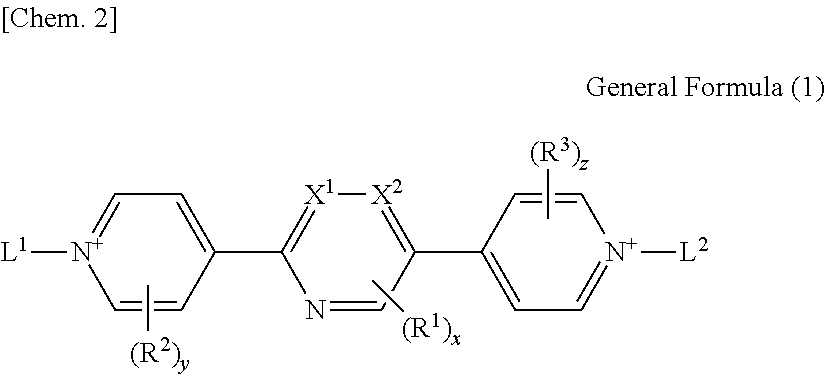
| TABLE 1 | |
| Structural Formula | Compound No. |
 |
Electrochromic Compound (1-1) |
 |
Electrochromic Compound (1-2) |
 |
Electrochromic Compound (1-3) |
 |
Electrochromic Compound (1-4) |
 |
Electrochromic Compound (1-5) |
 |
Electrochromic Compound (1-6) |
 |
Electrochromic Compound (1-7) |


[Chem.7]
An-Bm General Formula (2)

In the general formulae (3) and (4), R1 to R21 are monovalent organic groups, which may be identical or different, and at least one of the monovalent organic groups is a radically polymerizable functional group.
[Chem.10]
CH2=CH−X1− General Formula (i)
[Chem. 11]
CH2=C(Y)−X2− General Formula (ii)


| TABLE 2-1 | |
| Structural Formula | Compound No. |
 |
Electrochromic Compound (Comp. 11) |
 |
Electrochromic Compound (Comp. 12) |
 |
Electrochromic Compound (Comp. 13) |
 |
Electrochromic Compound (Comp. 14) |
 |
Electrochromic Compound (Comp. 15) |
 |
Electrochromic Compound (Comp. 16) |
 |
Electrochromic Compound (Comp. 17) |
 |
Electrochromic Compound (Comp. 18) |
| TABLE 2-2 | |
| Structural Formula | Compound No. |
 |
Electrochromic Compound (Comp. 19) |
 |
Electrochromic Compound (Comp. 20) |
 |
Electrochromic Compound (Comp. 21) |
 |
Electrochromic Compound (Comp. 22) |
 |
Electrochromic Compound (Comp. 23) |
 |
Electrochromic Compound (Comp. 24) |
 |
Electrochromic Compound (Comp. 25) |
 |
Electrochromic Compound (Comp. 26) |
| TABLE 3-1 | |||
| A | B | ||
| Ex. 10 | Electrochromic Compound (1-1) | Triarylamine Compound (1) |
| Ex. 11 | Electrochromic Compound (1-2) | Triarylamine Compound (1) |
| Ex. 12 | Electrochromic Compound (1-1) | Triarylamine Compound (2) |
| Ex. 13 | Electrochromic Compound (1-1) | Triarylamine Compound (3) |
| Ex. 14 | Electrochromic Compound (1-1) | Triarylamine Compound (4) |
| Ex. 15 | Electrochromic Compound (1-1) | Triarylamine Compound (5) |
| Ex. 16 | Electrochromic Compound (1-1) | ATO |
| Ex. 17 | Electrochromic Compound (1-8) | Triarylamine Compound (1) |
| Ex. 18 | Electrochromic Compound (1-9) | Triarylamine Compound (1) |
| Ex. 19 | Electrochromic Compound (1-10) | Triarylamine Compound (1) |
| Comp. Ex. 5 | Electrochromic Compound (Comp. 11) | Triarylamine Compound (1) |
| Comp. Ex. 6 | Electrochromic Compound (Comp. 12) | Triarylamine Compound (1) |
| Comp. Ex. 7 | Electrochromic Compound (Comp. 13) | Triarylamine Compound (1) |
| Comp. Ex. 8 | Electrochromic Compound (Comp. 14) | Triarylamine Compound (1) |
| Comp. Ex. 9 | Electrochromic Compound (Comp. 15) | Triarylamine Compound (1) |
| Comp. Ex. 10 | Electrochromic Compound (Comp. 16) | Triarylamine Compound (1) |
| Comp. Ex. 11 | Electrochromic Compound (Comp. 17) | Triarylamine Compound (1) |
| Comp. Ex. 12 | Electrochromic Compound (Comp. 18) | Triarylamine Compound (1) |
| Comp. Ex. 13 | Electrochromic Compound (Comp. 19) | Triarylamine Compound (1) |
| Comp. Ex. 14 | Electrochromic Compound (Comp. 20) | Triarylamine Compound (1) |
| Comp. Ex. 15 | Electrochromic Compound (Comp. 21) | Triarylamine Compound (1) |
| Comp. Ex. 16 | Electrochromic Compound (Comp. 22) | Triarylamine Compound (1) |
| Comp. Ex. 17 | Electrochromic Compound (Comp. 23) | Triarylamine Compound (1) |
| Comp. Ex. 18 | Electrochromic Compound (Comp. 24) | Triarylamine Compound (1) |
| Comp. Ex. 19 | Electrochromic Compound (Comp. 25) | Triarylamine Compound (1) |
| Comp. Ex. 20 | Electrochromic Compound (Comp. 26) | Triarylamine Compound (1) |
| *A: the electrochromic compound in the first electroactive layer | ||
| *B: the charge-storing material in the second electroactive layer | ||
| TABLE 3-2 | ||||
| Test 1 | |
|||
| Applied voltage | Electrical degradation | Optical |
| −1.5 V | −2.2 V | Evaluation 1 | |
degradation | Color | ||
| Ex. 10 | Good | Good | A | A | A | Black |
| Ex. 11 | Good | Good | A | A | A | Black |
| Ex. 12 | Good | Good | A | A | B | Black |
| Ex. 13 | Good | Good | A | A | A | Orange |
| Ex. 14 | Good | Good | A | A | A | Black |
| Ex. 15 | Good | Good | A | A | B | Black |
| Ex. 16 | Good | Good | A | A | B | Reddish purple |
| Ex. 17 | Good | Good | A | A | A | Black |
| Ex. 18 | Good | Good | A | A | A | Black |
| Ex. 19 | Good | Good | A | A | A | Black |
| Comp. Ex. 5 | Not good | Good | B | B | C | Purple |
| Comp. Ex. 6 | Not good | Not good | C | C | C | Yellowish green |
| Comp. Ex. 7 | Not good | Good | B | A | A | Purple |
| Comp. Ex. 8 | Not good | Good | A | B | A | Black |
| Comp. Ex. 9 | Not good | Not good | A | B | A | Black |
| Comp. Ex. 10 | Not good | Not good | C | C | C | Purple |
| Comp. Ex. 11 | Not good | Not good | A | B | B | Black |
| Comp. Ex. 12 | Not good | Not good | C | C | C | Purple |
| Comp. Ex. 13 | Not good | Not good | C | C | C | Black |
| Comp. Ex. 14 | Not good | Not good | A | B | C | Black |
| Comp. Ex. 15 | Not good | Good | A | B | A | Yellowish green |
| Comp. Ex. 16 | Not good | Not good | C | C | C | Orange |
| Comp. Ex. 17 | Not good | Good | B | B | A | Purple |
| Comp. Ex. 18 | Not good | Good | A | A | A | Yellowish green |
| Comp. Ex. 19 | Not good | Not good | C | C | B | Blue |
| Comp. Ex. 20 | Not good | Good | B | B | C | Orange |


[Chem.40]
An-Bm General Formula (2)


Claims (12)


An-Bm Formula (2),


Applications Claiming Priority (7)
| Application Number | Priority Date | Filing Date | Title |
|---|---|---|---|
| JP2015-050266 | 2015-03-13 | ||
| JP2015050266 | 2015-03-13 | ||
| JPJP2015-050266 | 2015-03-13 | ||
| JPJP2015-208313 | 2015-10-22 | ||
| JP2015-208313 | 2015-10-22 | ||
| JP2015208313A JP6728628B2 (en) | 2015-03-13 | 2015-10-22 | Electrochromic compound, electrochromic composition, and electrochromic device and electrochromic dimming device |
| PCT/JP2016/000680 WO2016147543A1 (en) | 2015-03-13 | 2016-02-09 | Electrochromic compound, electrochromic composition, electrochromic element, and electrochromic dimming element |
Publications (2)
| Publication Number | Publication Date |
|---|---|
| US20180044581A1 US20180044581A1 (en) | 2018-02-15 |
| US10988684B2 true US10988684B2 (en) | 2021-04-27 |
Family
ID=56983229
Family Applications (1)
| Application Number | Title | Priority Date | Filing Date |
|---|---|---|---|
| US15/554,289 Expired - Fee Related US10988684B2 (en) | 2015-03-13 | 2016-02-09 | Electrochromic compound, electrochromic composition, electrochromic element, and electrochromic dimming element |
Country Status (5)
| Country | Link |
|---|---|
| US (1) | US10988684B2 (en) |
| EP (1) | EP3268448B1 (en) |
| JP (1) | JP6728628B2 (en) |
| KR (1) | KR102027049B1 (en) |
| CN (1) | CN107429158B (en) |
Families Citing this family (25)
| Publication number | Priority date | Publication date | Assignee | Title |
|---|---|---|---|---|
| EP3115433B1 (en) * | 2015-07-08 | 2018-10-03 | Essilor International | Electrochromic compounds and optical articles containing them |
| JP6673000B2 (en) * | 2015-11-30 | 2020-03-25 | 株式会社リコー | Electrochromic device |
| WO2017094218A1 (en) | 2015-11-30 | 2017-06-08 | Ricoh Company, Ltd. | Electrochromic element |
| KR102569964B1 (en) * | 2016-06-24 | 2023-08-23 | 삼성디스플레이 주식회사 | Smart window |
| JP7030552B2 (en) * | 2017-02-20 | 2022-03-07 | キヤノン株式会社 | Organic compounds, electrochromic elements, optical filters, lens units, image pickup devices and window materials |
| JP2018136468A (en) * | 2017-02-23 | 2018-08-30 | 株式会社リコー | Electrochromic display and method for manufacturing the same |
| EP3498452A3 (en) | 2017-12-18 | 2019-08-28 | Ricoh Company, Ltd. | Method and apparatus for forming three-dimensional curved surface on laminated substrate, and three-dimensional curved laminated substrate |
| JP7056166B2 (en) | 2018-01-22 | 2022-04-19 | 株式会社リコー | Electrochromic element |
| JP7223242B2 (en) | 2018-03-19 | 2023-02-16 | 株式会社リコー | ELECTROCHROMIC DEVICE AND ELECTRONIC DEVICE USING THE SAME |
| US11079647B2 (en) | 2018-03-22 | 2021-08-03 | Ricoh Company, Ltd. | Electrochromic display element, optical filter, lens unit, and imaging device |
| US11175559B2 (en) | 2018-04-05 | 2021-11-16 | Ricoh Company, Ltd. | Electrochromic device |
| US11319484B2 (en) | 2018-04-24 | 2022-05-03 | Ricoh Company, Ltd. | Electrochromic element and method for manufacturing electrochromic element |
| JP7030632B2 (en) | 2018-06-28 | 2022-03-07 | キヤノン株式会社 | Organic compounds, electrochromic elements, optical filters, image pickup devices, windows and electrochromic mirrors |
| WO2020022381A1 (en) | 2018-07-25 | 2020-01-30 | Ricoh Company, Ltd. | Electrochromic compound, electrochromic composition, and electrochromic element |
| JP7367363B2 (en) | 2018-07-25 | 2023-10-24 | 株式会社リコー | Electrochromic composition and electrochromic device |
| EP3712695B1 (en) | 2019-03-20 | 2022-02-23 | Ricoh Company, Ltd. | Electrochromic device, wearable device, and method for driving electrochromic device |
| EP3711920B1 (en) | 2019-03-20 | 2023-03-01 | Ricoh Company, Ltd. | Laminated structure, multiple laminated structure, lens, and method for producing laminated structure |
| CN110292536B (en) * | 2019-06-25 | 2022-07-08 | 许雅婷 | A kind of electrochromic keratin fiber dyeing method and device |
| US11970662B2 (en) | 2019-07-31 | 2024-04-30 | Ricoh Company, Ltd. | Electrochromic element |
| EP3835859B1 (en) | 2019-11-29 | 2026-01-28 | Ricoh Company, Ltd. | Electrochromic element, production method thereof and electrochromic light-adjusting element |
| EP3889130A1 (en) | 2020-03-30 | 2021-10-06 | Ricoh Company, Ltd. | Electrochromic element |
| CN111624792A (en) * | 2020-06-23 | 2020-09-04 | 常州雅谱新材料有限公司 | Electro-dimmer device |
| JP7472705B2 (en) | 2020-07-29 | 2024-04-23 | 株式会社リコー | Electrochromic element, electrochromic light control element, and electrochromic device |
| US11966139B2 (en) | 2020-07-31 | 2024-04-23 | Ricoh Company, Ltd. | Electrochromic element, and method for driving the same |
| EP4461783A1 (en) * | 2023-05-10 | 2024-11-13 | Essilor International | Electrochromic compounds, compositions and optical articles containing them |
Citations (49)
| Publication number | Priority date | Publication date | Assignee | Title |
|---|---|---|---|---|
| JPS4838503B1 (en) | 1965-03-09 | 1973-11-17 | ||
| JP2506312Y2 (en) | 1989-10-31 | 1996-08-07 | 豊田合成株式会社 | Electrochromic device |
| JPH11183938A (en) | 1997-12-19 | 1999-07-09 | Nippon Mitsubishi Oil Corp | Electrochromic element |
| US6203154B1 (en) | 1997-12-19 | 2001-03-20 | Nippon Mitsubishi Oil Corporation | Electrochromic element |
| US6301038B1 (en) | 1997-02-06 | 2001-10-09 | University College Dublin | Electrochromic system |
| US20020167480A1 (en) | 2001-04-25 | 2002-11-14 | Johnson Mark Thomas | Electrophoretic color display device |
| WO2003009059A1 (en) | 2001-07-17 | 2003-01-30 | Sipix Imaging, Inc. | In-plane switching electrophoretic display |
| JP2003121883A (en) | 2001-10-11 | 2003-04-23 | Dainippon Printing Co Ltd | Electrochromic device |
| JP2003161964A (en) | 2001-11-22 | 2003-06-06 | Toppan Printing Co Ltd | Multi-color display panel |
| JP2003270671A (en) | 2002-03-15 | 2003-09-25 | Fuji Photo Film Co Ltd | Electrochromic device |
| JP2004151265A (en) | 2002-10-29 | 2004-05-27 | Fuji Photo Film Co Ltd | Electrochromic device and electrochromic display |
| JP2004361514A (en) | 2003-06-02 | 2004-12-24 | Canon Inc | Electrophoretic display |
| US7029833B2 (en) | 2002-02-15 | 2006-04-18 | Ricoh Company, Ltd. | Image display medium, process for forming image, and multicolor image-forming apparatus |
| JP2006106669A (en) | 2004-05-14 | 2006-04-20 | Ricoh Co Ltd | Multicolor display element |
| US20060204866A1 (en) | 2005-03-04 | 2006-09-14 | Shigenobu Hirano | Display device and display apparatus |
| US20060215250A1 (en) | 2005-03-25 | 2006-09-28 | Takeshi Shibuya | Electrochromic display device and display apparatus |
| US20080013152A1 (en) | 2004-05-14 | 2008-01-17 | Shigenobu Hirano | Multicolor display element |
| US20080112033A1 (en) | 2006-11-10 | 2008-05-15 | Takeshi Shibuya | Reversible recording material and displaying element |
| DE102006061999A1 (en) | 2006-12-21 | 2008-06-26 | Siemens Ag | Cathodically switchable electrochromic dye electrochromic formulation thereof and method of making an electrochromic cell |
| DE102007023747A1 (en) | 2007-05-22 | 2008-11-27 | Siemens Ag | Organic electrochromic device for continuous displays |
| US20090231664A1 (en) | 2008-03-11 | 2009-09-17 | Takeshi Shibuya | Electrochromic compound and electrochromic display device using the same |
| US20090231663A1 (en) | 2008-03-11 | 2009-09-17 | Shigenobu Hirano | Electrochromic compound, electrochromic composition and display device |
| US7830584B2 (en) | 2006-12-28 | 2010-11-09 | Ricoh Company, Ltd. | Organic-inorganic composite material and method for producing the same, and functional electrode and functional device |
| JP4838503B2 (en) | 2004-08-31 | 2011-12-14 | 国立大学法人 千葉大学 | Color rewritable display device |
| US20120050838A1 (en) | 2008-07-03 | 2012-03-01 | Shigenobu Hirano | Electrochromic display apparatus |
| US20120069418A1 (en) | 2009-05-29 | 2012-03-22 | Andreas Kanitz | Electrochromic formulation, method for the production thereof, and organic electrochromic component |
| JP2012224548A (en) | 2011-04-14 | 2012-11-15 | Ricoh Co Ltd | Electrochromic compound |
| US8384983B2 (en) | 2010-08-03 | 2013-02-26 | Ricoh Company, Ltd. | Electrochromic display device, fabrication method therefor, and driving method therefor |
| JP2013114144A (en) | 2011-11-30 | 2013-06-10 | Alps Electric Co Ltd | Electrochromic device |
| US8531754B2 (en) | 2010-05-13 | 2013-09-10 | Ricoh Company, Ltd. | Electrochromic display element |
| US20130258439A1 (en) | 2012-03-30 | 2013-10-03 | Ricoh Company, Ltd. | Method for manufacturing an electrochromic display device and an electrochromic display device |
| US8593715B2 (en) | 2009-10-16 | 2013-11-26 | Ricoh Company, Ltd. | Electrochromic compound, electrochromic composition, and display element |
| US8625186B2 (en) | 2011-11-28 | 2014-01-07 | Ricoh Company, Ltd. | Electrochromic compound, electrochromic composition, and display device |
| US8687262B2 (en) | 2010-12-17 | 2014-04-01 | Ricoh Company, Ltd. | Ion conductor and electrochromic display device |
| US8736941B2 (en) | 2010-03-12 | 2014-05-27 | Ricoh Company, Ltd. | Electrochromic display apparatus and method of manufacturing the same |
| US8743048B2 (en) | 2010-12-07 | 2014-06-03 | Ricoh Company, Ltd. | Electrochromic display element, display device and information apparatus |
| JP2014111710A (en) | 2012-11-01 | 2014-06-19 | Ricoh Co Ltd | Electrochromic compound, electrochromic composition, and display element |
| US8937758B2 (en) | 2012-05-11 | 2015-01-20 | Ricoh Company, Ltd. | Electrochromic display device |
| US9041997B2 (en) | 2011-05-31 | 2015-05-26 | Ricoh Company, Ltd. | Electro-chromic display element, display apparatus, and driving method |
| US20150168796A1 (en) | 2012-07-23 | 2015-06-18 | Ricoh Company, Ltd. | Electrochromic device and a method for manufacturing an electrochromic device |
| US9069222B2 (en) | 2013-03-15 | 2015-06-30 | Ricoh Company, Ltd. | Electrochromic display element and display device |
| US20150198857A1 (en) | 2014-01-15 | 2015-07-16 | Ricoh Company, Ltd. | Electrochromic device and production method thereof |
| US20150331295A1 (en) | 2014-05-13 | 2015-11-19 | Ricoh Company, Ltd. | Electrochromic display element, display device, information system, and electrochromic dimming lens |
| US20150378233A1 (en) | 2013-03-14 | 2015-12-31 | Koh Fujimura | Electrochromic display element and image display device |
| US20160005375A1 (en) | 2014-07-01 | 2016-01-07 | Ricoh Company, Ltd. | Electrochromic display device, and producing method and driving method thereof |
| JP2016038572A (en) | 2014-08-08 | 2016-03-22 | 株式会社リコー | Electrochromic device and method for producing the same |
| JP2016045464A (en) | 2014-08-26 | 2016-04-04 | 株式会社リコー | Electrochromic element |
| US20180113366A1 (en) * | 2015-06-19 | 2018-04-26 | Ricoh Company, Ltd. | Electrochromic element, display device and driving method thereof |
| US20180194995A1 (en) * | 2015-07-08 | 2018-07-12 | Essilor International | Electrochromic compounds and optical articles containing them |
Family Cites Families (1)
| Publication number | Priority date | Publication date | Assignee | Title |
|---|---|---|---|---|
| JP2000131722A (en) * | 1998-10-22 | 2000-05-12 | Nippon Mitsubishi Oil Corp | Electrochromic device |
-
2015
- 2015-10-22 JP JP2015208313A patent/JP6728628B2/en not_active Expired - Fee Related
-
2016
- 2016-02-09 US US15/554,289 patent/US10988684B2/en not_active Expired - Fee Related
- 2016-02-09 KR KR1020177029118A patent/KR102027049B1/en not_active Expired - Fee Related
- 2016-02-09 CN CN201680014554.4A patent/CN107429158B/en not_active Expired - Fee Related
- 2016-02-09 EP EP16764377.4A patent/EP3268448B1/en not_active Not-in-force
Patent Citations (59)
| Publication number | Priority date | Publication date | Assignee | Title |
|---|---|---|---|---|
| JPS4838503B1 (en) | 1965-03-09 | 1973-11-17 | ||
| JP2506312Y2 (en) | 1989-10-31 | 1996-08-07 | 豊田合成株式会社 | Electrochromic device |
| JP3955641B2 (en) | 1997-02-06 | 2007-08-08 | ユニバーシティ カレッジ ダブリン | Electrochromic device |
| US6301038B1 (en) | 1997-02-06 | 2001-10-09 | University College Dublin | Electrochromic system |
| JPH11183938A (en) | 1997-12-19 | 1999-07-09 | Nippon Mitsubishi Oil Corp | Electrochromic element |
| US6203154B1 (en) | 1997-12-19 | 2001-03-20 | Nippon Mitsubishi Oil Corporation | Electrochromic element |
| US20020167480A1 (en) | 2001-04-25 | 2002-11-14 | Johnson Mark Thomas | Electrophoretic color display device |
| JP2004520621A (en) | 2001-04-25 | 2004-07-08 | コーニンクレッカ フィリップス エレクトロニクス エヌ ヴィ | Electrophoretic color display device |
| WO2003009059A1 (en) | 2001-07-17 | 2003-01-30 | Sipix Imaging, Inc. | In-plane switching electrophoretic display |
| JP4093958B2 (en) | 2001-07-17 | 2008-06-04 | シピックス・イメージング・インコーポレーテッド | In-plane switching electrophoretic display |
| JP2003121883A (en) | 2001-10-11 | 2003-04-23 | Dainippon Printing Co Ltd | Electrochromic device |
| JP2003161964A (en) | 2001-11-22 | 2003-06-06 | Toppan Printing Co Ltd | Multi-color display panel |
| US7029833B2 (en) | 2002-02-15 | 2006-04-18 | Ricoh Company, Ltd. | Image display medium, process for forming image, and multicolor image-forming apparatus |
| US7474322B2 (en) | 2002-02-15 | 2009-01-06 | Ricoh Company, Ltd | Image display medium, process for forming image, and multicolor image-forming apparatus |
| JP2003270671A (en) | 2002-03-15 | 2003-09-25 | Fuji Photo Film Co Ltd | Electrochromic device |
| JP2004151265A (en) | 2002-10-29 | 2004-05-27 | Fuji Photo Film Co Ltd | Electrochromic device and electrochromic display |
| JP2004361514A (en) | 2003-06-02 | 2004-12-24 | Canon Inc | Electrophoretic display |
| US20050012977A1 (en) | 2003-06-02 | 2005-01-20 | Hiroshi Mizuno | Electrophoretic display apparatus |
| JP2006106669A (en) | 2004-05-14 | 2006-04-20 | Ricoh Co Ltd | Multicolor display element |
| US20080013152A1 (en) | 2004-05-14 | 2008-01-17 | Shigenobu Hirano | Multicolor display element |
| US7333259B2 (en) | 2004-05-14 | 2008-02-19 | Ricoh Company, Ltd. | Multicolor display element |
| JP4838503B2 (en) | 2004-08-31 | 2011-12-14 | 国立大学法人 千葉大学 | Color rewritable display device |
| US20060204866A1 (en) | 2005-03-04 | 2006-09-14 | Shigenobu Hirano | Display device and display apparatus |
| US20060215250A1 (en) | 2005-03-25 | 2006-09-28 | Takeshi Shibuya | Electrochromic display device and display apparatus |
| US20080112033A1 (en) | 2006-11-10 | 2008-05-15 | Takeshi Shibuya | Reversible recording material and displaying element |
| JP2008122578A (en) | 2006-11-10 | 2008-05-29 | Ricoh Co Ltd | Reversible recording material and display element |
| WO2008077864A1 (en) | 2006-12-21 | 2008-07-03 | Siemens Aktiengesellschaft | Cathodically connectable electrochromic dye, electrochromic formulation thereof, and method of producing an electrochromic cell |
| DE102006061999A1 (en) | 2006-12-21 | 2008-06-26 | Siemens Ag | Cathodically switchable electrochromic dye electrochromic formulation thereof and method of making an electrochromic cell |
| US7830584B2 (en) | 2006-12-28 | 2010-11-09 | Ricoh Company, Ltd. | Organic-inorganic composite material and method for producing the same, and functional electrode and functional device |
| WO2008142047A1 (en) | 2007-05-22 | 2008-11-27 | Siemens Aktiengesellschaft | Organic electrochromic component for permanent displays |
| DE102007023747A1 (en) | 2007-05-22 | 2008-11-27 | Siemens Ag | Organic electrochromic device for continuous displays |
| US20090231664A1 (en) | 2008-03-11 | 2009-09-17 | Takeshi Shibuya | Electrochromic compound and electrochromic display device using the same |
| US20090231663A1 (en) | 2008-03-11 | 2009-09-17 | Shigenobu Hirano | Electrochromic compound, electrochromic composition and display device |
| US20120050838A1 (en) | 2008-07-03 | 2012-03-01 | Shigenobu Hirano | Electrochromic display apparatus |
| US20120069418A1 (en) | 2009-05-29 | 2012-03-22 | Andreas Kanitz | Electrochromic formulation, method for the production thereof, and organic electrochromic component |
| US8593715B2 (en) | 2009-10-16 | 2013-11-26 | Ricoh Company, Ltd. | Electrochromic compound, electrochromic composition, and display element |
| US8736941B2 (en) | 2010-03-12 | 2014-05-27 | Ricoh Company, Ltd. | Electrochromic display apparatus and method of manufacturing the same |
| US8531754B2 (en) | 2010-05-13 | 2013-09-10 | Ricoh Company, Ltd. | Electrochromic display element |
| US8384983B2 (en) | 2010-08-03 | 2013-02-26 | Ricoh Company, Ltd. | Electrochromic display device, fabrication method therefor, and driving method therefor |
| US8743048B2 (en) | 2010-12-07 | 2014-06-03 | Ricoh Company, Ltd. | Electrochromic display element, display device and information apparatus |
| US8687262B2 (en) | 2010-12-17 | 2014-04-01 | Ricoh Company, Ltd. | Ion conductor and electrochromic display device |
| JP2012224548A (en) | 2011-04-14 | 2012-11-15 | Ricoh Co Ltd | Electrochromic compound |
| US9041997B2 (en) | 2011-05-31 | 2015-05-26 | Ricoh Company, Ltd. | Electro-chromic display element, display apparatus, and driving method |
| US8625186B2 (en) | 2011-11-28 | 2014-01-07 | Ricoh Company, Ltd. | Electrochromic compound, electrochromic composition, and display device |
| JP2013114144A (en) | 2011-11-30 | 2013-06-10 | Alps Electric Co Ltd | Electrochromic device |
| US20130258439A1 (en) | 2012-03-30 | 2013-10-03 | Ricoh Company, Ltd. | Method for manufacturing an electrochromic display device and an electrochromic display device |
| US8937758B2 (en) | 2012-05-11 | 2015-01-20 | Ricoh Company, Ltd. | Electrochromic display device |
| US20150168796A1 (en) | 2012-07-23 | 2015-06-18 | Ricoh Company, Ltd. | Electrochromic device and a method for manufacturing an electrochromic device |
| US20150274761A1 (en) | 2012-11-01 | 2015-10-01 | Toshiya Sagisaka | Electrochromic compound, electrochromic composition, and display element |
| JP2014111710A (en) | 2012-11-01 | 2014-06-19 | Ricoh Co Ltd | Electrochromic compound, electrochromic composition, and display element |
| US20150378233A1 (en) | 2013-03-14 | 2015-12-31 | Koh Fujimura | Electrochromic display element and image display device |
| US9069222B2 (en) | 2013-03-15 | 2015-06-30 | Ricoh Company, Ltd. | Electrochromic display element and display device |
| US20150198857A1 (en) | 2014-01-15 | 2015-07-16 | Ricoh Company, Ltd. | Electrochromic device and production method thereof |
| US20150331295A1 (en) | 2014-05-13 | 2015-11-19 | Ricoh Company, Ltd. | Electrochromic display element, display device, information system, and electrochromic dimming lens |
| US20160005375A1 (en) | 2014-07-01 | 2016-01-07 | Ricoh Company, Ltd. | Electrochromic display device, and producing method and driving method thereof |
| JP2016038572A (en) | 2014-08-08 | 2016-03-22 | 株式会社リコー | Electrochromic device and method for producing the same |
| JP2016045464A (en) | 2014-08-26 | 2016-04-04 | 株式会社リコー | Electrochromic element |
| US20180113366A1 (en) * | 2015-06-19 | 2018-04-26 | Ricoh Company, Ltd. | Electrochromic element, display device and driving method thereof |
| US20180194995A1 (en) * | 2015-07-08 | 2018-07-12 | Essilor International | Electrochromic compounds and optical articles containing them |
Non-Patent Citations (4)
| Title |
|---|
| International Search Report and Written Opinion dated Apr. 12, 2016 for counterpart International Patent Application No. PCT/JP2016/000680 filed Feb. 9, 2016. |
| Li, Mei, et al., "Highly contrasted and stable electrochromic device based on well-matched viologen and triphenylamine," Organic Electronics, vol. 15 (2014), pp. 428-434. |
| Office Action dated Dec. 26, 2018 in Korean Patent Application No. 10-2017-7029118, 14 pages (with English translation). |
| Office Action dated Oct. 29, 2019, in Japanese Patent Application No. 2015-208313, filed Oct. 22, 2015. |
Also Published As
| Publication number | Publication date |
|---|---|
| EP3268448A1 (en) | 2018-01-17 |
| CN107429158A (en) | 2017-12-01 |
| JP2016169201A (en) | 2016-09-23 |
| KR20170128453A (en) | 2017-11-22 |
| US20180044581A1 (en) | 2018-02-15 |
| EP3268448A4 (en) | 2018-02-28 |
| JP6728628B2 (en) | 2020-07-22 |
| EP3268448B1 (en) | 2020-06-03 |
| KR102027049B1 (en) | 2019-09-30 |
| CN107429158B (en) | 2020-11-27 |
Similar Documents
| Publication | Publication Date | Title |
|---|---|---|
| US20180044581A1 (en) | Electrochromic compound, electrochromic composition, electrochromic element, and electrochromic dimming element | |
| US11053267B2 (en) | Electrochromic compound, electrochromic composition, and display element | |
| CN107683320B (en) | Electrochromic compounds, electrochromic compositions and electrochromic display elements | |
| EP2896992A1 (en) | Electrochromic device and production method thereof | |
| US20120194894A1 (en) | Electrochromic compound, electrochromic composition, and display element | |
| JP6085914B2 (en) | Electrochromic compound, electrochromic composition, and display element | |
| JP5550094B2 (en) | Electrochromic compound, electrochromic composition, and display element | |
| WO2016147543A1 (en) | Electrochromic compound, electrochromic composition, electrochromic element, and electrochromic dimming element | |
| JP6870288B2 (en) | Electrochromic element | |
| CN113467146A (en) | Electrochromic element | |
| JP6213080B2 (en) | Electrochromic material, electrochromic composition, and electrochromic display element | |
| JP5648994B2 (en) | Electrochromic compound | |
| JP2017206459A (en) | Electrochromic compound, electrochromic composition, and electrochromic device | |
| US11370963B2 (en) | Electrochromic compound, electrochromic composition, and electrochromic element | |
| US20240184178A1 (en) | Electrochromic element, electrochromic display device, electrochromic light-controlling device, and electrolyte composition | |
| JP6798166B2 (en) | Electrochromic display element | |
| JP6848342B2 (en) | Electrochromic compositions and electrochromic devices | |
| JP6728951B2 (en) | Electrochromic compound, electrochromic composition, and electrochromic device | |
| JP5939034B2 (en) | Electrochromic compound, electrochromic composition, and display element | |
| WO2022113702A1 (en) | Electrochromic compound, electrochromic composition, and electrochromic element | |
| JP5880809B2 (en) | Electrochromic compound, electrochromic structure, and display element | |
| JP2021026017A (en) | Electronic device, dimming lens, and dimming glasses | |
| JP2019191579A (en) | Electrochromic element and method for manufacturing electrochromic element | |
| JP2013250520A (en) | Electrochromic compound, electrochromic composition, and display element |
Legal Events
| Date | Code | Title | Description |
|---|---|---|---|
| AS | Assignment |
Owner name: RICOH COMPANY, LTD., JAPAN Free format text: ASSIGNMENT OF ASSIGNORS INTEREST;ASSIGNORS:SAGISAKA, TOSHIYA;YAMAMOTO, SATOSHI;OKADA, TAKASHI;AND OTHERS;SIGNING DATES FROM 20170719 TO 20170724;REEL/FRAME:043433/0794 |
|
| FEPP | Fee payment procedure |
Free format text: ENTITY STATUS SET TO UNDISCOUNTED (ORIGINAL EVENT CODE: BIG.); ENTITY STATUS OF PATENT OWNER: LARGE ENTITY |
|
| STPP | Information on status: patent application and granting procedure in general |
Free format text: RESPONSE TO NON-FINAL OFFICE ACTION ENTERED AND FORWARDED TO EXAMINER |
|
| STPP | Information on status: patent application and granting procedure in general |
Free format text: FINAL REJECTION MAILED |
|
| STPP | Information on status: patent application and granting procedure in general |
Free format text: RESPONSE AFTER FINAL ACTION FORWARDED TO EXAMINER |
|
| STPP | Information on status: patent application and granting procedure in general |
Free format text: ADVISORY ACTION MAILED |
|
| STPP | Information on status: patent application and granting procedure in general |
Free format text: DOCKETED NEW CASE - READY FOR EXAMINATION |
|
| STPP | Information on status: patent application and granting procedure in general |
Free format text: FINAL REJECTION MAILED |
|
| STPP | Information on status: patent application and granting procedure in general |
Free format text: NOTICE OF ALLOWANCE MAILED -- APPLICATION RECEIVED IN OFFICE OF PUBLICATIONS |
|
| STPP | Information on status: patent application and granting procedure in general |
Free format text: PUBLICATIONS -- ISSUE FEE PAYMENT VERIFIED |
|
| STPP | Information on status: patent application and granting procedure in general |
Free format text: PUBLICATIONS -- ISSUE FEE PAYMENT VERIFIED |
|
| STCF | Information on status: patent grant |
Free format text: PATENTED CASE |
|
| FEPP | Fee payment procedure |
Free format text: MAINTENANCE FEE REMINDER MAILED (ORIGINAL EVENT CODE: REM.); ENTITY STATUS OF PATENT OWNER: LARGE ENTITY |
|
| LAPS | Lapse for failure to pay maintenance fees |
Free format text: PATENT EXPIRED FOR FAILURE TO PAY MAINTENANCE FEES (ORIGINAL EVENT CODE: EXP.); ENTITY STATUS OF PATENT OWNER: LARGE ENTITY |
|
| STCH | Information on status: patent discontinuation |
Free format text: PATENT EXPIRED DUE TO NONPAYMENT OF MAINTENANCE FEES UNDER 37 CFR 1.362 |
|
| FP | Lapsed due to failure to pay maintenance fee |
Effective date: 20250427 |