US10968230B2 - Spiro-structured compound and organic electronic device comprising same - Google Patents
Spiro-structured compound and organic electronic device comprising same Download PDFInfo
- Publication number
- US10968230B2 US10968230B2 US16/069,694 US201716069694A US10968230B2 US 10968230 B2 US10968230 B2 US 10968230B2 US 201716069694 A US201716069694 A US 201716069694A US 10968230 B2 US10968230 B2 US 10968230B2
- Authority
- US
- United States
- Prior art keywords
- group
- substituted
- unsubstituted
- present specification
- light emitting
- Prior art date
- Legal status (The legal status is an assumption and is not a legal conclusion. Google has not performed a legal analysis and makes no representation as to the accuracy of the status listed.)
- Active, expires
Links
- 0 CC.[11*]C1=C([12*])C([13*])=C([14*])C2=C1C1(C3=C(C=CC=C3)[Y]C3=C([34*])C([33*])=C([32*])C([31*])=C31)C1=C([24*])C([23*])=C([22*])C([21*])=C21.[5*]C1=C([6*])C([7*])=C([8*])C(C)=C1CC Chemical compound CC.[11*]C1=C([12*])C([13*])=C([14*])C2=C1C1(C3=C(C=CC=C3)[Y]C3=C([34*])C([33*])=C([32*])C([31*])=C31)C1=C([24*])C([23*])=C([22*])C([21*])=C21.[5*]C1=C([6*])C([7*])=C([8*])C(C)=C1CC 0.000 description 23
- OICJTSLHQGDCTQ-UHFFFAOYSA-N C1=CC=C2C(=C1)SC1=CN=CN=C12 Chemical compound C1=CC=C2C(=C1)SC1=CN=CN=C12 OICJTSLHQGDCTQ-UHFFFAOYSA-N 0.000 description 4
- VFUDMQLBKNMONU-UHFFFAOYSA-N C1=CC2=C(C=C1)N(C1=CC=C(C3=CC=C(N4C5=C(C=CC=C5)C5=C4/C=C\C=C/5)C=C3)C=C1)C1=C2C=CC=C1 Chemical compound C1=CC2=C(C=C1)N(C1=CC=C(C3=CC=C(N4C5=C(C=CC=C5)C5=C4/C=C\C=C/5)C=C3)C=C1)C1=C2C=CC=C1 VFUDMQLBKNMONU-UHFFFAOYSA-N 0.000 description 3
- KFXNZUJXVXOCJO-UHFFFAOYSA-N C1=CC2=C3C(=C1)C1=C(C=CC=C1)/C3=C/C=C\2.CC Chemical compound C1=CC2=C3C(=C1)C1=C(C=CC=C1)/C3=C/C=C\2.CC KFXNZUJXVXOCJO-UHFFFAOYSA-N 0.000 description 3
- IFUZXMZIPQFCCT-UHFFFAOYSA-N CC.CC.CC.CC1=C2C=CC=CC2=C(C2=CC=CC=C2)C2=CC=CC=C21 Chemical compound CC.CC.CC.CC1=C2C=CC=CC2=C(C2=CC=CC=C2)C2=CC=CC=C21 IFUZXMZIPQFCCT-UHFFFAOYSA-N 0.000 description 3
- XSFABZXLKDOAKK-UHFFFAOYSA-N C1=CC2=C(C=C1)C1(C3=C(C=C4C(=C3)C3=C(C=CC=C3)N4C3=CC4=C(C=C3)C3=C(C=CC=C3)S4)O2)C2=C(C=CC=C2)C2=C1/C=C\C=C/2.C1=CC2=C(C=C1)C1(C3=C(C=C4C(=C3)C3=C(C=CC=C3)N4C3=CC4=C(C=C3)SC3=C4C=CC=C3)O2)C2=C(C=CC=C2)C2=C1/C=C\C=C/2.C1=CC=C(C2=NC(C3=CC=CC=C3)=NC(C3=CC=CC(N4C5=CC6=C(C=C5C5=C4C=CC=C5)C4(C5=C(C=CC=C5)O6)C5=C(C=CC=C5)C5=C4/C=C\C=C/5)=C3)=C2)C=C1 Chemical compound C1=CC2=C(C=C1)C1(C3=C(C=C4C(=C3)C3=C(C=CC=C3)N4C3=CC4=C(C=C3)C3=C(C=CC=C3)S4)O2)C2=C(C=CC=C2)C2=C1/C=C\C=C/2.C1=CC2=C(C=C1)C1(C3=C(C=C4C(=C3)C3=C(C=CC=C3)N4C3=CC4=C(C=C3)SC3=C4C=CC=C3)O2)C2=C(C=CC=C2)C2=C1/C=C\C=C/2.C1=CC=C(C2=NC(C3=CC=CC=C3)=NC(C3=CC=CC(N4C5=CC6=C(C=C5C5=C4C=CC=C5)C4(C5=C(C=CC=C5)O6)C5=C(C=CC=C5)C5=C4/C=C\C=C/5)=C3)=C2)C=C1 XSFABZXLKDOAKK-UHFFFAOYSA-N 0.000 description 2
- OPVFAUXSRHRCDB-UHFFFAOYSA-N C1=CC2=C(C=C1)C1(C3=C(C=C4C(=C3)C3=C(C=CC=C3)N4C3=CC=C(C4=C5\C=CC=C\C5=C/C=C\4)C=C3)O2)C2=C(C=CC=C2)C2=C1/C=C\C=C/2.C1=CC=C(C2=NC(C3=CC=CC=C3)=NC(N3C4=CC5=C(C=C4C4=C3C=CC=C4)C3(C4=C(C=CC=C4)O5)C4=C(C=CC=C4)C4=C3/C=C\C=C/4)=N2)C=C1.C1=CC=C2C(=C1)C1=C(C=CC=C1)N2C1=CC=C(N2C3=CC4=C(C=C3C3=C2C=CC=C3)C2(C3=C(C=CC=C3)O4)C3=C(C=CC=C3)C3=C2/C=C\C=C/3)C=C1 Chemical compound C1=CC2=C(C=C1)C1(C3=C(C=C4C(=C3)C3=C(C=CC=C3)N4C3=CC=C(C4=C5\C=CC=C\C5=C/C=C\4)C=C3)O2)C2=C(C=CC=C2)C2=C1/C=C\C=C/2.C1=CC=C(C2=NC(C3=CC=CC=C3)=NC(N3C4=CC5=C(C=C4C4=C3C=CC=C4)C3(C4=C(C=CC=C4)O5)C4=C(C=CC=C4)C4=C3/C=C\C=C/4)=N2)C=C1.C1=CC=C2C(=C1)C1=C(C=CC=C1)N2C1=CC=C(N2C3=CC4=C(C=C3C3=C2C=CC=C3)C2(C3=C(C=CC=C3)O4)C3=C(C=CC=C3)C3=C2/C=C\C=C/3)C=C1 OPVFAUXSRHRCDB-UHFFFAOYSA-N 0.000 description 2
- KPROJOQPDQTVPN-UHFFFAOYSA-N C1=CC2=C(C=C1)C1(C3=C(C=C4C(=C3)N(C3=CC5=C(C=C3)C3=C(C=CC=C3)S5)C3=C4C=CC=C3)O2)C2=C(C=CC=C2)C2=C1/C=C\C=C/2.C1=CC2=C(C=C1)C1(C3=C(C=C4C(=C3)N(C3=CC5=C(C=C3)SC3=C5C=CC=C3)C3=C4C=CC=C3)O2)C2=C(C=CC=C2)C2=C1/C=C\C=C/2.C1=CC=C(C2=CC(C3=CC=CC(N4C5=CC6=C(C=C5C5=C4C=CC=C5)OC4=C(C=CC=C4)C64C5=C(C=CC=C5)C5=C4/C=C\C=C/5)=C3)=NC(C3=CC=CC=C3)=N2)C=C1.CC1(C)C2=C(C=CC=C2)C2=C1C=C(N(C1=CC=CC=C1)C1=CC=C(N3C4=CC5=C(C=C4C4=C3C=CC=C4)OC3=C(C=CC=C3)C53C4=C(C=CC=C4)C4=C3/C=C\C=C/4)C=C1)C=C2 Chemical compound C1=CC2=C(C=C1)C1(C3=C(C=C4C(=C3)N(C3=CC5=C(C=C3)C3=C(C=CC=C3)S5)C3=C4C=CC=C3)O2)C2=C(C=CC=C2)C2=C1/C=C\C=C/2.C1=CC2=C(C=C1)C1(C3=C(C=C4C(=C3)N(C3=CC5=C(C=C3)SC3=C5C=CC=C3)C3=C4C=CC=C3)O2)C2=C(C=CC=C2)C2=C1/C=C\C=C/2.C1=CC=C(C2=CC(C3=CC=CC(N4C5=CC6=C(C=C5C5=C4C=CC=C5)OC4=C(C=CC=C4)C64C5=C(C=CC=C5)C5=C4/C=C\C=C/5)=C3)=NC(C3=CC=CC=C3)=N2)C=C1.CC1(C)C2=C(C=CC=C2)C2=C1C=C(N(C1=CC=CC=C1)C1=CC=C(N3C4=CC5=C(C=C4C4=C3C=CC=C4)OC3=C(C=CC=C3)C53C4=C(C=CC=C4)C4=C3/C=C\C=C/4)C=C1)C=C2 KPROJOQPDQTVPN-UHFFFAOYSA-N 0.000 description 2
- NVINMISNEDWWBU-UHFFFAOYSA-N C1=CC2=C(C=C1)C1(C3=C(C=C4C(=C3)SC3=C4C=CC=C3)O2)C2=C(C=CC=C2)C2=C1/C=C\C=C/2.C1=CC2=C(C=C1)C1(C3=C(C=C4C(=C3)SC3=C4C=CC=C3)[SiH2]2)C2=C(C=CC=C2)C2=C1/C=C\C=C/2.C1=CC2=C(C=C1)C1=CC3=C(C=C1O2)C1(C2=C(C=CC=C2)O3)C2=C(C=CC=C2)C2=C1/C=C\C=C/2.C1=CC2=C(C=C1)C1=CC3=C(C=C1O2)C1(C2=C(C=CC=C2)S3)C2=C(C=CC=C2)C2=C1/C=C\C=C/2.C1=CC2=C(C=C1)C1=CC3=C(C=C1O2)C1(C2=C(C=CC=C2)[SiH2]3)C2=C(C=CC=C2)C2=C1/C=C\C=C/2.C1=CC2=C(C=C1)C1=CC3=C(C=C1S2)C1(C2=C(C=CC=C2)S3)C2=C(C=CC=C2)C2=C1/C=C\C=C/2.CC1(C)C2=C(C=CC=C2)C2(C3=C(C=CC=C3)C3=C2/C=C\C=C/3)C2=C1C=C1C(=C2)SC2=C1C=CC=C2 Chemical compound C1=CC2=C(C=C1)C1(C3=C(C=C4C(=C3)SC3=C4C=CC=C3)O2)C2=C(C=CC=C2)C2=C1/C=C\C=C/2.C1=CC2=C(C=C1)C1(C3=C(C=C4C(=C3)SC3=C4C=CC=C3)[SiH2]2)C2=C(C=CC=C2)C2=C1/C=C\C=C/2.C1=CC2=C(C=C1)C1=CC3=C(C=C1O2)C1(C2=C(C=CC=C2)O3)C2=C(C=CC=C2)C2=C1/C=C\C=C/2.C1=CC2=C(C=C1)C1=CC3=C(C=C1O2)C1(C2=C(C=CC=C2)S3)C2=C(C=CC=C2)C2=C1/C=C\C=C/2.C1=CC2=C(C=C1)C1=CC3=C(C=C1O2)C1(C2=C(C=CC=C2)[SiH2]3)C2=C(C=CC=C2)C2=C1/C=C\C=C/2.C1=CC2=C(C=C1)C1=CC3=C(C=C1S2)C1(C2=C(C=CC=C2)S3)C2=C(C=CC=C2)C2=C1/C=C\C=C/2.CC1(C)C2=C(C=CC=C2)C2(C3=C(C=CC=C3)C3=C2/C=C\C=C/3)C2=C1C=C1C(=C2)SC2=C1C=CC=C2 NVINMISNEDWWBU-UHFFFAOYSA-N 0.000 description 2
- GGZVJESZPDCVDC-UHFFFAOYSA-N C1=CC2=C(C=C1)C1(C3=C(C=C4SC5=C(C=CC=C5)C4=C3)O2)C2=C(C=CC=C2)C2=C1/C=C\C=C/2.C1=CC2=C(C=C1)C1=CC3=C(C=C1O2)OC1=C(C=CC=C1)C31C2=C(C=CC=C2)C2=C1/C=C\C=C/2.C1=CC=C(C2=CC=C(C3=NC(C4=CC5=C(C=C4)OC4=CC6=C(C=C45)OC4=C(C=CC=C4)C64C5=C(C=CC=C5)C5=C4/C=C\C=C/5)=NC(C4=CC=CC=C4)=N3)C=C2)C=C1.C1=CC=C(C2=CC=C(C3=NC(C4=CC5=C(C=C4)OC4=CC6=C(C=C45)SC4=C(C=CC=C4)C64C5=C(C=CC=C5)C5=C4/C=C\C=C/5)=NC(C4=CC=CC=C4)=N3)C=C2)C=C1.C1=CC=C(C2=CC=C(C3=NC(C4=CC=CC=C4)=NC(C4=CC5=C(C=C4)SC4=CC6=C(C=C45)OC4=C(C=CC=C4)C64C5=C(C=CC=C5)C5=C4/C=C\C=C/5)=N3)C=C2)C=C1 Chemical compound C1=CC2=C(C=C1)C1(C3=C(C=C4SC5=C(C=CC=C5)C4=C3)O2)C2=C(C=CC=C2)C2=C1/C=C\C=C/2.C1=CC2=C(C=C1)C1=CC3=C(C=C1O2)OC1=C(C=CC=C1)C31C2=C(C=CC=C2)C2=C1/C=C\C=C/2.C1=CC=C(C2=CC=C(C3=NC(C4=CC5=C(C=C4)OC4=CC6=C(C=C45)OC4=C(C=CC=C4)C64C5=C(C=CC=C5)C5=C4/C=C\C=C/5)=NC(C4=CC=CC=C4)=N3)C=C2)C=C1.C1=CC=C(C2=CC=C(C3=NC(C4=CC5=C(C=C4)OC4=CC6=C(C=C45)SC4=C(C=CC=C4)C64C5=C(C=CC=C5)C5=C4/C=C\C=C/5)=NC(C4=CC=CC=C4)=N3)C=C2)C=C1.C1=CC=C(C2=CC=C(C3=NC(C4=CC=CC=C4)=NC(C4=CC5=C(C=C4)SC4=CC6=C(C=C45)OC4=C(C=CC=C4)C64C5=C(C=CC=C5)C5=C4/C=C\C=C/5)=N3)C=C2)C=C1 GGZVJESZPDCVDC-UHFFFAOYSA-N 0.000 description 2
- QIMKSTUPLKWARR-UHFFFAOYSA-N C1=CC2=C(C=C1)C1(C3=C(C=C4SC5=C(C=CC=C5)C4=C3)[SiH2]2)C2=C(C=CC=C2)C2=C1/C=C\C=C/2.C1=CC2=C(C=C1)C1=CC3=C(C=C1O2)SC1=C(C=CC=C1)C31C2=C(C=CC=C2)C2=C1/C=C\C=C/2.C1=CC2=C(C=C1)C1=CC3=C(C=C1O2)[SiH2]C1=C(C=CC=C1)C31C2=C(C=CC=C2)C2=C1/C=C\C=C/2.C1=CC2=C(C=C1)C1=CC3=C(C=C1S2)SC1=C(C=CC=C1)C31C2=C(C=CC=C2)C2=C1/C=C\C=C/2.C1=CC=C(N(C2=CC=CC=C2)C2=CC3=C(C=C2)C2(C4=C(C=C5OC6=C(C=CC=C6)C5=C4)O3)C3=C(C=CC=C3)C3=C2/C=C\C=C/3)C=C1.CC1(C)C2=C(C=CC=C2)C2(C3=C(C=CC=C3)C3=C2/C=C\C=C/3)C2=C1C=C1OC3=C(C=CC=C3)C1=C2.CC1(C)C2=C(C=CC=C2)C2(C3=C(C=CC=C3)C3=C2/C=C\C=C/3)C2=C1C=C1SC3=C(C=CC=C3)C1=C2 Chemical compound C1=CC2=C(C=C1)C1(C3=C(C=C4SC5=C(C=CC=C5)C4=C3)[SiH2]2)C2=C(C=CC=C2)C2=C1/C=C\C=C/2.C1=CC2=C(C=C1)C1=CC3=C(C=C1O2)SC1=C(C=CC=C1)C31C2=C(C=CC=C2)C2=C1/C=C\C=C/2.C1=CC2=C(C=C1)C1=CC3=C(C=C1O2)[SiH2]C1=C(C=CC=C1)C31C2=C(C=CC=C2)C2=C1/C=C\C=C/2.C1=CC2=C(C=C1)C1=CC3=C(C=C1S2)SC1=C(C=CC=C1)C31C2=C(C=CC=C2)C2=C1/C=C\C=C/2.C1=CC=C(N(C2=CC=CC=C2)C2=CC3=C(C=C2)C2(C4=C(C=C5OC6=C(C=CC=C6)C5=C4)O3)C3=C(C=CC=C3)C3=C2/C=C\C=C/3)C=C1.CC1(C)C2=C(C=CC=C2)C2(C3=C(C=CC=C3)C3=C2/C=C\C=C/3)C2=C1C=C1OC3=C(C=CC=C3)C1=C2.CC1(C)C2=C(C=CC=C2)C2(C3=C(C=CC=C3)C3=C2/C=C\C=C/3)C2=C1C=C1SC3=C(C=CC=C3)C1=C2 QIMKSTUPLKWARR-UHFFFAOYSA-N 0.000 description 2
- MSGZHGHLPZDXQG-UHFFFAOYSA-N C1=CC2=C(C=C1)C1(C3=C(C=CC=C3)C3=C1/C=C\C=C/3)C1=C(O2)C2=C(C=C1)C1=C(C=CC=C1)N2C1=CC=C2C(=C1)SC1=C2C=CC=C1.C1=CC2=C(C=C1)C1=CC=C(N3C4=C(C=CC=C4)C4=C3C3=C(C=C4)C4(C5=C(C=CC=C5)O3)C3=C(C=CC=C3)C3=C4/C=C\C=C/3)C=C1O2.C1=CC2=CC=C(C3=CC=C(N4C5=C(C=CC=C5)C5=C4C4=C(C=C5)C5(C6=C(C=CC=C6)O4)C4=C(C=CC=C4)C4=C5/C=C\C=C/4)C=C3)C=C2C=C1 Chemical compound C1=CC2=C(C=C1)C1(C3=C(C=CC=C3)C3=C1/C=C\C=C/3)C1=C(O2)C2=C(C=C1)C1=C(C=CC=C1)N2C1=CC=C2C(=C1)SC1=C2C=CC=C1.C1=CC2=C(C=C1)C1=CC=C(N3C4=C(C=CC=C4)C4=C3C3=C(C=C4)C4(C5=C(C=CC=C5)O3)C3=C(C=CC=C3)C3=C4/C=C\C=C/3)C=C1O2.C1=CC2=CC=C(C3=CC=C(N4C5=C(C=CC=C5)C5=C4C4=C(C=C5)C5(C6=C(C=CC=C6)O4)C4=C(C=CC=C4)C4=C5/C=C\C=C/4)C=C3)C=C2C=C1 MSGZHGHLPZDXQG-UHFFFAOYSA-N 0.000 description 2
- SSEFOLBLGUZCBK-UHFFFAOYSA-N C1=CC2=C(C=C1)C1(C3=C(C=CC=C3)C3=C1/C=C\C=C/3)C1=C(O2)C2=C(C=C1)C1=C(C=CC=C1)N2C1=CC=C2SC3=C(C=CC=C3)C2=C1.C1=CC2=CC=CC(C3=CC=C(N4C5=C(C=CC=C5)C5=C4C4=C(C=C5)C5(C6=C(C=CC=C6)O4)C4=C(C=CC=C4)C4=C5/C=C\C=C/4)C=C3)=C2C=C1.C1=CC=C(C2=NC(C3=CC=CC=C3)=NC(N3C4=C(C=CC=C4)C4=C3C3=C(C=C4)C4(C5=C(C=CC=C5)O3)C3=C(C=CC=C3)C3=C4/C=C\C=C/3)=N2)C=C1 Chemical compound C1=CC2=C(C=C1)C1(C3=C(C=CC=C3)C3=C1/C=C\C=C/3)C1=C(O2)C2=C(C=C1)C1=C(C=CC=C1)N2C1=CC=C2SC3=C(C=CC=C3)C2=C1.C1=CC2=CC=CC(C3=CC=C(N4C5=C(C=CC=C5)C5=C4C4=C(C=C5)C5(C6=C(C=CC=C6)O4)C4=C(C=CC=C4)C4=C5/C=C\C=C/4)C=C3)=C2C=C1.C1=CC=C(C2=NC(C3=CC=CC=C3)=NC(N3C4=C(C=CC=C4)C4=C3C3=C(C=C4)C4(C5=C(C=CC=C5)O3)C3=C(C=CC=C3)C3=C4/C=C\C=C/3)=N2)C=C1 SSEFOLBLGUZCBK-UHFFFAOYSA-N 0.000 description 2
- RLRPMUQMTFVUFR-UHFFFAOYSA-N C1=CC2=C(C=C1)C1(C3=C(C=CC=C3)C3=C1/C=C\C=C/3)C1=C(O2)C2=C(C=C1)N(C1=CC=C3C(=C1)SC1=C3C=CC=C1)C1=C2C=CC=C1.C1=CC2=C(C=C1)C1(C3=C(C=CC=C3)C3=C1/C=C\C=C/3)C1=C(O2)C2=C(C=C1)N(C1=CC=C3SC4=C(C=CC=C4)C3=C1)C1=C2C=CC=C1.C1=CC2=C(C=C1)C1=CC=C(N3C4=C(C=CC=C4)C4=C3C=CC3=C4OC4=C(C=CC=C4)C34C3=C(C=CC=C3)C3=C4/C=C\C=C/3)C=C1O2.C1=CC=C(C2=CC=C(C3=NC(C4=CC=CC=C4)=NC(N4C5=C(C=CC=C5)C5=C4C=CC4=C5OC5=C(C=CC=C5)C45C4=C(C=CC=C4)C4=C5/C=C\C=C/4)=N3)C=C2)C=C1 Chemical compound C1=CC2=C(C=C1)C1(C3=C(C=CC=C3)C3=C1/C=C\C=C/3)C1=C(O2)C2=C(C=C1)N(C1=CC=C3C(=C1)SC1=C3C=CC=C1)C1=C2C=CC=C1.C1=CC2=C(C=C1)C1(C3=C(C=CC=C3)C3=C1/C=C\C=C/3)C1=C(O2)C2=C(C=C1)N(C1=CC=C3SC4=C(C=CC=C4)C3=C1)C1=C2C=CC=C1.C1=CC2=C(C=C1)C1=CC=C(N3C4=C(C=CC=C4)C4=C3C=CC3=C4OC4=C(C=CC=C4)C34C3=C(C=CC=C3)C3=C4/C=C\C=C/3)C=C1O2.C1=CC=C(C2=CC=C(C3=NC(C4=CC=CC=C4)=NC(N4C5=C(C=CC=C5)C5=C4C=CC4=C5OC5=C(C=CC=C5)C45C4=C(C=CC=C4)C4=C5/C=C\C=C/4)=N3)C=C2)C=C1 RLRPMUQMTFVUFR-UHFFFAOYSA-N 0.000 description 2
- QEEPLCFIULXTKN-UHFFFAOYSA-N C1=CC2=C(C=C1)C1(C3=C(C=CC=C3)C3=C1C=CC=C3)C1=C(O2)C2=C(C=C1)C1=C(C=CC=C1)N2C1=CC=C2SC3=C(C=CC=C3)C2=C1.C1=CC2=C(C=C1)C1=CC=C(N3C4=C(C=CC=C4)C4=C3C3=C(C=C4)C4(C5=C(C=CC=C5)S3)C3=C(C=CC=C3)C3=C4C=CC=C3)C=C1O2.C1=CC2=C(C=C1)C1=CC=C(N3C4=C(C=CC=C4)C4=C3C3=C(C=C4)C4(C5=C(C=CC=C5)S3)C3=C(C=CC=C3)C3=C4C=CC=C3)C=C1S2 Chemical compound C1=CC2=C(C=C1)C1(C3=C(C=CC=C3)C3=C1C=CC=C3)C1=C(O2)C2=C(C=C1)C1=C(C=CC=C1)N2C1=CC=C2SC3=C(C=CC=C3)C2=C1.C1=CC2=C(C=C1)C1=CC=C(N3C4=C(C=CC=C4)C4=C3C3=C(C=C4)C4(C5=C(C=CC=C5)S3)C3=C(C=CC=C3)C3=C4C=CC=C3)C=C1O2.C1=CC2=C(C=C1)C1=CC=C(N3C4=C(C=CC=C4)C4=C3C3=C(C=C4)C4(C5=C(C=CC=C5)S3)C3=C(C=CC=C3)C3=C4C=CC=C3)C=C1S2 QEEPLCFIULXTKN-UHFFFAOYSA-N 0.000 description 2
- LELMEDGSPWKFKY-UHFFFAOYSA-N C1=CC2=C(C=C1)C1(C3=C(C=CC=C3)C3=C1C=CC=C3)C1=C(O2)C2=C(C=C1)N(C1=CC=C3SC4=C(C=CC=C4)C3=C1)C1=C2C=CC=C1.C1=CC2=C(C=C1)C1=CC=C(N3C4=C(C=CC=C4)C4=C3C=CC3=C4SC4=C(C=CC=C4)C34C3=C(C=CC=C3)C3=C4C=CC=C3)C=C1S2.C1=CC=C(C2=CC(C3=CC=CC=C3)=NC(N3C4=C(C=CC=C4)C4=C3C=CC3=C4SC4=C(C=CC=C4)C34C3=C(C=CC=C3)C3=C4C=CC=C3)=N2)C=C1.C1=CC=C(C2=CC=C(C3=NC(C4=CC=CC=C4)=NC(N4C5=C(C=CC=C5)C5=C4C=CC4=C5SC5=C(C=CC=C5)C45C4=C(C=CC=C4)C4=C5C=CC=C4)=N3)C=C2)C=C1.C1=CC=C(C2=NC(C3=CC=CC=C3)=NC(C3=CC=CC(N4C5=C(C=CC=C5)C5=C4C=CC4=C5SC5=C(C=CC=C5)C45C4=C(C=CC=C4)C4=C5C=CC=C4)=C3)=C2)C=C1 Chemical compound C1=CC2=C(C=C1)C1(C3=C(C=CC=C3)C3=C1C=CC=C3)C1=C(O2)C2=C(C=C1)N(C1=CC=C3SC4=C(C=CC=C4)C3=C1)C1=C2C=CC=C1.C1=CC2=C(C=C1)C1=CC=C(N3C4=C(C=CC=C4)C4=C3C=CC3=C4SC4=C(C=CC=C4)C34C3=C(C=CC=C3)C3=C4C=CC=C3)C=C1S2.C1=CC=C(C2=CC(C3=CC=CC=C3)=NC(N3C4=C(C=CC=C4)C4=C3C=CC3=C4SC4=C(C=CC=C4)C34C3=C(C=CC=C3)C3=C4C=CC=C3)=N2)C=C1.C1=CC=C(C2=CC=C(C3=NC(C4=CC=CC=C4)=NC(N4C5=C(C=CC=C5)C5=C4C=CC4=C5SC5=C(C=CC=C5)C45C4=C(C=CC=C4)C4=C5C=CC=C4)=N3)C=C2)C=C1.C1=CC=C(C2=NC(C3=CC=CC=C3)=NC(C3=CC=CC(N4C5=C(C=CC=C5)C5=C4C=CC4=C5SC5=C(C=CC=C5)C45C4=C(C=CC=C4)C4=C5C=CC=C4)=C3)=C2)C=C1 LELMEDGSPWKFKY-UHFFFAOYSA-N 0.000 description 2
- OALUXXQIZYKQKY-UHFFFAOYSA-N C1=CC2=C(C=C1)C1=C(C=C(N3C4=CC5=C(C=C4C4=C3C=CC=C4)C3(C4=C(C=CC=C4)O5)C4=C(C=CC=C4)C4=C3/C=C\C=C/4)C=C1)O2.C1=CC2=C(C=C1)C1=C(C=CC(N3C4=CC5=C(C=C4C4=C3C=CC=C4)C3(C4=C(C=CC=C4)O5)C4=C(C=CC=C4)C4=C3/C=C\C=C/4)=C1)O2.C1=CC2=CC=C(C3=CC=C(N4C5=CC6=C(C=C5C5=C4C=CC=C5)C4(C5=C(C=CC=C5)O6)C5=C(C=CC=C5)C5=C4/C=C\C=C/5)C=C3)C=C2C=C1.C1=CC=C(C2=CC=C(C3=NC(N4C5=CC6=C(C=C5C5=C4C=CC=C5)C4(C5=C(C=CC=C5)O6)C5=C(C=CC=C5)C5=C4/C=C\C=C/5)=NC(C4=CC=CC=C4)=N3)C=C2)C=C1 Chemical compound C1=CC2=C(C=C1)C1=C(C=C(N3C4=CC5=C(C=C4C4=C3C=CC=C4)C3(C4=C(C=CC=C4)O5)C4=C(C=CC=C4)C4=C3/C=C\C=C/4)C=C1)O2.C1=CC2=C(C=C1)C1=C(C=CC(N3C4=CC5=C(C=C4C4=C3C=CC=C4)C3(C4=C(C=CC=C4)O5)C4=C(C=CC=C4)C4=C3/C=C\C=C/4)=C1)O2.C1=CC2=CC=C(C3=CC=C(N4C5=CC6=C(C=C5C5=C4C=CC=C5)C4(C5=C(C=CC=C5)O6)C5=C(C=CC=C5)C5=C4/C=C\C=C/5)C=C3)C=C2C=C1.C1=CC=C(C2=CC=C(C3=NC(N4C5=CC6=C(C=C5C5=C4C=CC=C5)C4(C5=C(C=CC=C5)O6)C5=C(C=CC=C5)C5=C4/C=C\C=C/5)=NC(C4=CC=CC=C4)=N3)C=C2)C=C1 OALUXXQIZYKQKY-UHFFFAOYSA-N 0.000 description 2
- RAWOXPLOYUPRDO-UHFFFAOYSA-N C1=CC2=C(C=C1)C1=C(C=C(N3C4=CC5=C(C=C4C4=C3C=CC=C4)C3(C4=C(C=CC=C4)S5)C4=C(C=CC=C4)C4=C3C=CC=C4)C=C1)O2.C1=CC2=C(C=C1)C1=C(C=CC(N3C4=CC5=C(C=C4C4=C3C=CC=C4)C3(C4=C(C=CC=C4)S5)C4=C(C=CC=C4)C4=C3C=CC=C4)=C1)O2.C1=CC2=C(C=C1)C1=C(C=CC(N3C4=CC5=C(C=C4C4=C3C=CC=C4)C3(C4=C(C=CC=C4)S5)C4=C(C=CC=C4)C4=C3C=CC=C4)=C1)S2.C1=CC2=CC=C(C3=CC=C(N4C5=CC6=C(C=C5C5=C4C=CC=C5)C4(C5=C(C=CC=C5)S6)C5=C(C=CC=C5)C5=C4C=CC=C5)C=C3)C=C2C=C1 Chemical compound C1=CC2=C(C=C1)C1=C(C=C(N3C4=CC5=C(C=C4C4=C3C=CC=C4)C3(C4=C(C=CC=C4)S5)C4=C(C=CC=C4)C4=C3C=CC=C4)C=C1)O2.C1=CC2=C(C=C1)C1=C(C=CC(N3C4=CC5=C(C=C4C4=C3C=CC=C4)C3(C4=C(C=CC=C4)S5)C4=C(C=CC=C4)C4=C3C=CC=C4)=C1)O2.C1=CC2=C(C=C1)C1=C(C=CC(N3C4=CC5=C(C=C4C4=C3C=CC=C4)C3(C4=C(C=CC=C4)S5)C4=C(C=CC=C4)C4=C3C=CC=C4)=C1)S2.C1=CC2=CC=C(C3=CC=C(N4C5=CC6=C(C=C5C5=C4C=CC=C5)C4(C5=C(C=CC=C5)S6)C5=C(C=CC=C5)C5=C4C=CC=C5)C=C3)C=C2C=C1 RAWOXPLOYUPRDO-UHFFFAOYSA-N 0.000 description 2
- WAXRMSTUVAVXQA-UHFFFAOYSA-N C1=CC2=C(C=C1)C1=C(C=C(N3C4=CC5=C(C=C4C4=C3C=CC=C4)C3(C4=C(C=CC=C4)S5)C4=C(C=CC=C4)C4=C3C=CC=C4)C=C1)S2.C1=CC=C(C2=CC(C3=CC=CC=C3)=NC(N3C4=CC5=C(C=C4C4=C3C=CC=C4)C3(C4=C(C=CC=C4)S5)C4=C(C=CC=C4)C4=C3C=CC=C4)=N2)C=C1.C1=CC=C(C2=CC=C(C3=NC(N4C5=CC6=C(C=C5C5=C4C=CC=C5)C4(C5=C(C=CC=C5)S6)C5=C(C=CC=C5)C5=C4C=CC=C5)=NC(C4=CC=CC=C4)=N3)C=C2)C=C1.C1=CC=C(C2=NC(C3=CC=CC=C3)=NC(C3=CC=CC(N4C5=CC6=C(C=C5C5=C4C=CC=C5)C4(C5=C(C=CC=C5)S6)C5=C(C=CC=C5)C5=C4C=CC=C5)=C3)=C2)C=C1 Chemical compound C1=CC2=C(C=C1)C1=C(C=C(N3C4=CC5=C(C=C4C4=C3C=CC=C4)C3(C4=C(C=CC=C4)S5)C4=C(C=CC=C4)C4=C3C=CC=C4)C=C1)S2.C1=CC=C(C2=CC(C3=CC=CC=C3)=NC(N3C4=CC5=C(C=C4C4=C3C=CC=C4)C3(C4=C(C=CC=C4)S5)C4=C(C=CC=C4)C4=C3C=CC=C4)=N2)C=C1.C1=CC=C(C2=CC=C(C3=NC(N4C5=CC6=C(C=C5C5=C4C=CC=C5)C4(C5=C(C=CC=C5)S6)C5=C(C=CC=C5)C5=C4C=CC=C5)=NC(C4=CC=CC=C4)=N3)C=C2)C=C1.C1=CC=C(C2=NC(C3=CC=CC=C3)=NC(C3=CC=CC(N4C5=CC6=C(C=C5C5=C4C=CC=C5)C4(C5=C(C=CC=C5)S6)C5=C(C=CC=C5)C5=C4C=CC=C5)=C3)=C2)C=C1 WAXRMSTUVAVXQA-UHFFFAOYSA-N 0.000 description 2
- MYKVUSWVBYJNBD-UHFFFAOYSA-N C1=CC2=C(C=C1)C1=C(C=C(N3C4=CC5=C(C=C4C4=C3C=CC=C4)OC3=C(C=CC=C3)C53C4=C(C=CC=C4)C4=C3/C=C\C=C/4)C=C1)O2.C1=CC2=C(C=C1)C1=C(C=CC(N3C4=CC5=C(C=C4C4=C3C=CC=C4)OC3=C(C=CC=C3)C53C4=C(C=CC=C4)C4=C3/C=C\C=C/4)=C1)O2.C1=CC=C(C2=CC=C(C3=NC(C4=CC=CC=C4)=NC(N4C5=CC6=C(C=C5C5=C4C=CC=C5)OC4=C(C=CC=C4)C64C5=C(C=CC=C5)C5=C4/C=C\C=C/5)=N3)C=C2)C=C1.C1=CC=C2C=C(C3=CC=C(N4C5=CC6=C(C=C5C5=C4C=CC=C5)OC4=C(C=CC=C4)C64C5=C(C=CC=C5)C5=C4/C=C\C=C/5)C=C3)C=CC2=C1 Chemical compound C1=CC2=C(C=C1)C1=C(C=C(N3C4=CC5=C(C=C4C4=C3C=CC=C4)OC3=C(C=CC=C3)C53C4=C(C=CC=C4)C4=C3/C=C\C=C/4)C=C1)O2.C1=CC2=C(C=C1)C1=C(C=CC(N3C4=CC5=C(C=C4C4=C3C=CC=C4)OC3=C(C=CC=C3)C53C4=C(C=CC=C4)C4=C3/C=C\C=C/4)=C1)O2.C1=CC=C(C2=CC=C(C3=NC(C4=CC=CC=C4)=NC(N4C5=CC6=C(C=C5C5=C4C=CC=C5)OC4=C(C=CC=C4)C64C5=C(C=CC=C5)C5=C4/C=C\C=C/5)=N3)C=C2)C=C1.C1=CC=C2C=C(C3=CC=C(N4C5=CC6=C(C=C5C5=C4C=CC=C5)OC4=C(C=CC=C4)C64C5=C(C=CC=C5)C5=C4/C=C\C=C/5)C=C3)C=CC2=C1 MYKVUSWVBYJNBD-UHFFFAOYSA-N 0.000 description 2
- DLIVXVVFVKCOPM-UHFFFAOYSA-N C1=CC2=C(C=C1)C1=C(C=C(N3C4=CC5=C(C=C4C4=C3C=CC=C4)SC3=C(C=CC=C3)C53C4=C(C=CC=C4)C4=C3C=CC=C4)C=C1)O2.C1=CC2=C(C=C1)C1=C(C=CC(N3C4=CC5=C(C=C4C4=C3C=CC=C4)SC3=C(C=CC=C3)C53C4=C(C=CC=C4)C4=C3C=CC=C4)=C1)O2.C1=CC2=C(C=C1)C1=C(C=CC(N3C4=CC5=C(C=C4C4=C3C=CC=C4)SC3=C(C=CC=C3)C53C4=C(C=CC=C4)C4=C3C=CC=C4)=C1)S2.C1=CC=C(C2=CC=C(C3=NC(C4=CC=CC=C4)=NC(N4C5=CC6=C(C=C5C5=C4C=CC=C5)SC4=C(C=CC=C4)C64C5=C(C=CC=C5)C5=C4C=CC=C5)=N3)C=C2)C=C1.C1=CC=C2C=C(C3=CC=C(N4C5=CC6=C(C=C5C5=C4C=CC=C5)SC4=C(C=CC=C4)C64C5=C(C=CC=C5)C5=C4C=CC=C5)C=C3)C=CC2=C1 Chemical compound C1=CC2=C(C=C1)C1=C(C=C(N3C4=CC5=C(C=C4C4=C3C=CC=C4)SC3=C(C=CC=C3)C53C4=C(C=CC=C4)C4=C3C=CC=C4)C=C1)O2.C1=CC2=C(C=C1)C1=C(C=CC(N3C4=CC5=C(C=C4C4=C3C=CC=C4)SC3=C(C=CC=C3)C53C4=C(C=CC=C4)C4=C3C=CC=C4)=C1)O2.C1=CC2=C(C=C1)C1=C(C=CC(N3C4=CC5=C(C=C4C4=C3C=CC=C4)SC3=C(C=CC=C3)C53C4=C(C=CC=C4)C4=C3C=CC=C4)=C1)S2.C1=CC=C(C2=CC=C(C3=NC(C4=CC=CC=C4)=NC(N4C5=CC6=C(C=C5C5=C4C=CC=C5)SC4=C(C=CC=C4)C64C5=C(C=CC=C5)C5=C4C=CC=C5)=N3)C=C2)C=C1.C1=CC=C2C=C(C3=CC=C(N4C5=CC6=C(C=C5C5=C4C=CC=C5)SC4=C(C=CC=C4)C64C5=C(C=CC=C5)C5=C4C=CC=C5)C=C3)C=CC2=C1 DLIVXVVFVKCOPM-UHFFFAOYSA-N 0.000 description 2
- QQBPYAFPSKBHQB-UHFFFAOYSA-N C1=CC2=C(C=C1)C1=C(C=C(N3C4=CC5=C(C=C4C4=C3C=CC=C4)SC3=C(C=CC=C3)C53C4=C(C=CC=C4)C4=C3C=CC=C4)C=C1)S2.C1=CC=C(C2=CC(C3=CC=CC(N4C5=CC6=C(C=C5C5=C4C=CC=C5)SC4=C(C=CC=C4)C64C5=C(C=CC=C5)C5=C4C=CC=C5)=C3)=NC(C3=CC=CC=C3)=N2)C=C1.C1=CC=C(C2=CC(C3=CC=CC=C3)=NC(N3C4=CC5=C(C=C4C4=C3C=CC=C4)SC3=C(C=CC=C3)C53C4=C(C=CC=C4)C4=C3C=CC=C4)=N2)C=C1.C1=CC=C(C2=NC(C3=CC=CC=C3)=NC(C3=CC=CC(N4C5=CC6=C(C=C5C5=C4C=CC=C5)SC4=C(C=CC=C4)C64C5=C(C=CC=C5)C5=C4C=CC=C5)=C3)=N2)C=C1 Chemical compound C1=CC2=C(C=C1)C1=C(C=C(N3C4=CC5=C(C=C4C4=C3C=CC=C4)SC3=C(C=CC=C3)C53C4=C(C=CC=C4)C4=C3C=CC=C4)C=C1)S2.C1=CC=C(C2=CC(C3=CC=CC(N4C5=CC6=C(C=C5C5=C4C=CC=C5)SC4=C(C=CC=C4)C64C5=C(C=CC=C5)C5=C4C=CC=C5)=C3)=NC(C3=CC=CC=C3)=N2)C=C1.C1=CC=C(C2=CC(C3=CC=CC=C3)=NC(N3C4=CC5=C(C=C4C4=C3C=CC=C4)SC3=C(C=CC=C3)C53C4=C(C=CC=C4)C4=C3C=CC=C4)=N2)C=C1.C1=CC=C(C2=NC(C3=CC=CC=C3)=NC(C3=CC=CC(N4C5=CC6=C(C=C5C5=C4C=CC=C5)SC4=C(C=CC=C4)C64C5=C(C=CC=C5)C5=C4C=CC=C5)=C3)=N2)C=C1 QQBPYAFPSKBHQB-UHFFFAOYSA-N 0.000 description 2
- NZYSXRKEOYJQGX-UHFFFAOYSA-N C1=CC2=C(C=C1)C1=C(C=C2)C2=C(C3=C(C=C2)C2(C4=C(C=CC=C4)O3)C3=C(C=CC=C3)C3=C2/C=C\C=C/3)N1C1=CC=C2C(=C1)OC1=C2C=CC=C1.C1=CC2=C(C=C1)C1=C(C=C2)C2=C(C3=C(C=C2)C2(C4=C(C=CC=C4)O3)C3=C(C=CC=C3)C3=C2/C=C\C=C/3)N1C1=CC=C2OC3=C(C=CC=C3)C2=C1.C1=CC2=CC=C(C3=CC=C(N4C5=C(C=CC6=C5C=CC=C6)C5=C4C4=C(C=C5)C5(C6=C(C=CC=C6)O4)C4=C(C=CC=C4)C4=C5/C=C\C=C/4)C=C3)C=C2C=C1.C1=CC2=CC=CC(C3=CC=C(N4C5=C(C=CC6=C5C=CC=C6)C5=C4C4=C(C=C5)C5(C6=C(C=CC=C6)O4)C4=C(C=CC=C4)C4=C5/C=C\C=C/4)C=C3)=C2C=C1 Chemical compound C1=CC2=C(C=C1)C1=C(C=C2)C2=C(C3=C(C=C2)C2(C4=C(C=CC=C4)O3)C3=C(C=CC=C3)C3=C2/C=C\C=C/3)N1C1=CC=C2C(=C1)OC1=C2C=CC=C1.C1=CC2=C(C=C1)C1=C(C=C2)C2=C(C3=C(C=C2)C2(C4=C(C=CC=C4)O3)C3=C(C=CC=C3)C3=C2/C=C\C=C/3)N1C1=CC=C2OC3=C(C=CC=C3)C2=C1.C1=CC2=CC=C(C3=CC=C(N4C5=C(C=CC6=C5C=CC=C6)C5=C4C4=C(C=C5)C5(C6=C(C=CC=C6)O4)C4=C(C=CC=C4)C4=C5/C=C\C=C/4)C=C3)C=C2C=C1.C1=CC2=CC=CC(C3=CC=C(N4C5=C(C=CC6=C5C=CC=C6)C5=C4C4=C(C=C5)C5(C6=C(C=CC=C6)O4)C4=C(C=CC=C4)C4=C5/C=C\C=C/4)C=C3)=C2C=C1 NZYSXRKEOYJQGX-UHFFFAOYSA-N 0.000 description 2
- HRYBKFVBGIDUAJ-UHFFFAOYSA-N C1=CC2=C(C=C1)C1=C(C=C2)C2=C(C3=C(C=C2)C2(C4=C(C=CC=C4)O3)C3=C(C=CC=C3)C3=C2/C=C\C=C/3)N1C1=CC=C2C(=C1)SC1=C2C=CC=C1.C1=CC2=C(C=C1)C1=C(C=C2)C2=C(C3=C(C=C2)C2(C4=C(C=CC=C4)O3)C3=C(C=CC=C3)C3=C2/C=C\C=C/3)N1C1=CC=C2SC3=C(C=CC=C3)C2=C1 Chemical compound C1=CC2=C(C=C1)C1=C(C=C2)C2=C(C3=C(C=C2)C2(C4=C(C=CC=C4)O3)C3=C(C=CC=C3)C3=C2/C=C\C=C/3)N1C1=CC=C2C(=C1)SC1=C2C=CC=C1.C1=CC2=C(C=C1)C1=C(C=C2)C2=C(C3=C(C=C2)C2(C4=C(C=CC=C4)O3)C3=C(C=CC=C3)C3=C2/C=C\C=C/3)N1C1=CC=C2SC3=C(C=CC=C3)C2=C1 HRYBKFVBGIDUAJ-UHFFFAOYSA-N 0.000 description 2
- DRVUFDBOTQCQEJ-UHFFFAOYSA-N C1=CC2=C(C=C1)C1=C(C=C2)C2=C(C3=C(C=C2)C2(C4=C(C=CC=C4)S3)C3=C(C=CC=C3)C3=C2/C=C\C=C/3)N1C1=CC=C2C(=C1)OC1=C2C=CC=C1.C1=CC2=C(C=C1)C1=C(C=C2)C2=C(C3=C(C=C2)C2(C4=C(C=CC=C4)S3)C3=C(C=CC=C3)C3=C2/C=C\C=C/3)N1C1=CC=C2C(=C1)SC1=C2C=CC=C1.C1=CC2=C(C=C1)C1=C(C=C2)C2=C(C3=C(C=C2)C2(C4=C(C=CC=C4)S3)C3=C(C=CC=C3)C3=C2/C=C\C=C/3)N1C1=CC=C2OC3=C(C=CC=C3)C2=C1.C1=CC2=CC=C(C3=CC=C(N4C5=C(C=CC6=C5C=CC=C6)C5=C4C4=C(C=C5)C5(C6=C(C=CC=C6)S4)C4=C(C=CC=C4)C4=C5/C=C\C=C/4)C=C3)C=C2C=C1 Chemical compound C1=CC2=C(C=C1)C1=C(C=C2)C2=C(C3=C(C=C2)C2(C4=C(C=CC=C4)S3)C3=C(C=CC=C3)C3=C2/C=C\C=C/3)N1C1=CC=C2C(=C1)OC1=C2C=CC=C1.C1=CC2=C(C=C1)C1=C(C=C2)C2=C(C3=C(C=C2)C2(C4=C(C=CC=C4)S3)C3=C(C=CC=C3)C3=C2/C=C\C=C/3)N1C1=CC=C2C(=C1)SC1=C2C=CC=C1.C1=CC2=C(C=C1)C1=C(C=C2)C2=C(C3=C(C=C2)C2(C4=C(C=CC=C4)S3)C3=C(C=CC=C3)C3=C2/C=C\C=C/3)N1C1=CC=C2OC3=C(C=CC=C3)C2=C1.C1=CC2=CC=C(C3=CC=C(N4C5=C(C=CC6=C5C=CC=C6)C5=C4C4=C(C=C5)C5(C6=C(C=CC=C6)S4)C4=C(C=CC=C4)C4=C5/C=C\C=C/4)C=C3)C=C2C=C1 DRVUFDBOTQCQEJ-UHFFFAOYSA-N 0.000 description 2
- VPIBUWKHYWOAKB-UHFFFAOYSA-N C1=CC2=C(C=C1)C1=C(C=C2)C2=C(C3=C(C=C2)C2(C4=C(C=CC=C4)S3)C3=C(C=CC=C3)C3=C2/C=C\C=C/3)N1C1=CC=C2SC3=C(C=CC=C3)C2=C1.C1=CC=C(C2=CC(N3C4=C(C=CC5=C4C=CC=C5)C4=C3C3=C(C=C4)C4(C5=C(C=CC=C5)S3)C3=C(C=CC=C3)C3=C4/C=C\C=C/3)=NC(C3=CC=CC=C3)=C2)C=C1.C1=CC=C(C2=CC=C(C3=NC(N4C5=C(C=CC6=C5C=CC=C6)C5=C4C4=C(C=C5)C5(C6=C(C=CC=C6)S4)C4=C(C=CC=C4)C4=C5/C=C\C=C/4)=NC(C4=CC=CC=C4)=N3)C=C2)C=C1 Chemical compound C1=CC2=C(C=C1)C1=C(C=C2)C2=C(C3=C(C=C2)C2(C4=C(C=CC=C4)S3)C3=C(C=CC=C3)C3=C2/C=C\C=C/3)N1C1=CC=C2SC3=C(C=CC=C3)C2=C1.C1=CC=C(C2=CC(N3C4=C(C=CC5=C4C=CC=C5)C4=C3C3=C(C=C4)C4(C5=C(C=CC=C5)S3)C3=C(C=CC=C3)C3=C4/C=C\C=C/3)=NC(C3=CC=CC=C3)=C2)C=C1.C1=CC=C(C2=CC=C(C3=NC(N4C5=C(C=CC6=C5C=CC=C6)C5=C4C4=C(C=C5)C5(C6=C(C=CC=C6)S4)C4=C(C=CC=C4)C4=C5/C=C\C=C/4)=NC(C4=CC=CC=C4)=N3)C=C2)C=C1 VPIBUWKHYWOAKB-UHFFFAOYSA-N 0.000 description 2
- BBXHDESNLIHNDM-UHFFFAOYSA-N C1=CC2=C(C=C1)C1=C(C=C2)C2=C(C=CC3=C2OC2=C(C=CC=C2)C32C3=C(C=CC=C3)C3=C2/C=C\C=C/3)N1C1=CC=C2C(=C1)OC1=C2C=CC=C1.C1=CC2=C(C=C1)C1=C(C=C2)C2=C(C=CC3=C2OC2=C(C=CC=C2)C32C3=C(C=CC=C3)C3=C2/C=C\C=C/3)N1C1=CC=C2C(=C1)SC1=C2C=CC=C1.C1=CC2=C(C=C1)C1=C(C=C2)C2=C(C=CC3=C2OC2=C(C=CC=C2)C32C3=C(C=CC=C3)C3=C2/C=C\C=C/3)N1C1=CC=C2OC3=C(C=CC=C3)C2=C1.C1=CC2=C(C=C1)C1=C(C=C2)C2=C(C=CC3=C2OC2=C(C=CC=C2)C32C3=C(C=CC=C3)C3=C2/C=C\C=C/3)N1C1=CC=C2SC3=C(C=CC=C3)C2=C1.C1=CC=C(C2=NC(C3=CC=CC=C3)=NC(C3=CC=CC(N4C5=C(C6=C4C4=C(C=CC=C4)C=C6)C4=C(C=C5)C5(C6=C(C=CC=C6)O4)C4=C(C=CC=C4)C4=C5/C=C\C=C/4)=C3)=C2)C=C1 Chemical compound C1=CC2=C(C=C1)C1=C(C=C2)C2=C(C=CC3=C2OC2=C(C=CC=C2)C32C3=C(C=CC=C3)C3=C2/C=C\C=C/3)N1C1=CC=C2C(=C1)OC1=C2C=CC=C1.C1=CC2=C(C=C1)C1=C(C=C2)C2=C(C=CC3=C2OC2=C(C=CC=C2)C32C3=C(C=CC=C3)C3=C2/C=C\C=C/3)N1C1=CC=C2C(=C1)SC1=C2C=CC=C1.C1=CC2=C(C=C1)C1=C(C=C2)C2=C(C=CC3=C2OC2=C(C=CC=C2)C32C3=C(C=CC=C3)C3=C2/C=C\C=C/3)N1C1=CC=C2OC3=C(C=CC=C3)C2=C1.C1=CC2=C(C=C1)C1=C(C=C2)C2=C(C=CC3=C2OC2=C(C=CC=C2)C32C3=C(C=CC=C3)C3=C2/C=C\C=C/3)N1C1=CC=C2SC3=C(C=CC=C3)C2=C1.C1=CC=C(C2=NC(C3=CC=CC=C3)=NC(C3=CC=CC(N4C5=C(C6=C4C4=C(C=CC=C4)C=C6)C4=C(C=C5)C5(C6=C(C=CC=C6)O4)C4=C(C=CC=C4)C4=C5/C=C\C=C/4)=C3)=C2)C=C1 BBXHDESNLIHNDM-UHFFFAOYSA-N 0.000 description 2
- PTVGKNVQMOBLMQ-UHFFFAOYSA-N C1=CC2=C(C=C1)C1=C(C=C2)C2=C(C=CC3=C2SC2=C(C=CC=C2)C32C3=C(C=CC=C3)C3=C2/C=C\C=C/3)N1C1=CC=C(C2=C3\C=CC=C\C3=C/C=C\2)C=C1.C1=CC=C(C2=CC(C3=CC=CC=C3)=CC(N3C4=C(C5=C3C3=C(C=CC=C3)C=C5)C3=C(C=C4)C4(C5=C(C=CC=C5)S3)C3=C(C=CC=C3)C3=C4/C=C\C=C/3)=C2)C=C1.C1=CC=C(N(C2=CC=CC=C2)C2=CC=C(N3C4=C(C5=C3C3=C(C=CC=C3)C=C5)C3=C(C=C4)C4(C5=C(C=CC=C5)S3)C3=C(C=CC=C3)C3=C4/C=C\C=C/3)C=C2)C=C1.C1=CC=C(N2C3=C(C=CC=C3)C3=C2C=CC(N2C4=C(C5=C2C2=C(C=CC=C2)C=C5)C2=C(C=C4)C4(C5=C(C=CC=C5)S2)C2=C(C=CC=C2)C2=C4/C=C\C=C/2)=C3)C=C1.O=P(C1=CC=CC=C1)(C1=CC=CC=C1)C1=CC=C(N2C3=C(C4=C2C2=C(C=CC=C2)C=C4)C2=C(C=C3)C3(C4=C(C=CC=C4)S2)C2=C(C=CC=C2)C2=C3/C=C\C=C/2)C=C1 Chemical compound C1=CC2=C(C=C1)C1=C(C=C2)C2=C(C=CC3=C2SC2=C(C=CC=C2)C32C3=C(C=CC=C3)C3=C2/C=C\C=C/3)N1C1=CC=C(C2=C3\C=CC=C\C3=C/C=C\2)C=C1.C1=CC=C(C2=CC(C3=CC=CC=C3)=CC(N3C4=C(C5=C3C3=C(C=CC=C3)C=C5)C3=C(C=C4)C4(C5=C(C=CC=C5)S3)C3=C(C=CC=C3)C3=C4/C=C\C=C/3)=C2)C=C1.C1=CC=C(N(C2=CC=CC=C2)C2=CC=C(N3C4=C(C5=C3C3=C(C=CC=C3)C=C5)C3=C(C=C4)C4(C5=C(C=CC=C5)S3)C3=C(C=CC=C3)C3=C4/C=C\C=C/3)C=C2)C=C1.C1=CC=C(N2C3=C(C=CC=C3)C3=C2C=CC(N2C4=C(C5=C2C2=C(C=CC=C2)C=C5)C2=C(C=C4)C4(C5=C(C=CC=C5)S2)C2=C(C=CC=C2)C2=C4/C=C\C=C/2)=C3)C=C1.O=P(C1=CC=CC=C1)(C1=CC=CC=C1)C1=CC=C(N2C3=C(C4=C2C2=C(C=CC=C2)C=C4)C2=C(C=C3)C3(C4=C(C=CC=C4)S2)C2=C(C=CC=C2)C2=C3/C=C\C=C/2)C=C1 PTVGKNVQMOBLMQ-UHFFFAOYSA-N 0.000 description 2
- HLHXSBOMTNXIIK-UHFFFAOYSA-N C1=CC2=C(C=C1)C1=C(C=C2)C2=C(C=CC3=C2SC2=C(C=CC=C2)C32C3=C(C=CC=C3)C3=C2/C=C\C=C/3)N1C1=CC=C2C(=C1)OC1=C2C=CC=C1.C1=CC2=C(C=C1)C1=C(C=C2)C2=C(C=CC3=C2SC2=C(C=CC=C2)C32C3=C(C=CC=C3)C3=C2/C=C\C=C/3)N1C1=CC=C2OC3=C(C=CC=C3)C2=C1.C1=CC2=C(C=C1)C1=C(C=C2)C2=C(C=CC3=C2SC2=C(C=CC=C2)C32C3=C(C=CC=C3)C3=C2/C=C\C=C/3)N1C1=CC=C2SC3=C(C=CC=C3)C2=C1.C1=CC=C(C2=NC(C3=CC=CC=C3)=NC(N3C4=C(C5=C3C3=C(C=CC=C3)C=C5)C3=C(C=C4)C4(C5=C(C=CC=C5)S3)C3=C(C=CC=C3)C3=C4/C=C\C=C/3)=N2)C=C1.C1=CC=C2C=C(C3=CC=C(N4C5=C(C6=C4C4=C(C=CC=C4)C=C6)C4=C(C=C5)C5(C6=C(C=CC=C6)S4)C4=C(C=CC=C4)C4=C5/C=C\C=C/4)C=C3)C=CC2=C1 Chemical compound C1=CC2=C(C=C1)C1=C(C=C2)C2=C(C=CC3=C2SC2=C(C=CC=C2)C32C3=C(C=CC=C3)C3=C2/C=C\C=C/3)N1C1=CC=C2C(=C1)OC1=C2C=CC=C1.C1=CC2=C(C=C1)C1=C(C=C2)C2=C(C=CC3=C2SC2=C(C=CC=C2)C32C3=C(C=CC=C3)C3=C2/C=C\C=C/3)N1C1=CC=C2OC3=C(C=CC=C3)C2=C1.C1=CC2=C(C=C1)C1=C(C=C2)C2=C(C=CC3=C2SC2=C(C=CC=C2)C32C3=C(C=CC=C3)C3=C2/C=C\C=C/3)N1C1=CC=C2SC3=C(C=CC=C3)C2=C1.C1=CC=C(C2=NC(C3=CC=CC=C3)=NC(N3C4=C(C5=C3C3=C(C=CC=C3)C=C5)C3=C(C=C4)C4(C5=C(C=CC=C5)S3)C3=C(C=CC=C3)C3=C4/C=C\C=C/3)=N2)C=C1.C1=CC=C2C=C(C3=CC=C(N4C5=C(C6=C4C4=C(C=CC=C4)C=C6)C4=C(C=C5)C5(C6=C(C=CC=C6)S4)C4=C(C=CC=C4)C4=C5/C=C\C=C/4)C=C3)C=CC2=C1 HLHXSBOMTNXIIK-UHFFFAOYSA-N 0.000 description 2
- TVLCGAQMMQSNEL-UHFFFAOYSA-N C1=CC2=C(C=C1)C1=C(C=C2)C2=C(C=CC3=C2SC2=C(C=CC=C2)C32C3=C(C=CC=C3)C3=C2/C=C\C=C/3)N1C1=CC=C2C(=C1)SC1=C2C=CC=C1.C1=CC=C(C2=CC(C3=CC=CC=C3)=NC(N3C4=C(C5=C3C3=C(C=CC=C3)C=C5)C3=C(C=C4)C4(C5=C(C=CC=C5)S3)C3=C(C=CC=C3)C3=C4/C=C\C=C/3)=C2)C=C1.C1=CC=C(C2=CC=C(C3=NC(C4=CC=CC=C4)=NC(N4C5=C(C6=C4C4=C(C=CC=C4)C=C6)C4=C(C=C5)C5(C6=C(C=CC=C6)S4)C4=C(C=CC=C4)C4=C5/C=C\C=C/4)=N3)C=C2)C=C1.C1=CC=C(C2=NC(C3=CC=CC=C3)=NC(C3=CC=CC(N4C5=C(C6=C4C4=C(C=CC=C4)C=C6)C4=C(C=C5)C5(C6=C(C=CC=C6)S4)C4=C(C=CC=C4)C4=C5/C=C\C=C/4)=C3)=C2)C=C1 Chemical compound C1=CC2=C(C=C1)C1=C(C=C2)C2=C(C=CC3=C2SC2=C(C=CC=C2)C32C3=C(C=CC=C3)C3=C2/C=C\C=C/3)N1C1=CC=C2C(=C1)SC1=C2C=CC=C1.C1=CC=C(C2=CC(C3=CC=CC=C3)=NC(N3C4=C(C5=C3C3=C(C=CC=C3)C=C5)C3=C(C=C4)C4(C5=C(C=CC=C5)S3)C3=C(C=CC=C3)C3=C4/C=C\C=C/3)=C2)C=C1.C1=CC=C(C2=CC=C(C3=NC(C4=CC=CC=C4)=NC(N4C5=C(C6=C4C4=C(C=CC=C4)C=C6)C4=C(C=C5)C5(C6=C(C=CC=C6)S4)C4=C(C=CC=C4)C4=C5/C=C\C=C/4)=N3)C=C2)C=C1.C1=CC=C(C2=NC(C3=CC=CC=C3)=NC(C3=CC=CC(N4C5=C(C6=C4C4=C(C=CC=C4)C=C6)C4=C(C=C5)C5(C6=C(C=CC=C6)S4)C4=C(C=CC=C4)C4=C5/C=C\C=C/4)=C3)=C2)C=C1 TVLCGAQMMQSNEL-UHFFFAOYSA-N 0.000 description 2
- SJFYUKBBATZHAE-UHFFFAOYSA-N C1=CC2=C(C=C1)C1=C(C=C2)C2=C/C3=C(\C=C/2N1C1=CC2=C(C=C1)C1=C(C=CC=C1)S2)OC1=C(C=CC=C1)C31C2=C(C=CC=C2)C2=C1C=CC=C2.C1=CC2=C(C=C1)C1=C(C=C2)C2=CC3=C(C=C2N1C1=CC2=C(C=C1)SC1=C2C=CC=C1)OC1=C(C=CC=C1)C31C2=C(C=CC=C2)C2=C1/C=C\C=C/2.C1=CC=C(C2=CC(C3=CC=CC=C3)=NC(N3C4=C(C=CC5=C4C=CC=C5)C4=C/C5=C(\C=C/43)OC3=C(C=CC=C3)C53C4=C(C=CC=C4)C4=C3C=CC=C4)=N2)C=C1.C1=CC=C(C2=NC(C3=CC=CC=C3)=NC(C3=CC=CC(N4C5=C(C=CC6=C5C=CC=C6)C5=C/C6=C(\C=C/54)OC4=C(C=CC=C4)C64C5=C(C=CC=C5)C5=C4C=CC=C5)=C3)=C2)C=C1 Chemical compound C1=CC2=C(C=C1)C1=C(C=C2)C2=C/C3=C(\C=C/2N1C1=CC2=C(C=C1)C1=C(C=CC=C1)S2)OC1=C(C=CC=C1)C31C2=C(C=CC=C2)C2=C1C=CC=C2.C1=CC2=C(C=C1)C1=C(C=C2)C2=CC3=C(C=C2N1C1=CC2=C(C=C1)SC1=C2C=CC=C1)OC1=C(C=CC=C1)C31C2=C(C=CC=C2)C2=C1/C=C\C=C/2.C1=CC=C(C2=CC(C3=CC=CC=C3)=NC(N3C4=C(C=CC5=C4C=CC=C5)C4=C/C5=C(\C=C/43)OC3=C(C=CC=C3)C53C4=C(C=CC=C4)C4=C3C=CC=C4)=N2)C=C1.C1=CC=C(C2=NC(C3=CC=CC=C3)=NC(C3=CC=CC(N4C5=C(C=CC6=C5C=CC=C6)C5=C/C6=C(\C=C/54)OC4=C(C=CC=C4)C64C5=C(C=CC=C5)C5=C4C=CC=C5)=C3)=C2)C=C1 SJFYUKBBATZHAE-UHFFFAOYSA-N 0.000 description 2
- MAKFVMDNBLKBFA-UHFFFAOYSA-N C1=CC2=C(C=C1)C1=C(C=C2)C2=CC3=C(C=C2N1C1=CC2=C(C=C1)C1=C(C=CC=C1)O2)C1(C2=C(C=CC=C2)O3)C2=C(C=CC=C2)C2=C1/C=C\C=C/2.C1=CC2=C(C=C1)C1=C(C=C2)C2=CC3=C(C=C2N1C1=CC2=C(C=C1)C1=C(C=CC=C1)S2)C1(C2=C(C=CC=C2)O3)C2=C(C=CC=C2)C2=C1/C=C\C=C/2.C1=CC2=C(C=C1)C1=C(C=C2)C2=CC3=C(C=C2N1C1=CC2=C(C=C1)OC1=C2C=CC=C1)C1(C2=C(C=CC=C2)O3)C2=C(C=CC=C2)C2=C1/C=C\C=C/2.C1=CC2=C(C=C1)C1=C(C=C2)C2=CC3=C(C=C2N1C1=CC2=C(C=C1)SC1=C2C=CC=C1)C1(C2=C(C=CC=C2)O3)C2=C(C=CC=C2)C2=C1/C=C\C=C/2.C1=CC=C(C2=CC=C(C3=NC(C4=CC=CC=C4)=NC(N4C5=CC6=C(C=C5C5=C4C4=C(C=CC=C4)C=C5)OC4=C(C=CC=C4)C64C5=C(C=CC=C5)C5=C4/C=C\C=C/5)=N3)C=C2)C=C1 Chemical compound C1=CC2=C(C=C1)C1=C(C=C2)C2=CC3=C(C=C2N1C1=CC2=C(C=C1)C1=C(C=CC=C1)O2)C1(C2=C(C=CC=C2)O3)C2=C(C=CC=C2)C2=C1/C=C\C=C/2.C1=CC2=C(C=C1)C1=C(C=C2)C2=CC3=C(C=C2N1C1=CC2=C(C=C1)C1=C(C=CC=C1)S2)C1(C2=C(C=CC=C2)O3)C2=C(C=CC=C2)C2=C1/C=C\C=C/2.C1=CC2=C(C=C1)C1=C(C=C2)C2=CC3=C(C=C2N1C1=CC2=C(C=C1)OC1=C2C=CC=C1)C1(C2=C(C=CC=C2)O3)C2=C(C=CC=C2)C2=C1/C=C\C=C/2.C1=CC2=C(C=C1)C1=C(C=C2)C2=CC3=C(C=C2N1C1=CC2=C(C=C1)SC1=C2C=CC=C1)C1(C2=C(C=CC=C2)O3)C2=C(C=CC=C2)C2=C1/C=C\C=C/2.C1=CC=C(C2=CC=C(C3=NC(C4=CC=CC=C4)=NC(N4C5=CC6=C(C=C5C5=C4C4=C(C=CC=C4)C=C5)OC4=C(C=CC=C4)C64C5=C(C=CC=C5)C5=C4/C=C\C=C/5)=N3)C=C2)C=C1 MAKFVMDNBLKBFA-UHFFFAOYSA-N 0.000 description 2
- IYQANDZVYGRQCQ-UHFFFAOYSA-N C1=CC2=C(C=C1)C1=C(C=C2)C2=CC3=C(C=C2N1C1=CC2=C(C=C1)C1=C(C=CC=C1)O2)C1(C2=C(C=CC=C2)S3)C2=C(C=CC=C2)C2=C1/C=C\C=C/2.C1=CC2=C(C=C1)C1=C(C=C2)C2=CC3=C(C=C2N1C1=CC2=C(C=C1)OC1=C2C=CC=C1)C1(C2=C(C=CC=C2)S3)C2=C(C=CC=C2)C2=C1/C=C\C=C/2.C1=CC2=C(C=C1)C1=C(C=C2)C2=CC3=C(C=C2N1C1=CC2=C(C=C1)SC1=C2C=CC=C1)C1(C2=C(C=CC=C2)S3)C2=C(C=CC=C2)C2=C1/C=C\C=C/2.C1=CC=C(C2=CC=C(C3=NC(C4=CC=CC=C4)=NC(N4C5=CC6=C(C=C5C5=C4C4=C(C=CC=C4)C=C5)SC4=C(C=CC=C4)C64C5=C(C=CC=C5)C5=C4/C=C\C=C/5)=N3)C=C2)C=C1.C1=CC=C2C=C(C3=CC=C(N4C5=CC6=C(C=C5C5=C4C4=C(C=CC=C4)C=C5)SC4=C(C=CC=C4)C64C5=C(C=CC=C5)C5=C4/C=C\C=C/5)C=C3)C=CC2=C1 Chemical compound C1=CC2=C(C=C1)C1=C(C=C2)C2=CC3=C(C=C2N1C1=CC2=C(C=C1)C1=C(C=CC=C1)O2)C1(C2=C(C=CC=C2)S3)C2=C(C=CC=C2)C2=C1/C=C\C=C/2.C1=CC2=C(C=C1)C1=C(C=C2)C2=CC3=C(C=C2N1C1=CC2=C(C=C1)OC1=C2C=CC=C1)C1(C2=C(C=CC=C2)S3)C2=C(C=CC=C2)C2=C1/C=C\C=C/2.C1=CC2=C(C=C1)C1=C(C=C2)C2=CC3=C(C=C2N1C1=CC2=C(C=C1)SC1=C2C=CC=C1)C1(C2=C(C=CC=C2)S3)C2=C(C=CC=C2)C2=C1/C=C\C=C/2.C1=CC=C(C2=CC=C(C3=NC(C4=CC=CC=C4)=NC(N4C5=CC6=C(C=C5C5=C4C4=C(C=CC=C4)C=C5)SC4=C(C=CC=C4)C64C5=C(C=CC=C5)C5=C4/C=C\C=C/5)=N3)C=C2)C=C1.C1=CC=C2C=C(C3=CC=C(N4C5=CC6=C(C=C5C5=C4C4=C(C=CC=C4)C=C5)SC4=C(C=CC=C4)C64C5=C(C=CC=C5)C5=C4/C=C\C=C/5)C=C3)C=CC2=C1 IYQANDZVYGRQCQ-UHFFFAOYSA-N 0.000 description 2
- NQWHSXSQHLPCCU-UHFFFAOYSA-N C1=CC2=C(C=C1)C1=C(C=C2)C2=CC3=C(C=C2N1C1=CC2=C(C=C1)C1=C(C=CC=C1)O2)OC1=C(C=CC=C1)C31C2=C(C=CC=C2)C2=C1/C=C\C=C/2.C1=CC2=C(C=C1)C1=C(C=C2)C2=CC3=C(C=C2N1C1=CC2=C(C=C1)OC1=C2C=CC=C1)OC1=C(C=CC=C1)C31C2=C(C=CC=C2)C2=C1/C=C\C=C/2.C1=CC2=CC=C(C3=CC=C(N4C5=CC6=C(C=C5C5=C4C4=C(C=CC=C4)C=C5)C4(C5=C(C=CC=C5)O6)C5=C(C=CC=C5)C5=C4/C=C\C=C/5)C=C3)C=C2C=C1.C1=CC=C(C2=CC=C(C3=NC(N4C5=CC6=C(C=C5C5=C4C4=C(C=CC=C4)C=C5)C4(C5=C(C=CC=C5)O6)C5=C(C=CC=C5)C5=C4/C=C\C=C/5)=NC(C4=CC=CC=C4)=N3)C=C2)C=C1 Chemical compound C1=CC2=C(C=C1)C1=C(C=C2)C2=CC3=C(C=C2N1C1=CC2=C(C=C1)C1=C(C=CC=C1)O2)OC1=C(C=CC=C1)C31C2=C(C=CC=C2)C2=C1/C=C\C=C/2.C1=CC2=C(C=C1)C1=C(C=C2)C2=CC3=C(C=C2N1C1=CC2=C(C=C1)OC1=C2C=CC=C1)OC1=C(C=CC=C1)C31C2=C(C=CC=C2)C2=C1/C=C\C=C/2.C1=CC2=CC=C(C3=CC=C(N4C5=CC6=C(C=C5C5=C4C4=C(C=CC=C4)C=C5)C4(C5=C(C=CC=C5)O6)C5=C(C=CC=C5)C5=C4/C=C\C=C/5)C=C3)C=C2C=C1.C1=CC=C(C2=CC=C(C3=NC(N4C5=CC6=C(C=C5C5=C4C4=C(C=CC=C4)C=C5)C4(C5=C(C=CC=C5)O6)C5=C(C=CC=C5)C5=C4/C=C\C=C/5)=NC(C4=CC=CC=C4)=N3)C=C2)C=C1 NQWHSXSQHLPCCU-UHFFFAOYSA-N 0.000 description 2
- KGUWFPOFIXGDMI-UHFFFAOYSA-N C1=CC2=C(C=C1)C1=C(C=C2)C2=CC3=C(C=C2N1C1=CC2=C(C=C1)C1=C(C=CC=C1)O2)SC1=C(C=CC=C1)C31C2=C(C=CC=C2)C2=C1/C=C\C=C/2.C1=CC2=CC=C(C3=CC=C(N4C5=CC6=C(C=C5C5=C4C4=C(C=CC=C4)C=C5)C4(C5=C(C=CC=C5)S6)C5=C(C=CC=C5)C5=C4/C=C\C=C/5)C=C3)C=C2C=C1.C1=CC=C(C2=CC(C3=CC=CC=C3)=CC(N3C4=CC5=C(C=C4C4=C3C3=C(C=CC=C3)C=C4)C3(C4=C(C=CC=C4)S5)C4=C(C=CC=C4)C4=C3/C=C\C=C/4)=C2)C=C1.C1=CC=C(C2=CC=C(C3=NC(N4C5=CC6=C(C=C5C5=C4C4=C(C=CC=C4)C=C5)C4(C5=C(C=CC=C5)S6)C5=C(C=CC=C5)C5=C4/C=C\C=C/5)=NC(C4=CC=CC=C4)=N3)C=C2)C=C1 Chemical compound C1=CC2=C(C=C1)C1=C(C=C2)C2=CC3=C(C=C2N1C1=CC2=C(C=C1)C1=C(C=CC=C1)O2)SC1=C(C=CC=C1)C31C2=C(C=CC=C2)C2=C1/C=C\C=C/2.C1=CC2=CC=C(C3=CC=C(N4C5=CC6=C(C=C5C5=C4C4=C(C=CC=C4)C=C5)C4(C5=C(C=CC=C5)S6)C5=C(C=CC=C5)C5=C4/C=C\C=C/5)C=C3)C=C2C=C1.C1=CC=C(C2=CC(C3=CC=CC=C3)=CC(N3C4=CC5=C(C=C4C4=C3C3=C(C=CC=C3)C=C4)C3(C4=C(C=CC=C4)S5)C4=C(C=CC=C4)C4=C3/C=C\C=C/4)=C2)C=C1.C1=CC=C(C2=CC=C(C3=NC(N4C5=CC6=C(C=C5C5=C4C4=C(C=CC=C4)C=C5)C4(C5=C(C=CC=C5)S6)C5=C(C=CC=C5)C5=C4/C=C\C=C/5)=NC(C4=CC=CC=C4)=N3)C=C2)C=C1 KGUWFPOFIXGDMI-UHFFFAOYSA-N 0.000 description 2
- CNZNXGZUVVIMPS-UHFFFAOYSA-N C1=CC2=C(C=C1)C1=C(C=C2)C2=CC3=C(C=C2N1C1=CC2=C(C=C1)C1=C(C=CC=C1)S2)C1(C2=C(C=CC=C2)S3)C2=C(C=CC=C2)C2=C1/C=C\C=C/2.C1=CC=C(C2=CC(C3=CC=CC(N4C5=CC6=C(C=C5C5=C4C4=C(C=CC=C4)C=C5)SC4=C(C=CC=C4)C64C5=C(C=CC=C5)C5=C4/C=C\C=C/5)=C3)=NC(C3=CC=CC=C3)=N2)C=C1.C1=CC=C(C2=CC(C3=CC=CC=C3)=NC(N3C4=CC5=C(C=C4C4=C3C3=C(C=CC=C3)C=C4)SC3=C(C=CC=C3)C53C4=C(C=CC=C4)C4=C3/C=C\C=C/4)=C2)C=C1.C1=CC=C(C2=CC=C(C3=NC(C4=CC=CC=C4)=NC(C4=CC=CC(N5C6=CC7=C(C=C6C6=C5C5=C(C=CC=C5)C=C6)SC5=C(C=CC=C5)C75C6=C(C=CC=C6)C6=C5/C=C\C=C/6)=C4)=N3)C=C2)C=C1.C1=CC=C(C2=NC(C3=CC=CC=C3)=NC(C3=CC=CC(N4C5=CC6=C(C=C5C5=C4C4=C(C=CC=C4)C=C5)SC4=C(C=CC=C4)C64C5=C(C=CC=C5)C5=C4/C=C\C=C/5)=C3)=N2)C=C1 Chemical compound C1=CC2=C(C=C1)C1=C(C=C2)C2=CC3=C(C=C2N1C1=CC2=C(C=C1)C1=C(C=CC=C1)S2)C1(C2=C(C=CC=C2)S3)C2=C(C=CC=C2)C2=C1/C=C\C=C/2.C1=CC=C(C2=CC(C3=CC=CC(N4C5=CC6=C(C=C5C5=C4C4=C(C=CC=C4)C=C5)SC4=C(C=CC=C4)C64C5=C(C=CC=C5)C5=C4/C=C\C=C/5)=C3)=NC(C3=CC=CC=C3)=N2)C=C1.C1=CC=C(C2=CC(C3=CC=CC=C3)=NC(N3C4=CC5=C(C=C4C4=C3C3=C(C=CC=C3)C=C4)SC3=C(C=CC=C3)C53C4=C(C=CC=C4)C4=C3/C=C\C=C/4)=C2)C=C1.C1=CC=C(C2=CC=C(C3=NC(C4=CC=CC=C4)=NC(C4=CC=CC(N5C6=CC7=C(C=C6C6=C5C5=C(C=CC=C5)C=C6)SC5=C(C=CC=C5)C75C6=C(C=CC=C6)C6=C5/C=C\C=C/6)=C4)=N3)C=C2)C=C1.C1=CC=C(C2=NC(C3=CC=CC=C3)=NC(C3=CC=CC(N4C5=CC6=C(C=C5C5=C4C4=C(C=CC=C4)C=C5)SC4=C(C=CC=C4)C64C5=C(C=CC=C5)C5=C4/C=C\C=C/5)=C3)=N2)C=C1 CNZNXGZUVVIMPS-UHFFFAOYSA-N 0.000 description 2
- RAKJFHSWOBRMQM-UHFFFAOYSA-N C1=CC2=C(C=C1)C1=C(C=C2)C2=CC3=C(C=C2N1C1=CC2=C(C=C1)C1=C(C=CC=C1)S2)SC1=C(C=CC=C1)C31C2=C(C=CC=C2)C2=C1/C=C\C=C/2.C1=CC2=C(C=C1)C1=C(C=C2)C2=CC3=C(C=C2N1C1=CC2=C(C=C1)OC1=C2C=CC=C1)SC1=C(C=CC=C1)C31C2=C(C=CC=C2)C2=C1/C=C\C=C/2.C1=CC2=C(C=C1)C1=C(C=C2)C2=CC3=C(C=C2N1C1=CC2=C(C=C1)SC1=C2C=CC=C1)SC1=C(C=CC=C1)C31C2=C(C=CC=C2)C2=C1/C=C\C=C/2.C1=CC=C(C2=NC(C3=CC=CC=C3)=NC(C3=CC=CC(N4C5=CC6=C(C=C5C5=C4C4=C(C=CC=C4)C=C5)C4(C5=C(C=CC=C5)S6)C5=C(C=CC=C5)C5=C4/C=C\C=C/5)=C3)=C2)C=C1 Chemical compound C1=CC2=C(C=C1)C1=C(C=C2)C2=CC3=C(C=C2N1C1=CC2=C(C=C1)C1=C(C=CC=C1)S2)SC1=C(C=CC=C1)C31C2=C(C=CC=C2)C2=C1/C=C\C=C/2.C1=CC2=C(C=C1)C1=C(C=C2)C2=CC3=C(C=C2N1C1=CC2=C(C=C1)OC1=C2C=CC=C1)SC1=C(C=CC=C1)C31C2=C(C=CC=C2)C2=C1/C=C\C=C/2.C1=CC2=C(C=C1)C1=C(C=C2)C2=CC3=C(C=C2N1C1=CC2=C(C=C1)SC1=C2C=CC=C1)SC1=C(C=CC=C1)C31C2=C(C=CC=C2)C2=C1/C=C\C=C/2.C1=CC=C(C2=NC(C3=CC=CC=C3)=NC(C3=CC=CC(N4C5=CC6=C(C=C5C5=C4C4=C(C=CC=C4)C=C5)C4(C5=C(C=CC=C5)S6)C5=C(C=CC=C5)C5=C4/C=C\C=C/5)=C3)=C2)C=C1 RAKJFHSWOBRMQM-UHFFFAOYSA-N 0.000 description 2
- DSZMNQHNDNWNIK-UHFFFAOYSA-N C1=CC2=C(C=C1)C1=C(C=C2)N(C2=CC3=C(C=C2)C2=C(C=CC=C2)O3)C2=CC3=C(C=C21)C1(C2=C(C=CC=C2)O3)C2=C(C=CC=C2)C2=C1/C=C\C=C/2.C1=CC2=C(C=C1)C1=C(C=C2)N(C2=CC3=C(C=C2)C2=C(C=CC=C2)S3)C2=CC3=C(C=C21)C1(C2=C(C=CC=C2)O3)C2=C(C=CC=C2)C2=C1/C=C\C=C/2.C1=CC2=CC=C(C3=CC=C(N4C5=CC6=C(C=C5C5=C4C=CC4=C5C=CC=C4)C4(C5=C(C=CC=C5)O6)C5=C(C=CC=C5)C5=C4/C=C\C=C/5)C=C3)C=C2C=C1.C1=CC=C(C2=CC=C(C3=NC(N4C5=CC6=C(C=C5C5=C4C=CC4=C5C=CC=C4)C4(C5=C(C=CC=C5)O6)C5=C(C=CC=C5)C5=C4/C=C\C=C/5)=NC(C4=CC=CC=C4)=N3)C=C2)C=C1 Chemical compound C1=CC2=C(C=C1)C1=C(C=C2)N(C2=CC3=C(C=C2)C2=C(C=CC=C2)O3)C2=CC3=C(C=C21)C1(C2=C(C=CC=C2)O3)C2=C(C=CC=C2)C2=C1/C=C\C=C/2.C1=CC2=C(C=C1)C1=C(C=C2)N(C2=CC3=C(C=C2)C2=C(C=CC=C2)S3)C2=CC3=C(C=C21)C1(C2=C(C=CC=C2)O3)C2=C(C=CC=C2)C2=C1/C=C\C=C/2.C1=CC2=CC=C(C3=CC=C(N4C5=CC6=C(C=C5C5=C4C=CC4=C5C=CC=C4)C4(C5=C(C=CC=C5)O6)C5=C(C=CC=C5)C5=C4/C=C\C=C/5)C=C3)C=C2C=C1.C1=CC=C(C2=CC=C(C3=NC(N4C5=CC6=C(C=C5C5=C4C=CC4=C5C=CC=C4)C4(C5=C(C=CC=C5)O6)C5=C(C=CC=C5)C5=C4/C=C\C=C/5)=NC(C4=CC=CC=C4)=N3)C=C2)C=C1 DSZMNQHNDNWNIK-UHFFFAOYSA-N 0.000 description 2
- POVUVULDZJBWFN-UHFFFAOYSA-N C1=CC2=C(C=C1)C1=C(C=C2)N(C2=CC3=C(C=C2)C2=C(C=CC=C2)O3)C2=CC3=C(C=C21)C1(C2=C(C=CC=C2)S3)C2=C(C=CC=C2)C2=C1/C=C\C=C/2.C1=CC2=CC=C(C3=CC=C(N4C5=CC6=C(C=C5C5=C4C=CC4=C5C=CC=C4)C4(C5=C(C=CC=C5)S6)C5=C(C=CC=C5)C5=C4/C=C\C=C/5)C=C3)C=C2C=C1.C1=CC=C(C2=CC=C(C3=NC(N4C5=CC6=C(C=C5C5=C4C=CC4=C5C=CC=C4)C4(C5=C(C=CC=C5)S6)C5=C(C=CC=C5)C5=C4/C=C\C=C/5)=NC(C4=CC=CC=C4)=N3)C=C2)C=C1.O=P(C1=CC=CC=C1)(C1=CC=CC=C1)C1=CC=C(N2C3=CC4=C(C=C3C3=C2C=CC2=C3C=CC=C2)C2(C3=C(C=CC=C3)S4)C3=C(C=CC=C3)C3=C2/C=C\C=C/3)C=C1 Chemical compound C1=CC2=C(C=C1)C1=C(C=C2)N(C2=CC3=C(C=C2)C2=C(C=CC=C2)O3)C2=CC3=C(C=C21)C1(C2=C(C=CC=C2)S3)C2=C(C=CC=C2)C2=C1/C=C\C=C/2.C1=CC2=CC=C(C3=CC=C(N4C5=CC6=C(C=C5C5=C4C=CC4=C5C=CC=C4)C4(C5=C(C=CC=C5)S6)C5=C(C=CC=C5)C5=C4/C=C\C=C/5)C=C3)C=C2C=C1.C1=CC=C(C2=CC=C(C3=NC(N4C5=CC6=C(C=C5C5=C4C=CC4=C5C=CC=C4)C4(C5=C(C=CC=C5)S6)C5=C(C=CC=C5)C5=C4/C=C\C=C/5)=NC(C4=CC=CC=C4)=N3)C=C2)C=C1.O=P(C1=CC=CC=C1)(C1=CC=CC=C1)C1=CC=C(N2C3=CC4=C(C=C3C3=C2C=CC2=C3C=CC=C2)C2(C3=C(C=CC=C3)S4)C3=C(C=CC=C3)C3=C2/C=C\C=C/3)C=C1 POVUVULDZJBWFN-UHFFFAOYSA-N 0.000 description 2
- QJKKPZNREBKTFH-UHFFFAOYSA-N C1=CC2=C(C=C1)C1=C(C=C2)N(C2=CC3=C(C=C2)C2=C(C=CC=C2)O3)C2=CC3=C(C=C21)OC1=C(C=CC=C1)C31C2=C(C=CC=C2)C2=C1/C=C\C=C/2.C1=CC2=C(C=C1)C1=C(C=C2)N(C2=CC3=C(C=C2)OC2=C3C=CC=C2)C2=CC3=C(C=C21)OC1=C(C=CC=C1)C31C2=C(C=CC=C2)C2=C1/C=C\C=C/2.C1=CC=C(C2=CC=C(C3=NC(C4=CC=CC=C4)=NC(N4C5=CC6=C(C=C5C5=C4C=CC4=C5C=CC=C4)OC4=C(C=CC=C4)C64C5=C(C=CC=C5)C5=C4/C=C\C=C/5)=N3)C=C2)C=C1.C1=CC=C2C=C(C3=CC=C(N4C5=CC6=C(C=C5C5=C4C=CC4=C5C=CC=C4)OC4=C(C=CC=C4)C64C5=C(C=CC=C5)C5=C4/C=C\C=C/5)C=C3)C=CC2=C1 Chemical compound C1=CC2=C(C=C1)C1=C(C=C2)N(C2=CC3=C(C=C2)C2=C(C=CC=C2)O3)C2=CC3=C(C=C21)OC1=C(C=CC=C1)C31C2=C(C=CC=C2)C2=C1/C=C\C=C/2.C1=CC2=C(C=C1)C1=C(C=C2)N(C2=CC3=C(C=C2)OC2=C3C=CC=C2)C2=CC3=C(C=C21)OC1=C(C=CC=C1)C31C2=C(C=CC=C2)C2=C1/C=C\C=C/2.C1=CC=C(C2=CC=C(C3=NC(C4=CC=CC=C4)=NC(N4C5=CC6=C(C=C5C5=C4C=CC4=C5C=CC=C4)OC4=C(C=CC=C4)C64C5=C(C=CC=C5)C5=C4/C=C\C=C/5)=N3)C=C2)C=C1.C1=CC=C2C=C(C3=CC=C(N4C5=CC6=C(C=C5C5=C4C=CC4=C5C=CC=C4)OC4=C(C=CC=C4)C64C5=C(C=CC=C5)C5=C4/C=C\C=C/5)C=C3)C=CC2=C1 QJKKPZNREBKTFH-UHFFFAOYSA-N 0.000 description 2
- VOPRBZNPISSBBU-UHFFFAOYSA-N C1=CC2=C(C=C1)C1=C(C=C2)N(C2=CC3=C(C=C2)C2=C(C=CC=C2)O3)C2=CC3=C(C=C21)SC1=C(C=CC=C1)C31C2=C(C=CC=C2)C2=C1C=CC=C2.C1=CC2=C(C=C1)C1=C(C=C2)N(C2=CC3=C(C=C2)C2=C(C=CC=C2)S3)C2=CC3=C(C=C21)SC1=C(C=CC=C1)C31C2=C(C=CC=C2)C2=C1C=CC=C2.C1=CC2=C(C=C1)C1=C(C=C2)N(C2=CC3=C(C=C2)SC2=C3C=CC=C2)C2=CC3=C(C=C21)SC1=C(C=CC=C1)C31C2=C(C=CC=C2)C2=C1C=CC=C2.C1=CC=C2C=C(C3=CC=C(N4C5=CC6=C(C=C5C5=C4C=CC4=C5C=CC=C4)SC4=C(C=CC=C4)C64C5=C(C=CC=C5)C5=C4C=CC=C5)C=C3)C=CC2=C1 Chemical compound C1=CC2=C(C=C1)C1=C(C=C2)N(C2=CC3=C(C=C2)C2=C(C=CC=C2)O3)C2=CC3=C(C=C21)SC1=C(C=CC=C1)C31C2=C(C=CC=C2)C2=C1C=CC=C2.C1=CC2=C(C=C1)C1=C(C=C2)N(C2=CC3=C(C=C2)C2=C(C=CC=C2)S3)C2=CC3=C(C=C21)SC1=C(C=CC=C1)C31C2=C(C=CC=C2)C2=C1C=CC=C2.C1=CC2=C(C=C1)C1=C(C=C2)N(C2=CC3=C(C=C2)SC2=C3C=CC=C2)C2=CC3=C(C=C21)SC1=C(C=CC=C1)C31C2=C(C=CC=C2)C2=C1C=CC=C2.C1=CC=C2C=C(C3=CC=C(N4C5=CC6=C(C=C5C5=C4C=CC4=C5C=CC=C4)SC4=C(C=CC=C4)C64C5=C(C=CC=C5)C5=C4C=CC=C5)C=C3)C=CC2=C1 VOPRBZNPISSBBU-UHFFFAOYSA-N 0.000 description 2
- GKROVSHBDGRGEP-UHFFFAOYSA-N C1=CC2=C(C=C1)C1=C(C=C2)N(C2=CC3=C(C=C2)C2=C(C=CC=C2)S3)C2=CC3=C(C=C21)C1(C2=C(C=CC=C2)S3)C2=C(C=CC=C2)C2=C1/C=C\C=C/2.C1=CC2=C(C=C1)C1=C(C=C2)N(C2=CC3=C(C=C2)OC2=C3C=CC=C2)C2=CC3=C(C=C21)C1(C2=C(C=CC=C2)S3)C2=C(C=CC=C2)C2=C1/C=C\C=C/2.C1=CC2=C(C=C1)C1=C(C=C2)N(C2=CC3=C(C=C2)SC2=C3C=CC=C2)C2=CC3=C(C=C21)C1(C2=C(C=CC=C2)S3)C2=C(C=CC=C2)C2=C1/C=C\C=C/2.C1=CC=C(C2=NC(C3=CC=CC=C3)=NC(C3=CC=CC(N4C5=CC6=C(C=C5C5=C4C=CC4=C5C=CC=C4)C4(C5=C(C=CC=C5)S6)C5=C(C=CC=C5)C5=C4/C=C\C=C/5)=C3)=C2)C=C1 Chemical compound C1=CC2=C(C=C1)C1=C(C=C2)N(C2=CC3=C(C=C2)C2=C(C=CC=C2)S3)C2=CC3=C(C=C21)C1(C2=C(C=CC=C2)S3)C2=C(C=CC=C2)C2=C1/C=C\C=C/2.C1=CC2=C(C=C1)C1=C(C=C2)N(C2=CC3=C(C=C2)OC2=C3C=CC=C2)C2=CC3=C(C=C21)C1(C2=C(C=CC=C2)S3)C2=C(C=CC=C2)C2=C1/C=C\C=C/2.C1=CC2=C(C=C1)C1=C(C=C2)N(C2=CC3=C(C=C2)SC2=C3C=CC=C2)C2=CC3=C(C=C21)C1(C2=C(C=CC=C2)S3)C2=C(C=CC=C2)C2=C1/C=C\C=C/2.C1=CC=C(C2=NC(C3=CC=CC=C3)=NC(C3=CC=CC(N4C5=CC6=C(C=C5C5=C4C=CC4=C5C=CC=C4)C4(C5=C(C=CC=C5)S6)C5=C(C=CC=C5)C5=C4/C=C\C=C/5)=C3)=C2)C=C1 GKROVSHBDGRGEP-UHFFFAOYSA-N 0.000 description 2
- NLSVBLZHSQPUOD-UHFFFAOYSA-N C1=CC2=C(C=C1)C1=C(C=C2)N(C2=CC3=C(C=C2)C2=C(C=CC=C2)S3)C2=CC3=C(C=C21)OC1=C(C=CC=C1)C31C2=C(C=CC=C2)C2=C1/C=C\C=C/2.C1=CC2=C(C=C1)C1=C(C=C2)N(C2=CC3=C(C=C2)SC2=C3C=CC=C2)C2=CC3=C(C=C21)OC1=C(C=CC=C1)C31C2=C(C=CC=C2)C2=C1/C=C\C=C/2.C1=CC=C(C2=NC(C3=CC=CC=C3)=NC(N3C4=CC5=C(C=C4C4=C3C=CC3=C4C=CC=C3)OC3=C(C=CC=C3)C53C4=C(C=CC=C4)C4=C3/C=C\C=C/4)=C2)C=C1 Chemical compound C1=CC2=C(C=C1)C1=C(C=C2)N(C2=CC3=C(C=C2)C2=C(C=CC=C2)S3)C2=CC3=C(C=C21)OC1=C(C=CC=C1)C31C2=C(C=CC=C2)C2=C1/C=C\C=C/2.C1=CC2=C(C=C1)C1=C(C=C2)N(C2=CC3=C(C=C2)SC2=C3C=CC=C2)C2=CC3=C(C=C21)OC1=C(C=CC=C1)C31C2=C(C=CC=C2)C2=C1/C=C\C=C/2.C1=CC=C(C2=NC(C3=CC=CC=C3)=NC(N3C4=CC5=C(C=C4C4=C3C=CC3=C4C=CC=C3)OC3=C(C=CC=C3)C53C4=C(C=CC=C4)C4=C3/C=C\C=C/4)=C2)C=C1 NLSVBLZHSQPUOD-UHFFFAOYSA-N 0.000 description 2
- VTJMKKZHXIBFRE-UHFFFAOYSA-N C1=CC2=C(C=C1)C1=C(C=C2)N(C2=CC3=C(C=C2)OC2=C3C=CC=C2)C2=CC3=C(C=C21)C1(C2=C(C=CC=C2)O3)C2=C(C=CC=C2)C2=C1/C=C\C=C/2.C1=CC2=CC=CC(C3=CC=C(N4C5=CC6=C(C=C5C5=C4C=CC4=C5C=CC=C4)C4(C5=C(C=CC=C5)O6)C5=C(C=CC=C5)C5=C4/C=C\C=C/5)C=C3)=C2C=C1.C1=CC=C(C2=NC(C3=CC=CC=C3)=NC(N3C4=CC5=C(C=C4C4=C3C=CC3=C4C=CC=C3)C3(C4=C(C=CC=C4)O5)C4=C(C=CC=C4)C4=C3/C=C\C=C/4)=N2)C=C1.C1=CC=C2C(=C1)C1=C(C=CC=C1)N2C1=CC=C(N2C3=CC4=C(C=C3C3=C2C=CC2=C3C=CC=C2)C2(C3=C(C=CC=C3)O4)C3=C(C=CC=C3)C3=C2/C=C\C=C/3)C=C1 Chemical compound C1=CC2=C(C=C1)C1=C(C=C2)N(C2=CC3=C(C=C2)OC2=C3C=CC=C2)C2=CC3=C(C=C21)C1(C2=C(C=CC=C2)O3)C2=C(C=CC=C2)C2=C1/C=C\C=C/2.C1=CC2=CC=CC(C3=CC=C(N4C5=CC6=C(C=C5C5=C4C=CC4=C5C=CC=C4)C4(C5=C(C=CC=C5)O6)C5=C(C=CC=C5)C5=C4/C=C\C=C/5)C=C3)=C2C=C1.C1=CC=C(C2=NC(C3=CC=CC=C3)=NC(N3C4=CC5=C(C=C4C4=C3C=CC3=C4C=CC=C3)C3(C4=C(C=CC=C4)O5)C4=C(C=CC=C4)C4=C3/C=C\C=C/4)=N2)C=C1.C1=CC=C2C(=C1)C1=C(C=CC=C1)N2C1=CC=C(N2C3=CC4=C(C=C3C3=C2C=CC2=C3C=CC=C2)C2(C3=C(C=CC=C3)O4)C3=C(C=CC=C3)C3=C2/C=C\C=C/3)C=C1 VTJMKKZHXIBFRE-UHFFFAOYSA-N 0.000 description 2
- CBPOFHONOFQHBE-UHFFFAOYSA-N C1=CC2=C(C=C1)C1=C(C=C2)N(C2=CC3=C(C=C2)OC2=C3C=CC=C2)C2=CC3=C(C=C21)SC1=C(C=CC=C1)C31C2=C(C=CC=C2)C2=C1C=CC=C2.C1=CC2=CC=CC(C3=CC=C(N4C5=CC6=C(C=C5C5=C4C=CC4=C5C=CC=C4)SC4=C(C=CC=C4)C64C5=C(C=CC=C5)C5=C4C=CC=C5)C=C3)=C2C=C1.C1=CC=C(C2=CC=C(C3=NC(C4=CC=CC=C4)=NC(N4C5=CC6=C(C=C5C5=C4C=CC4=C5C=CC=C4)SC4=C(C=CC=C4)C64C5=C(C=CC=C5)C5=C4C=CC=C5)=N3)C=C2)C=C1.C1=CC=C(C2=NC(C3=CC=CC=C3)=NC(N3C4=CC5=C(C=C4C4=C3C=CC3=C4C=CC=C3)SC3=C(C=CC=C3)C53C4=C(C=CC=C4)C4=C3C=CC=C4)=N2)C=C1 Chemical compound C1=CC2=C(C=C1)C1=C(C=C2)N(C2=CC3=C(C=C2)OC2=C3C=CC=C2)C2=CC3=C(C=C21)SC1=C(C=CC=C1)C31C2=C(C=CC=C2)C2=C1C=CC=C2.C1=CC2=CC=CC(C3=CC=C(N4C5=CC6=C(C=C5C5=C4C=CC4=C5C=CC=C4)SC4=C(C=CC=C4)C64C5=C(C=CC=C5)C5=C4C=CC=C5)C=C3)=C2C=C1.C1=CC=C(C2=CC=C(C3=NC(C4=CC=CC=C4)=NC(N4C5=CC6=C(C=C5C5=C4C=CC4=C5C=CC=C4)SC4=C(C=CC=C4)C64C5=C(C=CC=C5)C5=C4C=CC=C5)=N3)C=C2)C=C1.C1=CC=C(C2=NC(C3=CC=CC=C3)=NC(N3C4=CC5=C(C=C4C4=C3C=CC3=C4C=CC=C3)SC3=C(C=CC=C3)C53C4=C(C=CC=C4)C4=C3C=CC=C4)=N2)C=C1 CBPOFHONOFQHBE-UHFFFAOYSA-N 0.000 description 2
- RLMASVHEHWYXBZ-UHFFFAOYSA-N C1=CC2=C(C=C1)C1=C(C=C2)N(C2=CC3=C(C=C2)SC2=C3C=CC=C2)C2=CC3=C(C=C21)C1(C2=C(C=CC=C2)S3)C2=C(C=CC=C2)C2=C1/C=C\C=C/2.C1=CC=C(C2=NC(C3=CC=CC=C3)=NC(C3=CC=CC(N4C5=CC6=C(C=C5C5=C4C=CC4=C5C=CC=C4)C4(C5=C(C=CC=C5)O6)C5=C(C=CC=C5)C5=C4/C=C\C=C/5)=C3)=N2)C=C1.C1=CC=C(C2=NC(C3=CC=CC=C3)=NC(C3=CC=CC(N4C5=CC6=C(C=C5C5=C4C=CC4=C5C=CC=C4)C4(C5=C(C=CC=C5)S6)C5=C(C=CC=C5)C5=C4/C=C\C=C/5)=C3)=C2)C=C1.C1=CC=C(C2=NC(C3=CC=CC=C3)=NC(N3C4=CC5=C(C=C4C4=C3C=CC3=C4C=CC=C3)C3(C4=C(C=CC=C4)O5)C4=C(C=CC=C4)C4=C3/C=C\C=C/4)=C2)C=C1 Chemical compound C1=CC2=C(C=C1)C1=C(C=C2)N(C2=CC3=C(C=C2)SC2=C3C=CC=C2)C2=CC3=C(C=C21)C1(C2=C(C=CC=C2)S3)C2=C(C=CC=C2)C2=C1/C=C\C=C/2.C1=CC=C(C2=NC(C3=CC=CC=C3)=NC(C3=CC=CC(N4C5=CC6=C(C=C5C5=C4C=CC4=C5C=CC=C4)C4(C5=C(C=CC=C5)O6)C5=C(C=CC=C5)C5=C4/C=C\C=C/5)=C3)=N2)C=C1.C1=CC=C(C2=NC(C3=CC=CC=C3)=NC(C3=CC=CC(N4C5=CC6=C(C=C5C5=C4C=CC4=C5C=CC=C4)C4(C5=C(C=CC=C5)S6)C5=C(C=CC=C5)C5=C4/C=C\C=C/5)=C3)=C2)C=C1.C1=CC=C(C2=NC(C3=CC=CC=C3)=NC(N3C4=CC5=C(C=C4C4=C3C=CC3=C4C=CC=C3)C3(C4=C(C=CC=C4)O5)C4=C(C=CC=C4)C4=C3/C=C\C=C/4)=C2)C=C1 RLMASVHEHWYXBZ-UHFFFAOYSA-N 0.000 description 2
- VHOMEQIBQKCOLV-UHFFFAOYSA-N C1=CC2=C(C=C1)C1=C(C=C2)N(C2=CC=C3C(=C2)OC2=C3C=CC=C2)C2=C1C1=C(C=C2)C2(C3=C(C=CC=C3)O1)C1=C(C=CC=C1)C1=C2/C=C\C=C/1.C1=CC2=C(C=C1)C1=C(C=C2)N(C2=CC=C3C(=C2)SC2=C3C=CC=C2)C2=C1C1=C(C=C2)C2(C3=C(C=CC=C3)O1)C1=C(C=CC=C1)C1=C2/C=C\C=C/1.C1=CC2=C(C=C1)C1=C(C=C2)N(C2=CC=C3OC4=C(C=CC=C4)C3=C2)C2=C1C1=C(C=C2)C2(C3=C(C=CC=C3)O1)C1=C(C=CC=C1)C1=C2/C=C\C=C/1.C1=CC2=C(C=C1)C1=C(C=C2)N(C2=CC=C3SC4=C(C=CC=C4)C3=C2)C2=C1C1=C(C=C2)C2(C3=C(C=CC=C3)O1)C1=C(C=CC=C1)C1=C2/C=C\C=C/1.C1=CC=C2C=C(C3=CC=C(N4C5=C(C6=C(C=CC=C6)C=C5)C5=C4C=CC4=C5OC5=C(C=CC=C5)C45C4=C(C=CC=C4)C4=C5/C=C\C=C/4)C=C3)C=CC2=C1 Chemical compound C1=CC2=C(C=C1)C1=C(C=C2)N(C2=CC=C3C(=C2)OC2=C3C=CC=C2)C2=C1C1=C(C=C2)C2(C3=C(C=CC=C3)O1)C1=C(C=CC=C1)C1=C2/C=C\C=C/1.C1=CC2=C(C=C1)C1=C(C=C2)N(C2=CC=C3C(=C2)SC2=C3C=CC=C2)C2=C1C1=C(C=C2)C2(C3=C(C=CC=C3)O1)C1=C(C=CC=C1)C1=C2/C=C\C=C/1.C1=CC2=C(C=C1)C1=C(C=C2)N(C2=CC=C3OC4=C(C=CC=C4)C3=C2)C2=C1C1=C(C=C2)C2(C3=C(C=CC=C3)O1)C1=C(C=CC=C1)C1=C2/C=C\C=C/1.C1=CC2=C(C=C1)C1=C(C=C2)N(C2=CC=C3SC4=C(C=CC=C4)C3=C2)C2=C1C1=C(C=C2)C2(C3=C(C=CC=C3)O1)C1=C(C=CC=C1)C1=C2/C=C\C=C/1.C1=CC=C2C=C(C3=CC=C(N4C5=C(C6=C(C=CC=C6)C=C5)C5=C4C=CC4=C5OC5=C(C=CC=C5)C45C4=C(C=CC=C4)C4=C5/C=C\C=C/4)C=C3)C=CC2=C1 VHOMEQIBQKCOLV-UHFFFAOYSA-N 0.000 description 2
- GKMJAQUKRGBZEX-UHFFFAOYSA-N C1=CC2=C(C=C1)C1=C(C=C2)N(C2=CC=C3C(=C2)OC2=C3C=CC=C2)C2=C1C1=C(C=C2)C2(C3=C(C=CC=C3)S1)C1=C(C=CC=C1)C1=C2/C=C\C=C/1.C1=CC2=C(C=C1)C1=C(C=C2)N(C2=CC=C3C(=C2)SC2=C3C=CC=C2)C2=C1C1=C(C=C2)C2(C3=C(C=CC=C3)S1)C1=C(C=CC=C1)C1=C2/C=C\C=C/1.C1=CC2=C(C=C1)C1=C(C=C2)N(C2=CC=C3OC4=C(C=CC=C4)C3=C2)C2=C1C1=C(C=C2)C2(C3=C(C=CC=C3)S1)C1=C(C=CC=C1)C1=C2/C=C\C=C/1.C1=CC2=C(C=C1)C1=C(C=C2)N(C2=CC=C3SC4=C(C=CC=C4)C3=C2)C2=C1C1=C(C=C2)C2(C3=C(C=CC=C3)S1)C1=C(C=CC=C1)C1=C2/C=C\C=C/1.C1=CC=C2C=C(C3=CC=C(N4C5=C(C6=C(C=CC=C6)C=C5)C5=C4C=CC4=C5SC5=C(C=CC=C5)C45C4=C(C=CC=C4)C4=C5/C=C\C=C/4)C=C3)C=CC2=C1 Chemical compound C1=CC2=C(C=C1)C1=C(C=C2)N(C2=CC=C3C(=C2)OC2=C3C=CC=C2)C2=C1C1=C(C=C2)C2(C3=C(C=CC=C3)S1)C1=C(C=CC=C1)C1=C2/C=C\C=C/1.C1=CC2=C(C=C1)C1=C(C=C2)N(C2=CC=C3C(=C2)SC2=C3C=CC=C2)C2=C1C1=C(C=C2)C2(C3=C(C=CC=C3)S1)C1=C(C=CC=C1)C1=C2/C=C\C=C/1.C1=CC2=C(C=C1)C1=C(C=C2)N(C2=CC=C3OC4=C(C=CC=C4)C3=C2)C2=C1C1=C(C=C2)C2(C3=C(C=CC=C3)S1)C1=C(C=CC=C1)C1=C2/C=C\C=C/1.C1=CC2=C(C=C1)C1=C(C=C2)N(C2=CC=C3SC4=C(C=CC=C4)C3=C2)C2=C1C1=C(C=C2)C2(C3=C(C=CC=C3)S1)C1=C(C=CC=C1)C1=C2/C=C\C=C/1.C1=CC=C2C=C(C3=CC=C(N4C5=C(C6=C(C=CC=C6)C=C5)C5=C4C=CC4=C5SC5=C(C=CC=C5)C45C4=C(C=CC=C4)C4=C5/C=C\C=C/4)C=C3)C=CC2=C1 GKMJAQUKRGBZEX-UHFFFAOYSA-N 0.000 description 2
- GHMLFUHMULIDDW-UHFFFAOYSA-N C1=CC2=C(C=C1)C1=C(C=C2)N(C2=CC=C3C(=C2)OC2=C3C=CC=C2)C2=C1C=CC1=C2OC2=C(C=CC=C2)C12C1=C(C=CC=C1)C1=C2/C=C\C=C/1.C1=CC2=C(C=C1)C1=C(C=C2)N(C2=CC=C3OC4=C(C=CC=C4)C3=C2)C2=C1C=CC1=C2OC2=C(C=CC=C2)C12C1=C(C=CC=C1)C1=C2/C=C\C=C/1.C1=CC2=CC=C(C3=CC=C(N4C5=C(C6=C(C=CC=C6)C=C5)C5=C4C4=C(C=C5)C5(C6=C(C=CC=C6)O4)C4=C(C=CC=C4)C4=C5/C=C\C=C/4)C=C3)C=C2C=C1.C1=CC=C(C2=NC(C3=CC=CC=C3)=NC(N3C4=C(C5=C(C=CC=C5)C=C4)C4=C3C3=C(C=C4)C4(C5=C(C=CC=C5)O3)C3=C(C=CC=C3)C3=C4/C=C\C=C/3)=N2)C=C1 Chemical compound C1=CC2=C(C=C1)C1=C(C=C2)N(C2=CC=C3C(=C2)OC2=C3C=CC=C2)C2=C1C=CC1=C2OC2=C(C=CC=C2)C12C1=C(C=CC=C1)C1=C2/C=C\C=C/1.C1=CC2=C(C=C1)C1=C(C=C2)N(C2=CC=C3OC4=C(C=CC=C4)C3=C2)C2=C1C=CC1=C2OC2=C(C=CC=C2)C12C1=C(C=CC=C1)C1=C2/C=C\C=C/1.C1=CC2=CC=C(C3=CC=C(N4C5=C(C6=C(C=CC=C6)C=C5)C5=C4C4=C(C=C5)C5(C6=C(C=CC=C6)O4)C4=C(C=CC=C4)C4=C5/C=C\C=C/4)C=C3)C=C2C=C1.C1=CC=C(C2=NC(C3=CC=CC=C3)=NC(N3C4=C(C5=C(C=CC=C5)C=C4)C4=C3C3=C(C=C4)C4(C5=C(C=CC=C5)O3)C3=C(C=CC=C3)C3=C4/C=C\C=C/3)=N2)C=C1 GHMLFUHMULIDDW-UHFFFAOYSA-N 0.000 description 2
- QYVZRJNWHJGCLW-UHFFFAOYSA-N C1=CC2=C(C=C1)C1=C(C=C2)N(C2=CC=C3C(=C2)OC2=C3C=CC=C2)C2=C1C=CC1=C2SC2=C(C=CC=C2)C12C1=C(C=CC=C1)C1=C2/C=C\C=C/1.C1=CC2=C(C=C1)C1=C(C=C2)N(C2=CC=C3C(=C2)SC2=C3C=CC=C2)C2=C1C=CC1=C2SC2=C(C=CC=C2)C12C1=C(C=CC=C1)C1=C2/C=C\C=C/1.C1=CC2=C(C=C1)C1=C(C=C2)N(C2=CC=C3OC4=C(C=CC=C4)C3=C2)C2=C1C=CC1=C2SC2=C(C=CC=C2)C12C1=C(C=CC=C1)C1=C2/C=C\C=C/1.C1=CC2=C(C=C1)C1=C(C=C2)N(C2=CC=C3SC4=C(C=CC=C4)C3=C2)C2=C1C=CC1=C2SC2=C(C=CC=C2)C12C1=C(C=CC=C1)C1=C2/C=C\C=C/1 Chemical compound C1=CC2=C(C=C1)C1=C(C=C2)N(C2=CC=C3C(=C2)OC2=C3C=CC=C2)C2=C1C=CC1=C2SC2=C(C=CC=C2)C12C1=C(C=CC=C1)C1=C2/C=C\C=C/1.C1=CC2=C(C=C1)C1=C(C=C2)N(C2=CC=C3C(=C2)SC2=C3C=CC=C2)C2=C1C=CC1=C2SC2=C(C=CC=C2)C12C1=C(C=CC=C1)C1=C2/C=C\C=C/1.C1=CC2=C(C=C1)C1=C(C=C2)N(C2=CC=C3OC4=C(C=CC=C4)C3=C2)C2=C1C=CC1=C2SC2=C(C=CC=C2)C12C1=C(C=CC=C1)C1=C2/C=C\C=C/1.C1=CC2=C(C=C1)C1=C(C=C2)N(C2=CC=C3SC4=C(C=CC=C4)C3=C2)C2=C1C=CC1=C2SC2=C(C=CC=C2)C12C1=C(C=CC=C1)C1=C2/C=C\C=C/1 QYVZRJNWHJGCLW-UHFFFAOYSA-N 0.000 description 2
- CJRTYLPSQMVWDD-UHFFFAOYSA-N C1=CC2=C(C=C1)C1=C(C=C2)N(C2=CC=C3C(=C2)SC2=C3C=CC=C2)C2=C1C=CC1=C2OC2=C(C=CC=C2)C12C1=C(C=CC=C1)C1=C2/C=C\C=C/1.C1=CC2=C(C=C1)C1=C(C=C2)N(C2=CC=C3SC4=C(C=CC=C4)C3=C2)C2=C1C=CC1=C2OC2=C(C=CC=C2)C12C1=C(C=CC=C1)C1=C2/C=C\C=C/1.C1=CC=C(C2=CC(C3=CC=CC=C3)=NC(N3C4=C(C5=C(C=CC=C5)C=C4)C4=C3C3=C(C=C4)C4(C5=C(C=CC=C5)O3)C3=C(C=CC=C3)C3=C4/C=C\C=C/3)=N2)C=C1.C1=CC=C(C2=CC(N3C4=C(C5=C(C=CC=C5)C=C4)C4=C3C3=C(C=C4)C4(C5=C(C=CC=C5)O3)C3=C(C=CC=C3)C3=C4/C=C\C=C/3)=NC(C3=CC=CC=C3)=N2)C=C1 Chemical compound C1=CC2=C(C=C1)C1=C(C=C2)N(C2=CC=C3C(=C2)SC2=C3C=CC=C2)C2=C1C=CC1=C2OC2=C(C=CC=C2)C12C1=C(C=CC=C1)C1=C2/C=C\C=C/1.C1=CC2=C(C=C1)C1=C(C=C2)N(C2=CC=C3SC4=C(C=CC=C4)C3=C2)C2=C1C=CC1=C2OC2=C(C=CC=C2)C12C1=C(C=CC=C1)C1=C2/C=C\C=C/1.C1=CC=C(C2=CC(C3=CC=CC=C3)=NC(N3C4=C(C5=C(C=CC=C5)C=C4)C4=C3C3=C(C=C4)C4(C5=C(C=CC=C5)O3)C3=C(C=CC=C3)C3=C4/C=C\C=C/3)=N2)C=C1.C1=CC=C(C2=CC(N3C4=C(C5=C(C=CC=C5)C=C4)C4=C3C3=C(C=C4)C4(C5=C(C=CC=C5)O3)C3=C(C=CC=C3)C3=C4/C=C\C=C/3)=NC(C3=CC=CC=C3)=N2)C=C1 CJRTYLPSQMVWDD-UHFFFAOYSA-N 0.000 description 2
- IASMAPJDHYMMBU-UHFFFAOYSA-N C1=CC2=C(C=C1)C1=CC(N3C4=C(C=CC=C4)C4=C3C3=C(C=C4)C4(C5=C(C=CC=C5)O3)C3=C(C=CC=C3)C3=C4/C=C\C=C/3)=CC=C1O2.C1=CC=C(C2=CC(C3=CC=CC=C3)=NC(N3C4=C(C=CC=C4)C4=C3C3=C(C=C4)C4(C5=C(C=CC=C5)O3)C3=C(C=CC=C3)C3=C4/C=C\C=C/3)=N2)C=C1.C1=CC=C(C2=CC=C(C3=NC(N4C5=C(C=CC=C5)C5=C4C4=C(C=C5)C5(C6=C(C=CC=C6)O4)C4=C(C=CC=C4)C4=C5/C=C\C=C/4)=NC(C4=CC=CC=C4)=N3)C=C2)C=C1 Chemical compound C1=CC2=C(C=C1)C1=CC(N3C4=C(C=CC=C4)C4=C3C3=C(C=C4)C4(C5=C(C=CC=C5)O3)C3=C(C=CC=C3)C3=C4/C=C\C=C/3)=CC=C1O2.C1=CC=C(C2=CC(C3=CC=CC=C3)=NC(N3C4=C(C=CC=C4)C4=C3C3=C(C=C4)C4(C5=C(C=CC=C5)O3)C3=C(C=CC=C3)C3=C4/C=C\C=C/3)=N2)C=C1.C1=CC=C(C2=CC=C(C3=NC(N4C5=C(C=CC=C5)C5=C4C4=C(C=C5)C5(C6=C(C=CC=C6)O4)C4=C(C=CC=C4)C4=C5/C=C\C=C/4)=NC(C4=CC=CC=C4)=N3)C=C2)C=C1 IASMAPJDHYMMBU-UHFFFAOYSA-N 0.000 description 2
- UEKUVLRWNWUGFC-UHFFFAOYSA-N C1=CC2=C(C=C1)C1=CC(N3C4=C(C=CC=C4)C4=C3C3=C(C=C4)C4(C5=C(C=CC=C5)S3)C3=C(C=CC=C3)C3=C4C=CC=C3)=CC=C1O2.C1=CC2=CC=C(C3=CC=C(N4C5=C(C=CC=C5)C5=C4C4=C(C=C5)C5(C6=C(C=CC=C6)S4)C4=C(C=CC=C4)C4=C5C=CC=C4)C=C3)C=C2C=C1.C1=CC=C(C2=NC(C3=CC=CC=C3)=NC(N3C4=C(C=CC=C4)C4=C3C3=C(C=C4)C4(C5=C(C=CC=C5)S3)C3=C(C=CC=C3)C3=C4C=CC=C3)=N2)C=C1 Chemical compound C1=CC2=C(C=C1)C1=CC(N3C4=C(C=CC=C4)C4=C3C3=C(C=C4)C4(C5=C(C=CC=C5)S3)C3=C(C=CC=C3)C3=C4C=CC=C3)=CC=C1O2.C1=CC2=CC=C(C3=CC=C(N4C5=C(C=CC=C5)C5=C4C4=C(C=C5)C5(C6=C(C=CC=C6)S4)C4=C(C=CC=C4)C4=C5C=CC=C4)C=C3)C=C2C=C1.C1=CC=C(C2=NC(C3=CC=CC=C3)=NC(N3C4=C(C=CC=C4)C4=C3C3=C(C=C4)C4(C5=C(C=CC=C5)S3)C3=C(C=CC=C3)C3=C4C=CC=C3)=N2)C=C1 UEKUVLRWNWUGFC-UHFFFAOYSA-N 0.000 description 2
- WBABAPDUSJRPNA-UHFFFAOYSA-N C1=CC2=C(C=C1)C1=CC(N3C4=C(C=CC=C4)C4=C3C=CC3=C4OC4=C(C=CC=C4)C34C3=C(C=CC=C3)C3=C4/C=C\C=C/3)=CC=C1O2.C1=CC2=CC=CC(C3=CC=C(N4C5=C(C=CC=C5)C5=C4C=CC4=C5OC5=C(C=CC=C5)C45C4=C(C=CC=C4)C4=C5/C=C\C=C/4)C=C3)=C2C=C1.C1=CC=C(C2=NC(C3=CC=CC=C3)=NC(N3C4=C(C=CC=C4)C4=C3C=CC3=C4OC4=C(C=CC=C4)C34C3=C(C=CC=C3)C3=C4/C=C\C=C/3)=N2)C=C1.C1=CC=C2C=C(C3=CC=C(N4C5=C(C=CC=C5)C5=C4C=CC4=C5OC5=C(C=CC=C5)C45C4=C(C=CC=C4)C4=C5/C=C\C=C/4)C=C3)C=CC2=C1 Chemical compound C1=CC2=C(C=C1)C1=CC(N3C4=C(C=CC=C4)C4=C3C=CC3=C4OC4=C(C=CC=C4)C34C3=C(C=CC=C3)C3=C4/C=C\C=C/3)=CC=C1O2.C1=CC2=CC=CC(C3=CC=C(N4C5=C(C=CC=C5)C5=C4C=CC4=C5OC5=C(C=CC=C5)C45C4=C(C=CC=C4)C4=C5/C=C\C=C/4)C=C3)=C2C=C1.C1=CC=C(C2=NC(C3=CC=CC=C3)=NC(N3C4=C(C=CC=C4)C4=C3C=CC3=C4OC4=C(C=CC=C4)C34C3=C(C=CC=C3)C3=C4/C=C\C=C/3)=N2)C=C1.C1=CC=C2C=C(C3=CC=C(N4C5=C(C=CC=C5)C5=C4C=CC4=C5OC5=C(C=CC=C5)C45C4=C(C=CC=C4)C4=C5/C=C\C=C/4)C=C3)C=CC2=C1 WBABAPDUSJRPNA-UHFFFAOYSA-N 0.000 description 2
- CNKGZUWQWOVRRN-UHFFFAOYSA-N C1=CC2=C(C=C1)C1=CC(N3C4=C(C=CC=C4)C4=C3C=CC3=C4SC4=C(C=CC=C4)C34C3=C(C=CC=C3)C3=C4C=CC=C3)=CC=C1O2.C1=CC2=C(C=C1)C1=CC=C(N3C4=C(C=CC=C4)C4=C3C=CC3=C4SC4=C(C=CC=C4)C34C3=C(C=CC=C3)C3=C4C=CC=C3)C=C1O2.C1=CC2=CC=CC(C3=CC=C(N4C5=C(C=CC=C5)C5=C4C=CC4=C5SC5=C(C=CC=C5)C45C4=C(C=CC=C4)C4=C5C=CC=C4)C=C3)=C2C=C1.C1=CC=C(C2=NC(C3=CC=CC=C3)=NC(N3C4=C(C=CC=C4)C4=C3C=CC3=C4SC4=C(C=CC=C4)C34C3=C(C=CC=C3)C3=C4C=CC=C3)=N2)C=C1.C1=CC=C2C=C(C3=CC=C(N4C5=C(C=CC=C5)C5=C4C=CC4=C5SC5=C(C=CC=C5)C45C4=C(C=CC=C4)C4=C5C=CC=C4)C=C3)C=CC2=C1 Chemical compound C1=CC2=C(C=C1)C1=CC(N3C4=C(C=CC=C4)C4=C3C=CC3=C4SC4=C(C=CC=C4)C34C3=C(C=CC=C3)C3=C4C=CC=C3)=CC=C1O2.C1=CC2=C(C=C1)C1=CC=C(N3C4=C(C=CC=C4)C4=C3C=CC3=C4SC4=C(C=CC=C4)C34C3=C(C=CC=C3)C3=C4C=CC=C3)C=C1O2.C1=CC2=CC=CC(C3=CC=C(N4C5=C(C=CC=C5)C5=C4C=CC4=C5SC5=C(C=CC=C5)C45C4=C(C=CC=C4)C4=C5C=CC=C4)C=C3)=C2C=C1.C1=CC=C(C2=NC(C3=CC=CC=C3)=NC(N3C4=C(C=CC=C4)C4=C3C=CC3=C4SC4=C(C=CC=C4)C34C3=C(C=CC=C3)C3=C4C=CC=C3)=N2)C=C1.C1=CC=C2C=C(C3=CC=C(N4C5=C(C=CC=C5)C5=C4C=CC4=C5SC5=C(C=CC=C5)C45C4=C(C=CC=C4)C4=C5C=CC=C4)C=C3)C=CC2=C1 CNKGZUWQWOVRRN-UHFFFAOYSA-N 0.000 description 2
- GCFAHWFDPQUEKN-UHFFFAOYSA-N C1=CC2=CC=C(C3=C4C=CC=CC4=NC(N4C5=C(C6=C(C=CC=C6)C=C5)C5=C4C4=C(C=C5)C5(C6=C(C=CC=C6)O4)C4=C(C=CC=C4)C4=C5/C=C\C=C/4)=N3)C=C2C=C1.C1=CC=C(C2=C3C=CC=CC3=NC(N3C4=C(C5=C(C=CC=C5)C=C4)C4=C3C3=C(C=C4)C4(C5=C(C=CC=C5)O3)C3=C(C=CC=C3)C3=C4/C=C\C=C/3)=C2)C=C1.FC1=CC=C(N2C3=C(C4=C(C=CC=C4)C=C3)C3=C2C2=C(C=C3)C3(C4=C(C=CC=C4)O2)C2=C(C=CC=C2)C2=C3/C=C\C=C/2)C=C1.[C-]#[N+]C1=CC=C(N2C3=C(C4=C(C=CC=C4)C=C3)C3=C2C2=C(C=C3)C3(C4=C(C=CC=C4)O2)C2=C(C=CC=C2)C2=C3/C=C\C=C/2)C=C1 Chemical compound C1=CC2=CC=C(C3=C4C=CC=CC4=NC(N4C5=C(C6=C(C=CC=C6)C=C5)C5=C4C4=C(C=C5)C5(C6=C(C=CC=C6)O4)C4=C(C=CC=C4)C4=C5/C=C\C=C/4)=N3)C=C2C=C1.C1=CC=C(C2=C3C=CC=CC3=NC(N3C4=C(C5=C(C=CC=C5)C=C4)C4=C3C3=C(C=C4)C4(C5=C(C=CC=C5)O3)C3=C(C=CC=C3)C3=C4/C=C\C=C/3)=C2)C=C1.FC1=CC=C(N2C3=C(C4=C(C=CC=C4)C=C3)C3=C2C2=C(C=C3)C3(C4=C(C=CC=C4)O2)C2=C(C=CC=C2)C2=C3/C=C\C=C/2)C=C1.[C-]#[N+]C1=CC=C(N2C3=C(C4=C(C=CC=C4)C=C3)C3=C2C2=C(C=C3)C3(C4=C(C=CC=C4)O2)C2=C(C=CC=C2)C2=C3/C=C\C=C/2)C=C1 GCFAHWFDPQUEKN-UHFFFAOYSA-N 0.000 description 2
- AXGSCYVSRGSSIC-UHFFFAOYSA-N C1=CC2=CC=C(C3=C4C=CC=CC4=NC(N4C5=C(C6=C(C=CC=C6)C=C5)C5=C4C4=C(C=C5)C5(C6=C(C=CC=C6)S4)C4=C(C=CC=C4)C4=C5/C=C\C=C/4)=N3)C=C2C=C1.C1=CC=C(C2=C3C=CC=CC3=NC(N3C4=C(C5=C(C=CC=C5)C=C4)C4=C3C3=C(C=C4)C4(C5=C(C=CC=C5)S3)C3=C(C=CC=C3)C3=C4/C=C\C=C/3)=N2)C=C1.C1=CC=C(C2=CC(C3=CC=CC=C3)=NC(N3C4=C(C5=C(C=CC=C5)C=C4)C4=C3C3=C(C=C4)C4(C5=C(C=CC=C5)S3)C3=C(C=CC=C3)C3=C4/C=C\C=C/3)=N2)C=C1.[C-]#[N+]C1=CC=C(N2C3=C(C4=C(C=CC=C4)C=C3)C3=C2C2=C(C=C3)C3(C4=C(C=CC=C4)S2)C2=C(C=CC=C2)C2=C3/C=C\C=C/2)C=C1 Chemical compound C1=CC2=CC=C(C3=C4C=CC=CC4=NC(N4C5=C(C6=C(C=CC=C6)C=C5)C5=C4C4=C(C=C5)C5(C6=C(C=CC=C6)S4)C4=C(C=CC=C4)C4=C5/C=C\C=C/4)=N3)C=C2C=C1.C1=CC=C(C2=C3C=CC=CC3=NC(N3C4=C(C5=C(C=CC=C5)C=C4)C4=C3C3=C(C=C4)C4(C5=C(C=CC=C5)S3)C3=C(C=CC=C3)C3=C4/C=C\C=C/3)=N2)C=C1.C1=CC=C(C2=CC(C3=CC=CC=C3)=NC(N3C4=C(C5=C(C=CC=C5)C=C4)C4=C3C3=C(C=C4)C4(C5=C(C=CC=C5)S3)C3=C(C=CC=C3)C3=C4/C=C\C=C/3)=N2)C=C1.[C-]#[N+]C1=CC=C(N2C3=C(C4=C(C=CC=C4)C=C3)C3=C2C2=C(C=C3)C3(C4=C(C=CC=C4)S2)C2=C(C=CC=C2)C2=C3/C=C\C=C/2)C=C1 AXGSCYVSRGSSIC-UHFFFAOYSA-N 0.000 description 2
- GHEBUBLMKMTNBN-UHFFFAOYSA-N C1=CC2=CC=C(C3=C4C=CC=CC4=NC(N4C5=C(C=CC6=C5C=CC=C6)C5=C/C6=C(\C=C/54)OC4=C(C=CC=C4)C64C5=C(C=CC=C5)C5=C4C=CC=C5)=N3)C=C2C=C1.C1=CC=C(C2=C3C=CC=CC3=NC(N3C4=C(C=CC5=C4C=CC=C5)C4=C/C5=C(\C=C/43)OC3=C(C=CC=C3)C53C4=C(C=CC=C4)C4=C3C=CC=C4)=C2)C=C1.C1=CC=C(C2=C3C=CC=CC3=NC(N3C4=C(C=CC5=C4C=CC=C5)C4=C/C5=C(\C=C/43)OC3=C(C=CC=C3)C53C4=C(C=CC=C4)C4=C3C=CC=C4)=N2)C=C1.C1=CC=C(C2=CC=C(C3=C4C=CC=CC4=NC(N4C5=C(C=CC6=C5C=CC=C6)C5=C/C6=C(\C=C/54)OC4=C(C=CC=C4)C64C5=C(C=CC=C5)C5=C4C=CC=C5)=N3)C=C2)C=C1 Chemical compound C1=CC2=CC=C(C3=C4C=CC=CC4=NC(N4C5=C(C=CC6=C5C=CC=C6)C5=C/C6=C(\C=C/54)OC4=C(C=CC=C4)C64C5=C(C=CC=C5)C5=C4C=CC=C5)=N3)C=C2C=C1.C1=CC=C(C2=C3C=CC=CC3=NC(N3C4=C(C=CC5=C4C=CC=C5)C4=C/C5=C(\C=C/43)OC3=C(C=CC=C3)C53C4=C(C=CC=C4)C4=C3C=CC=C4)=C2)C=C1.C1=CC=C(C2=C3C=CC=CC3=NC(N3C4=C(C=CC5=C4C=CC=C5)C4=C/C5=C(\C=C/43)OC3=C(C=CC=C3)C53C4=C(C=CC=C4)C4=C3C=CC=C4)=N2)C=C1.C1=CC=C(C2=CC=C(C3=C4C=CC=CC4=NC(N4C5=C(C=CC6=C5C=CC=C6)C5=C/C6=C(\C=C/54)OC4=C(C=CC=C4)C64C5=C(C=CC=C5)C5=C4C=CC=C5)=N3)C=C2)C=C1 GHEBUBLMKMTNBN-UHFFFAOYSA-N 0.000 description 2
- WNUSEHWMCYJLTP-UHFFFAOYSA-N C1=CC2=CC=C(C3=C4C=CC=CC4=NC(N4C5=C(C=CC6=C5C=CC=C6)C5=C4C4=C(C=C5)C5(C6=C(C=CC=C6)O4)C4=C(C=CC=C4)C4=C5C=CC=C4)=N3)C=C2C=C1.C1=CC=C2C(=C1)C=CC=C2N1C2=C(C=CC3=C2C=CC=C3)C2=C1C1=C(C=C2)C2(C3=C(C=CC=C3)O1)C1=C(C=CC=C1)C1=C2C=CC=C1.FC1=CC=C(N2C3=C(C=CC4=C3C=CC=C4)C3=C2C2=C(C=C3)C3(C4=C(C=CC=C4)O2)C2=C(C=CC=C2)C2=C3C=CC=C2)C=C1.[C-]#[N+]C1=CC=C(N2C3=C(C=CC4=C3C=CC=C4)C3=C2C2=C(C=C3)C3(C4=C(C=CC=C4)O2)C2=C(C=CC=C2)C2=C3C=CC=C2)C=C1 Chemical compound C1=CC2=CC=C(C3=C4C=CC=CC4=NC(N4C5=C(C=CC6=C5C=CC=C6)C5=C4C4=C(C=C5)C5(C6=C(C=CC=C6)O4)C4=C(C=CC=C4)C4=C5C=CC=C4)=N3)C=C2C=C1.C1=CC=C2C(=C1)C=CC=C2N1C2=C(C=CC3=C2C=CC=C3)C2=C1C1=C(C=C2)C2(C3=C(C=CC=C3)O1)C1=C(C=CC=C1)C1=C2C=CC=C1.FC1=CC=C(N2C3=C(C=CC4=C3C=CC=C4)C3=C2C2=C(C=C3)C3(C4=C(C=CC=C4)O2)C2=C(C=CC=C2)C2=C3C=CC=C2)C=C1.[C-]#[N+]C1=CC=C(N2C3=C(C=CC4=C3C=CC=C4)C3=C2C2=C(C=C3)C3(C4=C(C=CC=C4)O2)C2=C(C=CC=C2)C2=C3C=CC=C2)C=C1 WNUSEHWMCYJLTP-UHFFFAOYSA-N 0.000 description 2
- ZGLMXKVXQDLXPD-UHFFFAOYSA-N C1=CC2=CC=C(C3=C4C=CC=CC4=NC(N4C5=C(C=CC6=C5C=CC=C6)C5=C4C4=C(C=C5)C5(C6=C(C=CC=C6)S4)C4=C(C=CC=C4)C4=C5/C=C\C=C/4)=N3)C=C2C=C1.C1=CC2=CC=C(N3C4=C(C=CC5=C4C=CC=C5)C4=C3C3=C(C=C4)C4(C5=C(C=CC=C5)S3)C3=C(C=CC=C3)C3=C4/C=C\C=C/3)C=C2C=C1.C1=CC=C2C(=C1)C=CC=C2N1C2=C(C=CC3=C2C=CC=C3)C2=C1C1=C(C=C2)C2(C3=C(C=CC=C3)S1)C1=C(C=CC=C1)C1=C2/C=C\C=C/1.CC1=CC=C(N2C3=C(C=CC4=C3C=CC=C4)C3=C2C2=C(C=C3)C3(C4=C(C=CC=C4)S2)C2=C(C=CC=C2)C2=C3/C=C\C=C/2)C=C1 Chemical compound C1=CC2=CC=C(C3=C4C=CC=CC4=NC(N4C5=C(C=CC6=C5C=CC=C6)C5=C4C4=C(C=C5)C5(C6=C(C=CC=C6)S4)C4=C(C=CC=C4)C4=C5/C=C\C=C/4)=N3)C=C2C=C1.C1=CC2=CC=C(N3C4=C(C=CC5=C4C=CC=C5)C4=C3C3=C(C=C4)C4(C5=C(C=CC=C5)S3)C3=C(C=CC=C3)C3=C4/C=C\C=C/3)C=C2C=C1.C1=CC=C2C(=C1)C=CC=C2N1C2=C(C=CC3=C2C=CC=C3)C2=C1C1=C(C=C2)C2(C3=C(C=CC=C3)S1)C1=C(C=CC=C1)C1=C2/C=C\C=C/1.CC1=CC=C(N2C3=C(C=CC4=C3C=CC=C4)C3=C2C2=C(C=C3)C3(C4=C(C=CC=C4)S2)C2=C(C=CC=C2)C2=C3/C=C\C=C/2)C=C1 ZGLMXKVXQDLXPD-UHFFFAOYSA-N 0.000 description 2
- WGJITGVTVQVWMK-UHFFFAOYSA-N C1=CC2=CC=C(C3=C4C=CC=CC4=NC(N4C5=C(C=CC=C5)C5=C4C4=C(C=C5)C5(C6=C(C=CC=C6)O4)C4=C(C=CC=C4)C4=C5/C=C\C=C/4)=N3)C=C2C=C1.C1=CC=C(C2=C3C=CC=CC3=NC(N3C4=C(C=CC=C4)C4=C3C3=C(C=C4)C4(C5=C(C=CC=C5)O3)C3=C(C=CC=C3)C3=C4/C=C\C=C/3)=C2)C=C1.C1=CC=C(C2=C3C=CC=CC3=NC(N3C4=C(C=CC=C4)C4=C3C3=C(C=C4)C4(C5=C(C=CC=C5)O3)C3=C(C=CC=C3)C3=C4/C=C\C=C/3)=N2)C=C1.[C-]#[N+]C1=CC=C(N2C3=C(C=CC=C3)C3=C2C2=C(C=C3)C3(C4=C(C=CC=C4)O2)C2=C(C=CC=C2)C2=C3/C=C\C=C/2)C=C1 Chemical compound C1=CC2=CC=C(C3=C4C=CC=CC4=NC(N4C5=C(C=CC=C5)C5=C4C4=C(C=C5)C5(C6=C(C=CC=C6)O4)C4=C(C=CC=C4)C4=C5/C=C\C=C/4)=N3)C=C2C=C1.C1=CC=C(C2=C3C=CC=CC3=NC(N3C4=C(C=CC=C4)C4=C3C3=C(C=C4)C4(C5=C(C=CC=C5)O3)C3=C(C=CC=C3)C3=C4/C=C\C=C/3)=C2)C=C1.C1=CC=C(C2=C3C=CC=CC3=NC(N3C4=C(C=CC=C4)C4=C3C3=C(C=C4)C4(C5=C(C=CC=C5)O3)C3=C(C=CC=C3)C3=C4/C=C\C=C/3)=N2)C=C1.[C-]#[N+]C1=CC=C(N2C3=C(C=CC=C3)C3=C2C2=C(C=C3)C3(C4=C(C=CC=C4)O2)C2=C(C=CC=C2)C2=C3/C=C\C=C/2)C=C1 WGJITGVTVQVWMK-UHFFFAOYSA-N 0.000 description 2
- VCJZQTGKGVQLNQ-UHFFFAOYSA-N C1=CC2=CC=C(C3=C4C=CC=CC4=NC(N4C5=C(C=CC=C5)C5=C4C4=C(C=C5)C5(C6=C(C=CC=C6)S4)C4=C(C=CC=C4)C4=C5C=CC=C4)=N3)C=C2C=C1.C1=CC=C(C2=C3C=CC=CC3=NC(N3C4=C(C=CC=C4)C4=C3C3=C(C=C4)C4(C5=C(C=CC=C5)S3)C3=C(C=CC=C3)C3=C4C=CC=C3)=C2)C=C1.C1=CC=C(C2=C3C=CC=CC3=NC(N3C4=C(C=CC=C4)C4=C3C3=C(C=C4)C4(C5=C(C=CC=C5)S3)C3=C(C=CC=C3)C3=C4C=CC=C3)=N2)C=C1.C1=CC=C(C2=CC(N3C4=C(C=CC=C4)C4=C3C3=C(C=C4)C4(C5=C(C=CC=C5)S3)C3=C(C=CC=C3)C3=C4C=CC=C3)=NC(C3=CC=CC=C3)=N2)C=C1 Chemical compound C1=CC2=CC=C(C3=C4C=CC=CC4=NC(N4C5=C(C=CC=C5)C5=C4C4=C(C=C5)C5(C6=C(C=CC=C6)S4)C4=C(C=CC=C4)C4=C5C=CC=C4)=N3)C=C2C=C1.C1=CC=C(C2=C3C=CC=CC3=NC(N3C4=C(C=CC=C4)C4=C3C3=C(C=C4)C4(C5=C(C=CC=C5)S3)C3=C(C=CC=C3)C3=C4C=CC=C3)=C2)C=C1.C1=CC=C(C2=C3C=CC=CC3=NC(N3C4=C(C=CC=C4)C4=C3C3=C(C=C4)C4(C5=C(C=CC=C5)S3)C3=C(C=CC=C3)C3=C4C=CC=C3)=N2)C=C1.C1=CC=C(C2=CC(N3C4=C(C=CC=C4)C4=C3C3=C(C=C4)C4(C5=C(C=CC=C5)S3)C3=C(C=CC=C3)C3=C4C=CC=C3)=NC(C3=CC=CC=C3)=N2)C=C1 VCJZQTGKGVQLNQ-UHFFFAOYSA-N 0.000 description 2
- YACHGOKBSCXLOS-UHFFFAOYSA-N C1=CC2=CC=C(C3=C4C=CC=CC4=NC(N4C5=CC6=C(C=C5C5=C4C4=C(C=CC=C4)C=C5)C4(C5=C(C=CC=C5)S6)C5=C(C=CC=C5)C5=C4/C=C\C=C/5)=N3)C=C2C=C1.C1=CC=C(C2=C3C=CC=CC3=NC(N3C4=CC5=C(C=C4C4=C3C3=C(C=CC=C3)C=C4)C3(C4=C(C=CC=C4)S5)C4=C(C=CC=C4)C4=C3/C=C\C=C/4)=N2)C=C1.C1=CC=C(C2=CC(C3=CC=CC=C3)=NC(N3C4=CC5=C(C=C4C4=C3C3=C(C=CC=C3)C=C4)C3(C4=C(C=CC=C4)S5)C4=C(C=CC=C4)C4=C3/C=C\C=C/4)=C2)C=C1.N#CC1=CC=C(N2C3=CC4=C(C=C3C3=C2C2=C(C=CC=C2)C=C3)C2(C3=C(C=CC=C3)S4)C3=C(C=CC=C3)C3=C2/C=C\C=C/3)C=C1 Chemical compound C1=CC2=CC=C(C3=C4C=CC=CC4=NC(N4C5=CC6=C(C=C5C5=C4C4=C(C=CC=C4)C=C5)C4(C5=C(C=CC=C5)S6)C5=C(C=CC=C5)C5=C4/C=C\C=C/5)=N3)C=C2C=C1.C1=CC=C(C2=C3C=CC=CC3=NC(N3C4=CC5=C(C=C4C4=C3C3=C(C=CC=C3)C=C4)C3(C4=C(C=CC=C4)S5)C4=C(C=CC=C4)C4=C3/C=C\C=C/4)=N2)C=C1.C1=CC=C(C2=CC(C3=CC=CC=C3)=NC(N3C4=CC5=C(C=C4C4=C3C3=C(C=CC=C3)C=C4)C3(C4=C(C=CC=C4)S5)C4=C(C=CC=C4)C4=C3/C=C\C=C/4)=C2)C=C1.N#CC1=CC=C(N2C3=CC4=C(C=C3C3=C2C2=C(C=CC=C2)C=C3)C2(C3=C(C=CC=C3)S4)C3=C(C=CC=C3)C3=C2/C=C\C=C/3)C=C1 YACHGOKBSCXLOS-UHFFFAOYSA-N 0.000 description 2
- RMNXMNNEELAUTD-UHFFFAOYSA-N C1=CC2=CC=C(C3=C4C=CC=CC4=NC(N4C5=CC6=C(C=C5C5=C4C=CC4=C5C=CC=C4)C4(C5=C(C=CC=C5)O6)C5=C(C=CC=C5)C5=C4/C=C\C=C/5)=N3)C=C2C=C1.C1=CC=C(C2=C3C=CC=CC3=NC(N3C4=CC5=C(C=C4C4=C3C=CC3=C4C=CC=C3)C3(C4=C(C=CC=C4)O5)C4=C(C=CC=C4)C4=C3/C=C\C=C/4)=C2)C=C1.C1=CC=C(C2=CC=C(C3=C4C=CC=CC4=NC(N4C5=CC6=C(C=C5C5=C4C=CC4=C5C=CC=C4)C4(C5=C(C=CC=C5)O6)C5=C(C=CC=C5)C5=C4/C=C\C=C/5)=N3)C=C2)C=C1.FC1=CC=C(N2C3=CC4=C(C=C3C3=C2C=CC2=C3C=CC=C2)C2(C3=C(C=CC=C3)O4)C3=C(C=CC=C3)C3=C2/C=C\C=C/3)C=C1 Chemical compound C1=CC2=CC=C(C3=C4C=CC=CC4=NC(N4C5=CC6=C(C=C5C5=C4C=CC4=C5C=CC=C4)C4(C5=C(C=CC=C5)O6)C5=C(C=CC=C5)C5=C4/C=C\C=C/5)=N3)C=C2C=C1.C1=CC=C(C2=C3C=CC=CC3=NC(N3C4=CC5=C(C=C4C4=C3C=CC3=C4C=CC=C3)C3(C4=C(C=CC=C4)O5)C4=C(C=CC=C4)C4=C3/C=C\C=C/4)=C2)C=C1.C1=CC=C(C2=CC=C(C3=C4C=CC=CC4=NC(N4C5=CC6=C(C=C5C5=C4C=CC4=C5C=CC=C4)C4(C5=C(C=CC=C5)O6)C5=C(C=CC=C5)C5=C4/C=C\C=C/5)=N3)C=C2)C=C1.FC1=CC=C(N2C3=CC4=C(C=C3C3=C2C=CC2=C3C=CC=C2)C2(C3=C(C=CC=C3)O4)C3=C(C=CC=C3)C3=C2/C=C\C=C/3)C=C1 RMNXMNNEELAUTD-UHFFFAOYSA-N 0.000 description 2
- DHCXKLXPMKQXST-UHFFFAOYSA-N C1=CC2=CC=C(C3=C4C=CC=CC4=NC(N4C5=CC6=C(C=C5C5=C4C=CC4=C5C=CC=C4)C4(C5=C(C=CC=C5)S6)C5=C(C=CC=C5)C5=C4/C=C\C=C/5)=N3)C=C2C=C1.C1=CC=C(C2=C3C=CC=CC3=NC(N3C4=CC5=C(C=C4C4=C3C=CC3=C4C=CC=C3)C3(C4=C(C=CC=C4)S5)C4=C(C=CC=C4)C4=C3/C=C\C=C/4)=N2)C=C1.C1=CC=C(C2=NC(C3=CC=CC=C3)=NC(N3C4=CC5=C(C=C4C4=C3C=CC3=C4C=CC=C3)C3(C4=C(C=CC=C4)S5)C4=C(C=CC=C4)C4=C3/C=C\C=C/4)=C2)C=C1.C1=CC=C2C=C(N3C4=CC5=C(C=C4C4=C3C=CC3=C4C=CC=C3)C3(C4=C(C=CC=C4)S5)C4=C(C=CC=C4)C4=C3/C=C\C=C/4)C=CC2=C1 Chemical compound C1=CC2=CC=C(C3=C4C=CC=CC4=NC(N4C5=CC6=C(C=C5C5=C4C=CC4=C5C=CC=C4)C4(C5=C(C=CC=C5)S6)C5=C(C=CC=C5)C5=C4/C=C\C=C/5)=N3)C=C2C=C1.C1=CC=C(C2=C3C=CC=CC3=NC(N3C4=CC5=C(C=C4C4=C3C=CC3=C4C=CC=C3)C3(C4=C(C=CC=C4)S5)C4=C(C=CC=C4)C4=C3/C=C\C=C/4)=N2)C=C1.C1=CC=C(C2=NC(C3=CC=CC=C3)=NC(N3C4=CC5=C(C=C4C4=C3C=CC3=C4C=CC=C3)C3(C4=C(C=CC=C4)S5)C4=C(C=CC=C4)C4=C3/C=C\C=C/4)=C2)C=C1.C1=CC=C2C=C(N3C4=CC5=C(C=C4C4=C3C=CC3=C4C=CC=C3)C3(C4=C(C=CC=C4)S5)C4=C(C=CC=C4)C4=C3/C=C\C=C/4)C=CC2=C1 DHCXKLXPMKQXST-UHFFFAOYSA-N 0.000 description 2
- GBCGRJGMSCTVNE-UHFFFAOYSA-N C1=CC2=CC=C(C3=C4C=CC=CC4=NC(N4C5=CC6=C(C=C5C5=C4C=CC=C5)C4(C5=C(C=CC=C5)O6)C5=C(C=CC=C5)C5=C4/C=C\C=C/5)=N3)C=C2C=C1.C1=CC=C(C2=C3C=CC=CC3=NC(N3C4=CC5=C(C=C4C4=C3C=CC=C4)C3(C4=C(C=CC=C4)O5)C4=C(C=CC=C4)C4=C3/C=C\C=C/4)=C2)C=C1.C1=CC=C(C2=CC=C(C3=C4C=CC=CC4=NC(N4C5=CC6=C(C=C5C5=C4C=CC=C5)C4(C5=C(C=CC=C5)O6)C5=C(C=CC=C5)C5=C4/C=C\C=C/5)=N3)C=C2)C=C1.FC1=CC=C(N2C3=CC4=C(C=C3C3=C2C=CC=C3)C2(C3=C(C=CC=C3)O4)C3=C(C=CC=C3)C3=C2/C=C\C=C/3)C=C1 Chemical compound C1=CC2=CC=C(C3=C4C=CC=CC4=NC(N4C5=CC6=C(C=C5C5=C4C=CC=C5)C4(C5=C(C=CC=C5)O6)C5=C(C=CC=C5)C5=C4/C=C\C=C/5)=N3)C=C2C=C1.C1=CC=C(C2=C3C=CC=CC3=NC(N3C4=CC5=C(C=C4C4=C3C=CC=C4)C3(C4=C(C=CC=C4)O5)C4=C(C=CC=C4)C4=C3/C=C\C=C/4)=C2)C=C1.C1=CC=C(C2=CC=C(C3=C4C=CC=CC4=NC(N4C5=CC6=C(C=C5C5=C4C=CC=C5)C4(C5=C(C=CC=C5)O6)C5=C(C=CC=C5)C5=C4/C=C\C=C/5)=N3)C=C2)C=C1.FC1=CC=C(N2C3=CC4=C(C=C3C3=C2C=CC=C3)C2(C3=C(C=CC=C3)O4)C3=C(C=CC=C3)C3=C2/C=C\C=C/3)C=C1 GBCGRJGMSCTVNE-UHFFFAOYSA-N 0.000 description 2
- AWPJWXKNSHDNFV-UHFFFAOYSA-N C1=CC2=CC=C(C3=C4C=CC=CC4=NC(N4C5=CC6=C(C=C5C5=C4C=CC=C5)C4(C5=C(C=CC=C5)S6)C5=C(C=CC=C5)C5=C4C=CC=C5)=N3)C=C2C=C1.C1=CC=C(C2=C3C=CC=CC3=NC(N3C4=CC5=C(C=C4C4=C3C=CC=C4)C3(C4=C(C=CC=C4)S5)C4=C(C=CC=C4)C4=C3C=CC=C4)=N2)C=C1.C1=CC=C(C2=NC(C3=CC=CC=C3)=NC(N3C4=CC5=C(C=C4C4=C3C=CC=C4)C3(C4=C(C=CC=C4)S5)C4=C(C=CC=C4)C4=C3C=CC=C4)=C2)C=C1.N#CC1=CC=C(N2C3=CC4=C(C=C3C3=C2C=CC=C3)C2(C3=C(C=CC=C3)S4)C3=C(C=CC=C3)C3=C2C=CC=C3)C=C1 Chemical compound C1=CC2=CC=C(C3=C4C=CC=CC4=NC(N4C5=CC6=C(C=C5C5=C4C=CC=C5)C4(C5=C(C=CC=C5)S6)C5=C(C=CC=C5)C5=C4C=CC=C5)=N3)C=C2C=C1.C1=CC=C(C2=C3C=CC=CC3=NC(N3C4=CC5=C(C=C4C4=C3C=CC=C4)C3(C4=C(C=CC=C4)S5)C4=C(C=CC=C4)C4=C3C=CC=C4)=N2)C=C1.C1=CC=C(C2=NC(C3=CC=CC=C3)=NC(N3C4=CC5=C(C=C4C4=C3C=CC=C4)C3(C4=C(C=CC=C4)S5)C4=C(C=CC=C4)C4=C3C=CC=C4)=C2)C=C1.N#CC1=CC=C(N2C3=CC4=C(C=C3C3=C2C=CC=C3)C2(C3=C(C=CC=C3)S4)C3=C(C=CC=C3)C3=C2C=CC=C3)C=C1 AWPJWXKNSHDNFV-UHFFFAOYSA-N 0.000 description 2
- YHPBJFUTWFOVCB-UHFFFAOYSA-N C1=CC2=CC=C(C3=CC=C(N4C5=C(C6=C(C=CC=C6)C=C5)C5=C4C4=C(C=C5)C5(C6=C(C=CC=C6)S4)C4=C(C=CC=C4)C4=C5/C=C\C=C/4)C=C3)C=C2C=C1.C1=CC2=CC=CC(C3=CC=C(N4C5=C(C6=C(C=CC=C6)C=C5)C5=C4C4=C(C=C5)C5(C6=C(C=CC=C6)S4)C4=C(C=CC=C4)C4=C5/C=C\C=C/4)C=C3)=C2C=C1.C1=CC=C(C2=NC(C3=CC=CC=C3)=NC(N3C4=C(C5=C(C=CC=C5)C=C4)C4=C3C3=C(C=C4)C4(C5=C(C=CC=C5)S3)C3=C(C=CC=C3)C3=C4/C=C\C=C/3)=N2)C=C1.C1=CC=C(N(C2=CC=CC=C2)C2=CC=C(N3C4=C(C5=C(C=CC=C5)C=C4)C4=C3C3=C(C=C4)C4(C5=C(C=CC=C5)S3)C3=C(C=CC=C3)C3=C4/C=C\C=C/3)C=C2)C=C1 Chemical compound C1=CC2=CC=C(C3=CC=C(N4C5=C(C6=C(C=CC=C6)C=C5)C5=C4C4=C(C=C5)C5(C6=C(C=CC=C6)S4)C4=C(C=CC=C4)C4=C5/C=C\C=C/4)C=C3)C=C2C=C1.C1=CC2=CC=CC(C3=CC=C(N4C5=C(C6=C(C=CC=C6)C=C5)C5=C4C4=C(C=C5)C5(C6=C(C=CC=C6)S4)C4=C(C=CC=C4)C4=C5/C=C\C=C/4)C=C3)=C2C=C1.C1=CC=C(C2=NC(C3=CC=CC=C3)=NC(N3C4=C(C5=C(C=CC=C5)C=C4)C4=C3C3=C(C=C4)C4(C5=C(C=CC=C5)S3)C3=C(C=CC=C3)C3=C4/C=C\C=C/3)=N2)C=C1.C1=CC=C(N(C2=CC=CC=C2)C2=CC=C(N3C4=C(C5=C(C=CC=C5)C=C4)C4=C3C3=C(C=C4)C4(C5=C(C=CC=C5)S3)C3=C(C=CC=C3)C3=C4/C=C\C=C/3)C=C2)C=C1 YHPBJFUTWFOVCB-UHFFFAOYSA-N 0.000 description 2
- UZOFFXRVHPOUJI-UHFFFAOYSA-N C1=CC2=CC=C(N3C4=C(C5=C(C=CC=C5)C=C4)C4=C3C3=C(C=C4)C4(C5=C(C=CC=C5)O3)C3=C(C=CC=C3)C3=C4/C=C\C=C/3)C=C2C=C1.C1=CC=C(C2=C3C=CC=NC3=NC(N3C4=C(C5=C(C=CC=C5)C=C4)C4=C3C3=C(C=C4)C4(C5=C(C=CC=C5)O3)C3=C(C=CC=C3)C3=C4/C=C\C=C/3)=N2)C=C1.C1=CC=C(N2C3=C(C4=C(C=CC=C4)C=C3)C3=C2C2=C(C=C3)C3(C4=C(C=CC=C4)O2)C2=C(C=CC=C2)C2=C3/C=C\C=C/2)C=C1.C1=CC=C2C(=C1)C=CC=C2N1C2=C(C3=C(C=CC=C3)C=C2)C2=C1C1=C(C=C2)C2(C3=C(C=CC=C3)O1)C1=C(C=CC=C1)C1=C2/C=C\C=C/1.CC1=CC=C(N2C3=C(C4=C(C=CC=C4)C=C3)C3=C2C2=C(C=C3)C3(C4=C(C=CC=C4)O2)C2=C(C=CC=C2)C2=C3/C=C\C=C/2)C=C1 Chemical compound C1=CC2=CC=C(N3C4=C(C5=C(C=CC=C5)C=C4)C4=C3C3=C(C=C4)C4(C5=C(C=CC=C5)O3)C3=C(C=CC=C3)C3=C4/C=C\C=C/3)C=C2C=C1.C1=CC=C(C2=C3C=CC=NC3=NC(N3C4=C(C5=C(C=CC=C5)C=C4)C4=C3C3=C(C=C4)C4(C5=C(C=CC=C5)O3)C3=C(C=CC=C3)C3=C4/C=C\C=C/3)=N2)C=C1.C1=CC=C(N2C3=C(C4=C(C=CC=C4)C=C3)C3=C2C2=C(C=C3)C3(C4=C(C=CC=C4)O2)C2=C(C=CC=C2)C2=C3/C=C\C=C/2)C=C1.C1=CC=C2C(=C1)C=CC=C2N1C2=C(C3=C(C=CC=C3)C=C2)C2=C1C1=C(C=C2)C2(C3=C(C=CC=C3)O1)C1=C(C=CC=C1)C1=C2/C=C\C=C/1.CC1=CC=C(N2C3=C(C4=C(C=CC=C4)C=C3)C3=C2C2=C(C=C3)C3(C4=C(C=CC=C4)O2)C2=C(C=CC=C2)C2=C3/C=C\C=C/2)C=C1 UZOFFXRVHPOUJI-UHFFFAOYSA-N 0.000 description 2
- LFTKSVFKWCOZSO-UHFFFAOYSA-N C1=CC2=CC=C(N3C4=C(C=CC5=C4C=CC=C5)C4=C3C3=C(C=C4)C4(C5=C(C=CC=C5)O3)C3=C(C=CC=C3)C3=C4C=CC=C3)C=C2C=C1.C1=CC=C(C2=CC(N3C4=C(C=CC5=C4C=CC=C5)C4=C3C3=C(C=C4)C4(C5=C(C=CC=C5)O3)C3=C(C=CC=C3)C3=C4C=CC=C3)=NC(C3=CC=CC=C3)=N2)C=C1.C1=CC=C(N2C3=C(C=CC4=C3C=CC=C4)C3=C2C2=C(C=C3)C3(C4=C(C=CC=C4)O2)C2=C(C=CC=C2)C2=C3C=CC=C2)C=C1.CC1=CC=C(N2C3=C(C=CC4=C3C=CC=C4)C3=C2C2=C(C=C3)C3(C4=C(C=CC=C4)O2)C2=C(C=CC=C2)C2=C3C=CC=C2)C=C1 Chemical compound C1=CC2=CC=C(N3C4=C(C=CC5=C4C=CC=C5)C4=C3C3=C(C=C4)C4(C5=C(C=CC=C5)O3)C3=C(C=CC=C3)C3=C4C=CC=C3)C=C2C=C1.C1=CC=C(C2=CC(N3C4=C(C=CC5=C4C=CC=C5)C4=C3C3=C(C=C4)C4(C5=C(C=CC=C5)O3)C3=C(C=CC=C3)C3=C4C=CC=C3)=NC(C3=CC=CC=C3)=N2)C=C1.C1=CC=C(N2C3=C(C=CC4=C3C=CC=C4)C3=C2C2=C(C=C3)C3(C4=C(C=CC=C4)O2)C2=C(C=CC=C2)C2=C3C=CC=C2)C=C1.CC1=CC=C(N2C3=C(C=CC4=C3C=CC=C4)C3=C2C2=C(C=C3)C3(C4=C(C=CC=C4)O2)C2=C(C=CC=C2)C2=C3C=CC=C2)C=C1 LFTKSVFKWCOZSO-UHFFFAOYSA-N 0.000 description 2
- GVGRGMSKVADDFP-UHFFFAOYSA-N C1=CC2=CC=C(N3C4=C(C=CC5=C4C=CC=C5)C4=C3C3=C(C=C4)C4(C5=C(C=CC=C5)S3)C3=C(C=CC=C3)C3=C4/C=C\C=C/3)C=C2C=C1.C1=CC=C(C2=C3C=CC=CC3=NC(N3C4=C(C=CC5=C4C=CC=C5)C4=C3C3=C(C=C4)C4(C5=C(C=CC=C5)S3)C3=C(C=CC=C3)C3=C4/C=C\C=C/3)=C2)C=C1.C1=CC=C(C2=CC(N3C4=C(C=CC5=C4C=CC=C5)C4=C3C3=C(C=C4)C4(C5=C(C=CC=C5)S3)C3=C(C=CC=C3)C3=C4/C=C\C=C/3)=NC(C3=CC=CC=C3)=N2)C=C1.C1=CC=C(C2=CC=C(C3=NC(C4=CC(N5C6=C(C=CC7=C6C=CC=C7)C6=C5C5=C(C=C6)C6(C7=C(C=CC=C7)S5)C5=C(C=CC=C5)C5=C6/C=C\C=C/5)=CC=C4)=NC(C4=CC=CC=C4)=N3)C=C2)C=C1 Chemical compound C1=CC2=CC=C(N3C4=C(C=CC5=C4C=CC=C5)C4=C3C3=C(C=C4)C4(C5=C(C=CC=C5)S3)C3=C(C=CC=C3)C3=C4/C=C\C=C/3)C=C2C=C1.C1=CC=C(C2=C3C=CC=CC3=NC(N3C4=C(C=CC5=C4C=CC=C5)C4=C3C3=C(C=C4)C4(C5=C(C=CC=C5)S3)C3=C(C=CC=C3)C3=C4/C=C\C=C/3)=C2)C=C1.C1=CC=C(C2=CC(N3C4=C(C=CC5=C4C=CC=C5)C4=C3C3=C(C=C4)C4(C5=C(C=CC=C5)S3)C3=C(C=CC=C3)C3=C4/C=C\C=C/3)=NC(C3=CC=CC=C3)=N2)C=C1.C1=CC=C(C2=CC=C(C3=NC(C4=CC(N5C6=C(C=CC7=C6C=CC=C7)C6=C5C5=C(C=C6)C6(C7=C(C=CC=C7)S5)C5=C(C=CC=C5)C5=C6/C=C\C=C/5)=CC=C4)=NC(C4=CC=CC=C4)=N3)C=C2)C=C1 GVGRGMSKVADDFP-UHFFFAOYSA-N 0.000 description 2
- BEQJNQGJFPZCTR-UHFFFAOYSA-N C1=CC2=CC=C(N3C4=C(C=CC=C4)C4=C3C3=C(C=C4)C4(C5=C(C=CC=C5)O3)C3=C(C=CC=C3)C3=C4/C=C\C=C/3)C=C2C=C1.C1=CC=C(N2C3=C(C=CC=C3)C3=C2C2=C(C=C3)C3(C4=C(C=CC=C4)O2)C2=C(C=CC=C2)C2=C3/C=C\C=C/2)C=C1.C1=CC=C2C(=C1)C=CC=C2N1C2=C(C=CC=C2)C2=C1C1=C(C=C2)C2(C3=C(C=CC=C3)O1)C1=C(C=CC=C1)C1=C2/C=C\C=C/1.FC1=CC=C(N2C3=C(C=CC=C3)C3=C2C2=C(C=C3)C3(C4=C(C=CC=C4)O2)C2=C(C=CC=C2)C2=C3/C=C\C=C/2)C=C1 Chemical compound C1=CC2=CC=C(N3C4=C(C=CC=C4)C4=C3C3=C(C=C4)C4(C5=C(C=CC=C5)O3)C3=C(C=CC=C3)C3=C4/C=C\C=C/3)C=C2C=C1.C1=CC=C(N2C3=C(C=CC=C3)C3=C2C2=C(C=C3)C3(C4=C(C=CC=C4)O2)C2=C(C=CC=C2)C2=C3/C=C\C=C/2)C=C1.C1=CC=C2C(=C1)C=CC=C2N1C2=C(C=CC=C2)C2=C1C1=C(C=C2)C2(C3=C(C=CC=C3)O1)C1=C(C=CC=C1)C1=C2/C=C\C=C/1.FC1=CC=C(N2C3=C(C=CC=C3)C3=C2C2=C(C=C3)C3(C4=C(C=CC=C4)O2)C2=C(C=CC=C2)C2=C3/C=C\C=C/2)C=C1 BEQJNQGJFPZCTR-UHFFFAOYSA-N 0.000 description 2
- BIGCAOKZHKMZAI-UHFFFAOYSA-N C1=CC2=CC=C(N3C4=C(C=CC=C4)C4=C3C3=C(C=C4)C4(C5=C(C=CC=C5)S3)C3=C(C=CC=C3)C3=C4C=CC=C3)C=C2C=C1.C1=CC=C(C2=CC=C(C3=C4C=CC=CC4=NC(N4C5=C(C=CC=C5)C5=C4C4=C(C=C5)C5(C6=C(C=CC=C6)S4)C4=C(C=CC=C4)C4=C5C=CC=C4)=N3)C=C2)C=C1.C1=CC=C(N2C3=C(C=CC=C3)C3=C2C2=C(C=C3)C3(C4=C(C=CC=C4)S2)C2=C(C=CC=C2)C2=C3C=CC=C2)C=C1.[C-]#[N+]C1=CC=C(N2C3=C(C=CC=C3)C3=C2C2=C(C=C3)C3(C4=C(C=CC=C4)S2)C2=C(C=CC=C2)C2=C3C=CC=C2)C=C1 Chemical compound C1=CC2=CC=C(N3C4=C(C=CC=C4)C4=C3C3=C(C=C4)C4(C5=C(C=CC=C5)S3)C3=C(C=CC=C3)C3=C4C=CC=C3)C=C2C=C1.C1=CC=C(C2=CC=C(C3=C4C=CC=CC4=NC(N4C5=C(C=CC=C5)C5=C4C4=C(C=C5)C5(C6=C(C=CC=C6)S4)C4=C(C=CC=C4)C4=C5C=CC=C4)=N3)C=C2)C=C1.C1=CC=C(N2C3=C(C=CC=C3)C3=C2C2=C(C=C3)C3(C4=C(C=CC=C4)S2)C2=C(C=CC=C2)C2=C3C=CC=C2)C=C1.[C-]#[N+]C1=CC=C(N2C3=C(C=CC=C3)C3=C2C2=C(C=C3)C3(C4=C(C=CC=C4)S2)C2=C(C=CC=C2)C2=C3C=CC=C2)C=C1 BIGCAOKZHKMZAI-UHFFFAOYSA-N 0.000 description 2
- NYUZFWNHJULMOG-UHFFFAOYSA-N C1=CC2=CC=CC(C3=CC=C(N4C5=C(C6=C(C=CC=C6)C=C5)C5=C4C4=C(C=C5)C5(C6=C(C=CC=C6)O4)C4=C(C=CC=C4)C4=C5/C=C\C=C/4)C=C3)=C2C=C1.C1=CC=C(C2=CC(C3=CC=CC=C3)=CC(N3C4=C(C5=C(C=CC=C5)C=C4)C4=C3C3=C(C=C4)C4(C5=C(C=CC=C5)O3)C3=C(C=CC=C3)C3=C4/C=C\C=C/3)=C2)C=C1.C1=CC=C(N(C2=CC=CC=C2)C2=CC=C(N3C4=C(C5=C(C=CC=C5)C=C4)C4=C3C3=C(C=C4)C4(C5=C(C=CC=C5)O3)C3=C(C=CC=C3)C3=C4/C=C\C=C/3)C=C2)C=C1.C1=CC=C2C(=C1)C1=C(C=CC=C1)N2C1=CC=C(N2C3=C(C4=C(C=CC=C4)C=C3)C3=C2C2=C(C=C3)C3(C4=C(C=CC=C4)O2)C2=C(C=CC=C2)C2=C3/C=C\C=C/2)C=C1 Chemical compound C1=CC2=CC=CC(C3=CC=C(N4C5=C(C6=C(C=CC=C6)C=C5)C5=C4C4=C(C=C5)C5(C6=C(C=CC=C6)O4)C4=C(C=CC=C4)C4=C5/C=C\C=C/4)C=C3)=C2C=C1.C1=CC=C(C2=CC(C3=CC=CC=C3)=CC(N3C4=C(C5=C(C=CC=C5)C=C4)C4=C3C3=C(C=C4)C4(C5=C(C=CC=C5)O3)C3=C(C=CC=C3)C3=C4/C=C\C=C/3)=C2)C=C1.C1=CC=C(N(C2=CC=CC=C2)C2=CC=C(N3C4=C(C5=C(C=CC=C5)C=C4)C4=C3C3=C(C=C4)C4(C5=C(C=CC=C5)O3)C3=C(C=CC=C3)C3=C4/C=C\C=C/3)C=C2)C=C1.C1=CC=C2C(=C1)C1=C(C=CC=C1)N2C1=CC=C(N2C3=C(C4=C(C=CC=C4)C=C3)C3=C2C2=C(C=C3)C3(C4=C(C=CC=C4)O2)C2=C(C=CC=C2)C2=C3/C=C\C=C/2)C=C1 NYUZFWNHJULMOG-UHFFFAOYSA-N 0.000 description 2
- LWRNTXYYSRCSNI-UHFFFAOYSA-N C1=CC2=CC=CC(C3=CC=C(N4C5=C(C6=C(C=CC=C6)C=C5)C5=C4C=CC4=C5OC5=C(C=CC=C5)C45C4=C(C=CC=C4)C4=C5/C=C\C=C/4)C=C3)=C2C=C1.C1=CC=C(C2=CC(C3=CC=CC=C3)=CC(N3C4=C(C5=C(C=CC=C5)C=C4)C4=C3C=CC3=C4OC4=C(C=CC=C4)C34C3=C(C=CC=C3)C3=C4/C=C\C=C/3)=C2)C=C1.C1=CC=C(C2=NC(C3=CC=CC=C3)=NC(N3C4=C(C5=C(C=CC=C5)C=C4)C4=C3C=CC3=C4OC4=C(C=CC=C4)C34C3=C(C=CC=C3)C3=C4/C=C\C=C/3)=N2)C=C1.C1=CC=C(N(C2=CC=CC=C2)C2=CC=C(N3C4=C(C5=C(C=CC=C5)C=C4)C4=C3C=CC3=C4OC4=C(C=CC=C4)C34C3=C(C=CC=C3)C3=C4/C=C\C=C/3)C=C2)C=C1.C1=CC=C2C(=C1)C1=C(C=CC=C1)N2C1=CC=C(N2C3=C(C4=C(C=CC=C4)C=C3)C3=C2C=CC2=C3OC3=C(C=CC=C3)C23C2=C(C=CC=C2)C2=C3/C=C\C=C/2)C=C1 Chemical compound C1=CC2=CC=CC(C3=CC=C(N4C5=C(C6=C(C=CC=C6)C=C5)C5=C4C=CC4=C5OC5=C(C=CC=C5)C45C4=C(C=CC=C4)C4=C5/C=C\C=C/4)C=C3)=C2C=C1.C1=CC=C(C2=CC(C3=CC=CC=C3)=CC(N3C4=C(C5=C(C=CC=C5)C=C4)C4=C3C=CC3=C4OC4=C(C=CC=C4)C34C3=C(C=CC=C3)C3=C4/C=C\C=C/3)=C2)C=C1.C1=CC=C(C2=NC(C3=CC=CC=C3)=NC(N3C4=C(C5=C(C=CC=C5)C=C4)C4=C3C=CC3=C4OC4=C(C=CC=C4)C34C3=C(C=CC=C3)C3=C4/C=C\C=C/3)=N2)C=C1.C1=CC=C(N(C2=CC=CC=C2)C2=CC=C(N3C4=C(C5=C(C=CC=C5)C=C4)C4=C3C=CC3=C4OC4=C(C=CC=C4)C34C3=C(C=CC=C3)C3=C4/C=C\C=C/3)C=C2)C=C1.C1=CC=C2C(=C1)C1=C(C=CC=C1)N2C1=CC=C(N2C3=C(C4=C(C=CC=C4)C=C3)C3=C2C=CC2=C3OC3=C(C=CC=C3)C23C2=C(C=CC=C2)C2=C3/C=C\C=C/2)C=C1 LWRNTXYYSRCSNI-UHFFFAOYSA-N 0.000 description 2
- IVMNMVCHXSTADY-UHFFFAOYSA-N C1=CC2=CC=CC(C3=CC=C(N4C5=C(C6=C(C=CC=C6)C=C5)C5=C4C=CC4=C5SC5=C(C=CC=C5)C45C4=C(C=CC=C4)C4=C5/C=C\C=C/4)C=C3)=C2C=C1.C1=CC=C(C2=CC(C3=CC=CC=C3)=CC(N3C4=C(C5=C(C=CC=C5)C=C4)C4=C3C=CC3=C4SC4=C(C=CC=C4)C34C3=C(C=CC=C3)C3=C4/C=C\C=C/3)=C2)C=C1.C1=CC=C(C2=NC(C3=CC=CC=C3)=NC(N3C4=C(C5=C(C=CC=C5)C=C4)C4=C3C=CC3=C4SC4=C(C=CC=C4)C34C3=C(C=CC=C3)C3=C4/C=C\C=C/3)=N2)C=C1.C1=CC=C(N(C2=CC=CC=C2)C2=CC=C(N3C4=C(C5=C(C=CC=C5)C=C4)C4=C3C=CC3=C4SC4=C(C=CC=C4)C34C3=C(C=CC=C3)C3=C4/C=C\C=C/3)C=C2)C=C1.C1=CC=C2C(=C1)C1=C(C=CC=C1)N2C1=CC=C(N2C3=C(C4=C(C=CC=C4)C=C3)C3=C2C=CC2=C3SC3=C(C=CC=C3)C23C2=C(C=CC=C2)C2=C3/C=C\C=C/2)C=C1 Chemical compound C1=CC2=CC=CC(C3=CC=C(N4C5=C(C6=C(C=CC=C6)C=C5)C5=C4C=CC4=C5SC5=C(C=CC=C5)C45C4=C(C=CC=C4)C4=C5/C=C\C=C/4)C=C3)=C2C=C1.C1=CC=C(C2=CC(C3=CC=CC=C3)=CC(N3C4=C(C5=C(C=CC=C5)C=C4)C4=C3C=CC3=C4SC4=C(C=CC=C4)C34C3=C(C=CC=C3)C3=C4/C=C\C=C/3)=C2)C=C1.C1=CC=C(C2=NC(C3=CC=CC=C3)=NC(N3C4=C(C5=C(C=CC=C5)C=C4)C4=C3C=CC3=C4SC4=C(C=CC=C4)C34C3=C(C=CC=C3)C3=C4/C=C\C=C/3)=N2)C=C1.C1=CC=C(N(C2=CC=CC=C2)C2=CC=C(N3C4=C(C5=C(C=CC=C5)C=C4)C4=C3C=CC3=C4SC4=C(C=CC=C4)C34C3=C(C=CC=C3)C3=C4/C=C\C=C/3)C=C2)C=C1.C1=CC=C2C(=C1)C1=C(C=CC=C1)N2C1=CC=C(N2C3=C(C4=C(C=CC=C4)C=C3)C3=C2C=CC2=C3SC3=C(C=CC=C3)C23C2=C(C=CC=C2)C2=C3/C=C\C=C/2)C=C1 IVMNMVCHXSTADY-UHFFFAOYSA-N 0.000 description 2
- UKCUUSRMMGNHJN-UHFFFAOYSA-N C1=CC2=CC=CC(C3=CC=C(N4C5=C(C6=C4C4=C(C=CC=C4)C=C6)C4=C(C=C5)C5(C6=C(C=CC=C6)O4)C4=C(C=CC=C4)C4=C5/C=C\C=C/4)C=C3)=C2C=C1.C1=CC=C(C2=CC=C(N3C4=C(C5=C3C3=C(C=CC=C3)C=C5)C3=C(C=C4)C4(C5=C(C=CC=C5)O3)C3=C(C=CC=C3)C3=C4/C=C\C=C/3)C=C2)C=C1.C1=CC=C(C2=NC(C3=CC=CC=C3)=NC(N3C4=C(C5=C3C3=C(C=CC=C3)C=C5)C3=C(C=C4)C4(C5=C(C=CC=C5)O3)C3=C(C=CC=C3)C3=C4/C=C\C=C/3)=N2)C=C1.C1=CC=C(N2C3=C(C=CC=C3)C3=C2C=CC(N2C4=C(C5=C2C2=C(C=CC=C2)C=C5)C2=C(C=C4)C4(C5=C(C=CC=C5)O2)C2=C(C=CC=C2)C2=C4/C=C\C=C/2)=C3)C=C1.C1=CC=C2C=C(C3=CC=C(N4C5=C(C6=C4C4=C(C=CC=C4)C=C6)C4=C(C=C5)C5(C6=C(C=CC=C6)O4)C4=C(C=CC=C4)C4=C5/C=C\C=C/4)C=C3)C=CC2=C1 Chemical compound C1=CC2=CC=CC(C3=CC=C(N4C5=C(C6=C4C4=C(C=CC=C4)C=C6)C4=C(C=C5)C5(C6=C(C=CC=C6)O4)C4=C(C=CC=C4)C4=C5/C=C\C=C/4)C=C3)=C2C=C1.C1=CC=C(C2=CC=C(N3C4=C(C5=C3C3=C(C=CC=C3)C=C5)C3=C(C=C4)C4(C5=C(C=CC=C5)O3)C3=C(C=CC=C3)C3=C4/C=C\C=C/3)C=C2)C=C1.C1=CC=C(C2=NC(C3=CC=CC=C3)=NC(N3C4=C(C5=C3C3=C(C=CC=C3)C=C5)C3=C(C=C4)C4(C5=C(C=CC=C5)O3)C3=C(C=CC=C3)C3=C4/C=C\C=C/3)=N2)C=C1.C1=CC=C(N2C3=C(C=CC=C3)C3=C2C=CC(N2C4=C(C5=C2C2=C(C=CC=C2)C=C5)C2=C(C=C4)C4(C5=C(C=CC=C5)O2)C2=C(C=CC=C2)C2=C4/C=C\C=C/2)=C3)C=C1.C1=CC=C2C=C(C3=CC=C(N4C5=C(C6=C4C4=C(C=CC=C4)C=C6)C4=C(C=C5)C5(C6=C(C=CC=C6)O4)C4=C(C=CC=C4)C4=C5/C=C\C=C/4)C=C3)C=CC2=C1 UKCUUSRMMGNHJN-UHFFFAOYSA-N 0.000 description 2
- GGYJYEDXTBTEOW-UHFFFAOYSA-N C1=CC2=CC=CC(C3=CC=C(N4C5=C(C=CC6=C5C=CC=C6)C5=C4C4=C(C=C5)C5(C6=C(C=CC=C6)S4)C4=C(C=CC=C4)C4=C5/C=C\C=C/4)C=C3)=C2C=C1.C1=CC=C(C2=NC(C3=CC=CC=C3)=NC(N3C4=C(C=CC5=C4C=CC=C5)C4=C3C3=C(C=C4)C4(C5=C(C=CC=C5)S3)C3=C(C=CC=C3)C3=C4/C=C\C=C/3)=N2)C=C1.C1=CC=C(N(C2=CC=CC=C2)C2=CC=C(N3C4=C(C=CC5=C4C=CC=C5)C4=C3C3=C(C=C4)C4(C5=C(C=CC=C5)S3)C3=C(C=CC=C3)C3=C4/C=C\C=C/3)C=C2)C=C1.O=P(C1=CC=CC=C1)(C1=CC=CC=C1)C1=CC=C(N2C3=C(C=CC4=C3C=CC=C4)C3=C2C2=C(C=C3)C3(C4=C(C=CC=C4)S2)C2=C(C=CC=C2)C2=C3/C=C\C=C/2)C=C1 Chemical compound C1=CC2=CC=CC(C3=CC=C(N4C5=C(C=CC6=C5C=CC=C6)C5=C4C4=C(C=C5)C5(C6=C(C=CC=C6)S4)C4=C(C=CC=C4)C4=C5/C=C\C=C/4)C=C3)=C2C=C1.C1=CC=C(C2=NC(C3=CC=CC=C3)=NC(N3C4=C(C=CC5=C4C=CC=C5)C4=C3C3=C(C=C4)C4(C5=C(C=CC=C5)S3)C3=C(C=CC=C3)C3=C4/C=C\C=C/3)=N2)C=C1.C1=CC=C(N(C2=CC=CC=C2)C2=CC=C(N3C4=C(C=CC5=C4C=CC=C5)C4=C3C3=C(C=C4)C4(C5=C(C=CC=C5)S3)C3=C(C=CC=C3)C3=C4/C=C\C=C/3)C=C2)C=C1.O=P(C1=CC=CC=C1)(C1=CC=CC=C1)C1=CC=C(N2C3=C(C=CC4=C3C=CC=C4)C3=C2C2=C(C=C3)C3(C4=C(C=CC=C4)S2)C2=C(C=CC=C2)C2=C3/C=C\C=C/2)C=C1 GGYJYEDXTBTEOW-UHFFFAOYSA-N 0.000 description 2
- ZDIFUVHMHRDYOK-UHFFFAOYSA-N C1=CC2=CC=CC(C3=CC=C(N4C5=C(C=CC=C5)C5=C4C4=C(C=C5)C5(C6=C(C=CC=C6)S4)C4=C(C=CC=C4)C4=C5C=CC=C4)C=C3)=C2C=C1.C1=CC=C(C2=CC(C3=CC=CC=C3)=CC(N3C4=C(C=CC=C4)C4=C3C3=C(C=C4)C4(C5=C(C=CC=C5)S3)C3=C(C=CC=C3)C3=C4C=CC=C3)=C2)C=C1.C1=CC=C(N(C2=CC=CC=C2)C2=CC=C(N3C4=C(C=CC=C4)C4=C3C3=C(C=C4)C4(C5=C(C=CC=C5)S3)C3=C(C=CC=C3)C3=C4C=CC=C3)C=C2)C=C1.O=P(C1=CC=CC=C1)(C1=CC=CC=C1)C1=CC=C(N2C3=C(C=CC=C3)C3=C2C2=C(C=C3)C3(C4=C(C=CC=C4)S2)C2=C(C=CC=C2)C2=C3C=CC=C2)C=C1 Chemical compound C1=CC2=CC=CC(C3=CC=C(N4C5=C(C=CC=C5)C5=C4C4=C(C=C5)C5(C6=C(C=CC=C6)S4)C4=C(C=CC=C4)C4=C5C=CC=C4)C=C3)=C2C=C1.C1=CC=C(C2=CC(C3=CC=CC=C3)=CC(N3C4=C(C=CC=C4)C4=C3C3=C(C=C4)C4(C5=C(C=CC=C5)S3)C3=C(C=CC=C3)C3=C4C=CC=C3)=C2)C=C1.C1=CC=C(N(C2=CC=CC=C2)C2=CC=C(N3C4=C(C=CC=C4)C4=C3C3=C(C=C4)C4(C5=C(C=CC=C5)S3)C3=C(C=CC=C3)C3=C4C=CC=C3)C=C2)C=C1.O=P(C1=CC=CC=C1)(C1=CC=CC=C1)C1=CC=C(N2C3=C(C=CC=C3)C3=C2C2=C(C=C3)C3(C4=C(C=CC=C4)S2)C2=C(C=CC=C2)C2=C3C=CC=C2)C=C1 ZDIFUVHMHRDYOK-UHFFFAOYSA-N 0.000 description 2
- ZZKWSBLWUQRUFW-UHFFFAOYSA-N C1=CC2=CC=CC(C3=CC=C(N4C5=CC6=C(C=C5C5=C4C4=C(C=CC=C4)C=C5)C4(C5=C(C=CC=C5)O6)C5=C(C=CC=C5)C5=C4/C=C\C=C/5)C=C3)=C2C=C1.C1=CC=C(C2=CC=C(N3C4=CC5=C(C=C4C4=C3C3=C(C=CC=C3)C=C4)C3(C4=C(C=CC=C4)O5)C4=C(C=CC=C4)C4=C3/C=C\C=C/4)C=C2)C=C1.C1=CC=C(C2=NC(C3=CC=CC=C3)=NC(N3C4=CC5=C(C=C4C4=C3C3=C(C=CC=C3)C=C4)C3(C4=C(C=CC=C4)O5)C4=C(C=CC=C4)C4=C3/C=C\C=C/4)=N2)C=C1.C1=CC=C(N(C2=CC=CC=C2)C2=CC=C(N3C4=CC5=C(C=C4C4=C3C3=C(C=CC=C3)C=C4)C3(C4=C(C=CC=C4)O5)C4=C(C=CC=C4)C4=C3/C=C\C=C/4)C=C2)C=C1 Chemical compound C1=CC2=CC=CC(C3=CC=C(N4C5=CC6=C(C=C5C5=C4C4=C(C=CC=C4)C=C5)C4(C5=C(C=CC=C5)O6)C5=C(C=CC=C5)C5=C4/C=C\C=C/5)C=C3)=C2C=C1.C1=CC=C(C2=CC=C(N3C4=CC5=C(C=C4C4=C3C3=C(C=CC=C3)C=C4)C3(C4=C(C=CC=C4)O5)C4=C(C=CC=C4)C4=C3/C=C\C=C/4)C=C2)C=C1.C1=CC=C(C2=NC(C3=CC=CC=C3)=NC(N3C4=CC5=C(C=C4C4=C3C3=C(C=CC=C3)C=C4)C3(C4=C(C=CC=C4)O5)C4=C(C=CC=C4)C4=C3/C=C\C=C/4)=N2)C=C1.C1=CC=C(N(C2=CC=CC=C2)C2=CC=C(N3C4=CC5=C(C=C4C4=C3C3=C(C=CC=C3)C=C4)C3(C4=C(C=CC=C4)O5)C4=C(C=CC=C4)C4=C3/C=C\C=C/4)C=C2)C=C1 ZZKWSBLWUQRUFW-UHFFFAOYSA-N 0.000 description 2
- MDAUVSHYCXSILW-UHFFFAOYSA-N C1=CC2=CC=CC(C3=CC=C(N4C5=CC6=C(C=C5C5=C4C4=C(C=CC=C4)C=C5)C4(C5=C(C=CC=C5)S6)C5=C(C=CC=C5)C5=C4/C=C\C=C/5)C=C3)=C2C=C1.C1=CC=C(C2=NC(C3=CC=CC=C3)=NC(N3C4=CC5=C(C=C4C4=C3C3=C(C=CC=C3)C=C4)C3(C4=C(C=CC=C4)S5)C4=C(C=CC=C4)C4=C3/C=C\C=C/4)=N2)C=C1.C1=CC=C(N(C2=CC=CC=C2)C2=CC=C(N3C4=CC5=C(C=C4C4=C3C3=C(C=CC=C3)C=C4)C3(C4=C(C=CC=C4)S5)C4=C(C=CC=C4)C4=C3/C=C\C=C/4)C=C2)C=C1.C1=CC=C2C(=C1)C1=C(C=CC=C1)N2C1=CC=C(N2C3=CC4=C(C=C3C3=C2C2=C(C=CC=C2)C=C3)C2(C3=C(C=CC=C3)S4)C3=C(C=CC=C3)C3=C2/C=C\C=C/3)C=C1 Chemical compound C1=CC2=CC=CC(C3=CC=C(N4C5=CC6=C(C=C5C5=C4C4=C(C=CC=C4)C=C5)C4(C5=C(C=CC=C5)S6)C5=C(C=CC=C5)C5=C4/C=C\C=C/5)C=C3)=C2C=C1.C1=CC=C(C2=NC(C3=CC=CC=C3)=NC(N3C4=CC5=C(C=C4C4=C3C3=C(C=CC=C3)C=C4)C3(C4=C(C=CC=C4)S5)C4=C(C=CC=C4)C4=C3/C=C\C=C/4)=N2)C=C1.C1=CC=C(N(C2=CC=CC=C2)C2=CC=C(N3C4=CC5=C(C=C4C4=C3C3=C(C=CC=C3)C=C4)C3(C4=C(C=CC=C4)S5)C4=C(C=CC=C4)C4=C3/C=C\C=C/4)C=C2)C=C1.C1=CC=C2C(=C1)C1=C(C=CC=C1)N2C1=CC=C(N2C3=CC4=C(C=C3C3=C2C2=C(C=CC=C2)C=C3)C2(C3=C(C=CC=C3)S4)C3=C(C=CC=C3)C3=C2/C=C\C=C/3)C=C1 MDAUVSHYCXSILW-UHFFFAOYSA-N 0.000 description 2
- FOMSBJYYTRYBRG-UHFFFAOYSA-N C1=CC2=CC=CC(C3=CC=C(N4C5=CC6=C(C=C5C5=C4C4=C(C=CC=C4)C=C5)OC4=C(C=CC=C4)C64C5=C(C=CC=C5)C5=C4/C=C\C=C/5)C=C3)=C2C=C1.C1=CC=C(C2=CC(C3=CC=CC=C3)=CC(N3C4=CC5=C(C=C4C4=C3C3=C(C=CC=C3)C=C4)OC3=C(C=CC=C3)C53C4=C(C=CC=C4)C4=C3/C=C\C=C/4)=C2)C=C1.C1=CC=C(C2=CC=C(N3C4=CC5=C(C=C4C4=C3C3=C(C=CC=C3)C=C4)OC3=C(C=CC=C3)C53C4=C(C=CC=C4)C4=C3/C=C\C=C/4)C=C2)C=C1.C1=CC=C(C2=NC(C3=CC=CC=C3)=NC(N3C4=CC5=C(C=C4C4=C3C3=C(C=CC=C3)C=C4)OC3=C(C=CC=C3)C53C4=C(C=CC=C4)C4=C3/C=C\C=C/4)=N2)C=C1.C1=CC=C(N(C2=CC=CC=C2)C2=CC=C(N3C4=CC5=C(C=C4C4=C3C3=C(C=CC=C3)C=C4)OC3=C(C=CC=C3)C53C4=C(C=CC=C4)C4=C3/C=C\C=C/4)C=C2)C=C1 Chemical compound C1=CC2=CC=CC(C3=CC=C(N4C5=CC6=C(C=C5C5=C4C4=C(C=CC=C4)C=C5)OC4=C(C=CC=C4)C64C5=C(C=CC=C5)C5=C4/C=C\C=C/5)C=C3)=C2C=C1.C1=CC=C(C2=CC(C3=CC=CC=C3)=CC(N3C4=CC5=C(C=C4C4=C3C3=C(C=CC=C3)C=C4)OC3=C(C=CC=C3)C53C4=C(C=CC=C4)C4=C3/C=C\C=C/4)=C2)C=C1.C1=CC=C(C2=CC=C(N3C4=CC5=C(C=C4C4=C3C3=C(C=CC=C3)C=C4)OC3=C(C=CC=C3)C53C4=C(C=CC=C4)C4=C3/C=C\C=C/4)C=C2)C=C1.C1=CC=C(C2=NC(C3=CC=CC=C3)=NC(N3C4=CC5=C(C=C4C4=C3C3=C(C=CC=C3)C=C4)OC3=C(C=CC=C3)C53C4=C(C=CC=C4)C4=C3/C=C\C=C/4)=N2)C=C1.C1=CC=C(N(C2=CC=CC=C2)C2=CC=C(N3C4=CC5=C(C=C4C4=C3C3=C(C=CC=C3)C=C4)OC3=C(C=CC=C3)C53C4=C(C=CC=C4)C4=C3/C=C\C=C/4)C=C2)C=C1 FOMSBJYYTRYBRG-UHFFFAOYSA-N 0.000 description 2
- GQPHNIXKJSNXRL-UHFFFAOYSA-N C1=CC2=CC=CC(C3=CC=C(N4C5=CC6=C(C=C5C5=C4C4=C(C=CC=C4)C=C5)SC4=C(C=CC=C4)C64C5=C(C=CC=C5)C5=C4/C=C\C=C/5)C=C3)=C2C=C1.C1=CC=C(C2=NC(C3=CC=CC=C3)=NC(N3C4=CC5=C(C=C4C4=C3C3=C(C=CC=C3)C=C4)SC3=C(C=CC=C3)C53C4=C(C=CC=C4)C4=C3/C=C\C=C/4)=N2)C=C1.C1=CC=C(N(C2=CC=CC=C2)C2=CC=C(N3C4=CC5=C(C=C4C4=C3C3=C(C=CC=C3)C=C4)SC3=C(C=CC=C3)C53C4=C(C=CC=C4)C4=C3/C=C\C=C/4)C=C2)C=C1.C1=CC=C2C(=C1)C1=C(C=CC=C1)N2C1=CC=C(N2C3=CC4=C(C=C3C3=C2C2=C(C=CC=C2)C=C3)SC2=C(C=CC=C2)C42C3=C(C=CC=C3)C3=C2/C=C\C=C/3)C=C1.O=P(C1=CC=CC=C1)(C1=CC=CC=C1)C1=CC=C(N2C3=CC4=C(C=C3C3=C2C2=C(C=CC=C2)C=C3)SC2=C(C=CC=C2)C42C3=C(C=CC=C3)C3=C2/C=C\C=C/3)C=C1 Chemical compound C1=CC2=CC=CC(C3=CC=C(N4C5=CC6=C(C=C5C5=C4C4=C(C=CC=C4)C=C5)SC4=C(C=CC=C4)C64C5=C(C=CC=C5)C5=C4/C=C\C=C/5)C=C3)=C2C=C1.C1=CC=C(C2=NC(C3=CC=CC=C3)=NC(N3C4=CC5=C(C=C4C4=C3C3=C(C=CC=C3)C=C4)SC3=C(C=CC=C3)C53C4=C(C=CC=C4)C4=C3/C=C\C=C/4)=N2)C=C1.C1=CC=C(N(C2=CC=CC=C2)C2=CC=C(N3C4=CC5=C(C=C4C4=C3C3=C(C=CC=C3)C=C4)SC3=C(C=CC=C3)C53C4=C(C=CC=C4)C4=C3/C=C\C=C/4)C=C2)C=C1.C1=CC=C2C(=C1)C1=C(C=CC=C1)N2C1=CC=C(N2C3=CC4=C(C=C3C3=C2C2=C(C=CC=C2)C=C3)SC2=C(C=CC=C2)C42C3=C(C=CC=C3)C3=C2/C=C\C=C/3)C=C1.O=P(C1=CC=CC=C1)(C1=CC=CC=C1)C1=CC=C(N2C3=CC4=C(C=C3C3=C2C2=C(C=CC=C2)C=C3)SC2=C(C=CC=C2)C42C3=C(C=CC=C3)C3=C2/C=C\C=C/3)C=C1 GQPHNIXKJSNXRL-UHFFFAOYSA-N 0.000 description 2
- LFRSJBPJJPTUKB-UHFFFAOYSA-N C1=CC2=CC=CC(C3=CC=C(N4C5=CC6=C(C=C5C5=C4C=CC4=C5C=CC=C4)C4(C5=C(C=CC=C5)S6)C5=C(C=CC=C5)C5=C4/C=C\C=C/5)C=C3)=C2C=C1.C1=CC=C(C2=CC=C(N3C4=CC5=C(C=C4C4=C3C=CC3=C4C=CC=C3)C3(C4=C(C=CC=C4)S5)C4=C(C=CC=C4)C4=C3/C=C\C=C/4)C=C2)C=C1.C1=CC=C(C2=NC(C3=CC=CC=C3)=NC(N3C4=CC5=C(C=C4C4=C3C=CC3=C4C=CC=C3)C3(C4=C(C=CC=C4)S5)C4=C(C=CC=C4)C4=C3/C=C\C=C/4)=N2)C=C1.C1=CC=C2C(=C1)C1=C(C=CC=C1)N2C1=CC=C(N2C3=CC4=C(C=C3C3=C2C=CC2=C3C=CC=C2)C2(C3=C(C=CC=C3)S4)C3=C(C=CC=C3)C3=C2/C=C\C=C/3)C=C1 Chemical compound C1=CC2=CC=CC(C3=CC=C(N4C5=CC6=C(C=C5C5=C4C=CC4=C5C=CC=C4)C4(C5=C(C=CC=C5)S6)C5=C(C=CC=C5)C5=C4/C=C\C=C/5)C=C3)=C2C=C1.C1=CC=C(C2=CC=C(N3C4=CC5=C(C=C4C4=C3C=CC3=C4C=CC=C3)C3(C4=C(C=CC=C4)S5)C4=C(C=CC=C4)C4=C3/C=C\C=C/4)C=C2)C=C1.C1=CC=C(C2=NC(C3=CC=CC=C3)=NC(N3C4=CC5=C(C=C4C4=C3C=CC3=C4C=CC=C3)C3(C4=C(C=CC=C4)S5)C4=C(C=CC=C4)C4=C3/C=C\C=C/4)=N2)C=C1.C1=CC=C2C(=C1)C1=C(C=CC=C1)N2C1=CC=C(N2C3=CC4=C(C=C3C3=C2C=CC2=C3C=CC=C2)C2(C3=C(C=CC=C3)S4)C3=C(C=CC=C3)C3=C2/C=C\C=C/3)C=C1 LFRSJBPJJPTUKB-UHFFFAOYSA-N 0.000 description 2
- CTOGTROFBINIOK-UHFFFAOYSA-N C1=CC2=CC=CC(C3=CC=C(N4C5=CC6=C(C=C5C5=C4C=CC4=C5C=CC=C4)OC4=C(C=CC=C4)C64C5=C(C=CC=C5)C5=C4/C=C\C=C/5)C=C3)=C2C=C1.C1=CC=C(C2=NC(C3=CC=CC=C3)=NC(N3C4=CC5=C(C=C4C4=C3C=CC3=C4C=CC=C3)OC3=C(C=CC=C3)C53C4=C(C=CC=C4)C4=C3/C=C\C=C/4)=N2)C=C1.C1=CC=C2C(=C1)C1=C(C=CC=C1)N2C1=CC=C(N2C3=CC4=C(C=C3C3=C2C=CC2=C3C=CC=C2)OC2=C(C=CC=C2)C42C3=C(C=CC=C3)C3=C2/C=C\C=C/3)C=C1 Chemical compound C1=CC2=CC=CC(C3=CC=C(N4C5=CC6=C(C=C5C5=C4C=CC4=C5C=CC=C4)OC4=C(C=CC=C4)C64C5=C(C=CC=C5)C5=C4/C=C\C=C/5)C=C3)=C2C=C1.C1=CC=C(C2=NC(C3=CC=CC=C3)=NC(N3C4=CC5=C(C=C4C4=C3C=CC3=C4C=CC=C3)OC3=C(C=CC=C3)C53C4=C(C=CC=C4)C4=C3/C=C\C=C/4)=N2)C=C1.C1=CC=C2C(=C1)C1=C(C=CC=C1)N2C1=CC=C(N2C3=CC4=C(C=C3C3=C2C=CC2=C3C=CC=C2)OC2=C(C=CC=C2)C42C3=C(C=CC=C3)C3=C2/C=C\C=C/3)C=C1 CTOGTROFBINIOK-UHFFFAOYSA-N 0.000 description 2
- WAGJDQLHMNQXMU-UHFFFAOYSA-N C1=CC2=CC=CC(C3=CC=C(N4C5=CC6=C(C=C5C5=C4C=CC=C5)C4(C5=C(C=CC=C5)S6)C5=C(C=CC=C5)C5=C4C=CC=C5)C=C3)=C2C=C1.C1=CC=C(N(C2=CC=CC=C2)C2=CC=C(N3C4=CC5=C(C=C4C4=C3C=CC=C4)C3(C4=C(C=CC=C4)S5)C4=C(C=CC=C4)C4=C3C=CC=C4)C=C2)C=C1.O=P(C1=CC=CC=C1)(C1=CC=CC=C1)C1=CC=C(N2C3=CC4=C(C=C3C3=C2C=CC=C3)C2(C3=C(C=CC=C3)S4)C3=C(C=CC=C3)C3=C2C=CC=C3)C=C1 Chemical compound C1=CC2=CC=CC(C3=CC=C(N4C5=CC6=C(C=C5C5=C4C=CC=C5)C4(C5=C(C=CC=C5)S6)C5=C(C=CC=C5)C5=C4C=CC=C5)C=C3)=C2C=C1.C1=CC=C(N(C2=CC=CC=C2)C2=CC=C(N3C4=CC5=C(C=C4C4=C3C=CC=C4)C3(C4=C(C=CC=C4)S5)C4=C(C=CC=C4)C4=C3C=CC=C4)C=C2)C=C1.O=P(C1=CC=CC=C1)(C1=CC=CC=C1)C1=CC=C(N2C3=CC4=C(C=C3C3=C2C=CC=C3)C2(C3=C(C=CC=C3)S4)C3=C(C=CC=C3)C3=C2C=CC=C3)C=C1 WAGJDQLHMNQXMU-UHFFFAOYSA-N 0.000 description 2
- SQCWOWVAAVPJMR-UHFFFAOYSA-N C1=CC2=CC=CC(C3=CC=C(N4C5=CC6=C(C=C5C5=C4C=CC=C5)OC4=C(C=CC=C4)C64C5=C(C=CC=C5)C5=C4/C=C\C=C/5)C=C3)=C2C=C1.C1=CC=C(C2=NC(C3=CC=CC=C3)=NC(N3C4=CC5=C(C=C4C4=C3C=CC=C4)OC3=C(C=CC=C3)C53C4=C(C=CC=C4)C4=C3/C=C\C=C/4)=N2)C=C1.C1=CC=C(N(C2=CC=CC=C2)C2=CC=C(N3C4=CC5=C(C=C4C4=C3C=CC=C4)OC3=C(C=CC=C3)C53C4=C(C=CC=C4)C4=C3/C=C\C=C/4)C=C2)C=C1.C1=CC=C2C(=C1)C1=C(C=CC=C1)N2C1=CC=C(N2C3=CC4=C(C=C3C3=C2C=CC=C3)OC2=C(C=CC=C2)C42C3=C(C=CC=C3)C3=C2/C=C\C=C/3)C=C1 Chemical compound C1=CC2=CC=CC(C3=CC=C(N4C5=CC6=C(C=C5C5=C4C=CC=C5)OC4=C(C=CC=C4)C64C5=C(C=CC=C5)C5=C4/C=C\C=C/5)C=C3)=C2C=C1.C1=CC=C(C2=NC(C3=CC=CC=C3)=NC(N3C4=CC5=C(C=C4C4=C3C=CC=C4)OC3=C(C=CC=C3)C53C4=C(C=CC=C4)C4=C3/C=C\C=C/4)=N2)C=C1.C1=CC=C(N(C2=CC=CC=C2)C2=CC=C(N3C4=CC5=C(C=C4C4=C3C=CC=C4)OC3=C(C=CC=C3)C53C4=C(C=CC=C4)C4=C3/C=C\C=C/4)C=C2)C=C1.C1=CC=C2C(=C1)C1=C(C=CC=C1)N2C1=CC=C(N2C3=CC4=C(C=C3C3=C2C=CC=C3)OC2=C(C=CC=C2)C42C3=C(C=CC=C3)C3=C2/C=C\C=C/3)C=C1 SQCWOWVAAVPJMR-UHFFFAOYSA-N 0.000 description 2
- IGUCWQLEOUEFPD-UHFFFAOYSA-N C1=CC2=CC=CC(C3=CC=C(N4C5=CC6=C(C=C5C5=C4C=CC=C5)SC4=C(C=CC=C4)C64C5=C(C=CC=C5)C5=C4C=CC=C5)C=C3)=C2C=C1.C1=CC=C(C2=NC(C3=CC=CC=C3)=NC(N3C4=CC5=C(C=C4C4=C3C=CC=C4)SC3=C(C=CC=C3)C53C4=C(C=CC=C4)C4=C3C=CC=C4)=N2)C=C1.C1=CC=C(N(C2=CC=CC=C2)C2=CC=C(N3C4=CC5=C(C=C4C4=C3C=CC=C4)SC3=C(C=CC=C3)C53C4=C(C=CC=C4)C4=C3C=CC=C4)C=C2)C=C1.C1=CC=C2C(=C1)C1=C(C=CC=C1)N2C1=CC=C(N2C3=CC4=C(C=C3C3=C2C=CC=C3)SC2=C(C=CC=C2)C42C3=C(C=CC=C3)C3=C2C=CC=C3)C=C1 Chemical compound C1=CC2=CC=CC(C3=CC=C(N4C5=CC6=C(C=C5C5=C4C=CC=C5)SC4=C(C=CC=C4)C64C5=C(C=CC=C5)C5=C4C=CC=C5)C=C3)=C2C=C1.C1=CC=C(C2=NC(C3=CC=CC=C3)=NC(N3C4=CC5=C(C=C4C4=C3C=CC=C4)SC3=C(C=CC=C3)C53C4=C(C=CC=C4)C4=C3C=CC=C4)=N2)C=C1.C1=CC=C(N(C2=CC=CC=C2)C2=CC=C(N3C4=CC5=C(C=C4C4=C3C=CC=C4)SC3=C(C=CC=C3)C53C4=C(C=CC=C4)C4=C3C=CC=C4)C=C2)C=C1.C1=CC=C2C(=C1)C1=C(C=CC=C1)N2C1=CC=C(N2C3=CC4=C(C=C3C3=C2C=CC=C3)SC2=C(C=CC=C2)C42C3=C(C=CC=C3)C3=C2C=CC=C3)C=C1 IGUCWQLEOUEFPD-UHFFFAOYSA-N 0.000 description 2
- OATQNGLNOBUTJC-UHFFFAOYSA-N C1=CC2=CC=CC(N3C4=C(C5=C(C=CC=C5)C=C4)C4=C3C=CC3=C4OC4=C(C=CC=C4)C34C3=C(C=CC=C3)C3=C4/C=C\C=C/3)=C2C=C1.C1=CC=C2C=C(N3C4=C(C5=C(C=CC=C5)C=C4)C4=C3C=CC3=C4OC4=C(C=CC=C4)C34C3=C(C=CC=C3)C3=C4/C=C\C=C/3)C=CC2=C1.CC1=CC=C(N2C3=C(C4=C(C=CC=C4)C=C3)C3=C2C=CC2=C3OC3=C(C=CC=C3)C23C2=C(C=CC=C2)C2=C3/C=C\C=C/2)C=C1.FC1=CC=C(N2C3=C(C4=C(C=CC=C4)C=C3)C3=C2C=CC2=C3OC3=C(C=CC=C3)C23C2=C(C=CC=C2)C2=C3/C=C\C=C/2)C=C1.N#CC1=CC=C(N2C3=C(C4=C(C=CC=C4)C=C3)C3=C2C=CC2=C3OC3=C(C=CC=C3)C23C2=C(C=CC=C2)C2=C3/C=C\C=C/2)C=C1 Chemical compound C1=CC2=CC=CC(N3C4=C(C5=C(C=CC=C5)C=C4)C4=C3C=CC3=C4OC4=C(C=CC=C4)C34C3=C(C=CC=C3)C3=C4/C=C\C=C/3)=C2C=C1.C1=CC=C2C=C(N3C4=C(C5=C(C=CC=C5)C=C4)C4=C3C=CC3=C4OC4=C(C=CC=C4)C34C3=C(C=CC=C3)C3=C4/C=C\C=C/3)C=CC2=C1.CC1=CC=C(N2C3=C(C4=C(C=CC=C4)C=C3)C3=C2C=CC2=C3OC3=C(C=CC=C3)C23C2=C(C=CC=C2)C2=C3/C=C\C=C/2)C=C1.FC1=CC=C(N2C3=C(C4=C(C=CC=C4)C=C3)C3=C2C=CC2=C3OC3=C(C=CC=C3)C23C2=C(C=CC=C2)C2=C3/C=C\C=C/2)C=C1.N#CC1=CC=C(N2C3=C(C4=C(C=CC=C4)C=C3)C3=C2C=CC2=C3OC3=C(C=CC=C3)C23C2=C(C=CC=C2)C2=C3/C=C\C=C/2)C=C1 OATQNGLNOBUTJC-UHFFFAOYSA-N 0.000 description 2
- ZAXIAOXSAXYCFW-UHFFFAOYSA-N C1=CC2=CC=CC(N3C4=C(C5=C(C=CC=C5)C=C4)C4=C3C=CC3=C4SC4=C(C=CC=C4)C34C3=C(C=CC=C3)C3=C4/C=C\C=C/3)=C2C=C1.C1=CC=C(C2=CC(C3=CC=CC=C3)=NC(N3C4=C(C5=C(C=CC=C5)C=C4)C4=C3C=CC3=C4SC4=C(C=CC=C4)C34C3=C(C=CC=C3)C3=C4/C=C\C=C/3)=C2)C=C1.C1=CC=C(C2=CC(C3=CC=CC=C3)=NC(N3C4=C(C5=C(C=CC=C5)C=C4)C4=C3C=CC3=C4SC4=C(C=CC=C4)C34C3=C(C=CC=C3)C3=C4/C=C\C=C/3)=N2)C=C1.C1=CC=C(C2=CC=C(C3=NC(C4=CC=CC(N5C6=C(C7=C(C=CC=C7)C=C6)C6=C5C=CC5=C6SC6=C(C=CC=C6)C56C5=C(C=CC=C5)C5=C6/C=C\C=C/5)=C4)=NC(C4=CC=CC=C4)=N3)C=C2)C=C1.C1=CC=C(C2=NC(N3C4=C(C5=C(C=CC=C5)C=C4)C4=C3C=CC3=C4SC4=C(C=CC=C4)C34C3=C(C=CC=C3)C3=C4/C=C\C=C/3)=NC3=CC=CC=C32)C=C1 Chemical compound C1=CC2=CC=CC(N3C4=C(C5=C(C=CC=C5)C=C4)C4=C3C=CC3=C4SC4=C(C=CC=C4)C34C3=C(C=CC=C3)C3=C4/C=C\C=C/3)=C2C=C1.C1=CC=C(C2=CC(C3=CC=CC=C3)=NC(N3C4=C(C5=C(C=CC=C5)C=C4)C4=C3C=CC3=C4SC4=C(C=CC=C4)C34C3=C(C=CC=C3)C3=C4/C=C\C=C/3)=C2)C=C1.C1=CC=C(C2=CC(C3=CC=CC=C3)=NC(N3C4=C(C5=C(C=CC=C5)C=C4)C4=C3C=CC3=C4SC4=C(C=CC=C4)C34C3=C(C=CC=C3)C3=C4/C=C\C=C/3)=N2)C=C1.C1=CC=C(C2=CC=C(C3=NC(C4=CC=CC(N5C6=C(C7=C(C=CC=C7)C=C6)C6=C5C=CC5=C6SC6=C(C=CC=C6)C56C5=C(C=CC=C5)C5=C6/C=C\C=C/5)=C4)=NC(C4=CC=CC=C4)=N3)C=C2)C=C1.C1=CC=C(C2=NC(N3C4=C(C5=C(C=CC=C5)C=C4)C4=C3C=CC3=C4SC4=C(C=CC=C4)C34C3=C(C=CC=C3)C3=C4/C=C\C=C/3)=NC3=CC=CC=C32)C=C1 ZAXIAOXSAXYCFW-UHFFFAOYSA-N 0.000 description 2
- FGDTXJLRRUFOSE-UHFFFAOYSA-N C1=CC2=CC=CC(N3C4=C(C5=C3C3=C(C=CC=C3)C=C5)C3=C(C=C4)C4(C5=C(C=CC=C5)O3)C3=C(C=CC=C3)C3=C4/C=C\C=C/3)=C2C=C1.C1=CC=C(N2C3=C(C4=C2C2=C(C=CC=C2)C=C4)C2=C(C=C3)C3(C4=C(C=CC=C4)O2)C2=C(C=CC=C2)C2=C3/C=C\C=C/2)C=C1.CC1=CC=C(N2C3=C(C4=C2C2=C(C=CC=C2)C=C4)C2=C(C=C3)C3(C4=C(C=CC=C4)O2)C2=C(C=CC=C2)C2=C3/C=C\C=C/2)C=C1.FC1=CC=C(N2C3=C(C4=C2C2=C(C=CC=C2)C=C4)C2=C(C=C3)C3(C4=C(C=CC=C4)O2)C2=C(C=CC=C2)C2=C3/C=C\C=C/2)C=C1.N#CC1=CC=C(N2C3=C(C4=C2C2=C(C=CC=C2)C=C4)C2=C(C=C3)C3(C4=C(C=CC=C4)O2)C2=C(C=CC=C2)C2=C3/C=C\C=C/2)C=C1 Chemical compound C1=CC2=CC=CC(N3C4=C(C5=C3C3=C(C=CC=C3)C=C5)C3=C(C=C4)C4(C5=C(C=CC=C5)O3)C3=C(C=CC=C3)C3=C4/C=C\C=C/3)=C2C=C1.C1=CC=C(N2C3=C(C4=C2C2=C(C=CC=C2)C=C4)C2=C(C=C3)C3(C4=C(C=CC=C4)O2)C2=C(C=CC=C2)C2=C3/C=C\C=C/2)C=C1.CC1=CC=C(N2C3=C(C4=C2C2=C(C=CC=C2)C=C4)C2=C(C=C3)C3(C4=C(C=CC=C4)O2)C2=C(C=CC=C2)C2=C3/C=C\C=C/2)C=C1.FC1=CC=C(N2C3=C(C4=C2C2=C(C=CC=C2)C=C4)C2=C(C=C3)C3(C4=C(C=CC=C4)O2)C2=C(C=CC=C2)C2=C3/C=C\C=C/2)C=C1.N#CC1=CC=C(N2C3=C(C4=C2C2=C(C=CC=C2)C=C4)C2=C(C=C3)C3(C4=C(C=CC=C4)O2)C2=C(C=CC=C2)C2=C3/C=C\C=C/2)C=C1 FGDTXJLRRUFOSE-UHFFFAOYSA-N 0.000 description 2
- CHMJYJGGHBCANN-UHFFFAOYSA-N C1=CC2=CC=CC(N3C4=C(C5=C3C3=C(C=CC=C3)C=C5)C3=C(C=C4)C4(C5=C(C=CC=C5)S3)C3=C(C=CC=C3)C3=C4/C=C\C=C/3)=C2C=C1.C1=CC=C(C2=CC=C(C3=NC(N4C5=C(C6=C4C4=C(C=CC=C4)C=C6)C4=C(C=C5)C5(C6=C(C=CC=C6)S4)C4=C(C=CC=C4)C4=C5/C=C\C=C/4)=NC4=CC=CC=C43)C=C2)C=C1.C1=CC=C2C=C(C3=NC(N4C5=C(C6=C4C4=C(C=CC=C4)C=C6)C4=C(C=C5)C5(C6=C(C=CC=C6)S4)C4=C(C=CC=C4)C4=C5/C=C\C=C/4)=NC4=CC=CC=C43)C=CC2=C1.FC1=CC=C(N2C3=C(C4=C2C2=C(C=CC=C2)C=C4)C2=C(C=C3)C3(C4=C(C=CC=C4)S2)C2=C(C=CC=C2)C2=C3/C=C\C=C/2)C=C1 Chemical compound C1=CC2=CC=CC(N3C4=C(C5=C3C3=C(C=CC=C3)C=C5)C3=C(C=C4)C4(C5=C(C=CC=C5)S3)C3=C(C=CC=C3)C3=C4/C=C\C=C/3)=C2C=C1.C1=CC=C(C2=CC=C(C3=NC(N4C5=C(C6=C4C4=C(C=CC=C4)C=C6)C4=C(C=C5)C5(C6=C(C=CC=C6)S4)C4=C(C=CC=C4)C4=C5/C=C\C=C/4)=NC4=CC=CC=C43)C=C2)C=C1.C1=CC=C2C=C(C3=NC(N4C5=C(C6=C4C4=C(C=CC=C4)C=C6)C4=C(C=C5)C5(C6=C(C=CC=C6)S4)C4=C(C=CC=C4)C4=C5/C=C\C=C/4)=NC4=CC=CC=C43)C=CC2=C1.FC1=CC=C(N2C3=C(C4=C2C2=C(C=CC=C2)C=C4)C2=C(C=C3)C3(C4=C(C=CC=C4)S2)C2=C(C=CC=C2)C2=C3/C=C\C=C/2)C=C1 CHMJYJGGHBCANN-UHFFFAOYSA-N 0.000 description 2
- ZKKJJUVVOOBXMG-UHFFFAOYSA-N C1=CC2=CC=CC(N3C4=C(C=CC=C4)C4=C3C=CC3=C4OC4=C(C=CC=C4)C34C3=C(C=CC=C3)C3=C4/C=C\C=C/3)=C2C=C1.C1=CC=C(C2=CC(N3C4=C(C=CC=C4)C4=C3C=CC3=C4OC4=C(C=CC=C4)C34C3=C(C=CC=C3)C3=C4/C=C\C=C/3)=NC3=CC=CC=C32)C=C1.C1=CC=C2C=C(C3=NC(N4C5=C(C=CC=C5)C5=C4C=CC4=C5OC5=C(C=CC=C5)C45C4=C(C=CC=C4)C4=C5/C=C\C=C/4)=NC4=CC=CC=C43)C=CC2=C1.FC1=CC=C(N2C3=C(C=CC=C3)C3=C2C=CC2=C3OC3=C(C=CC=C3)C23C2=C(C=CC=C2)C2=C3/C=C\C=C/2)C=C1.N#CC1=CC=C(N2C3=C(C=CC=C3)C3=C2C=CC2=C3OC3=C(C=CC=C3)C23C2=C(C=CC=C2)C2=C3/C=C\C=C/2)C=C1 Chemical compound C1=CC2=CC=CC(N3C4=C(C=CC=C4)C4=C3C=CC3=C4OC4=C(C=CC=C4)C34C3=C(C=CC=C3)C3=C4/C=C\C=C/3)=C2C=C1.C1=CC=C(C2=CC(N3C4=C(C=CC=C4)C4=C3C=CC3=C4OC4=C(C=CC=C4)C34C3=C(C=CC=C3)C3=C4/C=C\C=C/3)=NC3=CC=CC=C32)C=C1.C1=CC=C2C=C(C3=NC(N4C5=C(C=CC=C5)C5=C4C=CC4=C5OC5=C(C=CC=C5)C45C4=C(C=CC=C4)C4=C5/C=C\C=C/4)=NC4=CC=CC=C43)C=CC2=C1.FC1=CC=C(N2C3=C(C=CC=C3)C3=C2C=CC2=C3OC3=C(C=CC=C3)C23C2=C(C=CC=C2)C2=C3/C=C\C=C/2)C=C1.N#CC1=CC=C(N2C3=C(C=CC=C3)C3=C2C=CC2=C3OC3=C(C=CC=C3)C23C2=C(C=CC=C2)C2=C3/C=C\C=C/2)C=C1 ZKKJJUVVOOBXMG-UHFFFAOYSA-N 0.000 description 2
- MUIYWZLIRBARER-UHFFFAOYSA-N C1=CC2=CC=CC(N3C4=C(C=CC=C4)C4=C3C=CC3=C4SC4=C(C=CC=C4)C34C3=C(C=CC=C3)C3=C4C=CC=C3)=C2C=C1.C1=CC=C(C2=CC=C(N(C3=CC=CC=C3)C3=CC=C(N4C5=C(C=CC=C5)C5=C4C=CC4=C5SC5=C(C=CC=C5)C45C4=C(C=CC=C4)C4=C5C=CC=C4)C=C3)C=C2)C=C1.C1=CC=C2C=C(N3C4=C(C=CC=C4)C4=C3C=CC3=C4SC4=C(C=CC=C4)C34C3=C(C=CC=C3)C3=C4C=CC=C3)C=CC2=C1.CC1=CC=C(N2C3=C(C=CC=C3)C3=C2C=CC2=C3SC3=C(C=CC=C3)C23C2=C(C=CC=C2)C2=C3C=CC=C2)C=C1.FC1=CC=C(N2C3=C(C=CC=C3)C3=C2C=CC2=C3SC3=C(C=CC=C3)C23C2=C(C=CC=C2)C2=C3C=CC=C2)C=C1 Chemical compound C1=CC2=CC=CC(N3C4=C(C=CC=C4)C4=C3C=CC3=C4SC4=C(C=CC=C4)C34C3=C(C=CC=C3)C3=C4C=CC=C3)=C2C=C1.C1=CC=C(C2=CC=C(N(C3=CC=CC=C3)C3=CC=C(N4C5=C(C=CC=C5)C5=C4C=CC4=C5SC5=C(C=CC=C5)C45C4=C(C=CC=C4)C4=C5C=CC=C4)C=C3)C=C2)C=C1.C1=CC=C2C=C(N3C4=C(C=CC=C4)C4=C3C=CC3=C4SC4=C(C=CC=C4)C34C3=C(C=CC=C3)C3=C4C=CC=C3)C=CC2=C1.CC1=CC=C(N2C3=C(C=CC=C3)C3=C2C=CC2=C3SC3=C(C=CC=C3)C23C2=C(C=CC=C2)C2=C3C=CC=C2)C=C1.FC1=CC=C(N2C3=C(C=CC=C3)C3=C2C=CC2=C3SC3=C(C=CC=C3)C23C2=C(C=CC=C2)C2=C3C=CC=C2)C=C1 MUIYWZLIRBARER-UHFFFAOYSA-N 0.000 description 2
- MEZNEGRERHXODF-UHFFFAOYSA-N C1=CC2=CC=CC(N3C4=CC5=C(C=C4C4=C3C3=C(C=CC=C3)C=C4)OC3=C(C=CC=C3)C53C4=C(C=CC=C4)C4=C3/C=C\C=C/4)=C2C=C1.C1=CC=C(N2C3=CC4=C(C=C3C3=C2C2=C(C=CC=C2)C=C3)OC2=C(C=CC=C2)C42C3=C(C=CC=C3)C3=C2/C=C\C=C/3)C=C1.C1=CC=C2C=C(N3C4=CC5=C(C=C4C4=C3C3=C(C=CC=C3)C=C4)OC3=C(C=CC=C3)C53C4=C(C=CC=C4)C4=C3/C=C\C=C/4)C=CC2=C1.CC1=CC=C(N2C3=CC4=C(C=C3C3=C2C2=C(C=CC=C2)C=C3)OC2=C(C=CC=C2)C42C3=C(C=CC=C3)C3=C2/C=C\C=C/3)C=C1.FC1=CC=C(N2C3=CC4=C(C=C3C3=C2C2=C(C=CC=C2)C=C3)OC2=C(C=CC=C2)C42C3=C(C=CC=C3)C3=C2/C=C\C=C/3)C=C1.N#CC1=CC=C(N2C3=CC4=C(C=C3C3=C2C2=C(C=CC=C2)C=C3)OC2=C(C=CC=C2)C42C3=C(C=CC=C3)C3=C2/C=C\C=C/3)C=C1 Chemical compound C1=CC2=CC=CC(N3C4=CC5=C(C=C4C4=C3C3=C(C=CC=C3)C=C4)OC3=C(C=CC=C3)C53C4=C(C=CC=C4)C4=C3/C=C\C=C/4)=C2C=C1.C1=CC=C(N2C3=CC4=C(C=C3C3=C2C2=C(C=CC=C2)C=C3)OC2=C(C=CC=C2)C42C3=C(C=CC=C3)C3=C2/C=C\C=C/3)C=C1.C1=CC=C2C=C(N3C4=CC5=C(C=C4C4=C3C3=C(C=CC=C3)C=C4)OC3=C(C=CC=C3)C53C4=C(C=CC=C4)C4=C3/C=C\C=C/4)C=CC2=C1.CC1=CC=C(N2C3=CC4=C(C=C3C3=C2C2=C(C=CC=C2)C=C3)OC2=C(C=CC=C2)C42C3=C(C=CC=C3)C3=C2/C=C\C=C/3)C=C1.FC1=CC=C(N2C3=CC4=C(C=C3C3=C2C2=C(C=CC=C2)C=C3)OC2=C(C=CC=C2)C42C3=C(C=CC=C3)C3=C2/C=C\C=C/3)C=C1.N#CC1=CC=C(N2C3=CC4=C(C=C3C3=C2C2=C(C=CC=C2)C=C3)OC2=C(C=CC=C2)C42C3=C(C=CC=C3)C3=C2/C=C\C=C/3)C=C1 MEZNEGRERHXODF-UHFFFAOYSA-N 0.000 description 2
- LXCZOGCFGAYTNW-UHFFFAOYSA-N C1=CC2=CC=CC(N3C4=CC5=C(C=C4C4=C3C3=C(C=CC=C3)C=C4)SC3=C(C=CC=C3)C53C4=C(C=CC=C4)C4=C3/C=C\C=C/4)=C2C=C1.C1=CC=C(C2=CC(C3=CC=CC=C3)=NC(N3C4=CC5=C(C=C4C4=C3C3=C(C=CC=C3)C=C4)SC3=C(C=CC=C3)C53C4=C(C=CC=C4)C4=C3/C=C\C=C/4)=N2)C=C1.C1=CC=C(C2=NC(C3=CC=CC=C3)=NC(N3C4=CC5=C(C=C4C4=C3C3=C(C=CC=C3)C=C4)SC3=C(C=CC=C3)C53C4=C(C=CC=C4)C4=C3/C=C\C=C/4)=C2)C=C1.C1=CC=C(C2=NC(N3C4=CC5=C(C=C4C4=C3C3=C(C=CC=C3)C=C4)SC3=C(C=CC=C3)C53C4=C(C=CC=C4)C4=C3/C=C\C=C/4)=NC3=CC=CC=C32)C=C1.CC1=CC=C(N2C3=CC4=C(C=C3C3=C2C2=C(C=CC=C2)C=C3)SC2=C(C=CC=C2)C42C3=C(C=CC=C3)C3=C2/C=C\C=C/3)C=C1 Chemical compound C1=CC2=CC=CC(N3C4=CC5=C(C=C4C4=C3C3=C(C=CC=C3)C=C4)SC3=C(C=CC=C3)C53C4=C(C=CC=C4)C4=C3/C=C\C=C/4)=C2C=C1.C1=CC=C(C2=CC(C3=CC=CC=C3)=NC(N3C4=CC5=C(C=C4C4=C3C3=C(C=CC=C3)C=C4)SC3=C(C=CC=C3)C53C4=C(C=CC=C4)C4=C3/C=C\C=C/4)=N2)C=C1.C1=CC=C(C2=NC(C3=CC=CC=C3)=NC(N3C4=CC5=C(C=C4C4=C3C3=C(C=CC=C3)C=C4)SC3=C(C=CC=C3)C53C4=C(C=CC=C4)C4=C3/C=C\C=C/4)=C2)C=C1.C1=CC=C(C2=NC(N3C4=CC5=C(C=C4C4=C3C3=C(C=CC=C3)C=C4)SC3=C(C=CC=C3)C53C4=C(C=CC=C4)C4=C3/C=C\C=C/4)=NC3=CC=CC=C32)C=C1.CC1=CC=C(N2C3=CC4=C(C=C3C3=C2C2=C(C=CC=C2)C=C3)SC2=C(C=CC=C2)C42C3=C(C=CC=C3)C3=C2/C=C\C=C/3)C=C1 LXCZOGCFGAYTNW-UHFFFAOYSA-N 0.000 description 2
- LOEQWSLUCIYETI-UHFFFAOYSA-N C1=CC2=CC=CC(N3C4=CC5=C(C=C4C4=C3C=CC3=C4C=CC=C3)OC3=C(C=CC=C3)C53C4=C(C=CC=C4)C4=C3/C=C\C=C/4)=C2C=C1.C1=CC=C(C2=CC(N3C4=CC5=C(C=C4C4=C3C=CC3=C4C=CC=C3)OC3=C(C=CC=C3)C53C4=C(C=CC=C4)C4=C3/C=C\C=C/4)=NC3=CC=CC=C32)C=C1.C1=CC=C2C=C(N3C4=CC5=C(C=C4C4=C3C=CC3=C4C=CC=C3)OC3=C(C=CC=C3)C53C4=C(C=CC=C4)C4=C3/C=C\C=C/4)C=CC2=C1.FC1=CC=C(N2C3=CC4=C(C=C3C3=C2C=CC2=C3C=CC=C2)OC2=C(C=CC=C2)C42C3=C(C=CC=C3)C3=C2/C=C\C=C/3)C=C1.N#CC1=CC=C(N2C3=CC4=C(C=C3C3=C2C=CC2=C3C=CC=C2)OC2=C(C=CC=C2)C42C3=C(C=CC=C3)C3=C2/C=C\C=C/3)C=C1 Chemical compound C1=CC2=CC=CC(N3C4=CC5=C(C=C4C4=C3C=CC3=C4C=CC=C3)OC3=C(C=CC=C3)C53C4=C(C=CC=C4)C4=C3/C=C\C=C/4)=C2C=C1.C1=CC=C(C2=CC(N3C4=CC5=C(C=C4C4=C3C=CC3=C4C=CC=C3)OC3=C(C=CC=C3)C53C4=C(C=CC=C4)C4=C3/C=C\C=C/4)=NC3=CC=CC=C32)C=C1.C1=CC=C2C=C(N3C4=CC5=C(C=C4C4=C3C=CC3=C4C=CC=C3)OC3=C(C=CC=C3)C53C4=C(C=CC=C4)C4=C3/C=C\C=C/4)C=CC2=C1.FC1=CC=C(N2C3=CC4=C(C=C3C3=C2C=CC2=C3C=CC=C2)OC2=C(C=CC=C2)C42C3=C(C=CC=C3)C3=C2/C=C\C=C/3)C=C1.N#CC1=CC=C(N2C3=CC4=C(C=C3C3=C2C=CC2=C3C=CC=C2)OC2=C(C=CC=C2)C42C3=C(C=CC=C3)C3=C2/C=C\C=C/3)C=C1 LOEQWSLUCIYETI-UHFFFAOYSA-N 0.000 description 2
- YVQSUEOQHFKIMR-UHFFFAOYSA-N C1=CC2=CC=CC(N3C4=CC5=C(C=C4C4=C3C=CC3=C4C=CC=C3)SC3=C(C=CC=C3)C53C4=C(C=CC=C4)C4=C3/C=C\C=C/4)=C2C=C1.C1=CC=C(C2=CC(N3C4=CC5=C(C=C4C4=C3C=CC3=C4C=CC=C3)SC3=C(C=CC=C3)C53C4=C(C=CC=C4)C4=C3/C=C\C=C/4)=NC3=CC=CC=C32)C=C1.C1=CC=C(C2=CC=C(C3=NC(N4C5=CC6=C(C=C5C5=C4C=CC4=C5C=CC=C4)SC4=C(C=CC=C4)C64C5=C(C=CC=C5)C5=C4/C=C\C=C/5)=NC4=CC=CC=C43)C=C2)C=C1.C1=CC=C(N2C3=CC4=C(C=C3C3=C2C=CC2=C3C=CC=C2)SC2=C(C=CC=C2)C42C3=C(C=CC=C3)C3=C2/C=C\C=C/3)C=C1.FC1=CC=C(N2C3=CC4=C(C=C3C3=C2C=CC2=C3C=CC=C2)SC2=C(C=CC=C2)C42C3=C(C=CC=C3)C3=C2/C=C\C=C/3)C=C1 Chemical compound C1=CC2=CC=CC(N3C4=CC5=C(C=C4C4=C3C=CC3=C4C=CC=C3)SC3=C(C=CC=C3)C53C4=C(C=CC=C4)C4=C3/C=C\C=C/4)=C2C=C1.C1=CC=C(C2=CC(N3C4=CC5=C(C=C4C4=C3C=CC3=C4C=CC=C3)SC3=C(C=CC=C3)C53C4=C(C=CC=C4)C4=C3/C=C\C=C/4)=NC3=CC=CC=C32)C=C1.C1=CC=C(C2=CC=C(C3=NC(N4C5=CC6=C(C=C5C5=C4C=CC4=C5C=CC=C4)SC4=C(C=CC=C4)C64C5=C(C=CC=C5)C5=C4/C=C\C=C/5)=NC4=CC=CC=C43)C=C2)C=C1.C1=CC=C(N2C3=CC4=C(C=C3C3=C2C=CC2=C3C=CC=C2)SC2=C(C=CC=C2)C42C3=C(C=CC=C3)C3=C2/C=C\C=C/3)C=C1.FC1=CC=C(N2C3=CC4=C(C=C3C3=C2C=CC2=C3C=CC=C2)SC2=C(C=CC=C2)C42C3=C(C=CC=C3)C3=C2/C=C\C=C/3)C=C1 YVQSUEOQHFKIMR-UHFFFAOYSA-N 0.000 description 2
- ZYIVYBOZBHUTOZ-UHFFFAOYSA-N C1=CC2=CC=CC(N3C4=CC5=C(C=C4C4=C3C=CC=C4)OC3=C(C=CC=C3)C53C4=C(C=CC=C4)C4=C3/C=C\C=C/4)=C2C=C1.C1=CC=C2C=C(C3=NC(N4C5=CC6=C(C=C5C5=C4C=CC=C5)OC4=C(C=CC=C4)C64C5=C(C=CC=C5)C5=C4/C=C\C=C/5)=NC4=CC=CC=C43)C=CC2=C1.C1=CC=C2C=C(N3C4=CC5=C(C=C4C4=C3C=CC=C4)OC3=C(C=CC=C3)C53C4=C(C=CC=C4)C4=C3/C=C\C=C/4)C=CC2=C1.FC1=CC=C(N2C3=CC4=C(C=C3C3=C2C=CC=C3)OC2=C(C=CC=C2)C42C3=C(C=CC=C3)C3=C2/C=C\C=C/3)C=C1.N#CC1=CC=C(N2C3=CC4=C(C=C3C3=C2C=CC=C3)OC2=C(C=CC=C2)C42C3=C(C=CC=C3)C3=C2/C=C\C=C/3)C=C1 Chemical compound C1=CC2=CC=CC(N3C4=CC5=C(C=C4C4=C3C=CC=C4)OC3=C(C=CC=C3)C53C4=C(C=CC=C4)C4=C3/C=C\C=C/4)=C2C=C1.C1=CC=C2C=C(C3=NC(N4C5=CC6=C(C=C5C5=C4C=CC=C5)OC4=C(C=CC=C4)C64C5=C(C=CC=C5)C5=C4/C=C\C=C/5)=NC4=CC=CC=C43)C=CC2=C1.C1=CC=C2C=C(N3C4=CC5=C(C=C4C4=C3C=CC=C4)OC3=C(C=CC=C3)C53C4=C(C=CC=C4)C4=C3/C=C\C=C/4)C=CC2=C1.FC1=CC=C(N2C3=CC4=C(C=C3C3=C2C=CC=C3)OC2=C(C=CC=C2)C42C3=C(C=CC=C3)C3=C2/C=C\C=C/3)C=C1.N#CC1=CC=C(N2C3=CC4=C(C=C3C3=C2C=CC=C3)OC2=C(C=CC=C2)C42C3=C(C=CC=C3)C3=C2/C=C\C=C/3)C=C1 ZYIVYBOZBHUTOZ-UHFFFAOYSA-N 0.000 description 2
- VMEDOKCRNPWBJX-UHFFFAOYSA-N C1=CC2=CC=CC(N3C4=CC5=C(C=C4C4=C3C=CC=C4)SC3=C(C=CC=C3)C53C4=C(C=CC=C4)C4=C3C=CC=C4)=C2C=C1.C1=CC=C(C2=CC=C(N(C3=CC=CC=C3)C3=CC=C(N4C5=CC6=C(C=C5C5=C4C=CC=C5)SC4=C(C=CC=C4)C64C5=C(C=CC=C5)C5=C4C=CC=C5)C=C3)C=C2)C=C1.C1=CC=C2C=C(N3C4=CC5=C(C=C4C4=C3C=CC3=C4C=CC=C3)SC3=C(C=CC=C3)C53C4=C(C=CC=C4)C4=C3C=CC=C4)C=CC2=C1.C1=CC=C2C=C(N3C4=CC5=C(C=C4C4=C3C=CC=C4)SC3=C(C=CC=C3)C53C4=C(C=CC=C4)C4=C3C=CC=C4)C=CC2=C1.CC1=CC=C(N2C3=CC4=C(C=C3C3=C2C=CC=C3)SC2=C(C=CC=C2)C42C3=C(C=CC=C3)C3=C2C=CC=C3)C=C1 Chemical compound C1=CC2=CC=CC(N3C4=CC5=C(C=C4C4=C3C=CC=C4)SC3=C(C=CC=C3)C53C4=C(C=CC=C4)C4=C3C=CC=C4)=C2C=C1.C1=CC=C(C2=CC=C(N(C3=CC=CC=C3)C3=CC=C(N4C5=CC6=C(C=C5C5=C4C=CC=C5)SC4=C(C=CC=C4)C64C5=C(C=CC=C5)C5=C4C=CC=C5)C=C3)C=C2)C=C1.C1=CC=C2C=C(N3C4=CC5=C(C=C4C4=C3C=CC3=C4C=CC=C3)SC3=C(C=CC=C3)C53C4=C(C=CC=C4)C4=C3C=CC=C4)C=CC2=C1.C1=CC=C2C=C(N3C4=CC5=C(C=C4C4=C3C=CC=C4)SC3=C(C=CC=C3)C53C4=C(C=CC=C4)C4=C3C=CC=C4)C=CC2=C1.CC1=CC=C(N2C3=CC4=C(C=C3C3=C2C=CC=C3)SC2=C(C=CC=C2)C42C3=C(C=CC=C3)C3=C2C=CC=C3)C=C1 VMEDOKCRNPWBJX-UHFFFAOYSA-N 0.000 description 2
- OTRWFYMZQSOSIP-UHFFFAOYSA-N C1=CC=C(C2=C3C=CC=CC3=NC(N3C4=C(C5=C(C=CC=C5)C=C4)C4=C3C3=C(C=C4)C4(C5=C(C=CC=C5)O3)C3=C(C=CC=C3)C3=C4/C=C\C=C/3)=N2)C=C1.C1=CC=C(C2=CC(N3C4=C(C5=C(C=CC=C5)C=C4)C4=C3C3=C(C=C4)C4(C5=C(C=CC=C5)O3)C3=C(C=CC=C3)C3=C4/C=C\C=C/3)=NC(C3=CC=CC=C3)=C2)C=C1.C1=CC=C(C2=CC=C(C3=C4C=CC=CC4=NC(N4C5=C(C6=C(C=CC=C6)C=C5)C5=C4C4=C(C=C5)C5(C6=C(C=CC=C6)O4)C4=C(C=CC=C4)C4=C5/C=C\C=C/4)=N3)C=C2)C=C1.C1=CC=C(C2=NC(C3=CC=CC=C3)=NC(C3=CC(N4C5=C(C6=C(C=CC=C6)C=C5)C5=C4C4=C(C=C5)C5(C6=C(C=CC=C6)O4)C4=C(C=CC=C4)C4=C5/C=C\C=C/4)=CC=C3)=N2)C=C1 Chemical compound C1=CC=C(C2=C3C=CC=CC3=NC(N3C4=C(C5=C(C=CC=C5)C=C4)C4=C3C3=C(C=C4)C4(C5=C(C=CC=C5)O3)C3=C(C=CC=C3)C3=C4/C=C\C=C/3)=N2)C=C1.C1=CC=C(C2=CC(N3C4=C(C5=C(C=CC=C5)C=C4)C4=C3C3=C(C=C4)C4(C5=C(C=CC=C5)O3)C3=C(C=CC=C3)C3=C4/C=C\C=C/3)=NC(C3=CC=CC=C3)=C2)C=C1.C1=CC=C(C2=CC=C(C3=C4C=CC=CC4=NC(N4C5=C(C6=C(C=CC=C6)C=C5)C5=C4C4=C(C=C5)C5(C6=C(C=CC=C6)O4)C4=C(C=CC=C4)C4=C5/C=C\C=C/4)=N3)C=C2)C=C1.C1=CC=C(C2=NC(C3=CC=CC=C3)=NC(C3=CC(N4C5=C(C6=C(C=CC=C6)C=C5)C5=C4C4=C(C=C5)C5(C6=C(C=CC=C6)O4)C4=C(C=CC=C4)C4=C5/C=C\C=C/4)=CC=C3)=N2)C=C1 OTRWFYMZQSOSIP-UHFFFAOYSA-N 0.000 description 2
- VWYMUVUSMXMLQU-UHFFFAOYSA-N C1=CC=C(C2=C3C=CC=CC3=NC(N3C4=C(C5=C(C=CC=C5)C=C4)C4=C3C3=C(C=C4)C4(C5=C(C=CC=C5)S3)C3=C(C=CC=C3)C3=C4/C=C\C=C/3)=C2)C=C1.C1=CC=C(C2=CC=C(C3=C4C=CC=CC4=NC(N4C5=C(C6=C(C=CC=C6)C=C5)C5=C4C4=C(C=C5)C5(C6=C(C=CC=C6)S4)C4=C(C=CC=C4)C4=C5/C=C\C=C/4)=N3)C=C2)C=C1.C1=CC=C(N2C3=C(C4=C(C=CC=C4)C=C3)C3=C2C2=C(C=C3)C3(C4=C(C=CC=C4)S2)C2=C(C=CC=C2)C2=C3/C=C\C=C/2)C=C1.CC1=CC=C(N2C3=C(C4=C(C=CC=C4)C=C3)C3=C2C2=C(C=C3)C3(C4=C(C=CC=C4)S2)C2=C(C=CC=C2)C2=C3/C=C\C=C/2)C=C1.FC1=CC=C(N2C3=C(C4=C(C=CC=C4)C=C3)C3=C2C2=C(C=C3)C3(C4=C(C=CC=C4)S2)C2=C(C=CC=C2)C2=C3/C=C\C=C/2)C=C1 Chemical compound C1=CC=C(C2=C3C=CC=CC3=NC(N3C4=C(C5=C(C=CC=C5)C=C4)C4=C3C3=C(C=C4)C4(C5=C(C=CC=C5)S3)C3=C(C=CC=C3)C3=C4/C=C\C=C/3)=C2)C=C1.C1=CC=C(C2=CC=C(C3=C4C=CC=CC4=NC(N4C5=C(C6=C(C=CC=C6)C=C5)C5=C4C4=C(C=C5)C5(C6=C(C=CC=C6)S4)C4=C(C=CC=C4)C4=C5/C=C\C=C/4)=N3)C=C2)C=C1.C1=CC=C(N2C3=C(C4=C(C=CC=C4)C=C3)C3=C2C2=C(C=C3)C3(C4=C(C=CC=C4)S2)C2=C(C=CC=C2)C2=C3/C=C\C=C/2)C=C1.CC1=CC=C(N2C3=C(C4=C(C=CC=C4)C=C3)C3=C2C2=C(C=C3)C3(C4=C(C=CC=C4)S2)C2=C(C=CC=C2)C2=C3/C=C\C=C/2)C=C1.FC1=CC=C(N2C3=C(C4=C(C=CC=C4)C=C3)C3=C2C2=C(C=C3)C3(C4=C(C=CC=C4)S2)C2=C(C=CC=C2)C2=C3/C=C\C=C/2)C=C1 VWYMUVUSMXMLQU-UHFFFAOYSA-N 0.000 description 2
- HWJCDPFRYNSPBW-UHFFFAOYSA-N C1=CC=C(C2=C3C=CC=CC3=NC(N3C4=C(C=CC5=C4C=CC=C5)C4=C3C3=C(C=C4)C4(C5=C(C=CC=C5)O3)C3=C(C=CC=C3)C3=C4C=CC=C3)=C2)C=C1.C1=CC=C(C2=C3C=CC=CC3=NC(N3C4=C(C=CC5=C4C=CC=C5)C4=C3C3=C(C=C4)C4(C5=C(C=CC=C5)O3)C3=C(C=CC=C3)C3=C4C=CC=C3)=N2)C=C1.C1=CC=C(C2=CC(N3C4=C(C=CC5=C4C=CC=C5)C4=C3C3=C(C=C4)C4(C5=C(C=CC=C5)O3)C3=C(C=CC=C3)C3=C4C=CC=C3)=NC(C3=CC=CC=C3)=N2)C=C1.C1=CC=C(C2=CC=C(C3=C4C=CC=CC4=NC(N4C5=C(C=CC6=C5C=CC=C6)C5=C4C4=C(C=C5)C5(C6=C(C=CC=C6)O4)C4=C(C=CC=C4)C4=C5C=CC=C4)=N3)C=C2)C=C1 Chemical compound C1=CC=C(C2=C3C=CC=CC3=NC(N3C4=C(C=CC5=C4C=CC=C5)C4=C3C3=C(C=C4)C4(C5=C(C=CC=C5)O3)C3=C(C=CC=C3)C3=C4C=CC=C3)=C2)C=C1.C1=CC=C(C2=C3C=CC=CC3=NC(N3C4=C(C=CC5=C4C=CC=C5)C4=C3C3=C(C=C4)C4(C5=C(C=CC=C5)O3)C3=C(C=CC=C3)C3=C4C=CC=C3)=N2)C=C1.C1=CC=C(C2=CC(N3C4=C(C=CC5=C4C=CC=C5)C4=C3C3=C(C=C4)C4(C5=C(C=CC=C5)O3)C3=C(C=CC=C3)C3=C4C=CC=C3)=NC(C3=CC=CC=C3)=N2)C=C1.C1=CC=C(C2=CC=C(C3=C4C=CC=CC4=NC(N4C5=C(C=CC6=C5C=CC=C6)C5=C4C4=C(C=C5)C5(C6=C(C=CC=C6)O4)C4=C(C=CC=C4)C4=C5C=CC=C4)=N3)C=C2)C=C1 HWJCDPFRYNSPBW-UHFFFAOYSA-N 0.000 description 2
- JYYXJIICCLVBKC-UHFFFAOYSA-N C1=CC=C(C2=C3C=CC=CC3=NC(N3C4=C(C=CC5=C4C=CC=C5)C4=C3C3=C(C=C4)C4(C5=C(C=CC=C5)S3)C3=C(C=CC=C3)C3=C4/C=C\C=C/3)=N2)C=C1.C1=CC=C(C2=CC=C(C3=C4C=CC=CC4=NC(N4C5=C(C=CC6=C5C=CC=C6)C5=C4C4=C(C=C5)C5(C6=C(C=CC=C6)S4)C4=C(C=CC=C4)C4=C5/C=C\C=C/4)=N3)C=C2)C=C1 Chemical compound C1=CC=C(C2=C3C=CC=CC3=NC(N3C4=C(C=CC5=C4C=CC=C5)C4=C3C3=C(C=C4)C4(C5=C(C=CC=C5)S3)C3=C(C=CC=C3)C3=C4/C=C\C=C/3)=N2)C=C1.C1=CC=C(C2=CC=C(C3=C4C=CC=CC4=NC(N4C5=C(C=CC6=C5C=CC=C6)C5=C4C4=C(C=C5)C5(C6=C(C=CC=C6)S4)C4=C(C=CC=C4)C4=C5/C=C\C=C/4)=N3)C=C2)C=C1 JYYXJIICCLVBKC-UHFFFAOYSA-N 0.000 description 2
- OHPJPVCLOWZANA-UHFFFAOYSA-N C1=CC=C(C2=C3C=CC=CC3=NC(N3C4=CC5=C(C=C4C4=C3C3=C(C=CC=C3)C=C4)C3(C4=C(C=CC=C4)S5)C4=C(C=CC=C4)C4=C3/C=C\C=C/4)=C2)C=C1.C1=CC=C(N2C3=CC4=C(C=C3C3=C2C2=C(C=CC=C2)C=C3)C2(C3=C(C=CC=C3)S4)C3=C(C=CC=C3)C3=C2/C=C\C=C/3)C=C1.C1=CC=C2C(=C1)C=CC=C2N1C2=CC3=C(C=C2C2=C1C1=C(C=CC=C1)C=C2)C1(C2=C(C=CC=C2)S3)C2=C(C=CC=C2)C2=C1/C=C\C=C/2.CC1=CC=C(N2C3=CC4=C(C=C3C3=C2C2=C(C=CC=C2)C=C3)C2(C3=C(C=CC=C3)S4)C3=C(C=CC=C3)C3=C2/C=C\C=C/3)C=C1.FC1=CC=C(N2C3=CC4=C(C=C3C3=C2C2=C(C=CC=C2)C=C3)C2(C3=C(C=CC=C3)S4)C3=C(C=CC=C3)C3=C2/C=C\C=C/3)C=C1 Chemical compound C1=CC=C(C2=C3C=CC=CC3=NC(N3C4=CC5=C(C=C4C4=C3C3=C(C=CC=C3)C=C4)C3(C4=C(C=CC=C4)S5)C4=C(C=CC=C4)C4=C3/C=C\C=C/4)=C2)C=C1.C1=CC=C(N2C3=CC4=C(C=C3C3=C2C2=C(C=CC=C2)C=C3)C2(C3=C(C=CC=C3)S4)C3=C(C=CC=C3)C3=C2/C=C\C=C/3)C=C1.C1=CC=C2C(=C1)C=CC=C2N1C2=CC3=C(C=C2C2=C1C1=C(C=CC=C1)C=C2)C1(C2=C(C=CC=C2)S3)C2=C(C=CC=C2)C2=C1/C=C\C=C/2.CC1=CC=C(N2C3=CC4=C(C=C3C3=C2C2=C(C=CC=C2)C=C3)C2(C3=C(C=CC=C3)S4)C3=C(C=CC=C3)C3=C2/C=C\C=C/3)C=C1.FC1=CC=C(N2C3=CC4=C(C=C3C3=C2C2=C(C=CC=C2)C=C3)C2(C3=C(C=CC=C3)S4)C3=C(C=CC=C3)C3=C2/C=C\C=C/3)C=C1 OHPJPVCLOWZANA-UHFFFAOYSA-N 0.000 description 2
- AVSFOUQBHCCWEZ-UHFFFAOYSA-N C1=CC=C(C2=C3C=CC=CC3=NC(N3C4=CC5=C(C=C4C4=C3C=CC3=C4C=CC=C3)C3(C4=C(C=CC=C4)O5)C4=C(C=CC=C4)C4=C3/C=C\C=C/4)=N2)C=C1.C1=CC=C(C2=CC(C3=CC=CC=C3)=NC(N3C4=CC5=C(C=C4C4=C3C=CC3=C4C=CC=C3)C3(C4=C(C=CC=C4)O5)C4=C(C=CC=C4)C4=C3/C=C\C=C/4)=C2)C=C1.C1=CC=C(C2=CC(C3=CC=CC=C3)=NC(N3C4=CC5=C(C=C4C4=C3C=CC3=C4C=CC=C3)C3(C4=C(C=CC=C4)O5)C4=C(C=CC=C4)C4=C3/C=C\C=C/4)=N2)C=C1.C1=CC=C(C2=CC=C(C3=NC(C4=CC=CC=C4)=NC(C4=CC=CC(N5C6=CC7=C(C=C6C6=C5C=CC5=C6C=CC=C5)C5(C6=C(C=CC=C6)O7)C6=C(C=CC=C6)C6=C5/C=C\C=C/6)=C4)=N3)C=C2)C=C1 Chemical compound C1=CC=C(C2=C3C=CC=CC3=NC(N3C4=CC5=C(C=C4C4=C3C=CC3=C4C=CC=C3)C3(C4=C(C=CC=C4)O5)C4=C(C=CC=C4)C4=C3/C=C\C=C/4)=N2)C=C1.C1=CC=C(C2=CC(C3=CC=CC=C3)=NC(N3C4=CC5=C(C=C4C4=C3C=CC3=C4C=CC=C3)C3(C4=C(C=CC=C4)O5)C4=C(C=CC=C4)C4=C3/C=C\C=C/4)=C2)C=C1.C1=CC=C(C2=CC(C3=CC=CC=C3)=NC(N3C4=CC5=C(C=C4C4=C3C=CC3=C4C=CC=C3)C3(C4=C(C=CC=C4)O5)C4=C(C=CC=C4)C4=C3/C=C\C=C/4)=N2)C=C1.C1=CC=C(C2=CC=C(C3=NC(C4=CC=CC=C4)=NC(C4=CC=CC(N5C6=CC7=C(C=C6C6=C5C=CC5=C6C=CC=C5)C5(C6=C(C=CC=C6)O7)C6=C(C=CC=C6)C6=C5/C=C\C=C/6)=C4)=N3)C=C2)C=C1 AVSFOUQBHCCWEZ-UHFFFAOYSA-N 0.000 description 2
- PWSIYODETCOXOO-UHFFFAOYSA-N C1=CC=C(C2=C3C=CC=CC3=NC(N3C4=CC5=C(C=C4C4=C3C=CC3=C4C=CC=C3)C3(C4=C(C=CC=C4)S5)C4=C(C=CC=C4)C4=C3/C=C\C=C/4)=C2)C=C1.C1=CC=C(C2=CC=C(C3=C4C=CC=CC4=NC(N4C5=CC6=C(C=C5C5=C4C=CC4=C5C=CC=C4)C4(C5=C(C=CC=C5)S6)C5=C(C=CC=C5)C5=C4/C=C\C=C/5)=N3)C=C2)C=C1.FC1=CC=C(N2C3=CC4=C(C=C3C3=C2C=CC2=C3C=CC=C2)C2(C3=C(C=CC=C3)S4)C3=C(C=CC=C3)C3=C2/C=C\C=C/3)C=C1.N#CC1=CC=C(N2C3=CC4=C(C=C3C3=C2C=CC2=C3C=CC=C2)C2(C3=C(C=CC=C3)S4)C3=C(C=CC=C3)C3=C2/C=C\C=C/3)C=C1 Chemical compound C1=CC=C(C2=C3C=CC=CC3=NC(N3C4=CC5=C(C=C4C4=C3C=CC3=C4C=CC=C3)C3(C4=C(C=CC=C4)S5)C4=C(C=CC=C4)C4=C3/C=C\C=C/4)=C2)C=C1.C1=CC=C(C2=CC=C(C3=C4C=CC=CC4=NC(N4C5=CC6=C(C=C5C5=C4C=CC4=C5C=CC=C4)C4(C5=C(C=CC=C5)S6)C5=C(C=CC=C5)C5=C4/C=C\C=C/5)=N3)C=C2)C=C1.FC1=CC=C(N2C3=CC4=C(C=C3C3=C2C=CC2=C3C=CC=C2)C2(C3=C(C=CC=C3)S4)C3=C(C=CC=C3)C3=C2/C=C\C=C/3)C=C1.N#CC1=CC=C(N2C3=CC4=C(C=C3C3=C2C=CC2=C3C=CC=C2)C2(C3=C(C=CC=C3)S4)C3=C(C=CC=C3)C3=C2/C=C\C=C/3)C=C1 PWSIYODETCOXOO-UHFFFAOYSA-N 0.000 description 2
- KLRRWLKDASHMPI-UHFFFAOYSA-N C1=CC=C(C2=C3C=CC=CC3=NC(N3C4=CC5=C(C=C4C4=C3C=CC=C4)C3(C4=C(C=CC=C4)O5)C4=C(C=CC=C4)C4=C3/C=C\C=C/4)=N2)C=C1.C1=CC=C(C2=CC=C(C3=NC(C4=CC=CC=C4)=NC(C4=CC=CC(N5C6=CC7=C(C=C6C6=C5C=CC=C6)C5(C6=C(C=CC=C6)O7)C6=C(C=CC=C6)C6=C5/C=C\C=C/6)=C4)=N3)C=C2)C=C1.C1=CC=C(C2=NC(C3=CC=CC=C3)=NC(N3C4=CC5=C(C=C4C4=C3C=CC=C4)C3(C4=C(C=CC=C4)O5)C4=C(C=CC=C4)C4=C3/C=C\C=C/4)=C2)C=C1 Chemical compound C1=CC=C(C2=C3C=CC=CC3=NC(N3C4=CC5=C(C=C4C4=C3C=CC=C4)C3(C4=C(C=CC=C4)O5)C4=C(C=CC=C4)C4=C3/C=C\C=C/4)=N2)C=C1.C1=CC=C(C2=CC=C(C3=NC(C4=CC=CC=C4)=NC(C4=CC=CC(N5C6=CC7=C(C=C6C6=C5C=CC=C6)C5(C6=C(C=CC=C6)O7)C6=C(C=CC=C6)C6=C5/C=C\C=C/6)=C4)=N3)C=C2)C=C1.C1=CC=C(C2=NC(C3=CC=CC=C3)=NC(N3C4=CC5=C(C=C4C4=C3C=CC=C4)C3(C4=C(C=CC=C4)O5)C4=C(C=CC=C4)C4=C3/C=C\C=C/4)=C2)C=C1 KLRRWLKDASHMPI-UHFFFAOYSA-N 0.000 description 2
- XIQMXFPUHXFJFG-UHFFFAOYSA-N C1=CC=C(C2=C3C=CC=CC3=NC(N3C4=CC5=C(C=C4C4=C3C=CC=C4)C3(C4=C(C=CC=C4)S5)C4=C(C=CC=C4)C4=C3C=CC=C4)=C2)C=C1.C1=CC=C(C2=CC=C(C3=C4C=CC=CC4=NC(N4C5=CC6=C(C=C5C5=C4C=CC=C5)C4(C5=C(C=CC=C5)S6)C5=C(C=CC=C5)C5=C4C=CC=C5)=N3)C=C2)C=C1.C1=CC=C2C=C(N3C4=CC5=C(C=C4C4=C3C=CC=C4)C3(C4=C(C=CC=C4)S5)C4=C(C=CC=C4)C4=C3C=CC=C4)C=CC2=C1.FC1=CC=C(N2C3=CC4=C(C=C3C3=C2C=CC=C3)C2(C3=C(C=CC=C3)S4)C3=C(C=CC=C3)C3=C2C=CC=C3)C=C1 Chemical compound C1=CC=C(C2=C3C=CC=CC3=NC(N3C4=CC5=C(C=C4C4=C3C=CC=C4)C3(C4=C(C=CC=C4)S5)C4=C(C=CC=C4)C4=C3C=CC=C4)=C2)C=C1.C1=CC=C(C2=CC=C(C3=C4C=CC=CC4=NC(N4C5=CC6=C(C=C5C5=C4C=CC=C5)C4(C5=C(C=CC=C5)S6)C5=C(C=CC=C5)C5=C4C=CC=C5)=N3)C=C2)C=C1.C1=CC=C2C=C(N3C4=CC5=C(C=C4C4=C3C=CC=C4)C3(C4=C(C=CC=C4)S5)C4=C(C=CC=C4)C4=C3C=CC=C4)C=CC2=C1.FC1=CC=C(N2C3=CC4=C(C=C3C3=C2C=CC=C3)C2(C3=C(C=CC=C3)S4)C3=C(C=CC=C3)C3=C2C=CC=C3)C=C1 XIQMXFPUHXFJFG-UHFFFAOYSA-N 0.000 description 2
- RMZKLRRWEQMBPU-UHFFFAOYSA-N C1=CC=C(C2=C3C=CC=NC3=NC(N3C4=C(C5=C(C=CC=C5)C=C4)C4=C3C3=C(C=C4)C4(C5=C(C=CC=C5)S3)C3=C(C=CC=C3)C3=C4/C=C\C=C/3)=N2)C=C1.C1=CC=C(C2=CC(N3C4=C(C5=C(C=CC=C5)C=C4)C4=C3C3=C(C=C4)C4(C5=C(C=CC=C5)S3)C3=C(C=CC=C3)C3=C4/C=C\C=C/3)=NC(C3=CC=CC=C3)=N2)C=C1.C1=CC=C(C2=CC=C(N(C3=CC=CC=C3)C3=CC=C(N4C5=C(C6=C(C=CC=C6)C=C5)C5=C4C4=C(C=C5)C5(C6=C(C=CC=C6)S4)C4=C(C=CC=C4)C4=C5/C=C\C=C/4)C=C3)C=C2)C=C1.C1=CC=C2C(=C1)C=CC=C2N1C2=C(C3=C(C=CC=C3)C=C2)C2=C1C1=C(C=C2)C2(C3=C(C=CC=C3)S1)C1=C(C=CC=C1)C1=C2/C=C\C=C/1 Chemical compound C1=CC=C(C2=C3C=CC=NC3=NC(N3C4=C(C5=C(C=CC=C5)C=C4)C4=C3C3=C(C=C4)C4(C5=C(C=CC=C5)S3)C3=C(C=CC=C3)C3=C4/C=C\C=C/3)=N2)C=C1.C1=CC=C(C2=CC(N3C4=C(C5=C(C=CC=C5)C=C4)C4=C3C3=C(C=C4)C4(C5=C(C=CC=C5)S3)C3=C(C=CC=C3)C3=C4/C=C\C=C/3)=NC(C3=CC=CC=C3)=N2)C=C1.C1=CC=C(C2=CC=C(N(C3=CC=CC=C3)C3=CC=C(N4C5=C(C6=C(C=CC=C6)C=C5)C5=C4C4=C(C=C5)C5(C6=C(C=CC=C6)S4)C4=C(C=CC=C4)C4=C5/C=C\C=C/4)C=C3)C=C2)C=C1.C1=CC=C2C(=C1)C=CC=C2N1C2=C(C3=C(C=CC=C3)C=C2)C2=C1C1=C(C=C2)C2(C3=C(C=CC=C3)S1)C1=C(C=CC=C1)C1=C2/C=C\C=C/1 RMZKLRRWEQMBPU-UHFFFAOYSA-N 0.000 description 2
- DYZWUKGWWDAEEK-UHFFFAOYSA-N C1=CC=C(C2=C3C=CC=NC3=NC(N3C4=C(C=CC5=C4C=CC=C5)C4=C/C5=C(\C=C/43)OC3=C(C=CC=C3)C53C4=C(C=CC=C4)C4=C3C=CC=C4)=N2)C=C1.C1=CC=C(C2=CC(C3=CC=CC(N4C5=C(C=CC6=C5C=CC=C6)C5=C/C6=C(\C=C/54)OC4=C(C=CC=C4)C64C5=C(C=CC=C5)C5=C4C=CC=C5)=C3)=NC(C3=CC=CC=C3)=N2)C=C1.C1=CC=C(C2=CC=C(N(C3=CC=CC=C3)C3=CC=C(N4C5=C(C=CC6=C5C=CC=C6)C5=C/C6=C(\C=C/54)OC4=C(C=CC=C4)C64C5=C(C=CC=C5)C5=C4C=CC=C5)C=C3)C=C2)C=C1.CC1=CC=C(N2C3=C(C=CC4=C3C=CC=C4)C3=C/C4=C(\C=C/32)OC2=C(C=CC=C2)C42C3=C(C=CC=C3)C3=C2C=CC=C3)C=C1 Chemical compound C1=CC=C(C2=C3C=CC=NC3=NC(N3C4=C(C=CC5=C4C=CC=C5)C4=C/C5=C(\C=C/43)OC3=C(C=CC=C3)C53C4=C(C=CC=C4)C4=C3C=CC=C4)=N2)C=C1.C1=CC=C(C2=CC(C3=CC=CC(N4C5=C(C=CC6=C5C=CC=C6)C5=C/C6=C(\C=C/54)OC4=C(C=CC=C4)C64C5=C(C=CC=C5)C5=C4C=CC=C5)=C3)=NC(C3=CC=CC=C3)=N2)C=C1.C1=CC=C(C2=CC=C(N(C3=CC=CC=C3)C3=CC=C(N4C5=C(C=CC6=C5C=CC=C6)C5=C/C6=C(\C=C/54)OC4=C(C=CC=C4)C64C5=C(C=CC=C5)C5=C4C=CC=C5)C=C3)C=C2)C=C1.CC1=CC=C(N2C3=C(C=CC4=C3C=CC=C4)C3=C/C4=C(\C=C/32)OC2=C(C=CC=C2)C42C3=C(C=CC=C3)C3=C2C=CC=C3)C=C1 DYZWUKGWWDAEEK-UHFFFAOYSA-N 0.000 description 2
- LRAKTXCDYDNTAY-UHFFFAOYSA-N C1=CC=C(C2=C3C=CC=NC3=NC(N3C4=C(C=CC5=C4C=CC=C5)C4=C3C3=C(C=C4)C4(C5=C(C=CC=C5)O3)C3=C(C=CC=C3)C3=C4C=CC=C3)=N2)C=C1.C1=CC=C(C2=CC(C3=CC(N4C5=C(C=CC6=C5C=CC=C6)C5=C4C4=C(C=C5)C5(C6=C(C=CC=C6)O4)C4=C(C=CC=C4)C4=C5C=CC=C4)=CC=C3)=NC(C3=CC=CC=C3)=N2)C=C1.C1=CC=C(C2=CC=C(N(C3=CC=CC=C3)C3=CC=C(N4C5=C(C=CC6=C5C=CC=C6)C5=C4C4=C(C=C5)C5(C6=C(C=CC=C6)O4)C4=C(C=CC=C4)C4=C5C=CC=C4)C=C3)C=C2)C=C1 Chemical compound C1=CC=C(C2=C3C=CC=NC3=NC(N3C4=C(C=CC5=C4C=CC=C5)C4=C3C3=C(C=C4)C4(C5=C(C=CC=C5)O3)C3=C(C=CC=C3)C3=C4C=CC=C3)=N2)C=C1.C1=CC=C(C2=CC(C3=CC(N4C5=C(C=CC6=C5C=CC=C6)C5=C4C4=C(C=C5)C5(C6=C(C=CC=C6)O4)C4=C(C=CC=C4)C4=C5C=CC=C4)=CC=C3)=NC(C3=CC=CC=C3)=N2)C=C1.C1=CC=C(C2=CC=C(N(C3=CC=CC=C3)C3=CC=C(N4C5=C(C=CC6=C5C=CC=C6)C5=C4C4=C(C=C5)C5(C6=C(C=CC=C6)O4)C4=C(C=CC=C4)C4=C5C=CC=C4)C=C3)C=C2)C=C1 LRAKTXCDYDNTAY-UHFFFAOYSA-N 0.000 description 2
- GQEVLIDNMKDXGG-UHFFFAOYSA-N C1=CC=C(C2=C3C=CC=NC3=NC(N3C4=C(C=CC5=C4C=CC=C5)C4=C3C3=C(C=C4)C4(C5=C(C=CC=C5)S3)C3=C(C=CC=C3)C3=C4/C=C\C=C/3)=N2)C=C1.C1=CC=C(N2C3=C(C=CC4=C3C=CC=C4)C3=C2C2=C(C=C3)C3(C4=C(C=CC=C4)S2)C2=C(C=CC=C2)C2=C3/C=C\C=C/2)C=C1.FC1=CC=C(N2C3=C(C=CC4=C3C=CC=C4)C3=C2C2=C(C=C3)C3(C4=C(C=CC=C4)S2)C2=C(C=CC=C2)C2=C3/C=C\C=C/2)C=C1.[C-]#[N+]C1=CC=C(N2C3=C(C=CC4=C3C=CC=C4)C3=C2C2=C(C=C3)C3(C4=C(C=CC=C4)S2)C2=C(C=CC=C2)C2=C3/C=C\C=C/2)C=C1 Chemical compound C1=CC=C(C2=C3C=CC=NC3=NC(N3C4=C(C=CC5=C4C=CC=C5)C4=C3C3=C(C=C4)C4(C5=C(C=CC=C5)S3)C3=C(C=CC=C3)C3=C4/C=C\C=C/3)=N2)C=C1.C1=CC=C(N2C3=C(C=CC4=C3C=CC=C4)C3=C2C2=C(C=C3)C3(C4=C(C=CC=C4)S2)C2=C(C=CC=C2)C2=C3/C=C\C=C/2)C=C1.FC1=CC=C(N2C3=C(C=CC4=C3C=CC=C4)C3=C2C2=C(C=C3)C3(C4=C(C=CC=C4)S2)C2=C(C=CC=C2)C2=C3/C=C\C=C/2)C=C1.[C-]#[N+]C1=CC=C(N2C3=C(C=CC4=C3C=CC=C4)C3=C2C2=C(C=C3)C3(C4=C(C=CC=C4)S2)C2=C(C=CC=C2)C2=C3/C=C\C=C/2)C=C1 GQEVLIDNMKDXGG-UHFFFAOYSA-N 0.000 description 2
- PHSPWWRJJNGFIT-UHFFFAOYSA-N C1=CC=C(C2=C3C=CC=NC3=NC(N3C4=CC5=C(C=C4C4=C3C3=C(C=CC=C3)C=C4)C3(C4=C(C=CC=C4)S5)C4=C(C=CC=C4)C4=C3/C=C\C=C/4)=N2)C=C1.C1=CC=C(C2=CC(N3C4=CC5=C(C=C4C4=C3C3=C(C=CC=C3)C=C4)C3(C4=C(C=CC=C4)S5)C4=C(C=CC=C4)C4=C3/C=C\C=C/4)=NC(C3=CC=CC=C3)=N2)C=C1.C1=CC=C(C2=CC=C(C3=C4C=CC=CC4=NC(N4C5=CC6=C(C=C5C5=C4C4=C(C=CC=C4)C=C5)C4(C5=C(C=CC=C5)S6)C5=C(C=CC=C5)C5=C4/C=C\C=C/5)=N3)C=C2)C=C1.C1=CC=C2C=C(N3C4=CC5=C(C=C4C4=C3C3=C(C=CC=C3)C=C4)C3(C4=C(C=CC=C4)S5)C4=C(C=CC=C4)C4=C3/C=C\C=C/4)C=CC2=C1 Chemical compound C1=CC=C(C2=C3C=CC=NC3=NC(N3C4=CC5=C(C=C4C4=C3C3=C(C=CC=C3)C=C4)C3(C4=C(C=CC=C4)S5)C4=C(C=CC=C4)C4=C3/C=C\C=C/4)=N2)C=C1.C1=CC=C(C2=CC(N3C4=CC5=C(C=C4C4=C3C3=C(C=CC=C3)C=C4)C3(C4=C(C=CC=C4)S5)C4=C(C=CC=C4)C4=C3/C=C\C=C/4)=NC(C3=CC=CC=C3)=N2)C=C1.C1=CC=C(C2=CC=C(C3=C4C=CC=CC4=NC(N4C5=CC6=C(C=C5C5=C4C4=C(C=CC=C4)C=C5)C4(C5=C(C=CC=C5)S6)C5=C(C=CC=C5)C5=C4/C=C\C=C/5)=N3)C=C2)C=C1.C1=CC=C2C=C(N3C4=CC5=C(C=C4C4=C3C3=C(C=CC=C3)C=C4)C3(C4=C(C=CC=C4)S5)C4=C(C=CC=C4)C4=C3/C=C\C=C/4)C=CC2=C1 PHSPWWRJJNGFIT-UHFFFAOYSA-N 0.000 description 2
- AOLDFKIHJHLDPJ-UHFFFAOYSA-N C1=CC=C(C2=C3C=CC=NC3=NC(N3C4=CC5=C(C=C4C4=C3C=CC3=C4C=CC=C3)C3(C4=C(C=CC=C4)O5)C4=C(C=CC=C4)C4=C3/C=C\C=C/4)=N2)C=C1.C1=CC=C(C2=CC(C3=CC=CC(N4C5=CC6=C(C=C5C5=C4C=CC4=C5C=CC=C4)C4(C5=C(C=CC=C5)O6)C5=C(C=CC=C5)C5=C4/C=C\C=C/5)=C3)=NC(C3=CC=CC=C3)=N2)C=C1.C1=CC=C(C2=CC=C(C3=CC(C4=CC=CC=C4)=CC(N4C5=CC6=C(C=C5C5=C4C=CC4=C5C=CC=C4)C4(C5=C(C=CC=C5)O6)C5=C(C=CC=C5)C5=C4/C=C\C=C/5)=C3)C=C2)C=C1.C1=CC=C(C2=NC(C3=CC=CC=C3)=NC(N3C4=CC5=C(C=C4C4=C3C=CC3=C4C=CC=C3)C3(C4=C(C=CC=C4)O5)C4=C(C=CC=C4)C4=C3/C=C\C=C/4)=C2)C=C1 Chemical compound C1=CC=C(C2=C3C=CC=NC3=NC(N3C4=CC5=C(C=C4C4=C3C=CC3=C4C=CC=C3)C3(C4=C(C=CC=C4)O5)C4=C(C=CC=C4)C4=C3/C=C\C=C/4)=N2)C=C1.C1=CC=C(C2=CC(C3=CC=CC(N4C5=CC6=C(C=C5C5=C4C=CC4=C5C=CC=C4)C4(C5=C(C=CC=C5)O6)C5=C(C=CC=C5)C5=C4/C=C\C=C/5)=C3)=NC(C3=CC=CC=C3)=N2)C=C1.C1=CC=C(C2=CC=C(C3=CC(C4=CC=CC=C4)=CC(N4C5=CC6=C(C=C5C5=C4C=CC4=C5C=CC=C4)C4(C5=C(C=CC=C5)O6)C5=C(C=CC=C5)C5=C4/C=C\C=C/5)=C3)C=C2)C=C1.C1=CC=C(C2=NC(C3=CC=CC=C3)=NC(N3C4=CC5=C(C=C4C4=C3C=CC3=C4C=CC=C3)C3(C4=C(C=CC=C4)O5)C4=C(C=CC=C4)C4=C3/C=C\C=C/4)=C2)C=C1 AOLDFKIHJHLDPJ-UHFFFAOYSA-N 0.000 description 2
- MJFWUZXAIRYKBP-UHFFFAOYSA-N C1=CC=C(C2=C3C=CC=NC3=NC(N3C4=CC5=C(C=C4C4=C3C=CC3=C4C=CC=C3)C3(C4=C(C=CC=C4)S5)C4=C(C=CC=C4)C4=C3/C=C\C=C/4)=N2)C=C1.C1=CC=C(C2=CC(C3=CC=CC(N4C5=CC6=C(C=C5C5=C4C=CC4=C5C=CC=C4)C4(C5=C(C=CC=C5)S6)C5=C(C=CC=C5)C5=C4/C=C\C=C/5)=C3)=NC(C3=CC=CC=C3)=N2)C=C1.C1=CC=C(C2=NC(C3=CC=CC=C3)=NC(N3C4=CC5=C(C=C4C4=C3C=CC3=C4C=CC=C3)C3(C4=C(C=CC=C4)S5)C4=C(C=CC=C4)C4=C3/C=C\C=C/4)=C2)C=C1.C1=CC=C2C(=C1)C=CC=C2N1C2=CC3=C(C=C2C2=C1C=CC1=C2C=CC=C1)C1(C2=C(C=CC=C2)S3)C2=C(C=CC=C2)C2=C1/C=C\C=C/2 Chemical compound C1=CC=C(C2=C3C=CC=NC3=NC(N3C4=CC5=C(C=C4C4=C3C=CC3=C4C=CC=C3)C3(C4=C(C=CC=C4)S5)C4=C(C=CC=C4)C4=C3/C=C\C=C/4)=N2)C=C1.C1=CC=C(C2=CC(C3=CC=CC(N4C5=CC6=C(C=C5C5=C4C=CC4=C5C=CC=C4)C4(C5=C(C=CC=C5)S6)C5=C(C=CC=C5)C5=C4/C=C\C=C/5)=C3)=NC(C3=CC=CC=C3)=N2)C=C1.C1=CC=C(C2=NC(C3=CC=CC=C3)=NC(N3C4=CC5=C(C=C4C4=C3C=CC3=C4C=CC=C3)C3(C4=C(C=CC=C4)S5)C4=C(C=CC=C4)C4=C3/C=C\C=C/4)=C2)C=C1.C1=CC=C2C(=C1)C=CC=C2N1C2=CC3=C(C=C2C2=C1C=CC1=C2C=CC=C1)C1(C2=C(C=CC=C2)S3)C2=C(C=CC=C2)C2=C1/C=C\C=C/2 MJFWUZXAIRYKBP-UHFFFAOYSA-N 0.000 description 2
- WGEATROWNJTVMD-UHFFFAOYSA-N C1=CC=C(C2=CC(C3=C4C=CC=CC4=C(N4C5=C(C=CC=C5)C5=C4C=CC4=C5OC5=C(C=CC=C5)C45C4=C(C=CC=C4)C4=C5/C=C\C=C/4)C=C3)=CC(C3=CC=CC=C3)=N2)C=C1.C1=CC=C(C2=CC(C3=C4C=CC=CC4=C(N4C5=C(C=CC=C5)C5=C4C=CC4=C5OC5=C(C=CC=C5)C45C4=C(C=CC=C4)C4=C5/C=C\C=C/4)C=C3)=NC(C3=CC=CC=C3)=N2)C=C1.C1=CC=C(C2=CC(C3=CC=CC=C3)=NC(C3=C4C=CC=CC4=C(N4C5=C(C=CC=C5)C5=C4C=CC4=C5OC5=C(C=CC=C5)C45C4=C(C=CC=C4)C4=C5/C=C\C=C/4)C=C3)=C2)C=C1.C1=CC=C(C2=CC(C3=CC=CC=C3)=NC(C3=C4C=CC=CC4=C(N4C5=C(C=CC=C5)C5=C4C=CC4=C5OC5=C(C=CC=C5)C45C4=C(C=CC=C4)C4=C5/C=C\C=C/4)C=C3)=N2)C=C1.C1=CC=C(C2=CC=C(N(C3=CC=CC=C3)C3=CC=C(N4C5=C(C=CC=C5)C5=C4C=CC4=C5OC5=C(C=CC=C5)C45C4=C(C=CC=C4)C4=C5/C=C\C=C/4)C=C3)C=C2)C=C1 Chemical compound C1=CC=C(C2=CC(C3=C4C=CC=CC4=C(N4C5=C(C=CC=C5)C5=C4C=CC4=C5OC5=C(C=CC=C5)C45C4=C(C=CC=C4)C4=C5/C=C\C=C/4)C=C3)=CC(C3=CC=CC=C3)=N2)C=C1.C1=CC=C(C2=CC(C3=C4C=CC=CC4=C(N4C5=C(C=CC=C5)C5=C4C=CC4=C5OC5=C(C=CC=C5)C45C4=C(C=CC=C4)C4=C5/C=C\C=C/4)C=C3)=NC(C3=CC=CC=C3)=N2)C=C1.C1=CC=C(C2=CC(C3=CC=CC=C3)=NC(C3=C4C=CC=CC4=C(N4C5=C(C=CC=C5)C5=C4C=CC4=C5OC5=C(C=CC=C5)C45C4=C(C=CC=C4)C4=C5/C=C\C=C/4)C=C3)=C2)C=C1.C1=CC=C(C2=CC(C3=CC=CC=C3)=NC(C3=C4C=CC=CC4=C(N4C5=C(C=CC=C5)C5=C4C=CC4=C5OC5=C(C=CC=C5)C45C4=C(C=CC=C4)C4=C5/C=C\C=C/4)C=C3)=N2)C=C1.C1=CC=C(C2=CC=C(N(C3=CC=CC=C3)C3=CC=C(N4C5=C(C=CC=C5)C5=C4C=CC4=C5OC5=C(C=CC=C5)C45C4=C(C=CC=C4)C4=C5/C=C\C=C/4)C=C3)C=C2)C=C1 WGEATROWNJTVMD-UHFFFAOYSA-N 0.000 description 2
- KTHASHUHYNOQMR-UHFFFAOYSA-N C1=CC=C(C2=CC(C3=C4C=CC=CC4=C(N4C5=C(C=CC=C5)C5=C4C=CC4=C5SC5=C(C=CC=C5)C45C4=C(C=CC=C4)C4=C5C=CC=C4)C=C3)=CC(C3=CC=CC=C3)=N2)C=C1.C1=CC=C(C2=CC=C(N3C4=C(C=CC=C4)C4=C3C3=C(C=C4)C4(C5=C(C=CC=C5)S3)C3=C(C=CC=C3)C3=C4C=CC=C3)C=C2)C=C1.C1=CC=C(N2C3=CC=CC=C3C3=CC(N4C5=C(C=CC=C5)C5=C4C4=C(C=C5)C5(C6=C(C=CC=C6)S4)C4=C(C=CC=C4)C4=C5C=CC=C4)=CC=C32)C=C1.C1=CC=C2C(=C1)C1=C(C=CC=C1)N2C1=CC=C(N2C3=C(C=CC=C3)C3=C2C2=C(C=C3)C3(C4=C(C=CC=C4)S2)C2=C(C=CC=C2)C2=C3C=CC=C2)C=C1 Chemical compound C1=CC=C(C2=CC(C3=C4C=CC=CC4=C(N4C5=C(C=CC=C5)C5=C4C=CC4=C5SC5=C(C=CC=C5)C45C4=C(C=CC=C4)C4=C5C=CC=C4)C=C3)=CC(C3=CC=CC=C3)=N2)C=C1.C1=CC=C(C2=CC=C(N3C4=C(C=CC=C4)C4=C3C3=C(C=C4)C4(C5=C(C=CC=C5)S3)C3=C(C=CC=C3)C3=C4C=CC=C3)C=C2)C=C1.C1=CC=C(N2C3=CC=CC=C3C3=CC(N4C5=C(C=CC=C5)C5=C4C4=C(C=C5)C5(C6=C(C=CC=C6)S4)C4=C(C=CC=C4)C4=C5C=CC=C4)=CC=C32)C=C1.C1=CC=C2C(=C1)C1=C(C=CC=C1)N2C1=CC=C(N2C3=C(C=CC=C3)C3=C2C2=C(C=C3)C3(C4=C(C=CC=C4)S2)C2=C(C=CC=C2)C2=C3C=CC=C2)C=C1 KTHASHUHYNOQMR-UHFFFAOYSA-N 0.000 description 2
- KLYHEIMQWLRKAR-UHFFFAOYSA-N C1=CC=C(C2=CC(C3=C4C=CC=CC4=C(N4C5=C(C=CC=C5)C5=C4C=CC4=C5SC5=C(C=CC=C5)C45C4=C(C=CC=C4)C4=C5C=CC=C4)C=C3)=NC(C3=CC=CC=C3)=N2)C=C1.C1=CC=C(C2=CC(C3=CC=CC=C3)=NC(C3=C4C=CC=CC4=C(N4C5=C(C=CC=C5)C5=C4C=CC4=C5SC5=C(C=CC=C5)C45C4=C(C=CC=C4)C4=C5C=CC=C4)C=C3)=C2)C=C1.C1=CC=C(C2=CC(C3=CC=CC=C3)=NC(C3=C4C=CC=CC4=C(N4C5=C(C=CC=C5)C5=C4C=CC4=C5SC5=C(C=CC=C5)C45C4=C(C=CC=C4)C4=C5C=CC=C4)C=C3)=N2)C=C1.C1=CC=C(C2=NC(C3=CC=CC=C3)=NC(C3=C4C=CC=CC4=C(N4C5=C(C=CC=C5)C5=C4C=CC4=C5SC5=C(C=CC=C5)C45C4=C(C=CC=C4)C4=C5C=CC=C4)C=C3)=N2)C=C1.C1=CC=C2C(=C1)SC1=C2N=C(N2C3=C(C=CC=C3)C3=C2C=CC2=C3SC3=C(C=CC=C3)C23C2=C(C=CC=C2)C2=C3C=CC=C2)N=C1C1=CC2=C(C=C1)C1=C(C=CC=C1)C1=C2C=CC=C1 Chemical compound C1=CC=C(C2=CC(C3=C4C=CC=CC4=C(N4C5=C(C=CC=C5)C5=C4C=CC4=C5SC5=C(C=CC=C5)C45C4=C(C=CC=C4)C4=C5C=CC=C4)C=C3)=NC(C3=CC=CC=C3)=N2)C=C1.C1=CC=C(C2=CC(C3=CC=CC=C3)=NC(C3=C4C=CC=CC4=C(N4C5=C(C=CC=C5)C5=C4C=CC4=C5SC5=C(C=CC=C5)C45C4=C(C=CC=C4)C4=C5C=CC=C4)C=C3)=C2)C=C1.C1=CC=C(C2=CC(C3=CC=CC=C3)=NC(C3=C4C=CC=CC4=C(N4C5=C(C=CC=C5)C5=C4C=CC4=C5SC5=C(C=CC=C5)C45C4=C(C=CC=C4)C4=C5C=CC=C4)C=C3)=N2)C=C1.C1=CC=C(C2=NC(C3=CC=CC=C3)=NC(C3=C4C=CC=CC4=C(N4C5=C(C=CC=C5)C5=C4C=CC4=C5SC5=C(C=CC=C5)C45C4=C(C=CC=C4)C4=C5C=CC=C4)C=C3)=N2)C=C1.C1=CC=C2C(=C1)SC1=C2N=C(N2C3=C(C=CC=C3)C3=C2C=CC2=C3SC3=C(C=CC=C3)C23C2=C(C=CC=C2)C2=C3C=CC=C2)N=C1C1=CC2=C(C=C1)C1=C(C=CC=C1)C1=C2C=CC=C1 KLYHEIMQWLRKAR-UHFFFAOYSA-N 0.000 description 2
- INPYHBOYPXHRQJ-UHFFFAOYSA-N C1=CC=C(C2=CC(C3=C4C=CC=CC4=C(N4C5=CC6=C(C=C5C5=C4C=CC=C5)C4(C5=C(C=CC=C5)O6)C5=C(C=CC=C5)C5=C4/C=C\C=C/5)C=C3)=CC(C3=CC=CC=C3)=N2)C=C1.C1=CC=C(C2=CC=C(N(C3=CC=CC=C3)C3=CC=C(N4C5=CC6=C(C=C5C5=C4C=CC=C5)C4(C5=C(C=CC=C5)O6)C5=C(C=CC=C5)C5=C4/C=C\C=C/5)C=C3)C=C2)C=C1.C1=CC=C(N(C2=CC=CC=C2)C2=CC=C(C3=CC=C(N4C5=CC6=C(C=C5C5=C4C=CC=C5)C4(C5=C(C=CC=C5)O6)C5=C(C=CC=C5)C5=C4/C=C\C=C/5)C=C3)C=C2)C=C1 Chemical compound C1=CC=C(C2=CC(C3=C4C=CC=CC4=C(N4C5=CC6=C(C=C5C5=C4C=CC=C5)C4(C5=C(C=CC=C5)O6)C5=C(C=CC=C5)C5=C4/C=C\C=C/5)C=C3)=CC(C3=CC=CC=C3)=N2)C=C1.C1=CC=C(C2=CC=C(N(C3=CC=CC=C3)C3=CC=C(N4C5=CC6=C(C=C5C5=C4C=CC=C5)C4(C5=C(C=CC=C5)O6)C5=C(C=CC=C5)C5=C4/C=C\C=C/5)C=C3)C=C2)C=C1.C1=CC=C(N(C2=CC=CC=C2)C2=CC=C(C3=CC=C(N4C5=CC6=C(C=C5C5=C4C=CC=C5)C4(C5=C(C=CC=C5)O6)C5=C(C=CC=C5)C5=C4/C=C\C=C/5)C=C3)C=C2)C=C1 INPYHBOYPXHRQJ-UHFFFAOYSA-N 0.000 description 2
- PZZXCBSEVKBLIA-UHFFFAOYSA-N C1=CC=C(C2=CC(C3=C4C=CC=CC4=C(N4C5=CC6=C(C=C5C5=C4C=CC=C5)C4(C5=C(C=CC=C5)O6)C5=C(C=CC=C5)C5=C4/C=C\C=C/5)C=C3)=NC(C3=CC=CC=C3)=C2)C=C1.C1=CC=C(C2=CC(C3=C4C=CC=CC4=C(N4C5=CC6=C(C=C5C5=C4C=CC=C5)C4(C5=C(C=CC=C5)O6)C5=C(C=CC=C5)C5=C4/C=C\C=C/5)C=C3)=NC(C3=CC=CC=C3)=N2)C=C1.C1=CC=C(C2=CC(C3=CC=CC=C3)=NC(C3=C4C=CC=CC4=C(N4C5=CC6=C(C=C5C5=C4C=CC=C5)C4(C5=C(C=CC=C5)O6)C5=C(C=CC=C5)C5=C4/C=C\C=C/5)C=C3)=N2)C=C1 Chemical compound C1=CC=C(C2=CC(C3=C4C=CC=CC4=C(N4C5=CC6=C(C=C5C5=C4C=CC=C5)C4(C5=C(C=CC=C5)O6)C5=C(C=CC=C5)C5=C4/C=C\C=C/5)C=C3)=NC(C3=CC=CC=C3)=C2)C=C1.C1=CC=C(C2=CC(C3=C4C=CC=CC4=C(N4C5=CC6=C(C=C5C5=C4C=CC=C5)C4(C5=C(C=CC=C5)O6)C5=C(C=CC=C5)C5=C4/C=C\C=C/5)C=C3)=NC(C3=CC=CC=C3)=N2)C=C1.C1=CC=C(C2=CC(C3=CC=CC=C3)=NC(C3=C4C=CC=CC4=C(N4C5=CC6=C(C=C5C5=C4C=CC=C5)C4(C5=C(C=CC=C5)O6)C5=C(C=CC=C5)C5=C4/C=C\C=C/5)C=C3)=N2)C=C1 PZZXCBSEVKBLIA-UHFFFAOYSA-N 0.000 description 2
- LGBJIABPDHIPIM-UHFFFAOYSA-N C1=CC=C(C2=CC(C3=C4C=CC=CC4=C(N4C5=CC6=C(C=C5C5=C4C=CC=C5)C4(C5=C(C=CC=C5)S6)C5=C(C=CC=C5)C5=C4C=CC=C5)C=C3)=CC(C3=CC=CC=C3)=N2)C=C1.C1=CC=C(C2=CC(C3=C4C=CC=CC4=C(N4C5=CC6=C(C=C5C5=C4C=CC=C5)C4(C5=C(C=CC=C5)S6)C5=C(C=CC=C5)C5=C4C=CC=C5)C=C3)=NC(C3=CC=CC=C3)=C2)C=C1.C1=CC=C(C2=CC=C(N3C4=CC5=C(C=C4C4=C3C=CC=C4)C3(C4=C(C=CC=C4)S5)C4=C(C=CC=C4)C4=C3C=CC=C4)C=C2)C=C1 Chemical compound C1=CC=C(C2=CC(C3=C4C=CC=CC4=C(N4C5=CC6=C(C=C5C5=C4C=CC=C5)C4(C5=C(C=CC=C5)S6)C5=C(C=CC=C5)C5=C4C=CC=C5)C=C3)=CC(C3=CC=CC=C3)=N2)C=C1.C1=CC=C(C2=CC(C3=C4C=CC=CC4=C(N4C5=CC6=C(C=C5C5=C4C=CC=C5)C4(C5=C(C=CC=C5)S6)C5=C(C=CC=C5)C5=C4C=CC=C5)C=C3)=NC(C3=CC=CC=C3)=C2)C=C1.C1=CC=C(C2=CC=C(N3C4=CC5=C(C=C4C4=C3C=CC=C4)C3(C4=C(C=CC=C4)S5)C4=C(C=CC=C4)C4=C3C=CC=C4)C=C2)C=C1 LGBJIABPDHIPIM-UHFFFAOYSA-N 0.000 description 2
- WJKKKLWMDPBHAH-UHFFFAOYSA-N C1=CC=C(C2=CC(C3=C4C=CC=CC4=C(N4C5=CC6=C(C=C5C5=C4C=CC=C5)C4(C5=C(C=CC=C5)S6)C5=C(C=CC=C5)C5=C4C=CC=C5)C=C3)=NC(C3=CC=CC=C3)=N2)C=C1.C1=CC=C(C2=CC(C3=CC=CC=C3)=NC(C3=C4C=CC=CC4=C(N4C5=CC6=C(C=C5C5=C4C=CC=C5)C4(C5=C(C=CC=C5)S6)C5=C(C=CC=C5)C5=C4C=CC=C5)C=C3)=N2)C=C1.C1=CC=C(C2=NC(C3=CC=CC=C3)=NC(C3=C4C=CC=CC4=C(N4C5=CC6=C(C=C5C5=C4C=CC=C5)C4(C5=C(C=CC=C5)S6)C5=C(C=CC=C5)C5=C4C=CC=C5)C=C3)=N2)C=C1 Chemical compound C1=CC=C(C2=CC(C3=C4C=CC=CC4=C(N4C5=CC6=C(C=C5C5=C4C=CC=C5)C4(C5=C(C=CC=C5)S6)C5=C(C=CC=C5)C5=C4C=CC=C5)C=C3)=NC(C3=CC=CC=C3)=N2)C=C1.C1=CC=C(C2=CC(C3=CC=CC=C3)=NC(C3=C4C=CC=CC4=C(N4C5=CC6=C(C=C5C5=C4C=CC=C5)C4(C5=C(C=CC=C5)S6)C5=C(C=CC=C5)C5=C4C=CC=C5)C=C3)=N2)C=C1.C1=CC=C(C2=NC(C3=CC=CC=C3)=NC(C3=C4C=CC=CC4=C(N4C5=CC6=C(C=C5C5=C4C=CC=C5)C4(C5=C(C=CC=C5)S6)C5=C(C=CC=C5)C5=C4C=CC=C5)C=C3)=N2)C=C1 WJKKKLWMDPBHAH-UHFFFAOYSA-N 0.000 description 2
- DWSAGXCYGZUSQF-UHFFFAOYSA-N C1=CC=C(C2=CC(C3=C4C=CC=CC4=C(N4C5=CC6=C(C=C5C5=C4C=CC=C5)OC4=C(C=CC=C4)C64C5=C(C=CC=C5)C5=C4/C=C\C=C/5)C=C3)=CC(C3=CC=CC=C3)=N2)C=C1.C1=CC=C(C2=NC(C3=CC=CC=C3)=NC(C3=C4C=CC=CC4=C(N4C5=CC6=C(C=C5C5=C4C=CC=C5)OC4=C(C=CC=C4)C64C5=C(C=CC=C5)C5=C4/C=C\C=C/5)C=C3)=C2)C=C1.CC1(C)C2=CC(N(C3=CC=CC=C3)C3=CC=C(N4C5=CC6=C(C=C5C5=C4C=CC=C5)OC4=C(C=CC=C4)C64C5=C(C=CC=C5)C5=C4/C=C\C=C/5)C=C3)=CC=C2C2=C1C=CC=C2 Chemical compound C1=CC=C(C2=CC(C3=C4C=CC=CC4=C(N4C5=CC6=C(C=C5C5=C4C=CC=C5)OC4=C(C=CC=C4)C64C5=C(C=CC=C5)C5=C4/C=C\C=C/5)C=C3)=CC(C3=CC=CC=C3)=N2)C=C1.C1=CC=C(C2=NC(C3=CC=CC=C3)=NC(C3=C4C=CC=CC4=C(N4C5=CC6=C(C=C5C5=C4C=CC=C5)OC4=C(C=CC=C4)C64C5=C(C=CC=C5)C5=C4/C=C\C=C/5)C=C3)=C2)C=C1.CC1(C)C2=CC(N(C3=CC=CC=C3)C3=CC=C(N4C5=CC6=C(C=C5C5=C4C=CC=C5)OC4=C(C=CC=C4)C64C5=C(C=CC=C5)C5=C4/C=C\C=C/5)C=C3)=CC=C2C2=C1C=CC=C2 DWSAGXCYGZUSQF-UHFFFAOYSA-N 0.000 description 2
- IDTHEHWXMGQNRN-UHFFFAOYSA-N C1=CC=C(C2=CC(C3=C4C=CC=CC4=C(N4C5=CC6=C(C=C5C5=C4C=CC=C5)SC4=C(C=CC=C4)C64C5=C(C=CC=C5)C5=C4C=CC=C5)C=C3)=CC(C3=CC=CC=C3)=N2)C=C1.C1=CC=C(C2=CC(C3=CC=CC=C3)=NC(C3=C4C=CC=CC4=C(N4C5=CC6=C(C=C5C5=C4C=CC=C5)SC4=C(C=CC=C4)C64C5=C(C=CC=C5)C5=C4C=CC=C5)C=C3)=N2)C=C1.C1=CC=C(C2=NC(C3=CC=CC=C3)=NC(C3=C4C=CC=CC4=C(N4C5=CC6=C(C=C5C5=C4C=CC=C5)SC4=C(C=CC=C4)C64C5=C(C=CC=C5)C5=C4C=CC=C5)C=C3)=N2)C=C1 Chemical compound C1=CC=C(C2=CC(C3=C4C=CC=CC4=C(N4C5=CC6=C(C=C5C5=C4C=CC=C5)SC4=C(C=CC=C4)C64C5=C(C=CC=C5)C5=C4C=CC=C5)C=C3)=CC(C3=CC=CC=C3)=N2)C=C1.C1=CC=C(C2=CC(C3=CC=CC=C3)=NC(C3=C4C=CC=CC4=C(N4C5=CC6=C(C=C5C5=C4C=CC=C5)SC4=C(C=CC=C4)C64C5=C(C=CC=C5)C5=C4C=CC=C5)C=C3)=N2)C=C1.C1=CC=C(C2=NC(C3=CC=CC=C3)=NC(C3=C4C=CC=CC4=C(N4C5=CC6=C(C=C5C5=C4C=CC=C5)SC4=C(C=CC=C4)C64C5=C(C=CC=C5)C5=C4C=CC=C5)C=C3)=N2)C=C1 IDTHEHWXMGQNRN-UHFFFAOYSA-N 0.000 description 2
- MDDFVVAZRKYWKH-UHFFFAOYSA-N C1=CC=C(C2=CC(C3=CC(N4C5=C(C6=C(C=CC=C6)C=C5)C5=C4C4=C(C=C5)C5(C6=C(C=CC=C6)O4)C4=C(C=CC=C4)C4=C5/C=C\C=C/4)=CC=C3)=NC(C3=CC=CC=C3)=N2)C=C1.C1=CC=C(C2=CC(N3C4=C(C5=C(C=CC=C5)C=C4)C4=C3C3=C(C=C4)C4(C5=C(C=CC=C5)O3)C3=C(C=CC=C3)C3=C4/C=C\C=C/3)=NC(C3=CC=CC=C3)=N2)C=C1.C1=CC=C(C2=CC=C(N(C3=CC=CC=C3)C3=CC=C(N4C5=C(C6=C(C=CC=C6)C=C5)C5=C4C4=C(C=C5)C5(C6=C(C=CC=C6)O4)C4=C(C=CC=C4)C4=C5/C=C\C=C/4)C=C3)C=C2)C=C1 Chemical compound C1=CC=C(C2=CC(C3=CC(N4C5=C(C6=C(C=CC=C6)C=C5)C5=C4C4=C(C=C5)C5(C6=C(C=CC=C6)O4)C4=C(C=CC=C4)C4=C5/C=C\C=C/4)=CC=C3)=NC(C3=CC=CC=C3)=N2)C=C1.C1=CC=C(C2=CC(N3C4=C(C5=C(C=CC=C5)C=C4)C4=C3C3=C(C=C4)C4(C5=C(C=CC=C5)O3)C3=C(C=CC=C3)C3=C4/C=C\C=C/3)=NC(C3=CC=CC=C3)=N2)C=C1.C1=CC=C(C2=CC=C(N(C3=CC=CC=C3)C3=CC=C(N4C5=C(C6=C(C=CC=C6)C=C5)C5=C4C4=C(C=C5)C5(C6=C(C=CC=C6)O4)C4=C(C=CC=C4)C4=C5/C=C\C=C/4)C=C3)C=C2)C=C1 MDDFVVAZRKYWKH-UHFFFAOYSA-N 0.000 description 2
- GWHMPLAWZOSYPM-UHFFFAOYSA-N C1=CC=C(C2=CC(C3=CC(N4C5=C(C6=C(C=CC=C6)C=C5)C5=C4C4=C(C=C5)C5(C6=C(C=CC=C6)S4)C4=C(C=CC=C4)C4=C5/C=C\C=C/4)=CC=C3)=NC(C3=CC=CC=C3)=N2)C=C1.C1=CC=C(C2=CC(C3=CC=CC=C3)=CC(N3C4=CC5=C(C=C4C4=C3C3=C(C=CC=C3)C=C4)SC3=C(C=CC=C3)C53C4=C(C=CC=C4)C4=C3/C=C\C=C/4)=C2)C=C1.C1=CC=C(C2=CC=C(N3C4=CC5=C(C=C4C4=C3C3=C(C=CC=C3)C=C4)SC3=C(C=CC=C3)C53C4=C(C=CC=C4)C4=C3/C=C\C=C/4)C=C2)C=C1.C1=CC=C(N2C3=C(C=CC=C3)C3=C2C=CC(N2C4=CC5=C(C=C4C4=C2C2=C(C=CC=C2)C=C4)SC2=C(C=CC=C2)C52C4=C(C=CC=C4)C4=C2/C=C\C=C/4)=C3)C=C1 Chemical compound C1=CC=C(C2=CC(C3=CC(N4C5=C(C6=C(C=CC=C6)C=C5)C5=C4C4=C(C=C5)C5(C6=C(C=CC=C6)S4)C4=C(C=CC=C4)C4=C5/C=C\C=C/4)=CC=C3)=NC(C3=CC=CC=C3)=N2)C=C1.C1=CC=C(C2=CC(C3=CC=CC=C3)=CC(N3C4=CC5=C(C=C4C4=C3C3=C(C=CC=C3)C=C4)SC3=C(C=CC=C3)C53C4=C(C=CC=C4)C4=C3/C=C\C=C/4)=C2)C=C1.C1=CC=C(C2=CC=C(N3C4=CC5=C(C=C4C4=C3C3=C(C=CC=C3)C=C4)SC3=C(C=CC=C3)C53C4=C(C=CC=C4)C4=C3/C=C\C=C/4)C=C2)C=C1.C1=CC=C(N2C3=C(C=CC=C3)C3=C2C=CC(N2C4=CC5=C(C=C4C4=C2C2=C(C=CC=C2)C=C4)SC2=C(C=CC=C2)C52C4=C(C=CC=C4)C4=C2/C=C\C=C/4)=C3)C=C1 GWHMPLAWZOSYPM-UHFFFAOYSA-N 0.000 description 2
- IKTZSDGLYAFPBL-UHFFFAOYSA-N C1=CC=C(C2=CC(C3=CC(N4C5=C(C=CC6=C5C=CC=C6)C5=C4C4=C(C=C5)C5(C6=C(C=CC=C6)S4)C4=C(C=CC=C4)C4=C5/C=C\C=C/4)=CC=C3)=NC(C3=CC=CC=C3)=N2)C=C1.C1=CC=C(C2=CC(N3C4=C(C=CC5=C4C=CC=C5)C4=C3C3=C(C=C4)C4(C5=C(C=CC=C5)S3)C3=C(C=CC=C3)C3=C4/C=C\C=C/3)=NC(C3=CC=CC=C3)=N2)C=C1.C1=CC=C(C2=CC=C(N(C3=CC=CC=C3)C3=CC=C(N4C5=C(C=CC6=C5C=CC=C6)C5=C4C4=C(C=C5)C5(C6=C(C=CC=C6)S4)C4=C(C=CC=C4)C4=C5/C=C\C=C/4)C=C3)C=C2)C=C1 Chemical compound C1=CC=C(C2=CC(C3=CC(N4C5=C(C=CC6=C5C=CC=C6)C5=C4C4=C(C=C5)C5(C6=C(C=CC=C6)S4)C4=C(C=CC=C4)C4=C5/C=C\C=C/4)=CC=C3)=NC(C3=CC=CC=C3)=N2)C=C1.C1=CC=C(C2=CC(N3C4=C(C=CC5=C4C=CC=C5)C4=C3C3=C(C=C4)C4(C5=C(C=CC=C5)S3)C3=C(C=CC=C3)C3=C4/C=C\C=C/3)=NC(C3=CC=CC=C3)=N2)C=C1.C1=CC=C(C2=CC=C(N(C3=CC=CC=C3)C3=CC=C(N4C5=C(C=CC6=C5C=CC=C6)C5=C4C4=C(C=C5)C5(C6=C(C=CC=C6)S4)C4=C(C=CC=C4)C4=C5/C=C\C=C/4)C=C3)C=C2)C=C1 IKTZSDGLYAFPBL-UHFFFAOYSA-N 0.000 description 2
- BGQSRWYGVUVZSP-UHFFFAOYSA-N C1=CC=C(C2=CC(C3=CC4=C(C=C3)OC3=CC5=C(C=C34)OC3=C(C=CC=C3)C53C4=C(C=CC=C4)C4=C3/C=C\C=C/4)=NC(C3=CC=CC=C3)=C2)C=C1.C1=CC=C(C2=CC(C3=CC4=C(C=C3)SC3=CC5=C(C=C34)OC3=C(C=CC=C3)C53C4=C(C=CC=C4)C4=C3/C=C\C=C/4)=NC(C3=CC=CC=C3)=C2)C=C1.C1=CC=C(C2=CC(C3=CC=CC=C3)=NC(C3=CC4=C(C=C3)OC3=CC5=C(C=C34)SC3=C(C=CC=C3)C53C4=C(C=CC=C4)C4=C3/C=C\C=C/4)=C2)C=C1.C1=CC=C(C2=CC(C3=CC=CC=C3)=NC(C3=CC=CC4=C3SC3=CC5=C(C=C34)SC3=C(C=CC=C3)C53C4=C(C=CC=C4)C4=C3/C=C\C=C/4)=C2)C=C1 Chemical compound C1=CC=C(C2=CC(C3=CC4=C(C=C3)OC3=CC5=C(C=C34)OC3=C(C=CC=C3)C53C4=C(C=CC=C4)C4=C3/C=C\C=C/4)=NC(C3=CC=CC=C3)=C2)C=C1.C1=CC=C(C2=CC(C3=CC4=C(C=C3)SC3=CC5=C(C=C34)OC3=C(C=CC=C3)C53C4=C(C=CC=C4)C4=C3/C=C\C=C/4)=NC(C3=CC=CC=C3)=C2)C=C1.C1=CC=C(C2=CC(C3=CC=CC=C3)=NC(C3=CC4=C(C=C3)OC3=CC5=C(C=C34)SC3=C(C=CC=C3)C53C4=C(C=CC=C4)C4=C3/C=C\C=C/4)=C2)C=C1.C1=CC=C(C2=CC(C3=CC=CC=C3)=NC(C3=CC=CC4=C3SC3=CC5=C(C=C34)SC3=C(C=CC=C3)C53C4=C(C=CC=C4)C4=C3/C=C\C=C/4)=C2)C=C1 BGQSRWYGVUVZSP-UHFFFAOYSA-N 0.000 description 2
- OBHLDEJMFMOXJX-UHFFFAOYSA-N C1=CC=C(C2=CC(C3=CC4=C(C=C3)OC3=CC5=C(C=C34)OC3=C(C=CC=C3)C53C4=C(C=CC=C4)C4=C3/C=C\C=C/4)=NC(C3=CC=CC=C3)=N2)C=C1.C1=CC=C(C2=NC(C3=CC=CC=C3)=NC(C3=CC4=C(C=C3)OC3=CC5=C(C=C34)SC3=C(C=CC=C3)C53C4=C(C=CC=C4)C4=C3/C=C\C=C/4)=C2)C=C1.C1=CC=C(C2=NC(C3=CC=CC=C3)=NC(C3=CC=CC4=C3SC3=CC5=C(C=C34)OC3=C(C=CC=C3)C53C4=C(C=CC=C4)C4=C3/C=C\C=C/4)=C2)C=C1.C1=CC=C(C2=NC(C3=CC=CC=C3)=NC(C3=CC=CC4=C3SC3=CC5=C(C=C34)SC3=C(C=CC=C3)C53C4=C(C=CC=C4)C4=C3/C=C\C=C/4)=C2)C=C1 Chemical compound C1=CC=C(C2=CC(C3=CC4=C(C=C3)OC3=CC5=C(C=C34)OC3=C(C=CC=C3)C53C4=C(C=CC=C4)C4=C3/C=C\C=C/4)=NC(C3=CC=CC=C3)=N2)C=C1.C1=CC=C(C2=NC(C3=CC=CC=C3)=NC(C3=CC4=C(C=C3)OC3=CC5=C(C=C34)SC3=C(C=CC=C3)C53C4=C(C=CC=C4)C4=C3/C=C\C=C/4)=C2)C=C1.C1=CC=C(C2=NC(C3=CC=CC=C3)=NC(C3=CC=CC4=C3SC3=CC5=C(C=C34)OC3=C(C=CC=C3)C53C4=C(C=CC=C4)C4=C3/C=C\C=C/4)=C2)C=C1.C1=CC=C(C2=NC(C3=CC=CC=C3)=NC(C3=CC=CC4=C3SC3=CC5=C(C=C34)SC3=C(C=CC=C3)C53C4=C(C=CC=C4)C4=C3/C=C\C=C/4)=C2)C=C1 OBHLDEJMFMOXJX-UHFFFAOYSA-N 0.000 description 2
- NHGIRJDGKQLJAA-UHFFFAOYSA-N C1=CC=C(C2=CC(C3=CC4=C(C=C3)SC3=CC5=C(C=C34)OC3=C(C=CC=C3)C53C4=C(C=CC=C4)C4=C3/C=C\C=C/4)=NC(C3=CC=CC=C3)=N2)C=C1.C1=CC=C(C2=CC(C3=CC4=C(C=C3)SC3=CC5=C(C=C34)SC3=C(C=CC=C3)C53C4=C(C=CC=C4)C4=C3/C=C\C=C/4)=NC(C3=CC=CC=C3)=N2)C=C1.CC1(C)C2=CC3=C(C=C2C2=C1C(C1=NC(C4=CC=CC=C4)=CC(C4=CC=CC=C4)=C1)=CC=C2)OC1=C(C=CC=C1)C31C2=C(C=CC=C2)C2=C1/C=C\C=C/2.CC1(C)C2=CC3=C(C=C2C2=C1C(C1=NC(C4=CC=CC=C4)=CC(C4=CC=CC=C4)=C1)=CC=C2)SC1=C(C=CC=C1)C31C2=C(C=CC=C2)C2=C1/C=C\C=C/2 Chemical compound C1=CC=C(C2=CC(C3=CC4=C(C=C3)SC3=CC5=C(C=C34)OC3=C(C=CC=C3)C53C4=C(C=CC=C4)C4=C3/C=C\C=C/4)=NC(C3=CC=CC=C3)=N2)C=C1.C1=CC=C(C2=CC(C3=CC4=C(C=C3)SC3=CC5=C(C=C34)SC3=C(C=CC=C3)C53C4=C(C=CC=C4)C4=C3/C=C\C=C/4)=NC(C3=CC=CC=C3)=N2)C=C1.CC1(C)C2=CC3=C(C=C2C2=C1C(C1=NC(C4=CC=CC=C4)=CC(C4=CC=CC=C4)=C1)=CC=C2)OC1=C(C=CC=C1)C31C2=C(C=CC=C2)C2=C1/C=C\C=C/2.CC1(C)C2=CC3=C(C=C2C2=C1C(C1=NC(C4=CC=CC=C4)=CC(C4=CC=CC=C4)=C1)=CC=C2)SC1=C(C=CC=C1)C31C2=C(C=CC=C2)C2=C1/C=C\C=C/2 NHGIRJDGKQLJAA-UHFFFAOYSA-N 0.000 description 2
- HARAANKAVAAJRO-UHFFFAOYSA-N C1=CC=C(C2=CC(C3=CC4=C(C=C3)SC3=CC5=C(C=C34)SC3=C(C=CC=C3)C53C4=C(C=CC=C4)C4=C3/C=C\C=C/4)=NC(C3=CC=CC=C3)=C2)C=C1.CC1(C)C2=C(C=CC=C2)C2(C3=C(C=CC=C3)C3=C2/C=C\C=C/3)C2=C1C=C1C(=C2)OC2=C1C=CC=C2C1=NC(C2=CC=C(C3=CC=CC=C3)C=C2)=NC(C2=CC=CC=C2)=N1.CC1(C)C2=C(C=CC=C2)C2(C3=C(C=CC=C3)C3=C2/C=C\C=C/3)C2=C1C=C1C(=C2)SC2=C1C=CC=C2C1=NC(C2=CC=C(C3=CC=CC=C3)C=C2)=NC(C2=CC=CC=C2)=N1.CC1(C)C2=CC3=C(C=C2C2=C1C(C1=NC(C4=CC=C(C5=CC=CC=C5)C=C4)=NC(C4=CC=CC=C4)=N1)=CC=C2)OC1=C(C=CC=C1)C31C2=C(C=CC=C2)C2=C1/C=C\C=C/2.CC1(C)C2=CC3=C(C=C2C2=C1C(C1=NC(C4=CC=CC=C4)=NC(C4=CC=CC=C4)=N1)=CC=C2)SC1=C(C=CC=C1)C31C2=C(C=CC=C2)C2=C1/C=C\C=C/2 Chemical compound C1=CC=C(C2=CC(C3=CC4=C(C=C3)SC3=CC5=C(C=C34)SC3=C(C=CC=C3)C53C4=C(C=CC=C4)C4=C3/C=C\C=C/4)=NC(C3=CC=CC=C3)=C2)C=C1.CC1(C)C2=C(C=CC=C2)C2(C3=C(C=CC=C3)C3=C2/C=C\C=C/3)C2=C1C=C1C(=C2)OC2=C1C=CC=C2C1=NC(C2=CC=C(C3=CC=CC=C3)C=C2)=NC(C2=CC=CC=C2)=N1.CC1(C)C2=C(C=CC=C2)C2(C3=C(C=CC=C3)C3=C2/C=C\C=C/3)C2=C1C=C1C(=C2)SC2=C1C=CC=C2C1=NC(C2=CC=C(C3=CC=CC=C3)C=C2)=NC(C2=CC=CC=C2)=N1.CC1(C)C2=CC3=C(C=C2C2=C1C(C1=NC(C4=CC=C(C5=CC=CC=C5)C=C4)=NC(C4=CC=CC=C4)=N1)=CC=C2)OC1=C(C=CC=C1)C31C2=C(C=CC=C2)C2=C1/C=C\C=C/2.CC1(C)C2=CC3=C(C=C2C2=C1C(C1=NC(C4=CC=CC=C4)=NC(C4=CC=CC=C4)=N1)=CC=C2)SC1=C(C=CC=C1)C31C2=C(C=CC=C2)C2=C1/C=C\C=C/2 HARAANKAVAAJRO-UHFFFAOYSA-N 0.000 description 2
- FNEAFONEKKMZNS-UHFFFAOYSA-N C1=CC=C(C2=CC(C3=CC=C(N4C5=C(C=CC=C5)C5=C4C4=C(C=C5)C5(C6=C(C=CC=C6)O4)C4=C(C=CC=C4)C4=C5/C=C\C=C/4)C4=C3C=CC=C4)=CC(C3=CC=CC=C3)=N2)C=C1.C1=CC=C(C2=CC(C3=CC=C(N4C5=C(C=CC=C5)C5=C4C4=C(C=C5)C5(C6=C(C=CC=C6)O4)C4=C(C=CC=C4)C4=C5/C=C\C=C/4)C4=C3C=CC=C4)=NC(C3=CC=CC=C3)=C2)C=C1.C1=CC=C(C2=NC(C3=CC=CC=C3)=NC(C3=CC=C(N4C5=C(C=CC=C5)C5=C4C4=C(C=C5)C5(C6=C(C=CC=C6)O4)C4=C(C=CC=C4)C4=C5/C=C\C=C/4)C4=C3C=CC=C4)=C2)C=C1 Chemical compound C1=CC=C(C2=CC(C3=CC=C(N4C5=C(C=CC=C5)C5=C4C4=C(C=C5)C5(C6=C(C=CC=C6)O4)C4=C(C=CC=C4)C4=C5/C=C\C=C/4)C4=C3C=CC=C4)=CC(C3=CC=CC=C3)=N2)C=C1.C1=CC=C(C2=CC(C3=CC=C(N4C5=C(C=CC=C5)C5=C4C4=C(C=C5)C5(C6=C(C=CC=C6)O4)C4=C(C=CC=C4)C4=C5/C=C\C=C/4)C4=C3C=CC=C4)=NC(C3=CC=CC=C3)=C2)C=C1.C1=CC=C(C2=NC(C3=CC=CC=C3)=NC(C3=CC=C(N4C5=C(C=CC=C5)C5=C4C4=C(C=C5)C5(C6=C(C=CC=C6)O4)C4=C(C=CC=C4)C4=C5/C=C\C=C/4)C4=C3C=CC=C4)=C2)C=C1 FNEAFONEKKMZNS-UHFFFAOYSA-N 0.000 description 2
- BBXKYDRMMWHNKJ-UHFFFAOYSA-N C1=CC=C(C2=CC(C3=CC=C(N4C5=C(C=CC=C5)C5=C4C4=C(C=C5)C5(C6=C(C=CC=C6)S4)C4=C(C=CC=C4)C4=C5C=CC=C4)C4=C3C=CC=C4)=CC(C3=CC=CC=C3)=N2)C=C1.C1=CC=C(C2=CC(C3=CC=C(N4C5=C(C=CC=C5)C5=C4C4=C(C=C5)C5(C6=C(C=CC=C6)S4)C4=C(C=CC=C4)C4=C5C=CC=C4)C4=C3C=CC=C4)=NC(C3=CC=CC=C3)=C2)C=C1.C1=CC=C(C2=NC(C3=CC=CC=C3)=NC(C3=CC=C(N4C5=C(C=CC=C5)C5=C4C4=C(C=C5)C5(C6=C(C=CC=C6)S4)C4=C(C=CC=C4)C4=C5C=CC=C4)C4=C3C=CC=C4)=C2)C=C1 Chemical compound C1=CC=C(C2=CC(C3=CC=C(N4C5=C(C=CC=C5)C5=C4C4=C(C=C5)C5(C6=C(C=CC=C6)S4)C4=C(C=CC=C4)C4=C5C=CC=C4)C4=C3C=CC=C4)=CC(C3=CC=CC=C3)=N2)C=C1.C1=CC=C(C2=CC(C3=CC=C(N4C5=C(C=CC=C5)C5=C4C4=C(C=C5)C5(C6=C(C=CC=C6)S4)C4=C(C=CC=C4)C4=C5C=CC=C4)C4=C3C=CC=C4)=NC(C3=CC=CC=C3)=C2)C=C1.C1=CC=C(C2=NC(C3=CC=CC=C3)=NC(C3=CC=C(N4C5=C(C=CC=C5)C5=C4C4=C(C=C5)C5(C6=C(C=CC=C6)S4)C4=C(C=CC=C4)C4=C5C=CC=C4)C4=C3C=CC=C4)=C2)C=C1 BBXKYDRMMWHNKJ-UHFFFAOYSA-N 0.000 description 2
- RZYOMYNKAGTAHI-UHFFFAOYSA-N C1=CC=C(C2=CC(C3=CC=CC(N4C5=C(C6=C(C=CC=C6)C=C5)C5=C4C=CC4=C5OC5=C(C=CC=C5)C45C4=C(C=CC=C4)C4=C5/C=C\C=C/4)=C3)=NC(C3=CC=CC=C3)=N2)C=C1.C1=CC=C(C2=CC=C(N(C3=CC=CC=C3)C3=CC=C(N4C5=C(C6=C(C=CC=C6)C=C5)C5=C4C=CC4=C5OC5=C(C=CC=C5)C45C4=C(C=CC=C4)C4=C5/C=C\C=C/4)C=C3)C=C2)C=C1.C1=CC=C(C2=NC(C3=CC=CC=C3)=NC(N3C4=C(C5=C(C=CC=C5)C=C4)C4=C3C=CC3=C4OC4=C(C=CC=C4)C34C3=C(C=CC=C3)C3=C4/C=C\C=C/3)=C2)C=C1.C1=CC=C(C2=NC(N3C4=C(C5=C(C=CC=C5)C=C4)C4=C3C=CC3=C4OC4=C(C=CC=C4)C34C3=C(C=CC=C3)C3=C4/C=C\C=C/3)=NC3=NC=CC=C32)C=C1.C1=CC=C(N2C3=C(C4=C(C=CC=C4)C=C3)C3=C2C=CC2=C3OC3=C(C=CC=C3)C23C2=C(C=CC=C2)C2=C3/C=C\C=C/2)C=C1 Chemical compound C1=CC=C(C2=CC(C3=CC=CC(N4C5=C(C6=C(C=CC=C6)C=C5)C5=C4C=CC4=C5OC5=C(C=CC=C5)C45C4=C(C=CC=C4)C4=C5/C=C\C=C/4)=C3)=NC(C3=CC=CC=C3)=N2)C=C1.C1=CC=C(C2=CC=C(N(C3=CC=CC=C3)C3=CC=C(N4C5=C(C6=C(C=CC=C6)C=C5)C5=C4C=CC4=C5OC5=C(C=CC=C5)C45C4=C(C=CC=C4)C4=C5/C=C\C=C/4)C=C3)C=C2)C=C1.C1=CC=C(C2=NC(C3=CC=CC=C3)=NC(N3C4=C(C5=C(C=CC=C5)C=C4)C4=C3C=CC3=C4OC4=C(C=CC=C4)C34C3=C(C=CC=C3)C3=C4/C=C\C=C/3)=C2)C=C1.C1=CC=C(C2=NC(N3C4=C(C5=C(C=CC=C5)C=C4)C4=C3C=CC3=C4OC4=C(C=CC=C4)C34C3=C(C=CC=C3)C3=C4/C=C\C=C/3)=NC3=NC=CC=C32)C=C1.C1=CC=C(N2C3=C(C4=C(C=CC=C4)C=C3)C3=C2C=CC2=C3OC3=C(C=CC=C3)C23C2=C(C=CC=C2)C2=C3/C=C\C=C/2)C=C1 RZYOMYNKAGTAHI-UHFFFAOYSA-N 0.000 description 2
- OLUOFGYSAZPFJK-UHFFFAOYSA-N C1=CC=C(C2=CC(C3=CC=CC(N4C5=C(C6=C(C=CC=C6)C=C5)C5=C4C=CC4=C5SC5=C(C=CC=C5)C45C4=C(C=CC=C4)C4=C5/C=C\C=C/4)=C3)=NC(C3=CC=CC=C3)=N2)C=C1.C1=CC=C(C2=CC(C3=CC=CC=C3)=CC(N3C4=C(C5=C(C=CC=C5)C=C4)C4=C3C3=C(C=C4)C4(C5=C(C=CC=C5)S3)C3=C(C=CC=C3)C3=C4/C=C\C=C/3)=C2)C=C1.C1=CC=C(C2=CC=C(N(C3=CC=CC=C3)C3=CC=C(N4C5=C(C6=C(C=CC=C6)C=C5)C5=C4C=CC4=C5SC5=C(C=CC=C5)C45C4=C(C=CC=C4)C4=C5/C=C\C=C/4)C=C3)C=C2)C=C1.C1=CC=C2C(=C1)C1=C(C=CC=C1)N2C1=CC=C(N2C3=C(C4=C(C=CC=C4)C=C3)C3=C2C2=C(C=C3)C3(C4=C(C=CC=C4)S2)C2=C(C=CC=C2)C2=C3/C=C\C=C/2)C=C1 Chemical compound C1=CC=C(C2=CC(C3=CC=CC(N4C5=C(C6=C(C=CC=C6)C=C5)C5=C4C=CC4=C5SC5=C(C=CC=C5)C45C4=C(C=CC=C4)C4=C5/C=C\C=C/4)=C3)=NC(C3=CC=CC=C3)=N2)C=C1.C1=CC=C(C2=CC(C3=CC=CC=C3)=CC(N3C4=C(C5=C(C=CC=C5)C=C4)C4=C3C3=C(C=C4)C4(C5=C(C=CC=C5)S3)C3=C(C=CC=C3)C3=C4/C=C\C=C/3)=C2)C=C1.C1=CC=C(C2=CC=C(N(C3=CC=CC=C3)C3=CC=C(N4C5=C(C6=C(C=CC=C6)C=C5)C5=C4C=CC4=C5SC5=C(C=CC=C5)C45C4=C(C=CC=C4)C4=C5/C=C\C=C/4)C=C3)C=C2)C=C1.C1=CC=C2C(=C1)C1=C(C=CC=C1)N2C1=CC=C(N2C3=C(C4=C(C=CC=C4)C=C3)C3=C2C2=C(C=C3)C3(C4=C(C=CC=C4)S2)C2=C(C=CC=C2)C2=C3/C=C\C=C/2)C=C1 OLUOFGYSAZPFJK-UHFFFAOYSA-N 0.000 description 2
- JTYJGKCBBPNRGG-UHFFFAOYSA-N C1=CC=C(C2=CC(C3=CC=CC(N4C5=C(C6=C4C4=C(C=CC=C4)C=C6)C4=C(C=C5)C5(C6=C(C=CC=C6)O4)C4=C(C=CC=C4)C4=C5/C=C\C=C/4)=C3)=NC(C3=CC=CC=C3)=N2)C=C1.C1=CC=C(C2=NC(C3=CC=CC=C3)=NC(N3C4=C(C5=C3C3=C(C=CC=C3)C=C5)C3=C(C=C4)C4(C5=C(C=CC=C5)O3)C3=C(C=CC=C3)C3=C4/C=C\C=C/3)=C2)C=C1.C1=CC=C(C2=NC(N3C4=C(C5=C3C3=C(C=CC=C3)C=C5)C3=C(C=C4)C4(C5=C(C=CC=C5)O3)C3=C(C=CC=C3)C3=C4/C=C\C=C/3)=NC3=NC=CC=C32)C=C1.C1=CC=C2C=C(N3C4=C(C5=C3C3=C(C=CC=C3)C=C5)C3=C(C=C4)C4(C5=C(C=CC=C5)O3)C3=C(C=CC=C3)C3=C4/C=C\C=C/3)C=CC2=C1 Chemical compound C1=CC=C(C2=CC(C3=CC=CC(N4C5=C(C6=C4C4=C(C=CC=C4)C=C6)C4=C(C=C5)C5(C6=C(C=CC=C6)O4)C4=C(C=CC=C4)C4=C5/C=C\C=C/4)=C3)=NC(C3=CC=CC=C3)=N2)C=C1.C1=CC=C(C2=NC(C3=CC=CC=C3)=NC(N3C4=C(C5=C3C3=C(C=CC=C3)C=C5)C3=C(C=C4)C4(C5=C(C=CC=C5)O3)C3=C(C=CC=C3)C3=C4/C=C\C=C/3)=C2)C=C1.C1=CC=C(C2=NC(N3C4=C(C5=C3C3=C(C=CC=C3)C=C5)C3=C(C=C4)C4(C5=C(C=CC=C5)O3)C3=C(C=CC=C3)C3=C4/C=C\C=C/3)=NC3=NC=CC=C32)C=C1.C1=CC=C2C=C(N3C4=C(C5=C3C3=C(C=CC=C3)C=C5)C3=C(C=C4)C4(C5=C(C=CC=C5)O3)C3=C(C=CC=C3)C3=C4/C=C\C=C/3)C=CC2=C1 JTYJGKCBBPNRGG-UHFFFAOYSA-N 0.000 description 2
- JALCKGCGEBSBEO-UHFFFAOYSA-N C1=CC=C(C2=CC(C3=CC=CC(N4C5=C(C6=C4C4=C(C=CC=C4)C=C6)C4=C(C=C5)C5(C6=C(C=CC=C6)S4)C4=C(C=CC=C4)C4=C5/C=C\C=C/4)=C3)=NC(C3=CC=CC=C3)=N2)C=C1.C1=CC=C(C2=CC=C(N(C3=CC=CC=C3)C3=CC=C(N4C5=C(C6=C4C4=C(C=CC=C4)C=C6)C4=C(C=C5)C5(C6=C(C=CC=C6)S4)C4=C(C=CC=C4)C4=C5/C=C\C=C/4)C=C3)C=C2)C=C1.C1=CC=C(C2=NC(C3=CC=CC=C3)=NC(N3C4=C(C5=C3C3=C(C=CC=C3)C=C5)C3=C(C=C4)C4(C5=C(C=CC=C5)S3)C3=C(C=CC=C3)C3=C4/C=C\C=C/3)=C2)C=C1.C1=CC=C(C2=NC(N3C4=C(C5=C3C3=C(C=CC=C3)C=C5)C3=C(C=C4)C4(C5=C(C=CC=C5)S3)C3=C(C=CC=C3)C3=C4/C=C\C=C/3)=NC3=NC=CC=C32)C=C1 Chemical compound C1=CC=C(C2=CC(C3=CC=CC(N4C5=C(C6=C4C4=C(C=CC=C4)C=C6)C4=C(C=C5)C5(C6=C(C=CC=C6)S4)C4=C(C=CC=C4)C4=C5/C=C\C=C/4)=C3)=NC(C3=CC=CC=C3)=N2)C=C1.C1=CC=C(C2=CC=C(N(C3=CC=CC=C3)C3=CC=C(N4C5=C(C6=C4C4=C(C=CC=C4)C=C6)C4=C(C=C5)C5(C6=C(C=CC=C6)S4)C4=C(C=CC=C4)C4=C5/C=C\C=C/4)C=C3)C=C2)C=C1.C1=CC=C(C2=NC(C3=CC=CC=C3)=NC(N3C4=C(C5=C3C3=C(C=CC=C3)C=C5)C3=C(C=C4)C4(C5=C(C=CC=C5)S3)C3=C(C=CC=C3)C3=C4/C=C\C=C/3)=C2)C=C1.C1=CC=C(C2=NC(N3C4=C(C5=C3C3=C(C=CC=C3)C=C5)C3=C(C=C4)C4(C5=C(C=CC=C5)S3)C3=C(C=CC=C3)C3=C4/C=C\C=C/3)=NC3=NC=CC=C32)C=C1 JALCKGCGEBSBEO-UHFFFAOYSA-N 0.000 description 2
- GMOCQKQHRYNZFH-UHFFFAOYSA-N C1=CC=C(C2=CC(C3=CC=CC(N4C5=CC6=C(C=C5C5=C4C4=C(C=CC=C4)C=C5)C4(C5=C(C=CC=C5)S6)C5=C(C=CC=C5)C5=C4/C=C\C=C/5)=C3)=NC(C3=CC=CC=C3)=N2)C=C1.C1=CC=C(C2=CC=C(N(C3=CC=CC=C3)C3=CC=C(N4C5=CC6=C(C=C5C5=C4C4=C(C=CC=C4)C=C5)C4(C5=C(C=CC=C5)S6)C5=C(C=CC=C5)C5=C4/C=C\C=C/5)C=C3)C=C2)C=C1.C1=CC=C(C2=CC=C(N3C4=C(C5=C3C3=C(C=CC=C3)C=C5)C3=C(C=C4)C4(C5=C(C=CC=C5)S3)C3=C(C=CC=C3)C3=C4/C=C\C=C/3)C=C2)C=C1.C1=CC=C2C(=C1)C1=C(C=CC=C1)N2C1=CC=C(N2C3=C(C4=C2C2=C(C=CC=C2)C=C4)C2=C(C=C3)C3(C4=C(C=CC=C4)S2)C2=C(C=CC=C2)C2=C3/C=C\C=C/2)C=C1 Chemical compound C1=CC=C(C2=CC(C3=CC=CC(N4C5=CC6=C(C=C5C5=C4C4=C(C=CC=C4)C=C5)C4(C5=C(C=CC=C5)S6)C5=C(C=CC=C5)C5=C4/C=C\C=C/5)=C3)=NC(C3=CC=CC=C3)=N2)C=C1.C1=CC=C(C2=CC=C(N(C3=CC=CC=C3)C3=CC=C(N4C5=CC6=C(C=C5C5=C4C4=C(C=CC=C4)C=C5)C4(C5=C(C=CC=C5)S6)C5=C(C=CC=C5)C5=C4/C=C\C=C/5)C=C3)C=C2)C=C1.C1=CC=C(C2=CC=C(N3C4=C(C5=C3C3=C(C=CC=C3)C=C5)C3=C(C=C4)C4(C5=C(C=CC=C5)S3)C3=C(C=CC=C3)C3=C4/C=C\C=C/3)C=C2)C=C1.C1=CC=C2C(=C1)C1=C(C=CC=C1)N2C1=CC=C(N2C3=C(C4=C2C2=C(C=CC=C2)C=C4)C2=C(C=C3)C3(C4=C(C=CC=C4)S2)C2=C(C=CC=C2)C2=C3/C=C\C=C/2)C=C1 GMOCQKQHRYNZFH-UHFFFAOYSA-N 0.000 description 2
- SPVVOSXBQFYTHI-UHFFFAOYSA-N C1=CC=C(C2=CC(C3=CC=CC(N4C5=CC6=C(C=C5C5=C4C4=C(C=CC=C4)C=C5)OC4=C(C=CC=C4)C64C5=C(C=CC=C5)C5=C4/C=C\C=C/5)=C3)=NC(C3=CC=CC=C3)=N2)C=C1.C1=CC=C(C2=CC(C3=CC=CC=C3)=NC(N3C4=CC5=C(C=C4C4=C3C3=C(C=CC=C3)C=C4)OC3=C(C=CC=C3)C53C4=C(C=CC=C4)C4=C3/C=C\C=C/4)=N2)C=C1.C1=CC=C(C2=CC(N3C4=CC5=C(C=C4C4=C3C3=C(C=CC=C3)C=C4)OC3=C(C=CC=C3)C53C4=C(C=CC=C4)C4=C3/C=C\C=C/4)=NC3=CC=CC=C32)C=C1.C1=CC=C(C2=CC=C(C3=NC(C4=CC=CC=C4)=NC(C4=CC=CC(N5C6=CC7=C(C=C6C6=C5C5=C(C=CC=C5)C=C6)OC5=C(C=CC=C5)C75C6=C(C=CC=C6)C6=C5/C=C\C=C/6)=C4)=N3)C=C2)C=C1.C1=CC=C(C2=NC(C3=CC=CC=C3)=NC(C3=CC=CC(N4C5=CC6=C(C=C5C5=C4C4=C(C=CC=C4)C=C5)OC4=C(C=CC=C4)C64C5=C(C=CC=C5)C5=C4/C=C\C=C/5)=C3)=N2)C=C1 Chemical compound C1=CC=C(C2=CC(C3=CC=CC(N4C5=CC6=C(C=C5C5=C4C4=C(C=CC=C4)C=C5)OC4=C(C=CC=C4)C64C5=C(C=CC=C5)C5=C4/C=C\C=C/5)=C3)=NC(C3=CC=CC=C3)=N2)C=C1.C1=CC=C(C2=CC(C3=CC=CC=C3)=NC(N3C4=CC5=C(C=C4C4=C3C3=C(C=CC=C3)C=C4)OC3=C(C=CC=C3)C53C4=C(C=CC=C4)C4=C3/C=C\C=C/4)=N2)C=C1.C1=CC=C(C2=CC(N3C4=CC5=C(C=C4C4=C3C3=C(C=CC=C3)C=C4)OC3=C(C=CC=C3)C53C4=C(C=CC=C4)C4=C3/C=C\C=C/4)=NC3=CC=CC=C32)C=C1.C1=CC=C(C2=CC=C(C3=NC(C4=CC=CC=C4)=NC(C4=CC=CC(N5C6=CC7=C(C=C6C6=C5C5=C(C=CC=C5)C=C6)OC5=C(C=CC=C5)C75C6=C(C=CC=C6)C6=C5/C=C\C=C/6)=C4)=N3)C=C2)C=C1.C1=CC=C(C2=NC(C3=CC=CC=C3)=NC(C3=CC=CC(N4C5=CC6=C(C=C5C5=C4C4=C(C=CC=C4)C=C5)OC4=C(C=CC=C4)C64C5=C(C=CC=C5)C5=C4/C=C\C=C/5)=C3)=N2)C=C1 SPVVOSXBQFYTHI-UHFFFAOYSA-N 0.000 description 2
- HPRILYZBWLNYNR-UHFFFAOYSA-N C1=CC=C(C2=CC(C3=CC=CC(N4C5=CC6=C(C=C5C5=C4C=CC4=C5C=CC=C4)OC4=C(C=CC=C4)C64C5=C(C=CC=C5)C5=C4/C=C\C=C/5)=C3)=NC(C3=CC=CC=C3)=N2)C=C1.C1=CC=C(C2=CC(C3=CC=CC=C3)=NC(N3C4=CC5=C(C=C4C4=C3C=CC3=C4C=CC=C3)OC3=C(C=CC=C3)C53C4=C(C=CC=C4)C4=C3/C=C\C=C/4)=C2)C=C1.C1=CC=C(C2=CC(C3=CC=CC=C3)=NC(N3C4=CC5=C(C=C4C4=C3C=CC3=C4C=CC=C3)OC3=C(C=CC=C3)C53C4=C(C=CC=C4)C4=C3/C=C\C=C/4)=N2)C=C1.C1=CC=C(C2=CC=C(C3=NC(C4=CC=CC=C4)=NC(C4=CC=CC(N5C6=CC7=C(C=C6C6=C5C=CC5=C6C=CC=C5)OC5=C(C=CC=C5)C75C6=C(C=CC=C6)C6=C5/C=C\C=C/6)=C4)=N3)C=C2)C=C1 Chemical compound C1=CC=C(C2=CC(C3=CC=CC(N4C5=CC6=C(C=C5C5=C4C=CC4=C5C=CC=C4)OC4=C(C=CC=C4)C64C5=C(C=CC=C5)C5=C4/C=C\C=C/5)=C3)=NC(C3=CC=CC=C3)=N2)C=C1.C1=CC=C(C2=CC(C3=CC=CC=C3)=NC(N3C4=CC5=C(C=C4C4=C3C=CC3=C4C=CC=C3)OC3=C(C=CC=C3)C53C4=C(C=CC=C4)C4=C3/C=C\C=C/4)=C2)C=C1.C1=CC=C(C2=CC(C3=CC=CC=C3)=NC(N3C4=CC5=C(C=C4C4=C3C=CC3=C4C=CC=C3)OC3=C(C=CC=C3)C53C4=C(C=CC=C4)C4=C3/C=C\C=C/4)=N2)C=C1.C1=CC=C(C2=CC=C(C3=NC(C4=CC=CC=C4)=NC(C4=CC=CC(N5C6=CC7=C(C=C6C6=C5C=CC5=C6C=CC=C5)OC5=C(C=CC=C5)C75C6=C(C=CC=C6)C6=C5/C=C\C=C/6)=C4)=N3)C=C2)C=C1 HPRILYZBWLNYNR-UHFFFAOYSA-N 0.000 description 2
- LZQCEOJVHAGZRJ-UHFFFAOYSA-N C1=CC=C(C2=CC(C3=CC=CC(N4C5=CC6=C(C=C5C5=C4C=CC4=C5C=CC=C4)SC4=C(C=CC=C4)C64C5=C(C=CC=C5)C5=C4/C=C\C=C/5)=C3)=NC(C3=CC=CC=C3)=N2)C=C1.C1=CC=C(C2=NC(N3C4=CC5=C(C=C4C4=C3C=CC3=C4C=CC=C3)SC3=C(C=CC=C3)C53C4=C(C=CC=C4)C4=C3/C=C\C=C/4)=NC3=CC=CC=C32)C=C1.C1=CC=C2C=C(C3=NC(N4C5=CC6=C(C=C5C5=C4C=CC4=C5C=CC=C4)SC4=C(C=CC=C4)C64C5=C(C=CC=C5)C5=C4/C=C\C=C/5)=NC4=CC=CC=C43)C=CC2=C1.CC1=CC=C(N2C3=CC4=C(C=C3C3=C2C=CC2=C3C=CC=C2)SC2=C(C=CC=C2)C42C3=C(C=CC=C3)C3=C2/C=C\C=C/3)C=C1 Chemical compound C1=CC=C(C2=CC(C3=CC=CC(N4C5=CC6=C(C=C5C5=C4C=CC4=C5C=CC=C4)SC4=C(C=CC=C4)C64C5=C(C=CC=C5)C5=C4/C=C\C=C/5)=C3)=NC(C3=CC=CC=C3)=N2)C=C1.C1=CC=C(C2=NC(N3C4=CC5=C(C=C4C4=C3C=CC3=C4C=CC=C3)SC3=C(C=CC=C3)C53C4=C(C=CC=C4)C4=C3/C=C\C=C/4)=NC3=CC=CC=C32)C=C1.C1=CC=C2C=C(C3=NC(N4C5=CC6=C(C=C5C5=C4C=CC4=C5C=CC=C4)SC4=C(C=CC=C4)C64C5=C(C=CC=C5)C5=C4/C=C\C=C/5)=NC4=CC=CC=C43)C=CC2=C1.CC1=CC=C(N2C3=CC4=C(C=C3C3=C2C=CC2=C3C=CC=C2)SC2=C(C=CC=C2)C42C3=C(C=CC=C3)C3=C2/C=C\C=C/3)C=C1 LZQCEOJVHAGZRJ-UHFFFAOYSA-N 0.000 description 2
- YVEYFKQBEJQKNK-UHFFFAOYSA-N C1=CC=C(C2=CC(C3=CC=CC4=C3C3=C(C=CC5=C3OC3=C(C=CC=C3)C53C5=C(C=CC=C5)C5=C3C=CC=C5)S4)=NC(C3=CC=CC=C3)=C2)C=C1.C1=CC=C(C2=CC(C3=CC=CC4=C3C3=C(C=CC5=C3SC3=C(C=CC=C3)C53C5=C(C=CC=C5)C5=C3C=CC=C5)O4)=NC(C3=CC=CC=C3)=C2)C=C1.C1=CC=C(C2=CC(C3=CC=CC4=C3C3=C(C=CC5=C3SC3=C(C=CC=C3)C53C5=C(C=CC=C5)C5=C3C=CC=C5)S4)=NC(C3=CC=CC=C3)=C2)C=C1 Chemical compound C1=CC=C(C2=CC(C3=CC=CC4=C3C3=C(C=CC5=C3OC3=C(C=CC=C3)C53C5=C(C=CC=C5)C5=C3C=CC=C5)S4)=NC(C3=CC=CC=C3)=C2)C=C1.C1=CC=C(C2=CC(C3=CC=CC4=C3C3=C(C=CC5=C3SC3=C(C=CC=C3)C53C5=C(C=CC=C5)C5=C3C=CC=C5)O4)=NC(C3=CC=CC=C3)=C2)C=C1.C1=CC=C(C2=CC(C3=CC=CC4=C3C3=C(C=CC5=C3SC3=C(C=CC=C3)C53C5=C(C=CC=C5)C5=C3C=CC=C5)S4)=NC(C3=CC=CC=C3)=C2)C=C1 YVEYFKQBEJQKNK-UHFFFAOYSA-N 0.000 description 2
- YLNFGBWTXJQMRX-UHFFFAOYSA-N C1=CC=C(C2=CC(C3=CC=CC4=C3C3=CC5=C(C=C3O4)C3(C4=C(C=CC=C4)O5)C4=C(C=CC=C4)C4=C3/C=C\C=C/4)=NC(C3=CC=CC=C3)=C2)C=C1.C1=CC=C(C2=CC(C3=CC=CC4=C3C3=CC5=C(C=C3S4)C3(C4=C(C=CC=C4)O5)C4=C(C=CC=C4)C4=C3/C=C\C=C/4)=NC(C3=CC=CC=C3)=C2)C=C1.CC1(C)C2=C(C=CC=C2)C2(C3=C(C=CC=C3)C3=C2/C=C\C=C/3)C2=C1C=C1C(=C2)OC2=C1C(C1=NC(C3=CC=CC=C3)=CC(C3=CC=CC=C3)=C1)=CC=C2.CC1(C)C2=CC3=C(C=C2C2=C1C=CC=C2C1=NC(C2=CC=CC=C2)=CC(C2=CC=CC=C2)=C1)OC1=C(C=CC=C1)C31C2=C(C=CC=C2)C2=C1/C=C\C=C/2 Chemical compound C1=CC=C(C2=CC(C3=CC=CC4=C3C3=CC5=C(C=C3O4)C3(C4=C(C=CC=C4)O5)C4=C(C=CC=C4)C4=C3/C=C\C=C/4)=NC(C3=CC=CC=C3)=C2)C=C1.C1=CC=C(C2=CC(C3=CC=CC4=C3C3=CC5=C(C=C3S4)C3(C4=C(C=CC=C4)O5)C4=C(C=CC=C4)C4=C3/C=C\C=C/4)=NC(C3=CC=CC=C3)=C2)C=C1.CC1(C)C2=C(C=CC=C2)C2(C3=C(C=CC=C3)C3=C2/C=C\C=C/3)C2=C1C=C1C(=C2)OC2=C1C(C1=NC(C3=CC=CC=C3)=CC(C3=CC=CC=C3)=C1)=CC=C2.CC1(C)C2=CC3=C(C=C2C2=C1C=CC=C2C1=NC(C2=CC=CC=C2)=CC(C2=CC=CC=C2)=C1)OC1=C(C=CC=C1)C31C2=C(C=CC=C2)C2=C1/C=C\C=C/2 YLNFGBWTXJQMRX-UHFFFAOYSA-N 0.000 description 2
- AIZNGKIDCWEXDR-UHFFFAOYSA-N C1=CC=C(C2=CC(C3=CC=CC4=C3C3=CC5=C(C=C3O4)C3(C4=C(C=CC=C4)O5)C4=C(C=CC=C4)C4=C3/C=C\C=C/4)=NC(C3=CC=CC=C3)=N2)C=C1.C1=CC=C(C2=CC=C(C3=NC(C4=CC=CC=C4)=NC(C4=CC=CC5=C4C4=CC6=C(C=C4S5)C4(C5=C(C=CC=C5)S6)C5=C(C=CC=C5)C5=C4/C=C\C=C/5)=N3)C=C2)C=C1.CC1(C)C2=C(C=CC=C2)C2(C3=C(C=CC=C3)C3=C2/C=C\C=C/3)C2=C1C=C1C(=C2)OC2=C1C(C1=NC(C3=CC=CC=C3)=NC(C3=CC=CC=C3)=C1)=CC=C2.CC1(C)C2=CC3=C(C=C2C2=C1C=CC=C2C1=NC(C2=CC=CC=C2)=NC(C2=CC=CC=C2)=C1)OC1=C(C=CC=C1)C31C2=C(C=CC=C2)C2=C1/C=C\C=C/2 Chemical compound C1=CC=C(C2=CC(C3=CC=CC4=C3C3=CC5=C(C=C3O4)C3(C4=C(C=CC=C4)O5)C4=C(C=CC=C4)C4=C3/C=C\C=C/4)=NC(C3=CC=CC=C3)=N2)C=C1.C1=CC=C(C2=CC=C(C3=NC(C4=CC=CC=C4)=NC(C4=CC=CC5=C4C4=CC6=C(C=C4S5)C4(C5=C(C=CC=C5)S6)C5=C(C=CC=C5)C5=C4/C=C\C=C/5)=N3)C=C2)C=C1.CC1(C)C2=C(C=CC=C2)C2(C3=C(C=CC=C3)C3=C2/C=C\C=C/3)C2=C1C=C1C(=C2)OC2=C1C(C1=NC(C3=CC=CC=C3)=NC(C3=CC=CC=C3)=C1)=CC=C2.CC1(C)C2=CC3=C(C=C2C2=C1C=CC=C2C1=NC(C2=CC=CC=C2)=NC(C2=CC=CC=C2)=C1)OC1=C(C=CC=C1)C31C2=C(C=CC=C2)C2=C1/C=C\C=C/2 AIZNGKIDCWEXDR-UHFFFAOYSA-N 0.000 description 2
- YLFPYTLFYIGTMD-UHFFFAOYSA-N C1=CC=C(C2=CC(C3=CC=CC4=C3C3=CC5=C(C=C3O4)C3(C4=C(C=CC=C4)S5)C4=C(C=CC=C4)C4=C3/C=C\C=C/4)=NC(C3=CC=CC=C3)=C2)C=C1.C1=CC=C(C2=CC(C3=CC=CC4=C3C3=CC5=C(C=C3S4)C3(C4=C(C=CC=C4)S5)C4=C(C=CC=C4)C4=C3/C=C\C=C/4)=NC(C3=CC=CC=C3)=C2)C=C1.CC1(C)C2=CC3=C(C=C2C2=C1C(C1=NC(C4=CC=CC=C4)=NC(C4=CC=CC=C4)=N1)=CC=C2)OC1=C(C=CC=C1)C31C2=C(C=CC=C2)C2=C1/C=C\C=C/2.CC1(C)C2=CC3=C(C=C2C2=C1C(C1=NC(C4=CC=CC=C4)=NC(C4=CC=CC=C4)=N1)=CC=C2)SC1=C(C=CC=C1)C31C2=C(C=CC=C2)C2=C1/C=C\C=C/2 Chemical compound C1=CC=C(C2=CC(C3=CC=CC4=C3C3=CC5=C(C=C3O4)C3(C4=C(C=CC=C4)S5)C4=C(C=CC=C4)C4=C3/C=C\C=C/4)=NC(C3=CC=CC=C3)=C2)C=C1.C1=CC=C(C2=CC(C3=CC=CC4=C3C3=CC5=C(C=C3S4)C3(C4=C(C=CC=C4)S5)C4=C(C=CC=C4)C4=C3/C=C\C=C/4)=NC(C3=CC=CC=C3)=C2)C=C1.CC1(C)C2=CC3=C(C=C2C2=C1C(C1=NC(C4=CC=CC=C4)=NC(C4=CC=CC=C4)=N1)=CC=C2)OC1=C(C=CC=C1)C31C2=C(C=CC=C2)C2=C1/C=C\C=C/2.CC1(C)C2=CC3=C(C=C2C2=C1C(C1=NC(C4=CC=CC=C4)=NC(C4=CC=CC=C4)=N1)=CC=C2)SC1=C(C=CC=C1)C31C2=C(C=CC=C2)C2=C1/C=C\C=C/2 YLFPYTLFYIGTMD-UHFFFAOYSA-N 0.000 description 2
- LYTASTMRSLBOKX-UHFFFAOYSA-N C1=CC=C(C2=CC(C3=CC=CC4=C3C3=CC5=C(C=C3O4)C3(C4=C(C=CC=C4)S5)C4=C(C=CC=C4)C4=C3/C=C\C=C/4)=NC(C3=CC=CC=C3)=N2)C=C1.C1=CC=C(C2=CC(C3=CC=CC4=C3C3=CC5=C(C=C3S4)C3(C4=C(C=CC=C4)O5)C4=C(C=CC=C4)C4=C3/C=C\C=C/4)=NC(C3=CC=CC=C3)=N2)C=C1.C1=CC=C(C2=CC(C3=CC=CC4=C3C3=CC5=C(C=C3S4)C3(C4=C(C=CC=C4)S5)C4=C(C=CC=C4)C4=C3/C=C\C=C/4)=NC(C3=CC=CC=C3)=N2)C=C1.CC1(C)C2=C(C=CC=C2)C2(C3=C(C=CC=C3)C3=C2/C=C\C=C/3)C2=C1C=C1C(=C2)OC2=C1C(C1=CC(C3=CC=C(C4=CC=CC=C4)C=C3)=NC(C3=CC=CC=C3)=N1)=CC=C2 Chemical compound C1=CC=C(C2=CC(C3=CC=CC4=C3C3=CC5=C(C=C3O4)C3(C4=C(C=CC=C4)S5)C4=C(C=CC=C4)C4=C3/C=C\C=C/4)=NC(C3=CC=CC=C3)=N2)C=C1.C1=CC=C(C2=CC(C3=CC=CC4=C3C3=CC5=C(C=C3S4)C3(C4=C(C=CC=C4)O5)C4=C(C=CC=C4)C4=C3/C=C\C=C/4)=NC(C3=CC=CC=C3)=N2)C=C1.C1=CC=C(C2=CC(C3=CC=CC4=C3C3=CC5=C(C=C3S4)C3(C4=C(C=CC=C4)S5)C4=C(C=CC=C4)C4=C3/C=C\C=C/4)=NC(C3=CC=CC=C3)=N2)C=C1.CC1(C)C2=C(C=CC=C2)C2(C3=C(C=CC=C3)C3=C2/C=C\C=C/3)C2=C1C=C1C(=C2)OC2=C1C(C1=CC(C3=CC=C(C4=CC=CC=C4)C=C3)=NC(C3=CC=CC=C3)=N1)=CC=C2 LYTASTMRSLBOKX-UHFFFAOYSA-N 0.000 description 2
- IDZXOVASJALWSK-UHFFFAOYSA-N C1=CC=C(C2=CC(C3=CC=CC4=C3OC3=C4C=CC4=C3OC3=C(C=CC=C3)C43C4=C(C=CC=C4)C4=C3C=CC=C4)=NC(C3=CC=CC=C3)=N2)C=C1.C1=CC=C(C2=CC(C3=CC=CC4=C3SC3=C4C=CC4=C3OC3=C(C=CC=C3)C43C4=C(C=CC=C4)C4=C3C=CC=C4)=NC(C3=CC=CC=C3)=N2)C=C1.CC1(C)C2=C(C=CC=C2)C2(C3=C(C=CC=C3)C3=C2C=CC=C3)C2=C1C1=C(C=C2)C2=C(C=CC(C3=NC(C4=CC=CC=C4)=NC(C4=CC=CC=C4)=C3)=C2)O1.CC1(C)C2=C(C=CC=C2)C2(C3=C(C=CC=C3)C3=C2C=CC=C3)C2=C1C1=C(C=C2)C2=C(C=CC(C3=NC(C4=CC=CC=C4)=NC(C4=CC=CC=C4)=C3)=C2)S1 Chemical compound C1=CC=C(C2=CC(C3=CC=CC4=C3OC3=C4C=CC4=C3OC3=C(C=CC=C3)C43C4=C(C=CC=C4)C4=C3C=CC=C4)=NC(C3=CC=CC=C3)=N2)C=C1.C1=CC=C(C2=CC(C3=CC=CC4=C3SC3=C4C=CC4=C3OC3=C(C=CC=C3)C43C4=C(C=CC=C4)C4=C3C=CC=C4)=NC(C3=CC=CC=C3)=N2)C=C1.CC1(C)C2=C(C=CC=C2)C2(C3=C(C=CC=C3)C3=C2C=CC=C3)C2=C1C1=C(C=C2)C2=C(C=CC(C3=NC(C4=CC=CC=C4)=NC(C4=CC=CC=C4)=C3)=C2)O1.CC1(C)C2=C(C=CC=C2)C2(C3=C(C=CC=C3)C3=C2C=CC=C3)C2=C1C1=C(C=C2)C2=C(C=CC(C3=NC(C4=CC=CC=C4)=NC(C4=CC=CC=C4)=C3)=C2)S1 IDZXOVASJALWSK-UHFFFAOYSA-N 0.000 description 2
- NCRUXJRBYNGZBO-UHFFFAOYSA-N C1=CC=C(C2=CC(C3=CC=CC4=C3OC3=CC5=C(C=C34)OC3=C(C=CC=C3)C53C4=C(C=CC=C4)C4=C3/C=C\C=C/4)=NC(C3=CC=CC=C3)=C2)C=C1.C1=CC=C(C2=CC(C3=CC=CC4=C3OC3=CC5=C(C=C34)SC3=C(C=CC=C3)C53C4=C(C=CC=C4)C4=C3/C=C\C=C/4)=NC(C3=CC=CC=C3)=C2)C=C1.C1=CC=C(C2=CC(C3=CC=CC=C3)=NC(C3=CC=CC4=C3SC3=CC5=C(C=C34)OC3=C(C=CC=C3)C53C4=C(C=CC=C4)C4=C3/C=C\C=C/4)=C2)C=C1.CC1(C)C2=C(C=CC=C2)C2(C3=C(C=CC=C3)C3=C2/C=C\C=C/3)C2=C1C=C1C(=C2)OC2=C1C=C(C1=NC(C3=CC=CC=C3)=CC(C3=CC=CC=C3)=C1)C=C2.CC1(C)C2=C(C=CC=C2)C2(C3=C(C=CC=C3)C3=C2/C=C\C=C/3)C2=C1C=C1C(=C2)SC2=C1C=C(C1=NC(C3=CC=CC=C3)=CC(C3=CC=CC=C3)=C1)C=C2 Chemical compound C1=CC=C(C2=CC(C3=CC=CC4=C3OC3=CC5=C(C=C34)OC3=C(C=CC=C3)C53C4=C(C=CC=C4)C4=C3/C=C\C=C/4)=NC(C3=CC=CC=C3)=C2)C=C1.C1=CC=C(C2=CC(C3=CC=CC4=C3OC3=CC5=C(C=C34)SC3=C(C=CC=C3)C53C4=C(C=CC=C4)C4=C3/C=C\C=C/4)=NC(C3=CC=CC=C3)=C2)C=C1.C1=CC=C(C2=CC(C3=CC=CC=C3)=NC(C3=CC=CC4=C3SC3=CC5=C(C=C34)OC3=C(C=CC=C3)C53C4=C(C=CC=C4)C4=C3/C=C\C=C/4)=C2)C=C1.CC1(C)C2=C(C=CC=C2)C2(C3=C(C=CC=C3)C3=C2/C=C\C=C/3)C2=C1C=C1C(=C2)OC2=C1C=C(C1=NC(C3=CC=CC=C3)=CC(C3=CC=CC=C3)=C1)C=C2.CC1(C)C2=C(C=CC=C2)C2(C3=C(C=CC=C3)C3=C2/C=C\C=C/3)C2=C1C=C1C(=C2)SC2=C1C=C(C1=NC(C3=CC=CC=C3)=CC(C3=CC=CC=C3)=C1)C=C2 NCRUXJRBYNGZBO-UHFFFAOYSA-N 0.000 description 2
- ABKGTYNUIUXUQH-UHFFFAOYSA-N C1=CC=C(C2=CC(C3=CC=CC4=C3OC3=CC5=C(C=C34)OC3=C(C=CC=C3)C53C4=C(C=CC=C4)C4=C3/C=C\C=C/4)=NC(C3=CC=CC=C3)=N2)C=C1.C1=CC=C(C2=CC(C3=CC=CC4=C3OC3=CC5=C(C=C34)SC3=C(C=CC=C3)C53C4=C(C=CC=C4)C4=C3/C=C\C=C/4)=NC(C3=CC=CC=C3)=N2)C=C1.CC1(C)C2=C(C=CC=C2)C2(C3=C(C=CC=C3)C3=C2/C=C\C=C/3)C2=C1C=C1C(=C2)OC2=C1C=C(C1=NC(C3=CC=CC=C3)=NC(C3=CC=CC=C3)=C1)C=C2.CC1(C)C2=C(C=CC=C2)C2(C3=C(C=CC=C3)C3=C2/C=C\C=C/3)C2=C1C=C1C(=C2)SC2=C1C=C(C1=NC(C3=CC=CC=C3)=NC(C3=CC=CC=C3)=C1)C=C2 Chemical compound C1=CC=C(C2=CC(C3=CC=CC4=C3OC3=CC5=C(C=C34)OC3=C(C=CC=C3)C53C4=C(C=CC=C4)C4=C3/C=C\C=C/4)=NC(C3=CC=CC=C3)=N2)C=C1.C1=CC=C(C2=CC(C3=CC=CC4=C3OC3=CC5=C(C=C34)SC3=C(C=CC=C3)C53C4=C(C=CC=C4)C4=C3/C=C\C=C/4)=NC(C3=CC=CC=C3)=N2)C=C1.CC1(C)C2=C(C=CC=C2)C2(C3=C(C=CC=C3)C3=C2/C=C\C=C/3)C2=C1C=C1C(=C2)OC2=C1C=C(C1=NC(C3=CC=CC=C3)=NC(C3=CC=CC=C3)=C1)C=C2.CC1(C)C2=C(C=CC=C2)C2(C3=C(C=CC=C3)C3=C2/C=C\C=C/3)C2=C1C=C1C(=C2)SC2=C1C=C(C1=NC(C3=CC=CC=C3)=NC(C3=CC=CC=C3)=C1)C=C2 ABKGTYNUIUXUQH-UHFFFAOYSA-N 0.000 description 2
- MDMYSENNUPYUFO-UHFFFAOYSA-N C1=CC=C(C2=CC(C3=CC=CC=C3)=CC(N3C4=C(C5=C3C3=C(C=CC=C3)C=C5)C3=C(C=C4)C4(C5=C(C=CC=C5)O3)C3=C(C=CC=C3)C3=C4/C=C\C=C/3)=C2)C=C1.C1=CC=C(C2=CC(N3C4=C(C=CC5=C4C=CC=C5)C4=C/C5=C(\C=C/43)OC3=C(C=CC=C3)C53C4=C(C=CC=C4)C4=C3C=CC=C4)=NC(C3=CC=CC=C3)=N2)C=C1.C1=CC=C(N(C2=CC=CC=C2)C2=CC=C(N3C4=C(C5=C3C3=C(C=CC=C3)C=C5)C3=C(C=C4)C4(C5=C(C=CC=C5)O3)C3=C(C=CC=C3)C3=C4/C=C\C=C/3)C=C2)C=C1.C1=CC=C2C(=C1)C1=C(C=CC=C1)N2C1=CC=C(N2C3=C(C4=C2C2=C(C=CC=C2)C=C4)C2=C(C=C3)C3(C4=C(C=CC=C4)O2)C2=C(C=CC=C2)C2=C3/C=C\C=C/2)C=C1.O=P(C1=CC=CC=C1)(C1=CC=CC=C1)C1=CC=C(N2C3=C(C4=C2C2=C(C=CC=C2)C=C4)C2=C(C=C3)C3(C4=C(C=CC=C4)O2)C2=C(C=CC=C2)C2=C3/C=C\C=C/2)C=C1 Chemical compound C1=CC=C(C2=CC(C3=CC=CC=C3)=CC(N3C4=C(C5=C3C3=C(C=CC=C3)C=C5)C3=C(C=C4)C4(C5=C(C=CC=C5)O3)C3=C(C=CC=C3)C3=C4/C=C\C=C/3)=C2)C=C1.C1=CC=C(C2=CC(N3C4=C(C=CC5=C4C=CC=C5)C4=C/C5=C(\C=C/43)OC3=C(C=CC=C3)C53C4=C(C=CC=C4)C4=C3C=CC=C4)=NC(C3=CC=CC=C3)=N2)C=C1.C1=CC=C(N(C2=CC=CC=C2)C2=CC=C(N3C4=C(C5=C3C3=C(C=CC=C3)C=C5)C3=C(C=C4)C4(C5=C(C=CC=C5)O3)C3=C(C=CC=C3)C3=C4/C=C\C=C/3)C=C2)C=C1.C1=CC=C2C(=C1)C1=C(C=CC=C1)N2C1=CC=C(N2C3=C(C4=C2C2=C(C=CC=C2)C=C4)C2=C(C=C3)C3(C4=C(C=CC=C4)O2)C2=C(C=CC=C2)C2=C3/C=C\C=C/2)C=C1.O=P(C1=CC=CC=C1)(C1=CC=CC=C1)C1=CC=C(N2C3=C(C4=C2C2=C(C=CC=C2)C=C4)C2=C(C=C3)C3(C4=C(C=CC=C4)O2)C2=C(C=CC=C2)C2=C3/C=C\C=C/2)C=C1 MDMYSENNUPYUFO-UHFFFAOYSA-N 0.000 description 2
- VWBSYLDWNOHPID-UHFFFAOYSA-N C1=CC=C(C2=CC(C3=CC=CC=C3)=CC(N3C4=C(C=CC5=C4C=CC=C5)C4=C3C3=C(C=C4)C4(C5=C(C=CC=C5)O3)C3=C(C=CC=C3)C3=C4/C=C\C=C/3)=C2)C=C1.C1=CC=C(C2=CC=C(N(C3=CC=CC=C3)C3=CC=C(N4C5=C(C6=C4C4=C(C=CC=C4)C=C6)C4=C(C=C5)C5(C6=C(C=CC=C6)O4)C4=C(C=CC=C4)C4=C5/C=C\C=C/4)C=C3)C=C2)C=C1.C1=CC=C(N(C2=CC=CC=C2)C2=CC=C(N3C4=C(C=CC5=C4C=CC=C5)C4=C3C3=C(C=C4)C4(C5=C(C=CC=C5)O3)C3=C(C=CC=C3)C3=C4/C=C\C=C/3)C=C2)C=C1.O=P(C1=CC=CC=C1)(C1=CC=CC=C1)C1=CC=C(N2C3=C(C=CC4=C3C=CC=C4)C3=C2C2=C(C=C3)C3(C4=C(C=CC=C4)O2)C2=C(C=CC=C2)C2=C3/C=C\C=C/2)C=C1 Chemical compound C1=CC=C(C2=CC(C3=CC=CC=C3)=CC(N3C4=C(C=CC5=C4C=CC=C5)C4=C3C3=C(C=C4)C4(C5=C(C=CC=C5)O3)C3=C(C=CC=C3)C3=C4/C=C\C=C/3)=C2)C=C1.C1=CC=C(C2=CC=C(N(C3=CC=CC=C3)C3=CC=C(N4C5=C(C6=C4C4=C(C=CC=C4)C=C6)C4=C(C=C5)C5(C6=C(C=CC=C6)O4)C4=C(C=CC=C4)C4=C5/C=C\C=C/4)C=C3)C=C2)C=C1.C1=CC=C(N(C2=CC=CC=C2)C2=CC=C(N3C4=C(C=CC5=C4C=CC=C5)C4=C3C3=C(C=C4)C4(C5=C(C=CC=C5)O3)C3=C(C=CC=C3)C3=C4/C=C\C=C/3)C=C2)C=C1.O=P(C1=CC=CC=C1)(C1=CC=CC=C1)C1=CC=C(N2C3=C(C=CC4=C3C=CC=C4)C3=C2C2=C(C=C3)C3(C4=C(C=CC=C4)O2)C2=C(C=CC=C2)C2=C3/C=C\C=C/2)C=C1 VWBSYLDWNOHPID-UHFFFAOYSA-N 0.000 description 2
- MNSVECSBKISTHE-UHFFFAOYSA-N C1=CC=C(C2=CC(C3=CC=CC=C3)=CC(N3C4=C(C=CC5=C4C=CC=C5)C4=C3C3=C(C=C4)C4(C5=C(C=CC=C5)S3)C3=C(C=CC=C3)C3=C4/C=C\C=C/3)=C2)C=C1.C1=CC=C(C2=CC=C(N3C4=C(C=CC5=C4C=CC=C5)C4=C3C3=C(C=C4)C4(C5=C(C=CC=C5)S3)C3=C(C=CC=C3)C3=C4/C=C\C=C/3)C=C2)C=C1.C1=CC=C(N2C3=CC=CC=C3C3=C/C(N4C5=C(C=CC6=C5C=CC=C6)C5=C4C4=C(C=C5)C5(C6=C(C=CC=C6)S4)C4=C(C=CC=C4)C4=C5/C=C\C=C/4)=C\C=C\32)C=C1.C1=CC=C2C(=C1)C1=C(C=CC=C1)N2C1=CC=C(N2C3=C(C=CC4=C3C=CC=C4)C3=C2C2=C(C=C3)C3(C4=C(C=CC=C4)S2)C2=C(C=CC=C2)C2=C3/C=C\C=C/2)C=C1 Chemical compound C1=CC=C(C2=CC(C3=CC=CC=C3)=CC(N3C4=C(C=CC5=C4C=CC=C5)C4=C3C3=C(C=C4)C4(C5=C(C=CC=C5)S3)C3=C(C=CC=C3)C3=C4/C=C\C=C/3)=C2)C=C1.C1=CC=C(C2=CC=C(N3C4=C(C=CC5=C4C=CC=C5)C4=C3C3=C(C=C4)C4(C5=C(C=CC=C5)S3)C3=C(C=CC=C3)C3=C4/C=C\C=C/3)C=C2)C=C1.C1=CC=C(N2C3=CC=CC=C3C3=C/C(N4C5=C(C=CC6=C5C=CC=C6)C5=C4C4=C(C=C5)C5(C6=C(C=CC=C6)S4)C4=C(C=CC=C4)C4=C5/C=C\C=C/4)=C\C=C\32)C=C1.C1=CC=C2C(=C1)C1=C(C=CC=C1)N2C1=CC=C(N2C3=C(C=CC4=C3C=CC=C4)C3=C2C2=C(C=C3)C3(C4=C(C=CC=C4)S2)C2=C(C=CC=C2)C2=C3/C=C\C=C/2)C=C1 MNSVECSBKISTHE-UHFFFAOYSA-N 0.000 description 2
- TVXJJZVNBDTLQD-UHFFFAOYSA-N C1=CC=C(C2=CC(C3=CC=CC=C3)=CC(N3C4=C(C=CC=C4)C4=C3C3=C(C=C4)C4(C5=C(C=CC=C5)O3)C3=C(C=CC=C3)C3=C4/C=C\C=C/3)=C2)C=C1.C1=CC=C(N(C2=CC=CC=C2)C2=CC=C(N3C4=C(C=CC=C4)C4=C3C3=C(C=C4)C4(C5=C(C=CC=C5)O3)C3=C(C=CC=C3)C3=C4/C=C\C=C/3)C=C2)C=C1.O=P(C1=CC=CC=C1)(C1=CC=CC=C1)C1=CC=C(N2C3=C(C=CC=C3)C3=C2C2=C(C=C3)C3(C4=C(C=CC=C4)O2)C2=C(C=CC=C2)C2=C3/C=C\C=C/2)C=C1 Chemical compound C1=CC=C(C2=CC(C3=CC=CC=C3)=CC(N3C4=C(C=CC=C4)C4=C3C3=C(C=C4)C4(C5=C(C=CC=C5)O3)C3=C(C=CC=C3)C3=C4/C=C\C=C/3)=C2)C=C1.C1=CC=C(N(C2=CC=CC=C2)C2=CC=C(N3C4=C(C=CC=C4)C4=C3C3=C(C=C4)C4(C5=C(C=CC=C5)O3)C3=C(C=CC=C3)C3=C4/C=C\C=C/3)C=C2)C=C1.O=P(C1=CC=CC=C1)(C1=CC=CC=C1)C1=CC=C(N2C3=C(C=CC=C3)C3=C2C2=C(C=C3)C3(C4=C(C=CC=C4)O2)C2=C(C=CC=C2)C2=C3/C=C\C=C/2)C=C1 TVXJJZVNBDTLQD-UHFFFAOYSA-N 0.000 description 2
- JNSUYRXUPHDOOK-UHFFFAOYSA-N C1=CC=C(C2=CC(C3=CC=CC=C3)=CC(N3C4=C(C=CC=C4)C4=C3C=CC3=C4OC4=C(C=CC=C4)C34C3=C(C=CC=C3)C3=C4/C=C\C=C/3)=C2)C=C1.C1=CC=C(N(C2=CC=CC=C2)C2=CC=C(N3C4=C(C=CC=C4)C4=C3C=CC3=C4OC4=C(C=CC=C4)C34C3=C(C=CC=C3)C3=C4/C=C\C=C/3)C=C2)C=C1.C1=CC=C(N2C3=C(C=CC=C3)C3=C2C=CC(N2C4=C(C=CC=C4)C4=C2C=CC2=C4OC4=C(C=CC=C4)C24C2=C(C=CC=C2)C2=C4/C=C\C=C/2)=C3)C=C1.O=P(C1=CC=CC=C1)(C1=CC=CC=C1)C1=CC=C(N2C3=C(C=CC=C3)C3=C2C=CC2=C3OC3=C(C=CC=C3)C23C2=C(C=CC=C2)C2=C3/C=C\C=C/2)C=C1 Chemical compound C1=CC=C(C2=CC(C3=CC=CC=C3)=CC(N3C4=C(C=CC=C4)C4=C3C=CC3=C4OC4=C(C=CC=C4)C34C3=C(C=CC=C3)C3=C4/C=C\C=C/3)=C2)C=C1.C1=CC=C(N(C2=CC=CC=C2)C2=CC=C(N3C4=C(C=CC=C4)C4=C3C=CC3=C4OC4=C(C=CC=C4)C34C3=C(C=CC=C3)C3=C4/C=C\C=C/3)C=C2)C=C1.C1=CC=C(N2C3=C(C=CC=C3)C3=C2C=CC(N2C4=C(C=CC=C4)C4=C2C=CC2=C4OC4=C(C=CC=C4)C24C2=C(C=CC=C2)C2=C4/C=C\C=C/2)=C3)C=C1.O=P(C1=CC=CC=C1)(C1=CC=CC=C1)C1=CC=C(N2C3=C(C=CC=C3)C3=C2C=CC2=C3OC3=C(C=CC=C3)C23C2=C(C=CC=C2)C2=C3/C=C\C=C/2)C=C1 JNSUYRXUPHDOOK-UHFFFAOYSA-N 0.000 description 2
- OQLINKNUIVYNBW-UHFFFAOYSA-N C1=CC=C(C2=CC(C3=CC=CC=C3)=CC(N3C4=C(C=CC=C4)C4=C3C=CC3=C4SC4=C(C=CC=C4)C34C3=C(C=CC=C3)C3=C4C=CC=C3)=C2)C=C1.C1=CC=C(N(C2=CC=CC=C2)C2=CC=C(N3C4=C(C=CC=C4)C4=C3C=CC3=C4SC4=C(C=CC=C4)C34C3=C(C=CC=C3)C3=C4C=CC=C3)C=C2)C=C1.C1=CC=C(N2C3=C(C=CC=C3)C3=C2C=CC(N2C4=C(C=CC=C4)C4=C2C=CC2=C4SC4=C(C=CC=C4)C24C2=C(C=CC=C2)C2=C4C=CC=C2)=C3)C=C1.C1=CC=C2C(=C1)C1=C(C=CC=C1)N2C1=CC=C(N2C3=C(C=CC=C3)C3=C2C=CC2=C3SC3=C(C=CC=C3)C23C2=C(C=CC=C2)C2=C3C=CC=C2)C=C1.O=P(C1=CC=CC=C1)(C1=CC=CC=C1)C1=CC=C(N2C3=C(C=CC=C3)C3=C2C=CC2=C3SC3=C(C=CC=C3)C23C2=C(C=CC=C2)C2=C3C=CC=C2)C=C1 Chemical compound C1=CC=C(C2=CC(C3=CC=CC=C3)=CC(N3C4=C(C=CC=C4)C4=C3C=CC3=C4SC4=C(C=CC=C4)C34C3=C(C=CC=C3)C3=C4C=CC=C3)=C2)C=C1.C1=CC=C(N(C2=CC=CC=C2)C2=CC=C(N3C4=C(C=CC=C4)C4=C3C=CC3=C4SC4=C(C=CC=C4)C34C3=C(C=CC=C3)C3=C4C=CC=C3)C=C2)C=C1.C1=CC=C(N2C3=C(C=CC=C3)C3=C2C=CC(N2C4=C(C=CC=C4)C4=C2C=CC2=C4SC4=C(C=CC=C4)C24C2=C(C=CC=C2)C2=C4C=CC=C2)=C3)C=C1.C1=CC=C2C(=C1)C1=C(C=CC=C1)N2C1=CC=C(N2C3=C(C=CC=C3)C3=C2C=CC2=C3SC3=C(C=CC=C3)C23C2=C(C=CC=C2)C2=C3C=CC=C2)C=C1.O=P(C1=CC=CC=C1)(C1=CC=CC=C1)C1=CC=C(N2C3=C(C=CC=C3)C3=C2C=CC2=C3SC3=C(C=CC=C3)C23C2=C(C=CC=C2)C2=C3C=CC=C2)C=C1 OQLINKNUIVYNBW-UHFFFAOYSA-N 0.000 description 2
- QDHBUYNIDWQLMM-UHFFFAOYSA-N C1=CC=C(C2=CC(C3=CC=CC=C3)=CC(N3C4=CC5=C(C=C4C4=C3C3=C(C=CC=C3)C=C4)C3(C4=C(C=CC=C4)O5)C4=C(C=CC=C4)C4=C3/C=C\C=C/4)=C2)C=C1.C1=CC=C(N2C3=C(C=CC=C3)C3=C2/C=C\C(N2C4=CC5=C(C=C4C4=C2C2=C(C=CC=C2)C=C4)C2(C4=C(C=CC=C4)O5)C4=C(C=CC=C4)C4=C2/C=C\C=C/4)=C/3)C=C1.C1=CC=C2C(=C1)C1=C(C=CC=C1)N2C1=CC=C(N2C3=CC4=C(C=C3C3=C2C2=C(C=CC=C2)C=C3)C2(C3=C(C=CC=C3)O4)C3=C(C=CC=C3)C3=C2/C=C\C=C/3)C=C1.O=P(C1=CC=CC=C1)(C1=CC=CC=C1)C1=CC=C(N2C3=CC4=C(C=C3C3=C2C2=C(C=CC=C2)C=C3)C2(C3=C(C=CC=C3)O4)C3=C(C=CC=C3)C3=C2/C=C\C=C/3)C=C1 Chemical compound C1=CC=C(C2=CC(C3=CC=CC=C3)=CC(N3C4=CC5=C(C=C4C4=C3C3=C(C=CC=C3)C=C4)C3(C4=C(C=CC=C4)O5)C4=C(C=CC=C4)C4=C3/C=C\C=C/4)=C2)C=C1.C1=CC=C(N2C3=C(C=CC=C3)C3=C2/C=C\C(N2C4=CC5=C(C=C4C4=C2C2=C(C=CC=C2)C=C4)C2(C4=C(C=CC=C4)O5)C4=C(C=CC=C4)C4=C2/C=C\C=C/4)=C/3)C=C1.C1=CC=C2C(=C1)C1=C(C=CC=C1)N2C1=CC=C(N2C3=CC4=C(C=C3C3=C2C2=C(C=CC=C2)C=C3)C2(C3=C(C=CC=C3)O4)C3=C(C=CC=C3)C3=C2/C=C\C=C/3)C=C1.O=P(C1=CC=CC=C1)(C1=CC=CC=C1)C1=CC=C(N2C3=CC4=C(C=C3C3=C2C2=C(C=CC=C2)C=C3)C2(C3=C(C=CC=C3)O4)C3=C(C=CC=C3)C3=C2/C=C\C=C/3)C=C1 QDHBUYNIDWQLMM-UHFFFAOYSA-N 0.000 description 2
- YZZWRTGMTGDNIE-UHFFFAOYSA-N C1=CC=C(C2=CC(C3=CC=CC=C3)=CC(N3C4=CC5=C(C=C4C4=C3C=CC=C4)C3(C4=C(C=CC=C4)O5)C4=C(C=CC=C4)C4=C3/C=C\C=C/4)=C2)C=C1.C1=CC=C(N(C2=CC=CC=C2)C2=CC=C(N3C4=CC5=C(C=C4C4=C3C=CC=C4)C3(C4=C(C=CC=C4)O5)C4=C(C=CC=C4)C4=C3/C=C\C=C/4)C=C2)C=C1.O=P(C1=CC=CC=C1)(C1=CC=CC=C1)C1=CC=C(N2C3=CC4=C(C=C3C3=C2C=CC=C3)C2(C3=C(C=CC=C3)O4)C3=C(C=CC=C3)C3=C2/C=C\C=C/3)C=C1 Chemical compound C1=CC=C(C2=CC(C3=CC=CC=C3)=CC(N3C4=CC5=C(C=C4C4=C3C=CC=C4)C3(C4=C(C=CC=C4)O5)C4=C(C=CC=C4)C4=C3/C=C\C=C/4)=C2)C=C1.C1=CC=C(N(C2=CC=CC=C2)C2=CC=C(N3C4=CC5=C(C=C4C4=C3C=CC=C4)C3(C4=C(C=CC=C4)O5)C4=C(C=CC=C4)C4=C3/C=C\C=C/4)C=C2)C=C1.O=P(C1=CC=CC=C1)(C1=CC=CC=C1)C1=CC=C(N2C3=CC4=C(C=C3C3=C2C=CC=C3)C2(C3=C(C=CC=C3)O4)C3=C(C=CC=C3)C3=C2/C=C\C=C/3)C=C1 YZZWRTGMTGDNIE-UHFFFAOYSA-N 0.000 description 2
- PPKRWLGQPFHBOW-UHFFFAOYSA-N C1=CC=C(C2=CC(C3=CC=CC=C3)=CC(N3C4=CC5=C(C=C4C4=C3C=CC=C4)C3(C4=C(C=CC=C4)S5)C4=C(C=CC=C4)C4=C3C=CC=C4)=C2)C=C1.C1=CC=C(C2=NC(C3=CC=CC=C3)=NC(N3C4=CC5=C(C=C4C4=C3C=CC=C4)C3(C4=C(C=CC=C4)S5)C4=C(C=CC=C4)C4=C3C=CC=C4)=N2)C=C1.C1=CC=C(N2C3=C(C=CC=C3)C3=C2C=CC(N2C4=CC5=C(C=C4C4=C2C=CC=C4)C2(C4=C(C=CC=C4)S5)C4=C(C=CC=C4)C4=C2C=CC=C4)=C3)C=C1.C1=CC=C2C(=C1)C1=C(C=CC=C1)N2C1=CC=C(N2C3=CC4=C(C=C3C3=C2C=CC=C3)C2(C3=C(C=CC=C3)S4)C3=C(C=CC=C3)C3=C2C=CC=C3)C=C1 Chemical compound C1=CC=C(C2=CC(C3=CC=CC=C3)=CC(N3C4=CC5=C(C=C4C4=C3C=CC=C4)C3(C4=C(C=CC=C4)S5)C4=C(C=CC=C4)C4=C3C=CC=C4)=C2)C=C1.C1=CC=C(C2=NC(C3=CC=CC=C3)=NC(N3C4=CC5=C(C=C4C4=C3C=CC=C4)C3(C4=C(C=CC=C4)S5)C4=C(C=CC=C4)C4=C3C=CC=C4)=N2)C=C1.C1=CC=C(N2C3=C(C=CC=C3)C3=C2C=CC(N2C4=CC5=C(C=C4C4=C2C=CC=C4)C2(C4=C(C=CC=C4)S5)C4=C(C=CC=C4)C4=C2C=CC=C4)=C3)C=C1.C1=CC=C2C(=C1)C1=C(C=CC=C1)N2C1=CC=C(N2C3=CC4=C(C=C3C3=C2C=CC=C3)C2(C3=C(C=CC=C3)S4)C3=C(C=CC=C3)C3=C2C=CC=C3)C=C1 PPKRWLGQPFHBOW-UHFFFAOYSA-N 0.000 description 2
- BUEXHSTXBHWEGX-UHFFFAOYSA-N C1=CC=C(C2=CC(C3=CC=CC=C3)=CC(N3C4=CC5=C(C=C4C4=C3C=CC=C4)OC3=C(C=CC=C3)C53C4=C(C=CC=C4)C4=C3/C=C\C=C/4)=C2)C=C1.C1=CC=C(C2=CC=C(N3C4=CC5=C(C=C4C4=C3C=CC=C4)OC3=C(C=CC=C3)C53C4=C(C=CC=C4)C4=C3/C=C\C=C/4)C=C2)C=C1.C1=CC=C(N2C3=C(C=CC=C3)C3=C2C=CC(N2C4=CC5=C(C=C4C4=C2C=CC=C4)OC2=C(C=CC=C2)C52C4=C(C=CC=C4)C4=C2/C=C\C=C/4)=C3)C=C1.O=P(C1=CC=CC=C1)(C1=CC=CC=C1)C1=CC=C(N2C3=CC4=C(C=C3C3=C2C=CC=C3)OC2=C(C=CC=C2)C42C3=C(C=CC=C3)C3=C2/C=C\C=C/3)C=C1 Chemical compound C1=CC=C(C2=CC(C3=CC=CC=C3)=CC(N3C4=CC5=C(C=C4C4=C3C=CC=C4)OC3=C(C=CC=C3)C53C4=C(C=CC=C4)C4=C3/C=C\C=C/4)=C2)C=C1.C1=CC=C(C2=CC=C(N3C4=CC5=C(C=C4C4=C3C=CC=C4)OC3=C(C=CC=C3)C53C4=C(C=CC=C4)C4=C3/C=C\C=C/4)C=C2)C=C1.C1=CC=C(N2C3=C(C=CC=C3)C3=C2C=CC(N2C4=CC5=C(C=C4C4=C2C=CC=C4)OC2=C(C=CC=C2)C52C4=C(C=CC=C4)C4=C2/C=C\C=C/4)=C3)C=C1.O=P(C1=CC=CC=C1)(C1=CC=CC=C1)C1=CC=C(N2C3=CC4=C(C=C3C3=C2C=CC=C3)OC2=C(C=CC=C2)C42C3=C(C=CC=C3)C3=C2/C=C\C=C/3)C=C1 BUEXHSTXBHWEGX-UHFFFAOYSA-N 0.000 description 2
- SQDFKTXAMZOIJL-UHFFFAOYSA-N C1=CC=C(C2=CC(C3=CC=CC=C3)=CC(N3C4=CC5=C(C=C4C4=C3C=CC=C4)SC3=C(C=CC=C3)C53C4=C(C=CC=C4)C4=C3C=CC=C4)=C2)C=C1.C1=CC=C(C2=CC=C(N3C4=CC5=C(C=C4C4=C3C=CC=C4)SC3=C(C=CC=C3)C53C4=C(C=CC=C4)C4=C3C=CC=C4)C=C2)C=C1.C1=CC=C(N2C3=C(C=CC=C3)C3=C2C=CC(N2C4=C(C=CC=C4)C4=C2C=CC2=C4SC4=C(C=CC=C4)C24C2=C(C=CC=C2)C2=C4C=CC=C2)=C3)C=C1.C1=CC=C(N2C3=C(C=CC=C3)C3=C2C=CC(N2C4=CC5=C(C=C4C4=C2C=CC=C4)SC2=C(C=CC=C2)C52C4=C(C=CC=C4)C4=C2C=CC=C4)=C3)C=C1.O=P(C1=CC=CC=C1)(C1=CC=CC=C1)C1=CC=C(N2C3=CC4=C(C=C3C3=C2C=CC=C3)SC2=C(C=CC=C2)C42C3=C(C=CC=C3)C3=C2C=CC=C3)C=C1 Chemical compound C1=CC=C(C2=CC(C3=CC=CC=C3)=CC(N3C4=CC5=C(C=C4C4=C3C=CC=C4)SC3=C(C=CC=C3)C53C4=C(C=CC=C4)C4=C3C=CC=C4)=C2)C=C1.C1=CC=C(C2=CC=C(N3C4=CC5=C(C=C4C4=C3C=CC=C4)SC3=C(C=CC=C3)C53C4=C(C=CC=C4)C4=C3C=CC=C4)C=C2)C=C1.C1=CC=C(N2C3=C(C=CC=C3)C3=C2C=CC(N2C4=C(C=CC=C4)C4=C2C=CC2=C4SC4=C(C=CC=C4)C24C2=C(C=CC=C2)C2=C4C=CC=C2)=C3)C=C1.C1=CC=C(N2C3=C(C=CC=C3)C3=C2C=CC(N2C4=CC5=C(C=C4C4=C2C=CC=C4)SC2=C(C=CC=C2)C52C4=C(C=CC=C4)C4=C2C=CC=C4)=C3)C=C1.O=P(C1=CC=CC=C1)(C1=CC=CC=C1)C1=CC=C(N2C3=CC4=C(C=C3C3=C2C=CC=C3)SC2=C(C=CC=C2)C42C3=C(C=CC=C3)C3=C2C=CC=C3)C=C1 SQDFKTXAMZOIJL-UHFFFAOYSA-N 0.000 description 2
- XRLGRCFRPYHVRK-UHFFFAOYSA-N C1=CC=C(C2=CC(C3=CC=CC=C3)=NC(C3=C4C=CC=CC4=C(N4C5=CC6=C(C=C5C5=C4C=CC=C5)OC4=C(C=CC=C4)C64C5=C(C=CC=C5)C5=C4/C=C\C=C/5)C=C3)=C2)C=C1.C1=CC=C(C2=CC(C3=CC=CC=C3)=NC(C3=C4C=CC=CC4=C(N4C5=CC6=C(C=C5C5=C4C=CC=C5)OC4=C(C=CC=C4)C64C5=C(C=CC=C5)C5=C4/C=C\C=C/5)C=C3)=N2)C=C1.C1=CC=C(C2=NC(C3=CC=CC=C3)=NC(C3=C4C=CC=CC4=C(N4C5=CC6=C(C=C5C5=C4C=CC=C5)OC4=C(C=CC=C4)C64C5=C(C=CC=C5)C5=C4/C=C\C=C/5)C=C3)=N2)C=C1.CC1(C)C2=C(C=CC=C2)C2=C1C=C(C1=NC(N3C4=CC5=C(C=C4C4=C3C=CC=C4)OC3=C(C=CC=C3)C53C4=C(C=CC=C4)C4=C3/C=C\C=C/4)=NC3=C1SC1=CC=CC=C13)C=C2 Chemical compound C1=CC=C(C2=CC(C3=CC=CC=C3)=NC(C3=C4C=CC=CC4=C(N4C5=CC6=C(C=C5C5=C4C=CC=C5)OC4=C(C=CC=C4)C64C5=C(C=CC=C5)C5=C4/C=C\C=C/5)C=C3)=C2)C=C1.C1=CC=C(C2=CC(C3=CC=CC=C3)=NC(C3=C4C=CC=CC4=C(N4C5=CC6=C(C=C5C5=C4C=CC=C5)OC4=C(C=CC=C4)C64C5=C(C=CC=C5)C5=C4/C=C\C=C/5)C=C3)=N2)C=C1.C1=CC=C(C2=NC(C3=CC=CC=C3)=NC(C3=C4C=CC=CC4=C(N4C5=CC6=C(C=C5C5=C4C=CC=C5)OC4=C(C=CC=C4)C64C5=C(C=CC=C5)C5=C4/C=C\C=C/5)C=C3)=N2)C=C1.CC1(C)C2=C(C=CC=C2)C2=C1C=C(C1=NC(N3C4=CC5=C(C=C4C4=C3C=CC=C4)OC3=C(C=CC=C3)C53C4=C(C=CC=C4)C4=C3/C=C\C=C/4)=NC3=C1SC1=CC=CC=C13)C=C2 XRLGRCFRPYHVRK-UHFFFAOYSA-N 0.000 description 2
- XGONPFWFBCOISG-UHFFFAOYSA-N C1=CC=C(C2=CC(C3=CC=CC=C3)=NC(C3=C4C=CC=CC4=C(N4C5=CC6=C(C=C5C5=C4C=CC=C5)SC4=C(C=CC=C4)C64C5=C(C=CC=C5)C5=C4C=CC=C5)C=C3)=C2)C=C1.C1=CC=C(C2=NC(C3=CC=CC=C3)=NC(C3=C4C=CC=CC4=C(N4C5=CC6=C(C=C5C5=C4C=CC=C5)SC4=C(C=CC=C4)C64C5=C(C=CC=C5)C5=C4C=CC=C5)C=C3)=C2)C=C1.CC1(C)C2=C(C=CC=C2)C2=C1C=C(C1=NC(N3C4=CC5=C(C=C4C4=C3C=CC=C4)C3(C4=C(C=CC=C4)S5)C4=C(C=CC=C4)C4=C3C=CC=C4)=NC3=C1SC1=CC=CC=C13)C=C2 Chemical compound C1=CC=C(C2=CC(C3=CC=CC=C3)=NC(C3=C4C=CC=CC4=C(N4C5=CC6=C(C=C5C5=C4C=CC=C5)SC4=C(C=CC=C4)C64C5=C(C=CC=C5)C5=C4C=CC=C5)C=C3)=C2)C=C1.C1=CC=C(C2=NC(C3=CC=CC=C3)=NC(C3=C4C=CC=CC4=C(N4C5=CC6=C(C=C5C5=C4C=CC=C5)SC4=C(C=CC=C4)C64C5=C(C=CC=C5)C5=C4C=CC=C5)C=C3)=C2)C=C1.CC1(C)C2=C(C=CC=C2)C2=C1C=C(C1=NC(N3C4=CC5=C(C=C4C4=C3C=CC=C4)C3(C4=C(C=CC=C4)S5)C4=C(C=CC=C4)C4=C3C=CC=C4)=NC3=C1SC1=CC=CC=C13)C=C2 XGONPFWFBCOISG-UHFFFAOYSA-N 0.000 description 2
- DSLXDJVJWNJXNS-UHFFFAOYSA-N C1=CC=C(C2=CC(C3=CC=CC=C3)=NC(C3=CC4=C(C=C3)OC3=CC5=C(C=C34)C3(C4=C(C=CC=C4)O5)C4=C(C=CC=C4)C4=C3/C=C\C=C/4)=C2)C=C1.C1=CC=C(C2=CC(C3=CC=CC=C3)=NC(C3=CC4=C(C=C3)OC3=CC5=C(C=C34)C3(C4=C(C=CC=C4)S5)C4=C(C=CC=C4)C4=C3/C=C\C=C/4)=C2)C=C1 Chemical compound C1=CC=C(C2=CC(C3=CC=CC=C3)=NC(C3=CC4=C(C=C3)OC3=CC5=C(C=C34)C3(C4=C(C=CC=C4)O5)C4=C(C=CC=C4)C4=C3/C=C\C=C/4)=C2)C=C1.C1=CC=C(C2=CC(C3=CC=CC=C3)=NC(C3=CC4=C(C=C3)OC3=CC5=C(C=C34)C3(C4=C(C=CC=C4)S5)C4=C(C=CC=C4)C4=C3/C=C\C=C/4)=C2)C=C1 DSLXDJVJWNJXNS-UHFFFAOYSA-N 0.000 description 2
- LFBORLYMUOWXRA-UHFFFAOYSA-N C1=CC=C(C2=CC(C3=CC=CC=C3)=NC(C3=CC4=C(C=C3)SC3=CC5=C(C=C34)C3(C4=C(C=CC=C4)O5)C4=C(C=CC=C4)C4=C3C=CC=C4)=C2)C=C1.C1=CC=C(C2=CC(C3=CC=CC=C3)=NC(C3=CC4=C(C=C3)SC3=CC5=C(C=C34)C3(C4=C(C=CC=C4)S5)C4=C(C=CC=C4)C4=C3C=CC=C4)=C2)C=C1.CC1(C)C2=C(C=CC=C2)C2(C3=C(C=CC=C3)C3=C2C=CC=C3)C2=C1C=C1SC3=C(C=CC=C3C3=NC(C4=CC=CC=C4)=NC(C4=CC=C(C5=CC=CC=C5)C=C4)=N3)C1=C2.CC1(C)C2=CC3=C(C=C2C2=C1C(C1=NC(C4=CC=CC=C4)=NC(C4=CC=C(C5=CC=CC=C5)C=C4)=N1)=CC=C2)C1(C2=C(C=CC=C2)O3)C2=C(C=CC=C2)C2=C1C=CC=C2.CC1(C)C2=CC3=C(C=C2C2=C1C(C1=NC(C4=CC=CC=C4)=NC(C4=CC=C(C5=CC=CC=C5)C=C4)=N1)=CC=C2)C1(C2=C(C=CC=C2)S3)C2=C(C=CC=C2)C2=C1C=CC=C2 Chemical compound C1=CC=C(C2=CC(C3=CC=CC=C3)=NC(C3=CC4=C(C=C3)SC3=CC5=C(C=C34)C3(C4=C(C=CC=C4)O5)C4=C(C=CC=C4)C4=C3C=CC=C4)=C2)C=C1.C1=CC=C(C2=CC(C3=CC=CC=C3)=NC(C3=CC4=C(C=C3)SC3=CC5=C(C=C34)C3(C4=C(C=CC=C4)S5)C4=C(C=CC=C4)C4=C3C=CC=C4)=C2)C=C1.CC1(C)C2=C(C=CC=C2)C2(C3=C(C=CC=C3)C3=C2C=CC=C3)C2=C1C=C1SC3=C(C=CC=C3C3=NC(C4=CC=CC=C4)=NC(C4=CC=C(C5=CC=CC=C5)C=C4)=N3)C1=C2.CC1(C)C2=CC3=C(C=C2C2=C1C(C1=NC(C4=CC=CC=C4)=NC(C4=CC=C(C5=CC=CC=C5)C=C4)=N1)=CC=C2)C1(C2=C(C=CC=C2)O3)C2=C(C=CC=C2)C2=C1C=CC=C2.CC1(C)C2=CC3=C(C=C2C2=C1C(C1=NC(C4=CC=CC=C4)=NC(C4=CC=C(C5=CC=CC=C5)C=C4)=N1)=CC=C2)C1(C2=C(C=CC=C2)S3)C2=C(C=CC=C2)C2=C1C=CC=C2 LFBORLYMUOWXRA-UHFFFAOYSA-N 0.000 description 2
- ROOYBCKTHAFUNI-UHFFFAOYSA-N C1=CC=C(C2=CC(C3=CC=CC=C3)=NC(C3=CC=C(N4C5=C(C=CC=C5)C5=C4C4=C(C=C5)C5(C6=C(C=CC=C6)O4)C4=C(C=CC=C4)C4=C5/C=C\C=C/4)C4=C3C=CC=C4)=N2)C=C1.C1=CC=C(C2=NC(C3=CC=CC=C3)=NC(C3=CC=C(N4C5=C(C=CC=C5)C5=C4C4=C(C=C5)C5(C6=C(C=CC=C6)O4)C4=C(C=CC=C4)C4=C5/C=C\C=C/4)C4=C3C=CC=C4)=N2)C=C1.CC1(C)C2=CC(C3=NC(N4C5=C(C=CC=C5)C5=C4C4=C(C=C5)C5(C6=C(C=CC=C6)O4)C4=C(C=CC=C4)C4=C5/C=C\C=C/4)=NC4=C3SC3=CC=CC=C34)=CC=C2C2=C1C=CC=C2 Chemical compound C1=CC=C(C2=CC(C3=CC=CC=C3)=NC(C3=CC=C(N4C5=C(C=CC=C5)C5=C4C4=C(C=C5)C5(C6=C(C=CC=C6)O4)C4=C(C=CC=C4)C4=C5/C=C\C=C/4)C4=C3C=CC=C4)=N2)C=C1.C1=CC=C(C2=NC(C3=CC=CC=C3)=NC(C3=CC=C(N4C5=C(C=CC=C5)C5=C4C4=C(C=C5)C5(C6=C(C=CC=C6)O4)C4=C(C=CC=C4)C4=C5/C=C\C=C/4)C4=C3C=CC=C4)=N2)C=C1.CC1(C)C2=CC(C3=NC(N4C5=C(C=CC=C5)C5=C4C4=C(C=C5)C5(C6=C(C=CC=C6)O4)C4=C(C=CC=C4)C4=C5/C=C\C=C/4)=NC4=C3SC3=CC=CC=C34)=CC=C2C2=C1C=CC=C2 ROOYBCKTHAFUNI-UHFFFAOYSA-N 0.000 description 2
- MMRICUGRUJDOKI-UHFFFAOYSA-N C1=CC=C(C2=CC(C3=CC=CC=C3)=NC(C3=CC=C(N4C5=C(C=CC=C5)C5=C4C4=C(C=C5)C5(C6=C(C=CC=C6)S4)C4=C(C=CC=C4)C4=C5C=CC=C4)C4=C3C=CC=C4)=N2)C=C1.C1=CC=C(C2=NC(C3=CC=CC=C3)=NC(C3=CC=C(N4C5=C(C=CC=C5)C5=C4C4=C(C=C5)C5(C6=C(C=CC=C6)S4)C4=C(C=CC=C4)C4=C5C=CC=C4)C4=C3C=CC=C4)=N2)C=C1.C1=CC=C2C(=C1)SC1=C2N=C(N2C3=C(C=CC=C3)C3=C2C2=C(C=C3)C3(C4=C(C=CC=C4)S2)C2=C(C=CC=C2)C2=C3C=CC=C2)N=C1C1=CC=C2C=CC=CC2=C1 Chemical compound C1=CC=C(C2=CC(C3=CC=CC=C3)=NC(C3=CC=C(N4C5=C(C=CC=C5)C5=C4C4=C(C=C5)C5(C6=C(C=CC=C6)S4)C4=C(C=CC=C4)C4=C5C=CC=C4)C4=C3C=CC=C4)=N2)C=C1.C1=CC=C(C2=NC(C3=CC=CC=C3)=NC(C3=CC=C(N4C5=C(C=CC=C5)C5=C4C4=C(C=C5)C5(C6=C(C=CC=C6)S4)C4=C(C=CC=C4)C4=C5C=CC=C4)C4=C3C=CC=C4)=N2)C=C1.C1=CC=C2C(=C1)SC1=C2N=C(N2C3=C(C=CC=C3)C3=C2C2=C(C=C3)C3(C4=C(C=CC=C4)S2)C2=C(C=CC=C2)C2=C3C=CC=C2)N=C1C1=CC=C2C=CC=CC2=C1 MMRICUGRUJDOKI-UHFFFAOYSA-N 0.000 description 2
- WBFPKLURMNNGRV-UHFFFAOYSA-N C1=CC=C(C2=CC(C3=CC=CC=C3)=NC(C3=CC=CC4=C3C3=CC5=C(C=C3O4)OC3=C(C=CC=C3)C53C4=C(C=CC=C4)C4=C3/C=C\C=C/4)=C2)C=C1.C1=CC=C(C2=CC(C3=CC=CC=C3)=NC(C3=CC=CC4=C3C3=CC5=C(C=C3O4)SC3=C(C=CC=C3)C53C4=C(C=CC=C4)C4=C3/C=C\C=C/4)=C2)C=C1.C1=CC=C(C2=CC(C3=CC=CC=C3)=NC(C3=CC=CC4=C3C3=CC5=C(C=C3S4)OC3=C(C=CC=C3)C53C4=C(C=CC=C4)C4=C3/C=C\C=C/4)=C2)C=C1.C1=CC=C(C2=CC(C3=CC=CC=C3)=NC(C3=CC=CC4=C3C3=CC5=C(C=C3S4)SC3=C(C=CC=C3)C53C4=C(C=CC=C4)C4=C3/C=C\C=C/4)=C2)C=C1.CC1(C)C2=CC3=C(C=C2C2=C1C=CC=C2C1=CC(C2=CC=CC=C2)=CC(C2=CC=CC=C2)=N1)C1(C2=C(C=CC=C2)O3)C2=C(C=CC=C2)C2=C1/C=C\C=C/2 Chemical compound C1=CC=C(C2=CC(C3=CC=CC=C3)=NC(C3=CC=CC4=C3C3=CC5=C(C=C3O4)OC3=C(C=CC=C3)C53C4=C(C=CC=C4)C4=C3/C=C\C=C/4)=C2)C=C1.C1=CC=C(C2=CC(C3=CC=CC=C3)=NC(C3=CC=CC4=C3C3=CC5=C(C=C3O4)SC3=C(C=CC=C3)C53C4=C(C=CC=C4)C4=C3/C=C\C=C/4)=C2)C=C1.C1=CC=C(C2=CC(C3=CC=CC=C3)=NC(C3=CC=CC4=C3C3=CC5=C(C=C3S4)OC3=C(C=CC=C3)C53C4=C(C=CC=C4)C4=C3/C=C\C=C/4)=C2)C=C1.C1=CC=C(C2=CC(C3=CC=CC=C3)=NC(C3=CC=CC4=C3C3=CC5=C(C=C3S4)SC3=C(C=CC=C3)C53C4=C(C=CC=C4)C4=C3/C=C\C=C/4)=C2)C=C1.CC1(C)C2=CC3=C(C=C2C2=C1C=CC=C2C1=CC(C2=CC=CC=C2)=CC(C2=CC=CC=C2)=N1)C1(C2=C(C=CC=C2)O3)C2=C(C=CC=C2)C2=C1/C=C\C=C/2 WBFPKLURMNNGRV-UHFFFAOYSA-N 0.000 description 2
- AUPNGFXITLQMIC-UHFFFAOYSA-N C1=CC=C(C2=CC(C3=CC=CC=C3)=NC(C3=CC=CC4=C3OC3=CC5=C(C=C34)C3(C4=C(C=CC=C4)O5)C4=C(C=CC=C4)C4=C3/C=C\C=C/4)=C2)C=C1.C1=CC=C(C2=CC(C3=CC=CC=C3)=NC(C3=CC=CC4=C3OC3=CC5=C(C=C34)C3(C4=C(C=CC=C4)S5)C4=C(C=CC=C4)C4=C3/C=C\C=C/4)=C2)C=C1.C1=CC=C(C2=CC(C3=CC=CC=C3)=NC(C3=CC=CC4=C3SC3=CC5=C(C=C34)C3(C4=C(C=CC=C4)O5)C4=C(C=CC=C4)C4=C3/C=C\C=C/4)=C2)C=C1.C1=CC=C(C2=CC(C3=CC=CC=C3)=NC(C3=CC=CC4=C3SC3=CC5=C(C=C34)C3(C4=C(C=CC=C4)S5)C4=C(C=CC=C4)C4=C3/C=C\C=C/4)=C2)C=C1 Chemical compound C1=CC=C(C2=CC(C3=CC=CC=C3)=NC(C3=CC=CC4=C3OC3=CC5=C(C=C34)C3(C4=C(C=CC=C4)O5)C4=C(C=CC=C4)C4=C3/C=C\C=C/4)=C2)C=C1.C1=CC=C(C2=CC(C3=CC=CC=C3)=NC(C3=CC=CC4=C3OC3=CC5=C(C=C34)C3(C4=C(C=CC=C4)S5)C4=C(C=CC=C4)C4=C3/C=C\C=C/4)=C2)C=C1.C1=CC=C(C2=CC(C3=CC=CC=C3)=NC(C3=CC=CC4=C3SC3=CC5=C(C=C34)C3(C4=C(C=CC=C4)O5)C4=C(C=CC=C4)C4=C3/C=C\C=C/4)=C2)C=C1.C1=CC=C(C2=CC(C3=CC=CC=C3)=NC(C3=CC=CC4=C3SC3=CC5=C(C=C34)C3(C4=C(C=CC=C4)S5)C4=C(C=CC=C4)C4=C3/C=C\C=C/4)=C2)C=C1 AUPNGFXITLQMIC-UHFFFAOYSA-N 0.000 description 2
- VPRYEXOMCFSWIA-UHFFFAOYSA-N C1=CC=C(C2=CC(C3=CC=CC=C3)=NC(N3C4=C(C5=C(C=CC=C5)C=C4)C4=C3C=CC3=C4OC4=C(C=CC=C4)C34C3=C(C=CC=C3)C3=C4/C=C\C=C/3)=C2)C=C1.C1=CC=C(C2=CC(C3=CC=CC=C3)=NC(N3C4=C(C5=C(C=CC=C5)C=C4)C4=C3C=CC3=C4OC4=C(C=CC=C4)C34C3=C(C=CC=C3)C3=C4/C=C\C=C/3)=N2)C=C1.C1=CC=C(C2=CC=C(C3=NC(C4=CC=CC=C4)=NC(N4C5=C(C6=C(C=CC=C6)C=C5)C5=C4C=CC4=C5OC5=C(C=CC=C5)C45C4=C(C=CC=C4)C4=C5/C=C\C=C/4)=N3)C=C2)C=C1.C1=CC=C(C2=NC(C3=CC=CC=C3)=NC(C3=CC=CC(N4C5=C(C6=C(C=CC=C6)C=C5)C5=C4C=CC4=C5OC5=C(C=CC=C5)C45C4=C(C=CC=C4)C4=C5/C=C\C=C/4)=C3)=C2)C=C1.C1=CC=C(C2=NC(C3=CC=CC=C3)=NC(C3=CC=CC(N4C5=C(C6=C(C=CC=C6)C=C5)C5=C4C=CC4=C5OC5=C(C=CC=C5)C45C4=C(C=CC=C4)C4=C5/C=C\C=C/4)=C3)=N2)C=C1 Chemical compound C1=CC=C(C2=CC(C3=CC=CC=C3)=NC(N3C4=C(C5=C(C=CC=C5)C=C4)C4=C3C=CC3=C4OC4=C(C=CC=C4)C34C3=C(C=CC=C3)C3=C4/C=C\C=C/3)=C2)C=C1.C1=CC=C(C2=CC(C3=CC=CC=C3)=NC(N3C4=C(C5=C(C=CC=C5)C=C4)C4=C3C=CC3=C4OC4=C(C=CC=C4)C34C3=C(C=CC=C3)C3=C4/C=C\C=C/3)=N2)C=C1.C1=CC=C(C2=CC=C(C3=NC(C4=CC=CC=C4)=NC(N4C5=C(C6=C(C=CC=C6)C=C5)C5=C4C=CC4=C5OC5=C(C=CC=C5)C45C4=C(C=CC=C4)C4=C5/C=C\C=C/4)=N3)C=C2)C=C1.C1=CC=C(C2=NC(C3=CC=CC=C3)=NC(C3=CC=CC(N4C5=C(C6=C(C=CC=C6)C=C5)C5=C4C=CC4=C5OC5=C(C=CC=C5)C45C4=C(C=CC=C4)C4=C5/C=C\C=C/4)=C3)=C2)C=C1.C1=CC=C(C2=NC(C3=CC=CC=C3)=NC(C3=CC=CC(N4C5=C(C6=C(C=CC=C6)C=C5)C5=C4C=CC4=C5OC5=C(C=CC=C5)C45C4=C(C=CC=C4)C4=C5/C=C\C=C/4)=C3)=N2)C=C1 VPRYEXOMCFSWIA-UHFFFAOYSA-N 0.000 description 2
- XCIVWWZOYMYSBO-UHFFFAOYSA-N C1=CC=C(C2=CC(C3=CC=CC=C3)=NC(N3C4=C(C5=C(C=CC=C5)C=C4)C4=C3C=CC3=C4SC4=C(C=CC=C4)C34C3=C(C=CC=C3)C3=C4/C=C\C=C/3)=C2)C=C1.C1=CC=C(C2=CC=C(C3=NC(C4=CC=CC=C4)=NC(N4C5=C(C6=C(C=CC=C6)C=C5)C5=C4C=CC4=C5SC5=C(C=CC=C5)C45C4=C(C=CC=C4)C4=C5/C=C\C=C/4)=N3)C=C2)C=C1.C1=CC=C(C2=NC(C3=CC=CC=C3)=NC(C3=CC=CC(N4C5=C(C6=C(C=CC=C6)C=C5)C5=C4C=CC4=C5SC5=C(C=CC=C5)C45C4=C(C=CC=C4)C4=C5/C=C\C=C/4)=C3)=C2)C=C1.C1=CC=C(C2=NC(C3=CC=CC=C3)=NC(C3=CC=CC(N4C5=C(C6=C(C=CC=C6)C=C5)C5=C4C=CC4=C5SC5=C(C=CC=C5)C45C4=C(C=CC=C4)C4=C5/C=C\C=C/4)=C3)=N2)C=C1 Chemical compound C1=CC=C(C2=CC(C3=CC=CC=C3)=NC(N3C4=C(C5=C(C=CC=C5)C=C4)C4=C3C=CC3=C4SC4=C(C=CC=C4)C34C3=C(C=CC=C3)C3=C4/C=C\C=C/3)=C2)C=C1.C1=CC=C(C2=CC=C(C3=NC(C4=CC=CC=C4)=NC(N4C5=C(C6=C(C=CC=C6)C=C5)C5=C4C=CC4=C5SC5=C(C=CC=C5)C45C4=C(C=CC=C4)C4=C5/C=C\C=C/4)=N3)C=C2)C=C1.C1=CC=C(C2=NC(C3=CC=CC=C3)=NC(C3=CC=CC(N4C5=C(C6=C(C=CC=C6)C=C5)C5=C4C=CC4=C5SC5=C(C=CC=C5)C45C4=C(C=CC=C4)C4=C5/C=C\C=C/4)=C3)=C2)C=C1.C1=CC=C(C2=NC(C3=CC=CC=C3)=NC(C3=CC=CC(N4C5=C(C6=C(C=CC=C6)C=C5)C5=C4C=CC4=C5SC5=C(C=CC=C5)C45C4=C(C=CC=C4)C4=C5/C=C\C=C/4)=C3)=N2)C=C1 XCIVWWZOYMYSBO-UHFFFAOYSA-N 0.000 description 2
- KVQOUBFNZIVORH-UHFFFAOYSA-N C1=CC=C(C2=CC(C3=CC=CC=C3)=NC(N3C4=C(C5=C3C3=C(C=CC=C3)C=C5)C3=C(C=C4)C4(C5=C(C=CC=C5)O3)C3=C(C=CC=C3)C3=C4/C=C\C=C/3)=C2)C=C1.C1=CC=C(C2=CC(C3=CC=CC=C3)=NC(N3C4=C(C5=C3C3=C(C=CC=C3)C=C5)C3=C(C=C4)C4(C5=C(C=CC=C5)O3)C3=C(C=CC=C3)C3=C4/C=C\C=C/3)=N2)C=C1.C1=CC=C(C2=CC=C(C3=NC(C4=CC=CC(N5C6=C(C7=C5C5=C(C=CC=C5)C=C7)C5=C(C=C6)C6(C7=C(C=CC=C7)O5)C5=C(C=CC=C5)C5=C6/C=C\C=C/5)=C4)=NC(C4=CC=CC=C4)=N3)C=C2)C=C1.C1=CC=C(C2=CC=C(C3=NC(C4=CC=CC=C4)=NC(N4C5=C(C6=C4C4=C(C=CC=C4)C=C6)C4=C(C=C5)C5(C6=C(C=CC=C6)O4)C4=C(C=CC=C4)C4=C5/C=C\C=C/4)=N3)C=C2)C=C1.C1=CC=C(C2=NC(C3=CC=CC=C3)=NC(C3=CC=CC(N4C5=C(C6=C4C4=C(C=CC=C4)C=C6)C4=C(C=C5)C5(C6=C(C=CC=C6)O4)C4=C(C=CC=C4)C4=C5/C=C\C=C/4)=C3)=N2)C=C1 Chemical compound C1=CC=C(C2=CC(C3=CC=CC=C3)=NC(N3C4=C(C5=C3C3=C(C=CC=C3)C=C5)C3=C(C=C4)C4(C5=C(C=CC=C5)O3)C3=C(C=CC=C3)C3=C4/C=C\C=C/3)=C2)C=C1.C1=CC=C(C2=CC(C3=CC=CC=C3)=NC(N3C4=C(C5=C3C3=C(C=CC=C3)C=C5)C3=C(C=C4)C4(C5=C(C=CC=C5)O3)C3=C(C=CC=C3)C3=C4/C=C\C=C/3)=N2)C=C1.C1=CC=C(C2=CC=C(C3=NC(C4=CC=CC(N5C6=C(C7=C5C5=C(C=CC=C5)C=C7)C5=C(C=C6)C6(C7=C(C=CC=C7)O5)C5=C(C=CC=C5)C5=C6/C=C\C=C/5)=C4)=NC(C4=CC=CC=C4)=N3)C=C2)C=C1.C1=CC=C(C2=CC=C(C3=NC(C4=CC=CC=C4)=NC(N4C5=C(C6=C4C4=C(C=CC=C4)C=C6)C4=C(C=C5)C5(C6=C(C=CC=C6)O4)C4=C(C=CC=C4)C4=C5/C=C\C=C/4)=N3)C=C2)C=C1.C1=CC=C(C2=NC(C3=CC=CC=C3)=NC(C3=CC=CC(N4C5=C(C6=C4C4=C(C=CC=C4)C=C6)C4=C(C=C5)C5(C6=C(C=CC=C6)O4)C4=C(C=CC=C4)C4=C5/C=C\C=C/4)=C3)=N2)C=C1 KVQOUBFNZIVORH-UHFFFAOYSA-N 0.000 description 2
- DMJIKWOBYSHFSE-UHFFFAOYSA-N C1=CC=C(C2=CC(C3=CC=CC=C3)=NC(N3C4=C(C5=C3C3=C(C=CC=C3)C=C5)C3=C(C=C4)C4(C5=C(C=CC=C5)S3)C3=C(C=CC=C3)C3=C4/C=C\C=C/3)=C2)C=C1.C1=CC=C(C2=CC(C3=CC=CC=C3)=NC(N3C4=C(C5=C3C3=C(C=CC=C3)C=C5)C3=C(C=C4)C4(C5=C(C=CC=C5)S3)C3=C(C=CC=C3)C3=C4/C=C\C=C/3)=N2)C=C1.C1=CC=C(C2=CC=C(C3=NC(C4=CC=CC(N5C6=C(C7=C5C5=C(C=CC=C5)C=C7)C5=C(C=C6)C6(C7=C(C=CC=C7)S5)C5=C(C=CC=C5)C5=C6/C=C\C=C/5)=C4)=NC(C4=CC=CC=C4)=N3)C=C2)C=C1.C1=CC=C(C2=NC(C3=CC=CC=C3)=NC(C3=CC=CC(N4C5=C(C6=C4C4=C(C=CC=C4)C=C6)C4=C(C=C5)C5(C6=C(C=CC=C6)S4)C4=C(C=CC=C4)C4=C5/C=C\C=C/4)=C3)=N2)C=C1.C1=CC=C(C2=NC(N3C4=C(C5=C3C3=C(C=CC=C3)C=C5)C3=C(C=C4)C4(C5=C(C=CC=C5)S3)C3=C(C=CC=C3)C3=C4/C=C\C=C/3)=NC3=CC=CC=C32)C=C1 Chemical compound C1=CC=C(C2=CC(C3=CC=CC=C3)=NC(N3C4=C(C5=C3C3=C(C=CC=C3)C=C5)C3=C(C=C4)C4(C5=C(C=CC=C5)S3)C3=C(C=CC=C3)C3=C4/C=C\C=C/3)=C2)C=C1.C1=CC=C(C2=CC(C3=CC=CC=C3)=NC(N3C4=C(C5=C3C3=C(C=CC=C3)C=C5)C3=C(C=C4)C4(C5=C(C=CC=C5)S3)C3=C(C=CC=C3)C3=C4/C=C\C=C/3)=N2)C=C1.C1=CC=C(C2=CC=C(C3=NC(C4=CC=CC(N5C6=C(C7=C5C5=C(C=CC=C5)C=C7)C5=C(C=C6)C6(C7=C(C=CC=C7)S5)C5=C(C=CC=C5)C5=C6/C=C\C=C/5)=C4)=NC(C4=CC=CC=C4)=N3)C=C2)C=C1.C1=CC=C(C2=NC(C3=CC=CC=C3)=NC(C3=CC=CC(N4C5=C(C6=C4C4=C(C=CC=C4)C=C6)C4=C(C=C5)C5(C6=C(C=CC=C6)S4)C4=C(C=CC=C4)C4=C5/C=C\C=C/4)=C3)=N2)C=C1.C1=CC=C(C2=NC(N3C4=C(C5=C3C3=C(C=CC=C3)C=C5)C3=C(C=C4)C4(C5=C(C=CC=C5)S3)C3=C(C=CC=C3)C3=C4/C=C\C=C/3)=NC3=CC=CC=C32)C=C1 DMJIKWOBYSHFSE-UHFFFAOYSA-N 0.000 description 2
- FFLNFEXNENWLKT-UHFFFAOYSA-N C1=CC=C(C2=CC(C3=CC=CC=C3)=NC(N3C4=C(C=CC5=C4C=CC=C5)C4=C/C5=C(\C=C/43)OC3=C(C=CC=C3)C53C4=C(C=CC=C4)C4=C3C=CC=C4)=C2)C=C1.C1=CC=C(C2=CC=C(C3=NC(C4=CC=CC=C4)=NC(C4=CC=CC(N5C6=C(C=CC7=C6C=CC=C7)C6=C/C7=C(\C=C/65)OC5=C(C=CC=C5)C75C6=C(C=CC=C6)C6=C5C=CC=C6)=C4)=N3)C=C2)C=C1.C1=CC=C(C2=NC(C3=CC=CC=C3)=NC(C3=CC=CC(N4C5=C(C=CC6=C5C=CC=C6)C5=C/C6=C(\C=C/54)OC4=C(C=CC=C4)C64C5=C(C=CC=C5)C5=C4C=CC=C5)=C3)=N2)C=C1.C1=CC=C(C2=NC(C3=CC=CC=C3)=NC(N3C4=C(C=CC5=C4C=CC=C5)C4=C/C5=C(\C=C/43)OC3=C(C=CC=C3)C53C4=C(C=CC=C4)C4=C3C=CC=C4)=C2)C=C1 Chemical compound C1=CC=C(C2=CC(C3=CC=CC=C3)=NC(N3C4=C(C=CC5=C4C=CC=C5)C4=C/C5=C(\C=C/43)OC3=C(C=CC=C3)C53C4=C(C=CC=C4)C4=C3C=CC=C4)=C2)C=C1.C1=CC=C(C2=CC=C(C3=NC(C4=CC=CC=C4)=NC(C4=CC=CC(N5C6=C(C=CC7=C6C=CC=C7)C6=C/C7=C(\C=C/65)OC5=C(C=CC=C5)C75C6=C(C=CC=C6)C6=C5C=CC=C6)=C4)=N3)C=C2)C=C1.C1=CC=C(C2=NC(C3=CC=CC=C3)=NC(C3=CC=CC(N4C5=C(C=CC6=C5C=CC=C6)C5=C/C6=C(\C=C/54)OC4=C(C=CC=C4)C64C5=C(C=CC=C5)C5=C4C=CC=C5)=C3)=N2)C=C1.C1=CC=C(C2=NC(C3=CC=CC=C3)=NC(N3C4=C(C=CC5=C4C=CC=C5)C4=C/C5=C(\C=C/43)OC3=C(C=CC=C3)C53C4=C(C=CC=C4)C4=C3C=CC=C4)=C2)C=C1 FFLNFEXNENWLKT-UHFFFAOYSA-N 0.000 description 2
- AOMCPDHHBFFRIQ-UHFFFAOYSA-N C1=CC=C(C2=CC(C3=CC=CC=C3)=NC(N3C4=C(C=CC5=C4C=CC=C5)C4=C3C3=C(C=C4)C4(C5=C(C=CC=C5)O3)C3=C(C=CC=C3)C3=C4C=CC=C3)=N2)C=C1.C1=CC=C(C2=CC=C(C3=NC(C4=CC(N5C6=C(C=CC7=C6C=CC=C7)C6=C5C5=C(C=C6)C6(C7=C(C=CC=C7)O5)C5=C(C=CC=C5)C5=C6C=CC=C5)=CC=C4)=NC(C4=CC=CC=C4)=N3)C=C2)C=C1.C1=CC=C(C2=NC(C3=CC=CC=C3)=NC(C3=CC(N4C5=C(C=CC6=C5C=CC=C6)C5=C4C4=C(C=C5)C5(C6=C(C=CC=C6)O4)C4=C(C=CC=C4)C4=C5C=CC=C4)=CC=C3)=N2)C=C1 Chemical compound C1=CC=C(C2=CC(C3=CC=CC=C3)=NC(N3C4=C(C=CC5=C4C=CC=C5)C4=C3C3=C(C=C4)C4(C5=C(C=CC=C5)O3)C3=C(C=CC=C3)C3=C4C=CC=C3)=N2)C=C1.C1=CC=C(C2=CC=C(C3=NC(C4=CC(N5C6=C(C=CC7=C6C=CC=C7)C6=C5C5=C(C=C6)C6(C7=C(C=CC=C7)O5)C5=C(C=CC=C5)C5=C6C=CC=C5)=CC=C4)=NC(C4=CC=CC=C4)=N3)C=C2)C=C1.C1=CC=C(C2=NC(C3=CC=CC=C3)=NC(C3=CC(N4C5=C(C=CC6=C5C=CC=C6)C5=C4C4=C(C=C5)C5(C6=C(C=CC=C6)O4)C4=C(C=CC=C4)C4=C5C=CC=C4)=CC=C3)=N2)C=C1 AOMCPDHHBFFRIQ-UHFFFAOYSA-N 0.000 description 2
- HFSGODGYANKJGN-UHFFFAOYSA-N C1=CC=C(C2=CC(C3=CC=CC=C3)=NC(N3C4=C(C=CC5=C4C=CC=C5)C4=C3C3=C(C=C4)C4(C5=C(C=CC=C5)S3)C3=C(C=CC=C3)C3=C4/C=C\C=C/3)=N2)C=C1.C1=CC=C(C2=NC(C3=CC=CC=C3)=NC(C3=CC(N4C5=C(C=CC6=C5C=CC=C6)C5=C4C4=C(C=C5)C5(C6=C(C=CC=C6)S4)C4=C(C=CC=C4)C4=C5/C=C\C=C/4)=CC=C3)=C2)C=C1.C1=CC=C(C2=NC(C3=CC=CC=C3)=NC(C3=CC(N4C5=C(C=CC6=C5C=CC=C6)C5=C4C4=C(C=C5)C5(C6=C(C=CC=C6)S4)C4=C(C=CC=C4)C4=C5/C=C\C=C/4)=CC=C3)=N2)C=C1 Chemical compound C1=CC=C(C2=CC(C3=CC=CC=C3)=NC(N3C4=C(C=CC5=C4C=CC=C5)C4=C3C3=C(C=C4)C4(C5=C(C=CC=C5)S3)C3=C(C=CC=C3)C3=C4/C=C\C=C/3)=N2)C=C1.C1=CC=C(C2=NC(C3=CC=CC=C3)=NC(C3=CC(N4C5=C(C=CC6=C5C=CC=C6)C5=C4C4=C(C=C5)C5(C6=C(C=CC=C6)S4)C4=C(C=CC=C4)C4=C5/C=C\C=C/4)=CC=C3)=C2)C=C1.C1=CC=C(C2=NC(C3=CC=CC=C3)=NC(C3=CC(N4C5=C(C=CC6=C5C=CC=C6)C5=C4C4=C(C=C5)C5(C6=C(C=CC=C6)S4)C4=C(C=CC=C4)C4=C5/C=C\C=C/4)=CC=C3)=N2)C=C1 HFSGODGYANKJGN-UHFFFAOYSA-N 0.000 description 2
- GKJDWCXARMNQBM-UHFFFAOYSA-N C1=CC=C(C2=CC(C3=CC=CC=C3)=NC(N3C4=C(C=CC=C4)C4=C3C3=C(C=C4)C4(C5=C(C=CC=C5)S3)C3=C(C=CC=C3)C3=C4C=CC=C3)=N2)C=C1.C1=CC=C(C2=CC=C(C3=NC(N4C5=C(C=CC=C5)C5=C4C4=C(C=C5)C5(C6=C(C=CC=C6)S4)C4=C(C=CC=C4)C4=C5C=CC=C4)=NC(C4=CC=CC=C4)=N3)C=C2)C=C1.C1=CC=C(C2=NC(C3=CC=CC=C3)=NC(C3=CC(N4C5=C(C=CC=C5)C5=C4C4=C(C=C5)C5(C6=C(C=CC=C6)S4)C4=C(C=CC=C4)C4=C5C=CC=C4)=CC=C3)=C2)C=C1 Chemical compound C1=CC=C(C2=CC(C3=CC=CC=C3)=NC(N3C4=C(C=CC=C4)C4=C3C3=C(C=C4)C4(C5=C(C=CC=C5)S3)C3=C(C=CC=C3)C3=C4C=CC=C3)=N2)C=C1.C1=CC=C(C2=CC=C(C3=NC(N4C5=C(C=CC=C5)C5=C4C4=C(C=C5)C5(C6=C(C=CC=C6)S4)C4=C(C=CC=C4)C4=C5C=CC=C4)=NC(C4=CC=CC=C4)=N3)C=C2)C=C1.C1=CC=C(C2=NC(C3=CC=CC=C3)=NC(C3=CC(N4C5=C(C=CC=C5)C5=C4C4=C(C=C5)C5(C6=C(C=CC=C6)S4)C4=C(C=CC=C4)C4=C5C=CC=C4)=CC=C3)=C2)C=C1 GKJDWCXARMNQBM-UHFFFAOYSA-N 0.000 description 2
- GDQYLMNBKABVMU-UHFFFAOYSA-N C1=CC=C(C2=CC(C3=CC=CC=C3)=NC(N3C4=C(C=CC=C4)C4=C3C=CC3=C4OC4=C(C=CC=C4)C34C3=C(C=CC=C3)C3=C4/C=C\C=C/3)=C2)C=C1.C1=CC=C(C2=CC(C3=CC=CC=C3)=NC(N3C4=C(C=CC=C4)C4=C3C=CC3=C4OC4=C(C=CC=C4)C34C3=C(C=CC=C3)C3=C4/C=C\C=C/3)=C2)C=C1.C1=CC=C(C2=CC(C3=CC=CC=C3)=NC(N3C4=C(C=CC=C4)C4=C3C=CC3=C4OC4=C(C=CC=C4)C34C3=C(C=CC=C3)C3=C4/C=C\C=C/3)=N2)C=C1.C1=CC=C(C2=CC=C(C3=NC(C4=CC=CC(N5C6=C(C=CC=C6)C6=C5C=CC5=C6OC6=C(C=CC=C6)C56C5=C(C=CC=C5)C5=C6/C=C\C=C/5)=C4)=NC(C4=CC=CC=C4)=N3)C=C2)C=C1 Chemical compound C1=CC=C(C2=CC(C3=CC=CC=C3)=NC(N3C4=C(C=CC=C4)C4=C3C=CC3=C4OC4=C(C=CC=C4)C34C3=C(C=CC=C3)C3=C4/C=C\C=C/3)=C2)C=C1.C1=CC=C(C2=CC(C3=CC=CC=C3)=NC(N3C4=C(C=CC=C4)C4=C3C=CC3=C4OC4=C(C=CC=C4)C34C3=C(C=CC=C3)C3=C4/C=C\C=C/3)=C2)C=C1.C1=CC=C(C2=CC(C3=CC=CC=C3)=NC(N3C4=C(C=CC=C4)C4=C3C=CC3=C4OC4=C(C=CC=C4)C34C3=C(C=CC=C3)C3=C4/C=C\C=C/3)=N2)C=C1.C1=CC=C(C2=CC=C(C3=NC(C4=CC=CC(N5C6=C(C=CC=C6)C6=C5C=CC5=C6OC6=C(C=CC=C6)C56C5=C(C=CC=C5)C5=C6/C=C\C=C/5)=C4)=NC(C4=CC=CC=C4)=N3)C=C2)C=C1 GDQYLMNBKABVMU-UHFFFAOYSA-N 0.000 description 2
- WCNLJOIULNOVOX-UHFFFAOYSA-N C1=CC=C(C2=CC(C3=CC=CC=C3)=NC(N3C4=C(C=CC=C4)C4=C3C=CC3=C4SC4=C(C=CC=C4)C34C3=C(C=CC=C3)C3=C4C=CC=C3)=C2)C=C1.C1=CC=C(C2=CC(C3=CC=CC=C3)=NC(N3C4=C(C=CC=C4)C4=C3C=CC3=C4SC4=C(C=CC=C4)C34C3=C(C=CC=C3)C3=C4C=CC=C3)=C2)C=C1.C1=CC=C(C2=CC=C(C3=NC(C4=CC=CC(N5C6=C(C=CC=C6)C6=C5C=CC5=C6SC6=C(C=CC=C6)C56C5=C(C=CC=C5)C5=C6C=CC=C5)=C4)=NC(C4=CC=CC=C4)=N3)C=C2)C=C1.C1=CC=C(C2=NC(C3=CC=CC=C3)=NC(C3=CC=CC(N4C5=C(C=CC=C5)C5=C4C=CC4=C5SC5=C(C=CC=C5)C45C4=C(C=CC=C4)C4=C5C=CC=C4)=C3)=N2)C=C1.C1=CC=C(C2=NC(N3C4=C(C=CC=C4)C4=C3C=CC3=C4SC4=C(C=CC=C4)C34C3=C(C=CC=C3)C3=C4C=CC=C3)=NC3=CC=CC=C32)C=C1 Chemical compound C1=CC=C(C2=CC(C3=CC=CC=C3)=NC(N3C4=C(C=CC=C4)C4=C3C=CC3=C4SC4=C(C=CC=C4)C34C3=C(C=CC=C3)C3=C4C=CC=C3)=C2)C=C1.C1=CC=C(C2=CC(C3=CC=CC=C3)=NC(N3C4=C(C=CC=C4)C4=C3C=CC3=C4SC4=C(C=CC=C4)C34C3=C(C=CC=C3)C3=C4C=CC=C3)=C2)C=C1.C1=CC=C(C2=CC=C(C3=NC(C4=CC=CC(N5C6=C(C=CC=C6)C6=C5C=CC5=C6SC6=C(C=CC=C6)C56C5=C(C=CC=C5)C5=C6C=CC=C5)=C4)=NC(C4=CC=CC=C4)=N3)C=C2)C=C1.C1=CC=C(C2=NC(C3=CC=CC=C3)=NC(C3=CC=CC(N4C5=C(C=CC=C5)C5=C4C=CC4=C5SC5=C(C=CC=C5)C45C4=C(C=CC=C4)C4=C5C=CC=C4)=C3)=N2)C=C1.C1=CC=C(C2=NC(N3C4=C(C=CC=C4)C4=C3C=CC3=C4SC4=C(C=CC=C4)C34C3=C(C=CC=C3)C3=C4C=CC=C3)=NC3=CC=CC=C32)C=C1 WCNLJOIULNOVOX-UHFFFAOYSA-N 0.000 description 2
- BAWLQZXTGUSGBK-UHFFFAOYSA-N C1=CC=C(C2=CC(C3=CC=CC=C3)=NC(N3C4=CC5=C(C=C4C4=C3C3=C(C=CC=C3)C=C4)C3(C4=C(C=CC=C4)S5)C4=C(C=CC=C4)C4=C3/C=C\C=C/4)=N2)C=C1.C1=CC=C(C2=CC=C(C3=NC(C4=CC=CC=C4)=NC(C4=CC=CC(N5C6=CC7=C(C=C6C6=C5C5=C(C=CC=C5)C=C6)C5(C6=C(C=CC=C6)S7)C6=C(C=CC=C6)C6=C5/C=C\C=C/6)=C4)=N3)C=C2)C=C1.C1=CC=C(C2=NC(C3=CC=CC=C3)=NC(C3=CC=CC(N4C5=CC6=C(C=C5C5=C4C4=C(C=CC=C4)C=C5)C4(C5=C(C=CC=C5)S6)C5=C(C=CC=C5)C5=C4/C=C\C=C/5)=C3)=N2)C=C1.C1=CC=C(C2=NC(C3=CC=CC=C3)=NC(N3C4=CC5=C(C=C4C4=C3C3=C(C=CC=C3)C=C4)C3(C4=C(C=CC=C4)S5)C4=C(C=CC=C4)C4=C3/C=C\C=C/4)=C2)C=C1 Chemical compound C1=CC=C(C2=CC(C3=CC=CC=C3)=NC(N3C4=CC5=C(C=C4C4=C3C3=C(C=CC=C3)C=C4)C3(C4=C(C=CC=C4)S5)C4=C(C=CC=C4)C4=C3/C=C\C=C/4)=N2)C=C1.C1=CC=C(C2=CC=C(C3=NC(C4=CC=CC=C4)=NC(C4=CC=CC(N5C6=CC7=C(C=C6C6=C5C5=C(C=CC=C5)C=C6)C5(C6=C(C=CC=C6)S7)C6=C(C=CC=C6)C6=C5/C=C\C=C/6)=C4)=N3)C=C2)C=C1.C1=CC=C(C2=NC(C3=CC=CC=C3)=NC(C3=CC=CC(N4C5=CC6=C(C=C5C5=C4C4=C(C=CC=C4)C=C5)C4(C5=C(C=CC=C5)S6)C5=C(C=CC=C5)C5=C4/C=C\C=C/5)=C3)=N2)C=C1.C1=CC=C(C2=NC(C3=CC=CC=C3)=NC(N3C4=CC5=C(C=C4C4=C3C3=C(C=CC=C3)C=C4)C3(C4=C(C=CC=C4)S5)C4=C(C=CC=C4)C4=C3/C=C\C=C/4)=C2)C=C1 BAWLQZXTGUSGBK-UHFFFAOYSA-N 0.000 description 2
- VIBJKCKQWYHOKO-UHFFFAOYSA-N C1=CC=C(C2=CC(C3=CC=CC=C3)=NC(N3C4=CC5=C(C=C4C4=C3C3=C(C=CC=C3)C=C4)OC3=C(C=CC=C3)C53C4=C(C=CC=C4)C4=C3/C=C\C=C/4)=C2)C=C1.C1=CC=C(C2=CC=C(C3=NC(N4C5=CC6=C(C=C5C5=C4C4=C(C=CC=C4)C=C5)OC4=C(C=CC=C4)C64C5=C(C=CC=C5)C5=C4/C=C\C=C/5)=NC4=CC=CC=C43)C=C2)C=C1.C1=CC=C(C2=NC(C3=CC=CC=C3)=NC(N3C4=CC5=C(C=C4C4=C3C3=C(C=CC=C3)C=C4)OC3=C(C=CC=C3)C53C4=C(C=CC=C4)C4=C3/C=C\C=C/4)=C2)C=C1.C1=CC=C(C2=NC(N3C4=CC5=C(C=C4C4=C3C3=C(C=CC=C3)C=C4)OC3=C(C=CC=C3)C53C4=C(C=CC=C4)C4=C3/C=C\C=C/4)=NC3=CC=CC=C32)C=C1.C1=CC=C2C=C(C3=NC(N4C5=CC6=C(C=C5C5=C4C4=C(C=CC=C4)C=C5)OC4=C(C=CC=C4)C64C5=C(C=CC=C5)C5=C4/C=C\C=C/5)=CC4=CC=CC=C43)C=CC2=C1 Chemical compound C1=CC=C(C2=CC(C3=CC=CC=C3)=NC(N3C4=CC5=C(C=C4C4=C3C3=C(C=CC=C3)C=C4)OC3=C(C=CC=C3)C53C4=C(C=CC=C4)C4=C3/C=C\C=C/4)=C2)C=C1.C1=CC=C(C2=CC=C(C3=NC(N4C5=CC6=C(C=C5C5=C4C4=C(C=CC=C4)C=C5)OC4=C(C=CC=C4)C64C5=C(C=CC=C5)C5=C4/C=C\C=C/5)=NC4=CC=CC=C43)C=C2)C=C1.C1=CC=C(C2=NC(C3=CC=CC=C3)=NC(N3C4=CC5=C(C=C4C4=C3C3=C(C=CC=C3)C=C4)OC3=C(C=CC=C3)C53C4=C(C=CC=C4)C4=C3/C=C\C=C/4)=C2)C=C1.C1=CC=C(C2=NC(N3C4=CC5=C(C=C4C4=C3C3=C(C=CC=C3)C=C4)OC3=C(C=CC=C3)C53C4=C(C=CC=C4)C4=C3/C=C\C=C/4)=NC3=CC=CC=C32)C=C1.C1=CC=C2C=C(C3=NC(N4C5=CC6=C(C=C5C5=C4C4=C(C=CC=C4)C=C5)OC4=C(C=CC=C4)C64C5=C(C=CC=C5)C5=C4/C=C\C=C/5)=CC4=CC=CC=C43)C=CC2=C1 VIBJKCKQWYHOKO-UHFFFAOYSA-N 0.000 description 2
- QHPHVEIRKPAEPD-UHFFFAOYSA-N C1=CC=C(C2=CC(C3=CC=CC=C3)=NC(N3C4=CC5=C(C=C4C4=C3C=CC3=C4C=CC=C3)C3(C4=C(C=CC=C4)S5)C4=C(C=CC=C4)C4=C3/C=C\C=C/4)=C2)C=C1.C1=CC=C(C2=CC(C3=CC=CC=C3)=NC(N3C4=CC5=C(C=C4C4=C3C=CC3=C4C=CC=C3)C3(C4=C(C=CC=C4)S5)C4=C(C=CC=C4)C4=C3/C=C\C=C/4)=N2)C=C1.C1=CC=C(C2=CC=C(C3=NC(C4=CC=CC=C4)=NC(C4=CC=CC(N5C6=CC7=C(C=C6C6=C5C=CC5=C6C=CC=C5)C5(C6=C(C=CC=C6)S7)C6=C(C=CC=C6)C6=C5/C=C\C=C/6)=C4)=N3)C=C2)C=C1.C1=CC=C(C2=NC(C3=CC=CC=C3)=NC(C3=CC=CC(N4C5=CC6=C(C=C5C5=C4C=CC4=C5C=CC=C4)C4(C5=C(C=CC=C5)S6)C5=C(C=CC=C5)C5=C4/C=C\C=C/5)=C3)=N2)C=C1 Chemical compound C1=CC=C(C2=CC(C3=CC=CC=C3)=NC(N3C4=CC5=C(C=C4C4=C3C=CC3=C4C=CC=C3)C3(C4=C(C=CC=C4)S5)C4=C(C=CC=C4)C4=C3/C=C\C=C/4)=C2)C=C1.C1=CC=C(C2=CC(C3=CC=CC=C3)=NC(N3C4=CC5=C(C=C4C4=C3C=CC3=C4C=CC=C3)C3(C4=C(C=CC=C4)S5)C4=C(C=CC=C4)C4=C3/C=C\C=C/4)=N2)C=C1.C1=CC=C(C2=CC=C(C3=NC(C4=CC=CC=C4)=NC(C4=CC=CC(N5C6=CC7=C(C=C6C6=C5C=CC5=C6C=CC=C5)C5(C6=C(C=CC=C6)S7)C6=C(C=CC=C6)C6=C5/C=C\C=C/6)=C4)=N3)C=C2)C=C1.C1=CC=C(C2=NC(C3=CC=CC=C3)=NC(C3=CC=CC(N4C5=CC6=C(C=C5C5=C4C=CC4=C5C=CC=C4)C4(C5=C(C=CC=C5)S6)C5=C(C=CC=C5)C5=C4/C=C\C=C/5)=C3)=N2)C=C1 QHPHVEIRKPAEPD-UHFFFAOYSA-N 0.000 description 2
- ORZJFGVFYNFBSF-UHFFFAOYSA-N C1=CC=C(C2=CC(C3=CC=CC=C3)=NC(N3C4=CC5=C(C=C4C4=C3C=CC3=C4C=CC=C3)SC3=C(C=CC=C3)C53C4=C(C=CC=C4)C4=C3/C=C\C=C/4)=C2)C=C1.C1=CC=C(C2=CC(C3=CC=CC=C3)=NC(N3C4=CC5=C(C=C4C4=C3C=CC3=C4C=CC=C3)SC3=C(C=CC=C3)C53C4=C(C=CC=C4)C4=C3/C=C\C=C/4)=N2)C=C1.C1=CC=C(C2=CC=C(C3=NC(C4=CC=CC=C4)=NC(C4=CC=CC(N5C6=CC7=C(C=C6C6=C5C=CC5=C6C=CC=C5)SC5=C(C=CC=C5)C75C6=C(C=CC=C6)C6=C5/C=C\C=C/6)=C4)=N3)C=C2)C=C1.C1=CC=C(C2=NC(C3=CC=CC=C3)=NC(N3C4=CC5=C(C=C4C4=C3C=CC3=C4C=CC=C3)SC3=C(C=CC=C3)C53C4=C(C=CC=C4)C4=C3/C=C\C=C/4)=C2)C=C1 Chemical compound C1=CC=C(C2=CC(C3=CC=CC=C3)=NC(N3C4=CC5=C(C=C4C4=C3C=CC3=C4C=CC=C3)SC3=C(C=CC=C3)C53C4=C(C=CC=C4)C4=C3/C=C\C=C/4)=C2)C=C1.C1=CC=C(C2=CC(C3=CC=CC=C3)=NC(N3C4=CC5=C(C=C4C4=C3C=CC3=C4C=CC=C3)SC3=C(C=CC=C3)C53C4=C(C=CC=C4)C4=C3/C=C\C=C/4)=N2)C=C1.C1=CC=C(C2=CC=C(C3=NC(C4=CC=CC=C4)=NC(C4=CC=CC(N5C6=CC7=C(C=C6C6=C5C=CC5=C6C=CC=C5)SC5=C(C=CC=C5)C75C6=C(C=CC=C6)C6=C5/C=C\C=C/6)=C4)=N3)C=C2)C=C1.C1=CC=C(C2=NC(C3=CC=CC=C3)=NC(N3C4=CC5=C(C=C4C4=C3C=CC3=C4C=CC=C3)SC3=C(C=CC=C3)C53C4=C(C=CC=C4)C4=C3/C=C\C=C/4)=C2)C=C1 ORZJFGVFYNFBSF-UHFFFAOYSA-N 0.000 description 2
- SIAADKFFKYHWNG-UHFFFAOYSA-N C1=CC=C(C2=CC(C3=CC=CC=C3)=NC(N3C4=CC5=C(C=C4C4=C3C=CC=C4)C3(C4=C(C=CC=C4)O5)C4=C(C=CC=C4)C4=C3/C=C\C=C/4)=C2)C=C1.C1=CC=C(C2=CC(C3=CC=CC=C3)=NC(N3C4=CC5=C(C=C4C4=C3C=CC=C4)C3(C4=C(C=CC=C4)O5)C4=C(C=CC=C4)C4=C3/C=C\C=C/4)=N2)C=C1.C1=CC=C(C2=NC(C3=CC=CC=C3)=NC(C3=CC=CC(N4C5=CC6=C(C=C5C5=C4C=CC=C5)C4(C5=C(C=CC=C5)O6)C5=C(C=CC=C5)C5=C4/C=C\C=C/5)=C3)=N2)C=C1 Chemical compound C1=CC=C(C2=CC(C3=CC=CC=C3)=NC(N3C4=CC5=C(C=C4C4=C3C=CC=C4)C3(C4=C(C=CC=C4)O5)C4=C(C=CC=C4)C4=C3/C=C\C=C/4)=C2)C=C1.C1=CC=C(C2=CC(C3=CC=CC=C3)=NC(N3C4=CC5=C(C=C4C4=C3C=CC=C4)C3(C4=C(C=CC=C4)O5)C4=C(C=CC=C4)C4=C3/C=C\C=C/4)=N2)C=C1.C1=CC=C(C2=NC(C3=CC=CC=C3)=NC(C3=CC=CC(N4C5=CC6=C(C=C5C5=C4C=CC=C5)C4(C5=C(C=CC=C5)O6)C5=C(C=CC=C5)C5=C4/C=C\C=C/5)=C3)=N2)C=C1 SIAADKFFKYHWNG-UHFFFAOYSA-N 0.000 description 2
- MVLDERZUVBMZAC-UHFFFAOYSA-N C1=CC=C(C2=CC(C3=CC=CC=C3)=NC(N3C4=CC5=C(C=C4C4=C3C=CC=C4)C3(C4=C(C=CC=C4)S5)C4=C(C=CC=C4)C4=C3C=CC=C4)=C2)C=C1.C1=CC=C(C2=CC=C(C3=NC(C4=CC=CC=C4)=NC(C4=CC=CC(N5C6=CC7=C(C=C6C6=C5C=CC=C6)C5(C6=C(C=CC=C6)S7)C6=C(C=CC=C6)C6=C5C=CC=C6)=C4)=N3)C=C2)C=C1.C1=CC=C(C2=NC(C3=CC=CC=C3)=NC(C3=CC=CC(N4C5=CC6=C(C=C5C5=C4C=CC=C5)C4(C5=C(C=CC=C5)S6)C5=C(C=CC=C5)C5=C4C=CC=C5)=C3)=N2)C=C1 Chemical compound C1=CC=C(C2=CC(C3=CC=CC=C3)=NC(N3C4=CC5=C(C=C4C4=C3C=CC=C4)C3(C4=C(C=CC=C4)S5)C4=C(C=CC=C4)C4=C3C=CC=C4)=C2)C=C1.C1=CC=C(C2=CC=C(C3=NC(C4=CC=CC=C4)=NC(C4=CC=CC(N5C6=CC7=C(C=C6C6=C5C=CC=C6)C5(C6=C(C=CC=C6)S7)C6=C(C=CC=C6)C6=C5C=CC=C6)=C4)=N3)C=C2)C=C1.C1=CC=C(C2=NC(C3=CC=CC=C3)=NC(C3=CC=CC(N4C5=CC6=C(C=C5C5=C4C=CC=C5)C4(C5=C(C=CC=C5)S6)C5=C(C=CC=C5)C5=C4C=CC=C5)=C3)=N2)C=C1 MVLDERZUVBMZAC-UHFFFAOYSA-N 0.000 description 2
- GJRMDSNIMYKVJN-UHFFFAOYSA-N C1=CC=C(C2=CC(C3=CC=CC=C3)=NC(N3C4=CC5=C(C=C4C4=C3C=CC=C4)OC3=C(C=CC=C3)C53C4=C(C=CC=C4)C4=C3/C=C\C=C/4)=C2)C=C1.C1=CC=C(C2=CC(N3C4=CC5=C(C=C4C4=C3C=CC=C4)OC3=C(C=CC=C3)C53C4=C(C=CC=C4)C4=C3/C=C\C=C/4)=NC3=CC=CC=C32)C=C1.C1=CC=C(C2=CC=C(C3=NC(N4C5=CC6=C(C=C5C5=C4C=CC=C5)OC4=C(C=CC=C4)C64C5=C(C=CC=C5)C5=C4/C=C\C=C/5)=NC4=CC=CC=C43)C=C2)C=C1.C1=CC=C(C2=NC(N3C4=CC5=C(C=C4C4=C3C=CC=C4)OC3=C(C=CC=C3)C53C4=C(C=CC=C4)C4=C3/C=C\C=C/4)=NC3=CC=CC=C32)C=C1 Chemical compound C1=CC=C(C2=CC(C3=CC=CC=C3)=NC(N3C4=CC5=C(C=C4C4=C3C=CC=C4)OC3=C(C=CC=C3)C53C4=C(C=CC=C4)C4=C3/C=C\C=C/4)=C2)C=C1.C1=CC=C(C2=CC(N3C4=CC5=C(C=C4C4=C3C=CC=C4)OC3=C(C=CC=C3)C53C4=C(C=CC=C4)C4=C3/C=C\C=C/4)=NC3=CC=CC=C32)C=C1.C1=CC=C(C2=CC=C(C3=NC(N4C5=CC6=C(C=C5C5=C4C=CC=C5)OC4=C(C=CC=C4)C64C5=C(C=CC=C5)C5=C4/C=C\C=C/5)=NC4=CC=CC=C43)C=C2)C=C1.C1=CC=C(C2=NC(N3C4=CC5=C(C=C4C4=C3C=CC=C4)OC3=C(C=CC=C3)C53C4=C(C=CC=C4)C4=C3/C=C\C=C/4)=NC3=CC=CC=C32)C=C1 GJRMDSNIMYKVJN-UHFFFAOYSA-N 0.000 description 2
- OSQHUTULWDXTLM-UHFFFAOYSA-N C1=CC=C(C2=CC(C3=CC=CC=C3)=NC(N3C4=CC5=C(C=C4C4=C3C=CC=C4)OC3=C(C=CC=C3)C53C4=C(C=CC=C4)C4=C3/C=C\C=C/4)=N2)C=C1.C1=CC=C(C2=CC=C(C3=NC(C4=CC=CC=C4)=NC(C4=CC=CC(N5C6=CC7=C(C=C6C6=C5C=CC=C6)OC5=C(C=CC=C5)C75C6=C(C=CC=C6)C6=C5/C=C\C=C/6)=C4)=N3)C=C2)C=C1.C1=CC=C(C2=NC(C3=CC=CC=C3)=NC(C3=CC=CC(N4C5=CC6=C(C=C5C5=C4C=CC=C5)OC4=C(C=CC=C4)C64C5=C(C=CC=C5)C5=C4/C=C\C=C/5)=C3)=N2)C=C1.C1=CC=C(C2=NC(C3=CC=CC=C3)=NC(N3C4=CC5=C(C=C4C4=C3C=CC=C4)OC3=C(C=CC=C3)C53C4=C(C=CC=C4)C4=C3/C=C\C=C/4)=C2)C=C1 Chemical compound C1=CC=C(C2=CC(C3=CC=CC=C3)=NC(N3C4=CC5=C(C=C4C4=C3C=CC=C4)OC3=C(C=CC=C3)C53C4=C(C=CC=C4)C4=C3/C=C\C=C/4)=N2)C=C1.C1=CC=C(C2=CC=C(C3=NC(C4=CC=CC=C4)=NC(C4=CC=CC(N5C6=CC7=C(C=C6C6=C5C=CC=C6)OC5=C(C=CC=C5)C75C6=C(C=CC=C6)C6=C5/C=C\C=C/6)=C4)=N3)C=C2)C=C1.C1=CC=C(C2=NC(C3=CC=CC=C3)=NC(C3=CC=CC(N4C5=CC6=C(C=C5C5=C4C=CC=C5)OC4=C(C=CC=C4)C64C5=C(C=CC=C5)C5=C4/C=C\C=C/5)=C3)=N2)C=C1.C1=CC=C(C2=NC(C3=CC=CC=C3)=NC(N3C4=CC5=C(C=C4C4=C3C=CC=C4)OC3=C(C=CC=C3)C53C4=C(C=CC=C4)C4=C3/C=C\C=C/4)=C2)C=C1 OSQHUTULWDXTLM-UHFFFAOYSA-N 0.000 description 2
- LNAPJGMCVJJLIE-UHFFFAOYSA-N C1=CC=C(C2=CC(C3=CC=CC=C3)=NC(N3C4=CC5=C(C=C4C4=C3C=CC=C4)SC3=C(C=CC=C3)C53C4=C(C=CC=C4)C4=C3C=CC=C4)=C2)C=C1.C1=CC=C(C2=CC=C(C3=NC(C4=CC=CC=C4)=NC(C4=CC=CC(N5C6=CC7=C(C=C6C6=C5C=CC=C6)SC5=C(C=CC=C5)C75C6=C(C=CC=C6)C6=C5C=CC=C6)=C4)=N3)C=C2)C=C1.C1=CC=C(C2=NC(C3=CC=CC=C3)=NC(N3C4=CC5=C(C=C4C4=C3C=CC=C4)SC3=C(C=CC=C3)C53C4=C(C=CC=C4)C4=C3C=CC=C4)=C2)C=C1.C1=CC=C(C2=NC(N3C4=CC5=C(C=C4C4=C3C=CC=C4)SC3=C(C=CC=C3)C53C4=C(C=CC=C4)C4=C3C=CC=C4)=NC3=CC=CC=C32)C=C1.C1=CC=C2C=C(C3=NC(N4C5=CC6=C(C=C5C5=C4C=CC=C5)SC4=C(C=CC=C4)C64C5=C(C=CC=C5)C5=C4C=CC=C5)=NC4=CC=CC=C43)C=CC2=C1 Chemical compound C1=CC=C(C2=CC(C3=CC=CC=C3)=NC(N3C4=CC5=C(C=C4C4=C3C=CC=C4)SC3=C(C=CC=C3)C53C4=C(C=CC=C4)C4=C3C=CC=C4)=C2)C=C1.C1=CC=C(C2=CC=C(C3=NC(C4=CC=CC=C4)=NC(C4=CC=CC(N5C6=CC7=C(C=C6C6=C5C=CC=C6)SC5=C(C=CC=C5)C75C6=C(C=CC=C6)C6=C5C=CC=C6)=C4)=N3)C=C2)C=C1.C1=CC=C(C2=NC(C3=CC=CC=C3)=NC(N3C4=CC5=C(C=C4C4=C3C=CC=C4)SC3=C(C=CC=C3)C53C4=C(C=CC=C4)C4=C3C=CC=C4)=C2)C=C1.C1=CC=C(C2=NC(N3C4=CC5=C(C=C4C4=C3C=CC=C4)SC3=C(C=CC=C3)C53C4=C(C=CC=C4)C4=C3C=CC=C4)=NC3=CC=CC=C32)C=C1.C1=CC=C2C=C(C3=NC(N4C5=CC6=C(C=C5C5=C4C=CC=C5)SC4=C(C=CC=C4)C64C5=C(C=CC=C5)C5=C4C=CC=C5)=NC4=CC=CC=C43)C=CC2=C1 LNAPJGMCVJJLIE-UHFFFAOYSA-N 0.000 description 2
- PYKLLMMUESBCMM-UHFFFAOYSA-N C1=CC=C(C2=CC(C3=NC(C4=CC=CC=C4)=NC(C4=CC=CC5=C4C4=CC6=C(C=C4O5)C4(C5=C(C=CC=C5)O6)C5=C(C=CC=C5)C5=C4/C=C\C=C/5)=N3)=CC=C2)C=C1.C1=CC=C(C2=CC(C3=NC(C4=CC=CC=C4)=NC(C4=CC=CC5=C4C4=CC6=C(C=C4O5)C4(C5=C(C=CC=C5)S6)C5=C(C=CC=C5)C5=C4/C=C\C=C/5)=N3)=CC=C2)C=C1.C1=CC=C(C2=CC(C3=NC(C4=CC=CC=C4)=NC(C4=CC=CC5=C4C4=CC6=C(C=C4S5)C4(C5=C(C=CC=C5)O6)C5=C(C=CC=C5)C5=C4/C=C\C=C/5)=N3)=CC=C2)C=C1.C1=CC=C(C2=CC(C3=NC(C4=CC=CC=C4)=NC(C4=CC=CC5=C4C4=CC6=C(C=C4S5)C4(C5=C(C=CC=C5)S6)C5=C(C=CC=C5)C5=C4/C=C\C=C/5)=N3)=CC=C2)C=C1 Chemical compound C1=CC=C(C2=CC(C3=NC(C4=CC=CC=C4)=NC(C4=CC=CC5=C4C4=CC6=C(C=C4O5)C4(C5=C(C=CC=C5)O6)C5=C(C=CC=C5)C5=C4/C=C\C=C/5)=N3)=CC=C2)C=C1.C1=CC=C(C2=CC(C3=NC(C4=CC=CC=C4)=NC(C4=CC=CC5=C4C4=CC6=C(C=C4O5)C4(C5=C(C=CC=C5)S6)C5=C(C=CC=C5)C5=C4/C=C\C=C/5)=N3)=CC=C2)C=C1.C1=CC=C(C2=CC(C3=NC(C4=CC=CC=C4)=NC(C4=CC=CC5=C4C4=CC6=C(C=C4S5)C4(C5=C(C=CC=C5)O6)C5=C(C=CC=C5)C5=C4/C=C\C=C/5)=N3)=CC=C2)C=C1.C1=CC=C(C2=CC(C3=NC(C4=CC=CC=C4)=NC(C4=CC=CC5=C4C4=CC6=C(C=C4S5)C4(C5=C(C=CC=C5)S6)C5=C(C=CC=C5)C5=C4/C=C\C=C/5)=N3)=CC=C2)C=C1 PYKLLMMUESBCMM-UHFFFAOYSA-N 0.000 description 2
- GOBVMNIPTZDSQP-UHFFFAOYSA-N C1=CC=C(C2=CC(N3C4=C(C5=C(C=CC=C5)C=C4)C4=C3C3=C(C=C4)C4(C5=C(C=CC=C5)S3)C3=C(C=CC=C3)C3=C4/C=C\C=C/3)=NC(C3=CC=CC=C3)=C2)C=C1.C1=CC=C(C2=CC(N3C4=C(C5=C(C=CC=C5)C=C4)C4=C3C3=C(C=C4)C4(C5=C(C=CC=C5)S3)C3=C(C=CC=C3)C3=C4/C=C\C=C/3)=NC(C3=CC=CC=C3)=N2)C=C1.C1=CC=C(C2=CC=C(C3=NC(C4=CC(N5C6=C(C7=C(C=CC=C7)C=C6)C6=C5C5=C(C=C6)C6(C7=C(C=CC=C7)S5)C5=C(C=CC=C5)C5=C6/C=C\C=C/5)=CC=C4)=NC(C4=CC=CC=C4)=N3)C=C2)C=C1 Chemical compound C1=CC=C(C2=CC(N3C4=C(C5=C(C=CC=C5)C=C4)C4=C3C3=C(C=C4)C4(C5=C(C=CC=C5)S3)C3=C(C=CC=C3)C3=C4/C=C\C=C/3)=NC(C3=CC=CC=C3)=C2)C=C1.C1=CC=C(C2=CC(N3C4=C(C5=C(C=CC=C5)C=C4)C4=C3C3=C(C=C4)C4(C5=C(C=CC=C5)S3)C3=C(C=CC=C3)C3=C4/C=C\C=C/3)=NC(C3=CC=CC=C3)=N2)C=C1.C1=CC=C(C2=CC=C(C3=NC(C4=CC(N5C6=C(C7=C(C=CC=C7)C=C6)C6=C5C5=C(C=C6)C6(C7=C(C=CC=C7)S5)C5=C(C=CC=C5)C5=C6/C=C\C=C/5)=CC=C4)=NC(C4=CC=CC=C4)=N3)C=C2)C=C1 GOBVMNIPTZDSQP-UHFFFAOYSA-N 0.000 description 2
- VJOXAAVTZOAMIG-UHFFFAOYSA-N C1=CC=C(C2=CC(N3C4=C(C5=C(C=CC=C5)C=C4)C4=C3C=CC3=C4OC4=C(C=CC=C4)C34C3=C(C=CC=C3)C3=C4/C=C\C=C/3)=NC3=CC=CC=C32)C=C1.C1=CC=C(C2=CC=C(C3=NC(C4=CC=CC(N5C6=C(C7=C(C=CC=C7)C=C6)C6=C5C=CC5=C6OC6=C(C=CC=C6)C56C5=C(C=CC=C5)C5=C6/C=C\C=C/5)=C4)=NC(C4=CC=CC=C4)=N3)C=C2)C=C1.C1=CC=C(C2=CC=C(C3=NC(N4C5=C(C6=C(C=CC=C6)C=C5)C5=C4C=CC4=C5OC5=C(C=CC=C5)C45C4=C(C=CC=C4)C4=C5/C=C\C=C/4)=NC4=CC=CC=C43)C=C2)C=C1.C1=CC=C(C2=NC(N3C4=C(C5=C(C=CC=C5)C=C4)C4=C3C=CC3=C4OC4=C(C=CC=C4)C34C3=C(C=CC=C3)C3=C4/C=C\C=C/3)=NC3=CC=CC=C32)C=C1.C1=CC=C2C=C(C3=NC(N4C5=C(C6=C(C=CC=C6)C=C5)C5=C4C=CC4=C5OC5=C(C=CC=C5)C45C4=C(C=CC=C4)C4=C5/C=C\C=C/4)=NC4=CC=CC=C43)C=CC2=C1 Chemical compound C1=CC=C(C2=CC(N3C4=C(C5=C(C=CC=C5)C=C4)C4=C3C=CC3=C4OC4=C(C=CC=C4)C34C3=C(C=CC=C3)C3=C4/C=C\C=C/3)=NC3=CC=CC=C32)C=C1.C1=CC=C(C2=CC=C(C3=NC(C4=CC=CC(N5C6=C(C7=C(C=CC=C7)C=C6)C6=C5C=CC5=C6OC6=C(C=CC=C6)C56C5=C(C=CC=C5)C5=C6/C=C\C=C/5)=C4)=NC(C4=CC=CC=C4)=N3)C=C2)C=C1.C1=CC=C(C2=CC=C(C3=NC(N4C5=C(C6=C(C=CC=C6)C=C5)C5=C4C=CC4=C5OC5=C(C=CC=C5)C45C4=C(C=CC=C4)C4=C5/C=C\C=C/4)=NC4=CC=CC=C43)C=C2)C=C1.C1=CC=C(C2=NC(N3C4=C(C5=C(C=CC=C5)C=C4)C4=C3C=CC3=C4OC4=C(C=CC=C4)C34C3=C(C=CC=C3)C3=C4/C=C\C=C/3)=NC3=CC=CC=C32)C=C1.C1=CC=C2C=C(C3=NC(N4C5=C(C6=C(C=CC=C6)C=C5)C5=C4C=CC4=C5OC5=C(C=CC=C5)C45C4=C(C=CC=C4)C4=C5/C=C\C=C/4)=NC4=CC=CC=C43)C=CC2=C1 VJOXAAVTZOAMIG-UHFFFAOYSA-N 0.000 description 2
- XGAOJOZQKFTOLI-UHFFFAOYSA-N C1=CC=C(C2=CC(N3C4=C(C5=C(C=CC=C5)C=C4)C4=C3C=CC3=C4SC4=C(C=CC=C4)C34C3=C(C=CC=C3)C3=C4/C=C\C=C/3)=NC3=CC=CC=C32)C=C1.C1=CC=C(C2=CC=C(C3=NC(N4C5=C(C6=C(C=CC=C6)C=C5)C5=C4C=CC4=C5SC5=C(C=CC=C5)C45C4=C(C=CC=C4)C4=C5/C=C\C=C/4)=NC4=CC=CC=C43)C=C2)C=C1.C1=CC=C(N2C3=C(C4=C(C=CC=C4)C=C3)C3=C2C=CC2=C3SC3=C(C=CC=C3)C23C2=C(C=CC=C2)C2=C3/C=C\C=C/2)C=C1.C1=CC=C2C=C(C3=NC(N4C5=C(C6=C(C=CC=C6)C=C5)C5=C4C=CC4=C5SC5=C(C=CC=C5)C45C4=C(C=CC=C4)C4=C5/C=C\C=C/4)=NC4=CC=CC=C43)C=CC2=C1.C1=CC=C2C=C(N3C4=C(C5=C(C=CC=C5)C=C4)C4=C3C=CC3=C4SC4=C(C=CC=C4)C34C3=C(C=CC=C3)C3=C4/C=C\C=C/3)C=CC2=C1 Chemical compound C1=CC=C(C2=CC(N3C4=C(C5=C(C=CC=C5)C=C4)C4=C3C=CC3=C4SC4=C(C=CC=C4)C34C3=C(C=CC=C3)C3=C4/C=C\C=C/3)=NC3=CC=CC=C32)C=C1.C1=CC=C(C2=CC=C(C3=NC(N4C5=C(C6=C(C=CC=C6)C=C5)C5=C4C=CC4=C5SC5=C(C=CC=C5)C45C4=C(C=CC=C4)C4=C5/C=C\C=C/4)=NC4=CC=CC=C43)C=C2)C=C1.C1=CC=C(N2C3=C(C4=C(C=CC=C4)C=C3)C3=C2C=CC2=C3SC3=C(C=CC=C3)C23C2=C(C=CC=C2)C2=C3/C=C\C=C/2)C=C1.C1=CC=C2C=C(C3=NC(N4C5=C(C6=C(C=CC=C6)C=C5)C5=C4C=CC4=C5SC5=C(C=CC=C5)C45C4=C(C=CC=C4)C4=C5/C=C\C=C/4)=NC4=CC=CC=C43)C=CC2=C1.C1=CC=C2C=C(N3C4=C(C5=C(C=CC=C5)C=C4)C4=C3C=CC3=C4SC4=C(C=CC=C4)C34C3=C(C=CC=C3)C3=C4/C=C\C=C/3)C=CC2=C1 XGAOJOZQKFTOLI-UHFFFAOYSA-N 0.000 description 2
- SGCIVBWNRMCPNL-UHFFFAOYSA-N C1=CC=C(C2=CC(N3C4=C(C5=C3C3=C(C=CC=C3)C=C5)C3=C(C=C4)C4(C5=C(C=CC=C5)O3)C3=C(C=CC=C3)C3=C4/C=C\C=C/3)=NC3=CC=CC=C32)C=C1.C1=CC=C(C2=CC=C(C3=NC(N4C5=C(C6=C4C4=C(C=CC=C4)C=C6)C4=C(C=C5)C5(C6=C(C=CC=C6)O4)C4=C(C=CC=C4)C4=C5/C=C\C=C/4)=NC4=CC=CC=C43)C=C2)C=C1.C1=CC=C(C2=NC(N3C4=C(C5=C3C3=C(C=CC=C3)C=C5)C3=C(C=C4)C4(C5=C(C=CC=C5)O3)C3=C(C=CC=C3)C3=C4/C=C\C=C/3)=NC3=CC=CC=C32)C=C1.C1=CC=C2C=C(C3=NC(N4C5=C(C6=C4C4=C(C=CC=C4)C=C6)C4=C(C=C5)C5(C6=C(C=CC=C6)O4)C4=C(C=CC=C4)C4=C5/C=C\C=C/4)=NC4=CC=CC=C43)C=CC2=C1 Chemical compound C1=CC=C(C2=CC(N3C4=C(C5=C3C3=C(C=CC=C3)C=C5)C3=C(C=C4)C4(C5=C(C=CC=C5)O3)C3=C(C=CC=C3)C3=C4/C=C\C=C/3)=NC3=CC=CC=C32)C=C1.C1=CC=C(C2=CC=C(C3=NC(N4C5=C(C6=C4C4=C(C=CC=C4)C=C6)C4=C(C=C5)C5(C6=C(C=CC=C6)O4)C4=C(C=CC=C4)C4=C5/C=C\C=C/4)=NC4=CC=CC=C43)C=C2)C=C1.C1=CC=C(C2=NC(N3C4=C(C5=C3C3=C(C=CC=C3)C=C5)C3=C(C=C4)C4(C5=C(C=CC=C5)O3)C3=C(C=CC=C3)C3=C4/C=C\C=C/3)=NC3=CC=CC=C32)C=C1.C1=CC=C2C=C(C3=NC(N4C5=C(C6=C4C4=C(C=CC=C4)C=C6)C4=C(C=C5)C5(C6=C(C=CC=C6)O4)C4=C(C=CC=C4)C4=C5/C=C\C=C/4)=NC4=CC=CC=C43)C=CC2=C1 SGCIVBWNRMCPNL-UHFFFAOYSA-N 0.000 description 2
- CBSFPLCXROGAPV-UHFFFAOYSA-N C1=CC=C(C2=CC(N3C4=C(C5=C3C3=C(C=CC=C3)C=C5)C3=C(C=C4)C4(C5=C(C=CC=C5)S3)C3=C(C=CC=C3)C3=C4/C=C\C=C/3)=NC3=CC=CC=C32)C=C1.C1=CC=C(N2C3=C(C4=C2C2=C(C=CC=C2)C=C4)C2=C(C=C3)C3(C4=C(C=CC=C4)S2)C2=C(C=CC=C2)C2=C3/C=C\C=C/2)C=C1.C1=CC=C2C=C(N3C4=C(C5=C3C3=C(C=CC=C3)C=C5)C3=C(C=C4)C4(C5=C(C=CC=C5)S3)C3=C(C=CC=C3)C3=C4/C=C\C=C/3)C=CC2=C1.CC1=CC=C(N2C3=C(C4=C2C2=C(C=CC=C2)C=C4)C2=C(C=C3)C3(C4=C(C=CC=C4)S2)C2=C(C=CC=C2)C2=C3/C=C\C=C/2)C=C1.N#CC1=CC=C(N2C3=C(C4=C2C2=C(C=CC=C2)C=C4)C2=C(C=C3)C3(C4=C(C=CC=C4)S2)C2=C(C=CC=C2)C2=C3/C=C\C=C/2)C=C1 Chemical compound C1=CC=C(C2=CC(N3C4=C(C5=C3C3=C(C=CC=C3)C=C5)C3=C(C=C4)C4(C5=C(C=CC=C5)S3)C3=C(C=CC=C3)C3=C4/C=C\C=C/3)=NC3=CC=CC=C32)C=C1.C1=CC=C(N2C3=C(C4=C2C2=C(C=CC=C2)C=C4)C2=C(C=C3)C3(C4=C(C=CC=C4)S2)C2=C(C=CC=C2)C2=C3/C=C\C=C/2)C=C1.C1=CC=C2C=C(N3C4=C(C5=C3C3=C(C=CC=C3)C=C5)C3=C(C=C4)C4(C5=C(C=CC=C5)S3)C3=C(C=CC=C3)C3=C4/C=C\C=C/3)C=CC2=C1.CC1=CC=C(N2C3=C(C4=C2C2=C(C=CC=C2)C=C4)C2=C(C=C3)C3(C4=C(C=CC=C4)S2)C2=C(C=CC=C2)C2=C3/C=C\C=C/2)C=C1.N#CC1=CC=C(N2C3=C(C4=C2C2=C(C=CC=C2)C=C4)C2=C(C=C3)C3(C4=C(C=CC=C4)S2)C2=C(C=CC=C2)C2=C3/C=C\C=C/2)C=C1 CBSFPLCXROGAPV-UHFFFAOYSA-N 0.000 description 2
- AZKDGSSRDCOSDM-UHFFFAOYSA-N C1=CC=C(C2=CC(N3C4=C(C=CC5=C4C=CC=C5)C4=C3C3=C(C=C4)C4(C5=C(C=CC=C5)O3)C3=C(C=CC=C3)C3=C4C=CC=C3)=NC(C3=CC=CC=C3)=C2)C=C1.C1=CC=C(C2=CC=C(C3=NC(N4C5=C(C=CC6=C5C=CC=C6)C5=C4C4=C(C=C5)C5(C6=C(C=CC=C6)O4)C4=C(C=CC=C4)C4=C5C=CC=C4)=NC(C4=CC=CC=C4)=N3)C=C2)C=C1.C1=CC=C(C2=NC(C3=CC=CC=C3)=NC(C3=CC(N4C5=C(C=CC6=C5C=CC=C6)C5=C4C4=C(C=C5)C5(C6=C(C=CC=C6)O4)C4=C(C=CC=C4)C4=C5C=CC=C4)=CC=C3)=C2)C=C1 Chemical compound C1=CC=C(C2=CC(N3C4=C(C=CC5=C4C=CC=C5)C4=C3C3=C(C=C4)C4(C5=C(C=CC=C5)O3)C3=C(C=CC=C3)C3=C4C=CC=C3)=NC(C3=CC=CC=C3)=C2)C=C1.C1=CC=C(C2=CC=C(C3=NC(N4C5=C(C=CC6=C5C=CC=C6)C5=C4C4=C(C=C5)C5(C6=C(C=CC=C6)O4)C4=C(C=CC=C4)C4=C5C=CC=C4)=NC(C4=CC=CC=C4)=N3)C=C2)C=C1.C1=CC=C(C2=NC(C3=CC=CC=C3)=NC(C3=CC(N4C5=C(C=CC6=C5C=CC=C6)C5=C4C4=C(C=C5)C5(C6=C(C=CC=C6)O4)C4=C(C=CC=C4)C4=C5C=CC=C4)=CC=C3)=C2)C=C1 AZKDGSSRDCOSDM-UHFFFAOYSA-N 0.000 description 2
- IUHOYGAEXGEDSZ-UHFFFAOYSA-N C1=CC=C(C2=CC(N3C4=C(C=CC=C4)C4=C3C3=C(C=C4)C4(C5=C(C=CC=C5)O3)C3=C(C=CC=C3)C3=C4/C=C\C=C/3)=NC(C3=CC=CC=C3)=C2)C=C1.C1=CC=C(C2=NC(C3=CC=CC=C3)=NC(C3=CC(N4C5=C(C=CC=C5)C5=C4C4=C(C=C5)C5(C6=C(C=CC=C6)O4)C4=C(C=CC=C4)C4=C5/C=C\C=C/4)=CC=C3)=C2)C=C1.C1=CC=C(C2=NC(C3=CC=CC=C3)=NC(C3=CC(N4C5=C(C=CC=C5)C5=C4C4=C(C=C5)C5(C6=C(C=CC=C6)O4)C4=C(C=CC=C4)C4=C5/C=C\C=C/4)=CC=C3)=N2)C=C1 Chemical compound C1=CC=C(C2=CC(N3C4=C(C=CC=C4)C4=C3C3=C(C=C4)C4(C5=C(C=CC=C5)O3)C3=C(C=CC=C3)C3=C4/C=C\C=C/3)=NC(C3=CC=CC=C3)=C2)C=C1.C1=CC=C(C2=NC(C3=CC=CC=C3)=NC(C3=CC(N4C5=C(C=CC=C5)C5=C4C4=C(C=C5)C5(C6=C(C=CC=C6)O4)C4=C(C=CC=C4)C4=C5/C=C\C=C/4)=CC=C3)=C2)C=C1.C1=CC=C(C2=NC(C3=CC=CC=C3)=NC(C3=CC(N4C5=C(C=CC=C5)C5=C4C4=C(C=C5)C5(C6=C(C=CC=C6)O4)C4=C(C=CC=C4)C4=C5/C=C\C=C/4)=CC=C3)=N2)C=C1 IUHOYGAEXGEDSZ-UHFFFAOYSA-N 0.000 description 2
- LUUOIYUDQYKILE-UHFFFAOYSA-N C1=CC=C(C2=CC(N3C4=C(C=CC=C4)C4=C3C3=C(C=C4)C4(C5=C(C=CC=C5)O3)C3=C(C=CC=C3)C3=C4/C=C\C=C/3)=NC(C3=CC=CC=C3)=N2)C=C1.C1=CC=C(C2=CC=C(C3=C4C=CC=CC4=NC(N4C5=C(C=CC=C5)C5=C4C4=C(C=C5)C5(C6=C(C=CC=C6)O4)C4=C(C=CC=C4)C4=C5/C=C\C=C/4)=N3)C=C2)C=C1.C1=CC=C(C2=CC=C(C3=NC(C4=CC(N5C6=C(C=CC=C6)C6=C5C5=C(C=C6)C6(C7=C(C=CC=C7)O5)C5=C(C=CC=C5)C5=C6/C=C\C=C/5)=CC=C4)=NC(C4=CC=CC=C4)=N3)C=C2)C=C1 Chemical compound C1=CC=C(C2=CC(N3C4=C(C=CC=C4)C4=C3C3=C(C=C4)C4(C5=C(C=CC=C5)O3)C3=C(C=CC=C3)C3=C4/C=C\C=C/3)=NC(C3=CC=CC=C3)=N2)C=C1.C1=CC=C(C2=CC=C(C3=C4C=CC=CC4=NC(N4C5=C(C=CC=C5)C5=C4C4=C(C=C5)C5(C6=C(C=CC=C6)O4)C4=C(C=CC=C4)C4=C5/C=C\C=C/4)=N3)C=C2)C=C1.C1=CC=C(C2=CC=C(C3=NC(C4=CC(N5C6=C(C=CC=C6)C6=C5C5=C(C=C6)C6(C7=C(C=CC=C7)O5)C5=C(C=CC=C5)C5=C6/C=C\C=C/5)=CC=C4)=NC(C4=CC=CC=C4)=N3)C=C2)C=C1 LUUOIYUDQYKILE-UHFFFAOYSA-N 0.000 description 2
- BHDFROFGUJOPPW-UHFFFAOYSA-N C1=CC=C(C2=CC(N3C4=C(C=CC=C4)C4=C3C3=C(C=C4)C4(C5=C(C=CC=C5)S3)C3=C(C=CC=C3)C3=C4C=CC=C3)=NC(C3=CC=CC=C3)=C2)C=C1.C1=CC=C(C2=CC=C(C3=NC(C4=CC(N5C6=C(C=CC=C6)C6=C5C5=C(C=C6)C6(C7=C(C=CC=C7)S5)C5=C(C=CC=C5)C5=C6C=CC=C5)=CC=C4)=NC(C4=CC=CC=C4)=N3)C=C2)C=C1.C1=CC=C(C2=NC(C3=CC=CC=C3)=NC(C3=CC(N4C5=C(C=CC=C5)C5=C4C4=C(C=C5)C5(C6=C(C=CC=C6)S4)C4=C(C=CC=C4)C4=C5C=CC=C4)=CC=C3)=N2)C=C1 Chemical compound C1=CC=C(C2=CC(N3C4=C(C=CC=C4)C4=C3C3=C(C=C4)C4(C5=C(C=CC=C5)S3)C3=C(C=CC=C3)C3=C4C=CC=C3)=NC(C3=CC=CC=C3)=C2)C=C1.C1=CC=C(C2=CC=C(C3=NC(C4=CC(N5C6=C(C=CC=C6)C6=C5C5=C(C=C6)C6(C7=C(C=CC=C7)S5)C5=C(C=CC=C5)C5=C6C=CC=C5)=CC=C4)=NC(C4=CC=CC=C4)=N3)C=C2)C=C1.C1=CC=C(C2=NC(C3=CC=CC=C3)=NC(C3=CC(N4C5=C(C=CC=C5)C5=C4C4=C(C=C5)C5(C6=C(C=CC=C6)S4)C4=C(C=CC=C4)C4=C5C=CC=C4)=CC=C3)=N2)C=C1 BHDFROFGUJOPPW-UHFFFAOYSA-N 0.000 description 2
- PXIWKQHUBYLMEQ-UHFFFAOYSA-N C1=CC=C(C2=CC(N3C4=C(C=CC=C4)C4=C3C=CC3=C4SC4=C(C=CC=C4)C34C3=C(C=CC=C3)C3=C4C=CC=C3)=NC3=CC=CC=C32)C=C1.C1=CC=C(C2=CC=C(C3=NC(N4C5=C(C=CC=C5)C5=C4C=CC4=C5SC5=C(C=CC=C5)C45C4=C(C=CC=C4)C4=C5C=CC=C4)=NC4=CC=CC=C43)C=C2)C=C1.C1=CC=C(N2C3=C(C=CC=C3)C3=C2C=CC2=C3SC3=C(C=CC=C3)C23C2=C(C=CC=C2)C2=C3C=CC=C2)C=C1.C1=CC=C2C=C(C3=NC(N4C5=C(C=CC=C5)C5=C4C=CC4=C5SC5=C(C=CC=C5)C45C4=C(C=CC=C4)C4=C5C=CC=C4)=NC4=CC=CC=C43)C=CC2=C1.N#CC1=CC=C(N2C3=C(C=CC=C3)C3=C2C=CC2=C3SC3=C(C=CC=C3)C23C2=C(C=CC=C2)C2=C3C=CC=C2)C=C1 Chemical compound C1=CC=C(C2=CC(N3C4=C(C=CC=C4)C4=C3C=CC3=C4SC4=C(C=CC=C4)C34C3=C(C=CC=C3)C3=C4C=CC=C3)=NC3=CC=CC=C32)C=C1.C1=CC=C(C2=CC=C(C3=NC(N4C5=C(C=CC=C5)C5=C4C=CC4=C5SC5=C(C=CC=C5)C45C4=C(C=CC=C4)C4=C5C=CC=C4)=NC4=CC=CC=C43)C=C2)C=C1.C1=CC=C(N2C3=C(C=CC=C3)C3=C2C=CC2=C3SC3=C(C=CC=C3)C23C2=C(C=CC=C2)C2=C3C=CC=C2)C=C1.C1=CC=C2C=C(C3=NC(N4C5=C(C=CC=C5)C5=C4C=CC4=C5SC5=C(C=CC=C5)C45C4=C(C=CC=C4)C4=C5C=CC=C4)=NC4=CC=CC=C43)C=CC2=C1.N#CC1=CC=C(N2C3=C(C=CC=C3)C3=C2C=CC2=C3SC3=C(C=CC=C3)C23C2=C(C=CC=C2)C2=C3C=CC=C2)C=C1 PXIWKQHUBYLMEQ-UHFFFAOYSA-N 0.000 description 2
- LGAUDVNVEVUXIG-UHFFFAOYSA-N C1=CC=C(C2=CC(N3C4=CC5=C(C=C4C4=C3C3=C(C=CC=C3)C=C4)SC3=C(C=CC=C3)C53C4=C(C=CC=C4)C4=C3/C=C\C=C/4)=NC3=CC=CC=C32)C=C1.C1=CC=C(C2=CC=C(C3=NC(N4C5=CC6=C(C=C5C5=C4C4=C(C=CC=C4)C=C5)SC4=C(C=CC=C4)C64C5=C(C=CC=C5)C5=C4/C=C\C=C/5)=NC4=CC=CC=C43)C=C2)C=C1.C1=CC=C2C=C(C3=NC(N4C5=CC6=C(C=C5C5=C4C4=C(C=CC=C4)C=C5)SC4=C(C=CC=C4)C64C5=C(C=CC=C5)C5=C4/C=C\C=C/5)=NC4=CC=CC=C43)C=CC2=C1.C1=CC=C2C=C(N3C4=CC5=C(C=C4C4=C3C3=C(C=CC=C3)C=C4)SC3=C(C=CC=C3)C53C4=C(C=CC=C4)C4=C3/C=C\C=C/4)C=CC2=C1.N#CC1=CC=C(N2C3=CC4=C(C=C3C3=C2C2=C(C=CC=C2)C=C3)SC2=C(C=CC=C2)C42C3=C(C=CC=C3)C3=C2/C=C\C=C/3)C=C1 Chemical compound C1=CC=C(C2=CC(N3C4=CC5=C(C=C4C4=C3C3=C(C=CC=C3)C=C4)SC3=C(C=CC=C3)C53C4=C(C=CC=C4)C4=C3/C=C\C=C/4)=NC3=CC=CC=C32)C=C1.C1=CC=C(C2=CC=C(C3=NC(N4C5=CC6=C(C=C5C5=C4C4=C(C=CC=C4)C=C5)SC4=C(C=CC=C4)C64C5=C(C=CC=C5)C5=C4/C=C\C=C/5)=NC4=CC=CC=C43)C=C2)C=C1.C1=CC=C2C=C(C3=NC(N4C5=CC6=C(C=C5C5=C4C4=C(C=CC=C4)C=C5)SC4=C(C=CC=C4)C64C5=C(C=CC=C5)C5=C4/C=C\C=C/5)=NC4=CC=CC=C43)C=CC2=C1.C1=CC=C2C=C(N3C4=CC5=C(C=C4C4=C3C3=C(C=CC=C3)C=C4)SC3=C(C=CC=C3)C53C4=C(C=CC=C4)C4=C3/C=C\C=C/4)C=CC2=C1.N#CC1=CC=C(N2C3=CC4=C(C=C3C3=C2C2=C(C=CC=C2)C=C3)SC2=C(C=CC=C2)C42C3=C(C=CC=C3)C3=C2/C=C\C=C/3)C=C1 LGAUDVNVEVUXIG-UHFFFAOYSA-N 0.000 description 2
- WRBLUMPNHUBCIF-UHFFFAOYSA-N C1=CC=C(C2=CC(N3C4=CC5=C(C=C4C4=C3C=CC=C4)SC3=C(C=CC=C3)C53C4=C(C=CC=C4)C4=C3C=CC=C4)=NC3=CC=CC=C32)C=C1.C1=CC=C(C2=CC=C(C3=NC(N4C5=CC6=C(C=C5C5=C4C=CC=C5)SC4=C(C=CC=C4)C64C5=C(C=CC=C5)C5=C4C=CC=C5)=NC4=CC=CC=C43)C=C2)C=C1.C1=CC=C(N2C3=CC4=C(C=C3C3=C2C=CC=C3)SC2=C(C=CC=C2)C42C3=C(C=CC=C3)C3=C2C=CC=C3)C=C1.FC1=CC=C(N2C3=CC4=C(C=C3C3=C2C=CC=C3)SC2=C(C=CC=C2)C42C3=C(C=CC=C3)C3=C2C=CC=C3)C=C1.N#CC1=CC=C(N2C3=CC4=C(C=C3C3=C2C=CC=C3)SC2=C(C=CC=C2)C42C3=C(C=CC=C3)C3=C2C=CC=C3)C=C1 Chemical compound C1=CC=C(C2=CC(N3C4=CC5=C(C=C4C4=C3C=CC=C4)SC3=C(C=CC=C3)C53C4=C(C=CC=C4)C4=C3C=CC=C4)=NC3=CC=CC=C32)C=C1.C1=CC=C(C2=CC=C(C3=NC(N4C5=CC6=C(C=C5C5=C4C=CC=C5)SC4=C(C=CC=C4)C64C5=C(C=CC=C5)C5=C4C=CC=C5)=NC4=CC=CC=C43)C=C2)C=C1.C1=CC=C(N2C3=CC4=C(C=C3C3=C2C=CC=C3)SC2=C(C=CC=C2)C42C3=C(C=CC=C3)C3=C2C=CC=C3)C=C1.FC1=CC=C(N2C3=CC4=C(C=C3C3=C2C=CC=C3)SC2=C(C=CC=C2)C42C3=C(C=CC=C3)C3=C2C=CC=C3)C=C1.N#CC1=CC=C(N2C3=CC4=C(C=C3C3=C2C=CC=C3)SC2=C(C=CC=C2)C42C3=C(C=CC=C3)C3=C2C=CC=C3)C=C1 WRBLUMPNHUBCIF-UHFFFAOYSA-N 0.000 description 2
- CKIFFZGVTJSQKQ-UHFFFAOYSA-N C1=CC=C(C2=CC=C(C3=CC(C4=CC=CC5=C4C4=CC6=C(C=C4O5)OC4=C(C=CC=C4)C64C5=C(C=CC=C5)C5=C4/C=C\C=C/5)=NC(C4=CC=CC=C4)=N3)C=C2)C=C1.C1=CC=C(C2=CC=C(C3=CC(C4=CC=CC5=C4C4=CC6=C(C=C4O5)SC4=C(C=CC=C4)C64C5=C(C=CC=C5)C5=C4/C=C\C=C/5)=NC(C4=CC=CC=C4)=N3)C=C2)C=C1.C1=CC=C(C2=CC=C(C3=NC(C4=CC=CC=C4)=NC(C4=CC=CC5=C4C4=CC6=C(C=C4S5)OC4=C(C=CC=C4)C64C5=C(C=CC=C5)C5=C4/C=C\C=C/5)=C3)C=C2)C=C1.CC1(C)C2=CC3=C(C=C2C2=C1C=CC=C2C1=CC(C2=CC=C(C4=CC=CC=C4)C=C2)=NC(C2=CC=CC=C2)=N1)C1(C2=C(C=CC=C2)O3)C2=C(C=CC=C2)C2=C1/C=C\C=C/2 Chemical compound C1=CC=C(C2=CC=C(C3=CC(C4=CC=CC5=C4C4=CC6=C(C=C4O5)OC4=C(C=CC=C4)C64C5=C(C=CC=C5)C5=C4/C=C\C=C/5)=NC(C4=CC=CC=C4)=N3)C=C2)C=C1.C1=CC=C(C2=CC=C(C3=CC(C4=CC=CC5=C4C4=CC6=C(C=C4O5)SC4=C(C=CC=C4)C64C5=C(C=CC=C5)C5=C4/C=C\C=C/5)=NC(C4=CC=CC=C4)=N3)C=C2)C=C1.C1=CC=C(C2=CC=C(C3=NC(C4=CC=CC=C4)=NC(C4=CC=CC5=C4C4=CC6=C(C=C4S5)OC4=C(C=CC=C4)C64C5=C(C=CC=C5)C5=C4/C=C\C=C/5)=C3)C=C2)C=C1.CC1(C)C2=CC3=C(C=C2C2=C1C=CC=C2C1=CC(C2=CC=C(C4=CC=CC=C4)C=C2)=NC(C2=CC=CC=C2)=N1)C1(C2=C(C=CC=C2)O3)C2=C(C=CC=C2)C2=C1/C=C\C=C/2 CKIFFZGVTJSQKQ-UHFFFAOYSA-N 0.000 description 2
- AGWKLQFCBSZMKZ-UHFFFAOYSA-N C1=CC=C(C2=CC=C(C3=CC(C4=CC=CC5=C4C4=CC6=C(C=C4S5)SC4=C(C=CC=C4)C64C5=C(C=CC=C5)C5=C4/C=C\C=C/5)=NC(C4=CC=CC=C4)=N3)C=C2)C=C1.C1=CC=C(C2=CC=CC(C3=NC(C4=CC=CC5=C4C4=CC6=C(C=C4O5)OC4=C(C=CC=C4)C64C5=C(C=CC=C5)C5=C4/C=C\C=C/5)=NC(C4=CC=CC=C4)=N3)=C2)C=C1.CC1(C)C2=C(C=CC=C2)C2(C3=C(C=CC=C3)C3=C2/C=C\C=C/3)C2=C1C=C1OC3=C(C1=C2)C(C1=NC(C2=CC=CC=C2)=NC(C2=CC(C4=CC=CC=C4)=CC=C2)=N1)=CC=C3.CC1(C)C2=CC3=C(C=C2C2=C1C=CC=C2C1=NC(C2=CC=CC=C2)=NC(C2=CC(C4=CC=CC=C4)=CC=C2)=N1)C1(C2=C(C=CC=C2)O3)C2=C(C=CC=C2)C2=C1/C=C\C=C/2 Chemical compound C1=CC=C(C2=CC=C(C3=CC(C4=CC=CC5=C4C4=CC6=C(C=C4S5)SC4=C(C=CC=C4)C64C5=C(C=CC=C5)C5=C4/C=C\C=C/5)=NC(C4=CC=CC=C4)=N3)C=C2)C=C1.C1=CC=C(C2=CC=CC(C3=NC(C4=CC=CC5=C4C4=CC6=C(C=C4O5)OC4=C(C=CC=C4)C64C5=C(C=CC=C5)C5=C4/C=C\C=C/5)=NC(C4=CC=CC=C4)=N3)=C2)C=C1.CC1(C)C2=C(C=CC=C2)C2(C3=C(C=CC=C3)C3=C2/C=C\C=C/3)C2=C1C=C1OC3=C(C1=C2)C(C1=NC(C2=CC=CC=C2)=NC(C2=CC(C4=CC=CC=C4)=CC=C2)=N1)=CC=C3.CC1(C)C2=CC3=C(C=C2C2=C1C=CC=C2C1=NC(C2=CC=CC=C2)=NC(C2=CC(C4=CC=CC=C4)=CC=C2)=N1)C1(C2=C(C=CC=C2)O3)C2=C(C=CC=C2)C2=C1/C=C\C=C/2 AGWKLQFCBSZMKZ-UHFFFAOYSA-N 0.000 description 2
- VWNZXMVVMWNFLA-UHFFFAOYSA-N C1=CC=C(C2=CC=C(C3=CC=C(N(C4=CC=CC=C4)C4=CC=C(N5C6=C(C=CC=C6)C6=C5C5=C(C=C6)C6(C7=C(C=CC=C7)O5)C5=C(C=CC=C5)C5=C6/C=C\C=C/5)C=C4)C=C3)C=C2)C=C1.C1=CC=C(C2=CC=C(N(C3=CC=C(N4C5=C(C=CC=C5)C5=C4C4=C(C=C5)C5(C6=C(C=CC=C6)O4)C4=C(C=CC=C4)C4=C5/C=C\C=C/4)C=C3)C3=CC=CC=C3C3=CC=CC=C3)C=C2)C=C1.CC1(C)C2=C(C=CC=C2)C2=C1C=C(N(C1=CC=CC=C1)C1=CC=C(N3C4=C(C=CC=C4)C4=C3C3=C(C=C4)C4(C5=C(C=CC=C5)O3)C3=C(C=CC=C3)C3=C4/C=C\C=C/3)C=C1)C=C2 Chemical compound C1=CC=C(C2=CC=C(C3=CC=C(N(C4=CC=CC=C4)C4=CC=C(N5C6=C(C=CC=C6)C6=C5C5=C(C=C6)C6(C7=C(C=CC=C7)O5)C5=C(C=CC=C5)C5=C6/C=C\C=C/5)C=C4)C=C3)C=C2)C=C1.C1=CC=C(C2=CC=C(N(C3=CC=C(N4C5=C(C=CC=C5)C5=C4C4=C(C=C5)C5(C6=C(C=CC=C6)O4)C4=C(C=CC=C4)C4=C5/C=C\C=C/4)C=C3)C3=CC=CC=C3C3=CC=CC=C3)C=C2)C=C1.CC1(C)C2=C(C=CC=C2)C2=C1C=C(N(C1=CC=CC=C1)C1=CC=C(N3C4=C(C=CC=C4)C4=C3C3=C(C=C4)C4(C5=C(C=CC=C5)O3)C3=C(C=CC=C3)C3=C4/C=C\C=C/3)C=C1)C=C2 VWNZXMVVMWNFLA-UHFFFAOYSA-N 0.000 description 2
- DTVKDMDNUKMFBL-UHFFFAOYSA-N C1=CC=C(C2=CC=C(C3=CC=C(N(C4=CC=CC=C4)C4=CC=C(N5C6=C(C=CC=C6)C6=C5C5=C(C=C6)C6(C7=C(C=CC=C7)S5)C5=C(C=CC=C5)C5=C6C=CC=C5)C=C4)C=C3)C=C2)C=C1.CC1(C)C2=C(C=CC=C2)C2=C1C=C(N(C1=CC=C(N3C4=C(C=CC=C4)C4=C3C3=C(C=C4)C4(C5=C(C=CC=C5)S3)C3=C(C=CC=C3)C3=C4C=CC=C3)C=C1)C1=CC=CC=C1C1=CC=CC=C1)C=C2.CC1(C)C2=C(C=CC=C2)C2=C1C=C(N(C1=CC=CC=C1)C1=CC=C(N3C4=C(C=CC=C4)C4=C3C3=C(C=C4)C4(C5=C(C=CC=C5)S3)C3=C(C=CC=C3)C3=C4C=CC=C3)C=C1)C=C2 Chemical compound C1=CC=C(C2=CC=C(C3=CC=C(N(C4=CC=CC=C4)C4=CC=C(N5C6=C(C=CC=C6)C6=C5C5=C(C=C6)C6(C7=C(C=CC=C7)S5)C5=C(C=CC=C5)C5=C6C=CC=C5)C=C4)C=C3)C=C2)C=C1.CC1(C)C2=C(C=CC=C2)C2=C1C=C(N(C1=CC=C(N3C4=C(C=CC=C4)C4=C3C3=C(C=C4)C4(C5=C(C=CC=C5)S3)C3=C(C=CC=C3)C3=C4C=CC=C3)C=C1)C1=CC=CC=C1C1=CC=CC=C1)C=C2.CC1(C)C2=C(C=CC=C2)C2=C1C=C(N(C1=CC=CC=C1)C1=CC=C(N3C4=C(C=CC=C4)C4=C3C3=C(C=C4)C4(C5=C(C=CC=C5)S3)C3=C(C=CC=C3)C3=C4C=CC=C3)C=C1)C=C2 DTVKDMDNUKMFBL-UHFFFAOYSA-N 0.000 description 2
- KDPOYYUKWQUUSG-UHFFFAOYSA-N C1=CC=C(C2=CC=C(C3=CC=C(N(C4=CC=CC=C4)C4=CC=C(N5C6=C(C=CC=C6)C6=C5C=CC5=C6OC6=C(C=CC=C6)C56C5=C(C=CC=C5)C5=C6/C=C\C=C/5)C=C4)C=C3)C=C2)C=C1.C1=CC=C(C2=CC=C(N(C3=CC=C(N4C5=C(C=CC=C5)C5=C4C=CC4=C5OC5=C(C=CC=C5)C45C4=C(C=CC=C4)C4=C5/C=C\C=C/4)C=C3)C3=CC=CC=C3C3=CC=CC=C3)C=C2)C=C1.CC1(C)C2=CC(N(C3=CC=C(C4=CC=CC=C4)C=C3)C3=CC=C(N4C5=C(C=CC=C5)C5=C4C=CC4=C5OC5=C(C=CC=C5)C45C4=C(C=CC=C4)C4=C5/C=C\C=C/4)C=C3)=CC=C2C2=C1C=CC=C2.CC1(C)C2=CC(N(C3=CC=C(N4C5=C(C=CC=C5)C5=C4C=CC4=C5OC5=C(C=CC=C5)C45C4=C(C=CC=C4)C4=C5/C=C\C=C/4)C=C3)C3=C(C4=CC=CC=C4)C=CC=C3)=CC=C2C2=C1C=CC=C2 Chemical compound C1=CC=C(C2=CC=C(C3=CC=C(N(C4=CC=CC=C4)C4=CC=C(N5C6=C(C=CC=C6)C6=C5C=CC5=C6OC6=C(C=CC=C6)C56C5=C(C=CC=C5)C5=C6/C=C\C=C/5)C=C4)C=C3)C=C2)C=C1.C1=CC=C(C2=CC=C(N(C3=CC=C(N4C5=C(C=CC=C5)C5=C4C=CC4=C5OC5=C(C=CC=C5)C45C4=C(C=CC=C4)C4=C5/C=C\C=C/4)C=C3)C3=CC=CC=C3C3=CC=CC=C3)C=C2)C=C1.CC1(C)C2=CC(N(C3=CC=C(C4=CC=CC=C4)C=C3)C3=CC=C(N4C5=C(C=CC=C5)C5=C4C=CC4=C5OC5=C(C=CC=C5)C45C4=C(C=CC=C4)C4=C5/C=C\C=C/4)C=C3)=CC=C2C2=C1C=CC=C2.CC1(C)C2=CC(N(C3=CC=C(N4C5=C(C=CC=C5)C5=C4C=CC4=C5OC5=C(C=CC=C5)C45C4=C(C=CC=C4)C4=C5/C=C\C=C/4)C=C3)C3=C(C4=CC=CC=C4)C=CC=C3)=CC=C2C2=C1C=CC=C2 KDPOYYUKWQUUSG-UHFFFAOYSA-N 0.000 description 2
- DHBAJFIMRBXINM-UHFFFAOYSA-N C1=CC=C(C2=CC=C(C3=CC=C(N(C4=CC=CC=C4)C4=CC=C(N5C6=C(C=CC=C6)C6=C5C=CC5=C6SC6=C(C=CC=C6)C56C5=C(C=CC=C5)C5=C6C=CC=C5)C=C4)C=C3)C=C2)C=C1.C1=CC=C(C2=CC=C(C3=NC(N4C5=C(C=CC=C5)C5=C4C=CC4=C5SC5=C(C=CC=C5)C45C4=C(C=CC=C4)C4=C5C=CC=C4)=NC4=C3OC3=CC=CC=C34)C=C2)C=C1.C1=CC=C(C2=NC(N3C4=C(C=CC=C4)C4=C3C=CC3=C4SC4=C(C=CC=C4)C34C3=C(C=CC=C3)C3=C4C=CC=C3)=NC3=C2OC2=CC=CC=C23)C=C1.C1=CC=C2C(=C1)OC1=C2N=C(N2C3=C(C=CC=C3)C3=C2C=CC2=C3SC3=C(C=CC=C3)C23C2=C(C=CC=C2)C2=C3C=CC=C2)N=C1C1=C2C=CC=CC2=CC=C1 Chemical compound C1=CC=C(C2=CC=C(C3=CC=C(N(C4=CC=CC=C4)C4=CC=C(N5C6=C(C=CC=C6)C6=C5C=CC5=C6SC6=C(C=CC=C6)C56C5=C(C=CC=C5)C5=C6C=CC=C5)C=C4)C=C3)C=C2)C=C1.C1=CC=C(C2=CC=C(C3=NC(N4C5=C(C=CC=C5)C5=C4C=CC4=C5SC5=C(C=CC=C5)C45C4=C(C=CC=C4)C4=C5C=CC=C4)=NC4=C3OC3=CC=CC=C34)C=C2)C=C1.C1=CC=C(C2=NC(N3C4=C(C=CC=C4)C4=C3C=CC3=C4SC4=C(C=CC=C4)C34C3=C(C=CC=C3)C3=C4C=CC=C3)=NC3=C2OC2=CC=CC=C23)C=C1.C1=CC=C2C(=C1)OC1=C2N=C(N2C3=C(C=CC=C3)C3=C2C=CC2=C3SC3=C(C=CC=C3)C23C2=C(C=CC=C2)C2=C3C=CC=C2)N=C1C1=C2C=CC=CC2=CC=C1 DHBAJFIMRBXINM-UHFFFAOYSA-N 0.000 description 2
- BCXWLIKUYYMTHS-UHFFFAOYSA-N C1=CC=C(C2=CC=C(C3=CC=C(N(C4=CC=CC=C4)C4=CC=C(N5C6=CC7=C(C=C6C6=C5C=CC=C6)C5(C6=C(C=CC=C6)O7)C6=C(C=CC=C6)C6=C5/C=C\C=C/6)C=C4)C=C3)C=C2)C=C1.C1=CC=C(C2=CC=C(N3C4=C(C=CC=C4)C4=C3C=CC3=C4OC4=C(C=CC=C4)C34C3=C(C=CC=C3)C3=C4/C=C\C=C/3)C=C2)C=C1.C1=CC=C2C(=C1)C1=C(C=CC=C1)N2C1=CC=C(N2C3=C(C=CC=C3)C3=C2C=CC2=C3OC3=C(C=CC=C3)C23C2=C(C=CC=C2)C2=C3/C=C\C=C/2)C=C1.CC1(C)C2=C(C=CC=C2)C2=C1C=C(N(C1=CC=C(N3C4=CC5=C(C=C4C4=C3C=CC=C4)C3(C4=C(C=CC=C4)O5)C4=C(C=CC=C4)C4=C3/C=C\C=C/4)C=C1)C1=CC=CC=C1C1=CC=CC=C1)C=C2 Chemical compound C1=CC=C(C2=CC=C(C3=CC=C(N(C4=CC=CC=C4)C4=CC=C(N5C6=CC7=C(C=C6C6=C5C=CC=C6)C5(C6=C(C=CC=C6)O7)C6=C(C=CC=C6)C6=C5/C=C\C=C/6)C=C4)C=C3)C=C2)C=C1.C1=CC=C(C2=CC=C(N3C4=C(C=CC=C4)C4=C3C=CC3=C4OC4=C(C=CC=C4)C34C3=C(C=CC=C3)C3=C4/C=C\C=C/3)C=C2)C=C1.C1=CC=C2C(=C1)C1=C(C=CC=C1)N2C1=CC=C(N2C3=C(C=CC=C3)C3=C2C=CC2=C3OC3=C(C=CC=C3)C23C2=C(C=CC=C2)C2=C3/C=C\C=C/2)C=C1.CC1(C)C2=C(C=CC=C2)C2=C1C=C(N(C1=CC=C(N3C4=CC5=C(C=C4C4=C3C=CC=C4)C3(C4=C(C=CC=C4)O5)C4=C(C=CC=C4)C4=C3/C=C\C=C/4)C=C1)C1=CC=CC=C1C1=CC=CC=C1)C=C2 BCXWLIKUYYMTHS-UHFFFAOYSA-N 0.000 description 2
- AXDAOLJARMDUMJ-UHFFFAOYSA-N C1=CC=C(C2=CC=C(C3=CC=C(N(C4=CC=CC=C4)C4=CC=C(N5C6=CC7=C(C=C6C6=C5C=CC=C6)C5(C6=C(C=CC=C6)S7)C6=C(C=CC=C6)C6=C5C=CC=C6)C=C4)C=C3)C=C2)C=C1.C1=CC=C(C2=CC=C(N(C3=CC=C(N4C5=CC6=C(C=C5C5=C4C=CC=C5)C4(C5=C(C=CC=C5)S6)C5=C(C=CC=C5)C5=C4C=CC=C5)C=C3)C3=CC=CC=C3C3=CC=CC=C3)C=C2)C=C1.CC1(C)C2=C(C=CC=C2)C2=C1C=C(N(C1=CC=C(C3=CC=CC=C3)C=C1)C1=CC=C(N3C4=CC5=C(C=C4C4=C3C=CC=C4)C3(C4=C(C=CC=C4)S5)C4=C(C=CC=C4)C4=C3C=CC=C4)C=C1)C=C2 Chemical compound C1=CC=C(C2=CC=C(C3=CC=C(N(C4=CC=CC=C4)C4=CC=C(N5C6=CC7=C(C=C6C6=C5C=CC=C6)C5(C6=C(C=CC=C6)S7)C6=C(C=CC=C6)C6=C5C=CC=C6)C=C4)C=C3)C=C2)C=C1.C1=CC=C(C2=CC=C(N(C3=CC=C(N4C5=CC6=C(C=C5C5=C4C=CC=C5)C4(C5=C(C=CC=C5)S6)C5=C(C=CC=C5)C5=C4C=CC=C5)C=C3)C3=CC=CC=C3C3=CC=CC=C3)C=C2)C=C1.CC1(C)C2=C(C=CC=C2)C2=C1C=C(N(C1=CC=C(C3=CC=CC=C3)C=C1)C1=CC=C(N3C4=CC5=C(C=C4C4=C3C=CC=C4)C3(C4=C(C=CC=C4)S5)C4=C(C=CC=C4)C4=C3C=CC=C4)C=C1)C=C2 AXDAOLJARMDUMJ-UHFFFAOYSA-N 0.000 description 2
- NRZUWQCMABTDLJ-UHFFFAOYSA-N C1=CC=C(C2=CC=C(C3=CC=C(N(C4=CC=CC=C4)C4=CC=C(N5C6=CC7=C(C=C6C6=C5C=CC=C6)OC5=C(C=CC=C5)C75C6=C(C=CC=C6)C6=C5/C=C\C=C/6)C=C4)C=C3)C=C2)C=C1.C1=CC=C(C2=CC=C(N(C3=CC=CC=C3)C3=CC=C(N4C5=CC6=C(C=C5C5=C4C=CC=C5)OC4=C(C=CC=C4)C64C5=C(C=CC=C5)C5=C4/C=C\C=C/5)C=C3)C=C2)C=C1.CC1(C)C2=CC(N(C3=CC=C(C4=CC=CC=C4)C=C3)C3=CC=C(N4C5=CC6=C(C=C5C5=C4C=CC=C5)OC4=C(C=CC=C4)C64C5=C(C=CC=C5)C5=C4/C=C\C=C/5)C=C3)=CC=C2C2=C1C=CC=C2.CC1(C)C2=CC(N(C3=CC=C(N4C5=CC6=C(C=C5C5=C4C=CC=C5)OC4=C(C=CC=C4)C64C5=C(C=CC=C5)C5=C4/C=C\C=C/5)C=C3)C3=C(C4=CC=CC=C4)C=CC=C3)=CC=C2C2=C1C=CC=C2 Chemical compound C1=CC=C(C2=CC=C(C3=CC=C(N(C4=CC=CC=C4)C4=CC=C(N5C6=CC7=C(C=C6C6=C5C=CC=C6)OC5=C(C=CC=C5)C75C6=C(C=CC=C6)C6=C5/C=C\C=C/6)C=C4)C=C3)C=C2)C=C1.C1=CC=C(C2=CC=C(N(C3=CC=CC=C3)C3=CC=C(N4C5=CC6=C(C=C5C5=C4C=CC=C5)OC4=C(C=CC=C4)C64C5=C(C=CC=C5)C5=C4/C=C\C=C/5)C=C3)C=C2)C=C1.CC1(C)C2=CC(N(C3=CC=C(C4=CC=CC=C4)C=C3)C3=CC=C(N4C5=CC6=C(C=C5C5=C4C=CC=C5)OC4=C(C=CC=C4)C64C5=C(C=CC=C5)C5=C4/C=C\C=C/5)C=C3)=CC=C2C2=C1C=CC=C2.CC1(C)C2=CC(N(C3=CC=C(N4C5=CC6=C(C=C5C5=C4C=CC=C5)OC4=C(C=CC=C4)C64C5=C(C=CC=C5)C5=C4/C=C\C=C/5)C=C3)C3=C(C4=CC=CC=C4)C=CC=C3)=CC=C2C2=C1C=CC=C2 NRZUWQCMABTDLJ-UHFFFAOYSA-N 0.000 description 2
- ZJONMRGTXXCZJX-UHFFFAOYSA-N C1=CC=C(C2=CC=C(C3=CC=C(N(C4=CC=CC=C4)C4=CC=C(N5C6=CC7=C(C=C6C6=C5C=CC=C6)SC5=C(C=CC=C5)C75C6=C(C=CC=C6)C6=C5C=CC=C6)C=C4)C=C3)C=C2)C=C1.C1=CC=C(C2=CC=C(C3=NC(N4C5=CC6=C(C=C5C5=C4C=CC=C5)SC4=C(C=CC=C4)C64C5=C(C=CC=C5)C5=C4C=CC=C5)=NC4=C3OC3=CC=CC=C34)C=C2)C=C1.C1=CC=C(C2=NC(N3C4=CC5=C(C=C4C4=C3C=CC=C4)SC3=C(C=CC=C3)C53C4=C(C=CC=C4)C4=C3C=CC=C4)=NC3=C2OC2=CC=CC=C23)C=C1.CC1(C)C2=CC(N(C3=CC=CC=C3)C3=CC=C(N4C5=CC6=C(C=C5C5=C4C=CC=C5)SC4=C(C=CC=C4)C64C5=C(C=CC=C5)C5=C4C=CC=C5)C=C3)=CC=C2C2=C1C=CC=C2 Chemical compound C1=CC=C(C2=CC=C(C3=CC=C(N(C4=CC=CC=C4)C4=CC=C(N5C6=CC7=C(C=C6C6=C5C=CC=C6)SC5=C(C=CC=C5)C75C6=C(C=CC=C6)C6=C5C=CC=C6)C=C4)C=C3)C=C2)C=C1.C1=CC=C(C2=CC=C(C3=NC(N4C5=CC6=C(C=C5C5=C4C=CC=C5)SC4=C(C=CC=C4)C64C5=C(C=CC=C5)C5=C4C=CC=C5)=NC4=C3OC3=CC=CC=C34)C=C2)C=C1.C1=CC=C(C2=NC(N3C4=CC5=C(C=C4C4=C3C=CC=C4)SC3=C(C=CC=C3)C53C4=C(C=CC=C4)C4=C3C=CC=C4)=NC3=C2OC2=CC=CC=C23)C=C1.CC1(C)C2=CC(N(C3=CC=CC=C3)C3=CC=C(N4C5=CC6=C(C=C5C5=C4C=CC=C5)SC4=C(C=CC=C4)C64C5=C(C=CC=C5)C5=C4C=CC=C5)C=C3)=CC=C2C2=C1C=CC=C2 ZJONMRGTXXCZJX-UHFFFAOYSA-N 0.000 description 2
- ZDCKTYOARSHYHC-UHFFFAOYSA-N C1=CC=C(C2=CC=C(C3=NC(C4=CC(N5C6=C(C7=C(C=CC=C7)C=C6)C6=C5C5=C(C=C6)C6(C7=C(C=CC=C7)O5)C5=C(C=CC=C5)C5=C6/C=C\C=C/5)=CC=C4)=NC(C4=CC=CC=C4)=N3)C=C2)C=C1.C1=CC=C(C2=CC=C(C3=NC(N4C5=C(C6=C(C=CC=C6)C=C5)C5=C4C4=C(C=C5)C5(C6=C(C=CC=C6)O4)C4=C(C=CC=C4)C4=C5/C=C\C=C/4)=NC(C4=CC=CC=C4)=N3)C=C2)C=C1.C1=CC=C(C2=NC(C3=CC=CC=C3)=NC(C3=CC(N4C5=C(C6=C(C=CC=C6)C=C5)C5=C4C4=C(C=C5)C5(C6=C(C=CC=C6)O4)C4=C(C=CC=C4)C4=C5/C=C\C=C/4)=CC=C3)=C2)C=C1 Chemical compound C1=CC=C(C2=CC=C(C3=NC(C4=CC(N5C6=C(C7=C(C=CC=C7)C=C6)C6=C5C5=C(C=C6)C6(C7=C(C=CC=C7)O5)C5=C(C=CC=C5)C5=C6/C=C\C=C/5)=CC=C4)=NC(C4=CC=CC=C4)=N3)C=C2)C=C1.C1=CC=C(C2=CC=C(C3=NC(N4C5=C(C6=C(C=CC=C6)C=C5)C5=C4C4=C(C=C5)C5(C6=C(C=CC=C6)O4)C4=C(C=CC=C4)C4=C5/C=C\C=C/4)=NC(C4=CC=CC=C4)=N3)C=C2)C=C1.C1=CC=C(C2=NC(C3=CC=CC=C3)=NC(C3=CC(N4C5=C(C6=C(C=CC=C6)C=C5)C5=C4C4=C(C=C5)C5(C6=C(C=CC=C6)O4)C4=C(C=CC=C4)C4=C5/C=C\C=C/4)=CC=C3)=C2)C=C1 ZDCKTYOARSHYHC-UHFFFAOYSA-N 0.000 description 2
- UWGUCQJUCSYFNY-UHFFFAOYSA-N C1=CC=C(C2=CC=C(C3=NC(C4=CC5=C(C=C4)OC4=C5C5=C(C=C4)C4(C6=C(C=CC=C6)O5)C5=C(C=CC=C5)C5=C4C=CC=C5)=NC(C4=CC=CC=C4)=N3)C=C2)C=C1.C1=CC=C(C2=CC=C(C3=NC(C4=CC5=C(C=C4)SC4=C5C5=C(C=C4)C4(C6=C(C=CC=C6)S5)C5=C(C=CC=C5)C5=C4C=CC=C5)=NC(C4=CC=CC=C4)=N3)C=C2)C=C1.C1=CC=C(C2=CC=C(C3=NC(C4=CC=CC5=C4SC4=C5C5=C(C=C4)C4(C6=C(C=CC=C6)S5)C5=C(C=CC=C5)C5=C4C=CC=C5)=NC(C4=CC=CC=C4)=N3)C=C2)C=C1 Chemical compound C1=CC=C(C2=CC=C(C3=NC(C4=CC5=C(C=C4)OC4=C5C5=C(C=C4)C4(C6=C(C=CC=C6)O5)C5=C(C=CC=C5)C5=C4C=CC=C5)=NC(C4=CC=CC=C4)=N3)C=C2)C=C1.C1=CC=C(C2=CC=C(C3=NC(C4=CC5=C(C=C4)SC4=C5C5=C(C=C4)C4(C6=C(C=CC=C6)S5)C5=C(C=CC=C5)C5=C4C=CC=C5)=NC(C4=CC=CC=C4)=N3)C=C2)C=C1.C1=CC=C(C2=CC=C(C3=NC(C4=CC=CC5=C4SC4=C5C5=C(C=C4)C4(C6=C(C=CC=C6)S5)C5=C(C=CC=C5)C5=C4C=CC=C5)=NC(C4=CC=CC=C4)=N3)C=C2)C=C1 UWGUCQJUCSYFNY-UHFFFAOYSA-N 0.000 description 2
- MCPMSFPBWUEWLL-UHFFFAOYSA-N C1=CC=C(C2=CC=C(C3=NC(C4=CC5=C(C=C4)OC4=C5C5=C(C=C4)C4(C6=C(C=CC=C6)S5)C5=C(C=CC=C5)C5=C4C=CC=C5)=NC(C4=CC=CC=C4)=N3)C=C2)C=C1.C1=CC=C(C2=CC=C(C3=NC(C4=CC5=C(C=C4)SC4=C5C5=C(C=C4)C4(C6=C(C=CC=C6)O5)C5=C(C=CC=C5)C5=C4C=CC=C5)=NC(C4=CC=CC=C4)=N3)C=C2)C=C1.C1=CC=C(C2=NC(C3=CC=CC=C3)=NC(C3=CC=CC4=C3OC3=C4C4=C(C=C3)C3(C5=C(C=CC=C5)O4)C4=C(C=CC=C4)C4=C3C=CC=C4)=N2)C=C1 Chemical compound C1=CC=C(C2=CC=C(C3=NC(C4=CC5=C(C=C4)OC4=C5C5=C(C=C4)C4(C6=C(C=CC=C6)S5)C5=C(C=CC=C5)C5=C4C=CC=C5)=NC(C4=CC=CC=C4)=N3)C=C2)C=C1.C1=CC=C(C2=CC=C(C3=NC(C4=CC5=C(C=C4)SC4=C5C5=C(C=C4)C4(C6=C(C=CC=C6)O5)C5=C(C=CC=C5)C5=C4C=CC=C5)=NC(C4=CC=CC=C4)=N3)C=C2)C=C1.C1=CC=C(C2=NC(C3=CC=CC=C3)=NC(C3=CC=CC4=C3OC3=C4C4=C(C=C3)C3(C5=C(C=CC=C5)O4)C4=C(C=CC=C4)C4=C3C=CC=C4)=N2)C=C1 MCPMSFPBWUEWLL-UHFFFAOYSA-N 0.000 description 2
- WFRPJHVRLORTPN-UHFFFAOYSA-N C1=CC=C(C2=CC=C(C3=NC(C4=CC5=C(C=C4)SC4=CC6=C(C=C45)SC4=C(C=CC=C4)C64C5=C(C=CC=C5)C5=C4/C=C\C=C/5)=NC(C4=CC=CC=C4)=N3)C=C2)C=C1.C1=CC=C(C2=CC=C(C3=NC(C4=CC=CC=C4)=NC(C4=CC=CC5=C4OC4=CC6=C(C=C45)SC4=C(C=CC=C4)C64C5=C(C=CC=C5)C5=C4/C=C\C=C/5)=N3)C=C2)C=C1.C1=CC=C(C2=CC=C(C3=NC(C4=CC=CC=C4)=NC(C4=CC=CC5=C4SC4=CC6=C(C=C45)OC4=C(C=CC=C4)C64C5=C(C=CC=C5)C5=C4/C=C\C=C/5)=N3)C=C2)C=C1.C1=CC=C(C2=CC=C(C3=NC(C4=CC=CC=C4)=NC(C4=CC=CC5=C4SC4=CC6=C(C=C45)SC4=C(C=CC=C4)C64C5=C(C=CC=C5)C5=C4/C=C\C=C/5)=N3)C=C2)C=C1.C1=CC=C(C2=NC(C3=CC=CC=C3)=NC(C3=CC=CC4=C3OC3=CC5=C(C=C34)OC3=C(C=CC=C3)C53C4=C(C=CC=C4)C4=C3/C=C\C=C/4)=N2)C=C1 Chemical compound C1=CC=C(C2=CC=C(C3=NC(C4=CC5=C(C=C4)SC4=CC6=C(C=C45)SC4=C(C=CC=C4)C64C5=C(C=CC=C5)C5=C4/C=C\C=C/5)=NC(C4=CC=CC=C4)=N3)C=C2)C=C1.C1=CC=C(C2=CC=C(C3=NC(C4=CC=CC=C4)=NC(C4=CC=CC5=C4OC4=CC6=C(C=C45)SC4=C(C=CC=C4)C64C5=C(C=CC=C5)C5=C4/C=C\C=C/5)=N3)C=C2)C=C1.C1=CC=C(C2=CC=C(C3=NC(C4=CC=CC=C4)=NC(C4=CC=CC5=C4SC4=CC6=C(C=C45)OC4=C(C=CC=C4)C64C5=C(C=CC=C5)C5=C4/C=C\C=C/5)=N3)C=C2)C=C1.C1=CC=C(C2=CC=C(C3=NC(C4=CC=CC=C4)=NC(C4=CC=CC5=C4SC4=CC6=C(C=C45)SC4=C(C=CC=C4)C64C5=C(C=CC=C5)C5=C4/C=C\C=C/5)=N3)C=C2)C=C1.C1=CC=C(C2=NC(C3=CC=CC=C3)=NC(C3=CC=CC4=C3OC3=CC5=C(C=C34)OC3=C(C=CC=C3)C53C4=C(C=CC=C4)C4=C3/C=C\C=C/4)=N2)C=C1 WFRPJHVRLORTPN-UHFFFAOYSA-N 0.000 description 2
- GRUWBXMRORBQDX-UHFFFAOYSA-N C1=CC=C(C2=CC=C(C3=NC(C4=CC=CC5=C4C4=CC6=C(C=C4O5)OC4=C(C=CC=C4)C64C5=C(C=CC=C5)C5=C4/C=C\C=C/5)=NC(C4=CC=CC=C4)=N3)C=C2)C=C1.C1=CC=C(C2=CC=C(C3=NC(C4=CC=CC=C4)=NC(C4=CC=CC5=C4C4=CC6=C(C=C4S5)OC4=C(C=CC=C4)C64C5=C(C=CC=C5)C5=C4/C=C\C=C/5)=N3)C=C2)C=C1.CC1(C)C2=C(C=CC=C2)C2(C3=C(C=CC=C3)C3=C2/C=C\C=C/3)C2=C1C=C1OC3=C(C1=C2)C(C1=NC(C2=CC=CC=C2)=NC(C2=CC=C(C4=CC=CC=C4)C=C2)=N1)=CC=C3.CC1(C)C2=CC3=C(C=C2C2=C1C=CC=C2C1=NC(C2=CC=C(C4=CC=CC=C4)C=C2)=NC(C2=CC=CC=C2)=N1)C1(C2=C(C=CC=C2)O3)C2=C(C=CC=C2)C2=C1/C=C\C=C/2 Chemical compound C1=CC=C(C2=CC=C(C3=NC(C4=CC=CC5=C4C4=CC6=C(C=C4O5)OC4=C(C=CC=C4)C64C5=C(C=CC=C5)C5=C4/C=C\C=C/5)=NC(C4=CC=CC=C4)=N3)C=C2)C=C1.C1=CC=C(C2=CC=C(C3=NC(C4=CC=CC=C4)=NC(C4=CC=CC5=C4C4=CC6=C(C=C4S5)OC4=C(C=CC=C4)C64C5=C(C=CC=C5)C5=C4/C=C\C=C/5)=N3)C=C2)C=C1.CC1(C)C2=C(C=CC=C2)C2(C3=C(C=CC=C3)C3=C2/C=C\C=C/3)C2=C1C=C1OC3=C(C1=C2)C(C1=NC(C2=CC=CC=C2)=NC(C2=CC=C(C4=CC=CC=C4)C=C2)=N1)=CC=C3.CC1(C)C2=CC3=C(C=C2C2=C1C=CC=C2C1=NC(C2=CC=C(C4=CC=CC=C4)C=C2)=NC(C2=CC=CC=C2)=N1)C1(C2=C(C=CC=C2)O3)C2=C(C=CC=C2)C2=C1/C=C\C=C/2 GRUWBXMRORBQDX-UHFFFAOYSA-N 0.000 description 2
- IGHCKXQNISHRDX-UHFFFAOYSA-N C1=CC=C(C2=CC=C(C3=NC(C4=CC=CC5=C4C4=CC6=C(C=C4O5)SC4=C(C=CC=C4)C64C5=C(C=CC=C5)C5=C4/C=C\C=C/5)=NC(C4=CC=CC=C4)=N3)C=C2)C=C1.C1=CC=C(C2=CC=C(C3=NC(C4=CC=CC5=C4C4=CC6=C(C=C4S5)SC4=C(C=CC=C4)C64C5=C(C=CC=C5)C5=C4/C=C\C=C/5)=NC(C4=CC=CC=C4)=N3)C=C2)C=C1.CC1(C)C2=C(C=CC=C2)C2(C3=C(C=CC=C3)C3=C2/C=C\C=C/3)C2=C1C=C1OC3=C(C(C4=CC(C5=CC=CC=C5)=NC(C5=CC=CC=C5)=N4)=CC=C3)C1=C2.CC1(C)C2=CC3=C(C=C2C2=C1C=CC=C2C1=CC(C2=CC=CC=C2)=NC(C2=CC=CC=C2)=N1)C1(C2=C(C=CC=C2)O3)C2=C(C=CC=C2)C2=C1/C=C\C=C/2 Chemical compound C1=CC=C(C2=CC=C(C3=NC(C4=CC=CC5=C4C4=CC6=C(C=C4O5)SC4=C(C=CC=C4)C64C5=C(C=CC=C5)C5=C4/C=C\C=C/5)=NC(C4=CC=CC=C4)=N3)C=C2)C=C1.C1=CC=C(C2=CC=C(C3=NC(C4=CC=CC5=C4C4=CC6=C(C=C4S5)SC4=C(C=CC=C4)C64C5=C(C=CC=C5)C5=C4/C=C\C=C/5)=NC(C4=CC=CC=C4)=N3)C=C2)C=C1.CC1(C)C2=C(C=CC=C2)C2(C3=C(C=CC=C3)C3=C2/C=C\C=C/3)C2=C1C=C1OC3=C(C(C4=CC(C5=CC=CC=C5)=NC(C5=CC=CC=C5)=N4)=CC=C3)C1=C2.CC1(C)C2=CC3=C(C=C2C2=C1C=CC=C2C1=CC(C2=CC=CC=C2)=NC(C2=CC=CC=C2)=N1)C1(C2=C(C=CC=C2)O3)C2=C(C=CC=C2)C2=C1/C=C\C=C/2 IGHCKXQNISHRDX-UHFFFAOYSA-N 0.000 description 2
- VQZYDMBLXYXTCV-UHFFFAOYSA-N C1=CC=C(C2=CC=C(C3=NC(C4=CC=CC5=C4OC4=C5C5=C(C=C4)C4(C6=C(C=CC=C6)S5)C5=C(C=CC=C5)C5=C4C=CC=C5)=NC(C4=CC=CC=C4)=N3)C=C2)C=C1.C1=CC=C(C2=CC=C(C3=NC(C4=CC=CC5=C4SC4=C5C5=C(C=C4)C4(C6=C(C=CC=C6)O5)C5=C(C=CC=C5)C5=C4C=CC=C5)=NC(C4=CC=CC=C4)=N3)C=C2)C=C1.C1=CC=C(C2=CC=C(C3=NC(C4=CC=CC=C4)=NC(C4=CC=CC5=C4OC4=C5C5=C(C=C4)C4(C6=C(C=CC=C6)O5)C5=C(C=CC=C5)C5=C4C=CC=C5)=N3)C=C2)C=C1 Chemical compound C1=CC=C(C2=CC=C(C3=NC(C4=CC=CC5=C4OC4=C5C5=C(C=C4)C4(C6=C(C=CC=C6)S5)C5=C(C=CC=C5)C5=C4C=CC=C5)=NC(C4=CC=CC=C4)=N3)C=C2)C=C1.C1=CC=C(C2=CC=C(C3=NC(C4=CC=CC5=C4SC4=C5C5=C(C=C4)C4(C6=C(C=CC=C6)O5)C5=C(C=CC=C5)C5=C4C=CC=C5)=NC(C4=CC=CC=C4)=N3)C=C2)C=C1.C1=CC=C(C2=CC=C(C3=NC(C4=CC=CC=C4)=NC(C4=CC=CC5=C4OC4=C5C5=C(C=C4)C4(C6=C(C=CC=C6)O5)C5=C(C=CC=C5)C5=C4C=CC=C5)=N3)C=C2)C=C1 VQZYDMBLXYXTCV-UHFFFAOYSA-N 0.000 description 2
- GULACGJOSWBUIN-UHFFFAOYSA-N C1=CC=C(C2=CC=C(C3=NC(C4=CC=CC5=C4OC4=C5C=CC5=C4SC4=C(C=CC=C4)C54C5=C(C=CC=C5)C5=C4C=CC=C5)=NC(C4=CC=CC=C4)=N3)C=C2)C=C1.C1=CC=C(C2=CC=C(C3=NC(C4=CC=CC5=C4SC4=C5C=CC5=C4OC4=C(C=CC=C4)C54C5=C(C=CC=C5)C5=C4C=CC=C5)=NC(C4=CC=CC=C4)=N3)C=C2)C=C1.C1=CC=C(C2=NC(C3=CC=CC=C3)=NC(C3=CC=CC4=C3OC3=C4C=CC4=C3OC3=C(C=CC=C3)C43C4=C(C=CC=C4)C4=C3C=CC=C4)=N2)C=C1 Chemical compound C1=CC=C(C2=CC=C(C3=NC(C4=CC=CC5=C4OC4=C5C=CC5=C4SC4=C(C=CC=C4)C54C5=C(C=CC=C5)C5=C4C=CC=C5)=NC(C4=CC=CC=C4)=N3)C=C2)C=C1.C1=CC=C(C2=CC=C(C3=NC(C4=CC=CC5=C4SC4=C5C=CC5=C4OC4=C(C=CC=C4)C54C5=C(C=CC=C5)C5=C4C=CC=C5)=NC(C4=CC=CC=C4)=N3)C=C2)C=C1.C1=CC=C(C2=NC(C3=CC=CC=C3)=NC(C3=CC=CC4=C3OC3=C4C=CC4=C3OC3=C(C=CC=C3)C43C4=C(C=CC=C4)C4=C3C=CC=C4)=N2)C=C1 GULACGJOSWBUIN-UHFFFAOYSA-N 0.000 description 2
- CIHCHRXXNRXEIW-UHFFFAOYSA-N C1=CC=C(C2=CC=C(C3=NC(C4=CC=CC5=C4OC4=CC6=C(C=C45)C4(C5=C(C=CC=C5)O6)C5=C(C=CC=C5)C5=C4C=CC=C5)=NC(C4=CC=CC=C4)=N3)C=C2)C=C1.C1=CC=C(C2=CC=C(C3=NC(C4=CC=CC5=C4OC4=CC6=C(C=C45)C4(C5=C(C=CC=C5)S6)C5=C(C=CC=C5)C5=C4C=CC=C5)=NC(C4=CC=CC=C4)=N3)C=C2)C=C1.C1=CC=C(C2=CC=C(C3=NC(C4=CC=CC5=C4SC4=CC6=C(C=C45)C4(C5=C(C=CC=C5)O6)C5=C(C=CC=C5)C5=C4C=CC=C5)=NC(C4=CC=CC=C4)=N3)C=C2)C=C1.C1=CC=C(C2=CC=C(C3=NC(C4=CC=CC5=C4SC4=CC6=C(C=C45)C4(C5=C(C=CC=C5)S6)C5=C(C=CC=C5)C5=C4C=CC=C5)=NC(C4=CC=CC=C4)=N3)C=C2)C=C1.CC1(C)C2=C(C=CC=C2)C2(C3=C(C=CC=C3)C3=C2C=CC=C3)C2=C1C=C1SC3=C(C=C(C4=NC(C5=CC=C(C6=CC=CC=C6)C=C5)=NC(C5=CC=CC=C5)=N4)C=C3)C1=C2 Chemical compound C1=CC=C(C2=CC=C(C3=NC(C4=CC=CC5=C4OC4=CC6=C(C=C45)C4(C5=C(C=CC=C5)O6)C5=C(C=CC=C5)C5=C4C=CC=C5)=NC(C4=CC=CC=C4)=N3)C=C2)C=C1.C1=CC=C(C2=CC=C(C3=NC(C4=CC=CC5=C4OC4=CC6=C(C=C45)C4(C5=C(C=CC=C5)S6)C5=C(C=CC=C5)C5=C4C=CC=C5)=NC(C4=CC=CC=C4)=N3)C=C2)C=C1.C1=CC=C(C2=CC=C(C3=NC(C4=CC=CC5=C4SC4=CC6=C(C=C45)C4(C5=C(C=CC=C5)O6)C5=C(C=CC=C5)C5=C4C=CC=C5)=NC(C4=CC=CC=C4)=N3)C=C2)C=C1.C1=CC=C(C2=CC=C(C3=NC(C4=CC=CC5=C4SC4=CC6=C(C=C45)C4(C5=C(C=CC=C5)S6)C5=C(C=CC=C5)C5=C4C=CC=C5)=NC(C4=CC=CC=C4)=N3)C=C2)C=C1.CC1(C)C2=C(C=CC=C2)C2(C3=C(C=CC=C3)C3=C2C=CC=C3)C2=C1C=C1SC3=C(C=C(C4=NC(C5=CC=C(C6=CC=CC=C6)C=C5)=NC(C5=CC=CC=C5)=N4)C=C3)C1=C2 CIHCHRXXNRXEIW-UHFFFAOYSA-N 0.000 description 2
- NECAIPKZNTVFLH-UHFFFAOYSA-N C1=CC=C(C2=CC=C(C3=NC(C4=CC=CC5=C4SC4=C5C=CC5=C4SC4=C(C=CC=C4)C54C5=C(C=CC=C5)C5=C4C=CC=C5)=NC(C4=CC=CC=C4)=N3)C=C2)C=C1 Chemical compound C1=CC=C(C2=CC=C(C3=NC(C4=CC=CC5=C4SC4=C5C=CC5=C4SC4=C(C=CC=C4)C54C5=C(C=CC=C5)C5=C4C=CC=C5)=NC(C4=CC=CC=C4)=N3)C=C2)C=C1 NECAIPKZNTVFLH-UHFFFAOYSA-N 0.000 description 2
- TXFLRCWIEOMXAZ-UHFFFAOYSA-N C1=CC=C(C2=CC=C(C3=NC(C4=CC=CC=C4)=NC(C4=CC5=C(C=C4)OC4=CC6=C(C=C45)C4(C5=C(C=CC=C5)O6)C5=C(C=CC=C5)C5=C4C=CC=C5)=N3)C=C2)C=C1.C1=CC=C(C2=CC=C(C3=NC(C4=CC=CC=C4)=NC(C4=CC5=C(C=C4)OC4=CC6=C(C=C45)C4(C5=C(C=CC=C5)S6)C5=C(C=CC=C5)C5=C4C=CC=C5)=N3)C=C2)C=C1.C1=CC=C(C2=CC=C(C3=NC(C4=CC=CC=C4)=NC(C4=CC5=C(C=C4)SC4=CC6=C(C=C45)C4(C5=C(C=CC=C5)O6)C5=C(C=CC=C5)C5=C4C=CC=C5)=N3)C=C2)C=C1.C1=CC=C(C2=CC=C(C3=NC(C4=CC=CC=C4)=NC(C4=CC5=C(C=C4)SC4=CC6=C(C=C45)C4(C5=C(C=CC=C5)S6)C5=C(C=CC=C5)C5=C4C=CC=C5)=N3)C=C2)C=C1.C1=CC=C(C2=NC(C3=CC=CC=C3)=NC(C3=CC=CC4=C3OC3=CC5=C(C=C34)C3(C4=C(C=CC=C4)O5)C4=C(C=CC=C4)C4=C3C=CC=C4)=N2)C=C1 Chemical compound C1=CC=C(C2=CC=C(C3=NC(C4=CC=CC=C4)=NC(C4=CC5=C(C=C4)OC4=CC6=C(C=C45)C4(C5=C(C=CC=C5)O6)C5=C(C=CC=C5)C5=C4C=CC=C5)=N3)C=C2)C=C1.C1=CC=C(C2=CC=C(C3=NC(C4=CC=CC=C4)=NC(C4=CC5=C(C=C4)OC4=CC6=C(C=C45)C4(C5=C(C=CC=C5)S6)C5=C(C=CC=C5)C5=C4C=CC=C5)=N3)C=C2)C=C1.C1=CC=C(C2=CC=C(C3=NC(C4=CC=CC=C4)=NC(C4=CC5=C(C=C4)SC4=CC6=C(C=C45)C4(C5=C(C=CC=C5)O6)C5=C(C=CC=C5)C5=C4C=CC=C5)=N3)C=C2)C=C1.C1=CC=C(C2=CC=C(C3=NC(C4=CC=CC=C4)=NC(C4=CC5=C(C=C4)SC4=CC6=C(C=C45)C4(C5=C(C=CC=C5)S6)C5=C(C=CC=C5)C5=C4C=CC=C5)=N3)C=C2)C=C1.C1=CC=C(C2=NC(C3=CC=CC=C3)=NC(C3=CC=CC4=C3OC3=CC5=C(C=C34)C3(C4=C(C=CC=C4)O5)C4=C(C=CC=C4)C4=C3C=CC=C4)=N2)C=C1 TXFLRCWIEOMXAZ-UHFFFAOYSA-N 0.000 description 2
- LMGURPXRADANCE-UHFFFAOYSA-N C1=CC=C(C2=CC=C(C3=NC(C4=CC=CC=C4)=NC(C4=CC=CC5=C4C4=C(C=CC6=C4OC4=C(C=CC=C4)C64C6=C(C=CC=C6)C6=C4C=CC=C6)O5)=C3)C=C2)C=C1.CC1(C)C2=C(C(C3=CC(C4=CC=C(C5=CC=CC=C5)C=C4)=NC(C4=CC=CC=C4)=N3)=CC=C2)C2=C1C=CC1=C2OC2=C(C=CC=C2)C12C1=C(C=CC=C1)C1=C2C=CC=C1.CC1(C)C2=C(C=CC=C2)C2(C3=C(C=CC=C3)C3=C2C=CC=C3)C2=C1C1=C(C=C2)OC2=C1C(C1=CC(C3=CC=C(C4=CC=CC=C4)C=C3)=NC(C3=CC=CC=C3)=N1)=CC=C2 Chemical compound C1=CC=C(C2=CC=C(C3=NC(C4=CC=CC=C4)=NC(C4=CC=CC5=C4C4=C(C=CC6=C4OC4=C(C=CC=C4)C64C6=C(C=CC=C6)C6=C4C=CC=C6)O5)=C3)C=C2)C=C1.CC1(C)C2=C(C(C3=CC(C4=CC=C(C5=CC=CC=C5)C=C4)=NC(C4=CC=CC=C4)=N3)=CC=C2)C2=C1C=CC1=C2OC2=C(C=CC=C2)C12C1=C(C=CC=C1)C1=C2C=CC=C1.CC1(C)C2=C(C=CC=C2)C2(C3=C(C=CC=C3)C3=C2C=CC=C3)C2=C1C1=C(C=C2)OC2=C1C(C1=CC(C3=CC=C(C4=CC=CC=C4)C=C3)=NC(C3=CC=CC=C3)=N1)=CC=C2 LMGURPXRADANCE-UHFFFAOYSA-N 0.000 description 2
- FYUBBLAQUAQWQD-UHFFFAOYSA-N C1=CC=C(C2=CC=C(C3=NC(C4=CC=CC=C4)=NC(C4=CC=CC5=C4C4=CC6=C(C=C4O5)C4(C5=C(C=CC=C5)O6)C5=C(C=CC=C5)C5=C4/C=C\C=C/5)=C3)C=C2)C=C1.C1=CC=C(C2=CC=C(C3=NC(C4=CC=CC=C4)=NC(C4=CC=CC5=C4C4=CC6=C(C=C4O5)C4(C5=C(C=CC=C5)S6)C5=C(C=CC=C5)C5=C4/C=C\C=C/5)=C3)C=C2)C=C1.C1=CC=C(C2=CC=C(C3=NC(C4=CC=CC=C4)=NC(C4=CC=CC5=C4C4=CC6=C(C=C4S5)C4(C5=C(C=CC=C5)O6)C5=C(C=CC=C5)C5=C4/C=C\C=C/5)=C3)C=C2)C=C1.CC1(C)C2=CC3=C(C=C2C2=C1C=CC=C2C1=CC(C2=CC=C(C4=CC=CC=C4)C=C2)=NC(C2=CC=CC=C2)=N1)OC1=C(C=CC=C1)C31C2=C(C=CC=C2)C2=C1/C=C\C=C/2 Chemical compound C1=CC=C(C2=CC=C(C3=NC(C4=CC=CC=C4)=NC(C4=CC=CC5=C4C4=CC6=C(C=C4O5)C4(C5=C(C=CC=C5)O6)C5=C(C=CC=C5)C5=C4/C=C\C=C/5)=C3)C=C2)C=C1.C1=CC=C(C2=CC=C(C3=NC(C4=CC=CC=C4)=NC(C4=CC=CC5=C4C4=CC6=C(C=C4O5)C4(C5=C(C=CC=C5)S6)C5=C(C=CC=C5)C5=C4/C=C\C=C/5)=C3)C=C2)C=C1.C1=CC=C(C2=CC=C(C3=NC(C4=CC=CC=C4)=NC(C4=CC=CC5=C4C4=CC6=C(C=C4S5)C4(C5=C(C=CC=C5)O6)C5=C(C=CC=C5)C5=C4/C=C\C=C/5)=C3)C=C2)C=C1.CC1(C)C2=CC3=C(C=C2C2=C1C=CC=C2C1=CC(C2=CC=C(C4=CC=CC=C4)C=C2)=NC(C2=CC=CC=C2)=N1)OC1=C(C=CC=C1)C31C2=C(C=CC=C2)C2=C1/C=C\C=C/2 FYUBBLAQUAQWQD-UHFFFAOYSA-N 0.000 description 2
- MDEXAFHNFBFQMA-UHFFFAOYSA-N C1=CC=C(C2=CC=C(C3=NC(C4=CC=CC=C4)=NC(C4=CC=CC5=C4C4=CC6=C(C=C4O5)C4(C5=C(C=CC=C5)O6)C5=C(C=CC=C5)C5=C4/C=C\C=C/5)=N3)C=C2)C=C1.C1=CC=C(C2=CC=C(C3=NC(C4=CC=CC=C4)=NC(C4=CC=CC5=C4C4=CC6=C(C=C4O5)C4(C5=C(C=CC=C5)S6)C5=C(C=CC=C5)C5=C4/C=C\C=C/5)=N3)C=C2)C=C1.C1=CC=C(C2=CC=C(C3=NC(C4=CC=CC=C4)=NC(C4=CC=CC5=C4C4=CC6=C(C=C4S5)C4(C5=C(C=CC=C5)O6)C5=C(C=CC=C5)C5=C4/C=C\C=C/5)=N3)C=C2)C=C1.CC1(C)C2=CC3=C(C=C2C2=C1C=CC=C2C1=NC(C2=CC=C(C4=CC=CC=C4)C=C2)=NC(C2=CC=CC=C2)=N1)OC1=C(C=CC=C1)C31C2=C(C=CC=C2)C2=C1/C=C\C=C/2 Chemical compound C1=CC=C(C2=CC=C(C3=NC(C4=CC=CC=C4)=NC(C4=CC=CC5=C4C4=CC6=C(C=C4O5)C4(C5=C(C=CC=C5)O6)C5=C(C=CC=C5)C5=C4/C=C\C=C/5)=N3)C=C2)C=C1.C1=CC=C(C2=CC=C(C3=NC(C4=CC=CC=C4)=NC(C4=CC=CC5=C4C4=CC6=C(C=C4O5)C4(C5=C(C=CC=C5)S6)C5=C(C=CC=C5)C5=C4/C=C\C=C/5)=N3)C=C2)C=C1.C1=CC=C(C2=CC=C(C3=NC(C4=CC=CC=C4)=NC(C4=CC=CC5=C4C4=CC6=C(C=C4S5)C4(C5=C(C=CC=C5)O6)C5=C(C=CC=C5)C5=C4/C=C\C=C/5)=N3)C=C2)C=C1.CC1(C)C2=CC3=C(C=C2C2=C1C=CC=C2C1=NC(C2=CC=C(C4=CC=CC=C4)C=C2)=NC(C2=CC=CC=C2)=N1)OC1=C(C=CC=C1)C31C2=C(C=CC=C2)C2=C1/C=C\C=C/2 MDEXAFHNFBFQMA-UHFFFAOYSA-N 0.000 description 2
- SBYHCYULONYGEZ-UHFFFAOYSA-N C1=CC=C(C2=CC=C(C3=NC(C4=CC=CC=C4)=NC(C4=CC=CC5=C4C4=CC6=C(C=C4S5)C4(C5=C(C=CC=C5)S6)C5=C(C=CC=C5)C5=C4/C=C\C=C/5)=C3)C=C2)C=C1.CC1(C)C2=C(C=CC=C2)C2(C3=C(C=CC=C3)C3=C2/C=C\C=C/3)C2=C1C=C1C(=C2)OC2=C1C(C1=NC(C3=CC=CC(C4=CC=CC=C4)=C3)=NC(C3=CC=CC=C3)=N1)=CC=C2.CC1(C)C2=CC3=C(C=C2C2=C1C=CC=C2C1=NC(C2=CC=CC=C2)=NC(C2=CC(C4=CC=CC=C4)=CC=C2)=N1)OC1=C(C=CC=C1)C31C2=C(C=CC=C2)C2=C1/C=C\C=C/2 Chemical compound C1=CC=C(C2=CC=C(C3=NC(C4=CC=CC=C4)=NC(C4=CC=CC5=C4C4=CC6=C(C=C4S5)C4(C5=C(C=CC=C5)S6)C5=C(C=CC=C5)C5=C4/C=C\C=C/5)=C3)C=C2)C=C1.CC1(C)C2=C(C=CC=C2)C2(C3=C(C=CC=C3)C3=C2/C=C\C=C/3)C2=C1C=C1C(=C2)OC2=C1C(C1=NC(C3=CC=CC(C4=CC=CC=C4)=C3)=NC(C3=CC=CC=C3)=N1)=CC=C2.CC1(C)C2=CC3=C(C=C2C2=C1C=CC=C2C1=NC(C2=CC=CC=C2)=NC(C2=CC(C4=CC=CC=C4)=CC=C2)=N1)OC1=C(C=CC=C1)C31C2=C(C=CC=C2)C2=C1/C=C\C=C/2 SBYHCYULONYGEZ-UHFFFAOYSA-N 0.000 description 2
- PICQRRNRCNGGRN-UHFFFAOYSA-N C1=CC=C(C2=CC=C(C3=NC(N4C5=C(C6=C(C=CC=C6)C=C5)C5=C4C4=C(C=C5)C5(C6=C(C=CC=C6)S4)C4=C(C=CC=C4)C4=C5/C=C\C=C/4)=NC(C4=CC=CC=C4)=N3)C=C2)C=C1.C1=CC=C(C2=NC(C3=CC=CC=C3)=NC(C3=CC(N4C5=C(C6=C(C=CC=C6)C=C5)C5=C4C4=C(C=C5)C5(C6=C(C=CC=C6)S4)C4=C(C=CC=C4)C4=C5/C=C\C=C/4)=CC=C3)=C2)C=C1.C1=CC=C(C2=NC(C3=CC=CC=C3)=NC(C3=CC(N4C5=C(C6=C(C=CC=C6)C=C5)C5=C4C4=C(C=C5)C5(C6=C(C=CC=C6)S4)C4=C(C=CC=C4)C4=C5/C=C\C=C/4)=CC=C3)=N2)C=C1 Chemical compound C1=CC=C(C2=CC=C(C3=NC(N4C5=C(C6=C(C=CC=C6)C=C5)C5=C4C4=C(C=C5)C5(C6=C(C=CC=C6)S4)C4=C(C=CC=C4)C4=C5/C=C\C=C/4)=NC(C4=CC=CC=C4)=N3)C=C2)C=C1.C1=CC=C(C2=NC(C3=CC=CC=C3)=NC(C3=CC(N4C5=C(C6=C(C=CC=C6)C=C5)C5=C4C4=C(C=C5)C5(C6=C(C=CC=C6)S4)C4=C(C=CC=C4)C4=C5/C=C\C=C/4)=CC=C3)=C2)C=C1.C1=CC=C(C2=NC(C3=CC=CC=C3)=NC(C3=CC(N4C5=C(C6=C(C=CC=C6)C=C5)C5=C4C4=C(C=C5)C5(C6=C(C=CC=C6)S4)C4=C(C=CC=C4)C4=C5/C=C\C=C/4)=CC=C3)=N2)C=C1 PICQRRNRCNGGRN-UHFFFAOYSA-N 0.000 description 2
- QCSLHHBEAQOGNA-UHFFFAOYSA-N C1=CC=C(C2=CC=C(C3=NC(N4C5=C(C=CC=C5)C5=C4C4=C(C=C5)C5(C6=C(C=CC=C6)O4)C4=C(C=CC=C4)C4=C5/C=C\C=C/4)=NC4=C3OC3=CC=CC=C34)C=C2)C=C1.C1=CC=C2C(=C1)OC1=C2N=C(N2C3=C(C=CC=C3)C3=C2C2=C(C=C3)C3(C4=C(C=CC=C4)O2)C2=C(C=CC=C2)C2=C3/C=C\C=C/2)N=C1C1=CC=C2C3=CC=CC=C3C3=C(C=CC=C3)C2=C1.CC1=CC=C(N2C3=C(C=CC=C3)C3=C2C2=C(C=C3)C3(C4=C(C=CC=C4)O2)C2=C(C=CC=C2)C2=C3/C=C\C=C/2)C=C1 Chemical compound C1=CC=C(C2=CC=C(C3=NC(N4C5=C(C=CC=C5)C5=C4C4=C(C=C5)C5(C6=C(C=CC=C6)O4)C4=C(C=CC=C4)C4=C5/C=C\C=C/4)=NC4=C3OC3=CC=CC=C34)C=C2)C=C1.C1=CC=C2C(=C1)OC1=C2N=C(N2C3=C(C=CC=C3)C3=C2C2=C(C=C3)C3(C4=C(C=CC=C4)O2)C2=C(C=CC=C2)C2=C3/C=C\C=C/2)N=C1C1=CC=C2C3=CC=CC=C3C3=C(C=CC=C3)C2=C1.CC1=CC=C(N2C3=C(C=CC=C3)C3=C2C2=C(C=C3)C3(C4=C(C=CC=C4)O2)C2=C(C=CC=C2)C2=C3/C=C\C=C/2)C=C1 QCSLHHBEAQOGNA-UHFFFAOYSA-N 0.000 description 2
- LDJFRVXPZZGSDT-UHFFFAOYSA-N C1=CC=C(C2=CC=C(C3=NC(N4C5=C(C=CC=C5)C5=C4C4=C(C=C5)C5(C6=C(C=CC=C6)O4)C4=C(C=CC=C4)C4=C5/C=C\C=C/4)=NC4=C3SC3=CC=CC=C34)C=C2)C=C1.C1=CC=C2C(=C1)SC1=C2N=C(N2C3=C(C=CC=C3)C3=C2C2=C(C=C3)C3(C4=C(C=CC=C4)O2)C2=C(C=CC=C2)C2=C3/C=C\C=C/2)N=C1C1=CC=C2C3=CC=CC=C3C3=C(C=CC=C3)C2=C1.CC1(C)C2=CC(C3=NC(N4C5=C(C=CC=C5)C5=C4C4=C(C=C5)C5(C6=C(C=CC=C6)O4)C4=C(C=CC=C4)C4=C5/C=C\C=C/4)=NC4=C3OC3=CC=CC=C34)=CC=C2C2=C1C=CC=C2 Chemical compound C1=CC=C(C2=CC=C(C3=NC(N4C5=C(C=CC=C5)C5=C4C4=C(C=C5)C5(C6=C(C=CC=C6)O4)C4=C(C=CC=C4)C4=C5/C=C\C=C/4)=NC4=C3SC3=CC=CC=C34)C=C2)C=C1.C1=CC=C2C(=C1)SC1=C2N=C(N2C3=C(C=CC=C3)C3=C2C2=C(C=C3)C3(C4=C(C=CC=C4)O2)C2=C(C=CC=C2)C2=C3/C=C\C=C/2)N=C1C1=CC=C2C3=CC=CC=C3C3=C(C=CC=C3)C2=C1.CC1(C)C2=CC(C3=NC(N4C5=C(C=CC=C5)C5=C4C4=C(C=C5)C5(C6=C(C=CC=C6)O4)C4=C(C=CC=C4)C4=C5/C=C\C=C/4)=NC4=C3OC3=CC=CC=C34)=CC=C2C2=C1C=CC=C2 LDJFRVXPZZGSDT-UHFFFAOYSA-N 0.000 description 2
- AXANESDFIJUZJI-UHFFFAOYSA-N C1=CC=C(C2=CC=C(C3=NC(N4C5=C(C=CC=C5)C5=C4C4=C(C=C5)C5(C6=C(C=CC=C6)S4)C4=C(C=CC=C4)C4=C5C=CC=C4)=NC4=C3OC3=CC=CC=C34)C=C2)C=C1.C1=CC=C(C2=NC(N3C4=C(C=CC=C4)C4=C3C3=C(C=C4)C4(C5=C(C=CC=C5)S3)C3=C(C=CC=C3)C3=C4C=CC=C3)=NC3=C2OC2=CC=CC=C23)C=C1.C1=CC=C2C(=C1)OC1=C2N=C(N2C3=C(C=CC=C3)C3=C2C2=C(C=C3)C3(C4=C(C=CC=C4)S2)C2=C(C=CC=C2)C2=C3C=CC=C2)N=C1C1=CC=CC2=C1C=CC=C2 Chemical compound C1=CC=C(C2=CC=C(C3=NC(N4C5=C(C=CC=C5)C5=C4C4=C(C=C5)C5(C6=C(C=CC=C6)S4)C4=C(C=CC=C4)C4=C5C=CC=C4)=NC4=C3OC3=CC=CC=C34)C=C2)C=C1.C1=CC=C(C2=NC(N3C4=C(C=CC=C4)C4=C3C3=C(C=C4)C4(C5=C(C=CC=C5)S3)C3=C(C=CC=C3)C3=C4C=CC=C3)=NC3=C2OC2=CC=CC=C23)C=C1.C1=CC=C2C(=C1)OC1=C2N=C(N2C3=C(C=CC=C3)C3=C2C2=C(C=C3)C3(C4=C(C=CC=C4)S2)C2=C(C=CC=C2)C2=C3C=CC=C2)N=C1C1=CC=CC2=C1C=CC=C2 AXANESDFIJUZJI-UHFFFAOYSA-N 0.000 description 2
- OJVDOJYRFJZQQK-UHFFFAOYSA-N C1=CC=C(C2=CC=C(C3=NC(N4C5=C(C=CC=C5)C5=C4C4=C(C=C5)C5(C6=C(C=CC=C6)S4)C4=C(C=CC=C4)C4=C5C=CC=C4)=NC4=C3SC3=CC=CC=C34)C=C2)C=C1.C1=CC=C(C2=NC(N3C4=C(C=CC=C4)C4=C3C3=C(C=C4)C4(C5=C(C=CC=C5)S3)C3=C(C=CC=C3)C3=C4C=CC=C3)=NC3=C2SC2=CC=CC=C23)C=C1.CC1(C)C2=CC(C3=NC(N4C5=C(C=CC=C5)C5=C4C4=C(C=C5)C5(C6=C(C=CC=C6)S4)C4=C(C=CC=C4)C4=C5C=CC=C4)=NC4=C3OC3=CC=CC=C34)=CC=C2C2=C1C=CC=C2 Chemical compound C1=CC=C(C2=CC=C(C3=NC(N4C5=C(C=CC=C5)C5=C4C4=C(C=C5)C5(C6=C(C=CC=C6)S4)C4=C(C=CC=C4)C4=C5C=CC=C4)=NC4=C3SC3=CC=CC=C34)C=C2)C=C1.C1=CC=C(C2=NC(N3C4=C(C=CC=C4)C4=C3C3=C(C=C4)C4(C5=C(C=CC=C5)S3)C3=C(C=CC=C3)C3=C4C=CC=C3)=NC3=C2SC2=CC=CC=C23)C=C1.CC1(C)C2=CC(C3=NC(N4C5=C(C=CC=C5)C5=C4C4=C(C=C5)C5(C6=C(C=CC=C6)S4)C4=C(C=CC=C4)C4=C5C=CC=C4)=NC4=C3OC3=CC=CC=C34)=CC=C2C2=C1C=CC=C2 OJVDOJYRFJZQQK-UHFFFAOYSA-N 0.000 description 2
- ZHDDGRSAFNAAHP-UHFFFAOYSA-N C1=CC=C(C2=CC=C(C3=NC(N4C5=C(C=CC=C5)C5=C4C=CC4=C5OC5=C(C=CC=C5)C45C4=C(C=CC=C4)C4=C5/C=C\C=C/4)=NC4=C3OC3=CC=CC=C34)C=C2)C=C1.C1=CC=C(N2C3=C(C=CC=C3)C3=C2C=CC2=C3OC3=C(C=CC=C3)C23C2=C(C=CC=C2)C2=C3/C=C\C=C/2)C=C1.C1=CC=C2C=C(N3C4=C(C=CC=C4)C4=C3C=CC3=C4OC4=C(C=CC=C4)C34C3=C(C=CC=C3)C3=C4/C=C\C=C/3)C=CC2=C1.CC1=CC=C(N2C3=C(C=CC=C3)C3=C2C=CC2=C3OC3=C(C=CC=C3)C23C2=C(C=CC=C2)C2=C3/C=C\C=C/2)C=C1 Chemical compound C1=CC=C(C2=CC=C(C3=NC(N4C5=C(C=CC=C5)C5=C4C=CC4=C5OC5=C(C=CC=C5)C45C4=C(C=CC=C4)C4=C5/C=C\C=C/4)=NC4=C3OC3=CC=CC=C34)C=C2)C=C1.C1=CC=C(N2C3=C(C=CC=C3)C3=C2C=CC2=C3OC3=C(C=CC=C3)C23C2=C(C=CC=C2)C2=C3/C=C\C=C/2)C=C1.C1=CC=C2C=C(N3C4=C(C=CC=C4)C4=C3C=CC3=C4OC4=C(C=CC=C4)C34C3=C(C=CC=C3)C3=C4/C=C\C=C/3)C=CC2=C1.CC1=CC=C(N2C3=C(C=CC=C3)C3=C2C=CC2=C3OC3=C(C=CC=C3)C23C2=C(C=CC=C2)C2=C3/C=C\C=C/2)C=C1 ZHDDGRSAFNAAHP-UHFFFAOYSA-N 0.000 description 2
- ATJOFSJDBJXYHM-UHFFFAOYSA-N C1=CC=C(C2=CC=C(C3=NC(N4C5=C(C=CC=C5)C5=C4C=CC4=C5OC5=C(C=CC=C5)C45C4=C(C=CC=C4)C4=C5/C=C\C=C/4)=NC4=C3SC3=CC=CC=C34)C=C2)C=C1.C1=CC=C2C(=C1)SC1=C2N=C(N2C3=C(C=CC=C3)C3=C2C=CC2=C3OC3=C(C=CC=C3)C23C2=C(C=CC=C2)C2=C3/C=C\C=C/2)N=C1C1=CC2=C(C=C1)C1=C(C=CC=C1)C1=C2C=CC=C1.C1=CC=C2C(=C1)SC1=C2N=C(N2C3=C(C=CC=C3)C3=C2C=CC2=C3OC3=C(C=CC=C3)C23C2=C(C=CC=C2)C2=C3/C=C\C=C/2)N=C1C1=CC2=C(C=CC=C2)C=C1.CC1(C)C2=C(C=CC=C2)C2=C1C=C(C1=NC(N3C4=C(C=CC=C4)C4=C3C=CC3=C4OC4=C(C=CC=C4)C34C3=C(C=CC=C3)C3=C4/C=C\C=C/3)=NC3=C1OC1=CC=CC=C13)C=C2 Chemical compound C1=CC=C(C2=CC=C(C3=NC(N4C5=C(C=CC=C5)C5=C4C=CC4=C5OC5=C(C=CC=C5)C45C4=C(C=CC=C4)C4=C5/C=C\C=C/4)=NC4=C3SC3=CC=CC=C34)C=C2)C=C1.C1=CC=C2C(=C1)SC1=C2N=C(N2C3=C(C=CC=C3)C3=C2C=CC2=C3OC3=C(C=CC=C3)C23C2=C(C=CC=C2)C2=C3/C=C\C=C/2)N=C1C1=CC2=C(C=C1)C1=C(C=CC=C1)C1=C2C=CC=C1.C1=CC=C2C(=C1)SC1=C2N=C(N2C3=C(C=CC=C3)C3=C2C=CC2=C3OC3=C(C=CC=C3)C23C2=C(C=CC=C2)C2=C3/C=C\C=C/2)N=C1C1=CC2=C(C=CC=C2)C=C1.CC1(C)C2=C(C=CC=C2)C2=C1C=C(C1=NC(N3C4=C(C=CC=C4)C4=C3C=CC3=C4OC4=C(C=CC=C4)C34C3=C(C=CC=C3)C3=C4/C=C\C=C/3)=NC3=C1OC1=CC=CC=C13)C=C2 ATJOFSJDBJXYHM-UHFFFAOYSA-N 0.000 description 2
- IIIJDDDXGNUBCE-UHFFFAOYSA-N C1=CC=C(C2=CC=C(C3=NC(N4C5=C(C=CC=C5)C5=C4C=CC4=C5OC5=C(C=CC=C5)C45C4=C(C=CC=C4)C4=C5/C=C\C=C/4)=NC4=CC=CC=C43)C=C2)C=C1.C1=CC=C(C2=NC(C3=CC=CC=C3)=NC(C3=CC=CC(N4C5=C(C=CC=C5)C5=C4C=CC4=C5OC5=C(C=CC=C5)C45C4=C(C=CC=C4)C4=C5/C=C\C=C/4)=C3)=C2)C=C1.C1=CC=C(C2=NC(C3=CC=CC=C3)=NC(C3=CC=CC(N4C5=C(C=CC=C5)C5=C4C=CC4=C5OC5=C(C=CC=C5)C45C4=C(C=CC=C4)C4=C5/C=C\C=C/4)=C3)=N2)C=C1.C1=CC=C(C2=NC(N3C4=C(C=CC=C4)C4=C3C=CC3=C4OC4=C(C=CC=C4)C34C3=C(C=CC=C3)C3=C4/C=C\C=C/3)=NC3=CC=CC=C32)C=C1 Chemical compound C1=CC=C(C2=CC=C(C3=NC(N4C5=C(C=CC=C5)C5=C4C=CC4=C5OC5=C(C=CC=C5)C45C4=C(C=CC=C4)C4=C5/C=C\C=C/4)=NC4=CC=CC=C43)C=C2)C=C1.C1=CC=C(C2=NC(C3=CC=CC=C3)=NC(C3=CC=CC(N4C5=C(C=CC=C5)C5=C4C=CC4=C5OC5=C(C=CC=C5)C45C4=C(C=CC=C4)C4=C5/C=C\C=C/4)=C3)=C2)C=C1.C1=CC=C(C2=NC(C3=CC=CC=C3)=NC(C3=CC=CC(N4C5=C(C=CC=C5)C5=C4C=CC4=C5OC5=C(C=CC=C5)C45C4=C(C=CC=C4)C4=C5/C=C\C=C/4)=C3)=N2)C=C1.C1=CC=C(C2=NC(N3C4=C(C=CC=C4)C4=C3C=CC3=C4OC4=C(C=CC=C4)C34C3=C(C=CC=C3)C3=C4/C=C\C=C/3)=NC3=CC=CC=C32)C=C1 IIIJDDDXGNUBCE-UHFFFAOYSA-N 0.000 description 2
- FLAGHVGTEBBAPR-UHFFFAOYSA-N C1=CC=C(C2=CC=C(C3=NC(N4C5=C(C=CC=C5)C5=C4C=CC4=C5SC5=C(C=CC=C5)C45C4=C(C=CC=C4)C4=C5C=CC=C4)=NC4=C3SC3=CC=CC=C34)C=C2)C=C1.C1=CC=C2C(=C1)OC1=C2N=C(N2C3=C(C=CC=C3)C3=C2C=CC2=C3SC3=C(C=CC=C3)C23C2=C(C=CC=C2)C2=C3C=CC=C2)N=C1C1=CC2=C(C=C1)C1=C(C=CC=C1)C1=C2C=CC=C1.C1=CC=C2C(=C1)OC1=C2N=C(N2C3=C(C=CC=C3)C3=C2C=CC2=C3SC3=C(C=CC=C3)C23C2=C(C=CC=C2)C2=C3C=CC=C2)N=C1C1=CC2=C(C=CC=C2)C=C1.CC1(C)C2=C(C=CC=C2)C2=C1C=C(C1=NC(N3C4=C(C=CC=C4)C4=C3C=CC3=C4SC4=C(C=CC=C4)C34C3=C(C=CC=C3)C3=C4C=CC=C3)=NC3=C1OC1=CC=CC=C13)C=C2 Chemical compound C1=CC=C(C2=CC=C(C3=NC(N4C5=C(C=CC=C5)C5=C4C=CC4=C5SC5=C(C=CC=C5)C45C4=C(C=CC=C4)C4=C5C=CC=C4)=NC4=C3SC3=CC=CC=C34)C=C2)C=C1.C1=CC=C2C(=C1)OC1=C2N=C(N2C3=C(C=CC=C3)C3=C2C=CC2=C3SC3=C(C=CC=C3)C23C2=C(C=CC=C2)C2=C3C=CC=C2)N=C1C1=CC2=C(C=C1)C1=C(C=CC=C1)C1=C2C=CC=C1.C1=CC=C2C(=C1)OC1=C2N=C(N2C3=C(C=CC=C3)C3=C2C=CC2=C3SC3=C(C=CC=C3)C23C2=C(C=CC=C2)C2=C3C=CC=C2)N=C1C1=CC2=C(C=CC=C2)C=C1.CC1(C)C2=C(C=CC=C2)C2=C1C=C(C1=NC(N3C4=C(C=CC=C4)C4=C3C=CC3=C4SC4=C(C=CC=C4)C34C3=C(C=CC=C3)C3=C4C=CC=C3)=NC3=C1OC1=CC=CC=C13)C=C2 FLAGHVGTEBBAPR-UHFFFAOYSA-N 0.000 description 2
- MDDBSZOFFMVHSR-UHFFFAOYSA-N C1=CC=C(C2=CC=C(C3=NC(N4C5=CC6=C(C=C5C5=C4C=CC4=C5C=CC=C4)OC4=C(C=CC=C4)C64C5=C(C=CC=C5)C5=C4/C=C\C=C/5)=NC4=CC=CC=C43)C=C2)C=C1.C1=CC=C(C2=NC(C3=CC=CC=C3)=NC(C3=CC=CC(N4C5=CC6=C(C=C5C5=C4C=CC4=C5C=CC=C4)OC4=C(C=CC=C4)C64C5=C(C=CC=C5)C5=C4/C=C\C=C/5)=C3)=N2)C=C1.C1=CC=C(C2=NC(N3C4=CC5=C(C=C4C4=C3C=CC3=C4C=CC=C3)OC3=C(C=CC=C3)C53C4=C(C=CC=C4)C4=C3/C=C\C=C/4)=NC3=CC=CC=C32)C=C1.C1=CC=C2C=C(C3=NC(N4C5=CC6=C(C=C5C5=C4C=CC4=C5C=CC=C4)OC4=C(C=CC=C4)C64C5=C(C=CC=C5)C5=C4/C=C\C=C/5)=NC4=CC=CC=C43)C=CC2=C1 Chemical compound C1=CC=C(C2=CC=C(C3=NC(N4C5=CC6=C(C=C5C5=C4C=CC4=C5C=CC=C4)OC4=C(C=CC=C4)C64C5=C(C=CC=C5)C5=C4/C=C\C=C/5)=NC4=CC=CC=C43)C=C2)C=C1.C1=CC=C(C2=NC(C3=CC=CC=C3)=NC(C3=CC=CC(N4C5=CC6=C(C=C5C5=C4C=CC4=C5C=CC=C4)OC4=C(C=CC=C4)C64C5=C(C=CC=C5)C5=C4/C=C\C=C/5)=C3)=N2)C=C1.C1=CC=C(C2=NC(N3C4=CC5=C(C=C4C4=C3C=CC3=C4C=CC=C3)OC3=C(C=CC=C3)C53C4=C(C=CC=C4)C4=C3/C=C\C=C/4)=NC3=CC=CC=C32)C=C1.C1=CC=C2C=C(C3=NC(N4C5=CC6=C(C=C5C5=C4C=CC4=C5C=CC=C4)OC4=C(C=CC=C4)C64C5=C(C=CC=C5)C5=C4/C=C\C=C/5)=NC4=CC=CC=C43)C=CC2=C1 MDDBSZOFFMVHSR-UHFFFAOYSA-N 0.000 description 2
- JYKVYRCBJXZJCH-UHFFFAOYSA-N C1=CC=C(C2=CC=C(C3=NC(N4C5=CC6=C(C=C5C5=C4C=CC=C5)C4(C5=C(C=CC=C5)O6)C5=C(C=CC=C5)C5=C4/C=C\C=C/5)=NC4=C3OC3=CC=CC=C34)C=C2)C=C1.C1=CC=C(C2=NC(N3C4=CC5=C(C=C4C4=C3C=CC=C4)C3(C4=C(C=CC=C4)O5)C4=C(C=CC=C4)C4=C3/C=C\C=C/4)=NC3=C2OC2=CC=CC=C23)C=C1.C1=CC=C2C(=C1)OC1=C2N=C(N2C3=CC4=C(C=C3C3=C2C=CC=C3)C2(C3=C(C=CC=C3)O4)C3=C(C=CC=C3)C3=C2/C=C\C=C/3)N=C1C1=CC2=C(C=CC=C2)C=C1.C1=CC=C2C(=C1)OC1=C2N=C(N2C3=CC4=C(C=C3C3=C2C=CC=C3)C2(C3=C(C=CC=C3)O4)C3=C(C=CC=C3)C3=C2/C=C\C=C/3)N=C1C1=CC=CC2=C1C=CC=C2 Chemical compound C1=CC=C(C2=CC=C(C3=NC(N4C5=CC6=C(C=C5C5=C4C=CC=C5)C4(C5=C(C=CC=C5)O6)C5=C(C=CC=C5)C5=C4/C=C\C=C/5)=NC4=C3OC3=CC=CC=C34)C=C2)C=C1.C1=CC=C(C2=NC(N3C4=CC5=C(C=C4C4=C3C=CC=C4)C3(C4=C(C=CC=C4)O5)C4=C(C=CC=C4)C4=C3/C=C\C=C/4)=NC3=C2OC2=CC=CC=C23)C=C1.C1=CC=C2C(=C1)OC1=C2N=C(N2C3=CC4=C(C=C3C3=C2C=CC=C3)C2(C3=C(C=CC=C3)O4)C3=C(C=CC=C3)C3=C2/C=C\C=C/3)N=C1C1=CC2=C(C=CC=C2)C=C1.C1=CC=C2C(=C1)OC1=C2N=C(N2C3=CC4=C(C=C3C3=C2C=CC=C3)C2(C3=C(C=CC=C3)O4)C3=C(C=CC=C3)C3=C2/C=C\C=C/3)N=C1C1=CC=CC2=C1C=CC=C2 JYKVYRCBJXZJCH-UHFFFAOYSA-N 0.000 description 2
- TZSFIXRLSZODJT-UHFFFAOYSA-N C1=CC=C(C2=CC=C(C3=NC(N4C5=CC6=C(C=C5C5=C4C=CC=C5)C4(C5=C(C=CC=C5)O6)C5=C(C=CC=C5)C5=C4/C=C\C=C/5)=NC4=C3SC3=CC=CC=C34)C=C2)C=C1.C1=CC=C2C(=C1)OC1=C2N=C(N2C3=CC4=C(C=C3C3=C2C=CC=C3)C2(C3=C(C=CC=C3)O4)C3=C(C=CC=C3)C3=C2/C=C\C=C/3)N=C1C1=CC2=C(C=C1)C1=C(C=CC=C1)C1=C2C=CC=C1.CC1(C)C2=C(C=CC=C2)C2=C1C=C(C1=NC(N3C4=CC5=C(C=C4C4=C3C=CC=C4)C3(C4=C(C=CC=C4)O5)C4=C(C=CC=C4)C4=C3/C=C\C=C/4)=NC3=C1OC1=CC=CC=C13)C=C2 Chemical compound C1=CC=C(C2=CC=C(C3=NC(N4C5=CC6=C(C=C5C5=C4C=CC=C5)C4(C5=C(C=CC=C5)O6)C5=C(C=CC=C5)C5=C4/C=C\C=C/5)=NC4=C3SC3=CC=CC=C34)C=C2)C=C1.C1=CC=C2C(=C1)OC1=C2N=C(N2C3=CC4=C(C=C3C3=C2C=CC=C3)C2(C3=C(C=CC=C3)O4)C3=C(C=CC=C3)C3=C2/C=C\C=C/3)N=C1C1=CC2=C(C=C1)C1=C(C=CC=C1)C1=C2C=CC=C1.CC1(C)C2=C(C=CC=C2)C2=C1C=C(C1=NC(N3C4=CC5=C(C=C4C4=C3C=CC=C4)C3(C4=C(C=CC=C4)O5)C4=C(C=CC=C4)C4=C3/C=C\C=C/4)=NC3=C1OC1=CC=CC=C13)C=C2 TZSFIXRLSZODJT-UHFFFAOYSA-N 0.000 description 2
- QKDLONNODZPAHZ-UHFFFAOYSA-N C1=CC=C(C2=CC=C(C3=NC(N4C5=CC6=C(C=C5C5=C4C=CC=C5)C4(C5=C(C=CC=C5)S6)C5=C(C=CC=C5)C5=C4C=CC=C5)=NC4=C3OC3=CC=CC=C34)C=C2)C=C1.CC1(C)C2=C(C=CC=C2)C2=C1C=C(N(C1=CC=C(N3C4=CC5=C(C=C4C4=C3C=CC=C4)C3(C4=C(C=CC=C4)S5)C4=C(C=CC=C4)C4=C3C=CC=C4)C=C1)C1=CC=CC=C1C1=CC=CC=C1)C=C2.CC1(C)C2=C(C=CC=C2)C2=C1C=C(N(C1=CC=CC=C1)C1=CC=C(N3C4=CC5=C(C=C4C4=C3C=CC=C4)C3(C4=C(C=CC=C4)S5)C4=C(C=CC=C4)C4=C3C=CC=C4)C=C1)C=C2 Chemical compound C1=CC=C(C2=CC=C(C3=NC(N4C5=CC6=C(C=C5C5=C4C=CC=C5)C4(C5=C(C=CC=C5)S6)C5=C(C=CC=C5)C5=C4C=CC=C5)=NC4=C3OC3=CC=CC=C34)C=C2)C=C1.CC1(C)C2=C(C=CC=C2)C2=C1C=C(N(C1=CC=C(N3C4=CC5=C(C=C4C4=C3C=CC=C4)C3(C4=C(C=CC=C4)S5)C4=C(C=CC=C4)C4=C3C=CC=C4)C=C1)C1=CC=CC=C1C1=CC=CC=C1)C=C2.CC1(C)C2=C(C=CC=C2)C2=C1C=C(N(C1=CC=CC=C1)C1=CC=C(N3C4=CC5=C(C=C4C4=C3C=CC=C4)C3(C4=C(C=CC=C4)S5)C4=C(C=CC=C4)C4=C3C=CC=C4)C=C1)C=C2 QKDLONNODZPAHZ-UHFFFAOYSA-N 0.000 description 2
- IMYNESXKLQUMME-UHFFFAOYSA-N C1=CC=C(C2=CC=C(C3=NC(N4C5=CC6=C(C=C5C5=C4C=CC=C5)C4(C5=C(C=CC=C5)S6)C5=C(C=CC=C5)C5=C4C=CC=C5)=NC4=C3SC3=CC=CC=C34)C=C2)C=C1.C1=CC=C(C2=NC(N3C4=CC5=C(C=C4C4=C3C=CC=C4)C3(C4=C(C=CC=C4)S5)C4=C(C=CC=C4)C4=C3C=CC=C4)=NC3=C2SC2=CC=CC=C23)C=C1.CC1(C)C2=C(C=CC=C2)C2=C1C=C(C1=NC(N3C4=CC5=C(C=C4C4=C3C=CC=C4)C3(C4=C(C=CC=C4)S5)C4=C(C=CC=C4)C4=C3C=CC=C4)=NC3=C1OC1=CC=CC=C13)C=C2 Chemical compound C1=CC=C(C2=CC=C(C3=NC(N4C5=CC6=C(C=C5C5=C4C=CC=C5)C4(C5=C(C=CC=C5)S6)C5=C(C=CC=C5)C5=C4C=CC=C5)=NC4=C3SC3=CC=CC=C34)C=C2)C=C1.C1=CC=C(C2=NC(N3C4=CC5=C(C=C4C4=C3C=CC=C4)C3(C4=C(C=CC=C4)S5)C4=C(C=CC=C4)C4=C3C=CC=C4)=NC3=C2SC2=CC=CC=C23)C=C1.CC1(C)C2=C(C=CC=C2)C2=C1C=C(C1=NC(N3C4=CC5=C(C=C4C4=C3C=CC=C4)C3(C4=C(C=CC=C4)S5)C4=C(C=CC=C4)C4=C3C=CC=C4)=NC3=C1OC1=CC=CC=C13)C=C2 IMYNESXKLQUMME-UHFFFAOYSA-N 0.000 description 2
- RXLXZGQTRPKKKK-UHFFFAOYSA-N C1=CC=C(C2=CC=C(C3=NC(N4C5=CC6=C(C=C5C5=C4C=CC=C5)OC4=C(C=CC=C4)C64C5=C(C=CC=C5)C5=C4/C=C\C=C/5)=NC4=C3OC3=CC=CC=C34)C=C2)C=C1.C1=CC=C(C2=NC(N3C4=CC5=C(C=C4C4=C3C=CC=C4)OC3=C(C=CC=C3)C53C4=C(C=CC=C4)C4=C3/C=C\C=C/4)=NC3=C2OC2=CC=CC=C23)C=C1.C1=CC=C(N2C3=CC4=C(C=C3C3=C2C=CC=C3)OC2=C(C=CC=C2)C42C3=C(C=CC=C3)C3=C2/C=C\C=C/3)C=C1.C1=CC=C2C(=C1)OC1=C2N=C(N2C3=CC4=C(C=C3C3=C2C=CC=C3)OC2=C(C=CC=C2)C42C3=C(C=CC=C3)C3=C2/C=C\C=C/3)N=C1C1=CC2=C(C=C1)C1=C(C=CC=C1)C1=C2C=CC=C1.CC1=CC=C(N2C3=CC4=C(C=C3C3=C2C=CC=C3)OC2=C(C=CC=C2)C42C3=C(C=CC=C3)C3=C2/C=C\C=C/3)C=C1 Chemical compound C1=CC=C(C2=CC=C(C3=NC(N4C5=CC6=C(C=C5C5=C4C=CC=C5)OC4=C(C=CC=C4)C64C5=C(C=CC=C5)C5=C4/C=C\C=C/5)=NC4=C3OC3=CC=CC=C34)C=C2)C=C1.C1=CC=C(C2=NC(N3C4=CC5=C(C=C4C4=C3C=CC=C4)OC3=C(C=CC=C3)C53C4=C(C=CC=C4)C4=C3/C=C\C=C/4)=NC3=C2OC2=CC=CC=C23)C=C1.C1=CC=C(N2C3=CC4=C(C=C3C3=C2C=CC=C3)OC2=C(C=CC=C2)C42C3=C(C=CC=C3)C3=C2/C=C\C=C/3)C=C1.C1=CC=C2C(=C1)OC1=C2N=C(N2C3=CC4=C(C=C3C3=C2C=CC=C3)OC2=C(C=CC=C2)C42C3=C(C=CC=C3)C3=C2/C=C\C=C/3)N=C1C1=CC2=C(C=C1)C1=C(C=CC=C1)C1=C2C=CC=C1.CC1=CC=C(N2C3=CC4=C(C=C3C3=C2C=CC=C3)OC2=C(C=CC=C2)C42C3=C(C=CC=C3)C3=C2/C=C\C=C/3)C=C1 RXLXZGQTRPKKKK-UHFFFAOYSA-N 0.000 description 2
- HNRYKBLMGLCOFT-UHFFFAOYSA-N C1=CC=C(C2=CC=C(C3=NC(N4C5=CC6=C(C=C5C5=C4C=CC=C5)OC4=C(C=CC=C4)C64C5=C(C=CC=C5)C5=C4/C=C\C=C/5)=NC4=C3SC3=CC=CC=C34)C=C2)C=C1.C1=CC=C2C(=C1)OC1=C2N=C(N2C3=CC4=C(C=C3C3=C2C=CC=C3)OC2=C(C=CC=C2)C42C3=C(C=CC=C3)C3=C2/C=C\C=C/3)N=C1C1=C2C=CC=CC2=CC=C1.C1=CC=C2C(=C1)OC1=C2N=C(N2C3=CC4=C(C=C3C3=C2C=CC=C3)OC2=C(C=CC=C2)C42C3=C(C=CC=C3)C3=C2/C=C\C=C/3)N=C1C1=CC=C2C=CC=CC2=C1.CC1(C)C2=C(C=CC=C2)C2=C1C=C(C1=NC(N3C4=CC5=C(C=C4C4=C3C=CC=C4)OC3=C(C=CC=C3)C53C4=C(C=CC=C4)C4=C3/C=C\C=C/4)=NC3=C1OC1=CC=CC=C13)C=C2 Chemical compound C1=CC=C(C2=CC=C(C3=NC(N4C5=CC6=C(C=C5C5=C4C=CC=C5)OC4=C(C=CC=C4)C64C5=C(C=CC=C5)C5=C4/C=C\C=C/5)=NC4=C3SC3=CC=CC=C34)C=C2)C=C1.C1=CC=C2C(=C1)OC1=C2N=C(N2C3=CC4=C(C=C3C3=C2C=CC=C3)OC2=C(C=CC=C2)C42C3=C(C=CC=C3)C3=C2/C=C\C=C/3)N=C1C1=C2C=CC=CC2=CC=C1.C1=CC=C2C(=C1)OC1=C2N=C(N2C3=CC4=C(C=C3C3=C2C=CC=C3)OC2=C(C=CC=C2)C42C3=C(C=CC=C3)C3=C2/C=C\C=C/3)N=C1C1=CC=C2C=CC=CC2=C1.CC1(C)C2=C(C=CC=C2)C2=C1C=C(C1=NC(N3C4=CC5=C(C=C4C4=C3C=CC=C4)OC3=C(C=CC=C3)C53C4=C(C=CC=C4)C4=C3/C=C\C=C/4)=NC3=C1OC1=CC=CC=C13)C=C2 HNRYKBLMGLCOFT-UHFFFAOYSA-N 0.000 description 2
- YSPQNQPKCJCEHY-UHFFFAOYSA-N C1=CC=C(C2=CC=C(C3=NC(N4C5=CC6=C(C=C5C5=C4C=CC=C5)SC4=C(C=CC=C4)C64C5=C(C=CC=C5)C5=C4C=CC=C5)=NC4=C3SC3=CC=CC=C34)C=C2)C=C1.C1=CC=C2C(=C1)OC1=C2N=C(N2C3=CC4=C(C=C3C3=C2C=CC=C3)SC2=C(C=CC=C2)C42C3=C(C=CC=C3)C3=C2C=CC=C3)N=C1C1=C2C=CC=CC2=CC=C1.C1=CC=C2C(=C1)OC1=C2N=C(N2C3=CC4=C(C=C3C3=C2C=CC=C3)SC2=C(C=CC=C2)C42C3=C(C=CC=C3)C3=C2C=CC=C3)N=C1C1=CC2=C(C=C1)C1=C(C=CC=C1)C1=C2C=CC=C1.C1=CC=C2C(=C1)OC1=C2N=C(N2C3=CC4=C(C=C3C3=C2C=CC=C3)SC2=C(C=CC=C2)C42C3=C(C=CC=C3)C3=C2C=CC=C3)N=C1C1=CC=C2C=CC=CC2=C1.CC1(C)C2=C(C=CC=C2)C2=C1C=C(C1=NC(N3C4=CC5=C(C=C4C4=C3C=CC=C4)SC3=C(C=CC=C3)C53C4=C(C=CC=C4)C4=C3C=CC=C4)=NC3=C1OC1=CC=CC=C13)C=C2 Chemical compound C1=CC=C(C2=CC=C(C3=NC(N4C5=CC6=C(C=C5C5=C4C=CC=C5)SC4=C(C=CC=C4)C64C5=C(C=CC=C5)C5=C4C=CC=C5)=NC4=C3SC3=CC=CC=C34)C=C2)C=C1.C1=CC=C2C(=C1)OC1=C2N=C(N2C3=CC4=C(C=C3C3=C2C=CC=C3)SC2=C(C=CC=C2)C42C3=C(C=CC=C3)C3=C2C=CC=C3)N=C1C1=C2C=CC=CC2=CC=C1.C1=CC=C2C(=C1)OC1=C2N=C(N2C3=CC4=C(C=C3C3=C2C=CC=C3)SC2=C(C=CC=C2)C42C3=C(C=CC=C3)C3=C2C=CC=C3)N=C1C1=CC2=C(C=C1)C1=C(C=CC=C1)C1=C2C=CC=C1.C1=CC=C2C(=C1)OC1=C2N=C(N2C3=CC4=C(C=C3C3=C2C=CC=C3)SC2=C(C=CC=C2)C42C3=C(C=CC=C3)C3=C2C=CC=C3)N=C1C1=CC=C2C=CC=CC2=C1.CC1(C)C2=C(C=CC=C2)C2=C1C=C(C1=NC(N3C4=CC5=C(C=C4C4=C3C=CC=C4)SC3=C(C=CC=C3)C53C4=C(C=CC=C4)C4=C3C=CC=C4)=NC3=C1OC1=CC=CC=C13)C=C2 YSPQNQPKCJCEHY-UHFFFAOYSA-N 0.000 description 2
- HYKKMVDWIJTNED-UHFFFAOYSA-N C1=CC=C(C2=CC=C(N(C3=CC=C(N4C5=C(C=CC=C5)C5=C4C4=C(C=C5)C5(C6=C(C=CC=C6)S4)C4=C(C=CC=C4)C4=C5C=CC=C4)C=C3)C3=CC=CC=C3C3=CC=CC=C3)C=C2)C=C1.CC1(C)C2=C(C=CC=C2)C2=C1C=C(N(C1=CC=C(C3=CC=CC=C3)C=C1)C1=CC=C(N3C4=C(C=CC=C4)C4=C3C3=C(C=C4)C4(C5=C(C=CC=C5)S3)C3=C(C=CC=C3)C3=C4C=CC=C3)C=C1)C=C2 Chemical compound C1=CC=C(C2=CC=C(N(C3=CC=C(N4C5=C(C=CC=C5)C5=C4C4=C(C=C5)C5(C6=C(C=CC=C6)S4)C4=C(C=CC=C4)C4=C5C=CC=C4)C=C3)C3=CC=CC=C3C3=CC=CC=C3)C=C2)C=C1.CC1(C)C2=C(C=CC=C2)C2=C1C=C(N(C1=CC=C(C3=CC=CC=C3)C=C1)C1=CC=C(N3C4=C(C=CC=C4)C4=C3C3=C(C=C4)C4(C5=C(C=CC=C5)S3)C3=C(C=CC=C3)C3=C4C=CC=C3)C=C1)C=C2 HYKKMVDWIJTNED-UHFFFAOYSA-N 0.000 description 2
- BLEDADLRXUDOHF-UHFFFAOYSA-N C1=CC=C(C2=CC=C(N(C3=CC=C(N4C5=C(C=CC=C5)C5=C4C=CC4=C5SC5=C(C=CC=C5)C45C4=C(C=CC=C4)C4=C5C=CC=C4)C=C3)C3=CC=CC=C3C3=CC=CC=C3)C=C2)C=C1.CC1(C)C2=CC(N(C3=CC=C(C4=CC=CC=C4)C=C3)C3=CC=C(N4C5=C(C=CC=C5)C5=C4C=CC4=C5SC5=C(C=CC=C5)C45C4=C(C=CC=C4)C4=C5C=CC=C4)C=C3)=CC=C2C2=C1C=CC=C2.CC1(C)C2=CC(N(C3=CC=C(N4C5=C(C=CC=C5)C5=C4C=CC4=C5SC5=C(C=CC=C5)C45C4=C(C=CC=C4)C4=C5C=CC=C4)C=C3)C3=C(C4=CC=CC=C4)C=CC=C3)=CC=C2C2=C1C=CC=C2.CC1(C)C2=CC(N(C3=CC=CC=C3)C3=CC=C(N4C5=C(C=CC=C5)C5=C4C=CC4=C5SC5=C(C=CC=C5)C45C4=C(C=CC=C4)C4=C5C=CC=C4)C=C3)=CC=C2C2=C1C=CC=C2 Chemical compound C1=CC=C(C2=CC=C(N(C3=CC=C(N4C5=C(C=CC=C5)C5=C4C=CC4=C5SC5=C(C=CC=C5)C45C4=C(C=CC=C4)C4=C5C=CC=C4)C=C3)C3=CC=CC=C3C3=CC=CC=C3)C=C2)C=C1.CC1(C)C2=CC(N(C3=CC=C(C4=CC=CC=C4)C=C3)C3=CC=C(N4C5=C(C=CC=C5)C5=C4C=CC4=C5SC5=C(C=CC=C5)C45C4=C(C=CC=C4)C4=C5C=CC=C4)C=C3)=CC=C2C2=C1C=CC=C2.CC1(C)C2=CC(N(C3=CC=C(N4C5=C(C=CC=C5)C5=C4C=CC4=C5SC5=C(C=CC=C5)C45C4=C(C=CC=C4)C4=C5C=CC=C4)C=C3)C3=C(C4=CC=CC=C4)C=CC=C3)=CC=C2C2=C1C=CC=C2.CC1(C)C2=CC(N(C3=CC=CC=C3)C3=CC=C(N4C5=C(C=CC=C5)C5=C4C=CC4=C5SC5=C(C=CC=C5)C45C4=C(C=CC=C4)C4=C5C=CC=C4)C=C3)=CC=C2C2=C1C=CC=C2 BLEDADLRXUDOHF-UHFFFAOYSA-N 0.000 description 2
- JQAGIRYOMMBYAD-UHFFFAOYSA-N C1=CC=C(C2=CC=C(N(C3=CC=C(N4C5=CC6=C(C=C5C5=C4C=CC=C5)C4(C5=C(C=CC=C5)O6)C5=C(C=CC=C5)C5=C4/C=C\C=C/5)C=C3)C3=CC=CC=C3C3=CC=CC=C3)C=C2)C=C1.CC1(C)C2=C(C=CC=C2)C2=C1C=C(N(C1=CC=C(C3=CC=CC=C3)C=C1)C1=CC=C(N3C4=CC5=C(C=C4C4=C3C=CC=C4)C3(C4=C(C=CC=C4)O5)C4=C(C=CC=C4)C4=C3/C=C\C=C/4)C=C1)C=C2.CC1(C)C2=C(C=CC=C2)C2=C1C=C(N(C1=CC=CC=C1)C1=CC=C(N3C4=CC5=C(C=C4C4=C3C=CC=C4)C3(C4=C(C=CC=C4)O5)C4=C(C=CC=C4)C4=C3/C=C\C=C/4)C=C1)C=C2 Chemical compound C1=CC=C(C2=CC=C(N(C3=CC=C(N4C5=CC6=C(C=C5C5=C4C=CC=C5)C4(C5=C(C=CC=C5)O6)C5=C(C=CC=C5)C5=C4/C=C\C=C/5)C=C3)C3=CC=CC=C3C3=CC=CC=C3)C=C2)C=C1.CC1(C)C2=C(C=CC=C2)C2=C1C=C(N(C1=CC=C(C3=CC=CC=C3)C=C1)C1=CC=C(N3C4=CC5=C(C=C4C4=C3C=CC=C4)C3(C4=C(C=CC=C4)O5)C4=C(C=CC=C4)C4=C3/C=C\C=C/4)C=C1)C=C2.CC1(C)C2=C(C=CC=C2)C2=C1C=C(N(C1=CC=CC=C1)C1=CC=C(N3C4=CC5=C(C=C4C4=C3C=CC=C4)C3(C4=C(C=CC=C4)O5)C4=C(C=CC=C4)C4=C3/C=C\C=C/4)C=C1)C=C2 JQAGIRYOMMBYAD-UHFFFAOYSA-N 0.000 description 2
- IWGTTWJFXZPODF-UHFFFAOYSA-N C1=CC=C(C2=CC=C(N(C3=CC=C(N4C5=CC6=C(C=C5C5=C4C=CC=C5)OC4=C(C=CC=C4)C64C5=C(C=CC=C5)C5=C4/C=C\C=C/5)C=C3)C3=CC=CC=C3C3=CC=CC=C3)C=C2)C=C1.C1=CC=C(C2=CC=C(N3C4=CC5=C(C=C4C4=C3C=CC=C4)C3(C4=C(C=CC=C4)O5)C4=C(C=CC=C4)C4=C3/C=C\C=C/4)C=C2)C=C1.C1=CC=C(N2C3=C(C=CC=C3)C3=C2C=CC(N2C4=CC5=C(C=C4C4=C2C=CC=C4)C2(C4=C(C=CC=C4)O5)C4=C(C=CC=C4)C4=C2/C=C\C=C/4)=C3)C=C1 Chemical compound C1=CC=C(C2=CC=C(N(C3=CC=C(N4C5=CC6=C(C=C5C5=C4C=CC=C5)OC4=C(C=CC=C4)C64C5=C(C=CC=C5)C5=C4/C=C\C=C/5)C=C3)C3=CC=CC=C3C3=CC=CC=C3)C=C2)C=C1.C1=CC=C(C2=CC=C(N3C4=CC5=C(C=C4C4=C3C=CC=C4)C3(C4=C(C=CC=C4)O5)C4=C(C=CC=C4)C4=C3/C=C\C=C/4)C=C2)C=C1.C1=CC=C(N2C3=C(C=CC=C3)C3=C2C=CC(N2C4=CC5=C(C=C4C4=C2C=CC=C4)C2(C4=C(C=CC=C4)O5)C4=C(C=CC=C4)C4=C2/C=C\C=C/4)=C3)C=C1 IWGTTWJFXZPODF-UHFFFAOYSA-N 0.000 description 2
- GMOMLPCHFVDTRT-UHFFFAOYSA-N C1=CC=C(C2=CC=C(N(C3=CC=C(N4C5=CC6=C(C=C5C5=C4C=CC=C5)SC4=C(C=CC=C4)C64C5=C(C=CC=C5)C5=C4C=CC=C5)C=C3)C3=CC=CC=C3C3=CC=CC=C3)C=C2)C=C1.CC1(C)C2=CC(N(C3=CC=C(C4=CC=CC=C4)C=C3)C3=CC=C(N4C5=CC6=C(C=C5C5=C4C=CC=C5)SC4=C(C=CC=C4)C64C5=C(C=CC=C5)C5=C4C=CC=C5)C=C3)=CC=C2C2=C1C=CC=C2.CC1(C)C2=CC(N(C3=CC=C(N4C5=CC6=C(C=C5C5=C4C=CC=C5)SC4=C(C=CC=C4)C64C5=C(C=CC=C5)C5=C4C=CC=C5)C=C3)C3=C(C4=CC=CC=C4)C=CC=C3)=CC=C2C2=C1C=CC=C2 Chemical compound C1=CC=C(C2=CC=C(N(C3=CC=C(N4C5=CC6=C(C=C5C5=C4C=CC=C5)SC4=C(C=CC=C4)C64C5=C(C=CC=C5)C5=C4C=CC=C5)C=C3)C3=CC=CC=C3C3=CC=CC=C3)C=C2)C=C1.CC1(C)C2=CC(N(C3=CC=C(C4=CC=CC=C4)C=C3)C3=CC=C(N4C5=CC6=C(C=C5C5=C4C=CC=C5)SC4=C(C=CC=C4)C64C5=C(C=CC=C5)C5=C4C=CC=C5)C=C3)=CC=C2C2=C1C=CC=C2.CC1(C)C2=CC(N(C3=CC=C(N4C5=CC6=C(C=C5C5=C4C=CC=C5)SC4=C(C=CC=C4)C64C5=C(C=CC=C5)C5=C4C=CC=C5)C=C3)C3=C(C4=CC=CC=C4)C=CC=C3)=CC=C2C2=C1C=CC=C2 GMOMLPCHFVDTRT-UHFFFAOYSA-N 0.000 description 2
- DLVYWOLFNVOJOB-UHFFFAOYSA-N C1=CC=C(C2=CC=C(N(C3=CC=CC=C3)C3=CC=C(N4C5=C(C=CC=C5)C5=C4C4=C(C=C5)C5(C6=C(C=CC=C6)O4)C4=C(C=CC=C4)C4=C5/C=C\C=C/4)C=C3)C=C2)C=C1.CC1(C)C2=C(C=CC=C2)C2=C1C=C(N(C1=CC=C(C3=CC=CC=C3)C=C1)C1=CC=C(N3C4=C(C=CC=C4)C4=C3C3=C(C=C4)C4(C5=C(C=CC=C5)O3)C3=C(C=CC=C3)C3=C4/C=C\C=C/3)C=C1)C=C2 Chemical compound C1=CC=C(C2=CC=C(N(C3=CC=CC=C3)C3=CC=C(N4C5=C(C=CC=C5)C5=C4C4=C(C=C5)C5(C6=C(C=CC=C6)O4)C4=C(C=CC=C4)C4=C5/C=C\C=C/4)C=C3)C=C2)C=C1.CC1(C)C2=C(C=CC=C2)C2=C1C=C(N(C1=CC=C(C3=CC=CC=C3)C=C1)C1=CC=C(N3C4=C(C=CC=C4)C4=C3C3=C(C=C4)C4(C5=C(C=CC=C5)O3)C3=C(C=CC=C3)C3=C4/C=C\C=C/3)C=C1)C=C2 DLVYWOLFNVOJOB-UHFFFAOYSA-N 0.000 description 2
- QWBYRPPGSWLNDO-UHFFFAOYSA-N C1=CC=C(C2=CC=C(N(C3=CC=CC=C3)C3=CC=C(N4C5=C(C=CC=C5)C5=C4C4=C(C=C5)C5(C6=C(C=CC=C6)S4)C4=C(C=CC=C4)C4=C5C=CC=C4)C=C3)C=C2)C=C1.C1=CC=C2C(=C1)C=CC=C2N1C2=C(C=CC=C2)C2=C1C1=C(C=C2)C2(C3=C(C=CC=C3)S1)C1=C(C=CC=C1)C1=C2C=CC=C1.CC1=CC=C(N2C3=C(C=CC=C3)C3=C2C2=C(C=C3)C3(C4=C(C=CC=C4)S2)C2=C(C=CC=C2)C2=C3C=CC=C2)C=C1.FC1=CC=C(N2C3=C(C=CC=C3)C3=C2C2=C(C=C3)C3(C4=C(C=CC=C4)S2)C2=C(C=CC=C2)C2=C3C=CC=C2)C=C1 Chemical compound C1=CC=C(C2=CC=C(N(C3=CC=CC=C3)C3=CC=C(N4C5=C(C=CC=C5)C5=C4C4=C(C=C5)C5(C6=C(C=CC=C6)S4)C4=C(C=CC=C4)C4=C5C=CC=C4)C=C3)C=C2)C=C1.C1=CC=C2C(=C1)C=CC=C2N1C2=C(C=CC=C2)C2=C1C1=C(C=C2)C2(C3=C(C=CC=C3)S1)C1=C(C=CC=C1)C1=C2C=CC=C1.CC1=CC=C(N2C3=C(C=CC=C3)C3=C2C2=C(C=C3)C3(C4=C(C=CC=C4)S2)C2=C(C=CC=C2)C2=C3C=CC=C2)C=C1.FC1=CC=C(N2C3=C(C=CC=C3)C3=C2C2=C(C=C3)C3(C4=C(C=CC=C4)S2)C2=C(C=CC=C2)C2=C3C=CC=C2)C=C1 QWBYRPPGSWLNDO-UHFFFAOYSA-N 0.000 description 2
- JSZVUCATNZBVCC-UHFFFAOYSA-N C1=CC=C(C2=CC=C(N(C3=CC=CC=C3)C3=CC=C(N4C5=CC6=C(C=C5C5=C4C4=C(C=CC=C4)C=C5)OC4=C(C=CC=C4)C64C5=C(C=CC=C5)C5=C4/C=C\C=C/5)C=C3)C=C2)C=C1.C1=CC=C(C2=NC(C3=CC=CC=C3)=NC(C3=CC=CC(N4C5=CC6=C(C=C5C5=C4C4=C(C=CC=C4)C=C5)OC4=C(C=CC=C4)C64C5=C(C=CC=C5)C5=C4/C=C\C=C/5)=C3)=C2)C=C1.C1=CC=C(C2=NC(C3=CC=CC=C3)=NC(N3C4=CC5=C(C=C4C4=C3C3=C(C=CC=C3)C=C4)OC3=C(C=CC=C3)C53C4=C(C=CC=C4)C4=C3/C=C\C=C/4)=C2)C=C1.C1=CC=C(C2=NC(N3C4=CC5=C(C=C4C4=C3C3=C(C=CC=C3)C=C4)OC3=C(C=CC=C3)C53C4=C(C=CC=C4)C4=C3/C=C\C=C/4)=NC3=NC=CC=C32)C=C1 Chemical compound C1=CC=C(C2=CC=C(N(C3=CC=CC=C3)C3=CC=C(N4C5=CC6=C(C=C5C5=C4C4=C(C=CC=C4)C=C5)OC4=C(C=CC=C4)C64C5=C(C=CC=C5)C5=C4/C=C\C=C/5)C=C3)C=C2)C=C1.C1=CC=C(C2=NC(C3=CC=CC=C3)=NC(C3=CC=CC(N4C5=CC6=C(C=C5C5=C4C4=C(C=CC=C4)C=C5)OC4=C(C=CC=C4)C64C5=C(C=CC=C5)C5=C4/C=C\C=C/5)=C3)=C2)C=C1.C1=CC=C(C2=NC(C3=CC=CC=C3)=NC(N3C4=CC5=C(C=C4C4=C3C3=C(C=CC=C3)C=C4)OC3=C(C=CC=C3)C53C4=C(C=CC=C4)C4=C3/C=C\C=C/4)=C2)C=C1.C1=CC=C(C2=NC(N3C4=CC5=C(C=C4C4=C3C3=C(C=CC=C3)C=C4)OC3=C(C=CC=C3)C53C4=C(C=CC=C4)C4=C3/C=C\C=C/4)=NC3=NC=CC=C32)C=C1 JSZVUCATNZBVCC-UHFFFAOYSA-N 0.000 description 2
- OVVJHVTWIXJPLF-UHFFFAOYSA-N C1=CC=C(C2=CC=C(N(C3=CC=CC=C3)C3=CC=C(N4C5=CC6=C(C=C5C5=C4C4=C(C=CC=C4)C=C5)SC4=C(C=CC=C4)C64C5=C(C=CC=C5)C5=C4/C=C\C=C/5)C=C3)C=C2)C=C1.C1=CC=C(C2=CC=C(N3C4=CC5=C(C=C4C4=C3C3=C(C=CC=C3)C=C4)C3(C4=C(C=CC=C4)S5)C4=C(C=CC=C4)C4=C3/C=C\C=C/4)C=C2)C=C1.C1=CC=C(N2C3=C(C=CC=C3)C3=C2C=CC(N2C4=CC5=C(C=C4C4=C2C2=C(C=CC=C2)C=C4)C2(C4=C(C=CC=C4)S5)C4=C(C=CC=C4)C4=C2/C=C\C=C/4)=C3)C=C1.O=P(C1=CC=CC=C1)(C1=CC=CC=C1)C1=CC=C(N2C3=CC4=C(C=C3C3=C2C2=C(C=CC=C2)C=C3)C2(C3=C(C=CC=C3)S4)C3=C(C=CC=C3)C3=C2/C=C\C=C/3)C=C1 Chemical compound C1=CC=C(C2=CC=C(N(C3=CC=CC=C3)C3=CC=C(N4C5=CC6=C(C=C5C5=C4C4=C(C=CC=C4)C=C5)SC4=C(C=CC=C4)C64C5=C(C=CC=C5)C5=C4/C=C\C=C/5)C=C3)C=C2)C=C1.C1=CC=C(C2=CC=C(N3C4=CC5=C(C=C4C4=C3C3=C(C=CC=C3)C=C4)C3(C4=C(C=CC=C4)S5)C4=C(C=CC=C4)C4=C3/C=C\C=C/4)C=C2)C=C1.C1=CC=C(N2C3=C(C=CC=C3)C3=C2C=CC(N2C4=CC5=C(C=C4C4=C2C2=C(C=CC=C2)C=C4)C2(C4=C(C=CC=C4)S5)C4=C(C=CC=C4)C4=C2/C=C\C=C/4)=C3)C=C1.O=P(C1=CC=CC=C1)(C1=CC=CC=C1)C1=CC=C(N2C3=CC4=C(C=C3C3=C2C2=C(C=CC=C2)C=C3)C2(C3=C(C=CC=C3)S4)C3=C(C=CC=C3)C3=C2/C=C\C=C/3)C=C1 OVVJHVTWIXJPLF-UHFFFAOYSA-N 0.000 description 2
- BKHJPAGQPREIDW-UHFFFAOYSA-N C1=CC=C(C2=CC=C(N(C3=CC=CC=C3)C3=CC=C(N4C5=CC6=C(C=C5C5=C4C=CC4=C5C=CC=C4)C4(C5=C(C=CC=C5)S6)C5=C(C=CC=C5)C5=C4/C=C\C=C/5)C=C3)C=C2)C=C1.C1=CC=C(C2=CC=C(N(C3=CC=CC=C3)C3=CC=C(N4C5=CC6=C(C=C5C5=C4C=CC4=C5C=CC=C4)SC4=C(C=CC=C4)C64C5=C(C=CC=C5)C5=C4/C=C\C=C/5)C=C3)C=C2)C=C1.C1=CC=C(N2C3=CC4=C(C=C3C3=C2C=CC2=C3C=CC=C2)C2(C3=C(C=CC=C3)S4)C3=C(C=CC=C3)C3=C2/C=C\C=C/3)C=C1.CC1=CC=C(N2C3=CC4=C(C=C3C3=C2C=CC2=C3C=CC=C2)C2(C3=C(C=CC=C3)S4)C3=C(C=CC=C3)C3=C2/C=C\C=C/3)C=C1 Chemical compound C1=CC=C(C2=CC=C(N(C3=CC=CC=C3)C3=CC=C(N4C5=CC6=C(C=C5C5=C4C=CC4=C5C=CC=C4)C4(C5=C(C=CC=C5)S6)C5=C(C=CC=C5)C5=C4/C=C\C=C/5)C=C3)C=C2)C=C1.C1=CC=C(C2=CC=C(N(C3=CC=CC=C3)C3=CC=C(N4C5=CC6=C(C=C5C5=C4C=CC4=C5C=CC=C4)SC4=C(C=CC=C4)C64C5=C(C=CC=C5)C5=C4/C=C\C=C/5)C=C3)C=C2)C=C1.C1=CC=C(N2C3=CC4=C(C=C3C3=C2C=CC2=C3C=CC=C2)C2(C3=C(C=CC=C3)S4)C3=C(C=CC=C3)C3=C2/C=C\C=C/3)C=C1.CC1=CC=C(N2C3=CC4=C(C=C3C3=C2C=CC2=C3C=CC=C2)C2(C3=C(C=CC=C3)S4)C3=C(C=CC=C3)C3=C2/C=C\C=C/3)C=C1 BKHJPAGQPREIDW-UHFFFAOYSA-N 0.000 description 2
- NSUSELKSINAHLX-UHFFFAOYSA-N C1=CC=C(C2=CC=C(N(C3=CC=CC=C3)C3=CC=C(N4C5=CC6=C(C=C5C5=C4C=CC4=C5C=CC=C4)OC4=C(C=CC=C4)C64C5=C(C=CC=C5)C5=C4/C=C\C=C/5)C=C3)C=C2)C=C1.C1=CC=C(C2=CC=C(N3C4=CC5=C(C=C4C4=C3C=CC3=C4C=CC=C3)C3(C4=C(C=CC=C4)O5)C4=C(C=CC=C4)C4=C3/C=C\C=C/4)C=C2)C=C1.C1=CC=C(C2=NC(C3=CC=CC=C3)=NC(C3=CC=CC(N4C5=CC6=C(C=C5C5=C4C=CC4=C5C=CC=C4)OC4=C(C=CC=C4)C64C5=C(C=CC=C5)C5=C4/C=C\C=C/5)=C3)=C2)C=C1.O=P(C1=CC=CC=C1)(C1=CC=CC=C1)C1=CC=C(N2C3=CC4=C(C=C3C3=C2C=CC2=C3C=CC=C2)C2(C3=C(C=CC=C3)O4)C3=C(C=CC=C3)C3=C2/C=C\C=C/3)C=C1 Chemical compound C1=CC=C(C2=CC=C(N(C3=CC=CC=C3)C3=CC=C(N4C5=CC6=C(C=C5C5=C4C=CC4=C5C=CC=C4)OC4=C(C=CC=C4)C64C5=C(C=CC=C5)C5=C4/C=C\C=C/5)C=C3)C=C2)C=C1.C1=CC=C(C2=CC=C(N3C4=CC5=C(C=C4C4=C3C=CC3=C4C=CC=C3)C3(C4=C(C=CC=C4)O5)C4=C(C=CC=C4)C4=C3/C=C\C=C/4)C=C2)C=C1.C1=CC=C(C2=NC(C3=CC=CC=C3)=NC(C3=CC=CC(N4C5=CC6=C(C=C5C5=C4C=CC4=C5C=CC=C4)OC4=C(C=CC=C4)C64C5=C(C=CC=C5)C5=C4/C=C\C=C/5)=C3)=C2)C=C1.O=P(C1=CC=CC=C1)(C1=CC=CC=C1)C1=CC=C(N2C3=CC4=C(C=C3C3=C2C=CC2=C3C=CC=C2)C2(C3=C(C=CC=C3)O4)C3=C(C=CC=C3)C3=C2/C=C\C=C/3)C=C1 NSUSELKSINAHLX-UHFFFAOYSA-N 0.000 description 2
- VHLVSSHGIVPKIO-UHFFFAOYSA-N C1=CC=C(C2=CC=C(N(C3=CC=CC=C3)C3=CC=C(N4C5=CC6=C(C=C5C5=C4C=CC=C5)C4(C5=C(C=CC=C5)S6)C5=C(C=CC=C5)C5=C4C=CC=C5)C=C3)C=C2)C=C1.C1=CC=C(N2C3=CC4=C(C=C3C3=C2C=CC=C3)C2(C3=C(C=CC=C3)S4)C3=C(C=CC=C3)C3=C2C=CC=C3)C=C1.C1=CC=C2C(=C1)C=CC=C2N1C2=CC3=C(C=C2C2=C1C=CC=C2)C1(C2=C(C=CC=C2)S3)C2=C(C=CC=C2)C2=C1C=CC=C2.CC1=CC=C(N2C3=CC4=C(C=C3C3=C2C=CC=C3)C2(C3=C(C=CC=C3)S4)C3=C(C=CC=C3)C3=C2C=CC=C3)C=C1 Chemical compound C1=CC=C(C2=CC=C(N(C3=CC=CC=C3)C3=CC=C(N4C5=CC6=C(C=C5C5=C4C=CC=C5)C4(C5=C(C=CC=C5)S6)C5=C(C=CC=C5)C5=C4C=CC=C5)C=C3)C=C2)C=C1.C1=CC=C(N2C3=CC4=C(C=C3C3=C2C=CC=C3)C2(C3=C(C=CC=C3)S4)C3=C(C=CC=C3)C3=C2C=CC=C3)C=C1.C1=CC=C2C(=C1)C=CC=C2N1C2=CC3=C(C=C2C2=C1C=CC=C2)C1(C2=C(C=CC=C2)S3)C2=C(C=CC=C2)C2=C1C=CC=C2.CC1=CC=C(N2C3=CC4=C(C=C3C3=C2C=CC=C3)C2(C3=C(C=CC=C3)S4)C3=C(C=CC=C3)C3=C2C=CC=C3)C=C1 VHLVSSHGIVPKIO-UHFFFAOYSA-N 0.000 description 2
- NTWXGJNRHZRTLN-UHFFFAOYSA-N C1=CC=C(C2=CC=C(N3C4=C(C=CC5=C4C=CC=C5)C4=C3C3=C(C=C4)C4(C5=C(C=CC=C5)O3)C3=C(C=CC=C3)C3=C4/C=C\C=C/3)C=C2)C=C1.C1=CC=C(C2=NC(C3=CC=CC=C3)=NC(N3C4=C(C=CC5=C4C=CC=C5)C4=C3C3=C(C=C4)C4(C5=C(C=CC=C5)O3)C3=C(C=CC=C3)C3=C4/C=C\C=C/3)=N2)C=C1.C1=CC=C(N2C3=CC=CC=C3C3=CC(N4C5=C(C=CC6=C5C=CC=C6)C5=C4C4=C(C=C5)C5(C6=C(C=CC=C6)O4)C4=C(C=CC=C4)C4=C5/C=C\C=C/4)=CC=C32)C=C1.C1=CC=C2C(=C1)C1=C(C=CC=C1)N2C1=CC=C(N2C3=C(C=CC4=C3C=CC=C4)C3=C2C2=C(C=C3)C3(C4=C(C=CC=C4)O2)C2=C(C=CC=C2)C2=C3/C=C\C=C/2)C=C1 Chemical compound C1=CC=C(C2=CC=C(N3C4=C(C=CC5=C4C=CC=C5)C4=C3C3=C(C=C4)C4(C5=C(C=CC=C5)O3)C3=C(C=CC=C3)C3=C4/C=C\C=C/3)C=C2)C=C1.C1=CC=C(C2=NC(C3=CC=CC=C3)=NC(N3C4=C(C=CC5=C4C=CC=C5)C4=C3C3=C(C=C4)C4(C5=C(C=CC=C5)O3)C3=C(C=CC=C3)C3=C4/C=C\C=C/3)=N2)C=C1.C1=CC=C(N2C3=CC=CC=C3C3=CC(N4C5=C(C=CC6=C5C=CC=C6)C5=C4C4=C(C=C5)C5(C6=C(C=CC=C6)O4)C4=C(C=CC=C4)C4=C5/C=C\C=C/4)=CC=C32)C=C1.C1=CC=C2C(=C1)C1=C(C=CC=C1)N2C1=CC=C(N2C3=C(C=CC4=C3C=CC=C4)C3=C2C2=C(C=C3)C3(C4=C(C=CC=C4)O2)C2=C(C=CC=C2)C2=C3/C=C\C=C/2)C=C1 NTWXGJNRHZRTLN-UHFFFAOYSA-N 0.000 description 2
- LRHVUTFREDQZDP-UHFFFAOYSA-N C1=CC=C(C2=CC=C(N3C4=C(C=CC=C4)C4=C3C3=C(C=C4)C4(C5=C(C=CC=C5)O3)C3=C(C=CC=C3)C3=C4/C=C\C=C/3)C=C2)C=C1.C1=CC=C(N2C3=CC=CC=C3C3=CC(N4C5=C(C=CC=C5)C5=C4C4=C(C=C5)C5(C6=C(C=CC=C6)O4)C4=C(C=CC=C4)C4=C5/C=C\C=C/4)=CC=C32)C=C1.C1=CC=C2C(=C1)C1=C(C=CC=C1)N2C1=CC=C(N2C3=C(C=CC=C3)C3=C2C2=C(C=C3)C3(C4=C(C=CC=C4)O2)C2=C(C=CC=C2)C2=C3/C=C\C=C/2)C=C1.CC1(C)C2=CC(N(C3=CC=CC=C3)C3=CC=C(N4C5=C(C=CC=C5)C5=C4C=CC4=C5OC5=C(C=CC=C5)C45C4=C(C=CC=C4)C4=C5/C=C\C=C/4)C=C3)=CC=C2C2=C1C=CC=C2 Chemical compound C1=CC=C(C2=CC=C(N3C4=C(C=CC=C4)C4=C3C3=C(C=C4)C4(C5=C(C=CC=C5)O3)C3=C(C=CC=C3)C3=C4/C=C\C=C/3)C=C2)C=C1.C1=CC=C(N2C3=CC=CC=C3C3=CC(N4C5=C(C=CC=C5)C5=C4C4=C(C=C5)C5(C6=C(C=CC=C6)O4)C4=C(C=CC=C4)C4=C5/C=C\C=C/4)=CC=C32)C=C1.C1=CC=C2C(=C1)C1=C(C=CC=C1)N2C1=CC=C(N2C3=C(C=CC=C3)C3=C2C2=C(C=C3)C3(C4=C(C=CC=C4)O2)C2=C(C=CC=C2)C2=C3/C=C\C=C/2)C=C1.CC1(C)C2=CC(N(C3=CC=CC=C3)C3=CC=C(N4C5=C(C=CC=C5)C5=C4C=CC4=C5OC5=C(C=CC=C5)C45C4=C(C=CC=C4)C4=C5/C=C\C=C/4)C=C3)=CC=C2C2=C1C=CC=C2 LRHVUTFREDQZDP-UHFFFAOYSA-N 0.000 description 2
- HDCSHEGBKDHRFC-UHFFFAOYSA-N C1=CC=C(C2=CC=C(N3C4=C(C=CC=C4)C4=C3C=CC3=C4SC4=C(C=CC=C4)C34C3=C(C=CC=C3)C3=C4C=CC=C3)C=C2)C=C1.C1=CC=C2C(=C1)SC1=C2N=C(N2C3=CC4=C(C=C3C3=C2C=CC=C3)C2(C3=C(C=CC=C3)S4)C3=C(C=CC=C3)C3=C2C=CC=C3)N=C1C1=CC2=C(C=C1)C1=C(C=CC=C1)C1=C2C=CC=C1.C1=CC=C2C(=C1)SC1=C2N=C(N2C3=CC4=C(C=C3C3=C2C=CC=C3)C2(C3=C(C=CC=C3)S4)C3=C(C=CC=C3)C3=C2C=CC=C3)N=C1C1=CC2=C(C=CC=C2)C=C1.C1=CC=C2C(=C1)SC1=C2N=C(N2C3=CC4=C(C=C3C3=C2C=CC=C3)C2(C3=C(C=CC=C3)S4)C3=C(C=CC=C3)C3=C2C=CC=C3)N=C1C1=CC=CC2=C1C=CC=C2 Chemical compound C1=CC=C(C2=CC=C(N3C4=C(C=CC=C4)C4=C3C=CC3=C4SC4=C(C=CC=C4)C34C3=C(C=CC=C3)C3=C4C=CC=C3)C=C2)C=C1.C1=CC=C2C(=C1)SC1=C2N=C(N2C3=CC4=C(C=C3C3=C2C=CC=C3)C2(C3=C(C=CC=C3)S4)C3=C(C=CC=C3)C3=C2C=CC=C3)N=C1C1=CC2=C(C=C1)C1=C(C=CC=C1)C1=C2C=CC=C1.C1=CC=C2C(=C1)SC1=C2N=C(N2C3=CC4=C(C=C3C3=C2C=CC=C3)C2(C3=C(C=CC=C3)S4)C3=C(C=CC=C3)C3=C2C=CC=C3)N=C1C1=CC2=C(C=CC=C2)C=C1.C1=CC=C2C(=C1)SC1=C2N=C(N2C3=CC4=C(C=C3C3=C2C=CC=C3)C2(C3=C(C=CC=C3)S4)C3=C(C=CC=C3)C3=C2C=CC=C3)N=C1C1=CC=CC2=C1C=CC=C2 HDCSHEGBKDHRFC-UHFFFAOYSA-N 0.000 description 2
- ITBLLAMLGBXTJW-UHFFFAOYSA-N C1=CC=C(C2=CC=C(N3C4=CC5=C(C=C4C4=C3C=CC3=C4C=CC=C3)OC3=C(C=CC=C3)C53C4=C(C=CC=C4)C4=C3/C=C\C=C/4)C=C2)C=C1.CC1(C)C2=C(C=CC=C2)C2=C1C=C(N(C1=CC=C(N3C4=C(C=CC=C4)C4=C3C3=C(C=C4)C4(C5=C(C=CC=C5)O3)C3=C(C=CC=C3)C3=C4/C=C\C=C/3)C=C1)C1=CC=CC=C1C1=CC=CC=C1)C=C2.O=P(C1=CC=CC=C1)(C1=CC=CC=C1)C1=CC=C(N2C3=CC4=C(C=C3C3=C2C=CC2=C3C=CC=C2)OC2=C(C=CC=C2)C42C3=C(C=CC=C3)C3=C2/C=C\C=C/3)C=C1 Chemical compound C1=CC=C(C2=CC=C(N3C4=CC5=C(C=C4C4=C3C=CC3=C4C=CC=C3)OC3=C(C=CC=C3)C53C4=C(C=CC=C4)C4=C3/C=C\C=C/4)C=C2)C=C1.CC1(C)C2=C(C=CC=C2)C2=C1C=C(N(C1=CC=C(N3C4=C(C=CC=C4)C4=C3C3=C(C=C4)C4(C5=C(C=CC=C5)O3)C3=C(C=CC=C3)C3=C4/C=C\C=C/3)C=C1)C1=CC=CC=C1C1=CC=CC=C1)C=C2.O=P(C1=CC=CC=C1)(C1=CC=CC=C1)C1=CC=C(N2C3=CC4=C(C=C3C3=C2C=CC2=C3C=CC=C2)OC2=C(C=CC=C2)C42C3=C(C=CC=C3)C3=C2/C=C\C=C/3)C=C1 ITBLLAMLGBXTJW-UHFFFAOYSA-N 0.000 description 2
- OEFIWTBRZXFJML-UHFFFAOYSA-N C1=CC=C(C2=CC=C(N3C4=CC5=C(C=C4C4=C3C=CC3=C4C=CC=C3)SC3=C(C=CC=C3)C53C4=C(C=CC=C4)C4=C3C=CC=C4)C=C2)C=C1.C1=CC=C2C(=C1)C1=C(C=CC=C1)N2C1=CC=C(N2C3=CC4=C(C=C3C3=C2C=CC2=C3C=CC=C2)SC2=C(C=CC=C2)C42C3=C(C=CC=C3)C3=C2C=CC=C3)C=C1.O=P(C1=CC=CC=C1)(C1=CC=CC=C1)C1=CC=C(N2C3=CC4=C(C=C3C3=C2C=CC2=C3C=CC=C2)SC2=C(C=CC=C2)C42C3=C(C=CC=C3)C3=C2C=CC=C3)C=C1 Chemical compound C1=CC=C(C2=CC=C(N3C4=CC5=C(C=C4C4=C3C=CC3=C4C=CC=C3)SC3=C(C=CC=C3)C53C4=C(C=CC=C4)C4=C3C=CC=C4)C=C2)C=C1.C1=CC=C2C(=C1)C1=C(C=CC=C1)N2C1=CC=C(N2C3=CC4=C(C=C3C3=C2C=CC2=C3C=CC=C2)SC2=C(C=CC=C2)C42C3=C(C=CC=C3)C3=C2C=CC=C3)C=C1.O=P(C1=CC=CC=C1)(C1=CC=CC=C1)C1=CC=C(N2C3=CC4=C(C=C3C3=C2C=CC2=C3C=CC=C2)SC2=C(C=CC=C2)C42C3=C(C=CC=C3)C3=C2C=CC=C3)C=C1 OEFIWTBRZXFJML-UHFFFAOYSA-N 0.000 description 2
- UGCKKAXGFSNVBO-UHFFFAOYSA-N C1=CC=C(C2=CC=CC(C3=NC(C4=CC=CC5=C4C4=CC6=C(C=C4O5)SC4=C(C=CC=C4)C64C5=C(C=CC=C5)C5=C4/C=C\C=C/5)=NC(C4=CC=CC=C4)=N3)=C2)C=C1.C1=CC=C(C2=CC=CC(C3=NC(C4=CC=CC5=C4C4=CC6=C(C=C4S5)OC4=C(C=CC=C4)C64C5=C(C=CC=C5)C5=C4/C=C\C=C/5)=NC(C4=CC=CC=C4)=N3)=C2)C=C1.C1=CC=C(C2=CC=CC(C3=NC(C4=CC=CC5=C4C4=CC6=C(C=C4S5)SC4=C(C=CC=C4)C64C5=C(C=CC=C5)C5=C4/C=C\C=C/5)=NC(C4=CC=CC=C4)=N3)=C2)C=C1.CC1(C)C2=C(C=CC=C2)C2(C3=C(C=CC=C3)C3=C2/C=C\C=C/3)C2=C1C=C1OC3=C(C(C4=CC(C5=CC=CC=C5)=CC(C5=CC=CC=C5)=N4)=CC=C3)C1=C2 Chemical compound C1=CC=C(C2=CC=CC(C3=NC(C4=CC=CC5=C4C4=CC6=C(C=C4O5)SC4=C(C=CC=C4)C64C5=C(C=CC=C5)C5=C4/C=C\C=C/5)=NC(C4=CC=CC=C4)=N3)=C2)C=C1.C1=CC=C(C2=CC=CC(C3=NC(C4=CC=CC5=C4C4=CC6=C(C=C4S5)OC4=C(C=CC=C4)C64C5=C(C=CC=C5)C5=C4/C=C\C=C/5)=NC(C4=CC=CC=C4)=N3)=C2)C=C1.C1=CC=C(C2=CC=CC(C3=NC(C4=CC=CC5=C4C4=CC6=C(C=C4S5)SC4=C(C=CC=C4)C64C5=C(C=CC=C5)C5=C4/C=C\C=C/5)=NC(C4=CC=CC=C4)=N3)=C2)C=C1.CC1(C)C2=C(C=CC=C2)C2(C3=C(C=CC=C3)C3=C2/C=C\C=C/3)C2=C1C=C1OC3=C(C(C4=CC(C5=CC=CC=C5)=CC(C5=CC=CC=C5)=N4)=CC=C3)C1=C2 UGCKKAXGFSNVBO-UHFFFAOYSA-N 0.000 description 2
- GJWKHPMJSVJNFL-UHFFFAOYSA-N C1=CC=C(C2=NC(C3=CC=CC=C3)=NC(C3=C4C=CC=CC4=C(N4C5=C(C=CC=C5)C5=C4C=CC4=C5OC5=C(C=CC=C5)C45C4=C(C=CC=C4)C4=C5/C=C\C=C/4)C=C3)=N2)C=C1.C1=CC=C(C2=NC(N3C4=C(C=CC=C4)C4=C3C=CC3=C4OC4=C(C=CC=C4)C34C3=C(C=CC=C3)C3=C4/C=C\C=C/3)=NC3=C2SC2=CC=CC=C23)C=C1.C1=CC=C2C(=C1)SC1=C2N=C(N2C3=C(C=CC=C3)C3=C2C=CC2=C3OC3=C(C=CC=C3)C23C2=C(C=CC=C2)C2=C3/C=C\C=C/2)N=C1C1=C2C=CC=CC2=CC=C1.CC1(C)C2=C(C=CC=C2)C2=C1C=C(C1=NC(N3C4=C(C=CC=C4)C4=C3C=CC3=C4OC4=C(C=CC=C4)C34C3=C(C=CC=C3)C3=C4/C=C\C=C/3)=NC3=C1SC1=CC=CC=C13)C=C2 Chemical compound C1=CC=C(C2=NC(C3=CC=CC=C3)=NC(C3=C4C=CC=CC4=C(N4C5=C(C=CC=C5)C5=C4C=CC4=C5OC5=C(C=CC=C5)C45C4=C(C=CC=C4)C4=C5/C=C\C=C/4)C=C3)=N2)C=C1.C1=CC=C(C2=NC(N3C4=C(C=CC=C4)C4=C3C=CC3=C4OC4=C(C=CC=C4)C34C3=C(C=CC=C3)C3=C4/C=C\C=C/3)=NC3=C2SC2=CC=CC=C23)C=C1.C1=CC=C2C(=C1)SC1=C2N=C(N2C3=C(C=CC=C3)C3=C2C=CC2=C3OC3=C(C=CC=C3)C23C2=C(C=CC=C2)C2=C3/C=C\C=C/2)N=C1C1=C2C=CC=CC2=CC=C1.CC1(C)C2=C(C=CC=C2)C2=C1C=C(C1=NC(N3C4=C(C=CC=C4)C4=C3C=CC3=C4OC4=C(C=CC=C4)C34C3=C(C=CC=C3)C3=C4/C=C\C=C/3)=NC3=C1SC1=CC=CC=C13)C=C2 GJWKHPMJSVJNFL-UHFFFAOYSA-N 0.000 description 2
- DPIRZECOWMKWBU-UHFFFAOYSA-N C1=CC=C(C2=NC(C3=CC=CC=C3)=NC(C3=C4C=CC=CC4=C(N4C5=CC6=C(C=C5C5=C4C=CC=C5)C4(C5=C(C=CC=C5)O6)C5=C(C=CC=C5)C5=C4/C=C\C=C/5)C=C3)=N2)C=C1.C1=CC=C2C(=C1)SC1=C2N=C(N2C3=CC4=C(C=C3C3=C2C=CC=C3)C2(C3=C(C=CC=C3)O4)C3=C(C=CC=C3)C3=C2/C=C\C=C/3)N=C1C1=CC2=C(C=CC=C2)C=C1.CC1(C)C2=C(C=CC=C2)C2=C1C=C(C1=NC(N3C4=CC5=C(C=C4C4=C3C=CC=C4)C3(C4=C(C=CC=C4)O5)C4=C(C=CC=C4)C4=C3/C=C\C=C/4)=NC3=C1SC1=CC=CC=C13)C=C2 Chemical compound C1=CC=C(C2=NC(C3=CC=CC=C3)=NC(C3=C4C=CC=CC4=C(N4C5=CC6=C(C=C5C5=C4C=CC=C5)C4(C5=C(C=CC=C5)O6)C5=C(C=CC=C5)C5=C4/C=C\C=C/5)C=C3)=N2)C=C1.C1=CC=C2C(=C1)SC1=C2N=C(N2C3=CC4=C(C=C3C3=C2C=CC=C3)C2(C3=C(C=CC=C3)O4)C3=C(C=CC=C3)C3=C2/C=C\C=C/3)N=C1C1=CC2=C(C=CC=C2)C=C1.CC1(C)C2=C(C=CC=C2)C2=C1C=C(C1=NC(N3C4=CC5=C(C=C4C4=C3C=CC=C4)C3(C4=C(C=CC=C4)O5)C4=C(C=CC=C4)C4=C3/C=C\C=C/4)=NC3=C1SC1=CC=CC=C13)C=C2 DPIRZECOWMKWBU-UHFFFAOYSA-N 0.000 description 2
- OJFCXBJOJLCYPT-UHFFFAOYSA-N C1=CC=C(C2=NC(C3=CC=CC=C3)=NC(C3=CC4=C(C=C3)OC3=C4C4=C(C=C3)C3(C5=C(C=CC=C5)O4)C4=C(C=CC=C4)C4=C3C=CC=C4)=C2)C=C1.C1=CC=C(C2=NC(C3=CC=CC=C3)=NC(C3=CC4=C(C=C3)OC3=C4C4=C(C=C3)C3(C5=C(C=CC=C5)S4)C4=C(C=CC=C4)C4=C3C=CC=C4)=C2)C=C1.C1=CC=C(C2=NC(C3=CC=CC=C3)=NC(C3=CC4=C(C=C3)SC3=C4C4=C(C=C3)C3(C5=C(C=CC=C5)O4)C4=C(C=CC=C4)C4=C3C=CC=C4)=C2)C=C1 Chemical compound C1=CC=C(C2=NC(C3=CC=CC=C3)=NC(C3=CC4=C(C=C3)OC3=C4C4=C(C=C3)C3(C5=C(C=CC=C5)O4)C4=C(C=CC=C4)C4=C3C=CC=C4)=C2)C=C1.C1=CC=C(C2=NC(C3=CC=CC=C3)=NC(C3=CC4=C(C=C3)OC3=C4C4=C(C=C3)C3(C5=C(C=CC=C5)S4)C4=C(C=CC=C4)C4=C3C=CC=C4)=C2)C=C1.C1=CC=C(C2=NC(C3=CC=CC=C3)=NC(C3=CC4=C(C=C3)SC3=C4C4=C(C=C3)C3(C5=C(C=CC=C5)O4)C4=C(C=CC=C4)C4=C3C=CC=C4)=C2)C=C1 OJFCXBJOJLCYPT-UHFFFAOYSA-N 0.000 description 2
- VRSHVFCALSPQJM-UHFFFAOYSA-N C1=CC=C(C2=NC(C3=CC=CC=C3)=NC(C3=CC4=C(C=C3)OC3=C4C=CC4=C3OC3=C(C=CC=C3)C43C4=C(C=CC=C4)C4=C3C=CC=C4)=N2)C=C1.C1=CC=C(C2=NC(C3=CC=CC=C3)=NC(C3=CC=CC4=C3SC3=C4C=CC4=C3SC3=C(C=CC=C3)C43C4=C(C=CC=C4)C4=C3C=CC=C4)=N2)C=C1.CC1(C)C2=C(C=CC=C2)C2(C3=C(C=CC=C3)C3=C2C=CC=C3)C2=C1C1=C(C=C2)C2=C(C=CC(C3=NC(C4=CC=CC=C4)=NC(C4=CC=CC=C4)=N3)=C2)O1.CC1(C)C2=C(C=CC=C2C2=NC(C3=CC=CC=C3)=NC(C3=CC=CC=C3)=C2)C2=C1C1=C(C=C2)C2(C3=C(C=CC=C3)S1)C1=C(C=CC=C1)C1=C2C=CC=C1 Chemical compound C1=CC=C(C2=NC(C3=CC=CC=C3)=NC(C3=CC4=C(C=C3)OC3=C4C=CC4=C3OC3=C(C=CC=C3)C43C4=C(C=CC=C4)C4=C3C=CC=C4)=N2)C=C1.C1=CC=C(C2=NC(C3=CC=CC=C3)=NC(C3=CC=CC4=C3SC3=C4C=CC4=C3SC3=C(C=CC=C3)C43C4=C(C=CC=C4)C4=C3C=CC=C4)=N2)C=C1.CC1(C)C2=C(C=CC=C2)C2(C3=C(C=CC=C3)C3=C2C=CC=C3)C2=C1C1=C(C=C2)C2=C(C=CC(C3=NC(C4=CC=CC=C4)=NC(C4=CC=CC=C4)=N3)=C2)O1.CC1(C)C2=C(C=CC=C2C2=NC(C3=CC=CC=C3)=NC(C3=CC=CC=C3)=C2)C2=C1C1=C(C=C2)C2(C3=C(C=CC=C3)S1)C1=C(C=CC=C1)C1=C2C=CC=C1 VRSHVFCALSPQJM-UHFFFAOYSA-N 0.000 description 2
- IUGFCJMUEYXZKD-UHFFFAOYSA-N C1=CC=C(C2=NC(C3=CC=CC=C3)=NC(C3=CC4=C(C=C3)OC3=C4C=CC4=C3SC3=C(C=CC=C3)C43C4=C(C=CC=C4)C4=C3C=CC=C4)=N2)C=C1.C1=CC=C(C2=NC(C3=CC=CC=C3)=NC(C3=CC4=C(C=C3)SC3=C4C=CC4=C3OC3=C(C=CC=C3)C43C4=C(C=CC=C4)C4=C3C=CC=C4)=N2)C=C1.CC1(C)C2=C(C=CC=C2)C2(C3=C(C=CC=C3)C3=C2C=CC=C3)C2=C1C1=C(C=C2)C2=C(S1)C(C1=NC(C3=CC=CC=C3)=NC(C3=CC=CC=C3)=C1)=CC=C2.CC1(C)C2=C(C=CC=C2C2=NC(C3=CC=CC=C3)=NC(C3=CC=CC=C3)=C2)C2=C1C1=C(C=C2)C2(C3=C(C=CC=C3)O1)C1=C(C=CC=C1)C1=C2C=CC=C1 Chemical compound C1=CC=C(C2=NC(C3=CC=CC=C3)=NC(C3=CC4=C(C=C3)OC3=C4C=CC4=C3SC3=C(C=CC=C3)C43C4=C(C=CC=C4)C4=C3C=CC=C4)=N2)C=C1.C1=CC=C(C2=NC(C3=CC=CC=C3)=NC(C3=CC4=C(C=C3)SC3=C4C=CC4=C3OC3=C(C=CC=C3)C43C4=C(C=CC=C4)C4=C3C=CC=C4)=N2)C=C1.CC1(C)C2=C(C=CC=C2)C2(C3=C(C=CC=C3)C3=C2C=CC=C3)C2=C1C1=C(C=C2)C2=C(S1)C(C1=NC(C3=CC=CC=C3)=NC(C3=CC=CC=C3)=C1)=CC=C2.CC1(C)C2=C(C=CC=C2C2=NC(C3=CC=CC=C3)=NC(C3=CC=CC=C3)=C2)C2=C1C1=C(C=C2)C2(C3=C(C=CC=C3)O1)C1=C(C=CC=C1)C1=C2C=CC=C1 IUGFCJMUEYXZKD-UHFFFAOYSA-N 0.000 description 2
- RTOPNVNUFBLOHC-UHFFFAOYSA-N C1=CC=C(C2=NC(C3=CC=CC=C3)=NC(C3=CC4=C(C=C3)OC3=CC5=C(C=C34)C3(C4=C(C=CC=C4)O5)C4=C(C=CC=C4)C4=C3/C=C\C=C/4)=C2)C=C1.C1=CC=C(C2=NC(C3=CC=CC=C3)=NC(C3=CC4=C(C=C3)OC3=CC5=C(C=C34)C3(C4=C(C=CC=C4)S5)C4=C(C=CC=C4)C4=C3/C=C\C=C/4)=C2)C=C1.C1=CC=C(C2=NC(C3=CC=CC=C3)=NC(C3=CC4=C(C=C3)SC3=CC5=C(C=C34)C3(C4=C(C=CC=C4)O5)C4=C(C=CC=C4)C4=C3/C=C\C=C/4)=C2)C=C1.C1=CC=C(C2=NC(C3=CC=CC=C3)=NC(C3=CC4=C(C=C3)SC3=CC5=C(C=C34)C3(C4=C(C=CC=C4)S5)C4=C(C=CC=C4)C4=C3/C=C\C=C/4)=C2)C=C1 Chemical compound C1=CC=C(C2=NC(C3=CC=CC=C3)=NC(C3=CC4=C(C=C3)OC3=CC5=C(C=C34)C3(C4=C(C=CC=C4)O5)C4=C(C=CC=C4)C4=C3/C=C\C=C/4)=C2)C=C1.C1=CC=C(C2=NC(C3=CC=CC=C3)=NC(C3=CC4=C(C=C3)OC3=CC5=C(C=C34)C3(C4=C(C=CC=C4)S5)C4=C(C=CC=C4)C4=C3/C=C\C=C/4)=C2)C=C1.C1=CC=C(C2=NC(C3=CC=CC=C3)=NC(C3=CC4=C(C=C3)SC3=CC5=C(C=C34)C3(C4=C(C=CC=C4)O5)C4=C(C=CC=C4)C4=C3/C=C\C=C/4)=C2)C=C1.C1=CC=C(C2=NC(C3=CC=CC=C3)=NC(C3=CC4=C(C=C3)SC3=CC5=C(C=C34)C3(C4=C(C=CC=C4)S5)C4=C(C=CC=C4)C4=C3/C=C\C=C/4)=C2)C=C1 RTOPNVNUFBLOHC-UHFFFAOYSA-N 0.000 description 2
- HVYOJCNHPJHUDP-UHFFFAOYSA-N C1=CC=C(C2=NC(C3=CC=CC=C3)=NC(C3=CC4=C(C=C3)OC3=CC5=C(C=C34)C3(C4=C(C=CC=C4)O5)C4=C(C=CC=C4)C4=C3/C=C\C=C/4)=N2)C=C1.C1=CC=C(C2=NC(C3=CC=CC=C3)=NC(C3=CC4=C(C=C3)OC3=CC5=C(C=C34)C3(C4=C(C=CC=C4)S5)C4=C(C=CC=C4)C4=C3/C=C\C=C/4)=N2)C=C1.C1=CC=C(C2=NC(C3=CC=CC=C3)=NC(C3=CC4=C(C=C3)SC3=CC5=C(C=C34)C3(C4=C(C=CC=C4)O5)C4=C(C=CC=C4)C4=C3/C=C\C=C/4)=N2)C=C1 Chemical compound C1=CC=C(C2=NC(C3=CC=CC=C3)=NC(C3=CC4=C(C=C3)OC3=CC5=C(C=C34)C3(C4=C(C=CC=C4)O5)C4=C(C=CC=C4)C4=C3/C=C\C=C/4)=N2)C=C1.C1=CC=C(C2=NC(C3=CC=CC=C3)=NC(C3=CC4=C(C=C3)OC3=CC5=C(C=C34)C3(C4=C(C=CC=C4)S5)C4=C(C=CC=C4)C4=C3/C=C\C=C/4)=N2)C=C1.C1=CC=C(C2=NC(C3=CC=CC=C3)=NC(C3=CC4=C(C=C3)SC3=CC5=C(C=C34)C3(C4=C(C=CC=C4)O5)C4=C(C=CC=C4)C4=C3/C=C\C=C/4)=N2)C=C1 HVYOJCNHPJHUDP-UHFFFAOYSA-N 0.000 description 2
- YQGBHVGKHJSIBD-UHFFFAOYSA-N C1=CC=C(C2=NC(C3=CC=CC=C3)=NC(C3=CC4=C(C=C3)OC3=CC5=C(C=C34)OC3=C(C=CC=C3)C53C4=C(C=CC=C4)C4=C3/C=C\C=C/4)=N2)C=C1.C1=CC=C(C2=NC(C3=CC=CC=C3)=NC(C3=CC4=C(C=C3)OC3=CC5=C(C=C34)SC3=C(C=CC=C3)C53C4=C(C=CC=C4)C4=C3/C=C\C=C/4)=N2)C=C1.C1=CC=C(C2=NC(C3=CC=CC=C3)=NC(C3=CC=CC4=C3SC3=CC5=C(C=C34)SC3=C(C=CC=C3)C53C4=C(C=CC=C4)C4=C3/C=C\C=C/4)=N2)C=C1.CC1(C)C2=C(C=CC=C2)C2(C3=C(C=CC=C3)C3=C2/C=C\C=C/3)C2=C1C=C1C(=C2)OC2=C1C=C(C1=NC(C3=CC=CC=C3)=NC(C3=CC=CC=C3)=N1)C=C2 Chemical compound C1=CC=C(C2=NC(C3=CC=CC=C3)=NC(C3=CC4=C(C=C3)OC3=CC5=C(C=C34)OC3=C(C=CC=C3)C53C4=C(C=CC=C4)C4=C3/C=C\C=C/4)=N2)C=C1.C1=CC=C(C2=NC(C3=CC=CC=C3)=NC(C3=CC4=C(C=C3)OC3=CC5=C(C=C34)SC3=C(C=CC=C3)C53C4=C(C=CC=C4)C4=C3/C=C\C=C/4)=N2)C=C1.C1=CC=C(C2=NC(C3=CC=CC=C3)=NC(C3=CC=CC4=C3SC3=CC5=C(C=C34)SC3=C(C=CC=C3)C53C4=C(C=CC=C4)C4=C3/C=C\C=C/4)=N2)C=C1.CC1(C)C2=C(C=CC=C2)C2(C3=C(C=CC=C3)C3=C2/C=C\C=C/3)C2=C1C=C1C(=C2)OC2=C1C=C(C1=NC(C3=CC=CC=C3)=NC(C3=CC=CC=C3)=N1)C=C2 YQGBHVGKHJSIBD-UHFFFAOYSA-N 0.000 description 2
- GLVURXRJGMIYSM-UHFFFAOYSA-N C1=CC=C(C2=NC(C3=CC=CC=C3)=NC(C3=CC4=C(C=C3)SC3=C4C=CC4=C3SC3=C(C=CC=C3)C43C4=C(C=CC=C4)C4=C3C=CC=C4)=N2)C=C1.CC1(C)C2=C(C=C(C3=NC(C4=CC=CC=C4)=NC(C4=CC=CC=C4)=C3)C=C2)C2=C1C1=C(C=C2)C2(C3=C(C=CC=C3)O1)C1=C(C=CC=C1)C1=C2C=CC=C1.CC1(C)C2=C(C=C(C3=NC(C4=CC=CC=C4)=NC(C4=CC=CC=C4)=C3)C=C2)C2=C1C1=C(C=C2)C2(C3=C(C=CC=C3)S1)C1=C(C=CC=C1)C1=C2C=CC=C1.CC1(C)C2=C(C=CC=C2)C2(C3=C(C=CC=C3)C3=C2C=CC=C3)C2=C1C1=C(C=C2)C2=C(O1)C(C1=NC(C3=CC=CC=C3)=NC(C3=CC=CC=C3)=C1)=CC=C2 Chemical compound C1=CC=C(C2=NC(C3=CC=CC=C3)=NC(C3=CC4=C(C=C3)SC3=C4C=CC4=C3SC3=C(C=CC=C3)C43C4=C(C=CC=C4)C4=C3C=CC=C4)=N2)C=C1.CC1(C)C2=C(C=C(C3=NC(C4=CC=CC=C4)=NC(C4=CC=CC=C4)=C3)C=C2)C2=C1C1=C(C=C2)C2(C3=C(C=CC=C3)O1)C1=C(C=CC=C1)C1=C2C=CC=C1.CC1(C)C2=C(C=C(C3=NC(C4=CC=CC=C4)=NC(C4=CC=CC=C4)=C3)C=C2)C2=C1C1=C(C=C2)C2(C3=C(C=CC=C3)S1)C1=C(C=CC=C1)C1=C2C=CC=C1.CC1(C)C2=C(C=CC=C2)C2(C3=C(C=CC=C3)C3=C2C=CC=C3)C2=C1C1=C(C=C2)C2=C(O1)C(C1=NC(C3=CC=CC=C3)=NC(C3=CC=CC=C3)=C1)=CC=C2 GLVURXRJGMIYSM-UHFFFAOYSA-N 0.000 description 2
- DFIQFDUHVMTQHV-UHFFFAOYSA-N C1=CC=C(C2=NC(C3=CC=CC=C3)=NC(C3=CC4=C(C=C3)SC3=CC5=C(C=C34)C3(C4=C(C=CC=C4)S5)C4=C(C=CC=C4)C4=C3/C=C\C=C/4)=N2)C=C1.CC1(C)C2=C(C=CC=C2)C2(C3=C(C=CC=C3)C3=C2/C=C\C=C/3)C2=C1C=C1SC3=C(C=CC=C3C3=NC(C4=CC=CC=C4)=NC(C4=CC=CC=C4)=C3)C1=C2.CC1(C)C2=CC3=C(C=C2C2=C1C(C1=NC(C4=CC=CC=C4)=NC(C4=CC=CC=C4)=C1)=CC=C2)C1(C2=C(C=CC=C2)O3)C2=C(C=CC=C2)C2=C1/C=C\C=C/2.CC1(C)C2=CC3=C(C=C2C2=C1C(C1=NC(C4=CC=CC=C4)=NC(C4=CC=CC=C4)=C1)=CC=C2)C1(C2=C(C=CC=C2)S3)C2=C(C=CC=C2)C2=C1/C=C\C=C/2 Chemical compound C1=CC=C(C2=NC(C3=CC=CC=C3)=NC(C3=CC4=C(C=C3)SC3=CC5=C(C=C34)C3(C4=C(C=CC=C4)S5)C4=C(C=CC=C4)C4=C3/C=C\C=C/4)=N2)C=C1.CC1(C)C2=C(C=CC=C2)C2(C3=C(C=CC=C3)C3=C2/C=C\C=C/3)C2=C1C=C1SC3=C(C=CC=C3C3=NC(C4=CC=CC=C4)=NC(C4=CC=CC=C4)=C3)C1=C2.CC1(C)C2=CC3=C(C=C2C2=C1C(C1=NC(C4=CC=CC=C4)=NC(C4=CC=CC=C4)=C1)=CC=C2)C1(C2=C(C=CC=C2)O3)C2=C(C=CC=C2)C2=C1/C=C\C=C/2.CC1(C)C2=CC3=C(C=C2C2=C1C(C1=NC(C4=CC=CC=C4)=NC(C4=CC=CC=C4)=C1)=CC=C2)C1(C2=C(C=CC=C2)S3)C2=C(C=CC=C2)C2=C1/C=C\C=C/2 DFIQFDUHVMTQHV-UHFFFAOYSA-N 0.000 description 2
- FLZOWSNQSDVQOJ-UHFFFAOYSA-N C1=CC=C(C2=NC(C3=CC=CC=C3)=NC(C3=CC4=C(C=C3)SC3=CC5=C(C=C34)OC3=C(C=CC=C3)C53C4=C(C=CC=C4)C4=C3/C=C\C=C/4)=N2)C=C1.CC1(C)C2=C(C=CC=C2)C2(C3=C(C=CC=C3)C3=C2/C=C\C=C/3)C2=C1C=C1C(=C2)OC2=C1C=CC=C2C1=CC(C2=CC=CC=C2)=NC(C2=CC=CC=C2)=N1.CC1(C)C2=C(C=CC=C2)C2(C3=C(C=CC=C3)C3=C2/C=C\C=C/3)C2=C1C=C1C(=C2)SC2=C1C=CC=C2C1=CC(C2=CC=CC=C2)=NC(C2=CC=CC=C2)=N1.CC1(C)C2=CC3=C(C=C2C2=C1C(C1=NC(C4=CC=CC=C4)=NC(C4=CC=CC=C4)=C1)=CC=C2)OC1=C(C=CC=C1)C31C2=C(C=CC=C2)C2=C1/C=C\C=C/2.CC1(C)C2=CC3=C(C=C2C2=C1C(C1=NC(C4=CC=CC=C4)=NC(C4=CC=CC=C4)=C1)=CC=C2)SC1=C(C=CC=C1)C31C2=C(C=CC=C2)C2=C1/C=C\C=C/2 Chemical compound C1=CC=C(C2=NC(C3=CC=CC=C3)=NC(C3=CC4=C(C=C3)SC3=CC5=C(C=C34)OC3=C(C=CC=C3)C53C4=C(C=CC=C4)C4=C3/C=C\C=C/4)=N2)C=C1.CC1(C)C2=C(C=CC=C2)C2(C3=C(C=CC=C3)C3=C2/C=C\C=C/3)C2=C1C=C1C(=C2)OC2=C1C=CC=C2C1=CC(C2=CC=CC=C2)=NC(C2=CC=CC=C2)=N1.CC1(C)C2=C(C=CC=C2)C2(C3=C(C=CC=C3)C3=C2/C=C\C=C/3)C2=C1C=C1C(=C2)SC2=C1C=CC=C2C1=CC(C2=CC=CC=C2)=NC(C2=CC=CC=C2)=N1.CC1(C)C2=CC3=C(C=C2C2=C1C(C1=NC(C4=CC=CC=C4)=NC(C4=CC=CC=C4)=C1)=CC=C2)OC1=C(C=CC=C1)C31C2=C(C=CC=C2)C2=C1/C=C\C=C/2.CC1(C)C2=CC3=C(C=C2C2=C1C(C1=NC(C4=CC=CC=C4)=NC(C4=CC=CC=C4)=C1)=CC=C2)SC1=C(C=CC=C1)C31C2=C(C=CC=C2)C2=C1/C=C\C=C/2 FLZOWSNQSDVQOJ-UHFFFAOYSA-N 0.000 description 2
- MJYWLGZUKPNVHL-UHFFFAOYSA-N C1=CC=C(C2=NC(C3=CC=CC=C3)=NC(C3=CC4=C(C=C3)SC3=CC5=C(C=C34)SC3=C(C=CC=C3)C53C4=C(C=CC=C4)C4=C3/C=C\C=C/4)=N2)C=C1.CC1(C)C2=C(C=CC=C2)C2(C3=C(C=CC=C3)C3=C2/C=C\C=C/3)C2=C1C=C1OC3=C(C=CC=C3C3=NC(C4=CC=CC=C4)=NC(C4=CC=CC=C4)=C3)C1=C2.CC1(C)C2=CC3=C(C=C2C2=C1C=CC(C1=NC(C4=CC=CC=C4)=NC(C4=CC=CC=C4)=C1)=C2)OC1=C(C=CC=C1)C31C2=C(C=CC=C2)C2=C1/C=C\C=C/2.CC1(C)C2=CC3=C(C=C2C2=C1C=CC(C1=NC(C4=CC=CC=C4)=NC(C4=CC=CC=C4)=C1)=C2)SC1=C(C=CC=C1)C31C2=C(C=CC=C2)C2=C1/C=C\C=C/2 Chemical compound C1=CC=C(C2=NC(C3=CC=CC=C3)=NC(C3=CC4=C(C=C3)SC3=CC5=C(C=C34)SC3=C(C=CC=C3)C53C4=C(C=CC=C4)C4=C3/C=C\C=C/4)=N2)C=C1.CC1(C)C2=C(C=CC=C2)C2(C3=C(C=CC=C3)C3=C2/C=C\C=C/3)C2=C1C=C1OC3=C(C=CC=C3C3=NC(C4=CC=CC=C4)=NC(C4=CC=CC=C4)=C3)C1=C2.CC1(C)C2=CC3=C(C=C2C2=C1C=CC(C1=NC(C4=CC=CC=C4)=NC(C4=CC=CC=C4)=C1)=C2)OC1=C(C=CC=C1)C31C2=C(C=CC=C2)C2=C1/C=C\C=C/2.CC1(C)C2=CC3=C(C=C2C2=C1C=CC(C1=NC(C4=CC=CC=C4)=NC(C4=CC=CC=C4)=C1)=C2)SC1=C(C=CC=C1)C31C2=C(C=CC=C2)C2=C1/C=C\C=C/2 MJYWLGZUKPNVHL-UHFFFAOYSA-N 0.000 description 2
- HDBKMTHQVVIXQX-UHFFFAOYSA-N C1=CC=C(C2=NC(C3=CC=CC=C3)=NC(C3=CC=CC(N4C5=CC6=C(C=C5C5=C4C4=C(C=CC=C4)C=C5)SC4=C(C=CC=C4)C64C5=C(C=CC=C5)C5=C4/C=C\C=C/5)=C3)=C2)C=C1.C1=CC=C(C2=NC(C3=CC=CC=C3)=NC(N3C4=CC5=C(C=C4C4=C3C3=C(C=CC=C3)C=C4)SC3=C(C=CC=C3)C53C4=C(C=CC=C4)C4=C3/C=C\C=C/4)=C2)C=C1.C1=CC=C(C2=NC(N3C4=CC5=C(C=C4C4=C3C3=C(C=CC=C3)C=C4)SC3=C(C=CC=C3)C53C4=C(C=CC=C4)C4=C3/C=C\C=C/4)=NC3=NC=CC=C32)C=C1.C1=CC=C(N2C3=CC4=C(C=C3C3=C2C2=C(C=CC=C2)C=C3)SC2=C(C=CC=C2)C42C3=C(C=CC=C3)C3=C2/C=C\C=C/3)C=C1.FC1=CC=C(N2C3=CC4=C(C=C3C3=C2C2=C(C=CC=C2)C=C3)SC2=C(C=CC=C2)C42C3=C(C=CC=C3)C3=C2/C=C\C=C/3)C=C1 Chemical compound C1=CC=C(C2=NC(C3=CC=CC=C3)=NC(C3=CC=CC(N4C5=CC6=C(C=C5C5=C4C4=C(C=CC=C4)C=C5)SC4=C(C=CC=C4)C64C5=C(C=CC=C5)C5=C4/C=C\C=C/5)=C3)=C2)C=C1.C1=CC=C(C2=NC(C3=CC=CC=C3)=NC(N3C4=CC5=C(C=C4C4=C3C3=C(C=CC=C3)C=C4)SC3=C(C=CC=C3)C53C4=C(C=CC=C4)C4=C3/C=C\C=C/4)=C2)C=C1.C1=CC=C(C2=NC(N3C4=CC5=C(C=C4C4=C3C3=C(C=CC=C3)C=C4)SC3=C(C=CC=C3)C53C4=C(C=CC=C4)C4=C3/C=C\C=C/4)=NC3=NC=CC=C32)C=C1.C1=CC=C(N2C3=CC4=C(C=C3C3=C2C2=C(C=CC=C2)C=C3)SC2=C(C=CC=C2)C42C3=C(C=CC=C3)C3=C2/C=C\C=C/3)C=C1.FC1=CC=C(N2C3=CC4=C(C=C3C3=C2C2=C(C=CC=C2)C=C3)SC2=C(C=CC=C2)C42C3=C(C=CC=C3)C3=C2/C=C\C=C/3)C=C1 HDBKMTHQVVIXQX-UHFFFAOYSA-N 0.000 description 2
- YIIFILYYFNRBBF-UHFFFAOYSA-N C1=CC=C(C2=NC(C3=CC=CC=C3)=NC(C3=CC=CC(N4C5=CC6=C(C=C5C5=C4C=CC4=C5C=CC=C4)SC4=C(C=CC=C4)C64C5=C(C=CC=C5)C5=C4/C=C\C=C/5)=C3)=C2)C=C1.C1=CC=C(C2=NC(C3=CC=CC=C3)=NC(N3C4=CC5=C(C=C4C4=C3C=CC3=C4C=CC=C3)SC3=C(C=CC=C3)C53C4=C(C=CC=C4)C4=C3/C=C\C=C/4)=C2)C=C1.C1=CC=C(C2=NC(N3C4=CC5=C(C=C4C4=C3C=CC3=C4C=CC=C3)SC3=C(C=CC=C3)C53C4=C(C=CC=C4)C4=C3/C=C\C=C/4)=NC3=NC=CC=C32)C=C1.N#CC1=CC=C(N2C3=CC4=C(C=C3C3=C2C=CC2=C3C=CC=C2)SC2=C(C=CC=C2)C42C3=C(C=CC=C3)C3=C2/C=C\C=C/3)C=C1 Chemical compound C1=CC=C(C2=NC(C3=CC=CC=C3)=NC(C3=CC=CC(N4C5=CC6=C(C=C5C5=C4C=CC4=C5C=CC=C4)SC4=C(C=CC=C4)C64C5=C(C=CC=C5)C5=C4/C=C\C=C/5)=C3)=C2)C=C1.C1=CC=C(C2=NC(C3=CC=CC=C3)=NC(N3C4=CC5=C(C=C4C4=C3C=CC3=C4C=CC=C3)SC3=C(C=CC=C3)C53C4=C(C=CC=C4)C4=C3/C=C\C=C/4)=C2)C=C1.C1=CC=C(C2=NC(N3C4=CC5=C(C=C4C4=C3C=CC3=C4C=CC=C3)SC3=C(C=CC=C3)C53C4=C(C=CC=C4)C4=C3/C=C\C=C/4)=NC3=NC=CC=C32)C=C1.N#CC1=CC=C(N2C3=CC4=C(C=C3C3=C2C=CC2=C3C=CC=C2)SC2=C(C=CC=C2)C42C3=C(C=CC=C3)C3=C2/C=C\C=C/3)C=C1 YIIFILYYFNRBBF-UHFFFAOYSA-N 0.000 description 2
- KYBYIVDFMCEEBZ-UHFFFAOYSA-N C1=CC=C(C2=NC(C3=CC=CC=C3)=NC(C3=CC=CC(N4C5=CC6=C(C=C5C5=C4C=CC4=C5C=CC=C4)SC4=C(C=CC=C4)C64C5=C(C=CC=C5)C5=C4C=CC=C5)=C3)=N2)C=C1 Chemical compound C1=CC=C(C2=NC(C3=CC=CC=C3)=NC(C3=CC=CC(N4C5=CC6=C(C=C5C5=C4C=CC4=C5C=CC=C4)SC4=C(C=CC=C4)C64C5=C(C=CC=C5)C5=C4C=CC=C5)=C3)=N2)C=C1 KYBYIVDFMCEEBZ-UHFFFAOYSA-N 0.000 description 2
- YLWVOQVISXCWSB-UHFFFAOYSA-N C1=CC=C(C2=NC(C3=CC=CC=C3)=NC(C3=CC=CC4=C3C3=CC5=C(C=C3O4)C3(C4=C(C=CC=C4)O5)C4=C(C=CC=C4)C4=C3/C=C\C=C/4)=N2)C=C1.CC1(C)C2=C(C=CC=C2)C2(C3=C(C=CC=C3)C3=C2/C=C\C=C/3)C2=C1C=C1C(=C2)OC2=C1C(C1=NC(C3=CC=CC=C3)=NC(C3=CC=CC=C3)=N1)=CC=C2.CC1(C)C2=CC3=C(C=C2C2=C1C=CC=C2C1=NC(C2=CC=CC=C2)=NC(C2=CC=CC=C2)=N1)OC1=C(C=CC=C1)C31C2=C(C=CC=C2)C2=C1/C=C\C=C/2.CC1=C(N(C2=CC3=C(C=C2)C2=C(/C=C\C=C/2)C32C3=C(C=CC=C3)SC3=C2C=C2SC4=C(C=CC=C4)C2=C3)C2=CC=CC3=C2OC2=C3C=CC=C2)C=CC=C1 Chemical compound C1=CC=C(C2=NC(C3=CC=CC=C3)=NC(C3=CC=CC4=C3C3=CC5=C(C=C3O4)C3(C4=C(C=CC=C4)O5)C4=C(C=CC=C4)C4=C3/C=C\C=C/4)=N2)C=C1.CC1(C)C2=C(C=CC=C2)C2(C3=C(C=CC=C3)C3=C2/C=C\C=C/3)C2=C1C=C1C(=C2)OC2=C1C(C1=NC(C3=CC=CC=C3)=NC(C3=CC=CC=C3)=N1)=CC=C2.CC1(C)C2=CC3=C(C=C2C2=C1C=CC=C2C1=NC(C2=CC=CC=C2)=NC(C2=CC=CC=C2)=N1)OC1=C(C=CC=C1)C31C2=C(C=CC=C2)C2=C1/C=C\C=C/2.CC1=C(N(C2=CC3=C(C=C2)C2=C(/C=C\C=C/2)C32C3=C(C=CC=C3)SC3=C2C=C2SC4=C(C=CC=C4)C2=C3)C2=CC=CC3=C2OC2=C3C=CC=C2)C=CC=C1 YLWVOQVISXCWSB-UHFFFAOYSA-N 0.000 description 2
- XDEXKORDNIEMGF-UHFFFAOYSA-N C1=CC=C(C2=NC(C3=CC=CC=C3)=NC(C3=CC=CC4=C3C3=CC5=C(C=C3O4)C3(C4=C(C=CC=C4)S5)C4=C(C=CC=C4)C4=C3/C=C\C=C/4)=N2)C=C1.C1=CC=C(C2=NC(C3=CC=CC=C3)=NC(C3=CC=CC4=C3C3=CC5=C(C=C3S4)C3(C4=C(C=CC=C4)O5)C4=C(C=CC=C4)C4=C3/C=C\C=C/4)=N2)C=C1.C1=CC=C(C2=NC(C3=CC=CC=C3)=NC(C3=CC=CC4=C3C3=CC5=C(C=C3S4)C3(C4=C(C=CC=C4)S5)C4=C(C=CC=C4)C4=C3/C=C\C=C/4)=N2)C=C1.CC1(C)C2=C(C=CC=C2)C2(C3=C(C=CC=C3)C3=C2/C=C\C=C/3)C2=C1C=C1C(=C2)OC2=C1C(C1=NC(C3=CC=C(C4=CC=CC=C4)C=C3)=NC(C3=CC=CC=C3)=N1)=CC=C2 Chemical compound C1=CC=C(C2=NC(C3=CC=CC=C3)=NC(C3=CC=CC4=C3C3=CC5=C(C=C3O4)C3(C4=C(C=CC=C4)S5)C4=C(C=CC=C4)C4=C3/C=C\C=C/4)=N2)C=C1.C1=CC=C(C2=NC(C3=CC=CC=C3)=NC(C3=CC=CC4=C3C3=CC5=C(C=C3S4)C3(C4=C(C=CC=C4)O5)C4=C(C=CC=C4)C4=C3/C=C\C=C/4)=N2)C=C1.C1=CC=C(C2=NC(C3=CC=CC=C3)=NC(C3=CC=CC4=C3C3=CC5=C(C=C3S4)C3(C4=C(C=CC=C4)S5)C4=C(C=CC=C4)C4=C3/C=C\C=C/4)=N2)C=C1.CC1(C)C2=C(C=CC=C2)C2(C3=C(C=CC=C3)C3=C2/C=C\C=C/3)C2=C1C=C1C(=C2)OC2=C1C(C1=NC(C3=CC=C(C4=CC=CC=C4)C=C3)=NC(C3=CC=CC=C3)=N1)=CC=C2 XDEXKORDNIEMGF-UHFFFAOYSA-N 0.000 description 2
- QGYJRMBXALFKDC-UHFFFAOYSA-N C1=CC=C(C2=NC(C3=CC=CC=C3)=NC(C3=CC=CC4=C3C3=CC5=C(C=C3O4)OC3=C(C=CC=C3)C53C4=C(C=CC=C4)C4=C3/C=C\C=C/4)=C2)C=C1.C1=CC=C(C2=NC(C3=CC=CC=C3)=NC(C3=CC=CC4=C3C3=CC5=C(C=C3O4)SC3=C(C=CC=C3)C53C4=C(C=CC=C4)C4=C3/C=C\C=C/4)=C2)C=C1.C1=CC=C(C2=NC(C3=CC=CC=C3)=NC(C3=CC=CC4=C3C3=CC5=C(C=C3S4)OC3=C(C=CC=C3)C53C4=C(C=CC=C4)C4=C3/C=C\C=C/4)=C2)C=C1.C1=CC=C(C2=NC(C3=CC=CC=C3)=NC(C3=CC=CC4=C3C3=CC5=C(C=C3S4)SC3=C(C=CC=C3)C53C4=C(C=CC=C4)C4=C3/C=C\C=C/4)=C2)C=C1.CC1(C)C2=C(C=CC=C2)C2(C3=C(C=CC=C3)C3=C2/C=C\C=C/3)C2=C1C=C1OC3=C(C1=C2)C(C1=NC(C2=CC=CC=C2)=NC(C2=CC=C(C4=CC=CC=C4)C=C2)=C1)=CC=C3 Chemical compound C1=CC=C(C2=NC(C3=CC=CC=C3)=NC(C3=CC=CC4=C3C3=CC5=C(C=C3O4)OC3=C(C=CC=C3)C53C4=C(C=CC=C4)C4=C3/C=C\C=C/4)=C2)C=C1.C1=CC=C(C2=NC(C3=CC=CC=C3)=NC(C3=CC=CC4=C3C3=CC5=C(C=C3O4)SC3=C(C=CC=C3)C53C4=C(C=CC=C4)C4=C3/C=C\C=C/4)=C2)C=C1.C1=CC=C(C2=NC(C3=CC=CC=C3)=NC(C3=CC=CC4=C3C3=CC5=C(C=C3S4)OC3=C(C=CC=C3)C53C4=C(C=CC=C4)C4=C3/C=C\C=C/4)=C2)C=C1.C1=CC=C(C2=NC(C3=CC=CC=C3)=NC(C3=CC=CC4=C3C3=CC5=C(C=C3S4)SC3=C(C=CC=C3)C53C4=C(C=CC=C4)C4=C3/C=C\C=C/4)=C2)C=C1.CC1(C)C2=C(C=CC=C2)C2(C3=C(C=CC=C3)C3=C2/C=C\C=C/3)C2=C1C=C1OC3=C(C1=C2)C(C1=NC(C2=CC=CC=C2)=NC(C2=CC=C(C4=CC=CC=C4)C=C2)=C1)=CC=C3 QGYJRMBXALFKDC-UHFFFAOYSA-N 0.000 description 2
- MKGPGYGTVYLTQC-UHFFFAOYSA-N C1=CC=C(C2=NC(C3=CC=CC=C3)=NC(C3=CC=CC4=C3C3=CC5=C(C=C3O4)OC3=C(C=CC=C3)C53C4=C(C=CC=C4)C4=C3/C=C\C=C/4)=N2)C=C1.C1=CC=C(C2=NC(C3=CC=CC=C3)=NC(C3=CC=CC4=C3C3=CC5=C(C=C3O4)SC3=C(C=CC=C3)C53C4=C(C=CC=C4)C4=C3/C=C\C=C/4)=N2)C=C1.C1=CC=C(C2=NC(C3=CC=CC=C3)=NC(C3=CC=CC4=C3C3=CC5=C(C=C3S4)OC3=C(C=CC=C3)C53C4=C(C=CC=C4)C4=C3/C=C\C=C/4)=N2)C=C1.C1=CC=C(C2=NC(C3=CC=CC=C3)=NC(C3=CC=CC4=C3C3=CC5=C(C=C3S4)SC3=C(C=CC=C3)C53C4=C(C=CC=C4)C4=C3/C=C\C=C/4)=N2)C=C1.CC1(C)C2=CC3=C(C=C2C2=C1C=CC=C2C1=NC(C2=CC=CC=C2)=NC(C2=CC=CC=C2)=N1)C1(C2=C(C=CC=C2)O3)C2=C(C=CC=C2)C2=C1/C=C\C=C/2 Chemical compound C1=CC=C(C2=NC(C3=CC=CC=C3)=NC(C3=CC=CC4=C3C3=CC5=C(C=C3O4)OC3=C(C=CC=C3)C53C4=C(C=CC=C4)C4=C3/C=C\C=C/4)=N2)C=C1.C1=CC=C(C2=NC(C3=CC=CC=C3)=NC(C3=CC=CC4=C3C3=CC5=C(C=C3O4)SC3=C(C=CC=C3)C53C4=C(C=CC=C4)C4=C3/C=C\C=C/4)=N2)C=C1.C1=CC=C(C2=NC(C3=CC=CC=C3)=NC(C3=CC=CC4=C3C3=CC5=C(C=C3S4)OC3=C(C=CC=C3)C53C4=C(C=CC=C4)C4=C3/C=C\C=C/4)=N2)C=C1.C1=CC=C(C2=NC(C3=CC=CC=C3)=NC(C3=CC=CC4=C3C3=CC5=C(C=C3S4)SC3=C(C=CC=C3)C53C4=C(C=CC=C4)C4=C3/C=C\C=C/4)=N2)C=C1.CC1(C)C2=CC3=C(C=C2C2=C1C=CC=C2C1=NC(C2=CC=CC=C2)=NC(C2=CC=CC=C2)=N1)C1(C2=C(C=CC=C2)O3)C2=C(C=CC=C2)C2=C1/C=C\C=C/2 MKGPGYGTVYLTQC-UHFFFAOYSA-N 0.000 description 2
- WNUIHSFNLSYAKI-UHFFFAOYSA-N C1=CC=C(C2=NC(C3=CC=CC=C3)=NC(C3=CC=CC4=C3OC3=C4C=CC4=C3OC3=C(C=CC=C3)C43C4=C(C=CC=C4)C4=C3C=CC=C4)=N2)C=C1.C1=CC=C(C2=NC(C3=CC=CC=C3)=NC(C3=CC=CC4=C3OC3=C4C=CC4=C3SC3=C(C=CC=C3)C43C4=C(C=CC=C4)C4=C3C=CC=C4)=N2)C=C1.C1=CC=C(C2=NC(C3=CC=CC=C3)=NC(C3=CC=CC4=C3SC3=C4C=CC4=C3OC3=C(C=CC=C3)C43C4=C(C=CC=C4)C4=C3C=CC=C4)=N2)C=C1 Chemical compound C1=CC=C(C2=NC(C3=CC=CC=C3)=NC(C3=CC=CC4=C3OC3=C4C=CC4=C3OC3=C(C=CC=C3)C43C4=C(C=CC=C4)C4=C3C=CC=C4)=N2)C=C1.C1=CC=C(C2=NC(C3=CC=CC=C3)=NC(C3=CC=CC4=C3OC3=C4C=CC4=C3SC3=C(C=CC=C3)C43C4=C(C=CC=C4)C4=C3C=CC=C4)=N2)C=C1.C1=CC=C(C2=NC(C3=CC=CC=C3)=NC(C3=CC=CC4=C3SC3=C4C=CC4=C3OC3=C(C=CC=C3)C43C4=C(C=CC=C4)C4=C3C=CC=C4)=N2)C=C1 WNUIHSFNLSYAKI-UHFFFAOYSA-N 0.000 description 2
- TZVABKIHVZCBEC-UHFFFAOYSA-N C1=CC=C(C2=NC(C3=CC=CC=C3)=NC(C3=CC=CC4=C3OC3=CC5=C(C=C34)C3(C4=C(C=CC=C4)O5)C4=C(C=CC=C4)C4=C3/C=C\C=C/4)=C2)C=C1.C1=CC=C(C2=NC(C3=CC=CC=C3)=NC(C3=CC=CC4=C3OC3=CC5=C(C=C34)C3(C4=C(C=CC=C4)S5)C4=C(C=CC=C4)C4=C3/C=C\C=C/4)=C2)C=C1.C1=CC=C(C2=NC(C3=CC=CC=C3)=NC(C3=CC=CC4=C3SC3=CC5=C(C=C34)C3(C4=C(C=CC=C4)O5)C4=C(C=CC=C4)C4=C3/C=C\C=C/4)=C2)C=C1.C1=CC=C(C2=NC(C3=CC=CC=C3)=NC(C3=CC=CC4=C3SC3=CC5=C(C=C34)C3(C4=C(C=CC=C4)S5)C4=C(C=CC=C4)C4=C3/C=C\C=C/4)=C2)C=C1 Chemical compound C1=CC=C(C2=NC(C3=CC=CC=C3)=NC(C3=CC=CC4=C3OC3=CC5=C(C=C34)C3(C4=C(C=CC=C4)O5)C4=C(C=CC=C4)C4=C3/C=C\C=C/4)=C2)C=C1.C1=CC=C(C2=NC(C3=CC=CC=C3)=NC(C3=CC=CC4=C3OC3=CC5=C(C=C34)C3(C4=C(C=CC=C4)S5)C4=C(C=CC=C4)C4=C3/C=C\C=C/4)=C2)C=C1.C1=CC=C(C2=NC(C3=CC=CC=C3)=NC(C3=CC=CC4=C3SC3=CC5=C(C=C34)C3(C4=C(C=CC=C4)O5)C4=C(C=CC=C4)C4=C3/C=C\C=C/4)=C2)C=C1.C1=CC=C(C2=NC(C3=CC=CC=C3)=NC(C3=CC=CC4=C3SC3=CC5=C(C=C34)C3(C4=C(C=CC=C4)S5)C4=C(C=CC=C4)C4=C3/C=C\C=C/4)=C2)C=C1 TZVABKIHVZCBEC-UHFFFAOYSA-N 0.000 description 2
- GWRFZUABWSNEOM-UHFFFAOYSA-N C1=CC=C(C2=NC(C3=CC=CC=C3)=NC(C3=CC=CC4=C3OC3=CC5=C(C=C34)C3(C4=C(C=CC=C4)S5)C4=C(C=CC=C4)C4=C3/C=C\C=C/4)=N2)C=C1.C1=CC=C(C2=NC(C3=CC=CC=C3)=NC(C3=CC=CC4=C3SC3=CC5=C(C=C34)C3(C4=C(C=CC=C4)O5)C4=C(C=CC=C4)C4=C3/C=C\C=C/4)=N2)C=C1.C1=CC=C(C2=NC(C3=CC=CC=C3)=NC(C3=CC=CC4=C3SC3=CC5=C(C=C34)C3(C4=C(C=CC=C4)S5)C4=C(C=CC=C4)C4=C3/C=C\C=C/4)=N2)C=C1 Chemical compound C1=CC=C(C2=NC(C3=CC=CC=C3)=NC(C3=CC=CC4=C3OC3=CC5=C(C=C34)C3(C4=C(C=CC=C4)S5)C4=C(C=CC=C4)C4=C3/C=C\C=C/4)=N2)C=C1.C1=CC=C(C2=NC(C3=CC=CC=C3)=NC(C3=CC=CC4=C3SC3=CC5=C(C=C34)C3(C4=C(C=CC=C4)O5)C4=C(C=CC=C4)C4=C3/C=C\C=C/4)=N2)C=C1.C1=CC=C(C2=NC(C3=CC=CC=C3)=NC(C3=CC=CC4=C3SC3=CC5=C(C=C34)C3(C4=C(C=CC=C4)S5)C4=C(C=CC=C4)C4=C3/C=C\C=C/4)=N2)C=C1 GWRFZUABWSNEOM-UHFFFAOYSA-N 0.000 description 2
- UJNDMQACVSOQJV-UHFFFAOYSA-N C1=CC=C(C2=NC(C3=CC=CC=C3)=NC(C3=CC=CC4=C3OC3=CC5=C(C=C34)OC3=C(C=CC=C3)C53C4=C(C=CC=C4)C4=C3/C=C\C=C/4)=N2)C=C1.C1=CC=C(C2=NC(C3=CC=CC=C3)=NC(C3=CC=CC4=C3OC3=CC5=C(C=C34)SC3=C(C=CC=C3)C53C4=C(C=CC=C4)C4=C3/C=C\C=C/4)=N2)C=C1.C1=CC=C(C2=NC(C3=CC=CC=C3)=NC(C3=CC=CC4=C3SC3=CC5=C(C=C34)OC3=C(C=CC=C3)C53C4=C(C=CC=C4)C4=C3/C=C\C=C/4)=N2)C=C1.CC1(C)C2=C(C=CC=C2)C2(C3=C(C=CC=C3)C3=C2/C=C\C=C/3)C2=C1C=C1C(=C2)SC2=C1C=C(C1=NC(C3=CC=CC=C3)=NC(C3=CC=CC=C3)=N1)C=C2 Chemical compound C1=CC=C(C2=NC(C3=CC=CC=C3)=NC(C3=CC=CC4=C3OC3=CC5=C(C=C34)OC3=C(C=CC=C3)C53C4=C(C=CC=C4)C4=C3/C=C\C=C/4)=N2)C=C1.C1=CC=C(C2=NC(C3=CC=CC=C3)=NC(C3=CC=CC4=C3OC3=CC5=C(C=C34)SC3=C(C=CC=C3)C53C4=C(C=CC=C4)C4=C3/C=C\C=C/4)=N2)C=C1.C1=CC=C(C2=NC(C3=CC=CC=C3)=NC(C3=CC=CC4=C3SC3=CC5=C(C=C34)OC3=C(C=CC=C3)C53C4=C(C=CC=C4)C4=C3/C=C\C=C/4)=N2)C=C1.CC1(C)C2=C(C=CC=C2)C2(C3=C(C=CC=C3)C3=C2/C=C\C=C/3)C2=C1C=C1C(=C2)SC2=C1C=C(C1=NC(C3=CC=CC=C3)=NC(C3=CC=CC=C3)=N1)C=C2 UJNDMQACVSOQJV-UHFFFAOYSA-N 0.000 description 2
- BHCKIDGQZLLGMM-UHFFFAOYSA-N C1=CC=C(C2=NC(C3=CC=CC=C3)=NC(N3C4=C(C5=C(C=CC=C5)C=C4)C4=C3C=CC3=C4SC4=C(C=CC=C4)C34C3=C(C=CC=C3)C3=C4/C=C\C=C/3)=C2)C=C1.C1=CC=C(C2=NC(N3C4=C(C5=C(C=CC=C5)C=C4)C4=C3C=CC3=C4SC4=C(C=CC=C4)C34C3=C(C=CC=C3)C3=C4/C=C\C=C/3)=NC3=NC=CC=C32)C=C1.CC1=CC=C(N2C3=C(C4=C(C=CC=C4)C=C3)C3=C2C=CC2=C3SC3=C(C=CC=C3)C23C2=C(C=CC=C2)C2=C3/C=C\C=C/2)C=C1.FC1=CC=C(N2C3=C(C4=C(C=CC=C4)C=C3)C3=C2C=CC2=C3SC3=C(C=CC=C3)C23C2=C(C=CC=C2)C2=C3/C=C\C=C/2)C=C1.N#CC1=CC=C(N2C3=C(C4=C(C=CC=C4)C=C3)C3=C2C=CC2=C3SC3=C(C=CC=C3)C23C2=C(C=CC=C2)C2=C3/C=C\C=C/2)C=C1 Chemical compound C1=CC=C(C2=NC(C3=CC=CC=C3)=NC(N3C4=C(C5=C(C=CC=C5)C=C4)C4=C3C=CC3=C4SC4=C(C=CC=C4)C34C3=C(C=CC=C3)C3=C4/C=C\C=C/3)=C2)C=C1.C1=CC=C(C2=NC(N3C4=C(C5=C(C=CC=C5)C=C4)C4=C3C=CC3=C4SC4=C(C=CC=C4)C34C3=C(C=CC=C3)C3=C4/C=C\C=C/3)=NC3=NC=CC=C32)C=C1.CC1=CC=C(N2C3=C(C4=C(C=CC=C4)C=C3)C3=C2C=CC2=C3SC3=C(C=CC=C3)C23C2=C(C=CC=C2)C2=C3/C=C\C=C/2)C=C1.FC1=CC=C(N2C3=C(C4=C(C=CC=C4)C=C3)C3=C2C=CC2=C3SC3=C(C=CC=C3)C23C2=C(C=CC=C2)C2=C3/C=C\C=C/2)C=C1.N#CC1=CC=C(N2C3=C(C4=C(C=CC=C4)C=C3)C3=C2C=CC2=C3SC3=C(C=CC=C3)C23C2=C(C=CC=C2)C2=C3/C=C\C=C/2)C=C1 BHCKIDGQZLLGMM-UHFFFAOYSA-N 0.000 description 2
- MRLSBXZVKZNFOD-UHFFFAOYSA-N C1=CC=C(C2=NC(C3=CC=CC=C3)=NC(N3C4=CC5=C(C=C4C4=C3C=CC3=C4C=CC=C3)OC3=C(C=CC=C3)C53C4=C(C=CC=C4)C4=C3/C=C\C=C/4)=C2)C=C1.C1=CC=C(C2=NC(N3C4=CC5=C(C=C4C4=C3C=CC3=C4C=CC=C3)OC3=C(C=CC=C3)C53C4=C(C=CC=C4)C4=C3/C=C\C=C/4)=NC3=NC=CC=C32)C=C1.C1=CC=C(N2C3=CC4=C(C=C3C3=C2C=CC2=C3C=CC=C2)OC2=C(C=CC=C2)C42C3=C(C=CC=C3)C3=C2/C=C\C=C/3)C=C1.CC1=CC=C(N2C3=CC4=C(C=C3C3=C2C=CC2=C3C=CC=C2)OC2=C(C=CC=C2)C42C3=C(C=CC=C3)C3=C2/C=C\C=C/3)C=C1 Chemical compound C1=CC=C(C2=NC(C3=CC=CC=C3)=NC(N3C4=CC5=C(C=C4C4=C3C=CC3=C4C=CC=C3)OC3=C(C=CC=C3)C53C4=C(C=CC=C4)C4=C3/C=C\C=C/4)=C2)C=C1.C1=CC=C(C2=NC(N3C4=CC5=C(C=C4C4=C3C=CC3=C4C=CC=C3)OC3=C(C=CC=C3)C53C4=C(C=CC=C4)C4=C3/C=C\C=C/4)=NC3=NC=CC=C32)C=C1.C1=CC=C(N2C3=CC4=C(C=C3C3=C2C=CC2=C3C=CC=C2)OC2=C(C=CC=C2)C42C3=C(C=CC=C3)C3=C2/C=C\C=C/3)C=C1.CC1=CC=C(N2C3=CC4=C(C=C3C3=C2C=CC2=C3C=CC=C2)OC2=C(C=CC=C2)C42C3=C(C=CC=C3)C3=C2/C=C\C=C/3)C=C1 MRLSBXZVKZNFOD-UHFFFAOYSA-N 0.000 description 2
- QNTLQCQJVFBDNH-UHFFFAOYSA-N C1=CC=C(C2=NC(N3C4=C(C=CC=C4)C4=C3C3=C(C=C4)C4(C5=C(C=CC=C5)O3)C3=C(C=CC=C3)C3=C4/C=C\C=C/3)=NC3=C2OC2=CC=CC=C23)C=C1.C1=CC=C2C(=C1)OC1=C2N=C(N2C3=C(C=CC=C3)C3=C2C2=C(C=C3)C3(C4=C(C=CC=C4)O2)C2=C(C=CC=C2)C2=C3/C=C\C=C/2)N=C1C1=CC=C2C=CC=CC2=C1.C1=CC=C2C(=C1)OC1=C2N=C(N2C3=C(C=CC=C3)C3=C2C2=C(C=C3)C3(C4=C(C=CC=C4)O2)C2=C(C=CC=C2)C2=C3/C=C\C=C/2)N=C1C1=CC=CC2=C1C=CC=C2 Chemical compound C1=CC=C(C2=NC(N3C4=C(C=CC=C4)C4=C3C3=C(C=C4)C4(C5=C(C=CC=C5)O3)C3=C(C=CC=C3)C3=C4/C=C\C=C/3)=NC3=C2OC2=CC=CC=C23)C=C1.C1=CC=C2C(=C1)OC1=C2N=C(N2C3=C(C=CC=C3)C3=C2C2=C(C=C3)C3(C4=C(C=CC=C4)O2)C2=C(C=CC=C2)C2=C3/C=C\C=C/2)N=C1C1=CC=C2C=CC=CC2=C1.C1=CC=C2C(=C1)OC1=C2N=C(N2C3=C(C=CC=C3)C3=C2C2=C(C=C3)C3(C4=C(C=CC=C4)O2)C2=C(C=CC=C2)C2=C3/C=C\C=C/2)N=C1C1=CC=CC2=C1C=CC=C2 QNTLQCQJVFBDNH-UHFFFAOYSA-N 0.000 description 2
- LAMHBEUUUNFDPB-UHFFFAOYSA-N C1=CC=C(C2=NC(N3C4=C(C=CC=C4)C4=C3C3=C(C=C4)C4(C5=C(C=CC=C5)O3)C3=C(C=CC=C3)C3=C4/C=C\C=C/3)=NC3=C2SC2=CC=CC=C23)C=C1.C1=CC=C2C(=C1)SC1=C2N=C(N2C3=C(C=CC=C3)C3=C2C2=C(C=C3)C3(C4=C(C=CC=C4)O2)C2=C(C=CC=C2)C2=C3/C=C\C=C/2)N=C1C1=CC=C2C=CC=CC2=C1.C1=CC=C2C(=C1)SC1=C2N=C(N2C3=C(C=CC=C3)C3=C2C2=C(C=C3)C3(C4=C(C=CC=C4)O2)C2=C(C=CC=C2)C2=C3/C=C\C=C/2)N=C1C1=CC=CC2=C1C=CC=C2 Chemical compound C1=CC=C(C2=NC(N3C4=C(C=CC=C4)C4=C3C3=C(C=C4)C4(C5=C(C=CC=C5)O3)C3=C(C=CC=C3)C3=C4/C=C\C=C/3)=NC3=C2SC2=CC=CC=C23)C=C1.C1=CC=C2C(=C1)SC1=C2N=C(N2C3=C(C=CC=C3)C3=C2C2=C(C=C3)C3(C4=C(C=CC=C4)O2)C2=C(C=CC=C2)C2=C3/C=C\C=C/2)N=C1C1=CC=C2C=CC=CC2=C1.C1=CC=C2C(=C1)SC1=C2N=C(N2C3=C(C=CC=C3)C3=C2C2=C(C=C3)C3(C4=C(C=CC=C4)O2)C2=C(C=CC=C2)C2=C3/C=C\C=C/2)N=C1C1=CC=CC2=C1C=CC=C2 LAMHBEUUUNFDPB-UHFFFAOYSA-N 0.000 description 2
- YFVARQRVYVYBOT-UHFFFAOYSA-N C1=CC=C(C2=NC(N3C4=C(C=CC=C4)C4=C3C=CC3=C4OC4=C(C=CC=C4)C34C3=C(C=CC=C3)C3=C4/C=C\C=C/3)=NC3=C2OC2=CC=CC=C23)C=C1.C1=CC=C2C(=C1)OC1=C2N=C(N2C3=C(C=CC=C3)C3=C2C=CC2=C3OC3=C(C=CC=C3)C23C2=C(C=CC=C2)C2=C3/C=C\C=C/2)N=C1C1=C2C=CC=CC2=CC=C1.C1=CC=C2C(=C1)OC1=C2N=C(N2C3=C(C=CC=C3)C3=C2C=CC2=C3OC3=C(C=CC=C3)C23C2=C(C=CC=C2)C2=C3/C=C\C=C/2)N=C1C1=CC2=C(C=C1)C1=C(C=CC=C1)C1=C2C=CC=C1.C1=CC=C2C(=C1)OC1=C2N=C(N2C3=C(C=CC=C3)C3=C2C=CC2=C3OC3=C(C=CC=C3)C23C2=C(C=CC=C2)C2=C3/C=C\C=C/2)N=C1C1=CC2=C(C=CC=C2)C=C1 Chemical compound C1=CC=C(C2=NC(N3C4=C(C=CC=C4)C4=C3C=CC3=C4OC4=C(C=CC=C4)C34C3=C(C=CC=C3)C3=C4/C=C\C=C/3)=NC3=C2OC2=CC=CC=C23)C=C1.C1=CC=C2C(=C1)OC1=C2N=C(N2C3=C(C=CC=C3)C3=C2C=CC2=C3OC3=C(C=CC=C3)C23C2=C(C=CC=C2)C2=C3/C=C\C=C/2)N=C1C1=C2C=CC=CC2=CC=C1.C1=CC=C2C(=C1)OC1=C2N=C(N2C3=C(C=CC=C3)C3=C2C=CC2=C3OC3=C(C=CC=C3)C23C2=C(C=CC=C2)C2=C3/C=C\C=C/2)N=C1C1=CC2=C(C=C1)C1=C(C=CC=C1)C1=C2C=CC=C1.C1=CC=C2C(=C1)OC1=C2N=C(N2C3=C(C=CC=C3)C3=C2C=CC2=C3OC3=C(C=CC=C3)C23C2=C(C=CC=C2)C2=C3/C=C\C=C/2)N=C1C1=CC2=C(C=CC=C2)C=C1 YFVARQRVYVYBOT-UHFFFAOYSA-N 0.000 description 2
- JGQNUXALZGNLGD-UHFFFAOYSA-N C1=CC=C(C2=NC(N3C4=C(C=CC=C4)C4=C3C=CC3=C4SC4=C(C=CC=C4)C34C3=C(C=CC=C3)C3=C4C=CC=C3)=NC3=C2SC2=CC=CC=C23)C=C1.C1=CC=C2C(=C1)SC1=C2N=C(N2C3=C(C=CC=C3)C3=C2C=CC2=C3SC3=C(C=CC=C3)C23C2=C(C=CC=C2)C2=C3C=CC=C2)N=C1C1=C2C=CC=CC2=CC=C1.C1=CC=C2C(=C1)SC1=C2N=C(N2C3=C(C=CC=C3)C3=C2C=CC2=C3SC3=C(C=CC=C3)C23C2=C(C=CC=C2)C2=C3C=CC=C2)N=C1C1=CC2=C(C=CC=C2)C=C1.CC1(C)C2=C(C=CC=C2)C2=C1C=C(C1=NC(N3C4=C(C=CC=C4)C4=C3C=CC3=C4SC4=C(C=CC=C4)C34C3=C(C=CC=C3)C3=C4C=CC=C3)=NC3=C1SC1=CC=CC=C13)C=C2 Chemical compound C1=CC=C(C2=NC(N3C4=C(C=CC=C4)C4=C3C=CC3=C4SC4=C(C=CC=C4)C34C3=C(C=CC=C3)C3=C4C=CC=C3)=NC3=C2SC2=CC=CC=C23)C=C1.C1=CC=C2C(=C1)SC1=C2N=C(N2C3=C(C=CC=C3)C3=C2C=CC2=C3SC3=C(C=CC=C3)C23C2=C(C=CC=C2)C2=C3C=CC=C2)N=C1C1=C2C=CC=CC2=CC=C1.C1=CC=C2C(=C1)SC1=C2N=C(N2C3=C(C=CC=C3)C3=C2C=CC2=C3SC3=C(C=CC=C3)C23C2=C(C=CC=C2)C2=C3C=CC=C2)N=C1C1=CC2=C(C=CC=C2)C=C1.CC1(C)C2=C(C=CC=C2)C2=C1C=C(C1=NC(N3C4=C(C=CC=C4)C4=C3C=CC3=C4SC4=C(C=CC=C4)C34C3=C(C=CC=C3)C3=C4C=CC=C3)=NC3=C1SC1=CC=CC=C13)C=C2 JGQNUXALZGNLGD-UHFFFAOYSA-N 0.000 description 2
- MTFCGKRUJKSPQY-UHFFFAOYSA-N C1=CC=C(C2=NC(N3C4=CC5=C(C=C4C4=C3C=CC=C4)C3(C4=C(C=CC=C4)O5)C4=C(C=CC=C4)C4=C3/C=C\C=C/4)=NC3=C2SC2=CC=CC=C23)C=C1.C1=CC=C2C(=C1)SC1=C2N=C(N2C3=CC4=C(C=C3C3=C2C=CC=C3)C2(C3=C(C=CC=C3)O4)C3=C(C=CC=C3)C3=C2/C=C\C=C/3)N=C1C1=CC2=C(C=C1)C1=C(C=CC=C1)C1=C2C=CC=C1.C1=CC=C2C(=C1)SC1=C2N=C(N2C3=CC4=C(C=C3C3=C2C=CC=C3)C2(C3=C(C=CC=C3)O4)C3=C(C=CC=C3)C3=C2/C=C\C=C/3)N=C1C1=CC=CC2=C1C=CC=C2 Chemical compound C1=CC=C(C2=NC(N3C4=CC5=C(C=C4C4=C3C=CC=C4)C3(C4=C(C=CC=C4)O5)C4=C(C=CC=C4)C4=C3/C=C\C=C/4)=NC3=C2SC2=CC=CC=C23)C=C1.C1=CC=C2C(=C1)SC1=C2N=C(N2C3=CC4=C(C=C3C3=C2C=CC=C3)C2(C3=C(C=CC=C3)O4)C3=C(C=CC=C3)C3=C2/C=C\C=C/3)N=C1C1=CC2=C(C=C1)C1=C(C=CC=C1)C1=C2C=CC=C1.C1=CC=C2C(=C1)SC1=C2N=C(N2C3=CC4=C(C=C3C3=C2C=CC=C3)C2(C3=C(C=CC=C3)O4)C3=C(C=CC=C3)C3=C2/C=C\C=C/3)N=C1C1=CC=CC2=C1C=CC=C2 MTFCGKRUJKSPQY-UHFFFAOYSA-N 0.000 description 2
- KKSUATMEXUJPRT-UHFFFAOYSA-N C1=CC=C(C2=NC(N3C4=CC5=C(C=C4C4=C3C=CC=C4)C3(C4=C(C=CC=C4)S5)C4=C(C=CC=C4)C4=C3C=CC=C4)=NC3=C2OC2=CC=CC=C23)C=C1.C1=CC=C2C(=C1)OC1=C2N=C(N2C3=CC4=C(C=C3C3=C2C=CC=C3)C2(C3=C(C=CC=C3)S4)C3=C(C=CC=C3)C3=C2C=CC=C3)N=C1C1=CC2=C(C=C1)C1=C(C=CC=C1)C1=C2C=CC=C1.C1=CC=C2C(=C1)OC1=C2N=C(N2C3=CC4=C(C=C3C3=C2C=CC=C3)C2(C3=C(C=CC=C3)S4)C3=C(C=CC=C3)C3=C2C=CC=C3)N=C1C1=CC=CC2=C1C=CC=C2 Chemical compound C1=CC=C(C2=NC(N3C4=CC5=C(C=C4C4=C3C=CC=C4)C3(C4=C(C=CC=C4)S5)C4=C(C=CC=C4)C4=C3C=CC=C4)=NC3=C2OC2=CC=CC=C23)C=C1.C1=CC=C2C(=C1)OC1=C2N=C(N2C3=CC4=C(C=C3C3=C2C=CC=C3)C2(C3=C(C=CC=C3)S4)C3=C(C=CC=C3)C3=C2C=CC=C3)N=C1C1=CC2=C(C=C1)C1=C(C=CC=C1)C1=C2C=CC=C1.C1=CC=C2C(=C1)OC1=C2N=C(N2C3=CC4=C(C=C3C3=C2C=CC=C3)C2(C3=C(C=CC=C3)S4)C3=C(C=CC=C3)C3=C2C=CC=C3)N=C1C1=CC=CC2=C1C=CC=C2 KKSUATMEXUJPRT-UHFFFAOYSA-N 0.000 description 2
- KMQQLYHYWVZCLI-UHFFFAOYSA-N C1=CC=C(C2=NC(N3C4=CC5=C(C=C4C4=C3C=CC=C4)OC3=C(C=CC=C3)C53C4=C(C=CC=C4)C4=C3/C=C\C=C/4)=NC3=C2SC2=CC=CC=C23)C=C1.C1=CC=C2C(=C1)SC1=C2N=C(N2C3=CC4=C(C=C3C3=C2C=CC=C3)OC2=C(C=CC=C2)C42C3=C(C=CC=C3)C3=C2/C=C\C=C/3)N=C1C1=C2C=CC=CC2=CC=C1.C1=CC=C2C(=C1)SC1=C2N=C(N2C3=CC4=C(C=C3C3=C2C=CC=C3)OC2=C(C=CC=C2)C42C3=C(C=CC=C3)C3=C2/C=C\C=C/3)N=C1C1=CC2=C(C=C1)C1=C(C=CC=C1)C1=C2C=CC=C1.C1=CC=C2C(=C1)SC1=C2N=C(N2C3=CC4=C(C=C3C3=C2C=CC=C3)OC2=C(C=CC=C2)C42C3=C(C=CC=C3)C3=C2/C=C\C=C/3)N=C1C1=CC=C2C=CC=CC2=C1 Chemical compound C1=CC=C(C2=NC(N3C4=CC5=C(C=C4C4=C3C=CC=C4)OC3=C(C=CC=C3)C53C4=C(C=CC=C4)C4=C3/C=C\C=C/4)=NC3=C2SC2=CC=CC=C23)C=C1.C1=CC=C2C(=C1)SC1=C2N=C(N2C3=CC4=C(C=C3C3=C2C=CC=C3)OC2=C(C=CC=C2)C42C3=C(C=CC=C3)C3=C2/C=C\C=C/3)N=C1C1=C2C=CC=CC2=CC=C1.C1=CC=C2C(=C1)SC1=C2N=C(N2C3=CC4=C(C=C3C3=C2C=CC=C3)OC2=C(C=CC=C2)C42C3=C(C=CC=C3)C3=C2/C=C\C=C/3)N=C1C1=CC2=C(C=C1)C1=C(C=CC=C1)C1=C2C=CC=C1.C1=CC=C2C(=C1)SC1=C2N=C(N2C3=CC4=C(C=C3C3=C2C=CC=C3)OC2=C(C=CC=C2)C42C3=C(C=CC=C3)C3=C2/C=C\C=C/3)N=C1C1=CC=C2C=CC=CC2=C1 KMQQLYHYWVZCLI-UHFFFAOYSA-N 0.000 description 2
- YLFKTVKAECSLDT-UHFFFAOYSA-N C1=CC=C(C2=NC(N3C4=CC5=C(C=C4C4=C3C=CC=C4)SC3=C(C=CC=C3)C53C4=C(C=CC=C4)C4=C3C=CC=C4)=NC3=C2SC2=CC=CC=C23)C=C1.C1=CC=C2C(=C1)SC1=C2N=C(N2C3=CC4=C(C=C3C3=C2C=CC=C3)SC2=C(C=CC=C2)C42C3=C(C=CC=C3)C3=C2C=CC=C3)N=C1C1=C2C=CC=CC2=CC=C1.C1=CC=C2C(=C1)SC1=C2N=C(N2C3=CC4=C(C=C3C3=C2C=CC=C3)SC2=C(C=CC=C2)C42C3=C(C=CC=C3)C3=C2C=CC=C3)N=C1C1=CC2=C(C=C1)C1=C(C=CC=C1)C1=C2C=CC=C1.C1=CC=C2C(=C1)SC1=C2N=C(N2C3=CC4=C(C=C3C3=C2C=CC=C3)SC2=C(C=CC=C2)C42C3=C(C=CC=C3)C3=C2C=CC=C3)N=C1C1=CC=C2C=CC=CC2=C1.CC1(C)C2=C(C=CC=C2)C2=C1C=C(C1=NC(N3C4=CC5=C(C=C4C4=C3C=CC=C4)SC3=C(C=CC=C3)C53C4=C(C=CC=C4)C4=C3C=CC=C4)=NC3=C1SC1=CC=CC=C13)C=C2 Chemical compound C1=CC=C(C2=NC(N3C4=CC5=C(C=C4C4=C3C=CC=C4)SC3=C(C=CC=C3)C53C4=C(C=CC=C4)C4=C3C=CC=C4)=NC3=C2SC2=CC=CC=C23)C=C1.C1=CC=C2C(=C1)SC1=C2N=C(N2C3=CC4=C(C=C3C3=C2C=CC=C3)SC2=C(C=CC=C2)C42C3=C(C=CC=C3)C3=C2C=CC=C3)N=C1C1=C2C=CC=CC2=CC=C1.C1=CC=C2C(=C1)SC1=C2N=C(N2C3=CC4=C(C=C3C3=C2C=CC=C3)SC2=C(C=CC=C2)C42C3=C(C=CC=C3)C3=C2C=CC=C3)N=C1C1=CC2=C(C=C1)C1=C(C=CC=C1)C1=C2C=CC=C1.C1=CC=C2C(=C1)SC1=C2N=C(N2C3=CC4=C(C=C3C3=C2C=CC=C3)SC2=C(C=CC=C2)C42C3=C(C=CC=C3)C3=C2C=CC=C3)N=C1C1=CC=C2C=CC=CC2=C1.CC1(C)C2=C(C=CC=C2)C2=C1C=C(C1=NC(N3C4=CC5=C(C=C4C4=C3C=CC=C4)SC3=C(C=CC=C3)C53C4=C(C=CC=C4)C4=C3C=CC=C4)=NC3=C1SC1=CC=CC=C13)C=C2 YLFKTVKAECSLDT-UHFFFAOYSA-N 0.000 description 2
- BZAPWASAKXEYCZ-UHFFFAOYSA-N C1=CC=C(N(C2=CC=CC=C2)C2=CC3=C(C=C2)C2(C4=C(C=C5C(=C4)OC4=C5C=CC=C4)O3)C3=C(C=CC=C3)C3=C2/C=C\C=C/3)C=C1.C1=CC=C(N(C2=CC=CC=C2)C2=CC3=C(C=C2)C2=C(/C=C\C=C/2)C32C3=C(C=CC=C3)OC3=C2C=C2OC4=C(C=CC=C4)C2=C3)C=C1.C1=CC=C(N(C2=CC=CC=C2)C2=CC3=C(C=C2)C2=C(/C=C\C=C/2)C32C3=C(C=CC=C3)OC3=C2C=C2SC4=C(C=CC=C4)C2=C3)C=C1.CC1(C)C2=C(C=CC=C2)C2(C3=C(C=CC=C3)C3=C2/C=C\C=C/3)C2=C1C=C1C(=C2)OC2=C1C=CC=C2.CC1=C(N(C2=CC3=C(C=C2)C2=C(/C=C\C=C/2)C32C3=C(C=CC=C3)OC3=C2C=C2OC4=C(C=CC=C4)C2=C3)C2=CC=CC3=C2OC2=C3C=CC=C2)C=CC=C1.CC1=CC=CC=C1N(C1=CC2=C(C=C1)C1(C3=C(C=C4C(=C3)OC3=C4C=CC=C3)O2)C2=C(C=CC=C2)C2=C1/C=C\C=C/2)C1=CC=CC2=C1OC1=C2C=CC=C1 Chemical compound C1=CC=C(N(C2=CC=CC=C2)C2=CC3=C(C=C2)C2(C4=C(C=C5C(=C4)OC4=C5C=CC=C4)O3)C3=C(C=CC=C3)C3=C2/C=C\C=C/3)C=C1.C1=CC=C(N(C2=CC=CC=C2)C2=CC3=C(C=C2)C2=C(/C=C\C=C/2)C32C3=C(C=CC=C3)OC3=C2C=C2OC4=C(C=CC=C4)C2=C3)C=C1.C1=CC=C(N(C2=CC=CC=C2)C2=CC3=C(C=C2)C2=C(/C=C\C=C/2)C32C3=C(C=CC=C3)OC3=C2C=C2SC4=C(C=CC=C4)C2=C3)C=C1.CC1(C)C2=C(C=CC=C2)C2(C3=C(C=CC=C3)C3=C2/C=C\C=C/3)C2=C1C=C1C(=C2)OC2=C1C=CC=C2.CC1=C(N(C2=CC3=C(C=C2)C2=C(/C=C\C=C/2)C32C3=C(C=CC=C3)OC3=C2C=C2OC4=C(C=CC=C4)C2=C3)C2=CC=CC3=C2OC2=C3C=CC=C2)C=CC=C1.CC1=CC=CC=C1N(C1=CC2=C(C=C1)C1(C3=C(C=C4C(=C3)OC3=C4C=CC=C3)O2)C2=C(C=CC=C2)C2=C1/C=C\C=C/2)C1=CC=CC2=C1OC1=C2C=CC=C1 BZAPWASAKXEYCZ-UHFFFAOYSA-N 0.000 description 2
- MHNRSWOGXICZOP-UHFFFAOYSA-N C1=CC=C(N(C2=CC=CC=C2)C2=CC3=C(C=C2)C2(C4=C(C=C5C(=C4)OC4=C5C=CC=C4)S3)C3=C(C=CC=C3)C3=C2/C=C\C=C/3)C=C1.C1=CC=C(N(C2=CC=CC=C2)C2=CC3=C(C=C2)C2(C4=C(C=C5C(=C4)SC4=C5C=CC=C4)O3)C3=C(C=CC=C3)C3=C2/C=C\C=C/3)C=C1.CC1=C(N(C2=CC3=C(C=C2)C2=C(/C=C\C=C/2)C32C3=C(C=CC=C3)OC3=C2C=C2SC4=C(C=CC=C4)C2=C3)C2=CC=CC3=C2OC2=C3C=CC=C2)C=CC=C1.CC1=CC=CC=C1N(C1=CC2=C(C=C1)C1(C3=C(C=C4C(=C3)SC3=C4C=CC=C3)O2)C2=C(C=CC=C2)C2=C1/C=C\C=C/2)C1=CC=CC2=C1OC1=C2C=CC=C1 Chemical compound C1=CC=C(N(C2=CC=CC=C2)C2=CC3=C(C=C2)C2(C4=C(C=C5C(=C4)OC4=C5C=CC=C4)S3)C3=C(C=CC=C3)C3=C2/C=C\C=C/3)C=C1.C1=CC=C(N(C2=CC=CC=C2)C2=CC3=C(C=C2)C2(C4=C(C=C5C(=C4)SC4=C5C=CC=C4)O3)C3=C(C=CC=C3)C3=C2/C=C\C=C/3)C=C1.CC1=C(N(C2=CC3=C(C=C2)C2=C(/C=C\C=C/2)C32C3=C(C=CC=C3)OC3=C2C=C2SC4=C(C=CC=C4)C2=C3)C2=CC=CC3=C2OC2=C3C=CC=C2)C=CC=C1.CC1=CC=CC=C1N(C1=CC2=C(C=C1)C1(C3=C(C=C4C(=C3)SC3=C4C=CC=C3)O2)C2=C(C=CC=C2)C2=C1/C=C\C=C/2)C1=CC=CC2=C1OC1=C2C=CC=C1 MHNRSWOGXICZOP-UHFFFAOYSA-N 0.000 description 2
- GXBCOHQJSRWJEY-UHFFFAOYSA-N C1=CC=C(N(C2=CC=CC=C2)C2=CC3=C(C=C2)C2(C4=C(C=C5C(=C4)SC4=C5C=CC=C4)S3)C3=C(C=CC=C3)C3=C2/C=C\C=C/3)C=C1.C1=CC=C(N(C2=CC=CC=C2)C2=CC3=C(C=C2)C2=C(/C=C\C=C/2)C32C3=C(C=CC=C3)SC3=C2C=C2OC4=C(C=CC=C4)C2=C3)C=C1.C1=CC=C(N(C2=CC=CC=C2)C2=CC3=C(C=C2)C2=C(/C=C\C=C/2)C32C3=C(C=CC=C3)SC3=C2C=C2SC4=C(C=CC=C4)C2=C3)C=C1.CC1=C(N(C2=CC3=C(C=C2)C2=C(/C=C\C=C/2)C32C3=C(C=CC=C3)SC3=C2C=C2OC4=C(C=CC=C4)C2=C3)C2=CC=CC3=C2OC2=C3C=CC=C2)C=CC=C1.CC1=CC=CC=C1N(C1=CC2=C(C=C1)C1(C3=C(C=C4C(=C3)OC3=C4C=CC=C3)S2)C2=C(C=CC=C2)C2=C1/C=C\C=C/2)C1=CC=CC2=C1OC1=C2C=CC=C1.CC1=CC=CC=C1N(C1=CC2=C(C=C1)C1(C3=C(C=C4C(=C3)SC3=C4C=CC=C3)S2)C2=C(C=CC=C2)C2=C1/C=C\C=C/2)C1=CC=CC2=C1OC1=C2C=CC=C1 Chemical compound C1=CC=C(N(C2=CC=CC=C2)C2=CC3=C(C=C2)C2(C4=C(C=C5C(=C4)SC4=C5C=CC=C4)S3)C3=C(C=CC=C3)C3=C2/C=C\C=C/3)C=C1.C1=CC=C(N(C2=CC=CC=C2)C2=CC3=C(C=C2)C2=C(/C=C\C=C/2)C32C3=C(C=CC=C3)SC3=C2C=C2OC4=C(C=CC=C4)C2=C3)C=C1.C1=CC=C(N(C2=CC=CC=C2)C2=CC3=C(C=C2)C2=C(/C=C\C=C/2)C32C3=C(C=CC=C3)SC3=C2C=C2SC4=C(C=CC=C4)C2=C3)C=C1.CC1=C(N(C2=CC3=C(C=C2)C2=C(/C=C\C=C/2)C32C3=C(C=CC=C3)SC3=C2C=C2OC4=C(C=CC=C4)C2=C3)C2=CC=CC3=C2OC2=C3C=CC=C2)C=CC=C1.CC1=CC=CC=C1N(C1=CC2=C(C=C1)C1(C3=C(C=C4C(=C3)OC3=C4C=CC=C3)S2)C2=C(C=CC=C2)C2=C1/C=C\C=C/2)C1=CC=CC2=C1OC1=C2C=CC=C1.CC1=CC=CC=C1N(C1=CC2=C(C=C1)C1(C3=C(C=C4C(=C3)SC3=C4C=CC=C3)S2)C2=C(C=CC=C2)C2=C1/C=C\C=C/2)C1=CC=CC2=C1OC1=C2C=CC=C1 GXBCOHQJSRWJEY-UHFFFAOYSA-N 0.000 description 2
- ULYFKAVEFWWNHS-UHFFFAOYSA-N C1=CC=C(N(C2=CC=CC=C2)C2=CC3=C(C=C2)C2(C4=C(C=C5OC6=C(C=CC=C6)C5=C4)S3)C3=C(C=CC=C3)C3=C2/C=C\C=C/3)C=C1.C1=CC=C(N(C2=CC=CC=C2)C2=CC3=C(C=C2)C2=C(/C=C\C=C/2)C32C3=C(C=CC=C3)SC3=C2C=C2C(=C3)OC3=C2C=CC=C3)C=C1.CC1=C(N(C2=CC3=C(C=C2)C2=C(/C=C\C=C/2)C32C3=C(C=CC=C3)OC3=C2C=C2C(=C3)SC3=C2C=CC=C3)C2=CC=CC3=C2OC2=C3C=CC=C2)C=CC=C1.CC1=C(N(C2=CC3=C(C=C2)C2=C(/C=C\C=C/2)C32C3=C(C=CC=C3)SC3=C2C=C2C(=C3)OC3=C2C=CC=C3)C2=CC=CC3=C2OC2=C3C=CC=C2)C=CC=C1.CC1=CC=CC=C1N(C1=CC2=C(C=C1)C1(C3=C(C=C4OC5=C(C=CC=C5)C4=C3)S2)C2=C(C=CC=C2)C2=C1/C=C\C=C/2)C1=CC=CC2=C1OC1=C2C=CC=C1.CC1=CC=CC=C1N(C1=CC2=C(C=C1)C1(C3=C(C=C4SC5=C(C=CC=C5)C4=C3)O2)C2=C(C=CC=C2)C2=C1/C=C\C=C/2)C1=CC=CC2=C1OC1=C2C=CC=C1 Chemical compound C1=CC=C(N(C2=CC=CC=C2)C2=CC3=C(C=C2)C2(C4=C(C=C5OC6=C(C=CC=C6)C5=C4)S3)C3=C(C=CC=C3)C3=C2/C=C\C=C/3)C=C1.C1=CC=C(N(C2=CC=CC=C2)C2=CC3=C(C=C2)C2=C(/C=C\C=C/2)C32C3=C(C=CC=C3)SC3=C2C=C2C(=C3)OC3=C2C=CC=C3)C=C1.CC1=C(N(C2=CC3=C(C=C2)C2=C(/C=C\C=C/2)C32C3=C(C=CC=C3)OC3=C2C=C2C(=C3)SC3=C2C=CC=C3)C2=CC=CC3=C2OC2=C3C=CC=C2)C=CC=C1.CC1=C(N(C2=CC3=C(C=C2)C2=C(/C=C\C=C/2)C32C3=C(C=CC=C3)SC3=C2C=C2C(=C3)OC3=C2C=CC=C3)C2=CC=CC3=C2OC2=C3C=CC=C2)C=CC=C1.CC1=CC=CC=C1N(C1=CC2=C(C=C1)C1(C3=C(C=C4OC5=C(C=CC=C5)C4=C3)S2)C2=C(C=CC=C2)C2=C1/C=C\C=C/2)C1=CC=CC2=C1OC1=C2C=CC=C1.CC1=CC=CC=C1N(C1=CC2=C(C=C1)C1(C3=C(C=C4SC5=C(C=CC=C5)C4=C3)O2)C2=C(C=CC=C2)C2=C1/C=C\C=C/2)C1=CC=CC2=C1OC1=C2C=CC=C1 ULYFKAVEFWWNHS-UHFFFAOYSA-N 0.000 description 2
- LHZYRYTVFVNZLN-UHFFFAOYSA-N C1=CC=C(N(C2=CC=CC=C2)C2=CC3=C(C=C2)C2(C4=C(C=C5SC6=C(C=CC=C6)C5=C4)O3)C3=C(C=CC=C3)C3=C2/C=C\C=C/3)C=C1.C1=CC=C(N(C2=CC=CC=C2)C2=CC3=C(C=C2)C2=C(/C=C\C=C/2)C32C3=C(C=CC=C3)OC3=C2C=C2C(=C3)OC3=C2C=CC=C3)C=C1.C1=CC=C(N(C2=CC=CC=C2)C2=CC3=C(C=C2)C2=C(/C=C\C=C/2)C32C3=C(C=CC=C3)OC3=C2C=C2C(=C3)SC3=C2C=CC=C3)C=C1.CC1=C(N(C2=CC3=C(C=C2)C2=C(/C=C\C=C/2)C32C3=C(C=CC=C3)OC3=C2C=C2C(=C3)OC3=C2C=CC=C3)C2=CC=CC3=C2OC2=C3C=CC=C2)C=CC=C1.CC1=CC=CC=C1N(C1=CC2=C(C=C1)C1(C3=C(C=C4OC5=C(C=CC=C5)C4=C3)O2)C2=C(C=CC=C2)C2=C1/C=C\C=C/2)C1=CC=CC2=C1OC1=C2C=CC=C1 Chemical compound C1=CC=C(N(C2=CC=CC=C2)C2=CC3=C(C=C2)C2(C4=C(C=C5SC6=C(C=CC=C6)C5=C4)O3)C3=C(C=CC=C3)C3=C2/C=C\C=C/3)C=C1.C1=CC=C(N(C2=CC=CC=C2)C2=CC3=C(C=C2)C2=C(/C=C\C=C/2)C32C3=C(C=CC=C3)OC3=C2C=C2C(=C3)OC3=C2C=CC=C3)C=C1.C1=CC=C(N(C2=CC=CC=C2)C2=CC3=C(C=C2)C2=C(/C=C\C=C/2)C32C3=C(C=CC=C3)OC3=C2C=C2C(=C3)SC3=C2C=CC=C3)C=C1.CC1=C(N(C2=CC3=C(C=C2)C2=C(/C=C\C=C/2)C32C3=C(C=CC=C3)OC3=C2C=C2C(=C3)OC3=C2C=CC=C3)C2=CC=CC3=C2OC2=C3C=CC=C2)C=CC=C1.CC1=CC=CC=C1N(C1=CC2=C(C=C1)C1(C3=C(C=C4OC5=C(C=CC=C5)C4=C3)O2)C2=C(C=CC=C2)C2=C1/C=C\C=C/2)C1=CC=CC2=C1OC1=C2C=CC=C1 LHZYRYTVFVNZLN-UHFFFAOYSA-N 0.000 description 2
- PMWWZSLYVBKSLX-UHFFFAOYSA-N C1=CC=C(N(C2=CC=CC=C2)C2=CC3=C(C=C2)C2(C4=C(C=C5SC6=C(C=CC=C6)C5=C4)S3)C3=C(C=CC=C3)C3=C2/C=C\C=C/3)C=C1.C1=CC=C(N(C2=CC=CC=C2)C2=CC3=C(C=C2)C2=C(/C=C\C=C/2)C32C3=C(C=CC=C3)SC3=C2C=C2C(=C3)SC3=C2C=CC=C3)C=C1.CC1(C)C2=C(C=CC=C2)C2(C3=C(C=CC=C3)C3=C2/C=C\C=C/3)C2=C1C=C1OC3=C(C1=C2)C(C1=NC(C2=CC=CC=C2)=NC(C2=CC=CC=C2)=N1)=CC=C3.CC1=C(N(C2=CC3=C(C=C2)C2=C(/C=C\C=C/2)C32C3=C(C=CC=C3)SC3=C2C=C2C(=C3)SC3=C2C=CC=C3)C2=CC=CC3=C2OC2=C3C=CC=C2)C=CC=C1.CC1=CC=CC=C1N(C1=CC2=C(C=C1)C1(C3=C(C=C4SC5=C(C=CC=C5)C4=C3)S2)C2=C(C=CC=C2)C2=C1/C=C\C=C/2)C1=CC=CC2=C1OC1=C2C=CC=C1 Chemical compound C1=CC=C(N(C2=CC=CC=C2)C2=CC3=C(C=C2)C2(C4=C(C=C5SC6=C(C=CC=C6)C5=C4)S3)C3=C(C=CC=C3)C3=C2/C=C\C=C/3)C=C1.C1=CC=C(N(C2=CC=CC=C2)C2=CC3=C(C=C2)C2=C(/C=C\C=C/2)C32C3=C(C=CC=C3)SC3=C2C=C2C(=C3)SC3=C2C=CC=C3)C=C1.CC1(C)C2=C(C=CC=C2)C2(C3=C(C=CC=C3)C3=C2/C=C\C=C/3)C2=C1C=C1OC3=C(C1=C2)C(C1=NC(C2=CC=CC=C2)=NC(C2=CC=CC=C2)=N1)=CC=C3.CC1=C(N(C2=CC3=C(C=C2)C2=C(/C=C\C=C/2)C32C3=C(C=CC=C3)SC3=C2C=C2C(=C3)SC3=C2C=CC=C3)C2=CC=CC3=C2OC2=C3C=CC=C2)C=CC=C1.CC1=CC=CC=C1N(C1=CC2=C(C=C1)C1(C3=C(C=C4SC5=C(C=CC=C5)C4=C3)S2)C2=C(C=CC=C2)C2=C1/C=C\C=C/2)C1=CC=CC2=C1OC1=C2C=CC=C1 PMWWZSLYVBKSLX-UHFFFAOYSA-N 0.000 description 2
- CBSRSYNSYSQLML-UHFFFAOYSA-N C1=CC=C(N(C2=CC=CC=C2)C2=CC=C(C3=CC=C(N(C4=CC=CC=C4)C4=CC5=C(C=C4)C4(C6=C(C=CC=C6)O5)C5=C(C=CC=C5)C5=C4/C=C\C=C/5)C=C3)C=C2)C=C1 Chemical compound C1=CC=C(N(C2=CC=CC=C2)C2=CC=C(C3=CC=C(N(C4=CC=CC=C4)C4=CC5=C(C=C4)C4(C6=C(C=CC=C6)O5)C5=C(C=CC=C5)C5=C4/C=C\C=C/5)C=C3)C=C2)C=C1 CBSRSYNSYSQLML-UHFFFAOYSA-N 0.000 description 2
- RXGPQVXCUGBLER-UHFFFAOYSA-N C1=CC=C(N2C3=C(C=CC4=C3C=CC=C4)C3=C/C4=C(\C=C/32)OC2=C(C=CC=C2)C42C3=C(C=CC=C3)C3=C2C=CC=C3)C=C1.C1=CC=C2C(=C1)C=CC=C2N1C2=C(C=CC3=C2C=CC=C3)C2=C/C3=C(\C=C/21)OC1=C(C=CC=C1)C31C2=C(C=CC=C2)C2=C1C=CC=C2.C1=CC=C2C=C(N3C4=C(C=CC5=C4C=CC=C5)C4=C/C5=C(\C=C/43)OC3=C(C=CC=C3)C53C4=C(C=CC=C4)C4=C3C=CC=C4)C=CC2=C1.FC1=CC=C(N2C3=C(C=CC4=C3C=CC=C4)C3=C/C4=C(\C=C/32)OC2=C(C=CC=C2)C42C3=C(C=CC=C3)C3=C2C=CC=C3)C=C1.N#CC1=CC=C(N2C3=C(C=CC4=C3C=CC=C4)C3=C/C4=C(\C=C/32)OC2=C(C=CC=C2)C42C3=C(C=CC=C3)C3=C2C=CC=C3)C=C1 Chemical compound C1=CC=C(N2C3=C(C=CC4=C3C=CC=C4)C3=C/C4=C(\C=C/32)OC2=C(C=CC=C2)C42C3=C(C=CC=C3)C3=C2C=CC=C3)C=C1.C1=CC=C2C(=C1)C=CC=C2N1C2=C(C=CC3=C2C=CC=C3)C2=C/C3=C(\C=C/21)OC1=C(C=CC=C1)C31C2=C(C=CC=C2)C2=C1C=CC=C2.C1=CC=C2C=C(N3C4=C(C=CC5=C4C=CC=C5)C4=C/C5=C(\C=C/43)OC3=C(C=CC=C3)C53C4=C(C=CC=C4)C4=C3C=CC=C4)C=CC2=C1.FC1=CC=C(N2C3=C(C=CC4=C3C=CC=C4)C3=C/C4=C(\C=C/32)OC2=C(C=CC=C2)C42C3=C(C=CC=C3)C3=C2C=CC=C3)C=C1.N#CC1=CC=C(N2C3=C(C=CC4=C3C=CC=C4)C3=C/C4=C(\C=C/32)OC2=C(C=CC=C2)C42C3=C(C=CC=C3)C3=C2C=CC=C3)C=C1 RXGPQVXCUGBLER-UHFFFAOYSA-N 0.000 description 2
- ZGGVRIPEAPHUOA-UHFFFAOYSA-N C1=CC=C(N2C3=C(C=CC=C3)C3=C2C=CC(N2C4=CC5=C(C=C4C4=C2C2=C(C=CC=C2)C=C4)OC2=C(C=CC=C2)C52C4=C(C=CC=C4)C4=C2/C=C\C=C/4)=C3)C=C1.C1=CC=C2C(=C1)C1=C(C=CC=C1)N2C1=CC=C(N2C3=CC4=C(C=C3C3=C2C2=C(C=CC=C2)C=C3)OC2=C(C=CC=C2)C42C3=C(C=CC=C3)C3=C2/C=C\C=C/3)C=C1.C1=CC=C2C=C(C3=CC=C(N4C5=CC6=C(C=C5C5=C4C4=C(C=CC=C4)C=C5)OC4=C(C=CC=C4)C64C5=C(C=CC=C5)C5=C4/C=C\C=C/5)C=C3)C=CC2=C1.O=P(C1=CC=CC=C1)(C1=CC=CC=C1)C1=CC=C(N2C3=CC4=C(C=C3C3=C2C2=C(C=CC=C2)C=C3)OC2=C(C=CC=C2)C42C3=C(C=CC=C3)C3=C2/C=C\C=C/3)C=C1 Chemical compound C1=CC=C(N2C3=C(C=CC=C3)C3=C2C=CC(N2C4=CC5=C(C=C4C4=C2C2=C(C=CC=C2)C=C4)OC2=C(C=CC=C2)C52C4=C(C=CC=C4)C4=C2/C=C\C=C/4)=C3)C=C1.C1=CC=C2C(=C1)C1=C(C=CC=C1)N2C1=CC=C(N2C3=CC4=C(C=C3C3=C2C2=C(C=CC=C2)C=C3)OC2=C(C=CC=C2)C42C3=C(C=CC=C3)C3=C2/C=C\C=C/3)C=C1.C1=CC=C2C=C(C3=CC=C(N4C5=CC6=C(C=C5C5=C4C4=C(C=CC=C4)C=C5)OC4=C(C=CC=C4)C64C5=C(C=CC=C5)C5=C4/C=C\C=C/5)C=C3)C=CC2=C1.O=P(C1=CC=CC=C1)(C1=CC=CC=C1)C1=CC=C(N2C3=CC4=C(C=C3C3=C2C2=C(C=CC=C2)C=C3)OC2=C(C=CC=C2)C42C3=C(C=CC=C3)C3=C2/C=C\C=C/3)C=C1 ZGGVRIPEAPHUOA-UHFFFAOYSA-N 0.000 description 2
- GEUSHRBIMMIQHF-UHFFFAOYSA-N C1=CC=C(N2C3=CC4=C(C=C3C3=C2C=CC2=C3C=CC=C2)C2(C3=C(C=CC=C3)O4)C3=C(C=CC=C3)C3=C2/C=C\C=C/3)C=C1.C1=CC=C2C(=C1)C=CC=C2N1C2=CC3=C(C=C2C2=C1C=CC1=C2C=CC=C1)C1(C2=C(C=CC=C2)O3)C2=C(C=CC=C2)C2=C1/C=C\C=C/2.C1=CC=C2C=C(N3C4=CC5=C(C=C4C4=C3C=CC3=C4C=CC=C3)C3(C4=C(C=CC=C4)O5)C4=C(C=CC=C4)C4=C3/C=C\C=C/4)C=CC2=C1.CC1=CC=C(N2C3=CC4=C(C=C3C3=C2C=CC2=C3C=CC=C2)C2(C3=C(C=CC=C3)O4)C3=C(C=CC=C3)C3=C2/C=C\C=C/3)C=C1.N#CC1=CC=C(N2C3=CC4=C(C=C3C3=C2C=CC2=C3C=CC=C2)C2(C3=C(C=CC=C3)O4)C3=C(C=CC=C3)C3=C2/C=C\C=C/3)C=C1 Chemical compound C1=CC=C(N2C3=CC4=C(C=C3C3=C2C=CC2=C3C=CC=C2)C2(C3=C(C=CC=C3)O4)C3=C(C=CC=C3)C3=C2/C=C\C=C/3)C=C1.C1=CC=C2C(=C1)C=CC=C2N1C2=CC3=C(C=C2C2=C1C=CC1=C2C=CC=C1)C1(C2=C(C=CC=C2)O3)C2=C(C=CC=C2)C2=C1/C=C\C=C/2.C1=CC=C2C=C(N3C4=CC5=C(C=C4C4=C3C=CC3=C4C=CC=C3)C3(C4=C(C=CC=C4)O5)C4=C(C=CC=C4)C4=C3/C=C\C=C/4)C=CC2=C1.CC1=CC=C(N2C3=CC4=C(C=C3C3=C2C=CC2=C3C=CC=C2)C2(C3=C(C=CC=C3)O4)C3=C(C=CC=C3)C3=C2/C=C\C=C/3)C=C1.N#CC1=CC=C(N2C3=CC4=C(C=C3C3=C2C=CC2=C3C=CC=C2)C2(C3=C(C=CC=C3)O4)C3=C(C=CC=C3)C3=C2/C=C\C=C/3)C=C1 GEUSHRBIMMIQHF-UHFFFAOYSA-N 0.000 description 2
- SQVXUAUAVGNYLD-UHFFFAOYSA-N C1=CC=C(N2C3=CC4=C(C=C3C3=C2C=CC=C3)C2(C3=C(C=CC=C3)O4)C3=C(C=CC=C3)C3=C2/C=C\C=C/3)C=C1.C1=CC=C2C(=C1)C=CC=C2N1C2=CC3=C(C=C2C2=C1C=CC=C2)C1(C2=C(C=CC=C2)O3)C2=C(C=CC=C2)C2=C1/C=C\C=C/2.C1=CC=C2C=C(N3C4=CC5=C(C=C4C4=C3C=CC=C4)C3(C4=C(C=CC=C4)O5)C4=C(C=CC=C4)C4=C3/C=C\C=C/4)C=CC2=C1.CC1=CC=C(N2C3=CC4=C(C=C3C3=C2C=CC=C3)C2(C3=C(C=CC=C3)O4)C3=C(C=CC=C3)C3=C2/C=C\C=C/3)C=C1.N#CC1=CC=C(N2C3=CC4=C(C=C3C3=C2C=CC=C3)C2(C3=C(C=CC=C3)O4)C3=C(C=CC=C3)C3=C2/C=C\C=C/3)C=C1 Chemical compound C1=CC=C(N2C3=CC4=C(C=C3C3=C2C=CC=C3)C2(C3=C(C=CC=C3)O4)C3=C(C=CC=C3)C3=C2/C=C\C=C/3)C=C1.C1=CC=C2C(=C1)C=CC=C2N1C2=CC3=C(C=C2C2=C1C=CC=C2)C1(C2=C(C=CC=C2)O3)C2=C(C=CC=C2)C2=C1/C=C\C=C/2.C1=CC=C2C=C(N3C4=CC5=C(C=C4C4=C3C=CC=C4)C3(C4=C(C=CC=C4)O5)C4=C(C=CC=C4)C4=C3/C=C\C=C/4)C=CC2=C1.CC1=CC=C(N2C3=CC4=C(C=C3C3=C2C=CC=C3)C2(C3=C(C=CC=C3)O4)C3=C(C=CC=C3)C3=C2/C=C\C=C/3)C=C1.N#CC1=CC=C(N2C3=CC4=C(C=C3C3=C2C=CC=C3)C2(C3=C(C=CC=C3)O4)C3=C(C=CC=C3)C3=C2/C=C\C=C/3)C=C1 SQVXUAUAVGNYLD-UHFFFAOYSA-N 0.000 description 2
- VMIHMGKZVVIVHL-UHFFFAOYSA-N C1=CC=C2C(=C1)OC1=C2N=C(N2C3=C(C=CC=C3)C3=C2C2=C(C=C3)C3(C4=C(C=CC=C4)S2)C2=C(C=CC=C2)C2=C3C=CC=C2)N=C1C1=CC=C2C3=CC=CC=C3C3=C(C=CC=C3)C2=C1.C1=CC=C2C(=C1)OC1=C2N=C(N2C3=C(C=CC=C3)C3=C2C2=C(C=C3)C3(C4=C(C=CC=C4)S2)C2=C(C=CC=C2)C2=C3C=CC=C2)N=C1C1=CC=C2C=CC=CC2=C1.C1=CC=C2C(=C1)OC1=C2N=C(N2C3=CC4=C(C=C3C3=C2C=CC=C3)C2(C3=C(C=CC=C3)S4)C3=C(C=CC=C3)C3=C2C=CC=C3)N=C1C1=CC2=C(C=CC=C2)C=C1 Chemical compound C1=CC=C2C(=C1)OC1=C2N=C(N2C3=C(C=CC=C3)C3=C2C2=C(C=C3)C3(C4=C(C=CC=C4)S2)C2=C(C=CC=C2)C2=C3C=CC=C2)N=C1C1=CC=C2C3=CC=CC=C3C3=C(C=CC=C3)C2=C1.C1=CC=C2C(=C1)OC1=C2N=C(N2C3=C(C=CC=C3)C3=C2C2=C(C=C3)C3(C4=C(C=CC=C4)S2)C2=C(C=CC=C2)C2=C3C=CC=C2)N=C1C1=CC=C2C=CC=CC2=C1.C1=CC=C2C(=C1)OC1=C2N=C(N2C3=CC4=C(C=C3C3=C2C=CC=C3)C2(C3=C(C=CC=C3)S4)C3=C(C=CC=C3)C3=C2C=CC=C3)N=C1C1=CC2=C(C=CC=C2)C=C1 VMIHMGKZVVIVHL-UHFFFAOYSA-N 0.000 description 2
- FBVBNCGJVKIEHH-UHFFFAOYSA-N C1=CC=C2C(=C1)OC1=CC=CN=C12 Chemical compound C1=CC=C2C(=C1)OC1=CC=CN=C12 FBVBNCGJVKIEHH-UHFFFAOYSA-N 0.000 description 2
- IOILKHDEISJPSQ-UHFFFAOYSA-N C1=CC=C2C(=C1)OC1=CN=CN=C12.C1=CC=C2C(=C1)SC1=CN=CN=C12 Chemical compound C1=CC=C2C(=C1)OC1=CN=CN=C12.C1=CC=C2C(=C1)SC1=CN=CN=C12 IOILKHDEISJPSQ-UHFFFAOYSA-N 0.000 description 2
- YAUNFAUCWGOCFN-UHFFFAOYSA-N C1=CC=C2C(=C1)SC1=C2N=C(N2C3=C(C=CC=C3)C3=C2C2=C(C=C3)C3(C4=C(C=CC=C4)S2)C2=C(C=CC=C2)C2=C3C=CC=C2)N=C1C1=CC=C2C3=CC=CC=C3C3=C(C=CC=C3)C2=C1.C1=CC=C2C(=C1)SC1=C2N=C(N2C3=C(C=CC=C3)C3=C2C2=C(C=C3)C3(C4=C(C=CC=C4)S2)C2=C(C=CC=C2)C2=C3C=CC=C2)N=C1C1=CC=CC2=C1C=CC=C2.CC1(C)C2=CC(C3=NC(N4C5=C(C=CC=C5)C5=C4C4=C(C=C5)C5(C6=C(C=CC=C6)S4)C4=C(C=CC=C4)C4=C5C=CC=C4)=NC4=C3SC3=CC=CC=C34)=CC=C2C2=C1C=CC=C2 Chemical compound C1=CC=C2C(=C1)SC1=C2N=C(N2C3=C(C=CC=C3)C3=C2C2=C(C=C3)C3(C4=C(C=CC=C4)S2)C2=C(C=CC=C2)C2=C3C=CC=C2)N=C1C1=CC=C2C3=CC=CC=C3C3=C(C=CC=C3)C2=C1.C1=CC=C2C(=C1)SC1=C2N=C(N2C3=C(C=CC=C3)C3=C2C2=C(C=C3)C3(C4=C(C=CC=C4)S2)C2=C(C=CC=C2)C2=C3C=CC=C2)N=C1C1=CC=CC2=C1C=CC=C2.CC1(C)C2=CC(C3=NC(N4C5=C(C=CC=C5)C5=C4C4=C(C=C5)C5(C6=C(C=CC=C6)S4)C4=C(C=CC=C4)C4=C5C=CC=C4)=NC4=C3SC3=CC=CC=C34)=CC=C2C2=C1C=CC=C2 YAUNFAUCWGOCFN-UHFFFAOYSA-N 0.000 description 2
- CEIWJYLFWXROPH-UHFFFAOYSA-N CC1(C)C2=C(C=C(C3=NC(C4=CC=CC=C4)=NC(C4=CC=C(C5=CC=CC=C5)C=C4)=N3)C=C2)C2=C1C1=C(C=C2)C2(C3=C(C=CC=C3)O1)C1=C(C=CC=C1)C1=C2C=CC=C1.CC1(C)C2=C(C=C(C3=NC(C4=CC=CC=C4)=NC(C4=CC=CC=C4)=N3)C=C2)C2=C1C1=C(C=C2)C2(C3=C(C=CC=C3)S1)C1=C(C=CC=C1)C1=C2C=CC=C1.CC1(C)C2=C(C=CC=C2)C2(C3=C(C=CC=C3)C3=C2C=CC=C3)C2=C1C1=C(C=C2)C2=C(C=CC(C3=NC(C4=CC=C(C5=CC=CC=C5)C=C4)=NC(C4=CC=CC=C4)=N3)=C2)S1.CC1(C)C2=C(C=CC=C2)C2(C3=C(C=CC=C3)C3=C2C=CC=C3)C2=C1C1=C(C=C2)C2=C(C=CC(C3=NC(C4=CC=CC=C4)=NC(C4=CC=C(C5=CC=CC=C5)C=C4)=N3)=C2)O1 Chemical compound CC1(C)C2=C(C=C(C3=NC(C4=CC=CC=C4)=NC(C4=CC=C(C5=CC=CC=C5)C=C4)=N3)C=C2)C2=C1C1=C(C=C2)C2(C3=C(C=CC=C3)O1)C1=C(C=CC=C1)C1=C2C=CC=C1.CC1(C)C2=C(C=C(C3=NC(C4=CC=CC=C4)=NC(C4=CC=CC=C4)=N3)C=C2)C2=C1C1=C(C=C2)C2(C3=C(C=CC=C3)S1)C1=C(C=CC=C1)C1=C2C=CC=C1.CC1(C)C2=C(C=CC=C2)C2(C3=C(C=CC=C3)C3=C2C=CC=C3)C2=C1C1=C(C=C2)C2=C(C=CC(C3=NC(C4=CC=C(C5=CC=CC=C5)C=C4)=NC(C4=CC=CC=C4)=N3)=C2)S1.CC1(C)C2=C(C=CC=C2)C2(C3=C(C=CC=C3)C3=C2C=CC=C3)C2=C1C1=C(C=C2)C2=C(C=CC(C3=NC(C4=CC=CC=C4)=NC(C4=CC=C(C5=CC=CC=C5)C=C4)=N3)=C2)O1 CEIWJYLFWXROPH-UHFFFAOYSA-N 0.000 description 2
- TZZGLFTYKNQIEM-UHFFFAOYSA-N CC1(C)C2=C(C=C(C3=NC(C4=CC=CC=C4)=NC(C4=CC=CC=C4)=N3)C=C2)C2=C1C1=C(C=C2)C2(C3=C(C=CC=C3)O1)C1=C(C=CC=C1)C1=C2C=CC=C1.CC1(C)C2=C(C=C(C3=NC(C4=CC=CC=C4)=NC(C4=CC=CC=C4)=N3)C=C2)C2=C1C1=C(C=C2)C2(C3=C(C=CC=C3)S1)C1=C(C=CC=C1)C1=C2C=CC=C1.CC1(C)C2=C(C=CC=C2)C2(C3=C(C=CC=C3)C3=C2C=CC=C3)C2=C1C1=C(C=C2)C2=C(C=CC(C3=NC(C4=CC=CC=C4)=NC(C4=CC=CC=C4)=N3)=C2)S1.CC1(C)C2=C(C=CC=C2)C2(C3=C(C=CC=C3)C3=C2C=CC=C3)C2=C1C1=C(C=C2)C2=C(O1)C(C1=NC(C3=CC=CC=C3)=NC(C3=CC=CC=C3)=N1)=CC=C2 Chemical compound CC1(C)C2=C(C=C(C3=NC(C4=CC=CC=C4)=NC(C4=CC=CC=C4)=N3)C=C2)C2=C1C1=C(C=C2)C2(C3=C(C=CC=C3)O1)C1=C(C=CC=C1)C1=C2C=CC=C1.CC1(C)C2=C(C=C(C3=NC(C4=CC=CC=C4)=NC(C4=CC=CC=C4)=N3)C=C2)C2=C1C1=C(C=C2)C2(C3=C(C=CC=C3)S1)C1=C(C=CC=C1)C1=C2C=CC=C1.CC1(C)C2=C(C=CC=C2)C2(C3=C(C=CC=C3)C3=C2C=CC=C3)C2=C1C1=C(C=C2)C2=C(C=CC(C3=NC(C4=CC=CC=C4)=NC(C4=CC=CC=C4)=N3)=C2)S1.CC1(C)C2=C(C=CC=C2)C2(C3=C(C=CC=C3)C3=C2C=CC=C3)C2=C1C1=C(C=C2)C2=C(O1)C(C1=NC(C3=CC=CC=C3)=NC(C3=CC=CC=C3)=N1)=CC=C2 TZZGLFTYKNQIEM-UHFFFAOYSA-N 0.000 description 2
- NLLNFGSMFCJWFD-UHFFFAOYSA-N CC1(C)C2=C(C=CC=C2)C2(C3=C(C=CC=C3)C3=C2/C=C\C=C/3)C2=C1C=C1C(=C2)OC2=C1C=C(C1=NC(C3=CC=CC=C3)=NC(C3=CC=C(C4=CC=CC=C4)C=C3)=N1)C=C2.CC1(C)C2=C(C=CC=C2)C2(C3=C(C=CC=C3)C3=C2/C=C\C=C/3)C2=C1C=C1C(=C2)SC2=C1C=C(C1=NC(C3=CC=CC=C3)=NC(C3=CC=C(C4=CC=CC=C4)C=C3)=N1)C=C2.CC1(C)C2=CC3=C(C=C2C2=C1C=CC(C1=NC(C4=CC=CC=C4)=NC(C4=CC=C(C5=CC=CC=C5)C=C4)=N1)=C2)OC1=C(C=CC=C1)C31C2=C(C=CC=C2)C2=C1/C=C\C=C/2.CC1(C)C2=CC3=C(C=C2C2=C1C=CC(C1=NC(C4=CC=CC=C4)=NC(C4=CC=CC=C4)=N1)=C2)SC1=C(C=CC=C1)C31C2=C(C=CC=C2)C2=C1/C=C\C=C/2 Chemical compound CC1(C)C2=C(C=CC=C2)C2(C3=C(C=CC=C3)C3=C2/C=C\C=C/3)C2=C1C=C1C(=C2)OC2=C1C=C(C1=NC(C3=CC=CC=C3)=NC(C3=CC=C(C4=CC=CC=C4)C=C3)=N1)C=C2.CC1(C)C2=C(C=CC=C2)C2(C3=C(C=CC=C3)C3=C2/C=C\C=C/3)C2=C1C=C1C(=C2)SC2=C1C=C(C1=NC(C3=CC=CC=C3)=NC(C3=CC=C(C4=CC=CC=C4)C=C3)=N1)C=C2.CC1(C)C2=CC3=C(C=C2C2=C1C=CC(C1=NC(C4=CC=CC=C4)=NC(C4=CC=C(C5=CC=CC=C5)C=C4)=N1)=C2)OC1=C(C=CC=C1)C31C2=C(C=CC=C2)C2=C1/C=C\C=C/2.CC1(C)C2=CC3=C(C=C2C2=C1C=CC(C1=NC(C4=CC=CC=C4)=NC(C4=CC=CC=C4)=N1)=C2)SC1=C(C=CC=C1)C31C2=C(C=CC=C2)C2=C1/C=C\C=C/2 NLLNFGSMFCJWFD-UHFFFAOYSA-N 0.000 description 2
- SDKMAPPXDAXMLF-UHFFFAOYSA-N CC1(C)C2=C(C=CC=C2)C2(C3=C(C=CC=C3)C3=C2/C=C\C=C/3)C2=C1C=C1C(=C2)OC2=C1C=CC=C2C1=CC(C2=CC=CC=C2)=CC(C2=CC=CC=C2)=N1.CC1(C)C2=C(C=CC=C2)C2(C3=C(C=CC=C3)C3=C2/C=C\C=C/3)C2=C1C=C1C(=C2)SC2=C1C=CC=C2C1=CC(C2=CC=CC=C2)=CC(C2=CC=CC=C2)=N1.CC1(C)C2=CC3=C(C=C2C2=C1C=CC(C1=NC(C4=CC=CC=C4)=CC(C4=CC=CC=C4)=C1)=C2)OC1=C(C=CC=C1)C31C2=C(C=CC=C2)C2=C1/C=C\C=C/2.CC1(C)C2=CC3=C(C=C2C2=C1C=CC(C1=NC(C4=CC=CC=C4)=CC(C4=CC=CC=C4)=C1)=C2)SC1=C(C=CC=C1)C31C2=C(C=CC=C2)C2=C1/C=C\C=C/2 Chemical compound CC1(C)C2=C(C=CC=C2)C2(C3=C(C=CC=C3)C3=C2/C=C\C=C/3)C2=C1C=C1C(=C2)OC2=C1C=CC=C2C1=CC(C2=CC=CC=C2)=CC(C2=CC=CC=C2)=N1.CC1(C)C2=C(C=CC=C2)C2(C3=C(C=CC=C3)C3=C2/C=C\C=C/3)C2=C1C=C1C(=C2)SC2=C1C=CC=C2C1=CC(C2=CC=CC=C2)=CC(C2=CC=CC=C2)=N1.CC1(C)C2=CC3=C(C=C2C2=C1C=CC(C1=NC(C4=CC=CC=C4)=CC(C4=CC=CC=C4)=C1)=C2)OC1=C(C=CC=C1)C31C2=C(C=CC=C2)C2=C1/C=C\C=C/2.CC1(C)C2=CC3=C(C=C2C2=C1C=CC(C1=NC(C4=CC=CC=C4)=CC(C4=CC=CC=C4)=C1)=C2)SC1=C(C=CC=C1)C31C2=C(C=CC=C2)C2=C1/C=C\C=C/2 SDKMAPPXDAXMLF-UHFFFAOYSA-N 0.000 description 2
- URIRSXTYDGKBQL-UHFFFAOYSA-N CC1(C)C2=C(C=CC=C2)C2(C3=C(C=CC=C3)C3=C2/C=C\C=C/3)C2=C1C=C1C(=C2)OC2=C1C=CC=C2C1=NC(C2=CC=CC=C2)=NC(C2=CC=CC=C2)=N1.CC1(C)C2=C(C=CC=C2)C2(C3=C(C=CC=C3)C3=C2/C=C\C=C/3)C2=C1C=C1C(=C2)SC2=C1C=CC=C2C1=NC(C2=CC=CC=C2)=NC(C2=CC=CC=C2)=N1.CC1(C)C2=CC3=C(C=C2C2=C1C=CC(C1=NC(C4=CC=CC=C4)=NC(C4=CC=CC=C4)=N1)=C2)OC1=C(C=CC=C1)C31C2=C(C=CC=C2)C2=C1/C=C\C=C/2.CC1(C)C2=CC3=C(C=C2C2=C1C=CC(C1=NC(C4=CC=CC=C4)=NC(C4=CC=CC=C4)=N1)=C2)SC1=C(C=CC=C1)C31C2=C(C=CC=C2)C2=C1/C=C\C=C/2 Chemical compound CC1(C)C2=C(C=CC=C2)C2(C3=C(C=CC=C3)C3=C2/C=C\C=C/3)C2=C1C=C1C(=C2)OC2=C1C=CC=C2C1=NC(C2=CC=CC=C2)=NC(C2=CC=CC=C2)=N1.CC1(C)C2=C(C=CC=C2)C2(C3=C(C=CC=C3)C3=C2/C=C\C=C/3)C2=C1C=C1C(=C2)SC2=C1C=CC=C2C1=NC(C2=CC=CC=C2)=NC(C2=CC=CC=C2)=N1.CC1(C)C2=CC3=C(C=C2C2=C1C=CC(C1=NC(C4=CC=CC=C4)=NC(C4=CC=CC=C4)=N1)=C2)OC1=C(C=CC=C1)C31C2=C(C=CC=C2)C2=C1/C=C\C=C/2.CC1(C)C2=CC3=C(C=C2C2=C1C=CC(C1=NC(C4=CC=CC=C4)=NC(C4=CC=CC=C4)=N1)=C2)SC1=C(C=CC=C1)C31C2=C(C=CC=C2)C2=C1/C=C\C=C/2 URIRSXTYDGKBQL-UHFFFAOYSA-N 0.000 description 2
- LFJBIMDLYLKDDU-UHFFFAOYSA-N CC1(C)C2=C(C=CC=C2)C2(C3=C(C=CC=C3)C3=C2/C=C\C=C/3)C2=C1C=C1OC3=C(C=C(C4=CC(C5=CC=CC=C5)=CC(C5=CC=CC=C5)=N4)C=C3)C1=C2.CC1(C)C2=C(C=CC=C2)C2(C3=C(C=CC=C3)C3=C2/C=C\C=C/3)C2=C1C=C1SC3=C(C=C(C4=CC(C5=CC=CC=C5)=CC(C5=CC=CC=C5)=N4)C=C3)C1=C2.CC1(C)C2=CC3=C(C=C2C2=C1C=CC(C1=NC(C4=CC=CC=C4)=CC(C4=CC=CC=C4)=C1)=C2)C1(C2=C(C=CC=C2)O3)C2=C(C=CC=C2)C2=C1/C=C\C=C/2.CC1(C)C2=CC3=C(C=C2C2=C1C=CC(C1=NC(C4=CC=CC=C4)=CC(C4=CC=CC=C4)=C1)=C2)C1(C2=C(C=CC=C2)S3)C2=C(C=CC=C2)C2=C1/C=C\C=C/2 Chemical compound CC1(C)C2=C(C=CC=C2)C2(C3=C(C=CC=C3)C3=C2/C=C\C=C/3)C2=C1C=C1OC3=C(C=C(C4=CC(C5=CC=CC=C5)=CC(C5=CC=CC=C5)=N4)C=C3)C1=C2.CC1(C)C2=C(C=CC=C2)C2(C3=C(C=CC=C3)C3=C2/C=C\C=C/3)C2=C1C=C1SC3=C(C=C(C4=CC(C5=CC=CC=C5)=CC(C5=CC=CC=C5)=N4)C=C3)C1=C2.CC1(C)C2=CC3=C(C=C2C2=C1C=CC(C1=NC(C4=CC=CC=C4)=CC(C4=CC=CC=C4)=C1)=C2)C1(C2=C(C=CC=C2)O3)C2=C(C=CC=C2)C2=C1/C=C\C=C/2.CC1(C)C2=CC3=C(C=C2C2=C1C=CC(C1=NC(C4=CC=CC=C4)=CC(C4=CC=CC=C4)=C1)=C2)C1(C2=C(C=CC=C2)S3)C2=C(C=CC=C2)C2=C1/C=C\C=C/2 LFJBIMDLYLKDDU-UHFFFAOYSA-N 0.000 description 2
- PZSHNQISNFZSPM-UHFFFAOYSA-N CC1(C)C2=C(C=CC=C2)C2(C3=C(C=CC=C3)C3=C2/C=C\C=C/3)C2=C1C=C1OC3=C(C=C(C4=CC(C5=CC=CC=C5)=NC(C5=CC=CC=C5)=N4)C=C3)C1=C2.CC1(C)C2=C(C=CC=C2)C2(C3=C(C=CC=C3)C3=C2/C=C\C=C/3)C2=C1C=C1SC3=C(C=C(C4=CC(C5=CC=CC=C5)=NC(C5=CC=CC=C5)=N4)C=C3)C1=C2.CC1(C)C2=CC3=C(C=C2C2=C1C=CC(C1=NC(C4=CC=CC=C4)=NC(C4=CC=CC=C4)=C1)=C2)C1(C2=C(C=CC=C2)O3)C2=C(C=CC=C2)C2=C1/C=C\C=C/2.CC1(C)C2=CC3=C(C=C2C2=C1C=CC(C1=NC(C4=CC=CC=C4)=NC(C4=CC=CC=C4)=C1)=C2)C1(C2=C(C=CC=C2)S3)C2=C(C=CC=C2)C2=C1/C=C\C=C/2 Chemical compound CC1(C)C2=C(C=CC=C2)C2(C3=C(C=CC=C3)C3=C2/C=C\C=C/3)C2=C1C=C1OC3=C(C=C(C4=CC(C5=CC=CC=C5)=NC(C5=CC=CC=C5)=N4)C=C3)C1=C2.CC1(C)C2=C(C=CC=C2)C2(C3=C(C=CC=C3)C3=C2/C=C\C=C/3)C2=C1C=C1SC3=C(C=C(C4=CC(C5=CC=CC=C5)=NC(C5=CC=CC=C5)=N4)C=C3)C1=C2.CC1(C)C2=CC3=C(C=C2C2=C1C=CC(C1=NC(C4=CC=CC=C4)=NC(C4=CC=CC=C4)=C1)=C2)C1(C2=C(C=CC=C2)O3)C2=C(C=CC=C2)C2=C1/C=C\C=C/2.CC1(C)C2=CC3=C(C=C2C2=C1C=CC(C1=NC(C4=CC=CC=C4)=NC(C4=CC=CC=C4)=C1)=C2)C1(C2=C(C=CC=C2)S3)C2=C(C=CC=C2)C2=C1/C=C\C=C/2 PZSHNQISNFZSPM-UHFFFAOYSA-N 0.000 description 2
- ZAXXAFFSUCWDNP-UHFFFAOYSA-N CC1(C)C2=C(C=CC=C2)C2(C3=C(C=CC=C3)C3=C2/C=C\C=C/3)C2=C1C=C1OC3=C(C=C(C4=NC(C5=CC=CC=C5)=NC(C5=CC=CC=C5)=N4)C=C3)C1=C2.CC1(C)C2=C(C=CC=C2)C2(C3=C(C=CC=C3)C3=C2/C=C\C=C/3)C2=C1C=C1SC3=C(C=C(C4=NC(C5=CC=CC=C5)=NC(C5=CC=CC=C5)=N4)C=C3)C1=C2.CC1(C)C2=CC3=C(C=C2C2=C1C=CC(C1=NC(C4=CC=CC=C4)=NC(C4=CC=CC=C4)=N1)=C2)C1(C2=C(C=CC=C2)O3)C2=C(C=CC=C2)C2=C1/C=C\C=C/2.CC1(C)C2=CC3=C(C=C2C2=C1C=CC(C1=NC(C4=CC=CC=C4)=NC(C4=CC=CC=C4)=N1)=C2)C1(C2=C(C=CC=C2)S3)C2=C(C=CC=C2)C2=C1/C=C\C=C/2 Chemical compound CC1(C)C2=C(C=CC=C2)C2(C3=C(C=CC=C3)C3=C2/C=C\C=C/3)C2=C1C=C1OC3=C(C=C(C4=NC(C5=CC=CC=C5)=NC(C5=CC=CC=C5)=N4)C=C3)C1=C2.CC1(C)C2=C(C=CC=C2)C2(C3=C(C=CC=C3)C3=C2/C=C\C=C/3)C2=C1C=C1SC3=C(C=C(C4=NC(C5=CC=CC=C5)=NC(C5=CC=CC=C5)=N4)C=C3)C1=C2.CC1(C)C2=CC3=C(C=C2C2=C1C=CC(C1=NC(C4=CC=CC=C4)=NC(C4=CC=CC=C4)=N1)=C2)C1(C2=C(C=CC=C2)O3)C2=C(C=CC=C2)C2=C1/C=C\C=C/2.CC1(C)C2=CC3=C(C=C2C2=C1C=CC(C1=NC(C4=CC=CC=C4)=NC(C4=CC=CC=C4)=N1)=C2)C1(C2=C(C=CC=C2)S3)C2=C(C=CC=C2)C2=C1/C=C\C=C/2 ZAXXAFFSUCWDNP-UHFFFAOYSA-N 0.000 description 2
- NMZSXDBREOCACZ-UHFFFAOYSA-N CC1(C)C2=C(C=CC=C2)C2(C3=C(C=CC=C3)C3=C2/C=C\C=C/3)C2=C1C=C1OC3=C(C=CC=C3C3=NC(C4=CC=CC=C4)=CC(C4=CC=CC=C4)=C3)C1=C2.CC1(C)C2=C(C=CC=C2)C2(C3=C(C=CC=C3)C3=C2/C=C\C=C/3)C2=C1C=C1SC3=C(C=CC=C3C3=NC(C4=CC=CC=C4)=CC(C4=CC=CC=C4)=C3)C1=C2.CC1(C)C2=CC3=C(C=C2C2=C1C(C1=NC(C4=CC=CC=C4)=CC(C4=CC=CC=C4)=C1)=CC=C2)C1(C2=C(C=CC=C2)O3)C2=C(C=CC=C2)C2=C1/C=C\C=C/2.CC1(C)C2=CC3=C(C=C2C2=C1C(C1=NC(C4=CC=CC=C4)=CC(C4=CC=CC=C4)=C1)=CC=C2)C1(C2=C(C=CC=C2)S3)C2=C(C=CC=C2)C2=C1/C=C\C=C/2 Chemical compound CC1(C)C2=C(C=CC=C2)C2(C3=C(C=CC=C3)C3=C2/C=C\C=C/3)C2=C1C=C1OC3=C(C=CC=C3C3=NC(C4=CC=CC=C4)=CC(C4=CC=CC=C4)=C3)C1=C2.CC1(C)C2=C(C=CC=C2)C2(C3=C(C=CC=C3)C3=C2/C=C\C=C/3)C2=C1C=C1SC3=C(C=CC=C3C3=NC(C4=CC=CC=C4)=CC(C4=CC=CC=C4)=C3)C1=C2.CC1(C)C2=CC3=C(C=C2C2=C1C(C1=NC(C4=CC=CC=C4)=CC(C4=CC=CC=C4)=C1)=CC=C2)C1(C2=C(C=CC=C2)O3)C2=C(C=CC=C2)C2=C1/C=C\C=C/2.CC1(C)C2=CC3=C(C=C2C2=C1C(C1=NC(C4=CC=CC=C4)=CC(C4=CC=CC=C4)=C1)=CC=C2)C1(C2=C(C=CC=C2)S3)C2=C(C=CC=C2)C2=C1/C=C\C=C/2 NMZSXDBREOCACZ-UHFFFAOYSA-N 0.000 description 2
- UJVZQJQGJZHHRC-UHFFFAOYSA-N CC1(C)C2=C(C=CC=C2)C2(C3=C(C=CC=C3)C3=C2/C=C\C=C/3)C2=C1C=C1OC3=C(C=CC=C3C3=NC(C4=CC=CC=C4)=NC(C4=CC=CC=C4)=N3)C1=C2.CC1(C)C2=C(C=CC=C2)C2(C3=C(C=CC=C3)C3=C2/C=C\C=C/3)C2=C1C=C1SC3=C(C=CC=C3C3=NC(C4=CC=CC=C4)=NC(C4=CC=CC=C4)=N3)C1=C2.CC1(C)C2=CC3=C(C=C2C2=C1C(C1=NC(C4=CC=CC=C4)=NC(C4=CC=CC=C4)=N1)=CC=C2)C1(C2=C(C=CC=C2)O3)C2=C(C=CC=C2)C2=C1/C=C\C=C/2.CC1(C)C2=CC3=C(C=C2C2=C1C(C1=NC(C4=CC=CC=C4)=NC(C4=CC=CC=C4)=N1)=CC=C2)C1(C2=C(C=CC=C2)S3)C2=C(C=CC=C2)C2=C1/C=C\C=C/2 Chemical compound CC1(C)C2=C(C=CC=C2)C2(C3=C(C=CC=C3)C3=C2/C=C\C=C/3)C2=C1C=C1OC3=C(C=CC=C3C3=NC(C4=CC=CC=C4)=NC(C4=CC=CC=C4)=N3)C1=C2.CC1(C)C2=C(C=CC=C2)C2(C3=C(C=CC=C3)C3=C2/C=C\C=C/3)C2=C1C=C1SC3=C(C=CC=C3C3=NC(C4=CC=CC=C4)=NC(C4=CC=CC=C4)=N3)C1=C2.CC1(C)C2=CC3=C(C=C2C2=C1C(C1=NC(C4=CC=CC=C4)=NC(C4=CC=CC=C4)=N1)=CC=C2)C1(C2=C(C=CC=C2)O3)C2=C(C=CC=C2)C2=C1/C=C\C=C/2.CC1(C)C2=CC3=C(C=C2C2=C1C(C1=NC(C4=CC=CC=C4)=NC(C4=CC=CC=C4)=N1)=CC=C2)C1(C2=C(C=CC=C2)S3)C2=C(C=CC=C2)C2=C1/C=C\C=C/2 UJVZQJQGJZHHRC-UHFFFAOYSA-N 0.000 description 2
- BFWBBRKWYVIWJF-UHFFFAOYSA-N CC1(C)C2=C(C=CC=C2)C2(C3=C(C=CC=C3)C3=C2C=CC=C3)C2=C1C1=C(C=C2)C2=C(S1)C(C1=NC(C3=CC=CC=C3)=NC(C3=CC=CC=C3)=N1)=CC=C2.CC1(C)C2=C(C=CC=C2C2=NC(C3=CC=CC=C3)=NC(C3=CC=CC=C3)=N2)C2=C1C1=C(C=C2)C2(C3=C(C=CC=C3)O1)C1=C(C=CC=C1)C1=C2C=CC=C1.CC1(C)C2=C(C=CC=C2C2=NC(C3=CC=CC=C3)=NC(C3=CC=CC=C3)=N2)C2=C1C1=C(C=C2)C2(C3=C(C=CC=C3)S1)C1=C(C=CC=C1)C1=C2C=CC=C1 Chemical compound CC1(C)C2=C(C=CC=C2)C2(C3=C(C=CC=C3)C3=C2C=CC=C3)C2=C1C1=C(C=C2)C2=C(S1)C(C1=NC(C3=CC=CC=C3)=NC(C3=CC=CC=C3)=N1)=CC=C2.CC1(C)C2=C(C=CC=C2C2=NC(C3=CC=CC=C3)=NC(C3=CC=CC=C3)=N2)C2=C1C1=C(C=C2)C2(C3=C(C=CC=C3)O1)C1=C(C=CC=C1)C1=C2C=CC=C1.CC1(C)C2=C(C=CC=C2C2=NC(C3=CC=CC=C3)=NC(C3=CC=CC=C3)=N2)C2=C1C1=C(C=C2)C2(C3=C(C=CC=C3)S1)C1=C(C=CC=C1)C1=C2C=CC=C1 BFWBBRKWYVIWJF-UHFFFAOYSA-N 0.000 description 2
- BOIIZSBOCXBOIG-UHFFFAOYSA-N CC1(C)C2=C(C=CC=C2)C2(C3=C(C=CC=C3)C3=C2C=CC=C3)C2=C1C=C1OC3=C(C=C(C4=NC(C5=CC=C(C6=CC=CC=C6)C=C5)=NC(C5=CC=CC=C5)=N4)C=C3)C1=C2.CC1(C)C2=C(C=CC=C2)C2(C3=C(C=CC=C3)C3=C2C=CC=C3)C2=C1C=C1OC3=C(C=CC=C3C3=NC(C4=CC=C(C5=CC=CC=C5)C=C4)=NC(C4=CC=CC=C4)=N3)C1=C2.CC1(C)C2=CC3=C(C=C2C2=C1C=CC(C1=NC(C4=CC=C(C5=CC=CC=C5)C=C4)=NC(C4=CC=CC=C4)=N1)=C2)C1(C2=C(C=CC=C2)O3)C2=C(C=CC=C2)C2=C1C=CC=C2.CC1(C)C2=CC3=C(C=C2C2=C1C=CC(C1=NC(C4=CC=C(C5=CC=CC=C5)C=C4)=NC(C4=CC=CC=C4)=N1)=C2)C1(C2=C(C=CC=C2)S3)C2=C(C=CC=C2)C2=C1C=CC=C2 Chemical compound CC1(C)C2=C(C=CC=C2)C2(C3=C(C=CC=C3)C3=C2C=CC=C3)C2=C1C=C1OC3=C(C=C(C4=NC(C5=CC=C(C6=CC=CC=C6)C=C5)=NC(C5=CC=CC=C5)=N4)C=C3)C1=C2.CC1(C)C2=C(C=CC=C2)C2(C3=C(C=CC=C3)C3=C2C=CC=C3)C2=C1C=C1OC3=C(C=CC=C3C3=NC(C4=CC=C(C5=CC=CC=C5)C=C4)=NC(C4=CC=CC=C4)=N3)C1=C2.CC1(C)C2=CC3=C(C=C2C2=C1C=CC(C1=NC(C4=CC=C(C5=CC=CC=C5)C=C4)=NC(C4=CC=CC=C4)=N1)=C2)C1(C2=C(C=CC=C2)O3)C2=C(C=CC=C2)C2=C1C=CC=C2.CC1(C)C2=CC3=C(C=C2C2=C1C=CC(C1=NC(C4=CC=C(C5=CC=CC=C5)C=C4)=NC(C4=CC=CC=C4)=N1)=C2)C1(C2=C(C=CC=C2)S3)C2=C(C=CC=C2)C2=C1C=CC=C2 BOIIZSBOCXBOIG-UHFFFAOYSA-N 0.000 description 2
- DAZXVJBJRMWXJP-UHFFFAOYSA-N CCN(C)C Chemical compound CCN(C)C DAZXVJBJRMWXJP-UHFFFAOYSA-N 0.000 description 2
- NPBUCLUIOVOLNT-UHFFFAOYSA-N c(cc1)cc2c1-c1ccccc1C21c(cc(c2ccc(cccc3)c3c2[n]2-c(cc3)ccc3-c3ccc(cccc4)c4c3)c2c2)c2Oc2ccccc12 Chemical compound c(cc1)cc2c1-c1ccccc1C21c(cc(c2ccc(cccc3)c3c2[n]2-c(cc3)ccc3-c3ccc(cccc4)c4c3)c2c2)c2Oc2ccccc12 NPBUCLUIOVOLNT-UHFFFAOYSA-N 0.000 description 2
- QOBWEXILHODSCO-UHFFFAOYSA-N c(cc1)ccc1-c(cc1)ccc1-c1nc(-c2ccccc2)nc(-[n]2c(c(cccc3)c3cc3)c3c(cc3C45c6ccccc6-c6ccccc46)c2cc3Oc2c5cccc2)n1 Chemical compound c(cc1)ccc1-c(cc1)ccc1-c1nc(-c2ccccc2)nc(-[n]2c(c(cccc3)c3cc3)c3c(cc3C45c6ccccc6-c6ccccc46)c2cc3Oc2c5cccc2)n1 QOBWEXILHODSCO-UHFFFAOYSA-N 0.000 description 2
- HOWSZWIBDUDYOQ-UHFFFAOYSA-N c(cc12)ccc1-c1ccccc1C21c(cc(c(ccc2c3cccc2)c3[n]2-c3ccc4[o]c5cc(-c6ccc(C7(c8ccccc8-8)c(cc(c(ccc9c%10cccc9)c%10[n]9-c(cc%10)cc%11c%10c(cccc%10)c%10[o]%11)c9c9)c9Oc9ccccc79)c-8c6)ccc5c4c3)c2c2)c2Oc2ccccc12 Chemical compound c(cc12)ccc1-c1ccccc1C21c(cc(c(ccc2c3cccc2)c3[n]2-c3ccc4[o]c5cc(-c6ccc(C7(c8ccccc8-8)c(cc(c(ccc9c%10cccc9)c%10[n]9-c(cc%10)cc%11c%10c(cccc%10)c%10[o]%11)c9c9)c9Oc9ccccc79)c-8c6)ccc5c4c3)c2c2)c2Oc2ccccc12 HOWSZWIBDUDYOQ-UHFFFAOYSA-N 0.000 description 2
- KVZMDUGYWOKYHQ-UHFFFAOYSA-N *.BrC1=CC(C2=NC(C3=CC=CC=C3)=NC(C3=CC=CC=C3)=C2)=CC=C1.C1=CC2=C(C=C1)C1=CC3=C(C=C1N2)OC1=C(C=CC=C1)C31C2=C(C=CC=C2)C2=C1C=CC=C2.C1=CC=C(C2=NC(C3=CC=CC=C3)=NC(C3=CC(N4C5=CC6=C(C=C5C5=C4C=CC=C5)C4(C5=C(C=CC=C5)O6)C5=C(C=CC=C5)C5=C4C=CC=C5)=CC=C3)=C2)C=C1 Chemical compound *.BrC1=CC(C2=NC(C3=CC=CC=C3)=NC(C3=CC=CC=C3)=C2)=CC=C1.C1=CC2=C(C=C1)C1=CC3=C(C=C1N2)OC1=C(C=CC=C1)C31C2=C(C=CC=C2)C2=C1C=CC=C2.C1=CC=C(C2=NC(C3=CC=CC=C3)=NC(C3=CC(N4C5=CC6=C(C=C5C5=C4C=CC=C5)C4(C5=C(C=CC=C5)O6)C5=C(C=CC=C5)C5=C4C=CC=C5)=CC=C3)=C2)C=C1 KVZMDUGYWOKYHQ-UHFFFAOYSA-N 0.000 description 1
- WUNBZUOZWYPQHY-UHFFFAOYSA-N *.BrC1=CC(C2=NC(C3=CC=CC=C3)=NC(C3=CC=CC=C3)=N2)=CC=C1.C1=CC2=C(C=C1)C1=CC3=C(C=C1N2)OC1=C(C=CC=C1)C31C2=C(C=CC=C2)C2=C1C=CC=C2.C1=CC=C(C2=NC(C3=CC=CC=C3)=NC(C3=CC(N4C5=CC6=C(C=C5C5=C4C=CC=C5)C4(C5=C(C=CC=C5)O6)C5=C(C=CC=C5)C5=C4C=CC=C5)=CC=C3)=N2)C=C1 Chemical compound *.BrC1=CC(C2=NC(C3=CC=CC=C3)=NC(C3=CC=CC=C3)=N2)=CC=C1.C1=CC2=C(C=C1)C1=CC3=C(C=C1N2)OC1=C(C=CC=C1)C31C2=C(C=CC=C2)C2=C1C=CC=C2.C1=CC=C(C2=NC(C3=CC=CC=C3)=NC(C3=CC(N4C5=CC6=C(C=C5C5=C4C=CC=C5)C4(C5=C(C=CC=C5)O6)C5=C(C=CC=C5)C5=C4C=CC=C5)=CC=C3)=N2)C=C1 WUNBZUOZWYPQHY-UHFFFAOYSA-N 0.000 description 1
- KSZUYJPOIQDCDV-UHFFFAOYSA-N *.BrC1=CC=C(C2=CC=C(N(C3=CC=CC=C3)C3=CC=CC=C3)C=C2)C=C1.C1=CC2=C(C=C1)C1=CC3=C(C=C1N2)OC1=C(C=CC=C1)C31C2=C(C=CC=C2)C2=C1C=CC=C2.C1=CC=C(N(C2=CC=CC=C2)C2=CC=C(C3=CC=C(N4C5=CC6=C(C=C5C5=C4C=CC=C5)C4(C5=C(C=CC=C5)O6)C5=C(C=CC=C5)C5=C4C=CC=C5)C=C3)C=C2)C=C1 Chemical compound *.BrC1=CC=C(C2=CC=C(N(C3=CC=CC=C3)C3=CC=CC=C3)C=C2)C=C1.C1=CC2=C(C=C1)C1=CC3=C(C=C1N2)OC1=C(C=CC=C1)C31C2=C(C=CC=C2)C2=C1C=CC=C2.C1=CC=C(N(C2=CC=CC=C2)C2=CC=C(C3=CC=C(N4C5=CC6=C(C=C5C5=C4C=CC=C5)C4(C5=C(C=CC=C5)O6)C5=C(C=CC=C5)C5=C4C=CC=C5)C=C3)C=C2)C=C1 KSZUYJPOIQDCDV-UHFFFAOYSA-N 0.000 description 1
- LARBXTPZWGSOJA-UHFFFAOYSA-N *.BrC1=CC=C2C(=C1)C1=C(C=CC=C1)N2C1=CC=CC=C1.C1=CC2=C(C=C1)C1=CC3=C(C=C1N2)OC1=C(C=CC=C1)C31C2=C(C=CC=C2)C2=C1C=CC=C2.C1=CC=C(N2C3=CC=C(N4C5=CC6=C(C=C5C5=C4C=CC=C5)C4(C5=C(C=CC=C5)O6)C5=C(C=CC=C5)C5=C4C=CC=C5)C=C3C3=C2C=CC=C3)C=C1 Chemical compound *.BrC1=CC=C2C(=C1)C1=C(C=CC=C1)N2C1=CC=CC=C1.C1=CC2=C(C=C1)C1=CC3=C(C=C1N2)OC1=C(C=CC=C1)C31C2=C(C=CC=C2)C2=C1C=CC=C2.C1=CC=C(N2C3=CC=C(N4C5=CC6=C(C=C5C5=C4C=CC=C5)C4(C5=C(C=CC=C5)O6)C5=C(C=CC=C5)C5=C4C=CC=C5)C=C3C3=C2C=CC=C3)C=C1 LARBXTPZWGSOJA-UHFFFAOYSA-N 0.000 description 1
- ADPLDOMCMQYENJ-UHFFFAOYSA-N *.C.C1=CC2=C(C=C1)C1=C(C=CC3=C1OC1=C(C=CC=C1)C31C3=C(C=CC=C3)C3=C1/C=C\C=C/3)N2.C1=CC2=C(C=C1)C1=CC3=C(C=C1N2)OC1=C(C=CC=C1)C31C2=C(C=CC=C2)C2=C1/C=C\C=C/2 Chemical compound *.C.C1=CC2=C(C=C1)C1=C(C=CC3=C1OC1=C(C=CC=C1)C31C3=C(C=CC=C3)C3=C1/C=C\C=C/3)N2.C1=CC2=C(C=C1)C1=CC3=C(C=C1N2)OC1=C(C=CC=C1)C31C2=C(C=CC=C2)C2=C1/C=C\C=C/2 ADPLDOMCMQYENJ-UHFFFAOYSA-N 0.000 description 1
- DVSQEIFGUFNSPX-UHFFFAOYSA-N *.C1=CC2=C(C=C1)C1=CC3=C(C=C1N2)OC1=C(C=CC=C1)C31C2=C(C=CC=C2)C2=C1C=CC=C2.C1=CC=C(C2=C3C=CC=CC3=NC(N3C4=CC5=C(C=C4C4=C3C=CC=C4)C3(C4=C(C=CC=C4)O5)C4=C(C=CC=C4)C4=C3C=CC=C4)=N2)C=C1.ClC1=NC(C2=CC=CC=C2)=C2C=CC=CC2=N1 Chemical compound *.C1=CC2=C(C=C1)C1=CC3=C(C=C1N2)OC1=C(C=CC=C1)C31C2=C(C=CC=C2)C2=C1C=CC=C2.C1=CC=C(C2=C3C=CC=CC3=NC(N3C4=CC5=C(C=C4C4=C3C=CC=C4)C3(C4=C(C=CC=C4)O5)C4=C(C=CC=C4)C4=C3C=CC=C4)=N2)C=C1.ClC1=NC(C2=CC=CC=C2)=C2C=CC=CC2=N1 DVSQEIFGUFNSPX-UHFFFAOYSA-N 0.000 description 1
- UMFJNDDVXPFXEV-UHFFFAOYSA-N *.C1=CC2=C(C=C1)C1=CC3=C(C=C1N2)OC1=C(C=CC=C1)C31C2=C(C=CC=C2)C2=C1C=CC=C2.C1=CC=C(C2=CC(N3C4=CC5=C(C=C4C4=C3C=CC=C4)C3(C4=C(C=CC=C4)O5)C4=C(C=CC=C4)C4=C3C=CC=C4)=NC(C3=CC=CC=C3)=N2)C=C1.ClC1=NC(C2=CC=CC=C2)=NC(C2=CC=CC=C2)=C1 Chemical compound *.C1=CC2=C(C=C1)C1=CC3=C(C=C1N2)OC1=C(C=CC=C1)C31C2=C(C=CC=C2)C2=C1C=CC=C2.C1=CC=C(C2=CC(N3C4=CC5=C(C=C4C4=C3C=CC=C4)C3(C4=C(C=CC=C4)O5)C4=C(C=CC=C4)C4=C3C=CC=C4)=NC(C3=CC=CC=C3)=N2)C=C1.ClC1=NC(C2=CC=CC=C2)=NC(C2=CC=CC=C2)=C1 UMFJNDDVXPFXEV-UHFFFAOYSA-N 0.000 description 1
- FIIXQFQAYTXIHY-UHFFFAOYSA-N *.C1=CC2=C(C=C1)C1=CC3=C(C=C1N2)OC1=C(C=CC=C1)C31C2=C(C=CC=C2)C2=C1C=CC=C2.C1=CC=C(C2=NC(C3=CC=CC=C3)=NC(N3C4=CC5=C(C=C4C4=C3C=CC=C4)C3(C4=C(C=CC=C4)O5)C4=C(C=CC=C4)C4=C3C=CC=C4)=N2)C=C1.ClC1=NC(C2=CC=CC=C2)=NC(C2=CC=CC=C2)=N1 Chemical compound *.C1=CC2=C(C=C1)C1=CC3=C(C=C1N2)OC1=C(C=CC=C1)C31C2=C(C=CC=C2)C2=C1C=CC=C2.C1=CC=C(C2=NC(C3=CC=CC=C3)=NC(N3C4=CC5=C(C=C4C4=C3C=CC=C4)C3(C4=C(C=CC=C4)O5)C4=C(C=CC=C4)C4=C3C=CC=C4)=N2)C=C1.ClC1=NC(C2=CC=CC=C2)=NC(C2=CC=CC=C2)=N1 FIIXQFQAYTXIHY-UHFFFAOYSA-N 0.000 description 1
- XPZFNSSMPRCNML-UHFFFAOYSA-N *.C1=CC2=C(C=C1)C1=CC3=C(C=C1N2)OC1=C(C=CC=C1)C31C2=C(C=CC=C2)C2=C1C=CC=C2.O=P(C1=CC=CC=C1)(C1=CC=CC=C1)C1=CC=C(Br)C=C1.O=P(C1=CC=CC=C1)(C1=CC=CC=C1)C1=CC=C(N2C3=CC4=C(C=C3C3=C2C=CC=C3)C2(C3=C(C=CC=C3)O4)C3=C(C=CC=C3)C3=C2C=CC=C3)C=C1 Chemical compound *.C1=CC2=C(C=C1)C1=CC3=C(C=C1N2)OC1=C(C=CC=C1)C31C2=C(C=CC=C2)C2=C1C=CC=C2.O=P(C1=CC=CC=C1)(C1=CC=CC=C1)C1=CC=C(Br)C=C1.O=P(C1=CC=CC=C1)(C1=CC=CC=C1)C1=CC=C(N2C3=CC4=C(C=C3C3=C2C=CC=C3)C2(C3=C(C=CC=C3)O4)C3=C(C=CC=C3)C3=C2C=CC=C3)C=C1 XPZFNSSMPRCNML-UHFFFAOYSA-N 0.000 description 1
- PIMPJQDGAWOVJF-XCDWOAMXSA-N B.C.C1=CC2=C(C=C1)C1=C(N2)C2=C(C=C1)C1(C3=C(C=CC=C3)O2)C2=C(C=CC=C2)C2=C1/C=C\C=C/2.C1=CC2=C(C=C1)C1=CC3=C(C=C1N2)C1(C2=C(C=CC=C2)O3)C2=C(C=CC=C2)C2=C1/C=C\C=C/2.C1CCOC1.O=C1CCCCC1.[2HH].[2H][2H] Chemical compound B.C.C1=CC2=C(C=C1)C1=C(N2)C2=C(C=C1)C1(C3=C(C=CC=C3)O2)C2=C(C=CC=C2)C2=C1/C=C\C=C/2.C1=CC2=C(C=C1)C1=CC3=C(C=C1N2)C1(C2=C(C=CC=C2)O3)C2=C(C=CC=C2)C2=C1/C=C\C=C/2.C1CCOC1.O=C1CCCCC1.[2HH].[2H][2H] PIMPJQDGAWOVJF-XCDWOAMXSA-N 0.000 description 1
- MZOSHDXOXWAZSV-UHFFFAOYSA-N B.C1=CC2=C(C=C1)C1=CC3=C(C=C1N2)C1(C2=C(C=CC=C2)O3)C2=C(C=CC=C2)C2=C1C=CC=C2.CC1(C)C2=C(C=CC=C2)C2=C1C=C(N(C1=CC=CC=C1)C1=CC=C(N3C4=CC5=C(C=C4C4=C3C=CC=C4)OC3=C(C=CC=C3)C53C4=C(C=CC=C4)C4=C3C=CC=C4)C=C1)C=C2.CC1(C)C2=CC(N(C3=CC=CC=C3)C3=CC=C(Br)C=C3)=CC=C2C2=C1C=CC=C2 Chemical compound B.C1=CC2=C(C=C1)C1=CC3=C(C=C1N2)C1(C2=C(C=CC=C2)O3)C2=C(C=CC=C2)C2=C1C=CC=C2.CC1(C)C2=C(C=CC=C2)C2=C1C=C(N(C1=CC=CC=C1)C1=CC=C(N3C4=CC5=C(C=C4C4=C3C=CC=C4)OC3=C(C=CC=C3)C53C4=C(C=CC=C4)C4=C3C=CC=C4)C=C1)C=C2.CC1(C)C2=CC(N(C3=CC=CC=C3)C3=CC=C(Br)C=C3)=CC=C2C2=C1C=CC=C2 MZOSHDXOXWAZSV-UHFFFAOYSA-N 0.000 description 1
- MOCAUTVUEGOAGT-UHFFFAOYSA-N B.C1=CC=C(N2C(C3=CC=C(C4=CC5=C(C6=CC=C7C=CC=CC7=C6)C6=CC=CC=C6C(C6=CC=C7C=CC=CC7=C6)=C5C=C4)C=C3)=NC3=C2C=CC=C3)C=C1.C1=CC=C2C(=C1)C(C1=CC=C(C3=CC4=C(C=CC=C4)C=C3)C=C1)=C1C=CC=CC1=C2C1=CC=CC2=C1C=CC=C2.C[Ge](C)(C)C1=CC=C(N(C2=CC=CC=C2)C2=CC=C3/C=C\C4=C(N(C5=CC=CC=C5)C5=CC=C([Ge](C)(C)C)C=C5)\C=C/C5=CC=C2C3=C54)C=C1.[Li]C Chemical compound B.C1=CC=C(N2C(C3=CC=C(C4=CC5=C(C6=CC=C7C=CC=CC7=C6)C6=CC=CC=C6C(C6=CC=C7C=CC=CC7=C6)=C5C=C4)C=C3)=NC3=C2C=CC=C3)C=C1.C1=CC=C2C(=C1)C(C1=CC=C(C3=CC4=C(C=CC=C4)C=C3)C=C1)=C1C=CC=CC1=C2C1=CC=CC2=C1C=CC=C2.C[Ge](C)(C)C1=CC=C(N(C2=CC=CC=C2)C2=CC=C3/C=C\C4=C(N(C5=CC=CC=C5)C5=CC=C([Ge](C)(C)C)C=C5)\C=C/C5=CC=C2C3=C54)C=C1.[Li]C MOCAUTVUEGOAGT-UHFFFAOYSA-N 0.000 description 1
- GGJQZSQSMYPNOR-UHFFFAOYSA-N BrC1=C(C2=CC=CC=C2)C=CC=C1.BrC1=CC2=C(C=C1)C1(C3=C(C=CC=C3)O2)C2=C(C=CC=C2)C2=C1C=CC=C2.BrC1=CC2=C(C=C1)OC1=C(C=CC=C1)C21C2=C(C=CC=C2)C2=C1C=CC=C2.BrC1=CC=CC2=C1OC1=C(C=CC=C1)C21C2=C(C=CC=C2)C2=C1C=CC=C2.CC(=O)O.O=C1C2=C(C=CC=C2)OC2=C1C=C(Br)C=C2.O=C1C2=C(C=CC=C2)OC2=C1C=CC(Br)=C2.O=C1C2=C(C=CC=C2)OC2=C1C=CC=C2Br.O=S(=O)(O)O.[H]C1=C(C2=C(C3(O)C4=C(C=CC=C4)OC4=C3C=C(Br)C=C4)C=CC=C2)C=CC=C1.[H]C1=C(C2=C(C3(O)C4=C(C=CC=C4)OC4=C3C=CC(Br)=C4)C=CC=C2)C=CC=C1.[H]C1=C(C2=C(C3(O)C4=C(C=CC=C4)OC4=C3C=CC=C4Br)C=CC=C2)C=CC=C1.[Li]CCCC Chemical compound BrC1=C(C2=CC=CC=C2)C=CC=C1.BrC1=CC2=C(C=C1)C1(C3=C(C=CC=C3)O2)C2=C(C=CC=C2)C2=C1C=CC=C2.BrC1=CC2=C(C=C1)OC1=C(C=CC=C1)C21C2=C(C=CC=C2)C2=C1C=CC=C2.BrC1=CC=CC2=C1OC1=C(C=CC=C1)C21C2=C(C=CC=C2)C2=C1C=CC=C2.CC(=O)O.O=C1C2=C(C=CC=C2)OC2=C1C=C(Br)C=C2.O=C1C2=C(C=CC=C2)OC2=C1C=CC(Br)=C2.O=C1C2=C(C=CC=C2)OC2=C1C=CC=C2Br.O=S(=O)(O)O.[H]C1=C(C2=C(C3(O)C4=C(C=CC=C4)OC4=C3C=C(Br)C=C4)C=CC=C2)C=CC=C1.[H]C1=C(C2=C(C3(O)C4=C(C=CC=C4)OC4=C3C=CC(Br)=C4)C=CC=C2)C=CC=C1.[H]C1=C(C2=C(C3(O)C4=C(C=CC=C4)OC4=C3C=CC=C4Br)C=CC=C2)C=CC=C1.[Li]CCCC GGJQZSQSMYPNOR-UHFFFAOYSA-N 0.000 description 1
- SVBZMWGZDQDPIT-UHFFFAOYSA-N BrC1=CC(C2=NC(C3=CC=CC=C3)=NC(C3=CC=CC=C3)=N2)=CC=C1.C1=CC2=C(C=C1)C1=CC3=C(C=C1N2)C1(C2=C(C=CC=C2)S3)C2=C(C=CC=C2)C2=C1C=CC=C2.C1=CC=C(C2=NC(C3=CC=CC=C3)=NC(C3=CC(N4C5=CC6=C(C=C5C5=C4C=CC=C5)SC4=C(C=CC=C4)C64C5=C(C=CC=C5)C5=C4C=CC=C5)=CC=C3)=N2)C=C1.F Chemical compound BrC1=CC(C2=NC(C3=CC=CC=C3)=NC(C3=CC=CC=C3)=N2)=CC=C1.C1=CC2=C(C=C1)C1=CC3=C(C=C1N2)C1(C2=C(C=CC=C2)S3)C2=C(C=CC=C2)C2=C1C=CC=C2.C1=CC=C(C2=NC(C3=CC=CC=C3)=NC(C3=CC(N4C5=CC6=C(C=C5C5=C4C=CC=C5)SC4=C(C=CC=C4)C64C5=C(C=CC=C5)C5=C4C=CC=C5)=CC=C3)=N2)C=C1.F SVBZMWGZDQDPIT-UHFFFAOYSA-N 0.000 description 1
- HXLIWTPWAMXLTE-UHFFFAOYSA-N BrC1=CC2=C(C=C1)OC1=C(C=CC=C1)C21C2=C(C=CC=C2)C2=C1/C=C\C=C/2.BrC1=CC=CC2=C1OC1=C(C=CC=C1)C21C2=C(C=CC=C2)C2=C1/C=C\C=C/2.C1=CC=C(C(=NCC2=CC3=C(C=C2)OC2=C(C=CC=C2)C32C3=C(C=CC=C3)C3=C2/C=C\C=C/3)C2=CC=CC=C2)C=C1.C1=CC=C(C(=NNC2=CC=CC3=C2OC2=C(C=CC=C2)C32C3=C(C=CC=C3)C3=C2/C=C\C=C/3)C2=CC=CC=C2)C=C1.NNC(C1=CC=CC=C1)C1=CC=CC=C1 Chemical compound BrC1=CC2=C(C=C1)OC1=C(C=CC=C1)C21C2=C(C=CC=C2)C2=C1/C=C\C=C/2.BrC1=CC=CC2=C1OC1=C(C=CC=C1)C21C2=C(C=CC=C2)C2=C1/C=C\C=C/2.C1=CC=C(C(=NCC2=CC3=C(C=C2)OC2=C(C=CC=C2)C32C3=C(C=CC=C3)C3=C2/C=C\C=C/3)C2=CC=CC=C2)C=C1.C1=CC=C(C(=NNC2=CC=CC3=C2OC2=C(C=CC=C2)C32C3=C(C=CC=C3)C3=C2/C=C\C=C/3)C2=CC=CC=C2)C=C1.NNC(C1=CC=CC=C1)C1=CC=CC=C1 HXLIWTPWAMXLTE-UHFFFAOYSA-N 0.000 description 1
- MMAVAVVSARVNHN-UHFFFAOYSA-N BrC1=CC2=C(C=C1)OC1=C(C=CC=C1)C21C2=C(C=CC=C2)C2=C1/C=C\C=C/2.BrC1=CC=CC2=C1OC1=C(C=CC=C1)C21C2=C(C=CC=C2)C2=C1/C=C\C=C/2.C1=CC=C(P(C2=CC=CC=C2)C2=CC=CC=C2)C=C1.O=[N+]([O-])C1=C(B(O)O)C=CC=C1.O=[N+]([O-])C1=C(C2=CC3=C(C=C2)OC2=C(C=CC=C2)C32C3=C(C=CC=C3)C3=C2/C=C\C=C/3)C=CC=C1.O=[N+]([O-])C1=CC=CC=C1C1=CC=CC2=C1OC1=C(C=CC=C1)C21C2=C(C=CC=C2)C2=C1/C=C\C=C/2 Chemical compound BrC1=CC2=C(C=C1)OC1=C(C=CC=C1)C21C2=C(C=CC=C2)C2=C1/C=C\C=C/2.BrC1=CC=CC2=C1OC1=C(C=CC=C1)C21C2=C(C=CC=C2)C2=C1/C=C\C=C/2.C1=CC=C(P(C2=CC=CC=C2)C2=CC=CC=C2)C=C1.O=[N+]([O-])C1=C(B(O)O)C=CC=C1.O=[N+]([O-])C1=C(C2=CC3=C(C=C2)OC2=C(C=CC=C2)C32C3=C(C=CC=C3)C3=C2/C=C\C=C/3)C=CC=C1.O=[N+]([O-])C1=CC=CC=C1C1=CC=CC2=C1OC1=C(C=CC=C1)C21C2=C(C=CC=C2)C2=C1/C=C\C=C/2 MMAVAVVSARVNHN-UHFFFAOYSA-N 0.000 description 1
- NIDLNJFDNRHWOZ-UHFFFAOYSA-N BrC1=CC2=C(C=C1)SC1=C(C=CC=C1)C21C2=C(C=CC=C2)C2=C1/C=C\C=C/2.BrC1=CC=CC2=C1SC1=C(C=CC=C1)C21C2=C(C=CC=C2)C2=C1/C=C\C=C/2.C1=CC=C(C(=NCC2=CC3=C(C=C2)SC2=C(C=CC=C2)C32C3=C(C=CC=C3)C3=C2/C=C\C=C/3)C2=CC=CC=C2)C=C1.C1=CC=C(C(=NNC2=CC=CC3=C2SC2=C(C=CC=C2)C32C3=C(C=CC=C3)C3=C2/C=C\C=C/3)C2=CC=CC=C2)C=C1.NNC(C1=CC=CC=C1)C1=CC=CC=C1 Chemical compound BrC1=CC2=C(C=C1)SC1=C(C=CC=C1)C21C2=C(C=CC=C2)C2=C1/C=C\C=C/2.BrC1=CC=CC2=C1SC1=C(C=CC=C1)C21C2=C(C=CC=C2)C2=C1/C=C\C=C/2.C1=CC=C(C(=NCC2=CC3=C(C=C2)SC2=C(C=CC=C2)C32C3=C(C=CC=C3)C3=C2/C=C\C=C/3)C2=CC=CC=C2)C=C1.C1=CC=C(C(=NNC2=CC=CC3=C2SC2=C(C=CC=C2)C32C3=C(C=CC=C3)C3=C2/C=C\C=C/3)C2=CC=CC=C2)C=C1.NNC(C1=CC=CC=C1)C1=CC=CC=C1 NIDLNJFDNRHWOZ-UHFFFAOYSA-N 0.000 description 1
- NDIZNPPCMFBDKY-UHFFFAOYSA-N BrC1=CC2=C(C=C1)SC1=C(C=CC=C1)C21C2=C(C=CC=C2)C2=C1/C=C\C=C/2.BrC1=CC=CC2=C1SC1=C(C=CC=C1)C21C2=C(C=CC=C2)C2=C1/C=C\C=C/2.C1=CC=C(P(C2=CC=CC=C2)C2=CC=CC=C2)C=C1.O=[N+]([O-])C1=C(B(O)O)C=CC=C1.O=[N+]([O-])C1=C(C2=CC3=C(C=C2)SC2=C(C=CC=C2)C32C3=C(C=CC=C3)C3=C2/C=C\C=C/3)C=CC=C1.O=[N+]([O-])C1=CC=CC=C1C1=CC=CC2=C1SC1=C(C=CC=C1)C21C2=C(C=CC=C2)C2=C1/C=C\C=C/2 Chemical compound BrC1=CC2=C(C=C1)SC1=C(C=CC=C1)C21C2=C(C=CC=C2)C2=C1/C=C\C=C/2.BrC1=CC=CC2=C1SC1=C(C=CC=C1)C21C2=C(C=CC=C2)C2=C1/C=C\C=C/2.C1=CC=C(P(C2=CC=CC=C2)C2=CC=CC=C2)C=C1.O=[N+]([O-])C1=C(B(O)O)C=CC=C1.O=[N+]([O-])C1=C(C2=CC3=C(C=C2)SC2=C(C=CC=C2)C32C3=C(C=CC=C3)C3=C2/C=C\C=C/3)C=CC=C1.O=[N+]([O-])C1=CC=CC=C1C1=CC=CC2=C1SC1=C(C=CC=C1)C21C2=C(C=CC=C2)C2=C1/C=C\C=C/2 NDIZNPPCMFBDKY-UHFFFAOYSA-N 0.000 description 1
- LKECXIJYNAFSAG-UHFFFAOYSA-N BrC1=CC=C(N(C2=CC=CC=C2)C2=CC=C(C3=CC=CC=C3)C=C2)C=C1.C.C1=CC2=C(C=C1)C1=C(C=CC3=C1SC1=C(C=CC=C1)C31C3=C(C=CC=C3)C3=C1C=CC=C3)N2.C1=CC=C(C2=CC=C(N(C3=CC=CC=C3)C3=CC=C(N4C5=C(C=CC=C5)C5=C4C=CC4=C5SC5=C(C=CC=C5)C45C4=C(C=CC=C4)C4=C5C=CC=C4)C=C3)C=C2)C=C1 Chemical compound BrC1=CC=C(N(C2=CC=CC=C2)C2=CC=C(C3=CC=CC=C3)C=C2)C=C1.C.C1=CC2=C(C=C1)C1=C(C=CC3=C1SC1=C(C=CC=C1)C31C3=C(C=CC=C3)C3=C1C=CC=C3)N2.C1=CC=C(C2=CC=C(N(C3=CC=CC=C3)C3=CC=C(N4C5=C(C=CC=C5)C5=C4C=CC4=C5SC5=C(C=CC=C5)C45C4=C(C=CC=C4)C4=C5C=CC=C4)C=C3)C=C2)C=C1 LKECXIJYNAFSAG-UHFFFAOYSA-N 0.000 description 1
- XZVNVWJHQXEJPH-UHFFFAOYSA-N BrC1=CC=C(N(C2=CC=CC=C2)C2=CC=C(C3=CC=CC=C3)C=C2)C=C1.C1=CC2=C(C=C1)C1=C(N2)C2=C(C=C1)C1(C3=C(C=CC=C3)S2)C2=C(C=CC=C2)C2=C1C=CC=C2.C1=CC=C(C2=CC=C(N(C3=CC=CC=C3)C3=CC=C(N4C5=C(C=CC=C5)C5=C4C4=C(C=C5)C5(C6=C(C=CC=C6)S4)C4=C(C=CC=C4)C4=C5C=CC=C4)C=C3)C=C2)C=C1.[HH] Chemical compound BrC1=CC=C(N(C2=CC=CC=C2)C2=CC=C(C3=CC=CC=C3)C=C2)C=C1.C1=CC2=C(C=C1)C1=C(N2)C2=C(C=C1)C1(C3=C(C=CC=C3)S2)C2=C(C=CC=C2)C2=C1C=CC=C2.C1=CC=C(C2=CC=C(N(C3=CC=CC=C3)C3=CC=C(N4C5=C(C=CC=C5)C5=C4C4=C(C=C5)C5(C6=C(C=CC=C6)S4)C4=C(C=CC=C4)C4=C5C=CC=C4)C=C3)C=C2)C=C1.[HH] XZVNVWJHQXEJPH-UHFFFAOYSA-N 0.000 description 1
- PSQOMBIKZFXXPH-UHFFFAOYSA-N BrC1=CC=C(N(C2=CC=CC=C2)C2=CC=CC=C2)C=C1.C.C1=CC=C(N(C2=CC=CC=C2)C2=CC=C(N3C4=CC5=C(C=C4C4=C3C=CC=C4)C3(C4=C(C=CC=C4)O5)C4=C(C=CC=C4)C4=C3C=CC=C4)C=C2)C=C1.[C+]1=CC2=C(C=C1)C1=CC3=C(C=C1N2)OC1=C(C=CC=C1)C31C2=C(C=CC=C2)C2=C1C=CC=C2 Chemical compound BrC1=CC=C(N(C2=CC=CC=C2)C2=CC=CC=C2)C=C1.C.C1=CC=C(N(C2=CC=CC=C2)C2=CC=C(N3C4=CC5=C(C=C4C4=C3C=CC=C4)C3(C4=C(C=CC=C4)O5)C4=C(C=CC=C4)C4=C3C=CC=C4)C=C2)C=C1.[C+]1=CC2=C(C=C1)C1=CC3=C(C=C1N2)OC1=C(C=CC=C1)C31C2=C(C=CC=C2)C2=C1C=CC=C2 PSQOMBIKZFXXPH-UHFFFAOYSA-N 0.000 description 1
- AMXOGWREXVALDV-UHFFFAOYSA-N BrC1=CC=C2C(=C1)C1=C(C=CC=C1)N2C1=CC=CC=C1.C.C1=CC2=C(C=C1)C1=C(C=CC3=C1OC1=C(C=CC=C1)C31C3=C(C=CC=C3)C3=C1C=CC=C3)N2.C1=CC=C(N2C3=CC=C(N4C5=C(C=CC=C5)C5=C4C=CC4=C5OC5=C(C=CC=C5)C45C4=C(C=CC=C4)C4=C5C=CC=C4)C=C3C3=C2C=CC=C3)C=C1 Chemical compound BrC1=CC=C2C(=C1)C1=C(C=CC=C1)N2C1=CC=CC=C1.C.C1=CC2=C(C=C1)C1=C(C=CC3=C1OC1=C(C=CC=C1)C31C3=C(C=CC=C3)C3=C1C=CC=C3)N2.C1=CC=C(N2C3=CC=C(N4C5=C(C=CC=C5)C5=C4C=CC4=C5OC5=C(C=CC=C5)C45C4=C(C=CC=C4)C4=C5C=CC=C4)C=C3C3=C2C=CC=C3)C=C1 AMXOGWREXVALDV-UHFFFAOYSA-N 0.000 description 1
- FWZTYEIATRGYHD-UHFFFAOYSA-N C.C.C1=CC2=C(C=C1)C1=C(C=CC3=C1SC1=C(C=CC=C1)C31C3=C(C=CC=C3)C3=C1/C=C\C=C/3)N2.C1=CC2=C(C=C1)C1=CC3=C(C=C1N2)SC1=C(C=CC=C1)C31C2=C(C=CC=C2)C2=C1/C=C\C=C/2 Chemical compound C.C.C1=CC2=C(C=C1)C1=C(C=CC3=C1SC1=C(C=CC=C1)C31C3=C(C=CC=C3)C3=C1/C=C\C=C/3)N2.C1=CC2=C(C=C1)C1=CC3=C(C=C1N2)SC1=C(C=CC=C1)C31C2=C(C=CC=C2)C2=C1/C=C\C=C/2 FWZTYEIATRGYHD-UHFFFAOYSA-N 0.000 description 1
- DLHSMEVVHNJUHJ-SWKKYYCFSA-N C.C1=CC2=C(C=C1)C1=C(N2)C2=C(C=C1)C1(C3=C(C=CC=C3)S2)C2=C(C=CC=C2)C2=C1/C=C\C=C/2.C1=CC2=C(C=C1)C1=CC3=C(C=C1N2)C1(C2=C(C=CC=C2)S3)C2=C(C=CC=C2)C2=C1/C=C\C=C/2.C1CCOC1.F.O=C1CCCCC1.[2H][2H].[HH] Chemical compound C.C1=CC2=C(C=C1)C1=C(N2)C2=C(C=C1)C1(C3=C(C=CC=C3)S2)C2=C(C=CC=C2)C2=C1/C=C\C=C/2.C1=CC2=C(C=C1)C1=CC3=C(C=C1N2)C1(C2=C(C=CC=C2)S3)C2=C(C=CC=C2)C2=C1/C=C\C=C/2.C1CCOC1.F.O=C1CCCCC1.[2H][2H].[HH] DLHSMEVVHNJUHJ-SWKKYYCFSA-N 0.000 description 1
- ZJSOUMXOVONNFI-UHFFFAOYSA-N C.C1=CC2=C(C=C1)C1=CC3=C(C=C1N2)SC1=C(C=CC=C1)C31C2=C(C=CC=C2)C2=C1C=CC=C2.C1=CC=C(C2=C3C=CC=CC3=NC(N3C4=CC5=C(C=C4C4=C3C=CC=C4)C3(C4=C(C=CC=C4)S5)C4=C(C=CC=C4)C4=C3C=CC=C4)=N2)C=C1.ClC1=NC(C2=CC=CC=C2)=C2C=CC=CC2=N1 Chemical compound C.C1=CC2=C(C=C1)C1=CC3=C(C=C1N2)SC1=C(C=CC=C1)C31C2=C(C=CC=C2)C2=C1C=CC=C2.C1=CC=C(C2=C3C=CC=CC3=NC(N3C4=CC5=C(C=C4C4=C3C=CC=C4)C3(C4=C(C=CC=C4)S5)C4=C(C=CC=C4)C4=C3C=CC=C4)=N2)C=C1.ClC1=NC(C2=CC=CC=C2)=C2C=CC=CC2=N1 ZJSOUMXOVONNFI-UHFFFAOYSA-N 0.000 description 1
- QJGQWYNFLPPPAG-UHFFFAOYSA-N C.C1=CC=C2C(=C1)OC1=CC=CN=C12.C1=CC=C2C(=C1)SC1=CN=CN=C12 Chemical compound C.C1=CC=C2C(=C1)OC1=CC=CN=C12.C1=CC=C2C(=C1)SC1=CN=CN=C12 QJGQWYNFLPPPAG-UHFFFAOYSA-N 0.000 description 1
- BIQPVTOJZYTUIY-UHFFFAOYSA-N C.CC(C)(C)C1=CC(C2=NC3=C(C=CC=C3)O2)=CC=C1.CC(C)(C)C1=CC=C(C2=CC=CC=C2)S1.CC(C)(C)C1=CC=C(C2=NC3=C(C=CC=C3)O2)C=C1.CC(C)(C)C1=CC=C(C2=NC3=C(C=CC=C3)S2)C=C1.CC(C)(C)C1=CC=C(P(=O)(C2=CC=CC=C2)C2=CC=CC=C2)C=C1.CC(C)(C)C1=CC=CC(C2=NC3=C(C=CC=C3)S2)=C1.CC(C)(C)C1=NC2=C(C=CC=C2)O1.CC(C)(C)C1=NC2=C(C=CC=C2)S1.CC(C)(C)P(=O)(C1=CC=C2C=CC=CC2=C1)C1=CC2=CC=CC=C2C=C1.CC(C)(C)P(=O)(C1=CC=CC2=CC=CC=C21)C1=CC=CC2=CC=CC=C21.CC(C)(C)P(=O)(C1=CC=CC=C1)C1=CC=CC=C1 Chemical compound C.CC(C)(C)C1=CC(C2=NC3=C(C=CC=C3)O2)=CC=C1.CC(C)(C)C1=CC=C(C2=CC=CC=C2)S1.CC(C)(C)C1=CC=C(C2=NC3=C(C=CC=C3)O2)C=C1.CC(C)(C)C1=CC=C(C2=NC3=C(C=CC=C3)S2)C=C1.CC(C)(C)C1=CC=C(P(=O)(C2=CC=CC=C2)C2=CC=CC=C2)C=C1.CC(C)(C)C1=CC=CC(C2=NC3=C(C=CC=C3)S2)=C1.CC(C)(C)C1=NC2=C(C=CC=C2)O1.CC(C)(C)C1=NC2=C(C=CC=C2)S1.CC(C)(C)P(=O)(C1=CC=C2C=CC=CC2=C1)C1=CC2=CC=CC=C2C=C1.CC(C)(C)P(=O)(C1=CC=CC2=CC=CC=C21)C1=CC=CC2=CC=CC=C21.CC(C)(C)P(=O)(C1=CC=CC=C1)C1=CC=CC=C1 BIQPVTOJZYTUIY-UHFFFAOYSA-N 0.000 description 1
- GOHBMTVFXYVGLE-UHFFFAOYSA-N C.CC(C)(C)C1=CC=C(C2=NC3=C(C=CC=C3)N2C2=CC=CC=C2)C=C1.CC(C)(C)C1=CC=C(N2C3=CC=CC=C3OC3=C2C=CC=C3)C=C1.CC(C)(C)C1=CC=C(N2C3=CC=CC=C3SC3=C2C=CC=C3)C=C1.CC(C)(C)C1=CC=C2C(=C1)OC1=C(C=CC=C1)N2C1=CC=CC=C1.CC(C)(C)C1=CC=C2C(=C1)SC1=C(C=CC=C1)N2C1=CC=CC=C1.CC(C)(C)C1=CC=CC(C2=NC3=C(C=CC=C3)N2C2=CC=CC=C2)=C1.CC(C)(C)[Si](C1=CC=CC=C1)(C1=CC=CC=C1)C1=CC=CC=C1 Chemical compound C.CC(C)(C)C1=CC=C(C2=NC3=C(C=CC=C3)N2C2=CC=CC=C2)C=C1.CC(C)(C)C1=CC=C(N2C3=CC=CC=C3OC3=C2C=CC=C3)C=C1.CC(C)(C)C1=CC=C(N2C3=CC=CC=C3SC3=C2C=CC=C3)C=C1.CC(C)(C)C1=CC=C2C(=C1)OC1=C(C=CC=C1)N2C1=CC=CC=C1.CC(C)(C)C1=CC=C2C(=C1)SC1=C(C=CC=C1)N2C1=CC=CC=C1.CC(C)(C)C1=CC=CC(C2=NC3=C(C=CC=C3)N2C2=CC=CC=C2)=C1.CC(C)(C)[Si](C1=CC=CC=C1)(C1=CC=CC=C1)C1=CC=CC=C1 GOHBMTVFXYVGLE-UHFFFAOYSA-N 0.000 description 1
- DPTHSBFTXSCBMX-UHFFFAOYSA-N C1=CC2=C(C=C1)C1(C3=C(C=CC=C3)C3=C1C=CC=C3)C1=C(O2)C2=C(/C=C\1)SC1=C2C=CC=C1.C1=CC2=C(C=C1)C1(C3=C(C=CC=C3)C3=C1C=CC=C3)C1=C([SiH2]2)C2=C(C=C1)SC1=C2C=CC=C1.C1=CC2=C(C=C1)C1=C(/C=C\C3=C/1SC1=C(/C=C/C=C/1)C31C3=C(C=CC=C3)C3=C1C=CC=C3)S2.C1=CC2=C(C=C1)C1=C(C=CC3=C1OC1=C(C=CC=C1)C31C3=C(C=CC=C3)C3=C1C=CC=C3)O2.C1=CC2=C(C=C1)C1=C(C=CC3=C1SC1=C(C=CC=C1)C31C3=C(C=CC=C3)C3=C1C=CC=C3)O2.C1=CC2=C(C=C1)C1=C(C=CC3=C1[SiH2]C1=C(C=CC=C1)C31C3=C(C=CC=C3)C3=C1C=CC=C3)O2.CC1(C)C2=C(C=CC=C2)C2(C3=C(C=CC=C3)C3=C2C=CC=C3)C2=C\1C1=C(\C=C/2)OC2=C1C=CC=C2.CC1(C)C2=C(C=CC=C2)C2(C3=C(C=CC=C3)C3=C2C=CC=C3)C2=C\1C1=C(\C=C/2)SC2=C1C=CC=C2 Chemical compound C1=CC2=C(C=C1)C1(C3=C(C=CC=C3)C3=C1C=CC=C3)C1=C(O2)C2=C(/C=C\1)SC1=C2C=CC=C1.C1=CC2=C(C=C1)C1(C3=C(C=CC=C3)C3=C1C=CC=C3)C1=C([SiH2]2)C2=C(C=C1)SC1=C2C=CC=C1.C1=CC2=C(C=C1)C1=C(/C=C\C3=C/1SC1=C(/C=C/C=C/1)C31C3=C(C=CC=C3)C3=C1C=CC=C3)S2.C1=CC2=C(C=C1)C1=C(C=CC3=C1OC1=C(C=CC=C1)C31C3=C(C=CC=C3)C3=C1C=CC=C3)O2.C1=CC2=C(C=C1)C1=C(C=CC3=C1SC1=C(C=CC=C1)C31C3=C(C=CC=C3)C3=C1C=CC=C3)O2.C1=CC2=C(C=C1)C1=C(C=CC3=C1[SiH2]C1=C(C=CC=C1)C31C3=C(C=CC=C3)C3=C1C=CC=C3)O2.CC1(C)C2=C(C=CC=C2)C2(C3=C(C=CC=C3)C3=C2C=CC=C3)C2=C\1C1=C(\C=C/2)OC2=C1C=CC=C2.CC1(C)C2=C(C=CC=C2)C2(C3=C(C=CC=C3)C3=C2C=CC=C3)C2=C\1C1=C(\C=C/2)SC2=C1C=CC=C2 DPTHSBFTXSCBMX-UHFFFAOYSA-N 0.000 description 1
- IKAQTOHVLWCCOB-UHFFFAOYSA-N C1=CC2=C(C=C1)C1(C3=C(C=CC=C3)C3=C1C=CC=C3)C1=C(O2)C2=C(C=C1)C1=C(C=CC=C1)S2 Chemical compound C1=CC2=C(C=C1)C1(C3=C(C=CC=C3)C3=C1C=CC=C3)C1=C(O2)C2=C(C=C1)C1=C(C=CC=C1)S2 IKAQTOHVLWCCOB-UHFFFAOYSA-N 0.000 description 1
- PJTQXBQPSGVLLO-UHFFFAOYSA-N C1=CC2=C(C=C1)C1(C3=C(C=CC=C3)C3=C1C=CC=C3)C1=C(O2)C2=C(C=C1)C1=C(C=CC=C1)S2.C1=CC2=C(C=C1)C1=C(O2)C2=C(C=C1)C1(C3=C(C=CC=C3)O2)C2=C(C=CC=C2)C2=C1C=CC=C2.C1=CC2=C(C=C1)C1=C(O2)C2=C(C=C1)C1(C3=C(C=CC=C3)S2)C2=C(C=CC=C2)C2=C1C=CC=C2.C1=CC2=C(C=C1)C1=C(O2)C2=C(C=C1)C1(C3=C(C=CC=C3)[SiH2]2)C2=C(C=CC=C2)C2=C1C=CC=C2.C1=CC2=C(C=C1)C1=C(S2)C2=C(C=C1)C1(C3=C(C=CC=C3)S2)C2=C(C=CC=C2)C2=C1C=CC=C2 Chemical compound C1=CC2=C(C=C1)C1(C3=C(C=CC=C3)C3=C1C=CC=C3)C1=C(O2)C2=C(C=C1)C1=C(C=CC=C1)S2.C1=CC2=C(C=C1)C1=C(O2)C2=C(C=C1)C1(C3=C(C=CC=C3)O2)C2=C(C=CC=C2)C2=C1C=CC=C2.C1=CC2=C(C=C1)C1=C(O2)C2=C(C=C1)C1(C3=C(C=CC=C3)S2)C2=C(C=CC=C2)C2=C1C=CC=C2.C1=CC2=C(C=C1)C1=C(O2)C2=C(C=C1)C1(C3=C(C=CC=C3)[SiH2]2)C2=C(C=CC=C2)C2=C1C=CC=C2.C1=CC2=C(C=C1)C1=C(S2)C2=C(C=C1)C1(C3=C(C=CC=C3)S2)C2=C(C=CC=C2)C2=C1C=CC=C2 PJTQXBQPSGVLLO-UHFFFAOYSA-N 0.000 description 1
- BQKMSQPJLTZPDJ-UHFFFAOYSA-N C1=CC2=C(C=C1)C1(C3=C(C=CC=C3)C3=C1C=CC=C3)C1=C(O2)C2=C(C=C1)SC1=C2C=CC=C1.C1=CC2=C(C=C1)C1(C3=C(C=CC=C3)C3=C1C=CC=C3)C1=C([SiH2]2)C2=C(C=C1)SC1=C2C=CC=C1.C1=CC2=C(C=C1)C1=C(C=CC3=C1OC1=C(C=CC=C1)C31C3=C(C=CC=C3)C3=C1C=CC=C3)O2.C1=CC2=C(C=C1)C1=C(C=CC3=C1SC1=C(C=CC=C1)C31C3=C(C=CC=C3)C3=C1C=CC=C3)O2.C1=CC2=C(C=C1)C1=C(C=CC3=C1SC1=C(C=CC=C1)C31C3=C(C=CC=C3)C3=C1C=CC=C3)S2.C1=CC2=C(C=C1)C1=C(C=CC3=C1[SiH2]C1=C(C=CC=C1)C31C3=C(C=CC=C3)C3=C1C=CC=C3)O2.C1=CC=C(N(C2=CC=CC=C2)C2=CC3=C(C=C2)C2(C4=C(C=CC=C4)C4=C2C=CC=C4)C2=C(O3)C3=C(C=C2)OC2=C3C=CC=C2)C=C1.CC1(C)C2=C(C=CC=C2)C2(C3=C(C=CC=C3)C3=C2C=CC=C3)C2=C1C1=C(C=C2)OC2=C1C=CC=C2.CC1(C)C2=C(C=CC=C2)C2(C3=C(C=CC=C3)C3=C2C=CC=C3)C2=C1C1=C(C=C2)SC2=C1C=CC=C2 Chemical compound C1=CC2=C(C=C1)C1(C3=C(C=CC=C3)C3=C1C=CC=C3)C1=C(O2)C2=C(C=C1)SC1=C2C=CC=C1.C1=CC2=C(C=C1)C1(C3=C(C=CC=C3)C3=C1C=CC=C3)C1=C([SiH2]2)C2=C(C=C1)SC1=C2C=CC=C1.C1=CC2=C(C=C1)C1=C(C=CC3=C1OC1=C(C=CC=C1)C31C3=C(C=CC=C3)C3=C1C=CC=C3)O2.C1=CC2=C(C=C1)C1=C(C=CC3=C1SC1=C(C=CC=C1)C31C3=C(C=CC=C3)C3=C1C=CC=C3)O2.C1=CC2=C(C=C1)C1=C(C=CC3=C1SC1=C(C=CC=C1)C31C3=C(C=CC=C3)C3=C1C=CC=C3)S2.C1=CC2=C(C=C1)C1=C(C=CC3=C1[SiH2]C1=C(C=CC=C1)C31C3=C(C=CC=C3)C3=C1C=CC=C3)O2.C1=CC=C(N(C2=CC=CC=C2)C2=CC3=C(C=C2)C2(C4=C(C=CC=C4)C4=C2C=CC=C4)C2=C(O3)C3=C(C=C2)OC2=C3C=CC=C2)C=C1.CC1(C)C2=C(C=CC=C2)C2(C3=C(C=CC=C3)C3=C2C=CC=C3)C2=C1C1=C(C=C2)OC2=C1C=CC=C2.CC1(C)C2=C(C=CC=C2)C2(C3=C(C=CC=C3)C3=C2C=CC=C3)C2=C1C1=C(C=C2)SC2=C1C=CC=C2 BQKMSQPJLTZPDJ-UHFFFAOYSA-N 0.000 description 1
- GJIVXSIJINIQPK-UHFFFAOYSA-N C1=CC2=C(C=C1)C1(C3=C(C=CC=C3)C3=C1C=CC=C3)C1=C([SiH2]2)C2=C(C=C1)C1=C(C=CC=C1)S2.C1=CC2=C(C=C1)C1=C(O2)C2=C(C=C1)C1(C3=C(C=CC=C3)O2)C2=C(C=CC=C2)C2=C1C=CC=C2.C1=CC2=C(C=C1)C1=C(O2)C2=C(C=C1)C1(C3=C(C=CC=C3)S2)C2=C(C=CC=C2)C2=C1C=CC=C2.C1=CC2=C(C=C1)C1=C(O2)C2=C(C=C1)C1(C3=C(C=CC=C3)[SiH2]2)C2=C(C=CC=C2)C2=C1C=CC=C2.C1=CC2=C(C=C1)C1=C(S2)C2=C(C=C1)C1(C3=C(C=CC=C3)S2)C2=C(C=CC=C2)C2=C1C=CC=C2.CC1(C)C2=C(C=CC=C2)C2(C3=C(C=CC=C3)C3=C2C=CC=C3)C2=C1C1=C(C=C2)C2=C(C=CC=C2)S1 Chemical compound C1=CC2=C(C=C1)C1(C3=C(C=CC=C3)C3=C1C=CC=C3)C1=C([SiH2]2)C2=C(C=C1)C1=C(C=CC=C1)S2.C1=CC2=C(C=C1)C1=C(O2)C2=C(C=C1)C1(C3=C(C=CC=C3)O2)C2=C(C=CC=C2)C2=C1C=CC=C2.C1=CC2=C(C=C1)C1=C(O2)C2=C(C=C1)C1(C3=C(C=CC=C3)S2)C2=C(C=CC=C2)C2=C1C=CC=C2.C1=CC2=C(C=C1)C1=C(O2)C2=C(C=C1)C1(C3=C(C=CC=C3)[SiH2]2)C2=C(C=CC=C2)C2=C1C=CC=C2.C1=CC2=C(C=C1)C1=C(S2)C2=C(C=C1)C1(C3=C(C=CC=C3)S2)C2=C(C=CC=C2)C2=C1C=CC=C2.CC1(C)C2=C(C=CC=C2)C2(C3=C(C=CC=C3)C3=C2C=CC=C3)C2=C1C1=C(C=C2)C2=C(C=CC=C2)S1 GJIVXSIJINIQPK-UHFFFAOYSA-N 0.000 description 1
- MSPHBJAUXGPZSW-UHFFFAOYSA-N C1=CC2=C(C=C1)C1(C3=C(C=CC=C3)C3=C1C=CC=C3)C1=C([SiH2]2)C2=C(C=C1)C1=C(C=CC=C1)S2.C1=CC=C(N(C2=CC=CC=C2)C2=CC3=C(C=C2)C2(C4=C(C=CC=C4)C4=C2C=CC=C4)C2=C(O3)C3=C(C=C2)C2=C(C=CC=C2)O3)C=C1.C1=CC=C(N(C2=CC=CC=C2)C2=CC3=C(C=C2)C2=C(C=CC=C2)C32C3=C(C=CC=C3)OC3=C2C=CC2=C3OC3=C2C=CC=C3)C=C1.CC1(C)C2=C(C=CC=C2)C2(C3=C(C=CC=C3)C3=C2C=CC=C3)C2=C1C1=C(C=C2)C2=C(C=CC=C2)O1.CC1(C)C2=C(C=CC=C2)C2(C3=C(C=CC=C3)C3=C2C=CC=C3)C2=C1C1=C(C=C2)C2=C(C=CC=C2)S1 Chemical compound C1=CC2=C(C=C1)C1(C3=C(C=CC=C3)C3=C1C=CC=C3)C1=C([SiH2]2)C2=C(C=C1)C1=C(C=CC=C1)S2.C1=CC=C(N(C2=CC=CC=C2)C2=CC3=C(C=C2)C2(C4=C(C=CC=C4)C4=C2C=CC=C4)C2=C(O3)C3=C(C=C2)C2=C(C=CC=C2)O3)C=C1.C1=CC=C(N(C2=CC=CC=C2)C2=CC3=C(C=C2)C2=C(C=CC=C2)C32C3=C(C=CC=C3)OC3=C2C=CC2=C3OC3=C2C=CC=C3)C=C1.CC1(C)C2=C(C=CC=C2)C2(C3=C(C=CC=C3)C3=C2C=CC=C3)C2=C1C1=C(C=C2)C2=C(C=CC=C2)O1.CC1(C)C2=C(C=CC=C2)C2(C3=C(C=CC=C3)C3=C2C=CC=C3)C2=C1C1=C(C=C2)C2=C(C=CC=C2)S1 MSPHBJAUXGPZSW-UHFFFAOYSA-N 0.000 description 1
- AZMOTOWFONEOKS-UHFFFAOYSA-N C1=CC2=C(C=C1)C1(CCCC1)/C1=C/C=C/C=C\21.C1=CC=C(C2(C3=CC=CC=C3)C3=C(C=CC=C3)C3=C/C=C/C=C\32)C=C1.C1=CC=C2C(=C1)C1=C(C=CC=C1)C21C2=C(C=CC=C2)C2(C3=C(C=CC=C3)C3=C2C=CC=C3)C2=C1C=CC=C2.C1=CC=C2C(=C1)C1=C(C=CC=C1)C21C2=C(C=CC=C2)C2=C/C=C/C=C\21.C1=CC=C2C(=C1)C1=CC=CC=C1C1=C2C2=C(C=CC=C2)C12C1=CC=CC=C1C1=C2C=CC=C1.CC1(C)C2=C(C=CC=C2)C2=C/C=C/C=C\21 Chemical compound C1=CC2=C(C=C1)C1(CCCC1)/C1=C/C=C/C=C\21.C1=CC=C(C2(C3=CC=CC=C3)C3=C(C=CC=C3)C3=C/C=C/C=C\32)C=C1.C1=CC=C2C(=C1)C1=C(C=CC=C1)C21C2=C(C=CC=C2)C2(C3=C(C=CC=C3)C3=C2C=CC=C3)C2=C1C=CC=C2.C1=CC=C2C(=C1)C1=C(C=CC=C1)C21C2=C(C=CC=C2)C2=C/C=C/C=C\21.C1=CC=C2C(=C1)C1=CC=CC=C1C1=C2C2=C(C=CC=C2)C12C1=CC=CC=C1C1=C2C=CC=C1.CC1(C)C2=C(C=CC=C2)C2=C/C=C/C=C\21 AZMOTOWFONEOKS-UHFFFAOYSA-N 0.000 description 1
- BRVBGKBMVAFNNE-SGNQUONSSA-N C1=CC2=C(C=C1)C1=C(N2)C2=C(C=C1)C1(C3=C(C=CC=C3)O2)C2=C(C=CC=C2)C2=C1C=CC=C2.C1=CC=C(C2=NC(C3=CC=CC=C3)=NC(N3C4=C(C=CC=C4)C4=C3C3=C(C=C4)C4(C5=C(C=CC=C5)O3)C3=C(C=CC=C3)C3=C4C=CC=C3)=N2)C=C1.ClC1=NC(C2=CC=CC=C2)=NC(C2=CC=CC=C2)=N1.[2HH] Chemical compound C1=CC2=C(C=C1)C1=C(N2)C2=C(C=C1)C1(C3=C(C=CC=C3)O2)C2=C(C=CC=C2)C2=C1C=CC=C2.C1=CC=C(C2=NC(C3=CC=CC=C3)=NC(N3C4=C(C=CC=C4)C4=C3C3=C(C=C4)C4(C5=C(C=CC=C5)O3)C3=C(C=CC=C3)C3=C4C=CC=C3)=N2)C=C1.ClC1=NC(C2=CC=CC=C2)=NC(C2=CC=CC=C2)=N1.[2HH] BRVBGKBMVAFNNE-SGNQUONSSA-N 0.000 description 1
- FIWRPKGKCXNTSR-UHFFFAOYSA-N C1=CC2=C(C=C1)C1=NC3/C=C\C=C/C3N1C=N2.C1=CC=C2C(=C1)C=CC1=C2C2=C(C=CC=C2)N2C3=CC=CC=C3N=C12.C1=CC=C2C(=C1)C=CC1=C2C2=NC3=CC=CC=C3N2C2C=CC=CC12.C1=CC=C2C(=C1)N=C1C3=C(C=CC=C3)C3=C(C=CC=C3)N21 Chemical compound C1=CC2=C(C=C1)C1=NC3/C=C\C=C/C3N1C=N2.C1=CC=C2C(=C1)C=CC1=C2C2=C(C=CC=C2)N2C3=CC=CC=C3N=C12.C1=CC=C2C(=C1)C=CC1=C2C2=NC3=CC=CC=C3N2C2C=CC=CC12.C1=CC=C2C(=C1)N=C1C3=C(C=CC=C3)C3=C(C=CC=C3)N21 FIWRPKGKCXNTSR-UHFFFAOYSA-N 0.000 description 1
- AWXGSYPUMWKTBR-UHFFFAOYSA-N C1=CC2=C(C=C1)N(C1=CC=C(N(C3=CC=C(N4C5=C(C=CC=C5)C5=C4C=CC=C5)C=C3)C3=CC=C(N4C5=C(C=CC=C5)C5=C4/C=C\C=C/5)C=C3)C=C1)C1=C2C=CC=C1 Chemical compound C1=CC2=C(C=C1)N(C1=CC=C(N(C3=CC=C(N4C5=C(C=CC=C5)C5=C4C=CC=C5)C=C3)C3=CC=C(N4C5=C(C=CC=C5)C5=C4/C=C\C=C/5)C=C3)C=C1)C1=C2C=CC=C1 AWXGSYPUMWKTBR-UHFFFAOYSA-N 0.000 description 1
- MNPPJXMAXUGVBX-UHFFFAOYSA-N C1=CC2=C(C=C1)N(C1=CC=C(N(C3=CC=C(N4C5=C(C=CC=C5)C5=C4C=CC=C5)C=C3)C3=CC=C(N4C5=C(C=CC=C5)C5=C4C=CC=C5)C=C3)C=C1)C1=C2C=CC=C1.C1=CC=N2C(=C1)C1=C(C=CC=C1)[Ir]213(C2=C(C=CC=C2)C2=CC=CC=N21)C1=C(C=CC=C1)C1=N3C=CC=C1.CBP.CC1=CC=CC(N(C2=CC=CC=C2)C2=CC=C(N(C3=CC=C(N(C4=CC=CC=C4)C4=CC(C)=CC=C4)C=C3)C3=CC=C(N(C4=CC=CC=C4)C4=CC(C)=CC=C4)C=C3)C=C2)=C1.CC1=NC2=C(C=CC3=C2N=C(C)C=C3C2=CC=CC=C2)C(C2=CC=CC=C2)=C1 Chemical compound C1=CC2=C(C=C1)N(C1=CC=C(N(C3=CC=C(N4C5=C(C=CC=C5)C5=C4C=CC=C5)C=C3)C3=CC=C(N4C5=C(C=CC=C5)C5=C4C=CC=C5)C=C3)C=C1)C1=C2C=CC=C1.C1=CC=N2C(=C1)C1=C(C=CC=C1)[Ir]213(C2=C(C=CC=C2)C2=CC=CC=N21)C1=C(C=CC=C1)C1=N3C=CC=C1.CBP.CC1=CC=CC(N(C2=CC=CC=C2)C2=CC=C(N(C3=CC=C(N(C4=CC=CC=C4)C4=CC(C)=CC=C4)C=C3)C3=CC=C(N(C4=CC=CC=C4)C4=CC(C)=CC=C4)C=C3)C=C2)=C1.CC1=NC2=C(C=CC3=C2N=C(C)C=C3C2=CC=CC=C2)C(C2=CC=CC=C2)=C1 MNPPJXMAXUGVBX-UHFFFAOYSA-N 0.000 description 1
- RSKCMIQPASBMCW-UHFFFAOYSA-N C1=CC2=CC=C(C3=C4OC5=C(C=CC=C5)C4=NC=N3)C=C2C=C1.C1=CC2=CC=C(C3=C4SC5=C(C=CC=C5)C4=NC=N3)C=C2C=C1.CC(C)(C)C1=NC(C2=C3C=CC=CC3=CC=C2)=C2OC3=C(C=CC=C3)C2=N1.CC(C)(C)C1=NC(C2=C3C=CC=CC3=CC=C2)=C2SC3=C(C=CC=C3)C2=N1.CC(C)(C)C1=NC(C2=CC=C(C3=CC=CC=C3)C=C2)=C2OC3=C(C=CC=C3)C2=N1.CCC.CCC Chemical compound C1=CC2=CC=C(C3=C4OC5=C(C=CC=C5)C4=NC=N3)C=C2C=C1.C1=CC2=CC=C(C3=C4SC5=C(C=CC=C5)C4=NC=N3)C=C2C=C1.CC(C)(C)C1=NC(C2=C3C=CC=CC3=CC=C2)=C2OC3=C(C=CC=C3)C2=N1.CC(C)(C)C1=NC(C2=C3C=CC=CC3=CC=C2)=C2SC3=C(C=CC=C3)C2=N1.CC(C)(C)C1=NC(C2=CC=C(C3=CC=CC=C3)C=C2)=C2OC3=C(C=CC=C3)C2=N1.CCC.CCC RSKCMIQPASBMCW-UHFFFAOYSA-N 0.000 description 1
- LPQUWDDIKAYMKQ-UHFFFAOYSA-N C1=CC=C(C2=C3C=CC=CC3=NC(N3C4=CC5=C(C=C4C4=C3C=CC=C4)C3(C4=C(C=CC=C4)O5)C4=C(C=CC=C4)C4=C3/C=C\C=C/4)=N2)C=C1 Chemical compound C1=CC=C(C2=C3C=CC=CC3=NC(N3C4=CC5=C(C=C4C4=C3C=CC=C4)C3(C4=C(C=CC=C4)O5)C4=C(C=CC=C4)C4=C3/C=C\C=C/4)=N2)C=C1 LPQUWDDIKAYMKQ-UHFFFAOYSA-N 0.000 description 1
- ORRRFCILHJLWBC-UHFFFAOYSA-N C1=CC=C(C2=CC(C3=C/C=C/C4=C\3OC3=C4\C4=C(/C=C\3)C3(C5=C(C=CC=C5)O4)C4=C(C=CC=C4)C4=C3C=CC=C4)=NC(C3=CC=CC=C3)=C2)C=C1.CC1(C)C2=C(C=CC=C2)C2(C3=C(C=CC=C3)C3=C2C=CC=C3)C2=C1C1=C(C=C2)OC2=C1C=C(C1=CC(C3=CC=CC=C3)=CC(C3=CC=CC=C3)=N1)C=C2.CC1(C)C2=C(C=CC=C2)C2(C3=C(C=CC=C3)C3=C2C=CC=C3)C2=C1C1=C(C=C2)SC2=C1C=C(C1=CC(C3=CC=CC=C3)=CC(C3=CC=CC=C3)=N1)C=C2 Chemical compound C1=CC=C(C2=CC(C3=C/C=C/C4=C\3OC3=C4\C4=C(/C=C\3)C3(C5=C(C=CC=C5)O4)C4=C(C=CC=C4)C4=C3C=CC=C4)=NC(C3=CC=CC=C3)=C2)C=C1.CC1(C)C2=C(C=CC=C2)C2(C3=C(C=CC=C3)C3=C2C=CC=C3)C2=C1C1=C(C=C2)OC2=C1C=C(C1=CC(C3=CC=CC=C3)=CC(C3=CC=CC=C3)=N1)C=C2.CC1(C)C2=C(C=CC=C2)C2(C3=C(C=CC=C3)C3=C2C=CC=C3)C2=C1C1=C(C=C2)SC2=C1C=C(C1=CC(C3=CC=CC=C3)=CC(C3=CC=CC=C3)=N1)C=C2 ORRRFCILHJLWBC-UHFFFAOYSA-N 0.000 description 1
- MEBXSTTYBAQVGH-UHFFFAOYSA-N C1=CC=C(C2=CC(C3=C/C=C/C4=C\3OC3=C4\C4=C(/C=C\3)C3(C5=C(C=CC=C5)O4)C4=C(C=CC=C4)C4=C3C=CC=C4)=NC(C3=CC=CC=C3)=N2)C=C1.C1=CC=C(C2=CC(C3=C/C=C/C4=C\3OC3=C4\C4=C(/C=C\3)C3(C5=C(C=CC=C5)S4)C4=C(C=CC=C4)C4=C3C=CC=C4)=NC(C3=CC=CC=C3)=N2)C=C1.C1=CC=C(C2=CC(C3=C/C=C/C4=C\3SC3=C4\C4=C(/C=C\3)C3(C5=C(C=CC=C5)O4)C4=C(C=CC=C4)C4=C3C=CC=C4)=NC(C3=CC=CC=C3)=N2)C=C1.C1=CC=C(C2=CC(C3=C/C=C/C4=C\3SC3=C4\C4=C(/C=C\3)C3(C5=C(C=CC=C5)S4)C4=C(C=CC=C4)C4=C3C=CC=C4)=NC(C3=CC=CC=C3)=N2)C=C1 Chemical compound C1=CC=C(C2=CC(C3=C/C=C/C4=C\3OC3=C4\C4=C(/C=C\3)C3(C5=C(C=CC=C5)O4)C4=C(C=CC=C4)C4=C3C=CC=C4)=NC(C3=CC=CC=C3)=N2)C=C1.C1=CC=C(C2=CC(C3=C/C=C/C4=C\3OC3=C4\C4=C(/C=C\3)C3(C5=C(C=CC=C5)S4)C4=C(C=CC=C4)C4=C3C=CC=C4)=NC(C3=CC=CC=C3)=N2)C=C1.C1=CC=C(C2=CC(C3=C/C=C/C4=C\3SC3=C4\C4=C(/C=C\3)C3(C5=C(C=CC=C5)O4)C4=C(C=CC=C4)C4=C3C=CC=C4)=NC(C3=CC=CC=C3)=N2)C=C1.C1=CC=C(C2=CC(C3=C/C=C/C4=C\3SC3=C4\C4=C(/C=C\3)C3(C5=C(C=CC=C5)S4)C4=C(C=CC=C4)C4=C3C=CC=C4)=NC(C3=CC=CC=C3)=N2)C=C1 MEBXSTTYBAQVGH-UHFFFAOYSA-N 0.000 description 1
- NDSHGIGODANZRH-UHFFFAOYSA-N C1=CC=C(C2=CC(C3=C/C=C/C4=C\3OC3=C4\C4=C(/C=C\3)C3(C5=C(C=CC=C5)S4)C4=C(C=CC=C4)C4=C3C=CC=C4)=NC(C3=CC=CC=C3)=C2)C=C1.C1=CC=C(C2=CC(C3=C/C=C/C4=C\3SC3=C4\C4=C(/C=C\3)C3(C5=C(C=CC=C5)O4)C4=C(C=CC=C4)C4=C3C=CC=C4)=NC(C3=CC=CC=C3)=C2)C=C1.C1=CC=C(C2=CC(C3=CC=CC=C3)=NC(C3=CC4=C(C=C3)OC3=C4C4=C(C=C3)C3(C5=C(C=CC=C5)O4)C4=C(C=CC=C4)C4=C3C=CC=C4)=C2)C=C1 Chemical compound C1=CC=C(C2=CC(C3=C/C=C/C4=C\3OC3=C4\C4=C(/C=C\3)C3(C5=C(C=CC=C5)S4)C4=C(C=CC=C4)C4=C3C=CC=C4)=NC(C3=CC=CC=C3)=C2)C=C1.C1=CC=C(C2=CC(C3=C/C=C/C4=C\3SC3=C4\C4=C(/C=C\3)C3(C5=C(C=CC=C5)O4)C4=C(C=CC=C4)C4=C3C=CC=C4)=NC(C3=CC=CC=C3)=C2)C=C1.C1=CC=C(C2=CC(C3=CC=CC=C3)=NC(C3=CC4=C(C=C3)OC3=C4C4=C(C=C3)C3(C5=C(C=CC=C5)O4)C4=C(C=CC=C4)C4=C3C=CC=C4)=C2)C=C1 NDSHGIGODANZRH-UHFFFAOYSA-N 0.000 description 1
- XYMNYYOHMSTEAH-UHFFFAOYSA-N C1=CC=C(C2=CC(C3=C/C=C/C4=C\3SC3=C4\C4=C(/C=C\3)C3(C5=C(C=CC=C5)S4)C4=C(C=CC=C4)C4=C3C=CC=C4)=NC(C3=CC=CC=C3)=C2)C=C1.C1=CC=C(C2=CC(C3=CC=CC=C3)=NC(C3=CC4=C(C=C3)OC3=C4C4=C(C=C3)C3(C5=C(C=CC=C5)S4)C4=C(C=CC=C4)C4=C3C=CC=C4)=C2)C=C1.C1=CC=C(C2=CC(C3=CC=CC=C3)=NC(C3=CC4=C(C=C3)SC3=C4C4=C(C=C3)C3(C5=C(C=CC=C5)O4)C4=C(C=CC=C4)C4=C3C=CC=C4)=C2)C=C1 Chemical compound C1=CC=C(C2=CC(C3=C/C=C/C4=C\3SC3=C4\C4=C(/C=C\3)C3(C5=C(C=CC=C5)S4)C4=C(C=CC=C4)C4=C3C=CC=C4)=NC(C3=CC=CC=C3)=C2)C=C1.C1=CC=C(C2=CC(C3=CC=CC=C3)=NC(C3=CC4=C(C=C3)OC3=C4C4=C(C=C3)C3(C5=C(C=CC=C5)S4)C4=C(C=CC=C4)C4=C3C=CC=C4)=C2)C=C1.C1=CC=C(C2=CC(C3=CC=CC=C3)=NC(C3=CC4=C(C=C3)SC3=C4C4=C(C=C3)C3(C5=C(C=CC=C5)O4)C4=C(C=CC=C4)C4=C3C=CC=C4)=C2)C=C1 XYMNYYOHMSTEAH-UHFFFAOYSA-N 0.000 description 1
- OLIIEASOYOUHDC-UHFFFAOYSA-N C1=CC=C(C2=CC(C3=CC4=C(C=C3)OC3=C4C=CC4=C3OC3=C(C=CC=C3)C43C4=C(C=CC=C4)C4=C3C=CC=C4)=NC(C3=CC=CC=C3)=C2)C=C1.C1=CC=C(C2=CC(C3=CC4=C(C=C3)OC3=C4C=CC4=C3SC3=C(C=CC=C3)C43C4=C(C=CC=C4)C4=C3C=CC=C4)=NC(C3=CC=CC=C3)=C2)C=C1.C1=CC=C(C2=CC(C3=CC=CC4=C3OC3=C4C=CC4=C3SC3=C(C=CC=C3)C43C4=C(C=CC=C4)C4=C3C=CC=C4)=NC(C3=CC=CC=C3)=C2)C=C1.C1=CC=C(C2=CC(C3=CC=CC4=C3SC3=C4C=CC4=C3SC3=C(C=CC=C3)C43C4=C(C=CC=C4)C4=C3C=CC=C4)=NC(C3=CC=CC=C3)=C2)C=C1 Chemical compound C1=CC=C(C2=CC(C3=CC4=C(C=C3)OC3=C4C=CC4=C3OC3=C(C=CC=C3)C43C4=C(C=CC=C4)C4=C3C=CC=C4)=NC(C3=CC=CC=C3)=C2)C=C1.C1=CC=C(C2=CC(C3=CC4=C(C=C3)OC3=C4C=CC4=C3SC3=C(C=CC=C3)C43C4=C(C=CC=C4)C4=C3C=CC=C4)=NC(C3=CC=CC=C3)=C2)C=C1.C1=CC=C(C2=CC(C3=CC=CC4=C3OC3=C4C=CC4=C3SC3=C(C=CC=C3)C43C4=C(C=CC=C4)C4=C3C=CC=C4)=NC(C3=CC=CC=C3)=C2)C=C1.C1=CC=C(C2=CC(C3=CC=CC4=C3SC3=C4C=CC4=C3SC3=C(C=CC=C3)C43C4=C(C=CC=C4)C4=C3C=CC=C4)=NC(C3=CC=CC=C3)=C2)C=C1 OLIIEASOYOUHDC-UHFFFAOYSA-N 0.000 description 1
- XNCPAHFNBPZNFS-UHFFFAOYSA-N C1=CC=C(C2=CC(C3=CC4=C(C=C3)OC3=C4C=CC4=C3OC3=C(C=CC=C3)C43C4=C(C=CC=C4)C4=C3C=CC=C4)=NC(C3=CC=CC=C3)=C2)C=C1.C1=CC=C(C2=CC(C3=CC=CC4=C3SC3=C4C=CC4=C3SC3=C(C=CC=C3)C43C4=C(C=CC=C4)C4=C3C=CC=C4)=NC(C3=CC=CC=C3)=C2)C=C1 Chemical compound C1=CC=C(C2=CC(C3=CC4=C(C=C3)OC3=C4C=CC4=C3OC3=C(C=CC=C3)C43C4=C(C=CC=C4)C4=C3C=CC=C4)=NC(C3=CC=CC=C3)=C2)C=C1.C1=CC=C(C2=CC(C3=CC=CC4=C3SC3=C4C=CC4=C3SC3=C(C=CC=C3)C43C4=C(C=CC=C4)C4=C3C=CC=C4)=NC(C3=CC=CC=C3)=C2)C=C1 XNCPAHFNBPZNFS-UHFFFAOYSA-N 0.000 description 1
- JTHWQBUYDFHCSD-UHFFFAOYSA-N C1=CC=C(C2=CC(C3=CC4=C(C=C3)OC3=C4C=CC4=C3OC3=C(C=CC=C3)C43C4=C(C=CC=C4)C4=C3C=CC=C4)=NC(C3=CC=CC=C3)=N2)C=C1.C1=CC=C(C2=CC(C3=CC4=C(C=C3)OC3=C4C=CC4=C3SC3=C(C=CC=C3)C43C4=C(C=CC=C4)C4=C3C=CC=C4)=NC(C3=CC=CC=C3)=N2)C=C1.C1=CC=C(C2=CC(C3=CC=CC4=C3OC3=C4C=CC4=C3SC3=C(C=CC=C3)C43C4=C(C=CC=C4)C4=C3C=CC=C4)=NC(C3=CC=CC=C3)=N2)C=C1.C1=CC=C(C2=CC(C3=CC=CC4=C3SC3=C4C=CC4=C3SC3=C(C=CC=C3)C43C4=C(C=CC=C4)C4=C3C=CC=C4)=NC(C3=CC=CC=C3)=N2)C=C1 Chemical compound C1=CC=C(C2=CC(C3=CC4=C(C=C3)OC3=C4C=CC4=C3OC3=C(C=CC=C3)C43C4=C(C=CC=C4)C4=C3C=CC=C4)=NC(C3=CC=CC=C3)=N2)C=C1.C1=CC=C(C2=CC(C3=CC4=C(C=C3)OC3=C4C=CC4=C3SC3=C(C=CC=C3)C43C4=C(C=CC=C4)C4=C3C=CC=C4)=NC(C3=CC=CC=C3)=N2)C=C1.C1=CC=C(C2=CC(C3=CC=CC4=C3OC3=C4C=CC4=C3SC3=C(C=CC=C3)C43C4=C(C=CC=C4)C4=C3C=CC=C4)=NC(C3=CC=CC=C3)=N2)C=C1.C1=CC=C(C2=CC(C3=CC=CC4=C3SC3=C4C=CC4=C3SC3=C(C=CC=C3)C43C4=C(C=CC=C4)C4=C3C=CC=C4)=NC(C3=CC=CC=C3)=N2)C=C1 JTHWQBUYDFHCSD-UHFFFAOYSA-N 0.000 description 1
- WGXBDAGRBWLQIH-UHFFFAOYSA-N C1=CC=C(C2=CC(C3=CC4=C(C=C3)OC3=C4C=CC4=C3OC3=C(C=CC=C3)C43C4=C(C=CC=C4)C4=C3C=CC=C4)=NC(C3=CC=CC=C3)=N2)C=C1.C1=CC=C(C2=CC(C3=CC=CC4=C3OC3=C4C=CC4=C3SC3=C(C=CC=C3)C43C4=C(C=CC=C4)C4=C3C=CC=C4)=NC(C3=CC=CC=C3)=N2)C=C1.C1=CC=C(C2=CC(C3=CC=CC4=C3SC3=C4C=CC4=C3SC3=C(C=CC=C3)C43C4=C(C=CC=C4)C4=C3C=CC=C4)=NC(C3=CC=CC=C3)=N2)C=C1 Chemical compound C1=CC=C(C2=CC(C3=CC4=C(C=C3)OC3=C4C=CC4=C3OC3=C(C=CC=C3)C43C4=C(C=CC=C4)C4=C3C=CC=C4)=NC(C3=CC=CC=C3)=N2)C=C1.C1=CC=C(C2=CC(C3=CC=CC4=C3OC3=C4C=CC4=C3SC3=C(C=CC=C3)C43C4=C(C=CC=C4)C4=C3C=CC=C4)=NC(C3=CC=CC=C3)=N2)C=C1.C1=CC=C(C2=CC(C3=CC=CC4=C3SC3=C4C=CC4=C3SC3=C(C=CC=C3)C43C4=C(C=CC=C4)C4=C3C=CC=C4)=NC(C3=CC=CC=C3)=N2)C=C1 WGXBDAGRBWLQIH-UHFFFAOYSA-N 0.000 description 1
- PSWUHPHAOWHWNK-UHFFFAOYSA-N C1=CC=C(C2=CC(C3=CC4=C(C=C3)OC3=C4C=CC4=C3SC3=C(C=CC=C3)C43C4=C(C=CC=C4)C4=C3C=CC=C4)=NC(C3=CC=CC=C3)=C2)C=C1.C1=CC=C(C2=CC(C3=CC4=C(C=C3)SC3=C4C=CC4=C3SC3=C(C=CC=C3)C43C4=C(C=CC=C4)C4=C3C=CC=C4)=NC(C3=CC=CC=C3)=C2)C=C1.C1=CC=C(C2=CC(C3=CC=CC=C3)=NC(C3=CC4=C(C=C3)SC3=C4C=CC4=C3OC3=C(C=CC=C3)C43C4=C(C=CC=C4)C4=C3C=CC=C4)=C2)C=C1.CC1(C)C2=C(C=CC=C2C2=NC(C3=CC=CC=C3)=NC(C3=CC=CC=C3)=N2)C2=C1/C1=C(/C=C/2)C2(C3=C(C=CC=C3)S1)C1=C(C=CC=C1)C1=C2C=CC=C1 Chemical compound C1=CC=C(C2=CC(C3=CC4=C(C=C3)OC3=C4C=CC4=C3SC3=C(C=CC=C3)C43C4=C(C=CC=C4)C4=C3C=CC=C4)=NC(C3=CC=CC=C3)=C2)C=C1.C1=CC=C(C2=CC(C3=CC4=C(C=C3)SC3=C4C=CC4=C3SC3=C(C=CC=C3)C43C4=C(C=CC=C4)C4=C3C=CC=C4)=NC(C3=CC=CC=C3)=C2)C=C1.C1=CC=C(C2=CC(C3=CC=CC=C3)=NC(C3=CC4=C(C=C3)SC3=C4C=CC4=C3OC3=C(C=CC=C3)C43C4=C(C=CC=C4)C4=C3C=CC=C4)=C2)C=C1.CC1(C)C2=C(C=CC=C2C2=NC(C3=CC=CC=C3)=NC(C3=CC=CC=C3)=N2)C2=C1/C1=C(/C=C/2)C2(C3=C(C=CC=C3)S1)C1=C(C=CC=C1)C1=C2C=CC=C1 PSWUHPHAOWHWNK-UHFFFAOYSA-N 0.000 description 1
- HJNRBLYEYOWMRE-UHFFFAOYSA-N C1=CC=C(C2=CC(C3=CC4=C(C=C3)OC3=C4C=CC4=C3SC3=C(C=CC=C3)C43C4=C(C=CC=C4)C4=C3C=CC=C4)=NC(C3=CC=CC=C3)=N2)C=C1.C1=CC=C(C2=CC(C3=C\C4=C(\C=C/3)SC3=C4/C=C/C4=C\3SC3=C(C=CC=C3)C43C4=C(C=CC=C4)C4=C3C=CC=C4)=NC(C3=CC=CC=C3)=N2)C=C1.C1=CC=C(C2=NC(C3=CC=CC=C3)=NC(C3=C\C4=C(\C=C/3)S/C3=C4/C=C\C4=C3OC3=C(C=CC=C3)C43C4=C(C=CC=C4)C4=C3C=CC=C4)=C2)C=C1.CC1(C)C2=C(C=CC=C2C2=NC(C3=CC=CC=C3)=CC(C3=CC=CC=C3)=C2)C2=C1/C1=C(\C=C/2)C2(C3=C(C=CC=C3)S1)C1=C(C=CC=C1)C1=C2C=CC=C1 Chemical compound C1=CC=C(C2=CC(C3=CC4=C(C=C3)OC3=C4C=CC4=C3SC3=C(C=CC=C3)C43C4=C(C=CC=C4)C4=C3C=CC=C4)=NC(C3=CC=CC=C3)=N2)C=C1.C1=CC=C(C2=CC(C3=C\C4=C(\C=C/3)SC3=C4/C=C/C4=C\3SC3=C(C=CC=C3)C43C4=C(C=CC=C4)C4=C3C=CC=C4)=NC(C3=CC=CC=C3)=N2)C=C1.C1=CC=C(C2=NC(C3=CC=CC=C3)=NC(C3=C\C4=C(\C=C/3)S/C3=C4/C=C\C4=C3OC3=C(C=CC=C3)C43C4=C(C=CC=C4)C4=C3C=CC=C4)=C2)C=C1.CC1(C)C2=C(C=CC=C2C2=NC(C3=CC=CC=C3)=CC(C3=CC=CC=C3)=C2)C2=C1/C1=C(\C=C/2)C2(C3=C(C=CC=C3)S1)C1=C(C=CC=C1)C1=C2C=CC=C1 HJNRBLYEYOWMRE-UHFFFAOYSA-N 0.000 description 1
- DSKJHQPDJKDMSC-UHFFFAOYSA-N C1=CC=C(C2=CC(C3=CC4=C(C=C3)SC3=C4C=CC4=C3SC3=C(C=CC=C3)C43C4=C(C=CC=C4)C4=C3C=CC=C4)=NC(C3=CC=CC=C3)=C2)C=C1.C1=CC=C(C2=CC(C3=CC=CC=C3)=NC(C3=CC4=C(C=C3)SC3=C4C=CC4=C3OC3=C(C=CC=C3)C43C4=C(C=CC=C4)C4=C3C=CC=C4)=C2)C=C1.CC1(C)C2=C(C=CC=C2C2=NC(C3=CC=CC=C3)=NC(C3=CC=C(C4=CC=CC=C4)C=C3)=N2)C2=C1C1=C(C=C2)C2(C3=C(C=CC=C3)O1)C1=C(C=CC=C1)C1=C2C=CC=C1.CC1(C)C2=C(C=CC=C2C2=NC(C3=CC=CC=C3)=NC(C3=CC=CC=C3)=N2)C2=C1C1=C(C=C2)C2(C3=C(C=CC=C3)S1)C1=C(C=CC=C1)C1=C2C=CC=C1 Chemical compound C1=CC=C(C2=CC(C3=CC4=C(C=C3)SC3=C4C=CC4=C3SC3=C(C=CC=C3)C43C4=C(C=CC=C4)C4=C3C=CC=C4)=NC(C3=CC=CC=C3)=C2)C=C1.C1=CC=C(C2=CC(C3=CC=CC=C3)=NC(C3=CC4=C(C=C3)SC3=C4C=CC4=C3OC3=C(C=CC=C3)C43C4=C(C=CC=C4)C4=C3C=CC=C4)=C2)C=C1.CC1(C)C2=C(C=CC=C2C2=NC(C3=CC=CC=C3)=NC(C3=CC=C(C4=CC=CC=C4)C=C3)=N2)C2=C1C1=C(C=C2)C2(C3=C(C=CC=C3)O1)C1=C(C=CC=C1)C1=C2C=CC=C1.CC1(C)C2=C(C=CC=C2C2=NC(C3=CC=CC=C3)=NC(C3=CC=CC=C3)=N2)C2=C1C1=C(C=C2)C2(C3=C(C=CC=C3)S1)C1=C(C=CC=C1)C1=C2C=CC=C1 DSKJHQPDJKDMSC-UHFFFAOYSA-N 0.000 description 1
- KYHYHEFZXVSASV-UHFFFAOYSA-N C1=CC=C(C2=CC(C3=CC4=C(C=C3)SC3=C4C=CC4=C3SC3=C(C=CC=C3)C43C4=C(C=CC=C4)C4=C3C=CC=C4)=NC(C3=CC=CC=C3)=N2)C=C1.C1=CC=C(C2=NC(C3=CC=CC=C3)=NC(C3=CC4=C(C=C3)SC3=C4C=CC4=C3OC3=C(C=CC=C3)C43C4=C(C=CC=C4)C4=C3C=CC=C4)=C2)C=C1.CC1(C)C2=C(C=CC=C2C2=NC(C3=CC=CC=C3)=CC(C3=CC=CC=C3)=C2)C2=C1C1=C(C=C2)C2(C3=C(C=CC=C3)O1)C1=C(C=CC=C1)C1=C2C=CC=C1.CC1(C)C2=C(C=CC=C2C2=NC(C3=CC=CC=C3)=CC(C3=CC=CC=C3)=C2)C2=C1C1=C(C=C2)C2(C3=C(C=CC=C3)S1)C1=C(C=CC=C1)C1=C2C=CC=C1 Chemical compound C1=CC=C(C2=CC(C3=CC4=C(C=C3)SC3=C4C=CC4=C3SC3=C(C=CC=C3)C43C4=C(C=CC=C4)C4=C3C=CC=C4)=NC(C3=CC=CC=C3)=N2)C=C1.C1=CC=C(C2=NC(C3=CC=CC=C3)=NC(C3=CC4=C(C=C3)SC3=C4C=CC4=C3OC3=C(C=CC=C3)C43C4=C(C=CC=C4)C4=C3C=CC=C4)=C2)C=C1.CC1(C)C2=C(C=CC=C2C2=NC(C3=CC=CC=C3)=CC(C3=CC=CC=C3)=C2)C2=C1C1=C(C=C2)C2(C3=C(C=CC=C3)O1)C1=C(C=CC=C1)C1=C2C=CC=C1.CC1(C)C2=C(C=CC=C2C2=NC(C3=CC=CC=C3)=CC(C3=CC=CC=C3)=C2)C2=C1C1=C(C=C2)C2(C3=C(C=CC=C3)S1)C1=C(C=CC=C1)C1=C2C=CC=C1 KYHYHEFZXVSASV-UHFFFAOYSA-N 0.000 description 1
- PKKHLTDWBYWTIF-UHFFFAOYSA-N C1=CC=C(C2=CC(C3=CC=CC4=C3C3=C(/C=C\C5=C3OC3=C(C=CC=C3)C53C5=C(C=CC=C5)C5=C3C=CC=C5)O4)=NC(C3=CC=CC=C3)=C2)C=C1.CC1(C)C2=C(C(C3=NC(C4=CC=CC=C4)=CC(C4=CC=CC=C4)=C3)=CC=C2)C2=C1/C=C\C1=C2OC2=C(C=CC=C2)C12C1=C(C=CC=C1)C1=C2C=CC=C1.CC1(C)C2=C(C=CC=C2)C2(C3=C(C=CC=C3)C3=C2C=CC=C3)C2=C1C1=C(/C=C\2)OC2=C1C(C1=NC(C3=CC=CC=C3)=CC(C3=CC=CC=C3)=C1)=CC=C2 Chemical compound C1=CC=C(C2=CC(C3=CC=CC4=C3C3=C(/C=C\C5=C3OC3=C(C=CC=C3)C53C5=C(C=CC=C5)C5=C3C=CC=C5)O4)=NC(C3=CC=CC=C3)=C2)C=C1.CC1(C)C2=C(C(C3=NC(C4=CC=CC=C4)=CC(C4=CC=CC=C4)=C3)=CC=C2)C2=C1/C=C\C1=C2OC2=C(C=CC=C2)C12C1=C(C=CC=C1)C1=C2C=CC=C1.CC1(C)C2=C(C=CC=C2)C2(C3=C(C=CC=C3)C3=C2C=CC=C3)C2=C1C1=C(/C=C\2)OC2=C1C(C1=NC(C3=CC=CC=C3)=CC(C3=CC=CC=C3)=C1)=CC=C2 PKKHLTDWBYWTIF-UHFFFAOYSA-N 0.000 description 1
- BGTKJVZLPULMLR-UHFFFAOYSA-N C1=CC=C(C2=CC(C3=CC=CC4=C3C3=C(/C=C\C5=C3OC3=C(C=CC=C3)C53C5=C(C=CC=C5)C5=C3C=CC=C5)O4)=NC(C3=CC=CC=C3)=N2)C=C1.CC1(C)C2=C(C(C3=NC(C4=CC=CC=C4)=NC(C4=CC=CC=C4)=C3)=CC=C2)C2=C1/C=C\C1=C2OC2=C(C=CC=C2)C12C1=C(C=CC=C1)C1=C2C=CC=C1.CC1(C)C2=C(C=CC=C2)C2(C3=C(C=CC=C3)C3=C2C=CC=C3)C2=C1C1=C(/C=C\2)OC2=C1C(C1=NC(C3=CC=CC=C3)=NC(C3=CC=CC=C3)=C1)=CC=C2 Chemical compound C1=CC=C(C2=CC(C3=CC=CC4=C3C3=C(/C=C\C5=C3OC3=C(C=CC=C3)C53C5=C(C=CC=C5)C5=C3C=CC=C5)O4)=NC(C3=CC=CC=C3)=N2)C=C1.CC1(C)C2=C(C(C3=NC(C4=CC=CC=C4)=NC(C4=CC=CC=C4)=C3)=CC=C2)C2=C1/C=C\C1=C2OC2=C(C=CC=C2)C12C1=C(C=CC=C1)C1=C2C=CC=C1.CC1(C)C2=C(C=CC=C2)C2(C3=C(C=CC=C3)C3=C2C=CC=C3)C2=C1C1=C(/C=C\2)OC2=C1C(C1=NC(C3=CC=CC=C3)=NC(C3=CC=CC=C3)=C1)=CC=C2 BGTKJVZLPULMLR-UHFFFAOYSA-N 0.000 description 1
- OFJXHROYWLPYBA-UHFFFAOYSA-N C1=CC=C(C2=CC(C3=CC=CC4=C3C3=C(/C=C\C5=C3OC3=C(C=CC=C3)C53C5=C(C=CC=C5)C5=C3C=CC=C5)S4)=NC(C3=CC=CC=C3)=N2)C=C1.C1=CC=C(C2=CC(C3=CC=CC4=C3C3=C(/C=C\C5=C3SC3=C(C=CC=C3)C53C5=C(C=CC=C5)C5=C3C=CC=C5)O4)=NC(C3=CC=CC=C3)=N2)C=C1.C1=CC=C(C2=CC(C3=CC=CC4=C3C3=C(/C=C\C5=C3SC3=C(C=CC=C3)C53C5=C(C=CC=C5)C5=C3C=CC=C5)S4)=NC(C3=CC=CC=C3)=N2)C=C1 Chemical compound C1=CC=C(C2=CC(C3=CC=CC4=C3C3=C(/C=C\C5=C3OC3=C(C=CC=C3)C53C5=C(C=CC=C5)C5=C3C=CC=C5)S4)=NC(C3=CC=CC=C3)=N2)C=C1.C1=CC=C(C2=CC(C3=CC=CC4=C3C3=C(/C=C\C5=C3SC3=C(C=CC=C3)C53C5=C(C=CC=C5)C5=C3C=CC=C5)O4)=NC(C3=CC=CC=C3)=N2)C=C1.C1=CC=C(C2=CC(C3=CC=CC4=C3C3=C(/C=C\C5=C3SC3=C(C=CC=C3)C53C5=C(C=CC=C5)C5=C3C=CC=C5)S4)=NC(C3=CC=CC=C3)=N2)C=C1 OFJXHROYWLPYBA-UHFFFAOYSA-N 0.000 description 1
- NGXGTJJAOKTPNH-UHFFFAOYSA-N C1=CC=C(C2=CC(C3=CC=CC4=C3C3=C(C=CC5=C3OC3=C(C=CC=C3)C53C5=C(C=CC=C5)C5=C3C=CC=C5)O4)=NC(C3=CC=CC=C3)=C2)C=C1.C1=CC=C(C2=CC(C3=NC(C4=CC=CC=C4)=NC(C4=CC=CC5=C4C4=C(C=CC6=C4SC4=C(C=CC=C4)C64C6=C(C=CC=C6)C6=C4C=CC=C6)S5)=N3)=CC=C2)C=C1.CC1(C)C2=C(C(C3=NC(C4=CC=CC=C4)=CC(C4=CC=CC=C4)=C3)=CC=C2)C2=C1C=CC1=C2OC2=C(C=CC=C2)C12C1=C(C=CC=C1)C1=C2C=CC=C1.CC1(C)C2=C(C=CC=C2)C2(C3=C(C=CC=C3)C3=C2C=CC=C3)C2=C1C1=C(C=C2)OC2=C1C(C1=NC(C3=CC=CC=C3)=CC(C3=CC=CC=C3)=C1)=CC=C2 Chemical compound C1=CC=C(C2=CC(C3=CC=CC4=C3C3=C(C=CC5=C3OC3=C(C=CC=C3)C53C5=C(C=CC=C5)C5=C3C=CC=C5)O4)=NC(C3=CC=CC=C3)=C2)C=C1.C1=CC=C(C2=CC(C3=NC(C4=CC=CC=C4)=NC(C4=CC=CC5=C4C4=C(C=CC6=C4SC4=C(C=CC=C4)C64C6=C(C=CC=C6)C6=C4C=CC=C6)S5)=N3)=CC=C2)C=C1.CC1(C)C2=C(C(C3=NC(C4=CC=CC=C4)=CC(C4=CC=CC=C4)=C3)=CC=C2)C2=C1C=CC1=C2OC2=C(C=CC=C2)C12C1=C(C=CC=C1)C1=C2C=CC=C1.CC1(C)C2=C(C=CC=C2)C2(C3=C(C=CC=C3)C3=C2C=CC=C3)C2=C1C1=C(C=C2)OC2=C1C(C1=NC(C3=CC=CC=C3)=CC(C3=CC=CC=C3)=C1)=CC=C2 NGXGTJJAOKTPNH-UHFFFAOYSA-N 0.000 description 1
- RTGLYYTXRWXMNH-UHFFFAOYSA-N C1=CC=C(C2=CC(C3=CC=CC4=C3C3=C(C=CC5=C3OC3=C(C=CC=C3)C53C5=C(C=CC=C5)C5=C3C=CC=C5)O4)=NC(C3=CC=CC=C3)=N2)C=C1.C1=CC=C(C2=CC(C3=CC=CC4=C3C3=C(C=CC5=C3OC3=C(C=CC=C3)C53C5=C(C=CC=C5)C5=C3C=CC=C5)S4)=NC(C3=CC=CC=C3)=N2)C=C1.C1=CC=C(C2=CC(C3=CC=CC4=C3C3=C(C=CC5=C3SC3=C(C=CC=C3)C53C5=C(C=CC=C5)C5=C3C=CC=C5)O4)=NC(C3=CC=CC=C3)=N2)C=C1.C1=CC=C(C2=CC(C3=CC=CC4=C3C3=C(C=CC5=C3SC3=C(C=CC=C3)C53C5=C(C=CC=C5)C5=C3C=CC=C5)S4)=NC(C3=CC=CC=C3)=N2)C=C1 Chemical compound C1=CC=C(C2=CC(C3=CC=CC4=C3C3=C(C=CC5=C3OC3=C(C=CC=C3)C53C5=C(C=CC=C5)C5=C3C=CC=C5)O4)=NC(C3=CC=CC=C3)=N2)C=C1.C1=CC=C(C2=CC(C3=CC=CC4=C3C3=C(C=CC5=C3OC3=C(C=CC=C3)C53C5=C(C=CC=C5)C5=C3C=CC=C5)S4)=NC(C3=CC=CC=C3)=N2)C=C1.C1=CC=C(C2=CC(C3=CC=CC4=C3C3=C(C=CC5=C3SC3=C(C=CC=C3)C53C5=C(C=CC=C5)C5=C3C=CC=C5)O4)=NC(C3=CC=CC=C3)=N2)C=C1.C1=CC=C(C2=CC(C3=CC=CC4=C3C3=C(C=CC5=C3SC3=C(C=CC=C3)C53C5=C(C=CC=C5)C5=C3C=CC=C5)S4)=NC(C3=CC=CC=C3)=N2)C=C1 RTGLYYTXRWXMNH-UHFFFAOYSA-N 0.000 description 1
- STPSQIQGZPJHCW-UHFFFAOYSA-N C1=CC=C(C2=CC(C3=CC=CC4=C3OC3=C4C4=C(C=C3)C3(C5=C(C=CC=C5)O4)C4=C(C=CC=C4)C4=C3C=CC=C4)=NC(C3=CC=CC=C3)=C2)C=C1.C1=CC=C(C2=CC(C3=CC=CC4=C3OC3=C4C4=C(C=C3)C3(C5=C(C=CC=C5)S4)C4=C(C=CC=C4)C4=C3C=CC=C4)=NC(C3=CC=CC=C3)=C2)C=C1.C1=CC=C(C2=CC(C3=CC=CC4=C3SC3=C4C4=C(C=C3)C3(C5=C(C=CC=C5)O4)C4=C(C=CC=C4)C4=C3C=CC=C4)=NC(C3=CC=CC=C3)=C2)C=C1 Chemical compound C1=CC=C(C2=CC(C3=CC=CC4=C3OC3=C4C4=C(C=C3)C3(C5=C(C=CC=C5)O4)C4=C(C=CC=C4)C4=C3C=CC=C4)=NC(C3=CC=CC=C3)=C2)C=C1.C1=CC=C(C2=CC(C3=CC=CC4=C3OC3=C4C4=C(C=C3)C3(C5=C(C=CC=C5)S4)C4=C(C=CC=C4)C4=C3C=CC=C4)=NC(C3=CC=CC=C3)=C2)C=C1.C1=CC=C(C2=CC(C3=CC=CC4=C3SC3=C4C4=C(C=C3)C3(C5=C(C=CC=C5)O4)C4=C(C=CC=C4)C4=C3C=CC=C4)=NC(C3=CC=CC=C3)=C2)C=C1 STPSQIQGZPJHCW-UHFFFAOYSA-N 0.000 description 1
- BQKPOGRWFSCZKS-UHFFFAOYSA-N C1=CC=C(C2=CC(C3=CC=CC4=C3OC3=C4C4=C(C=C3)C3(C5=C(C=CC=C5)O4)C4=C(C=CC=C4)C4=C3C=CC=C4)=NC(C3=CC=CC=C3)=N2)C=C1.CC1(C)C2=C(C=CC=C2)C2(C3=C(C=CC=C3)C3=C2C=CC=C3)C2=C1C1=C(C=C2)OC2=C1C=C(C1=CC(C3=CC=CC=C3)=NC(C3=CC=CC=C3)=N1)C=C2.CC1(C)C2=C(C=CC=C2)C2(C3=C(C=CC=C3)C3=C2C=CC=C3)C2=C1C1=C(C=C2)SC2=C1C=C(C1=CC(C3=CC=CC=C3)=NC(C3=CC=CC=C3)=N1)C=C2 Chemical compound C1=CC=C(C2=CC(C3=CC=CC4=C3OC3=C4C4=C(C=C3)C3(C5=C(C=CC=C5)O4)C4=C(C=CC=C4)C4=C3C=CC=C4)=NC(C3=CC=CC=C3)=N2)C=C1.CC1(C)C2=C(C=CC=C2)C2(C3=C(C=CC=C3)C3=C2C=CC=C3)C2=C1C1=C(C=C2)OC2=C1C=C(C1=CC(C3=CC=CC=C3)=NC(C3=CC=CC=C3)=N1)C=C2.CC1(C)C2=C(C=CC=C2)C2(C3=C(C=CC=C3)C3=C2C=CC=C3)C2=C1C1=C(C=C2)SC2=C1C=C(C1=CC(C3=CC=CC=C3)=NC(C3=CC=CC=C3)=N1)C=C2 BQKPOGRWFSCZKS-UHFFFAOYSA-N 0.000 description 1
- MJSZGTRBQDAOKF-UHFFFAOYSA-N C1=CC=C(C2=CC(C3=CC=CC4=C3OC3=C4C4=C(C=C3)C3(C5=C(C=CC=C5)S4)C4=C(C=CC=C4)C4=C3C=CC=C4)=NC(C3=CC=CC=C3)=N2)C=C1.C1=CC=C(C2=CC(C3=CC=CC4=C3SC3=C4C4=C(C=C3)C3(C5=C(C=CC=C5)O4)C4=C(C=CC=C4)C4=C3C=CC=C4)=NC(C3=CC=CC=C3)=N2)C=C1.C1=CC=C(C2=CC(C3=CC=CC4=C3SC3=C4C4=C(C=C3)C3(C5=C(C=CC=C5)S4)C4=C(C=CC=C4)C4=C3C=CC=C4)=NC(C3=CC=CC=C3)=N2)C=C1 Chemical compound C1=CC=C(C2=CC(C3=CC=CC4=C3OC3=C4C4=C(C=C3)C3(C5=C(C=CC=C5)S4)C4=C(C=CC=C4)C4=C3C=CC=C4)=NC(C3=CC=CC=C3)=N2)C=C1.C1=CC=C(C2=CC(C3=CC=CC4=C3SC3=C4C4=C(C=C3)C3(C5=C(C=CC=C5)O4)C4=C(C=CC=C4)C4=C3C=CC=C4)=NC(C3=CC=CC=C3)=N2)C=C1.C1=CC=C(C2=CC(C3=CC=CC4=C3SC3=C4C4=C(C=C3)C3(C5=C(C=CC=C5)S4)C4=C(C=CC=C4)C4=C3C=CC=C4)=NC(C3=CC=CC=C3)=N2)C=C1 MJSZGTRBQDAOKF-UHFFFAOYSA-N 0.000 description 1
- KQNHRDUWIRMVOV-UHFFFAOYSA-N C1=CC=C(C2=CC(C3=CC=CC4=C3OC3=C4C=CC4=C3OC3=C(C=CC=C3)C43C4=C(C=CC=C4)C4=C3C=CC=C4)=NC(C3=CC=CC=C3)=C2)C=C1.C1=CC=C(C2=CC(C3=CC=CC4=C3OC3=C4C=CC4=C3SC3=C(C=CC=C3)C43C4=C(C=CC=C4)C4=C3C=CC=C4)=NC(C3=CC=CC=C3)=C2)C=C1.C1=CC=C(C2=CC(C3=CC=CC4=C3SC3=C4C=CC4=C3OC3=C(C=CC=C3)C43C4=C(C=CC=C4)C4=C3C=CC=C4)=NC(C3=CC=CC=C3)=C2)C=C1 Chemical compound C1=CC=C(C2=CC(C3=CC=CC4=C3OC3=C4C=CC4=C3OC3=C(C=CC=C3)C43C4=C(C=CC=C4)C4=C3C=CC=C4)=NC(C3=CC=CC=C3)=C2)C=C1.C1=CC=C(C2=CC(C3=CC=CC4=C3OC3=C4C=CC4=C3SC3=C(C=CC=C3)C43C4=C(C=CC=C4)C4=C3C=CC=C4)=NC(C3=CC=CC=C3)=C2)C=C1.C1=CC=C(C2=CC(C3=CC=CC4=C3SC3=C4C=CC4=C3OC3=C(C=CC=C3)C43C4=C(C=CC=C4)C4=C3C=CC=C4)=NC(C3=CC=CC=C3)=C2)C=C1 KQNHRDUWIRMVOV-UHFFFAOYSA-N 0.000 description 1
- AVSSZRDUUAWGDQ-UHFFFAOYSA-N C1=CC=C(C2=CC(C3=CC=CC4=C3OC3=C4C=CC4=C3OC3=C(C=CC=C3)C43C4=C(C=CC=C4)C4=C3C=CC=C4)=NC(C3=CC=CC=C3)=C2)C=C1.C1=CC=C(C2=CC(C3=CC=CC4=C3SC3=C4C=CC4=C3OC3=C(C=CC=C3)C43C4=C(C=CC=C4)C4=C3C=CC=C4)=NC(C3=CC=CC=C3)=C2)C=C1.CC1(C)C2=C(C=CC=C2)C2(C3=C(C=CC=C3)C3=C2C=CC=C3)C2=C1C1=C(C=C2)C2=C(C=CC(C3=NC(C4=CC=CC=C4)=CC(C4=CC=CC=C4)=C3)=C2)O1.CC1(C)C2=C(C=CC=C2)C2(C3=C(C=CC=C3)C3=C2C=CC=C3)C2=C1C1=C(C=C2)C2=C(C=CC(C3=NC(C4=CC=CC=C4)=CC(C4=CC=CC=C4)=C3)=C2)S1 Chemical compound C1=CC=C(C2=CC(C3=CC=CC4=C3OC3=C4C=CC4=C3OC3=C(C=CC=C3)C43C4=C(C=CC=C4)C4=C3C=CC=C4)=NC(C3=CC=CC=C3)=C2)C=C1.C1=CC=C(C2=CC(C3=CC=CC4=C3SC3=C4C=CC4=C3OC3=C(C=CC=C3)C43C4=C(C=CC=C4)C4=C3C=CC=C4)=NC(C3=CC=CC=C3)=C2)C=C1.CC1(C)C2=C(C=CC=C2)C2(C3=C(C=CC=C3)C3=C2C=CC=C3)C2=C1C1=C(C=C2)C2=C(C=CC(C3=NC(C4=CC=CC=C4)=CC(C4=CC=CC=C4)=C3)=C2)O1.CC1(C)C2=C(C=CC=C2)C2(C3=C(C=CC=C3)C3=C2C=CC=C3)C2=C1C1=C(C=C2)C2=C(C=CC(C3=NC(C4=CC=CC=C4)=CC(C4=CC=CC=C4)=C3)=C2)S1 AVSSZRDUUAWGDQ-UHFFFAOYSA-N 0.000 description 1
- YCJLEKOVTIPWQH-UHFFFAOYSA-N C1=CC=C(C2=CC(C3=CC=CC4=C3SC3=C4C4=C(C=C3)C3(C5=C(C=CC=C5)S4)C4=C(C=CC=C4)C4=C3C=CC=C4)=NC(C3=CC=CC=C3)=C2)C=C1.C1=CC=C(C2=CC(C3=CC=CC=C3)=NC(C3=CC4=C(C=C3)OC3=C4C4=C(C=C3)C3(C5=C(C=CC=C5)O4)C4=C(C=CC=C4)C4=C3C=CC=C4)=C2)C=C1.C1=CC=C(C2=CC(C3=CC=CC=C3)=NC(C3=CC4=C(C=C3)OC3=C4C4=C(C=C3)C3(C5=C(C=CC=C5)S4)C4=C(C=CC=C4)C4=C3C=CC=C4)=C2)C=C1 Chemical compound C1=CC=C(C2=CC(C3=CC=CC4=C3SC3=C4C4=C(C=C3)C3(C5=C(C=CC=C5)S4)C4=C(C=CC=C4)C4=C3C=CC=C4)=NC(C3=CC=CC=C3)=C2)C=C1.C1=CC=C(C2=CC(C3=CC=CC=C3)=NC(C3=CC4=C(C=C3)OC3=C4C4=C(C=C3)C3(C5=C(C=CC=C5)O4)C4=C(C=CC=C4)C4=C3C=CC=C4)=C2)C=C1.C1=CC=C(C2=CC(C3=CC=CC=C3)=NC(C3=CC4=C(C=C3)OC3=C4C4=C(C=C3)C3(C5=C(C=CC=C5)S4)C4=C(C=CC=C4)C4=C3C=CC=C4)=C2)C=C1 YCJLEKOVTIPWQH-UHFFFAOYSA-N 0.000 description 1
- QBPFKAOCDGGVQZ-UHFFFAOYSA-N C1=CC=C(C2=CC(C3=CC=CC=C3)=NC(C3=CC4=C(C=C3)SC3=C4C4=C(C=C3)C3(C5=C(C=CC=C5)O4)C4=C(C=CC=C4)C4=C3C=CC=C4)=C2)C=C1.C1=CC=C(C2=CC(C3=CC=CC=C3)=NC(C3=CC4=C(C=C3)SC3=C4C4=C(C=C3)C3(C5=C(C=CC=C5)S4)C4=C(C=CC=C4)C4=C3C=CC=C4)=C2)C=C1.CC1(C)C2=C(C3=C1C(C1=NC(C4=CC=CC=C4)=NC(C4=CC=C(C5=CC=CC=C5)C=C4)=N1)=CC=C3)C1=C(C=C2)C2(C3=C(C=CC=C3)S1)C1=C(C=CC=C1)C1=C2C=CC=C1 Chemical compound C1=CC=C(C2=CC(C3=CC=CC=C3)=NC(C3=CC4=C(C=C3)SC3=C4C4=C(C=C3)C3(C5=C(C=CC=C5)O4)C4=C(C=CC=C4)C4=C3C=CC=C4)=C2)C=C1.C1=CC=C(C2=CC(C3=CC=CC=C3)=NC(C3=CC4=C(C=C3)SC3=C4C4=C(C=C3)C3(C5=C(C=CC=C5)S4)C4=C(C=CC=C4)C4=C3C=CC=C4)=C2)C=C1.CC1(C)C2=C(C3=C1C(C1=NC(C4=CC=CC=C4)=NC(C4=CC=C(C5=CC=CC=C5)C=C4)=N1)=CC=C3)C1=C(C=C2)C2(C3=C(C=CC=C3)S1)C1=C(C=CC=C1)C1=C2C=CC=C1 QBPFKAOCDGGVQZ-UHFFFAOYSA-N 0.000 description 1
- FIEGMEFHPMBYIH-UHFFFAOYSA-N C1=CC=C(C2=CC(C3=CC=CC=C3)=NC(C3=CC4=C(C=C3)SC3=C4C4=C(C=C3)C3(C5=C(C=CC=C5)S4)C4=C(C=CC=C4)C4=C3C=CC=C4)=C2)C=C1.CC1(C)C2=C(C3=C1\C(C1=NC(C4=CC=CC=C4)=NC(C4=CC=C(C5=CC=CC=C5)C=C4)=N1)=C\C=C\3)/C1=C(\C=C/2)C2(C3=C(C=CC=C3)O1)C1=C(C=CC=C1)C1=C2C=CC=C1.CC1(C)C2=C(C3=C1\C(C1=NC(C4=CC=CC=C4)=NC(C4=CC=C(C5=CC=CC=C5)C=C4)=N1)=C\C=C\3)/C1=C(\C=C/2)C2(C3=C(C=CC=C3)S1)C1=C(C=CC=C1)C1=C2C=CC=C1 Chemical compound C1=CC=C(C2=CC(C3=CC=CC=C3)=NC(C3=CC4=C(C=C3)SC3=C4C4=C(C=C3)C3(C5=C(C=CC=C5)S4)C4=C(C=CC=C4)C4=C3C=CC=C4)=C2)C=C1.CC1(C)C2=C(C3=C1\C(C1=NC(C4=CC=CC=C4)=NC(C4=CC=C(C5=CC=CC=C5)C=C4)=N1)=C\C=C\3)/C1=C(\C=C/2)C2(C3=C(C=CC=C3)O1)C1=C(C=CC=C1)C1=C2C=CC=C1.CC1(C)C2=C(C3=C1\C(C1=NC(C4=CC=CC=C4)=NC(C4=CC=C(C5=CC=CC=C5)C=C4)=N1)=C\C=C\3)/C1=C(\C=C/2)C2(C3=C(C=CC=C3)S1)C1=C(C=CC=C1)C1=C2C=CC=C1 FIEGMEFHPMBYIH-UHFFFAOYSA-N 0.000 description 1
- UFENQWXNHBYVJJ-UHFFFAOYSA-N C1=CC=C(C2=CC(C3=CC=CC=C3)=NC(C3=CC=CC4=C3C3=C(O4)/C4=C(/C=C/3)C3(C5=C(C=CC=C5)O4)C4=C(C=CC=C4)C4=C3C=CC=C4)=C2)C=C1.C1=CC=C(C2=CC(C3=CC=CC=C3)=NC(C3=CC=CC4=C3C3=C(S4)/C4=C(/C=C/3)C3(C5=C(C=CC=C5)O4)C4=C(C=CC=C4)C4=C3C=CC=C4)=C2)C=C1.C1=CC=C(C2=CC(C3=CC=CC=C3)=NC(C3=CC=CC4=C3C3=C(S4)/C4=C(/C=C/3)C3(C5=C(C=CC=C5)S4)C4=C(C=CC=C4)C4=C3C=CC=C4)=C2)C=C1.C1=CC=C(C2=CC(C3=CC=CC=C3)=NC(C3=CC=CC4=C3C3=C(\O4)C4=C(\C=C/3)C3(C5=C(C=CC=C5)S4)C4=C(C=CC=C4)C4=C3C=CC=C4)=C2)C=C1.CC1(C)C2=C(C(C3=CC(C4=CC=CC=C4)=CC(C4=CC=CC=C4)=N3)=CC=C2)C2=C1/C1=C(\C=C/2)C2(C3=C(C=CC=C3)O1)C1=C(C=CC=C1)C1=C2C=CC=C1.CC1(C)C2=C(C=CC=C2)C2(C3=C(C=CC=C3)C3=C2C=CC=C3)C2=C1/C1=C(/C=C/2)C2=C(C=CC=C2C2=CC(C3=CC=CC=C3)=CC(C3=CC=CC=C3)=N2)O1 Chemical compound C1=CC=C(C2=CC(C3=CC=CC=C3)=NC(C3=CC=CC4=C3C3=C(O4)/C4=C(/C=C/3)C3(C5=C(C=CC=C5)O4)C4=C(C=CC=C4)C4=C3C=CC=C4)=C2)C=C1.C1=CC=C(C2=CC(C3=CC=CC=C3)=NC(C3=CC=CC4=C3C3=C(S4)/C4=C(/C=C/3)C3(C5=C(C=CC=C5)O4)C4=C(C=CC=C4)C4=C3C=CC=C4)=C2)C=C1.C1=CC=C(C2=CC(C3=CC=CC=C3)=NC(C3=CC=CC4=C3C3=C(S4)/C4=C(/C=C/3)C3(C5=C(C=CC=C5)S4)C4=C(C=CC=C4)C4=C3C=CC=C4)=C2)C=C1.C1=CC=C(C2=CC(C3=CC=CC=C3)=NC(C3=CC=CC4=C3C3=C(\O4)C4=C(\C=C/3)C3(C5=C(C=CC=C5)S4)C4=C(C=CC=C4)C4=C3C=CC=C4)=C2)C=C1.CC1(C)C2=C(C(C3=CC(C4=CC=CC=C4)=CC(C4=CC=CC=C4)=N3)=CC=C2)C2=C1/C1=C(\C=C/2)C2(C3=C(C=CC=C3)O1)C1=C(C=CC=C1)C1=C2C=CC=C1.CC1(C)C2=C(C=CC=C2)C2(C3=C(C=CC=C3)C3=C2C=CC=C3)C2=C1/C1=C(/C=C/2)C2=C(C=CC=C2C2=CC(C3=CC=CC=C3)=CC(C3=CC=CC=C3)=N2)O1 UFENQWXNHBYVJJ-UHFFFAOYSA-N 0.000 description 1
- DLZADXFWJWHSFG-UHFFFAOYSA-N C1=CC=C(C2=CC(C3=CC=CC=C3)=NC(C3=CC=CC4=C3C3=C(O4)C4=C(C=C3)C3(C5=C(C=CC=C5)O4)C4=C(C=CC=C4)C4=C3C=CC=C4)=C2)C=C1.C1=CC=C(C2=CC(C3=CC=CC=C3)=NC(C3=CC=CC4=C3C3=C(O4)C4=C(C=C3)C3(C5=C(C=CC=C5)S4)C4=C(C=CC=C4)C4=C3C=CC=C4)=C2)C=C1.C1=CC=C(C2=CC(C3=CC=CC=C3)=NC(C3=CC=CC4=C3C3=C(S4)C4=C(C=C3)C3(C5=C(C=CC=C5)O4)C4=C(C=CC=C4)C4=C3C=CC=C4)=C2)C=C1.C1=CC=C(C2=CC(C3=CC=CC=C3)=NC(C3=CC=CC4=C3C3=C(S4)C4=C(C=C3)C3(C5=C(C=CC=C5)S4)C4=C(C=CC=C4)C4=C3C=CC=C4)=C2)C=C1 Chemical compound C1=CC=C(C2=CC(C3=CC=CC=C3)=NC(C3=CC=CC4=C3C3=C(O4)C4=C(C=C3)C3(C5=C(C=CC=C5)O4)C4=C(C=CC=C4)C4=C3C=CC=C4)=C2)C=C1.C1=CC=C(C2=CC(C3=CC=CC=C3)=NC(C3=CC=CC4=C3C3=C(O4)C4=C(C=C3)C3(C5=C(C=CC=C5)S4)C4=C(C=CC=C4)C4=C3C=CC=C4)=C2)C=C1.C1=CC=C(C2=CC(C3=CC=CC=C3)=NC(C3=CC=CC4=C3C3=C(S4)C4=C(C=C3)C3(C5=C(C=CC=C5)O4)C4=C(C=CC=C4)C4=C3C=CC=C4)=C2)C=C1.C1=CC=C(C2=CC(C3=CC=CC=C3)=NC(C3=CC=CC4=C3C3=C(S4)C4=C(C=C3)C3(C5=C(C=CC=C5)S4)C4=C(C=CC=C4)C4=C3C=CC=C4)=C2)C=C1 DLZADXFWJWHSFG-UHFFFAOYSA-N 0.000 description 1
- QUIBLZMXMIAMGC-UHFFFAOYSA-N C1=CC=C(C2=CC(C3=NC(C4=CC=CC=C4)=NC(C4=CC=CC5=C4C4=C(/C=C\C6=C4OC4=C(C=CC=C4)C64C6=C(C=CC=C6)C6=C4C=CC=C6)O5)=N3)=CC=C2)C=C1.CC1(C)C2=C(C(C3=NC(C4=CC=CC(C5=CC=CC=C5)=C4)=NC(C4=CC=CC=C4)=N3)=CC=C2)C2=C1/C=C\C1=C2OC2=C(C=CC=C2)C12C1=C(C=CC=C1)C1=C2C=CC=C1.CC1(C)C2=C(C=CC=C2)C2(C3=C(C=CC=C3)C3=C2C=CC=C3)C2=C1C1=C(/C=C\2)OC2=C1C(C1=NC(C3=CC=CC(C4=CC=CC=C4)=C3)=NC(C3=CC=CC=C3)=N1)=CC=C2 Chemical compound C1=CC=C(C2=CC(C3=NC(C4=CC=CC=C4)=NC(C4=CC=CC5=C4C4=C(/C=C\C6=C4OC4=C(C=CC=C4)C64C6=C(C=CC=C6)C6=C4C=CC=C6)O5)=N3)=CC=C2)C=C1.CC1(C)C2=C(C(C3=NC(C4=CC=CC(C5=CC=CC=C5)=C4)=NC(C4=CC=CC=C4)=N3)=CC=C2)C2=C1/C=C\C1=C2OC2=C(C=CC=C2)C12C1=C(C=CC=C1)C1=C2C=CC=C1.CC1(C)C2=C(C=CC=C2)C2(C3=C(C=CC=C3)C3=C2C=CC=C3)C2=C1C1=C(/C=C\2)OC2=C1C(C1=NC(C3=CC=CC(C4=CC=CC=C4)=C3)=NC(C3=CC=CC=C3)=N1)=CC=C2 QUIBLZMXMIAMGC-UHFFFAOYSA-N 0.000 description 1
- KDVVVJCZNPMHCH-UHFFFAOYSA-N C1=CC=C(C2=CC(C3=NC(C4=CC=CC=C4)=NC(C4=CC=CC5=C4C4=C(/C=C\C6=C4OC4=C(C=CC=C4)C64C6=C(C=CC=C6)C6=C4C=CC=C6)S5)=N3)=CC=C2)C=C1.C1=CC=C(C2=CC(C3=NC(C4=CC=CC=C4)=NC(C4=CC=CC5=C4C4=C(/C=C\C6=C4SC4=C(C=CC=C4)C64C6=C(C=CC=C6)C6=C4C=CC=C6)O5)=N3)=CC=C2)C=C1.C1=CC=C(C2=CC(C3=NC(C4=CC=CC=C4)=NC(C4=CC=CC5=C4C4=C(/C=C\C6=C4SC4=C(C=CC=C4)C64C6=C(C=CC=C6)C6=C4C=CC=C6)S5)=N3)=CC=C2)C=C1 Chemical compound C1=CC=C(C2=CC(C3=NC(C4=CC=CC=C4)=NC(C4=CC=CC5=C4C4=C(/C=C\C6=C4OC4=C(C=CC=C4)C64C6=C(C=CC=C6)C6=C4C=CC=C6)S5)=N3)=CC=C2)C=C1.C1=CC=C(C2=CC(C3=NC(C4=CC=CC=C4)=NC(C4=CC=CC5=C4C4=C(/C=C\C6=C4SC4=C(C=CC=C4)C64C6=C(C=CC=C6)C6=C4C=CC=C6)O5)=N3)=CC=C2)C=C1.C1=CC=C(C2=CC(C3=NC(C4=CC=CC=C4)=NC(C4=CC=CC5=C4C4=C(/C=C\C6=C4SC4=C(C=CC=C4)C64C6=C(C=CC=C6)C6=C4C=CC=C6)S5)=N3)=CC=C2)C=C1 KDVVVJCZNPMHCH-UHFFFAOYSA-N 0.000 description 1
- GRQQKVMQUVNNAD-UHFFFAOYSA-N C1=CC=C(C2=CC(C3=NC(C4=CC=CC=C4)=NC(C4=CC=CC5=C4C4=C(C=CC6=C4OC4=C(C=CC=C4)C64C6=C(C=CC=C6)C6=C4C=CC=C6)O5)=N3)=CC=C2)C=C1.C1=CC=C(C2=CC(C3=NC(C4=CC=CC=C4)=NC(C4=CC=CC5=C4C4=C(C=CC6=C4OC4=C(C=CC=C4)C64C6=C(C=CC=C6)C6=C4C=CC=C6)S5)=N3)=CC=C2)C=C1.C1=CC=C(C2=CC(C3=NC(C4=CC=CC=C4)=NC(C4=CC=CC5=C4C4=C(C=CC6=C4SC4=C(C=CC=C4)C64C6=C(C=CC=C6)C6=C4C=CC=C6)O5)=N3)=CC=C2)C=C1.CC1(C)C2=C(C(C3=NC(C4=CC=CC(C5=CC=CC=C5)=C4)=NC(C4=CC=CC=C4)=N3)=CC=C2)C2=C1C=CC1=C2OC2=C(C=CC=C2)C12C1=C(C=CC=C1)C1=C2C=CC=C1 Chemical compound C1=CC=C(C2=CC(C3=NC(C4=CC=CC=C4)=NC(C4=CC=CC5=C4C4=C(C=CC6=C4OC4=C(C=CC=C4)C64C6=C(C=CC=C6)C6=C4C=CC=C6)O5)=N3)=CC=C2)C=C1.C1=CC=C(C2=CC(C3=NC(C4=CC=CC=C4)=NC(C4=CC=CC5=C4C4=C(C=CC6=C4OC4=C(C=CC=C4)C64C6=C(C=CC=C6)C6=C4C=CC=C6)S5)=N3)=CC=C2)C=C1.C1=CC=C(C2=CC(C3=NC(C4=CC=CC=C4)=NC(C4=CC=CC5=C4C4=C(C=CC6=C4SC4=C(C=CC=C4)C64C6=C(C=CC=C6)C6=C4C=CC=C6)O5)=N3)=CC=C2)C=C1.CC1(C)C2=C(C(C3=NC(C4=CC=CC(C5=CC=CC=C5)=C4)=NC(C4=CC=CC=C4)=N3)=CC=C2)C2=C1C=CC1=C2OC2=C(C=CC=C2)C12C1=C(C=CC=C1)C1=C2C=CC=C1 GRQQKVMQUVNNAD-UHFFFAOYSA-N 0.000 description 1
- DWNQJWNRYOWAEC-UHFFFAOYSA-N C1=CC=C(C2=CC=C(C3=CC(C4=CC=CC5=C4C4=C(O5)C5=C(C=C4)C4(C6=C(C=CC=C6)O5)C5=C(C=CC=C5)C5=C4C=CC=C5)=NC(C4=CC=CC=C4)=N3)C=C2)C=C1.C1=CC=C(C2=CC=C(C3=NC(C4=CC=CC=C4)=NC(C4=CC=CC5=C4C4=C(S5)C5=C(C=C4)C4(C6=C(C=CC=C6)O5)C5=C(C=CC=C5)C5=C4C=CC=C5)=C3)C=C2)C=C1.CC1(C)C2=C(C(C3=CC(C4=CC=C(C5=CC=CC=C5)C=C4)=NC(C4=CC=CC=C4)=N3)=CC=C2)C2=C1C1=C(C=C2)C2(C3=C(C=CC=C3)O1)C1=C(C=CC=C1)C1=C2C=CC=C1.CC1(C)C2=C(C=CC=C2)C2(C3=C(C=CC=C3)C3=C2C=CC=C3)C2=C1C1=C(C=C2)C2=C(C=CC=C2C2=NC(C3=CC=CC=C3)=NC(C3=CC=C(C4=CC=CC=C4)C=C3)=C2)O1 Chemical compound C1=CC=C(C2=CC=C(C3=CC(C4=CC=CC5=C4C4=C(O5)C5=C(C=C4)C4(C6=C(C=CC=C6)O5)C5=C(C=CC=C5)C5=C4C=CC=C5)=NC(C4=CC=CC=C4)=N3)C=C2)C=C1.C1=CC=C(C2=CC=C(C3=NC(C4=CC=CC=C4)=NC(C4=CC=CC5=C4C4=C(S5)C5=C(C=C4)C4(C6=C(C=CC=C6)O5)C5=C(C=CC=C5)C5=C4C=CC=C5)=C3)C=C2)C=C1.CC1(C)C2=C(C(C3=CC(C4=CC=C(C5=CC=CC=C5)C=C4)=NC(C4=CC=CC=C4)=N3)=CC=C2)C2=C1C1=C(C=C2)C2(C3=C(C=CC=C3)O1)C1=C(C=CC=C1)C1=C2C=CC=C1.CC1(C)C2=C(C=CC=C2)C2(C3=C(C=CC=C3)C3=C2C=CC=C3)C2=C1C1=C(C=C2)C2=C(C=CC=C2C2=NC(C3=CC=CC=C3)=NC(C3=CC=C(C4=CC=CC=C4)C=C3)=C2)O1 DWNQJWNRYOWAEC-UHFFFAOYSA-N 0.000 description 1
- UVLRVFBBHQNYDX-UHFFFAOYSA-N C1=CC=C(C2=CC=C(C3=CC(C4=CC=CC5=C4C4=C(O5)C5=C(C=C4)C4(C6=C(C=CC=C6)S5)C5=C(C=CC=C5)C5=C4C=CC=C5)=NC(C4=CC=CC=C4)=N3)C=C2)C=C1.C1=CC=C(C2=CC=C(C3=CC(C4=CC=CC5=C4C4=C(S5)C5=C(C=C4)C4(C6=C(C=CC=C6)S5)C5=C(C=CC=C5)C5=C4C=CC=C5)=NC(C4=CC=CC=C4)=N3)C=C2)C=C1.CC1(C)C2=C(C(C3=NC(C4=CC=CC=C4)=NC(C4=CC(C5=CC=CC=C5)=CC=C4)=N3)=CC=C2)C2=C1C1=C(C=C2)C2(C3=C(C=CC=C3)O1)C1=C(C=CC=C1)C1=C2C=CC=C1.CC1(C)C2=C(C=CC=C2)C2(C3=C(C=CC=C3)C3=C2C=CC=C3)C2=C1C1=C(C=C2)C2=C(C=CC=C2C2=NC(C3=CC=CC=C3)=NC(C3=CC(C4=CC=CC=C4)=CC=C3)=N2)O1 Chemical compound C1=CC=C(C2=CC=C(C3=CC(C4=CC=CC5=C4C4=C(O5)C5=C(C=C4)C4(C6=C(C=CC=C6)S5)C5=C(C=CC=C5)C5=C4C=CC=C5)=NC(C4=CC=CC=C4)=N3)C=C2)C=C1.C1=CC=C(C2=CC=C(C3=CC(C4=CC=CC5=C4C4=C(S5)C5=C(C=C4)C4(C6=C(C=CC=C6)S5)C5=C(C=CC=C5)C5=C4C=CC=C5)=NC(C4=CC=CC=C4)=N3)C=C2)C=C1.CC1(C)C2=C(C(C3=NC(C4=CC=CC=C4)=NC(C4=CC(C5=CC=CC=C5)=CC=C4)=N3)=CC=C2)C2=C1C1=C(C=C2)C2(C3=C(C=CC=C3)O1)C1=C(C=CC=C1)C1=C2C=CC=C1.CC1(C)C2=C(C=CC=C2)C2(C3=C(C=CC=C3)C3=C2C=CC=C3)C2=C1C1=C(C=C2)C2=C(C=CC=C2C2=NC(C3=CC=CC=C3)=NC(C3=CC(C4=CC=CC=C4)=CC=C3)=N2)O1 UVLRVFBBHQNYDX-UHFFFAOYSA-N 0.000 description 1
- QCUNAZFTMMDIIY-UHFFFAOYSA-N C1=CC=C(C2=CC=C(C3=CC(C4=CC=CC5=C4C4=C(O5)\C5=C(\C=C/4)C4(C6=C(C=CC=C6)O5)C5=C(C=CC=C5)C5=C4C=CC=C5)=NC(C4=CC=CC=C4)=N3)C=C2)C=C1.C1=CC=C(C2=NC(C3=CC=CC=C3)=NC(/C3=C/C=C\C4=C3C3=C(O4)C4=C(C=C3)C3(C5=C(C=CC=C5)S4)C4=C(C=CC=C4)C4=C3C=CC=C4)=C2)C=C1.C1=CC=C(C2=NC(C3=CC=CC=C3)=NC(C3=C\C=C/C4=C\3C3=C(S4)/C4=C(/C=C/3)C3(C5=C(C=CC=C5)S4)C4=C(C=CC=C4)C4=C3C=CC=C4)=C2)C=C1.CC1(C)C2=C(C3=C1C1=C(C=C3)C3(C4=C(C=CC=C4)O1)C1=C(C=CC=C1)C1=C3C=CC=C1)/C(C1=CC(C3=CC=C(C4=CC=CC=C4)C=C3)=NC(C3=CC=CC=C3)=N1)=C\C=C/2.CC1(C)C2=C(C=CC=C2)C2(C3=C(C=CC=C3)C3=C2C=CC=C3)C2=C1/C1=C(\C=C/2)C2=C(C=CC=C2C2=NC(C3=CC=CC=C3)=NC(C3=CC=C(C4=CC=CC=C4)C=C3)=C2)O1 Chemical compound C1=CC=C(C2=CC=C(C3=CC(C4=CC=CC5=C4C4=C(O5)\C5=C(\C=C/4)C4(C6=C(C=CC=C6)O5)C5=C(C=CC=C5)C5=C4C=CC=C5)=NC(C4=CC=CC=C4)=N3)C=C2)C=C1.C1=CC=C(C2=NC(C3=CC=CC=C3)=NC(/C3=C/C=C\C4=C3C3=C(O4)C4=C(C=C3)C3(C5=C(C=CC=C5)S4)C4=C(C=CC=C4)C4=C3C=CC=C4)=C2)C=C1.C1=CC=C(C2=NC(C3=CC=CC=C3)=NC(C3=C\C=C/C4=C\3C3=C(S4)/C4=C(/C=C/3)C3(C5=C(C=CC=C5)S4)C4=C(C=CC=C4)C4=C3C=CC=C4)=C2)C=C1.CC1(C)C2=C(C3=C1C1=C(C=C3)C3(C4=C(C=CC=C4)O1)C1=C(C=CC=C1)C1=C3C=CC=C1)/C(C1=CC(C3=CC=C(C4=CC=CC=C4)C=C3)=NC(C3=CC=CC=C3)=N1)=C\C=C/2.CC1(C)C2=C(C=CC=C2)C2(C3=C(C=CC=C3)C3=C2C=CC=C3)C2=C1/C1=C(\C=C/2)C2=C(C=CC=C2C2=NC(C3=CC=CC=C3)=NC(C3=CC=C(C4=CC=CC=C4)C=C3)=C2)O1 QCUNAZFTMMDIIY-UHFFFAOYSA-N 0.000 description 1
- KONNSUAXUMREST-UHFFFAOYSA-N C1=CC=C(C2=CC=C(C3=CC(C4=CC=CC5=C4C4=C(O5)\C5=C(\C=C/4)C4(C6=C(C=CC=C6)S5)C5=C(C=CC=C5)C5=C4C=CC=C5)=NC(C4=CC=CC=C4)=N3)C=C2)C=C1.C1=CC=C(C2=CC=C(C3=CC(C4=CC=CC5=C4C4=C(S5)\C5=C(\C=C/4)C4(C6=C(C=CC=C6)S5)C5=C(C=CC=C5)C5=C4C=CC=C5)=NC(C4=CC=CC=C4)=N3)C=C2)C=C1.C1=CC=C(C2=CC=C(C3=NC(C4=CC=CC=C4)=NC(C4=CC=CC5=C4C4=C(S5)C5=C(C=C4)C4(C6=C(C=CC=C6)O5)C5=C(C=CC=C5)C5=C4C=CC=C5)=C3)C=C2)C=C1.CC1(C)C2=C(C=CC=C2)C2(C3=C(C=CC=C3)C3=C2C=CC=C3)C2=C1/C1=C(\C=C/2)C2=C(C=CC=C2C2=NC(C3=CC=CC=C3)=NC(C3=CC(C4=CC=CC=C4)=CC=C3)=N2)O1 Chemical compound C1=CC=C(C2=CC=C(C3=CC(C4=CC=CC5=C4C4=C(O5)\C5=C(\C=C/4)C4(C6=C(C=CC=C6)S5)C5=C(C=CC=C5)C5=C4C=CC=C5)=NC(C4=CC=CC=C4)=N3)C=C2)C=C1.C1=CC=C(C2=CC=C(C3=CC(C4=CC=CC5=C4C4=C(S5)\C5=C(\C=C/4)C4(C6=C(C=CC=C6)S5)C5=C(C=CC=C5)C5=C4C=CC=C5)=NC(C4=CC=CC=C4)=N3)C=C2)C=C1.C1=CC=C(C2=CC=C(C3=NC(C4=CC=CC=C4)=NC(C4=CC=CC5=C4C4=C(S5)C5=C(C=C4)C4(C6=C(C=CC=C6)O5)C5=C(C=CC=C5)C5=C4C=CC=C5)=C3)C=C2)C=C1.CC1(C)C2=C(C=CC=C2)C2(C3=C(C=CC=C3)C3=C2C=CC=C3)C2=C1/C1=C(\C=C/2)C2=C(C=CC=C2C2=NC(C3=CC=CC=C3)=NC(C3=CC(C4=CC=CC=C4)=CC=C3)=N2)O1 KONNSUAXUMREST-UHFFFAOYSA-N 0.000 description 1
- AWMLHLYIRJERSD-UHFFFAOYSA-N C1=CC=C(C2=CC=C(C3=NC(C4=CC5=C(C=C4)OC4=C5C=CC5=C4SC4=C(C=CC=C4)C54C5=C(C=CC=C5)C5=C4/C=C\C=C/5)=NC(C4=CC=CC=C4)=N3)C=C2)C=C1.C1=CC=C(C2=CC=C(C3=NC(C4=CC5=C(C=C4)SC4=C5C=CC5=C4SC4=C(C=CC=C4)C54C5=C(C=CC=C5)C5=C4/C=C\C=C/5)=NC(C4=CC=CC=C4)=N3)C=C2)C=C1.C1=CC=C(C2=CC=C(C3=NC(C4=CC=CC=C4)=NC(C4=CC5=C(C=C4)OC4=C5C=CC5=C4OC4=C(C=CC=C4)C54C5=C(C=CC=C5)C5=C4/C=C\C=C/5)=N3)C=C2)C=C1.C1=CC=C(C2=CC=C(C3=NC(C4=CC=CC=C4)=NC(C4=CC5=C(C=C4)SC4=C5C=CC5=C4OC4=C(C=CC=C4)C54C5=C(C=CC=C5)C5=C4/C=C\C=C/5)=N3)C=C2)C=C1 Chemical compound C1=CC=C(C2=CC=C(C3=NC(C4=CC5=C(C=C4)OC4=C5C=CC5=C4SC4=C(C=CC=C4)C54C5=C(C=CC=C5)C5=C4/C=C\C=C/5)=NC(C4=CC=CC=C4)=N3)C=C2)C=C1.C1=CC=C(C2=CC=C(C3=NC(C4=CC5=C(C=C4)SC4=C5C=CC5=C4SC4=C(C=CC=C4)C54C5=C(C=CC=C5)C5=C4/C=C\C=C/5)=NC(C4=CC=CC=C4)=N3)C=C2)C=C1.C1=CC=C(C2=CC=C(C3=NC(C4=CC=CC=C4)=NC(C4=CC5=C(C=C4)OC4=C5C=CC5=C4OC4=C(C=CC=C4)C54C5=C(C=CC=C5)C5=C4/C=C\C=C/5)=N3)C=C2)C=C1.C1=CC=C(C2=CC=C(C3=NC(C4=CC=CC=C4)=NC(C4=CC5=C(C=C4)SC4=C5C=CC5=C4OC4=C(C=CC=C4)C54C5=C(C=CC=C5)C5=C4/C=C\C=C/5)=N3)C=C2)C=C1 AWMLHLYIRJERSD-UHFFFAOYSA-N 0.000 description 1
- FPHHTVCCSYOPHW-UHFFFAOYSA-N C1=CC=C(C2=CC=C(C3=NC(C4=CC5=C(C=C4)OC4=C5C=CC5=C4SC4=C(C=CC=C4)C54C5=C(C=CC=C5)C5=C4C=CC=C5)=NC(C4=CC=CC=C4)=N3)C=C2)C=C1.C1=CC=C(C2=CC=C(C3=NC(C4=CC5=C(C=C4)SC4=C5C=CC5=C4SC4=C(C=CC=C4)C54C5=C(C=CC=C5)C5=C4C=CC=C5)=NC(C4=CC=CC=C4)=N3)C=C2)C=C1.C1=CC=C(C2=CC=C(C3=NC(C4=CC=CC=C4)=NC(C4=CC5=C(C=C4)OC4=C5C=CC5=C4OC4=C(C=CC=C4)C54C5=C(C=CC=C5)C5=C4C=CC=C5)=N3)C=C2)C=C1 Chemical compound C1=CC=C(C2=CC=C(C3=NC(C4=CC5=C(C=C4)OC4=C5C=CC5=C4SC4=C(C=CC=C4)C54C5=C(C=CC=C5)C5=C4C=CC=C5)=NC(C4=CC=CC=C4)=N3)C=C2)C=C1.C1=CC=C(C2=CC=C(C3=NC(C4=CC5=C(C=C4)SC4=C5C=CC5=C4SC4=C(C=CC=C4)C54C5=C(C=CC=C5)C5=C4C=CC=C5)=NC(C4=CC=CC=C4)=N3)C=C2)C=C1.C1=CC=C(C2=CC=C(C3=NC(C4=CC=CC=C4)=NC(C4=CC5=C(C=C4)OC4=C5C=CC5=C4OC4=C(C=CC=C4)C54C5=C(C=CC=C5)C5=C4C=CC=C5)=N3)C=C2)C=C1 FPHHTVCCSYOPHW-UHFFFAOYSA-N 0.000 description 1
- KTCZRTKEZGXFQP-UHFFFAOYSA-N C1=CC=C(C2=CC=C(C3=NC(C4=CC=CC5=C4C4=C(O5)C5=C(C=C4)C4(C6=C(C=CC=C6)O5)C5=C(C=CC=C5)C5=C4C=CC=C5)=NC(C4=CC=CC=C4)=N3)C=C2)C=C1.C1=CC=C(C2=CC=C(C3=NC(C4=CC=CC=C4)=NC(C4=CC=CC5=C4C4=C(S5)C5=C(C=C4)C4(C6=C(C=CC=C6)O5)C5=C(C=CC=C5)C5=C4C=CC=C5)=N3)C=C2)C=C1.CC1(C)C2=C(C(C3=NC(C4=CC=C(C5=CC=CC=C5)C=C4)=NC(C4=CC=CC=C4)=N3)=CC=C2)C2=C1C1=C(C=C2)C2(C3=C(C=CC=C3)O1)C1=C(C=CC=C1)C1=C2C=CC=C1.CC1(C)C2=C(C=CC=C2)C2(C3=C(C=CC=C3)C3=C2C=CC=C3)C2=C1C1=C(C=C2)C2=C(C=CC=C2C2=NC(C3=CC=CC=C3)=NC(C3=CC=C(C4=CC=CC=C4)C=C3)=N2)O1 Chemical compound C1=CC=C(C2=CC=C(C3=NC(C4=CC=CC5=C4C4=C(O5)C5=C(C=C4)C4(C6=C(C=CC=C6)O5)C5=C(C=CC=C5)C5=C4C=CC=C5)=NC(C4=CC=CC=C4)=N3)C=C2)C=C1.C1=CC=C(C2=CC=C(C3=NC(C4=CC=CC=C4)=NC(C4=CC=CC5=C4C4=C(S5)C5=C(C=C4)C4(C6=C(C=CC=C6)O5)C5=C(C=CC=C5)C5=C4C=CC=C5)=N3)C=C2)C=C1.CC1(C)C2=C(C(C3=NC(C4=CC=C(C5=CC=CC=C5)C=C4)=NC(C4=CC=CC=C4)=N3)=CC=C2)C2=C1C1=C(C=C2)C2(C3=C(C=CC=C3)O1)C1=C(C=CC=C1)C1=C2C=CC=C1.CC1(C)C2=C(C=CC=C2)C2(C3=C(C=CC=C3)C3=C2C=CC=C3)C2=C1C1=C(C=C2)C2=C(C=CC=C2C2=NC(C3=CC=CC=C3)=NC(C3=CC=C(C4=CC=CC=C4)C=C3)=N2)O1 KTCZRTKEZGXFQP-UHFFFAOYSA-N 0.000 description 1
- GRUJHMPFWLLOQK-UHFFFAOYSA-N C1=CC=C(C2=CC=C(C3=NC(C4=CC=CC5=C4C4=C(O5)C5=C(C=C4)C4(C6=C(C=CC=C6)S5)C5=C(C=CC=C5)C5=C4C=CC=C5)=NC(C4=CC=CC=C4)=N3)C=C2)C=C1.C1=CC=C(C2=CC=C(C3=NC(C4=CC=CC5=C4C4=C(S5)C5=C(C=C4)C4(C6=C(C=CC=C6)S5)C5=C(C=CC=C5)C5=C4C=CC=C5)=NC(C4=CC=CC=C4)=N3)C=C2)C=C1.CC1(C)C2=C(C(C3=CC(C4=CC=CC=C4)=NC(C4=CC=CC=C4)=N3)=CC=C2)C2=C1C1=C(C=C2)C2(C3=C(C=CC=C3)O1)C1=C(C=CC=C1)C1=C2C=CC=C1.CC1(C)C2=C(C=CC=C2)C2(C3=C(C=CC=C3)C3=C2C=CC=C3)C2=C1C1=C(C=C2)C2=C(C=CC=C2C2=CC(C3=CC=CC=C3)=NC(C3=CC=CC=C3)=N2)O1 Chemical compound C1=CC=C(C2=CC=C(C3=NC(C4=CC=CC5=C4C4=C(O5)C5=C(C=C4)C4(C6=C(C=CC=C6)S5)C5=C(C=CC=C5)C5=C4C=CC=C5)=NC(C4=CC=CC=C4)=N3)C=C2)C=C1.C1=CC=C(C2=CC=C(C3=NC(C4=CC=CC5=C4C4=C(S5)C5=C(C=C4)C4(C6=C(C=CC=C6)S5)C5=C(C=CC=C5)C5=C4C=CC=C5)=NC(C4=CC=CC=C4)=N3)C=C2)C=C1.CC1(C)C2=C(C(C3=CC(C4=CC=CC=C4)=NC(C4=CC=CC=C4)=N3)=CC=C2)C2=C1C1=C(C=C2)C2(C3=C(C=CC=C3)O1)C1=C(C=CC=C1)C1=C2C=CC=C1.CC1(C)C2=C(C=CC=C2)C2(C3=C(C=CC=C3)C3=C2C=CC=C3)C2=C1C1=C(C=C2)C2=C(C=CC=C2C2=CC(C3=CC=CC=C3)=NC(C3=CC=CC=C3)=N2)O1 GRUJHMPFWLLOQK-UHFFFAOYSA-N 0.000 description 1
- KHUVNJJXDQHISU-UHFFFAOYSA-N C1=CC=C(C2=CC=C(C3=NC(C4=CC=CC=C4)=NC(C4=CC5=C(C=C4)OC4=C5C=CC5=C4OC4=C(C=CC=C4)C54C5=C(C=CC=C5)C5=C4C=CC=C5)=N3)C=C2)C=C1 Chemical compound C1=CC=C(C2=CC=C(C3=NC(C4=CC=CC=C4)=NC(C4=CC5=C(C=C4)OC4=C5C=CC5=C4OC4=C(C=CC=C4)C54C5=C(C=CC=C5)C5=C4C=CC=C5)=N3)C=C2)C=C1 KHUVNJJXDQHISU-UHFFFAOYSA-N 0.000 description 1
- JTMGDJHZMUYJBQ-UHFFFAOYSA-N C1=CC=C(C2=CC=C(C3=NC(C4=CC=CC=C4)=NC(C4=CC=CC5=C4C4=C(/C=C\C6=C4OC4=C(C=CC=C4)C64C6=C(C=CC=C6)C6=C4C=CC=C6)O5)=N3)C=C2)C=C1.CC1(C)C2=C(C(C3=NC(C4=CC=C(C5=CC=CC=C5)C=C4)=NC(C4=CC=CC=C4)=N3)=CC=C2)C2=C1/C=C\C1=C2OC2=C(C=CC=C2)C12C1=C(C=CC=C1)C1=C2C=CC=C1.CC1(C)C2=C(C=CC=C2)C2(C3=C(C=CC=C3)C3=C2C=CC=C3)C2=C1C1=C(/C=C\2)OC2=C1C(C1=NC(C3=CC=C(C4=CC=CC=C4)C=C3)=NC(C3=CC=CC=C3)=N1)=CC=C2 Chemical compound C1=CC=C(C2=CC=C(C3=NC(C4=CC=CC=C4)=NC(C4=CC=CC5=C4C4=C(/C=C\C6=C4OC4=C(C=CC=C4)C64C6=C(C=CC=C6)C6=C4C=CC=C6)O5)=N3)C=C2)C=C1.CC1(C)C2=C(C(C3=NC(C4=CC=C(C5=CC=CC=C5)C=C4)=NC(C4=CC=CC=C4)=N3)=CC=C2)C2=C1/C=C\C1=C2OC2=C(C=CC=C2)C12C1=C(C=CC=C1)C1=C2C=CC=C1.CC1(C)C2=C(C=CC=C2)C2(C3=C(C=CC=C3)C3=C2C=CC=C3)C2=C1C1=C(/C=C\2)OC2=C1C(C1=NC(C3=CC=C(C4=CC=CC=C4)C=C3)=NC(C3=CC=CC=C3)=N1)=CC=C2 JTMGDJHZMUYJBQ-UHFFFAOYSA-N 0.000 description 1
- CFDUSYYHNTXUBZ-UHFFFAOYSA-N C1=CC=C(C2=CC=C(C3=NC(C4=CC=CC=C4)=NC(C4=CC=CC5=C4C4=C(/C=C\C6=C4OC4=C(C=CC=C4)C64C6=C(C=CC=C6)C6=C4C=CC=C6)S5)=C3)C=C2)C=C1.C1=CC=C(C2=CC=C(C3=NC(C4=CC=CC=C4)=NC(C4=CC=CC5=C4C4=C(/C=C\C6=C4SC4=C(C=CC=C4)C64C6=C(C=CC=C6)C6=C4C=CC=C6)O5)=C3)C=C2)C=C1.C1=CC=C(C2=CC=C(C3=NC(C4=CC=CC=C4)=NC(C4=CC=CC5=C4C4=C(/C=C\C6=C4SC4=C(C=CC=C4)C64C6=C(C=CC=C6)C6=C4C=CC=C6)S5)=C3)C=C2)C=C1 Chemical compound C1=CC=C(C2=CC=C(C3=NC(C4=CC=CC=C4)=NC(C4=CC=CC5=C4C4=C(/C=C\C6=C4OC4=C(C=CC=C4)C64C6=C(C=CC=C6)C6=C4C=CC=C6)S5)=C3)C=C2)C=C1.C1=CC=C(C2=CC=C(C3=NC(C4=CC=CC=C4)=NC(C4=CC=CC5=C4C4=C(/C=C\C6=C4SC4=C(C=CC=C4)C64C6=C(C=CC=C6)C6=C4C=CC=C6)O5)=C3)C=C2)C=C1.C1=CC=C(C2=CC=C(C3=NC(C4=CC=CC=C4)=NC(C4=CC=CC5=C4C4=C(/C=C\C6=C4SC4=C(C=CC=C4)C64C6=C(C=CC=C6)C6=C4C=CC=C6)S5)=C3)C=C2)C=C1 CFDUSYYHNTXUBZ-UHFFFAOYSA-N 0.000 description 1
- XXQSQNFIBLJDKL-UHFFFAOYSA-N C1=CC=C(C2=CC=C(C3=NC(C4=CC=CC=C4)=NC(C4=CC=CC5=C4C4=C(/C=C\C6=C4OC4=C(C=CC=C4)C64C6=C(C=CC=C6)C6=C4C=CC=C6)S5)=N3)C=C2)C=C1.C1=CC=C(C2=CC=C(C3=NC(C4=CC=CC=C4)=NC(C4=CC=CC5=C4C4=C(/C=C\C6=C4SC4=C(C=CC=C4)C64C6=C(C=CC=C6)C6=C4C=CC=C6)O5)=N3)C=C2)C=C1.C1=CC=C(C2=CC=C(C3=NC(C4=CC=CC=C4)=NC(C4=CC=CC5=C4C4=C(/C=C\C6=C4SC4=C(C=CC=C4)C64C6=C(C=CC=C6)C6=C4C=CC=C6)S5)=N3)C=C2)C=C1 Chemical compound C1=CC=C(C2=CC=C(C3=NC(C4=CC=CC=C4)=NC(C4=CC=CC5=C4C4=C(/C=C\C6=C4OC4=C(C=CC=C4)C64C6=C(C=CC=C6)C6=C4C=CC=C6)S5)=N3)C=C2)C=C1.C1=CC=C(C2=CC=C(C3=NC(C4=CC=CC=C4)=NC(C4=CC=CC5=C4C4=C(/C=C\C6=C4SC4=C(C=CC=C4)C64C6=C(C=CC=C6)C6=C4C=CC=C6)O5)=N3)C=C2)C=C1.C1=CC=C(C2=CC=C(C3=NC(C4=CC=CC=C4)=NC(C4=CC=CC5=C4C4=C(/C=C\C6=C4SC4=C(C=CC=C4)C64C6=C(C=CC=C6)C6=C4C=CC=C6)S5)=N3)C=C2)C=C1 XXQSQNFIBLJDKL-UHFFFAOYSA-N 0.000 description 1
- GPTGGACQLQMFFF-UHFFFAOYSA-N C1=CC=C(C2=CC=C(C3=NC(C4=CC=CC=C4)=NC(C4=CC=CC5=C4C4=C(C=CC6=C4OC4=C(C=CC=C4)C64C6=C(C=CC=C6)C6=C4C=CC=C6)O5)=N3)C=C2)C=C1.C1=CC=C(C2=CC=C(C3=NC(C4=CC=CC=C4)=NC(C4=CC=CC5=C4C4=C(C=CC6=C4OC4=C(C=CC=C4)C64C6=C(C=CC=C6)C6=C4C=CC=C6)S5)=N3)C=C2)C=C1.CC1(C)C2=C(C(C3=NC(C4=CC=C(C5=CC=CC=C5)C=C4)=NC(C4=CC=CC=C4)=N3)=CC=C2)C2=C1C=CC1=C2OC2=C(C=CC=C2)C12C1=C(C=CC=C1)C1=C2C=CC=C1.CC1(C)C2=C(C=CC=C2)C2(C3=C(C=CC=C3)C3=C2C=CC=C3)C2=C1C1=C(C=C2)OC2=C1C(C1=NC(C3=CC=C(C4=CC=CC=C4)C=C3)=NC(C3=CC=CC=C3)=N1)=CC=C2 Chemical compound C1=CC=C(C2=CC=C(C3=NC(C4=CC=CC=C4)=NC(C4=CC=CC5=C4C4=C(C=CC6=C4OC4=C(C=CC=C4)C64C6=C(C=CC=C6)C6=C4C=CC=C6)O5)=N3)C=C2)C=C1.C1=CC=C(C2=CC=C(C3=NC(C4=CC=CC=C4)=NC(C4=CC=CC5=C4C4=C(C=CC6=C4OC4=C(C=CC=C4)C64C6=C(C=CC=C6)C6=C4C=CC=C6)S5)=N3)C=C2)C=C1.CC1(C)C2=C(C(C3=NC(C4=CC=C(C5=CC=CC=C5)C=C4)=NC(C4=CC=CC=C4)=N3)=CC=C2)C2=C1C=CC1=C2OC2=C(C=CC=C2)C12C1=C(C=CC=C1)C1=C2C=CC=C1.CC1(C)C2=C(C=CC=C2)C2(C3=C(C=CC=C3)C3=C2C=CC=C3)C2=C1C1=C(C=C2)OC2=C1C(C1=NC(C3=CC=C(C4=CC=CC=C4)C=C3)=NC(C3=CC=CC=C3)=N1)=CC=C2 GPTGGACQLQMFFF-UHFFFAOYSA-N 0.000 description 1
- MMBMSAWHCIQMFU-UHFFFAOYSA-N C1=CC=C(C2=CC=C(C3=NC(C4=CC=CC=C4)=NC(C4=CC=CC5=C4C4=C(C=CC6=C4OC4=C(C=CC=C4)C64C6=C(C=CC=C6)C6=C4C=CC=C6)S5)=C3)C=C2)C=C1.C1=CC=C(C2=CC=C(C3=NC(C4=CC=CC=C4)=NC(C4=CC=CC5=C4C4=C(C=CC6=C4SC4=C(C=CC=C4)C64C6=C(C=CC=C6)C6=C4C=CC=C6)O5)=C3)C=C2)C=C1.C1=CC=C(C2=CC=C(C3=NC(C4=CC=CC=C4)=NC(C4=CC=CC5=C4C4=C(C=CC6=C4SC4=C(C=CC=C4)C64C6=C(C=CC=C6)C6=C4C=CC=C6)S5)=C3)C=C2)C=C1.CC1(C)C2=C(C=CC=C2)C2(C3=C(C=CC=C3)C3=C2C=CC=C3)C2=C1C1=C(C=C2)OC2=C1C(C1=NC(C3=CC=CC(C4=CC=CC=C4)=C3)=NC(C3=CC=CC=C3)=N1)=CC=C2 Chemical compound C1=CC=C(C2=CC=C(C3=NC(C4=CC=CC=C4)=NC(C4=CC=CC5=C4C4=C(C=CC6=C4OC4=C(C=CC=C4)C64C6=C(C=CC=C6)C6=C4C=CC=C6)S5)=C3)C=C2)C=C1.C1=CC=C(C2=CC=C(C3=NC(C4=CC=CC=C4)=NC(C4=CC=CC5=C4C4=C(C=CC6=C4SC4=C(C=CC=C4)C64C6=C(C=CC=C6)C6=C4C=CC=C6)O5)=C3)C=C2)C=C1.C1=CC=C(C2=CC=C(C3=NC(C4=CC=CC=C4)=NC(C4=CC=CC5=C4C4=C(C=CC6=C4SC4=C(C=CC=C4)C64C6=C(C=CC=C6)C6=C4C=CC=C6)S5)=C3)C=C2)C=C1.CC1(C)C2=C(C=CC=C2)C2(C3=C(C=CC=C3)C3=C2C=CC=C3)C2=C1C1=C(C=C2)OC2=C1C(C1=NC(C3=CC=CC(C4=CC=CC=C4)=C3)=NC(C3=CC=CC=C3)=N1)=CC=C2 MMBMSAWHCIQMFU-UHFFFAOYSA-N 0.000 description 1
- VEQBEPDQKQDXHD-UHFFFAOYSA-N C1=CC=C(C2=CC=C(C3=NC(C4=CC=CC=C4)=NC(C4=CC=CC5=C4C4=C(C=CC6=C4SC4=C(C=CC=C4)C64C6=C(C=CC=C6)C6=C4C=CC=C6)O5)=N3)C=C2)C=C1.C1=CC=C(C2=CC=C(C3=NC(C4=CC=CC=C4)=NC(C4=CC=CC5=C4C4=C(C=CC6=C4SC4=C(C=CC=C4)C64C6=C(C=CC=C6)C6=C4C=CC=C6)S5)=N3)C=C2)C=C1.CC1(C)C2=C(C(C3=NC(C4=CC=CC=C4)=NC(C4=CC=CC=C4)=C3)=CC=C2)C2=C1C=CC1=C2OC2=C(C=CC=C2)C12C1=C(C=CC=C1)C1=C2C=CC=C1.CC1(C)C2=C(C=CC=C2)C2(C3=C(C=CC=C3)C3=C2C=CC=C3)C2=C1C1=C(C=C2)OC2=C1C(C1=NC(C3=CC=CC=C3)=NC(C3=CC=CC=C3)=C1)=CC=C2 Chemical compound C1=CC=C(C2=CC=C(C3=NC(C4=CC=CC=C4)=NC(C4=CC=CC5=C4C4=C(C=CC6=C4SC4=C(C=CC=C4)C64C6=C(C=CC=C6)C6=C4C=CC=C6)O5)=N3)C=C2)C=C1.C1=CC=C(C2=CC=C(C3=NC(C4=CC=CC=C4)=NC(C4=CC=CC5=C4C4=C(C=CC6=C4SC4=C(C=CC=C4)C64C6=C(C=CC=C6)C6=C4C=CC=C6)S5)=N3)C=C2)C=C1.CC1(C)C2=C(C(C3=NC(C4=CC=CC=C4)=NC(C4=CC=CC=C4)=C3)=CC=C2)C2=C1C=CC1=C2OC2=C(C=CC=C2)C12C1=C(C=CC=C1)C1=C2C=CC=C1.CC1(C)C2=C(C=CC=C2)C2(C3=C(C=CC=C3)C3=C2C=CC=C3)C2=C1C1=C(C=C2)OC2=C1C(C1=NC(C3=CC=CC=C3)=NC(C3=CC=CC=C3)=C1)=CC=C2 VEQBEPDQKQDXHD-UHFFFAOYSA-N 0.000 description 1
- OJPVUAZTEFNXDB-UHFFFAOYSA-N C1=CC=C(C2=CC=C(C3=NC(C4=CC=CC=C4)=NC(C4=C\C=C/C5=C\4C4=C(\S5)C5=C(\C=C/4)C4(C6=C(C=CC=C6)O5)C5=C(C=CC=C5)C5=C4C=CC=C5)=N3)C=C2)C=C1.C1=CC=C(C2=CC=C(C3=NC(C4=C\C=C/C5=C\4C4=C(\O5)C5=C(\C=C/4)C4(C6=C(C=CC=C6)O5)C5=C(C=CC=C5)C5=C4C=CC=C5)=NC(C4=CC=CC=C4)=N3)C=C2)C=C1.C1=CC=C(C2=CC=C(C3=NC(C4=C\C=C/C5=C\4C4=C(\O5)C5=C(\C=C/4)C4(C6=C(C=CC=C6)S5)C5=C(C=CC=C5)C5=C4C=CC=C5)=NC(C4=CC=CC=C4)=N3)C=C2)C=C1.CC1(C)C2=C(C(/C3=NC(C4=CC=C(C5=CC=CC=C5)C=C4)=NC(C4=CC=CC=C4)=N3)=C\C=C/2)\C2=C1\C1=C(\C=C\2)C2(C3=C(C=CC=C3)O1)C1=C(C=CC=C1)C1=C2C=CC=C1.CC1(C)C2=C(C=CC=C2)C2(C3=C(C=CC=C3)C3=C2C=CC=C3)C2=C1/C1=C(\C=C/2)C2=C(/C=C/C=C/2C2=NC(C3=CC=CC=C3)=NC(C3=CC=C(C4=CC=CC=C4)C=C3)=N2)O1 Chemical compound C1=CC=C(C2=CC=C(C3=NC(C4=CC=CC=C4)=NC(C4=C\C=C/C5=C\4C4=C(\S5)C5=C(\C=C/4)C4(C6=C(C=CC=C6)O5)C5=C(C=CC=C5)C5=C4C=CC=C5)=N3)C=C2)C=C1.C1=CC=C(C2=CC=C(C3=NC(C4=C\C=C/C5=C\4C4=C(\O5)C5=C(\C=C/4)C4(C6=C(C=CC=C6)O5)C5=C(C=CC=C5)C5=C4C=CC=C5)=NC(C4=CC=CC=C4)=N3)C=C2)C=C1.C1=CC=C(C2=CC=C(C3=NC(C4=C\C=C/C5=C\4C4=C(\O5)C5=C(\C=C/4)C4(C6=C(C=CC=C6)S5)C5=C(C=CC=C5)C5=C4C=CC=C5)=NC(C4=CC=CC=C4)=N3)C=C2)C=C1.CC1(C)C2=C(C(/C3=NC(C4=CC=C(C5=CC=CC=C5)C=C4)=NC(C4=CC=CC=C4)=N3)=C\C=C/2)\C2=C1\C1=C(\C=C\2)C2(C3=C(C=CC=C3)O1)C1=C(C=CC=C1)C1=C2C=CC=C1.CC1(C)C2=C(C=CC=C2)C2(C3=C(C=CC=C3)C3=C2C=CC=C3)C2=C1/C1=C(\C=C/2)C2=C(/C=C/C=C/2C2=NC(C3=CC=CC=C3)=NC(C3=CC=C(C4=CC=CC=C4)C=C3)=N2)O1 OJPVUAZTEFNXDB-UHFFFAOYSA-N 0.000 description 1
- QXWQPJWGIFMWHK-UHFFFAOYSA-N C1=CC=C(C2=CC=C(C3=NC(C4=C\C=C/C5=C\4C4=C(S5)/C5=C(/C=C/4)C4(C6=C(C=CC=C6)S5)C5=C(C=CC=C5)C5=C4C=CC=C5)=NC(C4=CC=CC=C4)=N3)C=C2)C=C1.C1=CC=C(C2=NC(C3=CC=CC=C3)=NC(C3=C\C=C/C4=C\3C3=C(O4)/C4=C(/C=C/3)C3(C5=C(C=CC=C5)O4)C4=C(C=CC=C4)C4=C3C=CC=C4)=C2)C=C1.C1=CC=C(C2=NC(C3=CC=CC=C3)=NC(C3=C\C=C/C4=C\3C3=C(\S4)C4=C(\C=C/3)C3(C5=C(C=CC=C5)O4)C4=C(C=CC=C4)C4=C3C=CC=C4)=C2)C=C1.CC1(C)C2=C(C(/C3=CC(C4=CC=CC=C4)=NC(C4=CC=CC=C4)=N3)=C\C=C/2)\C2=C/1C1=C(/C=C\2)C2(C3=C(C=CC=C3)O1)C1=C(C=CC=C1)C1=C2C=CC=C1.CC1(C)C2=C(C=CC=C2)C2(C3=C(C=CC=C3)C3=C2C=CC=C3)C2=C1/C1=C(/C=C/2)C2=C(/C=C/C=C/2C2=CC(C3=CC=CC=C3)=NC(C3=CC=CC=C3)=N2)O1 Chemical compound C1=CC=C(C2=CC=C(C3=NC(C4=C\C=C/C5=C\4C4=C(S5)/C5=C(/C=C/4)C4(C6=C(C=CC=C6)S5)C5=C(C=CC=C5)C5=C4C=CC=C5)=NC(C4=CC=CC=C4)=N3)C=C2)C=C1.C1=CC=C(C2=NC(C3=CC=CC=C3)=NC(C3=C\C=C/C4=C\3C3=C(O4)/C4=C(/C=C/3)C3(C5=C(C=CC=C5)O4)C4=C(C=CC=C4)C4=C3C=CC=C4)=C2)C=C1.C1=CC=C(C2=NC(C3=CC=CC=C3)=NC(C3=C\C=C/C4=C\3C3=C(\S4)C4=C(\C=C/3)C3(C5=C(C=CC=C5)O4)C4=C(C=CC=C4)C4=C3C=CC=C4)=C2)C=C1.CC1(C)C2=C(C(/C3=CC(C4=CC=CC=C4)=NC(C4=CC=CC=C4)=N3)=C\C=C/2)\C2=C/1C1=C(/C=C\2)C2(C3=C(C=CC=C3)O1)C1=C(C=CC=C1)C1=C2C=CC=C1.CC1(C)C2=C(C=CC=C2)C2(C3=C(C=CC=C3)C3=C2C=CC=C3)C2=C1/C1=C(/C=C/2)C2=C(/C=C/C=C/2C2=CC(C3=CC=CC=C3)=NC(C3=CC=CC=C3)=N2)O1 QXWQPJWGIFMWHK-UHFFFAOYSA-N 0.000 description 1
- PUGWUJZJZUFDST-UHFFFAOYSA-N C1=CC=C(C2=CC=C(N(C3=CC=C(C4=CC=CC=C4)C=C3)C3=CC=C(N4C5=C(C=CC=C5)C5=C/C6=C(\C=C/54)C4=C(C=CC=C4)C64C5=C(C=CC=C5)C5=C4C=CC=C5)C=C3)C=C2)C=C1 Chemical compound C1=CC=C(C2=CC=C(N(C3=CC=C(C4=CC=CC=C4)C=C3)C3=CC=C(N4C5=C(C=CC=C5)C5=C/C6=C(\C=C/54)C4=C(C=CC=C4)C64C5=C(C=CC=C5)C5=C4C=CC=C5)C=C3)C=C2)C=C1 PUGWUJZJZUFDST-UHFFFAOYSA-N 0.000 description 1
- WODUCWKRSVXFAJ-UHFFFAOYSA-N C1=CC=C(C2=CC=CC(C3=NC(C4=CC=CC5=C4C4=C(O5)C5=C(C=C4)C4(C6=C(C=CC=C6)O5)C5=C(C=CC=C5)C5=C4C=CC=C5)=NC(C4=CC=CC=C4)=N3)=C2)C=C1.C1=CC=C(C2=CC=CC(C3=NC(C4=CC=CC5=C4C4=C(O5)C5=C(C=C4)C4(C6=C(C=CC=C6)S5)C5=C(C=CC=C5)C5=C4C=CC=C5)=NC(C4=CC=CC=C4)=N3)=C2)C=C1.C1=CC=C(C2=CC=CC(C3=NC(C4=CC=CC5=C4C4=C(S5)C5=C(C=C4)C4(C6=C(C=CC=C6)O5)C5=C(C=CC=C5)C5=C4C=CC=C5)=NC(C4=CC=CC=C4)=N3)=C2)C=C1 Chemical compound C1=CC=C(C2=CC=CC(C3=NC(C4=CC=CC5=C4C4=C(O5)C5=C(C=C4)C4(C6=C(C=CC=C6)O5)C5=C(C=CC=C5)C5=C4C=CC=C5)=NC(C4=CC=CC=C4)=N3)=C2)C=C1.C1=CC=C(C2=CC=CC(C3=NC(C4=CC=CC5=C4C4=C(O5)C5=C(C=C4)C4(C6=C(C=CC=C6)S5)C5=C(C=CC=C5)C5=C4C=CC=C5)=NC(C4=CC=CC=C4)=N3)=C2)C=C1.C1=CC=C(C2=CC=CC(C3=NC(C4=CC=CC5=C4C4=C(S5)C5=C(C=C4)C4(C6=C(C=CC=C6)O5)C5=C(C=CC=C5)C5=C4C=CC=C5)=NC(C4=CC=CC=C4)=N3)=C2)C=C1 WODUCWKRSVXFAJ-UHFFFAOYSA-N 0.000 description 1
- LRFQTKPZYZXBBB-UHFFFAOYSA-N C1=CC=C(C2=CC=CC(C3=NC(C4=CC=CC5=C4C4=C(S5)C5=C(C=C4)C4(C6=C(C=CC=C6)S5)C5=C(C=CC=C5)C5=C4C=CC=C5)=NC(C4=CC=CC=C4)=N3)=C2)C=C1.CC1(C)C2=C(C(C3=CC(C4=CC=CC=C4)=CC(C4=CC=CC=C4)=N3)=CC=C2)C2=C1C1=C(C=C2)C2(C3=C(C=CC=C3)O1)C1=C(C=CC=C1)C1=C2C=CC=C1.CC1(C)C2=C(C=CC=C2)C2(C3=C(C=CC=C3)C3=C2C=CC=C3)C2=C1C1=C(C=C2)C2=C(C=CC=C2C2=CC(C3=CC=CC=C3)=CC(C3=CC=CC=C3)=N2)O1 Chemical compound C1=CC=C(C2=CC=CC(C3=NC(C4=CC=CC5=C4C4=C(S5)C5=C(C=C4)C4(C6=C(C=CC=C6)S5)C5=C(C=CC=C5)C5=C4C=CC=C5)=NC(C4=CC=CC=C4)=N3)=C2)C=C1.CC1(C)C2=C(C(C3=CC(C4=CC=CC=C4)=CC(C4=CC=CC=C4)=N3)=CC=C2)C2=C1C1=C(C=C2)C2(C3=C(C=CC=C3)O1)C1=C(C=CC=C1)C1=C2C=CC=C1.CC1(C)C2=C(C=CC=C2)C2(C3=C(C=CC=C3)C3=C2C=CC=C3)C2=C1C1=C(C=C2)C2=C(C=CC=C2C2=CC(C3=CC=CC=C3)=CC(C3=CC=CC=C3)=N2)O1 LRFQTKPZYZXBBB-UHFFFAOYSA-N 0.000 description 1
- UWXXNDXRKGCWHS-UHFFFAOYSA-N C1=CC=C(C2=CC=CC(C3=NC(C4=C\C=C/C5=C\4C4=C(\O5)C5=C(\C=C/4)C4(C6=C(C=CC=C6)O5)C5=C(C=CC=C5)C5=C4C=CC=C5)=NC(C4=CC=CC=C4)=N3)=C2)C=C1.C1=CC=C(C2=CC=CC(C3=NC(C4=C\C=C/C5=C\4C4=C(\O5)C5=C(\C=C/4)C4(C6=C(C=CC=C6)S5)C5=C(C=CC=C5)C5=C4C=CC=C5)=NC(C4=CC=CC=C4)=N3)=C2)C=C1.C1=CC=C(C2=CC=CC(C3=NC(C4=C\C=C/C5=C\4C4=C(\S5)C5=C(\C=C/4)C4(C6=C(C=CC=C6)O5)C5=C(C=CC=C5)C5=C4C=CC=C5)=NC(C4=CC=CC=C4)=N3)=C2)C=C1.C1=CC=C(C2=CC=CC(C3=NC(C4=C\C=C/C5=C\4C4=C(\S5)C5=C(\C=C/4)C4(C6=C(C=CC=C6)S5)C5=C(C=CC=C5)C5=C4C=CC=C5)=NC(C4=CC=CC=C4)=N3)=C2)C=C1 Chemical compound C1=CC=C(C2=CC=CC(C3=NC(C4=C\C=C/C5=C\4C4=C(\O5)C5=C(\C=C/4)C4(C6=C(C=CC=C6)O5)C5=C(C=CC=C5)C5=C4C=CC=C5)=NC(C4=CC=CC=C4)=N3)=C2)C=C1.C1=CC=C(C2=CC=CC(C3=NC(C4=C\C=C/C5=C\4C4=C(\O5)C5=C(\C=C/4)C4(C6=C(C=CC=C6)S5)C5=C(C=CC=C5)C5=C4C=CC=C5)=NC(C4=CC=CC=C4)=N3)=C2)C=C1.C1=CC=C(C2=CC=CC(C3=NC(C4=C\C=C/C5=C\4C4=C(\S5)C5=C(\C=C/4)C4(C6=C(C=CC=C6)O5)C5=C(C=CC=C5)C5=C4C=CC=C5)=NC(C4=CC=CC=C4)=N3)=C2)C=C1.C1=CC=C(C2=CC=CC(C3=NC(C4=C\C=C/C5=C\4C4=C(\S5)C5=C(\C=C/4)C4(C6=C(C=CC=C6)S5)C5=C(C=CC=C5)C5=C4C=CC=C5)=NC(C4=CC=CC=C4)=N3)=C2)C=C1 UWXXNDXRKGCWHS-UHFFFAOYSA-N 0.000 description 1
- XYRJAASSVFNMDV-UHFFFAOYSA-N C1=CC=C(C2=NC(C3=CC=CC=C3)=NC(C3=C/C=C/C4=C\3OC3=C4\C4=C(/C=C\3)C3(C5=C(C=CC=C5)S4)C4=C(C=CC=C4)C4=C3C=CC=C4)=N2)C=C1.C1=CC=C(C2=NC(C3=CC=CC=C3)=NC(C3=C/C=C/C4=C\3SC3=C4\C4=C(/C=C\3)C3(C5=C(C=CC=C5)O4)C4=C(C=CC=C4)C4=C3C=CC=C4)=N2)C=C1.C1=CC=C(C2=NC(C3=CC=CC=C3)=NC(C3=C/C=C/C4=C\3SC3=C4\C4=C(/C=C\3)C3(C5=C(C=CC=C5)S4)C4=C(C=CC=C4)C4=C3C=CC=C4)=N2)C=C1.CC1(C)C2=C(C=CC=C2)C2(C3=C(C=CC=C3)C3=C2C=CC=C3)C2=C1C1=C(C=C2)OC2=C1C=C(C1=NC(C3=CC=CC=C3)=NC(C3=CC=CC=C3)=N1)C=C2 Chemical compound C1=CC=C(C2=NC(C3=CC=CC=C3)=NC(C3=C/C=C/C4=C\3OC3=C4\C4=C(/C=C\3)C3(C5=C(C=CC=C5)S4)C4=C(C=CC=C4)C4=C3C=CC=C4)=N2)C=C1.C1=CC=C(C2=NC(C3=CC=CC=C3)=NC(C3=C/C=C/C4=C\3SC3=C4\C4=C(/C=C\3)C3(C5=C(C=CC=C5)O4)C4=C(C=CC=C4)C4=C3C=CC=C4)=N2)C=C1.C1=CC=C(C2=NC(C3=CC=CC=C3)=NC(C3=C/C=C/C4=C\3SC3=C4\C4=C(/C=C\3)C3(C5=C(C=CC=C5)S4)C4=C(C=CC=C4)C4=C3C=CC=C4)=N2)C=C1.CC1(C)C2=C(C=CC=C2)C2(C3=C(C=CC=C3)C3=C2C=CC=C3)C2=C1C1=C(C=C2)OC2=C1C=C(C1=NC(C3=CC=CC=C3)=NC(C3=CC=CC=C3)=N1)C=C2 XYRJAASSVFNMDV-UHFFFAOYSA-N 0.000 description 1
- CSMNLGHGUPYODV-UHFFFAOYSA-N C1=CC=C(C2=NC(C3=CC=CC=C3)=NC(C3=CC(N4C5=C(C=CC=C5)C5=C/C6=C(\C=C/54)C4=C(C=CC=C4)C64C5=C(C=CC=C5)C5=C4C=CC=C5)=CC=C3)=N2)C=C1 Chemical compound C1=CC=C(C2=NC(C3=CC=CC=C3)=NC(C3=CC(N4C5=C(C=CC=C5)C5=C/C6=C(\C=C/54)C4=C(C=CC=C4)C64C5=C(C=CC=C5)C5=C4C=CC=C5)=CC=C3)=N2)C=C1 CSMNLGHGUPYODV-UHFFFAOYSA-N 0.000 description 1
- GVLUMTGPWGNSQG-UHFFFAOYSA-N C1=CC=C(C2=NC(C3=CC=CC=C3)=NC(C3=CC4=C(C=C3)OC3=C4C4=C(C=C3)C3(C5=C(C=CC=C5)O4)C4=C(C=CC=C4)C4=C3C=CC=C4)=N2)C=C1.C1=CC=C(C2=NC(C3=CC=CC=C3)=NC(C3=CC4=C(C=C3)OC3=C4C4=C(C=C3)C3(C5=C(C=CC=C5)S4)C4=C(C=CC=C4)C4=C3C=CC=C4)=N2)C=C1.C1=CC=C(C2=NC(C3=CC=CC=C3)=NC(C3=CC4=C(C=C3)SC3=C4C4=C(C=C3)C3(C5=C(C=CC=C5)O4)C4=C(C=CC=C4)C4=C3C=CC=C4)=N2)C=C1 Chemical compound C1=CC=C(C2=NC(C3=CC=CC=C3)=NC(C3=CC4=C(C=C3)OC3=C4C4=C(C=C3)C3(C5=C(C=CC=C5)O4)C4=C(C=CC=C4)C4=C3C=CC=C4)=N2)C=C1.C1=CC=C(C2=NC(C3=CC=CC=C3)=NC(C3=CC4=C(C=C3)OC3=C4C4=C(C=C3)C3(C5=C(C=CC=C5)S4)C4=C(C=CC=C4)C4=C3C=CC=C4)=N2)C=C1.C1=CC=C(C2=NC(C3=CC=CC=C3)=NC(C3=CC4=C(C=C3)SC3=C4C4=C(C=C3)C3(C5=C(C=CC=C5)O4)C4=C(C=CC=C4)C4=C3C=CC=C4)=N2)C=C1 GVLUMTGPWGNSQG-UHFFFAOYSA-N 0.000 description 1
- OTFOCKDBMVLHNW-UHFFFAOYSA-N C1=CC=C(C2=NC(C3=CC=CC=C3)=NC(C3=CC4=C(C=C3)OC3=C4C4=C(C=C3)C3(C5=C(C=CC=C5)O4)C4=C(C=CC=C4)C4=C3C=CC=C4)=N2)C=C1.C1=CC=C(C2=NC(C3=CC=CC=C3)=NC(C3=CC=CC4=C3SC3=C4C4=C(C=C3)C3(C5=C(C=CC=C5)O4)C4=C(C=CC=C4)C4=C3C=CC=C4)=N2)C=C1.C1=CC=C(C2=NC(C3=CC=CC=C3)=NC(C3=CC=CC4=C3SC3=C4C4=C(C=C3)C3(C5=C(C=CC=C5)S4)C4=C(C=CC=C4)C4=C3C=CC=C4)=N2)C=C1 Chemical compound C1=CC=C(C2=NC(C3=CC=CC=C3)=NC(C3=CC4=C(C=C3)OC3=C4C4=C(C=C3)C3(C5=C(C=CC=C5)O4)C4=C(C=CC=C4)C4=C3C=CC=C4)=N2)C=C1.C1=CC=C(C2=NC(C3=CC=CC=C3)=NC(C3=CC=CC4=C3SC3=C4C4=C(C=C3)C3(C5=C(C=CC=C5)O4)C4=C(C=CC=C4)C4=C3C=CC=C4)=N2)C=C1.C1=CC=C(C2=NC(C3=CC=CC=C3)=NC(C3=CC=CC4=C3SC3=C4C4=C(C=C3)C3(C5=C(C=CC=C5)S4)C4=C(C=CC=C4)C4=C3C=CC=C4)=N2)C=C1 OTFOCKDBMVLHNW-UHFFFAOYSA-N 0.000 description 1
- DIUAKOJBIBPTSS-UHFFFAOYSA-N C1=CC=C(C2=NC(C3=CC=CC=C3)=NC(C3=CC4=C(C=C3)OC3=C4C4=C(C=C3)C3(C5=C(C=CC=C5)S4)C4=C(C=CC=C4)C4=C3C=CC=C4)=N2)C=C1.C1=CC=C(C2=NC(C3=CC=CC=C3)=NC(C3=CC4=C(C=C3)SC3=C4C4=C(C=C3)C3(C5=C(C=CC=C5)O4)C4=C(C=CC=C4)C4=C3C=CC=C4)=N2)C=C1.C1=CC=C(C2=NC(C3=CC=CC=C3)=NC(C3=CC4=C(C=C3)SC3=C4C4=C(C=C3)C3(C5=C(C=CC=C5)S4)C4=C(C=CC=C4)C4=C3C=CC=C4)=N2)C=C1 Chemical compound C1=CC=C(C2=NC(C3=CC=CC=C3)=NC(C3=CC4=C(C=C3)OC3=C4C4=C(C=C3)C3(C5=C(C=CC=C5)S4)C4=C(C=CC=C4)C4=C3C=CC=C4)=N2)C=C1.C1=CC=C(C2=NC(C3=CC=CC=C3)=NC(C3=CC4=C(C=C3)SC3=C4C4=C(C=C3)C3(C5=C(C=CC=C5)O4)C4=C(C=CC=C4)C4=C3C=CC=C4)=N2)C=C1.C1=CC=C(C2=NC(C3=CC=CC=C3)=NC(C3=CC4=C(C=C3)SC3=C4C4=C(C=C3)C3(C5=C(C=CC=C5)S4)C4=C(C=CC=C4)C4=C3C=CC=C4)=N2)C=C1 DIUAKOJBIBPTSS-UHFFFAOYSA-N 0.000 description 1
- RUZMGXFPALUXBT-UHFFFAOYSA-N C1=CC=C(C2=NC(C3=CC=CC=C3)=NC(C3=CC4=C(C=C3)SC3=C4C4=C(C=C3)C3(C5=C(C=CC=C5)S4)C4=C(C=CC=C4)C4=C3C=CC=C4)=C2)C=C1.CC1(C)C2=C(C3=C1C(C1=CC(C4=CC=CC=C4)=CC(C4=CC=CC=C4)=N1)=CC=C3)C1=C(C=C2)C2(C3=C(C=CC=C3)S1)C1=C(C=CC=C1)C1=C2C=CC=C1.CC1(C)C2=C(C3=C1C(C1=NC(C4=CC=CC=C4)=CC(C4=CC=CC=C4)=C1)=CC=C3)C1=C(C=C2)C2(C3=C(C=CC=C3)O1)C1=C(C=CC=C1)C1=C2C=CC=C1 Chemical compound C1=CC=C(C2=NC(C3=CC=CC=C3)=NC(C3=CC4=C(C=C3)SC3=C4C4=C(C=C3)C3(C5=C(C=CC=C5)S4)C4=C(C=CC=C4)C4=C3C=CC=C4)=C2)C=C1.CC1(C)C2=C(C3=C1C(C1=CC(C4=CC=CC=C4)=CC(C4=CC=CC=C4)=N1)=CC=C3)C1=C(C=C2)C2(C3=C(C=CC=C3)S1)C1=C(C=CC=C1)C1=C2C=CC=C1.CC1(C)C2=C(C3=C1C(C1=NC(C4=CC=CC=C4)=CC(C4=CC=CC=C4)=C1)=CC=C3)C1=C(C=C2)C2(C3=C(C=CC=C3)O1)C1=C(C=CC=C1)C1=C2C=CC=C1 RUZMGXFPALUXBT-UHFFFAOYSA-N 0.000 description 1
- ZFSMQZUFUOSECE-UHFFFAOYSA-N C1=CC=C(C2=NC(C3=CC=CC=C3)=NC(C3=CC4=C(C=C3)SC3=C4C4=C(C=C3)C3(C5=C(C=CC=C5)S4)C4=C(C=CC=C4)C4=C3C=CC=C4)=C2)C=C1.CC1(C)C2=C(C3=C1\C(C1=CC(C4=CC=CC=C4)=CC(C4=CC=CC=C4)=N1)=C\C=C\3)/C1=C(\C=C/2)C2(C3=C(C=CC=C3)S1)C1=C(C=CC=C1)C1=C2C=CC=C1.CC1(C)C2=C(C3=C1\C(C1=NC(C4=CC=CC=C4)=CC(C4=CC=CC=C4)=C1)=C\C=C\3)/C1=C(\C=C/2)C2(C3=C(C=CC=C3)O1)C1=C(C=CC=C1)C1=C2C=CC=C1.CC1(C)C2=C(C=CC=C2)C2(C3=C(C=CC=C3)C3=C2C=CC=C3)C2=C1\C1=C(\C=C/2)SC2=C1\C=C\C=C/2C1=NC(C2=CC=CC=C2)=CC(C2=CC=CC=C2)=C1 Chemical compound C1=CC=C(C2=NC(C3=CC=CC=C3)=NC(C3=CC4=C(C=C3)SC3=C4C4=C(C=C3)C3(C5=C(C=CC=C5)S4)C4=C(C=CC=C4)C4=C3C=CC=C4)=C2)C=C1.CC1(C)C2=C(C3=C1\C(C1=CC(C4=CC=CC=C4)=CC(C4=CC=CC=C4)=N1)=C\C=C\3)/C1=C(\C=C/2)C2(C3=C(C=CC=C3)S1)C1=C(C=CC=C1)C1=C2C=CC=C1.CC1(C)C2=C(C3=C1\C(C1=NC(C4=CC=CC=C4)=CC(C4=CC=CC=C4)=C1)=C\C=C\3)/C1=C(\C=C/2)C2(C3=C(C=CC=C3)O1)C1=C(C=CC=C1)C1=C2C=CC=C1.CC1(C)C2=C(C=CC=C2)C2(C3=C(C=CC=C3)C3=C2C=CC=C3)C2=C1\C1=C(\C=C/2)SC2=C1\C=C\C=C/2C1=NC(C2=CC=CC=C2)=CC(C2=CC=CC=C2)=C1 ZFSMQZUFUOSECE-UHFFFAOYSA-N 0.000 description 1
- ZZZJLRNYFPYBRD-UHFFFAOYSA-N C1=CC=C(C2=NC(C3=CC=CC=C3)=NC(C3=CC4=C(C=C3)SC3=C4C4=C(C=C3)C3(C5=C(C=CC=C5)S4)C4=C(C=CC=C4)C4=C3C=CC=C4)=N2)C=C1.CC1(C)C2=C(C3=C1\C(C1=CC(C4=CC=CC=C4)=NC(C4=CC=CC=C4)=N1)=C\C=C\3)/C1=C(\C=C/2)C2(C3=C(C=CC=C3)S1)C1=C(C=CC=C1)C1=C2C=CC=C1.CC1(C)C2=C(C3=C1\C(C1=NC(C4=CC=CC=C4)=NC(C4=CC=CC=C4)=C1)=C\C=C\3)/C1=C(\C=C/2)C2(C3=C(C=CC=C3)O1)C1=C(C=CC=C1)C1=C2C=CC=C1 Chemical compound C1=CC=C(C2=NC(C3=CC=CC=C3)=NC(C3=CC4=C(C=C3)SC3=C4C4=C(C=C3)C3(C5=C(C=CC=C5)S4)C4=C(C=CC=C4)C4=C3C=CC=C4)=N2)C=C1.CC1(C)C2=C(C3=C1\C(C1=CC(C4=CC=CC=C4)=NC(C4=CC=CC=C4)=N1)=C\C=C\3)/C1=C(\C=C/2)C2(C3=C(C=CC=C3)S1)C1=C(C=CC=C1)C1=C2C=CC=C1.CC1(C)C2=C(C3=C1\C(C1=NC(C4=CC=CC=C4)=NC(C4=CC=CC=C4)=C1)=C\C=C\3)/C1=C(\C=C/2)C2(C3=C(C=CC=C3)O1)C1=C(C=CC=C1)C1=C2C=CC=C1 ZZZJLRNYFPYBRD-UHFFFAOYSA-N 0.000 description 1
- PBOGIYLHNRTZKC-UHFFFAOYSA-N C1=CC=C(C2=NC(C3=CC=CC=C3)=NC(C3=CC=CC4=C3C3=C(/C=C\C5=C3OC3=C(C=CC=C3)C53C5=C(C=CC=C5)C5=C3C=CC=C5)O4)=N2)C=C1.CC1(C)C2=C(C(C3=NC(C4=CC=CC=C4)=NC(C4=CC=CC=C4)=N3)=CC=C2)C2=C1/C=C\C1=C2OC2=C(C=CC=C2)C12C1=C(C=CC=C1)C1=C2C=CC=C1.CC1(C)C2=C(C=CC=C2)C2(C3=C(C=CC=C3)C3=C2C=CC=C3)C2=C1C1=C(/C=C\2)OC2=C1C(C1=NC(C3=CC=CC=C3)=NC(C3=CC=CC=C3)=N1)=CC=C2.CC1=C(N(C2=CC3=C(C=C2)C2=C(C=CC=C2)C32C3=C(C=CC=C3)SC3=C2C=CC2=C3C3=C(C=CC=C3)S2)C2=CC=CC3=C2OC2=C3C=CC=C2)C=CC=C1 Chemical compound C1=CC=C(C2=NC(C3=CC=CC=C3)=NC(C3=CC=CC4=C3C3=C(/C=C\C5=C3OC3=C(C=CC=C3)C53C5=C(C=CC=C5)C5=C3C=CC=C5)O4)=N2)C=C1.CC1(C)C2=C(C(C3=NC(C4=CC=CC=C4)=NC(C4=CC=CC=C4)=N3)=CC=C2)C2=C1/C=C\C1=C2OC2=C(C=CC=C2)C12C1=C(C=CC=C1)C1=C2C=CC=C1.CC1(C)C2=C(C=CC=C2)C2(C3=C(C=CC=C3)C3=C2C=CC=C3)C2=C1C1=C(/C=C\2)OC2=C1C(C1=NC(C3=CC=CC=C3)=NC(C3=CC=CC=C3)=N1)=CC=C2.CC1=C(N(C2=CC3=C(C=C2)C2=C(C=CC=C2)C32C3=C(C=CC=C3)SC3=C2C=CC2=C3C3=C(C=CC=C3)S2)C2=CC=CC3=C2OC2=C3C=CC=C2)C=CC=C1 PBOGIYLHNRTZKC-UHFFFAOYSA-N 0.000 description 1
- DIIIEEHOBPIDLA-UHFFFAOYSA-N C1=CC=C(C2=NC(C3=CC=CC=C3)=NC(C3=CC=CC4=C3C3=C(/C=C\C5=C3OC3=C(C=CC=C3)C53C5=C(C=CC=C5)C5=C3C=CC=C5)S4)=N2)C=C1.C1=CC=C(C2=NC(C3=CC=CC=C3)=NC(C3=CC=CC4=C3C3=C(/C=C\C5=C3SC3=C(C=CC=C3)C53C5=C(C=CC=C5)C5=C3C=CC=C5)O4)=N2)C=C1.C1=CC=C(C2=NC(C3=CC=CC=C3)=NC(C3=CC=CC4=C3C3=C(/C=C\C5=C3SC3=C(C=CC=C3)C53C5=C(C=CC=C5)C5=C3C=CC=C5)S4)=N2)C=C1 Chemical compound C1=CC=C(C2=NC(C3=CC=CC=C3)=NC(C3=CC=CC4=C3C3=C(/C=C\C5=C3OC3=C(C=CC=C3)C53C5=C(C=CC=C5)C5=C3C=CC=C5)S4)=N2)C=C1.C1=CC=C(C2=NC(C3=CC=CC=C3)=NC(C3=CC=CC4=C3C3=C(/C=C\C5=C3SC3=C(C=CC=C3)C53C5=C(C=CC=C5)C5=C3C=CC=C5)O4)=N2)C=C1.C1=CC=C(C2=NC(C3=CC=CC=C3)=NC(C3=CC=CC4=C3C3=C(/C=C\C5=C3SC3=C(C=CC=C3)C53C5=C(C=CC=C5)C5=C3C=CC=C5)S4)=N2)C=C1 DIIIEEHOBPIDLA-UHFFFAOYSA-N 0.000 description 1
- FAHUFBNWJADFSH-UHFFFAOYSA-N C1=CC=C(C2=NC(C3=CC=CC=C3)=NC(C3=CC=CC4=C3C3=C(C=CC5=C3OC3=C(C=CC=C3)C53C5=C(C=CC=C5)C5=C3C=CC=C5)O4)=N2)C=C1.C1=CC=C(C2=NC(C3=CC=CC=C3)=NC(C3=CC=CC4=C3C3=C(C=CC5=C3OC3=C(C=CC=C3)C53C5=C(C=CC=C5)C5=C3C=CC=C5)S4)=N2)C=C1.C1=CC=C(C2=NC(C3=CC=CC=C3)=NC(C3=CC=CC4=C3C3=C(C=CC5=C3SC3=C(C=CC=C3)C53C5=C(C=CC=C5)C5=C3C=CC=C5)O4)=N2)C=C1.C1=CC=C(C2=NC(C3=CC=CC=C3)=NC(C3=CC=CC4=C3C3=C(C=CC5=C3SC3=C(C=CC=C3)C53C5=C(C=CC=C5)C5=C3C=CC=C5)S4)=N2)C=C1 Chemical compound C1=CC=C(C2=NC(C3=CC=CC=C3)=NC(C3=CC=CC4=C3C3=C(C=CC5=C3OC3=C(C=CC=C3)C53C5=C(C=CC=C5)C5=C3C=CC=C5)O4)=N2)C=C1.C1=CC=C(C2=NC(C3=CC=CC=C3)=NC(C3=CC=CC4=C3C3=C(C=CC5=C3OC3=C(C=CC=C3)C53C5=C(C=CC=C5)C5=C3C=CC=C5)S4)=N2)C=C1.C1=CC=C(C2=NC(C3=CC=CC=C3)=NC(C3=CC=CC4=C3C3=C(C=CC5=C3SC3=C(C=CC=C3)C53C5=C(C=CC=C5)C5=C3C=CC=C5)O4)=N2)C=C1.C1=CC=C(C2=NC(C3=CC=CC=C3)=NC(C3=CC=CC4=C3C3=C(C=CC5=C3SC3=C(C=CC=C3)C53C5=C(C=CC=C5)C5=C3C=CC=C5)S4)=N2)C=C1 FAHUFBNWJADFSH-UHFFFAOYSA-N 0.000 description 1
- IVMVDRYPPBRCEZ-UHFFFAOYSA-N C1=CC=C(C2=NC(C3=CC=CC=C3)=NC(C3=CC=CC4=C3C3=C(O4)C4=C(C=C3)C3(C5=C(C=CC=C5)O4)C4=C(C=CC=C4)C4=C3C=CC=C4)=C2)C=C1.C1=CC=C(C2=NC(C3=CC=CC=C3)=NC(C3=CC=CC4=C3C3=C(O4)C4=C(C=C3)C3(C5=C(C=CC=C5)S4)C4=C(C=CC=C4)C4=C3C=CC=C4)=C2)C=C1.C1=CC=C(C2=NC(C3=CC=CC=C3)=NC(C3=CC=CC4=C3C3=C(S4)C4=C(C=C3)C3(C5=C(C=CC=C5)O4)C4=C(C=CC=C4)C4=C3C=CC=C4)=C2)C=C1.C1=CC=C(C2=NC(C3=CC=CC=C3)=NC(C3=CC=CC4=C3C3=C(S4)C4=C(C=C3)C3(C5=C(C=CC=C5)S4)C4=C(C=CC=C4)C4=C3C=CC=C4)=C2)C=C1 Chemical compound C1=CC=C(C2=NC(C3=CC=CC=C3)=NC(C3=CC=CC4=C3C3=C(O4)C4=C(C=C3)C3(C5=C(C=CC=C5)O4)C4=C(C=CC=C4)C4=C3C=CC=C4)=C2)C=C1.C1=CC=C(C2=NC(C3=CC=CC=C3)=NC(C3=CC=CC4=C3C3=C(O4)C4=C(C=C3)C3(C5=C(C=CC=C5)S4)C4=C(C=CC=C4)C4=C3C=CC=C4)=C2)C=C1.C1=CC=C(C2=NC(C3=CC=CC=C3)=NC(C3=CC=CC4=C3C3=C(S4)C4=C(C=C3)C3(C5=C(C=CC=C5)O4)C4=C(C=CC=C4)C4=C3C=CC=C4)=C2)C=C1.C1=CC=C(C2=NC(C3=CC=CC=C3)=NC(C3=CC=CC4=C3C3=C(S4)C4=C(C=C3)C3(C5=C(C=CC=C5)S4)C4=C(C=CC=C4)C4=C3C=CC=C4)=C2)C=C1 IVMVDRYPPBRCEZ-UHFFFAOYSA-N 0.000 description 1
- VOWRSPSNEFPTGD-UHFFFAOYSA-N C1=CC=C(C2=NC(C3=CC=CC=C3)=NC(C3=CC=CC4=C3C3=C(O4)C4=C(C=C3)C3(C5=C(C=CC=C5)O4)C4=C(C=CC=C4)C4=C3C=CC=C4)=N2)C=C1.C1=CC=C(C2=NC(C3=CC=CC=C3)=NC(C3=CC=CC4=C3C3=C(O4)C4=C(C=C3)C3(C5=C(C=CC=C5)S4)C4=C(C=CC=C4)C4=C3C=CC=C4)=N2)C=C1.C1=CC=C(C2=NC(C3=CC=CC=C3)=NC(C3=CC=CC4=C3C3=C(S4)C4=C(C=C3)C3(C5=C(C=CC=C5)O4)C4=C(C=CC=C4)C4=C3C=CC=C4)=N2)C=C1.C1=CC=C(C2=NC(C3=CC=CC=C3)=NC(C3=CC=CC4=C3C3=C(S4)C4=C(C=C3)C3(C5=C(C=CC=C5)S4)C4=C(C=CC=C4)C4=C3C=CC=C4)=N2)C=C1.CC1(C)C2=C(C(C3=NC(C4=CC=CC=C4)=NC(C4=CC=CC=C4)=N3)=CC=C2)C2=C1C1=C(C=C2)C2(C3=C(C=CC=C3)O1)C1=C(C=CC=C1)C1=C2C=CC=C1 Chemical compound C1=CC=C(C2=NC(C3=CC=CC=C3)=NC(C3=CC=CC4=C3C3=C(O4)C4=C(C=C3)C3(C5=C(C=CC=C5)O4)C4=C(C=CC=C4)C4=C3C=CC=C4)=N2)C=C1.C1=CC=C(C2=NC(C3=CC=CC=C3)=NC(C3=CC=CC4=C3C3=C(O4)C4=C(C=C3)C3(C5=C(C=CC=C5)S4)C4=C(C=CC=C4)C4=C3C=CC=C4)=N2)C=C1.C1=CC=C(C2=NC(C3=CC=CC=C3)=NC(C3=CC=CC4=C3C3=C(S4)C4=C(C=C3)C3(C5=C(C=CC=C5)O4)C4=C(C=CC=C4)C4=C3C=CC=C4)=N2)C=C1.C1=CC=C(C2=NC(C3=CC=CC=C3)=NC(C3=CC=CC4=C3C3=C(S4)C4=C(C=C3)C3(C5=C(C=CC=C5)S4)C4=C(C=CC=C4)C4=C3C=CC=C4)=N2)C=C1.CC1(C)C2=C(C(C3=NC(C4=CC=CC=C4)=NC(C4=CC=CC=C4)=N3)=CC=C2)C2=C1C1=C(C=C2)C2(C3=C(C=CC=C3)O1)C1=C(C=CC=C1)C1=C2C=CC=C1 VOWRSPSNEFPTGD-UHFFFAOYSA-N 0.000 description 1
- RDAIVGQYXFHDSD-UHFFFAOYSA-N C1=CC=C(C2=NC(C3=CC=CC=C3)=NC(C3=CC=CC4=C3C3=C(O4)C4=C(C=C3)C3(C5=C(C=CC=C5)O4)C4=C(C=CC=C4)C4=C3C=CC=C4)=N2)C=C1.C1=CC=C(C2=NC(C3=CC=CC=C3)=NC(C3=CC=CC4=C3C3=C(S4)C4=C(C=C3)C3(C5=C(C=CC=C5)O4)C4=C(C=CC=C4)C4=C3C=CC=C4)=N2)C=C1.CC1(C)C2=C(C(C3=NC(C4=CC=CC=C4)=NC(C4=CC=CC=C4)=N3)=CC=C2)C2=C1C1=C(C=C2)C2(C3=C(C=CC=C3)O1)C1=C(C=CC=C1)C1=C2C=CC=C1.CC1(C)C2=C(C=CC=C2)C2(C3=C(C=CC=C3)C3=C2C=CC=C3)C2=C1C1=C(C=C2)C2=C(C=CC=C2C2=NC(C3=CC=CC=C3)=NC(C3=CC=CC=C3)=N2)O1.CC1=C(N(C2=CC3=C(C=C2)C2=C(C=CC=C2)C32C3=C(C=CC=C3)SC3=C2C=CC2=C3SC3=C2C=CC=C3)C2=CC=CC3=C2OC2=C3C=CC=C2)C=CC=C1 Chemical compound C1=CC=C(C2=NC(C3=CC=CC=C3)=NC(C3=CC=CC4=C3C3=C(O4)C4=C(C=C3)C3(C5=C(C=CC=C5)O4)C4=C(C=CC=C4)C4=C3C=CC=C4)=N2)C=C1.C1=CC=C(C2=NC(C3=CC=CC=C3)=NC(C3=CC=CC4=C3C3=C(S4)C4=C(C=C3)C3(C5=C(C=CC=C5)O4)C4=C(C=CC=C4)C4=C3C=CC=C4)=N2)C=C1.CC1(C)C2=C(C(C3=NC(C4=CC=CC=C4)=NC(C4=CC=CC=C4)=N3)=CC=C2)C2=C1C1=C(C=C2)C2(C3=C(C=CC=C3)O1)C1=C(C=CC=C1)C1=C2C=CC=C1.CC1(C)C2=C(C=CC=C2)C2(C3=C(C=CC=C3)C3=C2C=CC=C3)C2=C1C1=C(C=C2)C2=C(C=CC=C2C2=NC(C3=CC=CC=C3)=NC(C3=CC=CC=C3)=N2)O1.CC1=C(N(C2=CC3=C(C=C2)C2=C(C=CC=C2)C32C3=C(C=CC=C3)SC3=C2C=CC2=C3SC3=C2C=CC=C3)C2=CC=CC3=C2OC2=C3C=CC=C2)C=CC=C1 RDAIVGQYXFHDSD-UHFFFAOYSA-N 0.000 description 1
- NVFLVZSKGNZZLH-UHFFFAOYSA-N C1=CC=C(C2=NC(C3=CC=CC=C3)=NC(C3=CC=CC4=C3C3=C(O4)C4=C(C=C3)C3(C5=C(C=CC=C5)S4)C4=C(C=CC=C4)C4=C3C=CC=C4)=N2)C=C1.C1=CC=C(C2=NC(C3=CC=CC=C3)=NC(C3=CC=CC4=C3C3=C(S4)C4=C(C=C3)C3(C5=C(C=CC=C5)S4)C4=C(C=CC=C4)C4=C3C=CC=C4)=N2)C=C1 Chemical compound C1=CC=C(C2=NC(C3=CC=CC=C3)=NC(C3=CC=CC4=C3C3=C(O4)C4=C(C=C3)C3(C5=C(C=CC=C5)S4)C4=C(C=CC=C4)C4=C3C=CC=C4)=N2)C=C1.C1=CC=C(C2=NC(C3=CC=CC=C3)=NC(C3=CC=CC4=C3C3=C(S4)C4=C(C=C3)C3(C5=C(C=CC=C5)S4)C4=C(C=CC=C4)C4=C3C=CC=C4)=N2)C=C1 NVFLVZSKGNZZLH-UHFFFAOYSA-N 0.000 description 1
- SBNAEDQIYNFYLG-UHFFFAOYSA-N C1=CC=C(C2=NC(C3=CC=CC=C3)=NC(C3=CC=CC4=C3OC3=C4C4=C(C=C3)C3(C5=C(C=CC=C5)S4)C4=C(C=CC=C4)C4=C3C=CC=C4)=N2)C=C1.CC1(C)C2=C(C=CC=C2)C2(C3=C(C=CC=C3)C3=C2C=CC=C3)C2=C1C1=C(C=C2)OC2=C1C=C(C1=NC(C3=CC=CC=C3)=NC(C3=CC=CC=C3)=N1)C=C2.CC1(C)C2=C(C=CC=C2)C2(C3=C(C=CC=C3)C3=C2C=CC=C3)C2=C1C1=C(C=C2)SC2=C1C=C(C1=NC(C3=CC=CC=C3)=NC(C3=CC=CC=C3)=N1)C=C2 Chemical compound C1=CC=C(C2=NC(C3=CC=CC=C3)=NC(C3=CC=CC4=C3OC3=C4C4=C(C=C3)C3(C5=C(C=CC=C5)S4)C4=C(C=CC=C4)C4=C3C=CC=C4)=N2)C=C1.CC1(C)C2=C(C=CC=C2)C2(C3=C(C=CC=C3)C3=C2C=CC=C3)C2=C1C1=C(C=C2)OC2=C1C=C(C1=NC(C3=CC=CC=C3)=NC(C3=CC=CC=C3)=N1)C=C2.CC1(C)C2=C(C=CC=C2)C2(C3=C(C=CC=C3)C3=C2C=CC=C3)C2=C1C1=C(C=C2)SC2=C1C=C(C1=NC(C3=CC=CC=C3)=NC(C3=CC=CC=C3)=N1)C=C2 SBNAEDQIYNFYLG-UHFFFAOYSA-N 0.000 description 1
- IKWCREKCHRZAFB-UHFFFAOYSA-N C1=CC=C(C2=NC(C3=CC=CC=C3)=NC(N3C4=CC5=C(C=C4C4=C3C=CC=C4)C3(C4=C(C=CC=C4)O5)C4=C(C=CC=C4)C4=C3/C=C\C=C/4)=N2)C=C1 Chemical compound C1=CC=C(C2=NC(C3=CC=CC=C3)=NC(N3C4=CC5=C(C=C4C4=C3C=CC=C4)C3(C4=C(C=CC=C4)O5)C4=C(C=CC=C4)C4=C3/C=C\C=C/4)=N2)C=C1 IKWCREKCHRZAFB-UHFFFAOYSA-N 0.000 description 1
- ULGNLWQPDZQDAG-UHFFFAOYSA-N C1=CC=C(N(C2=CC=CC=C2)C2=CC3=C(C=C2)C2(C4=C(C=CC=C4)C4=C2C=CC=C4)C2=C(O3)C3=C(C=C2)C2=C(C=CC=C2)O3)C=C1.C1=CC=C(N(C2=CC=CC=C2)C2=CC3=C(C=C2)C2=C(C=CC=C2)C32C3=C(C=CC=C3)OC3=C2C=CC2=C3OC3=C2C=CC=C3)C=C1.CC1(C)C2=C(C=CC=C2)C2(C3=C(C=CC=C3)C3=C2C=CC=C3)C2=C1C1=C(C=C2)C2=C(C=CC=C2)O1.CC1=C(N(C2=CC3=C(C=C2)C2=C(C=CC=C2)C32C3=C(C=CC=C3)OC3=C2C=CC2=C3OC3=C2C=CC=C3)C2=CC=CC3=C2OC2=C3C=CC=C2)C=CC=C1.CC1=CC=CC=C1N(C1=CC2=C(C=C1)C1(C3=C(C=CC=C3)C3=C1C=CC=C3)C1=C(O2)C2=C(C=C1)C1=C(C=CC=C1)O2)C1=CC=CC2=C1OC1=C2C=CC=C1 Chemical compound C1=CC=C(N(C2=CC=CC=C2)C2=CC3=C(C=C2)C2(C4=C(C=CC=C4)C4=C2C=CC=C4)C2=C(O3)C3=C(C=C2)C2=C(C=CC=C2)O3)C=C1.C1=CC=C(N(C2=CC=CC=C2)C2=CC3=C(C=C2)C2=C(C=CC=C2)C32C3=C(C=CC=C3)OC3=C2C=CC2=C3OC3=C2C=CC=C3)C=C1.CC1(C)C2=C(C=CC=C2)C2(C3=C(C=CC=C3)C3=C2C=CC=C3)C2=C1C1=C(C=C2)C2=C(C=CC=C2)O1.CC1=C(N(C2=CC3=C(C=C2)C2=C(C=CC=C2)C32C3=C(C=CC=C3)OC3=C2C=CC2=C3OC3=C2C=CC=C3)C2=CC=CC3=C2OC2=C3C=CC=C2)C=CC=C1.CC1=CC=CC=C1N(C1=CC2=C(C=C1)C1(C3=C(C=CC=C3)C3=C1C=CC=C3)C1=C(O2)C2=C(C=C1)C1=C(C=CC=C1)O2)C1=CC=CC2=C1OC1=C2C=CC=C1 ULGNLWQPDZQDAG-UHFFFAOYSA-N 0.000 description 1
- YWNDCSXCUVLXMS-UHFFFAOYSA-N C1=CC=C(N(C2=CC=CC=C2)C2=CC3=C(C=C2)C2(C4=C(C=CC=C4)C4=C2C=CC=C4)C2=C(O3)C3=C(C=C2)C2=C(C=CC=C2)S3)C=C1.C1=CC=C(N(C2=CC=CC=C2)C2=CC3=C(C=C2)C2(C4=C(C=CC=C4)C4=C2C=CC=C4)C2=C(S3)C3=C(C=C2)C2=C(C=CC=C2)O3)C=C1.C1=CC=C(N(C2=CC=CC=C2)C2=CC3=C(C=C2)C2=C(C=CC=C2)C32C3=C(C=CC=C3)OC3=C2C=CC2=C3SC3=C2C=CC=C3)C=C1.CC1=C(N(C2=CC3=C(C=C2)C2=C(C=CC=C2)C32C3=C(C=CC=C3)OC3=C2C=CC2=C3SC3=C2C=CC=C3)C2=CC=CC3=C2OC2=C3C=CC=C2)C=CC=C1.CC1=CC=CC=C1N(C1=CC2=C(C=C1)C1(C3=C(C=CC=C3)C3=C1C=CC=C3)C1=C(O2)C2=C(C=C1)C1=C(C=CC=C1)S2)C1=CC=CC2=C1OC1=C2C=CC=C1 Chemical compound C1=CC=C(N(C2=CC=CC=C2)C2=CC3=C(C=C2)C2(C4=C(C=CC=C4)C4=C2C=CC=C4)C2=C(O3)C3=C(C=C2)C2=C(C=CC=C2)S3)C=C1.C1=CC=C(N(C2=CC=CC=C2)C2=CC3=C(C=C2)C2(C4=C(C=CC=C4)C4=C2C=CC=C4)C2=C(S3)C3=C(C=C2)C2=C(C=CC=C2)O3)C=C1.C1=CC=C(N(C2=CC=CC=C2)C2=CC3=C(C=C2)C2=C(C=CC=C2)C32C3=C(C=CC=C3)OC3=C2C=CC2=C3SC3=C2C=CC=C3)C=C1.CC1=C(N(C2=CC3=C(C=C2)C2=C(C=CC=C2)C32C3=C(C=CC=C3)OC3=C2C=CC2=C3SC3=C2C=CC=C3)C2=CC=CC3=C2OC2=C3C=CC=C2)C=CC=C1.CC1=CC=CC=C1N(C1=CC2=C(C=C1)C1(C3=C(C=CC=C3)C3=C1C=CC=C3)C1=C(O2)C2=C(C=C1)C1=C(C=CC=C1)S2)C1=CC=CC2=C1OC1=C2C=CC=C1 YWNDCSXCUVLXMS-UHFFFAOYSA-N 0.000 description 1
- BEAJZHIBYUUEIA-UHFFFAOYSA-N C1=CC=C(N(C2=CC=CC=C2)C2=CC3=C(C=C2)C2(C4=C(C=CC=C4)C4=C2C=CC=C4)C2=C(O3)C3=C(C=C2)C2=C(C=CC=C2)S3)C=C1.C1=CC=C(N(C2=CC=CC=C2)C2=CC3=C(C=C2)C2=C(C=CC=C2)C32C3=C(C=CC=C3)OC3=C2C=CC2=C3SC3=C2C=CC=C3)C=C1.CC1=C(N(C2=CC3=C(C=C2)C2=C(C=CC=C2)C32C3=C(C=CC=C3)OC3=C2C=CC2=C3OC3=C2C=CC=C3)C2=CC=CC3=C2OC2=C3C=CC=C2)C=CC=C1.CC1=CC=CC=C1N(C1=CC2=C(C=C1)C1(C3=C(C=CC=C3)C3=C1C=CC=C3)C1=C(O2)C2=C(C=C1)C1=C(C=CC=C1)O2)C1=CC=CC2=C1OC1=C2C=CC=C1.CC1=CC=CC=C1N(C1=CC2=C(C=C1)C1(C3=C(C=CC=C3)C3=C1C=CC=C3)C1=C(O2)C2=C(C=C1)C1=C(C=CC=C1)S2)C1=CC=CC2=C1OC1=C2C=CC=C1 Chemical compound C1=CC=C(N(C2=CC=CC=C2)C2=CC3=C(C=C2)C2(C4=C(C=CC=C4)C4=C2C=CC=C4)C2=C(O3)C3=C(C=C2)C2=C(C=CC=C2)S3)C=C1.C1=CC=C(N(C2=CC=CC=C2)C2=CC3=C(C=C2)C2=C(C=CC=C2)C32C3=C(C=CC=C3)OC3=C2C=CC2=C3SC3=C2C=CC=C3)C=C1.CC1=C(N(C2=CC3=C(C=C2)C2=C(C=CC=C2)C32C3=C(C=CC=C3)OC3=C2C=CC2=C3OC3=C2C=CC=C3)C2=CC=CC3=C2OC2=C3C=CC=C2)C=CC=C1.CC1=CC=CC=C1N(C1=CC2=C(C=C1)C1(C3=C(C=CC=C3)C3=C1C=CC=C3)C1=C(O2)C2=C(C=C1)C1=C(C=CC=C1)O2)C1=CC=CC2=C1OC1=C2C=CC=C1.CC1=CC=CC=C1N(C1=CC2=C(C=C1)C1(C3=C(C=CC=C3)C3=C1C=CC=C3)C1=C(O2)C2=C(C=C1)C1=C(C=CC=C1)S2)C1=CC=CC2=C1OC1=C2C=CC=C1 BEAJZHIBYUUEIA-UHFFFAOYSA-N 0.000 description 1
- NVPIAOWYWVPIGC-UHFFFAOYSA-N C1=CC=C(N(C2=CC=CC=C2)C2=CC3=C(C=C2)C2(C4=C(C=CC=C4)C4=C2C=CC=C4)C2=C(O3)C3=C(C=C2)OC2=C3C=CC=C2)C=C1.C1=CC=C(N(C2=CC=CC=C2)C2=CC3=C(C=C2)C2(C4=C(C=CC=C4)C4=C2C=CC=C4)C2=C(O3)C3=C(C=C2)SC2=C3C=CC=C2)C=C1.C1=CC=C(N(C2=CC=CC=C2)C2=CC3=C(C=C2)C2=C(C=CC=C2)C32C3=C(C=CC=C3)OC3=C2C=CC2=C3C3=C(C=CC=C3)O2)C=C1.CC1=C(N(C2=CC3=C(C=C2)C2=C(C=CC=C2)C32C3=C(C=CC=C3)OC3=C2C=CC2=C3C3=C(C=CC=C3)O2)C2=CC=CC3=C2OC2=C3C=CC=C2)C=CC=C1.CC1=CC=CC=C1N(C1=CC2=C(C=C1)C1(C3=C(C=CC=C3)C3=C1C=CC=C3)C1=C(O2)C2=C(C=C1)OC1=C2C=CC=C1)C1=CC=CC2=C1OC1=C2C=CC=C1 Chemical compound C1=CC=C(N(C2=CC=CC=C2)C2=CC3=C(C=C2)C2(C4=C(C=CC=C4)C4=C2C=CC=C4)C2=C(O3)C3=C(C=C2)OC2=C3C=CC=C2)C=C1.C1=CC=C(N(C2=CC=CC=C2)C2=CC3=C(C=C2)C2(C4=C(C=CC=C4)C4=C2C=CC=C4)C2=C(O3)C3=C(C=C2)SC2=C3C=CC=C2)C=C1.C1=CC=C(N(C2=CC=CC=C2)C2=CC3=C(C=C2)C2=C(C=CC=C2)C32C3=C(C=CC=C3)OC3=C2C=CC2=C3C3=C(C=CC=C3)O2)C=C1.CC1=C(N(C2=CC3=C(C=C2)C2=C(C=CC=C2)C32C3=C(C=CC=C3)OC3=C2C=CC2=C3C3=C(C=CC=C3)O2)C2=CC=CC3=C2OC2=C3C=CC=C2)C=CC=C1.CC1=CC=CC=C1N(C1=CC2=C(C=C1)C1(C3=C(C=CC=C3)C3=C1C=CC=C3)C1=C(O2)C2=C(C=C1)OC1=C2C=CC=C1)C1=CC=CC2=C1OC1=C2C=CC=C1 NVPIAOWYWVPIGC-UHFFFAOYSA-N 0.000 description 1
- FHINTUAXXFTMIR-UHFFFAOYSA-N C1=CC=C(N(C2=CC=CC=C2)C2=CC3=C(C=C2)C2(C4=C(C=CC=C4)C4=C2C=CC=C4)C2=C(O3)C3=C(C=C2)SC2=C3C=CC=C2)C=C1.C1=CC=C(N(C2=CC=CC=C2)C2=CC3=C(C=C2)C2=C(C=CC=C2)C32C3=C(C=CC=C3)OC3=C2C=CC2=C3C3=C(C=CC=C3)O2)C=C1.C1=CC=C(N(C2=CC=CC=C2)C2=CC3=C(C=C2)C2=C(C=CC=C2)C32C3=C(C=CC=C3)OC3=C2C=CC2=C3C3=C(C=CC=C3)S2)C=C1.CC1=C(N(C2=CC3=C(C=C2)C2=C(C=CC=C2)C32C3=C(C=CC=C3)OC3=C2C=CC2=C3C3=C(C=CC=C3)O2)C2=CC=CC3=C2OC2=C3C=CC=C2)C=CC=C1.CC1=CC=CC=C1N(C1=CC2=C(C=C1)C1(C3=C(C=CC=C3)C3=C1C=CC=C3)C1=C(O2)C2=C(C=C1)OC1=C2C=CC=C1)C1=CC=CC2=C1OC1=C2C=CC=C1 Chemical compound C1=CC=C(N(C2=CC=CC=C2)C2=CC3=C(C=C2)C2(C4=C(C=CC=C4)C4=C2C=CC=C4)C2=C(O3)C3=C(C=C2)SC2=C3C=CC=C2)C=C1.C1=CC=C(N(C2=CC=CC=C2)C2=CC3=C(C=C2)C2=C(C=CC=C2)C32C3=C(C=CC=C3)OC3=C2C=CC2=C3C3=C(C=CC=C3)O2)C=C1.C1=CC=C(N(C2=CC=CC=C2)C2=CC3=C(C=C2)C2=C(C=CC=C2)C32C3=C(C=CC=C3)OC3=C2C=CC2=C3C3=C(C=CC=C3)S2)C=C1.CC1=C(N(C2=CC3=C(C=C2)C2=C(C=CC=C2)C32C3=C(C=CC=C3)OC3=C2C=CC2=C3C3=C(C=CC=C3)O2)C2=CC=CC3=C2OC2=C3C=CC=C2)C=CC=C1.CC1=CC=CC=C1N(C1=CC2=C(C=C1)C1(C3=C(C=CC=C3)C3=C1C=CC=C3)C1=C(O2)C2=C(C=C1)OC1=C2C=CC=C1)C1=CC=CC2=C1OC1=C2C=CC=C1 FHINTUAXXFTMIR-UHFFFAOYSA-N 0.000 description 1
- PAAXADAGGWZEMX-UHFFFAOYSA-N C1=CC=C(N(C2=CC=CC=C2)C2=CC3=C(C=C2)C2(C4=C(C=CC=C4)C4=C2C=CC=C4)C2=C(S3)C3=C(C=C2)C2=C(C=CC=C2)O3)C=C1.C1=CC=C(N(C2=CC=CC=C2)C2=CC3=C(C=C2)C2=C(C=CC=C2)C32C3=C(C=CC=C3)SC3=C2C=CC2=C3OC3=C2C=CC=C3)C=C1.CC1=C(N(C2=CC3=C(C=C2)C2=C(C=CC=C2)C32C3=C(C=CC=C3)OC3=C2C=CC2=C3SC3=C2C=CC=C3)C2=CC=CC3=C2OC2=C3C=CC=C2)C=CC=C1.CC1=C(N(C2=CC3=C(C=C2)C2=C(C=CC=C2)C32C3=C(C=CC=C3)SC3=C2C=CC2=C3OC3=C2C=CC=C3)C2=CC=CC3=C2OC2=C3C=CC=C2)C=CC=C1.CC1=CC=CC=C1N(C1=CC2=C(C=C1)C1(C3=C(C=CC=C3)C3=C1C=CC=C3)C1=C(S2)C2=C(C=C1)C1=C(C=CC=C1)O2)C1=CC=CC2=C1OC1=C2C=CC=C1 Chemical compound C1=CC=C(N(C2=CC=CC=C2)C2=CC3=C(C=C2)C2(C4=C(C=CC=C4)C4=C2C=CC=C4)C2=C(S3)C3=C(C=C2)C2=C(C=CC=C2)O3)C=C1.C1=CC=C(N(C2=CC=CC=C2)C2=CC3=C(C=C2)C2=C(C=CC=C2)C32C3=C(C=CC=C3)SC3=C2C=CC2=C3OC3=C2C=CC=C3)C=C1.CC1=C(N(C2=CC3=C(C=C2)C2=C(C=CC=C2)C32C3=C(C=CC=C3)OC3=C2C=CC2=C3SC3=C2C=CC=C3)C2=CC=CC3=C2OC2=C3C=CC=C2)C=CC=C1.CC1=C(N(C2=CC3=C(C=C2)C2=C(C=CC=C2)C32C3=C(C=CC=C3)SC3=C2C=CC2=C3OC3=C2C=CC=C3)C2=CC=CC3=C2OC2=C3C=CC=C2)C=CC=C1.CC1=CC=CC=C1N(C1=CC2=C(C=C1)C1(C3=C(C=CC=C3)C3=C1C=CC=C3)C1=C(S2)C2=C(C=C1)C1=C(C=CC=C1)O2)C1=CC=CC2=C1OC1=C2C=CC=C1 PAAXADAGGWZEMX-UHFFFAOYSA-N 0.000 description 1
- SIKQPBOEHWSNIL-UHFFFAOYSA-N C1=CC=C(N(C2=CC=CC=C2)C2=CC3=C(C=C2)C2(C4=C(C=CC=C4)C4=C2C=CC=C4)C2=C(S3)C3=C(C=C2)C2=C(C=CC=C2)S3)C=C1.C1=CC=C(N(C2=CC=CC=C2)C2=CC3=C(C=C2)C2=C(C=CC=C2)C32C3=C(C=CC=C3)SC3=C2C=CC2=C3OC3=C2C=CC=C3)C=C1.C1=CC=C(N(C2=CC=CC=C2)C2=CC3=C(C=C2)C2=C(C=CC=C2)C32C3=C(C=CC=C3)SC3=C2C=CC2=C3SC3=C2C=CC=C3)C=C1.CC1=C(N(C2=CC3=C(C=C2)C2=C(C=CC=C2)C32C3=C(C=CC=C3)SC3=C2C=CC2=C3OC3=C2C=CC=C3)C2=CC=CC3=C2OC2=C3C=CC=C2)C=CC=C1.CC1=CC=CC=C1N(C1=CC2=C(C=C1)C1(C3=C(C=CC=C3)C3=C1C=CC=C3)C1=C(S2)C2=C(C=C1)C1=C(C=CC=C1)S2)C1=CC=CC2=C1OC1=C2C=CC=C1 Chemical compound C1=CC=C(N(C2=CC=CC=C2)C2=CC3=C(C=C2)C2(C4=C(C=CC=C4)C4=C2C=CC=C4)C2=C(S3)C3=C(C=C2)C2=C(C=CC=C2)S3)C=C1.C1=CC=C(N(C2=CC=CC=C2)C2=CC3=C(C=C2)C2=C(C=CC=C2)C32C3=C(C=CC=C3)SC3=C2C=CC2=C3OC3=C2C=CC=C3)C=C1.C1=CC=C(N(C2=CC=CC=C2)C2=CC3=C(C=C2)C2=C(C=CC=C2)C32C3=C(C=CC=C3)SC3=C2C=CC2=C3SC3=C2C=CC=C3)C=C1.CC1=C(N(C2=CC3=C(C=C2)C2=C(C=CC=C2)C32C3=C(C=CC=C3)SC3=C2C=CC2=C3OC3=C2C=CC=C3)C2=CC=CC3=C2OC2=C3C=CC=C2)C=CC=C1.CC1=CC=CC=C1N(C1=CC2=C(C=C1)C1(C3=C(C=CC=C3)C3=C1C=CC=C3)C1=C(S2)C2=C(C=C1)C1=C(C=CC=C1)S2)C1=CC=CC2=C1OC1=C2C=CC=C1 SIKQPBOEHWSNIL-UHFFFAOYSA-N 0.000 description 1
- RAMSBMISGGCNAG-UHFFFAOYSA-N C1=CC=C(N(C2=CC=CC=C2)C2=CC3=C(C=C2)C2(C4=C(C=CC=C4)C4=C2C=CC=C4)C2=C(S3)C3=C(C=C2)C2=C(C=CC=C2)S3)C=C1.C1=CC=C(N(C2=CC=CC=C2)C2=CC3=C(C=C2)C2=C(C=CC=C2)C32C3=C(C=CC=C3)SC3=C2C=CC2=C3SC3=C2C=CC=C3)C=C1.CC1(C)C2=C(C=CC=C2)C2(C3=C(C=CC=C3)C3=C2C=CC=C3)C2=C1C1=C(C=C2)C2=C(C=CC=C2C2=NC(C3=CC=CC=C3)=NC(C3=CC=CC=C3)=N2)O1.CC1=C(N(C2=CC3=C(C=C2)C2=C(C=CC=C2)C32C3=C(C=CC=C3)SC3=C2C=CC2=C3SC3=C2C=CC=C3)C2=CC=CC3=C2OC2=C3C=CC=C2)C=CC=C1.CC1=CC=CC=C1N(C1=CC2=C(C=C1)C1(C3=C(C=CC=C3)C3=C1C=CC=C3)C1=C(S2)C2=C(C=C1)C1=C(C=CC=C1)S2)C1=CC=CC2=C1OC1=C2C=CC=C1 Chemical compound C1=CC=C(N(C2=CC=CC=C2)C2=CC3=C(C=C2)C2(C4=C(C=CC=C4)C4=C2C=CC=C4)C2=C(S3)C3=C(C=C2)C2=C(C=CC=C2)S3)C=C1.C1=CC=C(N(C2=CC=CC=C2)C2=CC3=C(C=C2)C2=C(C=CC=C2)C32C3=C(C=CC=C3)SC3=C2C=CC2=C3SC3=C2C=CC=C3)C=C1.CC1(C)C2=C(C=CC=C2)C2(C3=C(C=CC=C3)C3=C2C=CC=C3)C2=C1C1=C(C=C2)C2=C(C=CC=C2C2=NC(C3=CC=CC=C3)=NC(C3=CC=CC=C3)=N2)O1.CC1=C(N(C2=CC3=C(C=C2)C2=C(C=CC=C2)C32C3=C(C=CC=C3)SC3=C2C=CC2=C3SC3=C2C=CC=C3)C2=CC=CC3=C2OC2=C3C=CC=C2)C=CC=C1.CC1=CC=CC=C1N(C1=CC2=C(C=C1)C1(C3=C(C=CC=C3)C3=C1C=CC=C3)C1=C(S2)C2=C(C=C1)C1=C(C=CC=C1)S2)C1=CC=CC2=C1OC1=C2C=CC=C1 RAMSBMISGGCNAG-UHFFFAOYSA-N 0.000 description 1
- GYPJJCHHTCTWAG-UHFFFAOYSA-N C1=CC=C(N(C2=CC=CC=C2)C2=CC3=C(C=C2)C2(C4=C(C=CC=C4)C4=C2C=CC=C4)C2=C(S3)C3=C(C=C2)OC2=C3C=CC=C2)C=C1.C1=CC=C(N(C2=CC=CC=C2)C2=CC3=C(C=C2)C2=C(C=CC=C2)C32C3=C(C=CC=C3)OC3=C2C=CC2=C3C3=C(C=CC=C3)S2)C=C1.C1=CC=C(N(C2=CC=CC=C2)C2=CC3=C(C=C2)C2=C(C=CC=C2)C32C3=C(C=CC=C3)SC3=C2C=CC2=C3C3=C(C=CC=C3)O2)C=C1.CC1=C(N(C2=CC3=C(C=C2)C2=C(C=CC=C2)C32C3=C(C=CC=C3)OC3=C2C=CC2=C3C3=C(C=CC=C3)S2)C2=CC=CC3=C2OC2=C3C=CC=C2)C=CC=C1.CC1=CC=CC=C1N(C1=CC2=C(C=C1)C1(C3=C(C=CC=C3)C3=C1C=CC=C3)C1=C(O2)C2=C(C=C1)SC1=C2C=CC=C1)C1=CC=CC2=C1OC1=C2C=CC=C1 Chemical compound C1=CC=C(N(C2=CC=CC=C2)C2=CC3=C(C=C2)C2(C4=C(C=CC=C4)C4=C2C=CC=C4)C2=C(S3)C3=C(C=C2)OC2=C3C=CC=C2)C=C1.C1=CC=C(N(C2=CC=CC=C2)C2=CC3=C(C=C2)C2=C(C=CC=C2)C32C3=C(C=CC=C3)OC3=C2C=CC2=C3C3=C(C=CC=C3)S2)C=C1.C1=CC=C(N(C2=CC=CC=C2)C2=CC3=C(C=C2)C2=C(C=CC=C2)C32C3=C(C=CC=C3)SC3=C2C=CC2=C3C3=C(C=CC=C3)O2)C=C1.CC1=C(N(C2=CC3=C(C=C2)C2=C(C=CC=C2)C32C3=C(C=CC=C3)OC3=C2C=CC2=C3C3=C(C=CC=C3)S2)C2=CC=CC3=C2OC2=C3C=CC=C2)C=CC=C1.CC1=CC=CC=C1N(C1=CC2=C(C=C1)C1(C3=C(C=CC=C3)C3=C1C=CC=C3)C1=C(O2)C2=C(C=C1)SC1=C2C=CC=C1)C1=CC=CC2=C1OC1=C2C=CC=C1 GYPJJCHHTCTWAG-UHFFFAOYSA-N 0.000 description 1
- DFYJLSPKYMQBEO-UHFFFAOYSA-N C1=CC=C(N(C2=CC=CC=C2)C2=CC3=C(C=C2)C2(C4=C(C=CC=C4)C4=C2C=CC=C4)C2=C(S3)C3=C(C=C2)OC2=C3C=CC=C2)C=C1.C1=CC=C(N(C2=CC=CC=C2)C2=CC3=C(C=C2)C2=C(C=CC=C2)C32C3=C(C=CC=C3)SC3=C2C=CC2=C3C3=C(C=CC=C3)O2)C=C1.CC1=C(N(C2=CC3=C(C=C2)C2=C(C=CC=C2)C32C3=C(C=CC=C3)OC3=C2C=CC2=C3C3=C(C=CC=C3)S2)C2=CC=CC3=C2OC2=C3C=CC=C2)C=CC=C1.CC1=CC=CC=C1N(C1=CC2=C(C=C1)C1(C3=C(C=CC=C3)C3=C1C=CC=C3)C1=C(O2)C2=C(C=C1)SC1=C2C=CC=C1)C1=CC=CC2=C1OC1=C2C=CC=C1 Chemical compound C1=CC=C(N(C2=CC=CC=C2)C2=CC3=C(C=C2)C2(C4=C(C=CC=C4)C4=C2C=CC=C4)C2=C(S3)C3=C(C=C2)OC2=C3C=CC=C2)C=C1.C1=CC=C(N(C2=CC=CC=C2)C2=CC3=C(C=C2)C2=C(C=CC=C2)C32C3=C(C=CC=C3)SC3=C2C=CC2=C3C3=C(C=CC=C3)O2)C=C1.CC1=C(N(C2=CC3=C(C=C2)C2=C(C=CC=C2)C32C3=C(C=CC=C3)OC3=C2C=CC2=C3C3=C(C=CC=C3)S2)C2=CC=CC3=C2OC2=C3C=CC=C2)C=CC=C1.CC1=CC=CC=C1N(C1=CC2=C(C=C1)C1(C3=C(C=CC=C3)C3=C1C=CC=C3)C1=C(O2)C2=C(C=C1)SC1=C2C=CC=C1)C1=CC=CC2=C1OC1=C2C=CC=C1 DFYJLSPKYMQBEO-UHFFFAOYSA-N 0.000 description 1
- OYTQUXVSQMVLDJ-UHFFFAOYSA-N C1=CC=C(N(C2=CC=CC=C2)C2=CC3=C(C=C2)C2(C4=C(C=CC=C4)C4=C2C=CC=C4)C2=C(S3)C3=C(C=C2)SC2=C3C=CC=C2)C=C1.C1=CC=C(N(C2=CC=CC=C2)C2=CC3=C(C=C2)C2=C(C=CC=C2)C32C3=C(C=CC=C3)SC3=C2C=CC2=C3C3=C(C=CC=C3)S2)C=C1.CC1=C(N(C2=CC3=C(C=C2)C2=C(C=CC=C2)C32C3=C(C=CC=C3)SC3=C2C=CC2=C3C3=C(C=CC=C3)O2)C2=CC=CC3=C2OC2=C3C=CC=C2)C=CC=C1.CC1=CC=CC=C1N(C1=CC2=C(C=C1)C1(C3=C(C=CC=C3)C3=C1C=CC=C3)C1=C(S2)C2=C(C=C1)OC1=C2C=CC=C1)C1=CC=CC2=C1OC1=C2C=CC=C1 Chemical compound C1=CC=C(N(C2=CC=CC=C2)C2=CC3=C(C=C2)C2(C4=C(C=CC=C4)C4=C2C=CC=C4)C2=C(S3)C3=C(C=C2)SC2=C3C=CC=C2)C=C1.C1=CC=C(N(C2=CC=CC=C2)C2=CC3=C(C=C2)C2=C(C=CC=C2)C32C3=C(C=CC=C3)SC3=C2C=CC2=C3C3=C(C=CC=C3)S2)C=C1.CC1=C(N(C2=CC3=C(C=C2)C2=C(C=CC=C2)C32C3=C(C=CC=C3)SC3=C2C=CC2=C3C3=C(C=CC=C3)O2)C2=CC=CC3=C2OC2=C3C=CC=C2)C=CC=C1.CC1=CC=CC=C1N(C1=CC2=C(C=C1)C1(C3=C(C=CC=C3)C3=C1C=CC=C3)C1=C(S2)C2=C(C=C1)OC1=C2C=CC=C1)C1=CC=CC2=C1OC1=C2C=CC=C1 OYTQUXVSQMVLDJ-UHFFFAOYSA-N 0.000 description 1
- MCHHRFOAGAAAQT-UHFFFAOYSA-N C1=CC=C(N(C2=CC=CC=C2)C2=CC3=C(C=C2)C2(C4=C(C=CC=C4)C4=C2C=CC=C4)C2=C(S3)C3=C(C=C2)SC2=C3C=CC=C2)C=C1.C1=CC=C(N(C2=CC=CC=C2)C2=CC3=C(C=C2)C2=C(C=CC=C2)C32C3=C(C=CC=C3)SC3=C2C=CC2=C3C3=C(C=CC=C3)S2)C=C1.CC1=C(N(C2=CC3=C(C=C2)C2=C(C=CC=C2)C32C3=C(C=CC=C3)SC3=C2C=CC2=C3C3=C(C=CC=C3)O2)C2=CC=CC3=C2OC2=C3C=CC=C2)C=CC=C1.CC1=CC=CC=C1N(C1=CC2=C(C=C1)C1(C3=C(C=CC=C3)C3=C1C=CC=C3)C1=C(S2)C2=C(C=C1)OC1=C2C=CC=C1)C1=CC=CC2=C1OC1=C2C=CC=C1.CC1=CC=CC=C1N(C1=CC2=C(C=C1)C1(C3=C(C=CC=C3)C3=C1C=CC=C3)C1=C(S2)C2=C(C=C1)SC1=C2C=CC=C1)C1=CC=CC2=C1OC1=C2C=CC=C1 Chemical compound C1=CC=C(N(C2=CC=CC=C2)C2=CC3=C(C=C2)C2(C4=C(C=CC=C4)C4=C2C=CC=C4)C2=C(S3)C3=C(C=C2)SC2=C3C=CC=C2)C=C1.C1=CC=C(N(C2=CC=CC=C2)C2=CC3=C(C=C2)C2=C(C=CC=C2)C32C3=C(C=CC=C3)SC3=C2C=CC2=C3C3=C(C=CC=C3)S2)C=C1.CC1=C(N(C2=CC3=C(C=C2)C2=C(C=CC=C2)C32C3=C(C=CC=C3)SC3=C2C=CC2=C3C3=C(C=CC=C3)O2)C2=CC=CC3=C2OC2=C3C=CC=C2)C=CC=C1.CC1=CC=CC=C1N(C1=CC2=C(C=C1)C1(C3=C(C=CC=C3)C3=C1C=CC=C3)C1=C(S2)C2=C(C=C1)OC1=C2C=CC=C1)C1=CC=CC2=C1OC1=C2C=CC=C1.CC1=CC=CC=C1N(C1=CC2=C(C=C1)C1(C3=C(C=CC=C3)C3=C1C=CC=C3)C1=C(S2)C2=C(C=C1)SC1=C2C=CC=C1)C1=CC=CC2=C1OC1=C2C=CC=C1 MCHHRFOAGAAAQT-UHFFFAOYSA-N 0.000 description 1
- PHXLHXNWLWOGTB-UHFFFAOYSA-N C1=CC=C(N(C2=CC=CC=C2)C2=CC=C(N3C4=CC5=C(C=C4C4=C3C=CC=C4)C3(C4=C(C=CC=C4)O5)C4=C(C=CC=C4)C4=C3/C=C\C=C/4)C=C2)C=C1 Chemical compound C1=CC=C(N(C2=CC=CC=C2)C2=CC=C(N3C4=CC5=C(C=C4C4=C3C=CC=C4)C3(C4=C(C=CC=C4)O5)C4=C(C=CC=C4)C4=C3/C=C\C=C/4)C=C2)C=C1 PHXLHXNWLWOGTB-UHFFFAOYSA-N 0.000 description 1
- JQOFKEWBVFTWOW-UHFFFAOYSA-N CC(=O)C(C)(C)C.CC(C)(C)C(=O)C1=CC=CC=C1.CC(C)(C)C(=O)C1CCCC1.CC(C)(C)C(=O)CC1=CC=CC=C1.CC(C)C(=O)C(C)(C)C.CCC(=O)C(C)(C)C.[H]C(=O)C(C)(C)C Chemical compound CC(=O)C(C)(C)C.CC(C)(C)C(=O)C1=CC=CC=C1.CC(C)(C)C(=O)C1CCCC1.CC(C)(C)C(=O)CC1=CC=CC=C1.CC(C)C(=O)C(C)(C)C.CCC(=O)C(C)(C)C.[H]C(=O)C(C)(C)C JQOFKEWBVFTWOW-UHFFFAOYSA-N 0.000 description 1
- NLRUXYIWARRWGF-UHFFFAOYSA-N CC(=O)N(C(C)=O)C(C)(C)C.CC(=O)N(C)C(=O)C(C)(C)C.CCC(=O)N(CC)C(=O)C(C)(C)C.CN(C(=O)C1=CC=CC=C1)C(=O)C(C)(C)C.CN(C(=O)C1CCCC1)C(=O)C(C)(C)C Chemical compound CC(=O)N(C(C)=O)C(C)(C)C.CC(=O)N(C)C(=O)C(C)(C)C.CCC(=O)N(CC)C(=O)C(C)(C)C.CN(C(=O)C1=CC=CC=C1)C(=O)C(C)(C)C.CN(C(=O)C1CCCC1)C(=O)C(C)(C)C NLRUXYIWARRWGF-UHFFFAOYSA-N 0.000 description 1
- XFJZWYLSJGJAQW-UHFFFAOYSA-N CC(=O)OC(C)(C)C.CC(C)(C)C(=O)OC1=CC=CC=C1.CC(C)(C)C(=O)OC1CCCC1.CC(C)(C)OC(=O)C1=CC=CC=C1.CC(C)(C)OC(=O)C1CCCC1.CC(C)C(=O)OC(C)(C)C.CC(C)OC(=O)C(C)(C)C.CCC(=O)OC(C)(C)C.CCOC(=O)C(C)(C)C.COC(=O)C(C)(C)C Chemical compound CC(=O)OC(C)(C)C.CC(C)(C)C(=O)OC1=CC=CC=C1.CC(C)(C)C(=O)OC1CCCC1.CC(C)(C)OC(=O)C1=CC=CC=C1.CC(C)(C)OC(=O)C1CCCC1.CC(C)C(=O)OC(C)(C)C.CC(C)OC(=O)C(C)(C)C.CCC(=O)OC(C)(C)C.CCOC(=O)C(C)(C)C.COC(=O)C(C)(C)C XFJZWYLSJGJAQW-UHFFFAOYSA-N 0.000 description 1
- CRSOQBOWXPBRES-UHFFFAOYSA-N CC(C)(C)C Chemical compound CC(C)(C)C CRSOQBOWXPBRES-UHFFFAOYSA-N 0.000 description 1
- NBXUEWMDAPYMLV-UHFFFAOYSA-N CC(C)(C)C(=O)N1CCCC1.CC(C)(C)C(=O)NC1=CC=CC=C1.CC(C)(C)C(=O)NC1CCCC1.CC(C)(C)C(N)=O.CC(C)C(=O)NCC1=CC=CC=C1.CC(C)NC(=O)C(C)(C)C.CCNC(=O)C(C)(C)C.CNC(=O)C(C)(C)C Chemical compound CC(C)(C)C(=O)N1CCCC1.CC(C)(C)C(=O)NC1=CC=CC=C1.CC(C)(C)C(=O)NC1CCCC1.CC(C)(C)C(N)=O.CC(C)C(=O)NCC1=CC=CC=C1.CC(C)NC(=O)C(C)(C)C.CCNC(=O)C(C)(C)C.CNC(=O)C(C)(C)C NBXUEWMDAPYMLV-UHFFFAOYSA-N 0.000 description 1
- VKLIXGPVRSPZEY-UHFFFAOYSA-N CC(C)(C)C(C1=CC=CC=C1)(C1=CC=CC=C1)C1=CC=CC=C1.CC(C)(C)C1=C/C=C2C(=C/1)\C1=C(C=CC=C1)C\2(C1=CC=CC=C1)C1=CC=CC=C1.CC(C)(C)C1=C/C=C2\C3=C(C=CC=C3)C(C3=CC=CC=C3)(C3=CC=CC=C3)\C2=C\1.CC(C)(C)C1=C/C=C2\C3=C(C=CC=C3)C3(C4=CC=CC=C4C4=C3C=CC=C4)\C2=C\1.CC(C)(C)C1=C2\C3=C(C=CC=C3)C(C3=CC=CC=C3)(C3=CC=CC=C3)\C2=C/C=C\1.CC(C)(C)C1=C2\C3=C(C=CC=C3)C3(C4=CC=CC=C4C4=C3C=CC=C4)\C2=C/C=C\1.CC(C)(C)C1=CC=C(C2=C/C=C3\C4=C(C=CC=C4)C(C)(C)\C3=C\2)C=C1.CC1(C)C2=C(C=CC(C3=CC=CC=C3)=C2)C2=C\C=C(C(C)(C)C)/C=C\21 Chemical compound CC(C)(C)C(C1=CC=CC=C1)(C1=CC=CC=C1)C1=CC=CC=C1.CC(C)(C)C1=C/C=C2C(=C/1)\C1=C(C=CC=C1)C\2(C1=CC=CC=C1)C1=CC=CC=C1.CC(C)(C)C1=C/C=C2\C3=C(C=CC=C3)C(C3=CC=CC=C3)(C3=CC=CC=C3)\C2=C\1.CC(C)(C)C1=C/C=C2\C3=C(C=CC=C3)C3(C4=CC=CC=C4C4=C3C=CC=C4)\C2=C\1.CC(C)(C)C1=C2\C3=C(C=CC=C3)C(C3=CC=CC=C3)(C3=CC=CC=C3)\C2=C/C=C\1.CC(C)(C)C1=C2\C3=C(C=CC=C3)C3(C4=CC=CC=C4C4=C3C=CC=C4)\C2=C/C=C\1.CC(C)(C)C1=CC=C(C2=C/C=C3\C4=C(C=CC=C4)C(C)(C)\C3=C\2)C=C1.CC1(C)C2=C(C=CC(C3=CC=CC=C3)=C2)C2=C\C=C(C(C)(C)C)/C=C\21 VKLIXGPVRSPZEY-UHFFFAOYSA-N 0.000 description 1
- BGGOICNFPXNGIQ-LHCJCKQNSA-N CC(C)(C)C1=C(C2=CC=CC=C2)C=CC=C1.CC(C)(C)C1=C2C=CC=CC2=CC=C1.CC(C)(C)C1=CC(C2=CC=CC=C2)=CC(C2=CC=CC=C2)=C1.CC(C)(C)C1=CC2=CC=CC=C2C=C1.CC(C)(C)C1=CC=C(C(C)(C)C)C=C1.CC(C)(C)C1=CC=C(C2=CC=C(C3=CC=C(C4=CC=CC=C4)C=C3)C=C2)C=C1.CC(C)(C)C1=CC=C(C2=CC=C(C3=CC=CC=C3)C=C2)C=C1.CC(C)(C)C1=CC=C(C2=CC=CC=C2)C=C1.CC(C)(C)C1=CC=C([Si](C)(C)C)C=C1.CC(C)(C)C1=CC=CC(C2=CC=CC=C2)=C1.CC(C)(C)C1=CC=CC(C2=CC=CC=C2)=C1.CC(C)(C)C1=CC=CC=C1.CC1=CC(C)=CC(C(C)(C)C)=C1.CC1=CC=C(C(C)(C)C)C=C1.[2H]C1=C([2H])C([2H])=C(C(C)(C)C)C([2H])=C1[2H] Chemical compound CC(C)(C)C1=C(C2=CC=CC=C2)C=CC=C1.CC(C)(C)C1=C2C=CC=CC2=CC=C1.CC(C)(C)C1=CC(C2=CC=CC=C2)=CC(C2=CC=CC=C2)=C1.CC(C)(C)C1=CC2=CC=CC=C2C=C1.CC(C)(C)C1=CC=C(C(C)(C)C)C=C1.CC(C)(C)C1=CC=C(C2=CC=C(C3=CC=C(C4=CC=CC=C4)C=C3)C=C2)C=C1.CC(C)(C)C1=CC=C(C2=CC=C(C3=CC=CC=C3)C=C2)C=C1.CC(C)(C)C1=CC=C(C2=CC=CC=C2)C=C1.CC(C)(C)C1=CC=C([Si](C)(C)C)C=C1.CC(C)(C)C1=CC=CC(C2=CC=CC=C2)=C1.CC(C)(C)C1=CC=CC(C2=CC=CC=C2)=C1.CC(C)(C)C1=CC=CC=C1.CC1=CC(C)=CC(C(C)(C)C)=C1.CC1=CC=C(C(C)(C)C)C=C1.[2H]C1=C([2H])C([2H])=C(C(C)(C)C)C([2H])=C1[2H] BGGOICNFPXNGIQ-LHCJCKQNSA-N 0.000 description 1
- SWMSCPIWEFLQFU-UHFFFAOYSA-N CC(C)(C)C1=C/C2=C(\C=C/1)C1=C(C=CC=C1)N2C1=CC=CC=C1.CC(C)(C)C1=CC(N2C3=C(C=CC=C3)C3=C2/C=C\C=C/3)=CC=C1.CC(C)(C)C1=CC2=C(C3=CC=CC=C31)N(C1=CC=CC=C1)C1=C2C=CC=C1.CC(C)(C)C1=CC2=C(C=C1)N(C1=CC=CC=C1)C1=C2C2=CC=CC=C2/C=C\1.CC(C)(C)C1=CC=C(N2C3=C(C=CC=C3)C3=C2/C=C\C=C/3)C=C1.CC(C)(C)N1C2=C(C=C(C3=CC=CC=C3)C=C2)C2=C1/C=C\C(C1=CC=CC=C1)=C/2 Chemical compound CC(C)(C)C1=C/C2=C(\C=C/1)C1=C(C=CC=C1)N2C1=CC=CC=C1.CC(C)(C)C1=CC(N2C3=C(C=CC=C3)C3=C2/C=C\C=C/3)=CC=C1.CC(C)(C)C1=CC2=C(C3=CC=CC=C31)N(C1=CC=CC=C1)C1=C2C=CC=C1.CC(C)(C)C1=CC2=C(C=C1)N(C1=CC=CC=C1)C1=C2C2=CC=CC=C2/C=C\1.CC(C)(C)C1=CC=C(N2C3=C(C=CC=C3)C3=C2/C=C\C=C/3)C=C1.CC(C)(C)N1C2=C(C=C(C3=CC=CC=C3)C=C2)C2=C1/C=C\C(C1=CC=CC=C1)=C/2 SWMSCPIWEFLQFU-UHFFFAOYSA-N 0.000 description 1
- PIIOBMZVNKTOOF-UHFFFAOYSA-N CC(C)(C)C1=C/C2=C(\C=C/1)N(C1=CC=CC=C1)C1=C2C=CC=C1.CC(C)(C)C1=NC(C2=CC3=C(C=C2)C2=C(C=CC=C2)C2=C3C=CC=C2)=C2OC3=C(C=CC=C3)C2=N1.CC(C)(C)C1=NC(C2=CC3=C(C=C2)C2=C(C=CC=C2)C2=C3C=CC=C2)=C2SC3=C(C=CC=C3)C2=N1.CC(C)(C)C1=NC(C2=CC3=C(C=C2)C2=C(C=CC=C2)C3(C)C)=C2OC3=C(C=CC=C3)C2=N1.CC(C)(C)C1=NC(C2=CC3=C(C=C2)C2=C(C=CC=C2)C3(C)C)=C2SC3=C(C=CC=C3)C2=N1.CC(C)(C)N1C2=C(C=CC=C2)C2=C1/C=C\C=C/2 Chemical compound CC(C)(C)C1=C/C2=C(\C=C/1)N(C1=CC=CC=C1)C1=C2C=CC=C1.CC(C)(C)C1=NC(C2=CC3=C(C=C2)C2=C(C=CC=C2)C2=C3C=CC=C2)=C2OC3=C(C=CC=C3)C2=N1.CC(C)(C)C1=NC(C2=CC3=C(C=C2)C2=C(C=CC=C2)C2=C3C=CC=C2)=C2SC3=C(C=CC=C3)C2=N1.CC(C)(C)C1=NC(C2=CC3=C(C=C2)C2=C(C=CC=C2)C3(C)C)=C2OC3=C(C=CC=C3)C2=N1.CC(C)(C)C1=NC(C2=CC3=C(C=C2)C2=C(C=CC=C2)C3(C)C)=C2SC3=C(C=CC=C3)C2=N1.CC(C)(C)N1C2=C(C=CC=C2)C2=C1/C=C\C=C/2 PIIOBMZVNKTOOF-UHFFFAOYSA-N 0.000 description 1
- PHWKCWFXCCZXOY-UHFFFAOYSA-N CC(C)(C)C1=C/C=C2/OC3=C(C=C(C4=CC=CC=C4)C=C3)/C2=C\1.CC(C)(C)C1=C/C=C2/SC3=C(C=C(C4=CC=CC=C4)C=C3)/C2=C\1.CC(C)(C)C1=CC=C(C2=C/C=C3/OC4=C(C=CC=C4)/C3=C\2)C=C1.CC(C)(C)C1=CC=C(C2=C3\OC4=C(C=CC=C4)\C3=C\C=C\2)C=C1.CC(C)(C)C1=CC=C(C2=C3\SC4=C(C=CC=C4)\C3=C\C=C\2)C=C1.CC(C)(C)C1=CC=C2OC3=C(C2=C1)C1=C(C=CC=C1)C=C3.CC(C)(C)C1=CC=C2SC3=C(C2=C1)C1=C(C=CC=C1)C=C3 Chemical compound CC(C)(C)C1=C/C=C2/OC3=C(C=C(C4=CC=CC=C4)C=C3)/C2=C\1.CC(C)(C)C1=C/C=C2/SC3=C(C=C(C4=CC=CC=C4)C=C3)/C2=C\1.CC(C)(C)C1=CC=C(C2=C/C=C3/OC4=C(C=CC=C4)/C3=C\2)C=C1.CC(C)(C)C1=CC=C(C2=C3\OC4=C(C=CC=C4)\C3=C\C=C\2)C=C1.CC(C)(C)C1=CC=C(C2=C3\SC4=C(C=CC=C4)\C3=C\C=C\2)C=C1.CC(C)(C)C1=CC=C2OC3=C(C2=C1)C1=C(C=CC=C1)C=C3.CC(C)(C)C1=CC=C2SC3=C(C2=C1)C1=C(C=CC=C1)C=C3 PHWKCWFXCCZXOY-UHFFFAOYSA-N 0.000 description 1
- QYBRWXPDLLZMSN-UHFFFAOYSA-N CC(C)(C)C1=C/C=C2/OC3=C(C=CC=C3)/C2=C\1.CC(C)(C)C1=C/C=C2/SC3=C(C=CC=C3)/C2=C\1.CC(C)(C)C1=C/C=C2\C3=C(C=CC=C3)O\C2=C\1.CC(C)(C)C1=C/C=C2\C3=C(C=CC=C3)S\C2=C\1.CC(C)(C)C1=C2\OC3=C(C=CC=C3)\C2=C\C=C\1.CC(C)(C)C1=C2\SC3=C(C=CC=C3)\C2=C\C=C\1.CC(C)(C)C1=CC=C(C2=C/C=C3/SC4=C(C=CC=C4)/C3=C\2)C=C1.CC(C)(C)C1=CC=C(C2=C/C=C3\C4=C(C=CC=C4)O\C3=C\2)C=C1.CC(C)(C)C1=CC=C(C2=C/C=C3\C4=C(C=CC=C4)S\C3=C\2)C=C1 Chemical compound CC(C)(C)C1=C/C=C2/OC3=C(C=CC=C3)/C2=C\1.CC(C)(C)C1=C/C=C2/SC3=C(C=CC=C3)/C2=C\1.CC(C)(C)C1=C/C=C2\C3=C(C=CC=C3)O\C2=C\1.CC(C)(C)C1=C/C=C2\C3=C(C=CC=C3)S\C2=C\1.CC(C)(C)C1=C2\OC3=C(C=CC=C3)\C2=C\C=C\1.CC(C)(C)C1=C2\SC3=C(C=CC=C3)\C2=C\C=C\1.CC(C)(C)C1=CC=C(C2=C/C=C3/SC4=C(C=CC=C4)/C3=C\2)C=C1.CC(C)(C)C1=CC=C(C2=C/C=C3\C4=C(C=CC=C4)O\C3=C\2)C=C1.CC(C)(C)C1=CC=C(C2=C/C=C3\C4=C(C=CC=C4)S\C3=C\2)C=C1 QYBRWXPDLLZMSN-UHFFFAOYSA-N 0.000 description 1
- ZXMSUMXMVOQLBN-UHFFFAOYSA-N CC(C)(C)C1=C/C=C2C(=C/1)\C1=C(C=CC=C1)C\21C2=CC=CC=C2C2=C1C=CC=C2.CC(C)(C)C1=C2C=CC=CC2=C2/C=C\C=C/C2=C1.CC(C)(C)C1=C2\C3=C(C=CC=C3)C(C)(C)\C2=C/C=C\1.CC(C)(C)C1=CC(C2=CC=CC=C2)=CC=C1C1=CC=CC=C1.CC(C)(C)C1=CC2=C3C=CC=CC3=C3C=CC=CC3=C2C=C1.CC(C)(C)C1=CC=C(C2=CC3=C4C=CC=CC4=C4C=CC=CC4=C3C=C2)C=C1.CC(C)(C)C1=CC=C2/C=C\C3=CC=CC=C3C2=C1.CC(C)(C)C1=CC=C2C(=C1)/C=C\C1=CC=CC=C12.CC1(C)C2=C(C=CC=C2)C2=C\C(C(C)(C)C)=C/C=C\21.CC1(C)C2=C(C=CC=C2)C2=C\C=C(C(C)(C)C)/C=C\21 Chemical compound CC(C)(C)C1=C/C=C2C(=C/1)\C1=C(C=CC=C1)C\21C2=CC=CC=C2C2=C1C=CC=C2.CC(C)(C)C1=C2C=CC=CC2=C2/C=C\C=C/C2=C1.CC(C)(C)C1=C2\C3=C(C=CC=C3)C(C)(C)\C2=C/C=C\1.CC(C)(C)C1=CC(C2=CC=CC=C2)=CC=C1C1=CC=CC=C1.CC(C)(C)C1=CC2=C3C=CC=CC3=C3C=CC=CC3=C2C=C1.CC(C)(C)C1=CC=C(C2=CC3=C4C=CC=CC4=C4C=CC=CC4=C3C=C2)C=C1.CC(C)(C)C1=CC=C2/C=C\C3=CC=CC=C3C2=C1.CC(C)(C)C1=CC=C2C(=C1)/C=C\C1=CC=CC=C12.CC1(C)C2=C(C=CC=C2)C2=C\C(C(C)(C)C)=C/C=C\21.CC1(C)C2=C(C=CC=C2)C2=C\C=C(C(C)(C)C)/C=C\21 ZXMSUMXMVOQLBN-UHFFFAOYSA-N 0.000 description 1
- OLHSCGXBKBYCAJ-UHFFFAOYSA-N CC(C)(C)C1=C2C=CC=CC2=C(C2=CC(C3=CC=CC=C3)=CC(C3=CC=CC=C3)=N2)C=C1.CC(C)(C)C1=C2C=CC=CC2=C(C2=CC(C3=CC=CC=C3)=NC(C3=CC=CC=C3)=N2)C=C1.CC(C)(C)C1=CC2=C(C=C1)C1=C(C=C(C3=CC(C4=CC=CC=C4)=NC(C4=CC=CC=C4)=N3)C=C1)C2(C)C.CC(C)(C)C1=CC2=C(C=C1)C1=C(C=C(C3=NC(C4=CC=CC=C4)=CC(C4=CC=CC=C4)=N3)C=C1)C2(C)C Chemical compound CC(C)(C)C1=C2C=CC=CC2=C(C2=CC(C3=CC=CC=C3)=CC(C3=CC=CC=C3)=N2)C=C1.CC(C)(C)C1=C2C=CC=CC2=C(C2=CC(C3=CC=CC=C3)=NC(C3=CC=CC=C3)=N2)C=C1.CC(C)(C)C1=CC2=C(C=C1)C1=C(C=C(C3=CC(C4=CC=CC=C4)=NC(C4=CC=CC=C4)=N3)C=C1)C2(C)C.CC(C)(C)C1=CC2=C(C=C1)C1=C(C=C(C3=NC(C4=CC=CC=C4)=CC(C4=CC=CC=C4)=N3)C=C1)C2(C)C OLHSCGXBKBYCAJ-UHFFFAOYSA-N 0.000 description 1
- AQXMHKLTLNNSLD-UHFFFAOYSA-N CC(C)(C)C1=C2C=CC=CC2=C(C2=CC(C3=CC=CC=C3)=NC(C3=CC=CC=C3)=C2)C=C1.CC(C)(C)C1=CC2=C(C=C1)C1=C(C=C(C3=CC(C4=CC=CC=C4)=CC(C4=CC=CC=C4)=N3)C=C1)C2(C)C.CC(C)(C)C1=CC2=C(C=C1)C1=C(C=C(C3=NC(C4=CC=CC=C4)=NC(C4=CC=CC=C4)=N3)C=C1)C2(C)C Chemical compound CC(C)(C)C1=C2C=CC=CC2=C(C2=CC(C3=CC=CC=C3)=NC(C3=CC=CC=C3)=C2)C=C1.CC(C)(C)C1=CC2=C(C=C1)C1=C(C=C(C3=CC(C4=CC=CC=C4)=CC(C4=CC=CC=C4)=N3)C=C1)C2(C)C.CC(C)(C)C1=CC2=C(C=C1)C1=C(C=C(C3=NC(C4=CC=CC=C4)=NC(C4=CC=CC=C4)=N3)C=C1)C2(C)C AQXMHKLTLNNSLD-UHFFFAOYSA-N 0.000 description 1
- ICFJCAKCISAVBA-UHFFFAOYSA-N CC(C)(C)C1=C2C=CC=CC2=C(C2=CC=CC=C2)C=C1.CC(C)(C)C1=CC=C(C2=C3/C=C\C=C/C3=CC=C2)C=C1.CC(C)(C)C1=CC=C(C2=C3C=CC=CC3=C3/C=C\C=C/C3=C2)C=C1.CC(C)(C)C1=CC=C(C2=C3C=CC=CC3=CC=C2)C=C1.CC(C)(C)C1=CC=C(C2=CC3=C(C=CC=C3)C=C2)C=C1.CC(C)(C)C1=CC=C(C2=CC=CC=C2)C=C1C1=CC=CC=C1.CC(C)(C)C1=CC=C(F)C=C1.[C-]#[N+]C1=CC(C(C)(C)C)=CC(C#N)=C1.[C-]#[N+]C1=CC(C(C)(C)C)=CC=C1.[C-]#[N+]C1=CC=C(C(C)(C)C)C=C1 Chemical compound CC(C)(C)C1=C2C=CC=CC2=C(C2=CC=CC=C2)C=C1.CC(C)(C)C1=CC=C(C2=C3/C=C\C=C/C3=CC=C2)C=C1.CC(C)(C)C1=CC=C(C2=C3C=CC=CC3=C3/C=C\C=C/C3=C2)C=C1.CC(C)(C)C1=CC=C(C2=C3C=CC=CC3=CC=C2)C=C1.CC(C)(C)C1=CC=C(C2=CC3=C(C=CC=C3)C=C2)C=C1.CC(C)(C)C1=CC=C(C2=CC=CC=C2)C=C1C1=CC=CC=C1.CC(C)(C)C1=CC=C(F)C=C1.[C-]#[N+]C1=CC(C(C)(C)C)=CC(C#N)=C1.[C-]#[N+]C1=CC(C(C)(C)C)=CC=C1.[C-]#[N+]C1=CC=C(C(C)(C)C)C=C1 ICFJCAKCISAVBA-UHFFFAOYSA-N 0.000 description 1
- JDPZUDYPDANKMA-UHFFFAOYSA-N CC(C)(C)C1=C2C=CC=CC2=C(C2=NC(C3=CC=CC=C3)=NC(C3=CC=CC=C3)=N2)C=C1.CC(C)(C)C1=C2C=CC=CC2=C(C2=NC(C3=CC=CC=C3)=NC(C3=CC=CC=C3)=N2)C=C1.CC(C)(C)C1=CC(C2=NC(C3=CC=C(C4=CC=CC=C4)C=C3)=NC(C3=CC=C(C4=CC=CC=C4)C=C3)=N2)=CC=C1.CC(C)(C)C1=CC=CC(C2=NC(C3=CC=CC=C3)=NC(C3=CC=C(C4=CC=CC=C4)C=C3)=N2)=C1 Chemical compound CC(C)(C)C1=C2C=CC=CC2=C(C2=NC(C3=CC=CC=C3)=NC(C3=CC=CC=C3)=N2)C=C1.CC(C)(C)C1=C2C=CC=CC2=C(C2=NC(C3=CC=CC=C3)=NC(C3=CC=CC=C3)=N2)C=C1.CC(C)(C)C1=CC(C2=NC(C3=CC=C(C4=CC=CC=C4)C=C3)=NC(C3=CC=C(C4=CC=CC=C4)C=C3)=N2)=CC=C1.CC(C)(C)C1=CC=CC(C2=NC(C3=CC=CC=C3)=NC(C3=CC=C(C4=CC=CC=C4)C=C3)=N2)=C1 JDPZUDYPDANKMA-UHFFFAOYSA-N 0.000 description 1
- MZQRDUIVCYBKFO-UHFFFAOYSA-N CC(C)(C)C1=CC(C2=CC(C3=CC=CC=C3)=NC(C3=CC=CC=C3)=C2)=CC=C1.CC(C)(C)C1=CC(C2=CC=CC=C2)=CC(C2=CC=CC=C2)=N1.CC(C)(C)C1=CC(C2=CC=CC=C2)=NC(C2=CC=CC=C2)=C1.CC(C)(C)C1=CC=C(C2=CC(C3=CC=CC=C3)=NC(C3=CC=CC=C3)=C2)C=C1.CC(C)(C)C1=CC=CC(C2=CC(C3=CC=CC=C3)=NC(C3=CC=CC=C3)=N2)=C1 Chemical compound CC(C)(C)C1=CC(C2=CC(C3=CC=CC=C3)=NC(C3=CC=CC=C3)=C2)=CC=C1.CC(C)(C)C1=CC(C2=CC=CC=C2)=CC(C2=CC=CC=C2)=N1.CC(C)(C)C1=CC(C2=CC=CC=C2)=NC(C2=CC=CC=C2)=C1.CC(C)(C)C1=CC=C(C2=CC(C3=CC=CC=C3)=NC(C3=CC=CC=C3)=C2)C=C1.CC(C)(C)C1=CC=CC(C2=CC(C3=CC=CC=C3)=NC(C3=CC=CC=C3)=N2)=C1 MZQRDUIVCYBKFO-UHFFFAOYSA-N 0.000 description 1
- BLULJTCVEDMIQS-UHFFFAOYSA-N CC(C)(C)C1=CC(C2=CC(C3=CC=CC=C3)=NC(C3=CC=CC=C3)=N2)=CC=C1.CC(C)(C)C1=CC(C2=CC=CC=C2)=NC(C2=CC=CC=C2)=N1.CC(C)(C)C1=CC=C(C2=CC(C3=CC=CC=C3)=NC(C3=CC=CC=C3)=N2)C=C1.CC(C)(C)C1=CC=C(C2=NC(C3=CC=CC=C3)=CC(C3=CC=CC=C3)=N2)C=C1 Chemical compound CC(C)(C)C1=CC(C2=CC(C3=CC=CC=C3)=NC(C3=CC=CC=C3)=N2)=CC=C1.CC(C)(C)C1=CC(C2=CC=CC=C2)=NC(C2=CC=CC=C2)=N1.CC(C)(C)C1=CC=C(C2=CC(C3=CC=CC=C3)=NC(C3=CC=CC=C3)=N2)C=C1.CC(C)(C)C1=CC=C(C2=NC(C3=CC=CC=C3)=CC(C3=CC=CC=C3)=N2)C=C1 BLULJTCVEDMIQS-UHFFFAOYSA-N 0.000 description 1
- WIRIYOJDYVLONI-UHFFFAOYSA-N CC(C)(C)C1=CC(C2=CC=CC=C2)=NC2=CC=CC=C21.CC(C)(C)C1=CC=C(/C2=C/C=C\C3=CC=CN=C32)C=C1.CC(C)(C)C1=CC=C(C2=CC=CC=N2)C=C1.CC(C)(C)C1=CC=C(C2=CC=CN=C2)C=C1.CC(C)(C)C1=CC=C(C2=CC=NC=C2)C=C1.CC(C)(C)C1=NC2=C(C=CC=C2)N1C1=CC=C(C2=CC=CC=C2)C=C1.CC(C)(C)C1=NC2=C(C=CC=C2)N1C1=CC=CC=C1.CC(C)(C)C1=NC2=CC=CC=C2C(C2=CC=C3C=CC=CC3=C2)=N1 Chemical compound CC(C)(C)C1=CC(C2=CC=CC=C2)=NC2=CC=CC=C21.CC(C)(C)C1=CC=C(/C2=C/C=C\C3=CC=CN=C32)C=C1.CC(C)(C)C1=CC=C(C2=CC=CC=N2)C=C1.CC(C)(C)C1=CC=C(C2=CC=CN=C2)C=C1.CC(C)(C)C1=CC=C(C2=CC=NC=C2)C=C1.CC(C)(C)C1=NC2=C(C=CC=C2)N1C1=CC=C(C2=CC=CC=C2)C=C1.CC(C)(C)C1=NC2=C(C=CC=C2)N1C1=CC=CC=C1.CC(C)(C)C1=NC2=CC=CC=C2C(C2=CC=C3C=CC=CC3=C2)=N1 WIRIYOJDYVLONI-UHFFFAOYSA-N 0.000 description 1
- IWPMFUKMJZHLOZ-UHFFFAOYSA-N CC(C)(C)C1=CC(C2=NC(C3=CC=CC=C3)=NC(C3=CC=C(C4=CC=CC=C4)C=C3)=N2)=CC=C1.CC(C)(C)C1=CC=C(C2=NC(C3=CC=C(C4=CC=CC=C4)C=C3)=NC(C3=CC=C(C4=CC=CC=C4)C=C3)=N2)C=C1.CC(C)(C)C1=CC=C(C2=NC(C3=CC=CC=C3)=NC(C3=CC=C(C4=CC=CC=C4)C=C3)=N2)C=C1 Chemical compound CC(C)(C)C1=CC(C2=NC(C3=CC=CC=C3)=NC(C3=CC=C(C4=CC=CC=C4)C=C3)=N2)=CC=C1.CC(C)(C)C1=CC=C(C2=NC(C3=CC=C(C4=CC=CC=C4)C=C3)=NC(C3=CC=C(C4=CC=CC=C4)C=C3)=N2)C=C1.CC(C)(C)C1=CC=C(C2=NC(C3=CC=CC=C3)=NC(C3=CC=C(C4=CC=CC=C4)C=C3)=N2)C=C1 IWPMFUKMJZHLOZ-UHFFFAOYSA-N 0.000 description 1
- CAVISJVHIOQJFL-UHFFFAOYSA-N CC(C)(C)C1=CC(C2=NC3=C(C=CC=C3)C3=NC4=C(/C=C\C=C/4)N23)=CC=C1.CC(C)(C)C1=CC2=C(C=C1)C1=C(/C=C\C3=CC=CC=C31)C1=NC3=C(C=CC=C3)N12.CC(C)(C)C1=CC2=C(C=C1)C1=C(C3=CC=CC=C3C=C1)C1=NC3=C(C=CC=C3)N12.CC(C)(C)C1=CC2=C(C=C1)C1=C(C=CC=C1)C1=NC3=C(C=CC=C3)N12.CC(C)(C)C1=CC2=C(C=C1)N1C(=NC3=C1C=CC=C3)C1=C2C2=CC=CC=C2/C=C\1.CC(C)(C)C1=CC2=C(C=C1)N1C(=NC3=C1C=CC=C3)C1=C2C=CC=C1 Chemical compound CC(C)(C)C1=CC(C2=NC3=C(C=CC=C3)C3=NC4=C(/C=C\C=C/4)N23)=CC=C1.CC(C)(C)C1=CC2=C(C=C1)C1=C(/C=C\C3=CC=CC=C31)C1=NC3=C(C=CC=C3)N12.CC(C)(C)C1=CC2=C(C=C1)C1=C(C3=CC=CC=C3C=C1)C1=NC3=C(C=CC=C3)N12.CC(C)(C)C1=CC2=C(C=C1)C1=C(C=CC=C1)C1=NC3=C(C=CC=C3)N12.CC(C)(C)C1=CC2=C(C=C1)N1C(=NC3=C1C=CC=C3)C1=C2C2=CC=CC=C2/C=C\1.CC(C)(C)C1=CC2=C(C=C1)N1C(=NC3=C1C=CC=C3)C1=C2C=CC=C1 CAVISJVHIOQJFL-UHFFFAOYSA-N 0.000 description 1
- RMFDHZNGDJQXSZ-UHFFFAOYSA-N CC(C)(C)C1=CC2=C(C=C1)C1=C(C=C(N(C3=CC=CC=C3)C3=CC=CC=C3)C=C1)C2(C)C.CC(C)(C)N(C1=CC=C(C2=CC=C(C3=CC=CC=C3)C=C2)C=C1)C1=CC=CC=C1C1=CC=CC=C1.CC(C)(C)N(C1=CC=CC=C1)C1=CC=C(C2=CC=C(C3=CC=CC=C3)C=C2)C=C1.CC1(C)C2=CC=CC=C2C2=CC=C(N(C3=C(C4=CC=CC=C4)C=CC=C3)C(C)(C)C)C=C21.CC1(C)C2=CC=CC=C2C2=CC=C(N(C3=CC=C(C4=CC=CC=C4)C=C3)C(C)(C)C)C=C21.CC1(C)C2=CC=CC=C2C2=CC=C(N(C3=CC=CC=C3)C(C)(C)C)C=C21 Chemical compound CC(C)(C)C1=CC2=C(C=C1)C1=C(C=C(N(C3=CC=CC=C3)C3=CC=CC=C3)C=C1)C2(C)C.CC(C)(C)N(C1=CC=C(C2=CC=C(C3=CC=CC=C3)C=C2)C=C1)C1=CC=CC=C1C1=CC=CC=C1.CC(C)(C)N(C1=CC=CC=C1)C1=CC=C(C2=CC=C(C3=CC=CC=C3)C=C2)C=C1.CC1(C)C2=CC=CC=C2C2=CC=C(N(C3=C(C4=CC=CC=C4)C=CC=C3)C(C)(C)C)C=C21.CC1(C)C2=CC=CC=C2C2=CC=C(N(C3=CC=C(C4=CC=CC=C4)C=C3)C(C)(C)C)C=C21.CC1(C)C2=CC=CC=C2C2=CC=C(N(C3=CC=CC=C3)C(C)(C)C)C=C21 RMFDHZNGDJQXSZ-UHFFFAOYSA-N 0.000 description 1
- GDEGPNAEAWDZST-UHFFFAOYSA-N CC(C)(C)C1=CC2=C(C=C1)C1=C(C=CC=C1)N1C2=NC2=C1C=CC=C2.CC(C)(C)C1=CC2=C(C=C1)C1=NC3=C(C=CC=C3)N1C1=C2C=CC=C1.CC(C)(C)C1=CC2=C(C=C1)N1C(=NC3=C1C=CC=C3)C1=C2C=CC2=CC=CC=C21.CC(C)(C)C1=CC2=C(C=C1)N=C1C3=C(C=CC4=CC=CC=C43)C3=C(C=CC=C3)N12.CC(C)(C)C1=CC2=C(C=C1)N=C1C3=C(C=CC=C3)C3=C(C=CC=C3)N12.CC(C)(C)C1=NC(C2=CC=CC=C2)=NC(C2=CC=CC=C2)=N1 Chemical compound CC(C)(C)C1=CC2=C(C=C1)C1=C(C=CC=C1)N1C2=NC2=C1C=CC=C2.CC(C)(C)C1=CC2=C(C=C1)C1=NC3=C(C=CC=C3)N1C1=C2C=CC=C1.CC(C)(C)C1=CC2=C(C=C1)N1C(=NC3=C1C=CC=C3)C1=C2C=CC2=CC=CC=C21.CC(C)(C)C1=CC2=C(C=C1)N=C1C3=C(C=CC4=CC=CC=C43)C3=C(C=CC=C3)N12.CC(C)(C)C1=CC2=C(C=C1)N=C1C3=C(C=CC=C3)C3=C(C=CC=C3)N12.CC(C)(C)C1=NC(C2=CC=CC=C2)=NC(C2=CC=CC=C2)=N1 GDEGPNAEAWDZST-UHFFFAOYSA-N 0.000 description 1
- FFJLSAQWFVVYCM-UHFFFAOYSA-N CC(C)(C)C1=CC=C(C2=CC=C(N(C3=CC=CC=C3)C3=CC=CC=C3)C=C2)C=C1.CC(C)(C)C1=CC=C(N(C2=CC=C(C3=CC=CC=C3)C=C2)C2=C(C3=CC=CC=C3)C=CC=C2)C=C1.CC(C)(C)C1=CC=C(N(C2=CC=C(C3=CC=CC=C3)C=C2)C2=CC=C(C3=CC=CC=C3)C=C2)C=C1.CC(C)(C)N(C1=CC=CC=C1C1=CC=CC=C1)C1=C(C2=CC=CC=C2)C=CC=C1 Chemical compound CC(C)(C)C1=CC=C(C2=CC=C(N(C3=CC=CC=C3)C3=CC=CC=C3)C=C2)C=C1.CC(C)(C)C1=CC=C(N(C2=CC=C(C3=CC=CC=C3)C=C2)C2=C(C3=CC=CC=C3)C=CC=C2)C=C1.CC(C)(C)C1=CC=C(N(C2=CC=C(C3=CC=CC=C3)C=C2)C2=CC=C(C3=CC=CC=C3)C=C2)C=C1.CC(C)(C)N(C1=CC=CC=C1C1=CC=CC=C1)C1=C(C2=CC=CC=C2)C=CC=C1 FFJLSAQWFVVYCM-UHFFFAOYSA-N 0.000 description 1
- IMIQPQHIIVEWKM-UHFFFAOYSA-N CC(C)(C)C1=CC=C(C2=CC=C(N3C4=C(C=CC=C4)C4=C\C=C/C=C\43)C=C2)C=C1.CC(C)(C)C1=CC=C(C2=NC3=C(C=CC=C3)C3=NC4=C(/C=C\C=C/4)N23)C=C1.CC(C)(C)C1=CC=C(N2C3=C(C=CC=C3)C3=C2/C=C\C2=CC=CC=C23)C=C1.CC(C)(C)C1=CC=C(N2C3=C(C=CC=C3)C3=C2C2=CC=CC=C2C=C3)C=C1.CC(C)(C)C1=NC2=C(C=CC=C2)C2=NC3=C(/C=C\C=C/3)N21.CC(C)(C)N1C2=C(C=CC=C2)C2=C1/C=C\C1=CC=CC=C12.CC(C)(C)N1C2=C(C=CC=C2)C2=C1C1=CC=CC=C1C=C2 Chemical compound CC(C)(C)C1=CC=C(C2=CC=C(N3C4=C(C=CC=C4)C4=C\C=C/C=C\43)C=C2)C=C1.CC(C)(C)C1=CC=C(C2=NC3=C(C=CC=C3)C3=NC4=C(/C=C\C=C/4)N23)C=C1.CC(C)(C)C1=CC=C(N2C3=C(C=CC=C3)C3=C2/C=C\C2=CC=CC=C23)C=C1.CC(C)(C)C1=CC=C(N2C3=C(C=CC=C3)C3=C2C2=CC=CC=C2C=C3)C=C1.CC(C)(C)C1=NC2=C(C=CC=C2)C2=NC3=C(/C=C\C=C/3)N21.CC(C)(C)N1C2=C(C=CC=C2)C2=C1/C=C\C1=CC=CC=C12.CC(C)(C)N1C2=C(C=CC=C2)C2=C1C1=CC=CC=C1C=C2 IMIQPQHIIVEWKM-UHFFFAOYSA-N 0.000 description 1
- NWFSSSJGDHPPIW-UHFFFAOYSA-N CC(C)(C)C1=CC=C(C2=CC=CC=N2)C=C1.CC(C)(C)C1=CC=CC2=CC=CN=C21.CC(C)(C)C1=CC=CC=N1.CC(C)(C)C1=CC=CN=C1.CC(C)(C)C1=CC=NC=C1.CC(C)(C)C1=NC2=C3C=CC=CC3=CC=C2C=C1.CC(C)(C)C1=NC2=C3N=CC=CC3=CC=C2C=C1.CC(C)(C)C1=NC2=CC=CC=C2C(C2=CC=CC=C2)=C1.CC(C)(C)C1=NC2=CC=CC=C2C=C1.CC(C)(C)C1=NC2=CC=CC=C2C=N1.CC(C)(C)C1=NC2=CC=CC=C2N=C1.CC(C)C1=NC2=CC=CC=C2C(C2=CC=CC=C2)=N1 Chemical compound CC(C)(C)C1=CC=C(C2=CC=CC=N2)C=C1.CC(C)(C)C1=CC=CC2=CC=CN=C21.CC(C)(C)C1=CC=CC=N1.CC(C)(C)C1=CC=CN=C1.CC(C)(C)C1=CC=NC=C1.CC(C)(C)C1=NC2=C3C=CC=CC3=CC=C2C=C1.CC(C)(C)C1=NC2=C3N=CC=CC3=CC=C2C=C1.CC(C)(C)C1=NC2=CC=CC=C2C(C2=CC=CC=C2)=C1.CC(C)(C)C1=NC2=CC=CC=C2C=C1.CC(C)(C)C1=NC2=CC=CC=C2C=N1.CC(C)(C)C1=NC2=CC=CC=C2N=C1.CC(C)C1=NC2=CC=CC=C2C(C2=CC=CC=C2)=N1 NWFSSSJGDHPPIW-UHFFFAOYSA-N 0.000 description 1
- NKXKNBNLCJESHZ-UHFFFAOYSA-N CC(C)(C)C1=CC=C(C2=NC(C3=CC=CC=C3)=NC(C3=CC=CC=C3)=N2)C=C1.CC(C)(C)C1=CC=CC(C2=NC(C3=CC=CC=C3)=CC(C3=CC=CC=C3)=N2)=C1.CC(C)(C)C1=CC=CC(C2=NC(C3=CC=CC=C3)=NC(C3=CC=CC=C3)=N2)=C1.CC(C)(C)C1=NC(C2=CC=CC=C2)=CC(C2=CC=CC=C2)=N1.CC(C)(C)C1=NC(C2=CC=CC=C2)=NC(C2=CC=CC=C2)=C1 Chemical compound CC(C)(C)C1=CC=C(C2=NC(C3=CC=CC=C3)=NC(C3=CC=CC=C3)=N2)C=C1.CC(C)(C)C1=CC=CC(C2=NC(C3=CC=CC=C3)=CC(C3=CC=CC=C3)=N2)=C1.CC(C)(C)C1=CC=CC(C2=NC(C3=CC=CC=C3)=NC(C3=CC=CC=C3)=N2)=C1.CC(C)(C)C1=NC(C2=CC=CC=C2)=CC(C2=CC=CC=C2)=N1.CC(C)(C)C1=NC(C2=CC=CC=C2)=NC(C2=CC=CC=C2)=C1 NKXKNBNLCJESHZ-UHFFFAOYSA-N 0.000 description 1
- NQUGYUXZUYFJRY-UHFFFAOYSA-N CC(C)(C)C1=CC=C(N(C2=CC3=C(C=C2)C2=C(C=CC=C2)C3(C)C)C2=CC=CC=C2C2=CC=CC=C2)C=C1.CC(C)(C)C1=CC=C(N(C2=CC=CC=C2)C2=CC3=C(C=C2)C2=C(C=CC=C2)C3(C)C)C=C1.CC(C)(C)C1=CC=C(N(C2=CC=CC=C2)C2=CC=C3C4=CC=CC=C4C(C)(C)C3=C2)C=C1.CC1(C)C2=CC=CC=C2C2=CC=C(N(C3=CC(C4=CC=CC=C4)=CC=C3C3=CC=CC=C3)C(C)(C)C)C=C21 Chemical compound CC(C)(C)C1=CC=C(N(C2=CC3=C(C=C2)C2=C(C=CC=C2)C3(C)C)C2=CC=CC=C2C2=CC=CC=C2)C=C1.CC(C)(C)C1=CC=C(N(C2=CC=CC=C2)C2=CC3=C(C=C2)C2=C(C=CC=C2)C3(C)C)C=C1.CC(C)(C)C1=CC=C(N(C2=CC=CC=C2)C2=CC=C3C4=CC=CC=C4C(C)(C)C3=C2)C=C1.CC1(C)C2=CC=CC=C2C2=CC=C(N(C3=CC(C4=CC=CC=C4)=CC=C3C3=CC=CC=C3)C(C)(C)C)C=C21 NQUGYUXZUYFJRY-UHFFFAOYSA-N 0.000 description 1
- PIRUCSCVYPWFRV-UHFFFAOYSA-N CC(C)(C)C1=CC=C(N(C2=CC=C(C3=CC=CC=C3)C=C2)C2=CC3=C(C=C2)C2=C(C=CC=C2)C3(C)C)C=C1.CC1(C)C2=CC(C3=CC=CC=C3)=CC=C2C2=CC=C(N(C3=CC=CC=C3)C(C)(C)C)C=C21.CC1(C)C2=CC=CC=C2C2=CC=C(C3=CC=C(N(C4=CC=CC=C4)C(C)(C)C)C=C3)C=C21.CC1(C)C2=CC=CC=C2C2=CC=C(N(C3=CC=C(C4=CC=CC=C4)C=C3C3=CC=CC=C3)C(C)(C)C)C=C21 Chemical compound CC(C)(C)C1=CC=C(N(C2=CC=C(C3=CC=CC=C3)C=C2)C2=CC3=C(C=C2)C2=C(C=CC=C2)C3(C)C)C=C1.CC1(C)C2=CC(C3=CC=CC=C3)=CC=C2C2=CC=C(N(C3=CC=CC=C3)C(C)(C)C)C=C21.CC1(C)C2=CC=CC=C2C2=CC=C(C3=CC=C(N(C4=CC=CC=C4)C(C)(C)C)C=C3)C=C21.CC1(C)C2=CC=CC=C2C2=CC=C(N(C3=CC=C(C4=CC=CC=C4)C=C3C3=CC=CC=C3)C(C)(C)C)C=C21 PIRUCSCVYPWFRV-UHFFFAOYSA-N 0.000 description 1
- OGWBOPADHACLCJ-UHFFFAOYSA-N CC(C)(C)C1=CC=C(N(C2=CC=C(C3=CC=CC=C3)C=C2)C2=CC=CC=C2C2=CC=CC=C2)C=C1.CC(C)(C)C1=CC=C(N(C2=CC=CC=C2)C2=CC=C(C3=CC=C(C4=CC=CC=C4)C=C3)C=C2)C=C1.CC(C)(C)C1=CC=C(N(C2=CC=CC=C2)C2=CC=C(C3=CC=CC=C3)C=C2)C=C1.CC(C)(C)N(C1=CC=CC=C1)C1=C2OC3=C(C=CC=C3)C2=CC=C1 Chemical compound CC(C)(C)C1=CC=C(N(C2=CC=C(C3=CC=CC=C3)C=C2)C2=CC=CC=C2C2=CC=CC=C2)C=C1.CC(C)(C)C1=CC=C(N(C2=CC=CC=C2)C2=CC=C(C3=CC=C(C4=CC=CC=C4)C=C3)C=C2)C=C1.CC(C)(C)C1=CC=C(N(C2=CC=CC=C2)C2=CC=C(C3=CC=CC=C3)C=C2)C=C1.CC(C)(C)N(C1=CC=CC=C1)C1=C2OC3=C(C=CC=C3)C2=CC=C1 OGWBOPADHACLCJ-UHFFFAOYSA-N 0.000 description 1
- DFOWDLHAJYROPL-UHFFFAOYSA-N CC(C)(C)C1=CC=C(N(C2=CC=CC=C2)C2=CC=C(C3=CC=CC=C3)C=C2)C=C1.CC(C)(C)C1=CC=C(N(C2=CC=CC=C2)C2=CC=CC=C2)C=C1.CC(C)(C)N(C1=CC=C(C2=CC=CC=C2)C=C1)C1=C2C=CC=CC2=CC=C1.CC(C)(C)N(C1=CC=C(C2=CC=CC=C2)C=C1)C1=CC2=CC=CC=C2C=C1.CC(C)(C)N(C1=CC=C(C2=CC=CC=C2)C=C1)C1=CC=C(C2=CC=CC=C2)C=C1C1=CC=CC=C1 Chemical compound CC(C)(C)C1=CC=C(N(C2=CC=CC=C2)C2=CC=C(C3=CC=CC=C3)C=C2)C=C1.CC(C)(C)C1=CC=C(N(C2=CC=CC=C2)C2=CC=CC=C2)C=C1.CC(C)(C)N(C1=CC=C(C2=CC=CC=C2)C=C1)C1=C2C=CC=CC2=CC=C1.CC(C)(C)N(C1=CC=C(C2=CC=CC=C2)C=C1)C1=CC2=CC=CC=C2C=C1.CC(C)(C)N(C1=CC=C(C2=CC=CC=C2)C=C1)C1=CC=C(C2=CC=CC=C2)C=C1C1=CC=CC=C1 DFOWDLHAJYROPL-UHFFFAOYSA-N 0.000 description 1
- KXYNPTPJCXPXPN-UHFFFAOYSA-N CC(C)(C)C1=CC=C(N(C2=CC=CC=C2)C2=CC=CC3=C2C=CC=C3)C=C1.CC(C)(C)N(C1=CC2=CC=CC=C2C=C1)C1=CC2=CC=CC=C2C=C1.CC(C)(C)N(C1=CC=C(C2=CC=CC=C2)C=C1)C1=CC(C2=CC=CC=C2)=CC=C1C1=CC=CC=C1.CC(C)(C)N(C1=CC=C(C2=CC=CC=C2)C=C1)C1=CC=C(C2=CC=CC=C2)C=C1.CC(C)(C)N(C1=CC=CC(C2=CC=CC=C2)=C1)C1=CC(C2=CC=CC=C2)=CC=C1.CC(C)(C)N(C1=CC=CC=C1)C1=CC=CC=C1C1=CC=CC=C1 Chemical compound CC(C)(C)C1=CC=C(N(C2=CC=CC=C2)C2=CC=CC3=C2C=CC=C3)C=C1.CC(C)(C)N(C1=CC2=CC=CC=C2C=C1)C1=CC2=CC=CC=C2C=C1.CC(C)(C)N(C1=CC=C(C2=CC=CC=C2)C=C1)C1=CC(C2=CC=CC=C2)=CC=C1C1=CC=CC=C1.CC(C)(C)N(C1=CC=C(C2=CC=CC=C2)C=C1)C1=CC=C(C2=CC=CC=C2)C=C1.CC(C)(C)N(C1=CC=CC(C2=CC=CC=C2)=C1)C1=CC(C2=CC=CC=C2)=CC=C1.CC(C)(C)N(C1=CC=CC=C1)C1=CC=CC=C1C1=CC=CC=C1 KXYNPTPJCXPXPN-UHFFFAOYSA-N 0.000 description 1
- MQBSJJKYSCEMEA-UHFFFAOYSA-N CC(C)(C)C1=NC(C2=C3C=CC=CC3=CC=C2)=NC(C2=CC3=C(C=C2)C2=C(C=CC=C2)C3(C)C)=N1.CC(C)(C)C1=NC(C2=CC=C(C3=CC=CC=C3)C=C2)=NC(C2=CC3=C(C=C2)C2=C(C=CC=C2)C3(C)C)=N1.CC(C)(C)C1=NC(C2=CN=CC=C2)=NC(C2=CC=CN=C2)=N1.CC(C)(C)C1=NC(C2=CN=CC=C2)=NC(C2=CC=NC=C2)=N1.CC(C)(C)C1=NC(C2=NC=CC=C2)=NC(C2=CC=CC=N2)=N1 Chemical compound CC(C)(C)C1=NC(C2=C3C=CC=CC3=CC=C2)=NC(C2=CC3=C(C=C2)C2=C(C=CC=C2)C3(C)C)=N1.CC(C)(C)C1=NC(C2=CC=C(C3=CC=CC=C3)C=C2)=NC(C2=CC3=C(C=C2)C2=C(C=CC=C2)C3(C)C)=N1.CC(C)(C)C1=NC(C2=CN=CC=C2)=NC(C2=CC=CN=C2)=N1.CC(C)(C)C1=NC(C2=CN=CC=C2)=NC(C2=CC=NC=C2)=N1.CC(C)(C)C1=NC(C2=NC=CC=C2)=NC(C2=CC=CC=N2)=N1 MQBSJJKYSCEMEA-UHFFFAOYSA-N 0.000 description 1
- DGUXXIYFJOXSFO-UHFFFAOYSA-N CC(C)(C)C1=NC(C2=CC=C(C3=CC=CC=C3)C=C2)=C2SC3=C(C=CC=C3)C2=N1.CC(C)(C)C1=NC(C2=CC=CC=C2)=C2OC3=C(C=CC=C3)C2=N1.CC(C)(C)C1=NC(C2=CC=CC=C2)=C2SC3=C(C=CC=C3)C2=N1.CC(C)(C)C1=NC(C2=CC=CC=C2)=NC(C2=CC=CC3=C2SC2=C3C=CC=C2)=N1 Chemical compound CC(C)(C)C1=NC(C2=CC=C(C3=CC=CC=C3)C=C2)=C2SC3=C(C=CC=C3)C2=N1.CC(C)(C)C1=NC(C2=CC=CC=C2)=C2OC3=C(C=CC=C3)C2=N1.CC(C)(C)C1=NC(C2=CC=CC=C2)=C2SC3=C(C=CC=C3)C2=N1.CC(C)(C)C1=NC(C2=CC=CC=C2)=NC(C2=CC=CC3=C2SC2=C3C=CC=C2)=N1 DGUXXIYFJOXSFO-UHFFFAOYSA-N 0.000 description 1
- DTFSHGJFJULJSV-UHFFFAOYSA-N CC(C)(C)C1=NC(C2=CC=C(C3=CC=CC=C3)C=C2)=NC(C2=CC=C(C3=CC=CC=C3)C=C2)=N1.CC(C)(C)C1=NC(C2=CC=C3C=CC=CC3=C2)=NC(C2=CC3=C(C=C2)C2=C(C=CC=C2)C3(C)C)=N1.CC(C)(C)C1=NC(C2=CC=CC=C2)=NC(C2=CC3=C(C=C2)C2=C(C=CC=C2)C3(C)C)=N1.CC(C)(C)C1=NC(C2=CC=CC=C2)=NC(C2=CC=C(C3=CC=CC=C3)C=C2)=N1 Chemical compound CC(C)(C)C1=NC(C2=CC=C(C3=CC=CC=C3)C=C2)=NC(C2=CC=C(C3=CC=CC=C3)C=C2)=N1.CC(C)(C)C1=NC(C2=CC=C3C=CC=CC3=C2)=NC(C2=CC3=C(C=C2)C2=C(C=CC=C2)C3(C)C)=N1.CC(C)(C)C1=NC(C2=CC=CC=C2)=NC(C2=CC3=C(C=C2)C2=C(C=CC=C2)C3(C)C)=N1.CC(C)(C)C1=NC(C2=CC=CC=C2)=NC(C2=CC=C(C3=CC=CC=C3)C=C2)=N1 DTFSHGJFJULJSV-UHFFFAOYSA-N 0.000 description 1
- FGWHWHMOXOYIHV-UHFFFAOYSA-N CC(C)(C)C1=NC(C2=CC=CC=C2)=NC(C2=C3OC4=C(C=CC=C4)C3=CC=C2)=N1.CC(C)(C)C1=NC(C2=CC=CC=C2)=NC(C2=CC3=C(C=C2)OC2=C3C=CC=C2)=N1.CC(C)(C)C1=NC(C2=CC=CC=C2)=NC(C2=CC3=C(C=C2)SC2=C3C=CC=C2)=N1.CC(C)(C)C1=NC2=CC=CC=C2C(C2=CC=C(C3=CC=CC=C3)C=C2)=C1.CC(C)(C)C1=NC2=CC=CC=C2C(C2=CC=C(C3=CC=CC=C3)C=C2)=N1.CC(C)(C)C1=NC2=CC=CC=C2C(C2=CC=C3OC4=C(C=CC=C4)C3=C2)=N1.CC(C)(C)C1=NC2=CC=CC=C2C(C2=CC=C3SC4=C(C=CC=C4)C3=C2)=N1 Chemical compound CC(C)(C)C1=NC(C2=CC=CC=C2)=NC(C2=C3OC4=C(C=CC=C4)C3=CC=C2)=N1.CC(C)(C)C1=NC(C2=CC=CC=C2)=NC(C2=CC3=C(C=C2)OC2=C3C=CC=C2)=N1.CC(C)(C)C1=NC(C2=CC=CC=C2)=NC(C2=CC3=C(C=C2)SC2=C3C=CC=C2)=N1.CC(C)(C)C1=NC2=CC=CC=C2C(C2=CC=C(C3=CC=CC=C3)C=C2)=C1.CC(C)(C)C1=NC2=CC=CC=C2C(C2=CC=C(C3=CC=CC=C3)C=C2)=N1.CC(C)(C)C1=NC2=CC=CC=C2C(C2=CC=C3OC4=C(C=CC=C4)C3=C2)=N1.CC(C)(C)C1=NC2=CC=CC=C2C(C2=CC=C3SC4=C(C=CC=C4)C3=C2)=N1 FGWHWHMOXOYIHV-UHFFFAOYSA-N 0.000 description 1
- UMKJMESSXJLZSH-UHFFFAOYSA-N CC(C)(C)N(C1=C2C=CC=CC2=CC=C1)C1=C2C=CC=CC2=CC=C1.CC(C)(C)N(C1=CC=CC=C1)C1=C2C=CC=CC2=CC=C1.CC(C)(C)N(C1=CC=CC=C1)C1=CC2=CC=CC=C2C2=CC=CC=C21.CC(C)(C)N(C1=CC=CC=C1)C1=CC2=CC=CC=C2C=C1.CC(C)(C)N(C1=CC=CC=C1)C1=CC=C(C2=C3C=CC=CC3=CC=C2)C=C1.CC(C)(C)N(C1=CC=CC=C1)C1=CC=C(C2=CC3=C(C=CC=C3)C=C2)C=C1.CC(C)(C)N(C1=CC=CC=C1)C1=CC=C(C2=CC=CC=C2)C=C1.CC(C)(C)N(C1=CC=CC=C1)C1=CC=CC=C1 Chemical compound CC(C)(C)N(C1=C2C=CC=CC2=CC=C1)C1=C2C=CC=CC2=CC=C1.CC(C)(C)N(C1=CC=CC=C1)C1=C2C=CC=CC2=CC=C1.CC(C)(C)N(C1=CC=CC=C1)C1=CC2=CC=CC=C2C2=CC=CC=C21.CC(C)(C)N(C1=CC=CC=C1)C1=CC2=CC=CC=C2C=C1.CC(C)(C)N(C1=CC=CC=C1)C1=CC=C(C2=C3C=CC=CC3=CC=C2)C=C1.CC(C)(C)N(C1=CC=CC=C1)C1=CC=C(C2=CC3=C(C=CC=C3)C=C2)C=C1.CC(C)(C)N(C1=CC=CC=C1)C1=CC=C(C2=CC=CC=C2)C=C1.CC(C)(C)N(C1=CC=CC=C1)C1=CC=CC=C1 UMKJMESSXJLZSH-UHFFFAOYSA-N 0.000 description 1
- XKWWGBFFQRECAD-UHFFFAOYSA-N CC(C)(c(ccc(-c1nc(-c2ccccc2)nc(-c2ccccc2)n1)c1)c1-c1c2)c1cc(C13c4ccccc4-c4ccccc14)c2Sc1c3cccc1 Chemical compound CC(C)(c(ccc(-c1nc(-c2ccccc2)nc(-c2ccccc2)n1)c1)c1-c1c2)c1cc(C13c4ccccc4-c4ccccc14)c2Sc1c3cccc1 XKWWGBFFQRECAD-UHFFFAOYSA-N 0.000 description 1
- ZTYLDBZOONEVNC-UHFFFAOYSA-N CC(C)(c1c(C23c4ccccc4-c4ccccc24)cccc1)c1c3ccc2c1[s]c(cc1)c2cc1-c1nc(-c2ccccc2)nc(-c(cc2)ccc2-c2ccccc2)n1 Chemical compound CC(C)(c1c(C23c4ccccc4-c4ccccc24)cccc1)c1c3ccc2c1[s]c(cc1)c2cc1-c1nc(-c2ccccc2)nc(-c(cc2)ccc2-c2ccccc2)n1 ZTYLDBZOONEVNC-UHFFFAOYSA-N 0.000 description 1
- VOSLCLGWCHKNNF-UHFFFAOYSA-N CC(C)(c1ccccc1C12c3ccccc3-c3c1cccc3)c(cc1c3c4)c2cc1[s]c3ccc4-c1nc(-c(cc2)ccc2-c2ccccc2)nc(-c2ccccc2)n1 Chemical compound CC(C)(c1ccccc1C12c3ccccc3-c3c1cccc3)c(cc1c3c4)c2cc1[s]c3ccc4-c1nc(-c(cc2)ccc2-c2ccccc2)nc(-c2ccccc2)n1 VOSLCLGWCHKNNF-UHFFFAOYSA-N 0.000 description 1
- UTNHRTPPBKQGDN-UHFFFAOYSA-N CC(C)(c1ccccc1C12c3ccccc3-c3c1cccc3)c1c2cc2[o]c(ccc(-c3nc(-c(cc4)ccc4-c4ccccc4)nc(-c4ccccc4)n3)c3)c3c2c1 Chemical compound CC(C)(c1ccccc1C12c3ccccc3-c3c1cccc3)c1c2cc2[o]c(ccc(-c3nc(-c(cc4)ccc4-c4ccccc4)nc(-c4ccccc4)n3)c3)c3c2c1 UTNHRTPPBKQGDN-UHFFFAOYSA-N 0.000 description 1
- GHIJNFZZIFWNCS-UHFFFAOYSA-N CC(C)(c1ccccc1C12c3ccccc3-c3ccccc13)c1c2ccc2c1[o]c(cc1)c2cc1-c1nc(-c(cc2)ccc2-c2ccccc2)nc(-c2ccccc2)n1 Chemical compound CC(C)(c1ccccc1C12c3ccccc3-c3ccccc13)c1c2ccc2c1[o]c(cc1)c2cc1-c1nc(-c(cc2)ccc2-c2ccccc2)nc(-c2ccccc2)n1 GHIJNFZZIFWNCS-UHFFFAOYSA-N 0.000 description 1
- KHJQDJUKPXEMJT-UHFFFAOYSA-N CC1(C)C2=C(C(/C3=NC(C4=CC=CC=C4)=NC(C4=CC(C5=CC=CC=C5)=CC=C4)=N3)=C\C=C/2)\C2=C/1C1=C(/C=C\2)C2(C3=C(C=CC=C3)O1)C1=C(C=CC=C1)C1=C2C=CC=C1 Chemical compound CC1(C)C2=C(C(/C3=NC(C4=CC=CC=C4)=NC(C4=CC(C5=CC=CC=C5)=CC=C4)=N3)=C\C=C/2)\C2=C/1C1=C(/C=C\2)C2(C3=C(C=CC=C3)O1)C1=C(C=CC=C1)C1=C2C=CC=C1 KHJQDJUKPXEMJT-UHFFFAOYSA-N 0.000 description 1
- NWAZCEWFKSMHCE-UHFFFAOYSA-N CC1(C)C2=C(C(C3=NC(C4=CC=CC=C4)=NC(C4=CC=CC=C4)=N3)=CC=C2)C2=C1C=CC1=C2OC2=C(C=CC=C2)C12C1=C(C=CC=C1)C1=C2C=CC=C1.CC1(C)C2=C(C=CC=C2)C2(C3=C(C=CC=C3)C3=C2C=CC=C3)C2=C1C1=C(C=C2)OC2=C1C(C1=NC(C3=CC=CC=C3)=NC(C3=CC=CC=C3)=N1)=CC=C2.CC1=C(N(C2=CC3=C(C=C2)C2=C(C=CC=C2)C32C3=C(C=CC=C3)SC3=C2C=CC2=C3C3=C(C=CC=C3)S2)C2=CC=CC3=C2OC2=C3C=CC=C2)C=CC=C1.CC1=CC=CC=C1N(C1=CC2=C(C=C1)C1(C3=C(C=CC=C3)C3=C1C=CC=C3)C1=C(S2)C2=C(C=C1)SC1=C2C=CC=C1)C1=CC=CC2=C1OC1=C2C=CC=C1 Chemical compound CC1(C)C2=C(C(C3=NC(C4=CC=CC=C4)=NC(C4=CC=CC=C4)=N3)=CC=C2)C2=C1C=CC1=C2OC2=C(C=CC=C2)C12C1=C(C=CC=C1)C1=C2C=CC=C1.CC1(C)C2=C(C=CC=C2)C2(C3=C(C=CC=C3)C3=C2C=CC=C3)C2=C1C1=C(C=C2)OC2=C1C(C1=NC(C3=CC=CC=C3)=NC(C3=CC=CC=C3)=N1)=CC=C2.CC1=C(N(C2=CC3=C(C=C2)C2=C(C=CC=C2)C32C3=C(C=CC=C3)SC3=C2C=CC2=C3C3=C(C=CC=C3)S2)C2=CC=CC3=C2OC2=C3C=CC=C2)C=CC=C1.CC1=CC=CC=C1N(C1=CC2=C(C=C1)C1(C3=C(C=CC=C3)C3=C1C=CC=C3)C1=C(S2)C2=C(C=C1)SC1=C2C=CC=C1)C1=CC=CC2=C1OC1=C2C=CC=C1 NWAZCEWFKSMHCE-UHFFFAOYSA-N 0.000 description 1
- KCXLYBDDXWOLGT-UHFFFAOYSA-N CC1(C)C2=C(C3=C1C(C1=CC(C4=CC=CC=C4)=NC(C4=CC=CC=C4)=N1)=CC=C3)C1=C(C=C2)C2(C3=C(C=CC=C3)S1)C1=C(C=CC=C1)C1=C2C=CC=C1.CC1(C)C2=C(C3=C1C(C1=NC(C4=CC=CC=C4)=NC(C4=CC=CC=C4)=C1)=CC=C3)C1=C(C=C2)C2(C3=C(C=CC=C3)O1)C1=C(C=CC=C1)C1=C2C=CC=C1.CC1(C)C2=C(C=C(C3=NC(C4=CC=CC=C4)=NC(C4=CC=CC=C4)=C3)C=C2)C2=C1C=CC1=C2SC2=C(C=CC=C2)C12C1=C(C=CC=C1)C1=C2C=CC=C1 Chemical compound CC1(C)C2=C(C3=C1C(C1=CC(C4=CC=CC=C4)=NC(C4=CC=CC=C4)=N1)=CC=C3)C1=C(C=C2)C2(C3=C(C=CC=C3)S1)C1=C(C=CC=C1)C1=C2C=CC=C1.CC1(C)C2=C(C3=C1C(C1=NC(C4=CC=CC=C4)=NC(C4=CC=CC=C4)=C1)=CC=C3)C1=C(C=C2)C2(C3=C(C=CC=C3)O1)C1=C(C=CC=C1)C1=C2C=CC=C1.CC1(C)C2=C(C=C(C3=NC(C4=CC=CC=C4)=NC(C4=CC=CC=C4)=C3)C=C2)C2=C1C=CC1=C2SC2=C(C=CC=C2)C12C1=C(C=CC=C1)C1=C2C=CC=C1 KCXLYBDDXWOLGT-UHFFFAOYSA-N 0.000 description 1
- BPUSTLQNDILOQE-UHFFFAOYSA-N CC1(C)C2=C(C3=C1C(C1=NC(C4=CC=CC=C4)=NC(C4=CC=C(C5=CC=CC=C5)C=C4)=N1)=CC=C3)C1=C(C=C2)C2(C3=C(C=CC=C3)O1)C1=C(C=CC=C1)C1=C2C=CC=C1.CC1(C)C2=C(C=CC=C2)C2(C3=C(C=CC=C3)C3=C2C=CC=C3)C2=C1C1=C(C=C2)OC2=C1C=CC=C2C1=NC(C2=CC=CC=C2)=NC(C2=CC=C(C3=CC=CC=C3)C=C2)=N1.CC1(C)C2=C(C=CC=C2)C2(C3=C(C=CC=C3)C3=C2C=CC=C3)C2=C1C1=C(C=C2)SC2=C1C=CC=C2C1=NC(C2=CC=CC=C2)=NC(C2=CC=C(C3=CC=CC=C3)C=C2)=N1 Chemical compound CC1(C)C2=C(C3=C1C(C1=NC(C4=CC=CC=C4)=NC(C4=CC=C(C5=CC=CC=C5)C=C4)=N1)=CC=C3)C1=C(C=C2)C2(C3=C(C=CC=C3)O1)C1=C(C=CC=C1)C1=C2C=CC=C1.CC1(C)C2=C(C=CC=C2)C2(C3=C(C=CC=C3)C3=C2C=CC=C3)C2=C1C1=C(C=C2)OC2=C1C=CC=C2C1=NC(C2=CC=CC=C2)=NC(C2=CC=C(C3=CC=CC=C3)C=C2)=N1.CC1(C)C2=C(C=CC=C2)C2(C3=C(C=CC=C3)C3=C2C=CC=C3)C2=C1C1=C(C=C2)SC2=C1C=CC=C2C1=NC(C2=CC=CC=C2)=NC(C2=CC=C(C3=CC=CC=C3)C=C2)=N1 BPUSTLQNDILOQE-UHFFFAOYSA-N 0.000 description 1
- RLYHKIWUELKOOP-UHFFFAOYSA-N CC1(C)C2=C(C3=C1C(C1=NC(C4=CC=CC=C4)=NC(C4=CC=CC=C4)=N1)=CC=C3)C1=C(C=C2)C2(C3=C(C=CC=C3)O1)C1=C(C=CC=C1)C1=C2C=CC=C1.CC1(C)C2=C(C3=C1C(C1=NC(C4=CC=CC=C4)=NC(C4=CC=CC=C4)=N1)=CC=C3)C1=C(C=C2)C2(C3=C(C=CC=C3)S1)C1=C(C=CC=C1)C1=C2C=CC=C1.CC1(C)C2=C(C=CC=C2)C2(C3=C(C=CC=C3)C3=C2C=CC=C3)C2=C1C1=C(C=C2)SC2=C1C=CC=C2C1=NC(C2=CC=CC=C2)=NC(C2=CC=CC=C2)=N1 Chemical compound CC1(C)C2=C(C3=C1C(C1=NC(C4=CC=CC=C4)=NC(C4=CC=CC=C4)=N1)=CC=C3)C1=C(C=C2)C2(C3=C(C=CC=C3)O1)C1=C(C=CC=C1)C1=C2C=CC=C1.CC1(C)C2=C(C3=C1C(C1=NC(C4=CC=CC=C4)=NC(C4=CC=CC=C4)=N1)=CC=C3)C1=C(C=C2)C2(C3=C(C=CC=C3)S1)C1=C(C=CC=C1)C1=C2C=CC=C1.CC1(C)C2=C(C=CC=C2)C2(C3=C(C=CC=C3)C3=C2C=CC=C3)C2=C1C1=C(C=C2)SC2=C1C=CC=C2C1=NC(C2=CC=CC=C2)=NC(C2=CC=CC=C2)=N1 RLYHKIWUELKOOP-UHFFFAOYSA-N 0.000 description 1
- LJFHMIQVHXQGOL-UHFFFAOYSA-N CC1(C)C2=C(C3=C1\C(C1=NC(C4=CC=CC=C4)=NC(C4=CC=CC=C4)=N1)=C\C=C\3)/C1=C(\C=C/2)C2(C3=C(C=CC=C3)O1)C1=C(C=CC=C1)C1=C2C=CC=C1.CC1(C)C2=C(C3=C1\C(C1=NC(C4=CC=CC=C4)=NC(C4=CC=CC=C4)=N1)=C\C=C\3)/C1=C(\C=C/2)C2(C3=C(C=CC=C3)S1)C1=C(C=CC=C1)C1=C2C=CC=C1.CC1(C)C2=C(C=CC=C2)C2(C3=C(C=CC=C3)C3=C2C=CC=C3)C2=C1\C1=C(\C=C/2)OC2=C1\C=C\C=C/2C1=NC(C2=CC=CC=C2)=NC(C2=CC=CC=C2)=N1.CC1(C)C2=C(C=CC=C2)C2(C3=C(C=CC=C3)C3=C2C=CC=C3)C2=C1\C1=C(\C=C/2)SC2=C1\C=C\C=C/2C1=NC(C2=CC=CC=C2)=NC(C2=CC=CC=C2)=N1 Chemical compound CC1(C)C2=C(C3=C1\C(C1=NC(C4=CC=CC=C4)=NC(C4=CC=CC=C4)=N1)=C\C=C\3)/C1=C(\C=C/2)C2(C3=C(C=CC=C3)O1)C1=C(C=CC=C1)C1=C2C=CC=C1.CC1(C)C2=C(C3=C1\C(C1=NC(C4=CC=CC=C4)=NC(C4=CC=CC=C4)=N1)=C\C=C\3)/C1=C(\C=C/2)C2(C3=C(C=CC=C3)S1)C1=C(C=CC=C1)C1=C2C=CC=C1.CC1(C)C2=C(C=CC=C2)C2(C3=C(C=CC=C3)C3=C2C=CC=C3)C2=C1\C1=C(\C=C/2)OC2=C1\C=C\C=C/2C1=NC(C2=CC=CC=C2)=NC(C2=CC=CC=C2)=N1.CC1(C)C2=C(C=CC=C2)C2(C3=C(C=CC=C3)C3=C2C=CC=C3)C2=C1\C1=C(\C=C/2)SC2=C1\C=C\C=C/2C1=NC(C2=CC=CC=C2)=NC(C2=CC=CC=C2)=N1 LJFHMIQVHXQGOL-UHFFFAOYSA-N 0.000 description 1
- FHUPSILSGQFWJT-UHFFFAOYSA-N CC1(C)C2=C(C=C(C3=CC(C4=CC=CC=C4)=CC(C4=CC=CC=C4)=N3)C=C2)C2=C1C=CC1=C2OC2=C(C=CC=C2)C12C1=C(C=CC=C1)C1=C2C=CC=C1.CC1(C)C2=C(C=C(C3=NC(C4=CC=CC=C4)=CC(C4=CC=CC=C4)=C3)C=C2)C2=C1C=CC1=C2SC2=C(C=CC=C2)C12C1=C(C=CC=C1)C1=C2C=CC=C1.CC1(C)C2=C(C=CC=C2)C2(C3=C(C=CC=C3)C3=C2C=CC=C3)C2=C1\C1=C(\C=C/2)OC2=C1\C=C\C=C/2C1=NC(C2=CC=CC=C2)=CC(C2=CC=CC=C2)=C1 Chemical compound CC1(C)C2=C(C=C(C3=CC(C4=CC=CC=C4)=CC(C4=CC=CC=C4)=N3)C=C2)C2=C1C=CC1=C2OC2=C(C=CC=C2)C12C1=C(C=CC=C1)C1=C2C=CC=C1.CC1(C)C2=C(C=C(C3=NC(C4=CC=CC=C4)=CC(C4=CC=CC=C4)=C3)C=C2)C2=C1C=CC1=C2SC2=C(C=CC=C2)C12C1=C(C=CC=C1)C1=C2C=CC=C1.CC1(C)C2=C(C=CC=C2)C2(C3=C(C=CC=C3)C3=C2C=CC=C3)C2=C1\C1=C(\C=C/2)OC2=C1\C=C\C=C/2C1=NC(C2=CC=CC=C2)=CC(C2=CC=CC=C2)=C1 FHUPSILSGQFWJT-UHFFFAOYSA-N 0.000 description 1
- VWPYFYUJUCKVIH-UHFFFAOYSA-N CC1(C)C2=C(C=C(C3=CC(C4=CC=CC=C4)=CC(C4=CC=CC=C4)=N3)C=C2)C2=C1C=CC1=C2OC2=C(C=CC=C2)C12C1=C(C=CC=C1)C1=C2C=CC=C1.CC1(C)C2=C(C=CC=C2)C2(C3=C(C=CC=C3)C3=C2C=CC=C3)C2=C1C1=C(C=C2)OC2=C1C=C(C1=CC(C3=CC=CC=C3)=CC(C3=CC=CC=C3)=N1)C=C2.CC1(C)C2=C(C=CC=C2)C2(C3=C(C=CC=C3)C3=C2C=CC=C3)C2=C1C1=C(C=C2)SC2=C1C=C(C1=CC(C3=CC=CC=C3)=CC(C3=CC=CC=C3)=N1)C=C2 Chemical compound CC1(C)C2=C(C=C(C3=CC(C4=CC=CC=C4)=CC(C4=CC=CC=C4)=N3)C=C2)C2=C1C=CC1=C2OC2=C(C=CC=C2)C12C1=C(C=CC=C1)C1=C2C=CC=C1.CC1(C)C2=C(C=CC=C2)C2(C3=C(C=CC=C3)C3=C2C=CC=C3)C2=C1C1=C(C=C2)OC2=C1C=C(C1=CC(C3=CC=CC=C3)=CC(C3=CC=CC=C3)=N1)C=C2.CC1(C)C2=C(C=CC=C2)C2(C3=C(C=CC=C3)C3=C2C=CC=C3)C2=C1C1=C(C=C2)SC2=C1C=C(C1=CC(C3=CC=CC=C3)=CC(C3=CC=CC=C3)=N1)C=C2 VWPYFYUJUCKVIH-UHFFFAOYSA-N 0.000 description 1
- FLDNJOHIBKYDMS-UHFFFAOYSA-N CC1(C)C2=C(C=C(C3=CC(C4=CC=CC=C4)=NC(C4=CC=CC=C4)=N3)C=C2)C2=C1C=CC1=C2OC2=C(C=CC=C2)C12C1=C(C=CC=C1)C1=C2C=CC=C1.CC1(C)C2=C(C=CC=C2)C2(C3=C(C=CC=C3)C3=C2C=CC=C3)C2=C1C1=C(C=C2)OC2=C1C=C(C1=CC(C3=CC=CC=C3)=NC(C3=CC=CC=C3)=N1)C=C2.CC1(C)C2=C(C=CC=C2)C2(C3=C(C=CC=C3)C3=C2C=CC=C3)C2=C1C1=C(C=C2)SC2=C1C=C(C1=CC(C3=CC=CC=C3)=NC(C3=CC=CC=C3)=N1)C=C2 Chemical compound CC1(C)C2=C(C=C(C3=CC(C4=CC=CC=C4)=NC(C4=CC=CC=C4)=N3)C=C2)C2=C1C=CC1=C2OC2=C(C=CC=C2)C12C1=C(C=CC=C1)C1=C2C=CC=C1.CC1(C)C2=C(C=CC=C2)C2(C3=C(C=CC=C3)C3=C2C=CC=C3)C2=C1C1=C(C=C2)OC2=C1C=C(C1=CC(C3=CC=CC=C3)=NC(C3=CC=CC=C3)=N1)C=C2.CC1(C)C2=C(C=CC=C2)C2(C3=C(C=CC=C3)C3=C2C=CC=C3)C2=C1C1=C(C=C2)SC2=C1C=C(C1=CC(C3=CC=CC=C3)=NC(C3=CC=CC=C3)=N1)C=C2 FLDNJOHIBKYDMS-UHFFFAOYSA-N 0.000 description 1
- OUGRTYHVXKYQCK-UHFFFAOYSA-N CC1(C)C2=C(C=C(C3=CC(C4=CC=CC=C4)=NC(C4=CC=CC=C4)=N3)C=C2)C2=C1C=CC1=C2OC2=C(C=CC=C2)C12C1=C(C=CC=C1)C1=C2C=CC=C1.CC1(C)C2=C(C=CC=C2)C2(C3=C(C=CC=C3)C3=C2C=CC=C3)C2=C1C1=C(C=C2)OC2=C1C=CC=C2C1=NC(C2=CC=CC=C2)=NC(C2=CC=CC=C2)=C1.CC1(C)C2=C(C=CC=C2)C2(C3=C(C=CC=C3)C3=C2C=CC=C3)C2=C1C1=C(C=C2)SC2=C1C=CC=C2C1=NC(C2=CC=CC=C2)=NC(C2=CC=CC=C2)=C1 Chemical compound CC1(C)C2=C(C=C(C3=CC(C4=CC=CC=C4)=NC(C4=CC=CC=C4)=N3)C=C2)C2=C1C=CC1=C2OC2=C(C=CC=C2)C12C1=C(C=CC=C1)C1=C2C=CC=C1.CC1(C)C2=C(C=CC=C2)C2(C3=C(C=CC=C3)C3=C2C=CC=C3)C2=C1C1=C(C=C2)OC2=C1C=CC=C2C1=NC(C2=CC=CC=C2)=NC(C2=CC=CC=C2)=C1.CC1(C)C2=C(C=CC=C2)C2(C3=C(C=CC=C3)C3=C2C=CC=C3)C2=C1C1=C(C=C2)SC2=C1C=CC=C2C1=NC(C2=CC=CC=C2)=NC(C2=CC=CC=C2)=C1 OUGRTYHVXKYQCK-UHFFFAOYSA-N 0.000 description 1
- JNZJRBPTCHSDRC-UHFFFAOYSA-N CC1(C)C2=C(C=C(C3=NC(C4=CC=CC=C4)=CC(C4=CC=CC=C4)=C3)C=C2)C2=C1C1=C(C=C2)C2(C3=C(C=CC=C3)O1)C1=C(C=CC=C1)C1=C2C=CC=C1.CC1(C)C2=C(C=C(C3=NC(C4=CC=CC=C4)=CC(C4=CC=CC=C4)=C3)C=C2)C2=C1C1=C(C=C2)C2(C3=C(C=CC=C3)S1)C1=C(C=CC=C1)C1=C2C=CC=C1.CC1(C)C2=C(C=CC=C2)C2(C3=C(C=CC=C3)C3=C2C=CC=C3)C2=C1C1=C(C=C2)C2=C(C=CC(C3=NC(C4=CC=CC=C4)=CC(C4=CC=CC=C4)=C3)=C2)O1.CC1(C)C2=C(C=CC=C2)C2(C3=C(C=CC=C3)C3=C2C=CC=C3)C2=C1C1=C(C=C2)C2=C(C=CC(C3=NC(C4=CC=CC=C4)=CC(C4=CC=CC=C4)=C3)=C2)S1 Chemical compound CC1(C)C2=C(C=C(C3=NC(C4=CC=CC=C4)=CC(C4=CC=CC=C4)=C3)C=C2)C2=C1C1=C(C=C2)C2(C3=C(C=CC=C3)O1)C1=C(C=CC=C1)C1=C2C=CC=C1.CC1(C)C2=C(C=C(C3=NC(C4=CC=CC=C4)=CC(C4=CC=CC=C4)=C3)C=C2)C2=C1C1=C(C=C2)C2(C3=C(C=CC=C3)S1)C1=C(C=CC=C1)C1=C2C=CC=C1.CC1(C)C2=C(C=CC=C2)C2(C3=C(C=CC=C3)C3=C2C=CC=C3)C2=C1C1=C(C=C2)C2=C(C=CC(C3=NC(C4=CC=CC=C4)=CC(C4=CC=CC=C4)=C3)=C2)O1.CC1(C)C2=C(C=CC=C2)C2(C3=C(C=CC=C3)C3=C2C=CC=C3)C2=C1C1=C(C=C2)C2=C(C=CC(C3=NC(C4=CC=CC=C4)=CC(C4=CC=CC=C4)=C3)=C2)S1 JNZJRBPTCHSDRC-UHFFFAOYSA-N 0.000 description 1
- BGJPRAMUVDMZOQ-UHFFFAOYSA-N CC1(C)C2=C(C=C(C3=NC(C4=CC=CC=C4)=CC(C4=CC=CC=C4)=C3)C=C2)C2=C1C1=C(C=C2)C2(C3=C(C=CC=C3)O1)C1=C(C=CC=C1)C1=C2C=CC=C1.CC1(C)C2=C(C=C(C3=NC(C4=CC=CC=C4)=CC(C4=CC=CC=C4)=C3)C=C2)C2=C1C1=C(C=C2)C2(C3=C(C=CC=C3)S1)C1=C(C=CC=C1)C1=C2C=CC=C1.CC1(C)C2=C(C=CC=C2)C2(C3=C(C=CC=C3)C3=C2C=CC=C3)C2=C1C1=C(C=C2)C2=C(O1)C(C1=NC(C3=CC=CC=C3)=CC(C3=CC=CC=C3)=C1)=CC=C2.CC1(C)C2=C(C=CC=C2)C2(C3=C(C=CC=C3)C3=C2C=CC=C3)C2=C1C1=C(C=C2)C2=C(S1)C(C1=NC(C3=CC=CC=C3)=CC(C3=CC=CC=C3)=C1)=CC=C2 Chemical compound CC1(C)C2=C(C=C(C3=NC(C4=CC=CC=C4)=CC(C4=CC=CC=C4)=C3)C=C2)C2=C1C1=C(C=C2)C2(C3=C(C=CC=C3)O1)C1=C(C=CC=C1)C1=C2C=CC=C1.CC1(C)C2=C(C=C(C3=NC(C4=CC=CC=C4)=CC(C4=CC=CC=C4)=C3)C=C2)C2=C1C1=C(C=C2)C2(C3=C(C=CC=C3)S1)C1=C(C=CC=C1)C1=C2C=CC=C1.CC1(C)C2=C(C=CC=C2)C2(C3=C(C=CC=C3)C3=C2C=CC=C3)C2=C1C1=C(C=C2)C2=C(O1)C(C1=NC(C3=CC=CC=C3)=CC(C3=CC=CC=C3)=C1)=CC=C2.CC1(C)C2=C(C=CC=C2)C2(C3=C(C=CC=C3)C3=C2C=CC=C3)C2=C1C1=C(C=C2)C2=C(S1)C(C1=NC(C3=CC=CC=C3)=CC(C3=CC=CC=C3)=C1)=CC=C2 BGJPRAMUVDMZOQ-UHFFFAOYSA-N 0.000 description 1
- LPSKUBLVWAHQSR-UHFFFAOYSA-N CC1(C)C2=C(C=C(C3=NC(C4=CC=CC=C4)=CC(C4=CC=CC=C4)=C3)C=C2)C2=C1C=CC1=C2SC2=C(C=CC=C2)C12C1=C(C=CC=C1)C1=C2C=CC=C1.CC1(C)C2=C(C=CC=C2)C2(C3=C(C=CC=C3)C3=C2C=CC=C3)C2=C1C1=C(C=C2)OC2=C1C=CC=C2C1=NC(C2=CC=CC=C2)=CC(C2=CC=CC=C2)=C1.CC1(C)C2=C(C=CC=C2)C2(C3=C(C=CC=C3)C3=C2C=CC=C3)C2=C1C1=C(C=C2)SC2=C1C=CC=C2C1=NC(C2=CC=CC=C2)=CC(C2=CC=CC=C2)=C1 Chemical compound CC1(C)C2=C(C=C(C3=NC(C4=CC=CC=C4)=CC(C4=CC=CC=C4)=C3)C=C2)C2=C1C=CC1=C2SC2=C(C=CC=C2)C12C1=C(C=CC=C1)C1=C2C=CC=C1.CC1(C)C2=C(C=CC=C2)C2(C3=C(C=CC=C3)C3=C2C=CC=C3)C2=C1C1=C(C=C2)OC2=C1C=CC=C2C1=NC(C2=CC=CC=C2)=CC(C2=CC=CC=C2)=C1.CC1(C)C2=C(C=CC=C2)C2(C3=C(C=CC=C3)C3=C2C=CC=C3)C2=C1C1=C(C=C2)SC2=C1C=CC=C2C1=NC(C2=CC=CC=C2)=CC(C2=CC=CC=C2)=C1 LPSKUBLVWAHQSR-UHFFFAOYSA-N 0.000 description 1
- BYNHDWAUYZAWII-UHFFFAOYSA-N CC1(C)C2=C(C=C(C3=NC(C4=CC=CC=C4)=NC(C4=CC=C(C5=CC=CC=C5)C=C4)=N3)C=C2)C2=C1C=CC1=C2OC2=C(C=CC=C2)C12C1=C(C=CC=C1)C1=C2C=CC=C1.CC1(C)C2=C(C=C(C3=NC(C4=CC=CC=C4)=NC(C4=CC=C(C5=CC=CC=C5)C=C4)=N3)C=C2)C2=C1C=CC1=C2SC2=C(C=CC=C2)C12C1=C(C=CC=C1)C1=C2C=CC=C1 Chemical compound CC1(C)C2=C(C=C(C3=NC(C4=CC=CC=C4)=NC(C4=CC=C(C5=CC=CC=C5)C=C4)=N3)C=C2)C2=C1C=CC1=C2OC2=C(C=CC=C2)C12C1=C(C=CC=C1)C1=C2C=CC=C1.CC1(C)C2=C(C=C(C3=NC(C4=CC=CC=C4)=NC(C4=CC=C(C5=CC=CC=C5)C=C4)=N3)C=C2)C2=C1C=CC1=C2SC2=C(C=CC=C2)C12C1=C(C=CC=C1)C1=C2C=CC=C1 BYNHDWAUYZAWII-UHFFFAOYSA-N 0.000 description 1
- RDYUQYOWLBRYQR-UHFFFAOYSA-N CC1(C)C2=C(C=C(C3=NC(C4=CC=CC=C4)=NC(C4=CC=C(C5=CC=CC=C5)C=C4)=N3)C=C2)C2=C1C=CC1=C2OC2=C(C=CC=C2)C12C1=C(C=CC=C1)C1=C2C=CC=C1.CC1(C)C2=C(C=CC=C2)C2(C3=C(C=CC=C3)C3=C2C=CC=C3)C2=C1C1=C(C=C2)SC2=C1C=C(C1=NC(C3=CC=CC=C3)=NC(C3=CC=C(C4=CC=CC=C4)C=C3)=N1)C=C2 Chemical compound CC1(C)C2=C(C=C(C3=NC(C4=CC=CC=C4)=NC(C4=CC=C(C5=CC=CC=C5)C=C4)=N3)C=C2)C2=C1C=CC1=C2OC2=C(C=CC=C2)C12C1=C(C=CC=C1)C1=C2C=CC=C1.CC1(C)C2=C(C=CC=C2)C2(C3=C(C=CC=C3)C3=C2C=CC=C3)C2=C1C1=C(C=C2)SC2=C1C=C(C1=NC(C3=CC=CC=C3)=NC(C3=CC=C(C4=CC=CC=C4)C=C3)=N1)C=C2 RDYUQYOWLBRYQR-UHFFFAOYSA-N 0.000 description 1
- HTPQZEABNMIPBT-UHFFFAOYSA-N CC1(C)C2=C(C=C(C3=NC(C4=CC=CC=C4)=NC(C4=CC=C(C5=CC=CC=C5)C=C4)=N3)C=C2)C2=C1C=CC1=C2SC2=C(C=CC=C2)C12C1=C(C=CC=C1)C1=C2C=CC=C1.CC1(C)C2=C(C=CC=C2)C2(C3=C(C=CC=C3)C3=C2C=CC=C3)C2=C1\C1=C(\C=C/2)OC2=C1\C=C\C=C/2C1=NC(C2=CC=CC=C2)=NC(C2=CC=C(C3=CC=CC=C3)C=C2)=N1.CC1(C)C2=C(C=CC=C2)C2(C3=C(C=CC=C3)C3=C2C=CC=C3)C2=C1\C1=C(\C=C/2)SC2=C1\C=C\C=C/2C1=NC(C2=CC=CC=C2)=NC(C2=CC=C(C3=CC=CC=C3)C=C2)=N1 Chemical compound CC1(C)C2=C(C=C(C3=NC(C4=CC=CC=C4)=NC(C4=CC=C(C5=CC=CC=C5)C=C4)=N3)C=C2)C2=C1C=CC1=C2SC2=C(C=CC=C2)C12C1=C(C=CC=C1)C1=C2C=CC=C1.CC1(C)C2=C(C=CC=C2)C2(C3=C(C=CC=C3)C3=C2C=CC=C3)C2=C1\C1=C(\C=C/2)OC2=C1\C=C\C=C/2C1=NC(C2=CC=CC=C2)=NC(C2=CC=C(C3=CC=CC=C3)C=C2)=N1.CC1(C)C2=C(C=CC=C2)C2(C3=C(C=CC=C3)C3=C2C=CC=C3)C2=C1\C1=C(\C=C/2)SC2=C1\C=C\C=C/2C1=NC(C2=CC=CC=C2)=NC(C2=CC=C(C3=CC=CC=C3)C=C2)=N1 HTPQZEABNMIPBT-UHFFFAOYSA-N 0.000 description 1
- RIMDNCWCIZOKJI-UHFFFAOYSA-N CC1(C)C2=C(C=C(C3=NC(C4=CC=CC=C4)=NC(C4=CC=CC=C4)=C3)C=C2)C2=C1C=CC1=C2SC2=C(C=CC=C2)C12C1=C(C=CC=C1)C1=C2C=CC=C1.CC1(C)C2=C(C=CC=C2)C2(C3=C(C=CC=C3)C3=C2C=CC=C3)C2=C1\C1=C(\C=C/2)OC2=C1\C=C\C=C/2C1=NC(C2=CC=CC=C2)=NC(C2=CC=CC=C2)=C1.CC1(C)C2=C(C=CC=C2)C2(C3=C(C=CC=C3)C3=C2C=CC=C3)C2=C1\C1=C(\C=C/2)SC2=C1\C=C\C=C/2C1=NC(C2=CC=CC=C2)=NC(C2=CC=CC=C2)=C1 Chemical compound CC1(C)C2=C(C=C(C3=NC(C4=CC=CC=C4)=NC(C4=CC=CC=C4)=C3)C=C2)C2=C1C=CC1=C2SC2=C(C=CC=C2)C12C1=C(C=CC=C1)C1=C2C=CC=C1.CC1(C)C2=C(C=CC=C2)C2(C3=C(C=CC=C3)C3=C2C=CC=C3)C2=C1\C1=C(\C=C/2)OC2=C1\C=C\C=C/2C1=NC(C2=CC=CC=C2)=NC(C2=CC=CC=C2)=C1.CC1(C)C2=C(C=CC=C2)C2(C3=C(C=CC=C3)C3=C2C=CC=C3)C2=C1\C1=C(\C=C/2)SC2=C1\C=C\C=C/2C1=NC(C2=CC=CC=C2)=NC(C2=CC=CC=C2)=C1 RIMDNCWCIZOKJI-UHFFFAOYSA-N 0.000 description 1
- DSPAHNCNKPSOKH-UHFFFAOYSA-N CC1(C)C2=C(C=C(C3=NC(C4=CC=CC=C4)=NC(C4=CC=CC=C4)=N3)C=C2)C2=C1C=CC1=C2OC2=C(C=CC=C2)C12C1=C(C=CC=C1)C1=C2C=CC=C1.CC1(C)C2=C(C=C(C3=NC(C4=CC=CC=C4)=NC(C4=CC=CC=C4)=N3)C=C2)C2=C1C=CC1=C2SC2=C(C=CC=C2)C12C1=C(C=CC=C1)C1=C2C=CC=C1.CC1(C)C2=C(C=CC=C2)C2(C3=C(C=CC=C3)C3=C2C=CC=C3)C2=C1C1=C(C=C2)OC2=C1C=CC=C2C1=NC(C2=CC=CC=C2)=NC(C2=CC=CC=C2)=N1 Chemical compound CC1(C)C2=C(C=C(C3=NC(C4=CC=CC=C4)=NC(C4=CC=CC=C4)=N3)C=C2)C2=C1C=CC1=C2OC2=C(C=CC=C2)C12C1=C(C=CC=C1)C1=C2C=CC=C1.CC1(C)C2=C(C=C(C3=NC(C4=CC=CC=C4)=NC(C4=CC=CC=C4)=N3)C=C2)C2=C1C=CC1=C2SC2=C(C=CC=C2)C12C1=C(C=CC=C1)C1=C2C=CC=C1.CC1(C)C2=C(C=CC=C2)C2(C3=C(C=CC=C3)C3=C2C=CC=C3)C2=C1C1=C(C=C2)OC2=C1C=CC=C2C1=NC(C2=CC=CC=C2)=NC(C2=CC=CC=C2)=N1 DSPAHNCNKPSOKH-UHFFFAOYSA-N 0.000 description 1
- ZFEYXXCFGSPZMJ-UHFFFAOYSA-N CC1(C)C2=C(C=C(C3=NC(C4=CC=CC=C4)=NC(C4=CC=CC=C4)=N3)C=C2)C2=C1C=CC1=C2OC2=C(C=CC=C2)C12C1=C(C=CC=C1)C1=C2C=CC=C1.CC1(C)C2=C(C=C(C3=NC(C4=CC=CC=C4)=NC(C4=CC=CC=C4)=N3)C=C2)C2=C1C=CC1=C2SC2=C(C=CC=C2)C12C1=C(C=CC=C1)C1=C2C=CC=C1.CC1(C)C2=C(C=CC=C2)C2(C3=C(C=CC=C3)C3=C2C=CC=C3)C2=C1C1=C(C=C2)SC2=C1C=C(C1=NC(C3=CC=CC=C3)=NC(C3=CC=CC=C3)=N1)C=C2 Chemical compound CC1(C)C2=C(C=C(C3=NC(C4=CC=CC=C4)=NC(C4=CC=CC=C4)=N3)C=C2)C2=C1C=CC1=C2OC2=C(C=CC=C2)C12C1=C(C=CC=C1)C1=C2C=CC=C1.CC1(C)C2=C(C=C(C3=NC(C4=CC=CC=C4)=NC(C4=CC=CC=C4)=N3)C=C2)C2=C1C=CC1=C2SC2=C(C=CC=C2)C12C1=C(C=CC=C1)C1=C2C=CC=C1.CC1(C)C2=C(C=CC=C2)C2(C3=C(C=CC=C3)C3=C2C=CC=C3)C2=C1C1=C(C=C2)SC2=C1C=C(C1=NC(C3=CC=CC=C3)=NC(C3=CC=CC=C3)=N1)C=C2 ZFEYXXCFGSPZMJ-UHFFFAOYSA-N 0.000 description 1
- VOPRTFCVBRPARX-UHFFFAOYSA-N CC1(C)C2=C(C=CC=C2)C2(C3=C(C=CC=C3)C3=C2C=CC=C3)C2=C1/C1=C(\C=C/2)C2=C(O1)C(C1=NC(C3=CC=CC=C3)=CC(C3=CC=CC=C3)=C1)=CC=C2.CC1(C)C2=C(C=CC=C2)C2(C3=C(C=CC=C3)C3=C2C=CC=C3)C2=C1C1=C(C=C2)C2=C(S1)C(C1=NC(C3=CC=CC=C3)=CC(C3=CC=CC=C3)=C1)=CC=C2.CC1(C)C2=C(C=CC=C2C2=NC(C3=CC=CC=C3)=CC(C3=CC=CC=C3)=C2)C2=C1C1=C(/C=C\2)C2(C3=C(C=CC=C3)O1)C1=C(C=CC=C1)C1=C2C=CC=C1 Chemical compound CC1(C)C2=C(C=CC=C2)C2(C3=C(C=CC=C3)C3=C2C=CC=C3)C2=C1/C1=C(\C=C/2)C2=C(O1)C(C1=NC(C3=CC=CC=C3)=CC(C3=CC=CC=C3)=C1)=CC=C2.CC1(C)C2=C(C=CC=C2)C2(C3=C(C=CC=C3)C3=C2C=CC=C3)C2=C1C1=C(C=C2)C2=C(S1)C(C1=NC(C3=CC=CC=C3)=CC(C3=CC=CC=C3)=C1)=CC=C2.CC1(C)C2=C(C=CC=C2C2=NC(C3=CC=CC=C3)=CC(C3=CC=CC=C3)=C2)C2=C1C1=C(/C=C\2)C2(C3=C(C=CC=C3)O1)C1=C(C=CC=C1)C1=C2C=CC=C1 VOPRTFCVBRPARX-UHFFFAOYSA-N 0.000 description 1
- MMUMQPGQVWWCJG-UHFFFAOYSA-N CC1(C)C2=C(C=CC=C2)C2(C3=C(C=CC=C3)C3=C2C=CC=C3)C2=C1/C1=C(\C=C/2)C2=C(S1)C(C1=NC(C3=CC=CC=C3)=NC(C3=CC=C(C4=CC=CC=C4)C=C3)=N1)=CC=C2.CC1(C)C2=C(C=CC=C2)C2(C3=C(C=CC=C3)C3=C2C=CC=C3)C2=C1C1=C(C=C2)C2=C(O1)C(C1=NC(C3=CC=CC=C3)=NC(C3=CC=C(C4=CC=CC=C4)C=C3)=N1)=CC=C2.CC1(C)C2=C(C=CC=C2C2=NC(C3=CC=CC=C3)=NC(C3=CC=C(C4=CC=CC=C4)C=C3)=N2)C2=C1C1=C(C=C2)C2(C3=C(C=CC=C3)O1)C1=C(C=CC=C1)C1=C2C=CC=C1 Chemical compound CC1(C)C2=C(C=CC=C2)C2(C3=C(C=CC=C3)C3=C2C=CC=C3)C2=C1/C1=C(\C=C/2)C2=C(S1)C(C1=NC(C3=CC=CC=C3)=NC(C3=CC=C(C4=CC=CC=C4)C=C3)=N1)=CC=C2.CC1(C)C2=C(C=CC=C2)C2(C3=C(C=CC=C3)C3=C2C=CC=C3)C2=C1C1=C(C=C2)C2=C(O1)C(C1=NC(C3=CC=CC=C3)=NC(C3=CC=C(C4=CC=CC=C4)C=C3)=N1)=CC=C2.CC1(C)C2=C(C=CC=C2C2=NC(C3=CC=CC=C3)=NC(C3=CC=C(C4=CC=CC=C4)C=C3)=N2)C2=C1C1=C(C=C2)C2(C3=C(C=CC=C3)O1)C1=C(C=CC=C1)C1=C2C=CC=C1 MMUMQPGQVWWCJG-UHFFFAOYSA-N 0.000 description 1
- WJRMVXKXLNDNAD-UHFFFAOYSA-N CC1(C)C2=C(C=CC=C2)C2(C3=C(C=CC=C3)C3=C2C=CC=C3)C2=C1C1=C(C=C2)C2=C(O1)C(C1=NC(C3=CC=CC=C3)=NC(C3=CC=C(C4=CC=CC=C4)C=C3)=N1)=CC=C2.CC1(C)C2=C(C=CC=C2)C2(C3=C(C=CC=C3)C3=C2C=CC=C3)C2=C1C1=C(C=C2)C2=C(S1)C(C1=NC(C3=CC=CC=C3)=NC(C3=CC=C(C4=CC=CC=C4)C=C3)=N1)=CC=C2 Chemical compound CC1(C)C2=C(C=CC=C2)C2(C3=C(C=CC=C3)C3=C2C=CC=C3)C2=C1C1=C(C=C2)C2=C(O1)C(C1=NC(C3=CC=CC=C3)=NC(C3=CC=C(C4=CC=CC=C4)C=C3)=N1)=CC=C2.CC1(C)C2=C(C=CC=C2)C2(C3=C(C=CC=C3)C3=C2C=CC=C3)C2=C1C1=C(C=C2)C2=C(S1)C(C1=NC(C3=CC=CC=C3)=NC(C3=CC=C(C4=CC=CC=C4)C=C3)=N1)=CC=C2 WJRMVXKXLNDNAD-UHFFFAOYSA-N 0.000 description 1
- HLQWQTISJQMPPF-UHFFFAOYSA-N CC1(C)C2=C(C=CC=C2)C2(C3=C(C=CC=C3)C3=C2C=CC=C3)C2=C1C1=C(C=C2)OC2=C1C=C(C1=NC(C3=CC=CC=C3)=NC(C3=CC=C(C4=CC=CC=C4)C=C3)=N1)C=C2 Chemical compound CC1(C)C2=C(C=CC=C2)C2(C3=C(C=CC=C3)C3=C2C=CC=C3)C2=C1C1=C(C=C2)OC2=C1C=C(C1=NC(C3=CC=CC=C3)=NC(C3=CC=C(C4=CC=CC=C4)C=C3)=N1)C=C2 HLQWQTISJQMPPF-UHFFFAOYSA-N 0.000 description 1
- FTMBAIGUNCKYBM-UHFFFAOYSA-N CC1(C)C2=C(C=CC=C2)C2(C3=C(C=CC=C3)C3=C2C=CC=C3)C2=C1C1=C(C=C2)OC2=C1C=C(C1=NC(C3=CC=CC=C3)=NC(C3=CC=C(C4=CC=CC=C4)C=C3)=N1)C=C2.CC1(C)C2=C(C=CC=C2)C2(C3=C(C=CC=C3)C3=C2C=CC=C3)C2=C1C1=C(C=C2)SC2=C1C=C(C1=NC(C3=CC=CC=C3)=NC(C3=CC=C(C4=CC=CC=C4)C=C3)=N1)C=C2 Chemical compound CC1(C)C2=C(C=CC=C2)C2(C3=C(C=CC=C3)C3=C2C=CC=C3)C2=C1C1=C(C=C2)OC2=C1C=C(C1=NC(C3=CC=CC=C3)=NC(C3=CC=C(C4=CC=CC=C4)C=C3)=N1)C=C2.CC1(C)C2=C(C=CC=C2)C2(C3=C(C=CC=C3)C3=C2C=CC=C3)C2=C1C1=C(C=C2)SC2=C1C=C(C1=NC(C3=CC=CC=C3)=NC(C3=CC=C(C4=CC=CC=C4)C=C3)=N1)C=C2 FTMBAIGUNCKYBM-UHFFFAOYSA-N 0.000 description 1
- UWHMPMGYAKTPLC-UHFFFAOYSA-N CC1(C)C2=C(C=CC=C2)C2=C1C=C1C(=C2)C2=C(C=CC=C2)N1C1=CC(C2=NC(C3=CC=CC=C3)=NC(C3=CC=C(C4=CC=CC=C4)C=C3)=N2)=CC=C1 Chemical compound CC1(C)C2=C(C=CC=C2)C2=C1C=C1C(=C2)C2=C(C=CC=C2)N1C1=CC(C2=NC(C3=CC=CC=C3)=NC(C3=CC=C(C4=CC=CC=C4)C=C3)=N2)=CC=C1 UWHMPMGYAKTPLC-UHFFFAOYSA-N 0.000 description 1
- ROWOWSHDABGHBP-UHFFFAOYSA-N CC1(C)C2=CC(N(C3=CC=C(C4=CC=CC=C4)C=C3)C3=CC=C(C4=CC=C5C(=C4)C4=C(C=CC=C4)N5C4=CC=CC=C4)C=C3)=CC=C2C2=C1C=CC=C2.[HH] Chemical compound CC1(C)C2=CC(N(C3=CC=C(C4=CC=CC=C4)C=C3)C3=CC=C(C4=CC=C5C(=C4)C4=C(C=CC=C4)N5C4=CC=CC=C4)C=C3)=CC=C2C2=C1C=CC=C2.[HH] ROWOWSHDABGHBP-UHFFFAOYSA-N 0.000 description 1
- CEWRYANTWYXZSQ-UHFFFAOYSA-N CC1(C)c(c(Sc2c(C34c5ccccc5-c5ccccc35)cccc2)c4cc2)c2-c2c1ccc(-c1nc(-c3ccccc3)nc(-c3ccccc3)n1)c2 Chemical compound CC1(C)c(c(Sc2c(C34c5ccccc5-c5ccccc35)cccc2)c4cc2)c2-c2c1ccc(-c1nc(-c3ccccc3)nc(-c3ccccc3)n1)c2 CEWRYANTWYXZSQ-UHFFFAOYSA-N 0.000 description 1
- NZAFXNBYTQGCIP-UHFFFAOYSA-N CC1(C)c(cc(C2(c3ccccc3-c3c2cccc3)c(cccc2)c2O2)c2c2)c2-c2cc(-c3nc(-c(cc4)ccc4-c4ccccc4)nc(-c4ccccc4)n3)ccc12 Chemical compound CC1(C)c(cc(C2(c3ccccc3-c3c2cccc3)c(cccc2)c2O2)c2c2)c2-c2cc(-c3nc(-c(cc4)ccc4-c4ccccc4)nc(-c4ccccc4)n3)ccc12 NZAFXNBYTQGCIP-UHFFFAOYSA-N 0.000 description 1
- RQMUMNSCCFSTOI-UHFFFAOYSA-N CC1(C)c(cc(cc2)N(c3ccccc3)c(cc3)ccc3-[n]3c(cc(C4(c5ccccc5-c5ccccc45)c(cccc4)c4S4)c4c4)c4c4c3cccc4)c2-c2ccccc12 Chemical compound CC1(C)c(cc(cc2)N(c3ccccc3)c(cc3)ccc3-[n]3c(cc(C4(c5ccccc5-c5ccccc45)c(cccc4)c4S4)c4c4)c4c4c3cccc4)c2-c2ccccc12 RQMUMNSCCFSTOI-UHFFFAOYSA-N 0.000 description 1
- BIOCMAAOZTVXSY-UHFFFAOYSA-N CC1=CC=CC=C1N(C1=CC2=C(C=C1)C1(C3=C(C=CC=C3)C3=C1C=CC=C3)C1=C(S2)C2=C(C=C1)C1=C(C=CC=C1)O2)C1=CC=CC2=C1OC1=C2C=CC=C1 Chemical compound CC1=CC=CC=C1N(C1=CC2=C(C=C1)C1(C3=C(C=CC=C3)C3=C1C=CC=C3)C1=C(S2)C2=C(C=C1)C1=C(C=CC=C1)O2)C1=CC=CC2=C1OC1=C2C=CC=C1 BIOCMAAOZTVXSY-UHFFFAOYSA-N 0.000 description 1
- QWEVCKUNTBKNAZ-UHFFFAOYSA-M [Li]C.[Li]OC1=C2N=CC=CC2=CC=C1 Chemical compound [Li]C.[Li]OC1=C2N=CC=CC2=CC=C1 QWEVCKUNTBKNAZ-UHFFFAOYSA-M 0.000 description 1
- ITOKSWHFPQBNSE-UHFFFAOYSA-N c(cc1)cc2c1[o]c1c2ncnc1 Chemical compound c(cc1)cc2c1[o]c1c2ncnc1 ITOKSWHFPQBNSE-UHFFFAOYSA-N 0.000 description 1
- FSHFYZOFKQPWKO-UHFFFAOYSA-N c(cc1)ccc1-c(cc1)ccc1-c(cc1)ccc1N(c1ccccc1)c(cc1)ccc1-[n]1c(cc(C2(c3ccccc3-c3ccccc23)c(cccc2)c2S2)c2c2)c2c2c1cccc2 Chemical compound c(cc1)ccc1-c(cc1)ccc1-c(cc1)ccc1N(c1ccccc1)c(cc1)ccc1-[n]1c(cc(C2(c3ccccc3-c3ccccc23)c(cccc2)c2S2)c2c2)c2c2c1cccc2 FSHFYZOFKQPWKO-UHFFFAOYSA-N 0.000 description 1
- AQIFUERMYXLNRG-UHFFFAOYSA-N c(cc1)ccc1-c(cc1)ccc1-c1nc(-[n](c2ccccc2c2c3)c2cc(C24c5ccccc5-c5ccccc25)c3Sc2c4cccc2)nc2c1[o]c1c2cccc1 Chemical compound c(cc1)ccc1-c(cc1)ccc1-c1nc(-[n](c2ccccc2c2c3)c2cc(C24c5ccccc5-c5ccccc25)c3Sc2c4cccc2)nc2c1[o]c1c2cccc1 AQIFUERMYXLNRG-UHFFFAOYSA-N 0.000 description 1
- MYFZQAZDEAHAEC-UHFFFAOYSA-N c(cc1)ccc1-c(cc1)ccc1-c1nc(-c2ccccc2)nc(-c(cc2)cc3c2[o]c2ccc(C4(c5ccccc5-c5ccccc45)c(cccc4)c4O4)c4c32)n1 Chemical compound c(cc1)ccc1-c(cc1)ccc1-c1nc(-c2ccccc2)nc(-c(cc2)cc3c2[o]c2ccc(C4(c5ccccc5-c5ccccc45)c(cccc4)c4O4)c4c32)n1 MYFZQAZDEAHAEC-UHFFFAOYSA-N 0.000 description 1
- IDFNTZHKMCWKCQ-UHFFFAOYSA-N c(cc1)ccc1-c(cc1)ccc1-c1nc(-c2ccccc2)nc(-c(cc2)cc3c2[s]c2ccc(C4(c5ccccc5-c5c4cccc5)c(cccc4)c4S4)c4c32)n1 Chemical compound c(cc1)ccc1-c(cc1)ccc1-c1nc(-c2ccccc2)nc(-c(cc2)cc3c2[s]c2ccc(C4(c5ccccc5-c5c4cccc5)c(cccc4)c4S4)c4c32)n1 IDFNTZHKMCWKCQ-UHFFFAOYSA-N 0.000 description 1
- JMCPJNUBFGQXOM-UHFFFAOYSA-N c(cc1)ccc1-c(cc1)ccc1-c1nc(-c2ccccc2)nc(-c2c3[s]c4ccc(C5(c6ccccc6-c6c5cccc6)c(cccc5)c5S5)c5c4c3ccc2)n1 Chemical compound c(cc1)ccc1-c(cc1)ccc1-c1nc(-c2ccccc2)nc(-c2c3[s]c4ccc(C5(c6ccccc6-c6c5cccc6)c(cccc5)c5S5)c5c4c3ccc2)n1 JMCPJNUBFGQXOM-UHFFFAOYSA-N 0.000 description 1
- UBXVBNFLBKIEDU-UHFFFAOYSA-N c(cc1)ccc1-c1nc(-[n]2c(cc(C3(c4ccccc4-c4ccccc34)c(cccc3)c3S3)c3c3)c3c3c2cccc3)nc2c1[o]c1c2cccc1 Chemical compound c(cc1)ccc1-c1nc(-[n]2c(cc(C3(c4ccccc4-c4ccccc34)c(cccc3)c3S3)c3c3)c3c3c2cccc3)nc2c1[o]c1c2cccc1 UBXVBNFLBKIEDU-UHFFFAOYSA-N 0.000 description 1
Images


Classifications
-
- C—CHEMISTRY; METALLURGY
- C07—ORGANIC CHEMISTRY
- C07D—HETEROCYCLIC COMPOUNDS
- C07D491/00—Heterocyclic compounds containing in the condensed ring system both one or more rings having oxygen atoms as the only ring hetero atoms and one or more rings having nitrogen atoms as the only ring hetero atoms, not provided for by groups C07D451/00 - C07D459/00, C07D463/00, C07D477/00 or C07D489/00
- C07D491/02—Heterocyclic compounds containing in the condensed ring system both one or more rings having oxygen atoms as the only ring hetero atoms and one or more rings having nitrogen atoms as the only ring hetero atoms, not provided for by groups C07D451/00 - C07D459/00, C07D463/00, C07D477/00 or C07D489/00 in which the condensed system contains two hetero rings
- C07D491/04—Ortho-condensed systems
- C07D491/044—Ortho-condensed systems with only one oxygen atom as ring hetero atom in the oxygen-containing ring
- C07D491/052—Ortho-condensed systems with only one oxygen atom as ring hetero atom in the oxygen-containing ring the oxygen-containing ring being six-membered
-
- C—CHEMISTRY; METALLURGY
- C07—ORGANIC CHEMISTRY
- C07D—HETEROCYCLIC COMPOUNDS
- C07D209/00—Heterocyclic compounds containing five-membered rings, condensed with other rings, with one nitrogen atom as the only ring hetero atom
- C07D209/56—Ring systems containing three or more rings
- C07D209/80—[b, c]- or [b, d]-condensed
- C07D209/82—Carbazoles; Hydrogenated carbazoles
-
- C—CHEMISTRY; METALLURGY
- C07—ORGANIC CHEMISTRY
- C07D—HETEROCYCLIC COMPOUNDS
- C07D405/00—Heterocyclic compounds containing both one or more hetero rings having oxygen atoms as the only ring hetero atoms, and one or more rings having nitrogen as the only ring hetero atom
- C07D405/02—Heterocyclic compounds containing both one or more hetero rings having oxygen atoms as the only ring hetero atoms, and one or more rings having nitrogen as the only ring hetero atom containing two hetero rings
- C07D405/04—Heterocyclic compounds containing both one or more hetero rings having oxygen atoms as the only ring hetero atoms, and one or more rings having nitrogen as the only ring hetero atom containing two hetero rings directly linked by a ring-member-to-ring-member bond
-
- C—CHEMISTRY; METALLURGY
- C07—ORGANIC CHEMISTRY
- C07D—HETEROCYCLIC COMPOUNDS
- C07D407/00—Heterocyclic compounds containing two or more hetero rings, at least one ring having oxygen atoms as the only ring hetero atoms, not provided for by group C07D405/00
- C07D407/02—Heterocyclic compounds containing two or more hetero rings, at least one ring having oxygen atoms as the only ring hetero atoms, not provided for by group C07D405/00 containing two hetero rings
- C07D407/04—Heterocyclic compounds containing two or more hetero rings, at least one ring having oxygen atoms as the only ring hetero atoms, not provided for by group C07D405/00 containing two hetero rings directly linked by a ring-member-to-ring-member bond
-
- C—CHEMISTRY; METALLURGY
- C07—ORGANIC CHEMISTRY
- C07D—HETEROCYCLIC COMPOUNDS
- C07D409/00—Heterocyclic compounds containing two or more hetero rings, at least one ring having sulfur atoms as the only ring hetero atoms
- C07D409/02—Heterocyclic compounds containing two or more hetero rings, at least one ring having sulfur atoms as the only ring hetero atoms containing two hetero rings
- C07D409/04—Heterocyclic compounds containing two or more hetero rings, at least one ring having sulfur atoms as the only ring hetero atoms containing two hetero rings directly linked by a ring-member-to-ring-member bond
-
- C—CHEMISTRY; METALLURGY
- C07—ORGANIC CHEMISTRY
- C07D—HETEROCYCLIC COMPOUNDS
- C07D493/00—Heterocyclic compounds containing oxygen atoms as the only ring hetero atoms in the condensed system
- C07D493/02—Heterocyclic compounds containing oxygen atoms as the only ring hetero atoms in the condensed system in which the condensed system contains two hetero rings
- C07D493/04—Ortho-condensed systems
-
- C—CHEMISTRY; METALLURGY
- C07—ORGANIC CHEMISTRY
- C07D—HETEROCYCLIC COMPOUNDS
- C07D495/00—Heterocyclic compounds containing in the condensed system at least one hetero ring having sulfur atoms as the only ring hetero atoms
- C07D495/02—Heterocyclic compounds containing in the condensed system at least one hetero ring having sulfur atoms as the only ring hetero atoms in which the condensed system contains two hetero rings
- C07D495/04—Ortho-condensed systems
-
- C—CHEMISTRY; METALLURGY
- C09—DYES; PAINTS; POLISHES; NATURAL RESINS; ADHESIVES; COMPOSITIONS NOT OTHERWISE PROVIDED FOR; APPLICATIONS OF MATERIALS NOT OTHERWISE PROVIDED FOR
- C09B—ORGANIC DYES OR CLOSELY-RELATED COMPOUNDS FOR PRODUCING DYES, e.g. PIGMENTS; MORDANTS; LAKES
- C09B57/00—Other synthetic dyes of known constitution
-
- C—CHEMISTRY; METALLURGY
- C09—DYES; PAINTS; POLISHES; NATURAL RESINS; ADHESIVES; COMPOSITIONS NOT OTHERWISE PROVIDED FOR; APPLICATIONS OF MATERIALS NOT OTHERWISE PROVIDED FOR
- C09K—MATERIALS FOR MISCELLANEOUS APPLICATIONS, NOT PROVIDED FOR ELSEWHERE
- C09K11/00—Luminescent, e.g. electroluminescent, chemiluminescent materials
- C09K11/06—Luminescent, e.g. electroluminescent, chemiluminescent materials containing organic luminescent materials
-
- H01L51/00—
-
- H01L51/0039—
-
- H01L51/0067—
-
- H01L51/0071—
-
- H01L51/0072—
-
- H01L51/0073—
-
- H01L51/0074—
-
- H01L51/50—
-
- H—ELECTRICITY
- H10—SEMICONDUCTOR DEVICES; ELECTRIC SOLID-STATE DEVICES NOT OTHERWISE PROVIDED FOR
- H10K—ORGANIC ELECTRIC SOLID-STATE DEVICES
- H10K50/00—Organic light-emitting devices
-
- H—ELECTRICITY
- H10—SEMICONDUCTOR DEVICES; ELECTRIC SOLID-STATE DEVICES NOT OTHERWISE PROVIDED FOR
- H10K—ORGANIC ELECTRIC SOLID-STATE DEVICES
- H10K50/00—Organic light-emitting devices
- H10K50/10—OLEDs or polymer light-emitting diodes [PLED]
- H10K50/11—OLEDs or polymer light-emitting diodes [PLED] characterised by the electroluminescent [EL] layers
-
- H—ELECTRICITY
- H10—SEMICONDUCTOR DEVICES; ELECTRIC SOLID-STATE DEVICES NOT OTHERWISE PROVIDED FOR
- H10K—ORGANIC ELECTRIC SOLID-STATE DEVICES
- H10K50/00—Organic light-emitting devices
- H10K50/10—OLEDs or polymer light-emitting diodes [PLED]
- H10K50/14—Carrier transporting layers
-
- H—ELECTRICITY
- H10—SEMICONDUCTOR DEVICES; ELECTRIC SOLID-STATE DEVICES NOT OTHERWISE PROVIDED FOR
- H10K—ORGANIC ELECTRIC SOLID-STATE DEVICES
- H10K85/00—Organic materials used in the body or electrodes of devices covered by this subclass
- H10K85/10—Organic polymers or oligomers
- H10K85/111—Organic polymers or oligomers comprising aromatic, heteroaromatic, or aryl chains, e.g. polyaniline, polyphenylene or polyphenylene vinylene
- H10K85/115—Polyfluorene; Derivatives thereof
-
- H—ELECTRICITY
- H10—SEMICONDUCTOR DEVICES; ELECTRIC SOLID-STATE DEVICES NOT OTHERWISE PROVIDED FOR
- H10K—ORGANIC ELECTRIC SOLID-STATE DEVICES
- H10K85/00—Organic materials used in the body or electrodes of devices covered by this subclass
- H10K85/60—Organic compounds having low molecular weight
- H10K85/649—Aromatic compounds comprising a hetero atom
- H10K85/654—Aromatic compounds comprising a hetero atom comprising only nitrogen as heteroatom
-
- H—ELECTRICITY
- H10—SEMICONDUCTOR DEVICES; ELECTRIC SOLID-STATE DEVICES NOT OTHERWISE PROVIDED FOR
- H10K—ORGANIC ELECTRIC SOLID-STATE DEVICES
- H10K85/00—Organic materials used in the body or electrodes of devices covered by this subclass
- H10K85/60—Organic compounds having low molecular weight
- H10K85/649—Aromatic compounds comprising a hetero atom
- H10K85/657—Polycyclic condensed heteroaromatic hydrocarbons
-
- H—ELECTRICITY
- H10—SEMICONDUCTOR DEVICES; ELECTRIC SOLID-STATE DEVICES NOT OTHERWISE PROVIDED FOR
- H10K—ORGANIC ELECTRIC SOLID-STATE DEVICES
- H10K85/00—Organic materials used in the body or electrodes of devices covered by this subclass
- H10K85/60—Organic compounds having low molecular weight
- H10K85/649—Aromatic compounds comprising a hetero atom
- H10K85/657—Polycyclic condensed heteroaromatic hydrocarbons
- H10K85/6572—Polycyclic condensed heteroaromatic hydrocarbons comprising only nitrogen in the heteroaromatic polycondensed ring system, e.g. phenanthroline or carbazole
-
- H—ELECTRICITY
- H10—SEMICONDUCTOR DEVICES; ELECTRIC SOLID-STATE DEVICES NOT OTHERWISE PROVIDED FOR
- H10K—ORGANIC ELECTRIC SOLID-STATE DEVICES
- H10K85/00—Organic materials used in the body or electrodes of devices covered by this subclass
- H10K85/60—Organic compounds having low molecular weight
- H10K85/649—Aromatic compounds comprising a hetero atom
- H10K85/657—Polycyclic condensed heteroaromatic hydrocarbons
- H10K85/6574—Polycyclic condensed heteroaromatic hydrocarbons comprising only oxygen in the heteroaromatic polycondensed ring system, e.g. cumarine dyes
-
- H—ELECTRICITY
- H10—SEMICONDUCTOR DEVICES; ELECTRIC SOLID-STATE DEVICES NOT OTHERWISE PROVIDED FOR
- H10K—ORGANIC ELECTRIC SOLID-STATE DEVICES
- H10K85/00—Organic materials used in the body or electrodes of devices covered by this subclass
- H10K85/60—Organic compounds having low molecular weight
- H10K85/649—Aromatic compounds comprising a hetero atom
- H10K85/657—Polycyclic condensed heteroaromatic hydrocarbons
- H10K85/6576—Polycyclic condensed heteroaromatic hydrocarbons comprising only sulfur in the heteroaromatic polycondensed ring system, e.g. benzothiophene
-
- H—ELECTRICITY
- H10—SEMICONDUCTOR DEVICES; ELECTRIC SOLID-STATE DEVICES NOT OTHERWISE PROVIDED FOR
- H10K—ORGANIC ELECTRIC SOLID-STATE DEVICES
- H10K99/00—Subject matter not provided for in other groups of this subclass
-
- C—CHEMISTRY; METALLURGY
- C09—DYES; PAINTS; POLISHES; NATURAL RESINS; ADHESIVES; COMPOSITIONS NOT OTHERWISE PROVIDED FOR; APPLICATIONS OF MATERIALS NOT OTHERWISE PROVIDED FOR
- C09K—MATERIALS FOR MISCELLANEOUS APPLICATIONS, NOT PROVIDED FOR ELSEWHERE
- C09K2211/00—Chemical nature of organic luminescent or tenebrescent compounds
- C09K2211/10—Non-macromolecular compounds
- C09K2211/1003—Carbocyclic compounds
- C09K2211/1011—Condensed systems
-
- C—CHEMISTRY; METALLURGY
- C09—DYES; PAINTS; POLISHES; NATURAL RESINS; ADHESIVES; COMPOSITIONS NOT OTHERWISE PROVIDED FOR; APPLICATIONS OF MATERIALS NOT OTHERWISE PROVIDED FOR
- C09K—MATERIALS FOR MISCELLANEOUS APPLICATIONS, NOT PROVIDED FOR ELSEWHERE
- C09K2211/00—Chemical nature of organic luminescent or tenebrescent compounds
- C09K2211/10—Non-macromolecular compounds
- C09K2211/1018—Heterocyclic compounds
- C09K2211/1025—Heterocyclic compounds characterised by ligands
- C09K2211/1029—Heterocyclic compounds characterised by ligands containing one nitrogen atom as the heteroatom
-
- C—CHEMISTRY; METALLURGY
- C09—DYES; PAINTS; POLISHES; NATURAL RESINS; ADHESIVES; COMPOSITIONS NOT OTHERWISE PROVIDED FOR; APPLICATIONS OF MATERIALS NOT OTHERWISE PROVIDED FOR
- C09K—MATERIALS FOR MISCELLANEOUS APPLICATIONS, NOT PROVIDED FOR ELSEWHERE
- C09K2211/00—Chemical nature of organic luminescent or tenebrescent compounds
- C09K2211/10—Non-macromolecular compounds
- C09K2211/1018—Heterocyclic compounds
- C09K2211/1025—Heterocyclic compounds characterised by ligands
- C09K2211/1029—Heterocyclic compounds characterised by ligands containing one nitrogen atom as the heteroatom
- C09K2211/1033—Heterocyclic compounds characterised by ligands containing one nitrogen atom as the heteroatom with oxygen
-
- H01L51/5012—
-
- H01L51/5016—
-
- H01L51/5056—
-
- H01L51/5072—
-
- H01L51/5096—
-
- H—ELECTRICITY
- H10—SEMICONDUCTOR DEVICES; ELECTRIC SOLID-STATE DEVICES NOT OTHERWISE PROVIDED FOR
- H10K—ORGANIC ELECTRIC SOLID-STATE DEVICES
- H10K2101/00—Properties of the organic materials covered by group H10K85/00
- H10K2101/10—Triplet emission
-
- H—ELECTRICITY
- H10—SEMICONDUCTOR DEVICES; ELECTRIC SOLID-STATE DEVICES NOT OTHERWISE PROVIDED FOR
- H10K—ORGANIC ELECTRIC SOLID-STATE DEVICES
- H10K50/00—Organic light-emitting devices
- H10K50/10—OLEDs or polymer light-emitting diodes [PLED]
- H10K50/14—Carrier transporting layers
- H10K50/15—Hole transporting layers
-
- H—ELECTRICITY
- H10—SEMICONDUCTOR DEVICES; ELECTRIC SOLID-STATE DEVICES NOT OTHERWISE PROVIDED FOR
- H10K—ORGANIC ELECTRIC SOLID-STATE DEVICES
- H10K50/00—Organic light-emitting devices
- H10K50/10—OLEDs or polymer light-emitting diodes [PLED]
- H10K50/14—Carrier transporting layers
- H10K50/16—Electron transporting layers
-
- H—ELECTRICITY
- H10—SEMICONDUCTOR DEVICES; ELECTRIC SOLID-STATE DEVICES NOT OTHERWISE PROVIDED FOR
- H10K—ORGANIC ELECTRIC SOLID-STATE DEVICES
- H10K50/00—Organic light-emitting devices
- H10K50/10—OLEDs or polymer light-emitting diodes [PLED]
- H10K50/18—Carrier blocking layers
-
- Y—GENERAL TAGGING OF NEW TECHNOLOGICAL DEVELOPMENTS; GENERAL TAGGING OF CROSS-SECTIONAL TECHNOLOGIES SPANNING OVER SEVERAL SECTIONS OF THE IPC; TECHNICAL SUBJECTS COVERED BY FORMER USPC CROSS-REFERENCE ART COLLECTIONS [XRACs] AND DIGESTS
- Y02—TECHNOLOGIES OR APPLICATIONS FOR MITIGATION OR ADAPTATION AGAINST CLIMATE CHANGE
- Y02E—REDUCTION OF GREENHOUSE GAS [GHG] EMISSIONS, RELATED TO ENERGY GENERATION, TRANSMISSION OR DISTRIBUTION
- Y02E10/00—Energy generation through renewable energy sources
- Y02E10/50—Photovoltaic [PV] energy
- Y02E10/549—Organic PV cells
Definitions
- the present specification relates to a spiro compound and an organic electronic device including the same.
- an organic electronic device include an organic light emitting device.
- an organic light emitting phenomenon refers to a phenomenon in which electric energy is converted into light energy by using an organic material.
- An organic light emitting device using the organic light emitting phenomenon usually has a structure including a positive electrode, a negative electrode, and an organic material layer interposed therebetween.
- the organic material layer may have a multi-layered structure composed of different materials in order to improve the efficiency and stability of an organic light emitting device in many cases, and for example, may be composed of a hole injection layer, a hole transporting layer, a light emitting layer, an electron transporting layer, an electron injection layer, and the like.
- the organic light emitting device In the structure of the organic light emitting device, if a voltage is applied between two electrodes, holes are injected from a positive electrode into the organic material layer and electrons are injected from a negative electrode into the organic material layer, and when the injected holes and electrons meet each other, an exciton is formed, and light is emitted when the exciton falls down again to a ground state.
- the present specification has been made in an effort to provide a spiro compound and an organic electronic device including the same.
- X is NR 9 , O, S or CR 101 R 102 ,
- Y is O, S, CR 103 R 104 or SiR 105 R 106 ,
- R 9 is -L 1 Ar 1 ,
- L 1 is a direct bond; a substituted or unsubstituted arylene group; or a substituted or unsubstituted heteroarylene group,
- R 4 to R 8 , R 11 to R 14 , R 21 to R 24 , R 31 to R 34 , R 101 to R 106 , and Ar 1 are the same as or different from each other, and are each independently hydrogen; deuterium; a halogen group; a cyano group; a nitro group; a hydroxy group; a carbonyl group; an ester group; an imide group; an amino group; a substituted or unsubstituted silyl group; a substituted or unsubstituted boron group; a substituted or unsubstituted alkyl group; a substituted or unsubstituted cycloalkyl group; a substituted or unsubstituted alkoxy group; a substituted or unsubstituted aryloxy group; a substituted or unsubstituted alkylthioxy group; a substituted or unsubstituted arylthioxy group; a substituted or unsubstituted al
- r 4 is an integer of 1 or 2
- R 4 s are the same as or different from each other.
- an organic electronic device including: a first electrode; a second electrode disposed to face the first electrode; and an organic material layer having one or more layers disposed between the first electrode and the second electrode, in which one or more layers of the organic material layer include the above-described spiro compound.
- the spiro compound according to an exemplary embodiment of the present specification is used for an organic electronic device including an organic light emitting device, and thus may lower the driving voltage of the organic electronic device and improve the light efficiency thereof, and enhance service life characteristics of the device due to thermal stability of the compound.
- FIG. 1 illustrates an organic light emitting device 10 according to an exemplary embodiment of the present specification.
- FIG. 2 illustrates an organic light emitting device 11 according to another exemplary embodiment of the present specification.
- the spiro compound of Chemical Formula 1 may have characteristics suitable for use in an organic material layer used in an organic light emitting device by introducing various substitutes into a core structure.
- substitution means that a hydrogen atom bonded to a carbon atom of a compound is changed into another substituent, and a position to be substituted is not limited as long as the position is a position at which the hydrogen atom is substituted, that is, a position at which the substituent may be substituted, and when two or more are substituted, the two or more substituents may be the same as or different from each other.
- substituted or unsubstituted means being substituted with one or two or more substituents selected from the group consisting of deuterium; a halogen group; a cyano group; a nitro group; a hydroxy group; a carbonyl group; an ester group; an imide group; an amino group; an alkyl group; a cycloalkyl group; an alkenyl group; an amine group; a phosphine oxide group; an aryl group; a silyl group; and a heterocyclic group including one or more of N, O, S, Se, and Si atoms, being substituted with a substituent to which two or more substituents among the substituents exemplified are linked, or having no substituent.
- the number of carbon atoms of a carbonyl group is not particularly limited, but is preferably 1 to 50.
- the carbonyl group may be a compound having the following structures, but is not limited thereto.
- the number of carbon atoms of an ester group is not particularly limited, but is preferably 1 to 50.
- the ester group may be a compound having the following structural formulae, but is not limited thereto.
- the number of carbon atoms of an imide group is not particularly limited, but is preferably 1 to 50.
- the imide group may be a compound having the following structures, but is not limited thereto.
- the nitrogen of the amino group may be substituted with hydrogen, a straight, branched, or cyclic alkyl group having 1 to 30 carbon atoms, or an aryl group having 6 to 30 carbon atoms.
- the amino group may be a compound having the following structural formulae, but is not limited thereto.
- an alkyl group may be straight or branched, and the number of carbon atoms thereof is not particularly limited, but is preferably 1 to 50.
- Specific examples thereof include methyl, ethyl, propyl, n-propyl, isopropyl, butyl, n-butyl, isobutyl, tert-butyl, sec-butyl, 1-methyl-butyl, 1-ethyl-butyl, pentyl, n-pentyl, isopentyl, neopentyl, tert-pentyl, hexyl, n-hexyl, 1-methylpentyl, 2-methylpentyl, 4-methyl-2-pentyl, 3,3-dimethylbutyl, 2-ethylbutyl, heptyl, n-heptyl, 1-methylhexyl, cyclopentylmethyl, cyclohexylmethyl, octyl,
- a cycloalkyl group is not particularly limited, but the number of carbon atoms thereof is preferably 3 to 60, and specific examples thereof include cyclopropyl, cyclobutyl, cyclopentyl, 3-methylcyclopentyl, 2,3-dimethylcyclopentyl, cyclohexyl, 3-methylcyclohexyl, 4-methylcyclohexyl, 2,3-dimethylcyclohexyl, 3,4,5-trimethylcyclohexyl, 4-tert-butylcyclohexyl, cycloheptyl, cyclooctyl, and the like, but are not limited thereto.
- an alkoxy group may be straight, branched, or cyclic.
- the number of carbon atoms of the alkoxy group is not particularly limited, but is preferably 1 to 20. Specific examples thereof include methoxy, ethoxy, n-propoxy, isopropoxy, i-propyloxy, n-butoxy, isobutoxy, tert-butoxy, sec-butoxy, n-pentyloxy, neopentyloxy, isopentyloxy, n-hexyloxy, 3,3-dimethylbutyloxy, 2-ethylbutyloxy, n-octyloxy, n-nonyloxy, n-decyloxy, benzyloxy, p-methylbenzyloxy, and the like, but are not limited thereto.
- an alkenyl group may be straight or branched, and the number of carbon atoms thereof is not particularly limited, but is preferably 2 to 40.
- Specific examples thereof include vinyl, 1-propenyl, isopropenyl, 1-butenyl, 2-butenyl, 3-butenyl, 1-pentenyl, 2-pentenyl, 3-pentenyl, 3-methyl-1-butenyl, 1,3-butadienyl, allyl, 1-phenylvinyl-1-yl, 2-phenylvinyl-1-yl, 2,2-diphenylvinyl-1-yl, 2-phenyl-2-(naphthyl-1-yl)vinyl-1-yl, 2,2-bis(diphenyl-1-yl)vinyl-1-yl, a stilbenyl group, a styrenyl group, and the like, but are not limited thereto.
- a silyl group includes Si and is a substituent to which the Si atom is directly linked as a radical, and is represented by —SiR 201 R 202 R 203 , and R 201 to R 203 are the same as or different from each other, and may be each independently a substituent composed of at least one of hydrogen; deuterium; a halogen group; an alkyl group; an alkenyl group; an alkoxy group; a cycloalkyl group; an aryl group; and a heterocyclic group.
- silyl group examples include a trimethylsilyl group, a triethylsilyl group, a t-butyldimethylsilyl group, a vinyldimethylsilyl group, a propyldimethylsilyl group, a triphenylsilyl group, a diphenylsilyl group, a phenylsilyl group, and the like, but are not limited thereto.
- a boron group may be —BR 204 R 205 , and R 204 and R 205 are the same as or different from each other, and may be each independently selected from the group consisting of hydrogen; deuterium; halogen; a substituted or unsubstituted monocyclic or polycyclic cycloalkyl group having 3 to 30 carbon atoms; a substituted or unsubstituted straight or branched alkyl group having 1 to 30 carbon atoms; a substituted or unsubstituted monocyclic or polycyclic aryl group having 6 to 30 carbon atoms; and a substituted or unsubstituted monocyclic or polycyclic heterocyclic group having 2 to 30 carbon atoms.
- an aryl group is a monocyclic aryl group
- the number of carbon atoms thereof is not particularly limited, but is preferably 6 to 50.
- Specific examples of the monocyclic aryl group include a phenyl group, a biphenyl group, a terphenyl group, a quarterphenyl group, and the like, but are not limited thereto.
- the aryl group is a polycyclic aryl group
- the number of carbon atoms thereof is not particularly limited, but is preferably 10 to 50.
- Specific examples of the polycyclic aryl group include a naphthyl group, an anthracenyl group, a phenanthryl group, a pyrenyl group, a perylenyl group, a chrysenyl group, a fluorenyl group, and the like, but are not limited thereto.
- the fluorenyl group may be substituted, and adjacent substituents may be bonded to each other to form a ring.
- the group may be any organic compound.
- the group may be any organic compound.
- a heteroaryl group is a heterocyclic group including one or more of N, O, S, Si, and Se as a heteroatom, and the number of carbon atoms thereof is not particularly limited, but is preferably 2 to 60.
- the heteroaryl group include a thiophene group, a furan group, a pyrrole group, an imidazole group, a thiazole group, an oxazole group, an oxadiazole group, a triazole group, a pyridyl group, a bipyridyl group, a pyrimidyl group, a triazine group, an acridyl group, a pyridazine group, a pyrazinyl group, a qinolinyl group, a quinazoline group, a quinoxalinyl group, a phthalazinyl group, a pyridopyrimidinyl group, a pyr
- the fused structure may be a structure in which an aromatic hydrocarbon ring is fused with the corresponding substituent.
- a fused ring of benzimidazole examples include
- the “adjacent” group may mean a substituent substituted with an atom directly linked to an atom in which the corresponding substituent is substituted, a substituent disposed sterically closest to the corresponding substituent, or another substituent substituted with an atom in which the corresponding substituent is substituted.
- two substituents substituted at the ortho position in a benzene ring and two substituents substituted with the same carbon in an aliphatic ring may be interpreted as groups which are “adjacent” to each other.
- the case where adjacent groups are bonded to each other to form a ring means that adjacent groups are bonded to each other to form a 5-membered to 8-membered hydrocarbon ring or a 5-membered to 8-membered hetero ring as described above, and the ring may be monocyclic or polycyclic, may be an aliphatic ring, an aromatic ring, or a fused form thereof, and is not limited thereto.
- a hydrocarbon ring or a hetero ring may be selected among the above-described examples of the cycloalkyl group, the aryl group, or the heteroaryl group, except for being a monovalent group, and the hydrocarbon ring or the hetero ring may be monocyclic or polycyclic, an aliphatic ring or an aromatic ring or a fused form thereof, but is not limited thereto.
- an amine group means a monovalent amine in which at least one hydrogen atom of an amino group (—NH 2 ) is substituted with another substitute, and is represented by —NR 107 R 108 , and R 107 and R 108 are the same as or different from each other, and may be each independently a substituent composed of at least one among hydrogen; deuterium; a halogen group; an alkyl group; an alkenyl group; an alkoxy group; a cycloalkyl group; an aryl group; and a heterocyclic group (however, at least one of R 107 and R 108 is not hydrogen).
- the amine group may be selected from the group consisting of —NH 2 ; a monoalkylamine group; a dialkylamine group; an N-alkylarylamine group; a monoarylamine group; a diarylamine group; an N-arylheteroarylamine group; an N-alkylheteroarylamine group, a monoheteroarylamine group, and a diheteroarylamine group, and the number of carbon atoms thereof is not particularly limited, but is preferably 1 to 30.
- the amine group include a methylamine group, a dimethylamine group, an ethylamine group, a diethylamine group, a phenylamine group, a naphthylamine group, a biphenylamine group, an anthracenylamine group, a 9-methyl-anthracenylamine group, a diphenylamine group, a ditolylamine group, an N-phenyltolylamine group, a triphenylamine group, an N-phenylbiphenylamine group; an N-phenylnaphthylamine group; an N-biphenylnaphthylamine group; an N-naphthylfluorenylamine group; an N-phenylphenanthrenylamine group; an N-biphenylphenanthrenylamine group; an N-phenylfluorenylamine group; an N-phenylterphenylamine group;
- phosphine oxide group examples include a diphenylphosphine oxide group, dinaphthylphosphine oxide group, and the like, but are not limited thereto.
- the aryl group in the aryloxy group, the arylthioxy group, the arylsulfoxy group, the N-arylalkylamine group, and the N-arylheteroarylamine group is the same as the above-described examples of the aryl group.
- examples of the aryloxy group include a phenoxy group, a p-tolyloxy group, an m-tolyloxy group, a 3,5-dimethyl-phenoxy group, a 2,4,6-trimethylphenoxy group, a p-tert-butylphenoxy group, a 3-biphenyloxy group, a 4-biphenyloxy group, a 1-naphthyloxy group, a 2-naphthyloxy group, a 4-methyl-1-naphthyloxy group, a 5-methyl-2-naphthyloxy group, a 1-anthracenyloxy group, a 2-anthracenyloxy group, a 9-anthracenyloxy group, a 1-phenanthryloxy group, a 3-phenanthryloxy group, a 9-phenanthryloxy group, and the like
- examples of the arylthioxy group include a phenylthioxy group, a 2-methylthi
- examples of an arylamine group include a substituted or unsubstituted monoarylamine group, a substituted or unsubstituted diarylamine group, or a substituted or unsubstituted triarylamine group.
- the aryl group in the arylamine group may be a monocyclic aryl group or a polycyclic aryl group.
- the arylamine group including two or more aryl groups may include a monocyclic aryl group, a polycyclic aryl group, or both a monocyclic aryl group and a polycyclic aryl group.
- the aryl group in the arylamine group may be selected from the above-described examples of the aryl group.
- examples of a heteroarylamine group include a substituted or unsubstituted monoheteroarylamine group, a substituted or unsubstituted diheteroarylamine group, or a substituted or unsubstituted triheteroarylamine group.
- the heteroarylamine group including two or more heteroaryl groups may include a monocyclic heteroaryl group, a polycyclic heteroaryl group, or both a monocyclic heteroaryl group and a polycyclic heteroaryl group.
- the heteroaryl group in the heteroarylamine group may be selected from the above-described examples of the heteroaryl group.
- an aromatic ring group may be monocyclic or polycyclic, and may be selected from the examples of the aryl group, except for the aromatic ring group which is not monovalent.
- a divalent to tetravalent aromatic ring group may be monocyclic or polycyclic, and means a group having two to four bonding positions in the aryl group, that is, a divalent to tetravalent group.
- the above-described description on the aryl group may be applied to the aromatic ring group, except for a divalent to tetravalent aromatic ring group
- an arylene group means a group having two bonding positions in an aryl group, that is, a divalent group.
- the above-described description on the aryl group may be applied to the arylene group, except for a divalent arylene group.
- the heteroarylene group means a group having two bonding positions in a heteroaryl group, that is, a divalent group.
- the above-described description on the heteroaryl group may be applied to the heteroarylene group, except for a divalent heteroarylene group.
- X is NR 9 , O, S, or CR 101 R 102 .
- X is NR 9 .
- X is O.
- X is S.
- X is CR 101 R 102 .
- Y is O, S, CR 103 R 104 , or SiR 105 R 106 .
- Y is O.
- Y is S.
- Y is CR 103 R 104 .
- Y is SiR 105 R 106 .
- R 9 is -L 1 Ar 1 .
- L 1 is a direct bond; a substituted or unsubstituted arylene group; or a substituted or unsubstituted heteroarylene group.
- L 1 is a direct bond.
- L 1 is a substituted or unsubstituted arylene group.
- L 1 is a substituted or unsubstituted phenylene group, a substituted or unsubstituted biphenylene group, a substituted or unsubstituted naphthylene group, a substituted or unsubstituted terphenylene group, a substituted or unsubstituted phenanthrylene group, a substituted or unsubstituted triphenylene group, or a substituted or unsubstituted fluorenylene group.
- L 1 is a phenylene group.
- L 1 is a biphenylene group.
- L 1 is a naphthylene group.
- L 1 is a terphenylene group.
- L 1 is a substituted or unsubstituted heteroarylene group.
- L 1 is a substituted or unsubstituted divalent pyridine group, a substituted or unsubstituted divalent pyrimidine group, a substituted or unsubstituted divalent triazine group, a substituted or unsubstituted divalent carbazole group, a substituted or unsubstituted divalent dibenzocarbazole group, a substituted or unsubstituted divalent dibenzothiophene group, a substituted or unsubstituted divalent dibenzofuran group, a substituted or unsubstituted divalent quinoline group, a substituted or unsubstituted divalent quinazoline group, or a substituted or unsubstituted divalent quinoxaline group.
- L 1 is a divalent pyridine group, a divalent pyrimidine group, a divalent triazine group, a divalent carbazole group, a divalent dibenzocarbazole group, a divalent dibenzothiophene group, a divalent dibenzofuran group, a divalent quinoline group, a divalent quinazoline group, or a divalent quinoxaline group.
- L 1 is a substituted or unsubstituted divalent
- R 4 to R 8 , R 11 to R 14 , R 21 to R 24 , R 31 to R 34 , R 101 to R 106 , and Ar 1 are the same as or different from each other, and are each independently hydrogen; deuterium; a halogen group; a cyano group; a nitro group; a hydroxy group; a carbonyl group; an ester group; an imide group; an amino group; a substituted or unsubstituted silyl group; a substituted or unsubstituted boron group; a substituted or unsubstituted alkyl group; a substituted or unsubstituted cycloalkyl group; a substituted or unsubstituted alkoxy group; a substituted or unsubstituted aryloxy group; a substituted or unsubstituted alkylthioxy group; a substituted or unsubstituted arylthioxy group; a substituted or unsubstituted
- Ar 1 is an unsubstituted aryl group having 6 to 50 carbon atoms.
- Ar 1 is a substituted or unsubstituted phenyl group, a substituted or unsubstituted biphenyl group, a substituted or unsubstituted terphenyl group, a substituted or unsubstituted naphthyl group, a substituted or unsubstituted anthracenyl group, a substituted or unsubstituted phenanthryl group, a substituted or unsubstituted triphenyl group, or a substituted or unsubstituted fluorenyl group.
- Ar 1 is a halogen group, a cyano group, an alkyl group, or a phenyl group which is unsubstituted or substituted with an aryl group.
- Ar 1 is a halogen group, a cyano group, a methyl group, an ethyl group, a tert-butyl group, an isopropyl group, a phenyl group, a biphenyl group, or a phenyl group which is unsubstituted or substituted with a naphthyl group.
- Ar 1 is a phenyl group.
- Ar 1 is a halogen group, a cyano group, an alkyl group, or a biphenyl group which is unsubstituted or substituted with an aryl group.
- Ar 1 is a halogen group, a cyano group, a methyl group, an ethyl group, a tert-butyl group, an isopropyl group, a phenyl group, a biphenyl group, or a biphenyl group which is unsubstituted or substituted with a naphthyl group.
- Ar 1 is a biphenyl group.
- Ar 1 is a halogen group, a cyano group, an alkyl group, or a terphenyl group which is unsubstituted or substituted with an aryl group.
- Ar 1 is a halogen group, a cyano group, a methyl group, an ethyl group, a tert-butyl group, an isopropyl group, a phenyl group, a biphenyl group, or a terphenyl group which is unsubstituted or substituted with a naphthyl group.
- Ar 1 is a terphenyl group.
- Ar 1 is a halogen group, a cyano group, an alkyl group, or a naphthyl group which is unsubstituted or substituted with an aryl group.
- Ar 1 is a halogen group, a cyano group, a methyl group, an ethyl group, a tert-butyl group, an isopropyl group, a phenyl group, a biphenyl group, or a naphthyl group which is unsubstituted or substituted with a naphthyl group.
- Ar 1 is a naphthyl group.
- Ar 1 is a halogen group, a cyano group, an alkyl group, or a triphenyl group which is unsubstituted or substituted with an aryl group.
- Ar 1 is a halogen group, a cyano group, a methyl group, an ethyl group, a tert-butyl group, an isopropyl group, a phenyl group, a biphenyl group, or a triphenyl group which is unsubstituted or substituted with a naphthyl group.
- Ar 1 is a triphenyl group.
- Ar 1 is a halogen group, a cyano group, an alkyl group, or a fluorenyl group which is unsubstituted or substituted with an aryl group.
- Ar 1 is a halogen group, a cyano group, a methyl group, an ethyl group, a tert-butyl group, an isopropyl group, a phenyl group, a biphenyl group, or a fluorenyl group which is unsubstituted or substituted with a naphthyl group.
- Ar 1 is a fluorenyl group.
- Ar 1 is a substituted or unsubstituted heteroaryl group having 6 to 50 carbon atoms.
- Ar 1 is a substituted or unsubstituted pyridine group, a substituted or unsubstituted pyrimidine group, a substituted or unsubstituted triazine group, a substituted or unsubstituted carbazole group, a substituted or unsubstituted dibenzocarbazole group, a substituted or unsubstituted dibenzofuran group, a substituted or unsubstituted dibenzothiophene group, a substituted or unsubstituted quinoline group, a substituted or unsubstituted quinazoline group, or a substituted or unsubstituted quinoxaline group.
- Ar 1 is a substituted or unsubstituted pyridine group.
- Ar 1 is a phenyl group, a biphenyl group, a terphenyl group, a naphthyl group, a triphenyl group, a phenanthryl group, or a pyridine group in which a fluorenyl group is substituted or unsubstituted.
- Ar 1 is a pyridine group.
- Ar 1 is a pyrimidine group in which an aryl group is substituted or unsubstituted.
- Ar 1 is a phenyl group, a biphenyl group, a terphenyl group, a naphthyl group, a triphenyl group, a phenanthryl group, or a pyrimidine group in which a fluorenyl group is substituted or unsubstituted.
- Ar 1 is a pyrimidine group.
- Ar 1 is a triazine group in which an aryl group is substituted or unsubstituted.
- Ar 1 is a phenyl group, a biphenyl group, a terphenyl group, a naphthyl group, a triphenyl group, a phenanthryl group, or a triazine group in which a fluorenyl group is substituted or unsubstituted.
- Ar 1 is a triazine group.
- Ar 1 is a carbazole group in which an aryl group is substituted or unsubstituted.
- Ar 1 is a phenyl group, a biphenyl group, a terphenyl group, a naphthyl group, a triphenyl group, a phenanthryl group, or a carbazole group in which a fluorenyl group is substituted or unsubstituted.
- Ar 1 is a carbazole group.
- Ar 1 is a dibenzocarbazole group in which an aryl group is substituted or unsubstituted.
- Ar 1 is a phenyl group, a biphenyl group, a terphenyl group, a naphthyl group, a triphenyl group, a phenanthryl group, or a dibenzocarbazole group in which a fluorenyl group is substituted or unsubstituted.
- Ar 1 is a dibenzocarbazole group.
- Ar 1 is a dibenzothiophene group in which an aryl group is substituted or unsubstituted.
- Ar 1 is a phenyl group, a biphenyl group, a terphenyl group, a naphthyl group, a triphenyl group, a phenanthryl group, or a dibenzothiophene group in which a fluorenyl group is substituted or unsubstituted.
- Ar 1 is a dibenzothiophene group.
- Ar 1 is a dibenzofuran group in which an aryl group is substituted or unsubstituted.
- Ar 1 is a phenyl group, a biphenyl group, a terphenyl group, a naphthyl group, a triphenyl group, a phenanthryl group, or a dibenzofuran group in which a fluorenyl group is substituted or unsubstituted.
- Ar 1 is a dibenzofuran group.
- Ar 1 is a quinoline group in which an aryl group is substituted or unsubstituted.
- Ar 1 is a phenyl group, a biphenyl group, a terphenyl group, a naphthyl group, a triphenyl group, a phenanthryl group, or a quinoline group in which a fluorenyl group is substituted or unsubstituted.
- Ar 1 is a quinoline group.
- Ar 1 is a quinazoline group in which an aryl group is substituted or unsubstituted.
- Ar 1 is a phenyl group, a biphenyl group, a terphenyl group, a naphthyl group, a triphenyl group, a phenanthryl group, or a quinazoline group in which a fluorenyl group is substituted or unsubstituted.
- Ar 1 is a quinazoline group.
- Ar 1 is a quinoxaline group in which an aryl group is substituted or unsubstituted.
- Ar 1 is a phenyl group, a biphenyl group, a terphenyl group, a naphthyl group, a triphenyl group, a phenanthryl group, or a quinoxaline group in which a fluorenyl group is substituted or unsubstituted.
- Ar 1 is a quinoxaline group.
- Ar 1 is a substituted or unsubstituted
- Ar 1 is
- Ar 1 is a phenyl group, a biphenyl group, a terphenyl group, a naphthyl group, a triphenyl group, a phenanthryl group, or
- Ar 1 is
- Ar 1 is a substituted or unsubstituted amine group having 6 to 40 carbon atoms.
- Ar 1 is an amine group which is unsubstituted or substituted with an aryl group or a heteroaryl group.
- Ar 1 is a phenyl group, a biphenyl group, a terphenyl group, a naphthyl group, a carbazole group, a dibenzothiophene group, or an amine group which is unsubstituted or substituted with a dibenzofuran group.
- Ar 1 is a phosphine oxide group which is substituted or unsubstituted with an aryl group.
- Ar 1 is a phenyl group, a biphenyl group, or a phosphine oxide group which is unsubstituted or substituted with a naphthyl group.
- Ar 1 is a phosphine oxide group.
- Ar 1 is a halogen group.
- Ar 1 is a cyano group.
- Ar 1 is a substituted or unsubstituted alkyl group having 1 to 30 carbon atoms.
- Ar 1 is a substituted or unsubstituted methyl group, a substituted or unsubstituted ethyl group, a substituted or unsubstituted tert-butyl group, or a substituted or unsubstituted isopropyl group.
- Ar 1 is a methyl group.
- Ar 1 is an ethyl group.
- Ar 1 is a tert-butyl group.
- Ar 1 is an isopropyl group.
- R 4 to R 8 , R 11 to R 14 , R 21 to R 24 , R 31 to R 34 , and R 101 to R 106 are the same as or different from each other, and are each independently an amine group having 6 to 30 carbon atoms.
- R 4 to R 8 , R 11 to R 14 , R 21 to R 24 , R 31 to R 34 , and R 101 to R 106 are the same as or different from each other, and are each independently an amine group which is unsubstituted or substituted with an aryl group or a heteroaryl group.
- R 4 to R 8 , R 11 to R 14 , R 21 to R 24 , R 31 to R 34 , and R 101 to R 106 are the same as or different from each other, and are each independently a phenyl group, a phenyl group substituted with a methyl group, a biphenyl group, a naphthyl group, a carbazole group, a dibenzothiophene group, or an amine group which is unsubstituted or substituted with a dibenzofuran group.
- R 33 or R 23 is an amine group substituted with an aryl group or a heteroaryl group.
- R 33 or R 23 is a phenyl group, a phenyl group substituted with a methyl group, a biphenyl group, a naphthyl group, a carbazole group, a dibenzothiophene group, or an amine group which is unsubstituted or substituted with a dibenzofuran group.
- R 4 to R 8 , R 11 to R 14 , R 21 to R 24 , R 31 to R 34 , and R 101 to R 106 are the same as or different from each other, and are each independently a substituted or unsubstituted heteroaryl group having 6 to 50 carbon atoms.
- R 4 to R 8 , R 11 to R 14 , R 21 to R 24 , R 31 to R 34 , and R 101 to R 106 are the same as or different from each other, and are each independently a substituted or unsubstituted pyridine group, a substituted or unsubstituted pyrimidine group, or a substituted or unsubstituted triazine group.
- R 4 to R 8 , R 11 to R 14 , R 21 to R 24 , R 31 to R 34 , and R 101 to R 106 are the same as or different from each other, and are each independently a pyridine group in which an aryl group is substituted or unsubstituted.
- R 4 to R 8 , R 11 to R 14 , R 21 to R 24 , R 31 to R 34 , and R 101 to R 106 are the same as or different from each other, and are each independently a pyridine group which is unsubstituted or substituted with a phenyl group or a biphenyl group.
- R 4 to R 8 , R 11 to R 14 , R 21 to R 24 , R 31 to R 34 , and R 101 to R 106 are the same as or different from each other, and are each independently a pyrimidine group in which an aryl group is substituted or unsubstituted.
- R 4 to R 8 , R 11 to R 14 , R 21 to R 24 , R 31 to R 34 , and R 101 to R 106 are the same as or different from each other, and are each independently a pyrimidine group which is unsubstituted or substituted with a phenyl group or a biphenyl group.
- R 4 to R 8 , R 11 to R 14 , R 21 to R 24 , R 31 to R 34 , and R 101 to R 106 are the same as or different from each other, and are each independently a triazine group in which an aryl group is substituted or unsubstituted.
- R 4 to R 8 , R 11 to R 14 , R 21 to R 24 , R 31 to R 34 , and R 101 to R 106 are the same as or different from each other, and are each independently a triazine group which is unsubstituted or substituted with a phenyl group or a biphenyl group.
- R 8 is a substituted or unsubstituted pyridine group, a substituted or unsubstituted pyrimidine group, or a substituted or unsubstituted triazine group.
- R 8 is a pyridine group which is unsubstituted or substituted with an aryl group.
- R 8 is a pyridine group which is unsubstituted or substituted with a phenyl group or a biphenyl group.
- R 8 is a pyrimidine group which is unsubstituted or substituted with an aryl group.
- R 8 is a pyrimidine group which is unsubstituted or substituted with a phenyl group or a biphenyl group.
- R 8 is a triazine group which is unsubstituted or substituted with an aryl group.
- R 8 is a triazine group which is unsubstituted or substituted with a phenyl group or a biphenyl group.
- R 101 to R 104 are the same as or different from each other, and are each independently a substituted or unsubstituted alkyl group.
- R 101 to R 104 are the same as or different from each other, and are each independently a substituted or unsubstituted methyl group, a substituted or unsubstituted ethyl group, or a substituted or unsubstituted isopropyl group.
- R 101 to R 104 are a methyl group.
- R 101 to R 104 are an ethyl group.
- R 101 to R 104 are an isopropyl group.
- R 105 and R 106 are hydrogen.
- R 4 to R 8 , R 11 to R 14 , R 21 to R 24 , R 31 to R 34 , and R 101 to R 106 are hydrogen.
- Chemical Formula 1 may be represented by any one of the following Chemical Formulae 2 to 5.
- Chemical Formula 1 may be represented by any one of the following Chemical Formulae 6 to 17.
- R 51 to R 54 are hydrogen; deuterium; a halogen group; a cyano group; a nitro group; a hydroxy group; a carbonyl group; an ester group; an imide group; an amino group; a substituted or unsubstituted silyl group; a substituted or unsubstituted boron group; a substituted or unsubstituted alkyl group; a substituted or unsubstituted cycloalkyl group; a substituted or unsubstituted alkoxy group; a substituted or unsubstituted aryloxy group; a substituted or unsubstituted alkylthioxy group; a substituted or unsubstituted arylthioxy group; a substituted or unsubstituted alkylsulfoxy group; a substituted or unsubstituted arylsulfoxy group; a substituted or unsubstituted alkenyl group; a
- R 51 to R 54 are hydrogen.
- -L 1 Ar 1 may be any one of the substituents of the following [A-1] to [A-4], but is not limited thereto.
- the spiro compound of Chemical Formula 1 may be any one selected from the following structures.
- the spiro compound according to an exemplary embodiment of the present specification may be prepared by a preparation method described below. Representative examples will be described in the Preparation Examples described below, but if necessary, a substituent may be added or excluded, and the position of the substituent may be changed. Further, a starting material, a reactant, reaction conditions, and the like may be changed based on the technology known in the art.
- a core structure may be prepared as in the following Reaction Formula 1 or 2, and specifically, the spiro compound of Chemical Formula 1 may be prepared via the reactions such as Reaction Formulae 4 to 6.
- the substituent may be bonded by a method known in the art, and the kind and position of the substituent or the number of substituents may be changed according to the technology known in the art. The specific preparation method will be described below.
- Reaction Formulae 1 to 6 only describe an example of a method for synthesizing the core of Chemical Formula 1, but the method is not limited thereto.
- the present specification provides an organic electronic device including the above-described compound.
- An exemplary embodiment of the present specification provides an organic electronic device including: a first electrode; a second electrode disposed to face the first electrode; and an organic material layer having one or more layers disposed between the first electrode and the second electrode, in which one or more layers of the organic material layer include the compound.
- the organic material layer of the organic electronic device of the present specification may also be composed of a single-layered structure, but may be composed of a multi-layered structure in which an organic material layer having two or more layers is stacked.
- an organic light emitting device may have a structure including a hole injection layer, a hole transporting layer, a light emitting layer, an electron transporting layer, an electron injection layer, an electron blocking layer, a hole blocking layer, and the like as organic material layers.
- the structure of the organic electronic device is not limited thereto, and may include a fewer number of organic layers.
- the organic electronic device may be selected from the group consisting of an organic light emitting device, an organic phosphorescent device, an organic solar cell, an organic photoconductor (OPC), and an organic transistor.
- the organic material layer includes a light emitting layer, and the light emitting layer includes the spiro compound represented by Chemical Formula 1.
- the organic material layer includes a light emitting layer
- the light emitting layer includes the compound represented by Chemical Formula 1 as a host of the light emitting layer.
- the organic material layer includes a light emitting layer
- the light emitting layer includes the spiro compound represented by Chemical Formula 1 as a phosphorescent host or a fluorescent host of the light emitting layer.
- the organic material layer includes the spiro compound represented by Chemical Formula 1 as a host of the light emitting layer, and includes another organic compound, a metal or a metal compound as a dopant.
- the organic material layer includes the spiro compound represented by Chemical Formula 1 as a host of the light emitting layer, and includes an iridium complex as a dopant.
- the organic material layer includes a hole injection layer or a hole transporting layer
- the hole injection layer or the hole transporting layer includes the spiro compound represented by Chemical Formula 1.
- the organic material layer includes an electron transporting layer or an electron injection layer
- the electron transporting layer or the electron injection layer includes the spiro compound represented by Chemical Formula 1.
- the organic material layer includes an electron blocking layer
- the electron blocking layer includes the spiro compound represented by Chemical Formula 1.
- the organic light emitting device further includes one or two or more layers selected from the group consisting of a hole injection layer, a hole transporting layer, a light emitting layer, an electron transporting layer, an electron injection layer, a hole blocking layer, and an electron blocking layer.
- the organic light emitting device includes: a first electrode; a second electrode disposed to face the first electrode; a light emitting layer disposed between the first electrode and the second electrode; and an organic material layer having two or more layers disposed between the light emitting layer and the first electrode, or between the light emitting layer and the second electrode, in which at least one of the organic material layer having two or more layers includes the spiro compound.
- the organic material layer having two or more layers two or more may be selected from the group consisting of an electron transporting layer, an electron injection layer, a layer which transports and injects electrons simultaneously, and a hole blocking layer.
- the organic material layer includes an electron transporting layer having two or more layers, and at least one of the electron transporting layer having two or more layers includes the spiro compound.
- the spiro compound may also be included in one layer of the electron transporting layer having two or more layers, and may be included in each layer of the electron transporting layer having two or more layers.
- the other materials except for the spiro compound may be the same as or different from each other.
- the organic material layer further includes a hole injection layer or a hole transporting layer, which includes a compound including an arylamino group, a carbazolyl group, or a benzocarbazolyl group, in addition to the organic material layer including the spiro compound.
- a hole injection layer or a hole transporting layer which includes a compound including an arylamino group, a carbazolyl group, or a benzocarbazolyl group, in addition to the organic material layer including the spiro compound.
- the organic light emitting device may be an organic light emitting device having a structure (normal type) in which a positive electrode, an organic material layer having one or more layers, and a negative electrode are sequentially stacked on a substrate.
- the electron transporting layer may further include an n-type dopant.
- the n-type dopant those known in the art may be used, and for example, a metal or a metal complex may be used.
- the electron transporting layer including the compound of Chemical Formula 1 may further include LiQ.
- the organic light emitting device may be an organic light emitting device having a reverse-direction structure (inverted type) in which a negative electrode, an organic material layer having one or more layers, and a positive electrode are sequentially stacked on a substrate.
- a reverse-direction structure inverted type in which a negative electrode, an organic material layer having one or more layers, and a positive electrode are sequentially stacked on a substrate.
- the organic material layer includes a light emitting layer, and the light emitting layer includes a compound represented by the following Chemical Formula A-1.
- X1 is a substituted or unsubstituted monovalent or more benzofluorene group; a substituted or unsubstituted monovalent or more fluoranthene group; a substituted or unsubstituted monovalent or more pyrene group; or a substituted or unsubstituted monovalent or more chrysene group,
- L101 is a direct bond; a substituted or unsubstituted arylene group; or a substituted or unsubstituted heteroarylene group,
- X2 and X3 are the same as or different from each other, and are each independently a substituted or unsubstituted aryl group; a substituted or unsubstituted silyl group; a substituted or unsubstituted alkyl group; a substituted or unsubstituted aralkyl group; or a substituted or unsubstituted heteroaryl group, or may be bonded to each other to form a substituted or unsubstituted ring,
- r is an integer of 1 or more
- the organic material layer includes a light emitting layer
- the light emitting layer includes the compound represented by Chemical Formula A-1 as a dopant of the light emitting layer.
- L101 is a direct bond.
- r is 2.
- X1 is a substituted or unsubstituted divalent pyrene group.
- X1 is a divalent pyrene group which is unsubstituted or substituted with an alkyl group.
- X1 is a divalent pyrene group.
- x2 and X3 are the same as or different from each other, and are each independently a substituted or unsubstituted aryl group having 6 to 30 carbon atoms; a substituted or unsubstituted alkyl group having 1 to 30 carbon atoms; or a substituted or unsubstituted heteroaryl group having 2 to 30 carbon atoms.
- X2 and X3 are the same as or different from each other, and are each independently a substituted or unsubstituted aryl group having 6 to 30 carbon atoms.
- X2 and X3 are the same as or different from each other, and are each independently an aryl group having 6 to 30 carbon atoms, which is unsubstituted or substituted with a germanium group.
- X2 and X3 are a phenyl group which is unsubstituted or substituted with a trimethylgermanium group.
- the organic material layer includes a light emitting layer, and the light emitting layer includes a compound represented by the following Chemical Formula A-2.
- X4 is a 1-naphthyl group, a 2-naphthyl group, a 1-anthracenyl group, a 2-anthracenyl group, a 1-phenanthryl group, a 2-phenanthryl group, a 3-phenanthryl group, a 4-phenanthryl group, a 9-phenanthryl group, a 1-naphthacenyl group, a 2-naphthacenyl group, a 9-naphthacenyl group, a 1-pyrenyl group, a 2-pyrenyl group, a 4-pyrenyl group, a 3-methyl-2-naphthyl group, a 4-methyl-1-naphthyl group, or the following Chemical Formula
- X6 is a phenyl group, a 1-naphtyl group, a 2-naphtyl group, a 1-anthracenyl group, a 2-anthracenyl group, a 1-phenanthryl group, a 2-phenanthryl group, a 3-phenanthryl group, a 4-phenanthryl group, a 9-phenanthryl group, a 1-naphthacenyl group, a 2-naphthacenyl group, a 9-naphthacenyl group, a 1-pyrenyl group, a 2-pyrenyl group, a 4-pyrenyl group, a 2-biphenylyl group, a 2-biphenylyl group, a 3-biphenylyl group, a 4-biphenylyl group, a p-terphenyl-4-yl group, a p-terphenyl-3-yl group, a p-ter
- X5 and X7 are the same as or different from each other, and are each independently hydrogen; a substituted or unsubstituted alkyl group; a substituted or unsubstituted alkoxy group; a substituted or unsubstituted aryl group; or a substituted or unsubstituted heteroaryl group,
- p2 is an integer from 1 to 5
- p1 and p3 are each an integer from 1 to 4, and
- the organic material layer includes a light emitting layer
- the light emitting layer includes the compound represented by Chemical Formula A-2 as a host of the light emitting layer.
- X4 is a 1-naphthyl group, a 2-naphthyl group, a 1-anthracenyl group, a 2-anthracenyl group, a 1-phenanthryl group, a 2-phenanthryl group, a 4-phenanthryl group, a 1-naphthacenyl group, or a 1-pyrenyl group.
- X4 is a 1-naphthyl group, a 2-naphthyl group, or a 1-anthracenyl group.
- X4 is a 1-naphthyl group.
- X6 is a phenyl group, a 1-naphthyl group, a 2-naphthyl group, a 1-anthracenyl group, a 2-anthracenyl group, a 1-phenanthryl group, a 2-phenanthryl group, a 4-phenanthryl group, a 1-naphthacenyl group, or a 1-pyrenyl group.
- X6 is a phenyl group, a 1-naphthyl group, a 2-naphthyl group, or a 1-anthracenyl group.
- X6 is a 2-naphthyl group, and p2 is 1.
- X5 and X7 are hydrogen.
- the structure of the organic light emitting device of the present specification may have a structure as illustrated in FIGS. 1 and 2 , but is not limited thereto.
- FIG. 1 exemplifies the structure of an organic light emitting device 10 in which a first electrode 30 , a light emitting layer 40 , and a second electrode 50 are sequentially stacked on a substrate 20 .
- FIG. 1 is an exemplified structure of the organic light emitting device according to an exemplary embodiment of the present specification, and may further include other organic material layers.
- FIG. 2 exemplifies the structure of an organic light emitting device in which a first electrode 30 , a hole injection layer 60 , a hole transporting layer 70 , an electron blocking layer 80 , a light emitting layer 40 , an electron transporting layer 90 , an electron injection layer 100 , and a second electrode 50 are sequentially stacked on a substrate 20 .
- FIG. 2 is an exemplified structure according to exemplary embodiments of the present specification, and may further include other organic material layers.
- the organic light emitting device of the present specification may be manufactured by the materials and methods known in the art, except that one or more layers of the organic material layer include the compound of the present specification, that is, the compound.
- the organic material layers may be formed of the same material or different materials.
- the organic light emitting device of the present specification may be manufactured by the materials and methods known in the art, except that one or more layers of the organic material layer include the compound, that is, the compound represented by Chemical Formula 1.
- the organic light emitting device of the present specification may be manufactured by sequentially stacking a first electrode, an organic material layer, and a second electrode on a substrate.
- the organic light emitting device may be manufactured by depositing a metal or a metal oxide having conductivity, or an alloy thereof on a substrate to form a positive electrode, forming an organic material layer including a hole injection layer, a hole transporting layer, a light emitting layer, and an electron transporting layer thereon, and then depositing a material, which may be used as a negative electrode, thereon, by using a physical vapor deposition (PVD) method such as sputtering or e-beam evaporation.
- PVD physical vapor deposition
- an organic light emitting device may be made by sequentially depositing a negative electrode material, an organic material layer, and a positive electrode material on a substrate.
- the compound of Chemical Formula 1 may be formed as an organic material layer by not only a vacuum deposition method, but also a solution application method when an organic light emitting device is manufactured.
- the solution application method means spin coating, dip coating, doctor blading, inkjet printing, screen printing, a spray method, roll coating, and the like, but is not limited thereto.
- an organic light emitting device may also be made by sequentially depositing a negative electrode material, an organic material layer, and a positive electrode material on a substrate (International Publication No. 2003/012890).
- the manufacturing method is not limited thereto.
- the first electrode is a positive electrode
- the second electrode is a negative electrode
- the first electrode is a negative electrode
- the second electrode is a positive electrode
- the positive electrode material materials having a large work function are usually preferred so as to facilitate the injection of holes into an organic material layer.
- the positive electrode material which may be used in the present invention include: a metal such as vanadium, chromium, copper, zinc, and gold, or an alloy thereof; a metal oxide such as zinc oxide, indium oxide, indium tin oxide (ITO), and indium zinc oxide (IZO); a combination of a metal and an oxide, such as ZnO:Al or SnO 2 :Sb; a conductive polymer such as poly(3-methylthiophene), poly[3,4-(ethylene-1,2-dioxy)thiophene] (PEDOT), polypyrrole, and polyaniline; and the like, but are not limited thereto.
- a metal such as vanadium, chromium, copper, zinc, and gold, or an alloy thereof
- a metal oxide such as zinc oxide, indium oxide, indium tin oxide (ITO), and indium zinc oxide (IZO)
- the negative electrode material materials having a small work function are usually preferred so as to facilitate the injection of electrons into an organic material layer.
- the negative electrode material include: a metal such as magnesium, calcium, sodium, potassium, titanium, indium, yttrium, lithium, gadolinium, aluminum, silver, tin, and lead, or an alloy thereof; a multi-layer structured material such as LiF/Al or LiO 2 /Al; and the like, but are not limited thereto.
- the hole injection layer is a layer which injects holes from an electrode
- a hole injection material is preferably a compound which has a capability of transporting holes and thus has an effect of injecting holes at a positive electrode and an excellent effect of injecting holes for a light emitting layer or a light emitting material, prevents excitons produced from the light emitting layer from moving to an electron injection layer or an electron injection material, and is also excellent in the ability to form a thin film.
- the highest occupied molecular orbital (HOMO) of the hole injection material is a value between the work function of the positive electrode material and the HOMO of the neighboring organic material layer.
- the hole injection material examples include metal porphyrin, oligothiophene, arylamine-based organic materials, hexanitrile hexaazatriphenylene-based organic materials, quinacridone-based organic materials, perylene-based organic materials, anthraquinone, polyaniline-based and polythiophene-based conductive polymers, and the like, but are not limited thereto.
- the hole transporting layer is a layer which accepts holes from a hole injection layer and transports the holes to a light emitting layer
- a hole transporting material is suitably a material having high hole mobility which may accept holes from a positive electrode or a hole injection layer and transfer the holes to a light emitting layer.
- Specific examples thereof include arylamine-based organic materials, conductive polymers, block copolymers having both conjugated portions and non-conjugated portions, and the like, but are not limited thereto.
- the electron blocking layer is a layer which may improve the service life and efficiency of the device by preventing holes injected from a hole injection layer from passing through a light emitting layer and entering an electron injection layer, and may be formed at an appropriate portion between the light emitting layer and the electron injection layer using publicly-known materials, if necessary.
- a light emitting material of the light emitting layer is a material which may emit light in a visible light region by accepting and combining holes and electrons from a hole transporting layer and an electron transporting layer, respectively, and preferably a material having high quantum efficiency for fluorescence or phosphorescence.
- an 8-hydroxy-quinoline aluminum complex Alq 3
- carbazole-based compounds dimerized styryl compounds
- BAlq 10-hydroxybenzoquinoline-metal compounds
- benzoxazole-based, benzthiazole-based and benzimidazole-based compounds poly(p-phenylenevinylene) (PPV)-based polymers
- spiro compounds polyfluorene, lubrene, and the like, but are not limited thereto.
- the light emitting layer may include a host material and a dopant material.
- the host material include a fused aromatic ring derivative, or a hetero ring-containing compound, and the like.
- the fused aromatic ring derivative include an anthracene derivative, a pyrene derivative, a naphthalene derivative, a pentacene derivative, a phenanthrene compound, a fluoranthene compound, and the like
- specific examples of the hetero ring-containing compound include a compound, a dibenzofuran derivative, a ladder-type furan compound, a pyrimidine derivative, and the like, but the examples are not limited thereto.
- the dopant material examples include an aromatic amine derivative, a styrylamine compound, a boron complex, a fluoranthene compound, a metal complex, and the like.
- the aromatic amine derivative is a fused aromatic ring derivative having a substituted or unsubstituted arylamino group, and examples thereof include a pyrene, an anthracene, a chrysene, a periflanthene, and the like, which have an arylamino group
- the styrylamine compound is a compound in which a substituted or unsubstituted arylamine is substituted with at least one arylvinyl group, and one or two or more substituents selected from the group consisting of an aryl group, a silyl group, an alkyl group, a cycloalkyl group, and an arylamino group is or are substituted or unsubstituted.
- examples thereof include styrylamine, styryldiamine, styryltriamine, styryltetramine, and the like, but are not limited thereto.
- examples of the metal complex include an iridium complex, a platinum complex, and the like, but are not limited thereto.
- the electron transporting layer is a layer which accepts electrons from an electron injection layer and transports the electrons to a light emitting layer
- an electron transporting material is suitably a material having high electron mobility which may proficiently accept electrons from a negative electrode and transfer the electrons to a light emitting layer.
- Specific examples thereof include: Al complexes of 8-hydroxyquinoline; complexes including Alq 3 ; organic radical compounds; hydroxyflavone-metal complexes, and the like, but are not limited thereto.
- the electron transporting layer may be used with any desired cathode material, as used according to the related art.
- appropriate examples of the cathode material are a typical material which has a low work function, followed by an aluminum layer or a silver layer.
- Specific examples thereof include cesium, barium, calcium, ytterbium, and samarium, in each case followed by an aluminum layer or a silver layer.
- the electron injection layer is a layer which injects electrons from an electrode
- an electron injection material is preferably a compound which has a capability of transporting electrons, has an effect of injecting electrons from a negative electrode and an excellent effect of injecting electrons into a light emitting layer or a light emitting material, prevents excitons produced from the light emitting layer from moving to a hole injection layer, and is also excellent in the ability to form a thin film.
- fluorenone anthraquinodimethane, diphenoquinone, thiopyran dioxide, oxazole, oxadiazole, triazole, imidazole, perylenetetracarboxylic acid, fluorenylidene methane, anthrone, and the like, and derivatives thereof, a metal complex compound, a nitrogen-containing 5-membered ring derivative, and the like, but are not limited thereto.
- Examples of the metal complex compound include 8-hydroxyquinolinato lithium, bis(8-hydroxyquinolinato) zinc, bis(8-hydroxyquinolinato) copper, bis(8-hydroxyquinolinato) manganese, tris(8-hydroxyquinolinato) aluminum, tris(2-methyl-8-hydroxyquinolinato) aluminum, tris(8-hydroxyquinolinato) gallium, bis(10-hydroxybenzo[h]quinolinato) beryllium, bis(10-hydroxybenzo[h]quinolinato) zinc, bis(2-methyl-8-quinolinato) chlorogallium, bis(2-methyl-8-quinolinato)(o-cresolato) gallium, bis(2-methyl-8-quinolinato) (1-naphtholato) aluminum, bis(2-methyl-8-quinolinato) (2-naphtholato) gallium, and the like, but are not limited thereto.
- the hole blocking layer is a layer which blocks holes from reaching a negative electrode, and may be generally formed under the same conditions as those of the hole injection layer. Specific examples thereof include an oxadiazole derivative or a triazole derivative, a phenanthroline derivative, BCP, an aluminum complex, and the like, but are not limited thereto.
- the organic light emitting device may be a top emission type, a bottom emission type, or a dual emission type according to the materials to be used.
- the compound represented by Chemical Formula 1 may be included in an organic solar cell or an organic transistor in addition to the organic light emitting device.
- the compound according to the present specification may act even in organic electronic devices including organic phosphorescent devices, organic solar cells, organic photoconductors, organic transistors, and the like, based on the principle similar to those applied to organic light emitting devices.
- a glass substrate on which a thin film of indium tin oxide (ITO) was coated to have a thickness of 1,000 ⁇ was placed into distilled water in which a detergent was dissolved, and washed using ultrasonic waves.
- ITO indium tin oxide
- a product manufactured by Fischer Co. was used as the detergent
- distilled water twice filtered using a filter manufactured by Millipore Co. was used as the distilled water.
- ultrasonic washing was repeated twice using distilled water for 10 minutes.
- ultrasonic washing was conducted using a solvent of isopropyl alcohol, acetone, and methanol, and the resultant product was dried and then transported to a plasma washing machine.
- the substrate was washed by using an oxygen plasma for 5 minutes, and then was transported to a vacuum deposition machine.
- Hexanitrile hexaazatriphenylene (HAT) of the following Chemical Formula was thermally vacuum deposited to have a thickness of 150 ⁇ on the transparent ITO electrode, which was thus prepared, thereby forming a hole injection layer.
- Compound HT (850 ⁇ ) being a material which transports holes was vacuum deposited on the hole injection layer, thereby forming a hole transporting layer.
- the following Compound 1 was vacuum deposited to have a film thickness of 150 ⁇ on the hole transporting layer, thereby forming an electron blocking layer.
- the following BH and BD were vacuum deposited at a weight ratio of 25:1 to have a film thickness of 300 ⁇ on the electron blocking layer, thereby forming a light emitting layer.
- Compound ET1 and Compound LiQ were vacuum deposited at a weight ratio of 1:1 on the light emitting layer, thereby forming an electron injection and transporting layer having a thickness of 360 ⁇ .
- Lithium fluoride (LiF) and aluminum were sequentially deposited on the electron injection and transporting layer to have a thickness of 12 ⁇ and 2,000 ⁇ , respectively, thereby forming a negative electrode.
- the deposition rate of the organic material was maintained at 0.4 to 0.7 ⁇ /sec
- the deposition rates of lithium fluoride and aluminum of the negative electrode were maintained at 0.3 ⁇ /sec and at 2 ⁇ /sec, respectively
- the degree of vacuum during the deposition was maintained at 2 ⁇ 10 ⁇ 7 to 5 ⁇ 10 ⁇ 6 torr, thereby manufacturing an organic light emitting device.
- An organic light emitting device was manufactured in the same manner as in Experimental Example 1-1, except that Compound 2 was used instead of Compound 1 in Experimental Example 1-1.
- An organic light emitting device was manufactured in the same manner as in Experimental Example 1-1, except that Compound 3 was used instead of Compound 1 in Experimental Example 1-1.
- An organic light emitting device was manufactured in the same manner as in Experimental Example 1-1, except that Compound 10 was used instead of Compound 1 in Experimental Example 1-1.
- An organic light emitting device was manufactured in the same manner as in Experimental Example 1-1, except that Compound 11 was used instead of Compound 1 in Experimental Example 1-1.
- An organic light emitting device was manufactured in the same manner as in Experimental Example 1-1, except that Compound 15 was used instead of Compound 1 in Experimental Example 1-1.
- An organic light emitting device was manufactured in the same manner as in Experimental Example 1-1, except that Compound 16 was used instead of Compound 1 in Experimental Example 1-1.
- An organic light emitting device was manufactured in the same manner as in Experimental Example 1-1, except that the following EB 1 (TCTA) was used instead of Compound 1 in Experimental Example 1-1.
- An organic light emitting device was manufactured in the same manner as in Experimental Example 1-1, except that the following EB 2 was used instead of Compound 1 in Experimental Example 1-1.
- An organic light emitting device was manufactured in the same manner as in Experimental Example 1-1, except that the following EB 3 was used instead of Compound 1 in Experimental Example 1-1.
- the compound derivatives according to the present specification have excellent electron blocking capability and thus exhibit low voltage and high efficiency characteristics, and may be applied to an organic electronic device.
- the compounds synthesized in the Preparation Examples were subjected to high-purity sublimation purification by a typically known method, and then green organic light emitting devices were manufactured by the following method.
- a glass substrate thinly coated with indium tin oxide (ITO) to have a thickness of 1,000 ⁇ was put into distilled water in which a detergent was dissolved, and ultrasonically washed.
- ITO indium tin oxide
- a product manufactured by Fischer Co. was used as the detergent
- distilled water twice filtered using a filter manufactured by Millipore Co. was used as the distilled water.
- ultrasonic washing was repeated twice using distilled water for 10 minutes.
- ultrasonic washing was conducted using a solvent of isopropyl alcohol, acetone, and methanol, and the resultant product was dried and then transported to a plasma washing machine.
- the substrate was washed by using an oxygen plasma for 5 minutes, and then was transported to a vacuum deposition machine.
- An organic electronic device was manufactured by configuring a light emitting device in the order of m-MTDATA (60 nm)/TCTA (80 nm)/Compound 4+10% Ir(ppy) 3 (300 nm)/BCP (10 nm)/Alq 3 (30 nm)/LiF (1 nm)/Al (200 nm) on the thus prepared ITO transparent electrode by using Compound 4 as a host.
- m-MTDATA, TCTA, Ir(ppy) 3 , and BCP are as follows.
- An organic light emitting device was manufactured in the same manner as in Experimental Example 2-1, except that Compound 6 was used instead of Compound 4 in Experimental Example 2-1.
- An organic light emitting device was manufactured in the same manner as in Experimental Example 2-1, except that Compound 7 was used instead of Compound 4 in Experimental Example 2-1.
- An organic light emitting device was manufactured in the same manner as in Experimental Example 2-1, except that Compound 8 was used instead of Compound 4 in Experimental Example 2-1.
- An organic light emitting device was manufactured in the same manner as in Experimental Example 2-1, except that Compound 12 was used instead of Compound 4 in Experimental Example 2-1.
- An organic light emitting device was manufactured in the same manner as in Experimental Example 2-1, except that Compound 14 was used instead of Compound 4 in Experimental Example 2-1.
- An organic light emitting device was manufactured in the same manner as in Experimental Example 2-1, except that the following GH 1 (CBP) was used instead of Compound 4 in Experimental Example 2-1.
- An organic light emitting device was manufactured in the same manner as in Experimental Example 2-1, except that the following GH 2 was used instead of Compound 4 in Experimental Example 2-1.
- An organic light emitting device was manufactured in the same manner as in Experimental Example 2-1, except that the following GH 3 was used instead of Compound 4 in Experimental Example 2-1.
- the compounds synthesized in the Preparation Examples were subjected to high-purity sublimation purification by a typically known method, and then red organic light emitting devices were manufactured by the following method.
- ITO glass was patterned and then washed, such that the light emitting area of the ITO glass became 2 mm ⁇ 2 mm.
- the substrate was mounted on a vacuum chamber, and then the base pressure was allowed to be 1 ⁇ 10 ⁇ 6 torr, and then for the organic material, DNTPD (700 ⁇ ), ⁇ -NPB (300 ⁇ ), and Compound 5 were used as hosts (90 wt %) on the ITO, the following (piq) 2 Ir(acac) (10 wt %) was vacuum deposited (300 ⁇ ) as a dopant, films were formed in the order of Alq 3 (350 ⁇ ), LiF (5 ⁇ ), and Al (1,000 ⁇ ), and measurements were made at 0.4 mA.
- An organic light emitting device was manufactured in the same manner as in Experimental Example 3-1, except that Compound 13 was used instead of Compound 5 in Experimental Example 3-1.
- An organic light emitting device was manufactured in the same manner as in Experimental Example 3-1, except that the following Compound RH 1 (CBP) was used instead of Compound 5 in Experimental Example 3-1.
- CBP Compound RH 1
- T95 means the time taken for the luminance to be reduced to 95% of the initial luminance (5,000 nit).
Landscapes
- Chemical & Material Sciences (AREA)
- Organic Chemistry (AREA)
- Engineering & Computer Science (AREA)
- Materials Engineering (AREA)
- Physics & Mathematics (AREA)
- Spectroscopy & Molecular Physics (AREA)
- Optics & Photonics (AREA)
- Electroluminescent Light Sources (AREA)
- Nitrogen Condensed Heterocyclic Rings (AREA)
- Heterocyclic Carbon Compounds Containing A Hetero Ring Having Oxygen Or Sulfur (AREA)
Abstract
Description


means a moiety to be linked.


and the like, but is not limited thereto.

and the like, but are not limited thereto.

or a substituted unsubstituted divalent


or a substituted unsubstituted


in which an aryl group is substituted or unsubstituted.

in which a fluorenyl group is substituted or unsubstituted.


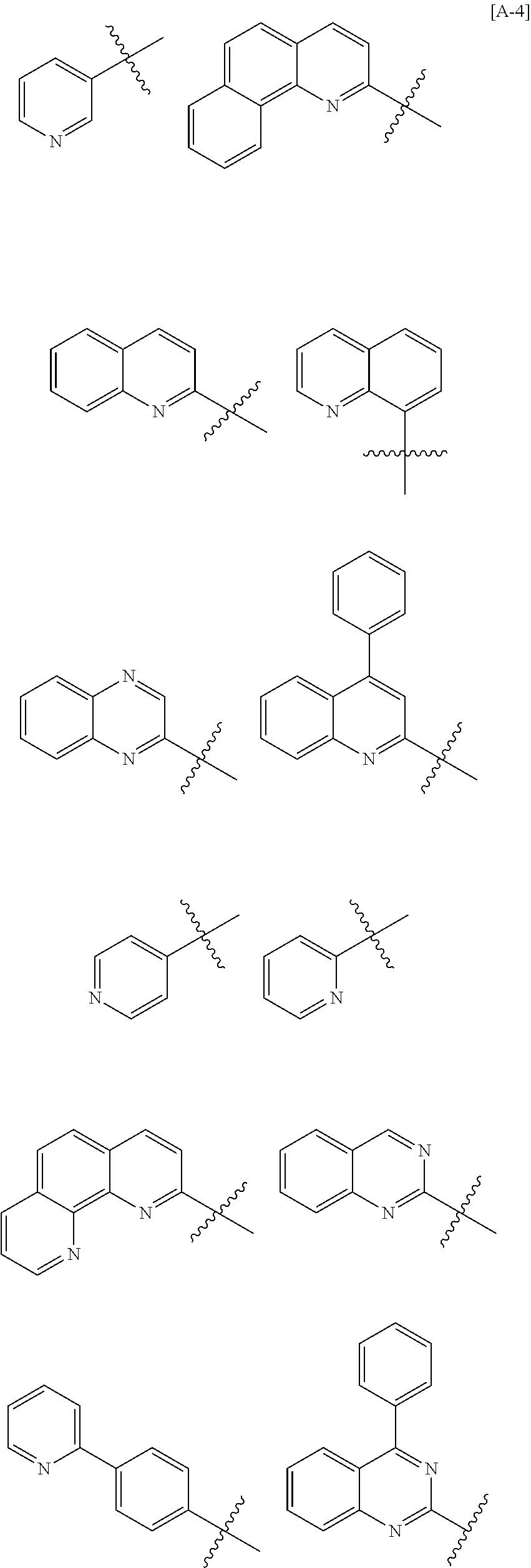


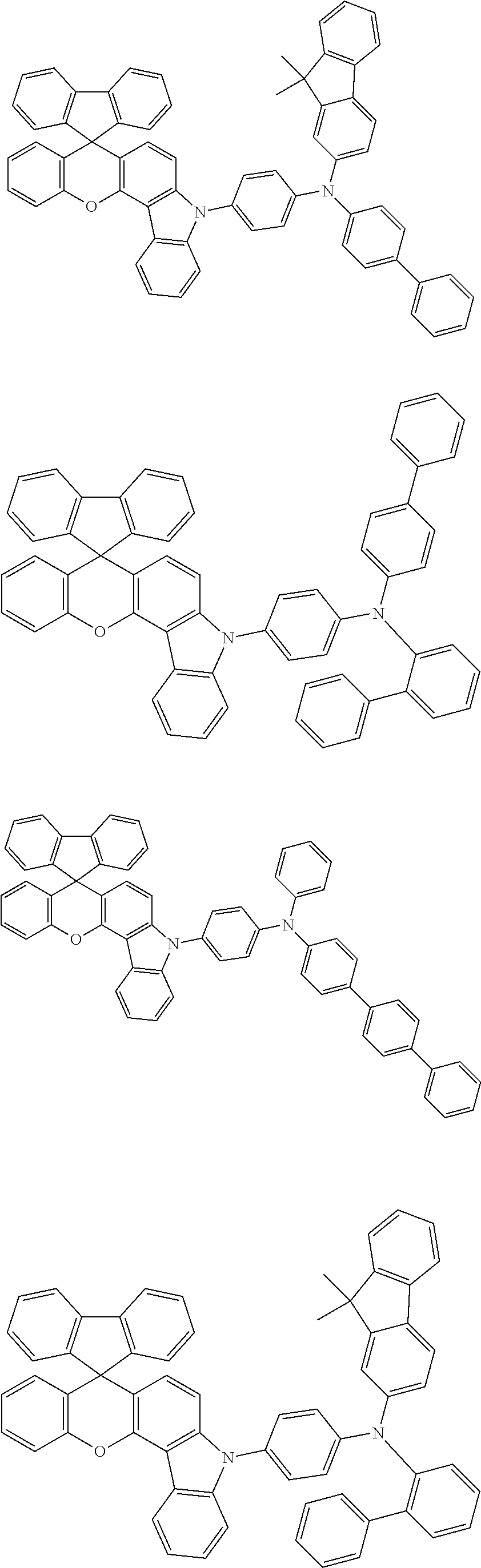


| TABLE 1 | ||||
| Compound | ||||
| (Electron | Voltage | Efficiency | Color | |
| blocking | (V@10 | (cd/A@10 | coordinate | |
| Classification | layer) | mA/cm2) | mA/cm2) | (x, y) |
| Experimental | Compound 1 | 3.70 | 5.30 | (0.138, 0.125) | |
| Example 1-1 | |||||
| Experimental | Compound 2 | 3.62 | 5.38 | (0.137, 0.126) | |
| Example 1-2 | |||||
| Experimental | Compound 3 | 3.59 | 5.41 | (0.137, 0.126) | |
| Example 1-3 | |||||
| | Compound | 10 | 3.52 | 5.46 | (0.138, 0.126) |
| Example 1-4 | |||||
| | Compound | 11 | 3.53 | 5.44 | (0.137, 0.126) |
| Example 1-5 | |||||
| Experimental | Compound 15 | 3.61 | 5.39 | (0.138, 0.126) | |
| Example 1-6 | |||||
| Experimental | Compound 16 | 3.68 | 5.49 | (0.138, 0.127) | |
| Example 1-7 | |||||
| Comparative | EB 1 (TCTA) | 4.13 | 4.71 | (0.137, 0.126) | |
| Example 1-1 | |||||
| Comparative | EB 2 | 4.04 | 4.85 | (0.139, 0.125) | |
| Example 1-2 | |||||
| Comparative | EB 3 | 4.25 | 4.56 | (0.138, 0.124) | |
| Example 1-3 | |||||


| TABLE 2 | ||||
| Voltage | Efficiency | EL | ||
| Compound | (V@10 | (cd/A@10 | peak | |
| Classification | (Host) | mA/cm2) | mA/cm2) | (nm) |
| Experimental | Compound 4 | 5.38 | 45.31 | 517 |
| Example 2-1 | ||||
| Experimental | Compound 6 | 5.43 | 44.93 | 516 |
| Example 2-2 | ||||
| Experimental | Compound 7 | 5.55 | 44.34 | 518 |
| Example 2-3 | ||||
| Experimental | Compound 8 | 5.49 | 44.25 | 517 |
| Example 2-4 | ||||
| Experimental | Compound 12 | 5.44 | 44.88 | 518 |
| Example 2-5 | ||||
| Experimental | Compound 14 | 5.39 | 45.30 | 517 |
| Example 2-6 | ||||
| Comparative | GH 1 (CBP) | 6.12 | 39.41 | 517 |
| Example 2-1 | ||||
| Comparative | GH 2 | 5.75 | 41.35 | 518 |
| Example 2-2 | ||||
| Comparative | GH 3 | 5.92 | 40.25 | 519 |
| Example 2-3 | ||||


| TABLE 3 | |||||
| Color | |||||
| Compound | Voltage | Luminance | coordinate | T95 | |
| Classification | (Host) | (V) | (cd/m2) | (x, y) | (hr) |
| Experimental | Compound | 4.3 | 1860 | (0.670, 0.329) | 465 |
| Example 3-1 | 5 | ||||
| Experimental | Compound | 4.2 | 1920 | (0.674, 0.325) | 435 |
| Example 3-2 | 13 | ||||
| Comparative | RH 1 (CBP) | 5.4 | 1350 | (0.671, 0.327) | 355 |
| Example 3-1 | |||||
-
- 10, 11: Organic light emitting device
- 20: Substrate
- 30: First electrode
- 40: Light emitting layer
- 50: Second electrode
- 60: Hole injection layer
- 70: Hole transporting layer
- 80: Electron blocking layer
- 90: Electron transporting layer
- 100: Electron injection layer
Claims (19)


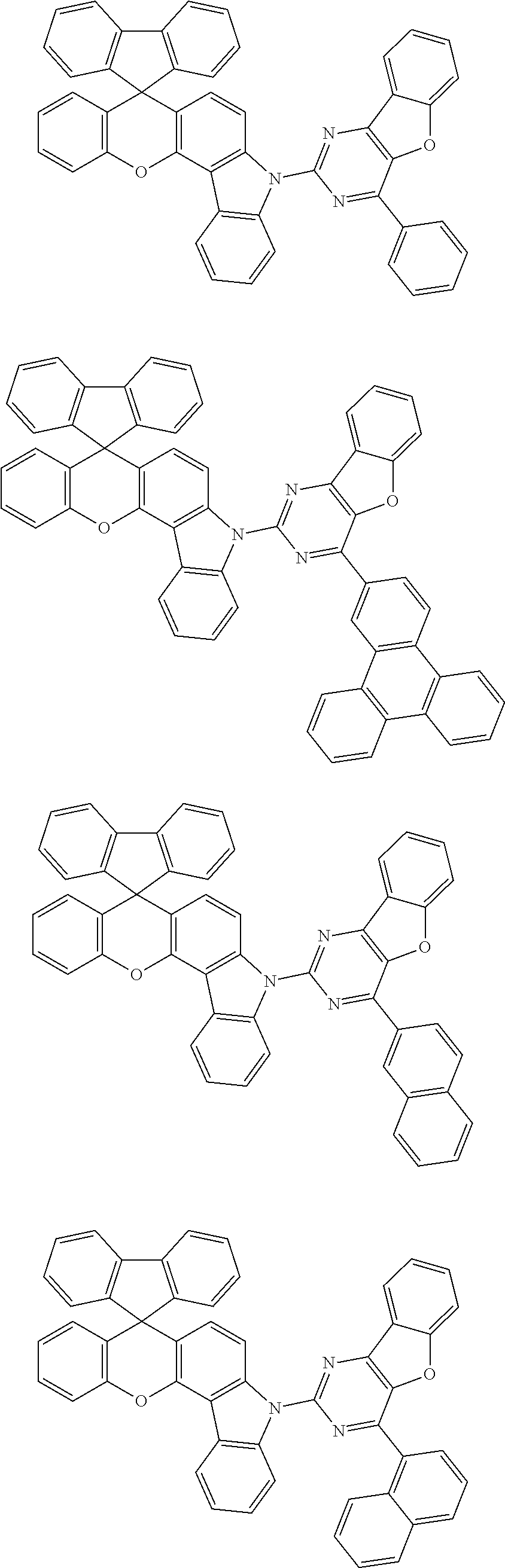


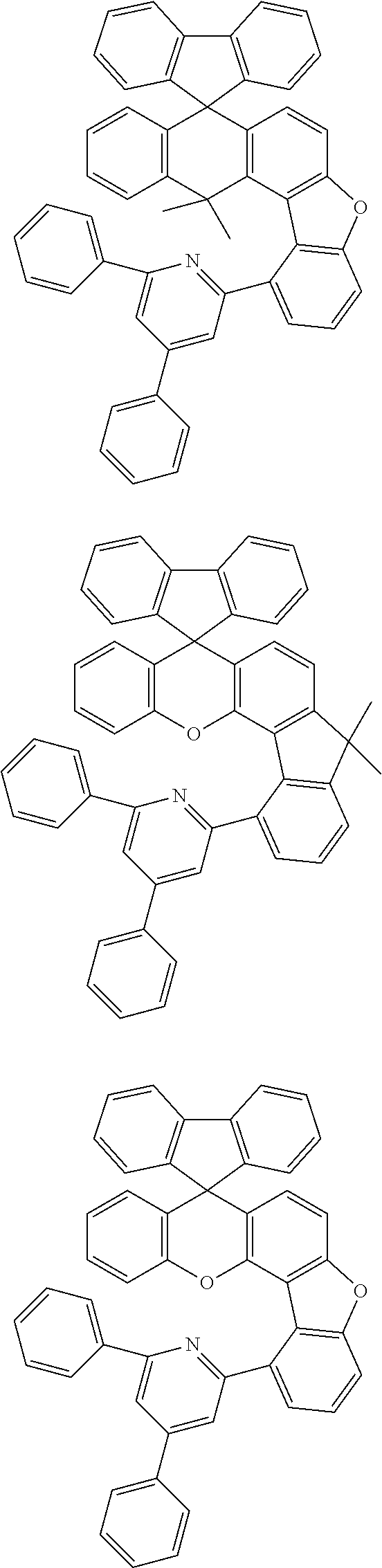


Applications Claiming Priority (3)
| Application Number | Priority Date | Filing Date | Title |
|---|---|---|---|
| KR10-2016-0010112 | 2016-01-27 | ||
| KR20160010112 | 2016-01-27 | ||
| PCT/KR2017/000982 WO2017131483A1 (en) | 2016-01-27 | 2017-01-26 | Spiro-structured compound and organic electronic device comprising same |
Publications (2)
| Publication Number | Publication Date |
|---|---|
| US20190010164A1 US20190010164A1 (en) | 2019-01-10 |
| US10968230B2 true US10968230B2 (en) | 2021-04-06 |
Family
ID=59398437
Family Applications (1)
| Application Number | Title | Priority Date | Filing Date |
|---|---|---|---|
| US16/069,694 Active 2037-11-08 US10968230B2 (en) | 2016-01-27 | 2017-01-26 | Spiro-structured compound and organic electronic device comprising same |
Country Status (7)
| Country | Link |
|---|---|
| US (1) | US10968230B2 (en) |
| EP (1) | EP3388438B1 (en) |
| JP (1) | JP6679092B2 (en) |
| KR (1) | KR101849872B1 (en) |
| CN (1) | CN108699074B (en) |
| TW (1) | TWI659033B (en) |
| WO (1) | WO2017131483A1 (en) |
Families Citing this family (9)
| Publication number | Priority date | Publication date | Assignee | Title |
|---|---|---|---|---|
| CN107857769B (en) * | 2016-09-22 | 2020-09-22 | 株式会社Lg化学 | Heterocyclic compound and organic light-emitting element comprising the same |
| KR102250384B1 (en) * | 2018-03-28 | 2021-05-10 | 주식회사 엘지화학 | Multicyclic compound and organic light emitting device comprising the same |
| KR102783339B1 (en) * | 2018-06-12 | 2025-03-20 | 삼성디스플레이 주식회사 | Heterocyclic compound and organic light emitting device comprising the same |
| KR102110834B1 (en) * | 2018-11-12 | 2020-05-14 | 엘티소재주식회사 | Heterocyclic compound and organic light emitting device comprising the same |
| CN110759930B (en) * | 2018-12-06 | 2022-04-05 | 广州华睿光电材料有限公司 | Spiro compounds and uses thereof |
| KR102793765B1 (en) | 2019-12-06 | 2025-04-11 | 덕산네오룩스 주식회사 | An organic electronic element comprising the organic compound and an electronic device comprising it |
| KR102599598B1 (en) * | 2020-12-14 | 2023-11-07 | 솔루스첨단소재 주식회사 | Organic light-emitting compound and organic electroluminescent device using the same |
| CN113214280B (en) * | 2021-04-27 | 2023-06-23 | 陕西莱特迈思光电材料有限公司 | Organic compound, and electronic device and electronic apparatus including the same |
| CN114409685B (en) * | 2022-01-17 | 2023-07-21 | 华南理工大学 | A class of organic small molecule electroluminescent material and its preparation method and application |
Citations (13)
| Publication number | Priority date | Publication date | Assignee | Title |
|---|---|---|---|---|
| US20020172420A1 (en) | 2001-04-20 | 2002-11-21 | Nicolas Marina Marie Pierre | Image processing apparatus for and method of improving an image and an image display apparatus comprising the image processing apparatus |
| US20060286405A1 (en) * | 2005-06-17 | 2006-12-21 | Eastman Kodak Company | Organic element for low voltage electroluminescent devices |
| US20070018569A1 (en) * | 2003-05-15 | 2007-01-25 | Idemitsu Kosan Co., Ltd. | Arylamine compound and organic electroluminescence device containing the same |
| WO2010047551A2 (en) | 2008-10-23 | 2010-04-29 | 대주전자재료 주식회사 | Aromatic derivatives and organic electroluminescent device comprising the same |
| JP2012229195A (en) | 2011-04-14 | 2012-11-22 | Canon Inc | Novel spiro compound and organic light-emitting device having the same |
| KR20130140303A (en) | 2012-06-14 | 2013-12-24 | (주) 에프엔지리서치 | Novel compounds for organic electroluminescent device |
| WO2014051232A1 (en) | 2012-09-28 | 2014-04-03 | 제일모직 주식회사 | Compound for organic optoelectronic device, organic light-emitting device containing same, and display device including said organic light-emitting device |
| KR20140054132A (en) | 2011-07-29 | 2014-05-08 | 메르크 파텐트 게엠베하 | Compounds for electronic devices |
| WO2015009076A1 (en) | 2013-07-17 | 2015-01-22 | Rohm And Haas Electronic Materials Korea Ltd. | A combination of a dopant compound and a host compound and an organic electroluminescent device comprising the same |
| WO2016021989A1 (en) | 2014-08-08 | 2016-02-11 | Rohm And Haas Electronic Materials Korea Ltd. | Organic electroluminescent compounds and organic electroluminescent devices comprising the same |
| KR20170016703A (en) | 2015-08-04 | 2017-02-14 | 주식회사 두산 | Organic light-emitting compound and organic electroluminescent device using the same |
| US20170217992A1 (en) | 2014-08-08 | 2017-08-03 | Rohm And Haas Electronic Materials Korea Ltd. | Organic electroluminescent compounds and organic electroluminescent devices comprising the same |
| EP3305764A2 (en) | 2015-06-05 | 2018-04-11 | LG Chem, Ltd. | Double spiro organic compound and organic electronic element comprising same |
Family Cites Families (2)
| Publication number | Priority date | Publication date | Assignee | Title |
|---|---|---|---|---|
| DE10135513B4 (en) | 2001-07-20 | 2005-02-24 | Novaled Gmbh | Light-emitting component with organic layers |
| KR101639328B1 (en) | 2014-07-18 | 2016-07-13 | 대한약품공업 주식회사 | Security connector having vial changing check function and medical solution product with the connector |
-
2017
- 2017-01-26 EP EP17744604.4A patent/EP3388438B1/en active Active
- 2017-01-26 WO PCT/KR2017/000982 patent/WO2017131483A1/en not_active Ceased
- 2017-01-26 CN CN201780008317.1A patent/CN108699074B/en active Active
- 2017-01-26 TW TW106103343A patent/TWI659033B/en active
- 2017-01-26 KR KR1020170012851A patent/KR101849872B1/en active Active
- 2017-01-26 US US16/069,694 patent/US10968230B2/en active Active
- 2017-01-26 JP JP2018535280A patent/JP6679092B2/en active Active
Patent Citations (24)
| Publication number | Priority date | Publication date | Assignee | Title |
|---|---|---|---|---|
| KR20030012890A (en) | 2001-04-20 | 2003-02-12 | 코닌클리케 필립스 일렉트로닉스 엔.브이. | Image processing apparatus for and method of improving an image and an image display apparatus comprising the image processing apparatus |
| US20020172420A1 (en) | 2001-04-20 | 2002-11-21 | Nicolas Marina Marie Pierre | Image processing apparatus for and method of improving an image and an image display apparatus comprising the image processing apparatus |
| US20070018569A1 (en) * | 2003-05-15 | 2007-01-25 | Idemitsu Kosan Co., Ltd. | Arylamine compound and organic electroluminescence device containing the same |
| US20060286405A1 (en) * | 2005-06-17 | 2006-12-21 | Eastman Kodak Company | Organic element for low voltage electroluminescent devices |
| WO2010047551A2 (en) | 2008-10-23 | 2010-04-29 | 대주전자재료 주식회사 | Aromatic derivatives and organic electroluminescent device comprising the same |
| KR20110084508A (en) | 2008-10-23 | 2011-07-25 | 대주전자재료 주식회사 | Aromatic Derivatives and Organic Electroluminescent Devices Comprising the Same |
| US20140027757A1 (en) * | 2011-04-14 | 2014-01-30 | Canon Kabushiki Kaisha | Novel spiro compound and organic light-emitting device having the same |
| JP2012229195A (en) | 2011-04-14 | 2012-11-22 | Canon Inc | Novel spiro compound and organic light-emitting device having the same |
| JP2014527522A (en) | 2011-07-29 | 2014-10-16 | メルク パテント ゲーエムベーハー | Compounds for electronic devices |
| KR20140054132A (en) | 2011-07-29 | 2014-05-08 | 메르크 파텐트 게엠베하 | Compounds for electronic devices |
| US20140225040A1 (en) | 2011-07-29 | 2014-08-14 | Merck Patent Gmbh Patents & Scientific Information | Compounds for electronic devices |
| KR20130140303A (en) | 2012-06-14 | 2013-12-24 | (주) 에프엔지리서치 | Novel compounds for organic electroluminescent device |
| US20150137111A1 (en) | 2012-09-28 | 2015-05-21 | Samsung Sdi Co., Ltd. | Compound for organic optoelectronic device, organic light-emitting device containing the same, and display device including said organic light-emitting device |
| WO2014051232A1 (en) | 2012-09-28 | 2014-04-03 | 제일모직 주식회사 | Compound for organic optoelectronic device, organic light-emitting device containing same, and display device including said organic light-emitting device |
| EP2902463A1 (en) | 2012-09-28 | 2015-08-05 | Cheil Industries Inc. | Compound for organic optoelectronic device, organic light-emitting device containing same, and display device including said organic light-emitting device |
| WO2015009076A1 (en) | 2013-07-17 | 2015-01-22 | Rohm And Haas Electronic Materials Korea Ltd. | A combination of a dopant compound and a host compound and an organic electroluminescent device comprising the same |
| KR20150010016A (en) | 2013-07-17 | 2015-01-28 | 롬엔드하스전자재료코리아유한회사 | Organic electroluminescent device |
| WO2016021989A1 (en) | 2014-08-08 | 2016-02-11 | Rohm And Haas Electronic Materials Korea Ltd. | Organic electroluminescent compounds and organic electroluminescent devices comprising the same |
| US20170217992A1 (en) | 2014-08-08 | 2017-08-03 | Rohm And Haas Electronic Materials Korea Ltd. | Organic electroluminescent compounds and organic electroluminescent devices comprising the same |
| JP2017523970A (en) | 2014-08-08 | 2017-08-24 | ローム・アンド・ハース・エレクトロニック・マテリアルズ・コリア・リミテッド | Organic electroluminescent compound and organic electroluminescent device comprising the same |
| EP3305764A2 (en) | 2015-06-05 | 2018-04-11 | LG Chem, Ltd. | Double spiro organic compound and organic electronic element comprising same |
| US20180148640A1 (en) | 2015-06-05 | 2018-05-31 | Lg Chem, Ltd. | Double spiro organic compound and organic electronic element comprising same |
| JP2018518471A (en) | 2015-06-05 | 2018-07-12 | エルジー・ケム・リミテッド | Double spiro organic compound and organic electronic device including the same |
| KR20170016703A (en) | 2015-08-04 | 2017-02-14 | 주식회사 두산 | Organic light-emitting compound and organic electroluminescent device using the same |
Non-Patent Citations (5)
| Title |
|---|
| Bhanuchandra et al., Synthesis of Spirocyclic Diarylfluorenes by One-Pot Twofold SNAr Reactions of Diaryl Sulfones with Diarylmethanes; Organic Letters (2016), 18(3), 384-387 (Year: 2016). * |
| Bhanuchandra, M. et. al, "Synthesis of Spirocyclic Diarylfluorenes by One-Pot Twofold SNAr Reactions of Diaryl Sulfones with Diarylmethanes." Organic Letters, Jan. 8, 2016, vol. 18, No. 3, pp. 384-387. |
| Chemical Abstract Compound, STN express, RNs 1975175-35-9, 1975175-280, 1975174-94-7, 1975174-17-4, 1975173-92-2, 1975173-90-0 (Entered Aug. 18, 2016). |
| Extended European Search Report including Written Opinion for Application No. EP17744604.4 dated Dec. 7, 2018. |
| Search report from International Application No. PCT/KR2017/000982, dated May 11, 2017. |
Also Published As
| Publication number | Publication date |
|---|---|
| JP6679092B2 (en) | 2020-04-15 |
| WO2017131483A1 (en) | 2017-08-03 |
| TW201734019A (en) | 2017-10-01 |
| EP3388438A1 (en) | 2018-10-17 |
| TWI659033B (en) | 2019-05-11 |
| JP2019505513A (en) | 2019-02-28 |
| KR20170089785A (en) | 2017-08-04 |
| KR101849872B1 (en) | 2018-04-18 |
| CN108699074A (en) | 2018-10-23 |
| EP3388438A4 (en) | 2019-01-09 |
| CN108699074B (en) | 2021-12-14 |
| EP3388438B1 (en) | 2021-08-11 |
| US20190010164A1 (en) | 2019-01-10 |
Similar Documents
| Publication | Publication Date | Title |
|---|---|---|
| US11718606B2 (en) | Polycyclic compound and organic light emitting element comprising same | |
| US10573824B2 (en) | Compound and organic electronic element comprising same | |
| US10981876B2 (en) | Spiro compound and organic light emitting element comprising same | |
| US11482677B2 (en) | Compound and organic electronic device comprising same | |
| US10968230B2 (en) | Spiro-structured compound and organic electronic device comprising same | |
| US11050026B2 (en) | Spiro compound and organic light-emitting element comprising same | |
| US10800969B2 (en) | Heterocyclic compound and organic light emitting element comprising same | |
| US20190148650A1 (en) | Organic Light Emitting Device | |
| US10651411B2 (en) | Compound and organic light emitting device containing same | |
| US10903431B2 (en) | Compound and organic electronic device comprising same | |
| US11299466B2 (en) | Compound, and organic electronic element comprising same | |
| US10873035B2 (en) | Heterocyclic compound and organic light emitting diode containing same | |
| US11081650B2 (en) | Spiro compound and organic light-emitting element comprising same | |
| US11075342B2 (en) | Spiro-type compound and organic light emitting diode comprising same | |
| US10862045B2 (en) | Amine-based compound and organic light-emitting element comprising same | |
| US11165025B2 (en) | Compound and organic electronic element comprising same | |
| US10991887B2 (en) | Amine compound and organic light-emitting device comprising same | |
| US11306060B2 (en) | Compound and organic electronic element comprising same | |
| US10822330B2 (en) | Heterocyclic compound and organic light emitting diode containing same | |
| US20170301866A1 (en) | Cyclic compound and organic light-emitting element comprising same | |
| US10991886B2 (en) | Amine-based compound and organic light emitting device comprising same | |
| US10421721B2 (en) | Heterocyclic compound and organic light emitting device comprising same | |
| US11968897B2 (en) | Heterocyclic compound and organic light emitting diode containing same | |
| US10730812B2 (en) | Double spiro compound and organic light-emitting element comprising same | |
| US11730009B2 (en) | Compound and organic light-emitting element comprising same |
Legal Events
| Date | Code | Title | Description |
|---|---|---|---|
| FEPP | Fee payment procedure |
Free format text: ENTITY STATUS SET TO UNDISCOUNTED (ORIGINAL EVENT CODE: BIG.); ENTITY STATUS OF PATENT OWNER: LARGE ENTITY |
|
| AS | Assignment |
Owner name: LG CHEM, LTD., KOREA, REPUBLIC OF Free format text: ASSIGNMENT OF ASSIGNORS INTEREST;ASSIGNORS:CHA, YONGBUM;HONG, SUNG KIL;KIM, JUNGBUM;AND OTHERS;REEL/FRAME:046384/0516 Effective date: 20170203 |
|
| STPP | Information on status: patent application and granting procedure in general |
Free format text: DOCKETED NEW CASE - READY FOR EXAMINATION |
|
| STPP | Information on status: patent application and granting procedure in general |
Free format text: NON FINAL ACTION MAILED |
|
| STPP | Information on status: patent application and granting procedure in general |
Free format text: RESPONSE TO NON-FINAL OFFICE ACTION ENTERED AND FORWARDED TO EXAMINER |
|
| STPP | Information on status: patent application and granting procedure in general |
Free format text: NOTICE OF ALLOWANCE MAILED -- APPLICATION RECEIVED IN OFFICE OF PUBLICATIONS |
|
| STPP | Information on status: patent application and granting procedure in general |
Free format text: PUBLICATIONS -- ISSUE FEE PAYMENT VERIFIED |
|
| STCF | Information on status: patent grant |
Free format text: PATENTED CASE |
|
| MAFP | Maintenance fee payment |
Free format text: PAYMENT OF MAINTENANCE FEE, 4TH YEAR, LARGE ENTITY (ORIGINAL EVENT CODE: M1551); ENTITY STATUS OF PATENT OWNER: LARGE ENTITY Year of fee payment: 4 |