US10949552B2 - Whole apparatus having an authentication arrangement, and method for authentication - Google Patents
Whole apparatus having an authentication arrangement, and method for authentication Download PDFInfo
- Publication number
- US10949552B2 US10949552B2 US16/605,149 US201816605149A US10949552B2 US 10949552 B2 US10949552 B2 US 10949552B2 US 201816605149 A US201816605149 A US 201816605149A US 10949552 B2 US10949552 B2 US 10949552B2
- Authority
- US
- United States
- Prior art keywords
- user data
- encryption
- hardware
- unit
- data processing
- Prior art date
- Legal status (The legal status is an assumption and is not a legal conclusion. Google has not performed a legal analysis and makes no representation as to the accuracy of the status listed.)
- Active
Links
Images


Classifications
-
- G—PHYSICS
- G06—COMPUTING OR CALCULATING; COUNTING
- G06F—ELECTRIC DIGITAL DATA PROCESSING
- G06F21/00—Security arrangements for protecting computers, components thereof, programs or data against unauthorised activity
- G06F21/60—Protecting data
- G06F21/606—Protecting data by securing the transmission between two devices or processes
-
- G—PHYSICS
- G06—COMPUTING OR CALCULATING; COUNTING
- G06F—ELECTRIC DIGITAL DATA PROCESSING
- G06F13/00—Interconnection of, or transfer of information or other signals between, memories, input/output devices or central processing units
- G06F13/38—Information transfer, e.g. on bus
- G06F13/42—Bus transfer protocol, e.g. handshake; Synchronisation
- G06F13/4204—Bus transfer protocol, e.g. handshake; Synchronisation on a parallel bus
- G06F13/4221—Bus transfer protocol, e.g. handshake; Synchronisation on a parallel bus being an input/output bus, e.g. ISA bus, EISA bus, PCI bus, SCSI bus
-
- G—PHYSICS
- G06—COMPUTING OR CALCULATING; COUNTING
- G06F—ELECTRIC DIGITAL DATA PROCESSING
- G06F21/00—Security arrangements for protecting computers, components thereof, programs or data against unauthorised activity
- G06F21/50—Monitoring users, programs or devices to maintain the integrity of platforms, e.g. of processors, firmware or operating systems
- G06F21/57—Certifying or maintaining trusted computer platforms, e.g. secure boots or power-downs, version controls, system software checks, secure updates or assessing vulnerabilities
-
- G—PHYSICS
- G06—COMPUTING OR CALCULATING; COUNTING
- G06F—ELECTRIC DIGITAL DATA PROCESSING
- G06F21/00—Security arrangements for protecting computers, components thereof, programs or data against unauthorised activity
- G06F21/60—Protecting data
- G06F21/602—Providing cryptographic facilities or services
-
- G—PHYSICS
- G06—COMPUTING OR CALCULATING; COUNTING
- G06F—ELECTRIC DIGITAL DATA PROCESSING
- G06F21/00—Security arrangements for protecting computers, components thereof, programs or data against unauthorised activity
- G06F21/70—Protecting specific internal or peripheral components, in which the protection of a component leads to protection of the entire computer
- G06F21/78—Protecting specific internal or peripheral components, in which the protection of a component leads to protection of the entire computer to assure secure storage of data
-
- H—ELECTRICITY
- H04—ELECTRIC COMMUNICATION TECHNIQUE
- H04L—TRANSMISSION OF DIGITAL INFORMATION, e.g. TELEGRAPHIC COMMUNICATION
- H04L69/00—Network arrangements, protocols or services independent of the application payload and not provided for in the other groups of this subclass
- H04L69/22—Parsing or analysis of headers
-
- G—PHYSICS
- G06—COMPUTING OR CALCULATING; COUNTING
- G06F—ELECTRIC DIGITAL DATA PROCESSING
- G06F2213/00—Indexing scheme relating to interconnection of, or transfer of information or other signals between, memories, input/output devices or central processing units
- G06F2213/0026—PCI express
-
- G—PHYSICS
- G06—COMPUTING OR CALCULATING; COUNTING
- G06F—ELECTRIC DIGITAL DATA PROCESSING
- G06F2221/00—Indexing scheme relating to security arrangements for protecting computers, components thereof, programs or data against unauthorised activity
- G06F2221/21—Indexing scheme relating to G06F21/00 and subgroups addressing additional information or applications relating to security arrangements for protecting computers, components thereof, programs or data against unauthorised activity
- G06F2221/2153—Using hardware token as a secondary aspect
-
- H—ELECTRICITY
- H04—ELECTRIC COMMUNICATION TECHNIQUE
- H04L—TRANSMISSION OF DIGITAL INFORMATION, e.g. TELEGRAPHIC COMMUNICATION
- H04L2209/00—Additional information or applications relating to cryptographic mechanisms or cryptographic arrangements for secret or secure communication H04L9/00
- H04L2209/12—Details relating to cryptographic hardware or logic circuitry
- H04L2209/127—Trusted platform modules [TPM]
Definitions
- the disclosure relates to a whole apparatus having an authentication arrangement for a communication connection, using a communication protocol, between two data processing devices of the whole apparatus, wherein the data processing devices each have an interface unit for the communication connection and a computation unit, particularly a CPU, and/or a GPU, and/or an FPGA, and/or a ASIC.
- the disclosure relates to a method for authentication.
- Modern whole apparatuses with data processing systems are becoming increasingly complex due to the multiplicity of tasks to be performed and/or the advancement of data processing capabilities.
- a motor vehicle is to be designed for a fully automatic, i.e., autonomous operation
- data processing systems with high computing power are required in order to be able to securely process the environment of the motor vehicle and to be able to undertake safe trip planning.
- autonomous operating options in motor vehicles as whole apparatuses there are also increasing communication options in the area of information technology, for example, connections to clouds, to the infrastructure, and the like. Even the motor vehicle as a service platform is increasingly becoming the center of attention.
- PCI Express (often also called PCIe) can be used as a modern, fast communication technology. It is a point-to-point communication standard, which, however, can be extended by interposing bridge devices, particularly switches, hubs, multiplexers/demultiplexers, or the like.
- the advantage of PCI Express is particularly the high-speed communication, “DMA by design” and the fact that many compatible devices are already available on the market.
- the communication connection is usually established via corresponding interface units, for example, a PCIe microchip.
- Bridge devices switches, hubs, multiplexers, demultiplexers
- SoC system on a chip
- the actual communication partners are usually referred to as “endpoints” and can include an operating system and/or a driver, wherein the handling of the interrupts and read/write operations can be performed by the driver.
- the disclosure therefore addresses the problem of providing an option for increasing the security in data processing systems of whole apparatuses which operate with modern, fast, less secure communication standards, and particularly allowing for an authentication of the data processing devices among one another.
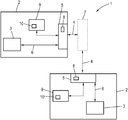
- FIG. 1 shows a schematic diagram of a whole apparatus, according to some embodiments of the disclosure.
- FIG. 2 shows a flowchart of an embodiment of the method, according to some embodiments of the disclosure.
- FIG. 3 shows a diagram for partial encryption, according to some embodiments of the disclosure.
- FIG. 4 shows a motor vehicle as a whole apparatus, according to some embodiments of the disclosure.
- the interface units each have a cryptographic encryption/decryption device, at least partially produced by hardware, for encrypting at least some of the user data to be transmitted via the communication connection as part of the authentication arrangement.
- the encryption/decryption device can be applied in a particularly non-application-oriented communication layer of the communication protocol to the user data prepared for the physical user data transmission or to the physically received user data.
- Each data processing device has a security unit, implemented as dedicated hardware that the computation unit cannot access, and/or in a manner logically isolated from the computation unit, and producing a trusted execution environment.
- the disclosure therefore proposes an authentication arrangement which is realized as hardware and thus less susceptible to manipulations.
- the authentication arrangement allows for a mutual authentication of the data processing devices at least implicitly, but preferably in an authentication process, via the option for secure communication via the communication connection. This is based on the hard-coded key information in the hardware of the security unit, which cannot be accessed by the computation unit.
- the hard-coded key information can be adapted for at least one pair of data processing devices, each to be authenticated against one other, wherein the encryption information for a pair of communicating data processing devices can be based on symmetric encryption but also on asymmetric encryption.
- the encryption information comprises at least one identical base key, particularly for all data processing devices.
- each key information contains at least its own private key and the public keys of all communication partners provided and to be authenticated.
- the authentication can essentially take place implicitly by the encryption concept described herein, wherein an explicit authentication process can preferably be used, particularly at the beginning of each communication session in the course of or in addition to negotiating a session key or entirely without a key negotiation. Any basically known authentication processes can be used. Expediently, an authentication takes place at the beginning of a communication session, after which a negotiation of a session key takes place upon a successful authentication. Unauthenticated data processing devices, such as correspondingly compromised and/or replaced data processing devices, are “not understood,” unable to authenticate themselves, or discovered by the absence of any encryption. The present disclosure therefore ensures that only authorized data processing devices (i.e., having matching/adapted key information) can communicate as intended.
- the security unit produces a trusted execution environment (TEE).
- TEE trusted execution environment
- the security unit also includes a hardware-produced and/or isolated operating system for key management and possibly execution of an authentication process and/or key negotiation when a session key is supposed to be negotiated for the current communication session, as shall be described in more detail below.
- the present disclosure provides, as new components of an authentication arrangement, the security unit as a trusted execution environment which contains and manages the key information, and a cryptographic encryption/decryption device which lies as close as possible to the user data to be transmitted physically, particularly in a transport layer and/or a communication layer.
- the security unit With the trusted execution environment, the security unit thus provides an execution context that is isolated from the normal operating system of the data processing device.
- the key management and the secure storage of the key information is supposed to take place in the security unit in the same way as possibly provided secure calculations, such as key generation, authentication process, and key negotiation (key agreement).
- suitable key information to be hardware-encoded can be passed on to appropriate cooperation partners.
- the term “hardware-encoding” means that the keys are written into the security unit, possibly in the form of a circuit, and subsequently designed by known means to be unalterable.
- Unknown third-party data processing devices can be avoided because the secure communication is impossible, and/or the authentication/negotiation of session keys fails. Due to the outsourcing of the authentication in hardware components, the quality inspection of software components of the data processing devices is simplified because the authentication takes place at a hardware level.
- the disclosure allows the prevention of physical modification measures and attacks, which is particularly advantageous for whole apparatuses, such as motor vehicles, because here the communication connections are physically accessible with relative ease. As a result, the encrypted user data cannot be recognized by an external analysis means. Overall, the described concept must be labeled as application-transparent because all protection mechanisms are implemented in hardware and possibly low-level software.
- the key information is already determined at the manufacturer of the security unit, which can be designed, for example, as a separate microchip, and introduced into the security unit in a hardware-encoded manner.
- a manufacturer of the whole apparatus itself can also hardware-encode the key information, for example, in the case of a motor vehicle, at the end of the assembly line.
- a provisional master key is present within the security unit and can be used to supplement and hardware-encode the dedicated key information and finally lock the not yet closed microchip of the security unit (“fusing”). This applies both to symmetric key information, thus particularly to common base keys, as well as asymmetric key information.
- the communication layer is a transport layer, and/or a transaction layer.
- the communication protocol is packet-based, particularly PCI Express. Therefore, in some embodiments, PCI Express (PCIe) can be selected as the communication protocol (communication standard), in which case the encryption/decryption device is preferably assigned to a transaction layer, and is thus applied to the user data prepared for the physical transport and appropriately formatted, specifically TLPs (Transaction Layer Packages).
- PCIe PCI Express
- only one, particularly dynamically or user-adjustable, portion of the user data packets to be transmitted is encrypted, wherein the encryption state in an information unit, particularly an encryption bit, of the header of the respective user data packet is displayed.
- an encryption indicator In order to save encryption and decryption efforts, it is thus conceivable to perform only a partial encryption, for which a corresponding encryption bit is preferably set accordingly within the header of the user data packets if an encryption is present. In general, this can also be called an encryption indicator.
- the rate of encryption can be selected by a user, for example, predetermined by a manufacturer of the whole apparatus in a hardware-encoded manner, but it can also be dynamically adaptable, so that, for example, it can be provided that the rate of encrypted user data packets is selected on the basis of a desired data transmission rate for the user data. In this manner, a balance can be created between the security offered by encryption and the saving of expenditures for high data rates.
- the security unit has at least one protection mechanism against a reading or reading out of the key information.
- special microchips have already been proposed, in which a stored circuit/a stored key information still becomes unreadable in case of a physical intrusion into the microchip.
- the security unit can be realized as a secure cryptoprocessor, in which at least one physical security measure is provided as a protection mechanism, as is known, for example, for smart cards. Designs, in which the stored key information is automatically destroyed if the physical integrity of the security unit is destroyed, are also conceivable as protection mechanisms. Protection mechanisms can also comprise shielding layers that prevent the reading of internal signals and the like.
- the authentication arrangement is designed for negotiating a session key to be used for a communication session on the basis of the key information, particularly after a mutual authentication in the course of an authentication process using the key information.
- the security units communicate via the communication connection in order to agree on a session key and, if necessary, also separately in case of an authentication process.
- the key information serves in this case as “shared information,” i.e., shared information, which is to be used as basis for the authentication and/or the negotiations and/or the generation of the session key in order to allow for the authentication by the authentication arrangements.
- shared information i.e., shared information
- different options for negotiating a key are conceivable, particularly also asymmetric negotiation methods, for example, the Diffie-Hellman methods.
- the negotiation of the session key can be understood as an authentication process if no explicit authentication is connected upstream or interposed. In other words, the authentication process now provides the “session key.”
- a plurality of base keys is provided, and/or the security unit is designed to derive different subkeys from the base key.
- the authentication can be adapted via the base keys according to further criteria, for example, a different key can be provided for different models of the whole apparatus in order to also allow for a distinction in terms of the authentication.
- a key to be used can be selected using a property of the whole apparatus and/or a usage parameter describing the use of the whole apparatus.
- the security unit can be designed as a one-chip system with the computation unit and/or the interface unit or as a separate security chip. Specifically, it can be provided that the security unit is designed as a trusted zone of the one-chip system or as an embedded security element of the one-chip system or as a trusted platform module (TPM).
- TPM trusted platform module
- SoC one-chip systems
- measures/mechanisms are already known for preventing access of a general operating system, for example, an operating system of the computation unit and/or the interface unit, to a specific hardware segment, particularly a trusted zone and/or an embedded security element.
- the innovations according to the disclosure can be used particularly advantageously within a motor vehicle as a whole apparatus, wherein at least one data processing device is a control device.
- Modern motor vehicles usually have complicated data processing systems which are supposed to meet the highest requirements, particularly with regard the control devices concerned. It must be noted, however, that the data processing devices in a motor vehicle as the whole apparatus do not necessarily have to be control devices; instead, it is quite conceivable to integrate other data processing devices, for example, sensors, display devices, operating elements, bridge devices, and the like.
- the key information is whole apparatus-specific in order to further increase security.
- the key information can then be made available in a database by a manufacturer, for example, in order to be able to purposefully control expansions and/or replacements with respect to the data processing systems of the whole apparatuses.
- the present disclosure also relates to a method for authenticating a communication connection, using a communication protocol, between two data processing devices of a whole apparatus of the type according to the disclosure by an encryption mechanism, wherein the encryption of the user data takes place on the basis of the key information.
- FIG. 1 shows a schematic diagram of a whole apparatus according to the disclosure
- FIG. 2 shows a flowchart of an embodiment of the method according to the disclosure
- FIG. 3 shows a diagram for partial encryption
- FIG. 4 shows a motor vehicle according to the disclosure as a whole apparatus.
- FIG. 1 shows an embodiment of a whole apparatus 1 according to the disclosure.
- it has two depicted data processing devices 2 , each having have a computation unit 3 , for example, a CPU.
- the computation unit 3 can, for example, provide a rich execution environment with an operating system which can manage the interrupt handling, drivers, applications, and the like.
- the data processing devices 2 are supposed to be able to communicate with one another via a PCIe communication connection 4 , for which reason they each have an interface unit 5 which can be designed as a PCIe microchip and which has an interrupt and user data connection 6 to the computation unit 3 , as is basically known.
- a bridge device 7 which can be designed as a switch, hub, multiplexer/demultiplexer, or the like, wherein it must be noted that a bridge device 7 itself can naturally also count as a data processing device and be designed in accordance with the data processing devices 2 , in which case an authentication can take place over sections of the communication connection 4 , which, however, is less preferred.
- an encryption/decryption device 8 produced by hardware is integrated in the interface unit 5 , which in this case can encrypt or decrypt user data for the communication session on the basis of a negotiated session key.
- the encryption/decryption device must be assigned to the transaction layer of the PCIe communication protocol. In other words, the encryption/decryption is applied to the data to be transported physically (TLPs—Transaction Layer Packets).
- the session key is negotiated via a further component of the authentication arrangement, namely a security unit 9 , which in this case is provided as a separate microchip, specifically as a trusted platform module (TPM), but it can also be provided as a trusted zone or security element on a microchip that realizes the computation unit 3 and/or the interface unit 5 .
- a security unit 9 which in this case is provided as a separate microchip, specifically as a trusted platform module (TPM), but it can also be provided as a trusted zone or security element on a microchip that realizes the computation unit 3 and/or the interface unit 5 .
- TPM trusted platform module
- the security unit 9 therefore forms a trusted runtime environment, thus a so-called trusted execution environment (TEE) which cannot be accessed in a controlling or influencing manner particularly by the respective computation unit 3 .
- TEE trusted execution environment
- the trusted operating system of the security unit 9 executes all security-relevant calculations, in this case particularly the management of the key information 10 and the negotiation of a session key, which is subsequently determined as “shared information” on the basis of the key information 10 , and so an encrypted communication between the data processing devices 2 is possible only in case of a corresponding or matching key information 10 , which constitutes an authentication. If an encryption is possible, both data processing devices 2 thus know that the respective communication partner is authorized, and so a mutual authentication is provided.
- Added and/or modified data processing devices which do not have the key information 10 can thus be detected and identified as an unauthorized device. It is also conceivable to provide an authentication process separate from the key negotiation, for example, upstream of and a requirement for the key negation. As a result, the key information does not necessarily have to be included in the session key or its negotiation.
- a symmetric base encryption is present in this case, it must additionally be noted that it is also possible to use a plurality of base keys which can be derived particularly from a rootkey which never leaves the security unit 9 . In this manner, different base keys for different models of the whole apparatus 1 , different countries and/or regions and/or different time periods can be created to further increase security. It is further preferred if the base key (serving particularly as a rootkey) of the key information 10 is whole apparatus-specific, i.e., a separate, individual rootkey and thus a separate, individual key information 10 is present for each whole apparatus 1 .
- the respective security units 9 have at least one protection mechanism which makes it at least difficult to access the key information 10 by manipulating the security unit 9 itself.
- FIG. 2 shows a flow chart of an embodiment of the method according to the disclosure, as it can be executed in the whole apparatus 1 .
- a step S 1 for example, both data processing devices 2 can be initialized, for example, booted up, whereupon both the computation unit 3 and the security unit 9 are also started.
- the security units 9 together negotiate a session key for the communication session via the communication connection 4 , wherein here, too, an encryption can already take place using the key information 10 and the respective encryption/decryption device 8 .
- the session key is negotiated using the key information 10 or is derived therefrom.
- step S 2 can also be understood to be an authentication process because either the negotiation of the session key will fail immediately or the communication with encrypted data will fail later, thus clearly indicating that the communication partner is not correctly authenticated.
- the session key can then be used to communicate in an encrypted manner.
- each user data packet in this case specifically a TLP, but a partial encryption is also conceivable, as shall be explained in more detail by FIG. 3 , in which the data transport 11 between the data processing devices 2 is indicated, wherein two different user data packets 12 (TLPs) are shown.
- Each of the user data packets 12 comprises at least one header 13 and user data 14 (payload).
- the header 13 now contains one information unit 15 , for example, an encryption bit which, when it is set, indicates that the user data 14 are encrypted (cf. hatching in the left user data packet 12 ), and if it is not set, indicates that the user data 14 are not encrypted; cf. the right user data packet 12 and the correspondingly missing hatching.
- the rate of the user data packets 12 containing encrypted user data 14 can also be adapted dynamically, for example, on the basis of a desired data transfer rate.
- FIG. 4 schematically shows a motor vehicle 16 as the whole apparatus 1 .
- the motor vehicle 16 has a data processing system 17 which is associated with a plurality of control devices 18 as data processing devices 2 and further components 19 as data processing devices 2 , for example, sensors and display devices.
- At least one bridge device 7 which, e.g., can act as a multiplexer/demultiplexer, is provided.
Landscapes
- Engineering & Computer Science (AREA)
- Theoretical Computer Science (AREA)
- Computer Security & Cryptography (AREA)
- General Engineering & Computer Science (AREA)
- Computer Hardware Design (AREA)
- General Physics & Mathematics (AREA)
- Physics & Mathematics (AREA)
- Software Systems (AREA)
- General Health & Medical Sciences (AREA)
- Health & Medical Sciences (AREA)
- Bioethics (AREA)
- Computer Networks & Wireless Communication (AREA)
- Signal Processing (AREA)
- Small-Scale Networks (AREA)
- Storage Device Security (AREA)
Applications Claiming Priority (3)
| Application Number | Priority Date | Filing Date | Title |
|---|---|---|---|
| DE102017213010.5 | 2017-07-28 | ||
| DE102017213010.5A DE102017213010A1 (de) | 2017-07-28 | 2017-07-28 | Gesamtvorrichtung mit einer Authentifizierungsanordnung und Verfahren zur Authentifizierung |
| PCT/EP2018/068170 WO2019020335A1 (de) | 2017-07-28 | 2018-07-05 | Gesamtvorrichtung mit einer authentifizierungsanordnung und verfahren zur authentifizierung |
Publications (2)
| Publication Number | Publication Date |
|---|---|
| US20200349268A1 US20200349268A1 (en) | 2020-11-05 |
| US10949552B2 true US10949552B2 (en) | 2021-03-16 |
Family
ID=62846194
Family Applications (1)
| Application Number | Title | Priority Date | Filing Date |
|---|---|---|---|
| US16/605,149 Active US10949552B2 (en) | 2017-07-28 | 2018-07-05 | Whole apparatus having an authentication arrangement, and method for authentication |
Country Status (5)
| Country | Link |
|---|---|
| US (1) | US10949552B2 (de) |
| EP (1) | EP3563209B1 (de) |
| CN (1) | CN110520814A (de) |
| DE (1) | DE102017213010A1 (de) |
| WO (1) | WO2019020335A1 (de) |
Families Citing this family (6)
| Publication number | Priority date | Publication date | Assignee | Title |
|---|---|---|---|---|
| DE102017221889B4 (de) | 2017-12-05 | 2022-03-17 | Audi Ag | Datenverarbeitungseinrichtung, Gesamtvorrichtung und Verfahren zum Betrieb einer Datenverarbeitungseinrichtung oder Gesamtvorrichtung |
| CN112596802B (zh) * | 2019-09-17 | 2022-07-12 | 华为技术有限公司 | 一种信息处理方法及装置 |
| CN111600705B (zh) * | 2020-05-14 | 2022-10-04 | 国网电力科学研究院有限公司 | 一种基于自协商机制的隔离卡 |
| US12542678B2 (en) | 2023-10-19 | 2026-02-03 | Toyota Jidosha Kabushiki Kaisha | System, method, and computer program for dynamic optimization of cryptographic operations |
| DE102024125816B3 (de) * | 2024-09-09 | 2026-02-05 | Vega Grieshaber Kg | Kryptographiegerät zum ver- und entschlüsseln von datenpaketen in einem feldgerätenetzwerk und verfahren |
| DE102024209717A1 (de) * | 2024-10-04 | 2026-04-09 | Robert Bosch Gesellschaft mit beschränkter Haftung | Verfahren zum Generieren eines Sitzungsschlüssels für Teilnehmer eines Netzwerks |
Citations (18)
| Publication number | Priority date | Publication date | Assignee | Title |
|---|---|---|---|---|
| DE19955545A1 (de) | 1999-11-18 | 2001-05-23 | Volkswagen Ag | Steuersystem für ein Kraftfahrzeug |
| US20030046562A1 (en) * | 2001-09-05 | 2003-03-06 | Olympus Optical Co., Ltd. | Remote medical supporting system |
| DE60020794T2 (de) | 1999-11-09 | 2006-05-04 | Bull S.A. | Verschlüsselungsschaltungsarchitektur zur gleichzeitigen Ausführung mehrerer Verschlüsselungsalgorithmen ohne Leistungseinbusse |
| US20060117177A1 (en) * | 2004-11-29 | 2006-06-01 | Buer Mark L | Programmable security platform |
| US20090060197A1 (en) * | 2007-08-31 | 2009-03-05 | Exegy Incorporated | Method and Apparatus for Hardware-Accelerated Encryption/Decryption |
| DE102009027676A1 (de) | 2009-07-14 | 2011-01-20 | Bundesdruckerei Gmbh | Kommunikationsverfahren, Computerprogrammprodukt, Vorrichtung und Computersystem |
| US20110055564A1 (en) | 2008-04-09 | 2011-03-03 | Siemens Aktiengesellschaft | Method and device for transmitting messages in real time |
| US20120155645A1 (en) | 2010-12-17 | 2012-06-21 | Nxp. B.V. | Pairing of angle sensor and electronic control unit |
| CN102546603A (zh) | 2011-12-22 | 2012-07-04 | 洛阳元煜自控工程有限公司 | 一种远程路灯控制系统通信协议动态加密方法 |
| CN103093130A (zh) | 2013-01-09 | 2013-05-08 | 杭州华三通信技术有限公司 | 一种硬件绑定信息加密方法和网络设备 |
| US20150172054A1 (en) | 2013-06-13 | 2015-06-18 | Gyan Prakash | Secure battery authentication |
| WO2016152556A1 (ja) | 2015-03-26 | 2016-09-29 | Kddi株式会社 | 管理装置、車両、管理方法、及びコンピュータプログラム |
| US20160285857A1 (en) * | 2012-03-06 | 2016-09-29 | Paypal, Inc. | System and methods for secure entry of a personal identification number (pin) |
| WO2016154496A1 (en) | 2015-03-25 | 2016-09-29 | Intel Corporation | Challenge response authentication for self encrypting drives |
| US20160315762A1 (en) | 2013-12-15 | 2016-10-27 | Samsung Electronics Co., Ltd. | Secure communication method and apparatus and multimedia device employing the same |
| US20160350555A1 (en) | 2013-12-23 | 2016-12-01 | William C. DeLeeuw | Improved techniques for context information management |
| US9614669B1 (en) * | 2014-11-17 | 2017-04-04 | Q-Net Security, Inc. | Secure network communications using hardware security barriers |
| US20190334721A1 (en) * | 2015-03-31 | 2019-10-31 | Huawei Technologies Co., Ltd. | Mobile Terminal Privacy Protection Method and Protection Apparatus, and Mobile Terminal |
-
2017
- 2017-07-28 DE DE102017213010.5A patent/DE102017213010A1/de not_active Withdrawn
-
2018
- 2018-07-05 US US16/605,149 patent/US10949552B2/en active Active
- 2018-07-05 EP EP18738283.3A patent/EP3563209B1/de active Active
- 2018-07-05 CN CN201880025537.XA patent/CN110520814A/zh active Pending
- 2018-07-05 WO PCT/EP2018/068170 patent/WO2019020335A1/de not_active Ceased
Patent Citations (21)
| Publication number | Priority date | Publication date | Assignee | Title |
|---|---|---|---|---|
| DE60020794T2 (de) | 1999-11-09 | 2006-05-04 | Bull S.A. | Verschlüsselungsschaltungsarchitektur zur gleichzeitigen Ausführung mehrerer Verschlüsselungsalgorithmen ohne Leistungseinbusse |
| US7418598B1 (en) | 1999-11-09 | 2008-08-26 | Buh Hn Information Systems Inc. | Architecture of an encryption circuit implementing various types of encryption algorithms simultaneously without a loss of performance |
| DE19955545A1 (de) | 1999-11-18 | 2001-05-23 | Volkswagen Ag | Steuersystem für ein Kraftfahrzeug |
| US20030046562A1 (en) * | 2001-09-05 | 2003-03-06 | Olympus Optical Co., Ltd. | Remote medical supporting system |
| US20060117177A1 (en) * | 2004-11-29 | 2006-06-01 | Buer Mark L | Programmable security platform |
| US20090060197A1 (en) * | 2007-08-31 | 2009-03-05 | Exegy Incorporated | Method and Apparatus for Hardware-Accelerated Encryption/Decryption |
| US20110055564A1 (en) | 2008-04-09 | 2011-03-03 | Siemens Aktiengesellschaft | Method and device for transmitting messages in real time |
| DE102009027676A1 (de) | 2009-07-14 | 2011-01-20 | Bundesdruckerei Gmbh | Kommunikationsverfahren, Computerprogrammprodukt, Vorrichtung und Computersystem |
| US20120155645A1 (en) | 2010-12-17 | 2012-06-21 | Nxp. B.V. | Pairing of angle sensor and electronic control unit |
| CN102546603A (zh) | 2011-12-22 | 2012-07-04 | 洛阳元煜自控工程有限公司 | 一种远程路灯控制系统通信协议动态加密方法 |
| US20160285857A1 (en) * | 2012-03-06 | 2016-09-29 | Paypal, Inc. | System and methods for secure entry of a personal identification number (pin) |
| CN103093130A (zh) | 2013-01-09 | 2013-05-08 | 杭州华三通信技术有限公司 | 一种硬件绑定信息加密方法和网络设备 |
| US20150172054A1 (en) | 2013-06-13 | 2015-06-18 | Gyan Prakash | Secure battery authentication |
| US20160315762A1 (en) | 2013-12-15 | 2016-10-27 | Samsung Electronics Co., Ltd. | Secure communication method and apparatus and multimedia device employing the same |
| US20160350555A1 (en) | 2013-12-23 | 2016-12-01 | William C. DeLeeuw | Improved techniques for context information management |
| US9614669B1 (en) * | 2014-11-17 | 2017-04-04 | Q-Net Security, Inc. | Secure network communications using hardware security barriers |
| WO2016154496A1 (en) | 2015-03-25 | 2016-09-29 | Intel Corporation | Challenge response authentication for self encrypting drives |
| WO2016152556A1 (ja) | 2015-03-26 | 2016-09-29 | Kddi株式会社 | 管理装置、車両、管理方法、及びコンピュータプログラム |
| EP3276876A1 (de) | 2015-03-26 | 2018-01-31 | Kddi Corporation | Verwaltungsvorrichtung, fahrzeug, verwaltungsverfahren und computerprogramm |
| US20180068107A1 (en) | 2015-03-26 | 2018-03-08 | Kddi Corporation | Management device, vehicle, management method, and computer program |
| US20190334721A1 (en) * | 2015-03-31 | 2019-10-31 | Huawei Technologies Co., Ltd. | Mobile Terminal Privacy Protection Method and Protection Apparatus, and Mobile Terminal |
Non-Patent Citations (4)
| Title |
|---|
| International Preliminary Report on Patentability directed to related International Patent Application No. PCT/EP2018/068170, completed Jul. 8, 2019, with attached English-language translation; 14 pages. |
| International Search Report and Written Opinion of the International Searching Authority, directed to related International Patent Application No. PCT/EP2018/068170, dated Oct. 23, 2018, with attached English-language translation; 21 pages. |
| NPL Search Results (Year: 2020). * |
| NPL Search Terms (Year: 2020). * |
Also Published As
| Publication number | Publication date |
|---|---|
| US20200349268A1 (en) | 2020-11-05 |
| DE102017213010A1 (de) | 2019-01-31 |
| CN110520814A (zh) | 2019-11-29 |
| EP3563209A1 (de) | 2019-11-06 |
| EP3563209B1 (de) | 2020-04-01 |
| WO2019020335A1 (de) | 2019-01-31 |
Similar Documents
| Publication | Publication Date | Title |
|---|---|---|
| US11526602B2 (en) | Data-processing device, complete entity, and method for operating a data-processing device or complete entity | |
| US20200349268A1 (en) | Whole apparatus having an authentication arrangement, and method for authentication | |
| RU2695487C1 (ru) | Способ и система обеспечения взаимодействия устройств интернета вещей (iot) | |
| CN113014539A (zh) | 一种物联网设备安全保护系统及方法 | |
| Hwang et al. | Securing embedded systems | |
| TWI664591B (zh) | 用於停用一付款網路及一電子裝置之間之金融交易的方法及管理裝置 | |
| JP2022528070A (ja) | 運転中の緊急車両のidの検証 | |
| WO2021168864A1 (zh) | 一种故障诊断方法、装置及车辆 | |
| US7861015B2 (en) | USB apparatus and control method therein | |
| RU2462827C2 (ru) | Способ передачи данных и система тахографа | |
| US20020174351A1 (en) | High security host adapter | |
| CN102034039B (zh) | 用于处理单体加密的媒体流的方法和装置 | |
| US11250167B2 (en) | Secure external SoC debugging | |
| US20110016310A1 (en) | Secure serial interface with trusted platform module | |
| CN112513844A (zh) | 用于处理和认证数字密钥的安全元件及其操作方法 | |
| US20230163964A1 (en) | Secure key exchange in a multi-processor device | |
| US20180026962A1 (en) | Tokenized account information with integrated authentication | |
| CN115600190A (zh) | 一种基于中央计算平台的数据可信执行方法及装置 | |
| Kornaros et al. | Hardware-assisted security in electronic control units: Secure automotive communications by utilizing one-time-programmable network on chip and firewalls | |
| KR102377045B1 (ko) | 하드웨어 보안 모듈을 이용한 클라우드를 통한 IoT(Internet of Thing) 디바이스 인증 시스템 및 방법 | |
| US11017062B2 (en) | Method for the secure interaction of a user with a mobile terminal and a further entity | |
| CN109960935B (zh) | 确定tpm可信状态的方法、装置及存储介质 | |
| JP7824357B2 (ja) | 車両システム内のデバイスを管理するためのシステムおよび方法 | |
| US10810327B2 (en) | Enforcing secure display view for trusted transactions | |
| CN107317925A (zh) | 移动终端 |
Legal Events
| Date | Code | Title | Description |
|---|---|---|---|
| FEPP | Fee payment procedure |
Free format text: ENTITY STATUS SET TO UNDISCOUNTED (ORIGINAL EVENT CODE: BIG.); ENTITY STATUS OF PATENT OWNER: LARGE ENTITY |
|
| AS | Assignment |
Owner name: AUDI AG, GERMANY Free format text: ASSIGNMENT OF ASSIGNORS INTEREST;ASSIGNORS:AHN, CHANGSUP;ZAWADZKI, KAMIL;KLEIN, MARKUS, DR.;AND OTHERS;SIGNING DATES FROM 20190927 TO 20191204;REEL/FRAME:051263/0647 |
|
| STPP | Information on status: patent application and granting procedure in general |
Free format text: NOTICE OF ALLOWANCE MAILED -- APPLICATION RECEIVED IN OFFICE OF PUBLICATIONS |
|
| STPP | Information on status: patent application and granting procedure in general |
Free format text: PUBLICATIONS -- ISSUE FEE PAYMENT VERIFIED |
|
| STCF | Information on status: patent grant |
Free format text: PATENTED CASE |
|
| MAFP | Maintenance fee payment |
Free format text: PAYMENT OF MAINTENANCE FEE, 4TH YEAR, LARGE ENTITY (ORIGINAL EVENT CODE: M1551); ENTITY STATUS OF PATENT OWNER: LARGE ENTITY Year of fee payment: 4 |