US10933865B2 - Driving assistance device - Google Patents
Driving assistance device Download PDFInfo
- Publication number
- US10933865B2 US10933865B2 US16/076,460 US201716076460A US10933865B2 US 10933865 B2 US10933865 B2 US 10933865B2 US 201716076460 A US201716076460 A US 201716076460A US 10933865 B2 US10933865 B2 US 10933865B2
- Authority
- US
- United States
- Prior art keywords
- vehicle
- avoidance
- moving object
- amount
- driving
- Prior art date
- Legal status (The legal status is an assumption and is not a legal conclusion. Google has not performed a legal analysis and makes no representation as to the accuracy of the status listed.)
- Active, expires
Links
Images


Classifications
-
- B—PERFORMING OPERATIONS; TRANSPORTING
- B60—VEHICLES IN GENERAL
- B60W—CONJOINT CONTROL OF VEHICLE SUB-UNITS OF DIFFERENT TYPE OR DIFFERENT FUNCTION; CONTROL SYSTEMS SPECIALLY ADAPTED FOR HYBRID VEHICLES; ROAD VEHICLE DRIVE CONTROL SYSTEMS FOR PURPOSES NOT RELATED TO THE CONTROL OF A PARTICULAR SUB-UNIT
- B60W30/00—Purposes of road vehicle drive control systems not related to the control of a particular sub-unit, e.g. of systems using conjoint control of vehicle sub-units
- B60W30/08—Active safety systems predicting or avoiding probable or impending collision or attempting to minimise its consequences
- B60W30/095—Predicting travel path or likelihood of collision
- B60W30/0956—Predicting travel path or likelihood of collision the prediction being responsive to traffic or environmental parameters
-
- B—PERFORMING OPERATIONS; TRANSPORTING
- B60—VEHICLES IN GENERAL
- B60W—CONJOINT CONTROL OF VEHICLE SUB-UNITS OF DIFFERENT TYPE OR DIFFERENT FUNCTION; CONTROL SYSTEMS SPECIALLY ADAPTED FOR HYBRID VEHICLES; ROAD VEHICLE DRIVE CONTROL SYSTEMS FOR PURPOSES NOT RELATED TO THE CONTROL OF A PARTICULAR SUB-UNIT
- B60W30/00—Purposes of road vehicle drive control systems not related to the control of a particular sub-unit, e.g. of systems using conjoint control of vehicle sub-units
- B60W30/08—Active safety systems predicting or avoiding probable or impending collision or attempting to minimise its consequences
- B60W30/09—Taking automatic action to avoid collision, e.g. braking and steering
-
- B—PERFORMING OPERATIONS; TRANSPORTING
- B60—VEHICLES IN GENERAL
- B60W—CONJOINT CONTROL OF VEHICLE SUB-UNITS OF DIFFERENT TYPE OR DIFFERENT FUNCTION; CONTROL SYSTEMS SPECIALLY ADAPTED FOR HYBRID VEHICLES; ROAD VEHICLE DRIVE CONTROL SYSTEMS FOR PURPOSES NOT RELATED TO THE CONTROL OF A PARTICULAR SUB-UNIT
- B60W30/00—Purposes of road vehicle drive control systems not related to the control of a particular sub-unit, e.g. of systems using conjoint control of vehicle sub-units
- B60W30/08—Active safety systems predicting or avoiding probable or impending collision or attempting to minimise its consequences
- B60W30/095—Predicting travel path or likelihood of collision
-
- G06K9/00805—
-
- G—PHYSICS
- G06—COMPUTING OR CALCULATING; COUNTING
- G06V—IMAGE OR VIDEO RECOGNITION OR UNDERSTANDING
- G06V20/00—Scenes; Scene-specific elements
- G06V20/50—Context or environment of the image
- G06V20/56—Context or environment of the image exterior to a vehicle by using sensors mounted on the vehicle
- G06V20/58—Recognition of moving objects or obstacles, e.g. vehicles or pedestrians; Recognition of traffic objects, e.g. traffic signs, traffic lights or roads
-
- G—PHYSICS
- G08—SIGNALLING
- G08G—TRAFFIC CONTROL SYSTEMS
- G08G1/00—Traffic control systems for road vehicles
- G08G1/16—Anti-collision systems
- G08G1/161—Decentralised systems, e.g. inter-vehicle communication
- G08G1/163—Decentralised systems, e.g. inter-vehicle communication involving continuous checking
-
- G—PHYSICS
- G08—SIGNALLING
- G08G—TRAFFIC CONTROL SYSTEMS
- G08G1/00—Traffic control systems for road vehicles
- G08G1/16—Anti-collision systems
- G08G1/166—Anti-collision systems for active traffic, e.g. moving vehicles, pedestrians, bikes
-
- B—PERFORMING OPERATIONS; TRANSPORTING
- B60—VEHICLES IN GENERAL
- B60W—CONJOINT CONTROL OF VEHICLE SUB-UNITS OF DIFFERENT TYPE OR DIFFERENT FUNCTION; CONTROL SYSTEMS SPECIALLY ADAPTED FOR HYBRID VEHICLES; ROAD VEHICLE DRIVE CONTROL SYSTEMS FOR PURPOSES NOT RELATED TO THE CONTROL OF A PARTICULAR SUB-UNIT
- B60W2554/00—Input parameters relating to objects
-
- B—PERFORMING OPERATIONS; TRANSPORTING
- B60—VEHICLES IN GENERAL
- B60W—CONJOINT CONTROL OF VEHICLE SUB-UNITS OF DIFFERENT TYPE OR DIFFERENT FUNCTION; CONTROL SYSTEMS SPECIALLY ADAPTED FOR HYBRID VEHICLES; ROAD VEHICLE DRIVE CONTROL SYSTEMS FOR PURPOSES NOT RELATED TO THE CONTROL OF A PARTICULAR SUB-UNIT
- B60W2554/00—Input parameters relating to objects
- B60W2554/40—Dynamic objects, e.g. animals, windblown objects
- B60W2554/404—Characteristics
- B60W2554/4041—Position
-
- B—PERFORMING OPERATIONS; TRANSPORTING
- B60—VEHICLES IN GENERAL
- B60W—CONJOINT CONTROL OF VEHICLE SUB-UNITS OF DIFFERENT TYPE OR DIFFERENT FUNCTION; CONTROL SYSTEMS SPECIALLY ADAPTED FOR HYBRID VEHICLES; ROAD VEHICLE DRIVE CONTROL SYSTEMS FOR PURPOSES NOT RELATED TO THE CONTROL OF A PARTICULAR SUB-UNIT
- B60W2554/00—Input parameters relating to objects
- B60W2554/40—Dynamic objects, e.g. animals, windblown objects
- B60W2554/404—Characteristics
- B60W2554/4042—Longitudinal speed
-
- B—PERFORMING OPERATIONS; TRANSPORTING
- B60—VEHICLES IN GENERAL
- B60W—CONJOINT CONTROL OF VEHICLE SUB-UNITS OF DIFFERENT TYPE OR DIFFERENT FUNCTION; CONTROL SYSTEMS SPECIALLY ADAPTED FOR HYBRID VEHICLES; ROAD VEHICLE DRIVE CONTROL SYSTEMS FOR PURPOSES NOT RELATED TO THE CONTROL OF A PARTICULAR SUB-UNIT
- B60W2556/00—Input parameters relating to data
- B60W2556/45—External transmission of data to or from the vehicle
Definitions
- the present disclosure relates to a technology for avoiding a collision of an own vehicle with a moving object around the own vehicle.
- a technology including calculating a risk of collision of an own vehicle with a moving object based on a position and a vehicle speed contained in a travel information item of the own vehicle, and on a position and a speed contained in a movement-information item of the moving object, and actuating brakes if the risk of collision is high.
- the movement-information item of the moving object is detected by detection devices installed in the own vehicle, such as a camera and a millimeter-wave radar.
- Patent Literature 1 discloses a technology including transmitting, via wireless communication, a warning information item from a first vehicle to a second vehicle located in a traveling direction of the first vehicle in case where a risk of collision of the first vehicle with the second vehicle is equal to or more than a threshold.
- the warning information item includes the risk of collision, a position information item of the first vehicle, and the traveling direction of the first vehicle.
- the second vehicle When the second vehicle receives the warning information item from an external device, that is, from a communication device of the first vehicle, and at the same time, when the first vehicle that has transmitted the warning information item is located behind the second vehicle, the second vehicle starts, and disengages a stop-holding mode or accelerates so as to avoid the collision with the first vehicle or to reduce damage from the collision.
- an external device that is, from a communication device of the first vehicle
- the inventors have found a problem that, when the own vehicle avoids the collision with the moving object by braking or controlling steering based on the indirectly-acquired movement-information item of the moving object around the own vehicle, the own vehicle may perform an unnecessary avoidance driving action even when there is no risk of collision with the moving object.
- the avoidance driving action is not a normal driving action that passengers expect, the passengers feel anxiety when the own vehicle is caused to perform the avoidance driving action.
- a driving assistance device including a travel information acquisition unit, a first information acquisition unit, a second information acquisition unit, a first determination unit, a second determination unit, a first avoidance-amount setting unit, a second avoidance-amount setting unit, and a driving control unit.
- the travel information acquisition unit acquires at least a position and a vehicle speed of an own vehicle as a travel information item of the own vehicle.
- the first information acquisition unit acquires, as a first information item of a moving object around the own vehicle, at least a position and a speed of the moving object from a detection device installed in the own vehicle.
- the second information acquisition unit acquires, as a second information item of the moving object, at least a position and a speed of the moving object from an external device that is external to the own vehicle.
- the first determination unit determines, based on the travel information item that the travel information acquisition unit acquires and on the first movement-information item that the first information acquisition unit acquires, a first risk (first probability) of collision of the own vehicle with the moving object, and determines, based on the first risk, whether or not to perform a first avoidance driving action (first avoidance maneuver) for avoiding the collision of the own vehicle with the moving object.
- the second determination unit determines, based on the travel information item that the travel information acquisition unit acquires and on the second movement-information item that the second information acquisition unit acquires, a second risk (second probability) of collision of the own vehicle with the moving object, and determines, based on the second risk, whether or not to perform a second avoidance driving action (second avoidance maneuver) for avoiding the collision of the own vehicle with the moving object.
- a second risk second probability
- second avoidance driving action second avoidance maneuver
- the first avoidance-amount setting unit sets, when the first determination unit determines that the first avoidance driving action is being performed, a first avoidance amount for avoiding the collision of the own vehicle with the moving object based on the first risk that the first determination unit determines.
- the second avoidance-amount setting unit sets, when the second determination unit determines that the second avoidance driving action is being performed, a second avoidance amount for avoiding the collision of the own vehicle with the moving object based on the second risk that the second determination unit determines, sets, when the second avoidance-amount setting unit sets a control amount of a control of driving of the own vehicle as the second avoidance amount, the control amount smaller than a control amount that is set as the first avoidance amount by the first avoidance-amount setting unit in a case where the first avoidance driving action is performed, and sets, when the second avoidance-amount setting unit sets a start timing of the control of driving of the own vehicle as the second avoidance amount, the start timing later than a start timing that is set as the first avoidance amount by the first avoidance-amount setting unit in the case where the first avoidance driving action is performed.
- the driving control unit controls, based on the first avoidance amount that the first determination unit sets and on the second avoidance amount that the second avoidance-amount setting unit sets, a motion of the own vehicle such that the collision of the own vehicle with the moving object is avoided.
- the control amount of the control of driving of the own vehicle is set as the second avoidance amount in the case where the second avoidance driving action is performed
- the control amount is set smaller than the control amount that is set as the first avoidance amount in the case where the first avoidance driving action is performed.
- the start timing of the control of driving of the own vehicle is set as the second avoidance amount
- the start timing is set later than the start timing that is set as the first avoidance amount in the case where the first avoidance driving action is performed.
- FIG. 1 is a block diagram showing a driving assistance system according to an embodiment of the present disclosure.
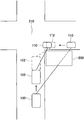
- FIG. 2 is a schematic view illustrating positional relationships between an own vehicle, a moving object, and an obstruction.
- FIG. 3 is an explanatory schematic view illustrating collision avoidance by offsetting.
- FIG. 4 is an explanatory schematic view illustrating another collision avoidance by offsetting.
- FIG. 5 is a flowchart showing a driving assistance procedure.
- FIG. 6 is an explanatory block diagram showing how avoidance amounts are set.
- FIG. 7 is an explanatory schematic view showing determinations as to whether or not detection by an in-vehicle detection device can be performed.
- a driving assistance system 2 shown in FIG. 1 is installed in a vehicle, and includes a wireless device 10 , cameras 12 , millimeter-wave radars 14 , a vehicle speed sensor 16 , GPS 18 , a map DB device 20 , a driving assistance device 30 , a powertrain system 60 , a brake system 62 , a steering system 64 , and an HMI 66 .
- the HMI is an abbreviation of Human Machine Interface.
- a vehicle in which the driving assistance system 2 is installed is referred to as an own vehicle.
- the wireless device 10 performs wireless communication with an external device that is external to the own vehicle.
- the external device may be worn by a person, or installed in any of a bicycle, a vehicle including a drive source, roadside equipment, and a control center.
- the cameras 12 perform forward imaging, side imaging, and rearward imaging from the own vehicle. Data items of the images captured by the cameras 12 are analyzed by an image analysis device (not shown). With this, moving objects that exist ahead of, sideways, and behind the own vehicle are detected.
- the millimeter-wave radars 14 scan ranges at predetermined angles by outputting millimeter waves forward, sideways, and rearward from the own vehicle.
- the millimeter-wave radars 14 detect reflected waves of the radiated millimeter waves, calculates a distance to the object based on a period that the millimeter waves have taken to reciprocate between the millimeter-wave radars 14 and an object that have reflected the millimeter waves, and specifies, based on directions in which the millimeter-wave radars 14 have radiated the millimeter waves and in response to the detection of the reflected waves, an orientation in which the object exists.
- LIDAR that radiates laser beams may also be used.
- the vehicle speed sensor 16 detects a current vehicle speed of the own vehicle.
- the GPS 18 locates a position of the own vehicle by receiving a location signal from a GPS satellite.
- a map data item stored in the map DB device 20 contains links and nodes that represent roads.
- the links connect the nodes that represent, for example, intersections, branch points, and junctions.
- the roads are rendered by connecting the links.
- Data items of, for example, identification numbers, link lengths, latitudes and longitudes as coordinates of an origin point and a destination point, road types representing, for example, expressways or national routes, and the number of lanes are registered with the links.
- sizes of structures such as buildings located along the links that represent roads, and sizes of structures around the nodes that represent, for example, intersections, branch points, and junctions are registered with the map data item.
- a microcomputer including a CPU and semiconductor memories such as RAM, ROM, and a flash memory is installed.
- the microcomputer installed in the driving assistance device 30 may include a single microcomputer, or may include a plurality of microcomputers.
- the CPU executes programs stored in non-transitory computer-readable storage medium such as the ROM and the flash memory. When those programs are executed, methods corresponding to the programs are carried out.
- the driving assistance device 30 includes a travel information acquisition unit 32 , a first information acquisition unit 34 , a second information acquisition unit 36 , a first determination unit 38 , a second determination unit 40 , a first avoidance-amount setting unit 42 , a second avoidance-amount setting unit 44 , a map acquisition unit 46 , a reliability determination unit 48 , an obstruction determination unit 50 , a prediction unit 52 , a driving control unit 54 , and a notification unit 56 .
- a method of activating these units of the driving assistance device 30 is not limited to software, and some or all of these units may be activated with use of hardware constituted by a combination of logic circuits and analog circuits.
- the powertrain system 60 controls an opening degree of a throttle device and a fuel injection rate in a case where an internal combustion engine is installed as the drive source, or the powertrain system 60 controls electric power supply to a motor in a case where the motor is installed as the drive source.
- the brake system 62 controls actuators provided in hydraulic circuits of hydraulic brakes.
- the brake system 62 may generate a regenerative braking force by controlling the electric power supply to the motor in accordance with the braking force set by the driving assistance device 30 .
- the steering system 64 drives a steering wheel in accordance with torque set by the driving assistance device 30 so as to control a traveling direction of the own vehicle.
- a driving assistance procedure is described by way of an example of a situation in which an own vehicle 100 is driving toward an intersection 210 where visibility is restricted by an obstruction 200 such as a building, and at the same time, a moving object 110 is moving toward the same intersection 210 from behind the obstruction 200 .
- the own vehicle 100 is a vehicle that includes wheels, uses at least one of an internal combustion engine and a motor as the drive source, and allows the driving assistance device 30 to control at least one of the vehicle speed and the traveling direction.
- the moving object 110 may include moving objects of any type.
- the moving object 110 there may be mentioned a person, a bicycle, and the vehicle including the wheels and the drive source.
- the cameras 12 and the millimeter-wave radars 14 cannot detect the moving object 110 .
- the cameras 12 and the millimeter-wave radars 14 can detect the moving object 110 that has moved to a position 112 .
- the driving assistance device 30 indirectly acquires a second movement-information item of the moving object 110 from an external device other than the own vehicle 100 via wireless communication, the information item containing at least a position and a moving speed of the moving object 110 behind the obstruction 200 .
- the driving assistance device 30 directly acquires another movement-information item of the moving object 110 from the cameras 12 and the millimeter-wave radars 14 , which contains at least the position and the moving speed of the moving object 110 .
- the other movement-information item is referred to as a first movement-information item.
- the driving assistance device 30 is capable of detecting the traveling direction of the own vehicle 100 and a traveling direction of the moving object 110 from changes in their positions.
- the driving assistance device 30 acquires the vehicle speed of the own vehicle 100 from the vehicle speed sensor 16 , and acquires the position of the own vehicle 100 with the GPS 18 and based on the map data item stored in the map DB device 20 .
- An information item containing at least the position and the vehicle speed of the own vehicle 100 is referred to as a travel information item of the own vehicle 100 .
- the external device may be set to objects of any type.
- the position and the moving speed of the moving object 110 may be detected by the moving object 110 itself, and then be transmitted by a wireless device of the moving object 110 .
- the position and the moving speed of the moving object 110 may be detected by the roadside equipment, and then be transmitted by a wireless device of the roadside equipment.
- the position and the moving speed of the moving object 110 may be received by the control center, and then be transmitted by a wireless device of the control center.
- a risk (probability) of collision of the own vehicle 100 with the moving object 110 which the driving assistance device 30 determines based on the travel information item of the own vehicle 100 and on the first movement-information item of the moving object 110
- first risk first probability
- second risk second probability
- the driving assistance device 30 calculates a TTC (time to collision), which is a predicted time until the own vehicle 100 collides with the moving object 110 . As the TTC is shorter, the driving assistance device 30 determines that the first risk of collision of the own vehicle 100 with the moving object 110 is higher.
- the driving assistance device 30 calculates the TTC based not on the first movement-information item, but on the second movement-information item of the moving object 110 , which the driving assistance device 30 acquires from the external device, and on the travel information item of the own vehicle 100 . As the TTC is shorter, the driving assistance device 30 determines that the second risk of collision of the own vehicle 100 with the moving object 110 is higher.
- the driving assistance device 30 sets, based on the first risk, an avoidance amount that is used when the driving assistance device 30 controls driving of the own vehicle 100 so as to cause the own vehicle 100 to perform an avoidance driving action, thereby avoiding the collision of the own vehicle 100 with the moving object 110 .
- This avoidance amount is referred to as a first avoidance amount.
- the avoidance driving action of the own vehicle 100 performed based on the first avoidance amount is referred to as a first avoidance driving action.
- the driving assistance device 30 sets, based on the second risk, another avoidance amount that is used when the driving assistance device 30 controls driving of the own vehicle 100 so as to cause the own vehicle 100 to perform another avoidance driving action (another avoidance maneuver), thereby avoiding the collision of the own vehicle 100 with the moving object 110 .
- This avoidance amount is referred to as a second avoidance amount.
- the avoidance driving action of the own vehicle 100 performed based on the second avoidance amount is referred to as a second avoidance driving action.
- the driving assistance device 30 When the first risk is equal to or more than a first threshold at which it can be determined that the collision of the own vehicle 100 with the moving object 110 occurs, the driving assistance device 30 performs the first avoidance driving action.
- the driving assistance device 30 commands the powertrain system 60 to activate an acceleration-off mode even when a driver has pressed an accelerator pedal.
- the drive source is the internal combustion engine
- both a throttle opening degree and injection rates of injectors are reduced to zero.
- the driving assistance device 30 interrupts the electric power supply to the motor.
- the driving assistance device 30 may set a high engine-braking force, for example, by lowering a gear ratio in the powertrain system 60 .
- the driving assistance device 30 may interrupt the electric power supply to the motor, and in addition, drive the motor as a power generator such that what is called regenerative torque generated at the time of driving the motor as a power generator is utilized.
- the driving assistance device 30 commands the brake system 62 to actuate the hydraulic brakes.
- the driving assistance device 30 commands the steering system 64 to perform steering in a direction in which the moving object 110 is avoided.
- the driving assistance device 30 When the second risk is equal to or more than a second threshold at which it can be determined that the collision of the own vehicle 100 with the moving object 110 occurs, the driving assistance device 30 performs the second avoidance driving action.
- the second threshold and the first threshold may be equal to each other, or may be different from each other.
- the second threshold is low in information reliability. Accordingly, at a time of setting the second threshold, depending on the reliability, for example, precision in positioning with the GPS may be added to or subtracted from the own vehicle 100 or the moving object 110 .
- the driving assistance device 30 activates the acceleration-off mode even when the driver has depressed the accelerator pedal, so as to apply the braking force to the own vehicle 100 .
- the driving assistance device 30 does not use the hydraulic braking as the second avoidance driving action in which the braking forces are used.
- the braking force set as the second avoidance amount is smaller than the braking force set as the first avoidance amount in the first avoidance driving action.
- the driving assistance device 30 sets not only magnitudes of the braking forces, that is, control amounts of driving controls to cause the own vehicle 100 to perform the avoidance driving actions, but also timings of generating the braking forces, that is, start timings of the driving controls to cause the own vehicle 100 to perform the avoidance driving actions as the avoidance amounts.
- one of the timings of generating the braking forces, which is set as the second avoidance amount in the second avoidance driving action is later than another one of the timings of generating the braking forces, which is set as the first avoidance amount in the first avoidance driving action.
- the driving assistance device 30 may perform at least one of setting of the control amount as the second avoidance amount smaller than the control amount that is set as the first avoidance amount, and setting of the driving-control start timing as the second avoidance amount later than the driving-control start timing that is set as the first avoidance amount.
- the driving assistance device 30 may command the brake system 62 to apply an oil pressure to the hydraulic brakes to an extent that the braking force is not actually applied to the own vehicle 100 .
- the driving assistance device 30 actually actuates the hydraulic brakes to perform the first avoidance driving action of avoiding the collision with the moving object 110 , the braking force is promptly applied to the own vehicle 100 .
- the driving assistance device 30 may shift a lateral position of the own vehicle 100 in an offset manner in a direction orthogonal to the current traveling direction of the own vehicle 100 as the second avoidance driving action via steering.
- the third threshold is higher than the second threshold.
- the driving assistance device 30 offsets the lateral position before the application of the braking force.
- the driving assistance device 30 need not necessarily complete the offsetting of the lateral position at once, and may perform the offsetting in a stepwise manner.
- the driving assistance device 30 may perform first offsetting before the engine braking, and perform second offsetting after the engine braking.
- the driving assistance device 30 predicts, based on the second movement-information item, that the moving object 110 will collide against a right-hand-side part of the own vehicle 100 with respect to the traveling direction of the own vehicle 100 as illustrated in FIG. 3 , the driving assistance device 30 offsets the lateral position of the own vehicle 100 in a direction away from the collision point. In the case illustrated in FIG. 3 , the own vehicle 100 is offset in the same direction as a moving direction of the moving object 110 .
- the driving assistance device 30 predicts, based on the second movement-information item, that the moving object 110 will collide against a left-hand-side part of the own vehicle 100 with respect to the traveling direction of the own vehicle 100 as illustrated in FIG. 4 , the driving assistance device 30 offsets the lateral position of the own vehicle 100 in another direction away from the collision point. In the case illustrated in FIG. 4 , the own vehicle 100 is offset in a direction opposite to the moving direction of the moving object 110 .
- the offset directions are not limited to those described with reference to FIG. 3 and FIG. 4 .
- the offsetting may be performed in these opposite directions.
- a steering amount for performing the offsetting which is set as the second avoidance amount in the second avoidance driving action, is smaller than a steering amount that is set as the first avoidance amount in the first avoidance driving action.
- the driving assistance device 30 sets, as the avoidance amounts, not only the steering amounts, that is, the control amounts of the driving controls to cause the own vehicle 100 to perform the avoidance driving actions, but also timings of starting the steering, that is, the start timings of the driving controls to cause the own vehicle 100 to perform the avoidance driving actions.
- one of the timings of starting the steering, which is set as the second avoidance amount in the second avoidance driving action is later than another one of the timings of starting the steering, which is set as the first avoidance amount in the first avoidance driving action.
- FIG. 5 a driving assistance procedure that the driving assistance device 30 executes for avoiding the collision of the own vehicle 100 with the moving object 110 is described.
- the driving assistance procedure in FIG. 5 is always executed. Note that, in FIG. 5 , the letters “S” each represent Step.
- the map acquisition unit 46 acquires a current position of the own vehicle 100 from the GPS 18 , and maps the position of the own vehicle 100 in the map data item that is acquired from the map DB device 20 . Further, in S 400 , when there is an intersection ahead of the own vehicle 100 in its traveling direction, the map acquisition unit 46 acquires a distance from the own vehicle 100 to the intersection from the map data item.
- the travel information acquisition unit 32 acquires the vehicle speed from the vehicle speed sensor 16 , and the map acquisition unit 46 acquires the position of the own vehicle 100 , which is mapped in the map data item.
- the map acquisition unit 46 determines, as a condition for performing the second avoidance driving action, whether or not the distance from the own vehicle 100 to the intersection is equal to or shorter than a predetermined distance.
- the map acquisition unit 46 determines that it is still unnecessary to perform the second avoidance driving action. In this case, the procedure is ended. Note that, also when there is no intersection ahead of the own vehicle 100 , the determination in S 404 is “No.”
- the obstruction determination unit 50 acquires, from the map data item, information items of obstructions around the intersection ahead of the own vehicle 100 in its traveling direction.
- the second information acquisition unit 36 acquires the second movement-information item of the moving object 110 moving behind the obstruction 200 as viewed from the own vehicle 100 as illustrated in FIG. 2 , the second movement-information item being received by the wireless device 10 .
- the second information acquisition unit 36 may acquire the second movement-information item from any of the moving object 110 , the roadside equipment, and the control center.
- the second determination unit 40 determines whether or not the second avoidance driving action needs to be performed.
- the second determination unit 40 calculates the TTC, which is a time to collision.
- the second determination unit 40 determines that, as the TTC is shorter, the second risk being the risk of collision of the own vehicle 100 with the moving object 110 is higher.
- the second avoidance driving action is turned on. Then, in S 412 , the notification unit 56 notifies passengers in the own vehicle 100 via the HMI 66 that the second avoidance driving action is performed.
- the HMI 66 may be, for example, any of a display for image notification, a speaker for voice announcement, and a lamp or the like for flashing notification, or combinations of a plurality of these notifiers.
- the driving control unit 54 commands at least one of the powertrain system 60 , the brake system 62 , and the steering system 64 based on the second avoidance amount set by the second avoidance-amount setting unit 44 to perform the above-described second avoidance driving action.
- the second avoidance amount corresponding to the braking force and the offset amounts at the time of performing the second avoidance driving action is not a fixed value, and may be set variable by the second avoidance-amount setting unit 44 .
- the second avoidance-amount setting unit 44 sets the second avoidance amount in accordance with a reliability of wireless communication with the external device, a reliability of the second movement-information item acquired from the external device, and a relative speed of the moving object 110 with respect to the own vehicle 100 .
- the reliability of wireless communication and the reliability of the second movement-information item are higher, a reliability of the second risk is higher.
- a larger control amount of the driving control can be set, and the driving control can be started at an earlier timing.
- the reliability of wireless communication and the reliability of the second movement-information item are determined by the reliability determination unit 48 .
- the reliability determination unit 48 determines the reliability of wireless communication based, for example, on a type of the wireless device, and a condition of wireless communication. For example, the reliability determination unit 48 determines, as the type of the wireless device, that a dedicated wireless device is higher in reliability of wireless communication than mobile phones.
- the reliability of the second movement-information item is, for example, a reliability of a position of the moving object 110 .
- the reliability determination unit 48 determines that, as wireless communication with the external device is more frequently used, and as the number of GPS satellites that the moving object 110 detects is larger, the reliability of the position of the moving object 110 is higher.
- the second avoidance amount the larger control amount of the driving control, and the earlier start timing of the driving control can be set by the second avoidance-amount setting unit 44 .
- the braking force and the steering amount being the control amounts of the driving control, which the second avoidance-amount setting unit 44 sets as the second avoidance amount when the second avoidance driving action is turned on in S 412 , are smaller than the braking force and the steering amount that the first avoidance-amount setting unit 42 sets as the first avoidance amount when the first avoidance driving action is used.
- the start timing of the driving control which the second avoidance-amount setting unit 44 sets as the second avoidance amount when the second avoidance driving action is turned on in S 412 , is later than the start timing of the driving control, which the first avoidance-amount setting unit 42 sets as the first avoidance amount when the first avoidance driving action is used.
- the first determination unit 38 determines whether or not at least one of the camera 12 and the millimeter-wave radar 14 has detected the moving object 110 .
- the determination in S 414 is “No.”
- the determination in S 414 is “Yes.”
- Whether or not an obstruction exists between the position of the own vehicle 100 and the position of the moving object 110 is determined by the obstruction determination unit 50 based on a position and a size of the obstruction, the position of the own vehicle 100 , and the position of the moving object 110 , which are indicated in the map data item that the map acquisition unit 46 acquires.
- the obstruction determination unit 50 may determine whether or not the obstruction exists between the position of the own vehicle 100 and the position of the moving object 110 based on a position and a size of a stationary object that at least one of the camera 12 and the millimeter-wave radar 14 detects.
- the first determination unit 38 determines that a timing at which the moving object 110 is determined not to have been detected in S 414 is within a predicted detection period.
- the predicted detection period refers to a period including a timing and its errors when the moving object 110 that emerges from behind the obstruction 200 can be detected by at least one of the camera 12 and the millimeter-wave radar 14 .
- the predicted detection period refers to a period including a timing and its errors when the moving object 110 that emerges from behind the obstruction 200 can be detected by at least one of the camera 12 and the millimeter-wave radar 14 .
- FIG. 7 when a straight line 300 connecting the moving object 110 and a corner of the obstruction 200 to each other intersects with a position on the own vehicle 100 , at which the camera 12 and the millimeter-wave radar 14 are installed, it is determined that the moving object 110 can be detected.
- the positions of the own vehicle 100 , the moving object 110 , and the obstruction 200 are represented as coordinates with respect to a front central portion of the own vehicle 100 , which is fixed in position as an origin.
- the straight line 300 connecting the corner of the obstruction 200 and the moving object 110 to each other extends through a lateral central portion on the own vehicle 100 side of the moving object 110 .
- the coordinates (x1, y1) of the corner of the obstruction 200 can be detected by the camera 12 and the millimeter-wave radar 14 .
- the coordinates (x2, y2) of the moving object 110 are contained in the second movement-information item that the second information acquisition unit 36 acquires via wireless communication.
- the camera 12 and the millimeter-wave radar 14 are installed at different positions, and hence a coordinate system of the camera 12 and a coordinate system of the millimeter-wave radar 14 are different from each other.
- the camera 12 and the millimeter-wave radar 14 are similar to each other except their coordinate systems.
- the camera 12 and the millimeter-wave radar 14 are installed at the same position in the front central portion of the own vehicle 100 .
- the coordinate system of the camera 12 and the coordinate system of the millimeter-wave radar 14 are set the same as each other.
- the moving object 110 behind the obstruction 200 cannot be detected by at least one of the camera 12 and the millimeter-wave radar 14 until the X-coordinate at which the straight line 300 intersects with the X-axis that aligns with the front of the own vehicle 100 satisfies the following inequality (5).
- a constant “k” is set as appropriate in consideration of, for example, errors in detection by the millimeter-wave radar 14 .
- “a” and “b” are represented by the coordinates x1, x2, y1, and y2.
- the coordinates x1, x2, y1, and y2 are represented as variables in accordance with a lapse of time since the moving object 110 having the risk of collision is detected based on the vehicle speed and the position of the own vehicle 100 , and on the position and the moving speed of the moving object 110 .
- the prediction unit 52 calculates the predicted detection period to be used in the determination in S 416 from the inequality (5).
- a method using a linear function approximation as described above is exemplified as a simple method using programs to be implemented.
- a quadratic function approximation or approximations by functions with higher orders may be employed.
- the driving control unit 54 controls driving of the own vehicle 100 , and determines whether or not the second avoidance driving action is being performed.
- the determination in S 418 is “Yes,” that is, when the driving control unit 54 is performing the second avoidance driving action, the procedure returns to S 412 such that the second avoidance driving action is continued.
- S 420 is executed when the moving object 110 can be detected by at least one of the camera 12 and the millimeter-wave radar 14 .
- the first information acquisition unit 34 acquires the first movement-information item of the moving object 110 from at least one of the camera 12 and the millimeter-wave radar 14 .
- the first determination unit 38 determines whether or not the first avoidance driving action needs to be performed.
- a determination method therein is substantially the same as the above-described determination method in S 410 except that the second movement-information item is used instead of the first movement-information item and that the second determination unit 40 is used instead of the first determination unit 38 . Thus, specific description of this determination method is omitted.
- the determination in S 422 is “Yes,” that is, when the first avoidance driving action needs to be performed, the procedure proceeds to S 428 .
- the process of S 428 which is executed when the determination in S 422 is “Yes,” that is, when the first avoidance driving action needs to be performed and the first avoidance driving action is turned on, continues to be executed until the determination of “Yes” is made by the first determination unit 38 in S 430 and the collision of the own vehicle 100 with the moving object 110 is avoided by the first avoidance driving action.
- the notification unit 56 notifies the passengers in the own vehicle 100 via the HMI 66 that the first avoidance driving action is being performed. Also in S 428 , the driving control unit 54 commands at least one of the powertrain system 60 , the brake system 62 , and the steering system 64 based on the first avoidance amount calculated by the first avoidance-amount setting unit 42 to perform the above-described first avoidance driving action.
- the driving assistance device 30 performs the second avoidance driving action based on the second movement-information item acquired indirectly from the external device via wireless communication.
- the second avoidance driving action is performed in advance before at least one of the camera 12 and the millimeter-wave radar 14 detects the moving object 110 and the first avoidance driving action is started.
- the first avoidance driving action it is more likely that the collision of the own vehicle 100 with the moving object 110 can be avoided by the first avoidance driving action.
- damage to the own vehicle 100 and the moving object 110 can be reduced.
- the reliability of the second risk is lower than a reliability of the first risk.
- the driving assistance device 30 sets the control amount as the second avoidance amount smaller than the control amount as the first avoidance amount, and in the case of setting the start timings of the driving controls, the driving assistance device 30 sets the start timing as the second avoidance amount later than the start timing as the first avoidance amount.
- the notification unit 56 notifies the passengers that the second avoidance driving action is performed. With this, the passengers can understand why the second avoidance driving action with respect to the moving object 110 that is out of sight of the passengers in the own vehicle 100 is being performed. Also with this, the anxiety of the passengers can be alleviated.
- the braking force generated as the second avoidance driving action by at least one of the engine braking and the regenerative braking is set smaller than the braking force generated as the first avoidance driving action by the hydraulic braking.
- the second avoidance amount is variably set in accordance with the reliability of wireless communication, the reliability of the second movement-information item, and the relative speed of the moving object 110 with respect to the own vehicle 100 . With this, the second avoidance amount can be properly set.
- the camera 12 and the millimeter-wave radar 14 correspond to detection devices
- the map DB device 20 corresponds to a storage device.
- S 400 and S 404 correspond to the processes performed by the map acquisition unit 46 .
- S 402 corresponds to the process performed by the travel information acquisition unit 32 .
- S 406 corresponds to the process performed by the obstruction determination unit 50 .
- S 408 corresponds to the process performed by the second information acquisition unit 36 .
- S 410 corresponds to the process performed by the second determination unit 40 .
- Part of S 412 and part of S 428 correspond to the processes performed by the notification unit 56 .
- Part of S 412 , S 418 , S 424 , S 426 , part of S 428 , and S 432 correspond to the processes performed by the driving control unit 54 .
- Part of S 412 corresponds to the process performed by the second avoidance-amount setting unit 44 .
- Part of S 412 corresponds to the process performed by the reliability determination unit 48 .
- S 414 , part of S 416 , S 422 , and S 430 correspond to the processes performed by the first determination unit 38 .
- Part of S 416 corresponds to the process performed by the prediction unit 52 .
- S 420 corresponds to the process performed by the first information acquisition unit 34 .
- Part of S 428 corresponds to the process performed by the first avoidance-amount setting unit 42 .
- the driving assistance device 30 may perform, as the second avoidance driving action, at least one of the engine braking and the regenerative braking, or the offsetting of the lateral position of the own vehicle 100 in only one of the directions.
- the driving assistance device 30 may then start to apply the oil pressure to the hydraulic brakes to the extent that the hydraulic brakes are not actually actuated. With this, at the time of performing the first avoidance driving action, the braking force generated by the hydraulic brakes can be promptly applied to the own vehicle 100 .
- the obstruction determination unit 50 may determine that the obstruction 200 that hinders the detection of the moving object 110 by the camera 12 and the millimeter-wave radar 14 exists between the own vehicle 100 and the moving object 110 .
- the driving assistance device 30 may increase, as the second avoidance driving action, the vehicle speed of the own vehicle 100 .
- a plurality of functions of one of the plurality of components in the above-described embodiment may be performed by the plurality of components, or a single function of the one of the plurality of components may be performed by the plurality of components.
- a plurality of functions of the plurality of components may be performed by the one of plurality of components, or a single function of the plurality of components may be performed by the one of the plurality of components.
- a part of the configuration of the above-described embodiment may be omitted.
- at least the part of the configuration of the above-described embodiment may be added to or replaced with another part of the configuration of the above-described embodiment. Note that, the embodiments of the present disclosure correspond to all the examples encompassed within the technical idea specified only by the wording of the claims.
- the present disclosure is not limited to the above-described driving assistance device, and may encompass various other embodiments such as a driving assistance program for causing a computer to function as the driving assistance device, a computer-readable storage medium storing this driving assistance program, and a driving assistance method.
Landscapes
- Engineering & Computer Science (AREA)
- Physics & Mathematics (AREA)
- General Physics & Mathematics (AREA)
- Automation & Control Theory (AREA)
- Transportation (AREA)
- Mechanical Engineering (AREA)
- Multimedia (AREA)
- Theoretical Computer Science (AREA)
- Traffic Control Systems (AREA)
- Control Of Driving Devices And Active Controlling Of Vehicle (AREA)
Abstract
Description
y=ax+b (1)
a=(y2−y1)/(x2−x1) (2)
b=−a×x1+y1 (3)
x=−b/a (4)
|−b/a|<k (5)
Claims (12)
Applications Claiming Priority (7)
| Application Number | Priority Date | Filing Date | Title |
|---|---|---|---|
| JP2016023907 | 2016-02-10 | ||
| JP2016-023907 | 2016-02-10 | ||
| JPJP2016-023907 | 2016-02-10 | ||
| JP2017-010550 | 2017-01-24 | ||
| JPJP2017-010550 | 2017-01-24 | ||
| JP2017010550A JP6465127B2 (en) | 2016-02-10 | 2017-01-24 | Driving support device |
| PCT/JP2017/005009 WO2017138659A1 (en) | 2016-02-10 | 2017-02-10 | Drive assistance device |
Related Parent Applications (1)
| Application Number | Title | Priority Date | Filing Date |
|---|---|---|---|
| PCT/JP2017/005009 A-371-Of-International WO2017138659A1 (en) | 2016-02-10 | 2017-02-10 | Drive assistance device |
Related Child Applications (1)
| Application Number | Title | Priority Date | Filing Date |
|---|---|---|---|
| US17/159,996 Continuation US11572063B2 (en) | 2016-02-10 | 2021-01-27 | Driving assistance device |
Publications (2)
| Publication Number | Publication Date |
|---|---|
| US20190039610A1 US20190039610A1 (en) | 2019-02-07 |
| US10933865B2 true US10933865B2 (en) | 2021-03-02 |
Family
ID=59628588
Family Applications (2)
| Application Number | Title | Priority Date | Filing Date |
|---|---|---|---|
| US16/076,460 Active 2037-10-11 US10933865B2 (en) | 2016-02-10 | 2017-02-10 | Driving assistance device |
| US17/159,996 Active 2037-08-20 US11572063B2 (en) | 2016-02-10 | 2021-01-27 | Driving assistance device |
Family Applications After (1)
| Application Number | Title | Priority Date | Filing Date |
|---|---|---|---|
| US17/159,996 Active 2037-08-20 US11572063B2 (en) | 2016-02-10 | 2021-01-27 | Driving assistance device |
Country Status (4)
| Country | Link |
|---|---|
| US (2) | US10933865B2 (en) |
| JP (1) | JP6465127B2 (en) |
| CN (1) | CN108604423B (en) |
| DE (1) | DE112017000749T5 (en) |
Families Citing this family (13)
| Publication number | Priority date | Publication date | Assignee | Title |
|---|---|---|---|---|
| US10469619B2 (en) | 2018-02-01 | 2019-11-05 | Toyota Jidosha Kabushiki Kaisha | Vehicular millimeter wave communication for non-line of sight scenarios |
| WO2019195415A1 (en) * | 2018-04-03 | 2019-10-10 | Mobileye Vision Technologies Ltd. | Systems and methods for determining navigational parameters |
| JP7031471B2 (en) * | 2018-04-24 | 2022-03-08 | 株式会社デンソー | Collision avoidance device |
| US12128887B1 (en) * | 2019-04-19 | 2024-10-29 | Zoox, Inc. | Dynamic object relevance determination |
| JP7328863B2 (en) * | 2019-10-11 | 2023-08-17 | 株式会社デンソー | Control device |
| JP7411961B2 (en) | 2020-03-30 | 2024-01-12 | パナソニックIpマネジメント株式会社 | Driving support device, driving support system, and driving support method |
| WO2022009707A1 (en) * | 2020-07-07 | 2022-01-13 | 株式会社デンソー | Control device, control method, and program |
| CN112141100B (en) * | 2020-09-10 | 2021-09-21 | 恒大新能源汽车投资控股集团有限公司 | Vehicle control method and device and vehicle |
| WO2022183023A1 (en) * | 2021-02-25 | 2022-09-01 | Autonomous Solutions, Inc. | Intelligent urgent stop system for an autonomous vehicle |
| CN113486836B (en) * | 2021-07-19 | 2023-06-06 | 安徽江淮汽车集团股份有限公司 | Automatic driving control method for low-pass obstacle |
| JP7635106B2 (en) * | 2021-09-30 | 2025-02-25 | 本田技研工業株式会社 | Driving assistance device, driving assistance method, and program |
| JP2024018399A (en) * | 2022-07-29 | 2024-02-08 | 株式会社Subaru | Vehicle driving support device |
| US20250333079A1 (en) * | 2024-04-25 | 2025-10-30 | Nvidia Corporation | Techniques for controlling autonomous vehicles using vision-language models |
Citations (7)
| Publication number | Priority date | Publication date | Assignee | Title |
|---|---|---|---|---|
| JP2008181200A (en) | 2007-01-23 | 2008-08-07 | Honda Motor Co Ltd | Collision damage reduction system |
| US8229663B2 (en) * | 2009-02-03 | 2012-07-24 | GM Global Technology Operations LLC | Combined vehicle-to-vehicle communication and object detection sensing |
| US8466807B2 (en) * | 2011-06-01 | 2013-06-18 | GM Global Technology Operations LLC | Fast collision detection technique for connected autonomous and manual vehicles |
| CN104943689A (en) | 2015-06-03 | 2015-09-30 | 奇瑞汽车股份有限公司 | Control method for active automobile anti-collision system |
| US20160167579A1 (en) * | 2014-12-11 | 2016-06-16 | Hyundai Motor Company | Apparatus and method for avoiding collision |
| US9446729B2 (en) * | 2012-12-18 | 2016-09-20 | Honda Research Institute Europe Gmbh | Driver assistance system |
| US20170116860A1 (en) | 2015-10-22 | 2017-04-27 | Xiaomi Inc. | Method, apparatus and storage medium for providing collision alert |
Family Cites Families (8)
| Publication number | Priority date | Publication date | Assignee | Title |
|---|---|---|---|---|
| WO2000054008A1 (en) * | 1999-03-11 | 2000-09-14 | Intelligent Technologies International, Inc. | Methods and apparatus for preventing vehicle accidents |
| JP4483589B2 (en) * | 2005-01-12 | 2010-06-16 | 日産自動車株式会社 | Vehicle information providing device |
| JP5345350B2 (en) * | 2008-07-30 | 2013-11-20 | 富士重工業株式会社 | Vehicle driving support device |
| DE102009027755A1 (en) | 2009-07-16 | 2011-01-20 | Robert Bosch Gmbh | Method for assisting driving of vehicle e.g. cab vehicle, involves indicating instantaneous position of obstacle to driver of vehicle, and encrusting obstacle by analog contact display unit in vision field of driver |
| CN201732479U (en) * | 2010-07-12 | 2011-02-02 | 郑硕钧 | Vehicle and vessel collision early warning control system |
| US8947219B2 (en) | 2011-04-22 | 2015-02-03 | Honda Motors Co., Ltd. | Warning system with heads up display |
| JP2016023907A (en) | 2014-07-24 | 2016-02-08 | 株式会社豊田自動織機 | Chemical heat storage device |
| US20160379219A1 (en) | 2015-06-25 | 2016-12-29 | Toshiba Tec Kabushiki Kaisha | Settlement apparatus |
-
2017
- 2017-01-24 JP JP2017010550A patent/JP6465127B2/en active Active
- 2017-02-10 CN CN201780010463.8A patent/CN108604423B/en active Active
- 2017-02-10 DE DE112017000749.6T patent/DE112017000749T5/en active Pending
- 2017-02-10 US US16/076,460 patent/US10933865B2/en active Active
-
2021
- 2021-01-27 US US17/159,996 patent/US11572063B2/en active Active
Patent Citations (7)
| Publication number | Priority date | Publication date | Assignee | Title |
|---|---|---|---|---|
| JP2008181200A (en) | 2007-01-23 | 2008-08-07 | Honda Motor Co Ltd | Collision damage reduction system |
| US8229663B2 (en) * | 2009-02-03 | 2012-07-24 | GM Global Technology Operations LLC | Combined vehicle-to-vehicle communication and object detection sensing |
| US8466807B2 (en) * | 2011-06-01 | 2013-06-18 | GM Global Technology Operations LLC | Fast collision detection technique for connected autonomous and manual vehicles |
| US9446729B2 (en) * | 2012-12-18 | 2016-09-20 | Honda Research Institute Europe Gmbh | Driver assistance system |
| US20160167579A1 (en) * | 2014-12-11 | 2016-06-16 | Hyundai Motor Company | Apparatus and method for avoiding collision |
| CN104943689A (en) | 2015-06-03 | 2015-09-30 | 奇瑞汽车股份有限公司 | Control method for active automobile anti-collision system |
| US20170116860A1 (en) | 2015-10-22 | 2017-04-27 | Xiaomi Inc. | Method, apparatus and storage medium for providing collision alert |
Non-Patent Citations (2)
| Title |
|---|
| Hafner et al., "Cooperative Collision Avoidance at Intersections: Algorithms and Experiments", IEEE Transactions on Intelligent Transportation Systems, vol. 14 No. 3, Sep. 2013, pp. 1162-1175. (Year: 2013). * |
| Laneurit et al., "Multisensorial Data Fusion for Global Vehicle and Obstacles Absolute Positioning", IEEE Intelligent Vehicles Symposium, Jun. 2003, pp. 138-143. (Year: 2003). * |
Also Published As
| Publication number | Publication date |
|---|---|
| JP6465127B2 (en) | 2019-02-06 |
| US20190039610A1 (en) | 2019-02-07 |
| JP2017142787A (en) | 2017-08-17 |
| DE112017000749T5 (en) | 2018-10-18 |
| US11572063B2 (en) | 2023-02-07 |
| US20210146921A1 (en) | 2021-05-20 |
| CN108604423B (en) | 2021-10-22 |
| CN108604423A (en) | 2018-09-28 |
Similar Documents
| Publication | Publication Date | Title |
|---|---|---|
| US11572063B2 (en) | Driving assistance device | |
| US11203359B2 (en) | Vehicle control system, vehicle control method, and storage medium | |
| US11875685B2 (en) | Convoy travel system | |
| US11186275B2 (en) | Vehicle control system | |
| US11167753B2 (en) | Vehicle control device, vehicle control method, and vehicle control program | |
| EP3208165B1 (en) | Vehicle safety assist system | |
| US9889847B2 (en) | Method and system for driver assistance for a vehicle | |
| US11938924B2 (en) | Driving assistance control apparatus for vehicle, driving assistance control system for vehicle, and driving assistance control method for vehicle | |
| US20140244151A1 (en) | Vehicle driving assistance system | |
| US11505188B2 (en) | Vehicle speed control device and vehicle speed control method | |
| JP2021020580A (en) | Vehicle control device, vehicle control method, and program | |
| US11100345B2 (en) | Vehicle control system, vehicle control method, and readable storage medium | |
| US20210402998A1 (en) | Control device and control method | |
| US10836381B2 (en) | Driving assistance device | |
| US12565218B2 (en) | Vehicle control apparatus | |
| JP2023107673A (en) | Vehicle driving support device | |
| US20200307380A1 (en) | Display control device, display control method, and storage medium | |
| JP2022147629A (en) | Driving support device | |
| JP2023148089A (en) | Vehicle control device, vehicle control method, and program | |
| WO2017138659A1 (en) | Drive assistance device | |
| JP2016218507A (en) | Warning control device | |
| US20250242801A1 (en) | Travel control device and method for vehicle | |
| US12503103B2 (en) | Vehicle driving assistance apparatus, vehicle driving assistance method, and computer-readable storage medium storing vehicle driving assistance program | |
| JP2025119434A (en) | Vehicle control device | |
| JP7842570B2 (en) | object recognition device |
Legal Events
| Date | Code | Title | Description |
|---|---|---|---|
| FEPP | Fee payment procedure |
Free format text: ENTITY STATUS SET TO UNDISCOUNTED (ORIGINAL EVENT CODE: BIG.); ENTITY STATUS OF PATENT OWNER: LARGE ENTITY |
|
| AS | Assignment |
Owner name: DENSO CORPORATION, JAPAN Free format text: ASSIGNMENT OF ASSIGNORS INTEREST;ASSIGNORS:MUKAI, YASUHIKO;NOTO, NORIYASU;TOKUDA, TETSUYA;AND OTHERS;SIGNING DATES FROM 20180723 TO 20180806;REEL/FRAME:046756/0907 |
|
| STPP | Information on status: patent application and granting procedure in general |
Free format text: DOCKETED NEW CASE - READY FOR EXAMINATION |
|
| STPP | Information on status: patent application and granting procedure in general |
Free format text: NON FINAL ACTION MAILED |
|
| STPP | Information on status: patent application and granting procedure in general |
Free format text: RESPONSE TO NON-FINAL OFFICE ACTION ENTERED AND FORWARDED TO EXAMINER |
|
| STPP | Information on status: patent application and granting procedure in general |
Free format text: NOTICE OF ALLOWANCE MAILED -- APPLICATION RECEIVED IN OFFICE OF PUBLICATIONS |
|
| STCF | Information on status: patent grant |
Free format text: PATENTED CASE |
|
| AS | Assignment |
Owner name: CAPTIONCALL, LLC, UTAH Free format text: RELEASE BY SECURED PARTY;ASSIGNOR:CORTLAND CAPITAL MARKET SERVICES LLC;REEL/FRAME:058533/0467 Effective date: 20211112 Owner name: SORENSON COMMUNICATIONS, LLC, UTAH Free format text: RELEASE BY SECURED PARTY;ASSIGNOR:CORTLAND CAPITAL MARKET SERVICES LLC;REEL/FRAME:058533/0467 Effective date: 20211112 |
|
| MAFP | Maintenance fee payment |
Free format text: PAYMENT OF MAINTENANCE FEE, 4TH YEAR, LARGE ENTITY (ORIGINAL EVENT CODE: M1551); ENTITY STATUS OF PATENT OWNER: LARGE ENTITY Year of fee payment: 4 |