US10920106B2 - Metal chemical mechanical planarization (CMP) composition and methods therefore - Google Patents

Metal chemical mechanical planarization (CMP) composition and methods therefore Download PDF

Info

Publication number
US10920106B2
US10920106B2 US16/564,939 US201916564939A US10920106B2 US 10920106 B2 US10920106 B2 US 10920106B2 US 201916564939 A US201916564939 A US 201916564939A US 10920106 B2 US10920106 B2 US 10920106B2
Authority
US
United States
Prior art keywords
group
morpholine
alanine
combinations
groups
Prior art date
Legal status (The legal status is an assumption and is not a legal conclusion. Google has not performed a legal analysis and makes no representation as to the accuracy of the status listed.)
Active
Application number
US16/564,939
Other versions
US20200032107A1 (en
Inventor
Xiaobo Shi
Mark Leonard O'Neill
Current Assignee (The listed assignees may be inaccurate. Google has not performed a legal analysis and makes no representation or warranty as to the accuracy of the list.)
Versum Materials US LLC
Original Assignee
Versum Materials US LLC
Priority date (The priority date is an assumption and is not a legal conclusion. Google has not performed a legal analysis and makes no representation as to the accuracy of the date listed.)
Filing date
Publication date
Application filed by Versum Materials US LLC filed Critical Versum Materials US LLC
Priority to US16/564,939 priority Critical patent/US10920106B2/en
Assigned to VERSUM MATERIALS US, LLC reassignment VERSUM MATERIALS US, LLC ASSIGNMENT OF ASSIGNORS INTEREST (SEE DOCUMENT FOR DETAILS). Assignors: O'NEILL, MARK LEONARD, SHI, XIAOBO
Publication of US20200032107A1 publication Critical patent/US20200032107A1/en
Application granted granted Critical
Publication of US10920106B2 publication Critical patent/US10920106B2/en
Active legal-status Critical Current
Anticipated expiration legal-status Critical

Links

Images

Classifications

    • CCHEMISTRY; METALLURGY
    • C09DYES; PAINTS; POLISHES; NATURAL RESINS; ADHESIVES; COMPOSITIONS NOT OTHERWISE PROVIDED FOR; APPLICATIONS OF MATERIALS NOT OTHERWISE PROVIDED FOR
    • C09GPOLISHING COMPOSITIONS; SKI WAXES
    • C09G1/00Polishing compositions
    • C09G1/02Polishing compositions containing abrasives or grinding agents
    • HELECTRICITY
    • H01ELECTRIC ELEMENTS
    • H01LSEMICONDUCTOR DEVICES NOT COVERED BY CLASS H10
    • H01L21/00Processes or apparatus adapted for the manufacture or treatment of semiconductor or solid state devices or of parts thereof
    • H01L21/02Manufacture or treatment of semiconductor devices or of parts thereof
    • H01L21/04Manufacture or treatment of semiconductor devices or of parts thereof the devices having potential barriers, e.g. a PN junction, depletion layer or carrier concentration layer
    • H01L21/18Manufacture or treatment of semiconductor devices or of parts thereof the devices having potential barriers, e.g. a PN junction, depletion layer or carrier concentration layer the devices having semiconductor bodies comprising elements of Group IV of the Periodic Table or AIIIBV compounds with or without impurities, e.g. doping materials
    • H01L21/30Treatment of semiconductor bodies using processes or apparatus not provided for in groups H01L21/20 - H01L21/26
    • H01L21/31Treatment of semiconductor bodies using processes or apparatus not provided for in groups H01L21/20 - H01L21/26 to form insulating layers thereon, e.g. for masking or by using photolithographic techniques; After treatment of these layers; Selection of materials for these layers
    • H01L21/3205Deposition of non-insulating-, e.g. conductive- or resistive-, layers on insulating layers; After-treatment of these layers
    • H01L21/321After treatment
    • H01L21/32115Planarisation
    • H01L21/3212Planarisation by chemical mechanical polishing [CMP]
    • HELECTRICITY
    • H01ELECTRIC ELEMENTS
    • H01LSEMICONDUCTOR DEVICES NOT COVERED BY CLASS H10
    • H01L21/00Processes or apparatus adapted for the manufacture or treatment of semiconductor or solid state devices or of parts thereof
    • H01L21/70Manufacture or treatment of devices consisting of a plurality of solid state components formed in or on a common substrate or of parts thereof; Manufacture of integrated circuit devices or of parts thereof
    • H01L21/71Manufacture of specific parts of devices defined in group H01L21/70
    • H01L21/768Applying interconnections to be used for carrying current between separate components within a device comprising conductors and dielectrics
    • H01L21/76898Applying interconnections to be used for carrying current between separate components within a device comprising conductors and dielectrics formed through a semiconductor substrate
    • H10P52/402
    • H10P52/403
    • H10W20/023

Definitions

  • This invention relates generally to the chemical-mechanical planarization or chemical-mechanical polishing (CMP) of semiconductor wafers. More specifically, present invention relates to high and tunable metal films, such as Cu, Co, W, Ni, Al, etc., removal rates and low dishing formulations for the broad or advanced node copper or other metal film polishing CMP applications. CMP polishing formulations, CMP polishing compositions or CMP polishing slurries are interchangeable in present invention.
  • Copper is the current material of choice for interconnect metal used in the fabrication of integrated electronic devices due to its low resistivity, high reliability, and scalability. Copper chemical mechanical planarization processes are necessary to remove copper overburden from inlaid trench structures while achieving global planarization with low metal loss.
  • Copper CMP have been done in the prior arts, for example, in. U.S. Pat. No. 9,3065,806; US20160314989; US20130092651; US 20130078811; U.S. Pat. Nos. 8,679,980; 8,791,019; 8,435,421; 7,955,520; US 20130280910; US 20100221918; U.S. Pat. No. 8,236,695; TW 1385226; US 20120094490; U.S. Pat. No. 7,955,520; US20040175942, U.S. Pat. Nos. 6,773,476, and 8,236,695.
  • This invention discloses bulk copper CMP polishing formulations developed to meet challenging requirements of low dishing and high removal rates for the advanced technology nodes.
  • the disclosed copper CMP polishing formulations can also be used for other metal film CMP applications.
  • FIG. 1 shows Cu polishing results from formulations using single chelator (as the reference sample) vs single chelator with a chemical additive as Cu dishing reducer
  • FIG. 2 shows Cu dishing results from formulations using single chelator (as the reference sample), dual chelators; and dual chelators with a chemical additive as Cu dishing reducer
  • FIG. 3 shows Cu polishing results from formulations using single chelator (the reference sample), dual chelators, and dual chelators with a chemical additive as Cu dishing reducer
  • FIG. 4 shows Cu dishing results from formulations using single chelator the reference sample), dual chelators, and dual chelators with a chemical additive as Cu dishing reducer
  • FIG. 5 shows Cu polishing results from formulations using tris chelator vs tris chelator with a chemical additive as Cu dishing reducer
  • FIG. 6 shows Cu dishing results from formulations using tris chelator vs tris chelator with a chemical additive as Cu dishing reducer
  • CMP polishing compositions, methods and systems for the copper or other metal films, such as Co, W, Ni, Al, etc., polishing CMP applications are Described herein.
  • the chelators are selected from the group consisting of amino acids, amino acid derivatives, organic amine, and combinations therefor; wherein at least one chelator is an amino acid or an amino acid derivative for tris chelators;
  • the metal is selected from the group consisting of Cu, Co, W, Ni, Al, and combinations thereof;
  • the pH of the composition is from 3.0 to 12.0; preferably from 5.5 to 8.0; and more preferably from 6.0 to 7.5.
  • the invention provides a method of chemical mechanical polishing at least one metal or metal-containing surface or metal films of a semiconductor substrate, using a chemical mechanical polishing composition comprising steps of:
  • the invention provides a method of a selective chemical mechanical polishing comprising steps of:
  • removal rate of the first material to removal rate of the second material is equal or greater than 500:1; preferably 1000:1; and more preferably 3000:1;
  • the invention provides a system of chemical mechanical polishing at least one metal or metal-containing surface or other metal film surface of a semiconductor substrate, comprising
  • the abrasive particles used for the disclosed herein Cu bulk CMP polishing compositions include, but are not limited to, the following: colloidal silica or high purity colloidal silica; the colloidal silica particles doped by other metal oxide within lattice of the colloidal silica, such as alumina doped silica particles; colloidal aluminum oxide including alpha-, beta-, and gamma-types of aluminum oxides; colloidal and photoactive titanium dioxide, cerium oxide, colloidal cerium oxide, nano-sized inorganic metal oxide particles, such as alumina, titania, zirconia, ceria etc; nano-sized diamond particles, nano-sized silicon nitride particles; mono-modal, bi-modal, multi-modal colloidal abrasive particles; organic polymer-based soft abrasives, surface-coated or modified abrasives, or other composite particles, and mixtures thereof.
  • the organic quaternary ammonium salt includes but is not limited to choline salt, such as choline bicarbonate salt, or all other salts formed between choline and other anionic counter ions.
  • the corrosion inhibitors include but are not limited to family of hetero aromatic compounds containing nitrogen atom(s) in their aromatic rings, such as 1,2,4-triazole and derivatives, benzotriazole and benzotriazole derivatives, tetrazole and tetrazole derivatives, imidazole and imidazole derivatives, benzimidazole and benzimidazole derivatives, pyrazole and pyrazole derivatives, and tetrazole and tetrazole derivatives.
  • family of hetero aromatic compounds containing nitrogen atom(s) in their aromatic rings such as 1,2,4-triazole and derivatives, benzotriazole and benzotriazole derivatives, tetrazole and tetrazole derivatives, imidazole and imidazole derivatives, benzimidazole and benzimidazole derivatives, pyrazole and pyrazole derivatives, and tetrazole and tetrazole derivatives.
  • R represents hydrogen or any one of various organic functional groups which attached to the nitrogen atom in morpholino 6-member ring through covalent boding with no net charges.
  • R includes, but is not limited to, alkyl primary amines with a single primary amine group or two or more than 2 primary amine groups in the same molecule, alkyl primary amines with a single secondary amine group or two or more than 2 secondary amine groups in the same molecule, alkyl amide with a single amide group or two or more than 2 amide groups in the same molecule, alkene primary amines with a single primary amine group or two or more than 2 primary amine groups in the same molecule, alkene primary amines with a single secondary amine group or two or more than 2 secondary amine groups in the same molecule, alkene amide with a single amide group or two or more than 2 amide groups in the same molecule, alkyne primary amines with a single primary amine group or two or more than 2 primary amine groups in the same molecule, alkyne primary amines with a single secondary amine group or two or more than 2 primary amine groups in the same molecule, alkyn
  • R also includes, but is not limited to, alkyl alcohol with a single hydroxyl group or two or more than 2 hydroxyl groups in the same molecule, alkene alcohol with a single hydroxyl group or two or more than 2 hydroxyl groups in the same molecule, and alkyne alcohol with a single hydroxyl group or two or more than 2 hydroxyl groups in the same molecule.
  • the chemical additive used as Cu dishing reducers includes, but is not limited to the family of morpholino compounds or oligomers having the general molecular structure as shown below:
  • R ⁇ represents various organic functional groups which attached to the nitrogen atom in morpholino 6-member ring through covalent boding with negative charges.
  • the R ⁇ organic functional groups include, but are not limited to, alkyl sulfonate with one sulfonate group or two or more than 2 sulfonate groups in the same molecule, alkyl carbonate with one carbonate group or two or more than 2 carbonate groups in the same molecule, alkyl phosphate with one phosphate group or two or more than 2 phosphate groups in the same molecule, alkene sulfonate with one sulfonate group or two or more than 2 sulfonate groups in the same molecule, alkene carbonate with one carbonate group or two or more than 2 carbonate groups in the same molecule, alkene phosphate with one phosphate group or two or more than 2 phosphate groups in the same molecule, alkyne sulfonate with one sulfonate group or two or more than 2 sulfonate groups in the same molecule, alkyne carbonate with one carbonate group or two or more than 2 carbonate groups in
  • the chemical additive used as Cu dishing reducers includes, but is not limited to the family of morpholino compounds or oligomers having the general molecular structure as shown below:
  • R represents various organic functional groups which attached to the nitrogen atom in morpholino 6-member ring through covalent boding with positive charges.
  • the R + organic functional groups include, but are not limited to, alkyl quaternary ammonium with one quaternary ammonium group or two or more than 2 quaternary ammonium groups in the same molecule, alkene quaternary ammonium with one quaternary ammonium group or two or more than 2 quaternary ammonium groups in the same molecule, alkyne quaternary ammonium with one quaternary ammonium group or two or more than 2 quaternary ammonium groups in the same molecule.
  • the counter ions N ⁇ for these positive R + groups include, but are not limited to carbonate anion, sulfate anion or phosphate anion.
  • the biocide includes but is not limited to KathonTM, KathonTM CG/ICP II, from Dow Chemical Co. They have active ingredients of 5-chloro-2-methyl-4-isothiazolin-3-one and 2-methyl-4-isothiazolin-3-one.
  • the oxidizing agent includes, but is not limited to, periodic acid, hydrogen peroxide, potassium iodate, potassium permanganate, ammonium persulfate, ammonium molybdate, ferric nitrate, nitric acid, potassium nitrate, and mixtures thereof.
  • amino acids and amino acid derivatives included, but not limited to, glycine, D-alanine, L-alanine, DL-alanine, beta-alanine, valine, leucine, isolueciene, phenylamine, proline, serine, threonine, tyrosine, glutamine, asparanine, glutamic acid, aspartic acid, tryptophan, histidine, arginine, lysine, methionine, cysteine, iminodiacetic acid, and combinations thereof.
  • organic amines chelators have general molecular structures, as depicted below:
  • the organic amine molecules have two primary amine functional groups as terminal groups on both ends of the molecules.
  • organic diamine compounds with two primary amine moieties can be described as the binary chelating agents.
  • alkyl group which linked to two terminal primary amine functional groups also include the branched alkyl groups, the general molecular structures of these branched alkyl groups are depicted at followings:
  • Rn represents an organic C 1 to C 12 alkyl group
  • m has the numbers ranged from 2 to 12.
  • the organic diamine molecules can also have the branched alkyl group as the linking group between two terminal primary amine functional groups.
  • Rn and Rm can be the same or different C 1 to C 12 alkyl groups.
  • p is from 2 to 12.
  • branched alkyl group linker has the following general molecular structure:
  • Rn and Rm groups are bonded to the same carbon atom.
  • Rn and Rm can be the same or different C 1 to C 12 alkyl groups.
  • q is from 2 to 12.
  • organic diamine molecules with other molecular structures can be also used as a chelating agent in the invented herein Cu CMP slurries, such as those organic diamine molecules with the following general molecular structures:
  • Such organic diamine molecules can have n numbered from 1 to 12, and can be described as organic diamines with one terminal primary amine functional group and another primary organic amine attached to the beta carbon atoms on the other end of the molecules.
  • the secondary primary amine functional groups can be also bonded to the other carbon atoms at other positions, such as beta, gamma etc. and the first primary amine function group still maintains as the terminal primary amine functional group in the same molecules.
  • Any other non-aromatic organic diamine molecules with two primary organic amine groups can be used as one of the three chelating agents in the invented Cu CMP slurries herein.
  • aromatic organic molecules with two primary amine functional groups can be used as one of three chelating agents in the invented Cu CMP slurries herein.
  • aromatic organic amines have the general molecular structures as depicted in followings:
  • n can be from 1 to 12, and m also can be from 1 to 12, also in the same molecule(s), n can be equal to m. In other cases, n can also be different from m.
  • the copper bulk CMP or other metal film such as Co, W, Al, Ni etc. polishing compositions described herein satisfy the need for high and tunable Cu film removal rates, for high selectivity between copper and dielectric films, for high selectivity between copper and barrier films, for low and more uniform Cu line dishing across various wide Cu line features, and for better Cu film corrosion protection through using the suitable corrosion inhibitors.
  • the Cu CMP polishing compositions comprise tris chelators, dual chelators or single chelator, i.e. varied number(s) of chelating agents, an organic quaternary ammonium salt as additional Cu dishing and defect reducer, Cu corrosion inhibitor for the efficient Cu corrosion protection, abrasive such as nano-sized high purity colloidal silica, oxidizing agent such as hydrogen peroxide, and water as a solvent.
  • the Cu CMP polishing compositions provide high and tunable Cu removal rates, and low barrier film and dielectric film removal rates which provide very high and desirable selectivity of Cu film vs. other barrier films, such as Ta, TaN, Ti, and TiN, and dielectric films, such as TEOS, low-k, and ultra low-k films, and low Cu dishing and more uniform Cu dishing across wide Cu line features.
  • the invented herein Cu chemical mechanical polishing compositions also provide no pad stain Cu CMP performances which allow the extended polish pad life and also allow more stable end-point detections.
  • the abrasive particles used for the disclosed herein Cu or other metal film bulk CMP polishing compositions include, but are not limited to, the following: colloidal silica or high purity colloidal silica; the colloidal silica particles doped by other metal oxide within lattice of the colloidal silica, such as alumina doped silica particles; colloidal aluminum oxide including alpha-, beta-, and gamma-types of aluminum oxides; colloidal and photoactive titanium dioxide, cerium oxide, colloidal cerium oxide, nano-sized inorganic metal oxide particles, such as alumina, titania, zirconia, ceria etc; nano-sized diamond particles, nano-sized silicon nitride particles; mono-modal, bi-modal, multi-modal colloidal abrasive particles; organic polymer-based soft abrasives, surface-coated or modified abrasives, or other composite particles, and mixtures thereof.
  • the colloidal silica can be made from silicate salts, the high purity colloidal silica can be made from TEOS or TMOS.
  • the colloidal silica or high purity colloidal silica can have narrow or broad particle size distributions with mono-model or multi-models, various sizes and various shapes including spherical shape, cocoon shape, aggregate shape and other shapes,
  • the nano-sized particles also can have different shapes, such as spherical, cocoon, aggregate, and others.
  • the Cu bulk CMP polishing compositions of this invention preferably contain 0.0025 wt. % to 25 wt. % abrasives; the preferred concentration of abrasives ranges from 0.0025 wt. % to 2.5 wt. %. The most preferred concentration of abrasives ranges from 0.005 wt. % to 0.15 wt. %.
  • An organic quaternary ammonium salt includes but is not limited to choline salt, such as choline bicarbonate salt, or all other salts formed between choline and other anionic counter ions.
  • the choline salts can have the general molecular structures shown below:
  • anion Y ⁇ can be bicarbonate, hydroxide, p-toluene-sulfonate, bitartate, and other suitable anionic counter ions.
  • the CMP slurry contains 0.005 wt. % to 0.25 wt. % quaternary ammonium salt; the preferred concentration ranges from 0.001 wt. % to 0.05 wt. %; and the most preferred concentration ranges from 0.002 wt. % to 0.01 wt. %
  • oxidizing agents can be used to oxidize the metallic copper film to the mixture of copper oxides to allow their quick reactions with chelating agents and corrosion inhibitors.
  • the oxidizing agent includes, but is not limited to, periodic acid, hydrogen peroxide, potassium iodate, potassium permanganate, ammonium persulfate, ammonium molybdate, ferric nitrate, nitric acid, potassium nitrate, and mixtures thereof.
  • the preferred oxidizer is hydrogen peroxide.
  • the CMP slurry contains 0.1 wt. % to 10 wt. % oxidizing agents; the preferred concentration ranges from 0.25 wt. % to 3 wt. %; and the most preferred concentration ranges from 0.5 wt. % to 2.0 wt. %
  • the corrosion inhibitors used for the disclosed copper bulk CMP slurry can be those prior arts reported corrosion inhibitors.
  • the corrosion inhibitors include, but are not limited to family of hetero aromatic compounds containing nitrogen atom(s) in their aromatic rings, such as 1,2,4-triazole and derivatives, benzotriazole and benzotriazole derivatives, tetrazole and tetrazole derivatives, imidazole and imidazole derivatives, benzimidazole and benzimidazole derivatives, pyrazole and pyrazole derivatives, and tetrazole and tetrazole derivatives.
  • family of hetero aromatic compounds containing nitrogen atom(s) in their aromatic rings such as 1,2,4-triazole and derivatives, benzotriazole and benzotriazole derivatives, tetrazole and tetrazole derivatives, imidazole and imidazole derivatives, benzimidazole and benzimidazole derivatives, pyrazole and pyrazo
  • the CMP slurry contains 0.005 wt. % to 0.5 wt. % corrosion inhibitor; the preferred concentration ranges from 0.01 wt. % to 0.1 wt. %; and the most preferred concentration ranges from 0.025 wt. % to 0.05 wt. %.
  • a chemical additive which is selected from the family of morpholino compounds is used as a very effective Cu dishing reducing agent in herein disclosed polishing compositions.
  • the chemical additive used as Cu dishing reducers includes, but is not limited to the family of morpholino compounds or oligomers, having the general molecular structure as shown below:
  • R represents hydrogen or various organic functional groups which attached to the nitrogen atom in morpholino 6-member ring through covalent boding with no net charges.
  • R includes, but is not limited to, alkyl primary amines with a single primary amine group or two or more than 2 primary amine groups in the same molecule, alkyl primary amines with a single secondary amine group or two or more than 2 secondary amine groups in the same molecule, alkyl amide with a single amide group or two or more than 2 amide groups in the same molecule, alkene primary amines with a single primary amine group or two or more than 2 primary amine groups in the same molecule, alkene primary amines with a single secondary amine group or two or more than 2 secondary amine groups in the same molecule, alkene amide with a single amide group or two or more than 2 amide groups in the same molecule, alkyne primary amines with a single primary amine group or two or more than 2 primary amine groups in the same molecule, alkyne primary amines with a single secondary amine group or two or more than 2 primary amine groups in the same molecule, alkyn
  • R also includes, but is not limited to, alkyl alcohol with a single hydroxyl group or two or more than 2 hydroxyl groups in the same molecule, alkene alcohol with a single hydroxyl group or two or more than 2 hydroxyl groups in the same molecule, and alkyne alcohol with a single hydroxyl group or two or more than 2 hydroxyl groups in the same molecule.
  • the chemical additives covered with above listed general molecular structure include, but not limited to, 3-Morpholino-1,2-propanediol (MOPDIO), morpholine when R is hydrogen atom, 3,5-Dimethyl-morpholine, 2-(4-morpholino)phenol, 3-(4-morpholino)phenol, 4-(4-morpholino)phenol, 5-(4-Morpholinyl)-2-furaldehyde, 1-Morpholinocyclohexene, 2-methyl-2-morpholinopropanal, 4-(Morpholin-4-ylcarbonyl)benzonitrile, 5-(4-Morpholinylmethyl)-2-thiophenecarbaldehyde, 4-(2-hydroxyethyl)morpholine, 4-(3-hydroxypropyl)morpholine, 2-(2-Methoxyethyl)morpholine, 1-(4-Morpholinyl)-1-propanone, (2-morpholinophenyl)m
  • the preferred chemical additive is selected from the group consisting of 3-Morpholino-1,2-propanediol (MOPDIO), morpholine when R is hydrogen atom, 2-methyl-2-morpholinopropanal, 4-(2-hydroxyethyl)morpholine, 4-(3-hydroxypropyl)morpholine, (2-morpholinophenyl)methanol, 2-(2-hydroxyethyl)morpholine, 2-(4-Morpholinyl)-2-oxoethanol, 4-(2-Aminoethyl)morpholine,2-(Aminomethyl)morpholine, morpholin-2-yl(pyridin-4-yl)methanol, 1-morpholin-4-ylmethyl-cyclohexylamine, 1-Morpholinohexane-1,3-dione, etc.
  • MOPDIO 3-Morpholino-1,2-propanediol
  • morpholine when R is hydrogen atom 2-methyl-2-morpholinopropanal
  • the chemical additive used as Cu dishing reducers includes, but is not limited to the family of morpholino compounds or oligomers having the general molecular structure as shown below:
  • R ⁇ represents various organic functional groups which attached to the nitrogen atom in morpholino 6-member ring through covalent boding with negative charges.
  • the R ⁇ organic functional groups include, but are not limited to, alkyl sulfonate with one sulfonate group or two or more than 2 sulfonate groups in the same molecule, alkyl carbonate with one carbonate group or two or more than 2 carbonate groups in the same molecule, alkyl phosphate with one phosphate group or two or more than 2 phosphate groups in the same molecule, alkene sulfonate with one sulfonate group or two or more than 2 sulfonate groups in the same molecule, alkene carbonate with one carbonate group or two or more than 2 carbonate groups in the same molecule, alkene phosphate with one phosphate group or two or more than 2 phosphate groups in the same molecule, alkyne sulfonate with one sulfonate group or two or more than 2 sulfonate groups in the same molecule, alkyne carbonate with one carbonate group or two or more than 2 carbonate groups in
  • the chemical additive used as Cu dishing reducers includes, but is not limited to the family of morpholino compounds or oligomers having the general molecular structure as shown below:
  • R represents hydrogen or any one of various organic functional groups which attached to the nitrogen atom in morpholino 6-member ring through covalent boding with positive charges.
  • the R + organic functional groups include, but are not limited to, alkyl quaternary ammonium with one quaternary ammonium group or two or more than 2 quaternary ammonium groups in the same molecule, alkene quaternary ammonium with one quaternary ammonium group or two or more than 2 quaternary ammonium groups in the same molecule, alkyne quaternary ammonium with one quaternary ammonium group or two or more than 2 quaternary ammonium groups in the same molecule.
  • the counter ions N ⁇ for these positive R + groups include, but are not limited to carbonate anion, sulfate anion or phosphate anion.
  • the preferred dishing reducing additive is 3-Morpholino-1,2-propanediol (MOPDIO).
  • the CMP slurry contains 0.001 wt. % to 0.5 wt. % a Cu dishing reducing additive which is selected from the family of morpholino compounds; the preferred concentration ranges from 0.0025 wt. % to 0.25 wt. %; and the most preferred concentration ranges from 0.01 wt. % to 0.1 wt. %.
  • a biocide having active ingredients for providing more stable shelf time of the invented Cu chemical mechanical polishing compositions can be used.
  • the biocide includes but is not limited to KathonTM, KathonTM CG/ICP II, from Dow Chemical Co. They have active ingredients of 5-chloro-2-methyl-4-isothiazolin-3-one and 2-methyl-4-isothiazolin-3-one.
  • the CMP slurry contains 0.0001 wt. % to 0.05 wt. % biocide; the preferred concentration ranges from 0.0001 wt. % to 0.025 wt. %; and the most preferred concentration ranges from 0.002 wt. % to 0.01 wt. %
  • acidic or basic compounds or pH adjusting agents can be used to allow pH of Cu bulk CMP polishing compositions being adjusted to the optimized pH value
  • the pH adjusting agents include, but are not limited to, the following: nitric acid, hydrochloric acid, sulfuric acid, phosphoric acid, other inorganic or organic acids, and mixtures thereof for acidic pH conditions; or sodium hydride, potassium hydroxide, ammonium hydroxide, tetraalkyl ammonium hydroxide, organic amines, and other chemical reagents that are able to be used to adjust pH towards the more alkaline direction.
  • the CMP slurry contains 0 wt. % to 1 wt. % pH adjusting agent; the preferred concentration ranges from 0.01 wt. % to 0.5 wt. %; and the most preferred concentration ranges from 0.1 wt. % to 0.25 wt. %
  • pH of the Cu polishing compositions is from about 3.0 to about 12.0; preferred pH range is from 5.5 to 7.5; and the most preferred pH range is from 7.0 to 7.35.
  • the single or dual or three chelator(s) are selected from the group consisting of amino acids, amino acid derivatives, organic amine, and combinations therefor; wherein at least one chelator is an amino acid or an amino acid derivative.
  • the three or tris-chelators can be the combination of any three amino acids, three amino acid derivatives, or two amino acids plus one organic amine, or one amino acid plus one amino acid derivative plus one organic amine, or two organic amines plus one amino acid, and or two organic amines plus one amino acid derivative.
  • the tris chelators can be glycine, alanine and ethylenediamine.
  • At least one chelator such as dual or tris chelator, were used as complexing agents to maximize their reactions with the oxidized Cu film surfaces to form softer Cu-chelator layers to be quickly removed during Cu CMP process thus achieving high and tunable Cu removal rates and low copper dishing for the broad or advanced node copper or TSV (Through Silica Via) CMP applications.
  • amino acids and amino acid derivatives included, but not limited to, glycine, D-alanine, L-alanine, DL-alanine, beta-alanine, valine, leucine, isolueciene, phenylamine, proline, serine, threonine, tyrosine, glutamine, asparanine, glutamic acid, aspartic acid, tryptophan, histidine, arginine, lysine, methionine, cysteine, iminodiacetic acid, etc.
  • organic amines chelators have general molecular structures, as depicted below:
  • the organic amine molecules have two primary amine functional groups as terminal groups on both ends of the molecules.
  • organic diamine compounds with two primary amine moieties can be described as the binary chelating agents.
  • alkyl group which linked to two terminal primary amine functional groups also include the branched alkyl groups, the general molecular structures of these branched alkyl groups are depicted at followings:
  • Rn represents an organic C 1 to C 12 alkyl group
  • m has the numbers ranged from 2 to 12.
  • the organic diamine molecules can also have the branched alkyl group as the linking group between two terminal primary amine functional groups.
  • Rn and Rm can be the same or different C 1 to C 12 alkyl groups.
  • branched alkyl group linker has the following general molecular structure:
  • Rn and Rm groups are bonded to the same carbon atom.
  • Rn and Rm can be the same or different C 1 to C 12 alkyl groups.
  • q is from 2 to 12.
  • organic diamine molecules with other molecular structures can be also used as a chelating agent in the invented herein Cu CMP slurries, such as those organic diamine molecules with the following general molecular structures:
  • Such organic diamine molecules can have n numbered from 1 to 12, and can be described as organic diamines with one terminal primary amine functional group and another primary organic amine attached to the beta carbon atoms on the other end of the molecules.
  • the secondary primary amine functional groups can be also bonded to the other carbon atoms at other positions, such as beta, gamma etc. and the first primary amine function group still maintains as the terminal primary amine functional group in the same molecules.
  • Any other non-aromatic organic diamine molecules with two primary organic amine groups can be used as one of the three chelating agents in the invented Cu CMP slurries herein.
  • aromatic organic molecules with two primary amine functional groups can be used as one of three chelating agents in the invented Cu CMP slurries herein.
  • aromatic organic amines have the general molecular structures as depicted in followings:
  • n can be from 1 to 12, and m also can be from 1 to 12, also in the same molecule(s), n can be equal to m. In other cases, n can also be different from m.
  • Typical amine used includes but is not limited to ethylenediamin, propylenediamine, butylenediamine, pentalene diamine, hexylene.
  • the chelator(s) concentrations are ranged from 0.25 wt. % to 5.0 wt. %, the preferred concentrations are ranged from 0.5 wt. % to 2.5 wt. %, the more preferred concentrations are ranged from 1.0 wt. % to 2.0 wt. %.
  • a substrate e.g., a wafer with Cu surface or Cu plug
  • a polishing pad which is fixedly attached to a rotatable platen of a CMP polisher.
  • a wafer carrier system or polishing head is used to hold the substrate in place and to apply a downward pressure against the backside of the substrate during CMP processing while the platen and the substrate are rotated.
  • the polishing composition (slurry) is applied (usually continuously) on the pad during CMP processing to effect the removal of material to planarize the substrate.
  • polishing composition and associated methods described herein are effective for CMP of a wide variety of substrates, including most of substrates having, particularly useful for polishing copper substrates.
  • Polishing Pad Polishing pad IC1010 pad or Other polishing pad was used during Cu CMP, supplied by Dow Chemicals Company.
  • angstrom(s)—a unit of length
  • PS platen rotational speed of polishing tool, in rpm (revolution(s) per minute)
  • the Cu slurry composition with single chelator which was used as reference sample comprised 0.713 wt. % of glycine, 0.0323 wt. % of 1,2,4-triazole, 0.00644 wt. % of high purity colloidal silica, and 0.00018 wt. % of biocide.
  • the invented herein new Cu slurry #1 and #2 comprised 0.713 wt. % of glycine, 0.0323 wt. % of 1,2,4-triazole, 0.00644 wt. % of high purity colloidal silica, 0.00018 wt. % of biocide, and a Cu dishing reducing additive, 0.025 wt. % or 0.50 wt. % of 3-Morpholino-1,2-propanediol (MOPDIO).
  • the pH of the slurries were at 6.0 to 7.5.
  • MOPDIO 3-Morpholino-1,2-propanediol
  • the Cu CMP polishing compositions with 0.025% or 0.50% 3-Morpholino-1,2-propanediol as Cu dishing reducing additive both afforded high and compatible Cu film removal rates comparing with the single chelator glycine based Cu CMP polishing composition.
  • the Cu removal rates were higher than the Cu removal rates obtained using the reference sample without the use of any Cu dishing reducing additive.
  • the Cu dishing has been reduced by ⁇ 33% on 9 ⁇ 1 ⁇ M Cu line feature and by ⁇ 40% on 1 ⁇ 9 ⁇ M Cu line feature when 0.05 wt. % of 3-Morpholino-1,2-propanediol used.
  • polish results of using the Cu bulk CMP polishing compositions, reference sample vs new Cu slurry #3 and new Cu slurry #4 were listed in Table 5 and depicted in FIG. 3 .
  • the pH of the slurries were at 6.0 to 7.5.
  • the dual chelators formulations slurry #3 and Slurry #4 both used glycine and ethylenediamine (EDA) as the dual chelators, and 3-Morpholino-1,2-propanediol ( MOPDIO) as Cu dishing reducer.
  • EDA glycine and ethylenediamine
  • MOPDIO 3-Morpholino-1,2-propanediol
  • CBC Choline Bicarbonate
  • the Cu dishing were reduced by ⁇ 45% on 9 ⁇ 1 ⁇ M Cu line feature and by ⁇ 33% on 1 ⁇ 9 ⁇ M Cu line feature respectively using Cu slurry #4 wherein 3-Morpholino-1,2-propanediol as well as CBC were used in addition of glycine and EDA based dual chelators.
  • the polishing effects of the tris chelator based Cu CMP polishing compositions with/or without using 3-Morpholino-1,2-propanediol as an additional additive to reduce Cu line dishing were shown in Table 9 and depicted in FIG. 5 .
  • the pH of the compositions were at 6.0 to 7.5.
  • the Cu dishing were reduced by about ⁇ 42% on 50 ⁇ 50 ⁇ M Cu line feature and by about ⁇ 46% on 10 ⁇ 10 ⁇ M Cu line feature, when 0.05 wt. % of 3-Morpholino-1,2-propanediol was used in the formulation Cu slurry #5.
  • the Cu dishing from Cu slurry #5 was reduced by about ⁇ 32% on 9 ⁇ 1 ⁇ M Cu line feature and by about ⁇ 32% on 1 ⁇ 9 ⁇ M Cu line feature comparing with the dishing from the reference sample.

Landscapes

  • Chemical & Material Sciences (AREA)
  • Organic Chemistry (AREA)
  • Engineering & Computer Science (AREA)
  • Microelectronics & Electronic Packaging (AREA)
  • Condensed Matter Physics & Semiconductors (AREA)
  • General Physics & Mathematics (AREA)
  • Manufacturing & Machinery (AREA)
  • Computer Hardware Design (AREA)
  • Physics & Mathematics (AREA)
  • Power Engineering (AREA)
  • Mechanical Treatment Of Semiconductor (AREA)
  • Finish Polishing, Edge Sharpening, And Grinding By Specific Grinding Devices (AREA)
  • Chemical Kinetics & Catalysis (AREA)
  • General Chemical & Material Sciences (AREA)
  • Materials Engineering (AREA)
  • Mechanical Engineering (AREA)
  • Metallurgy (AREA)

Abstract

Provided are Chemical Mechanical Planarization (CMP) formulations that offer high and tunable Cu removal rates and low copper dishing for the broad or advanced node copper or Through Silica Via (TSV). The CMP compositions provide high selectivity of Cu film vs. other barrier layers, such as Ta, TaN, Ti, and TiN, and dielectric films, such as TEOS, low-k, and ultra low-k films. The CMP polishing formulations comprise water; abrasive; single chelator, dual chelators or tris chelators; morpholino family compounds as Cu dishing reducing agents. Additionally, organic quaternary ammonium salt, corrosion inhibitor, oxidizer, pH adjustor and biocide can be used in the formulations.

Description

CROSS REFERENCE TO RELATED APPLICATIONS
This application is a divisional application of U.S. application Ser. No. 16/110,422 filed on Aug. 23, 2018 which claims priority to U.S. provisional application 62/549,608 filed on Aug. 24, 2017, the entire contents of which is incorporated herein by reference thereto for all allowable purposes.
BACKGROUND OF THE INVENTION
This invention relates generally to the chemical-mechanical planarization or chemical-mechanical polishing (CMP) of semiconductor wafers. More specifically, present invention relates to high and tunable metal films, such as Cu, Co, W, Ni, Al, etc., removal rates and low dishing formulations for the broad or advanced node copper or other metal film polishing CMP applications. CMP polishing formulations, CMP polishing compositions or CMP polishing slurries are interchangeable in present invention.
Copper is the current material of choice for interconnect metal used in the fabrication of integrated electronic devices due to its low resistivity, high reliability, and scalability. Copper chemical mechanical planarization processes are necessary to remove copper overburden from inlaid trench structures while achieving global planarization with low metal loss.
With advancing technology nodes the need to reduce metal dishing and metal loss becomes increasingly important. Any new polishing formulations must also maintain high removal rates, high selectivity to the barrier material and low defectivity.
Copper CMP have been done in the prior arts, for example, in. U.S. Pat. No. 9,3065,806; US20160314989; US20130092651; US 20130078811; U.S. Pat. Nos. 8,679,980; 8,791,019; 8,435,421; 7,955,520; US 20130280910; US 20100221918; U.S. Pat. No. 8,236,695; TW 1385226; US 20120094490; U.S. Pat. No. 7,955,520; US20040175942, U.S. Pat. Nos. 6,773,476, and 8,236,695.
However, the prior arts reported and disclosed formulations were unable to meet the performance requirements of high removal rates and low dishing which become more and more challenging for advanced technology nodes.
This invention discloses bulk copper CMP polishing formulations developed to meet challenging requirements of low dishing and high removal rates for the advanced technology nodes. The disclosed copper CMP polishing formulations can also be used for other metal film CMP applications.
BRIEF DESCRIPTION OF SEVERAL VIEWS OF THE DRAWINGS
FIG. 1 shows Cu polishing results from formulations using single chelator (as the reference sample) vs single chelator with a chemical additive as Cu dishing reducer
FIG. 2 shows Cu dishing results from formulations using single chelator (as the reference sample), dual chelators; and dual chelators with a chemical additive as Cu dishing reducer
FIG. 3 shows Cu polishing results from formulations using single chelator (the reference sample), dual chelators, and dual chelators with a chemical additive as Cu dishing reducer
FIG. 4 shows Cu dishing results from formulations using single chelator the reference sample), dual chelators, and dual chelators with a chemical additive as Cu dishing reducer
FIG. 5 shows Cu polishing results from formulations using tris chelator vs tris chelator with a chemical additive as Cu dishing reducer
FIG. 6 shows Cu dishing results from formulations using tris chelator vs tris chelator with a chemical additive as Cu dishing reducer
BRIEF SUMMARY OF THE INVENTION
Described herein are CMP polishing compositions, methods and systems for the copper or other metal films, such as Co, W, Ni, Al, etc., polishing CMP applications.
In one aspect, the invention herein provides a metal or metal film bulk chemical mechanical polishing (CMP) or Through Silica Via (TSV) composition comprises:
    • a) abrasive;
    • b) at least one chelator; such as single, dual or tris chelators;
    • c) corrosion inhibitor;
    • d) a chemical additive as Cu dishing reducer
    • e) oxidizing agent;
    • f) biocide; and
    • g) water; optionally
    • h) organic quaternary ammonium salt; and
    • i) pH adjusting agent;
wherein
the chelators are selected from the group consisting of amino acids, amino acid derivatives, organic amine, and combinations therefor; wherein at least one chelator is an amino acid or an amino acid derivative for tris chelators;
the metal is selected from the group consisting of Cu, Co, W, Ni, Al, and combinations thereof; and
the pH of the composition is from 3.0 to 12.0; preferably from 5.5 to 8.0; and more preferably from 6.0 to 7.5.
In another aspect, the invention provides a method of chemical mechanical polishing at least one metal or metal-containing surface or metal films of a semiconductor substrate, using a chemical mechanical polishing composition comprising steps of:
1. providing the semiconductor substrate;
2. providing a polish pad;
3. providing the chemical mechanical polishing or Through Silica Via (TSV) composition comprising
    • a) abrasive;
    • b) at least one chelator; such as single, dual or tris chelators;
    • c) corrosion inhibitor;
    • d) a chemical additive as Cu dishing reducer
    • e) oxidizing agent;
    • f) biocide; and
    • g) water; optionally
    • h) organic quaternary ammonium salt; and
    • i) pH adjusting agent;
    • wherein
      • the chelator is selected from the group consisting of amino acids, amino acid derivatives, organic amine, and combinations therefor; wherein at least one chelator is an amino acid or an amino acid derivative for tris chelators;
      • the metal is selected from the group consisting of Cu, Co, W, Ni, Al, and combinations thereof; and
      • the pH of the composition is from 3.0 to 12.0; preferably from 5.5 to 8.0; and more preferably from 6.0 to 7.5;
4. contacting the at least one copper or copper-containing surface or other metal film surface with the polish pad and the chemical mechanical polishing composition; and
5. polishing the at least one copper or copper-containing surface or other metal film surface;
    • wherein at least a portion of the surface is in contact with both the polishing pad and the chemical mechanical polishing composition.
In yet another aspect, the invention provides a method of a selective chemical mechanical polishing comprising steps of:
a) providing a semiconductor substrate having at least one surface containing a first material and at least one second material;
b) providing a polishing pad;
c) providing a chemical mechanical polishing or Through Silica Via (TSV) composition comprising
    • 1) abrasive;
    • 2) at least one chelator; such as single, dual or tris chelators;
    • 3) corrosion inhibitor;
    • 4) a chemical additive as Cu dishing reducer
    • 5) oxidizing agent;
    • 6) biocide; and
    • 7) water; optionally
    • 8) organic quaternary ammonium salt; and
    • 9) pH adjusting agent;
    • wherein
      • the chelators are selected from the group consisting of amino acids, amino acid derivatives, organic amine, and combinations therefor; wherein at least one chelator is an amino acid or an amino acid derivative for tris chelators; and
      • the pH of the composition is from 3.0 to 12.0; preferably from 5.5 to 8.0; and more preferably from 6.0 to 7.5;
d) contacting the at least one surface with the polish pad and the chemical mechanical polishing composition; and
e) polishing the at least one surface to selectively remove the first material;
wherein removal rate of the first material to removal rate of the second material is equal or greater than 500:1; preferably 1000:1; and more preferably 3000:1;
    • the first material is selected from the group consisting of Cu, Co, W, Ni, Al, and combinations thereof; and the second material is selected from the group consisting of barrier layer such as Ta, TaN, Ti, and TiN film, dielectric layer such as TEOS, low-k, and ultra low-k film.
In yet another aspect, the invention provides a system of chemical mechanical polishing at least one metal or metal-containing surface or other metal film surface of a semiconductor substrate, comprising
1. the semiconductor substrate;
2. a polish pad;
3. a chemical mechanical polishing or Through Silica Via (TSV) composition comprising
    • a) abrasive;
    • b) at least one chelator; such as single, dual or tris chelators;
    • c) corrosion inhibitor;
    • d) a chemical additive used as Cu dishing reducer
    • e) biocide; and
    • f) water based solvent selected from the group consisting of deionized (DI) water, distilled water, and water based alcoholic organic solvent;
    • g); optionally
    • h) organic quaternary ammonium salt; and
    • i) pH adjusting agent;
    • wherein
      • the chelators are selected from the group consisting of amino acids, amino acid derivatives, organic amine, and combinations therefor; wherein at least one chelator is an amino acid or an amino acid derivative for tris chelators;
      • the metal is selected from the group consisting of Cu, Co, W, Ni, Al, and combinations thereof; and
      • the pH of the composition is from 3.0 to 12.0; preferably from 5.5 to 8.0; and more preferably from 6.0 to 7.5;
    • wherein at least a portion of the at least one metal or metal-containing surface or other metal film surface is in contact with both the polishing pad and the chemical mechanical polishing or Through Silica Via (TSV) composition.
The abrasive particles used for the disclosed herein Cu bulk CMP polishing compositions include, but are not limited to, the following: colloidal silica or high purity colloidal silica; the colloidal silica particles doped by other metal oxide within lattice of the colloidal silica, such as alumina doped silica particles; colloidal aluminum oxide including alpha-, beta-, and gamma-types of aluminum oxides; colloidal and photoactive titanium dioxide, cerium oxide, colloidal cerium oxide, nano-sized inorganic metal oxide particles, such as alumina, titania, zirconia, ceria etc; nano-sized diamond particles, nano-sized silicon nitride particles; mono-modal, bi-modal, multi-modal colloidal abrasive particles; organic polymer-based soft abrasives, surface-coated or modified abrasives, or other composite particles, and mixtures thereof.
The organic quaternary ammonium salt, includes but is not limited to choline salt, such as choline bicarbonate salt, or all other salts formed between choline and other anionic counter ions.
The corrosion inhibitors include but are not limited to family of hetero aromatic compounds containing nitrogen atom(s) in their aromatic rings, such as 1,2,4-triazole and derivatives, benzotriazole and benzotriazole derivatives, tetrazole and tetrazole derivatives, imidazole and imidazole derivatives, benzimidazole and benzimidazole derivatives, pyrazole and pyrazole derivatives, and tetrazole and tetrazole derivatives.
The chemical additive used as Cu dishing reducers includes, but is not limited to the family of morpholino compounds or oligomers, having the general molecular structure as shown below:
Figure US10920106-20210216-C00001

wherein, R represents hydrogen or any one of various organic functional groups which attached to the nitrogen atom in morpholino 6-member ring through covalent boding with no net charges.
R includes, but is not limited to, alkyl primary amines with a single primary amine group or two or more than 2 primary amine groups in the same molecule, alkyl primary amines with a single secondary amine group or two or more than 2 secondary amine groups in the same molecule, alkyl amide with a single amide group or two or more than 2 amide groups in the same molecule, alkene primary amines with a single primary amine group or two or more than 2 primary amine groups in the same molecule, alkene primary amines with a single secondary amine group or two or more than 2 secondary amine groups in the same molecule, alkene amide with a single amide group or two or more than 2 amide groups in the same molecule, alkyne primary amines with a single primary amine group or two or more than 2 primary amine groups in the same molecule, alkyne primary amines with a single secondary amine group or two or more than 2 secondary amine groups in the same molecule, and alkyne amide with a single amide group or two or more than 2 amide groups in the same molecule.
R also includes, but is not limited to, alkyl alcohol with a single hydroxyl group or two or more than 2 hydroxyl groups in the same molecule, alkene alcohol with a single hydroxyl group or two or more than 2 hydroxyl groups in the same molecule, and alkyne alcohol with a single hydroxyl group or two or more than 2 hydroxyl groups in the same molecule.
The chemical additive used as Cu dishing reducers includes, but is not limited to the family of morpholino compounds or oligomers having the general molecular structure as shown below:
Figure US10920106-20210216-C00002

wherein, R represents various organic functional groups which attached to the nitrogen atom in morpholino 6-member ring through covalent boding with negative charges.
The R organic functional groups include, but are not limited to, alkyl sulfonate with one sulfonate group or two or more than 2 sulfonate groups in the same molecule, alkyl carbonate with one carbonate group or two or more than 2 carbonate groups in the same molecule, alkyl phosphate with one phosphate group or two or more than 2 phosphate groups in the same molecule, alkene sulfonate with one sulfonate group or two or more than 2 sulfonate groups in the same molecule, alkene carbonate with one carbonate group or two or more than 2 carbonate groups in the same molecule, alkene phosphate with one phosphate group or two or more than 2 phosphate groups in the same molecule, alkyne sulfonate with one sulfonate group or two or more than 2 sulfonate groups in the same molecule, alkyne carbonate with one carbonate group or two or more than 2 carbonate groups in the same molecule, alkyne phosphate with one phosphate group or two or more than 2 phosphate groups in the same molecule. The counter ions M+ for these negative R groups include, but are not limited to sodium ion, potassium ion, ammonium ion, and cesium ion.
The chemical additive used as Cu dishing reducers includes, but is not limited to the family of morpholino compounds or oligomers having the general molecular structure as shown below:
Figure US10920106-20210216-C00003

wherein, R represents various organic functional groups which attached to the nitrogen atom in morpholino 6-member ring through covalent boding with positive charges.
The R+ organic functional groups include, but are not limited to, alkyl quaternary ammonium with one quaternary ammonium group or two or more than 2 quaternary ammonium groups in the same molecule, alkene quaternary ammonium with one quaternary ammonium group or two or more than 2 quaternary ammonium groups in the same molecule, alkyne quaternary ammonium with one quaternary ammonium group or two or more than 2 quaternary ammonium groups in the same molecule. The counter ions N for these positive R+ groups include, but are not limited to carbonate anion, sulfate anion or phosphate anion.
The biocide includes but is not limited to Kathon™, Kathon™ CG/ICP II, from Dow Chemical Co. They have active ingredients of 5-chloro-2-methyl-4-isothiazolin-3-one and 2-methyl-4-isothiazolin-3-one.
The oxidizing agent includes, but is not limited to, periodic acid, hydrogen peroxide, potassium iodate, potassium permanganate, ammonium persulfate, ammonium molybdate, ferric nitrate, nitric acid, potassium nitrate, and mixtures thereof.
The amino acids and amino acid derivatives included, but not limited to, glycine, D-alanine, L-alanine, DL-alanine, beta-alanine, valine, leucine, isolueciene, phenylamine, proline, serine, threonine, tyrosine, glutamine, asparanine, glutamic acid, aspartic acid, tryptophan, histidine, arginine, lysine, methionine, cysteine, iminodiacetic acid, and combinations thereof.
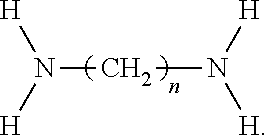
The organic amines chelators have general molecular structures, as depicted below:
Figure US10920106-20210216-C00004
The organic amine molecules have two primary amine functional groups as terminal groups on both ends of the molecules. n is numbered from 2 to 12, such as ethylenediamine with n=2, propylenediamine with n=3, butylenediamine with n=4, etc.
The organic diamine compounds with two primary amine moieties can be described as the binary chelating agents.
The alkyl group which linked to two terminal primary amine functional groups also include the branched alkyl groups, the general molecular structures of these branched alkyl groups are depicted at followings:
Figure US10920106-20210216-C00005
wherein, Rn represents an organic C1 to C12 alkyl group, m has the numbers ranged from 2 to 12.
The organic diamine molecules can also have the branched alkyl group as the linking group between two terminal primary amine functional groups.
Another structure of the organic amine molecules is shown below. Rn and Rm can be the same or different C1 to C12 alkyl groups. p is from 2 to 12.
Figure US10920106-20210216-C00006
Another type of the branched alkyl group linker has the following general molecular structure:
Figure US10920106-20210216-C00007
wherein, the Rn and Rm groups are bonded to the same carbon atom. Rn and Rm can be the same or different C1 to C12 alkyl groups. q is from 2 to 12.
The organic diamine molecules with other molecular structures can be also used as a chelating agent in the invented herein Cu CMP slurries, such as those organic diamine molecules with the following general molecular structures:
Figure US10920106-20210216-C00008
Such organic diamine molecules can have n numbered from 1 to 12, and can be described as organic diamines with one terminal primary amine functional group and another primary organic amine attached to the beta carbon atoms on the other end of the molecules. Also, the secondary primary amine functional groups can be also bonded to the other carbon atoms at other positions, such as beta, gamma etc. and the first primary amine function group still maintains as the terminal primary amine functional group in the same molecules.
Any other non-aromatic organic diamine molecules with two primary organic amine groups can be used as one of the three chelating agents in the invented Cu CMP slurries herein.
Optionally, any aromatic organic molecules with two primary amine functional groups can be used as one of three chelating agents in the invented Cu CMP slurries herein. For example, aromatic organic amines have the general molecular structures as depicted in followings:
Figure US10920106-20210216-C00009

or as followings:
Figure US10920106-20210216-C00010
In the above listed general aromatic organic diamine structures with two primary amine functional groups at ortho or meta positions in which n can be from 1 to 12, and m also can be from 1 to 12, also in the same molecule(s), n can be equal to m. In other cases, n can also be different from m.
DETAILED DESCRIPTION OF THE INVENTION
As industry standards trend toward smaller device features, there is a continuously developing need for new Cu bulk metal polishing slurries that afford high and tunable Cu or other metal films such as Co, W, Al, Ni etc. removal rates and low Cu or metal line dishing for the broad and advanced node applications.
The copper bulk CMP or other metal film such as Co, W, Al, Ni etc. polishing compositions described herein satisfy the need for high and tunable Cu film removal rates, for high selectivity between copper and dielectric films, for high selectivity between copper and barrier films, for low and more uniform Cu line dishing across various wide Cu line features, and for better Cu film corrosion protection through using the suitable corrosion inhibitors.
The Cu CMP polishing compositions comprise tris chelators, dual chelators or single chelator, i.e. varied number(s) of chelating agents, an organic quaternary ammonium salt as additional Cu dishing and defect reducer, Cu corrosion inhibitor for the efficient Cu corrosion protection, abrasive such as nano-sized high purity colloidal silica, oxidizing agent such as hydrogen peroxide, and water as a solvent.
The Cu CMP polishing compositions provide high and tunable Cu removal rates, and low barrier film and dielectric film removal rates which provide very high and desirable selectivity of Cu film vs. other barrier films, such as Ta, TaN, Ti, and TiN, and dielectric films, such as TEOS, low-k, and ultra low-k films, and low Cu dishing and more uniform Cu dishing across wide Cu line features.
The invented herein Cu chemical mechanical polishing compositions also provide no pad stain Cu CMP performances which allow the extended polish pad life and also allow more stable end-point detections.
The abrasive particles used for the disclosed herein Cu or other metal film bulk CMP polishing compositions include, but are not limited to, the following: colloidal silica or high purity colloidal silica; the colloidal silica particles doped by other metal oxide within lattice of the colloidal silica, such as alumina doped silica particles; colloidal aluminum oxide including alpha-, beta-, and gamma-types of aluminum oxides; colloidal and photoactive titanium dioxide, cerium oxide, colloidal cerium oxide, nano-sized inorganic metal oxide particles, such as alumina, titania, zirconia, ceria etc; nano-sized diamond particles, nano-sized silicon nitride particles; mono-modal, bi-modal, multi-modal colloidal abrasive particles; organic polymer-based soft abrasives, surface-coated or modified abrasives, or other composite particles, and mixtures thereof.
The colloidal silica can be made from silicate salts, the high purity colloidal silica can be made from TEOS or TMOS. The colloidal silica or high purity colloidal silica can have narrow or broad particle size distributions with mono-model or multi-models, various sizes and various shapes including spherical shape, cocoon shape, aggregate shape and other shapes,
The nano-sized particles also can have different shapes, such as spherical, cocoon, aggregate, and others.
The Cu bulk CMP polishing compositions of this invention preferably contain 0.0025 wt. % to 25 wt. % abrasives; the preferred concentration of abrasives ranges from 0.0025 wt. % to 2.5 wt. %. The most preferred concentration of abrasives ranges from 0.005 wt. % to 0.15 wt. %.
An organic quaternary ammonium salt, includes but is not limited to choline salt, such as choline bicarbonate salt, or all other salts formed between choline and other anionic counter ions.
The choline salts can have the general molecular structures shown below:
Figure US10920106-20210216-C00011
wherein anion Y can be bicarbonate, hydroxide, p-toluene-sulfonate, bitartate, and other suitable anionic counter ions.
The CMP slurry contains 0.005 wt. % to 0.25 wt. % quaternary ammonium salt; the preferred concentration ranges from 0.001 wt. % to 0.05 wt. %; and the most preferred concentration ranges from 0.002 wt. % to 0.01 wt. %
Various per-oxy inorganic or organic oxidizing agents or other types of oxidizing agents can be used to oxidize the metallic copper film to the mixture of copper oxides to allow their quick reactions with chelating agents and corrosion inhibitors. The oxidizing agent includes, but is not limited to, periodic acid, hydrogen peroxide, potassium iodate, potassium permanganate, ammonium persulfate, ammonium molybdate, ferric nitrate, nitric acid, potassium nitrate, and mixtures thereof. The preferred oxidizer is hydrogen peroxide.
The CMP slurry contains 0.1 wt. % to 10 wt. % oxidizing agents; the preferred concentration ranges from 0.25 wt. % to 3 wt. %; and the most preferred concentration ranges from 0.5 wt. % to 2.0 wt. %
The corrosion inhibitors used for the disclosed copper bulk CMP slurry can be those prior arts reported corrosion inhibitors. The corrosion inhibitors include, but are not limited to family of hetero aromatic compounds containing nitrogen atom(s) in their aromatic rings, such as 1,2,4-triazole and derivatives, benzotriazole and benzotriazole derivatives, tetrazole and tetrazole derivatives, imidazole and imidazole derivatives, benzimidazole and benzimidazole derivatives, pyrazole and pyrazole derivatives, and tetrazole and tetrazole derivatives.
The CMP slurry contains 0.005 wt. % to 0.5 wt. % corrosion inhibitor; the preferred concentration ranges from 0.01 wt. % to 0.1 wt. %; and the most preferred concentration ranges from 0.025 wt. % to 0.05 wt. %.
A chemical additive which is selected from the family of morpholino compounds is used as a very effective Cu dishing reducing agent in herein disclosed polishing compositions.
The chemical additive used as Cu dishing reducers includes, but is not limited to the family of morpholino compounds or oligomers, having the general molecular structure as shown below:
Figure US10920106-20210216-C00012

wherein, R represents hydrogen or various organic functional groups which attached to the nitrogen atom in morpholino 6-member ring through covalent boding with no net charges.
R includes, but is not limited to, alkyl primary amines with a single primary amine group or two or more than 2 primary amine groups in the same molecule, alkyl primary amines with a single secondary amine group or two or more than 2 secondary amine groups in the same molecule, alkyl amide with a single amide group or two or more than 2 amide groups in the same molecule, alkene primary amines with a single primary amine group or two or more than 2 primary amine groups in the same molecule, alkene primary amines with a single secondary amine group or two or more than 2 secondary amine groups in the same molecule, alkene amide with a single amide group or two or more than 2 amide groups in the same molecule, alkyne primary amines with a single primary amine group or two or more than 2 primary amine groups in the same molecule, alkyne primary amines with a single secondary amine group or two or more than 2 secondary amine groups in the same molecule, and alkyne amide with a single amide group or two or more than 2 amide groups in the same molecule.
R also includes, but is not limited to, alkyl alcohol with a single hydroxyl group or two or more than 2 hydroxyl groups in the same molecule, alkene alcohol with a single hydroxyl group or two or more than 2 hydroxyl groups in the same molecule, and alkyne alcohol with a single hydroxyl group or two or more than 2 hydroxyl groups in the same molecule.
The chemical additives covered with above listed general molecular structure include, but not limited to, 3-Morpholino-1,2-propanediol (MOPDIO), morpholine when R is hydrogen atom, 3,5-Dimethyl-morpholine, 2-(4-morpholino)phenol, 3-(4-morpholino)phenol, 4-(4-morpholino)phenol, 5-(4-Morpholinyl)-2-furaldehyde, 1-Morpholinocyclohexene, 2-methyl-2-morpholinopropanal, 4-(Morpholin-4-ylcarbonyl)benzonitrile, 5-(4-Morpholinylmethyl)-2-thiophenecarbaldehyde, 4-(2-hydroxyethyl)morpholine, 4-(3-hydroxypropyl)morpholine, 2-(2-Methoxyethyl)morpholine, 1-(4-Morpholinyl)-1-propanone, (2-morpholinophenyl)methanol, (4-morpholin-4-yl-phenyl)methanol, 1-morpholin-4-ylacetone, 2-(2-hydroxyethyl)morpholine, 2-(4-Morpholinylmethyl)phenol, 4-(2-Oxiranylmethyl)morpholine, Octahydrocyclopenta[b]morpholine, 2-(4-Morpholinyl)-2-oxoethanol, 3-morpholinecarboxylic acid methyl ester, 5-Ethyl-3-morpholinone, 4-(4-Morpholinyl)benzaldehyde, 2-morpholinobenzaldehyde, 2-morpholinonicotinaldehyde, 3-Phenyl-morpholine, 6-morpholinonicotinaldehyde, 6-morpholinopyridine-2-carbaldehyde, 4-(2-Aminoethyl)morpholine, 4-Morpholinecarbonitrile, 3-(4-Morpholinylcarbonyl)phenol, 4-(4-Morpholinylcarbonyl)phenol, Methyl-morpholin-2-ylmethyl-amine, ethyl morpholine-2-carboxylate, Ethyl morpholine-4-carboxylate, Borane morpholine complex, 1-Morpholinocyclopentene, 2-(4-morpholino)benzonitrile, 2-(Aminomethyl)morpholine, morpholin-2-yl(pyridin-4-yl)methanol, 1-morpholin-4-ylmethyl-cyclohexylamine, 2-N-Morpholinoethyl methacrylate, 4-Morpholinoaniline, 4-Morpholinopiperidine, 4-Morpholinopyridine, 4′-Morpholinoacetophenone, (2-morpholin-4-yl-1-phenylethyl)methylamine, (2-morpholin-4-yl-1-phenylethyl)methylamine, 1-Morpholinohexane-1,3-dione, etc.
The preferred chemical additive is selected from the group consisting of 3-Morpholino-1,2-propanediol (MOPDIO), morpholine when R is hydrogen atom, 2-methyl-2-morpholinopropanal, 4-(2-hydroxyethyl)morpholine, 4-(3-hydroxypropyl)morpholine, (2-morpholinophenyl)methanol, 2-(2-hydroxyethyl)morpholine, 2-(4-Morpholinyl)-2-oxoethanol, 4-(2-Aminoethyl)morpholine,2-(Aminomethyl)morpholine, morpholin-2-yl(pyridin-4-yl)methanol, 1-morpholin-4-ylmethyl-cyclohexylamine, 1-Morpholinohexane-1,3-dione, etc.
The chemical additive used as Cu dishing reducers includes, but is not limited to the family of morpholino compounds or oligomers having the general molecular structure as shown below:
Figure US10920106-20210216-C00013
wherein, R represents various organic functional groups which attached to the nitrogen atom in morpholino 6-member ring through covalent boding with negative charges.
The R organic functional groups include, but are not limited to, alkyl sulfonate with one sulfonate group or two or more than 2 sulfonate groups in the same molecule, alkyl carbonate with one carbonate group or two or more than 2 carbonate groups in the same molecule, alkyl phosphate with one phosphate group or two or more than 2 phosphate groups in the same molecule, alkene sulfonate with one sulfonate group or two or more than 2 sulfonate groups in the same molecule, alkene carbonate with one carbonate group or two or more than 2 carbonate groups in the same molecule, alkene phosphate with one phosphate group or two or more than 2 phosphate groups in the same molecule, alkyne sulfonate with one sulfonate group or two or more than 2 sulfonate groups in the same molecule, alkyne carbonate with one carbonate group or two or more than 2 carbonate groups in the same molecule, alkyne phosphate with one phosphate group or two or more than 2 phosphate groups in the same molecule. The counter ions M+ for these negative R groups include, but are not limited to sodium ion, potassium ion, ammonium ion, and cesium ion.
The chemical additive used as Cu dishing reducers includes, but is not limited to the family of morpholino compounds or oligomers having the general molecular structure as shown below:
Figure US10920106-20210216-C00014

wherein, R represents hydrogen or any one of various organic functional groups which attached to the nitrogen atom in morpholino 6-member ring through covalent boding with positive charges.
The R+ organic functional groups include, but are not limited to, alkyl quaternary ammonium with one quaternary ammonium group or two or more than 2 quaternary ammonium groups in the same molecule, alkene quaternary ammonium with one quaternary ammonium group or two or more than 2 quaternary ammonium groups in the same molecule, alkyne quaternary ammonium with one quaternary ammonium group or two or more than 2 quaternary ammonium groups in the same molecule. The counter ions N for these positive R+ groups include, but are not limited to carbonate anion, sulfate anion or phosphate anion.
The preferred dishing reducing additive is 3-Morpholino-1,2-propanediol (MOPDIO).
The CMP slurry contains 0.001 wt. % to 0.5 wt. % a Cu dishing reducing additive which is selected from the family of morpholino compounds; the preferred concentration ranges from 0.0025 wt. % to 0.25 wt. %; and the most preferred concentration ranges from 0.01 wt. % to 0.1 wt. %.
A biocide having active ingredients for providing more stable shelf time of the invented Cu chemical mechanical polishing compositions can be used.
The biocide includes but is not limited to Kathon™, Kathon™ CG/ICP II, from Dow Chemical Co. They have active ingredients of 5-chloro-2-methyl-4-isothiazolin-3-one and 2-methyl-4-isothiazolin-3-one.
The CMP slurry contains 0.0001 wt. % to 0.05 wt. % biocide; the preferred concentration ranges from 0.0001 wt. % to 0.025 wt. %; and the most preferred concentration ranges from 0.002 wt. % to 0.01 wt. %
Optionally, acidic or basic compounds or pH adjusting agents can be used to allow pH of Cu bulk CMP polishing compositions being adjusted to the optimized pH value,
The pH adjusting agents include, but are not limited to, the following: nitric acid, hydrochloric acid, sulfuric acid, phosphoric acid, other inorganic or organic acids, and mixtures thereof for acidic pH conditions; or sodium hydride, potassium hydroxide, ammonium hydroxide, tetraalkyl ammonium hydroxide, organic amines, and other chemical reagents that are able to be used to adjust pH towards the more alkaline direction.
The CMP slurry contains 0 wt. % to 1 wt. % pH adjusting agent; the preferred concentration ranges from 0.01 wt. % to 0.5 wt. %; and the most preferred concentration ranges from 0.1 wt. % to 0.25 wt. %
pH of the Cu polishing compositions is from about 3.0 to about 12.0; preferred pH range is from 5.5 to 7.5; and the most preferred pH range is from 7.0 to 7.35.
The single or dual or three chelator(s) are selected from the group consisting of amino acids, amino acid derivatives, organic amine, and combinations therefor; wherein at least one chelator is an amino acid or an amino acid derivative. For example, the three or tris-chelators, can be the combination of any three amino acids, three amino acid derivatives, or two amino acids plus one organic amine, or one amino acid plus one amino acid derivative plus one organic amine, or two organic amines plus one amino acid, and or two organic amines plus one amino acid derivative. As a specific example, the tris chelators can be glycine, alanine and ethylenediamine.
At least one chelator, such as dual or tris chelator, were used as complexing agents to maximize their reactions with the oxidized Cu film surfaces to form softer Cu-chelator layers to be quickly removed during Cu CMP process thus achieving high and tunable Cu removal rates and low copper dishing for the broad or advanced node copper or TSV (Through Silica Via) CMP applications.
The amino acids and amino acid derivatives included, but not limited to, glycine, D-alanine, L-alanine, DL-alanine, beta-alanine, valine, leucine, isolueciene, phenylamine, proline, serine, threonine, tyrosine, glutamine, asparanine, glutamic acid, aspartic acid, tryptophan, histidine, arginine, lysine, methionine, cysteine, iminodiacetic acid, etc.
The organic amines chelators have general molecular structures, as depicted below:
Figure US10920106-20210216-C00015
The organic amine molecules have two primary amine functional groups as terminal groups on both ends of the molecules. n is numbered from 2 to 12, such as ethylenediamine with n=2, propylenediamine with n=3, butylenediamine with n=4, etc.
The organic diamine compounds with two primary amine moieties can be described as the binary chelating agents.
The alkyl group which linked to two terminal primary amine functional groups also include the branched alkyl groups, the general molecular structures of these branched alkyl groups are depicted at followings:
Figure US10920106-20210216-C00016
wherein, Rn represents an organic C1 to C12 alkyl group, m has the numbers ranged from 2 to 12.
The organic diamine molecules can also have the branched alkyl group as the linking group between two terminal primary amine functional groups.
Another structure of the organic amine molecules is shown below. Rn and Rm can be the same or different C1 to C12 alkyl groups.
Figure US10920106-20210216-C00017
Another type of the branched alkyl group linker has the following general molecular structure:
Figure US10920106-20210216-C00018
wherein, the Rn and Rm groups are bonded to the same carbon atom. Rn and Rm can be the same or different C1 to C12 alkyl groups. q is from 2 to 12.
The organic diamine molecules with other molecular structures can be also used as a chelating agent in the invented herein Cu CMP slurries, such as those organic diamine molecules with the following general molecular structures:
Figure US10920106-20210216-C00019
Such organic diamine molecules can have n numbered from 1 to 12, and can be described as organic diamines with one terminal primary amine functional group and another primary organic amine attached to the beta carbon atoms on the other end of the molecules. Also, the secondary primary amine functional groups can be also bonded to the other carbon atoms at other positions, such as beta, gamma etc. and the first primary amine function group still maintains as the terminal primary amine functional group in the same molecules.
Any other non-aromatic organic diamine molecules with two primary organic amine groups can be used as one of the three chelating agents in the invented Cu CMP slurries herein.
Optionally, any aromatic organic molecules with two primary amine functional groups can be used as one of three chelating agents in the invented Cu CMP slurries herein. For example, aromatic organic amines have the general molecular structures as depicted in followings:
Figure US10920106-20210216-C00020

or as followings:
Figure US10920106-20210216-C00021
In the above listed general aromatic organic diamine structures with two primary amine functional groups at ortho or meta positions in which n can be from 1 to 12, and m also can be from 1 to 12, also in the same molecule(s), n can be equal to m. In other cases, n can also be different from m.
Typical amine used includes but is not limited to ethylenediamin, propylenediamine, butylenediamine, pentalene diamine, hexylene.
The chelator(s) concentrations are ranged from 0.25 wt. % to 5.0 wt. %, the preferred concentrations are ranged from 0.5 wt. % to 2.5 wt. %, the more preferred concentrations are ranged from 1.0 wt. % to 2.0 wt. %.
The associated methods described herein entail use of the aforementioned composition for chemical mechanical planarization of substrates comprised of copper. In the methods, a substrate (e.g., a wafer with Cu surface or Cu plug) is placed face-down on a polishing pad which is fixedly attached to a rotatable platen of a CMP polisher. In this manner, the substrate to be polished and planarized is placed in direct contact with the polishing pad. A wafer carrier system or polishing head is used to hold the substrate in place and to apply a downward pressure against the backside of the substrate during CMP processing while the platen and the substrate are rotated. The polishing composition (slurry) is applied (usually continuously) on the pad during CMP processing to effect the removal of material to planarize the substrate.
The polishing composition and associated methods described herein are effective for CMP of a wide variety of substrates, including most of substrates having, particularly useful for polishing copper substrates.
Experimental Section
Polishing Pad Polishing pad, IC1010 pad or Other polishing pad was used during Cu CMP, supplied by Dow Chemicals Company.
  • Parameters:
Å: angstrom(s)—a unit of length
BP: back pressure, in psi units
CMP: chemical mechanical planarization=chemical mechanical polishing
CS: carrier speed
DF: Down force: pressure applied during CMP, units psi min: minute(s)
ml: milliliter(s)
mV: millivolt(s)
psi: pounds per square inch
PS: platen rotational speed of polishing tool, in rpm (revolution(s) per minute)
SF: polishing composition flow, ml/min
  • Removal Rates
Cu RR 1.5 psi Measured Copper removal rate at 1.5 psi down pressure
of the CMP tool
Cu RR 2.5 psi Measured Copper removal rate at 2.5 psi down pressure
of the CMP tool
General Experimental Procedure
All percentages are weight percentages unless otherwise indicated. In the examples presented below, CMP experiments were run using the procedures and experimental conditions given below. The CMP tool that was used in the examples is a 300 mm LK® polisher, or a Mirra® polisher, manufactured by Applied Materials, 3050 Boweres Avenue, Santa Clara, Calif., 95054. An IC1010 pad or other type of polishing pad, supplied by Dow Chemicals Company was used on the platen for the blanket wafer polishing studies. Pads were broken-in by polishing twenty-five dummy oxide (deposited by plasma enhanced CVD from a TEOS precursor, PETEOS) wafers. In order to qualify the tool settings and the pad break-in, two PETEOS monitors were polished with Syton® OX-K colloidal silica, supplied by Planarization Platform of Air Products Chemicals Inc. at baseline conditions. Polishing experiments were conducted using blanket Cu wafers with 10.8K Angstroms in thickness, Ta and TEOS blanket wafers. These blanket wafers were purchased from Silicon Valley Microelectronics, 1150 Campbell Ave, CA, 95126.
WORKING EXAMPLE
In following working examples, the Cu slurry composition with single chelator which was used as reference sample comprised 0.713 wt. % of glycine, 0.0323 wt. % of 1,2,4-triazole, 0.00644 wt. % of high purity colloidal silica, and 0.00018 wt. % of biocide. The invented herein new Cu slurry #1 and #2 comprised 0.713 wt. % of glycine, 0.0323 wt. % of 1,2,4-triazole, 0.00644 wt. % of high purity colloidal silica, 0.00018 wt. % of biocide, and a Cu dishing reducing additive, 0.025 wt. % or 0.50 wt. % of 3-Morpholino-1,2-propanediol (MOPDIO). The pH of the slurries were at 6.0 to 7.5.
All these three listed formulations used 1.0 wt. % of H2O2 as oxidizing agent at point of use, respectively
Example 1
The polish results of using the Cu bulk CMP polishing compositions, reference sample vs new Cu slurry #1 and new Cu slurry #2 were listed in Table 1 and depicted in FIG. 1.
TABLE 1
The Effects of Chemical Additive MOPDIO in Single Chelator Cu
Slurries on Cu Removal Rates
Cu Removal Cu Removal Rate (Å/min.)
(Å/min.) at at
Sample 1.5 psi DF 2.5 psi DF
Reference Slurry 4643 8186
single chelator (Glycine)
Slurry# 1 5120 8367
single chelator Glycine +
0.025 wt. % 3-Morpholino-
1,2-propanediol
Slurry# 2 4637 7624
single chelator Glycine +
0.05 wt. % 3-Morpholino-
1,2-propanediol
Three CMP polishing compositions using single chelator were listed in Table 1. The reference slurry using glycine as the chelator but not using any Cu dishing additive.
New Cu slurry #1 and Cu slurry #2 were formulations using glycine as the chelator and different concentrations of 3-Morpholino-1,2-propanediol (=MOPDIO) as the chemical additive and Cu dishing reducer in compositions.
The Cu CMP polishing compositions with 0.025% or 0.50% 3-Morpholino-1,2-propanediol as Cu dishing reducing additive both afforded high and compatible Cu film removal rates comparing with the single chelator glycine based Cu CMP polishing composition. With 0.025% 3-Morpholino-1,2-propanediol as Cu dishing reducing additive, the Cu removal rates were higher than the Cu removal rates obtained using the reference sample without the use of any Cu dishing reducing additive.
The dishing effects of Cu CMP polishing compositions with 0.025% or 0.50% 3-Morpholino-1,2-propanediol as Cu dishing reducing additive herein vs the reference Cu CMP polishing composition without using such Cu dishing reducing additive on various featured Cu lines were listed in Table 2 and depicted in FIG. 2.
TABLE 2
Effects of Cu Dishing Additive on Cu Dishing with Glycine-only
Cu Slurries
Averaged Cu Averaged Cu Averaged Cu Averaged Cu
Dishing (Å) Dishing (Å) Dishing (Å) Dishing (Å)
on on on on
Samples 50 × 50 μM 10 × 10 μM 9 × 1 μM 1 × 9 μM
Reference
1325 740 785 263
Slurry
single chelator
(Glycine)
Slurry #1 609 432 649 244
Slurry #2 425 230 530 159
The Cu dishing reduction percentages on 50×50 μM and 10×10 μM Cu line features were listed in Table 3.
TABLE 3
Effects of Cu Dishing Additive on Cu Dishing with Single Chelator
Glycine
Averaged Cu Averaged Cu Averaged Cu Averaged Cu
Dishing (Å) Dishing (Å) Dishing (Å) Dishing (Å)
on Reduction % on Reduction %
Samples 50 × 50 μM on 50 × 50 μM 10 × 10 μM on 10 × 10 μM
Reference
1325 740
Slurry
single
chelator
(Glycine)
Slurry #1 609 −54% 432 −42%
Slurry #2 425 −68% 230 −69%
As showed in Table 3, when 0.025 wt. % of 3-Morpholino-1,2-propanediol was used in the compositions, the Cu dishing has been reduced by −54% on 50×50 μM Cu line feature and by −42% on 10×10 μM Cu line feature. When 3-Morpholino-1,2-propanediol used at 0.05 wt. %, the Cu dishing has been reduced by −68% on 50×50 μM Cu line feature and by −69% on 10×10 μM Cu line feature.
The Cu dishing reduction percentages on 9×1 μM and 1×9 μM Cu line features were listed in Table 4.
TABLE 4
Effects of Cu Dishing Additive on Cu Dishing with Single Chelator
Glycine
Averaged Cu Averaged Cu
Averaged Cu Dishing (Å) Averaged Cu Dishing (Å)
Dishing (Å) on Reduction % Dishing (Å) on Reduction %
Samples 9 × 1 μM on 9 × 1 μM 1 × 9 μM on 1 × 9 μM
Reference
785 263
Slurry
single
chelator
(Glycine)
Slurry #1 649 −17.3% 244 −7.2%
Slurry #2 530 −32.5% 159 −39.5%
As showed in Table 4, the Cu dishing has been reduced by −33% on 9×1 μM Cu line feature and by −40% on 1×9 μM Cu line feature when 0.05 wt. % of 3-Morpholino-1,2-propanediol used.
Example 2
The polish results of using the Cu bulk CMP polishing compositions, reference sample vs new Cu slurry #3 and new Cu slurry #4 were listed in Table 5 and depicted in FIG. 3. The pH of the slurries were at 6.0 to 7.5.
The dual chelators formulations slurry #3 and Slurry #4 both used glycine and ethylenediamine (EDA) as the dual chelators, and 3-Morpholino-1,2-propanediol (=MOPDIO) as Cu dishing reducer. In addition, Choline Bicarbonate (CBC) was used in Cu Slurry #4.
TABLE 5
The Effects of Chemical Additive MOPDIO in Dual Chelator Cu
Slurries on Cu Removal Rates
Cu Removal Rate
Cu Removal (Å/min.) (Å/min.) at
Sample at 1.5 psi DF 2.5 psi DF
Reference Slurry 4643 8186
single chelator(Glycine)
Cu Slurry# 3 dual chelators, 4809 7656
Glycine + EDA + 0.05 wt %
3-Morpholino-1,2-
propanediol
Cu Slurry# 4 dual chelators, 5057 7745
Glycine + EDA + 0.05 wt %
3-Morpholino-1,2-
propanediol + CBC
The Cu CMP polishing compositions with 0.050 wt. % 3-Morpholino-1,2-propanediol as Cu dishing reducing additive afforded high and compatible Cu film removal rates comparing with the single chelator glycine based Cu CMP polishing composition. With 0.05 wt. % 3-Morpholino-1,2-propanediol as Cu dishing reducing additive and EDA as second chelator, Cu removal rate at 1.5 psi DF was increased, the addition of CBC in Cu slurry #4 increased Cu removal rate further at 1.5 psi DF.
The dishing effects of Cu CMP polishing compositions from Reference sample (single chelator with no Cu dishing additive), Cu slurry #3 and #4 were listed in Table 6 and depicted in FIG. 4.
TABLE 6
Effects of Cu Dishing Additive on Cu Dishing with Dual Chelator
Averaged Cu Averaged Cu Averaged Cu
Dishing (Å) Dishing (Å) Dishing (Å) Averaged Cu
on on on Dishing (Å) on
Samples 50 × 50 μM 10 × 10 μM 9 × 1 μM 1 × 9 μM
Reference
1325 740 785 263
Sample
Cu Slurry #3 482 292 587 195
Cu Slurry #4 333 178 435 170
The Cu dishing reduction percentages on 50×50 μM and 10×10 μM Cu line features were listed in Table 7.
TABLE 7
Effects of Cu Dishing Additive on Cu Dishing with Dual Chelators
Averaged Cu Averaged Cu
Averaged Cu Dishing (Å) Dishing (Å)
Dishing (Å) Reduction Averaged Cu Reduction
on % on Dishing (Å) on % on
Samples 50 × 50 μM 50 × 50 μM 10 × 10 μM 10 × 10 μM
Reference
1325 740
Sample
Cu Slurry #3 482 −64% 292 −61%
Cu Slurry #4 333 −75% 178 −76%
As showed in Table 7, the use of 0.05 wt. % 3-Morpholino-1,2-propanediol in glycine and EDA based dual chelator Cu slurry #3, Cu dishing has been reduced the by −64% on 50×50 μM Cu line feature and by −61% on 10×10 μM Cu line feature. When used at 0.05 wt. % in glycine and EDA based dual chelator plus Choline Bicarbonate (CBC) Cu slurry #4 as an additional additive, the Cu dishing were reduced by −75% on 50×50 μM Cu line feature and by −76% on 10×10 μM Cu line feature.
The Cu dishing reduction percentages on 9×1 μM and 1×9 μM Cu line features were listed in Table 8.
TABLE 8
Effects of Cu Dishing Additive on Cu Dishing with Dual Chelators
Averaged Cu Averaged Cu
Averaged Cu Dishing (Å) Dishing (Å)
Dishing (Å) Reduction Averaged Cu Reduction
on % on Dishing (Å) on % on
Samples 9 × 1 μM 9 × 1 μM 1 × 9 μM 1 × 9 μM
Reference
785 263
Sample
Cu Slurry #3 587 −25.2% 195 −25.8%
Cu Slurry #3 435 −44.6% 170 −33.4%
As showed in Table 8, the Cu dishing were reduced by −25% on 9×1 μM Cu line feature and by −26% on 1×9 μM Cu line feature respectively using Cu slurry #3, when 3-Morpholino-1,2-propanediol was used in addition of glycine and EDA based dual chelators.
The Cu dishing were reduced by −45% on 9×1 μM Cu line feature and by −33% on 1×9 μM Cu line feature respectively using Cu slurry #4 wherein 3-Morpholino-1,2-propanediol as well as CBC were used in addition of glycine and EDA based dual chelators.
Example 3
The polishing effects of the tris chelator based Cu CMP polishing compositions with/or without using 3-Morpholino-1,2-propanediol as an additional additive to reduce Cu line dishing were shown in Table 9 and depicted in FIG. 5. The pH of the compositions were at 6.0 to 7.5.
TABLE 9
The Effects of Chemical Additive MOPDIO in Tris Chelator Cu
Slurries on Cu Removal Rates
Averaged
Cu Removal
Averaged Cu Removal Rate (Å/min.)
Sample (Å/min.) at 1.5 psi DF at 2.5 psi DF
Cu Slurry with tris chelators, 5432 9171
Glycine + Alanine + EDA as
reference
Cu Slurry# 5 with tris 5093 8790
chelators above + 0.05 wt.
% 3-Morpholino-1,2-
propanediol
The use of 0.05 wt. % 3-Morpholino-1,2-propanediol (MOPDIO) as Cu dishing reducing additive in tris chelators based composition Cu slurry #5, a slightly reduced Cu removal rate was observed comparing with the reference sample having the three chelators but without using the additive. However, the Cu slurry #5 still afforded high averaged Cu removal rates at high or low down forces.
The dishing effects of Cu CMP polishing compositions with 0.050 wt. % 3-Morpholino-1,2-propanediol (=MOPDIO) as Cu dishing reducing additive in the tris chelators, glycine and alanine and EDA based Cu slurry #5 vs the reference tris chelators based Cu CMP polishing composition without using such Cu dishing reducing additive on various featured Cu line dishing were listed in Table 10 and depicted in FIG. 6.
TABLE 10
Effects of Cu Dishing Additive on Cu Dishing with Tris Chelator
Cu Slurry
Averaged Cu Averaged Cu Averaged Cu
Dishing (Å) Dishing (Å) Dishing (Å) Averaged Cu
on on on Dishing (Å) on
Samples 50 × 50 μM 10 × 10 μM 9 × 1 μM 1 × 9 μM
Reference
564 388 583 220
Sample
Cu Slurry #5 330 211 399 149
The Cu dishing reduction percentages on 50×50 μM and 10×10 μM Cu line features using Cu slurry #5 were compared with the reference tris chelators based Cu CMP polishing composition and results were listed in Table 11.
TABLE 11
Effects of Cu Dishing Additive on Cu Dishing with Tris Chelators
Cu Slurries
Averaged Cu Averaged Cu
Averaged Cu Dishing (Å) Dishing (Å)
Dishing (Å) Reduction Averaged Cu Reduction
on % on Dishing (Å) on % on
Samples 50 × 50 μM 50 × 50 μM 10 × 10 μM 10 × 10 μM
Reference
564 388
Sample, Tris
Chelators
Cu Slurry #5 330 −41.5% 211 −45.6%
As showed in Table 11, the Cu dishing were reduced by about −42% on 50×50 μM Cu line feature and by about −46% on 10×10 μM Cu line feature, when 0.05 wt. % of 3-Morpholino-1,2-propanediol was used in the formulation Cu slurry #5.
The Cu dishing reduction percentages on 9×1 μM and 1×9 μM Cu line features using Cu slurry #5 vs using the reference sample with tris chelators were listed in Table 12.
TABLE 12
Effects of Cu Dishing Additive on Cu Dishing with Tris Chelators
Cu Slurries
Averaged Cu Averaged Cu
Averaged Cu Dishing (Å) Dishing (Å)
Dishing (Å) Reduction Averaged Cu Reduction
on % on Dishing (Å) on % on
Samples 9 × 1 μM 9 × 1 μM 1 × 9 μM 1 × 9 μM
Reference
583 220
Sample, Tris
Chelators
Cu Slurry #5 399 −31.6% 149 −32.3%
As showed in Table 12, the Cu dishing from Cu slurry #5 was reduced by about −32% on 9×1 μM Cu line feature and by about −32% on 1×9 μM Cu line feature comparing with the dishing from the reference sample.
While the invention has been described in conjunction with specific embodiments thereof, it is evident that many alternatives, modifications, and variations will be apparent to those skilled in the art in light of the foregoing description. Accordingly, departures may be made from such details without departing from the spirit or scope of the general inventive concept.
While the principles of the invention have been described above in connection with preferred embodiments, it is to be clearly understood that this description is made only by way of example and not as a limitation of the scope of the invention.

Claims (21)

The invention claimed is:
1. A metal film bulk chemical mechanical polishing (CMP) or Through Silica Via (TSV) composition comprises:
a) Abrasive ranging from 0.0025 wt. % to 2.5 wt. % and is selected from the group consisting of colloidal silica or high purity colloidal silica, colloidal silica particles doped by other metal oxide within lattice of the colloidal silica, colloidal aluminum oxide, colloidal and photoactive titanium dioxide, cerium oxide, colloidal cerium oxide, nano-sized inorganic metal oxide particles, nano-sized diamond particles, nano-sized silicon nitride particles, mono-modal colloidal abrasive particles, bi-modal colloidal abrasive particles, multi-modal colloidal abrasive particles, organic polymer-based soft abrasives, surface-coated or modified abrasives, and combinations thereof;
b) at least one chelator ranging from 0.5 wt. % to 2.5 wt. % and is selected from the group consisting of amino acids, amino acid derivatives, organic amine, and combinations therefor; wherein at least one of the at least one chelator is an amino acid or an amino acid derivative;
c) corrosion inhibitor ranging from 0.01 wt. % to 0.1 wt. % and is selected from the group consisting of 1,2,4-triazole and derivatives, benzotriazole and benzotriazole derivatives, tetrazole and tetrazole derivatives, imidazole and imidazole derivatives, benzimidazole and benzimidazole derivatives, pyrazole and pyrazole derivatives, tetrazole and tetrazole derivatives, and combinations thereof;
d) a chemical additive;
e) oxidizing agent ranging from 0.25 wt. % to 3 wt. %; and is selected from the group consisting of periodic acid, hydrogen peroxide, potassium iodate, potassium permanganate, ammonium persulfate, ammonium molybdate, ferric nitrate, nitric acid, potassium nitrate, and combinations thereof; and
f) water based solvent selected from the group consisting of deionized (DI) water, distilled water, and water based alcoholic organic solvent;
optionally
g) biocide ranging from 0.0001 wt. % to 0.025 wt. % and has active ingredients of 5-chloro-2-methyl-4-isothiazolin-3-one and 2-methyl-4-isothiazolin-3-one;
h) organic quaternary ammonium salt; and
i) pH adjusting agent;
wherein
the pH of the composition is 5.5 to 8.0;
the metal film is selected from the group consisting of Cu film, Co film, W film, Ni film, Al film, and combinations thereof; and
the chemical additive ranges from 0.0025 wt. % to 0.25 wt. % and is a morpholino compound or oligomer having a molecular structure selected from the group consisting of
Figure US10920106-20210216-C00022
wherein R is hydrogen or an organic functional group attached to the nitrogen atom in morpholino 6-member ring through covalent boding with no net charges; and R is selected from the group consisting of alkyl primary amine with a single primary amine group or two or more than 2 primary amine groups in the same molecule; alkyl primary amine with a single secondary amine group or two or more than 2 secondary amine groups in the same molecule; alkyl amide with a single amide group or two or more than 2 amide groups in the same molecule; alkene primary amine with a single primary amine group or two or more than 2 primary amine groups in the same molecule; alkene primary amine with a single secondary amine group or two or more than 2 secondary amine groups in the same molecule; alkene amide with a single amide group or two or more than 2 amide groups in the same molecule; alkyne primary amine with a single primary amine group or two or more than 2 primary amine groups in the same molecule; alkyne primary amine with a single secondary amine group or two or more than 2 secondary amine groups in the same molecule; alkyne amide with a single amide group or two or more than 2 amide groups in the same molecule; alkyl alcohol with a single hydroxyl group or two or more than 2 hydroxyl groups in the same molecule; alkene alcohol with a single hydroxyl group or two or more than 2 hydroxyl groups in the same molecule; and alkyne alcohol with a single hydroxyl group or two or more than 2 hydroxyl groups in the same molecule;
Figure US10920106-20210216-C00023
wherein R is an organic functional group attached to the nitrogen atom in morpholino 6-member ring through covalent boding with negative charges; and R is selected from the group consisting of alkyl sulfonate with one sulfonate or two or more than 2 sulfonate groups in the same molecule, alkyl carbonate with one carbonate group or two or more than 2 carbonate groups in the same molecule, alkyl phosphate with one phosphate group or two or more than 2 phosphate groups in the same molecule, alkene sulfonate with one sulfonate group or two or more than 2 sulfonate groups in the same molecule, alkene carbonate with one carbonate group or two or more than 2 carbonate groups in the same molecule, alkene phosphate with one phosphate group or two or more than 2 phosphate groups in the same molecule, alkyne sulfonate with one sulfonate group or two or more than 2 sulfonate groups in the same molecule, alkyne carbonate with one carbonate group or two or more than 2 carbonate groups in the same molecule, alkyne phosphate with one phosphate group or two or more than 2 phosphate groups in the same molecule; and counter ion M+ for R group is selected from the group consisting of sodium ion, potassium ion, ammonium ion, and cesium ion;
Figure US10920106-20210216-C00024
wherein R+ is an organic functional group attached to the nitrogen atom in morpholino 6-member ring through covalent boding with positive charges; and R+ is selected from the group consisting of alkyl quaternary ammonium with one quaternary ammonium group or two or more than 2 quaternary ammonium groups in the same molecule, alkene quaternary ammonium with one quaternary ammonium group or two or more than 2 quaternary ammonium groups in the same molecule, alkyne quaternary ammonium with one quaternary ammonium group or two or more than 2 quaternary ammonium groups in the same molecule; and counter ions N for R+ group is selected from the group consisting of carbonate anion, sulfate anion or phosphate anion; and
combinations thereof.
2. The composition of claim 1; wherein
the amino acid and amino acid derivative is selected from the group consisting of glycine, D-alanine, L-alanine, DL-alanine, beta-alanine, valine, leucine, isolueciene, phenylamine, proline, serine, threonine, tyrosine, glutamine, asparanine, glutamic acid, aspartic acid, tryptophan, histidine, arginine, lysine, methionine, cysteine, iminodiacetic acid, and combinations thereof; and
the organic amine has a general molecular structure selected from the group consisting of:
Figure US10920106-20210216-C00025
wherein n is from 2 to 12;
Figure US10920106-20210216-C00026
wherein, Rn represents an organic C1 to C12 alkyl group; m is from 2 to 12;
Figure US10920106-20210216-C00027
wherein Rn and Rm can be the same or different C1 to C12 alkyl groups; p is from 2 to 12;
Figure US10920106-20210216-C00028
wherein Rn and Rm can be the same or different C1 to C12 alkyl groups; q is from 2 to 12;
Figure US10920106-20210216-C00029
wherein n is from 1 to 12;
Figure US10920106-20210216-C00030
wherein n and m are each independently from 1 to 12;
and combinations thereof.
3. The composition of claim 1, wherein the amino acid is selected from the group consisting of glycine, D-alanine, L-alanine, DL-alanine, beta-alanine, and combinations thereof; and the amine is selected from the group consisting of ethylenediamin, propylenediamine, butylenediamine, pentalene diamine, hexylene diamine, and combinations thereof.
4. The composition of claim 1, wherein the chemical additive selected from the group consisting of 3-Morpholino-1,2-propanediol (MOPDIO), morpholine when R is hydrogen atom, 2-methyl-2-morpholinopropanal, 4-(2-hydroxyethyl)morpholine, 4-(3-hydroxypropyl)morpholine, (2-morpholinophenyl)methanol, 2-(2-hydroxyethyl)morpholine, 2-(4-Morpholinyl)-2-oxoethanol, 4-(2-Aminoethyl)morpholine,2-(Aminomethyl)morpholine, morpholin-2-yl(pyridin-4-yl)methanol, 1-morpholin-4-ylmethyl-cyclohexylamine, 1-Morpholinohexane-1,3-dione, and combinations thereof.
5. The composition of claim 1, wherein
the organic quaternary ammonium salt ranges from 0.001 wt. % to 0.05 wt. % and is a choline salt formed between choline and other anionic counter ions having the general molecular structures shown below:
Figure US10920106-20210216-C00031
wherein anion Y can be bicarbonate, hydroxide, p-toluene-sulfonate, bitartate, and other suitable anionic counter ions; and
the pH adjusting agent ranges from 0.01 wt. % to 0.5 wt. % and is selected from the group consisting of (1) nitric acid, hydrochloric acid, sulfuric acid, phosphoric acid, other inorganic or organic acids, and mixtures thereof for acidic pH conditions; or (2) sodium hydride, potassium hydroxide, ammonium hydroxide, tetraalkyl ammonium hydroxide, organic quaternary ammonium hydroxide compounds, organic amines, and combinations thereof for alkaline pH conditions.
6. The composition of claim 1, wherein the composition comprises
colloidal silica,
at least one amino acid selected from the group consisting of glycine, D-alanine, L-alanine, DL-alanine, beta-alanine, and combinations thereof;
at least one selected from the group consisting of 3-Morpholino-1,2-propanediol (MOPDIO), morpholine, 2-methyl-2-morpholinopropanal, 4-(2-hydroxyethyl)morpholine, 4-(3-hydroxypropyl)morpholine, (2-morpholinophenyl)methanol, 2-(2-hydroxyethyl)morpholine, 2-(4-Morpholinyl)-2-oxoethanol, 4-(2-Aminoethyl)morpholine,2-(Aminomethyl)morpholine, morpholin-2-yl(pyridin-4-yl)methanol, 1-morpholin-4-ylmethyl-cyclohexylamine, 1-Morpholinohexane-1,3-dione, and combinations thereof;
hydrogen peroxide;
water;
optionally
at least one amine selected from the group consisting of ethylenediamin, propylenediamine, butylenediamine, pentalene diamine, hexylene diamine, and combinations thereof; and
choline bicarbonate (CBC).
7. The composition of claim 6, wherein the composition has a pH from 6.0 to 7.5.
8. A method of chemical mechanical polishing at least one metal or metal-containing surface of a semiconductor substrate, using a chemical mechanical polishing or Through Silica Via (TSV) composition comprising steps of:
1) providing the semiconductor substrate;
2) providing a polish pad;
3) providing the chemical mechanical polishing or Through Silica Via (TSV) composition in claim 1;
4) polishing the at least one metal or metal-containing surface of the semiconductor substrate;
wherein at least a portion of the metal or metal-containing is in contact with both the polishing pad and the chemical mechanical polishing composition; and
the metal film is selected from the group consisting of Cu film, Co film, W film, Ni film, Al film, and combinations thereof.
9. The method of claim 8; wherein
the amino acid and amino acid derivative is selected from the group consisting of glycine, D-alanine, L-alanine, DL-alanine, beta-alanine, valine, leucine, isolueciene, phenylamine, proline, serine, threonine, tyrosine, glutamine, asparanine, glutamic acid, aspartic acid, tryptophan, histidine, arginine, lysine, methionine, cysteine, iminodiacetic acid, and combinations thereof; and
the organic amine has a general molecular structure selected from the group consisting of:
Figure US10920106-20210216-C00032
wherein n is from 2 to 12;
Figure US10920106-20210216-C00033
wherein, Rn represents an organic C1 to C12 alkyl group, m is from 2 to 12;
Figure US10920106-20210216-C00034
wherein Rn and Rm can be the same or different C1 to C12 alkyl groups, p is from 2 to 12;
Figure US10920106-20210216-C00035
wherein Rn and Rm can be the same or different C1 to C12 alkyl groups, q is from 2 to 12;
Figure US10920106-20210216-C00036
wherein n is from 1 to 12;
Figure US10920106-20210216-C00037
wherein n and m are each independent from 1 to 12;
and combinations thereof.
10. The method of claim 8; wherein the amino acid is selected from the group consisting of glycine, D-alanine, L-alanine, DL-alanine, beta-alanine, and combinations thereof; and the amine is selected from the group consisting of ethylenediamin, propylenediamine, butylenediamine, pentalene diamine, hexylene diamine, and combinations thereof.
11. The method of claim 8; wherein the chemical additive selected from the group consisting of 3-Morpholino-1,2-propanediol (MOPDIO), morpholine when R is hydrogen atom, 2-methyl-2-morpholinopropanal, 4-(2-hydroxyethyl)morpholine, 4-(3-hydroxypropyl)morpholine, (2-morpholinophenyl)methanol, 2-(2-hydroxyethyl)morpholine, 2-(4-Morpholinyl)-2-oxoethanol, 4-(2-Aminoethyl)morpholine,2-(Aminomethyl)morpholine, morpholin-2-yl(pyridin-4-yl)methanol, 1-morpholin-4-ylmethyl-cyclohexylamine, 1-Morpholinohexane-1,3-dione, and combinations thereof.
12. The method of claim 8; wherein
the organic quaternary ammonium salt ranges from 0.001 wt. % to 0.05 wt. % and is a choline salt formed between choline and other anionic counter ions having the general molecular structures shown below:
Figure US10920106-20210216-C00038
wherein anion Y can be bicarbonate, hydroxide, p-toluene-sulfonate, bitartate, and other suitable anionic counter ions; and
the pH adjusting agent ranges from 0.01 wt. % to 0.5 wt. % and is selected from the group consisting of (1) nitric acid, hydrochloric acid, sulfuric acid, phosphoric acid, other inorganic or organic acids, and mixtures thereof for acidic pH conditions; or (2) sodium hydride, potassium hydroxide, ammonium hydroxide, tetraalkyl ammonium hydroxide, organic quaternary ammonium hydroxide compounds, organic amines, and combinations thereof for alkaline pH conditions.
13. The method of claim 8; wherein the composition comprises
colloidal silica,
at least one amino acid selected from the group consisting of glycine, D-alanine, L-alanine, DL-alanine, beta-alanine, and combinations thereof;
at least one selected from the group consisting of 3-Morpholino-1,2-propanediol (MOPDIO), morpholine when R is hydrogen atom, 2-methyl-2-morpholinopropanal, 4-(2-hydroxyethyl)morpholine, 4-(3-hydroxypropyl)morpholine, (2-morpholinophenyl)methanol, 2-(2-hydroxyethyl)morpholine, 2-(4-Morpholinyl)-2-oxoethanol, 4-(2-Aminoethyl)morpholine, 2-(Aminomethyl)morpholine, morpholin-2-yl(pyridin-4-yl)methanol, 1-morpholin-4-ylmethyl-cyclohexylamine, 1-Morpholinohexane-1,3-dione, and combinations thereof;
hydrogen peroxide;
water;
optionally
at least one amine selected from the group consisting of ethylenediamin, propylenediamine, butylenediamine, pentalene diamine, hexylene diamine, and combinations thereof; and
choline bicarbonate (CBC).
14. The method of claim 8, wherein the chemical mechanical polishing or Through Silica Via (TSV) composition has a pH from 6.0 to 7.5.
15. A system of chemical mechanical polishing at least one metal or metal-containing surface of a semiconductor substrate, comprising
1) the semiconductor substrate;
2) a polish pad;
3) a chemical mechanical polishing or Through Silica Via (TSV) composition in claim 1;
wherein at least a portion of the at least one metal or metal-containing surface is in contact with both the polishing pad and the chemical mechanical polishing or Through Silica Via (TSV) composition; and the metal is selected from the group consisting of Cu, Co, W, Ni, Al, and combinations thereof.
16. The system of claim 15; wherein
the amino acid and amino acid derivative is selected from the group consisting of glycine, D-alanine, L-alanine, DL-alanine, beta-alanine, valine, leucine, isolueciene, phenylamine, proline, serine, threonine, tyrosine, glutamine, asparanine, glutamic acid, aspartic acid, tryptophan, histidine, arginine, lysine, methionine, cysteine, iminodiacetic acid, and combinations thereof; and
the organic amine has a general molecular structure selected from the group consisting of:
Figure US10920106-20210216-C00039
wherein n is from 2 to 12;
Figure US10920106-20210216-C00040
wherein, Rn represents an organic C1 to C12 alkyl group having, m is from 2 to 12;
Figure US10920106-20210216-C00041
wherein Rn and Rm can be the same or different C1 to C12 alkyl groups, p is from 2 to 12;
Figure US10920106-20210216-C00042
wherein Rn and Rm can be the same or different C1 to C12 alkyl groups, q is from 2 to 12;
Figure US10920106-20210216-C00043
wherein n is from 1 to 12;
Figure US10920106-20210216-C00044
wherein n and m are each independent from 1 to 12;
and combinations thereof.
17. The system of claim 15, wherein the amino acid is selected from the group consisting of glycine, D-alanine, L-alanine, DL-alanine, beta-alanine, and combinations thereof; and the amine is selected from the group consisting of ethylenediamin, propylenediamine, butylenediamine, pentalene diamine, hexylene diamine, and combinations thereof.
18. The system of claim 15, wherein the chemical additive selected from the group consisting of 3-Morpholino-1,2-propanediol (MOPDIO), morpholine when R is hydrogen atom, 2-methyl-2-morpholinopropanal, 4-(2-hydroxyethyl)morpholine, 4-(3-hydroxypropyl)morpholine, (2-morpholinophenyl)methanol, 2-(2-hydroxyethyl)morpholine, 2-(4-Morpholinyl)-2-oxoethanol, 4-(2-Aminoethyl)morpholine,2-(Aminomethyl)morpholine, morpholin-2-yl(pyridin-4-yl)methanol, 1-morpholin-4-ylmethyl-cyclohexylamine, 1-Morpholinohexane-1,3-dione, and combinations thereof.
19. The system of claim 15, wherein
the organic quaternary ammonium salt ranges from 0.001 wt. % to 0.05 wt. % and is a choline salt formed between choline and other anionic counter ions having the general molecular structures shown below:
Figure US10920106-20210216-C00045
wherein anion Y can be bicarbonate, hydroxide, p-toluene-sulfonate, bitartate, and other suitable anionic counter ions; and
the pH adjusting agent ranges from 0.01 wt. % to 0.5 wt. % and is selected from the group consisting of (1) nitric acid, hydrochloric acid, sulfuric acid, phosphoric acid, other inorganic or organic acids, and mixtures thereof for acidic pH conditions; or (2) sodium hydride, potassium hydroxide, ammonium hydroxide, tetraalkyl ammonium hydroxide, organic quaternary ammonium hydroxide compounds, organic amines, and combinations thereof for alkaline pH conditions.
20. The system of claim 15, wherein the composition comprises
colloidal silica,
at least one amino acid selected from the group consisting of glycine, D-alanine, L-alanine, DL-alanine, beta-alanine, and combinations thereof;
at least one selected from the group consisting of 3-Morpholino-1,2-propanediol (MOPDIO), morpholine when R is hydrogen atom, 2-methyl-2-morpholinopropanal, 4-(2-hydroxyethyl)morpholine, 4-(3-hydroxypropyl)morpholine, (2-morpholinophenyl)methanol, 2-(2-hydroxyethyl)morpholine, 2-(4-Morpholinyl)-2-oxoethanol, 4-(2-Aminoethyl)morpholine, 2-(Aminomethyl)morpholine, morpholin-2-yl(pyridin-4-yl)methanol, 1-morpholin-4-ylmethyl-cyclohexylamine, 1-Morpholinohexane-1,3-dione, and combinations thereof;
hydrogen peroxide;
water;
optionally
at least one amine selected from the group consisting of ethylenediamin, propylenediamine, butylenediamine, pentalene diamine, hexylene diamine, and combinations thereof; and
choline bicarbonate (CBC).
21. The system of claim 15, wherein the chemical mechanical polishing or Through Silica Via (TSV) composition has a pH from 6.0 to 7.5.
US16/564,939 2017-08-24 2019-09-09 Metal chemical mechanical planarization (CMP) composition and methods therefore Active US10920106B2 (en)

Priority Applications (1)

Application Number Priority Date Filing Date Title
US16/564,939 US10920106B2 (en) 2017-08-24 2019-09-09 Metal chemical mechanical planarization (CMP) composition and methods therefore

Applications Claiming Priority (3)

Application Number Priority Date Filing Date Title
US201762549608P 2017-08-24 2017-08-24
US16/110,422 US10465096B2 (en) 2017-08-24 2018-08-23 Metal chemical mechanical planarization (CMP) composition and methods therefore
US16/564,939 US10920106B2 (en) 2017-08-24 2019-09-09 Metal chemical mechanical planarization (CMP) composition and methods therefore

Related Parent Applications (1)

Application Number Title Priority Date Filing Date
US16/110,422 Division US10465096B2 (en) 2017-08-24 2018-08-23 Metal chemical mechanical planarization (CMP) composition and methods therefore

Publications (2)

Publication Number Publication Date
US20200032107A1 US20200032107A1 (en) 2020-01-30
US10920106B2 true US10920106B2 (en) 2021-02-16

Family

ID=63405126

Family Applications (2)

Application Number Title Priority Date Filing Date
US16/110,422 Active US10465096B2 (en) 2017-08-24 2018-08-23 Metal chemical mechanical planarization (CMP) composition and methods therefore
US16/564,939 Active US10920106B2 (en) 2017-08-24 2019-09-09 Metal chemical mechanical planarization (CMP) composition and methods therefore

Family Applications Before (1)

Application Number Title Priority Date Filing Date
US16/110,422 Active US10465096B2 (en) 2017-08-24 2018-08-23 Metal chemical mechanical planarization (CMP) composition and methods therefore

Country Status (8)

Country Link
US (2) US10465096B2 (en)
EP (1) EP3447100A1 (en)
JP (1) JP6730385B2 (en)
KR (1) KR102287000B1 (en)
CN (1) CN109456704B (en)
IL (1) IL261370B (en)
SG (1) SG10201807222TA (en)
TW (1) TWI685553B (en)

Families Citing this family (13)

* Cited by examiner, † Cited by third party
Publication number Priority date Publication date Assignee Title
US11401441B2 (en) * 2017-08-17 2022-08-02 Versum Materials Us, Llc Chemical mechanical planarization (CMP) composition and methods therefore for copper and through silica via (TSV) applications
US10465096B2 (en) * 2017-08-24 2019-11-05 Versum Materials Us, Llc Metal chemical mechanical planarization (CMP) composition and methods therefore
EP3907562B1 (en) * 2019-01-03 2024-05-15 Boe Technology Group Co., Ltd. Template preparation method
US11292938B2 (en) * 2019-09-11 2022-04-05 Rohm And Haas Electronic Materials Cmp Holdings, Inc. Method of selective chemical mechanical polishing cobalt, zirconium oxide, poly-silicon and silicon dioxide films
IL291731B2 (en) * 2019-09-30 2025-09-01 Versum Mat Us Llc Low dishing copper chemical mechanical planarization
JP7697781B2 (en) * 2020-03-25 2025-06-24 株式会社フジミインコーポレーテッド Polishing composition, its manufacturing method, polishing method, and manufacturing method of semiconductor substrate
CN111618667A (en) * 2020-06-16 2020-09-04 岳阳凯美特电子特种稀有气体有限公司 Treatment method for inner wall of steel cylinder filled with high-purity halogen mixed gas and polishing powder used by same
US20240006189A1 (en) * 2020-12-14 2024-01-04 Versum Materials Us, Llc Chemical Mechanical Planarization (CMP) For Copper And Through-Silicon Via (TSV)
JP7596928B2 (en) * 2021-05-24 2024-12-10 信越化学工業株式会社 Polishing composition
CN113789127B (en) * 2021-10-20 2023-07-28 博力思(天津)电子科技有限公司 Polishing solution for copper film of through silicon via
CN117229717A (en) * 2023-08-23 2023-12-15 上海集成电路材料研究院有限公司 Chemical mechanical polishing solution and preparation method and application thereof
CN117229716A (en) * 2023-08-23 2023-12-15 上海集成电路材料研究院有限公司 Application of morpholine-ring-containing water-soluble small molecules and chemical mechanical polishing solution
WO2025122389A1 (en) * 2023-12-07 2025-06-12 Versum Materials Us, Llc Chemical additives for chemical mechanical planarization (cmp) polishing compositions

Citations (1)

* Cited by examiner, † Cited by third party
Publication number Priority date Publication date Assignee Title
US10465096B2 (en) * 2017-08-24 2019-11-05 Versum Materials Us, Llc Metal chemical mechanical planarization (CMP) composition and methods therefore

Family Cites Families (33)

* Cited by examiner, † Cited by third party
Publication number Priority date Publication date Assignee Title
SG144688A1 (en) 2001-07-23 2008-08-28 Fujimi Inc Polishing composition and polishing method employing it
TW200401358A (en) * 2002-06-07 2004-01-16 Showa Denko Kk Metal polish composition, polishing method using the composition and method for producing wafer using the polishing method
US6803353B2 (en) * 2002-11-12 2004-10-12 Atofina Chemicals, Inc. Copper chemical mechanical polishing solutions using sulfonated amphiprotic agents
CN1333444C (en) * 2002-11-12 2007-08-22 阿科玛股份有限公司 Copper chemical mechanical polishing solutions using sulfonated amphiprotic agents
US7300601B2 (en) 2002-12-10 2007-11-27 Advanced Technology Materials, Inc. Passivative chemical mechanical polishing composition for copper film planarization
US20040175942A1 (en) 2003-01-03 2004-09-09 Chang Song Y. Composition and method used for chemical mechanical planarization of metals
JP2005082791A (en) * 2003-09-11 2005-03-31 Sumitomo Bakelite Co Ltd Polishing composition
TWI385226B (en) 2005-09-08 2013-02-11 羅門哈斯電子材料Cmp控股公司 Abrasive slurry for removing polymer barriers
KR20080070074A (en) 2005-12-27 2008-07-29 히다치 가세고교 가부시끼가이샤 Polishing Method for Polishing Metals and Polished Films
KR20090020709A (en) * 2006-07-28 2009-02-26 쇼와 덴코 가부시키가이샤 Polishing composition
JP2008047816A (en) 2006-08-21 2008-02-28 Fujifilm Corp Polishing liquid for metal
JP2008277723A (en) * 2007-03-30 2008-11-13 Fujifilm Corp Polishing liquid for metal and polishing method
US20100221918A1 (en) 2007-09-03 2010-09-02 Jsr Corporation Aqueous dispersion for chemical mechanical polishing and method for preparing the same, kit for preparing aqueous dispersion for chemical mechanical polishing, and chemical mechanical polishing method for semiconductor device
JP5178121B2 (en) * 2007-09-28 2013-04-10 富士フイルム株式会社 Polishing liquid and polishing method
US7955520B2 (en) 2007-11-27 2011-06-07 Cabot Microelectronics Corporation Copper-passivating CMP compositions and methods
US8435421B2 (en) 2007-11-27 2013-05-07 Cabot Microelectronics Corporation Metal-passivating CMP compositions and methods
JP2009231298A (en) 2008-03-19 2009-10-08 Fujifilm Corp Metal polishing composition and chemical mechanical polishing method
KR101395866B1 (en) 2008-05-15 2014-05-15 솔브레인 주식회사 Chemical Mechanical Polishing Composition for dielectric layer
JP5448396B2 (en) * 2008-09-05 2014-03-19 富士フイルム株式会社 Polishing liquid for metal
CN101747841A (en) * 2008-12-05 2010-06-23 安集微电子(上海)有限公司 Chemical-mechanical polishing solution
TWI410481B (en) 2009-04-22 2013-10-01 Lg Chemical Ltd Slurry for chemical mechanical polishing
US8679980B2 (en) 2009-05-06 2014-03-25 Basf Se Aqueous metal polishing agent comprising a polymeric abrasiv containing pendant functional groups and its use in a CMP process
US8980122B2 (en) 2011-07-08 2015-03-17 General Engineering & Research, L.L.C. Contact release capsule useful for chemical mechanical planarization slurry
US9057004B2 (en) 2011-09-23 2015-06-16 International Business Machines Corporation Slurry for chemical-mechanical polishing of metals and use thereof
US8734665B2 (en) 2011-10-12 2014-05-27 International Business Machines Corporation Slurry for chemical-mechanical polishing of copper and use thereof
JP6050934B2 (en) * 2011-11-08 2016-12-21 株式会社フジミインコーポレーテッド Polishing composition, polishing method using the same, and substrate manufacturing method
US8999193B2 (en) * 2012-05-10 2015-04-07 Air Products And Chemicals, Inc. Chemical mechanical polishing composition having chemical additives and methods for using same
TWI481681B (en) 2012-05-10 2015-04-21 氣體產品及化學品股份公司 Chemical mechanical honing composition with chemical additives and method of use thereof
US8974692B2 (en) * 2013-06-27 2015-03-10 Air Products And Chemicals, Inc. Chemical mechanical polishing slurry compositions and method using the same for copper and through-silicon via applications
US10217645B2 (en) 2014-07-25 2019-02-26 Versum Materials Us, Llc Chemical mechanical polishing (CMP) of cobalt-containing substrate
JPWO2016158648A1 (en) * 2015-03-30 2018-03-01 Jsr株式会社 Chemical mechanical polishing treatment composition, chemical mechanical polishing method and cleaning method
US9978609B2 (en) * 2015-04-27 2018-05-22 Versum Materials Us, Llc Low dishing copper chemical mechanical planarization
JP2017038070A (en) * 2016-09-28 2017-02-16 株式会社フジミインコーポレーテッド Method for producing polishing composition

Patent Citations (1)

* Cited by examiner, † Cited by third party
Publication number Priority date Publication date Assignee Title
US10465096B2 (en) * 2017-08-24 2019-11-05 Versum Materials Us, Llc Metal chemical mechanical planarization (CMP) composition and methods therefore

Also Published As

Publication number Publication date
IL261370A (en) 2019-02-28
SG10201807222TA (en) 2019-03-28
JP2019039004A (en) 2019-03-14
EP3447100A1 (en) 2019-02-27
CN109456704A (en) 2019-03-12
US20190062597A1 (en) 2019-02-28
KR20190022412A (en) 2019-03-06
JP6730385B2 (en) 2020-07-29
US20200032107A1 (en) 2020-01-30
TW201912739A (en) 2019-04-01
KR102287000B1 (en) 2021-08-09
CN109456704B (en) 2021-08-27
IL261370B (en) 2021-10-31
TWI685553B (en) 2020-02-21
US10465096B2 (en) 2019-11-05

Similar Documents

Publication Publication Date Title
US10920106B2 (en) Metal chemical mechanical planarization (CMP) composition and methods therefore
US11401441B2 (en) Chemical mechanical planarization (CMP) composition and methods therefore for copper and through silica via (TSV) applications
US7300601B2 (en) Passivative chemical mechanical polishing composition for copper film planarization
US8974692B2 (en) Chemical mechanical polishing slurry compositions and method using the same for copper and through-silicon via applications
US20200277514A1 (en) Chemical Mechanical Polishing For Copper And Through Silicon Via Applications
TWI409324B (en) Combination, method and composition for chemical mechanical planarization of tungsten-containing substrates
JP2008244316A (en) Polishing liquid for metal and polishing method
US20240006189A1 (en) Chemical Mechanical Planarization (CMP) For Copper And Through-Silicon Via (TSV)

Legal Events

Date Code Title Description
FEPP Fee payment procedure

Free format text: ENTITY STATUS SET TO UNDISCOUNTED (ORIGINAL EVENT CODE: BIG.); ENTITY STATUS OF PATENT OWNER: LARGE ENTITY

AS Assignment

Owner name: VERSUM MATERIALS US, LLC, ARIZONA

Free format text: ASSIGNMENT OF ASSIGNORS INTEREST;ASSIGNORS:SHI, XIAOBO;O'NEILL, MARK LEONARD;REEL/FRAME:050728/0751

Effective date: 20191015

STPP Information on status: patent application and granting procedure in general

Free format text: DOCKETED NEW CASE - READY FOR EXAMINATION

STPP Information on status: patent application and granting procedure in general

Free format text: NON FINAL ACTION MAILED

STPP Information on status: patent application and granting procedure in general

Free format text: NOTICE OF ALLOWANCE MAILED -- APPLICATION RECEIVED IN OFFICE OF PUBLICATIONS

STCF Information on status: patent grant

Free format text: PATENTED CASE

MAFP Maintenance fee payment

Free format text: PAYMENT OF MAINTENANCE FEE, 4TH YEAR, LARGE ENTITY (ORIGINAL EVENT CODE: M1551); ENTITY STATUS OF PATENT OWNER: LARGE ENTITY

Year of fee payment: 4