US10856460B2 - Surface mounter for mounting a component on a substrate - Google Patents
Surface mounter for mounting a component on a substrate Download PDFInfo
- Publication number
- US10856460B2 US10856460B2 US15/762,388 US201515762388A US10856460B2 US 10856460 B2 US10856460 B2 US 10856460B2 US 201515762388 A US201515762388 A US 201515762388A US 10856460 B2 US10856460 B2 US 10856460B2
- Authority
- US
- United States
- Prior art keywords
- shaft
- component
- axis
- substrate
- axial direction
- Prior art date
- Legal status (The legal status is an assumption and is not a legal conclusion. Google has not performed a legal analysis and makes no representation as to the accuracy of the status listed.)
- Active, expires
Links
Images




Classifications
-
- H—ELECTRICITY
- H05—ELECTRIC TECHNIQUES NOT OTHERWISE PROVIDED FOR
- H05K—PRINTED CIRCUITS; CASINGS OR CONSTRUCTIONAL DETAILS OF ELECTRIC APPARATUS; MANUFACTURE OF ASSEMBLAGES OF ELECTRICAL COMPONENTS
- H05K13/00—Apparatus or processes specially adapted for manufacturing or adjusting assemblages of electric components
- H05K13/04—Mounting of components, e.g. of leadless components
- H05K13/0404—Pick-and-place heads or apparatus, e.g. with jaws
- H05K13/0408—Incorporating a pick-up tool
-
- H—ELECTRICITY
- H05—ELECTRIC TECHNIQUES NOT OTHERWISE PROVIDED FOR
- H05K—PRINTED CIRCUITS; CASINGS OR CONSTRUCTIONAL DETAILS OF ELECTRIC APPARATUS; MANUFACTURE OF ASSEMBLAGES OF ELECTRICAL COMPONENTS
- H05K13/00—Apparatus or processes specially adapted for manufacturing or adjusting assemblages of electric components
- H05K13/04—Mounting of components, e.g. of leadless components
- H05K13/0404—Pick-and-place heads or apparatus, e.g. with jaws
- H05K13/0408—Incorporating a pick-up tool
- H05K13/041—Incorporating a pick-up tool having multiple pick-up tools
-
- B—PERFORMING OPERATIONS; TRANSPORTING
- B25—HAND TOOLS; PORTABLE POWER-DRIVEN TOOLS; MANIPULATORS
- B25J—MANIPULATORS; CHAMBERS PROVIDED WITH MANIPULATION DEVICES
- B25J15/00—Gripping heads and other end effectors
- B25J15/06—Gripping heads and other end effectors with vacuum or magnetic holding means
- B25J15/0616—Gripping heads and other end effectors with vacuum or magnetic holding means with vacuum
- B25J15/0625—Gripping heads and other end effectors with vacuum or magnetic holding means with vacuum provided with a valve
-
- B—PERFORMING OPERATIONS; TRANSPORTING
- B65—CONVEYING; PACKING; STORING; HANDLING THIN OR FILAMENTARY MATERIAL
- B65G—TRANSPORT OR STORAGE DEVICES, e.g. CONVEYORS FOR LOADING OR TIPPING, SHOP CONVEYOR SYSTEMS OR PNEUMATIC TUBE CONVEYORS
- B65G47/00—Article or material-handling devices associated with conveyors; Methods employing such devices
- B65G47/74—Feeding, transfer, or discharging devices of particular kinds or types
- B65G47/90—Devices for picking-up and depositing articles or materials
-
- H01L21/6838—
-
- H—ELECTRICITY
- H05—ELECTRIC TECHNIQUES NOT OTHERWISE PROVIDED FOR
- H05K—PRINTED CIRCUITS; CASINGS OR CONSTRUCTIONAL DETAILS OF ELECTRIC APPARATUS; MANUFACTURE OF ASSEMBLAGES OF ELECTRICAL COMPONENTS
- H05K13/00—Apparatus or processes specially adapted for manufacturing or adjusting assemblages of electric components
- H05K13/04—Mounting of components, e.g. of leadless components
- H05K13/0404—Pick-and-place heads or apparatus, e.g. with jaws
- H05K13/0408—Incorporating a pick-up tool
- H05K13/0409—Sucking devices
-
- H—ELECTRICITY
- H10—SEMICONDUCTOR DEVICES; ELECTRIC SOLID-STATE DEVICES NOT OTHERWISE PROVIDED FOR
- H10P—GENERIC PROCESSES OR APPARATUS FOR THE MANUFACTURE OR TREATMENT OF DEVICES COVERED BY CLASS H10
- H10P72/00—Handling or holding of wafers, substrates or devices during manufacture or treatment thereof
- H10P72/70—Handling or holding of wafers, substrates or devices during manufacture or treatment thereof for supporting or gripping
- H10P72/78—Handling or holding of wafers, substrates or devices during manufacture or treatment thereof for supporting or gripping using vacuum or suction, e.g. Bernoulli chucks
Definitions
- the technology disclosed herein relates to a mounting head and a surface mounter.
- a mounting head has been widely used in a surface mounter configured to mount electronic components on a printed substrate.
- the mounting head includes a plurality of pickup nozzles configured to hold a component at the front end by means of a negative pressure and configured to release the component held at the front end by means of a positive pressure.
- a mechanical valve structure may be provided near the pickup nozzle such that the pressure applied to the pickup nozzle is switched between the negative pressure and the positive pressure.
- Japanese Unexamined Patent Application Publication No. 2013-69798 discloses a placement head, which is a mounting head including such a mechanical valve structure.
- the placement head disclosed in Japanese Unexamined Patent Application Publication No. 2013-69798 includes cylindrical valve spools, which are switching members configured to selectively switch the pressure applied to the pickup nozzles between the negative pressure and the positive pressure, and a switching member drive unit, which is configured to move the valve spool up and down in the axial direction of the valve spool.
- An engagement protruding portion having a plate-like shape extending in the direction perpendicular to the axial direction of the valve spools is disposed on the upper end of each of the valve spools.
- the switching member drive unit includes two rollers. The switching member drive unit is positioned such that the rollers are positioned on the upper and lower sides of the engagement protruding portion of the valve spool.
- the roller on the lower side comes in contact with the lower surface of the engagement protruding portion of the valve spool and moves up the valve spool, or the roller on the upper side comes in contact with the upper surface of the engagement protruding portion of the valve spool and moves down the valve spool.
- the valve spool is moved up and down in this way. A negative pressure is applied to the pickup nozzle when the valve spool is positioned at the upward end, and a positive pressure is applied to the pickup nozzle when the valve spool is positioned at the downward end.
- a cam follower may be used in a mounting head as a roller for moving the valve spool in the up-down direction as described above.
- the cam follower is expensive. If the placement head disclosed in Japanese Unexamined Patent Application Publication No. 2013-69798, which has two rollers in the switching member drive unit configured to move the valve spool in the up-down direction, employs cam followers as the rollers, the production cost of the placement head increases.
- the technology disclosed herein is made in the view of the above-described problem and an object of the disclosure is to reduce the production cost.
- the technology disclosed herein relates to a mounting head including a pickup nozzle configured to hold a component by suction at a front end thereof by means of a negative pressure and configured to release the component held at the front end by means of a positive pressure, a shaft member having a cylindrical shape and configured to move in an axial direction thereof to switch a pressure applied to the pickup nozzle between the negative pressure and the positive pressure, and a drive unit including a drive source, a movable portion configured to move in the axial direction by using power from the drive source, and a cam follower on the movable portion.
- the shaft member has two opposing portions extending in a direction intersecting the axial direction and facing each other with a space therebetween in the axial direction.
- the cam follower is positioned between the two opposing portions.
- the drive unit is configured to move the movable portion in the axial direction to perform a first movement operation in which the cam follower is brought into contact with one of the opposing portions to move the shaft member to one side in the axial direction and a second movement operation in which the cam follower is brought into contact with the other of the opposing portions to move the shaft member to the other side in the axial direction.
- the cam follower of the drive unit is positioned between the opposing portions of the shaft member.
- the cam follower comes in contact with one of the opposing portions to move the opposing portion to one side in the axial direction of the shaft member.
- the first movement operation is performed.
- the cam follower comes in contact with the other of the opposing portions to move the opposing portion to the other side of the axial direction.
- the second movement operation is performed.
- one cam follower is used to perform the first movement operation and the second movement operation.
- the axial movement of the shaft member in the first movement operation and the second movement operation switches the pressure applied to the pickup nozzle between the negative pressure and the positive pressure.
- the number of cam followers provided on the movable portion is minimized to one, and the switching between the negative pressure and the positive pressure is performed by the one cam follower. This requires a lower production cost than the conventional mounting head that uses a plurality of cam followers for the switching between the negative pressure and the positive pressure.
- the above-described mounting head may further include a housing member configured to house at least a portion of the shaft member except the two opposing portions in a movable manner in the axial direction.
- the shaft member may include a connection portion connecting the two opposing portions at a position away from a central axis of the shaft member.
- the cam follower on the movable portion that is positioned between the two opposing portions may be located on the central axis of the shaft member.
- a sealing member such as an O-ring is generally disposed inside the housing member to seal (tightly seal) the gap between the inner surface of the housing member and the shaft member. If the distance between the portion of the cam follower that is in contact with the opposing portion and the central axis of the shaft member is large, during the first movement operation and the second movement operation, a moment is generated about a border between the portion housed in the housing member and the portion not housed in the housing member with the portion of the opposing portion that is in contact with the cam follower as a point of application, in addition to a traveling force in the axial direction of the shaft member. This forces the shaft member to tilt, and thus a portion of the sealing member inside the housing is locally pressed between the tilted shaft member and the housing member. This causes the portion of the sealing member to be unevenly abraded and worn sooner by the shaft member moved in and out the housing member. Thus, a service life of the sealing member is reduced.
- ends of the opposing portions of the shaft member are located inwardly from an outline of the housing member toward a center in a planar direction perpendicular to the axial direction.
- a surface mounter including the above-described mounting head, a component mounting device configured to mount a component on a substrate, a component feeding device configured to feed the component to the component mounting device, and a substrate transferring device configured to transfer the substrate to a mounting region where the component is mounted by the component mounting device.
- the technology disclosed herein reduces the production cost.
- FIG. 1 is a plan view of a surface mounter
- FIG. 2 is a perspective view of a mounting head
- FIG. 3 is a magnified perspective view of a portion of the mounting head
- FIG. 4 is a perspective view corresponding to FIG. 3 and illustrating front end portions of the pickup nozzles in an exposed manner
- FIG. 5 is a cross-sectional view of main components of the mounting head
- FIG. 6 is a cross-sectional view illustrating a portion of a front end portion (a lower end portion) of the mounting head.
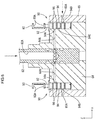
- a valve spool is positioned at a positive pressure application position;
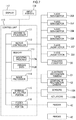
- FIG. 7 is a block diagram indicating an electrical configuration of the surface mounter
- FIG. 8 is a front view illustrating how the valve spool moves.
- FIG. 9 is a side view illustrating an internal configuration of a V-axis drive unit.
- the surface mounter 1 includes a base 10 , a transfer conveyor (one example of a substrate transferring device) 20 configured to transfer a printed substrate (one example of a substrate) B 1 , a component mounting device 30 configured to mount an electronic component (one example of a component) E 1 on the printed substrate B 1 , and a component feeding device 40 configured to feed the electronic component E 1 to the component mounting device 30 .
- a transfer conveyor one example of a substrate transferring device
- the surface mounter 1 includes a base 10 , a transfer conveyor (one example of a substrate transferring device) 20 configured to transfer a printed substrate (one example of a substrate) B 1 , a component mounting device 30 configured to mount an electronic component (one example of a component) E 1 on the printed substrate B 1 , and a component feeding device 40 configured to feed the electronic component E 1 to the component mounting device 30 .
- the base 10 has an oblong shape in plan view and has a flat upper surface.
- a backup plate (not illustrated) for supporting the printed substrate B 1 during mounting of the electronic component E 1 on the printed substrate B 1 is provided below the transfer conveyor 20 on the base 10 , for example.
- the longitudinal direction of the base 10 (the left-right direction in FIG. 1 ) and the transfer direction of the transfer conveyor 20 are referred to as an X-axis direction.
- the width direction of the base 10 (the up-down direction in FIG. 1 ) is referred to as a Y-axis direction.
- the up-down direction of the base 10 (the up-down direction in FIG. 2 ) is referred to as a Z-axis direction.
- the transfer conveyor 20 is located at the substantially middle of the base 10 in the Y-axis direction and is configured to transfer the printed substrate B 1 in the transfer direction (the X-axis direction).
- the transfer conveyor 20 includes a pair of conveyor belts 22 configured to circulate in the transfer direction.
- the printed substrate B 1 is positioned across the conveyor belts 22 .
- the printed substrate B 1 is transferred from one side in the transfer direction (the right side in FIG. 1 ) along the conveyor belt 22 to an operation position (an area surrounded by a two-dot chain line) where the printed substrate B 1 is stopped for the mounting operation of the electronic component E 1 . Then, the printed substrate 1 is transferred along the conveyor 22 and is discharged through the other side (the left side in FIG. 1 ).
- Two component feeding devices 40 which are feeder-type component feeding devices, are arranged side by side in the X-axis direction on each side of the transfer conveyor 20 (each side in the up-down direction in FIG. 1 ), i.e., the total of four component feeding devices 40 .
- the component feeding devices 40 each include a plurality of feeders 42 arranged side by side.
- the feeders 42 each include a reel (not illustrated), around which a component feeding tape (not illustrated) holding the electronic components E 1 is wound, and an electric unwinding device (not illustrated), which is configured to unwind the component feeding tape from the reel, for example.
- the electronic components E 1 are fed one by one from a component feeding position at the end adjacent to the transfer conveyor.
- the component mounting device 30 includes a pair of supporting frames 32 , which is positioned above the base 10 and the component feeding devices 40 and is described later, a mounting head 50 , which is a rotary type mounting head, and a mounting head driving mechanism configured to drive the mounting head 50 .
- the component feeding device 40 is described later.
- the supporting frames 32 extending in the Y-axis direction are positioned at the both sides of the base 10 in the X-axis direction.
- the supporting frames 32 are provided with an X-axis servomechanism and a Y-axis servomechanism, which constitute the mounting head driving mechanism.
- the mounting head 50 is movable in the X-axis direction and the Y-axis direction over a predetermined motion region by using the X-axis servomechanism and the Y-axis servomechanism.
- the Y-axis servomechanism includes Y-axis guide rails 33 Y, Y-axis ball screws 34 Y on each of which a ball nut (not illustrated) is threadably mounted, and a Y-axis servomotor 35 Y.
- a head support fixed to a ball nut is attached to each Y-axis guide rail 33 Y.
- the ball nut is moved forward or backward along the Y-axis ball screw 34 Y when the Y-axis servomotor 35 Y is energized. This moves the head support 36 fixed to the ball nut and the mounting head 50 , which will be described later, in the Y-axis direction along the Y-axis guide rail 33 Y.
- the X-axis servomechanism includes an X-axis guide rail (not illustrated), an X-axis ball screw 34 X on which a ball nut (not illustrated) is threadably mounted, and an X-axis servomotor 35 X.
- the mounting head 50 is attached to the X-axis guide rail in a movable manner in the axial direction of the X-axis guide rail.
- the ball nut is moved forward or backward along the X-axis ball screw 34 X when the X-axis servomotor 35 X is energized. This moves the mounting head 50 fixed to the ball nut in the X-axis direction along the X-axis guide rail.
- the mounting head 50 includes an arm-like shaped head body 52 covered by covers 53 and 54 .
- the mounting head 50 is configured to hold the electronic component E 1 fed by the component feeding device 40 by suction and mount the electronic component E 1 on the printed substrate B 1 .
- the mounting head 50 in this embodiment is a rotary type mounting head and includes eighteen nozzle shafts 55 , which are held by a rotary body 60 in a movable manner in the Z-axis direction (the up-down direction), at the front end portion (see FIG. 4 ).
- the rotary body 60 includes a shaft 62 having a cylindrical shape extending in the Z-axis direction and a shaft retainer 64 disposed around the shaft 62 at a lower end of the mounting head 50 .
- the shaft retainer 64 has a substantially cylindrical shape larger in diameter than the shaft 62 .
- the shaft 62 of the rotary body 60 is supported by the head body 52 in a rotatable manner about the axis of the shaft 62 .
- the shaft 62 has a two-layered structure.
- An N-axis driven gear 62 N is provided coaxially with the shaft 62 at an upper portion of the inner shaft 62
- an R-axis driven gear 62 R is provided coaxially with the shaft 62 at an upper portion of the outer shaft 62 (see FIG. 4 ).
- An N-axis drive unit configured to rotate the rotary body 60 is disposed at the substantially middle in the Z-axis direction of the mounting head 50 .
- the N-axis drive unit includes a N-axis servomotor 35 N (see FIG. 7 ) and an N-axis driving gear (not illustrated) disposed around the output shaft of the N-axis servomotor 35 N.
- the N-axis driving gear and the N-axis driven gear 62 N are engaged together.
- the N-axis servomotor 35 N When the N-axis servomotor 35 N is energized, the rotary body 60 is rotated by a predetermined angle about the axis extending in the Z-axis direction by the rotation of the N-axis driving gear and the N-axis driven gear 62 N.
- the shaft retainer 64 of the rotary body 60 has eighteen through holes at a predetermined interval in the circumferential direction.
- Nozzle shafts 55 each having a cylindrical shape are held in the through holes to extend in the Z-axis direction through the shaft retainer 64 .
- the nozzle shafts 55 pass through tubular shaft holders 57 .
- pickup nozzles 56 configured to hold the electronic components E 1 by suction are provided at lower end portions of the nozzle shafts 55 protruding downward from the shaft retainer 64 .
- the pickup nozzles 56 are each configured to receive a negative pressure or a positive pressure.
- the pickup nozzles 56 are each configured to hold the electronic component E 1 by suction at the front end by means of a negative pressure and to release the electronic component E 1 held at the front end by means of a positive pressure.
- an R-axis drive unit 70 configured to rotate the nozzle shafts 55 about the respective axes is disposed at the substantially middle in the Z-axis direction of the mounting head 50 .
- the R-axis drive unit 70 includes an R-axis servomotor 35 R and an R-axis driving gear 72 R (see FIG. 3 ) disposed around the output shaft of the R-axis servomotor 35 R and engaged with an R-axis driven gear 62 R.
- a common gear (not illustrated) is disposed on the outer shaft 62 , on which the R-axis driven gear 62 R is disposed, at a position below the R-axis driven gear 62 R.
- nozzle gears 57 R are disposed on the outer circumferences of the shaft holders 57 .
- the nozzle gears 57 R on the shaft holders 57 are engaged with the above-described common gear.
- the common gear is rotated by the rotation of the R-axis driving gear 72 R and the R-axis driven gear 62 R.
- the rotation of the common gear rotates the shaft holders 57 due to the engagement with the nozzle gears 57 R.
- the shaft holders 57 are connected to the corresponding nozzle shafts 55 through a ball spline mechanism, and thus the rotation of the common gear rotates the eighteen nozzle shafts 55 about the respective axes by the same angle in the same direction at the same time.
- Spring retaining bolts 58 are threadably engaged with the upper ends of the nozzle shafts 55 .
- a spiral spring 59 is disposed around the outer surface of each nozzle shaft 55 .
- the spiral spring 59 is compressed between the spring retaining bolt 58 and the shaft holder 57 .
- the nozzle shaft 55 is biased upward by an elastic force of the spiral spring 59 .
- the mounting head 50 includes two Z-axis drive units 80 configured to move up and down the nozzle shafts 55 at predetermined positions of the eighteen nozzle shafts 55 relative to the rotary body 60 along the shaft 62 of the rotary body 60 (in the z-axis direction or the up-down direction).
- the Z-axis drive units 80 are symmetrically arranged above the nozzle shafts 55 (see FIG. 5 ) at the left and right sides of the mounting head 50 with the shaft 62 of the rotary body 60 therebetween.
- the Z-axis drive units 80 each include a Z-axis drive source 82 having a box-like shape and a Z-axis movable portion 84 configured to move in the Z-axis direction (the up-down direction) by using power from the Z-axis drive source 82 .
- the Z-axis drive source 82 includes a Z-axis linear motor 35 Z (see FIG. 7 ) configured to drive the Z-axis movable portion 84 by a linear force.
- a cam follower 86 (hereinafter, referred to as a “Z-axis cam follower 86 ”) is attached to the lower end of the Z-axis movable portion 84 of the Z-axis drive unit 80 in a rotatable manner about the axis extending in the X-axis direction.
- the Z-axis movable portion 84 that has been moved up to the upward end is held by the Z-axis drive source 82 in such a manner that the Z-axis cam follower 86 is located near the upper end of the nozzle shaft 55 (the spring retaining bolt 58 ) that is located at a predetermined position (see FIG. 5 ).
- the Z-axis movable portion 84 is positioned at the upward end, the nozzle shafts 55 are able to turn around the shaft 62 .
- the Z-axis cam follower 86 comes in contact with the upper end of the nozzle shaft 55 that is located at the predetermined position, and the nozzle shaft 55 is moved down against the elastic force of the spiral spring 59 .
- the pickup nozzle 56 attached to the nozzle shaft 55 is moved down such that the front end of the pickup nozzle 56 is located close to the printed substrate B 1 positioned at a component supply position or an operation position of the component feeding device 40 .
- the Z-axis movable portion 84 in this state is moved up, the nozzle shaft 55 and the pickup nozzle 56 are moved up by an elastic restoring force of the spiral spring 59 .
- the mounting head 50 further includes switching devices 90 configured to switch the pressure applied to the pickup nozzles 56 between a negative pressure and a positive pressure. Eighteen switching devices 90 are provided so as to correspond to the pickup nozzles 56 (the nozzle shafts 55 ).
- the switching devices 90 are disposed outwardly of the nozzle shafts 55 , which are arranged in a circular shape, at positions between adjacent nozzle shafts 55 .
- the switching devices 90 are arranged in a circular shape along the outer circumference of the shaft retainer 64 at an equal interval (see FIG. 4 ) as the nozzle shafts 55 .
- the switching devices 90 each include a valve spool (one example of a shaft member) 92 and a sleeve (one example of a housing member) 94 housing the lower portion of the valve spool 92 .
- the sleeves 94 are attached to mounting holes in the shaft retainer 64 . Specifically described, the whole sleeve 94 except a large-diameter portion 98 at the top is inserted into the mounting hole.
- the lower portion of the valve spool 92 (most of the valve spool 92 other than a contact portion 93 ) is housed in the sleeve 94 through the upper opening exposed at the shaft retainer 64 in a movable manner in the axial direction.
- the valve spools 92 are disposed in the sleeves 94 with the axial direction thereof being oriented in the Z-axis direction (the up-down direction).
- the valve spools 92 moved in the axial direction (the up-down direction) switches the pressure applied to the pickup nozzles 56 between a negative pressure and a positive pressure.
- the valve spools 92 each have a contact portion 93 having a laterally facing U-like shape at the upper portion.
- the contact portion 93 has two opposing portions 93 A extending in a direction perpendicular to the axial direction of the valve spool 92 (the Z-axis direction) and facing each other with a space therebetween in the axial direction (the Z-axis direction) (see FIG. 6 ).
- the contact portion 93 protrudes upward from the sleeve 94 .
- the valve spools 92 are each arranged such that the opening of the U-like shaped contact portion 93 faces to the outer side (the side opposite the shaft 62 ) (see FIG. 4 ).
- the valve spool 92 in the sleeve 94 is moved to the upward end (hereinafter referred to as a “negative pressure application position”), which is indicated by a two-dot chain line in FIG. 8 to apply a negative pressure to the sleeve 94 .
- the valve spool 92 is moved to a downward end (hereinafter referred to as a “positive pressure application position”), which is indicated by a solid line in FIG. 8 to apply a positive pressure to the sleeve 94 .
- the negative pressure or the positive pressure applied to the sleeves 94 is applied to the corresponding pickup nozzles 56 through supply passages (not illustrated).
- the sleeves 94 each include a negative pressure inlet port 94 A through which a negative pressure come in, a positive pressure inlet port 94 B through which a positive pressure come in, and an outlet port (not illustrated) through which the negative or positive pressure came in through the negative pressure inlet port 94 A or the positive pressure inlet port 94 B leaves.
- the outlet ports are in communication with the corresponding pickup nozzles 56 .
- the inner shaft 62 has a first negative pressure supply passage 62 A therein to which a negative pressure is applied.
- a first positive pressure supply passage 62 B to which the positive pressure is applied is provided at the outer side of the rotary body 60 (see FIG. 2 ).
- a plurality of second negative pressure supply passages 64 A into which a negative pressure is applied are provided in the shaft retainer 64 at positions corresponding to the sleeves 94 .
- two second positive pressure supply passages 65 A in communication with the first positive pressure supply passage 62 B are provided in an outer ring member 65 , which is disposed outwardly of the shaft retainer 64 , such that a positive pressure is applied thereto.
- the first negative pressure supply passage 62 A is always in communication with all the second negative pressure supply passages 64 A at the lower end, regardless of the rotation of the shaft 62 . Furthermore, when the valve spools 92 are positioned at the negative pressure application position, the second negative pressure supply passages 64 A are in communication with the corresponding negative pressure inlet ports 94 A of the sleeves 94 housing the valve spools 92 . When the valve spools 92 are positioned at the negative pressure application position, a negative pressure is constantly applied to the pickup nozzles 56 corresponding to the valve spools 92 (the switching devices 90 ) through the outlet ports, regardless whether the pickup nozzles 56 are turning about the axis of the rotary body 60 .
- the two second positive pressure supply passages 65 A are provided in the outer ring member 65 , which is disposed outwardly of the shaft retainer 64 , at positions corresponding to the predetermined positions where the nozzle shafts 55 are moved up or down in the Z-axis direction by the Z-axis drive units 80 . While the valve spools 92 corresponding to the pickup nozzles 56 at the predetermined positions are each located at the positive pressure application position, the second positive pressure supply passages 65 A are in communication with the positive pressure inlet ports 94 B of the sleeves 94 housing the valve spools 92 .
- valve spools 92 being located at the positive pressure application position, a positive pressure is applied to the pickup nozzles 56 through the outlet ports only when the pickup nozzles 56 corresponding to the valve spools 92 are positioned at the predetermined position.
- a negative pressure is constantly applied to the pickup nozzle 56 corresponding to the valve spool 92 at the negative pressure application position.
- the electronic component E 1 held by the pickup nozzle 56 by suction is less likely to fall during movement of the mounting head 50 , for example.
- a positive pressure is applied to the pickup nozzle 56 corresponding to the valve spool 92 at the positive pressure application position only in a predetermined case.
- only the target electronic component E 1 is mounted on the printed substrate B 1 by using the positive pressure.
- outer sealing members 96 are disposed on the outer surface of each sleeve 94 with a space therebetween in the Z-axis direction.
- the outer sealing members 96 are circular rings formed of an elastic material such as rubber and are configured to seal the mounting hole of the shaft retainer 64 .
- inner sealing members 97 are arranged in the axial direction on the inner surface of the sleeve 94 (only one of the inner sealing members 97 at the lower position is indicated in FIG. 8 ).
- the inner sealing member 97 is a circular ring formed of an elastic material such as rubber and is attached to the outer surface of the valve spool 92 as illustrated in FIG. 8 .
- the inner sealing members 97 seals between the inner surface of the sleeve 94 and the valve spool 92 . This reduces the negative pressure leakage or the positive pressure leakage at the negative pressure inlet port 94 A, the positive pressure inlet port 94 B, and the outlet port. Furthermore, the inner sealing members 97 keep the valve spools 92 that has been moved to the negative pressure application position or the positive pressure application position at that position by the friction force.
- the mounting head 50 includes two V-axis drive units 100 configured to move the valve spool 92 of each switching device 90 between the negative pressure application position and the positive pressure application position in the Z-axis direction (the up-down direction).
- the two V-axis drive units 100 are disposed at positions corresponding to the two Z-axis drive units 80 in the Z-axis direction (see FIG. 5 ) and configured to move the valve spools 92 of the switching devices 90 corresponding to the pickup nozzles 56 at the predetermined positions.
- the two V-axis drive units 100 are also symmetrically arranged with the shaft 62 of the rotary body 60 therebetween at the left and right sides of the mounting head 50 as the two Z-axis drive units 80 .
- the V-axis drive units 100 each include a V-axis drive source (one example of a drive source) 102 having a box-like shape and a V-axis movable portion (one example of a movable portion) 104 configured to move in the Z-axis direction (the up-down direction) by using power from the V-axis drive source 102 .
- the V-axis drive source 102 includes a V-axis linear motor 35 V (see FIG. 7 ) for driving the V-axis movable portion 104 by a linear force therein.
- the V-axis drive source 102 includes a V-axis body 112 having a planar shape and a stator 120 .
- the stator 120 includes three armature coils 122 arranged in the Z-axis direction on the surface of the V-axis body 112 .
- the V-axis movable portion 104 includes a yoke 132 , a mover 130 disposed on a front surface of the yoke 132 , and a cam follower support 139 disposed on the upper portion of the yoke 132 .
- the mover 130 includes permanent magnets 134 on the front surface (a surface facing the stator 120 ) of the yoke 132 .
- the permanent magnets 134 are arranged in a straight line extending in the Z-axis direction with a predetermined distance therebetween such that adjacent magnetic poles of the permanent magnets 134 are different from each other.
- the stator 120 and the mover 130 constitute a linear motor.
- a current is applied to the armature coils 122 of the stator 120 , a driving force for moving the V-axis movable portion 104 in the Z-axis direction (the up-down direction) is generated between the stator 120 and the mover 130 .
- the reference numerals 124 and 138 in FIG. 9 respectively denote a rail and a rail guide.
- the rail 124 and the rail guide 138 are configured to guide the yoke 132 in the Z-axis direction.
- a cam follower 106 (hereinafter, referred to as a “V-axis cam follower 106 ”) is attached to the cam follower support 139 on the V-axis movable portion 104 in a rotatable manner about the axis extending in the X-axis direction.
- V-axis cam follower 106 When the V-axis drive unit 100 is energized, the V-axis movable portion 104 is positioned such that the V-axis cam follower 106 is held between the opposing portions 93 A of the valve spool 92 corresponding to the nozzle shaft 55 at the predetermined position (see FIG. 5 ).
- the V-axis cam follower 106 comes in contact with the upper one of the two opposing portions 93 A positioned on the both sides of the V-axis cam follower 106 and moves up the valve spool 92 to the negative pressure application position (one example of a first movement operation).
- the V-axis cam follower 106 comes in contact with the lower one of the two opposing portions 93 A on the both sides of the V-axis cam follower 106 and moves down the valve spool 92 to the positive pressure application position (one example of a second movement operation).
- the V-axis drive unit 100 is one example of a drive unit.
- the rotation direction of the V-axis cam follower 106 is substantially the same as the tangential direction of the circular trajectory of the nozzle shafts 55 turned by the rotary body 60 .
- the V-axis cam follower 106 is rotated by a frictional force generated between the V-axis cam follower 106 and the opposing portion 93 A while being in contact with the opposing portion 93 A.
- the valve spool 92 is able to be moved up or down with the nozzle shafts 55 being kept turned.
- the mounting head 50 is provided with a substrate recognition camera C 1 (see FIG. 7 ).
- the substrate recognition camera C 1 is configured to move together with the mounting head 50 and capture an image of a predetermined portion of the printed substrate B 1 stopped at the operation position.
- component recognition cameras C 2 are fixed to the base 10 at positions near the operation position.
- the component recognition cameras C 2 are configured to capture an image of the electronic component E 1 held by the pickup nozzle 56 by suction at the component feeding position of the component feeding device 40 .
- the entire of the surface mounter 1 is controlled by a control unit 110 .
- the control unit 110 includes an arithmetic and control unit 111 such as a CPU.
- a motor controller 112 , a memory 113 , an image processer 114 , an external input/output portion 115 , a feeder communication portion 116 , a display 117 , and an input portion 118 are connected to the arithmetic and control unit 111 .
- the motor controller 112 is configured to drive the X-axis servomotor 35 X and the Y-axis servomotor 35 Y of the component mounting device 30 in accordance with a mounting program 113 A, which will be described later, and drive the N-axis servomotor 35 N, the R-axis servomotor 35 R, the Z-axis linear motor 35 Z, and the V-axis linear motor 35 V of the mounting head 50 .
- the motor controller 112 is configured to drive the transfer conveyor 20 in accordance with the mounting program 113 A.
- the memory 113 includes a Read Only Memory (ROM) configured to store programs or the like for controlling the CPU and Random Access Memory (RAM) configured to temporally store various data during the operation.
- ROM Read Only Memory
- RAM Random Access Memory
- the memory 113 stores the mounting program 113 A, which will be described later, and various data 113 B.
- the mounting program 113 A stored in the memory 113 includes substrate information relating to the production number of printed substrates B 1 , which are mounting targets, component information relating to the number or type of electronic components E 1 to be mounted on the printed substrate B 1 , and mounting information relating to a mounting position of the electronic component E 1 on the printed substrate B 1 , for example.
- the various data 113 B stored in the memory 113 include data relating to the number or type of the electronic components E 1 held by the feeders 42 of the component feeding device 40 .
- the image processor 114 is configured to receive imaging signals output from the substrate recognition camera C 1 and the component recognition camera C 2 .
- the image processor 114 is configured to analyze the image of the component and the image of the substrate by using the imaging signals provided by the cameras C 1 and C 2 .
- the external input/output portion 115 is an interface and is configured to receive detection signals from various sensors 115 A provided in the body of the surface mounter 1 .
- the external input/output portion 115 is configured to control the operation of actuators 115 B by using control signals output from the arithmetic processor 111 .
- the feeder communication portion 116 is connected to the controller of each feeder 42 of the component feeding device 40 to collectively control the feeders 42 .
- the controller of each feeder 42 is configured to control the motor for sending out the component feeding tape.
- the display 117 is a liquid crystal display device having a display screen, for example, and is configured to display the state of the surface mounter 1 on the display screen.
- the input portion 118 is a key board, for example, and is configured to receive external manual input.
- the surface mounter 1 having the above-described configuration alternately performs a transferring operation in which the printed substrate B 1 is transferred by the transfer conveyor 20 and a mounting operation in which the electronic component E 1 transferred to the operation position of the base 10 is mounted on the print board B 1 .
- the contact portion 93 of each valve spool 92 which has the laterally facing U-like shape, includes the two opposing portions 93 A facing each other in the Z-axis direction and the connection portion 93 B.
- the connection portion 93 B connects the opposing portions 93 A at a position away from the central axis P 1 of the valve spool 92 (at a position away from the central axis P 1 to the left in FIG. 8 ).
- the opposing portions 93 A extend horizontally from the connection portion 93 B and have ends 93 C at positions away from the central axis P 1 of the valve spool 92 toward the side opposite the connection portion 93 B (to the right in FIG. 8 ).
- the contact portion 93 has a shape recessed in an insertion direction in which the V-axis cam follower 106 is inserted (to the left in FIG. 8 ).
- the V-axis cam follower 106 is positioned on the central axis P 1 of the valve spool 92 at a position between the opposing portions 93 A.
- the V-axis cam follower 106 is positioned close to the connection portion 93 B, i.e., the end of the V-axis cam follower 106 is positioned away from the central axis P 1 to the left to a position close to the connection portion 93 B.
- the V-axis cam follower 106 is positioned on the central axis P 1 of the valve spool 92 and is positioned close to the connection portion 93 B, the central axis P 1 of the valve spool 92 and the central axis P 2 of the V-axis cam follower 106 are positioned close to each other, as illustrated in FIG. 8 .
- the central portion of the V-axis cam follower 106 comes in contact with the opposing portion 93 A at a position close to the central axis P 1 of the valve spool 92 .
- the ends 93 C of the opposing portions 93 A are located inwardly from an outline P 3 of the sleeve 94 toward the central axis P 1 of the valve spool 93 (to the left in FIG. 8 ). This provides the following advantage.
- the valve spool 92 is attached to the shaft retainer 64 with the ends 93 C of the opposing portions 93 A facing to the outer side (facing away from the center of the shaft 62 ).
- the valve spool 92 is positioned outwardly from the outline P 3 of the sleeve 94 , rotational moment of inertia about the shaft 62 increases due to a large amount of portion protruding to the outer side.
- the ends 93 C of the opposing portions 93 A of the embodiment are located inwardly from the outline P 3 of the sleeve 94 toward the central axis P 1 .
- the outline P 3 of the sleeve 94 is an outline of the body of the sleeve 94 (a cylindrical portion except the large diameter portion 98 at the top).
- the switching device 90 and the V-axis drive unit 100 enable one V-axis cam follower 106 to move the valve spool 92 to the negative pressure application position and the positive pressure application position.
- the number of V-axis cam follower 106 provided on the V-axis movable portion 104 is minimized to one, and the switching between the negative pressure and the positive pressure is performed by the one cam follower 106 .
- the distance between the central line P 2 of the V-axis cam follower 106 and the central axis P 1 of the valve spool 92 may be large. In such a case, during the up-down movement of the valve spool 92 , a moment is generated about a border between a portion of the valve spool 92 housed in the sleeve 94 and a portion of the valve spool 92 not housed in the sleeve 94 with a portion of the opposing portion 93 A in contact with the V-axis cam follower 106 as a point of application, in addition to a traveling force in the axial direction of the valve spool 92 .
- the V-axis cam follower 106 of the mounting head 50 is positioned on the central axis P 1 of the valve spool 92 and is positioned close to the connection portion 93 B.
- the central axis P 1 of the valve spool 92 and the central line P 2 of the V-axis cam follower 106 are located close to each other, and the central portion of the V-axis cam follower 106 (the central portion in the thickness direction) comes in contact with the opposing portion 93 A at the position close to the central axis P 1 of the valve spool 92 .
- valve spool 92 is less likely to be tilted, reducing a decrease in service life of the seal ring 96 caused by the uneven abrasion of the portion of the seal ring 96 .
- This increases the service life of the switching device 90 configured to switch the pressure applied to the mounting head 50 and increases durability of the mounting head 50 .
- the contact portion 93 of the valve spool 92 has a laterally facing U-like shape, but the shape of the contact portion 93 is not limited to this.
- the contact portion 93 may have any shape having two opposing portions 93 A that can be located at both sides of the V-axis cam follower 106 in the axial direction of the valve spool 92 .
- the Z-axis drive unit 80 and the V-axis drive unit 100 are driven by a linear force, but may be driven by a rotational force.
- the mounting head 50 is a rotary type mounting head having the nozzle shafts 55 arranged in a circular shape.
- the mounting head 50 may be an in-line type mounting head having the nozzle shafts 55 arranged in a straight line.
- the mounting head 50 includes the two V-axis drive units 100 with the shaft of the rotary body therebetween.
- the number of the V-axis drive units 100 in the mounting head 50 is not limited to this.
- the surface mounter 1 including the mounting head 50 is described.
- the mounting head 50 described in the embodiment may be employed in an apparatus other than the surface mounter.
Landscapes
- Engineering & Computer Science (AREA)
- Manufacturing & Machinery (AREA)
- Microelectronics & Electronic Packaging (AREA)
- Mechanical Engineering (AREA)
- Robotics (AREA)
- Supply And Installment Of Electrical Components (AREA)
Abstract
Description
Claims (6)
Applications Claiming Priority (1)
| Application Number | Priority Date | Filing Date | Title |
|---|---|---|---|
| PCT/JP2015/077947 WO2017056292A1 (en) | 2015-10-01 | 2015-10-01 | Mounting head, and surface mounting machine |
Publications (2)
| Publication Number | Publication Date |
|---|---|
| US20180279520A1 US20180279520A1 (en) | 2018-09-27 |
| US10856460B2 true US10856460B2 (en) | 2020-12-01 |
Family
ID=58423183
Family Applications (1)
| Application Number | Title | Priority Date | Filing Date |
|---|---|---|---|
| US15/762,388 Active 2036-07-27 US10856460B2 (en) | 2015-10-01 | 2015-10-01 | Surface mounter for mounting a component on a substrate |
Country Status (5)
| Country | Link |
|---|---|
| US (1) | US10856460B2 (en) |
| JP (1) | JP6535096B2 (en) |
| CN (1) | CN108029237B (en) |
| DE (1) | DE112015006989B4 (en) |
| WO (1) | WO2017056292A1 (en) |
Families Citing this family (9)
| Publication number | Priority date | Publication date | Assignee | Title |
|---|---|---|---|---|
| CN108029237B (en) * | 2015-10-01 | 2020-02-07 | 雅马哈发动机株式会社 | Mounting head and surface mounting machine |
| JP6883663B2 (en) | 2017-09-28 | 2021-06-09 | 株式会社Fuji | Parts mounting machine |
| CN109941740B (en) * | 2019-04-26 | 2024-02-09 | 浙江希望机械有限公司 | Directional-keeping rotary transfer manipulator |
| US11121113B2 (en) * | 2020-01-16 | 2021-09-14 | Asm Technology Singapore Pte Ltd | Bonding apparatus incorporating variable force distribution |
| CN111689217A (en) * | 2020-06-03 | 2020-09-22 | 骆研 | Automatic robot feeding and discharging system |
| CN116789055A (en) * | 2022-03-15 | 2023-09-22 | 矢迈特科技(东莞市)有限公司 | Packaging machine |
| CN114666996B (en) * | 2022-03-28 | 2023-09-12 | 吉安市瑞鸿电子有限公司 | Component mounting equipment for PCB (printed circuit board) processing line |
| CN115608626B (en) * | 2022-10-31 | 2023-04-28 | 厦门柯尔自动化设备有限公司 | High-speed multi-head chip sorting device |
| DE102024102781A1 (en) * | 2024-01-31 | 2025-07-31 | Ifm Electronic Gmbh | Electronic device for automation technology with an electronic circuit board overmolded twice with plastic and a method |
Citations (13)
| Publication number | Priority date | Publication date | Assignee | Title |
|---|---|---|---|---|
| JPH05145300A (en) | 1991-11-25 | 1993-06-11 | Canon Inc | Mounting device |
| JPH05145291A (en) | 1991-11-22 | 1993-06-11 | Toshiba Corp | Mounting posture corrector for electronic component |
| US5579572A (en) * | 1994-01-25 | 1996-12-03 | Matsushita Electric Industrial Co., Ltd. | Apparatus for mounting electronic parts and a method thereof |
| JPH1140989A (en) | 1997-07-22 | 1999-02-12 | Matsushita Electric Ind Co Ltd | Electronic component mounting equipment |
| US6101707A (en) * | 1998-03-03 | 2000-08-15 | Sanyo Electric Co., Ltd. | Mounting head for electronic component-mounting apparatus |
| JP2006515715A (en) | 2003-01-24 | 2006-06-01 | シーメンス アクチエンゲゼルシヤフト | Multi mounting head |
| US7100278B2 (en) * | 1995-11-06 | 2006-09-05 | Matsushita Electric Industrial Co., Ltd. | Component mounting apparatus and method |
| US8240028B2 (en) * | 2006-03-27 | 2012-08-14 | Panasonic Corporation | Nozzle mechanism, mounting head and electronic component mounting apparatus |
| JP2013069798A (en) | 2011-09-21 | 2013-04-18 | Fuji Mach Mfg Co Ltd | Electronic circuit component mounting machine |
| JP2013179117A (en) | 2012-02-28 | 2013-09-09 | Sony Corp | Mounting head unit, component mounting apparatus and method for manufacturing substrate |
| US20150237773A1 (en) * | 2012-08-31 | 2015-08-20 | Fuji Machine Mfg. Co., Ltd. | Component mounter |
| US20180263149A1 (en) * | 2015-10-01 | 2018-09-13 | Yamaha Hatsudoki Kabushiki Kaisha | Mounting head and surface mounter |
| US20180279520A1 (en) * | 2015-10-01 | 2018-09-27 | Yamaha Hatsudoki Kabushiki Kaisha | Mounting head and surface mounter |
Family Cites Families (1)
| Publication number | Priority date | Publication date | Assignee | Title |
|---|---|---|---|---|
| JP5822819B2 (en) * | 2012-12-05 | 2015-11-24 | ヤマハ発動機株式会社 | Electronic component mounting method and surface mounter |
-
2015
- 2015-10-01 CN CN201580083220.8A patent/CN108029237B/en active Active
- 2015-10-01 JP JP2017542639A patent/JP6535096B2/en active Active
- 2015-10-01 US US15/762,388 patent/US10856460B2/en active Active
- 2015-10-01 DE DE112015006989.5T patent/DE112015006989B4/en active Active
- 2015-10-01 WO PCT/JP2015/077947 patent/WO2017056292A1/en not_active Ceased
Patent Citations (13)
| Publication number | Priority date | Publication date | Assignee | Title |
|---|---|---|---|---|
| JPH05145291A (en) | 1991-11-22 | 1993-06-11 | Toshiba Corp | Mounting posture corrector for electronic component |
| JPH05145300A (en) | 1991-11-25 | 1993-06-11 | Canon Inc | Mounting device |
| US5579572A (en) * | 1994-01-25 | 1996-12-03 | Matsushita Electric Industrial Co., Ltd. | Apparatus for mounting electronic parts and a method thereof |
| US7100278B2 (en) * | 1995-11-06 | 2006-09-05 | Matsushita Electric Industrial Co., Ltd. | Component mounting apparatus and method |
| JPH1140989A (en) | 1997-07-22 | 1999-02-12 | Matsushita Electric Ind Co Ltd | Electronic component mounting equipment |
| US6101707A (en) * | 1998-03-03 | 2000-08-15 | Sanyo Electric Co., Ltd. | Mounting head for electronic component-mounting apparatus |
| JP2006515715A (en) | 2003-01-24 | 2006-06-01 | シーメンス アクチエンゲゼルシヤフト | Multi mounting head |
| US8240028B2 (en) * | 2006-03-27 | 2012-08-14 | Panasonic Corporation | Nozzle mechanism, mounting head and electronic component mounting apparatus |
| JP2013069798A (en) | 2011-09-21 | 2013-04-18 | Fuji Mach Mfg Co Ltd | Electronic circuit component mounting machine |
| JP2013179117A (en) | 2012-02-28 | 2013-09-09 | Sony Corp | Mounting head unit, component mounting apparatus and method for manufacturing substrate |
| US20150237773A1 (en) * | 2012-08-31 | 2015-08-20 | Fuji Machine Mfg. Co., Ltd. | Component mounter |
| US20180263149A1 (en) * | 2015-10-01 | 2018-09-13 | Yamaha Hatsudoki Kabushiki Kaisha | Mounting head and surface mounter |
| US20180279520A1 (en) * | 2015-10-01 | 2018-09-27 | Yamaha Hatsudoki Kabushiki Kaisha | Mounting head and surface mounter |
Non-Patent Citations (3)
| Title |
|---|
| An Office Action mailed by the Japanese Patent Office dated Apr. 16, 2019, which corresponds to Japanese Patent Application No. 2017-542639 and is related to U.S. Appl. No. 15/762,388. |
| An Office Action mailed by the Japanese Patent Office dated Oct. 9, 2018, which corresponds to Japanese Patent Application No. 2017-542639 and is related to U.S. Appl. No. 15/762,388. |
| International Search Report issued in PCT/JP2015/077947; dated Jan. 12, 2016. |
Also Published As
| Publication number | Publication date |
|---|---|
| WO2017056292A1 (en) | 2017-04-06 |
| CN108029237B (en) | 2020-02-07 |
| JPWO2017056292A1 (en) | 2018-02-22 |
| US20180279520A1 (en) | 2018-09-27 |
| CN108029237A (en) | 2018-05-11 |
| DE112015006989B4 (en) | 2024-07-04 |
| JP6535096B2 (en) | 2019-06-26 |
| DE112015006989T5 (en) | 2018-06-14 |
Similar Documents
| Publication | Publication Date | Title |
|---|---|---|
| US20180279520A1 (en) | Mounting head and surface mounter | |
| US10849259B2 (en) | Mounting head and surface mounter | |
| CN108029239B (en) | Rotary head and surface mounting machine | |
| JPWO2007111296A1 (en) | Mounting head and electronic component mounting apparatus | |
| EP2958413B1 (en) | Electronic circuit component mounting device | |
| CN108141999B (en) | Rotary head and surface mounting machine | |
| KR0129582B1 (en) | Multi-substrate transfer device | |
| US10925198B2 (en) | Shaft device, mounting head, and surface mounter | |
| KR20020067972A (en) | Handling device and part-assembling device using the same | |
| US11013159B2 (en) | Rotary head and control of a surface mounter | |
| JP7271782B2 (en) | Shaft driving device and component mounting device | |
| WO2011070939A1 (en) | Bulk feeder | |
| JP6793050B2 (en) | Surface mounter | |
| JP2019075896A (en) | Actuator, mounting head unit, and mounting device | |
| JP2008053576A (en) | Mounting head and electronic component mounting apparatus | |
| JP2019075897A (en) | Actuator, mounting head unit, and mounting device | |
| JP2008053575A (en) | Mounting head and electronic component mounting apparatus | |
| JPH10294600A (en) | Electrical connection structure of rotary head in rotary head type electronic component mounting equipment | |
| JP2001127488A (en) | Component mounting equipment |
Legal Events
| Date | Code | Title | Description |
|---|---|---|---|
| AS | Assignment |
Owner name: YAMAHA HATSUDOKI KABUSHIKI KAISHA, JAPAN Free format text: ASSIGNMENT OF ASSIGNORS INTEREST;ASSIGNOR:TSURI, KENJI;REEL/FRAME:045319/0054 Effective date: 20180220 |
|
| FEPP | Fee payment procedure |
Free format text: ENTITY STATUS SET TO UNDISCOUNTED (ORIGINAL EVENT CODE: BIG.); ENTITY STATUS OF PATENT OWNER: LARGE ENTITY |
|
| STPP | Information on status: patent application and granting procedure in general |
Free format text: DOCKETED NEW CASE - READY FOR EXAMINATION |
|
| STPP | Information on status: patent application and granting procedure in general |
Free format text: RESPONSE TO NON-FINAL OFFICE ACTION ENTERED AND FORWARDED TO EXAMINER |
|
| STPP | Information on status: patent application and granting procedure in general |
Free format text: NON FINAL ACTION MAILED |
|
| STPP | Information on status: patent application and granting procedure in general |
Free format text: RESPONSE TO NON-FINAL OFFICE ACTION ENTERED AND FORWARDED TO EXAMINER |
|
| STPP | Information on status: patent application and granting procedure in general |
Free format text: PUBLICATIONS -- ISSUE FEE PAYMENT RECEIVED |
|
| STCF | Information on status: patent grant |
Free format text: PATENTED CASE |
|
| MAFP | Maintenance fee payment |
Free format text: PAYMENT OF MAINTENANCE FEE, 4TH YEAR, LARGE ENTITY (ORIGINAL EVENT CODE: M1551); ENTITY STATUS OF PATENT OWNER: LARGE ENTITY Year of fee payment: 4 |