US10765044B2 - Electric power conversion device - Google Patents
Electric power conversion device Download PDFInfo
- Publication number
- US10765044B2 US10765044B2 US16/398,423 US201916398423A US10765044B2 US 10765044 B2 US10765044 B2 US 10765044B2 US 201916398423 A US201916398423 A US 201916398423A US 10765044 B2 US10765044 B2 US 10765044B2
- Authority
- US
- United States
- Prior art keywords
- region
- passage
- electric power
- power conversion
- conversion device
- Prior art date
- Legal status (The legal status is an assumption and is not a legal conclusion. Google has not performed a legal analysis and makes no representation as to the accuracy of the status listed.)
- Expired - Fee Related
Links
Images


Classifications
-
- H—ELECTRICITY
- H02—GENERATION; CONVERSION OR DISTRIBUTION OF ELECTRIC POWER
- H02M—APPARATUS FOR CONVERSION BETWEEN AC AND AC, BETWEEN AC AND DC, OR BETWEEN DC AND DC, AND FOR USE WITH MAINS OR SIMILAR POWER SUPPLY SYSTEMS; CONVERSION OF DC OR AC INPUT POWER INTO SURGE OUTPUT POWER; CONTROL OR REGULATION THEREOF
- H02M7/00—Conversion of AC power input into DC power output; Conversion of DC power input into AC power output
- H02M7/003—Constructional details, e.g. physical layout, assembly, wiring or busbar connections
-
- H—ELECTRICITY
- H01—ELECTRIC ELEMENTS
- H01G—CAPACITORS; CAPACITORS, RECTIFIERS, DETECTORS, SWITCHING DEVICES, LIGHT-SENSITIVE OR TEMPERATURE-SENSITIVE DEVICES OF THE ELECTROLYTIC TYPE
- H01G11/00—Hybrid capacitors, i.e. capacitors having different positive and negative electrodes; Electric double-layer [EDL] capacitors; Processes for the manufacture thereof or of parts thereof
- H01G11/08—Structural combinations, e.g. assembly or connection, of hybrid or EDL capacitors with other electric components, at least one hybrid or EDL capacitor being the main component
-
- H—ELECTRICITY
- H01—ELECTRIC ELEMENTS
- H01G—CAPACITORS; CAPACITORS, RECTIFIERS, DETECTORS, SWITCHING DEVICES, LIGHT-SENSITIVE OR TEMPERATURE-SENSITIVE DEVICES OF THE ELECTROLYTIC TYPE
- H01G2/00—Details of capacitors not covered by a single one of groups H01G4/00-H01G11/00
- H01G2/02—Mountings
- H01G2/04—Mountings specially adapted for mounting on a chassis
-
- H—ELECTRICITY
- H01—ELECTRIC ELEMENTS
- H01G—CAPACITORS; CAPACITORS, RECTIFIERS, DETECTORS, SWITCHING DEVICES, LIGHT-SENSITIVE OR TEMPERATURE-SENSITIVE DEVICES OF THE ELECTROLYTIC TYPE
- H01G2/00—Details of capacitors not covered by a single one of groups H01G4/00-H01G11/00
- H01G2/08—Cooling arrangements; Heating arrangements; Ventilating arrangements
-
- H—ELECTRICITY
- H02—GENERATION; CONVERSION OR DISTRIBUTION OF ELECTRIC POWER
- H02J—ELECTRIC POWER NETWORKS; CIRCUIT ARRANGEMENTS OR SYSTEMS FOR SUPPLYING OR DISTRIBUTING ELECTRIC POWER; SYSTEMS FOR STORING ELECTRIC ENERGY
- H02J7/00—Circuit arrangements for charging or discharging batteries or for supplying loads from batteries
- H02J7/14—Circuit arrangements for charging or discharging batteries or for supplying loads from batteries for charging batteries from dynamo-electric generators driven at varying speed, e.g. on vehicle
- H02J7/16—Regulation of the charging current or voltage by variation of field
- H02J7/24—Regulation of the charging current or voltage by variation of field using discharge tubes or semiconductor devices
-
- H02J7/242—
-
- H—ELECTRICITY
- H02—GENERATION; CONVERSION OR DISTRIBUTION OF ELECTRIC POWER
- H02M—APPARATUS FOR CONVERSION BETWEEN AC AND AC, BETWEEN AC AND DC, OR BETWEEN DC AND DC, AND FOR USE WITH MAINS OR SIMILAR POWER SUPPLY SYSTEMS; CONVERSION OF DC OR AC INPUT POWER INTO SURGE OUTPUT POWER; CONTROL OR REGULATION THEREOF
- H02M3/00—Conversion of DC power input into DC power output
- H02M3/02—Conversion of DC power input into DC power output without intermediate conversion into AC
- H02M3/04—Conversion of DC power input into DC power output without intermediate conversion into AC by static converters
- H02M3/10—Conversion of DC power input into DC power output without intermediate conversion into AC by static converters using discharge tubes with control electrode or semiconductor devices with control electrode
- H02M3/145—Conversion of DC power input into DC power output without intermediate conversion into AC by static converters using discharge tubes with control electrode or semiconductor devices with control electrode using devices of a triode or transistor type requiring continuous application of a control signal
- H02M3/155—Conversion of DC power input into DC power output without intermediate conversion into AC by static converters using discharge tubes with control electrode or semiconductor devices with control electrode using devices of a triode or transistor type requiring continuous application of a control signal using semiconductor devices only
- H02M3/156—Conversion of DC power input into DC power output without intermediate conversion into AC by static converters using discharge tubes with control electrode or semiconductor devices with control electrode using devices of a triode or transistor type requiring continuous application of a control signal using semiconductor devices only with automatic control of output voltage or current, e.g. switching regulators
- H02M3/158—Conversion of DC power input into DC power output without intermediate conversion into AC by static converters using discharge tubes with control electrode or semiconductor devices with control electrode using devices of a triode or transistor type requiring continuous application of a control signal using semiconductor devices only with automatic control of output voltage or current, e.g. switching regulators including plural semiconductor devices as final control devices for a single load
- H02M3/1584—Conversion of DC power input into DC power output without intermediate conversion into AC by static converters using discharge tubes with control electrode or semiconductor devices with control electrode using devices of a triode or transistor type requiring continuous application of a control signal using semiconductor devices only with automatic control of output voltage or current, e.g. switching regulators including plural semiconductor devices as final control devices for a single load with a plurality of power processing stages connected in parallel
-
- H—ELECTRICITY
- H02—GENERATION; CONVERSION OR DISTRIBUTION OF ELECTRIC POWER
- H02M—APPARATUS FOR CONVERSION BETWEEN AC AND AC, BETWEEN AC AND DC, OR BETWEEN DC AND DC, AND FOR USE WITH MAINS OR SIMILAR POWER SUPPLY SYSTEMS; CONVERSION OF DC OR AC INPUT POWER INTO SURGE OUTPUT POWER; CONTROL OR REGULATION THEREOF
- H02M7/00—Conversion of AC power input into DC power output; Conversion of DC power input into AC power output
- H02M7/42—Conversion of DC power input into AC power output without possibility of reversal
- H02M7/44—Conversion of DC power input into AC power output without possibility of reversal by static converters
- H02M7/48—Conversion of DC power input into AC power output without possibility of reversal by static converters using discharge tubes with control electrode or semiconductor devices with control electrode
- H02M7/53—Conversion of DC power input into AC power output without possibility of reversal by static converters using discharge tubes with control electrode or semiconductor devices with control electrode using devices of a triode or transistor type requiring continuous application of a control signal
- H02M7/537—Conversion of DC power input into AC power output without possibility of reversal by static converters using discharge tubes with control electrode or semiconductor devices with control electrode using devices of a triode or transistor type requiring continuous application of a control signal using semiconductor devices only, e.g. single switched pulse inverters
- H02M7/5387—Conversion of DC power input into AC power output without possibility of reversal by static converters using discharge tubes with control electrode or semiconductor devices with control electrode using devices of a triode or transistor type requiring continuous application of a control signal using semiconductor devices only, e.g. single switched pulse inverters in a bridge configuration
- H02M7/53871—Conversion of DC power input into AC power output without possibility of reversal by static converters using discharge tubes with control electrode or semiconductor devices with control electrode using devices of a triode or transistor type requiring continuous application of a control signal using semiconductor devices only, e.g. single switched pulse inverters in a bridge configuration with automatic control of output voltage or current
-
- H—ELECTRICITY
- H05—ELECTRIC TECHNIQUES NOT OTHERWISE PROVIDED FOR
- H05K—PRINTED CIRCUITS; CASINGS OR CONSTRUCTIONAL DETAILS OF ELECTRIC APPARATUS; MANUFACTURE OF ASSEMBLAGES OF ELECTRICAL COMPONENTS
- H05K7/00—Constructional details common to different types of electric apparatus
- H05K7/20—Modifications to facilitate cooling, ventilating, or heating
- H05K7/2089—Modifications to facilitate cooling, ventilating, or heating for power electronics, e.g. for inverters for controlling motor
- H05K7/20927—Liquid coolant without phase change
-
- H—ELECTRICITY
- H01—ELECTRIC ELEMENTS
- H01G—CAPACITORS; CAPACITORS, RECTIFIERS, DETECTORS, SWITCHING DEVICES, LIGHT-SENSITIVE OR TEMPERATURE-SENSITIVE DEVICES OF THE ELECTROLYTIC TYPE
- H01G2/00—Details of capacitors not covered by a single one of groups H01G4/00-H01G11/00
- H01G2/02—Mountings
- H01G2/06—Mountings specially adapted for mounting on a printed-circuit support
-
- H—ELECTRICITY
- H02—GENERATION; CONVERSION OR DISTRIBUTION OF ELECTRIC POWER
- H02J—ELECTRIC POWER NETWORKS; CIRCUIT ARRANGEMENTS OR SYSTEMS FOR SUPPLYING OR DISTRIBUTING ELECTRIC POWER; SYSTEMS FOR STORING ELECTRIC ENERGY
- H02J1/00—Circuit arrangements for DC mains or DC distribution networks
- H02J1/10—Parallel operation of DC sources
-
- H—ELECTRICITY
- H02—GENERATION; CONVERSION OR DISTRIBUTION OF ELECTRIC POWER
- H02J—ELECTRIC POWER NETWORKS; CIRCUIT ARRANGEMENTS OR SYSTEMS FOR SUPPLYING OR DISTRIBUTING ELECTRIC POWER; SYSTEMS FOR STORING ELECTRIC ENERGY
- H02J2101/00—Supply or distribution of decentralised, dispersed or local electric power generation
- H02J2101/20—Dispersed power generation using renewable energy sources
- H02J2101/30—Fuel cells
-
- H—ELECTRICITY
- H02—GENERATION; CONVERSION OR DISTRIBUTION OF ELECTRIC POWER
- H02J—ELECTRIC POWER NETWORKS; CIRCUIT ARRANGEMENTS OR SYSTEMS FOR SUPPLYING OR DISTRIBUTING ELECTRIC POWER; SYSTEMS FOR STORING ELECTRIC ENERGY
- H02J7/00—Circuit arrangements for charging or discharging batteries or for supplying loads from batteries
- H02J7/34—Parallel operation in networks using both storage and other DC sources, e.g. providing buffering
-
- H—ELECTRICITY
- H02—GENERATION; CONVERSION OR DISTRIBUTION OF ELECTRIC POWER
- H02K—DYNAMO-ELECTRIC MACHINES
- H02K11/00—Structural association of dynamo-electric machines with electric components or with devices for shielding, monitoring or protection
- H02K11/30—Structural association with control circuits or drive circuits
- H02K11/33—Drive circuits, e.g. power electronics
-
- H—ELECTRICITY
- H02—GENERATION; CONVERSION OR DISTRIBUTION OF ELECTRIC POWER
- H02M—APPARATUS FOR CONVERSION BETWEEN AC AND AC, BETWEEN AC AND DC, OR BETWEEN DC AND DC, AND FOR USE WITH MAINS OR SIMILAR POWER SUPPLY SYSTEMS; CONVERSION OF DC OR AC INPUT POWER INTO SURGE OUTPUT POWER; CONTROL OR REGULATION THEREOF
- H02M1/00—Details of apparatus for conversion
- H02M1/0067—Converter structures employing plural converter units, other than for parallel operation of the units on a single load
- H02M1/007—Plural converter units in cascade
-
- H—ELECTRICITY
- H02—GENERATION; CONVERSION OR DISTRIBUTION OF ELECTRIC POWER
- H02P—CONTROL OR REGULATION OF ELECTRIC MOTORS, ELECTRIC GENERATORS OR DYNAMO-ELECTRIC CONVERTERS; CONTROLLING TRANSFORMERS, REACTORS OR CHOKE COILS
- H02P27/00—Arrangements or methods for the control of AC motors characterised by the kind of supply voltage
- H02P27/04—Arrangements or methods for the control of AC motors characterised by the kind of supply voltage using variable-frequency supply voltage, e.g. inverter or converter supply voltage
- H02P27/06—Arrangements or methods for the control of AC motors characterised by the kind of supply voltage using variable-frequency supply voltage, e.g. inverter or converter supply voltage using DC to AC converters or inverters
-
- Y—GENERAL TAGGING OF NEW TECHNOLOGICAL DEVELOPMENTS; GENERAL TAGGING OF CROSS-SECTIONAL TECHNOLOGIES SPANNING OVER SEVERAL SECTIONS OF THE IPC; TECHNICAL SUBJECTS COVERED BY FORMER USPC CROSS-REFERENCE ART COLLECTIONS [XRACs] AND DIGESTS
- Y02—TECHNOLOGIES OR APPLICATIONS FOR MITIGATION OR ADAPTATION AGAINST CLIMATE CHANGE
- Y02T—CLIMATE CHANGE MITIGATION TECHNOLOGIES RELATED TO TRANSPORTATION
- Y02T10/00—Road transport of goods or passengers
- Y02T10/60—Other road transportation technologies with climate change mitigation effect
- Y02T10/70—Energy storage systems for electromobility, e.g. batteries
Definitions
- the present invention relates to an electric power conversion device.
- a cooling water passage is formed in a specific area of a bottom plate of a case, and the reactors and the power modules are positioned on the part of the bottom plate corresponding to the cooling water passage while the capacitors are placed on other part of the bottom plate. See JP2017-135901A.
- the part of the bottom plate where the cooling water passage is absent has a relatively low upper surface so that the vertical dimension of the space defined above such a part can be maximized.
- the capacitors are too remotely positioned from the cooling water passage to be adequately cooled. Also, because the reactors, the power modules and the capacitors are positioned on a single plane without any overlap, the area of the necessary floor space (footprint) is undesirably great.
- a primary object of the present invention is to provide an electric power conversion device which is configured to be favorably cooled, and compact in size.
- the present invention achieves such an object by providing an electric power conversion device, comprising a reactor ( 31 ), a switching device ( 33 ) connected to the reactor, a capacitor ( 35 ), and a case ( 60 ) receiving the reactor, the switching device and the capacitor therein, wherein the case comprises: a first member ( 61 ) having a first region ( 73 ) defining therein a first passage ( 78 , 79 ) in which a cooling medium flows, and a second region ( 74 ) disposed on a side of the first region; and a second member ( 88 ) disposed so as to at least partly overlap with the second region as seen from a direction orthogonal to the second region in a spaced apart relationship to the second region, and internally defining a second passage ( 91 ) connected to the first passage, and wherein the reactor is positioned in the first region, and one of the switching device and the capacitor is positioned on a surface of the second member facing away from the first member, the other of the switching device and the capacitor being
- the power module and the capacitor overlap with each other with the support member interposed therebetween, the floor space (footprint) which the first member of the case is required to provide can be minimized. Further, since the reactor can be enlarged in the direction orthogonal to the first member, the space efficiency of the electric power converter can be enhanced while ensuring an adequate cross sectional area for the magnetic flux to the reactor. In addition, since the reactor is provided in the first region having the first passage, and the power module and the capacitor are provided in the second member having the second passage, all of the reactor, the power module and the capacitor can be efficiently cooled.
- the switching device is positioned on the surface of the second member facing away from the first member, and the capacitor is positioned between the second member and the second region of the first member.
- the switching device and the capacitor can be favorably cooled by the cooling medium flowing through the second passage, and owing to the mutually overlapping positioning of the switching device and the capacitor, the space efficiency of the case can be optimized.
- an inner surface of the second region is outwardly offset relative to an inner surface of the first region.
- the second region does not have a passage through which the cooling medium flows, the second region may have a smaller thickness than the first region. Therefore, the available space inward of the second region can be widened as compared to the available space inward of the first region without requiring the second region of the first member to project further outward than the first region of the first member.
- a first connection hole ( 85 ) and a second connection hole ( 86 ) extending from the first passage open out at the inner surface of the first region, and a third connection hole ( 92 ) and a fourth connection hole ( 93 ) extending from the second passage open out at a surface of the second member on a side of the first member, the first connection hole being communicating with the third connection hole, and the second connection hole being communicating with the fourth connection hole.
- the second passage formed in the second member can be connected to the first passage formed in the first region of the first member in an advantageous manner.
- the first passage includes an upstream first passage ( 78 ) and a downstream first passage ( 79 ), the upstream first passage communicating with a cooling medium inlet ( 81 ) provided at an outer surface of the case and the first connection hole, the downstream first passage communicating with a cooling medium outlet ( 82 ) provided at the outer surface of the case and the second connection hole.
- a continuous passage extending along the path provided by the cooling medium inlet, the upstream first passage, the second passage, the downstream first passage and the cooling medium outlet is formed so that the cooling medium can be circulated in a smooth manner.
- the capacitor is in contact with the inner surface of the second region.
- the heat can be transferred from the capacitor to the second region of the first member in addition to the second member so that the capacitor can be cooled in an efficiently manner.
- a side of the switching device facing away from the second member is provided with a gate driver ( 52 ) for driving the switching device.
- the capacitor, the support member, the power module, and the gate driver can be stacked one upon the other so that the space efficiency of the case can be optimized.
- a side of the gate driver facing away from the switching device is provided with a control unit ( 51 ) for controlling the gate driver via insulating material.
- the capacitor, the support member, the power module, and the gate driver can be stacked one upon the other so that the space efficiency of the case can be optimized.
- an outer surface of the first region is provided with a recess ( 75 , 76 ) which is recessed inward, and a cover ( 77 ) closing an open end of the recess to define the first passage in cooperation with the recess.
- the first passage can be easily formed.
- the reactor has a greater thickness as measured in a direction orthogonal to the second region than either the switching device or the capacitor.
- the space efficiency of the electric power conversion device can be enhanced while ensuring an adequate cross sectional area for the magnetic flux to the reactor.
- the first region of the first member includes a first bottom plate extending along a major plane
- the second region of the first member includes a second bottom plate extending substantially in parallel with the first bottom plate and offset from the first bottom plate in an outward direction.
- the case further comprises an outer plate member ( 77 ) opposing an outer surface of the first bottom plate in a spaced apart relationship so as to define the first passage jointly with the first bottom plate, an outer surface of the outer plate member being substantially flush with an outer surface of the second bottom plate.
- an outer plate member ( 77 ) opposing an outer surface of the first bottom plate in a spaced apart relationship so as to define the first passage jointly with the first bottom plate, an outer surface of the outer plate member being substantially flush with an outer surface of the second bottom plate.
- the first passage can be formed in such a manner that the bottom surface of the case is made entirely planar.
- the outer surface of the outer plate member may be provided with ribs so as to enhance the cooling of the cooling medium in the first passage.
- the second member comprises an inner plate member ( 88 ) extending substantially in parallel with the second bottom plate in a spaced apart relationship to define a chamber jointly with the second bottom plate.
- one of the components such as the capacitor can be received in this chamber so that the second passage can be effectively utilized to cool two components positioned on either side of the inner plate member.
- the first member further comprises a side wall extending upright from a periphery of the first member, and the case further comprises a cover member abutting a free end of the side wall to define a chamber jointly with the first member.
- the case can be fully enclosed by virtue of the cover member, the first member, the outer plate member that can jointly define a simple outer profile such as a rectangular outer profile.
- the invention thus provides an electric power conversion device which is configured to be favorably cooled, and compact in size.
- FIG. 1 is a block diagram of an electric vehicle according to an embodiment of the present invention.
- FIG. 2 is an electric circuit diagram of the electric vehicle
- FIG. 3 is a plan view of an FC-side converter with an upper case, a converter ECU and a support member omitted from illustration;
- FIG. 4 is a vertical sectional view of the FC-side converter
- FIG. 5 is an enlarged vertical sectional view of an essential part of the FC-side converter
- FIG. 6 is a diagram showing a medium passage of the FC-side converter
- FIG. 7 is a plan view of the FC-side converter with the upper case and the converter ECU omitted from illustration;
- FIG. 8 is a side view of the FC-side converter as viewed from the +Y side;
- FIG. 9 is a diagram showing a layout of various elements of the FC-side converter.
- FIG. 10 is a plan view of the support member and a wire harness
- FIG. 11 is a perspective view of the support member
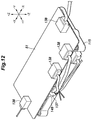
- FIG. 12 is a perspective view of the support member and the converter ECU.
- the electric vehicle 1 includes a fuel cell 2 (FC), an FC-side converter 3 (electric power conversion device), a battery 4 , a battery-side converter 5 , a PDU 6 (Power Drive Unit), and a motor generator 7 .
- the FC-side converter 3 and the battery-side converter 5 each consist of a DC/DC converter, and the PDU 6 consists of an inverter.
- the FC-side converter 3 , the battery-side converter 5 , and the PDU 6 are controlled by an ECU 8 ( FIG. 2 ).
- the fuel cell 2 generates electric energy by chemical reaction using hydrogen and oxygen as raw materials.
- the electric power generated by the fuel cell 2 is supplied to the motor generator 7 via the FC-side converter 3 and the PDU 6 , and supplied to the battery 4 via the FC-side converter 3 and the battery-side converter 5 .
- the power of the battery 4 is supplied to the motor generator 7 via the battery-side converter 5 and the PDU 6 .
- the motor generator 7 is a power source for propelling the electric vehicle 1 , and receives power supply from at least one of the power supply device and the battery 4 to drive the drive wheels of the electric vehicle 1 .
- the motor generator 7 operates as a generator so as to apply a braking force to the drive wheels, and generate regenerative electric power.
- the regenerative power is supplied to the battery 4 via the PDU 6 and the battery-side converter 5 .
- the FC-side converter 3 is a multiphase converter including a plurality of voltage converters 15 that are connected in parallel to one another. More specifically, the FC-side converter 3 includes a primary side positive line 16 , a secondary side positive line 17 , a negative line 18 , and first to fourth voltage converters 15 A to 15 D connected between the primary side positive line 16 and the secondary side positive line 17 .
- each element of the first voltage converter 15 A is indicated by a suffix A
- each element of the second voltage converter 15 B is indicated by a suffix B
- each element of the third voltage converter 15 C is indicated by a suffix C
- each element of the fourth voltage converter 15 D is indicated by a suffix D.
- the suffixes are omitted.
- a terminal end of the primary side positive line 16 is provided with a primary side positive terminal 21
- a terminal end of the negative line 18 is provided with a primary side negative terminal 22
- the primary side positive terminal 21 and the primary side negative terminal 22 jointly form a primary side connection portion 23 , and are connected to a positive pole and a negative pole of the fuel cell 2 , respectively.
- a terminal end of the secondary side positive line 17 is provided with a secondary side positive terminal 25 .
- the other terminal end of the negative line 18 is provided with a secondary side negative terminal 26 .
- the secondary side positive terminal 25 and the secondary side negative terminal 26 jointly form a secondary side connection portion 27 which is connected to the PDU 6 and the battery-side converter 5 .
- the first to fourth voltage converters 15 A to 15 D are each provided with a reactor 31 and a diode 32 which are connected in series in the power line extending between the primary side positive line 16 and the secondary side positive line 17 in that order from the side of the primary side positive line 16 , and a switching device 33 connected between the node between the reactor 31 and the diode 32 and the negative line 18 .
- a secondary side capacitor 35 smoothing capacitor
- the power module 37 includes a circuit board supporting the diodes 32 and the switching devices 33 , and a molding resin which covers the diodes 32 and the switching devices 33 to define the outer shape of the power module 37 .
- the power module 37 includes a first positive terminal 41 serving as a primary side positive terminal of the first voltage converter 15 A, a second positive terminal 42 serving as a primary side positive terminal corresponding to the second voltage converter 15 B, a third positive terminal 43 serving as a primary side positive terminal corresponding to the third voltage converter 15 C, a fourth positive terminal 44 serving as a primary side positive terminal corresponding to the fourth voltage converter 15 D, a fifth positive terminal 45 serving as a secondary side positive terminal, and a negative terminal 46 connected to the negative line 18 .
- the power module 37 also has a drive signal terminal 47 configured to receive a drive signal for each switching device 33 .
- the drive signal terminal 47 includes a plurality of terminal pieces corresponding to the respective switching devices 33 .
- the negative line 18 is provided with a first current sensor 48 , and the power lines of the voltage converter 15 for different phases are each provided with a second current sensor 49 for detecting the current of the corresponding phase.
- the first current sensor 48 and the second current sensor 49 each consist of a Hall sensor that is not in electrical contact with the circuit to be detected.
- the FC-side converter 3 has a converter ECU 51 (control unit) that controls the on/off of each switching device 33 in response to a signal from the ECU 8 .
- the converter ECU 51 forwards a control signal to each switching device 33 via a gate driver 52 . More specifically, the gate driver 52 forwards a drive signal corresponding to the control signal output from the converter ECU 51 to each switching device 33 to drive each switching device 33 accordingly.
- Each voltage converter 15 boosts the voltage by turning on and off the switching device 33 according to the signal from the converter ECU 51 , and supplies the boosted voltage to the secondary side.
- the converter ECU 51 determines the number of power converters to be driven, and the on/off phase and the duty ratio of each switching device 33 according to the signal from ECU 8 and the signals from first current sensor 48 and second current sensor 49 .
- the outer shell of the FC-side converter 3 is formed by a case 60 .
- the case 60 has a box-shaped first case 63 including a bottom 61 (first member, mounting portion) consisting of a flat plate and a side wall 62 extending upright from the periphery of the bottom 61 at right angle, and a plate-like second case 64 attached to the free end of the side wall 62 to define a receiving space in cooperation with the first case 63 .
- first member, mounting portion consisting of a flat plate and a side wall 62 extending upright from the periphery of the bottom 61 at right angle
- a plate-like second case 64 attached to the free end of the side wall 62 to define a receiving space in cooperation with the first case 63 .
- the direction orthogonal to the bottom 61 is the Z direction (the vertical direction as mounted on the vehicle), the direction toward the second case 64 with respect to the bottom 61 is +Z, and the direction facing away from the +Z is ⁇ Z.
- a first direction orthogonal to the Z direction is defined as X direction (the lateral direction as mounted on the vehicle), and a second direction orthogonal to both the Z direction and the X direction is defined as the Y direction (the fore and aft direction as mounted on the vehicle).
- the X direction may be +X or ⁇ X depending on which way the direction is defined along the X direction.
- the Y direction may be +Y or ⁇ Y depending on which way the direction is defined along the Y direction.
- the case may be made of metallic material such as aluminum.
- the bottom 61 is formed in a substantially rectangular shape extending along a plane including the X direction and the Y direction, and having a greater width in the X direction than in the Y direction.
- the side wall 62 includes first and second side walls 66 and 67 extending in the X direction, and third and fourth side walls 68 and 69 extending in the Y direction.
- the first side wall 66 is disposed on the +Y side with respect to the second side wall 67
- the third side wall 68 is disposed on the ⁇ X side with respect to the fourth side wall 69 .
- the first side wall 66 , the second side wall 67 , the third side wall 68 , and the fourth side wall 69 are connected to each other to form a frame, and are provided around the periphery of the bottom 61 .
- the fourth side wall 69 is disposed at a position offset inward with respect to the side edge of the bottom 61 on the +X side. A part of the bottom 61 that protrudes beyond the fourth side wall 69 on the +X side will be referred to as extension 71 .
- the bottom 61 may be divided into a first region 73 located on the +X side, and a second region 74 located on the ⁇ X side.
- the extension 71 is included in the first region 73 .
- the inner surface of the second region 74 is offset from the inner surface of the first region 73 in the outward direction ( ⁇ Z side) in a step-wise manner.
- the outer surface of the first region 73 of the bottom 61 is formed with a first recess 75 and a second recess 76 which are recessed inward.
- the first recess 75 and the second recess 76 extend in the X direction, and the second recess 76 is disposed on the +Y side of the first recess 75 .
- the first recess 75 and the second recess 76 extend along the ⁇ Z side of the fourth side wall 69 , and the end parts of these recesses on the +X side are disposed in the extension 71 .
- the first recess 75 and the second recess 76 have a certain width in the Y direction.
- the outer plate member 77 defines an upstream first passage 78 in cooperation with the first recess 75 , and a downstream first passage 79 in cooperation with the second recess 76 .
- the upstream first passage 78 and the downstream first passage 79 are separated from each other.
- the outer plate member 77 is provided with a plurality of ribs on an outer surface (facing the ⁇ Z side) so as to enhance the cooling of the cooling medium through the first passage.
- the second region 74 of the bottom 61 is planar in this embodiment, and the outer surface of the outer plate member 77 is substantially flush with the outer surface of second region 74 so that the case 60 may be provided with a simple profile such a rectangular parallelepiped outer profile.
- the extension 71 of the bottom 61 is provided with an inlet hole 81 (cooling medium inlet) that is passed through from the first recess 75 to the surface of the extension 71 facing the +Z direction, and an outlet hole 82 (cooling medium outlet) passed through from the second recess 76 to the inwardly facing surface of the bottom 61 .
- a planar fastening surface 84 is formed on the ⁇ X side of the inner surface of the first region 73 .
- a first communication hole 85 is passed from the first recess 75 through the fastening surface 84
- a second communication hole 86 is passed from the second recess 76 through the fastening surface 84 .
- the second communication hole 86 is disposed on the +Y side of the first communication hole 85 .
- a support plate 88 (second member; inner plate member) which is formed as a plate member having a first surface 88 A (surface facing the ⁇ Z side) facing the bottom 61 , and a second surface 88 B (surface facing the +Z side) facing away from the bottom 61 .
- the support plate 88 is fastened to the fastening surface 84 at the end part of the first surface 88 A on the +X side.
- the support plate 88 is disposed so as to overlap with the first region 73 in the end part thereof on the +X side, and overlaps with the second region 74 in the remaining part thereof.
- the support plate 88 opposes the inner surface of the second region 74 in a spaced apart and parallel relationship.
- the end part of the support plate 88 on the ⁇ X side is supported by a projection 89 projecting from the inner surface of the second region 74 toward the +Z side.
- the end part of the support plate 88 on the ⁇ X side may be fastened to the projection 89 .
- the support plate 88 is internally formed with a second passage 91 .
- the second passage 91 is provided with a third communication hole 92 opening at an end part of the first surface 88 A of the support plate 88 on the +X side to communicate with the first communication hole 85 , and a fourth communication hole 93 opened at an end part of the first surface 88 A on the +X side to communicate with the second communication hole 86 .
- the fourth communication hole 93 is disposed on the +Y side of the third communication hole 92 .
- the second passage 91 extends from the third communication hole 92 to the end part of the support plate 88 on the ⁇ X side, and bent back to the +Y side and the +X side before extending to the end part of the support plate 88 on the +X side to be connected to the fourth communication hole 93 .
- a pair of annular seal grooves 95 are formed in the fastening surface 84 of the first region 73 so as to surround the first communication hole 85 and the second communication hole 86 , respectively.
- Each seal groove 95 is provided with a gasket 98 for sealing the connecting part between the first communication hole 85 and the third communication hole 92 or the connecting part between the second communication hole 86 and the fourth communication hole 93 .
- Each gasket 98 is formed of flexible rubber, and is formed in an annular shape so to extend along the corresponding seal groove 95 .
- the upstream first passage 78 , the second passage 91 , and the downstream first passage 79 form a medium passage 107 through which the cooling medium flows.
- the cooling medium may, for example, be water.
- the inlet hole 81 and the outlet hole 82 are connected to a circulation circuit of the cooling medium via a hose or the like in such a manner that the inlet hole 81 receives a supply of the cooling medium from the circulation circuit, and the outlet hole 82 discharges the cooling medium to the circulation circuit.
- the cooling medium flows through the inlet hole 81 , the upstream first passage 78 , the first communication hole 85 , the fourth communication hole 93 , the second passage 91 , the fourth communication hole 93 , the second communication hole 86 , the downstream first passage 79 , and the outlet hole 82 , in that order.
- the second passage 91 is offset from the upstream first passage 78 and the downstream first passage 79 on the +Z side.
- the first to fourth reactors 31 A to 31 D are arranged in such a manner that the reactors 31 A to 31 D are arranged side by side in the Y direction with the axial lines thereof extending in the X direction.
- the first to fourth reactors 31 A to 31 D are arranged in ascending order from the +Y side to the ⁇ Y side.
- the first and second reactors 31 A and 31 B have a common ring-shaped core, and the third and fourth reactors 31 C and 31 D have a common ring-shaped core.
- each of the reactors 31 A to 31 D is in contact with the inner surface of the first region 73 of the bottom 61 .
- the inner surface of the first region 73 is formed with a receiving recess 111 in which the reactors 31 A to 31 D are snugly received so that the contact area between each of the reactors 31 A to 31 D and the inner surface of the first region 73 of the bottom 61 is maximized, and the heat transfer from the reactors 31 A to 31 D to the first region 73 of the bottom 61 is maximized.
- the secondary side capacitor 35 (smoothing capacitor) is provided on the first surface 88 A of the support plate 88 .
- the secondary side capacitor 35 is formed in a flat plate shape, and is in contact with the first surface 88 A of the support plate 88 . Further, the secondary side capacitor 35 is in contact with the inner surface of the second region 74 of the bottom 61 at the surface thereof facing away from the support plate 88 . In other words, the secondary side capacitor 35 is disposed in the space defined between the first surface 88 A of the support plate 88 and the inner surface of the second region 74 , and is in contact with both the support plate 88 and the second region 74 .
- the secondary side capacitor 35 is preferably in surface contact with the support plate 88 and the second region 74 .
- the power module 37 is formed in a flat rectangular parallelepiped shape, and is placed on and fastened to the second surface 88 B of the support plate 88 .
- the power module 37 is preferably in surface contact with the second surface 88 B of the support plate 88 .
- the first to fourth switching devices 33 A to 33 D are arranged side by side in the X direction. Specifically, the first switching device 33 A, the second switching device 33 B, the third switching device 33 C, and the fourth switching device 33 D are disposed in that order from the +X side to the ⁇ X side.
- the power module 37 is formed so as to be larger in width in the X direction than in the Y direction.
- the power module 37 is disposed on the ⁇ X side of the reactors 31 .
- the side edge of the power module 37 on the +Y side is located on the ⁇ Y side of the side edge of the first reactor 31 A on the +Y side, and the side edge of the power module 37 on the ⁇ Y side is located on the +Y side of the side edge of the first reactor 31 A on the ⁇ Y side.
- the power module 37 is disposed so as to overlap with the reactors 31 when viewed in the X direction.
- the edge of the power module 37 on the ⁇ Y side is provided with a first positive terminal 41 , a second positive terminal 42 , a third positive terminal 43 , and a fourth positive terminal 44 , in that order from the +X side.
- the edge of the power module 37 on the +Y side is provided with a negative terminal 46 and a fifth positive terminal 45 , in that order from the +X side to the ⁇ X side.
- a gate driver 52 which consists of a flat electronic component formed of a printed circuit board and electronic devices to function as a gate drive circuit.
- the gate driver 52 is fastened to the power module 37 .
- the power module 37 and the gate driver 52 that are connected to each other jointly form an IPM (Intelligent Power Module).
- IPM Intelligent Power Module
- a plurality of pillars 112 project to the +Z side from the periphery of the surface of the power module 37 on the +Z side so as not to interfere with the gate driver 52 .
- Each pillar 112 extends in the +Z direction beyond the gate driver 52 .
- a support member 115 for supporting the converter ECU 51 is disposed on the +Z side of the gate driver 52 .
- the support member 115 is formed of an insulating resin material.
- the support member 115 is formed in a plate shape having a first surface 116 facing the +Z side and a second surface 117 facing the ⁇ Z side (a surface facing the bottom 61 ).
- the support member 115 is fastened to the tip ends of the pillars 112 so that a clearance is defined between the second surface 117 of the support member 115 and the gate driver 52 owing to these pillars 112 .
- the converter ECU 51 is a flat plate-shaped electronic control unit (ECU) formed of a printed circuit board and devices mounted thereof.
- the converter ECU 51 is fastened to the upper surface of support member 115 such that the outer surface thereof faces in the +Z direction.
- the secondary side capacitor 35 , the support plate 88 , the power module 37 , the gate driver 52 , the support member 115 , and the converter ECU 51 are stacked one over another in the Z direction in a +Z side part of the second region 74 of the bottom 61 .
- the primary side connection portion 23 is provided on the +X side of the outer surface of the first side wall 66
- the secondary side connection portion 27 is provided on the ⁇ X side.
- Each of the primary side connection portion 23 and the secondary side connection portion 27 is formed in a cylindrical shape opening out toward the +Y side.
- the primary side connection portion 23 is provided on the +Y side of the reactors 31
- the secondary side connection portion 27 is provided on the +Y side of the power module 37 .
- the primary side positive terminal 21 and the primary side negative terminal 22 are provided inside the primary side connection portion 23 .
- the primary side positive terminal 21 is disposed on the +X side of the primary side negative terminal 22 .
- the secondary side positive terminal 25 and the secondary side negative terminal 26 are provided inside the secondary side connection portion 27 .
- the secondary side negative terminal 26 is disposed on the +X side of the secondary side positive terminal 25 .
- the primary side positive terminal 21 , the primary side negative terminal 22 , the secondary side negative terminal 26 , and the secondary side positive terminal 25 are arranged on the first side wall 66 in that order from the +X side to the ⁇ X side.
- the primary side positive terminal 21 , the primary side negative terminal 22 , the secondary side negative terminal 26 , and the secondary side positive terminal 25 are each formed in a pin shape.
- the primary side positive terminal 21 , the primary side negative terminal 22 , the secondary side negative terminal 26 , and the secondary side positive terminal 25 are each formed in a tubular shape so as to receive a pin-like counterpart terminal.
- the first to fourth reactors 31 A to 31 D each have a primary side end on the +X side, and a secondary side end on the ⁇ X side, with respect to the X direction.
- the primary side positive terminal 21 is connected to the primary side ends of the first to fourth reactors 31 A to 31 D via a first positive bus bar 121 which is branched in a corresponding manner.
- the primary side positive line 16 is formed by the first positive bus bar 121 .
- the first positive bus bar 121 extends from the primary side positive line 16 in the ⁇ Y direction, and branches so as to be connected to the primary side ends of the first to fourth reactors 31 A to 31 D at the branched ends thereof.
- a part of the first positive bus bar 121 may be disposed so as to overlap with the first to fourth reactors 31 A to 31 D when viewed from the Z direction.
- the secondary side end of the first reactor 31 A is connected to the first positive terminal 41 of the power module 37 via a second positive bus bar 122 .
- the secondary side end of the second reactor 31 B is connected to the second positive terminal 42 of the power module 37 via a third positive bus bar 123 .
- the secondary side end of the third reactor 31 C is connected to the third positive terminal 43 of the power module 37 via a fourth positive bus bar 124 .
- the secondary side end of the fourth reactor 31 D is connected to the fourth positive terminal 44 of the power module 37 via a fifth positive bus bar 125 .
- the second to fifth positive bus bars 122 to 125 are separated from one another by insulating material 128 .
- the second to fifth positive bus bars 122 to 125 extend from the secondary side ends of the reactors 31 A to 31 D in the ⁇ Y direction, and then extend in the ⁇ X direction to be connected to the corresponding positive terminals 41 to 44 .
- the fifth positive terminal 45 of the power module 37 is connected to the secondary side positive terminal 25 via a sixth positive bus bar 126 which extends from the fifth positive terminal 45 in the +Y direction to be connected to the secondary side positive terminal 25 .
- the primary side negative terminal 22 is connected to the secondary side negative terminal 26 and the negative terminal 46 of the power module 37 via a branched negative bus bar 127 .
- the negative line 18 is formed by the negative bus bar 127 .
- the negative bus bar 127 extends from the primary side negative terminal 22 to the ⁇ X side and the ⁇ Y side to be connected to the negative terminal 46 , and branches from a lengthwise intermediate point thereof to extend in the +Y direction therefrom to be connected to the secondary side negative terminal 26 .
- the first current sensor 48 is provided on the negative bus bar 127 .
- the second current sensor 49 is provided on the second to fifth positive bus bars 122 to 125 .
- the second current sensor 49 is disposed behind the power module 37 .
- a first reactor temperature sensor 131 is provided between the first reactor 31 A and the second reactor 31 B to detect the temperature of the first reactor 31 A and the second reactor 31 B.
- a second reactor temperature sensor 132 is provided between the third reactor 31 C and the fourth reactor 31 D to detect the temperature of the third reactor 31 C and the fourth reactor 31 D.
- a capacitor temperature sensor 133 is provided on the secondary side capacitor 35 to detect the temperature of the secondary side capacitor 35 .
- the third side wall 68 is provided with a connector 134 for external connection.
- a wire harness 137 is formed by tying together some of a signal line 48 L of the first current sensor 48 , a signal line 49 L of the second current sensor 49 , a signal line 131 L of the first reactor temperature sensor 131 , a signal line 132 L of the second reactor temperature sensor 132 , a signal line 133 L of the capacitor temperature sensor 133 , a signal line 134 L of the external connection connector 134 , a signal line 121 L extending from the first positive bus bar 121 , a signal line 126 L extending from the sixth positive bus bar 126 , and a signal line 127 L extending from the negative bus bar 127 .
- the wire harness 137 is branched into a number of terminal ends which are connected to connectors 138 provided on an edge part of the converter ECU 51 .
- the signal lines 121 L, 126 L, and 127 L forward the voltage signals of the bus bars 121 , 126 , and 127 to the converter ECU 51 , and the converter ECU 51 acquires the voltages on the primary side and the secondary side of the FC-side converter 3 .
- a plurality of reinforcing ribs 141 project from the first surface 116 and the second surface 117 of the support member 115 .
- a receiving groove 142 for receiving the wire harness 137 is formed between the adjacent reinforcing ribs 141 on the upper surface of the support member 115 .
- the receiving groove 142 opens toward the +Z side, and extends in the direction along the surface of the support member 115 .
- the receiving groove 142 extends in the X direction, and is provided with a first end 143 that reaches and extends through the side edge of the support member 115 on the ⁇ X side and opens toward the ⁇ X side and a second end 144 that reaches and extends through the side edge of the support member 115 on the +X side and opens toward the +X side.
- the receiving groove 142 is further provided with a branch portion 145 branching toward the +Y side from a central point thereof with respect to the X direction.
- a third end 146 forming the end of the branch portion 145 on the +Y side reaches the front edge of the support member 115 and opens toward the +Y side.
- the receiving groove 142 has at least one curved portion 148 at an intermediate part thereof in the lengthwise direction.
- the receiving groove 142 is curved instead of being linear.
- the intermediate part of the receiving groove 142 with respect to the X direction is offset to the +Y side with respect to the first end 143 and the second end 144 thereof.
- the presence of the bend in the receiving groove 142 can improve the bending stiffness of the support member 115 . If the receiving groove 142 were formed so as to extend linearly, a weakened part owing to the absence of the reinforcing ribs 141 would extend linearly so that the support member 115 would be prone to bending deformation with the receiving groove 142 serving as a valley or a ridge for such bending deformation.
- the wire harness 137 extends from the first end 143 to the second end 144 through the receiving groove 142 , and extends further from the second end 144 of the receiving groove 142 to the +Z side to be connected to the connectors 138 provided at the edge of the converter ECU 51 .
- the receiving groove 142 is provided with a groove cover 151 which covers at least a part of the wire harness 137 .
- the groove cover 151 is coupled to the support member 115 by means of locking claws or screws.
- the groove cover 151 retains the wire harness 137 in the receiving groove 142 , and prevents the wire harness 137 from being dislodged from the receiving groove 142 .
- the wire harness 137 is disposed along the support member 115 as it extends along a space defined between the support member 115 and the converter ECU 51 .
- the FC-side converter 3 may be disposed in any orientation when mounted to the vehicle.
- the FC-side converter 3 may be disposed, for example, so that the bottom 61 extends horizontally or vertically.
- the FC-side converter 3 The effect of the FC-side converter 3 according to the present embodiment is discussed in the following.
- the power module 37 and the secondary side capacitor 35 are stacked in the Z direction via the support plate 88 . Since an AC magnetic flux is generated inside each reactor 31 by the current passing through the FC-side converter 3 , the reactor 31 needs to have a magnetic path having an appropriate cross sectional area so that the reactor 31 is not magnetically saturated by the magnetic flux. In this case, even if there are severe restrictions such as the need for a high electric capacity, and a small available floor area (footprint) of each reactor 31 , an adequate cross sectional area for the magnetic flux can be ensured by making the thickness of the reactor to be greater than either the power module 37 or the secondary side capacitor 35 . Therefore, the space efficiency of the FC-side converter 3 can be enhanced by stacking the power module 37 and the secondary side capacitor 35 one over the other, and arranging the reactors 31 separately therefrom.
- the floor area of the reactor 31 can be limited by increasing the thickness of the reactor 31 so as to ensure an adequate cross area for the magnetic flux. Thereby, the space efficiency of the FC-side converter 3 can be optimized.
- the floor area of the reactors 31 can be limited even further by making the thickness of the reactors 31 A to 31 D in the Z direction to be greater than the combined thickness of the power module 37 , the support plate 88 , and the secondary side capacitor 35 in the Z direction.
- the floor area of the bottom 61 of the case 60 can be further reduced.
- the outer profile of the second case 64 can be made flat by making the combined thickness of the reactors 31 and the upstream first passage 78 (downstream first passage 79 ) to be substantially the same as the combined thickness of the secondary side capacitor 35 , the support plate 88 , the power module 37 , the support member 115 , and the converter ECU 51 .
- the external shape of the case formed by the first case 63 and the second case 64 can be made substantially rectangular.
- the second passage 91 is formed in the support plate 88 which is remote from the second region 74 of the bottom 61 , and the power module 37 and the secondary side capacitor 35 are provided on the respective two surfaces of the support plate 88 , all of the power module 37 and the secondary side capacitor 35 can be favorably cooled without increasing the floor area.
- the second region 74 of the bottom 61 does not have a passage through which the cooling medium flows, the second region 74 may be made thinner than the first region 73 so that the receiving space formed on the inner side (+Z side) of the second region 74 can be widened without causing the bottom 61 of the case 60 to protrude outward ( ⁇ Z side).
- wire harness 137 is wired between the converter ECU 51 and the support member 115 , clips that are required for securing the wire harness 137 can be partially omitted.
- signal lines are wired by using the space created between the converter ECU 51 and the support member 115 , each device therein can be integrated at high density so that the FC-side converter 3 can be made highly compact.
- the converter ECU 51 and the gate driver 52 can be arranged in layers while being insulated from each other. Thereby, the converter ECU 51 and the gate driver 52 can be integrated at high density so that the FC-side converter 3 can be made highly compact.
- the receiving groove 142 is formed between the reinforcing ribs 141 on the upper surface of the support member 115 , and the wire harness 137 is wired in the receiving groove 142 . Therefore, the wire harness 137 is buried in the support member 115 so that the total thickness of the support member 115 can be minimized. In addition, since the wire harness 137 can be held in position by being received in the receiving groove 142 , clips required for fixing the wire harness 137 can be partially omitted.
- each end of the receiving groove 142 reaches the corresponding edge of the support member 115 , the wire harness 137 can enter the receiving groove 142 from the edge of the support member 115 so that the converter ECU 51 can be disposed even closer to support member 115 .
- the FC-side converter 3 essentially consisting of a step-up type multiphase converter, the lengths of the first positive bus bar 121 and the negative bus bar 127 through which the largest current flows can be minimized so that the loss can be minimized.
- the largest current flows in the region of the primary side positive line 16 ranging from the primary side positive terminal 21 to the part thereof branching into the first to fourth reactors 31 A to 31 D which are connected in parallel to one another.
- the largest current flows in the region ranging from the primary side negative terminal 22 to the part thereof branching into the first to fourth switching devices 33 A to 33 D.
- the voltage is increased so the current is decreased. Therefore, the loss can be reduced most efficiently by shortening the lengths of the first positive bus bar 121 and the negative bus bar 127 .
- the secondary side connection portion 27 is disposed on the +Y side of the power module 37 , the distance between the negative terminal 46 of the power module 37 and the secondary side negative terminal 26 can be minimized. Thereby, the negative bus bar 127 can be shortened, and the loss can be minimized.
- the primary side positive terminal 21 , the primary side negative terminal 22 , the secondary side negative terminal 26 , and the secondary side positive terminal 25 are arranged in that order from the +X side, the distance between the negative terminal 22 and the secondary side negative terminal 26 can be minimized so that the length of the negative bus bar 127 can be reduced even further. It should be noted that this arrangement is not essential for the present invention, and the order of the primary side positive terminal 21 , the primary side negative terminal 22 , the secondary side negative terminal 26 , and the secondary side positive terminal 25 may be changed in other embodiments.
- the loss can be minimized by reducing the lengths of the second to fifth positive bus bars 122 to 125 connecting the first to fourth reactors 31 A to 31 D to the fourth positive terminals 41 to 44 of the power module 37 , respectively.
- the present invention has been described in terms of a specific embodiment, the present invention is not limited by such an embodiment, but can be modified in various ways without departing from the spirit of the present invention.
- the number of reactors 31 can be changed.
- the signal lines contained in the wire harness 137 can be changed suitably.
- a smoothing primary side capacitor may be connected between the primary side positive line 16 and the negative line 18 .
- the first to fourth reactors 31 A to 31 D had the primary side end on the +X side and the secondary side end on the ⁇ X side.
- the first to fourth reactors 31 A to 31 D have the primary side end on the ⁇ X side and the secondary side end on the +X side.
- the lengths of the second to fifth positive bus bars 122 to 125 are longer as compared to the case where the second side end is provided on the ⁇ X side of the first to fourth reactors 31 A to 31 D.
- the increase in the loss is minimal.
Landscapes
- Engineering & Computer Science (AREA)
- Power Engineering (AREA)
- Microelectronics & Electronic Packaging (AREA)
- Physics & Mathematics (AREA)
- Thermal Sciences (AREA)
- Dc-Dc Converters (AREA)
- Inverter Devices (AREA)
Abstract
Description
Claims (14)
Applications Claiming Priority (3)
| Application Number | Priority Date | Filing Date | Title |
|---|---|---|---|
| JP2018096437 | 2018-05-18 | ||
| JP2018096437A JP6725586B2 (en) | 2018-05-18 | 2018-05-18 | Power converter |
| JP2018-096437 | 2018-05-18 |
Publications (2)
| Publication Number | Publication Date |
|---|---|
| US20190357392A1 US20190357392A1 (en) | 2019-11-21 |
| US10765044B2 true US10765044B2 (en) | 2020-09-01 |
Family
ID=68533370
Family Applications (1)
| Application Number | Title | Priority Date | Filing Date |
|---|---|---|---|
| US16/398,423 Expired - Fee Related US10765044B2 (en) | 2018-05-18 | 2019-04-30 | Electric power conversion device |
Country Status (3)
| Country | Link |
|---|---|
| US (1) | US10765044B2 (en) |
| JP (1) | JP6725586B2 (en) |
| CN (1) | CN110505787B (en) |
Cited By (1)
| Publication number | Priority date | Publication date | Assignee | Title |
|---|---|---|---|---|
| US11255885B2 (en) * | 2018-05-18 | 2022-02-22 | Honda Motor Co., Ltd. | Electric power conversion device |
Families Citing this family (9)
| Publication number | Priority date | Publication date | Assignee | Title |
|---|---|---|---|---|
| JP2022017605A (en) * | 2018-10-25 | 2022-01-26 | ソニーセミコンダクタソリューションズ株式会社 | Circuit board, semiconductor apparatus, and electronic equipment |
| JP7103298B2 (en) * | 2019-04-22 | 2022-07-20 | 株式会社デンソー | Power converter and its in-vehicle structure |
| JP7443859B2 (en) * | 2020-03-18 | 2024-03-06 | 株式会社デンソー | power converter |
| JP2021151106A (en) * | 2020-03-19 | 2021-09-27 | 本田技研工業株式会社 | Drive device |
| CN113765460B (en) * | 2020-06-04 | 2025-01-14 | 比亚迪股份有限公司 | Integrated capacitors, motor controllers and vehicles |
| JPWO2023032844A1 (en) * | 2021-08-30 | 2023-03-09 | ||
| CN113517136B (en) * | 2021-09-13 | 2021-11-16 | 南通道奇家纺有限公司 | Capacitor for electric control equipment |
| JP7439155B2 (en) | 2022-03-25 | 2024-02-27 | 本田技研工業株式会社 | power converter |
| DE102024100884A1 (en) | 2024-01-12 | 2025-07-17 | Valeo Eautomotive Germany Gmbh | Inverter device, electric drive and vehicle |
Citations (12)
| Publication number | Priority date | Publication date | Assignee | Title |
|---|---|---|---|---|
| CN101174799A (en) | 2006-11-02 | 2008-05-07 | 株式会社日立制作所 | power conversion device |
| CN103812356A (en) | 2012-11-05 | 2014-05-21 | 三菱自动车工业株式会社 | Cooling structure of inverter |
| US20140198450A1 (en) * | 2013-01-15 | 2014-07-17 | Toyota Jidosha Kabushiki Kaisha | Power conversion device |
| JP2016005315A (en) | 2014-06-13 | 2016-01-12 | 株式会社デンソー | Power converter |
| JP2017135901A (en) | 2016-01-29 | 2017-08-03 | 本田技研工業株式会社 | Capacitor layout |
| JP2017200314A (en) | 2016-04-27 | 2017-11-02 | カルソニックカンセイ株式会社 | Power converter |
| JP2017201875A (en) | 2016-04-27 | 2017-11-09 | カルソニックカンセイ株式会社 | Power conversion device |
| US20180025961A1 (en) * | 2016-07-21 | 2018-01-25 | Denso Corporation | Power Conversion Device Including Semiconductor Module Provided with Laminated Structure |
| US20180070471A1 (en) * | 2015-05-21 | 2018-03-08 | Mitsubishi Electric Corporation | Electronic device |
| JP2018046195A (en) | 2016-09-15 | 2018-03-22 | トヨタ自動車株式会社 | Semiconductor device |
| US20190208671A1 (en) * | 2016-06-01 | 2019-07-04 | Mitsubishi Electric Corporation | Power conversion device |
| US20190208672A1 (en) * | 2016-09-20 | 2019-07-04 | Mitsubishi Electric Corporation | Power conversion device |
-
2018
- 2018-05-18 JP JP2018096437A patent/JP6725586B2/en not_active Expired - Fee Related
-
2019
- 2019-04-30 US US16/398,423 patent/US10765044B2/en not_active Expired - Fee Related
- 2019-05-16 CN CN201910405207.XA patent/CN110505787B/en active Active
Patent Citations (13)
| Publication number | Priority date | Publication date | Assignee | Title |
|---|---|---|---|---|
| CN101174799A (en) | 2006-11-02 | 2008-05-07 | 株式会社日立制作所 | power conversion device |
| CN103812356A (en) | 2012-11-05 | 2014-05-21 | 三菱自动车工业株式会社 | Cooling structure of inverter |
| US20140198450A1 (en) * | 2013-01-15 | 2014-07-17 | Toyota Jidosha Kabushiki Kaisha | Power conversion device |
| JP2016005315A (en) | 2014-06-13 | 2016-01-12 | 株式会社デンソー | Power converter |
| US20180070471A1 (en) * | 2015-05-21 | 2018-03-08 | Mitsubishi Electric Corporation | Electronic device |
| US20170221632A1 (en) | 2016-01-29 | 2017-08-03 | Honda Motor Co., Ltd. | Capacitor arrangement structure |
| JP2017135901A (en) | 2016-01-29 | 2017-08-03 | 本田技研工業株式会社 | Capacitor layout |
| JP2017200314A (en) | 2016-04-27 | 2017-11-02 | カルソニックカンセイ株式会社 | Power converter |
| JP2017201875A (en) | 2016-04-27 | 2017-11-09 | カルソニックカンセイ株式会社 | Power conversion device |
| US20190208671A1 (en) * | 2016-06-01 | 2019-07-04 | Mitsubishi Electric Corporation | Power conversion device |
| US20180025961A1 (en) * | 2016-07-21 | 2018-01-25 | Denso Corporation | Power Conversion Device Including Semiconductor Module Provided with Laminated Structure |
| JP2018046195A (en) | 2016-09-15 | 2018-03-22 | トヨタ自動車株式会社 | Semiconductor device |
| US20190208672A1 (en) * | 2016-09-20 | 2019-07-04 | Mitsubishi Electric Corporation | Power conversion device |
Non-Patent Citations (2)
| Title |
|---|
| CN First Notification of Office Action for CN Application No. 201910405207.X, dated Apr. 16, 2020; 11 pp. |
| Notice of Reasons for Refusal for JP Application No. 2018-096437, dated Jul. 30, 2019, and partial English translation thereof, 9 pages. |
Cited By (1)
| Publication number | Priority date | Publication date | Assignee | Title |
|---|---|---|---|---|
| US11255885B2 (en) * | 2018-05-18 | 2022-02-22 | Honda Motor Co., Ltd. | Electric power conversion device |
Also Published As
| Publication number | Publication date |
|---|---|
| CN110505787A (en) | 2019-11-26 |
| CN110505787B (en) | 2021-01-01 |
| JP2019201527A (en) | 2019-11-21 |
| US20190357392A1 (en) | 2019-11-21 |
| JP6725586B2 (en) | 2020-07-22 |
Similar Documents
| Publication | Publication Date | Title |
|---|---|---|
| US20190357392A1 (en) | Electric power conversion device | |
| US10644608B2 (en) | Electric power conversion device | |
| KR101418895B1 (en) | Fuel cell vehicle | |
| US7952856B2 (en) | Power control unit and hybrid vehicle comprising same | |
| KR102532313B1 (en) | Hybrid power control unit for vehicle | |
| CN108666605B (en) | fuel cell unit | |
| US11255885B2 (en) | Electric power conversion device | |
| US11345249B2 (en) | Power conversion apparatus for multi-voltage charging | |
| JP6651406B2 (en) | Power converter | |
| JP2020202063A (en) | Fuel cell unit | |
| US20210249673A1 (en) | Fuel cell unit | |
| US11735753B2 (en) | High-voltage junction unit of fuel cell system and power supply of fuel cell system including the same | |
| JP5952142B2 (en) | Power control unit | |
| JP7388257B2 (en) | power converter | |
| US11553617B2 (en) | Power converter | |
| JP7119430B2 (en) | power converter | |
| KR20220099022A (en) | Converter | |
| US20250266756A1 (en) | Power conversion device | |
| JP6070379B2 (en) | On-vehicle converter | |
| JP7746910B2 (en) | Electrical Equipment | |
| JP2025126060A (en) | Power Conversion Device | |
| JP2025125906A (en) | Power converter apparatus | |
| JP2023131686A (en) | power converter | |
| CN119675399A (en) | Power conversion device | |
| JP2021106436A (en) | Drive circuit unit and vehicle |
Legal Events
| Date | Code | Title | Description |
|---|---|---|---|
| FEPP | Fee payment procedure |
Free format text: ENTITY STATUS SET TO UNDISCOUNTED (ORIGINAL EVENT CODE: BIG.); ENTITY STATUS OF PATENT OWNER: LARGE ENTITY |
|
| AS | Assignment |
Owner name: HONDA MOTOR CO., LTD., JAPAN Free format text: ASSIGNMENT OF ASSIGNORS INTEREST;ASSIGNORS:IKEDA, TOSHIKI;KATO, JUN;NISHIYAMA, KOSUKE;AND OTHERS;REEL/FRAME:049048/0595 Effective date: 20190408 |
|
| STPP | Information on status: patent application and granting procedure in general |
Free format text: DOCKETED NEW CASE - READY FOR EXAMINATION |
|
| ZAAA | Notice of allowance and fees due |
Free format text: ORIGINAL CODE: NOA |
|
| ZAAB | Notice of allowance mailed |
Free format text: ORIGINAL CODE: MN/=. |
|
| STPP | Information on status: patent application and granting procedure in general |
Free format text: PUBLICATIONS -- ISSUE FEE PAYMENT RECEIVED |
|
| STCF | Information on status: patent grant |
Free format text: PATENTED CASE |
|
| FEPP | Fee payment procedure |
Free format text: MAINTENANCE FEE REMINDER MAILED (ORIGINAL EVENT CODE: REM.); ENTITY STATUS OF PATENT OWNER: LARGE ENTITY |
|
| LAPS | Lapse for failure to pay maintenance fees |
Free format text: PATENT EXPIRED FOR FAILURE TO PAY MAINTENANCE FEES (ORIGINAL EVENT CODE: EXP.); ENTITY STATUS OF PATENT OWNER: LARGE ENTITY |
|
| STCH | Information on status: patent discontinuation |
Free format text: PATENT EXPIRED DUE TO NONPAYMENT OF MAINTENANCE FEES UNDER 37 CFR 1.362 |
|
| FP | Lapsed due to failure to pay maintenance fee |
Effective date: 20240901 |