US10746384B2 - Lighting apparatus, power-supply apparatus, coupling apparatus and lighting system - Google Patents
Lighting apparatus, power-supply apparatus, coupling apparatus and lighting system Download PDFInfo
- Publication number
- US10746384B2 US10746384B2 US16/210,742 US201816210742A US10746384B2 US 10746384 B2 US10746384 B2 US 10746384B2 US 201816210742 A US201816210742 A US 201816210742A US 10746384 B2 US10746384 B2 US 10746384B2
- Authority
- US
- United States
- Prior art keywords
- guide
- connection body
- contacts
- mechanical
- electrical
- Prior art date
- Legal status (The legal status is an assumption and is not a legal conclusion. Google has not performed a legal analysis and makes no representation as to the accuracy of the status listed.)
- Active
Links
Images




Classifications
-
- F—MECHANICAL ENGINEERING; LIGHTING; HEATING; WEAPONS; BLASTING
- F21—LIGHTING
- F21V—FUNCTIONAL FEATURES OR DETAILS OF LIGHTING DEVICES OR SYSTEMS THEREOF; STRUCTURAL COMBINATIONS OF LIGHTING DEVICES WITH OTHER ARTICLES, NOT OTHERWISE PROVIDED FOR
- F21V21/00—Supporting, suspending, or attaching arrangements for lighting devices; Hand grips
- F21V21/34—Supporting elements displaceable along a guiding element
- F21V21/35—Supporting elements displaceable along a guiding element with direct electrical contact between the supporting element and electric conductors running along the guiding element
-
- F—MECHANICAL ENGINEERING; LIGHTING; HEATING; WEAPONS; BLASTING
- F21—LIGHTING
- F21S—NON-PORTABLE LIGHTING DEVICES; SYSTEMS THEREOF; VEHICLE LIGHTING DEVICES SPECIALLY ADAPTED FOR VEHICLE EXTERIORS
- F21S8/00—Lighting devices intended for fixed installation
- F21S8/03—Lighting devices intended for fixed installation of surface-mounted type
- F21S8/038—Lighting devices intended for fixed installation of surface-mounted type intended to be mounted on a light track
-
- F—MECHANICAL ENGINEERING; LIGHTING; HEATING; WEAPONS; BLASTING
- F21—LIGHTING
- F21V—FUNCTIONAL FEATURES OR DETAILS OF LIGHTING DEVICES OR SYSTEMS THEREOF; STRUCTURAL COMBINATIONS OF LIGHTING DEVICES WITH OTHER ARTICLES, NOT OTHERWISE PROVIDED FOR
- F21V21/00—Supporting, suspending, or attaching arrangements for lighting devices; Hand grips
- F21V21/08—Devices for easy attachment to any desired place, e.g. clip, clamp, magnet
- F21V21/096—Magnetic devices
-
- F—MECHANICAL ENGINEERING; LIGHTING; HEATING; WEAPONS; BLASTING
- F21—LIGHTING
- F21V—FUNCTIONAL FEATURES OR DETAILS OF LIGHTING DEVICES OR SYSTEMS THEREOF; STRUCTURAL COMBINATIONS OF LIGHTING DEVICES WITH OTHER ARTICLES, NOT OTHERWISE PROVIDED FOR
- F21V23/00—Arrangement of electric circuit elements in or on lighting devices
- F21V23/06—Arrangement of electric circuit elements in or on lighting devices the elements being coupling devices, e.g. connectors
-
- F—MECHANICAL ENGINEERING; LIGHTING; HEATING; WEAPONS; BLASTING
- F21—LIGHTING
- F21S—NON-PORTABLE LIGHTING DEVICES; SYSTEMS THEREOF; VEHICLE LIGHTING DEVICES SPECIALLY ADAPTED FOR VEHICLE EXTERIORS
- F21S2/00—Systems of lighting devices, not provided for in main groups F21S4/00 - F21S10/00 or F21S19/00, e.g. of modular construction
- F21S2/005—Systems of lighting devices, not provided for in main groups F21S4/00 - F21S10/00 or F21S19/00, e.g. of modular construction of modular construction
-
- F—MECHANICAL ENGINEERING; LIGHTING; HEATING; WEAPONS; BLASTING
- F21—LIGHTING
- F21V—FUNCTIONAL FEATURES OR DETAILS OF LIGHTING DEVICES OR SYSTEMS THEREOF; STRUCTURAL COMBINATIONS OF LIGHTING DEVICES WITH OTHER ARTICLES, NOT OTHERWISE PROVIDED FOR
- F21V23/00—Arrangement of electric circuit elements in or on lighting devices
- F21V23/02—Arrangement of electric circuit elements in or on lighting devices the elements being transformers, impedances or power supply units, e.g. a transformer with a rectifier
- F21V23/023—Power supplies in a casing
-
- H—ELECTRICITY
- H01—ELECTRIC ELEMENTS
- H01R—ELECTRICALLY-CONDUCTIVE CONNECTIONS; STRUCTURAL ASSOCIATIONS OF A PLURALITY OF MUTUALLY-INSULATED ELECTRICAL CONNECTING ELEMENTS; COUPLING DEVICES; CURRENT COLLECTORS
- H01R13/00—Details of coupling devices of the kinds covered by groups H01R12/70 or H01R24/00 - H01R33/00
- H01R13/62—Means for facilitating engagement or disengagement of coupling parts or for holding them in engagement
- H01R13/6205—Two-part coupling devices held in engagement by a magnet
-
- H—ELECTRICITY
- H01—ELECTRIC ELEMENTS
- H01R—ELECTRICALLY-CONDUCTIVE CONNECTIONS; STRUCTURAL ASSOCIATIONS OF A PLURALITY OF MUTUALLY-INSULATED ELECTRICAL CONNECTING ELEMENTS; COUPLING DEVICES; CURRENT COLLECTORS
- H01R25/00—Coupling parts adapted for simultaneous co-operation with two or more identical counterparts, e.g. for distributing energy to two or more circuits
- H01R25/14—Rails or bus-bars constructed so that the counterparts can be connected thereto at any point along their length
Definitions
- the present invention relates to a lighting apparatus, a power-supply apparatus, a coupling apparatus and a lighting system.
- An “electrified rail” is a guide which extends longitudinally (e.g. for a length of 100 cm), which is adapted to be fixed, e.g. to a ceiling or a wall of a room, and which is adapted to receive a connection body of a lighting fixture in a longitudinal groove thereof; in general, a guide can provide mechanical support and electrical power supply to one or several apparatuses; in general, an apparatus may be positioned at any point along a guide and can be moved or removed afterwards.
- connection body of the lighting apparatus is shaped as an elongated box (e.g. 20 cm long), and is adapted to be inserted into and extracted from the groove of the guide.
- the body is provided with mechanical and electrical contacts which are adapted to be moved manually; in particular, by means of a first manual maneuver (e.g. performed by means of an appropriate tool) both the electrical contacts and the mechanical contacts assume a protruding position from the surface of the body and by means of a second manual maneuver (e.g. performed by means of an appropriate tool) both the electrical contacts and the mechanical contacts assume a position inside the body.
- the contacts before inserting the body into the guide, the contacts must be manually placed in the internal position (second maneuver); then, the body is fitted in the guide, which does not require applying any force to the body; finally, the contacts must be moved manually into the protruding position (first maneuver); thereby, the mechanical contacts of the body cooperate with the guide and provide mechanical support to the apparatus and the electrical contacts of the body cooperate with the guide and provide electrical power supply to the apparatus. It is necessary to reverse the procedure in order to move or remove the apparatus.
- connection body of the lighting apparatus which are used to move contacts contribute to its complexity and its cost.
- Document GB 2021877 A discloses a lighting system with power-supply guide. According to this solution, one end of the connection body is disengaged from the guide and then the body is rotated to complete the disengagement; in order to perform these operations, pyramid-shaped protruding teeth are used (Cf. for example tooth 12 with surfaces 13, 14, 15 in FIG. 1).
- Document DE 2513392 A1 discloses a lighting system with power supply guide. According to this solution, the insertion of the connection body in the guide is achieved not only by pushing the body against the guide, but also by manually pressing buttons to retract the protruding teeth (Cf. buttons 56 and teeth 52 in the figures).
- Document CN 20659240 U discloses a lighting system with power-supply guide. According to this solution, the insertion of the connection body in the guide is achieved not only by pushing the body against the guide, but also by manually pressing a button to retract the protruding teeth (Cf. button 4 and teeth 5 in the figures).
- Document DE 2210516 A1 discloses a lighting system with power supply guide. According to this solution, the insertion of the connection body in the guide is achieved not only by pushing the body against the guide, but also by manually rotating a shaped element (Cf. for example FIG. 8 and FIG. 9).
- connection body of the lighting apparatus is inserted into and extracted from the guide; in other words, the back-and-forth movement is an effect of manual push of the body towards the guide during the inserting step and of the manual pulling of the body from the guide during the extracting step and does not require further manual maneuvers with or without tool.
- the connection body is adapted to be inserted into and extracted from the guide in a direction perpendicular to its length and to the longitudinal direction of the guide; this does not preclude insertion and/or extraction in different directions.
- FIG. 1 shows a very diagrammatic longitudinal view of a lighting apparatus and of a guide according to the present invention
- FIG. 2 shows a very diagrammatic cross-section view of the apparatus and of the guide of FIG. 1 ,
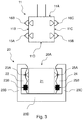
- FIG. 3 shows a diagrammatic cross-section view of a lighting apparatus and a guide according to the present invention
- FIG. 4 shows a diagrammatic cross-section view of a guide according to the present invention alternative to that shown in FIG. 3 ,
- FIG. 5 shows a very diagrammatic view of a lighting apparatus according to the present invention
- FIG. 6 shows detailed cross-section views according to the present invention
- FIG. 7 refers to a particular embodiment of the present invention and shows a cross-section view of a guide
- FIG. 8 shows a partial three-dimensional view of a particular embodiment of the present invention.
- FIG. 9 shows a first three-dimensional view in partial cross-section of the example of FIG. 8 ;
- FIG. 10 shows a second partial three-dimensional view of the example in FIG. 8 ;
- FIG. 11 shows a side view of the example in FIG. 8 ;
- FIG. 12 shows a cross-section view of the example in FIG. 8 fully inserted into the groove of the guide of FIG. 7 .
- FIG. 1 and FIG. 2 show a lighting apparatus 10 and a guide 20 adapted to cooperate in a very diagrammatic manner.
- the apparatus 10 comprises: a connection body 11 and a lighting body 12 ; the lighting body 12 comprises at least a light source 13 and a supporting element 14 mechanically fastened between them.
- the lighting body 12 is mechanically and electrically connected to the connection body 11 .
- the element 14 can be screwed into a hole of the body 11 .
- the lighting body may have various shapes and sizes.
- the lighting body has the shape of an elongated box and contains, for example, a plurality of LEDs; in particular, the length of the lighting body (e.g. 50-100 cm) may be far greater than the length of the connection body (e.g. 10-20 cm).
- connection body 11 is adapted to be mechanically and electrically connect to a supporting and power-supply guide 20 which extends in a longitudinal direction L.
- connection body 11 is shaped as an elongated box and is adapted to be inserted into and extracted from the guide 20 at least in a direction P perpendicular to the longitudinal direction L (see the two-way arrow in FIG. 1 ).
- the guide typically has a longitudinal groove 21 ; such a groove is preferably sized so as to accommodate the body 11 completely; in particular, the depth of the groove 21 corresponds exactly to the height of the body 11 .
- connection body in direction perpendicular to the direction of extension of the guide, as well as to the length of the connection body (i.e. these insertion and extraction operations can also occur keeping body and guide parallel to each other and therefore without mutual rotations), is very advantageous because it makes both the positioning of the guide and the positioning and removal of lighting apparatuses, as well as the shape and size of the lighting apparatuses, totally free.
- connection body 11 comprises at least two mechanical contacts (in particular, on opposite sides) and at least two electrical contacts (either on the same side or on different sides); the electrical contacts are used to receive electrical power supply for the light source 13 when they abut on the electrical conductors of a guide (e.g. the guide 20 ); the mechanical contacts are used to attach (in removable manner) the body to a guide (e.g. the guide 20 ) when they abut on the internal surfaces of the guide, in particular the side surfaces of one of an internal groove thereof (e.g. the groove 21 ).
- the two mechanical contacts are respectively associated with two elastic means
- the two electrical contacts are respectively associated with two elastic means.
- At least two elastic means are provided which act on the two mechanical contacts or on the two electrical contacts so as to allow their back-and-forth movement both during the step of inserting into a guide (e.g. the guide 20 ) and in the step of extracting from a guide (e.g. the guide 20 ).
- the retraction and the advancement of the contacts occurs, in particular, precisely by effect of the insertion and extraction; in other words, the mechanical connection and electrical connection does not require other manual maneuvers than the insertion (precisely, the manual pushing of the body towards the guide) and the mechanical disconnection and the electrical disconnection do not require other manual maneuvers than the extraction (precisely, the manual pulling of the body from the guide).
- the mechanical connection and electrical connection does not require other manual maneuvers than the insertion (precisely, the manual pushing of the body towards the guide) and the mechanical disconnection and the electrical disconnection do not require other manual maneuvers than the extraction (precisely, the manual pulling of the body from the guide).
- the back-and-forth movements are in direction W (corresponding to the width of the apparatus 10 and of the guide 20 ) and the insertion and extraction are in direction P (corresponding to the height of the apparatus 10 and of the guide 20 ), i.e. in two mutually orthogonal directions; direction L (corresponding to the length of the apparatus 10 and of the guide 20 ) is perpendicular to direction P and to direction W.
- the use of the elastic means is very advantageous because it allows displacing the lighting apparatuses without mechanically decoupling them (and even without electrically decoupling them) from the guides.
- An elastic means can be, for example, a helical spring, but it can also be made otherwise.
- FIG. 1 and FIG. 2 there are six elastic means 17 A, 17 B, 18 A, 18 B, 18 C, 18 D (the means 18 A and 18 D are not visible in the figures because they are hidden): two means 17 A, 17 B respectively for the two electrical contacts 15 A, 15 B and four means 18 A, 18 B, 18 C, 18 D respectively for the four mechanical contacts 16 A, 16 B, 16 C, 16 D.
- an elastic means and a mechanical contact may be integrated so as to form a mechanical contact device.
- a mechanical contact device may be, for example, a shaped elastic tongue made of plastic material.
- an elastic means and an electrical contact may be integrated so as to form an electrical contact device.
- a device may be, for example, a shaped elastic tongue made of metallic material.
- a mechanical contact and an electrical contact may be integrated so as to form a single contact with a both mechanical and electrical function; in this case, it is particularly important to choose the elastic force which acts on the single contact for it to well implement both the mechanical connection function and the electrical connection function. It is worth noting that an electrical contact may always be considered a mechanical contact even if it achieves the function of mechanical connection either slightly or not at all.
- the contacts are located on the sides of the connection body.
- the contacts 15 A, 15 B, 16 A, 16 B, 16 C, 16 D are located on the sides 11 B and 110 of the body 11 .
- a first mechanical contact e.g. the contacts 16 A and 16 B
- a second mechanical contact e.g. 16 C and 16 D
- a second side e.g. 110
- first two electrical contacts may be adapted to receive electrical power supply and second two electrical contacts may be adapted to receive electrical control signals.
- connection body may comprise a magnet (e.g. 19 ) located preferably at a back (e.g. 11 D) of the body (e.g. 11 ).
- the magnet is a mechanical connection means of the apparatus (e.g. 10 ) to the guide (e.g. 20 ) which is optionally added to the mechanical contacts; the guide may be provided, for example, with a strip of magnetic material (e.g. 29 ) adapted to cooperate with the magnet of the connection body.
- the lighting body e.g. 12
- the connection body e.g. 11
- a front e.g. 11 A of the connection body (e.g. 11 ).
- FIG. 3 shows a possible embodiment of the body 11 and of the guide 20 in greater detail with respect to FIG. 1 and FIG. 2 , so as to better understand how a connection body according to the present invention can cooperate with a supporting and power-supply guide.
- FIG. 3 shows the connection body 11 with two electrical contacts 15 A and 15 B (on sides 11 B and 11 C, respectively) and with two mechanical contacts 16 b and 16 C (on sides 11 B and 110 , respectively); the contacts are drawn with a solid line in their (most) protruding position and with dashed line in their non-protruding position, i.e. (most) internal position.
- the lower part of FIG. 3 shows the guide 20 with the groove 21 .
- the guide has a back wall 20 D, a first side wall 20 B, a second side wall 20 C and a front zone 20 A at the opening of the groove 21 .
- the guide also comprises a first insert 22 adjacent to the wall 20 B and provided, for example, with a mechanical abutment surface 23 A and an electrical conductor 23 B, and a second insert 24 adjacent to the wall 20 C and provided, for example, with a mechanical abutment surface 25 A and an electrical conductor 25 B; the abutment surfaces and electrical conductors extend, for example, for the entire length of the guide 20 .
- the insert 22 comprises a strip of electrically insulating material, e.g. with a first recess (near the front zone 20 A), in which the mechanical abutment surface 23 A is located, and a second recess (close to the wall of the back 20 D), in which the electrical conductor 23 B (protruding from the recess) is fixed.
- the insert 24 comprises a strip of electrically insulating material, e.g. with a first recess (near the front zone 20 A), in which the mechanical abutment surface 23 A is located, and a second recess (close to the wall of the back 20 D), in which the electrical conductor 25 B (protruding from recess) is fixed.
- the electrical conductors 23 B and 25 B are well exposed, i.e. are not sunk into the recesses, therefore it is sufficient for the electrical contacts 15 A and 15 B of the connecting body 11 to perform a small retraction and a small advancement during the inserting and extracting step.
- the fact that it is possible to touch the electrical conductors 23 B and 25 B by inserting a finger in the groove 21 is not a problem when the guide 20 is used for very low voltage lighting apparatuses, e.g. voltages lower than 60 volts.
- the electrical conductors 23 B and 25 B can be, for example, made of an inexpensive metallic material, such as copper; indeed, being positioned on the sides of the guide 20 they are hardly visible from the outside, although not sunk. Naturally, they may be made of graphite, for example, whereby being invisible from the outside.
- FIG. 3 shows with a dashed line the connection body 11 when it is fully inserted into the groove 21 of the guide 20 .
- the contacts 15 A, 15 B, 16 B, 16 C are slightly retracted with respect to their most protruding position and abut against the elements 23 A, 23 B, 25 A, 25 B; the elastic means associated with the contacts make the contacts 15 A, 15 B, 16 B, 16 C apply a force in transverse side direction (in particular parallel to direction W) to the elements 23 A, 23 B, 25 A, 25 B and then to the strips 22 and 24 and then to the walls 20 B and 20 C of the guide 20 .
- the electrical contacts 15 A and 15 B provide electrical coupling when they cooperate with the electrical conductors 23 B and 25 B of the guide 20 and can also contribute to the mechanical coupling.
- the contacts of the connection body and/or the recesses of the guide have inclined surfaces.
- the contacts tend to move (automatically, i.e. without any further manual maneuvers with or without tool) in direction perpendicular to this direction (i.e. they retract); this movement of the contacts is contrasted by the elastic means; therefore, in order to proceed with the movement, it is necessary to apply a force to the body in the back-and-forth direction either towards or away from the guide.
- the elastic means tend to return the contacts to the protruding position (automatically, i.e. without any further manual maneuvers with or without tool).
- the image shown on the bottom of FIG. 3 corresponds to the end of ep “d” when the back 11 D of the body 11 abuts against the wall of the back 20 D of the guide 20 .
- FIG. 4 shows a guide 70 alternative to the guide 20 in FIG. 3 and adapted to cooperate with a connection body equipped with four electrical contacts.
- the guide has a back wall 70 D, a first side wall 70 B, a second side wall 70 C and a front zone 20 A at the opening of a groove 71 .
- the guide further comprises a first insert 72 adjacent to the wall 70 B and equipped with two electrical conductors 73 A and 73 B, and a second insert 74 adjacent to the wall 70 C and equipped with two electrical conductors 75 A and 75 B; the electrical conductors extend, for example, for the entire length of the guide 70 .
- the insert 72 comprises a strip of electrically insulating material, e.g. with a first recess (near the front zone 70 A), in which the electrical conductor 73 A (protruding from the recess) is fixed and a second recess (close to the back wall 70 D), in which the electrical conductor 73 B (protruding from the recess) is fixed.
- the insert 74 comprises a strip of electrically insulating material, e.g. with a first recess (near the front zone 70 A), in which the electrical conductor 75 A (protruding from the recess) is fixed and a second recess (close to the back wall 70 D), in which the electrical conductor 75 B (protruding from the recess) is fixed.
- the electrical conductors 73 A, 73 B, 75 A and 75 B are well exposed, i.e. are not sunk into the recesses, therefore it is sufficient for the electrical contacts of the connecting body to make a small retraction and a small advancement during the inserting and extracting step.
- the fact that it is possible to touch the electrical conductors 73 A, 73 B, 75 A and 75 B by inserting a finger in the groove 71 is not a problem when the guide 70 is used for very low voltage lighting apparatuses, e.g. voltages lower than 60 volts.
- the electrical conductors 73 A, 73 B, 75 A and 75 B can be, for example, made of inexpensive metallic material, such as copper; indeed, being positioned on the sides of the guide 70 they are hardly visible from the outside, although not sunk. Naturally, they may be made of graphite, for example, whereby being invisible from the outside.
- FIG. 4 shows with a dashed line a connection body when it is fully inserted in the groove 71 of the guide 70 .
- the four electrical contacts are the body are retracted with respect to their most protruding position and abut against the electrical conductors 73 A, 73 B, 75 A and 75 B; the elastic means associated with the electrical contacts make the electrical contacts apply a force in transverse side direction (in particular parallel to direction W) to the electrical elements 73 A, 73 B, 75 A and 75 B and then to the strips 72 and 74 and then to the walls 70 B and 70 C of the guide 70 .
- the electrical contacts provide electrical coupling when they cooperate with the electrical conductors 73 A, 73 B, 75 A and 75 B of the guide 70 and can also contribute to the mechanical coupling.
- the mechanical coupling may be provided, for example, mainly by mechanical contacts (not shown in the figure) and/or by magnetic means (not shown in the figure).
- the contacts of the connection body and/or the recesses of the guide have inclined surfaces.
- FIG. 5 An example of embodiment of a lighting system 100 according to the present invention is diagrammatically shown in FIG. 5 .
- the system 100 of FIG. 5 comprises seven components.
- the number of components can vary from a minimum of three to an undefined maximum.
- the three minimum components are: a supporting and power-supply guide (e.g. adapted to be fixed to a ceiling or a wall of a room), a lighting device and a power-supply apparatus (component which will be illustrated below).
- the system ( 100 ) comprises: two supporting and power-supply guides 20 (the same reference as FIG. 1 and FIG. 2 is used here to indicate that they may be like those shown in these figures), two lighting apparatuses 10 (the same reference as FIG. 1 and FIG. 2 is used here to indicate that they may be like those shown in these figures), a power-supply apparatus 30 and two coupling apparatuses 40 .
- the two coupling apparatuses 40 there may be only one coupling device 50 .
- All apparatuses, 10 , 20 , 30 , 40 and 50 comprise a similar connection body 11 , 21 , 31 , 41 , 51 , which is adapted to be inserted into the groove 21 of the guides 20 to achieve provide mechanical and electrical connection with them.
- the power-supply apparatus 30 applies electrical power to electrical conductors of one of the two guides 20 , the lighting apparatuses 10 draw electrical power supply from the electrical conductors of the guides 20 , one of the two coupling apparatuses 40 draws electrical power from the electrical conductors of one of the two guides 20 and transmits it to an electrical wire (provided with at least two electrical conductors), and the other of the two coupling apparatuses 40 receives electrical power supply from the electrical wire and applies it to the electrical conductors of the other of the two guides 20 .
- the coupling apparatus 50 is present, the transfer of electrical power from one guide to the other guide occurs via electrical conductors inside the coupling apparatus.
- the power-supply apparatus 30 comprises a connection body 31 which contains an electrical power supply unit adapted to be electrically connected to an electrical supply network (in FIG. 4 , this is diagrammatically indicated by the symbol of a plug with wire); the electrical power supply unit may, for example, provide a transformation from 220 VAC at 48 VDC.
- connection body 31 further contains an electronic unit adapted to generate said electrical control signals.
- the body 31 of the apparatus 30 is similar to the body 11 of the apparatus 10 . Therefore, it displays one or more of the technical features described above in relation to the body 11 , in particular as regards mechanical contacts, the electrical contacts and the elastic means.
- the coupling apparatus 40 comprises a connection body 41 with many electrical conductors for transferring electrical power supply and/or electrical control signals; in particular, the apparatus 40 includes internal electrical conductors and a wire, with corresponding external electrical conductors, for the electrical connection with another coupling apparatus; alternatively, a coupling apparatus could comprise internal electrical conductors and two (or more) wires, with corresponding external electrical conductors, for the electrical connection to the other two (or more) coupling apparatuses.
- the coupling apparatus 50 comprises only internal electrical conductors.
- the coupling apparatus 50 achieves not only an electrical coupling, but also a mechanical coupling since it mechanically connects with two guides.
- the bodies 41 and 51 of apparatuses 40 and 50 are similar to the body 11 of the apparatus 10 . Therefore, they display one or more of the technical features described above in relation to the body 11 , in particular as regards mechanical contacts, the electrical contacts and the elastic means.
- the external shape of the guides may be totally independent from their internal shape.
- the external shape and external sizes of the guide may be of any type, e.g. dictated by choices in lighting and/or appearance requirements.
- FIG. 6 shows a section view of four different guides according to the present invention with a mutually very different external shape, but with exactly the same shape and size of the internal groove. This means that a same lighting apparatus, a same power-supply apparatus and a same coupling apparatus can cooperate electrically and mechanically, for example with these four guides; this is a great advantage from industrial and commercial the point of view.
- the guides of FIG. 6 are adapted to apparatuses with four electrical contacts and two (or more) mechanical contacts; they have two small internal grooves located laterally in their front zone (on the bottom of the four images of FIG. 6 ) adapted to cooperate with mechanical contacts of the apparatuses.
- These guides can be made by simple extrusions or co-extrusions.
- FIG. 7 corresponds exactly to one of the guides of FIG. 6 and diagrammatically corresponds to the guide 20 of FIG. 3 (structurally and functionally); in particular, this is a guide the electrical conductors of which can conduct and provide a very low voltage to the connection body, e.g. voltages lower than 60 volts and therefore are well exposed, i.e. not sunk into recesses.
- connection body shown in FIG. 8 and FIG. 9 and FIG. 10 can be coupled to any one of the guides of FIG. 6 , but in the following description it is considered adapted to be coupled to the guide in FIG. 7 ; it diagrammatically corresponds to the body 11 of FIG. 3 (structurally and functionally).
- FIG. 8 and FIG. 9 and FIG. 10 show a first end zone of the connection body with two mechanical contacts (in particular, at the end) and two electrical contacts (in particular, spaced apart with respect to the end) both on the sides of the body (in particular, there is a mechanical contact and an electrical contact for each side); a second end zone may be similar to the first end zone, but the two electrical contacts of the second zone are in an offset position with respect to the two electrical contacts of the first zone (see FIG. 11 ); the mechanical contacts of the first zone and the second zone are in the aligned position (see FIG. 11 ) and can cooperate (see FIG. 12 ) with two small internal grooves of the guide, mentioned with reference to FIG. 6 , located laterally in their front zone (bottom in the images of FIG. 7 and FIG. 12 ).
- FIG. 12 shows (in the foreground) two electrical contacts which cooperate respectively with two electrical conductors of the guide and (in the background) two mechanical contacts which cooperate respectively with two internal grooves on the side of the guide.
- the other two electrical conductors of the guide may cooperate respectively with two electrical contacts of the connection body (not visible in the figure).
- connection body is fully inserted into the groove of the guide and does not emerge at all; according to the alternative examples of embodiment, the body may protrude slightly from the guide, e.g. by up to a maximum of 10% or up to a maximum of 20%.
- the connection body of this embodiment also comprises supply and/or control electronics; these electronics can, for example, generate appropriate electrical signals adapted to the light source or light sources of the lighting body and/or turn on the light source or light sources of the lighting body and/or adjust the brightness of the light source or sources of the lighting body.
- the mechanical contacts are clearly shown in FIG. 9 .
- Two contacts are integrated in a single “U”-shaped (symmetric) elastic element, in particular made of plastic material.
- a spring in particular, helical is placed between the two arms of the “U” and acts so as to push the two arms away from each other.
- each arm of the “U” there is a tooth shaped with two inclined surfaces (in particular, circular) to obtain the retraction of the tooth (and of the respective arm) following insertion of the body in the guide and the extraction of the body from the guide; the retraction derives from a force (in direction W) applied by an internal surface of the guide, in particular a shaped side surface of the groove, to an inclined surface of the tooth, and which derives from the insertion or extraction force (in direction P).
- the advancement of the tooth (and of the respective arm) following insertion of the body in the guide and the extraction of the body from the guide is obtained by virtue of the elastic reaction (in direction W) of the “U”-shaped element and of the spring.
- Two contacts are made by two “U”-shaped (asymmetric) elastic elements, in particular made of metallic material.
- the advancement of the tooth (and of the respective arm) following insertion of the body in the guide and the extraction of the body from the guide is obtained by virtue of the elastic reaction (in direction W) of the “U”-shaped element.
- the present invention is particularly adapted to be used for LED lighting systems (more generally, devices of the SSL type).
Landscapes
- Engineering & Computer Science (AREA)
- General Engineering & Computer Science (AREA)
- Arrangement Of Elements, Cooling, Sealing, Or The Like Of Lighting Devices (AREA)
- Non-Portable Lighting Devices Or Systems Thereof (AREA)
Abstract
Description
-
- a) retraction (total) (automatic) of the
contacts - b) advancement (partial) (automatic) of the
contacts - c) retraction (total) (automatic) of the
contacts contacts 16 b and 16C - d) advancement (partial) (automatic) of the
contacts contacts 16 b and 16C
- a) retraction (total) (automatic) of the
Claims (20)
Applications Claiming Priority (2)
| Application Number | Priority Date | Filing Date | Title |
|---|---|---|---|
| IT102017000141232 | 2017-12-06 | ||
| IT201700141232 | 2017-12-06 |
Publications (2)
| Publication Number | Publication Date |
|---|---|
| US20190170334A1 US20190170334A1 (en) | 2019-06-06 |
| US10746384B2 true US10746384B2 (en) | 2020-08-18 |
Family
ID=61656189
Family Applications (1)
| Application Number | Title | Priority Date | Filing Date |
|---|---|---|---|
| US16/210,742 Active US10746384B2 (en) | 2017-12-06 | 2018-12-05 | Lighting apparatus, power-supply apparatus, coupling apparatus and lighting system |
Country Status (7)
| Country | Link |
|---|---|
| US (1) | US10746384B2 (en) |
| EP (1) | EP3495726B1 (en) |
| CN (1) | CN109882755A (en) |
| DK (1) | DK3495726T3 (en) |
| ES (1) | ES2902711T3 (en) |
| PL (1) | PL3495726T3 (en) |
| PT (1) | PT3495726T (en) |
Families Citing this family (10)
| Publication number | Priority date | Publication date | Assignee | Title |
|---|---|---|---|---|
| IT201900020586A1 (en) * | 2019-11-08 | 2021-05-08 | Raineri Gianluca | Electrified track lighting system |
| IT201900023634A1 (en) * | 2019-12-11 | 2021-06-11 | A A G Stucchi S R L U S | Connection device with mobile control device |
| IT201900023628A1 (en) * | 2019-12-11 | 2021-06-11 | A A G Stucchi S R L U S | Connection device suitable for different electrified guides |
| WO2021205044A1 (en) * | 2020-04-07 | 2021-10-14 | Antares Iluminación, S.A.U. | Illumination system |
| DE102021202974A1 (en) * | 2021-03-25 | 2022-09-29 | H4X E.U. | lighting arrangement |
| DE102021202975B4 (en) | 2021-03-25 | 2025-03-13 | H4X E.U. | Lighting arrangement |
| DE102021202972A1 (en) | 2021-03-25 | 2022-09-29 | H4X E.U. | lighting arrangement |
| CN113154291B (en) * | 2021-04-25 | 2025-05-23 | 欧普照明股份有限公司 | A magnetic conductive track and lighting equipment |
| CN114234094A (en) * | 2021-11-16 | 2022-03-25 | 广州欧俾特科技有限公司 | Magnetic track lighting system |
| SE2251461A1 (en) * | 2022-12-14 | 2023-12-27 | Caleidoscope Systems Ab | Modular lighting system |
Citations (14)
| Publication number | Priority date | Publication date | Assignee | Title |
|---|---|---|---|---|
| DE2210516A1 (en) | 1972-03-04 | 1973-09-13 | Staff & Schwarz Gmbh | ADAPTER FOR TRACKS |
| US3825879A (en) | 1971-08-03 | 1974-07-23 | K Hesse | Adapter for current distributor rail |
| DE2513392A1 (en) | 1975-03-26 | 1976-09-30 | Erco Leuchten | Take up adaptor with insulating supports for illuminating device - has sets of tongues which engage with beams on interconnecting components |
| GB2021877A (en) | 1978-05-24 | 1979-12-05 | Hiemstra Evolux Bv | Slidable contact elements for elongate cable ducts |
| US4475226A (en) * | 1983-10-21 | 1984-10-02 | Donald Blechman | Stereo sound and light track system |
| DE9301559U1 (en) | 1993-02-04 | 1993-05-27 | Fejfar, Florian, 8000 München | Spotlight strip for attaching electrical light sources to the wall or ceiling |
| US20050254262A1 (en) * | 2004-05-13 | 2005-11-17 | Chiu Hwa J | Track lamp assembly and display with the track lamp assembly |
| US20090279298A1 (en) * | 2008-05-06 | 2009-11-12 | Koninklijke Philips Electronics, N.V | Movable led track luminaire |
| WO2013128385A1 (en) | 2012-03-02 | 2013-09-06 | Koninklijke Philips N.V. | Led lighting device and led lighting arrangement |
| US8876336B2 (en) * | 2010-01-25 | 2014-11-04 | Yazaki Corporation | LED lamp unit |
| US20150079824A1 (en) | 2013-07-04 | 2015-03-19 | Selux Ag | Electrical supply connector and system |
| US20150226384A1 (en) | 2013-03-05 | 2015-08-13 | Linno., Ltd. | Bar-type lighting apparatus |
| CN206592940U (en) | 2017-01-09 | 2017-10-27 | 中山市阿基米德灯饰制造有限公司 | A kind of track lamp |
| US20190132928A1 (en) * | 2016-04-22 | 2019-05-02 | Nanogrid Limited | Systems and methods for connecting and controlling configurable lighting units |
Family Cites Families (7)
| Publication number | Priority date | Publication date | Assignee | Title |
|---|---|---|---|---|
| US6597129B2 (en) | 2001-11-15 | 2003-07-22 | Jeffrey Jay Newman | Lighting fixture and system |
| PL2656805T3 (en) * | 2012-04-26 | 2017-07-31 | Erbe Elektromedizin Gmbh | Socket assembly for an electric medical device |
| CN204142789U (en) * | 2013-12-26 | 2015-02-04 | 浙江永阳科技有限公司 | Guide rail type electrical energy meter |
| KR101584928B1 (en) * | 2015-01-05 | 2016-01-21 | 주식회사 린노 | Line type lighting apparatus |
| CN204513291U (en) * | 2015-04-15 | 2015-07-29 | 伍必胜 | Magnetic mounting structure for track lamps |
| KR101710281B1 (en) * | 2015-10-22 | 2017-03-06 | 주식회사 린노 | Linear lighting device capable of wire-communication |
| US20170184290A1 (en) | 2015-12-29 | 2017-06-29 | Davinci Opto Corp. | Track system |
-
2018
- 2018-12-05 PT PT182105973T patent/PT3495726T/en unknown
- 2018-12-05 EP EP18210597.3A patent/EP3495726B1/en active Active
- 2018-12-05 DK DK18210597.3T patent/DK3495726T3/en active
- 2018-12-05 US US16/210,742 patent/US10746384B2/en active Active
- 2018-12-05 PL PL18210597T patent/PL3495726T3/en unknown
- 2018-12-05 ES ES18210597T patent/ES2902711T3/en active Active
- 2018-12-06 CN CN201811483288.7A patent/CN109882755A/en active Pending
Patent Citations (15)
| Publication number | Priority date | Publication date | Assignee | Title |
|---|---|---|---|---|
| US3825879A (en) | 1971-08-03 | 1974-07-23 | K Hesse | Adapter for current distributor rail |
| DE2210516A1 (en) | 1972-03-04 | 1973-09-13 | Staff & Schwarz Gmbh | ADAPTER FOR TRACKS |
| DE2513392A1 (en) | 1975-03-26 | 1976-09-30 | Erco Leuchten | Take up adaptor with insulating supports for illuminating device - has sets of tongues which engage with beams on interconnecting components |
| GB2021877A (en) | 1978-05-24 | 1979-12-05 | Hiemstra Evolux Bv | Slidable contact elements for elongate cable ducts |
| US4475226A (en) * | 1983-10-21 | 1984-10-02 | Donald Blechman | Stereo sound and light track system |
| DE9301559U1 (en) | 1993-02-04 | 1993-05-27 | Fejfar, Florian, 8000 München | Spotlight strip for attaching electrical light sources to the wall or ceiling |
| US20050254262A1 (en) * | 2004-05-13 | 2005-11-17 | Chiu Hwa J | Track lamp assembly and display with the track lamp assembly |
| US20090279298A1 (en) * | 2008-05-06 | 2009-11-12 | Koninklijke Philips Electronics, N.V | Movable led track luminaire |
| US8876336B2 (en) * | 2010-01-25 | 2014-11-04 | Yazaki Corporation | LED lamp unit |
| WO2013128385A1 (en) | 2012-03-02 | 2013-09-06 | Koninklijke Philips N.V. | Led lighting device and led lighting arrangement |
| US20150226384A1 (en) | 2013-03-05 | 2015-08-13 | Linno., Ltd. | Bar-type lighting apparatus |
| US9958114B2 (en) * | 2013-03-05 | 2018-05-01 | Linno, Ltd. | Linear lighting device |
| US20150079824A1 (en) | 2013-07-04 | 2015-03-19 | Selux Ag | Electrical supply connector and system |
| US20190132928A1 (en) * | 2016-04-22 | 2019-05-02 | Nanogrid Limited | Systems and methods for connecting and controlling configurable lighting units |
| CN206592940U (en) | 2017-01-09 | 2017-10-27 | 中山市阿基米德灯饰制造有限公司 | A kind of track lamp |
Non-Patent Citations (2)
| Title |
|---|
| Communication Pursuant to Rule 114(2) EPC, European Patent Office, May 12, 2020. |
| Search Report and Opinion, Jesus Soto Salvador, The Hague, dated May 3, 2018. |
Also Published As
| Publication number | Publication date |
|---|---|
| PT3495726T (en) | 2021-12-07 |
| US20190170334A1 (en) | 2019-06-06 |
| EP3495726B1 (en) | 2021-10-20 |
| CN109882755A (en) | 2019-06-14 |
| ES2902711T3 (en) | 2022-03-29 |
| PL3495726T3 (en) | 2022-02-14 |
| DK3495726T3 (en) | 2021-12-20 |
| EP3495726A1 (en) | 2019-06-12 |
Similar Documents
| Publication | Publication Date | Title |
|---|---|---|
| US10746384B2 (en) | Lighting apparatus, power-supply apparatus, coupling apparatus and lighting system | |
| US9472871B2 (en) | Wire terminal connector | |
| DE102011008506B4 (en) | Electrical / Electronic Flush-mounted Installation Device of House and Building Systems engineering or home communication technology | |
| CN104701656B (en) | A kind of industrial computer plug device using gear, rack-driving | |
| US20100202116A1 (en) | Locking mechanism for a housing to hold a plug-in module | |
| CN104577576A (en) | Industrial computer plug device with guiding hole including funnel-shaped area | |
| JP2017520101A (en) | Equipment for power rails for movable sockets | |
| CN104538806A (en) | Industrial computer plug device with electrification indicating lamp | |
| DE102012100815B3 (en) | Electrical coupling element | |
| CN114788098A (en) | Connecting device suitable for different electrification guide parts | |
| DE102012102360A1 (en) | Luminaire mounting system | |
| US11852326B2 (en) | Connection device with mobile command device | |
| CN204538268U (en) | Cartridge-type contact box structure | |
| EP3425742A1 (en) | Electric switchboard terminal block with multiple label-holder seats | |
| EP3754794B1 (en) | Telescopic power supply track | |
| CN104617451A (en) | Industrial computer plug device with fuse | |
| CN108224369A (en) | Connect the plug assembly and track lamp of conductive guide | |
| CN102672665A (en) | Assistant unplugging device and using method thereof | |
| CN104302974B (en) | Mounting device and associated method for a lighting source | |
| DE102019126915A1 (en) | Support rail and support rail system with support rails | |
| KR20210030776A (en) | A Power Track for Supplying a Power | |
| DK2538510T3 (en) | Device Can the subfloor placed electrical installations | |
| CN210350111U (en) | Electric lead splicing connection structure | |
| DE10252900B4 (en) | Plug connection for wall and ceiling electrical connections, e.g. B. ceiling and wall lamps | |
| JP2010027421A (en) | Wiring device and wiring duct system |
Legal Events
| Date | Code | Title | Description |
|---|---|---|---|
| FEPP | Fee payment procedure |
Free format text: ENTITY STATUS SET TO UNDISCOUNTED (ORIGINAL EVENT CODE: BIG.); ENTITY STATUS OF PATENT OWNER: LARGE ENTITY |
|
| AS | Assignment |
Owner name: A.A.G. STUCCHI, ITALY Free format text: ASSIGNMENT OF ASSIGNORS INTEREST;ASSIGNOR:STUCCHI, ARISTIDE;REEL/FRAME:048217/0566 Effective date: 20181204 |
|
| STPP | Information on status: patent application and granting procedure in general |
Free format text: DOCKETED NEW CASE - READY FOR EXAMINATION |
|
| STPP | Information on status: patent application and granting procedure in general |
Free format text: NON FINAL ACTION MAILED |
|
| STPP | Information on status: patent application and granting procedure in general |
Free format text: NOTICE OF ALLOWANCE MAILED -- APPLICATION RECEIVED IN OFFICE OF PUBLICATIONS |
|
| STPP | Information on status: patent application and granting procedure in general |
Free format text: NOTICE OF ALLOWANCE MAILED -- APPLICATION RECEIVED IN OFFICE OF PUBLICATIONS |
|
| STPP | Information on status: patent application and granting procedure in general |
Free format text: PUBLICATIONS -- ISSUE FEE PAYMENT VERIFIED |
|
| STCF | Information on status: patent grant |
Free format text: PATENTED CASE |
|
| MAFP | Maintenance fee payment |
Free format text: PAYMENT OF MAINTENANCE FEE, 4TH YEAR, LARGE ENTITY (ORIGINAL EVENT CODE: M1551); ENTITY STATUS OF PATENT OWNER: LARGE ENTITY Year of fee payment: 4 |