US10696300B2 - Vehicle tracking - Google Patents
Vehicle tracking Download PDFInfo
- Publication number
- US10696300B2 US10696300B2 US16/459,575 US201916459575A US10696300B2 US 10696300 B2 US10696300 B2 US 10696300B2 US 201916459575 A US201916459575 A US 201916459575A US 10696300 B2 US10696300 B2 US 10696300B2
- Authority
- US
- United States
- Prior art keywords
- moving objects
- data
- future positions
- future
- prior moving
- Prior art date
- Legal status (The legal status is an assumption and is not a legal conclusion. Google has not performed a legal analysis and makes no representation as to the accuracy of the status listed.)
- Active
Links
Images




Classifications
-
- G—PHYSICS
- G06—COMPUTING OR CALCULATING; COUNTING
- G06V—IMAGE OR VIDEO RECOGNITION OR UNDERSTANDING
- G06V20/00—Scenes; Scene-specific elements
- G06V20/50—Context or environment of the image
- G06V20/52—Surveillance or monitoring of activities, e.g. for recognising suspicious objects
-
- B—PERFORMING OPERATIONS; TRANSPORTING
- B60—VEHICLES IN GENERAL
- B60W—CONJOINT CONTROL OF VEHICLE SUB-UNITS OF DIFFERENT TYPE OR DIFFERENT FUNCTION; CONTROL SYSTEMS SPECIALLY ADAPTED FOR HYBRID VEHICLES; ROAD VEHICLE DRIVE CONTROL SYSTEMS FOR PURPOSES NOT RELATED TO THE CONTROL OF A PARTICULAR SUB-UNIT
- B60W30/00—Purposes of road vehicle drive control systems not related to the control of a particular sub-unit, e.g. of systems using conjoint control of vehicle sub-units
- B60W30/08—Active safety systems predicting or avoiding probable or impending collision or attempting to minimise its consequences
- B60W30/095—Predicting travel path or likelihood of collision
- B60W30/0956—Predicting travel path or likelihood of collision the prediction being responsive to traffic or environmental parameters
-
- G—PHYSICS
- G01—MEASURING; TESTING
- G01C—MEASURING DISTANCES, LEVELS OR BEARINGS; SURVEYING; NAVIGATION; GYROSCOPIC INSTRUMENTS; PHOTOGRAMMETRY OR VIDEOGRAMMETRY
- G01C21/00—Navigation; Navigational instruments not provided for in groups G01C1/00 - G01C19/00
- G01C21/26—Navigation; Navigational instruments not provided for in groups G01C1/00 - G01C19/00 specially adapted for navigation in a road network
- G01C21/34—Route searching; Route guidance
- G01C21/36—Input/output arrangements for on-board computers
- G01C21/3626—Details of the output of route guidance instructions
- G01C21/3635—Guidance using 3D or perspective road maps
-
- G—PHYSICS
- G01—MEASURING; TESTING
- G01C—MEASURING DISTANCES, LEVELS OR BEARINGS; SURVEYING; NAVIGATION; GYROSCOPIC INSTRUMENTS; PHOTOGRAMMETRY OR VIDEOGRAMMETRY
- G01C21/00—Navigation; Navigational instruments not provided for in groups G01C1/00 - G01C19/00
- G01C21/26—Navigation; Navigational instruments not provided for in groups G01C1/00 - G01C19/00 specially adapted for navigation in a road network
- G01C21/34—Route searching; Route guidance
- G01C21/36—Input/output arrangements for on-board computers
- G01C21/3626—Details of the output of route guidance instructions
- G01C21/3647—Guidance involving output of stored or live camera images or video streams
-
- G—PHYSICS
- G05—CONTROLLING; REGULATING
- G05D—SYSTEMS FOR CONTROLLING OR REGULATING NON-ELECTRIC VARIABLES
- G05D1/00—Control of position, course, altitude or attitude of land, water, air or space vehicles, e.g. using automatic pilots
- G05D1/02—Control of position or course in two dimensions
- G05D1/021—Control of position or course in two dimensions specially adapted to land vehicles
- G05D1/0212—Control of position or course in two dimensions specially adapted to land vehicles with means for defining a desired trajectory
-
- G—PHYSICS
- G06—COMPUTING OR CALCULATING; COUNTING
- G06F—ELECTRIC DIGITAL DATA PROCESSING
- G06F17/00—Digital computing or data processing equipment or methods, specially adapted for specific functions
- G06F17/10—Complex mathematical operations
- G06F17/18—Complex mathematical operations for evaluating statistical data, e.g. average values, frequency distributions, probability functions, regression analysis
-
- G—PHYSICS
- G06—COMPUTING OR CALCULATING; COUNTING
- G06F—ELECTRIC DIGITAL DATA PROCESSING
- G06F18/00—Pattern recognition
- G06F18/20—Analysing
- G06F18/29—Graphical models, e.g. Bayesian networks
- G06F18/295—Markov models or related models, e.g. semi-Markov models; Markov random fields; Networks embedding Markov models
-
- G06K9/00671—
-
- G06K9/00791—
-
- G—PHYSICS
- G06—COMPUTING OR CALCULATING; COUNTING
- G06T—IMAGE DATA PROCESSING OR GENERATION, IN GENERAL
- G06T7/00—Image analysis
- G06T7/20—Analysis of motion
-
- G—PHYSICS
- G06—COMPUTING OR CALCULATING; COUNTING
- G06V—IMAGE OR VIDEO RECOGNITION OR UNDERSTANDING
- G06V10/00—Arrangements for image or video recognition or understanding
- G06V10/70—Arrangements for image or video recognition or understanding using pattern recognition or machine learning
- G06V10/82—Arrangements for image or video recognition or understanding using pattern recognition or machine learning using neural networks
-
- G—PHYSICS
- G06—COMPUTING OR CALCULATING; COUNTING
- G06V—IMAGE OR VIDEO RECOGNITION OR UNDERSTANDING
- G06V10/00—Arrangements for image or video recognition or understanding
- G06V10/70—Arrangements for image or video recognition or understanding using pattern recognition or machine learning
- G06V10/84—Arrangements for image or video recognition or understanding using pattern recognition or machine learning using probabilistic graphical models from image or video features, e.g. Markov models or Bayesian networks
- G06V10/85—Markov-related models; Markov random fields
-
- G—PHYSICS
- G06—COMPUTING OR CALCULATING; COUNTING
- G06V—IMAGE OR VIDEO RECOGNITION OR UNDERSTANDING
- G06V20/00—Scenes; Scene-specific elements
- G06V20/20—Scenes; Scene-specific elements in augmented reality scenes
-
- G—PHYSICS
- G06—COMPUTING OR CALCULATING; COUNTING
- G06V—IMAGE OR VIDEO RECOGNITION OR UNDERSTANDING
- G06V20/00—Scenes; Scene-specific elements
- G06V20/50—Context or environment of the image
- G06V20/56—Context or environment of the image exterior to a vehicle by using sensors mounted on the vehicle
-
- G—PHYSICS
- G06—COMPUTING OR CALCULATING; COUNTING
- G06V—IMAGE OR VIDEO RECOGNITION OR UNDERSTANDING
- G06V20/00—Scenes; Scene-specific elements
- G06V20/50—Context or environment of the image
- G06V20/56—Context or environment of the image exterior to a vehicle by using sensors mounted on the vehicle
- G06V20/58—Recognition of moving objects or obstacles, e.g. vehicles or pedestrians; Recognition of traffic objects, e.g. traffic signs, traffic lights or roads
-
- B—PERFORMING OPERATIONS; TRANSPORTING
- B60—VEHICLES IN GENERAL
- B60W—CONJOINT CONTROL OF VEHICLE SUB-UNITS OF DIFFERENT TYPE OR DIFFERENT FUNCTION; CONTROL SYSTEMS SPECIALLY ADAPTED FOR HYBRID VEHICLES; ROAD VEHICLE DRIVE CONTROL SYSTEMS FOR PURPOSES NOT RELATED TO THE CONTROL OF A PARTICULAR SUB-UNIT
- B60W2520/00—Input parameters relating to overall vehicle dynamics
- B60W2520/06—Direction of travel
-
- B—PERFORMING OPERATIONS; TRANSPORTING
- B60—VEHICLES IN GENERAL
- B60W—CONJOINT CONTROL OF VEHICLE SUB-UNITS OF DIFFERENT TYPE OR DIFFERENT FUNCTION; CONTROL SYSTEMS SPECIALLY ADAPTED FOR HYBRID VEHICLES; ROAD VEHICLE DRIVE CONTROL SYSTEMS FOR PURPOSES NOT RELATED TO THE CONTROL OF A PARTICULAR SUB-UNIT
- B60W2520/00—Input parameters relating to overall vehicle dynamics
- B60W2520/10—Longitudinal speed
-
- G—PHYSICS
- G05—CONTROLLING; REGULATING
- G05D—SYSTEMS FOR CONTROLLING OR REGULATING NON-ELECTRIC VARIABLES
- G05D1/00—Control of position, course, altitude or attitude of land, water, air or space vehicles, e.g. using automatic pilots
- G05D1/02—Control of position or course in two dimensions
- G05D1/021—Control of position or course in two dimensions specially adapted to land vehicles
- G05D1/0212—Control of position or course in two dimensions specially adapted to land vehicles with means for defining a desired trajectory
- G05D1/0214—Control of position or course in two dimensions specially adapted to land vehicles with means for defining a desired trajectory in accordance with safety or protection criteria, e.g. avoiding hazardous areas
-
- G—PHYSICS
- G05—CONTROLLING; REGULATING
- G05D—SYSTEMS FOR CONTROLLING OR REGULATING NON-ELECTRIC VARIABLES
- G05D1/00—Control of position, course, altitude or attitude of land, water, air or space vehicles, e.g. using automatic pilots
- G05D1/02—Control of position or course in two dimensions
- G05D1/021—Control of position or course in two dimensions specially adapted to land vehicles
- G05D1/0231—Control of position or course in two dimensions specially adapted to land vehicles using optical position detecting means
-
- G—PHYSICS
- G05—CONTROLLING; REGULATING
- G05D—SYSTEMS FOR CONTROLLING OR REGULATING NON-ELECTRIC VARIABLES
- G05D1/00—Control of position, course, altitude or attitude of land, water, air or space vehicles, e.g. using automatic pilots
- G05D1/02—Control of position or course in two dimensions
- G05D1/021—Control of position or course in two dimensions specially adapted to land vehicles
- G05D1/0268—Control of position or course in two dimensions specially adapted to land vehicles using internal positioning means
- G05D1/027—Control of position or course in two dimensions specially adapted to land vehicles using internal positioning means comprising intertial navigation means, e.g. azimuth detector
-
- G05D2201/0213—
Definitions
- the present invention relates to a method and system for accurately predicting future trajectories of observed objects in dense and ever-changing city environments. More particularly, the present invention relates to the use of prior trajectories extracted from mapping data to estimate the future movement of an observed object.
- an observed object may be a moving vehicle.
- a fundamental task of robotics perception and planning in dynamic environments is the ability to predict future evolution of the situation around the robot. For example, autonomous vehicles need to know about the positions of other cars and their future motion to plan and avoid collisions.
- Another existing approach is to annotate the road infrastructure in the form of a semantic map by capturing and making a note of traffic rules which should indicate paths that vehicles are likely to follow. This has a benefit in that the map data can be used to extrapolate the expected motion of a car provided that a driver follows the traffic rules.
- the amount of work needed to produce such reliable maps and then to keep them updated is time consuming and heavily laborious.
- aspects and/or embodiments seek to provide a method and system for predicting future movements of a newly observed object, such as a vehicle, using motion prior data extracted from map data.
- a method for estimating movements of an object comprising; receiving initial state data of the object at a first time; receiving sequential trajectory data for one or more prior moving objects that intersected the vicinity of the position of said object; estimating future positions of the detected object, at a second time, in dependence upon the sequential trajectory data for thee one or more prior moving objects; and constraining the future positions of the object in dependence upon a comparison between the object and the one or more prior moving objects for which the sequential trajectory data intersects the vicinity of the position of said object, wherein the constrained future positions of the detected object are indicative of the estimated movement of the object at the second time.
- an accurate prediction of the object's future position can be determined.
- the future position of a newly detected object, such as a vehicle can be estimated without the need for any knowledge of the road infrastructure or traditional motions models.
- the initial state data of an object comprises a position, rotation and velocity in a 3D space.
- a step of detecting and determining the initial state data wherein determining the initial state data of the object comprises calculating pose data for the object.
- Pose data may relate to position and orientation of the detected object.
- the sequential trajectory data further comprises a sequence of observed states for one or more prior moving objects.
- each trajectory path data for a previous vehicle traversing an area includes a plurality of state information through the path.
- the observed states for the one or more prior moving objects comprises a position, a rotation and a velocity of the object at regular time intervals.
- the sequential trajectory data is extracted from data used to construct 3D maps of an environment.
- receiving the sequential trajectory data comprises using at least one visual data sensor in the one or more prior moving objects.
- the at least one visual data sensor comprises any or a combination of: an image camera; a video camera; a monocular camera; a depth camera; a stereo image camera; a high dynamic range camera, a light detection and ranging sensor; a radio detection and ranging sensor; an inertial measurement unit.
- receiving the sequential trajectory data comprises performing structure from motion.
- Information gathered from structure from motion can be used as a powerful high-fidelity prior to predict future trajectories of newly observed vehicles in the area without the need for any knowledge of road infrastructure or vehicle motion models.
- estimating future positions of the object further comprises hypothesising that the object is following a trajectory path of each of the one or more prior moving objects from the same location as the object.
- estimating future positions of the object further comprises using location data from the one or more prior moving objects.
- estimating future positions of the object further comprises estimating a future pose of the object.
- the future pose estimate comprises a random noise model inclusion so as to account for deviations in the trajectory.
- the random noise model can compensate for numerous anomalous road or environmental occurrences.
- the future pose estimate is the observed pose of a prior moving object, having previously intersected the vicinity of the position of said object, after a time interval.
- constraining the future positions of the detected object further comprises determining state comparisons between the one or more prior moving objects and the object. In this way similarities or difference can be drawn between prior information and the detected object.
- the differences or similarities comprises any one of, or any combination of a difference or similarity in a Euclidean distance in the 3D space; relative difference of heading angle; and difference in linear speed.
- constraining the future positions of the object are weighted in order to output either a wider or narrower set of samples.
- the method can lay more importance on a particular component such as distance, speed or rotation.
- constraining the future positions of the object comprises narrowing the estimated future positions in dependence upon state.
- the object and/or the one or more prior moving objects comprise an odometry system.
- the object comprises any of or a combination of a vehicle, a bicycle, motor-cycle.
- estimating the movements of the object are performed in substantially real-time.
- the use of prior data and neural networks can be used to provide instantaneous estimations for newly detected objects.
- a system for estimating movements of an object operable to perform the method of any aforementioned features.
- a system for estimating movements of an object operable to perform the method of any aforementioned features, the system comprises: a prediction system for receiving initial state data of the object at a first time and estimating future movements of the object; and an environmental database for storing sequential trajectory data for one or more prior moving objects that intersected the vicinity of the position of said object.
- the prediction system and environmental database are modular components to the system.
- the system decouples the prediction system and environment knowledge database thereby enables the environment priors to be updates easily.
- FIG. 1 illustrates an example of a known linear extrapolation model to predict the future position of a detected vehicle at an intersection
- FIG. 2 illustrates a flowchart according to an embodiment
- FIGS. 3 a and 3 b illustrate map datasets used by an embodiment
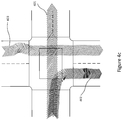
- FIGS. 4 a , 4 b , 4 c and 4 d illustrate prior trajectory information used by an embodiment
- FIGS. 5 a and 5 b illustrate samples of estimated positions produced in accordance with an embodiment
- FIG. 6 depicts the logic flow of an embodiment
- FIG. 7 illustrates samples of estimated positions produced in accordance with an embodiment
- FIG. 8 illustrates an example embodiment of the present invention to predict the future position of a detected vehicle at an intersection.
- FIG. 1 depicts one of the problems seen by current methods of predicting future motion. More specifically, the illustration relates to motion models that rely on linear extrapolation of motion data.
- the figure shows a bird's eye view of a four-way road intersection 100 .
- a first vehicle 101 is depicted approaching the intersection.
- the position of the first vehicle at a first time, t, is shown as 101 a and the position of the first vehicle ata second time, t+1, is shown as 101 b .
- the trajectory of the first vehicle is indicated as a straight path 103 .
- a second vehicle 102 is also depicted in the figure.
- the second vehicle is seen mid-way through the intersection at the first time, t, shown as 102 a and the second time, t+1, shown as 102 b .
- the position on the second vehicle is likely to be in the area indicated by 106
- the linear model assumes the second vehicle is traversing along a second straight path 104 .
- the linear model expects the two vehicles to collide at point 105 which is the point the first 103 and second 104 straight paths intersect.
- CTRA constant turn rate and acceleration model
- CTRV constant turn rate and velocity
- CSAV constant steering angle and velocity
- CCA constant curvature and acceleration
- CV constant velocity
- CA constant acceleration
- Dynamic Bayesian networks As opposed to explicitly crafting vehicle dynamics, Dynamic Bayesian networks, Gaussian mixture models, Hidden Markov models, Neural networks or a combination of these techniques are used to provide data-driven approaches to vehicle dynamics. Although these approaches achieve better performance than pure vehicle dynamics based approaches, they are either trained for specific limited scenarios (e.g., highways) or tend to learn a general model that does not utilise environment specific cues such as traffic pattern in the area, changes in the environment structure, etc.
- the first step of the method implemented by the invention is to detect a moving object, such as a vehicle, and capture data relating to the observed state of the moving vehicle 201 .
- a moving object such as a vehicle
- capture data relating to the observed state of the moving vehicle 201 There is no restriction to the methods used to initially detect a moving vehicle.
- the use of neural networks may be incorporated to identify an object and place a bounding box around the pixels that represent the object.
- the method then brings together trajectory data of vehicles that have previously traversed the area in which the new moving vehicle was detected.
- the preferred option is to extract data from map data that was constructed using structure-from-motion techniques. This advantageously enables a large amount of crowd-sourced high-quality motion data to drive the motion prediction of this invention.
- this type of data can be collected by equipping a large fleet of vehicles with cameras and performing structure-from-motion at a city scale to accurately reconstruct their trajectories.
- this data can be used a sample for the underlying motion distribution in the area and be used for future motion prediction of newly observed cars.
- Structure from motion methods have the benefits of needing zero human annotation as it implicitly captures modelled and unmodelled aspects of the vehicle motion, scales to large city-scale scenarios and improves with time as the amount of data increases.
- This data is usually built up of sequential images over a period of time. Additionally, each image also includes pose information which can be used to vehicles position, rotation and velocity along its path.
- Example city scale map datasets are depicted in FIGS. 3 a and 3 b .
- the datasets shown in these figures were compiled using over ten million images captured in San Francisco and New York using dash-cam mounted mobile phones. The images were used to perform large-scale structure-from-motion to reconstruct accurate vehicle trajectories in the cities over a period of several weeks. Although a monocular camera of a mobile phone was executed to derive the datasets shown in this figure, any type of visual sensor may be used to compile the initial sequential image data. As a result, prior trajectory data can be automatically extracted as a by-product of building a large-scale crowd-sourced 3D map of the environment.
- FIG. 4 a illustrates the trajectories 400 extracted from the San Francisco data set, as generated by a randomised fleet of vehicles, which is used by this invention as prior trajectory data.
- FIGS. 4 b , 4 c and 4 d correspond to points 410 , 420 and 430 , respectively, in FIG. 4 a .
- These figures illustrate a few paths taken by the fleet of vehicles ( 401 , 402 , 403 , 404 ) and their respective orientations.
- These figures illustrate the vehicles' motion along a curved road ( FIG. 4 b ), an intersection ( FIG. 4 c ) and a straight road ( FIG. 4 d ).
- the invention utilises location specific information for accurate future predictions. Instead of learning a global generic model or relying on limited variable models, the invention relies on historical vehicle trajectories in the locality of a newly detected vehicle to perform on-the-fly future position prediction, in substantially real time.
- the motion prior data comprises of a large set of individual trajectory samples that contain accurate 3D positions and rotations of vehicles driven through the area in the past.
- this method there is no requirement to use manual or semantic annotations of the environment or any knowledge of traffic rules. Instead it is assumed that each trajectory or path implicitly captures all relevant local and road information in the behaviour of the vehicle's motion.
- a number of future positions of the newly observed vehicle are estimated 203 .
- the newly observed vehicle is following the same path and trajectory pattern as one of the previous vehicles at the same location.
- FIGS. 5 a and 5 b Examples of estimated future positions or samples can be seen in FIGS. 5 a and 5 b , where 501 illustrates a newly observed vehicle at a first time, t, and 502 illustrates the estimated future positions of the vehicle and a second time, t+1.
- the samples are constrained by assessing the likelihood of the observed vehicle following the path of the one or more samples 204 .
- K ⁇ ( s j i , s 0 ) exp ⁇ ⁇ - ⁇ x j i - x 0 ⁇ 2 ⁇ x 2 - ⁇ r j i - r 0 ⁇ 2 ⁇ r 2 - ⁇ v j i - v 0 ⁇ 2 ⁇ v 2 ⁇
- 2 is the Euclidean distance between the sample position and the observed position of the vehicle in the 3D space
- 2 is the relative difference of heading angles between the sample and the observed vehicle and
- 2 is the difference in linear speed.
- the parameters ⁇ x , ⁇ r , and ⁇ v model the relevance of the individual factors.
- s 0 , G) can be evaluated explicitly in a closed form.
- a sampling procedure can be implemented efficiently by first sampling the corresponding prior state s j i according to relevance factor K, performing table look-up for s j+t i and adding noise. This is depicted in FIG. 6 .
- FIG. 7 An example of future vehicle motion prediction is illustrated in FIG. 7 .
- 701 represents an observed vehicle at a query position and a velocity at time t.
- the groupings of 702 and 703 represent the distribution of predicted samples of the vehicle at a time of t+5.
- the road ahead of the vehicle is a one-way road in the opposite direction of the vehicle's motion. Without needing any manual input of road traffic signage, the method implicitly captures this information by using the paths of previous vehicles in the area. Thus, the only two potential options for the vehicle is taking a left or right at the intersection.
- FIG. 5 also illustrates samples drawn from prior data. As depicted, sampling follows the previously observed trajectories of prior motion in the area while parameters a model the relevance of the individual components to the state of the observed vehicle. For example, a small value of ⁇ v ( FIG. 5 a ) results in predictions matching the current velocity of the newly observed vehicle while a larger ⁇ v ( FIG. 5 b ) results in future predictions sampled using a wider variety of the previously observed initial velocities.
- FIG. 8 depicts how the method of this invention predicts the future movements of a vehicle in the same scenario.
- 801 depicts a cluster of estimated future positions of the vehicle 102 using prior trajectory data.
- this invention can be used universally as a motion-prediction step in various vehicle-tracking systems for the purpose of vehicle safety and autonomy.
- the system may be used to drive motion prediction on a large scale in a variety of environmental and traffic conditions. Specifically, by creating large-scale accurate dataset of vehicle motion priors as a by-product of building a crowd-sourced city-scale 3D map of the environment and predicting a new vehicle's future position using the extracted prior data from the area.
- the method vastly improves the precision over traditional methods and also demonstrates continuously improving performance as the amount of prior data grows.
- the invention can be implemented by or as a system comprising: at least one processor; and a memory storing instructions that, when executed by the at least one processor, cause the system to perform the invention.
- the invention can be implemented by or as a computer program product comprising instructions which, when executed by a computer, cause the computer to perform a method comprising the invention.
- means plus function features may be expressed alternatively in terms of their corresponding structure.
- Any feature in one aspect may be applied to other aspects, in any appropriate combination.
- method aspects may be applied to system aspects, and vice versa.
- any, some and/or all features in one aspect can be applied to any, some and/or all features in any other aspect, in any appropriate combination.
Landscapes
- Engineering & Computer Science (AREA)
- Physics & Mathematics (AREA)
- General Physics & Mathematics (AREA)
- Theoretical Computer Science (AREA)
- Remote Sensing (AREA)
- Radar, Positioning & Navigation (AREA)
- Multimedia (AREA)
- Automation & Control Theory (AREA)
- Data Mining & Analysis (AREA)
- Software Systems (AREA)
- Computer Vision & Pattern Recognition (AREA)
- Evolutionary Computation (AREA)
- Databases & Information Systems (AREA)
- Artificial Intelligence (AREA)
- Aviation & Aerospace Engineering (AREA)
- Mathematical Physics (AREA)
- Pure & Applied Mathematics (AREA)
- Mathematical Optimization (AREA)
- Mathematical Analysis (AREA)
- Computational Mathematics (AREA)
- General Engineering & Computer Science (AREA)
- Bioinformatics & Computational Biology (AREA)
- Evolutionary Biology (AREA)
- Bioinformatics & Cheminformatics (AREA)
- Life Sciences & Earth Sciences (AREA)
- Probability & Statistics with Applications (AREA)
- Computing Systems (AREA)
- Medical Informatics (AREA)
- General Health & Medical Sciences (AREA)
- Health & Medical Sciences (AREA)
- Mechanical Engineering (AREA)
- Algebra (AREA)
- Operations Research (AREA)
- Transportation (AREA)
- Electromagnetism (AREA)
- Traffic Control Systems (AREA)
- Image Analysis (AREA)
- Navigation (AREA)
Abstract
Description
s 0=(x 0 ,r 0 ,v 0)
s t =s j+t i+ϵ
where Z is a normalisation factor:
Z=ΣK(s j i ,s 0),
and K(sj i, s0) measures the similarity of a prior state to the current state of a newly observed vehicle, capturing the likelihood that it can indeed follow the exhibited prior motion pattern. This similarity is modelled as the sum of a number of individual factors:
||xj i−x0||2 is the Euclidean distance between the sample position and the observed position of the vehicle in the 3D space, ||rj i−r0||2 is the relative difference of heading angles between the sample and the observed vehicle and ||vj i−v0||2 is the difference in linear speed. The parameters σx, σr, and σv model the relevance of the individual factors.
Claims (20)
Applications Claiming Priority (5)
| Application Number | Priority Date | Filing Date | Title |
|---|---|---|---|
| GBGB1804195.4A GB201804195D0 (en) | 2018-03-15 | 2018-03-15 | Visual vehicle tracking through noise and occlusions using crowd-sourced maps |
| GB1804195.4 | 2018-03-15 | ||
| GB1810796.1 | 2018-06-29 | ||
| GBGB1810796.1A GB201810796D0 (en) | 2018-03-15 | 2018-06-29 | Vehicle tracking |
| PCT/GB2019/050514 WO2019175533A1 (en) | 2018-03-15 | 2019-02-25 | Vehicle tracking |
Related Parent Applications (1)
| Application Number | Title | Priority Date | Filing Date |
|---|---|---|---|
| PCT/GB2019/050514 Continuation WO2019175533A1 (en) | 2018-03-15 | 2019-02-25 | Vehicle tracking |
Publications (2)
| Publication Number | Publication Date |
|---|---|
| US20190322275A1 US20190322275A1 (en) | 2019-10-24 |
| US10696300B2 true US10696300B2 (en) | 2020-06-30 |
Family
ID=62017821
Family Applications (3)
| Application Number | Title | Priority Date | Filing Date |
|---|---|---|---|
| US16/459,575 Active US10696300B2 (en) | 2018-03-15 | 2019-07-01 | Vehicle tracking |
| US16/459,590 Active US10668921B2 (en) | 2018-03-15 | 2019-07-01 | Enhanced vehicle tracking |
| US16/862,058 Active 2039-07-24 US11299151B2 (en) | 2018-03-15 | 2020-04-29 | Enhanced vehicle tracking |
Family Applications After (2)
| Application Number | Title | Priority Date | Filing Date |
|---|---|---|---|
| US16/459,590 Active US10668921B2 (en) | 2018-03-15 | 2019-07-01 | Enhanced vehicle tracking |
| US16/862,058 Active 2039-07-24 US11299151B2 (en) | 2018-03-15 | 2020-04-29 | Enhanced vehicle tracking |
Country Status (10)
| Country | Link |
|---|---|
| US (3) | US10696300B2 (en) |
| EP (2) | EP3765998A1 (en) |
| CN (2) | CN111771207B (en) |
| AU (2) | AU2019235504B2 (en) |
| CA (2) | CA3086261A1 (en) |
| GB (3) | GB201804195D0 (en) |
| IL (2) | IL277317A (en) |
| MX (2) | MX2020007949A (en) |
| SG (2) | SG11202005922QA (en) |
| WO (2) | WO2019175533A1 (en) |
Families Citing this family (23)
| Publication number | Priority date | Publication date | Assignee | Title |
|---|---|---|---|---|
| JP6882601B2 (en) * | 2018-05-17 | 2021-06-02 | 三菱電機株式会社 | Driving support device, driving support method, driving support program |
| US10914813B2 (en) * | 2018-08-21 | 2021-02-09 | Aptiv Technologies Limited | Classifying potentially stationary objects tracked by radar |
| JP7169832B2 (en) * | 2018-09-27 | 2022-11-11 | 株式会社Subaru | MOBILE OBJECT MONITORING DEVICE FOR VEHICLE AND VEHICLE CONTROL SYSTEM USING THE SAME |
| JP7203563B2 (en) * | 2018-10-29 | 2023-01-13 | 日立Astemo株式会社 | Mobile object behavior prediction device |
| DE102019102679B4 (en) * | 2019-02-04 | 2026-01-29 | Bayerische Motoren Werke Aktiengesellschaft | Method, device, computer program and computer program product for providing a trajectory of an object to a vehicle for use in vehicle control functions |
| JP7332403B2 (en) * | 2019-09-11 | 2023-08-23 | 株式会社東芝 | Position estimation device, mobile control system, position estimation method and program |
| CN111080671B (en) * | 2019-12-27 | 2023-06-23 | 深圳大学 | A motion prediction method and intelligent terminal based on deep neural network |
| US11351993B2 (en) * | 2020-01-17 | 2022-06-07 | Denso Corporation | Systems and methods for adapting a driving assistance system according to the presence of a trailer |
| US11878712B2 (en) * | 2020-02-26 | 2024-01-23 | Baidu Usa Llc | Trajectory planning with obstacle avoidance for autonomous driving vehicles |
| US11604075B2 (en) | 2020-03-30 | 2023-03-14 | Woven Planet North America, Inc. | Systems and methods for deriving planned paths for vehicles using path priors |
| US11699239B2 (en) | 2020-04-21 | 2023-07-11 | The Board of Trustees of the University of Illinois (Urbana, IL) | Image processing method and apparatus |
| EP4139765B1 (en) * | 2020-04-27 | 2024-06-19 | Starship Technologies OÜ | Methods, devices and systems for facilitating operations of mobile robots |
| US12030507B2 (en) * | 2020-06-29 | 2024-07-09 | Dr. Ing. H.C. F. Porsche Aktiengesellschaft | Method and system for predicting a trajectory of a target vehicle in an environment of a vehicle |
| KR102822862B1 (en) * | 2020-08-25 | 2025-06-19 | 삼성전자주식회사 | Method and apparatus for video quality improvement |
| US12122421B2 (en) | 2021-05-17 | 2024-10-22 | Toyota Research Institute, Inc. | Method for improving temporal consistency of planned maneuvers |
| CN113920166B (en) * | 2021-10-29 | 2024-05-28 | 广州文远知行科技有限公司 | Method, device, vehicle and storage medium for selecting object motion model |
| US12012122B1 (en) * | 2022-04-08 | 2024-06-18 | Zoox, Inc. | Object orientation estimator |
| US20230391365A1 (en) * | 2022-06-06 | 2023-12-07 | Nvidia Corporation | Techniques for generating simulations for autonomous machines and applications |
| US12485921B2 (en) * | 2022-09-01 | 2025-12-02 | Imagry Israel Ltd | Alternative driving models for autonomous vehicles |
| CN115909270B (en) * | 2022-11-09 | 2026-01-02 | 黑芝麻智能科技有限公司 | Target detection methods and devices, computer equipment and media for driving assistance |
| US20240157934A1 (en) * | 2022-11-15 | 2024-05-16 | Geotab Inc. | Systems and methods for generating vehicle safety scores and predicting vehicle collision probabilities |
| US11776206B1 (en) * | 2022-12-23 | 2023-10-03 | Awe Company Limited | Extended reality system and extended reality method with two-way digital interactive digital twins |
| CN117011792A (en) * | 2023-08-04 | 2023-11-07 | 上海西井科技股份有限公司 | Vehicle tracking methods, systems, equipment and storage media based on semi-closed scenes |
Citations (10)
| Publication number | Priority date | Publication date | Assignee | Title |
|---|---|---|---|---|
| US7610182B2 (en) * | 2000-03-10 | 2009-10-27 | Electronic Arts, Inc. | Image display apparatus, method and program based on rigid body dynamics |
| US20140327792A1 (en) | 2013-05-02 | 2014-11-06 | Qualcomm Incorporated | Methods for facilitating computer vision application initialization |
| US9120484B1 (en) | 2010-10-05 | 2015-09-01 | Google Inc. | Modeling behavior based on observations of objects observed in a driving environment |
| US9483948B1 (en) | 2015-08-07 | 2016-11-01 | International Business Machines Corporation | Automated control of interactions between self-driving vehicles and pedestrians |
| US9495874B1 (en) | 2012-04-13 | 2016-11-15 | Google Inc. | Automated system and method for modeling the behavior of vehicles and other agents |
| US20160334797A1 (en) | 2015-05-13 | 2016-11-17 | Uber Technologies, Inc. | Selecting vehicle type for providing transport |
| WO2017035663A1 (en) | 2015-09-03 | 2017-03-09 | Miovision Technologies Incorporated | System and method for detecting and tracking objects |
| GB2545550A (en) | 2015-11-05 | 2017-06-21 | Ford Global Tech Llc | Autonomous driving at intersections based on perception data |
| US20170177937A1 (en) | 2015-12-18 | 2017-06-22 | Iris Automation, Inc. | Systems and methods for dynamic object tracking using a single camera mounted on a moving object |
| US20170301107A1 (en) | 2014-12-10 | 2017-10-19 | Mitsubishi Electric Corporation | Image processing device, in-vehicle display system, display device, image processing method, and computer readable medium |
Family Cites Families (13)
| Publication number | Priority date | Publication date | Assignee | Title |
|---|---|---|---|---|
| FR2889882B1 (en) * | 2005-08-19 | 2009-09-25 | Renault Sas | METHOD AND SYSTEM FOR PREDICTING IMPACT BETWEEN A VEHICLE AND A PIETON |
| US8605947B2 (en) * | 2008-04-24 | 2013-12-10 | GM Global Technology Operations LLC | Method for detecting a clear path of travel for a vehicle enhanced by object detection |
| CN102169366B (en) * | 2011-03-18 | 2012-11-07 | 汤牧天 | Multi-target tracking method in three-dimensional space |
| EP2615598B1 (en) * | 2012-01-11 | 2017-12-06 | Honda Research Institute Europe GmbH | Vehicle with computing means for monitoring and predicting traffic participant objects |
| US20140078304A1 (en) * | 2012-09-20 | 2014-03-20 | Cloudcar, Inc. | Collection and use of captured vehicle data |
| US9975550B2 (en) * | 2013-05-31 | 2018-05-22 | Toyota Jidosha Kabushiki Kaisha | Movement trajectory predicting device and movement trajectory predicting method |
| CN104882025B (en) * | 2015-05-13 | 2017-02-22 | 东华大学 | Crashing detecting and warning method based on vehicle network technology |
| DE102015220360A1 (en) * | 2015-10-20 | 2017-04-20 | Robert Bosch Gmbh | Method for selecting an optimized trajectory |
| US9846050B2 (en) | 2016-03-21 | 2017-12-19 | Ford Global Technologies, Llc | Systems, methods, and devices for communicating drive history path attributes |
| CN105717661B (en) | 2016-04-14 | 2018-06-26 | 维林光电(苏州)有限公司 | A kind of scattered spot laser being concerned with based on low time coherence and low spatial and preparation method thereof |
| CN106950956B (en) * | 2017-03-22 | 2020-02-14 | 合肥工业大学 | Vehicle track prediction system integrating kinematics model and behavior cognition model |
| CN107200016B (en) * | 2017-05-26 | 2019-11-08 | 重庆长安汽车股份有限公司 | Road adaptive forecasting method and the Vehicular system for using this method |
| CN107221195B (en) * | 2017-05-26 | 2020-03-17 | 重庆长安汽车股份有限公司 | Automobile lane prediction method and lane level map |
-
2018
- 2018-03-15 GB GBGB1804195.4A patent/GB201804195D0/en not_active Ceased
- 2018-06-29 GB GBGB1810797.9A patent/GB201810797D0/en not_active Ceased
- 2018-06-29 GB GBGB1810796.1A patent/GB201810796D0/en not_active Ceased
-
2019
- 2019-02-25 SG SG11202005922QA patent/SG11202005922QA/en unknown
- 2019-02-25 MX MX2020007949A patent/MX2020007949A/en unknown
- 2019-02-25 CA CA3086261A patent/CA3086261A1/en active Pending
- 2019-02-25 MX MX2020007950A patent/MX2020007950A/en unknown
- 2019-02-25 WO PCT/GB2019/050514 patent/WO2019175533A1/en not_active Ceased
- 2019-02-25 CN CN201980008142.3A patent/CN111771207B/en active Active
- 2019-02-25 EP EP19708651.5A patent/EP3765998A1/en active Pending
- 2019-02-25 CN CN201980008090.XA patent/CN111788571A/en active Pending
- 2019-02-25 AU AU2019235504A patent/AU2019235504B2/en not_active Ceased
- 2019-02-25 AU AU2019233779A patent/AU2019233779B2/en not_active Ceased
- 2019-02-25 SG SG11202005921SA patent/SG11202005921SA/en unknown
- 2019-02-25 CA CA3087250A patent/CA3087250A1/en active Pending
- 2019-02-25 WO PCT/GB2019/050515 patent/WO2019175534A1/en not_active Ceased
- 2019-02-25 EP EP19708650.7A patent/EP3765997A1/en not_active Withdrawn
- 2019-07-01 US US16/459,575 patent/US10696300B2/en active Active
- 2019-07-01 US US16/459,590 patent/US10668921B2/en active Active
-
2020
- 2020-04-29 US US16/862,058 patent/US11299151B2/en active Active
- 2020-09-13 IL IL277317A patent/IL277317A/en unknown
- 2020-09-13 IL IL277318A patent/IL277318A/en unknown
Patent Citations (10)
| Publication number | Priority date | Publication date | Assignee | Title |
|---|---|---|---|---|
| US7610182B2 (en) * | 2000-03-10 | 2009-10-27 | Electronic Arts, Inc. | Image display apparatus, method and program based on rigid body dynamics |
| US9120484B1 (en) | 2010-10-05 | 2015-09-01 | Google Inc. | Modeling behavior based on observations of objects observed in a driving environment |
| US9495874B1 (en) | 2012-04-13 | 2016-11-15 | Google Inc. | Automated system and method for modeling the behavior of vehicles and other agents |
| US20140327792A1 (en) | 2013-05-02 | 2014-11-06 | Qualcomm Incorporated | Methods for facilitating computer vision application initialization |
| US20170301107A1 (en) | 2014-12-10 | 2017-10-19 | Mitsubishi Electric Corporation | Image processing device, in-vehicle display system, display device, image processing method, and computer readable medium |
| US20160334797A1 (en) | 2015-05-13 | 2016-11-17 | Uber Technologies, Inc. | Selecting vehicle type for providing transport |
| US9483948B1 (en) | 2015-08-07 | 2016-11-01 | International Business Machines Corporation | Automated control of interactions between self-driving vehicles and pedestrians |
| WO2017035663A1 (en) | 2015-09-03 | 2017-03-09 | Miovision Technologies Incorporated | System and method for detecting and tracking objects |
| GB2545550A (en) | 2015-11-05 | 2017-06-21 | Ford Global Tech Llc | Autonomous driving at intersections based on perception data |
| US20170177937A1 (en) | 2015-12-18 | 2017-06-22 | Iris Automation, Inc. | Systems and methods for dynamic object tracking using a single camera mounted on a moving object |
Non-Patent Citations (5)
| Title |
|---|
| Chen et al., "Modeling and Predicting Future Trajectories of Moving Objects in a Constrained Network", Mobile Data Management, MDM 2006, 7th International Conference on Nara, Japan, May 10-12, 2006, p. 156. |
| Leibe, et al. "Dynamic 3D Scene Analysis from a Moving Vehicle", IEEE Conference on Computer Vision and Pattern Recognition, Jun. 2007. |
| Nadembega et at., "A Destination Prediction Model based on historical data, contextual knowledge and spatial conceptual maps", Communications (ICC), IEEE International Conference, Jun. 10, 2012, pp. 1416-1420. |
| Nizetic et al., "Automation of the moving objects movement predicition process independent of the application area", Computer Science and Information Systems, vol. 7, No. 4, Jan. 2010, pp. 931-45. |
| Vu et al., "A method for predicting future location of a mobile user for location-based services system", Computers & Industrial Engineering, vol. 57, Iss. 1, Aug. 1, 2009, pp. 91-105. |
Also Published As
| Publication number | Publication date |
|---|---|
| US20190323852A1 (en) | 2019-10-24 |
| CA3086261A1 (en) | 2019-09-19 |
| IL277317A (en) | 2020-10-29 |
| AU2019235504B2 (en) | 2022-03-17 |
| SG11202005921SA (en) | 2020-07-29 |
| CN111771207B (en) | 2024-09-27 |
| AU2019233779A1 (en) | 2020-10-08 |
| US20190322275A1 (en) | 2019-10-24 |
| SG11202005922QA (en) | 2020-07-29 |
| AU2019235504A1 (en) | 2020-10-08 |
| WO2019175534A1 (en) | 2019-09-19 |
| CA3087250A1 (en) | 2019-09-19 |
| CN111788571A (en) | 2020-10-16 |
| MX2020007950A (en) | 2020-09-24 |
| US20200377084A1 (en) | 2020-12-03 |
| IL277318A (en) | 2020-10-29 |
| MX2020007949A (en) | 2020-09-24 |
| GB201810796D0 (en) | 2018-08-15 |
| US11299151B2 (en) | 2022-04-12 |
| AU2019233779B2 (en) | 2022-03-10 |
| CN111771207A (en) | 2020-10-13 |
| GB201804195D0 (en) | 2018-05-02 |
| GB201810797D0 (en) | 2018-08-15 |
| EP3765997A1 (en) | 2021-01-20 |
| US10668921B2 (en) | 2020-06-02 |
| EP3765998A1 (en) | 2021-01-20 |
| WO2019175533A1 (en) | 2019-09-19 |
Similar Documents
| Publication | Publication Date | Title |
|---|---|---|
| AU2019233779B2 (en) | Vehicle tracking | |
| Wang et al. | Simultaneous localization, mapping and moving object tracking | |
| CN108983781B (en) | An environment detection method in an unmanned vehicle target search system | |
| US20250362133A1 (en) | Systems, Methods and Devices for Map-Based Object's Localization Deep Learning and Object's Motion Trajectories on Geospatial Maps Using Neural Network | |
| Pool et al. | Using road topology to improve cyclist path prediction | |
| CN108959321B (en) | Parking lot map construction method, system, mobile terminal and storage medium | |
| Kucner et al. | Probabilistic mapping of spatial motion patterns for mobile robots | |
| Gies et al. | Environment perception framework fusing multi-object tracking, dynamic occupancy grid maps and digital maps | |
| Rabe et al. | Ego-lane estimation for lane-level navigation in urban scenarios | |
| Choi et al. | Local volumetric hybrid-map-based simultaneous localization and mapping with moving object tracking | |
| Wang et al. | Offline mapping for autonomous vehicles with low-cost sensors | |
| Lee et al. | Fail-safe multi-modal localization framework using heterogeneous map-matching sources | |
| Meyer et al. | Anytime lane-level intersection estimation based on trajectories of other traffic participants | |
| Mueller et al. | GIS-based topological robot localization through LIDAR crossroad detection | |
| Zhou et al. | An autonomous navigation approach for unmanned vehicle in off-road environment with self-supervised traversal cost prediction | |
| Suraj et al. | Predicting trajectories of vehicles using large-scale motion priors | |
| Chipka et al. | Estimation and navigation methods with limited information for autonomous urban driving | |
| Chipka et al. | Autonomous urban localization and navigation with limited information | |
| Zhuy et al. | On the ecosystem of high-definition (hd) maps | |
| Li et al. | Improving vehicle localization with lane marking detection based on visual perception and geographic information | |
| HK40029688A (en) | Vehicle tracking | |
| Mohammadbagher | Self-localization for autonomous driving using vector maps and multi-modal odometry | |
| Azim | 3D perception of outdoor and dynamic environment using laser scanner | |
| Suraj et al. | Visual vehicle tracking through noise and occlusions using crowd-sourced maps | |
| HK40028825A (en) | Enhanced vehicle tracking |
Legal Events
| Date | Code | Title | Description |
|---|---|---|---|
| FEPP | Fee payment procedure |
Free format text: ENTITY STATUS SET TO UNDISCOUNTED (ORIGINAL EVENT CODE: BIG.); ENTITY STATUS OF PATENT OWNER: LARGE ENTITY |
|
| STPP | Information on status: patent application and granting procedure in general |
Free format text: NON FINAL ACTION MAILED |
|
| AS | Assignment |
Owner name: LYFT, INC., CALIFORNIA Free format text: ASSIGNMENT OF ASSIGNORS INTEREST;ASSIGNORS:ONDRUSKA, PETER;PLATINSKY, LUKAS;SIGNING DATES FROM 20190730 TO 20190922;REEL/FRAME:050705/0568 |
|
| STPP | Information on status: patent application and granting procedure in general |
Free format text: RESPONSE TO NON-FINAL OFFICE ACTION ENTERED AND FORWARDED TO EXAMINER |
|
| AS | Assignment |
Owner name: BLUE VISION LABS UK LIMITED, GREAT BRITAIN Free format text: CORRECTIVE ASSIGNMENT TO CORRECT THE RECEIVING PARTY NAME PREVIOUSLY RECORDED AT REEL: 50705 FRAME: 568. ASSIGNOR(S) HEREBY CONFIRMS THE ASSIGNMENT;ASSIGNORS:ONDRUSKA, PETER;PLATINSKY, LUKAS;SIGNING DATES FROM 20190730 TO 20190922;REEL/FRAME:051188/0157 |
|
| STPP | Information on status: patent application and granting procedure in general |
Free format text: NOTICE OF ALLOWANCE MAILED -- APPLICATION RECEIVED IN OFFICE OF PUBLICATIONS |
|
| AS | Assignment |
Owner name: BLUE VISION LABS UK LIMITED, GREAT BRITAIN Free format text: ASSIGNMENT OF ASSIGNORS INTEREST;ASSIGNOR:SURENDRAN, SURAJ MANNAKUNNEL;REEL/FRAME:051583/0936 Effective date: 20200116 |
|
| STPP | Information on status: patent application and granting procedure in general |
Free format text: NOTICE OF ALLOWANCE MAILED -- APPLICATION RECEIVED IN OFFICE OF PUBLICATIONS |
|
| STCF | Information on status: patent grant |
Free format text: PATENTED CASE |
|
| AS | Assignment |
Owner name: WOVEN PLANET NORTH AMERICA, INC., CALIFORNIA Free format text: ASSIGNMENT OF ASSIGNORS INTEREST;ASSIGNORS:LYFT, INC.;BLUE VISION LABS UK LIMITED;REEL/FRAME:056927/0001 Effective date: 20210713 |
|
| AS | Assignment |
Owner name: WOVEN BY TOYOTA, U.S., INC., CALIFORNIA Free format text: CHANGE OF NAME;ASSIGNOR:WOVEN PLANET NORTH AMERICA, INC.;REEL/FRAME:064065/0601 Effective date: 20230322 |
|
| MAFP | Maintenance fee payment |
Free format text: PAYMENT OF MAINTENANCE FEE, 4TH YEAR, LARGE ENTITY (ORIGINAL EVENT CODE: M1551); ENTITY STATUS OF PATENT OWNER: LARGE ENTITY Year of fee payment: 4 |