US10694948B2 - Methods of exoskeleton communication and control - Google Patents
Methods of exoskeleton communication and control Download PDFInfo
- Publication number
- US10694948B2 US10694948B2 US15/566,146 US201615566146A US10694948B2 US 10694948 B2 US10694948 B2 US 10694948B2 US 201615566146 A US201615566146 A US 201615566146A US 10694948 B2 US10694948 B2 US 10694948B2
- Authority
- US
- United States
- Prior art keywords
- exoskeleton
- data
- wearer
- central server
- peripheral device
- Prior art date
- Legal status (The legal status is an assumption and is not a legal conclusion. Google has not performed a legal analysis and makes no representation as to the accuracy of the status listed.)
- Active, expires
Links
- 0 CCNCCC(CCC1)CC1(C)C(C1)C11CC(CC*)CCC1 Chemical compound CCNCCC(CCC1)CC1(C)C(C1)C11CC(CC*)CCC1 0.000 description 4
Images




Classifications
-
- A—HUMAN NECESSITIES
- A61—MEDICAL OR VETERINARY SCIENCE; HYGIENE
- A61B—DIAGNOSIS; SURGERY; IDENTIFICATION
- A61B5/00—Measuring for diagnostic purposes; Identification of persons
- A61B5/0002—Remote monitoring of patients using telemetry, e.g. transmission of vital signals via a communication network
- A61B5/0015—Remote monitoring of patients using telemetry, e.g. transmission of vital signals via a communication network characterised by features of the telemetry system
- A61B5/0024—Remote monitoring of patients using telemetry, e.g. transmission of vital signals via a communication network characterised by features of the telemetry system for multiple sensor units attached to the patient, e.g. using a body or personal area network
-
- A—HUMAN NECESSITIES
- A61—MEDICAL OR VETERINARY SCIENCE; HYGIENE
- A61B—DIAGNOSIS; SURGERY; IDENTIFICATION
- A61B5/00—Measuring for diagnostic purposes; Identification of persons
- A61B5/103—Measuring devices for testing the shape, pattern, colour, size or movement of the body or parts thereof, for diagnostic purposes
- A61B5/11—Measuring movement of the entire body or parts thereof, e.g. head or hand tremor or mobility of a limb
- A61B5/1116—Determining posture transitions
-
- A—HUMAN NECESSITIES
- A61—MEDICAL OR VETERINARY SCIENCE; HYGIENE
- A61B—DIAGNOSIS; SURGERY; IDENTIFICATION
- A61B5/00—Measuring for diagnostic purposes; Identification of persons
- A61B5/103—Measuring devices for testing the shape, pattern, colour, size or movement of the body or parts thereof, for diagnostic purposes
- A61B5/11—Measuring movement of the entire body or parts thereof, e.g. head or hand tremor or mobility of a limb
- A61B5/112—Gait analysis
-
- A—HUMAN NECESSITIES
- A61—MEDICAL OR VETERINARY SCIENCE; HYGIENE
- A61B—DIAGNOSIS; SURGERY; IDENTIFICATION
- A61B5/00—Measuring for diagnostic purposes; Identification of persons
- A61B5/22—Ergometry; Measuring muscular strength or the force of a muscular blow
- A61B5/224—Measuring muscular strength
-
- A—HUMAN NECESSITIES
- A61—MEDICAL OR VETERINARY SCIENCE; HYGIENE
- A61B—DIAGNOSIS; SURGERY; IDENTIFICATION
- A61B5/00—Measuring for diagnostic purposes; Identification of persons
- A61B5/48—Other medical applications
- A61B5/486—Biofeedback
-
- A—HUMAN NECESSITIES
- A61—MEDICAL OR VETERINARY SCIENCE; HYGIENE
- A61H—PHYSICAL THERAPY APPARATUS, e.g. DEVICES FOR LOCATING OR STIMULATING REFLEX POINTS IN THE BODY; ARTIFICIAL RESPIRATION; MASSAGE; BATHING DEVICES FOR SPECIAL THERAPEUTIC OR HYGIENIC PURPOSES OR SPECIFIC PARTS OF THE BODY
- A61H1/00—Apparatus for passive exercising; Vibrating apparatus; Chiropractic devices, e.g. body impacting devices, external devices for briefly extending or aligning unbroken bones
- A61H1/02—Stretching or bending or torsioning apparatus for exercising
- A61H1/0237—Stretching or bending or torsioning apparatus for exercising for the lower limbs
- A61H1/0255—Both knee and hip of a patient, e.g. in supine or sitting position, the feet being moved together in a plane substantially parallel to the body-symmetrical plane
-
- A—HUMAN NECESSITIES
- A61—MEDICAL OR VETERINARY SCIENCE; HYGIENE
- A61H—PHYSICAL THERAPY APPARATUS, e.g. DEVICES FOR LOCATING OR STIMULATING REFLEX POINTS IN THE BODY; ARTIFICIAL RESPIRATION; MASSAGE; BATHING DEVICES FOR SPECIAL THERAPEUTIC OR HYGIENIC PURPOSES OR SPECIFIC PARTS OF THE BODY
- A61H3/00—Appliances for aiding patients or disabled persons to walk about
-
- G—PHYSICS
- G08—SIGNALLING
- G08C—TRANSMISSION SYSTEMS FOR MEASURED VALUES, CONTROL OR SIMILAR SIGNALS
- G08C17/00—Arrangements for transmitting signals characterised by the use of a wireless electrical link
-
- G—PHYSICS
- G08—SIGNALLING
- G08C—TRANSMISSION SYSTEMS FOR MEASURED VALUES, CONTROL OR SIMILAR SIGNALS
- G08C17/00—Arrangements for transmitting signals characterised by the use of a wireless electrical link
- G08C17/02—Arrangements for transmitting signals characterised by the use of a wireless electrical link using a radio link
-
- A—HUMAN NECESSITIES
- A61—MEDICAL OR VETERINARY SCIENCE; HYGIENE
- A61B—DIAGNOSIS; SURGERY; IDENTIFICATION
- A61B2505/00—Evaluating, monitoring or diagnosing in the context of a particular type of medical care
- A61B2505/09—Rehabilitation or training
-
- A—HUMAN NECESSITIES
- A61—MEDICAL OR VETERINARY SCIENCE; HYGIENE
- A61B—DIAGNOSIS; SURGERY; IDENTIFICATION
- A61B2562/00—Details of sensors; Constructional details of sensor housings or probes; Accessories for sensors
- A61B2562/02—Details of sensors specially adapted for in-vivo measurements
- A61B2562/0247—Pressure sensors
-
- A—HUMAN NECESSITIES
- A61—MEDICAL OR VETERINARY SCIENCE; HYGIENE
- A61B—DIAGNOSIS; SURGERY; IDENTIFICATION
- A61B5/00—Measuring for diagnostic purposes; Identification of persons
- A61B5/01—Measuring temperature of body parts ; Diagnostic temperature sensing, e.g. for malignant or inflamed tissue
-
- A61B5/0402—
-
- A61B5/0476—
-
- A—HUMAN NECESSITIES
- A61—MEDICAL OR VETERINARY SCIENCE; HYGIENE
- A61B—DIAGNOSIS; SURGERY; IDENTIFICATION
- A61B5/00—Measuring for diagnostic purposes; Identification of persons
- A61B5/103—Measuring devices for testing the shape, pattern, colour, size or movement of the body or parts thereof, for diagnostic purposes
- A61B5/11—Measuring movement of the entire body or parts thereof, e.g. head or hand tremor or mobility of a limb
- A61B5/1112—Global tracking of patients, e.g. by using GPS
-
- A—HUMAN NECESSITIES
- A61—MEDICAL OR VETERINARY SCIENCE; HYGIENE
- A61B—DIAGNOSIS; SURGERY; IDENTIFICATION
- A61B5/00—Measuring for diagnostic purposes; Identification of persons
- A61B5/103—Measuring devices for testing the shape, pattern, colour, size or movement of the body or parts thereof, for diagnostic purposes
- A61B5/11—Measuring movement of the entire body or parts thereof, e.g. head or hand tremor or mobility of a limb
- A61B5/1116—Determining posture transitions
- A61B5/1117—Fall detection
-
- A—HUMAN NECESSITIES
- A61—MEDICAL OR VETERINARY SCIENCE; HYGIENE
- A61B—DIAGNOSIS; SURGERY; IDENTIFICATION
- A61B5/00—Measuring for diagnostic purposes; Identification of persons
- A61B5/145—Measuring characteristics of blood in vivo, e.g. gas concentration or pH-value ; Measuring characteristics of body fluids or tissues, e.g. interstitial fluid or cerebral tissue
- A61B5/14532—Measuring characteristics of blood in vivo, e.g. gas concentration or pH-value ; Measuring characteristics of body fluids or tissues, e.g. interstitial fluid or cerebral tissue for measuring glucose, e.g. by tissue impedance measurement
-
- A—HUMAN NECESSITIES
- A61—MEDICAL OR VETERINARY SCIENCE; HYGIENE
- A61H—PHYSICAL THERAPY APPARATUS, e.g. DEVICES FOR LOCATING OR STIMULATING REFLEX POINTS IN THE BODY; ARTIFICIAL RESPIRATION; MASSAGE; BATHING DEVICES FOR SPECIAL THERAPEUTIC OR HYGIENIC PURPOSES OR SPECIFIC PARTS OF THE BODY
- A61H2201/00—Characteristics of apparatus not provided for in the preceding codes
- A61H2201/16—Physical interface with patient
- A61H2201/1602—Physical interface with patient kind of interface, e.g. head rest, knee support or lumbar support
- A61H2201/165—Wearable interfaces
-
- A—HUMAN NECESSITIES
- A61—MEDICAL OR VETERINARY SCIENCE; HYGIENE
- A61H—PHYSICAL THERAPY APPARATUS, e.g. DEVICES FOR LOCATING OR STIMULATING REFLEX POINTS IN THE BODY; ARTIFICIAL RESPIRATION; MASSAGE; BATHING DEVICES FOR SPECIAL THERAPEUTIC OR HYGIENIC PURPOSES OR SPECIFIC PARTS OF THE BODY
- A61H2201/00—Characteristics of apparatus not provided for in the preceding codes
- A61H2201/16—Physical interface with patient
- A61H2201/1657—Movement of interface, i.e. force application means
- A61H2201/1676—Pivoting
-
- A—HUMAN NECESSITIES
- A61—MEDICAL OR VETERINARY SCIENCE; HYGIENE
- A61H—PHYSICAL THERAPY APPARATUS, e.g. DEVICES FOR LOCATING OR STIMULATING REFLEX POINTS IN THE BODY; ARTIFICIAL RESPIRATION; MASSAGE; BATHING DEVICES FOR SPECIAL THERAPEUTIC OR HYGIENIC PURPOSES OR SPECIFIC PARTS OF THE BODY
- A61H2201/00—Characteristics of apparatus not provided for in the preceding codes
- A61H2201/50—Control means thereof
- A61H2201/5007—Control means thereof computer controlled
- A61H2201/501—Control means thereof computer controlled connected to external computer devices or networks
-
- A—HUMAN NECESSITIES
- A61—MEDICAL OR VETERINARY SCIENCE; HYGIENE
- A61H—PHYSICAL THERAPY APPARATUS, e.g. DEVICES FOR LOCATING OR STIMULATING REFLEX POINTS IN THE BODY; ARTIFICIAL RESPIRATION; MASSAGE; BATHING DEVICES FOR SPECIAL THERAPEUTIC OR HYGIENIC PURPOSES OR SPECIFIC PARTS OF THE BODY
- A61H2201/00—Characteristics of apparatus not provided for in the preceding codes
- A61H2201/50—Control means thereof
- A61H2201/5007—Control means thereof computer controlled
- A61H2201/501—Control means thereof computer controlled connected to external computer devices or networks
- A61H2201/5012—Control means thereof computer controlled connected to external computer devices or networks using the internet
-
- A—HUMAN NECESSITIES
- A61—MEDICAL OR VETERINARY SCIENCE; HYGIENE
- A61H—PHYSICAL THERAPY APPARATUS, e.g. DEVICES FOR LOCATING OR STIMULATING REFLEX POINTS IN THE BODY; ARTIFICIAL RESPIRATION; MASSAGE; BATHING DEVICES FOR SPECIAL THERAPEUTIC OR HYGIENIC PURPOSES OR SPECIFIC PARTS OF THE BODY
- A61H2201/00—Characteristics of apparatus not provided for in the preceding codes
- A61H2201/50—Control means thereof
- A61H2201/5023—Interfaces to the user
- A61H2201/5043—Displays
-
- A—HUMAN NECESSITIES
- A61—MEDICAL OR VETERINARY SCIENCE; HYGIENE
- A61H—PHYSICAL THERAPY APPARATUS, e.g. DEVICES FOR LOCATING OR STIMULATING REFLEX POINTS IN THE BODY; ARTIFICIAL RESPIRATION; MASSAGE; BATHING DEVICES FOR SPECIAL THERAPEUTIC OR HYGIENIC PURPOSES OR SPECIFIC PARTS OF THE BODY
- A61H2201/00—Characteristics of apparatus not provided for in the preceding codes
- A61H2201/50—Control means thereof
- A61H2201/5058—Sensors or detectors
-
- A—HUMAN NECESSITIES
- A61—MEDICAL OR VETERINARY SCIENCE; HYGIENE
- A61H—PHYSICAL THERAPY APPARATUS, e.g. DEVICES FOR LOCATING OR STIMULATING REFLEX POINTS IN THE BODY; ARTIFICIAL RESPIRATION; MASSAGE; BATHING DEVICES FOR SPECIAL THERAPEUTIC OR HYGIENIC PURPOSES OR SPECIFIC PARTS OF THE BODY
- A61H2201/00—Characteristics of apparatus not provided for in the preceding codes
- A61H2201/50—Control means thereof
- A61H2201/5058—Sensors or detectors
- A61H2201/5064—Position sensors
-
- A—HUMAN NECESSITIES
- A61—MEDICAL OR VETERINARY SCIENCE; HYGIENE
- A61H—PHYSICAL THERAPY APPARATUS, e.g. DEVICES FOR LOCATING OR STIMULATING REFLEX POINTS IN THE BODY; ARTIFICIAL RESPIRATION; MASSAGE; BATHING DEVICES FOR SPECIAL THERAPEUTIC OR HYGIENIC PURPOSES OR SPECIFIC PARTS OF THE BODY
- A61H2201/00—Characteristics of apparatus not provided for in the preceding codes
- A61H2201/50—Control means thereof
- A61H2201/5058—Sensors or detectors
- A61H2201/5084—Acceleration sensors
-
- A—HUMAN NECESSITIES
- A61—MEDICAL OR VETERINARY SCIENCE; HYGIENE
- A61H—PHYSICAL THERAPY APPARATUS, e.g. DEVICES FOR LOCATING OR STIMULATING REFLEX POINTS IN THE BODY; ARTIFICIAL RESPIRATION; MASSAGE; BATHING DEVICES FOR SPECIAL THERAPEUTIC OR HYGIENIC PURPOSES OR SPECIFIC PARTS OF THE BODY
- A61H2201/00—Characteristics of apparatus not provided for in the preceding codes
- A61H2201/50—Control means thereof
- A61H2201/5097—Control means thereof wireless
-
- A—HUMAN NECESSITIES
- A61—MEDICAL OR VETERINARY SCIENCE; HYGIENE
- A61H—PHYSICAL THERAPY APPARATUS, e.g. DEVICES FOR LOCATING OR STIMULATING REFLEX POINTS IN THE BODY; ARTIFICIAL RESPIRATION; MASSAGE; BATHING DEVICES FOR SPECIAL THERAPEUTIC OR HYGIENIC PURPOSES OR SPECIFIC PARTS OF THE BODY
- A61H2230/00—Measuring physical parameters of the user
- A61H2230/04—Heartbeat characteristics, e.g. E.G.C., blood pressure modulation
-
- A—HUMAN NECESSITIES
- A61—MEDICAL OR VETERINARY SCIENCE; HYGIENE
- A61H—PHYSICAL THERAPY APPARATUS, e.g. DEVICES FOR LOCATING OR STIMULATING REFLEX POINTS IN THE BODY; ARTIFICIAL RESPIRATION; MASSAGE; BATHING DEVICES FOR SPECIAL THERAPEUTIC OR HYGIENIC PURPOSES OR SPECIFIC PARTS OF THE BODY
- A61H2230/00—Measuring physical parameters of the user
- A61H2230/04—Heartbeat characteristics, e.g. E.G.C., blood pressure modulation
- A61H2230/06—Heartbeat rate
-
- A—HUMAN NECESSITIES
- A61—MEDICAL OR VETERINARY SCIENCE; HYGIENE
- A61H—PHYSICAL THERAPY APPARATUS, e.g. DEVICES FOR LOCATING OR STIMULATING REFLEX POINTS IN THE BODY; ARTIFICIAL RESPIRATION; MASSAGE; BATHING DEVICES FOR SPECIAL THERAPEUTIC OR HYGIENIC PURPOSES OR SPECIFIC PARTS OF THE BODY
- A61H2230/00—Measuring physical parameters of the user
- A61H2230/20—Blood composition characteristics
- A61H2230/202—Glucose
-
- A—HUMAN NECESSITIES
- A61—MEDICAL OR VETERINARY SCIENCE; HYGIENE
- A61H—PHYSICAL THERAPY APPARATUS, e.g. DEVICES FOR LOCATING OR STIMULATING REFLEX POINTS IN THE BODY; ARTIFICIAL RESPIRATION; MASSAGE; BATHING DEVICES FOR SPECIAL THERAPEUTIC OR HYGIENIC PURPOSES OR SPECIFIC PARTS OF THE BODY
- A61H2230/00—Measuring physical parameters of the user
- A61H2230/25—Blood flowrate, e.g. by Doppler effect
-
- A—HUMAN NECESSITIES
- A61—MEDICAL OR VETERINARY SCIENCE; HYGIENE
- A61H—PHYSICAL THERAPY APPARATUS, e.g. DEVICES FOR LOCATING OR STIMULATING REFLEX POINTS IN THE BODY; ARTIFICIAL RESPIRATION; MASSAGE; BATHING DEVICES FOR SPECIAL THERAPEUTIC OR HYGIENIC PURPOSES OR SPECIFIC PARTS OF THE BODY
- A61H2230/00—Measuring physical parameters of the user
- A61H2230/30—Blood pressure
-
- A—HUMAN NECESSITIES
- A61—MEDICAL OR VETERINARY SCIENCE; HYGIENE
- A61H—PHYSICAL THERAPY APPARATUS, e.g. DEVICES FOR LOCATING OR STIMULATING REFLEX POINTS IN THE BODY; ARTIFICIAL RESPIRATION; MASSAGE; BATHING DEVICES FOR SPECIAL THERAPEUTIC OR HYGIENIC PURPOSES OR SPECIFIC PARTS OF THE BODY
- A61H2230/00—Measuring physical parameters of the user
- A61H2230/60—Muscle strain, i.e. measured on the user, e.g. Electromyography [EMG]
-
- A—HUMAN NECESSITIES
- A61—MEDICAL OR VETERINARY SCIENCE; HYGIENE
- A61H—PHYSICAL THERAPY APPARATUS, e.g. DEVICES FOR LOCATING OR STIMULATING REFLEX POINTS IN THE BODY; ARTIFICIAL RESPIRATION; MASSAGE; BATHING DEVICES FOR SPECIAL THERAPEUTIC OR HYGIENIC PURPOSES OR SPECIFIC PARTS OF THE BODY
- A61H3/00—Appliances for aiding patients or disabled persons to walk about
- A61H3/02—Crutches
-
- A—HUMAN NECESSITIES
- A61—MEDICAL OR VETERINARY SCIENCE; HYGIENE
- A61H—PHYSICAL THERAPY APPARATUS, e.g. DEVICES FOR LOCATING OR STIMULATING REFLEX POINTS IN THE BODY; ARTIFICIAL RESPIRATION; MASSAGE; BATHING DEVICES FOR SPECIAL THERAPEUTIC OR HYGIENIC PURPOSES OR SPECIFIC PARTS OF THE BODY
- A61H3/00—Appliances for aiding patients or disabled persons to walk about
- A61H3/04—Wheeled walking aids for patients or disabled persons
Definitions
- the present invention relates to devices and methods that augment a wearer's strength and/or aid in the prevention of injury during the performance of certain motions or tasks. More particularly, the present invention relates to devices and methods suitable for therapeutic use with patients that have impaired neuromuscular/muscular function of the appendages or devices suitable for use by people engaging in heavy tool use or weight bearing tasks. These devices each include a set of artificial limbs, with the artificial limbs being movable by actuators under the direction of a control system. The devices potentiate the function of a wearer's appendages for activities including, but not limited to, enabling walking for a disabled person, granting greater strength and endurance in the wearer's arms, or allowing for more weight to be carried by the wearer while walking.
- Wearable exoskeletons have been designed for medical, commercial, and military applications. Medical exoskeleton devices restore and rehabilitate proper muscle function for patients with disorders affecting muscle control. Medical exoskeleton devices have systems of motorized braces that can apply forces to a wearer's appendages. In a rehabilitation setting, medical exoskeletons are controlled by a physical therapist who uses one of a plurality of possible input means to command an exoskeleton control system. In turn, the exoskeleton control system actuates the position of the motorized braces, resulting in the application of force to, and typically movement of, the body of the wearer. Medical exoskeletons can also be used outside of a therapeutic setting to grant improved mobility to a disabled individual.
- military weight-bearing exoskeletons support the weight of armor.
- Commercial and military exoskeletons can have actuated joints that augment the strength of a wearer, with these actuated joints being controlled by an exoskeleton control system, and the wearer using any of a plurality of possible input means to command the exoskeleton control system.
- exoskeleton control systems prescribe and control trajectories in the joints of the exoskeleton, resulting in movement of the exoskeleton. These trajectories can be prescribed as position-based, force-based, or a combination of both methodologies, such as those seen in impedance controllers. Position-based control systems can be modified directly through modification of the prescribed positions. Similarly, force-based control systems can be modified directly through modification of the prescribed force profiles.
- Complicated exoskeleton movements such as walking in an ambulatory medical exoskeleton
- an exoskeleton control system through the use of a series of exoskeleton trajectories, with increasingly complicated exoskeleton movements requiring an increasingly complicated series of exoskeleton trajectories.
- These series of trajectories can be cyclic, such as the exoskeleton taking a series of steps with each leg, or they can be discrete, such as an exoskeleton rising from a seated position into a standing position.
- exoskeleton wearers are each differently proportioned, variously adjusted or customized powered exoskeletons will fit each wearer somewhat differently, requiring that the exoskeleton control system take into account these differences in wearer proportion, exoskeleton configuration/customization, and exoskeleton-wearer fit, resulting in changes to prescribed exoskeleton trajectories.
- EKSO PULSETM EKSO PULSETM
- state information such as time of use or the occurrence of a fall
- the development of a system that allows for the transmission of a range of data from a central server to an exoskeleton control system would also be beneficial.
- the data transmitted to the exoskeleton could be presented to the exoskeleton wearer, used for some function by the exoskeleton control system or both.
- exoskeleton it would also be useful for the exoskeleton to transmit additional types of data to the central server, allowing for various types of interaction between the exoskeleton control system and the central server.
- Such a system, in which data is communicated both from an exoskeleton to a central server and from a central server to an exoskeleton, could allow for many applications that would be useful to the exoskeleton wearer, the exoskeleton manufacturer or to third parties.
- peripheral devices including but not limited to crutches, tools, vehicles, replaceable batteries, smartphones, computers or other exoskeletons, to communicate with and be networked to an exoskeleton control system that is in communication with a central server through a data link.
- exoskeleton wearer who is not wearing an exoskeleton to communicate with the exoskeleton and/or a central server through use of a peripheral device.
- peripheral devices including but not limited to crutches, tools, vehicles, replaceable batteries, smartphones, computers or other exoskeletons, to communicate with and be networked to an exoskeleton control system that is in communication with a central server through a data link and for these peripheral devices to be used in various applications that are useful to the exoskeleton wearer.
- peripheral devices including but not limited to crutches, tools, vehicles, replaceable batteries, smartphones, computers or other exoskeletons
- peripheral devices include but are not limited to smartphones, smart watches, tablets, Google GlassTM-like headsets, personal computers or laptops, crutches, canes, walkers, charging stations, wheelchairs, smart home or office devices (e.g., door locks) and wheelchair-accessible vehicles.
- Networked peripheral devices include but are not limited to use of smartphone-based location services, sharing of environmental sensing data by peripheral devices, using sensors to detect the environment (e.g., via BluetoothTM beacons, Google's EddystonesTM or iBeaconsTM), networked user interface features, community walking speed detection and gait matching, remote control of exoskeleton devices, exoskeleton sharing services (similar to bike or car sharing services) and exoskeleton swarm walking applications.
- the present invention is directed to systems and methods of communication between a first exoskeleton and a central server or a peripheral device.
- First data is collected with the first exoskeleton, and the first data is transmitted from the first exoskeleton to the central server or the peripheral device.
- Second data is generated using the first data, and the second data is transmitted from the central server or the peripheral device to the first exoskeleton or a second exoskeleton.
- an amount of the first data collected with and transmitted from the first exoskeleton varies depending on a movement being performed by the first exoskeleton during collection.
- the amount of the first data collected with and transmitted from the first exoskeleton can vary depending on a speed or a complexity of the movement being performed by the first exoskeleton.
- the amount of first data collected with and transmitted from the first exoskeleton can increase when a fall is occurring or likely to occur.
- the amount of the first data collected with and transmitted from the first exoskeleton is greater when the first exoskeleton is worn by a wearer than when the first exoskeleton is not worn.
- the amount of the first data collected with and transmitted from the first exoskeleton is greater when the wearer is standing than when the wearer is sitting and greater when the wearer is walking than when the wearer is standing.
- the amount of the first data collected with and transmitted from the first exoskeleton increases with increased wearer walking speed.
- the amount of the first data collected with and transmitted from the first exoskeleton is greater when the wearer stands up or sits down than when the wearer is walking.
- the second data is transmitted from the peripheral device to the first exoskeleton, and a movement speed or direction of the first exoskeleton is adjusted based on the second data.
- the peripheral device can belong to a person other than a wearer of the first exoskeleton.
- the movement speed or direction of the first exoskeleton is adjusted based on a movement speed or direction of the person.
- the peripheral device can be another exoskeleton.
- the second data is transmitted from the peripheral device to the first exoskeleton, and the second data is transmitted from the first exoskeleton to the central server.
- the second data can be displayed to a wearer of the first exoskeleton.
- the peripheral device constitutes a first peripheral device, and third data is transmitted from a second peripheral device to a third exoskeleton.
- the third data is transmitted from the third exoskeleton to the central server, and the second and third data is displayed to a person other than a wearer of the first or third exoskeletons.
- the first and second peripheral devices are weapons, the first exoskeleton is worn by a first soldier and the third exoskeleton is worn by a second soldier.
- the second and third data is displayed to a commander of the first and second soldiers.
- the first data is collected about a wearer of the first exoskeleton, and movement of the first exoskeleton is modified in real time based on the first data. Additional assistance can be provided to the wearer if the data indicates that the wearer is fatigued. Reduced assistance can be provided to the wearer or movement speed of the first exoskeleton can be increased if the data indicates that a heart rate of the wearer is not sufficiently elevated.
- the first data is collected about a wearer of the first exoskeleton, and the first data is transmitted from the first exoskeleton to the central server. Whether the wearer is a known wearer or a new wearer is determined based on the first data. Wearer specific settings are applied to the first exoskeleton if the wearer is a known wearer.
- the first data can be collected with sensors to create sensor data.
- the first data can be collected about a gait of the wearer to create gait data. Whether the wearer is a known wearer or a new wearer is determined based on the sensor data or the gait data.
- a first copy of an application is run on a control system of the first exoskeleton, and a second copy of the application is run on the central server.
- the first exoskeleton is controlled based on the second copy of the application when the first exoskeleton is in communication with the central server, and the first exoskeleton is controlled based on the first copy of the application when the first exoskeleton is not in communication with the central server.
- the first exoskeleton is controlled based on the first copy of the application, and the first exoskeleton is controlled based on the second copy of the application if the first copy of the application crashes.
- the first exoskeleton can be caused to enter a restricted mode in which the first exoskeleton is prevented from performing at least some movements, movement speed of the first exoskeleton is limited or movement complexity of the first exoskeleton is limited.
- the first exoskeleton can be caused to enter the restricted mode based on a level of disability of a wearer of the first exoskeleton, an environment in which the first exoskeleton is being operated or maintenance needs of the first exoskeleton.
- the first exoskeleton can be caused to enter the restricted mode in response to a fall of the first exoskeleton.
- the first data is transmitted from the first exoskeleton to the central server.
- Third data is collected with a third exoskeleton, and the third data is transmitted from the third exoskeleton to the central server.
- the first data and the third data are analyzed to identify which physical therapy routines or failure responses are most effective or which exoskeleton parts should be redesigned for greater durability.
- FIG. 1 is a side view of a handicapped individual coupled to an ambulatory exoskeleton, with the control system of the exoskeleton transmitting data to a central server through a data link in accordance with the present invention
- FIG. 2A is a block diagram of the parties communicating in a first embodiment of the present invention.
- FIG. 2B is a block diagram of the parties communicating in a variation of the first embodiment
- FIG. 3A is a graph illustrating variable data collection/transmission in accordance with a second embodiment of the present invention.
- FIG. 3B is a block diagram of the parties communicating in the second embodiment
- FIG. 4 is a block diagram of the parties communicating in a third embodiment of the present invention.
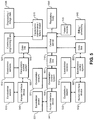
- FIG. 5 is a block diagram of the parties communicating in a fourth embodiment of the present invention.
- FIG. 6 is a block diagram of the parties communicating in a fifth embodiment of the present invention.
- FIG. 7 is a block diagram of the parties communicating in a sixth embodiment of the present invention.
- FIG. 8A is a block diagram of the parties communicating in an eighth embodiment of the present invention.
- FIG. 8B is a block diagram of the parties communicating in a first variation of the eighth embodiment.
- FIG. 8C is a block diagram of the parties communicating in a second variation of the eighth embodiment.
- FIG. 9 is a block diagram of the parties communicating in a ninth embodiment of the present invention.
- FIG. 10 is a block diagram of the parties communicating in a tenth embodiment of the present invention.
- FIG. 11A is a block diagram of the parties communicating in an eleventh embodiment of the present invention.
- FIG. 11B is a block diagram of the parties communicating in a variation of the eleventh embodiment.
- Exoskeleton 100 having a torso support 105 and lower leg supports 110 and 111 .
- Exoskeleton 100 is used in combination with a pair of crutches, a left crutch 115 of which includes a lower, ground-engaging tip 120 and a handle 125 .
- a patient 130 is able to walk.
- torso support 105 is configured to be coupled to a torso 135 of patient 130
- leg supports 110 and 111 are configured to be coupled to lower limbs 140 and 141 of patient 130 .
- actuators are interposed between portions of leg supports 110 and 111 as well as between leg supports 110 and 111 and torso support 105 , with these actuators being configured to shift leg supports 110 and 111 relative to torso support 105 to enable movement of lower limbs 140 and 141 of patient 130 .
- torso support 105 can be quite small and comprise a pelvic link (not shown), which wraps around the pelvis of patient 130 .
- the actuators are specifically shown as a hip actuator 145 , which is used to move a hip joint 150 in flexion and extension, and as a knee actuator 155 , which is used to move a knee joint 160 in flexion and extension.
- Actuators 145 and 155 are controlled by a controller (or control system or CPU) 165 in a plurality of ways known to one skilled in the art of exoskeleton control.
- controller 165 various sensors are in communication with controller 165 so that controller 165 can monitor the orientation of exoskeleton 100 .
- sensors can include, without restriction, encoders, potentiometers, accelerometer and gyroscopes, for example.
- controller 165 is in either continuous or intermittent communication with, and transfers selected exoskeleton state data to, a data link 170 .
- Data link 170 is a wireless transmission device that is configured to transfer data received from controller 165 to a central server 175 .
- the particular structure of an exoskeleton for use in connection with the present invention can take various forms known in the art, it will not be detailed further herein.
- FIGS. 2A and 2B block diagrams of the parties in communication in the first embodiment of the present invention are shown.
- an exoskeleton control system 200 is in communication with a data link 205 , which is in communication with a central server 210 .
- control system 200 is able to send data to and receive data from central server 210 .
- Control system 200 is also in communication with a human interface device 215 , which interacts with an exoskeleton wearer 220 .
- wearer 220 can interact with control system 200 .
- wearer 220 can also interact, indirectly, with central server 210 .
- central server 210 is additionally in communication with the Internet 225 and/or an internal network 230 .
- This allows interaction between wearer 220 and data or entities on the Internet 225 or a specific internal network, i.e., internal network 230 .
- data link 205 is a wireless device that transmits and receives data in any of a plurality of ways known in the art.
- the exoskeleton has multiple data links that are in communication with control system 200 and central server 210 , with differing data links being used for different types of data or levels of communication security.
- the exoskeleton can have one encrypted data link and one unencrypted data link.
- the exoskeleton frame is utilized as an antenna array for wireless amplification and omnidirectional coverage.
- human interface device 215 is a simple control panel with a small screen and speaker.
- human interface device 215 makes use of more complicated input systems, such as voice or gesture recognition, and provides haptic wearer feedback.
- additional sensors present in the exoskeleton such as GPS or other geo-positioning devices, video cameras or other sensors known in the art, are used to transmit useful data to control system 200 and central server 210 .
- the patient can use his or her exoskeleton for physical mobility activities, with exoskeleton state data being reported to a central server.
- This allows the central server to either perform some analysis on the use of the exoskeleton by the patient or transfer the data to a third party, such as a physical therapist, who can also perform some analysis on the use of the exoskeleton by the patient.
- the first embodiment also allows the central server to relay data back to the exoskeleton so that the patient receives feedback from the central server, or the physical therapist, as to their use of the exoskeleton.
- the patient though the communication apparatus of the first embodiment, to communicate in real time with a person connected to the central server, e.g., the physical therapist.
- the first embodiment provides for more mundane types of communication between the patient and various parties connected to the central server, such as billing transactions based on exoskeleton use, the results of a particular physical therapy session, scheduling additional physical therapy sessions and technical “help-desk” functions in which the patient can ask questions regarding the operation of the exoskeleton.
- the central server is connected to the Internet
- the first embodiment can allow the patient to access email or other web-based services through an exoskeleton-wearer interface, i.e., a human interface device.
- the exoskeleton can monitor other electronic medical records and alert the physical therapist to adaptations to the therapy that should be made to account for other treatments the patient is receiving.
- Collection and transmission of data from an exoskeleton control system to a central server is important for monitoring the health of the exoskeleton system, as well as for many other possible applications of the first embodiment of this invention.
- it is difficult to return all data from the exoskeleton at the highest sampling rates because the volume of data generated is tremendous and the data is transmitted wirelessly to the central server.
- some, or even much, of the available data collected by the exoskeleton control system during certain exoskeleton activities, or lack of activity, is not useful enough to merit transmission.
- attempting to transmit all data from an exoskeleton control system over a wireless system will likely result in exorbitant costs and/or potentially large gaps in the data because the wireless data collection will not be able to keep up with the data generation rate.
- FIG. 3A a graph is shown in FIG. 3A .
- the y-axis shows the data quantity, in arbitrary units, collected by the exoskeleton and transmitted to the central server though the data link, while the x-axis shows the exoskeleton activity type.
- a plot represents the data collection/transmission rate for each exoskeleton activity. In this representation, very little data is collected/transmitted when the exoskeleton is not being worn (as shown at 300 ), whereas more data is collected/transmitted when the exoskeleton is worn by a person in a sitting position (as shown at 305 ).
- the exoskeleton is falling or in a situation in which a fall is more likely, it can be advantageous to oversample the inertial sensors (e.g., accelerometers and rate gyros) so that more information about the impact is available to ascertain whether the wearer or exoskeleton was damaged during the impact.
- additional data from peripherals that is not normally returned can also be collected.
- the data can be down sampled retrospectively after the event in order to save space during the uploading process.
- certain types of data can be stored for a short period of time in a buffer, and this stored data can be later transmitted or not depending on the satisfaction of certain conditions.
- the data rate can be at its lowest point, or possibly even zero, since no errors are expected to be encountered and there is no dynamic motion.
- less data can be transmitted from the exoskeleton to the central server in order to allow more data to be received from the server or vice versa.
- control system 200 is in communication with human interface device 215 , which interacts with wearer 220 .
- Control system 200 is additionally in communication with two separate exoskeleton data links. Specifically, control system 200 sends data to an exoskeleton transmitter 340 and receives data from an exoskeleton receiver 341 .
- Exoskeleton receiver 341 receives wireless signals from a server transmitter 345
- exoskeleton transmitter 340 transmits wireless signals to a server receiver 346 .
- Central server 210 sends data to server transmitter 345 and receives data from server receiver 346 , with the data from server receiver 346 first being controlled and/or filtered by a server firewall 350 .
- the data sent from central server 210 to control system 200 follows a different path than the data sent from control system 200 to central server 210 .
- This allows data bandwidth usage from a send function to not interfere with data bandwidth usage from a receive function.
- differential levels of security can be utilized for each path. For example, in FIG. 3B , greater security is provided for central server 210 through the use of server firewall 350 .
- the exoskeleton also has a firewall controlling all data passed from exoskeleton receiver 341 to control system 200 .
- two high-bandwidth communication pathways one from the exoskeleton to the central server and one from the central server to the exoskeleton, can exist at the same time without interfering with and diminishing the rate or quality of one another.
- the third embodiment of the present invention provides solutions to several issues relating to the linked activities of exoskeleton navigation and exoskeleton power monitoring in an unstructured (i.e., non-clinic) environment. It is undesirable for an exoskeleton and wearer to be out of the house or clinic and run out of battery power in a location where the wearer is unable to recharge the exoskeleton.
- the third embodiment is an advanced power monitoring scheme, with both an exoskeleton control system and a central server communicating in such a way as to predict power usage under specific conditions and navigational options.
- the exoskeleton control system monitors exoskeleton power given the type of action the wearer is engaged in at the time, the wearer's weight, the wearer's spasticity and residual strength, the wearer's fatigue levels and the exoskeleton location's from integral exoskeleton GPS systems.
- the exoskeleton control system then communicates this data to the central server.
- the central server uses the data provided by the exoskeleton control system in tandem with terrain and metrics data to predict how much power is needed per step or per action, allowing predictions of battery discharge rate, remaining range and time to possible destinations.
- the estimated range of the exoskeleton can be reported to the user, via a human interface device such as a control pad or any of a number of feedback means known in the art.
- the user can input a goal location or activity, and the exoskeleton control system and central server can determine if there is sufficient charge for that activity.
- this system includes features assuring that there is enough power for a round trip of exoskeleton travel and warning the exoskeleton wearer if there is a risk of insufficient power for a selected task or trip.
- the communication link between the exoskeleton control system and the central server can also be used by the wearer to locate the nearest services, such as battery charging or medical services, or the locations of other exoskeleton wearers that might be able to provide assistance.
- devices are added to the exoskeleton to allow the exoskeleton to make use of specific available types of battery charging interfaces, such as automobile battery charging stations.
- battery charging devices allow the exoskeleton battery to be charged using other less optimal power sources, such as vehicular power or domestic wall outlets, with the central server also directing the wearer to these other power sources.
- the exoskeleton is configured to use swappable, pre-charged battery packs that can be made available in certain locations known to the exoskeleton navigation system. In such an embodiment, it is preferable that the exoskeleton be configured to use both a primary battery and a secondary battery so that exoskeleton power can be maintained while one battery is being changed.
- the navigational interface can be used by the exoskeleton wearer to interface with social networking or similar applications, allowing the wearer to be provided with information such as disability accommodation, special entrances, seating limitations or other information that would be useful to the wearer in selecting a destination or path.
- Control system 200 continuously receives data on remaining power from a primary exoskeleton battery 400 as well as location data from exoskeleton geolocation sensors 405 .
- Geolocation sensors 405 receive location related data from GPS satellites 410 and/or cellular towers 411 .
- Control system 200 also continuously receives data relating to exoskeleton use and the state of wearer 220 from exoskeleton sensors 415 .
- Control system 200 then sends the accumulated data to central server 210 through data link 205 .
- Central server 210 makes use of the data from control system 200 as well as information from a terrain database 420 and a historical database 421 .
- Historical database 421 contains accumulated data regarding previously reported power usage and navigational data from a large sampling of exoskeletons and wearers as well as specific historical data relating to wearer 220 . Using all of this data, central server 210 is able to estimate the discharge rate of primary exoskeleton battery 400 for a given activity or navigational option, with this estimate being sent to control system 200 through data link 205 , at which point the estimate can be displayed to wearer 220 via human interface device 215 . Wearer 220 can then input commands or queries into human interface device 215 , with these commands or queries being sent to central server 210 by way of control system 200 and data link 205 . At this point, central server 210 can adjust estimates or propose alternative actions, which are then relayed back to wearer 220 by way of data link 205 , control system 200 and human interface device 215 .
- an exoskeleton control system and central server can report to the individual whether he or she has enough power to walk to the location and also whether he or she is predicted to have enough power to return. If the system predicts that there is insufficient remaining power to return, the system can report to the individual the locations along the pathway that can be used to recharge the exoskeleton and thereby make the walk possible.
- exoskeletons undergo a particularly broad range of forces and loads that can damage components, and failures in exoskeleton components can put an exoskeleton wearer at risk of injury.
- One further complication is that disabled exoskeleton wearers might not have sensation in certain portions of their bodies, requiring additional care to be taken to assure proper operation of exoskeleton components.
- the fourth embodiment of the present invention addresses the risk of exoskeleton component failure through the use of predictive maintenance, which is done by monitoring the loadings at specific components on each exoskeleton and communicating this information to a central server.
- the central server compares these loadings to failure rates in other test exoskeletons and deployed exoskeletons, allowing the central server to better predict failures in exoskeletons in the field.
- This type of monitoring also has an important regulatory component in assuring regulators, such as the Food and Drug Administration, that an exoskeleton is safe across a range of users.
- assuring regulators such as the Food and Drug Administration
- an exoskeleton device is safe even under aggressive use, providing important risk mitigation during design. This would allow exoskeletons to be tested in certain situations or use cases by able-bodied users prior to exoskeleton use in these situations by disabled individuals.
- the exoskeleton can be programmed to disallow further use (or specific types of use) until required maintenance is completed. In some embodiments, only certain types of maintenance will disable the exoskeleton, or only certain maneuvers will be disabled until maintenance is performed. In some embodiments, when an error is triggered by the exoskeleton, an automatic report is generated and communicated back to the central server for analysis. Also, a further evaluation of the need for maintenance or further inspection of the exoskeleton is triggered. In some embodiments, the system of the fourth embodiment is used to determine which exoskeleton parts should be redesigned for greater durability.
- the system prompts a call for assistance, similar to that used by roadside assistance for automobiles, and can utilize a GPS location device coupled to the exoskeleton or some other two-way communication system, as described above.
- FIG. 5 there is shown a box diagram representing the fourth embodiment of the present invention.
- three exoskeletons are communicating data to central server 210 , which builds a failure model using the aggregate communicated data, design data, engineering team input and patient records.
- a required maintenance schedule is returned to each exoskeleton, and aggregate data is provided to the engineering team for diagnostics and to a regulatory body to show safety.
- Central server 210 is in communication with the exoskeletons through data links 500 , 501 and 502 , which relay exoskeleton state data from exoskeleton control systems 505 , 506 and 507 .
- Control systems 505 - 507 receive exoskeleton state and function data from exoskeleton sensors 510 , 511 and 512 , allowing central server 210 to monitor the state and function of each exoskeleton.
- Central server 210 uses the data received from the exoskeletons not only to monitor the current state of those exoskeletons, but also to build, over time and using many exoskeletons, an exoskeleton maintenance and failure model 515 .
- Model 515 also takes into account engineering and design data 520 and input from a continuing engineering team 525 .
- Central server 210 then analyzes the data from a single exoskeleton, e.g., the exoskeleton controlled by control system 505 , worn by an exoskeleton wearer 530 and transmitting data from exoskeleton sensors 510 via data link 500 .
- Central server 210 also analyzes patient records 535 for wearer 530 and applies the data from exoskeleton sensors 510 and patient records 535 to model 515 to determine the need for exoskeleton maintenance. If central server 210 determines that the exoskeleton is in need of maintenance, central server 210 sends a message by way of data link 500 and control system 505 to a human interface device 540 in order to inform wearer 530 of the need for maintenance.
- Central server 210 then coordinates with wearer 530 and a billing and scheduling department 545 to arrange exoskeleton maintenance. In addition, central server 210 reports data, as well as model 515 , to a regulatory body 550 in order to demonstrate the ongoing safety of the exoskeleton system.
- each exoskeleton being the same model and age but belonging to a different wearer.
- One exoskeleton is worn by a light wearer and is used on a smooth floor indoors without ever falling, thereby requiring less frequent maintenance relative to the other exoskeleton, which is worn by a heavy wearer on concrete outside who falls occasionally due to aggressive exoskeleton use.
- the central server Based on data transmitted to a central server from each exoskeleton control system, the history of machine failures, information about the exoskeleton design and an analysis of engineering staff, it is possible for the central server to forecast a schedule of maintenance that is then communicated back to the exoskeletons in the field.
- the light user will not need to go in for unnecessary maintenance and the heavy user will go in more often than normal but will not need to be concerned about a machine failure despite his or her aggressive exoskeleton use.
- An ambulatory exoskeleton can, based on configuration and sensors present, provide a substantial amount of information about a wearer's performance and state, thereby serving as an ideal basis for monitoring the entire body system of the wearer.
- the fifth embodiment of the present invention provides ways by which an exoskeleton control system can serve as a basis for a local network or “body area network” for a variety of sensors to respond or report to. In this way, data can be synced on the same clock and compared.
- This exoskeleton “body area network” is additionally in communication with a central server in order to allow remote monitoring or analytic functions.
- Exoskeletons can also be used to identify specific users based on gait biometrics or other unique markers, with the exoskeleton connection to the central server through the two-way data link allowing for identification of users who are new to a particular exoskeleton. As a result, centralized settings for exoskeletons and users can be automatically applied.
- an exoskeleton with a “body area network” can be used to remotely monitor the health of an exoskeleton wearer, allowing for summoning of emergency or other services in certain cases.
- the “body area network” can be used for early detection of pressure sores directly or due to changes in gait.
- a “body area network” in combination with communication with a central server can be used for automatic range of motion tests with remote monitoring, monitoring and adjusting the course of physical therapy or effecting the application of anti-inflammatory, analgesic or other medication in response to sensor data.
- FIG. 6 shows a block diagram representing the fifth embodiment of the present invention.
- Exoskeleton wearer 220 is monitored by sensor devices 600 , 601 and 602 .
- Sensor device 602 is wired directly to and transfers data to exoskeleton control system 200
- sensor devices 600 and 601 are in wireless communication with an exoskeleton-sensor data link 605 that transfers sensor data to control system 200 .
- control system 200 collects a variety of data about wearer 220 .
- Control system 200 is also in communication with central server 210 through data link 205 , which can be considered an exoskeleton-server data link. This allows the state of wearer 220 to be monitored and/or analyzed by both control system 200 and central server 210 , with the results of this analysis being, in some cases, made available to wearer 220 though human interface device 215 .
- a heart rate monitor can be attached that communicates with the exoskeleton in a manner similar to a heart rate monitor communicating with a treadmill.
- these sensors can either be passive in that the information is simply reported or they can be used in the exoskeleton control system.
- EMG sensors can be used to monitor muscle fatigue.
- the exoskeleton controller can respond by providing additional power.
- the sensors can also provide input to allow the exoskeleton to challenge the wearer.
- the exoskeleton can speed up or require more input from the wearer.
- Sensors can also report to the “body area network” when the exoskeleton is not in use.
- a GPS watch, health/activity monitoring watch or sleep monitoring device can report back to the exoskeleton, thus providing more information as to the overall well-being of the exoskeleton wearer.
- This information can be used by the exoskeleton control system or the networked central server in order to modify the course of therapy or to signal a medical professional to further evaluate the data on the patient's health.
- collected health data such as step counts and caloric expenditure can be automatically uploaded to social networks with the intent of sharing progress or gamifying rehabilitation by setting competitive goals.
- Previously described embodiments of the present invention have allowed an exoskeleton control system to be networked to a central server or physiological sensors in a “body area network”.
- the sixth embodiment of the present invention makes use of similar communication devices and methods, allowing the exoskeleton control system to be networked with additional peripheral devices.
- peripheral devices can include devices such as: crutches equipped with sensors or input/feedback interfaces; specific human interface devices such as Google Glass or other hands-free interfaces; automobiles; wheelchairs; smartphones; tablets; smart watches; entertainment consoles; swappable battery packs; environmental sensing devices; medical devices such as glucose sensors; tools; other exoskeletons; or even simple RFID devices embedded in walls, appliances or other features to improve navigation in confined spaces.
- FIG. 7 is a block diagram representing the sixth embodiment and shows exoskeleton control system 200 in communication with an exoskeleton-peripheral device data link 700 , which is in communication with peripheral devices 705 and 706 .
- Peripheral device 706 which is a device such as a crutch, is also in direct interaction with exoskeleton wearer 220 .
- Wearer 220 is able to interact with control system 200 through human interface device 215 , which allows wearer 220 to interact with peripheral devices 705 and 706 using human interface device 215 .
- Control system 200 is also in communication with central server 210 though data link 205 , which can be considered an exoskeleton-server data link. This allows central server 210 networked access to data from peripheral devices 705 and 706 .
- the soldier can network peripheral devices to an exoskeleton control system.
- the firearm of the soldier can communicate the quantity of ammunition remaining in the soldier's magazine to the exoskeleton control system, with this quantity then being relayed to the soldier through a heads-up-display peripheral device that is also networked to the exoskeleton control system.
- Information on remaining ammunition, frequency of ammunition use or targeting information can be relayed from the exoskeleton control system to a central server, where battlefield commanders can monitor the actions and remaining resources of a unit. Orders can then be relayed from the central server to the exoskeleton control system, at which point the orders are relayed to the soldier through a human interface device.
- a central server performs data analytics tasks using data provided by the control systems of a deployed fleet of exoskeletons.
- This data includes linked and unlinked datasets on exoskeleton location and movement, power usage in various tasks, wearer performance in a variety of maneuvers, body sensor data and/or peripheral device data.
- These datasets provide a wealth of information that can be sorted and analyzed using techniques known in the art of big data analytics and deep learning. This analysis facilitates improvements to exoskeleton design, physical therapy routines, responses to failures, navigation from point-to-point and a host of other functions of use to exoskeleton designers or wearers.
- the seventh embodiment of the present invention consider a central server that is in communication with hundreds of exoskeletons that are being used in clinical therapy settings.
- the data accumulated from the control systems of these exoskeletons and relayed to the central server via data links can be used to determine optimal points to recharge or discharge batteries in order to provide for maximum battery life.
- new instructions are relayed from the central server to the control systems, and optionally through human interface devices to the exoskeleton wearers, relating to determined best use parameters for the exoskeletons in terms of maximizing battery life.
- exoskeleton control system 200 is in communication with data link 205 , which is in communication with central server 210 . Through data link 205 , control system 200 is able to send data to and receive data from central server 210 . Control system 200 is also in communication with human interface device 215 , which interacts with exoskeleton wearer 220 . As a result, wearer 220 can interact with control system 200 . Since control system 200 is in communication with central server 210 , wearer 220 can also interact, indirectly, with central server 210 . A local application process 800 runs on control system 200 .
- Wearer 220 is able to interact with local application process 800 through human interface device 215
- central server 210 is able to interact with local application process 800 though data link 205 , thereby allowing local application process 800 to transmit information to and from both central server 210 and wearer 220 .
- the communication between control system 200 and central server 210 is constant. In other embodiments, the communication between control system 200 and central server 210 is intermittent. Since local application process 800 is located on control system 200 , communication to central server 210 can be disrupted without preventing wearer 220 from accessing local application process 800 .
- the wearer can access a variety of applications that are useful in different situations.
- One example is the ability of the wearer to summon “roadside” assistance through a user interface if there is a fall or mechanical failure of the exoskeleton, at which point a central server is notified to dispatch aid to the exoskeleton location and to convey through the user interface an estimated time of arrival.
- the wearer can interact with a virtual physical therapist who assists the wearer in a therapy routine. Data from these therapy sessions is sent to the central server, allowing improvements to be made to the physical therapy regimes prescribed by the physical therapist.
- the wearer is able to access various applications related to games that encourage certain physical exercises or improvements in skills associated with exoskeleton use, with these games being downloadable from the central server and running on the exoskeleton control system.
- the exoskeleton wearer makes use of a virtual assistant application (such as SiriTM or CortanaTM), with queries posed by the wearer being initially processed within the exoskeleton control system.
- the exoskeleton control system is then able to draw upon additional data from the central server (which can be connected to the broader internet) if needed to fully answer the question or permit other functions, such as reserving a table at a restaurant.
- the central server transmits information to an application running on the exoskeleton control system that allows the wearer to receive alerts from the central server, such as news of an impending thunderstorm that prompts the wearer to seek shelter indoors.
- the wearer can choose to download specific or customizable user interface dashboards from the central server, with these dashboards then running on the exoskeleton control system and allowing for wearer-selected user interface functions. For example, these functions can include enabling or disabling exoskeleton functionalities or rates of movement based on self-selected exoskeleton wearer skill.
- the wearer can select exoskeleton control system setting modifications from the central server to modify exoskeleton control system settings.
- Exoskeleton control system 200 is in communication with data link 205 , which is in communication with central server 210 . Through data link 205 , control system 200 is able to send data to and receive data from central server 210 . Control system 200 is also in communication with human interface device 215 , which interacts with exoskeleton wearer 220 . As a result, wearer 220 can interact with control system 200 . Since control system 200 is in communication with central server 210 , wearer 220 can also interact, indirectly, with central server 210 . A cloud application process 805 runs on central server 210 .
- Wearer 220 is able to interact with cloud application process 805 through human interface device 215 , with data being relayed to and from human interface device 215 via control system 200 and data link 205 .
- This embodiment has the advantage, relative to the embodiment shown in FIG. 8A , of allowing for far greater processing power to be used to run certain applications, including applications that are not able to run on exoskeleton control system 200 .
- one disadvantage of this arrangement is that an exoskeleton cannot make use of cloud application process 805 without network communication. Accordingly, the communication between control system 200 and central server 210 is preferably constant, although this is not required for all applications.
- the wearer can access a variety of cloud-based applications that are useful in different situations.
- a virtual physical therapist application or virtual assistant application process being run on a central server, but accessed by the wearer though a human interface device, can make use of computationally expensive deep learning or cognitive computing analytics in order to better respond to the needs or requests of the wearer (as compared with an application process being run on an exoskeleton control system).
- Other cloud-based applications can also be made accessible to the wearer, such as social networking applications, exercise or learning games or any of a host of subscription-based software products and applications.
- Exoskeleton control system 200 is in communication with data link 205 , which is in communication with central server 210 . Through data link 205 control system 200 is able to send data to and receive data from central server 210 . Control system 200 is also in communication with human interface device 215 , which interacts with exoskeleton wearer 220 . As a result, wearer 220 can interact with control system 200 . Since control system 200 is in communication with central server 210 , wearer 200 can also interact, indirectly, with central server 210 . Local application process 800 runs on control system 200 , while cloud application process 805 runs on central server 210 .
- Local application process 800 and cloud application process 805 are in communication through data link 205 .
- Wearer 220 is able to interact with local application process 800 and cloud application process 805 through human interface device 215 , with data being relayed to and from human interface device 215 via control system 200 and data link 205 .
- local application process 800 is a backup of cloud application process 805 , such that at least some application function can be maintained even with intermittent network communication.
- cloud application process 805 serves as a backup of local application process 800 , such that no data or active processes are lost in the case of a program crash in control system 200 .
- the communication between control system 200 and central server 210 is constant. In other embodiments, the communication between control system 200 and central server 210 is intermittent, with local application process 800 allowing wearer 200 to still access an application if communication to central server 210 is disrupted.
- the wearer can run a largely cloud-based application, taking advantage of the superior processing capabilities of a central server, while maintaining some application function even if he or she chooses to move in and out of areas, such as tunnels or other structures, with little or no network connectivity.
- an ambulatory exoskeleton can, based on configuration and sensors present, provide a substantial amount of information about a wearer's performance and state.
- a ninth embodiment of the present invention provides ways by which an exoskeleton control system can serve as a basis for a local network or “body area network”.
- the “body area network” is in communication with a central server in order to allow remote monitoring and analytic functions.
- the central server can enable or disable certain exoskeleton features or initiate technical, medical or emergency support in response to the data received.
- the ninth embodiment is illustrated in FIG. 9 .
- Exoskeleton control system 200 is in communication with central server 210 through data link 205 .
- Control system 200 receives information on the state and/or performance of exoskeleton wearer 220 from wearer sensors 900 and information on the state and/or environment of an exoskeleton 905 from exoskeleton sensors 910 .
- Control system 200 is in communication with human interface device 215 , with control system 200 selectively activating either a permissive interface 915 or a restrictive interface 916 on human interface device 215 .
- Wearer 220 interacts with human interface device 215 using whichever interface is activated by control system 200 .
- Sensor data received by control system 200 is transmitted, either continuously or intermittently, to central server 210 , which performs various analyses on this data.
- Central server 210 is able to initiate different actions in response to these data analyses, such as summoning of emergency services 920 , placing control system 200 and wearer 220 in contact with either technical support 925 or a physical therapist 930 or commanding control system 200 to toggle human interface device 215 between permissive interface 915 and restrictive interface 916 .
- wearer sensors 900 include but are not limited to EEG, EMG or EKG sensors or sensors that measure pulse, blood pressure, blood glucose or body temperature.
- exoskeleton sensors 910 measure exoskeleton or environmental state features including but not limited to joint angle, applied actuator forces, pressure on wearer 200 , pressure on a support surface, environmental temperature, proximity to objects or surfaces or geographical position using any of a variety of sensor devices known in the art.
- the exoskeleton As an example of the ninth embodiment of the present invention, consider an exoskeleton being used in the home for mobility and rehabilitation purposes by a severely disabled elderly person.
- the exoskeleton which makes use of the devices and methods of the ninth embodiment, can be set in the restrictive interface mode for mobility purposes due to the level of disability of the wearer, thereby limiting the speed of some motions, e.g., restricting movements to walking rather than running.
- a central server can detect this event and automatically summon emergency services.
- the exoskeleton is also being used by the wearer for rehabilitation functions, at which time the wearer is in communication with a remote physical therapist via the central server.
- the physical therapist is able to command the exoskeleton control system to change to the permissive interface mode, allowing the wearer additional functionalities while under the supervision of the physical therapist.
- the ninth embodiment can also be used for early detection of pressure sores directly or due to changes in gait.
- pressure mapping can be used to adjust the position of the exoskeleton for improved user comfort.
- wearer sensors can be used to effect the application of anti-inflammatory, analgesic, glucose regulating or other medication in response to sensor data.
- exoskeletons equipped with various sensors can be used to identify specific users based on wearer biometrics, gait characteristics or other unique markers.
- a connection to a central server through a two-way data link allows for identification of users new to a particular exoskeleton, such that centralized settings for exoskeletons and user interfaces can be automatically applied.
- the exoskeleton and sensors in combination with central server communication can be used for automatic range of motion tests for each patient with remote monitoring or even to monitor and adjust the course of physical therapy over multiple sessions.
- the ninth embodiment consider an industrial exoskeleton being used by a construction worker. As discussed above in connection with the fourth embodiment, it is generally desirable to determine when an exoskeleton will need service so that service can occur before a failure.
- the industrial exoskeleton's state and usage can be monitored by a central server, triggering automatic or analytics-dependent maintenance alerts.
- the exoskeleton can be programmed to disallow further use (or specific types of use) through a change from a permissive to a restrictive user interface setting until required maintenance is completed. Specific uses can be disallowed in certain weather conditions, such as heavy rain, or after a fall or other event that may have damaged the exoskeleton or injured the wearer.
- this feature lockout can be overridden by the wearer, optionally after a warning, since this can be of advantage in an emergency situation where disabling the exoskeleton could put human life at risk.
- the exoskeleton sensors can be used to detect a workplace injury and automatically summon emergency medical services.
- an exoskeleton can be networked with peripheral devices.
- a tenth embodiment of the present invention expands on this idea and is illustrated in FIG. 10 .
- exoskeleton wearer 220 who is not presently wearing an exoskeleton, is able to communicate with both exoskeleton control system 200 and central server 210 through the use of peripheral devices. This allows wearer 220 to issue commands to control system 200 or remotely access data stored on either control system 200 or central server 210 .
- Wearer 220 can interact with a peripheral device 1000 , which is in communication with control system 200 through an exoskeleton-peripheral device data link 1005 , or a peripheral device 1001 , which is in communication with control system 200 through central server-peripheral device data link 1006 .
- central server 210 is networked with control system 200 through data link 205 .
- a single peripheral device is able to interact with control system 200 or central server 210 through either of data links 1005 and 1006 .
- one or both of peripheral devices 1000 and 1001 contain various sensors.
- one or both of peripheral devices 1000 and 1001 are capable of interacting with additional networks, such as Wi-Fi networks or cellular internet.
- the person can network his or her smartphone with the exoskeleton control system, granting the exoskeleton control system access to data from smartphone sensors, such a GPS or other location services.
- the person can command his or her exoskeleton to detect the peripheral devices of nearby people and modify its walking speed to match the pace of the crowd for better walking in a crowded community environment.
- exoskeletons can communicate so as to allow them to tightly match pacing and maneuvering using swarm walking, which allows for more exoskeletons to walk in a tighter space without colliding.
- a disabled person who uses both a wheelchair and an ambulatory exoskeleton for mobility purposes.
- the person can use a smartphone to cause his or her exoskeleton to walk to him or her or to a charging station.
- a semi-public exoskeleton sharing service can have a web or smartphone application that allows a disabled person to rent an exoskeleton for a certain period of time and summon the exoskeleton to his or her location.
- an eleventh embodiment involves a central server that performs data analytics tasks using data provided by the control systems of a deployed fleet of exoskeletons.
- the data includes linked and unlinked datasets on exoskeleton location and movement, power usage in various tasks, wearer performance in a variety of maneuvers, body sensor data and/or peripheral device data.
- These datasets provide a wealth of information that can be sorted and analyzed using techniques such as big data analytics, deep learning, cognitive computing and neuromorphic computing. This analysis facilitates improvements to exoskeleton design, physical therapy routines, responses to failures, navigation from point-to-point and a host of other functions of use to exoskeleton designers or wearers.
- the eleventh embodiment is shown in FIGS. 11A and 11B .
- exoskeleton control system 200 is in communication with and receives data about the state of exoskeleton 905 , a peripheral device 1100 and exoskeleton wearer 220 from exoskeleton sensors 910 , peripheral device sensors 1105 , wearer sensors 900 and human interface device 215 .
- Control system 200 then transmits this data to central server 210 using data link 205 , with central server 210 performing local analytics 1110 and/or off-site analytics 1115 (e.g., outsourced to a specialist analytics entity) to develop an adaptive model 1120 .
- the model is not adaptive, and data is recompiled and analyzed to make a new model periodically. In other embodiments, the model is changed incrementally as new data is collected.
- data from many exoskeleton control systems are collected to build and/or adjust the model.
- control system 200 is in communication with and receives data about the state of exoskeleton 905 , peripheral device 1100 and exoskeleton wearer 220 from exoskeleton sensors 910 , peripheral device sensors 1105 , wearer sensors 900 and human interface device 215 .
- Control system 200 has an adaptive exoskeleton system 1130 , which is affected by and to some extent processes the data received by control system 200 .
- Adaptive exoskeleton system 1130 then transmits this data to central server 210 using data link 205 , with central server 210 performing local analytics 1110 and/or off-site analytics 1115 (e.g., outsourced to a specialist analytics entity) to develop adaptive model 1120 .
- adaptive exoskeleton system 1130 is an adaptive algorithm.
- adaptive exoskeleton system 1130 contains an adaptive hardware element, including selectively switchable elements such as a field programmable gate array (FPGA), or memristive components that are physically changed in terms of conductivity or other characteristics as a result of certain processes.
- central server 210 monitors the changes in adaptive exoskeleton system 1130 .
- central server 210 is able to imprint a copy of adaptive exoskeleton system 1130 from one exoskeleton into another exoskeleton.
- the eleventh embodiment of the present invention consider a server that is in communication with hundreds of exoskeletons that are being used in clinical therapy settings.
- the data accumulated from the control systems of these exoskeletons and relayed to the server via data links can be used to determine optimal points to recharge or discharge batteries in order to provide for maximum battery life.
- New instructions are then relayed from the server to the exoskeleton control systems, and optionally through human interface devices to exoskeleton wearers, relating to the determined best use parameters for the exoskeletons in terms of maximizing battery life.
- the analysis of data received from wearer sensors of these exoskeletons can be used to compare distinct physical therapy regimes and outcomes over a large population of patients. Deep learning can be used to analyze massive datasets in order to determine unexpected or unpredicted correlations amongst a broad group of datasets from the larger exoskeleton fleet.
- an adaptive component in his or her exoskeleton that is trained specifically for his or her needs.
- This adaptive element is teachable and trainable through direct interaction with the exoskeleton wearer and/or his or her physical therapist. Examples of trainable adaptive robotics have recently been discussed in both academic and non-academic publications.
- These adaptive systems can make use of deep learning processes or learning algorithms or, in a preferred embodiment, contain one or more adaptive hardware systems, as substantial power consumption advantages can be realized through use of adaptive hardware (as compared with systems without adaptive hardware components).
- These local adaptive systems can aid in improving exoskeleton trajectories for certain motions or personalizing the exoskeleton function in other ways that are of use to a specific exoskeleton wearer.
- the present invention provides devices and methods that allow for two-way communication between an exoskeleton control system and a central system.
- An exoskeleton wearer is able to make use of the communication linkage for applications that increase the usefulness of the exoskeleton to the wearer.
- the central server is able to make use of the communication linkage for analytic functions that are of value to the wearer or a central server operator.
- peripheral devices can communicate with and be networked to the control system and the central server.
- the present invention involves collecting first data with a first exoskeleton and transmitting the first data from the first exoskeleton to a central server or a peripheral device.
- Second data is generated using the first data, and the second data is transmitted from the central server or the peripheral device to the first exoskeleton or a second exoskeleton.
Landscapes
- Health & Medical Sciences (AREA)
- Life Sciences & Earth Sciences (AREA)
- Engineering & Computer Science (AREA)
- Animal Behavior & Ethology (AREA)
- Veterinary Medicine (AREA)
- Public Health (AREA)
- General Health & Medical Sciences (AREA)
- Physics & Mathematics (AREA)
- Biomedical Technology (AREA)
- Molecular Biology (AREA)
- Surgery (AREA)
- Heart & Thoracic Surgery (AREA)
- Pathology (AREA)
- Biophysics (AREA)
- Medical Informatics (AREA)
- Physical Education & Sports Medicine (AREA)
- Computer Networks & Wireless Communication (AREA)
- Rehabilitation Therapy (AREA)
- Pain & Pain Management (AREA)
- Epidemiology (AREA)
- Physiology (AREA)
- Dentistry (AREA)
- Oral & Maxillofacial Surgery (AREA)
- General Physics & Mathematics (AREA)
- Biodiversity & Conservation Biology (AREA)
- Manipulator (AREA)
- Telephonic Communication Services (AREA)
- Mobile Radio Communication Systems (AREA)
- Measuring And Recording Apparatus For Diagnosis (AREA)
- Arrangements For Transmission Of Measured Signals (AREA)
Priority Applications (1)
| Application Number | Priority Date | Filing Date | Title |
|---|---|---|---|
| US15/566,146 US10694948B2 (en) | 2015-04-14 | 2016-04-14 | Methods of exoskeleton communication and control |
Applications Claiming Priority (4)
| Application Number | Priority Date | Filing Date | Title |
|---|---|---|---|
| US201562147076P | 2015-04-14 | 2015-04-14 | |
| US201562248659P | 2015-10-30 | 2015-10-30 | |
| PCT/US2016/027536 WO2016168463A1 (en) | 2015-04-14 | 2016-04-14 | Methods of exoskeleton communication and control |
| US15/566,146 US10694948B2 (en) | 2015-04-14 | 2016-04-14 | Methods of exoskeleton communication and control |
Publications (2)
| Publication Number | Publication Date |
|---|---|
| US20180092536A1 US20180092536A1 (en) | 2018-04-05 |
| US10694948B2 true US10694948B2 (en) | 2020-06-30 |
Family
ID=57126702
Family Applications (1)
| Application Number | Title | Priority Date | Filing Date |
|---|---|---|---|
| US15/566,146 Active 2037-04-04 US10694948B2 (en) | 2015-04-14 | 2016-04-14 | Methods of exoskeleton communication and control |
Country Status (7)
| Country | Link |
|---|---|
| US (1) | US10694948B2 (pl) |
| EP (1) | EP3283040B1 (pl) |
| CN (1) | CN107847389B (pl) |
| CA (1) | CA2982778C (pl) |
| ES (1) | ES2968225T3 (pl) |
| PL (1) | PL3283040T3 (pl) |
| WO (1) | WO2016168463A1 (pl) |
Cited By (1)
| Publication number | Priority date | Publication date | Assignee | Title |
|---|---|---|---|---|
| US11465276B2 (en) * | 2018-04-11 | 2022-10-11 | Jtekt Corporation | Motion assist system and management device |
Families Citing this family (34)
| Publication number | Priority date | Publication date | Assignee | Title |
|---|---|---|---|---|
| US10611020B2 (en) | 2013-12-19 | 2020-04-07 | Roam Robotics Inc. | Pneumatic exomuscle system and method |
| WO2017120680A1 (en) | 2016-01-17 | 2017-07-20 | Siamak Arzanpour | System and device for guiding and detecting motions of 3-dof rotational target joint |
| DE112016006822T5 (de) * | 2016-06-30 | 2019-01-10 | Intel Corporation | Sensorbasiertes datensatzverfahren und einrichtung |
| ES2969892T3 (es) | 2017-02-03 | 2024-05-23 | Roam Robotics Inc | Sistema y método para reconocimiento de intención de usuario |
| CN106826768B (zh) * | 2017-03-07 | 2019-01-29 | 中国矿业大学 | 一种机械外骨骼传感器系统 |
| US20190224841A1 (en) * | 2018-01-24 | 2019-07-25 | Seismic Holdings, Inc. | Exosuit systems and methods for monitoring working safety and performance |
| US11602479B2 (en) | 2018-03-14 | 2023-03-14 | Toyota Motor North America, Inc. | Systems and methods for providing synchronized movements of a powered wheelchair and an exoskeleton |
| US12150909B2 (en) | 2018-05-11 | 2024-11-26 | Arizona Board Of Regents On Behalf Of Northern Arizona University | Exoskeleton device |
| WO2020079071A1 (en) * | 2018-10-17 | 2020-04-23 | Koninklijke Philips N.V. | Monitoring a subject |
| JP7156390B2 (ja) * | 2018-11-13 | 2022-10-19 | 日本電気株式会社 | 負荷軽減支援装置、負荷軽減システム、負荷軽減方法、及びプログラム |
| CA3117815A1 (en) | 2018-11-28 | 2020-06-04 | College Park Industries, Inc. | Management of wireless transmission rate of control signals for power assistive devices |
| DE102018133078A1 (de) * | 2018-12-20 | 2020-06-25 | Otto Bock Healthcare Products Gmbh | Verfahren zur Auswertung von Nutzungsdaten |
| KR102771792B1 (ko) | 2019-01-30 | 2025-02-25 | 삼성전자주식회사 | 정보 처리 장치 및 이의 동작 방법 |
| CN109998870B (zh) * | 2019-04-10 | 2021-05-25 | 鄂州职业大学 | 一种防摔倒装置 |
| US10565894B1 (en) | 2019-05-29 | 2020-02-18 | Vignet Incorporated | Systems and methods for personalized digital goal setting and intervention |
| US12186095B2 (en) * | 2019-09-20 | 2025-01-07 | Skip Innovations, Inc. | Intelligent clothing for enhanced mobility |
| ES3039928T3 (en) * | 2019-12-13 | 2025-10-27 | Roam Robotics Inc | Powered device to benefit a wearer during skiing |
| FR3106975B1 (fr) * | 2020-02-10 | 2023-10-27 | Wandercraft | Procédés de génération d’une trajectoire d’un exosquelette et de mise en mouvement de l’exosquelette |
| TW202135763A (zh) * | 2020-03-30 | 2021-10-01 | 緯創資通股份有限公司 | 施力輔助設備及其控制方法 |
| JP7294232B2 (ja) * | 2020-05-15 | 2023-06-20 | トヨタ自動車株式会社 | メンテナンスシステム、メンテナンス方法、及びプログラム |
| CN111685769A (zh) * | 2020-05-20 | 2020-09-22 | 中国科学院苏州生物医学工程技术研究所 | 外骨骼功能检测系统 |
| CN115916472A (zh) | 2020-05-27 | 2023-04-04 | 漫游机械人技术公司 | 用于移动机器人的适配和悬挂系统和方法 |
| US12514775B2 (en) * | 2020-05-27 | 2026-01-06 | Roam Robotics Inc. | Powered medical device and methods for improved user mobility and treatment |
| FR3113829B1 (fr) * | 2020-09-09 | 2022-10-07 | Wandercraft | Procédé de mise en mouvement de l’exosquelette |
| WO2022094342A1 (en) | 2020-10-29 | 2022-05-05 | Arizona Board Of Regents On Behalf Of Northern Arizona University | Differential and variable stiffness orthosis design with adjustment methods, monitoring and intelligence |
| US12440362B2 (en) | 2020-10-29 | 2025-10-14 | Arizona Board Of Regents On Behalf Of Northern Arizona University | Differential and variable stiffness orthosis design with adjustment methods, monitoring and intelligence |
| CN112870028B (zh) * | 2021-01-21 | 2023-03-31 | 上海傅利叶智能科技有限公司 | 识别用户行走意图的方法、装置、智能拐杖和辅助系统 |
| JP2024534808A (ja) | 2021-08-17 | 2024-09-26 | ローム ロボティクス インコーポレイテッド | モバイルロボットのための海事アプリケーション |
| WO2023023564A1 (en) | 2021-08-17 | 2023-02-23 | Roam Robotics Inc. | Unified pneumatic and electrical connector system and method |
| US12466060B2 (en) | 2021-08-17 | 2025-11-11 | Roam Robotics Inc. | Mobile power source for a mobile robot |
| CN115416002A (zh) * | 2022-09-18 | 2022-12-02 | 美利威瑟(金华)科技发展有限责任公司 | 一种多功能外骨骼系统及应用方法 |
| DE102022210810B4 (de) | 2022-10-13 | 2025-01-30 | Volkswagen Aktiengesellschaft | Verfahren zum Schützen eines Fahrzeuginsassen eines Kraftfahrzeugs sowie Kraftfahrzeug |
| CN117428742B (zh) * | 2023-12-07 | 2024-08-02 | 中国人民解放军东部战区空军医院 | 一种用于战场救援的混合动力外骨骼 |
| CN119748414B (zh) * | 2025-01-20 | 2025-11-25 | 河北工润能源科技有限责任公司 | 一种应用于中大部件更换的人体外骨骼助力装置 |
Citations (24)
| Publication number | Priority date | Publication date | Assignee | Title |
|---|---|---|---|---|
| US4697808A (en) | 1985-05-16 | 1987-10-06 | Wright State University | Walking assistance system |
| US7010390B2 (en) | 2003-07-17 | 2006-03-07 | Kuka Roboter Gmbh | Method and system for controlling robots |
| US7031837B1 (en) | 2002-08-01 | 2006-04-18 | Steve Foust | Proactive collision avoidance system |
| US20060184280A1 (en) | 2005-02-16 | 2006-08-17 | Magnus Oddsson | System and method of synchronizing mechatronic devices |
| US7117067B2 (en) | 2002-04-16 | 2006-10-03 | Irobot Corporation | System and methods for adaptive control of robotic devices |
| US20100198124A1 (en) | 2009-01-30 | 2010-08-05 | Kern Bhugra | System and method for controlling the joint motion of a user based on a measured physiological property |
| US20100204867A1 (en) | 2007-05-04 | 2010-08-12 | Teledyne Australia Pty Ltd | Collision avoidance system and method |
| US7901368B2 (en) | 2005-01-06 | 2011-03-08 | Braingate Co., Llc | Neurally controlled patient ambulation system |
| US20110246123A1 (en) | 2010-03-30 | 2011-10-06 | Welch Allyn, Inc. | Personal status monitoring |
| US20120259430A1 (en) * | 2011-01-12 | 2012-10-11 | Zhixiu Han | Controlling powered human augmentation devices |
| US20130158445A1 (en) * | 2010-08-23 | 2013-06-20 | The Regents Of The University Of California | Orthesis system and methods for control of exoskeletons |
| US8655537B2 (en) | 2012-03-15 | 2014-02-18 | Google Inc. | Modifying behavior of autonomous vehicle based on predicted behavior of other vehicles |
| US20140100491A1 (en) | 2012-10-05 | 2014-04-10 | Jianjuen Hu | Lower Extremity Robotic Rehabilitation System |
| US20140171838A1 (en) * | 2012-12-19 | 2014-06-19 | Aleksandar Aleksov | Adaptive exoskeleton, control system and methods using the same |
| CN103876756A (zh) | 2014-04-18 | 2014-06-25 | 南京工程学院 | 下肢助力外骨骼机器人步态模式识别方法及系统 |
| WO2014159577A1 (en) | 2013-03-14 | 2014-10-02 | Ekso Bionics, Inc. | Machine to human interfaces for communication from a lower extremity orthotic |
| US8905925B2 (en) | 2008-07-15 | 2014-12-09 | Cardiac Pacemakers, Inc. | Cardiac rehabilitation using patient monitoring devices |
| US20150051519A1 (en) | 2012-03-29 | 2015-02-19 | GaitTronics inc. | Control system and device for patient assist |
| US20150100135A1 (en) * | 2013-10-09 | 2015-04-09 | Mc10, Inc. | Utility gear including conformal sensors |
| US20150141878A1 (en) | 2013-11-20 | 2015-05-21 | The University Of Maryland, Baltimore | Method and apparatus for providing deficit-adjusted adaptive assistance during movement phases of an impaired joint |
| US9158376B2 (en) | 2013-05-30 | 2015-10-13 | The Regents Of The University Of California | User coupled human-machine interface |
| US20150289995A1 (en) * | 2014-04-11 | 2015-10-15 | Harris Corporation | Robotic exoskeleton multi-modal control system |
| US20150309316A1 (en) | 2011-04-06 | 2015-10-29 | Microsoft Technology Licensing, Llc | Ar glasses with predictive control of external device based on event input |
| US20160030272A1 (en) | 2013-03-13 | 2016-02-04 | Ekso Bionics, Inc. | Gait Orthotic Device and Method for Protecting Gait Orthotic Device and User from Damage |
Family Cites Families (5)
| Publication number | Priority date | Publication date | Assignee | Title |
|---|---|---|---|---|
| WO2005115242A2 (en) * | 2004-05-24 | 2005-12-08 | Equusys, Incorporated | Animal instrumentation |
| US8801802B2 (en) * | 2005-02-16 | 2014-08-12 | össur hf | System and method for data communication with a mechatronic device |
| CA2698078A1 (en) * | 2010-03-26 | 2011-09-26 | Applied Technology Holdings, Inc. | Apparatus, systems and methods for gathering and processing biometric and biomechanical data |
| CA2883852A1 (en) * | 2012-09-04 | 2014-03-13 | Whoop, Inc. | Systems, devices and methods for continuous heart rate monitoring and interpretation |
| US9161172B2 (en) * | 2012-11-06 | 2015-10-13 | Qualcomm Incorporated | Map-based adaptive sampling of orientation sensors for positioning |
-
2016
- 2016-04-14 PL PL16780744.5T patent/PL3283040T3/pl unknown
- 2016-04-14 ES ES16780744T patent/ES2968225T3/es active Active
- 2016-04-14 EP EP16780744.5A patent/EP3283040B1/en active Active
- 2016-04-14 CN CN201680022033.3A patent/CN107847389B/zh active Active
- 2016-04-14 WO PCT/US2016/027536 patent/WO2016168463A1/en not_active Ceased
- 2016-04-14 US US15/566,146 patent/US10694948B2/en active Active
- 2016-04-14 CA CA2982778A patent/CA2982778C/en active Active
Patent Citations (25)
| Publication number | Priority date | Publication date | Assignee | Title |
|---|---|---|---|---|
| US4697808A (en) | 1985-05-16 | 1987-10-06 | Wright State University | Walking assistance system |
| US7117067B2 (en) | 2002-04-16 | 2006-10-03 | Irobot Corporation | System and methods for adaptive control of robotic devices |
| US7031837B1 (en) | 2002-08-01 | 2006-04-18 | Steve Foust | Proactive collision avoidance system |
| US7010390B2 (en) | 2003-07-17 | 2006-03-07 | Kuka Roboter Gmbh | Method and system for controlling robots |
| US7901368B2 (en) | 2005-01-06 | 2011-03-08 | Braingate Co., Llc | Neurally controlled patient ambulation system |
| US20060184280A1 (en) | 2005-02-16 | 2006-08-17 | Magnus Oddsson | System and method of synchronizing mechatronic devices |
| US20100204867A1 (en) | 2007-05-04 | 2010-08-12 | Teledyne Australia Pty Ltd | Collision avoidance system and method |
| US8905925B2 (en) | 2008-07-15 | 2014-12-09 | Cardiac Pacemakers, Inc. | Cardiac rehabilitation using patient monitoring devices |
| US20100198124A1 (en) | 2009-01-30 | 2010-08-05 | Kern Bhugra | System and method for controlling the joint motion of a user based on a measured physiological property |
| US20110246123A1 (en) | 2010-03-30 | 2011-10-06 | Welch Allyn, Inc. | Personal status monitoring |
| US20130158445A1 (en) * | 2010-08-23 | 2013-06-20 | The Regents Of The University Of California | Orthesis system and methods for control of exoskeletons |
| US20120259430A1 (en) * | 2011-01-12 | 2012-10-11 | Zhixiu Han | Controlling powered human augmentation devices |
| US20150309316A1 (en) | 2011-04-06 | 2015-10-29 | Microsoft Technology Licensing, Llc | Ar glasses with predictive control of external device based on event input |
| US8655537B2 (en) | 2012-03-15 | 2014-02-18 | Google Inc. | Modifying behavior of autonomous vehicle based on predicted behavior of other vehicles |
| US20150051519A1 (en) | 2012-03-29 | 2015-02-19 | GaitTronics inc. | Control system and device for patient assist |
| US20140100491A1 (en) | 2012-10-05 | 2014-04-10 | Jianjuen Hu | Lower Extremity Robotic Rehabilitation System |
| US20140171838A1 (en) * | 2012-12-19 | 2014-06-19 | Aleksandar Aleksov | Adaptive exoskeleton, control system and methods using the same |
| US9775763B2 (en) | 2012-12-19 | 2017-10-03 | Intel Corporation | Adaptive exoskeleton, control system and methods using the same |
| US20160030272A1 (en) | 2013-03-13 | 2016-02-04 | Ekso Bionics, Inc. | Gait Orthotic Device and Method for Protecting Gait Orthotic Device and User from Damage |
| WO2014159577A1 (en) | 2013-03-14 | 2014-10-02 | Ekso Bionics, Inc. | Machine to human interfaces for communication from a lower extremity orthotic |
| US9158376B2 (en) | 2013-05-30 | 2015-10-13 | The Regents Of The University Of California | User coupled human-machine interface |
| US20150100135A1 (en) * | 2013-10-09 | 2015-04-09 | Mc10, Inc. | Utility gear including conformal sensors |
| US20150141878A1 (en) | 2013-11-20 | 2015-05-21 | The University Of Maryland, Baltimore | Method and apparatus for providing deficit-adjusted adaptive assistance during movement phases of an impaired joint |
| US20150289995A1 (en) * | 2014-04-11 | 2015-10-15 | Harris Corporation | Robotic exoskeleton multi-modal control system |
| CN103876756A (zh) | 2014-04-18 | 2014-06-25 | 南京工程学院 | 下肢助力外骨骼机器人步态模式识别方法及系统 |
Non-Patent Citations (2)
| Title |
|---|
| Manteuffel, D, "Characteristic Mode based antenna design-A straight forward approach to small form factor antenna integration," 2015 9th European Conference on Antennas and Propagation (EuCAP), 2015, pp. 1-5, found at: http://ieeexplore.ieee.org/xpl/login.jsp?tp=&arnumber=7229004&url=http%3A%2F%2Fieeexplore.ieee.org%2Fiel7%2F7209133%2F7228134%2F07229004.pdf%3Farnumber%3D7229004. |
| Manteuffel, D, "Characteristic Mode based antenna design—A straight forward approach to small form factor antenna integration," 2015 9th European Conference on Antennas and Propagation (EuCAP), 2015, pp. 1-5, found at: http://ieeexplore.ieee.org/xpl/login.jsp?tp=&arnumber=7229004&url=http%3A%2F%2Fieeexplore.ieee.org%2Fiel7%2F7209133%2F7228134%2F07229004.pdf%3Farnumber%3D7229004. |
Cited By (1)
| Publication number | Priority date | Publication date | Assignee | Title |
|---|---|---|---|---|
| US11465276B2 (en) * | 2018-04-11 | 2022-10-11 | Jtekt Corporation | Motion assist system and management device |
Also Published As
| Publication number | Publication date |
|---|---|
| CA2982778C (en) | 2021-09-28 |
| CA2982778A1 (en) | 2016-10-20 |
| CN107847389B (zh) | 2020-11-10 |
| WO2016168463A8 (en) | 2017-10-12 |
| PL3283040T3 (pl) | 2024-03-18 |
| ES2968225T3 (es) | 2024-05-08 |
| CN107847389A (zh) | 2018-03-27 |
| WO2016168463A1 (en) | 2016-10-20 |
| EP3283040B1 (en) | 2023-12-20 |
| EP3283040A4 (en) | 2018-11-14 |
| US20180092536A1 (en) | 2018-04-05 |
| EP3283040A1 (en) | 2018-02-21 |
Similar Documents
| Publication | Publication Date | Title |
|---|---|---|
| US10694948B2 (en) | Methods of exoskeleton communication and control | |
| Mohan et al. | Artificial intelligence and IoT in elderly fall prevention: a review | |
| EP3571992B1 (en) | Mitigating effects of neuro-muscular ailments | |
| Argall | Autonomy in rehabilitation robotics: An intersection | |
| Fortino et al. | A framework for collaborative computing and multi-sensor data fusion in body sensor networks | |
| US20170042713A1 (en) | System and methods for mobile medical monitoring | |
| JP7660506B2 (ja) | 利用データを評価する方法 | |
| Deegan et al. | Mobile manipulators for assisted living in residential settings | |
| Page et al. | Smart walkers: an application-oriented review | |
| Bouteraa et al. | A fuzzy logic architecture for rehabilitation robotic systems | |
| WO2022013678A1 (en) | A gait moderation aiding system | |
| Bouteraa et al. | Smart solution for pain detection in remote rehabilitation | |
| Prasad et al. | Head-motion controlled wheelchair | |
| Kearney et al. | Key challenges for developing a Socially Assistive Robotic (SAR) solution for the health sector | |
| Boninger et al. | Technology for mobility in SCI 10 years from now | |
| CN110491495A (zh) | 脑瘫康复移动监控终端 | |
| Sairam et al. | Efficient Remote Rehabilitation and Physical Therapy Management using Decision Trees and IoT Technology | |
| Sobiya et al. | IoT Enabled Hand Gesture Controlled Wheelchair for Disabled People | |
| Cui et al. | Design of a health care platform for the elderly | |
| Suresh et al. | E-Sense Algorithm Based Wireless Wheelchair Control UsingBrain Waves | |
| Cortés et al. | A SHARE-it service to elders’ mobility using the i-walker | |
| Tino et al. | Wireless vibrotactile feedback system for postural response improvement | |
| Barrué et al. | The i-Walker: an Intelligent pedestrian mobility aid | |
| WO2021038599A1 (en) | System and method for providing clinical and physical interventions using electro-mechanical apparatus | |
| Sivakumar et al. | Development of a mobile application to control and monitor the electricity: IoT |
Legal Events
| Date | Code | Title | Description |
|---|---|---|---|
| AS | Assignment |
Owner name: EKSO BIONICS, INC., CALIFORNIA Free format text: ASSIGNMENT OF ASSIGNORS INTEREST;ASSIGNORS:SANDLER, REUBEN;STRAUSSER, KATHERINE;FIEDLER, MARK;AND OTHERS;SIGNING DATES FROM 20160502 TO 20160927;REEL/FRAME:044142/0318 |
|
| FEPP | Fee payment procedure |
Free format text: ENTITY STATUS SET TO UNDISCOUNTED (ORIGINAL EVENT CODE: BIG.); ENTITY STATUS OF PATENT OWNER: LARGE ENTITY |
|
| STPP | Information on status: patent application and granting procedure in general |
Free format text: DOCKETED NEW CASE - READY FOR EXAMINATION |
|
| STPP | Information on status: patent application and granting procedure in general |
Free format text: NON FINAL ACTION MAILED |
|
| STPP | Information on status: patent application and granting procedure in general |
Free format text: NOTICE OF ALLOWANCE MAILED -- APPLICATION RECEIVED IN OFFICE OF PUBLICATIONS |
|
| STCF | Information on status: patent grant |
Free format text: PATENTED CASE |
|
| FEPP | Fee payment procedure |
Free format text: ENTITY STATUS SET TO SMALL (ORIGINAL EVENT CODE: SMAL); ENTITY STATUS OF PATENT OWNER: SMALL ENTITY |
|
| MAFP | Maintenance fee payment |
Free format text: PAYMENT OF MAINTENANCE FEE, 4TH YR, SMALL ENTITY (ORIGINAL EVENT CODE: M2551); ENTITY STATUS OF PATENT OWNER: SMALL ENTITY Year of fee payment: 4 |